AB 288: Employment: labor organization and unfair practices.
- Session Year: 2025-2026
- House: Assembly
- Latest Version Date: 2025-09-30
Current Status:
Passed
(2025-09-30: Chaptered by Secretary of State - Chapter 139, Statutes of 2025.)
Introduced
In Committee
Awaiting First Chamber Vote
Passed First Chamber
In Committee
Awaiting Second Chamber Vote
Passed Second Chamber
Enacted
What does this bill do?
This bill lets California's Public Employment Relations Board (PERB) step in to protect workers in jobs that would be covered by the federal National Labor Relations Act when the NLRB has ceded jurisdiction or is not processing cases, letting workers or their representatives ask PERB to handle representation disputes and unfair‑practice cases, order bargaining or binding arbitration, impose civil penalties, and keep certain NLRB documents confidential. It also confirms that the Agricultural Labor Relations Board (ALRB) has exclusive authority over agricultural labor matters and may follow NLRB precedent but is not required to.
The summary is provided by generative AI which can make mistakes. For original language, please view the details in the table below.
Existing law declares the public policy of the state regarding labor organization, including, among other things, that it is necessary for a worker to have full freedom of association, self-organization, and designation of representatives of their own choosing, to negotiate the terms and conditions of their employment, and to be free from the interference, restraint, or coercion of employers of labor, or their agents, in the designation of such representatives or in self-organization or in other concerted activities for the purpose of collective bargaining or other mutual aid or protection.
Existing law establishes the Public Employment Relations Board (PERB) in state government as a means of resolving disputes and enforcing the statutory duties and rights of specified public employers and employees under various acts regulating collective bargaining. Under existing law, PERB has the power and duty to investigate an unfair practice charge and to determine whether the charge is justified and the appropriate remedy for the unfair practice.
Existing law, the federal National Labor Relations Act (NLRA), establishes a comprehensive statutory scheme regulating unfair labor practices on the part of employers and labor organizations in industries affecting interstate commerce, and vests in the National Labor Relations Board (NLRB) the power to conduct elections to determine employee representatives and to prevent unfair labor practices affecting commerce.
Existing law, the California Public Records Act, requires that public records, as defined, be available to the public for inspection and made promptly available to any person.
This bill would expand PERBs jurisdiction by authorizing a worker, to petition PERB to protect and enforce prescribed rights under specified circumstances, including if the worker is employed in a position subject to the NLRA but the NLRB has expressly or impliedly ceded jurisdiction. The bill would authorize PERB to, among other things, decide unfair labor practice cases pursuant to a specified timeline and order all appropriate relief for a violation, including civil penalties, as prescribed. In order to pursue relief from PERB, the bill would require a covered worker or their representative to file an unfair practice charge or petition that includes specified information, including, where applicable, the original charge or petition filed with the NLRB. The bill would require PERB to hold the supporting documentation and evidence confidential and maintain it as part of its investigatory file and would exempt this documentation and evidence from the California Public Records Act. If PERB determines, among other things, it has insufficient resources to process certain cases or doing so would prevent it from meeting specified statutory deadlines, the bill would require PERB to process and prioritize charges, as specified. The bill would also establish the Public Employment Relations Board Enforcement Fund (fund) in the State Treasury, would require the above-described civil penalties to be deposited into the fund, and would make moneys in the fund available upon appropriation by the Legislature to PERB for the purpose of administering the above-specified provisions. The bill would authorize PERB to rely on its own decisions and precedent under the NLRA and would authorize review of its decisions by a state appellate court, as specified.
Existing law, the Alatorre-Zenovich-Dunlap-Berman Agricultural Labor Relations Act of 1975, grants agricultural employees the right to form and join labor organizations and engage in collective bargaining, as specified, and prohibits agricultural employers and labor organizations from engaging in unfair labor practices. Those provisions establish the Agricultural Labor Relations Board (ALRB) and empower the ALRB to prevent any person from engaging in those practices. Existing law establishes various definitions for these purposes. Existing law requires the ALRB to follow applicable precedents of the NLRA.
This bill would specify that the ALRB has exclusive jurisdiction in all phases of the administration of the act, and to determine whether any person or entity meets one or more of those definitions. The bill would instead authorize the board to follow applicable precedents of the NLRA, but would not obligate the board to follow precedents where the ALRB deems it inappropriate to do so.
This bill would make related findings and declarations and would make its provisions severable.
Existing constitutional provisions require that a statute that limits the right of access to the meetings of public bodies or the writings of public officials and agencies be adopted with findings demonstrating the interest protected by the limitation and the need for protecting that interest.
This bill would make legislative findings to that effect.
Existing law declares the public policy of the state regarding labor organization, including, among other things, that it is necessary for a worker to have full freedom of association, self-organization, and designation of representatives of their own choosing, to negotiate the terms and conditions of their employment, and to be free from the interference, restraint, or coercion of employers of labor, or their agents, in the designation of such representatives or in self-organization or in other concerted activities for the purpose of collective bargaining or other mutual aid or protection.
Existing law establishes the Public Employment Relations Board (PERB) in state government as a means of resolving disputes and enforcing the statutory duties and rights of specified public employers and employees under various acts regulating collective bargaining. Under existing law, PERB has the power and duty to investigate an unfair practice charge and to determine whether the charge is justified and the appropriate remedy for the unfair practice.
Existing law, the federal National Labor Relations Act (NLRA), establishes a comprehensive statutory scheme regulating unfair labor practices on the part of employers and labor organizations in industries affecting interstate commerce, and vests in the National Labor Relations Board (NLRB) the power to conduct elections to determine employee representatives and to prevent unfair labor practices affecting commerce.
Existing law, the California Public Records Act, requires that public records, as defined, be available to the public for inspection and made promptly available to any person.
This bill would expand PERBs jurisdiction by authorizing a worker, as defined, worker, under specified circumstances, to petition PERB to protect and enforce prescribed rights, as specified. The bill would specify who is an authorized worker, including an individual who seeks to have the National Labor Relations Board (NLRB) protect and enforce their rights to full freedom of association, self-organization, or designation of representatives of their own choosing but has not received a determination or remedy within specified statutory timeframes. rights, including, among other circumstances, if the worker is employed in a position subject to the NLRA but the NLRB expressly or impliedly cedes jurisdiction, as specified. The bill would authorize PERB to, among other things, decide unfair labor practice cases, as specified, pursuant to a specified timeline and order all appropriate relief for a violation, including civil penalties, as prescribed. In order to pursue relief from PERB, the bill would require a covered worker or their representative to file an unfair practice charge or petition that includes specified information and information, including, where applicable, the original charge or petition filed with the NLRB with prescribed information, as provided. NLRB. The bill would require PERB to maintain hold the supporting documentation and evidence confidential and maintain it as part of its investigatory file and would exempt this documentation and evidence from the California Public Records Act. If the PERB determines, among other things, it has insufficient resources to process all charges pursuant to the above-described provisions, certain cases or doing so would prevent it from meeting specified statutory deadlines, the bill would require PERB to process and prioritize charges, as specified. The bill would establish the Public Employment Relations Board Enforcement Fund (fund) in the State Treasury, would require the above-described civil penalties to be deposited into the fund, and would make moneys in the fund available upon appropriation by the Legislature for to PERB to fund increased workload. The bill would make related findings and declarations and make its provisions severable. for the purpose of administering the above-specified provisions. The bill would authorize PERB to rely on its own decisions and precedent under the NLRA and would authorize review of its decisions by a state appellate court, as specified.
Existing law, the Alatorre-Zenovich-Dunlap-Berman Agricultural Labor Relations Act of 1975, grants agricultural employees the right to form and join labor organizations and engage in collective bargaining, as specified, and prohibits agricultural employers and labor organizations from engaging in unfair labor practices. Those provisions establish the Agricultural Labor Relations Board (ALRB) and empower the ALRB to prevent any person from engaging in those practices. Existing law establishes various definitions for these purposes. Existing law requires the ALRB to follow applicable precedents of the NLRA.
This bill would specify that the ALRB has exclusive jurisdiction in all phases of the administration of the act, and to determine whether any person or entity meets one or more of those definitions. The bill would instead authorize the board to follow applicable precedents of the NLRA, but would not obligate the board to follow precedents where the ALRB deems it inappropriate to do so.
This bill would make related findings and declarations and would make its provisions severable.
Existing constitutional provisions require that a statute that limits the right of access to the meetings of public bodies or the writings of public officials and agencies be adopted with findings demonstrating the interest protected by the limitation and the need for protecting that interest.
This bill would make legislative findings to that effect.
Existing law declares the public policy of the state regarding labor organization, including, among other things, that it is necessary for a worker to have full freedom of association, self-organization, and designation of representatives of their own choosing, to negotiate the terms and conditions of their employment, and to be free from the interference, restraint, or coercion of employers of labor, or their agents, in the designation of such representatives or in self-organization or in other concerted activities for the purpose of collective bargaining or other mutual aid or protection.
Existing law establishes the Public Employment Relations Board (PERB) in state government as a means of resolving disputes and enforcing the statutory duties and rights of specified public employers and employees under various acts regulating collective bargaining. Under existing law, PERB has the power and duty to investigate an unfair practice charge and to determine whether the charge is justified and the appropriate remedy for the unfair practice.
Existing law, the California Public Records Act, requires that public records, as defined, be available to the public for inspection and made promptly available to any person.
This bill would expand PERBs jurisdiction by authorizing a worker, as defined, to petition PERB to protect and enforce prescribed rights, as specified. The bill would specify who is an authorized worker, including an individual who seeks to have the National Labor Relations Board (NLRB) protect and enforce their rights to full freedom of association, self-organization, or designation of representatives of their own choosing but has not received a determination or remedy within specified statutory timeframes. The bill would authorize PERB to, among other things, decide unfair labor practice cases, as specified, and order all appropriate relief for a violation, including civil penalties. penalties, as prescribed. In order to pursue relief from PERB, the bill would require a covered worker or their representative to file an unfair practice charge that includes specified information and the original charge filed with the NLRB with prescribed information, as provided. The bill would require PERB to maintain the supporting documentation and evidence confidential as part of its investigatory file and would exempt this documentation and evidence from the California Public Records Act. If the PERB determines, among other things, it has insufficient resources to process all charges pursuant to the above-described provisions, the bill would require PERB to process and prioritize charges, as specified. The bill would establish the Public Employment Relations Board Enforcement Fund (fund) in the State Treasury, require the above-described civil penalties to be deposited into the fund, and would make moneys in the fund available upon appropriation by the Legislature for PERB to fund increased workload. The bill would make related findings and declarations and make its provisions severable.
Existing constitutional provisions require that a statute that limits the right of access to the meetings of public bodies or the writings of public officials and agencies be adopted with findings demonstrating the interest protected by the limitation and the need for protecting that interest.
This bill would make legislative findings to that effect.
Existing law declares the public policy of the state regarding labor organization, including, among other things, that it is necessary for a worker to have full freedom of association, self-organization, and designation of representatives of their own choosing, to negotiate the terms and conditions of their employment, and to be free from the interference, restraint, or coercion of employers of labor, or their agents, in the designation of such representatives or in self-organization or in other concerted activities for the purpose of collective bargaining or other mutual aid or protection.
Existing law establishes the Public Employment Relations Board (PERB) in state government as a means of resolving disputes and enforcing the statutory duties and rights of specified public employers and employees under various acts regulating collective bargaining. Under existing law, PERB has the power and duty to investigate an unfair practice charge and to determine whether the charge is justified and the appropriate remedy for the unfair practice.
This bill would expand PERBs jurisdiction by authorizing a worker, as defined, to petition PERB to vindicate protect and enforce prescribed rights, as specified. The bill would specify who is an authorized worker, including an individual who petitions seeks to have the National Labor Relations Board to vindicate protect and enforce their rights to full freedom of association, self-organization, or designation of representatives of their own choosing but has not received a determination or remedy within specified statutory timeframes. The bill would authorize PERB to, among other things, decide unfair labor practice cases, as specified, and order all appropriate relief for a violation, including civil penalties. The bill would establish the Public Employment Relations Board Enforcement Fund (fund) in the State Treasury, require the above-described civil penalties to be deposited into the fund, and would make moneys in the fund available upon appropriation by the Legislature for PERB to fund increased workload. The bill would make related findings and declarations and make its provisions severable.
Existing law declares the public policy of the state regarding labor organization, including, among other things, that it is necessary for a worker to have full freedom of association, self-organization, and designation of representatives of their own choosing, to negotiate the terms and conditions of their employment, and to be free from the interference, restraint, or coercion of employers of labor, or their agents, in the designation of such representatives or in self-organization or in other concerted activities for the purpose of collective bargaining or other mutual aid or protection.
Existing law establishes the Public Employment Relations Board (PERB) in state government as a means of resolving disputes and enforcing the statutory duties and rights of specified public employers and employees under various acts regulating collective bargaining. Under existing law, PERB has the power and duty to investigate an unfair practice charge and to determine whether the charge is justified and the appropriate remedy for the unfair practice.
This bill would expand PERBs jurisdiction by authorizing a worker, as defined, who is subject to the National Labor Relations Act (NLRA) as of January 1, 2025, and who petitions the National Labor Relations Board (NLRB) to vindicate their rights to full freedom of association, self-organization, and designation of representatives of their own choosing, but who does not receive an effective response or remedy within the specified statutory timeframe, to petition PERB to vindicate those prescribed rights, as specified. The bill would specify who is an authorized worker, including an individual who petitions the National Labor Relations Board to vindicate their rights to full freedom of association, self-organization, or designation of representatives of their own choosing but has not received a determination or remedy within specified statutory timeframes. The bill would authorize PERB to, among other things, decide unfair labor practice cases, as specified, and order all appropriate relief for a violation, including civil penalties. The bill would establish the Public Employment Relations Board Enforcement Fund (fund) in the State Treasury, require the above-described civil penalties to be deposited into the fund, and would make moneys in the fund available upon appropriation by the Legislature for PERB to fund increased workload. The bill would make related findings and declarations and make its provisions severable.
Existing law declares the public policy of the state regarding labor organization, including, among other things, that it is necessary for a worker to full freedom of association, self-organization, and designation of representatives of their own choosing, to negotiate the terms and conditions of their employment, and to be free from the interference, restraint, or coercion of employers of labor, or their agents, in the designation of such representatives or in self-organization or in other concerted activities for the purpose of collective bargaining or other mutual aid or protection.
Existing law establishes the Public Employment Relations Board (PERB) in state government as a means of resolving disputes and enforcing the statutory duties and rights of specified public employers and employees under various acts regulating collective bargaining. Under existing law, PERB has the power and duty to investigate an unfair practice charge and to determine whether the charge is justified and the appropriate remedy for the unfair practice.
This bill would expand PERBs jurisdiction by authorizing a worker, as defined, who is subject to the National Labor Relations Act (NLRA) as of January 1, 2025, and who petitions the National Labor Relations Board (NLRB) to vindicate their rights to full freedom of association, self-organization, and designation of representatives of their own choosing, but who does not receive an effective response or remedy within the specified statutory timeframe, to petition PERB to vindicate those rights, as specified. The bill would authorize PERB to, among other things, decide unfair labor practice cases, as specified, and order all appropriate relief for a violation, including civil penalties. The bill would establish the Public Employment Relations Board Enforcement Fund (fund) in the State Treasury, require the above-described civil penalties to be deposited into the fund, and would make moneys in the fund available upon appropriation by the Legislature for PERB to fund increased workload.
Existing law requires certain public employers to provide labor representatives with the names and addresses of newly hired employees, as well as related information, within 30 days of hire or by the first pay period of the month following hire. Existing law also requires the public employers to provide this information for all employees in a bargaining unit at least every 120 days, as specified.Existing law, operative July 1, 2022, authorizes an exclusive representative to file a charge of an unfair labor practice with the Public Employment Relations Board alleging a violation of the above provisions only after certain requirements have been met.This bill would delete the above reference to the July 1, 2022, operative date in those provisions.Existing law requires certain public employers to provide labor representatives with the names and addresses of newly hired employees, as well as related information, within 30 days of hire or by the first pay period of the month following hire. Existing law also requires the public employers to provide this information for all employees in a bargaining unit at least every 120 days, as specified.
Existing law, operative July 1, 2022, authorizes an exclusive representative to file a charge of an unfair labor practice with the Public Employment Relations Board alleging a violation of the above provisions only after certain requirements have been met.
This bill would delete the above reference to the July 1, 2022, operative date in those provisions.
The Legislature finds and declares all of the following:
(a)Workers have inalienable rights, and rights under the First Amendment to the United States Constitution and under the California Constitution, to free speech and free association and to exercise their right to collectively bargain over the labor they provide to employers, in order to improve their terms and conditions of employment.
(b)The National Labor Relations Act (NLRA) was passed in 1935 as a way to codify those rights for the majority of private sector workers by encouraging the practice and procedure of collective bargaining and by protecting the exercise by workers of full freedom of association, self-organization, and designation of representatives of their own choosing, for the purpose of negotiating the terms and conditions of their employment or other mutual aid or protection, through the National Labor Relations Board (NLRB), an agency created by Congress.
(c)The NLRA recognized workers inalienable right to control their own labor and was intended to alleviate the labor unrest that predominated before 1935 when employees were forced to find their own avenues to exercise those rights and were often met with violence, by giving workers an avenue to vindicate those rights through a multimember board of experts who were protected from political removal so that they could develop expertise in enforcing the rights recognized by the NLRA.
(d)Over the past several decades, the NLRB has become less effective at protecting and enforcing workers rights, due to a variety of factors such as completely inadequate funding, understaffing, a narrowing of the types of workers who can invoke the protections of the NLRA, a narrowing of the scope of protected concerted activity, and its enforcement mechanisms are further threatened with the loss of decisionmaking due to a lack of a quorum with its administrative proceedings being enjoined through challenges to its constitutionality and its independence.
(e)California law has also codified workers fundamental and constitutionally protected rights as part of its public policy, stating in Section 923 of the Labor Code that [workers] have full freedom of association, self-organization, and designation of representatives of his own choosing, to negotiate the terms and conditions of his employment, and that he shall be free from the interference, restraint, or coercion of employers of labor, or their agents, in the designation of such representatives or in self-organization or in other concerted activities for the purpose of collective bargaining or other mutual aid or protection.
(f)The NLRBs inefficacy has meant that more and more California workers are being deprived of these rights and that more and more employers have not been meaningfully held accountable for, or deterred from, violating those rights. These employers are squelching worker organizing, refusing to bargain, and committing other unfair labor practices with impunity. This means that California workers who choose to unionize are often forced to wait for years to have their right to meet their employer at the bargaining table vindicated. That delay and the NLRBs increasing inability to provide meaningful and timely relief negates the very purposes underlying the NLRA. It discourages collective bargaining and incentivizes employers to not bargain in good faith. It precludes workers from timely obtaining improved wages and working conditions, undermines union support, and causes workers more instability. Workers are irreparably harmed by either being forced to abandon their efforts to improve their lot, subjecting them to continued exploitation, or by being forced to find ways outside of the NLRA to demand their inalienable rights, opening the door to the industrial unrest and violence that plagued pre-NLRA labor relations in our country.
(g)The inequality of bargaining power between employees, who do not possess full freedom of association or actual liberty of contract, and employers, who are organized in corporate or other forms of association, substantially burdens and affects the safety, health, and general welfare of the populace of California. Experience has demonstrated that certain practices by employers have the effect of disturbing the general welfare of the state through unfair or unsafe business practices that harm workers individually, as a group, and cause harm to the public at large. The elimination of such practices through the promotion and protection of organizing and collective bargaining is a necessary condition to the assurance of the rights herein guaranteed.
(h)California, therefore, has a duty to protect its workers rights to organize and collectively bargain because these rights promote employees control over the conditions of their working life, the creation of a more just workplace, and help stem the tide of wealth inequality rampant in the state. It has a duty to eliminate the causes of certain substantial obstructions to the general welfare and to mitigate and eliminate these unfair labor practices when they have occurred by encouraging the practice and procedure of collective bargaining and by protecting the exercise by workers of full freedom of association, self-organization, and designation of representatives of their own choosing for the purpose of negotiating the terms and conditions of their employment or other mutual aid or protection.
(i)A states power is at its zenith when it is exercising its police power to protect its populaces physical, social, and economic well-being. See Barbier v. Connolly (1884) 113 U.S. 27, 31. As the Supreme Court has long recognized that [i]n dealing with the relation of employer and employed, [a state] legislature has necessarily a wide field of discretion in order that there may be suitable protection of health and safety, and that peace and good order may be promoted through regulations designed to insure wholesome conditions of work and freedom from oppression. Chicago, B. & Q.R. Co. v. McGuire (1911) 219 U.S. 549, 570.
(j)California, therefore, has a right and responsibility to utilize its inherent police powers to regulate the working conditions of workers within its borders, including by preserving workers fundamental and constitutionally protected rights to free speech and to freely associate in order to improve their terms and conditions of employment, when the NLRB is not adequately protecting those rights. Although California recognizes that it cannot take away rights granted to employees under the NLRA, California also recognizes that existing federal law cannot prevent it from doing its part to enforce and further the rights recognized by the NLRA, which stem from an individuals inherent sovereignty and from the United States and California Constitutions. California also recognizes that workers exercising such rights are not subject to antitrust liability.
(k)Giving employees access to an effective process for vindicating their rights and for improving their terms and conditions of employment was instrumental to reducing the labor unrest and industrial strife that plagued the country prior to the enactment of the National Labor Relations Act in 1935. Now, employees are losing access to that effective process due to threats to the NLRBs independence, ongoing legal challenges to the NLRBs constitutionality, and the NLRBs inability to undertake the tasks delegated to it by Congress. This has the potential to cause significant and widespread disruption throughout the supply chain, harming the state and national economy. It is imperative that California act to ensure stable labor relations in this state.
(l)Justice delayed is justice denied, and refusal to decide is itself a decision. Accordingly, where an agency or body of government is deprived of adequate funding or personnel to adjudicate, or otherwise refuses to adjudicate, cases affecting the rights of parties appearing before it in a timely manner, and California has determined that this inaction constitutes a rule of decision ceding jurisdiction of those cases.
SEC. 2.Section 923.1 is added to the Labor Code, to read:923.1.(a)(1)All of the provisions of this section shall be liberally construed to ensure that all workers in California can effectively vindicate their fundamental rights to full freedom of association, self-organization, and designation of representatives of their own choosing, free from retaliation or intimidation by their employer.
(2)The rights described in this subdivision mean that a worker shall be allowed to engage in collective action, to organize, form, join, or assist labor organizations, and, when they choose to do so collectively through selected or designated bargaining representatives, to engage in effective and expeditious collective bargaining that results in a collective bargaining agreement addressing their terms and conditions of employment.
(3)The state and its political subdivisions shall not, directly or indirectly, deny, burden, or abridge the rights described in this subdivision except as necessary to serve a compelling state interest achieved by the least restrictive means.
(b)(1)A worker who meets the description in subparagraph (A) or (B) may petition the Public Employment Relations Board to protect and enforce the rights described in subdivision (a).
(A)The worker is employed in a position that is, or would have been, subject to the National Labor Relations Act as of January 1, 2025, but they lose coverage under the National Labor Relations Act because the National Labor Relations Act is repealed, narrowed, or its enforcement enjoined in a case involving that worker, whether through legislative, executive, or judicial action, and the worker is not otherwise covered by the federal Railway Labor Act (45 U.S.C. Sec. 151 et seq.) or by any law that subjects them to the jurisdiction of the Public Employment Relations Board, aside from this section, or the Agricultural Labor Relations Board.
(B)The worker is employed in a position which is or would be subject to the National Labor Relations Act as of January 1, 2025, but the National Labor Relations Board has expressly or impliedly ceded jurisdiction. The National Labor Relations Board will be deemed to have ceded jurisdiction to the states if any of the following conditions are satisfied as of January 1, 2026:
(i)For cases where a certification of the results of an election, including a certification of representative, or administrative law judge decision has been issued, or where challenges or objections to a representation election are pending before the National Labor Relations Board, when there is a lack of a quorum of the National Labor Relations Board, or when the National Labor Relations Board has lost its independence as a result of the Supreme Court finding that National Labor Relations Board members are unconstitutionally protected from removal or when the continued processing of a case is enjoined by a court due to constitutional challenges to the boards structure or authority.
(ii)For cases where no certification or complaint or decision has been issued, when there are processing delays resulting in the workers case remaining pending before a regional director for more than six months without the issuance of a complaint or certification of an election, or remaining pending more than six months after a complaint has been issued without the issuance of a decision by an administrative law judge or without the issuance of a decision about the certification by the National Labor Relations Board.
(iii)For cases where a certification of the results of an election, including a certification of representative, or other reviewable order has been issued by the regional director or administrative law judge, when there are processing delays resulting in failure by the National Labor Relations Board to accept or decline review or grant special permission to appeal for more than six months following the filing of a request for review or for special permission to appeal.
(iv)For cases on review or exceptions before the National Labor Relations Board, when there are processing delays resulting in the case remaining pending for more than 12 months without the issuance of a final decision.
(2)If the Public Employment Relations Board determines that the conditions described in subparagraph (A) or (B) of paragraph (1) no longer apply, the Public Employment Relations Board shall retain jurisdiction over pending matters and shall maintain jurisdiction from that point forward unless ordered by a court of competent jurisdiction to cede its jurisdiction.
(3)This subdivision shall not affect the rights of workers under other federal or state statutes.
(c)A worker who meets the conditions of subparagraph (A) or (B) of paragraph (1) of subdivision (b) or their chosen representative may do any of the following:
(1)Petition the Public Employment Relations Board to process any representation petition previously filed with the National Labor Relations Board.
(2)Petition the Public Employment Relations Board to promptly certify an exclusive bargaining representative that has previously been certified by another state or federal agency, or that has been selected by the majority of employees in an appropriate bargaining unit through an election, through other legal processes recognized by the Public Employment Relations Board or the National Labor Relations Board at that time the selection is made, or through a written designation. All existing terms and conditions of employment between a certified exclusive bargaining representative and an employer shall remain in full force and effect during bargaining following certification.
(3)Petition the Public Employment Relations Board to decide unfair labor practice cases on the following timeline:
(A)As of January 1, 2026, cases involving an employer of more than 500 employees and alleging a refusal to bargain, a refusal to recognize, or a refusal to give effect to an election certification, or cases involving a unilateral withdrawal of recognition from the workers chosen representative by an employer of any size, and associated violations that are necessary to decide the bargaining or recognition violation. These shall be considered Category 1 cases and shall take priority over any Category 2 or 3 cases.
(B)As of July 1, 2026, cases involving an employer of any size and alleging a refusal to bargain, a refusal to recognize, or a refusal to give effect to an election certification, and associated violations that are necessary to decide the bargaining or recognition violation. These shall be considered Category 1 cases and shall take priority over any Category 2 or 3 cases.
(C)As of January 1, 2027, cases alleging that an employer has failed to bargain in good faith if the parties have been engaged in bargaining for a collective bargaining agreement for over six months without reaching agreement, and associated violations. These shall be considered Category 2 cases and shall take priority over any Category 3 cases.
(D)If the Public Employment Relations Board determines that it has insufficient resources to process all cases filed under subparagraphs (A), (B), or (C) of paragraph (3) of subdivision (c), or that doing so would prevent it from meeting statutory deadlines applicable prior to July 1, 2026, the Public Employment Relations Board shall process and prioritize cases in accordance with the following before processing any Category 3 cases:
(i)Cases involving employers employing more than 500 workers affected or potentially affected by the case shall be priority 1.
(ii)Cases involving an active union organizing campaign and allegations of loss of employment shall be priority 2.
(iii)Cases involving an active union organizing campaign and allegations not involving loss of employment shall be priority 3.
(iv)Cases that have been pending before the NLRB for more than 18 months shall be priority 4.
(v)All other Category 1 or 2 cases shall be priority 5.
(E)As of January 1, 2027, all other cases not included in paragraph (A), (B), or (C) shall be considered Category 3 cases. The Public Employment Relations Board shall prioritize and process Category 3 cases, to the extent feasible, in accordance with the following:
(i)Cases involving allegations arising from an organizing campaign shall be priority 1.
(ii)Cases involving allegations of loss of employment shall be priority 2.
(iii)Cases involving allegations of retaliation for union activities or the exercise of rights under the NLRA or this section, not involving loss of employment, shall be priority 3.
(iv)Cases involving allegations of violation of Weingarten rights, failure to respond to union information requests, or unilateral changes by an employer engaging in first contract negotiation shall be priority 4.
(v)The Public Employment Relations Board may further prioritize the resolution of subcategories of cases within each of these categories, or within the group of cases not categorized above, to ensure the most efficient possible resolution of such cases and the maximum possible protection of employee rights.
(d)To pursue relief from the Public Employment Relations Board, a covered worker or their representative shall file both of the following with the Public Employment Relations Board:
(1)An unfair practice charge or petition that includes all of the following information:
(A)The charging partys name, address, email address, and telephone number.
(B)The respondents name, address, email address, and telephone number.
(C)Where applicable, the original charge or petition filed with the National Labor Relations Board with all supporting documentation and evidence that was submitted to the National Labor Relations Board.
(D)All correspondence, communications, or other materials received by the charging party, or otherwise in the charging partys possession, from the National Labor Relations Board regarding the original charge or petition filed with the National Labor Relations Board.
(2)The documentation and evidence filed with the Public Employment Relations Board shall not be served on the respondent.
(3)The Public Employment Relations Board shall hold the supporting documentation and evidence confidential and maintain it as part of its investigatory file.
(4)Documentation and evidence under paragraph (1) shall not be deemed to be public records for purposes of the California Public Records Act (Division 10 (commencing with Section 7920.000) of Title 1 of the Government Code).
(e)(1)In implementing this section, the Public Employment Relations Board may do all of the following pursuant to its own procedures:
(A)Conduct elections to determine whether a majority of workers in an appropriate bargaining unit have selected an exclusive representative for purposes of collective bargaining.
(B)Promptly certify an exclusive bargaining representative by determining whether a majority of workers in an appropriate bargaining unit have selected an exclusive representative for purposes of collective bargaining, and order that an employer bargain with that exclusive bargaining representative. Selection may be demonstrated through a previous certification by another state or federal agency, or through an election, or through other legal processes recognized by the Public Employment Relations Board or the National Labor Relations Board at that time the selection is made, or through a written designation. This shall include the ability to resolve pending objections or voter eligibility challenges in an election previously pending with the National Labor Relations Board.
(C)Order that an employer bargain with an exclusive bargaining representative and otherwise decide unfair labor practices and order all appropriate action and remedies.
(D)Order than an employer submit to binding arbitration to assist the parties in finalizing their negotiations for a collective bargaining agreement if the National Labor Relations Board or the Public Employment Relations Board has certified an exclusive bargaining representative, or if an employer has voluntarily recognized the exclusive bargaining representative of a group of workers, and more than six months have passed without the parties agreeing on and executing a collective bargaining agreement.
(E)Order any appropriate remedy, including injunctive relief and penalties, necessary to effectuate this section, including if an employer refuses to comply with an order under this section.
(2)The Public Employment Relations Board may rely on its own decisions and precedent under the National Labor Relations Act, and shall do so in a manner that most expansively effectuates the rights guaranteed under this section.
(3)The Public Employment Relations Board may order all appropriate relief for a violation of this section, including civil penalties. If the Public Employment Relations Board finds that an employer has engaged in a pattern or practice of committing unfair practices, it may assess civil penalties in the amount of one thousand dollars ($1,000) per worker per violation.
(4)Any action taken by the Public Employment Relations Board pursuant to this section may be reviewed by a state appellate court of competent jurisdiction. The decision of the court enforcing an order of the Public Employment Relations Board shall be final, subject to the right to petition the California Supreme Court for review, and the pendency of a petition for review shall not, except by express order of the courts, constitute a stay of the decision. The violation of a decision under this section shall be remediable by the court as contempt thereof.
(f)(1)The Public Employment Relations Board Enforcement Fund is hereby established in the State Treasury.
(2)Any civil penalty collected pursuant to this section shall be deposited into the Public Employment Relations Board Enforcement Fund.
(3)Moneys in the fund shall be available upon appropriation by the Legislature for the Public Employment Relations Board for purposes of administering this section.
(g)For purposes of this section, the following definitions apply:
(1)Charging party means the party bringing an unfair labor practice charge.
(2)Respondent means the party that allegedly committed the unfair labor practice.
SEC. 3.Section 1140.6 is added to the Labor Code, to read:1140.6.Notwithstanding any other provision of state law, the board shall have exclusive jurisdiction in all phases of the administration of this part to determine whether any person or entity meets one or more definitions set forth in Section 1140.4.
SEC. 4.Section 1141 of the Labor Code is amended to read:1141.(a)There is hereby created in the Labor and Workforce Development Agency the Agricultural Labor Relations Board, which shall consist of five members and which shall have exclusive jurisdiction over all phases of the administration of this part.
(b)The members of the board shall be appointed by the Governor with the advice and consent of the Senate. The term of office of the members shall be five years, and the terms shall be staggered at one-year intervals. Upon the initial appointment, one member shall be appointed for a term ending January 1, 1977, one member shall be appointed for a term ending January 1, 1978, one member shall be appointed for a term ending January 1, 1979, one member shall be appointed for a term ending January 1, 1980, and one member shall be appointed for a term ending January 1, 1981. Any individual appointed to fill a vacancy of any member shall be appointed only for the unexpired term of the member to whose term they are succeeding. The Governor shall designate one member to serve as chairperson of the board. Any member of the board may be removed by the Governor, upon notice and hearing, for neglect of duty or malfeasance in office, but for no other cause.
SEC. 5.Section 1148 of the Labor Code is amended to read:1148.The board may follow applicable precedents of the National Labor Relations Act, as amended, which shall constitute persuasive authority in the interpretation and application of this part, but shall not be obligated to follow those precedents where the board deems it inappropriate to do so.
SEC. 6.The provisions of this act are severable. If any provision of this act or its application is held invalid, that invalidity shall not affect other provisions or applications that can be given effect without the invalid provision or application.
SEC. 7.The Legislature finds and declares that Section 2 of this act, which adds Section 923.1 to the Labor Code, imposes a limitation on the publics right of access to the meetings of public bodies or the writings of public officials and agencies within the meaning of Section 3 of Article I of the California Constitution. Pursuant to that constitutional provision, the Legislature makes the following findings to demonstrate the interest protected by this limitation and the need for protecting that interest:
In order to protect confidential information in National Labor Relations Board cases, while also ensuring the Public Employment Relations Board has access to information necessary for fulfilling its statutory role, it is necessary that information that may be privileged or otherwise exempt from disclosure to the public or other authorized persons under federal statute or laws remain confidential when shared with the Public Employment Relations Board.
The Legislature finds and declares all of the following:
(a)Workers have inalienable rights, and rights under the First Amendment to the United States Constitution and under the California Constitution, to free speech and free association and to exercise their right to collectively bargain over the labor they provide to employers, in order to improve their terms and conditions of employment.
(b)The National Labor Relations Act (NLRA) was passed in 1935 as a way to codify those rights for the majority of private sector workers by encouraging the practice and procedure of collective bargaining and by protecting the exercise by workers of full freedom of association, self-organization, and designation of representatives of their own choosing, for the purpose of negotiating the terms and conditions of their employment or other mutual aid or protection, through the National Labor Relations Board (NLRB), an agency created by Congress.
(c)The NLRA recognized workers inalienable right to control their own labor and was intended to alleviate the labor unrest that predominated before 1935 when employees were forced to find their own avenues to exercise those rights and were often met with violence, by giving workers an avenue to vindicate those rights through a multimember board of experts who were protected from political removal so that they could develop expertise in enforcing the rights recognized by the NLRA.
(d)Over the past several decades, the NLRB has become less effective at protecting and enforcing workers rights, due to a variety of factors such as completely inadequate funding, understaffing, a narrowing of the types of workers who can invoke the protections of the NLRA, a narrowing of the scope of protected concerted activity, and its enforcement mechanisms are under further threat threatened with the loss of decisionmaking due to a lack of a quorum with its administrative proceedings being enjoined through challenges to its constitutionality and its independence.
(e)California law has also codified workers fundamental and constitutionally protected rights as part of its public policy, stating in Section 923 of the Labor Code that [workers] have full freedom of association, self-organization, and designation of representatives of his own choosing, to negotiate the terms and conditions of his employment, and that he shall be free from the interference, restraint, or coercion of employers of labor, or their agents, in the designation of such representatives or in self-organization or in other concerted activities for the purpose of collective bargaining or other mutual aid or protection.
(f)The NLRBs inefficacy has meant that more and more California workers are being deprived of these rights and that more and more employers have not been meaningfully held accountable for, or deterred from, violating those rights. These employers are squelching worker organizing, refusing to bargain, and committing other unfair labor practices with impunity. This means that California workers who choose to unionize are often forced to wait for years to have their right to meet their employer at the bargaining table vindicated. That delay and the NLRBs increasing inability to provide meaningful and timely relief negates the very purposes underlying the NLRA. It discourages collective bargaining and incentivizes employers to not bargain in good faith. It precludes workers from timely obtaining improved wages and working conditions, undermines union support, and causes workers more instability. Workers are irreparably harmed by either being forced to abandon their efforts to improve their lot, subjecting them to continued exploitation, or by being forced to find ways outside of the NLRA to demand their inalienable rights, opening the door to the industrial unrest and violence that plagued pre-NLRA labor relations in our country.
(g)The inequality of bargaining power between employees, who do not possess full freedom of association or actual liberty of contract, and employers, who are organized in corporate or other forms of association, substantially burdens and affects the safety, health, and general welfare of the populace of California. Experience has demonstrated that certain practices by employers have the effect of disturbing the general welfare of the state through unfair or unsafe business practices that harm workers individually, as a group, and cause harm to the public at large. The elimination of such practices through the promotion and protection of organizing and collective bargaining is a necessary condition to the assurance of the rights herein guaranteed.
(h)California, therefore, has a duty to protect its workers rights to organize and collectively bargain because these rights promote employees control over the conditions of their working life, the creation of a more just workplace, and help stem the tide of wealth inequality rampant in the state. It has a duty to eliminate the causes of certain substantial obstructions to the general welfare and to mitigate and eliminate these unfair labor practices when they have occurred by encouraging the practice and procedure of collective bargaining and by protecting the exercise by workers of full freedom of association, self-organization, and designation of representatives of their own choosing for the purpose of negotiating the terms and conditions of their employment or other mutual aid or protection.
(i)A states power is at its zenith when it is exercising its police power to protect its populaces physical, social, and economic well-being. See Barbier v. Connolly (1884) 113 U.S. 27, 31. As the Supreme Court has long recognized that [i]n dealing with the relation of employer and employed, [a state] legislature has necessarily a wide field of discretion in order that there may be suitable protection of health and safety, and that peace and good order may be promoted through regulations designed to insure wholesome conditions of work and freedom from oppression. Chicago, B. & Q.R. Co. v. McGuire (1911) 219 U.S. 549, 570.
(j)California, therefore, has a right and responsibility to utilize its inherent police powers to regulate the working conditions of workers within its borders, including by preserving workers fundamental and constitutionally protected rights to free speech and to freely associate in order to improve their terms and conditions of employment, when the NLRB is not adequately protecting those rights. Although California recognizes that it cannot take away rights granted to employees under the NLRA, California also recognizes that existing federal law cannot prevent it from doing its part to enforce and further the rights recognized by the NLRA, which stem from an individuals inherent sovereignty and from the United States and California Constitutions. California also recognizes that workers exercising such rights are not subject to antitrust liability.
(k)Giving employees access to an effective process for vindicating their rights and for improving their terms and conditions of employment was instrumental to reducing the labor unrest and industrial strife that plagued the country prior to the enactment of the National Labor Relations Act in 1935. Now, employees are losing access to that effective process due to threats to the NLRBs independence, ongoing legal challenges to the NLRBs constitutionality, and the NLRBs inability to undertake the tasks delegated to it by Congress. This has the potential to cause significant and widespread disruption throughout the supply chain, harming the state and national economy. It is imperative that California act to ensure stable labor relations in this state.
(l)Justice delayed is justice denied, and refusal to decide is itself a decision. Accordingly, where an agency or body of government is deprived of adequate funding or personnel to adjudicate, or otherwise refuses to adjudicate, cases affecting the rights of parties appearing before it in a timely manner, and California has determined that this inaction constitutes a rule of decision ceding jurisdiction of those cases.
SEC. 2.Section 923.1 is added to the Labor Code, to read:923.1.(a)(1)All of the provisions of this section shall be liberally construed to ensure that all workers in California can effectively vindicate their fundamental rights to full freedom of association, self-organization, and designation of representatives of their own choosing, free from retaliation or intimidation by their employer.
(2)The rights described in this subdivision mean that a worker shall be allowed to engage in collective action, to organize, form, join, or assist labor organizations, and, when they choose to do so collectively through selected or designated bargaining representatives, to engage in effective and expeditious collective bargaining that results in a collective bargaining agreement addressing their terms and conditions of employment.
(3)The state and its political subdivisions shall not, directly or indirectly, deny, burden, or abridge the rights described in this subdivision except as necessary to serve a compelling state interest achieved by the least restrictive means.
(b)(1)A worker who meets the description in subparagraph (A), (B), (C), or (D) (A) or (B) may petition the Public Employment Relations Board to protect and enforce the rights described in subdivision (a).
(A)The worker is subject to the National Labor Relations Act as of January 1, 2025, they lose coverage under the National Labor Relations Act because the National Labor Relations Act is repealed or narrowed, and they are not otherwise covered by the Railway Labor Act (45 U.S.C. Sec. 151 et seq.) or any law that subjects them to the jurisdiction of the Public Employment Relations Board or the Agricultural Labor Relations Board.(B)The worker is subject to the National Labor Relations Act as of January 1, 2025, but loses access to an independent, effective and functioning legitimate and expert National Labor Relations Board due to lack of quorum, funding, or staffing preventing the National Labor Relations Board from fulfilling its statutory duties.(C)The worker seeks to have the National Labor Relations Board protect and enforce their rights to full freedom of association, self-organization, or designation of representatives of their own choosing but has not received a determination or remedy within the specified statutory timeframe, as described in subdivision (i).(D)The worker seeks to have the National Labor Relations Board protect and enforce their rights to full freedom of association, self-organization, or designation of representatives of their own choosing, but the putative employer has caused undue delay by publicly challenging their status as employer.(2)Should the conditions described in subparagraph (A), (B), (C), or (D) of paragraph (1) change, such that there is no longer a loss of coverage or access as described, the Public Employment Relations Board shall retain jurisdiction over the matter unless and until the National Labor Relations Board seeks to enjoin the Public Employment Relations Boards continued action and the Public Employment Relations Board is ordered to return the matter to the National Labor Relations Board for processing to completion. (3)This subdivision shall not affect the rights of workers under other federal or state statutes.(c)A worker covered under this section or their chosen representative may do any of the following:(1)Petition the Public Employment Relations Board to certify the workers chosen representative as the exclusive bargaining representative for any group of similarly situated workers who have designated the representative by a majority showing or who have selected the representative in a National Labor Relations Board election with objections or challenges pending as described in subdivision (i).(2)Petition the Public Employment Relations Board to decide unfair labor practice cases where processing has been excessively delayed by the National Labor Relations Board, or where the National Labor Relations Board is unable to effectively execute its statutory duties, as described in subdivision (i).(3)Seek an order from the Public Employment Relations Board requiring the workers employer to participate in binding arbitration to resolve any differences between the parties that still exist after the conditions in subdivision (i) have been met.(d)(1)In order to pursue relief from the Public Employment Relations Board, a covered worker or their representative shall file both of the following with the Public Employment Relations Board: (A)An unfair practice charge that includes all of the following information:(i)The charging partys name, address, email address, and telephone number.(ii)The respondents name, address, email address, and telephone number.(iii)The section of the California Labor Code alleged to have been violated.(iv)The section of state or federal labor law alleged to have been violated.(v)A clear, concise, and short statement, including, but not limited to, dates, names of managers, supervisors, agents, or places, alleging the conduct that forms the basis for the unfair practice charge.(B)The original charge filed with the National Labor Relations Board along with all supporting documentation and evidence that was submitted to the National Labor Relations Board.(i)The documentation and evidence shall not be served on the respondent.(ii)(I)The Public Employment Relations Board shall maintain the supporting documentation and evidence confidential as part of its investigatory file.(II)Documentation and evidence specified in subclause (I) shall not be deemed to be public records for purposes of the California Public Records Act (Division 10 (commencing with Section 7920.000) of Title 1 of the Government Code).(2)Once an unfair practice charge is filed with the Public Employment Relations Board pursuant to this section, the Public Employment Relations Board shall process the charge according to its existing procedures. (e)(1)In implementing this section, the Public Employment Relations Board may do all of the following pursuant to its own procedures:(A)Certify an exclusive bargaining representative by determining whether a majority of similarly situated workers selected an entity as their representative for purposes of collective bargaining, and order that an employer bargain with that exclusive bargaining representative.(B)Decide unfair labor practice cases with reference to its own unfair practice decisions involving the public employee statutes it administers or to National Labor Relations Act precedent, in the manner that most expansively effectuates the rights guaranteed under this section, and order all appropriate relief for a violation, including civil penalties.(C)Decide pending objections or challenges to a National Labor Relations Board election, when brought to the Public Employment Relations Board under subdivision (i), and certify the workers exclusive bargaining representative if appropriate once it has decided the pending objections or challenges. (D)Order that an employer submit to binding arbitration to assist the parties in finalizing their negotiations for a collective bargaining agreement in the following situations:(i)The conditions in subdivision (i) have been met.(ii)The National Labor Relations Board or the Public Employment Relations Board has certified an exclusive bargaining representative under this section, has ordered that an employer bargain with the representative, and more than six months have passed without the parties agreeing on and executing a collective bargaining agreement.(E)Order any appropriate remedy, including injunctive relief and penalties, necessary to effectuate this section, including if an employer refuses to comply with an order under this section.(2)Any action taken by the Public Employment Relations Board pursuant to this section may be reviewed by a state appellate court of competent jurisdiction.(f)(1)If the Public Employment Relations Board finds that an employer engaged in a pattern or practice of committing unfair practices, it may assess civil penalties in the amount of one thousand dollars ($1,000) per worker per violation.(2)The employer shall have the opportunity to review and dispute the allegations pursuant to the Public Employment Relations Board processes.(g)(1)If the Public Employment Relations Board determines that it has insufficient resources to process all charges filed pursuant to this section or that doing so would prevent them from meeting pre-existing statutory deadlines, the Public Employment Relations Board shall process and prioritize charges brought under paragraphs (1) to (5), inclusive, of subdivision (i).(2)The Public Employment Relations Board shall determine whether to process and how to prioritize the charge brought pursuant to paragraphs (6) to (9), inclusive, of subdivision (i) based on the following factors:(A)Whether there is an active union organizing campaign at the worksite.(B)The number of workers at the worksite.(C)The number of workers who have been retaliatorily terminated.(D)The number of other adverse retaliatory actions taken by the employer.(E)The number of unlawful statements and their proximity in time.(F)The breadth of dissemination of unlawful actions or statements.(G)The amount of time that has elapsed since the alleged violations.(H)The turnover of managers, supervisors, or agents involved in the alleged violations.(I)The likelihood that workers will suffer irreparable harm without prompt action.(h)(1)The Public Employment Relations Board Enforcement Fund is hereby established in the State Treasury.(2)Any civil penalty collected pursuant to this section shall be deposited into the Public Employment Relations Board Enforcement Fund.(3)Moneys in the fund shall be available upon appropriation by the Legislature for the Public Employment Relations Board to fund increased workload.(i)For purposes of this section, worker includes all of the following:(1)A worker previously covered by the National Labor Relations Act if the National Labor Relations Act is repealed or otherwise narrowed so that it no longer covers a certain type, class, craft, classification, sector, or industry of workers or of their putative employer who they allege has violated their rights is publicly challenging their status as employer. (2)A worker who has filed, or whose representatives have filed, a representation petition seeking a union election through the National Labor Relations Board as required by the provisions of the National Labor Relations Act, but only if one of the following conditions are met:(A)More than six months have elapsed since that representation petition was filed and the National Labor Relations Board, through its general counsel, or by a subdivision, have not yet scheduled a union election where those workers can decide whether to be represented for purposes of collective bargaining.(B)A representation election has been conducted by the National Labor Relations Board, through its general counsel, or by a subdivision, and the union has prevailed at the election vote count, but because of filed challenges or objections more than six months have elapsed since that election without a determination by the board members regarding those challenges or objections.(3)A worker who is part of a unit of similarly situated workers under the National Labor Relations Act where a majority of the bargaining unit has designated a union as their exclusive bargaining representative under then existing National Labor Relations Board law and have demanded recognition from an employer, or where a majority of similarly situated workers have selected a union as their exclusive bargaining representative through a National Labor Relations Board election and the National Labor Relations Board has certified the union as the workers representative, but only if all of the following conditions are met:(A)The employer has refused to recognize or bargain with the workers chosen representative.(B)The worker or their chosen representative has filed unfair labor practice charges with the National Labor Relations Board regarding the employers refusal to recognize or bargain in good faith.(C)More than six months have elapsed since the workers or their representative filed the unfair labor practice charge described in subparagraph (B), but neither the National Labor Relations Board nor an administrative law judge has issued a bargaining order requiring the employer to bargain in good faith, and the National Labor Relations Board has not authorized its general counsel to seek, nor has the general counsel under delegated authority sought, such a bargaining order in federal court under Section 10(j) of the National Labor Relations Act.(D)The National Labor Relations Boards general counsel or their subdivisions have not dismissed and upheld on appeal the dismissal of the unfair labor practice charge described in subparagraph (B).(4)A worker who is part of a bargaining unit under the National Labor Relations Act and who designated or selected a representative that has been recognized by an employer or certified by the National Labor Relations Board if that worker, through their representative, has been engaged in first contract bargaining for over six months without reaching agreement and executing a collective bargaining agreement governing their terms and conditions of employment, but only if all of the following conditions are met:(A)The worker or their chosen representative has filed an unfair labor practice charge with the National Labor Relations Board alleging that the employer is not engaging in good faith bargaining.(B)More than six months have elapsed since the workers or their representative filed the unfair labor practice charge described in subparagraph (A), but neither the National Labor Relations Board nor an administrative law judge has issued an order requiring that the employer engage in good faith bargaining and that it cease and desist its failure and refusal to engage in good faith bargaining, and the National Labor Relations Board has not authorized its general counsel to seek, nor has the general counsel under delegated authority sought, such a bargaining order in federal court under Section 10(j) of the National Labor Relations Act.(C)The National Labor Relations Boards general counsel or their subdivisions have not dismissed and upheld on appeal the dismissal of the unfair labor practice charge described in subparagraph (A).(5)A worker who has been terminated and has filed, or their representative has filed, unfair labor practice charges with the National Labor Relations Board alleging that the employer terminated them in retaliation for engaging in union activity or other protected concerted activity to improve their terms and conditions of employment, but only if both of the following conditions are met:(A)More than six months have elapsed since the workers or their representative filed the unfair labor practice charge described in this paragraph, but neither the National Labor Relations Board nor an administrative law judge has issued an order that the worker be reinstated, and the National Labor Relations Board has not authorized its general counsel to seek, nor has the general counsel under delegated authority sought, reinstatement in federal court under Section 10(j) of the National Labor Relations Act.(B)The National Labor Relations Boards general counsel or their subdivisions have not dismissed and upheld on appeal the dismissal of the unfair labor practice charge described in this paragraph.(6)A worker who has been terminated and has filed, or their representative has filed, unfair labor practice charges with the National Labor Relations Board alleging that the employer terminated them in retaliation for engaging in protected concerted activity to improve their terms and conditions of employment, but only if both the following conditions are met:(A)More than six months has elapsed since the workers or their representative filed the unfair labor practice charge described in this paragraph, but neither the National Labor Relations Board nor an administrative law judge has issued an order that the worker be reinstated, and the National Labor Relations Board has not authorized its general counsel to seek, nor has the general counsel under delegated authority sought, reinstatement in federal court under Section 10(j) of the National Labor Relations Act.(B)The National Labor Relations Boards general counsel or their subdivisions have not dismissed and upheld on appeal the dismissal of the unfair labor practice charge described in this subparagraph.(7)A worker who has filed an unfair labor practice charge involving a retaliatory termination or a refusal to recognize or bargain against an employer who has been found by the National Labor Relations Board to be a recidivist, having committed other unfair labor practices and having not yet remedied those unfair labor practices. (8)A worker who has filed, or whose chosen representative has filed, any other unfair labor practice charges that allege retaliation resulting in adverse action, other than discharge or termination, for engaging in union or other protected concerted activity, if more than six months have elapsed since the charge was filed and the National Labor Relations Boards general counsel or their subdivisions have not made a decision to issue a complaint or to dismiss and uphold any appeal of the dismissal of the case.(9)Any other worker, aside from those listed in paragraphs (1) to (8), inclusive, who is deprived of a functioning National Labor Relations Board because the National Labor Relations Board cannot execute its statutory duties for reasons such as lack of quorum, a lack of funding, or because legal challenges have held that the National Labor Relations Board may not continue to prosecute cases involving that worker.(j)For purposes of this section, the following definitions apply:(1)Charging party means the party bringing an unlawful practices charge.(2)Respondent means the party that allegedly committed the unfair practice.(A)The worker is employed in a position that is, or would have been, subject to the National Labor Relations Act as of January 1, 2025, but they lose coverage under the National Labor Relations Act because the National Labor Relations Act is repealed, narrowed, or its enforcement enjoined in a case involving that worker, whether through legislative, executive, or judicial action, and the worker is not otherwise covered by the federal Railway Labor Act (45 U.S.C. Sec. 151 et seq.) or by any law that subjects them to the jurisdiction of the Public Employment Relations Board, aside from this section, or the Agricultural Labor Relations Board.
(B)The worker is employed in a position which is or would be subject to the National Labor Relations Act as of January 1, 2025, but the National Labor Relations Board has expressly or impliedly ceded jurisdiction. The National Labor Relations Board will be deemed to have ceded jurisdiction to the states if any of the following conditions are satisfied as of January 1, 2026:
(i)For cases where a certification of the results of an election, including a certification of representative, or administrative law judge decision has been issued, or where challenges or objections to a representation election are pending before the National Labor Relations Board, when there is a lack of a quorum of the National Labor Relations Board, or when the National Labor Relations Board has lost its independence as a result of the Supreme Court finding that National Labor Relations Board members are unconstitutionally protected from removal or when the continued processing of a case is enjoined by a court due to constitutional challenges to the boards structure or authority.
(ii)For cases where no certification or complaint or decision has been issued, when there are processing delays resulting in the workers case remaining pending before a regional director for more than six months without the issuance of a complaint or certification of an election, or remaining pending more than six months after a complaint has been issued without the issuance of a decision by an administrative law judge or without the issuance of a decision about the certification by the National Labor Relations Board.
(iii)For cases where a certification of the results of an election, including a certification of representative, or other reviewable order has been issued by the regional director or administrative law judge, when there are processing delays resulting in failure by the National Labor Relations Board to accept or decline review or grant special permission to appeal for more than six months following the filing of a request for review or for special permission to appeal.
(iv)For cases on review or exceptions before the National Labor Relations Board, when there are processing delays resulting in the case remaining pending for more than 12 months without the issuance of a final decision.
(2)If the Public Employment Relations Board determines that the conditions described in subparagraph (A) or (B) of paragraph (1) no longer apply, the Public Employment Relations Board shall retain jurisdiction over pending matters and shall maintain jurisdiction from that point forward unless ordered by a court of competent jurisdiction to cede its jurisdiction.
(3)This subdivision shall not affect the rights of workers under other federal or state statutes.
(c)A worker who meets the conditions of subparagraph (A) or (B) of paragraph (1) of subdivision (b) or their chosen representative may do any of the following:
(1)Petition the Public Employment Relations Board to process any representation petition previously filed with the National Labor Relations Board.
(2)Petition the Public Employment Relations Board to promptly certify an exclusive bargaining representative that has previously been certified by another state or federal agency, or that has been selected by the majority of employees in an appropriate bargaining unit through an election, through other legal processes recognized by the Public Employment Relations Board or the National Labor Relations Board at that time the selection is made, or through a written designation. All existing terms and conditions of employment between a certified exclusive bargaining representative and an employer shall remain in full force and effect during bargaining following certification.
(3)Petition the Public Employment Relations Board to decide unfair labor practice cases on the following timeline:
(A)As of January 1, 2026, cases involving an employer of more than 500 employees and alleging a refusal to bargain, a refusal to recognize, or a refusal to give effect to an election certification, or cases involving a unilateral withdrawal of recognition from the workers chosen representative by an employer of any size, and associated violations that are necessary to decide the bargaining or recognition violation. These shall be considered Category 1 cases and shall take priority over any Category 2 or 3 cases.
(B)As of July 1, 2026, cases involving an employer of any size and alleging a refusal to bargain, a refusal to recognize, or a refusal to give effect to an election certification, and associated violations that are necessary to decide the bargaining or recognition violation. These shall be considered Category 1 cases and shall take priority over any Category 2 or 3 cases.
(C)As of January 1, 2027, cases alleging that an employer has failed to bargain in good faith if the parties have been engaged in bargaining for a collective bargaining agreement for over six months without reaching agreement, and associated violations. These shall be considered Category 2 cases and shall take priority over any Category 3 cases.
(D)If the Public Employment Relations Board determines that it has insufficient resources to process all cases filed under subparagraphs (A), (B), or (C) of paragraph (3) of subdivision (c), or that doing so would prevent it from meeting statutory deadlines applicable prior to July 1, 2026, the Public Employment Relations Board shall process and prioritize cases in accordance with the following before processing any Category 3 cases:
(i)Cases involving employers employing more than 500 workers affected or potentially affected by the case shall be priority 1.
(ii)Cases involving an active union organizing campaign and allegations of loss of employment shall be priority 2.
(iii)Cases involving an active union organizing campaign and allegations not involving loss of employment shall be priority 3.
(iv)Cases that have been pending before the NLRB for more than 18 months shall be priority 4.
(v)All other Category 1 or 2 cases shall be priority 5.
(E)As of January 1, 2027, all other cases not included in paragraph (A), (B), or (C) shall be considered Category 3 cases. The Public Employment Relations Board shall prioritize and process Category 3 cases, to the extent feasible, in accordance with the following:
(i)Cases involving allegations arising from an organizing campaign shall be priority 1.
(ii)Cases involving allegations of loss of employment shall be priority 2.
(iii)Cases involving allegations of retaliation for union activities or the exercise of rights under the NLRA or this section, not involving loss of employment, shall be priority 3.
(iv)Cases involving allegations of violation of Weingarten rights, failure to respond to union information requests, or unilateral changes by an employer engaging in first contract negotiation shall be priority 4.
(v)The Public Employment Relations Board may further prioritize the resolution of subcategories of cases within each of these categories, or within the group of cases not categorized above, to ensure the most efficient possible resolution of such cases and the maximum possible protection of employee rights.
(d)To pursue relief from the Public Employment Relations Board, a covered worker or their representative shall file both of the following with the Public Employment Relations Board:
(1)An unfair practice charge or petition that includes all of the following information:
(A)The charging partys name, address, email address, and telephone number.
(B)The respondents name, address, email address, and telephone number.
(C)Where applicable, the original charge or petition filed with the National Labor Relations Board with all supporting documentation and evidence that was submitted to the National Labor Relations Board.
(D)All correspondence, communications, or other materials received by the charging party, or otherwise in the charging partys possession, from the National Labor Relations Board regarding the original charge or petition filed with the National Labor Relations Board.
(2)The documentation and evidence filed with the Public Employment Relations Board shall not be served on the respondent.
(3)The Public Employment Relations Board shall hold the supporting documentation and evidence confidential and maintain it as part of its investigatory file.
(4)Documentation and evidence under paragraph (1) shall not be deemed to be public records for purposes of the California Public Records Act (Division 10 (commencing with Section 7920.000) of Title 1 of the Government Code).
(e)(1)In implementing this section, the Public Employment Relations Board may do all of the following pursuant to its own procedures:
(A)Conduct elections to determine whether a majority of workers in an appropriate bargaining unit have selected an exclusive representative for purposes of collective bargaining.
(B)Promptly certify an exclusive bargaining representative by determining whether a majority of workers in an appropriate bargaining unit have selected an exclusive representative for purposes of collective bargaining, and order that an employer bargain with that exclusive bargaining representative. Selection may be demonstrated through a previous certification by another state or federal agency, or through an election, or through other legal processes recognized by the Public Employment Relations Board or the National Labor Relations Board at that time the selection is made, or through a written designation. This shall include the ability to resolve pending objections or voter eligibility challenges in an election previously pending with the National Labor Relations Board.
(C)Order that an employer bargain with an exclusive bargaining representative and otherwise decide unfair labor practices and order all appropriate action and remedies.
(D)Order than an employer submit to binding arbitration to assist the parties in finalizing their negotiations for a collective bargaining agreement if the National Labor Relations Board or the Public Employment Relations Board has certified an exclusive bargaining representative, or if an employer has voluntarily recognized the exclusive bargaining representative of a group of workers, and more than six months have passed without the parties agreeing on and executing a collective bargaining agreement.
(E)Order any appropriate remedy, including injunctive relief and penalties, necessary to effectuate this section, including if an employer refuses to comply with an order under this section.
(2)The Public Employment Relations Board may rely on its own decisions and precedent under the National Labor Relations Act, and shall do so in a manner that most expansively effectuates the rights guaranteed under this section.
(3)The Public Employment Relations Board may order all appropriate relief for a violation of this section, including civil penalties. If the Public Employment Relations Board finds that an employer has engaged in a pattern or practice of committing unfair practices, it may assess civil penalties in the amount of one thousand dollars ($1,000) per worker per violation.
(4)Any action taken by the Public Employment Relations Board pursuant to this section may be reviewed by a state appellate court of competent jurisdiction. The decision of the court enforcing an order of the Public Employment Relations Board shall be final, subject to the right to petition the California Supreme Court for review, and the pendency of a petition for review shall not, except by express order of the courts, constitute a stay of the decision. The violation of a decision under this section shall be remediable by the court as contempt thereof.
(f)(1)The Public Employment Relations Board Enforcement Fund is hereby established in the State Treasury.
(2)Any civil penalty collected pursuant to this section shall be deposited into the Public Employment Relations Board Enforcement Fund.
(3)Moneys in the fund shall be available upon appropriation by the Legislature for the Public Employment Relations Board for purposes of administering this section.
(g)For purposes of this section, the following definitions apply:
(1)Charging party means the party bringing an unfair labor practice charge.
(2)Respondent means the party that allegedly committed the unfair labor practice.
SEC. 3.Section 1140.6 is added to the Labor Code, to read:1140.6.Notwithstanding any other provision of state law, the board shall have exclusive jurisdiction in all phases of the administration of this part to determine whether any person or entity meets one or more definitions set forth in Section 1140.4.
SEC. 4.Section 1141 of the Labor Code is amended to read:1141.(a)There is hereby created in the Labor and Workforce Development Agency the Agricultural Labor Relations Board, which shall consist of five members. members and which shall have exclusive jurisdiction over all phases of the administration of this part.
(b)The members of the board shall be appointed by the Governor with the advice and consent of the Senate. The term of office of the members shall be five years, and the terms shall be staggered at one-year intervals. Upon the initial appointment, one member shall be appointed for a term ending January 1, 1977, one member shall be appointed for a term ending January 1, 1978, one member shall be appointed for a term ending January 1, 1979, one member shall be appointed for a term ending January 1, 1980, and one member shall be appointed for a term ending January 1, 1981. Any individual appointed to fill a vacancy of any member shall be appointed only for the unexpired term of the member to whose term he or she is they are succeeding. The Governor shall designate one member to serve as chairperson of the board. Any member of the board may be removed by the Governor, upon notice and hearing, for neglect of duty or malfeasance in office, but for no other cause.
SEC. 5.Section 1148 of the Labor Code is amended to read:1148.The board shall may follow applicable precedents of the National Labor Relations Act, as amended. as amended, which shall constitute persuasive authority in the interpretation and application of this part, but shall not be obligated to follow those precedents where the board deems it inappropriate to do so.
SEC. 3.SEC. 6.The provisions of this act are severable. If any provision of this act or its application is held invalid, that invalidity shall not affect other provisions or applications that can be given effect without the invalid provision or application.
SEC. 4.SEC. 7.The Legislature finds and declares that Section 2 of this act, which adds Section 923.1 to the Labor Code, imposes a limitation on the publics right of access to the meetings of public bodies or the writings of public officials and agencies within the meaning of Section 3 of Article I of the California Constitution. Pursuant to that constitutional provision, the Legislature makes the following findings to demonstrate the interest protected by this limitation and the need for protecting that interest:
In order to protect confidential information in National Labor Relations Board cases, while also ensuring the Public Employment Relations Board has access to information necessary for fulfilling its statutory role, it is necessary that information that may be privileged or otherwise exempt from disclosure to the public or other authorized persons under federal statute or laws remain confidential when shared with the Public Employment Relations Board.
The Legislature finds and declares all of the following:
(a)Workers have inalienable rights, and rights under the First Amendment to the United States Constitution and under the California Constitution, to free speech and free association and to exercise their right to collectively bargain over the labor they provide to employers, in order to improve their terms and conditions of employment.
(b)The National Labor Relations Act (NLRA) was passed in 1935 as a way to codify those rights for the majority of private sector workers by encouraging the practice and procedure of collective bargaining and by protecting the exercise by workers of full freedom of association, self-organization, and designation of representatives of their own choosing, for the purpose of negotiating the terms and conditions of their employment or other mutual aid or protection, through the National Labor Relations Board (NLRB), an agency created by Congress.
(c)The NLRA recognized workers inalienable right to control their own labor and was intended to alleviate the labor unrest that predominated before 1935 when employees were forced to find their own avenues to exercise those rights and were often met with violence, by giving workers an avenue to vindicate those rights through a multimember board of experts who were protected from political removal so that they could develop expertise in enforcing the rights recognized by the NLRA.
(d)Over the past several decades, the NLRB has become less effective at protecting and enforcing workers rights, due to a variety of factors such as completely inadequate funding, understaffing, a narrowing of the types of workers who can invoke the protections of the NLRA, a narrowing of the scope of protected concerted activity, and its enforcement mechanisms are under further threat through challenges to its constitutionality and its independence.
(e)California law has also codified workers fundamental and constitutionally protected rights as part of its public policy, stating in Section 923 of the Labor Code that [workers] have full freedom of association, self-organization, and designation of representatives of his own choosing, to negotiate the terms and conditions of his employment, and that he shall be free from the interference, restraint, or coercion of employers of labor, or their agents, in the designation of such representatives or in self-organization or in other concerted activities for the purpose of collective bargaining or other mutual aid or protection.
(f)The NLRBs inefficacy has meant that more and more California workers are being deprived of these rights and that more and more employers have not been meaningfully held accountable for, or deterred from, violating those rights. These employers are squelching worker organizing, refusing to bargain, and committing other unfair labor practices with impunity. This means that California workers who choose to unionize are often forced to wait for years to have their right to meet their employer at the bargaining table vindicated. That delay and the NLRBs increasing inability to provide meaningful and timely relief negates the very purposes underlying the NLRA. It discourages collective bargaining and incentivizes employers to not bargain in good faith. It precludes workers from timely obtaining improved wages and working conditions, undermines union support, and causes workers more instability. Workers are irreparably harmed by either being forced to abandon their efforts to improve their lot, subjecting them to continued exploitation, or by being forced to find ways outside of the NLRA to demand their inalienable rights, opening the door to the industrial unrest and violence that plagued pre-NLRA labor relations in our country.
(g)The inequality of bargaining power between employees, who do not possess full freedom of association or actual liberty of contract, and employers, who are organized in corporate or other forms of association, substantially burdens and affects the safety, health, and general welfare of the populace of California. Experience has demonstrated that certain practices by employers have the effect of disturbing the general welfare of the state through unfair or unsafe business practices that harm workers individually, as a group, and cause harm to the public at large. The elimination of such practices through the promotion and protection of organizing and collective bargaining is a necessary condition to the assurance of the rights herein guaranteed.
(h)California, therefore, has a duty to protect its workers rights to organize and collectively bargain because these rights promote employees control over the conditions of their working life, the creation of a more just workplace, and help stem the tide of wealth inequality rampant in the state. It has a duty to eliminate the causes of certain substantial obstructions to the general welfare and to mitigate and eliminate these unfair labor practices when they have occurred by encouraging the practice and procedure of collective bargaining and by protecting the exercise by workers of full freedom of association, self-organization, and designation of representatives of their own choosing for the purpose of negotiating the terms and conditions of their employment or other mutual aid or protection.
(g)(i)A states power is at its zenith when it is exercising its police power to protect its populaces physical, social, and economic well-being. See Barbier v. Connolly (1884) 113 U.S. 27, 31. As the Supreme Court has long recognized that [i]n dealing with the relation of employer and employed, [a state] legislature has necessarily a wide field of discretion in order that there may be suitable protection of health and safety, and that peace and good order may be promoted through regulations designed to insure wholesome conditions of work and freedom from oppression. Chicago, B. & Q.R. Co. v. McGuire (1911) 219 U.S. 549, 570.
(h)(j)California, therefore, has a right and responsibility to utilize its inherent police powers to regulate the working conditions of workers within its borders, including by preserving workers fundamental and constitutionally protected rights to free speech and to freely associate in order to improve their terms and conditions of employment, when the NLRB is not adequately protecting those rights. Although California recognizes that it cannot take away rights granted to employees under the NLRA, California also recognizes that existing federal law cannot prevent it from doing its part to enforce and further the rights recognized by the NLRA, which stem from an individuals inherent sovereignty and from the United States and California Constitutions. California also recognizes that workers exercising such rights are not subject to antitrust liability.
SEC. 2.Section 923.1 is added to the Labor Code, to read:923.1.(a)(1)All of the provisions of this section shall be liberally construed to ensure that all workers in California can effectively vindicate their fundamental rights to full freedom of association, self-organization, and designation of representatives of their own choosing, free from retaliation or intimidation by their employer.
(2)The rights described in this subdivision mean that a worker shall be allowed to engage in collective action, to organize, form, join, or assist labor organizations, and, when they choose to do so collectively through selected or designated bargaining representatives, to engage in effective and expeditious collective bargaining that results in a collective bargaining agreement addressing their terms and conditions of employment.
(3)The state and its political subdivisions shall not, directly or indirectly, deny, burden, or abridge the rights described in this subdivision except as necessary to serve a compelling state interest achieved by the least restrictive means.
(b)(1)A worker who meets the description in subparagraphs subparagraph (A), (B), or (C) (C), or (D) may petition the Public Employment Relations Board to protect and enforce the rights described in subdivision (a).
(A)The worker is subject to the National Labor Relations Act as of January 1, 2025, they lose coverage under the National Labor Relations Act because the National Labor Relations Act is repealed or narrowed, and they are not otherwise covered by the Railway Labor Act (45 U.S.C. Sec. 151 et seq.) or any other law that subjects them to the jurisdiction of the Public Employment Relations Boards jurisdiction. Board or the Agricultural Labor Relations Board.
(B)The worker is subject to the National Labor Relations Act as of January 1, 2025, but loses access to an independent, effective and functioning legitimate and expert National Labor Relations Board because of either of the following: due to lack of quorum, funding, or staffing preventing the National Labor Relations Board from fulfilling its statutory duties.
(i)The National Labor Relations Board does not have quorum.(ii)A lack of funding or staffing prevent the National Labor Relations Board from fulfilling its statutory duties.(C)The worker seeks to have the National Labor Relations Board protect and enforce their rights to full freedom of association, self-organization, or designation of representatives of their own choosing but has not received a determination or remedy within the specified statutory timeframe, as described in subdivision (f). (i).
(D)The worker seeks to have the National Labor Relations Board protect and enforce their rights to full freedom of association, self-organization, or designation of representatives of their own choosing, but the putative employer has caused undue delay by publicly challenging their status as employer.
(2)Should the conditions described in subparagraph (A), (B), or (C) (C), or (D) of paragraph (1) change, such that there is no longer a loss of coverage or access as described, the Public Employment Relations Board shall retain jurisdiction over the matter unless and until the National Labor Relations Board seeks to enjoin the Public Employment Relations Boards continued action and the Public Employment Relations Board is ordered to return the matter to the National Labor Relations Board for processing to completion.
(3)This subdivision shall not affect the rights of workers under other federal or state statutes.
(c)A worker covered under this section or their chosen representative may do any of the following:
(1)Petition the Public Employment Relations Board to certify the workers chosen representative as the exclusive bargaining representative for any group of similarly situated workers who have designated the representative by a majority showing or who have selected the representative in a National Labor Relations Board election with objections or challenges pending as described in subdivision (f). (i).
(2)Petition the Public Employment Relations Board to decide unfair labor practice cases where processing has been excessively delayed by the National Labor Relations Board, or where the National Labor Relations Board is unable to effectively execute its statutory duties, as described in subdivision (f). (i).
(3)Seek an order from the Public Employment Relations Board requiring the workers employer to participate in binding mediation arbitration to resolve any differences between the parties that still exist after the conditions in subdivision (f) (i) have been met.
(d)(1)In order to pursue relief from the Public Employment Relations Board, a covered worker or their representative shall file both of the following with the Public Employment Relations Board:
(A)An unfair practice charge that includes all of the following information:
(i)The charging partys name, address, email address, and telephone number.
(ii)The respondents name, address, email address, and telephone number.
(iii)The section of the California Labor Code alleged to have been violated.
(iv)The section of state or federal labor law alleged to have been violated.
(v)A clear, concise, and short statement, including, but not limited to, dates, names of managers, supervisors, agents, or places, alleging the conduct that forms the basis for the unfair practice charge.
(B)The original charge filed with the National Labor Relations Board along with all supporting documentation and evidence that was submitted to the National Labor Relations Board.
(i)The documentation and evidence shall not be served on the respondent.
(ii)(I)The Public Employment Relations Board shall maintain the supporting documentation and evidence confidential as part of its investigatory file.
(II)Documentation and evidence specified in subclause (I) shall not be deemed to be public records for purposes of the California Public Records Act (Division 10 (commencing with Section 7920.000) of Title 1 of the Government Code).
(2)Once an unfair practice charge is filed with the Public Employment Relations Board pursuant to this section, the Public Employment Relations Board shall process the charge according to its existing procedures.
(d)(e)(1)In implementing this section, the Public Employment Relations Board may do all of the following: following pursuant to its own procedures:
(A)Certify an exclusive bargaining representative by determining whether a majority of similarly situated workers selected an entity as their representative for purposes of collective bargaining, and order that an employer bargain with that exclusive bargaining representative.
(B)Decide unfair labor practice cases with reference to its own unfair practice decisions involving the public employee statutes it administers or to National Labor Relations Act precedent, in the manner that most expansively effectuates the rights guaranteed under this section, and order all appropriate relief for a violation, including civil penalties.
(C)Decide pending objections or challenges to a National Labor Relations Board election, when brought to the Public Employment Relations Board under subdivision (f), (i), and certify the workers exclusive bargaining representative if appropriate once it has decided the pending objections or challenges.
(D)Order that an employer submit to binding mediation arbitration to assist the parties in finalizing their negotiations for a collective bargaining agreement in the following situations:
(i)The conditions in subdivision (f) (i) have been met.
(ii)The National Labor Relations Board or the Public Employment Relations Board has certified an exclusive bargaining representative under this section, has ordered that an employer bargain with the representative, and more than six months have passed without the parties agreeing on and executing a collective bargaining agreement.
(E)Order any appropriate remedy, including injunctive relief and penalties, necessary to effectuate this section, including if an employer refuses to comply with an order under this section.
(2)Any action taken by the Public Employment Relations Board pursuant to this section may be reviewed by a state appellate court of competent jurisdiction.
(f)(1)If the Public Employment Relations Board finds that an employer engaged in a pattern or practice of committing unfair practices, it may assess civil penalties in the amount of one thousand dollars ($1,000) per worker per violation.
(2)The employer shall have the opportunity to review and dispute the allegations pursuant to the Public Employment Relations Board processes.
(g)(1)If the Public Employment Relations Board determines that it has insufficient resources to process all charges filed pursuant to this section or that doing so would prevent them from meeting pre-existing statutory deadlines, the Public Employment Relations Board shall process and prioritize charges brought under paragraphs (1) to (5), inclusive, of subdivision (i).
(2)The Public Employment Relations Board shall determine whether to process and how to prioritize the charge brought pursuant to paragraphs (6) to (9), inclusive, of subdivision (i) based on the following factors:
(A)Whether there is an active union organizing campaign at the worksite.
(B)The number of workers at the worksite.
(C)The number of workers who have been retaliatorily terminated.
(D)The number of other adverse retaliatory actions taken by the employer.
(E)The number of unlawful statements and their proximity in time.
(F)The breadth of dissemination of unlawful actions or statements.
(G)The amount of time that has elapsed since the alleged violations.
(H)The turnover of managers, supervisors, or agents involved in the alleged violations.
(I)The likelihood that workers will suffer irreparable harm without prompt action.
(e)(h)(1)The Public Employment Relations Board Enforcement Fund is hereby established in the State Treasury.
(2)Any civil penalty collected pursuant to this section shall be deposited into the Public Employment Relations Board Enforcement Fund.
(3)Moneys in the fund shall be available upon appropriation by the Legislature for the Public Employment Relations Board to fund increased workload.
(f)(i)For purposes of this section, worker includes all of the following:
(1)A worker previously covered by the National Labor Relations Act if the National Labor Relations Act is repealed or otherwise narrowed so that it no longer covers a certain type, class, craft, classification, sector, or industry of workers. workers or of their putative employer who they allege has violated their rights is publicly challenging their status as employer.
(2)A worker who is deprived of an independent, effective, and functioning National Labor Relations Board because the National Labor Relations Board cannot execute its statutory duties for reasons such as a lack of quorum, a lack of funding or staffing, or because legal challenges have held that the National Labor Relations Board may not continue to prosecute cases involving that worker. (3)(2)A worker who has filed, or whose representatives have filed, a representation petition seeking a union election through the National Labor Relations Board as required by the provisions of the National Labor Relations Act, but only if one of the following conditions are met:
(A)More than six months have elapsed since that representation petition was filed and the National Labor Relations Board, through its general counsel, or by a subdivision, have not yet scheduled a union election where those workers can decide whether to be represented for purposes of collective bargaining.
(B)A representation election has been conducted by the National Labor Relations Board, through its general counsel, or by a subdivision, and the union has prevailed at the election vote count, but because of filed challenges or objections more than six months have elapsed since that election without a determination by the board members regarding those challenges or objections.
(4)(3)A worker who is part of a unit of similarly situated workers under the National Labor Relations Act where a majority of the bargaining unit has designated a union as their exclusive bargaining representative under then existing National Labor Relations Board law and have demanded recognition from an employer, or where a majority of similarly situated workers have selected a union as their exclusive bargaining representative through a National Labor Relations Board election and the National Labor Relations Board has certified the union as the workers representative, but only if all of the following conditions are met:
(A)The employer has refused to recognize or bargain with the worker or their workers chosen representative.
(B)The worker or their chosen representative has filed unfair labor practice charges with the National Labor Relations Board regarding the employers refusal to recognize or bargain in good faith.
(C)More than six months have elapsed since the workers or their representative filed the unfair labor practice charge described in subparagraph (B), but neither the National Labor Relations Board nor an administrative law judge has issued a bargaining order requiring the employer to bargain in good faith, and the National Labor Relations Board has not authorized its general counsel to seek, nor has the general counsel under delegated authority sought, such a bargaining order in federal court under Section 10(j) of the National Labor Relations Act.
(D)The National Labor Relations Boards general counsel or their subdivisions have not dismissed and upheld on appeal the dismissal of the unfair labor practice charge described in subparagraph (B).
(5)(4)A worker who is part of a bargaining unit under the National Labor Relations Act and who designated or selected a representative that has been recognized by an employer or certified by the National Labor Relations Board if that worker, through their representative, has been engaged in first contract bargaining for over six months without reaching agreement and executing a collective bargaining agreement governing their terms and conditions of employment, but only if all of the following conditions are met:
(A)The worker or their chosen representative has filed an unfair labor practice charge with the National Labor Relations Board alleging that the employer is not engaging in good faith bargaining.
(B)More than six months have elapsed since the workers or their representative filed the unfair labor practice charge described in subparagraph (A), but neither the National Labor Relations Board nor an administrative law judge has issued an order requiring that the employer engage in good faith bargaining and that it cease and desist its failure and refusal to engage in good faith bargaining, and the National Labor Relations Board has not authorized its general counsel to seek, nor has the general counsel under delegated authority sought, such a bargaining order in federal court under Section 10(j) of the National Labor Relations Act.
(C)The National Labor Relations Boards general counsel or their subdivisions have not dismissed and upheld on appeal the dismissal of the unfair labor practice charge described in subparagraph (A).
(6)(5)A worker who has been terminated and has filed, or their representative has filed, unfair labor practice charges with the National Labor Relations Board alleging that the employer terminated them in retaliation for engaging in union activity or other protected concerted activity to improve their terms and conditions of employment, but only if both of the following conditions are met:
(A)More than six months have elapsed since the workers or their representative filed the unfair labor practice charge described in this paragraph, but neither the National Labor Relations Board nor an administrative law judge has issued an order that the worker be reinstated, and the National Labor Relations Board has not authorized its general counsel to seek, nor has the general counsel under delegated authority sought, reinstatement in federal court under Section 10(j) of the National Labor Relations Act.
(B)The National Labor Relations Boards general counsel or their subdivisions have not dismissed and upheld on appeal the dismissal of the unfair labor practice charge described in this paragraph.
(6)A worker who has been terminated and has filed, or their representative has filed, unfair labor practice charges with the National Labor Relations Board alleging that the employer terminated them in retaliation for engaging in protected concerted activity to improve their terms and conditions of employment, but only if both the following conditions are met:
(A)More than six months has elapsed since the workers or their representative filed the unfair labor practice charge described in this paragraph, but neither the National Labor Relations Board nor an administrative law judge has issued an order that the worker be reinstated, and the National Labor Relations Board has not authorized its general counsel to seek, nor has the general counsel under delegated authority sought, reinstatement in federal court under Section 10(j) of the National Labor Relations Act.
(B)The National Labor Relations Boards general counsel or their subdivisions have not dismissed and upheld on appeal the dismissal of the unfair labor practice charge described in this subparagraph.
(7)A worker who has filed an unfair labor practice charge involving a retaliatory termination or a refusal to recognize or bargain against an employer who has been found by the National Labor Relations Board to be a recidivist, having committed other unfair labor practices and having not yet remedied those unfair labor practices.
(7)(8)A worker who has filed, or whose chosen representative has filed, any other unfair labor practice charges that allege retaliation resulting in adverse action, other than discharge or termination, for engaging in union or other protected concerted activity, if more than six months have elapsed since the charge was filed and the National Labor Relations Boards general counsel or their subdivisions have not made a decision to issue a complaint or to dismiss of and uphold any appeal of the dismissal of the case.
(9)Any other worker, aside from those listed in paragraphs (1) to (8), inclusive, who is deprived of a functioning National Labor Relations Board because the National Labor Relations Board cannot execute its statutory duties for reasons such as lack of quorum, a lack of funding, or because legal challenges have held that the National Labor Relations Board may not continue to prosecute cases involving that worker.
(j)For purposes of this section, the following definitions apply:
(1)Charging party means the party bringing an unlawful practices charge.
(2)Respondent means the party that allegedly committed the unfair practice.
SEC. 3.The provisions of this act are severable. If any provision of this act or its application is held invalid, that invalidity shall not affect other provisions or applications that can be given effect without the invalid provision or application.
SEC. 4.The Legislature finds and declares that Section 2 of this act, which adds Section 923.1 to the Labor Code, imposes a limitation on the publics right of access to the meetings of public bodies or the writings of public officials and agencies within the meaning of Section 3 of Article I of the California Constitution. Pursuant to that constitutional provision, the Legislature makes the following findings to demonstrate the interest protected by this limitation and the need for protecting that interest:
In order to protect confidential information in National Labor Relations Board cases, while also ensuring the Public Employment Relations Board has access to information necessary for fulfilling its statutory role, it is necessary that information that may be privileged or otherwise exempt from disclosure to the public or other authorized persons under federal statute or laws remain confidential when shared with the Public Employment Relations Board.
The Legislature finds and declares all of the following:
(a)Workers have an inalienable right, and a right inalienable rights, and rights under the First Amendment to the United States Constitution, to Constitution and under the California Constitution, to free speech and free association and to exercise their right to collectively bargain over the labor they provide to employers, in order to improve their terms and conditions of employment.
(b)The National Labor Relations Act (NLRA) was passed in 1935 as a way to codify those rights for the majority of private sector workers by encouraging the practice and procedure of collective bargaining and by protecting the exercise by workers of full freedom of association, self-organization, and designation of representatives of their own choosing, for the purpose of negotiating the terms and conditions of their employment or other mutual aid or protection, through the National Labor Relations Board (NLRB), an agency created by Congress.
(c)The NLRA recognized workers inalienable right to control their own labor and was intended to alleviate the labor unrest that predominated before 1935 when employees were forced to find their own avenues to exercise those rights and were often met with violence, by giving workers an avenue to vindicate those rights through a multimember board of experts who were protected from political removal so that they could develop expertise in enforcing the rights recognized by the NLRA.
(c)(d)Over the past several decades, the NLRB has become less effective at vindicating protecting and enforcing workers rights, due to a variety of factors such as completely inadequate funding, understaffing, a narrowing of the types of workers who can invoke the protections of the NLRA, and a narrowing of the scope of protected concerted activity. activity, and its enforcement mechanisms are under further threat through challenges to its constitutionality and its independence.
(d)(e)California law has also codified workers fundamental and First Amendment constitutionally protected rights as part of its public policy, stating in Section 923 of the Labor Code that [workers] have full freedom of association, self-organization, and designation of representatives of his own choosing, to negotiate the terms and conditions of his employment, and that he shall be free from the interference, restraint, or coercion of employers of labor, or their agents, in the designation of such representatives or in self-organization or in other concerted activities for the purpose of collective bargaining or other mutual aid or protection.
(e)(f)The NLRBs inefficacy has meant that more and more California workers are being deprived of these rights as and that more and more employers have become more emboldened than ever. not been meaningfully held accountable for, or deterred from, violating those rights. These employers are squelching worker organizing, refusing to bargain bargain, and committing other unfair labor practices with impunity. This means that California workers who choose to unionize are often forced to wait for years to have their right to meet their employer at the bargaining table vindicated. That delay and the NLRBs increasing inability to provide meaningful and timely relief negates the very purposes underlying the NLRA. It discourages collective bargaining and incentivizes employers to not bargain in good faith, faith. It precludes workers from timely obtaining improved wages and working conditions, undermines union support, and causes workers more instability. Workers are irreparably harmed by either being forced to abandon their efforts to improve their lot, subjecting them to continued exploitation, or by being forced to find ways outside of the NLRA to demand their inalienable rights, opening the door to the industrial unrest and violence that plagued pre-NLRA labor relations in our country.
(f)The(g)A states power is at its zenith when it is exercising its police power to protect its populaces physical, social, and economic well-being. See Barbier v. Connolly (1884) 113 U.S. 27, 31. As the Supreme Court has long recognized that [i]n dealing with the relation of employer and employed, [a state] legislature has necessarily a wide field of discretion in order that there may be suitable protection of health and safety, and that peace and good order may be promoted through regulations designed to insure wholesome conditions of work and freedom from oppression. Chicago, B. & Q.R. Co. v. McGuire (1911) 219 U.S. 549, 570.
(g)California(h)California, therefore, has a right and responsibility to protect utilize its inherent police powers to regulate the working conditions of workers within its borders and to ensure their health and safety, borders, including by vindicating preserving workers fundamental and First Amendment right constitutionally protected rights to free speech and to freely associate in order to improve their terms and conditions of employment when the NLRB cannot adequately protect those rights. employment, when the NLRB is not adequately protecting those rights. Although California recognizes that it cannot take away rights granted to employees under the NLRA, California also recognizes that existing federal law cannot prevent it from doing its part to enforce and further the rights recognized by the NLRA, which stem from individuals inherent sovereignty and from the United States and California Constitutions. California also recognizes that workers exercising such rights are not subject to antitrust liability.
SEC. 2.Section 923.1 is added to the Labor Code, to read:923.1.(a)(1)All of the provisions of this section shall be liberally construed to ensure that all workers in California can effectively vindicate their fundamental rights to full freedom of association, self-organization, and designation of representatives of their own choosing, free from retaliation or intimidation by their employer.
(2)The rights described in this subdivision mean that a worker shall be allowed to engage in collective action, to organize, form, join, or assist labor organizations, and, when they choose to do so collectively through selected or designated bargaining representatives, to engage in effective and expeditious collective bargaining that results in a collective bargaining agreement addressing their terms and conditions of employment.
(3)The state and its political subdivisions shall not, directly or indirectly, deny, burden, or abridge the rights described in this subdivision except as necessary to serve a compelling state interest achieved by the least restrictive means.
(b)(1)A worker who meets the description in subparagraphs (A) or (B) (A), (B), or (C) may petition the Public Employment Relations Board to vindicate rights, as prescribed in those provisions. protect and enforce the rights described in subdivision (a).
(A)The worker is subject to the National Labor Relations Act as of January 1, 2025, they lose coverage under the National Labor Relations Act if because the National Labor Relations Act is repealed or narrowed, and they are not otherwise covered by the Railway Labor Act (45 U.S.C. Sec. 151 et seq.) or any other law that subjects them to the Public Employment Relation Relations Boards jurisdiction.
(B)The worker is subject to the National Labor Relations Act as of January 1, 2025, but loses access to an independent, effective and functioning legitimate and expert National Labor Relations Board because of either of the following:
(i)The National Labor Relations Board does not have quorum.
(ii)A lack of funding or staffing prevent the National Labor Relations Board from fulfilling its statutory duties.
(B)(C)The worker petitions seeks to have the National Labor Relations Board to vindicate protect and enforce their rights to full freedom of association, self-organization, or designation of representatives of their own choosing but has not received a determination or remedy within the specified statutory timeframe, as described in subdivision (f).
(2)Should the conditions described in subparagraph (A), (B), or (C) of paragraph (1) change, such that there is no longer a loss of coverage or access as described, the Public Employment Relations Board shall retain jurisdiction over the matter unless and until the National Labor Relations Board seeks to enjoin the Public Employment Relations Boards continued action and the Public Employment Relations Board is ordered to return the matter to the National Labor Relations Board for processing to completion.
(2)(3)This subdivision shall not affect the rights of workers under other federal or state statutes.
(c)A worker or their chosen representative may do any of the following:
(1)Petition the Public Employment Relations Board to certify the workers chosen representative as the exclusive bargaining representative for any group of similarly situated workers who have designated the representative by a majority showing. showing or who have selected the representative in a National Labor Relations Board election with objections or challenges pending as described in subdivision (f).
(2)Petition the Public Employment Relations Board to decide unfair labor practice cases where processing has been excessively delayed by the National Labor Relations Board, or where the National Labor Relations Board is unable to effectively execute its statutory duties, as described in subdivision (f).
(3)Seek an order from the Public Employment Relations Board requiring the workers employer to participate in binding mediation to resolve any differences between the parties that still exist after the conditions in paragraph (5) of subdivision (f) have been met.
(d)(1)In implementing this section, the Public Employment Relations Board may do all of the following:
(A)Certify an exclusive bargaining representative by determining whether a majority of similarly situated workers selected an entity as their representative for purposes of collective bargaining, and order that an employer bargain with that exclusive bargaining representative.
(B)Decide unfair labor practice cases with reference to its own unfair practice decisions involving the public employee statutes it administers or to National Labor Relations Act precedent, in the manner that most expansively effectuates the rights guaranteed under this section, and order all appropriate relief for a violation, including civil penalties.
(C)Decide pending objections or challenges to a National Labor Relations Board election, when brought to the Public Employment Relations Board under subdivision (f), and certify the workers exclusive bargaining representative if appropriate once it has decided the pending objections or challenges.
(C)(D)Order that an employer submit to binding mediation to assist the parties in finalizing their negotiations for a collective bargaining agreement in the following situations:
(i)The conditions in paragraph (5) of subdivision (f) have been met.
(ii)The board Public Employment Relations Board has certified an exclusive bargaining representative under this section, has ordered that an employer bargain with the representative, and more than six months have passed without the parties agreeing on and executing a collective bargaining agreement.
(D)(E)Order any appropriate remedy, including injunctive relief and penalties, necessary to effectuate this section, including if an employer refuses to comply with an order under this section.
(2)Any action taken by the Public Employment Relations Board pursuant to this section may be reviewed by a state court of competent jurisdiction.
(e)(1)The Public Employment Relations Board Enforcement Fund is hereby established in the State Treasury.
(2)Any civil penalty collected pursuant to this section shall be deposited into the Public Employment Relations Board Enforcement Fund.
(3)Moneys in the fund shall be available upon appropriation by the Legislature for The the Public Employment Relations Board to fund increased workload.
(f)For purposes of this section, worker includes all of the following:
(1)A worker previously covered by the National Labor Relations Act if the National Labor Relations Act is repealed or otherwise narrowed so that it no longer covers a certain type, class, craft, classification, sector, or industry of workers.
(2)A worker who is deprived of a an independent, effective, and functioning National Labor Relations Board because the National Labor Relations Board cannot execute its statutory duties for reasons such as a lack of quorum, a lack of funding, funding or staffing, or because legal challenges have held that the National Labor Relations Board may not continue to prosecute cases involving that worker.
(3)A worker who has filed, or whose representatives have filed, a representation petition seeking a union election through the National Labor Relations Board as required by the provisions of the National Labor Relations Act, but only if one of the following conditions are met:
(A)More than six months have elapsed since that representation petition was filed and the National Labor Relations Board, through its general counsel, or their subdivision by a subdivision, have not yet scheduled a union election where those workers can decide whether to be represented for purposes of collective bargaining.
(B)A representation election has been conducted by the National Labor Relations Board, through its general counsel, or their by a subdivision, and the union has prevailed at the election vote count, but because of filed challenges or objections more than six months have elapsed since that election and the union has not yet been certified as the workers exclusive bargaining representative. without a determination by the board members regarding those challenges or objections.
(4)A worker who is part of a unit of similarly situated workers under the National Labor Relations Act where a majority of the bargaining unit has designated a union as their exclusive bargaining representative under then existing National Labor Relations Board law and have demanded recognition from their an employer, or where a majority of similarly situated workers have designated selected a union as their exclusive bargaining representative through a National Labor Relations Board election and the National Labor Relations Board has certified the union as the workers representative, but only if all of the following conditions are met:
(A)Their The employer has refused to recognize or bargain with the worker and or their chosen representative.
(B)The worker or their chosen representative has filed unfair labor practice charges with the National Labor Relations Board regarding the employers refusal to recognize or bargain in good faith.
(C)More than six months have elapsed since the workers or their representative filed the unfair labor practice charge described in subparagraph (B), but neither the National Labor Relations Board nor an administrative law judge has issued a bargaining order requiring the employer to bargain in good faith, and the National Labor Relations Board has not authorized its general counsel to seek seek, nor has the general counsel under delegated authority sought, such a bargaining order in federal court under Section 10(j) of the National Labor Relations Act.
(D)The National Labor Relations Board, its Boards general counsel, counsel or their subdivisions have not dismissed and upheld on appeal the dismissal of the unfair labor practice charge described in subparagraph (B).
(5)A worker who is part of a bargaining unit under the National Labor Relations Act and who designated or selected a representative that has been recognized by an employer or certified by the National Labor Relations Board if that worker worker, through their representative, has been engaged in first contract bargaining for over six months without agreeing upon reaching agreement and executing a collective bargaining agreement governing their terms and conditions of employment, but only if all of the following conditions are met:
(A)The worker or their chosen representative has filed an unfair labor practice charges charge with the National Labor Relations Board alleging that the employer is engaging in bad faith or surface not engaging in good faith bargaining.
(B)More than six months have elapsed since the workers or their representative filed the unfair labor practice charge described in subparagraph (A), but neither the National Labor Relations Board nor an administrative law judge has issued an order requiring that the employer engage in good faith bargaining and that it cease and desist its bad faith or surface failure and refusal to engage in good faith bargaining, and the National Labor Relations Board has not authorized its general counsel to seek seek, nor has the general counsel under delegated authority sought, such a bargaining order in federal court under Section 10(j) of the National Labor Relations Act.
(C)The National Labor Relations Board, its Boards general counsel, counsel or their subdivisions have not dismissed and upheld on appeal the dismissal of the unfair labor practice charge described in subparagraph (A).
(6)A worker who has been terminated and has filed filed, or their representative has filed, unfair labor practice charges with the National Labor Relations Board alleging that the employer terminated them in retaliation for engaging in union activity or other protected concerted activity to improve their terms and conditions of employment, but only if both of the following conditions are met:
(A)More than six months has have elapsed since the workers or their representative filed the unfair labor practice charge described in this paragraph, but neither the National Labor Relations Board nor an administrative law judge has issued an order that the worker be reinstated, and the National Labor Relations Board has not authorized its general counsel to seek seek, nor has the general counsel under delegated authority sought, reinstatement in federal court under Section 10(j) of the National Labor Relations Act.
(B)The National Labor Relations Board, its Boards general counsel, counsel or their subdivisions have not dismissed and upheld on appeal the dismissal of the unfair labor practice charge described in this paragraph.
(7)A worker who has filed filed, or whose chosen representative has filed, any other unfair labor practice charges that allege retaliation resulting in adverse action, other than discharge or termination, for engaging in union or other protected concerted activity, if more than six months have elapsed since the charge was filed and the National Labor Relations Board regional office where the unfair labor practice charge was filed has Boards general counsel or their subdivisions have not made a decision to issue a complaint or to dismiss the case and upheld on appeal of and uphold any appeal of the dismissal of the case.
SEC. 3.The provisions of this act are severable. If any provision of this act or its application is held invalid, that invalidity shall not affect other provisions or applications that can be given effect without the invalid provision or application.
The Legislature finds and declares all of the following:
(a)Workers have an inalienable right, and a right under the First Amendment to the United States Constitution, to free association and to exercise their right to collectively bargain over the labor they provide to employers, in order to improve their terms and conditions of employment.
(b)The National Labor Relations Act (NLRA) was passed in 1935 as a way to codify those rights for the majority of private sector workers by encouraging the practice and procedure of collective bargaining and by protecting the exercise by workers of full freedom of association, self-organization, and designation of representatives of their own choosing, for the purpose of negotiating the terms and conditions of their employment or other mutual aid or protection, through the National Labor Relations Board (NLRB), an agency created by Congress.
(c)Over the past several decades, the NLRB has become less effective at vindicating workers rights, due to a variety of factors such as completely inadequate funding, understaffing, a narrowing of the types of workers who can invoke the protections of the NLRA, and a narrowing of the scope of protected concerted activity.
(d)California law has also codified workers fundamental and First Amendment rights as part of its public policy, stating in Section 923 of the Labor Code that [workers] have full freedom of association, self-organization, and designation of representatives of his own choosing, to negotiate the terms and conditions of his employment, and that he shall be free from the interference, restraint, or coercion of employers of labor, or their agents, in the designation of such representatives or in self-organization or in other concerted activities for the purpose of collective bargaining or other mutual aid or protection.
(e)The NLRBs inefficacy has meant that more and more California workers are being deprived of these rights as employers have become more emboldened than ever. These employers are refusing to bargain and committing other unfair labor practices with impunity. This means that California workers who choose to unionize are often forced to wait for years to have their right to meet their employer at the bargaining table vindicated. That delay incentivizes employers to not bargain in good faith, precludes workers from timely obtaining improved wages and working conditions, undermines union support, and causes workers more instability.
(f)The Supreme Court has long recognized that [i]n dealing with the relation of employer and employed, [a state] legislature has necessarily a wide field of discretion in order that there may be suitable protection of health and safety, and that peace and good order may be promoted through regulations designed to insure wholesome conditions of work and freedom from oppression. Chicago, B. & Q.R. Co. v. McGuire (1911) 219 U.S. 549, 570.
(g)California has a right and responsibility to protect workers within its borders and to ensure their health and safety, including by vindicating workers fundamental and First Amendment right to freely associate in order to improve their terms and conditions of employment when the NLRB cannot adequately protect those rights.
SECTION 1.SEC. 2.Section 923.1 is added to the Labor Code, to read:923.1.(a)(1)All of the provisions of this section shall be liberally construed to ensure that all workers in California can effectively vindicate their fundamental rights to full freedom of association, self-organization, and designation of representatives of their own choosing, free from retaliation or intimidation by their employer.
(2)The rights described in this subdivision mean that a worker shall be allowed to engage in collective action, to organize, form, join, or assist labor organizations, and, when they choose to do so collectively through selected or designated bargaining representative of their choosing, representatives, to engage in effective and expeditious collective bargaining that results in a collective bargaining agreement addressing their terms and conditions of employment.
(3)The state and its political subdivisions shall not, directly or indirectly, deny, burden, or abridge the rights described in this subdivision except as necessary to serve a compelling state interest achieved by the least restrictive means.
(b)(1)A worker who is meets the description in subparagraphs (A) or (B) may petition the Public Employment Relations Board to vindicate rights, as prescribed in those provisions.
(A)The worker is subject to the National Labor Relations Act as of January 1, 2025, and who they lose coverage under the National Labor Relations Act if the National Labor Relations Act is repealed or narrowed, and they are not otherwise covered by the Railway Labor Act (45 U.S.C. Sec. 151 et seq.) or any other law that subjects them to the Public Employment Relation Boards jurisdiction.
(B)The worker petitions the National Labor Relations Board to vindicate their rights to full freedom of association, self-organization, and or designation of representatives of their own choosing but does has not receive an effective response received a determination or remedy within the specified statutory timeframe may petition the Public Employment Relations Board to vindicate those rights. timeframe, as described in subdivision (f).
(2)This subdivision shall not affect the rights of workers under other federal or state statutes.
(c)A worker or their chosen representative may do all any of the following:
(1)Petition the Public Employment Relations Board to certify their the workers chosen representative as the exclusive bargaining representative for an appropriate bargaining unit. any group of similarly situated workers who have designated the representative by a majority showing.
(2)Petition the Public Employment Relations Board to decide unfair labor practice cases that have been ignored or where processing has been excessively delayed by the National Labor Relations Board Board, as described in subdivision (g). (f).
(3)Seek an order from the Public Employment Relations Board requiring their the workers employer to attend participate in binding mediation to resolve any differences between the parties that still exist after the conditions in paragraph (5) of subdivision (g) (f) have been met.
(d)(1)In implementing this section, the Public Employment Relations Board may do all of the following:
(1)(A)Certify a bargaining units an exclusive bargaining representative by determining whether a majority of similarly situated workers designated selected an entity as their representative for purposes of collective bargaining, and order that an employer bargain with that exclusive bargaining representative.
(2)(B)Decide unfair labor practice cases with reference to its own unfair practice decisions involving the public employee statutes it administers or to National Labor Relations Act precedent, in the manner that most expansively effectuates the rights guaranteed under this section, and order all appropriate relief for a violation, including civil penalties.
(3)(C)Order that an employer submit to binding mediation to assist the parties in finalizing their negotiations for a collective bargaining agreement in the following situations:
(A)(i)The conditions in paragraph (5) of subdivision (g) (f) have been met.
(B)(ii)The board has certified an exclusive bargaining representative under this section, has ordered that an employer bargain with the representative, and more than six months have passed without the parties agreeing on and executing a collective bargaining agreement.
(4)(D)Order any appropriate remedy, including injunctive relief and penalties, necessary to effectuate this section, including if an employer refuses to comply with an order under this section.
(2)Any action taken by the Public Employment Relations Board pursuant to this section may be reviewed by a state court of competent jurisdiction.
(e)(1)The Public Employment Relations Board Enforcement Fund is hereby established in the State Treasury.
(2)Any civil penalty collected pursuant to this section shall be deposited into the Public Employment Relations Board Enforcement Fund.
(3)Moneys in the fund shall be available upon appropriation by the Legislature for The Public Employment Relations Board to fund increased workload.
(f)If any provision of this section or its application is held invalid, the invalidity shall not affect other provisions or applications of this section that can be given effect without the invalid provision or application, and to this end, the provisions of this act are severable.(g)(f)For purposes of this section, worker includes all of the following:
(1)A worker previously covered by the National Labor Relations Act if the National Labor Relations Act is repealed or otherwise narrowed so that it no longer covers a certain type, class, classification, or industry of workers.
(2)A worker who is deprived of a functioning National Labor Relations Board because the National Labor Relations Board cannot execute its statutory duties for reasons such as a lack of quorum quorum, a lack of funding, or because legal challenges have held that the National Labor Relations Board may not continue to prosecute cases involving that worker.
(3)A worker who has filed, or whose representatives have filed, a representation petition seeking a union election through the National Labor Relations Board as required by the provisions of the National Labor Relations Act, but only if one of the following conditions are met:
(A)More than six months have elapsed since that representation petition was filed and the National Labor Relations Board, its general counsel, or their subdivision have not yet scheduled a union election where those workers can decide whether to be represented for purposes of collective bargaining.
(B)A representation election has been conducted by the National Labor Relations Board, its general counsel, or their subdivision, and the union has prevailed at the election vote count, but because of filed challenges or objections more than six months have elapsed since that election and the union has not yet been certified as the workers exclusive bargaining representative.
(3)(4)A worker who is part of an appropriate bargaining a unit of similarly situated workers under the National Labor Relations Act where a majority of the bargaining unit has designated a union as their exclusive bargaining representative under then existing National Labor Relations Board law and have demanded recognition from their employer, or where a majority of similarly situated workers have designated a union as their exclusive bargaining representative through a National Labor Relations Board election and the National Labor Relations Board has certified the union as the workers representative, but only if all of the following conditions are met:
(A)Their employer has refused to recognize or bargain with the worker and their chosen representative.
(B)The worker or their chosen representative has filed unfair labor practice charges with the National Labor Relations Board regarding the employers refusal to recognize or bargain in good faith.
(C)More than six months have elapsed since the employees workers or their representative filed the unfair labor practice charge described in subparagraph (B), but neither the National Labor Relations Board nor an administrative law judge has not issued a bargaining order requiring the employer to bargain in good faith faith, and the National Labor Relations Board has not authorized the National Labor Relations Boards its general counsel to seek such a bargaining order in federal court under Section 10(j) of the National Labor Relations Act.
(D)The National Labor Relations Board Board, its general counsel, or its their subdivisions have not dismissed and upheld on appeal the dismissal of the unfair labor practice charge described in subparagraph (B).
(4)(5)A worker who is part of a lawful bargaining unit under the National Labor Relations Act and who designated a representative that has been recognized by an employer or certified by the National Labor Relations Board if that worker has been engaged in first contract bargaining for over six months without agreeing upon and executing a collective bargaining agreement governing their terms and conditions of employment, but only if all of the following conditions are met:
(A)The worker or their chosen representative has filed unfair labor practice charges with the National Labor Relations Board alleging that the employer is engaging in bad faith or surface bargaining.
(B)More than six months have elapsed since the employees workers or their representative filed the unfair labor practice charge described in subparagraph (A), but neither the National Labor Relations Board nor an administrative law judge has not issued an order requiring that the employer engage in good faith bargaining and that it cease and desist its bad faith or surface bargaining, and the National Labor Relations Board has not authorized the National Labor Relations Boards its general counsel to seek such a bargaining order in federal court under Section 10(j) of the National Labor Relations Act.
(C)The National Labor Relations Board Board, its general counsel, or its their subdivisions have not dismissed and upheld on appeal the dismissal of the unfair labor practice charge described in subparagraph (A).
(5)(6)A worker who has been terminated and has filed unfair labor practice charges with the National Labor Relations Board alleging that the employer terminated them in retaliation for engaging in collective action protected concerted activity to improve their terms and conditions of employment, but only if both of the following conditions are met:
(A)More than six months has elapsed since the employees workers or their representative filed the unfair labor practice charge described in paragraph (6), this paragraph, but neither the National Labor Relations Board nor an administrative law judge has not issued an order that the employee worker be reinstated reinstated, and the National Labor Relations Board has not authorized the National Labor Relations Board its general counsel to seek reinstatement in federal court under Section 10(j) of the National Labor Relations Act.
(B)The National Labor Relations Board Board, its general counsel, or its their subdivisions have not dismissed and upheld on appeal the dismissal of the unfair labor practice charge described in paragraph (6). this paragraph.
(6)(7)A worker who has filed any other unfair labor practice charges if more than six months have elapsed since the charge was filed and the National Labor Relations Board regional office where the unfair labor practice charge was filed has not made a decision to issue a complaint or dismiss the case and upheld on appeal the dismissal of the case.
SEC. 3.The provisions of this act are severable. If any provision of this act or its application is held invalid, that invalidity shall not affect other provisions or applications that can be given effect without the invalid provision or application.
REVISIONS: HeadingLines 2, 3, 4, 5, 6, and 7. REVISIONS: HeadingLine 2.(a)(1)All of the provisions of this section shall be liberally construed to ensure that all workers in California can effectively vindicate their fundamental rights to full freedom of association, self-organization, and designation of representatives of their own choosing, free from retaliation or intimidation by their employer.
(2)The rights described in this subdivision mean that a worker shall be allowed to engage in collective action, to organize, form, join, or assist labor organizations, and, when they choose to do so through designated bargaining representative of their choosing, to engage in effective and expeditious collective bargaining that results in a collective bargaining agreement addressing their terms and conditions of employment.
(3)The state and its political subdivisions shall not, directly or indirectly, deny, burden, or abridge the rights described in this subdivision except as necessary to serve a compelling state interest achieved by the least restrictive means.
(b)A worker who is subject to the National Labor Relations Act as of January 1, 2025, and who petitions the National Labor Relations Board to vindicate their rights to full freedom of association, self-organization, and designation of representatives of their own choosing but does not receive an effective response or remedy within the specified statutory timeframe may petition the Public Employment Relations Board to vindicate those rights.
(c)A worker or their chosen representative may do all of the following:
(1)Petition the Public Employment Relations Board to certify their chosen representative as the exclusive bargaining representative for an appropriate bargaining unit.
(2)Petition the Public Employment Relations Board to decide unfair labor practice cases that have been ignored or excessively delayed by the National Labor Relations Board as described in subdivision (g).
(3)Seek an order from the Public Employment Relations Board requiring their employer to attend binding mediation to resolve any differences between the parties that still exist after the conditions in paragraph (5) of subdivision (g) have been met.
(d)In implementing this section, the Public Employment Relations Board may do all of the following:
(1)Certify a bargaining units exclusive bargaining representative by determining whether a majority of workers designated an entity as their representative for purposes of collective bargaining, and order that an employer bargain with that exclusive bargaining representative.
(2)Decide unfair labor practice cases with reference to its own unfair practice decisions involving the public employee statutes it administers or to National Labor Relations Act precedent, in the manner that most expansively effectuates the rights guaranteed under this section, and order all appropriate relief for a violation, including civil penalties.
(3)Order that an employer submit to binding mediation to assist the parties in finalizing their negotiations for a collective bargaining agreement in the following situations:
(A)The conditions in paragraph (5) of subdivision (g) have been met.
(B)The board has certified an exclusive bargaining representative under this section, has ordered that an employer bargain with the representative, and more than six months have passed without the parties agreeing on and executing a collective bargaining agreement.
(4)Order any appropriate remedy, including injunctive relief and penalties, necessary to effectuate this section, including if an employer refuses to comply with an order under this section.
(e)(1)The Public Employment Relations Board Enforcement Fund is hereby established in the State Treasury.
(2)Any civil penalty collected pursuant to this section shall be deposited into the Public Employment Relations Board Enforcement Fund.
(3)Moneys in the fund shall be available upon appropriation by the Legislature for The Public Employment Relations Board to fund increased workload.
(f)If any provision of this section or its application is held invalid, the invalidity shall not affect other provisions or applications of this section that can be given effect without the invalid provision or application, and to this end, the provisions of this act are severable.
(g)For purposes of this section, worker includes all of the following:
(1)A worker previously covered by the National Labor Relations Act if the National Labor Relations Act is repealed or otherwise narrowed so that it no longer covers a certain type, class, or industry of workers.
(2)A worker who is deprived of a functioning National Labor Relations Board because the National Labor Relations Board cannot execute its statutory duties for reasons such as a lack of quorum or because legal challenges have held that the National Labor Relations Board may not continue to prosecute cases involving that worker.
(3)A worker who is part of an appropriate bargaining unit under the National Labor Relations Act where a majority of the bargaining unit has designated a union as their exclusive bargaining representative under then existing National Labor Relations Board law and have demanded recognition from their employer, but only if all of the following conditions are met:
(A)Their employer has refused to recognize or bargain with the worker and their chosen representative.
(B)The worker or their chosen representative has filed unfair labor practice charges with the National Labor Relations Board regarding the employers refusal to recognize or bargain in good faith.
(C)More than six months have elapsed since the employees or their representative filed the unfair labor practice charge described in subparagraph (B), but the National Labor Relations Board has not issued a bargaining order requiring the employer to bargain in good faith and has not authorized the National Labor Relations Boards general counsel to seek such a bargaining order in federal court under Section 10(j) of the National Labor Relations Act.
(D)The National Labor Relations Board or its subdivisions have not dismissed and upheld on appeal the dismissal of the unfair labor practice charge described in subparagraph (B).
(4)A worker who is part of a lawful bargaining unit under the National Labor Relations Act and who designated a representative that has been recognized by an employer or certified by the National Labor Relations Board if that worker has been engaged in first contract bargaining for over six months without agreeing upon and executing a collective bargaining agreement governing their terms and conditions of employment, but only if all of the following conditions are met:
(A)The worker or their chosen representative has filed unfair labor practice charges with the National Labor Relations Board alleging that the employer is engaging in bad faith or surface bargaining.
(B)More than six months have elapsed since the employees or their representative filed the unfair labor practice charge described in subparagraph (A), but the National Labor Relations Board has not issued an order requiring that the employer engage in good faith bargaining and that it cease and desist its bad faith or surface bargaining, and has not authorized the National Labor Relations Boards general counsel to seek such a bargaining order in federal court under Section 10(j) of the National Labor Relations Act.
(C)The National Labor Relations Board or its subdivisions have not dismissed and upheld on appeal the dismissal of the unfair labor practice charge described in subparagraph (A).
(5)A worker who has been terminated and has filed unfair labor practice charges with the National Labor Relations Board alleging that the employer terminated them in retaliation for engaging in collective action to improve their terms and conditions of employment, but only if both of the following conditions are met:
(A)More than six months has elapsed since the employees or their representative filed the unfair labor practice charge described in paragraph (6), but the National Labor Relations Board has not issued an order that the employee be reinstated and has not authorized the National Labor Relations Board general counsel to seek reinstatement in federal court under Section 10(j) of the National Labor Relations Act.
(B)The National Labor Relations Board or its subdivisions have not dismissed and upheld on appeal the dismissal of the unfair labor practice charge described in paragraph (6).
(6)A worker who has filed any other unfair labor practice charges if more than six months have elapsed since the charge was filed and the National Labor Relations Board regional office where the unfair labor practice charge was filed has not made a decision to issue a complaint or dismiss the case and upheld on appeal the dismissal of the case.
SECTION 1.Section 3558 of the Government Code is amended to read:3558.(a)Subject to the exceptions provided here, the public employer shall provide the exclusive representative with the name, job title, department, work location, work, home, and personal cellular telephone numbers, personal email addresses on file with the employer, and home address of any newly hired employee within 30 days of the date of hire or by the first pay period of the month following hire, and the public employer shall also provide the exclusive representative with a list of that information for all employees in the bargaining unit at least every 120 days unless more frequent or more detailed lists are required by an agreement with the exclusive representative. The information identified in this section shall be provided to the exclusive representative regardless of whether the newly hired public employee was previously employed by the public employer. The information under this section shall be provided in a manner consistent with Section 7928.300 and in a manner consistent with Section 6207 for a participant in the address confidentiality program established pursuant to Chapter 3.1 (commencing with Section 6205) of Division 7. The provision of information under this section shall be consistent with the employee privacy requirements described in County of Los Angeles v. Los Angeles County Employee Relations Com. (2013) 56 Cal.4th 905. This section does not preclude a public employer and exclusive representative from agreeing to a different interval within which the public employer provides the exclusive representative with the name, job title, department, work location, work, home, and personal cellular telephone numbers, personal email addresses, and home address of any newly hired employee or member of the bargaining unit.(b)An exclusive representative may file a charge of an unfair labor practice, pursuant to subdivision (d), alleging a violation of subdivision (a) only after the following requirements have been met:(1)The aggrieved exclusive representative gives written notice to the public employer, or a designated representative of the public employer, of an alleged violation of subdivision (a), including the facts and theories to support the alleged violation. The designated representative to receive written notice of an alleged violation of subdivision (a) shall be the proper recipient under Public Employment Relations Board regulations for filing or service of Public Employment Relations Board matters.(2)The public employer fails to comply with the requirements prescribed in subdivision (c), if applicable.(c)(1)If the alleged violation is that a public employer has provided an inaccurate or incomplete list of employees to the exclusive representative, the public employer has 20 calendar days to cure the alleged violation by complying with the requirements of this subdivision. For purposes of this subdivision, a cure is the provision of an accurate and complete list to the exclusive representative. The opportunity to cure does not apply to any other violation of subdivision (a), including, but not limited to, the failure to submit a list of newly hired employees or a list of bargaining unit members within the time periods prescribed by subdivision (a). The public employer shall give written notice by either certified mail or electronically within the 20-calendar day period to the applicable exclusive representative of the actions taken. The aggrieved exclusive representative may file an unfair practice charge with the board if the alleged violation is not cured.(2) A public employer may avail itself of the opportunity to cure pursuant to this subdivision not more than three times in any 12-month period.(d)(1)Subject to the limit described in paragraph (2) of subdivision (c) of Section 3555.5, the exclusive representative may file an unfair practice charge with the Public Employment Relations Board for violations of subdivision (a), as described in subdivisions (b) and (c).(2)In addition to any other remedy provided by law, a public employer found to have violated subdivision (a) shall be subject to a civil penalty not to exceed ten thousand dollars ($10,000), which shall be determined by the Public Employment Relations Board through application of the following criteria:(A)The public employers annual budget.(B)The severity of the violation.(C)Any prior history of violations by the public employer.(3)This penalty shall be paid to the General Fund.(4)The Public Employment Relations Board shall award to a prevailing party attorneys fees and costs that accrue from the inception of proceedings before the boards Division of Administrative Law until final disposition of the charge by the board. The board, however, shall not award attorneys fees and costs under this section for any proceedings before the board itself that challenge the dismissal of an unfair practice charge by the boards Office of the General Counsel. If the board initiates proceedings with a superior court to enforce or achieve compliance with a board order, or is required to defend a decision of the board involving this section after a party seeks judicial review, the court shall award the board attorneys fees and costs if the board is the prevailing party.(a)Subject to the exceptions provided here, the public employer shall provide the exclusive representative with the name, job title, department, work location, work, home, and personal cellular telephone numbers, personal email addresses on file with the employer, and home address of any newly hired employee within 30 days of the date of hire or by the first pay period of the month following hire, and the public employer shall also provide the exclusive representative with a list of that information for all employees in the bargaining unit at least every 120 days unless more frequent or more detailed lists are required by an agreement with the exclusive representative. The information identified in this section shall be provided to the exclusive representative regardless of whether the newly hired public employee was previously employed by the public employer. The information under this section shall be provided in a manner consistent with Section 7928.300 and in a manner consistent with Section 6207 for a participant in the address confidentiality program established pursuant to Chapter 3.1 (commencing with Section 6205) of Division 7. The provision of information under this section shall be consistent with the employee privacy requirements described in County of Los Angeles v. Los Angeles County Employee Relations Com. (2013) 56 Cal.4th 905. This section does not preclude a public employer and exclusive representative from agreeing to a different interval within which the public employer provides the exclusive representative with the name, job title, department, work location, work, home, and personal cellular telephone numbers, personal email addresses, and home address of any newly hired employee or member of the bargaining unit.
(b)An exclusive representative may file a charge of an unfair labor practice, pursuant to subdivision (d), alleging a violation of subdivision (a) only after the following requirements have been met:
(1)The aggrieved exclusive representative gives written notice to the public employer, or a designated representative of the public employer, of an alleged violation of subdivision (a), including the facts and theories to support the alleged violation. The designated representative to receive written notice of an alleged violation of subdivision (a) shall be the proper recipient under Public Employment Relations Board regulations for filing or service of Public Employment Relations Board matters.
(2)The public employer fails to comply with the requirements prescribed in subdivision (c), if applicable.
(c)(1)If the alleged violation is that a public employer has provided an inaccurate or incomplete list of employees to the exclusive representative, the public employer has 20 calendar days to cure the alleged violation by complying with the requirements of this subdivision. For purposes of this subdivision, a cure is the provision of an accurate and complete list to the exclusive representative. The opportunity to cure does not apply to any other violation of subdivision (a), including, but not limited to, the failure to submit a list of newly hired employees or a list of bargaining unit members within the time periods prescribed by subdivision (a). The public employer shall give written notice by either certified mail or electronically within the 20-calendar day period to the applicable exclusive representative of the actions taken. The aggrieved exclusive representative may file an unfair practice charge with the board if the alleged violation is not cured.
(2) A public employer may avail itself of the opportunity to cure pursuant to this subdivision not more than three times in any 12-month period.
(d)(1)Subject to the limit described in paragraph (2) of subdivision (c) of Section 3555.5, the exclusive representative may file an unfair practice charge with the Public Employment Relations Board for violations of subdivision (a), as described in subdivisions (b) and (c).
(2)In addition to any other remedy provided by law, a public employer found to have violated subdivision (a) shall be subject to a civil penalty not to exceed ten thousand dollars ($10,000), which shall be determined by the Public Employment Relations Board through application of the following criteria:
(A)The public employers annual budget.
(B)The severity of the violation.
(C)Any prior history of violations by the public employer.
(3)This penalty shall be paid to the General Fund.
(4)The Public Employment Relations Board shall award to a prevailing party attorneys fees and costs that accrue from the inception of proceedings before the boards Division of Administrative Law until final disposition of the charge by the board. The board, however, shall not award attorneys fees and costs under this section for any proceedings before the board itself that challenge the dismissal of an unfair practice charge by the boards Office of the General Counsel. If the board initiates proceedings with a superior court to enforce or achieve compliance with a board order, or is required to defend a decision of the board involving this section after a party seeks judicial review, the court shall award the board attorneys fees and costs if the board is the prevailing party.
(e)The amendments made to this section by the act adding this subdivision shall be operative on July 1, 2022.|
Date
|
Status
|
|---|---|
| Sep 30, 2025 | Chaptered by Secretary of State - Chapter 139, Statutes of 2025. |
| Sep 30, 2025 | Approved by the Governor. |
| Sep 22, 2025 | Enrolled and presented to the Governor at 3 p.m. |
| Sep 10, 2025 | Senate amendments concurred in. To Engrossing and Enrolling. (Ayes 67. Noes 5. Page 3194.). |
| Sep 9, 2025 | In Assembly. Concurrence in Senate amendments pending. |
| Sep 9, 2025 | Read third time. Passed. Ordered to the Assembly. (Ayes 30. Noes 10. Page 2729.). |
| Sep 8, 2025 | Read second time. Ordered to third reading. |
| Sep 5, 2025 | Read third time and amended. Ordered to second reading. |
| Sep 2, 2025 | Read second time. Ordered to third reading. |
| Aug 29, 2025 | Read second time and amended. Ordered returned to second reading. |
| Aug 29, 2025 | From committee: Amend, and do pass as amended. (Ayes 5. Noes 2.) (August 29). |
| Aug 18, 2025 | In committee: Referred to suspense file. |
| Jul 9, 2025 | From committee: Do pass and re-refer to Com. on APPR. (Ayes 11. Noes 1.) (July 8). Re-referred to Com. on APPR. |
| Jun 26, 2025 | In committee: Hearing postponed by committee. |
| Jun 19, 2025 | Read second time and amended. Re-referred to Com. on JUD. |
| Jun 18, 2025 | From committee: Amend, and do pass as amended and re-refer to Com. on JUD. (Ayes 4. Noes 1.) (June 18). |
| Jun 11, 2025 | Referred to Coms. on L., P.E. & R. and JUD. |
| Jun 3, 2025 | In Senate. Read first time. To Com. on RLS. for assignment. |
| Jun 2, 2025 | Read third time. Passed. Ordered to the Senate. (Ayes 68. Noes 2. Page 1818.) |
| May 27, 2025 | Read second time. Ordered to third reading. |
| May 23, 2025 | From committee: Do pass. (Ayes 12. Noes 0.) (May 23). |
| May 23, 2025 | Coauthors revised. |
| May 7, 2025 | In committee: Set, first hearing. Referred to APPR. suspense file. |
| Apr 24, 2025 | From committee: Do pass and re-refer to Com. on APPR. (Ayes 7. Noes 0.) (April 23). Re-referred to Com. on APPR. |
| Apr 22, 2025 | Re-referred to Com. on L. & E. |
| Apr 22, 2025 | Coauthors revised. |
| Apr 21, 2025 | From committee chair, with author's amendments: Amend, and re-refer to Com. on L. & E. Read second time and amended. |
| Apr 2, 2025 | From committee: Do pass and re-refer to Com. on L. & E. (Ayes 6. Noes 0.) (April 2). Re-referred to Com. on L. & E. |
| Mar 25, 2025 | Re-referred to Com. on P. E. & R. |
| Mar 24, 2025 | From committee chair, with author's amendments: Amend, and re-refer to Com. on P. E. & R. Read second time and amended. |
| Feb 10, 2025 | Referred to Com. on P. E. & R. |
| Jan 23, 2025 | From printer. May be heard in committee February 22. |
| Jan 22, 2025 | Read first time. To print. |
|
Date
|
Description
|
Location
|
Votes
|
|
|---|---|---|---|---|
| Sep 10, 2025 | AB 288 McKinnor Concurrence in Senate Amendments | Assembly Floor |
Passed |
|
| Sep 9, 2025 | Assembly 3rd Reading AB288 McKinnor et al. By Umberg | Senate Floor |
Passed |
|
| Aug 29, 2025 | Do pass as amended | Senate Standing Committee on Appropriations |
Passed |
|
| Aug 18, 2025 | Placed on suspense file | Senate Standing Committee on Appropriations |
Passed |
|
| Jul 8, 2025 | Do pass, but first be re-referred to the Committee on [Appropriations] | Senate Standing Committee on Judiciary |
Passed |
|
| Jun 18, 2025 | Do pass as amended, but first amend, and re-refer to the Committee on [Judiciary] | Senate Standing Committee on Labor, Public Employment and Retirement |
Passed |
|
| Jun 2, 2025 | AB 288 McKinnor Assembly Third Reading | Assembly Floor |
Passed |
|
| May 23, 2025 | Do pass. | Assembly Standing Committee on Appropriations |
Passed |
|
| Apr 23, 2025 | Do pass and be re-referred to the Committee on [Appropriations] | Assembly Standing Committee on Labor and Employment |
Passed |
|
| Apr 2, 2025 | Do pass and be re-referred to the Committee on [Labor and Employment] | Assembly Standing Committee on Public Employment and Retirement |
Passed |
This list shows positions taken on this bill by organizations on the date displayed, which is linked to the original source.
Positions by individuals are not included.
|
Organization
|
Position
|
Date
|
|---|---|---|
| AFL-CIO | ** Support | |
| AFSCME California | ** Support | |
| Air Line Pilots Association | ** Support | |
| Alliance San Diego | ** Support | |
| Association of Flight Attendants | ** Support | |
| BlueGreen Alliance | ** Support | |
| Building Justice San Diego | ** Support | |
| Building Justice San Diego (Homework San Diego) | ** Support | |
| CalChamber | ** Against | |
| California Alliance For Retired Americans | ** Support | |
| California Association Of Psychiatric Technicians | ** Support | |
| California Catholic Conference | ** Support | |
| California Coalition For Worker Power | ** Support | |
| California Conference Board Of The Amalgamated Transit Union | ** Support | |
| California Conference Of Machinists | ** Support | |
| California Democratic Party | ** Support | |
| California Environmental Voters | ** Support | |
| California Federation of Labor Unions, Afl-cio | ** Support | |
| California Federation Of Teachers | ** Support | |
| California Iatse Council | ** Support | |
| California Nurses Association | ** Support | |
| California Professional Firefighters | ** Support | |
| California School Employees Association | ** Support | |
| California State Pipe Trades Council | ** Support | |
| California Teachers Association | ** Support | |
| California Teamsters Public Affairs Council | ** Support | |
| California Working Families Party | ** Support | |
| Center on Policy Initiatives | ** Support | |
| cleanearth4kids.org | ** Support | |
| Coalition for Humane Immigrant Rights of Los Angeles | ** Support | |
| Coalition of Black Trade Unionists, San Diego County Chapter | ** Support | |
| Culver City Democratic Club | ** Support | |
| Employee Rights Center | ** Support | |
| Employees, AFL-CIO, Local 3930 | ** Support | |
| Engineers and Scientists of California, IFPTE Local 20 | ** Support | |
| International Alliance of Theatrical Stage Employees | ** Support | |
| INTERNATIONAL BROTHERHOOD OF BOILERMAKERS, WESTERN STATES SECTION | ** Support | |
| International Brotherhood Of Electrical Workers, Local 1245 | ** Support | |
| Koreatown Immigrant Workers Alliance | ** Support | |
| Los Angeles Alliance for a New Economy | ** Support | |
| Los Angeles Black Worker Center | ** Support | |
| National Union Of Healthcare Workers | ** Support | |
| NORTHERN CALIFORNIA DISTRICT COUNCIL OF LABORERS | ** Support | |
| Office & Professional Employees International Union, Local 3 | ** Support | |
| Orange County Business Council | ** Against | |
| Orange County Employees Association | ** Support | |
| Partnership for the Advancement of New Americans | ** Support | |
| Peace and Freedom Party of California | ** Support | |
| Peace Officers Research Association Of California | ** Support | |
| Pillars of the Community | ** Support | |
| Professional & Technical Engineers, Local 21, IFPTE | ** Support | |
| San Diego Black Workers Center | ** Support | |
| san mateo county central labor council | ** Support | |
| Screen Actors Guild and American Federation of Television and Radio Artists | ** Support | |
| Service Employees International Local 1000 | ** Support | |
| Service Employees International, California | ** Support | |
| Sheet Metal, Air, Rail, and Transportation Workers, Local 105 | ** Support | |
| South Bay Labor Council | ** Support | |
| State Building and Construction Trades Council of California | ** Support | |
| The California State Legislative Board of the Sheet Metal, Air, Rail and Transportation Workers – Transportation Division | ** Support | |
| Unite Here | ** Support | |
| United Auto Workers Region 6 | ** Support | |
| united domestic workers local 3930 | ** Support | |
| United Food And Commercial Workers, Western States Council | ** Support | |
| United Nurses Associations Of California/Union Of Health Care Professionals | ** Support | |
| United Public Employees | ** Support | |
| United Steelworkers, District 12 | ** Support | |
| United Taxi Workers of San Diego | ** Support | |
| Utility Workers Union of America | ** Support | |
| Writers Guild Of America West | ** Support |
CONCURRENCE IN SENATE AMENDMENTS
CSA1 Bill Id:AB 288
Author:(McKinnor)
As Amended Ver:September 5, 2025
Majority vote
SUMMARY
Expands the jurisdiction of the Public Employment Relations Board (PERB) by authorizing certain workers to petition the PERB to protect and enforce their rights, as provided, if certain conditions are satisfied, among other provisions.
Senate Amendments
- Make changes to the legislative findings and declarations.
- Modify by clarifying the criteria in which a worker may petition the PERB to protect and enforce certain prescribed rights, and include a worker in a position that subjects them to the jurisdiction of the Agricultural Relations Board (ALRB).
- Define "charging party" to mean the party bringing an unlawful practice charge, and "respondent" to mean the party that allegedly committed the unfair practice; and, define "charging party," and "respondent," respectively.
- Provide that if the PERB determines that certain prescribed conditions no longer apply relating to a worker's eligibility to petition it, it must retain jurisdiction over pending matters, including those from that point forward, unless ordered by a court of competent jurisdiction to cede its jurisdiction.
- Clarify that a worker or their chose representative may petition the PERB to: i) process any representation previously filed with the National Labor Relations Board (NLRB); ii) promptly certify and exclusive bargaining representative previously certified by another state or federal agency, as provided; or, iii) decide unfair labor practice cases based on a prescribed timeline and certain prescribed employer acts that deny worker rights, and employer size based on number of employees, as of January 1, 2026, or January 1, 2027, as applicable. The manner by which cases are prioritized also is stipulated.
- Change from binding mediation to binding arbitration where a worker or their chosen representative may seek an order from the PERB to resolve certain differences.
- Clarify that to seek relief from the PERB, a covered worker or their representative must file an unfair practice charge and submit certain information, as prescribed; require the PERB to maintain supporting documentation and evidence confidential as part of its investigatory file; exempt such documentation and evidence from disclosure under the California Public Records Act; and, authorize the PERB to implement certain provisions pursuant to its own procedures.
- Authorize the PERB to assess a $1,000 civil penalty per worker per violation against an employer if it has found to have engaged in a pattern or practice of committing unfair practices, but allows an employer an opportunity to review and dispute the allegations. In addition, the PERB is authorized to prioritize certain charges brought before it for these purposes, subject to certain enumerated factors.
- Provide that a decision of the court enforcing a PERB order must be final, subject to the right to petition to the California Supreme Court for review. However, pendency of a petition for review must not, except by express court orders, constitute a stay of the decision, and any violation of a decision must be remediable by the court as contempt.
- Amend the Labor Code relating to the ALRB within the Labor and Workforce Development Agency by providing that it must have jurisdiction over all phases of the administration, as provided; and, authorizes the ALRB to follow applicable precedents of the NLRA, as amended, which must constitute persuasive authority in interpretation and application, as provided, but must not be obligated to follow those precedents where it deems inappropriate to do so.
- Make other technical, clarifying, or conforming changes for these purposes.
COMMENTS
Justice Delayed is Justice Denied
A right without a remedy is no right at all. The rights of workers to organize and engage in collective bargaining with their employer are fundamental rights. These rights were hard-fought rights that came as the result of thousands of workers speaking up, organizing, and risking their lives as part of the Labor Movement that swept the United States in the early Twentieth Century. They are enshrined in the NLRA, which states that employees "shall have the right to self-organization, to form, join, or assist labor organizations, to bargain collectively through representatives of their own choosing, and to engage in other concerted activities for the purpose of collective bargaining or other mutual aid or protection." (29 U.S.C. Section 157.) Under the NLRA, workers' rights are vindicated before the NLRB, a five-person quasi-judicial body that decides cases regarding workers' rights to organize under the NLRA. Each member is appointed by the President of the United States on five-year terms, and can only be fired for "neglect of duty or malfeasance in office" after notice and a hearing. (29 U.S.C. Section 153(a).) The board acts as an appellate body for regional NLRB administrative law judges, and decides cases regarding workers’ rights under the NLRA. The NLRB also has a General Counsel who is also appointed by the President with the advice and consent of the U.S. Senate to four-year terms. The General Counsel investigates and prosecutes unfair labor practice cases and supervises the NLRB field offices.
Despite the fact that the NLRB is the primary avenue for workers to assert their rights to collectively organize, the NLRB no longer functions in any constructive way. In recent years, the NLRB has seen the number of petitions for union petitions double, with a 27 percent increase in such petitions between 2023 and 2024 alone.[1] However, at the same time, the NLRB has struggled with funding and staffing cuts. In 2011, the NLRB had 67 percent more staff than it did 13 years later in 2024.[2] At the same time that the NLRB has struggled with caseload and staffing, two other developments existentially challenge its ability to function as a bulwark for workers’ rights. The first is the development of numerous lawsuits challenging the constitutionality of the NLRB itself; in a case before the Fifth Circuit Court of Appeals, defendant SpaceX recently asserted that the structure and powers of the NLRB are unconstitutional.[3]
Lastly, on January 27, 2025, President Trump fired the NLRB Chairperson Gwynne Wilcox, despite the statutory requirements that NLRB members only be fired for specified reasons and after notice and hearing. While Chair Wilcox initially succeeded in a suit challenging her dismissal as unlawful, the order of the district court was subsequently stayed by the Supreme Court.[4] Without Chair Wilcox, the NLRB is without a quorum, and cannot meet and decide cases before the Board. The consequences of a non-functioning NLRB are significant. Research has found that union membership significantly increases worker wages, reduces race and gender pay disparities, contributes to general economic growth, and reduces income inequality.[5] If workers cannot enforce their rights before the NLRB, employers evade consequences for violating their workers' rights, and those rights become meaningless. Delays in enforcing workers’ rights also serves to frustrate the rights themselves, as a union effort might die if it does not achieve unionization in a timely manner and workers leave, and claims of unfair labor practice that go unpunished only help employers silence workers' rights to organize and encourage continued violations. A right without a remedy is no right at all.
The PERB, its Powers and Duties, and its Experience with NLRB Decisions under the NLRA
The PERB is a quasi-judicial agency charged with administering each of the state's statutes governing public employer-employee relations. Under this authority, the PERB is vested with a broad range of other rights and responsibilities, including authority to determine appropriate bargaining units; determining in disputed cases whether a certain item is within the scope of representation; arranging for, supervising, and certifying election results of union representation; establishing a list of individuals available to serve as mediators, arbitrators, or factfinders; establishing procedural rules and regulations to effectuate the purposes of the respective statues within its administrative jurisdiction; holding hearings and ordering investigations as needed to enforce laws within its jurisdiction; bringing actions to courts of law to enforce its orders, decisions or rulings; and, taking any other actions necessary to discharge its powers and duties.
Generally, the PERB has limited authority to enforce such laws if an unfair practice has been committed. However, among its other powers and duties, it may issue remedies, including cease and desist orders or certain affirmative remedies (e.g., reinstatement of employees with or without back-pay), to the extent that it effectuates the provisions established by the applicable employment relations statute within its administrative jurisdiction.
While decisions of the NLRB are non-binding on state statutes governing public employer-employee relations, they may serve as persuasive. Given this, there are a number of occasions where the PERB has adopted an NLRB ruling and applied it to a California public employment relations matter. As such, the PERB is well-versed in the NLRA and NLRB decisions.[6]
Federal Preemption, and This Bill
Generally, a state law is preempted if there is an explicit statement within the federal law that state laws in the area are preempted; if the state law conflicts with the federal law; or, if the Congress legislated in such a comprehensive way as to occupy the entire field of law. The NLRA does not contain such explicit preemption language. Yet, the seminal case on NLRA preemption is Garmon, which found that if an action is arguably covered by the NLRA, states must defer to the NLRB in resolving the issue. (San Diego Building Trades Council v. Garmon, et al. (1959) 359 U.S. 236.) In another case, the United States (U.S.) Supreme Court found that the state courts could not assert jurisdiction to hear the claims because it involved activity arguably covered by the NLRA. In reaching this conclusion, the Court noted that "the unifying consideration of [the Court’s prior labor preemption rulings] has been regard to the fact that Congress has entrusted administration of the labor policy for the Nation to a centralized administrative agency." (Garmon, 359 U.S. 242.)
However, various cases have limited Garmon’s applicability since then, and there are arguments for state action not being preempted, including reasoning discussed by the Law and Political Economy Project ("Did Trump Just Empower States and Cities to Regulate Labor Relations?" February 6, 2025.) In addition, in Smith, a legal claim in state court for breach of a collective bargaining agreement was allowed to proceed under a separate federal law even though the activities at issue violated the NLRA, absent serious problems arising with the state court and the NLRB maintaining dual jurisdiction. (Smith v. Evening News Assoc. (1962) 371 U.S. 195.) Recently, the U.S. Supreme Court again cut into the breadth of the Garmon doctrine, finding that state court tort claims were not preempted by the NLRA when they involved actions related to a strike that were not protected under NLRB precedent. (Glacier Northwest, Inc. v. International Brotherhood of Teamsters Local No. 174, (2023) 598 U.S. 771.) In the concurring opinion of that case, Justice Thomas suggested that the court revisit the Garmon doctrine. (Glacier Northwest 598 U.S. 788.) In addition, the Tenth Amendment to the U.S. Constitution ensures the broad power of the state to enact laws under its general police powers, which includes those related to employment. Among other things, this state power is expressly stated in the legislative findings and declarations of this bill.
This bill does not attempt to replace or make substantive law regarding employees' rights and protected concerted activity under the NLRA. Rather, it is intended to ensure that the rights already guaranteed to employees can be enforced, especially when considering the NLRB effectively has been rendered nonfunctional by the federal administration. As such, this bill aims to have the state step in only where the NLRB has failed its statutory duties in the administration of the NLRA and labor law; thereby, acting as a supplement to the currently inoperative NLRB – not replacing it.
Please see the various policy committee analyses for a full discussion of this bill.
According to the Author
"California cannot sit idly by as workers are systemically denied the right to organize due to employer intransigence and federal agency inaction, delays, and the potential inability to make decisions. This bill respects the framework of federal labor law, [and allows those] who are not able to freely exercise [their rights, or] have not timely received a response or remedy from the NLRB within the specified timelines [to] seek relief at the state level from [the] PERB."
Arguments in Support
Among other things, the California Federation of Labor Unions, AFL-CIO, and other supporters express that the right of workers to form or join a union and collectively bargain is essential to economic security and human dignity. This includes those covered by the NLRA and the NLRB. However, numerous legal challenges threaten the ability of the NLRB to effectively protect workers. This is followed by the intentional nonfunctional status of the NLRB due to removal of its Chair, making the NLRB incapable of establishing a quorum. "Even before legal challengers, the NRLB has struggled to provide effective relief for workers seeking to organize." Further, "[delays] and legal challenges are not just theoretical obstacles to organizing." Finally, "California can, and should, step in to protect workers when federal agencies are unable to do so."
Arguments in Opposition
In part, the CalChamber asserts, "[because] the NLRA establishes and solely governs workers' rights to organize, courts have repeatedly held that states are prohibited from regulating this space under the longstanding doctrine of preemption. [This bill's] attempt to give [the] PERB the ability to adjudicate issues in lieu of the NLRB is a clear example of Garmon preemption. The present lack of a quorum at the NLRB and hypothetical scenarios about what may happen does not allow [this bill] to escape preemption. The NLRA is still law, and it continues to be enforced by the NLRB's regional offices. Those offices are continuing to process elections, certifications, petitions, and unfair labor practice charges. This is also not the first time the NLRB has operated without a quorum."
FISCAL COMMENTS
According to the Senate Committee on Appropriations, the PERB's administrative costs would likely reach, at a minimum, the millions of dollars annually (General Fund). This bill could result in increased in penalty revenue to the State. The magnitude is unknown, but probably minor (PERB Enforcement Fund). By allowing a state court to review newly authorized PERB decisions, this bill could result in potentially significant cost pressures to the courts; the magnitude is unknown (Trial Court Trust Fund (TCTF)). The specific number of new actions that could be filed under the bill also is unknown; however, it generally costs about $10,500 to operate a courtroom for an eight-hour day. Courts are not funded on the basis of workload, and increased pressure on TCTF may create a need for increased funding for courts from the General Fund. The enacted 2025-26 budget includes $38 million in ongoing support from the General Fund to continue to backfill TCTF for revenue declines.
VOTES:
ASM PUBLIC EMPLOYMENT AND RETIREMENT: 6-0-1
YES: McKinnor, Alanis, Boerner, Elhawary, Garcia, Nguyen
ABS, ABST OR NV: Lackey
ASM LABOR AND EMPLOYMENT: 7-0-0
YES: Ortega, Flora, Chen, Elhawary, Kalra, Lee, Ward
ASM APPROPRIATIONS: 12-0-3
YES: Wicks, Arambula, Calderon, Caloza, Elhawary, Fong, Mark González, Hart, Pacheco, Pellerin, Solache, Ta
ABS, ABST OR NV: Sanchez, Dixon, Tangipa
ASSEMBLY FLOOR: 68-2-9
YES: Addis, Aguiar-Curry, Ahrens, Alanis, Alvarez, Arambula, Ávila Farías, Bains, Bauer‑Kahan, Bennett, Berman, Boerner, Bonta, Bryan, Calderon, Caloza, Carrillo, Chen, Connolly, Davies, Elhawary, Flora, Fong, Gabriel, Garcia, Gipson, Mark González, Haney, Harabedian, Hart, Hoover, Irwin, Jackson, Kalra, Krell, Lee, Lowenthal, McKinnor, Muratsuchi, Nguyen, Ortega, Pacheco, Papan, Patel, Patterson, Pellerin, Petrie-Norris, Quirk-Silva, Ramos, Ransom, Celeste Rodriguez, Michelle Rodriguez, Rogers, Blanca Rubio, Schiavo, Schultz, Sharp-Collins, Solache, Soria, Stefani, Ta, Valencia, Wallis, Ward, Wicks, Wilson, Zbur, Rivas
NO: DeMaio, Ellis
ABS, ABST OR NV: Castillo, Dixon, Gallagher, Jeff Gonzalez, Hadwick, Lackey, Macedo, Sanchez, Tangipa
UPDATED
VERSION: September 5, 2025
CONSULTANT: Michael Bolden / P. E. & R. / (916) 319-3957 FN: 0001982
“Union petitions filed with NLRB double since FY 2021, up 27% since FY 2023.” Office of Pub. Affairs, Nat’l Lab. Rel. Board (Oct. 14, 2024). ↑
Id. ↑
Space Exploration Technologies Corp. v. NLRB (5th Cir. 2025) Case No. 24-50627 (pending); “Amazon and Elon Musk’s SpaceX challenge labor agency’s constitutionality in federal court.” Associate Press (Nov. 18, 2024). ↑
“Supreme Court allows Trump to fire labor board members while case proceeds.” CBS News (May 22, 2025). ↑
“Labor Unions and the Middle Class.” U.S. Dept. of Treasury (Aug. 2023). ↑
For a couple of examples of the PERB’s familiarity with the NLRA, its citing or adoption of NLRB decisions as persuasive towards resolving California public sector employment relations matters, please see the Assembly Committee on Public Employment Retirement’s analysis of Assembly Bill 340 (Ahrens, 2025), March 19, 2025. ↑
SENATE RULES COMMITTEE Office of Senate Floor Analyses (916) 651-1520 Fax: (916) 327-4478 | AB 288 |
THIRD READING
Bill No: AB 288
Author: McKinnor (D), et al.
Amended: 9/5/25 in Senate
Vote: 21
SENATE LABOR, PUB. EMP. & RET. COMMITTEE: 4-1, 6/18/25
AYES: Smallwood-Cuevas, Cortese, Durazo, Laird
NOES: Strickland
SENATE JUDICIARY COMMITTEE: 11-1, 7/8/25
AYES: Umberg, Allen, Arreguín, Ashby, Caballero, Durazo, Laird, Stern, Wahab, Weber Pierson, Wiener
NOES: Niello
NO VOTE RECORDED: Valladares
SENATE APPROPRIATIONS COMMITTEE: 5-2, 8/29/25
AYES: Caballero, Cabaldon, Grayson, Richardson, Wahab
NOES: Seyarto, Dahle
ASSEMBLY FLOOR: 68-2, 6/2/25 - See last page for vote
SUBJECT: Employment: labor organization and unfair practices
SOURCE: California Federation of Labor Unions
California Teamsters Public Affairs Council
International Brotherhood of Boilermakers
Service Employees International Union
Western States Section
DIGEST:
This bill permits private sector employees and their unions to petition the Public Employment Relations Board (PERB) to adjudicate National Labor Relations Board (NLRB) unfair practice charges, including determinations of union elections and union certifications, if the NLRB fails to adjudicate those cases, as specified.
Senate Floor Amendments of 9/5/25 clarify when PERB can exercise jurisdiction over private sector labor relations issues.
ANALYSIS:
Existing law:
- Governs collective bargaining in the private sector under the federal National Labor Relations Act (NLRA), but leaves it to the states to regulate collective bargaining in their respective public sectors. While the NLRA and the decisions of its National Labor Relations Board (NLRB) often provide persuasive precedent in interpreting state collective bargaining law, public employees have no collective bargaining rights absent specific statutory authority establishing those rights. (29 United States Code §§151 et seq.)
- Provides under the U.S. Constitution that federal law preempts state law when the two conflict. (U. S. Const., Art. VI, cl. 2.)
- Requires under U.S. Supreme Court jurisprudence that “[w]hen an activity is arguably subject to §7 or §8 of the [NLRA], the States as well as the federal courts must defer to the exclusive competence of the National Labor Relations Board”. (San Diego Building Trades Council v. Garmon, 359 U. S. 236, 245 (1959) [1]
- Provides several statutory frameworks under California law to provide public employees collective bargaining rights, govern public employer-employee relations, and limit labor strife and economic disruption in the public sector through a reasonable method of resolving disputes regarding wages, hours and other terms and conditions of employment between public employers and recognized public employee organizations or their exclusive representatives. (See e.g., the Meyers-Milias-Brown Act (MMBA) which governs employer-employee relations for local public employers and their employees.) (Government Code §§ 3500 et seq.)
- Establishes PERB, a quasi-judicial administrative agency charged with administering certain statutory frameworks governing California state and local public employer-employee relations, resolving disputes, and enforcing the statutory duties and rights of public agency employers, employees, and employee organizations. (Government Code §3541 et seq.)
- Establishes the Prohibition on Public Employers Deterring or Discouraging Union Membership (PEDD), which makes it unlawful for public employers to deter or discourage public employees or applicants to be public employees from: a) becoming or remaining members of an employee organization; b) authorizing representation by an employee; or, c) authorizing dues or fee deductions to an employee organization. (Government Code §§3550 et seq.)
- Establishes the Public Employee Communication Chapter (PECC), which provides California public employee unions with specific rights designed to provide them with meaningful access to, and the ability to effectively communicate with, their represented members. (Government Code §§3555 et seq.)
- Establishes the Alatorre-Zenovich-Dunlap-Berman Agricultural Labor Relations Act (ALRA) to regulate labor relations between agricultural employees and agricultural employers. (Labor Code §§1140 et seq.)
- Establishes the Agricultural Labor Relations Board (ARLB) in the Labor and Workforce Development Agency and empowers ARLB to investigate and adjudicate unfair labor practice complaints under the ALRA. (Labor Code §§1141 et seq.)
This bill:
- Makes legislative findings and declarations to support the justification for the use of the state’s general welfare and policing powers to regulate private sector labor relations.
- Adds Section 923.1 to the Labor Code under a chapter that regulates contracts between employees and employers, designates certain contractual promises as against public policy, and sets forth the state’s public policy that employees have a right to collective bargaining, as specified.
- Requires that its provisions be liberally construed to ensure that all workers in California can effectively vindicate their fundamental rights to full freedom of association, self-organization, and designation of representatives of their own choosing, free from retaliation or intimidation by their employer.
- Specifies that the rights described in the bill require that a worker be allowed to engage in collective action, to organize, form, join, or assist labor organizations, and, when they choose to do so collectively through selected or designated bargaining representatives, to engage in effective and expeditious collective bargaining that results in a collective bargaining agreement addressing their terms and conditions of employment.
- Prohibits the state and its political subdivisions from, directly or indirectly, denying, burdening, or abridging the described rights except as necessary to serve a compelling state interest achieved by the least restrictive means.
- Authorizes a worker who meets either description as follows to petition PERB to protect and enforce the rights provided under this Act.
- The worker is employed in a position that is, or would have been, subject to the NLRA as of January 1, 2025, but loses coverage under the Act because it is repealed, narrowed, or its enforcement enjoined in a case involving that worker, whether through legislative, executive, or judicial action, and the worker is not otherwise covered by the federal Railway Labor Act (45 U.S.C. Sec. 151 et seq.) or by any other law that subjects the worker to PERB or ALRB.
- The worker is employed in a position which is or would be subject to the NLRA as of January 1, 2025, but the NLRB Board has expressly or impliedly ceded jurisdiction, as specified.
- Deems that the NLRB cedes jurisdiction of a case to the states upon any of the following as of January 1, 2026:
- For cases over an NLRB or ALJ union certification decision or an objection to a union election: A lack of an NLRB quorum, the loss of NLRB independence, or a court order enjoining the case, as specified.
- For cases wherein NLRB has issued no decision, as specified: The case remains pending for more than six months.
- For cases wherein NLRB regional directors or ALJs have issued reviewable or appealable orders: Processing delays that result in no NLRB action on the review or appeal petition for more than six months from the petition’s filing.
- For cases on review or exceptions before the NLRB: Processing delays resulting in the case remaining pending for more than 12 months without the issuance of a final decision.
- Requires PERB to maintain jurisdiction of pending NLRB cases ceded to PERB if qualifying conditions for PERB jurisdiction no longer apply unless a court orders PERB to cede its jurisdiction.
- Provides that the rights provided under this Act shall not affect the rights of workers under other federal or state statutes.
- Authorizes an eligible worker or union to do any of the following:
- Petition PERB to process any representation petition previously filed with NLRB.
- Petition PERB to promptly certify a union that another state or federal agency has previously certified; or that the majority of employees in an appropriate bargaining unit has selected through an election; through other legal processes recognized by PERB or NLRB at that time the selection is made; or through a written designation. The Act requires all existing terms and conditions of employment between a certified union and an employer to remain in full force and effect during bargaining following certification.
- Petition PERB to decide unfair labor practice cases on the following timeline:
- Category 1 Cases: Obstruction Cases
- As of January 1, 2026, eligible petitioners may file the following cases, which PERB must prioritize over Category 2 or 3 cases:
- Cases involving a large employer (more than 500 employees) alleging a refusal to bargain, recognize, or give effect to an election certification.
- Cases involving an employer of any size unilaterally withdrawing union recognition and associated violations.
- As of July 1, 2026, eligible petitioners may file the following cases, which PERB must also prioritize over Category 2 or 3 cases:
- Cases involving an employer of any size alleging a refusal to bargain, recognize, or to give effect to an election certification, and associated violations.
- As of January 1, 2026, eligible petitioners may file the following cases, which PERB must prioritize over Category 2 or 3 cases:
- Category 2 Cases: Good Faith Bargaining Violation Cases
- As of January 1, 2027, eligible petitioners may file the following cases, which PERB must prioritize over Category 3 cases:
- Cases alleging that an employer has failed to bargain in good faith if the parties have been engaged in bargaining for a collective bargaining agreement for over six months without reaching agreement, and associated violations.
- As of January 1, 2027, eligible petitioners may file the following cases, which PERB must prioritize over Category 3 cases:
- Category 3 Cases: Cases not in Category 1 or 2
- As of January 1, 2027, eligible petitioners may also file all other eligible cases not included in Category 1 or 2.
- Category 1 Cases: Obstruction Cases
- Requires PERB to the process the Category 1 and Category 2 cases according to the following priority before any Category 3 cases if it determines it has insufficient resources to process all cases filed pursuant to this Act or that doing so would prevent it from meeting statutory deadlines applicable prior to July 1, 2026:
- Priority 1: Cases involving employers employing more than 500 affected or potentially affected workers.
- Priority 2: Cases involving an active union organizing campaign and allegations of loss of employment
- Priority 3: Cases involving an active union organizing campaign and allegations not involving loss of employment.
- Priority 4: Cases pending before the NLRB for more than 18 months.
- Priority 5: All other Category 1 or 2 cases.
- Requires PERB to the process Category 3 cases to the extent feasible, in accordance with the following priorities:
- Priority 1: Cases involving allegations arising from an organizing campaign.
- Priority 2: Cases involving allegations of loss of employment.
- Priority 3: Cases involving allegations of retaliation for union activities or the exercise of rights under the NLRA or this Act, not involving loss of employment.
- Priority 4: Cases involving allegations of violation of Weingarten rights, failure to respond to union information requests, or unilateral changes by an employer engaging in first contract negotiation.
- Authorizes PERB to further prioritize the resolution of subcategories of Category 3 cases to ensure their most efficient possible resolution and the maximum possible protection of employee rights.
- Requires a covered worker or their union to file the following with PERB to pursue relief from PERB:
- An unfair practice charge or petition that includes all of the following information:
- The charging party’s name, address, email address, and telephone number.
- The respondent’s name, address, email address, and telephone number.
- Where applicable, the original charge or petition with all supporting documentation and evidence submitted to the NLRB.
- All correspondence, communications, or other materials received by the charging party, or otherwise in the charging party’s possession, from NLRB regarding the original charge or petition filed with NLRB.
- An unfair practice charge or petition that includes all of the following information:
- Prohibits the charging party from serving the documentation and evidence filed with PERB on the respondent.
- Requires PERB to hold the supporting documentation and evidence confidential and maintain it as part of its investigatory file.
- Exempts the documentation and evidence filed with PERB from the California Public Records Act.
- Authorizes PERB to do the following pursuant to its own procedures in implementing this Act:
- Conduct union elections to determine whether a majority of workers in an appropriate bargaining unit have selected an exclusive bargaining representative.
- Promptly certify a union and order that an employer bargain with the union.
- The workers may demonstrate to PERB their selection through a previous certification by another state or federal agency, an election, or other legal processes recognized by PERB or NLRB at that time workers made their selection, or through a written designation.
- PERB may resolve pending objections or voter eligibility challenges in an election previously pending with NLRB.
- Order that an employer bargain with the certified union and otherwise decide unfair labor practices and order all appropriate action and remedies.
- Order that an employer submit to binding arbitration to assist the parties in finalizing their negotiations for a collective bargaining agreement if NLRB or PERB certified a union or if an employer has voluntarily recognized the union, and more than six months have passed without the parties agreeing on and executing a collective bargaining agreement.
- Order any appropriate remedy, including injunctive relief and penalties, necessary to effectuate this Act, including if an employer refuses to comply with an order under this Act.
- Permits PERB to rely on its own decisions and precedent under the NLRA, and requires PERB to do so in a manner that most expansively effectuates the rights guaranteed under this bill’s provisions.
- Allows PERB to order all appropriate relief for a violation of this Act including civil penalties and provides that PERB may assess civil penalties for one thousand dollars ($1,000) per worker per violation if it finds that an employer engaged in a pattern or practice of committing unfair practices.
- Authorizes a state appellate court of competent jurisdiction to review any action taken by PERB pursuant to Act. Provides that the court’s decision enforcing a PERB order is final, subject to the right to petition the California Supreme Court for review. Declares that the pendency of a petition for review shall not constitute a stay of the court’s decision except by express order of the courts. Authorizes a court whose decision a party has violated under this Act to hold the party in contempt.
- Establishes the PERB Enforcement Fund in the State Treasury.
- Requires PERB to deposit any civil penalty collected pursuant to this Act into the PERB Enforcement Fund.
- Makes moneys in the fund available to PERB for purposes of administering this Act upon appropriation by the Legislature
- Applies the following definitions for purposes of this Act:
- “Charging party” means the party bringing an unfair labor practice charge.
- “Respondent” means the party that allegedly committed the unfair labor practice.
- Provides that the Agricultural Labor Relations Board shall have exclusive jurisdiction in all phases of the administration of the ALRA notwithstanding any other provision of state law to determine whether any person or entity meets one or more of that act’s definitions.
- Grants the ALRB exclusive jurisdiction over all phases of the administration of the ALRA.
- Authorizes the ALRB to follow applicable NLRA precedents in interpreting and applying the ALRA; makes those precedents persuasive authority for the ALRB to interpret and apply the ALRA; however, grants the ALRB discretion to not follow those precedents where the ALRB deems it inappropriate to do so.
- Contains a severability clause providing that if any provision of this Act or its application is held invalid, that invalidity shall not affect other provisions or applications that can be given effect without the invalid provision or application.
- Adds constitutionally required language and findings to support this bill’s exemption of NLRB documentation from the California Public Records Act.
Background
Need for this Bill? According to the author:
“California has a responsibility to ensure that workers can freely exercise their inalienable rights, including their right to organize and to freely assemble with their coworkers. These rights are not only guaranteed in the Federal Constitution and in California’s constitution, but the state Labor Code, Section 923, also declares that the public policy of the state of California is for workers to have the freedom to organize free from interference or intimidation and the right to collectively bargain. The state cannot sit idly by as workers are systematically denied the right to organize due to employer intransigence and federal agency inaction, delays, and potential inability to make decisions because of a lack of a quorum or because of pending court cases enjoining the NLRB from acting or finding the NLRB to be unconstitutional.”
Related/Prior Legislation
AB 283 (Haney, 2025) would establish the In-Home Supportive Services (IHSS) Employer-Employee Relations Act to shift collective bargaining with IHSS providers from the county or public authority to the state and provide PERB jurisdiction of labor relations between the state and IHSS workers. The bill is currently pending on the Senate Floor.
AB 672 (Caloza, 2025) would grant PERB the right, upon timely application, to intervene in a civil action arising from a labor dispute involving public employee strike actions that PERB claims implicates the constitutionality, interpretation, or enforcement of a statute administered by PERB. The bill was placed on the Senate Inactive File at the request of the author.
AB 1340 (Wicks, 2025) would establish the Transportation Network Company (TNC) Drivers Labor Relations Act to require PERB to protect TNC drivers collective bargaining rights under the Act. The bill is currently pending on the Senate Floor.
SCA 7 (Umberg, 2023) would have established a broad-based constitutional right for any person in California to form or join a union and for that union to represent the person in collective bargaining with the person’s respective employer. The measure died in the Senate Elections and Constitutional Amendments Committee.
AB 2524 (Kalra, Chapter 789, Statutes of 2022) transferred jurisdiction over Santa Clara Valley Transportation Authority’s employer-employee labor relations disputes from superior court to PERB.
SB 598 (Pan, Chapter 492, Statutes of 2021) transferred jurisdiction over Sacramento Regional Transit District’s employer-employee labor relations disputes from superior court to PERB.
FISCAL EFFECT: Appropriation: No Fiscal Com.: Yes Local: No
According to the Senate Appropriations Committee:
- PERB’s administrative costs would likely reach, at a minimum, the millions of dollars annually (General Fund).
- This bill could result in increased in penalty revenue to the State. The magnitude is unknown, but probably minor (Public Employment Relations Board Enforcement Fund).
- By allowing a state court to review newly authorized PERB decisions, this bill could result in potentially significant cost pressures to the courts; the magnitude is unknown (Trial Court Trust Fund (TCTF)). The specific number of new actions that could be filed under the bill also is unknown; however, it generally costs about $10,500 to operate a courtroom for an eight-hour day. Courts are not funded on the basis of workload, and increased pressure on TCTF may create a need for increased funding for courts from the General Fund. The enacted 2025-26 budget includes $38 million in ongoing support from the General Fund to continue to backfill TCTF for revenue declines.
SUPPORT: (Verified 9/6/25)
California Federation of Labor Unions (Co-source)
International Brotherhood of Boilermakers, Western States Section (Co-source)
Service Employees International, California (Co-source)
California Teamsters Public Affairs Council (Co-source)
AFSCME California
Air Line Pilots Association
Alliance San Diego
Association of Flight Attendants
Bluegreen Alliance
Building Justice San Diego
California Alliance for Retired Americans
California Association of Psychiatric Technicians
California Catholic Conference
California Coalition for Worker Power
California Conference Board of the Amalgamated Transit Union
California Conference of Machinists
California Democratic Party
California Environmental Voters
California Environmental Voters
California Federation of Teachers
California IATSE Council
California Labor Federation
California Nurses Association
California Professional Firefighters
California School Employees Association
California State Legislative Board of the Sheet Metal, Air, Rail and Transportation Workers - Transportation Division
California State Pipe Trades Council
California Teachers Association
California Working Families Party
Center on Policy Initiatives
CleanEarth4kids.org
Coalition for Humane Immigrant Rights of Los Angeles
Coalition of Black Trade Unionists, San Diego County Chapter
Culver City Democratic Club
Employees Rights Center
Engineers and Scientists of California, IFPTE Local 20
International Alliance of Theatrical Stage Employees
International Brotherhood of Electrical Workers, Local 1245
Koreatown Immigrant Workers Alliance
Los Angeles Alliance for a New Economy
Los Angeles Black Worker Center
National Union of Healthcare Workers
Northern California District Council of Laborers
Office & Professional Employees International Union, Local 30
Orange County Employees Association
Partnership for the Advancement of New Americans
Peace and Freedom Party of California
Peace Officers Research Association of California
Pillars of the Community
Professional & Technical Engineers, Local 21, IFPTE
San Diego Black Workers Center
San Mateo County Central Labor Council
Screen Actors Guild - American Federation of Televisoin and Radio Artists
Service Employees International Local 1000
Sheet Metal, Air, Rail, and Transportation Workers, Local 104
Sheet Metal, Air, Rail, and Transportation Workers, Local 105
South Bay Labor Council
State Building and Construction Trades Council of California
United Auto Workers, Region 6
Unite Here
United Domestic Workers, Local 3930
United Food and Commercial Workers, Western States Council
United Nurses Associations of California/Union of Health Care Professionals
United Public Employees
United Steelworkers, District 12
United Taxi Workers of San Diego
Utility Workers Union of America
Writers Guild of America West
OPPOSITION: (Verified 9/6/25)
California Chamber of Commerce
Orange County Business Council
ARGUMENTS IN SUPPORT: According to a coalition of labor unions and worker advocates, including the California Federation of Labor Unions:
“California cannot and must not sit idly by as California workers are exploited and chilled from exercising their rights. The state’s power is at its zenith when it is exercising its police power to protect its populace’s physical, social, and economic well-being, and we must exercise that right. As the Supreme Court has long recognized, “[i]n dealing with the relation of employer and employed, [a state] legislature has necessarily a wide field of discretion in order that there may be suitable protection of health and safety, and that peace and good order may be promoted through regulations designed to insure wholesome conditions of work and freedom from oppression.”
California, therefore, has a right and responsibility to regulate the working conditions of workers within its borders, including preserving workers’ fundamental and constitutionally protected rights to free speech, to free association, and to have a real voice at their workplaces.
AB 288 respects the framework of federal labor law and requires workers covered by the NLRA to seek redress first before the NLRB. But if workers are unable to get a timely remedy at the federal level, this bill authorizes the state to step in to vindicate their fundamental rights.”
ARGUMENTS IN OPPOSITION: According to the California Chamber of Commerce:
“While we understand uncertainty that is occurring as a result of the current federal administration, AB 288 is plainly preempted by federal law. Even if it were upheld, the consequence would be two different entities interpreting federal law with PERB having the explicit right to disregard NLRB precedent.
AB 288 is Preempted Under Garmon Because It Proposes to Regulate Union Relationships That Are Governed by Federal law
The NLRA provides for workers’ rights to organize. The NLRA exclusively governs those rights. The NLRB is an independent federal agency established by the NLRA. Its primary role is to enforce labor laws related to union activities and collective bargaining by investigating and prosecuting unfair labor practices in the private sector. It also oversees representation elections seeking to certify or decertify unions as the representative of employees. The NLRB has regional offices located throughout the country.
Because the NLRA establishes and solely governs workers’ rights to organize, courts have repeatedly held that states are prohibited from regulating this space under the longstanding doctrine of preemption. AB 288’s attempt to give PERB the ability to adjudicate issues in lieu of the NLRB is a clear example of Garmon preemption. See San Diego Bldg. Trades Council v. Garmon, 359 U.S. 236, 244 (1959).
The present lack of a quorum at the NLRB and hypothetical scenarios about what may happen does not allow AB 288 to escape preemption. The NLRA is still law, and it continues to be enforced by the NLRB’s regional offices.”
ASSEMBLY FLOOR: 68-2, 6/2/25
AYES: Addis, Aguiar-Curry, Ahrens, Alanis, Alvarez, Arambula, Ávila Farías, Bains, Bauer-Kahan, Bennett, Berman, Boerner, Bonta, Bryan, Calderon, Caloza, Carrillo, Chen, Connolly, Davies, Elhawary, Flora, Fong, Gabriel, Garcia, Gipson, Mark González, Haney, Harabedian, Hart, Hoover, Irwin, Jackson, Kalra, Krell, Lee, Lowenthal, McKinnor, Muratsuchi, Nguyen, Ortega, Pacheco, Papan, Patel, Patterson, Pellerin, Petrie-Norris, Quirk-Silva, Ramos, Ransom, Celeste Rodriguez, Michelle Rodriguez, Rogers, Blanca Rubio, Schiavo, Schultz, Sharp-Collins, Solache, Soria, Stefani, Ta, Valencia, Wallis, Ward, Wicks, Wilson, Zbur, Rivas
NOES: DeMaio, Ellis
NO VOTE RECORDED: Castillo, Dixon, Gallagher, Jeff Gonzalez, Hadwick, Lackey, Macedo, Sanchez, Tangipa
Prepared by: Glenn Miles / L., P.E. & R. / (916) 651-1556
9/8/25 21:08:11
**** END ****
As restated by Justice Barret in Glacier Northwest, Inc. v. International Brotherhood of Teamsters Local Union No. 174, 598 U.S. 771 (2023), “Preemption under the NLRA is unusual, though, because our precedent maintains that the NLRA preempts state law even when the two only arguably conflict. San Diego Building Trades Council v. Garmon, 359 U. S. 236, 245 (1959) (‘When an activity is arguably subject to §7 or §8 of the [NLRA], the States as well as the federal courts must defer to the exclusive competence of the National Labor Relations Board’). This doctrine—named Garmon preemption after the case that originated it—thus goes beyond the usual preemption rule. Under Garmon, States cannot regulate conduct ‘that the NLRA protects, prohibits, or arguably protects or prohibits.’ Wisconsin Dept. of Industry v. Gould Inc., 475 U. S. 282, 286 (1986).” ↑
SENATE RULES COMMITTEE Office of Senate Floor Analyses (916) 651-1520 Fax: (916) 327-4478 | AB 288 |
THIRD READING
Bill No: AB 288
Author: McKinnor (D), et al.
Amended: 8/29/25 in Senate
Vote: 21
SENATE LABOR, PUB. EMP. & RET. COMMITTEE: 4-1, 6/18/25
AYES: Smallwood-Cuevas, Cortese, Durazo, Laird
NOES: Strickland
SENATE JUDICIARY COMMITTEE: 11-1, 7/8/25
AYES: Umberg, Allen, Arreguín, Ashby, Caballero, Durazo, Laird, Stern, Wahab, Weber Pierson, Wiener
NOES: Niello
NO VOTE RECORDED: Valladares
SENATE APPROPRIATIONS COMMITTEE: 5-2, 8/29/25
AYES: Caballero, Cabaldon, Grayson, Richardson, Wahab
NOES: Seyarto, Dahle
ASSEMBLY FLOOR: 68-2, 6/2/25 - See last page for vote
SUBJECT: Employment: labor organization
SOURCE: California Federation of Labor Unions
International Brotherhood of Boilermakers, Western States Section
SEIU California State Council
California Teamsters Public Affairs Council
DIGEST:
This bill permits private sector employees and their unions to petition the Public Employment Relations Board (PERB) over unfair labor practice charges, including determinations of union elections and union certifications, regulated by the National Labor Relations Act (NRLA) if the National Labor Relations Board (NLRB) fails to adjudicate those petitions in a timely fashion. This bill also authorizes PERB to adjudicate those petitions, as specified.
ANALYSIS:
Existing Law:
- Governs collective bargaining in the private sector under the federal National Labor Relations Act (NLRA), but leaves it to the states to regulate collective bargaining in their respective public sectors. While the NLRA and the decisions of its National Labor Relations Board (NLRB) often provide persuasive precedent in interpreting state collective bargaining law, public employees have no collective bargaining rights absent specific statutory authority establishing those rights. (29 United States Code §§151 et seq.)
- Provides under the U.S. Constitution that federal law preempts state law when the two conflict. (U. S. Const., Art. VI, cl. 2.)
- Requires under U.S. Supreme Court jurisprudence that “[w]hen an activity is arguably subject to §7 or §8 of the [NLRA], the States as well as the federal courts must defer to the exclusive competence of the National Labor Relations Board”. (San Diego Building Trades Council v. Garmon, 359 U. S. 236, 245 (1959) [1]
- Provides several statutory frameworks under California law to provide public employees collective bargaining rights, govern public employer-employee relations, and limit labor strife and economic disruption in the public sector through a reasonable method of resolving disputes regarding wages, hours and other terms and conditions of employment between public employers and recognized public employee organizations or their exclusive representatives. (See e.g., the Meyers-Milias-Brown Act (MMBA) which governs employer-employee relations for local public employers and their employees.) (Government Code §§ 3500 et seq.)
- Establishes the PERB, a quasi-judicial administrative agency charged with administering certain statutory frameworks governing California state and local public employer-employee relations, resolving disputes, and enforcing the statutory duties and rights of public agency employers, employees, and employee organizations. (Government Code §3541 et seq.)
- Establishes the Prohibition on Public Employers Deterring or Discouraging Union Membership (PEDD), which makes it unlawful for public employers to deter or discourage public employees or applicants to be public employees from: a) becoming or remaining members of an employee organization; b) authorizing representation by an employee; or, c) authorizing dues or fee deductions to an employee organization. (Government Code §§3550 et seq.)
- Establishes the Public Employee Communication Chapter (PECC), which provides California public employee unions with specific rights designed to provide them with meaningful access to, and the ability to effectively communicate with, their represented members. (Government Code §§3555 et seq.)
This bill:
- Seeks to provide private sector employees and their unions an alternative forum to redress their collective bargaining rights under the NLRA when the NLRB will not or cannot provide that redress for specified reasons. For a detailed analysis of this bill’s provisions and related background please see the policy analyses of the Senate Labor, Public Employment and Retirement (LPER) Committee and of the Senate Judiciary Committee, both of which are incorporated herein by reference.
- To the extent permitted under law, this bill may provide greater protections to those workers and their unions than that provided by the NLRA by asserting and incorporating collective bargaining rights guaranteed under the state constitution and state labor code.
3) In summary, does the following:
- Prohibits the state and its political subdivisions from directly or indirectly denying, burdening, or abridging specified rights (except as necessary to serve a compelling state interest achieved by the least restrictive means) to workers whose collective bargaining rights the National Relations Labor Board (NLRB) fails to address, as specified.
- Grants private sector workers the right to petition the PERB, as specified, to vindicate their right to organize and collectively bargain.
- Defines “worker” based on the worker’s status in relation to the NLRB’s inefficacy to protect the worker’s rights under the National Relations Labor Act (NLRA).
- Authorizes PERB to adjudicate private sector workers’ and their unions’ petitions pursuant to its own procedures in the manner that most expansively “effectuates” the workers’ rights using its decisions, rules, and regulations or NLRB’s precedent.
- Authorizes PERB to order employers (but not unions) to binding arbitration, as specified, and to order any appropriate remedy, including injunctive relief and penalties.
- Authorizes PERB to decide pending objections or challenges to an NLRB union election, to certify workers’ union, as specified, and to assess civil penalties against employers engaged in a pattern or practice of committing unfair labor practices of $1,000 per worker per violation.
- Authorizes state appellate courts of competent jurisdiction to review any PERB action pursuant to this bill’s provisions.
- Additionally, the current version of this bill does the following:
- Adds legislative findings and declarations to buttress the justification for the use of the state’s general welfare and policing powers to regulate private sector labor relations.
- Clarifies that this bill does not apply to workers who are subject to the jurisdiction of the Agricultural Labor Relations Board.
- Adds to the categories of workers covered under the bill by including a worker who “seeks to have the NLRB protect and enforce their rights to full freedom of association, self-organization, or designation of representatives of their own choosing, but the putative employer has caused undue delay by publicly challenging their status as employer.”
- Clarifies that covered workers may petition PERB to require employers to participate in binding arbitration to resolve any differences between the parties, as specified. Previously, this bill erroneously cited binding mediation (see Senate LPER committee policy analysis regarding mediation, “binding mediation”, and binding arbitration).
- Requires a covered worker to file an unfair practice charge with PERB to access PERB’s jurisdiction, and to include the original charge and all supporting documentation and evidence filed with the NLRB, as specified.
- Prohibits PERB from serving the documentation and evidence on the employer, requires PERB to maintain the supporting documentation and evidence as confidential as part of its investigatory file, and exempts the documentation and evidence from the California Records Act.
- Requires PERB to process a filed unfair practice charge according to its existing procedures.
- Authorizes PERB to assess civil penalties against employers engaged in a pattern or practice of committing unfair labor practices $1,000 per worker per violation.
- Allows the employer the opportunity to review and dispute the allegations against it pursuant to PERB’s procedures.
- Provides PERB discretion, if it has insufficient resources, whether to process charges from some categories of covered workers, as specified, but does not provide that discretion to the first five categories of covered workers.
- Requires PERB to process and prioritize charges of the first five categories of workers, as specified, if it determines that it has insufficient resources to process all charges brought under this bill’s provisions.
- Adds several additional categories of covered workers who could petition PERB, as specified.
- Defines “Charging party” to mean the party bringing an unlawful practices charge (i.e., the worker or union, since this bill does not provide employers any rights to bring unlawful practice charges to PERB).
- Defines “Respondent” to mean the party that allegedly committed the unfair practice (i.e., the employer).
- Adds constitutionally required language and finding to support this bill’s exemption of NLRB documentation from the California Public Records Act.
Background
Need for this Bill? According to the author:
“California has a responsibility to ensure that workers can freely exercise their inalienable rights, including their right to organize and to freely assemble with their coworkers. These rights are not only guaranteed in the Federal Constitution and in California’s constitution, but the state Labor Code, Section 923, also declares that the public policy of the state of California is for workers to have the freedom to organize free from interference or intimidation and the right to collectively bargain. The state cannot sit idly by as workers are systematically denied the right to organize due to employer intransigence and federal agency inaction, delays, and potential inability to make decisions because of a lack of a quorum or because of pending court cases enjoining the NLRB from acting or finding the NLRB to be unconstitutional.”
Related/Prior Legislation
AB 283 (Haney, 2025) would establish the In-Home Supportive Services (IHSS) Employer-Employee Relations Act to shift collective bargaining with IHSS providers from the county or public authority to the state and provide PERB jurisdiction of labor relations between the state and IHSS workers. This bill is currently pending on the Senate Floor.
AB 672 (Caloza, 2025) would grant PERB the right, upon timely application, to intervene in a civil action arising from a labor dispute involving public employee strike actions that PERB claims implicates the constitutionality, interpretation, or enforcement of a statute administered by PERB. This bill was placed on the Senate Inactive File at the request of the author.
AB 1340 (Wicks, 2025) would establish the Transportation Network Company (TNC) Drivers Labor Relations Act to require PERB to protect TNC drivers collective bargaining rights under the Act. This bill is currently pending on the Senate Floor.
SCA 7 (Umberg, 2023) would have established a broad-based constitutional right for any person in California to form or join a union and for that union to represent the person in collective bargaining with the person’s respective employer. This measure died in the Senate Elections and Constitutional Amendments Committee.
AB 2524 (Kalra, Chapter 789, Statutes of 2022) transferred jurisdiction over Santa Clara Valley Transportation Authority’s employer-employee labor relations disputes from superior court to PERB.
SB 598 (Pan, Chapter 492, Statutes of 2021) transferred jurisdiction over Sacramento Regional Transit District’s employer-employee labor relations disputes from superior court to PERB.
FISCAL EFFECT: Appropriation: No Fiscal Com.: Yes Local: No
According to the Senate Appropriations Committee:
- PERB’s administrative costs would likely reach, at a minimum, the millions of dollars annually (General Fund).
- This bill could result in increased in penalty revenue to the State. The magnitude is unknown, but probably minor (Public Employment Relations Board Enforcement Fund).
- By allowing a state court to review newly authorized PERB decisions, this bill could result in potentially significant cost pressures to the courts; the magnitude is unknown (Trial Court Trust Fund (TCTF)). The specific number of new actions that could be filed under the bill also is unknown; however, it generally costs about $10,500 to operate a courtroom for an eight-hour day. Courts are not funded on the basis of workload, and increased pressure on TCTF may create a need for increased funding for courts from the General Fund. The enacted 2025-26 budget includes $38 million in ongoing support from the General Fund to continue to backfill TCTF for revenue declines.
SUPPORT: (Verified 8/31/25)
California Federation of Labor Unions (Co-source)
International Brotherhood of Boilermakers, Western States Section (Co-source)
Service Employees International Union, California (Co-source)
California Teamsters Public Affairs Council (Co-source)
AFSCME California
Air Line Pilots Association
Alliance San Diego
Association of Flight Attendants
Bluegreen Alliance
Building Justice San Diego (Homework San Diego)
California Alliance for Retired Americans
California Association of Psychiatric Technicians
California Catholic Conference
California Coalition for Worker Power
California Conference Board of the Amalgamated Transit Union
California Conference of Machinists
California Democratic Party
California Environmental Voters
California Federation of Teachers
California IATSE Council
California Nurses Association
California Professional Firefighters
California Safety and Legislative Board of SMART – Transportation Division
California School Employees Association
California State Pipe Trades Council
California Teachers Association
California Working Families Party
Center on Policy Initiatives
Cleanearth4kids.org
Coalition for Humane Immigrant Rights of Los Angeles
Coalition of Black Trade Unionists, San Diego County Chapter
Culver City Democratic Club
Employee Rights Center
Engineers and Scientists of California, IFPTE Local 20
International Alliance of Theatrical Stage Employees
International Brotherhood of Electrical Workers, Local 1245
Koreatown Immigrant Workers Alliance
Los Angeles Alliance for a New Economy
Los Angeles Black Worker Center
National Union of Healthcare Workers
Northern California District Council of Laborers
Office & Professional Employees International Union, Local 30
Partnership for the Advancement of New Americans
Peace and Freedom Party of California
Peace Officers Research Association of California
Pillars of the Community
Professional and Technical Engineers, IFPTE Local 21
San Diego Black Workers Center
San Mateo County Central Labor Council
Screen Actors Guild–American Federation of Television and Radio Artists
Service Employees International Union, Local 1000
Sheet Metal, Air, Rail, and Transportation Workers Local Union No. 104
Sheet Metal, Air, Rail, and Transportation Workers, Local Union No.105
South Bay Labor Council
State Building and Construction Trades Council of California
UAW Region 6
Unite Here
United Domestic Workers Local 3930
United Food and Commercial Workers, Western States Council
United Nurses Associations of California/ Union of Health Care Professionals
United Public Employees
United Steelworkers District 12
United Taxi Workers of San Diego
Utility Workers Union of America
Writers Guild of America West
OPPOSITION: (Verified 8/31/25)
California Chamber of Commerce
Orange County Business Council
ARGUMENTS IN SUPPORT:
According to a coalition of labor unions and worker advocates, including the California Federation of Labor Unions:
“AB 288 respects the framework of federal labor law and requires workers covered by the NLRA to seek redress first before the NLRB. But if workers are unable to get a timely remedy at the federal level, this bill ensures the state can step in to vindicate their fundamental rights. It makes the right to organize meaningful in California by clarifying that all workers subject to the jurisdiction of the NLRA as of January 1, 2025, who are not able to freely exercise the right to organize and collectively bargain because they have not received a response or remedy from the NLRB within the specified statutory timelines can seek relief at the state level from PERB.
The right for workers to join a union and bargain collectively is essential to economic security and human dignity, and California must do everything possible to protect it. Our ability to fight inequity and injustice depends on the ability of workers to act collectively. Justice delayed is justice denied. California can, and should, step in to protect workers when federal agencies are unable to do so.”
ARGUMENTS IN OPPOSITION:
According to the California Chamber of Commerce:
“The NLRA provides for workers’ rights to organize. The NLRA exclusively governs those rights. The NLRB is an independent federal agency established by the NLRA. Its primary role is to enforce labor laws related to union activities and collective bargaining by investigating and prosecuting unfair labor practices in the private sector. It also oversees representation elections seeking to certify or decertify unions as the representative of employees. The NLRB has regional offices located throughout the country.
Because the NLRA establishes and solely governs workers’ rights to organize, courts have repeatedly held that states are prohibited from regulating this space under the longstanding doctrine of preemption. AB 288’s attempt to give PERB the ability to adjudicate issues in lieu of the NLRB is a clear example of Garmon preemption. See San Diego Bldg. Trades Council v. Garmon, 359 U.S. 236, 244 (1959).
The present lack of a quorum at the NLRB and hypothetical scenarios about what may happen does not allow AB 288 to escape preemption. The NLRA is still law, and it continues to be enforced by the NLRB’s regional offices. Those offices are continuing to process elections, certifications, petitions, and unfair labor practice charges. This is also not the first time the NLRB has operated without a quorum.”
ASSEMBLY FLOOR: 68-2, 6/2/25
AYES: Addis, Aguiar-Curry, Ahrens, Alanis, Alvarez, Arambula, Ávila Farías, Bains, Bauer-Kahan, Bennett, Berman, Boerner, Bonta, Bryan, Calderon, Caloza, Carrillo, Chen, Connolly, Davies, Elhawary, Flora, Fong, Gabriel, Garcia, Gipson, Mark González, Haney, Harabedian, Hart, Hoover, Irwin, Jackson, Kalra, Krell, Lee, Lowenthal, McKinnor, Muratsuchi, Nguyen, Ortega, Pacheco, Papan, Patel, Patterson, Pellerin, Petrie-Norris, Quirk-Silva, Ramos, Ransom, Celeste Rodriguez, Michelle Rodriguez, Rogers, Blanca Rubio, Schiavo, Schultz, Sharp-Collins, Solache, Soria, Stefani, Ta, Valencia, Wallis, Ward, Wicks, Wilson, Zbur, Rivas
NOES: DeMaio, Ellis
NO VOTE RECORDED: Castillo, Dixon, Gallagher, Jeff Gonzalez, Hadwick, Lackey, Macedo, Sanchez, Tangipa
Prepared by: Glenn Miles / L., P.E. & R. / (916) 651-1556
9/2/25 17:53:08
**** END ****
As restated by Justice Barret in Glacier Northwest, Inc. v. International Brotherhood of Teamsters Local Union No. 174, 598 U.S. 771 (2023), “Preemption under the NLRA is unusual, though, because our precedent maintains that the NLRA preempts state law even when the two only arguably conflict. San Diego Building Trades Council v. Garmon, 359 U. S. 236, 245 (1959) (‘When an activity is arguably subject to §7 or §8 of the [NLRA], the States as well as the federal courts must defer to the exclusive competence of the National Labor Relations Board’). This doctrine—named Garmon preemption after the case that originated it—thus goes beyond the usual preemption rule. Under Garmon, States cannot regulate conduct ‘that the NLRA protects, prohibits, or arguably protects or prohibits.’ Wisconsin Dept. of Industry v. Gould Inc., 475 U. S. 282, 286 (1986).” ↑
SENATE COMMITTEE ON
Senator Anna Caballero, Chair
2025 - 2026 Regular Session
AB 288 (McKinnor) - Employment: labor organization
Version: | Policy Vote: |
Urgency: | Mandate: |
Hearing Date: | Consultant: |
Bill Summary:
AB 288 would permit private sector employees to petition the Public Employment Relations Board (PERB) for the resolution of various labor law violations if the National Labor Relations Board (NLRB) cannot fulfil its statutory duties, as specified.
*********** ANALYSIS ADDENDUM – SUSPENSE FILE ***********
The following information is revised to reflect amendments
adopted by the committee on August 29, 2025
Fiscal Impact:
- PERB’s administrative costs would likely reach, at a minimum, the millions of dollars annually (General Fund).
- This bill could result in increased in penalty revenue to the State. The magnitude is unknown, but probably minor (Public Employment Relations Board Enforcement Fund).
- By allowing a state court to review newly authorized PERB decisions, this bill could result in potentially significant cost pressures to the courts; the magnitude is unknown (Trial Court Trust Fund (TCTF)). The specific number of new actions that could be filed under the bill also is unknown; however, it generally costs about $10,500 to operate a courtroom for an eight-hour day. Courts are not funded on the basis of workload, and increased pressure on TCTF may create a need for increased funding for courts from the General Fund. The enacted 2025-26 budget includes $38 million in ongoing support from the General Fund to continue to backfill TCTF for revenue declines.
Author Amendments:
- Add language to the Findings and Declarations.
- Give PERB discretion over whether to accept the majority of cases that are eligible under the bill.
- Authorize PERB to use its own processes and procedures.
- Require PERB to maintain supporting documentation and evidence confidential as part of its investigatory and exempt this documentation and evidence from the California Records Act.
- Require PERB to process and prioritize charges, as specified, if it determines that it has insufficient resources to process all charges brought
- Specify the circumstances under which PERB may award penalties.
- Add coauthors.
-- END --
SENATE COMMITTEE ON
Senator Anna Caballero, Chair
2025 - 2026 Regular Session
AB 288 (McKinnor) - Employment: labor organization
Version: | Policy Vote: |
Urgency: | Mandate: |
Hearing Date: | Consultant: |
Bill Summary:
AB 288 would permit private sector employees to petition the Public Employment Relations Board (PERB) for the resolution of various labor law violations if the National Labor Relations Board (NLRB) cannot fulfil its statutory duties, as specified.
Fiscal Impact:
- PERB indicates that it would incur annual General Fund costs in the range of $26 million to $63 million if it were to assume jurisdiction over all workplaces currently covered by the NLRA in the State.
- This bill could result in increased in penalty revenue to the State. The magnitude is unknown, but probably minor (Public Employment Relations Board Enforcement Fund).
- By allowing a state court to review newly authorized PERB decisions, this bill could result in potentially significant cost pressures to the courts; the magnitude is unknown (Trial Court Trust Fund (TCTF)). The specific number of new actions that could be filed under the bill also is unknown; however, it generally costs about $10,500 to operate a courtroom for an eight-hour day. Courts are not funded on the basis of workload, and increased pressure on TCTF may create a need for increased funding for courts from the General Fund. The enacted 2025-26 budget includes $38 million in ongoing support from the General Fund to continue to backfill TCTF for revenue declines.
Background:
The rights of workers to organize and engage in collective bargaining with their employer are enshrined in the National Labor Relations Act (NLRA). The NLRA protects the right of workers to organize, designate representatives of their own choosing, and bargain collectively for better wages and working conditions. Under NLRA, issues concerning workers’ rights come before NLRB, a five-person quasi-judicial body that decides cases regarding workers’ rights to organize under the NLRA. In recent years, NLRB has seen the number of petitions for union representation double, while it also experienced funding and staffing cuts. The NLRB staff to worker ratio has decreased from one NLRB staffer for every 61,282 workers in 2010 to one NLRB staffer for every 101,419 workers in 2021, resulting in prolonged case processing times. Currently, NLRB cannot establish a quorum.
Proposed Law:
This bill, among other things, would do the following:
- Expand PERB’s jurisdiction by authorizing a worker, as defined, to petition PERB to protect and enforce prescribed rights, as specified.
- Specify who is an authorized worker, including an individual who seeks to have NLRB protect and enforce their rights to full freedom of association, self-organization, or designation of representatives of their own choosing but has not received a determination or remedy within specified statutory timeframes.
- Authorize PERB to, among other things, decide unfair labor practice cases, as specified, and order all appropriate relief for a violation, including civil penalties.
- Establish the Public Employment Relations Board Enforcement Fund in the State Treasury, require the specified civil penalties to be deposited into it, and make moneys in the fund available upon appropriation by the Legislature for PERB to fund increased workload.
Related Legislation:
- AB 1340 (Wicks) would establish the Transportation Network Company (TNC) Drivers Labor Relations Act to require PERB to protect TNC drivers’ collective bargaining rights under the Act. This bill is currently pending in this Committee.
- AB 672 (Caloza) would require a plaintiff or petitioner filing a civil action seeking injunctive relief against certain specified labor actions, and which public employment labor relations are regulated by PERB, to provide written notice to PERB, among other provisions. This bill is currently pending in this Committee.
- AB 283 (Haney) would establish the In-Home Supportive Services (IHSS) Employer-Employee Relations Act to shift collective bargaining with IHSS providers from the county or public authority to the state, and creates methods for resolving disputes involving wages, benefits, and other terms and conditions of employment between IHSS providers and the state. This bill is currently pending in this Committee.
- SCA 7 (Umberg, 2023) would have established a broad-based constitutional right for any person in California to form or join a union and for that union to represent the person in collective bargaining with the person’s respective employer. The measure died in the Senate Elections and Constitutional Amendments Committee.
Staff Comments:
As discussed above, NLRB currently cannot fulfill its statutory duties. This bill would establish a process by which workers in the State may bring their claims under the NLRA to PERB, if they first submitted them to NLRB and other conditions are met.
PERB’s fiscal estimate of the bill is subject to considerable uncertainty. The Board notes that predicting the extent of its jurisdictional expansion under the bill is challenging due to the variety of reasons a private-sector employee or union might invoke PERB’s jurisdiction under this bill. In light of the uncertainty, PERB estimates a range of $26 million to $63 million ongoing to absorb the NLRB’s caseload through the duration of the current federal administration.
Staff notes that, among other things, this bill would require “binding mediation,” as specified. As summarized by the Senate Committee on Labor, Public Employment and Retirement, this term is not defined in the bill and has no meaning under state law.
-- END --
SENATE COMMITTEE ON LABOR, PUBLIC EMPLOYMENT AND RETIREMENT
Senator Lola Smallwood-Cuevas, Chair
2025 - 2026 Regular
Bill No: AB 288 Hearing Date: June 18, 2025
Author: | McKinnor | ||
Version: | April 21, 2025 | ||
Urgency: | No | Fiscal: | Yes |
Consultant: | Glenn Miles | ||
SUBJECT: Employment: labor organization.
KEY ISSUE
This bill attempts to create state jurisdiction for the Public Employment Relations Board over unfair labor practice charges by private sector employees regulated by the National Relations Labor Act. Specifically, the bill does the following:
- Prohibits the state and its political subdivisions from directly or indirectly denying, burdening or abridging specified rights (except as necessary to serve a compelling state interest achieved by the least restrictive means) to workers whose collective bargaining rights the National Relations Labor Board (NLRB) fails to address, as specified.
- Grants private sector workers the right to petition the Public Employment Relations Board (PERB), as specified, to vindicate their right to organize and collectively bargain.
- Defines “worker” based on the worker’s status in relation to the NLRB’s inefficacy to protect the worker’s rights under the National Relations Labor Act (NLRA).
- Authorizes PERB to adjudicate “expansively” private sector workers’ petitions using its decisions, rules, and regulations or NLRB’s precedent; to order employers (but not unions) to “binding mediation”[1]; and to order any appropriate remedy, including injunctive relief and penalties.
- Authorizes state courts of competent jurisdiction to review any PERB action pursuant to this bill’s provisions.
ANALYSIS
Existing law:
- Governs collective bargaining in the private sector under the federal National Labor Relations Act (NLRA), but leaves it to the states to regulate collective bargaining in their respective public sectors. While the NLRA and the decisions of its National Labor Relations Board (NLRB) often provide persuasive precedent in interpreting state collective bargaining law, public employees have no collective bargaining rights absent specific statutory authority establishing those rights. (29 United States Code §§151 et seq.)
- Provides under the U.S. Constitution that federal law preempts state law when the two conflict. (U. S. Const., Art. VI, cl. 2.)
- Requires under U.S. Supreme Court jurisprudence that “[w]hen an activity is arguably subject to §7 or §8 of the [NLRA], the States as well as the federal courts must defer to the exclusive competence of the National Labor Relations Board”. (San Diego Building Trades Council v. Garmon, 359 U. S. 236, 245 (1959) [2]
- Provides several statutory frameworks under California law to provide public employees collective bargaining rights, govern public employer-employee relations, and limit labor strife and economic disruption in the public sector through a reasonable method of resolving disputes regarding wages, hours and other terms and conditions of employment between public employers and recognized public employee organizations or their exclusive representatives. (See e.g., the Meyers-Milias-Brown Act (MMBA) which governs employer-employee relations for local public employers and their employees.) (Government Code §§ 3500 et seq.)
- Establishes the Public Employment Relations Board (PERB), a quasi-judicial administrative agency charged with administering certain statutory frameworks governing California state and local public employer-employee relations, resolving disputes, and enforcing the statutory duties and rights of public agency employers, employees, and employee organizations. (Government Code §3541 et seq.)
- Establishes the Prohibition on Public Employers Deterring or Discouraging Union Membership (PEDD), which makes it unlawful for public employers to deter or discourage public employees or applicants to be public employees from: a) becoming or remaining members of an employee organization; b) authorizing representation by an employee; or, c) authorizing dues or fee deductions to an employee organization. (Government Code §§3550 et seq.)
- Establishes the Public Employee Communication Chapter (PECC), which provides California public employee unions with specific rights designed to provide them with meaningful access to, and the ability to effectively communicate with, their represented members. (Government Code §§3555 et seq.)
This bill:
- Makes the following legislative findings and declarations:
- Workers have an inalienable right and a right under the First Amendment to the United States Constitution, to free association and to exercise their right to collectively bargain over the labor they provide to employers, in order to improve their terms and conditions of employment.
- The National Labor Relations Act (NLRA) was passed in 1935 as a way to codify those rights for the majority of private sector workers by “encouraging the practice and procedure of collective bargaining and by protecting the exercise by workers of full freedom of association, self-organization, and designation of representatives of their own choosing, for the purpose of negotiating the terms and conditions of their employment or other mutual aid or protection,” through the National Labor Relations Board (NLRB), an agency created by Congress.
- Over the past several decades, the NLRB has become less effective at vindicating workers’ rights, due to a variety of factors such as completely inadequate funding, understaffing, a narrowing of the types of workers who can invoke the protections of the NLRA, and a narrowing of the scope of protected concerted activity.
- California law has also codified workers’ fundamental and First Amendment rights as part of its public policy, stating in Section 923 of the Labor Code that “[workers] have full freedom of association, self-organization, and designation of representatives of his own choosing, to negotiate the terms and conditions of his employment, and that he shall be free from the interference, restraint, or coercion of employers of labor, or their agents, in the designation of such representatives or in self-organization or in other concerted activities for the purpose of collective bargaining or other mutual aid or protection.”
- The NLRB’s inefficacy has meant that more and more California workers are being deprived of these rights as employers have become more emboldened than ever. These employers are refusing to bargain and committing other unfair labor practices with impunity. This means that California workers who choose to unionize are often forced to wait for years to have their right to meet their employer at the bargaining table vindicated. That delay incentivizes employers to not bargain in good faith, precludes workers from timely obtaining improved wages and working conditions, undermines union support, and causes workers more instability.
- The Supreme Court has long recognized that “[i]n dealing with the relation of employer and employed, [a state] legislature has necessarily a wide field of discretion in order that there may be suitable protection of health and safety, and that peace and good order may be promoted through regulations designed to insure wholesome conditions of work and freedom from oppression.” Chicago, B. & Q.R. Co. v. McGuire (1911) 219 U.S. 549, 570.
- California has a right and responsibility to protect workers within its borders and to ensure their health and safety, including by vindicating workers’ fundamental and First Amendment right to freely associate in order to improve their terms and conditions of employment when the NLRB cannot adequately protect those rights.
- Adds Section 923.1 to the Labor Code under a chapter that regulates contracts between employees and employers, designates certain contractual promises as against public policy, and sets forth the state’s public policy that employees have a right to collective bargaining, as specified.
- Requires that its provisions be liberally construed to ensure that all workers in California can effectively vindicate their fundamental rights to full freedom of association, self-organization, and designation of representatives of their own choosing, free from retaliation or intimidation by their employer.
- Specifies that the rights described in the bill require that a worker be allowed to engage in collective action, to organize, form, join, or assist labor organizations, and, when they choose to do so collectively through selected or designated bargaining representatives, to engage in effective and expeditious collective bargaining that results in a collective bargaining agreement addressing their terms and conditions of employment.
- Prohibits the state and its political subdivisions from, directly or indirectly, denying, burdening, or abridging the described rights except as necessary to serve a compelling state interest achieved by the least restrictive means.
- Authorizes a worker, as follows, to petition the Public Employment Relations Board (PERB) to vindicate prescribed rights:
- A worker subject to the NLRA who loses NLRA coverage because the NLRA is repealed or narrowed, and the worker is not otherwise covered by the Railway Labor Act (45 U.S.C. Sec. 151 et seq.) or any other law that subjects them to PERB’s jurisdiction.
- A worker who petitions the NLRA to vindicate their collective bargaining rights but has not received a determination or remedy from NLRB within 6 months.
- Excludes from the bill’s provisions workers where other federal or state statutes regulate the workers’ labor relations.
- Authorizes a worker eligible under the bill’s provision, or their union, to petition PERB to do the following:
- Certify the worker’s union as the exclusive bargaining representative for any group of similarly situated workers who have designated the union by a majority vote.
- Decide unfair labor practice charges if the NLRB has excessively delayed processing of the charge.
- Order the worker’s employer to participate in “binding mediation”[3] to resolve any differences between the parties that still exist after the parties have not agreed upon and executed a collective bargaining agreement governing their terms and conditions of employment, as specified.
- Authorizes PERB to do the following to implement the bill’s provisions:
- Determine whether a majority of similarly situated workers selected a union to exclusively represent them, certify the union upon a positive determination, and order the employer to bargain with that union.
- Use its precedents or NLRA precedents to decide unfair labor practice charges “expansively” to guarantee workers’ rights, as specified, and to order all appropriate relief for a violation, including civil penalties.
- Order an employer to submit to “binding mediation”[4] with a worker’s employer-recognized or NLRA-certified union:
- Under NLRB - where the parties have failed to execute a collective bargaining agreement within 6 months of negotiating their first contract and all the following conditions exist:
- The worker or union filed unfair labor practice charges with the NLRB alleging that the employer is engaging in bad faith or surface bargaining.
- Six months after the ULP charge filing, the NLRB nor an administrative law judge has ordered the employer to engage in good faith bargaining and cease bad faith or surface bargaining and has not authorized the NLRB General Counsel to petition a federal court for such an order.
- The NLRB, its general counsel, or their subdivisions have not dismissed and upheld on appeal the dismissal of the respective unfair labor practice charge.
- Under PERB:
- PERB has certified an exclusive bargaining representative under this bill’s provision, has ordered that an employer bargain with the representative, and more than six months have passed without the parties agreeing on and executing a collective bargaining agreement.
d. Order any appropriate remedy, including injunctive relief and penalties, necessary to effect the bill’s provision.
- Authorizes a state court of competent jurisdiction to review any action taken by PERB pursuant to the bill’s provisions.
- Establishes the PERB Enforcement Fund in the State Treasury and requires PERB to deposit any civil penalty collected pursuant to the bill’s provisions in the fund.
- Makes moneys in the fund available to PERB upon appropriation by the Legislature to fund increased workload.
- Defines “worker” to include all of the following:
- A worker previously covered by the NLRA if it is repealed or otherwise narrowed so that it no longer covers a certain type, class, classification, or industry of workers.
- A worker deprived of a functioning NLRB because it cannot execute its statutory duties for reasons such as a lack of quorum, a lack of funding, or because legal challenges have held that the NLRB may not continue to prosecute cases involving that worker.
- A worker who has filed, or whose union has filed, a representation petition seeking a union election through the NLRB pursuant to the NLRA and if one of the following conditions are met:
- More than six months have elapsed since the worker or union filed the representation petition and the NLRB, its general counsel, or their subdivision have not yet scheduled a union election where those workers can decide whether to be represented for purposes of collective bargaining.
- The NLRB, its general counsel, or their subdivision conducted a representation election, the union prevailed but 6 months have elapsed and the NLRB has not certified the union because of filed challenges or objections.
- A worker who is part of a unit of similarly situated workers under the NLRA where a majority of the bargaining unit has designated a union as their exclusive bargaining representative under then existing NLRB law and have demanded recognition from their employer, or where a majority of similarly situated workers have designated a union as their exclusive bargaining representative through an NLRB election and the NLRB has certified the union as the workers’ representative, but only if all of the following conditions are met:
- Their employer has refused to recognize or bargain with the worker and their union.
- The worker or their union has filed unfair labor practice charges with the NLRB regarding the employer’s refusal to recognize or bargain in good faith.
- More than six months have elapsed since the workers or their representative filed the unfair labor practice charge described in subparagraph (B), but neither the National Labor Relations Board nor an administrative law judge has issued a bargaining order requiring the employer to bargain in good faith, and the National Labor Relations Board has not authorized its general counsel to seek such a bargaining order in federal court under Section 10(j) of the National Labor Relations Act.
- The NLRB, its general counsel, or their subdivisions have not dismissed and upheld on appeal the dismissal of the respective unfair labor practice charge.
- A worker who is part of a bargaining unit under the NLRA and who designated a representative that has been recognized by an employer or certified by the NLRB if that worker has been engaged in first contract bargaining for over six months without agreeing upon and executing a collective bargaining agreement governing their terms and conditions of employment, but only if all of the following conditions are met:
- The worker or their union has filed unfair labor practice charges with the NLRB alleging that the employer is engaging in bad faith or surface bargaining.
- Six months after the ULP charge filing, the NLRB nor an administrative law judge has ordered the employer to engage in good faith bargaining and cease bad faith or surface bargaining and has not authorized the NLRB General Counsel to petition a federal court for such an order.
- The NLRB, its general counsel, or their subdivisions have not dismissed and upheld on appeal the dismissal of the respective unfair labor practice charge.
- A worker who has been terminated and has filed unfair labor practice (ULP) charges with the NLRB alleging that the employer terminated them in retaliation for engaging in protected concerted activity to improve their terms and conditions of employment, but only if both of the following conditions are met:
- More than six months after the ULP charge filing, the NLRB nor an administrative law judge has ordered the employer to engage in good faith bargaining and cease bad faith or surface bargaining and has not authorized the NLRB General Counsel to petition a federal court for such an order.
- The NLRB, its general counsel, or their subdivisions have not dismissed and upheld on appeal the dismissal of the respective unfair labor practice charge.
- A worker who has filed any other unfair labor practice charges if more than six months have elapsed since the worker filed the charge and the NLRB regional office where the worker filed the charge has not made a decision to issue a complaint or dismiss the case and upheld on appeal the dismissal of the case.
- Makes the Act’s provisions severable whereby if any of its provision or its application is held invalid, that invalidity shall not affect other provisions or applications that can be given effect without the invalid provision or application.
COMMENTS
- Background:
Garmon Pre-emption v. NLRB Incapacity
Traditionally, legal authorities recognize that U.S. Supreme Court jurisprudence under Garmon and its progeny prevents states from legislating on collective bargaining rights that the federal government regulates through the NLRA. This bill seeks to make a state’s rights argument that the NLRA no longer preempts states because the President has incapacitated the NLRB. Therefore, California can and should exercise its independent sovereign police powers to protect private sector employees’ collective bargaining rights.
Specifically, President Trump dismissed both the NLRB General Counsel (something President Biden also did upon assuming office) and an NLRB board member (something previously thought prohibited by Congress but currently the subject of lawsuits regarding the President’s separation of powers claims of Congressional encroachment on Executive Branch authority). [5]
The President’s actions create a third vacancy on the five-member board, thereby eliminating the board’s quorum and its ability to rule on ongoing and new unfair labor practice charges. These actions also leave the agency without its principal staff member, the General Counsel, who otherwise could have continued administering the NLRB agency’s statues and precedents while the board was without its quorum. (This is actually the third time the NLRB has not had a quorum and in those prior occasions, the General Counsel was able to continue key aspects of the agency’s responsibilities.[6])
In addition, the author cites federal lawsuits by SpaceX and Amazon that challenge the constitutionality of the NLRB’s authority as further evidence that the NLRB’s capacity to ensure workers’ collective bargaining rights might soon be history.[7] The bill’s supporters urge the Legislature to take up the mantle to defend workers’ federal and state constitutional free speech and free association rights to organize into unions and force employers to collectively bargain with them. Hence, this bill would allow workers with extant NLRB unfair labor practice charges or with future NLRB claims to bring their cases to PERB if they cannot get recourse at the NLRB because of its incapacity.
The bill’s supporters argue that Garmon preemption of state law no longer applies based on arguments by law school academics and a recent Fourth Circuit Court of Appeals decision in National Association of Immigration Judges (NAIJ) v. Owen, No. 23-2235 (4th Cir. 2025). [8] There the court “held that while the CSRA [Civil Service Reform Act] generally precludes district court jurisdiction over such claims, the current functionality and independence of the MSPB [Merit Systems Protection Board] and the Office of Special Counsel (OSC) were in question. The court noted that recent events, including the removal of the Special Counsel and the lack of a quorum in the MSPB, raised concerns about whether the CSRA's adjudicatory scheme was functioning as Congress intended.”
“The Fourth Circuit remanded the case to the district court to conduct a factual inquiry into whether the CSRA continues to provide a functional and independent review process, as required for the jurisdiction-stripping scheme to apply.” [9]
Supporters argue that the NAIJ fact pattern mirrors the events that have transpired at the NLRB and buttresses their assertion that the NLRA no longer preempts the state from legislating private sector collective bargaining. However, in NAIJ, the court analyzed whether the CSRA continued to preclude the federal courts from adjudicating the claims of federal civil service workers if the MSB was incapacitated. While NAIJ may support an argument that if the NLRB cannot function as Congress intended, private sector workers could bring their NLRA claims in federal court, it is unclear that it would support state jurisdiction of NLRA claims.
Given the competing arguments, this bill could potentially result in federal litigation to PERB at a time when PERB has significant workload and resource challenges in timely adjudicating the state’s current public employer and public employee disputes.
Universal Jurisdiction/ Non-resident Worker Access to PERB
Even if the state could adjudicate NLRA cases, this bill contains technical issues. For example, it is unclear if the bill applies exclusively to California workers and their unions or if non-resident workers and their unions could file NLRA cases with PERB. The language in the legislative findings and declarations refers to protecting workers within California’s borders but the bill’s statutory provisions appear to give PERB access to any worker who cannot find legitimate redress at the NLRB regardless of their residence. This issue raises the possibility the bill will result in further constitutional conflict if California effectively extends its police powers over other jurisdictions and their residents.
New Strict Scrutiny Standards
The bill’s opposition points out that the bill appears to set judicial review standards of legislative actions consistent with fundamental constitutional rights. It is unclear whether those provisions are an attempt to restrict future legislatures from altering or significantly amending the bill’s provisions.
“Binding Mediation”
As cited in Footnote 1, this bill requires “binding mediation”, which is not defined in the bill and has no meaning under California law. The bill should properly refer to mandatory mediation, fact-finding, binding arbitration, or a combination thereof. Each entails significantly different processes and obligations on the parties. The bill should address those responsibilities and their potential effects on dispute outcomes. As currently written, the requirement is vague and confusing.
PERB law v NLRB law
The Legislature designed PERB to administer California labor law regulating public employer-employee labor relations. In that context, PERB-regulated law provides greater protections to employees and greater restrictions on public employers than the NLRA provides to private sector employees and imposes on private sector employers. For example, the Government Code’s Prohibition on Public Employers Deterring or Discouraging Union Membership (PEDD) provisions and the Public Employee Communication Chapter (PECC) work together to restrict public employers’ anti-union communications or policies and ensure that unions have unfettered access to public employees to advise them of their collective bargaining rights. The NLRA approaches these issues differently and the courts have consistently interpreted Congress’ intent that employers have robust protection of their free speech rights to communicate their views to their employees. It is unclear whether PERB could impose its more employer-restrictive rules on private sector employers but this bill’s mandate for PERB to apply NLRA precedent or PERB’s rules “expansively” to protect employees’ collective bargaining rights indicates that the bill intends for PERB to do this. Again, this may result in litigation.
Unintended Consequences to PERB and Public Sector Collective Bargaining Rights
Litigation over this bill could haul PERB and California’s public sector labor laws before federal courts, including the U.S. Supreme Court, and provide the federal judiciary an opportunity to revisit past precedents supporting public sector collective bargaining. It would not be the first occasion in recent times that long-held precedents thought to be inviolable face new scrutiny.
Conclusion
Given recent attacks on employees’ collective bargaining rights, one can understand the author and supporters’ motivation. However, if the bill moves forward the author should address practical issues, including but not limited to those raised above: such as clearly defining whether it applies to only California residents, whether the parties are required to participate in mediation or binding arbitration, the appropriateness of applying PERB’s rules rooted in California public labor law to parties to NLRA claims, and establishing guardrails to ensure there is no detrimental effect on PERB’s primary mission of resolving labor disputes between California public employers and their employees.
2. Author’s Amendments and Request to Take Them in Committee:
The author has requested amendments to the bill that seek to strengthen the case for California’s exercise of its police power to protect employee rights. At the time of this writing, the author is awaiting a final RN version from Legislative Counsel. Thus, the committee has not seen the final version of the author amendments. However, based on drafts provided by the author, the amendments generally do the following:
- Revise the legislative findings and declarations to better articulate the rationale for California exercising its police power to defend employee rights.
- Clarify the conditions when employees lose access to the NLRB and can access PERB.
- Add language to permit PERB to determine and certify organizing elections in NLRB representation disputes.
- Add language to permit PERB to decide pending objections or challenges to NLRB elections.
- Clarify that the worker’s chosen representative may file ULPs at PERB.
- Other technical and clarifying amendments.
3. Need for this bill?
According to the author:
“California has a responsibility to ensure that workers can freely exercise their inalienable rights, including their right to organize and to freely assemble with their coworkers. These rights are not only guaranteed in the Federal Constitution and in California’s constitution, but the state Labor Code, Section 923, also declares that the public policy of the state of California is for workers to have the freedom to organize free from interference or intimidation and the right to collectively bargain. The state cannot sit idly by as workers are systematically denied the right to organize due to employer intransigence and federal agency inaction, delays, and potential inability to make decisions because of a lack of a quorum or because of pending court cases enjoining the NLRB from acting or finding the NLRB to be unconstitutional.
This bill is California’s opportunity to be bold and to make clear that it will not allow its residents’ rights to be violated, and that it is ready and willing to act when federal law is insufficient to protect workers. This bill respects the framework of federal labor law and requires workers covered by the NLRA to seek redress first before the NLRB. But if workers are unable to get a timely remedy at the federal level, this bill ensures the state can step in to vindicate their fundamental rights. It makes the right to organize meaningful in California by clarifying that all workers subject to the jurisdiction of the NLRA as of January 1, 2025, who are not able to freely exercise the right to organize and collectively bargain because they have not received a response or remedy from the NLRB within the specified statutory timelines can seek relief at the state level from PERB.”
4. Proponent Arguments
According to the California Federation of Labor Unions:
“The right for workers to join a union and bargain collectively is essential to economic security and human dignity. The right to free assembly, to organize, to form a union, to collectively bargain, and to take collective action to improve wages and working conditions are codified under the National Labor Relations Act (NLRA) for private sector workers and the National Labor Relations Board (NLRB) is the independent federal agency tasked with enforcing the NLRA and protecting workers’ rights under the law.
The ability of the NLRB to effectively protect workers seeking to organize is currently threatened by legal challenges filed by corporations to undermine their authority. SpaceX and Amazon have both filed numerous lawsuits alleging that the NLRB is unconstitutional. Those lawsuits are just a few among more than two dozen challenges to the legitimacy of the NLRB by employers.
Even before these legal challenges, the NLRB has struggled to provide effective relief for workers seeking to organize. The recent surge in union organizing resulted in an increase in election filings that has more than doubled since 2021 and went up 27% from 2023 to 2024. The increase in election cases filed has also increased unfair labor practices cases, which were up 22% from 2023 to 2024. The surge in activity, however, resulted in fewer resolved cases, with 46% more cases unresolved in 2024 than 2023. At the same time as cases skyrocket, the NLRB continues to be underfunded and understaffed. Since the early 2000s staffing in field offices has shrunk by 50% and in 2011, when there was a similar surge in cases filed, the NLRB had 62% more field staff.
The impact on workers is profound. The Economic Policy Institute did a case study of union drives at Starbucks, Amazon, and Trader Joes, and found that corporate union busting and delay tactics have a powerful chilling effect on workers who are intimidated out of supporting the union or cannot afford to wait years for a first contract. Even with hundreds of unfair labor practice charges, workers are still thwarted by the lack of enforcement and progress on their unionization drives. An understaffed NLRB is no match for the nearly $400 million corporations spend every year on ‘union avoidance’ consultants and anti-union campaigns.”
5. Opponent Arguments:
According to the California Chamber of Commerce:
“The NLRA provides for workers’ rights to organize. The NLRA exclusively governs those rights. The NLRB is an independent federal agency established by the NLRA. Its primary role is to enforce labor laws related to union activities and collective bargaining by investigating and prosecuting unfair labor practices in the private sector. It also oversees representation elections seeking to certify or decertify unions as the representative of employees. The NLRB has regional offices located throughout the country.
Because the NLRA establishes and solely governs workers’ rights to organize, courts have repeatedly held that states are prohibited from regulating this space under the longstanding doctrine of preemption. AB 288’s attempt to give PERB the ability to adjudicate issues in lieu of the NLRB is a clear example of Garmon preemption. See San Diego Bldg. Trades Council v. Garmon, 359 U.S. 236, 244 (1959).
The present lack of a quorum at the NLRB and hypothetical scenarios about what may happen does not allow AB 288 to escape preemption. The NLRA is still law, and it continues to be enforced by the NLRB’s regional offices. Those offices are continuing to process elections, certifications, petitions, and unfair labor practice charges. This is also not the first time the NLRB has operated without a quorum.”
6. Dual Referral:
The Senate Rules Committee referred this bill to the Senate Labor, Public Employment and Retirement Committee and the Senate Judiciary Committee.
7. Prior / Related Legislation:
AB 283 (Haney, 2025) would establishes the In-Home Supportive Services (IHSS) Employer-Employee Relations Act to shift collective bargaining with IHSS providers from the county or public authority to the state and provide PERB jurisdiction of labor relations between the state and IHSS workers. This bill is currently pending before the Senate Labor, Public Employment and Retirement Committee.
AB 672 (Caloza, 2025) would grants PERB the right, upon timely application, to intervene in a civil action arising from a labor dispute involving public employee strike actions that PERB claims implicates the constitutionality, interpretation, or enforcement of a statute administered by PERB. This bill is currently pending before the Senate Labor, Public Employment and Retirement Committee.
AB 1340 (Wicks, 2025) would establish the Transportation Network Company (TNC) Drivers Labor Relations Act to require PERB to protect TNC drivers collective bargaining rights under the Act. This bill is currently pending before the Senate Labor, Public Employment and Retirement Committee.
SCA 7 (Umberg, 2023) would have established a broad-based constitutional right for any person in California to form or join a union and for that union to represent the person in collective bargaining with the person’s respective employer. This measure died in the Senate Elections and Constitutional Amendments Committee.
AB 2524 (Kalra, Chapter 789, Statutes of 2022) transferred jurisdiction over Santa Clara Valley Transportation Authority’s employer-employee labor relations disputes from superior court to PERB.
SB 598 (Pan, Chapter 492, Statutes of 2021) transferred jurisdiction over Sacramento Regional Transit District’s employer-employee labor relations disputes from superior court to PERB.
SUPPORT
California Federation of Labor Unions (Co-sponsor)
International Brotherhood of Boilermakers, Western States Section (Co-sponsor)
SEIU California State Council (Co-sponsor)
California Teamsters Public Affairs Council (Co-sponsor)
AFSCME California
Air Line Pilots Association
Alliance San Diego
Association of Flight Attendants
Bluegreen Alliance
Building Justice San Diego
California Alliance for Retired Americans
California Catholic Conference
California Coalition for Worker Power
California Conference Board of the Amalgamated Transit Union
California Conference of Machinists
California Environmental Voters
California Federation of Teachers
California IATSE Council
California Nurses Association
California Professional Firefighters
California Safety and Legislative Board of Smart – Transportation Division
California School Employees Association
California State Pipe Trades Council
California Teachers Association
California Working Families Party
Center on Policy Initiatives
Coalition for Humane Immigrant Rights of Los Angeles
Coalition of Black Trade Unionists, San Diego County Chapter
Culver City Democratic Club
Employee Rights Center
Engineers & Scientists of California, Local 20, IFPTE
International Alliance of Theatrical Stage Employees
International Brotherhood of Electrical Workers, Local 1245
Koreatown Immigrant Workers Alliance
Los Angeles Alliance for a New Economy
Los Angeles Black Worker Center
Northern California District Council of Laborers
Office & Professional Employees International Union, Local 30
Partnership for the Advancement of New Americans
Peace Officers Research Association of California
Pillars of the Community
Professional & Technical Engineers, Local 21, IFPTE
SAG-AFTRA
San Diego Black Workers Center
San Mateo County Central Labor Council
San Mateo Labor Council
SEIU Local 1000
Sheet Metal Workers' Local Union No. 104 (SMART)
Sheet Metal, Air, Rail, and Transportation Workers, Local 105
South Bay Labor Council
State Building and Construction Trades Council of California
UAW Region 6
Unite Here
United Food and Commercial Workers
United Nurses Associations of California/Union of Health Care Professionals
United Steelworkers District 12
United Taxi Workers of San Diego
Utility Workers Union of America
Writers Guild of America West
OPPOSITION
California Chamber of Commerce
-- END --
The term “binding mediation” has no meaning in California law and this bill does not define this term. The committee assumes that the author intends to require either mediation or binding arbitration. However, the bill’s language is vague. Generally, California labor relations statutes provide, as the statutory default, mediation through PERB’s State Mediation and Conciliation Service (SMCS). If mediation fails, some statutes require “fact finding”, a process that results in a formal recommendation by mediators that the governing board may adopt and impose. Some statutes permit the parties to agree in their memorandum of understanding (i.e., collective bargaining agreement) to provide another form of dispute resolution, including binding arbitration. It is unusual to require binding arbitration in the statute. (See e.g., Government Code §§ 3501(e), 3505.2, 3505.8, 3548 and §3548.5) ↑
As restated by Justice Barret in Glacier Northwest, Inc. v. International Brotherhood of Teamsters Local Union No. 174, 598 U.S. 771 (2023), “Preemption under the NLRA is unusual, though, because our precedent maintains that the NLRA preempts state law even when the two only arguably conflict. San Diego Building Trades Council v. Garmon, 359 U. S. 236, 245 (1959) (‘When an activity is arguably subject to §7 or §8 of the [NLRA], the States as well as the federal courts must defer to the exclusive competence of the National Labor Relations Board’). This doctrine—named Garmon preemption after the case that originated it—thus goes beyond the usual preemption rule. Under Garmon, States cannot regulate conduct ‘that the NLRA protects, prohibits, or arguably protects or prohibits.’ Wisconsin Dept. of Industry v. Gould Inc., 475 U. S. 282, 286 (1986).” ↑
“Binding mediation” (n1) ↑
Ibid. ↑
Michael Lebowich et al., Breaking: In a Novel Move, President Trump Fires National Labor Relations Board Member and, following Biden precedent, the NLRB General Counsel, Proskauer Labor Relations Update, January 28, 2025, https://www.proskauer.com/blog/breaking-in-a-novel-move-president-trump-fires-national-labor-relations-board-member-and-following-biden-precedent-the-nlrb-general-counsel ↑
Michael Lebowich et al., U.S. Supreme Court Temporarily Stays NLRB Board Member Reinstatement; Board to Stay Again Without a Quorum, Proskauer Labor Relations Update, April 10, 2025, https://www.proskauer.com/blog/us-supreme-court-temporarily-stays-nlrb-board-member-reinstatement-board-to-again-without-a-quorum. ↑
Andrea Hsu, Accused of violating worker rights, SpaceX and Amazon go after labor board, All Things Considered, National Public Radio, November 18, 2024, https://www.npr.org/2024/11/18/nx-s1-5192918/spacex-amazon-nlrb-labor-board-elon-musk. ↑
Benjamin Sachs, Going, Garmon, Gone: Why States May Now Be Free to Redesign Labor Law On Labor, June 4, 2025, https://onlabor.org/going-garmon-gone-why-states-may-now-be-free-to-redesign-labor-law/; Erich Wagner, Appeals court: Has Trump neutered the Civil Service Reform Act? Government Executive, June 3, 2025, https://www.govexec.com/workforce/2025/06/appeals-court-has-trump-neutered-civil-service-reform-act/405777/ ↑
Justia Opinion Summary, Justia U.S. Law, https://law.justia.com/cases/federal/appellate-courts/ca4/23-2235/23-2235-2025-06-03.html ↑
ASSEMBLY THIRD READING
ATR Bill Id:AB 288
Author:(McKinnor)
As Amended Ver:April 21, 2025
Majority vote
SUMMARY
Expands the jurisdiction of the Public Employment Relations Board (PERB) by authorizing certain workers to petition the PERB to protect and enforce their rights, as provided, if certain conditions are satisfied.
Major Provisions
- Include uncodified legislative findings and declarations as to the inability of the NLRB to enforce workers’ rights and conversely, the ability and responsibility of California to vindicate worker rights.
- Authorize a worker, as described, to petition the PERB to vindicate their rights, as prescribed, if the worker is (a) subject to the National Labor Relations Act (NLRA) as of January 1, 2025, loses NLRA coverage because that act is repealed or narrowed, and they are not otherwise covered by the Railway Labor Act or any other law that subjects them to the PERB’s jurisdiction, and (b) petitions the National Labor Relations Board (NLRB) to vindicate their rights, but has not received a determination or remedy within the certain timeframe. Among certain other provisions, these provisions must be liberally construed. However, they must not affect the rights of workers under other federal or state statutes.
- Prohibit the state and its political subdivisions from directly or indirectly, denying, burdening, or abridging the rights described in this bill, except as necessary to serve a compelling state interest achieved by the least restrictive means.
- Authorize the PERB to certify exclusive bargaining representatives; decide unfair labor practice cases; order an employer to submit to binding mediation; and, order other appropriate remedies, as each are respectively prescribed.
- Provide that any action taken by the PERB relating to these matters may be reviewed by a state court of competent jurisdiction.
- Establish the PERB Enforcement Fund in the State Treasury for the collection of civil penalties into the PERB Enforcement Fund that must be available upon appropriation by the Legislature to fund increased PERB workload.
- Include a severability clause to shield otherwise valid provisions from becoming invalid.
COMMENTS
The NLRA Does Not Effectively Protect Workers’ Rights to Organize and Bargain Collectively
The NLRA was established some 90 years ago during a time of industrial strife and largescale strikes. In recognizing the unequal bargaining power “between employees who do not possess full freedom of association or actual liberty of contract, and employers who are organized in the corporate or other forms of ownership association,” the NLRA was created to protect the right of workers to organize, designate representatives of their own choosing, and to bargain collectively for better wages and working conditions. Due to a number of factors, the law’s promise to promote and protect the rights of workers has been undermined and arguably fractured beyond repair. As an agency, the NLRB is suffering from significant understaffing and under-resourcing at a time when more workers are seeking to organize and win first time contracts. The board’s “workload has grown but its budget has been largely flat, except for a $25 million increase in the 2023 fiscal year. Staffing of NLRB field offices has dropped by half in the past two decades.” With increased caseloads and stagnated staffing, the NLRB representative to worker ratio has worsened dramatically. This ratio went from 1 NLRB staffer for every 61,282 workers in 2010 to 1 staffer for every 101,419 workers in 2021.
An increase in the filing of both union election petitions and unfair labor practice charges has created a largely insurmountable workload problem. For example, in May 2024, the board reported that over the last six months “the number of union election petitions filed at NLRB field offices has risen 35%, in comparison with this time last year. In numbers, that’s 1,618 petitions filed, compared with 1,199 petitions last year. In terms of unfair labor practices, from 2023 to 2024, the board saw a 7% increase. The agency’s understaffing and increased workload has had real and serious consequences for workers asserting their rights. For example, the processing time by field staff for an unfair labor practice charge in 2011 was 105 days, while in the last fiscal quarter of 2024 it was 383 days. This means that a worker, who may be alleging wrongful retaliation or termination for engaging in protected union activity, is waiting more than a year just to have their claim “processed.” This protracted time frame is discouraging not only for the worker filing the charge, but for all workers contemplating filing a complaint over unlawful employer conduct.
Preempted by Federal Law?
This measure raises the question of preemption as it seeks to take certain private sector workers who sought relief without timely resolution under the NLRA and put them under a state labor law so they may adjudicate their claims with the PERB. While case law has interpreted NLRA preemption over state or local labor legislation very broadly, it’s important to note that the NLRA itself does not contain preemption language. (San Diego Unions v. Garmon (1959) 359 U.S. 236 and Machinists v. Wis. Emp. Rel. Comm’n (1976) 427 U.S. 132.) In Garmon, the court’s decision went so far as to interpret NLRA preemption to mean that the NLRA preempts states from regulating conduct that is arguably either protected or prohibited by the NLRA. (Id. at 245).) Additionally, a strong counterargument to this jurisprudence is that the Supreme Court has also long recognized the broad discretion given to states to protect fundamental worker rights. In terms of the employer-employee relationship, “a [state] legislature has necessarily a wide field of discretion in order that there may be suitable protection of health and safety, and that peace and good order be promoted through regulations designed to insure wholesome conditions of work and freedom from oppression.” (Chicago, B.& Q.R. Co. v. McGuire (1911) 219 U.S. 549, 570.)
Preemption can also be challenged on the grounds that the NLRB is currently non-functional and could cease to exist if ruled unconstitutional due to a number of pending cases. Since the firing of a board member (for which litigation currently is pending), the NLRB has not met for lack of a quorum. As recently argued, “[i]t makes no sense to keep states from acting in a zone reserved for the federal administrative agency when that agency has ceased to operate. After all, if the [NLRB] is inactive for a lack of quorum, it can’t regulate anything… Perhaps more than anything, an NLRB without a quorum can’t enforce labor law on behalf of anyone, and so, without state or local action, everyone is left without enforceable labor law rights.” (“Did Trump Just Empower States and Cities to Regulate Labor Relations?” The Law and Political Economy Project, February 6, 2025.)
The PERB and its Powers and Duties
The PERB is a quasi-judicial agency charged with administering each of the state’s statutes governing public employer-employee relations. Under this authority, the PERB is vested with a broad range of other rights and responsibilities, including authority to determine appropriate bargaining units; determining in disputed cases whether a certain item is within the scope of representation; arranging for, supervising, and certifying election results of union representation; establishing a list of individuals available to serve as mediators, arbitrators, or factfinders; establishing procedural rules and regulations to effectuate the purposes of the respective statues within its administrative jurisdiction; holding hearings and ordering investigations as needed to enforce laws within its jurisdiction; bringing actions to courts of law to enforce its orders, decisions or rulings; and, taking any other actions necessary to discharge its powers and duties.
Generally, the PERB has limited authority to enforce such laws if an unfair practice has been committed. However, among its other powers and duties, it may issue remedies, including cease and desist orders or certain affirmative remedies (e.g., reinstatement of employees with or without back-pay) to the extent that it effectuates the provisions established by the applicable employment relations statute within its administrative jurisdiction.
The PERB’s NLRA Experience with NLRB Decisions
While decisions of the NLRB are non-binding on state statutes governing public employer-employee relations, they may serve as persuasive. Given this, there are a number of occasions where the PERB has adopted an NLRB ruling and applied it, or adopted and applied certain provisions from an NLRB decision, to a California public employment relations matter. As such, the PERB is well-versed in the NLRA and NLRB decisions.
Please see the respective policy committee analyses for a full discussion of this bill.
According to the Author
“It is no secret that workers across this nation are under attack by the current Administration. The [federal Department of Government Efficiency (DOGE)] is taking a wrecking ball to our federal workforce - making it more difficult for our veterans to receive their benefits, more difficult for our seniors to access their Social Security and Medicare benefits, more difficult to protect disabled students and more difficult to fight hunger and food insecurity. The federal government is also attempting to take a wrecking ball to public and private sector employees' fundamental right to join a union and collectively bargain for fair wages, benefits and safe work conditions. California will not sit idly as its workers are systematically denied the right to organize due to employer intransigence or federal inaction.”
In addition, “[this bill] respects federal labor law, but affirms that if California workers are unable to get a remedy at the federal level, California can act to protect a worker’s fundamental right to organize. The right to join a union and bargain collectively is essential to the state’s economic security and the human dignity of all California workers. [This bill] ensures that California workers can continue to exercise this right – even in the face of one of the most anti-worker Administrations in our nation’s history; protects a California worker’s right to organize and collectively bargain by authorizing the PERB to respond or remedy a claim that is not remedied by the NLRB by their statutory deadline; and, the ability of workers to form unions and bargain contracts….”
Arguments in Support
A coalition of labor organizations, including the California Federation of Labor Unions, state that, “California cannot sit idly by as workers are systemically denied the right to organize due to employer intransigence and federal agency inaction, delays, and the potential inability to make decisions. [This bill] respects the framework of federal labor law and requires workers covered by the NLRA to seek redress first before the NLRB. But, if workers are unable to get a timely remedy at the federal level, this bill ensures the state can step in to vindicate their fundamental rights. It makes the right to organize meaningful in California by clarifying that all workers subject to the jurisdiction of the NLRA as of January 1, 2025, who are not able to freely exercise the right to organize and collectively bargain because they have not received a response or remedy from the NLRB within the specified statutory timelines can seek relief at the state level from PERB.”
Arguments in Opposition
The California Chamber of Commerce states that, “[the] NLRA provides for workers’ rights to organize,’ and ‘exclusively governs those rights. The NLRB is an independent federal agency established by the NLRA, and ‘its primary role is to enforce labor laws related to union activities and collective bargaining by investigating and prosecuting unfair labor practices in the private sector. It also oversees representation elections seeking to certify or decertify unions as the representative of employees. The NLRB has regional offices located throughout the country.”
Further, “[b]cause the NLRA establishes and solely governs workers’ rights to organize, courts have repeatedly held that states are prohibited from regulating this space under the longstanding doctrine of preemption. [This bill attempts] to give PERB the ability to adjudicate issues in lieu of the NLRB is a clear example of Garmon preemption. (San Diego Bldg. Trades Council v. Garmon (1959) 359 U.S. 236, 244.) The present lack of a quorum at the NLRB and hypothetical scenarios about what may happen does not allow [this bill] to escape preemption. The NLRA is still law, and it continues to be enforced by the NLRB’s regional offices. Those offices are continuing to process elections, certifications, petitions, and unfair labor practice charges,’ and ‘[t]his is… not the first time the NLRB has operated without a quorum.”
FISCAL COMMENTS
According to the Assembly Committee on Appropriations, this bill would result in the following:
- Annual costs between approximately $26.4 million to $44 million to PERB if it assumes jurisdiction over all workplaces currently covered by the NLRA in California (General Fund (GF)). PERB notes more than 3,000 California cases are currently handled by the NLRB each year, but actual costs will depend on the number of workplaces that become subject to PERB jurisdiction. PERB notes this bill outlines various scenarios under which a worker currently covered by the NLRA would be able to file a case with PERB, but it is unclear how many of those scenarios will come to pass and when. These costs may be partially offset by civil penalties deposited into the Fund.
- Annual cost pressures (GF or Trial Court Trust Fund (TCTF)) of an unknown amount, potentially up to $150,000, to the courts in additional workload by allowing a state court to review newly authorized PERB decisions. It is unclear how reviews may occur statewide, but the estimated workload cost of one hour of court time is $1,000. Although courts are not funded on the basis of workload, increased pressure on staff and the TCTF may create a need for increased court funding from the GF to perform existing duties. The Budget Act of 2024 included $37.3 million ongoing GF to backfill declining TCTF revenue.
VOTES
ASM PUBLIC EMPLOYMENT AND RETIREMENT: 6-0-1
YES: McKinnor, Alanis, Boerner, Elhawary, Garcia, Nguyen
ABS, ABST OR NV: Lackey
ASM LABOR AND EMPLOYMENT: 7-0-0
YES: Ortega, Flora, Chen, Elhawary, Kalra, Lee, Ward
ASM APPROPRIATIONS: 12-0-3
YES: Wicks, Arambula, Calderon, Caloza, Elhawary, Fong, Mark González, Hart, Pacheco, Pellerin, Solache, Ta
ABS, ABST OR NV: Sanchez, Dixon, Tangipa
UPDATED
VERSION: April 21, 2025
CONSULTANT: Michael Bolden / P. E. & R. / (916) 319-3957 FN: 0000790
Date of Hearing: May 7, 2025
ASSEMBLY COMMITTEE ON APPROPRIATIONS
Buffy Wicks, Chair
ABPCA Bill Id:AB 288
Author:(McKinnor) – As Amended Ver:April 21, 2025
Policy Committee: | Public Employment and Retirement | Vote: | 6 - 0 |
Labor and Employment | 7 - 0 | ||
|
|
Urgency: No State Mandated Local Program: No Reimbursable: No
SUMMARY:
This bill expands the jurisdiction of the Public Employment Relations Board (PERB) by authorizing certain private sector workers to petition PERB to vindicate their right to organize and collectively bargain.
Specifically, this bill:
- Allows a worker meeting the following conditions to petition PERB to vindicate their rights, rather than, or in addition to, the National Labor Relations Board (NLRB):
- The worker is subject to the National Labor Relations Act (NLRA) as of January 1, 2025, the worker loses NLRA coverage because the NLRA is repealed or narrowed, and the worker is not otherwise covered by an another similar labor law.
- The worker petitions the NLRB to vindicate their rights to the full freedom of association, self-organization, or designation of representatives, but has not received a determination or remedy within a specified timeframe (generally, six months).
- Provides that PERB may take the following actions when a worker petitions PERB: (a) certify an exclusive bargaining representative and order the employer to bargain with that representative, (b) decide unfair labor practice cases with reference to PERB’s prior decisions involving public employee state statutes or NLRA precedent, (c) order an employer to submit to binding mediation to assist parties in finalizing a collective bargaining agreement, and (d) order appropriate remedies, including injunctive relief and penalties, to effectuate these actions.
- Allows a state court to review an above-described PERB action.
- Establishes the Public Employment Relations Board Enforcement Fund (Fund) in the State Treasury for the deposit of collected civil penalties. Monies in the Fund must be available upon appropriation by the Legislature for PERB to support increased workload.
FISCAL EFFECT:
- Annual costs between approximately $26.4 million to $44 million to PERB if PERB is to assume jurisdiction over all workplaces currently covered by the NLRA in California (General Fund (GF)). PERB notes more than 3,000 California cases are currently handled by the NLRB each year, but actual costs will depend on the number of workplaces that become subject to PERB jurisdiction. PERB notes this bill outlines various scenarios under which a worker currently covered by the NLRA would be able to file a case with PERB, but it is unclear how many of those scenarios will come to pass and when. These costs may be partially offset by civil penalties deposited into the Fund.
- Annual cost pressures (GF or Trial Court Trust Fund (TCTF)) of an unknown amount, potentially up to $150,000, to the courts in additional workload by allowing a state court to review newly authorized PERB decisions. It is unclear how reviews may occur statewide, but the estimated workload cost of one hour of court time is $1,000. Although courts are not funded on the basis of workload, increased pressure on staff and the TCTF may create a need for increased court funding from the GF to perform existing duties. The Budget Act of 2024 included $37.3 million ongoing GF to backfill declining TCTF revenue.
COMMENTS:
- Purpose. According to the author:
AB 288 respects federal labor law, but affirms that if California workers are unable to get a remedy at the federal level, California can act to protect a worker’s fundamental right to organize. That right to join a union and bargain collectively is essential to the state’s economic security and the human dignity of all California workers. AB 288 ensures that California workers can continue to exercise this right – even in the face of one of the most anti-worker Administrations in our nation’s history.
- NLRA and NLRB. The NLRA was enacted to protect the right of workers to organize, designate representatives of their own choosing, and bargain collectively for better wages and working conditions. As an agency, however, the NLRB is suffering from significant understaffing and under-resourcing at a time when more workers are seeking to organize and win first-time contracts. The NLRB staff to worker ratio has decreased from one NLRB staffer for every 61,282 workers in 2010 to one NLRB staffer for every 101,419 workers in 2021, resulting in prolonged case processing times.
This bill allows a worker covered by the NLRA who would ordinarily file or has already filed a petition with the NLRB regarding the worker’s right to organize and collectively bargain to seek adjudication from PERB under certain circumstances: generally, if the NLRA is narrowed to no longer grant that worker standing to file a petition, or the NLRB is too slow to act on a petition. As noted in the Assembly Labor and Employment Committee’s analysis of this bill:
This measure raises the question of preemption as it seeks to take certain private sector workers who sought relief without timely resolution under a federal labor law (NLRA) and put them under a state labor law so they may adjudicate their claims with PERB. While case law has interpreted NLRA preemption over state or local labor legislation very broadly, it’s important to note that the NLRA itself does not contain preemption language…Preemption can also be challenged on the grounds that the NLRB is currently non-functional and could cease to exist if ruled unconstitutional due to a number of pending cases. Since the firing of board member Gwynne Wilcox – which is still tied up in litigation and likely to go to the Supreme Court – the NLRB has not met for lack of a quorum.
- Support and Opposition. This bill is supported by a coalition of labor organizations, led by the California Federation of Labor Unions, which argues, “California cannot sit idly by as workers are systematically denied the right to organize due to employer intransigence and federal agency inaction, delays, and the potential inability to make decisions.”
This bill is opposed by the California Chamber of Commerce, which argues, “While we understand uncertainty that is occurring as a result of the current federal administration, AB 288 is plainly preempted by federal law.”
Analysis Prepared by: Irene Ho / APPR. / (916) 319-2081
Date of Hearing: April 23, 2025
ASSEMBLY COMMITTEE ON LABOR AND EMPLOYMENT
Liz Ortega, Chair
ABPCA Bill Id:AB 288 (
Author:McKinnor) – As Amended Ver:April 21, 2025
SUBJECT: Employment: labor organization
SUMMARY: Authorizes a worker to petition the Public Employment Relations Board (PERB) to vindicate their rights if the worker:
- Is subject to the National Labor Relations Act (NLRA) as of January 1, 2025, loses coverage under the NLRA, as specified, and is not otherwise covered by the Railway Labor Act or any other law that subjects them to PERB’s jurisdiction.
- Petitions the National Labor Relations Board (NLRB) to vindicate their rights to full freedom of association, self-organization or designation of representatives of their own choosing but has not received a determination or remedy within the specified statutory timeframe, as described in 8) below.
Specifically, this bill:
- Makes findings and declarations as to the inability of the NLRB to enforce workers’ rights and conversely, the ability and responsibility of California to vindicate these rights.
- Prohibits the state and its political subdivisions from directly or indirectly, denying, burdening, or abridging the rights described in this bill except as necessary to serve a compelling state interest achieved by the least restrictive means.
- Authorizes a worker who is subject to the NLRA as of January 1, 2025, who loses coverage under the NLRA if the NLRA is repealed or narrowed, is not otherwise covered by the Railway Labor Act or any other law that subjects them to PERB’s jurisdiction, or a worker who petitions the NLRB to vindicate their rights to full freedom of association, self-organization or designation of representatives of their own choosing but has not received a determination or remedy within the specified statutory timeframe, as described in 8) below, to petition the PERB to vindicate those rights. This provision does not affect the rights of workers under other federal or state statutes.
- Authorizes a worker or their chosen representative to do any of the following:
- Petition the PERB to certify the worker’s chosen representative as the exclusive bargaining representative for any group of similarly situated workers who have designated the representative by a majority showing.
- Petition the PERB to decide unfair labor practice (ULP) cases where processing has been excessively delayed by the NLRB, as described in 8) below.
- Seek an order from the PERB requiring the worker’s employer to participate in binding mediation to resolve any differences between the parties that still exist after the conditions in 8) d) below have been met.
- Authorizes PERB to do all of the following in implementing 3) above:
- Certify an exclusive bargaining representative by determining whether a majority of similarly situated workers selected an entity as their representative for purposes of collective bargaining, and order that an employer bargain with that exclusive bargaining representative.
- Decide unfair labor practice cases with reference to its own unfair practice decisions involving the public employee statutes it administers or to National Labor Relations Act (NLRA) precedent, in the manner that most expansively effectuates the rights guaranteed under this bill, and order all appropriate relief for a violation, including civil penalties.
- Order that an employer submit to binding mediation to assist the parties in finalizing their negotiations for a collective bargaining agreement in the following situations:
- The conditions in 8) e) below have been met.
- The NLRB has certified an exclusive bargaining representative, has ordered that an employer bargain with the representative, and more than six months have passed without the parties agreeing upon and executing a collective bargaining agreement.
- Order any appropriate remedy, including injunctive relief and penalties, necessary to effectuate the bill, including if an employer refuses to comply with an order.
- Provides that any action taken by the PERB pursuant to the above provisions may be reviewed by a state court of competent jurisdiction.
- Establishes the PERB Enforcement Fund in the State Treasury.
- Any civil penalty collected pursuant to this bill shall be deposited into the PERB Enforcement Fund.
- Moneys in the fund shall be available upon appropriation by the Legislature for PERB to fund increased workload.
- Defines “worker” to have the following meanings:
- A worker previously covered by the NLRA if the NLRA is repealed or otherwise narrowed so that it no longer covers a certain type, class, classification, or industry of workers.
- A worker who is deprived of a functioning NLRB because the NLRB cannot execute its statutory duties for reasons such as a lack of quorum, a lack of funding, or because legal challenges have held that the NLRB may not continue to prosecute cases involving that worker.
- A worker who has filed, or whose representatives have filed, a representation petition seeking a union election through the NLRB as required by the provisions of the NLRA, but only if one of the following conditions are met:
- More than six months have elapsed since that representation petition was filed and the NLRB, its general counsel, or their subdivision have not yet scheduled a union election where those workers can decide whether to be represented for purposes of collective bargaining.
- A representation election has been conducted by the NLRB, its general counsel, or their subdivision, and the union has prevailed at the election vote count, but because of filed challenges or objections more than six months have elapsed since that election and the union has not yet been certified as the workers’ exclusive bargaining representative.
- A worker who is part of a unit of similarly situated workers under the NLRA where a majority of the bargaining unit has designated a union as their exclusive bargaining representative under then existing NLRB law and have demanded recognition from their employer, or where a majority of similarly situated workers have designated a union as their exclusive bargaining representative through a NLRB election and the NLRB has certified the union as the workers’ representative, but only if all of the following conditions are met:
- Their employer has refused to recognize or bargain with the worker and their chosen representative.
- The worker or their chosen representative has filed ULP charges with the NLRB regarding the employer’s refusal to recognize or bargain in good faith.
- More than six months have elapsed since the workers or their representative filed the ULP charge described in ii) above, but neither the NLRB nor an administrative law judge has issued a bargaining order requiring the employer to bargain in good faith, and the NLRB has not authorized its general counsel to seek such a bargaining order in federal court.
- The NLRB, its general counsel, or their subdivisions have not dismissed and upheld on appeal the dismissal of the ULP charge described in ii) above.
- A worker who is part of a bargaining unit under the NLRA and who designated a representative that has been recognized by an employer or certified by the NLRB if that worker has been engaged in first contract bargaining for over six months without agreeing upon and executing a collective bargaining agreement governing their terms and conditions of employment, but only if all of the following conditions are met:
- The worker or their chosen representative has filed unfair labor practice charges with the NLRB alleging that the employer is engaging in bad faith or surface bargaining.
- More than six months have elapsed since the workers or their representative filed the ULP charge described in i) above, but neither the NLRB nor an administrative law judge has issued an order requiring that the employer engage in good faith bargaining and that it cease and desist its bad faith or surface bargaining, and the NLRB has not authorized its general counsel to seek such a bargaining order in federal court.
- The NLRB, its general counsel, or their subdivisions have not dismissed and upheld on appeal the dismissal of the unfair labor practice charge described in i) above.
- A worker who has been terminated and has filed ULP charges with the NLRB alleging that the employer terminated them in retaliation for engaging in protected concerted activity to improve their terms and conditions of employment, but only if both of the following conditions are met:
- More than six months has elapsed since the workers or their representative filed the unfair labor practice charge described in f) above, but neither the NLRB nor an administrative law judge has issued an order that the worker be reinstated, and the NLRB has not authorized its general counsel to seek reinstatement in federal court.
- The NLRB, its general counsel, or their subdivisions have not dismissed and upheld on appeal the dismissal of the unfair labor practice charge described in f) above.
- A worker who has filed any other ULP charges if more than six months have elapsed since the charge was filed and the NLRB regional office where the ULP was filed has not made a decision to issue a complaint or dismiss the case and upheld on appeal the dismissal of the case.
- States that the provisions of this act are severable, as specified.
EXISTING LAW:
- Establishes the PERB, a quasi-judicial administrative agency charged with administering certain statutory frameworks governing employer-employee relations, resolving disputes, and enforcing the statutory duties and rights of public agency employers, employees, and employee organizations, but provides the City and County of Los Angeles a local alternative to PERB oversight. (Gov. Code §3541 et seq.)
- Establishes the federal NLRA for the private sector to encourage the practice of collective bargaining and to protect the exercise by workers of full freedom of association, self-organization, and designation of representatives of their own choosing, for the purpose of negotiating the terms and conditions of their employment or other mutual aid or protection. (29 U.S. Code §151).
- Establishes the federal Railway Labor Act to govern representation matters and collective bargaining of railroad and airline employees. (45 U.S.C. §151 et seq.)
FISCAL EFFECT: Unknown
COMMENTS: According to the author, “AB 288 will protect a California worker’s right to organize and collectively bargain by authorizing the Public Employment Relations Board (PERB) to respond or remedy a claim that is not remedied by the National Labor Relations Board (NLRB) by their statutory deadline.
It is no secret that workers across this nation are under attack by the current Administration. DOGE is taking a wrecking ball to our federal workforce - making it more difficult for our veterans to receive their benefits, more difficult for our seniors to access their Social Security and Medicare benefits, more difficult to protect disabled students and more difficult to fight hunger and food insecurity.
The federal government is also attempting to take a wrecking ball to public and private sector employees' fundamental right to join a union and collectively bargain for fair wages, benefits and safe work conditions. California will not sit idly as its workers are systematically denied the right to organize due to employer intransigence or federal inaction.
AB 288 respects federal labor law, but affirms that if California workers are unable to get a remedy at the federal level, California can act to protect a worker’s fundamental right to organize. The right to join a union and bargain collectively is essential to the state’s economic security and the human dignity of all California workers. AB 288 ensures that California workers can continue to exercise this right - even in the face of one of the most anti-worker Administrations in our nation’s history.”
The author further states that “multiple studies, including a recent U.S. Department of the Treasury report, have found that unions reduce race and gender wage gaps for both union and non-union workers. Unions have broad representation across race and gender. In 2021, Black men had a particularly high union representation rate at 13 percent, as compared to the population average of 10 percent. Union memberships means higher wages, health and retirement benefits, and job security. Union jobs provide a path to the middle class and shrinks income and wealth inequality based on race.
This bill would protect the ability of workers to form unions and bargain contracts, thus investing in increasing race, gender, and economic equity.”
The NLRA does not effectively protect workers’ rights to organize and bargain collectively
The NLRA was established some 90 years ago during a time of industrial strife and largescale strikes. In recognizing the unequal bargaining power “between employees who do not possess full freedom of association or actual liberty of contract, and employers who are organized in the corporate or other forms of ownership association,[1]” the NLRA was created to protect the right of workers to organize, designate representatives of their own choosing, and to bargain collectively for better wages and working conditions. Due to a number of factors, the law’s promise to promote and protect the rights of workers has been undermined and arguably fractured beyond repair.
As an agency, the NLRB is suffering from significant understaffing and under-resourcing at a time when more workers are seeking to organize and win first time contracts. The board’s “workload has grown but its budget has been largely flat, except for a $25 million increase in the 2023 fiscal year. Staffing of NLRB field offices has dropped by half in the past two decades.[2]” With increased caseloads and stagnated staffing, the NLRB representative to worker ratio has worsened dramatically. This ratio went from 1 NLRB staffer for every 61,282 workers in 2010 to 1 staffer for every 101,419 workers in 2021.[3]
An increase in the filing of both union election petitions and unfair labor practice charges has created a largely insurmountable workload problem. For example, in May 2024, the board reported that over the last six months “the number of union election petitions filed at NLRB field offices has risen 35%, in comparison with this time last year. In numbers, that’s 1,618 petitions filed, compared with 1,199 petitions last year.[4]” In terms of unfair labor practices, from 2023 to 2024, the board saw a 7 percent increase.[5]
The agency’s understaffing and increased workload has had real and serious consequences for workers asserting their rights. For example, the processing time by field staff for an unfair labor practice charge in 2011 was 105 days, while in the last fiscal quarter of 2024 it was 383 days.[6] This means that a worker, who may be alleging wrongful retaliation or termination for engaging in protected union activity, is waiting more than a year just to have their claim “processed.” This protracted time frame is discouraging not only for the worker filing the charge, but for all workers contemplating filing a complaint over unlawful employer conduct.
Is AB 288 federally preempted?
This measure raises the question of preemption as it seeks to take certain private sector workers who sought relief without timely resolution under a federal labor law (NLRA) and put them under a state labor law so they may adjudicate their claims with PERB. While case law[7] has interpreted NLRA preemption over state or local labor legislation very broadly, it’s important to note that the NLRA itself does not contain preemption language. Additionally, a strong counterargument to this jurisprudence is that the Supreme Court has also long recognized the broad discretion given to states to protect fundamental worker rights. In terms of the employee-employer relationship, “a [state] legislature has necessarily a wide field of discretion in order that there may be suitable protection of health and safety, and that peace and good order be promoted through regulations designed to insure wholesome conditions of work and freedom from oppression.[8]”
Preemption can also be challenged on the grounds that the NLRB is currently non-functional and could cease to exist if ruled unconstitutional due to a number of pending cases. Since the firing of board member Gwynne Wilcox—which is still tied up in litigation and likely to go to the Supreme Court--the NLRB has not met for lack of a quorum. As argued recently by labor law Professor Benjamin Sachs, “it makes no sense to keep states from acting in a zone reserved for the federal administrative agency when that agency has ceased to operate. After all, if the Board is inactive for a lack of quorum, it can’t regulate anything…Perhaps more than anything, an NLRB without a quorum can’t enforce labor law on behalf of anyone, and so, without state or local action, everyone is left without enforceable labor law rights.[9]”
Furthermore, if AB 288 were enacted, workers would not be prevented from asserting their rights with the NLRB. The measure only permits PERB to step in and take cases where a worker has already sought relief from the NLRB and has waited an extended period time without any resolution. In this way, the bill creates an adjudicative process that is not a substitute for the federal law but is rather secondary to it, and one that can only be triggered by a set of specific circumstances.
Arguments in Support
A coalition of labor organizations, including the California Federation of Labor Unions, is in support and states, “California cannot sit idly by as workers are systemically denied the right to organize due to employer intransigence and federal agency inaction, delays, and the potential inability to make decisions. AB 288 respects the framework of federal labor law and requires workers covered by the NLRA to seek redress first before the NLRB. But if workers are unable to get a timely remedy at the federal level, this bill ensures the state can step in to vindicate their fundamental rights. It makes the right to organize meaningful in California by clarifying that all workers subject to the jurisdiction of the NLRA as of January 1, 2025, who are not able to freely exercise the right to organize and collectively bargain because they have not received a response or remedy from the NLRB within the specified statutory timelines can seek relief at the state level from PERB.”
Arguments in Opposition
The California Chamber of Commerce is opposed to the bill and states, “The NLRA provides for workers’ rights to organize. The NLRA exclusively governs those rights. The NLRB is an independent federal agency established by the NLRA. Its primary role is to enforce labor laws related to union activities and collective bargaining by investigating and prosecuting unfair labor practices in the private sector. It also oversees representation elections seeking to certify or decertify unions as the representative of employees. The NLRB has regional offices located throughout the country.
Because the NLRA establishes and solely governs workers’ rights to organize, courts have repeatedly held that states are prohibited from regulating this space under the longstanding doctrine of preemption. AB 288’s attempt to give PERB the ability to adjudicate issues in lieu of the NLRB is a clear example of Garmon preemption. See San Diego Bldg. Trades Council v. Garmon, 359 U.S. 236, 244 (1959).
The present lack of a quorum at the NLRB and hypothetical scenarios about what may happen does not allow AB 288 to escape preemption. The NLRA is still law, and it continues to be enforced by the NLRB’s regional offices. Those offices are continuing to process elections, certifications, petitions, and unfair labor practice charges. This is also not the first time the NLRB has operated without a quorum.”
REGISTERED SUPPORT / OPPOSITION:
Support
AFSCME California
Air Line Pilots Association
California Alliance for Retired Americans
California Catholic Conference
California Coalition for Worker Power
California Conference Board of The Amalgamated Transit Union
California Conference of Machinists
California Federation of Labor Unions
California Federation of Teachers
California Iatse Council
California International Alliance of Theatrical Stage Employees Council
California Nurses Association
California Professional Firefighters
California Safety and Legislative Board of SMART – Transportation Division
California School Employees Association
California Teamsters Public Affairs Council
Engineers & Scientists of California, Local 20, IFPTE
IATSE
IBEW Local 1245
International Brotherhood of Boilermakers, Western States Section
Northern California District Council of Laborers
Orange County Employees Association
Peace Officers Research Association of California
Professional & Technical Engineers, Local 21, IFPTE
SAG- AFTRA
San Mateo Labor Council
SEIU California State Council
SEIU Local 1000
Sheet Metal Workers' Local Union No. 104 (SMART)
Sheet Metal, Air, Rail, and Transportation Workers, Local 105
South Bay Labor Council
State Building and Construction Trades Council of California
UAW Region 6
UDW/AFSCME Local 3930
Unite HERE
United Food and Commercial Workers, Western States Council
United Nurses Associations of California/Union of Health Care Professionals
United Steelworkers District 12
Utility Workers Union of America
Oppose
Calchamber
Analysis Prepared by: Megan Lane / L. & E. /
29 U.S. Code §151. ↑
Steffens, Sara. “What is the crisis at the NLRB?” Congressional Progressive Caucus Center. February 7, 2025. ↑
Phillips, Blake. “NLRB Case Surge,” Georgetown Journal on Poverty Law and Poverty, February 16, 2023. ↑
Friedman, Drew. “NLRB Doing More with Less Between Growing Caseload, Stagnating Staffing,” Federal News Network, May 13, 2024. ↑
Ibid. ↑
Campbell, Braden. “Thinned NLRB Ranks Struggling with Surging Caseloads,” Law 360, November 22, 2024. ↑
See San Diego Unions v. Garmon, 359 U.S. 236 (1959) and Machinists v. Wis. Emp. Rel. Comm’n, 427 U.S. 132 (1976). For example, the Garmon decision went so far as to interpret NLRA preemption to mean that the NLRA preempts states from regulating conduct that is arguably either protected or prohibited by the NLRA. Garmon,359 U.S. at 245.
Chicago, B.& Q.R. Co. v. McGuire, 219 U.S. 549, 570 (1911). ↑
Https://lpeproject.org/blog/did-trump-just-empower-states-and-cities-to-regulate-labor-relations/. February 6, 2025. ↑
Date of Hearing: April 2, 2025
ASSEMBLY COMMITTEE ON PUBLIC EMPLOYMENT AND RETIREMENT
Tina S. McKinnor, Chair
ABPCA Bill Id:AB 288 (
Author:McKinnor) – As Amended Ver:March 24, 2025
SUBJECT: Employment: labor organization
SUMMARY: Expands the jurisdiction of the Public Employment Relations Board (PERB) to include certain employees subject to the National Labor Relations Act (NLRA), among other provisions. Specifically, this bill:
- Authorizes a worker who is subject to the NLRA as of January 1, 2025, and who petitions the National Labor Relations Board (NLRB) as to certain prescribed rights, but does not receive an effective response or remedy within the a specified statutory timeframe, to petition the PERB to vindicate those rights.
- Authorizes a worker and their chosen representative to do all of the following:
- Petition the PERB relating to certification of their chosen representative as the exclusive representative for an appropriate bargaining unit.
- Petition the PERB to decide unfair labor practice (ULP) cases ignored or excessively delayed by the NLRB, as prescribed.
- Seek an order from the PERB requiring the employer to attending binding mediation to resolve differences between the parties that still exist after certain prescribed conditions have been met.
- Authorizes the PERB to:
- Certify a bargaining unit’s exclusive representative, as provided, and order that an employer bargain with the exclusive representative.
- Decide ULP cases with reference to its own unfair practice decisions involving public employee statutes it administers or to NLRA precedent, as provided, and order all appropriate relief for a violation, including civil penalties.
- Order that an employer submit to binding mediation to assist the parties in finalizing their negotiations for a collective bargaining agreement in certain specified situations.
- Establishes the PERB Enforcement Fund in the State Treasury, and prescribes the collection and deposit of civil penalties, and the availability of the funds for use by the Legislature for increased PERB workload.
- Includes a severability clause to shield otherwise valid provisions from becoming invalid, if the proposed statute is legally challenged.
- Defines “worker” for these purposes. Generally, this definition relates to a worker who: (a) is covered by the NLRA, if that act is repealed or narrowed so that it no longer covers a certain type, class, or industry of workers; (b) is deprived of a functional NLRB for certain prescribed reasons; (c) is part of an appropriate bargaining unit under the NLRA, if certain prescribed conditions have been met; (d) is part of a lawful bargaining unit under the NLRA and who designated a representative recognized by an employer or certified by the NLRB, as provided; (e) is terminated and filed an unfair labor practice (ULP) charge(s) with the NLRB, as provided; and, (f) has filed any other ULP if more than six months have elapsed since the charge was filed with the NLRB, as provided.
EXISTING LAW:
- Governs collective bargaining in the private sector under the federal National Labor Relations Act (NLRA), but leaves it to the states to regulate collective bargaining in their respective public sectors. (Sections 151 et seq., Title 29, United States Code.)
While the NLRA and the decisions of its National Labor Relations Board often provide persuasive precedent in interpreting state collective bargaining law, public employees have no collective bargaining rights absent specific statutory authority establishing those rights.
- Establishes the PERB, a quasi-judicial administrative agency charged with administering certain statutory frameworks governing employer-employee relations, resolving disputes, and enforcing the statutory duties and rights of public agency employers, employees, and employee organizations, but provides the City and County of Los Angeles a local alternative to PERB oversight. (Sections 3541 et seq., Government (Gov.) Code.)
- Provides several statutory frameworks under California law to provide public employees collective bargaining rights, govern public employer-employee relations, and limit labor strife and economic disruption in the public sector through a reasonable method of resolving disputes regarding wages, hours, and other terms and conditions of employment between public employers and recognized public employee organizations or their exclusive representatives.
- Does not cover California’s public transit districts by a common employer-employee relations statute. Instead, while some transit districts are subject to specific employer-employee relations statutes, the majority of transit districts are subject to labor relations provisions found in each district’s specific Public Utilities Code (P.U.C.) enabling statute, joint powers agreements, or in articles of incorporation, and bylaws.
Generally, these provisions provide employees with basic rights to organization and representation, but do not define or prohibit unfair labor practices. Unlike other California public agencies and employees, public transit districts and their employees not within the jurisdiction of the PERB have no recourse to the PERB. Instead, they must rely upon the courts to remedy alleged violations. Additionally, they may be subject to provisions of the federal Labor Management Relations Act of 1947 and the 1964 Urban Mass Transit Act (modernly referred to as the Federal Transit Act).
- Expressly grants the PERB certain authority, including, but not limited to:
- Authority to hold hearings; subpoena witnesses; administer oaths; take testimony or deposition of persons; and, issue subpoenas duces tecum to require the production and examination of employer or employee organization records, books, or papers relating to any matter within its jurisdiction. (Section 3541.3 (h), Gov. Code.)
- Authority to investigate unfair practice charges or alleged violations…, and to take any action and make any determinations in respect of the charges or alleged violations as it deems necessary. However, in actions to recover damages due to an unlawful strike, the PERB does not have authority to award strike-preparation expenses as damages, nor authority to award damages for costs, expenses, or revenue losses during, or as a consequence, of an unlawful strike. (Section 3541.3 (i), Gov. Code.)
- Authority to bring an action in a court of competent jurisdiction to enforce any of its orders, decisions, or rulings or to enforce the refusal to obey a subpoena, and to petition the court for appropriate temporary relief or restraining order upon the issuance of a complaint charging that any person has engaged in, or is engaging, an unfair practice. (Section 3541.3 (j), Gov. Code.)
- Authority to take any other action as it deems necessary to discharge its powers and duties to effectuate its purposes. (Section 3541.3 (n), Gov. Code.)
- As its exclusive jurisdiction, make the initial determination as to whether the charges of unfair practices are justified, and if so, what remedy is necessary to effectuate its purposes. (Section 3541.5, Gov. Code.)
- Authority to issue a decision and order directing an offending party to cease and desist from the unfair practice, and to take affirmative action […]. (Section 3541.5 (c), Gov. Code.)
- Establishes that any person who willfully resists, prevents, impedes, or interferes with a PERB member or any of its agents in the performance of duties, must be guilty of a misdemeanor, and upon conviction, sentenced to pay a fine of no more than one thousand dollars ($1,000). (Section 3514.4, Gov. Code.)
- Establishes the Administrative Adjudication Bill of Rights that governs the procedures by which an agency conducts an adjudicative proceeding. (Section 11425.10, Gov. Code.)
FISCAL EFFECT: Unknown. This bill is flagged as fiscal by Legislative Counsel.
COMMENTS:
- Dual Referral
The committee is informed that this bill is also referred to the Assembly Committee on Labor and Employment. Therefore, this analysis discusses matters germane to the jurisdiction of this committee, and defers to the Assembly Committee on Labor and Employment as to matters germane to its jurisdiction.
- Background
Information provided by the author states that, “[a]ll workers have the inalienable right to free assembly, to organize, to form a union, to collectively bargain, and to take collective action to improve wages and working conditions. For private sector workers, these rights are currently codified under [the NLRA]. The [NLRB] is an independent federal agency tasked with enforcing the NLRA and protecting private sector workers’ right to organize, unionize, and collectively bargain for fair wages, benefits and other terms and conditions of employment, free from interference, intimidation and/or other unfair labor practices.
“The ability of the NLRB to effectively protect workers seeking to organize is currently threatened by legal challenges filed by corporations to undermine the NLRB’s authority.” As examples of such activity, the information provided by the author states that, “SpaceX and Amazon have both filed numerous lawsuits alleging that the NLRB is unconstitutional. Those lawsuits are just a few among more than two dozen challenges to the legitimacy of the NLRB by employers.[1]
“Even before these legal challenges, the NLRB has struggled to provide effective relief for workers seeking to organize.” Citing a publication issued by the NLRB, information provided by the author notes that, “[t]he recent surge in union organizing resulted in an increase in filings for union elections that has more than doubled since 2021, and went up 27 percent from 2023 to 2024. The increase in election cases filed has also increased unfair labor practices cases, which were up 22 percent from 2023 to 2024. The surge in activity, however, resulted in fewer resolved cases, with 46 percent more cases unresolved in 2024 than 2023. At the same time as cases skyrocket, the NLRB continues to be underfunded and understaffed. Since the early 2000s staffing in field offices has shrunk by 50 percent and in 2011, when there was a similar surge in cases filed, the NLRB had 62 percent more field staff.”[2]
In addition, “[t]he impact on workers is profound. The Economic Policy Institute [performed] a case study of union drives at Starbucks, Amazon, and Trader Joes, and found that corporate union busting and delay tactics have a powerful chilling effect on workers who are intimidated out of supporting the union or cannot afford to wait years for a first contract. Even with hundreds of unfair labor practice charges workers are still thwarted by the lack of enforcement and progress on their unionization drives.[3] An understaffed NLRB is no match for the nearly $400 million corporations spend every year on ‘union avoidance’ consultants and anti-union campaigns.[4]
“Even if workers win union elections, the road to a first contract is even more grueling. [Another report] analyzing first contracts from 2005 to 2022 found that it took an average of 465 days for newly unionized workers to get a first contract,” and “[t]at length of time has increased over time, with an average of 500 days for first contracts negotiated in 2020-2022.”[5]
Moreover, “[t]he delays, obstacles, and unlawful employer resistance to unions does not only impact the workers involved in the union drive. Multiple studies have found that unions reduce income inequality, and a landmark [study by the United States (U.S.) Department of the Treasury] found that unions increase wages significantly for union members and also increase wages for non-union workers, reduce race and gender wage gaps, contribute to economic growth, and reduce overall income inequality, benefiting society as a whole. Consequently, the decline in union density only deepens existing race, gender, and income inequality.”[6]
Finally, the author’s supplemental information expresses that, “[in] addition, the federal agency charged with mediating and resolving labor/management disputes has stopped offering a service to simplify unionization efforts by workers. The agency, the Federal Mediation and Conciliation Service, will no longer offer support for card check, a quick and easy process where employers recognize and negotiate with a union once a majority of workers sign authorization cards designating a union as their collective bargaining representative. Card check avoids contentious elections in which workers often face virulent anti-union intimidation campaigns.[7] In the absence of federal mediation, [under this bill,] the [California] PERB will take on an increasingly important role in resolving private sector labor disputes.”
- The PERB and its Powers and Duties
As previously stated, the PERB is a quasi-judicial agency charged with administering each of the state’s statutes governing public employer-employee relations. Under this authority, the PERB is vested with a broad range of other rights and responsibilities, including authority to determine appropriate bargaining units; determining in disputed cases whether a certain item is within the scope of representation; arranging for, supervising, and certifying election results of union representation; establishing a list of individuals available to serve as mediators, arbitrators, or factfinders; establishing procedural rules and regulations to effectuate the purposes of the respective statues within its administrative jurisdiction; holding hearings and ordering investigations as needed to enforce laws within its jurisdiction; bringing actions to courts of law to enforce its orders, decisions or rulings; and, taking any other actions necessary to discharge its powers and duties.
Generally, the PERB has limited authority to enforce such laws and if an unfair practice has been committed. However, among its other powers and duties, it may issue remedies, including cease and desist orders or certain affirmative remedies (e.g., reinstatement of employees with or without back-pay), to the extent that it effectuates the provisions established by the applicable employment relations statute within its administrative jurisdiction.
- The PERB and NLRB Decisions Under the NLRA
As previously enumerated under “Existing Law,” while decisions of the NLRB are non-binding on state statutes governing public employer-employee relations, they may serve as persuasive. Given this, there are a number of occasions where the PERB has adopted an NLRB ruling and applied it, or adopted and applied certain provisions from an NLRB decision, to a California public employment relations matter. As such, the PERB is well-versed in the NLRA and NLRB decisions.[8]
- Continued Expansion of the PERB’s Jurisdiction
The committee is informed of recent legislative history of enacted bills that expand the PERB’s jurisdiction relating to alleged public employment workplace violations. (Emphasis.)
As to the following examples, the rationale for the overwhelming majority of those bills stems from concerns regarding court litigation costs; a deficiency of judicial expertise in the public employment relations subject matter (in comparison to the PERB); deficiency of timeliness in judicial adjudication (in comparison to the PERB); and, that judicial decisions risk being inconsistent with the PERB’s decisions, to name a few.
- Chapter 789, Statutes of 2022 (Assembly Bill 2524, Kalra) gives, upon election by one or more of its bargaining units, the PERB jurisdiction over disputes relating to employer-employee relations of the Santa Clara Valley Transportation Authority, among other provisions.
- Chapter 492, Statutes of 2021 (Senate Bill 598, Pan) gives exclusive employee organizations the option of transferring jurisdiction over unfair labor practices for their represented bargaining units within the Sacramento Regional Transit District from the judicial system to the PERB.
- Chapter 293, Statutes of 2020 (Assembly Bill 2850, Low) granted the PERB jurisdiction over disputes relating to employer-employee relations between the San Francisco Bay Area Rapid Transit District and its employees, among other provisions.
- Chapter 713, Statutes of 2019 (Assembly Bill 355, Daly) requires employers and employees of the Orange County Transit District Authority to adjudicate charges of unfair practice before the PERB, among other provisions.
More recently, Chapter 315, Statutes of 2024 (Assembly Bill 2889, Zbur) further expanded the PERB’s jurisdiction to include certain actions involving the City and County of Los Angeles’ employment relations bodies, respectively, among other provisions.
Noting that the aforementioned statutes cover public – not private – sector employees, the committee is informed of the Building a Better Early Care and Education System Act of 2019, commonly referred to as the Childcare Provider Act (CCPA), which establishes collective bargaining for family childcare providers who participate in a state-funded early care and education program.[9] The CCPA also expanded the administrative jurisdiction of the PERB.
- Statement by the Author
“[This bill] will protect California workers’ right to organize by clarifying that all workers subject to the jurisdiction of the NLRA as of January 1, 2025, who are not able to freely exercise their right to organize and collectively bargain because they have been excluded from or have not received a response or remedy from the NLRB within the specified statutory timelines can seek relief at the state level from the [PERB].
“California will not sit idly as its workers are systematically denied the right to organize due to employer intransigence or federal inaction. [This bill] respects federal labor law, but affirms that if workers are unable to get a remedy at the federal level, the state can act to protect workers’ fundamental right to organize. The right to join a union and bargain collectively is essential to economic security and human dignity of all California workers,” and “[this bill] ensures that California workers can exercise this right.”
- Comments by Supporters
A coalition of supporters offer statements and information similar to those of the author.
- Comments by Opponents
None.
- Prior or Related Legislation
State: Please refer to the discussion above regarding state legislation.
Federal: S.844 (Sen. Hawley, 119th Congress (2025-26)) titled, “the Federal Labor Contracts Act,” is proposed to accelerate workplace time-to-contract under the NLRA. This measure is currently pending in the U.S. Senate Committee on Health, Education, Labor, and Pensions.
REGISTERED SUPPORT / OPPOSITION:
Support
American Federation of State, County and Municipal Employees, AFL-CIO
California Alliance for Retired Americans
California Coalition for Worker Power
California Conference Board of the Amalgamated Transit Union
California Conference of Machinists
California Federation of Labor Unions, AFL-CIO
California Federation of Teachers - a Union of Educators and Classified Professionals, AFT,
AFL-CIO
California IATSE Council
California Nurses Association
California Professional Firefighters
California School Employees Association, AFL-CIO
California State Legislative Board of the Sheet Metal, Air, Rail and Transportation Workers –
Transportation Division
California Teamsters Public Affairs Council
Engineers and Scientists of California, IFPTE Local 20, AFL-CIO
International Brotherhood of Boilermakers, Western States Section
Orange County Employees Association
Screen Actors Guild - American Federation of Television and Radio Artists (SAG-AFTRA)
Service Employees International Union, California
Service Employees International Union, Local 1000
Sheet Metal Workers' Local Union, No. 104
Sheet Metal, Air, Rail, and Transportation Workers, Local 105
UNITE HERE
United Domestic Workers of America / American Federation of State, County and Municipal
Employees, AFL-CIO, Local 3930
United Nurses Associations of California / Union of Health Care Professionals
United Steelworkers District 12
Utility Workers Union of America
Opposition
None one file.
Analysis Prepared by: Michael Bolden / P. E. & R. / (916) 319-3957
Space Expl. Techs. v. NLRB (2025) Case No. 24-40315, 5th Circuit, U.S. Court of Appeals; and, Amazon.com Servs., LLC v. NLRB (2024) Case No. 24-50761, 5th Circuit, U.S. Court of Appeals. ↑
“Union Petitions Filed with NLRB Double Since FY 2021, Up 27 Percent Since FY 2023.” NLRB, October 14, 2024 ↑
“Corporate union busting in plain sight: How Amazon, Starbucks, and Trader Joe’s crushed dynamic grassroots worker organizing campaigns.” Economic Policy Institute, January 28, 2025. ↑
“Employers spend more than $400 million per year on ‘union avoidance’ consultants to bolster their union-busting efforts.” Economic Policy Institute, March 29, 2023. ↑
“Workers are winning union elections, but it can take years to get their first contact.” Economic Policy Institute, May 1, 2023. ↑
“Labor Unions and the Middle Class.” U.S. Department of the Treasury, August 2023. ↑
“FMCS to stop facilitating card check for union recognition.” Bloomberg.com, March 6, 2025. ↑
For a couple of examples of the PERB’s familiarity with the NLRA, its citing or adoption of NLRB decisions as persuasive towards resolving California public sector employment relations matters, please see the Assembly Committee on Public Employment Retirement’s analysis of Assembly Bill 340 (Ahrens, 2025), March 19, 2025. ↑
Sections 10420 et seq., Welfare and Institutions Code. ↑
Discussed in Hearing
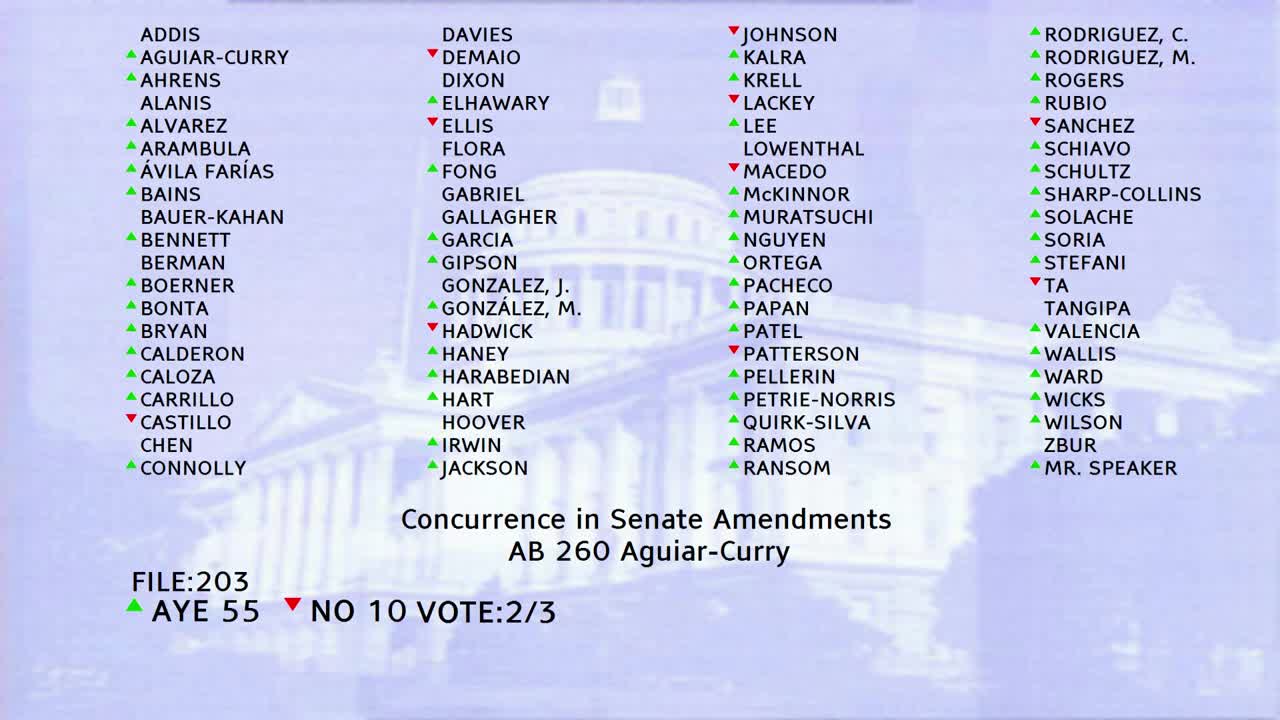 1MIN
Assembly Floor
 2MIN
Senate Floor
 50SEC
Senate Standing Committee on Appropriations
 18MIN
Senate Standing Committee on Judiciary
 7MIN
Senate Standing Committee on Judiciary
 30MIN
Senate Standing Committee on Labor, Public Employment and Retirement
 5MIN
Assembly Floor
 15MIN
Assembly Standing Committee on Labor and Employment
Bill Author

Bill Co-Author(s):