AB 382: Pedestrian safety: school zones: speed limits.
- Session Year: 2025-2026
- House: Assembly
- Latest Version Date: 2025-10-10
Current Status:
Passed
(2025-10-10: Chaptered by Secretary of State - Chapter 555, Statutes of 2025.)
Introduced
In Committee
Awaiting First Chamber Vote
Passed First Chamber
In Committee
Awaiting Second Chamber Vote
Passed Second Chamber
Enacted
Existing law establishes a prima facie speed limit of 25 miles per hour when approaching or passing a school building or grounds contiguous to a highway or when the school grounds are not separated from the highway, as specified. Existing law authorizes a local authority, by ordinance or resolution, to reduce the prima facie speed limit based on an engineering and traffic survey, as specified.
This bill would, notwithstanding the above provision and until January 1, 2031, authorize a local authority, by ordinance or resolution, to determine and declare a prima facie speed limit of 20 miles per hour in a school zone. The bill would, beginning on January 1, 2031, establish a prima facie speed limit of 20 miles per hour in a school zone, as defined, subject to specified conditions, including, among others, when a school speed limit sign states children are present and children are present, as defined, and when a school speed limit sign states specific hours, as specified. By establishing new prima facie speed limits in school zones that would require changes to local speed limit signs, this bill would create a state-mandated local program.
Existing law authorizes a local authority, by ordinance or resolution, to modify the prima facie speed limit based on distance from a school if the highways have a maximum of 2 traffic lanes and a maximum posted prima facie speed limit of 30 miles per hour immediately before and after the school zone, as specified.
The bill would instead authorize a local authority, by ordinance or resolution, to determine and declare a prima facie speed limit of 15 miles per hour in a residence district on a highway with a posted speed limit of 30 miles per hour or slower in a school zone, or 25 miles per hour when approaching from a school zone at a distance of 500 to 1,000 feet, without the above-mentioned conditions, as specified.
The bill would, for purposes of the above provisions, define school zone as an area of a highway within 500 feet of school grounds in any direction, unless otherwise posted, marked with appropriate signs giving notice of the area.
Existing law defines a speed trap, under certain circumstances, to mean, among other things, a particular section of a highway or state highway with a prima facie speed limit that is provided by law, as specified, if that prima facie speed limit is not justified by an engineering and traffic survey conducted within a certain specified time period, and enforcement of the speed limit involves the use of radar or another specified electronic device. Existing law exempts application of that definition to a local street, road, or school zone, senior zone, business activity district, or speed limit adopted by a local authority under certain conditions.
This bill would change the definition of school zone for purposes of these provisions to conform with the definition of school zone described above.
The California Constitution requires the state to reimburse local agencies and school districts for certain costs mandated by the state. Statutory provisions establish procedures for making that reimbursement.
This bill would provide that, if the Commission on State Mandates determines that the bill contains costs mandated by the state, reimbursement for those costs shall be made pursuant to the statutory provisions noted above.
Existing law establishes a prima facie speed limit of 25 miles per hour when approaching or passing a school building or grounds contiguous to a highway or when the school grounds are not separated from the highway, as specified. Existing law authorizes a local authority, by ordinance or resolution, to reduce the prima facie speed limit based on an engineering and traffic survey, as specified.
This bill would, notwithstanding the above provision and until January 1, 2029, 2031, authorize a local authority, by ordinance or resolution, to determine and declare a prima facie speed limit of 20 miles per hour in a school zone. The bill would, beginning on January 1, 2029, 2031, establish a prima facie speed limit of 20 miles per hour in a school zone, as defined, subject to specified conditions, including, among others, when a school speed limit sign states children are present and children are present, as defined, and when a school speed limit sign states specific hours, as specified. By establishing new prima facie speed limits in school zones that would require changes to local speed limit signs, this bill would create a state-mandated local program.
Existing law authorizes a local authority, by ordinance or resolution, to modify the prima facie speed limit based on distance from a school if the highways have a maximum of 2 traffic lanes and a maximum posted prima facie speed limit of 30 miles per hour immediately before and after the school zone, as specified.
The bill would instead authorize a local authority, by ordinance or resolution, to determine and declare a prima facie speed limit of 15 miles per hour in a residence district on a highway with a posted speed limit of 30 miles per hour or slower in a school zone, or 25 miles per hour when approaching from a school zone at a distance of 500 to 1,000 feet, without the above-mentioned conditions, as specified.
The bill would, for purposes of the above provisions, define school zone as an area of a highway within 500 feet of school grounds in any direction, unless otherwise posted, marked with appropriate signs giving notice of the area.
Existing law defines a speed trap, under certain circumstances, to mean, among other things, a particular section of a highway or state highway with a prima facie speed limit that is provided by law, as specified, if that prima facie speed limit is not justified by an engineering and traffic survey conducted within a certain specified time period, and enforcement of the speed limit involves the use of radar or another specified electronic device. Existing law exempts application of that definition to a local street, road, or school zone, senior zone, business activity district, or speed limit adopted by a local authority under certain conditions.
This bill would change the definition of school zone for purposes of these provisions to conform with the definition of school zone described above.
The California Constitution requires the state to reimburse local agencies and school districts for certain costs mandated by the state. Statutory provisions establish procedures for making that reimbursement.
This bill would provide that, if the Commission on State Mandates determines that the bill contains costs mandated by the state, reimbursement for those costs shall be made pursuant to the statutory provisions noted above.
Existing law establishes a prima facie speed limit of 25 miles per hour when approaching or passing a school building or grounds contiguous to a highway or when the school grounds are not separated from the highway, as specified. Existing law authorizes a local authority, by ordinance or resolution, to reduce the prima facie speed limit based on an engineering and traffic survey, as specified.
This bill would, notwithstanding the above provision and until January 1, 2029, authorize a local authority, by ordinance or resolution, to determine and declare a prima facie speed limit of 20 miles per hour in a school zone. The bill would, beginning on January 1, 2029, establish a prima facie speed limit of 20 miles per hour in a school zone, as defined, subject to specified conditions, including, among others, when a school speed limit sign states children are present and children are present, as defined, and when a school speed limit sign states specific hours, as specified. By establishing new prima facie speed limits in school zones that would require changes to local speed limit signs, this bill would create a state-mandated local program.
Existing law authorizes a local authority, by ordinance or resolution, to modify the prima facie speed limit based on distance from a school if the highways have a maximum of 2 traffic lanes and a maximum posted prima facie speed limit of 30 miles per hour immediately before and after the school zone, as specified.
The bill would instead authorize a local authority, by ordinance or resolution, to determine and declare a prima facie speed limit of 15 miles per hour in a residence district on a highway with a posted speed limit of 30 miles per hour or slower in a school zone, or 25 miles per hour when approaching from a school zone at a distance of 500 to 1,000 feet, without the above-mentioned conditions, as specified.
The bill would, for purposes of the above provisions, define school zone as an area of a highway within 500 feet of school grounds in any direction, unless otherwise posted, marked with appropriate signs giving notice of the area.
Existing law defines a speed trap, under certain circumstances, to mean, among other things, a particular section of a highway or state highway with a prima facie speed limit that is provided by law, as specified, if that prima facie speed limit is not justified by an engineering and traffic survey conducted within a certain specified time period, and enforcement of the speed limit involves the use of radar or another specified electronic device. Existing law exempts application of that definition to a local street, road, or school zone, senior zone, business activity district, or speed limit adopted by a local authority under certain conditions.
This bill would change the definition of school zone for purposes of these provisions to conform with the definition of school zone described above.
The California Constitution requires the state to reimburse local agencies and school districts for certain costs mandated by the state. Statutory provisions establish procedures for making that reimbursement.
This bill would provide that, if the Commission on State Mandates determines that the bill contains costs mandated by the state, reimbursement for those costs shall be made pursuant to the statutory provisions noted above.
Existing law establishes a prima facie speed limit of 25 miles per hour when approaching or passing a school building or grounds contiguous to a highway or when the school grounds are not separated from the highway, as specified. Existing law authorizes a local authority, by ordinance or resolution, to reduce the prima facie speed limit based on an engineering and traffic survey, as specified.
This bill would would, notwithstanding the above provision and until January 1, 2029, authorize a local authority, by ordinance or resolution, to determine and declare a prima facie speed limit of 20 miles per hour in a school zone. The bill would, beginning on January 1, 2029, establish a prima facie speed limit of 20 miles per hour in a school zone, as defined, subject to specified conditions, including, among others, when a school speed limit sign states children are present and children are present, as defined, and when a school speed limit sign states specific hours, as specified. By establishing new prima facie speed limits in school zones that would require changes to local speed limit signs, this bill would create a state-mandated local program.
Existing law authorizes a local authority, by ordinance or resolution, to modify the prima facie speed limit based on distance from a school if the highways have a maximum of 2 traffic lanes and a maximum posted prima facie speed limit of 30 miles per hour immediately before and after the school zone, as specified.
The bill would instead authorize a local authority, by ordinance or resolution, to determine and declare a prima facie speed limit of 15 miles per hour in a residence district on a highway with a posted speed limit of 30 miles per hour or slower in a school zone, or 25 miles per hour when approaching from a school zone at a distance of 500 to 1,000 feet, without the above-mentioned conditions, as specified.
The bill would, for purposes of the above provisions, define school zone as an area of a highway within 500 feet of school grounds in any direction, unless otherwise posted, marked with appropriate signs giving notice of the area.
Existing law defines a speed trap, under certain circumstances, to mean, among other things, a particular section of a highway or state highway with a prima facie speed limit that is provided by law, as specified, if that prima facie speed limit is not justified by an engineering and traffic survey conducted within a certain specified time period, and enforcement of the speed limit involves the use of radar or another specified electronic device. Existing law exempts application of that definition to a local street, road, or school zone, senior zone, business activity district, or speed limit adopted by a local authority under certain conditions.
This bill would change the definition of school zone for purposes of these provisions to conform with the definition of school zone described above.
The California Constitution requires the state to reimburse local agencies and school districts for certain costs mandated by the state. Statutory provisions establish procedures for making that reimbursement.
This bill would provide that, if the Commission on State Mandates determines that the bill contains costs mandated by the state, reimbursement for those costs shall be made pursuant to the statutory provisions noted above.
Existing law establishes a prima facie speed limit of 25 miles per hour when approaching or passing a school building or grounds contiguous to a highway or when the school grounds are not separated from the highway, as specified. Existing law authorizes a local authority, by ordinance or resolution, to reduce the prima facie speed limit based on an engineering and traffic survey, as specified.
This bill would establish a prima facie speed limit of 20 miles per hour in a school zone, as defined, subject to specified conditions, including, among others, when a school speed limit sign states children are present and children are present, as defined, and when a school speed limit sign states specific hours, as specified. By establishing new prima facie speed limits in school zones that would require changes to local speed limit signs, this bill would create a state-mandated local program.
Existing law authorizes a local authority, by ordinance or resolution, to modify the prima facie speed limit based on distance from a school if the highways have a maximum of 2 traffic lanes and a maximum posted prima facie speed limit of 30 miles per hour immediately before and after the school zone, as specified.
The bill would instead authorize a local authority, by ordinance or resolution, to determine and declare a prima facie speed limit of 15 miles per hour in a residence district on a highway with a posted speed limit of 30 miles per hour or slower in a school zone, or 25 miles per hour when approaching from a school zone at a distance of 500 to 1,000 feet, without the above-mentioned conditions, as specified.
The bill would, for purposes of the above provisions, define school zone as an area of a highway within 500 feet of school grounds in any direction, unless otherwise posted, marked with appropriate signs giving notice of the area.
Existing law defines a speed trap, under certain circumstances, to mean, among other things, a particular section of a highway or state highway with a prima facie speed limit that is provided by law, as specified, if that prima facie speed limit is not justified by an engineering and traffic survey conducted within a certain specified time period, and enforcement of the speed limit involves the use of radar or another specified electronic device. Existing law exempts application of that definition to a local street, road, or school zone, senior zone, business activity district, or speed limit adopted by a local authority under certain conditions.
This bill would change the definition of school zone for purposes of these provisions to conform with the definition of school zone described above.
The California Constitution requires the state to reimburse local agencies and school districts for certain costs mandated by the state. Statutory provisions establish procedures for making that reimbursement.
This bill would provide that, if the Commission on State Mandates determines that the bill contains costs mandated by the state, reimbursement for those costs shall be made pursuant to the statutory provisions noted above.
Existing law contains various provisions pertaining to the safety of pedestrians near schools, including provisions generally prescribing the rights and duties of pedestrians and provisions relating to the employment of crossing guards at schools.This bill would state the intent of the Legislature to enact future legislation that would improve pedestrian safety in school zones.Existing law contains various provisions pertaining to the safety of pedestrians near schools, including provisions generally prescribing the rights and duties of pedestrians and provisions relating to the employment of crossing guards at schools.
This bill would state the intent of the Legislature to enact future legislation that would improve pedestrian safety in school zones.
The prima facie limits are as follows and shall be applicable unless changed as authorized in this code and, if so changed, only when signs have been erected giving notice thereof:
(a)Fifteen miles per hour:
(1)When traversing a railway grade crossing, if, during the last 100 feet of the approach to the crossing, the driver does not have a clear and unobstructed view of the crossing and of any traffic on the railway for a distance of 400 feet in both directions along the railway. This paragraph does not apply in the case of any railway grade crossing where a human flagperson is on duty or a clearly visible electrical or mechanical railway crossing signal device is installed but does not then indicate the immediate approach of a railway train or car.
(2)When traversing any intersection of highways, if, during the last 100 feet of the drivers approach to the intersection, the driver does not have a clear and unobstructed view of the intersection and of any traffic upon all of the highways entering the intersection for a distance of 100 feet along all those highways, except at an intersection protected by stop signs or yield right-of-way signs or controlled by official traffic control signals.
(3)On any alley.
(b)Twenty-five miles per hour:
(1)On any highway in any business or residence district unless a different speed is determined by local authority or the Department of Transportation under procedures set forth in this code.
(2)When approaching or passing a school building or the grounds thereof, contiguous to a highway and posted with a standard SCHOOL warning sign, while children are going to or leaving the school either during school hours or during the noon recess period. The prima facie limit shall also apply when approaching or passing any school grounds which are not separated from the highway by a fence, gate, or other physical barrier while the grounds are in use by children and the highway is posted with a standard SCHOOL warning sign. For purposes of this subparagraph, standard SCHOOL warning signs may be placed at any distance up to 500 feet away from school grounds.
(3)When passing a senior center or other facility primarily used by senior citizens, contiguous to a street other than a state highway and posted with a standard SENIOR warning sign. A local authority may erect a sign pursuant to this paragraph when the local agency makes a determination that the proposed signing should be implemented. A local authority may request grant funding from the Active Transportation Program pursuant to Chapter 8 (commencing with Section 2380) of Division 3 of the Streets and Highways Code, or any other grant funding available to it, and use that grant funding to pay for the erection of those signs, or may utilize any other funds available to it to pay for the erection of those signs, including, but not limited to, donations from private sources.
(c)This section shall remain in effect until January 1, 2031, and as of that date is repealed.
SEC. 2.Section 22352 is added to the Vehicle Code, to read:22352.The prima facie limits are as follows and shall be applicable unless changed as authorized in this code and, if so changed, only when signs have been erected giving notice thereof:
(a)Fifteen miles per hour:
(1)When traversing a railway grade crossing, if, during the last 100 feet of the approach to the crossing, the driver does not have a clear and unobstructed view of the crossing and of any traffic on the railway for a distance of 400 feet in both directions along the railway. This paragraph does not apply in the case of any railway grade crossing where a human flagperson is on duty or a clearly visible electrical or mechanical railway crossing signal device is installed but does not then indicate the immediate approach of a railway train or car.
(2)When traversing any intersection of highways, if, during the last 100 feet of the drivers approach to the intersection, the driver does not have a clear and unobstructed view of the intersection and of any traffic upon all of the highways entering the intersection for a distance of 100 feet along all those highways, except at an intersection protected by stop signs or yield right-of-way signs or controlled by official traffic control signals.
(3)On any alley.
(b)Twenty miles per hour in a school zone when any of the following apply:
(1)A school speed limit sign with attached beacons states speed limit 20 when flashing and the beacons are flashing.
(2)A school speed limit sign states children are present and children are present.
(3)A school speed limit sign with specific hours, which shall be determined by the local jurisdiction.
(c)Twenty-five miles per hour:
(1)On any highway in any business or residence district unless a different speed is determined by local authority or the Department of Transportation under procedures set forth in this code.
(2)When passing a senior center or other facility primarily used by senior citizens, contiguous to a street other than a state highway and posted with a standard SENIOR warning sign. A local authority may erect a sign pursuant to this paragraph when the local agency makes a determination that the proposed signing should be implemented. A local authority may request grant funding from the Active Transportation Program pursuant to Chapter 8 (commencing with Section 2380) of Division 3 of the Streets and Highways Code, or any other grant funding available to it, and use that grant funding to pay for the erection of those signs, or may utilize any other funds available to it to pay for the erection of those signs, including, but not limited to, donations from private sources.
(d)For purposes of this section, the following definitions shall apply:
(1)School zone means an area of a highway within 500 feet of school grounds in any direction, unless otherwise posted, marked with appropriate signs giving notice of the area.
(2)(A)Children are present means whenever either of the following occurs:
(i)Children are going to or leaving the school.
(ii)School grounds are in use by children and the highway is posted with a standard SCHOOL warning sign.
(B)Children are present does not include children who are separated from the highway by a fence, gate, or other physical barrier.
(e)This section shall become operative on January 1, 2031.
SEC. 3.Section 22352.5 is added to the Vehicle Code, to read:22352.5.(a)Notwithstanding Section 22352, a local authority may, by ordinance or resolution, determine and declare a prima facie speed limit of 20 miles per hour in a school zone.
(b)For purposes of this section, school zone has the same meaning as defined in Section 22352.
(c)This section shall remain in effect until January 1, 2031, and as of that date is repealed.
SEC. 4.Section 22358.4 of the Vehicle Code is amended to read:22358.4.(a)(1)Whenever a local authority determines upon the basis of an engineering and traffic survey that the prima facie speed limit established by subdivision (b) of Section 22352 is more than is reasonable or safe, the local authority may, by ordinance or resolution, determine and declare a prima facie speed limit of 15 miles per hour if justified as the appropriate speed limit by that survey.
(2)An ordinance or resolution adopted under paragraph (1) shall not be effective until appropriate signs giving notice of the speed limit are erected upon the highway and, in the case of a state highway, until the ordinance is approved by the Department of Transportation and the appropriate signs are erected upon the highway.
(b)(1)Notwithstanding subdivision (a) or any other provision of law, a local authority may, by ordinance or resolution, determine and declare prima facie speed limits as follows:
(A)A 15 miles per hour prima facie limit in a residence district, on a highway with a posted speed limit of 30 miles per hour or slower, in a school zone.
(B)A 25 miles per hour prima facie limit on a highway when approaching, at a distance of 500 to 1,000 feet from, a school zone.
(2)The prima facie limit established under subparagraph (A) of paragraph (1) applies only to highways that meet all of the following conditions:
(A)A maximum of two traffic lanes.
(B)A maximum posted 30 miles per hour prima facie speed limit immediately prior to and after the school zone.
(3)The prima facie limits established under paragraph (1) apply to all lanes of an affected highway, in both directions of travel.
(4)When determining the need to lower the prima facie speed limit, the local authority shall take the provisions of Section 627 into consideration.
(5)(A)An ordinance or resolution adopted under paragraph (1) shall not be effective until appropriate signs giving notice of the speed limit are erected upon the highway and, in the case of a state highway, until the ordinance is approved by the Department of Transportation and the appropriate signs are erected upon the highway.
(B)For purposes of subparagraph (A) of paragraph (1), school warning signs indicating a speed limit of 15 miles per hour may be placed at a distance up to 500 feet away from school grounds.
(C)For purposes of subparagraph (B) of paragraph (1), school warning signs indicating a speed limit of 25 miles per hour may be placed at any distance between 500 and 1,000 feet away from the school grounds.
(D)A local authority shall reimburse the Department of Transportation for all costs incurred by the department under this subdivision.
(c)For purposes of this section, school zone has the same meaning as defined in Section 22352.
SEC. 5.Section 40802 of the Vehicle Code is amended to read:40802.(a)A speed trap is either of the following:
(1)A particular section of a highway measured as to distance and with boundaries marked, designated, or otherwise determined in order that the speed of a vehicle may be calculated by securing the time it takes the vehicle to travel the known distance.
(2)A particular section of a highway with a prima facie speed limit that is provided by this code or by local ordinance pursuant to Section 22352, 22354, 22357, 22358, or 22358.3, if that prima facie speed limit is not justified by an engineering and traffic survey conducted within five years prior to the date of the alleged violation, and enforcement of the speed limit involves the use of radar or any other electronic device that measures the speed of moving objects. This paragraph does not apply to a local street, road, school zone, senior zone, business activity district, or speed limit adopted under Section 22358.7 or 22358.8.
(b)(1)For purposes of this section, a local street or road is one that is functionally classified as local on the California Road System Maps, that are approved by the Federal Highway Administration and maintained by the Department of Transportation. It may also be defined as a local street or road if it primarily provides access to abutting residential property and meets the following three conditions:
(A)Roadway width of not more than 40 feet.
(B)Not more than one-half of a mile of uninterrupted length. Interruptions shall include official traffic control signals as defined in Section 445.
(C)Not more than one traffic lane in each direction.
(2)For purposes of this section, school zone has the same meaning as defined in Section 22352.
(3)For purposes of this section, senior zone means that area approaching or passing a senior center building or other facility primarily used by senior citizens, or the grounds thereof that is contiguous to a highway and on which is posted a standard SENIOR warning sign, pursuant to Section 22352.
(4)For purposes of this section, business activity district means a section of highway described in subdivision (b) of Section 22358.9 in which a standard 25 miles per hour or 20 miles per hour speed limit sign has been posted pursuant to paragraph (1) of subdivision (a) of that section.
(c)(1)When all of the following criteria are met, paragraph (2) of this subdivision shall be applicable and subdivision (a) shall not be applicable:
(A)When radar is used, the arresting officer has successfully completed a radar operator course of not less than 24 hours on the use of police traffic radar, and the course was approved and certified by the Commission on Peace Officer Standards and Training.
(B)When a laser or any other electronic device is used to measure the speed of moving objects, the arresting officer has successfully completed the training required in subparagraph (A) and an additional training course of not less than two hours approved and certified by the Commission on Peace Officer Standards and Training.
(C)(i)The prosecution proved that the arresting officer complied with subparagraphs (A) and (B) and that an engineering and traffic survey has been conducted in accordance with subparagraph (B) of paragraph (2). The prosecution proved that, prior to the officer issuing the notice to appear, the arresting officer established that the radar, laser, or other electronic device conformed to the requirements of subparagraph (D).
(ii)The prosecution proved the speed of the accused was unsafe for the conditions present at the time of alleged violation unless the citation was for a violation of Section 22349, 22356, or 22406.
(D)The radar, laser, or other electronic device used to measure the speed of the accused meets or exceeds the minimal operational standards of the National Highway Traffic Safety Administration, and has been calibrated within the three years prior to the date of the alleged violation by an independent certified laser or radar repair and testing or calibration facility.
(2)A speed trap is either of the following:
(A)A particular section of a highway measured as to distance and with boundaries marked, designated, or otherwise determined in order that the speed of a vehicle may be calculated by securing the time it takes the vehicle to travel the known distance.
(B)(i)A particular section of a highway or state highway with a prima facie speed limit that is provided by this code or by local ordinance under paragraph (1) of subdivision (b) of Section 22352, or established under Section 22354, 22357, 22358, or 22358.3, if that prima facie speed limit is not justified by an engineering and traffic survey conducted within one of the following time periods, prior to the date of the alleged violation, and enforcement of the speed limit involves the use of radar or any other electronic device that measures the speed of moving objects:
(I)Except as specified in subclause (II), seven years.
(II)If an engineering and traffic survey was conducted more than seven years prior to the date of the alleged violation, and a registered engineer evaluates the section of the highway and determines that no significant changes in roadway or traffic conditions have occurred, including, but not limited to, changes in adjoining property or land use, roadway width, or traffic volume, 14 years.
(ii)This subparagraph does not apply to a local street, road, or school zone, senior zone, business activity district, or speed limit adopted under Section 22358.4, 22358.7, or 22358.8.
SEC. 6.If the Commission on State Mandates determines that this act contains costs mandated by the state, reimbursement to local agencies and school districts for those costs shall be made pursuant to Part 7 (commencing with Section 17500) of Division 4 of Title 2 of the Government Code.
The prima facie limits are as follows and shall be applicable unless changed as authorized in this code and, if so changed, only when signs have been erected giving notice thereof:
(a)Fifteen miles per hour:
(1)When traversing a railway grade crossing, if, during the last 100 feet of the approach to the crossing, the driver does not have a clear and unobstructed view of the crossing and of any traffic on the railway for a distance of 400 feet in both directions along the railway. This paragraph does not apply in the case of any railway grade crossing where a human flagperson is on duty or a clearly visible electrical or mechanical railway crossing signal device is installed but does not then indicate the immediate approach of a railway train or car.
(2)When traversing any intersection of highways, if, during the last 100 feet of the drivers approach to the intersection, the driver does not have a clear and unobstructed view of the intersection and of any traffic upon all of the highways entering the intersection for a distance of 100 feet along all those highways, except at an intersection protected by stop signs or yield right-of-way signs or controlled by official traffic control signals.
(3)On any alley.
(b)Twenty-five miles per hour:
(1)On any highway in any business or residence district unless a different speed is determined by local authority or the Department of Transportation under procedures set forth in this code.
(2)When approaching or passing a school building or the grounds thereof, contiguous to a highway and posted with a standard SCHOOL warning sign, while children are going to or leaving the school either during school hours or during the noon recess period. The prima facie limit shall also apply when approaching or passing any school grounds which are not separated from the highway by a fence, gate, or other physical barrier while the grounds are in use by children and the highway is posted with a standard SCHOOL warning sign. For purposes of this subparagraph, standard SCHOOL warning signs may be placed at any distance up to 500 feet away from school grounds.
(3)When passing a senior center or other facility primarily used by senior citizens, contiguous to a street other than a state highway and posted with a standard SENIOR warning sign. A local authority may erect a sign pursuant to this paragraph when the local agency makes a determination that the proposed signing should be implemented. A local authority may request grant funding from the Active Transportation Program pursuant to Chapter 8 (commencing with Section 2380) of Division 3 of the Streets and Highways Code, or any other grant funding available to it, and use that grant funding to pay for the erection of those signs, or may utilize any other funds available to it to pay for the erection of those signs, including, but not limited to, donations from private sources.
(c)This section shall remain in effect until January 1, 2029, 2031, and as of that date is repealed.
SEC. 2.Section 22352 is added to the Vehicle Code, to read:22352.The prima facie limits are as follows and shall be applicable unless changed as authorized in this code and, if so changed, only when signs have been erected giving notice thereof:
(a)Fifteen miles per hour:
(1)When traversing a railway grade crossing, if, during the last 100 feet of the approach to the crossing, the driver does not have a clear and unobstructed view of the crossing and of any traffic on the railway for a distance of 400 feet in both directions along the railway. This paragraph does not apply in the case of any railway grade crossing where a human flagperson is on duty or a clearly visible electrical or mechanical railway crossing signal device is installed but does not then indicate the immediate approach of a railway train or car.
(2)When traversing any intersection of highways, if, during the last 100 feet of the drivers approach to the intersection, the driver does not have a clear and unobstructed view of the intersection and of any traffic upon all of the highways entering the intersection for a distance of 100 feet along all those highways, except at an intersection protected by stop signs or yield right-of-way signs or controlled by official traffic control signals.
(3)On any alley.
(b)Twenty miles per hour in a school zone when any of the following apply:
(1)A school speed limit sign with attached beacons states speed limit 20 when flashing and the beacons are flashing.
(2)A school speed limit sign states children are present and children are present.
(3)A school speed limit sign with specific hours, which shall be determined by the local jurisdiction.
(c)Twenty-five miles per hour:
(1)On any highway in any business or residence district unless a different speed is determined by local authority or the Department of Transportation under procedures set forth in this code.
(2)When passing a senior center or other facility primarily used by senior citizens, contiguous to a street other than a state highway and posted with a standard SENIOR warning sign. A local authority may erect a sign pursuant to this paragraph when the local agency makes a determination that the proposed signing should be implemented. A local authority may request grant funding from the Active Transportation Program pursuant to Chapter 8 (commencing with Section 2380) of Division 3 of the Streets and Highways Code, or any other grant funding available to it, and use that grant funding to pay for the erection of those signs, or may utilize any other funds available to it to pay for the erection of those signs, including, but not limited to, donations from private sources.
(d)For purposes of this section, the following definitions shall apply:
(1)School zone means an area of a highway within 500 feet of school grounds in any direction, unless otherwise posted, marked with appropriate signs giving notice of the area.
(2)(A)Children are present means whenever either of the following occurs:
(i)Children are going to or leaving the school.
(ii)School grounds are in use by children and the highway is posted with a standard SCHOOL warning sign.
(B)Children are present does not include children who are separated from the highway by a fence, gate, or other physical barrier.
(e)This section shall become operative on January 1, 2029. 2031.
SEC. 3.Section 22352.5 is added to the Vehicle Code, to read:22352.5.(a)Notwithstanding Section 22352, a local authority may, by ordinance or resolution, determine and declare a prima facie speed limit of 20 miles per hour in a school zone.
(b)For purposes of this section, school zone has the same meaning as defined in Section 22352.
(c)This section shall remain in effect until January 1, 2029, 2031, and as of that date is repealed.
SEC. 4.Section 22358.4 of the Vehicle Code is amended to read:22358.4.(a)(1)Whenever a local authority determines upon the basis of an engineering and traffic survey that the prima facie speed limit established by subdivision (b) of Section 22352 is more than is reasonable or safe, the local authority may, by ordinance or resolution, determine and declare a prima facie speed limit of 15 miles per hour if justified as the appropriate speed limit by that survey.
(2)An ordinance or resolution adopted under paragraph (1) shall not be effective until appropriate signs giving notice of the speed limit are erected upon the highway and, in the case of a state highway, until the ordinance is approved by the Department of Transportation and the appropriate signs are erected upon the highway.
(b)(1)Notwithstanding subdivision (a) or any other provision of law, a local authority may, by ordinance or resolution, determine and declare prima facie speed limits as follows:
(A)A 15 miles per hour prima facie limit in a residence district, on a highway with a posted speed limit of 30 miles per hour or slower, in a school zone.
(B)A 25 miles per hour prima facie limit on a highway when approaching, at a distance of 500 to 1,000 feet from, a school zone.
(2)The prima facie limit established under subparagraph (A) of paragraph (1) applies only to highways that meet all of the following conditions:
(A)A maximum of two traffic lanes.
(B)A maximum posted 30 miles per hour prima facie speed limit immediately prior to and after the school zone.
(3)The prima facie limits established under paragraph (1) apply to all lanes of an affected highway, in both directions of travel.
(4)When determining the need to lower the prima facie speed limit, the local authority shall take the provisions of Section 627 into consideration.
(5)(A)An ordinance or resolution adopted under paragraph (1) shall not be effective until appropriate signs giving notice of the speed limit are erected upon the highway and, in the case of a state highway, until the ordinance is approved by the Department of Transportation and the appropriate signs are erected upon the highway.
(B)For purposes of subparagraph (A) of paragraph (1), school warning signs indicating a speed limit of 15 miles per hour may be placed at a distance up to 500 feet away from school grounds.
(C)For purposes of subparagraph (B) of paragraph (1), school warning signs indicating a speed limit of 25 miles per hour may be placed at any distance between 500 and 1,000 feet away from the school grounds.
(D)A local authority shall reimburse the Department of Transportation for all costs incurred by the department under this subdivision.
(c)For purposes of this section, school zone has the same meaning as defined in Section 22352.
SEC. 5.Section 40802 of the Vehicle Code is amended to read:40802.(a)A speed trap is either of the following:
(1)A particular section of a highway measured as to distance and with boundaries marked, designated, or otherwise determined in order that the speed of a vehicle may be calculated by securing the time it takes the vehicle to travel the known distance.
(2)A particular section of a highway with a prima facie speed limit that is provided by this code or by local ordinance pursuant to Section 22352, 22354, 22357, 22358, or 22358.3, if that prima facie speed limit is not justified by an engineering and traffic survey conducted within five years prior to the date of the alleged violation, and enforcement of the speed limit involves the use of radar or any other electronic device that measures the speed of moving objects. This paragraph does not apply to a local street, road, school zone, senior zone, business activity district, or speed limit adopted under Section 22358.7 or 22358.8.
(b)(1)For purposes of this section, a local street or road is one that is functionally classified as local on the California Road System Maps, that are approved by the Federal Highway Administration and maintained by the Department of Transportation. It may also be defined as a local street or road if it primarily provides access to abutting residential property and meets the following three conditions:
(A)Roadway width of not more than 40 feet.
(B)Not more than one-half of a mile of uninterrupted length. Interruptions shall include official traffic control signals as defined in Section 445.
(C)Not more than one traffic lane in each direction.
(2)For purposes of this section, school zone has the same meaning as defined in Section 22352.
(3)For purposes of this section, senior zone means that area approaching or passing a senior center building or other facility primarily used by senior citizens, or the grounds thereof that is contiguous to a highway and on which is posted a standard SENIOR warning sign, pursuant to Section 22352.
(4)For purposes of this section, business activity district means a section of highway described in subdivision (b) of Section 22358.9 in which a standard 25 miles per hour or 20 miles per hour speed limit sign has been posted pursuant to paragraph (1) of subdivision (a) of that section.
(c)(1)When all of the following criteria are met, paragraph (2) of this subdivision shall be applicable and subdivision (a) shall not be applicable:
(A)When radar is used, the arresting officer has successfully completed a radar operator course of not less than 24 hours on the use of police traffic radar, and the course was approved and certified by the Commission on Peace Officer Standards and Training.
(B)When a laser or any other electronic device is used to measure the speed of moving objects, the arresting officer has successfully completed the training required in subparagraph (A) and an additional training course of not less than two hours approved and certified by the Commission on Peace Officer Standards and Training.
(C)(i)The prosecution proved that the arresting officer complied with subparagraphs (A) and (B) and that an engineering and traffic survey has been conducted in accordance with subparagraph (B) of paragraph (2). The prosecution proved that, prior to the officer issuing the notice to appear, the arresting officer established that the radar, laser, or other electronic device conformed to the requirements of subparagraph (D).
(ii)The prosecution proved the speed of the accused was unsafe for the conditions present at the time of alleged violation unless the citation was for a violation of Section 22349, 22356, or 22406.
(D)The radar, laser, or other electronic device used to measure the speed of the accused meets or exceeds the minimal operational standards of the National Highway Traffic Safety Administration, and has been calibrated within the three years prior to the date of the alleged violation by an independent certified laser or radar repair and testing or calibration facility.
(2)A speed trap is either of the following:
(A)A particular section of a highway measured as to distance and with boundaries marked, designated, or otherwise determined in order that the speed of a vehicle may be calculated by securing the time it takes the vehicle to travel the known distance.
(B)(i)A particular section of a highway or state highway with a prima facie speed limit that is provided by this code or by local ordinance under paragraph (1) of subdivision (b) of Section 22352, or established under Section 22354, 22357, 22358, or 22358.3, if that prima facie speed limit is not justified by an engineering and traffic survey conducted within one of the following time periods, prior to the date of the alleged violation, and enforcement of the speed limit involves the use of radar or any other electronic device that measures the speed of moving objects:
(I)Except as specified in subclause (II), seven years.
(II)If an engineering and traffic survey was conducted more than seven years prior to the date of the alleged violation, and a registered engineer evaluates the section of the highway and determines that no significant changes in roadway or traffic conditions have occurred, including, but not limited to, changes in adjoining property or land use, roadway width, or traffic volume, 14 years.
(ii)This subparagraph does not apply to a local street, road, or school zone, senior zone, business activity district, or speed limit adopted under Section 22358.4, 22358.7, or 22358.8.
SEC. 6.If the Commission on State Mandates determines that this act contains costs mandated by the state, reimbursement to local agencies and school districts for those costs shall be made pursuant to Part 7 (commencing with Section 17500) of Division 4 of Title 2 of the Government Code.
The prima facie limits are as follows and shall be applicable unless changed as authorized in this code and, if so changed, only when signs have been erected giving notice thereof:
(a)Fifteen miles per hour:
(1)When traversing a railway grade crossing, if if, during the last 100 feet of the approach to the crossing crossing, the driver does not have a clear and unobstructed view of the crossing and of any traffic on the railway for a distance of 400 feet in both directions along the railway. This subdivision paragraph does not apply in the case of any railway grade crossing where a human flagperson is on duty or a clearly visible electrical or mechanical railway crossing signal device is installed but does not then indicate the immediate approach of a railway train or car.
(2)When traversing any intersection of highways if highways, if, during the last 100 feet of the drivers approach to the intersection intersection, the driver does not have a clear and unobstructed view of the intersection and of any traffic upon all of the highways entering the intersection for a distance of 100 feet along all those highways, except at an intersection protected by stop signs or yield right-of-way signs or controlled by official traffic control signals.
(3)On any alley.
(b)Twenty-five miles per hour:
(1)On any highway, highway in any business or residence district unless a different speed is determined by local authority or the Department of Transportation under procedures set forth in this code.
(2)When approaching or passing a school building or the grounds thereof, contiguous to a highway and posted with a standard SCHOOL warning sign, while children are going to or leaving the school either during school hours or during the noon recess period. The prima facie limit shall also apply when approaching or passing any school grounds which are not separated from the highway by a fence, gate, or other physical barrier while the grounds are in use by children and the highway is posted with a standard SCHOOL warning sign. For purposes of this subparagraph, standard SCHOOL warning signs may be placed at any distance up to 500 feet away from school grounds.
(3)When passing a senior center or other facility primarily used by senior citizens, contiguous to a street other than a state highway and posted with a standard SENIOR warning sign. A local authority may erect a sign pursuant to this paragraph when the local agency makes a determination that the proposed signing should be implemented. A local authority may request grant funding from the Active Transportation Program pursuant to Chapter 8 (commencing with Section 2380) of Division 3 of the Streets and Highways Code, or any other grant funding available to it, and use that grant funding to pay for the erection of those signs, or may utilize any other funds available to it to pay for the erection of those signs, including, but not limited to, donations from private sources.
(c)This section shall remain in effect until January 1, 2029, and as of that date is repealed.
SEC. 2.Section 22352 is added to the Vehicle Code, to read:22352.The prima facie limits are as follows and shall be applicable unless changed as authorized in this code and, if so changed, only when signs have been erected giving notice thereof:
(a)Fifteen miles per hour:
(1)When traversing a railway grade crossing, if if, during the last 100 feet of the approach to the crossing crossing, the driver does not have a clear and unobstructed view of the crossing and of any traffic on the railway for a distance of 400 feet in both directions along the railway. This subdivision paragraph does not apply in the case of any railway grade crossing where a human flagperson is on duty or a clearly visible electrical or mechanical railway crossing signal device is installed but does not then indicate the immediate approach of a railway train or car.
(2)When traversing any intersection of highways if highways, if, during the last 100 feet of the drivers approach to the intersection intersection, the driver does not have a clear and unobstructed view of the intersection and of any traffic upon all of the highways entering the intersection for a distance of 100 feet along all those highways, except at an intersection protected by stop signs or yield right-of-way signs or controlled by official traffic control signals.
(3)On any alley.
(b)Twenty miles per hour in a school zone when any of the following apply:
(1)A school speed limit sign with attached beacons states speed limit 20 when flashing and the beacons are flashing.
(2)A school speed limit sign states children are present and children are present.
(3)A school speed limit sign with specific hours, which shall be determined by the local jurisdiction.
(c)Twenty-five miles per hour:
(1)On any highway, highway in any business or residence district unless a different speed is determined by local authority or the Department of Transportation under procedures set forth in this code.
(2)When passing a senior center or other facility primarily used by senior citizens, contiguous to a street other than a state highway and posted with a standard SENIOR warning sign. A local authority may erect a sign pursuant to this paragraph when the local agency makes a determination that the proposed signing should be implemented. A local authority may request grant funding from the Active Transportation Program pursuant to Chapter 8 (commencing with Section 2380) of Division 3 of the Streets and Highways Code, or any other grant funding available to it, and use that grant funding to pay for the erection of those signs, or may utilize any other funds available to it to pay for the erection of those signs, including, but not limited to, donations from private sources.
(d)For purposes of this section, the following definitions shall apply:
(1)School zone means an area of a highway within 500 feet of school grounds in any direction, unless otherwise posted, marked with appropriate signs giving notice of the area.
(2)(A)Children are present means whenever one or more children are on a roadway, sidewalk, pathway, or road shoulder within the marked school zone, regardless of schooldays or hours. This definition also includes children present in any direction within the marked school zone, including, but not limited to, in front of school buildings, on adjacent school grounds, on the same side of the street as the school building, and across the street from the school building. either of the following occurs:
(i)Children are going to or leaving the school.
(ii)School grounds are in use by children and the highway is posted with a standard SCHOOL warning sign.
(B)Children are present does not include children who are separated from the highway by a fence, gate, or other physical barrier.
(e)This section shall become operative on January 1, 2029.
SEC. 3.Section 22352.5 is added to the Vehicle Code, to read:22352.5.(a)Notwithstanding Section 22352, a local authority may, by ordinance or resolution, determine and declare a prima facie speed limit of 20 miles per hour in a school zone.
(b)For purposes of this section, school zone has the same meaning as defined in Section 22352.
(c)This section shall remain in effect until January 1, 2029, and as of that date is repealed.
SEC. 4.Section 22358.4 of the Vehicle Code is amended to read:22358.4.(a)(1)Whenever a local authority determines upon the basis of an engineering and traffic survey that the prima facie speed limit established by subdivision (b) of Section 22352 is more than is reasonable or safe, the local authority may, by ordinance or resolution, determine and declare a prima facie speed limit of 15 miles per hour if justified as the appropriate speed limit by that survey.
(2)An ordinance or resolution adopted under paragraph (1) shall not be effective until appropriate signs giving notice of the speed limit are erected upon the highway and, in the case of a state highway, until the ordinance is approved by the Department of Transportation and the appropriate signs are erected upon the highway.
(b)(1)Notwithstanding subdivision (a) or any other provision of law, a local authority may, by ordinance or resolution, determine and declare prima facie speed limits as follows:
(A)A 15 miles per hour prima facie limit in a residence district, on a highway with a posted speed limit of 30 miles per hour or slower, in a school zone.
(B)A 25 miles per hour prima facie limit on a highway when approaching, at a distance of 500 to 1,000 feet from, a school zone.
(2)The prima facie limit established under subparagraph (A) of paragraph (1) applies only to highways that meet all of the following conditions:
(A)A maximum of two traffic lanes.
(B)A maximum posted 30 miles per hour prima facie speed limit immediately prior to and after the school zone.
(3)The prima facie limits established under paragraph (1) apply to all lanes of an affected highway, in both directions of travel.
(4)When determining the need to lower the prima facie speed limit, the local authority shall take the provisions of Section 627 into consideration.
(5)(A)An ordinance or resolution adopted under paragraph (1) shall not be effective until appropriate signs giving notice of the speed limit are erected upon the highway and, in the case of a state highway, until the ordinance is approved by the Department of Transportation and the appropriate signs are erected upon the highway.
(B)For purposes of subparagraph (A) of paragraph (1), school warning signs indicating a speed limit of 15 miles per hour may be placed at a distance up to 500 feet away from school grounds.
(C)For purposes of subparagraph (B) of paragraph (1), school warning signs indicating a speed limit of 25 miles per hour may be placed at any distance between 500 and 1,000 feet away from the school grounds.
(D)A local authority shall reimburse the Department of Transportation for all costs incurred by the department under this subdivision.
(c)For purposes of this section, school zone has the same meaning as defined in Section 22352.
SEC. 5.Section 40802 of the Vehicle Code is amended to read:40802.(a)A speed trap is either of the following:
(1)A particular section of a highway measured as to distance and with boundaries marked, designated, or otherwise determined in order that the speed of a vehicle may be calculated by securing the time it takes the vehicle to travel the known distance.
(2)A particular section of a highway with a prima facie speed limit that is provided by this code or by local ordinance pursuant to Section 22352, 22354, 22357, 22358, or 22358.3, if that prima facie speed limit is not justified by an engineering and traffic survey conducted within five years prior to the date of the alleged violation, and enforcement of the speed limit involves the use of radar or any other electronic device that measures the speed of moving objects. This paragraph does not apply to a local street, road, school zone, senior zone, business activity district, or speed limit adopted under Section 22358.7 or 22358.8.
(b)(1)For purposes of this section, a local street or road is one that is functionally classified as local on the California Road System Maps, that are approved by the Federal Highway Administration and maintained by the Department of Transportation. It may also be defined as a local street or road if it primarily provides access to abutting residential property and meets the following three conditions:
(A)Roadway width of not more than 40 feet.
(B)Not more than one-half of a mile of uninterrupted length. Interruptions shall include official traffic control signals as defined in Section 445.
(C)Not more than one traffic lane in each direction.
(2)For purposes of this section, school zone has the same meaning as defined in Section 22352.
(3)For purposes of this section, senior zone means that area approaching or passing a senior center building or other facility primarily used by senior citizens, or the grounds thereof that is contiguous to a highway and on which is posted a standard SENIOR warning sign, pursuant to Section 22352.
(4)For purposes of this section, business activity district means a section of highway described in subdivision (b) of Section 22358.9 in which a standard 25 miles per hour or 20 miles per hour speed limit sign has been posted pursuant to paragraph (1) of subdivision (a) of that section.
(c)(1)When all of the following criteria are met, paragraph (2) of this subdivision shall be applicable and subdivision (a) shall not be applicable:
(A)When radar is used, the arresting officer has successfully completed a radar operator course of not less than 24 hours on the use of police traffic radar, and the course was approved and certified by the Commission on Peace Officer Standards and Training.
(B)When a laser or any other electronic device is used to measure the speed of moving objects, the arresting officer has successfully completed the training required in subparagraph (A) and an additional training course of not less than two hours approved and certified by the Commission on Peace Officer Standards and Training.
(C)(i)The prosecution proved that the arresting officer complied with subparagraphs (A) and (B) and that an engineering and traffic survey has been conducted in accordance with subparagraph (B) of paragraph (2). The prosecution proved that, prior to the officer issuing the notice to appear, the arresting officer established that the radar, laser, or other electronic device conformed to the requirements of subparagraph (D).
(ii)The prosecution proved the speed of the accused was unsafe for the conditions present at the time of alleged violation unless the citation was for a violation of Section 22349, 22356, or 22406.
(D)The radar, laser, or other electronic device used to measure the speed of the accused meets or exceeds the minimal operational standards of the National Highway Traffic Safety Administration, and has been calibrated within the three years prior to the date of the alleged violation by an independent certified laser or radar repair and testing or calibration facility.
(2)A speed trap is either of the following:
(A)A particular section of a highway measured as to distance and with boundaries marked, designated, or otherwise determined in order that the speed of a vehicle may be calculated by securing the time it takes the vehicle to travel the known distance.
(B)(i)A particular section of a highway or state highway with a prima facie speed limit that is provided by this code or by local ordinance under paragraph (1) of subdivision (b) of Section 22352, or established under Section 22354, 22357, 22358, or 22358.3, if that prima facie speed limit is not justified by an engineering and traffic survey conducted within one of the following time periods, prior to the date of the alleged violation, and enforcement of the speed limit involves the use of radar or any other electronic device that measures the speed of moving objects:
(I)Except as specified in subclause (II), seven years.
(II)If an engineering and traffic survey was conducted more than seven years prior to the date of the alleged violation, and a registered engineer evaluates the section of the highway and determines that no significant changes in roadway or traffic conditions have occurred, including, but not limited to, changes in adjoining property or land use, roadway width, or traffic volume, 14 years.
(ii)This subparagraph does not apply to a local street, road, or school zone, senior zone, business activity district, or speed limit adopted under Section 22358.4, 22358.7, or 22358.8.
SEC. 6.If the Commission on State Mandates determines that this act contains costs mandated by the state, reimbursement to local agencies and school districts for those costs shall be made pursuant to Part 7 (commencing with Section 17500) of Division 4 of Title 2 of the Government Code.
The prima facie limits are as follows and shall be applicable unless changed as authorized in this code and, if so changed, only when signs have been erected giving notice thereof:
(a)Fifteen miles per hour:
(1)When traversing a railway grade crossing, if during the last 100 feet of the approach to the crossing the driver does not have a clear and unobstructed view of the crossing and of any traffic on the railway for a distance of 400 feet in both directions along the railway. This subdivision does not apply in the case of any railway grade crossing where a human flagperson is on duty or a clearly visible electrical or mechanical railway crossing signal device is installed but does not then indicate the immediate approach of a railway train or car.
(2)When traversing any intersection of highways if during the last 100 feet of the drivers approach to the intersection the driver does not have a clear and unobstructed view of the intersection and of any traffic upon all of the highways entering the intersection for a distance of 100 feet along all those highways, except at an intersection protected by stop signs or yield right-of-way signs or controlled by official traffic control signals.
(3)On any alley.
(b)Twenty-five miles per hour:
(1)On any highway, in any business or residence district unless a different speed is determined by local authority or the Department of Transportation under procedures set forth in this code.
(2)When approaching or passing a school building or the grounds thereof, contiguous to a highway and posted with a standard SCHOOL warning sign, while children are going to or leaving the school either during school hours or during the noon recess period. The prima facie limit shall also apply when approaching or passing any school grounds which are not separated from the highway by a fence, gate, or other physical barrier while the grounds are in use by children and the highway is posted with a standard SCHOOL warning sign. For purposes of this subparagraph, standard SCHOOL warning signs may be placed at any distance up to 500 feet away from school grounds.
(3)When passing a senior center or other facility primarily used by senior citizens, contiguous to a street other than a state highway and posted with a standard SENIOR warning sign. A local authority may erect a sign pursuant to this paragraph when the local agency makes a determination that the proposed signing should be implemented. A local authority may request grant funding from the Active Transportation Program pursuant to Chapter 8 (commencing with Section 2380) of Division 3 of the Streets and Highways Code, or any other grant funding available to it, and use that grant funding to pay for the erection of those signs, or may utilize any other funds available to it to pay for the erection of those signs, including, but not limited to, donations from private sources.
(c)This section shall remain in effect until January 1, 2029, and as of that date is repealed.
SEC. 2.Section 22352 is added to the Vehicle Code, to read:22352.The prima facie limits are as follows and shall be applicable unless changed as authorized in this code and, if so changed, only when signs have been erected giving notice thereof:
(a)Fifteen miles per hour:
(1)When traversing a railway grade crossing, if during the last 100 feet of the approach to the crossing the driver does not have a clear and unobstructed view of the crossing and of any traffic on the railway for a distance of 400 feet in both directions along the railway. This subdivision does not apply in the case of any railway grade crossing where a human flagperson is on duty or a clearly visible electrical or mechanical railway crossing signal device is installed but does not then indicate the immediate approach of a railway train or car.
(2)When traversing any intersection of highways if during the last 100 feet of the drivers approach to the intersection the driver does not have a clear and unobstructed view of the intersection and of any traffic upon all of the highways entering the intersection for a distance of 100 feet along all those highways, except at an intersection protected by stop signs or yield right-of-way signs or controlled by official traffic control signals.
(3)On any alley.
(b)Twenty miles per hour in a school zone when any of the following apply:
(1)A school speed limit sign with attached beacons states speed limit 20 when flashing and the beacons are flashing.
(2)A school speed limit sign states children are present and children are present.
(3)A school speed limit sign with specific hours, which shall be determined by the local jurisdiction.
(c)Twenty-five miles per hour:
(1)On any highway, in any business or residence district unless a different speed is determined by local authority or the Department of Transportation under procedures set forth in this code.
(2)When passing a senior center or other facility primarily used by senior citizens, contiguous to a street other than a state highway and posted with a standard SENIOR warning sign. A local authority may erect a sign pursuant to this paragraph when the local agency makes a determination that the proposed signing should be implemented. A local authority may request grant funding from the Active Transportation Program pursuant to Chapter 8 (commencing with Section 2380) of Division 3 of the Streets and Highways Code, or any other grant funding available to it, and use that grant funding to pay for the erection of those signs, or may utilize any other funds available to it to pay for the erection of those signs, including, but not limited to, donations from private sources.
(d)For purposes of this section, the following definitions shall apply:
(1)School zone means an area of a highway within 500 feet of school grounds in any direction, unless otherwise posted, marked with appropriate signs giving notice of the area.
(2)(A)Children are present means whenever one or more children are on a roadway, sidewalk, pathway, or road shoulder within the marked school zone, regardless of schooldays or hours. This definition also includes children present in any direction within the marked school zone, including, but not limited to, in front of school buildings, on adjacent school grounds, on the same side of the street as the school building, and across the street from the school building.
(B)Children are present does not include children who are separated from the highway by a fence, gate, or other physical barrier.
(e)This section shall become operative on January 1, 2029.
SEC. 3.Section 22352.5 is added to the Vehicle Code, to read:22352.5.(a)Notwithstanding Section 22352, a local authority may, by ordinance or resolution, determine and declare a prima facie speed limit of 20 miles per hour in a school zone.
(b)For purposes of this section, school zone has the same meaning as defined in Section 22352.
(c)This section shall remain in effect until January 1, 2029, and as of that date is repealed.
SEC. 2.SEC. 4.Section 22358.4 of the Vehicle Code is amended to read:22358.4.(a)(1)Whenever a local authority determines upon the basis of an engineering and traffic survey that the prima facie speed limit established by subdivision (b) of Section 22352 is more than is reasonable or safe, the local authority may, by ordinance or resolution, determine and declare a prima facie speed limit of 15 miles per hour if justified as the appropriate speed limit by that survey.
(2)An ordinance or resolution adopted under paragraph (1) shall not be effective until appropriate signs giving notice of the speed limit are erected upon the highway and, in the case of a state highway, until the ordinance is approved by the Department of Transportation and the appropriate signs are erected upon the highway.
(b)(1)Notwithstanding subdivision (a) or any other provision of law, a local authority may, by ordinance or resolution, determine and declare prima facie speed limits as follows:
(A)A 15 miles per hour prima facie limit in a residence district, on a highway with a posted speed limit of 30 miles per hour or slower, in a school zone.
(B)A 25 miles per hour prima facie limit on a highway when approaching, at a distance of 500 to 1,000 feet from, a school zone.
(2)The prima facie limit established under subparagraph (A) of paragraph (1) applies only to highways that meet all of the following conditions:
(A)A maximum of two traffic lanes.
(B)A maximum posted 30 miles per hour prima facie speed limit immediately prior to and after the school zone.
(3)The prima facie limits established under paragraph (1) apply to all lanes of an affected highway, in both directions of travel.
(4)When determining the need to lower the prima facie speed limit, the local authority shall take the provisions of Section 627 into consideration.
(5)(A)An ordinance or resolution adopted under paragraph (1) shall not be effective until appropriate signs giving notice of the speed limit are erected upon the highway and, in the case of a state highway, until the ordinance is approved by the Department of Transportation and the appropriate signs are erected upon the highway.
(B)For purposes of subparagraph (A) of paragraph (1), school warning signs indicating a speed limit of 15 miles per hour may be placed at a distance up to 500 feet away from school grounds.
(C)For purposes of subparagraph (B) of paragraph (1), school warning signs indicating a speed limit of 25 miles per hour may be placed at any distance between 500 and 1,000 feet away from the school grounds.
(D)A local authority shall reimburse the Department of Transportation for all costs incurred by the department under this subdivision.
(c)For purposes of this section, school zone has the same meaning as defined in Section 22352.
SEC. 3.SEC. 5.Section 40802 of the Vehicle Code is amended to read:40802.(a)A speed trap is either of the following:
(1)A particular section of a highway measured as to distance and with boundaries marked, designated, or otherwise determined in order that the speed of a vehicle may be calculated by securing the time it takes the vehicle to travel the known distance.
(2)A particular section of a highway with a prima facie speed limit that is provided by this code or by local ordinance pursuant to Section 22352, 22354, 22357, 22358, or 22358.3, if that prima facie speed limit is not justified by an engineering and traffic survey conducted within five years prior to the date of the alleged violation, and enforcement of the speed limit involves the use of radar or any other electronic device that measures the speed of moving objects. This paragraph does not apply to a local street, road, school zone, senior zone, business activity district, or speed limit adopted under Section 22358.7 or 22358.8.
(b)(1)For purposes of this section, a local street or road is one that is functionally classified as local on the California Road System Maps, that are approved by the Federal Highway Administration and maintained by the Department of Transportation. It may also be defined as a local street or road if it primarily provides access to abutting residential property and meets the following three conditions:
(A)Roadway width of not more than 40 feet.
(B)Not more than one-half of a mile of uninterrupted length. Interruptions shall include official traffic control signals as defined in Section 445.
(C)Not more than one traffic lane in each direction.
(2)For purposes of this section, school zone has the same meaning as defined in Section 22352.
(3)For purposes of this section, senior zone means that area approaching or passing a senior center building or other facility primarily used by senior citizens, or the grounds thereof that is contiguous to a highway and on which is posted a standard SENIOR warning sign, pursuant to Section 22352.
(4)For purposes of this section, business activity district means a section of highway described in subdivision (b) of Section 22358.9 in which a standard 25 miles per hour or 20 miles per hour speed limit sign has been posted pursuant to paragraph (1) of subdivision (a) of that section.
(c)(1)When all of the following criteria are met, paragraph (2) of this subdivision shall be applicable and subdivision (a) shall not be applicable:
(A)When radar is used, the arresting officer has successfully completed a radar operator course of not less than 24 hours on the use of police traffic radar, and the course was approved and certified by the Commission on Peace Officer Standards and Training.
(B)When a laser or any other electronic device is used to measure the speed of moving objects, the arresting officer has successfully completed the training required in subparagraph (A) and an additional training course of not less than two hours approved and certified by the Commission on Peace Officer Standards and Training.
(C)(i)The prosecution proved that the arresting officer complied with subparagraphs (A) and (B) and that an engineering and traffic survey has been conducted in accordance with subparagraph (B) of paragraph (2). The prosecution proved that, prior to the officer issuing the notice to appear, the arresting officer established that the radar, laser, or other electronic device conformed to the requirements of subparagraph (D).
(ii)The prosecution proved the speed of the accused was unsafe for the conditions present at the time of alleged violation unless the citation was for a violation of Section 22349, 22356, or 22406.
(D)The radar, laser, or other electronic device used to measure the speed of the accused meets or exceeds the minimal operational standards of the National Highway Traffic Safety Administration, and has been calibrated within the three years prior to the date of the alleged violation by an independent certified laser or radar repair and testing or calibration facility.
(2)A speed trap is either of the following:
(A)A particular section of a highway measured as to distance and with boundaries marked, designated, or otherwise determined in order that the speed of a vehicle may be calculated by securing the time it takes the vehicle to travel the known distance.
(B)(i)A particular section of a highway or state highway with a prima facie speed limit that is provided by this code or by local ordinance under paragraph (1) of subdivision (b) of Section 22352, or established under Section 22354, 22357, 22358, or 22358.3, if that prima facie speed limit is not justified by an engineering and traffic survey conducted within one of the following time periods, prior to the date of the alleged violation, and enforcement of the speed limit involves the use of radar or any other electronic device that measures the speed of moving objects:
(I)Except as specified in subclause (II), seven years.
(II)If an engineering and traffic survey was conducted more than seven years prior to the date of the alleged violation, and a registered engineer evaluates the section of the highway and determines that no significant changes in roadway or traffic conditions have occurred, including, but not limited to, changes in adjoining property or land use, roadway width, or traffic volume, 14 years.
(ii)This subparagraph does not apply to a local street, road, or school zone, senior zone, business activity district, or speed limit adopted under Section 22358.4, 22358.7, or 22358.8.
SEC. 4.SEC. 6.If the Commission on State Mandates determines that this act contains costs mandated by the state, reimbursement to local agencies and school districts for those costs shall be made pursuant to Part 7 (commencing with Section 17500) of Division 4 of Title 2 of the Government Code.
The prima facie limits are as follows and shall be applicable unless changed as authorized in this code and, if so changed, only when signs have been erected giving notice thereof:
(a)Fifteen miles per hour:
(1)When traversing a railway grade crossing, if during the last 100 feet of the approach to the crossing the driver does not have a clear and unobstructed view of the crossing and of any traffic on the railway for a distance of 400 feet in both directions along the railway. This subdivision does not apply in the case of any railway grade crossing where a human flagperson is on duty or a clearly visible electrical or mechanical railway crossing signal device is installed but does not then indicate the immediate approach of a railway train or car.
(2)When traversing any intersection of highways if during the last 100 feet of the drivers approach to the intersection the driver does not have a clear and unobstructed view of the intersection and of any traffic upon all of the highways entering the intersection for a distance of 100 feet along all those highways, except at an intersection protected by stop signs or yield right-of-way signs or controlled by official traffic control signals.
(3)On any alley.
(b)Twenty miles per hour in a school zone when any of the following apply:
(1)A school speed limit sign with attached beacons states speed limit 20 when flashing and the beacons are flashing.
(2)A school speed limit sign states children are present and children are present.
(3)A school speed limit sign with specific hours, which shall be determined by the local jurisdiction.
(b)(c)Twenty-five miles per hour:
(1)On any highway, in any business or residence district unless a different speed is determined by local authority or the Department of Transportation under procedures set forth in this code.
(2)When approaching or passing a school building or the grounds thereof, contiguous to a highway and posted with a standard SCHOOL warning sign, while children are going to or leaving the school either during school hours or during the noon recess period. The prima facie limit shall also apply when approaching or passing any school grounds which are not separated from the highway by a fence, gate, or other physical barrier while the grounds are in use by children and the highway is posted with a standard SCHOOL warning sign. For purposes of this subparagraph, standard SCHOOL warning signs may be placed at any distance up to 500 feet away from school grounds.(3)(2)When passing a senior center or other facility primarily used by senior citizens, contiguous to a street other than a state highway and posted with a standard SENIOR warning sign. A local authority may erect a sign pursuant to this paragraph when the local agency makes a determination that the proposed signing should be implemented. A local authority may request grant funding from the Active Transportation Program pursuant to Chapter 8 (commencing with Section 2380) of Division 3 of the Streets and Highways Code, or any other grant funding available to it, and use that grant funding to pay for the erection of those signs, or may utilize any other funds available to it to pay for the erection of those signs, including, but not limited to, donations from private sources.
(d)For purposes of this section, the following definitions shall apply:
(1)School zone means an area of a highway within 500 feet of school grounds in any direction, unless otherwise posted, marked with appropriate signs giving notice of the area.
(2)(A)Children are present means whenever one or more children are on a roadway, sidewalk, pathway, or road shoulder within the marked school zone, regardless of school days or hours. This definition also includes children present in any direction within the marked school zone, including, but not limited to, in front of school buildings, on adjacent school grounds, on the same side of the street as the school building, and across the street from the school building.
(B)Children are present does not include children who are separated from the highway by a fence, gate, or other physical barrier.
SEC. 2.Section 22358.4 of the Vehicle Code is amended to read:22358.4.(a)(1)Whenever a local authority determines upon the basis of an engineering and traffic survey that the prima facie speed limit of 25 miles per hour established by subdivision (b) of Section 22352 is more than is reasonable or safe, the local authority may, by ordinance or resolution, determine and declare a prima facie speed limit of 20 or 15 miles per hour, whichever is hour if justified as the appropriate speed limit by that survey.
(2)An ordinance or resolution adopted under paragraph (1) shall not be effective until appropriate signs giving notice of the speed limit are erected upon the highway and, in the case of a state highway, until the ordinance is approved by the Department of Transportation and the appropriate signs are erected upon the highway.
(b)(1)Notwithstanding subdivision (a) or any other provision of law, a local authority may, by ordinance or resolution, determine and declare prima facie speed limits as follows:
(A)A 15 miles per hour prima facie limit in a residence district, on a highway with a posted speed limit of 30 miles per hour or slower, when approaching, at a distance of less than 500 feet from, or passing, a school building or the grounds of a school building, contiguous to a highway and posted with a school warning sign that indicates a speed limit of 15 miles per hour, while children are going to or leaving the school, either during school hours or during the noon recess period. The prima facie limit shall also apply when approaching, at a distance of less than 500 feet from, or passing, school grounds that are not separated from the highway by a fence, gate, or other physical barrier while the grounds are in use by children and the highway is posted with a school warning sign that indicates a speed limit of 15 miles per hour. slower, in a school zone.
(B)A 25 miles per hour prima facie limit in a residence district, on a highway with a posted speed limit of 30 miles per hour or slower, when approaching, at a distance of 500 to 1,000 feet from, a school building or the grounds thereof, contiguous to a highway and posted with a school warning sign that indicates a speed limit of 25 miles per hour, while children are going to or leaving the school, either during school hours or during the noon recess period. The prima facie limit shall also apply when approaching, at a distance of 500 to 1,000 feet from, school grounds that are not separated from the highway by a fence, gate, or other physical barrier while the grounds are in use by children and the highway is posted with a school warning sign that indicates a speed limit of 25 miles per hour. from, a school zone.
(2)The prima facie limits limit established under paragraph (1) apply subparagraph (A) of paragraph (1) applies only to highways that meet all of the following conditions:
(A)A maximum of two traffic lanes.
(B)A maximum posted 30 miles per hour prima facie speed limit immediately prior to and after the school zone.
(3)The prima facie limits established under paragraph (1) apply to all lanes of an affected highway, in both directions of travel.
(4)When determining the need to lower the prima facie speed limit, the local authority shall take the provisions of Section 627 into consideration.
(5)(A)An ordinance or resolution adopted under paragraph (1) shall not be effective until appropriate signs giving notice of the speed limit are erected upon the highway and, in the case of a state highway, until the ordinance is approved by the Department of Transportation and the appropriate signs are erected upon the highway.
(B)For purposes of subparagraph (A) of paragraph (1), school warning signs indicating a speed limit of 15 miles per hour may be placed at a distance up to 500 feet away from school grounds.
(C)For purposes of subparagraph (B) of paragraph (1), school warning signs indicating a speed limit of 25 miles per hour may be placed at any distance between 500 and 1,000 feet away from the school grounds.
(D)A local authority shall reimburse the Department of Transportation for all costs incurred by the department under this subdivision.
(c)For purposes of this section, school zone has the same meaning as defined in Section 22352.
SEC. 3.Section 40802 of the Vehicle Code is amended to read:40802.(a)A speed trap is either of the following:
(1)A particular section of a highway measured as to distance and with boundaries marked, designated, or otherwise determined in order that the speed of a vehicle may be calculated by securing the time it takes the vehicle to travel the known distance.
(2)A particular section of a highway with a prima facie speed limit that is provided by this code or by local ordinance under paragraph (1) of subdivision (b) of Section 22352, or established under Section pursuant to Section 22352, 22354, 22357, 22358, or 22358.3, if that prima facie speed limit is not justified by an engineering and traffic survey conducted within five years prior to the date of the alleged violation, and enforcement of the speed limit involves the use of radar or any other electronic device that measures the speed of moving objects. This paragraph does not apply to a local street, road, school zone, senior zone, business activity district, or speed limit adopted under Section 22358.7 or 22358.8.
(b)(1)For purposes of this section, a local street or road is one that is functionally classified as local on the California Road System Maps, that are approved by the Federal Highway Administration and maintained by the Department of Transportation. It may also be defined as a local street or road if it primarily provides access to abutting residential property and meets the following three conditions:
(A)Roadway width of not more than 40 feet.
(B)Not more than one-half of a mile of uninterrupted length. Interruptions shall include official traffic control signals as defined in Section 445.
(C)Not more than one traffic lane in each direction.
(2)For purposes of this section, school zone means that area approaching or passing a school building or the grounds thereof that is contiguous to a highway and on which is posted a standard SCHOOL warning sign, while children are going to or leaving the school either during school hours or during the noon recess period. School zone also includes the area approaching or passing any school grounds that are not separated from the highway by a fence, gate, or other physical barrier while the grounds are in use by children if that highway is posted with a standard SCHOOL warning sign. has the same meaning as defined in Section 22352.
(3)For purposes of this section, senior zone means that area approaching or passing a senior center building or other facility primarily used by senior citizens, or the grounds thereof that is contiguous to a highway and on which is posted a standard SENIOR warning sign, pursuant to Section 22352.
(4)For purposes of this section, business activity district means a section of highway described in subdivision (b) of Section 22358.9 in which a standard 25 miles per hour or 20 miles per hour speed limit sign has been posted pursuant to paragraph (1) of subdivision (a) of that section.
(c)(1)When all of the following criteria are met, paragraph (2) of this subdivision shall be applicable and subdivision (a) shall not be applicable:
(A)When radar is used, the arresting officer has successfully completed a radar operator course of not less than 24 hours on the use of police traffic radar, and the course was approved and certified by the Commission on Peace Officer Standards and Training.
(B)When a laser or any other electronic device is used to measure the speed of moving objects, the arresting officer has successfully completed the training required in subparagraph (A) and an additional training course of not less than two hours approved and certified by the Commission on Peace Officer Standards and Training.
(C)(i)The prosecution proved that the arresting officer complied with subparagraphs (A) and (B) and that an engineering and traffic survey has been conducted in accordance with subparagraph (B) of paragraph (2). The prosecution proved that, prior to the officer issuing the notice to appear, the arresting officer established that the radar, laser, or other electronic device conformed to the requirements of subparagraph (D).
(ii)The prosecution proved the speed of the accused was unsafe for the conditions present at the time of alleged violation unless the citation was for a violation of Section 22349, 22356, or 22406.
(D)The radar, laser, or other electronic device used to measure the speed of the accused meets or exceeds the minimal operational standards of the National Highway Traffic Safety Administration, and has been calibrated within the three years prior to the date of the alleged violation by an independent certified laser or radar repair and testing or calibration facility.
(2)A speed trap is either of the following:
(A)A particular section of a highway measured as to distance and with boundaries marked, designated, or otherwise determined in order that the speed of a vehicle may be calculated by securing the time it takes the vehicle to travel the known distance.
(B)(i)A particular section of a highway or state highway with a prima facie speed limit that is provided by this code or by local ordinance under paragraph (1) of subdivision (b) of Section 22352, or established under Section 22354, 22357, 22358, or 22358.3, if that prima facie speed limit is not justified by an engineering and traffic survey conducted within one of the following time periods, prior to the date of the alleged violation, and enforcement of the speed limit involves the use of radar or any other electronic device that measures the speed of moving objects:
(I)Except as specified in subclause (II), seven years.
(II)If an engineering and traffic survey was conducted more than seven years prior to the date of the alleged violation, and a registered engineer evaluates the section of the highway and determines that no significant changes in roadway or traffic conditions have occurred, including, but not limited to, changes in adjoining property or land use, roadway width, or traffic volume, 14 years.
(ii)This subparagraph does not apply to a local street, road, or school zone, senior zone, business activity district, or speed limit adopted under Section 22358.7 22358.4, 22358.7, or 22358.8.
SEC. 4.If the Commission on State Mandates determines that this act contains costs mandated by the state, reimbursement to local agencies and school districts for those costs shall be made pursuant to Part 7 (commencing with Section 17500) of Division 4 of Title 2 of the Government Code.
SECTION 1.It is the intent of the Legislature to enact future legislation that would improve pedestrian safety in school zones.It is the intent of the Legislature to enact future legislation that would improve pedestrian safety in school zones.
|
Date
|
Status
|
|---|---|
| Oct 10, 2025 | Chaptered by Secretary of State - Chapter 555, Statutes of 2025. |
| Oct 10, 2025 | Approved by the Governor. |
| Sep 22, 2025 | Enrolled and presented to the Governor at 3 p.m. |
| Sep 10, 2025 | Senate amendments concurred in. To Engrossing and Enrolling. (Ayes 78. Noes 0. Page 3245.). |
| Sep 9, 2025 | In Assembly. Concurrence in Senate amendments pending. |
| Sep 9, 2025 | Read third time. Passed. Ordered to the Assembly. (Ayes 40. Noes 0. Page 2741.). |
| Sep 8, 2025 | Read second time. Ordered to third reading. |
| Sep 4, 2025 | Read third time and amended. Ordered to second reading. |
| Aug 29, 2025 | Read second time. Ordered to third reading. |
| Aug 29, 2025 | From committee: Do pass. (Ayes 7. Noes 0.) (August 29). |
| Aug 18, 2025 | In committee: Referred to suspense file. |
| Jul 9, 2025 | From committee: Do pass and re-refer to Com. on APPR. (Ayes 15. Noes 0.) (July 8). Re-referred to Com. on APPR. |
| Jun 26, 2025 | From committee chair, with author's amendments: Amend, and re-refer to committee. Read second time, amended, and re-referred to Com. on TRANS. |
| Jun 11, 2025 | Referred to Com. on TRANS. |
| Jun 3, 2025 | In Senate. Read first time. To Com. on RLS. for assignment. |
| Jun 2, 2025 | Read third time. Passed. Ordered to the Senate. (Ayes 78. Noes 0. Page 1823.) |
| May 27, 2025 | Read second time. Ordered to third reading. |
| May 23, 2025 | From committee: Do pass. (Ayes 13. Noes 0.) (May 23). |
| May 7, 2025 | In committee: Set, first hearing. Referred to APPR. suspense file. |
| Apr 22, 2025 | From committee: Do pass and re-refer to Com. on APPR. (Ayes 15. Noes 0.) (April 21). Re-referred to Com. on APPR. |
| Apr 8, 2025 | Re-referred to Com. on TRANS. |
| Apr 7, 2025 | From committee chair, with author's amendments: Amend, and re-refer to Com. on TRANS. Read second time and amended. |
| Feb 25, 2025 | Re-referred to Com. on TRANS. |
| Feb 24, 2025 | Referred to Com. on TRANS. |
| Feb 24, 2025 | From committee chair, with author's amendments: Amend, and re-refer to Com. on TRANS. Read second time and amended. |
| Feb 4, 2025 | From printer. May be heard in committee March 6. |
| Feb 3, 2025 | Read first time. To print. |
|
Date
|
Description
|
Location
|
Votes
|
|
|---|---|---|---|---|
| Sep 10, 2025 | AB 382 Berman Concurrence in Senate Amendments | Assembly Floor |
Passed |
|
| Sep 9, 2025 | Assembly 3rd Reading AB382 Berman By Grayson | Senate Floor |
Passed |
|
| Aug 29, 2025 | Do pass | Senate Standing Committee on Appropriations |
Passed |
|
| Aug 18, 2025 | Placed on suspense file | Senate Standing Committee on Appropriations |
Passed |
|
| Jul 8, 2025 | Do pass, but first be re-referred to the Committee on [Appropriations] | Senate Standing Committee on Transportation |
Passed |
|
| Jun 2, 2025 | AB 382 Berman Assembly Third Reading | Assembly Floor |
Passed |
|
| May 23, 2025 | Do pass. | Assembly Standing Committee on Appropriations |
Passed |
|
| Apr 21, 2025 | Do pass and be re-referred to the Committee on [Appropriations] | Assembly Standing Committee on Transportation |
Passed |
This list shows positions taken on this bill by organizations on the date displayed, which is linked to the original source.
Positions by individuals are not included.
|
Organization
|
Position
|
Date
|
|---|---|---|
| Active San Gabriel Valley | ** Support | |
| American Academy of Pediatrics | ** Support | |
| Bike Culver City | ** Support | |
| Bike East Bay | ** Support | |
| Bike Long Beach | ** Support | |
| CalBike | ** Support | |
| California School Employees Association | ** Support | |
| Car-Lite Long Beach | ** Support | |
| Circulate San Diego | ** Support | |
| City of El Cerrito | ** Support | |
| City of Foster City | ** Support | |
| City of Mountain View | ** Support | |
| City of Redwood City | ** Support | |
| City of San Jose | ** Support | |
| cleanearth4kids.org | ** Support | |
| Costa Mesa Alliance for Better Streets | ** Support | |
| East Bay for Everyone | ** Support | |
| Everybody's Long Beach | ** Support | |
| Fresno Unified School District | ** Support | |
| Glendale Yimby | ** Support | |
| Long Beach Bike Co-op | ** Support | |
| Los Angeles County Office Of Education | ** Support | |
| Los Angeles Unified School District | ** Support | |
| Move LA | ** Support | |
| Napa County Bicycle Coalition | ** Support | |
| National Motorist Association | ** Against | |
| National Motorists Association | ** Against | |
| Norwalk Unides | ** Support | |
| Oakland Unified School District | ** Support | |
| Remake Irvine Streets for Everyone | ** Support | |
| Safe Kids Worldwide | ** Support | |
| San Diego County Bicycle Coalition | ** Support | |
| San Francisco Bicycle Coalition | ** Support | |
| Santa Clara County Office Of Education | ** Support | |
| SPUR | ** Support | |
| Streets Are For Everyone | ** Support | |
| Streets for All | ** Support | |
| Strong Towns Artesia | ** Support | |
| Strong Towns Santa Barbara | ** Support | |
| Texas Transportation Institute | ** Against | |
| Transportation Agency For Monterey County | ** Support | |
| Transportation Research Board | ** Support | |
| Walk San Francisco | ** Support |
CONCURRENCE IN SENATE AMENDMENTS
CSA1 Bill Id:AB 382
Author:(Berman)
As Amended Ver:September 04, 2025
Majority vote
SUMMARY
Reduces the school zone speed limit from 25 miles per hour (mph) to 20 mile per hour beginning January 1, 2031.
Senate Amendments
- Revises the definition of "when children are present" to be when either of the following occurs:
- Children are going to or leaving the school; and,
- The school grounds are in use by children and the highway is posted with a standard "school" warning. This does not include children who are separated from the highway by a fence, gate, or other physical barrier.
- Extends the deadline for local authorities to lower their school zone speed limits from 2029 to 2031.
COMMENTS
The speed at which a vehicle travels increases the likelihood of death in a crash. According to NHTSA, a person struck by a vehicle going 20 mph has a 5% chance of dying. That number goes up to 40% for vehicles going 30 mph, and 80% for vehicles going 40 mph. Similarly, according to the National Transportation Safety Board (NTSB), from 2005-14, crashes in which a law enforcement officer indicated a vehicle's speed was a factor resulted in 112,580 fatalities, representing 31% of all traffic fatalities. NTSB notes that speeding increases the risk of a crash and the severity of injuries sustained by all road users.
Under the Biden Administration, the United States Department of Transportation (USDOT) introduced the National Roadway Safety Strategy (NRSS). Under the NRSS, USDOT has set a goal to strive for zero roadway fatalities. Zero is the only acceptable number of deaths on our highways, roads, and streets. The USDOT is committed to taking substantial, comprehensive actions to significantly reduce serious and fatal injuries on the Nation's roadways. Reaching zero will require USDOT to work with the entire roadway transportation community and the American people to lead a significant cultural shift that treats roadway deaths as unacceptable and preventable.
To achieve this goal, USDOT is adopting a safe systems approach, with the principles that death and serious injuries are unacceptable, humans make mistakes, humans are vulnerable, responsibility is shared, safety is proactive, and redundancy is crucial. NRSS lay out five complementary objectives corresponding with a safe systems approach: safer people, safer roads, safer vehicles, safer speeds, and post-crash care. Under the Safer Speeds objective, USDOT recommends states lower speed limits, and implement the use of automated speed enforcement. Under the Safer Roads objective, USDOT recommends states implement traffic calming measures to slow cars.
There has been a concerted effort across the country to change the way speed limits are set.
NTSB, the National Association for City Transportation Officials, and more recently, the California State Transportation Agency (CalSTA), have all called for moving away from the 85th percentile as the basis for setting speed limits.
In California and elsewhere, speed limits are generally set in accordance with engineering and traffic surveys, which measure prevailing vehicular speeds and establish the limit at or near the 85th percentile (i.e., the speed that 15% of motorists exceed). California uses the 85th percentile to set speed limits except in cases where the limit is set in state law, such as the 25 mph limit in residential districts and school zones, or where an engineering and traffic survey shows that other safety-related factors suggest that a lower speed limit is warranted. These safety-related factors, as prescribed by law, include accident data; highway, traffic, and roadway conditions not readily apparent to the driver; residential density; and pedestrian and bicyclist safety.
In January 2020, CalSTA in conjunction with a legislatively established Task Force, released the CalSTA Report of Findings: AB 2363 Zero Traffic Fatalities Task Force. The report includes finding and recommendation in four categories: establishing speed limits, engineering, enforcement, and education. AB 43 (Friedman), Chapter 690, Statutes of 2021, and AB 645 (Friedman) Chapter 808, Statutes of 2023 implemented major provisions of the report, including lowering speed limits on most streets and implementing the use of speed cameras as a pilot. This bill includes a recommendation from the task force that have not been dealt with: clarifying "when children are present" for school zone speed limits.
Effect of speed limits on the speed of drivers. In 2020, the University of California Institute of Traffic Studies (UC ITS) compiled research on the dangers of speeding and the effect speed limits have on speeding and found that while changing speed limits has a minor overall effect on the mean speed, it has a major effect on reducing speed-related injuries and fatalities. UC ITS notes that "reducing speed limits almost universally reduces speeds both on limited and mixed access roads. However, the absolute magnitude of speed changes from speed limits alone is quite small…a five mph reduction in speed limit is likely to decrease mean speed by one to two mph. With stronger enforcement, the effect of a five mph speed limit reduction may be closer to three mph." UC ITS reports that a five mph reduction in speed can reduce injuries by eight to 15%. Other studies have reported reductions as great as 28% and 39%. The benefits may be even greater for pedestrians. UC ITS notes that research has shown that environments with five mph lower posted speed limits equate to 56-88% fewer serious pedestrian injuries and 80-96% fewer pedestrian fatalities.
Efficacy of school zones. A study by NRC Research Press (Canada) Are School Zones Effective in Reducing Speeds and Improving Safety? found a strong safety benefit to reducing school zone speed limits. Specifically, in Edmington, school zone speed limits were lowered at over 200 schools from 30 mph to 18 mph. The study found that the 85th percentile speed in these school zones dropped by seven mph, resulting in a 43.5% reduction in fatal and injury collisions.
However, lowering the speed limit may not ultimately result in compliance with that speed limit. According to Enhancing Traffic Safety at School Zones by Operation and Engineering and Countermeasures, "Roper et al. found that approximately half of all vehicles exceeded the speed limit in school zones and Kattan et al. showed that around 10% of the vehicles exceeded the speed limit by 10 km/h (6.21 mph) or higher. A similar result was found by McCoy and Heimann that the drivers' compliance with the posted speed limit in school zones is less than "20%. Moreover, Saibel et al. found that around 45% of drivers exceeded the speed limit by at least 5 mph, and Tay showed that 54% of vehicles exceeded the speed limit in school zones. According to Ellison et al., a posted speed limit in school zones depends on the roadway characteristics on which the school is located, and the preceding segments of the roadway before the school zones start. This study showed that if the speed of the previous segment is higher than 70 km/h (43.5 mph), it is difficult to reduce the speed within the speed limit (40 km/h or 24.85 mph)."
In addition, this bill authorizes the school zone speed limit to be in effect at any time flashing beacons are used. Flashing beacons are significantly more likely to result in compliance with a school zone speed limit than a simple posted speed limit sign. Research has found flashing beacons can reduce vehicles exceeding 35 mph by 25-30%.
According to the Author
"California must implement policies that create safe, healthy, and equitable school zones so that all kids feel safe walking or biking to school, and are protected from speeding cars on roads designed for drivers, rather than people. Research shows that reducing speed limits in school zones brings significant safety benefits, and the American Academy of Pediatrics recommends reducing speed limits to 20 mph or less to improve child pedestrian safety. AB 382 would improve safety by lowering speed limits in school zones and providing local authorities with new tools to lower vehicle speeds around schools. The bill clarifies speed limits for drivers, and will help protect children and all Californians."
Arguments in Support
Streets are for Everyone, writing in support of this bill, argues "According to the Transportation Research Board, nearly 25,000 children are injured in school zones each year, while a study by Safe Kids Worldwide reports that five teenage pedestrians are fatally struck every week. In a study conducted by Streets are For Everyone in 2023, we found over a third of all California drivers speed through school zones greater than five mph over the posted speed limit when children are expected to be within school zones. We also found that in many of these areas with higher rates of speeding, there was a more pronounced rate of both fatal and non-fatal injuries to nearby pedestrians and cyclists.
"By lowering the speed limit prima facie to 20 mph, and lowering the costs to implementing speed traps in school zones, we have the potential to save vulnerable populations, children, elderly, etc. Slowing traffic down in these areas will deter drivers from driving recklessly. Establishing a more streamlined way to enforce the new speed limit through increased frequency of speed traps will allow law enforcement to find offenders more efficiently. This bill also makes necessary clarifications to the definition of a school zone, and the qualifications required to notify drivers when there are children present."
Arguments in Opposition
According to the National Motorist Association, "The purpose of a reduced speed school zone is to slow traffic at the times when there is a convergence of children and vehicles congregating around the school either during the start of the school day or during the dismissal period. School zones were never meant to reduce speeds near schools at all hours or when any child whatsoever is in the vicinity.
"Numerous studies, including the seminal school zone study from the Texas Transportation Institute (TTI) referenced below have found that, "Speeds are higher for greater time increments from the start or end of school". Further, the majority of engineering professionals surveyed believe that a school zone should be used where school age pedestrians are crossing the road, generally in an unprotected crosswalk, not simply on a nearby sidewalk or somewhere on school grounds. Some states, such as Arizona and Utah, have specific warrants for the installation of a school zone that require a minimum of 10 school age pedestrians crossing at the study location on the way to or from school. While the protocols for reduced speed school zones varies around the country, it is generally accepted that reduced speed school zones should be active only when large numbers of children are going to or from school and have some rational basis beyond just one child present in the vicinity of a school."
FISCAL COMMENTS
According to Senate Appropriations Committee:
- Unknown significant state-mandated local costs, likely in the millions of dollars in the aggregate, for local jurisdictions to change out signage at each school site by January 1, 2029 to reflect a 20 mph prima facie speed limit in school zones. These costs are likely to be reimbursable by the state, subject to a determination by the Commission on State Mandates. (General Fund)
- The Department of Transportation (Caltrans) would incur minor costs to update the California Manual on Uniform Traffic Devices for speed limit policies related to school zones. In addition, Caltrans would incur one-time costs, likely in the low hundreds of thousands of dollars, to replace speed limit signs in the state highway rights-of-way for the 585 school sites that are located along the state highway system. These costs could be higher if support posts require replacement and if flashing beacons are installed. (State Highway Account)
- The Department of Motor Vehicles (DMV) would incur costs to update automated knowledge exams and eLearning modules to account for changes to speed limits in school zones, and for IT improvements to its driver's license systems to account for the separate Vehicle Code violation for the new 20 mph prima facie speed limit beginning in 2029. DMV indicates that costs to update driver's license systems are unknown at this time because the department's Enterprise Modernization Project efforts are currently underway. Staff notes that the Motor Vehicle Account has a structural imbalance, and without corrective action, the fund will be insolvent in the next budget year. (Motor Vehicle Account)
VOTES:
ASM TRANSPORTATION: 15-0-1
YES: Wilson, Davies, Aguiar-Curry, Ahrens, Carrillo, Harabedian, Hart, Hoover, Jackson, Lackey, Lowenthal, Macedo, Ransom, Rogers, Ward
ABS, ABST OR NV: Papan
ASM APPROPRIATIONS: 13-0-2
YES: Wicks, Arambula, Calderon, Caloza, Dixon, Elhawary, Fong, Mark González, Hart, Pacheco, Pellerin, Solache, Tangipa
ABS, ABST OR NV: Sanchez, Ta
ASSEMBLY FLOOR: 78-0-1
YES: Addis, Aguiar-Curry, Ahrens, Alanis, Alvarez, Arambula, Ávila Farías, Bains, Bauer-Kahan, Bennett, Berman, Boerner, Bonta, Bryan, Calderon, Caloza, Carrillo, Castillo, Chen, Connolly, Davies, DeMaio, Dixon, Elhawary, Ellis, Flora, Fong, Gabriel, Gallagher, Garcia, Gipson, Jeff Gonzalez, Mark González, Hadwick, Haney, Harabedian, Hart, Hoover, Irwin, Jackson, Kalra, Krell, Lackey, Lee, Lowenthal, Macedo, McKinnor, Muratsuchi, Nguyen, Ortega, Pacheco, Papan, Patel, Patterson, Pellerin, Petrie-Norris, Quirk-Silva, Ramos, Ransom, Celeste Rodriguez, Michelle Rodriguez, Rogers, Blanca Rubio, Sanchez, Schiavo, Schultz, Sharp-Collins, Solache, Soria, Stefani, Tangipa, Valencia, Wallis, Ward, Wicks, Wilson, Zbur, Rivas
ABS, ABST OR NV: Ta
UPDATED
VERSION: September 04, 2025
CONSULTANT: David Sforza / TRANS. / (916) 319-2093 FN: 0001924
SENATE RULES COMMITTEE Office of Senate Floor Analyses (916) 651-1520 Fax: (916) 327-4478 | AB 382 |
THIRD READING
Bill No: AB 382
Author: Berman (D)
Amended: 9/4/25 in Senate
Vote: 21
SENATE TRANSPORTATION COMMITTEE: 15-0, 7/8/25
AYES: Cortese, Strickland, Archuleta, Arreguín, Blakespear, Cervantes, Dahle, Gonzalez, Grayson, Limón, Menjivar, Richardson, Seyarto, Umberg, Valladares
SENATE APPROPRIATIONS COMMITTEE: 7-0, 8/29/25
AYES: Caballero, Seyarto, Cabaldon, Dahle, Grayson, Richardson, Wahab
ASSEMBLY FLOOR: 78-0, 6/2/25 - See last page for vote
SUBJECT: Pedestrian safety: school zones: speed limits
SOURCE: Streets for All
DIGEST:
This bill reduces the school zone speed limit from 25 miles per hour (mph) to 20 mph commencing, January 2031, and make available signage and posting options at local agency discretion.
Senate Floor Amendments of 9/4/25 further delayed implementation of the bill from 2029 to 2031.
ANALYSIS:
Existing law:
- Sets 25 mph prima facie speed limit in school zones 500 feet from a school when children are present. (Vehicle Code Section (VEH) 22352).
- Authorizes local authorities to set a 20 or 15 mph prima facie speed limit in a residence district within 500 feet of a school when children are present and the following factors apply:
- There is a maximum of two traffic lanes; and,
- A maximum posted 30 mph prima facie speed limit immediately prior to and after the school zone. (VEH 22358.4)
- Authorizes local authorities to set a 25 mph prima facie speed limit in a residence district within 500 to 1,000 feet from a school when children are present and the following factors apply:
- There is a maximum of two traffic lanes; and,
- A maximum posted 30 mph prima facie speed limit immediately prior to and after the school zone. (VEH 22358.4)
- Establishes the school zone speed limit in the area approaching or passing a school building or the grounds that is contiguous to a highway and on which is posted a standard “SCHOOL” warning sign, while children are going to or leaving the school either during school hours or during the noon recess period. “School zone” also includes the area approaching or passing any school grounds that are not separated from the highway by a fence, gate, or other physical barrier while the grounds are in use by children if that highway is posted with a standard “SCHOOL” warning sign. (VEH 40802)
This bill:
- Beginning January 1, 2031, reduces the speed limit in a school zone from 25 mph to 20 mph and requires local authorities to change local speed limit signs accordingly.
- Authorizes a local authority to, by ordinance or resolution, determine and declare a speed limit of 20 mph in a school zone, until January 1, 2031.
- Authorizes a local authority to use specific hours or flashing beacons to implement a school zone speed limit, in addition to the existing authority to use “when children are present.”
- Defines “school zone” to mean an area of a highway within 500 feet of school grounds in any direction, unless otherwise posted, marked with appropriate signs giving notice of the area.
- Defines “children are present” to mean whenever either of the following occurs:
- Children are going to or leaving the school; or,
- School grounds are in use by children and the highway is posted with a standard “SCHOOL” warning sign.
- Specifies “children are present” does not include children who are separated from the highway by a fence, gate, or other physical barrier.
- Reduces restrictions on local jurisdictions’ authority to lower speed limits to 25 mph between 500 - 1,000 feet of a school.
- Makes conforming changes to the definition of speed traps to account for the revised definition of school zones.
Comments
- Purpose of the bill. According to the author, “California must implement policies that create safe, healthy, and equitable school zones so that all kids feel safe walking or biking to school, and are protected from speeding vehicles on roads designed for cars, rather than people. Research shows that reducing speed limits in school zones brings significant safety benefits, and the American Academy of Pediatrics recommends reducing speed limits to 20 mph or less to improve child pedestrian safety. AB 382 would increase safety around schools by lowering the speed limit to 20 miles per hour in a school zone. This bill would also provide local jurisdictions with flexibility and additional time to implement the lower speed limit beginning in 2031. California must act to create safer school zones for everyone walking or biking to school including children, families, teachers, and school staff.”
- School zones. The purpose of a school zone is to alert drivers that greater attention is needed due a high concentration of children, many of whom are pedestrians or bicyclists. School zones are defined as the 500 feet surrounding a school and specifically include roadway segments approaching, adjacent to, and beyond school buildings or grounds, or along which school related activities occur. The standard speed limit in a school zone when children are present is 25 mph, although local jurisdictions may reduce speed limits to 20 or 15 mph if justified by an engineering and traffic survey.
- Dangers of speed. According to a study by AAA’s Foundation for Traffic Safety titled, Impact Speed and a Pedestrian’s Risk of Severe Injury or Death, “[r]esults show that the average risk of severe injury for a pedestrian struck by a vehicle reaches 10% at an impact speed of 16 mph, 25% at 23 mph, 50% at 31 mph, 75% at 39 mph, and 90% at 46 mph. The average risk of death for a pedestrian reaches 10% at an impact speed of 23 mph, 25% at 32 mph.” As part of the city’s Safe Systems Vision Zero project, the Seattle Department of Transportation reports, “[a] driver's field of vision increases as speed decreases. At lower speeds, drivers can see more of their surroundings and have more time to see and react to potential hazards.” Furthermore, the National Highway Traffic Safety Administration (NHTSA) identified that higher speeds extend the time it takes a vehicle to stop, among numerous other increased dangers, such as limiting a driver’s ability to steer safely around a hazard in the road.
- Lowering speed limits in school zones. This bill would lower the school zone speed limit from 25 mph to 20 mph by January, 2031. California is in the minority of states with a school zone speed limit greater than 20 mph, although, as mentioned, local jurisdictions currently have the flexibility to lower speed limits under certain conditions. According to the Federal Highway Administration (FHWA), “[b]ased on international experience and implementation in the United States, the use of 20 mph speed zones or speed limits in urban core areas where vulnerable users share the road environment with motorists may result in further safety benefits.” FHWA justifies this recommendation by reporting that, “[a] driver may not see or be aware of the conditions within a corridor, and may drive at a speed that feels reasonable for themselves but may not be for all users of the system, especially vulnerable road users, including children and seniors.”
- What does “when children are present” really mean? In January 2020, California State Transportation Agency (CalSTA), in conjunction with a legislatively established Task Force, released the CalSTA Report of Findings: AB 2363 Zero Traffic Fatalities Task Force. The report includes finding and recommendation in four categories: establishing speed limits, engineering, enforcement, and education. This bill includes a recommendation from the task force that has not been addressed: clarifying “when children are present” for school zone speed limits.
Currently, California uses the metric “when children are present” to establish the school zone speed limit. For example, the normal speed limit on a road may be 35 mph, but when children are present the driver must slow to 25 mph, or slower depending on the signage. The majority of other states authorize the use of other metrics to establish the school zone speed limit, as concerns have been raised that “when children are present” is vague and has a low compliance rate. The California Manual on Uniform Traffic Control Devices (CAMUTCD) specifically prohibits school zone signs from using language other than “when children are present” in order to conform to California law. According to the CAMUTCD, “this condition can apply at any time of day or any day of the week.” This bill seeks to bring greater clarity to this definition, specifying that “when children are present” means either children are going to or leaving the school, or school grounds are in use by children and the road is appropriately signed.
- Flashing beacons or timeframes. This bill authorizes local jurisdictions to switch their school zone speed limit signs from “when children are present” to speed limits established by timeframes or flashing beacons. Both of these standards are commonly used in school zones across the country. Visual representations of the two new school zone signage options that would be authorized for use under this bill are available on FHWA’s MUTCD page 973, specifically, Figure 7B-1. Signs in School Areas and at School Crossings – School Speed Limit Assembly (see footnote for link).[1]
Timeframe-based signs display the school zone speed limit and windows of time that the reduced speed limit is in effect. This metric may provide greater clarity to drivers so they know when they must follow the reduced school zone speed limit—rather than asking drivers to assess the roadway for children. One drawback of this metric is that it may not provide protection for children leaving school grounds at abnormal hours, such as children leaving afterschool activities. This bill grants local jurisdictions the authority to determine which specific hours to use in order to account for unique local conditions.
Flashing beacons establish a speed limit “when flashing” and would typically be calibrated to times with high concentrations of children, such as right before or after school. Research has shown that school zone signs with flashing beacons are more effective in slowing traffic than those without flashing beacons. These signs provide greater flexibility to local jurisdictions to turn the flashing beacons on during high pedestrian traffic times outside of normal hours—such as back-to-school nights or sporting events.
FISCAL EFFECT: Appropriation: No Fiscal Com.: Yes Local: Yes
According to the Senate Appropriations Committee:
- Unknown significant state-mandated local costs, likely in the millions of dollars in the aggregate, for local jurisdictions to change out signage at each school site by January 1, 2029 to reflect a 20 mph prima facie speed limit in school zones. These costs are likely to be reimbursable by the state, subject to a determination by the Commission on State Mandates. (General Fund)
- The Department of Transportation (Caltrans) would incur minor costs to update the California Manual on Uniform Traffic Devices for speed limit policies related to school zones. In addition, Caltrans would incur one-time costs, likely in the low hundreds of thousands of dollars, to replace speed limit signs in the state highway rights-of-way for the 585 school sites that are located along the state highway system. These costs could be higher if support posts require replacement and if flashing beacons are installed. (State Highway Account)
- The Department of Motor Vehicles (DMV) would incur costs to update automated knowledge exams and eLearning modules to account for changes to speed limits in school zones, and for IT improvements to its driver’s license systems to account for the separate Vehicle Code violation for the new 20 mph prima facie speed limit beginning in 2029. DMV indicates that costs to update driver’s license systems are unknown at this time because the department’s Enterprise Modernization Project efforts are currently underway. Staff notes that the Motor Vehicle Account has a structural imbalance, and without corrective action, the fund will be insolvent in the next budget year. (Motor Vehicle Account)
SUPPORT: (Verified 9/4/25)
Streets for All (source)
Active San Gabriel Valley
American Academy of Pediatrics, California
Bike Culver City
Bike East Bay
Bike Long Beach
Calbike
California School Employees Association
Car-lite Long Beach
Circulate San Diego
City of El Cerrito
City of Foster City
City of Mountain View
City of Redwood City
City of San Jose
Cleanearth4kids.org
Costa Mesa Alliance for Better Streets
East Bay for Everyone
Everybody's Long Beach
Fresno Unified School District
Glendale Yimby
Long Beach Bike Co-op
Los Angeles County Office of Education
Los Angeles Unified School District
Move LA
Napa County Bicycle Coalition
Norwalk Unides
Oakland Unifed School District
Remake Irvine Streets for Everyone
San Diego County Bicycle Coalition
San Francisco Bicycle Coalition
Santa Clara County Office of Education
Spur
Streets are for Everyone
Strong Towns Artesia
Strong Towns Santa Barbara
Transportation Agency for Monterey County
Walk San Francisco
OPPOSITION: (Verified 9/4/25)
National Motorists Association
ARGUMENTS IN SUPPORT: Writing in support, Fresno Unified School District states, “California has one of the fastest speed limits in school zones of any state. This often creates dangerous situations for students, families, teachers, and staff as they travel to and from school. Every year, there are injuries and even deaths as a result of high-speed limits that school districts have no abilities to change.
“Our school communities should feel safe getting to and leaving school every day. Families should not have to fear for their children’s safety. AB 382 will create safer roads around our schools, lower the speed limit, and empower local governments to further lower speed limits to 15 mph where they deem appropriate.”
ARGUMENTS IN OPPOSITION: Writing with an oppose unless amended position, the National Motorists Association states, “[t]he current draft of AB-382 proposes substantial changes to California’s school zone speed limit framework, raising serious concerns for traffic engineers. Most notably, beginning January 1, 2029, the bill mandates a 20 mph speed limit in all school zones statewide—defined as any road segment within 500 feet of school grounds in any direction. (This could result in 20 mph school zones extending more than a quarter mile.) The bill also permits 25 mph school zone speed limits within 500 to 1000 feet of school grounds regardless of the roadway’s design, number of lanes, or prevailing speed. This marks a sharp departure from current law, which only allows reduced 25 mph limits within 500 to 1000 feet of school grounds in residence districts or on two-lane residential roadways with a speed limit of 30 mph or lower while children are going to or leaving the school, either during school hours or during the noon recess period. As amended, the bill is ambiguous as to whether these 25 zones are only active when the school zone speed limit is active or at any time regardless of the presence of school children. (This illustrates the risks of excluding engineering input from critical traffic safety decisions.”
ASSEMBLY FLOOR: 78-0, 6/2/25
AYES: Addis, Aguiar-Curry, Ahrens, Alanis, Alvarez, Arambula, Ávila Farías, Bains, Bauer-Kahan, Bennett, Berman, Boerner, Bonta, Bryan, Calderon, Caloza, Carrillo, Castillo, Chen, Connolly, Davies, DeMaio, Dixon, Elhawary, Ellis, Flora, Fong, Gabriel, Gallagher, Garcia, Gipson, Jeff Gonzalez, Mark González, Hadwick, Haney, Harabedian, Hart, Hoover, Irwin, Jackson, Kalra, Krell, Lackey, Lee, Lowenthal, Macedo, McKinnor, Muratsuchi, Nguyen, Ortega, Pacheco, Papan, Patel, Patterson, Pellerin, Petrie-Norris, Quirk-Silva, Ramos, Ransom, Celeste Rodriguez, Michelle Rodriguez, Rogers, Blanca Rubio, Sanchez, Schiavo, Schultz, Sharp-Collins, Solache, Soria, Stefani, Tangipa, Valencia, Wallis, Ward, Wicks, Wilson, Zbur, Rivas
NO VOTE RECORDED: Ta
Prepared by: Isabelle LaSalle / TRANS. / (916) 651-4121
9/8/25 21:10:19
**** END ****
https://mutcd.fhwa.dot.gov/pdfs/11th_Edition/part7.pdf ↑
SENATE RULES COMMITTEE Office of Senate Floor Analyses (916) 651-1520 Fax: (916) 327-4478 | AB 382 |
THIRD READING
Bill No: AB 382
Author: Berman (D)
Amended: 6/26/25 in Senate
Vote: 21
SENATE TRANSPORTATION COMMITTEE: 15-0, 7/8/25
AYES: Cortese, Strickland, Archuleta, Arreguín, Blakespear, Cervantes, Dahle, Gonzalez, Grayson, Limón, Menjivar, Richardson, Seyarto, Umberg, Valladares
SENATE APPROPRIATIONS COMMITTEE: 7-0, 8/29/25
AYES: Caballero, Seyarto, Cabaldon, Dahle, Grayson, Richardson, Wahab
ASSEMBLY FLOOR: 78-0, 6/2/25 - See last page for vote
SUBJECT: Pedestrian safety: school zones: speed limits
SOURCE: Author
DIGEST:
This bill reduces the school zone speed limit from 25 miles per hour (mph) to 20 mph commencing, January 2029, and make available signage and posting options at local agency discretion.
ANALYSIS:
Existing law:
- Sets 25 mph prima facie speed limit in school zones 500 feet from a school when children are present. (Vehicle Code Section (VEH) 22352).
- Authorizes local authorities to set a 20 or 15 mph prima facie speed limit in a residence district within 500 feet of a school when children are present and the following factors apply:
- There is a maximum of two traffic lanes; and,
- A maximum posted 30 mph prima facie speed limit immediately prior to and after the school zone. (VEH 22358.4)
- Authorizes local authorities to set a 25 mph prima facie speed limit in a residence district within 500 to 1,000 feet from a school when children are present and the following factors apply:
- There is a maximum of two traffic lanes; and,
- A maximum posted 30 mph prima facie speed limit immediately prior to and after the school zone. (VEH 22358.4)
- Establishes the school zone speed limit in the area approaching or passing a school building or the grounds that is contiguous to a highway and on which is posted a standard “SCHOOL” warning sign, while children are going to or leaving the school either during school hours or during the noon recess period. “School zone” also includes the area approaching or passing any school grounds that are not separated from the highway by a fence, gate, or other physical barrier while the grounds are in use by children if that highway is posted with a standard “SCHOOL” warning sign. (VEH 40802).
This bill:
- Beginning January 1, 2029, reduces the speed limit in a school zone from 25 mph to 20 mph and requires local authorities to change local speed limit signs accordingly.
- Authorizes a local authority to, by ordinance or resolution, determine and declare a speed limit of 20 mph in a school zone, until January 1, 2029.
- Authorizes a local authority to use specific hours or flashing beacons to implement a school zone speed limit, in addition to the existing authority to use “when children are present.”
- Defines “school zone” to mean an area of a highway within 500 feet of school grounds in any direction, unless otherwise posted, marked with appropriate signs giving notice of the area.
- Defines “children are present” to mean whenever either of the following occurs:
- Children are going to or leaving the school; or,
- School grounds are in use by children and the highway is posted with a standard “SCHOOL” warning sign.
- Specifies “children are present” does not include children who are separated from the highway by a fence, gate, or other physical barrier.
- Reduces restrictions on local jurisdictions’ authority to lower speed limits to 25 mph between 500 - 1,000 feet of a school.
- Would make conforming changes to the definition of speed traps to account for the revised definition of school zones.
Comments
- Purpose of this bill. According to the author, “California must implement policies that create safe, healthy, and equitable school zones so that all kids feel safe walking or biking to school, and are protected from speeding vehicles on roads designed for cars, rather than people. Research shows that reducing speed limits in school zones brings significant safety benefits, and the American Academy of Pediatrics recommends reducing speed limits to 20 mph or less to improve child pedestrian safety. AB 382 would increase safety around schools by lowering the speed limit to 20 miles per hour in a school zone. This bill would also provide local jurisdictions with flexibility and additional time to implement the lower speed limit beginning in 2029. California must act to create safer school zones for everyone walking or biking to school including children, families, teachers, and school staff.”
- School zones. The purpose of a school zone is to alert drivers that greater attention is needed due a high concentration of children, many of whom are pedestrians or bicyclists. School zones are defined as the 500 feet surrounding a school and specifically include roadway segments approaching, adjacent to, and beyond school buildings or grounds, or along which school related activities occur. The standard speed limit in a school zone when children are present is 25 mph, although local jurisdictions may reduce speed limits to 20 or 15 mph if justified by an engineering and traffic survey.
- Dangers of speed. According to a study by AAA’s Foundation for Traffic Safety titled, Impact Speed and a Pedestrian’s Risk of Severe Injury or Death, “[r]esults show that the average risk of severe injury for a pedestrian struck by a vehicle reaches 10% at an impact speed of 16 mph, 25% at 23 mph, 50% at 31 mph, 75% at 39 mph, and 90% at 46 mph. The average risk of death for a pedestrian reaches 10% at an impact speed of 23 mph, 25% at 32 mph.” The study also found that results vary significantly by age. As part of the city’s Safe Systems Vision Zero project, the Seattle Department of Transportation reports, “[a] driver's field of vision increases as speed decreases. At lower speeds, drivers can see more of their surroundings and have more time to see and react to potential hazards.” Furthermore, the National Highway Traffic Safety Administration (NHTSA) identified that higher speeds extend the time it takes a vehicle to stop, among numerous other increased dangers, such as limiting a driver’s ability to steer safely around a hazard in the road.
- Lowering speed limits in school zones. AB 382 would lower the school zone speed limit from 25 mph to 20 mph by January, 2029. California is in the minority of states with a school zone speed limit greater than 20 mph, although, as mentioned, local jurisdictions currently have the flexibility to lower speed limits under certain conditions. According to the Federal Highway Administration (FHWA), “[b]ased on international experience and implementation in the United States, the use of 20 mph speed zones or speed limits in urban core areas where vulnerable users share the road environment with motorists may result in further safety benefits.” FHWA justifies this recommendation by reporting that, “[a] driver may not see or be aware of the conditions within a corridor, and may drive at a speed that feels reasonable for themselves but may not be for all users of the system, especially vulnerable road users, including children and seniors.”
- What does “when children are present” really mean? In January 2020, California State Transportation Agency (CalSTA), in conjunction with a legislatively established Task Force, released the CalSTA Report of Findings: AB 2363 Zero Traffic Fatalities Task Force. The report includes finding and recommendation in four categories: establishing speed limits, engineering, enforcement, and education. This bill includes a recommendation from the task force that has not been addressed: clarifying “when children are present” for school zone speed limits.
Currently, California uses the metric “when children are present” to establish the school zone speed limit. For example, the normal speed limit on a road may be 35 mph, but when children are present the driver must slow to 25 mph, or slower depending on the signage. The majority of other states authorize the use of other metrics to establish the school zone speed limit, as concerns have been raised that “when children are present” is vague and has a low compliance rate. The California Manual on Uniform Traffic Control Devices (CAMUTCD) specifically prohibits school zone signs from using language other than “when children are present” in order to conform to California law. According to the CAMUTCD, “this condition can apply at any time of day or any day of the week.” AB 382 seeks to bring greater clarity to this definition, specifying that “when children are present” means either children are going to or leaving the school, or school grounds are in use by children and the road is appropriately signed.
- Flashing beacons or timeframes. This bill authorizes local jurisdictions to switch their school zone speed limit signs from “when children are present” to speed limits established by timeframes or flashing beacons. Both of these standards are commonly used in school zones across the country. Visual representations of the two new school zone signage options that would be authorized for use under this bill are available on FHWA’s MUTCD page 973, specifically, Figure 7B-1. Signs in School Areas and at School Crossings – School Speed Limit Assembly (see footnote for link).[1]
Timeframe-based signs display the school zone speed limit and windows of time that the reduced speed limit is in effect. This metric may provide greater clarity to drivers so they know when they must follow the reduced school zone speed limit—rather than asking drivers to assess the roadway for children. One drawback of this metric is that it may not provide protection for children leaving school grounds at abnormal hours, such as children leaving afterschool activities. This bill grants local jurisdictions the authority to determine which specific hours to use in order to account for unique local conditions.
Flashing beacons establish a speed limit “when flashing” and would typically be calibrated to times with high concentrations of children, such as right before or after school. Research has shown that school zone signs with flashing beacons are more effective in slowing traffic than those without flashing beacons. These signs provide greater flexibility to local jurisdictions to turn the flashing beacons on during high pedestrian traffic times outside of normal hours—such as back-to-school nights or sporting events.
- Merits of a two-step reduction in speed. Current law allows local jurisdictions to set a 25 mph school zone speed limit in the broader area around a school zone—specifically within 500 – 1,000 ft. of a school zone, under specific conditions. This buffer area is sometimes referred to as an extended school zone and it serves a number of safety purposes. The wider area around a school may still have a high concentration of children walking to and from school. Additionally, research has shown that a two-step reduction in speed can improve compliance with the school zone speed limit and effectively lower speeds. For example, on a 30 mph road a driver may be more likely to decelerate to 25 mph first, and again down to 20 mph after a few hundred feet. The two-step reduction also reduces collisions that may occur from sudden breaking to comply with the reduced speed limit. Under current law, this extended school zone may only be established on roads with a posted speed limit of 30 mph or slower. This bill removes the 30 mph roadway limitation because, as this bill’s sponsors argue, the benefits of the two-step reduction in speed would have even greater applicability on faster roads.
Related/Previous Legislation
AB 2583 (Berman, 2024) – Was nearly identical to this bill. This bill was held in Senate Appropriations Committee.
AB 321 (Nava, Chapter 384, Statutes of 2008) – Permitted a local government to declare a speed limit of 15 miles per hour in school zones and to expand the distance a 25 mile per hour school zone may be in force to 1,000 feet from the school.
SB 632 (Cannella, 2015) – Would have established a 15 miles per hour speed limit in school zones. This bill failed in this committee.
AB 2363 (Friedman, Chapter 650, Statutes of 2018) – Created the Zero Traffic Fatalities Task Force.
AB 43 (Friedman, Chapter 690, Statutes of 2021) – Granted Caltrans and local authorities’ flexibility in setting speed limits based on recommendations the Zero Traffic Fatality Task Force made in January 2020.
FISCAL EFFECT: Appropriation: No Fiscal Com.: Yes Local: Yes
According to the Senate Appropriations Committee:
- Unknown significant state-mandated local costs, likely in the millions of dollars in the aggregate, for local jurisdictions to change out signage at each school site by January 1, 2029 to reflect a 20 mph prima facie speed limit in school zones. These costs are likely to be reimbursable by the state, subject to a determination by the Commission on State Mandates. (General Fund)
- The Department of Transportation (Caltrans) would incur minor costs to update the California Manual on Uniform Traffic Devices for speed limit policies related to school zones. In addition, Caltrans would incur one-time costs, likely in the low hundreds of thousands of dollars, to replace speed limit signs in the state highway rights-of-way for the 585 school sites that are located along the state highway system. These costs could be higher if support posts require replacement and if flashing beacons are installed. (State Highway Account)
- The Department of Motor Vehicles (DMV) would incur costs to update automated knowledge exams and eLearning modules to account for changes to speed limits in school zones, and for IT improvements to its driver’s license systems to account for the separate Vehicle Code violation for the new 20 mph prima facie speed limit beginning in 2029. DMV indicates that costs to update driver’s license systems are unknown at this time because the department’s Enterprise Modernization Project efforts are currently underway. Staff notes that the Motor Vehicle Account has a structural imbalance, and without corrective action, the fund will be insolvent in the next budget year. (Motor Vehicle Account)
SUPPORT: (Verified 8/29/25)
Active San Gabriel Valley
American Academy of Pediatrics, California
Bike Culver City
Bike East Bay
Bike Long Beach
Calbike
California School Employees Association
Car-lite Long Beach
Circulate San Diego
City of El Cerrito
City of Foster City
City of Mountain View
City of Redwood City
City of San Jose
Costa Mesa Alliance for Better Streets
East Bay for Everyone
Everybody's Long Beach
Fresno Unified School District
Glendale Yimby
Long Beach Bike Co-op
Los Angeles County Office of Education
Los Angeles Unified School District
Move LA
Napa County Bicycle Coalition (napa Bike)
Norwalk Unides
Oakland Unifed School District
Remake Irvine Streets for Everyone (RISE)
San Diego County Bicycle Coalition
San Francisco Bicycle Coalition
Santa Clara County Office of Education
Spur
Streets are for Everyone
Streets are for Everyone
Streets for All
Strong Towns Artesia
Strong Towns Santa Barbara
Transportation Agency for Monterey County
Walk San Francisco
OPPOSITION: (Verified 8/29/25)
National Motorists Association
ASSEMBLY FLOOR: 78-0, 6/2/25
AYES: Addis, Aguiar-Curry, Ahrens, Alanis, Alvarez, Arambula, Ávila Farías, Bains, Bauer-Kahan, Bennett, Berman, Boerner, Bonta, Bryan, Calderon, Caloza, Carrillo, Castillo, Chen, Connolly, Davies, DeMaio, Dixon, Elhawary, Ellis, Flora, Fong, Gabriel, Gallagher, Garcia, Gipson, Jeff Gonzalez, Mark González, Hadwick, Haney, Harabedian, Hart, Hoover, Irwin, Jackson, Kalra, Krell, Lackey, Lee, Lowenthal, Macedo, McKinnor, Muratsuchi, Nguyen, Ortega, Pacheco, Papan, Patel, Patterson, Pellerin, Petrie-Norris, Quirk-Silva, Ramos, Ransom, Celeste Rodriguez, Michelle Rodriguez, Rogers, Blanca Rubio, Sanchez, Schiavo, Schultz, Sharp-Collins, Solache, Soria, Stefani, Tangipa, Valencia, Wallis, Ward, Wicks, Wilson, Zbur, Rivas
NO VOTE RECORDED: Ta
Prepared by: Isabelle LaSalle / TRANS. / (916) 651-4121
8/29/25 20:33:27
https://mutcd.fhwa.dot.gov/pdfs/11th_Edition/part7.pdf ↑
SENATE COMMITTEE ON APPROPRIATIONS
Senator Anna Caballero, Chair
2025 - 2026 Regular Session
AB 382 (Berman) - Pedestrian safety: school zones: speed limits
Version: June 26, 2025 | Policy Vote: TRANS. 15 - 0 |
Urgency: No | Mandate: Yes |
Hearing Date: August 18, 2025 | Consultant: Mark McKenzie |
Bill Summary:
AB 382 would reduce the prima facie speed limit in a school zone to 20 miles per hour (mph), subject to specified conditions, beginning on January 1, 2029, and revise the definitions of a “school zone,” when “children are present,” and “speed trap” for purposes of the applicability of school zone speed limits, as specified.
Fiscal Impact:
- Unknown significant state-mandated local costs, likely in the millions of dollars in the aggregate, for local jurisdictions to change out signage at each school site by January 1, 2029 to reflect a 20 mph prima facie speed limit in school zones. These costs are likely to be reimbursable by the state, subject to a determination by the Commission on State Mandates. (General Fund)
- The Department of Transportation (Caltrans) would incur minor costs to update the California Manual on Uniform Traffic Devices for speed limit policies related to school zones. In addition, Caltrans would incur one-time costs, likely in the low hundreds of thousands of dollars, to replace speed limit signs in the state highway rights-of-way for the 585 school sites that are located along the state highway system. These costs could be higher if support posts require replacement and if flashing beacons are installed. (State Highway Account)
- The Department of Motor Vehicles (DMV) would incur costs to update automated knowledge exams and eLearning modules to account for changes to speed limits in school zones, and for IT improvements to its driver’s license systems to account for the separate Vehicle Code violation for the new 20 mph prima facie speed limit beginning in 2029. DMV indicates that costs to update driver’s license systems are unknown at this time because the department’s Enterprise Modernization Project efforts are currently underway. Staff notes that the Motor Vehicle Account has a structural imbalance, and without corrective action, the fund will be insolvent in the next budget year. (Motor Vehicle Account)
Background:
Existing law establishes a prima facie speed limit of 25 mph when approaching or passing a school building or school grounds. This speed limit applies where the highway is posted with a standard “SCHOOL” sign and under the following circumstances: while children are entering or exiting during school hours or the noon recess period, or while the school grounds are in use by children and the grounds are not separated from the highway by a fence, gate, or other physical barrier. This sign may be posted at any distance up to 500 feet away from school grounds. If a local authority conducts a traffic survey and determines that the 25 mph speed limit in a particular school zone is too high to be reasonably safe, the prima facie speed limit may be reduced to either 20 or 15 mph, as deemed appropriate by the survey. Existing law also allows a local authority to establish a prima facie speed limit of 15 mph within 500 feet of a school zone, and 25 mph between 500 and 100 feet of a school zone in a residence district on a highway with a maximum of two traffic lanes and a speed limit of 30 mph or slower, as specified.
Proposed Law:
AB 382 would lower the prima facie speed limit in school zones to 20 mph beginning on January 1, 2029, and revise the signage requirements to designate a school zone. Specifically, this bill would do the following as of January 1, 2029:
- Delete current requirements to specify where a school zone speed limit applies when approaching or passing a school building or grounds, including where a highway is posted with a standard “SCHOOL” sign up to 500 feet from school grounds, and circumstances in which children are present, as specified.
- Define “school zone” to mean an area of a highway within 500 feet of school grounds in any direction marked with appropriate signs giving notice of the area.
- Define “children are present” to mean whenever children are going to or leaving school, or when school grounds are in use by children and the highway is posted with a standard “SCHOOL” warning sign. The definition does not include children separated from the highway by a fence, gate, or other physical barrier.
- Allow a local authority to establish a prima facie speed limit of 20 mph in a school zone by ordinance or resolution until January 1, 2029.
- Reduce the prima facie speed limit from 25 mph to 20 mph in a school zone when any of the following apply:
- A school speed limit sign with attached beacons states “speed limit 20 when flashing” and the beacons are flashing.
- A school speed limit sign states “when children are present” and children are present.
- A school speed limit sign with specific hours, which shall be determined by the local jurisdiction.
- Makes the following revisions to a local agency’s authority to declare a lower prima facie speed limit in a school zone, by ordinance or resolution, as follows:
- Delete specified conditions on declaring a prima facie speed limit of 15 mph in a school zone located in a residence district, on a highway with a maximum of two lanes of traffic and a posted speed limit of 30 mph or slower.
- Delete specified conditions on declaring a prima facie speed limit of 25 mph on a highway when approaching a school zone from a distance of 500 to 1,000 feet.
- Make conforming changes to the statutory definition of a “speed trap” to account for the revised definition of a school zone.
Related Legislation:
AB 2583 (Berman), which was held on this Committee’s Suspense File last year, was substantially similar to this bill.
SB 632 (Cannella), which failed passage in the Senate Transportation and Housing Committee in 2015, would have established a 15 mph speed limit in school zones.
AB 321 (Nava), Chap. 384/2008, authorized a city or county to establish a 15 mph prima facie speed limit in a school zone, as specified, and to expand the enforcement area in a 25 mph school zone from within 500 feet of school grounds to within 1000 feet.
Staff Comments:
This bill makes several significant changes regarding the speed limits near school sites. Specifically, the bill clarifies the limits of a “school zone” to be any area of a highway within 500 feet in any direction from school grounds, revises the applicability of the meaning of when “children are present,” and lowers the prima facie speed limit from 25 mph to 20 mph, beginning in 2029. The bill provides discretion to local authorities to determine when a school zone speed limit can be enforced by authorizing signage indicating that the speed limit applies when specified beacons are flashing, when “children are present,” or within specific hours indicated on the sign.
Current law authorizes local agencies to establish a lower speed limit in school zones based on an engineering and traffic study in certain circumstances. Staff notes that there are approximately 8,500 to 9,000 school sites in the state. To the extent a local agency has not authorized a speed limit lower than the current 25 mph prima facie limit in a school zone, this bill would require local agencies to replace existing 25 mph speed limit signs by January 1, 2029 to reflect the lower prima facie speed limit. Total local agency costs are unknown, but likely in the high millions of dollars in the aggregate. These costs are likely to be reimbursable from the state General Fund, subject to a determination by the Commission on State Mandates, to the extent a local agency files a reimbursement claim. In addition, Caltrans indicates that there are 585 school sites that are located along the state highway system, and one-time costs to replace signs within the state highway rights-of-way would be at least in the low hundreds of thousands of dollars, and potentially more if supporting sign posts require replacement or if flashing beacons are also installed.
-- END --
ASSEMBLY THIRD READING
ATR Bill Id:AB 382
Author:(Berman)
As Amended Ver:April 7, 2025
Majority vote
SUMMARY
Reduces the school zone speed limit to 20 mile per hour (mph) beginning January 1, 2029.
Major Provisions
- Beginning January 1, 2029, reduces the speed limit in a school zone from 25 miles per hour (mph) to 20 mph and requires local authorities to change local speed limit signs accordingly.
- Authorizes a local authority to, by ordinance or resolution, determine and declare a speed limit of 20 mph in a school zone, until January 1, 2029.
- Defines "school zone" to mean an area of a highway within 500 feet of school grounds in any direction, unless otherwise posted, marked with appropriate signs giving notice of the area.
- Defines "children are present" to mean whenever one or more children are on a roadway, sidewalk, pathway, or road shoulder within the marked school zone, regardless of school days or hours. This definition also includes children present in front of school buildings, on adjacent school grounds, on the same side of the street as the school building, and across the street from the school building, in any direction within the marked school zone.
- Specifies "children are present" does not include children who are separated from the highway by a fence, gate, or other physical barrier.
- Would make conforming changes to the definition of speed traps to account for the revised definition of school zones.
COMMENTS
The speed at which a vehicle travels increases the likelihood of death in a crash. According to NHTSA, a person struck by a vehicle going 20 mph has a 5% chance of dying. That number goes up to 40% for vehicles going 30 mph, and 80% for vehicles going 40 mph. Similarly, according to the National Transportation Safety Board (NTSB), from 2005-14, crashes in which a law enforcement officer indicated a vehicle's speed was a factor resulted in 112,580 fatalities, representing 31% of all traffic fatalities. NTSB notes that speeding increases the risk of a crash and the severity of injuries sustained by all road users.
Under the Biden Administration, the United States Department of Transportation (USDOT) introduced the National Roadway Safety Strategy (NRSS). Under the NRSS, USDOT has set a goal to strive for zero roadway fatalities. Zero is the only acceptable number of deaths on our highways, roads, and streets. The USDOT is committed to taking substantial, comprehensive actions to significantly reduce serious and fatal injuries on the Nation's roadways. Reaching zero will require USDOT to work with the entire roadway transportation community and the American people to lead a significant cultural shift that treats roadway deaths as unacceptable and preventable.
To achieve this goal, USDOT is adopting a safe systems approach, with the principles that death and serious injuries are unacceptable, humans make mistakes, humans are vulnerable, responsibility is shared, safety is proactive, and redundancy is crucial. NRSS lay out five complementary objectives corresponding with a safe systems approach: safer people, safer roads, safer vehicles, safer speeds, and post-crash care. Under the Safer Speeds objective, USDOT recommends states lower speed limits, and implement the use of automated speed enforcement. Under the Safer Roads objective, USDOT recommends states implement traffic calming measures to slow cars.
There has been a concerted effort across the country to change the way speed limits are set.
NTSB, the National Association for City Transportation Officials, and more recently, the California State Transportation Agency (CalSTA), have all called for moving away from the 85th percentile as the basis for setting speed limits.
In California and elsewhere, speed limits are generally set in accordance with engineering and traffic surveys, which measure prevailing vehicular speeds and establish the limit at or near the 85th percentile (i.e., the speed that 15% of motorists exceed). California uses the 85th percentile to set speed limits except in cases where the limit is set in state law, such as the 25 mph limit in residential districts and school zones, or where an engineering and traffic survey shows that other safety-related factors suggest that a lower speed limit is warranted. These safety-related factors, as prescribed by law, include accident data; highway, traffic, and roadway conditions not readily apparent to the driver; residential density; and pedestrian and bicyclist safety.
In January 2020, CalSTA in conjunction with a legislatively established Task Force, released the CalSTA Report of Findings: AB 2363 Zero Traffic Fatalities Task Force. The report includes finding and recommendation in four categories: establishing speed limits, engineering, enforcement, and education. AB 43 (Friedman), Chapter 690, Statutes of 2021, and AB 645 (Friedman) Chapter 808, Statutes of 2023 implemented major provisions of the report, including lowering speed limits on most streets and implementing the use of speed cameras as a pilot. This bill includes a recommendation from the task force that have not been dealt with: clarifying "when children are present" for school zone speed limits.
Effect of speed limits on the speed of drivers. In 2020, the University of California Institute of Traffic Studies (UC ITS) compiled research on the dangers of speeding and the effect speed limits have on speeding and found that while changing speed limits has a minor overall effect on the mean speed, it has a major effect on reducing speed-related injuries and fatalities. UC ITS notes that "reducing speed limits almost universally reduces speeds both on limited and mixed access roads. However, the absolute magnitude of speed changes from speed limits alone is quite small…a five mph reduction in speed limit is likely to decrease mean speed by one to two mph. With stronger enforcement, the effect of a five mph speed limit reduction may be closer to three mph." UC ITS reports that a five mph reduction in speed can reduce injuries by eight to 15%. Other studies have reported reductions as great as 28% and 39%. The benefits may be even greater for pedestrians. UC ITS notes that research has shown that environments with five mph lower posted speed limits equate to 56-88% fewer serious pedestrian injuries and 80-96% fewer pedestrian fatalities.
Efficacy of school zones. A study by NRC Research Press (Canada) Are School Zones Effective in Reducing Speeds and Improving Safety? found a strong safety benefit to reducing school zone speed limits. Specifically, in Edmington, school zone speed limits were lowered at over 200 schools from 30 mph to 18 mph. The study found that the 85th percentile speed in these school zones dropped by seven mph, resulting in a 43.5% reduction in fatal and injury collisions.
However, lowering the speed limit may not ultimately result in compliance with that speed limit. According to Enhancing Traffic Safety at School Zones by Operation and Engineering and Countermeasures, "Roper et al. found that approximately half of all vehicles exceeded the speed limit in school zones and Kattan et al. showed that around 10% of the vehicles exceeded the speed limit by 10 km/h (6.21 mph) or higher. A similar result was found by McCoy and Heimann that the drivers' compliance with the posted speed limit in school zones is less than 20%. Moreover, Saibel et al. found that around 45% of drivers exceeded the speed limit by at least 5 mph, and Tay showed that 54% of vehicles exceeded the speed limit in school zones. According to Ellison et al., a posted speed limit in school zones depends on the roadway characteristics on which the school is located, and the preceding segments of the roadway before the school zones start. This study showed that if the speed of the previous segment is higher than 70 km/h (43.5 mph), it is difficult to reduce the speed within the speed limit (40 km/h or 24.85 mph)."
This bill authorizes the school zone speed limit to be in effect at any time flashing beacons are used. Flashing beacons are significantly more likely to result in compliance with a school zone speed limit than a simple posted speed limit sign. Research has found flashing beacons can reduce vehicles exceeding 35 mph by 25-30%.
Committee comments: AB 2583 (Berman) of 2024 was nearly identical to this bill. That bill was held in Senate Appropriations Committee. When that bill passed out of this committee last year it established specific hours for when the school zone speed limit would be in effect. In the Senate, the bill was amended to instead return to the standard of having the school zone be in effect when children are present, and redefined when children are present to mean whenever one or more children were present within a marked school zone, regardless of school days or hours.
This definition greatly expands when the school zone speed limit is in effect, which today includes when a child is going to or leaving school, during the noon lunch hour or at all times school is in session if the school does not have a fence around it.
This expanded definition may add additional confusion to drivers, as drivers would have to gauge the age of every person walking around a school at all hours of the day or night. The author has committed to the Committee to continue working on narrowing the definition of when a school zone speed limit so it is clear to drivers when they have to comply with it.
According to the Author
"California must implement policies that create safe, healthy, and equitable school zones so that all kids feel safe walking or biking to school, and are protected from speeding cars on roads designed for drivers, rather than people. Research shows that reducing speed limits in school zones brings significant safety benefits, and the American Academy of Pediatrics recommends reducing speed limits to 20 mph or less to improve child pedestrian safety. AB 382 would improve safety by lowering speed limits in school zones and providing local authorities with new tools to lower vehicle speeds around schools. The bill clarifies speed limits for drivers, and will help protect children and all Californians."
Arguments in Support
Streets are for Everyone, writing in support of this bill, argues "According to the Transportation Research Board, nearly 25,000 children are injured in school zones each year, while a study by Safe Kids Worldwide reports that five teenage pedestrians are fatally struck every week. In a study conducted by Streets are For Everyone in 2023, we found over a third of all California drivers speed through school zones greater than 5 mph over the posted speed limit when children are expected to be within school zones. We also found that in many of these areas with higher rates of speeding, there was a more pronounced rate of both fatal and non-fatal injuries to nearby pedestrians and cyclists.
By lowering the speed limit prima facie to 20 mph, and lowering the costs to implementing speed traps in school zones, we have the potential to save vulnerable populations, children, elderly, etc. Slowing traffic down in these areas will deter drivers from driving recklessly. Establishing a more streamlined way to enforce the new speed limit through increased frequency of speed traps will allow law enforcement to find offenders more efficiently. This bill also makes necessary clarifications to the definition of a school zone, and the qualifications required to notify drivers when there are children present."
Arguments in Opposition
No opposition on file.
FISCAL COMMENTS
According to the Assembly Appropriations Committee, as a result of this bill, a local government may need to change its speed limit signs to match the speed limits imposed by this bill. Costs to local governments, collectively, to do so are difficult to predict but could easily exceed the committee's suspense threshold of $150,000 in any given year. If local governments file claims for these costs with the Commission on State Mandates, and the commission determines such costs to be reimbursable, the state would need to reimburse these local costs (General Fund).
VOTES
ASM TRANSPORTATION: 15-0-1
YES: Wilson, Davies, Aguiar-Curry, Ahrens, Carrillo, Harabedian, Hart, Hoover, Jackson, Lackey, Lowenthal, Macedo, Ransom, Rogers, Ward
ABS, ABST OR NV: Papan
ASM APPROPRIATIONS: 13-0-2
YES: Wicks, Arambula, Calderon, Caloza, Dixon, Elhawary, Fong, Mark González, Hart, Pacheco, Pellerin, Solache, Tangipa
ABS, ABST OR NV: Sanchez, Ta
UPDATED
VERSION: April 7, 2025
CONSULTANT: David Sforza / TRANS. / (916) 319-2093 FN: 0000548
Date of Hearing: May 7, 2025
ASSEMBLY COMMITTEE ON APPROPRIATIONS
Buffy Wicks, Chair
ABPCA Bill Id:AB 382
Author:(Berman) – As Amended Ver:April 7, 2025
Policy Committee: | Transportation | Vote: | 15 - 0 |
|
| ||
|
|
Urgency: No State Mandated Local Program: Yes Reimbursable: Yes
SUMMARY:
This bill reduces the speed limit in a school zone when children are present, from 25 miles per hour (mph) to 20 mph.
Specifically, this bill, effective January 1, 2029, reduces the speed limit in a school zone when children are present, from 25 miles per hour (mph) to 20 mph whenever any of the following apply:
- A school speed limit sign with attached beacons states “speed limit 20 when flashing” and the beacons are flashing.
- A school speed limit sign states “children are present” and children are present.
- A school speed limit sign designates specific hours, which shall be determined by the local jurisdiction.
The bill provides the following definitions:
- School zone: an area of a highway within 500 feet of school grounds in any direction, unless otherwise posted, marked with appropriate signs giving notice of the area.
- Children are present: generally, whenever one or more children are on a roadway, sidewalk, pathway or road shoulder within the marked school zone, regardless of school days or hours.
The bill also requires local authorities to change local speed limit signs in accordance with the limit established by this bill.
FISCAL EFFECT:
As a result of this bill, a local government may need to change its speed limit signs to match the speed limits imposed by this bill. Costs to local governments, collectively, to do so are difficult to predict but could easily exceed the committee’s suspense threshold of $150,000 in any given year. If local governments file claims for these costs with the Commission on State Mandates, and the commission determines such costs to be reimbursable, the state would need to reimburse these local costs (General Fund).
COMMENTS:
- Purpose. The author intends to make schoolchildren safer by slowing the speed at which vehicles travel near schools. According to the author:
California must implement policies that create safe, healthy, and equitable school zones so that all kids feel safe walking and biking to school, and are protected from speeding cars. Unfortunately, California’s current school zone laws fail to keep kids safe, and fall behind other states that have enacted more rigorous safety policies. California’s current school zone speed limit is 25 miles per hour (mph)…Research shows that reducing speed limits in school zones can bring significant safety benefits by reducing vehicular speeds, fatal accidents, and injury crashes.
- Background. Existing law regarding default speed limits makes a special provision for areas around schools. Statue establishes a “prima facie” speed limit of 25 mph in a zone 500 feet from a school when children are present. Under the law, a local authority may establish a prima facie speed limit of 15 mph, but only in a residential district within 500 to 1,000 feet of a school when children are present and if certain roadway conditions are met. The law generally declares a prima facie speed limit a speed trap, unless the limit is based on a traffic engineering study; however, this provision generally exempts prima facie speed limits in school zones.
This bill is supported by a coalition of traffic safety advocacy organizations, and Streets for All, the bill’s sponsor, which writes:
Pedestrian deaths are rapidly increasing in California, with a 50% increase in pedestrian deaths and serious injuries since 2013. According to the CDC, vehicle collisions are the #1 killer of Californians at every age from 5 to 44, and many of those collisions happen near our schools. In 2022 alone, there were 71,406 crashes within 1/2 mile of schools in California between the hours of 7AM to 6PM, resulting in 377 fatalities and 48,770 injuries.
AB 382 will address this urgent issue by lowering the school zone speed limit. The current speed limit in school zones is insufficient to prevent death and injury. The risk of death is almost three times higher at the current speed limit of 25 mph than at the 20 mph speed limit proposed by AB 2583.
The lone opponent to the bill, the National Motorist Association, makes several arguments against the bill, including that (a) the bill makes school zones less effective and reduces school zone safety, (b) compliance and reasonable enforcement will be almost impossible and (c) the bill will lead to massive ticketing of otherwise safe drivers and increased police interactions.
- Prior Legislation. AB 2583 (Berman), of the 2023-24 Legislative Session, was very similar to this bill and was held on the Senate Appropriations Committee suspense file.
SB 632 (Cannella), of the 2015-16 Legislative Session, would have established a 15 mph prima facie speed limit in school zones. The bill died in the Senate Transportation Committee.
Analysis Prepared by: Jay Dickenson / APPR. / (916) 319-2081
Date of Hearing: April 21, 2025
ASSEMBLY COMMITTEE ON TRANSPORTATION
Lori D. Wilson, Chair
ABPCA Bill Id:AB 382 (
Author:Berman) – As Amended Ver:April 7, 2025
SUBJECT: Pedestrian safety: school zones: speed limits
SUMMARY: Reduces the school zone speed limit to 20 mile per hour (mph) beginning January 1, 2029. Specifically, this bill:
- Beginning January 1, 2029, reduces the speed limit in a school zone from 25 miles per hour (mph) to 20 mph and requires local authorities to change local speed limit signs accordingly.
- Authorizes a local authority to, by ordinance or resolution, determine and declare a speed limit of 20 mph in a school zone, until January 1, 2029.
- Defines “school zone” to mean an area of a highway within 500 feet of school grounds in any direction, unless otherwise posted, marked with appropriate signs giving notice of the area.
- Defines “children are present” to mean whenever one or more children are on a roadway, sidewalk, pathway, or road shoulder within the marked school zone, regardless of school days or hours. This definition also includes children present in front of school buildings, on adjacent school grounds, on the same side of the street as the school building, and across the street from the school building, in any direction within the marked school zone.
- Specifies “children are present” does not include children who are separated from the highway by a fence, gate, or other physical barrier.
- Would make conforming changes to the definition of speed traps to account for the revised definition of school zones.
EXISTING LAW:
- Sets 25 mph prima facie speed limit in school zones 500 feet from a school when children are present. (Vehicle Code Section (VEH) 22352).
- Authorizes local authorities to set a 25 or 15 mph prima facie speed limit in a residence district within 500 to 1,000 feet from a school when children are present and the following factors apply:
- There is a maximum of two traffic lanes; and,
- A maximum posted 30 mph prima facie speed limit immediately prior to and after the school zone. (VEH 22358.4)
- Permits a 15 mph speed limit within 500 feet of a school if the conditions (laid out in #2 above) are met.
- Provides that a prima facie speed limit is a speed trap unless it was justified by an engineering and traffic survey, with the exception of speed limits that are school zones, a local street or road as defined, senior zones, or business activity district. (VEH 40802).
- Defines a school zone speed limit, for the purposes of the exemption of a speed trap, to mean the area approaching or passing a school building or the grounds that is contiguous to a highway and on which is posted a standard “SCHOOL” warning sign, while children are going to or leaving the school either during school hours or during the noon recess period. “School zone” also includes the area approaching or passing any school grounds that are not separated from the highway by a fence, gate, or other physical barrier while the grounds are in use by children if that highway is posted with a standard “SCHOOL” warning sign. (VEH 40802).
FISCAL EFFECT: Unknown
COMMENTS: According to the author, “California must implement policies that create safe, healthy, and equitable school zones so that all kids feel safe walking or biking to school, and are protected from speeding cars on roads designed for drivers, rather than people. Research shows that reducing speed limits in school zones brings significant safety benefits, and the American Academy of Pediatrics recommends reducing speed limits to 20 mph or less to improve child pedestrian safety. AB 382 would improve safety by lowering speed limits in school zones and providing local authorities with new tools to lower vehicle speeds around schools. The bill clarifies speed limits for drivers, and will help protect children and all Californians.”
The speed at which a vehicle travels increases the likelihood of death in a crash. According to NHTSA, a person struck by a vehicle going 20 mph has a 5% chance of dying. That number goes up to 40% for vehicles going 30 mph, and 80% for vehicles going 40 mph. Similarly, according to the National Transportation Safety Board (NTSB), from 2005-14, crashes in which a law enforcement officer indicated a vehicle’s speed was a factor resulted in 112,580 fatalities, representing 31% of all traffic fatalities. NTSB notes that speeding increases the risk of a crash and the severity of injuries sustained by all road users.
Under the Biden Administration, the United States Department of Transportation (USDOT) introduced the National Roadway Safety Strategy (NRSS). Under the NRSS, USDOT has set a goal to strive for zero roadway fatalities. Zero is the only acceptable number of deaths on our highways, roads, and streets. The USDOT is committed to taking substantial, comprehensive actions to significantly reduce serious and fatal injuries on the Nation’s roadways. Reaching zero will require USDOT to work with the entire roadway transportation community and the American people to lead a significant cultural shift that treats roadway deaths as unacceptable and preventable.
To achieve this goal, USDOT is adopting a safe systems approach, with the principles that death and serious injuries are unacceptable, humans make mistakes, humans are vulnerable, responsibility is shared, safety is proactive, and redundancy is crucial. NRSS lay out five complementary objectives corresponding with a safe systems approach: safer people, safer roads, safer vehicles, safer speeds, and post-crash care. Under the Safer Speeds objective, USDOT recommends states lower speed limits, and implement the use of automated speed enforcement. Under the Safer Roads objective, USDOT recommends states implement traffic calming measures to slow cars.
There has been a concerted effort across the country to change the way speed limits are set.
NTSB, the National Association for City Transportation Officials, and more recently, the California State Transportation Agency (CalSTA), have all called for moving away from the 85th percentile as the basis for setting speed limits.
In California and elsewhere, speed limits are generally set in accordance with engineering and traffic surveys, which measure prevailing vehicular speeds and establish the limit at or near the 85th percentile (i.e., the speed that 15% of motorists exceed). California uses the 85th percentile to set speed limits except in cases where the limit is set in state law, such as the 25 mph limit in residential districts and school zones, or where an engineering and traffic survey shows that other safety-related factors suggest that a lower speed limit is warranted. These safety-related factors, as prescribed by law, include accident data; highway, traffic, and roadway conditions not readily apparent to the driver; residential density; and pedestrian and bicyclist safety.
In January 2020, CalSTA in conjunction with a legislatively established Task Force, released the CalSTA Report of Findings: AB 2363 Zero Traffic Fatalities Task Force. The report includes finding and recommendation in four categories: establishing speed limits, engineering, enforcement, and education. AB 43 (Friedman), Chapter 690, Statutes of 2021, and AB 645 (Friedman) Chapter 808, Statutes of 2023 implemented major provisions of the report, including lowering speed limits on most streets and implementing the use of speed cameras as a pilot. This bill includes a recommendation from the task force that have not been dealt with: clarifying “when children are present” for school zone speed limits.
Streets are for Everyone, writing in support of this bill, argues “According to the Transportation Research Board, nearly 25,000 children are injured in school zones each year, while a study by Safe Kids Worldwide reports that five teenage pedestrians are fatally struck every week. In a study conducted by Streets are For Everyone in 2023, we found over a third of all California drivers speed through school zones greater than 5 mph over the posted speed limit when children are expected to be within school zones. We also found that in many of these areas with higher rates of speeding, there was a more pronounced rate of both fatal and non-fatal injuries to nearby pedestrians and cyclists.
By lowering the speed limit prima facie to 20 mph, and lowering the costs to implementing speed traps in school zones, we have the potential to save vulnerable populations, children, elderly, etc. Slowing traffic down in these areas will deter drivers from driving recklessly. Establishing a more streamlined way to enforce the new speed limit through increased frequency of speed traps will allow law enforcement to find offenders more efficiently. This bill also makes necessary clarifications to the definition of a school zone, and the qualifications required to notify drivers when there are children present.”
Effect of speed limits on the speed of drivers. In 2020, the University of California Institute of Traffic Studies (UC ITS) compiled research on the dangers of speeding and the effect speed limits have on speeding and found that while changing speed limits has a minor overall effect on the mean speed, it has a major effect on reducing speed-related injuries and fatalities. UC ITS notes that “reducing speed limits almost universally reduces speeds both on limited and mixed access roads. However, the absolute magnitude of speed changes from speed limits alone is quite small…a five mph reduction in speed limit is likely to decrease mean speed by one to two mph. With stronger enforcement, the effect of a five mph speed limit reduction may be closer to three mph.” UC ITS reports that a five mph reduction in speed can reduce injuries by 8-15%. Other studies have reported reductions as great as 28% and 39%. The benefits may be even greater for pedestrians. UC ITS notes that research has shown that environments with five mph lower posted speed limits equate to 56-88% fewer serious pedestrian injuries and 80-96% fewer pedestrian fatalities.
Efficacy of school zones. A study by NRC Research Press (Canada) Are School Zones Effective in Reducing Speeds and Improving Safety? found a strong safety benefit to reducing school zone speed limits. Specifically, in Edmington, school zone speed limits were lowered at over 200 schools from 30 mph to 18 mph. The study found that the 85th percentile speed in these school zones dropped by seven mph, resulting in a 43.5% reduction in fatal and injury collisions.
However, lowering the speed limit may not ultimately result in compliance with that speed limit. According to Enhancing Traffic Safety at School Zones by Operation and Engineering and Countermeasures, “Roper et al. found that approximately half of all vehicles exceeded the speed limit in school zones and Kattan et al. showed that around 10% of the vehicles exceeded the speed limit by 10 km/h (6.21 mph) or higher. A similar result was found by McCoy and Heimann that the drivers’ compliance with the posted speed limit in school zones is less than 20%. Moreover, Saibel et al. found that around 45% of drivers exceeded the speed limit by at least 5 mph, and Tay showed that 54% of vehicles exceeded the speed limit in school zones. According to Ellison et al., a posted speed limit in school zones depends on the roadway characteristics on which the school is located, and the preceding segments of the roadway before the school zones start. This study showed that if the speed of the previous segment is higher than 70 km/h (43.5 mph), it is difficult to reduce the speed within the speed limit (40 km/h or 24.85 mph).”
This bill authorizes the school zone speed limit to be in effect at any time flashing beacons are used. Flashing beacons are significantly more likely to result in compliance with a school zone speed limit than a simple posted speed limit sign. Research has found flashing beacons can reduce vehicles exceeding 35 mph by 25-30%.
Committee comments: AB 2583 (Berman) of 2024 was nearly identical to this bill. That bill was held in Senate Appropriations Committee. When that bill passed out of this committee last year it established specific hours for when the school zone speed limit would be in effect. In the Senate, the bill was amended to instead return to the standard of having the school zone be in effect when children are present, and redefined when children are present to mean whenever one or more children were present within a marked school zone, regardless of school days or hours.
This definition greatly expands when the school zone speed limit is in effect, which today includes when a child is going to or leaving school, during the noon lunch hour or at all times school is in session if the school does not have a fence around it.
This expanded definition may add additional confusion to drivers, as drivers would have to gauge the age of every person walking around a school at all hours of the day or night. The author has committed to the Committee to continue working on narrowing the definition of when a school zone speed limit so it is clear to drivers when they have to comply with it.
Previous legislation: AB 645 (Friedman) Chapter 808, Statutes of 2023 authorized a six city pilot for the use of speed cameras to enforce speed limits, including school zone speed limits when flashing beacons are utilized to indicate the school zone speed limit is in effect.
AB 43 (Friedman), Chapter 690, Statutes of 2021 Granted Caltrans and local authorities greater flexibility in setting speed limits based on recommendations the Zero Traffic Fatality Task Force (Task Force) made in January 2020.
AB 2363 (Friedman), Chapter 650, Statutes of 2018, created the Zero Traffic Fatalities Task Force.
SB 632 (Cannella) of 2015 would have established a 15 mph prima facie speed limit in school zones. That bill died in Senate Transportation Committee.
AB 529 (Gatto), Chapter 528, statutes of 2011, allowed, in instances where Caltrans or the local authority should round up to reach the nearest 5 mph, that Caltrans or the local authority may instead round down but then may not reduce the posted speed limit by a 5 mph increment for a safety-related factor.
AB 2767 (Jackson), Chapter 45, Statutes of 2000, allowed local authorities to consider residential density and bicycle and pedestrian safety as additional factors in engineering and traffic surveys conducted for purposes of setting speed limits.
REGISTERED SUPPORT / OPPOSITION:
Support
Active San Gabriel Valley
American Academy of Pediatrics, California
Bike Culver City
Bike East Bay
Bike Long Beach
CalBike
California School Employees Association
Car-Lite Long Beach
Circulate San Diego
Costa Mesa Alliance for Better Streets
East Bay for Everyone
Everybody's Long Beach
Glendale YIMBY
Long Beach Bike Co-Op
Los Angeles County Office of Education
Los Angeles Unified School District
Move LA
Napa County Bicycle Coalition
Norwalk Unides
Remake Irvine Streets for Everyone
San Diego County Bicycle Coalition
San Francisco Bicycle Coalition
Santa Clara County Office of Education
Spur
Streets are for Everyone
Streets for All
Strong Towns Artesia
Strong Towns Santa Barbara
Walk San Francisco
Opposition
National Motorists Association (unless amended)
Analysis Prepared by: David Sforza / TRANS. / (916) 319-2093

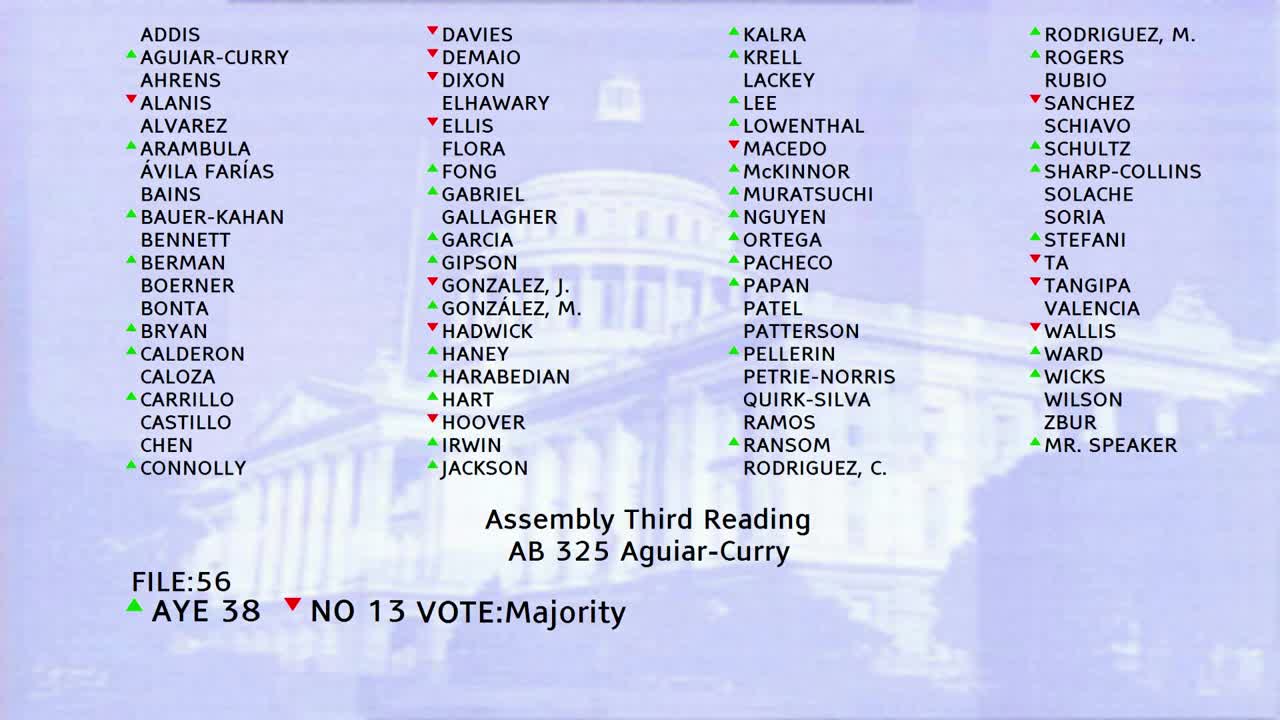
Bill Author

Bill Co-Author(s):