AB 394: Public transportation providers.
- Session Year: 2025-2026
- House: Assembly
- Latest Version Date: 2025-10-01
Current Status:
Passed
(2025-10-01: Chaptered by Secretary of State - Chapter 147, Statutes of 2025.)
Introduced
In Committee
Awaiting First Chamber Vote
Passed First Chamber
In Committee
Awaiting Second Chamber Vote
Passed Second Chamber
Enacted
Existing law defines a battery as any willful and unlawful use of force or violence upon the person of another.
Existing law provides that when a battery is committed against the person of an operator, driver, or passenger on a bus, taxicab, streetcar, cable car, trackless trolley, or other motor vehicle, as specified, and the person who commits the offense knows or reasonably should know that the victim is engaged in the performance of their duties, the penalty is imprisonment in a county jail not exceeding one year, a fine not exceeding $10,000, or both the fine and imprisonment. Existing law also provides that if the victim is injured, the offense would be punished by a fine not exceeding $10,000, by imprisonment in a county jail not exceeding one year or in the state prison for 16 months, 2, or 3 years, or by both that fine and imprisonment.
This bill would expand this crime to apply to an employee, public transportation provider, or contractor of a public transportation provider. By expanding the scope of an existing crime, the bill would impose a state-mandated local program.
Existing law authorizes any employer or collective bargaining representative whose employee has suffered harassment, unlawful violence, or a credible threat of violence from any individual, which can reasonably be construed to be carried out or to have been carried out at the workplace, to seek a temporary restraining order and an injunction on behalf of the employee and other employees of the employer.
This bill would clarify that unlawful violence includes battery committed against the person of an operator, driver, or passenger on a bus, taxicab, streetcar, cable car, trackless trolley, or other motor vehicle, as specified, or against an employee, public transportation provider, or contractor of a public transportation provider. The bill would also clarify that the definition of employer for the above-described provision includes a joint powers authority or a public transit operator.
The California Constitution requires the state to reimburse local agencies and school districts for certain costs mandated by the state. Statutory provisions establish procedures for making that reimbursement.
This bill would provide that no reimbursement is required by this act for a specified reason.
Existing law defines a battery as any willful and unlawful use of force or violence upon the person of another.
Existing law provides that when a battery is committed against the person of an operator, driver, or passenger on a bus, taxicab, streetcar, cable car, trackless trolley, or other motor vehicle, as specified, and the person who commits the offense knows or reasonably should know that the victim is engaged in the performance of their duties, the penalty is imprisonment in a county jail not exceeding one year, a fine not exceeding $10,000, or both the fine and imprisonment. Existing law also provides that if the victim is injured, the offense would be punished by a fine not exceeding $10,000, by imprisonment in a county jail not exceeding one year or in the state prison for 16 months, 2, or 3 years, or by both that fine and imprisonment.
This bill would expand this crime to apply to an employee, public transportation provider, or contractor of a public transportation provider. By expanding the scope of an existing crime, the bill would impose a state-mandated local program.
Existing law authorizes any employer or collective bargaining representative whose employee has suffered harassment, unlawful violence, or a credible threat of violence from any individual, which can reasonably be construed to be carried out or to have been carried out at the workplace, to seek a temporary restraining order and an injunction on behalf of the employee and other employees of the employer.
This bill would require a temporary restraining order issued pursuant to a violation of the above provision to be enforceable across the entirety of any public transit system, as defined. The bill would authorize a law enforcement agency with jurisdiction over the public transit system is located to enforce the temporary restraining order, as specified. The bill would require the public transit system to notify a law enforcement agency of the issuance of the order in order to assist with enforcement.This bill would clarify that unlawful violence includes battery committed against the person of an operator, driver, or passenger on a bus, taxicab, streetcar, cable car, trackless trolley, or other motor vehicle, as specified, or against an employee, public transportation provider, or contractor of a public transportation provider. The bill would also clarify that the definition of employer for the above-described provision includes a joint powers authority or a public transit operator.
The California Constitution requires the state to reimburse local agencies and school districts for certain costs mandated by the state. Statutory provisions establish procedures for making that reimbursement.
This bill would provide that no reimbursement is required by this act for a specified reason.
Existing law defines a battery as any willful and unlawful use of force or violence upon the person of another. Existing law defines stalking as willfully, maliciously, and repeatedly following or willfully and maliciously harassing another person and making a credible threat with the intent to place that person in reasonable fear for the persons safety, or the safety of the persons immediate family.
Existing law provides that when a battery is committed against the person of an operator, driver, or passenger on a bus, taxicab, streetcar, cable car, trackless trolley, or other motor vehicle, as specified, and the person who commits the offense knows or reasonably should know that the victim is engaged in the performance of their duties, the penalty is imprisonment in a county jail not exceeding one year, a fine not exceeding $10,000, or both the fine and imprisonment. Existing law also provides that if the victim is injured, the offense would be punished by a fine not exceeding $10,000, by imprisonment in a county jail not exceeding one year or in the state prison for 16 months, 2, or 3 years, or by both that fine and imprisonment.
This bill would expand this crime to apply to an employee, public transportation provider, or contractor of a public transportation provider. By expanding the scope of an existing crime, the bill would impose a state-mandated local program.
Existing law authorizes any employer or collective bargaining representative whose employee has suffered harassment, unlawful violence, or a credible threat of violence from any individual, which can reasonably be construed to be carried out or to have been carried out at the workplace, to seek a temporary restraining order and an injunction on behalf of the employee and other employees of the employer.
This bill would require a temporary restraining order issued pursuant to a violation of the above provision to be enforceable across the entirety of any public transit system, as defined. The bill would authorize a law enforcement agency with jurisdiction over the area where the public transit system is located to enforce the temporary restraining order, as specified. The bill would require a law enforcement agency with jurisdiction over the area where the public transit system is located to notify the public transit system of the issuance of an order in order to obtain the transit systems assistance with enforcement. the public transit system to notify a law enforcement agency of the issuance of the order in order to assist with enforcement.
The California Constitution requires the state to reimburse local agencies and school districts for certain costs mandated by the state. Statutory provisions establish procedures for making that reimbursement.
This bill would provide that no reimbursement is required by this act for a specified reason.
Existing law defines a battery as any willful and unlawful use of force or violence upon the person of another. Existing law defines stalking as willfully, maliciously, and repeatedly following or willfully and maliciously harassing another person and making a credible threat with the intent to place that person in reasonable fear for the persons safety, or the safety of the persons immediate family.
Existing law provides that when a battery is committed against the person of an operator, driver, or passenger on a bus, taxicab, streetcar, cable car, trackless trolley, or other motor vehicle, as specified, and the person who commits the offense knows or reasonably should know that the victim is engaged in the performance of their duties, the penalty is imprisonment in a county jail not exceeding one year, a fine not exceeding $10,000, or both the fine and imprisonment. Existing law also provides that if the victim is injured, the offense would be punished by a fine not exceeding $10,000, by imprisonment in a county jail not exceeding one year or in the state prison for 16 months, 2, or 3 years, or by both that fine and imprisonment.
This bill would expand this crime to include stalking against any of those persons and would also have the crime apply when it occurs against apply to an employee, public transportation provider, or contractor of a public transportation provider. By expanding the scope of an existing crime and creating a new crime, crime, the bill would impose a state-mandated local program.
Existing law authorizes any employer or collective bargaining representative whose employee has suffered harassment, unlawful violence, or a credible threat of violence from any individual, which can reasonably be construed to be carried out or to have been carried out at the workplace, to seek a temporary restraining order and an injunction on behalf of the employee and other employees of the employer.
This bill would require a temporary restraining order issued pursuant to a violation of the above provision to be enforceable across the entirety of any public transit system, as defined. The bill would authorize a law enforcement agency with jurisdiction over the area where the public transit system is located to enforce the temporary restraining order, as specified. The bill would require a law enforcement agency with jurisdiction over the area where the public transit system is located to notify the public transit system of the issuance of an order in order to obtain the transit systems assistance with enforcement.
The California Constitution requires the state to reimburse local agencies and school districts for certain costs mandated by the state. Statutory provisions establish procedures for making that reimbursement.
This bill would provide that no reimbursement is required by this act for a specified reason.
Existing law defines a battery as any willful and unlawful use of force or violence upon the person of another. Existing law defines stalking as willfully, maliciously, and repeatedly following or willfully and maliciously harassing another person and making a credible threat with the intent to place that person in reasonable fear for the persons safety, or the safety of the persons immediate family.
Existing law provides that when a battery is committed against the person of an operator, driver, or passenger on a bus, taxicab, streetcar, cable car, trackless trolley, or other motor vehicle, as specified, and the person who commits the offense knows or reasonably should know that the victim is engaged in the performance of their duties, the penalty is imprisonment in a county jail not exceeding one year, a fine not exceeding $10,000, or both the fine and imprisonment. Existing law also provides that if the victim is injured, the offense would be punished by a fine not exceeding $10,000, by imprisonment in a county jail not exceeding one year or in the state prison for 16 months, 2, or 3 years, or by both that fine and imprisonment.
This bill would expand this crime to include stalking against any of those persons and would also have the crime apply when it occurs against an employee, public transportation provider, or contractor of a public transportation provider. The bill would authorize the court, following a conviction, to impose a prohibition order barring reentry to public transit property, as specified. The bill would make a violation of a prohibition order a misdemeanor, as specified. By expanding the scope of an existing crime and creating a new crime, the bill would impose a state-mandated local program.
Existing law authorizes any employer or collective bargaining representative whose employee has suffered harassment, unlawful violence, or a credible threat of violence from any individual, which can reasonably be construed to be carried out or to have been carried out at the workplace, to seek a temporary restraining order and an injunction on behalf of the employee and other employees of the employer.
This bill would require a temporary restraining order issued pursuant to a violation of the above provision to be enforceable across the entirety of any public transit system, as defined. The bill would authorize a law enforcement agency with jurisdiction over the public transit system to enforce the temporary restraining order, as specified.
The California Constitution requires the state to reimburse local agencies and school districts for certain costs mandated by the state. Statutory provisions establish procedures for making that reimbursement.
This bill would provide that no reimbursement is required by this act for a specified reason.
Existing law defines a battery as any willful and unlawful use of force or violence upon the person of another. Existing law defines stalking as willfully, maliciously, and repeatedly following or willfully and maliciously harassing another person and making a credible threat with the intent to place that person in reasonable fear for the persons safety, or the safety of the persons immediate family.
Existing law defines a battery as any willful and unlawful use of force or violence upon the person of another. Existing law provides that when a battery is committed against the person of an operator, driver, or passenger on a bus, taxicab, streetcar, cable car, trackless trolley, or other motor vehicle, as specified, and the person who commits the offense knows or reasonably should know that the victim is engaged in the performance of their duties, the penalty is imprisonment in a county jail not exceeding one year, a fine not exceeding $10,000, or both the fine and imprisonment. Existing law also provides that if the victim is injured, the offense would be punished by a fine not exceeding $10,000, by imprisonment in a county jail not exceeding one year or in the state prison for 16 months, 2, or 3 years, or by both that fine and imprisonment.This bill would expand this crime to include stalking against any of those persons and would also have the crime apply to an employee or when it occurs against an employee, public transportation provider, or contractor of a public transportation provider. The bill would authorize the court, following a conviction, to impose a prohibition order barring reentry to public transit property, as specified. The bill would make a violation of a prohibition order a misdemeanor, as specified. By expanding the scope of an existing crime and creating a new crime, the bill would impose a state-mandated local program.
Under existing law, any person who enters or remains upon any transit-related property without permission or whose entry, presence, or conduct upon the property interferes with, interrupts, or hinders the safe and efficient operation of the transit-related facility is guilty of a misdemeanor. Existing law defines transit-related property for this purpose as any land, facilities, or vehicles owned, leased, or possessed by a county transportation commission, transportation authority, or transit district, as defined, that are used to provide public transportation by rail or passenger bus or are directly related to that use, or any property, facilities, or vehicles upon which the San Francisco Bay Area Rapid Transit District owes policing responsibilities to a local government, as specified.This bill would expand that definition to include any properties, facilities, ferries, or vehicles, upon which a county transportation commission, transportation authority, joint powers authority, or operator, as defined, owes policing responsibilities to a local government pursuant to an operations and maintenance agreement or similar interagency agreement. By expanding the scope of an existing crime, the bill would impose a state-mandated local program. The bill would authorize state and local law enforcement officers or transit enforcement officers, as specified, to enforce the above-described provisions.Existing law authorizes any employer or collective bargaining representative whose employee has suffered harassment, unlawful violence, or a credible threat of violence from any individual, which can reasonably be construed to be carried out or to have been carried out at the workplace, to seek a temporary restraining order and an injunction on behalf of the employee and other employees of the employer.
This bill would require a temporary restraining order issued pursuant to a violation of the above provision to be enforceable across the entirety of any public transit system, as defined. The bill would authorize a law enforcement agency with jurisdiction over the public transit system to enforce the temporary restraining order, as specified.
The California Constitution requires the state to reimburse local agencies and school districts for certain costs mandated by the state. Statutory provisions establish procedures for making that reimbursement.
This bill would provide that no reimbursement is required by this act for a specified reason.
Existing law defines a battery as any willful and unlawful use of force or violence upon the person of another. Existing law provides that when a battery is committed against the person of an operator, driver, or passenger on a bus, taxicab, streetcar, cable car, trackless trolley, or other motor vehicle, as specified, and the person who commits the offense knows or reasonably should know that the victim is engaged in the performance of their duties, the penalty is imprisonment in a county jail not exceeding one year, a fine not exceeding $10,000, or both the fine and imprisonment. Existing law also provides that if the victim is injured, the offense would be punished by a fine not exceeding $10,000, by imprisonment in a county jail not exceeding one year or in the state prison for 16 months, 2, or 3 years, or by both that fine and imprisonment.
This bill would expand this crime to apply to an employee or contractor of a public transportation provider. The bill would authorize the court, following a conviction, to impose a prohibition order barring reentry to public transit property, as specified. The bill would make a violation of a prohibition order a misdemeanor, as specified. By expanding the scope of an existing crime and creating a new crime, the bill would impose a state-mandated local program.
Under existing law, any person who enters or remains upon any transit-related property without permission or whose entry, presence, or conduct upon the property interferes with, interrupts, or hinders the safe and efficient operation of the transit-related facility is guilty of a misdemeanor. Existing law defines transit-related property for this purpose as any land, facilities, or vehicles owned, leased, or possessed by a county transportation commission, transportation authority, or transit district, as defined, that are used to provide public transportation by rail or passenger bus or are directly related to that use, or any property, facilities, or vehicles upon which the San Francisco Bay Area Rapid Transit District owes policing responsibilities to a local government, as specified.
This bill would expand that definition to include any properties, facilities, ferries, or vehicles, upon which a county transportation commission, transportation authority, joint powers authority, or operator, as defined, owes policing responsibilities to a local government pursuant to an operations and maintenance agreement or similar interagency agreement. By expanding the scope of an existing crime, the bill would impose a state-mandated local program. The bill would authorize state and local law enforcement officers or transit enforcement officers, as specified, to enforce the above-described provisions.
The California Constitution requires the state to reimburse local agencies and school districts for certain costs mandated by the state. Statutory provisions establish procedures for making that reimbursement.
This bill would provide that no reimbursement is required by this act for a specified reason.
(a)Any employer or collective bargaining representative of an employee who has suffered harassment, unlawful violence, or a credible threat of violence from any individual, that can reasonably be construed to be carried out or to have been carried out at the workplace, may seek a temporary restraining order and an order after hearing on behalf of the employee and, at the discretion of the court, any number of other employees at the workplace, and, if appropriate, other employees at other workplaces of the employer. For purposes of this section only, a person may bring a petition for a temporary restraining order and an order after hearing on behalf of an employee as their collective bargaining representative only if the person serves as a collective bargaining representative for that employee in employment or labor matters at the employees workplace.
(b)For purposes of this section:
(1)Course of conduct is a pattern of conduct composed of a series of acts over a period of time, however short, evidencing a continuity of purpose, including following or stalking an employee to or from the place of work; entering the workplace; following an employee during hours of employment; making telephone calls to an employee; or sending correspondence to an employee by any means, including, but not limited to, the use of the public or private mails, interoffice mail, facsimile, or computer email.
(2)Credible threat of violence is a knowing and willful statement or course of conduct that would place a reasonable person in fear for their safety, or the safety of their immediate family, and that serves no legitimate purpose.
(3)Employer and employee mean persons defined in Section 350 of the Labor Code. Employer also includes a federal agency, the state, a state agency, a city, county, or district, a joint powers authority, or a public transit operator, whether operated directly by a public entity or through a contract or subcontract, and a private, public, or quasi-public corporation, or any public agency thereof or therein. Employee also includes the members of boards of directors of private, public, and quasi-public corporations and elected and appointed public officers. For purposes of this section only, employee also includes a volunteer or independent contractor who performs services for the employer at the employers worksite. The changes made to this paragraph during the 202526 Regular Session are declaratory of existing law.
(4)Harassment is a knowing and willful course of conduct directed at a specific person that seriously alarms, annoys, or harasses the person, and that serves no legitimate purpose. The course of conduct must be that which would cause a reasonable person to suffer substantial emotional distress, and must actually cause substantial emotional distress.
(5)Petitioner means the employer or collective bargaining representative that petitions under subdivision (a) for a temporary restraining order and order after hearing.
(6)Respondent means the person against whom the temporary restraining order and order after hearing are sought and, if the petition is granted, the restrained person.
(7)Temporary restraining order and order after hearing mean orders that include any of the following restraining orders, whether issued ex parte or after notice and hearing:
(A)An order enjoining a party from harassing, intimidating, molesting, attacking, striking, stalking, threatening, sexually assaulting, battering, abusing, telephoning, including, but not limited to, making annoying telephone calls as described in Section 653m of the Penal Code, destroying personal property, contacting, either directly or indirectly, by mail or otherwise, or coming within a specified distance of, or disturbing the peace of, the employee.
(B)An order enjoining a party from specified behavior that the court determines is necessary to effectuate orders described in subparagraph (A).
(8)Unlawful violence is any assault or battery, or stalking as prohibited in Section 646.9 of the Penal Code, or any violation of Section 243.3 of the Penal Code, but shall not include lawful acts of self-defense or defense of others. The changes made to this paragraph during the 202526 Regular Session are declaratory of existing law.
(c)This section does not permit a court to issue a temporary restraining order or order after hearing prohibiting speech or other activities that are constitutionally protected, protected by the National Labor Relations Act (29 U.S.C. Sec. 151 et seq.), protected by Chapter 11.5 (commencing with Section 3555) of Division 4 of Title 1 of the Government Code, or otherwise protected by Section 527.3 or any other provision of law.
(d)In the discretion of the court, on a showing of good cause, a temporary restraining order or order after hearing issued under this section may include other named family or household members, or other persons employed at the employees workplace or workplaces.
(e)Before filing a petition under this section, an employer or collective bargaining representative of an employee shall provide the employee who has suffered harassment, unlawful violence, or a credible threat of violence from any individual, an opportunity to decline to be named in the temporary restraining order. An employees request to not be named in the temporary restraining order shall not prohibit an employer or collective bargaining representative from seeking a temporary restraining order on behalf of other employees at the workplace, and, if appropriate, other employees at other workplaces of the employer.
(f)(1)Upon filing a petition under this section, the petitioner may obtain a temporary restraining order in accordance with subdivision (a) of Section 527, if the petitioner also files a declaration that, to the satisfaction of the court, shows one of the following:
(A)Reasonable proof that an employee has suffered unlawful violence or a credible threat of violence by the respondent, and that great or irreparable harm would result to an employee.
(B)Clear and convincing evidence of all of the following:
(i)That an employee has suffered harassment by the respondent.
(ii)That great or irreparable harm would result to an employee.
(iii)That the course of conduct at issue served no legitimate purpose.
(iv)That the issuance of the order is not prohibited by subdivision (c).
(2)The temporary restraining order may include any of the protective orders described in paragraph (7) of subdivision (b).
(g)A request for the issuance of a temporary restraining order without notice under this section shall be granted or denied on the same day that the petition is submitted to the court, unless the petition is filed too late in the day to permit effective review, in which case the order shall be granted or denied on the next day of judicial business in sufficient time for the order to be filed that day with the clerk of the court.
(h)A temporary restraining order granted under this section shall remain in effect, at the courts discretion, for a period not to exceed 21 days, or if the court extends the time for hearing under subdivision (i), not to exceed 25 days, unless otherwise modified or terminated by the court.
(i)Within 21 days, or if good cause appears to the court, 25 days from the date that a petition for a temporary order is granted or denied, a hearing shall be held on the petition. If no request for temporary orders is made, the hearing shall be held within 21 days, or, if good cause appears to the court, 25 days, from the date that the petition is filed.
(j)The respondent may file a response that explains, excuses, justifies, or denies the alleged harassment, unlawful violence, or credible threats of violence.
(k)At the hearing, the judge shall receive any testimony that is relevant and may make an independent inquiry. Moreover, if the respondent is currently employed by the employer of the employee, as described in subdivision (a), the judge shall receive evidence concerning the employers decision to retain, terminate, or otherwise discipline the respondent. If the judge finds by clear and convincing evidence that the respondent engaged in harassment, engaged in unlawful violence, or made a credible threat of violence, an order shall issue prohibiting further harassment, unlawful violence, or threats of violence.
(l)(1)In the discretion of the court, an order issued after notice and hearing under this section may have a duration of not more than three years, subject to termination or modification by further order of the court either on written stipulation filed with the court or on the motion of a party. These orders may be renewed, upon the request of a party, for a duration of not more than three years, without a showing of any further harassment, unlawful violence, or credible threats of violence since the issuance of the original order, subject to termination or modification by further order of the court either on written stipulation filed with the court or on the motion of a party. The request for renewal may be brought at any time within the three months before the expiration of the order.
(2)The failure to state the expiration date on the face of the form creates an order with a duration of three years from the date of issuance.
(3)If an action is filed for the purpose of terminating or modifying a protective order prior to the expiration date specified in the order by a party other than the protected party, the party who is protected by the order shall be given notice, pursuant to subdivision (b) of Section 1005, of the proceeding by personal service or, if the protected party has satisfied the requirements of Chapter 3.1 (commencing with Section 6205) of Division 7 of Title 1 of the Government Code, by service on the Secretary of State. If the party who is protected by the order cannot be notified prior to the hearing for modification or termination of the protective order, the court shall deny the motion to modify or terminate the order without prejudice or continue the hearing until the party who is protected can be properly noticed and may, upon a showing of good cause, specify another method for service of process that is reasonably designed to afford actual notice to the protected party. The protected party may waive their right to notice if they are physically present in court and does not challenge the sufficiency of the notice.
(m)This section does not preclude any party from representation by private counsel or from appearing on the partys own behalf.
(n)Upon filing of a petition under this section, the respondent shall be personally served with a copy of the petition, temporary restraining order, if any, and notice of hearing of the petition. Service shall be made at least five days before the hearing. The court may, for good cause, on motion of the petitioner or on its own motion, shorten the time for service on the respondent.
(o)A notice of hearing under this section shall notify the respondent that, if they do not attend the hearing, the court may make orders against them that could last up to three years.
(p)The respondent shall be entitled, as a matter of course, to one continuance, for a reasonable period, to respond to the petition.
(q)(1)Any party may request a continuance of the hearing, which the court shall grant on a showing of good cause. The request may be made in writing before or at the hearing or orally at the hearing. The court may also grant a continuance on its own motion.
(2)If the court grants a continuance, any temporary restraining order that has been granted shall remain in effect until the end of the continued hearing, unless otherwise ordered by the court. In granting a continuance, the court may modify or terminate a temporary restraining order.
(r)(1)If a respondent, named in a restraining order issued under this section after a hearing, has not been served personally with the order but has received actual notice of the existence and substance of the order through personal appearance in court to hear the terms of the order from the court, no additional proof of service is required for enforcement of the order.
(2)If the respondent named in a temporary restraining order is personally served with the order and notice of hearing with respect to a restraining order or protective order based on the temporary restraining order, but the person does not appear at the hearing, either personally or by an attorney, and the terms and conditions of the restraining order or protective order issued at the hearing are identical to the temporary restraining order, except for the duration of the order, then the restraining order or protective order issued at the hearing may be served on the person by first-class mail sent to that person at the most current address for the person available to the court.
(3)The Judicial Council form for temporary orders issued pursuant to this subdivision shall contain a statement in substantially the following form:
If you have been personally served with this temporary restraining order and notice of hearing, but you do not appear at the hearing either in person or by a lawyer, and a restraining order that is the same as this restraining order except for the expiration date is issued at the hearing, a copy of the order will be served on you by mail at the following address: ____.
If that address is not correct or you wish to verify that the temporary restraining order was converted to a restraining order at the hearing without substantive change and to find out the duration of that order, contact the clerk of the court.
(s)(1)Information on a temporary restraining order or order after hearing relating to workplace violence issued by a court pursuant to this section shall be transmitted to the Department of Justice in accordance with either paragraph (2) or (3).
(2)The court shall order the petitioner or the attorney for the petitioner to deliver a copy of any order issued under this section, or a reissuance, extension, modification, or termination of the order, and any subsequent proof of service, by the close of the business day on which the order, reissuance, extension, modification, or termination was made, to each law enforcement agency having jurisdiction over the residence of the petitioner and to any additional law enforcement agencies within the courts discretion as are requested by the petitioner.
(3)Alternatively, the court or its designee shall transmit, within one business day, to law enforcement personnel all information required under subdivision (b) of Section 6380 of the Family Code regarding any order issued under this section, or a reissuance, extension, modification, or termination of the order, and any subsequent proof of service, by either one of the following methods:
(A)Transmitting a physical copy of the order or proof of service to a local law enforcement agency authorized by the Department of Justice to enter orders into the California Law Enforcement Telecommunications System (CLETS).
(B)With the approval of the Department of Justice, entering the order or proof of service into CLETS directly.
(4)Each appropriate law enforcement agency shall make available information as to the existence and current status of these orders to law enforcement officers responding to the scene of reported harassment, unlawful violence, or a credible threat of violence.
(5)At the request of the petitioner, an order issued under this section shall be served on the respondent, regardless of whether the respondent has been taken into custody, by any law enforcement officer who is present at the scene of reported harassment, unlawful violence, or a credible threat of violence involving the parties to the proceedings. The petitioner shall provide the officer with an endorsed copy of the order and proof of service that the officer shall complete and send to the issuing court.
(6)Upon receiving information at the scene of an incident of harassment, unlawful violence, or a credible threat of violence that a protective order has been issued under this section, or that a person who has been taken into custody is the subject of an order, if the petitioner or the protected person cannot produce an endorsed copy of the order, a law enforcement officer shall immediately attempt to verify the existence of the order.
(7)If the law enforcement officer determines that a protective order has been issued but not served, the officer shall immediately notify the respondent of the terms of the order and obtain the respondents address. The law enforcement officer shall at that time also enforce the order, but may not arrest or take the respondent into custody for acts in violation of the order that were committed prior to the verbal notice of the terms and conditions of the order. The law enforcement officers verbal notice of the terms of the order shall constitute service of the order and constitutes sufficient notice for the purposes of this section and for the purposes of Section 29825 of the Penal Code. The petitioner shall mail an endorsed copy of the order to the respondents mailing address provided to the law enforcement officer within one business day of the reported incident of harassment, unlawful violence, or a credible threat of violence at which a verbal notice of the terms of the order was provided by a law enforcement officer.
(t)(1)A person subject to a protective order issued under this section shall not own, possess, purchase, receive, or attempt to purchase or receive a firearm or ammunition while the protective order is in effect.
(2)The court shall order a person subject to a protective order issued under this section to relinquish any firearms they own or possess pursuant to Section 527.9.
(3)Every person who owns, possesses, purchases or receives, or attempts to purchase or receive a firearm or ammunition while the protective order is in effect is punishable pursuant to Section 29825 of the Penal Code.
(u)Any intentional disobedience of any temporary restraining order or order after hearing granted under this section is punishable pursuant to Section 273.6 of the Penal Code.
(v)This section shall not be construed as expanding, diminishing, altering, or modifying the duty, if any, of an employer to provide a safe workplace for employees and other persons.
(w)(1)The Judicial Council shall develop forms, instructions, and rules for relating to matters governed by this section. The forms for the petition and response shall be simple and concise, and their use by parties in actions brought pursuant to this section shall be mandatory.
(2)A temporary restraining order or order after hearing relating to harassment, unlawful violence, or a credible threat of violence issued by a court pursuant to this section shall be issued on forms adopted by the Judicial Council and that have been approved by the Department of Justice pursuant to subdivision (i) of Section 6380 of the Family Code. However, the fact that an order issued by a court pursuant to this section was not issued on forms adopted by the Judicial Council and approved by the Department of Justice shall not, in and of itself, make the order unenforceable.
(x)There is no filing fee for a petition that alleges that a person has inflicted or threatened violence against an employee employed or represented by the petitioner, or stalked the employee, or acted or spoken in any other manner that has placed the employee in reasonable fear of violence, and that seeks a protective or restraining order restraining stalking or future violence or threats of violence, in any action brought pursuant to this section. A fee shall not be paid for a subpoena filed in connection with a petition alleging these acts. A fee shall not be paid for filing a response to a petition alleging these acts.
(y)(1)Subject to paragraph (4) of subdivision (b) of Section 6103.2 of the Government Code, there shall be no fee for the service of process by a sheriff or marshal of a temporary restraining order or order after hearing to be issued pursuant to this section if either of the following conditions applies:
(A)The temporary restraining order or order after hearing issued pursuant to this section is based upon stalking, as prohibited by Section 646.9 of the Penal Code.
(B)The temporary restraining order or order after hearing issued pursuant to this section is based on unlawful violence or a credible threat of violence.
(2)The Judicial Council shall prepare and develop forms for persons who wish to avail themselves of the services described in this subdivision.
(z)This section shall become operative on January 1, 2025.
SEC. 2.Section 243.3 of the Penal Code is amended to read:243.3.If a battery is committed against the person of an operator, driver, or passenger on a bus, taxicab, streetcar, cable car, trackless trolley, or other motor vehicle, including a vehicle operated on stationary rails or on a track or rail suspended in the air, used for the transportation of persons for hire, or against a schoolbus driver, or against the person of a station agent or ticket agent for the entity providing the transportation, or against a public transportation provider, or against an employee or contractor of a public transportation provider, and the person who commits the offense knows or reasonably should know that the victim, in the case of an operator, driver, or agent, employee, or contractor, is engaged in the performance of their duties, or is a passenger the offense shall be punished by a fine not exceeding ten thousand dollars ($10,000), or by imprisonment in a county jail not exceeding one year, or by both that fine and imprisonment. If an injury is inflicted on that victim, the offense shall be punished by a fine not exceeding ten thousand dollars ($10,000), or by imprisonment in a county jail not exceeding one year or in the state prison for 16 months, or two or three years, or by both that fine and imprisonment.
SEC. 3.No reimbursement is required by this act pursuant to Section 6 of Article XIIIB of the California Constitution because the only costs that may be incurred by a local agency or school district will be incurred because this act creates a new crime or infraction, eliminates a crime or infraction, or changes the penalty for a crime or infraction, within the meaning of Section 17556 of the Government Code, or changes the definition of a crime within the meaning of Section 6 of Article XIIIB of the California Constitution.
(a)Any employer or collective bargaining representative of an employee who has suffered harassment, unlawful violence, or a credible threat of violence from any individual, that can reasonably be construed to be carried out or to have been carried out at the workplace, may seek a temporary restraining order and an order after hearing on behalf of the employee and, at the discretion of the court, any number of other employees at the workplace, and, if appropriate, other employees at other workplaces of the employer. For purposes of this section only, a person may bring a petition for a temporary restraining order and an order after hearing on behalf of an employee as their collective bargaining representative only if the person serves as a collective bargaining representative for that employee in employment or labor matters at the employees workplace.
(b)For purposes of this section:
(1)Course of conduct is a pattern of conduct composed of a series of acts over a period of time, however short, evidencing a continuity of purpose, including following or stalking an employee to or from the place of work; entering the workplace; following an employee during hours of employment; making telephone calls to an employee; or sending correspondence to an employee by any means, including, but not limited to, the use of the public or private mails, interoffice mail, facsimile, or computer email.
(2)Credible threat of violence is a knowing and willful statement or course of conduct that would place a reasonable person in fear for their safety, or the safety of their immediate family, and that serves no legitimate purpose.
(3)Employer and employee mean persons defined in Section 350 of the Labor Code. Employer also includes a federal agency, the state, a state agency, a city, county, or district, a joint powers authority, or a public transit operator, whether operated directly by a public entity or through a contract or subcontract, and a private, public, or quasi-public corporation, or any public agency thereof or therein. Employee also includes the members of boards of directors of private, public, and quasi-public corporations and elected and appointed public officers. For purposes of this section only, employee also includes a volunteer or independent contractor who performs services for the employer at the employers worksite. The changes made to this paragraph during the 202526 Regular Session are declaratory of existing law.
(4)Harassment is a knowing and willful course of conduct directed at a specific person that seriously alarms, annoys, or harasses the person, and that serves no legitimate purpose. The course of conduct must be that which would cause a reasonable person to suffer substantial emotional distress, and must actually cause substantial emotional distress.
(5)Petitioner means the employer or collective bargaining representative that petitions under subdivision (a) for a temporary restraining order and order after hearing.
(6)Respondent means the person against whom the temporary restraining order and order after hearing are sought and, if the petition is granted, the restrained person.
(7)Temporary restraining order and order after hearing mean orders that include any of the following restraining orders, whether issued ex parte or after notice and hearing:
(A)An order enjoining a party from harassing, intimidating, molesting, attacking, striking, stalking, threatening, sexually assaulting, battering, abusing, telephoning, including, but not limited to, making annoying telephone calls as described in Section 653m of the Penal Code, destroying personal property, contacting, either directly or indirectly, by mail or otherwise, or coming within a specified distance of, or disturbing the peace of, the employee.
(B)An order enjoining a party from specified behavior that the court determines is necessary to effectuate orders described in subparagraph (A).
(8)Unlawful violence is any assault or battery, or stalking as prohibited in Section 646.9 of the Penal Code, or any violation of Section 243.3 of the Penal Code, but shall not include lawful acts of self-defense or defense of others. The changes made to this paragraph during the 202526 Regular Session are declaratory of existing law.
(c)This section does not permit a court to issue a temporary restraining order or order after hearing prohibiting speech or other activities that are constitutionally protected, protected by the National Labor Relations Act (29 U.S.C. Sec. 151 et seq.), protected by Chapter 11.5 (commencing with Section 3555) of Division 4 of Title 1 of the Government Code, or otherwise protected by Section 527.3 or any other provision of law.
(d)In the discretion of the court, on a showing of good cause, a temporary restraining order or order after hearing issued under this section may include other named family or household members, or other persons employed at the employees workplace or workplaces.
(e)Before filing a petition under this section, an employer or collective bargaining representative of an employee shall provide the employee who has suffered harassment, unlawful violence, or a credible threat of violence from any individual, an opportunity to decline to be named in the temporary restraining order. An employees request to not be named in the temporary restraining order shall not prohibit an employer or collective bargaining representative from seeking a temporary restraining order on behalf of other employees at the workplace, and, if appropriate, other employees at other workplaces of the employer.
(f)(1)Upon filing a petition under this section, the petitioner may obtain a temporary restraining order in accordance with subdivision (a) of Section 527, if the petitioner also files a declaration that, to the satisfaction of the court, shows one of the following:
(A)Reasonable proof that an employee has suffered unlawful violence or a credible threat of violence by the respondent, and that great or irreparable harm would result to an employee.
(B)Clear and convincing evidence of all of the following:
(i)That an employee has suffered harassment by the respondent.
(ii)That great or irreparable harm would result to an employee.
(iii)That the course of conduct at issue served no legitimate purpose.
(iv)That the issuance of the order is not prohibited by subdivision (c).
(2)The temporary restraining order may include any of the protective orders described in paragraph (7) of subdivision (b).
(g)A request for the issuance of a temporary restraining order without notice under this section shall be granted or denied on the same day that the petition is submitted to the court, unless the petition is filed too late in the day to permit effective review, in which case the order shall be granted or denied on the next day of judicial business in sufficient time for the order to be filed that day with the clerk of the court.
(h)A temporary restraining order granted under this section shall remain in effect, at the courts discretion, for a period not to exceed 21 days, or if the court extends the time for hearing under subdivision (i), not to exceed 25 days, unless otherwise modified or terminated by the court.
(i)Within 21 days, or if good cause appears to the court, 25 days from the date that a petition for a temporary order is granted or denied, a hearing shall be held on the petition. If no request for temporary orders is made, the hearing shall be held within 21 days, or, if good cause appears to the court, 25 days, from the date that the petition is filed.
(j)The respondent may file a response that explains, excuses, justifies, or denies the alleged harassment, unlawful violence, or credible threats of violence.
(k)At the hearing, the judge shall receive any testimony that is relevant and may make an independent inquiry. Moreover, if the respondent is currently employed by the employer of the employee, as described in subdivision (a), the judge shall receive evidence concerning the employers decision to retain, terminate, or otherwise discipline the respondent. If the judge finds by clear and convincing evidence that the respondent engaged in harassment, engaged in unlawful violence, or made a credible threat of violence, an order shall issue prohibiting further harassment, unlawful violence, or threats of violence.
(l)(1)In the discretion of the court, an order issued after notice and hearing under this section may have a duration of not more than three years, subject to termination or modification by further order of the court either on written stipulation filed with the court or on the motion of a party. These orders may be renewed, upon the request of a party, for a duration of not more than three years, without a showing of any further harassment, unlawful violence, or credible threats of violence since the issuance of the original order, subject to termination or modification by further order of the court either on written stipulation filed with the court or on the motion of a party. The request for renewal may be brought at any time within the three months before the expiration of the order.
(2)The failure to state the expiration date on the face of the form creates an order with a duration of three years from the date of issuance.
(3)If an action is filed for the purpose of terminating or modifying a protective order prior to the expiration date specified in the order by a party other than the protected party, the party who is protected by the order shall be given notice, pursuant to subdivision (b) of Section 1005, of the proceeding by personal service or, if the protected party has satisfied the requirements of Chapter 3.1 (commencing with Section 6205) of Division 7 of Title 1 of the Government Code, by service on the Secretary of State. If the party who is protected by the order cannot be notified prior to the hearing for modification or termination of the protective order, the court shall deny the motion to modify or terminate the order without prejudice or continue the hearing until the party who is protected can be properly noticed and may, upon a showing of good cause, specify another method for service of process that is reasonably designed to afford actual notice to the protected party. The protected party may waive their right to notice if they are physically present in court and does not challenge the sufficiency of the notice.
(m)This section does not preclude any party from representation by private counsel or from appearing on the partys own behalf.
(n)(1)If a temporary restraining order or injunction is issued pursuant to this section based on a respondents violation of Section 243.3 of the Penal Code, the order, at the courts discretion, may be enforceable across the entirety of any public transit system where the underlying offense occurred. This includes all vehicles, stations, stops, and facilities operated by the transit agency.(2)For purposes of this section, public transit system includes, but is not limited to, a system operated by a transit district, municipal operator, county transportation commission, transportation authority, joint powers authority, or other public transit operator.(3)A law enforcement agency with jurisdiction over the public transit system shall have the authority to enforce orders. The public transit system shall promptly notify any relevant law enforcement agency of the issuance of the order to assist with enforcement.(o)(n)Upon filing of a petition under this section, the respondent shall be personally served with a copy of the petition, temporary restraining order, if any, and notice of hearing of the petition. Service shall be made at least five days before the hearing. The court may, for good cause, on motion of the petitioner or on its own motion, shorten the time for service on the respondent.
(p)(o)A notice of hearing under this section shall notify the respondent that, if they do not attend the hearing, the court may make orders against them that could last up to three years.
(q)(p)The respondent shall be entitled, as a matter of course, to one continuance, for a reasonable period, to respond to the petition.
(r)(q)(1)Any party may request a continuance of the hearing, which the court shall grant on a showing of good cause. The request may be made in writing before or at the hearing or orally at the hearing. The court may also grant a continuance on its own motion.
(2)If the court grants a continuance, any temporary restraining order that has been granted shall remain in effect until the end of the continued hearing, unless otherwise ordered by the court. In granting a continuance, the court may modify or terminate a temporary restraining order.
(s)(r)(1)If a respondent, named in a restraining order issued under this section after a hearing, has not been served personally with the order but has received actual notice of the existence and substance of the order through personal appearance in court to hear the terms of the order from the court, no additional proof of service is required for enforcement of the order.
(2)If the respondent named in a temporary restraining order is personally served with the order and notice of hearing with respect to a restraining order or protective order based on the temporary restraining order, but the person does not appear at the hearing, either personally or by an attorney, and the terms and conditions of the restraining order or protective order issued at the hearing are identical to the temporary restraining order, except for the duration of the order, then the restraining order or protective order issued at the hearing may be served on the person by first-class mail sent to that person at the most current address for the person available to the court.
(3)The Judicial Council form for temporary orders issued pursuant to this subdivision shall contain a statement in substantially the following form:
If you have been personally served with this temporary restraining order and notice of hearing, but you do not appear at the hearing either in person or by a lawyer, and a restraining order that is the same as this restraining order except for the expiration date is issued at the hearing, a copy of the order will be served on you by mail at the following address: ____.
If that address is not correct or you wish to verify that the temporary restraining order was converted to a restraining order at the hearing without substantive change and to find out the duration of that order, contact the clerk of the court.
(t)(s)(1)Information on a temporary restraining order or order after hearing relating to workplace violence issued by a court pursuant to this section shall be transmitted to the Department of Justice in accordance with either paragraph (2) or (3).
(2)The court shall order the petitioner or the attorney for the petitioner to deliver a copy of any order issued under this section, or a reissuance, extension, modification, or termination of the order, and any subsequent proof of service, by the close of the business day on which the order, reissuance, extension, modification, or termination was made, to each law enforcement agency having jurisdiction over the residence of the petitioner and to any additional law enforcement agencies within the courts discretion as are requested by the petitioner.
(3)Alternatively, the court or its designee shall transmit, within one business day, to law enforcement personnel all information required under subdivision (b) of Section 6380 of the Family Code regarding any order issued under this section, or a reissuance, extension, modification, or termination of the order, and any subsequent proof of service, by either one of the following methods:
(A)Transmitting a physical copy of the order or proof of service to a local law enforcement agency authorized by the Department of Justice to enter orders into the California Law Enforcement Telecommunications System (CLETS).
(B)With the approval of the Department of Justice, entering the order or proof of service into CLETS directly.
(4)Each appropriate law enforcement agency shall make available information as to the existence and current status of these orders to law enforcement officers responding to the scene of reported harassment, unlawful violence, or a credible threat of violence.
(5)At the request of the petitioner, an order issued under this section shall be served on the respondent, regardless of whether the respondent has been taken into custody, by any law enforcement officer who is present at the scene of reported harassment, unlawful violence, or a credible threat of violence involving the parties to the proceedings. The petitioner shall provide the officer with an endorsed copy of the order and proof of service that the officer shall complete and send to the issuing court.
(6)Upon receiving information at the scene of an incident of harassment, unlawful violence, or a credible threat of violence that a protective order has been issued under this section, or that a person who has been taken into custody is the subject of an order, if the petitioner or the protected person cannot produce an endorsed copy of the order, a law enforcement officer shall immediately attempt to verify the existence of the order.
(7)If the law enforcement officer determines that a protective order has been issued but not served, the officer shall immediately notify the respondent of the terms of the order and obtain the respondents address. The law enforcement officer shall at that time also enforce the order, but may not arrest or take the respondent into custody for acts in violation of the order that were committed prior to the verbal notice of the terms and conditions of the order. The law enforcement officers verbal notice of the terms of the order shall constitute service of the order and constitutes sufficient notice for the purposes of this section and for the purposes of Section 29825 of the Penal Code. The petitioner shall mail an endorsed copy of the order to the respondents mailing address provided to the law enforcement officer within one business day of the reported incident of harassment, unlawful violence, or a credible threat of violence at which a verbal notice of the terms of the order was provided by a law enforcement officer.
(u)(t)(1)A person subject to a protective order issued under this section shall not own, possess, purchase, receive, or attempt to purchase or receive a firearm or ammunition while the protective order is in effect.
(2)The court shall order a person subject to a protective order issued under this section to relinquish any firearms they own or possess pursuant to Section 527.9.
(3)Every person who owns, possesses, purchases or receives, or attempts to purchase or receive a firearm or ammunition while the protective order is in effect is punishable pursuant to Section 29825 of the Penal Code.
(v)(u)Any intentional disobedience of any temporary restraining order or order after hearing granted under this section is punishable pursuant to Section 273.6 of the Penal Code.
(w)(v)This section shall not be construed as expanding, diminishing, altering, or modifying the duty, if any, of an employer to provide a safe workplace for employees and other persons.
(x)(w)(1)The Judicial Council shall develop forms, instructions, and rules for relating to matters governed by this section. The forms for the petition and response shall be simple and concise, and their use by parties in actions brought pursuant to this section shall be mandatory.
(2)A temporary restraining order or order after hearing relating to harassment, unlawful violence, or a credible threat of violence issued by a court pursuant to this section shall be issued on forms adopted by the Judicial Council and that have been approved by the Department of Justice pursuant to subdivision (i) of Section 6380 of the Family Code. However, the fact that an order issued by a court pursuant to this section was not issued on forms adopted by the Judicial Council and approved by the Department of Justice shall not, in and of itself, make the order unenforceable.
(y)(x)There is no filing fee for a petition that alleges that a person has inflicted or threatened violence against an employee employed or represented by the petitioner, or stalked the employee, or acted or spoken in any other manner that has placed the employee in reasonable fear of violence, and that seeks a protective or restraining order restraining stalking or future violence or threats of violence, in any action brought pursuant to this section. A fee shall not be paid for a subpoena filed in connection with a petition alleging these acts. A fee shall not be paid for filing a response to a petition alleging these acts.
(z)(y)(1)Subject to paragraph (4) of subdivision (b) of Section 6103.2 of the Government Code, there shall be no fee for the service of process by a sheriff or marshal of a temporary restraining order or order after hearing to be issued pursuant to this section if either of the following conditions applies:
(A)The temporary restraining order or order after hearing issued pursuant to this section is based upon stalking, as prohibited by Section 646.9 of the Penal Code.
(B)The temporary restraining order or order after hearing issued pursuant to this section is based on unlawful violence or a credible threat of violence.
(2)The Judicial Council shall prepare and develop forms for persons who wish to avail themselves of the services described in this subdivision.
(aa)(z)This section shall become operative on January 1, 2025.
SEC. 2.Section 243.3 of the Penal Code is amended to read:243.3.If a battery is committed against the person of an operator, driver, or passenger on a bus, taxicab, streetcar, cable car, trackless trolley, or other motor vehicle, including a vehicle operated on stationary rails or on a track or rail suspended in the air, used for the transportation of persons for hire, or against a schoolbus driver, or against the person of a station agent or ticket agent for the entity providing the transportation, or against a public transportation provider, or against an employee or contractor of a public transportation provider, and the person who commits the offense knows or reasonably should know that the victim, in the case of an operator, driver, or agent, employee, or contractor, is engaged in the performance of their duties, or is a passenger the offense shall be punished by a fine not exceeding ten thousand dollars ($10,000), or by imprisonment in a county jail not exceeding one year, or by both that fine and imprisonment. If an injury is inflicted on that victim, the offense shall be punished by a fine not exceeding ten thousand dollars ($10,000), or by imprisonment in a county jail not exceeding one year or in the state prison for 16 months, or two or three years, or by both that fine and imprisonment.
SEC. 3.No reimbursement is required by this act pursuant to Section 6 of Article XIIIB of the California Constitution because the only costs that may be incurred by a local agency or school district will be incurred because this act creates a new crime or infraction, eliminates a crime or infraction, or changes the penalty for a crime or infraction, within the meaning of Section 17556 of the Government Code, or changes the definition of a crime within the meaning of Section 6 of Article XIIIB of the California Constitution.
(a)Any employer or collective bargaining representative of an employee who has suffered harassment, unlawful violence, or a credible threat of violence from any individual, that can reasonably be construed to be carried out or to have been carried out at the workplace, may seek a temporary restraining order and an order after hearing on behalf of the employee and, at the discretion of the court, any number of other employees at the workplace, and, if appropriate, other employees at other workplaces of the employer. For purposes of this section only, a person may bring a petition for a temporary restraining order and an order after hearing on behalf of an employee as their collective bargaining representative only if the person serves as a collective bargaining representative for that employee in employment or labor matters at the employees workplace.
(b)For purposes of this section:
(1)Course of conduct is a pattern of conduct composed of a series of acts over a period of time, however short, evidencing a continuity of purpose, including following or stalking an employee to or from the place of work; entering the workplace; following an employee during hours of employment; making telephone calls to an employee; or sending correspondence to an employee by any means, including, but not limited to, the use of the public or private mails, interoffice mail, facsimile, or computer email.
(2)Credible threat of violence is a knowing and willful statement or course of conduct that would place a reasonable person in fear for their safety, or the safety of their immediate family, and that serves no legitimate purpose.
(3)Employer and employee mean persons defined in Section 350 of the Labor Code. Employer also includes a federal agency, the state, a state agency, a city, county, or district, and a private, public, or quasi-public corporation, or any public agency thereof or therein. Employee also includes the members of boards of directors of private, public, and quasi-public corporations and elected and appointed public officers. For purposes of this section only, employee also includes a volunteer or independent contractor who performs services for the employer at the employers worksite.
(4)Harassment is a knowing and willful course of conduct directed at a specific person that seriously alarms, annoys, or harasses the person, and that serves no legitimate purpose. The course of conduct must be that which would cause a reasonable person to suffer substantial emotional distress, and must actually cause substantial emotional distress.
(5)Petitioner means the employer or collective bargaining representative that petitions under subdivision (a) for a temporary restraining order and order after hearing.
(6)Respondent means the person against whom the temporary restraining order and order after hearing are sought and, if the petition is granted, the restrained person.
(7)Temporary restraining order and order after hearing mean orders that include any of the following restraining orders, whether issued ex parte or after notice and hearing:
(A)An order enjoining a party from harassing, intimidating, molesting, attacking, striking, stalking, threatening, sexually assaulting, battering, abusing, telephoning, including, but not limited to, making annoying telephone calls as described in Section 653m of the Penal Code, destroying personal property, contacting, either directly or indirectly, by mail or otherwise, or coming within a specified distance of, or disturbing the peace of, the employee.
(B)An order enjoining a party from specified behavior that the court determines is necessary to effectuate orders described in subparagraph (A).
(8)Unlawful violence is any assault or battery, or stalking as prohibited in Section 646.9 of the Penal Code, or any violation of Section 243.3 of the Penal Code, but shall not include lawful acts of self-defense or defense of others.
(c)This section does not permit a court to issue a temporary restraining order or order after hearing prohibiting speech or other activities that are constitutionally protected, protected by the National Labor Relations Act (29 U.S.C. Sec. 151 et seq.), protected by Chapter 11.5 (commencing with Section 3555) of Division 4 of Title 1 of the Government Code, or otherwise protected by Section 527.3 or any other provision of law.
(d)In the discretion of the court, on a showing of good cause, a temporary restraining order or order after hearing issued under this section may include other named family or household members, or other persons employed at the employees workplace or workplaces.
(e)Before filing a petition under this section, an employer or collective bargaining representative of an employee shall provide the employee who has suffered harassment, unlawful violence, or a credible threat of violence from any individual, an opportunity to decline to be named in the temporary restraining order. An employees request to not be named in the temporary restraining order shall not prohibit an employer or collective bargaining representative from seeking a temporary restraining order on behalf of other employees at the workplace, and, if appropriate, other employees at other workplaces of the employer.
(f)(1)Upon filing a petition under this section, the petitioner may obtain a temporary restraining order in accordance with subdivision (a) of Section 527, if the petitioner also files a declaration that, to the satisfaction of the court, shows one of the following:
(A)Reasonable proof that an employee has suffered unlawful violence or a credible threat of violence by the respondent, and that great or irreparable harm would result to an employee.
(B)Clear and convincing evidence of all of the following:
(i)That an employee has suffered harassment by the respondent.
(ii)That great or irreparable harm would result to an employee.
(iii)That the course of conduct at issue served no legitimate purpose.
(iv)That the issuance of the order is not prohibited by subdivision (c).
(2)The temporary restraining order may include any of the protective orders described in paragraph (7) of subdivision (b).
(g)A request for the issuance of a temporary restraining order without notice under this section shall be granted or denied on the same day that the petition is submitted to the court, unless the petition is filed too late in the day to permit effective review, in which case the order shall be granted or denied on the next day of judicial business in sufficient time for the order to be filed that day with the clerk of the court.
(h)A temporary restraining order granted under this section shall remain in effect, at the courts discretion, for a period not to exceed 21 days, or if the court extends the time for hearing under subdivision (i), not to exceed 25 days, unless otherwise modified or terminated by the court.
(i)Within 21 days, or if good cause appears to the court, 25 days from the date that a petition for a temporary order is granted or denied, a hearing shall be held on the petition. If no request for temporary orders is made, the hearing shall be held within 21 days, or, if good cause appears to the court, 25 days, from the date that the petition is filed.
(j)The respondent may file a response that explains, excuses, justifies, or denies the alleged harassment, unlawful violence, or credible threats of violence.
(k)At the hearing, the judge shall receive any testimony that is relevant and may make an independent inquiry. Moreover, if the respondent is currently employed by the employer of the employee, as described in subdivision (a), the judge shall receive evidence concerning the employers decision to retain, terminate, or otherwise discipline the respondent. If the judge finds by clear and convincing evidence that the respondent engaged in harassment, engaged in unlawful violence, or made a credible threat of violence, an order shall issue prohibiting further harassment, unlawful violence, or threats of violence.
(l)(1)In the discretion of the court, an order issued after notice and hearing under this section may have a duration of not more than three years, subject to termination or modification by further order of the court either on written stipulation filed with the court or on the motion of a party. These orders may be renewed, upon the request of a party, for a duration of not more than three years, without a showing of any further harassment, unlawful violence, or credible threats of violence since the issuance of the original order, subject to termination or modification by further order of the court either on written stipulation filed with the court or on the motion of a party. The request for renewal may be brought at any time within the three months before the expiration of the order.
(2)The failure to state the expiration date on the face of the form creates an order with a duration of three years from the date of issuance.
(3)If an action is filed for the purpose of terminating or modifying a protective order prior to the expiration date specified in the order by a party other than the protected party, the party who is protected by the order shall be given notice, pursuant to subdivision (b) of Section 1005, of the proceeding by personal service or, if the protected party has satisfied the requirements of Chapter 3.1 (commencing with Section 6205) of Division 7 of Title 1 of the Government Code, by service on the Secretary of State. If the party who is protected by the order cannot be notified prior to the hearing for modification or termination of the protective order, the court shall deny the motion to modify or terminate the order without prejudice or continue the hearing until the party who is protected can be properly noticed and may, upon a showing of good cause, specify another method for service of process that is reasonably designed to afford actual notice to the protected party. The protected party may waive their right to notice if they are physically present in court and does not challenge the sufficiency of the notice.
(m)This section does not preclude any party from representation by private counsel or from appearing on the partys own behalf.
(n)(1)If a temporary restraining order or injunction is issued pursuant to this section based on a respondents violation of Section 243.3 of the Penal Code, the order shall order, at the courts discretion, may be enforceable across the entirety of any public transit system where the underlying offense occurred. This includes all vehicles, stations, stops, and facilities operated by the transit agency.
(2)For purposes of this section, public transit system includes, but is not limited to, a system operated by a transit district, municipal operator, county transportation commission, transportation authority, joint powers authority, or other public transit operator.
(3)A law enforcement agency with jurisdiction over the area where the public transit system is located, including, but not limited to, the transit system enforcement agency, shall have the authority to enforce a temporary restraining order or injunction. A law enforcement agency with jurisdiction over the area where the transit system is located shall promptly notify the public transit system of the issuance of the order in order to obtain the transit systems assistance with enforcement. orders. The public transit system shall promptly notify any relevant law enforcement agency of the issuance of the order to assist with enforcement.
(o)Upon filing of a petition under this section, the respondent shall be personally served with a copy of the petition, temporary restraining order, if any, and notice of hearing of the petition. Service shall be made at least five days before the hearing. The court may, for good cause, on motion of the petitioner or on its own motion, shorten the time for service on the respondent.
(p)A notice of hearing under this section shall notify the respondent that, if they do not attend the hearing, the court may make orders against them that could last up to three years.
(q)The respondent shall be entitled, as a matter of course, to one continuance, for a reasonable period, to respond to the petition.
(r)(1)Any party may request a continuance of the hearing, which the court shall grant on a showing of good cause. The request may be made in writing before or at the hearing or orally at the hearing. The court may also grant a continuance on its own motion.
(2)If the court grants a continuance, any temporary restraining order that has been granted shall remain in effect until the end of the continued hearing, unless otherwise ordered by the court. In granting a continuance, the court may modify or terminate a temporary restraining order.
(s)(1)If a respondent, named in a restraining order issued under this section after a hearing, has not been served personally with the order but has received actual notice of the existence and substance of the order through personal appearance in court to hear the terms of the order from the court, no additional proof of service is required for enforcement of the order.
(2)If the respondent named in a temporary restraining order is personally served with the order and notice of hearing with respect to a restraining order or protective order based on the temporary restraining order, but the person does not appear at the hearing, either personally or by an attorney, and the terms and conditions of the restraining order or protective order issued at the hearing are identical to the temporary restraining order, except for the duration of the order, then the restraining order or protective order issued at the hearing may be served on the person by first-class mail sent to that person at the most current address for the person available to the court.
(3)The Judicial Council form for temporary orders issued pursuant to this subdivision shall contain a statement in substantially the following form:
If you have been personally served with this temporary restraining order and notice of hearing, but you do not appear at the hearing either in person or by a lawyer, and a restraining order that is the same as this restraining order except for the expiration date is issued at the hearing, a copy of the order will be served on you by mail at the following address: ____.
If that address is not correct or you wish to verify that the temporary restraining order was converted to a restraining order at the hearing without substantive change and to find out the duration of that order, contact the clerk of the court.
(t)(1)Information on a temporary restraining order or order after hearing relating to workplace violence issued by a court pursuant to this section shall be transmitted to the Department of Justice in accordance with either paragraph (2) or (3).
(2)The court shall order the petitioner or the attorney for the petitioner to deliver a copy of any order issued under this section, or a reissuance, extension, modification, or termination of the order, and any subsequent proof of service, by the close of the business day on which the order, reissuance, extension, modification, or termination was made, to each law enforcement agency having jurisdiction over the residence of the petitioner and to any additional law enforcement agencies within the courts discretion as are requested by the petitioner.
(3)Alternatively, the court or its designee shall transmit, within one business day, to law enforcement personnel all information required under subdivision (b) of Section 6380 of the Family Code regarding any order issued under this section, or a reissuance, extension, modification, or termination of the order, and any subsequent proof of service, by either one of the following methods:
(A)Transmitting a physical copy of the order or proof of service to a local law enforcement agency authorized by the Department of Justice to enter orders into the California Law Enforcement Telecommunications System (CLETS).
(B)With the approval of the Department of Justice, entering the order or proof of service into CLETS directly.
(4)Each appropriate law enforcement agency shall make available information as to the existence and current status of these orders to law enforcement officers responding to the scene of reported harassment, unlawful violence, or a credible threat of violence.
(5)At the request of the petitioner, an order issued under this section shall be served on the respondent, regardless of whether the respondent has been taken into custody, by any law enforcement officer who is present at the scene of reported harassment, unlawful violence, or a credible threat of violence involving the parties to the proceedings. The petitioner shall provide the officer with an endorsed copy of the order and proof of service that the officer shall complete and send to the issuing court.
(6)Upon receiving information at the scene of an incident of harassment, unlawful violence, or a credible threat of violence that a protective order has been issued under this section, or that a person who has been taken into custody is the subject of an order, if the petitioner or the protected person cannot produce an endorsed copy of the order, a law enforcement officer shall immediately attempt to verify the existence of the order.
(7)If the law enforcement officer determines that a protective order has been issued but not served, the officer shall immediately notify the respondent of the terms of the order and obtain the respondents address. The law enforcement officer shall at that time also enforce the order, but may not arrest or take the respondent into custody for acts in violation of the order that were committed prior to the verbal notice of the terms and conditions of the order. The law enforcement officers verbal notice of the terms of the order shall constitute service of the order and constitutes sufficient notice for the purposes of this section and for the purposes of Section 29825 of the Penal Code. The petitioner shall mail an endorsed copy of the order to the respondents mailing address provided to the law enforcement officer within one business day of the reported incident of harassment, unlawful violence, or a credible threat of violence at which a verbal notice of the terms of the order was provided by a law enforcement officer.
(u)(1)A person subject to a protective order issued under this section shall not own, possess, purchase, receive, or attempt to purchase or receive a firearm or ammunition while the protective order is in effect.
(2)The court shall order a person subject to a protective order issued under this section to relinquish any firearms they own or possess pursuant to Section 527.9.
(3)Every person who owns, possesses, purchases or receives, or attempts to purchase or receive a firearm or ammunition while the protective order is in effect is punishable pursuant to Section 29825 of the Penal Code.
(v)Any intentional disobedience of any temporary restraining order or order after hearing granted under this section is punishable pursuant to Section 273.6 of the Penal Code.
(w)This section shall not be construed as expanding, diminishing, altering, or modifying the duty, if any, of an employer to provide a safe workplace for employees and other persons.
(x)(1)The Judicial Council shall develop forms, instructions, and rules for relating to matters governed by this section. The forms for the petition and response shall be simple and concise, and their use by parties in actions brought pursuant to this section shall be mandatory.
(2)A temporary restraining order or order after hearing relating to harassment, unlawful violence, or a credible threat of violence issued by a court pursuant to this section shall be issued on forms adopted by the Judicial Council and that have been approved by the Department of Justice pursuant to subdivision (i) of Section 6380 of the Family Code. However, the fact that an order issued by a court pursuant to this section was not issued on forms adopted by the Judicial Council and approved by the Department of Justice shall not, in and of itself, make the order unenforceable.
(y)There is no filing fee for a petition that alleges that a person has inflicted or threatened violence against an employee employed or represented by the petitioner, or stalked the employee, or acted or spoken in any other manner that has placed the employee in reasonable fear of violence, and that seeks a protective or restraining order restraining stalking or future violence or threats of violence, in any action brought pursuant to this section. A fee shall not be paid for a subpoena filed in connection with a petition alleging these acts. A fee shall not be paid for filing a response to a petition alleging these acts.
(z)(1)Subject to paragraph (4) of subdivision (b) of Section 6103.2 of the Government Code, there shall be no fee for the service of process by a sheriff or marshal of a temporary restraining order or order after hearing to be issued pursuant to this section if either of the following conditions applies:
(A)The temporary restraining order or order after hearing issued pursuant to this section is based upon stalking, as prohibited by Section 646.9 of the Penal Code.
(B)The temporary restraining order or order after hearing issued pursuant to this section is based on unlawful violence or a credible threat of violence.
(2)The Judicial Council shall prepare and develop forms for persons who wish to avail themselves of the services described in this subdivision.
(aa)This section shall become operative on January 1, 2025.
SEC. 2.Section 243.3 of the Penal Code is amended to read:243.3.If a battery is committed against the person of an operator, driver, or passenger on a bus, taxicab, streetcar, cable car, trackless trolley, or other motor vehicle, including a vehicle operated on stationary rails or on a track or rail suspended in the air, used for the transportation of persons for hire, or against a schoolbus driver, or against the person of a station agent or ticket agent for the entity providing the transportation, or against a public transportation provider, or against an employee or contractor of a public transportation provider, and the person who commits the offense knows or reasonably should know that the victim, in the case of an operator, driver, or agent, employee, or contractor, is engaged in the performance of their duties, or is a passenger the offense shall be punished by a fine not exceeding ten thousand dollars ($10,000), or by imprisonment in a county jail not exceeding one year, or by both that fine and imprisonment. If an injury is inflicted on that victim, the offense shall be punished by a fine not exceeding ten thousand dollars ($10,000), or by imprisonment in a county jail not exceeding one year or in the state prison for 16 months, or two or three years, or by both that fine and imprisonment.
SEC. 3.No reimbursement is required by this act pursuant to Section 6 of Article XIIIB of the California Constitution because the only costs that may be incurred by a local agency or school district will be incurred because this act creates a new crime or infraction, eliminates a crime or infraction, or changes the penalty for a crime or infraction, within the meaning of Section 17556 of the Government Code, or changes the definition of a crime within the meaning of Section 6 of Article XIIIB of the California Constitution.
(a)Any employer or collective bargaining representative of an employee who has suffered harassment, unlawful violence, or a credible threat of violence from any individual, that can reasonably be construed to be carried out or to have been carried out at the workplace, may seek a temporary restraining order and an order after hearing on behalf of the employee and, at the discretion of the court, any number of other employees at the workplace, and, if appropriate, other employees at other workplaces of the employer. For purposes of this section only, a person may bring a petition for a temporary restraining order and an order after hearing on behalf of an employee as their collective bargaining representative only if the person serves as a collective bargaining representative for that employee in employment or labor matters at the employees workplace.
(b)For purposes of this section:
(1)Course of conduct is a pattern of conduct composed of a series of acts over a period of time, however short, evidencing a continuity of purpose, including following or stalking an employee to or from the place of work; entering the workplace; following an employee during hours of employment; making telephone calls to an employee; or sending correspondence to an employee by any means, including, but not limited to, the use of the public or private mails, interoffice mail, facsimile, or computer email.
(2)Credible threat of violence is a knowing and willful statement or course of conduct that would place a reasonable person in fear for their safety, or the safety of their immediate family, and that serves no legitimate purpose.
(3)Employer and employee mean persons defined in Section 350 of the Labor Code. Employer also includes a federal agency, the state, a state agency, a city, county, or district, and a private, public, or quasi-public corporation, or any public agency thereof or therein. Employee also includes the members of boards of directors of private, public, and quasi-public corporations and elected and appointed public officers. For purposes of this section only, employee also includes a volunteer or independent contractor who performs services for the employer at the employers worksite.
(4)Harassment is a knowing and willful course of conduct directed at a specific person that seriously alarms, annoys, or harasses the person, and that serves no legitimate purpose. The course of conduct must be that which would cause a reasonable person to suffer substantial emotional distress, and must actually cause substantial emotional distress.
(5)Petitioner means the employer or collective bargaining representative that petitions under subdivision (a) for a temporary restraining order and order after hearing.
(6)Respondent means the person against whom the temporary restraining order and order after hearing are sought and, if the petition is granted, the restrained person.
(7)Temporary restraining order and order after hearing mean orders that include any of the following restraining orders, whether issued ex parte or after notice and hearing:
(A)An order enjoining a party from harassing, intimidating, molesting, attacking, striking, stalking, threatening, sexually assaulting, battering, abusing, telephoning, including, but not limited to, making annoying telephone calls as described in Section 653m of the Penal Code, destroying personal property, contacting, either directly or indirectly, by mail or otherwise, or coming within a specified distance of, or disturbing the peace of, the employee.
(B)An order enjoining a party from specified behavior that the court determines is necessary to effectuate orders described in subparagraph (A).
(8)Unlawful violence is any assault or battery, or stalking as prohibited in Section 646.9 of the Penal Code, or any violation of Section 243.3 of the Penal Code, but shall not include lawful acts of self-defense or defense of others.
(c)This section does not permit a court to issue a temporary restraining order or order after hearing prohibiting speech or other activities that are constitutionally protected, protected by the National Labor Relations Act (29 U.S.C. Sec. 151 et seq.), protected by Chapter 11.5 (commencing with Section 3555) of Division 4 of Title 1 of the Government Code, or otherwise protected by Section 527.3 or any other provision of law.
(d)In the discretion of the court, on a showing of good cause, a temporary restraining order or order after hearing issued under this section may include other named family or household members, or other persons employed at the employees workplace or workplaces.
(e)Before filing a petition under this section, an employer or collective bargaining representative of an employee shall provide the employee who has suffered harassment, unlawful violence, or a credible threat of violence from any individual, an opportunity to decline to be named in the temporary restraining order. An employees request to not be named in the temporary restraining order shall not prohibit an employer or collective bargaining representative from seeking a temporary restraining order on behalf of other employees at the workplace, and, if appropriate, other employees at other workplaces of the employer.
(f)(1)Upon filing a petition under this section, the petitioner may obtain a temporary restraining order in accordance with subdivision (a) of Section 527, if the petitioner also files a declaration that, to the satisfaction of the court, shows one of the following:
(A)Reasonable proof that an employee has suffered unlawful violence or a credible threat of violence by the respondent, and that great or irreparable harm would result to an employee.
(B)Clear and convincing evidence of all of the following:
(i)That an employee has suffered harassment by the respondent.
(ii)That great or irreparable harm would result to an employee.
(iii)That the course of conduct at issue served no legitimate purpose.
(iv)That the issuance of the order is not prohibited by subdivision (c).
(2)The temporary restraining order may include any of the protective orders described in paragraph (7) of subdivision (b).
(g)A request for the issuance of a temporary restraining order without notice under this section shall be granted or denied on the same day that the petition is submitted to the court, unless the petition is filed too late in the day to permit effective review, in which case the order shall be granted or denied on the next day of judicial business in sufficient time for the order to be filed that day with the clerk of the court.
(h)A temporary restraining order granted under this section shall remain in effect, at the courts discretion, for a period not to exceed 21 days, or if the court extends the time for hearing under subdivision (i), not to exceed 25 days, unless otherwise modified or terminated by the court.
(i)Within 21 days, or if good cause appears to the court, 25 days from the date that a petition for a temporary order is granted or denied, a hearing shall be held on the petition. If no request for temporary orders is made, the hearing shall be held within 21 days, or, if good cause appears to the court, 25 days, from the date that the petition is filed.
(j)The respondent may file a response that explains, excuses, justifies, or denies the alleged harassment, unlawful violence, or credible threats of violence.
(k)At the hearing, the judge shall receive any testimony that is relevant and may make an independent inquiry. Moreover, if the respondent is currently employed by the employer of the employee, as described in subdivision (a), the judge shall receive evidence concerning the employers decision to retain, terminate, or otherwise discipline the respondent. If the judge finds by clear and convincing evidence that the respondent engaged in harassment, engaged in unlawful violence, or made a credible threat of violence, an order shall issue prohibiting further harassment, unlawful violence, or threats of violence.
(l)(1)In the discretion of the court, an order issued after notice and hearing under this section may have a duration of not more than three years, subject to termination or modification by further order of the court either on written stipulation filed with the court or on the motion of a party. These orders may be renewed, upon the request of a party, for a duration of not more than three years, without a showing of any further harassment, unlawful violence, or credible threats of violence since the issuance of the original order, subject to termination or modification by further order of the court either on written stipulation filed with the court or on the motion of a party. The request for renewal may be brought at any time within the three months before the expiration of the order.
(2)The failure to state the expiration date on the face of the form creates an order with a duration of three years from the date of issuance.
(3)If an action is filed for the purpose of terminating or modifying a protective order prior to the expiration date specified in the order by a party other than the protected party, the party who is protected by the order shall be given notice, pursuant to subdivision (b) of Section 1005, of the proceeding by personal service or, if the protected party has satisfied the requirements of Chapter 3.1 (commencing with Section 6205) of Division 7 of Title 1 of the Government Code, by service on the Secretary of State. If the party who is protected by the order cannot be notified prior to the hearing for modification or termination of the protective order, the court shall deny the motion to modify or terminate the order without prejudice or continue the hearing until the party who is protected can be properly noticed and may, upon a showing of good cause, specify another method for service of process that is reasonably designed to afford actual notice to the protected party. The protected party may waive their right to notice if they are physically present in court and does not challenge the sufficiency of the notice.
(m)This section does not preclude any party from representation by private counsel or from appearing on the partys own behalf.
(n)(1)If a temporary restraining order or injunction is issued pursuant to this section based on a respondents violation of Section 243.3 of the Penal Code, the order shall be enforceable across the entirety of any public transit system where the underlying offense occurred. This includes all vehicles, stations, stops, and facilities operated by the transit agency.
(2)For purposes of this section, public transit system includes, but is not limited to, a system operated by a transit district, municipal operator, county transportation commission, transportation authority, joint powers authority, or other public transit operator.
(3)A law enforcement agency with jurisdiction over the public transit system shall have the authority to enforce orders, and the system shall be notified of the issuance of the order to assist with enforcement. area where the public transit system is located, including, but not limited to, the transit system enforcement agency, shall have the authority to enforce a temporary restraining order or injunction. A law enforcement agency with jurisdiction over the area where the transit system is located shall promptly notify the public transit system of the issuance of the order in order to obtain the transit systems assistance with enforcement.
(o)Upon filing of a petition under this section, the respondent shall be personally served with a copy of the petition, temporary restraining order, if any, and notice of hearing of the petition. Service shall be made at least five days before the hearing. The court may, for good cause, on motion of the petitioner or on its own motion, shorten the time for service on the respondent.
(p)A notice of hearing under this section shall notify the respondent that, if they do not attend the hearing, the court may make orders against them that could last up to three years.
(q)The respondent shall be entitled, as a matter of course, to one continuance, for a reasonable period, to respond to the petition.
(r)(1)Any party may request a continuance of the hearing, which the court shall grant on a showing of good cause. The request may be made in writing before or at the hearing or orally at the hearing. The court may also grant a continuance on its own motion.
(2)If the court grants a continuance, any temporary restraining order that has been granted shall remain in effect until the end of the continued hearing, unless otherwise ordered by the court. In granting a continuance, the court may modify or terminate a temporary restraining order.
(s)(1)If a respondent, named in a restraining order issued under this section after a hearing, has not been served personally with the order but has received actual notice of the existence and substance of the order through personal appearance in court to hear the terms of the order from the court, no additional proof of service is required for enforcement of the order.
(2)If the respondent named in a temporary restraining order is personally served with the order and notice of hearing with respect to a restraining order or protective order based on the temporary restraining order, but the person does not appear at the hearing, either personally or by an attorney, and the terms and conditions of the restraining order or protective order issued at the hearing are identical to the temporary restraining order, except for the duration of the order, then the restraining order or protective order issued at the hearing may be served on the person by first-class mail sent to that person at the most current address for the person available to the court.
(3)The Judicial Council form for temporary orders issued pursuant to this subdivision shall contain a statement in substantially the following form:
If you have been personally served with this temporary restraining order and notice of hearing, but you do not appear at the hearing either in person or by a lawyer, and a restraining order that is the same as this restraining order except for the expiration date is issued at the hearing, a copy of the order will be served on you by mail at the following address: ____.
If that address is not correct or you wish to verify that the temporary restraining order was converted to a restraining order at the hearing without substantive change and to find out the duration of that order, contact the clerk of the court.
(t)(1)Information on a temporary restraining order or order after hearing relating to workplace violence issued by a court pursuant to this section shall be transmitted to the Department of Justice in accordance with either paragraph (2) or (3).
(2)The court shall order the petitioner or the attorney for the petitioner to deliver a copy of any order issued under this section, or a reissuance, extension, modification, or termination of the order, and any subsequent proof of service, by the close of the business day on which the order, reissuance, extension, modification, or termination was made, to each law enforcement agency having jurisdiction over the residence of the petitioner and to any additional law enforcement agencies within the courts discretion as are requested by the petitioner.
(3)Alternatively, the court or its designee shall transmit, within one business day, to law enforcement personnel all information required under subdivision (b) of Section 6380 of the Family Code regarding any order issued under this section, or a reissuance, extension, modification, or termination of the order, and any subsequent proof of service, by either one of the following methods:
(A)Transmitting a physical copy of the order or proof of service to a local law enforcement agency authorized by the Department of Justice to enter orders into the California Law Enforcement Telecommunications System (CLETS).
(B)With the approval of the Department of Justice, entering the order or proof of service into CLETS directly.
(4)Each appropriate law enforcement agency shall make available information as to the existence and current status of these orders to law enforcement officers responding to the scene of reported harassment, unlawful violence, or a credible threat of violence.
(5)At the request of the petitioner, an order issued under this section shall be served on the respondent, regardless of whether the respondent has been taken into custody, by any law enforcement officer who is present at the scene of reported harassment, unlawful violence, or a credible threat of violence involving the parties to the proceedings. The petitioner shall provide the officer with an endorsed copy of the order and proof of service that the officer shall complete and send to the issuing court.
(6)Upon receiving information at the scene of an incident of harassment, unlawful violence, or a credible threat of violence that a protective order has been issued under this section, or that a person who has been taken into custody is the subject of an order, if the petitioner or the protected person cannot produce an endorsed copy of the order, a law enforcement officer shall immediately attempt to verify the existence of the order.
(7)If the law enforcement officer determines that a protective order has been issued but not served, the officer shall immediately notify the respondent of the terms of the order and obtain the respondents address. The law enforcement officer shall at that time also enforce the order, but may not arrest or take the respondent into custody for acts in violation of the order that were committed prior to the verbal notice of the terms and conditions of the order. The law enforcement officers verbal notice of the terms of the order shall constitute service of the order and constitutes sufficient notice for the purposes of this section and for the purposes of Section 29825 of the Penal Code. The petitioner shall mail an endorsed copy of the order to the respondents mailing address provided to the law enforcement officer within one business day of the reported incident of harassment, unlawful violence, or a credible threat of violence at which a verbal notice of the terms of the order was provided by a law enforcement officer.
(u)(1)A person subject to a protective order issued under this section shall not own, possess, purchase, receive, or attempt to purchase or receive a firearm or ammunition while the protective order is in effect.
(2)The court shall order a person subject to a protective order issued under this section to relinquish any firearms they own or possess pursuant to Section 527.9.
(3)Every person who owns, possesses, purchases or receives, or attempts to purchase or receive a firearm or ammunition while the protective order is in effect is punishable pursuant to Section 29825 of the Penal Code.
(v)Any intentional disobedience of any temporary restraining order or order after hearing granted under this section is punishable pursuant to Section 273.6 of the Penal Code.
(w)This section shall not be construed as expanding, diminishing, altering, or modifying the duty, if any, of an employer to provide a safe workplace for employees and other persons.
(x)(1)The Judicial Council shall develop forms, instructions, and rules for relating to matters governed by this section. The forms for the petition and response shall be simple and concise, and their use by parties in actions brought pursuant to this section shall be mandatory.
(2)A temporary restraining order or order after hearing relating to harassment, unlawful violence, or a credible threat of violence issued by a court pursuant to this section shall be issued on forms adopted by the Judicial Council and that have been approved by the Department of Justice pursuant to subdivision (i) of Section 6380 of the Family Code. However, the fact that an order issued by a court pursuant to this section was not issued on forms adopted by the Judicial Council and approved by the Department of Justice shall not, in and of itself, make the order unenforceable.
(y)There is no filing fee for a petition that alleges that a person has inflicted or threatened violence against an employee employed or represented by the petitioner, or stalked the employee, or acted or spoken in any other manner that has placed the employee in reasonable fear of violence, and that seeks a protective or restraining order restraining stalking or future violence or threats of violence, in any action brought pursuant to this section. A fee shall not be paid for a subpoena filed in connection with a petition alleging these acts. A fee shall not be paid for filing a response to a petition alleging these acts.
(z)(1)Subject to paragraph (4) of subdivision (b) of Section 6103.2 of the Government Code, there shall be no fee for the service of process by a sheriff or marshal of a temporary restraining order or order after hearing to be issued pursuant to this section if either of the following conditions applies:
(A)The temporary restraining order or order after hearing issued pursuant to this section is based upon stalking, as prohibited by Section 646.9 of the Penal Code.
(B)The temporary restraining order or order after hearing issued pursuant to this section is based on unlawful violence or a credible threat of violence.
(2)The Judicial Council shall prepare and develop forms for persons who wish to avail themselves of the services described in this subdivision.
(aa)This section shall become operative on January 1, 2025.
SEC. 2.Section 243.3 of the Penal Code is amended to read:243.3.If a battery or stalking is committed against the person of an operator, driver, or passenger on a bus, taxicab, streetcar, cable car, trackless trolley, or other motor vehicle, including a vehicle operated on stationary rails or on a track or rail suspended in the air, used for the transportation of persons for hire, or against a schoolbus driver, or against the person of a station agent or ticket agent for the entity providing the transportation, or against a public transportation provider, or against an employee or contractor of a public transportation provider, and the person who commits the offense knows or reasonably should know that the victim, in the case of an operator, driver, or agent, employee, or contractor, is engaged in the performance of their duties, or is a passenger the offense shall be punished by a fine not exceeding ten thousand dollars ($10,000), or by imprisonment in a county jail not exceeding one year, or by both that fine and imprisonment. If an injury is inflicted on that victim, the offense shall be punished by a fine not exceeding ten thousand dollars ($10,000), or by imprisonment in a county jail not exceeding one year or in the state prison for 16 months, or two or three years, or by both that fine and imprisonment.
SEC. 3.No reimbursement is required by this act pursuant to Section 6 of Article XIIIB of the California Constitution because the only costs that may be incurred by a local agency or school district will be incurred because this act creates a new crime or infraction, eliminates a crime or infraction, or changes the penalty for a crime or infraction, within the meaning of Section 17556 of the Government Code, or changes the definition of a crime within the meaning of Section 6 of Article XIIIB of the California Constitution.
(a)Any employer or collective bargaining representative of an employee who has suffered harassment, unlawful violence, or a credible threat of violence from any individual, that can reasonably be construed to be carried out or to have been carried out at the workplace, may seek a temporary restraining order and an order after hearing on behalf of the employee and, at the discretion of the court, any number of other employees at the workplace, and, if appropriate, other employees at other workplaces of the employer. For purposes of this section only, a person may bring a petition for a temporary restraining order and an order after hearing on behalf of an employee as their collective bargaining representative only if the person serves as a collective bargaining representative for that employee in employment or labor matters at the employees workplace.
(b)For purposes of this section:
(1)Course of conduct is a pattern of conduct composed of a series of acts over a period of time, however short, evidencing a continuity of purpose, including following or stalking an employee to or from the place of work; entering the workplace; following an employee during hours of employment; making telephone calls to an employee; or sending correspondence to an employee by any means, including, but not limited to, the use of the public or private mails, interoffice mail, facsimile, or computer email.
(2)Credible threat of violence is a knowing and willful statement or course of conduct that would place a reasonable person in fear for their safety, or the safety of their immediate family, and that serves no legitimate purpose.
(3)Employer and employee mean persons defined in Section 350 of the Labor Code. Employer also includes a federal agency, the state, a state agency, a city, county, or district, and a private, public, or quasi-public corporation, or any public agency thereof or therein. Employee also includes the members of boards of directors of private, public, and quasi-public corporations and elected and appointed public officers. For purposes of this section only, employee also includes a volunteer or independent contractor who performs services for the employer at the employers worksite.
(4)Harassment is a knowing and willful course of conduct directed at a specific person that seriously alarms, annoys, or harasses the person, and that serves no legitimate purpose. The course of conduct must be that which would cause a reasonable person to suffer substantial emotional distress, and must actually cause substantial emotional distress.
(5)Petitioner means the employer or collective bargaining representative that petitions under subdivision (a) for a temporary restraining order and order after hearing.
(6)Respondent means the person against whom the temporary restraining order and order after hearing are sought and, if the petition is granted, the restrained person.
(7)Temporary restraining order and order after hearing mean orders that include any of the following restraining orders, whether issued ex parte or after notice and hearing:
(A)An order enjoining a party from harassing, intimidating, molesting, attacking, striking, stalking, threatening, sexually assaulting, battering, abusing, telephoning, including, but not limited to, making annoying telephone calls as described in Section 653m of the Penal Code, destroying personal property, contacting, either directly or indirectly, by mail or otherwise, or coming within a specified distance of, or disturbing the peace of, the employee.
(B)An order enjoining a party from specified behavior that the court determines is necessary to effectuate orders described in subparagraph (A).
(8)Unlawful violence is any assault or battery, or stalking as prohibited in Section 646.9 of the Penal Code, or any violation of Section 243.3 of the Penal Code, but shall not include lawful acts of self-defense or defense of others.
(c)This section does not permit a court to issue a temporary restraining order or order after hearing prohibiting speech or other activities that are constitutionally protected, protected by the National Labor Relations Act (29 U.S.C. Sec. 151 et seq.), protected by Chapter 11.5 (commencing with Section 3555) of Division 4 of Title 1 of the Government Code, or otherwise protected by Section 527.3 or any other provision of law.
(d)In the discretion of the court, on a showing of good cause, a temporary restraining order or order after hearing issued under this section may include other named family or household members, or other persons employed at the employees workplace or workplaces.
(e)Before filing a petition under this section, an employer or collective bargaining representative of an employee shall provide the employee who has suffered harassment, unlawful violence, or a credible threat of violence from any individual, an opportunity to decline to be named in the temporary restraining order. An employees request to not be named in the temporary restraining order shall not prohibit an employer or collective bargaining representative from seeking a temporary restraining order on behalf of other employees at the workplace, and, if appropriate, other employees at other workplaces of the employer.
(f)(1)Upon filing a petition under this section, the petitioner may obtain a temporary restraining order in accordance with subdivision (a) of Section 527, if the petitioner also files a declaration that, to the satisfaction of the court, shows one of the following:
(A)Reasonable proof that an employee has suffered unlawful violence or a credible threat of violence by the respondent, and that great or irreparable harm would result to an employee.
(B)Clear and convincing evidence of all of the following:
(i)That an employee has suffered harassment by the respondent.
(ii)That great or irreparable harm would result to an employee.
(iii)That the course of conduct at issue served no legitimate purpose.
(iv)That the issuance of the order is not prohibited by subdivision (c).
(2)The temporary restraining order may include any of the protective orders described in paragraph (7) of subdivision (b).
(g)A request for the issuance of a temporary restraining order without notice under this section shall be granted or denied on the same day that the petition is submitted to the court, unless the petition is filed too late in the day to permit effective review, in which case the order shall be granted or denied on the next day of judicial business in sufficient time for the order to be filed that day with the clerk of the court.
(h)A temporary restraining order granted under this section shall remain in effect, at the courts discretion, for a period not to exceed 21 days, or if the court extends the time for hearing under subdivision (i), not to exceed 25 days, unless otherwise modified or terminated by the court.
(i)Within 21 days, or if good cause appears to the court, 25 days from the date that a petition for a temporary order is granted or denied, a hearing shall be held on the petition. If no request for temporary orders is made, the hearing shall be held within 21 days, or, if good cause appears to the court, 25 days, from the date that the petition is filed.
(j)The respondent may file a response that explains, excuses, justifies, or denies the alleged harassment, unlawful violence, or credible threats of violence.
(k)At the hearing, the judge shall receive any testimony that is relevant and may make an independent inquiry. Moreover, if the respondent is currently employed by the employer of the employee, as described in subdivision (a), the judge shall receive evidence concerning the employers decision to retain, terminate, or otherwise discipline the respondent. If the judge finds by clear and convincing evidence that the respondent engaged in harassment, engaged in unlawful violence, or made a credible threat of violence, an order shall issue prohibiting further harassment, unlawful violence, or threats of violence.
(l)(1)In the discretion of the court, an order issued after notice and hearing under this section may have a duration of not more than three years, subject to termination or modification by further order of the court either on written stipulation filed with the court or on the motion of a party. These orders may be renewed, upon the request of a party, for a duration of not more than three years, without a showing of any further harassment, unlawful violence, or credible threats of violence since the issuance of the original order, subject to termination or modification by further order of the court either on written stipulation filed with the court or on the motion of a party. The request for renewal may be brought at any time within the three months before the expiration of the order.
(2)The failure to state the expiration date on the face of the form creates an order with a duration of three years from the date of issuance.
(3)If an action is filed for the purpose of terminating or modifying a protective order prior to the expiration date specified in the order by a party other than the protected party, the party who is protected by the order shall be given notice, pursuant to subdivision (b) of Section 1005, of the proceeding by personal service or, if the protected party has satisfied the requirements of Chapter 3.1 (commencing with Section 6205) of Division 7 of Title 1 of the Government Code, by service on the Secretary of State. If the party who is protected by the order cannot be notified prior to the hearing for modification or termination of the protective order, the court shall deny the motion to modify or terminate the order without prejudice or continue the hearing until the party who is protected can be properly noticed and may, upon a showing of good cause, specify another method for service of process that is reasonably designed to afford actual notice to the protected party. The protected party may waive their right to notice if they are physically present in court and does not challenge the sufficiency of the notice.
(m)This section does not preclude any party from representation by private counsel or from appearing on the partys own behalf.
(n)(1)If a temporary restraining order or injunction is issued pursuant to this section based on a respondents violation of Section 243.3 of the Penal Code, the order shall be enforceable across the entirety of any public transit system where the underlying offense occurred. This includes all vehicles, stations, stops, and facilities operated by the transit agency.
(2)For purposes of this section, public transit system includes, but is not limited to, a system operated by a transit district, municipal operator, county transportation commission, transportation authority, joint powers authority, or other public transit operator.
(3)A law enforcement agency with jurisdiction over the public transit system shall have the authority to enforce orders, and the system shall be notified of the issuance of the order to assist with enforcement.
(o)Upon filing of a petition under this section, the respondent shall be personally served with a copy of the petition, temporary restraining order, if any, and notice of hearing of the petition. Service shall be made at least five days before the hearing. The court may, for good cause, on motion of the petitioner or on its own motion, shorten the time for service on the respondent.
(p)A notice of hearing under this section shall notify the respondent that, if they do not attend the hearing, the court may make orders against them that could last up to three years.
(q)The respondent shall be entitled, as a matter of course, to one continuance, for a reasonable period, to respond to the petition.
(r)(1)Any party may request a continuance of the hearing, which the court shall grant on a showing of good cause. The request may be made in writing before or at the hearing or orally at the hearing. The court may also grant a continuance on its own motion.
(2)If the court grants a continuance, any temporary restraining order that has been granted shall remain in effect until the end of the continued hearing, unless otherwise ordered by the court. In granting a continuance, the court may modify or terminate a temporary restraining order.
(s)(1)If a respondent, named in a restraining order issued under this section after a hearing, has not been served personally with the order but has received actual notice of the existence and substance of the order through personal appearance in court to hear the terms of the order from the court, no additional proof of service is required for enforcement of the order.
(2)If the respondent named in a temporary restraining order is personally served with the order and notice of hearing with respect to a restraining order or protective order based on the temporary restraining order, but the person does not appear at the hearing, either personally or by an attorney, and the terms and conditions of the restraining order or protective order issued at the hearing are identical to the temporary restraining order, except for the duration of the order, then the restraining order or protective order issued at the hearing may be served on the person by first-class mail sent to that person at the most current address for the person available to the court.
(3)The Judicial Council form for temporary orders issued pursuant to this subdivision shall contain a statement in substantially the following form:
If you have been personally served with this temporary restraining order and notice of hearing, but you do not appear at the hearing either in person or by a lawyer, and a restraining order that is the same as this restraining order except for the expiration date is issued at the hearing, a copy of the order will be served on you by mail at the following address: ____.
If that address is not correct or you wish to verify that the temporary restraining order was converted to a restraining order at the hearing without substantive change and to find out the duration of that order, contact the clerk of the court.
(t)(1)Information on a temporary restraining order or order after hearing relating to workplace violence issued by a court pursuant to this section shall be transmitted to the Department of Justice in accordance with either paragraph (2) or (3).
(2)The court shall order the petitioner or the attorney for the petitioner to deliver a copy of any order issued under this section, or a reissuance, extension, modification, or termination of the order, and any subsequent proof of service, by the close of the business day on which the order, reissuance, extension, modification, or termination was made, to each law enforcement agency having jurisdiction over the residence of the petitioner and to any additional law enforcement agencies within the courts discretion as are requested by the petitioner.
(3)Alternatively, the court or its designee shall transmit, within one business day, to law enforcement personnel all information required under subdivision (b) of Section 6380 of the Family Code regarding any order issued under this section, or a reissuance, extension, modification, or termination of the order, and any subsequent proof of service, by either one of the following methods:
(A)Transmitting a physical copy of the order or proof of service to a local law enforcement agency authorized by the Department of Justice to enter orders into the California Law Enforcement Telecommunications System (CLETS).
(B)With the approval of the Department of Justice, entering the order or proof of service into CLETS directly.
(4)Each appropriate law enforcement agency shall make available information as to the existence and current status of these orders to law enforcement officers responding to the scene of reported harassment, unlawful violence, or a credible threat of violence.
(5)At the request of the petitioner, an order issued under this section shall be served on the respondent, regardless of whether the respondent has been taken into custody, by any law enforcement officer who is present at the scene of reported harassment, unlawful violence, or a credible threat of violence involving the parties to the proceedings. The petitioner shall provide the officer with an endorsed copy of the order and proof of service that the officer shall complete and send to the issuing court.
(6)Upon receiving information at the scene of an incident of harassment, unlawful violence, or a credible threat of violence that a protective order has been issued under this section, or that a person who has been taken into custody is the subject of an order, if the petitioner or the protected person cannot produce an endorsed copy of the order, a law enforcement officer shall immediately attempt to verify the existence of the order.
(7)If the law enforcement officer determines that a protective order has been issued but not served, the officer shall immediately notify the respondent of the terms of the order and obtain the respondents address. The law enforcement officer shall at that time also enforce the order, but may not arrest or take the respondent into custody for acts in violation of the order that were committed prior to the verbal notice of the terms and conditions of the order. The law enforcement officers verbal notice of the terms of the order shall constitute service of the order and constitutes sufficient notice for the purposes of this section and for the purposes of Section 29825 of the Penal Code. The petitioner shall mail an endorsed copy of the order to the respondents mailing address provided to the law enforcement officer within one business day of the reported incident of harassment, unlawful violence, or a credible threat of violence at which a verbal notice of the terms of the order was provided by a law enforcement officer.
(u)(1)A person subject to a protective order issued under this section shall not own, possess, purchase, receive, or attempt to purchase or receive a firearm or ammunition while the protective order is in effect.
(2)The court shall order a person subject to a protective order issued under this section to relinquish any firearms they own or possess pursuant to Section 527.9.
(3)Every person who owns, possesses, purchases or receives, or attempts to purchase or receive a firearm or ammunition while the protective order is in effect is punishable pursuant to Section 29825 of the Penal Code.
(v)Any intentional disobedience of any temporary restraining order or order after hearing granted under this section is punishable pursuant to Section 273.6 of the Penal Code.
(w)This section shall not be construed as expanding, diminishing, altering, or modifying the duty, if any, of an employer to provide a safe workplace for employees and other persons.
(x)(1)The Judicial Council shall develop forms, instructions, and rules for relating to matters governed by this section. The forms for the petition and response shall be simple and concise, and their use by parties in actions brought pursuant to this section shall be mandatory.
(2)A temporary restraining order or order after hearing relating to harassment, unlawful violence, or a credible threat of violence issued by a court pursuant to this section shall be issued on forms adopted by the Judicial Council and that have been approved by the Department of Justice pursuant to subdivision (i) of Section 6380 of the Family Code. However, the fact that an order issued by a court pursuant to this section was not issued on forms adopted by the Judicial Council and approved by the Department of Justice shall not, in and of itself, make the order unenforceable.
(y)There is no filing fee for a petition that alleges that a person has inflicted or threatened violence against an employee employed or represented by the petitioner, or stalked the employee, or acted or spoken in any other manner that has placed the employee in reasonable fear of violence, and that seeks a protective or restraining order restraining stalking or future violence or threats of violence, in any action brought pursuant to this section. A fee shall not be paid for a subpoena filed in connection with a petition alleging these acts. A fee shall not be paid for filing a response to a petition alleging these acts.
(z)(1)Subject to paragraph (4) of subdivision (b) of Section 6103.2 of the Government Code, there shall be no fee for the service of process by a sheriff or marshal of a temporary restraining order or order after hearing to be issued pursuant to this section if either of the following conditions applies:
(A)The temporary restraining order or order after hearing issued pursuant to this section is based upon stalking, as prohibited by Section 646.9 of the Penal Code.
(B)The temporary restraining order or order after hearing issued pursuant to this section is based on unlawful violence or a credible threat of violence.
(2)The Judicial Council shall prepare and develop forms for persons who wish to avail themselves of the services described in this subdivision.
(aa)This section shall become operative on January 1, 2025.
SEC. 2.Section 243.3 of the Penal Code is amended to read:243.3.(a)If a battery or stalking is committed against the person of an operator, driver, or passenger on a bus, taxicab, streetcar, cable car, trackless trolley, or other motor vehicle, including a vehicle operated on stationary rails or on a track or rail suspended in the air, used for the transportation of persons for hire, or against a schoolbus driver, or against the person of a station agent or ticket agent for the entity providing the transportation, or against a public transportation provider, or against an employee or contractor of a public transportation provider, and the person who commits the offense knows or reasonably should know that the victim, in the case of an operator, driver, or agent, employee, or contractor, is engaged in the performance of their duties, or is a passenger the offense shall be punished by a fine not exceeding ten thousand dollars ($10,000), or by imprisonment in a county jail not exceeding one year, or by both that fine and imprisonment. If an injury is inflicted on that victim, the offense shall be punished by a fine not exceeding ten thousand dollars ($10,000), or by imprisonment in a county jail not exceeding one year or in the state prison for 16 months, or two or three years, or by both that fine and imprisonment.
(b)A person convicted of violating this section or Section 369i may be subject to a prohibition order barring reentry to public transit property as follows:(1)Upon conviction, the prosecuting authority, transit agency, or its legal representative may petition the court for a prohibition order to restrict the individuals access to public transit property. The petition shall include all of the following:(A)Evidence of the conviction pursuant to this section or Section 369i.(B)A statement of facts demonstrating the need for the prohibition to protect public safety and transit operations.(C)The proposed duration and scope of the prohibition order, not to exceed a period of 18 months.(2)The court shall hold a hearing within 30 days of receiving the petition to determine whether to issue the prohibition order. The individual subject to the order shall be provided notice and an opportunity to be heard.(3)The court may issue a prohibition order if it finds by a preponderance of the evidence both of the following:(A)The individual poses a continuing threat to public safety or transit operations.(B)The order is necessary to prevent future violations or disruptions.(4)The scope of the prohibition order may do both of the following:(A)Bar the individual from entering specified transit properties or facilities.(B)Limit access to transit services for a duration determined by the court, not to exceed 18 months, subject to review.(5)Prohibition orders issued pursuant to this subdivision shall be consistent with state and federal laws protecting civil rights and public access.(c)(1)A violation of a prohibition order issued pursuant to this section constitutes a misdemeanor.(2)The individual subject to the prohibition order may petition the court for modification or termination of the order after demonstrating compliance and rehabilitation.(3)Transit agencies shall maintain records of issued prohibition orders and provide periodic reviews to ensure proportionality and fairness.SEC. 3.No reimbursement is required by this act pursuant to Section 6 of Article XIIIB of the California Constitution because the only costs that may be incurred by a local agency or school district will be incurred because this act creates a new crime or infraction, eliminates a crime or infraction, or changes the penalty for a crime or infraction, within the meaning of Section 17556 of the Government Code, or changes the definition of a crime within the meaning of Section 6 of Article XIIIB of the California Constitution.
(a)Any employer or collective bargaining representative of an employee who has suffered harassment, unlawful violence, or a credible threat of violence from any individual, that can reasonably be construed to be carried out or to have been carried out at the workplace, may seek a temporary restraining order and an order after hearing on behalf of the employee and, at the discretion of the court, any number of other employees at the workplace, and, if appropriate, other employees at other workplaces of the employer. For purposes of this section only, a person may bring a petition for a temporary restraining order and an order after hearing on behalf of an employee as their collective bargaining representative only if the person serves as a collective bargaining representative for that employee in employment or labor matters at the employees workplace.
(b)For purposes of this section:
(1)Course of conduct is a pattern of conduct composed of a series of acts over a period of time, however short, evidencing a continuity of purpose, including following or stalking an employee to or from the place of work; entering the workplace; following an employee during hours of employment; making telephone calls to an employee; or sending correspondence to an employee by any means, including, but not limited to, the use of the public or private mails, interoffice mail, facsimile, or computer email.
(2)Credible threat of violence is a knowing and willful statement or course of conduct that would place a reasonable person in fear for their safety, or the safety of their immediate family, and that serves no legitimate purpose.
(3)Employer and employee mean persons defined in Section 350 of the Labor Code. Employer also includes a federal agency, the state, a state agency, a city, county, or district, and a private, public, or quasi-public corporation, or any public agency thereof or therein. Employee also includes the members of boards of directors of private, public, and quasi-public corporations and elected and appointed public officers. For purposes of this section only, employee also includes a volunteer or independent contractor who performs services for the employer at the employers worksite.
(4)Harassment is a knowing and willful course of conduct directed at a specific person that seriously alarms, annoys, or harasses the person, and that serves no legitimate purpose. The course of conduct must be that which would cause a reasonable person to suffer substantial emotional distress, and must actually cause substantial emotional distress.
(5)Petitioner means the employer or collective bargaining representative that petitions under subdivision (a) for a temporary restraining order and order after hearing.
(6)Respondent means the person against whom the temporary restraining order and order after hearing are sought and, if the petition is granted, the restrained person.
(7)Temporary restraining order and order after hearing mean orders that include any of the following restraining orders, whether issued ex parte or after notice and hearing:
(A)An order enjoining a party from harassing, intimidating, molesting, attacking, striking, stalking, threatening, sexually assaulting, battering, abusing, telephoning, including, but not limited to, making annoying telephone calls as described in Section 653m of the Penal Code, destroying personal property, contacting, either directly or indirectly, by mail or otherwise, or coming within a specified distance of, or disturbing the peace of, the employee.
(B)An order enjoining a party from specified behavior that the court determines is necessary to effectuate orders described in subparagraph (A).
(8)Unlawful violence is any assault or battery, or stalking as prohibited in Section 646.9 of the Penal Code, or any violation of Section 243.3 of the Penal Code, but shall not include lawful acts of self-defense or defense of others.
(c)This section does not permit a court to issue a temporary restraining order or order after hearing prohibiting speech or other activities that are constitutionally protected, protected by the National Labor Relations Act (29 U.S.C. Sec. 151 et seq.), protected by Chapter 11.5 (commencing with Section 3555) of Division 4 of Title 1 of the Government Code, or otherwise protected by Section 527.3 or any other provision of law.
(d)In the discretion of the court, on a showing of good cause, a temporary restraining order or order after hearing issued under this section may include other named family or household members, or other persons employed at the employees workplace or workplaces.
(e)Before filing a petition under this section, an employer or collective bargaining representative of an employee shall provide the employee who has suffered harassment, unlawful violence, or a credible threat of violence from any individual, an opportunity to decline to be named in the temporary restraining order. An employees request to not be named in the temporary restraining order shall not prohibit an employer or collective bargaining representative from seeking a temporary restraining order on behalf of other employees at the workplace, and, if appropriate, other employees at other workplaces of the employer.
(f)(1)Upon filing a petition under this section, the petitioner may obtain a temporary restraining order in accordance with subdivision (a) of Section 527, if the petitioner also files a declaration that, to the satisfaction of the court, shows one of the following:
(A)Reasonable proof that an employee has suffered unlawful violence or a credible threat of violence by the respondent, and that great or irreparable harm would result to an employee.
(B)Clear and convincing evidence of all of the following:
(i)That an employee has suffered harassment by the respondent.
(ii)That great or irreparable harm would result to an employee.
(iii)That the course of conduct at issue served no legitimate purpose.
(iv)That the issuance of the order is not prohibited by subdivision (c).
(2)The temporary restraining order may include any of the protective orders described in paragraph (7) of subdivision (b).
(g)A request for the issuance of a temporary restraining order without notice under this section shall be granted or denied on the same day that the petition is submitted to the court, unless the petition is filed too late in the day to permit effective review, in which case the order shall be granted or denied on the next day of judicial business in sufficient time for the order to be filed that day with the clerk of the court.
(h)A temporary restraining order granted under this section shall remain in effect, at the courts discretion, for a period not to exceed 21 days, or if the court extends the time for hearing under subdivision (i), not to exceed 25 days, unless otherwise modified or terminated by the court.
(i)Within 21 days, or if good cause appears to the court, 25 days from the date that a petition for a temporary order is granted or denied, a hearing shall be held on the petition. If no request for temporary orders is made, the hearing shall be held within 21 days, or, if good cause appears to the court, 25 days, from the date that the petition is filed.
(j)The respondent may file a response that explains, excuses, justifies, or denies the alleged harassment, unlawful violence, or credible threats of violence.
(k)At the hearing, the judge shall receive any testimony that is relevant and may make an independent inquiry. Moreover, if the respondent is currently employed by the employer of the employee, as described in subdivision (a), the judge shall receive evidence concerning the employers decision to retain, terminate, or otherwise discipline the respondent. If the judge finds by clear and convincing evidence that the respondent engaged in harassment, engaged in unlawful violence, or made a credible threat of violence, an order shall issue prohibiting further harassment, unlawful violence, or threats of violence.
(l)(1)In the discretion of the court, an order issued after notice and hearing under this section may have a duration of not more than three years, subject to termination or modification by further order of the court either on written stipulation filed with the court or on the motion of a party. These orders may be renewed, upon the request of a party, for a duration of not more than three years, without a showing of any further harassment, unlawful violence, or credible threats of violence since the issuance of the original order, subject to termination or modification by further order of the court either on written stipulation filed with the court or on the motion of a party. The request for renewal may be brought at any time within the three months before the expiration of the order.
(2)The failure to state the expiration date on the face of the form creates an order with a duration of three years from the date of issuance.
(3)If an action is filed for the purpose of terminating or modifying a protective order prior to the expiration date specified in the order by a party other than the protected party, the party who is protected by the order shall be given notice, pursuant to subdivision (b) of Section 1005, of the proceeding by personal service or, if the protected party has satisfied the requirements of Chapter 3.1 (commencing with Section 6205) of Division 7 of Title 1 of the Government Code, by service on the Secretary of State. If the party who is protected by the order cannot be notified prior to the hearing for modification or termination of the protective order, the court shall deny the motion to modify or terminate the order without prejudice or continue the hearing until the party who is protected can be properly noticed and may, upon a showing of good cause, specify another method for service of process that is reasonably designed to afford actual notice to the protected party. The protected party may waive their right to notice if they are physically present in court and does not challenge the sufficiency of the notice.
(m)This section does not preclude any party from representation by private counsel or from appearing on the partys own behalf.
(n)(1)If a temporary restraining order or injunction is issued pursuant to this section based on a respondents violation of Section 243.3 of the Penal Code, the order shall be enforceable across the entirety of any public transit system where the underlying offense occurred. This includes all vehicles, stations, stops, and facilities operated by the transit agency.
(2)For purposes of this section, public transit system includes, but is not limited to, a system operated by a transit district, municipal operator, county transportation commission, transportation authority, joint powers authority, or other public transit operator.
(3)A law enforcement agency with jurisdiction over the public transit system shall have the authority to enforce orders, and the system shall be notified of the issuance of the order to assist with enforcement.
(n)(o)Upon filing of a petition under this section, the respondent shall be personally served with a copy of the petition, temporary restraining order, if any, and notice of hearing of the petition. Service shall be made at least five days before the hearing. The court may, for good cause, on motion of the petitioner or on its own motion, shorten the time for service on the respondent.
(o)(p)A notice of hearing under this section shall notify the respondent that, if they do not attend the hearing, the court may make orders against them that could last up to three years.
(p)(q)The respondent shall be entitled, as a matter of course, to one continuance, for a reasonable period, to respond to the petition.
(q)(r)(1)Any party may request a continuance of the hearing, which the court shall grant on a showing of good cause. The request may be made in writing before or at the hearing or orally at the hearing. The court may also grant a continuance on its own motion.
(2)If the court grants a continuance, any temporary restraining order that has been granted shall remain in effect until the end of the continued hearing, unless otherwise ordered by the court. In granting a continuance, the court may modify or terminate a temporary restraining order.
(r)(s)(1)If a respondent, named in a restraining order issued under this section after a hearing, has not been served personally with the order but has received actual notice of the existence and substance of the order through personal appearance in court to hear the terms of the order from the court, no additional proof of service is required for enforcement of the order.
(2)If the respondent named in a temporary restraining order is personally served with the order and notice of hearing with respect to a restraining order or protective order based on the temporary restraining order, but the person does not appear at the hearing, either personally or by an attorney, and the terms and conditions of the restraining order or protective order issued at the hearing are identical to the temporary restraining order, except for the duration of the order, then the restraining order or protective order issued at the hearing may be served on the person by first-class mail sent to that person at the most current address for the person available to the court.
(3)The Judicial Council form for temporary orders issued pursuant to this subdivision shall contain a statement in substantially the following form:
If you have been personally served with this temporary restraining order and notice of hearing, but you do not appear at the hearing either in person or by a lawyer, and a restraining order that is the same as this restraining order except for the expiration date is issued at the hearing, a copy of the order will be served on you by mail at the following address: ____.
If that address is not correct or you wish to verify that the temporary restraining order was converted to a restraining order at the hearing without substantive change and to find out the duration of that order, contact the clerk of the court.
(s)(t)(1)Information on a temporary restraining order or order after hearing relating to workplace violence issued by a court pursuant to this section shall be transmitted to the Department of Justice in accordance with either paragraph (2) or (3).
(2)The court shall order the petitioner or the attorney for the petitioner to deliver a copy of any order issued under this section, or a reissuance, extension, modification, or termination of the order, and any subsequent proof of service, by the close of the business day on which the order, reissuance, extension, modification, or termination was made, to each law enforcement agency having jurisdiction over the residence of the petitioner and to any additional law enforcement agencies within the courts discretion as are requested by the petitioner.
(3)Alternatively, the court or its designee shall transmit, within one business day, to law enforcement personnel all information required under subdivision (b) of Section 6380 of the Family Code regarding any order issued under this section, or a reissuance, extension, modification, or termination of the order, and any subsequent proof of service, by either one of the following methods:
(A)Transmitting a physical copy of the order or proof of service to a local law enforcement agency authorized by the Department of Justice to enter orders into the California Law Enforcement Telecommunications System (CLETS).
(B)With the approval of the Department of Justice, entering the order or proof of service into CLETS directly.
(4)Each appropriate law enforcement agency shall make available information as to the existence and current status of these orders to law enforcement officers responding to the scene of reported harassment, unlawful violence, or a credible threat of violence.
(5)At the request of the petitioner, an order issued under this section shall be served on the respondent, regardless of whether the respondent has been taken into custody, by any law enforcement officer who is present at the scene of reported harassment, unlawful violence, or a credible threat of violence involving the parties to the proceedings. The petitioner shall provide the officer with an endorsed copy of the order and proof of service that the officer shall complete and send to the issuing court.
(6)Upon receiving information at the scene of an incident of harassment, unlawful violence, or a credible threat of violence that a protective order has been issued under this section, or that a person who has been taken into custody is the subject of an order, if the petitioner or the protected person cannot produce an endorsed copy of the order, a law enforcement officer shall immediately attempt to verify the existence of the order.
(7)If the law enforcement officer determines that a protective order has been issued but not served, the officer shall immediately notify the respondent of the terms of the order and obtain the respondents address. The law enforcement officer shall at that time also enforce the order, but may not arrest or take the respondent into custody for acts in violation of the order that were committed prior to the verbal notice of the terms and conditions of the order. The law enforcement officers verbal notice of the terms of the order shall constitute service of the order and constitutes sufficient notice for the purposes of this section and for the purposes of Section 29825 of the Penal Code. The petitioner shall mail an endorsed copy of the order to the respondents mailing address provided to the law enforcement officer within one business day of the reported incident of harassment, unlawful violence, or a credible threat of violence at which a verbal notice of the terms of the order was provided by a law enforcement officer.
(t)(u)(1)A person subject to a protective order issued under this section shall not own, possess, purchase, receive, or attempt to purchase or receive a firearm or ammunition while the protective order is in effect.
(2)The court shall order a person subject to a protective order issued under this section to relinquish any firearms they own or possess pursuant to Section 527.9.
(3)Every person who owns, possesses, purchases or receives, or attempts to purchase or receive a firearm or ammunition while the protective order is in effect is punishable pursuant to Section 29825 of the Penal Code.
(u)(v)Any intentional disobedience of any temporary restraining order or order after hearing granted under this section is punishable pursuant to Section 273.6 of the Penal Code.
(v)(w)This section shall not be construed as expanding, diminishing, altering, or modifying the duty, if any, of an employer to provide a safe workplace for employees and other persons.
(w)(x)(1)The Judicial Council shall develop forms, instructions, and rules for relating to matters governed by this section. The forms for the petition and response shall be simple and concise, and their use by parties in actions brought pursuant to this section shall be mandatory.
(2)A temporary restraining order or order after hearing relating to harassment, unlawful violence, or a credible threat of violence issued by a court pursuant to this section shall be issued on forms adopted by the Judicial Council and that have been approved by the Department of Justice pursuant to subdivision (i) of Section 6380 of the Family Code. However, the fact that an order issued by a court pursuant to this section was not issued on forms adopted by the Judicial Council and approved by the Department of Justice shall not, in and of itself, make the order unenforceable.
(x)(y)There is no filing fee for a petition that alleges that a person has inflicted or threatened violence against an employee employed or represented by the petitioner, or stalked the employee, or acted or spoken in any other manner that has placed the employee in reasonable fear of violence, and that seeks a protective or restraining order restraining stalking or future violence or threats of violence, in any action brought pursuant to this section. A fee shall not be paid for a subpoena filed in connection with a petition alleging these acts. A fee shall not be paid for filing a response to a petition alleging these acts.
(y)(z)(1)Subject to paragraph (4) of subdivision (b) of Section 6103.2 of the Government Code, there shall be no fee for the service of process by a sheriff or marshal of a temporary restraining order or order after hearing to be issued pursuant to this section if either of the following conditions applies:
(A)The temporary restraining order or order after hearing issued pursuant to this section is based upon stalking, as prohibited by Section 646.9 of the Penal Code.
(B)The temporary restraining order or order after hearing issued pursuant to this section is based on unlawful violence or a credible threat of violence.
(2)The Judicial Council shall prepare and develop forms for persons who wish to avail themselves of the services described in this subdivision.
(z)(aa)This section shall become operative on January 1, 2025.
SECTION 1.SEC. 2.Section 243.3 of the Penal Code is amended to read:243.3.(a)If a battery or stalking is committed against the person of an operator, driver, or passenger on a bus, taxicab, streetcar, cable car, trackless trolley, or other motor vehicle, including a vehicle operated on stationary rails or on a track or rail suspended in the air, used for the transportation of persons for hire, or against a schoolbus driver, or against the person of a station agent or ticket agent for the entity providing the transportation, or against a public transportation provider, or against an employee or contractor of a public transportation provider, as defined in Section 243.35, and the person who commits the offense knows or reasonably should know that the victim, in the case of an operator, driver, or agent, employee, or contractor, is engaged in the performance of their duties, or is a passenger the offense shall be punished by a fine not exceeding ten thousand dollars ($10,000), or by imprisonment in a county jail not exceeding one year, or by both that fine and imprisonment. If an injury is inflicted on that victim, the offense shall be punished by a fine not exceeding ten thousand dollars ($10,000), or by imprisonment in a county jail not exceeding one year or in the state prison for 16 months, or two or three years, or by both that fine and imprisonment.
(b)A person convicted of violating this section or Section 369i may be subject to a prohibition order barring reentry to public transit property as follows:
(1)Upon conviction, the prosecuting authority, transit agency, or its legal representative may petition the court for a prohibition order to restrict the individuals access to public transit property. The petition shall include all of the following:
(A)Evidence of the conviction pursuant to this section or Section 369i.
(B)A statement of facts demonstrating the need for the prohibition to protect public safety and transit operations.
(C)The proposed duration and scope of the prohibition order, not to exceed a period of 18 months.
(2)The court shall hold a hearing within 30 days of receiving the petition to determine whether to issue the prohibition order. The individual subject to the order shall be provided notice and an opportunity to be heard.
(3)The court may issue a prohibition order if it finds by a preponderance of the evidence both of the following:
(A)The individual poses a continuing threat to public safety or transit operations.
(B)The order is necessary to prevent future violations or disruptions.
(4)The scope of the prohibition order may do both of the following:
(A)Bar the individual from entering specified transit properties or facilities.
(B)Limit access to transit services for a duration determined by the court, not to exceed 18 months, subject to review.
(5)Prohibition orders issued pursuant to this subdivision shall be consistent with state and federal laws protecting civil rights and public access.
(c)(1)A violation of a prohibition order issued pursuant to this section constitutes a misdemeanor.
(2)The individual subject to the prohibition order may petition the court for modification or termination of the order after demonstrating compliance and rehabilitation.
(3)Transit agencies shall maintain records of issued prohibition orders and provide periodic reviews to ensure proportionality and fairness.
SEC. 2.Section 369i of the Penal Code is amended to read:369i.(a)(1)Any person who enters or remains upon the property of any railroad without the permission of the owner of the land, the owners agent, or the person in lawful possession and whose entry, presence, or conduct upon the property interferes with, interrupts, or hinders, or which, if allowed to continue, would interfere with, interrupt, or hinder the safe and efficient operation of any locomotive, railway car, or train is guilty of a misdemeanor.(2)As used in this subdivision, property of any railroad means any land owned, leased, or possessed by a railroad upon which is placed a railroad track and the land immediately adjacent thereto, to the distance of 20 feet on either side of the track, that is owned, leased, or possessed by a railroad.(b)(1)Any person who enters or remains upon any transit-related property without permission or whose entry, presence, or conduct upon the property interferes with, interrupts, or hinders the safe and efficient operation of the transit-related facility is guilty of a misdemeanor.(2)This subdivision may be enforced by both of the following:(A)State and local law enforcement officers.(B)Transit enforcement officers designated by a public transit agency, if they have completed the requisite training for issuing citations and enforcing trespass violations.(3)Transit enforcement officers may detain individuals for violations of this subdivision until law enforcement arrives or as authorized pursuant to state law.(4)This subdivision does not apply to individuals performing official duties with lawful authority, including, but not limited to, public transit agency employees, emergency responders, and individuals granted special permission by the transit agency.(5)Public transit agencies shall provide clear signage at restricted access points to inform the public of trespassing prohibitions and potential penalties.(6)As used in this subdivision, transit-related property means any land, facilities, or vehicles owned, leased, or possessed by a county transportation commission, transportation authority, joint powers authority, or operator, as defined in Section 99210 of the Public Utilities Code, that are used to provide public transportation by rail, passenger bus, or ferry, or are directly related to that use, or any property, facilities, or vehicles upon which a county transportation commission, transportation authority, joint powers authority, or operator, as defined in Section 99210 of the Public Utilities Code, owes policing responsibilities to a local government pursuant to an operations and maintenance agreement or similar interagency agreement.(7)As used in this subdivision, transit enforcement officer means an individual designated by a public transit agency to enforce rules and regulations on transit property, including security personnel authorized to issue citations.(c)This section does not prohibit picketing in the immediately adjacent area of the property of any railroad or transit-related property or any lawful activity by which the public is informed of the existence of an alleged labor dispute.SEC. 3.No reimbursement is required by this act pursuant to Section 6 of Article XIIIB of the California Constitution because the only costs that may be incurred by a local agency or school district will be incurred because this act creates a new crime or infraction, eliminates a crime or infraction, or changes the penalty for a crime or infraction, within the meaning of Section 17556 of the Government Code, or changes the definition of a crime within the meaning of Section 6 of Article XIIIB of the California Constitution.
When (a)If a battery is committed against the person of an operator, driver, or passenger on a bus, taxicab, streetcar, cable car, trackless trolley, or other motor vehicle, including a vehicle operated on stationary rails or on a track or rail suspended in the air, used for the transportation of persons for hire, or against a schoolbus driver, or against the person of a station agent or ticket agent for the entity providing the transportation, or against an employee or contractor of a public transportation provider, as defined in Section 243.35, and the person who commits the offense knows or reasonably should know that the victim, in the case of an operator, driver, or agent, employee, or contractor, is engaged in the performance of his or her their duties, or is a passenger the offense shall be punished by a fine not exceeding ten thousand dollars ($10,000), or by imprisonment in a county jail not exceeding one year, or by both that fine and imprisonment. If an injury is inflicted on that victim, the offense shall be punished by a fine not exceeding ten thousand dollars ($10,000), or by imprisonment in a county jail not exceeding one year or in the state prison for 16 months, or two or three years, or by both that fine and imprisonment.
(b)A person convicted of violating this section or Section 369i may be subject to a prohibition order barring reentry to public transit property as follows:
(1)Upon conviction, the prosecuting authority, transit agency, or its legal representative may petition the court for a prohibition order to restrict the individuals access to public transit property. The petition shall include all of the following:
(A)Evidence of the conviction pursuant to this section or Section 369i.
(B)A statement of facts demonstrating the need for the prohibition to protect public safety and transit operations.
(C)The proposed duration and scope of the prohibition order, not to exceed a period of 18 months.
(2)The court shall hold a hearing within 30 days of receiving the petition to determine whether to issue the prohibition order. The individual subject to the order shall be provided notice and an opportunity to be heard.
(3)The court may issue a prohibition order if it finds by a preponderance of the evidence both of the following:
(A)The individual poses a continuing threat to public safety or transit operations.
(B)The order is necessary to prevent future violations or disruptions.
(4)The scope of the prohibition order may do both of the following:
(A)Bar the individual from entering specified transit properties or facilities.
(B)Limit access to transit services for a duration determined by the court, not to exceed 18 months, subject to review.
(5)Prohibition orders issued pursuant to this subdivision shall be consistent with state and federal laws protecting civil rights and public access.
(c)(1)A violation of a prohibition order issued pursuant to this section constitutes a misdemeanor.
(2)The individual subject to the prohibition order may petition the court for modification or termination of the order after demonstrating compliance and rehabilitation.
(3)Transit agencies shall maintain records of issued prohibition orders and provide periodic reviews to ensure proportionality and fairness.
SEC. 2.Section 369i of the Penal Code is amended to read:369i.(a)(1)Any person who enters or remains upon the property of any railroad without the permission of the owner of the land, the owners agent, or the person in lawful possession and whose entry, presence, or conduct upon the property interferes with, interrupts, or hinders, or which, if allowed to continue, would interfere with, interrupt, or hinder the safe and efficient operation of any locomotive, railway car, or train is guilty of a misdemeanor.
(2)As used in this subdivision, property of any railroad means any land owned, leased, or possessed by a railroad upon which is placed a railroad track and the land immediately adjacent thereto, to the distance of 20 feet on either side of the track, that is owned, leased, or possessed by a railroad.
(b)(1)Any person who enters or remains upon any transit-related property without permission or whose entry, presence, or conduct upon the property interferes with, interrupts, or hinders the safe and efficient operation of the transit-related facility is guilty of a misdemeanor.
(2)This subdivision may be enforced by both of the following:
(A)State and local law enforcement officers.
(B)Transit enforcement officers designated by a public transit agency, if they have completed the requisite training for issuing citations and enforcing trespass violations.
(3)Transit enforcement officers may detain individuals for violations of this subdivision until law enforcement arrives or as authorized pursuant to state law.
(4)This subdivision does not apply to individuals performing official duties with lawful authority, including, but not limited to, public transit agency employees, emergency responders, and individuals granted special permission by the transit agency.
(5)Public transit agencies shall provide clear signage at restricted access points to inform the public of trespassing prohibitions and potential penalties.
(2)(6)As used in this subdivision, transit-related property means any land, facilities, or vehicles owned, leased, or possessed by a county transportation commission, transportation authority, joint powers authority, or transit district, operator, as defined in Section 99170 99210 of the Public Utilities Code, that are used to provide public transportation by rail or passenger bus rail, passenger bus, or ferry, or are directly related to that use, or any property, facilities, or vehicles upon which the San Francisco Bay Area Rapid Transit District a county transportation commission, transportation authority, joint powers authority, or operator, as defined in Section 99210 of the Public Utilities Code, owes policing responsibilities to a local government pursuant to an operations and maintenance agreement or similar interagency agreement.
(7)As used in this subdivision, transit enforcement officer means an individual designated by a public transit agency to enforce rules and regulations on transit property, including security personnel authorized to issue citations.
(c)This section does not prohibit picketing in the immediately adjacent area of the property of any railroad or transit-related property or any lawful activity by which the public is informed of the existence of an alleged labor dispute.
SEC. 3.No reimbursement is required by this act pursuant to Section 6 of Article XIIIB of the California Constitution because the only costs that may be incurred by a local agency or school district will be incurred because this act creates a new crime or infraction, eliminates a crime or infraction, or changes the penalty for a crime or infraction, within the meaning of Section 17556 of the Government Code, or changes the definition of a crime within the meaning of Section 6 of Article XIIIB of the California Constitution.
|
Date
|
Status
|
|---|---|
| Oct 1, 2025 | Chaptered by Secretary of State - Chapter 147, Statutes of 2025. |
| Oct 1, 2025 | Approved by the Governor. |
| Sep 24, 2025 | Enrolled and presented to the Governor at 3 p.m. |
| Sep 12, 2025 | Senate amendments concurred in. To Engrossing and Enrolling. (Ayes 77. Noes 0. Page 3423.). |
| Sep 12, 2025 | In Assembly. Concurrence in Senate amendments pending. |
| Sep 11, 2025 | Read third time. Passed. Ordered to the Assembly. (Ayes 40. Noes 0. Page 2885.). |
| Aug 29, 2025 | From committee: Do pass. (Ayes 7. Noes 0.) (August 29). |
| Aug 29, 2025 | Read second time. Ordered to third reading. |
| Aug 18, 2025 | In committee: Referred to suspense file. |
| Jul 17, 2025 | Read second time and amended. Re-referred to Com. on APPR. |
| Jul 16, 2025 | From committee: Amend, and do pass as amended and re-refer to Com. on APPR. (Ayes 13. Noes 0.) (July 15). |
| Jul 2, 2025 | From committee: Do pass and re-refer to Com. on JUD. (Ayes 6. Noes 0.) (July 1). Re-referred to Com. on JUD. |
| Jun 11, 2025 | Referred to Coms. on PUB. S. and JUD. |
| Jun 3, 2025 | In Senate. Read first time. To Com. on RLS. for assignment. |
| Jun 2, 2025 | Read third time. Passed. Ordered to the Senate. (Ayes 76. Noes 0. Page 1824.) |
| May 27, 2025 | Read second time. Ordered to third reading. |
| May 23, 2025 | From committee: Do pass. (Ayes 14. Noes 0.) (May 23). |
| Apr 30, 2025 | In committee: Set, first hearing. Referred to suspense file. |
| Apr 24, 2025 | Re-referred to Com. on APPR. |
| Apr 23, 2025 | Read second time and amended. |
| Apr 22, 2025 | From committee: Amend, and do pass as amended and re-refer to Com. on APPR. (Ayes 12. Noes 0.) (April 22). |
| Apr 21, 2025 | Re-referred to Com. on JUD. |
| Apr 10, 2025 | From committee chair, with author's amendments: Amend, and re-refer to Com. on JUD. Read second time and amended. |
| Apr 2, 2025 | From committee: Do pass and re-refer to Com. on JUD. (Ayes 9. Noes 0.) (April 1). Re-referred to Com. on JUD. |
| Mar 28, 2025 | Re-referred to Com. on PUB. S. |
| Mar 27, 2025 | From committee chair, with author's amendments: Amend, and re-refer to Com. on PUB. S. Read second time and amended. |
| Mar 25, 2025 | Re-referred to Com. on PUB. S. |
| Mar 24, 2025 | From committee chair, with author's amendments: Amend, and re-refer to Com. on PUB. S. Read second time and amended. |
| Mar 19, 2025 | In committee: Set, second hearing. Hearing canceled at the request of author. |
| Mar 11, 2025 | In committee: Set, first hearing. Hearing canceled at the request of author. |
| Feb 18, 2025 | Referred to Com. on PUB. S. |
| Feb 4, 2025 | From printer. May be heard in committee March 6. |
| Feb 3, 2025 | Read first time. To print. |
|
Date
|
Description
|
Location
|
Votes
|
|
|---|---|---|---|---|
| Sep 12, 2025 | AB 394 Wilson Concurrence in Senate Amendments | Assembly Floor |
Passed |
|
| Sep 11, 2025 | Assembly 3rd Reading AB394 Wilson et al. By Ashby | Senate Floor |
Passed |
|
| Aug 29, 2025 | Do pass | Senate Standing Committee on Appropriations |
Passed |
|
| Aug 18, 2025 | Placed on suspense file | Senate Standing Committee on Appropriations |
Passed |
|
| Jul 15, 2025 | Do pass as amended, but first amend, and re-refer to the Committee on [Appropriations] | Senate Standing Committee on Judiciary |
Passed |
|
| Jul 1, 2025 | Do pass, but first be re-referred to the Committee on [Judiciary] | Senate Standing Committee on Public Safety |
Passed |
|
| Jun 2, 2025 | AB 394 Wilson Assembly Third Reading | Assembly Floor |
Passed |
|
| May 23, 2025 | Do pass. | Assembly Standing Committee on Appropriations |
Passed |
|
| Apr 22, 2025 | Do pass as amended and be re-referred to the Committee on [Appropriations] | Assembly Standing Committee on Judiciary |
Passed |
|
| Apr 1, 2025 | Do pass and be re-referred to the Committee on [Judiciary] | Assembly Standing Committee on Public Safety |
Passed |
This list shows positions taken on this bill by organizations on the date displayed, which is linked to the original source.
Positions by individuals are not included.
|
Organization
|
Position
|
Date
|
|---|---|---|
| AAA Northern California, Nevada & Utah | ** Support | |
| Aclu California Action | ** Against | |
| Alameda-Contra Costa Transit District | ** Support | |
| All of Us or None Los Angeles | ** Against | |
| Arcadia Police Officers' Association | ** Support | |
| Automobile Club of Southern California | ** Support | |
| Bay Area Council | ** Support | |
| Brea Police Association | ** Support | |
| Brotherhood of Locomotive Engineers and Trainmen | ** Support | |
| Burbank Police Officers' Association | ** Support | |
| California Association of School Police Chiefs | ** Support | |
| California Coalition of School Safety Professionals | ** Support | |
| California Conference Board Of The Amalgamated Transit Union | ** Support | |
| California District Attorneys Association | ** Support | |
| California Federation of Labor Unions | ** Support | |
| California Narcotic Officers' Association | ** Support | |
| California Police Chiefs Association | ** Support | |
| California Public Defenders Association | ** Against | |
| California Reserve Peace Officers Association | ** Support | |
| California Safety and Legislative Board of Smart – Transportation Division (Smart – Td) | ** Support | |
| California School Employees Association | ** Support | |
| California State Sheriffs' Association | ** Support | |
| California Transit Association | ** Support | |
| Californians United for a Responsible Budget | ** Against | |
| City and County of San Francisco | ** Support | |
| City of Gardena | ** Support | |
| City of Murrieta | ** Support | |
| City of Norwalk | ** Support | |
| City of San Luis Obispo | ** Support | |
| CLAREMONT POLICE OFFICERS ASSOCIATION | ** Support | |
| Corona Police Officers Association | ** Support | |
| Culver City Police Officers' Association | ** Support | |
| Debt Free Justice California | ** Against | |
| Ella Baker Center For Human Rights | ** Against | |
| Friends Committee On Legislation Of California | ** Against | |
| Fullerton Police Officers' Association | ** Support | |
| LA Defensa | ** Against | |
| Legal Services for Prisoners with Children | ** Against | |
| Livermore Amador Valley Transit Authority | ** Support | |
| Local 148 La County Public Defenders Union | ** Against | |
| Los Angeles County Business Federation | ** Support | |
| Los Angeles County Metropolitan Transportation Authority | ** Support | |
| Los Angeles School Police Management Association | ** Support | |
| los angeles school police officers association | ** Support | |
| Monterey-Salinas Transit | ** Support | |
| Murrieta Police Officers' Association | ** Support | |
| Newport Beach Police Association | ** Support | |
| Orange County Transportation Authority | ** Support | |
| ORANGE; COUNTY OF | ** Support | |
| Palos Verdes Police Officers Association | ** Support | |
| Peace Officers Research Association Of California | ** Support | |
| Peninsula Corridor Joint Powers Board | ** Support | |
| PLACER COUNTY DEPUTY SHERIFFS ASSOCIATION | ** Support | |
| Pomona Police Officers' Association | ** Support | |
| RIVERSIDE POLICE OFFICERS ASSOCIATION | ** Support | |
| Riverside Sheriffs' Association | ** Support | |
| Riverside Transit Agency | ** Support | |
| Sacramento County Sheriff Jim Cooper | ** Support | |
| Sacramento Regional Transit District | ** Support | |
| San Bernardino County Transportation Authority | ** Support | |
| San Diego Metropolitan Transit System | ** Support | |
| San Francisco Bay Area Rapid Transit | ** Support | |
| San Francisco Bay Area Rapid Transit District | ** Support | |
| San Francisco Bay Ferry | ** Support | |
| San Francisco Public Defender | ** Against | |
| San Mateo County Transit District | ** Support | |
| Santa Ana Police Officers Association | ** Support | |
| Santa Cruz Metropolitan Transit District | ** Support | |
| Smart Justice California, a project of Tides Advocacy | ** Against | |
| Solano County Transit | ** Support | |
| Solano Transportation Authority | ** Support | |
| Southern California Regional Rail Authority | ** Support | |
| Stanislaus Regional Transit Authority | ** Support | |
| Streets for All | ** Support | |
| Sunline Transit Agency | ** Support | |
| Teamsters California | ** Support | |
| Transport Workers Union of America, AFL-CIO | ** Support | |
| Transportation Communications Union / International Association of Machinists and Aerospace Workers/ Tcu/iam Local 1315 | ** Support | |
| western center on law & poverty | ** Against |
CONCURRENCE IN SENATE AMENDMENTS
CSA1 Bill Id:AB 394
Author:(Wilson)
As Amended Ver:July 17, 2025
Majority vote
SUMMARY
Expands the elevated penalties that apply to persons that commit battery against certain transit workers to include public transportation provider employees and contractors.
Major Provisions
- Expands the heightened criminal penalties that apply to a person that commits battery against certain transit workers to include battery against a public transportation provider, or employees and contractors of a public transportation provider.
- Clarifies, declaratory of existing law, that an "employer," for the purpose of when an employer may seek a temporary workplace restraining order, or order after hearing, on behalf of an employee, includes a joint powers authority or a public transit operator, whether operated directly by a public entity or through a contract or subcontract.
- Clarifies, declaratory of existing law, that "unlawful violence," for the purpose of when an employer or collective bargaining representative may seek a temporary workplace restraining order, or order after hearing, on behalf of an employee, includes any violation of the crime of battery of specified transit officials.
Senate Amendments
- Remove the bill's authorization for any temporary workplace restraining order or injunction issued against an individual for the battery of a transit official, at the court's discretion, to be enforceable across the entirety of any public transit system where the underlying offense occurred, including all vehicles, stations, stops, and facilities operated by the transit agency.
- Specify that an "employer," for the purpose of when an employer may seek a temporary workplace restraining order, or order after hearing, on behalf of an employee, includes a joint powers authority or a public transit operator, whether operated directly by a public entity or through a contract or subcontract, and state that this provision of the bill is declaratory of existing law.
- Specify that "unlawful violence," for the purpose of when an employer or collective bargaining representative may seek a temporary workplace restraining order, or order after hearing, on behalf of an employee, includes any violation of the crime of battery of specified transit officials, and state that this is provision of the bill is declaratory of existing law.
COMMENTS
As passed by the Assembly: This bill authorized a temporary workplace restraining order issued against an individual who commits battery against a specified transit official, at the court's discretion, to be enforceable across the entirety of any public transit system where the underlying offense occurred, and expands the heightened criminal penalties that apply to persons that commit battery against certain transit workers to include employees and contractors of a public transportation provider.
Major Provisions
- Authorized any temporary workplace restraining order or injunction issued against an individual based on a violation of the crime of battery of a transit official, at the court's discretion, to be enforceable across the entirety of any public transit system where the underlying offense occurred, including all vehicles, stations, stops, and facilities operated by the transit agency.
- Provided that "unlawful violence," for the purpose of when an employer or collective bargaining representative may seek a temporary workplace restraining order, or order after hearing, on behalf of an employee, includes a violation of the crime of battery of specified transit officials.
- Provided that for the purposes of a temporary restraining order or injunction issued against an individual based on a violation of the crime of battery of a transit official, "public transit system" includes, but is not limited to, a system operated by a transit district, municipal operator, county transportation commission, transportation authority, joint powers authority, or other public transit operator.
- Specified that a law enforcement agency with jurisdiction over the public transit system shall have the authority to enforce orders, and the public transit system shall promptly notify any relevant law enforcement agency of the issuance of the order to assist with enforcement.
- Expanded the heightened criminal penalties that apply to persons that commit battery against certain transit workers to include battery against employees and contractors of a public transportation provider.
According to the Author
"California's public transit employees continue to face escalating threats of violence and harassment, creating unsafe conditions for both workers and passengers. Existing laws, such as Penal Code 243.3, provide limited protection, covering only specific transit roles while excluding essential employees like janitors, fare collectors, and station agents. Additionally, the narrow definition of 'transit-related property' under Penal Code 369 (i) limits effective enforcement against trespassing on public transit systems. AB 394 addresses these gaps by broadening legal protections to all transit workers, strengthening trespassing laws, and empowering courts to issue temporary prohibition orders for individuals convicted of violent offenses on transit systems.
"By enhancing safety measures, AB 394 ensures a safer and more welcoming environment for the millions of Californians who rely on public transit—many of whom are from low-income and communities of color. This bill not only improves safety and equity within our transit systems but also contributes to maintaining public confidence, boosting ridership, and supporting a resilient public transportation network for all."
Arguments in Support
According to the California Transit Association, "Transit employees frequently face threats of violence – and these incidents have steadily climbed over the past several years. Unfortunately, existing laws intended to protect transit employees have proven too narrow and insufficient. AB 394 promotes safer transit environments for both riders and workers in two keys ways. First, the bill expands existing law to protect all transit employees against assaults. Second, AB 394 also now allows transit agencies to seek a court-issued prohibition order against someone convicted of assault, if the court finds that the individual in question continues to pose a threat.
"Every day, transit workers are spit at, stabbed, hit, sexually assaulted and more. Unfortunately, the vast majority of incidents have historically not even made it into the National Transit Database, which until 2023 only recorded major assaults – meaning they resulted in a fatality or injury requiring medical transport. Major assaults alone on transit workers went up 73% from just 2018 to 2023.
"These incidents have directly impacted daily operations, and as a result, many agencies throughout the state are experiencing severe operator and employee shortages. This has also impacted riders' feelings of safety on public transit systems, and is frequently cited as a leading reason members of the public avoid utilizing public transit.
"CTA has been, and continues to be, a firm advocate of prioritizing public transit and the safety of transit agency employees. For these reasons, we are proud to co-sponsor this measure and thank you for your continued leadership."
Arguments in Opposition
According to ACLU California Action, "The American Civil Liberties California Action respectfully opposes AB 394, which increases the penalties for battery of an employee or contractor of a public transportation provider. Without discounting the important work performed by transportation providers, we believe that California law already provides sufficient penalties to address the conduct described in AB 394. AB 394's increased prison time will drain state coffers as incarcerating an individual for just one year costs the state $132,860.
"Under existing law, a person who is convicted of battery or assault on any person, including utility workers engaged in the performance of their duties, can be fined by up to $2,000 and $1,000 respectively, and sentenced by up to six months in jail. If the person inflicts serious bodily injury in the commission of the battery, the person can be punished by up to four years in jail. If a person commits assault by means of force likely to produce great bodily injury, the person can be fined by up to $10,000 and sentenced to up to four years in state prison.4 And if the person inflicts great bodily injury, they can be punished with an additional three years in prison on top of the underlying sentence. Great bodily injury inflicted during felony battery or felony assault would also constitute a "violent felony" and a "serious felony" for purposes of alternative sentencing schemes and future sentence enhancements. The numerous penalties under existing law are sufficient, and research has shown that AB 394's approach of increasing sentences will not result in improved public safety or crime deterrence. As former Governor Jerry Brown often remarked in vetoing bills of this nature, there are already “more than 5,000 separate provisions, covering almost every conceivable form of human misbehavior."
FISCAL COMMENTS
According to the Senate Appropriations Committee:
- Unknown, potentially significant costs to the state funded trial court system (Trial Court Trust Fund, General Fund) to adjudicate the expanded crime in this bill. Defendants are constitutionally guaranteed certain rights during criminal proceedings, including the right to a jury trial and the right to counsel (at public expense if the defendants are unable to afford the costs of representation). Increasing penalties leads to lengthier and more complex court proceedings with attendant workload and resource costs to the court. In addition, expanding the workplace violence restraining order may lead to additional civil case filings that otherwise would not have been commenced. This bill states that the changes made to the workplace violence restraining order statute are declaratory of existing law. However, to the extent more restraining orders are sought as a result of this clarification, there will be increased court costs. The fiscal impact of this bill to the courts will depend on many unknowns, including the numbers of people charged with an offense and the factors unique to each case. An eight-hour court day costs approximately $10,500 in staff in workload. This is a conservative estimate, based on the hourly rate of court personnel including at minimum the judge, clerk, bailiff, court reporter, jury administrator, administrative staff, and jury per-diems. If court days exceed 10, costs to the trial courts could reach hundreds of thousands of dollars. While the courts are not funded on a workload basis, an increase in workload could result in delayed court services and would put pressure on the General Fund to fund additional staff and resources and to increase the amount appropriated to backfill for trial court operations.
- Likely non-reimbursable costs (local funds) of an unknown amount to local law enforcement agencies to transmit workplace violence restraining orders and proofs of service to the Department of Justice (DOJ) to input into CLETS, and to serve the orders on respondents.
- Unknown, potentially significant DOJ workload costs pressures (General Fund) to entering additional restraining orders or proofs of service into CLETS directly. DOJ will also incur costs associated to add additional restrained individuals into its Armed and Prohibited Persons System due to the firearm prohibitions for workplace violence restraining orders. Based on costs reported by DOJ for prior bills pertaining to firearms prohibitions, costs may be in the low hundreds of thousands of dollars.
- Unknown, potentially significant costs (General Fund) to the Department of Corrections and Rehabilitation (CDCR) to incarcerate people for the crimes created by this bill. The Legislative Analyst’s Office (LAO) estimates the average annual cost to incarcerate one person in state prison is $133,000. The annual cost of operating a mental health crisis bed at CDCR is around $400,000. As part of the ongoing Coleman court case, CDCR has been incurring fines monthly since April 2023 for failing to reduce vacancy rates for five mental health classifications. The state has paid over $200 million in fines to date, and is still accruing fines. Further, given the prevalence of mental health needs among incarcerated people, legislation that sends more people to state prison adds significant costs to CDCR for the delivery of mental health care. About one‑third of the prison population has a diagnosed mental health need. Thus, if even if just one person is sentenced to state prison for one year under this bill, it will add significant costs pressures to CDCR.
- Unknown, potentially significant costs (local funds, General Fund) to the counties to incarcerate people for the crime expanded by this bill, and for violations of restraining orders and firearm prohibitions. The average annual cost to incarcerate one person in county jail varies by county, but likely ranges from $70,000 to $90,000 per year. For example, in 2021, Los Angeles County budgeted $1.3 billion for jail spending, including $89,580 per incarcerated person. Actual incarceration costs to counties will depend on the number of convictions and the length of each sentence. Generally, county incarceration costs are not reimbursable state mandates pursuant to Proposition 30 (2012).
- Potential cost pressures (General Fund) to the Department of State Hospitals (DSH), in order to adequately house, treat, and care for persons committed to DSH that otherwise would not. Cost pressures to DSH are connected with an increase in state prison sentences. Expanding a crime will increase the number of defendants declared incompetent to stand trial (IST), or committed to DSH due to their being not guilty by reason of insanity. An increase the DSH population would result in the need for additional funding.
VOTES:
ASM PUBLIC SAFETY: 9-0-0
YES: Schultz, Alanis, Mark González, Haney, Harabedian, Lackey, Nguyen, Ramos, Sharp‑Collins
ASM JUDICIARY: 12-0-0
YES: Kalra, Dixon, Bauer-Kahan, Bryan, Connolly, Harabedian, Macedo, Pacheco, Lee, Sanchez, Stefani, Zbur
ASM APPROPRIATIONS: 14-0-1
YES: Wicks, Arambula, Calderon, Caloza, Dixon, Elhawary, Fong, Mark González, Hart, Pacheco, Pellerin, Solache, Ta, Tangipa
ABS, ABST OR NV: Sanchez
ASSEMBLY FLOOR: 76-0-3
YES: Addis, Aguiar-Curry, Ahrens, Alanis, Alvarez, Arambula, Ávila Farías, Bains, Bauer‑Kahan, Bennett, Berman, Boerner, Bonta, Calderon, Caloza, Carrillo, Castillo, Chen, Connolly, Davies, DeMaio, Dixon, Ellis, Flora, Fong, Gabriel, Gallagher, Garcia, Gipson, Jeff Gonzalez, Mark González, Hadwick, Haney, Harabedian, Hart, Hoover, Irwin, Jackson, Kalra, Krell, Lackey, Lee, Lowenthal, Macedo, McKinnor, Muratsuchi, Nguyen, Ortega, Pacheco, Papan, Patel, Patterson, Pellerin, Petrie-Norris, Quirk-Silva, Ramos, Ransom, Michelle Rodriguez, Rogers, Blanca Rubio, Sanchez, Schiavo, Schultz, Sharp-Collins, Solache, Soria, Stefani, Ta, Tangipa, Valencia, Wallis, Ward, Wicks, Wilson, Zbur, Rivas
ABS, ABST OR NV: Bryan, Elhawary, Celeste Rodriguez
UPDATED
VERSION: July 17, 2025
CONSULTANT: Ilan Zur / PUB. S. / (916) 319-3744 FN: 0002071
SENATE RULES COMMITTEE Office of Senate Floor Analyses (916) 651-1520 Fax: (916) 327-4478 | AB 394 |
THIRD READING
Bill No: AB 394
Author: Wilson (D), et al.
Amended: 7/17/25 in Senate
Vote: 21
SENATE PUBLIC SAFETY COMMITTEE: 6-0, 7/1/25
AYES: Arreguín, Seyarto, Caballero, Gonzalez, Pérez, Wiener
SENATE JUDICIARY COMMITTEE: 13-0, 7/15/25
AYES: Umberg, Niello, Allen, Arreguín, Ashby, Caballero, Durazo, Laird, Stern, Valladares, Wahab, Weber Pierson, Wiener
SENATE APPROPRIATIONS COMMITTEE: 7-0, 8/29/25
AYES: Caballero, Seyarto, Cabaldon, Dahle, Grayson, Richardson, Wahab
ASSEMBLY FLOOR: 76-0, 6/2/25 - See last page for vote
SUBJECT: Public transportation providers
SOURCE: ATU/Teamsters and the California Transit Association
DIGEST:
This bill expands the category of workers who qualify as victims under the crime of battery upon a transit worker, and clarify that public transit employers count as employers for purposes of the workplace violence restraining order statute.
ANALYSIS:
Existing Law:
- Defines an “assault” as an unlawful attempt, coupled with a present ability, to inflict a violent injury upon another person, and makes the offense punishable by up to six months in the county jail, by a fine not exceeding $1,000, or by both. (Penal Code (Pen. Code), §§ 240 & 241, subd. (a).)
- Defines a “battery” as the willful and unlawful use of force or violence upon another person, and makes the offense punishable by up to six months in the county jail, by a fine not to exceed $2,000, or by both. (Pen. Code, §§ 242 & 243, subd. (a).)
- Provides that when a battery is committed upon any person and serious bodily injury is inflicted upon that person, the offense is punishable as a “wobbler” with a possible sentence of up to one year in the county jail, or for two, three, or four years in the county jail. (Pen. Code, § 243, subd. (d).)
- Provides that when a battery is committed against the person of an operator, driver, or passenger on a bus, taxicab, streetcar, cable car, trackless trolley, or other motor vehicle, including a vehicle operated on stationary rails or on a track or rail suspended in the air, used for the transportation of persons for hire, or against a school bus driver, or against the person of a station agent or ticket agent for the entity providing the transportation, and the person who commits the offense knows or reasonably should know that the victim, in the case of an operator, driver, or agent, is engaged in the performance of his or her duties, or is a passenger, the offense is punishable by a fine not exceeding $10,000, or by imprisonment in a county jail not exceeding one year. (Pen. Code, § 243.3.)
- Provides that if an injury is inflicted on a victim of the above battery, it is punishable by a fine not exceeding $10,000, or by imprisonment in a county jail not exceeding one year, or by imprisonment in the state prison for 16 months, or two or three years. (Pen. Code, § 243.3.)
- States that, except as provided above, when a battery is committed against any person on the property of, or in a motor vehicle of, a public transportation provider, it is punishable by a fine of up to $2,000, or by imprisonment in a county jail not exceeding one year, or by both. (Pen. Code, § 243.35, subd. (a).)
- Authorizes BART, Sacramento Regional Transit District (SacRT), Fresno Area Express, Los Angeles County Metropolitan Transportation Authority (Metro), Santa Clara Valley Transportation Authority, or the Santa Monica Department of Transportation, to issue a prohibition order to any person to which any of the following apply:
- Is cited for specified infractions committed in or on a vehicle, bus stop, or light rail station of the transit district, or a property, facility, or vehicle upon which BART owes policing responsibilities to a local government on at least three separate occasions within a period of 90 consecutive days. (Public Utilities Code (Pub. Util. Code), § 99171, subd. (a)(1)(A).)
- Is arrested or convicted for any misdemeanor or felony committed in or on a vehicle, bus stop, or light rail station of the transit district, for acts involving violence, threats of violence, lewd or lascivious behavior, or possession for sale or sale of a controlled substance. (Pub. Util. Code, § 99171, subd. (a)(1)(B).)
- Is convicted of loitering with the intent to commit specified drug offenses. (Pub. Util. Code, § 99171, subd. (a)(1)(C).)
- Is cited for specified infractions committed in or on a vehicle, bus stop, or light rail station of the transit district, or a property, facility, or vehicle upon which BART owes policing responsibilities to a local government on at least three separate occasions within a period of 90 consecutive days. (Public Utilities Code (Pub. Util. Code), § 99171, subd. (a)(1)(A).)
- Prohibits a person subject to a prohibition order from entering the transit district property, facilities, or vehicles for a period of time deemed appropriate by the transit district, provided that the duration of a prohibition order shall not exceed the following, as applicable:
- Thirty days if based on citations for infractions, provided that a second prohibition order within one year shall not exceed 90 days, and a third or subsequent prohibition order within one year shall not exceed 180 days.
- Thirty days if based on an arrest for acts involving violence, threats of violence, lewd or lascivious behavior, or possession for sale or sale of a controlled substance.
- Upon conviction of a misdemeanor offense, the duration of the prohibition order shall not exceed 180 days when added to the duration of the prohibition order for the initial arrest.
- Upon conviction of a felony offense, the duration of the prohibition order shall not exceed one year when added to the duration of the prohibition order for the initial arrest. (Pub. Util. Code § 99171, subd. (a)(2).)
- Thirty days if based on citations for infractions, provided that a second prohibition order within one year shall not exceed 90 days, and a third or subsequent prohibition order within one year shall not exceed 180 days.
- Makes the validity of such a prohibition order issued contingent on the transit district affording the person an opportunity to contest the transit district’s proposed action in accordance with procedures adopted by the transit district for this purpose. A transit district’s procedures shall provide, at a minimum, for the notice and other due process protections, including ability to contest and an administrative review, among others. (Pub. Util. Code, § 99171, subds. (a)(3), (b) & (c).)
- States that if the person is dependent upon the transit system for trips of necessity, including, but not limited to, travel to or from medical or legal appointments, school or training classes, places of employment, or obtaining food, clothing, and necessary household items, the transit district shall modify a prohibition order to allow for those trips. (Pub. Util. Code, § 99171, subd. (c)(2).)
- Sets forth standards and procedures under which an employer or a collective bargaining representative may seek a civil restraining order (both a temporary restraining order and an order after a hearing) on behalf of an employee who has suffered from unlawful violence or a credible threat of violence that can reasonably be construed to be carried out or to have been carried out at the workplace. (Code of Civil Procedure (Code of Civ. Proc.), § 527.8.)
- Defines “unlawful violence” for purposes of a civil workplace violence restraining order as any assault, battery, or stalking, excluding lawful acts of self-defense or defense of others. (Code of Civ. Proc., § 527.8, subd. (b)(8).
- Makes a violation of a civil workplace violence restraining order a misdemeanor punishable by a fine of not more than $1,000, or by imprisonment in a county jail for not more than one year, or by both. (Code of Civ. Proc., § 527.8, subd. (u).)
This bill:
- Expands the list of persons covered by the offense of battery on a transportation worker or passenger to include a public transportation provider, and an employee or contractor of a public transportation provider.
- Specifies that a civil workplace violence restraining order may be sought for the crime of battery on a transportation worker.
- Clarifies that public transit employer’s count as employers for purposes of the workplace violence restraining order statute and states that this is declarative of existing law.
FISCAL EFFECT: Appropriation: No Fiscal Com.: Yes Local: Yes
According to the Senate Appropriations Committee:
Unknown, potentially significant costs to the state funded trial court system (Trial Court Trust Fund, General Fund) to adjudicate the expanded crime in this bill. Defendants are constitutionally guaranteed certain rights during criminal proceedings, including the right to a jury trial and the right to counsel (at public expense if the defendants are unable to afford the costs of representation). Increasing penalties leads to lengthier and more complex court proceedings with attendant workload and resource costs to the court. In addition, expanding the workplace violence restraining order may lead to additional civil case filings that otherwise would not have been commenced. This bill states that the changes made to the workplace violence restraining order statute are declaratory of existing law. However, to the extent more restraining orders are sought as a result of this clarification, there will be increased court costs. Likely non-reimbursable costs (local funds) of an unknown amount to local law enforcement agencies to transmit workplace violence restraining orders and proofs of service to the Department of Justice (DOJ) to input into CLETS, and to serve the orders on respondents. Unknown, potentially significant DOJ workload costs pressures (General Fund) to entering additional restraining orders or proofs of service into CLETS directly. DOJ will also incur costs associated to add additional restrained individuals into its Armed and Prohibited Persons System due to the firearm prohibitions for workplace violence restraining orders. Unknown, potentially significant costs (General Fund) to the Department of Corrections and Rehabilitation (CDCR) to incarcerate people for the crimes created by this bill. The Legislative Analyst’s Office (LAO) estimates the average annual cost to incarcerate one person in state prison is $133,000. The annual cost of operating a mental health crisis bed at CDCR is around $400,000. Unknown, potentially significant costs (local funds, General Fund) to the counties to incarcerate people for the crime expanded by this bill, and for violations of restraining orders and firearm prohibitions. Potential cost pressures (General Fund) to the Department of State Hospitals (DSH), in order to adequately house, treat, and care for persons committed to DSH that otherwise would not. Cost pressures to DSH are connected with an increase in state prison sentences.
SUPPORT: (Verified 8/29/25)
AAA Northern California, Nevada & Utah
Alameda-contra Costa Transit District
Arcadia Police Officers' Association
Automobile Club of Southern California
Bay Area Council
Brea Police Association
Burbank Police Officers' Association
California Association of School Police Chiefs
California Coalition of School Safety Professionals
California Conference Board of the Amalgamated Transit Union
California District Attorneys Association
California Federation of Labor Unions
California Narcotic Officers' Association
California Police Chiefs Association
California Reserve Peace Officers Association
California Safety and Legislative Board of Smart – Transportation Division (Smart – Td)
California School Employees Association
California State Sheriffs' Association
California Transit Association
City and County of San Francisco
City of Murrieta
City of Norwalk
City of San Luis Obispo
Claremont Police Officers Association
Corona Police Officers Association
Culver City Police Officers' Association
Fullerton Police Officers' Association
Livermore Amador Valley Transit Authority
Los Angeles County Metropolitan Transportation Authority
Los Angeles School Police Management Association
Los Angeles School Police Officers Association
Monterey-Salinas Transit
Murrieta Police Officers' Association
Newport Beach Police Association
Orange County Transportation Authority
Orange; County of
Palos Verdes Police Officers Association
Peace Officers Research Association of California
Peninsula Corridor Joint Powers Board
Placer County Deputy Sheriffs' Association
Pomona Police Officers' Association
Riverside Police Officers Association
Riverside Sheriffs' Association
Riverside Transit Agency
Sacramento County Sheriff Jim Cooper
San Diego Metropolitan Transit System
San Francisco Bay Area Rapid Transit District
San Francisco Bay Ferry
San Mateo County Transit District
Santa Cruz Metropolitan Transit District
Solano County Transit
Solano Transportation Authority
Stanislaus Regional Transit Authority
Sunline Transit Agency
Teamsters California
OPPOSITION: (Verified 8/29/25)
ACLU California Action
Western Center on Law & Poverty
ARGUMENTS IN SUPPORT:
According to the California Conference Board of the Amalgamated Transit Union, a co-sponsor of this bill:
Across the board, transit workers share the near universal experience of facing threats and violence on the job. Worse yet, these incidents have steadily climbed over the past several years. Every day, transit workers experience being spit at, stabbed, hit, sexually assaulted and worse. Unfortunately, the vast majority of incidents have historically not even made it into the National Transit Database, which until 2023 only recorded major assaults – meaning they resulted in a fatality or injury requiring medical transport. Major assaults alone on transit workers went up 73% from just 2018 to 2023.
Unfortunately, existing laws intended to protect transit employees have proven too narrow and insufficient. AB 394 promotes safer transit environments for both riders and workers in several key ways. First, the bill expands existing law to protect all transit employees against batteries and stalking, which was previously limited to operators alone. Secondly, AB 394 clarifies that the workplace violence temporary restraining order (TRO) authority now explicitly applies to violations of the transit employee assault statute, and can be enforced across an entire transit system.
ARGUMENTS IN OPPOSITION:
According to the Western Center on Law and Poverty:
While protecting transit operators is an important public policy measure, AB 394 is overly broad and eliminates essential access to transportation, employment, healthcare, and housing, which are all key determinants of rehabilitation and reentry following incarceration. Following a criminal conviction for battery “against an employee or contractor of a public transportation provider,” AB 394 creates a pathway for criminalization of using vital transit services – by allowing a subsequent prohibition on the use of public transportation…
AB 394 creates an amorphous standard riddled with discretion, subject to the existing biases in California’s criminal justice system. By imposing a new obstacle on mobility after release from incarceration, AB 394 exacerbates reentry challenges following release from incarceration. Contrary to the U.S. Attorney General’s 2022 recommendations to eliminate reentry obstacles to lower recidivism rates, AB 394 undermines public safety in favor of expansive punishment against individuals post-incarceration.
ASSEMBLY FLOOR: 76-0, 6/2/25
AYES: Addis, Aguiar-Curry, Ahrens, Alanis, Alvarez, Arambula, Ávila Farías, Bains, Bauer-Kahan, Bennett, Berman, Boerner, Bonta, Calderon, Caloza, Carrillo, Castillo, Chen, Connolly, Davies, DeMaio, Dixon, Ellis, Flora, Fong, Gabriel, Gallagher, Garcia, Gipson, Jeff Gonzalez, Mark González, Hadwick, Haney, Harabedian, Hart, Hoover, Irwin, Jackson, Kalra, Krell, Lackey, Lee, Lowenthal, Macedo, McKinnor, Muratsuchi, Nguyen, Ortega, Pacheco, Papan, Patel, Patterson, Pellerin, Petrie-Norris, Quirk-Silva, Ramos, Ransom, Michelle Rodriguez, Rogers, Blanca Rubio, Sanchez, Schiavo, Schultz, Sharp-Collins, Solache, Soria, Stefani, Ta, Tangipa, Valencia, Wallis, Ward, Wicks, Wilson, Zbur, Rivas
NO VOTE RECORDED: Bryan, Elhawary, Celeste Rodriguez
Prepared by: Sandy Uribe / PUB. S. /
8/29/25 20:33:29
**** END ****
SENATE COMMITTEE ON APPROPRIATIONS
Senator Anna Caballero, Chair
2025 - 2026 Regular Session
AB 394 (Wilson) - Public transportation providers
Version: July 17, 2025 | Policy Vote: PUB. S. 6 - 0, JUD. 13 - 0 |
Urgency: No | Mandate: Yes |
Hearing Date: August 18, 2025 | Consultant: Liah Burnley |
Bill Summary:
AB 394 expands the crime of battery against a public transportation provider or their employees and contractors, as specified.
Fiscal Impact:
- Unknown, potentially significant costs to the state funded trial court system (Trial Court Trust Fund, General Fund) to adjudicate the expanded crime in this bill. Defendants are constitutionally guaranteed certain rights during criminal proceedings, including the right to a jury trial and the right to counsel (at public expense if the defendants are unable to afford the costs of representation). Increasing penalties leads to lengthier and more complex court proceedings with attendant workload and resource costs to the court. In addition, expanding the workplace violence restraining order may lead to additional civil case filings that otherwise would not have been commenced. This bill states that the changes made to the workplace violence restraining order statute are declaratory of existing law. However, to the extent more restraining orders are sought as a result of this clarification, there will be increased court costs. The fiscal impact of this bill to the courts will depend on many unknowns, including the numbers of people charged with an offense and the factors unique to each case. An eight-hour court day costs approximately $10,500 in staff in workload. This is a conservative estimate, based on the hourly rate of court personnel including at minimum the judge, clerk, bailiff, court reporter, jury administrator, administrative staff, and jury per-diems. If court days exceed 10, costs to the trial courts could reach hundreds of thousands of dollars. While the courts are not funded on a workload basis, an increase in workload could result in delayed court services and would put pressure on the General Fund to fund additional staff and resources and to increase the amount appropriated to backfill for trial court operations.
- Likely non-reimbursable costs (local funds) of an unknown amount to local law enforcement agencies to transmit workplace violence restraining orders and proofs of service to the Department of Justice (DOJ) to input into CLETS, and to serve the orders on respondents.
- Unknown, potentially significant DOJ workload costs pressures (General Fund) to entering additional restraining orders or proofs of service into CLETS directly. DOJ will also incur costs associated to add additional restrained individuals into its Armed and Prohibited Persons System due to the firearm prohibitions for workplace violence restraining orders. Based on costs reported by DOJ for prior bills pertaining to firearms prohibitions, costs may be in the low hundreds of thousands of dollars.
- Unknown, potentially significant costs (General Fund) to the Department of Corrections and Rehabilitation (CDCR) to incarcerate people for the crimes created by this bill. The Legislative Analyst’s Office (LAO) estimates the average annual cost to incarcerate one person in state prison is $133,000. The annual cost of operating a mental health crisis bed at CDCR is around $400,000. As part of the ongoing Coleman court case, CDCR has been incurring fines monthly since April 2023 for failing to reduce vacancy rates for five mental health classifications. The state has paid over $200 million in fines to date, and is still accruing fines. Further, given the prevalence of mental health needs among incarcerated people, legislation that sends more people to state prison adds significant costs to CDCR for the delivery of mental health care. About one‑third of the prison population has a diagnosed mental health need. Thus, if even if just one person is sentenced to state prison for one year under this bill, it will add significant costs pressures to CDCR.
- Unknown, potentially significant costs (local funds, General Fund) to the counties to incarcerate people for the crime expanded by this bill, and for violations of restraining orders and firearm prohibitions. The average annual cost to incarcerate one person in county jail varies by county, but likely ranges from $70,000 to $90,000 per year. For example, in 2021, Los Angeles County budgeted $1.3 billion for jail spending, including $89,580 per incarcerated person. Actual incarceration costs to counties will depend on the number of convictions and the length of each sentence. Generally, county incarceration costs are not reimbursable state mandates pursuant to Proposition 30 (2012).
- Potential cost pressures (General Fund) to the Department of State Hospitals (DSH), in order to adequately house, treat, and care for persons committed to DSH that otherwise would not. Cost pressures to DSH are connected with an increase in state prison sentences. Expanding a crime will increase the number of defendants declared incompetent to stand trial (IST), or committed to DSH due to their being not guilty by reason of insanity. An increase the DSH population would result in the need for additional funding.
Background:
There are substantial criminal consequences for violence against transit workers under existing law. Multiple Penal Code statutes punish the battery of a transit worker:
- General battery under Penal Code section 243(a). Battery is the crime of “any willful and unlawful use of force or violence upon the person of another.” (Pen. Code, § 242.) Battery in general is punishable by up to up to six months in the county jail, by a fine not to exceed $2,000, or by both.
- Aggravated battery. Battery committed against any person that inflicts serious bodily injury, is punishable by up one year in the county jail, or two, three, or four years in the county jail. (Pen. Code, § 243, subd. (d).)
- Battery against transit workers. This statue enables an offender to be charged with an additional six months in jail, for a maximum sentence of up to one year in jail or fine up to $10,000. (Pen. Code, § 243.35.) Further, if any injuries are inflicted during a battery against a specified transportation official, the crime is punishable by imprisonment in a county jail not exceeding one year or in the state prison for 16 months, or two or three years, as well as up to a $10,000 fine. (Pen. Code, § 243.3.) As such, a person who punches or shoves a transit worker, resulting in any injury, can already be subject to multiple years of imprisonment.
Additionally, multiple legal and statutory basis also authorize protective orders against a person convicted of battery against a transit worker:
- A protective order can be issued as a condition of probation. Courts have broad discretion to fashion and impose additional probation conditions that are particularized to the defendant. (People v. Smith (2007) 152, Cal.App.4th 1245, 1249.)
- Existing law also authorizes certain transit agencies to directly issue an order prohibiting a person who commits specified violations from entering transit property and facilities. (Pub. Util. Code, § 99171.)
Proposed Law:
- States that the definition of “Employer” for the purposes of workplace violence restraining orders, includes a joint powers authority, or a public transit operator, whether operated directly by a public entity or through a contract or subcontract.
- States that the definition of “Unlawful violence” for the purposes of workplace violence restraining orders, includes any violation of Section 243.3 of the Penal Code (battery against transit workers).
- Expands the crime of committing battery against transit workers, to include battery against a public transportation provider, an employee or contractor of a public transportation provider.
Staff Comments:
Research shows that lengthy criminal sentences, which are costly to state and local governments, do not effectively deter crime. In general, the certainty that someone will be punished for an offense plays a larger role in deterring their criminal activity, rather than the length of their potential punishment.
Further, mass incarceration in California did not occur in a vacuum; it was the result of decades of cumulative policy decisions, that while well-intentioned, collectively expanded the scope and severity of the criminal justice system. Although individual pieces of legislation like this bill, and many others introduced this legislative session, may appear narrow or incremental, their combined effect will significantly increase incarceration rates. California has a well-documented history of prison overcrowding, which culminated in federal court intervention and a U.S. Supreme Court ruling in Brown v. Plata (2011) that found the state’s prison conditions unconstitutional due to severe overcrowding. Returning to such conditions would undermine fiscal sustainability, public safety, and rehabilitation goals. The state strives to have a balanced system that preserves public safety while remaining fiscally responsible. Given the state’s fiscal situation, the May Revision to the Governor’s 2025-26 Budget proposes to close one additional prison by October 2026. Upon full closure, the state will achieve an estimated savings of about $150 million General Fund annually. Measures that increase the incarcerated population threaten the state’s ability to continue making progress in right-sizing California’s prison system.
-- END --
SENATE COMMITTEE ON APPROPRIATIONS
Senator Anna Caballero, Chair
2025 - 2026 Regular Session
AB 383 (Davies) - Firearms: prohibition: minors
Version: July 16, 2025 | Policy Vote: PUB. S. 6 - 0 |
Urgency: No | Mandate: Yes |
Hearing Date: August 18, 2025 | Consultant: Liah Burnley |
Bill Summary:
AB 383 would authorize the issuance of a search warrant for minors unlawfully in possession of a firearm, expand the exemptions prohibiting minors from possessing firearms, apply existing firearms relinquishment procedures to adjudicated minors, and disarm certain adjudicated minors until age 30.
Fiscal Impact:
- Unknown, potentially significant costs to the state funded trial court system (Trial Court Trust Fund, General Fund) to adjudicate the criminal penalties in this bill. Defendants are constitutionally guaranteed certain rights during criminal proceedings, including the right to a jury trial and the right to counsel (at public expense if the defendants are unable to afford the costs of representation). Increasing penalties leads to lengthier and more complex court proceedings with attendant workload and resource costs to the court. The fiscal impact of this bill to the courts will depend on many unknowns, including the numbers of people charged with an offense and the factors unique to each case. An eight-hour court day costs approximately $10,500 in staff in workload. This is a conservative estimate, based on the hourly rate of court personnel including at minimum the judge, clerk, bailiff, court reporter, jury administrator, administrative staff, and jury per-diems. If court days exceed 10, costs to the trial courts could reach hundreds of thousands of dollars. While the courts are not funded on a workload basis, an increase in workload could result in delayed court services and would put pressure on the General Fund to fund additional staff and resources and to increase the amount appropriated to backfill for trial court operations.
- Unknown, potentially significant costs (General Fund) to the Department of Corrections and Rehabilitation (CDCR) to incarcerate people for the crimes created by this bill. The Legislative Analyst’s Office (LAO) estimates the average annual cost to incarcerate one person in state prison is $133,000. The annual cost of operating a mental health crisis bed at CDCR is around $400,000. As part of the ongoing Coleman court case, CDCR has been incurring fines monthly since April 2023 for failing to reduce vacancy rates for five mental health classifications. The state has paid over $200 million in fines to date, and is still accruing fines. Thus, if even if just one person is sentenced to state prison for one year under this bill, it will add significant costs pressures to CDCR.
- Unknown, potentially significant costs (local funds, General Fund) to the counties to incarcerate people for the crimes in this bill. The average annual cost to incarcerate one person in county jail varies by county, but likely ranges from $70,000 to $90,000 per year. For example, in 2021, Los Angeles County budgeted $1.3 billion for jail spending, including $89,580 per incarcerated person. Actual incarceration costs to counties will depend on the number of convictions and the length of each sentence. Generally, county incarceration costs are not reimbursable state mandates pursuant to Proposition 30 (2012).
- The Department of Justice indicates no fiscal impact. The DOJ notes that while the impact of AB 383 would not pose a significant impact to the DOJ, as numerous bills this session may result in no significant impact to the DOJ, should an aggregate of these bills chapter, the DOJ would submit a workload BCP for additional resources to process the increase to the DOJ workload.
Background:
In juvenile court, the final disposition of a criminal case is called an adjudication. Under existing law, some adult convictions and juvenile adjudications require the courts to impose a mandatory prohibition on owning or possessing a firearm. For example, a juvenile who is adjudicated for murder, attempted murder, or voluntary manslaughter may not own or possess a firearm until they reach the age of 30. An adult convicted of any of these offenses is prohibition from owning or possessing firearms for the rest of their life. Most adult misdemeanor convictions result in a 10-year firearms prohibition.
The question of whether a person convicted of a crime can be prohibited from owning a firearm is being actively litigated both within the state and nationally. California’s existing firearms prohibitions for juveniles have been upheld by the courts. Courts have also recognized that there are limits to the constitutionality of the state’s ability to prohibit felons from possessing firearms. However, since those cases were decided, the U.S. Supreme Court has significantly changed the standard for determining whether a firearm restriction is constitutional. In 2022, the U.S. Supreme Court held that a court should uphold a restriction on someone’s right to bear arms only if there is a tradition of similar regulation in U.S. history. (NYSRPA v. Bruen (2022) 142 S.Ct. 2111.)
Proposed Law:
- States that a search warrant may be issued when property to be seized includes "ammunition" and "ammunition and firearm", the person owning or possessing those items is subject to a protective order, and the person has not relinquished the items pursuant to a court order.
- States that a search warrant may be issued when property to be seized includes a firearm or ammunition or both that is owned by, or in the possession of, a person subject to a prohibition of firearms and has failed to relinquish the firearm pursuant to a court order, where the person is subject to a valid temporary restraining order, injunction, or protective order, as defined, from any jurisdiction.
- Exempts minors taking part in "hunting activities or hunting education" from the law prohibiting minors from possessing any firearm, where the minor has the prior written consent of a parent or legal guardian, the minor is on lands owned or lawfully possessed by the parent or legal guardian, and the minor is actively engaged in, or is in direct transit to or from, a lawful, recreational activity.
- Includes minors adjudicated for various offenses, as defined, in the existing statute that requires a person convicted of those offenses to relinquish all firearms they own, possess, or have under their custody or control within 48 hours of the conviction or adjudication if the person remains out of custody, or within 14 days of the conviction or adjudication if the defendant person is in custody.
- Requires the court to instruct minors adjudicated for various offenses, as defined, that they are prohibited from owning, purchasing, receiving, possessing, or having under their custody or control, any firearms, ammunition, and ammunition feeding devices, and magazines, and shall order the person to relinquish all firearms.
- Requires retention of a relinquished firearm when an adjudicated minor provides written notice of an intent to appeal an adjudication.
- Authorizes the courts to grant use immunity where a person refuses to relinquish possession of a firearm or ammunition based on assertion of the right against self-incrimination, as provided by the Fifth Amendment to the United States Constitution and Section 15 of Article I of the California Constitution.
- Mandates that a minor be dispossessed of a firearm until age 30, where the minor is adjudicated for certain felony violations, as defined, certain misdemeanor offenses, as defined, certain repeat misdemeanors, specific violent offenses, illegally transporting a machine gun, and illegally modifying a firearm.
- Clarifies that the provisions of this bill are severable, to maintain the validity of remaining provisions should any of this bill be deemed invalid.
Related Legislation:
SB 899 (Skinner), Chapter 544, Statutes of 2024, among other provisions, established uniform firearm relinquishment procedures for each adult subject to a firearms prohibition due to a criminal conviction.
-- END --
Senator Thomas Umberg, Chair
2025-2026 Regular Session
Bill No: AB 394 (Author:Wilson)
Version: April 23, 2025
Hearing Date: July 15, 2025
Fiscal: Yes
Urgency: No
Consultant: AWM
SUBJECT
Public transportation providers
DIGEST
This bill permits a court, when issuing a temporary restraining order (TRO) or order after hearing to protect a public transit system employee from violence in the workplace, to make the order enforceable across the entirety of the public transit system where the underlying act of violence occurred, as specified.
EXECUTIVE SUMMARY
Current law provides two mechanisms for excluding persons who have engaged in acts of vandalism, harassment, or violence at a public transit location or on a public transit vehicle.
First, specified transit authorities—Sacramento Regional Transit District, the Los Angeles County Metropolitan Transportation Authority, the Fresno Area Express, the San Francisco Bay Area Rapid Transit District, the Santa Clara Transportation Authority, or the Santa Monica Department of Transportation—can issue their own administrative prohibition orders against persons who have engaged in vandalism or violence at a transit station or on a vehicle. The prohibition order process requires notice and an opportunity to be heard, and has express protections for when a prohibited person still needs to use public transit for essential life activities.
Second, all employers and collective bargaining representatives can petition for a civil restraining order from a court for an employee who has suffered harassment, violence, or a credible threat of violence at the workplace. The court can issue a TRO on an ex parte basis, and then may enter a restraining order after the respondent has been given notice and an opportunity to be heard. In order to enter a restraining order after hearing, the court must find, by clear and convincing evidence, that the respondent engaged in harassment or unlawful violence, or made credible threats of violence; upon making this finding, the court has significant discretion to apply the order broadly, including to cover other employees at the same workplace or workplaces as the affected employee, and family members of the threatened employees. The initial order can last for up to three years, and can be renewed for up to three additional years.
This bill expands the workplace violence restraining order provisions to expressly permit a judge, at their discretion, to issue a TRO or restraining order that prohibits the subject of the order from the entirety of the public transit system, when the subject of the order engaged in a battery of a public transportation provider’s employee, as defined. The bill clarifies that the “entirety of the public transit system” includes all vehicles, stations, stops, and facilities operated by the transit agency. The bill also expands the crime of battery of a transportation worker to include public transportation providers and employees and contractors of public transportation providers.
In light of concerns about inadvertently encouraging overbroad orders, the author has agreed to amend the bill to eliminate the transit-specific provision regarding the scope of orders and instead clarify that public transit employers count as employers for purposes of the workplace violence restraining order statute. These changes, which are declaratory of existing law, should help public transit employers, or their unions, obtain orders to protect their employees from workplace violence.
This bill is sponsored by ATU/Teamsters, the California Rapid Transit Association, and the SMART – Transportation Division, and is supported by over 20 private organizations and public entities. This bill is opposed by ACLU California Action and the Western Center on Law & Poverty. The Senate Public Safety Committee passed this bill with a vote of 6-0.
PROPOSED CHANGES TO THE LAW
Existing law:
- Defines the following relevant terms:
- “Course of conduct” is a pattern of conduct composed of a series of acts over a period of time, however short, evidencing a continuity of purpose, including following or stalking an employee to or from a place of work; entering the workplace; following an employee during hours of employment; making telephone calls to an employee; or sending correspondence to an employee by any means, including, but not limited to, the use of the public or private mails, interoffice mail, facsimile, or computer mail.
- “Credible threat of violence” is a knowing and willful statement or course of conduct that would place a reasonable person in fear for their safety, or the safety of their immediate family, and that serves no legitimate purpose.
- “Employer” and “employee” have the same meaning as in the Labor Code, as specified; “employer” also includes a federal agency, the state, a state agency, a city, county, or district, and a private, public, or quasi-public corporation, or any public agency thereof or therein, and “employee” also includes the members of boards of directors of private, public, and quasi-public corporations and elected and appointed public officers, and a volunteer or independent contractor who performs services for the employer at the employee’s worksite.
- “Harassment” is a knowing and willful course of conduct directed at a specific person that seriously alarms, annoys, or harasses the person, and that serves no legitimate purpose; the course of conduct must be that which would cause a reasonable person to suffer substantial emotional distress, and must actually cause emotional distress.
- “Petitioner” means the employer or collective bargaining representative that petitions under subdivision (a) for a temporary restraining order and order after hearing.
- “Respondent” means the person against whom the temporary restraining order and order after hearing are sought and, if the petition is granted, the restrained person.
- “Temporary restraining order” and “order after hearing” mean orders that include any of the following restraining orders, whether issued ex parte or after notice and hearing: (1) An order enjoining a party from harassing, intimidating, molesting, attacking, striking, stalking, threatening, sexually assaulting, battering, abusing, telephoning, including, but not limited to, making annoying telephone calls, as specified, destroying personal property, contacting, either directly or indirectly, by mail or otherwise, or coming within a specified distance of, or disturbing the peace of, the employee; or (2) an order enjoining a party from specified behavior that the court determines is necessary to effectuate orders described in (1).
- “Unlawful violence” is any assault or battery, or stalking, as specified, but does not include lawful acts of self-defense or defense of others. (Code Civ. Proc., § 527.8(b).)
- Provides that an employer or collective bargaining representative of an employee, as specified, who has suffered harassment, unlawful violence, or a credible threat of violence from any individual, that can reasonably be construed to be carried out or to have been carried out at the workplace, may seek a temporary restraining order and an order after hearing on behalf of the employee and, at the discretion of the court, any number of other employees at the workplace, and, if appropriate, other employees at other workplaces of the employer. (Code Civ. Proc., § 527.8(a).)
- Before the employer or collective bargaining representative files a petition, the employee must be given the opportunity to decline to be named in the petition; if they decline, the employer or collective bargaining representative may still bring a petition on behalf of other employees. (Code Civ. Proc., § 527.8(e).)
- At the discretion of the court, on a showing of good cause, a temporary restraining order or order after hearing issued may include other named family or household members, or other persons employed at the employee’s workplace or workplaces. (Code Civ. Proc., § 527.8(d).)
- A court may not issue a temporary restraining order or order after hearing prohibiting speech or other constitutionally protected activities, or other activities protected by law. (Code Civ. Proc., § 527.8(c).)
- Provides that, upon a filing of a petition under 2), the petitioner may also obtain a TRO, which may include any of the protective orders in 1)(g), if they file a petition that, to the satisfaction of the court, shows one of the following:
- Reasonable proof that an employee has suffered unlawful violence or a credible threat of violence by the respondent, and that great or irreparable harm would result to an employee.
- Clear and convincing evidence of all of the following: (1) that an employee has suffered harassment by the respondent; (2) that great or irreparable harm would result to an employee; (3) that the course of conduct at issue served no legitimate purpose; and (2) that the issuance of the order is not prohibited under 2)(c). (Code Civ. Proc., § 527.8(f).)
- Establishes timelines and procedures for the workplace violence restraining order process, including:
- A request for the issuance of a TRO shall be granted or denied on the same day the petition is submitted to the court, unless it is filed too late for effective review, in which case it shall be granted or denied on the next day of judicial business.
- A TRO shall remain in effect for up to 21 days, or, upon a showing of good cause, 25 days.
- Upon the filing of a petition, the respondent shall be personally served with a copy of the petition, TRO, if any, and notice of hearing on the petition; service must be at least five days before the hearing, which time the court may shorten for good cause.
- The respondent may file a response that explains, excuses, justifies, or denies the alleged harassment, unlawful violence, or credible threats of violence.
- The respondent is entitled to one continuance, as a matter of course, for a reasonable period, to respond.
- At the hearing, the judge shall receive any relevant testimony and may make an independent inquiry.
- If the judge finds, by clear and convincing evidence, that the respondent engaged in harassment, engaged in unlawful violence, or made a credible threat of violence, an order shall issue prohibiting further harassment unlawful violence, or threats of violence. (Code Civ. Proc., § 527.8(g)-(k), (n), (p).)
- Provides that an order after hearing issued under 4) may have a duration of not more than three years, subject to modification or termination, as specified, and an order may be renewed, upon request of a party, for a duration of not more than three years, without a sowing of further harassment, unlawful violence, or credible threats of violence; if no duration is stated in the order, the duration is automatically three years. (Code Civ. Proc., § 527.8(l).)
- Provides that a person subject to a protective order issued under 2) shall not own, possess, purchase, receive, or attempt to purchase or receive a firearm or ammunition while the order is in effect. (Code Civ. Proc., § 527.8(t).)[1]
- Provides that any intentional disobedience of any TRO or order after hearing granted under 2) is punishable as a misdemeanor, and subsequent violations are punishable as a wobbler, as specified. (Code Civ. Proc., § 527.8(u).)
- Defines “transit district” as the Sacramento Regional Transit District, the Los Angeles County Metropolitan Transportation Authority, the Fresno Area Express, the San Francisco Bay Area Rapid Transit District, the Santa Clara Transportation Authority, or the Santa Monica Department of Transportation. (Pub. Util. Code, § 99171(e).)
- Authorizes a transit district to issue a prohibition order to any person to whom the following applies:
- On at least three separate occasions within a 90-day period, the person is cited for an infraction committed in or on a vehicle, bus stop, or train or light rail station of the transit district, for any of the following:
- Interfering with the operator or operation of a transit vehicle, or impeding the safe boarding or alighting of passengers.
- Committing any act or engaging in any behavior that may, with reasonable foreseeability, cause harm or injury to any person or property;
- Willfully disturbing others on or in a transit facility or vehicle by engaging in boisterous or unruly behavior;
- Carrying an explosive, acid, or flammable liquid in a public transit facility or vehicle;
- Urinating or defecating in a transit facility or vehicle, except in a lavatory;
- Willfully blocking the free movement of another person in a transit facility or vehicle; or
- Defacing with graffiti the interior or exterior of the facilities or vehicles of a public transportation system.
- The person is arrested or convicted for a misdemeanor or a felony committed in or on a vehicle, bus stop, or light rail station for acts involving violence, threats of violence, lewd or lascivious behavior, or possession for sale or sale of a controlled substance.
- The person is convicted of loitering with the intent to commit specified drug offenses. (Pub. Util. Code, § 99171(a)(1).)
- On at least three separate occasions within a 90-day period, the person is cited for an infraction committed in or on a vehicle, bus stop, or train or light rail station of the transit district, for any of the following:
- Provides that a person subject to an order under 9) may not enter the property, facilities, or vehicles of the transit district for a period of time deemed appropriate by the transit district, subject to the following time limits:
- Thirty days for the infractions listed in 9)(a), with a second order within one year not exceeding 90 days and a third or subsequent order within year not exceeding 180 days.
- Thirty days if based on an arrest for acts involving violence, threats of violence, lewd or lascivious behavior, or possession for sale or sale of a controlled substance.
- Upon conviction of a misdemeanor offense, the duration of the prohibition order shall not exceed 180 days when added to the duration of the prohibition order for the initial arrest.
- Upon conviction of a felony offense, the duration of the prohibition order shall not exceed one year when added to the duration of the prohibition order for the initial arrest. (Pub. Util. Code, § 99171(a)(2).)
- Requires the subject of the order to first be given the opportunity to contest the proposed action in accordance with procedures adopted by the transit district, which must include, at a minimum:
- Specified notice protections, including the personal service of the notice of prohibition order and the process for contesting the order.
- The opportunity for the alleged violator to contest the prohibition order, as specified, in an initial review, which may be requested for a period of 10 days from the delivery of the prohibition order by personal service.
- The requirement that, if the person is dependent upon the transit system for trips of necessity, including, but not limited to, travel to or from medical or legal appointments, school or training classes, places of employment, or obtaining food, clothing, and necessary household items, the transit district shall modify a prohibition order to allow for those trips.
- If the person is dissatisfied with the hearing results, the person must be able to request an administrative hearing, as specified, that provides an independent, objective, fair, and impartial review of the prohibition order before a hearing officer.
- A person dissatisfied with their administrative hearing may seek judicial review, as specified. (Pub. Util. Code, § 99171(a)(3), (b), (c).)
- Requires a transit district, before exercising the authority in 9), to establish an advisory committee for the purpose of evaluating the procedures for, and issuance of, prohibition orders and recommending a course of training for personnel charged with issuing and enforcing prohibition orders, as specified. (Pub. Util. Code, § 99172.)
- Provides that, when a battery is committed against the person of an operator, driver, or passenger on a bus, taxicab, streetcar, cable car, trackless trolley, or other motor vehicle, including a vehicle operated on stationary rails or on a track or rail suspended in the air, used for the transportation of persons for hire, or against a school bus driver, or against the person of a station agent or ticket agent for the entity providing the transportation, and the person who commits the offense knows or reasonably should know that the victim, in the case of an operator, driver, or agent, is engaged in the performance of their duties, or is a passenger, the offense is punishable as follows:
- By a fine not exceeding $10,000, or by imprisonment in a county jail not exceeding one year.
- If an injury is inflicted on the victim, by a fine not exceeding $10,000, or by imprisonment in a county jail not exceeding one year or in the state prison for 16 months, or two or three years, or by both that fine and imprisonment. (Pen. Code, § 243.3.)
This bill:
- Adds, to the definition of “unlawful violence” within the workplace violence prevention order statute, a violation of Penal Code section 243.3, set forth in 13), above.
- Provides that, if a workplace violence TRO or order after hearing is issued based on a respondent’s violation of Penal Code section 243.3, the order, at the court’s discretion, may be enforceable across the entirety of any public transit system where the underlying offense occurred, including all vehicles, stations, stops, and facilities operated by the transit agency.
- Provides that “public transit system,” for purposes of 2), includes, but is not limited to, a system operated by a transit district, municipal operator, county transportation commission, transportation authority, joint powers authority, or other public transit operator.
- Provides that a law enforcement agency with jurisdiction over the public transit system shall have the authority to issue orders issued under 2), and requires the public transit system to promptly notify any relevant law enforcement agency of the issuance of the order to assist with enforcement.
- Adds, to the persons protected by Penal Code section 243.3, a public transportation provider, an employee of a public transportation provider, or a contractor of a public transportation provider.
COMMENTS
- Author’s comment
According to the author:
California’s public transit employees continue to face escalating threats of violence and harassment, creating unsafe conditions for both workers and passengers. Existing laws, such as Penal Code 243.3, provide limited protection, covering only specific transit roles while excluding essential employees like janitors, fare collectors, and station agents. AB 394 promotes safer transit environments in two key ways. First, it expands Penal Code 243.3 to protect all transit employees against battery. Second, it clarifies that transit agencies may seek temporary restraining orders (TROs) against violators of this code section, with applicability across the entire transit system.
By enhancing these safety measures, AB 394 helps foster a safer, more equitable transit environment, bolstering ridership and reinforcing confidence in California’s public transportation system.
2. Background on workplace violence restraining orders and transit district prohibition orders
a. Workplace violence restraining orders
California law allows anyone to petition a court for a civil restraining order to protect them from a person who has committed unlawful violence, made a credible threat of violence, or engaged in extreme harassment against them.[2] An order may require the person restrained to refrain from harassing, intimidating, molesting, attacking, striking, stalking, threatening, sexually assaulting, battering, abusing, telephoning, including, but not limited to, making annoying telephone calls, destroying personal property, contacting, either directly or indirectly, by mail or otherwise, or coming within a specified distance of, or disturbing the peace of, the person who sought the restraining order.[3]
California also permits a person’s employer, or their collective bargaining representative, to seek a restraining order against a person who has committed violence, threatened, or harassed an employee.[4] An employer or collective bargaining representative can seek and obtain a TRO or order after hearing for their employee under largely the same terms as the employee can obtain one for themselves: a TRO may be issued on an ex parte basis following the filing of a petition; an order after hearing may be issued after the respondent has been given a notice or opportunity to be heard; and a person against whom a TRO or restraining order is entered is prohibited from possessing or purchasing firearms.[5]
There are also a few differences between the two procedures: a workplace violence restraining order has a maximum duration of three years, not five years, and can be renewed for another three-year term, not a five-year term; and the employer or collective bargaining representative must make a showing, by clear and convincing evidence, that the respondent engaged in harassment, engaged in unlawful violence, or made a credible threat of violence.[6] Where the petition is based on unlawful violence or a credible threat of violence, however, the petition needs to show “reasonable proof” that the incident occurred and that great or irreparable harm would result to an employee.[7]
Once the court has found that the petitioner has met their burden, the court has broad discretion to expand the TRO or restraining order’s terms beyond the affected employee. A workplace violence restraining order can extend to the employee’s family or household members named in the petition, or to other persons employed at the employee’s workplace or workplaces, and the employer can obtain an order that extends to employees at other workplaces.[8]
b. Transit district prohibition orders
Certain transit districts—Sacramento Regional Transit District, the Los Angeles County Metropolitan Transportation Authority, the Fresno Area Express, the San Francisco Bay Area Rapid Transit District, the Santa Clara Transportation Authority, or the Santa Monica Department of Transportation—are permitted to establish their own administrative process for issuing prohibition orders.[9] These orders apply to a wider range of conduct than workplace prevention restraining orders, including repeat instances of vandalism and certain drug-related activity, but are much shorter in length (90 days to one year).[10] The transit district itself determines the scope of the order in the first instance.[11]
In terms of process, a transit district has greater leeway than a court to issue a prohibition order on its own terms, and with little to no involvement from the subject. In terms of process, the transit agency’s powers are more limited that a court’s in some ways, and broader in others. A key distinction between the order types is there is no version of a TRO in the prohibition order statute, so the transit district has no way to immediately prohibit a dangerous person from the transit spaces.[12] Instead, the order can take effect only after the subject of the proposed prohibition order has been notified of the order and given a 10-day window to request a hearing.[13] Aside from the delayed implementation, the transit district arguably has broader discretion to act than a court: the burden is on the subject to request a review to contest the order, and their review options are limited to administrative appeals.[14] A prohibition order can encompass all property, facilities, and vehicles of the transit district.[15] If, and only if, the subject of the order appeals all the way to the administrative hearing stage, the hearing officer can modify the order for a subject who is dependent on the transit system for “trips of necessity”—including travel to and from medical or legal appointments, school, places of employment, or obtaining food or clothing—so as to allow them to use the transit system for those necessary trips.[16]
3. Public transit employees are facing a rise in workplace violence
Data collected by the Federal Transit Administration show that assaults on transit workers are increasing.[17] The fatality and injury rate from major assaults on transit workers nearly doubled between 2018 and 2023.[18] For bus workers, more assaults occurred on vehicles than in stations; for rail workers, station assaults became more common than rail assaults in 2023.[19]
As many of the bill’s supporters report, California is facing a transit worker shortage. The causes for the shortage are diverse; current and former transit employees list inadequate pay, difficult schedules, and a lack of responsiveness from management as factors.[20] Workplace assaults and harassment, however, also rank among the top reasons why former transit workers report leaving their jobs.[21]
4. This bill is intended to allow public transit employers and public transit employee unions to better protect their workers
In light of the rise of workplace violence for public transit employees, this bill is intended to clarify the surrounding the right of a public transit employer, or a public transit employee union, to obtain a workplace violence prevention order to protect public transit employees.
First, the bill clarifies that “unlawful violence,” for purposes of the workplace violence restraining order statute, includes battery of a transit worker or passenger. Because the definition of “unlawful violence” already includes “any assault or battery,”[22] this is simply a clarifying change.
Second, as currently in print, this bill specifies that a public transit employer, or a public transit employer’s union, to obtain a workplace violence restraining order barring the subject from the entire public transit system, on the basis of such a battery. It is worth noting here that, while battery may suggest serious violence, it actually includes requires only that the offender touched the transportation worker in “a harmful or offensive manner,” and does not require that the transportation worker have suffered an injury.[23] That is not to minimize the trauma of any unwanted touching, but to note that the bill’s grant of authority for a system-wide order does not necessarily require a violent act. Additionally, this bill does not require the court to undergo any analysis of the scope of the risk that the respondent poses to the victim or other transportation workers before entering a system-wide ban.
There is no question that protecting transportation workers from violence is extremely important. At the same time, depriving an individual of access to public transportation for a period of months or years is a massive consequence, which may be far in excess of the restriction necessary to keep workers safe. Civil restraining orders are protective, not punitive.[24] And as the bill’s opponents point out, an order that is not narrowly tailored in light of the threat posed by the subject of the order can wreak havoc on that person’s life.
Information provided by the sponsor and supporters of the bill indicate that some superior courts have granted system-wide orders in the past, but they are few and far between. The sponsor and supporters have also indicated that these courts already take very seriously the consequences of barring a person from public transit. Other courts, however, do not believe that it is ever appropriate to grant such an order to protect a public transit employee. Given that only certain transit agencies are able to use the prohibition order procedure, this would leave many public transit employees with zero protection from harassment and abuse as they go about their jobs. While access to public transit is vital, so ensuring that every employee can go to work safely.
In order to balance the considerations discussed above, the author has agreed to amend the bill to (1) remove the provision specifically authorizing system-wide protective orders, and (2) clarify that the definition of an “employer” within the workplace violence restraining order statute includes public transit agency employers. These provisions are intended to ensure that the protections of workplace violence restraining orders apply to public transit employees. The amendments are set forth below in Comment 5.
This bill also modifies the crime of battery against a transportation worker.[25] This provision of the bill is within the jurisdiction of the Senate Public Safety Committee, which passed this bill with a vote of 6-0.
5. Amendments
As noted above, the author has agreed to amend the bill to provide clearer guidance to the courts the appropriate scope of a workplace violence restraining order. The amendments are set forth below, subject to any nonsubstantive changes the Office of Legislative Counsel may make:
Amendment 1
On page 3, in line 32, after “district” insert “or joint powers authority, a public transit operator, whether operated directly by a public entity or through a contract or subcontract,”
Amendment 2
On page 4, in line 2, after “worksite.” insert “This paragraph is declaratory of existing law.”
Amendment 3
On page 4, in line 31, after “others.” insert “This paragraph is declaratory of existing law.”
Amendment 4
On page 7, delete lines 17-38.
6. Arguments in support
According to the California Transit Association:
Transit employees frequently face threats of violence – and these incidents have steadily climbed over the past several years. Unfortunately, existing laws intended to protect transit employees have proven too narrow and insufficient. AB 394 promotes safer transit environments for both riders and workers in two keys ways. First, the bill expands existing law (Penal Code Section 243.3) to protect all transit employees against battery. Second, AB 394 clarifies that a transit agency may seek a temporary restraining order against a perpetrator for a violation of Penal Code Section 243.3, and that the restraining order may apply across the entirety of the transit system where the offense occurred.
Every day, transit workers are spit at, stabbed, hit, sexually assaulted and more. Unfortunately, the vast majority of incidents have historically not even made it into the National Transit Database, which until 2023 only recorded major assaults – meaning they resulted in a fatality or injury requiring medical transport. Major assaults alone on transit workers went up 73% from just 2018 to 2023.
These incidents have directly impacted daily operations, and as a result, many agencies throughout the state are experiencing severe operator and employee shortages. This has also impacted riders' feelings of safety on public transit systems, and is frequently cited as a leading reason members of the public avoid utilizing public transit.
7. Arguments in opposition
According to the Western Center on Law and Poverty:
Despite the car dependence of many Californians, 2.76 million Californians are carless, with approximately 2.09 million people utilizing public transit. Carless households are disproportionately people of color and low-income. Without vehicles, these households typically spend more time on travel and often have to travel further to access services. Since these same communities are disproportionately represented in both criminal charging and incarceration, AB 394 will disproportionately impact low-income people of color reliant on public transportation.
As a result of AB 394, many people will be foreclosed from any form of transportation, which “is a key social determinant of health.” Transportation is required to access housing, employment, social networks, access to medical care. In fact, transportation is essential to manage chronic diseases, which disproportionately impact incarcerated and formerly incarcerated individuals. AB 394 may prevent formerly incarcerated individuals accessing vital treatment for chronic conditions like high blood pressure, asthma, cancer, arthritis, tuberculosis, hepatitis C, HIV, and mental health disorders. Moreover, transportation is a key factor linked to social mobility, so AB 394 will only contribute to maintaining cycles of poverty among California’s most vulnerable communities.
SUPPORT
California Transit Association (sponsor)
SMART – Transportation Division (co-sponsor)
AAA Northern California, Nevada & Utah
Alameda-Contra Costa Transit District
Automobile Club of Southern California
Bay Area Council
California District Attorneys Association
California Federation of Labor Unions, AFL-CIO
California Police Chiefs Association
California School Employees Association
California State Sheriffs’ Association
City and County of San Francisco
City of Murrieta
City of Norwalk
City of San Luis Obispo
County of Orange
Livermore Amador Valley Transit Authority
Monterey-Salinas Transit District
Peninsula Corridor Joint Powers Board
Riverside Transit Agency
San Diego Metropolitan Transit System
San Francisco Bay Area Rapid Transit (BART)
San Francisco Bay Ferry
San Mateo County Transit District
Santa Cruz Metropolitan Transit District
Solano County Transit
Stanislaus Regional Transit Authority
SunLine Transit Agency
OPPOSITION
ACLU California Action
Western Center on Law & Poverty
RELATED LEGISLATION
Pending legislation: None known.
Prior legislation:
SB 1417 (Allen, Ch. 189, Stats. 2024) authorized the Santa Monica Department of Transportation to issue PUC prohibition orders.
AB 2824 (McCarty, 2024) would have amended Penal Code section 243.3 to include an employee or contractor of a public transportation provider. AB 2824 died in the Assembly Public Safety Committee.
AB 1735 (Low, Ch. 69, Stats. 2023) authorized the Santa Clara Valley Transportation Authority to issue PUC prohibition orders.
AB 1337 (Lee, Ch. 534, 2021) authorized PUC prohibition orders to be issued for properties, facilities, and vehicles for which the Bay Area Rapid Transit District owes policing responsibilities.
AB 730 (Quirk, Ch. 46, 2017) removed the sunset on the PUC prohibition order statutes.
PRIOR VOTES:
Senate Public Safety Committee (Ayes 6, Noes 0)
Assembly Floor (Ayes 76, Noes 0)
Assembly Appropriations Committee (Ayes 14, Noes 0)
Assembly Judiciary Committee (Ayes 12, Noes 0)
Assembly Public Safety Committee (Ayes 9, Noes 0)
**************
Beginning January 1, 2026, a person subject to a workplace violence restraining order will also be prohibited from possessing or purchasing ammunition. (See SB 899 (Skinner, Ch. 544, stats. 2024).) ↑
Code Civ. Proc., § 527.6(a). ↑
Id., § 527.6(b)(6). ↑
Id., § 527.8. The statute also applies to members of certain boards, volunteers, and independent contractors, as specified; this analysis uses “employee” to cover all of these categories. (See id., § 527.8(b)(3).) ↑
Id., § 527.8. ↑
Compare id., § 527.6 with id., § 527.8. ↑
Id., § 527.8(k). The “clear and convincing evidence” threshold also applies at the TRO phase for acts of harassment. (Id., § 527.8(f).) ↑
Id., § 527.8(d), (e). ↑
Pub. Util. Code, § 99171. ↑
Ibid. ↑
Ibid. ↑
Ibid. ↑
Ibid. ↑
Ibid. ↑
Ibid. ↑
Ibid. ↑
United States Department of Transportation, Federal Transit Administration, APTA Security & Emergency Management Roundtable: Protecting Transit Workers & Customers From Assaults (Jun, 1, 2024) pp. 3-6, available at https://www.transit.dot.gov/sites/fta.dot.gov/files/2024-12/Assaults-on-Transit-Workers-FTA-Actions-12-09-2024.pdf. All links in this analysis are current as of July 11, 2025. ↑
Id. at p. 3. ↑
Id. at pp. 4-5. ↑
E.g., APTA Transit Workers Shortage Study, Synthesis Report (Mar. 2023) p. 2, available at https://www.apta.com/wp-content/uploads/APTA-Workforce-Shortage-Synthesis-Report-03.2023.pdf. ↑
Id. at p. 10. ↑
Civ. Code, § 527.8(b)(8). ↑
See Cal. Crim., No. 948 (2025). ↑
E.g., Olson v. Doe (2022) 12 Cal.5th 669, 678 (“The quick injunctive relief provided by [Code of Civil Procedure] section 527.6 lies only to prevent threatened injury—that is, future wrongs—and is not intended to punish the restrained party for past acts of harassment” (cleaned up).) ↑
See Pen. Code, § 243.3. ↑
ASSEMBLY THIRD READING
ATR Bill Id:AB 394
Author:(Wilson)
As Amended Ver:April 23, 2025
Majority vote
SUMMARY
Authorizes a temporary workplace restraining order issued against an individual who commits battery against a specified transit official, at the court's discretion, to be enforceable across the entirety of any public transit system where the underlying offense occurred, and expands the heightened criminal penalties that apply to persons that commit battery against certain transit workers to include employees and contractors of a public transportation provider.
Major Provisions
- Authorizes any temporary workplace restraining order or injunction issued against an individual based on a violation of the crime of battery of a transit official, at the court's discretion, to be enforceable across the entirety of any public transit system where the underlying offense occurred, including all vehicles, stations, stops, and facilities operated by the transit agency.
- Provides that "unlawful violence," for the purpose of when an employer or collective bargaining representative may seek a temporary workplace restraining order, or order after hearing, on behalf of an employee, includes a violation of the crime of battery of specified transit officials.
- Provides that for the purposes of a temporary restraining order or injunction issued against an individual based on a violation of the crime of battery of a transit official, "public transit system" includes, but is not limited to, a system operated by a transit district, municipal operator, county transportation commission, transportation authority, joint powers authority, or other public transit operator.
- Specifies that a law enforcement agency with jurisdiction over the public transit system shall have the authority to enforce orders, and the public transit system shall promptly notify any relevant law enforcement agency of the issuance of the order to assist with enforcement.
- Expands the heightened criminal penalties that apply to persons that commit battery against certain transit workers to include battery against employees and contractors of a public transportation provider.
COMMENTS
According to the Author
"California's public transit employees continue to face escalating threats of violence and harassment, creating unsafe conditions for both workers and passengers. Existing laws, such as Penal Code 243.3, provide limited protection, covering only specific transit roles while excluding essential employees like janitors, fare collectors, and station agents. Additionally, the narrow definition of 'transit-related property' under Penal Code 369 (i) limits effective enforcement against trespassing on public transit systems. AB 394 addresses these gaps by broadening legal protections to all transit workers, strengthening trespassing laws, and empowering courts to issue temporary prohibition orders for individuals convicted of violent offenses on transit systems.
"By enhancing safety measures, AB 394 ensures a safer and more welcoming environment for the millions of Californians who rely on public transit—many of whom are from low-income and communities of color. This bill not only improves safety and equity within our transit systems but also contributes to maintaining public confidence, boosting ridership, and supporting a resilient public transportation network for all."
Arguments in Support
According to the California Transit Association, "Transit employees frequently face threats of violence – and these incidents have steadily climbed over the past several years. Unfortunately, existing laws intended to protect transit employees have proven too narrow and insufficient. AB 394 promotes safer transit environments for both riders and workers in two keys ways. First, the bill expands existing law to protect all transit employees against assaults. Second, AB 394 clarifies that a transit agency may seek a temporary restraining order against a perpetrator for a violation of Penal Code Section 243.3, and that the restraining order shall apply across the entirety of the transit system where the offense occurred.
"Every day, transit workers are spit at, stabbed, hit, sexually assaulted and more. Unfortunately, the vast majority of incidents have historically not even made it into the National Transit Database, which until 2023 only recorded major assaults – meaning they resulted in a fatality or injury requiring medical transport. Major assaults alone on transit workers went up 73% from just 2018 to 2023.
"These incidents have directly impacted daily operations, and as a result, many agencies throughout the state are experiencing severe operator and employee shortages. This has also impacted riders' feelings of safety on public transit systems, and is frequently cited as a leading reason members of the public avoid utilizing public transit.
"CTA has been, and continues to be, a firm advocate of prioritizing public transit and the safety of transit agency employees. For these reasons, we are proud to co-sponsor this common sense measure."
Arguments in Opposition
According to Californians United for a Responsible Budget, "While protecting transit operators is an important public policy measure, AB 394 is overly broad and will have myriad negative consequences by eliminating essential access to transportation, employment, healthcare, and housing, which are all "key social determinant[s] of health" and rehabilitation and reentry following incarceration.
"Following a criminal conviction for battery "against an employee or contractor of a public transportation provider," AB 394 creates a pathway for criminalization of using vital transit services – by allowing a subsequent prohibition on the use of public transportation…"
"Despite the car dependence of many Californians, 2.76 million Californians are carless and approximately 2.09 million people utilize public transit. Carless households are disproportionately people of color and low-income. Without vehicles, these households typically spend more time on travel and often have to travel further to access services. Since these same communities are disproportionately represented in both criminal charging and incarceration, AB 394 will disproportionately impact low-income people of color reliant on public transportation.
"As a result of AB 394, many people will be foreclosed from any form of transportation, and it is therefore likely to exacerbate cycles of poverty among California's most vulnerable communities."
FISCAL COMMENTS
VOTES
ASM PUBLIC SAFETY: 9-0-0
YES: Schultz, Alanis, Mark González, Haney, Harabedian, Lackey, Nguyen, Ramos, Sharp-Collins
ASM JUDICIARY: 12-0-0
YES: Kalra, Dixon, Bauer-Kahan, Bryan, Connolly, Harabedian, Macedo, Pacheco, Lee, Sanchez, Stefani, Zbur
ASM APPROPRIATIONS: 14-0-1
YES: Wicks, Arambula, Calderon, Caloza, Dixon, Elhawary, Fong, Mark González, Hart, Pacheco, Pellerin, Solache, Ta, Tangipa
ABS, ABST OR NV: Sanchez
UPDATED
VERSION: April 23, 2025
CONSULTANT: Ilan Zur / PUB. S. / (916) 319-3744 FN: 0000709
Date of Hearing: April 30, 2025
ASSEMBLY COMMITTEE ON APPROPRIATIONS
Buffy Wicks, Chair
ABPCA Bill Id:AB 394
Author:(Wilson) – As Amended Ver:April 23, 2025
Policy Committee: | Public Safety | Vote: | 9 - 0 |
Judiciary | 12 - 0 | ||
|
|
Urgency: No State Mandated Local Program: Yes Reimbursable: No
SUMMARY:
This bill expands the existing crime of battery against a transportation official to include acts against additional types of transit workers and makes changes to the scope and enforcement of temporary restraining orders (TROs) sought due to violence against transit workers.
Specifically, among other provisions, this bill:
- Subjects a person who commits battery against a public transportation provider or an employee or contractor of a public transportation provider to increased criminal penalties.
- Specifies battery against a transit official is unlawful violence for the purpose of a court’s determination about whether to issue a TRO.
- Allows a court that issues a TRO on the basis of battery against a transit official to make the TRO enforceable across the whole transit system where the battery occurred.
FISCAL EFFECT:
- Cost pressures (Trial Court Trust Fund, General Fund) of an unknown but potentially significant amount to the courts to adjudicate violations of the crimes expanded by this bill. A defendant charged with a misdemeanor or felony is entitled to a jury trial and, if the defendant is indigent, legal representation provided by the government. Actual court costs will depend on the number of violations, prosecutorial discretion, and the amount of court time needed to adjudicate each case. Courts are not funded on the basis of workload, but increased pressure on the Trial Court Trust Fund may create a demand for increased funding for courts from the General Fund. The fiscal year 2024-25 state budget provides $37.3 million ongoing General Fund to backfill declining revenue to the Trial Court Trust Fund.
- Incarceration costs (local funds, General Fund) to the counties and the California Department of Corrections and Rehabilitation (CDCR). Actual costs will depend on the number of convictions, the length of each sentence, and whether each sentence must be served in county jail or state prison. The Legislative Analyst’s Office estimates the average annual cost to incarcerate one person in state prison is $133,000. CDCR data shows three new admissions into state prison in 2024 with a primary offense of battery on a transit official. If two additional people are admitted to CDCR for this offense due to this bill, the resulting annual cost to CDCR would be approximately $266,000 for each year of their incarceration. The average annual cost to incarcerate one person in county jail is approximately $29,000. County incarceration costs are not subject to reimbursement by the state. However, overcrowding in county jails creates cost pressure on the General Fund because the state has historically granted new funding to counties to offset overcrowding resulting from public safety realignment.
- Likely minor costs to public transit systems to notify law enforcement agencies when TROs are issued, as required.
COMMENTS:
- Battery Against a Transit Official. Under existing law, battery against any person is a misdemeanor and is punishable by up to six months in county jail and a fine. Aggravated battery is an alternate felony-misdemeanor (“wobbler”), meaning it may be charged as a misdemeanor or a felony at the discretion of a prosecutor. Misdemeanor aggravated battery is punishable by up to one year in county jail. Felony aggravated battery is punishable by two, three, or four years in county jail.
Battery committed against a transit official is a separate offense in the Penal Code and is subject to higher penalties than the crimes described above. Battery against a transit official is a misdemeanor punishable by up to one year in county jail, a fine up to $10,000, or both jail time and a fine. Battery against a transit official that results in an injury is a wobbler, punishable as a misdemeanor by up to one year in county jail or as a felony by 16 months, two years, or three years in state prison. Under existing law, for the purposes of these crimes, “transit official” includes the operator, driver or passenger on a bus, taxicab, streetcar, or similar vehicle, a station agent or ticket agent, and a school bus driver. This bill adds a public transportation provider and an employee or contractor of a public transportation provider to the definition of “transit official” for the purpose of these crimes and their heightened punishments.
Research shows that lengthy criminal sentences, which are costly to state and local governments, do not effectively deter crime. In general, the certainty that someone will be punished for an offense plays a larger role in deterring their criminal activity, rather than the length of their potential punishment.
- Temporary Restraining Orders. Under existing law, an employer or union (“petitioner”) may file a petition seeking a workplace harassment restraining order on behalf of an employee who has suffered harassment, violence, or threats of violence by another person (the “respondent”). Generally, a court will hold a hearing before granting a petition for a restraining order to provide the petitioner and the respondent an opportunity to address the court. However, if the petitioner needs immediate protection from the respondent, the court may grant a temporary restraining order (TRO) without a hearing if the petitioner shows sufficient evidence of the harassment and potential harm to the employee.
This bill specifies that an instance of criminal battery against a transit official is unlawful violence that supports granting a TRO petition. The bill states that if a court grants a TRO on the basis of criminal battery on a transit official, the court may order the TRO to be enforceable across the whole transit system where the battery occurred, including all vehicles, stations, stops, and facilities operated by the transit agency.
Analysis Prepared by: Annika Carlson / APPR. / (916) 319-2081
Date of Hearing: April 22, 2025
ASSEMBLY COMMITTEE ON JUDICIARY
Ash Kalra, Chair
ABPCA Bill Id:AB 394
Author:(Wilson) – As Amended Ver:April 10, 2025
As Proposed to be Amended
SUBJECT: Public transportation providers
KEY ISSUE: SHOULD PUBLIC TRANSIT EMPLOYERS AND UNIONS BE AUTHORIZED TO SEEK WORKPLACE VIOLENCE RESTRAINING ORDERS ON BEHALF OF A TRANSIT WORKER TO COVER ALL OR PARTS OF A TRANSIT SYSTEM?
SYNOPSIS
Workplace violence is a devastatingly common experience across the state. Between 2020 and 2023, the Los Angeles Metropolitan Transit Association (MTA) experienced a nearly 55% increase in reported crimes. The Legislature has reaffirmed its commitment to bolstering safety measures for workers across the state over the past few years: in 2023, SB 553 (Cortese, Chap. 289, Stats. 2023) authorized unions, in addition to employers, to seek restraining orders on behalf of workers and SB 428 (Blakespear, Chap. 286, Stats 2023) expanded the grounds for the order to include harassment. This bill represents the latest effort to promote security in the workplace, and is particularly focused on safety on public transit. This bill modifies existing law related to workplace restraining orders in a few ways. First, it expands Penal Code Section 243.3 which defines “battery,” to cover “a public transportation provider, or against an employee or contractor of a public transportation provider.” Second, it incorporates a cross reference to Section 243.3 in the definition of “unlawful violence” in the Code of Civil Procedure Section 527.8, thereby clarifying any ambiguity as to whether battery of a transit worker qualifies as “unlawful violence” for the purposes of a workplace violence restraining order. Finally, it provides that a temporary restraining order or injunction issued based on a violation of Penal Code Section 243.3 “shall be enforceable across the entirety of any public transit system where the underlying offense occurred [which] includes all vehicles, stations, stops, and facilities operated by the transit agency.” While there may be some circumstances in which a TRO across an entire transit system is appropriate, there are undoubtedly situations in which such an expansive order is overly burdensome on the respondent. The author proposes amendments to more appropriately tailor this bill and grant a court discretion to make a case-by-case determination of the appropriate scope of a TRO. These amendments are incorporated into the SUMMARY and discussed in further detail in the COMMENTS section of this analysis.
This bill is sponsored by the California Teamsters Public Affairs Council and the California Transit Association (CTA). It is further supported by a coalition of labor unions, transit authorities, law enforcement agencies, and Automobile Clubs. It is opposed by a number of civil rights advocacy organizations including the American Civil Liberties Union (ACLU) California Action and the Western Center on Law and Poverty. A number of letters in opposition state concern with a previous version of this bill, and it is unclear whether their opposition remains in light of the recent amendments. This bill was previously heard by the Assembly Committee on Public Safety where it passed on a vote of 9-0.
SUMMARY: Expands the bases for which an employer or collective bargaining representative can apply for a temporary workplace restraining order or injunction on behalf of a worker to include battery against a public transportation provider or their employee. Specifically, this bill:
- Expands the definition of “unlawful violence” for purposes of obtaining a workplace temporary restraining order to include a violation of Penal Code Section 243.3 as amended by 6).
- Defines “public transit system” as including, but not limited to, a system operated by a transit district, municipal operator, county transportation commission, transportation authority, joint powers authority, or other public transit operator.
- Authorizes a workplace temporary restraining order issued based on a violation of the expanded definition of Penal Code Section 243.3 to be enforceable across the entirety of any public transit system where the underlying offense occurred subject to a court’s discretion, including all vehicles, stations, stops, and facilities operated by the transit agency.
- Grants a law enforcement agency with jurisdiction over the area where the public transit system is located, including, but not limited to, the transit system enforcement agency, the authority to enforce a temporary restraining order or injunction.
- Requires the transit system to promptly notify the relevant law enforcement agencies of the issuance of the order to assist with enforcement.
- Expands the crime of battery against specified transit workers to include public transportation providers and employees or contractors of a public transportation provider.
EXISTING LAW:
- Sets forth standards and procedures under which anyone may seek a civil restraining order against another person on account of unlawful violence, a credible threat of violence, or a knowing and willful course of conduct directed at a specific person that seriously alarms, annoys, or harasses the person, that serves no legitimate purpose, that actually causes the person substantial emotional distress and would cause a reasonable person to suffer substantial emotional distress. (Code of Civil Procedure Section 527.6.)
- Sets forth standards and procedures under which a public or private employer may seek a civil restraining order on behalf of an employee who has suffered from unlawful violence or a credible threat of violence that can reasonably be construed to be carried out or to have been carried out at the workplace. (Code of Civil Procedure Section 527.8.)
- Instructs courts not to issue a restraining order sought by an employer on behalf of an employee when issuance of the restraining order would prohibit speech or other activities that are protected constitutionally, by specified state law restricting court interference in labor disputes, or by any other provision of law. (Code of Civil Procedure Section 527.8 (c).)
- Indicates that an employer may be liable for the acts of nonemployees, with respect to unlawful harassment – as separately defined – on the basis of a legally protected characteristic of employees, applicants, unpaid interns or volunteers, or persons providing services pursuant to a contract in the workplace, if the employer, or its agents or supervisors, knows or should have known of the conduct and fails to take immediate and appropriate corrective action. (Government Code Section 12940 (j)(1).)
- Defines “battery” as the willful and unlawful use of force or violence upon another person, and makes the offense punishable by up to six months in the county jail, by a fine not to exceed $2,000, or by both. (Penal Code Sections 242, 243 (a).)
- Makes a battery committed against specified transit workers, if the person who commits the offense knows or reasonably should know that the victim, in the case of an operator, driver, or agent, is engaged in the performance of his or her duties, or is a passenger, the offense punishable by a fine of up to $10,000 or up to one year in county jail, or both. (Penal Code Section 243.3.)
- Provides that if injury is inflicted during a battery against a specified transportation official, the offense is punishable by a fine of up to $10,000, or by imprisonment in county jail for up to one year or state prison for 16 months, 2 or three years, or by both the fine and imprisonment. (Penal Code Section 243.3.)
FISCAL EFFECT: As currently in print this bill is keyed fiscal.
COMMENTS: Workplace violence is a devastatingly common experience across the state. According to CalOSHA and the latest data available, in 2021, 57 workers were killed from acts of workplace violence in California. (CalOSHA, Workplace Violence Prevention in General Industry available at: https://www.dir.ca.gov/dosh/doshreg/Workplace-Violence-in-General-Industry/.) These trends are also pervasive across public transit systems. Between 2020 and 2023, the Los Angeles Metropolitan Transit Association (MTA) experienced a nearly 55% increase in reported crimes. (Katersky et. al, Rise in mass transit crime has LA officials searching for solutions (ABC News) May 10, 2024 available at: https://abcnews.go.com/US/rise-mass-transit-crime-la-officials-searching-solutions/story?id=108745419.) According to one bus operator: “‘We’ve had drivers where machetes have been pulled. Urine has been thrown on them. Feces, you name it, whatever they can get their hands on.’” The Legislature has reaffirmed its commitment to bolstering safety measures for workers across the state over the past few years: in 2023, SB 553 (Cortese) authorized unions, in addition to employers, to seek restraining orders on behalf of workers and SB 428 (Blakespear) expanded the grounds for the order to include harassment. This bill represents the latest effort to promote security in the workplace, and is particularly focused on the safety of public transit workers. According to the author:
California’s public transit employees continue to face escalating threats of violence and harassment, creating unsafe conditions for both workers and passengers. Existing laws, such as Penal Code 243.3, provide limited protection, covering only specific transit roles while excluding essential employees like janitors, fare collectors, and station agents. AB 394 promotes safer transit environments for both riders and workers in two keys ways. First, the bill expands existing law (Penal Code Section 243.3) to protect all transit employees against battery. Second, AB 394 clarifies that a transit agency may seek a temporary restraining order against a perpetrator for a violation of Penal Code Section 243.3, and that the restraining order shall apply across the entirety of the transit system where the offense occurred.
By enhancing safety measures, AB 394 ensures a safer and more welcoming environment for the millions of Californians who rely on public transit—many of whom are from low-income and communities of color. This bill not only improves safety and equity within our transit systems but also contributes to maintaining public confidence, boosting ridership, and supporting a resilient public transportation network for all.
Existing law makes a person who commits a battery against an “operator, driver, or passenger on a bus, taxicab, streetcar, cable car, trackless trolley, or other motor vehicle” or “against the person of a station agent or ticket agent for the entity providing the transportation,” punishable by a fine of up to $10,000 or imprisonment in a county jail of up to one year, or both, if the perpetrator knew or reasonably should have known that the individual was one of the above identified worker classifications. (Penal Code Section 243.3.) If the worker suffers injury, the offense is punishable by the same fine or time in county jail, or in state prison for 16 months, or two or three years. (Id.)
Code of Civil Procedure Section 527.8 authorizes employers and the union for the workplace to seek a temporary restraining order (TRO) and order after hearing on behalf of one or more employees who has “suffered harassment, unlawful violence, or a credible threat of violence from any individual.” (Code of Civil Procedure Section 527.8 (a).) The statute defines “unlawful violence” as “any assault or battery, or stalking as prohibited in [Penal Code Section 646.9]”. (Id. subdivision (b)(8).)
Importantly, Code of Civil Procedure Section 527.8 authorizes a petitioner to obtain a TRO only if they can demonstrate to the court by clear and convincing evidence that 1) the employee has suffered harassment by the respondent; 2) great or irreparable harm would result to the employee; 3) the course of conduct at issue served no legitimate purpose; and 4) the order is not otherwise prohibited by, for example, the First Amendment. (Code of Civil Procedure Section 527.8 (f).) Additionally, Section 527.8 explicitly grants the court discretion to issue an order after hearing that may last for up to three years. The order can then be renewed for up to an additional three years, for a maximum total of six years. (Code of Civil Procedure Section 527.8 (l)(1).)
This bill modifies existing law related to workplace restraining orders in a few ways. First, it expands Penal Code Section 243.3 to cover “a public transportation provider, or against an employee or contractor of a public transportation provider.” Second, it incorporates a cross reference to Section 243.3 in the definition of “unlawful violence,” thereby clarifying any ambiguity as to whether battery of a transit worker qualifies as “unlawful violence” for the purposes of a workplace violence restraining order.
Finally, it provides that a temporary restraining order or injunction issued based on a violation of Penal Code Section 243.3 “shall be enforceable across the entirety of any public transit system where the underlying offense occurred [which] includes all vehicles, stations, stops, and facilities operated by the transit agency.” (Proposed Section 527.8 (n)(1) – (2), emphasis added.)
Transit workers undoubtedly have unique workplaces. Unlike most workers in California, many transit workers’ “offices” are migratory. Additionally, it may often be the case that an individual worker, such as a bus driver, mechanic, or trolley operator, may not know where their job will take them within the transit system on any given day. Transit workers also come into contact with countless members of the public day after day. It is therefore understandable why a worker who has been threatened or harmed while at work may want a restraining order to apply throughout the system as they move from location to location in the course of their regularly assigned responsibilities.
Nevertheless, there are numerous countervailing factors that arguably encourage judicial discretion in the issuance of temporary restraining orders across entire transit systems. First, as previously mentioned, transit systems are distinguishable from traditional workplaces in their geographical scope. In the context of CalTrain, for example, a TRO issued against a respondent for an incident in San Francisco may prevent the respondent from accessing the system in San Jose, even if the protected party remains in San Francisco. Existing law does not seem to provide such expansive authority. A TRO issued against a respondent that prohibits them from entering a Safeway in San Francisco, for example, does not automatically apply to all Safeways. While there may be sufficient justification for issuing a system-wide ban (for example, if the respondent has shown a pattern of targeting multiple transit workers), it seems advisable to require such a showing and grant judicial discretion to make that determination.
The need for judicial discretion is compounded by the importance of public transportation for many Californians. Writing in opposition to a previous version of the bill, the American Civil Liberties Union California Action argued:
Carless households are disproportionately people of color and low-income, meaning these communities are reliant on public transportation needed for everyday life from getting groceries to attending school and work. For the same reasons, public transportation is also crucial for the 187,000 Californians experiencing homelessness. Since these communities are also disproportionately represented in both criminal prosecutions and incarceration, AB 394 will disproportionately ban low-income people of color from public transportation throughout the state. In turn this will limit low-income people of color’s access to food, education, and work, exacerbating cycles of poverty among California’s most vulnerable populations.
The bill as currently in print presents a much more modest approach to workplace violence restraining orders for transit systems than it did in its original form. Nonetheless, the mandatory language requiring temporary orders to be enforceable across entire transit systems is arguably overly expansive and poses a potentially unjustified burden, particularly on low-income individuals. In order to address this concern, the author proposes the following amendment:
(n) (1) If a temporary restraining order or injunction is issued pursuant to this section based on a respondent’s violation of Section 243.3 of the Penal Code, the order, at the court’s discretion, may shall be enforceable across the entirety of any public transit system where the underlying offense occurred. This includes all vehicles, stations, stops, and facilities operated by the transit agency.
Second, the current language requires a law enforcement agency to notify the transit system of any issued order. In practice, however, the transit system as the employer is more likely to be aware of any issued protective order. Thus, the author proposes to modify this provision to require the transit system to notify the relevant law enforcement agency of the order. Additionally, in order to address a clerical error, the author is proposing the following language which reverts the text of the provision back to the language as it read upon passage out of the Assembly Committee on Public Safety:
SECTION 1. Section 527.8
[…]
(n)(3) A law enforcement agency with jurisdiction over the area where the public transit system is located, including, but not limited to, the transit system enforcement agency, shall have authority to enforce orders. The public transit system shall promptly notify any relevant law enforcement agency of the issuance of the order to assist with enforcement. a temporary restraining order or injunction. A law enforcement agency with jurisdiction over the area where the transit system is located shall promptly notify the public transit system of the issuance of the order in order to obtain the transit system’s assistance with enforcement.
It seems that, to the extent the opposition understandably takes issue with the blanket ban of individuals from entire transit systems, this set of amendments may alleviate those concerns.
ARGUMENTS IN SUPPORT: This bill is sponsored by the California Teamsters Public Affairs Council and the California Transit Association (CTA). It is further supported by a coalition of labor unions, transit authorities, law enforcement agencies, and Automobile Clubs. In support of the bill, CTA submits the following:
Transit employees frequently face threats of violence – and these incidents have steadily climbed over the past several years. Unfortunately, existing laws intended to protect transit employees have proven too narrow and insufficient. AB 394 promotes safer transit environments for both riders and workers in two keys ways. First, the bill expands existing law (Penal Code Section 243.3) to protect all transit employees against battery. Second, AB 394 clarifies that a transit agency may seek a temporary restraining order against a perpetrator for a violation of Penal Code Section 243.3, and that the restraining order shall apply across the entirety of the transit system where the offense occurred.
Every day, transit workers are spit at, stabbed, hit, sexually assaulted and more. Unfortunately, the vast majority of incidents have historically not even made it into the National Transit Database, which until 2023 only recorded major assaults – meaning they resulted in a fatality or injury requiring medical transport. Major assaults alone on transit workers went up 73% from just 2018 to 2023.
These incidents have directly impacted daily operations, and as a result, many agencies throughout the state are experiencing severe operator and employee shortages. This has also impacted riders' feelings of safety on public transit systems, and is frequently cited as a leading reason members of the public avoid utilizing public transit.
CTA has been, and continues to be, a firm advocate of prioritizing public transit and the safety of transit agency employees. For these reasons, we are proud to co-sponsor this common sense measure.
ARGUMENTS IN OPPOSITION: This bill is opposed by the American Civil Liberties Union (ACLU) California Action. A number of additional civil rights organizations, such as the San Francisco Public Defender and the California Public Defenders Association (CPDA) have submitted letters of opposition to the version of the bill as it was introduced. However, a number of the concerns identified by CPDA and other similarly-situated organizations appear to have been addressed in amendments adopted in the previous committee, as well as the current proposed amendments. In opposition to the measure the ACLU submits:
The American Civil Liberties California Action respectfully opposes AB 394, which increases the penalties for battery of an employee or contractor of a public transportation provider. Without discounting the important work performed by transportation providers, we believe that California law already provides sufficient penalties to address the conduct described in AB 394. Moreover, AB 394’s transit ban scheme will disproportionately bar homeless Californians and those earning low incomes from utilizing their only means of transportation, rendering the bill constitutionally suspect.
[…]
AB 394’s potential to ban on these marginalized and too-oft disfavored Californians from public transit is magnified by the fact that the bill would allow 18-month transit bans against any person who enters without permission or who interferes, interrupts, or hinders the safe and efficient operation of the transit. To make matters worse, the bill would also authorize non-law enforcement transit workers to physically detain individuals based on their determinations that someone has "interrupted or hindered" transit operations – subjective assessments that historically have been marked by racial bias.8 The bill’s sweeping language coupled with the broad authority it gives to workers who are not subject to the training and accountability standards that apply to police will escalate the potential for physical violence and liability in interactions with transit personnel. This entire scheme will be disastrous for minorities, people with low incomes, and homeless Californians.
Additionally, AB 394’s transit ban scheme invites courts to impose prohibitions that are likely to violate individuals’ fundamental rights, including the right to intrastate travel. As the California Supreme Court held in Tobe v. City of Santa Ana, “the right to intrastate travel has been recognized as a basic human right protected by article I, sections 7 and 24 of the California Constitution.” Lower courts have further explained, “The right to travel locally through public spaces and roadways—perhaps more than any other right secured by substantive due process—is an everyday right, a right we depend on to carry out our daily life activities.” AB 394 runs headlong into these fundamental constitutional protections as it authorizes blanket transit bans that are not carefully tailored to addressing specific behaviors or threats. Indeed, the contemplated scope of these prohibition orders seems calculated to be excessively sweeping. These transit bans will be constitutionally suspect for severely restricting the ability of individuals of color and those with low income from carrying out “daily life activities”.
Beyond constitutional issues, this broad transit ban scheme is also unnecessary. When resolving criminal cases, courts already have “broad discretion” to impose reasonable stay-away orders as probationary conditions. Stay-away orders adjudicated as part of a sentencing disposition have the benefit of occurring while the person has legal counsel and while they are in front of the judge familiar with the underlying criminal case—a process that is far more efficient than the separate proceeding that AB 394 contemplates, and which negates the need for AB 394’s separate scheme entirely.
Debt Free Justice California (DFJC) and Smart Justice California have submitted a position of oppose unless amended. DFJC submits:
While protecting transit operators is an important public policy measure, AB 394 is overly broad and eliminates essential access to transportation, employment, healthcare, and housing, which are all key determinants health, rehabilitation and reentry following incarceration. Following a criminal conviction for battery “against an employee or contractor of a public transportation provider,” AB 394 creates a pathway for criminalization of using vital transit services – by allowing a subsequent prohibition on the use of public transportation. AB 394 adds Section 243.3(b), which allows “a [post-conviction] prohibition order barring reentry to public transit property” if a person is “a continuing threat to public safety or transit operations,” and “the order is necessary to prevent future violations or disruptions.” This ban may be specifically tailored to certain transit, or the court may “limit access to transit services”, for up to 18 months. A violation of a court-imposed transit ban is a misdemeanor.
AB 394 creates an amorphous standard riddled with discretion, subject to the existing biases in California’s criminal justice system. By imposing a new obstacle on mobility after release from incarceration, AB 394 exacerbates reentry challenges following release from incarceration. Contrary to the U.S. Attorney General’s 2022 recommendations to eliminate reentry obstacles to lower recidivism rates, AB 394 undermines public safety in favor of expansive punishment against individuals post-incarceration.
[…]
While we applaud the bill’s intent to create additional support for transit operators and employees, we are concerned that additional post-conviction penalties will not result in fewer assaults on transit employees nor better reporting of existing assault incidences. Increased staffing, de-escalation training for all staff, transit-employed social workers, and other non-carceral solutions may be both less punitive and more effective.
REGISTERED SUPPORT / OPPOSITION:
Support
California Teamsters Public Affairs Council (co-sponsor)
California Transit Association (co-sponsor)
AAA Northern California, Nevada & Utah
Arcadia Police Officers' Association
Automobile Club of Southern California
Bay Area Council
Brea Police Association
Brotherhood of Locomotive Engineers and Trainmen
Burbank Police Officers' Association
California Conference Board of The Amalgamated Transit Union
California District Attorneys Association
California Federation of Labor Unions, AFL-CIO
California Police Chiefs Association
California Reserve Peace Officers Association
California Safety and Legislative Board of Smart – Transportation Division (smart – Td)
California School Employees Association
California State Legislative Board of Smart – Transportation Division (smart – Td)
California Transit Association
City of Gardena
Claremont Police Officers Association
Culver City Police Officers' Association
Fullerton Police Officers' Association
Los Angeles County Business Federation (BIZ-FED)
Los Angeles County Metropolitan Transportation Authority
Monterey-Salinas Transit (MST)
Murrieta Police Officers' Association
Newport Beach Police Association
Orange County Transportation Authority
Orange; County of
Palos Verdes Police Officers Association
Peace Officers Research Association of California (PORAC)
Peninsula Corridor Joint Powers Board
Placer County Deputy Sheriffs' Association
Pomona Police Officers' Association
Riverside Police Officers Association
Riverside Sheriffs' Association
Sacramento Regional Transit District
San Bernardino County Transportation Authority
San Mateo County Transit District (SAMTRANS)
San Francisco Bay Area Rapid Transit (BART)
San Francisco Bay Ferry
Santa Ana Police Officers Association
Santa Cruz Metropolitan Transit District
Southern California Regional Rail Authority (METROLINK)
Streets for All
Sunline Transit Agency
Transport Workers Union of America, AFL-CIO
Transportation Communications Union / International Association of Machinists and Aerospace Workers/TCU/IAM Local 1315
Opposition
ACLU California Action
All of Us or None Los Angeles
California Public Defenders Association (CPDA)
Californians United for A Responsible Budget
LA Defensa
Legal Services for Prisoners With Children
Local 148 LA County Public Defenders Union
San Francisco Public Defender
Western Center on Law & Poverty, INC.
Oppose Unless Amended
Debt Free Justice California
Smart Justice California, a Project of Tides Advocacy
Analysis Prepared by: Manuela Boucher-de la Cadena / JUD. / (916) 319-2334
Date of Hearing: April 1, 2025
Counsel: Ilan Zur
ASSEMBLY COMMITTEE ON
Nick Schultz, Chair
ABPCA Bill Id:
Author:() – As Ver:
SUMMARY: Requires any workplace restraining order issued against an individual who commits battery against, or stalking of, a transit employee, to be enforceable across the entirety of the public transit system where the underlying offense occurred, and expands the heightened criminal penalties that apply to persons that commit battery against certain transit workers to include persons that stalk such transit workers. Specifically, this bill:
- Requires any temporary workplace restraining order or injunction issued against an individual based on a violation of the crime of battery or stalking of a transit official to be enforceable across the entirety of any public transit system where the underlying offense occurred, including all vehicles, stations, stops, and facilities operated by the transit agency.
- Provides that “unlawful violence,” for the purpose of when an employer or collective bargaining representative may seek a temporary workplace restraining order, or order after hearing, on behalf of an employee, includes a violation of the crime of battery or stalking of specified transit officials.
- Provides that for the purposes of a temporary restraining order or injunction issued against an individual based on a violation of the crime of battery or stalking of a transit official, “public transit system” includes, but is not limited to, a system operated by a transit district, municipal operator, county transportation commission, transportation authority, joint powers authority, or other public transit operator.
- Provides that a law enforcement agency with jurisdiction over the public transit system shall have the authority to enforce orders, and the system shall be notified of the issuance of the order to assist with enforcement.
- Expands the heightened criminal penalties that apply to persons that commit battery against certain transit workers to include persons that stalk such transit workers, and expands the persons covered by this crime to include employees and contractors of a public transportation provider.
EXISTING LAW:
- Workplace Restraining Orders:
- Provides that any employer or collective bargaining representative of an employee who has suffered harassment, unlawful violence, or a credible threat of violence from any individual, that can reasonably be construed to be carried out at the workplace, may seek a temporary restraining order and an order after hearing on behalf of the employee. (Cal. Civ. Proc. Code § 527.8, subd. (a).)
- Provides that a “temporary restraining order” and “order after hearing” includes:
- An order enjoining a party from harassing, intimidating, molesting, attacking, striking, stalking, threatening, sexually assaulting, battering, abusing, telephoning, destroying personal property, contacting, either directly or indirectly, by mail or otherwise, or coming within a specified distance of, or disturbing the peace of, the employee.
- An order enjoining a party from specified behavior that the court determines is necessary to effectuate an order described above. (Cal. Civ. Proc. Code § 527.8, subd. (b)(7).)
- Provides that upon filing a petition, an employer may obtain a temporary restraining order, for a period not to exceed 25 days, if the employer files a declaration that, to the satisfaction of the court shows:
- Reasonable proof that an employee has suffered unlawful violence or a credible threat of violence by the respondent, and that great or irreparable harm would result to an employee; or
- Clear and convincing evidence that: 1) an employee has suffered harassment; 2) great or irreparable harm would result to an employee; 3) the course of conduct at issue served no legitimate purpose; and 4) the issuance of the order does not prohibit constitutional, and specified statutory rights. (Cal. Civ. Proc. Code § 527.8, subd. (f).)
- Provides that in no more than 25 days from the date the petition for a temporary order is granted or denied, a hearing shall be held on the petition. At the hearing, the judge shall receive relevant testimony and make an independent inequity, and if the judge finds by clear and convincing evidence that the respondent engaged in harassment or unlawful violence, or made a credible threat of violence, an order shall issue, for a duration of no more than three years, prohibiting further harassment, unlawful violence, or threats of violence. (Cal. Civ. Proc. Code § 527.8, subd. (f).)
- Defines “unlawful violence” as any assault or battery, or stalking, as defined, but shall not include lawful acts of self-defense or defense of others. (Cal. Civ. Proc. Code § 527.8, subd. (a)(8).)
- Stalking:
- States that any person who willfully, maliciously, and repeatedly follows or willfully and maliciously harasses another person and who makes a credible threat with the intent to place that person in reasonable fear for their safety, or the safety of their immediate family is guilty of stalking. (Pen. Code, § 646.9, subd. (a).)
- Punishes stalking by imprisonment in county jail for not more than one year, or imprisonment in the state prison, or by two, three, or four years in state prison if a person commits stalking while a temporary restraining order is in effect prohibiting stalking against that same party. (Pen. Code, § 646.9, subds. (a.) & (b).)
- States that any person who willfully, maliciously, and repeatedly follows or willfully and maliciously harasses another person and who makes a credible threat with the intent to place that person in reasonable fear for their safety, or the safety of their immediate family is guilty of stalking. (Pen. Code, § 646.9, subd. (a).)
- Battery:
- Defines “battery” as the willful and unlawful use of force or violence upon another person, and makes the offense punishable by up to six months in the county jail, by a fine not to exceed $2,000, or by both. (Pen. Code, §§ 242 & 243, subd. (a).)
- Provides that when a battery is committed upon any person and serious bodily injury is inflicted upon that person, the offense is punishable as a “wobbler” with a possible sentence of up to one year in the county jail, or two, three, or four years in the county jail. (Pen. Code, § 243, subd. (d).)
- Provides when a battery is committed against specified transit workers, and the person who commits the offense knows or reasonably should know that the victim, in the case of an operator, driver, or agent, is engaged in the performance of his or her duties, or is a passenger, the offense shall be punished by up to one year in county jail or a $10,000 fine. (Pen. Code, § 243.3.)
- Provides if injury is inflicted during a battery against a specified transportation official, as described above, the offense can be charged as a “wobbler” punishable up to a year in county jail or up to a $10,000 fine, or in the state prison for 16 months, or two or three years. (Pen. Code, § 243.3.)
- Defines, “public transportation provider,” for the purpose of the above paragraph, as a publicly or privately owned entity that operates, for the transportation of persons for hire, a bus, taxicab, streetcar, cable car, trackless trolley, or other motor vehicle, including a vehicle operated on stationary rails or on a track or rail suspended in air, or that operates a school-bus. (Pen. Code, § 243.35, subd. (b).)
- Defines “battery” as the willful and unlawful use of force or violence upon another person, and makes the offense punishable by up to six months in the county jail, by a fine not to exceed $2,000, or by both. (Pen. Code, §§ 242 & 243, subd. (a).)
FISCAL EFFECT:
Unknown
COMMENTS:
- Author's Statement: According to the author, "California’s public transit employees continue to face escalating threats of violence and harassment, creating unsafe conditions for both workers and passengers. Existing laws, such as Penal Code 243.3, provide limited protection, covering only specific transit roles while excluding essential employees like janitors, fare collectors, and station agents. Additionally, the narrow definition of 'transit-related property' under Penal Code 369i limits effective enforcement against trespassing on public transit systems. AB 394 addresses these gaps by broadening legal protections to all transit workers, strengthening trespassing laws, and empowering courts to issue temporary prohibition orders for individuals convicted of violent offenses on transit systems.
By enhancing safety measures, AB 394 ensures a safer and more welcoming environment for the millions of Californians who rely on public transit—many of whom are from low-income and communities of color. This bill not only improves safety and equity within our transit systems but also contributes to maintaining public confidence, boosting ridership, and supporting a resilient public transportation network for all.”
- Violence Against Transit Workers: As noted in the author statement, violence against transit workers is a growing problem. According to the U.S. Department of Transportation “Assaults on transit workers are a significant and growing concern in the transit industry. From 2008 to 2021, the National Transit Database (NTD) documented an average of 241 transit worker assault major events per year, including 192 per year occurring in or on transit vehicles, 44 per year occurring in transit revenue facilities, and five per year occurring in other non-public locations, such as maintenance shops and yards. The number of reported transit worker assaults per 100 million vehicle revenue miles (VRM) increased by an average of eight percent per year from 2008 to 2021—a 121 percent total increase from the 2008 transit worker assault rate. This data may significantly underestimate the true number and rate of assaults on transit workers. Today, NTD reporting requirements focus on the most serious events—those that meet the NTD ‘major event’ reporting threshold, as defined by the NTD reporting manual.”[1]
- Effect of this Bill: AB 394 contains three primary provisions.
First, AB 394 expands the crime of battery against certain transportation officials to include additional transit workers.
Under existing law, battery of specified transportation officials is punishable by up to one year in county jail, a $10,000 fine, or both. (Pen. Code, § 243.3.) In contrast, ordinary battery is punishable by up to six months in county jail. (Pen. Code, §§ 242 & 243, subd. (a).) These additional criminal penalties apply to assault and battery on operators, drivers, or passengers on a bus, taxicab, streetcar, cable car, trackless trolley, or other motor vehicle, including a vehicle operated on stationary rails or on a track or rail suspended in the air, used for the transportation of persons for hire, or against a school-bus driver, station agent or ticket agent for the entity providing the transportation. (Pen. Code, § 243.3.) Here, AB 394 creates uniform application of the above transit official battery statute by expanding the crime of battery of a transportation official to also include battery against employees and contractors of a public transportation provider.
Second, this bill creates a new crime of misdemeanor stalking of certain transportation officials.
Under existing law, any person who willfully, maliciously, and repeatedly follows or willfully and maliciously harasses another person and who makes a credible threat with the intent to place that person in reasonable fear for their safety, or the safety of their immediate family is guilty of stalking. (Pen. Code, § 646.9, subd. (a).) Stalking is generally punishable by imprisonment in county jail for not more than one year, or by “imprisonment in the state prison.” (Pen. Code, § 646.9, subd. (a.).) Under existing law, if crime is punishable as a felony, but does not identify a particular sentence, the default prison sentence is 16 months, two years, or three years in state prison. (Pen. Code, § 18.) Here, stalking is punishable as a misdemeanor or by “imprisonment in the state prison.” (Pen. Code, § 646.9, subd. (a).) As a result, a person convicted of stalking can therefore be punished by up to a year in county jail or 16 months, two year, or three years in state prison. Further, a person convicted of stalking can face a prison sentence of up to five years, if they commit stalking of person in violation of a specified temporary restraining order, or protective order. (Pen. Code, § 646.9, subds. (a) & (b).)
Here, AB 394 proposes to punish stalking of specific transportation officials by up to one year in county jail, a $10,000 fine, or both. As identified above, stalking is already punishable by up to one year in jail as a misdemeanor or up to three years in state prison as a felony. Creating a new crime of stalking of certain transportation workers, punishable only as a misdemeanor, whereas stalking more generally can be prosecuted as a felony, is arguably redundant. AB 394 would create lower penalties for a person who stalks certain transportation officials, than for a person who stalks a person generally, which appears to contradict the author’s intent to create special protections for transportation officials.
Third, AB 394 expands the restrictiveness of the workplace restraining orders that may be issued against an individual that commits battery against, or stalking of, a transit worker.
Under existing law, any employer or collective bargaining representative of an employee who has suffered harassment, unlawful violence, or a credible threat of violence from any individual, may seek a temporary restraining order, and order after a hearing, behalf of the employee, prohibiting that individual from engaging in harassing or threatening conduct, or coming within a certain distance, of that employee. (Cal. Civ. Proc. Code § 527.8, subd. (a).) Such an order may enjoin a party from harassing, intimidating, molesting, attacking, striking, stalking, threatening, sexually assaulting, battering, abusing, telephoning, destroying personal property, contacting, or coming within a specified distance of, or disturbing the peace of, the employee. (Cal. Civ. Proc. Code § 527.8, subd. (b)(7).) Alternatively, an order may enjoin a party from specified behavior that the court determines is necessary to effectuate an order described above. (Ibid.) For an order to be issued, a judge must find by clear and convincing evidence that the respondent engaged in harassment or unlawful violence, or made a credible threat of violence, and any potential order shall prohibit further harassment, unlawful violence, or threats of violence. (Cal. Civ. Proc. Code § 527.8, subd. (f).) An order issued after a hearing can last for up to three years. (Cal. Civ. Proc. Code § 527.8, subd. (l)(1).)
Here, an employer or collective bargaining representatives of a transit employee appears to already have the authority to seek such a temporary restraining order on behalf of an employee. This is because, for the purposes of the workplace restraining order statute, an employer includes a federal agency, the state, a state agency, a city, county, or district, and a private, public, or quasi-public corporation, or any public agency thereof or therein. (Cal. Civ. Proc. Code § 527.8, subd. (b) (3).)
This bill makes two primary changes to the workplace restraining order statute, as applied to transit officials.
First, it provides that if a temporary workplace restraining order or injunction is issued against an individual based on battery against, or stalking of, a transit worker, the “order shall be enforceable across the entirety of any public transit system where the underlying offense occurred.” This would include all vehicles, stations, stops, and facilities operated by the transit agency. For purposes of this bill, transit system would mean a system operated by a transit district, municipal operator, county transportation commission, transportation authority, joint powers authority, or other public transit operator.
This appears to mandate that any workplace restraining orders that are issued against an individual that commits battery against, or stalking of, a transit worker, must apply to the entirety of the public transit system where the underlying offense occurred, irrespective of whether the employee only works at one particular transit facility. Although, the effect is slightly unclear given that the language states that the order “shall be enforceable” transit-wide, rather than the order “must or shall apply” transit-wide.
Additionally, this bill provides that a law enforcement agency with jurisdiction over the public transit system shall have the authority to enforce orders, and the system shall be notified of the issuance of the order to assist with enforcement. In practice, this suggests that if an individual commits battery against, or stalking of, a transit worker at a single transit station, any subsequent restraining order issued by a court could be enforced by law enforcement to prevent that person from using any portion of the transit system. As discussed more below, this limits judicial discretion over the restrictiveness of such orders, which functions to prevent offenders from engaging in specific conduct against certain employees.
Second, AB 394 seeks to expand the definition of “unlawful violence,” for the purpose of when an employer may seek a temporary workplace restraining order on behalf of an employee, to include any violation of the crime of stalking or battery of a specified transit official.
- Restricts Judicial Discretion Over Restraining Orders Issued Based on a Battery or Stalking of a Transportation Official: This bill’s provision requiring any workplace restraining order issued against an individual who batters or stalks a transit employee, to be enforceable across the entirety of the public transit system raises several concerns. Primarily, this limits judicial discretion over the scope of conduct that may be prohibited by a given restraining order.
The value of judicial discretion has long been recognized, as it permits courts to tailor the sentence in the appropriate manner to the facts of the crime, the person’s history, and the person’s current circumstances. As stated by the California Supreme Court, “[s]ociety receives maximum protection when the penalty, treatment or disposition of the offender is tailored to the individual case.” (People v. Williams (1970) 30 Cal.3d 470,482, citation and internal quotation marks omitted.) “Only the trial judge has the knowledge, ability and tools at hand to properly individualize the treatment of the offender." (Ibid.) While this bill’s restraining order context pertains to civil restraining orders, rather than criminal sentencing, the function of judicial discretion as described above, is nonetheless informative.
Under the current workplace restraining order framework, if a judge finds by clear and convincing evidence that an individual engaged in prohibited conduct, a judge shall issue an order “prohibiting further harassment, unlawful violence, or threats of violence.” (Cal. Civ. Proc. Code § 527.8, subd. (f).) Judges can issue a variety of restraining orders, depending on the type of conduct necessitating the order. These include an order enjoining a party from harassing, battering, or stalking an employee, or from contacting “or coming within a specified distance of, or disturbing the peace of, the employee.” Alternatively, an order may enjoin a party from specified behavior that the court determines is “necessary to effectuate” an order described above. (Cal. Civ. Proc. Code § 527.8, subd. (b)(7).)
Existing law gives a judge discretion to issue a restraining order against an individual that is tailored to the particular job of the affected employee. For example, if an individual commits battery against a bus driver who drives every transit route operated by the transit entity, then a court may issue an order prohibiting that individual from coming within a certain distance of that employee, in effect prohibiting the offender from approaching any bus being driven by the employee. Alternatively, if a particular transit employee performs administrative duties at only one train station, that court can prohibit the restrained individual from coming within a certain distance of that employee and station.
Here, this bill would require an order issued pursuant to this bill to be enforceable by law enforcement across an entire transit system, even if the affected employee only works at one given location. For example, take a transit employee who performs administrative duties at one facility. If an individual battered that employee and their employer sought a restraining order, AB 394 would require that order be enforced across every vehicle, station, stops, and facilities operated by that transit agency.
Given that courts have discretion to tailor a restraining order to the needs of the particular employee, including transit employees, it is unclear why an order issued pursuant to this bill should automatically be mandated to apply to the entirety of a transit system. This would impose significant, and unnecessary travel restrictions, for the restrained person, potentially limiting access to life necessities such as food, medical care, and employment. Further, it would not provide any additional protections in situations where an employee only works at one given facility, or otherwise does not work at every single station or route operated by the transit entity. This is particularly true for employees of large transit systems that operate across multiple counties and have dozens of stations. For example, the Bay Area Rapid Transit (“BART”) system operates in five counties, has 131 miles of track, and 50 stations.[2] Should an employee convicted of battery of a transit employee who works at a single BART facility in Santa Clara be prohibited from utilizing the entirety of BART transit in San Francisco?
The author may wish to consider amendments that authorize, rather than mandate, a particular restraining to apply transit-wide, subject to a judge’s discretion.
- Creates Inconsistent Treatment Within the Workplace Violence Restraining Order Statute. This bill’s mandate that a restraining order issued against an individual who batters or stalks a transit employee must be enforceable across the entirety of the public transit system arguably creates some inconsistencies within the workplace restraining order statute. Primarily, the workplace restraining order statute generally functions to protect specific employees from certain harmful conduct. For example, the workplace restraining order authorization permits employers to seek an order “on behalf of an employee.” (Cal. Civ. Proc. Code § 527.8, subd. (a).) Similarly, the types of orders that may be issued include orders enjoining a party from engaging in harassing, violent, or stalking conduct, among others, or prohibiting contact with, “or coming within a specified distance of…the employee.” (Cal. Civ. Proc. Code § 527.8, subd. (b)(7).) Alternatively, an order may enjoin a party from “specified behavior” that the court determines is necessary to effectuate such an order. (Ibid.) Further, upon a finding that an individual engaged in prohibited conduct, a judge shall issue an order prohibiting certain conduct, specifically – “further harassment, unlawful violence, or threats of violence”. (Cal. Civ. Proc. Code § 527.8, subd. (f).)
This bill, on the other hand, requires any order issued under this bill to be enforced across every location operated by a transit entity. As noted earlier, this would appear to apply irrespective of where the employee at issue works. Further, this functions as a broad prohibition applicable to many locations, rather than prohibiting specific conduct. This arguably is inconsistent with the authorization for an order to prohibit a person from “coming within a specified distance of an employee” as this would not be tailored to where the particularly employee works, but to the entirety of the transit system itself. Additionally, it is unclear how a transit-wide ban would be “necessary to effectuate” a given orders prohibitions where an employee only works at a single facility.
Further, this broad-brush approach arguably singles out transit employees for broader protections, while other types of employees are arguably just as deserving. For example, the mandate proposed by this bill could be just as applicable to employees, who responsibilities may also involve travel between different branches or offices owned by their employer.
- Restricting Access to Food, Medical Care, and Employment Opportunities. This bill’s proposed application to the entirety of transit systems may create a barrier for persons that utilize public transportation systems to access medical services, visit friends and family, go to food banks, and search for jobs. As previously noted, this burden will be most significant for a person who batters an employee for a very large transit agency that spans multiple counties. Alternatively, it may be just as burdensome in counties that only have one primary means of public transportation. The author may wish to consider either preserving judicial discretion over the scope of the orders that may be issued by this bill, or otherwise create a hardship exemption[3] or permit limited use of a transportation agency for medical care or other urgent needs.
- Numerous Penalties Available to Address the Conduct this Bill Seeks to Prohibit. In addition to the broad scope of restraining order authorized by this bill, there are also numerous criminal consequences that can be leveraged against an individual who commits violence against transit workers. These considerations are more informative to potential restraining orders issued on the basis of battery, rather than stalking, of a transit worker.
- Criminal Penalties
There are multiple battery statutes that can be utilized to prosecute battery of a transit worker. First – general battery under Penal Code section 243(a). Battery is the crime of “any willful and unlawful use of force or violence upon the person of another.” (Pen. Code, § 242.) Battery in general is punishable by up to up to six months in the county jail, by a fine not to exceed $2,000, or by both.
Second – aggravated battery. Battery committed against any person that inflicts serious bodily injury, is punishable by up one year in the county jail, or two, three, or four years in the county jail. (Pen. Code, § 243, subd. (d).)
Third, as noted earlier, there are heightened penalties for battery against transit workers, that enable an offender to be charged with an additional six months in jail, for a maximum sentence of up to one year in jail or fine up to $10,000. (Pen. Code, § 243.35.) Further, if any injuries are inflicted during a battery against a specified transportation official, as described above, the crime is punishable by imprisonment in a county jail not exceeding one year or in the state prison for 16 months, or two or three years, as well as up to a $10,000 fine. (Pen. Code, § 243.3.) As such, a person who punches or shoves a transit worker, resulting in any injury, can already be subject to multiple years of imprisonment.
- Protective Orders
Additionally, multiple legal and statutory basis also authorize protective orders against a person convicted of battery against a transit worker.
First, a protective order can be issued as a condition of probation. This is because courts have broad discretion to fashion and impose additional probation conditions that are particularized to the defendant. (People v. Smith (2007) 152, Cal.App.4th 1245, 1249.) Specifically, a valid condition must be reasonably related to the offense and aimed at deterring such misconduct in the future. (People v. Carbajal (1995) 10 Cal.4th 1114, 1121.) As such, a court may issue a protective order against a person convicted of battery against a transit employee.
Second, existing law also authorizes certain transit agencies to directly issue an order prohibiting a person who commits specified violations from entering transit property and facilities. (Pub. Util. Code, § 99171.) This statutory authority has been issued to SacRT, Metro, FAX, BART, VTA, and the Santa Monica Department of Transportation. Specifically, such a prohibition order may be issued against a person who has committed repeated infractions. Specifically, they can be issued against a person who, on at least three separate occasions within a period of 90 consecutive days, is cited for an infraction committed in or on a vehicle, bus stop, or light rail station of the transit district or property upon which BART owes policing responsibilities. The duration of a prohibition order associated with infractions cannot exceed 30 days for a first order, 90 days for a second order within one year, and 180 days for a third order within one year. (Ibid.)
They can also be ordered for first-time misdemeanors and felonies and broadly apply to arrests, as well as convictions. A prohibition order can be made against a person arrested or convicted for any misdemeanor or felony committed in or on a vehicle, bus stop, or light rail station of the transit district, for acts involving violence, threats of violence, lewd or lascivious behavior, or possession for sale or sale of a controlled substance, as well as a person convicted of loitering with the intent to commit specified drug offenses. (Pub. Util. Code § 99171, subd. (a)(1).) The duration of such a prohibition cannot exceed 30 days if issued pursuant to an arrest for a misdemeanor or felony offense. Upon conviction for the offense, the order may be extended to a total of 180 days for a misdemeanor and one year for a felony.
- Argument in Support: According to the California Transit Association, “Transit employees frequently face threats of violence – and these incidents have steadily climbed over the past several years. Unfortunately, existing laws intended to protect transit employees have proven too narrow and insufficient. AB 394 promotes safer transit environments for both riders and workers in two keys ways. First, the bill expands existing law to protect all transit employees against assaults. Second, AB 394 clarifies that a transit agency may seek a temporary restraining order against a perpetrator for a violation of Penal Code Section 243.3, and that the restraining order shall apply across the entirety of the transit system where the offense occurred.
“Every day, transit workers are spit at, stabbed, hit, sexually assaulted and more. Unfortunately, the vast majority of incidents have historically not even made it into the National Transit Database, which until 2023 only recorded major assaults – meaning they resulted in a fatality or injury requiring medical transport. Major assaults alone on transit workers went up 73% from just 2018 to 2023.
“These incidents have directly impacted daily operations, and as a result, many agencies throughout the state are experiencing severe operator and employee shortages. This has also impacted riders' feelings of safety on public transit systems, and is frequently cited as a leading reason members of the public avoid utilizing public transit.
“CTA has been, and continues to be, a firm advocate of prioritizing public transit and the safety of transit agency employees. For these reasons, we are proud to co-sponsor this common sense measure.”
- Argument in Opposition: According to Californians United for a Responsible Budget, “While protecting transit operators is an important public policy measure, AB 394 is overly broad and will have myriad negative consequences by eliminating essential access to transportation, employment, healthcare, and housing, which are all “key social determinant[s] of health” and rehabilitation and reentry following incarceration.
“Following a criminal conviction for battery “against an employee or contractor of a public transportation provider,” AB 394 creates a pathway for criminalization of using vital transit services – by allowing a subsequent prohibition on the use of public transportation…”
“Despite the car dependence of many Californians, 2.76 million Californians are carless and approximately 2.09 million people utilize public transit. Carless households are disproportionately people of color and low-income. Without vehicles, these households typically spend more time on travel and often have to travel further to access services. Since these same communities are disproportionately represented in both criminal charging and incarceration, AB 394 will disproportionately impact low-income people of color reliant on public transportation.
“As a result of AB 394, many people will be foreclosed from any form of transportation, and it is therefore likely to exacerbate cycles of poverty among California’s most vulnerable communities.”
- Related Legislation: None.
- Prior Legislation:
- AB 2824 (McCarty), of the 2023-2024 Legislative session, would have expanded the criminal penalties associated with committing battery against operators, drivers or passengers of specified public transportation vehicles, to include employees and contractors of a public transportation provider. AB 2824 was never heard in this committee.
- SB 428 (Blakespear), Chapter 286, Statutes of 2023, expands the circumstances under which employers can seek civil restraining orders on behalf of their employees.
- SB 553 (Cortese), Chapter 289, Statutes of 2023, authorizes a collective bargaining representative of an employee who has suffered unlawful violence from any individual, to seek a temporary restraining order and an order after hearing on behalf of the employee(s) at the workplace.
- AB 1417 (Allen), Chapter 189, Statutes of 2024, authorized the Santa Monica Department of Transportation to issue prohibition orders to any person cited for committing a specified act.
- AB 1735 (Low) Chapter 69, Statutes of 2023, added VTA to the transit districts authorized to issue prohibition orders to passengers committing certain illegal behaviors.
- AB 1337 (Lee), Chapter 534, Statues of 2021, extended the authority of specified transit district entities to issue prohibition orders to include the property, facilities and vehicles on which it owes policing responsibilities to a local government pursuant to agreement, and expands current law to make entering or remaining on those properties without permission a misdemeanor.
- AB 730 (Quirk), Chapter 46, Statutes of 2017, repealed the sunset on the law that allows BART to issue prohibition orders to passengers committing certain illegal behaviors, making BART’s authority to do so permanent.
REGISTERED SUPPORT / OPPOSITION:
Support
AAA Northern California, Nevada & Utah
Arcadia Police Officers' Association
Automobile Club of Southern California
Bay Area Council
Brea Police Association
Burbank Police Officers' Association
California Conference Board of The Amalgamated Transit Union
California District Attorneys Association
California Federation of Labor Unions, Afl-cio
California Police Chiefs Association
California Reserve Peace Officers Association
California Safety and Legislative Board of Smart – Transportation Division (smart – Td)
California School Employees Association
California Teamsters Public Affairs Council
California Transit Association
Claremont Police Officers Association
Cslb-blet-ibt
Culver City Police Officers' Association
Fullerton Police Officers' Association
Los Angeles County Metropolitan Transportation Authority
Monterey-salinas Transit (MST)
Murrieta Police Officers' Association
Newport Beach Police Association
Orange County Transportation Authority
Palos Verdes Police Officers Association
Peace Officers Research Association of California (PORAC)
Placer County Deputy Sheriffs' Assocation
Pomona Police Officers' Association
Riverside Police Officers Association
Riverside Sheriffs' Association
Sacramento Regional Transit District
San Bernardino County Transportation Authority
San Mateo County Transit District (SAMTRANS)
Santa Ana Police Officers Association
Southern California Regional Rail Authority (METROLINK)
Streets for All
Transport Workers Union of America, Afl-cio
Transportation Communications Union / International Association of Machinists and Aerospace Workers/ Tcu/iam Local 1315
Oppose
ACLU California Action
All of Us or None Los Angeles
California Public Defenders Association (CPDA)
Californians United for A Responsible Budget
Ella Baker Center for Human Rights
Friends Committee on Legislation of California
LA Defensa
Legal Services for Prisoners With Children
Local 148 LA County Public Defenders Union
San Francisco Public Defender
Western Center on Law & Poverty, INC.
Analysis Prepared by:
United States Department of Transportation, Required Actions Regarding Transit Worker Assault (Oct. 4, 2022). Available at: https://www.transit.dot.gov/sites/fta.dot.gov/files/2022-10/FTA-Special-Directive-22-21-to-the-Metro-Transit.pdf. ↑
Bay Area Rapid Transit, About (accessed March 26, 2025), available at: https://www.bart.gov/about ↑
See e.g. AB 3209 (Berman), Chapter 169, Statutes of 2024, requiring a court, when determining whether to issue a specified retail crime restraining order, to consider whether the retail establishment is the only place that sells food, pharmaceuticals, or other basic life necessities within one mile of where the individual resides, or otherwise creates undue hardship for the individual. ↑
Discussed in Hearing
 48SEC
Assembly Floor
 1MIN
Senate Floor
 9MIN
Senate Standing Committee on Judiciary
 21MIN
Senate Standing Committee on Public Safety
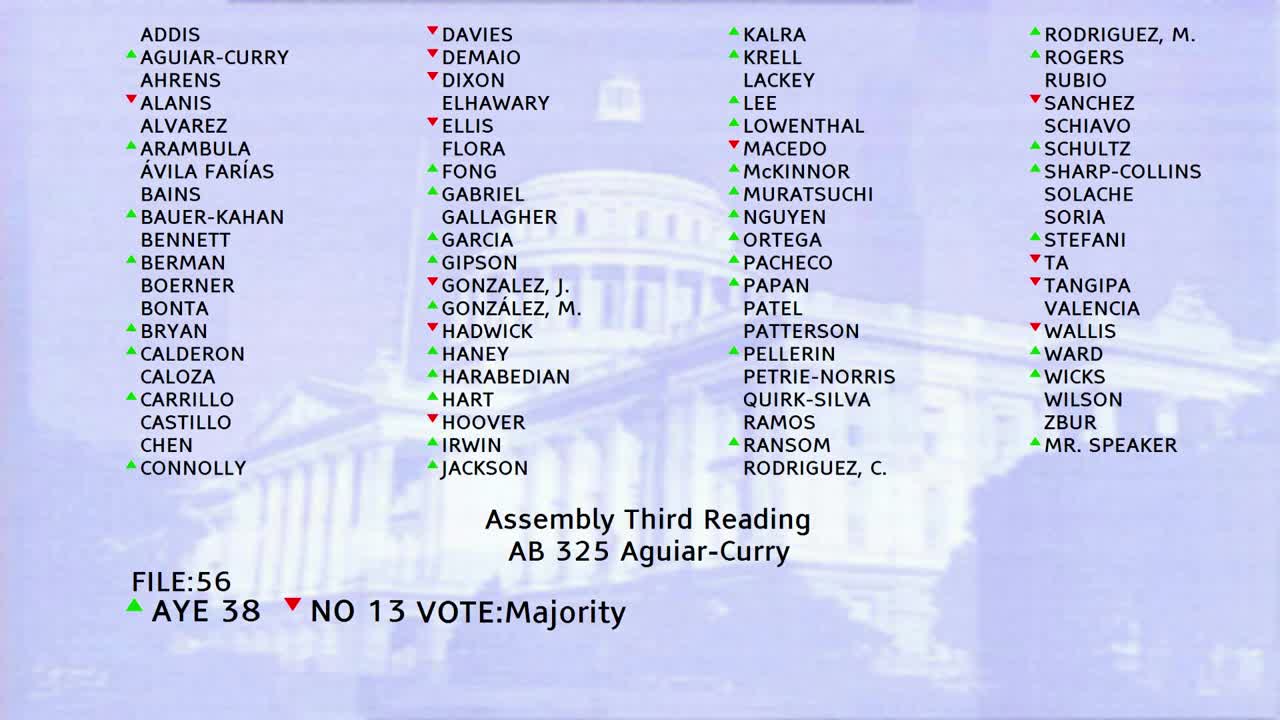 1MIN
Assembly Floor
 15MIN
Assembly Standing Committee on Judiciary
 30MIN
Assembly Standing Committee on Public Safety
Bill Author

Bill Co-Author(s):