AB 484: California bar examination.
- Session Year: 2025-2026
- House: Assembly
- Latest Version Date: 2025-10-01
Current Status:
Passed
(2025-10-01: Chaptered by Secretary of State - Chapter 155, Statutes of 2025.)
Introduced
In Committee
Awaiting First Chamber Vote
Passed First Chamber
In Committee
Awaiting Second Chamber Vote
Passed Second Chamber
Enacted
The State Bar Act provides for the licensure and regulation of attorneys by the State Bar of California, a public corporation governed by a board of trustees. Existing law authorizes the board of trustees to establish an examining committee, also known as the Committee of Bar Examiners, and requires an applicant for a license to practice law to pass the general bar examination, known as the California bar examination, given by the examining committee. Existing law prohibits the examining committee from altering the bar examination in a manner that requires the substantial modification of the training or preparation required for passage of the examination, except after giving 2 years notice of that change.
This bill would require the Committee of Bar Examiners to provide a report to the board of trustees, the Chief Justice of the California Supreme Court, and to the Assembly and Senate Committees on Judiciary on whether adopting a uniform bar examination would be more efficient to administer and lower the cost of administration for the State Bar and examinees. The bill would repeal those provisions on January 1, 2030.
The State Bar Act provides for the licensure and regulation of attorneys by the State Bar of California, a public corporation governed by a board of trustees. Existing law authorizes the board of trustees to establish an examining committee, also known as the Committee of Bar Examiners, and requires an applicant for a license to practice law to pass the general bar examination, known as the California bar examination, given by the examining committee. Existing law prohibits the examining committee from altering the bar examination in a manner that requires the substantial modification of the training or preparation required for passage of the examination, except after giving 2 years notice of that change.
This bill would require the State Bar, prior to making any alterations to the bar examination, to complete a cost-benefit analysis and transmit the analysis to the Supreme Court and the Legislature. The bill would require the cost-benefit analysis to include, among other information, the cost of implementing the alteration and any new technological requirements necessary to administer or take the examination. Committee of Bar Examiners to provide a report to the board of trustees, the Chief Justice of the Supreme Court, and to the Assembly and Senate Committees on Judiciary on whether adopting a uniform bar examination would be more efficient to administer and lower the cost of administration for the State Bar and examinees. The bill would repeal those provisions on January 1, 2030.
The State Bar Act provides for the licensure and regulation of attorneys by the State Bar of California, a public corporation governed by a board of trustees. Existing law authorizes the board of trustees to establish an examining committee, and requires an applicant for a license to practice law to pass the general bar examination, known as the California bar examination, given by the examining committee. Existing law prohibits the examining committee from altering the bar examination in a manner that requires the substantial modification of the training or preparation required for passage of the examination, except after giving 2 years notice of that change.
This bill would repeal that prohibition and, instead, would require the examining committee, on January 1, 2028, to replace the California bar examination with the Uniform Bar Examination created by the National Conference of Bar Examiners. require the State Bar, prior to making any alterations to the bar examination, to complete a cost-benefit analysis and transmit the analysis to the Supreme Court and the Legislature. The bill would require the cost-benefit analysis to include, among other information, the cost of implementing the alteration and any new technological requirements necessary to administer or take the examination.
The State Bar Act provides for the licensure and regulation of attorneys by the State Bar of California, a public corporation governed by a board of trustees. Existing law authorizes the board of trustees to establish an examining committee, and requires an applicant for a license to practice law to pass the general bar examination, known as the California bar examination, given by the examining committee. Existing law prohibits the examining committee from altering the bar examination in a manner that requires the substantial modification of the training or preparation required for passage of the examination, except after giving 2 years notice of that change.
This bill would repeal that prohibition and, instead, would require the examining committee, on January 1, 2028, to replace the California bar examination with the Uniform Bar Examination created by the National Conference of Bar Examiners.
Existing law identifies various types of property of a judgment debtor that are exempt from the enforcement of a money judgment, including material that in good faith is about to be applied to the repair or improvement of a residence, as specified.This bill would clarify that this exemption would apply to the judgment debtors principal place of residence or domicile.Existing law identifies various types of property of a judgment debtor that are exempt from the enforcement of a money judgment, including material that in good faith is about to be applied to the repair or improvement of a residence, as specified.
This bill would clarify that this exemption would apply to the judgment debtors principal place of residence or domicile.
(a)On or before November 30, 2026, the Committee of Bar Examiners shall provide a report to the board of trustees, the Chief Justice of the California Supreme Court, and to the Assembly and Senate Committees on Judiciary pursuant to Section 9795 of the Government Code on whether adopting a uniform bar examination, including, but not limited to, the National Conference of Bar Examiners Uniform Bar Examination or any successor or replacement of that exam, would be more efficient to administer and lower the cost of administration for the State Bar and examinees.
(b)This section is repealed on January 1, 2030, pursuant to Section 10231.5 of the Government Code.
(a)On or before November 30, 2026, the Committee of Bar Examiners shall provide a report to the board of trustees, the Chief Justice of the California Supreme Court, and to the Assembly and Senate Committees on Judiciary pursuant to Section 9795 of the Government Code on whether adopting a uniform bar examination, including, but not limited to, the National Conference of Bar Examiners Uniform Bar Examination, Examination or any successor or replacement of that exam, would be more efficient to administer and lower the cost of administration for the State Bar and examinees.
(b)This section is repealed on January 1, 2030, pursuant to Section 10231.5 of the Government Code.
(a)On or before November 30, 2026, the Committee of Bar Examiners shall provide a report to the board of trustees, the Chief Justice of the Supreme Court, and to the Assembly and Senate Committees on Judiciary pursuant to Section 9795 of the Government Code on whether adopting a uniform bar examination, including, but not limited to, the National Conference of Bar Examiners Uniform Bar Examination, would be more efficient to administer and lower the cost of administration for the State Bar and examinees.
(b)This section is repealed on January 1, 2030, pursuant to Section 10231.5 of the Government Code.
SECTION 1.Section 6046.6 of the Business and Professions Code is amended to read:6046.6.(a)The examining committee shall not alter the bar examination in a manner that requires the substantial modification of the training or preparation required for passage of the examination, except after giving two years notice of that change. This requirement does not apply to a change in the bar examination that is applicable only at the option of the applicant.(b)The examining committee shall communicate and cooperate with the Law School Council.(c)(1)Prior to making any alterations to the bar examination, the State Bar shall complete a cost-benefit analysis and transmit the analysis to the Supreme Court and the Legislature.(2)The cost-benefit analysis required by paragraph (1) shall address the following:(A)The cost of implementing the alteration, including any savings that may result.(B)Whether adopting a uniform bar examination, including, but not limited to, the National Conference of Bar Examiners Uniform Bar Examination, would be more efficient to administer and lower the cost of administration for the State Bar and examinees.(C)Any new technological requirements necessary to administer or to take the examination as a result of the alteration.(D)The projected number of in-person testing locations necessary to administer the bar examination following the proposed alteration.(E)The projected number of permanent and temporary staff necessary to administer the bar examination following the proposed alteration.(F)Any additional costs to examinees and law schools as a result of the alteration.(G)Any additional cost considerations that the State Bar deems necessary to fully evaluate any alteration to the bar examination.(d)Scaling may be used on the bar examination for the purpose of maintaining an examination of uniform difficulty from year to year.(a)The examining committee shall not alter the bar examination in a manner that requires the substantial modification of the training or preparation required for passage of the examination, except after giving two years notice of that change. This requirement does not apply to a change in the bar examination that is applicable only at the option of the applicant.
(b)The examining committee shall communicate and cooperate with the Law School Council.
(c)(1)Prior to making any alterations to the bar examination, the State Bar shall complete a cost-benefit analysis and transmit the analysis to the Supreme Court and the Legislature.
(2)The cost-benefit analysis required by paragraph (1) shall address the following:
(A)The cost of implementing the alteration, including any savings that may result.
(B)Whether adopting a uniform bar examination, including, but not limited to, the National Conference of Bar Examiners Uniform Bar Examination, would be more efficient to administer and lower the cost of administration for the State Bar and examinees.
(C)Any new technological requirements necessary to administer or to take the examination as a result of the alteration.
(D)The projected number of in-person testing locations necessary to administer the bar examination following the proposed alteration.
(E)The projected number of permanent and temporary staff necessary to administer the bar examination following the proposed alteration.
(F)Any additional costs to examinees and law schools as a result of the alteration.
(G)Any additional cost considerations that the State Bar deems necessary to fully evaluate any alteration to the bar examination.
(c)(d)Scaling may be used on the bar examination for the purpose of maintaining an examination of uniform difficulty from year to year.
SECTION 1.Section 6046.6 of the Business and Professions Code is repealed.SEC. 2.Section 6046.6 is added to the Business and Professions Code, to read:6046.6.On January 1, 2028, the examining committee shall replace the California bar examination with the Uniform Bar Examination created by the National Conference of Bar Examiners.On January 1, 2028, the examining committee shall replace the California bar examination with the Uniform Bar Examination created by the National Conference of Bar Examiners.
SECTION 1.Section 704.030 of the Code of Civil Procedure is amended to read:704.030.Material that in good faith is about to be applied to the repair or improvement of a residence is exempt if the equity in the material does not exceed three thousand five hundred dollars ($3,500) in the following cases:(a)If purchased in good faith for use in the repair or improvement of the judgment debtors principal place of residence or domicile.(b)Where the judgment debtor and the judgment debtors spouse live separate and apart, if purchased in good faith for use in the repair or improvement of the spouses principal place of residence or domicile.Material that in good faith is about to be applied to the repair or improvement of a residence is exempt if the equity in the material does not exceed three thousand five hundred dollars ($3,500) in the following cases:
(a)If purchased in good faith for use in the repair or improvement of the judgment debtors principal place of residence. residence or domicile.
(b)Where the judgment debtor and the judgment debtors spouse live separate and apart, if purchased in good faith for use in the repair or improvement of the spouses principal place of residence. residence or domicile.
|
Date
|
Status
|
|---|---|
| Oct 1, 2025 | Chaptered by Secretary of State - Chapter 155, Statutes of 2025. |
| Oct 1, 2025 | Approved by the Governor. |
| Sep 24, 2025 | Enrolled and presented to the Governor at 3 p.m. |
| Sep 13, 2025 | Senate amendments concurred in. To Engrossing and Enrolling. (Ayes 73. Noes 0. Page 3502.). |
| Sep 13, 2025 | Joint Rules 61(a)(14) and 51(a)(4) suspended. (Ayes 59. Noes 20. Page 3413.) |
| Sep 12, 2025 | In Assembly. Concurrence in Senate amendments pending. |
| Sep 11, 2025 | Read third time. Passed. Ordered to the Assembly. (Ayes 40. Noes 0. Page 2883.). |
| Jul 10, 2025 | Ordered to third reading. |
| Jul 10, 2025 | From Consent Calendar. |
| Jul 3, 2025 | Read second time and amended. Ordered to consent calendar. |
| Jul 2, 2025 | From committee: Amend, and do pass as amended. To Consent Calendar. (Ayes 13. Noes 0.) (July 1). |
| Jun 19, 2025 | From committee chair, with author's amendments: Amend, and re-refer to committee. Read second time, amended, and re-referred to Com. on JUD. |
| May 7, 2025 | Referred to Com. on JUD. |
| Apr 21, 2025 | In Senate. Read first time. To Com. on RLS. for assignment. |
| Apr 21, 2025 | Read third time. Passed. Ordered to the Senate. (Ayes 73. Noes 0. Page 1176.) |
| Apr 9, 2025 | Read second time. Ordered to Consent Calendar. |
| Apr 8, 2025 | From committee: Do pass. To Consent Calendar. (Ayes 12. Noes 0.) (April 8). |
| Apr 2, 2025 | Re-referred to Com. on JUD. |
| Apr 1, 2025 | From committee chair, with author's amendments: Amend, and re-refer to Com. on JUD. Read second time and amended. |
| Mar 24, 2025 | Re-referred to Com. on JUD. |
| Mar 20, 2025 | From committee chair, with author's amendments: Amend, and re-refer to Com. on JUD. Read second time and amended. |
| Mar 13, 2025 | In committee: Hearing postponed by committee. |
| Mar 3, 2025 | Referred to Com. on JUD. |
| Feb 11, 2025 | From printer. May be heard in committee March 13. |
| Feb 10, 2025 | Read first time. To print. |
|
Date
|
Description
|
Location
|
Votes
|
|
|---|---|---|---|---|
| Sep 13, 2025 | AB 484 Dixon Concurrence in Senate Amendments | Assembly Floor |
Passed |
|
| Sep 11, 2025 | Assembly 3rd Reading AB484 Dixon By Umberg | Senate Floor |
Passed |
|
| Jul 1, 2025 | Do pass as amended, and be ordered to the Consent Calendar | Senate Standing Committee on Judiciary |
Passed |
|
| Apr 21, 2025 | AB 484 Dixon Consent Calendar Second Day Regular Session | Assembly Floor |
Passed |
|
| Apr 8, 2025 | Do pass. To Consent Calendar. | Assembly Standing Committee on Judiciary |
Passed |
This list shows positions taken on this bill by organizations on the date displayed, which is linked to the original source.
Positions by individuals are not included.
CONCURRENCE IN SENATE AMENDMENTS
CSA1 Bill Id:AB 484
Author:(Dixon)
As Amended Ver:July 3, 2025
Majority vote
SUMMARY
Requires the Committee of Bar Examiners State Bar of California to provide a report to the Supreme Court and Legislature regarding whether adopting a uniform bar examination would be more efficient to administer and lower the cost of administration for the State Bar and examinees.
Major Provisions
- Requires the Committee of Bar Examiners of the State Bar of California, on or before November 30, 2026, to provide a report to the board of trustees, the Chief Justice of the California Supreme Court, and to the Assembly and Senate Committees on Judiciary whether adopting a uniform bar examination would be more efficient to administer and lower the cost of administration for the State Bar and examinees
- Repeals the bill on January 1, 2030.
Senate Amendments
- Revise and recast the study provisions of the bill from a cost-benefit analysis to a report to the Supreme Court and Legislature regarding the efficiency of uniform bar examinations.
- Adopt a sunset clause.
COMMENTS
In August of 2024, trying to reduce costs and improve examinee experiences, the State Bar of California announced major reforms to the biannual general bar examination. The new exam would be developed by Kaplan Exam Services, administered by a testing company called Meazure Learning, and designed to permit students to take the exam remotely or at local testing centers in lieu of the mass testing facilities historically utilized to administer the California bar exam.
The first administration of the new exam, in February 2025, was an unmitigated disaster. The exam was plagued with technical problems, communication errors between the State Bar and examinees, and a less-than-transparent response to the debacle by State Bar leadership. Recognizing that some of the issues that plagued the 2025 exam could be repeated if the State Bar continued administering the bar exam remotely, this bill requires the State Auditor to examine what occurred during the February exam and report to the Legislature how various contracts were awarded and what senior State Bar officials did in the lead up to the exam.
Immediately after the State Bar adopted the new exam, and announced a proposed November 2024 "trial" of the exam system, members of the legal community began raising alarms about the speed of the deployment of the new exam. In September 2024, the deans of California's most prominent law schools wrote to the State Bar, expressing their concerns. The deans argued, "Rushing implementation of something so important to individuals' lives and to the practice of law in the state of California is a mistake." (Julianne Hill, California law deans have 'grave concerns' about new bar exam plans, ABA Journal (Sept. 20, 2024) available at: https://www.abajournal.com/web/article/california-deans-declare-grave-concerns-about-new-bar-exam-plans.) After a second test run of the exam software in January, examinees' concerns about the new remote exam system began to spill into the public view via a popular Reddit page utilized by would-be examinees. (https://www.reddit.com/r/CABarExam/.) The concerns spanned a range of issues: from examinees being unable to connect to the test system, experiencing system time lags, and receiving various error messages, to the general non-responsiveness of the State Bar's contractor's technical support staff. (Ibid.) By mid-February, it appeared that the State Bar had recognized the impending risk of a disastrous exam administration and preemptively offered a full refund to all February 2025 examinees who rescheduled their exam for July 2025. (Joe Patrice, California Bar Exam Disaster Reaches Its 'Offer Everyone A Refund' Stage, Above the Law (Feb. 18, 2025) available at: https://abovethelaw.com/2025/02/california-bar-exam-disaster-reaches-its-offer-everyone-a-refund-stage/.)
Unfortunately, many of the worst-case scenarios envisioned by the examinees came to fruition during the administration of the February exam. Examinees described delays of up to one hour to commence the online exam; frequent disconnections from the exam system; significant system lags for those who did connect; and the exam system preemptively saving and submitting incomplete answers prior to examinees completing portions of the exam. (Jennie Jarvie, 'Utterly Botched': Glitchy rollout of new California bar exam prompts lawsuit and legislative review, Los Angeles Times (February 28, 2025) available at: https://www.latimes.com/california/story/2025-02-28/utterly-botched-chaotic-roll-out-of-new-california-bar-exam.) As a result of the obvious technological issues that doomed the exam, nearly 90 students were offered the ability to retake the test. (https://calbar.primegov.com/Portal/Meeting?meetingTemplateId=1054.) Additionally, hundreds of test takers are now regular participants during public comment at State Bar Board of Trustees meetings, where they seek to vent their frustration at the State Bar and seek equitable remedies for the February exam debacle. Although the exact cause of the February 2025 exam debacle will be better illuminated after the State Bar and the Legislature audit the exam, some evidence suggests that many of the problems that plagued the test could have been avoided if the State Bar had not deployed an entirely new exam in a relatively short six-month period.
Seeking to ensure that a February 2025 exam-level catastrophe never happens again, this bill requires the State Bar to determine if utilizing uniform bar examination will result in greater efficiencies than continuing to deploy a California-specific examination. This bill recognizes that the California Constitution provides for an explicit separation of powers between the three branches of government. Indeed, Article III, section 3, of the California Constitution provides, "The powers of State government are legislative, executive, and judicial. Persons charged with the exercise of one power may not exercise either of the others except as permitted by this Constitution." California courts have declined to adopt strict demarcations between the three branches of government, and as it relates to the interplay between the courts and the Legislature, the Supreme Court has generally upheld Legislative mandates to the court so long as those mandates do not "defeat" or "materially impair" ' the core constitutional functions of the courts. (People v. Bunn (2002) 27 Cal.4th 1, 16.) For nearly 100 years, California's Supreme Court has held that licensing attorneys, who are legally officers of the court, is an inherent power of the Supreme Court. (In re Lavine (1935) 2 Cal. 2d 326.) This power is codified in Rule 9.3 of the California Rules of Court and such an interpretation of the law was upheld by the Ninth Circuit as recently as 2024. (Pell v. Nunez (9th Cir. 2024) 99 F.4th 1128.)
This measure prudently recognizes and respects the Supreme Court’s role in admissions. It should be noted that this bill does not dictate the format of the general bar examination to the judicial branch, but rather requires the Committee of Bar Examiners within the State Bar (a “Judicial Branch Agency”) to conduct a study weighing the merits utilizing uniform bar examinations. While this bill seeks to ensure that the Supreme Court and the State Bar are fully considering all ramifications of a change to the general bar exam, a power that appears to be well within the Legislature’s ability to oversee as a co-equal branch of government, the bill does not dictate outcomes in an area of the law that represents an inherent power of the court. Following the issues that plagued the February 2025, one can argue that it is reasonable and prudent for the Legislature to direct the judicial branch to better study and consider decisions related to the bar examination to ensure that the everyday Californians who take the test can be assured that the exam is fair and can be competently administered.
According to the Author
AB 484 will address the recent shortcomings and critical failures within the California State Bar exam by establishing necessary safeguards and mechanisms to ensure students are able to complete the California State Bar examination without unnecessary and entirely avoidable flaws. This measure will require the California State Bar to conduct a cost-benefit analysis and submit its findings to the California Supreme Court and the Legislature before making any changes to the California Bar Examination. California has a long history of being a model for the nation and this bill will take necessary steps to ensure that our State Bar Examination continues to uphold this standard.
Arguments in Support
None on file
Arguments in Opposition
None on file
FISCAL COMMENTS
None
VOTES:
ASM JUDICIARY: 12-0-0
YES: Kalra, Dixon, Wicks, Bryan, Connolly, Harabedian, Pacheco, Papan, Sanchez, Stefani, Zbur, Tangipa
ASSEMBLY FLOOR: 73-0-6
YES: Addis, Aguiar-Curry, Ahrens, Alanis, Alvarez, Arambula, Ávila Farías, Bains, Bauer‑Kahan, Bennett, Berman, Boerner, Bonta, Bryan, Calderon, Caloza, Carrillo, Castillo, Chen, Connolly, Davies, DeMaio, Dixon, Elhawary, Ellis, Flora, Fong, Gabriel, Garcia, Gipson, Jeff Gonzalez, Mark González, Hadwick, Haney, Harabedian, Hart, Hoover, Irwin, Jackson, Kalra, Krell, Lackey, Lee, Lowenthal, Macedo, McKinnor, Muratsuchi, Nguyen, Ortega, Pacheco, Patel, Patterson, Pellerin, Petrie-Norris, Quirk-Silva, Ransom, Celeste Rodriguez, Michelle Rodriguez, Rogers, Blanca Rubio, Sanchez, Schiavo, Solache, Soria, Stefani, Ta, Tangipa, Wallis, Ward, Wicks, Wilson, Zbur, Rivas
ABS, ABST OR NV: Gallagher, Papan, Ramos, Schultz, Sharp-Collins, Valencia
UPDATED
VERSION: July 3, 2025
CONSULTANT: Nicholas Liedtke / JUD. / (916) 319-2334 FN: 0001807
SENATE RULES COMMITTEE Office of Senate Floor Analyses (916) 651-1520 Fax: (916) 327-4478 | AB 484 |
THIRD READING
Bill No: AB 484
Author: Dixon (R)
Amended: 7/3/25 in Senate
Vote: 21
SENATE JUDICIARY COMMITTEE: 13-0, 7/1/25
AYES: Umberg, Niello, Allen, Arreguín, Ashby, Caballero, Durazo, Laird, Stern, Valladares, Wahab, Weber Pierson, Wiener
ASSEMBLY FLOOR: 73-0, 4/21/25 (Consent) - See last page for vote
SUBJECT: California bar examination
SOURCE: Author
DIGEST:
This bill requires the Committee of Bar Examiners to provide a report on whether adopting a uniform bar examination, including, but not limited to, the National Conference of Bar Examiners' Uniform Bar Examination, would be more efficient to administer and lower the cost of administration for the State Bar and examinees, as specified.
ANALYSIS:
Existing law:
- Requires all attorneys who practice law in California to be licensed by the State Bar and establishes the State Bar, within the judicial branch of state government, for the purpose of regulating the legal profession. (California Constitution, art. VI, § 9; Business & Professions (Bus. & Prof.) Code §§ 6000 et seq.):
- The Legislature sets the annual fees. (Bus. & Prof. Code § 6140, 6141.)
- The State Bar is governed by the Board of Trustees of the State Bar (Board). (Bus. & Prof. Code §§ 6010 et seq.; § 6016.)
- Establishes the State Bar Act as the statutory requirements regulating the practice of law in this state. (Bus. & Prof. Code §§ 6000 et seq.)
- Establishes that protection of the public, which includes support for greater access to, and inclusion in, the legal system, is the highest priority for the State Bar in exercising their licensing, regulatory, and disciplinary functions. Whenever the protection of the public is inconsistent with other interests sought to be promoted, the protection of the public is to be paramount. (Bus. & Prof. Code § 6001.1.)
- Authorizes the Board to establish an examining committee (hereafter the Committee of Bar Examiners or CBE) having the power to:
- Examine all applicants for admission to practice law;
- Administer the requirements for admission to practice law; and
- Certify to the Supreme Court for admission those applicants who fulfill the requirements provided in Chapter 4 of the State Bar Act. (Bus. & Prof. Code § 6046.)
- Provides various requirements a person must meet to be certified to the California Supreme Court for admission to practice law in this state, including passing the general bar examination given by the Committee of Bar Examiners. (Bus. & Prof. Code § 6060(g).) The Supreme Court admits persons to practice law in this state.
- Prohibits the Committee of Bar Examiners from altering the bar exam in a manner that requires the substantial modification of the training or preparation required for passage of the examination, except after giving two years’ notice of that change. (Bus. & Prof. Code § 6046.6.)
This bill:
- Requires the Committee of Bar Examiners to provide a report to the Board, the Chief Justice of the California Supreme Court, and to the Assembly and Senate Committees on Judiciary on whether adopting a uniform bar examination, including, but not limited to, the National Conference of Bar Examiners' Uniform Bar Examination or any successor or replacement of that exam, would be more efficient to administer and lower the cost of administration for the State Bar and examinees.
- Requires the report to be submitted no later than November 30, 2026, and repeals these provisions on January 1, 2030.
Comments
The bar exam is comprised of three components: five one-hour essay questions, one 90-minute performance test, and 200 multiple-choice questions. The State Bar used a new exam format and platform for the first time in decades for the February 2025 exam that allowed for both in-person and remote test taking.[1] The State Bar stated that the new exam platform and format “will enable the State Bar to utilize multiple-choice questions developed by Kaplan Exam Services, LLC (Kaplan) rather than purchase the MBE from the [NCBE] and to engage ProctorU, Inc. d/b/a/ Meazure Learning (Meazure Learning) to administer the examination remotely or at Meazure Learning’s test centers.”[2] Prior to 2025, the bar exam was always administered in-person at various locations throughout the state by the State Bar with the exception of during the COVID-19 pandemic. The State Bar’s rationale for moving to the new exam platform and format was predominantly a cost saving measure.
According to widespread reports outlined in news articles, a letter signed by California’s law school deans, and numerous phone calls and emails received by the Committee and author of this bill, the February administration of the State Bar Exam was an utter failure. Reports of difficulties included: inability to log in or access the test, unstable servers, issues with proctors, lost time, delayed prompts, factual errors in questions, and the inability to start or finish exam components. Of the 5,600 people registered for the exam, more than 964 withdrew before the day of the exam, after the bar offered unprecedented refunds in the face of technological problems that rose during pre-mock exams and issues with scheduling locations to take the exam. As noted by Dean Erwin Chemerinsky of the UC Berkeley School of Law this 2025 bar exam was “stunning incompetence from an entity that exists to measure competence.”[3] In conversations with the State Bar and Committee staff, it was indicated that virtually every examinee experienced some issue on the bar exam.
The California Supreme Court released a statement following the bar exam debacle:
The court is deeply concerned by the troubling reports of technical failures, delays, and other irregularities in last week’s administration of the February 2025 California Bar Examination. The court regrets this situation and apologizes for the disappointment, stress, and frustration experienced by some applicants. At present, the complete scope and causes of the problems are still being determined. Last week, the court asked the State Bar, in conjunction with the vendor responsible for administering the exam, to provide an expedited, detailed report regarding the problems encountered by applicants. This information is crucial in informing how the court will provide appropriate remedies for affected applicants who deserved and expected better. In the interim, the court directs the State Bar to plan on administering the July 2025 California Bar Examination in the traditional in-person format.[4]
After the first day of the February Bar Exam, the State Bar released a statement to all examinees, stating that “[i]n advance of the exam, the State Bar took measures to ensure that a makeup opportunity would be available, if needed, for applicants who experienced significant technical issues. As such, we had already planned to offer a makeup opportunity[…]”[5] However, the State Bar criteria for a makeup exam was so limited that only about 91 examinees were eligible for the makeup exam. Two class action lawsuits have been filed against Meazure Learning in the wake of this fiasco.[6]
The State Bar approved a proposal to allow test takers who withdraw from the February 2025 exam or fail the exam to take a bar exam within the next year for free.[7] The Board approved $3.1 million in the budget to support these fee waivers.[8]
Additionally, the State Bar:
- Offered reimbursement of nonreimburseable travel expenses for out-of-state, in-person test takers who moved to more local sites in the Central and Eastern time zones;
- Extended similar reimbursement offers to those who have had their location changed after registering, or those who changed sites because of the late opening of new locations;
- Offered stipends for applicants with testing accommodations (TA) who were moved at the last minute to the State Bar’s Los Angeles office or to other TA testing locations; and
- Offered full refunds to applicants affected by the Los Angeles wildfires if they chose to withdraw, and on February 13, extended the offer of full refunds to any applicant who decided to withdraw before the exam.[9]
The Board has initiated an independent investigation of the 2025 bar exam. The cost of the February 2025 exam fiasco could cost the State Bar an additional $5.6 million.[10]
The Uniform Bar Exam (UBE) is coordinated and created by the National Conference of Bar Examiners (NCBE). It is composed of a multistate essay examination, a multistate performance test, and the multistate bar examination (MBE). Forty states and the District of Columbia have adopted the UBE, as well as the U.S. Virgin Islands.[11] According to the NCBE, “the UBE is designed to test knowledge and skills that every lawyer should be able to demonstrate prior to becoming licensed to practice law,” is “uniformly administered, graded, and scored,” and “results in a portable score that can be used to apply for admission in other UBE jurisdictions.”[12] A candidate must sit for all portions of the UBE in the same UBE jurisdiction and in the same administration in order to earn a portable UBE score.[13]
The administering jurisdiction retains control over all of the following:
- who may sit for the bar exam and who will be admitted to practice;
- underlying educational requirements to sit for the exam;
- all character and fitness decisions;
- policies regarding the number of times applicants may retake the bar examination;
- any ADA decisions;
- grading of the essay and performance test portion of the exam;
- assessment of candidate knowledge of jurisdiction-specific content through a separate test, course, or some combination of the two if the jurisdiction chooses;
- acceptance of MBE scores earned in a previous examination or concurrently in another jurisdiction for purposes of making local admission decisions if they wish; and
- determinations regarding how long incoming UBE scores will be accepted.
The NCBE is in the process of launching the NextGen bar exam, which would replace the UBE through a phase out process with the last administration of the UBE occurring in February 2028.[14] According to the NCBE, the NextGen bar exam is “guided by the results of a comprehensive, empirical three-year study and consistent with testing industry professional standards.”[15]
FISCAL EFFECT: Appropriation: No Fiscal Com.: No Local: No
SUPPORT: (Verified 7/3/25)
None received
OPPOSITION: (Verified 7/3/25)
None received
ARGUMENTS IN SUPPORT: The author writes:
AB 484 is a first step in addressing significant shortcomings and critical errors that have been encountered during the administration of recent State Bar examinations in California. AB 484 will assist in increasing transparency by requiring the Committee of Bar Examiners to provide a report to the board of trustees, the Chief Justice of the Supreme Court, and to the Assembly and Senate Committees on Judiciary pursuant 9795 of the Government Code by November 30th, 2026. The report will be on whether adopting a uniform bar examination, including, but not limited to, the National Conference of Bar Examiners’ (NCBE) Uniform Bar Examination, would be more efficient to administer and lower the cost of administration for the State bar and Examinees. This will provide the California Legislature and the Supreme Court with vital information to make decisions on test implementation moving forward as well as the feasibility of adopting the NCBE’s Uniform Bar Examination.
ASSEMBLY FLOOR: 73-0, 4/21/25
AYES: Addis, Aguiar-Curry, Ahrens, Alanis, Alvarez, Arambula, Ávila Farías, Bains, Bauer-Kahan, Bennett, Berman, Boerner, Bonta, Bryan, Calderon, Caloza, Carrillo, Castillo, Chen, Connolly, Davies, DeMaio, Dixon, Elhawary, Ellis, Flora, Fong, Gabriel, Garcia, Gipson, Jeff Gonzalez, Mark González, Hadwick, Haney, Harabedian, Hart, Hoover, Irwin, Jackson, Kalra, Krell, Lackey, Lee, Lowenthal, Macedo, McKinnor, Muratsuchi, Nguyen, Ortega, Pacheco, Patel, Patterson, Pellerin, Petrie-Norris, Quirk-Silva, Ransom, Celeste Rodriguez, Michelle Rodriguez, Rogers, Blanca Rubio, Sanchez, Schiavo, Solache, Soria, Stefani, Ta, Tangipa, Wallis, Ward, Wicks, Wilson, Zbur, Rivas
NO VOTE RECORDED: Gallagher, Papan, Ramos, Schultz, Sharp-Collins, Valencia
Prepared by: Amanda Mattson / JUD. / (916) 651-4113
7/10/25 9:41:28
**** END ****
Olivia Hebert, SF Gate, California's new bar exam launch was a 'disaster.' Now test takers are suing. (Feb. 28, 2025), available at https://www.sfgate.com/california/article/california-bar-exam-march-retakes-20192958.php. ↑
Renewed Request that the Supreme Court Approve Proposed Modifications to the California Bar Examination, (Cal. Supreme Court (Oct. 2024) S287231) at p. 4, available at https://www.calbar.ca.gov/portals/0/documents/admissions/examinations/Renewed-Request-to-Approve-Proposed-Modifications-to-the-CA-Bar-Examination.pdf. ↑
Malcolm Maclachlan, Daily Journal, California Bar exam failure sparks lawsuit, legislative inquiry, (mar. 3, 2025), available at https://www.dailyjournal.com/articles/383949-california-bar-exam-failure-sparks-lawsuit-legislative-inquiry?utm_source=ActiveCampaign&utm_medium=email&utm_content=Legal%20battle%20over%20Point%20Reyes%20ranching%20deal%20escalates&utm_campaign=Legal%20News%203%2F3&vgo_ee=cUekTHCZPyLa0dLz%2FgoXbTrxWqEMTgXT%2BgyPjC3Mn6xwO1644QLwGw%3D%3D%3ATT7IZwFcfYgN%2B46NDnKPDsLFczdr1him. ↑
California Supreme Court Issues Statement on February Bar Exam, Cal. Sup. Court, (Mar. 4, 2025), available at https://newsroom.courts.ca.gov/news/california-supreme-court-issues-statement-february-bar-exam. ↑
Olivia Hebert, DF Gate, California's new bar exam launch was a 'disaster.' Now test takers are suing. (Feb. 28, 2025), available at https://www.sfgate.com/california/article/california-bar-exam-march-retakes-20192958.php. ↑
Ibid. ↑
Board Offers Free July Bar Exam to Applicants Who Withdraw or Fail February Bar Exam, Cal. State Bar,(Feb. 21, 2025), available at https://www.calbar.ca.gov/About-Us/News/News-Releases/board-offers-free-july-bar-exam-to-applicants-who-withdraw-or-fail-february-bar-exam. ↑
Ibid. ↑
Ibid. ↑
Jenny Jarvie, After AI bar exam fiasco, State Bar of California faces deeper financial crisis, (update May 8, 2025), available at https://www.latimes.com/california/story/2025-05-07/after-botched-exams-california-state-bar-faces-deeper-financial-crisis#:~:text=The%20State%20Bar%20of%20California's,it%20an%20additional%20%245.6%20million. ↑
UBE, NCBE, available at https://www.ncbex.org/exams/ube/about-ube. ↑
Ibid. ↑
Ibid. ↑
Implementation Timeline, NextGen UBE, available at https://www.ncbex.org/exams/nextgen-july-2026/about/implementation-timeline. ↑
Ibid. ↑
Senator Thomas Umberg, Chair
2025-2026 Regular Session
Bill No: AB 484 (Author:Dixon)
Version: June 19, 2025
Hearing Date: July 1, 2025
Fiscal: No
Urgency: No
Consultant: AM
SUBJECT
California bar examination
DIGEST
This bill requires the Committee of Bar Examiners to provide a report on whether adopting a uniform bar examination, including, but not limited to, the National Conference of Bar Examiners' Uniform Bar Examination, would be more efficient to administer and lower the cost of administration for the State Bar and examinees, as specified.
EXECUTIVE SUMMARY
The State Bar of California (State Bar) is a public corporation and the largest state bar in the country. Every person seeking to be licensed to practice law in this state must pass the bar exam. The State Bar administers the bar exam twice a year—in February and July. The State Bar used a new exam format and platform for the first time in decades for the February 2025 exam that allowed for both in-person and remote test taking.[1] The administration of the new exam was an unmitigated disaster. Testimonies from examinees to the State Bar Board and to the Senate Judiciary Committee detailed technical glitches and platform freezes, delayed start times and loss of time during the exam, rude proctors, factual errors in questions, cheating, approved testing accommodations not being met, and various distractions during the exam, including screams of frustration by examinees and proctors arguing with each other. Additionally, concerns were raised about the multiple-choice questions on the exam. These concerns have only been exacerbated by the State Bar’s recent revelation that artificial intelligence (AI) was used to design some of the questions on the exam. This bill will require the State Bar to provide a report on whether adopting a uniform bar examination would be more efficient to administer and lower the cost of administration for the State Bar and examinees. This bill is author sponsored. The Committee received no timely support or opposition.
PROPOSED CHANGES TO THE LAW
Existing law:
- Requires all attorneys who practice law in California to be licensed by the State Bar and establishes the State Bar, within the judicial branch of state government, for the purpose of regulating the legal profession. (Cal. const., art. VI, § 9; Bus. & Prof. Code §§ 6000 et seq.)
- The Legislature sets the annual fees. (Bus. & Prof. Code § 6140, 6141.)
- The State Bar is governed by the Board of Trustees of the State Bar (Board). (Bus. & Prof. Code §§ 6010 et seq.; § 6016.)
- Establishes the State Bar Act as the statutory requirements regulating the practice of law in this state. (Bus. & Prof. Code §§ 6000 et seq.)
- Establishes that protection of the public, which includes support for greater access to, and inclusion in, the legal system, is the highest priority for the State Bar in exercising their licensing, regulatory, and disciplinary functions. Whenever the protection of the public is inconsistent with other interests sought to be promoted, the protection of the public is to be paramount. (Bus. & Prof. Code § 6001.1.)
- Authorizes the Board to establish an examining committee (hereafter the Committee of Bar Examiners or CBE) having the power to:
- examine all applicants for admission to practice law;
- administer the requirements for admission to practice law; and
- certify to the Supreme Court for admission those applicants who fulfill the requirements provided in Chapter 4 of the State Bar Act. (Bus. & Prof. Code § 6046.)
- Provides various requirements a person must meet to be certified to the California Supreme Court for admission to practice law in this state, including passing the general bar examination given by the Committee of Bar Examiners. (Bus. & Prof. Code § 6060(g).) The Supreme Court admits persons to practice law in this state.
- Prohibits the Committee of Bar Examiners from altering the bar exam in a manner that requires the substantial modification of the training or preparation required for passage of the examination, except after giving two years’ notice of that change. (Bus. & Prof. Code § 6046.6.)
This bill:
- Requires the Committee of Bar Examiners to provide a report to the Board, the Chief Justice of the Supreme Court, and to the Assembly and Senate Committees on Judiciary on whether adopting a uniform bar examination, including, but not limited to, the National Conference of Bar Examiners' Uniform Bar Examination, would be more efficient to administer and lower the cost of administration for the State Bar and examinees.
- Requires the report to be submitted no later than November 30, 2026, and repeals these provisions on January 1, 20230.
COMMENTS
- Stated need for the bill
The author writes:
AB 484 is a first step in addressing significant shortcomings and critical errors that have been encountered during the administration of recent State Bar examinations in California. AB 484 will assist in increasing transparency by requiring the Committee of Bar Examiners to provide a report to the board of trustees, the Chief Justice of the Supreme Court, and to the Assembly and Senate Committees on Judiciary pursuant 9795 of the Government Code by November 30th, 2026. The report will be on whether adopting a uniform bar examination, including, but not limited to, the National Conference of Bar Examiners’ (NCBE) Uniform Bar Examination, would be more efficient to administer and lower the cost of administration for the State bar and Examinees. This will provide the California Legislature and the Supreme Court with vital information to make decisions on test implementation moving forward as well as the feasibility of adopting the NCBE’s Uniform Bar Examination.
- State Bar of California functions as the administrative arm of the Supreme Court for the purpose of assisting in attorney admissions and discipline
As a constitutional matter, the judicial power of California is vested in the Supreme Court, Courts of Appeal, and superior courts. (Cal. Const., art. VI, Sec. 1.) (In re Attorney Discipline System (1998) 19 Cal.4th 582, 592; Obrien v. Jones (2000) 23 Cal.4th 40, 48.) In addressing this inherent authority to regulate the practice of law, the Supreme Court has explained: “’The important difference between regulation of the legal profession and regulation of other professions is this: Admission to the bar is a judicial function, and members of the bar are officers of the court, subject to discipline by the court. Hence, under the constitutional doctrine of separation of powers, the court has inherent and primary regulatory power.’” (In re Attorney Discipline System, supra, 19 Cal.4th at 593.) The State Bar functions as the administrative arm of the Supreme Court for the purpose of assisting in attorney admissions and discipline, with the court retaining its inherent judicial authority to disbar or suspend attorneys. (In re Attorney Discipline System, supra, 19 Cal.4th at 599-600; see Keller v. State Bar of California (1990) 496 U.S. 1, 11.)
Attorneys who wish to practice law in California generally must be admitted and licensed by the State Bar. (Cal. Const., art. VI, Sec. 9.) The State Bar of California is a public corporation. Although originally a creature of statute, the State Bar is now “a constitutional entity within the judicial article of the California Constitution.” (Obrien, supra, 23 Cal.4th at 48; see Cal. Const., art. VI, § 9; Bus. & Prof. Code, Sec. 6001.) The State Bar’s regulatory assistance is an integral part of the judicial function. (Obrien, supra, 23 Cal.4th at 48.) Emphasizing the sui generis nature of the State Bar as its administrative arm, the Supreme Court has made clear that “express legislative recognition of reserved judicial power over admission and discipline is critical to the constitutionality of the State Bar Act.” (In re Attorney Discipline System, supra, 19 Cal.4th at 600, citing Bus. & Prof. Code Sec. 6087.)
At the same time, the Legislature’s exercise, under the police power, of a reasonable degree of regulation and control over the profession and practice of law in California, is well established. (Obrien, supra, 23 Cal.4th at 48.) The Legislature exercises regulatory authority pursuant to the State Bar Act and has authority to set the amount of license fees necessary to fund the disciplinary system. The Legislature has enacted statutes making protection of the public the highest priority of the State Bar (Bus. & Prof. Code § 6001.1) and subjecting the CTC, the Executive Director, and the General Counsel of the State Bar to Senate confirmation (Bus. & Prof. Code §§ 6011; 6012; & 6079.5).
The State Bar of California is the largest state bar in the country. As of April 22, 2023, the total State Bar membership is 297,864, which includes 199,041 active licensees, 2,324 judge members, 19,848 licensees who are “Not Eligible to Practice Law,” and approximately 76,651 inactive members.[2] The State Bar’s programs are financed mostly by annual license fees paid by attorneys as well as other fees paid by applicants seeking to practice law. The State Bar is governed by a Board of Trustees (Board). Pursuant to SB 36 (Jackson, Ch. 422, Stats. 2017), the Board was required to transition to a 13 member Board comprised of Governor, Supreme Court, Assembly, and Senate appointees.
- Background on the California bar exam
The bar exam is comprised of three components: five one-hour essay questions, one 90-minute performance test, and 200 multiple-choice questions. The State Bar used a new exam format and platform for the first time in decades for the February 2025 exam that allowed for both in-person and remote test taking.[3] The State Bar stated that the new exam platform and format “will enable the State Bar to utilize multiple-choice questions developed by Kaplan Exam Services, LLC (Kaplan) rather than purchase the MBE from the [National Conference of Bar Examiners] and to engage ProctorU, Inc. d/b/a/ Meazure Learning (Meazure Learning) to administer the examination remotely or at Meazure Learning’s test centers.”[4] Prior to 2025, the bar exam was always administered in-person at various locations throughout the state by the State Bar with the exception of during the COVID-19 pandemic.
The State Bar’s rationale for moving to the new exam platform and format was predominantly a cost saving measure. The State Bar stated:
The agreement will help the State Bar transition to remote and test center-based exam administration, both of which test takers prefer. These test administration changes will also help the State Bar close a significant gap in its Admissions Fund, which is projected to reach insolvency in 2026, absent further efforts to reduce costs. The State Bar projects that the new arrangement will result in annual cost savings of up to $3.8 million in exam-related expenses—enough to significantly reduce if not fill the gap.[5]
The State Bar told to the Supreme Court that these changes to the bar exam “will allow the State Bar to efficiently administer the bar examination while ensuring examination security and integrity and eliminating unnecessary barriers to accessing the examination”[6]—tragically, none of these things came to fruition. The Supreme Court approved the State Bar’s request for modification to the bar exam on October 22, 2024 in an en banc order.[7]
- The administration of the February 2025 bar exam – “stunning incompetence from an entity that exists to measure competence”
According to widespread reports outlined in news articles, a letter signed by California’s law school deans, and numerous phone calls and emails received by the Committee and author of this bill, the February administration of the State Bar Exam was an utter failure. Reports of difficulties included: inability to log in or access the test, unstable servers, issues with proctors, lost time, delayed prompts, factual errors in questions, and the inability to start or finish exam components. Of the 5,600 people registered for the exam, more than 964 withdrew before the day of the exam, after the bar offered unprecedented refunds in the face of technological problems that rose during pre-mock exams and issues with scheduling locations to take the exam. As noted by Dean Erwin Chemerinsky of the UC Berkeley School of Law this 2025 bar exam was “stunning incompetence from an entity that exists to measure competence.”[8] In conversations with the State Bar and Committee staff, it was indicated that virtually every examinee experienced some issue on the bar exam.
The California Supreme Court released a statement following the bar exam debacle:
The court is deeply concerned by the troubling reports of technical failures, delays, and other irregularities in last week’s administration of the February 2025 California Bar Examination. The court regrets this situation and apologizes for the disappointment, stress, and frustration experienced by some applicants. At present, the complete scope and causes of the problems are still being determined. Last week, the court asked the State Bar, in conjunction with the vendor responsible for administering the exam, to provide an expedited, detailed report regarding the problems encountered by applicants. This information is crucial in informing how the court will provide appropriate remedies for affected applicants who deserved and expected better. In the interim, the court directs the State Bar to plan on administering the July 2025 California Bar Examination in the traditional in-person format.[9]
After the first day of the February Bar Exam, the State Bar released a statement to all examinees, stating that “[i]n advance of the exam, the State Bar took measures to ensure that a makeup opportunity would be available, if needed, for applicants who experienced significant technical issues. As such, we had already planned to offer a makeup opportunity[…]”[10] However, the State Bar criteria for a makeup exam was so limited that only about 91 examinees were eligible for the makeup exam. Two class action lawsuits have been filed against Meazure Learning in the wake of this fiasco.[11]
The State Bar approved a proposal to allow test takers who withdraw from the February 2025 exam or fail the exam to take a bar exam within the next year for free.[12] The Board approved $3.1 million in the budget to support these fee waivers.[13]
Additionally, the State Bar:
- offered reimbursement of nonreimburseable travel expenses for out-of-state, in-person test takers who moved to more local sites in the Central and Eastern time zones;
- extended similar reimbursement offers to those who have had their location changed after registering, or those who changed sites because of the late opening of new locations;
- offered stipends for applicants with testing accommodations (TA) who were moved at the last minute to the State Bar’s Los Angeles office or to other TA testing locations; and
- offered full refunds to applicants affected by the Los Angeles wildfires if they chose to withdraw, and on February 13, extended the offer of full refunds to any applicant who decided to withdraw before the exam.[14]
The Board has initiated an independent investigation of the 2025 bar exam. The cost of the February 2025 exam fiasco could cost the State Bar an additional $5.6 million.[15]
- Uniform Bar Exam (UBE)
The Uniform Bar Exam (UBE) is coordinated and created by the National Conference of Bar Examiners (NCBE). It is composed of a multistate essay examination, a multistate performance test, and the multistate bar examination (MBE). Forty states and the District of Columbia have adopted the UBE, as well as the U.S. Virgin Islands.[16] According to the NCBE, “the UBE is designed to test knowledge and skills that every lawyer should be able to demonstrate prior to becoming licensed to practice law,” is “uniformly administered, graded, and scored,” and “results in a portable score that can be used to apply for admission in other UBE jurisdictions.”[17] A candidate must sit for all portions of the UBE in the same UBE jurisdiction and in the same administration in order to earn a portable UBE score.[18]
The administering jurisdiction retains control over all of the following:
- who may sit for the bar exam and who will be admitted to practice;
- underlying educational requirements to sit for the exam;
- all character and fitness decisions;
- policies regarding the number of times applicants may retake the bar examination;
- any ADA decisions;
- grading of the essay and performance test portion of the exam;
- assessment of candidate knowledge of jurisdiction-specific content through a separate test, course, or some combination of the two if the jurisdiction chooses;
- acceptance of MBE scores earned in a previous examination or concurrently in another jurisdiction for purposes of making local admission decisions if they wish; and
- determinations regarding how long incoming UBE scores will be accepted.
The NCBE is in the process of launching the NextGen bar exam, which would replace the UBE through a phase out process with the last administration of the UBE occurring in February 2028.[19] According to the NCBE, the NextGen bar exam is “guided by the results of a comprehensive, empirical three-year study and consistent with testing industry professional standards.”[20]
- This bill requires the Committee of Bar Examiners to complete a report on the UBE
In light of the utter fiasco that was the 2025 February Bar Exam, this bill requires the Committee of Bar Examiners to provide a report to the Board, the Chief Justice of the Supreme Court, and to the Assembly and Senate Committees on Judiciary on whether adopting a uniform bar examination, including, but not limited to, the National Conference of Bar Examiners' Uniform Bar Examination, would be more efficient to administer and lower the cost of administration for the State Bar and examinees. The bill would require the report to be submitted no later than November 30, 2026.
- Amendment
As noted above, the NCBE is in the process of launching the NextGen bar exam, which would replace the UBE through a phase out process. In light of this, the author has agreed to amend the bill to include any future iteration or replacement of the UBE. The specific amendment is as follows:[21]
Section 6046.2 as added to the Business and Professions Code is amended to read:
6046.2. (a) On or before November 30, 2026, the Committee of Bar Examiners shall provide a report to the board of trustees, the Chief Justice of the California Supreme Court, and to the Assembly and Senate Committees on Judiciary pursuant to Section 9795 of the Government Code on whether adopting a uniform bar examination, including, but not limited to, the National Conference of Bar Examiners’ Uniform Bar Examination or any successor or replacement exam, would be more efficient to administer and lower the cost of administration for the State Bar and examinees.
(b) This section is repealed on January 1, 2030, pursuant to Section 10231.5 of the Government Code.
SUPPORT
None received
OPPOSITION
None received
RELATED LEGISLATION
Pending Legislation:
SB 47 (Umberg, 2025) requires the California State Auditor to conduct an audit of the February 2025 bar exam to evaluate its administration and how the problems with the exam occurred, as specified. SB 47 is currently pending on the Assembly floor.
SB 253 (Umberg, 2025) requires, among other things, the Board to fix the annual license fee for active licensees for 2026. SB 253 is currently pending on the Assembly floor.
Prior Legislation:
AB 3279 (Committee on Judiciary, Ch. 227, Stats. 2024) among other things increased active licensee fees by $88.
SB 40 (Umberg, Ch. 697, Stats. 2023) authorized the State Bar to collect annual licensing fees in the same amount as 2022 and made other changes, including strengthen conflict of interest statutes and requiring Senate confirmation of the executive director and general counsel of the State Bar.
AB 2958 (Committee on Judiciary, Ch. 419, Stats. 2022) authorized the State Bar to collect annual licensing fees of $395 for active licensees and $97.40 for inactive licensees and enacted other reforms.
SB 211 (Umberg, 2021, Ch. 723, Stats. 2021) authorized the State Bar to collect annual licensing fees of $395 for active licensees and $97.40 for inactive licensees and enacted other reforms. The bill required the Auditor’s Office to conduct an independent audit to determine if the discipline process adequately protects the public from misconduct by licensed attorneys or those who wrongfully hold themselves out as licensed attorneys.
AB 3362 (Committee on Judiciary, Ch. 360, Stats. 2020) authorized the State Bar to collect annual licensing fees of $395 for active licensees and $97.40 for inactive licensees and enacted other reforms.
SB 176 (Jackson, Ch. 698, Stats. 2019) authorized the State Bar to collect annual licensing fees of $438 for 2020 and enacted other reforms.
AB 3249 (Committee on Judiciary, Ch. 659, Stats. 2018) authorized the State Bar to collect annual licensing fees of $390 for 2019 and enacted other reforms, including a strengthening of the attorney discipline system.
SB 36 (Jackson, 2017, Ch. 422, Stats. 2017) authorized the State Bar to collect active membership dues of up to $390 for the year 2018; reformed the State Bar Act by separating the sections from the State Bar and creating what is now the California Lawyers Association; changed the composition of the State Bar Board; and enacted various reforms to remove politics from the Board.
PRIOR VOTES
Assembly Floor (Ayes 73, Noes 0)
Assembly Judiciary Committee (Ayes 12, Noes 0)
**************
Olivia Hebert, SF Gate, California's new bar exam launch was a 'disaster.' Now test takers are suing. (Feb. 28, 2025), available at https://www.sfgate.com/california/article/california-bar-exam-march-retakes-20192958.php. ↑
Attorney Status, State Bar of Cal. (current as of June 18, 2025), available at https://members.calbar.ca.gov/search/demographics.aspx. ↑
Olivia Hebert, SF Gate, California's new bar exam launch was a 'disaster.' Now test takers are suing. (Feb. 28, 2025), available at https://www.sfgate.com/california/article/california-bar-exam-march-retakes-20192958.php. ↑
Renewed Request that the Supreme Court Approve Proposed Modifications to the California Bar Examination, (Cal. Supreme Court (Oct. 2024) S287231) at p. 4, available at https://www.calbar.ca.gov/portals/0/documents/admissions/examinations/Renewed-Request-to-Approve-Proposed-Modifications-to-the-CA-Bar-Examination.pdf. ↑
State Bar, Kaplan, Sign Five-Year California Bar Exam Development Contract, Cal. State Bar, (Aug. 13, 2024), available at https://www.calbar.ca.gov/About-Us/News/News-Releases/state-bar-kaplan-sign-five-year-california-bar-exam-development-contract. ↑
Renewed Request that the Supreme Court Approve Proposed Modifications to the California Bar Examination, supra fn. 4 at p. 6. ↑
Order Approving Modifications to the California bar Examination (Cal. Sup. Court, Admin. Order 2024-10-21-01, (Oct. 22, 2024) (en banc)). ↑
Malcolm Maclachlan, Daily Journal, California Bar exam failure sparks lawsuit, legistaive inquiry, (mar. 3, 2025), available at https://www.dailyjournal.com/articles/383949-california-bar-exam-failure-sparks-lawsuit-legislative-inquiry?utm_source=ActiveCampaign&utm_medium=email&utm_content=Legal%20battle%20over%20Point%20Reyes%20ranching%20deal%20escalates&utm_campaign=Legal%20News%203%2F3&vgo_ee=cUekTHCZPyLa0dLz%2FgoXbTrxWqEMTgXT%2BgyPjC3Mn6xwO1644QLwGw%3D%3D%3ATT7IZwFcfYgN%2B46NDnKPDsLFczdr1him. ↑
California Supreme Court Issues Statement on February Bar Exam, Cal. Sup. Court, (Mar. 4, 2025), available at https://newsroom.courts.ca.gov/news/california-supreme-court-issues-statement-february-bar-exam. ↑
Olivia Hebert, DF Gate, California's new bar exam launch was a 'disaster.' Now test takers are suing. (Feb. 28, 2025), available at https://www.sfgate.com/california/article/california-bar-exam-march-retakes-20192958.php. ↑
Ibid. ↑
Board Offers Free July Bar Exam to Applicants Who Withdraw or Fail February Bar Exam, Cal. State Bar,(Feb. 21, 2025), available at https://www.calbar.ca.gov/About-Us/News/News-Releases/board-offers-free-july-bar-exam-to-applicants-who-withdraw-or-fail-february-bar-exam. ↑
Ibid. ↑
Ibid. ↑
Jenny Jarvie, After AI bar exam fiasco, State Bar of California faces deeper financial crisis, (update May 8, 2025), available at https://www.latimes.com/california/story/2025-05-07/after-botched-exams-california-state-bar-faces-deeper-financial-crisis#:~:text=The%20State%20Bar%20of%20California's,it%20an%20additional%20%245.6%20million. ↑
UBE, NCBE, available at https://www.ncbex.org/exams/ube/about-ube. ↑
Ibid. ↑
Ibid. ↑
Implementation Timeline, NextGen UBE, available at https://www.ncbex.org/exams/nextgen-july-2026/about/implementation-timeline. ↑
Ibid. ↑
The amendments may also include technical, nonsubstantive changes recommended by the Office of Legislative Counsel. ↑
Date of Hearing: April 8, 2025
ASSEMBLY COMMITTEE ON JUDICIARY
Ash Kalra, Chair
ABPCA Bill Id:AB 484
Author:(Dixon) – As Amended Ver:April 1, 2025
PROPOSED CONSENT
SUBJECT: California bar examination
KEY ISSUE: should the state bar of california be required to complete a cost-benefit analysis prior to making substantial modifications to the bar exam?
SYNOPSIS
The February 2025 administration of the State Bar of California’s general bar examination devolved into an absolute calamity. The exam was plagued by technological, logistical, and customer service errors that were so significant nearly 90 test takers were given the opportunity to retake the exam. The root of the debacle apparently lies in the hasty development and deployment of a new California-specific bar exam that dropped all portions of the multiple choice exam developed by the National Conference of Bar Examiners. While the change to the exam was made in order to reduce cost and move away from the large in-person testing setting that was highly unpopular with examinees, the speed with which the new exam was developed likely resulted in many of the problems that undermined the February 2025 exam administration.
This bill seeks to ensure that the State Bar of California does not make a rushed decision affecting the general bar exam in the future. The bill would require the State Bar to conduct a cost-benefit analysis prior to adopting any significant modifications to the general bar exam. The cost benefit analysis must study the impact that any changes would have on examinees, the State Bar’s budget, and whether or not utilizing exam materials developed by the National Conference of Bar Examiners would be prudent. This measure is author-sponsored and has no registered support or opposition.
SUMMARY: Requires the State Bar of California to conduct a cost-benefit analysis prior to making any changes to the general bar exam that requires the substantial modification of the training or preparation required for passage of the examination. Specifically, this bill:
- Requires the State Bar of California, prior to making any alterations to the general bar examination, to conduct and transmit to the Supreme Court and Legislature a cost-benefit analysis detailing the following:
- The cost of implementing the alteration, including any savings that may result;
- Whether adopting a uniform bar examination, including but not limited to the National Conference of Bar Examiners uniform exam, would be more efficient to administer and lower the cost of administration for the state bar and examinees;
- Any new technological requirements necessary to administer or to take the examination as a result of the alteration;
- The projected number of in-person testing locations necessary to administer the bar examination following the proposed alteration;
- The projected number of staff, permanent and temporary, necessary to administer the bar examination following the proposed alteration;
- Any additional costs to examinees and law schools as a result of the alteration; and
- Any additional cost considerations that the state bar deems necessary to fully evaluate any alteration to the bar examination.
EXISTING LAW:
- Establishes the State Bar Act and provides for the licensure and regulations of attorneys practicing in California. (Business and Professions Code Section 6000 et seq.)
- Requires that in order to be certified to the Supreme Court for admission and a license to practice law, a person who has not been admitted to practice law in a sister state, United States jurisdiction, possession, territory, or dependency or in a foreign country must:
- Be at least 18 years of age;
- Have sufficiently demonstrated to the staff of the State Bar or members of the examining committee good moral character;
- Have completed at least two years of college course work prior to studying law;
- Have registered with the State Bar within 90 days of beginning the study of law;
- Have either obtained a juris doctorate or completed a four-year course of study and apprenticeship program;
- Have passed any examination in professional responsibility or legal ethics as the examining committee may prescribe;
- Have passed the law student examination, if necessary; and
- Have passed the general bar examination given by the examining committee. (Business and Professions Code Section 6060.)
- Requires that in order to be certified to the Supreme Court for admission, and a license to practice law, a person who has been admitted to practice law in a sister state, United States jurisdiction, possession, territory, or dependency the United States may acquire hereafter must:
- Be of the age of at least 18 years;
- Be of good moral character;
- Have passed the general bar examination given by the examining committee, unless that person has been an active licensee in good standing of the bar of the admitting sister state or United States jurisdiction, possession, or territory for at least four years immediately preceding the first day of the examination applied for, they may elect to take the Attorneys’ Examination rather than the general bar examination, as specified;
- Have passed an examination in professional responsibility or legal ethics as the examining committee may prescribe. (Business and Professions Code Section 6062 (a).)
FISCAL EFFECT: As currently in print this bill is keyed non-fiscal.
COMMENTS: In August of 2024, trying to reduce costs and improve examinee experiences, the State Bar of California announced major reforms to the biannual general bar examination. The new exam would be developed by Kaplan Exam Services and was designed to permit students to take the exam remotely or at local testing centers in lieu of the mass testing facilities historically utilized to administer the California bar exam.
The first administration of the new exam, in February 2025, was an unmitigated disaster. The exam was plagued with technical problems, communication errors between the State Bar and examinees, and a less-than-transparent response to the debacle by State Bar leadership. Recognizing that some of the issues that plagued the 2025 exam likely could have been prevented had the State Bar taken more time to study and deploy the new exam, this bill would require the State Bar to conduct a cost-benefit analysis prior to making significant changes to the exam. In support of this common sense measure, the author states:
AB 484 will address the recent shortcomings and critical failures within the California State Bar exam by establishing necessary safeguards and mechanisms to ensure students are able to complete the California State Bar examination without unnecessary and entirely avoidable flaws. This measure will require the California State Bar to conduct a cost-benefit analysis and submit its findings to the California Supreme Court and the Legislature before making any changes to the California Bar Examination. California has a long history of being a model for the nation and this bill will take necessary steps to ensure that our State Bar Examination continues to uphold this standard.
Seeking to respond to examinee feedback, in 2024, the State Bar proposed making significant changes to the bar examination. During the pandemic, the bar exam temporarily moved online, sparing examinees the somewhat traumatic experience of sitting for a critical licensing examination in a room filled with hundreds, if not thousands, of other anxious exam takers. As a result of the online experience, the State Bar received feedback from examinees that they preferred taking the exam in a remote setting. (Cal Bar Office of Communications, State Bar, Kaplan, Sign Five-Year California Bar Exam Development Contract, State Bar of California (Aug. 13, 2024) available at: https://www.calbar.ca.gov/About-Us/News/News-Releases/state-bar-kaplan-sign-five-year-california-bar-exam-development-contract.) At the same time that the State Bar sought to move away from the traditional exam model, the National Conference of Bar Examiners moved to force all exams back to an in-person setting and announced the elimination of the multistate bar exam multiple choice questions as a stand-alone exam product. California would be impacted by that decision because it has always developed its own essay questions while relying on the multistate bar exam to generate multiple choice questions. In the face of mandated in-person testing and the forthcoming inability to utilize California-specific essays in conjunction with the national multiple choice exam, the State Bar opted to generate its own exam. (Ibid.)
Recognizing the need for assistance in developing and administering the exam, the State Bar contracted with Kaplan Exam Services, LLC to develop a new California-specific exam. By choosing Kaplan, the State Bar would be able to utilize remote exam technology, but also offer examinees the ability to take the exam in person at a local test center, thus eliminating the need for large test centers. In theory, this new exam should have provided examinees with the flexibility they desired in the post-pandemic exam environment. Indeed, the Chair of the State Bar’s Board of Trustees, Brandon Stallings, noted, “This historic agreement allows us to provide applicants with exam options that they prefer and also helps us close a significant deficit in the State Bar Admissions Fund…I want to thank the Board of Trustees for its leadership and State Bar staff and our partners at Kaplan for their significant efforts in ushering in this agreement, which represents a generational change for applicants and the State Bar.” (Id.) The State Bar and Kaplan determined that the new exam would be deployed for the February 2025 general bar examination.
The February 2025 General Bar Exam was plagued with numerous technological and customer service problems. Immediately after the State Bar adopted the new exam, and announced a proposed November 2024 “trial” of the exam system, members of the legal community began raising alarms about the speed of the deployment of the new exam. In September 2024, the deans of California’s most prominent law schools wrote to the State Bar, expressing their concerns. The deans argued, “Rushing implementation of something so important to individuals’ lives and to the practice of law in the state of California is a mistake.” (Julianne Hill, California law deans have 'grave concerns' about new bar exam plans, ABA Journal (Sept. 20, 2024) available at: https://www.abajournal.com/web/article/california-deans-declare-grave-concerns-about-new-bar-exam-plans.)
After a second test run of the exam software in January, examinees’ concerns about the new remote exam system began to spill into the public view via a popular Reddit page utilized by would-be examinees. (https://www.reddit.com/r/CABarExam/.) The concerns spanned a range of issues from examinees being unable to connect to the test system, experiencing system time lags, and receiving various error messages, to the general non-responsiveness of Kaplan’s technical support staff. (Ibid.) By mid-February, it appears that the State Bar recognized the risk of an impending disastrous exam and preemptively offered a full refund to all February 2025 examinees who rescheduled their exam for July 2025. (Joe Patrice, California Bar Exam Disaster Reaches Its ‘Offer Everyone A Refund’ Stage, Above the Law (Feb. 18, 2025) available at: https://abovethelaw.com/2025/02/california-bar-exam-disaster-reaches-its-offer-everyone-a-refund-stage/.)
Unfortunately, many of the worst-case scenarios envisioned by the examinees came to fruition during the administration of the February exam. Examinees described delays of up to one hour in order to commence the online exam; frequent disconnections from the exam system; significant system lags for those who did connect; and the exam system preemptively saving and submitting incomplete answers prior to examinees completing portions of the exam. (Jennie Jarvie, ‘Utterly Botched’: Glitchy rollout of new California bar exam prompts lawsuit and legislative review, Los Angeles Times (Feb. 28, 2025) available at: https://www.latimes.com/california/story/2025-02-28/utterly-botched-chaotic-roll-out-of-new-california-bar-exam.) As a result of the technological issues that doomed the exam, nearly 90 students were offered the ability to retake the test. (https://calbar.primegov.com/Portal/Meeting?meetingTemplateId=1054.) Additionally, hundreds of test takers are now regular participants during public comment at State Bar Board of Trustees meetings where they seek to vent their frustration at the State Bar and seek equitable remedies for the debacle that was the February exam.
This bill. Although the exact cause of the February 2025 exam debacle will be better illuminated after the State Bar and the Legislature audit the exam, some evidence suggests that many of the problems that plagued the test could have been avoided if the State Bar had not deployed an entirely new exam in a relatively short six-month period.
Seeking to ensure that a February 2025 exam-level catastrophe never happens again, this bill requires the State Bar to conduct a cost-benefit analysis whenever the agency seeks to make major changes to the exam. The cost-benefit analysis would include requirements that the State Bar study potential savings from the changes, staffing needs to deploy the changes, how the changes will impact in-person testing location needs, and an examination as to whether or not the state should utilize exam materials developed by the National Conference of Bar Examiners. The analysis would have to be transmitted to the Supreme Court and the Legislature prior to the State Bar enacting any changes to the exam.
By requiring an analysis of future examination changes, this bill prudently recognizes the Supreme Court’s role as the ultimate authority on licensing new attorneys in California. California’s Constitution recognizes an explicit separation of powers between the three branches of government. Indeed, Article III, section 3, of the California Constitution provides, "The powers of State government are legislative, executive, and judicial. Persons charged with the exercise of one power may not exercise either of the others except as permitted by this Constitution." California courts have declined to adopt strict demarcations between the three branches of government, and as it relates to the interplay between the courts and the Legislature, the Supreme Court has generally upheld Legislative mandates to the court so long as those mandates do not "defeat" or "materially impair" ' the core constitutional functions of the courts. (People v. Bunn (2002) 27 Cal.4th 1, 16.) For nearly 100 years, California’s Supreme Court has held that licensing attorneys, who are legally officers of the court, is an inherent power of the Supreme Court. (In re Lavine (1935) 2 Cal. 2d 326.) This power is codified in Rule 9.3 of the California Rules of Court and such an interpretation of the law was upheld by the Ninth Circuit as recently as 2024. (Pell v. Nunez (9th Cir. 2024) 99 F.4th 1128.)
This measure prudently recognizes and respects the Supreme Court’s role in admissions. As a result of recent author amendments, this bill no longer dictates the format of the general bar examination to the judicial branch, but rather requires the State Bar (a “Judicial Branch Agency”) to conduct a study weighing the merit of modifying the exam and submit the study to the Supreme Court. While this bill seeks to ensure that the Supreme Court and the State Bar are fully considering all ramifications of a change to the general bar exam, a power that appears to be well within the Legislature’s ability to oversee as a co-equal branch of government, the bill does not dictate outcomes in an area of the law that represents an inherent power of the court. Although this Committee concedes that the judicial branch may not wish to undertake the additional work posed by the cost-benefit analysis envisioned by this measure, such an edict is well within the scope of the Legislature’s power. Furthermore, following issues that plagued the February 2025, one can argue that it is reasonable and prudent for the Legislature to direct the judicial branch to better study and consider decisions related to the bar examination to ensure that the everyday Californians who take the test can be assured that the exam is fair and can be competently administered.
REGISTERED SUPPORT / OPPOSITION:
Support
None on file
Opposition
None on file
Analysis Prepared by: Nicholas Liedtke / JUD. / (916) 319-2334
Discussed in Hearing
View Older Hearings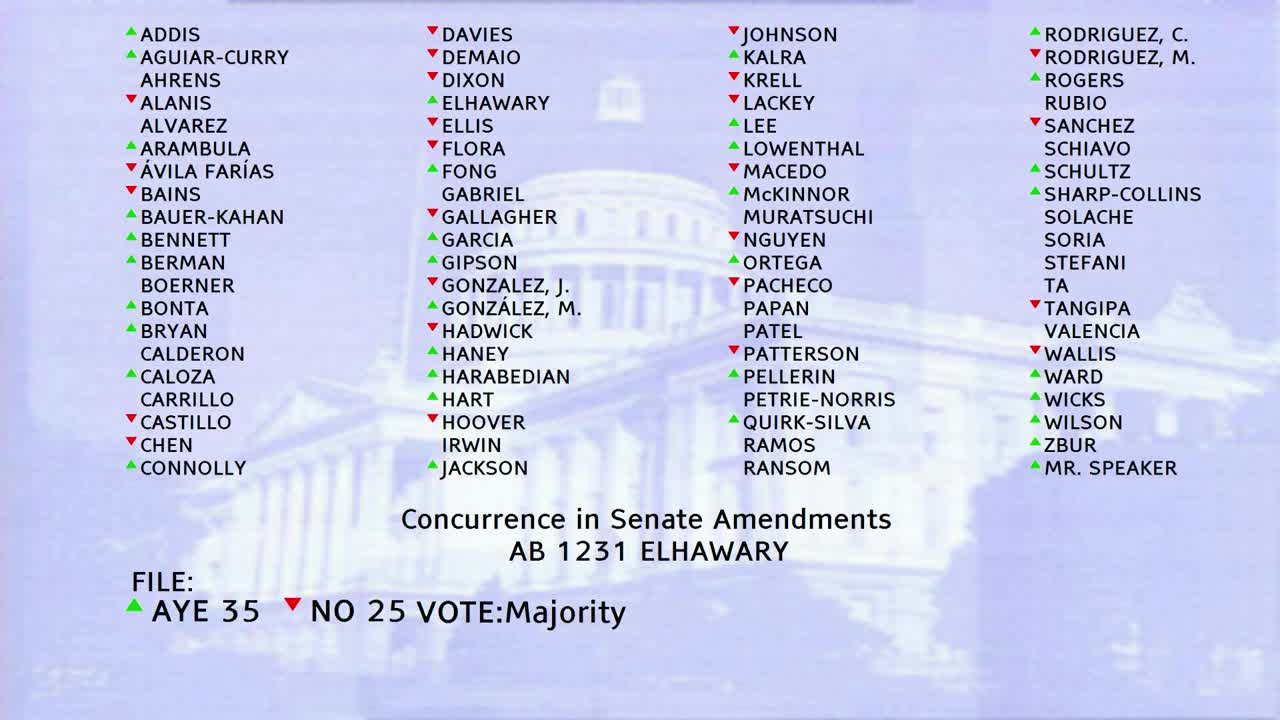
Bill Author

Bill Co-Author(s):