AB 507: Adaptive reuse: streamlining: incentives.
- Session Year: 2025-2026
- House: Assembly
- Latest Version Date: 2025-10-10
Current Status:
Passed
(2025-10-10: Chaptered by Secretary of State - Chapter 493, Statutes of 2025.)
Introduced
In Committee
Awaiting First Chamber Vote
Passed First Chamber
In Committee
Awaiting Second Chamber Vote
Passed Second Chamber
Enacted
(1)Existing law, the Planning and Zoning Law, requires each county and city to adopt a comprehensive, long-term general plan for its physical development, and the development of certain lands outside its boundaries, that includes, among other mandatory elements, a housing element. That law allows a development proponent to submit an application for a development that is subject to a specified streamlined, ministerial approval process not subject to a conditional use permit, if the development satisfies certain objective planning standards, including that the development is a multifamily housing development that contains two or more residential units.
This bill would deem an adaptive reuse project a use by right in all zones, regardless of the zoning of the site, and subject to a streamlined, ministerial review process if the project meets specified requirements, subject to specified exceptions. In this regard, an adaptive reuse project, in order to qualify for the streamlined, ministerial review process, would be required to be proposed for an existing building or structure that is less than 50 years old or meets certain requirements regarding the preservation of historic resources, including the signing of an affidavit declaring that the project will comply with the United States Secretary of the Interiors Standards for Rehabilitation for, among other things, the preservation of exterior facades of a building or structure that face a street, or receive federal or state historic rehabilitation tax credits, as specified. The bill would require an adaptive reuse project to meet specified affordability criteria. In this regard, the bill would require an adaptive reuse project for rental housing to include either 8% of the unit for very low income households and 5% of the units for extremely low income households or 15% of the units for lower income households. For an adaptive reuse project for owner-occupied housing, the bill would require the development to offer either 30% of the units at an affordable housing cost to moderate-income households or 15% of the units at an affordable housing cost to lower income households. For an adaptive reuse project including mixed uses, the bill would require at least one-half of the square footage of the adaptive reuse project to be dedicated to residential uses.
The bill would prohibit an adaptive reuse project from being permitted in industrial zones that do not permit residential uses. The bill would provide, among other things relating to projects involving adaptive reuse, that parking is not required for the portion of a project consisting of a building subject to adaptive reuse that does not have existing onsite parking. The bill would authorize an adaptive reuse project subject to these provisions to include the development of new residential or mixed-use structures on undeveloped areas and parking areas located on the same parcel as the proposed repurposed building, or on the parcels adjacent to the proposed adaptive reuse project site if certain conditions are met. The bill would subject an adaptive reuse project approved by a local government pursuant to these provisions to specified labor standards, including certain labor prevailing wage, apprenticeship, skilled and training workforce, and health care expenditure requirements, and would require development proponents to certify compliance with certain labor standards under penalty of perjury. By requiring certain development proponents of an adaptive reuse project to sign an affidavit regarding the preservation of historic resources and requiring development proponents to certify compliance with certain labor standards under penalty of perjury, the bill would expand the crime of perjury and therefore impose a state-mandated local program.
The bill would authorize a local government to adopt an ordinance, as specified, to, among other things, specify the process and requirements applicable to adaptive reuse projects, as specified, and would require an adaptive reuse project to comply with all objective planning standards found in the ordinance. The bill would specify that nothing in its provisions relating to adaptive reuse projects is intended to preempt the adoption and implementation of a local ordinance that provides alternative procedures and substantive requirements for adaptive reuse projects, provided that the local ordinance does not prohibit an applicant from electing to pursue an adaptive reuse project, as specified.
The bill would require a local agency that has not adopted an above-described ordinance to ministerially without discretionary review approve or disapprove applications for a permit to create or serve an adaptive reuse project, as specified. The bill would, if a local governments planning director or equivalent position determines that the adaptive reuse project submitted pursuant to these provisions is consistent with the objective planning standards, require the local government to approve the adaptive reuse project within specified timeframes. The bill would require the local government staff or relevant local planning and permitting department, upon determining that the adaptive reuse project is in conflict with any of the objective planning standards, to provide the proponent written documentation of, among other things, which standard or standards the development conflicts with within specific timeframes. The bill would prohibit a local government from imposing any local development standard on any project that is an adaptive reuse that would require alteration of the existing building envelope, except as specified, whether or not the local government has adopted an ordinance. By requiring local governments to implement the streamlined, ministerial review process for adaptive reuse projects, the bill would impose a state-mandated local program.
This bill would, except as specified, exempt an adaptive reuse project from all impact fees that are not reasonably related to the impacts resulting from the change of use of the site from nonresidential to residential or mixed use and would require any fees charged to be roughly proportional to the difference in impacts caused by the change of use.
This bill would authorize a city or county, or city and county, commencing in the 202627 fiscal year, to establish an adaptive reuse investment incentive program to pay adaptive reuse investment incentive funds to the proponent of an adaptive reuse project approved pursuant to the streamlined, ministerial process described above for up to 30 consecutive fiscal years, as specified. The bill would define adaptive reuse investment incentive funds to mean an amount up to or equal to the amount of ad valorem property tax revenue allocated to the participating local agency from the taxation of that portion of the total assessed value of the real and personal property of an adaptive reuse project property that is in excess of the qualified adaptive reuse project propertys valuation at the time of the proponents initial request for funding.
The bill would define various other terms for these purposes, and would make findings and declarations related to its provisions. The bill would make its provisions operative on July 1, 2026.
(2)Existing law, the California Environmental Quality Act (CEQA), requires a lead agency, as defined, to prepare, or cause to be prepared, and certify the completion of, an environmental impact report on a project that it proposes to carry out or approve that may have a significant effect on the environment. CEQA does not apply to the approval of ministerial projects.
This bill, by establishing the streamlined, ministerial review process described above, would exempt the approval of adaptive reuse projects subject to those processes from CEQA. The bill would also exempt specified findings regarding industrial uses and ordinances adopted to implement specified provisions from CEQA.
(3)Existing law requires each county and city to adopt a comprehensive, long-term general plan for the physical development of the county or city, and specified land outside its boundaries, that includes, among other mandatory elements, a housing element. Existing law requires the Department of Housing and Community Development to notify a city, county, or city and county, and authorizes the department to notify the Attorney General, that a city, county, or city and county is in violation of state law if the department finds that the housing element or an amendment to that element, or any specified action or failure to act, does not substantially comply with the law as it pertains to housing elements or that any local government has taken an action in violation of certain housing laws.
This bill would make corrections to a housing law cross-reference relating to the adaptive reuse project process established by the bill, thereby making a violation of that adaptive reuse project process by a city, county, or city and county subject to the above-described notification requirements.
(4)The bill would include findings that changes proposed by this bill address a matter of statewide concern rather than a municipal affair and, therefore, apply to all cities, including charter cities.
(5)This bill would incorporate additional changes to Section 65585 of the Government Code proposed by AB 650 to be operative only if this bill and AB 650 are enacted and this bill is enacted last.
(6)The California Constitution requires the state to reimburse local agencies and school districts for certain costs mandated by the state. Statutory provisions establish procedures for making that reimbursement.
This bill would provide that no reimbursement is required by this act for specified reasons.
(1)Existing law, the Planning and Zoning Law, requires each county and city to adopt a comprehensive, long-term general plan for its physical development, and the development of certain lands outside its boundaries, that includes, among other mandatory elements, a housing element. That law allows a development proponent to submit an application for a development that is subject to a specified streamlined, ministerial approval process not subject to a conditional use permit, if the development satisfies certain objective planning standards, including that the development is a multifamily housing development that contains two or more residential units.
This bill would deem an adaptive reuse project a use by right in all zones, regardless of the zoning of the site, and subject to a streamlined, ministerial review process if the project meets specified requirements, subject to specified exceptions. In this regard, an adaptive reuse project, in order to qualify for the streamlined, ministerial review process, would be required to be proposed for an existing building or structure that is less than 50 years old or meets certain requirements regarding the preservation of historic resources, including the signing of an affidavit declaring that the project will comply with the United States Secretary of the Interiors Standards for Rehabilitation for, among other things, the preservation of exterior facades of a building or structure that face a street, or receive federal or state historic rehabilitation tax credits, as specified. The bill would require an adaptive reuse project to meet specified affordability criteria. In this regard, the bill would require an adaptive reuse project for rental housing to include either 8% of the unit for very low income households and 5% of the units for extremely low income households or 15% of the units for lower income households. For an adaptive reuse project for owner-occupied housing, the bill would require the development to offer either 30% of the units at an affordable housing cost to moderate-income households or 15% of the units at an affordable housing cost to lower income households. For an adaptive reuse project including mixed uses, the bill would require at least one-half of the square footage of the adaptive reuse project to be dedicated to residential uses.
The bill would prohibit an adaptive reuse project from being permitted in industrial zones that do not permit residential uses. The bill would provide, among other things relating to projects involving adaptive reuse, that parking is not required for the portion of a project consisting of a building subject to adaptive reuse that does not have existing onsite parking. The bill would authorize an adaptive reuse project subject to these provisions to include the development of new residential or mixed-use structures on undeveloped areas and parking areas located on the same parcel as the proposed repurposed building, or on the parcels adjacent to the proposed adaptive reuse project site if certain conditions are met. The bill would also subject an adaptive reuse project approved by a local government pursuant to these provisions to specified labor standards. standards, including certain labor prevailing wage, apprenticeship, skilled and training workforce, and health care expenditure requirements, and would require development proponents to certify compliance with certain labor standards under penalty of perjury. By requiring certain development proponents of an adaptive reuse project to sign an affidavit regarding the preservation of historic resources and requiring development proponents to certify compliance with certain labor standards under penalty of perjury, the bill would expand the crime of perjury and therefore impose a state-mandated local program.
The bill would authorize a local government to adopt an ordinance, as specified, to, among other things, specify the process and requirements applicable to adaptive reuse projects, as specified, and would require an adaptive reuse project to comply with all objective planning standards found in the ordinance. The bill would specify that nothing in its provisions relating to adaptive reuse projects is intended to preempt the adoption and implementation of a local ordinance that provides alternative procedures and substantive requirements for adaptive reuse projects, provided that the local ordinance does not prohibit an applicant from electing to pursue an adaptive reuse project, as specified.
The bill would require a local agency that has not adopted an above-described ordinance to ministerially without discretionary review approve or disapprove applications for a permit to create or serve an adaptive reuse project, as specified. The bill would, if a local governments planning director or equivalent position determines that the adaptive reuse project submitted pursuant to these provisions is consistent with the objective planning standards, require the local government to approve the adaptive reuse project within specified timeframes. The bill would require the local government staff or relevant local planning and permitting department, upon determining that the adaptive reuse project is in conflict with any of the objective planning standards, to provide the proponent written documentation of, among other things, which standard or standards the development conflicts with within specific timeframes. The bill would prohibit a local government from imposing any local development standard on any project that is an adaptive reuse that would require alteration of the existing building envelope, except as specified, whether or not the local government has adopted an ordinance. By requiring local governments to implement the streamlined, ministerial review process for adaptive reuse projects, the bill would impose a state-mandated local program.
This bill would, except as specified, exempt an adaptive reuse project from all impact fees that are not reasonably related to the impacts resulting from the change of use of the site from nonresidential to residential or mixed use and would require any fees charged to be roughly proportional to the difference in impacts caused by the change of use.
This bill would authorize a city or county, or city and county, commencing in the 202627 fiscal year, to establish an adaptive reuse investment incentive program to pay adaptive reuse investment incentive funds to the proponent of an adaptive reuse project approved pursuant to the streamlined, ministerial process described above for up to 30 consecutive fiscal years, as specified. The bill would define adaptive reuse investment incentive funds to mean an amount up to or equal to the amount of ad valorem property tax revenue allocated to the participating local agency from the taxation of that portion of the total assessed value of the real and personal property of an adaptive reuse project property that is in excess of the qualified adaptive reuse project propertys valuation at the time of the proponents initial request for funding.
The bill would define various other terms for these purposes, and would make findings and declarations related to its provisions. The bill would make its provisions operative on July 1, 2026.
(2)Existing law, the California Environmental Quality Act (CEQA), requires a lead agency, as defined, to prepare, or cause to be prepared, and certify the completion of, an environmental impact report on a project that it proposes to carry out or approve that may have a significant effect on the environment. CEQA does not apply to the approval of ministerial projects.
This bill, by establishing the streamlined, ministerial review process described above, would exempt the approval of adaptive reuse projects subject to those processes from CEQA. The bill would also exempt specified findings regarding industrial uses and ordinances adopted to implement specified provisions from CEQA.
(3)Existing law requires each county and city to adopt a comprehensive, long-term general plan for the physical development of the county or city, and specified land outside its boundaries, that includes, among other mandatory elements, a housing element. Existing law requires the Department of Housing and Community Development to notify a city, county, or city and county, and authorizes the department to notify the Attorney General, that a city, county, or city and county is in violation of state law if the department finds that the housing element or an amendment to that element, or any specified action or failure to act, does not substantially comply with the law as it pertains to housing elements or that any local government has taken an action in violation of certain housing laws.
This bill would make corrections to a housing law cross-reference relating to the adaptive reuse project process established by the bill, thereby making a violation of that adaptive reuse project process by a city, county, or city and county subject to the above-described notification requirements.
(4)The bill would include findings that changes proposed by this bill address a matter of statewide concern rather than a municipal affair and, therefore, apply to all cities, including charter cities.
(5)This bill would incorporate additional changes to Section 65585 of the Government Code proposed by AB 650 to be operative only if this bill and AB 650 are enacted and this bill is enacted last.
(5)(6)The California Constitution requires the state to reimburse local agencies and school districts for certain costs mandated by the state. Statutory provisions establish procedures for making that reimbursement.
This bill would provide that no reimbursement is required by this act for specified reasons.
(1)Existing law, the Planning and Zoning Law, requires each county and city to adopt a comprehensive, long-term general plan for its physical development, and the development of certain lands outside its boundaries, that includes, among other mandatory elements, a housing element. That law allows a development proponent to submit an application for a development that is subject to a specified streamlined, ministerial approval process not subject to a conditional use permit, if the development satisfies certain objective planning standards, including that the development is a multifamily housing development that contains two or more residential units.
This bill would deem an adaptive reuse project a use by right in all zones, regardless of the zoning of the site, and subject to a streamlined, ministerial review process if the project meets specified requirements, subject to specified exceptions. In this regard, an adaptive reuse project, in order to qualify for the streamlined, ministerial review process, would be required to be proposed for an existing building that is less than 50 years old or meets certain requirements regarding the preservation of historic resources, including the signing of an affidavit declaring that the project will comply with the United States Secretary of the Interiors Standards for Rehabilitation for, among other things, the preservation of exterior facades of a building or structure that face a street, or receive federal or state historic rehabilitation tax credits, as specified. The bill would require an adaptive reuse project to meet specified affordability criteria. In this regard, the bill would require an adaptive reuse project for rental housing to include either 8% of the unit for very low income households and 5% of the units for extremely low income households or 15% of the units for lower income households. For an adaptive reuse project for owner-occupied housing, the bill would require the development to offer either 30% of the units at an affordable housing cost to moderate-income households or 15% of the units at an affordable housing cost to lower income households. For an adaptive reuse project including mixed uses, the bill would require at least one-half of the square footage of the adaptive reuse project to be dedicated to residential uses.
The bill would provide, among other things relating to projects involving adaptive reuse, that parking is not required for the portion of a project consisting of a building subject to adaptive reuse that does not have existing onsite parking. The bill would authorize an adaptive reuse project subject to these provisions to include the development of new residential or mixed-use structures on undeveloped areas and parking areas located on the same parcel as the proposed repurposed building, or on the parcels adjacent to the proposed adaptive reuse project site if certain conditions are met. The bill would also subject an adaptive reuse project approved by a local government pursuant to these provisions to specified labor standards.
The bill would authorize a local government to adopt an ordinance, as specified, to, among other things, specify the process and requirements applicable to adaptive reuse projects, as specified, and would require an adaptive reuse project to comply with all objective planning standards found in the ordinance. The bill would specify that nothing in its provisions relating to adaptive reuse projects is intended to preempt the adoption and implementation of a local ordinance that provides alternative procedures and substantive requirements for adaptive reuse projects, provided that the local ordinance does not prohibit an applicant from electing to pursue an adaptive reuse project, as specified.
The bill would require a local agency that has not adopted an above-described ordinance to ministerially without discretionary review approve or disapprove applications for a permit to create or serve an adaptive reuse project, as specified. The bill would, if a local governments planning director or equivalent position determines that the adaptive reuse project submitted pursuant to these provisions is consistent with the objective planning standards, require the local government to approve the adaptive reuse project within specified timeframes. The bill would require the local government staff or relevant local planning and permitting department, upon determining that the adaptive reuse project is in conflict with any of the objective planning standards, to provide the proponent written documentation of, among other things, which standard or standards the development conflicts with within specific timeframes. The bill would prohibit a local government from imposing any local development standard on any project that is an adaptive reuse that would require alteration of the existing building envelope, except as specified, whether or not the local government has adopted an ordinance. By requiring local governments to implement the streamlined, ministerial review process for adaptive reuse projects, the bill would impose a state-mandated local program.
This bill would, except as specified, exempt an adaptive reuse project from all impact fees that are not reasonably related to the impacts resulting from the change of use of the site from nonresidential to residential or mixed use and would require any fees charged to be roughly proportional to the difference in impacts caused by the change of use.
This bill would authorize a city or county, or city and county, commencing in the 202627 fiscal year, to establish an adaptive reuse investment incentive program to pay adaptive reuse investment incentive funds to the proponent of an adaptive reuse project approved pursuant to the streamlined, ministerial process described above for up to 30 consecutive fiscal years, as specified. The bill would define adaptive reuse investment incentive funds to mean an amount up to or equal to the amount of ad valorem property tax revenue allocated to the participating local agency from the taxation of that portion of the total assessed value of the real and personal property of an adaptive reuse project property that is in excess of the qualified adaptive reuse project propertys valuation at the time of the proponents initial request for funding.
The bill would define terms for these purposes, and would make findings and declarations related to its provisions. The bill would make its provisions operative on July 1, 2026.
(2)Existing law, the California Environmental Quality Act (CEQA), requires a lead agency, as defined, to prepare, or cause to be prepared, and certify the completion of, an environmental impact report on a project that it proposes to carry out or approve that may have a significant effect on the environment. CEQA does not apply to the approval of ministerial projects.
This bill, by establishing the streamlined, ministerial review process described above, would exempt the approval of adaptive reuse projects subject to those processes from CEQA. The bill would also exempt specified findings regarding industrial uses and ordinances adopted to implement specified provisions from CEQA.
(3)Existing law requires each county and city to adopt a comprehensive, long-term general plan for the physical development of the county or city, and specified land outside its boundaries, that includes, among other mandatory elements, a housing element. Existing law requires the Department of Housing and Community Development to notify a city, county, or city and county, and authorizes the department to notify the Attorney General, that a city, county, or city and county is in violation of state law if the department finds that the housing element or an amendment to that element, or any specified action or failure to act, does not substantially comply with the law as it pertains to housing elements or that any local government has taken an action in violation of certain housing laws.
This bill would make corrections to a housing law cross-reference relating to the adaptive reuse project process established by the bill, thereby making a violation of that adaptive reuse project process by a city, county, or city and county subject to the above-described notification requirements.
(3)(4)The bill would include findings that changes proposed by this bill address a matter of statewide concern rather than a municipal affair and, therefore, apply to all cities, including charter cities.
(4)(5)The California Constitution requires the state to reimburse local agencies and school districts for certain costs mandated by the state. Statutory provisions establish procedures for making that reimbursement.
This bill would provide that no reimbursement is required by this act for specified reasons.
(1)Existing law, the Planning and Zoning Law, requires each county and city to adopt a comprehensive, long-term general plan for its physical development, and the development of certain lands outside its boundaries, that includes, among other mandatory elements, a housing element. That law allows a development proponent to submit an application for a development that is subject to a specified streamlined, ministerial approval process not subject to a conditional use permit, if the development satisfies certain objective planning standards, including that the development is a multifamily housing development that contains two or more residential units.
This bill would deem an adaptive reuse project a use by right in all zones, regardless of the zoning of the site, and subject to a streamlined, ministerial review process if the project meets specified requirements, subject to specified exceptions. In this regard, an adaptive reuse project, in order to qualify for the streamlined, ministerial review process, would be required to be proposed for an existing building that is less than 50 years old or meets certain requirements regarding the preservation of historic resources, including the signing of an affidavit declaring that the project will comply with the United States Secretary of the Interiors Standards for Rehabilitation for, among other things, the preservation of exterior facades of a building that face a street, or receive federal or state historic rehabilitation tax credits, as specified. The bill would require an adaptive reuse project to meet specified affordability criteria. In this regard, the bill would require an adaptive reuse project for rental housing to include either 8% of the unit for very low income households and 5% of the units for extremely low income households or 15% of the units for lower income households. For an adaptive reuse project for owner-occupied housing, the bill would require the development to offer either 30% of the units at an affordable housing cost to moderate-income households or 15% of the units at an affordable housing cost to lower income households. For an adaptive reuse project including mixed uses, the bill would require at least one-half of the square footage of the adaptive reuse project to be dedicated to residential uses.
The bill would provide, among other things relating to projects involving adaptive reuse, that parking is not required for the portion of a project consisting of a building subject to adaptive reuse that does not have existing onsite parking. The bill would authorize an adaptive reuse project subject to these provisions to include the development of new residential or mixed-use structures on undeveloped areas and parking areas located on the same parcel as the proposed repurposed building, or on the parcels adjacent to the proposed adaptive reuse project site if certain conditions are met. The bill would also subject an adaptive reuse project approved by a local government pursuant to these provisions to specified labor standards.
The bill would authorize a local government to adopt an ordinance, as specified, to, among other things, specify the process and requirements applicable to adaptive reuse projects, as specified, and would require an adaptive reuse project to comply with all objective planning standards found in the ordinance. The bill would specify that nothing in its provisions relating to adaptive reuse projects is intended to preempt the adoption and implementation of a local ordinance that provides alternative procedures and substantive requirements for adaptive reuse projects, provided that the local ordinance does not prohibit an applicant from electing to pursue an adaptive reuse project, as specified.
The bill would require a local agency that has not adopted an above-described ordinance to ministerially without discretionary review approve or disapprove applications for a permit to create or serve an adaptive reuse project, as specified. The bill would, if a local governments planning director or equivalent position determines that the adaptive reuse project submitted pursuant to these provisions is consistent with the objective planning standards, require the local government to approve the adaptive reuse project within specified timeframes. The bill would require the local government staff or relevant local planning and permitting department, upon determining that the adaptive reuse project is in conflict with any of the objective planning standards, to provide the proponent written documentation of, among other things, which standard or standards the development conflicts with within specific timeframes. The bill would prohibit a local government from imposing any local development standard on any project that is an adaptive reuse that would require alteration of the existing building envelope, except as specified, whether or not the local government has adopted an ordinance. By requiring local governments to implement the streamlined, ministerial review process for adaptive reuse projects, the bill would impose a state-mandated local program.
This bill would, except as specified, exempt an adaptive reuse project from all impact fees that are not reasonably related to the impacts resulting from the change of use of the site from nonresidential to residential or mixed use and would require any fees charged to be roughly proportional to the difference in impacts caused by the change of use.
This bill would authorize a city or county, or city and county, commencing in the 202627 fiscal year, to establish an adaptive reuse investment incentive program to pay adaptive reuse investment incentive funds to the proponent of an adaptive reuse project approved pursuant to the streamlined, ministerial process described above for up to 30 consecutive fiscal years, as specified. The bill would define adaptive reuse investment incentive funds to mean an amount up to or equal to the amount of ad valorem property tax revenue allocated to the participating local agency from the taxation of that portion of the total assessed value of the real and personal property of an adaptive reuse project property that is in excess of the qualified adaptive reuse project propertys valuation at the time of the proponents initial request for funding.
The bill would define terms for these purposes, and would make findings and declarations related to its provisions.
(2)Existing law, the California Environmental Quality Act (CEQA), requires a lead agency, as defined, to prepare, or cause to be prepared, and certify the completion of, an environmental impact report on a project that it proposes to carry out or approve that may have a significant effect on the environment. CEQA does not apply to the approval of ministerial projects.
This bill, by establishing the streamlined, ministerial review process described above, would exempt the approval of adaptive reuse projects subject to those processes from CEQA. The bill would also exempt specified findings regarding industrial uses and ordinances adopted to implement specified provisions from CEQA.
(3)The bill would include findings that changes proposed by this bill address a matter of statewide concern rather than a municipal affair and, therefore, apply to all cities, including charter cities.
(4)The California Constitution requires the state to reimburse local agencies and school districts for certain costs mandated by the state. Statutory provisions establish procedures for making that reimbursement.
This bill would provide that no reimbursement is required by this act for specified reasons.
(1)Existing law, the Planning and Zoning Law, requires each county and city to adopt a comprehensive, long-term general plan for its physical development, and the development of certain lands outside its boundaries, that includes, among other mandatory elements, a housing element. That law allows a development proponent to submit an application for a development that is subject to a specified streamlined, ministerial approval process not subject to a conditional use permit, if the development satisfies certain objective planning standards, including that the development is a multifamily housing development that contains two or more residential units.
This bill would deem an adaptive reuse project a use by right in all zones, regardless of the zoning of the site, and subject to a streamlined, ministerial review process if the project meets specified requirements, subject to specified exceptions. In this regard, an adaptive reuse project, in order to qualify for the streamlined, ministerial review process, would be required to be proposed for an existing building that is less than 50 years old or meets certain requirements regarding the preservation of historic resources, including the signing of an affidavit declaring that the project will comply with the United States Secretary of the Interiors Standards for Rehabilitation for, among other things, the preservation of exterior facades of a building that face a street, or receive federal or state historic rehabilitation tax credits, as specified. The bill would require an adaptive reuse project to meet specified affordability criteria. In this regard, the bill would require an adaptive reuse project for rental housing to include either 8% of the unit for very low income households and 5% of the units for extremely low income households or 15% of the units for lower income households. For an adaptive reuse project for owner-occupied housing, the bill would require the development to offer either 30% of the units at an affordable housing cost to moderate-income households or 15% of the units at an affordable housing cost to lower income households. For an adaptive reuse project including mixed uses, the bill would require at least one-half of the square footage of the adaptive reuse project to be dedicated to residential uses.
The bill would provide, among other things relating to projects involving adaptive reuse, that parking is not required for the portion of a project consisting of a building subject to adaptive reuse that does not have existing onsite parking. The bill would authorize an adaptive reuse project subject to these provisions to include the development of new residential or mixed-use structures on undeveloped areas and parking areas located on the same parcel as the proposed repurposed building, or on the parcels adjacent to the proposed adaptive reuse project site if certain conditions are met.
The bill would authorize a local government to adopt an ordinance, as specified, to, among other things, specify the process and requirements applicable to adaptive reuse projects, as specified, and would require an adaptive reuse project to comply with all objective planning standards found in the ordinance. The bill would specify that nothing in its provisions relating to adaptive reuse projects is intended to preempt the adoption and implementation of a local ordinance that provides alternative procedures and substantive requirements for adaptive reuse projects, provided that the local ordinance does not prohibit an applicant from electing to pursue an adaptive reuse project, as specified.
The bill would require a local agency that has not adopted an above-described ordinance to ministerially without discretionary review approve or disapprove applications for a permit to create or serve an adaptive reuse project, as specified. The bill would, if a local governments planning director or equivalent position determines that the adaptive reuse project submitted pursuant to these provisions is consistent with the objective planning standards, require the local government to approve the adaptive reuse project within specified timeframes. The bill would require the local government staff or relevant local planning and permitting department, upon determining that the adaptive reuse project is in conflict with any of the objective planning standards, to provide the proponent written documentation of, among other things, which standard or standards the development conflicts with within specific timeframes. The bill would prohibit a local government from imposing any local development standard on any project that is an adaptive reuse that would require alteration of the existing building envelope, except as specified, whether or not the local government has adopted an ordinance. By requiring local governments to implement the streamlined, ministerial review process for adaptive reuse projects, the bill would impose a state-mandated local program.
This bill would, except as specified, exempt an adaptive reuse project from all impact fees that are not reasonably related to the impacts resulting from the change of use of the site from nonresidential to residential or mixed use and would require any fees charged to be roughly proportional to the difference in impacts caused by the change of use.
This bill would authorize a city or county, or city and county, commencing in the 202627 fiscal year, to establish an adaptive reuse investment incentive program to pay adaptive reuse investment incentive funds to the proponent of an adaptive reuse project approved pursuant to the streamlined, ministerial process described above for up to 30 consecutive fiscal years, as specified. The bill would define adaptive reuse investment incentive funds to mean an amount up to or equal to the amount of ad valorem property tax revenue allocated to the participating local agency from the taxation of that portion of the total assessed value of the real and personal property of an adaptive reuse project property that is in excess of the qualified adaptive reuse project propertys valuation at the time of the proponents initial request for funding.
The bill would define terms for these purposes, and would make findings and declarations related to its provisions.
(2)Existing law, the California Environmental Quality Act (CEQA), requires a lead agency, as defined, to prepare, or cause to be prepared, and certify the completion of, an environmental impact report on a project that it proposes to carry out or approve that may have a significant effect on the environment. CEQA does not apply to the approval of ministerial projects.
This bill, by establishing the streamlined, ministerial review process described above, would exempt the approval of adaptive reuse projects subject to those processes from CEQA. The bill would also exempt specified findings regarding industrial uses and ordinances adopted to implement specified provisions from CEQA.
(3)The bill would include findings that changes proposed by this bill address a matter of statewide concern rather than a municipal affair and, therefore, apply to all cities, including charter cities.
(4)The California Constitution requires the state to reimburse local agencies and school districts for certain costs mandated by the state. Statutory provisions establish procedures for making that reimbursement.
This bill would provide that no reimbursement is required by this act for specified reasons.
The Legislature finds and declares all of the following:
(a)Converting vacant commercial space into residential housing, through adaptive reuse, could reduce underutilized and vacant buildings that have been decreasing in value, thereby helping to stabilize the commercial real estate market and filling those spaces with more valuable tax-generating uses.
(b)Adaptive reuse projects can increase activity and foot traffic in neighborhoods across the state, which helps support local businesses and enhance the cultural life of cities and towns.
(c)Adaptive reuse projects create new construction jobs and preserve historic structures.
(d)Adaptive reuse projects are more environmentally friendly than new construction by repurposing existing materials, reducing transportation emissions, and preserving embodied carbon.
(e)New housing construction, at all affordability levels, can help to mitigate, and eventually reverse, the statewide housing shortage.
(f)Adaptive reuse projects require construction techniques that justify labor standards that differ from new housing construction.
SEC. 2.Chapter 9 (commencing with Section 51299) is added to Part 1 of Division 1 of Title 5 of the Government Code, to read:9.Adaptive Reuse Investment Incentive Program51299.It is the intent of the Legislature in enacting this chapter to provide cities and counties with opportunities to adaptively reuse existing buildings, such as office buildings, in order to facilitate their conversion to housing and mixed uses.
51299.1.For purposes of this chapter:
(a)Adaptive reuse investment incentive funds means, with respect to a qualified adaptive reuse project property for a relevant fiscal year, an amount up to or equal to the amount of ad valorem property tax revenue allocated to the participating local agency, excluding the revenue transfers required by Sections 97.2 and 97.3 of the Revenue and Taxation Code, from the taxation of that portion of the total assessed value of the real and personal property of an adaptive reuse project property that is in excess of the qualified adaptive reuse project propertys valuation at the time of the proponents initial request for funding.
(b)Program means an adaptive reuse investment incentive program established pursuant to Section 51299.2.
(c)(1)Proponent means a party or parties that meet all of the following criteria:
(A)The party is named in the application for a permit to construct a qualified adaptive reuse project submitted to the city or county.
(B)The party will be the fee owner of the qualified adaptive reuse project property upon the completion of that development.
(2)If a proponent that is receiving adaptive reuse investment incentive amounts subsequently leases the qualified adaptive reuse project property to another party, the lease may provide for the payment to that lessee of any portion of adaptive reuse investment incentive funds. A lessee that receives any portion of adaptive reuse investment incentive funds shall also be considered a proponent for the purposes of this chapter.
(d)Qualified adaptive reuse project property means an adaptive reuse project proposed pursuant to Article 11.5 (commencing with Section 65658) of Chapter 3 of Division 1 of Title 7 that is located within the city or county.
51299.2.(a)Commencing in the 202627 fiscal year, the governing body of a city or county, or city and county, may, by ordinance or resolution, establish an adaptive reuse investment incentive program pursuant to this chapter.
(b)(1)A city or county, or city and county, that establishes a program shall, upon the approval by a majority of the entire membership of its governing body of a written request therefor, pay adaptive reuse investment incentive funds to the proponent of a qualified adaptive reuse project property to subsidize the affordable housing units, as required pursuant to Article 11.5 (commencing with Section 65658) of Chapter 3 of Division 1 of Title 7, for up to 30 consecutive fiscal years. Nothing in this paragraph shall prohibit a city or county, or city and county, from paying adaptive reuse investment incentive funds to a proponent pursuant to this paragraph for a period of fewer than 30 years.
(2)A request for the payment of adaptive reuse investment incentive funds shall be filed by a proponent in writing with the governing body of the city or county in the time and manner established by that governing body.
(c)After a city or county, or city and county, approves a request for the payment of adaptive reuse investment incentive funds, payment of adaptive reuse investment incentive funds shall begin with the first fiscal year that commences after the qualified adaptive reuse property is issued a certificate of occupancy. If the city or county, or city and county, does not issue certificates of occupancy, the final inspection of the qualified adaptive reuse project property shall serve as the certificate of occupancy for purposes of this subdivision.
51299.3.A city or special district may pay to the city or county, or city and county, an amount equal to the amount of ad valorem property tax revenue allocated to that city or special district, but not the actual allocation, derived from the taxation of that portion of the total assessed value of that real property that is in excess of the propertys valuation at the time of the proponents initial request for funding, for the purpose of subsidizing the affordable housing units required pursuant to Article 11.5 (commencing with Section 65658) of Chapter 3 of Division 1 of Title 7.
51299.4.This chapter shall become operative on July 1, 2026.
SEC. 3.Section 65585 of the Government Code is amended to read:65585.(a)In the preparation of its housing element, each city and county shall consider the guidelines adopted by the department pursuant to Section 50459 of the Health and Safety Code. Those guidelines shall be advisory to each city or county in the preparation of its housing element.
(b)(1)(A)At least 90 days prior to adoption of a revision of its housing element pursuant to subdivision (e) of Section 65588, or at least 60 days prior to the adoption of a subsequent amendment to this element, the planning agency shall submit a draft element revision or draft amendment to the department. The local government of the planning agency shall make the first draft revision of a housing element available for public comment for at least 30 days and, if any comments are received, the local government shall take at least 10 business days after the 30-day public comment period to consider and incorporate public comments into the draft revision prior to submitting it to the department. For any subsequent draft revision, the local government shall post the draft revision on its internet website and shall email a link to the draft revision to all individuals and organizations that have previously requested notices relating to the local governments housing element at least seven days before submitting the draft revision to the department.
(B)The planning agency staff shall collect and compile the public comments regarding the housing element received by the city, county, or city and county and provide these comments to each member of the legislative body before it adopts the housing element.
(C)The department shall review the draft and report its written findings to the planning agency within 90 days of its receipt of the first draft submittal for each housing element revision pursuant to subdivision (e) of Section 65588 or within 60 days of its receipt of a subsequent draft amendment or an adopted revision or adopted amendment to an element. The department shall not review the first draft submitted for each housing element revision pursuant to subdivision (e) of Section 65588 until the local government has made the draft available for public comment for at least 30 days and, if comments were received, has taken at least 10 business days to consider and incorporate public comments pursuant to paragraph (1).
(2)(A)At least 90 days prior to the initial adoption of a revision of its housing element pursuant to subdivision (e) of Section 65588, and at least 7 days prior to any subsequent adoption submittal if changes have occurred to the inventory of sites, a local government shall do both of the following:
(i)Make a draft of its inventory of sites required pursuant to paragraph (3) of subdivision (a) of Section 65583 available to the department and the public and post the draft inventory on its internet website.
(ii)Send an email to all individuals and organizations that have previously requested notices notifying them that the inventory has been updated that includes a link to the draft inventory on its website.
(B)The requirements of this paragraph shall apply to the seventh and each subsequent revision of the housing element.
(c)In the preparation of its findings, the department may consult with any public agency, group, or person. The department shall receive and consider any written comments from any public agency, group, or person regarding the draft or adopted element or amendment under review.
(d)In its written findings, the department shall determine whether the draft element or draft amendment substantially complies with this article.
(e)Prior to the adoption of its draft element or draft amendment, the legislative body shall consider the findings made by the department. If the departments findings are not available within the time limits set by this section, the legislative body may act without them.
(f)If the department finds that the draft element or draft amendment does not substantially comply with this article, the legislative body shall take one of the following actions:
(1)(A)Change the draft element or draft amendment to substantially comply with this article.
(B)Any change to a draft element or draft amendment pursuant to subparagraph (A) shall be completed in accordance with subdivision (b). This subparagraph does not constitute a change in, but is declaratory of, existing law.
(2)Adopt the draft element or draft amendment without changes. The legislative body shall include in its resolution of adoption written findings that explain the reasons the legislative body believes that the draft element or draft amendment substantially complies with this article despite the findings of the department.
(g)(1)Promptly following the adoption of its element or amendment, the planning agency shall submit a copy of the adopted element or amendment and any findings made pursuant to paragraph (2) of subdivision (f) to the department.
(2)This subdivision shall not be construed to excuse a legislative body from complying with subdivision (f). This paragraph does not constitute a change in, but is declaratory of, existing law.
(h)The department shall, within 60 days, review adopted housing elements or amendments and any findings pursuant to paragraph (2) of subdivision (f), make a finding as to whether the adopted element or amendment is in substantial compliance with this article, and report its findings to the planning agency.
(i)(1)(A)The department shall review any action or failure to act by the city, county, or city and county that it determines is inconsistent with an adopted housing element or Section 65583, including any failure to implement any program actions included in the housing element pursuant to Section 65583. The department shall issue written findings to the city, county, or city and county as to whether the action or failure to act substantially complies with this article, and provide a reasonable time no longer than 30 days for the city, county, or city and county to respond to the findings before taking any other action authorized by this section, including the action authorized by subparagraph (C).
(B)If the department finds that the citys, countys, or city and countys action or failure to act does not substantially comply with its adopted housing element or its obligations pursuant to Section 65583, there shall be a rebuttable presumption of invalidity in any legal action challenging that action or failure to act.
(C)If the department finds that the action or failure to act by the city, county, or city and county does not substantially comply with this article, and if it has issued findings pursuant to this section that an amendment to the housing element substantially complies with this article, the department may revoke its findings until it determines that the city, county, or city and county has come into compliance with this article.
(2)The department may consult with any local government, public agency, group, or person, and shall receive and consider any written comments from any public agency, group, or person, regarding the action or failure to act by the city, county, or city and county described in paragraph (1), in determining whether the housing element substantially complies with this article.
(j)The department shall notify the city, county, or city and county and may notify the office of the Attorney General that the city, county, or city and county is in violation of state law if the department finds that the housing element or an amendment to this element, or any action or failure to act described in subdivision (i), does not substantially comply with this article or that any local government has taken an action in violation of the following:
(1)Housing Accountability Act (Section 65589.5).
(2)Section 65863.
(3)Chapter 4.3 (commencing with Section 65915).
(4)Section 65008.
(5)Housing Crisis Act of 2019 (Chapter 654, Statutes of 2019, Sections 65941.1, 65943, and 66300).
(6)Section 8899.50.
(7)Section 65913.4.
(8)Article 11 (commencing with Section 65650).
(9)Article 12 (commencing with Section 65660).
(10)Section 65913.11.
(11)Section 65400.
(12)Section 65863.2.
(13)Chapter 4.1 (commencing with Section 65912.100).
(14)Section 65905.5.
(15)Chapter 13 (commencing with Section 66310).
(16)Section 65852.21.
(17)Section 65852.24.
(18)Section 66411.7.
(19)Section 65913.16.
(20)Article 2 (commencing with Section 66300.5) of Chapter 12.
(21)Section 65852.28.
(22)Section 65913.4.5.
(23)Section 66499.41.
(24)Homeless Housing, Assistance, and Prevention program (Chapter 6 (commencing with Section 50216) and Chapter 6.5 (commencing with Section 50230) of Part 1 of Division 31 of the Health and Safety Code).
(25)Encampment Resolution Funding program (Chapter 7 (commencing with Section 50250) of Part 1 of Division 31 of the Health and Safety Code).
(26)Family Homelessness Challenge Grants and Technical Assistance Program (Chapter 8 (commencing with Section 50255) of Part 1 of Division 31 of the Health and Safety Code).
(27)Article 11.5 (commencing with Section 65658).
(k)Commencing July 1, 2019, prior to the Attorney General bringing any suit for a violation of the provisions identified in subdivision (j) related to housing element compliance and seeking remedies available pursuant to this subdivision, the department shall offer the jurisdiction the opportunity for two meetings in person or via telephone to discuss the violation, and shall provide the jurisdiction written findings regarding the violation. This paragraph does not affect any action filed prior to the effective date of this section. The requirements set forth in this subdivision do not apply to any suits brought for a violation or violations of paragraphs (1) and (3) to (9), inclusive, of subdivision (j).
(l)In any action or special proceeding brought by the Attorney General relating to housing element compliance pursuant to a notice or referral under subdivision (j), the Attorney General may request, upon a finding of the court that the housing element does not substantially comply with the requirements of this article pursuant to this section, that the court issue an order or judgment directing the jurisdiction to bring its housing element into substantial compliance with the requirements of this article. The court shall retain jurisdiction to ensure that its order or judgment is carried out. If a court determines that the housing element of the jurisdiction substantially complies with this article, it shall have the same force and effect, for purposes of eligibility for any financial assistance that requires a housing element in substantial compliance and for purposes of any incentives provided under Section 65589.9, as a determination by the department that the housing element substantially complies with this article.
(1)If the jurisdiction has not complied with the order or judgment after 12 months, the court shall conduct a status conference. Following the status conference, upon a determination that the jurisdiction failed to comply with the order or judgment compelling substantial compliance with the requirements of this article, the court shall impose fines on the jurisdiction, which shall be deposited into the Building Homes and Jobs Trust Fund. Any fine levied pursuant to this paragraph shall be in a minimum amount of ten thousand dollars ($10,000) per month, but shall not exceed one hundred thousand dollars ($100,000) per month, except as provided in paragraphs (2) and (3). In the event that the jurisdiction fails to pay fines imposed by the court in full and on time, the court may require the Controller to intercept any available state and local funds and direct such funds to the Building Homes and Jobs Trust Fund to correct the jurisdictions failure to pay. The intercept of the funds by the Controller for this purpose shall not violate any provision of the California Constitution.
(2)If the jurisdiction has not complied with the order or judgment after three months following the imposition of fees described in paragraph (1), the court shall conduct a status conference. Following the status conference, if the court finds that the fees imposed pursuant to paragraph (1) are insufficient to bring the jurisdiction into compliance with the order or judgment, the court may multiply the fine determined pursuant to paragraph (1) by a factor of three. In the event that the jurisdiction fails to pay fines imposed by the court in full and on time, the court may require the Controller to intercept any available state and local funds and direct such funds to the Building Homes and Jobs Trust Fund to correct the jurisdictions failure to pay. The intercept of the funds by the Controller for this purpose shall not violate any provision of the California Constitution.
(3)If the jurisdiction has not complied with the order or judgment six months following the imposition of fees described in paragraph (1), the court shall conduct a status conference. Upon a determination that the jurisdiction failed to comply with the order or judgment, the court may impose the following:
(A)If the court finds that the fees imposed pursuant to paragraphs (1) and (2) are insufficient to bring the jurisdiction into compliance with the order or judgment, the court may multiply the fine determined pursuant to paragraph (1) by a factor of six. In the event that the jurisdiction fails to pay fines imposed by the court in full and on time, the court may require the Controller to intercept any available state and local funds and direct such funds to the Building Homes and Jobs Trust Fund to correct the jurisdictions failure to pay. The intercept of the funds by the Controller for this purpose shall not violate any provision of the California Constitution.
(B)The court may order remedies available pursuant to Section 564 of the Code of Civil Procedure, under which the agent of the court may take all governmental actions necessary to bring the jurisdictions housing element into substantial compliance pursuant to this article in order to remedy identified deficiencies. The court shall determine whether the housing element of the jurisdiction substantially complies with this article and, once the court makes that determination, it shall have the same force and effect, for all purposes, as the departments determination that the housing element substantially complies with this article. An agent appointed pursuant to this paragraph shall have expertise in planning in California.
(4)This subdivision does not limit a courts discretion to apply any and all remedies in an action or special proceeding for a violation of any law identified in subdivision (j).
(m)In determining the application of the remedies available under subdivision (l), the court shall consider whether there are any mitigating circumstances delaying the jurisdiction from coming into compliance with state housing law. The court may consider whether a city, county, or city and county is making a good faith effort to come into substantial compliance or is facing substantial undue hardships.
(n)Nothing in this section shall limit the authority of the office of the Attorney General to bring a suit to enforce state law in an independent capacity. The office of the Attorney General may seek all remedies available under law including those set forth in this section.
(o)Notwithstanding Sections 11040 and 11042, if the Attorney General declines to represent the department in any action or special proceeding brought pursuant to a notice or referral under subdivision (j), the department may appoint or contract with other counsel for purposes of representing the department in the action or special proceeding.
(p)Notwithstanding any other provision of law, the statute of limitations set forth in subdivision (a) of Section 338 of the Code of Civil Procedure shall apply to any action or special proceeding brought by the office of the Attorney General or pursuant to a notice or referral under subdivision (j), or by the department pursuant to subdivision (o).
(q)The amendments to this section made by the act adding this subdivision shall not be construed to limit the departments ability to enforce programmatic requirements or remedies against cities, counties, and continuums of care pursuant to the Homeless Housing, Assistance, and Prevention program (Chapter 6 (commencing with Section 50216) and Chapter 6.5 (commencing with Section 50230) of Part 1 of Division 31 of the Health and Safety Code), the Encampment Resolution Funding program (Chapter 7 (commencing with Section 50250) of Part 1 of Division 31 of the Health and Safety Code), and the Family Homelessness Challenge Grants and Technical Assistance Program (Chapter 8 (commencing with Section 50255) of Part 1 of Division 31 of the Health and Safety Code).
SEC. 3.5.Section 65585 of the Government Code is amended to read:65585.(a)In the preparation of its housing element, each city and county shall consider the guidelines adopted by the department pursuant to Section 50459 of the Health and Safety Code. Those guidelines shall be advisory to each city or county in the preparation of its housing element.
(b)(1)(A)At least 90 days prior to adoption of a revision of its housing element pursuant to subdivision (e) of Section 65588, or at least 60 days prior to the adoption of a subsequent amendment to this element, the planning agency shall submit a draft element revision or draft amendment to the department. The local government of the planning agency shall make the first draft revision of a housing element available for public comment for at least 30 days and, if any comments are received, the local government shall take at least 10 business days after the 30-day public comment period to consider and incorporate public comments into the draft revision prior to submitting it to the department. For any subsequent draft revision, the local government shall post the draft revision on its internet website and shall email a link to the draft revision to all individuals and organizations that have previously requested notices relating to the local governments housing element at least seven days before submitting the draft revision to the department.
(B)The planning agency staff shall collect and compile the public comments regarding the housing element received by the city, county, or city and county and provide these comments to each member of the legislative body before it adopts the housing element.
(C)The department shall review the draft and report its written findings to the planning agency within 90 days of its receipt of the first draft submittal for each housing element revision pursuant to subdivision (e) of Section 65588 or within 60 days of its receipt of a subsequent draft amendment or an adopted revision or adopted amendment to an element. The department shall not review the first draft submitted for each housing element revision pursuant to subdivision (e) of Section 65588 until the local government has made the draft available for public comment for at least 30 days and, if comments were received, has taken at least 10 business days to consider and incorporate public comments pursuant to paragraph (1).
(2)(A)At least 90 days prior to the initial adoption of a revision of its housing element pursuant to subdivision (e) of Section 65588, and at least 7 days prior to any subsequent adoption submittal if changes have occurred to the inventory of sites, a local government shall do both of the following:
(i)Make a draft of its inventory of sites required pursuant to paragraph (3) of subdivision (a) of Section 65583 available to the department and the public and post the draft inventory on its internet website.
(ii)Send an email to all individuals and organizations that have previously requested notices notifying them that the inventory has been updated that includes a link to the draft inventory on its website.
(B)The requirements of this paragraph shall apply to the seventh and each subsequent revision of the housing element.
(c)In the preparation of its findings, the department may consult with any public agency, group, or person. The department shall receive and consider any written comments from any public agency, group, or person regarding the draft or adopted element or amendment under review.
(d)In its written findings, the department shall determine whether the draft element or draft amendment substantially complies with this article. If the department finds that the draft element or draft amendment does not substantially comply with this article, the department shall in a written communication to the planning agency do both of the following:
(1)Identify and explain the specific deficiencies in the draft element or draft amendment, including a reference to each subdivision of Section 65583 that the draft element or draft amendment does not comply with.
(2)Provide the specific analysis or text that the department expects the planning agency to include in the draft element or draft amendment to remedy the deficiencies identified in paragraph (1).
(e)Prior to the adoption of its draft element or draft amendment, the legislative body shall consider the findings made, and the specific analysis or text required, by the department. If the departments findings are not available within the time limits set by this section, the legislative body may act without them.
(f)If the department finds that the draft element or draft amendment does not substantially comply with this article, the legislative body shall take one of the following actions:
(1)(A)Include the specific analysis or text in the draft element or draft amendment to substantially comply with this article, as required by the department pursuant to subdivision (d).
(B)Any change to a draft element or draft amendment pursuant to subparagraph (A) shall be completed in accordance with subdivision (b). This subparagraph does not constitute a change in, but is declaratory of, existing law.
(2)Adopt the draft element or draft amendment without the specific analysis or text required by the department pursuant to subdivision (d). The legislative body shall include in its resolution of adoption written findings that explain the reasons the legislative body believes that the draft element or draft amendment substantially complies with this article despite the findings of, and specific analysis or text required by, the department.
(g)(1)Promptly following the adoption of its element or amendment, the planning agency shall submit a copy of the adopted element or amendment and any findings made pursuant to paragraph (2) of subdivision (f) to the department.
(2)This subdivision shall not be construed to excuse a legislative body from complying with subdivision (f). This paragraph does not constitute a change in, but is declaratory of, existing law.
(h)The department shall, within 60 days, review adopted housing elements or amendments and any findings pursuant to paragraph (2) of subdivision (f), make a finding as to whether the adopted element or amendment is in substantial compliance with this article, and report its findings to the planning agency. If the department finds that the adopted element or amendment is not in substantial compliance with this article, the department shall identify each subdivision of Section 65583 that the housing element does not substantially comply with and provide the specific analysis or text to the planning agency that, if adopted, would bring the housing element or amendment into substantial compliance.
(i)(1)(A)The department shall review any action or failure to act by the city, county, or city and county that it determines is inconsistent with an adopted housing element or Section 65583, including any failure to implement any program actions included in the housing element pursuant to Section 65583. The department shall issue written findings to the city, county, or city and county as to whether the action or failure to act substantially complies with this article, and provide a reasonable time no longer than 30 days for the city, county, or city and county to respond to the findings before taking any other action authorized by this section, including the action authorized by subparagraph (C).
(B)If the department finds that the citys, countys, or city and countys action or failure to act does not substantially comply with its adopted housing element or its obligations pursuant to Section 65583, there shall be a rebuttable presumption of invalidity in any legal action challenging that action or failure to act.
(C)If the department finds that the action or failure to act by the city, county, or city and county does not substantially comply with this article, and if it has issued findings pursuant to this section that an amendment to the housing element substantially complies with this article, the department may revoke its findings until it determines that the city, county, or city and county has come into compliance with this article.
(2)The department may consult with any local government, public agency, group, or person, and shall receive and consider any written comments from any public agency, group, or person, regarding the action or failure to act by the city, county, or city and county described in paragraph (1), in determining whether the housing element substantially complies with this article.
(j)The department shall notify the city, county, or city and county and may notify the office of the Attorney General that the city, county, or city and county is in violation of state law if the department finds that the housing element or an amendment to this element, or any action or failure to act described in subdivision (i), does not substantially comply with this article or that any local government has taken an action in violation of the following:
(1)Housing Accountability Act (Section 65589.5).
(2)Section 65863.
(3)Chapter 4.3 (commencing with Section 65915).
(4)Section 65008.
(5)Housing Crisis Act of 2019 (Chapter 654, Statutes of 2019, Sections 65941.1, 65943, and 66300).
(6)Section 8899.50.
(7)Section 65913.4.
(8)Article 11 (commencing with Section 65650).
(9)Article 12 (commencing with Section 65660).
(10)Section 65913.11.
(11)Section 65400.
(12)Section 65863.2.
(13)Chapter 4.1 (commencing with Section 65912.100).
(14)Section 65905.5.
(15)Chapter 13 (commencing with Section 66310).
(16)Section 65852.21.
(17)Section 65852.24.
(18)Section 66411.7.
(19)Section 65913.16.
(20)Article 2 (commencing with Section 66300.5) of Chapter 12.
(21)Section 65852.28.
(22)Section 65913.4.5.
(23)Section 66499.41.
(24)Homeless Housing, Assistance, and Prevention program (Chapter 6 (commencing with Section 50216) and Chapter 6.5 (commencing with Section 50230) of Part 1 of Division 31 of the Health and Safety Code).
(25)Encampment Resolution Funding program (Chapter 7 (commencing with Section 50250) of Part 1 of Division 31 of the Health and Safety Code).
(26)Family Homelessness Challenge Grants and Technical Assistance Program (Chapter 8 (commencing with Section 50255) of Part 1 of Division 31 of the Health and Safety Code).
(27)Article 11.5 (commencing with Section 65658).
(k)Commencing July 1, 2019, prior to the Attorney General bringing any suit for a violation of the provisions identified in subdivision (j) related to housing element compliance and seeking remedies available pursuant to this subdivision, the department shall offer the jurisdiction the opportunity for two meetings in person or via telephone to discuss the violation, and shall provide the jurisdiction written findings regarding the violation. This paragraph does not affect any action filed prior to the effective date of this section. The requirements set forth in this subdivision do not apply to any suits brought for a violation or violations of paragraphs (1) and (3) to (9), inclusive, of subdivision (j).
(l)In any action or special proceeding brought by the Attorney General relating to housing element compliance pursuant to a notice or referral under subdivision (j), the Attorney General may request, upon a finding of the court that the housing element does not substantially comply with the requirements of this article pursuant to this section, that the court issue an order or judgment directing the jurisdiction to bring its housing element into substantial compliance with the requirements of this article. The court shall retain jurisdiction to ensure that its order or judgment is carried out. If a court determines that the housing element of the jurisdiction substantially complies with this article, it shall have the same force and effect, for purposes of eligibility for any financial assistance that requires a housing element in substantial compliance and for purposes of any incentives provided under Section 65589.9, as a determination by the department that the housing element substantially complies with this article.
(1)If the jurisdiction has not complied with the order or judgment after 12 months, the court shall conduct a status conference. Following the status conference, upon a determination that the jurisdiction failed to comply with the order or judgment compelling substantial compliance with the requirements of this article, the court shall impose fines on the jurisdiction, which shall be deposited into the Building Homes and Jobs Trust Fund. Any fine levied pursuant to this paragraph shall be in a minimum amount of ten thousand dollars ($10,000) per month, but shall not exceed one hundred thousand dollars ($100,000) per month, except as provided in paragraphs (2) and (3). In the event that the jurisdiction fails to pay fines imposed by the court in full and on time, the court may require the Controller to intercept any available state and local funds and direct such funds to the Building Homes and Jobs Trust Fund to correct the jurisdictions failure to pay. The intercept of the funds by the Controller for this purpose shall not violate any provision of the California Constitution.
(2)If the jurisdiction has not complied with the order or judgment after three months following the imposition of fees described in paragraph (1), the court shall conduct a status conference. Following the status conference, if the court finds that the fees imposed pursuant to paragraph (1) are insufficient to bring the jurisdiction into compliance with the order or judgment, the court may multiply the fine determined pursuant to paragraph (1) by a factor of three. In the event that the jurisdiction fails to pay fines imposed by the court in full and on time, the court may require the Controller to intercept any available state and local funds and direct such funds to the Building Homes and Jobs Trust Fund to correct the jurisdictions failure to pay. The intercept of the funds by the Controller for this purpose shall not violate any provision of the California Constitution.
(3)If the jurisdiction has not complied with the order or judgment six months following the imposition of fees described in paragraph (1), the court shall conduct a status conference. Upon a determination that the jurisdiction failed to comply with the order or judgment, the court may impose the following:
(A)If the court finds that the fees imposed pursuant to paragraphs (1) and (2) are insufficient to bring the jurisdiction into compliance with the order or judgment, the court may multiply the fine determined pursuant to paragraph (1) by a factor of six. In the event that the jurisdiction fails to pay fines imposed by the court in full and on time, the court may require the Controller to intercept any available state and local funds and direct such funds to the Building Homes and Jobs Trust Fund to correct the jurisdictions failure to pay. The intercept of the funds by the Controller for this purpose shall not violate any provision of the California Constitution.
(B)The court may order remedies available pursuant to Section 564 of the Code of Civil Procedure, under which the agent of the court may take all governmental actions necessary to bring the jurisdictions housing element into substantial compliance pursuant to this article in order to remedy identified deficiencies. The court shall determine whether the housing element of the jurisdiction substantially complies with this article and, once the court makes that determination, it shall have the same force and effect, for all purposes, as the departments determination that the housing element substantially complies with this article. An agent appointed pursuant to this paragraph shall have expertise in planning in California.
(4)This subdivision does not limit a courts discretion to apply any and all remedies in an action or special proceeding for a violation of any law identified in subdivision (j).
(m)In determining the application of the remedies available under subdivision (l), the court shall consider whether there are any mitigating circumstances delaying the jurisdiction from coming into compliance with state housing law. The court may consider whether a city, county, or city and county is making a good faith effort to come into substantial compliance or is facing substantial undue hardships.
(n)Nothing in this section shall limit the authority of the office of the Attorney General to bring a suit to enforce state law in an independent capacity. The office of the Attorney General may seek all remedies available under law including those set forth in this section.
(o)Notwithstanding Sections 11040 and 11042, if the Attorney General declines to represent the department in any action or special proceeding brought pursuant to a notice or referral under subdivision (j), the department may appoint or contract with other counsel for purposes of representing the department in the action or special proceeding.
(p)Notwithstanding any other provision of law, the statute of limitations set forth in subdivision (a) of Section 338 of the Code of Civil Procedure shall apply to any action or special proceeding brought by the office of the Attorney General or pursuant to a notice or referral under subdivision (j), or by the department pursuant to subdivision (o).
(q)The amendments to this section made by the act adding this subdivision shall not be construed to limit the departments ability to enforce programmatic requirements or remedies against cities, counties, and continuums of care pursuant to the Homeless Housing, Assistance, and Prevention program (Chapter 6 (commencing with Section 50216) and Chapter 6.5 (commencing with Section 50230) of Part 1 of Division 31 of the Health and Safety Code), the Encampment Resolution Funding program (Chapter 7 (commencing with Section 50250) of Part 1 of Division 31 of the Health and Safety Code), and the Family Homelessness Challenge Grants and Technical Assistance Program (Chapter 8 (commencing with Section 50255) of Part 1 of Division 31 of the Health and Safety Code).
SEC. 4.Article 11.5 (commencing with Section 65658) is added to Chapter 3 of Division 1 of Title 7 of the Government Code, to read:11.5.Office to Housing Conversion Act65658.This article may be cited as the Office to Housing Conversion Act.
65658.1.For purposes of this article:
(a)(1)Adaptive reuse project means the retrofitting and repurposing of an existing building to create new residential or mixed uses including office conversion projects.
(2)Adaptive reuse project shall not include any of the following:
(A)The retrofitting and repurposing of any building that is within an industrial zone that does not permit residential uses.
(B)The retrofitting and repurposing of any hotels, or any mixed-use buildings that contain hotel use, except if they have been discontinued for a minimum of five years from the date on which this article becomes operative.
(b)Adjacent portion of the project means the portion of the project located on a site adjacent to and attached to the proposed repurposed existing building, including on the same parcel as the proposed repurposed existing building.
(c)Broadly applicable housing affordability requirement means a local ordinance or other regulation that requires a minimum percentage of affordable units and that applies to a variety of housing development types or entitlement pathways.
(d)Impact fee means any fee imposed pursuant to Chapter 5 (commencing with Section 66000).
(e)Industrial use means utilities, manufacturing, transportation storage and maintenance facilities, warehousing uses, and any other use that is a source that is subject to permitting by a district, as defined in Section 39025 of the Health and Safety Code, pursuant to Division 26 (commencing with Section 39000) of the Health and Safety Code or the federal Clean Air Act (42 U.S.C. Sec. 7401 et seq.). Industrial use does not include any of the following:
(1)Power substations or utility conveyances such as power lines, broadband wires, and pipes.
(2)A use where the only source permitted by a district is an emergency backup generator.
(3)Self-storage for the residents of a building.
(f)Historical resource means the same as defined in subdivision (j) of Section 5020.1 of the Public Resources Code, or a resource listed in the California Register of Historical Resources as described in Section 5024.1 of the Public Resources Code.
(g)Local affordable housing requirement means either of the following:
(1)A local government requirement that a housing development project include a certain percentage of units affordable to, and occupied by, extremely low, very low, lower, or moderate-income households as a condition of development of residential units.
(2)A local government requirement allowing a housing development project to be a use by right if the project includes a certain percentage of units affordable to, and occupied by, extremely low, very low, lower, or moderate-income households as a condition of development of residential units.
(h)Local government means a city, including a charter city, a county, including a charter county, or a city and county, including a charter city and county.
(i)Mixed use means residential uses combined with at least one other land use, but not including any industrial use.
(j)Office conversion project means the conversion of a building used for office purposes or a vacant office building into residential dwelling units.
(k)Persons and families of low or moderate income means the same as defined in Section 50093 of the Health and Safety Code.
(l)Phase I environmental assessment means the same as defined in Section 78090 of the Health and Safety Code.
(m)Preliminary endangerment assessment means the same as defined in Section 78095 of the Health and Safety Code.
(n)Residential uses includes, but is not limited to, housing units, dormitories, boarding houses, group housing, and other congregate residential uses. Residential uses does not include prisons or jails.
(o)Urban uses has the same meaning as defined in Section 65912.101.
(p)Use by right means that the citys or countys review of the adaptive reuse project may not require a conditional use permit, planned unit development permit, or other discretionary city or county review or approval that would constitute a project for purposes of Division 13 (commencing with Section 21000) of the Public Resources Code. Any subdivision of an adaptive reuse project shall be subject to all laws, including, but not limited to, a city or county ordinance implementing the Subdivision Map Act (Division 2 (commencing with Section 66410)).
65658.3.(a)A local government may adopt an ordinance to implement this article and specify the process and requirements applicable to adaptive reuse projects, provided that the ordinance is consistent with this article.
(b)An ordinance adopted pursuant to subdivision (a) shall not be considered a project under the California Environmental Quality Act (Division 13 (commencing with Section 21000) of the Public Resources Code).
(c)A local agency that has not adopted an ordinance governing adaptive reuse pursuant to subdivision (a) shall ministerially, without discretionary review, approve or disapprove applications the local agency receives for a permit to create or serve an adaptive reuse project pursuant to this article.
(d)Notwithstanding Section 65455, any zoning ordinance authorizing adaptive reuse projects may be adopted or amended even if it is inconsistent with the adopted specific plan, and any conflicting provisions authorizing adaptive reuse projects in the zoning ordinance shall supersede the conflicted provisions in the specific plan.
(e)Nothing in this article is intended to preempt the adoption and implementation of a local ordinance that provides alternative procedures and substantive requirements for adaptive reuse projects, provided that the local ordinance does not prohibit an applicant from electing to pursue an adaptive reuse project under this article or under any ordinance adopted to implement this article.
65658.4.The Legislature finds and declares that encouraging commercial-to-resident conversions to help address the statewide housing crisis addresses a matter of statewide concern rather than a municipal affair as that term is used in Section 5 of Article XI of the California Constitution. Therefore, this article applies to all cities, including charter cities.
65658.5.(a)(1)An adaptive reuse project that meets the requirements of subdivision (b) shall be deemed a use by right in all zones, regardless of the zoning of the site, and subject to the streamlined, ministerial review process described in Section 65658.8, except that both of the following conditions apply:
(A)Any nonresidential uses of a proposed mixed-use adaptive reuse project shall be consistent with the land uses allowed by the zoning or a continuation of an existing zoning nonconforming use.
(B)Any tourist hotel uses of a proposed adaptive reuse project shall be subject to the existing approval processes required by that local jurisdiction.
(2)Notwithstanding any other law, an adaptive reuse project shall not be permitted in industrial zones that do not permit residential uses.
(b)An adaptive reuse project shall comply with all of the following requirements:
(1)The adaptive reuse project and the site on which it is located shall satisfy both of the following:
(A)It is a legal parcel or parcels located in a city if, and only if, the city boundaries include some portion of an urbanized area, as designated by the United States Census Bureau, or, for unincorporated areas, a legal parcel or parcels wholly within the boundaries of an urbanized area, as designated by the United States Census Bureau.
(B)At least 75 percent of the perimeter of the site adjoins parcels that are developed with urban uses. For the purposes of this section, parcels that are separated by a street, highway, or any other right-of-way shall be considered to be adjoined.
(2)The adaptive reuse project is proposed for any of the following, as applicable:
(A)The project is proposed for an existing building or structure that is less than 50 years old.
(B)The project is proposed for an existing building or structure that is listed on a local, state, or federal register of historic resources and the adaptive reuse project proponent complies with Section 65658.7.
(C)The project is proposed for an existing building that is more than 50 years old and the local government has evaluated the site through a preliminary application or equivalent local process submitted pursuant to subdivision (a) of Section 65658.7 and either of the following is satisfied:
(i)The local government determines that the building or structure is a historic resource and the adaptive reuse project proponent complies with Section 65658.7.
(ii)The local government determines that the building or structure is not a historic resource.
(3)The adaptive reuse project meets the following affordability criteria, as applicable:
(A)(i)An adaptive reuse project for rental housing shall include either of the following:
(I)Eight percent of the units for very low income households and 5 percent of the units for extremely low income households.
(II)Fifteen percent of the units for lower income households.
(ii)The development proponent shall agree to, and the local government shall require, the continued affordability of all affordable rental units included pursuant to this subdivision through a recorded affordability restriction for a period of 55 years. Rents shall be set at an affordable rent, as defined in Section 50053 of the Health and Safety Code.
(B)(i)An adaptive reuse project for owner-occupied housing shall comply with either of the following:
(I)Thirty percent of the units shall be offered at an affordable housing cost, as defined in Section 50052.5 of the Health and Safety Code, to moderate-income households.
(II)Fifteen percent of the units shall be offered at an affordable housing cost, as defined in Section 50052.5 of the Health and Safety Code, to lower income households.
(ii)The development proponent shall agree to, and the local government shall require, the continued affordability of all affordable ownership units through a recorded affordability restriction for a period of 45 years.
(C)If the local government has a local affordable housing requirement, the housing development project shall comply with all of the following:
(i)The development project shall include the percentage of affordable units required by this section or the local requirement, whichever is higher.
(ii)The development project shall meet the lowest income targeting required by either this section or the local requirement.
(iii)If the local affordable housing requirement requires greater than 15 percent of the units to be dedicated for lower income households and does not require the inclusion of units affordable to very low and extremely low income households, then the rental housing development shall do both of the following:
(I)Include 8 percent of the units for very low income households and 5 percent of the units for extremely low income households.
(II)Fifteen percent of units affordable to lower income households shall be subtracted from the percentage of units required by the local policy at the highest required affordability level.
(D)Affordable units in the development project shall have the same bedroom and bathroom count ratio as the market rate units, be equitably distributed within the project, and have the same type or quality of appliances, fixtures, and finishes.
(4)If the adaptive reuse project includes mixed uses, at least one-half of the square footage of the adaptive reuse project shall be dedicated to residential uses. For purposes of this subparagraph, square footage of the project does not include underground space, including basements or underground parking garages.
(5)(A)The local government shall, as a condition of approval of the development, require the development proponent to complete a Phase I environmental assessment.
(B)If a recognized environmental condition is found, the development proponent shall undertake a preliminary endangerment assessment, as defined in Section 78095 of the Health and Safety Code, prepared by an environmental assessor to determine the existence of any release of a hazardous substance on the site and to determine the potential for exposure of future occupants to significant health hazards from any nearby property or activity.
(i)(I)If a release of a hazardous substance is found to exist on the site, before the local government issues a certificate of occupancy, the release shall be removed, or any significant effects of the release shall be mitigated to a level of insignificance in compliance with current state and federal requirements.
(II)If a potential for exposure to significant hazards from surrounding properties or activities is found to exist, before the local government issues a certificate of occupancy, the effects of the potential exposure shall be mitigated to a level of insignificance in compliance with current state and federal requirements.
(ii)If the city or county, or city and county, does not issue certificates of occupancy, the final inspection of the adaptive reuse project shall serve as the certificate of occupancy for purposes of clause (i).
(6)(A)The adaptive reuse project complies with all objective planning standards found in an ordinance adopted pursuant to Section 65658.3.
(B)A local government shall not impose any local development standard on any project that is an adaptive reuse project pursuant to this article that would require alteration of the existing building envelope, except if required by any applicable local building code, regardless of whether the local government has adopted an ordinance pursuant to Section 65658.3.
(7)The acreage of the project site is 20 acres or less.
(c)An adaptive reuse project that meets all the requirements of subdivision (b) may include rooftop structures that exceed any applicable height limitation imposed by the local government, provided that the rooftop structure does not exceed one story and is used for shared amenities or equipment, including, but not limited to, shared cooking facilities, exercise facilities, common area lounges, or mechanical and stair penthouse facilities.
(d)(1)Parking shall not be required for the portion of a project consisting of a building subject to adaptive reuse that does not have existing onsite parking.
(2)This article shall not reduce, eliminate, or preclude the enforcement of any requirement imposed on a new multifamily residential or nonresidential development to provide bicycle parking, if feasible.
(3)This article shall not reduce, eliminate, or preclude the enforcement of any requirement imposed on a project that includes existing onsite parking to provide electric vehicle supply equipment, installed parking spaces, or parking spaces that are accessible to persons with disabilities that would have otherwise applied to the development if this section did not apply.
(e)An adaptive reuse project shall not violate the terms of any conservation easement applicable to the site.
(f)(1)A housing development proposed pursuant to this article shall be eligible for a density bonus, incentives or concessions, waivers or reductions of development standards, and parking ratios pursuant to Section 65915.
(2)For the purpose of calculating a density bonus for a project proposed pursuant to this article, the base density of an adaptive reuse project shall be the density proposed by the developer, including the portion of a project consisting of a building with a proposed change in use and any adjacent portion of the project, notwithstanding any general plan density limit as described in paragraph (6) of subdivision (o) of Section 65915.
(3)The affordability criteria described in paragraph (3) of subdivision (b) shall apply to the base density of the project, and shall not apply to any bonus units proposed pursuant to Section 65915.
(g)A housing development proposed to adaptively reuse a building shall not be eligible for a density bonus waiver or incentive that has the effect of increasing the height of the adaptively reused building above what is allowed under subdivision (c).
65658.6.(a)An adaptive reuse project that satisfies the requirements of Section 65658.5 may include the development of new residential or mixed-use structures on undeveloped areas and parking areas located on the same parcel as the proposed repurposed building, or on the parcels adjacent to the proposed adaptive reuse project site if all of the following requirements are met:
(1)The adjacent portion of the project complies with the requirements of any of the following:
(A)The requirements of paragraphs (5) and (8) of subdivision (a) of Section 65913.4.
(B)The requirements of the Affordable Housing and High Road Jobs Act of 2022 (Chapter 4.1 (commencing with Section 65912.100)), including the labor standards for construction workers in the act.
(C)The requirements of the Middle Class Housing Act of 2022 (Section 65852.24), including the labor standards for construction workers in the act.
(2)The adjacent portion of the project is located on a parcel that satisfies the requirements specified in subparagraphs (A) and (B) of paragraph (2) of subdivision (a) of Section 65913.4.
(3)The adjacent portion of the project is located on a parcel that satisfies the requirements specified in paragraph (6) of subdivision (a) of Section 65913.4, exclusive of clause (iv) of subparagraph (A) of that paragraph.
(4)The adjacent portion of the project is located on a parcel that satisfies the requirements specified in paragraph (7) of subdivision (a) of Section 65913.4.
(5)The applicant and local agency comply with the requirements of subdivision (b) of Section 65913.4.
(6)Any existing open space on the proposed project site is not a historic resource.
(b)The adjacent portion of the project shall be eligible for a density bonus, incentives or concessions, waivers or reductions of development standards, and parking ratios pursuant to Section 65915.
65658.7.(a)(1)(A)Before submitting an application for an adaptive reuse project pursuant to Section 65658.5 for a structure that is more than 50 years old and not listed on a local, state, or federal register of historic resources, the development proponent shall submit to the local government a notice of its intent to submit an application.
(B)The notice of intent described in subparagraph (A) shall be in the form of a preliminary application that includes all of the information described in Section 65941.1. A local government may use an existing historic resource determination process in lieu of the preliminary application.
(2)Upon receipt of a notice of intent to submit an application described in subdivision (a), the local government shall evaluate the project site for historical resources. The local government shall make a historic resource significance determination within 90 days of submission of the notice of intent for purposes of paragraph (1) of subdivision (b) of Section 65658.5.
(3)Submission of a notice of intent pursuant to this section does not constitute owner consent for determination of eligibility for the California Register of Historical Resources or National Register of Historic Places. Any historic resource determination made pursuant to this subdivision shall apply only for the purposes of this article and shall not affect or be applicable to any other law.
(b)If the adaptive reuse project is proposed for an existing building or structure that is listed on a local, state, or federal register of historic resources or if the local government has determined that the project site is a historic resource pursuant to subdivision (a), the adaptive reuse project proponent shall sign an affidavit declaring that the project will only move forward if it complies with either of the following:
(1)(A)The United States Secretary of the Interiors Standards for Rehabilitation, as found in Part 67 of Title 36 of the Code of Federal Regulations, for the preservation of exterior facades of a building or structure that face a street, interior facades of a building or structure that face a courtyard, and interior spaces of a building or structure that are publicly accessible and character defining, including ground floor lobbies. Exterior facades that do not face a street, interior facades that do not face a courtyard, and interior spaces that are not publicly accessible and character defining may be modified without regard to the United States Secretary of the Interiors Standards for Rehabilitation.
(B)The local agency shall determine any compliance with the United States Secretary of the Interiors Standards for Rehabilitation described in subparagraph (A).
(2)The project is awarded federal historic rehabilitation tax credits pursuant to Section 47 of the Internal Revenue Code, or state historic rehabilitation tax credits pursuant to Section 17053.91 or 23691 of the Revenue and Taxation Code.
(c)(1)(A)Notwithstanding subdivision (b), if the adaptive reuse project is proposed for a site that is listed on a local, state, or federal historic register and the adaptive reuse project proponent does not sign an affidavit pursuant to subdivision (b), the local government shall process the adaptive reuse project pursuant to Section 65658.8, but the local government may deny or conditionally approve the project if the local government makes a finding, based upon a preponderance of evidence in the record, that the project will cause a significant adverse impact to historic resources.
(B)A local agency may impose conditions of approval to mitigate impacts to historic resources and to comply with the United States Secretary of the Interiors Standards for Rehabilitation, as found in Part 67 of Title 36 of the Code of Federal Regulations, for the preservation of exterior facades of a building or structure that face a street and interior spaces of a building or structure that are publicly accessible and character defining, including ground floor lobbies, but shall not impose other conditions of approval. Exterior facades that do not face a street and interior spaces that are not publicly accessible and character defining shall not be required to be preserved according to the United States Secretary of the Interiors Standards for Rehabilitation.
(2)An adaptive reuse project pursuant to this section shall not constitute a project for purposes of Division 13 (commencing with Section 21000) of the Public Resources Code.
(d)For the purposes of this article, a local governments evaluation of a site for historical resources and review of an adaptive reuse project for consistency with the United States Secretary of the Interiors Standards for Rehabilitation shall be conducted by a person who meets the United States Secretary of the Interiors Professional Qualifications Standards, as published in Part 67 (commencing with Section 67.1) of Title 36 of the Code of Federal Regulations. Any revised professional qualifications standards adopted by the Secretary of the Interior that supersede the standards described in this paragraph shall apply.
65658.8.(a)(1)Notwithstanding any local law, if a local governments planning director or equivalent position determines that an adaptive reuse project submitted pursuant to this article is consistent with the objective planning standards specified in Section 65658.5 and Section 65658.6, if applicable, the local government shall approve the adaptive reuse project within the following timeframes:
(A)Within 60 days of the date that the project has been deemed consistent pursuant to this paragraph and paragraph (2), if the project contains 150 or fewer housing units.
(B)Within 90 days of the date that the project has been deemed consistent pursuant to this paragraph and paragraph (2), if the project contains more than 150 housing units.
(2)Upon a determination that an adaptive reuse project submitted pursuant to this section is in conflict with any of the objective planning standards specified in Section 65658.5 or Section 65658.6, if applicable, the local government staff or relevant local planning and permitting department that made the determination shall provide the development proponent written documentation of which standard or standards the development conflicts with, and an explanation for the reason or reasons the development conflicts with that standard or standards within the following timeframes:
(A)Within 60 days of submittal of the adaptive reuse project to the local government pursuant to this section if the project contains 150 or fewer housing units.
(B)Within 90 days of submittal of the adaptive reuse project to the local government pursuant to this section if the project contains more than 150 housing units.
(C)Within 30 days of submittal of any adaptive reuse project that was resubmitted to the local government following a determination of a conflict with one or more objective planning standards pursuant to this paragraph.
(3)If the local governments planning director or equivalent position fails to provide the required documentation pursuant to paragraph (2), the adaptive reuse project shall be deemed to satisfy the objective planning standards specified in Section 65658.5 and Section 65658.6, if applicable.
(4)For purposes of this section, an adaptive reuse project is consistent with the objective planning standards specified in Section 65658.5 and Section 65658.6, if applicable, if there is substantial evidence that would allow a reasonable person to conclude that the project is consistent with the objective planning standards. The local government shall not determine that an adaptive reuse project, including an application for a modification under subdivision (f), is in conflict with the objective planning standards on the basis that application materials are not included, if the application contains substantial evidence that would allow a reasonable person to conclude that the project is consistent with the objective planning standards.
(5)Upon submittal of an application for streamlined, ministerial approval pursuant to this section to the local government, all departments of the local government that are required to issue an approval of the adaptive reuse project before the granting of an entitlement shall comply with the requirements of this section within the time periods specified in paragraphs (1) and (2).
(b)(1)(A)Any design review of the project may be conducted by the local governments planning commission or any equivalent board or commission responsible for design review. That design review shall be objective and be strictly focused on assessing compliance with the criteria required for streamlined projects. That design review shall not in any way inhibit, chill, or preclude the ministerial approval provided by this article.
(B)Any design review for the adjacent portion of the project shall be objective and be strictly focused on assessing compliance with the objective criteria required for streamlined projects, including, as applicable, those for new exterior additions to historic buildings described in Preservation Brief 14: New Exterior Additions to Historic Buildings: Preservation Concerns released by the National Park Service within the United States Department of the Interior.
(2)If the adaptive reuse project is consistent with the requirements of Section 65658.5 and Section 65658.6, if applicable, and is consistent with all objective subdivision standards in the local subdivision ordinance, an application for a subdivision pursuant to the Subdivision Map Act (Division 2 (commencing with Section 66410)) shall be exempt from the requirements of the California Environmental Quality Act (Division 13 (commencing with Section 21000) of the Public Resources Code) and shall be subject to the public oversight timelines set forth in paragraph (1) of subdivision (a).
(c)(1)Notwithstanding any law, a local government, whether or not it has adopted an ordinance governing automobile parking requirements in multifamily developments, shall not impose automobile parking standards for an adjacent portion of the project that was approved pursuant to this article in any of the following instances:
(A)The adjacent portion of the project is located within one-half mile of public transit.
(B)The adjacent portion of the project is located within an architecturally and historically significant historic district.
(C)When on-street parking permits are required but not offered to the occupants of the adjacent portion of the project.
(D)When there is a car share vehicle located within one block of the adjacent portion of the project.
(2)If the adjacent portion of the project does not fall within any of the categories described in paragraph (1), the local government shall not impose automobile parking requirements for the adjacent portion of the project approved pursuant to this article that exceed one parking space per unit.
(d)Notwithstanding any other law, a local government shall not require any of the following prior to approving an adaptive reuse project that meets the requirements of this article:
(1)Studies, information, or other materials that do not pertain directly to determining whether the adaptive reuse project is consistent with the objective planning standards applicable to the development.
(2)(A)Compliance with any standards necessary to receive a postentitlement permit.
(B)This paragraph does not prohibit a local agency from requiring compliance with any standards necessary to receive a postentitlement permit after a permit has been issued pursuant to this section.
(C)For purposes of this paragraph, postentitlement permit has the same meaning as provided in subparagraph (A) of paragraph (3) of subdivision (j) of Section 65913.3.
(e)(1)If a local government approves an adaptive reuse project pursuant to this article, then, notwithstanding any other law, that approval shall not expire if the project satisfies both of the following requirements:
(A)The project includes public investment in housing affordability, beyond tax credits.
(B)At least 20 percent of the units are affordable to households making at or below 80 percent of the area median income.
(2)(A)If a local government approves an adaptive reuse project pursuant to this article, and the project does not satisfy the requirements of subparagraphs (A) and (B) of paragraph (1), that approval shall remain valid for three years from the date of the final action establishing that approval, or if litigation is filed challenging that approval, from the date of the final judgment upholding that approval. Approval shall remain valid for a project provided construction activity, including demolition and grading activity, on the development site has begun pursuant to a permit issued by the local jurisdiction and is in progress. For purposes of this subdivision, in progress means one of the following:
(i)Construction has begun and has not ceased for more than 365 days.
(ii)If the project requires multiple building permits, an initial phase has been completed, and the project proponent has applied for and is diligently pursuing a building permit for a subsequent phase, provided that once it has been issued, the building permit for the subsequent phase does not lapse.
(B)Notwithstanding subparagraph (A), a local government may grant a project a one-time, one-year extension if the project proponent can provide documentation that there has been significant progress toward getting the adaptive reuse project construction ready, such as filing a building permit application.
(3)If the qualified adaptive reuse project proponent requests a modification pursuant to subdivision (f), then the time during which the approval shall remain valid shall be extended for the number of days between the submittal of a modification request and the date of its final approval, plus an additional 180 days to allow time to obtain a building permit. If litigation is filed relating to the modification request, the time shall be further extended during the pendency of the litigation. The extension required by this paragraph shall only apply to the first request for a modification submitted by the development proponent.
(f)(1)(A)A development proponent may request a modification to a qualified adaptive reuse project that has been approved under the streamlined approval process provided in this article if that request is submitted to the local government before the issuance of the final building permit required for construction of the adaptive reuse project.
(B)Except as provided in paragraph (3), the local government shall approve a modification if it determines that the modification is consistent with the objective planning standards specified in subdivision (a) that were in effect when the original adaptive reuse project application was first submitted.
(C)The local government shall evaluate any modifications requested pursuant to this subdivision for consistency with the objective planning standards using the same assumptions and analytical methodology that the local government originally used to assess consistency for the adaptive reuse project that was approved for streamlined, ministerial approval pursuant to subdivision (a).
(2)Upon receipt of the adaptive reuse project proponents application requesting a modification, the local government shall determine if the requested modification is consistent with the objective planning standard and either approve or deny the modification request within 60 days after submission of the modification, or within 90 days if design review is required.
(3)Notwithstanding paragraph (1), the local government may apply objective planning standards to an adjacent portion of the project adopted after the project application was first submitted to the requested modification in any of the following instances:
(A)The adjacent portion of the project is revised such that the total number of residential units or total square footage of construction changes by 15 percent or more. The calculation of the square footage of construction changes shall not include underground space.
(B)The adjacent portion of the project is revised such that the total number of residential units or total square footage of construction changes by 5 percent or more and it is necessary to subject the project to an objective standard beyond those in effect when the project application was submitted in order to mitigate or avoid a specific, adverse impact, as that term is defined in subparagraph (A) of paragraph (1) of subdivision (j) of Section 65589.5, upon the public health or safety and there is no feasible alternative method to satisfactorily mitigate or avoid the adverse impact. The calculation of the square footage of construction changes shall not include underground space.
(C)Objective building standards contained in the California Building Standards Code (Title 24 of the California Code of Regulations) or the California Historical Building Code (Part 8 of Title 24 of the California Code of Regulations), including, but not limited to, building plumbing, electrical, fire, and grading codes, may be applied to all modification applications that are submitted prior to the first building permit application. Those standards may be applied to modification applications submitted after the first building permit application if agreed to by the development proponent.
(4)The local governments review of a modification request pursuant to this subdivision shall be strictly limited to determining whether the modification, including any modification to previously approved density bonus concessions or waivers, renders the project inconsistent with the applicable objective planning standards and shall not reconsider prior determinations that are not affected by the modification.
65658.9.(a)A local government shall issue a subsequent permit required for an adaptive reuse project approved under this article if the application substantially complies with the project as it was approved pursuant to Section 65658.8. Upon receipt of an application for a subsequent permit, the local government shall process the permit without unreasonable delay and shall not impose any procedure or requirement that is not imposed on projects that are not approved pursuant to this article. The local government shall consider the application for subsequent permits based upon the applicable objective standards specified in any state or local laws that were in effect when the original adaptive reuse project application was submitted, unless the proponent agrees to a change in objective standards. Issuance of subsequent permits shall implement the approved project, and review of the permit application shall not inhibit, chill, or preclude the adaptive reuse project. For purposes of this paragraph, a subsequent permit means a permit required subsequent to receiving approval under subdivision (a) of Section 65658.8, and includes, but is not limited to, demolition, grading, encroachment, and building permits and final maps.
(b)(1)If a public improvement is necessary to implement a project subject to this article, including, but not limited to, a bicycle lane, sidewalk or walkway, public transit stop, driveway, street paving or overlay, a curb or gutter, a modified intersection, a street sign or street light, landscape or hardscape, an aboveground or underground utility connection, a water line, fire hydrant, storm or sanitary sewer connection, retaining wall, and any related work, and that public improvement is located on land owned by the local government, to the extent that the public improvement requires approval from the local government, the local government shall not exercise its discretion over any approval relating to the public improvement in a manner that would inhibit, chill, or preclude the project.
(2)If an application for a public improvement described in paragraph (1) is submitted to a local government, the local government shall do all of the following:
(A)Consider the application based upon any objective standards specified in any state or local laws that were in effect when the original adaptive reuse project application was submitted.
(B)Conduct its review and approval in the same manner as it would evaluate the public improvement if required by a project that is not eligible to receive ministerial or streamlined approval pursuant to this section.
(3)If an application for a public improvement described in paragraph (1) is submitted to a local government, the local government shall not do either of the following:
(A)Adopt or impose any requirement that applies to a project solely or partially on the basis that the project is eligible to receive ministerial or streamlined approval pursuant to this article.
(B)Unreasonably delay in its consideration, review, or approval of the application.
(c)Nothing in this article shall be interpreted to limit the applicability of Section 65913.3.
65658.10.(a)A local government shall not adopt or impose any requirement, including, but not limited to, increased fees or inclusionary housing requirements, that applies to a project solely or partially on the basis that the project is eligible to receive ministerial or streamlined approval pursuant to this article.
(b)This article shall not affect a project proponents ability to use any alternative streamlined by right permit processing adopted by a local government.
(c)Any project that qualifies as an adaptive reuse project pursuant to this article shall also qualify as a housing development project entitled to the protections of Section 65589.5.
(d)Alterations to an existing building necessary to comply with local code, the California Building Standards Code (Title 24 of the California Code of Regulations), or the California Historical Building Code (Part 8 of Title 24 of the California Code of Regulations) shall not disqualify a qualified adaptive reuse project from the streamlined, ministerial review process established under this article.
65658.11.(a)Notwithstanding any other law, an adaptive reuse project shall be exempt from all impact fees that are not reasonably related to the impacts resulting from the change of use of the site from nonresidential to residential or mixed use. Any fees charged shall be roughly proportional to the difference in impacts caused by the change of use.
(b)This section shall not apply to any adjacent portion of the project.
65658.12.Notwithstanding any law, and in addition to any other applicable labor standards provided in this article, any adaptive reuse project approved by a local government pursuant to this article shall be subject to all of the following labor standard provisions:
(a)Except as provided in subdivisions (b) and (c), the labor standards of Section 65912.130 shall apply.
(b)Notwithstanding subdivision (a), and except as provided in subdivision (c), for an adaptive reuse project comprising 50 or more housing units, the labor standards of Section 65912.131 shall apply in addition to those in Section 65912.130.
(c)Notwithstanding subdivisions (a) and (b), for an adaptive reuse project involving buildings over 85 feet in height above grade, the labor standards of paragraph (8) of subdivision (a) of Section 65913.4 shall apply.
65658.13.Notwithstanding any law, and in addition to any other applicable labor standards provided in this article, any adaptive reuse project approved by a local government pursuant to this article shall meet all of the following labor standards:
(a)The development proponent shall require in contracts with construction contractors, and shall certify to the local government, that the standards specified in this section will be met in project construction.
(b)A development that is not in its entirety a public work for purposes of Chapter 1 (commencing with Section 1720) of Part 7 of Division 2 of the Labor Code and approved by a local government pursuant to Sections 65658.8 and 65658.9 shall be subject to all of the following:
(1)All construction workers employed in the execution of the development shall be paid at least the general prevailing rate of per diem wages for the type of work and geographic area, as determined by the Director of Industrial Relations pursuant to Sections 1773 and 1773.9 of the Labor Code, except that apprentices registered in programs approved by the Chief of the Division of Apprenticeship Standards may be paid at least the applicable apprentice prevailing rate.
(2)The development proponent shall ensure that the prevailing wage requirement is included in all contracts for the performance of the work for those portions of the development that are not a public work.
(3)All contractors and subcontractors for those portions of the development that are not a public work shall comply with both of the following:
(A)Pay to all construction workers employed in the execution of the work at least the general prevailing rate of per diem wages, except that apprentices registered in programs approved by the Chief of the Division of Apprenticeship Standards may be paid at least the applicable apprentice prevailing rate.
(B)Maintain and verify payroll records pursuant to Section 1776 of the Labor Code and make those records available for inspection and copying as provided in that section. This subparagraph does not apply if all contractors and subcontractors performing work on the development are subject to a project labor agreement that requires the payment of prevailing wages to all construction workers employed in the execution of the development and provides for enforcement of that obligation through an arbitration procedure.
(c)(1)The obligation of the contractors and subcontractors to pay prevailing wages pursuant to this section may be enforced by any of the following:
(A)The Labor Commissioner through the issuance of a civil wage and penalty assessment pursuant to Section 1741 of the Labor Code, which may be reviewed pursuant to Section 1742 of the Labor Code, within 18 months after the completion of the project.
(B)An underpaid worker through an administrative complaint or civil action.
(C)A joint labor-management committee through a civil action under Section 1771.2 of the Labor Code.
(2)If a civil wage and penalty assessment is issued pursuant to this section, the contractor, subcontractor, and surety on a bond or bonds issued to secure the payment of wages covered by the assessment shall be liable for liquidated damages pursuant to Section 1742.1 of the Labor Code.
(3)This subdivision does not apply if all contractors and subcontractors performing work on the development are subject to a project labor agreement that requires the payment of prevailing wages to all construction workers employed in the execution of the development and provides for enforcement of that obligation through an arbitration procedure.
(d)Notwithstanding subdivision (c) of Section 1773.1 of the Labor Code, the requirement that employer payments not reduce the obligation to pay the hourly straight time or overtime wages found to be prevailing does not apply to those portions of development that are not a public work if otherwise provided in a bona fide collective bargaining agreement covering the worker.
(e)The requirement of this section to pay at least the general prevailing rate of per diem wages does not preclude use of an alternative workweek schedule adopted pursuant to Section 511 or 514 of the Labor Code on developments and portions of developments that are not a public work.
65658.14.In addition to any other applicable labor standards provided in this article, any development project for an adaptive reuse project approved by a local government pursuant to this article that includes 40 or more housing units and does not include a building of more than four stories in height shall be subject to all of the following:
(a)The development proponent shall require in contracts with construction contractors and shall certify to the local government that each contractor of any tier who will employ construction craft employees or will let subcontracts for at least 1,000 hours shall satisfy the requirements in subdivisions (b) and (c). A construction contractor is deemed in compliance with subdivisions (b) and (c) if it is signatory to a valid collective bargaining agreement or project labor agreement that requires utilization of registered apprentices and expenditures on health care for employees and dependents.
(b)A contractor with construction craft employees shall either participate in an apprenticeship program approved by the Division of Apprenticeship Standards pursuant to Section 3075 of the Labor Code, or request the dispatch of apprentices from a state-approved apprenticeship program under the terms and conditions set forth in Section 1777.5 of the Labor Code. A contractor without construction craft employees shall show a contractual obligation that its subcontractors comply with this subdivision.
(c)Each contractor with construction craft employees shall make health care expenditures for each employee in an amount per hour worked on the development equivalent to at least the hourly pro rata cost of a Covered California Platinum level plan for two 40-year-old adults and two dependents 0 to 14 years of age for the Covered California rating area in which the development is located. A contractor without construction craft employees shall show a contractual obligation that its subcontractors comply with this subdivision. Qualifying expenditures shall be credited toward compliance with prevailing wage payment requirements set forth in Section 65658.13.
(d)(1)The development proponent shall provide to the local government, on a monthly basis while its construction contracts on the development are being performed, a report demonstrating compliance with subdivisions (b) and (c). The reports shall be considered public records under the California Public Records Act (Division 10 (commencing with Section 7920.000) of Title 1), and shall be open to public inspection.
(2)A development proponent that fails to provide the monthly report shall be subject to a civil penalty for each month for which the report has not been provided, in the amount of 10 percent of the dollar value of construction work performed by that contractor on the development in the month in question, up to a maximum of ten thousand dollars ($10,000). Any contractor or subcontractor that fails to comply with subdivision (b) or (c) shall be subject to a civil penalty of two hundred dollars ($200) per day for each worker employed in contravention of subdivision (b) or (c).
(3)Penalties may be assessed by the Labor Commissioner within 18 months of completion of the development using the procedures for issuance of civil wage and penalty assessments specified in Section 1741 of the Labor Code, and may be reviewed pursuant to Section 1742 of the Labor Code. Penalties shall be deposited into the State Public Works Enforcement Fund established pursuant to Section 1771.3 of the Labor Code.
(e)Each construction contractor shall maintain and verify payroll records pursuant to Section 1776 of the Labor Code. Each construction contractor shall submit payroll records directly to the Labor Commissioner at least monthly in a format prescribed by the Labor Commissioner in accordance with subparagraph (A) of paragraph (3) of subdivision (a) of Section 1771.4 of the Labor Code. The records shall include a statement of fringe benefits. Upon request by a joint labor-management cooperation committee established pursuant to the federal Labor Management Cooperation Act of 1978 (29 U.S.C. Sec. 175a), the records shall be provided pursuant to subdivision (e) of Section 1776 of the Labor Code.
(f)All construction contractors shall report any change in apprenticeship program participation or health care expenditures to the local government within 10 business days, and shall reflect those changes on the monthly report. The reports shall be considered public records pursuant to the California Public Records Act (Division 10 (commencing with Section 7920.000) of Title 1) and shall be open to public inspection.
(g)A joint labor-management cooperation committee established pursuant to the federal Labor Management Cooperation Act of 1978 (29 U.S.C. Sec. 175a) shall have standing to sue a construction contractor for failure to make health care expenditures pursuant to subdivision (c) in accordance with Section 218.7 or 218.8 of the Labor Code.
65658.15.In addition to any other applicable labor standards provided in this article, any development project for an adaptive reuse project that includes 40 or more housing units and that includes a building of more than four stories in height shall be subject to all of the following skilled and trained workforce provisions:
(a)Except as specified in subdivision (b), the project applicant shall enter into construction contracts with prime contractors only if all of the following conditions are satisfied:
(1)The contract contains an enforceable commitment that the prime contractor and subcontractors at every tier will use a skilled and trained workforce, as defined in Section 2601 of the Public Contract Code, to perform work on the development project that falls within an apprenticeable occupation in the building and construction trades. However, this enforceable commitment requirement shall not apply to any scopes of work where new bids are accepted pursuant to subdivision (b).
(2)The project applicant or prime contractor shall establish minimum bidding requirements for subcontractors that are objective to the maximum extent possible. The project applicant or prime contractor shall not impose any obstacles in the bid process for subcontractors that go beyond what is reasonable and commercially customary. The project applicant or prime contractor shall accept bids submitted by any bidder that meets the minimum criteria set forth in the bid solicitation.
(3)The prime contractor has provided an affidavit under penalty of perjury that, in compliance with this section, it will use a skilled and trained workforce and will obtain from its subcontractors an enforceable commitment to use a skilled and trained workforce for each scope of work in which it receives at least three bids attesting to satisfaction of the skilled and trained workforce requirements.
(4)When a prime contractor or subcontractor is required to provide an enforceable commitment that a skilled and trained workforce will be used to complete a contract or development project, the commitment shall be made in an enforceable agreement with the developer that provides the following:
(A)The prime contractor and subcontractors at every tier will comply with this section.
(B)The prime contractor will provide the project applicant, on a monthly basis while the project or contract is being performed, a report demonstrating compliance by the prime contractor.
(C)The prime contractor shall provide the project applicant, on a monthly basis while the development project or contract is being performed, the monthly reports demonstrating compliance submitted to the prime contractor by the affected subcontractors.
(b)If a prime contractor fails to receive at least three bids in a scope of construction work from subcontractors that attest to satisfying the skilled and trained workforce requirements as described in this section, the prime contractor may accept new bids for that scope of work. The prime contractor need not require that a skilled and trained workforce be used by the subcontractors for that scope of work.
(c)If the skilled and trained workforce requirements of this section apply, the prime contractor shall require subcontractors to provide, and subcontractors on the development project shall provide, both of the following to the prime contractor:
(1)An affidavit signed under penalty of perjury that a skilled and trained workforce shall be employed on the development project.
(2)Reports on a monthly basis, while the development project or contract is being performed, demonstrating compliance with this section.
(d)Upon issuing any invitation or bid solicitation for the development project, but no fewer than 14 business days before the bid is due, the project applicant or prime contractor shall send a notice of the invitation or solicitation that describes the development project to the following entities within the jurisdiction of the proposed development project site:
(1)Any bona fide labor organization representing workers in the building and construction trades who may perform work necessary to complete the development project and the local building and construction trades council.
(2)Any organization representing contractors that may perform work necessary to complete the development project, including any contractors association or regional builders exchange.
(e)The project applicant or prime contractor shall, within three business days of a request by a joint labor-management cooperation committee established pursuant to the federal Labor Management Cooperation Act of 1978 (29 U.S.C. Sec. 175a), provide both of the following:
(1)The names and Contractors State License Board numbers of the prime contractor and any subcontractors that submitted a proposal or bid for the development project.
(2)The names and Contractors State License Board numbers of contractors and subcontractors that are under contract to perform construction work.
(f)(1)The project applicant shall provide to the locality, on a monthly basis while the development project or contract is being performed, a report demonstrating that the self-performing prime contractor and all nonexempt subcontractors used a skilled and trained workforce. A monthly report provided to the locality pursuant to this subdivision shall be a public record under the California Public Records Act (Division 10 (commencing with Section 7920.000) of Title 1) and shall be open to public inspection. A project applicant that fails to provide a complete monthly report shall be subject to a civil penalty of 10 percent of the dollar value of construction work performed by that contractor on the development project in the month in question, up to a maximum of ten thousand dollars ($10,000) per month for each month for which the report has not been provided.
(2)Any subcontractor or prime contractor self-performing work subject to the skilled and trained workforce requirements under this section that fails to use a skilled and trained workforce shall be subject to a civil penalty of two hundred dollars ($200) per day for each worker employed in contravention of the skilled and trained workforce requirement. Penalties may be assessed by the Labor Commissioner within 18 months of completion of the development project using the same issuance of civil wage and penalty assessments pursuant to Section 1741 of the Labor Code and may be reviewed pursuant to the same procedures in Section 1742 of the Labor Code. The prime contractor shall not be jointly liable for violations of this paragraph by subcontractors. Penalties shall be paid to the State Public Works Enforcement Fund, the locality, or the labor standards enforcement agency of the locality, depending on the lead entity performing the enforcement work.
(3)Any provision of a contract or agreement of any kind between a project applicant and a prime contractor that purports to delegate, transfer, or assign to a prime contractor any obligations of or penalties incurred by a project applicant shall be deemed contrary to public policy and shall be void and unenforceable.
(g)The requirements of this section shall not apply if all contractors, subcontractors, and craft unions performing work on the development project are subject to a multicraft project labor agreement that requires the use of a skilled and trained workforce. The multicraft project labor agreement shall include all construction crafts with applicable coverage determinations for the specified scopes of work on the development project pursuant to Section 1773 of the Labor Code and shall be executed by all applicable labor organizations regardless of affiliation.
(h)The locality shall have standing to take administrative action against or sue a construction contractor for failure to comply with this section. A prevailing lead agency shall distribute any wages and penalties to workers in accordance with law and retain any fees, additional penalties, or assessments.
65658.16.This article shall become operative on July 1, 2026.
SEC. 5.Section 3.5 of this bill incorporates amendments to Section 65585 of the Government Code proposed by both this bill and Assembly Bill 650. That section of this bill shall only become operative if (1) both bills are enacted and become effective on or before January 1, 2026, (2) each bill amends Section 65585 of the Government Code, and (3) this bill is enacted after Assembly Bill 650, in which case Section 3 of this bill shall not become operative.
SEC. 6.No reimbursement is required by this act pursuant to Section 6 of Article XIIIB of the California Constitution because a local agency or school district has the authority to levy service charges, fees, or assessments sufficient to pay for the program or level of service mandated by this act or because costs that may be incurred by a local agency or school district will be incurred because this act creates a new crime or infraction, eliminates a crime or infraction, or changes the penalty for a crime or infraction, within the meaning of Section 17556 of the Government Code, or changes the definition of a crime within the meaning of Section 6 of Article XIIIB of the California Constitution.
The Legislature finds and declares all of the following:
(a)Converting vacant commercial space into residential housing, through adaptive reuse, could reduce underutilized and vacant buildings that have been decreasing in value, thereby helping to stabilize the commercial real estate market and filling those spaces with more valuable tax-generating uses.
(b)Adaptive reuse projects can increase activity and foot traffic in neighborhoods across the state, which helps support local businesses and enhance the cultural life of cities and towns.
(c)Adaptive reuse projects create new construction jobs and preserve historic structures.
(d)Adaptive reuse projects are more environmentally friendly than new construction by repurposing existing materials, reducing transportation emissions, and preserving embodied carbon.
(e)New housing construction, at all affordability levels, can help to mitigate, and eventually reverse, the statewide housing shortage.
(f)Adaptive reuse projects require construction techniques that justify labor standards that differ from new housing construction.
SEC. 2.Chapter 9 (commencing with Section 51299) is added to Part 1 of Division 1 of Title 5 of the Government Code, to read:9.Adaptive Reuse Investment Incentive Program51299.It is the intent of the Legislature in enacting this chapter to provide cities and counties with opportunities to adaptively reuse existing buildings, such as office buildings, in order to facilitate their conversion to housing and mixed uses.
51299.1.For purposes of this chapter:
(a)Adaptive reuse investment incentive funds means, with respect to a qualified adaptive reuse project property for a relevant fiscal year, an amount up to or equal to the amount of ad valorem property tax revenue allocated to the participating local agency, excluding the revenue transfers required by Sections 97.2 and 97.3 of the Revenue and Taxation Code, from the taxation of that portion of the total assessed value of the real and personal property of an adaptive reuse project property that is in excess of the qualified adaptive reuse project propertys valuation at the time of the proponents initial request for funding.
(b)Program means an adaptive reuse investment incentive program established pursuant to Section 51299.2.
(c)(1)Proponent means a party or parties that meet all of the following criteria:
(A)The party is named in the application for a permit to construct a qualified adaptive reuse project submitted to the city or county.
(B)The party will be the fee owner of the qualified adaptive reuse project property upon the completion of that development.
(2)If a proponent that is receiving adaptive reuse investment incentive amounts subsequently leases the qualified adaptive reuse project property to another party, the lease may provide for the payment to that lessee of any portion of adaptive reuse investment incentive funds. A lessee that receives any portion of adaptive reuse investment incentive funds shall also be considered a proponent for the purposes of this chapter.
(d)Qualified adaptive reuse project property means an adaptive reuse project proposed pursuant to Article 11.5 (commencing with Section 65658) of Chapter 3 of Division 1 of Title 7 that is located within the city or county.
51299.2.(a)Commencing in the 202627 fiscal year, the governing body of a city or county, or city and county, may, by ordinance or resolution, establish an adaptive reuse investment incentive program pursuant to this chapter.
(b)(1)A city or county, or city and county, that establishes a program shall, upon the approval by a majority of the entire membership of its governing body of a written request therefor, pay adaptive reuse investment incentive funds to the proponent of a qualified adaptive reuse project property to subsidize the affordable housing units, as required pursuant to Article 11.5 (commencing with Section 65658) of Chapter 3 of Division 1 of Title 7, for up to 30 consecutive fiscal years. Nothing in this paragraph shall prohibit a city or county, or city and county, from paying adaptive reuse investment incentive funds to a proponent pursuant to this paragraph for a period of fewer than 30 years.
(2)A request for the payment of adaptive reuse investment incentive funds shall be filed by a proponent in writing with the governing body of the city or county in the time and manner established by that governing body.
(c)After a city or county, or city and county, approves a request for the payment of adaptive reuse investment incentive funds, payment of adaptive reuse investment incentive funds shall begin with the first fiscal year that commences after the qualified adaptive reuse property is issued a certificate of occupancy. If the city or county, or city and county, does not issue certificates of occupancy, the final inspection of the qualified adaptive reuse project property shall serve as the certificate of occupancy for purposes of this subdivision.
51299.3.A city or special district may pay to the city or county, or city and county, an amount equal to the amount of ad valorem property tax revenue allocated to that city or special district, but not the actual allocation, derived from the taxation of that portion of the total assessed value of that real property that is in excess of the propertys valuation at the time of the proponents initial request for funding, for the purpose of subsidizing the affordable housing units required pursuant to Article 11.5 (commencing with Section 65658) of Chapter 3 of Division 1 of Title 7.
51299.4.This chapter shall become operative on July 1, 2026.
SEC. 3.Section 65585 of the Government Code, as amended by Section 103 of Chapter 67 of the Statutes of 2025, is amended to read:65585.(a)In the preparation of its housing element, each city and county shall consider the guidelines adopted by the department pursuant to Section 50459 of the Health and Safety Code. Those guidelines shall be advisory to each city or county in the preparation of its housing element.(b)(1)(A)At least 90 days prior to adoption of a revision of its housing element pursuant to subdivision (e) of Section 65588, or at least 60 days prior to the adoption of a subsequent amendment to this element, the planning agency shall submit a draft element revision or draft amendment to the department. The local government of the planning agency shall make the first draft revision of a housing element available for public comment for at least 30 days and, if any comments are received, the local government shall take at least 10 business days after the 30-day public comment period to consider and incorporate public comments into the draft revision prior to submitting it to the department. For any subsequent draft revision, the local government shall post the draft revision on its internet website and shall email a link to the draft revision to all individuals and organizations that have previously requested notices relating to the local governments housing element at least seven days before submitting the draft revision to the department.(B)The planning agency staff shall collect and compile the public comments regarding the housing element received by the city, county, or city and county and provide these comments to each member of the legislative body before it adopts the housing element.(C)The department shall review the draft and report its written findings to the planning agency within 90 days of its receipt of the first draft submittal for each housing element revision pursuant to subdivision (e) of Section 65588 or within 60 days of its receipt of a subsequent draft amendment or an adopted revision or adopted amendment to an element. The department shall not review the first draft submitted for each housing element revision pursuant to subdivision (e) of Section 65588 until the local government has made the draft available for public comment for at least 30 days and, if comments were received, has taken at least 10 business days to consider and incorporate public comments pursuant to paragraph (1).(2)(A)At least 90 days prior to the initial adoption of a revision of its housing element pursuant to subdivision (e) of Section 65588, and at least 7 days prior to any subsequent adoption submittal if changes have occurred to the inventory of sites, a local government shall do both of the following:(i)Make a draft of its inventory of sites required pursuant to paragraph (3) of subdivision (a) of Section 65583 available to the department and the public and post the draft inventory on its internet website.(ii)Send an email to all individuals and organizations that have previously requested notices notifying them that the inventory has been updated that includes a link to the draft inventory on its website.(B)The requirements of this paragraph shall apply to the seventh and each subsequent revision of the housing element.(c)In the preparation of its findings, the department may consult with any public agency, group, or person. The department shall receive and consider any written comments from any public agency, group, or person regarding the draft or adopted element or amendment under review.(d)In its written findings, the department shall determine whether the draft element or draft amendment substantially complies with this article.(e)Prior to the adoption of its draft element or draft amendment, the legislative body shall consider the findings made by the department. If the departments findings are not available within the time limits set by this section, the legislative body may act without them.(f)If the department finds that the draft element or draft amendment does not substantially comply with this article, the legislative body shall take one of the following actions:(1)(A)Change the draft element or draft amendment to substantially comply with this article.(B)Any change to a draft element or draft amendment pursuant to subparagraph (A) shall be completed in accordance with subdivision (b). This subparagraph does not constitute a change in, but is declaratory of, existing law.(2)Adopt the draft element or draft amendment without changes. The legislative body shall include in its resolution of adoption written findings that explain the reasons the legislative body believes that the draft element or draft amendment substantially complies with this article despite the findings of the department.(g)(1)Promptly following the adoption of its element or amendment, the planning agency shall submit a copy of the adopted element or amendment and any findings made pursuant to paragraph (2) of subdivision (f) to the department.(2)This subdivision shall not be construed to excuse a legislative body from complying with subdivision (f). This paragraph does not constitute a change in, but is declaratory of, existing law.(h)The department shall, within 60 days, review adopted housing elements or amendments and any findings pursuant to paragraph (2) of subdivision (f), make a finding as to whether the adopted element or amendment is in substantial compliance with this article, and report its findings to the planning agency.(i)(1)(A)The department shall review any action or failure to act by the city, county, or city and county that it determines is inconsistent with an adopted housing element or Section 65583, including any failure to implement any program actions included in the housing element pursuant to Section 65583. The department shall issue written findings to the city, county, or city and county as to whether the action or failure to act substantially complies with this article, and provide a reasonable time no longer than 30 days for the city, county, or city and county to respond to the findings before taking any other action authorized by this section, including the action authorized by subparagraph (C).(B)If the department finds that the citys, countys, or city and countys action or failure to act does not substantially comply with its adopted housing element or its obligations pursuant to Section 65583, there shall be a rebuttable presumption of invalidity in any legal action challenging that action or failure to act.(C)If the department finds that the action or failure to act by the city, county, or city and county does not substantially comply with this article, and if it has issued findings pursuant to this section that an amendment to the housing element substantially complies with this article, the department may revoke its findings until it determines that the city, county, or city and county has come into compliance with this article.(2)The department may consult with any local government, public agency, group, or person, and shall receive and consider any written comments from any public agency, group, or person, regarding the action or failure to act by the city, county, or city and county described in paragraph (1), in determining whether the housing element substantially complies with this article.(j)The department shall notify the city, county, or city and county and may notify the office of the Attorney General that the city, county, or city and county is in violation of state law if the department finds that the housing element or an amendment to this element, or any action or failure to act described in subdivision (i), does not substantially comply with this article or that any local government has taken an action in violation of the following:(1)Housing Accountability Act (Section 65589.5).(2)Section 65863.(3)Chapter 4.3 (commencing with Section 65915).(4)Section 65008.(5)Housing Crisis Act of 2019 (Chapter 654, Statutes of 2019, Sections 65941.1, 65943, and 66300).(6)Section 8899.50.(7)Section 65913.4.(8)Article 11 (commencing with Section 65650).(9)Article 12 (commencing with Section 65660).(10)Section 65913.11.(11)Section 65400.(12)Section 65863.2.(13)Chapter 4.1 (commencing with Section 65912.100).(14)Section 65905.5.(15)Chapter 13 (commencing with Section 66310).(16)Section 65852.21.(17)Section 65852.24.(18)Section 66411.7.(19)Section 65913.16.(20)Article 2 (commencing with Section 66300.5) of Chapter 12.(21)Section 65852.28.(22)Section 65913.4.5.(23)Section 66499.41.(24)Homeless Housing, Assistance, and Prevention program (Chapter 6 (commencing with Section 50216) and Chapter 6.5 (commencing with Section 50230) of Part 1 of Division 31 of the Health and Safety Code).(25)Encampment Resolution Funding program (Chapter 7 (commencing with Section 50250) of Part 1 of Division 31 of the Health and Safety Code).(26)Family Homelessness Challenge Grants and Technical Assistance Program (Chapter 8 (commencing with Section 50255) of Part 1 of Division 31 of the Health and Safety Code).(27)Article 11.5 (commencing with Section 65658).(k)Commencing July 1, 2019, prior to the Attorney General bringing any suit for a violation of the provisions identified in subdivision (j) related to housing element compliance and seeking remedies available pursuant to this subdivision, the department shall offer the jurisdiction the opportunity for two meetings in person or via telephone to discuss the violation, and shall provide the jurisdiction written findings regarding the violation. This paragraph does not affect any action filed prior to the effective date of this section. The requirements set forth in this subdivision do not apply to any suits brought for a violation or violations of paragraphs (1) and (3) to (9), inclusive, of subdivision (j).(l)In any action or special proceeding brought by the Attorney General relating to housing element compliance pursuant to a notice or referral under subdivision (j), the Attorney General may request, upon a finding of the court that the housing element does not substantially comply with the requirements of this article pursuant to this section, that the court issue an order or judgment directing the jurisdiction to bring its housing element into substantial compliance with the requirements of this article. The court shall retain jurisdiction to ensure that its order or judgment is carried out. If a court determines that the housing element of the jurisdiction substantially complies with this article, it shall have the same force and effect, for purposes of eligibility for any financial assistance that requires a housing element in substantial compliance and for purposes of any incentives provided under Section 65589.9, as a determination by the department that the housing element substantially complies with this article.(1)If the jurisdiction has not complied with the order or judgment after 12 months, the court shall conduct a status conference. Following the status conference, upon a determination that the jurisdiction failed to comply with the order or judgment compelling substantial compliance with the requirements of this article, the court shall impose fines on the jurisdiction, which shall be deposited into the Building Homes and Jobs Trust Fund. Any fine levied pursuant to this paragraph shall be in a minimum amount of ten thousand dollars ($10,000) per month, but shall not exceed one hundred thousand dollars ($100,000) per month, except as provided in paragraphs (2) and (3). In the event that the jurisdiction fails to pay fines imposed by the court in full and on time, the court may require the Controller to intercept any available state and local funds and direct such funds to the Building Homes and Jobs Trust Fund to correct the jurisdictions failure to pay. The intercept of the funds by the Controller for this purpose shall not violate any provision of the California Constitution.(2)If the jurisdiction has not complied with the order or judgment after three months following the imposition of fees described in paragraph (1), the court shall conduct a status conference. Following the status conference, if the court finds that the fees imposed pursuant to paragraph (1) are insufficient to bring the jurisdiction into compliance with the order or judgment, the court may multiply the fine determined pursuant to paragraph (1) by a factor of three. In the event that the jurisdiction fails to pay fines imposed by the court in full and on time, the court may require the Controller to intercept any available state and local funds and direct such funds to the Building Homes and Jobs Trust Fund to correct the jurisdictions failure to pay. The intercept of the funds by the Controller for this purpose shall not violate any provision of the California Constitution.(3)If the jurisdiction has not complied with the order or judgment six months following the imposition of fees described in paragraph (1), the court shall conduct a status conference. Upon a determination that the jurisdiction failed to comply with the order or judgment, the court may impose the following:(A)If the court finds that the fees imposed pursuant to paragraphs (1) and (2) are insufficient to bring the jurisdiction into compliance with the order or judgment, the court may multiply the fine determined pursuant to paragraph (1) by a factor of six. In the event that the jurisdiction fails to pay fines imposed by the court in full and on time, the court may require the Controller to intercept any available state and local funds and direct such funds to the Building Homes and Jobs Trust Fund to correct the jurisdictions failure to pay. The intercept of the funds by the Controller for this purpose shall not violate any provision of the California Constitution.(B)The court may order remedies available pursuant to Section 564 of the Code of Civil Procedure, under which the agent of the court may take all governmental actions necessary to bring the jurisdictions housing element into substantial compliance pursuant to this article in order to remedy identified deficiencies. The court shall determine whether the housing element of the jurisdiction substantially complies with this article and, once the court makes that determination, it shall have the same force and effect, for all purposes, as the departments determination that the housing element substantially complies with this article. An agent appointed pursuant to this paragraph shall have expertise in planning in California.(4)This subdivision does not limit a courts discretion to apply any and all remedies in an action or special proceeding for a violation of any law identified in subdivision (j).(m)In determining the application of the remedies available under subdivision (l), the court shall consider whether there are any mitigating circumstances delaying the jurisdiction from coming into compliance with state housing law. The court may consider whether a city, county, or city and county is making a good faith effort to come into substantial compliance or is facing substantial undue hardships.(n)Nothing in this section shall limit the authority of the office of the Attorney General to bring a suit to enforce state law in an independent capacity. The office of the Attorney General may seek all remedies available under law including those set forth in this section.(o)Notwithstanding Sections 11040 and 11042, if the Attorney General declines to represent the department in any action or special proceeding brought pursuant to a notice or referral under subdivision (j), the department may appoint or contract with other counsel for purposes of representing the department in the action or special proceeding.(p)Notwithstanding any other provision of law, the statute of limitations set forth in subdivision (a) of Section 338 of the Code of Civil Procedure shall apply to any action or special proceeding brought by the office of the Attorney General or pursuant to a notice or referral under subdivision (j), or by the department pursuant to subdivision (o).(q)The amendments to this section made by the act adding this subdivision shall not be construed to limit the departments ability to enforce programmatic requirements or remedies against cities, counties, and continuums of care pursuant to the Homeless Housing, Assistance, and Prevention program (Chapter 6 (commencing with Section 50216) and Chapter 6.5 (commencing with Section 50230) of Part 1 of Division 31 of the Health and Safety Code), the Encampment Resolution Funding program (Chapter 7 (commencing with Section 50250) of Part 1 of Division 31 of the Health and Safety Code), and the Family Homelessness Challenge Grants and Technical Assistance Program (Chapter 8 (commencing with Section 50255) of Part 1 of Division 31 of the Health and Safety Code).SEC. 3.Section 65585 of the Government Code is amended to read:65585.(a)In the preparation of its housing element, each city and county shall consider the guidelines adopted by the department pursuant to Section 50459 of the Health and Safety Code. Those guidelines shall be advisory to each city or county in the preparation of its housing element.
(b)(1)(A)At least 90 days prior to adoption of a revision of its housing element pursuant to subdivision (e) of Section 65588, or at least 60 days prior to the adoption of a subsequent amendment to this element, the planning agency shall submit a draft element revision or draft amendment to the department. The local government of the planning agency shall make the first draft revision of a housing element available for public comment for at least 30 days and, if any comments are received, the local government shall take at least 10 business days after the 30-day public comment period to consider and incorporate public comments into the draft revision prior to submitting it to the department. For any subsequent draft revision, the local government shall post the draft revision on its internet website and shall email a link to the draft revision to all individuals and organizations that have previously requested notices relating to the local governments housing element at least seven days before submitting the draft revision to the department.
(B)The planning agency staff shall collect and compile the public comments regarding the housing element received by the city, county, or city and county and provide these comments to each member of the legislative body before it adopts the housing element.
(C)The department shall review the draft and report its written findings to the planning agency within 90 days of its receipt of the first draft submittal for each housing element revision pursuant to subdivision (e) of Section 65588 or within 60 days of its receipt of a subsequent draft amendment or an adopted revision or adopted amendment to an element. The department shall not review the first draft submitted for each housing element revision pursuant to subdivision (e) of Section 65588 until the local government has made the draft available for public comment for at least 30 days and, if comments were received, has taken at least 10 business days to consider and incorporate public comments pursuant to paragraph (1).
(2)(A)At least 90 days prior to the initial adoption of a revision of its housing element pursuant to subdivision (e) of Section 65588, and at least 7 days prior to any subsequent adoption submittal if changes have occurred to the inventory of sites, a local government shall do both of the following:
(i)Make a draft of its inventory of sites required pursuant to paragraph (3) of subdivision (a) of Section 65583 available to the department and the public and post the draft inventory on its internet website.
(ii)Send an email to all individuals and organizations that have previously requested notices notifying them that the inventory has been updated that includes a link to the draft inventory on its website.
(B)The requirements of this paragraph shall apply to the seventh and each subsequent revision of the housing element.
(c)In the preparation of its findings, the department may consult with any public agency, group, or person. The department shall receive and consider any written comments from any public agency, group, or person regarding the draft or adopted element or amendment under review.
(d)In its written findings, the department shall determine whether the draft element or draft amendment substantially complies with this article.
(e)Prior to the adoption of its draft element or draft amendment, the legislative body shall consider the findings made by the department. If the departments findings are not available within the time limits set by this section, the legislative body may act without them.
(f)If the department finds that the draft element or draft amendment does not substantially comply with this article, the legislative body shall take one of the following actions:
(1)(A)Change the draft element or draft amendment to substantially comply with this article.
(B)Any change to a draft element or draft amendment pursuant to subparagraph (A) shall be completed in accordance with subdivision (b). This subparagraph does not constitute a change in, but is declaratory of, existing law.
(2)Adopt the draft element or draft amendment without changes. The legislative body shall include in its resolution of adoption written findings that explain the reasons the legislative body believes that the draft element or draft amendment substantially complies with this article despite the findings of the department.
(g)(1)Promptly following the adoption of its element or amendment, the planning agency shall submit a copy of the adopted element or amendment and any findings made pursuant to paragraph (2) of subdivision (f) to the department.
(2)This subdivision shall not be construed to excuse a legislative body from complying with subdivision (f). This paragraph does not constitute a change in, but is declaratory of, existing law.
(h)The department shall, within 60 days, review adopted housing elements or amendments and any findings pursuant to paragraph (2) of subdivision (f), make a finding as to whether the adopted element or amendment is in substantial compliance with this article, and report its findings to the planning agency.
(i)(1)(A)The department shall review any action or failure to act by the city, county, or city and county that it determines is inconsistent with an adopted housing element or Section 65583, including any failure to implement any program actions included in the housing element pursuant to Section 65583. The department shall issue written findings to the city, county, or city and county as to whether the action or failure to act substantially complies with this article, and provide a reasonable time no longer than 30 days for the city, county, or city and county to respond to the findings before taking any other action authorized by this section, including the action authorized by subparagraph (C).
(B)If the department finds that the citys, countys, or city and countys action or failure to act does not substantially comply with its adopted housing element or its obligations pursuant to Section 65583, there shall be a rebuttable presumption of invalidity in any legal action challenging that action or failure to act.
(C)If the department finds that the action or failure to act by the city, county, or city and county does not substantially comply with this article, and if it has issued findings pursuant to this section that an amendment to the housing element substantially complies with this article, the department may revoke its findings until it determines that the city, county, or city and county has come into compliance with this article.
(2)The department may consult with any local government, public agency, group, or person, and shall receive and consider any written comments from any public agency, group, or person, regarding the action or failure to act by the city, county, or city and county described in paragraph (1), in determining whether the housing element substantially complies with this article.
(j)The department shall notify the city, county, or city and county and may notify the office of the Attorney General that the city, county, or city and county is in violation of state law if the department finds that the housing element or an amendment to this element, or any action or failure to act described in subdivision (i), does not substantially comply with this article or that any local government has taken an action in violation of the following:
(1)Housing Accountability Act (Section 65589.5).
(2)Section 65863.
(3)Chapter 4.3 (commencing with Section 65915).
(4)Section 65008.
(5)Housing Crisis Act of 2019 (Chapter 654, Statutes of 2019, Sections 65941.1, 65943, and 66300).
(6)Section 8899.50.
(7)Section 65913.4.
(8)Article 11 (commencing with Section 65650).
(9)Article 12 (commencing with Section 65660).
(10)Section 65913.11.
(11)Section 65400.
(12)Section 65863.2.
(13)Chapter 4.1 (commencing with Section 65912.100).
(14)Section 65905.5.
(15)Chapter 13 (commencing with Section 66310).
(16)Section 65852.21.
(17)Section 65852.24.
(18)Section 66411.7.
(19)Section 65913.16.
(20)Article 2 (commencing with Section 66300.5) of Chapter 12.
(21)Section 65852.28.
(22)Section 65913.4.5.
(23)Section 66499.41.
(24)Homeless Housing, Assistance, and Prevention program (Chapter 6 (commencing with Section 50216) and Chapter 6.5 (commencing with Section 50230) of Part 1 of Division 31 of the Health and Safety Code).
(25)Encampment Resolution Funding program (Chapter 7 (commencing with Section 50250) of Part 1 of Division 31 of the Health and Safety Code).
(26)Family Homelessness Challenge Grants and Technical Assistance Program (Chapter 8 (commencing with Section 50255) of Part 1 of Division 31 of the Health and Safety Code).
(27)(A)Article 11.5 (commencing with Section 65658).
(B)This paragraph shall become operative only if Assembly Bill 3068 of the 202324 Regular Session of the Legislature is enacted and takes effect on or before January 1, 2025.(k)Commencing July 1, 2019, prior to the Attorney General bringing any suit for a violation of the provisions identified in subdivision (j) related to housing element compliance and seeking remedies available pursuant to this subdivision, the department shall offer the jurisdiction the opportunity for two meetings in person or via telephone to discuss the violation, and shall provide the jurisdiction written findings regarding the violation. This paragraph does not affect any action filed prior to the effective date of this section. The requirements set forth in this subdivision do not apply to any suits brought for a violation or violations of paragraphs (1) and (3) to (9), inclusive, of subdivision (j).
(l)In any action or special proceeding brought by the Attorney General relating to housing element compliance pursuant to a notice or referral under subdivision (j), the Attorney General may request, upon a finding of the court that the housing element does not substantially comply with the requirements of this article pursuant to this section, that the court issue an order or judgment directing the jurisdiction to bring its housing element into substantial compliance with the requirements of this article. The court shall retain jurisdiction to ensure that its order or judgment is carried out. If a court determines that the housing element of the jurisdiction substantially complies with this article, it shall have the same force and effect, for purposes of eligibility for any financial assistance that requires a housing element in substantial compliance and for purposes of any incentives provided under Section 65589.9, as a determination by the department that the housing element substantially complies with this article.
(1)If the jurisdiction has not complied with the order or judgment after 12 months, the court shall conduct a status conference. Following the status conference, upon a determination that the jurisdiction failed to comply with the order or judgment compelling substantial compliance with the requirements of this article, the court shall impose fines on the jurisdiction, which shall be deposited into the Building Homes and Jobs Trust Fund. Any fine levied pursuant to this paragraph shall be in a minimum amount of ten thousand dollars ($10,000) per month, but shall not exceed one hundred thousand dollars ($100,000) per month, except as provided in paragraphs (2) and (3). In the event that the jurisdiction fails to pay fines imposed by the court in full and on time, the court may require the Controller to intercept any available state and local funds and direct such funds to the Building Homes and Jobs Trust Fund to correct the jurisdictions failure to pay. The intercept of the funds by the Controller for this purpose shall not violate any provision of the California Constitution.
(2)If the jurisdiction has not complied with the order or judgment after three months following the imposition of fees described in paragraph (1), the court shall conduct a status conference. Following the status conference, if the court finds that the fees imposed pursuant to paragraph (1) are insufficient to bring the jurisdiction into compliance with the order or judgment, the court may multiply the fine determined pursuant to paragraph (1) by a factor of three. In the event that the jurisdiction fails to pay fines imposed by the court in full and on time, the court may require the Controller to intercept any available state and local funds and direct such funds to the Building Homes and Jobs Trust Fund to correct the jurisdictions failure to pay. The intercept of the funds by the Controller for this purpose shall not violate any provision of the California Constitution.
(3)If the jurisdiction has not complied with the order or judgment six months following the imposition of fees described in paragraph (1), the court shall conduct a status conference. Upon a determination that the jurisdiction failed to comply with the order or judgment, the court may impose the following:
(A)If the court finds that the fees imposed pursuant to paragraphs (1) and (2) are insufficient to bring the jurisdiction into compliance with the order or judgment, the court may multiply the fine determined pursuant to paragraph (1) by a factor of six. In the event that the jurisdiction fails to pay fines imposed by the court in full and on time, the court may require the Controller to intercept any available state and local funds and direct such funds to the Building Homes and Jobs Trust Fund to correct the jurisdictions failure to pay. The intercept of the funds by the Controller for this purpose shall not violate any provision of the California Constitution.
(B)The court may order remedies available pursuant to Section 564 of the Code of Civil Procedure, under which the agent of the court may take all governmental actions necessary to bring the jurisdictions housing element into substantial compliance pursuant to this article in order to remedy identified deficiencies. The court shall determine whether the housing element of the jurisdiction substantially complies with this article and, once the court makes that determination, it shall have the same force and effect, for all purposes, as the departments determination that the housing element substantially complies with this article. An agent appointed pursuant to this paragraph shall have expertise in planning in California.
(4)This subdivision does not limit a courts discretion to apply any and all remedies in an action or special proceeding for a violation of any law identified in subdivision (j).
(m)In determining the application of the remedies available under subdivision (l), the court shall consider whether there are any mitigating circumstances delaying the jurisdiction from coming into compliance with state housing law. The court may consider whether a city, county, or city and county is making a good faith effort to come into substantial compliance or is facing substantial undue hardships.
(n)Nothing in this section shall limit the authority of the office of the Attorney General to bring a suit to enforce state law in an independent capacity. The office of the Attorney General may seek all remedies available under law including those set forth in this section.
(o)Notwithstanding Sections 11040 and 11042, if the Attorney General declines to represent the department in any action or special proceeding brought pursuant to a notice or referral under subdivision (j), the department may appoint or contract with other counsel for purposes of representing the department in the action or special proceeding.
(p)Notwithstanding any other provision of law, the statute of limitations set forth in subdivision (a) of Section 338 of the Code of Civil Procedure shall apply to any action or special proceeding brought by the office of the Attorney General or pursuant to a notice or referral under subdivision (j), or by the department pursuant to subdivision (o).
(q)The amendments to this section made by the act adding this subdivision shall not be construed to limit the departments ability to enforce programmatic requirements or remedies against cities, counties, and continuums of care pursuant to the Homeless Housing, Assistance, and Prevention program (Chapter 6 (commencing with Section 50216) and Chapter 6.5 (commencing with Section 50230) of Part 1 of Division 31 of the Health and Safety Code), the Encampment Resolution Funding program (Chapter 7 (commencing with Section 50250)), 50250) of Part 1 of Division 31 of the Health and Safety Code), and the Family Homelessness Challenge Grants and Technical Assistance Program (Chapter 8 (commencing with Section 50255)). 50255) of Part 1 of Division 31 of the Health and Safety Code).
SEC. 3.5.Section 65585 of the Government Code is amended to read:65585.(a)In the preparation of its housing element, each city and county shall consider the guidelines adopted by the department pursuant to Section 50459 of the Health and Safety Code. Those guidelines shall be advisory to each city or county in the preparation of its housing element.
(b)(1)(A)At least 90 days prior to adoption of a revision of its housing element pursuant to subdivision (e) of Section 65588, or at least 60 days prior to the adoption of a subsequent amendment to this element, the planning agency shall submit a draft element revision or draft amendment to the department. The local government of the planning agency shall make the first draft revision of a housing element available for public comment for at least 30 days and, if any comments are received, the local government shall take at least 10 business days after the 30-day public comment period to consider and incorporate public comments into the draft revision prior to submitting it to the department. For any subsequent draft revision, the local government shall post the draft revision on its internet website and shall email a link to the draft revision to all individuals and organizations that have previously requested notices relating to the local governments housing element at least seven days before submitting the draft revision to the department.
(B)The planning agency staff shall collect and compile the public comments regarding the housing element received by the city, county, or city and county and provide these comments to each member of the legislative body before it adopts the housing element.
(C)The department shall review the draft and report its written findings to the planning agency within 90 days of its receipt of the first draft submittal for each housing element revision pursuant to subdivision (e) of Section 65588 or within 60 days of its receipt of a subsequent draft amendment or an adopted revision or adopted amendment to an element. The department shall not review the first draft submitted for each housing element revision pursuant to subdivision (e) of Section 65588 until the local government has made the draft available for public comment for at least 30 days and, if comments were received, has taken at least 10 business days to consider and incorporate public comments pursuant to paragraph (1).
(2)(A)At least 90 days prior to the initial adoption of a revision of its housing element pursuant to subdivision (e) of Section 65588, and at least 7 days prior to any subsequent adoption submittal if changes have occurred to the inventory of sites, a local government shall do both of the following:
(i)Make a draft of its inventory of sites required pursuant to paragraph (3) of subdivision (a) of Section 65583 available to the department and the public and post the draft inventory on its internet website.
(ii)Send an email to all individuals and organizations that have previously requested notices notifying them that the inventory has been updated that includes a link to the draft inventory on its website.
(B)The requirements of this paragraph shall apply to the seventh and each subsequent revision of the housing element.
(c)In the preparation of its findings, the department may consult with any public agency, group, or person. The department shall receive and consider any written comments from any public agency, group, or person regarding the draft or adopted element or amendment under review.
(d)In its written findings, the department shall determine whether the draft element or draft amendment substantially complies with this article. If the department finds that the draft element or draft amendment does not substantially comply with this article, the department shall in a written communication to the planning agency do both of the following:
(1)Identify and explain the specific deficiencies in the draft element or draft amendment, including a reference to each subdivision of Section 65583 that the draft element or draft amendment does not comply with.
(2)Provide the specific analysis or text that the department expects the planning agency to include in the draft element or draft amendment to remedy the deficiencies identified in paragraph (1).
(e)Prior to the adoption of its draft element or draft amendment, the legislative body shall consider the findings made made, and the specific analysis or text required, by the department. If the departments findings are not available within the time limits set by this section, the legislative body may act without them.
(f)If the department finds that the draft element or draft amendment does not substantially comply with this article, the legislative body shall take one of the following actions:
(1)(A)Change the Include the specific analysis or text in the draft element or draft amendment to substantially comply with this article. article, as required by the department pursuant to subdivision (d).
(B)Any change to a draft element or draft amendment pursuant to subparagraph (A) shall be completed in accordance with subdivision (b). This subparagraph does not constitute a change in, but is declaratory of, existing law.
(2)Adopt the draft element or draft amendment without changes. the specific analysis or text required by the department pursuant to subdivision (d). The legislative body shall include in its resolution of adoption written findings that explain the reasons the legislative body believes that the draft element or draft amendment substantially complies with this article despite the findings of of, and specific analysis or text required by, the department.
(g)(1)Promptly following the adoption of its element or amendment, the planning agency shall submit a copy of the adopted element or amendment and any findings made pursuant to paragraph (2) of subdivision (f) to the department.
(2)This subdivision shall not be construed to excuse a legislative body from complying with subdivision (f). This paragraph does not constitute a change in, but is declaratory of, existing law.
(h)The department shall, within 60 days, review adopted housing elements or amendments and any findings pursuant to paragraph (2) of subdivision (f), make a finding as to whether the adopted element or amendment is in substantial compliance with this article, and report its findings to the planning agency. If the department finds that the adopted element or amendment is not in substantial compliance with this article, the department shall identify each subdivision of Section 65583 that the housing element does not substantially comply with and provide the specific analysis or text to the planning agency that, if adopted, would bring the housing element or amendment into substantial compliance.
(i)(1)(A)The department shall review any action or failure to act by the city, county, or city and county that it determines is inconsistent with an adopted housing element or Section 65583, including any failure to implement any program actions included in the housing element pursuant to Section 65583. The department shall issue written findings to the city, county, or city and county as to whether the action or failure to act substantially complies with this article, and provide a reasonable time no longer than 30 days for the city, county, or city and county to respond to the findings before taking any other action authorized by this section, including the action authorized by subparagraph (C).
(B)If the department finds that the citys, countys, or city and countys action or failure to act does not substantially comply with its adopted housing element or its obligations pursuant to Section 65583, there shall be a rebuttable presumption of invalidity in any legal action challenging that action or failure to act.
(C)If the department finds that the action or failure to act by the city, county, or city and county does not substantially comply with this article, and if it has issued findings pursuant to this section that an amendment to the housing element substantially complies with this article, the department may revoke its findings until it determines that the city, county, or city and county has come into compliance with this article.
(2)The department may consult with any local government, public agency, group, or person, and shall receive and consider any written comments from any public agency, group, or person, regarding the action or failure to act by the city, county, or city and county described in paragraph (1), in determining whether the housing element substantially complies with this article.
(j)The department shall notify the city, county, or city and county and may notify the office of the Attorney General that the city, county, or city and county is in violation of state law if the department finds that the housing element or an amendment to this element, or any action or failure to act described in subdivision (i), does not substantially comply with this article or that any local government has taken an action in violation of the following:
(1)Housing Accountability Act (Section 65589.5).
(2)Section 65863.
(3)Chapter 4.3 (commencing with Section 65915).
(4)Section 65008.
(5)Housing Crisis Act of 2019 (Chapter 654, Statutes of 2019, Sections 65941.1, 65943, and 66300).
(6)Section 8899.50.
(7)Section 65913.4.
(8)Article 11 (commencing with Section 65650).
(9)Article 12 (commencing with Section 65660).
(10)Section 65913.11.
(11)Section 65400.
(12)Section 65863.2.
(13)Chapter 4.1 (commencing with Section 65912.100).
(14)Section 65905.5.
(15)Chapter 13 (commencing with Section 66310).
(16)Section 65852.21.
(17)Section 65852.24.
(18)Section 66411.7.
(19)Section 65913.16.
(20)Article 2 (commencing with Section 66300.5) of Chapter 12.
(21)Section 65852.28.
(22)Section 65913.4.5.
(23)Section 66499.41.
(24)Homeless Housing, Assistance, and Prevention program (Chapter 6 (commencing with Section 50216) and Chapter 6.5 (commencing with Section 50230) of Part 1 of Division 31 of the Health and Safety Code).
(25)Encampment Resolution Funding program (Chapter 7 (commencing with Section 50250) of Part 1 of Division 31 of the Health and Safety Code).
(26)Family Homelessness Challenge Grants and Technical Assistance Program (Chapter 8 (commencing with Section 50255) of Part 1 of Division 31 of the Health and Safety Code).
(27)(A)Article 11.5 (commencing with Section 65658).
(B)This paragraph shall become operative only if Assembly Bill 3068 of the 202324 Regular Session of the Legislature is enacted and takes effect on or before January 1, 2025.(k)Commencing July 1, 2019, prior to the Attorney General bringing any suit for a violation of the provisions identified in subdivision (j) related to housing element compliance and seeking remedies available pursuant to this subdivision, the department shall offer the jurisdiction the opportunity for two meetings in person or via telephone to discuss the violation, and shall provide the jurisdiction written findings regarding the violation. This paragraph does not affect any action filed prior to the effective date of this section. The requirements set forth in this subdivision do not apply to any suits brought for a violation or violations of paragraphs (1) and (3) to (9), inclusive, of subdivision (j).
(l)In any action or special proceeding brought by the Attorney General relating to housing element compliance pursuant to a notice or referral under subdivision (j), the Attorney General may request, upon a finding of the court that the housing element does not substantially comply with the requirements of this article pursuant to this section, that the court issue an order or judgment directing the jurisdiction to bring its housing element into substantial compliance with the requirements of this article. The court shall retain jurisdiction to ensure that its order or judgment is carried out. If a court determines that the housing element of the jurisdiction substantially complies with this article, it shall have the same force and effect, for purposes of eligibility for any financial assistance that requires a housing element in substantial compliance and for purposes of any incentives provided under Section 65589.9, as a determination by the department that the housing element substantially complies with this article.
(1)If the jurisdiction has not complied with the order or judgment after 12 months, the court shall conduct a status conference. Following the status conference, upon a determination that the jurisdiction failed to comply with the order or judgment compelling substantial compliance with the requirements of this article, the court shall impose fines on the jurisdiction, which shall be deposited into the Building Homes and Jobs Trust Fund. Any fine levied pursuant to this paragraph shall be in a minimum amount of ten thousand dollars ($10,000) per month, but shall not exceed one hundred thousand dollars ($100,000) per month, except as provided in paragraphs (2) and (3). In the event that the jurisdiction fails to pay fines imposed by the court in full and on time, the court may require the Controller to intercept any available state and local funds and direct such funds to the Building Homes and Jobs Trust Fund to correct the jurisdictions failure to pay. The intercept of the funds by the Controller for this purpose shall not violate any provision of the California Constitution.
(2)If the jurisdiction has not complied with the order or judgment after three months following the imposition of fees described in paragraph (1), the court shall conduct a status conference. Following the status conference, if the court finds that the fees imposed pursuant to paragraph (1) are insufficient to bring the jurisdiction into compliance with the order or judgment, the court may multiply the fine determined pursuant to paragraph (1) by a factor of three. In the event that the jurisdiction fails to pay fines imposed by the court in full and on time, the court may require the Controller to intercept any available state and local funds and direct such funds to the Building Homes and Jobs Trust Fund to correct the jurisdictions failure to pay. The intercept of the funds by the Controller for this purpose shall not violate any provision of the California Constitution.
(3)If the jurisdiction has not complied with the order or judgment six months following the imposition of fees described in paragraph (1), the court shall conduct a status conference. Upon a determination that the jurisdiction failed to comply with the order or judgment, the court may impose the following:
(A)If the court finds that the fees imposed pursuant to paragraphs (1) and (2) are insufficient to bring the jurisdiction into compliance with the order or judgment, the court may multiply the fine determined pursuant to paragraph (1) by a factor of six. In the event that the jurisdiction fails to pay fines imposed by the court in full and on time, the court may require the Controller to intercept any available state and local funds and direct such funds to the Building Homes and Jobs Trust Fund to correct the jurisdictions failure to pay. The intercept of the funds by the Controller for this purpose shall not violate any provision of the California Constitution.
(B)The court may order remedies available pursuant to Section 564 of the Code of Civil Procedure, under which the agent of the court may take all governmental actions necessary to bring the jurisdictions housing element into substantial compliance pursuant to this article in order to remedy identified deficiencies. The court shall determine whether the housing element of the jurisdiction substantially complies with this article and, once the court makes that determination, it shall have the same force and effect, for all purposes, as the departments determination that the housing element substantially complies with this article. An agent appointed pursuant to this paragraph shall have expertise in planning in California.
(4)This subdivision does not limit a courts discretion to apply any and all remedies in an action or special proceeding for a violation of any law identified in subdivision (j).
(m)In determining the application of the remedies available under subdivision (l), the court shall consider whether there are any mitigating circumstances delaying the jurisdiction from coming into compliance with state housing law. The court may consider whether a city, county, or city and county is making a good faith effort to come into substantial compliance or is facing substantial undue hardships.
(n)Nothing in this section shall limit the authority of the office of the Attorney General to bring a suit to enforce state law in an independent capacity. The office of the Attorney General may seek all remedies available under law including those set forth in this section.
(o)Notwithstanding Sections 11040 and 11042, if the Attorney General declines to represent the department in any action or special proceeding brought pursuant to a notice or referral under subdivision (j), the department may appoint or contract with other counsel for purposes of representing the department in the action or special proceeding.
(p)Notwithstanding any other provision of law, the statute of limitations set forth in subdivision (a) of Section 338 of the Code of Civil Procedure shall apply to any action or special proceeding brought by the office of the Attorney General or pursuant to a notice or referral under subdivision (j), or by the department pursuant to subdivision (o).
(q)The amendments to this section made by the act adding this subdivision shall not be construed to limit the departments ability to enforce programmatic requirements or remedies against cities, counties, and continuums of care pursuant to the Homeless Housing, Assistance, and Prevention program (Chapter 6 (commencing with Section 50216) and Chapter 6.5 (commencing with Section 50230) of Part 1 of Division 31 of the Health and Safety Code), the Encampment Resolution Funding program (Chapter 7 (commencing with Section 50250)), 50250) of Part 1 of Division 31 of the Health and Safety Code), and the Family Homelessness Challenge Grants and Technical Assistance Program (Chapter 8 (commencing with Section 50255)). 50255) of Part 1 of Division 31 of the Health and Safety Code).
SEC. 4.Article 11.5 (commencing with Section 65658) is added to Chapter 3 of Division 1 of Title 7 of the Government Code, to read:11.5.Office to Housing Conversion Act65658.This article may be cited as the Office to Housing Conversion Act.
65658.1.For purposes of this article:
(a)(1)Adaptive reuse project means the retrofitting and repurposing of an existing building to create new residential or mixed uses including office conversion projects.
(2)Adaptive reuse project shall not include any of the following:
(A)The retrofitting and repurposing of any industrial use, unless the planning director or equivalent position finds, based on substantial evidence in the record, that the building is no longer economically viable for industrial use or uses. A finding described in this subparagraph that a building for industrial use is no longer economically viable shall not be considered a project under the California Environmental Quality Act (Division 13 (commencing with Section 21000) of the Public Resources Code). building that is within an industrial zone that does not permit residential uses.
(B)The retrofitting and repurposing of any hotels, or any mixed-use buildings that contain hotel use, except if they have been discontinued for a minimum of five years from the date on which this article becomes operative.
(b)Adjacent portion of the project means the portion of the project located on a site adjacent to and attached to the proposed repurposed existing building, including on the same parcel as the proposed repurposed existing building.
(c)Broadly applicable housing affordability requirement means a local ordinance or other regulation that requires a minimum percentage of affordable units and that applies to a variety of housing development types or entitlement pathways.
(d)Impact fee means any fee imposed pursuant to Chapter 5 (commencing with Section 66000).
(e)Industrial use means utilities, manufacturing, transportation storage and maintenance facilities, warehousing uses, and any other use that is a source that is subject to permitting by a district, as defined in Section 39025 of the Health and Safety Code, pursuant to Division 26 (commencing with Section 39000) of the Health and Safety Code or the federal Clean Air Act (42 U.S.C. Sec. 7401 et seq.). Industrial use does not include any of the following:
(1)Power substations or utility conveyances such as power lines, broadband wires, and pipes.
(2)A use where the only source permitted by a district is an emergency backup generator.
(3)Self-storage for the residents of a building.
(f)Historical resource means the same as defined in subdivision (j) of Section 5020.1 of the Public Resources Code, or a resource listed in the California Register of Historical Resources as described in Section 5024.1 of the Public Resources Code.
(g)Local affordable housing requirement means either of the following:
(1)A local government requirement that a housing development project include a certain percentage of units affordable to, and occupied by, extremely low, very low, lower, or moderate-income households as a condition of development of residential units.
(2)A local government requirement allowing a housing development project to be a use by right if the project includes a certain percentage of units affordable to, and occupied by, extremely low, very low, lower, or moderate-income households as a condition of development of residential units.
(h)Local government means a city, including a charter city, a county, including a charter county, or a city and county, including a charter city and county.
(i)Mixed use means residential uses combined with at least one other land use, but not including any industrial use.
(j)Office conversion project means the conversion of a building used for office purposes or a vacant office building into residential dwelling units.
(k)Persons and families of low or moderate income means the same as defined in Section 50093 of the Health and Safety Code.
(l)Phase I environmental assessment means the same as defined in Section 78090 of the Health and Safety Code.
(m)Preliminary endangerment assessment means the same as defined in Section 78095 of the Health and Safety Code.
(n)Residential uses includes, but is not limited to, housing units, dormitories, boarding houses, group housing, and other congregate residential uses. Residential uses does not include prisons or jails.
(o)Urban uses has the same meaning as defined in Section 65912.101.
(p)Use by right means that the citys or countys review of the adaptive reuse project may not require a conditional use permit, planned unit development permit, or other discretionary city or county review or approval that would constitute a project for purposes of Division 13 (commencing with Section 21000) of the Public Resources Code. Any subdivision of an adaptive reuse project shall be subject to all laws, including, but not limited to, a city or county ordinance implementing the Subdivision Map Act (Division 2 (commencing with Section 66410)).
65658.3.(a)A local government may adopt an ordinance to implement this article and specify the process and requirements applicable to adaptive reuse projects, provided that the ordinance is consistent with this article.
(b)An ordinance adopted pursuant to subdivision (a) shall not be considered a project under the California Environmental Quality Act (Division 13 (commencing with Section 21000) of the Public Resources Code).
(c)A local agency that has not adopted an ordinance governing adaptive reuse pursuant to subdivision (a) shall ministerially, without discretionary review, approve or disapprove applications the local agency receives for a permit to create or serve an adaptive reuse project pursuant to this article.
(d)Notwithstanding Section 65455, any zoning ordinance authorizing adaptive reuse projects may be adopted or amended even if it is inconsistent with the adopted specific plan, and any conflicting provisions authorizing adaptive reuse projects in the zoning ordinance shall supersede the conflicted provisions in the specific plan.
(e)Nothing in this article is intended to preempt the adoption and implementation of a local ordinance that provides alternative procedures and substantive requirements for adaptive reuse projects, provided that the local ordinance does not prohibit an applicant from electing to pursue an adaptive reuse project under this article or under any ordinance adopted to implement this article.
65658.4.The Legislature finds and declares that encouraging commercial-to-resident conversions to help address the statewide housing crisis addresses a matter of statewide concern rather than a municipal affair as that term is used in Section 5 of Article XI of the California Constitution. Therefore, this article applies to all cities, including charter cities.
65658.5.(a)(1)An adaptive reuse project that meets the requirements of subdivision (b) shall be deemed a use by right in all zones, regardless of the zoning of the site, and subject to the streamlined, ministerial review process described in Section 65658.8, except that both of the following conditions apply:
(1)(A)Any nonresidential uses of a proposed mixed-use adaptive reuse project shall be consistent with the land uses allowed by the zoning or a continuation of an existing zoning nonconforming use.
(2)(B)Any tourist hotel uses of a proposed adaptive reuse project shall be subject to the existing approval processes required by that local jurisdiction.
(2)Notwithstanding any other law, an adaptive reuse project shall not be permitted in industrial zones that do not permit residential uses.
(b)An adaptive reuse project shall comply with all of the following requirements:
(1)The adaptive reuse project and the site on which it is located shall satisfy both of the following:
(A)It is a legal parcel or parcels located in a city if, and only if, the city boundaries include some portion of an urbanized area, as designated by the United States Census Bureau, or, for unincorporated areas, a legal parcel or parcels wholly within the boundaries of an urbanized area, as designated by the United States Census Bureau.
(B)At least 75 percent of the perimeter of the site adjoins parcels that are developed with urban uses. For the purposes of this section, parcels that are separated by a street, highway, or any other right-of-way shall be considered to be adjoined.
(2)The adaptive reuse project is proposed for any of the following, as applicable:
(A)The project is proposed for an existing building or structure that is less than 50 years old.
(B)The project is proposed for an existing building or structure that is listed on a local, state, or federal register of historic resources and the adaptive reuse project proponent complies with Section 65658.7.
(C)The project is proposed for an existing building that is more than 50 years old and the local government has evaluated the site through a preliminary application or equivalent local process submitted pursuant to subdivision (a) of Section 65658.7 and either of the following is satisfied:
(i)The local government determines that the building or site structure is a historic resource and the adaptive reuse project proponent complies with Section 65658.7.
(ii)The local government determines that the building or site structure is not a historic resource.
(3)The adaptive reuse project meets the following affordability criteria, as applicable:
(A)(i)An adaptive reuse project for rental housing shall include either of the following:
(I)Eight percent of the units for very low income households and 5 percent of the units for extremely low income households.
(II)Fifteen percent of the units for lower income households.
(ii)The development proponent shall agree to, and the local government shall require, the continued affordability of all affordable rental units included pursuant to this subdivision through a recorded affordability restriction for a period of 55 years. Rents shall be set at an affordable rent, as defined in Section 50053 of the Health and Safety Code.
(B)(i)An adaptive reuse project for owner-occupied housing shall comply with either of the following:
(I)Thirty percent of the units shall be offered at an affordable housing cost, as defined in Section 50052.5 of the Health and Safety Code, to moderate-income households.
(II)Fifteen percent of the units shall be offered at an affordable housing cost, as defined in Section 50052.5 of the Health and Safety Code, to lower income households.
(ii)The development proponent shall agree to, and the local government shall require, the continued affordability of all affordable ownership units through a recorded affordability restriction for a period of 45 years.
(C)If the local government has a local affordable housing requirement, the housing development project shall comply with all of the following:
(i)The development project shall include the percentage of affordable units required by this section or the local requirement, whichever is higher.
(ii)The development project shall meet the lowest income targeting required by either this section or the local requirement.
(iii)If the local affordable housing requirement requires greater than 15 percent of the units to be dedicated for lower income households and does not require the inclusion of units affordable to very low and extremely low income households, then the rental housing development shall do both of the following:
(I)Include 8 percent of the units for very low income households and 5 percent of the units for extremely low income households.
(II)Fifteen percent of units affordable to lower income households shall be subtracted from the percentage of units required by the local policy at the highest required affordability level.
(D)Affordable units in the development project shall have the same bedroom and bathroom count ratio as the market rate units, be equitably distributed within the project, and have the same type or quality of appliances, fixtures, and finishes.
(4)If the adaptive reuse project includes mixed uses, at least one-half of the square footage of the adaptive reuse project shall be dedicated to residential uses. For purposes of this subparagraph, square footage of the project does not include underground space, including basements or underground parking garages.
(5)(A)The local government shall, as a condition of approval of the development, require the development proponent to complete a Phase I environmental assessment.
(B)If a recognized environmental condition is found, the development proponent shall undertake a preliminary endangerment assessment, as defined in Section 78095 of the Health and Safety Code, prepared by an environmental assessor to determine the existence of any release of a hazardous substance on the site and to determine the potential for exposure of future occupants to significant health hazards from any nearby property or activity.
(i)(I)If a release of a hazardous substance is found to exist on the site, before the local government issues a certificate of occupancy, the release shall be removed, or any significant effects of the release shall be mitigated to a level of insignificance in compliance with current state and federal requirements.
(II)If a potential for exposure to significant hazards from surrounding properties or activities is found to exist, before the local government issues a certificate of occupancy, the effects of the potential exposure shall be mitigated to a level of insignificance in compliance with current state and federal requirements.
(ii)If the city or county, or city and county, does not issue certificates of occupancy, the final inspection of the adaptive reuse project shall serve as the certificate of occupancy for purposes of clause (i).
(6)(A)The adaptive reuse project complies with all objective planning standards found in an ordinance adopted pursuant to Section 65658.3.
(B)A local government shall not impose any local development standard on any project that is an adaptive reuse project pursuant to this article that would require alteration of the existing building envelope, except if required by any applicable local building code, regardless of whether the local government has adopted an ordinance pursuant to Section 65658.3.
(7)The acreage of the project site is 20 acres or less.
(c)An adaptive reuse project that meets all the requirements of subdivision (b) may include rooftop structures that exceed any applicable height limitation imposed by the local government, provided that the rooftop structure does not exceed one story and is used for shared amenities or equipment, including, but not limited to, shared cooking facilities, exercise facilities, common area lounges, or mechanical and stair penthouse facilities.
(d)(1)Parking shall not be required for the portion of a project consisting of a building subject to adaptive reuse that does not have existing onsite parking.
(2)This article shall not reduce, eliminate, or preclude the enforcement of any requirement imposed on a new multifamily residential or nonresidential development to provide bicycle parking, if feasible.
(3)This article shall not reduce, eliminate, or preclude the enforcement of any requirement imposed on a project that includes existing onsite parking to provide electric vehicle supply equipment, installed parking spaces, or parking spaces that are accessible to persons with disabilities that would have otherwise applied to the development if this section did not apply.
(e)An adaptive reuse project shall not violate the terms of any conservation easement applicable to the site.
(f)(1)A housing development proposed pursuant to this article shall be eligible for a density bonus, incentives or concessions, waivers or reductions of development standards, and parking ratios pursuant to Section 65915.
(2)For the purpose of calculating a density bonus for a project proposed pursuant to this article, the base density of an adaptive reuse project shall be the density proposed by the developer, including the portion of a project consisting of a building with a proposed change in use and any adjacent portion of the project, notwithstanding any general plan density limit as described in paragraph (6) of subdivision (o) of Section 65915.
(3)The affordability criteria described in paragraph (3) of subdivision (b) shall apply to the base density of the project, and shall not apply to any bonus units proposed pursuant to Section 65915.
(g)A housing development proposed to adaptively reuse a building shall not be eligible for a density bonus waiver or incentive that has the effect of increasing the height of the adaptively reused building above what is allowed under subdivision (c).
65658.6.(a)An adaptive reuse project that satisfies the requirements of Section 65658.5 may include the development of new residential or mixed-use structures on undeveloped areas and parking areas located on the same parcel as the proposed repurposed building, or on the parcels adjacent to the proposed adaptive reuse project site if all of the following requirements are met:
(1)The adjacent portion of the project complies with the requirements of any of the following:
(A)The requirements of paragraphs (5) and (8) of subdivision (a) of Section 65913.4.
(B)The requirements of the Affordable Housing and High Road Jobs Act of 2022 (Chapter 4.1 (commencing with Section 65912.100)), including the labor standards for construction workers in the act.
(C)The requirements of the Middle Class Housing Act of 2022 (Section 65852.24), including the labor standards for construction workers in the act.
(2)The adjacent portion of the project is located on a parcel that satisfies the requirements specified in subparagraphs (A) and (B) of paragraph (2) of subdivision (a) of Section 65913.4.
(3)The adjacent portion of the project is located on a parcel that satisfies the requirements specified in paragraph (6) of subdivision (a) of Section 65913.4, exclusive of clause (iv) of subparagraph (A) of that paragraph.
(4)The adjacent portion of the project is located on a parcel that satisfies the requirements specified in paragraph (7) of subdivision (a) of Section 65913.4.
(5)The applicant and local agency comply with the requirements of subdivision (b) of Section 65913.4.
(6)Any existing open space on the proposed project site is not a historic resource.
(b)The adjacent portion of the project shall be eligible for a density bonus, incentives or concessions, waivers or reductions of development standards, and parking ratios pursuant to Section 65915.
65658.7.(a)(1)(A)Before submitting an application for an adaptive reuse project pursuant to Section 65658.5 for a structure that is more than 50 years old and not listed on a local, state, or federal register of historic resources, the development proponent shall submit to the local government a notice of its intent to submit an application.
(B)The notice of intent described in subparagraph (A) shall be in the form of a preliminary application that includes all of the information described in Section 65941.1. A local government may use an existing historic resource determination process in lieu of the preliminary application.
(2)Upon receipt of a notice of intent to submit an application described in subdivision (a), the local government shall evaluate the project site for historical resources. The local government shall make a historic resource significance determination within 90 days of submission of the notice of intent for purposes of paragraph (1) of subdivision (b) of Section 65658.5.
(3)Submission of a notice of intent pursuant to this section does not constitute owner consent for determination of eligibility for the California Register of Historical Resources or National Register of Historic Places. Any historic resource determination made pursuant to this subdivision shall apply only for the purposes of this article and shall not affect or be applicable to any other law.
(b)If the adaptive reuse project is proposed for an existing building or structure that is listed on a local, state, or federal register of historic resources or if the local government has determined that the project site is a historic resource pursuant to subdivision (a), the adaptive reuse project proponent shall sign an affidavit declaring that the project will only move forward if it complies with either of the following:
(1)(A)The United States Secretary of the Interiors Standards for Rehabilitation, as found in Part 67 of Title 36 of the Code of Federal Regulations, for the preservation of exterior facades of a building or structure that face a street, interior facades of a building or structure that face a courtyard, and interior spaces of a building or structure that are publicly accessible and character defining, including ground floor lobbies. Exterior facades that do not face a street, interior facades that do not face a courtyard, and interior spaces that are not publicly accessible and character defining may be modified without regard to the United States Secretary of the Interiors Standards for Rehabilitation.
(B)The local agency shall determine any compliance with the United States Secretary of the Interiors Standards for Rehabilitation described in subparagraph (A).
(2)The project is awarded federal historic rehabilitation tax credits pursuant to Section 47 of the Internal Revenue Code, or state historic rehabilitation tax credits pursuant to Section 17053.91 or 23691 of the Revenue and Taxation Code.
(c)(1)(A)Notwithstanding subdivision (b), if the adaptive reuse project is proposed for a site that is listed on a local, state, or federal historic register and the adaptive reuse project proponent does not sign an affidavit pursuant to subdivision (b), the local government shall process the adaptive reuse project pursuant to Section 65658.8, but the local government may deny or conditionally approve the project if the local government makes a finding, based upon a preponderance of evidence in the record, that the project will cause a significant adverse impact to historic resources.
(B)A local agency may impose conditions of approval to mitigate impacts to historic resources and to comply with the United States Secretary of the Interiors Standards for Rehabilitation, as found in Part 67 of Title 36 of the Code of Federal Regulations, for the preservation of exterior facades of a building or structure that face a street and interior spaces of a building or structure that are publicly accessible and character defining, including ground floor lobbies, but shall not impose other conditions of approval. Exterior facades that do not face a street and interior spaces that are not publicly accessible and character defining shall not be required to be preserved according to the United States Secretary of the Interiors Standards for Rehabilitation.
(2)An adaptive reuse project pursuant to this section shall not constitute a project for purposes of Division 13 (commencing with Section 21000) of the Public Resources Code.
(d)For the purposes of this article, a local governments evaluation of a site for historical resources and review of an adaptive reuse project for consistency with the United States Secretary of the Interiors Standards for Rehabilitation shall be conducted by a person who meets the United States Secretary of the Interiors Professional Qualifications Standards, as published in Part 67 (commencing with Section 67.1) of Title 36 of the Code of Federal Regulations. Any revised professional qualifications standards adopted by the Secretary of the Interior that supersede the standards described in this paragraph shall apply.
65658.8.(a)(1)Notwithstanding any local law, if a local governments planning director or equivalent position determines that an adaptive reuse project submitted pursuant to this article is consistent with the objective planning standards specified in Section 65658.5 and Section 65658.6, if applicable, the local government shall approve the adaptive reuse project within the following timeframes:
(A)Within 60 days of the date that the project has been deemed consistent pursuant to this paragraph and paragraph (2), if the project contains 150 or fewer housing units.
(B)Within 90 days of the date that the project has been deemed consistent pursuant to this paragraph and paragraph (2), if the project contains more than 150 housing units.
(2)Upon a determination that an adaptive reuse project submitted pursuant to this section is in conflict with any of the objective planning standards specified in Section 65658.5 or Section 65658.6, if applicable, the local government staff or relevant local planning and permitting department that made the determination shall provide the development proponent written documentation of which standard or standards the development conflicts with, and an explanation for the reason or reasons the development conflicts with that standard or standards within the following timeframes:
(A)Within 60 days of submittal of the adaptive reuse project to the local government pursuant to this section if the project contains 150 or fewer housing units.
(B)Within 90 days of submittal of the adaptive reuse project to the local government pursuant to this section if the project contains more than 150 housing units.
(C)Within 30 days of submittal of any adaptive reuse project that was resubmitted to the local government following a determination of a conflict with one or more objective planning standards pursuant to this paragraph.
(3)If the local governments planning director or equivalent position fails to provide the required documentation pursuant to paragraph (2), the adaptive reuse project shall be deemed to satisfy the objective planning standards specified in Section 65658.5 and Section 65658.6, if applicable.
(4)For purposes of this section, an adaptive reuse project is consistent with the objective planning standards specified in Section 65658.5 and Section 65658.6, if applicable, if there is substantial evidence that would allow a reasonable person to conclude that the project is consistent with the objective planning standards. The local government shall not determine that an adaptive reuse project, including an application for a modification under subdivision (f), is in conflict with the objective planning standards on the basis that application materials are not included, if the application contains substantial evidence that would allow a reasonable person to conclude that the project is consistent with the objective planning standards.
(5)Upon submittal of an application for streamlined, ministerial approval pursuant to this section to the local government, all departments of the local government that are required to issue an approval of the adaptive reuse project before the granting of an entitlement shall comply with the requirements of this section within the time periods specified in paragraphs (1) and (2).
(b)(1)(A)Any design review of the project may be conducted by the local governments planning commission or any equivalent board or commission responsible for design review. That design review shall be objective and be strictly focused on assessing compliance with the criteria required for streamlined projects. That design review shall not in any way inhibit, chill, or preclude the ministerial approval provided by this article.
(B)Any design review for the adjacent portion of the project shall be objective and be strictly focused on assessing compliance with the objective criteria required for streamlined projects, including, as applicable, those for new exterior additions to historic buildings described in Preservation Brief 14: New Exterior Additions to Historic Buildings: Preservation Concerns released by the National Park Service within the United States Department of the Interior.
(2)If the adaptive reuse project is consistent with the requirements of Section 65658.5 and Section 65658.6, if applicable, and is consistent with all objective subdivision standards in the local subdivision ordinance, an application for a subdivision pursuant to the Subdivision Map Act (Division 2 (commencing with Section 66410)) shall be exempt from the requirements of the California Environmental Quality Act (Division 13 (commencing with Section 21000) of the Public Resources Code) and shall be subject to the public oversight timelines set forth in paragraph (1) of subdivision (a).
(c)(1)Notwithstanding any law, a local government, whether or not it has adopted an ordinance governing automobile parking requirements in multifamily developments, shall not impose automobile parking standards for an adjacent portion of the project that was approved pursuant to this article in any of the following instances:
(A)The adjacent portion of the project is located within one-half mile of public transit.
(B)The adjacent portion of the project is located within an architecturally and historically significant historic district.
(C)When on-street parking permits are required but not offered to the occupants of the adjacent portion of the project.
(D)When there is a car share vehicle located within one block of the adjacent portion of the project.
(2)If the adjacent portion of the project does not fall within any of the categories described in paragraph (1), the local government shall not impose automobile parking requirements for the adjacent portion of the project approved pursuant to this article that exceed one parking space per unit.
(d)Notwithstanding any other law, a local government shall not require any of the following prior to approving an adaptive reuse project that meets the requirements of this article:
(1)Studies, information, or other materials that do not pertain directly to determining whether the adaptive reuse project is consistent with the objective planning standards applicable to the development.
(2)(A)Compliance with any standards necessary to receive a postentitlement permit.
(B)This paragraph does not prohibit a local agency from requiring compliance with any standards necessary to receive a postentitlement permit after a permit has been issued pursuant to this section.
(C)For purposes of this paragraph, postentitlement permit has the same meaning as provided in subparagraph (A) of paragraph (3) of subdivision (j) of Section 65913.3.
(e)(1)If a local government approves an adaptive reuse project pursuant to this article, then, notwithstanding any other law, that approval shall not expire if the project satisfies both of the following requirements:
(A)The project includes public investment in housing affordability, beyond tax credits.
(B)At least 20 percent of the units are affordable to households making at or below 80 percent of the area median income.
(2)(A)If a local government approves an adaptive reuse project pursuant to this article, and the project does not satisfy the requirements of subparagraphs (A) and (B) of paragraph (1), that approval shall remain valid for three years from the date of the final action establishing that approval, or if litigation is filed challenging that approval, from the date of the final judgment upholding that approval. Approval shall remain valid for a project provided construction activity, including demolition and grading activity, on the development site has begun pursuant to a permit issued by the local jurisdiction and is in progress. For purposes of this subdivision, in progress means one of the following:
(i)Construction has begun and has not ceased for more than 365 days.
(ii)If the project requires multiple building permits, an initial phase has been completed, and the project proponent has applied for and is diligently pursuing a building permit for a subsequent phase, provided that once it has been issued, the building permit for the subsequent phase does not lapse.
(B)Notwithstanding subparagraph (A), a local government may grant a project a one-time, one-year extension if the project proponent can provide documentation that there has been significant progress toward getting the adaptive reuse project construction ready, such as filing a building permit application.
(3)If the qualified adaptive reuse project proponent requests a modification pursuant to subdivision (f), then the time during which the approval shall remain valid shall be extended for the number of days between the submittal of a modification request and the date of its final approval, plus an additional 180 days to allow time to obtain a building permit. If litigation is filed relating to the modification request, the time shall be further extended during the pendency of the litigation. The extension required by this paragraph shall only apply to the first request for a modification submitted by the development proponent.
(f)(1)(A)A development proponent may request a modification to a qualified adaptive reuse project that has been approved under the streamlined approval process provided in this article if that request is submitted to the local government before the issuance of the final building permit required for construction of the adaptive reuse project.
(B)Except as provided in paragraph (3), the local government shall approve a modification if it determines that the modification is consistent with the objective planning standards specified in subdivision (a) that were in effect when the original adaptive reuse project application was first submitted.
(C)The local government shall evaluate any modifications requested pursuant to this subdivision for consistency with the objective planning standards using the same assumptions and analytical methodology that the local government originally used to assess consistency for the adaptive reuse project that was approved for streamlined, ministerial approval pursuant to subdivision (a).
(2)Upon receipt of the adaptive reuse project proponents application requesting a modification, the local government shall determine if the requested modification is consistent with the objective planning standard and either approve or deny the modification request within 60 days after submission of the modification, or within 90 days if design review is required.
(3)Notwithstanding paragraph (1), the local government may apply objective planning standards to an adjacent portion of the project adopted after the project application was first submitted to the requested modification in any of the following instances:
(A)The adjacent portion of the project is revised such that the total number of residential units or total square footage of construction changes by 15 percent or more. The calculation of the square footage of construction changes shall not include underground space.
(B)The adjacent portion of the project is revised such that the total number of residential units or total square footage of construction changes by 5 percent or more and it is necessary to subject the project to an objective standard beyond those in effect when the project application was submitted in order to mitigate or avoid a specific, adverse impact, as that term is defined in subparagraph (A) of paragraph (1) of subdivision (j) of Section 65589.5, upon the public health or safety and there is no feasible alternative method to satisfactorily mitigate or avoid the adverse impact. The calculation of the square footage of construction changes shall not include underground space.
(C)Objective building standards contained in the California Building Standards Code (Title 24 of the California Code of Regulations) or the California Historical Building Code (Part 8 of Title 24 of the California Code of Regulations), including, but not limited to, building plumbing, electrical, fire, and grading codes, may be applied to all modification applications that are submitted prior to the first building permit application. Those standards may be applied to modification applications submitted after the first building permit application if agreed to by the development proponent.
(4)The local governments review of a modification request pursuant to this subdivision shall be strictly limited to determining whether the modification, including any modification to previously approved density bonus concessions or waivers, renders the project inconsistent with the applicable objective planning standards and shall not reconsider prior determinations that are not affected by the modification.
65658.9.(a)A local government shall issue a subsequent permit required for an adaptive reuse project approved under this article if the application substantially complies with the project as it was approved pursuant to Section 65658.8. Upon receipt of an application for a subsequent permit, the local government shall process the permit without unreasonable delay and shall not impose any procedure or requirement that is not imposed on projects that are not approved pursuant to this article. The local government shall consider the application for subsequent permits based upon the applicable objective standards specified in any state or local laws that were in effect when the original adaptive reuse project application was submitted, unless the proponent agrees to a change in objective standards. Issuance of subsequent permits shall implement the approved project, and review of the permit application shall not inhibit, chill, or preclude the adaptive reuse project. For purposes of this paragraph, a subsequent permit means a permit required subsequent to receiving approval under subdivision (a) of Section 65658.8, and includes, but is not limited to, demolition, grading, encroachment, and building permits and final maps.
(b)(1)If a public improvement is necessary to implement a project subject to this article, including, but not limited to, a bicycle lane, sidewalk or walkway, public transit stop, driveway, street paving or overlay, a curb or gutter, a modified intersection, a street sign or street light, landscape or hardscape, an aboveground or underground utility connection, a water line, fire hydrant, storm or sanitary sewer connection, retaining wall, and any related work, and that public improvement is located on land owned by the local government, to the extent that the public improvement requires approval from the local government, the local government shall not exercise its discretion over any approval relating to the public improvement in a manner that would inhibit, chill, or preclude the project.
(2)If an application for a public improvement described in paragraph (1) is submitted to a local government, the local government shall do all of the following:
(A)Consider the application based upon any objective standards specified in any state or local laws that were in effect when the original adaptive reuse project application was submitted.
(B)Conduct its review and approval in the same manner as it would evaluate the public improvement if required by a project that is not eligible to receive ministerial or streamlined approval pursuant to this section.
(3)If an application for a public improvement described in paragraph (1) is submitted to a local government, the local government shall not do either of the following:
(A)Adopt or impose any requirement that applies to a project solely or partially on the basis that the project is eligible to receive ministerial or streamlined approval pursuant to this article.
(B)Unreasonably delay in its consideration, review, or approval of the application.
(c)Nothing in this article shall be interpreted to limit the applicability of Section 65913.3.
65658.10.(a)A local government shall not adopt or impose any requirement, including, but not limited to, increased fees or inclusionary housing requirements, that applies to a project solely or partially on the basis that the project is eligible to receive ministerial or streamlined approval pursuant to this article.
(b)This article shall not affect a project proponents ability to use any alternative streamlined by right permit processing adopted by a local government.
(c)Any project that qualifies as an adaptive reuse project pursuant to this article shall also qualify as a housing development project entitled to the protections of Section 65589.5.
(d)Alterations to an existing building necessary to comply with local code, the California Building Standards Code (Title 24 of the California Code of Regulations), or the California Historical Building Code (Part 8 of Title 24 of the California Code of Regulations) shall not disqualify a qualified adaptive reuse project from the streamlined, ministerial review process established under this article.
65658.11.(a)Notwithstanding any other law, an adaptive reuse project shall be exempt from all impact fees that are not reasonably related to the impacts resulting from the change of use of the site from nonresidential to residential or mixed use. Any fees charged shall be roughly proportional to the difference in impacts caused by the change of use.
(b)This section shall not apply to any adjacent portion of the project.
65658.12.Notwithstanding any law, for an and in addition to any other applicable labor standards provided in this article, any adaptive reuse project approved by a local government pursuant to this article, article shall be subject to all of the following labor standard provisions shall apply: provisions:
(a)Except as provided in subdivisions (b) and (c), the labor standards of Section 65912.130 shall apply.
(b)Notwithstanding subdivision (a), and except as provided in subdivision (c), for an adaptive reuse project comprising 50 or more housing units, the labor standards of Section 65912.131 shall apply in addition to those in Section 65912.130.
(c)Notwithstanding subdivisions (a) and (b), for an adaptive reuse project involving buildings over 85 feet in height above grade, the labor standards of paragraph (8) of subdivision (a) of Section 65913.4 shall apply.
65658.13.Notwithstanding any law, and in addition to any other applicable labor standards provided in this article, any adaptive reuse project approved by a local government pursuant to this article shall meet all of the following labor standards:
(a)The development proponent shall require in contracts with construction contractors, and shall certify to the local government, that the standards specified in this section will be met in project construction.
(b)A development that is not in its entirety a public work for purposes of Chapter 1 (commencing with Section 1720) of Part 7 of Division 2 of the Labor Code and approved by a local government pursuant to Sections 65658.8 and 65658.9 shall be subject to all of the following:
(1)All construction workers employed in the execution of the development shall be paid at least the general prevailing rate of per diem wages for the type of work and geographic area, as determined by the Director of Industrial Relations pursuant to Sections 1773 and 1773.9 of the Labor Code, except that apprentices registered in programs approved by the Chief of the Division of Apprenticeship Standards may be paid at least the applicable apprentice prevailing rate.
(2)The development proponent shall ensure that the prevailing wage requirement is included in all contracts for the performance of the work for those portions of the development that are not a public work.
(3)All contractors and subcontractors for those portions of the development that are not a public work shall comply with both of the following:
(A)Pay to all construction workers employed in the execution of the work at least the general prevailing rate of per diem wages, except that apprentices registered in programs approved by the Chief of the Division of Apprenticeship Standards may be paid at least the applicable apprentice prevailing rate.
(B)Maintain and verify payroll records pursuant to Section 1776 of the Labor Code and make those records available for inspection and copying as provided in that section. This subparagraph does not apply if all contractors and subcontractors performing work on the development are subject to a project labor agreement that requires the payment of prevailing wages to all construction workers employed in the execution of the development and provides for enforcement of that obligation through an arbitration procedure.
(c)(1)The obligation of the contractors and subcontractors to pay prevailing wages pursuant to this section may be enforced by any of the following:
(A)The Labor Commissioner through the issuance of a civil wage and penalty assessment pursuant to Section 1741 of the Labor Code, which may be reviewed pursuant to Section 1742 of the Labor Code, within 18 months after the completion of the project.
(B)An underpaid worker through an administrative complaint or civil action.
(C)A joint labor-management committee through a civil action under Section 1771.2 of the Labor Code.
(2)If a civil wage and penalty assessment is issued pursuant to this section, the contractor, subcontractor, and surety on a bond or bonds issued to secure the payment of wages covered by the assessment shall be liable for liquidated damages pursuant to Section 1742.1 of the Labor Code.
(3)This subdivision does not apply if all contractors and subcontractors performing work on the development are subject to a project labor agreement that requires the payment of prevailing wages to all construction workers employed in the execution of the development and provides for enforcement of that obligation through an arbitration procedure.
(d)Notwithstanding subdivision (c) of Section 1773.1 of the Labor Code, the requirement that employer payments not reduce the obligation to pay the hourly straight time or overtime wages found to be prevailing does not apply to those portions of development that are not a public work if otherwise provided in a bona fide collective bargaining agreement covering the worker.
(e)The requirement of this section to pay at least the general prevailing rate of per diem wages does not preclude use of an alternative workweek schedule adopted pursuant to Section 511 or 514 of the Labor Code on developments and portions of developments that are not a public work.
65658.14.In addition to any other applicable labor standards provided in this article, any development project for an adaptive reuse project approved by a local government pursuant to this article that includes 40 or more housing units and does not include a building of more than four stories in height shall be subject to all of the following:
(a)The development proponent shall require in contracts with construction contractors and shall certify to the local government that each contractor of any tier who will employ construction craft employees or will let subcontracts for at least 1,000 hours shall satisfy the requirements in subdivisions (b) and (c). A construction contractor is deemed in compliance with subdivisions (b) and (c) if it is signatory to a valid collective bargaining agreement or project labor agreement that requires utilization of registered apprentices and expenditures on health care for employees and dependents.
(b)A contractor with construction craft employees shall either participate in an apprenticeship program approved by the Division of Apprenticeship Standards pursuant to Section 3075 of the Labor Code, or request the dispatch of apprentices from a state-approved apprenticeship program under the terms and conditions set forth in Section 1777.5 of the Labor Code. A contractor without construction craft employees shall show a contractual obligation that its subcontractors comply with this subdivision.
(c)Each contractor with construction craft employees shall make health care expenditures for each employee in an amount per hour worked on the development equivalent to at least the hourly pro rata cost of a Covered California Platinum level plan for two 40-year-old adults and two dependents 0 to 14 years of age for the Covered California rating area in which the development is located. A contractor without construction craft employees shall show a contractual obligation that its subcontractors comply with this subdivision. Qualifying expenditures shall be credited toward compliance with prevailing wage payment requirements set forth in Section 65658.13.
(d)(1)The development proponent shall provide to the local government, on a monthly basis while its construction contracts on the development are being performed, a report demonstrating compliance with subdivisions (b) and (c). The reports shall be considered public records under the California Public Records Act (Division 10 (commencing with Section 7920.000) of Title 1), and shall be open to public inspection.
(2)A development proponent that fails to provide the monthly report shall be subject to a civil penalty for each month for which the report has not been provided, in the amount of 10 percent of the dollar value of construction work performed by that contractor on the development in the month in question, up to a maximum of ten thousand dollars ($10,000). Any contractor or subcontractor that fails to comply with subdivision (b) or (c) shall be subject to a civil penalty of two hundred dollars ($200) per day for each worker employed in contravention of subdivision (b) or (c).
(3)Penalties may be assessed by the Labor Commissioner within 18 months of completion of the development using the procedures for issuance of civil wage and penalty assessments specified in Section 1741 of the Labor Code, and may be reviewed pursuant to Section 1742 of the Labor Code. Penalties shall be deposited into the State Public Works Enforcement Fund established pursuant to Section 1771.3 of the Labor Code.
(e)Each construction contractor shall maintain and verify payroll records pursuant to Section 1776 of the Labor Code. Each construction contractor shall submit payroll records directly to the Labor Commissioner at least monthly in a format prescribed by the Labor Commissioner in accordance with subparagraph (A) of paragraph (3) of subdivision (a) of Section 1771.4 of the Labor Code. The records shall include a statement of fringe benefits. Upon request by a joint labor-management cooperation committee established pursuant to the federal Labor Management Cooperation Act of 1978 (29 U.S.C. Sec. 175a), the records shall be provided pursuant to subdivision (e) of Section 1776 of the Labor Code.
(f)All construction contractors shall report any change in apprenticeship program participation or health care expenditures to the local government within 10 business days, and shall reflect those changes on the monthly report. The reports shall be considered public records pursuant to the California Public Records Act (Division 10 (commencing with Section 7920.000) of Title 1) and shall be open to public inspection.
(g)A joint labor-management cooperation committee established pursuant to the federal Labor Management Cooperation Act of 1978 (29 U.S.C. Sec. 175a) shall have standing to sue a construction contractor for failure to make health care expenditures pursuant to subdivision (c) in accordance with Section 218.7 or 218.8 of the Labor Code.
65658.15.In addition to any other applicable labor standards provided in this article, any development project for an adaptive reuse project that includes 40 or more housing units and that includes a building of more than four stories in height shall be subject to all of the following skilled and trained workforce provisions:
(a)Except as specified in subdivision (b), the project applicant shall enter into construction contracts with prime contractors only if all of the following conditions are satisfied:
(1)The contract contains an enforceable commitment that the prime contractor and subcontractors at every tier will use a skilled and trained workforce, as defined in Section 2601 of the Public Contract Code, to perform work on the development project that falls within an apprenticeable occupation in the building and construction trades. However, this enforceable commitment requirement shall not apply to any scopes of work where new bids are accepted pursuant to subdivision (b).
(2)The project applicant or prime contractor shall establish minimum bidding requirements for subcontractors that are objective to the maximum extent possible. The project applicant or prime contractor shall not impose any obstacles in the bid process for subcontractors that go beyond what is reasonable and commercially customary. The project applicant or prime contractor shall accept bids submitted by any bidder that meets the minimum criteria set forth in the bid solicitation.
(3)The prime contractor has provided an affidavit under penalty of perjury that, in compliance with this section, it will use a skilled and trained workforce and will obtain from its subcontractors an enforceable commitment to use a skilled and trained workforce for each scope of work in which it receives at least three bids attesting to satisfaction of the skilled and trained workforce requirements.
(4)When a prime contractor or subcontractor is required to provide an enforceable commitment that a skilled and trained workforce will be used to complete a contract or development project, the commitment shall be made in an enforceable agreement with the developer that provides the following:
(A)The prime contractor and subcontractors at every tier will comply with this section.
(B)The prime contractor will provide the project applicant, on a monthly basis while the project or contract is being performed, a report demonstrating compliance by the prime contractor.
(C)The prime contractor shall provide the project applicant, on a monthly basis while the development project or contract is being performed, the monthly reports demonstrating compliance submitted to the prime contractor by the affected subcontractors.
(b)If a prime contractor fails to receive at least three bids in a scope of construction work from subcontractors that attest to satisfying the skilled and trained workforce requirements as described in this section, the prime contractor may accept new bids for that scope of work. The prime contractor need not require that a skilled and trained workforce be used by the subcontractors for that scope of work.
(c)If the skilled and trained workforce requirements of this section apply, the prime contractor shall require subcontractors to provide, and subcontractors on the development project shall provide, both of the following to the prime contractor:
(1)An affidavit signed under penalty of perjury that a skilled and trained workforce shall be employed on the development project.
(2)Reports on a monthly basis, while the development project or contract is being performed, demonstrating compliance with this section.
(d)Upon issuing any invitation or bid solicitation for the development project, but no fewer than 14 business days before the bid is due, the project applicant or prime contractor shall send a notice of the invitation or solicitation that describes the development project to the following entities within the jurisdiction of the proposed development project site:
(1)Any bona fide labor organization representing workers in the building and construction trades who may perform work necessary to complete the development project and the local building and construction trades council.
(2)Any organization representing contractors that may perform work necessary to complete the development project, including any contractors association or regional builders exchange.
(e)The project applicant or prime contractor shall, within three business days of a request by a joint labor-management cooperation committee established pursuant to the federal Labor Management Cooperation Act of 1978 (29 U.S.C. Sec. 175a), provide both of the following:
(1)The names and Contractors State License Board numbers of the prime contractor and any subcontractors that submitted a proposal or bid for the development project.
(2)The names and Contractors State License Board numbers of contractors and subcontractors that are under contract to perform construction work.
(f)(1)The project applicant shall provide to the locality, on a monthly basis while the development project or contract is being performed, a report demonstrating that the self-performing prime contractor and all nonexempt subcontractors used a skilled and trained workforce. A monthly report provided to the locality pursuant to this subdivision shall be a public record under the California Public Records Act (Division 10 (commencing with Section 7920.000) of Title 1) and shall be open to public inspection. A project applicant that fails to provide a complete monthly report shall be subject to a civil penalty of 10 percent of the dollar value of construction work performed by that contractor on the development project in the month in question, up to a maximum of ten thousand dollars ($10,000) per month for each month for which the report has not been provided.
(2)Any subcontractor or prime contractor self-performing work subject to the skilled and trained workforce requirements under this section that fails to use a skilled and trained workforce shall be subject to a civil penalty of two hundred dollars ($200) per day for each worker employed in contravention of the skilled and trained workforce requirement. Penalties may be assessed by the Labor Commissioner within 18 months of completion of the development project using the same issuance of civil wage and penalty assessments pursuant to Section 1741 of the Labor Code and may be reviewed pursuant to the same procedures in Section 1742 of the Labor Code. The prime contractor shall not be jointly liable for violations of this paragraph by subcontractors. Penalties shall be paid to the State Public Works Enforcement Fund, the locality, or the labor standards enforcement agency of the locality, depending on the lead entity performing the enforcement work.
(3)Any provision of a contract or agreement of any kind between a project applicant and a prime contractor that purports to delegate, transfer, or assign to a prime contractor any obligations of or penalties incurred by a project applicant shall be deemed contrary to public policy and shall be void and unenforceable.
(g)The requirements of this section shall not apply if all contractors, subcontractors, and craft unions performing work on the development project are subject to a multicraft project labor agreement that requires the use of a skilled and trained workforce. The multicraft project labor agreement shall include all construction crafts with applicable coverage determinations for the specified scopes of work on the development project pursuant to Section 1773 of the Labor Code and shall be executed by all applicable labor organizations regardless of affiliation.
(h)The locality shall have standing to take administrative action against or sue a construction contractor for failure to comply with this section. A prevailing lead agency shall distribute any wages and penalties to workers in accordance with law and retain any fees, additional penalties, or assessments.
65658.13.65658.16.This article shall become operative on July 1, 2026.
SEC. 5.Section 3.5 of this bill incorporates amendments to Section 65585 of the Government Code proposed by both this bill and Assembly Bill 650. That section of this bill shall only become operative if (1) both bills are enacted and become effective on or before January 1, 2026, (2) each bill amends Section 65585 of the Government Code, and (3) this bill is enacted after Assembly Bill 650, in which case Section 3 of this bill shall not become operative.
SEC. 5.SEC. 6.No reimbursement is required by this act pursuant to Section 6 of Article XIIIB of the California Constitution because a local agency or school district has the authority to levy service charges, fees, or assessments sufficient to pay for the program or level of service mandated by this act or because costs that may be incurred by a local agency or school district will be incurred because this act creates a new crime or infraction, eliminates a crime or infraction, or changes the penalty for a crime or infraction, within the meaning of Section 17556 of the Government Code, or changes the definition of a crime within the meaning of Section 6 of Article XIIIB of the California Constitution.
The Legislature finds and declares all of the following:
(a)Converting vacant commercial space into residential housing, through adaptive reuse, could reduce underutilized and vacant buildings that have been decreasing in value, thereby helping to stabilize the commercial real estate market and filling those spaces with more valuable tax-generating uses.
(b)Adaptive reuse projects can increase activity and foot traffic in neighborhoods across the state, which helps support local businesses and enhance the cultural life of cities and towns.
(c)Adaptive reuse projects create new construction jobs and preserve historic structures.
(d)Adaptive reuse projects are more environmentally friendly than new construction by repurposing existing materials, reducing transportation emissions, and preserving embodied carbon.
(e)New housing construction, at all affordability levels, can help to mitigate, and eventually reverse, the statewide housing shortage.
SEC. 2.Chapter 9 (commencing with Section 51299) is added to Part 1 of Division 1 of Title 5 of the Government Code, to read:9.Adaptive Reuse Investment Incentive Program51299.It is the intent of the Legislature in enacting this chapter to provide cities and counties with opportunities to adaptively reuse existing buildings, such as office buildings, in order to facilitate their conversion to housing and mixed uses.
51299.1.For purposes of this chapter:
(a)Adaptive reuse investment incentive funds means, with respect to a qualified adaptive reuse project property for a relevant fiscal year, an amount up to or equal to the amount of ad valorem property tax revenue allocated to the participating local agency, excluding the revenue transfers required by Sections 97.2 and 97.3 of the Revenue and Taxation Code, from the taxation of that portion of the total assessed value of the real and personal property of an adaptive reuse project property that is in excess of the qualified adaptive reuse project propertys valuation at the time of the proponents initial request for funding.
(b)Program means an adaptive reuse investment incentive program established pursuant to Section 51299.2.
(c)(1)Proponent means a party or parties that meet all of the following criteria:
(A)The party is named in the application for a permit to construct a qualified adaptive reuse project submitted to the city or county.
(B)The party will be the fee owner of the qualified adaptive reuse project property upon the completion of that development.
(2)If a proponent that is receiving adaptive reuse investment incentive amounts subsequently leases the qualified adaptive reuse project property to another party, the lease may provide for the payment to that lessee of any portion of adaptive reuse investment incentive funds. A lessee that receives any portion of adaptive reuse investment incentive funds shall also be considered a proponent for the purposes of this chapter.
(d)Qualified adaptive reuse project property means an adaptive reuse project proposed pursuant to Article 11.5 (commencing with Section 65658) of Chapter 3 of Division 1 of Title 7 that is located within the city or county.
51299.2.(a)Commencing in the 202627 fiscal year, the governing body of a city or county, or city and county, may, by ordinance or resolution, establish an adaptive reuse investment incentive program pursuant to this chapter.
(b)(1)A city or county, or city and county, that establishes a program shall, upon the approval by a majority of the entire membership of its governing body of a written request therefor, pay adaptive reuse investment incentive funds to the proponent of a qualified adaptive reuse project property to subsidize the affordable housing units, as required pursuant to Article 11.5 (commencing with Section 65658) of Chapter 3 of Division 1 of Title 7, for up to 30 consecutive fiscal years. Nothing in this paragraph shall prohibit a city or county, or city and county, from paying adaptive reuse investment incentive funds to a proponent pursuant to this paragraph for a period of fewer than 30 years.
(2)A request for the payment of adaptive reuse investment incentive funds shall be filed by a proponent in writing with the governing body of the city or county in the time and manner established by that governing body.
(c)After a city or county, or city and county, approves a request for the payment of adaptive reuse investment incentive funds, payment of adaptive reuse investment incentive funds shall begin with the first fiscal year that commences after the qualified adaptive reuse property is issued a certificate of occupancy. If the city or county, or city and county, does not issue certificates of occupancy, the final inspection of the qualified adaptive reuse project property shall serve as the certificate of occupancy for purposes of this subdivision.
51299.3.A city or special district may pay to the city or county, or city and county, an amount equal to the amount of ad valorem property tax revenue allocated to that city or special district, but not the actual allocation, derived from the taxation of that portion of the total assessed value of that real property that is in excess of the propertys valuation at the time of the proponents initial request for funding, for the purpose of subsidizing the affordable housing units required pursuant to Article 11.5 (commencing with Section 65658) of Chapter 3 of Division 1 of Title 7.
51299.4.This chapter shall become operative on July 1, 2026.
SEC. 3.Section 65585 of the Government Code, as amended by Section 103 of Chapter 67 of the Statutes of 2025, is amended to read:65585.(a)In the preparation of its housing element, each city and county shall consider the guidelines adopted by the department pursuant to Section 50459 of the Health and Safety Code. Those guidelines shall be advisory to each city or county in the preparation of its housing element.
(b)(1)(A)At least 90 days prior to adoption of a revision of its housing element pursuant to subdivision (e) of Section 65588, or at least 60 days prior to the adoption of a subsequent amendment to this element, the planning agency shall submit a draft element revision or draft amendment to the department. The local government of the planning agency shall make the first draft revision of a housing element available for public comment for at least 30 days and, if any comments are received, the local government shall take at least 10 business days after the 30-day public comment period to consider and incorporate public comments into the draft revision prior to submitting it to the department. For any subsequent draft revision, the local government shall post the draft revision on its internet website and shall email a link to the draft revision to all individuals and organizations that have previously requested notices relating to the local governments housing element at least seven days before submitting the draft revision to the department.
(B)The planning agency staff shall collect and compile the public comments regarding the housing element received by the city, county, or city and county and provide these comments to each member of the legislative body before it adopts the housing element.
(C)The department shall review the draft and report its written findings to the planning agency within 90 days of its receipt of the first draft submittal for each housing element revision pursuant to subdivision (e) of Section 65588 or within 60 days of its receipt of a subsequent draft amendment or an adopted revision or adopted amendment to an element. The department shall not review the first draft submitted for each housing element revision pursuant to subdivision (e) of Section 65588 until the local government has made the draft available for public comment for at least 30 days and, if comments were received, has taken at least 10 business days to consider and incorporate public comments pursuant to paragraph (1).
(2)(A)At least 90 days prior to the initial adoption of a revision of its housing element pursuant to subdivision (e) of Section 65588, and at least 7 days prior to any subsequent adoption submittal if changes have occurred to the inventory of sites, a local government shall do both of the following:
(i)Make a draft of its inventory of sites required pursuant to paragraph (3) of subdivision (a) of Section 65583 available to the department and the public and post the draft inventory on its internet website.
(ii)Send an email to all individuals and organizations that have previously requested notices notifying them that the inventory has been updated that includes a link to the draft inventory on its website.
(B)The requirements of this paragraph shall apply to the seventh and each subsequent revision of the housing element.
(c)In the preparation of its findings, the department may consult with any public agency, group, or person. The department shall receive and consider any written comments from any public agency, group, or person regarding the draft or adopted element or amendment under review.
(d)In its written findings, the department shall determine whether the draft element or draft amendment substantially complies with this article.
(e)Prior to the adoption of its draft element or draft amendment, the legislative body shall consider the findings made by the department. If the departments findings are not available within the time limits set by this section, the legislative body may act without them.
(f)If the department finds that the draft element or draft amendment does not substantially comply with this article, the legislative body shall take one of the following actions:
(1)(A)Change the draft element or draft amendment to substantially comply with this article.
(B)Any change to a draft element or draft amendment pursuant to subparagraph (A) shall be completed in accordance with subdivision (b). This subparagraph does not constitute a change in, but is declaratory of, existing law.
(2)Adopt the draft element or draft amendment without changes. The legislative body shall include in its resolution of adoption written findings that explain the reasons the legislative body believes that the draft element or draft amendment substantially complies with this article despite the findings of the department.
(g)(1)Promptly following the adoption of its element or amendment, the planning agency shall submit a copy of the adopted element or amendment and any findings made pursuant to paragraph (2) of subdivision (f) to the department.
(2)This subdivision shall not be construed to excuse a legislative body from complying with subdivision (f). This paragraph does not constitute a change in, but is declaratory of, existing law.
(h)The department shall, within 60 days, review adopted housing elements or amendments and any findings pursuant to paragraph (2) of subdivision (f), make a finding as to whether the adopted element or amendment is in substantial compliance with this article, and report its findings to the planning agency.
(i)(1)(A)The department shall review any action or failure to act by the city, county, or city and county that it determines is inconsistent with an adopted housing element or Section 65583, including any failure to implement any program actions included in the housing element pursuant to Section 65583. The department shall issue written findings to the city, county, or city and county as to whether the action or failure to act substantially complies with this article, and provide a reasonable time no longer than 30 days for the city, county, or city and county to respond to the findings before taking any other action authorized by this section, including the action authorized by subparagraph (C).
(B)If the department finds that the citys, countys, or city and countys action or failure to act does not substantially comply with its adopted housing element or its obligations pursuant to Section 65583, there shall be a rebuttable presumption of invalidity in any legal action challenging that action or failure to act.
(C)If the department finds that the action or failure to act by the city, county, or city and county does not substantially comply with this article, and if it has issued findings pursuant to this section that an amendment to the housing element substantially complies with this article, the department may revoke its findings until it determines that the city, county, or city and county has come into compliance with this article.
(2)The department may consult with any local government, public agency, group, or person, and shall receive and consider any written comments from any public agency, group, or person, regarding the action or failure to act by the city, county, or city and county described in paragraph (1), in determining whether the housing element substantially complies with this article.
(j)The department shall notify the city, county, or city and county and may notify the office of the Attorney General that the city, county, or city and county is in violation of state law if the department finds that the housing element or an amendment to this element, or any action or failure to act described in subdivision (i), does not substantially comply with this article or that any local government has taken an action in violation of the following:
(1)Housing Accountability Act (Section 65589.5).
(2)Section 65863.
(3)Chapter 4.3 (commencing with Section 65915).
(4)Section 65008.
(5)Housing Crisis Act of 2019 (Chapter 654, Statutes of 2019, Sections 65941.1, 65943, and 66300).
(6)Section 8899.50.
(7)Section 65913.4.
(8)Article 11 (commencing with Section 65650).
(9)Article 12 (commencing with Section 65660).
(10)Section 65913.11.
(11)Section 65400.
(12)Section 65863.2.
(13)Chapter 4.1 (commencing with Section 65912.100).
(14)Section 65905.5.
(15)Chapter 13 (commencing with Section 66310).
(16)Section 65852.21.
(17)Section 65852.24.
(18)Section 66411.7.
(19)Section 65913.16.
(20)Article 2 (commencing with Section 66300.5) of Chapter 12.
(21)Section 65852.28.
(22)Section 65913.4.5.
(23)Section 66499.41.
(24)Homeless Housing, Assistance, and Prevention program (Chapter 6 (commencing with Section 50216) and Chapter 6.5 (commencing with Section 50230) of Part 1 of Division 31 of the Health and Safety Code).
(25)Encampment Resolution Funding program (Chapter 7 (commencing with Section 50250) of Part 1 of Division 31 of the Health and Safety Code).
(26)Family Homelessness Challenge Grants and Technical Assistance Program (Chapter 8 (commencing with Section 50255) of Part 1 of Division 31 of the Health and Safety Code).
(27)(A)Article 11.5 (commencing with Section 65658).
(B)This paragraph shall become operative only if Assembly Bill 3068 of the 202324 Regular Session of the Legislature is enacted and takes effect on or before January 1, 2025.(k)Commencing July 1, 2019, prior to the Attorney General bringing any suit for a violation of the provisions identified in subdivision (j) related to housing element compliance and seeking remedies available pursuant to this subdivision, the department shall offer the jurisdiction the opportunity for two meetings in person or via telephone to discuss the violation, and shall provide the jurisdiction written findings regarding the violation. This paragraph does not affect any action filed prior to the effective date of this section. The requirements set forth in this subdivision do not apply to any suits brought for a violation or violations of paragraphs (1) and (3) to (9), inclusive, of subdivision (j).
(l)In any action or special proceeding brought by the Attorney General relating to housing element compliance pursuant to a notice or referral under subdivision (j), the Attorney General may request, upon a finding of the court that the housing element does not substantially comply with the requirements of this article pursuant to this section, that the court issue an order or judgment directing the jurisdiction to bring its housing element into substantial compliance with the requirements of this article. The court shall retain jurisdiction to ensure that its order or judgment is carried out. If a court determines that the housing element of the jurisdiction substantially complies with this article, it shall have the same force and effect, for purposes of eligibility for any financial assistance that requires a housing element in substantial compliance and for purposes of any incentives provided under Section 65589.9, as a determination by the department that the housing element substantially complies with this article.
(1)If the jurisdiction has not complied with the order or judgment after 12 months, the court shall conduct a status conference. Following the status conference, upon a determination that the jurisdiction failed to comply with the order or judgment compelling substantial compliance with the requirements of this article, the court shall impose fines on the jurisdiction, which shall be deposited into the Building Homes and Jobs Trust Fund. Any fine levied pursuant to this paragraph shall be in a minimum amount of ten thousand dollars ($10,000) per month, but shall not exceed one hundred thousand dollars ($100,000) per month, except as provided in paragraphs (2) and (3). In the event that the jurisdiction fails to pay fines imposed by the court in full and on time, the court may require the Controller to intercept any available state and local funds and direct such funds to the Building Homes and Jobs Trust Fund to correct the jurisdictions failure to pay. The intercept of the funds by the Controller for this purpose shall not violate any provision of the California Constitution.
(2)If the jurisdiction has not complied with the order or judgment after three months following the imposition of fees described in paragraph (1), the court shall conduct a status conference. Following the status conference, if the court finds that the fees imposed pursuant to paragraph (1) are insufficient to bring the jurisdiction into compliance with the order or judgment, the court may multiply the fine determined pursuant to paragraph (1) by a factor of three. In the event that the jurisdiction fails to pay fines imposed by the court in full and on time, the court may require the Controller to intercept any available state and local funds and direct such funds to the Building Homes and Jobs Trust Fund to correct the jurisdictions failure to pay. The intercept of the funds by the Controller for this purpose shall not violate any provision of the California Constitution.
(3)If the jurisdiction has not complied with the order or judgment six months following the imposition of fees described in paragraph (1), the court shall conduct a status conference. Upon a determination that the jurisdiction failed to comply with the order or judgment, the court may impose the following:
(A)If the court finds that the fees imposed pursuant to paragraphs (1) and (2) are insufficient to bring the jurisdiction into compliance with the order or judgment, the court may multiply the fine determined pursuant to paragraph (1) by a factor of six. In the event that the jurisdiction fails to pay fines imposed by the court in full and on time, the court may require the Controller to intercept any available state and local funds and direct such funds to the Building Homes and Jobs Trust Fund to correct the jurisdictions failure to pay. The intercept of the funds by the Controller for this purpose shall not violate any provision of the California Constitution.
(B)The court may order remedies available pursuant to Section 564 of the Code of Civil Procedure, under which the agent of the court may take all governmental actions necessary to bring the jurisdictions housing element into substantial compliance pursuant to this article in order to remedy identified deficiencies. The court shall determine whether the housing element of the jurisdiction substantially complies with this article and, once the court makes that determination, it shall have the same force and effect, for all purposes, as the departments determination that the housing element substantially complies with this article. An agent appointed pursuant to this paragraph shall have expertise in planning in California.
(4)This subdivision does not limit a courts discretion to apply any and all remedies in an action or special proceeding for a violation of any law identified in subdivision (j).
(m)In determining the application of the remedies available under subdivision (l), the court shall consider whether there are any mitigating circumstances delaying the jurisdiction from coming into compliance with state housing law. The court may consider whether a city, county, or city and county is making a good faith effort to come into substantial compliance or is facing substantial undue hardships.
(n)Nothing in this section shall limit the authority of the office of the Attorney General to bring a suit to enforce state law in an independent capacity. The office of the Attorney General may seek all remedies available under law including those set forth in this section.
(o)Notwithstanding Sections 11040 and 11042, if the Attorney General declines to represent the department in any action or special proceeding brought pursuant to a notice or referral under subdivision (j), the department may appoint or contract with other counsel for purposes of representing the department in the action or special proceeding.
(p)Notwithstanding any other provision of law, the statute of limitations set forth in subdivision (a) of Section 338 of the Code of Civil Procedure shall apply to any action or special proceeding brought by the office of the Attorney General or pursuant to a notice or referral under subdivision (j), or by the department pursuant to subdivision (o).
(q)The amendments to this section made by the act adding this subdivision shall not be construed to limit the departments ability to enforce programmatic requirements or remedies against cities, counties, and continuums of care pursuant to the Homeless Housing, Assistance, and Prevention program (Chapter 6 (commencing with Section 50216) and Chapter 6.5 (commencing with Section 50230) of Part 1 of Division 31 of the Health and Safety Code), the Encampment Resolution Funding program (Chapter 7 (commencing with Section 50250) of Part 1 of Division 31 of the Health and Safety Code), and the Family Homelessness Challenge Grants and Technical Assistance Program (Chapter 8 (commencing with Section 50255) of Part 1 of Division 31 of the Health and Safety Code).
SEC. 3.SEC. 4.Article 11.5 (commencing with Section 65658) is added to Chapter 3 of Division 1 of Title 7 of the Government Code, to read:11.5.Office to Housing Conversion Act65658.This article may be cited as the Office to Housing Conversion Act.
65658.1.For purposes of this article:
(a)(1)Adaptive reuse project means the retrofitting and repurposing of an existing building to create new residential or mixed uses including office conversion projects.
(2)Adaptive reuse project shall not include any of the following:
(A)The retrofitting and repurposing of any industrial use, unless the planning director or equivalent position finds, based on substantial evidence in the record, that the building is no longer economically viable for industrial use or uses. A finding described in this subparagraph that a building for industrial use is no longer economically viable shall not be considered a project under the California Environmental Quality Act (Division 13 (commencing with Section 21000) of the Public Resources Code).
(B)The retrofitting and repurposing of any hotels, or any mixed-use buildings that contain hotel use, except if they have been discontinued for a minimum of five years from the date on which this article becomes operative.
(b)Adjacent portion of the project means the portion of the project located on a site adjacent to and attached to the proposed repurposed existing building, including on the same parcel as the proposed repurposed existing building.
(c)Broadly applicable housing affordability requirement means a local ordinance or other regulation that requires a minimum percentage of affordable units and that applies to a variety of housing development types or entitlement pathways.
(d)Impact fee means any fee imposed pursuant to Chapter 5 (commencing with Section 66000).
(e)Industrial use means utilities, manufacturing, transportation storage and maintenance facilities, warehousing uses, and any other use that is a source that is subject to permitting by a district, as defined in Section 39025 of the Health and Safety Code, pursuant to Division 26 (commencing with Section 39000) of the Health and Safety Code or the federal Clean Air Act (42 U.S.C. Sec. 7401 et seq.). Industrial use does not include any of the following:
(1)Power substations or utility conveyances such as power lines, broadband wires, and pipes.
(2)A use where the only source permitted by a district is an emergency backup generator.
(3)Self-storage for the residents of a building.
(f)Historical resource means the same as defined in subdivision (j) of Section 5020.1 of the Public Resources Code, or a resource listed in the California Register of Historical Resources as described in Section 5024.1 of the Public Resources Code.
(g)Local affordable housing requirement means either of the following:
(1)A local government requirement that a housing development project include a certain percentage of units affordable to, and occupied by, extremely low, very low, lower, or moderate-income households as a condition of development of residential units.
(2)A local government requirement allowing a housing development project to be a use by right if the project includes a certain percentage of units affordable to, and occupied by, extremely low, very low, lower, or moderate-income households as a condition of development of residential units.
(h)Local government means a city, including a charter city, a county, including a charter county, or a city and county, including a charter city and county.
(i)Mixed use means residential uses combined with at least one other land use, but not including any industrial use.
(j)Office conversion project means the conversion of a building used for office purposes or a vacant office building into residential dwelling units.
(k)Persons and families of low or moderate income means the same as defined in Section 50093 of the Health and Safety Code.
(l)Phase I environmental assessment means the same as defined in Section 78090 of the Health and Safety Code.
(m)Preliminary endangerment assessment means the same as defined in Section 78095 of the Health and Safety Code.
(n)Residential uses includes, but is not limited to, housing units, dormitories, boarding houses, group housing, and other congregate residential uses. Residential uses does not include prisons or jails.
(o)Urban uses has the same meaning as defined in Section 65912.101.
(p)Use by right means that the citys or countys review of the adaptive reuse project may not require a conditional use permit, planned unit development permit, or other discretionary city or county review or approval that would constitute a project for purposes of Division 13 (commencing with Section 21000) of the Public Resources Code. Any subdivision of an adaptive reuse project shall be subject to all laws, including, but not limited to, a city or county ordinance implementing the Subdivision Map Act (Division 2 (commencing with Section 66410)).
65658.3.(a)A local government may adopt an ordinance to implement this article and specify the process and requirements applicable to adaptive reuse projects, provided that the ordinance is consistent with this article.
(b)An ordinance adopted pursuant to subdivision (a) shall not be considered a project under the California Environmental Quality Act (Division 13 (commencing with Section 21000) of the Public Resources Code).
(c)A local agency that has not adopted an ordinance governing adaptive reuse pursuant to subdivision (a) shall ministerially, without discretionary review, approve or disapprove applications the local agency receives for a permit to create or serve an adaptive reuse project pursuant to this article.
(d)Notwithstanding Section 65455, any zoning ordinance authorizing adaptive reuse projects may be adopted or amended even if it is inconsistent with the adopted specific plan, and any conflicting provisions authorizing adaptive reuse projects in the zoning ordinance shall supersede the conflicted provisions in the specific plan.
(e)Nothing in this article is intended to preempt the adoption and implementation of a local ordinance that provides alternative procedures and substantive requirements for adaptive reuse projects, provided that the local ordinance does not prohibit an applicant from electing to pursue an adaptive reuse project under this article or under any ordinance adopted to implement this article.
65658.4.The Legislature finds and declares that encouraging commercial-to-resident conversions to help address the statewide housing crisis addresses a matter of statewide concern rather than a municipal affair as that term is used in Section 5 of Article XI of the California Constitution. Therefore, this article applies to all cities, including charter cities.
65658.5.(a)An adaptive reuse project that meets the requirements of subdivision (b) shall be deemed a use by right in all zones, regardless of the zoning of the site, and subject to the streamlined, ministerial review process described in Section 65658.8, except that both of the following conditions apply:
(1)Any nonresidential uses of a proposed mixed-use adaptive reuse project shall be consistent with the land uses allowed by the zoning or a continuation of an existing zoning nonconforming use.
(2)Any tourist hotel uses of a proposed adaptive reuse project shall be subject to the existing approval processes required by that local jurisdiction.
(b)An adaptive reuse project shall comply with all of the following requirements:
(1)The adaptive reuse project and the site on which it is located shall satisfy both of the following:
(A)It is a legal parcel or parcels located in a city if, and only if, the city boundaries include some portion of an urbanized area, as designated by the United States Census Bureau, or, for unincorporated areas, a legal parcel or parcels wholly within the boundaries of an urbanized area, as designated by the United States Census Bureau.
(B)At least 75 percent of the perimeter of the site adjoins parcels that are developed with urban uses. For the purposes of this section, parcels that are separated by a street, highway, or any other right-of-way shall be considered to be adjoined.
(2)The adaptive reuse project is proposed for any of the following, as applicable:
(A)The project is proposed for an existing building that is less than 50 years old.
(B)The project is proposed for an existing building that is listed on a local, state, or federal register of historic resources and the adaptive reuse project proponent complies with Section 65658.7.
(C)The project is proposed for an existing building that is more than 50 years old and the local government has evaluated the site through a preliminary application or equivalent local process submitted pursuant to subdivision (a) of Section 65658.7 and either of the following are is satisfied:
(i)The local government determines that the building or site is a historic resource and the adaptive reuse project proponent complies with Section 65658.7.
(ii)The local government determines that the building or site is not a historic resource.
(3)The adaptive reuse project meets the following affordability criteria, as applicable:
(A)(i)An adaptive reuse project for rental housing shall include either of the following:
(I)Eight percent of the units for very low income households and 5 percent of the units for extremely low income households.
(II)Fifteen percent of the units for lower income households.
(ii)The development proponent shall agree to, and the local government shall require, the continued affordability of all affordable rental units included pursuant to this subdivision through a recorded affordability restriction for a period of 55 years. Rents shall be set at an affordable rent, as defined in Section 50053 of the Health and Safety Code.
(B)(i)An adaptive reuse project for owner-occupied housing shall comply with either of the following:
(I)Thirty percent of the units shall be offered at an affordable housing cost, as defined in Section 50052.5 of the Health and Safety Code, to moderate-income households.
(II)Fifteen percent of the units shall be offered at an affordable housing cost, as defined in Section 50052.5 of the Health and Safety Code, to lower income households.
(ii)The development proponent shall agree to, and the local government shall require, the continued affordability of all affordable ownership units through a recorded affordability restriction for a period of 45 years.
(C)If the local government has a local affordable housing requirement, the housing development project shall comply with all of the following:
(i)The development project shall include the percentage of affordable units required by this section or the local requirement, whichever is higher.
(ii)The development project shall meet the lowest income targeting required by either this section or the local requirement.
(iii)If the local affordable housing requirement requires greater than 15 percent of the units to be dedicated for lower income households and does not require the inclusion of units affordable to very low and extremely low income households, then the rental housing development shall do both of the following:
(I)Include 8 percent of the units for very low income households and 5 percent of the units for extremely low income households.
(II)Fifteen percent of units affordable to lower income households shall be subtracted from the percentage of units required by the local policy at the highest required affordability level.
(D)Affordable units in the development project shall have the same bedroom and bathroom count ratio as the market rate units, be equitably distributed within the project, and have the same type or quality of appliances, fixtures, and finishes.
(4)If the adaptive reuse project includes mixed uses, at least one-half of the square footage of the adaptive reuse project shall be dedicated to residential uses. For purposes of this subparagraph, square footage of the project does not include underground space, including basements or underground parking garages.
(5)(A)The local government shall, as a condition of approval of the development, require the development proponent to complete a Phase I environmental assessment.
(B)If a recognized environmental condition is found, the development proponent shall undertake a preliminary endangerment assessment, as defined in Section 78095 of the Health and Safety Code, prepared by an environmental assessor to determine the existence of any release of a hazardous substance on the site and to determine the potential for exposure of future occupants to significant health hazards from any nearby property or activity.
(i)(I)If a release of a hazardous substance is found to exist on the site, before the local government issues a certificate of occupancy, the release shall be removed, or any significant effects of the release shall be mitigated to a level of insignificance in compliance with current state and federal requirements.
(II)If a potential for exposure to significant hazards from surrounding properties or activities is found to exist, before the local government issues a certificate of occupancy, the effects of the potential exposure shall be mitigated to a level of insignificance in compliance with current state and federal requirements.
(ii)If the city or county, or city and county, does not issue certificates of occupancy, the final inspection of the adaptive reuse project shall serve as the certificate of occupancy for purposes of clause (i).
(6)(A)The adaptive reuse project complies with all objective planning standards found in an ordinance adopted pursuant to Section 65658.3.
(B)A local government shall not impose any local development standard on any project that is an adaptive reuse project pursuant to this article that would require alteration of the existing building envelope, except if required by any applicable local building code, regardless of whether the local government has adopted an ordinance pursuant to Section 65658.3.
(7)The acreage of the project site is 20 acres or less.
(c)An adaptive reuse project that meets all the requirements of subdivision (b) may include rooftop structures that exceed any applicable height limitation imposed by the local government, provided that the rooftop structure does not exceed one story and is used for shared amenities or equipment, including, but not limited to, shared cooking facilities, exercise facilities, common area lounges, or mechanical and stair penthouse facilities.
(d)(1)Parking shall not be required for the portion of a project consisting of a building subject to adaptive reuse that does not have existing onsite parking.
(2)This article shall not reduce, eliminate, or preclude the enforcement of any requirement imposed on a new multifamily residential or nonresidential development to provide bicycle parking, if feasible.
(3)This article shall not reduce, eliminate, or preclude the enforcement of any requirement imposed on a project that includes existing onsite parking to provide electric vehicle supply equipment, installed parking spaces, or parking spaces that are accessible to persons with disabilities that would have otherwise applied to the development if this section did not apply.
(e)An adaptive reuse project shall not violate the terms of any conservation easement applicable to the site.
(f)(1)A housing development proposed pursuant to this article shall be eligible for a density bonus, incentives or concessions, waivers or reductions of development standards, and parking ratios pursuant to Section 65915.
(2)For the purpose of calculating a density bonus for a project proposed pursuant to this article, the base density of an adaptive reuse project shall be the density proposed by the developer, including the portion of a project consisting of a building with a proposed change in use and any adjacent portion of the project, notwithstanding any general plan density limit as described in paragraph (6) of subdivision (o) of Section 65915.
(3)The affordability criteria described in paragraph (3) of subdivision (b) shall apply to the base density of the project, and shall not apply to any bonus units proposed pursuant to Section 65915.
(g)A housing development proposed to adaptively reuse a building shall not be eligible for a density bonus waiver or incentive that has the effect of increasing the height of the adaptively reused building above what is allowed under subdivision (c).
65658.6.(a)An adaptive reuse project that satisfies the requirements of Section 65658.5 may include the development of new residential or mixed-use structures on undeveloped areas and parking areas located on the same parcel as the proposed repurposed building, or on the parcels adjacent to the proposed adaptive reuse project site if all of the following requirements are met:
(1)The adjacent portion of the project complies with the requirements of any of the following:
(A)The requirements of paragraphs (5) and (8) of subdivision (a) of Section 65913.4.
(B)The requirements of the Affordable Housing and High Road Jobs Act of 2022 (Chapter 4.1 (commencing with Section 65912.100)), including the labor standards for construction workers in the act.
(C)The requirements of the Middle Class Housing Act of 2022 (Section 65852.24), including the labor standards for construction workers in the act.
(2)The adjacent portion of the project is located on a parcel that satisfies the requirements specified in subparagraphs (A) and (B) of paragraph (2) of subdivision (a) of Section 65913.4.
(3)The adjacent portion of the project is located on a parcel that satisfies the requirements specified in paragraph (6) of subdivision (a) of Section 65913.4, exclusive of clause (iv) of subparagraph (A) of that paragraph.
(4)The adjacent portion of the project is located on a parcel that satisfies the requirements specified in paragraph (7) of subdivision (a) of Section 65913.4.
(5)The applicant and local agency comply with the requirements of subdivision (b) of Section 65913.4.
(6)Any existing open space on the proposed project site is not a historic resource.
(b)The adjacent portion of the project shall be eligible for a density bonus, incentives or concessions, waivers or reductions of development standards, and parking ratios pursuant to Section 65915.
65658.7.(a)(1)(A)Before submitting an application for an adaptive reuse project pursuant to Section 65658.5 for a structure that is more than 50 years old and not listed on a local, state, or federal register of historic resources, the development proponent shall submit to the local government a notice of its intent to submit an application. The
(B)The notice of intent described in subparagraph (A) shall be in the form of a preliminary application that includes all of the information described in Section 65941.1. A local government may use an existing historic resource determination process in lieu of the preliminary application.
(2)Upon receipt of a notice of intent to submit an application described in subdivision (a), the local government shall evaluate the project site for historical resources. The local government shall make a historic resource significance determination within 90 days of submission of the notice of intent for purposes of paragraph (1) of subdivision (b) of Section 65658.5.
(3)Submission of a notice of intent pursuant to this section does not constitute owner consent for determination of eligibility for the California or national registers of historic places. Any determination of historic resource significance Register of Historical Resources or National Register of Historic Places. Any historic resource determination made pursuant to this subdivision shall apply only for the purposes of this article and shall not affect or be applicable to any other law.
(b)If the adaptive reuse project is proposed for an existing building or structure that is listed on a local, state, or federal register of historic resources or if the local government has determined that the project site is a significant historic resource pursuant to subdivision (a), the adaptive reuse project proponent shall sign an affidavit declaring that the project will only move forward if it complies with either of the following:
(1)(A)The United States Secretary of the Interiors Standards for Rehabilitation, as found in Part 67 of Title 36 of the Code of Federal Regulations, for the preservation of exterior facades of a building or structure that face a street, interior facades of a building or structure that face a courtyard, and interior spaces of a building or structure that are publicly accessible and character defining, including ground floor lobbies. Exterior facades that do not face a street, interior facades that do not face a courtyard, and interior spaces that are not publicly accessible and character defining may be modified without regard to the United States Secretary of the Interiors Standards for Rehabilitation.
(B)The local agency shall determine any compliance with the United States Secretary of the Interiors Standards for Rehabilitation described in subparagraph (A).
(2)The project is awarded federal historic rehabilitation tax credits pursuant to Section 47 of the Internal Revenue Code, or state historic rehabilitation tax credits pursuant to Section 17053.91 or 23691 of the Revenue and Taxation Code.
(c)(1)(A)Notwithstanding subdivision (b), if the adaptive reuse project is proposed for a site that is listed on a local, state, or federal historic register and the adaptive reuse project proponent does not sign an affidavit pursuant to subdivision (b), the local government shall process the adaptive reuse project pursuant to Section 65658.8, but the local government may deny or conditionally approve the project if the local government makes a finding, based upon a preponderance of evidence in the record, that the project will cause a significant adverse impact to historic resources.
(B)A local agency may impose conditions of approval to mitigate impacts to historic resources and to comply with the United States Secretary of the Interiors Standards for Rehabilitation, as found in Part 67 of Title 36 of the Code of Federal Regulations, for the preservation of exterior facades of a building or structure that face a street and interior spaces of a building or structure that are publicly accessible and character defining, including ground floor lobbies, but shall not impose other conditions of approval. Exterior facades that do not face a street and interior spaces that are not publicly accessible and character defining shall not be required to be preserved according to the United States Secretary of the Interiors Standards for Rehabilitation.
(2)An adaptive reuse project pursuant to this section shall not constitute a project for purposes of Division 13 (commencing with Section 21000) of the Public Resources Code.
(d)For the purposes of this article, a local governments evaluation of a site for historical resources and review of an adaptive reuse project for consistency with the United States Secretary of the Interiors Standards for Rehabilitation shall be conducted by a person who meets the United States Secretary of the Interiors Professional Qualifications Standards, as published in Part 67 (commencing with Section 67.1) of Title 36 of the Code of Federal Regulations. Any revised professional qualifications standards adopted by the Secretary of the Interior that supersede the standards described in this paragraph shall apply.
65658.8.(a)(1)Notwithstanding any local law, if a local governments planning director or equivalent position determines that an adaptive reuse project submitted pursuant to this article is consistent with the objective planning standards specified in Section 65658.5 and Section 65658.6, if applicable, the local government shall approve the adaptive reuse project within the following timeframes:
(A)Within 60 days of the date that the project has been deemed consistent pursuant to this paragraph and paragraph (2), if the project contains 150 or fewer housing units.
(B)Within 90 days of the date that the project has been deemed consistent pursuant to this paragraph and paragraph (2), if the project contains more than 150 housing units.
(2)Upon a determination that an adaptive reuse project submitted pursuant to this section is in conflict with any of the objective planning standards specified in Section 65658.5 or Section 65658.6, if applicable, the local government staff or relevant local planning and permitting department that made the determination shall provide the development proponent written documentation of which standard or standards the development conflicts with, and an explanation for the reason or reasons the development conflicts with that standard or standards within the following timeframes:
(A)Within 60 days of submittal of the adaptive reuse project to the local government pursuant to this section if the project contains 150 or fewer housing units.
(B)Within 90 days of submittal of the adaptive reuse project to the local government pursuant to this section if the project contains more than 150 housing units.
(C)Within 30 days of submittal of any adaptive reuse project that was resubmitted to the local government following a determination of a conflict with one or more objective planning standards pursuant to this paragraph.
(3)If the local governments planning director or equivalent position fails to provide the required documentation pursuant to paragraph (2), the adaptive reuse project shall be deemed to satisfy the objective planning standards specified in Section 65658.5 and Section 65658.6, if applicable.
(4)For purposes of this section, an adaptive reuse project is consistent with the objective planning standards specified in Section 65658.5 and Section 65658.6, if applicable, if there is substantial evidence that would allow a reasonable person to conclude that the project is consistent with the objective planning standards. The local government shall not determine that an adaptive reuse project, including an application for a modification under subdivision (f), is in conflict with the objective planning standards on the basis that application materials are not included, if the application contains substantial evidence that would allow a reasonable person to conclude that the project is consistent with the objective planning standards.
(5)Upon submittal of an application for streamlined, ministerial approval pursuant to this section to the local government, all departments of the local government that are required to issue an approval of the adaptive reuse project before the granting of an entitlement shall comply with the requirements of this section within the time periods specified in paragraphs (1) and (2).
(b)(1)(A)Any design review of the project may be conducted by the local governments planning commission or any equivalent board or commission responsible for design review. That design review shall be objective and be strictly focused on assessing compliance with the criteria required for streamlined projects. That design review shall not in any way inhibit, chill, or preclude the ministerial approval provided by this article.
(B)Any design review for the adjacent portion of the project shall be objective and be strictly focused on assessing compliance with the objective criteria required for streamlined projects, including, as applicable, those for new exterior additions to historic buildings described in Preservation Brief 14: New Exterior Additions to Historic Buildings: Preservation Concerns released by the National Park Service within the United States Department of the Interior.
(2)If the adaptive reuse project is consistent with the requirements of Section 65658.5 and Section 65658.6, if applicable, and is consistent with all objective subdivision standards in the local subdivision ordinance, an application for a subdivision pursuant to the Subdivision Map Act (Division 2 (commencing with Section 66410)) shall be exempt from the requirements of the California Environmental Quality Act (Division 13 (commencing with Section 21000) of the Public Resources Code) and shall be subject to the public oversight timelines set forth in paragraph (1) of subdivision (a).
(c)(1)Notwithstanding any law, a local government, whether or not it has adopted an ordinance governing automobile parking requirements in multifamily developments, shall not impose automobile parking standards for an adjacent portion of the project that was approved pursuant to this article in any of the following instances:
(A)The adjacent portion of the project is located within one-half mile of public transit.
(B)The adjacent portion of the project is located within an architecturally and historically significant historic district.
(C)When on-street parking permits are required but not offered to the occupants of the adjacent portion of the project.
(D)When there is a car share vehicle located within one block of the adjacent portion of the project.
(2)If the adjacent portion of the project does not fall within any of the categories described in paragraph (1), the local government shall not impose automobile parking requirements for the adjacent portion of the project approved pursuant to this article that exceed one parking space per unit.
(d)Notwithstanding any other law, a local government shall not require any of the following prior to approving an adaptive reuse project that meets the requirements of this article:
(1)Studies, information, or other materials that do not pertain directly to determining whether the adaptive reuse project is consistent with the objective planning standards applicable to the development.
(2)(A)Compliance with any standards necessary to receive a postentitlement permit.
(B)This paragraph does not prohibit a local agency from requiring compliance with any standards necessary to receive a postentitlement permit after a permit has been issued pursuant to this section.
(C)For purposes of this paragraph, postentitlement permit has the same meaning as provided in subparagraph (A) of paragraph (3) of subdivision (j) of Section 65913.3.
(e)(1)If a local government approves an adaptive reuse project pursuant to this article, then, notwithstanding any other law, that approval shall not expire if the project satisfies both of the following requirements:
(A)The project includes public investment in housing affordability, beyond tax credits.
(B)At least 20 percent of the units are affordable to households making at or below 80 percent of the area median income.
(2)(A)If a local government approves an adaptive reuse project pursuant to this article, and the project does not satisfy the requirements of subparagraphs (A) and (B) of paragraph (1), that approval shall remain valid for three years from the date of the final action establishing that approval, or if litigation is filed challenging that approval, from the date of the final judgment upholding that approval. Approval shall remain valid for a project provided construction activity, including demolition and grading activity, on the development site has begun pursuant to a permit issued by the local jurisdiction and is in progress. For purposes of this subdivision, in progress means one of the following:
(i)Construction has begun and has not ceased for more than 365 days.
(ii)If the project requires multiple building permits, an initial phase has been completed, and the project proponent has applied for and is diligently pursuing a building permit for a subsequent phase, provided that once it has been issued, the building permit for the subsequent phase does not lapse.
(B)Notwithstanding subparagraph (A), a local government may grant a project a one-time, one-year extension if the project proponent can provide documentation that there has been significant progress toward getting the adaptive reuse project construction ready, such as filing a building permit application.
(3)If the qualified adaptive reuse project proponent requests a modification pursuant to subdivision (f), then the time during which the approval shall remain valid shall be extended for the number of days between the submittal of a modification request and the date of its final approval, plus an additional 180 days to allow time to obtain a building permit. If litigation is filed relating to the modification request, the time shall be further extended during the pendency of the litigation. The extension required by this paragraph shall only apply to the first request for a modification submitted by the development proponent.
(f)(1)(A)A development proponent may request a modification to a qualified adaptive reuse project that has been approved under the streamlined approval process provided in this article if that request is submitted to the local government before the issuance of the final building permit required for construction of the adaptive reuse project.
(B)Except as provided in paragraph (3), the local government shall approve a modification if it determines that the modification is consistent with the objective planning standards specified in subdivision (a) that were in effect when the original adaptive reuse project application was first submitted.
(C)The local government shall evaluate any modifications requested pursuant to this subdivision for consistency with the objective planning standards using the same assumptions and analytical methodology that the local government originally used to assess consistency for the adaptive reuse project that was approved for streamlined, ministerial approval pursuant to subdivision (a).
(2)Upon receipt of the adaptive reuse project proponents application requesting a modification, the local government shall determine if the requested modification is consistent with the objective planning standard and either approve or deny the modification request within 60 days after submission of the modification, or within 90 days if design review is required.
(3)Notwithstanding paragraph (1), the local government may apply objective planning standards to an adjacent portion of the project adopted after the project application was first submitted to the requested modification in any of the following instances:
(A)The adjacent portion of the project is revised such that the total number of residential units or total square footage of construction changes by 15 percent or more. The calculation of the square footage of construction changes shall not include underground space.
(B)The adjacent portion of the project is revised such that the total number of residential units or total square footage of construction changes by 5 percent or more and it is necessary to subject the project to an objective standard beyond those in effect when the project application was submitted in order to mitigate or avoid a specific, adverse impact, as that term is defined in subparagraph (A) of paragraph (1) of subdivision (j) of Section 65589.5, upon the public health or safety and there is no feasible alternative method to satisfactorily mitigate or avoid the adverse impact. The calculation of the square footage of construction changes shall not include underground space.
(C)Objective building standards contained in the California Building Standards Code (Title 24 of the California Code of Regulations) or the California Historical Building Code (Part 8 of Title 24 of the California Code of Regulations), including, but not limited to, building plumbing, electrical, fire, and grading codes, may be applied to all modification applications that are submitted prior to the first building permit application. Those standards may be applied to modification applications submitted after the first building permit application if agreed to by the development proponent.
(4)The local governments review of a modification request pursuant to this subdivision shall be strictly limited to determining whether the modification, including any modification to previously approved density bonus concessions or waivers, renders the project inconsistent with the applicable objective planning standards and shall not reconsider prior determinations that are not affected by the modification.
65658.9.(a)A local government shall issue a subsequent permit required for an adaptive reuse project approved under this article if the application substantially complies with the project as it was approved pursuant to Section 65658.8. Upon receipt of an application for a subsequent permit, the local government shall process the permit without unreasonable delay and shall not impose any procedure or requirement that is not imposed on projects that are not approved pursuant to this article. The local government shall consider the application for subsequent permits based upon the applicable objective standards specified in any state or local laws that were in effect when the original adaptive reuse project application was submitted, unless the proponent agrees to a change in objective standards. Issuance of subsequent permits shall implement the approved project, and review of the permit application shall not inhibit, chill, or preclude the adaptive reuse project. For purposes of this paragraph, a subsequent permit means a permit required subsequent to receiving approval under subdivision (a) of Section 65658.8, and includes, but is not limited to, demolition, grading, encroachment, and building permits and final maps.
(b)(1)If a public improvement is necessary to implement a project subject to this article, including, but not limited to, a bicycle lane, sidewalk or walkway, public transit stop, driveway, street paving or overlay, a curb or gutter, a modified intersection, a street sign or street light, landscape or hardscape, an aboveground or underground utility connection, a water line, fire hydrant, storm or sanitary sewer connection, retaining wall, and any related work, and that public improvement is located on land owned by the local government, to the extent that the public improvement requires approval from the local government, the local government shall not exercise its discretion over any approval relating to the public improvement in a manner that would inhibit, chill, or preclude the project.
(2)If an application for a public improvement described in paragraph (1) is submitted to a local government, the local government shall do all of the following:
(A)Consider the application based upon any objective standards specified in any state or local laws that were in effect when the original adaptive reuse project application was submitted.
(B)Conduct its review and approval in the same manner as it would evaluate the public improvement if required by a project that is not eligible to receive ministerial or streamlined approval pursuant to this section.
(3)If an application for a public improvement described in paragraph (1) is submitted to a local government, the local government shall not do either of the following:
(A)Adopt or impose any requirement that applies to a project solely or partially on the basis that the project is eligible to receive ministerial or streamlined approval pursuant to this article.
(B)Unreasonably delay in its consideration, review, or approval of the application.
(c)Nothing in this article shall be interpreted to limit the applicability of Section 65913.3.
65658.10.(a)A local government shall not adopt or impose any requirement, including, but not limited to, increased fees or inclusionary housing requirements, that applies to a project solely or partially on the basis that the project is eligible to receive ministerial or streamlined approval pursuant to this article.
(b)This article shall not affect a project proponents ability to use any alternative streamlined by right permit processing adopted by a local government.
(c)Any project that qualifies as an adaptive reuse project pursuant to this article shall also qualify as a housing development project entitled to the protections of Section 65589.5.
(d)Alterations to an existing building necessary to comply with local code, the California Building Standards Code (Title 24 of the California Code of Regulations), or the California Historical Building Code (Part 8 of Title 24 of the California Code of Regulations) shall not disqualify a qualified adaptive reuse project from the streamlined, ministerial review process established under this article.
65658.11.(a)Notwithstanding any other law, an adaptive reuse project shall be exempt from all impact fees that are not reasonably related to the impacts resulting from the change of use of the site from nonresidential to residential or mixed use. Any fees charged shall be roughly proportional to the difference in impacts caused by the change of use.
(b)This section shall not apply to any adjacent portion of the project.
65658.12.Notwithstanding any law, for an adaptive reuse project approved by a local government pursuant to this article, the following labor standard provisions shall apply:
(a)Except as provided in subdivisions (b) and (c), the labor standards of Section 65912.130 shall apply.
(b)Notwithstanding subdivision (a), and except as provided in subdivision (c), for an adaptive reuse project comprising 50 or more housing units, the labor standards of Section 65912.131 shall apply in addition to those in Section 65912.130.
(c)Notwithstanding subdivisions (a) and (b), for an adaptive reuse project involving buildings over 85 feet in height above grade, the labor standards of paragraph (8) of subdivision (a) of Section 65913.4 shall apply.
65658.13.This article shall become operative on July 1, 2026.
SEC. 4.SEC. 5.No reimbursement is required by this act pursuant to Section 6 of Article XIIIB of the California Constitution because a local agency or school district has the authority to levy service charges, fees, or assessments sufficient to pay for the program or level of service mandated by this act or because costs that may be incurred by a local agency or school district will be incurred because this act creates a new crime or infraction, eliminates a crime or infraction, or changes the penalty for a crime or infraction, within the meaning of Section 17556 of the Government Code, or changes the definition of a crime within the meaning of Section 6 of Article XIIIB of the California Constitution.
The Legislature finds and declares all of the following:
(a)Converting vacant commercial space into residential housing, through adaptive reuse, could reduce underutilized and vacant buildings that have been decreasing in value, thereby helping to stabilize the commercial real estate market and filling those spaces with more valuable tax-generating uses.
(b)Adaptive reuse projects can increase activity and foot traffic in neighborhoods across the state, which helps support local businesses and enhance the cultural life of cities and towns.
(c)Adaptive reuse projects create new construction jobs and preserve historic structures.
(d)Adaptive reuse projects are more environmentally friendly than new construction by repurposing existing materials, reducing transportation emissions, and preserving embodied carbon.
(e)New housing construction, at all affordability levels, can help to mitigate, and eventually reverse, the statewide housing shortage.
SEC. 2.Chapter 9 (commencing with Section 51299) is added to Part 1 of Division 1 of Title 5 of the Government Code, to read:9.Adaptive Reuse Investment Incentive Program51299.It is the intent of the Legislature in enacting this chapter to provide cities and counties with opportunities to adaptively reuse existing buildings, such as office buildings, in order to facilitate their conversion to housing and mixed uses.
51299.1.For purposes of this chapter:
(a)Adaptive reuse investment incentive funds means, with respect to a qualified adaptive reuse project property for a relevant fiscal year, an amount up to or equal to the amount of ad valorem property tax revenue allocated to the participating local agency, excluding the revenue transfers required by Sections 97.2 and 97.3 of the Revenue and Taxation Code, from the taxation of that portion of the total assessed value of the real and personal property of an adaptive reuse project property that is in excess of the qualified adaptive reuse project propertys valuation at the time of the proponents initial request for funding.
(b)Program means an adaptive reuse investment incentive program established pursuant to Section 51299.2.
(c)(1)Proponent means a party or parties that meet all of the following criteria:
(A)The party is named in the application for a permit to construct a qualified adaptive reuse project submitted to the city or county.
(B)The party will be the fee owner of the qualified adaptive reuse project property upon the completion of that development.
(2)If a proponent that is receiving adaptive reuse investment incentive amounts subsequently leases the qualified adaptive reuse project property to another party, the lease may provide for the payment to that lessee of any portion of adaptive reuse investment incentive funds. A lessee that receives any portion of adaptive reuse investment incentive funds shall also be considered a proponent for the purposes of this chapter.
(d)Qualified adaptive reuse project property means an adaptive reuse project proposed pursuant to Article 11.5 (commencing with Section 65658) of Chapter 3 of Division 1 of Title 7 that is located within the city or county.
51299.2.(a)Commencing in the 202627 fiscal year, the governing body of a city or county, or city and county, may, by ordinance or resolution, establish an adaptive reuse investment incentive program pursuant to this chapter.
(b)(1)A city or county, or city and county, that establishes a program shall, upon the approval by a majority of the entire membership of its governing body of a written request therefor, pay adaptive reuse investment incentive funds to the proponent of a qualified adaptive reuse project property to subsidize the affordable housing units, as required pursuant to Article 11.5 (commencing with Section 65658) of Chapter 3 of Division 1 of Title 7, for up to 30 consecutive fiscal years. Nothing in this paragraph shall prohibit a city or county, or city and county, from paying adaptive reuse investment incentive funds to a proponent pursuant to this paragraph for a period of fewer than 30 years.
(2)A request for the payment of adaptive reuse investment incentive funds shall be filed by a proponent in writing with the governing body of the city or county in the time and manner established by that governing body.
(c)After a city or county, or city and county, approves a request for the payment of adaptive reuse investment incentive funds, payment of adaptive reuse investment incentive funds shall begin with the first fiscal year that commences after the qualified adaptive reuse property is issued a certificate of occupancy. If the city or county, or city and county, does not issue certificates of occupancy, the final inspection of the qualified adaptive reuse project property shall serve as the certificate of occupancy for purposes of this subdivision.
51299.3.A city or special district may pay to the city or county, or city and county, an amount equal to the amount of ad valorem property tax revenue allocated to that city or special district, but not the actual allocation, derived from the taxation of that portion of the total assessed value of that real property that is in excess of the propertys valuation at the time of the proponents initial request for funding, for the purpose of subsidizing the affordable housing units required pursuant to Article 11.5 (commencing with Section 65658) of Chapter 3 of Division 1 of Title 7.
SEC. 3.Article 11.5 (commencing with Section 65658) is added to Chapter 3 of Division 1 of Title 7 of the Government Code, to read:11.5.Office to Housing Conversion Act65658.This article may be cited as the Office to Housing Conversion Act.
65658.1.For purposes of this article:
(a)(1)Adaptive reuse project means the retrofitting and repurposing of an existing building to create new residential or mixed uses including office conversion projects.
(2)Adaptive reuse project shall not include any of the following:
(A)The retrofitting and repurposing of any industrial use, unless the planning director or equivalent position finds, based on substantial evidence in the record, that the building is no longer economically viable for industrial use or uses. A finding described in this subparagraph that a building for industrial use is no longer economically viable shall not be considered a project under the California Environmental Quality Act (Division 13 (commencing with Section 21000) of the Public Resources Code).
(B)The retrofitting and repurposing of any hotels, or any mixed-use buildings that contain hotel use, except if they have been discontinued for a minimum of five years from the date on which this article becomes operative.
(b)Adjacent portion of the project means the portion of the project located on a site adjacent to and attached to the proposed repurposed existing building, including on the same parcel as the proposed repurposed existing building.
(c)Broadly applicable housing affordability requirement means a local ordinance or other regulation that requires a minimum percentage of affordable units and that applies to a variety of housing development types or entitlement pathways.
(d)Impact fee means any fee imposed pursuant to Chapter 5 (commencing with Section 66000).
(e)Industrial use means utilities, manufacturing, transportation storage and maintenance facilities, warehousing uses, and any other use that is a source that is subject to permitting by a district, as defined in Section 39025 of the Health and Safety Code, pursuant to Division 26 (commencing with Section 39000) of the Health and Safety Code or the federal Clean Air Act (42 U.S.C. Sec. 7401 et seq.). Industrial use does not include any of the following:
(1)Power substations or utility conveyances such as power lines, broadband wires, and pipes.
(2)A use where the only source permitted by a district is an emergency backup generator.
(3)Self-storage for the residents of a building.
(f)Historical resource means the same as defined in subdivision (j) of Section 5020.1 of the Public Resources Code, or a resource listed in the California Register of Historical Resources as described in Section 5024.1 of the Public Resources Code.
(g)Local affordable housing requirement means either of the following:
(1)A local government requirement that a housing development project include a certain percentage of units affordable to, and occupied by, extremely low, very low, lower, or moderate-income households as a condition of development of residential units.
(2)A local government requirement allowing a housing development project to be a use by right if the project includes a certain percentage of units affordable to, and occupied by, extremely low, very low, lower, or moderate-income households as a condition of development of residential units.
(h)Local government means a city, including a charter city, a county, including a charter county, or a city and county, including a charter city and county.
(i)Mixed use means residential uses combined with at least one other land use, but not including any industrial use.
(j)Office conversion project means the conversion of a building used for office purposes or a vacant office building into residential dwelling units.
(k)Persons and families of low or moderate income means the same as defined in Section 50093 of the Health and Safety Code.
(l)Phase I environmental assessment means the same as defined in Section 78090 of the Health and Safety Code.
(m)Phase II environmental assessment means the same as defined in Section 25403 of the Health and Safety Code.(n)(m)Preliminary endangerment assessment means the same as defined in Section 78095 of the Health and Safety Code.
(o)(n)Residential uses includes, but is not limited to, housing units, dormitories, boarding houses, group housing, and other congregate residential uses. Residential uses does not include prisons or jails.
(p)(o)Urban uses has the same meaning as defined in Section 65912.101.
(q)(p)Use by right means that the citys or countys review of the adaptive reuse project may not require a conditional use permit, planned unit development permit, or other discretionary city or county review or approval that would constitute a project for purposes of Division 13 (commencing with Section 21000) of the Public Resources Code. Any subdivision of the sites an adaptive reuse project shall be subject to all laws, including, but not limited to, a city or county ordinance implementing the Subdivision Map Act (Division 2 (commencing with Section 66410)).
65658.3.(a)A local government may adopt an ordinance to implement this article and specify the process and requirements applicable to adaptive reuse projects, provided that the ordinance is consistent with, and does not inhibit the objectives of, with this article.
(b)An ordinance adopted pursuant to subdivision (a) shall not be considered a project under the California Environmental Quality Act (Division 13 (commencing with Section 21000) of the Public Resources Code).
(c)A local agency that has not adopted an ordinance governing adaptive reuse pursuant to subdivision (a) shall ministerially ministerially, without discretionary review review, approve or disapprove applications the local agency receives for a permit to create or serve an adaptive reuse project pursuant to this article.
(d)Notwithstanding Section 65455, any zoning ordinance authorizing adaptive reuse projects may be adopted or amended even if it is inconsistent with the adopted specific plan, and any conflicting provisions authorizing adaptive reuse projects in the zoning ordinance shall supersede the conflicted provisions in the specific plan.
(e)Nothing in this article is intended to preempt the adoption and implementation of a local ordinance that provides alternative procedures and substantive requirements for adaptive reuse projects, provided that the local ordinance does not prohibit an applicant from electing to pursue an adaptive reuse project under this article or under any ordinance adopted to implement this article.
65658.4.The Legislature finds and declares that this article encouraging commercial-to-resident conversions to help address the statewide housing crisis addresses a matter of statewide concern rather than a municipal affair as that term is used in Section 5 of Article XI of the California Constitution. Therefore, this article applies to all cities, including charter cities.
65658.5.(a)An adaptive reuse project that meets the requirements of subdivision (b) shall be deemed a use by right in all zones, regardless of the zoning of the site, and subject to the streamlined, ministerial review process described in Section 65658.8, except that both of the following conditions apply:
(1)Any nonresidential uses of a proposed mixed-use adaptive reuse project shall be consistent with the land uses allowed by the zoning or a continuation of an existing zoning nonconforming use.
(2)Any tourist hotel uses of a proposed adaptive reuse project shall be subject to the existing approval processes required by that local jurisdiction.
(b)An adaptive reuse project shall comply with all of the following requirements:
(1)The adaptive reuse project and the site on which it is located shall satisfy both of the following:
(A)It is a legal parcel or parcels located in a city if, and only if, the city boundaries include some portion of an urbanized area, as designated by the United States Census Bureau, or, for unincorporated areas, a legal parcel or parcels wholly within the boundaries of an urbanized area, as designated by the United States Census Bureau.
(B)At least 75 percent of the perimeter of the site adjoins parcels that are developed with urban uses. For the purposes of this section, parcels that are separated by a street, highway, or any other right-of-way shall be considered to be adjoined.
(2)The adaptive reuse project is proposed for any of the following, as applicable:
(A)The project is proposed for an existing building that is less than 50 years old.
(B)The project is proposed for an existing building that is listed on a local, state, or federal register of historic resources and the adaptive reuse project proponent complies with Section 65658.7.
(C)The project is proposed for an existing building that is more than 50 years old and the local government has evaluated the site through a preliminary application submitted pursuant to subdivision (a) of Section 65658.7 and either of the following are satisfied:
(i)The local government determines that the building or site is a historic resource and the adaptive reuse project proponent complies with Section 65658.7.
(ii)The local government determines that the building or site is not a historic resource.
(3)The adaptive reuse project meets the following affordability criteria, as applicable:
(A)(i)An adaptive reuse project for rental housing shall include either of the following:
(I)Eight percent of the units for very low income households and 5 percent of the units for extremely low income households.
(II)Fifteen percent of the units for lower income households.
(ii)The development proponent shall agree to, and the local government shall require, the continued affordability of all affordable rental units included pursuant to this subdivision through a recorded affordability restriction for a period of 55 years. Rents shall be set at an affordable rent, as defined in Section 50053 of the Health and Safety Code.
(B)(i)An adaptive reuse project for owner-occupied housing shall comply with either of the following:
(I)Thirty percent of the units shall be offered at an affordable housing cost, as defined in Section 50052.5 of the Health and Safety Code, to moderate-income households.
(II)Fifteen percent of the units shall be offered at an affordable housing cost, as defined in Section 50052.5 of the Health and Safety Code, to lower income households.
(ii)The development proponent shall agree to, and the local government shall require, the continued affordability of all affordable ownership units through a recorded affordability restriction for a period of 45 years.
(C)If the local government has a local affordable housing requirement, the housing development project shall comply with all of the following:
(i)The development project shall include the percentage of affordable units required by this section or the local requirement, whichever is higher.
(ii)The development project shall meet the lowest income targeting required by either this section or the local requirement.
(iii)If the local affordable housing requirement requires greater than 15 percent of the units to be dedicated for lower income households and does not require the inclusion of units affordable to very low and extremely low income households, then the rental housing development shall do both of the following:
(I)Include 8 percent of the units for very low income households and 5 percent of the units for extremely low income households.
(II)Fifteen percent of units affordable to lower income households shall be subtracted from the percentage of units required by the local policy at the highest required affordability level.
(D)Affordable units in the development project shall have the same bedroom and bathroom count ratio as the market rate units, be equitably distributed within the project, and have the same type or quality of appliances, fixtures, and finishes.
(4)If the adaptive reuse project includes mixed uses, at least one-half of the square footage of the adaptive reuse project shall be dedicated to residential uses. For purposes of this subparagraph, square footage of the project does not include underground space, including basements or underground parking garages.
(5)(A)The local government shall, as a condition of approval of the development, require the development proponent to complete a Phase I environmental assessment.
(B)If a recognized environmental condition is found, the development proponent shall undertake a preliminary endangerment assessment, as defined in Section 78095 of the Health and Safety Code, prepared by an environmental assessor to determine the existence of any release of a hazardous substance on the site and to determine the potential for exposure of future occupants to significant health hazards from any nearby property or activity.
(i)(I)If a release of a hazardous substance is found to exist on the site, before the local government issues a certificate of occupancy, the release shall be removed, or any significant effects of the release shall be mitigated to a level of insignificance in compliance with current state and federal requirements.
(ii)(II)If a potential for exposure to significant hazards from surrounding properties or activities is found to exist, before the local government issues a certificate of occupancy, the effects of the potential exposure shall be mitigated to a level of insignificance in compliance with current state and federal requirements.
(ii)If the city or county, or city and county, does not issue certificates of occupancy, the final inspection of the adaptive reuse project shall serve as the certificate of occupancy for purposes of clause (i).
(6)(A)The adaptive reuse project complies with all objective planning standards found in an ordinance adopted pursuant to Section 65658.3.
(B)A local government shall not impose any local development standard on any project that is an adaptive reuse project pursuant to this article that would require alteration of the existing building envelope, except if required by any applicable local building code, regardless of whether the local government has adopted an ordinance pursuant to Section 65658.3.
(7)The acreage of the project site is 20 acres or less.
(c)An adaptive reuse project that meets all the requirements of subdivision (b) may include rooftop structures that exceed any applicable height limitation imposed by the local government, provided that the rooftop structure does not exceed one story and is used for shared amenities or equipment, including, but not limited to, shared cooking facilities, exercise facilities, common area lounges, or mechanical and stair penthouse facilities.
(d)(1)Parking shall not be required for the portion of a project consisting of a building subject to adaptive reuse that does not have existing onsite parking.
(2)This article shall not reduce, eliminate, or preclude the enforcement of any requirement imposed on a new multifamily residential or nonresidential development to provide bicycle parking, if feasible.
(3)This article shall not reduce, eliminate, or preclude the enforcement of any requirement imposed on a project that includes existing onsite parking to provide electric vehicle supply equipment equipment, installed parking spaces spaces, or parking spaces that are accessible to persons with disabilities that would have otherwise applied to the development if this section did not apply.
(e)An adaptive reuse project shall not violate the terms of any conservation easement applicable to the site.
(f)(1)A housing development proposed pursuant to this article shall be eligible for a density bonus, incentives or concessions, waivers or reductions of development standards, and parking ratios pursuant to Section 65915.
(2)For the purpose of calculating a density bonus for a project proposed pursuant to this article, the base density of an adaptive reuse project shall be the density proposed by the developer, including the portion of a project consisting of a building with a proposed change in use and any adjacent portion of the project, notwithstanding any general plan density limit as described in paragraph (6) of subdivision (o) of Section 65915.
(3)The affordability criteria described in paragraph (3) of subdivision (b) shall apply to the base density of the project, and shall not apply to any bonus units proposed pursuant to Section 65915.
(g)A housing development proposed to adaptively reuse a building shall not be eligible for a density bonus waiver or incentive that has the effect of increasing the height of the adaptively reused building above what is allowed under subdivision (c).
65658.6.(a)An adaptive reuse project that satisfies the requirements of Section 65658.5 may include the development of new residential or mixed-use structures on undeveloped areas and parking areas located on the same parcel as the proposed repurposed building, or on the parcels adjacent to the proposed adaptive reuse project site if all of the following requirements are met:
(1)The adjacent portion of the project complies with the requirements of any of the following:
(A)The requirements of paragraphs (5) and (8) of subdivision (a) of Section 65913.4.
(B)The requirements of the Affordable Housing and High Road Jobs Act of 2022 (Chapter 4.1 (commencing with Section 65912.100)), including the labor standards for construction workers in the act.
(C)The requirements of the Middle Class Housing Act of 2022 (Section 65852.24), including the labor standards for construction workers in the act.
(2)The adjacent portion of the project is located on a parcel that satisfies the requirements specified in subparagraphs (A) and (B) of paragraph (2) of subdivision (a) of Section 65913.4.
(3)The adjacent portion of the project is located on a parcel that satisfies the requirements specified in paragraph (6) of subdivision (a) of Section 65913.4, exclusive of clause (iv) of subparagraph (A), and subparagraph (K), (A) of that paragraph.
(4)The adjacent portion of the project is located on a parcel that satisfies the requirements specified in paragraph (7) of subdivision (a) of Section 65913.4.
(5)The applicant and local agency comply with the requirements of subdivision (b) of Section 65913.4.
(6)Any existing open space on the proposed project site is not a historic resource.
(b)The adjacent portion of the project shall be eligible for a density bonus, incentives or concessions, waivers or reductions of development standards, and parking ratios pursuant to Section 65915.
65658.7.(a)(1)Before submitting an application for an adaptive reuse project pursuant to Section 65658.5 for a structure that is more than 50 years old and not listed on a local, state, or federal register of historic resources, the development proponent shall submit to the local government a notice of its intent to submit an application. The notice of intent shall be in the form of a preliminary application that includes all of the information described in Section 65941.1.
(2)Upon receipt of a notice of intent to submit an application described in subdivision (a), the local government shall evaluate the project site for historical resources. The local government shall make a historic resource significance determination within 90 days of submission of the notice of intent for purposes of paragraph (1) of subdivision (b) of Section 65658.5.
(3)Submission of a notice of intent pursuant to this section does not constitute owner consent for determination of eligibility for the California or national registers of historic places. Any determination of historic resource significance made pursuant to this subdivision shall apply only for the purposes of this article and shall not affect or be applicable to any other law.
(b)If the adaptive reuse project is proposed for an existing building that is listed on a local, state, or federal register of historic resources or if the local government has determined that the project site is a significant historic resource pursuant to subdivision (a), the adaptive reuse project proponent shall sign an affidavit declaring that the project will only move forward if it complies with either of the following:
(1)The United States Secretary of the Interiors Standards for Rehabilitation, as found in Part 67 of Title 36 of the Code of Federal Regulations, for the preservation of exterior facades of a building that face a street, interior facades of a building that face a courtyard, and interior spaces of a building that are publicly accessible and character defining, including ground floor lobbies. Exterior facades that do not face a street, interior facades that do not face a courtyard, and interior spaces that are not publicly accessible and character defining may be modified without regard to the United States Secretary of the Interiors Standards for Rehabilitation.
(2)The project is awarded federal historic rehabilitation tax credits pursuant to Section 47 of the Internal Revenue Code, or state historic rehabilitation tax credits pursuant to Section 17053.91 or 23691 of the Revenue and Taxation Code.
(c)(1)(A)Notwithstanding subdivision (b), if the adaptive reuse project is proposed for a site that is listed on a local, state, or federal historic register and the adaptive reuse project proponent does not sign an affidavit pursuant to subdivision (b), the local government shall process the adaptive reuse project pursuant to Section 65658.8, but the local government may deny or conditionally approve the project if the local government makes a finding, based upon a preponderance of evidence in the record, that the project will cause a significant adverse impact to historic resources.
(B)A local agency may impose conditions of approval to mitigate impacts to historic resources and to comply with the United States Secretary of the Interiors Standards for Rehabilitation, as found in Part 67 of Title 36 of the Code of Federal Regulations, for the preservation of exterior facades of a building that face a street and interior spaces of a building that are publicly accessible and character defining, including ground floor lobbies, but shall not impose other conditions of approval. Exterior facades that do not face a street and interior spaces that are not publicly accessible and character defining shall not be required to be preserved according to the United States Secretary of the Interiors Standards for Rehabilitation.
(2)An adaptive reuse project pursuant to this section shall not constitute a project for purposes of Division 13 (commencing with Section 21000) of the Public Resources Code.
(d)For the purposes of this article, a local governments evaluation of a site for historical resources and review of an adaptive reuse project for consistency with the United States Secretary of the Interiors Standards for Rehabilitation shall be conducted by a person who meets the United States Secretary of the Interiors Professional Qualifications Standards, as published in Part 67 (commencing with Section 67.1) of Title 36 of the Code of Federal Regulations. Any revised professional qualifications standards adopted by the Secretary of the Interior that supersede the standards described in this paragraph shall apply.
65658.8.(a)(1)Notwithstanding any local law, if a local governments planning director or equivalent position determines that an adaptive reuse project submitted pursuant to this article is consistent with the objective planning standards specified in Section 65658.5 and Section 65658.6, if applicable, the local government shall approve the adaptive reuse project within the following timeframes:
(A)Within 60 days of the date that the project has been deemed consistent pursuant to this paragraph and paragraph (2), if the project contains 150 or fewer housing units.
(B)Within 90 days of the date that the project has been deemed consistent pursuant to this paragraph and paragraph (2), if the project contains more than 150 housing units.
(2)Upon a determination that an adaptive reuse project submitted pursuant to this section is in conflict with any of the objective planning standards specified in Section 65658.5 or Section 65658.6, if applicable, the local government staff or relevant local planning and permitting department that made the determination shall provide the development proponent written documentation of which standard or standards the development conflicts with, and an explanation for the reason or reasons the development conflicts with that standard or standards within the following timeframes:
(A)Within 60 days of submittal of the adaptive reuse project to the local government pursuant to this section if the project contains 150 or fewer housing units.
(B)Within 90 days of submittal of the adaptive reuse project to the local government pursuant to this section if the project contains more than 150 housing units.
(C)Within 30 days of submittal of any adaptive reuse project that was resubmitted to the local government following a determination of a conflict with one or more objective planning standards pursuant to this paragraph.
(3)If the local governments planning director or equivalent position fails to provide the required documentation pursuant to paragraph (2), the adaptive reuse project shall be deemed to satisfy the objective planning standards specified in Section 65658.5 and Section 65658.6, if applicable.
(4)For purposes of this section, an adaptive reuse project is consistent with the objective planning standards specified in Section 65658.5 and Section 65658.6, if applicable, if there is substantial evidence that would allow a reasonable person to conclude that the project is consistent with the objective planning standards. The local government shall not determine that an adaptive reuse project, including an application for a modification under subdivision (f), is in conflict with the objective planning standards on the basis that application materials are not included, if the application contains substantial evidence that would allow a reasonable person to conclude that the project is consistent with the objective planning standards.
(5)Upon submittal of an application for streamlined, ministerial approval pursuant to this section to the local government, all departments of the local government that are required to issue an approval of the adaptive reuse project before the granting of an entitlement shall comply with the requirements of this section within the time periods specified in paragraphs (1) and (2).
(b)(1)(A)Any design review of the project may be conducted by the local governments planning commission or any equivalent board or commission responsible for design review. That design review shall be objective and be strictly focused on assessing compliance with the criteria required for streamlined projects. That design review shall not in any way inhibit, chill, or preclude the ministerial approval provided by this article.
(B)Any design review for the adjacent portion of the project shall be objective and be strictly focused on assessing compliance with the objective criteria required for streamlined projects, including, as applicable, those for new exterior additions to historic buildings described in Preservation Brief 14: New Exterior Additions to Historic Buildings: Preservation Concerns released by the National Park Service within the United States Department of the Interior.
(2)If the adaptive reuse project is consistent with the requirements of Section 65658.5 and Section 65658.6, if applicable, and is consistent with all objective subdivision standards in the local subdivision ordinance, an application for a subdivision pursuant to the Subdivision Map Act (Division 2 (commencing with Section 66410)) shall be exempt from the requirements of the California Environmental Quality Act (Division 13 (commencing with Section 21000) of the Public Resources Code) and shall be subject to the public oversight timelines set forth in paragraph (1). (1) of subdivision (a).
(c)(1)Notwithstanding any law, a local government, whether or not it has adopted an ordinance governing automobile parking requirements in multifamily developments, shall not impose automobile parking standards for an adjacent portion of the project that was approved pursuant to this article in any of the following instances:
(A)The adjacent portion of the project is located within one-half mile of public transit.
(B)The adjacent portion of the project is located within an architecturally and historically significant historic district.
(C)When on-street parking permits are required but not offered to the occupants of the adjacent portion of the project.
(D)When there is a car share vehicle located within one block of the adjacent portion of the project.
(2)If the adjacent portion of the project does not fall within any of the categories described in paragraph (1), the local government shall not impose automobile parking requirements for the adjacent portion of the project approved pursuant to this article that exceed one parking space per unit.
(d)Notwithstanding any other law, a local government shall not require any of the following prior to approving an adaptive reuse project that meets the requirements of this article:
(1)Studies, information, or other materials that do not pertain directly to determining whether the adaptive reuse project is consistent with the objective planning standards applicable to the development.
(2)(A)Compliance with any standards necessary to receive a postentitlement permit.
(B)This paragraph does not prohibit a local agency from requiring compliance with any standards necessary to receive a postentitlement permit after a permit has been issued pursuant to this section.
(C)For purposes of this paragraph, postentitlement permit has the same meaning as provided in subparagraph (A) of paragraph (3) of subdivision (j) of Section 65913.3.
(e)(1)If a local government approves an adaptive reuse project pursuant to this article, then, notwithstanding any other law, that approval shall not expire if the project satisfies both of the following requirements:
(A)The project includes public investment in housing affordability, beyond tax credits.
(B)At least 20 percent of the units are affordable to households making at or below 80 percent of the area median income.
(2)(A)If a local government approves an adaptive reuse project pursuant to this article, and the project does not satisfy the requirements of subparagraphs (A) and (B) of paragraph (1), that approval shall remain valid for three years from the date of the final action establishing that approval, or if litigation is filed challenging that approval, from the date of the final judgment upholding that approval. Approval shall remain valid for a project provided construction activity, including demolition and grading activity, on the development site has begun pursuant to a permit issued by the local jurisdiction and is in progress. For purposes of this subdivision, in progress means one of the following:
(i)Construction has begun and has not ceased for more than 365 days.
(ii)If the project requires multiple building permits, an initial phase has been completed, and the project proponent has applied for and is diligently pursuing a building permit for a subsequent phase, provided that once it has been issued, the building permit for the subsequent phase does not lapse.
(B)Notwithstanding subparagraph (A), a local government may grant a project a one-time, one-year extension if the project proponent can provide documentation that there has been significant progress toward getting the adaptive reuse project construction ready, such as filing a building permit application.
(3)If the qualified adaptive reuse project proponent requests a modification pursuant to subdivision (f), then the time during which the approval shall remain valid shall be extended for the number of days between the submittal of a modification request and the date of its final approval, plus an additional 180 days to allow time to obtain a building permit. If litigation is filed relating to the modification request, the time shall be further extended during the pendency of the litigation. The extension required by this paragraph shall only apply to the first request for a modification submitted by the development proponent.
(f)(1)(A)A development proponent may request a modification to a qualified adaptive reuse project that has been approved under the streamlined approval process provided in this article if that request is submitted to the local government before the issuance of the final building permit required for construction of the adaptive reuse project.
(B)Except as provided in paragraph (3), the local government shall approve a modification if it determines that the modification is consistent with the objective planning standards specified in subdivision (a) that were in effect when the original adaptive reuse project application was first submitted.
(C)The local government shall evaluate any modifications requested pursuant to this subdivision for consistency with the objective planning standards using the same assumptions and analytical methodology that the local government originally used to assess consistency for the adaptive reuse project that was approved for streamlined, ministerial approval pursuant to subdivision (a).
(2)Upon receipt of the adaptive reuse project proponents application requesting a modification, the local government shall determine if the requested modification is consistent with the objective planning standard and either approve or deny the modification request within 60 days after submission of the modification, or within 90 days if design review is required.
(3)Notwithstanding paragraph (1), the local government may apply objective planning standards to an adjacent portion of the project adopted after the project application was first submitted to the requested modification in any of the following instances:
(A)The adjacent portion of the project is revised such that the total number of residential units or total square footage of construction changes by 15 percent or more. The calculation of the square footage of construction changes shall not include underground space.
(B)The adjacent portion of the project is revised such that the total number of residential units or total square footage of construction changes by 5 percent or more and it is necessary to subject the project to an objective standard beyond those in effect when the project application was submitted in order to mitigate or avoid a specific, adverse impact, as that term is defined in subparagraph (A) of paragraph (1) of subdivision (j) of Section 65589.5, upon the public health or safety and there is no feasible alternative method to satisfactorily mitigate or avoid the adverse impact. The calculation of the square footage of construction changes shall not include underground space.
(C)Objective building standards contained in the California Building Standards Code (Title 24 of the California Code of Regulations) or the California Historical Building Code (Part 8 of Title 24 of the California Code of Regulations), including, but not limited to, building plumbing, electrical, fire, and grading codes, may be applied to all modification applications that are submitted prior to the first building permit application. Those standards may be applied to modification applications submitted after the first building permit application if agreed to by the development proponent.
(4)The local governments review of a modification request pursuant to this subdivision shall be strictly limited to determining whether the modification, including any modification to previously approved density bonus concessions or waivers, renders the project inconsistent with the applicable objective planning standards and shall not reconsider prior determinations that are not affected by the modification.
65658.9.(a)A local government shall issue a subsequent permit required for an adaptive reuse project approved under this article if the application substantially complies with the project as it was approved pursuant to Section 65658.8. Upon receipt of an application for a subsequent permit, the local government shall process the permit without unreasonable delay and shall not impose any procedure or requirement that is not imposed on projects that are not approved pursuant to this article. The local government shall consider the application for subsequent permits based upon the applicable objective standards specified in any state or local laws that were in effect when the original adaptive reuse project application was submitted, unless the proponent agrees to a change in objective standards. Issuance of subsequent permits shall implement the approved project, and review of the permit application shall not inhibit, chill, or preclude the adaptive reuse project. For purposes of this paragraph, a subsequent permit means a permit required subsequent to receiving approval under subdivision (a) of Section 65658.8, and includes, but is not limited to, demolition, grading, encroachment, and building permits and final maps.
(b)(1)If a public improvement is necessary to implement a project subject to this article, including, but not limited to, a bicycle lane, sidewalk or walkway, public transit stop, driveway, street paving or overlay, a curb or gutter, a modified intersection, a street sign or street light, landscape or hardscape, an aboveground or underground utility connection, a water line, fire hydrant, storm or sanitary sewer connection, retaining wall, and any related work, and that public improvement is located on land owned by the local government, to the extent that the public improvement requires approval from the local government, the local government shall not exercise its discretion over any approval relating to the public improvement in a manner that would inhibit, chill, or preclude the project.
(2)If an application for a public improvement described in paragraph (1) is submitted to a local government, the local government shall do all of the following:
(A)Consider the application based upon any objective standards specified in any state or local laws that were in effect when the original adaptive reuse project application was submitted.
(B)Conduct its review and approval in the same manner as it would evaluate the public improvement if required by a project that is not eligible to receive ministerial or streamlined approval pursuant to this section.
(3)If an application for a public improvement described in paragraph (1) is submitted to a local government, the local government shall not do either of the following:
(A)Adopt or impose any requirement that applies to a project solely or partially on the basis that the project is eligible to receive ministerial or streamlined approval pursuant to this article.
(B)Unreasonably delay in its consideration, review, or approval of the application.
(c)Nothing in this article shall be interpreted to limit the applicability of Section 65913.3.
65658.10.(a)A local government shall not adopt or impose any requirement, including, but not limited to, increased fees or inclusionary housing requirements, that applies to a project solely or partially on the basis that the project is eligible to receive ministerial or streamlined approval pursuant to this article.
(b)This article shall not affect a project proponents ability to use any alternative streamlined by right permit processing adopted by a local government.
(c)Any project that qualifies as an adaptive reuse project pursuant to this article shall also qualify as a housing development project entitled to the protections of Section 65589.5.
(d)Alterations to an existing building necessary to comply with local code, the California Building Standards Code (Title 24 of the California Code of Regulations), or the California Historical Building Code (Part 8 of Title 24 of the California Code of Regulations) shall not disqualify a qualified adaptive reuse project from the streamlined, ministerial review process established under this article.
65658.11.(a)Notwithstanding any other law, an adaptive reuse project shall be exempt from all impact fees that are not reasonably related to the impacts resulting from the change of use of the site from nonresidential to residential or mixed use. Any fees charged shall be roughly proportional to the difference in impacts caused by the change of use.
(b)This section shall not apply to any adjacent portion of the project.
65658.12.Notwithstanding any law, for an adaptive reuse project approved by a local government pursuant to this article, the following labor standard provisions shall apply:
(a)Except as provided in subdivisions (b) and (c), the labor standards of Section 65912.130 shall apply.
(b)Notwithstanding subdivision (a), and except as provided in subdivision (c), for an adaptive reuse project comprising 50 or more housing units, the labor standards of Section 65912.131 shall apply in addition to those in Section 65912.130.
(c)Notwithstanding subdivisions (a) and (b), for an adaptive reuse project involving buildings over 85 feet in height above grade, the labor standards of paragraph (8) of subdivision (a) of Section 65913.4 shall apply.
SEC. 4.No reimbursement is required by this act pursuant to Section 6 of Article XIIIB of the California Constitution because a local agency or school district has the authority to levy service charges, fees, or assessments sufficient to pay for the program or level of service mandated by this act or because costs that may be incurred by a local agency or school district will be incurred because this act creates a new crime or infraction, eliminates a crime or infraction, or changes the penalty for a crime or infraction, within the meaning of Section 17556 of the Government Code, or changes the definition of a crime within the meaning of Section 6 of Article XIIIB of the California Constitution.
The Legislature finds and declares all of the following:
(a)Converting vacant commercial space into residential housing, through adaptive reuse, could reduce underutilized and vacant buildings that have been decreasing in value, thereby helping to stabilize the commercial real estate market and filling those spaces with more valuable tax-generating uses.
(b)Adaptive reuse projects can increase activity and foot traffic in neighborhoods across the state, which helps support local businesses and enhance the cultural life of cities and towns.
(c)Adaptive reuse projects create new construction jobs and preserve historic structures.
(d)Adaptive reuse projects are more environmentally friendly than new construction by repurposing existing materials, reducing transportation emissions, and preserving embodied carbon.
(e)New housing construction, at all affordability levels, can help to mitigate, and eventually reverse, the statewide housing shortage.
SEC. 2.Chapter 9 (commencing with Section 51299) is added to Part 1 of Division 1 of Title 5 of the Government Code, to read:9.Adaptive Reuse Investment Incentive Program51299.It is the intent of the Legislature in enacting this chapter to provide cities and counties with opportunities to adaptively reuse existing buildings, such as office buildings, in order to facilitate their conversion to housing and mixed uses.
51299.1.For purposes of this chapter:
(a)Adaptive reuse investment incentive funds means, with respect to a qualified adaptive reuse project property for a relevant fiscal year, an amount up to or equal to the amount of ad valorem property tax revenue allocated to the participating local agency, excluding the revenue transfers required by Sections 97.2 and 97.3 of the Revenue and Taxation Code, from the taxation of that portion of the total assessed value of the real and personal property of an adaptive reuse project property that is in excess of the qualified adaptive reuse project propertys valuation at the time of the proponents initial request for funding.
(b)Program means an adaptive reuse investment incentive program established pursuant to Section 51299.2.
(c)(1)Proponent means a party or parties that meet all of the following criteria:
(A)The party is named in the application for a permit to construct a qualified adaptive reuse project submitted to the city or county.
(B)The party will be the fee owner of the qualified adaptive reuse project property upon the completion of that development.
(2)If a proponent that is receiving adaptive reuse investment incentive amounts subsequently leases the qualified adaptive reuse project property to another party, the lease may provide for the payment to that lessee of any portion of adaptive reuse investment incentive funds. A lessee that receives any portion of adaptive reuse investment incentive funds shall also be considered a proponent for the purposes of this chapter.
(d)Qualified adaptive reuse project property means an adaptive reuse project proposed pursuant to Article 11.5 (commencing with Section 65658) of Chapter 3 of Division 1 of Title 7 that is located within the city or county.
51299.2.(a)Commencing in the 202627 fiscal year, the governing body of a city or county, or city and county, may, by ordinance or resolution, establish an adaptive reuse investment incentive program pursuant to this chapter.
(b)(1)A city or county, or city and county, that establishes a program shall, upon the approval by a majority of the entire membership of its governing body of a written request therefor, pay adaptive reuse investment incentive funds to the proponent of a qualified adaptive reuse project property to subsidize the affordable housing units, as required pursuant to Article 11.5 (commencing with Section 65658) of Chapter 3 of Division 1 of Title 7, for up to 30 consecutive fiscal years. Nothing in this paragraph shall prohibit a city or county, or city and county, from paying adaptive reuse investment incentive funds to a proponent pursuant to this paragraph for a period of fewer than 30 years.
(2)A request for the payment of adaptive reuse investment incentive funds shall be filed by a proponent in writing with the governing body of the city or county in the time and manner established by that governing body.
(c)After a city or county, or city and county, approves a request for the payment of adaptive reuse investment incentive funds, payment of adaptive reuse investment incentive funds shall begin with the first fiscal year that commences after the qualified adaptive reuse property is issued a certificate of occupancy.
51299.3.A city or special district may pay to the city or county, or city and county, an amount equal to the amount of ad valorem property tax revenue allocated to that city or special district, but not the actual allocation, derived from the taxation of that portion of the total assessed value of that real property that is in excess of the propertys valuation at the time of the proponents initial request for funding, for the purpose of subsidizing the affordable housing units required pursuant to Article 11.5 (commencing with Section 65658) of Chapter 3 of Division 1 of Title 7.
SEC. 3.Article 11.5 (commencing with Section 65658) is added to Chapter 3 of Division 1 of Title 7 of the Government Code, to read:11.5.Office to Housing Conversion Act65658.This article may be cited as the Office to Housing Conversion Act.
65658.1.For purposes of this article:
(a)(1)Adaptive reuse project means the retrofitting and repurposing of an existing building to create new residential or mixed uses including office conversion projects.
(2)Adaptive reuse project shall not include any of the following:
(A)The retrofitting and repurposing of any industrial use, unless the planning director or equivalent position finds, based on substantial evidence in the record, that the building is no longer economically viable for industrial use or uses. A finding described in this subparagraph that a building for industrial use is no longer economically viable shall not be considered a project under the California Environmental Quality Act (Division 13 (commencing with Section 21000) of the Public Resources Code).
(B)The retrofitting and repurposing of any hotels, or any mixed-use buildings that contain hotel use, except if they have been discontinued for a minimum of five years from the date on which this article becomes operative.
(b)Adjacent portion of the project means the portion of the project located on a site adjacent to and attached to the proposed repurposed existing building, including on the same parcel as the proposed repurposed existing building.
(c)Broadly applicable housing affordability requirement means a local ordinance or other regulation that requires a minimum percentage of affordable units and that applies to a variety of housing development types or entitlement pathways.
(d)Impact fee means any fee imposed pursuant to Chapter 5 (commencing with Section 66000).
(e)Industrial use means utilities, manufacturing, transportation storage and maintenance facilities, warehousing uses, and any other use that is a source that is subject to permitting by a district, as defined in Section 39025 of the Health and Safety Code, pursuant to Division 26 (commencing with Section 39000) of the Health and Safety Code or the federal Clean Air Act (42 U.S.C. Sec. 7401 et seq.). Industrial use does not include any of the following:
(1)Power substations or utility conveyances such as power lines, broadband wires, and pipes.
(2)A use where the only source permitted by a district is an emergency backup generator.
(3)Self-storage for the residents of a building.
(f)Historical resource means the same as defined in subdivision (j) of Section 5020.1 of the Public Resources Code, or a resource listed in the California Register of Historical Resources as described in Section 5024.1 of the Public Resources Code.
(g)Local affordable housing requirement means either of the following:
(1)A local government requirement that a housing development project include a certain percentage of units affordable to, and occupied by, extremely low, very low, lower, or moderate-income households as a condition of development of residential units.
(2)A local government requirement allowing a housing development project to be a use by right if the project includes a certain percentage of units affordable to, and occupied by, extremely low, very low, lower, or moderate-income households as a condition of development of residential units.
(h)Local government means a city, including a charter city, a county, including a charter county, or a city and county, including a charter city and county.
(i)Mixed use means residential uses combined with at least one other land use, but not including any industrial use.
(j)Office conversion project means the conversion of a building used for office purposes or a vacant office building into residential dwelling units.
(k)Persons and families of low or moderate income means the same as defined in Section 50093 of the Health and Safety Code.
(l)Phase I environmental assessment means the same as defined in Section 78090 of the Health and Safety Code.
(m)Phase II environmental assessment means the same as defined in Section 25403 of the Health and Safety Code.
(n)Preliminary endangerment assessment means the same as defined in Section 78095 of the Health and Safety Code.
(o)Residential uses includes, but is not limited to, housing units, dormitories, boarding houses, group housing, and other congregate residential uses. Residential uses does not include prisons or jails.
(p)Urban uses has the same meaning as defined in Section 65912.101.
(q)Use by right means that the citys or countys review of the adaptive reuse project may not require a conditional use permit, planned unit development permit, or other discretionary city or county review or approval that would constitute a project for purposes of Division 13 (commencing with Section 21000) of the Public Resources Code. Any subdivision of the sites shall be subject to all laws, including, but not limited to, a city or county ordinance implementing the Subdivision Map Act (Division 2 (commencing with Section 66410)).
65658.3.(a)A local government may adopt an ordinance to implement this article and specify the process and requirements applicable to adaptive reuse projects, provided that the ordinance is consistent with, and does not inhibit the objectives of, this article.
(b)An ordinance adopted pursuant to subdivision (a) shall not be considered a project under the California Environmental Quality Act (Division 13 (commencing with Section 21000) of the Public Resources Code).
(c)A local agency that has not adopted an ordinance governing adaptive reuse pursuant to subdivision (a) shall ministerially without discretionary review approve or disapprove applications the local agency receives for a permit to create or serve an adaptive reuse project pursuant to this article.
(d)Notwithstanding Section 65455, any zoning ordinance authorizing adaptive reuse projects may be adopted or amended even if it is inconsistent with the adopted specific plan, and any conflicting provisions authorizing adaptive reuse projects in the zoning ordinance shall supersede the conflicted provisions in the specific plan.
(e)Nothing in this article is intended to preempt the adoption and implementation of a local ordinance that provides alternative procedures and substantive requirements for adaptive reuse projects, provided that the local ordinance does not prohibit an applicant from electing to pursue an adaptive reuse project under this article or under any ordinance adopted to implement this article.
65658.4.The Legislature finds and declares that this article addresses a matter of statewide concern rather than a municipal affair as that term is used in Section 5 of Article XI of the California Constitution. Therefore, this article applies to all cities, including charter cities.
65658.5.(a)An adaptive reuse project that meets the requirements of subdivision (b) shall be deemed a use by right in all zones, regardless of the zoning of the site, and subject to the streamlined, ministerial review process described in Section 65658.8, except that both of the following conditions apply:
(1)Any nonresidential uses of a proposed mixed-use adaptive reuse project shall be consistent with the land uses allowed by the zoning or a continuation of an existing zoning nonconforming use.
(2)Any tourist hotel uses of a proposed adaptive reuse project shall be subject to the existing approval processes required by that local jurisdiction.
(b)An adaptive reuse project shall comply with all of the following requirements:
(1)The adaptive reuse project and the site on which it is located shall satisfy both of the following:
(A)It is a legal parcel or parcels located in a city if, and only if, the city boundaries include some portion of an urbanized area, as designated by the United States Census Bureau, or, for unincorporated areas, a legal parcel or parcels wholly within the boundaries of an urbanized area, as designated by the United States Census Bureau.
(B)At least 75 percent of the perimeter of the site adjoins parcels that are developed with urban uses. For the purposes of this section, parcels that are separated by a street, highway, or any other right-of-way shall be considered to be adjoined.
(2)The adaptive reuse project is proposed for any of the following, as applicable:
(A)The project is proposed for an existing building that is less than 50 years old.
(B)The project is proposed for an existing building that is listed on a local, state, or federal register of historic resources and the adaptive reuse project proponent complies with Section 65658.7.
(C)The project is proposed for an existing building that is more than 50 years old and the local government has evaluated the site through a preliminary application submitted pursuant to subdivision (a) of Section 65658.7 and either of the following are satisfied:
(i)The local government determines that the building or site is a historic resource and the adaptive reuse project proponent complies with Section 65658.7.
(ii)The local government determines that the building or site is not a historic resource.
(3)The adaptive reuse project meets the following affordability criteria, as applicable:
(A)(i)An adaptive reuse project for rental housing shall include either of the following:
(I)Eight percent of the units for very low income households and 5 percent of the units for extremely low income households.
(II)Fifteen percent of the units for lower income households.
(ii)The development proponent shall agree to, and the local government shall require, the continued affordability of all affordable rental units included pursuant to this subdivision through a recorded affordability restriction for a period of 55 years. Rents shall be set at an affordable rent, as defined in Section 50053 of the Health and Safety Code.
(B)(i)An adaptive reuse project for owner-occupied housing shall comply with either of the following:
(I)Thirty percent of the units shall be offered at an affordable housing cost, as defined in Section 50052.5 of the Health and Safety Code, to moderate-income households.
(II)Fifteen percent of the units shall be offered at an affordable housing cost, as defined in Section 50052.5 of the Health and Safety Code, to lower income households.
(ii)The development proponent shall agree to, and the local government shall require, the continued affordability of all affordable ownership units through a recorded affordability restriction for a period of 45 years.
(C)If the local government has a local affordable housing requirement, the housing development project shall comply with all of the following:
(i)The development project shall include the percentage of affordable units required by this section or the local requirement, whichever is higher.
(ii)The development project shall meet the lowest income targeting required by either this section or the local requirement.
(iii)If the local affordable housing requirement requires greater than 15 percent of the units to be dedicated for lower income households and does not require the inclusion of units affordable to very low and extremely low income households, then the rental housing development shall do both of the following:
(I)Include 8 percent of the units for very low income households and 5 percent of the units for extremely low income households.
(II)Fifteen percent of units affordable to lower income households shall be subtracted from the percentage of units required by the local policy at the highest required affordability level.
(D)Affordable units in the development project shall have the same bedroom and bathroom count ratio as the market rate units, be equitably distributed within the project, and have the same type or quality of appliances, fixtures, and finishes.
(4)If the adaptive reuse project includes mixed uses, at least one-half of the square footage of the adaptive reuse project shall be dedicated to residential uses. For purposes of this subparagraph, square footage of the project does not include underground space, including basements or underground parking garages.
(5)(A)The local government shall, as a condition of approval of the development, require the development proponent to complete a Phase I environmental assessment.
(B)If a recognized environmental condition is found, the development proponent shall undertake a preliminary endangerment assessment, as defined in Section 78095 of the Health and Safety Code, prepared by an environmental assessor to determine the existence of any release of a hazardous substance on the site and to determine the potential for exposure of future occupants to significant health hazards from any nearby property or activity.
(i)If a release of a hazardous substance is found to exist on the site, before the local government issues a certificate of occupancy, the release shall be removed, or any significant effects of the release shall be mitigated to a level of insignificance in compliance with current state and federal requirements.
(ii)If a potential for exposure to significant hazards from surrounding properties or activities is found to exist, before the local government issues a certificate of occupancy, the effects of the potential exposure shall be mitigated to a level of insignificance in compliance with current state and federal requirements.
(6)(A)The adaptive reuse project complies with all objective planning standards found in an ordinance adopted pursuant to Section 65658.3.
(B)A local government shall not impose any local development standard on any project that is an adaptive reuse project pursuant to this article that would require alteration of the existing building envelope, except if required by any applicable local building code, regardless of whether the local government has adopted an ordinance pursuant to Section 65658.3.
(7)The acreage of the project site is 20 acres or less.
(c)An adaptive reuse project that meets all the requirements of subdivision (b) may include rooftop structures that exceed any applicable height limitation imposed by the local government, provided that the rooftop structure does not exceed one story and is used for shared amenities or equipment, including, but not limited to, shared cooking facilities, exercise facilities, common area lounges, or mechanical and stair penthouse facilities.
(d)(1)Parking shall not be required for the portion of a project consisting of a building subject to adaptive reuse that does not have existing onsite parking.
(2)This article shall not reduce, eliminate, or preclude the enforcement of any requirement imposed on a new multifamily residential or nonresidential development to provide bicycle parking, if feasible.
(3)This article shall not reduce, eliminate, or preclude the enforcement of any requirement imposed on a project that includes existing onsite parking to provide electric vehicle supply equipment installed parking spaces or parking spaces that are accessible to persons with disabilities that would have otherwise applied to the development if this section did not apply.
(e)An adaptive reuse project shall not violate the terms of any conservation easement applicable to the site.
(f)(1)A housing development proposed pursuant to this article shall be eligible for a density bonus, incentives or concessions, waivers or reductions of development standards, and parking ratios pursuant to Section 65915.
(2)For the purpose of calculating a density bonus for a project proposed pursuant to this article, the base density of an adaptive reuse project shall be the density proposed by the developer, including the portion of a project consisting of a building with a proposed change in use and any adjacent portion of the project, notwithstanding any general plan density limit as described in paragraph (6) of subdivision (o) of Section 65915.
(3)The affordability criteria described in paragraph (3) of subdivision (b) shall apply to the base density of the project, and shall not apply to any bonus units proposed pursuant to Section 65915.
(g)A housing development proposed to adaptively reuse a building shall not be eligible for a density bonus waiver or incentive that has the effect of increasing the height of the adaptively reused building above what is allowed under subdivision (c).
65658.6.(a)An adaptive reuse project that satisfies the requirements of Section 65658.5 may include the development of new residential or mixed-use structures on undeveloped areas and parking areas located on the same parcel as the proposed repurposed building, or on the parcels adjacent to the proposed adaptive reuse project site if all of the following requirements are met:
(1)The adjacent portion of the project complies with the requirements of any of the following:
(A)The requirements of paragraphs (5) and (8) of subdivision (a) of Section 65913.4.
(B)The requirements of the Affordable Housing and High Road Jobs Act of 2022 (Chapter 4.1 (commencing with Section 65912.100)), including the labor standards for construction workers in the act.
(C)The requirements of the Middle Class Housing Act of 2022 (Section 65852.24), including the labor standards for construction workers in the act.
(2)The adjacent portion of the project is located on a parcel that satisfies the requirements specified in subparagraphs (A) and (B) of paragraph (2) of subdivision (a) of Section 65913.4.
(3)The adjacent portion of the project is located on a parcel that satisfies the requirements specified in paragraph (6) of subdivision (a) of Section 65913.4, exclusive of clause (iv) of subparagraph (A), and subparagraph (K), of that paragraph.
(4)The adjacent portion of the project is located on a parcel that satisfies the requirements specified in paragraph (7) of subdivision (a) of Section 65913.4.
(5)The applicant and local agency comply with the requirements of subdivision (b) of Section 65913.4.
(6)Any existing open space on the proposed project site is not a historic resource.
(b)The adjacent portion of the project shall be eligible for a density bonus, incentives or concessions, waivers or reductions of development standards, and parking ratios pursuant to Section 65915.
65658.7.(a)(1)Before submitting an application for an adaptive reuse project pursuant to Section 65658.5 for a structure that is more than 50 years old and not listed on a local, state, or federal register of historic resources, the development proponent shall submit to the local government a notice of its intent to submit an application. The notice of intent shall be in the form of a preliminary application that includes all of the information described in Section 65941.1.
(2)Upon receipt of a notice of intent to submit an application described in subdivision (a), the local government shall evaluate the project site for historical resources. The local government shall make a historic resource significance determination within 90 days of submission of the notice of intent for purposes of paragraph (1) of subdivision (b) of Section 65658.5.
(3)Submission of a notice of intent pursuant to this section does not constitute owner consent for determination of eligibility for the California or national registers of historic places. Any determination of historic resource significance made pursuant to this subdivision shall apply only for the purposes of this article and shall not affect or be applicable to any other law.
(b)If the adaptive reuse project is proposed for an existing building that is listed on a local, state, or federal register of historic resources or if the local government has determined that the project site is a significant historic resource pursuant to subdivision (a), the adaptive reuse project proponent shall sign an affidavit declaring that the project will only move forward if it complies with either of the following:
(1)The United States Secretary of the Interiors Standards for Rehabilitation, as found in Part 67 of Title 36 of the Code of Federal Regulations, for the preservation of exterior facades of a building that face a street, interior facades of a building that face a courtyard, and interior spaces of a building that are publicly accessible and character defining, including ground floor lobbies. Exterior facades that do not face a street, interior facades that do not face a courtyard, and interior spaces that are not publicly accessible and character defining may be modified without regard to the United States Secretary of the Interiors Standards for Rehabilitation.
(2)The project is awarded federal historic rehabilitation tax credits pursuant to Section 47 of the Internal Revenue Code, or state historic rehabilitation tax credits pursuant to Section 17053.91 or 23691 of the Revenue and Taxation Code.
(c)(1)(A)Notwithstanding subdivision (b), if the adaptive reuse project is proposed for a site that is listed on a local, state, or federal historic register and the adaptive reuse project proponent does not sign an affidavit pursuant to subdivision (b), the local government shall process the adaptive reuse project pursuant to Section 65658.8, but the local government may deny or conditionally approve the project if the local government makes a finding, based upon a preponderance of evidence in the record, that the project will cause a significant adverse impact to historic resources.
(B)A local agency may impose conditions of approval to mitigate impacts to historic resources and to comply with the United States Secretary of the Interiors Standards for Rehabilitation, as found in Part 67 of Title 36 of the Code of Federal Regulations, for the preservation of exterior facades of a building that face a street and interior spaces of a building that are publicly accessible and character defining, including ground floor lobbies, but shall not impose other conditions of approval. Exterior facades that do not face a street and interior spaces that are not publicly accessible and character defining shall not be required to be preserved according to the United States Secretary of the Interiors Standards for Rehabilitation.
(2)An adaptive reuse project pursuant to this section shall not constitute a project for purposes of Division 13 (commencing with Section 21000) of the Public Resources Code.
(d)For the purposes of this article, a local governments evaluation of a site for historical resources and review of an adaptive reuse project for consistency with the United States Secretary of the Interiors Standards for Rehabilitation shall be conducted by a person who meets the United States Secretary of the Interiors Professional Qualifications Standards, as published in Part 67 (commencing with Section 67.1) of Title 36 of the Code of Federal Regulations. Any revised professional qualifications standards adopted by the Secretary of the Interior that supersede the standards described in this paragraph shall apply.
65658.8.(a)(1)Notwithstanding any local law, if a local governments planning director or equivalent position determines that an adaptive reuse project submitted pursuant to this article is consistent with the objective planning standards specified in Section 65658.5 and Section 65658.6, if applicable, the local government shall approve the adaptive reuse project within the following timeframes:
(A)Within 60 days of the date that the project has been deemed consistent pursuant to this paragraph and paragraph (2), if the project contains 150 or fewer housing units.
(B)Within 90 days of the date that the project has been deemed consistent pursuant to this paragraph and paragraph (2), if the project contains more than 150 housing units.
(2)Upon a determination that an adaptive reuse project submitted pursuant to this section is in conflict with any of the objective planning standards specified in Section 65658.5 or Section 65658.6, if applicable, the local government staff or relevant local planning and permitting department that made the determination shall provide the development proponent written documentation of which standard or standards the development conflicts with, and an explanation for the reason or reasons the development conflicts with that standard or standards within the following timeframes:
(A)Within 60 days of submittal of the adaptive reuse project to the local government pursuant to this section if the project contains 150 or fewer housing units.
(B)Within 90 days of submittal of the adaptive reuse project to the local government pursuant to this section if the project contains more than 150 housing units.
(C)Within 30 days of submittal of any adaptive reuse project that was resubmitted to the local government following a determination of a conflict with one or more objective planning standards pursuant to this paragraph.
(3)If the local governments planning director or equivalent position fails to provide the required documentation pursuant to paragraph (2), the adaptive reuse project shall be deemed to satisfy the objective planning standards specified in Section 65658.5 and Section 65658.6, if applicable.
(4)For purposes of this section, an adaptive reuse project is consistent with the objective planning standards specified in Section 65658.5 and Section 65658.6, if applicable, if there is substantial evidence that would allow a reasonable person to conclude that the project is consistent with the objective planning standards. The local government shall not determine that an adaptive reuse project, including an application for a modification under subdivision (f), is in conflict with the objective planning standards on the basis that application materials are not included, if the application contains substantial evidence that would allow a reasonable person to conclude that the project is consistent with the objective planning standards.
(5)Upon submittal of an application for streamlined, ministerial approval pursuant to this section to the local government, all departments of the local government that are required to issue an approval of the adaptive reuse project before the granting of an entitlement shall comply with the requirements of this section within the time periods specified in paragraphs (1) and (2).
(b)(1)(A)Any design review of the project may be conducted by the local governments planning commission or any equivalent board or commission responsible for design review. That design review shall be objective and be strictly focused on assessing compliance with the criteria required for streamlined projects. That design review shall not in any way inhibit, chill, or preclude the ministerial approval provided by this article.
(B)Any design review for the adjacent portion of the project shall be objective and be strictly focused on assessing compliance with the objective criteria required for streamlined projects, including, as applicable, those for new exterior additions to historic buildings described in Preservation Brief 14: New Exterior Additions to Historic Buildings: Preservation Concerns released by the National Park Service within the United States Department of the Interior.
(2)If the adaptive reuse project is consistent with the requirements of Section 65658.5 and Section 65658.6, if applicable, and is consistent with all objective subdivision standards in the local subdivision ordinance, an application for a subdivision pursuant to the Subdivision Map Act (Division 2 (commencing with Section 66410)) shall be exempt from the requirements of the California Environmental Quality Act (Division 13 (commencing with Section 21000) of the Public Resources Code) and shall be subject to the public oversight timelines set forth in paragraph (1).
(c)(1)Notwithstanding any law, a local government, whether or not it has adopted an ordinance governing automobile parking requirements in multifamily developments, shall not impose automobile parking standards for an adjacent portion of the project that was approved pursuant to this article in any of the following instances:
(A)The adjacent portion of the project is located within one-half mile of public transit.
(B)The adjacent portion of the project is located within an architecturally and historically significant historic district.
(C)When on-street parking permits are required but not offered to the occupants of the adjacent portion of the project.
(D)When there is a car share vehicle located within one block of the adjacent portion of the project.
(2)If the adjacent portion of the project does not fall within any of the categories described in paragraph (1), the local government shall not impose automobile parking requirements for the adjacent portion of the project approved pursuant to this article that exceed one parking space per unit.
(d)Notwithstanding any other law, a local government shall not require any of the following prior to approving an adaptive reuse project that meets the requirements of this article:
(1)Studies, information, or other materials that do not pertain directly to determining whether the adaptive reuse project is consistent with the objective planning standards applicable to the development.
(2)(A)Compliance with any standards necessary to receive a postentitlement permit.
(B)This paragraph does not prohibit a local agency from requiring compliance with any standards necessary to receive a postentitlement permit after a permit has been issued pursuant to this section.
(C)For purposes of this paragraph, postentitlement permit has the same meaning as provided in subparagraph (A) of paragraph (3) of subdivision (j) of Section 65913.3.
(e)(1)If a local government approves an adaptive reuse project pursuant to this article, then, notwithstanding any other law, that approval shall not expire if the project satisfies both of the following requirements:
(A)The project includes public investment in housing affordability, beyond tax credits.
(B)At least 20 percent of the units are affordable to households making at or below 80 percent of the area median income.
(2)(A)If a local government approves an adaptive reuse project pursuant to this article, and the project does not satisfy the requirements of subparagraphs (A) and (B) of paragraph (1), that approval shall remain valid for three years from the date of the final action establishing that approval, or if litigation is filed challenging that approval, from the date of the final judgment upholding that approval. Approval shall remain valid for a project provided construction activity, including demolition and grading activity, on the development site has begun pursuant to a permit issued by the local jurisdiction and is in progress. For purposes of this subdivision, in progress means one of the following:
(i)Construction has begun and has not ceased for more than 365 days.
(ii)If the project requires multiple building permits, an initial phase has been completed, and the project proponent has applied for and is diligently pursuing a building permit for a subsequent phase, provided that once it has been issued, the building permit for the subsequent phase does not lapse.
(B)Notwithstanding subparagraph (A), a local government may grant a project a one-time, one-year extension if the project proponent can provide documentation that there has been significant progress toward getting the adaptive reuse project construction ready, such as filing a building permit application.
(3)If the qualified adaptive reuse project proponent requests a modification pursuant to subdivision (f), then the time during which the approval shall remain valid shall be extended for the number of days between the submittal of a modification request and the date of its final approval, plus an additional 180 days to allow time to obtain a building permit. If litigation is filed relating to the modification request, the time shall be further extended during the pendency of the litigation. The extension required by this paragraph shall only apply to the first request for a modification submitted by the development proponent.
(f)(1)(A)A development proponent may request a modification to a qualified adaptive reuse project that has been approved under the streamlined approval process provided in this article if that request is submitted to the local government before the issuance of the final building permit required for construction of the adaptive reuse project.
(B)Except as provided in paragraph (3), the local government shall approve a modification if it determines that the modification is consistent with the objective planning standards specified in subdivision (a) that were in effect when the original adaptive reuse project application was first submitted.
(C)The local government shall evaluate any modifications requested pursuant to this subdivision for consistency with the objective planning standards using the same assumptions and analytical methodology that the local government originally used to assess consistency for the adaptive reuse project that was approved for streamlined, ministerial approval pursuant to subdivision (a).
(2)Upon receipt of the adaptive reuse project proponents application requesting a modification, the local government shall determine if the requested modification is consistent with the objective planning standard and either approve or deny the modification request within 60 days after submission of the modification, or within 90 days if design review is required.
(3)Notwithstanding paragraph (1), the local government may apply objective planning standards to an adjacent portion of the project adopted after the project application was first submitted to the requested modification in any of the following instances:
(A)The adjacent portion of the project is revised such that the total number of residential units or total square footage of construction changes by 15 percent or more. The calculation of the square footage of construction changes shall not include underground space.
(B)The adjacent portion of the project is revised such that the total number of residential units or total square footage of construction changes by 5 percent or more and it is necessary to subject the project to an objective standard beyond those in effect when the project application was submitted in order to mitigate or avoid a specific, adverse impact, as that term is defined in subparagraph (A) of paragraph (1) of subdivision (j) of Section 65589.5, upon the public health or safety and there is no feasible alternative method to satisfactorily mitigate or avoid the adverse impact. The calculation of the square footage of construction changes shall not include underground space.
(C)Objective building standards contained in the California Building Standards Code (Title 24 of the California Code of Regulations) or the California Historical Building Code (Part 8 of Title 24 of the California Code of Regulations), including, but not limited to, building plumbing, electrical, fire, and grading codes, may be applied to all modification applications that are submitted prior to the first building permit application. Those standards may be applied to modification applications submitted after the first building permit application if agreed to by the development proponent.
(4)The local governments review of a modification request pursuant to this subdivision shall be strictly limited to determining whether the modification, including any modification to previously approved density bonus concessions or waivers, renders the project inconsistent with the applicable objective planning standards and shall not reconsider prior determinations that are not affected by the modification.
65658.9.(a)A local government shall issue a subsequent permit required for an adaptive reuse project approved under this article if the application substantially complies with the project as it was approved pursuant to Section 65658.8. Upon receipt of an application for a subsequent permit, the local government shall process the permit without unreasonable delay and shall not impose any procedure or requirement that is not imposed on projects that are not approved pursuant to this article. The local government shall consider the application for subsequent permits based upon the applicable objective standards specified in any state or local laws that were in effect when the original adaptive reuse project application was submitted, unless the proponent agrees to a change in objective standards. Issuance of subsequent permits shall implement the approved project, and review of the permit application shall not inhibit, chill, or preclude the adaptive reuse project. For purposes of this paragraph, a subsequent permit means a permit required subsequent to receiving approval under subdivision (a) of Section 65658.8, and includes, but is not limited to, demolition, grading, encroachment, and building permits and final maps.
(b)(1)If a public improvement is necessary to implement a project subject to this article, including, but not limited to, a bicycle lane, sidewalk or walkway, public transit stop, driveway, street paving or overlay, a curb or gutter, a modified intersection, a street sign or street light, landscape or hardscape, an aboveground or underground utility connection, a water line, fire hydrant, storm or sanitary sewer connection, retaining wall, and any related work, and that public improvement is located on land owned by the local government, to the extent that the public improvement requires approval from the local government, the local government shall not exercise its discretion over any approval relating to the public improvement in a manner that would inhibit, chill, or preclude the project.
(2)If an application for a public improvement described in paragraph (1) is submitted to a local government, the local government shall do all of the following:
(A)Consider the application based upon any objective standards specified in any state or local laws that were in effect when the original adaptive reuse project application was submitted.
(B)Conduct its review and approval in the same manner as it would evaluate the public improvement if required by a project that is not eligible to receive ministerial or streamlined approval pursuant to this section.
(3)If an application for a public improvement described in paragraph (1) is submitted to a local government, the local government shall not do either of the following:
(A)Adopt or impose any requirement that applies to a project solely or partially on the basis that the project is eligible to receive ministerial or streamlined approval pursuant to this article.
(B)Unreasonably delay in its consideration, review, or approval of the application.
(c)Nothing in this article shall be interpreted to limit the applicability of Section 65913.3.
65658.10.(a)A local government shall not adopt or impose any requirement, including, but not limited to, increased fees or inclusionary housing requirements, that applies to a project solely or partially on the basis that the project is eligible to receive ministerial or streamlined approval pursuant to this article.
(b)This article shall not affect a project proponents ability to use any alternative streamlined by right permit processing adopted by a local government.
(c)Any project that qualifies as an adaptive reuse project pursuant to this article shall also qualify as a housing development project entitled to the protections of Section 65589.5.
(d)Alterations to an existing building necessary to comply with local code, the California Building Standards Code (Title 24 of the California Code of Regulations), or the California Historical Building Code (Part 8 of Title 24 of the California Code of Regulations) shall not disqualify a qualified adaptive reuse project from the streamlined, ministerial review process established under this article.
65658.11.(a)Notwithstanding any other law, an adaptive reuse project shall be exempt from all impact fees that are not reasonably related to the impacts resulting from the change of use of the site from nonresidential to residential or mixed use. Any fees charged shall be roughly proportional to the difference in impacts caused by the change of use.
(b)This section shall not apply to any adjacent portion of the project.
SEC. 4.No reimbursement is required by this act pursuant to Section 6 of Article XIIIB of the California Constitution because a local agency or school district has the authority to levy service charges, fees, or assessments sufficient to pay for the program or level of service mandated by this act or because costs that may be incurred by a local agency or school district will be incurred because this act creates a new crime or infraction, eliminates a crime or infraction, or changes the penalty for a crime or infraction, within the meaning of Section 17556 of the Government Code, or changes the definition of a crime within the meaning of Section 6 of Article XIIIB of the California Constitution.
REVISIONS: HeadingLine 2.|
Date
|
Status
|
|---|---|
| Oct 10, 2025 | Chaptered by Secretary of State - Chapter 493, Statutes of 2025. |
| Oct 10, 2025 | Approved by the Governor. |
| Sep 23, 2025 | Enrolled and presented to the Governor at 4 p.m. |
| Sep 11, 2025 | Senate amendments concurred in. To Engrossing and Enrolling. (Ayes 70. Noes 4. Page 3293.). |
| Sep 10, 2025 | In Assembly. Concurrence in Senate amendments pending. |
| Sep 10, 2025 | Read third time. Passed. Ordered to the Assembly. (Ayes 30. Noes 9. Page 2816.). |
| Sep 8, 2025 | Read second time. Ordered to third reading. |
| Sep 5, 2025 | Read third time and amended. Ordered to second reading. |
| Sep 2, 2025 | Read second time. Ordered to third reading. |
| Aug 29, 2025 | Read second time and amended. Ordered returned to second reading. |
| Aug 29, 2025 | From committee: Amend, and do pass as amended. (Ayes 6. Noes 1.) (August 29). |
| Aug 18, 2025 | In committee: Referred to suspense file. |
| Jul 16, 2025 | From committee: Do pass and re-refer to Com. on APPR. (Ayes 8. Noes 2.) (July 15). Re-referred to Com. on APPR. |
| Jul 3, 2025 | Read second time and amended. Re-referred to Com. on HOUSING. |
| Jul 2, 2025 | From committee: Amend, and do pass as amended and re-refer to Com. on HOUSING. (Ayes 5. Noes 2.) (July 2). |
| Jun 4, 2025 | Referred to Coms. on L. GOV. and HOUSING. |
| May 23, 2025 | In Senate. Read first time. To Com. on RLS. for assignment. |
| May 23, 2025 | Read third time. Passed. Ordered to the Senate. (Ayes 64. Noes 1. Page 1651.) |
| May 15, 2025 | Read second time. Ordered to third reading. |
| May 14, 2025 | From committee: Do pass. (Ayes 10. Noes 0.) (May 14). |
| May 1, 2025 | From committee: Do pass and re-refer to Com. on APPR. (Ayes 9. Noes 0.) (April 30). Re-referred to Com. on APPR. |
| May 1, 2025 | Coauthors revised. |
| Apr 28, 2025 | From committee: Do pass and re-refer to Com. on L. GOV. (Ayes 10. Noes 0.) (April 24). Re-referred to Com. on L. GOV. |
| Apr 24, 2025 | Assembly Rule 56 suspended. (Page 1265.) |
| Apr 24, 2025 | (Pending re-refer to Com. on L. GOV.) |
| Feb 24, 2025 | Referred to Coms. on H. & C.D. and L. GOV. |
| Feb 11, 2025 | From printer. May be heard in committee March 13. |
| Feb 10, 2025 | Read first time. To print. |
|
Date
|
Description
|
Location
|
Votes
|
|
|---|---|---|---|---|
| Sep 11, 2025 | AB 507 Haney Concurrence in Senate Amendments | Assembly Floor |
Passed |
|
| Sep 10, 2025 | Assembly 3rd Reading AB507 Haney et al. By Wiener | Senate Floor |
Passed |
|
| Aug 29, 2025 | Do pass as amended | Senate Standing Committee on Appropriations |
Passed |
|
| Aug 18, 2025 | Placed on suspense file | Senate Standing Committee on Appropriations |
Passed |
|
| Jul 15, 2025 | Do pass, but first be re-referred to the Committee on [Appropriations] | Senate Standing Committee on Housing |
Passed |
|
| Jul 2, 2025 | Do pass as amended, but first amend, and re-refer to the Committee on [Housing] | Senate Standing Committee on Local Government |
Passed |
|
| May 23, 2025 | AB 507 Haney Assembly Third Reading | Assembly Floor |
Passed |
|
| May 14, 2025 | Do pass. | Assembly Standing Committee on Appropriations |
Passed |
|
| Apr 30, 2025 | Do pass and be re-referred to the Committee on [Appropriations] | Assembly Standing Committee on Local Government |
Passed |
|
| Apr 24, 2025 | Do pass and be re-referred to the Committee on [Local Government] | Assembly Standing Committee on Housing and Community Development |
Passed |
This list shows positions taken on this bill by organizations on the date displayed, which is linked to the original source.
Positions by individuals are not included.
|
Organization
|
Position
|
Date
|
|---|---|---|
| 350 Humboldt: Grass Roots Climate Action | ** Support | |
| Abundant Housing LA | ** Support | |
| Aids Healthcare Foundation | ** Support | |
| Bay Area Council | ** Support | |
| California Arts Advocates | ** Support | |
| California Big City Mayors Coalition | ** Support | |
| California Business Properties Association | ** Support | |
| California Downtown Association | ** Support | |
| California YIMBY | ** Support | |
| Circulate San Diego | ** Support | |
| City of Bakersfield | ** Support | |
| City Of Lake Forest | ** Against | |
| City of Norwalk | ** Against | |
| City Of Oakland | ** Support | |
| City of Santa Clarita | ** Against | |
| City of Simi Valley | ** Against | |
| City of Thousand Oaks | ** Against | |
| city of yorba linda | ** Against | |
| Fieldstead And Company, Inc. | ** Support | |
| Habitat For Humanity California | ** Support | |
| Housing Trust Silicon Valley | ** Support | |
| League Of California Cities | ** Against | |
| Monterey Bay Economic Partnership | ** Support | |
| South Bay Cities Council of Governments | ** Against | |
| SPUR | ** Support | |
| Streets for All | ** Support | |
| The California Apartment Association | ** Support | |
| The California Contract Cities Association | ** Against | |
| The Two Hundred | ** Support | |
| VALLEY INDUSTRY AND COMMERCE ASSOCIATION | ** Support |
CONCURRENCE IN SENATE AMENDMENTS
CSA1 Bill Id:AB 507
Author:(Haney)
As Amended Ver:September 5, 2025
Majority vote
SUMMARY
Establishes the Office to Housing Conversion Act (Act), creating streamlined, ministerial approvals process for adaptive reuse projects, as defined, and provides certain financial incentives for the adaptive reuse of existing buildings.
Senate Amendments
Amendments taken in the Senate:
- Require more stringent labor standards to be used for adaptive reuse projects;
- Limit the use of the bill on industrial sites;
- Address chaptering issues;
- Adds in "structures" in addition to "buildings" for purposes of historic resource evaluations;
- Delays implementation until July 1, 2026; and
- Makes other technical changes.
COMMENTS
Adaptive Reuse: Adaptive reuse is the process of converting an existing non-residential building to housing. The ability to adaptively reuse a building is highly dependent on the initially designed use. For example, uses such as warehouses and big box retail could not functionally be adaptively reused, because their tall ceilings, single stories, and rudimentary plumbing would need to be completely reconstituted to be appropriate for human habitation. Office buildings maintain some potential for conversion, because their multi-floor layout is conducive to housing; however, the large floor plate configuration of most office buildings makes it difficult to provide the necessary light and air that is required for residential units throughout 100% of the building's square footage. For these conversions to occur, it would also need to be financially attractive to the property owner, something that has recently increased due to the sharp downturn in the downtown office market since the beginning of the COVID-19 pandemic.
According to an April 24, 2020 brief published by McKinsey and Company, the onset of COVID-19 has aggravated the existing challenges that the retail sector faces, including: a shift to online purchasing over brick-and-mortar sales, customers seeking safe and healthy purchasing options, increased emphasis on value for money when purchasing goods, movement towards more flexible and versatile labor, and reduced consumer loyalty in favor of cheaper brands.
The buildings most readily converted to housing are hotels and motels. These uses are already divided into quarters designed for short-term human habitation, and units can readily be converted to housing with the addition of kitchens. The viability of this conversion is visible in the success of Project Homekey, which has created over 15,000 units of housing to date, with a cost of approximately $306,000 per unit - substantially less than the current cost to build newly constructed housing. Notably, this bill excludes the retrofitting or repurposing of any hotel uses, unless the hotel use was discontinued for at least five years before this bill would go into effect.
A local example of successful adaptive reuse can be found in the City of Los Angeles' Adaptive Reuse Ordinance (ARO). ARO has been a significant policy tool in revitalizing underused buildings within the city's downtown area. By easing certain local requirements, the ARO has enabled developers to transform vacant or underutilized office buildings, theaters, and other commercial structures into vibrant residential units, contributing to urban density and reducing the need to build on undeveloped land. Since its inception, the ARO has led to the creation of over 12,000 residential units in downtown Los Angeles by some estimates, significantly impacting the local housing market and revitalizing the historic core of the city.
This bill would establish a streamlined, ministerial review and approval process for adaptive reuse projects that contain at least 50% residential uses. This bill aims to facilitate the conversion of underutilized commercial buildings into housing through adaptive reuse. It would establish a streamlined, ministerial approval process for qualifying projects, exempting them from the CEQA and certain impact fees, thereby reducing bureaucratic hurdles and costs. It would also designate adaptive reuse projects as a "use by right" in all zoning districts in urban areas, eliminating the need for conditional use permits and further expediting development if the proposed residential use conflicts with any local plans, zoning ordinances, or other regulations. This bill includes affordability requirements, ensuring that a portion of the units are reserved for lower-income households. This bill includes stringent labor standards specific to adaptive reuse projects. The bill would also allow for the new construction of mixed-use developments on vacant or underutilized parcels adjacent to an adaptive reuse project.
Local governments would be required to approve an adaptive reuse project that met the bill's specifications in an expedited timeframe. Under this bill, local governments can also "opt-in" to establishing an adaptive reuse investment incentive fund, through which they could give the developer financial incentives equivalent to up to 30 years of property tax revenues (but not a direct tax break). By simplifying the approval process and providing financial incentives, these measures encourage the efficient transformation of existing structures into housing, promoting sustainable urban development and helping to address California's housing shortage.
According to the Author
"COVID-19 permanently altered the way humans approach work. In the post pandemic era, many businesses realized that developments in technology allow them to move away from the nine to five, commuter model that kept downtown office buildings full of people during the work week. As the capital of technological innovation, California has been particularly impacted by this transition as more and more tech companies shift to offering remote work as a benefit to their employees.
A major downside to this transition is California's emptying downtown business districts. Office vacancies across the state have hit record highs with Los Angeles and San Francisco both reaching over 30% vacancy rates. Many economists are theorizing that unless local and state governments act quickly, downtowns may be facing a doom-loop scenario with empty, devalued buildings leading to a severe decrease in local government tax bases, leading to decreased services and blight. Office to housing conversion is a win-win scenario that builds housing, preserves historic buildings, and creates new thriving communities in transit rich areas. California needs to get out of its own way and make office to housing conversions as easy as humanly possible. This bill does exactly that."
Arguments in Support
The California Apartment Association writes in support: "As you know, California is in the midst of a shift in work culture. Offices in places like downtown Los Angeles and the financial district in San Francisco are seeing the highest vacancy rates in 30 years. Companies are shifting to hybrid work models with fewer employees working full-time in the office. At the same time, California continues to suffer from a statewide housing shortage. While there is desire to repurpose vacant office buildings to residential ones, there are many technical challenges to doing so. While converting existing buildings to housing is often seen as more cost effective than a new construction, renovating an existing office building in California is often more expensive than a complete tear-down. AB 507 will help with the conversion challenges."
Arguments in Opposition
The California Contract Cities Association writes in opposition: "While AB 507 allows a city to enact a local ordinance that outlines a streamlined process applicable to adaptive reuse projects, the ordinance must abide by a number of state-mandated requirements, limiting the city's authority over its framework. Considering the important role cities ought to play in overseeing and managing adaptive reuse projects in their communities, we strongly believe local review and approval processes should remain in place. These kinds of projects revitalize existing buildings that can have historical significance within the community. Consequently, it is critical that no city is stripped of their ability to make key determinations about adaptive reuse projects."
FISCAL COMMENTS
- Minor and absorbable costs to the Department of Housing and Community Development.
- Local costs resulting from this bill are not reimbursable by the state because local agencies have general authority to charge and adjust planning and permitting fees to cover their administrative expenses associated with new planning mandates.
VOTES:
ASM HOUSING AND COMMUNITY DEVELOPMENT: 10-0-2
YES: Haney, Patterson, Ávila Farías, Caloza, Garcia, Kalra, Lee, Quirk-Silva, Wicks, Wilson
ABS, ABST OR NV: Ta, Tangipa
ASM LOCAL GOVERNMENT: 9-0-1
YES: Carrillo, Hoover, Pacheco, Ramos, Ransom, Blanca Rubio, Stefani, Ward, Wilson
ABS, ABST OR NV: Ta
ASM APPROPRIATIONS: 10-0-5
YES: Wicks, Arambula, Calderon, Caloza, Elhawary, Fong, Mark González, Hart, Pellerin, Solache
ABS, ABST OR NV: Sanchez, Dixon, Pacheco, Ta, Tangipa
ASSEMBLY FLOOR: 64-1-14
YES: Addis, Aguiar-Curry, Ahrens, Alanis, Alvarez, Arambula, Ávila Farías, Bains, Bauer-Kahan, Bennett, Berman, Boerner, Bonta, Calderon, Caloza, Carrillo, Connolly, Davies, Elhawary, Flora, Fong, Gabriel, Gallagher, Garcia, Gipson, Jeff Gonzalez, Mark González, Haney, Harabedian, Hart, Hoover, Irwin, Jackson, Kalra, Krell, Lackey, Lee, Lowenthal, McKinnor, Ortega, Pacheco, Papan, Patel, Patterson, Pellerin, Petrie-Norris, Quirk-Silva, Ramos, Ransom, Celeste Rodriguez, Michelle Rodriguez, Rogers, Blanca Rubio, Schiavo, Schultz, Solache, Soria, Stefani, Valencia, Wallis, Ward, Wilson, Zbur, Rivas
NO: DeMaio
ABS, ABST OR NV: Bryan, Castillo, Chen, Dixon, Ellis, Hadwick, Macedo, Muratsuchi, Nguyen, Sanchez, Sharp-Collins, Ta, Tangipa, Wicks
UPDATED
VERSION: September 5, 2025
CONSULTANT: Dori Ganetsos / H. & C.D. / (916) 319-2085 FN: 0001994
SENATE RULES COMMITTEE Office of Senate Floor Analyses (916) 651-1520 Fax: (916) 327-4478 | AB 507 |
THIRD READING
Bill No: AB 507
Author: Haney (D), et al.
Amended: 9/5/25 in Senate
Vote: 21
SENATE LOCAL GOVERNMENT COMMITTEE: 5-2, 7/2/25
AYES: Durazo, Arreguín, Cabaldon, Laird, Wiener
NOES: Choi, Seyarto
SENATE HOUSING COMMITTEE: 8-2, 7/15/25
AYES: Wahab, Arreguín, Caballero, Cortese, Durazo, Gonzalez, Grayson, Padilla
NOES: Seyarto, Ochoa Bogh
NO VOTE RECORDED: Cabaldon
SENATE APPROPRIATIONS COMMITTEE: 6-1, 8/29/25
AYES: Caballero, Cabaldon, Dahle, Grayson, Richardson, Wahab
NOES: Seyarto
ASSEMBLY FLOOR: 64-1, 5/23/25 - See last page for vote
SUBJECT: Adaptive reuse: streamlining: incentives
SOURCE: Author
DIGEST:
This bill enacts the Office to Housing Conversion Act, which creates a streamlined, ministerial approval process for adaptive reuse projects and provides certain financial incentives for the adaptive reuse of existing buildings.
Senate Floor Amendments of 9/5/25 require more stringent labor standards to be used for adaptive reuse projects, limit the use of the bill on industrial sites, address chaptering issues, and make other changes.
ANALYSIS:
Existing law:
- Allows, pursuant to the California Constitution, cities and counties to “make and enforce within its limits, all local, police, sanitary and other ordinances and regulations not in conflict with general laws.” It is from this fundamental power (commonly called the police power) that cities and counties derive their authority to regulate behavior to preserve the health, safety, and welfare of the public—including land use authority.
- Requires every county and city to adopt a general plan that sets out planned uses for all of the area that it covers.
- Establishes, pursuant to AB 1490 (Lee, Chapter 764, Statutes of 2023), a ministerial, streamlined approval process for the adaptive reuse of buildings into 100 percent affordable housing.
- Establishes, pursuant to SB 423 (Wiener, Chapter 778, Statutes of 2023), a streamlined, ministerial approval process for certain infill multifamily affordable housing projects that are compliant with local zoning and objective standards and that are proposed in local jurisdictions that have not met their regional housing needs allocation.
- Establishes, pursuant to AB 2011 (Wicks, Chapter 647, Statutes of 2022), a streamlined, ministerial approval process for certain infill multifamily affordable housing projects that are located on land that is zoned for retail, office, or parking.
- Allows, pursuant to SB 6 (Caballero Chapter 659, Statutes of 2022), the Middle Class Housing Act of 2022, residential uses on commercially zoned property without requiring a rezoning.
- Authorizes the California Department of Housing and Community Development (HCD) to enforce state housing laws.
This bill:
- Deems an adaptive reuse project that meets the requirements of this bill a use by right in all zones and establishes a streamlined, ministerial review process for these projects, as specified below, but prohibits these projects from being permitted in industrial zones that do not permit residential uses.
- Specifies an adaptive reuse project must be located on an infill site and be for an existing building that is one of the following:
- Less than 50 years old.
- Listed on a local, state, or federal register of historic resources and the adaptive reuse project proponent complies with specified historic resource protection requirements described below.
- The project is proposed for an existing building and the local government has evaluated the site as specified and determined that the building or site is either: (1) a historic resource and the adaptive reuse project proponent complies with the historic resource protection requirements; or (2) not a historic resource.
- States that the proponent must complete a specified environmental assessment and avoid or mitigate specified environmental harms.
- Declares that if the adaptive reuse project includes mixed uses, at least one-half of the square footage of the adaptive reuse project must be dedicated to residential uses.
- Prohibits a project from violating the terms of any conservation easement applicable to the site.
- Prescribes the operation of density bonus law relative to these projects, including to specify that a project is not eligible for a density bonus waiver or incentive that has the effect of increasing the height of the adaptively reused building above what is allowed by this bill.
- Prohibits hotels from being included in the projects streamlined by this bill.
- Limits the acreage of the project site to 20 acres.
- States that prior to submitting an application for an adaptive reuse project for a structure that is more than 50 years old and not listed on a local, state, or federal register of historic resources, the development proponent must submit to the local government a notice of its intent to submit an application, as specified.
- States that if the adaptive reuse project is proposed for an existing building that is listed on a local, state, or federal register of historic resources, or if the local government has determined that the project site is a significant historic resource, the adaptive reuse project proponent must declare that the project will only move forward if it complies with specified federal standards for rehabilitation of a historic structure.
- Requires an adaptive reuse project to meet specified affordability requirements, generally that the project provide:
- At least 8 percent of the units for very low income households and 5 percent of the units for extremely low income households, or 15 percent for lower income households, for rental projects.
- 30 percent for moderate income households, or 15 percent for lower income households, for ownership projects.
- Requires that projects meet the labor standards in the Affordable Housing and Jobs Act of 2022 (AB 2011, Wicks, Chapter 647, Statutes of 2022), except that projects involving buildings over 85 feet above grade must use a skilled and trained workforce.
- Requires an adaptive reuse project under this bill to meet the following labor standards:
- For projects up to 40 units, standards consistent with the requirements of AB 2011 that require prevailing wage to be paid;
- For projects that include 40 or more units and that do not include a building of more than four stories in height, prevailing wage plus specified healthcare requirements similar to requirements in AB 2011 that apply under that law to projects of 50 units or more; and
- For projects that include 40 or more units and contain a building of more than four stories, a skilled and trained workforce as specified.
- Finds and declares that adaptive reuse projects require construction techniques that justify labor standards that differ from new housing construction.
- Allows an adaptive reuse project to include the development of new residential or mixed-use structures on undeveloped areas and parking areas on the parcel for the site or the parcels adjacent to the proposed adaptive reuse project site if project is on an infill site, meets specified objective standards and environmental criteria, is not a historic resource, and the applicant and local agency follow procedures for identifying impacts to tribal cultural resources.
- Requires a city or county to approve an adaptive reuse project if the local planning director or equivalent position determines that the project is consistent with the objective planning standards in this bill, and specifies timelines for the planning director to conduct design review and make the determination based on project size.
- Specifies that if the planning director fails to make a determination as specified, the project shall be deemed to comply with the objective standards. Additionally this bill provides that a project shall be considered consistent with the applicable objective planning standards if there is substantial evidence that would allow a reasonable person to conclude the project is consistent with the standards, as specified.
- Specifies that if a project involves subdividing the property into smaller parcels, the application for a subdivision is not subject to CEQA if the adaptive reuse project is consistent with specified requirements and all objective subdivision standards in the local subdivision ordinance, and establishes review timelines.
- Prohibits a city or county from requiring specified standards of these projects.
- Exempts an adaptive reuse project from all impact fees that are not reasonably related to the impacts resulting from the change of use of the site from nonresidential to residential or mixed use, and any fees charged must be roughly proportional to the difference in impacts caused by the change of use.
- Allows a city or county to offer financial incentives for up to 30 years to subsidize affordable units that are part of an adaptive reuse project under this bill.
- States that a project proponent applies to the city or county by filing a request, which must be approved by a majority vote of the city or county’s governing body for payments to commence. If approved, a proponent receives a payment equal to the amount of property taxes paid and received by that city or county that is in excess of the adaptive reuse project property’s valuation at the time of the proponent’s initial request for funding.
- Allows a city or county to adopt an ordinance that is consistent with the requirements of this bill. A local agency cannot impose any requirements on the basis that the project is eligible for approval under this bill. An ordinance adopted by a local government to implement this bill is not a project for the purposes of the California Environmental Quality Act.
- Requires a local government that doesn’t adopt an ordinance to ministerially approve applications pursuant to this bill.
- Specifies that a project can use other applicable ministerial streamlining laws, and can benefit from the protections of the Housing Accountability Act.
- Allows the Department of Housing and Community Development to enforce provisions of the law.
- Defines its terms.
- Includes findings and declarations to support its purpose.
Background
Adaptive Reuse. According to an April 24, 2020, brief published by McKinsey and Company, the onset of COVID-19 has aggravated the existing challenges that the retail sector faces, including:
- A shift to online purchasing over brick-and-mortar sales;
- Customers seeking safe and healthy purchasing options;
- Increased emphasis on value for money when purchasing goods;
- Movement towards more flexible and versatile labor; and
- Reduced consumer loyalty in favor of less expensive brands.
As the shift away from traditional office and retail uses accelerates, interest has grown in “adaptive reuse”—the process of converting an existing non-residential building to housing. Adaptive reuse is not a new concept: in 1999, the City of Los Angeles adopted an Adaptive Reuse Ordinance (ARO) to revitalize underused buildings within the city's downtown area by facilitating the conversion of existing commercial buildings into residential or mixed-use properties. By easing some zoning requirements, the ARO enabled developers to transform vacant or underutilized office buildings, theaters, and other commercial structures into residential units.
However, adaptive reuse is not without its challenges. According to a 2021 report by the Terner Center for Housing Innovation, Adaptive Reuse Challenges and Opportunities in California: “the potential of adaptive reuse is contingent upon numerous different factors, including architectural considerations related to the existing structure, political and legislative constraints, and issues surrounding economic feasibility.” The report notes light and ventilation requirements differ between commercial and residential uses, which are often fundamental features of the existing structure that may not be easily modified, and bringing older buildings up to current residential codes can be rife with undiscovered challenges, which increase costs. It also states, “streamlining approvals and minimizing parking requirements can significantly increase the feasibility of adaptive reuse projects by reducing risk and costs of conversion. Reducing parking can lead to an increase in the number of units that the project can support. … Not requiring additional parking also eliminates a barrier to adaptive reuse projects, especially within dense urban areas with no physical space to locate any new parking stalls.”
The author wants to make it easier to convert existing buildings to residential uses.
Comments
- Purpose of this bill. According to the author, “COVID-19 permanently altered the way humans approach work. In the post pandemic era, many businesses realized that developments in technology allow them to move away from the 9 to 5, commuter model that kept downtown office buildings full of people during the work week. As the capital of technological innovation, California has been particularly impacted by this transition as more and more tech companies shift to offering remote work as a benefit to their employees.
“A major downside to this transition is California’s emptying downtown business districts. Office vacancies across the state have hit record highs with Los Angeles and San Francisco both reaching over 30% vacancy rates. Many economists are theorizing that unless local and state governments act quickly, downtowns may be facing a doom-loop scenario with empty, devalued buildings leading to a severe decrease in local government tax bases, leading to decreased services and blight. Office to housing conversion is a win-win scenario that builds housing, preserves historic buildings, and creates new thriving communities in transit rich areas. California needs to get out of its own way and make office to housing conversions as easy as humanly possible. This bill does exactly that.”
- Home rule. A fundamental principle of zoning since the United States Supreme Court upheld an early zoning ordinance in 1926 (Village of Euclid v. Ambler Realty Co., 272 U.S. 365 (1926)) has been that allowing some uses in one area but prohibiting others can be integral to protecting the public welfare. Local governments have historically separated uses to avoid siting incompatible activities, such as industrial and residential activity, near one another. It also mitigates potential public health issues, such as air pollution impacts from heavy industrial uses on nearby residents. AB 507 makes housing a use by right on properties that were originally zoned for non-residential uses, which contravenes this principle. It also undermines the planning decisions made by local officials, who established which uses are allowed and at what intensity. Specifically, some jurisdictions, including the cities of Sacramento and Los Angeles, have enacted adaptive reuse ordinances of their own. Should the state tell local governments to approve this type of residential use in places where local governments have yet to say it’s appropriate?
FISCAL EFFECT: Appropriation: No Fiscal Com.: Yes Local: Yes
According to the Senate Appropriations Committee:
- Staff estimates that the Department of Industrial Relations (DIR) would incur unknown, potentially significant ongoing workload costs in future fiscal years for oversight and enforcement activities related to prevailing wage and apprenticeship standards requirements on projects constructed pursuant to the provisions of this bill. There could be some penalty revenue gains to partially offset these costs. Actual costs and penalty revenues would depend upon the number of qualifying adaptive reuse projects constructed under this bill, and the number of complaints and referrals to the Division of Labor Standards and Enforcement that require enforcement actions, investigations, and appeals. (State Public Works Enforcement Fund)
- The Department of Housing and Community Development (HCD) estimates ongoing costs of approximately $211,000 for 1.0 PY of staff workload to conduct enforcement activities against local agencies that fail to comply with the bill’s requirements, and to provide technical assistance to local agencies and project proponents using the streamlined ministerial approval process for adaptive reuse projects. (General Fund)
- Unknown local costs for cities and counties to revise planning requirements for certain adaptive reuse developments, and provide for streamlined and expedited review of those projects. These costs are not state-reimbursable because local agencies have general authority to charge and adjust planning and permitting fees to cover their administrative expenses associated with new planning mandates. (local funds)
SUPPORT: (Verified 9/7/25)
Abundant Housing LA
Aids Healthcare Foundation
California Apartment Association
California Big City Mayors Coalition
California Business Properties Association
California Downtown Association
California Yimby
Circulate San Diego
City of Bakersfield
City of Oakland
Fieldstead and Company, INC.
Habitat for Humanity California
Housing Trust Silicon Valley
Monterey Bay Economic Partnership
Spur
Streets for All
The Two Hundred
OPPOSITION: (Verified 9/7/25)
California Contract Cities Association
City of Lake Forest
City of Norwalk
City of Santa Clarita
City of Simi Valley
City of Thousand Oaks
City of Yorba Linda
League of California Cities
ASSEMBLY FLOOR: 64-1, 5/23/25
AYES: Addis, Aguiar-Curry, Ahrens, Alanis, Alvarez, Arambula, Ávila Farías, Bains, Bauer-Kahan, Bennett, Berman, Boerner, Bonta, Calderon, Caloza, Carrillo, Connolly, Davies, Elhawary, Flora, Fong, Gabriel, Gallagher, Garcia, Gipson, Jeff Gonzalez, Mark González, Haney, Harabedian, Hart, Hoover, Irwin, Jackson, Kalra, Krell, Lackey, Lee, Lowenthal, McKinnor, Ortega, Pacheco, Papan, Patel, Patterson, Pellerin, Petrie-Norris, Quirk-Silva, Ramos, Ransom, Celeste Rodriguez, Michelle Rodriguez, Rogers, Blanca Rubio, Schiavo, Schultz, Solache, Soria, Stefani, Valencia, Wallis, Ward, Wilson, Zbur, Rivas
NOES: DeMaio
NO VOTE RECORDED: Bryan, Castillo, Chen, Dixon, Ellis, Hadwick, Macedo, Muratsuchi, Nguyen, Sanchez, Sharp-Collins, Ta, Tangipa, Wicks
Prepared by: Jonathan Peterson / L. GOV. / (916) 651-4119
9/8/25 21:13:54
**** END ****
SENATE RULES COMMITTEE Office of Senate Floor Analyses (916) 651-1520 Fax: (916) 327-4478 | AB 507 |
THIRD READING
Bill No: AB 507
Author: Haney (D), et al.
Amended: 8/29/25 in Senate
Vote: 21
SENATE LOCAL GOVERNMENT COMMITTEE: 5-2, 7/2/25
AYES: Durazo, Arreguín, Cabaldon, Laird, Wiener
NOES: Choi, Seyarto
SENATE HOUSING COMMITTEE: 8-2, 7/15/25
AYES: Wahab, Arreguín, Caballero, Cortese, Durazo, Gonzalez, Grayson, Padilla
NOES: Seyarto, Ochoa Bogh
NO VOTE RECORDED: Cabaldon
SENATE APPROPRIATIONS COMMITTEE: 6-1, 8/29/25
AYES: Caballero, Cabaldon, Dahle, Grayson, Richardson, Wahab
NOES: Seyarto
ASSEMBLY FLOOR: 64-1, 5/23/25 - See last page for vote
SUBJECT: Adaptive reuse: streamlining: incentives
SOURCE: Author
DIGEST:
This bill enacts the Office to Housing Conversion Act, which creates a streamlined, ministerial approval process for adaptive reuse projects and provides certain financial incentives for the adaptive reuse of existing buildings.
ANALYSIS:
Existing law:
- Allows, pursuant to the California Constitution, cities and counties to “make and enforce within its limits, all local, police, sanitary and other ordinances and regulations not in conflict with general laws.” It is from this fundamental power (commonly called the police power) that cities and counties derive their authority to regulate behavior to preserve the health, safety, and welfare of the public—including land use authority.
- Requires every county and city to adopt a general plan that sets out planned uses for all of the area that it covers.
- Establishes, pursuant to AB 1490 (Lee, Chapter 764, Statutes of 2023), a ministerial, streamlined approval process for the adaptive reuse of buildings into 100 percent affordable housing.
- Establishes, pursuant to SB 423 (Wiener, Chapter 778, Statutes of 2023), a streamlined, ministerial approval process for certain infill multifamily affordable housing projects that are compliant with local zoning and objective standards and that are proposed in local jurisdictions that have not met their regional housing needs allocation.
- Establishes, pursuant to AB 2011 (Wicks, Chapter 647, Statutes of 2022), a streamlined, ministerial approval process for certain infill multifamily affordable housing projects that are located on land that is zoned for retail, office, or parking.
- Allows, pursuant to SB 6 (Caballero Chapter 659, Statutes of 2022), the Middle Class Housing Act of 2022, residential uses on commercially zoned property without requiring a rezoning.
- Authorizes the California Department of Housing and Community Development (HCD) to enforce state housing laws.
This bill:
- Deems an adaptive reuse project that meets the requirements of this bill a use by right in all zones and establishes a streamlined, ministerial review process for these projects, as specified below.
- An adaptive reuse project must be located on an infill site, as specified, and be for an existing building that is one of the following:
- Less than 50 years old.
- Listed on a local, state, or federal register of historic resources and the adaptive reuse project proponent complies with specified historic resource protection requirements described below.
- The project is proposed for an existing building and the local government has evaluated the site as specified and determined that the building or site is either: (1) a historic resource and the adaptive reuse project proponent complies with the historic resource protection requirements; or (2) not a historic resource.
- The proponent must complete a specified environmental assessment and avoid or mitigate specified environmental harms.
- If the adaptive reuse project includes mixed uses, at least one-half of the square footage of the adaptive reuse project must be dedicated to residential uses.
- Prohibits a project from violating the terms of any conservation easement applicable to the site.
- Prescribes the operation of density bonus law relative to these projects, including to specify that a project is not eligible for a density bonus waiver or incentive that has the effect of increasing the height of the adaptively reused building above what is allowed by this bill.
- Prohibits hotels from being included in the projects streamlined by this bill.
- Limits the acreage of the project site to 20 acres.
- Prior to submitting an application for an adaptive reuse project for a structure that is more than 50 years old and not listed on a local, state, or federal register of historic resources, the development proponent must submit to the local government a notice of its intent to submit an application, as specified.
- If the adaptive reuse project is proposed for an existing building that is listed on a local, state, or federal register of historic resources, or if the local government has determined that the project site is a significant historic resource, the adaptive reuse project proponent must declare that the project will only move forward if it complies with specified federal standards for rehabilitation of a historic structure.
- Requires an adaptive reuse project to meet specified affordability requirements, generally that the project provide:
- At least 8 percent of the units for very low income households and 5 percent of the units for extremely low income households, or 15 percent for lower income households, for rental projects.
- 30 percent for moderate income households, or 15 percent for lower income households, for ownership projects.
- Requires that projects meet the labor standards in the Affordable Housing and Jobs Act of 2022 (AB 2011, Wicks, Chapter 647, Statutes of 2022), except that projects involving buildings over 85 feet above grade must use a skilled and trained workforce.
- Allows an adaptive reuse project to include the development of new residential or mixed-use structures on undeveloped areas and parking areas on the parcel for the site or the parcels adjacent to the proposed adaptive reuse project site if project is on an infill site, meets specified objective standards and environmental criteria, is not a historic resource, and the applicant and local agency follow procedures for identifying impacts to tribal cultural resources.
- Requires a city or county to approve an adaptive reuse project if the local planning director or equivalent position determines that the project is consistent with the objective planning standards in this bill, and specifies timelines for the planning director to conduct design review and make the determination based on project size.
- Specifies that if the planning director fails to make a determination as specified, the project shall be deemed to comply with the objective standards. Additionally this bill provides that a project shall be considered consistent with the applicable objective planning standards if there is substantial evidence that would allow a reasonable person to conclude the project is consistent with the standards, as specified.
- Specifies that if a project involves subdividing the property into smaller parcels, the application for a subdivision is not subject to CEQA if the adaptive reuse project is consistent with specified requirements and all objective subdivision standards in the local subdivision ordinance, and establishes review timelines.
- Prohibits a city or county from requiring:
- Additional studies that aren’t directly related to evaluating compliance with the objective standards.
- Compliance with specified postentitlement permits at the planning stage, but provides that those requirements can be imposes later in the approval process.
- Changes to the building’s envelope unless required to comply with the building code.
- Provides that it doesn’t preempt the adoption and implementation of a local ordinance that provides alternative procedures and substantive requirements for adaptive reuse projects, provided that the local ordinance does not prohibit an applicant from electing to use this bill.
- Exempts an adaptive reuse project from all impact fees that are not reasonably related to the impacts resulting from the change of use of the site from nonresidential to residential or mixed use, and any fees charged must be roughly proportional to the difference in impacts caused by the change of use.
- Allows a city or county to offer financial incentives for up to 30 years to subsidize affordable units that are part of an adaptive reuse project under this bill.
- A project proponent applies to the city or county by filing a request, which must be approved by a majority vote of the city or county’s governing body for payments to commence. If approved, a proponent receives a payment equal to the amount of property taxes paid and received by that city or county that is in excess of the adaptive reuse project property’s valuation at the time of the proponent’s initial request for funding.
- Allows a city or county to adopt an ordinance that is consistent with the requirements of this bill. A local agency cannot impose any requirements on the basis that the project is eligible for approval under this bill. An ordinance adopted by a local government to implement this bill is not a project for the purposes of the California Environmental Quality Act.
- Requires a local government that doesn’t adopt an ordinance to ministerially approve applications pursuant to this bill.
- Specifies that a project can use other applicable ministerial streamlining laws, and can benefit from the protections of the Housing Accountability Act.
- Allows the Department of Housing and Community Development to enforce provisions of the law.
- Defines its terms.
- Includes findings and declarations to support its purpose.
Background
Adaptive Reuse. According to an April 24, 2020, brief published by McKinsey and Company, the onset of COVID-19 has aggravated the existing challenges that the retail sector faces, including:
- A shift to online purchasing over brick-and-mortar sales;
- Customers seeking safe and healthy purchasing options;
- Increased emphasis on value for money when purchasing goods;
- Movement towards more flexible and versatile labor; and
- Reduced consumer loyalty in favor of less expensive brands.
As the shift away from traditional office and retail uses accelerates, interest has grown in “adaptive reuse”—the process of converting an existing non-residential building to housing. Adaptive reuse is not a new concept: in 1999, the City of Los Angeles adopted an Adaptive Reuse Ordinance (ARO) to revitalize underused buildings within the city's downtown area by facilitating the conversion of existing commercial buildings into residential or mixed-use properties. By easing some zoning requirements, the ARO enabled developers to transform vacant or underutilized office buildings, theaters, and other commercial structures into residential units.
However, adaptive reuse is not without its challenges. According to a 2021 report by the Terner Center for Housing Innovation, Adaptive Reuse Challenges and Opportunities in California: “the potential of adaptive reuse is contingent upon numerous different factors, including architectural considerations related to the existing structure, political and legislative constraints, and issues surrounding economic feasibility.” The report notes light and ventilation requirements differ between commercial and residential uses, which are often fundamental features of the existing structure that may not be easily modified, and bringing older buildings up to current residential codes can be rife with undiscovered challenges, which increase costs. It also states, “streamlining approvals and minimizing parking requirements can significantly increase the feasibility of adaptive reuse projects by reducing risk and costs of conversion. Reducing parking can lead to an increase in the number of units that the project can support. … Not requiring additional parking also eliminates a barrier to adaptive reuse projects, especially within dense urban areas with no physical space to locate any new parking stalls.”
The author wants to make it easier to convert existing buildings to residential uses.
Comments
- Purpose of this bill. According to the author, “COVID-19 permanently altered the way humans approach work. In the post pandemic era, many businesses realized that developments in technology allow them to move away from the 9 to 5, commuter model that kept downtown office buildings full of people during the work week. As the capital of technological innovation, California has been particularly impacted by this transition as more and more tech companies shift to offering remote work as a benefit to their employees.
“A major downside to this transition is California’s emptying downtown business districts. Office vacancies across the state have hit record highs with Los Angeles and San Francisco both reaching over 30% vacancy rates. Many economists are theorizing that unless local and state governments act quickly, downtowns may be facing a doom-loop scenario with empty, devalued buildings leading to a severe decrease in local government tax bases, leading to decreased services and blight. Office to housing conversion is a win-win scenario that builds housing, preserves historic buildings, and creates new thriving communities in transit rich areas. California needs to get out of its own way and make office to housing conversions as easy as humanly possible. This bill does exactly that.”
- Home rule. A fundamental principle of zoning since the United States Supreme Court upheld an early zoning ordinance in 1926 (Village of Euclid v. Ambler Realty Co., 272 U.S. 365 (1926)) has been that allowing some uses in one area but prohibiting others can be integral to protecting the public welfare. Local governments have historically separated uses to avoid siting incompatible activities, such as industrial and residential activity, near one another. It also mitigates potential public health issues, such as air pollution impacts from heavy industrial uses on nearby residents. AB 507 makes housing a use by right on properties that were originally sited in non-residential zones, which contravenes this principle. It also undermines the planning decisions made by local officials, who established which uses are allowed and at what intensity. Specifically, some jurisdictions, including the cities of Sacramento and Los Angeles, have enacted adaptive reuse ordinances of their own. Should the state tell local governments to approve this type of residential use in places where local governments have yet to say it’s appropriate?
FISCAL EFFECT: Appropriation: No Fiscal Com.: Yes Local: Yes
According to the Senate Appropriations Committee:
- Staff estimates that the Department of Industrial Relations (DIR) would incur unknown, potentially significant ongoing workload costs in future fiscal years for oversight and enforcement activities related to prevailing wage and apprenticeship standards requirements on projects constructed pursuant to the provisions of this bill. There could be some penalty revenue gains to partially offset these costs. Actual costs and penalty revenues would depend upon the number of qualifying adaptive reuse projects constructed under this bill, and the number of complaints and referrals to the Division of Labor Standards and Enforcement that require enforcement actions, investigations, and appeals. (State Public Works Enforcement Fund)
- The Department of Housing and Community Development (HCD) estimates ongoing costs of approximately $211,000 for 1.0 PY of staff workload to conduct enforcement activities against local agencies that fail to comply with the bill’s requirements, and to provide technical assistance to local agencies and project proponents using the streamlined ministerial approval process for adaptive reuse projects. (General Fund)
- Unknown local costs for cities and counties to revise planning requirements for certain adaptive reuse developments, and provide for streamlined and expedited review of those projects. These costs are not state-reimbursable because local agencies have general authority to charge and adjust planning and permitting fees to cover their administrative expenses associated with new planning mandates. (local funds)
SUPPORT: (Verified 8/30/25)
Abundant Housing LA
Aids Healthcare Foundation
California Apartment Association
California Big City Mayors Coalition
California Business Properties Association
California Downtown Association
California Yimby
Circulate San Diego
City of Bakersfield
City of Oakland
Fieldstead and Company, INC.
Habitat for Humanity California
Housing Trust Silicon Valley
Monterey Bay Economic Partnership
Spur
Streets for All
The Two Hundred
OPPOSITION: (Verified 8/30/25)
California Contract Cities Association
City of Lake Forest
City of Norwalk
City of Santa Clarita
City of Simi Valley
City of Thousand Oaks
City of Yorba Linda
League of California Cities
ASSEMBLY FLOOR: 64-1, 5/23/25
AYES: Addis, Aguiar-Curry, Ahrens, Alanis, Alvarez, Arambula, Ávila Farías, Bains, Bauer-Kahan, Bennett, Berman, Boerner, Bonta, Calderon, Caloza, Carrillo, Connolly, Davies, Elhawary, Flora, Fong, Gabriel, Gallagher, Garcia, Gipson, Jeff Gonzalez, Mark González, Haney, Harabedian, Hart, Hoover, Irwin, Jackson, Kalra, Krell, Lackey, Lee, Lowenthal, McKinnor, Ortega, Pacheco, Papan, Patel, Patterson, Pellerin, Petrie-Norris, Quirk-Silva, Ramos, Ransom, Celeste Rodriguez, Michelle Rodriguez, Rogers, Blanca Rubio, Schiavo, Schultz, Solache, Soria, Stefani, Valencia, Wallis, Ward, Wilson, Zbur, Rivas
NOES: DeMaio
NO VOTE RECORDED: Bryan, Castillo, Chen, Dixon, Ellis, Hadwick, Macedo, Muratsuchi, Nguyen, Sanchez, Sharp-Collins, Ta, Tangipa, Wicks
Prepared by: Jonathan Peterson / L. GOV. / (916) 651-4119
9/2/25 17:59:52
**** END ****
SENATE COMMITTEE ON APPROPRIATIONS
Senator Anna Caballero, Chair
2025 - 2026 Regular Session
AB 507 (Haney) - Adaptive reuse: streamlining: incentives
Version: July 3, 2025 | Policy Vote: L. GOV. 5 - 2, HOUSING 8 - 2 |
Urgency: No | Mandate: Yes |
Hearing Date: August 29, 2025 | Consultant: Mark McKenzie |
Bill Summary:
AB 507 would establish a streamlined, ministerial approval process for certain adaptive reuse projects on infill sites, and make those projects a “use by right,” regardless of local zoning, as specified.
*********** ANALYSIS ADDENDUM – SUSPENSE FILE ***********
The following information is revised to reflect amendments
adopted by the committee on August 29, 2025
Fiscal Impact:
- Staff estimates that the Department of Industrial Relations (DIR) would incur unknown, potentially significant ongoing workload costs in future fiscal years for oversight and enforcement activities related to prevailing wage and apprenticeship standards requirements on projects constructed pursuant to the provisions of this bill. There could be some penalty revenue gains to partially offset these costs. Actual costs and penalty revenues would depend upon the number of qualifying adaptive reuse projects constructed under this bill, and the number of complaints and referrals to the Division of Labor Standards and Enforcement that require enforcement actions, investigations, and appeals. (State Public Works Enforcement Fund)
- The Department of Housing and Community Development (HCD) estimates ongoing costs of approximately $211,000 for 1.0 PY of staff workload to conduct enforcement activities against local agencies that fail to comply with the bill’s requirements, and to provide technical assistance to local agencies and project proponents using the streamlined ministerial approval process for adaptive reuse projects. (General Fund)
- Unknown local costs for cities and counties to revise planning requirements for certain adaptive reuse developments, and provide for streamlined and expedited review of those projects. These costs are not state-reimbursable because local agencies have general authority to charge and adjust planning and permitting fees to cover their administrative expenses associated with new planning mandates. (local funds)
Author Amendments:
- Authorize HCD to take enforcement actions against a local agency that violates the requirements of this bill, pursuant to the Housing Accountability Act, including referring violations to the Attorney General, as specified.
- Authorize a local government to use an existing historic resource determination process in lieu of the preliminary application process specified in the bill before submitting an application for an adaptive reuse project for a structure that is more than 50 years old and not listed on a register of historic resources.
- Make other clarifying changes.
- Delay the operative date of the bill by six months, to July 1, 2026.
- Add a principal coauthor.
-- END --
SENATE COMMITTEE ON APPROPRIATIONS
Senator Anna Caballero, Chair
2025 - 2026 Regular Session
AB 507 (Haney) - Adaptive reuse: streamlining: incentives
Version: July 3, 2025 | Policy Vote: L. GOV. 5-2, HOUSING 8-2 |
Urgency: No | Mandate: Yes |
Hearing Date: August 18, 2025 | Consultant: Mark McKenzie |
Bill Summary:
AB 507 would establish a streamlined, ministerial approval process for certain adaptive reuse projects on infill sites, and make those projects a “use by right,” regardless of local zoning, as specified.
Fiscal Impact:
- Staff estimates that the Department of Industrial Relations (DIR) would incur unknown, potentially significant ongoing workload costs in future fiscal years for oversight and enforcement activities related to prevailing wage and apprenticeship standards requirements on projects constructed pursuant to the provisions of this bill. There could be some penalty revenue gains to partially offset these costs. Actual costs and penalty revenues would depend upon the number of qualifying adaptive reuse projects constructed under this bill, and the number of complaints and referrals to the Division of Labor Standards and Enforcement that require enforcement actions, investigations, and appeals. (State Public Works Enforcement Fund)
- The Department of Housing and Community Development (HCD) estimates minor and absorbable costs to provide technical assistance to local agencies and project proponents using the streamlined ministerial approval process for adaptive reuse projects. Staff notes that, unlike previously enacted measures that provide for streamlined, ministerial approval of certain projects deemed to be a “use by right,” the bill does not provide explicit enforcement authority for HCD if a local agency fails to comply with the requirements of the bill. (General Fund)
- Unknown local costs for cities and counties to revise planning requirements for certain adaptive reuse developments, and provide for streamlined and expedited review of those projects. These costs are not state-reimbursable because local agencies have general authority to charge and adjust planning and permitting fees to cover their administrative expenses associated with new planning mandates. (local funds)
Background:
Existing law defines “adaptive reuse” as the repurposing of building structures for residential purposes, such as former office use, commercial use, or business parks. When referring to building structures, adaptive reuse means retrofitting and repurposing of existing buildings that create new residential rental units, and expressly excludes a project that involves rehabilitation of any construction affecting existing residential units that are, or have been, recently occupied. The ability to adaptively reuse a building is highly dependent on the initially designed use. For example, uses such as warehouses and big box retail are not generally suitable to adaptive reuse, while office buildings maintain some potential for conversion, because their multi-floor layout is conducive to housing, but the large configuration of most office buildings makes it difficult to provide the necessary light and air that is required for residential units. Other commercial properties, however, like hotels and motels, are more conducive to adaptive reuse, since they are already designed for short-term human habitation, consisting of separate residential units, often with bathrooms.
Numerous bills have been enacted in recent years to address land use and regulatory constraints of new housing production by providing for streamlined, ministerial approval of certain projects deemed to be a “use by right,” regardless of local zoning. Notable among these are AB 2011 (Wicks, 2022) and SB 6 (Caballero, 2022), which made certain affordable housing and mixed-use developments that meet specified criteria an allowable use on land zoned for commercial purposes. Project proponents must ensure that certain labor standards, including specified prevailing wage, apprenticeship, and healthcare expense requirements, are met. In addition, AB 1490 (Lee, 2023), requires a housing development project that is an extremely affordable adaptive reuse project (100% affordable with 50% of units for extremely-low income households) to be an allowable use, regardless of any inconsistent provision of a local agency’s general plan, specific plan, zoning ordinance, or regulation. AB 1490 authorizes a local agency to impose objective design review standards, but specifies that it cannot impose, or require the curing of any preexisting deficit of or conflict with any maximum density or floor area ratio requirements, additional parking requirements, or any additional open space requirements.
Proposed Law:
AB 507 would enact the Office to Housing Conversion Act, which makes an adaptive reuse project that meets specified criteria a use by right in all zones, regardless of the zoning of the site, and subject to a streamlined, ministerial review process, as specified. Among other things, this bill would:
- Specify that an adaptive reuse project is the retrofitting and repurposing of an existing building to create new residential or mixed uses on an infill site in an urban area, and meets specified criteria, including the following:
- Be proposed for an existing building less than 50 years old or that meets certain requirements regarding historic preservation.
- Require an adaptive reuse project to meet specified affordability criteria:
- For rental projects, at least 8% of the units must be affordable to very low-income households and 5% for extremely low-income households, or 15% for lower-income households, for 55 years.
- For ownership projects, 30% of the units must be affordable for moderate-income households, or 15% for lower-income households, for 45 years.
- Require at least 50% of the square footage of the project to be dedicated to residential purposes, if the adaptive reuse project includes mixed uses.
- Require the development proponent to conduct a specified environmental assessment and mitigate any identified hazardous conditions
- The project complies with objective planning standards, as specified.
- The project site is 20 acres or less.
- Allow an adaptive reuse project to include the development of new residential or mixed-use structures on undeveloped areas and parking areas on the same parcel as the proposed repurposed building, or on parcels adjacent to the proposed project site if certain conditions are met.
- Specify the process for streamlined, ministerial review, including requirements to approve a project that is consistent with applicable objective standards within specified timelines.
- Prohibit the imposition of additional parking requirements in specified circumstances.
- Exempt an adaptive reuse project from all impact fees not reasonably related to the impacts resulting from the change of use of the site from nonresidential to residential or mixed use, and specify that any fees charged are roughly proportional to the difference in impacts caused by the change of use. A project on an adjacent site must pay all local fees required under existing law.
- Authorize local agencies to establish an adaptive reuse investment incentive program by ordinance or resolution, which allows a local agency to provide payments for up to 30 fiscal years to a project proponent that is equal to the amount of property tax growth on the adaptive reuse project property that the local agency receives. A city or special district may also pay the county or city that establishes an incentive program an amount equal to its share of property tax increment derived from an adaptive reuse project for the purpose of subsidizing affordable housing units in the project.
- Require adaptive reuse projects approved by a local government pursuant to this bill to meet certain labor standards, as specified in the Affordable Housing and High Road Jobs Act of 2022, that include the following:
- A requirement for contractors to pay prevailing wages and maintain and verify payroll records, as specified.
- Authorization for prevailing wage requirements to be enforced by the Labor Commissioner, an underpaid worker, or a joint labor-management committee through a civil action, as specified.
- A requirement that a project of 50 or more housing units that is approved pursuant to this bill to meet additional standards, including requirements for project proponents to certify with a local agency that contractors will be paid prevailing wages, and for contractors to participate in an apprenticeship program and make health care expenditures for each employee, as specified.
- Subject the development proponent to monthly compliance reporting with the labor standards above, and other reporting and disclosure requirements regarding payroll records, the apprenticeship program participation, and health care requirements, as specified.
- Specify penalties for failure to provide specified reports and for other violations.
- Require projects involving buildings over 85 feet in height above grade to meet additional specified labor standards, including the use of a skilled and trained workforce, as specified.
Related Legislation:
AB 1445 (Haney), which is currently pending in this Committee, would extend the authority for all cities and counties in the state to establish Downtown Revitalization and Economic Recovery Financing Districts to finance commercial-to-residential conversion projects with incremental property tax revenues generated by conversion projects within a district, as specified. These projects would be subject to specified labor standards that are similar to the requirements in this bill for adaptive reuse projects.
AB 3068 (Haney), which was vetoed by Governor Newsom last year, was substantially similar to this bill, with certain differences regarding compliance and enforcement of the labor standards. The veto message included the following:
While I strongly support efforts to address California's housing crisis by promoting adaptive reuse projects, this bill raises several concerns. The proposed compliance and enforcement mechanisms for labor standards, including the issuance of stop-work orders for any violations, represent a significant expansion beyond existing law, which limits this remedy to a narrow subset of violations, such as those posing immediate threats to health and safety. Moreover, the bill lacks clear procedures for contesting violations or addressing noncompliance, creating considerable uncertainty that could lead to delays, and increased costs, potentially making projects financially unviable - ultimately undermining the bill's goal of increasing housing production.
AB 1490 (Lee), Chap. 764/2023, required a housing development project that is an extremely affordable adaptive reuse project to be an allowable use, regardless of any inconsistent provision of a local agency’s general plan, specific plan, zoning ordinance, or regulation.
-- END --
SENATE COMMITTEE ON HOUSING
Senator Aisha Wahab, Chair
2025 - 2026 Regular
Bill No: AB 507 Hearing Date: 7/15/2025
Author: | Haney | ||
Version: | 7/3/2025 Amended | ||
Urgency: | No | Fiscal: | Yes |
Consultant: | Alison Hughes | ||
SUBJECT: Adaptive reuse: streamlining: incentives
DIGEST: This bill enacts the Office to Housing Conversion Act, which creates a streamlined, ministerial approval process for adaptive reuse projects and provides certain financial incentives for the adaptive reuse of existing buildings.
ANALYSIS:
Existing law:
- Establishes the California Environmental Quality Act (CEQA), which requires public agencies with the principal responsibility for carrying out or approving a proposed project to prepare a negative declaration, mitigated negative declaration, or an environmental impact report (EIR) for this action, unless the project is exempt from CEQA.
- Establishes, pursuant to SB 423 (Wiener, Chapter 778, Statutes of 2023), a streamlined, ministerial approval process for certain infill multifamily affordable housing projects that are compliant with local zoning and objective standards and that are proposed in local jurisdictions that have not met their regional housing needs allocation (RHNA).
- Establishes, pursuant to AB 2011 (Wicks, Chapter 647, Statutes of 2022), a streamlined, ministerial approval process for certain infill multifamily affordable housing projects that are located on land that is zoned for retail, office, or parking.
- Allows, pursuant to SB 6 (Caballero Chapter 659, Statutes of 2022), the Middle Class Housing Act of 2022, residential uses on commercially zoned property without requiring a rezoning.
- Authorizes the California Department of Housing and Community Development (HCD) to enforce state housing laws.
This bill:
- Defines the following:
- “Adaptive reuse project” means the retrofitting and repurposing of an existing building to create new residential or mixed uses, including office conversion projects. “Adaptive reuse project” shall not include any of the following:
- The retrofitting and repurposing of any industrial use building, unless the planning director or equivalent position finds, based on substantial evidence in the record, that the building is no longer economically viable for industrial use or uses.
- The retrofitting and repurposing of any hotels, or any mixed-use buildings that contain hotel use, except if they have been discontinued for a minimum of five years from the date on which this article becomes operative.
- “Industrial use” means utilities, manufacturing, transportation storage and maintenance facilities, warehousing uses, and any other use that is a source that is subject to permitting by a district, as specified. “Industrial use” does not include any of the following:
- Power substations or utility conveyances such as power lines, broadband wires, and pipes.
- A use where the only source permitted by a district is an emergency backup generator.
- Self-storage for the residents of a building.
- “Adaptive reuse project” means the retrofitting and repurposing of an existing building to create new residential or mixed uses, including office conversion projects. “Adaptive reuse project” shall not include any of the following:
c) “Mixed use” means residential uses combined with at least one other land use, but not including any industrial use.
d) “Office conversion project” means the conversion of a building used for office purposes or of a vacant office building into residential dwelling units.
e) “Residential uses” includes, but is not limited to, housing units, dormitories, boarding houses, group housing, and other congregate residential uses. “Residential uses” does not include prisons or jails.
- Enacts the Office to Housing Conversion Act, which creates a streamlined, ministerial approval process for adaptive reuse projects and provides certain financial incentives for the adaptive reuse of existing buildings.
- An adaptive reuse project must be located on an infill site, as specified, and be for an existing building that is:
- Less than 50 years old;
- Listed on a local, state, or federal register of historic resources and the adaptive reuse project proponent complies with specified historic resource protection requirements described below; or
- More than 50 years old and the local government has evaluated the site as specified and determined that the building or site is either: (i) a historic resource and the adaptive reuse project proponent complies with the historic resource protection requirements; or (ii) not a historic resource.
- Requires a development proponent, before submitting an application for an adaptive reuse project for a structure that is more than 50 years old and not listed on a local, state, or federal register of historic resources, to submit to the local government a notice of its intent to submit an application, as specified. The notice of intent must be evaluated for the existence of historical resources within 90 days.
- Requires an adaptive reuse project to meet specified affordability requirements:
- At least 8% of the units for very low-income households (VLI) and 5% of the units for extremely low-income (ELI) households, or 15% for lower-income households, for rental projects; or
- 30% for moderate-income households, or 15% for lower-income households, for ownership projects.
- Provides that an adaptive reuse project may include the development of new residential or mixed-use structures on undeveloped areas and parking areas on the same parcel or parcels adjacent to the proposed adaptive reuse project site if all of the following requirements are met:
- The portion of the project that is adjacent to the proposed repurposed existing building complies with one of the following: all local objective standards, as specified, or the requirements of two existing laws that allow residential construction in office or retail zones;
- The adjacent portion of the project is also an infill site and not on specified sensitive environmental sites identified in existing law;
- The project complies with specified demolition and anti-displacement provisions in existing law;
- The applicant and local agency follow procedures for identifying impacts to tribal cultural resources in existing law;
- Any existing open space on the proposed project site is not a contributor to a historic resource; and
- Meets specified labor standards.
- Requires an adaptive reuse project to comply with the following:
- The proponent must complete specified environmental assessments and avoid or mitigate specified environmental harms; and
- If the adaptive reuse project includes mixed uses, at least one-half of the square footage of the adaptive reuse project must be dedicated to residential uses.
- Authorizes a city or county to adopt an ordinance that is consistent with the requirements of the bill, but a local agency cannot impose any requirements on the basis that the project is eligible for approval under the bill. Specifies that adopting an ordinance is not a project for the purposes of CEQA and that a city or county that has not adopted an ordinance must still ministerially approve applications submitted under the bill.
- Requires a local government to approve an adaptive reuse project if the local planning director or equivalent position determines that the project is consistent with the objective planning standards in the bill. If the planning director determines that the project conflicts with any of the objective planning standards, they must provide the development proponent written documentation of which standards the development conflicts with, and an explanation for the reason or reasons the development conflicts with that standard or standards. This must be done within:
- 60 days if the project contains 150 or fewer housing units; or
- 90 days if the project contains more than 150 housing units; and
- 30 days of submittal of any adaptive reuse project that was resubmitted to the local government following a determination of a conflict with one or more objective planning standards
- Limits any local design review to objective standards, including, as applicable, those for new exterior additions to historic buildings, as specified, and prohibits a city or county from inhibiting, chilling, or precluding the ministerial approval in any way. If the project is consistent with the applicable objective standards, the city or county must approve the project within:
- 60 days if the project contains 150 or fewer housing units; or
- 90 days if the project contains more than 150 housing units.
- Identifies procedures for requesting modifications to an adaptive reuse project or a project on an adjacent site, and requires local agencies to grant subsequent permits for projects without unreasonable delay. Alterations to comply with building codes or other code standards must also be permitted.
- Provides that a project proponent can use other applicable ministerial streamlining laws, and can benefit from the protections of the Housing Accountability Act.
- Exempts an adaptive reuse project from all impact fees that are not reasonably related to the impacts resulting from the change of use of the site from nonresidential to residential or mixed use, and requires any fees charged to be roughly proportional to the difference in impacts caused by the change of use. A project on an adjacent site cannot benefit from these provisions and must pay all local fees as required by the local government under existing law.
- Authorizes a city or county to offer financial incentives for up to 30 years to subsidize affordable units that are part of an adaptive reuse project. Specifically:
- A local government can adopt an ordinance or resolution creating the incentive program. A project proponent applies to the city or county by filing a request, which must be approved by a majority vote of the city or county’s governing body for payments to commence. If approved, a proponent receives a payment equal to the amount of property taxes paid and received by that city or county that is in excess of the adaptive reuse project property’s valuation at the time of the proponent’s initial request for funding.
- Provides that other agencies’ shares of tax revenues from that property are not affected, but a city or special district may also pay the county or city that establishes this program an amount equal to the amount of property tax revenue that the local government receives, less the assessed valuation at the time the application is submitted.
Background
Housing needs and approvals generally. Every city and county in California is required to develop a general plan that outlines the community’s vision of future development through a series of policy statements and goals. A community’s general plan lays the foundation for all future land use decisions, as these decisions must be consistent with the plan. General plans are comprised of several elements that address various land use topics. Seven elements are mandated by state law: land use, circulation, housing, conservation, open-space, noise, and safety. Each community’s general plan must include a housing element, which outlines a long-term plan for meeting the community’s existing and projected housing needs, which are allocated through the RHNA process. The housing element demonstrates how the community plans to accommodate its “fair share” of its region’s housing needs. To do so, each community establishes an inventory of sites designated for new housing that is sufficient to accommodate its fair share. Communities also identify regulatory barriers to housing development and propose strategies to address those barriers. State law requires cities and counties to update their housing elements every eight years.
Cities and counties enact zoning ordinances to implement their general plans. Zoning determines the type of housing that can be built. In addition, before building new housing, housing developers must obtain one or more permits from local planning departments and must also obtain approval from local planning commissions, city councils, or county board of supervisors.
Some housing projects can be permitted by city or county planning staff ministerially or without further approval from elected officials. Projects reviewed ministerially — also known as “housing streamlining — require only an administrative review designed to ensure they are consistent with existing general plan and zoning rules, as well as meet standards for building quality, health, and safety. Most large housing projects are not allowed ministerial review. Instead, these projects are vetted through both public hearings and administrative review. Most housing projects that require discretionary review and approval are subject to review under CEQA while projects permitted ministerially generally are not.
In addition to bypassing the CEQA process and the potential for litigation, housing streamlining provides more certainty as to what is required for permitting approval, and generally also requires approval within specified timelines. This certainty and shortened approval timelines are particularly beneficial to affordable housing developers seeking funding from multiple federal, state, and local public funding sources. Additionally, this certainty provides more opportunities for multifamily developers to build in jurisdictions that are not housing friendly. Some local governments have intentionally made entitlement and permitting onerous to such a degree that developers —and in particular affordable housing developers — have avoided working in those jurisdictions altogether. Longer, uncertain permitting situations are risky for developers, and could kill projects all together. Streamlining unlocks more land opportunities, particularly in higher-resource, unfriendly housing cities.
Notable existing streamlining bills. Housing streamlining has been available to certain housing developments projects for several years, or decades in the case of accessory dwelling units, homeless shelters, and specified affordable multifamily housing projects. In recent years, however, the Legislature and the Governor have sought to expand the kinds of projects eligible for housing streamlining, if these projects meet specified requirements. Some notable examples include:
- SB 35 (Wiener, Chapter 366, Statutes of 2017) / SB 423 (Wiener, Chapter 778, Statutes of 2023). Establishes a ministerial approval process for certain multifamily affordable housing projects that are proposed in local jurisdictions that have not met regional housing needs if the projects meet specific affordability and labor criteria.
- AB 2162 (Chiu, Chapter 753, Statutes 2018). Provides that supportive housing shall be a use by right in all zones where multifamily and mixed uses are allowed. SB 744 (Caballero, Chapter 346, Statutes of 2019) made changes to AB 2162 and created a CEQA exemption for developments that qualify for No Place Like Home funding.
- AB 1783 (Rivas, Chapter 866, Statutes of 2019). Creates a new streamlined, ministerial approval process for agricultural employee housing that is not dormitory style housing, on land zoned for agricultural uses.
- SB 9 (Atkins, Chapter 162, Statutes of 2021) / SB 450 (Atkins, Chapter 286, Statutes of 2024). Requires ministerial approval of a housing development of no more than two units in a single-family zone (duplex) or the subdivision of a parcel zoned for residential use into two parcels (lot split), or both.
- AB 2011 (Wicks, Chapter 647, Statutes of 2022)/ AB 2243 (Wicks, Chapter 272, Statutes of 2024). Requires specified mixed-income and affordable housing development projects to be a use by right on specified sites zoned for retail, office, or parking.
- SB 6 (Caballero, Chapter 659, Statues of 2022). Enacts, until January 1, 2033, the Middle Class Housing Act of 2022, which establishes housing as an allowable use on any parcel zoned for office or retail uses. Allows parcels subject to the bill to be eligible for SB 35’s (Wiener, 2017) streamlined ministerial approval process if it meets specified requirements.
- SB 4 (Wiener, Chapter 771, Statutes of 2023). Establishes the Affordable Housing on Faith and Higher Education Lands Act of 2023, which, until January 1, 2036, enables 100% affordable housing to be a use by-right on land owned by religious institutions and independent institutions of higher education.
- SB 684 (Caballero, Chapter 783, Statutes of 2023) / SB 1123 (Caballero, Chapter 783 Statutes of 2024). Requires local agencies to ministerially approve subdivision maps and projects for specified projects in urban areas in multifamily zones, and specified vacant single-family lots that include 10 or fewer housing units.
Comments
1) Author’s statement. “COVID-19 permanently changed how people work. In the post-pandemic era, many businesses realized technology allows them to move away from the 9-to-5, commuter model that once kept downtown office buildings full. California has been especially impacted as more tech companies shift to offering remote work as a benefit. A major downside is the emptying of downtown business districts. Office vacancies across the state have hit record highs, with Los Angeles and San Francisco both exceeding 30%. Downtowns now face a potential doom loop: empty, devalued buildings reduce local tax bases, leading to cuts in services and increased blight. Converting vacant office buildings into residential units can stop this cycle and reinvigorate downtowns, which often turn into ghost towns after 5 p.m. California also faces a persistent housing shortage—local governments must plan for over 2.5 million new homes in the coming years. Office-to-housing conversions offer a win-win: they build much-needed housing, preserve historic buildings, and create vibrant communities in transit-rich areas.”
2) Adaptive reuse. According to a brief published by McKinsey and Company, the onset of COVID-19 aggravated the challenges that the retail sector faces, including:
- A shift to online purchasing over brick-and-mortar sales;
- Customers seeking safe and healthy purchasing options;
- Increased emphasis on value for money when purchasing goods;
- Movement towards more flexible and versatile labor; and
- Reduced consumer loyalty in favor of less expensive brands.
As the shift away from traditional office and retail uses accelerates, interest has grown in “adaptive reuse”—the process of converting an existing non-residential building to housing. Adaptive reuse is not a new concept: in 1999, the City of Los Angeles adopted an Adaptive Reuse Ordinance (ARO) to revitalize underused buildings within the city's downtown area by facilitating the conversion of existing commercial buildings into residential or mixed-use properties. By easing some zoning requirements, the ARO enabled developers to transform vacant or underutilized office buildings, theaters, and other commercial structures into residential units.
However, adaptive reuse is not without its challenges. According to a 2021 report by the Terner Center for Housing Innovation, Adaptive Reuse Challenges and Opportunities in California: “the potential of adaptive reuse is contingent upon numerous different factors, including architectural considerations related to the existing structure, political and legislative constraints, and issues surrounding economic feasibility.” The report notes light and ventilation requirements differ between commercial and residential uses, which are often fundamental features of the existing structure that may not be easily modified, and bringing older buildings up to current residential codes can be rife with undiscovered challenges, which increase costs.
3) Streamlining for adaptive reuse projects. This bill deems an adaptive reuse project that meets the requirements of the bill a use by-right in all zones and establishes a streamlined, ministerial review process. The project must be located on an infill site, include affordable housing, may not be on specified environmentally sensitive sites, and may not demolish units occupied by tenants or on a site in which tenants occupied units in the last 10 years. This bill exempts adaptive reuse projects from impact fees that are not reasonably related to the impacts resulting from the change of the use of the site from nonresidential to residential or mixed use, and may also benefit from other financial incentives to subsidize affordable housing.
4) If at first you don’t succeed. This bill is nearly identical to AB 3068 (Haney, 2024) with one notable exception: labor standards. The Governor vetoed AB 3068 with the following message:
“This bill would establish the Office to Housing Conversion Act, creating a ministerial approval process for adaptive reuse projects, aimed at converting nonresidential buildings, such as offices or industrial sites, into residential or mixed-use developments. The bill also provides financial incentives for developers, including the option for local governments to allocate up to 30 years of property tax revenue to support affordable housing conversions, and establishes specific labor standards for qualified adaptive reuse projects. While I strongly support efforts to address California's housing crisis by promoting adaptive reuse projects, this bill raises several concerns. The proposed compliance and enforcement mechanisms for labor standards, including the issuance of stop-work orders for any violations, represent a significant expansion beyond existing law, which limits this remedy to a narrow subset of violations, such as those posing immediate threats to health and safety. Moreover, the bill lacks clear procedures for contesting violations or addressing noncompliance, creating considerable uncertainty that could lead to delays, and increased costs, potentially making projects financially unviable - ultimately undermining the bill's goal of increasing housing production. For these reasons, I am unable to sign this bill.”
This bill was amended in the Senate Local Government Committee to include labor provisions that require the payment of prevailing wages to all contractors on projects that are not a public works. For projects involving buildings over 85 feet, the development proponent shall employ a skilled and trained workforce.
5) Opposition. According to the League of California Cities and other individual cities, “the bill undermines cities’ ability to make decisions locally and disregards the unique planning and zoning considerations of individual municipalities. This one-size-fits-all approach may not be suitable for all communities and could lead to incompatible development in sensitive areas. Also, the exemption from certain impact fees could result in lost revenue for local governments. These fees play a crucial role in funding essential services and infrastructure improvements, such as transportation, parks, and public safety. By exempting adaptive reuse projects from these fees, AB 507 places an additional financial burden on cities already struggling to meet the needs of their residents.”
6) Incoming! This bill was heard in the Senate Local Government Committee on July 2nd and passed on a 5-2 vote.
Related/Prior Legislation
AB 3068 (Haney, 2024) — would have enacted the Office to Housing Conversion Act, which would have created a streamlined, ministerial approval process for adaptive reuse projects and provided certain financial incentives for the adaptive reuse of existing buildings.
AB 2011 (Wicks, Chapter 647, Statutes of 2022) — required specified housing development projects to be a use by right on specified sites zoned for retail, office, or parking, as specified.
SB 9 (Atkins, Chapter 162, Statutes of 2021) — required ministerial approval of a housing development of no more than two units in a single-family zone (duplex), the subdivision of a parcel zoned for residential use into two parcels (lot split), or both.
AB 2162 (Chiu, Chapter 753, Statutes of 2018) — streamlined affordable housing developments that include a percentage of supportive housing units and onsite services.
SB 35 (Wiener, Chapter 366, Statutes of 2017) — created a ministerial approval process for specified infill, multifamily housing development projects.
FISCAL EFFECT: Appropriation: No Fiscal Com.: Yes Local: Yes
POSITIONS: (Communicated to the committee before noon on Wednesday, July 9, 2025.)
SUPPORT:
Bay Area Council
California Apartment Association
California Big City Mayors Coalition
California Downtown Association
California Yimby
City of Bakersfield
Streets for All
OPPOSITION:
City of Lake Forest
City of Norwalk
City of Santa Clarita
City of Simi Valley
City of Yorba Linda
League of California Cities
-- END --
SENATE COMMITTEE ON LOCAL GOVERNMENT
Senator María Elena Durazo, Chair
2025 - 2026 Regular
Bill No: | AB 507 | Hearing Date: | 7/2/25 |
Author: | Haney | Fiscal: | Yes |
Version: | 2/10/25 | Consultant: | Peterson |
Adaptive reuse: streamlining: incentives
Enacts the Office to Housing Conversion Act, which creates a streamlined, ministerial approval process for adaptive reuse projects and provides certain financial incentives for the adaptive reuse of existing buildings.
Background
Planning and approving new housing is mainly a local responsibility. The California Constitution allows cities and counties to “make and enforce within its limits, all local, police, sanitary and other ordinances and regulations not in conflict with general laws.” It is from this fundamental power (commonly called the police power) that cities and counties derive their authority to regulate behavior to preserve the health, safety, and welfare of the public—including land use authority.
Planning and Zoning Law. State law provides additional powers and duties for cities and counties regarding land use. The Planning and Zoning Law requires every county and city to adopt a general plan that sets out planned uses for all of the area that it covers. A general plan must include specified mandatory “elements,” including a housing element that establishes the locations and densities of housing, among other requirements. Cities’ and counties’ major land use decisions—including most zoning ordinances and other aspects of development permitting—must be consistent with their general plans.
Zoning and approval processes. Local governments use their police power to enact zoning ordinances that establish the types of land uses that are allowed or authorized in an area. Zoning often identifies a primary use for parcels in the area, as well as other uses that are allowed if they meet conditions imposed by the local government. For example, an agricultural area may be zoned to allow agricultural uses “by right”—without local discretion—but also allow development of a single family home as an ancillary use, so that the farmer has a house to inhabit. Uses that are by-right must be permitted ministerially—with no discretion by the local government—and by-right approvals are not subject to review under the California Environmental Quality Act (CEQA). Zoning ordinances also contain provisions to physically shape development and impose other requirements, such as setting maximum heights and densities for housing units, minimum numbers of required parking spaces, setbacks, and lot coverage ratios. These ordinances can also include conditions on development to address aesthetics, community impacts, or other particular site-specific considerations.
Adaptive Reuse. According to an April 24, 2020, brief published by McKinsey and Company, the onset of COVID-19 aggravated the challenges that the retail sector faces, including:
- A shift to online purchasing over brick-and-mortar sales;
- Customers seeking safe and healthy purchasing options;
- Increased emphasis on value for money when purchasing goods;
- Movement towards more flexible and versatile labor; and
- Reduced consumer loyalty in favor of less expensive brands.
As the shift away from traditional office and retail uses accelerates, interest has grown in “adaptive reuse”—the process of converting an existing non-residential building to housing. Adaptive reuse is not a new concept: in 1999, the City of Los Angeles adopted an Adaptive Reuse Ordinance (ARO) to revitalize underused buildings within the city's downtown area by facilitating the conversion of existing commercial buildings into residential or mixed-use properties. By easing some zoning requirements, the ARO enabled developers to transform vacant or underutilized office buildings, theaters, and other commercial structures into residential units.
However, adaptive reuse is not without its challenges. According to a 2021 report by the Terner Center for Housing Innovation, Adaptive Reuse Challenges and Opportunities in California: “the potential of adaptive reuse is contingent upon numerous different factors, including architectural considerations related to the existing structure, political and legislative constraints, and issues surrounding economic feasibility.” The report notes light and ventilation requirements differ between commercial and residential uses, which are often fundamental features of the existing structure that may not be easily modified, and bringing older buildings up to current residential codes can be rife with undiscovered challenges, which increase costs.
Some housing supply advocates want to make it easier to convert existing buildings to residential uses.
Proposed Law
Assembly Bill 507 enacts the Office to Housing Conversion Act, which creates a streamlined, ministerial approval process for adaptive reuse projects and provides certain financial incentives for the adaptive reuse of existing buildings.
Office to Housing Conversion Act. AB 507 deems an adaptive reuse project that meets the requirements of the bill a use by right in all zones and establishes a streamlined, ministerial review process.
Site requirements. An adaptive reuse project must be located on an infill site, as specified, and be for an existing building that is:
- Less than 50 years old;
- Listed on a local, state, or federal register of historic resources and the adaptive reuse project proponent complies with specified historic resource protection requirements described below; or
- The project is proposed for an existing building that is more than 50 years old and the local government has evaluated the site as specified and determined that the building or site is either: (1) a historic resource and the adaptive reuse project proponent complies with the historic resource protection requirements; or (2) not a historic resource.
Historic resource protection requirements. Before submitting an application for an adaptive reuse project for a structure that is more than 50 years old and not listed on a local, state, or federal register of historic resources, the development proponent must submit to the local government a notice of its intent to submit an application, as specified.
When the local government receives a notice of intent, it must evaluate the project site for the existence of historical resources within 90 days. This review must be conducted by a qualified individual, as specified in federal regulations, and is not subject to CEQA.
If the adaptive reuse project is proposed for an existing building that is listed on a local, state, or federal register of historic resources, or if the local government has determined that the project site is a significant historic resource following the process above, the project proponent must declare that the project will only move forward if it complies with specified federal standards for rehabilitation of a historic structure, or if the project is awarded specified state or federal historic rehabilitation tax credits.
A project proponent may still submit an application for an adaptive reuse project if it does not make the declaration above, but the local government can deny or conditionally approve the project if it makes a finding, supported by a preponderance of evidence in the record, that the project will cause a significant adverse impact to historic resources. The bill limits the historic mitigation requirements a local government can impose to those in the federal standards for rehabilitation.
Affordability requirements. An adaptive reuse project must meet specified affordability requirements, generally that the project provide:
- At least 8 percent of the units for very low income households and 5 percent of the units for extremely low income households, or 15 percent for lower income households, for rental projects; or
- 30 percent for moderate income households, or 15 percent for lower income households, for ownership projects.
The bill includes provisions for counting these affordable units towards local inclusionary housing requirements, as specified, and requires the affordable units to be comparable to the market rate units in the project.
Additional structures. An adaptive reuse project can include the development of new residential or mixed-use structures on undeveloped areas and parking areas on the same parcel or parcels adjacent to the proposed adaptive reuse project site if all of the following requirements are met:
- The adjacent portion of the project to the proposed repurposed existing building complies with one of the following: all local objective standards, as specified, or the requirements of two existing laws that allow residential construction in office or retail zones;
- The adjacent portion of the project is also an infill site and not on specified sensitive environmental sites identified in existing law;
- The project complies with specified demolition and anti-displacement provisions in existing law;
- The applicant and local agency follow procedures for identifying impacts to tribal cultural resources in existing law; and
- Any existing open space on the proposed project site is not a contributor to a historic resource.
Any new project on an adjacent site is also eligible for benefits under density bonus law, and the project can also include rooftop structures on the existing building that exceed any applicable height limitation imposed by the local government, as long as the rooftop structure does not exceed one story and is used for shared amenities.
Other standards. An adaptive reuse project must also comply with the following:
- The proponent must complete specified environmental assessments and avoid or mitigate specified environmental harms; and
- If the adaptive reuse project includes mixed uses, at least one-half of the square footage of the adaptive reuse project must be dedicated to residential uses.
A city or county can adopt an ordinance that is consistent with the requirements of the bill, but a local agency cannot impose any requirements on the basis that the project is eligible for approval under the bill. A project must comply with all objective planning standards found in an adopted ordinance. Adopting an ordinance is not a project for the purposes of CEQA. A city or county that has not adopted an ordinance must still ministerially approve applications submitted under the bill. AB 507 also provides that it does not preempt the adoption or implementation of a local ordinance that provides alternative procedures and substantive requirements for adaptive reuse projects, provided that the local ordinance does not prohibit an applicant from electing to pursue an adaptive reuse project, as specified.
An adaptive reuse project cannot be required to have parking if it does not have existing onsite parking, and a project on an adjacent site is exempt from minimum parking requirements if the adjacent portion of the project is located within one-half mile of public transit and in other specified circumstances. Otherwise, a city or county may require up to one space per unit. The bill also provides that it does not reduce or eliminate the enforcement of any requirement imposed on a project that includes existing onsite parking to provide electric vehicle parking spaces or parking spaces that are accessible to persons with disabilities that would have otherwise applied to the development.
An adaptive reuse project cannot violate the terms of any conservation easement, and it cannot use Density Bonus Law to increase the height of the adaptively reused building beyond the addition of “rooftop structures” as authorized above.
Approval process. AB 507 requires a city or county to approve an adaptive reuse project if the local planning director or equivalent position determines that the project is consistent with the objective planning standards in the bill. If the planning director determines that the project conflicts with any of the objective planning standards, they must provide the development proponent written documentation of which standards the development conflicts with, and an explanation for the reason or reasons the development conflicts with that standard or standards. This must be done within:
- 60 days if the project contains 150 or fewer housing units; or
- 90 days if the project contains more than 150 housing units; and
- 30 days of submittal of any adaptive reuse project that was resubmitted to the local government following a determination of a conflict with one or more objective planning standards
These time limits apply to review by all departments of the local agency that review development applications.
If the planning director fails to provide the required documentation, the adaptive reuse project is deemed to satisfy the objective planning standards. The bill also provides that an adaptive reuse project is consistent with the applicable objective planning standards if there is substantial evidence that would allow a reasonable person to conclude the project is consistent with the objective planning standards, as specified.
AB 507 limits any local design review to objective standards, including, as applicable, those for new exterior additions to historic buildings, as specified, and prohibits a city or county from inhibiting, chilling, or precluding the ministerial approval in any way. If the project is consistent with the applicable objective standards, the city or county must approve the project within:
- 60 days if the project contains 150 or fewer housing units; or
- 90 days if the project contains more than 150 housing units.
If the project involves subdividing the property into smaller parcels, AB 507 exempts an application for a subdivision from CEQA if the adaptive reuse project is consistent with the requirements the bill and all objective subdivision standards in the local subdivision ordinance. Review of the application for a subdivision map must meet the 60- or 90-day timeline above.
AB 507 prohibits a city or county from requiring additional studies that aren’t directly related to evaluating compliance with the objective standards, and can’t require compliance with specified postentitlement permits at the planning stage, but can impose such requirements later in the process.
An approval granted under the bill is valid for three years. The approval may be extended by one year at the option of the city or county and must be extended during any litigation and as long as duly permitted construction activity is occurring at the site. An approval never expires for specified affordable housing projects.
AB 507 spells out procedures for requesting modifications to an adaptive reuse project or a project on an adjacent site, and requires local agencies to grant subsequent permits for projects without unreasonable delay. Alterations to comply with building codes or other code standards must also be permitted.
AB 507 says a project can use other applicable ministerial streamlining laws, and can benefit from the protections of the Housing Accountability Act.
Impact fees for adaptive reuse projects. AB 507 exempts an adaptive reuse project from all impact fees that are not reasonably related to the impacts resulting from the change of use of the site from nonresidential to residential or mixed use, and any fees charged must be roughly proportional to the difference in impacts caused by the change of use. A project on an adjacent site cannot benefit from these provisions and must pay all local fees as required by the local government under existing law.
Adaptive reuse investment incentive program (ARIIP). AB 507 allows a city or county to offer financial incentives for up to 30 years to subsidize affordable units that are part of an adaptive reuse project under the bill. Specifically, a city or county can adopt an ordinance or resolution creating the incentive program. A project proponent applies to the city or county by filing a request, which must be approved by a majority vote of the city or county’s governing body for payments to commence. If approved, a proponent receives a payment equal to the amount of property taxes paid and received by that city or county that is in excess of the adaptive reuse project property’s valuation at the time of the proponent’s initial request for funding.
Other agencies’ shares of tax revenues from that property are not affected, but a city or special district may also pay the county or city that establishes this program an amount equal to the amount of property tax revenue that the local government receives, less the assessed valuation at the time the application is submitted.
AB 507 defines its terms and includes findings and declarations to support its purposes.
Comments
1. Purpose of the bill. According to the author, “COVID-19 permanently altered the way humans approach work. In the post pandemic era, many businesses realized that developments in technology allow them to move away from the 9 to 5, commuter model that kept downtown office buildings full of people during the work week. As the capital of technological innovation, California has been particularly impacted by this transition as more and more tech companies shift to offering remote work as a benefit to their employees.
“A major downside to this transition is California’s emptying downtown business districts. Office vacancies across the state have hit record highs with Los Angeles and San Francisco both reaching over 30% vacancy rates. Many economists are theorizing that unless local and state governments act quickly, downtowns may be facing a doom-loop scenario with empty, devalued buildings leading to a severe decrease in local government tax bases, leading to decreased services and blight. Office to housing conversion is a win-win scenario that builds housing, preserves historic buildings, and creates new thriving communities in transit rich areas. California needs to get out of its own way and make office to housing conversions as easy as humanly possible. This bill does exactly that.”
2. Home rule. A fundamental principle of zoning since the United States Supreme Court upheld an early zoning ordinance in 1926 (Village of Euclid v. Ambler Realty Co., 272 U.S. 365 (1926)) has been that allowing some uses in one area but prohibiting others can be integral to protecting the public welfare. Local governments have historically separated uses to avoid siting incompatible activities, such as industrial and residential activity, near one another. This approach also mitigates potential public health issues, such as air pollution impacts from heavy industrial uses on nearby residents. AB 507 makes housing a use by right on properties that were originally sited in non-residential zones, which contravenes this principle. It also undermines the planning decisions made by local officials, who established which uses are allowed and at what intensity. Should the state tell local governments to approve this type of residential use in places where local governments have not allowed it?
3. Conservation easements. A conservation easement is a binding restriction on a piece of property that imposes limitations on how that property can be used or modified. Conservation easements are used to protect land predominantly in its natural, scenic, historical, agricultural, forested, or open‐space condition. AB 507 excludes from the bill the construction of additional structures on sites adjacent to an adaptive reused building if the site is on a list of sensitive environmental sites in existing law, with one key difference. Unlike other laws that have incorporated that list of sensitive sites, AB 507 streamlines projects could be built on land that is under a conservation easement, as long as they do not violate the terms of the easement. The purpose of this change is to allow the construction of new structures on historic sites that are protected by conservation easement, as long as they adhere to the terms of the easement. However, conservation easements are used broadly for environmental protection—not just for protecting historical properties. Allowing construction on part of a property, even if it complies with the terms of any conservation easements, can affect a site’s utility for habitat. Additionally, because easements are binding restrictions on the use of the land, violating the terms of an easement is already a violation of the law, so the provision in AB 507 that prohibits violation of easement terms is redundant. It is unclear whether this requirement provides sufficient protection for lands under conservation easement, and AB 507’s changes may set a precedent for building on sensitive environmental sites. The Committee may wish to consider amending the bill to remove the authority to build projects on land under conservation easement.
4. What’s new? AB 507 is nearly identical to AB 3068 (Haney, 2024) with one notable exception: labor standards. The Governor vetoed AB 3068 with the following message:
This bill would establish the Office to Housing Conversion Act, creating a ministerial approval process for adaptive reuse projects, aimed at converting nonresidential buildings, such as offices or industrial sites, into residential or mixed-use developments. The bill also provides financial incentives for developers, including the option for local governments to allocate up to 30 years of property tax revenue to support affordable housing conversions, and establishes specific labor standards for qualified adaptive reuse projects. While I strongly support efforts to address California's housing crisis by promoting adaptive reuse projects, this bill raises several concerns. The proposed compliance and enforcement mechanisms for labor standards, including the issuance of stop-work orders for any violations, represent a significant expansion beyond existing law, which limits this remedy to a narrow subset of violations, such as those posing immediate threats to health and safety. Moreover, the bill lacks clear procedures for contesting violations or addressing noncompliance, creating considerable uncertainty that could lead to delays, and increased costs, potentially making projects financially unviable - ultimately undermining the bill's goal of increasing housing production. For these reasons, I am unable to sign this bill.
AB 507 removes the labor standards that were the subject of the veto, but does not replace them. This means that the developer of a project under SB 507 gets a benefit without having to meet labor standards, contrary to other recent significant land use legislation. The Committee may wish to consider amending the bill to specify the labor standards that AB 507 projects must meet.
5. Let’s be clear. Various parts of AB 507 would benefit from additional clarification so the measure can be implemented effectively:
- While generally all permits receive a final inspection, not all projects receive a certificate of occupancy. The Committee may wish to consider amending the bill to allow the final inspection to count as the certificate of occupancy for projects that do not require a certificate of occupancy.
- The California Constitution allows cities that adopt charters to control their own “municipal affairs.” In all other matters, charter cities must follow the general, statewide laws. Because the Constitution does not define “municipal affairs,” the courts determine whether a topic is a municipal affair or an issue of statewide concern. AB 507 says its statutory provisions regarding development entitlements apply to charter cities. However, the bill does not state any specific reason why its provisions extending development entitlements are a matter of statewide concern. The Committee may wish to consider amending the bill to specify a clear reason why these provisions constitute a matter of statewide concern.
- The measure includes a definition of phase II environmental assessment, but the bill does not use this term. The Committee may wish to consider amending the bill to remove this reference.
6. Let’s get technical. Committee staff recommends the following the technical amendment:
- On line 10 of page 19, add “of subdivision (a).”
7. Mandate. The California Constitution requires the state to reimburse local governments for the costs of new or expanded state mandated local programs. Because AB 507 changes the duties of local officials and creates a new crime, Legislative Counsel says that the bill imposes a new state mandate. AB 507 disclaims the state's responsibility for providing reimbursement by citing local governments’ authority to charge for the costs of implementing the bill’s provisions and because the costs are due to expanding a crime.
8. Coming and going. The Senate Rules Committee has ordered a double referral of AB 507: first to the Committee on Local Government to hear issues relating to tax increment financing, and second to the Committee on Housing.
Assembly Actions
Assembly Housing and Community Development Committee: 10-0
Assembly Local Government Committee: 9-0
Assembly Appropriations Committee: 10-0
Assembly Floor: 61-1
Support and Opposition
(6/27/25)
Support: Aids Healthcare Foundation
California Apartment Association
California Big City Mayors Coalition
California Downtown Association
City of Bakersfield
Habitat for Humanity California
Streets for All
Valley Industry and Commerce Association (VICA)
Opposition: California Contract Cities Association
City of Lake Forest
City of Norwalk
City of Santa Clarita
City of Simi Valley
City of Yorba Linda
League of California Cities
-- END --
ASSEMBLY THIRD READING
ATR Bill Id:AB 507
Author:(Haney)
As Introduced Ver:February 10, 2025
Majority vote
SUMMARY
Establishes the Office to Housing Conversion Act (Act), creating streamlined, ministerial approvals process for adaptive reuse projects, as defined, and provides certain financial incentives for the adaptive reuse of existing buildings.
Major Provisions
- Authorizes local governments to establish an adaptive reuse investment incentive program, beginning in fiscal year 2026-27, as specified:
- Cities or special districts can contribute an amount equal to their allocated property tax revenue from the increased value of the adaptive reuse project, but not the actual property tax allocation, through the adaptive reuse investment incentive program; and
- Proponents of qualified adaptive projects can receive incentive funds, upon written request by the proponent and approval by the local government, for up to 30 years, starting the fiscal year after the project is issued a certificate of occupancy.
- Defines "adaptive reuse" for the purposes of the Act as the retrofitting and repurposing of an existing building to create new residential or mixed uses, provided that "adaptive reuse" projects do not include the retrofitting or repurposing of any light industrial use, with certain exemptions, and hotels, or any mixed-use buildings that contain hotel uses, except if that hotel use has been discontinued for five years from the effective date of this bill.
- Authorizes local governments to adopt implementing ordinances for the Act.
- Establishes a streamlined, ministerial approval process for adaptive reuse projects using the Act, as follows:
- Deems an adaptive reuse project a use by right in all zones, regardless of the underlying zoning, and subjects them to the streamlined, ministerial review process, except that:
- The nonresidential uses of a proposed mixed-use adaptive reuse project must be consistent with zoning or a continuation of an existing nonconforming use; and
- Any tourist hotel uses of a proposed adaptive reuse project is subject to the existing approval processes required by that local jurisdiction;
- Provides that the Act can only be used on a legal parcel in an urban area, or in an unincorporated area if the parcel itself is wholly within the boundaries of an urbanized area. Further provides that at least 75% of the perimeter of the site must adjoin parcels developed with urban uses, and the site must be 20 acres or less; and
- Specifies that the adaptive reuse project must comply with any of the following applicable standards related to historic preservation and evaluation. The project must:
- Be proposed in an existing building that is less than 50 years old;
- Follow specific historic preservation protocols for projects proposed for an existing building that is listed on a local, state, or federal register of historic resources; or,
- Complete a preliminary application at the local level if the project is proposed for a building older than 50 years old. If the local government determines that the site contains a historic resource during this preliminary application, the project must follow the historic protocols specified in (ii).
- Deems an adaptive reuse project a use by right in all zones, regardless of the underlying zoning, and subjects them to the streamlined, ministerial review process, except that:
- Establishes affordable housing requirements for adaptive reuse projects.
- Requires at least 50% of the square footage of the adaptive reuse project to be residential.
- Requires the development proponent to complete a Phase I environmental assessment as a condition of approval.
- Prohibits a local government from imposing local development standards that would require the alteration of the existing building envelope, unless required by the local building code.
- Allows adaptive reuse structures to include the development of new residential or mixed-use structures on undeveloped areas and parking areas on the parcels adjacent to project.
- Applies the following review processes to all adaptive reuse projects under the Act:
- Requires a local government to approve an adaptive reuse project meeting the objective planning standards specified in the regulations in a streamlined, ministerial process;
- Requires a local government to document the reasons for any conflicts with the objective standards, and provide this documentation to the applicant within 60 days for projects with less than or equal to 150 units and 90 days for projects with greater than 150 units;
- Deems a project to satisfy the objective planning standards if the local government fails to provide the required documentation within the specified timeframes;
- Considers a project consistent with objective planning standards if there is substantial evidence that would allow a reasonable person to conclude that the project is consistent;
- Requires all relevant local government departments to comply with certain requirements and timelines when an application for streamlined, ministerial approval is submitted:
- Design reviews must be objective and focused only on assessing compliance with the criteria required for streamlined projects under the Act, and must be completed within 90 days for projects with less than or equal to 150 units, and 180 days for larger ones.
- Gives enforcement authority to the Department of Housing and Community Development.
COMMENTS
Adaptive Reuse: Adaptive reuse is the process of converting an existing non-residential building to housing. The ability to adaptively reuse a building is highly dependent on the initially designed use. For example, uses such as warehouses and big box retail could not functionally be adaptively reused, because their tall ceilings, single stories, and rudimentary plumbing would need to be completely reconstituted to be appropriate for human habitation. Office buildings maintain some potential for conversion, because their multi-floor layout is conducive to housing; however, the large floor plate configuration of most office buildings makes it difficult to provide the necessary light and air that is required for residential units throughout 100% of the building’s square footage. For these conversions to occur, it would also need to be financially attractive to the property owner, something that has recently increased due to the sharp downturn in the downtown office market since the beginning of the COVID-19 pandemic.
According to an April 24, 2020 brief published by McKinsey and Company, the onset of COVID-19 has aggravated the existing challenges that the retail sector faces, including: a shift to online purchasing over brick-and-mortar sales, customers seeking safe and healthy purchasing options, increased emphasis on value for money when purchasing goods, movement towards more flexible and versatile labor, and reduced consumer loyalty in favor of cheaper brands.
The buildings most readily converted to housing are hotels and motels. These uses are already divided into quarters designed for short-term human habitation, and units can readily be converted to housing with the addition of kitchens. The viability of this conversion is visible in the success of Project Homekey, which has created over 15,000 units of housing to date, with a cost of approximately $306,000 per unit - substantially less than the current cost to build newly constructed housing. Notably, this bill excludes the retrofitting or repurposing of any hotel uses, unless the hotel use was discontinued for at least five years before this bill would go into effect.
A local example of successful adaptive reuse can be found in the City of Los Angeles' Adaptive Reuse Ordinance (ARO). ARO has been a significant policy tool in revitalizing underused buildings within the city's downtown area. By easing certain local requirements, the ARO has enabled developers to transform vacant or underutilized office buildings, theaters, and other commercial structures into vibrant residential units, contributing to urban density and reducing the need to build on undeveloped land. Since its inception, the ARO has led to the creation of over 12,000 residential units in downtown Los Angeles by some estimates, significantly impacting the local housing market and revitalizing the historic core of the city.
This bill would establish a streamlined, ministerial review and approval process for adaptive reuse projects that contain at least 50% residential uses. This bill aims to facilitate the conversion of underutilized commercial buildings into housing through adaptive reuse. It would establish a streamlined, ministerial approval process for qualifying projects, exempting them from the CEQA and certain impact fees, thereby reducing bureaucratic hurdles and costs. It would also designate adaptive reuse projects as a "use by right" in all zoning districts in urban areas, eliminating the need for conditional use permits and further expediting development if the proposed residential use conflicts with any local plans, zoning ordinances, or other regulations. This bill includes affordability requirements, ensuring that a portion of the units are reserved for lower-income households. The bill would also allow for the new construction of mixed-use developments on vacant or underutilized parcels adjacent to an adaptive reuse project.
Local governments would be required to approve an adaptive reuse project that met the bill's specifications in an expedited timeframe. Under this bill, local governments can also "opt-in" to establishing an adaptive reuse investment incentive fund, through which they could give the developer financial incentives equivalent to up to 30 years of property tax revenues (but not a direct tax break). By simplifying the approval process and providing financial incentives, these measures encourage the efficient transformation of existing structures into housing, promoting sustainable urban development and helping to address California's housing shortage.
According to the Author
According to the author, "COVID-19 permanently altered the way humans approach work. In the post pandemic era, many businesses realized that developments in technology allow them to move away from the nine to five, commuter model that kept downtown office buildings full of people during the work week. As the capital of technological innovation, California has been particularly impacted by this transition as more and more tech companies shift to offering remote work as a benefit to their employees.
A major downside to this transition is California's emptying downtown business districts. Office vacancies across the state have hit record highs with Los Angeles and San Francisco both reaching over 30% vacancy rates. Many economists are theorizing that unless local and state governments act quickly, downtowns may be facing a doom-loop scenario with empty, devalued buildings leading to a severe decrease in local government tax bases, leading to decreased services and blight. Office to housing conversion is a win-win scenario that builds housing, preserves historic buildings, and creates new thriving communities in transit rich areas. California needs to get out of its own way and make office to housing conversions as easy as humanly possible. This bill does exactly that."
Arguments in Support
The California Apartment Association writes in support: "As you know, California is in the midst of a shift in work culture. Offices in places like downtown Los Angeles and the financial district in San Francisco are seeing the highest vacancy rates in 30 years. Companies are shifting to hybrid work models with fewer employees working full-time in the office. At the same time, California continues to suffer from a statewide housing shortage. While there is desire to repurpose vacant office buildings to residential ones, there are many technical challenges to doing so. While converting existing buildings to housing is often seen as more cost effective than a new construction, renovating an existing office building in California is often more expensive than a complete tear-down. AB 507 will help with the conversion challenges."
Arguments in Opposition
The California Contract Cities Association writes in opposition: "While AB 507 allows a city to enact a local ordinance that outlines a streamlined process applicable to adaptive reuse projects, the ordinance must abide by a number of state-mandated requirements, limiting the city's authority over its framework. Considering the important role cities ought to play in overseeing and managing adaptive reuse projects in their communities, we strongly believe local review and approval processes should remain in place. These kinds of projects revitalize existing buildings that can have historical significance within the community. Consequently, it is critical that no city is stripped of their ability to make key determinations about adaptive reuse projects."
FISCAL COMMENTS
- Minor and absorbable costs to the Department of Housing and Community Development.
- Local costs resulting from this bill are not reimbursable by the state because local agencies have general authority to charge and adjust planning and permitting fees to cover their administrative expenses associated with new planning mandates.
VOTES
ASM HOUSING AND COMMUNITY DEVELOPMENT: 10-0-2
YES: Haney, Patterson, Ávila Farías, Caloza, Garcia, Kalra, Lee, Quirk-Silva, Wicks, Wilson
ABS, ABST OR NV: Ta, Tangipa
ASM LOCAL GOVERNMENT: 9-0-1
YES: Carrillo, Hoover, Pacheco, Ramos, Ransom, Blanca Rubio, Stefani, Ward, Wilson
ABS, ABST OR NV: Ta
ASM APPROPRIATIONS: 10-0-5
YES: Wicks, Arambula, Calderon, Caloza, Elhawary, Fong, Mark González, Hart, Pellerin, Solache
ABS, ABST OR NV: Sanchez, Dixon, Pacheco, Ta, Tangipa
UPDATED
VERSION: February 10, 2025
CONSULTANT: Dori Ganetsos / H. & C.D. / (916) 319-2085 FN: 0000435
Date of Hearing: May 14, 2025
ASSEMBLY COMMITTEE ON APPROPRIATIONS
Buffy Wicks, Chair
ABPCA Bill Id:AB 507
Author:(Haney) – As Introduced Ver:February 10, 2025
Policy Committee: | Housing and Community Development | Vote: | 10 - 0 |
Local Government | 9 - 0 | ||
|
|
Urgency: No State Mandated Local Program: Yes Reimbursable: No
SUMMARY:
This bill establishes the Office to Housing Conversion Act, which creates a streamlined, ministerial approval process for adaptive reuse projects and provides certain financial incentives for the adaptive reuse of existing buildings.
Specifically, this bill:
- Deems an adaptive reuse project a use “by right” in all zones, regardless of the zoning of the site, and subject to a streamlined, ministerial review process if the project meets specified requirements. Among these requirements, an adaptive reuse project must (a) be proposed for an existing building less than 50 years old or that meets certain requirements regarding the preservation of historic resources, (b) meet specified affordability criteria, and (c) require at least one-half of the square footage of the project be dedicated to residential uses.
- Allows an adaptive reuse project to include the development of new residential or mixed-use structures on undeveloped areas and parking areas on the parcels adjacent to the proposed adaptive reuse project site if certain conditions are met.
- Requires the proponent of an adaptive reuse project subject to these provisions to certify to the local government that specified labor prevailing wage, apprenticeship, and health care expenditure requirements are satisfied, as specified.
- Exempts an adaptive reuse project from all impact fees not directly related to the impacts resulting from the change of use of the site from nonresidential to residential or mixed use.
- By establishing the streamlined, ministerial review process described above, exempts the approval of such adaptive reuse projects from the California Environmental Quality Act (CEQA).
- Authorizes local governments to establish an adaptive reuse investment incentive program, as specified:
- Beginning in fiscal year 2026-27, the governing body of a city or county may establish an adaptive reuse investment incentive fund by ordinance or resolution.
- Cities or special districts may contribute an amount equal to their allocated property tax revenue from the increased value of the adaptive reuse project, but not the actual property tax allocation, through the adaptive reuse investment incentive program.
- Proponents of qualified adaptive projects may receive incentive funds, upon written request by the proponent and approval by the local government, for up to 15 years, starting the fiscal year after the project is issued a certificate of occupancy.
FISCAL EFFECT:
- Minor and absorbable costs to the Department of Housing and Community Development.
- Local costs resulting from this bill are not reimbursable by the state because local agencies have general authority to charge and adjust planning and permitting fees to cover their administrative expenses associated with new planning mandates.
COMMENTS:
- Purpose. According to the author:
Office vacancies across the state have hit record highs with Los Angeles and San Francisco both reaching over 30% vacancy rates. Many economists are theorizing that unless local and state governments act quickly, downtowns may be facing a doom-loop scenario with empty, devalued buildings leading to a severe decrease in local government tax bases, leading to decreased services and blight. Office to housing conversion is a win-win scenario that builds housing, preserves historic buildings, and creates new thriving communities in transit rich areas.
- Background. HCD indicates California must plan for more than 2.5 million new homes, one million of which must be affordable to lower-income households. By contrast, housing production in the past decade has been under 100,000 units per year – including less than 10,000 units of affordable housing per year.
The state has taken a series of recent actions to address land use and regulatory constraints to new housing production, including the passage of AB 2011 (Wicks, Chapter 647, Statutes of 2022), which allows housing to be built in areas zoned for commercial uses and provides eligible developments a streamlined, ministerial approvals process, exempt from most local approval processes and review under CEQA. Eligible projects must meet affordability, labor, and other standards. Projects may be 100% affordable housing or mixed-income housing and must occur within infill areas.
This bill deems a residential adaptive reuse project a use by right in all zones, regardless of the zoning of the site, provided the project meets specified criteria.
The Legislature has also taken multiple actions to support adaptive reuse – the process of converting an existing non-residential building to housing. HCD’s Homekey program has allocated approximately $3.5 billion to convert hotels and motels to housing Californians at risk of, or experiencing, homelessness. Additionally, the 2022-23 budget included $450 million one-time General Fund to convert existing commercial or office space to affordable housing. AB 1695 (Santiago), Chapter 639, Statutes of 2022, required any notice of funding availability issued by HCD for an affordable multifamily housing loan and grant program to state adaptive reuse of a property for an affordable housing purpose is an eligible activity. SB 451 (Atkins), Chapter 703, Statutes of 2019, established a $50 million program administered by the Office of Historic Preservation and the California Tax Credit Allocation Committee to facilitate the rehabilitation, including adaptive reuse, of historic buildings.
This bill provides additional financial incentives to support adaptive reuse projects.
- Support and Opposition. This bill is supported by the California Apartment Association, the California Downtown Association, the California Business Properties Association, and others, who assert this bill will help unlock new housing opportunities, revitalize communities, and spur economic growth. This bill is opposed by the League of California Cities, the California Contract Cities Association, the South Bay Cities Council of Governments, and others, who assert this bill undermines local decision making and disregards unique planning and zoning considerations of individual municipalities.
- Prior Legislation. AB 3068 (Haney), of the 2023-24 Legislative Session, was substantially similar to this bill except it contained skilled and trained workforce provisions added to the bill on the Senate Floor. AB 3068 was vetoed by the Governor, who stated, in part:
The proposed compliance and enforcement mechanisms for labor standards, including the issuance of stop-work orders for any violations, represent a significant expansion beyond existing law, which limits this remedy to a narrow subset of violations, such as those posing immediate threats to health and safety. Moreover, the bill lacks clear procedures for contesting violations or addressing noncompliance, creating considerable uncertainty that could lead to delays, and increased costs, potentially making projects financially unviable - ultimately undermining the bill's goal of increasing housing production.
Analysis Prepared by: Jennifer Swenson / APPR. / (916) 319-2081
Date of Hearing: April 30, 2025
ASSEMBLY COMMITTEE ON LOCAL GOVERNMENT
Juan Carrillo, Chair
ABPCA Bill Id:AB 507 (
Author:Haney) – As Introduced Ver:February 10, 2025
SUBJECT: Adaptive reuse: streamlining: incentives.
SUMMARY: Establishes the Office to Housing Conversion Act. Specifically, this bill:
- Defines the following terms:
- "Adaptive reuse investment incentive funds" to mean an amount up to or equal to the amount of ad valorem property tax revenue allocated to a participating local agency, excluding specified revenue transfers, from the taxation of that portion of the total assessed value of the real and personal property of an adaptive reuse project property that is in excess of the qualified adaptive reuse project property’s valuation at the time of the proponent’s initial request for funding.
- "Program" to mean a city or county incentive funding program for adaptive reuse, as established in this bill.
- "Proponent" to mean the party or parties that meet all of the following criteria:
- The party is named in the application for a permit to construct a qualified adaptive reuse project submitted to the city or county.
- The party will be the fee owner of the qualified adaptive reuse project property upon completion of that development.
- “Qualified adaptive reuse project property” means an adaptive reuse project proposed pursuant to this bill that is located within the city or county.
- Specifies that, if a proponent that is receiving adaptive reuse investment incentive amounts subsequently leases the qualified adaptive reuse project property to another party, the lease may provide for the payment to that lessee of any portion of adaptive reuse investment incentive funds. A lessee that receives any portion of adaptive reuse investment incentive funds shall also be considered a proponent for the purposes of this bill.
- Provides that, commencing in the 2026–27 fiscal year, the governing body of a city or county, or city and county, may, by ordinance or resolution, establish an adaptive reuse investment incentive program pursuant to this bill.
- Specifies that a city or county, or city and county, that establishes a program shall, upon the approval by a majority of the entire membership of its governing body of a written request therefor, pay adaptive reuse investment incentive funds to the proponent of a qualified adaptive reuse project property to subsidize the affordable housing units for up to 30 consecutive fiscal years. Nothing in this provision shall prohibit a city or county, or city and county, from paying adaptive reuse investment incentive funds to a proponent for a period of fewer than 30 years.
- Requires a request for the payment of adaptive reuse investment incentive funds to be filed by a proponent in writing with the governing body of the city or county in the time and manner established by that governing body.
- Provides that, after a city or county, or city and county, approves a request for the payment of adaptive reuse investment incentive funds, payment of adaptive reuse investment incentive funds shall begin with the first fiscal year that commences after the qualified adaptive reuse property is issued a certificate of occupancy.
- Specifies that a city or special district may pay to the city or county, or city and county, an amount equal to the amount of ad valorem property tax revenue allocated to that city or special district, but not the actual allocation, derived from the taxation of that portion of the total assessed value of that real property that is in excess of the property’s valuation at the time of the proponent’s initial request for funding, for the purpose of subsidizing specified affordable housing units.
- Establishes the Office to Housing Conversion Act (Act).
- Defines the following for the purposes of the Act:
- “Adaptive reuse” to mean the retrofitting and repurposing of an existing building to create new residential or mixed uses, including office conversion projects, provided that “adaptive reuse” projects do not include the retrofitting or repurposing of:
- Any industrial use, unless the planning director, or equivalent, position determines that the specific industrial use is no longer economically viable for industrial uses, as specified.
- Any hotels, or any mixed-use buildings that contain hotel use, except if they have been discontinued for five years from the effective date of this bill.
- “Adjacent portion of the project” to mean the portion of the project located on a site adjacent to and attached to the proposed repurposed existing building, including on the same parcel as the proposed repurposed existing building.
- “Broadly applicable housing affordability requirement” to mean a local ordinance or other regulation that requires a minimum percentage of affordable units and that applies to a variety of housing development types or entitlement pathways.
- “Impact fee” to mean certain fees imposed under the Mitigation Fee Act.
- “Industrial use” to mean utilities, manufacturing, transportation storage and maintenance facilities, warehousing uses, and any other use that is a source that is subject to permitting by an air pollution control district or an air quality management district, as specified. “Industrial use” does not include any of the following:
- Power substations or utility conveyances such as power lines, broadband wires, and pipes.
- A use where the only source permitted by a district is an emergency backup generator.
- Self-storage for the residents of a building.
- Power substations or utility conveyances such as power lines, broadband wires, and pipes.
- “Historical resource” to mean the same as defined in existing law, or a resource listed in the California Register of Historical Resources.
- “Local affordable housing requirement” to mean either of the following:
- A local government requirement that a housing development project include a certain percentage of units affordable to, and occupied by, extremely low, very low, lower, or moderate-income households as a condition of development of residential units.
- A local government requirement allowing a housing development project to be a use by right if the project includes a certain percentage of units affordable to, and occupied by, extremely low, very low, lower, or moderate-income households as a condition of development of residential units.
- A local government requirement that a housing development project include a certain percentage of units affordable to, and occupied by, extremely low, very low, lower, or moderate-income households as a condition of development of residential units.
- “Local government” to mean a city, including a charter city, a county, including a charter county, or a city and county, including a charter city and county.
- “Mixed use” to mean residential uses combined with at least one other land use, but not including any industrial use.
- “Office conversion project” to mean the conversion of a building used for office purposes or a vacant office building into residential dwelling units.
- “Persons and families of low or moderate income” to mean persons and families whose income does not exceed 120 percent of area median income, a specified.
- “Phase I environmental assessment”, “phase II environmental assessment”, and “preliminary endangerment assessment” pursuant to existing law.
- “Residential uses” to include, but not be limited to, housing units, dormitories, boarding houses, group housing, and other congregate residential uses. “Residential uses” does not include prisons or jails.
- “Urban uses” to mean any current or former residential, commercial, public institutional, public park that is surrounded by other urban uses, parking lot or structure, transit or transportation passenger facility, or retail use, or any combination of those uses.
- “Use by right” to mean that the city’s or county’s review of the adaptive reuse project may not require a conditional use permit, planned unit development permit, or other discretionary city or county review or approval that would constitute a “project”, as specified. Any subdivision of the sites shall be subject to all laws, including, but not limited to, a city or county ordinance implementing the Subdivision Map Act.
- “Adaptive reuse” to mean the retrofitting and repurposing of an existing building to create new residential or mixed uses, including office conversion projects, provided that “adaptive reuse” projects do not include the retrofitting or repurposing of:
- Authorizes a local government to adopt an ordinance to implement this bill and specify the process and requirements applicable to adaptive reuse projects, provided that the ordinance is consistent with, and does not inhibit the objectives of, this bill.
- Specifies that an ordinance adopted pursuant to 10), above, shall not be considered a “project” under the California Environmental Quality Act (CEQA).
- Provides that a local agency that has not adopted an ordinance governing adaptive reuse pursuant to 10), above, shall ministerially without discretionary review approve or disapprove applications the local agency receives for a permit to create or serve an adaptive reuse project pursuant to this bill.
- Specifies that any zoning ordinance authorizing adaptive reuse projects may be adopted or amended even if it is inconsistent with the adopted specific plan, and any conflicting provisions authorizing adaptive reuse projects in the zoning ordinance shall supersede the conflicted provisions in the specific plan.
- Provides that nothing in this bill is intended to preempt the adoption and implementation of a local ordinance that provides alternative procedures and substantive requirements for adaptive reuse projects, provided that the local ordinance does not prohibit an applicant from electing to pursue an adaptive reuse project under this bill or under any ordinance adopted to implement this bill.
- Specifies that an adaptive reuse project that meets the requirements of 16), below, shall be deemed a use by right in all zones, regardless of the zoning of the site, and subject to the streamlined, ministerial review process described in this bill, except that both of the following conditions apply:
- Any nonresidential uses of a proposed mixed-use adaptive reuse project shall be consistent with the land uses allowed by the zoning or a continuation of an existing zoning nonconforming use.
- Any tourist hotel uses of a proposed adaptive reuse project shall be subject to the existing approval processes required by that local jurisdiction.
- Provides that an adaptive reuse project shall comply with all of the following requirements:
- The adaptive reuse project and the site on which it is located shall satisfy both of the following:
- It is a legal parcel or parcels located in a city if, and only if, the city boundaries include some portion of an urbanized area, as designated by the United States Census Bureau, or, for unincorporated areas, a legal parcel or parcels wholly within the boundaries of an urbanized area, as designated by the United States Census Bureau.
- At least 75 percent of the perimeter of the site adjoins parcels that are developed with urban uses. For the purposes of this section, parcels that are separated by a street, highway, or any other right-of-way shall be considered to be adjoined.
- It is a legal parcel or parcels located in a city if, and only if, the city boundaries include some portion of an urbanized area, as designated by the United States Census Bureau, or, for unincorporated areas, a legal parcel or parcels wholly within the boundaries of an urbanized area, as designated by the United States Census Bureau.
- The adaptive reuse project is proposed for any of the following, as applicable:
- The project is proposed for an existing building that is less than 50 years old.
- The project is proposed for an existing building that is listed on a local, state, or federal register of historic resources and the adaptive reuse project proponent complies with specified requirements.
- The project is proposed for an existing building that is more than 50 years old and the local government has evaluated the site through a preliminary application, as specified, and either of the following are satisfied:
- The local government determines that the building or site is a historic resource and the adaptive reuse project proponent complies with specified requirements.
- The local government determines that the building or site is not a historic resource.
- The local government determines that the building or site is a historic resource and the adaptive reuse project proponent complies with specified requirements.
- The project is proposed for an existing building that is less than 50 years old.
- The adaptive reuse project meets the following affordability criteria, as applicable:
- An adaptive reuse project for rental housing shall include either of the following:
- Eight percent of the units for very low income households and 5 percent of the units for extremely low income households.
- Fifteen percent of the units for lower income households.
- An adaptive reuse project for rental housing shall include either of the following:
- The development proponent shall agree to, and the local government shall require, the continued affordability of all affordable rental units included pursuant to this bill through a recorded affordability restriction for a period of 55 years. Rents shall be set at an affordable rent, as specified in existing law.
- An adaptive reuse project for owner-occupied housing shall comply with either of the following:
- Thirty percent of the units shall be offered at an affordable housing cost, as defined, to moderate-income households.
- Fifteen percent of the units shall be offered at an affordable housing cost, as defined, to lower income households.
- Thirty percent of the units shall be offered at an affordable housing cost, as defined, to moderate-income households.
- The development proponent shall agree to, and the local government shall require, the continued affordability of all affordable ownership units through a recorded affordability restriction for a period of 45 years.
- If the local government has a local affordable housing requirement, the housing development project shall comply with all of the following:
- The development project shall include the percentage of affordable units required by this bill or the local requirement, whichever is higher.
- The development project shall meet the lowest income targeting required by either this bill or the local requirement.
- If the local affordable housing requirement requires greater than 15 percent of the units to be dedicated for lower income households and does not require the inclusion of units affordable to very low and extremely low income households, then the rental housing development shall do both of the following:
- Include 8 percent of the units for very low income households and 5 percent of the units for extremely low income households.
- Fifteen percent of units affordable to lower income households shall be subtracted from the percentage of units required by the local policy at the highest required affordability level.
- Include 8 percent of the units for very low income households and 5 percent of the units for extremely low income households.
- Affordable units in the development project shall have the same bedroom and bathroom count ratio as the market rate units, be equitably distributed within the project, and have the same type or quality of appliances, fixtures, and finishes.
- If the adaptive reuse project includes mixed uses, at least one-half of the square footage of the adaptive reuse project shall be dedicated to residential uses. Square footage of the project does not include underground space, including basements or underground parking garages.
- The local government shall, as a condition of approval of the development, require the development proponent to complete a Phase I environmental assessment.
- If a recognized environmental condition is found, the development proponent shall undertake a preliminary endangerment assessment, as defined, prepared by an environmental assessor to determine the existence of any release of a hazardous substance on the site and to determine the potential for exposure of future occupants to significant health hazards from any nearby property or activity.
- If a release of a hazardous substance is found to exist on the site, before the local government issues a certificate of occupancy, the release shall be removed, or any significant effects of the release shall be mitigated to a level of insignificance in compliance with current state and federal requirements.
- If a potential for exposure to significant hazards from surrounding properties or activities is found to exist, before the local government issues a certificate of occupancy, the effects of the potential exposure shall be mitigated to a level of insignificance in compliance with current state and federal requirements.
- The adaptive reuse project complies with all objective planning standards found in the ordinance pursuant to this bill.
- A local government shall not impose any local development standard on any project that is an adaptive reuse project pursuant to this bill that would require alteration of the existing building envelope, except if required by any applicable local building code.
- The acreage of the project site is 20 acres or less.
- The adaptive reuse project and the site on which it is located shall satisfy both of the following:
- Provides that the adaptive reuse project that meets all of the requirements in 16), above, may include rooftop structures that exceed any applicable height limitation imposed by the local government, provided that the rooftop structure does not exceed one story and is used for shared amenities or equipment, including, but not limited to, shared cooking facilities, exercise facilities, common area lounges, or mechanical and stair penthouse facilities.
- Specifies that parking shall not be required for the portion of a project consisting of a building subject to adaptive reuse that does not have existing onsite parking.
- Provides that this bill shall not reduce, eliminate, or preclude the enforcement of any requirement imposed on a new multifamily residential or nonresidential development to provide bicycle parking, if feasible.
- Specifies that this bill shall not reduce, eliminate, or preclude the enforcement of any requirement imposed on a project that includes existing onsite parking to provide electric vehicle supply equipment installed parking spaces or parking spaces that are accessible to persons with disabilities that would have otherwise applied to the development if this bill did not apply.
- Requires that an adaptive reuse project shall not violate the terms of any conservation easement applicable to the site.
- Authorizes a housing development proposed pursuant to this bill to be eligible for a density bonus, incentives or concessions, waivers or reductions of development standards, and parking ratios, as specified, and provides for how the density bonus shall be calculated.
- Specifies that a housing development proposed to adaptively reuse a building shall not be eligible for a density bonus, waiver or incentive that has the effect of increasing the height of the adaptively reused building above what is allowed under 17), above.
- Provides that an adaptive reuse project that satisfies the requirements in 15) through 23), above, may include the development of new residential or mixed-use structures on undeveloped areas and parking areas located on the same parcel as the proposed repurposed building, or on the parcels adjacent to the proposed adaptive reuse project site if certain requirements are met, including specified labor standards and location of the adjacent portion of the project.
- Requires the adjacent portion of the project to be eligible for a density bonus, incentives or concession, waivers or reduction of development standards, and parking ratios, as specified.
- Provides that, before submitting an application for an adaptive reuse project for a structure that is more than 50 years old and not listed on a local, state, or federal register of historic resources, the development proponent shall submit to the local government a notice of its intent to submit an application. The notice shall be in the form of a preliminary application that includes certain information.
- Specifies that, upon receipt of a notice of intent to submit an application described in 26), above, the local government shall evaluate the project site for historical resources. The local government shall make a determination that a significant historic resource within 90 days of submission of the notice of intent.
- Provides that submission of a notice of intent does not constitute owner consent for determination of eligibility for the California or national registers of historic places. Any determination of historic resource significance shall apply only for the purposes of this bill and shall not affect or be applicable to any other law.
- Specifies that, if the adaptive reuse project is proposed for an existing building that is listed on a local, state, or federal register of historic resources or if the local government has determined that the project site is a significant historic resource, the adaptive reuse project proponent shall sign an affidavit declaring that the project will only move forward if it complies with specified requirements.
- Provides that, if the adaptive reuse project is proposed for a site that is listed on a local, state, or federal historic register and the adaptive reuse project proponent does not sign an affidavit, the local government shall process the adaptive reuse project as specified, but the local government may deny or conditionally approve the project if the local government makes a finding, based upon a preponderance of evidence in the record, that the project will cause a significant adverse impact to historic resources.
- Authorizes a local agency to impose conditions of approval to mitigate impacts to historic resources and to comply with the United States Secretary of the Interior’s Standards for Rehabilitation for the preservation of exterior facades of a building that face a street and interior spaces of a building that are publicly accessible and character defining, including ground floor lobbies, but shall not impose other conditions of approval. Exterior facades that do not face a street and interior spaces that are not publicly accessible and character defining shall not be required to be preserved according to the United States Secretary of the Interior’s Standards for Rehabilitation.
- Specifies that an adaptive reuse project pursuant to 26) through 31), above, shall not constitute a “project” for the purposes of CEQA.
- Provides that a local government’s evaluation of a site for historical resources and review of an adaptive reuse project shall be conducted by person who meets certain qualifications.
- Specifies that if a local government’s planning director or equivalent position determines that an adaptive reuse project is consistent with the objective planning standards specified in this bill, the local government shall approve the adaptive reuse project within the following timeframes:
- Within 60 days of the date that the project has been deemed consistent with 35), below, if the project contains 150 or fewer housing units.
- Within 90 days of the date that the project has been deemed consistent with 35), below, if the project contains more than 150 housing units.
- Within 60 days of the date that the project has been deemed consistent with 35), below, if the project contains 150 or fewer housing units.
- Provides that, upon determination that an adaptive reuse project is in conflict with any of the specified objective planning standards, the local government staff or relevant local planning and permitting department that made the determination shall provide the development proponent written documentation of which standard or standards the development conflicts with, and an explanation for the reason or reasons the development conflicts with that standard or standards within the following timeframes:
- Within 60 days of submittal of the adaptive reuse project to the local government if the project contains 150 or fewer housing units.
- Within 90 days of submittal of the adaptive reuse project to the local government if the project contains more than 150 units.
- Within 30 days of submittal of any adaptive reuse project that was resubmitted to the local government following a determination of a conflict with one or more objective planning standards, as specified.
- Within 60 days of submittal of the adaptive reuse project to the local government if the project contains 150 or fewer housing units.
- Specifies that, if the local government’s planning director or equivalent position fails to provide the required documentation pursuant to 35), above, the adaptive reuse project shall be deemed to satisfy the specified objective planning standards, if applicable.
- Provides that an adaptive reuse project is consistent with the objective planning standards, if applicable, if there is substantial evidence that would allow a reasonable person to conclude that the project is consistent with the objective planning standards. The local government shall not determine that an adaptive reuse project, including an application for a modification, is in conflict with the objective planning standards on the basis that application materials are not included, if the application contains substantial evidence that would allow a reasonable person to conclude that the project is consistent with the objective planning standards.
- Specifies that, upon submittal of an application for streamlined, ministerial approval to the local government, all departments of the local government that are required to issue an approval of the adaptive reuse project before the granting of an entitlement shall comply with the requirements within the specified time periods.
- Provides that any design review of the project may be conducted by the local government’s planning commission or any equivalent board or commission responsible for design review. That design review shall be objective and be strictly focused on assessing compliance with the criteria required for streamlined projects. That design review shall not in any way inhibit, chill, or preclude the ministerial approval provided by this bill.
- Specifies that any design review for the adjacent portion of the project shall be objective and be strictly focused on assessing compliance with the objective criteria required for streamlined projects, including, as applicable, those for new exterior additions to historic buildings described in Preservation Brief 14: New Exterior Additions to Historic Buildings: Preservation Concerns released by the National Park Service within the United States Department of the Interior.
- Provides that, if the adaptive reuse project is consistent with the requirements of this bill, if applicable, and is consistent with all objective subdivision standards in the local subdivision ordinance, an application for a subdivision pursuant to the Subdivision Map Act shall be exempt from the requirements of CEQA and shall be subject to the specified public oversight timelines.
- Specifies that a local government, whether or not it has adopted an ordinance governing automobile parking requirements in multifamily developments, shall not impose automobile parking standards for an adjacent portion of the project that was approved pursuant to this bill in specified instances.
- Provides that a local government shall not require any of the following prior to approving an adaptive reuse project that meets the requirements of this bill:
- Studies, information, or other materials that do not pertain to determining whether the adaptive reuse project is consistent with the objective planning standards applicable to the development.
- Compliance with any standards necessary to receive a postentitlement permit, as defined; however, this does not prohibit a local agency from requiring compliance with any standards necessary to receive a postentitlement permit after a permit has been issued.
- Specifies that, if a local government approves an adaptive reuse project pursuant to this bill, then that approval shall not expire if the project satisfies both of the following requirements:
- The project includes public investment in housing affordability, beyond tax credits.
- At least 20 percent of the units are affordable to households making at or below 80 percent of the area median income.
- The project includes public investment in housing affordability, beyond tax credits.
- Provides that if a local government approves an adaptive reuse project pursuant to this bill, and the project does not satisfy the requirements of 44) above, that approval shall remain valid for three years from the date of the final action establishing that approval, or if litigation is filed challenging that approval, from the date of the final judgment upholding that approval. Approval shall remain valid for a project provided construction activity, including demolition and grading activity, on the development site has begun pursuant to a permit issued by the local jurisdiction and is in progress. For purposes of this provision, “in progress” means one of the following:
- Construction has begun and has not ceased for more than 365 days.
- If the project requires multiple building permits, an initial phase has been completed, and the project proponent has applied for and is diligently pursuing a building permit for a subsequent phase, provided that once it has been issued, the building permit for the subsequent phase does not lapse.
- Construction has begun and has not ceased for more than 365 days.
- Authorizes a local government to grant a project a one-time, one-year extension if the project proponent can provide documentation that there has been significant progress toward getting the adaptive reuse project construction ready, such as filing a building permit application.
- Provides that, if the qualified adaptive reuse project proponent requests a modification pursuant to 48), below, then the time during which the approval shall remain valid shall be extended for the number of days between the submittal of a modification request and the date of its final approval, plus an additional 180 days to allow time to obtain a building permit. If litigation is filed relating to the modification request, the time shall be further extended during the pendency of the litigation. The extension required by this paragraph shall only apply to the first request for a modification submitted by the development proponent.
- Specifies that a development proponent may request a modification to a qualified adaptive reuse project that has been approved under the streamlined approval process provided in this bill if that request is submitted to the local government before the issuance of the final building permit required for construction of the adaptive reuse project.
- Requires the local government to approve a modification if it determines that the modification is consistent with the objective planning standards that were in effect when the original adaptive reuse project application was first submitted.
- Provides that the local government shall evaluate any requested modifications for consistency with the objective planning standards using the same assumptions and analytical methodology that the local government originally used to assess consistency for the adaptive reuse project that was approved for streamlined, ministerial approval.
- Specifies that, upon receipt of the adaptive reuse project proponent’s application requesting a modification, the local government shall determine if the requested modification is consistent with the objective planning standard and either approve or deny the modification request within 60 days after submission of the modification, or within 90 days if design review is required.
- Authorizes the local government to apply objective planning standards to an adjacent portion of the project adopted after the project application was first submitted to the requested modification in any of the following instances:
- The adjacent portion of the project is revised such that the total number of residential units or total square footage of construction changes by 15 percent or more. The calculation of the square footage of construction changes shall not include underground space.
- The adjacent portion of the project is revised such that the total number of residential units or total square footage of construction changes by 5 percent or more and it is necessary to subject the project to an objective standard beyond those in effect when the project application was submitted in order to mitigate or avoid a specific, adverse impact, as defined, upon the public health or safety and there is no feasible alternative method to satisfactorily mitigate or avoid the adverse impact. The calculation of the square footage of construction changes shall not include underground space.
- Objective building standards contained in the California Building Standards Code or the California Historical Building Code, including, but not limited to, building plumbing, electrical, fire, and grading codes, may be applied to all modification applications that are submitted prior to the first building permit application. Those standards may be applied to modification applications submitted after the first building permit application if agreed to by the development proponent.
- The adjacent portion of the project is revised such that the total number of residential units or total square footage of construction changes by 15 percent or more. The calculation of the square footage of construction changes shall not include underground space.
- Provides that the local government’s review of a modification request shall be strictly limited to determining whether the modification, including any modification to previously approved density bonus concessions or waivers, renders the project inconsistent with the applicable objective planning standards and shall not reconsider prior determinations that are not affected by the modification.
- Requires a local government to issue a subsequent permit required for an adaptive reuse project approved under this bill if the application substantially complies with the project as it was approved. Upon receipt of an application for a subsequent permit, the local government shall process the permit without unreasonable delay and shall not impose any procedure or requirement that is not imposed on projects that are not approved pursuant to this bill.
- Specifies that the local government shall consider the application for subsequent permits based upon the applicable objective standards specified in any state or local laws that were in effect when the original adaptive reuse project application was submitted, unless the proponent agrees to a change in objective standards. Issuance of subsequent permits, as defined, shall implement the approved project, and review of the permit application shall not inhibit, chill, or preclude the adaptive reuse project.
- Provides that, if a public improvement is necessary to implement a project subject to this bill, including, but not limited to, a bicycle lane, sidewalk or walkway, public transit stop, driveway, street paving or overlay, a curb or gutter, a modified intersection, a street sign or street light, landscape or hardscape, an aboveground or underground utility connection, a water line, fire hydrant, storm or sanitary sewer connection, retaining wall, and any related work, and that public improvement is located on land owned by the local government, to the extent that the public improvement requires approval from the local government, the local government shall not exercise its discretion over any approval relating to the public improvement in a manner that would inhibit, chill, or preclude the project.
- Specifies that, if an application for a public improvement described in 56), above is submitted to a local government, the local government shall do all of the following:
- Consider the application based upon any objective standards specified in any state or local laws that were in effect when the original adaptive reuse project application was submitted.
- Conduct its review and approval in the same manner as it would evaluate the public improvement if required by a project that is not eligible to receive ministerial or streamlined approval pursuant to this bills.
- Consider the application based upon any objective standards specified in any state or local laws that were in effect when the original adaptive reuse project application was submitted.
- Provides that, if an application for a public improvement described in 56), above, is submitted to a local government, the local government shall not do either of the following:
- Adopt or impose any requirement that applies to a project solely or partially on the basis that the project is eligible to receive ministerial or streamlined approval pursuant to this bill.
- Unreasonably delay in its consideration, review, or approval of the application.
- Adopt or impose any requirement that applies to a project solely or partially on the basis that the project is eligible to receive ministerial or streamlined approval pursuant to this bill.
- Provides that nothing in this bill shall be interpreted to limit the applicability of existing law related to postentitlement permit.
- Specifies that a local government shall not adopt or impose any requirement, including, but not limited to, increased fees or inclusionary housing requirements, that applies to a project solely or partially on the basis that the project is eligible to receive ministerial or streamlined approval pursuant to this bill.
- Provides that this bill shall not affect a project proponent’s ability to use any alternative streamlined by right permit processing adopted by a local government.
- Specifies that any project that qualifies as an adaptive reuse project pursuant to this bill shall also qualify as a housing development project entitled to the protections of the Housing Accountability Act.
- Provides that alterations to an existing building necessary to comply with local code, the California Building Standards Code, or the California Historical Building Code shall not disqualify a qualified adaptive reuse project from the streamlined, ministerial review process established under this article.
- Specifies that an adaptive reuse project shall be exempt from all impact fees that are not reasonably related to the impacts resulting from the change of use of the site from nonresidential to residential or mixed use. Any fees charged shall be roughly proportional to the difference in impacts caused by the change of use. This provision shall not apply to any adjacent portion of the project.
- Finds and declares that this bill addresses a matter of statewide concern rather than a municipal affair. Therefore, this bill applies to all cities, including charter cities.
- Provides that no reimbursement is required by this bill because a local agency or school district has the authority to levy service charges, fees, or assessments sufficient to pay for the program or level of service mandated by this bill or because costs that may be incurred by a local agency or school district will be incurred because this bill creates a new crime or infraction, eliminates a crime or infraction, or changes the penalty for a crime or infraction, or changes the definition of a crime.
- Contains additional findings and declarations to support its purposes.
EXISTING LAW:
- Requires HCD to convene a working group to identify challenges to, and opportunities to support, the creation and promotion of adaptive reuse residential projects by December 31, 2025. (Health & Safety Code (HSC) Section 17921.9)
- Establishes, pursuant to AB 1490 (Lee), Chapter 764, Statutes of 2023, a ministerial, streamlined approval process for the adaptive reuse of buildings into 100 percent affordable housing. (Government Code (GOV) Section 65913.12)
- Establishes, pursuant to SB 423 (Wiener), Chapter 778, Statutes of 2023, a streamlined, ministerial approval process, not subject to CEQA, for certain infill multifamily affordable housing projects that are compliant with local zoning and objective standards and that are proposed in local jurisdictions that have not met their regional housing needs allocation. (GOV 65913.4)
- Establishes, pursuant to AB 2011 (Wicks), Chapter 647, Statutes of 2022, a streamlined, ministerial approval process, not subject to CEQA, for certain infill multifamily affordable housing projects that are located on land that is zoned for retail, office, or parking. (GOV 65912.100-65912.140)
- Establishes, pursuant to SB 6 (Caballero), Chapter 659, Statutes of 2022, the Middle Class Housing Act of 2022, allowing residential uses on commercially zoned property without requiring a rezoning. (GOV 65852.24)
- Authorizes HCD to enforce state housing laws. (GOV 65585)
FISCAL EFFECT: This bill is keyed fiscal and contains a state-mandated local program.
COMMENTS:
- Bill Summary. This bill provides by-right ministerial approval of adaptive reuse projects that convert properties, inclusive of the structures and open space adjacent to the building, that have or may have historic significance. The bill provides financial assistance for affordable housing units required as part of the development. The bill establishes that adaptive reuse projects under the bill, adjacent development to the building eligible for adaptive reuse, or modifications to the development shall be subject to objective review and ministerial approval. These projects, adjacent development, and modifications are not subject to CEQA. This bill also requires that the project proponent enter into a contract with the public agencies to pay the fees by the time certificate of occupancy is issued.
This bill is author sponsored. - Author’s Statement. According to the author, “COVID-19 permanently altered the way humans approach work. In the post pandemic era, many businesses realized that developments in technology allow them to move away from the 9 to 5, commuter model that kept downtown office buildings full of people during the work week. As the capital of technological innovation, California has been particularly impacted by this transition as more and more tech companies shift to offering remote work as a benefit to their employees.
“A major downside to this transition is California’s emptying downtown business districts. Office vacancies across the state have hit record highs with Los Angeles and San Francisco both reaching over 30% vacancy rates. Many economists are theorizing that unless local and state governments act quickly, downtowns may be facing a doom-loop scenario with empty, devalued buildings leading to a severe decrease in local government tax bases, leading to decreased services and blight. Office to housing conversion is a win-win scenario that builds housing, preserves historic buildings, and creates new thriving communities in transit rich areas. California needs to get out of its own way and make office to housing conversions as easy as humanly possible. This bill does exactly that.”
- California’s Housing Crisis. California faces a severe housing shortage. A variety of factors have contributed to the lack of housing production. A major cause of the housing crisis is the mismatch between the supply and demand for housing. The Statewide Housing Plan adopted by the Department of Housing and Community Development (HCD) in 2022 found California needs approximately 2.5 million units of housing, including one million units affordable to lower income households, to address this mismatch over the next eight years. That would require production of over 300,000 units a year, including over 120,000 units a year of housing affordable to lower income households.
The Legislative Analyst’s Office wrote in a January 24, 2024 article, California Housing Affordability Tracker, “California home prices have long been—and continue to be—much more expensive than the rest of the US. Prices for mid-tier homes are more than twice as expensive as the typical mid-tier US home. (Mid-tier homes reflect home values in the 35th to 65th percentile range.) Perhaps even more importantly for a first-time home buyer, a bottom-tier home in California is now about 33 percent more expensive than a mid-tier home in the rest of the U.S.—a gap that has widened over the last decade (Bottom-tier homes are those with values in the 5th to 35th percentile range.)”
“Monthly payments for a newly purchased mid-tier home—including mortgage, taxes, and homeowners’ insurance—have increased dramatically over the last couple of years. Payments for a mid-tier home were over $5,500 a month in December 2023—an 80 percent increase since January 2020. Payments for a bottom-tier home were over $3,400 per month—an 85 percent increase since January 2020. Also, the gap between the monthly costs of purchasing a bottom-tier home versus renting are near levels that have not been seen since the housing bubble in the mid-2000s. This rapid increase in monthly costs for homebuyers was driven by higher home prices and increasing mortgage rates, both of which we discuss in more detail below.”
- Adaptive Reuse. Adaptive reuse is the process of converting an existing non-residential building to housing. The ability to adaptively reuse a building is highly dependent on the initially designed use. For example, uses such as warehouses and big box retail are not generally suitable to adaptive reuse, because their tall ceilings, single stories, and rudimentary plumbing would need to be completely redone to be appropriate for human habitation. Office buildings maintain some potential for conversion, because their multi-floor layout is conducive to housing; however, the large configuration of most office buildings makes it difficult to provide the necessary light and air that is required for residential units. For these conversions to occur, it would also need to be financially attractive to the property owner – something that has increased due to the sharp downturn in the downtown office market since the beginning of the COVID-19 pandemic. However, other commercial properties, like hotels and motels, are more conducive to adaptive reuse, since they already have separate residential units, often with bathrooms.
- Recent State Adaptive Reuse Efforts. One of the state’s primary efforts to address homelessness during the COVID-19 pandemic involved turning existing hotels and motels into housing for individuals experiencing homelessness, known as Project Homekey. These uses are already divided into quarters designed for short-term human habitation and can readily be converted to housing with the addition of kitchens. As of February 29, 2024, the Legislative Analyst’s Office reported that Project Homekey has funded 250 projects and assisted 15,319 units of housing with a total expenditure of $3.35 billion. The cost of converting a unit under Project Homekey, at $218,683 per unit, is less than the current cost of constructing a new multifamily unit which averages at a little under $600,000 a unit as calculated by a recent report from the UC Berkeley’s Terner Center for Housing Innovation, Making it Pencil: the Math of Housing Development-2023. This report found that for a multifamily mixed-use project with five stories of residential and a nonresidential ground floor, the average cost per unit in the Bay Area is $637,000 in the East Bay and $623,000 in the South Bay, $594,000 in Los Angeles, and $508,000 in Sacramento.
The Legislature has also enacted other policies to facilitate the conversion of commercial properties into housing. This includes:
- SB 6 (Caballero, 2022) which enacted the Middle Class Housing Act of 2022, which established housing as an allowable use on any parcel zoned for office or retail uses.
- AB 2011 (Wicks, 2022) established a streamlined, ministerial approval process, not subject to the California Environmental Quality Act (CEQA), for certain infill multifamily affordable housing projects that are located on land that is zoned for retail, office, or parking.
- SB 6 (Caballero, 2022) which enacted the Middle Class Housing Act of 2022, which established housing as an allowable use on any parcel zoned for office or retail uses.
- Welfare Exemption. The California Constitution allows for the waiver of property taxes for a charitable purpose, as defined in statute. The Legislature defines a charitable purpose for purposes of a property tax welfare exemption as a housing unit restricted to 80% of the area median income (AMI) or less for 55 years. This bill would apply to property taxes collected by a local agency and, therefore, would not violate the welfare exemption. All local agencies wishing to establish an Adaptive Reuse Investment Incentive Program would need to “opt-in” to doing so through an authorizing local ordinance or resolution, to be approved by the governing body of a city or county.
- Arguments in Support. The California Apartment Association writes in support: “As you know, California is in the midst of a shift in work culture. Offices in places like downtown Los Angeles and the financial district in San Francisco are seeing the highest vacancy rates in 30 years. Companies are shifting to hybrid work models with fewer employees working full-time in the office. At the same time, California continues to suffer from a statewide housing shortage. While there is desire to repurpose vacant office buildings to residential ones, there are many technical challenges to doing so. While converting existing buildings to housing is often seen as more cost effective than a new construction, renovating an existing office building in California is often more expensive than a complete tear-down. AB 507 will help with the conversion challenges.”
- Arguments in Opposition. The California Contract Cities Association writes in opposition: “While AB 507 allows a city to enact a local ordinance that outlines a streamlined process applicable to adaptive reuse projects, the ordinance must abide by a number of state-mandated requirements, limiting the city's authority over its framework. Considering the important role cities ought to play in overseeing and managing adaptive reuse projects in their communities, we strongly believe local review and approval processes should remain in place. These kinds of projects revitalize existing buildings that can have historical significance within the community. Consequently, it is critical that no city is stripped of their ability to make key determinations about adaptive reuse projects.”
- Related Legislation. AB 3068 (Haney) of 2024 was substantially similar to this bill except that it contained skilled and trained workforce provisions that were added to the bill after it went through all policy committees in both houses. The bill was vetoed by the Governor, with the following message:
“While I strongly support efforts to address California's housing crisis by promoting adaptive reuse projects, this bill raises several concerns. The proposed compliance and enforcement mechanisms for labor standards, including the issuance of stop-work orders for any violations, represent a significant expansion beyond existing law, which limits this remedy to a narrow subset of violations, such as those posing immediate threats to health and safety. Moreover, the bill lacks clear procedures for contesting violations or addressing noncompliance, creating considerable uncertainty that could lead to delays, and increased costs, potentially making projects financially unviable - ultimately undermining the bill's goal of increasing housing production.”
AB 2488 (Ting), Chapter 274, Statutes of 2024, authorized San Francisco to designate one or more downtown revitalization and economic recovery financing districts for the purpose of financing office-to-residential conversion projects with incremental tax revenues generated by office-to-residential conversion projects within the district.
AB 2909 (Santiago) of 2024 would have facilitated the adaptive reuse of qualified historic properties, starting January 1, 2026, and ending January 1, 2036, by incentivizing property owners of buildings that are at least 30 years old through tax benefits to engage in such preservation and reuse activities. The bill was held in the Senate Local Government Committee.
AB 1490 (Lee), Chapter 764, Statutes of 2023, established a streamlined, ministerial approval process for “extremely affordable adaptive reuse projects.”
AB 529 (Gabriel), Chapter 743, Statutes of 2023, required the Department of Housing and Community Development to convene a working group no later than December 31, 2024, to identify challenges to, and opportunities that help support, the creation and promotion of adaptive reuse residential projects, as specified, including identifying and recommending amendments to state building standards
SB 423 (Wiener), Chapter 778, Statutes of 2023, amended SB 35 (Wiener), which created a streamlined, ministerial local approvals process for housing development proposals in jurisdictions that have failed to produce sufficient housing to meet their RHNA.
SB 6 (Caballero), Chapter 659, Statutes of 2022, established the Middle Class Housing Act of 2022, allowing residential uses on commercially zoned property without requiring a rezoning.
AB 1695 (Santiago), Chapter 639, Statutes of 2022, requires any notice of funding availability issued by HCD for an affordable multi-family housing loan and grant program to state that adaptive reuse of a property for an affordable housing purpose is an eligible activity.
AB 2011 (Wicks), Chapter 647, Statutes of 2021, created the Affordable Housing and High Road Jobs Act of 2022, creating a streamlined, ministerial local review and approvals process for certain affordable and mixed-use housing developments in commercial zoning districts and commercial corridors. A current bill, AB 2243 (Wicks) would amend AB 2011 to facilitate the conversion of office buildings to residential uses, among other provisions.
SB 451 (Atkins), Chapter 703, Statutes of 2019, established a $50 million program to be administered by the Office of Historic Preservation (OHP) and the California Tax Credit Allocation Committee (CTCAC) for the purpose of facilitating the rehabilitation of historic buildings.
- Double-Referred. This bill is double-referred to the Assembly Housing and Community Development Committee, where it passed on a 10-0 vote on April 24, 2025.
REGISTERED SUPPORT / OPPOSITION:
Support
California Arts Advocates (If Amended)
350 Humboldt: Grass Roots Climate Action
Aids Healthcare Foundation
California Apartment Association
California Business Properties Association
California Downtown Association
Streets for All
Opposition
California Contract Cities Association
City of Simi Valley
City of Thousand Oaks
League of California Cities (Unless Amended)
Norwalk; City of (Unless Amended)
South Bay Cities Council of Governments
Analysis Prepared by: Linda Rios / L. GOV. / (916) 319-3958
Date of Hearing: April 24, 2025
ASSEMBLY COMMITTEE ON HOUSING AND COMMUNITY DEVELOPMENT
Matt Haney, Chair
ABPCA Bill Id:AB 507 (
Author:Haney) – As Introduced Ver:February 10, 2025
SUBJECT: Adaptive reuse: streamlining: incentives
SUMMARY: Establishes the Office to Housing Conversion Act, creating streamlined, ministerial approvals process for adaptive reuse projects, as defined, and provides certain financial incentives for the adaptive reuse of existing buildings. Specifically, this bill:
- Defines the following terms related to the adaptive reuse investment incentive program:
- "Adaptive reuse investment incentive funds" means an amount up to or equal to the amount of ad valorem property tax revenue allocated to a participating local agency, excluding certain revenue transfers, from the taxation of an adaptive reuse project property that is in excess of the qualified adaptive reuse project property’s valuation at the time of the proponent’s initial request for funding;
- "Program" refers to a city or county-run incentive funding program for adaptive reuse, as established in this bill; and
- "Proponent" is defined as the applicant for construction permits of adaptive reuse projects who will own or lease the property upon completion. Proponents receiving capital investment incentives through an adaptive reuse investment incentive fund may provide for the payment to the lessee of any portion of adaptive reuse investment incentive funds received.
- Authorizes local governments to establish an adaptive reuse investment incentive program, as specified:
- Beginning in fiscal year 2026-27, the governing body of a local government may establish an adaptive reuse investment incentive fund;
- Cities or special districts can contribute an amount equal to their allocated property tax revenue from the increased value of the adaptive reuse project, but not the actual property tax allocation, through the adaptive reuse investment incentive program; and
- Proponents of qualified adaptive projects can receive incentive funds, upon written request by the proponent and approval by the local government, for up to 30 years, starting the fiscal year after the project is issued a certificate of occupancy.
- Establishes the Office to Housing Conversion Act (Act).
- Defines “adaptive reuse” for the purposes of the Act as the retrofitting and repurposing of an existing building to create new residential or mixed uses, including office conversion projects, provided that “adaptive reuse” projects do not include the retrofitting or repurposing of:
- Any light industrial use, unless the planning director or equivalent position of a local government determines that the specific light industrial use is no longer useful for industrial purposes; and
- Any hotels, or any mixed-use buildings that contain hotel use, except if that hotel use has been discontinued for five years from the effective date of this bill.
- Authorizes local governments to adopt implementing ordinances for the Act, as long as the ordinances are consistent with, and do not inhibit the objectives of this bill.
- Establishes a streamlined, ministerial approval process for adaptive reuse projects using the Act, as follows:
- Deems an adaptive reuse project a use by right in all zones, regardless of the underlying zoning, and subjects them to the streamlined, ministerial review process, except that:
- The nonresidential uses of a proposed mixed-use adaptive reuse project must be consistent with the land uses allowed by the zoning or a continuation of an existing zoning nonconforming use; and
- Any tourist hotel uses of a proposed adaptive reuse project is subject to the existing approval processes required by that local jurisdiction;
- Provides that the Act can only be used on a legal parcel in a city and county if part of the city and county meets the U.S. Census Bureau definition of an urban area, or in an unincorporated area if the parcel itself is wholly within the boundaries of an urbanized area. Further provides that at least 75% of the perimeter of the site must adjoin parcels developed with urban uses, and the site must be 20 acres or less; and
- Specifies that the adaptive reuse project must comply with any of the following applicable standards related to historic preservation and evaluation. The project must:
- Be proposed in an existing building that is less than 50 years old;
- Follow specific historic preservation protocols for projects proposed for an existing building that is listed on a local, state, or federal register of historic resources; or,
- Complete a preliminary application at the local level if the project is proposed for a building older than 50 years old. If the local government determines that the site contains a historic resource during this preliminary application, the project must follow the historic protocols specified in (ii).
- Deems an adaptive reuse project a use by right in all zones, regardless of the underlying zoning, and subjects them to the streamlined, ministerial review process, except that:
- Provides that projects under the Act must comply with whichever of the following housing affordability requirements is higher, and based on whether the project will contain ownership or rental units:
- For rental housing: 8% of the units for very low income (VLI) households and 5% for extremely low income (ELI) households, or 15% of the units for lower income households;
- For ownership housing: 30% of the units for moderate-income households, or 15% for lower income households; or
- The local affordable housing requirement, unless the local rental affordable housing requirement exceeds 15% of the units and does not require any VLI or ELI units, in which case the development shall do both of the following:
- (I) Include 8% of the units for VLI households and 5% of the units for ELI households; and
- Subtract 15% of units affordable to lower-income households from the percentage of units required by the local policy at the highest required affordability level.
- Provides that the affordable units developed pursuant to 7) must be substantially similar to the market rate units and evenly distributed throughout the development.
- Requires at least 50% of the square footage of the adaptive reuse project to be for residential use, exclusive of any underground space.
- Requires the local government to require the development proponent to complete a Phase I environmental assessment as a condition of approval.
- Prohibits a local government from imposing any local development standards on a project under this Act that would require the alteration of the existing building envelope, unless required by the local building code.
- Prohibits a local government from requiring car parking if there is no existing on-site parking. Allows bicycle parking to be required if it is feasible to add to the site.
- Permits rooftop structures that exceed any applicable height limit imposed by the local government, so long as the rooftop structure does not exceed one story and is used for shared amenities.
- Specifies that projects under the Act are eligible to take advantage of Density Bonus Law (DBL), but the development is not eligible for a density bonus waiver or incentive that would increase the height above what is allowed in 13).
- Allows adaptive reuse structures to include the development of new residential or mixed-use structures on undeveloped areas and parking areas on the parcels adjacent to the proposed adaptive reuse project site if all of the following requirements are met:
- The adjacent portion of the project complies with:
- Objective zoning, subdivision, and design review standards as they existed either when the development application was submitted or when a notice of intent was filed, whichever is earlier. Objective standards are defined as those that do not require subjective judgment and can be uniformly verified against external benchmarks;
- The Affordable Housing and High Road Jobs Act of 2022; or,
- The Middle Class Housing Act of 2022.
- The adjacent portion of the project is on a legal parcel in an urbanized area or urban cluster, and at least 75% of the perimeter of the site is adjoined with urban uses;
- The adjacent portion of the project is not located in an environmentally sensitive zone;
- The adjacent portion of the project complies with tenant protection provisions;
- The applicant and local agency comply with the preapplication requirements;
- Any existing open space on the proposed project site is not a contributor to a historic resource; and
- The adjacent portion of the project shall be eligible for a density bonus, incentives or concessions, waivers or reductions of development standards, and parking ratios pursuant to DBL.
- The adjacent portion of the project complies with:
- Applies the following requirements to adaptive reuse projects proposed in buildings over 50 years old:
- Requires a developer to submit a notice of intent to the local government prior to applying for an adaptive reuse project involving a building over 50 years old and not listed on any historic registers. This notice is a preliminary application containing all required details as specified;
- Provides the local government with 90 days upon receiving the notice, to assess the site for historic significance;
- Requires the developer to commit via affidavit, if the building is listed on a historic register, or deemed a significant historic resource, to comply with the U.S. Secretary of the Interior’s Standards for Rehabilitation or secure relevant historic rehabilitation tax credits (federal or state);
- If the developer does not provide the affidavit for a project on a registered historic site, the local government may process the application under standard procedures of the Act, but the local government can deny or conditionally approve the project based on potential impacts to historic resources; and
- Local agencies can impose conditions to lessen impacts on historic resources in line with the Secretary of the Interior’s Standards for Rehabilitation, but cannot impose other conditions of approval not related to the historic preservation component.
- Establishes that the review of an adaptive reuse project under these rules does not classify it as a "project” under CEQA.
- Applies the following review processes to all adaptive reuse projects under the Act:
- Requires a local government to approve an adaptive reuse project meeting the objective planning standards specified in the regulations in a streamlined, ministerial process within a certain timeframe;
- Requires a local government to document the reasons for any conflicts with the objective planning standards, and provide this documentation to the development proponent within specified timeframes:
- 60 days for projects with less than or equal to 150 housing units; and
- 90 days for projects with greater than 150 units;
- Deems a project to satisfy the objective planning standards if the local government fails to provide the required documentation within the specified timeframes;
- Considers a project consistent with objective planning standards if there is substantial evidence that would allow a reasonable person to conclude that the project is consistent with the objective planning standards. The local government cannot base its decision on the basis of materials not submitted with the application if the existing materials provide substantial evidence of compliance;
- Requires all relevant local government departments to comply with the following requirements and timelines when an application for streamlined, ministerial approval is submitted:
- Design reviews must be objective and focused only on assessing compliance with the criteria required for streamlined projects under the Act;
- Design review, and if all standards are met, approval, must be completed within 90 days for projects with less than or equal to 150 units, and 180 days for larger ones; and
- That design review shall be objective and be strictly focused on assessing compliance with criteria required for streamlined projects. It shall not inhibit, chill, or preclude ministerial approval;
- Allows development proponents to request modifications to adaptive reuse projects approved before the final building permit is issued. Modifications must be consistent with the objective planning standards in effect when the original application was submitted, with some exceptions. The local government evaluates modifications for consistency using the objective criteria as the original project approval, and the review of modifications benefits from a streamlined, ministerial process. Local governments must make decisions on modifications within 60 days, or 90 days if design review is required;
- Establishes that project approvals remain valid for three years, extendable by a one-time, one year if substantial progress is demonstrated, unless the following conditions are met:
- If the project includes public investment in housing affordability beyond tax credits, or at least 20% of the units are affordable to households making at or below 80 percent of the area median income, then the project approvals shall not expire; and
- If the qualified adaptive reuse project proponent requests a modification, then the time during which the approval shall remain valid shall be extended for the number of days between the submittal of a modification request and the date of its final approval, plus an additional 180 days to allow time to obtain a building permit. If litigation is filed relating to the modification request, the time shall be further extended during the litigation;
- Prohibits local governments from imposing automobile parking standards on the adjacent portion of the project if it meets specific conditions, such as proximity to public transit or location within historic districts. If the conditions specified in the Act are not met, parking requirements cannot exceed one space per unit;
- Requires local governments to issue subsequent permits (such as demolition, grading, and building permits) for approved adaptive reuse projects in the manner specified. The processing of these permits should occur without unreasonable delays and without imposing any additional requirements that are not typically required for other projects. The review and approval of subsequent permits must adhere to the objective standards that were applicable when the original project application was submitted, unless the project proponent agrees to updated standards;
- If a project involves public improvements like sidewalks, driveways, utility connections, etc., on local government land, the local government is required to approve these improvements without using discretionary powers. The local government must evaluate these public improvement applications based on the objective standards in effect at the time of the original project submission. The review should be conducted in the same manner as it would for any other project;
- Prohibits local governments from imposing special requirements solely because the project has streamlined or ministerial approval. They must also avoid unnecessary delays in reviewing and approving these public improvement applications;
- Prohibits a local government from imposing any requirements, such as increased fees inclusionary housing requirements, that do not apply to other housing developments that do not receive streamlined, ministerial approvals;
- Exempts adaptive reuse projects from all impact fees that are not directly related to the impacts resulting from the change of use of the site from nonresidential to residential or mixed use. Any fees charged shall be proportional to the difference in impacts caused by the change of use. This does not apply to any adjacent portion of the project; and
- Requires proponents of adaptive reuse projects to sign a contract committing to pay designated fees within a specified timeframe. The obligation to pay fees benefits the local government imposing them and is enforceable by them, even if they are not a party to the contract.
- Gives Department of Housing and Community Development (HCD) enforcement authority over the Office to Housing Conversion Act.
EXISTING LAW:
- Requires HCD to convene a working group to identify challenges to, and opportunities to support, the creation and promotion of adaptive reuse residential projects by December 31, 2025. (Health & Safety Code (HSC) Section 17921.9)
- Establishes, pursuant to AB 1490 (Lee), Chapter 764, Statutes of 2023, a ministerial, streamlined approval process for the adaptive reuse of buildings into 100 percent affordable housing. (Government Code (GOV) Section 65913.12)
- Establishes, pursuant to SB 423 (Wiener), Chapter 778, Statutes of 2023, a streamlined, ministerial approval process, not subject to CEQA, for certain infill multifamily affordable housing projects that are compliant with local zoning and objective standards and that are proposed in local jurisdictions that have not met their regional housing needs allocation. (GOV 65913.4)
- Establishes, pursuant to AB 2011 (Wicks), Chapter 647, Statutes of 2022, a streamlined, ministerial approval process, not subject to CEQA, for certain infill multifamily affordable housing projects that are located on land that is zoned for retail, office, or parking. (GOV 65912.100-65912.140)
- Establishes, pursuant to SB 6 (Caballero), Chapter 659, Statutes of 2022, the Middle Class Housing Act of 2022, allowing residential uses on commercially zoned property without requiring a rezoning. (GOV 65852.24)
- Authorizes HCD to enforce state housing laws. (GOV 65585)
FISCAL EFFECT: Unknown.
COMMENTS:
Author’s Statement: According to the author, “COVID-19 permanently altered the way humans approach work. In the post pandemic era, many businesses realized that developments in technology allow them to move away from the 9 to 5, commuter model that kept downtown office buildings full of people during the work week. As the capital of technological innovation, California has been particularly impacted by this transition as more and more tech companies shift to offering remote work as a benefit to their employees.
A major downside to this transition is California’s emptying downtown business districts. Office vacancies across the state have hit record highs with Los Angeles and San Francisco both reaching over 30% vacancy rates. Many economists are theorizing that unless local and state governments act quickly, downtowns may be facing a doom-loop scenario with empty, devalued buildings leading to a severe decrease in local government tax bases, leading to decreased services and blight. Office to housing conversion is a win-win scenario that builds housing, preserves historic buildings, and creates new thriving communities in transit rich areas. California needs to get out of its own way and make office to housing conversions as easy as humanly possible. This bill does exactly that.”
California’s Housing Crisis: California’s housing crisis is a half-century in the making. [1] After decades of underproduction, supply is far behind need and housing and rental costs are soaring. As a result, millions of Californians must make hard decisions about paying for housing at the expense of food, health care, child care, and transportation, directly impacting the quality of life in the state. [2] One in three households in the state doesn’t earn enough money to meet their basic needs. [3] In 2024, over 187,000 Californians experienced homelessness on a given night.[4]
To meet this housing need, HCD determined that California must plan for more than 2.5 million new homes, and no less than one million of those homes must be affordable to lower-income households, in the 6th Regional Housing Needs Allocation (RHNA) cycle. By contrast, housing production in the past decade has been under 100,000 units per year – including less than 10,000 units of affordable housing per year.[5]
The state’s housing crisis is not equally experienced by all Californians. Testimony by the UC Berkeley Terner Center to this Committee showed that the impacts of the housing crisis are significantly more severe for lower-income individuals, single-earner households, Black and Latino Californians, younger and older populations, and those who reside in, or aspire to live and work in, the state’s highest-cost regions.[6]
Adaptive Reuse: Adaptive reuse is the process of converting an existing non-residential building to housing. The ability to adaptively reuse a building is highly dependent on the initially designed use. For example, uses such as warehouses and big box retail could not functionally be adaptively reused, because their tall ceilings, single stories, and rudimentary plumbing would need to be completely reconstituted to be appropriate for human habitation. Office buildings maintain some potential for conversion, because their multi-floor layout is conducive to housing; however, the large floor plate configuration of most office buildings makes it difficult to provide the necessary light and air that is required for residential units throughout 100% of the building’s square footage. For these conversions to occur, it would also need to be financially attractive to the property owner – something that has recently increased due to the sharp downturn in the downtown office market since the beginning of the COVID-19 pandemic.
According to an April 24, 2020 brief published by McKinsey and Company, the onset of COVID-19 has aggravated the existing challenges that the retail sector faces, including:
- A shift to online purchasing over brick-and-mortar sales;
- Customers seeking safe and healthy purchasing options;
- Increased emphasis on value for money when purchasing goods;
- Movement towards more flexible and versatile labor; and
- Reduced consumer loyalty in favor of less expensive brands.
The buildings most readily converted to housing are hotels and motels. These uses are already divided into quarters designed for short-term human habitation, and units can readily be converted to housing with the addition of kitchens. The viability of this conversion is visible in the success of Project Homekey, which has created over 15,000 units of housing to date, with a cost of approximately $306,000 per unit - substantially less than the current cost to build newly constructed housing. Notably, this bill excludes the retrofitting or repurposing of any hotel uses under the Act, unless the hotel use was discontinued for at least 5 years before this bill would go into effect.
A local example of successful adaptive reuse can be found in the City of Los Angeles' Adaptive Reuse Ordinance (ARO). ARO has been a significant policy tool in revitalizing underused buildings within the city's downtown area. Introduced in 1999, the Ordinance was specifically designed to facilitate the conversion of existing commercial buildings into residential or mixed-use properties. By easing certain local requirements, the ARO has enabled developers to transform vacant or underutilized office buildings, theaters, and other commercial structures into vibrant residential units, contributing to urban density and reducing the need to build on undeveloped land. Notably, the Ordinance has been quite successful in adding housing stock to the city; since its inception, the ARO has led to the creation of over 12,000 residential units in downtown Los Angeles by some estimates, significantly impacting the local housing market and revitalizing the historic core of the city.
This bill would establish a streamlined, ministerial review and approval process for adaptive reuse projects that contain at least 50% residential uses. This bill aims to facilitate the conversion of underutilized commercial buildings into housing through adaptive reuse. It would establish a streamlined, ministerial approval process for qualifying projects, exempting them from the CEQA and certain impact fees, thereby reducing bureaucratic hurdles and costs. It would also designate adaptive reuse projects as a "use by right" in all zoning districts in urban areas, eliminating the need for conditional use permits and further expediting development if the proposed residential use conflicts with any local plans, zoning ordinances, or other regulations. This bill includes affordability requirements, ensuring that a portion of the units are reserved for lower-income households. The bill would also allow for the new construction of mixed-use developments on vacant or underutilized parcels adjacent to an adaptive reuse project.
Local governments would be required to approve an adaptive reuse project that met the bill's specifications in an expedited timeframe. Under this bill, local governments can also “opt-in” to establishing an adaptive reuse investment incentive fund, through which they could give the developer financial incentives equivalent to up to 30 years of property tax revenues (but not a direct tax break). By simplifying the approval process and providing financial incentives, these measures encourage the efficient transformation of existing structures into much-needed housing, promoting sustainable urban development and helping to address California's housing shortage.
Recent State Efforts to Address the Housing Crisis: In recent years, the state has taken a series of steps to address land use and regulatory constraints to new housing production. These include polices such as allowing accessory dwelling units by right,[7] reforming single-family zoning,[8] and reforming the process local governments use to determine how much, where, and how to plan for housing. [9] The state has also enacted measures to expedite the approval of certain housing projects. This includes measures to make supportive housing a by-right use,[10] and make affordable and market-rate housing by right in jurisdictions where housing production is below identified targets.[11] This also includes measures to regulate and normalize the housing approval process,[12] and limit the ability of local governments to deny, delay, or diminish projects that otherwise meet all of the local objective standards.[13] These recent efforts included the passage of AB 2011 (Wicks), Chapter 647, Statutes of 2022, also known as the Affordable Housing and High Road Jobs Act of 2022. AB 2011 went into effect on July 1, 2023. AB 2011 allows housing development in areas that are zoned for parking, retail, or office buildings, and provides eligible developments with a streamlined, ministerial approvals process. This bill would build on these other efforts by making residential adaptive reuse in urban areas a use by-right, and establishing a streamlined and ministerial process for these reviews.
Cost of Building Housing: It is expensive to build housing in California. The UC Berkeley Terner Center finds that challenging macroeconomic conditions, including inflation and high interest rates, affect the availability and cost of capital, resulting in rising costs for labor and materials.[14] Furthermore, workforce and supply shortages have exacerbated the already high price of construction in California, and economic uncertainty has made equity partners and lenders apprehensive about financing new housing development proposals.[15]
A 2025 study found that California is the most expensive state for multifamily housing production, in part due to the long timeline it takes to go from an application to an approved project.[16] This report found that longer production timelines are strongly associated with higher costs, and the time to bring a project to completion in California is more than 22 months longer than the average time required in Texas.[17]
A separate analysis by the California Housing Partnership compares the cost of market rate development prototypes developed by the Terner Center with the median cost of developing affordable rental homes. In the four regions analyzed, the study found that the cost of developing one unit of affordable housing ranged from approximately $480,000 to $713,000, while the cost of developing one unit of market rate housing in the state ranged from approximately $508,000 to $637,000.[18] The increased cost for the affordable units can be attributed, in part, to the difficulty associated with assembling a capital stack for affordable housing development, the complex regulations that these affordable units must comply with, and the added cost of labor requirements tied to certain funding sources used by affordable housing developers.
Adaptive Reuse Funding. In the past three years, the Legislature has taken multiple actions to support adaptive reuse. HCD’s Homekey program has allocated approximately $3.5 billion to convert hotels and motels to housing Californians at risk of, or experiencing, homelessness. Additionally, the 2022-2023 budget included $450 million one-time General Fund ($200 million in 2022-23 and $250 million in 2023-24) to convert existing commercial or office space to affordable housing. AB 1695 (Santiago), Chapter 639, Statutes of 2022 requires any notice of funding availability issued by HCD for an affordable multifamily housing loan and grant program to state that adaptive reuse of a property for an affordable housing purpose is an eligible activity. SB 451 (Atkins), Chapter 703, Statutes of 2019, established a $50 million program to be administered by the Office of Historic Preservation (OHP) and the California Tax Credit Allocation Committee (CTCAC) for the purpose of facilitating the rehabilitation, including adaptive reuse, of historic buildings.
To help offset the costs associated with adaptive reuse projects, this bill would provide financial incentives for adaptive reuse projects in the following ways:
- Authorizing local agencies to establish an Adaptive Reuse Investment Incentive Program, through which an amount up to or equal to 30 years’ worth of the amount of ad valorem property tax revenues could be transferred to the owners of qualifying adaptive reuse projects;
- Aligning program requirements so as to encourage the utilization of existing programs such as the Federal Historic Tax Credit, the newly adopted California Historic Tax Credit, the Mills Act, and the California Historical Building Code; and,
- Limiting a local governments’ ability to charge impact fees for adaptive reuse projects that are not directly related to the impacts resulting from the change of use of the site from nonresidential to residential.
Regarding the Adaptive Reuse Investment Incentive Program, this bill would allow for the transfer of property taxes collected by local agencies to market-rate developments with no affordability requirements. The California Constitution allows for the waiver of property taxes for a charitable purpose, as defined in statute. The Legislature defines a charitable purpose for purposes of a property tax welfare exemption as a housing unit restricted to 80% of the area median income (AMI) or less for 55 years. This bill would apply to property taxes collected by a local agency and, therefore, would not violate the welfare exemption. All local agencies wishing to establish an Adaptive Reuse Investment Incentive Program would need to “opt-in” to doing so through an authorizing local ordinance or resolution, to be approved by the governing body of a city or county.
Arguments in Support: The California Apartment Association writes in support: “As you know, California is in the midst of a shift in work culture. Offices in places like downtown Los Angeles and the financial district in San Francisco are seeing the highest vacancy rates in 30 years. Companies are shifting to hybrid work models with fewer employees working full-time in the office. At the same time, California continues to suffer from a statewide housing shortage. While there is desire to repurpose vacant office buildings to residential ones, there are many technical challenges to doing so. While converting existing buildings to housing is often seen as more cost effective than a new construction, renovating an existing office building in California is often more expensive than a complete tear-down. AB 507 will help with the conversion challenges.”
Arguments in Opposition: The California Contract Cities Association writes in opposition: “While AB 507 allows a city to enact a local ordinance that outlines a streamlined process applicable to adaptive reuse projects, the ordinance must abide by a number of state-mandated requirements, limiting the city's authority over its framework. Considering the important role cities ought to play in overseeing and managing adaptive reuse projects in their communities, we strongly believe local review and approval processes should remain in place. These kinds of projects revitalize existing buildings that can have historical significance within the community. Consequently, it is critical that no city is stripped of their ability to make key determinations about adaptive reuse projects.”
Related Legislation:
AB 3068 (Haney) of the prior legislative session was identical to this bill except that it contained skilled and trained workforce provisions that were added to the bill after it went through all policy committees in both houses. The bill was vetoed by the Governor, with the following message:
“While I strongly support efforts to address California's housing crisis by promoting adaptive reuse projects, this bill raises several concerns. The proposed compliance and enforcement mechanisms for labor standards, including the issuance of stop-work orders for any violations, represent a significant expansion beyond existing law, which limits this remedy to a narrow subset of violations, such as those posing immediate threats to health and safety. Moreover, the bill lacks clear procedures for contesting violations or addressing noncompliance, creating considerable uncertainty that could lead to delays, and increased costs, potentially making projects financially unviable - ultimately undermining the bill's goal of increasing housing production.”
AB 2488 (Ting), Chapter 274, Statutes of 2024. Authorized San Francisco to designate one or more downtown revitalization and economic recovery financing districts for the purpose of financing office-to-residential conversion projects with incremental tax revenues generated by office-to-residential conversion projects within the district.
AB 2909 (Santiago). Would have facilitated the adaptive reuse of qualified historic properties, starting January 1, 2026, and ending January 1, 2036, by incentivizing property owners of buildings that are at least 30 years old through tax benefits to engage in such preservation and reuse activities. The bill was held in the Senate Local Government Committee.
AB 1490 (Lee), Chapter 764, Statutes of 2023. Established a streamlined, ministerial approval process for “extremely affordable adaptive reuse projects.”
AB 529 (Gabriel), Chapter 743, Statutes of 2023. Required the Department of Housing and Community Development to convene a working group no later than December 31, 2024, to identify challenges to, and opportunities that help support, the creation and promotion of adaptive reuse residential projects, as specified, including identifying and recommending amendments to state building standards
SB 423 (Wiener), Chapter 778, Statutes of 2023. Amended SB 35 (Wiener), which created a streamlined, ministerial local approvals process for housing development proposals in jurisdictions that have failed to produce sufficient housing to meet their RHNA.
SB 6 (Caballero), Chapter 659, Statutes of 2022. Established the Middle Class Housing Act of 2022, allowing residential uses on commercially zoned property without requiring a rezoning.
AB 1695 (Santiago), Chapter 639, Statutes of 2022. Requires any notice of funding availability issued by HCD for an affordable multi-family housing loan and grant program to state that adaptive reuse of a property for an affordable housing purpose is an eligible activity.
AB 2011 (Wicks), Chapter 647, Statutes of 2021: Created the Affordable Housing and High Road Jobs Act of 2022, creating a streamlined, ministerial local review and approvals process for certain affordable and mixed-use housing developments in commercial zoning districts and commercial corridors. A current bill, AB 2243 (Wicks) would amend AB 2011 to facilitate the conversion of office buildings to residential uses, among other provisions.
SB 451 (Atkins), Chapter 703, Statutes of 2019. Established a $50 million program to be administered by the Office of Historic Preservation (OHP) and the California Tax Credit Allocation Committee (CTCAC) for the purpose of facilitating the rehabilitation of historic buildings.
Double referred: This bill was also referred to the Assembly Committee on Local Government, where it will be heard should it pass out of this committee.
REGISTERED SUPPORT / OPPOSITION:
Support
350 Humboldt: Grass Roots Climate Action
AIDS Healthcare Foundation
California Apartment Association
California Business Properties Association
California Downtown Association
Streets for All
Support if Amended
California Arts Advocates
Opposition
California Contract Cities Association
City of Thousand Oaks
South Bay Cities of Governments
Oppose Unless Amended
City of Norwalk
League of California Cities
Analysis Prepared by: Dori Ganetsos / H. & C.D. / (916) 319-2085
California Department of Housing and Community Development, A Home for Every Californian: 2022 Statewide Housing Plan. March 2022, https://storymaps.arcgis.com/stories/94729ab1648d43b1811c1698a748c136 ↑
IBID. ↑
IBID. ↑
U.S. Department of Housing and Urban Development, Point in Time Counts. https://www.huduser.gov/portal/datasets/ahar/2023-ahar-part-1-pit-estimates-of-homelessness-in-the-us.html ↑
https://www.hcd.ca.gov/policy-research/housing-challenges.shtml ↑
UC Berkeley Terner Center Testimony by Ben Metcalf, Managing Director, at the State Housing Production Legislation: Actions, Outcomes, and Opportunities Informational Hearing, February 12, 2025 ↑
AB 2299 (Bloom), Chapter 735, Statutes of 2016 and SB 1069 (Wieckowski), Chapter 720, Statutes of 2016. ↑
SB 9 (Atkins), Chapter 162, Statutes of 2021. ↑
This includes many bills, including AB 72 (Santiago), Chapter 370, Statutes of 2017, AB 1397 (Low), Chapter 375, Statutes of 2017, SB 166 (Skinner), Chapter 367, Statutes of 2017, AB 686 (Santiago) Chapter 958, Statutes of 2018, AB 1771 (Bloom) Chapter 989, Statutes of 2018, and SB 828 (Wiener), Chapter 974, Statutes of 2018. ↑
AB 2162 (Chiu), Chapter 753, Statutes of 2018. ↑
SB 35 (Wiener), Chapter 366, Statutes of 2017, SB 423, Chapter 7778, Statutes of 2023. ↑
SB 330 (Skinner), Chapter 654, Statutes of 2019. ↑
AB 1515 (Daly), Chapter 378, Statutes of 2017, and SB 167 (Skinner), Chapter 368, Statutes of 2017. ↑
David Garcia, Ian Carlton, Lacy Patterson, and Jacob Strawn, Making It Pencil: The Math Behind Housing Development (2023 Update), Terner Center for Housing Innovation, December 2023, https://ternercenter.berkeley.edu/research-and-policy/making-it-pencil-2023/ ↑
IBID. ↑
https://www.rand.org/pubs/research_reports/RRA3743-1.html ↑
https://www.rand.org/pubs/research_reports/RRA3743-1.html ↑
Mark Stivers, Affordable Housing Compares Favorably to Market-Rate Housing From a Cost Perspective, California Housing Partnership, January 2024: https://chpc.net/affordable-housing-compares-favorably-to-market-rate-housing-from-a-cost-perspective/#:~:text=It%20turns%20out%20that%20costs,market%2Drate%20developments%20do%20not. ↑
Discussed in Hearing
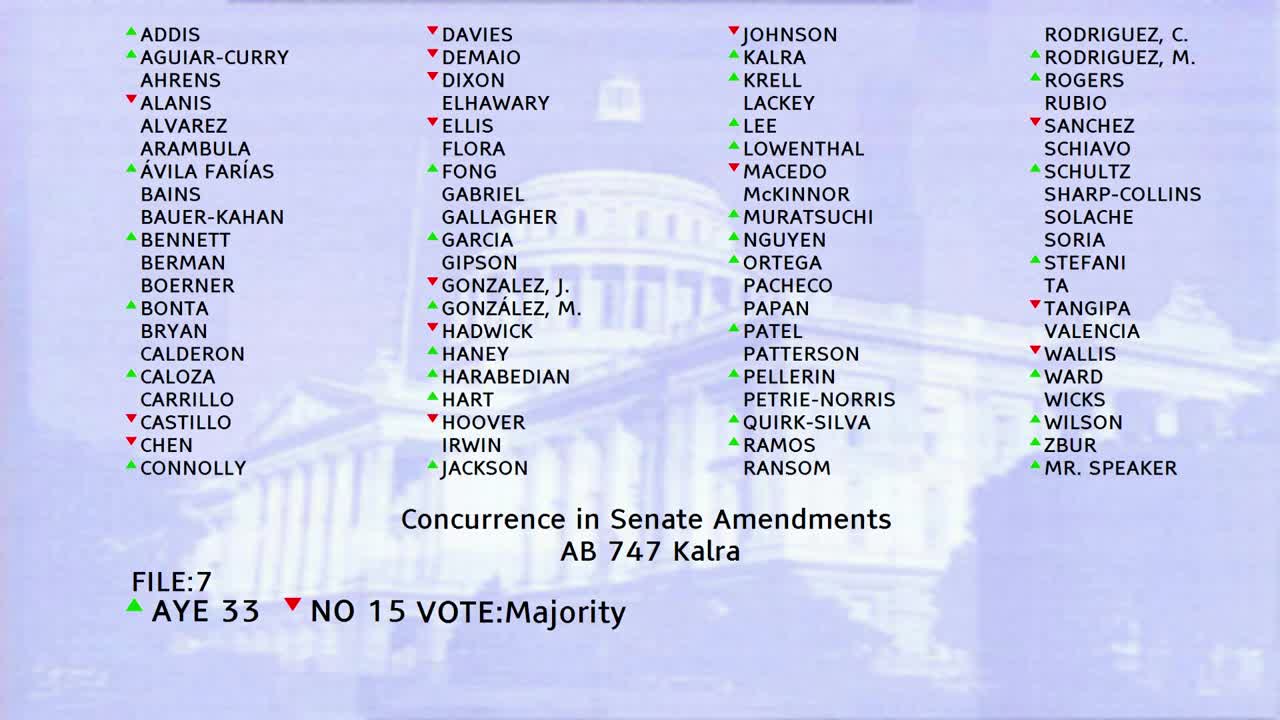 1MIN
Assembly Floor
 2MIN
Senate Floor
 6MIN
Senate Standing Committee on Housing
 22MIN
Senate Standing Committee on Local Government
 1MIN
Assembly Floor
 1MIN
Assembly Standing Committee on Appropriations
 9MIN
Assembly Standing Committee on Local Government
 9MIN
Assembly Standing Committee on Housing and Community Development
Bill Author