AB 632: Local ordinances: administrative fines or penalties.
- Session Year: 2025-2026
- House: Assembly
- Latest Version Date: 2025-09-15
Current Status:
Failed
(2026-01-22: Consideration of Governor's veto stricken from file.)
Introduced
In Committee
Awaiting First Chamber Vote
Passed First Chamber
In Committee
Awaiting Second Chamber Vote
Passed Second Chamber
Enacted
Existing law authorizes the legislative body of a local agency, as defined, to, by ordinance, make any violation of an ordinance subject to an administrative fine or penalty. Existing law requires a local agency to set forth, by ordinance, the administrative procedures that govern the imposition, enforcement, collection, and administrative review of those administrative fines or penalties, as specified.
This bill would, for specified administrative fines or penalties, authorize a local agency to, subject to specified requirements, file a certified copy of a final administrative order or decision that directs payment of the administrative fine or penalty with the clerk of the superior court of any county, as specified, and require the clerk to enter judgment immediately in conformity with the decision or order. The bill would also authorize a local agency to, by ordinance, establish a procedure to collect administrative fines or penalties by lien upon the parcel of land on which the violation occurred if the ordinance meets specified requirements. The bill would specify that the remedies or penalties provided by these provisions are cumulative of the remedies or penalties available under any other law.
Existing law authorizes the legislative body of a local agency, as defined, to, by ordinance, make any violation of an ordinance subject to an administrative fine or penalty. Existing law requires a local agency to set forth, by ordinance, the administrative procedures that govern the imposition, enforcement, collection, and administrative review of those administrative fines or penalties, as specified.
This bill would, for specified administrative fines or penalties, authorize a local agency to to, subject to specified requirements, file a certified copy of a final administrative order or decision that directs payment of the administrative fine or penalty with the clerk of the superior court of any county, as specified, and require the clerk to enter judgment immediately in conformity with the decision or order. The bill would also authorize a local agency to, by ordinance, establish a procedure to collect administrative fines or penalties by lien upon the parcel of land on which the violation occurred if the ordinance requires service of a specified notice. meets specified requirements. The bill would specify that the remedies or penalties provided by these provisions are cumulative of the remedies or penalty penalties available under any other law.
Existing law authorizes the legislative body of a local agency, as defined, to, by ordinance, make any violation of an ordinance subject to an administrative fine or penalty. Existing law requires a local agency to set forth, by ordinance, the administrative procedures that govern the imposition, enforcement, collection, and administrative review of those administrative fines or penalties, as specified.
This bill would, for specified administrative fines or penalties, authorize a local agency to file a certified copy of a final administrative order or decision that directs payment of the administrative fine or penalty with the clerk of the superior court of any county, as specified, and require the clerk to enter judgment immediately in conformity with the decision or order. The bill would also authorize a local agency to, by ordinance, establish a procedure to collect administrative fines or penalties by lien upon the parcel of land on which the violation occurred if the ordinance requires service of a specified notice. The bill would specify that the remedies or penalties provided by these provisions are cumulative of the remedies or penalty available under any other law.
(a)(1)The legislative body of a local agency, as the term local agency is defined in Section 54951, may by ordinance make any violation of any ordinance enacted by the local agency subject to an administrative fine or penalty. The local agency shall set forth by ordinance the administrative procedures that shall govern the imposition, enforcement, collection, and administrative review by the local agency of those administrative fines or penalties. Where the violation would otherwise be an infraction, the administrative fine or penalty shall not exceed the maximum fine or penalty amounts for infractions set forth in Section 25132 and subdivision (b) of Section 36900.
(2)(A)The administrative procedures set forth by ordinance adopted by the local agency pursuant to this subdivision shall provide for a reasonable period of time, as specified in the ordinance, for a person responsible for a continuing violation to correct or otherwise remedy the violation prior to the imposition of administrative fines or penalties, when the violation pertains to building, plumbing, electrical, or other similar structural or zoning issues, that do not create an immediate danger to health or safety.
(B)Notwithstanding subparagraph (A), the ordinance adopted by the local agency pursuant to this subdivision may declare commercial cannabis activity undertaken without a license as required by Division 10 (commencing with Section 26000) of the Business and Professions Code to be a public nuisance and provide for the immediate imposition of administrative fines or penalties for the violation of local zoning restrictions or building, plumbing, electrical, or other similar structural, or health and safety requirements if the violation exists as a result of, or to facilitate, the unlicensed cultivation, manufacturing, processing, distribution, or retail sale of cannabis for which a license is required. This subparagraph shall not be construed to apply to cannabis cultivation or activity that is lawfully undertaken pursuant to Section 11362.1 or 11362.5 of the Health and Safety Code, to commercial cannabis activity undertaken pursuant to a license under Division 10 (commencing with Section 26000) of the Business and Professions Code and applicable state regulations, or to a person exempt from licensure pursuant to Section 26033 of the Business and Professions Code.
(C)If a local agency adopts an ordinance that provides for the immediate imposition of administrative fines or penalties as allowed in subparagraph (B), that ordinance may impose the administrative fines and penalties upon the property owner and upon each owner of the occupant business entity engaging in unlicensed commercial cannabis activity and may hold them jointly and severally liable for the administrative fines and penalties.
(D)Administrative fines or penalties that are immediately imposed pursuant to an ordinance adopted under subparagraph (B) shall not exceed one thousand dollars ($1,000) per violation and shall not exceed ten thousand dollars ($10,000) per day. This subparagraph shall not be construed to limit the immediate imposition of larger fines that are otherwise authorized by applicable law and shall not be construed to limit administrative fines or penalties that are imposed after notice and a reasonable time to correct pursuant to subparagraph (A).
(E)An ordinance adopted pursuant to subparagraph (B) shall provide for a reasonable period of time for the correction or remedy of the violation prior to the imposition of administrative fines or penalties as required in subparagraph (A) if all of the following are true:
(i)A tenant is in possession of the property that is the subject of the administrative action.
(ii)The rental property owner or agent can provide evidence that the rental or lease agreement prohibits the commercial cannabis activity.
(iii)The rental property owner or agent did not know the tenant was engaging in unlicensed commercial cannabis activity for which a license was required and no complaint, property inspection, or other information caused the rental property owner or agent to have actual notice of the unlicensed commercial cannabis activity.
(F)A local agency that passes an ordinance pursuant to subparagraph (B) may refer cases involving unlicensed commercial cannabis activity to the Attorney General to undertake civil enforcement action pursuant to Chapter 5 (commencing with Section 17200) of Part 2 of Division 7 of, or Section 26038 of, the Business and Professions Code or any other applicable law.
(b)(1)Notwithstanding Section 1094.5 or 1094.6 of the Code of Civil Procedure, within 20 days after service of the final administrative order or decision of the local agency is made pursuant to an ordinance enacted in accordance with this section regarding the imposition, enforcement, or collection of the administrative fines or penalties, a person contesting that final administrative order or decision may seek review by filing an appeal to be heard by the superior court, where the same shall be heard de novo, except that the contents of the local agencys file in the case shall be received in evidence. A proceeding under this subdivision is a limited civil case. A copy of the document or instrument of the local agency providing notice of the violation and imposition of the administrative fine or penalty shall be admitted into evidence as prima facie evidence of the facts stated therein. A copy of the notice of appeal shall be served in person or by first-class mail upon the local agency by the contestant.
(2)The fee for filing the notice of appeal shall be as specified in Section 70615. The court shall request that the local agencys file on the case be forwarded to the court, to be received within 15 days of the request. The court shall retain the fee specified in Section 70615 regardless of the outcome of the appeal. If the court finds in favor of the contestant, the amount of the fee shall be reimbursed to the contestant by the local agency. Any deposit of the fine or penalty shall be refunded by the local agency in accordance with the judgment of the court.
(3)The conduct of the appeal under this section is a subordinate judicial duty that may be performed by traffic trial commissioners and other subordinate judicial officials at the direction of the presiding judge of the court.
(c)If no notice of appeal of the local agencys final administrative order or decision is filed within the period set forth in this section, the order or decision shall be deemed confirmed.
(d)If the fine or penalty has not been deposited and the decision of the court is against the contestant, the local agency may proceed to collect the penalty pursuant to the procedures set forth in its ordinance.
(e)(1)(A)For an administrative fine or penalty described in paragraph (2), after the exhaustion of the administrative procedures provided in this section and expiration of the time to seek judicial review or conclusion of judicial review proceedings, as applicable, the local agency may file a certified copy of a final administrative order or decision of the local agency that directs the payment of an administrative fine or penalty and, if applicable, a copy of an order of the superior court rendered on an appeal from the local agencys decision or denying a petition for a writ of administrative mandate with the clerk of the superior court of any county. Judgment shall be entered immediately by the clerk in conformity with the decision or order.
(B)Before making a filing under subparagraph (A), the local agency shall serve a notice of entry of judgment upon all parties named in the final administrative order or judicial decision in the manner set forth in subparagraph (B) of paragraph (3) of subdivision (f).
(2)This subdivision shall only apply to an administrative fine or penalty that is imposed for a violation of any of the following:
(A)Any law, regulation, or local ordinance regulating or prohibiting the cultivating, manufacturing, producing, processing, preparing, storing, providing, donating, selling, delivering, or distributing of cannabis or cannabis products, including, but not limited to, an ordinance adopted pursuant to Section 26200 of the Business and Professions Code.
(B)The State Housing Law (Part 1.5 (commencing with Section 17910) of Division 13 of the Health and Safety Code) and regulations or ordinances adopted pursuant to that part, if the violation results in the building being substandard as described in Section 17920.3 of the Health and Safety Code.
(C)Any law, regulation, or local ordinance that ensures the habitability of rental housing, including, but not limited to, any law, regulation, or local ordinance that would also be a violation of Section 1941.1 of the Civil Code.
(D)(i)Any of the following laws or regulations relating to fire hazards:
(I)Chapter 2 (commencing with Section 4251) and Chapter 3 (commencing with Section 4291) of Part 2 of Division 4 of the Public Resources Code.
(II)Chapter 6.8 (commencing with Section 51175) of Part 1 of Division 1.
(III)Part 2 (commencing with Section 12500) of Division 11 of the Health and Safety Code.
(IV)Part 2 (commencing with Section 13100) of Division 12 of the Health and Safety Code.
(V)Section R337 of the California Residential Code (Part 2.5 of Title 24 of the California Code of Regulations).
(VI)Parts II, IV, and V of the California Fire Code (Part 9 of Title 24 of the California Code of Regulations).
(VII)Chapter 12-7A of the California Referenced Standards Code (Part 12 of Title 24 of the California Code of Regulations).
(ii)Any regulations adopted pursuant to the laws in clause (i).
(iii)Any local ordinances implementing the laws or regulations in clause (i) or establishing substantially similar requirements for any lands, structures, or activities.
(f)The local agency may, by ordinance, establish a procedure to collect administrative fines or penalties imposed pursuant to this section by lien upon the parcel of land on which the violation occurred, provided that the ordinance meets all of the following requirements:
(1)The ordinance requires that all of the following shall occur before a notice of lien is served:
(A)The property owner is served with a notice of violation or other charging document for a violation of an ordinance adopted pursuant to subdivision (a).
(B)Any period of time to correct the violation required by this section or otherwise provided by local ordinance has expired.
(C)The property owner exhausts the administrative review procedures set forth in the local ordinance pursuant to subdivision (a), and the judicial review procedures available under either subdivision (b) or Sections 1094.5 and 1094.6 of the Code of Civil Procedure, or the time to pursue administrative or judicial review, have expired.
(2)The ordinance does not require prepayment or advance deposit of the administrative fines or penalties as a condition of pursuing administrative or judicial review. This paragraph does not prohibit imposition or collection of any filing or appeal fees that are otherwise authorized.
(3)(A)After the requirements of paragraph (1) are satisfied, the ordinance requires the property owner to be served with a notice of lien at least 20 days before the recordation of the lien.
(B)Notices under this paragraph may be served by first-class mail or personal service. In case of service by mail, the notice or other paper shall be deposited in a post office, mailbox, subpost office, substation, or mail chute, or other like facility regularly maintained by the United States Postal Service, in a sealed envelope, with postage paid, addressed to each party. Service by mail is complete at the time of the deposit in the mail facility, but any period of notice set forth in this paragraph or an ordinance adopted hereunder, and any right or duty to do any act or make any response within any period after service, shall be extended five calendar days, upon service by mail, if the place of address and the place of mailing is within the State of California, 10 calendar days if either the place of mailing or the place of address is outside the State of California but within the United States, 12 calendar days if the place of address is designated as a substitute mailing address by the Secretary of States address confidentiality program (Chapter 3.1 (commencing with Section 6205) of Division 7 of Title 1), and 20 calendar days if either the place of mailing or the place of address is outside the United States.
(4)For purposes of this subdivision, property owner includes the holder of any encumbrance on the property.
(g)Once a copy of the notice of lien, as described in paragraph (3) of subdivision (f), is recorded in the county recorders office, the lien shall have the same force, effect, and priority as a judgment lien.
(h)The remedies or penalties provided by this section are cumulative of the remedies or penalties available under other law.
(a)(1)The legislative body of a local agency, as the term local agency is defined in Section 54951, may by ordinance make any violation of any ordinance enacted by the local agency subject to an administrative fine or penalty. The local agency shall set forth by ordinance the administrative procedures that shall govern the imposition, enforcement, collection, and administrative review by the local agency of those administrative fines or penalties. Where the violation would otherwise be an infraction, the administrative fine or penalty shall not exceed the maximum fine or penalty amounts for infractions set forth in Section 25132 and subdivision (b) of Section 36900.
(2)(A)The administrative procedures set forth by ordinance adopted by the local agency pursuant to this subdivision shall provide for a reasonable period of time, as specified in the ordinance, for a person responsible for a continuing violation to correct or otherwise remedy the violation prior to the imposition of administrative fines or penalties, when the violation pertains to building, plumbing, electrical, or other similar structural or zoning issues, that do not create an immediate danger to health or safety.
(B)Notwithstanding subparagraph (A), the ordinance adopted by the local agency pursuant to this subdivision may declare commercial cannabis activity undertaken without a license as required by Division 10 (commencing with Section 26000) of the Business and Professions Code to be a public nuisance and provide for the immediate imposition of administrative fines or penalties for the violation of local zoning restrictions or building, plumbing, electrical, or other similar structural, or health and safety requirements if the violation exists as a result of, or to facilitate, the unlicensed cultivation, manufacturing, processing, distribution, or retail sale of cannabis for which a license is required. This subparagraph shall not be construed to apply to cannabis cultivation or activity that is lawfully undertaken pursuant to Section 11362.1 or 11362.5 of the Health and Safety Code, to commercial cannabis activity undertaken pursuant to a license under Division 10 (commencing with Section 26000) of the Business and Professions Code and applicable state regulations, or to a person exempt from licensure pursuant to Section 26033 of the Business and Professions Code.
(C)If a local agency adopts an ordinance that provides for the immediate imposition of administrative fines or penalties as allowed in subparagraph (B), that ordinance may impose the administrative fines and penalties upon the property owner and upon each owner of the occupant business entity engaging in unlicensed commercial cannabis activity and may hold them jointly and severally liable for the administrative fines and penalties.
(D)Administrative fines or penalties that are immediately imposed pursuant to an ordinance adopted under subparagraph (B) shall not exceed one thousand dollars ($1,000) per violation and shall not exceed ten thousand dollars ($10,000) per day. This subparagraph shall not be construed to limit the immediate imposition of larger fines that are otherwise authorized by applicable law and shall not be construed to limit administrative fines or penalties that are imposed after notice and a reasonable time to correct pursuant to subparagraph (A).
(E)An ordinance adopted pursuant to subparagraph (B) shall provide for a reasonable period of time for the correction or remedy of the violation prior to the imposition of administrative fines or penalties as required in subparagraph (A) if all of the following are true:
(i)A tenant is in possession of the property that is the subject of the administrative action.
(ii)The rental property owner or agent can provide evidence that the rental or lease agreement prohibits the commercial cannabis activity.
(iii)The rental property owner or agent did not know the tenant was engaging in unlicensed commercial cannabis activity for which a license was required and no complaint, property inspection, or other information caused the rental property owner or agent to have actual notice of the unlicensed commercial cannabis activity.
(F)A local agency that passes an ordinance pursuant to subparagraph (B) may refer cases involving unlicensed commercial cannabis activity to the Attorney General to undertake civil enforcement action pursuant to Chapter 5 (commencing with Section 17200) of Part 2 of Division 7 of, or Section 26038 of, the Business and Professions Code or any other applicable law.
(b)(1)Notwithstanding Section 1094.5 or 1094.6 of the Code of Civil Procedure, within 20 days after service of the final administrative order or decision of the local agency is made pursuant to an ordinance enacted in accordance with this section regarding the imposition, enforcement, or collection of the administrative fines or penalties, a person contesting that final administrative order or decision may seek review by filing an appeal to be heard by the superior court, where the same shall be heard de novo, except that the contents of the local agencys file in the case shall be received in evidence. A proceeding under this subdivision is a limited civil case. A copy of the document or instrument of the local agency providing notice of the violation and imposition of the administrative fine or penalty shall be admitted into evidence as prima facie evidence of the facts stated therein. A copy of the notice of appeal shall be served in person or by first-class mail upon the local agency by the contestant.
(2)The fee for filing the notice of appeal shall be as specified in Section 70615. The court shall request that the local agencys file on the case be forwarded to the court, to be received within 15 days of the request. The court shall retain the fee specified in Section 70615 regardless of the outcome of the appeal. If the court finds in favor of the contestant, the amount of the fee shall be reimbursed to the contestant by the local agency. Any deposit of the fine or penalty shall be refunded by the local agency in accordance with the judgment of the court.
(3)The conduct of the appeal under this section is a subordinate judicial duty that may be performed by traffic trial commissioners and other subordinate judicial officials at the direction of the presiding judge of the court.
(c)If no notice of appeal of the local agencys final administrative order or decision is filed within the period set forth in this section, the order or decision shall be deemed confirmed.
(d)If the fine or penalty has not been deposited and the decision of the court is against the contestant, the local agency may proceed to collect the penalty pursuant to the procedures set forth in its ordinance.
(e)(1)(A)For an administrative fine or penalty described in paragraph (2), after the exhaustion of the administrative and review procedures provided in this section, section and expiration of the time to seek judicial review or conclusion of judicial review proceedings, as applicable, the local agency may file a certified copy of a final administrative order or decision of the local agency that directs the payment of an administrative fine or penalty and, if applicable, a copy of an order of the superior court rendered on an appeal from the local agencys decision or denying a petition for a writ of administrative mandate with the clerk of the superior court of any county. Judgment shall be entered immediately by the clerk in conformity with the decision or order.
(B)Before making a filing under subparagraph (A), the local agency shall serve a notice of entry of judgment upon all parties named in the final administrative order or judicial decision in the manner set forth in subparagraph (B) of paragraph (3) of subdivision (f).
(2)This subdivision shall only apply to an administrative fine or penalty that is imposed for a violation of any of the following:
(A)Any law, regulation, or local ordinance regulating or prohibiting the cultivating, manufacturing, producing, processing, preparing, storing, providing, donating, selling, delivering, or distributing of cannabis or cannabis products, including, but not limited to, an ordinance adopted pursuant to Section 26200 of the Business and Professions Code.
(B)The State Housing Law (Part 1.5 (commencing with Section 17910) of Division 13 of the Health and Safety Code) and regulations or ordinances adopted pursuant to that part. part, if the violation results in the building being substandard as described in Section 17920.3 of the Health and Safety Code.
(C)Any law, regulation, or local ordinance that ensures the habitability of rental housing, including, but not limited to, any law, regulation, or local ordinance that would also be a violation of Section 1941.1 of the Civil Code.
(D)(i)Any law, regulation, or local ordinance relating to fire hazards. of the following laws or regulations relating to fire hazards:
(I)Chapter 2 (commencing with Section 4251) and Chapter 3 (commencing with Section 4291) of Part 2 of Division 4 of the Public Resources Code.
(II)Chapter 6.8 (commencing with Section 51175) of Part 1 of Division 1.
(III)Part 2 (commencing with Section 12500) of Division 11 of the Health and Safety Code.
(IV)Part 2 (commencing with Section 13100) of Division 12 of the Health and Safety Code.
(V)Section R337 of the California Residential Code (Part 2.5 of Title 24 of the California Code of Regulations).
(VI)Parts II, IV, and V of the California Fire Code (Part 9 of Title 24 of the California Code of Regulations).
(VII)Chapter 12-7A of the California Referenced Standards Code (Part 12 of Title 24 of the California Code of Regulations).
(ii)Any regulations adopted pursuant to the laws in clause (i).
(iii)Any local ordinances implementing the laws or regulations in clause (i) or establishing substantially similar requirements for any lands, structures, or activities.
(f)The local agency may, by ordinance, establish a procedure to collect administrative fines or penalties imposed pursuant to this section by lien upon the parcel of land on which the violation occurred. occurred, provided that the ordinance meets all of the following requirements:
(1)The ordinance requires that all of the following shall occur before a notice of lien is served:
(A)The property owner is served with a notice of violation or other charging document for a violation of an ordinance adopted pursuant to subdivision (a).
(B)Any period of time to correct the violation required by this section or otherwise provided by local ordinance has expired.
(C)The property owner exhausts the administrative review procedures set forth in the local ordinance pursuant to subdivision (a), and the judicial review procedures available under either subdivision (b) or Sections 1094.5 and 1094.6 of the Code of Civil Procedure, or the time to pursue administrative or judicial review, have expired.
(2)The ordinance does not require prepayment or advance deposit of the administrative fines or penalties as a condition of pursuing administrative or judicial review. This paragraph does not prohibit imposition or collection of any filing or appeal fees that are otherwise authorized.
(1)(3)(A)The ordinance shall require service of both of the following upon the parties set forth in subparagraph (C): After the requirements of paragraph (1) are satisfied, the ordinance requires the property owner to be served with a notice of lien at least 20 days before the recordation of the lien.
(i)The initial notice of violation or other charging document commencing the administrative procedures for imposition of administrative fines or penalties.(ii)A notice of lien, which shall be served or mailed after the exhaustion of the administrative and review procedures provided in this section and before the recordation of the lien.(B)Notices under this paragraph may be served by first-class mail or personal service. In case of service by mail, the notice or other paper shall be deposited in a post office, mailbox, subpost office, substation, or mail chute, or other like facility regularly maintained by the United States Postal Service, in a sealed envelope, with postage paid, addressed to each party set forth in subparagraph (C). party. Service by mail is complete at the time of the deposit in the mail facility, and any period of notice set forth in this paragraph or an ordinance adopted hereunder, and any right or duty to do any act or make any response within any period after service, shall not be extended by reason of service by mail. Section 1013 of the Code of Civil Procedure does not apply to extend the time for giving any notice or performing any act under this paragraph or an ordinance adopted hereunder. but any period of notice set forth in this paragraph or an ordinance adopted hereunder, and any right or duty to do any act or make any response within any period after service, shall be extended five calendar days, upon service by mail, if the place of address and the place of mailing is within the State of California, 10 calendar days if either the place of mailing or the place of address is outside the State of California but within the United States, 12 calendar days if the place of address is designated as a substitute mailing address by the Secretary of States address confidentiality program (Chapter 3.1 (commencing with Section 6205) of Division 7 of Title 1), and 20 calendar days if either the place of mailing or the place of address is outside the United States.
(C)Notices under this paragraph shall be served or mailed to both of the following:(i)The owner of record of the parcel of land on which the violation occurred, based on the last equalized assessment roll or the supplemental roll, whichever is more current.(ii)The owner of an encumbrance of record on the property.(2)The parties set forth in subparagraph (C) of paragraph (1) shall be entitled to seek administrative review of the administrative fines or penalties in accordance with the procedures set forth in the ordinance and to contest a final administrative order or decision under this section in accordance with applicable law.(4)For purposes of this subdivision, property owner includes the holder of any encumbrance on the property.
(3)(g)Once a copy of the notice of lien, as described in paragraph (1), (3) of subdivision (f), is recorded in the county recorders office, the lien shall have the same force, effect, and priority as a judgment lien.
(g)(h)The remedies or penalties provided by this section are cumulative of the remedies or penalties available under other law.
(a)(1)The legislative body of a local agency, as the term local agency is defined in Section 54951, may by ordinance make any violation of any ordinance enacted by the local agency subject to an administrative fine or penalty. The local agency shall set forth by ordinance the administrative procedures that shall govern the imposition, enforcement, collection, and administrative review by the local agency of those administrative fines or penalties. Where the violation would otherwise be an infraction, the administrative fine or penalty shall not exceed the maximum fine or penalty amounts for infractions set forth in Section 25132 and subdivision (b) of Section 36900.
(2)(A)The administrative procedures set forth by ordinance adopted by the local agency pursuant to this subdivision shall provide for a reasonable period of time, as specified in the ordinance, for a person responsible for a continuing violation to correct or otherwise remedy the violation prior to the imposition of administrative fines or penalties, when the violation pertains to building, plumbing, electrical, or other similar structural or zoning issues, that do not create an immediate danger to health or safety.
(B)Notwithstanding subparagraph (A), the ordinance adopted by the local agency pursuant to this subdivision may declare commercial cannabis activity undertaken without a license as required by Division 10 (commencing with Section 26000) of the Business and Professions Code to be a public nuisance and provide for the immediate imposition of administrative fines or penalties for the violation of local zoning restrictions or building, plumbing, electrical, or other similar structural, or health and safety requirements if the violation exists as a result of, or to facilitate, the unlicensed cultivation, manufacturing, processing, distribution, or retail sale of cannabis for which a license is required. This subparagraph shall not be construed to apply to cannabis cultivation or activity that is lawfully undertaken pursuant to Section 11362.1 or 11362.5 of the Health and Safety Code, to commercial cannabis activity undertaken pursuant to a license under Division 10 (commencing with Section 26000) of the Business and Professions Code and applicable state regulations, or to a person exempt from licensure pursuant to Section 26033 of the Business and Professions Code.
(C)If a local agency adopts an ordinance that provides for the immediate imposition of administrative fines or penalties as allowed in subparagraph (B), that ordinance may impose the administrative fines and penalties upon the property owner and upon each owner of the occupant business entity engaging in unlicensed commercial cannabis activity and may hold them jointly and severally liable for the administrative fines and penalties.
(D)Administrative fines or penalties that are immediately imposed pursuant to an ordinance adopted under subparagraph (B) shall not exceed one thousand dollars ($1,000) per violation and shall not exceed ten thousand dollars ($10,000) per day. This subparagraph shall not be construed to limit the immediate imposition of larger fines that are otherwise authorized by applicable law and shall not be construed to limit administrative fines or penalties that are imposed after notice and a reasonable time to correct pursuant to subparagraph (A).
(E)An ordinance adopted pursuant to subparagraph (B) shall provide for a reasonable period of time for the correction or remedy of the violation prior to the imposition of administrative fines or penalties as required in subparagraph (A) if all of the following are true:
(i)A tenant is in possession of the property that is the subject of the administrative action.
(ii)The rental property owner or agent can provide evidence that the rental or lease agreement prohibits the commercial cannabis activity.
(iii)The rental property owner or agent did not know the tenant was engaging in unlicensed commercial cannabis activity for which a license was required and no complaint, property inspection, or other information caused the rental property owner or agent to have actual notice of the unlicensed commercial cannabis activity.
(F)A local agency that passes an ordinance pursuant to subparagraph (B) may refer cases involving unlicensed commercial cannabis activity to the Attorney General to undertake civil enforcement action pursuant to Chapter 5 (commencing with Section 17200) of Part 2 of Division 7 of, or Section 26038 of, the Business and Professions Code or any other applicable law.
(b)(1)Notwithstanding Section 1094.5 or 1094.6 of the Code of Civil Procedure, within 20 days after service of the final administrative order or decision of the local agency is made pursuant to an ordinance enacted in accordance with this section regarding the imposition, enforcement, or collection of the administrative fines or penalties, a person contesting that final administrative order or decision may seek review by filing an appeal to be heard by the superior court, where the same shall be heard de novo, except that the contents of the local agencys file in the case shall be received in evidence. A proceeding under this subdivision is a limited civil case. A copy of the document or instrument of the local agency providing notice of the violation and imposition of the administrative fine or penalty shall be admitted into evidence as prima facie evidence of the facts stated therein. A copy of the notice of appeal shall be served in person or by first-class mail upon the local agency by the contestant.
(2)The fee for filing the notice of appeal shall be as specified in Section 70615. The court shall request that the local agencys file on the case be forwarded to the court, to be received within 15 days of the request. The court shall retain the fee specified in Section 70615 regardless of the outcome of the appeal. If the court finds in favor of the contestant, the amount of the fee shall be reimbursed to the contestant by the local agency. Any deposit of the fine or penalty shall be refunded by the local agency in accordance with the judgment of the court.
(3)The conduct of the appeal under this section is a subordinate judicial duty that may be performed by traffic trial commissioners and other subordinate judicial officials at the direction of the presiding judge of the court.
(c)If no notice of appeal of the local agencys final administrative order or decision is filed within the period set forth in this section, the order or decision shall be deemed confirmed.
(d)If the fine or penalty has not been deposited and the decision of the court is against the contestant, the local agency may proceed to collect the penalty pursuant to the procedures set forth in its ordinance.
(e)(1)For an administrative fine or penalty described in paragraph (2), after the exhaustion of the administrative and review procedures provided in this section, the local agency may file a certified copy of a final administrative order or decision of the local agency that directs the payment of an administrative fine or penalty and, if applicable, a copy of an order of the superior court rendered on an appeal from the local agencys decision or denying a petition for a writ of administrative mandate with the clerk of the superior court of any county. Judgment shall be entered immediately by the clerk in conformity with the decision or order. A fee shall not be charged by the clerk of the superior court for the performance of an official service required in connection with the entry of judgment pursuant to this subdivision.
(2)This subdivision shall only apply to an administrative fine or penalty that is imposed for a violation of any of the following:
(A)Any law, regulation, or local ordinance regulating or prohibiting the cultivating, manufacturing, producing, processing, preparing, storing, providing, donating, selling, delivering, or distributing of cannabis or cannabis products, including, but not limited to, an ordinance adopted pursuant to Section 26200 of the Business and Professions Code.
(B)The State Housing Law (Part 1.5 (commencing with Section 17910) of Division 13 of the Health and Safety Code) and regulations or ordinances adopted pursuant to that part.
(C)Any law, regulation, or local ordinance that ensures the habitability of rental housing, including, but not limited to, any law, regulation, or local ordinance that would also be a violation of Section 1941.1 of the Civil Code.
(D)Any law, regulation, or local ordinance relating to fire hazards.
(f)The local agency may, by ordinance, establish a procedure to collect administrative fines or penalties imposed pursuant to this section by lien upon the parcel of land on which the violation occurred.
(1)(A)The ordinance shall require service of both of the following upon the parties set forth in subparagraph (C):
(i)The initial notice of violation or other charging document commencing the administrative procedures for imposition of administrative fines or penalties.
(ii)A notice of lien, which shall be served or mailed after the exhaustion of the administrative and review procedures provided in this section and before the recordation of the lien.
(B)Notices under this paragraph may be served by first-class mail or personal service. In case of service by mail, the notice or other paper shall be deposited in a post office, mailbox, subpost office, substation, or mail chute, or other like facility regularly maintained by the United States Postal Service, in a sealed envelope, with postage paid, addressed to each party set forth in subparagraph (C). Service by mail is complete at the time of the deposit in the mail facility, and any period of notice set forth in this paragraph or an ordinance adopted hereunder, and any right or duty to do any act or make any response within any period after service, shall not be extended by reason of service by mail. Section 1013 of the Code of Civil Procedure does not apply to extend the time for giving any notice or performing any act under this paragraph or an ordinance adopted hereunder.
(C)Notices under this paragraph shall be served or mailed to both of the following:
(i)The owner of record of the parcel of land on which the violation occurred, based on the last equalized assessment roll or the supplemental roll, whichever is more current.
(ii)The owner of an encumbrance of record on the property.
(2)The parties set forth in subparagraph (C) of paragraph (1) shall be entitled to seek administrative review of the administrative fines or penalties in accordance with the procedures set forth in the ordinance and to contest a final administrative order or decision under this section in accordance with applicable law.
(3)Once a copy of the notice of lien, as described in paragraph (1), is recorded in the county recorders office, the lien shall have the same force, effect, and priority as a judgment lien.
(g)The remedies or penalties provided by this section are cumulative of the remedies or penalties available under other law.
(a)(1)The legislative body of a local agency, as the term local agency is defined in Section 54951, may by ordinance make any violation of any ordinance enacted by the local agency subject to an administrative fine or penalty. The local agency shall set forth by ordinance the administrative procedures that shall govern the imposition, enforcement, collection, and administrative review by the local agency of those administrative fines or penalties. Where the violation would otherwise be an infraction, the administrative fine or penalty shall not exceed the maximum fine or penalty amounts for infractions set forth in Section 25132 and subdivision (b) of Section 36900.
(2)(A)The administrative procedures set forth by ordinance adopted by the local agency pursuant to this subdivision shall provide for a reasonable period of time, as specified in the ordinance, for a person responsible for a continuing violation to correct or otherwise remedy the violation prior to the imposition of administrative fines or penalties, when the violation pertains to building, plumbing, electrical, or other similar structural or zoning issues, that do not create an immediate danger to health or safety.
(B)Notwithstanding subparagraph (A), the ordinance adopted by the local agency pursuant to this subdivision may declare commercial cannabis activity undertaken without a license as required by Division 10 (commencing with Section 26000) of the Business and Professions Code to be a public nuisance and provide for the immediate imposition of administrative fines or penalties for the violation of local zoning restrictions or building, plumbing, electrical, or other similar structural, or health and safety requirements if the violation exists as a result of, or to facilitate, the unlicensed cultivation, manufacturing, processing, distribution, or retail sale of cannabis for which a license is required. This subparagraph shall not be construed to apply to cannabis cultivation or activity that is lawfully undertaken pursuant to Section 11362.1 or 11362.5 of the Health and Safety Code, to commercial cannabis activity undertaken pursuant to a license under Division 10 (commencing with Section 26000) of the Business and Professions Code and applicable state regulations, or to a person exempt from licensure pursuant to Section 26033 of the Business and Professions Code.
(C)If a local agency adopts an ordinance that provides for the immediate imposition of administrative fines or penalties as allowed in subparagraph (B), that ordinance may impose the administrative fines and penalties upon the property owner and upon each owner of the occupant business entity engaging in unlicensed commercial cannabis activity and may hold them jointly and severally liable for the administrative fines and penalties.
(D)Administrative fines or penalties that are immediately imposed pursuant to an ordinance adopted under subparagraph (B) shall not exceed one thousand dollars ($1,000) per violation and shall not exceed ten thousand dollars ($10,000) per day. This subparagraph shall not be construed to limit the immediate imposition of larger fines that are otherwise authorized by applicable law and shall not be construed to limit administrative fines or penalties that are imposed after notice and a reasonable time to correct pursuant to subparagraph (A).
(E)An ordinance adopted pursuant to subparagraph (B) shall provide for a reasonable period of time for the correction or remedy of the violation prior to the imposition of administrative fines or penalties as required in subparagraph (A) if all of the following are true:
(i)A tenant is in possession of the property that is the subject of the administrative action.
(ii)The rental property owner or agent can provide evidence that the rental or lease agreement prohibits the commercial cannabis activity.
(iii)The rental property owner or agent did not know the tenant was engaging in unlicensed commercial cannabis activity for which a license was required and no complaint, property inspection, or other information caused the rental property owner or agent to have actual notice of the unlicensed commercial cannabis activity.
(F)A local agency that passes an ordinance pursuant to subparagraph (B) may refer cases involving unlicensed commercial cannabis activity to the Attorney General to undertake civil enforcement action pursuant to Chapter 5 (commencing with Section 17200) of Part 2 of Division 7 of, or Section 26038 of, the Business and Professions Code or any other applicable law.
(b)(1)Notwithstanding Section 1094.5 or 1094.6 of the Code of Civil Procedure, within 20 days after service of the final administrative order or decision of the local agency is made pursuant to an ordinance enacted in accordance with this section regarding the imposition, enforcement, or collection of the administrative fines or penalties, a person contesting that final administrative order or decision may seek review by filing an appeal to be heard by the superior court, where the same shall be heard de novo, except that the contents of the local agencys file in the case shall be received in evidence. A proceeding under this subdivision is a limited civil case. A copy of the document or instrument of the local agency providing notice of the violation and imposition of the administrative fine or penalty shall be admitted into evidence as prima facie evidence of the facts stated therein. A copy of the notice of appeal shall be served in person or by first-class mail upon the local agency by the contestant.
(2)The fee for filing the notice of appeal shall be as specified in Section 70615. The court shall request that the local agencys file on the case be forwarded to the court, to be received within 15 days of the request. The court shall retain the fee specified in Section 70615 regardless of the outcome of the appeal. If the court finds in favor of the contestant, the amount of the fee shall be reimbursed to the contestant by the local agency. Any deposit of the fine or penalty shall be refunded by the local agency in accordance with the judgment of the court.
(3)The conduct of the appeal under this section is a subordinate judicial duty that may be performed by traffic trial commissioners and other subordinate judicial officials at the direction of the presiding judge of the court.
(c)If no notice of appeal of the local agencys final administrative order or decision is filed within the period set forth in this section, the order or decision shall be deemed confirmed.
(d)If the fine or penalty has not been deposited and the decision of the court is against the contestant, the local agency may proceed to collect the penalty pursuant to the procedures set forth in its ordinance.
(e)(1)For an administrative fine or penalty described in paragraph (2), after the exhaustion of the administrative and review procedures provided in this section, the local agency may file a certified copy of a final administrative order or decision of the local agency that directs the payment of an administrative fine or penalty and, if applicable, a copy of an order of the superior court rendered on an appeal from the local agencys decision or denying a petition for a writ of administrative mandate with the clerk of the superior court of any county. Judgment shall be entered immediately by the clerk in conformity with the decision or order. A fee shall not be charged by the clerk of the superior court for the performance of an official service required in connection with the entry of judgment pursuant to this section. subdivision.
(2)This subdivision shall only apply to an administrative fine or penalty that is imposed for a violation of any of the following:
(A)Any law, regulation, or local ordinance regulating or prohibiting the cultivating, manufacturing, producing, processing, preparing, storing, providing, donating, selling, delivering, or distributing of cannabis or cannabis products, including, but not limited to, an ordinance adopted pursuant to Section 26200 of the Business and Professions Code.
(B)The State Housing Law (Part 1.5 (commencing with Section 17910) of Division 13 of the Health and Safety Code) and regulations or ordinances adopted pursuant to that part.
(C)Any law, regulation, or local ordinance that ensures the habitability of rental housing, including, but not limited to, any law, regulation regulation, or local ordinance that would also be a violation of Section 1941.1 of the Civil Code.
(D)Any law, regulation, or local ordinance relating to fire hazards.
(f)The local agency may, by ordinance, establish a procedure to collect administrative fines or penalties imposed pursuant to this section by lien upon the parcel of land on which the violation occurred.
(1)(A)The ordinance shall require service of both of the following upon the parties set forth in subparagraph (C):
(i)The initial notice of violation or other charging document commencing the administrative procedures for imposition of administrative fines or penalties.
(ii)A notice of lien, which shall be served or mailed after the exhaustion of the administrative and review procedures provided in this section and before the recordation of the lien.
(B)Notices under this section paragraph may be served by first-class mail or personal service. In case of service by mail, the notice or other paper shall be deposited in a post office, mailbox, subpost office, substation, or mail chute, or other like facility regularly maintained by the United States Postal Service, in a sealed envelope, with postage paid, addressed to each party set forth in subparagraph (C). Service by mail is complete at the time of the deposit in the mail facility, and any period of notice set forth in this section paragraph or an ordinance adopted hereunder, and any right or duty to do any act or make any response within any period after service, shall not be extended by reason of service by mail. Section 1013 of the Code of Civil Procedure does not apply to extend the time for giving any notice or performing any act under this section paragraph or an ordinance adopted hereunder.
(C)Notices under this paragraph shall be served or mailed to both of the following:
(i)The owner of record of the parcel of land on which the violation occurred, based on the last equalized assessment roll or the supplemental roll, whichever is more current.
(ii)The owner of an encumbrance of record on the property.
(2)The parties set forth in subparagraph (C) of paragraph (1) shall be entitled to seek administrative review of the administrative fines or penalties in accordance with the procedures set forth in the ordinance and to contest a final administrative order or decision under this section in accordance with applicable law.
(3)Once a copy of the notice of lien, as described in paragraph (1), is recorded in the county recorders office, the lien shall have the same force, effect, and priority as a judgment lien.
(g)The remedies or penalties provided by this section are cumulative of the remedies or penalties available under other law.
(a)(1)The legislative body of a local agency, as the term local agency is defined in Section 54951, may by ordinance make any violation of any ordinance enacted by the local agency subject to an administrative fine or penalty. The local agency shall set forth by ordinance the administrative procedures that shall govern the imposition, enforcement, collection, and administrative review by the local agency of those administrative fines or penalties. Where the violation would otherwise be an infraction, the administrative fine or penalty shall not exceed the maximum fine or penalty amounts for infractions set forth in Section 25132 and subdivision (b) of Section 36900.
(2)(A)The administrative procedures set forth by ordinance adopted by the local agency pursuant to this subdivision shall provide for a reasonable period of time, as specified in the ordinance, for a person responsible for a continuing violation to correct or otherwise remedy the violation prior to the imposition of administrative fines or penalties, when the violation pertains to building, plumbing, electrical, or other similar structural or zoning issues, that do not create an immediate danger to health or safety.
(B)Notwithstanding subparagraph (A), the ordinance adopted by the local agency pursuant to this subdivision may declare commercial cannabis activity undertaken without a license as required by Division 10 (commencing with Section 26000) of the Business and Professions Code to be a public nuisance and provide for the immediate imposition of administrative fines or penalties for the violation of local zoning restrictions or building, plumbing, electrical, or other similar structural, or health and safety requirements if the violation exists as a result of, or to facilitate, the unlicensed cultivation, manufacturing, processing, distribution, or retail sale of cannabis for which a license is required. This subparagraph shall not be construed to apply to cannabis cultivation or activity that is lawfully undertaken pursuant to Section 11362.1 or 11362.5 of the Health and Safety Code, to commercial cannabis activity undertaken pursuant to a license under Division 10 (commencing with Section 26000) of the Business and Professions Code and applicable state regulations, or to a person exempt from licensure pursuant to Section 26033 of the Business and Professions Code.
(C)If a local agency adopts an ordinance that provides for the immediate imposition of administrative fines or penalties as allowed in subparagraph (B), that ordinance may impose the administrative fines and penalties upon the property owner and upon each owner of the occupant business entity engaging in unlicensed commercial cannabis activity and may hold them jointly and severally liable for the administrative fines and penalties.
(D)Administrative fines or penalties that are immediately imposed pursuant to an ordinance adopted under subparagraph (B) shall not exceed one thousand dollars ($1,000) per violation and shall not exceed ten thousand dollars ($10,000) per day. This subparagraph shall not be construed to limit the immediate imposition of larger fines that are otherwise authorized by applicable law and shall not be construed to limit administrative fines or penalties that are imposed after notice and a reasonable time to correct pursuant to subparagraph (A).
(E)An ordinance adopted pursuant to subparagraph (B) shall provide for a reasonable period of time for the correction or remedy of the violation prior to the imposition of administrative fines or penalties as required in subparagraph (A) if all of the following are true:
(i)A tenant is in possession of the property that is the subject of the administrative action.
(ii)The rental property owner or agent can provide evidence that the rental or lease agreement prohibits the commercial cannabis activity.
(iii)The rental property owner or agent did not know the tenant was engaging in unlicensed commercial cannabis activity for which a license was required and no complaint, property inspection, or other information caused the rental property owner or agent to have actual notice of the unlicensed commercial cannabis activity.
(F)A local agency that passes an ordinance pursuant to subparagraph (B) may refer cases involving unlicensed commercial cannabis activity to the Attorney General to undertake civil enforcement action pursuant to Chapter 5 (commencing with Section 17200) of Part 2 of Division 7 of, or Section 26038 of, the Business and Professions Code or any other applicable law.
(b)(1)Notwithstanding Section 1094.5 or 1094.6 of the Code of Civil Procedure, within 20 days after service of the final administrative order or decision of the local agency is made pursuant to an ordinance enacted in accordance with this section regarding the imposition, enforcement, or collection of the administrative fines or penalties, a person contesting that final administrative order or decision may seek review by filing an appeal to be heard by the superior court, where the same shall be heard de novo, except that the contents of the local agencys file in the case shall be received in evidence. A proceeding under this subdivision is a limited civil case. A copy of the document or instrument of the local agency providing notice of the violation and imposition of the administrative fine or penalty shall be admitted into evidence as prima facie evidence of the facts stated therein. A copy of the notice of appeal shall be served in person or by first-class mail upon the local agency by the contestant.
(2)The fee for filing the notice of appeal shall be as specified in Section 70615. The court shall request that the local agencys file on the case be forwarded to the court, to be received within 15 days of the request. The court shall retain the fee specified in Section 70615 regardless of the outcome of the appeal. If the court finds in favor of the contestant, the amount of the fee shall be reimbursed to the contestant by the local agency. Any deposit of the fine or penalty shall be refunded by the local agency in accordance with the judgment of the court.
(3)The conduct of the appeal under this section is a subordinate judicial duty that may be performed by traffic trial commissioners and other subordinate judicial officials at the direction of the presiding judge of the court.
(c)If no notice of appeal of the local agencys final administrative order or decision is filed within the period set forth in this section, the order or decision shall be deemed confirmed.
(d)If the fine or penalty has not been deposited and the decision of the court is against the contestant, the local agency may proceed to collect the penalty pursuant to the procedures set forth in its ordinance.
(e)(1)For an administrative fine or penalty described in paragraph (2), after the exhaustion of the administrative and review procedures provided in this section, the local agency may file a certified copy of a final administrative order or decision of the local agency that directs the payment of an administrative fine or penalty and, if applicable, a copy of an order of the superior court rendered on an appeal from the local agencys decision or denying a petition for a writ of administrative mandate with the clerk of the superior court of any county. Judgment shall be entered immediately by the clerk in conformity with the decision or order. A fee shall not be charged by the clerk of the superior court for the performance of an official service required in connection with the entry of judgment pursuant to this section.
(2)This subdivision shall only apply to an administrative fine or penalty that is imposed for a violation of any of the following:
(A)Any law, regulation, or local ordinance regulating or prohibiting the cultivating, manufacturing, producing, processing, preparing, storing, providing, donating, selling, delivering, or distributing of cannabis or cannabis products, including, but not limited to, an ordinance adopted pursuant to Section 26200 of the Business and Professions Code.
(B)The State Housing Law (Part 1.5 (commencing with Section 17910) of Division 13 of the Health and Safety Code) and regulations or ordinances adopted pursuant to that part.
(C)Any law, regulation, or local ordinance that ensures the habitability of rental housing, including, but not limited to, any law, regulation or local ordinance that would also be a violation of Section 1941.1 of the Civil Code.
(D)Any law, regulation, or local ordinance relating to fire hazards.
(f)The local agency may, by ordinance, establish a procedure to collect administrative fines or penalties imposed pursuant to this section by lien upon the parcel of land on which the violation occurred.
(1)(A)The ordinance shall require service of both of the following upon the parties set forth in subparagraph (C):
(i)The initial notice of violation or other charging document commencing the administrative procedures for imposition of administrative fines or penalties.
(ii)A notice of lien, which shall be served or mailed after the exhaustion of the administrative and review procedures provided in this section and before the recordation of the lien.
(B)Notices under this section may be served by first-class mail or personal service. In case of service by mail, the notice or other paper shall be deposited in a post office, mailbox, subpost office, substation, or mail chute, or other like facility regularly maintained by the United States Postal Service, in a sealed envelope, with postage paid, addressed to each party set forth in subparagraph (C). Service by mail is complete at the time of the deposit in the mail facility, and any period of notice set forth in this section or an ordinance adopted hereunder, and any right or duty to do any act or make any response within any period after service, shall not be extended by reason of service by mail. Section 1013 of the Code of Civil Procedure does not apply to extend the time for giving any notice or performing any act under this section or an ordinance adopted hereunder.
(C)Notices under this paragraph shall be served or mailed to both of the following:
(i)The owner of record of the parcel of land on which the violation occurred, based on the last equalized assessment roll or the supplemental roll, whichever is more current.
(ii)The owner of an encumbrance of record on the property.
(2)The parties set forth in subparagraph (C) of paragraph (1) shall be entitled to seek administrative review of the administrative fines or penalties in accordance with the procedures set forth in the ordinance and to contest a final administrative order or decision under this section in accordance with applicable law.
(3)Once a copy of the notice of lien, as described in paragraph (1), is recorded in the county recorders office, the lien shall have the same force, effect, and priority as a judgment lien.
(g)The remedies or penalties provided by this section are cumulative of the remedies or penalties available under other law.
|
Date
|
Status
|
|---|---|
| Jan 22, 2026 | Consideration of Governor's veto stricken from file. |
| Oct 11, 2025 | Consideration of Governor's veto pending. |
| Oct 11, 2025 | Vetoed by Governor. |
| Sep 23, 2025 | Enrolled and presented to the Governor at 4 p.m. |
| Sep 11, 2025 | Senate amendments concurred in. To Engrossing and Enrolling. (Ayes 60. Noes 12. Page 3297.). |
| Sep 10, 2025 | In Assembly. Concurrence in Senate amendments pending. |
| Sep 10, 2025 | Read third time. Passed. Ordered to the Assembly. (Ayes 28. Noes 9. Page 2807.). |
| Aug 19, 2025 | Read second time and amended. Ordered to third reading. |
| Jul 17, 2025 | From committee: Amend, and do pass as amended. (Ayes 10. Noes 2.) (July 15). |
| Jul 2, 2025 | From committee: Do pass and re-refer to Com. on JUD. (Ayes 5. Noes 2.) (July 2). Re-referred to Com. on JUD. |
| May 28, 2025 | Referred to Coms. on L. GOV. and JUD. |
| May 15, 2025 | In Senate. Read first time. To Com. on RLS. for assignment. |
| May 15, 2025 | Read third time. Passed. Ordered to the Senate. (Ayes 57. Noes 7. Page 1562.) |
| May 8, 2025 | Read second time. Ordered to third reading. |
| May 7, 2025 | Read second time and amended. Ordered returned to second reading. |
| May 6, 2025 | From committee: Amend, and do pass as amended. (Ayes 9. Noes 0.) (May 6). |
| Apr 22, 2025 | Re-referred to Com. on JUD. |
| Apr 21, 2025 | Read second time and amended. |
| Apr 10, 2025 | From committee: Amend, and do pass as amended and re-refer to Com. on JUD. (Ayes 8. Noes 0.) (April 9). |
| Mar 3, 2025 | Referred to Coms. on L. GOV. and JUD. |
| Feb 14, 2025 | From printer. May be heard in committee March 16. |
| Feb 13, 2025 | Read first time. To print. |
|
Date
|
Description
|
Location
|
Votes
|
|
|---|---|---|---|---|
| Sep 11, 2025 | AB 632 Hart Concurrence in Senate Amendments | Assembly Floor |
Passed |
|
| Sep 10, 2025 | Assembly 3rd Reading AB632 Hart et al. By Arreguín | Senate Floor |
Passed |
|
| Jul 15, 2025 | Do pass as amended | Senate Standing Committee on Judiciary |
Passed |
|
| Jul 2, 2025 | Do pass, but first be re-referred to the Committee on [Judiciary] | Senate Standing Committee on Local Government |
Passed |
|
| May 15, 2025 | AB 632 Hart Assembly Third Reading | Assembly Floor |
Passed |
|
| May 6, 2025 | Do pass as amended. | Assembly Standing Committee on Judiciary |
Passed |
|
| Apr 9, 2025 | Do pass as amended and be re-referred to the Committee on [Judiciary] | Assembly Standing Committee on Local Government |
Passed |
This list shows positions taken on this bill by organizations on the date displayed, which is linked to the original source.
Positions by individuals are not included.
|
Organization
|
Position
|
Date
|
|---|---|---|
| Aclu California Action | ** Against | |
| California Association Of Code Enforcement Officers | ** Support | |
| California Association of Code Enforcement Officers (co-source) | ** Support | |
| California Contract Cities Association | ** Support | |
| California State Association Of Counties | ** Support | |
| City of Norwalk | ** Support | |
| county of sacramento | ** Support | |
| County of Santa Clara | ** Support | |
| County of Santa Clara (co-source) | ** Support | |
| Debt Free Justice California | ** Against | |
| Howard Jarvis Taxpayers Association | ** Against | |
| League Of California Cities | ** Support | |
| Rural County Representatives of California | ** Support | |
| Trinity County Board Of Supervisors | ** Support | |
| Urban Counties of California | ** Support | |
| western center on law and poverty | ** Against |
GOVERNOR'S VETO
GV Bill Id:AB 632
Author:(Hart)
As Enrolled Ver:September 15, 2025
2/3 vote
SUMMARY
Allows a local agency, upon the exhaustion of administrative and judicial appeals and specified noticing procedures, to obtain a final judgment and impose liens to enforce administrative fines and penalties for violations of specified cannabis laws, housing laws, and fire hazard laws.
Senate Amendments
- Clarify that a local agency may obtain judgment for an administrative fine or penalty as specified in the bill only after expiration of the time to seek judicial review or conclusion of judicial review proceedings.
- Require a local agency, before making a filing for a judgement, to serve a notice of entry of judgment upon all parties named in the final administrative order or judicial decision as specified in this bill.
- Clarify that violations of State Housing Law to which this bill applies must result in the building being substandard, as specified.
- Specify the laws, regulations, or local ordinances relating to fire hazards to which this bill applies.
- Specify the requirements that a local ordinance establishing a procedure to collect administrative fines or penalties by lien must meet, including that:
- The ordinance requires that all of the following shall occur before a notice of lien is served:
- The property owner is served with a notice of violation or other charging document for a violation of the ordinance, as specified.
- Any period of time to correct the violation required by this bill or otherwise provided by local ordinance has expired.
- The property owner exhausts the administrative review procedures set forth in the local ordinance, and judicial review procedures available under specified provisions of the Code of Civil Procedure, or the time to pursue administrative or judicial review, have expired.
- The ordinance does not require prepayment or advance deposit of the administrative fines or penalties as a condition of pursuing administrative or judicial review, as specified.
- The ordinance requires the property owner to be served with a notice of lien at least 20 days before the recordation of the lien.
- Additional noticing procedures are followed, as specified.
- The ordinance requires that all of the following shall occur before a notice of lien is served:
- Make a number of additional technical, conforming and clarifying changes.
Governor's Veto Message
This bill would allow a local agency, upon the exhaustion of administrative and judicial appeals and specified noticing procedures, to obtain a final judgment and impose liens to enforce administrative fines and penalties for violations of specified cannabis laws, housing laws, and fire hazard laws.
I recognize the challenges local governments face in enforcing code violations for illegal cannabis grows, which is why I signed AB 1684 (Maienschein, Chapter 477, Statutes of 2023) to strengthen local penalty and enforcement authority for unlicensed cannabis activity.
However, I am concerned about expanding local authority to place liens on private property. Balancing the due process rights of homeowners with a local government's authority to levy nuisance abatement fines is crucial. I believe existing law strikes the right balance.
COMMENTS
- Administrative Fines and Penalties. A local agency may make any violation of any of its ordinances subject to an administrative fine or penalty. This provision was enacted in 1995 to relieve the courts of some of these cases and offer local governments a faster, easier, and less costly means of pursuing remedies for ordinance violations.
In order to make an ordinance violation subject to an administrative fine or penalty, the local agency must adopt an ordinance specifying the administrative procedures that govern the imposition, enforcement, collection, and administrative review of the fines or penalties. A person may appeal such fines or penalties in Superior Court. Local agencies must pursue a civil court proceeding to collect fines and penalties that are not secured via the administrative process.
Current law requires these administrative procedures to grant a person responsible for a continuing violation a reasonable time to remedy the violation before the local agency may impose fines or penalties when the violation pertains to building, plumbing, electrical, or other similar structural and zoning issues that do not create an immediate danger to health or safety.
When a local agency imposes an administrative fine or penalty, the person must exhaust all available administrative remedies first before taking the matter to superior court. How the administrative appeals process operates varies by local government. Some may have a zoning administrator hear appeals, while others may have a county hearing officer to handle appeals. Appeals can also be made to the governing body of the local agency.
Within 20 days after service of a final administrative order or decision regarding administrative fines or penalties, a person contesting that final administrative order or decision of the local agency may appeal in Superior Court for a ″de novo″ review of the local agency′s action. Additionally, a 2008 court decision ruled that a person may challenge an administrative fine or penalty through a petition for writ of mandate as an alternative to the appeal for de novo review (Martin v. Riverside County Dept. of Code Enforcement (2008) 166 Cal. App. 4th 1406).
- Liens. Local governments use liens to collect fines and penalties, based on the broad authorization to adopt procedures for collection of penalties in law, as well as their Constitutional police power. This lien authority, while not explicitly authorized in statute, has been the subject of litigation. Courts have generally upheld this authority (see, for example, City of Santa Paula v. Narula (2003) 114 Cal.App.4th 485). However, one unpublished (and therefore non-precedential) case states, ″California law does not authorize cities to collect nuisance fines or penalties by attaching a lien or imposing an assessment,″ largely on the basis that several bills to expressly grant such authority have previously been vetoed. (Mechammil v. City of San Jacinto (9th Cir. 216) 653 Fed.Appx. 562.) The main difference between these cases is that both Mechammil and the vetoed bills it cited concerned efforts to collect penalties through superpriority special assessment liens that are paid before ordinary liens.
- Fines and Penalties for Cannabis Cultivation. In response to illegal cannabis growing operations around the state, the Legislature approved AB 2164 (Cooley), Chapter 316, Statutes of 2018. AB 2164 allowed local agencies, via ordinance, to immediately impose administrative fines or penalties for the violation of building, plumbing, electrical, or other similar structural, health and safety, or zoning requirements if the violation exists as a result of, or to facilitate, the illegal cultivation of cannabis. The bill required such an ordinance to provide for a reasonable period of time for the correction or remedy of the violation before imposing administrative fines or penalties if all of the following are true:
- A tenant is in possession of the property that is the subject of the administrative action.
- The rental property owner or agent can provide evidence that the rental or lease agreement prohibits the cultivation of cannabis.
- The rental property owner or agent did not know the tenant was illegally cultivating cannabis and no complaint, property inspection, or other information caused the rental property owner or agent to have actual notice of the illegal cannabis cultivation.
AB 1684 (Maienschein), Chapter 477, Statutes of 2023, further strengthened local penalty and enforcement authority for unlicensed cannabis activity. AB 1684 expanded the ability of local governments to immediately impose fines or penalties to also include other types of unlicensed cannabis activities: manufacturing, processing, distribution, or retail sale. It also granted local agencies the ability to immediately impose the administrative fines and penalties upon the property owner and upon each owner of the occupant business entity engaging in unlicensed commercial cannabis activity, and to hold them jointly and severally liable for the administrative fines and penalties.
Under AB 1684, local agencies can also refer cannabis enforcement cases to the Attorney General. Finally, AB 1684 capped the immediately-imposed fines and penalties at $1,000 per violation and $10,000 per day, but made it clear larger fines permitted elsewhere in law can still be imposed.
According to the Author
AB 632 is necessary to provide local governments with a more effective way to collect existing penalties. It includes due process protections, ensuring individuals receive notice, can contest fines through administrative review, and have the right to appeal before enforcement actions like liens or judgments take effect. These safeguards ensure fairness while helping local governments address violations in housing, fire safety, and unlicensed cannabis activities.
Arguments in Support
The Rural County Representatives of California, co-sponsor of this bill, writes, ″Currently, counties and cities can enforce local ordinances through various methods, including imposing administrative fines and penalties that can be collected through ordinary priority real property liens. However, the existing penalty statutes were mainly designed for routine zoning and building violations and are not always effective for addressing serious code violations, including large-scale illegal commercial cannabis operations, imminent fire hazards, or dangerously substandard housing conditions. To improve code enforcement for the aforementioned serious violations, Subdivision (e) allows local agencies (once administrative due process is exhausted) to enter penalties as a money judgment, providing the full range of enforcement mechanisms available under the Code of Civil Procedure. This model is currently used in the Food and Agriculture code for pesticide violations and can be effective when existing code enforcement mechanisms are insufficient.
″Additionally, Subdivision (f) would codify existing caselaw to provide clarity and prevent unnecessary disputes, regarding local governments′ use of ordinary priority liens to collect fines and penalties based on their broad authorization to adopt ′procedures that shall govern the…collection′ of administrative penalties, as well as their Constitutional police power. The bill would also codify certain minimum notice requirements before a lien is imposed, aligning with best practices already used by many jurisdictions.
″AB 632 will address this by providing clarity, codifying existing case law, and giving local governments more tools to address serious public health and safety issues effectively.″
Arguments in Opposition
The Western Center on Law and Poverty, opposed to a prior version of this bill, writes, ″AB 632…would remove existing due process rights for homeowners facing local code enforcement actions. Specifically, AB 632 would remove homeowners′ right to judicial review before the placement of an abatement lien on their property and allow local code enforcement to obtain judgments against properties without going in front of a judge. This crucial safeguard ensures homeowners can contest excessive or unjust fines in court before facing severe financial consequences like wage garnishment, property encumbrance, or foreclosure. Because this bill would remove key due process protections, saddle Californians with financial burdens, and increase foreclosures, we must oppose its revisions to the Government Code.
″These changes risk incentivizing excessive fines, disproportionately burdening low-income and minority homeowners. Past attempts to remove judicial oversight, including AB 2317 (2010), AB 129 (2011), and SB 1416 (2018), were all vetoed by Governors who recognized the importance of balancing local enforcement with homeowner rights. Real-world abuses like those in Siskiyou and Sonoma Counties demonstrate the dangers of unchecked code enforcement. In one case, a 75-year-old homeowner faced over $155,000 in fines for minor code issues. These fines, often amplified by daily penalties and enforced with AI and drones, disproportionately impact communities of color and can lead to foreclosure and displacement.
″We are at a delicate time in California. Homeowners increasingly face rising insurance rates, more complicated mortgage requirements, and an already-exorbitant housing market. At the same time, local budgets are increasingly strapped for cash, with many localities searching for ways to generate local income. AB 632 could lead to localities seeking income from local property owners via nuisance fines and liens. We should not encourage this practice. For these reasons, the Western Center on Law and Poverty must oppose AB 632.″
FISCAL COMMENTS
None
VOTES
ASM LOCAL GOVERNMENT: 8-0-2
YES: Carrillo, Pacheco, Ramos, Ransom, Blanca Rubio, Stefani, Ward, Wilson
ABS, ABST OR NV: Ta, Hoover
ASM JUDICIARY: 9-0-3
YES: Kalra, Bauer-Kahan, Bryan, Connolly, Harabedian, Pacheco, Papan, Stefani, Zbur
ABS, ABST OR NV: Dixon, Macedo, Sanchez
ASSEMBLY FLOOR: 57-7-15
YES: Addis, Aguiar-Curry, Ahrens, Alvarez, Ávila Farías, Bains, Bauer-Kahan, Bennett, Berman, Boerner, Bonta, Bryan, Calderon, Caloza, Carrillo, Connolly, Elhawary, Fong, Gabriel, Garcia, Gipson, Mark González, Haney, Harabedian, Hart, Irwin, Jackson, Kalra, Krell, Lee, Lowenthal, McKinnor, Muratsuchi, Nguyen, Ortega, Pacheco, Papan, Patel, Pellerin, Petrie-Norris, Ramos, Ransom, Celeste Rodriguez, Michelle Rodriguez, Rogers, Blanca Rubio, Schiavo, Schultz, Sharp-Collins, Soria, Valencia, Wallis, Ward, Wicks, Wilson, Zbur, Rivas
NO: Davies, DeMaio, Dixon, Ellis, Gallagher, Hadwick, Patterson
ABS, ABST OR NV: Alanis, Arambula, Castillo, Chen, Flora, Jeff Gonzalez, Hoover, Lackey, Macedo, Quirk-Silva, Sanchez, Solache, Stefani, Ta, Tangipa
SENATE FLOOR: 28-9-3
YES: Allen, Archuleta, Arreguín, Ashby, Becker, Blakespear, Cabaldon, Caballero, Cortese, Dahle, Durazo, Gonzalez, Grayson, Hurtado, Laird, Limón, McGuire, McNerney, Menjivar, Padilla, Pérez, Reyes, Richardson, Rubio, Stern, Umberg, Wahab, Wiener
NO: Alvarado-Gil, Choi, Grove, Jones, Niello, Ochoa Bogh, Seyarto, Strickland, Valladares
ABS, ABST OR NV: Cervantes, Smallwood-Cuevas, Weber Pierson
ASSEMBLY FLOOR: 60-12-8
YES: Addis, Aguiar-Curry, Ahrens, Alvarez, Arambula, Ávila Farías, Bains, Bauer-Kahan, Bennett, Berman, Boerner, Bonta, Bryan, Calderon, Caloza, Carrillo, Connolly, Elhawary, Fong, Gabriel, Garcia, Gipson, Mark González, Haney, Harabedian, Hart, Irwin, Jackson, Kalra, Krell, Lee, Lowenthal, McKinnor, Muratsuchi, Nguyen, Ortega, Pacheco, Papan, Patel, Pellerin, Petrie-Norris, Quirk-Silva, Ramos, Ransom, Michelle Rodriguez, Rogers, Blanca Rubio, Schiavo, Schultz, Sharp-Collins, Solache, Soria, Stefani, Valencia, Wallis, Ward, Wicks, Wilson, Zbur, Rivas
NO: Castillo, Davies, DeMaio, Dixon, Ellis, Gallagher, Hadwick, Johnson, Macedo, Patterson, Ta, Tangipa
ABS, ABST OR NV: Alanis, Chen, Flora, Jeff Gonzalez, Hoover, Lackey, Celeste Rodriguez, Sanchez
UPDATED
VERSION: September 15, 2025
CONSULTANT: Angela Mapp / L. GOV. / (916) 319-3958 FN: 0002186
CONCURRENCE IN SENATE AMENDMENTS
CSA1 Bill Id:AB 632
Author:(Hart)
As Amended Ver:August 19, 2025
Majority vote
SUMMARY
Allows a local agency, upon the exhaustion of administrative and judicial appeals and specified noticing procedures, to obtain a final judgment and impose liens to enforce administrative fines and penalties for violations of specified cannabis laws, housing laws, and fire hazard laws.
Senate Amendments
- Clarify that a local agency may obtain judgment for an administrative fine or penalty as specified in the bill only after expiration of the time to seek judicial review or conclusion of judicial review proceedings.
- Require a local agency, before making a filing for a judgement, to serve a notice of entry of judgment upon all parties named in the final administrative order or judicial decision as specified in this bill.
- Clarify that violations of State Housing Law to which this bill applies must result in the building being substandard, as specified.
- Specify the laws, regulations, or local ordinances relating to fire hazards to which this bill applies.
- Specify the requirements that a local ordinance establishing a procedure to collect administrative fines or penalties by lien must meet, including that:
- The ordinance requires that all of the following shall occur before a notice of lien is served:
- The property owner is served with a notice of violation or other charging document for a violation of the ordinance, as specified.
- Any period of time to correct the violation required by this bill or otherwise provided by local ordinance has expired.
- The property owner exhausts the administrative review procedures set forth in the local ordinance, and judicial review procedures available under specified provisions of the Code of Civil Procedure, or the time to pursue administrative or judicial review, have expired.
- The ordinance does not require prepayment or advance deposit of the administrative fines or penalties as a condition of pursuing administrative or judicial review, as specified.
- The ordinance requires the property owner to be served with a notice of lien at least 20 days before the recordation of the lien.
- Additional noticing procedures are followed, as specified.
- The ordinance requires that all of the following shall occur before a notice of lien is served:
- Make a number of additional technical, conforming and clarifying changes.
COMMENTS
- Administrative Fines and Penalties. A local agency may make any violation of any of its ordinances subject to an administrative fine or penalty. This provision was enacted in 1995 to relieve the courts of some of these cases and offer local governments a faster, easier, and less costly means of pursuing remedies for ordinance violations.
In order to make an ordinance violation subject to an administrative fine or penalty, the local agency must adopt an ordinance specifying the administrative procedures that govern the imposition, enforcement, collection, and administrative review of the fines or penalties. A person may appeal such fines or penalties in Superior Court. Local agencies must pursue a civil court proceeding to collect fines and penalties that are not secured via the administrative process.
Current law requires these administrative procedures to grant a person responsible for a continuing violation a reasonable time to remedy the violation before the local agency may impose fines or penalties when the violation pertains to building, plumbing, electrical, or other similar structural and zoning issues that do not create an immediate danger to health or safety.
When a local agency imposes an administrative fine or penalty, the person must exhaust all available administrative remedies first before taking the matter to superior court. How the administrative appeals process operates varies by local government. Some may have a zoning administrator hear appeals, while others may have a county hearing officer to handle appeals. Appeals can also be made to the governing body of the local agency.
Within 20 days after service of a final administrative order or decision regarding administrative fines or penalties, a person contesting that final administrative order or decision of the local agency may appeal in Superior Court for a ″de novo″ review of the local agency′s action. Additionally, a 2008 court decision ruled that a person may challenge an administrative fine or penalty through a petition for writ of mandate as an alternative to the appeal for de novo review (Martin v. Riverside County Dept. of Code Enforcement (2008) 166 Cal. App. 4th 1406).
- Liens. Local governments use liens to collect fines and penalties, based on the broad authorization to adopt procedures for collection of penalties in law, as well as their Constitutional police power. This lien authority, while not explicitly authorized in statute, has been the subject of litigation. Courts have generally upheld this authority (see, for example, City of Santa Paula v. Narula (2003) 114 Cal.App.4th 485). However, one unpublished (and therefore non-precedential) case states, ″California law does not authorize cities to collect nuisance fines or penalties by attaching a lien or imposing an assessment,″ largely on the basis that several bills to expressly grant such authority have previously been vetoed. (Mechammil v. City of San Jacinto (9th Cir. 216) 653 Fed.Appx. 562.) The main difference between these cases is that both Mechammil and the vetoed bills it cited concerned efforts to collect penalties through superpriority special assessment liens that are paid before ordinary liens.
- Fines and Penalties for Cannabis Cultivation. In response to illegal cannabis growing operations around the state, the Legislature approved AB 2164 (Cooley), Chapter 316, Statutes of 2018. AB 2164 allowed local agencies, via ordinance, to immediately impose administrative fines or penalties for the violation of building, plumbing, electrical, or other similar structural, health and safety, or zoning requirements if the violation exists as a result of, or to facilitate, the illegal cultivation of cannabis. The bill required such an ordinance to provide for a reasonable period of time for the correction or remedy of the violation before imposing administrative fines or penalties if all of the following are true:
- A tenant is in possession of the property that is the subject of the administrative action.
- The rental property owner or agent can provide evidence that the rental or lease agreement prohibits the cultivation of cannabis.
- The rental property owner or agent did not know the tenant was illegally cultivating cannabis and no complaint, property inspection, or other information caused the rental property owner or agent to have actual notice of the illegal cannabis cultivation.
AB 1684 (Maienschein), Chapter 477, Statutes of 2023, further strengthened local penalty and enforcement authority for unlicensed cannabis activity. AB 1684 expanded the ability of local governments to immediately impose fines or penalties to also include other types of unlicensed cannabis activities: manufacturing, processing, distribution, or retail sale. It also granted local agencies the ability to immediately impose the administrative fines and penalties upon the property owner and upon each owner of the occupant business entity engaging in unlicensed commercial cannabis activity, and to hold them jointly and severally liable for the administrative fines and penalties.
Under AB 1684, local agencies can also refer cannabis enforcement cases to the Attorney General. Finally, AB 1684 capped the immediately-imposed fines and penalties at $1,000 per violation and $10,000 per day, but made it clear larger fines permitted elsewhere in law can still be imposed.
According to the Author
AB 632 is necessary to provide local governments with a more effective way to collect existing penalties. It includes due process protections, ensuring individuals receive notice, can contest fines through administrative review, and have the right to appeal before enforcement actions like liens or judgments take effect. These safeguards ensure fairness while helping local governments address violations in housing, fire safety, and unlicensed cannabis activities.
Arguments in Support
The Rural County Representatives of California, co-sponsor of this bill, writes, ″Currently, counties and cities can enforce local ordinances through various methods, including imposing administrative fines and penalties that can be collected through ordinary priority real property liens. However, the existing penalty statutes were mainly designed for routine zoning and building violations and are not always effective for addressing serious code violations, including large-scale illegal commercial cannabis operations, imminent fire hazards, or dangerously substandard housing conditions. To improve code enforcement for the aforementioned serious violations, Subdivision (e) allows local agencies (once administrative due process is exhausted) to enter penalties as a money judgment, providing the full range of enforcement mechanisms available under the Code of Civil Procedure. This model is currently used in the Food and Agriculture code for pesticide violations and can be effective when existing code enforcement mechanisms are insufficient.
″Additionally, Subdivision (f) would codify existing caselaw to provide clarity and prevent unnecessary disputes, regarding local governments′ use of ordinary priority liens to collect fines and penalties based on their broad authorization to adopt ′procedures that shall govern the…collection′ of administrative penalties, as well as their Constitutional police power. The bill would also codify certain minimum notice requirements before a lien is imposed, aligning with best practices already used by many jurisdictions.
″AB 632 will address this by providing clarity, codifying existing case law, and giving local governments more tools to address serious public health and safety issues effectively.″
Arguments in Opposition
The Western Center on Law and Poverty, opposed to a prior version of this bill, writes, ″AB 632…would remove existing due process rights for homeowners facing local code enforcement actions. Specifically, AB 632 would remove homeowners′ right to judicial review before the placement of an abatement lien on their property and allow local code enforcement to obtain judgments against properties without going in front of a judge. This crucial safeguard ensures homeowners can contest excessive or unjust fines in court before facing severe financial consequences like wage garnishment, property encumbrance, or foreclosure. Because this bill would remove key due process protections, saddle Californians with financial burdens, and increase foreclosures, we must oppose its revisions to the Government Code.
″These changes risk incentivizing excessive fines, disproportionately burdening low-income and minority homeowners. Past attempts to remove judicial oversight, including AB 2317 (2010), AB 129 (2011), and SB 1416 (2018), were all vetoed by Governors who recognized the importance of balancing local enforcement with homeowner rights. Real-world abuses like those in Siskiyou and Sonoma Counties demonstrate the dangers of unchecked code enforcement. In one case, a 75-year-old homeowner faced over $155,000 in fines for minor code issues. These fines, often amplified by daily penalties and enforced with AI and drones, disproportionately impact communities of color and can lead to foreclosure and displacement.
″We are at a delicate time in California. Homeowners increasingly face rising insurance rates, more complicated mortgage requirements, and an already-exorbitant housing market. At the same time, local budgets are increasingly strapped for cash, with many localities searching for ways to generate local income. AB 632 could lead to localities seeking income from local property owners via nuisance fines and liens. We should not encourage this practice. For these reasons, the Western Center on Law and Poverty must oppose AB 632.″
FISCAL COMMENTS
None
VOTES:
ASM LOCAL GOVERNMENT: 8-0-2
YES: Carrillo, Pacheco, Ramos, Ransom, Blanca Rubio, Stefani, Ward, Wilson
ABS, ABST OR NV: Ta, Hoover
ASM JUDICIARY: 9-0-3
YES: Kalra, Bauer-Kahan, Bryan, Connolly, Harabedian, Pacheco, Papan, Stefani, Zbur
ABS, ABST OR NV: Dixon, Macedo, Sanchez
ASSEMBLY FLOOR: 57-7-15
YES: Addis, Aguiar-Curry, Ahrens, Alvarez, Ávila Farías, Bains, Bauer-Kahan, Bennett, Berman, Boerner, Bonta, Bryan, Calderon, Caloza, Carrillo, Connolly, Elhawary, Fong, Gabriel, Garcia, Gipson, Mark González, Haney, Harabedian, Hart, Irwin, Jackson, Kalra, Krell, Lee, Lowenthal, McKinnor, Muratsuchi, Nguyen, Ortega, Pacheco, Papan, Patel, Pellerin, Petrie-Norris, Ramos, Ransom, Celeste Rodriguez, Michelle Rodriguez, Rogers, Blanca Rubio, Schiavo, Schultz, Sharp-Collins, Soria, Valencia, Wallis, Ward, Wicks, Wilson, Zbur, Rivas
NO: Davies, DeMaio, Dixon, Ellis, Gallagher, Hadwick, Patterson
ABS, ABST OR NV: Alanis, Arambula, Castillo, Chen, Flora, Jeff Gonzalez, Hoover, Lackey, Macedo, Quirk-Silva, Sanchez, Solache, Stefani, Ta, Tangipa
UPDATED
VERSION: August 19, 2025
CONSULTANT: Angela Mapp / L. GOV. / (916) 319-3958 FN: 0001292
SENATE RULES COMMITTEE Office of Senate Floor Analyses (916) 651-1520 Fax: (916) 327-4478 | AB 632 |
THIRD READING
Bill No: AB 632
Author: Hart (D), et al.
Amended: 8/19/25 in Senate
Vote: 21
SENATE LOCAL GOVERNMENT COMMITTEE: 5-2, 7/2/25
AYES: Durazo, Arreguín, Cabaldon, Laird, Wiener
NOES: Choi, Seyarto
SENATE JUDICIARY COMMITTEE: 10-2, 7/15/25
AYES: Umberg, Allen, Arreguín, Ashby, Durazo, Laird, Stern, Wahab, Weber Pierson, Wiener
NOES: Niello, Valladares
NO VOTE RECORDED: Caballero
ASSEMBLY FLOOR: 57-7, 5/15/25 - See last page for vote
SUBJECT: Local ordinances: administrative fines or penalties
SOURCE: California Association of Code Enforcement Officers
County of Santa Clara
Rural County Representatives of California
DIGEST:
This bill makes several changes to a local agency’s ability to collect administrative fines or penalties.
ANALYSIS:
Existing law:
- Prohibits, under the United States and California Constitutions, governments from impairing property rights without due process of law.
- Allows counties and cities to adopt and enforce ordinances that regulate local health, safety, peace, and welfare.
- Defines a nuisance as anything that is injurious to health, indecent or offensive to the senses, obstructs the free use of property, or unlawfully obstructs free passage.
- Allows counties and cities to adopt ordinances that establish local procedures for abating nuisances (AB 2593, Veysey, 1965) and to recover abatement costs, including administrative costs, by using a special assessment, abatement lien, or both.
- Allows, as an alternative to civil and criminal enforcement mechanisms, a local agency’s legislative body to make any violation of any of its ordinances subject to an administrative fine or penalty (SB 814, Alquist, Chapter 898, Statutes of 1995).
- Provides that a violation of a local ordinance is a misdemeanor, unless by ordinance it is made an infraction. In general, an ordinance violation that a local agency makes an infraction is punishable by specified amounts. State law establishes greater fines for violations of building and safety codes.
- Allows cities and counties to also impose fines and penalties through civil or criminal proceedings. These fines and penalties are limited to $1,000 per violation and six months in prison.
- Requires a local agency that imposes administrative fines or penalties to adopt an ordinance specifying the administrative procedures that govern the imposition, enforcement, collection, and administrative review of those fines or penalties. The administrative procedures must grant a reasonable time to remedy a continuing violation before the imposition of administrative fines or penalties when the violation pertains to building, plumbing, electrical, or other similar structural and zoning issues that do not create an immediate danger to health or safety. State law allows a person responsible for the violation to appeal the fine or penalty in court.
This bill:
- Permits a local agency to file a certified copy of a final administrative order or decision that directs the payment of the fine or penalty and, if applicable, a copy of an order of the superior court rendered on the appeal or denying the petition for writ of mandate with the clerk of the superior court of any county.
- Upon the filing, judgment must be entered immediately by the clerk in conformity with the decision or order.
- The clerk shall not file a fee for the performance of an official service required in connection with the entry of judgment.
- Applies the authority in this bill only to fines or penalties that are imposed for a violation of any of the following:
- Any law, regulation, or local ordinance regulating or prohibiting the cultivating, manufacturing, producing, possessing, preparing, storing, providing, donating, selling, delivering, or distribution of cannabis or cannabis products.
- The State Housing Law or its regulations or ordinances.
- Any law, regulation, or local ordinance that ensures the habitability of rental housing, as specified.
- Any law, regulation, or local ordinance relating to fire hazards.
- Requires a local agency, before using process in 1), to serve a notice of entry of judgment upon all parties named in the final administrative order or judicial decision, as specified.
- Provides that a local entity may obtain a judgment from the superior court under 1) only after the exhaustion of the available judicial review procedures and the expiration of the time to seek review or conclusion of judicial review proceedings, as applicable.
- Permits a local agency to establish, by ordinance, a procedure to collect administrative fines or penalties by imposing a lien upon the parcel of land upon which the violation occurred, if the ordinance meets all of the following requirements:
- The ordinance requires all of the following to occur before a notice of lien is served:
- The property owner is served with a notice of violation or other charging document for a violation of the ordinance.
- Any period of time to correct the violation required by the law, as amended by this bill, or otherwise provided by local ordinance, has expired.
- The property owner exhausts the administrative review procedures set forth in the local ordinance, and the judicial review procedures available under either existing law, or the time to pursue administrative or judicial review, have expired.
- The ordinance does not require prepayment or advance deposit of the administrative fines or penalties as a condition of pursuing administrative or judicial review, as specified.
- After the requirements of (a) are satisfied, the ordinance requires the property owner to be served by mail or personal service with a notice of lien at least 20 days before the recordation of the lien, as specified.
- The ordinance requires all of the following to occur before a notice of lien is served:
- Provides that, once a copy of the notice of lien is recorded in the county recorder’s office, the lien shall have the same force, effect, and priority as a judgment lien.
- Provides that the remedies or penalties that a local agency may establish pursuant to ordinance are cumulative to remedies or penalties available under other law.
Background
Local penalties for ordinance violations. As an alternative to civil and criminal enforcement mechanisms, a local agency’s legislative body can make any violation of any of its ordinances subject to an administrative fine or penalty (SB 814, Alquist, 1995). The local agency must adopt an ordinance specifying the administrative procedures that govern the imposition, enforcement, collection, and administrative review of the fines or penalties. The administrative procedures must grant a reasonable time to remedy a continuing violation before the imposition of administrative fines or penalties, when the violation pertains to building, plumbing, electrical, or other similar structural and zoning issues that do not create an immediate danger to health or safety.
When a local agency imposes an administrative fine or penalty, the person must exhaust all available administrative remedies first before taking the matter to superior court. How the administrative appeals process operates varies by local government. Some may have a zoning administrator hear appeals, while others may have a county hearing officer to handle appeals. Appeals can also be made to the governing body of the local agency.
Within 20 days after service of a final administrative order or decision regarding administrative fines or penalties, a person contesting that final administrative order or decision of the local agency may appeal in Superior Court for a “de novo” review of the local agency’s action. Additionally, a 2008 court decision ruled that a person may challenge an administrative fine or penalty through a petition for writ of mandate as an alternative to the appeal for de novo review (Martin v. Riverside County Dept. of Code Enforcement (2008) 166 Cal. App. 4th 1406).
Local agencies may also establish collection mechanisms for fines and penalties. One common collection mechanism is the imposition of a lien on the property, so that when the property is sold, the local government gets paid. These liens are “ordinary liens, meaning a lien that follows the normal order of priority of being satisfied when a property is sold. Otherwise, local agencies must ultimately go through a civil court proceeding to collect fines or penalties.
Local agencies maintain that the administrative fines are difficult to collect in some cases, like illegal cannabis operations because operators can shut down quickly and disappear before a fine can be collected. In the case of violations of any local codes, it can be difficult to collect fines for code violations because the code enforcement officer that identified the violation must refer it to the local prosecutor who must go to court to attempt to collect fines and penalties, which is time-consuming and may not be a high priority. The Rural County Representatives of California, the California Association of Code Enforcement Officers, and the County of Santa Clara want the Legislature to provide additional tools to local governments for the collection collect fines and penalties.
Comments
Purpose of this bill. According to the author, “AB 632 is necessary to provide local governments with a more effective way to collect existing penalties. It includes due process protections, ensuring individuals receive notice, can contest fines through administrative review, and have the right to appeal before enforcement actions like liens or judgments take effect. These safeguards ensure fairness while helping local governments address violations in housing, fire safety, and unlicensed cannabis activities.”
More powerful than you can possibly imagine. When local governments use their enforcement authority, property owners need substantial due process safeguards to ensure that government does not improperly use its powers. AB 632 tips the balance towards local governments and away from property owners. AB 632 allows local agencies to skip the step of bringing an action in superior court to collect unpaid fines for any violation after appeals under this section of law by going straight to filing an order for a money judgment for the fine. This authority allows local governments to collect fines more easily, but removes some of the procedural steps that serve as a safeguard for property owners because a local agency would no longer have to bring a civil suit. As a result, it puts the burden on the property owner to dispute a fine after it has already been collected, instead of requiring a local government to go to court when a property owner does not pay. Additionally, a local agency could use this authority before other appeals—including a petition for writ of mandate—had been exhausted. This could have the effect of limiting the ability of property owners to avail themselves of all the ways to challenge a local agency’s determinations. While the measure limits this authority to violations relating to cannabis, State Housing Law, rental housing, or fire hazards, does it strike the right balance between the need for enhanced collection and enforcement mechanisms and the rights of property owners?
FISCAL EFFECT: Appropriation: No Fiscal Com.: No Local: No
SUPPORT: (Verified 8/20/25)
California Association of Code Enforcement Officers (co-source)
County of Santa Clara (co-source)
Rural County Representatives of California (co-source)
California Contract Cities Association
California State Association of Counties
City of Norwalk
County of Sacramento
League of California Cities
Urban Counties of California
OPPOSITION: (Verified 8/20/25)
ACLU California Action
Debt Free Justice California
Howard Jarvis Taxpayers Association
Western Center on Law & Poverty, INC.
ASSEMBLY FLOOR: 57-7, 5/15/25
AYES: Addis, Aguiar-Curry, Ahrens, Alvarez, Ávila Farías, Bains, Bauer-Kahan, Bennett, Berman, Boerner, Bonta, Bryan, Calderon, Caloza, Carrillo, Connolly, Elhawary, Fong, Gabriel, Garcia, Gipson, Mark González, Haney, Harabedian, Hart, Irwin, Jackson, Kalra, Krell, Lee, Lowenthal, McKinnor, Muratsuchi, Nguyen, Ortega, Pacheco, Papan, Patel, Pellerin, Petrie-Norris, Ramos, Ransom, Celeste Rodriguez, Michelle Rodriguez, Rogers, Blanca Rubio, Schiavo, Schultz, Sharp-Collins, Soria, Valencia, Wallis, Ward, Wicks, Wilson, Zbur, Rivas
NOES: Davies, DeMaio, Dixon, Ellis, Gallagher, Hadwick, Patterson
NO VOTE RECORDED: Alanis, Arambula, Castillo, Chen, Flora, Jeff Gonzalez, Hoover, Lackey, Macedo, Quirk-Silva, Sanchez, Solache, Stefani, Ta, Tangipa
Prepared by: Jonathan Peterson / L. GOV. / (916) 651-4119
8/20/25 23:15:49
**** END ****
Senator Thomas Umberg, Chair
2025-2026 Regular Session
Bill No: AB 632 (Author:Hart)
Version: May 7, 2025
Hearing Date: July 15, 2025
Fiscal: No
Urgency: No
Consultant: AWM
SUBJECT
Local ordinances: administrative fines or penalties
DIGEST
This bill authorizes a local agency to obtain an enforceable judgment for administrative fines or citations entered for specified violations, after the alleged violator has had the opportunity to exhaust the available judicial review process; and permits a local agency to collect fines or penalties imposed administratively through the placement of a lien on the parcel of land on which the violation occurred.
EXECUTIVE SUMMARY
Since Californians voted to approve the use of cannabis by adults for recreational use in 2016, there has been a steady stream of legislation granting local governments more authority to take action against unlicensed cannabis activity. AB 2164 (Cooley, Ch. 316, Stats. 2018) and AB 1684 (Maienschein, Ch. 477, Stats. 2023) expanded an existing Government Code section authorizing local governments to impose administrative fines or penalties for specified violations, thereby allowing local governments to establish ordinances prohibiting unlicensed cannabis activities and to impose administrative fines or penalties for violations.
This bill adds two new features to the Government Code local ordinance regime. First, the bill authorizes a local government to obtain a judgment following the exhaustion of administrative procedures, only for violations of (1) cannabis-related ordinances; (2) violations of the State Housing Law; (3) any law, regulation, or local ordinance that ensures the habitability of rental housing; and (4) any law, regulation, or local ordinance relating to fire hazards. Second, the bill authorizes a local government to establish an ordinance to collect on an administrative fine or penalty by a lien on the parcel of land on which the violation occurred, provided that several procedural conditions are met. Specifically, the landowner and any holder of an encumbrance on the land must be served with the charging documents or notice of violation, and be given the opportunity to challenge the violation; they must also be served with a notice of the lien after any challenges have been exhausted. The author has agreed to amendments to clarify that a local government can obtain a judgment only after the exhaustion of available judicial review procedures, to clarify the steps a local government must take before imposing a lien, and to more narrowly tailor the types of violations for which a lien can be imposed.
This bill is sponsored by the California Association of Code Enforcement Officers, the County of Santa Clara, and Rural County Representatives of California and is supported by the California State Association of Counties, the City of Norwalk, the League of California Cities, and Urban Counties of California. This bill is opposed by ACLU California Action. The Senate Local Government Committee passed this bill with a vote of 5-2.
PROPOSED CHANGES TO THE LAW
Existing law:
- Establishes the Medicinal and Adult-Use Cannabis Regulation and Safety Act (MAUCRSA), which establishes a comprehensive system to control and regulate the cultivation, distribution, transport, storage, manufacturing, processing, and sale of medical cannabis and recreational cannabis for adults aged 21 years and older. (Bus. & Prof. Code, div. 10, §§ 26000 et seq.)
- Establishes the Department of Cannabis Control, under the supervision and control of a director, who is tasked with administering and enforcing the provisions of MAUCRSA. (Bus. & Prof. Code, § 26010.)
- Provides that, with specified exceptions for medical cannabis, MAUCRSA does not supersede or limit local authority:
- To adopt and enforce local ordinances to regulate licensed cannabis businesses, including, but not limited to, local zoning and land use requirements, business license requirements, and requirements related to reducing exposure to secondhand smoke, or to completely prohibit the establishment or operation of one or more types of cannabis business types authorized by MAUCRSA.
- To undertake local law enforcement responsibilities, including zoning requirements, or enforce local licensing, permitting, or other authorization requirements. (Bus. & Prof. Code, § 26200.)
- Defines a “local agency” as a county, city, whether general law or chartered, city and county, town, school district, municipal corporation, district, political subdivision, or any board, commission or agency thereof, or other local public agency. (Gov. Code, § 54951.)
- Authorizes the legislative body of a local agency to make any violation of any ordinance enacted by the local agency subject to an administrative fine or penalty.
- The local agency must set forth by ordinance the administrative procedures that govern the imposition, enforcement, collection, and administrative review by the local agencies of those fines or penalties.
- The administrative procedures must provide a reasonable period of time for a person to correct or remedy a violation prior to the imposition of fines or penalties, when the violation pertains to building, plumbing, electrical, or other similar structural or zoning issues that do not create an immediate danger to health or safety. (Gov. Code, § 53069.4(a)(1), (2).)
- Provides, notwithstanding 5), that a local agency may adopt an ordinance declaring commercial cannabis activity undertaken without a required license to be a public nuisance and provide for the immediate imposition of administrative fines or penalties for the violation of building, plumbing, electrical, or other similar structural, health and safety, or zoning requirements if the violation exists as a result of, or to facilitate, the unlicensed cultivation, manufacturing, processing, distribution, or retail sale of cannabis for which a license is required. (Gov. Code, § 53069.4(a)(2)(B).)
- Permits an ordinance adopted under 6) to impose the administrative fines and penalties upon the property owner and each owner or occupant business entity engaging in unlicensed commercial cannabis activity, and may hold them jointly and severally liable for the administrative fines and penalties. (Gov. Code, § 53069.4(a)(2)(C).)
- Provides that administrative fines or penalties adopted pursuant to 6) shall not exceed $1,000 per violation and shall not exceed $10,000 per day. (Gov. Code, § 53069.4(a)(2)(D).)
- Requires an ordinance adopted under 6) to provide a reasonable time for correction or remedy of the violation prior to the imposition of administrative fines or penalties if all of the following are true:
- A tenant is in possession of the property that is the subject of the administrative action.
- The real property owner or agent can provide evidence that the rental or lease agreement prohibits the cultivation of cannabis.
- The rental property owner or agent did not know the tenant was illegally cultivating cannabis and no complaint, property inspection, or other information caused the rental property owner or agent to have actual notice of the illegal cannabis cultivation. (Gov. Code, § 53069.4(a)(2)(E).)
- Permits a person to contest an administrative penalty or fine imposed pursuant to 1) or 6) to seek review of the final order or decision by filing, within 20 days after service of the final order or decision, an appeal to be heard by the superior court.
- The superior court shall hear the appeal de novo.
- The contents of the local agency’s file in the case shall be received into evidence, and a copy of the document or instrument of the local agency providing notice of the violation and imposition of the administrative fine or penalty shall be admitted into evidence as prima facie evidence of the facts stated therein.
- An appeal under this provision is a limited civil case and the conduct of the appeal is a subordinate judicial duty that may be performed by traffic commissioners and other subordinate judicial officials at the direction of the presiding judge of the court.
- The person may deposit the amount of the fine or penalty prior to the appeal and, if they prevail, the local government must return the deposit; alternatively, the appeal may proceed without a deposit, and if the local government prevails, they may proceed to collect the penalty, as specified. (Gov. Code, § 53069.3(b)-(d).)
- Permits, as an alternative to the review procedure in 10), a person to seek review of an administrative penalty or fine imposed pursuant to 5) or 6) through a petition for a writ of mandate.
- The court’s inquiry in such a proceeding extends only to the questions of whether the respondent has proceeded without, or in excess of, jurisdiction; whether there was a fair trial; and whether there was any prejudicial abuse of discretion.
- An abuse of discretion is established if the respondent has not proceeded in the manner required by law, the order or decision is not supported by the findings, or the findings are not supported by the evidence.
- If the court finds that there is relevant evidence that, in the exercise of reasonable diligence, could not have been produced or that was improperly excluded at the hearing before respondent, it may remand the case to be reconsidered in the light of that evidence.
- The court may stay the operation of the administrative order or decision pending before the court, unless the stay is against the public interest. (Code Civ. Proc., § 1094.5; Martin v. Riverside County Dept. of Code Enforcement (2008) 166 Cal.App.4th 1406, 1411-1412.)
- Establishes procedures for a writ petition filed pursuant to 11), including requiring that the petition be filed not later than the 90th day after which the date the decision becomes final. (Code Civ. Proc., § 1095.6.)
This bill:
- Permits a local agency to file a certified copy of a final administrative order or decision that directs the payment of the fine or penalty and, if applicable, a copy of an order of the superior court rendered on the appeal or denying the petition for writ of mandate with the clerk of the superior court of any county.
- Upon the filing, judgment shall be entered immediately by the clerk in conformity with the decision or order.
- The clerk shall not file a fee for the performance of an official service required in connection with the entry of judgment.
- Provides that judgment may be entered immediately pursuant to 1) only in the following case types:
- Any law, regulation, or local ordinance regulating or prohibiting the cultivating, manufacturing, producing, possessing, preparing, storing, providing, donating, selling, delivering, or distribution of cannabis or cannabis products, including an ordinance adopted under MAUCRSA.
- The State Housing Law or its regulations or ordinances.
- Any law, regulation, or local ordinance that ensures the habitability of rental housing, as specified.
- Any law, regulation, or local ordinance relating to fire hazards.
- Provides that a local entity may obtain a judgment from the superior court under 1) only after the exhaustion of the available judicial review procedures, or the expiration of the time to seek review.
- Permits a local agency to establish, by ordinance, a procedure to collect administrative fines or penalties by imposing a lien upon the parcel of land upon which the violation occurred, provided the procedures in 5), below, are met.
- Requires a procedure established pursuant to 4) to require all of the following to be served on the landowner of the property and the holder of any encumbrance on the property, if any:
- The initial notice of violation or other charging documents at the time of the comment of the administrative procedures for imposition of administrative fines or penalties. A landowner or encumbrance holder shall be entitled to seek administrative review of those administrative fines or penalties in accordance with existing law.
- A notice of lien, which shall be provided after the exhaustion of the administrative and review procedures provided in this section and before the recordation of the lien.
- Requires the initial notice of the violation or other charging document and the notice of lien to be served via first-class mail or personal service.
- In case of service by mail, the notice or other paper shall be deposited in a post office, mailbox, subpost office, substation, or mail chute, or other facility maintained by the United States Postal Service (USPS), in a sealed envelope, with postage paid, addressed to each party required under 5).
- Service by mail is deemed complete at the time of the deposit in the mail facility, and the period for responding to the notice or taking action is not extended by the mailing times set forth in Code of Civil Procedure section 1013.
- Provides that the landowner and encumbrance holder, if any, served under 5) are entitled to seek administrative review of the administrative fines or penalties in accordance with the procedures set forth in the ordinance and to contest a final administrative order or decision in accordance with applicable law.
- Provides that, once a copy of the notice of lien under 5) is recorded in the county recorder’s office, the lien shall have the same force, effect, and priority as a judgment lien.
- Provides that the remedies or penalties that a local agency may establish pursuant to ordinance are cumulative to remedies or penalties available under other law.
COMMENTS
- Author’s comment
According to the author:
AB 632 provides local governments with a more effective tool to collect existing penalties for violations of local ordinances relating to housing, fire safety, and unlicensed cannabis activities. The bill includes due process protections, ensuring individuals receive proper notice, can contest fines through administrative review, and have the right to appeal before enforcement actions like liens or judgments are imposed. These safeguards strike the appropriate balance of fairness while allowing local governments to hold those who break the law accountable.
2. MAUCRSA imposes a legal cannabis regime that provides for both state-level and local-level control
While cannabis remains a Schedule I narcotic under federal law,[1] California has permitted medical cannabis use since 1996.[2] Adult recreational cannabis use was approved by the voters in 2016,[3] and the Legislature subsequently enacted MAUCRSA to streamline and synthesize the licensing and regulatory regimes for medical and recreational cannabis.[4] Consistent with the ballot measure approved by the voters, MAUCRSA allows local governments to adopt and enforce local ordinances to regulate cannabis businesses licensed by the State, including imposing local zoning and land use requirements or completely prohibiting the establishment or operation of licensed cannabis businesses.[5]
In 2018, the Legislature enacted AB 2164 (Cooley, Ch. 316, Stats. 2018), which authorized a local agency to adopt an ordinance allowing for the immediate imposition of administrative fines or penalties for the violation of building, plumbing, electrical, or other similar structural, health and safety, or zoning requirements if the violation was the result of, or was to facilitate, the illegal cultivation of cannabis.[6] The bill created an exception to the general rule that, before a fine could be imposed pursuant to a local agency’s administrative procedure, the person responsible for the violation had to be provided with an opportunity to cure the violation if it did not create an immediate danger to health or safety.[7] The bill also created an exception to the exception: a landlord whose tenant was responsible for the unlicensed cannabis cultivation and violation does have the opportunity to cure the violation, if the rental agreement prohibited the cultivation of cannabis and the landlord was unaware that the cannabis cultivation was occurring.[8] According to the Senate Governance and Finance Committee’s analysis of AB 2164, the bill was needed because, under the laws in place at the time, unlicensed cultivators could evade administrative penalties simply by moving locations.[9]
In 2023, the Legislature enacted AB 1684 (Maienschein, Ch. 477, Stats. 2023), which expanded the AB 2164 regime by allowing local agencies the authority to impose immediate fines or penalties, of up to $10,000 daily, for zoning and building violations that arise from unlicensed commercial cannabis activity. AB 1684 retained the existing right to cure for landlords who were unaware of the unlicensed cannabis activity on their property and meet specified criteria, but permitted, in other cases, the fines to be imposed jointly and severally on a property owner and each owner of the occupant unlicensed cannabis activity.
3. This bill authorizes a local government to obtain an entry of judgment for violations of specified local ordinances, after the option for judicial review has been exhausted, and permits a local government to place a lien on a property to enforce such a judgment
This bill implements two changes to the statute governing local government fines and ordinances. According to the author and sponsors, these measures will help local governments combat unlicensed cannabis activities.
First, the bill permits a local government, following the imposition of a fine or administrative penalty and the exhaustion of any review procedures, to obtain an expedited entry of judgment for: (1) cannabis-related violations; (2) violations of the State Housing Law; (3) any law, regulation, or local ordinance that ensures the habitability of rental housing; and (4) any law, regulation, or local ordinance relating to fire hazards. These categories are narrowly drawn to apply only to violations that impact health and safety. The bill also sets forth the procedural requirements for obtaining the immediate entry of judgment.
Second, the bill authorizes a local agency to establish, by ordinance, a procedure to collect administrative fines or penalties imposed pursuant to an existing local ordinance by imposing a lien on the parcel of land in which the violation occurred. The lien ordinance must require the landowner or holder of an encumbrance on the property to be served with the initial notice of violation or other charging document commencing the administrative procedures for imposition of administrative fines or penalties, and the landowner or encumbrance-holder must be given the opportunity to contest the administrative fine or penalty through the avenues provided under existing law. After the review process is exhausted, the local government may record the notice of lien, and the lien shall have the same force, effect, and priority as a judgment lien.
4. Due Process issues
The Fourteenth Amendment of the United States Constitution, and Section 15 of Article I of the California Constitution, prohibit the state from denying a person of life, liberty, or property without due process of law.[10] The state’s protection of procedural due process “is much more inclusive and protects a broader range of interests than under the federal Constitution.”[11] California’s “approach presumes that when an individual is subject to deprivatory governmental action, he always has a due process liberty interest in both fair and unprejudiced decision making,” which “places front and center the issue of critical concern, i.e., what procedural protections are warranted in light of governmental and private interests.”[12] In terms of what quantum of process is necessary, the state and federal analyses are the same: “due process is flexible and calls for such procedural protections as the particular situation demands…not all situations calling for procedural safeguards call for the same kind of procedure.”[13]
Here, a local government is already empowered to levy significant fines for various code violations. For cannabis-related violations, the fines can be up to $1,000 for each violation, and up to $10,000 per day;[14] the penalties for violations that constitute an infraction can range from $100 to $2,500.[15] The statute does not set a cap on other possible violations. Moreover, while a local government is ostensibly required to give a person a “reasonable time” to correct a violation before imposing a fine or penalty, there’s an exception that can swallow the rule: the correction period does not need to be provided for issues “that do not create an immediate danger to health or safety,” or virtually any violation related to unlicensed cannabis, with a narrow exception for a landowner who was unaware of unlicensed cannabis activity on the property.[16]
With respect to the initial process the local government is required to provide, the statute is vague: it requires only that the local agency “set forth by ordinance the administrative procedures that shall govern the imposition, enforcement, collection, and administrative review by the local agency of those administrative fines or penalties.”[17] Some counties’ review procedures are far stricter than what would be permitted in a court: for example, the Counties of San Joaquin and Sonoma require that the alleged violator, as a condition of their right to an administrative appeal, deposit the full amount of the assessed penalty unless they complete a “hardship waiver,” which the county can decide to reject.[18]
After the administrative review process is exhausted, the subject of a fine or penalty has two options to seek judicial review: through a petition for a writ of mandamus—the standard avenue for seeking review of agency actions[19]—or a limited de novo review in the superior court.[20] There are ups and downs to either option. In a writ of mandamus procedure, the petitioner does not get a completely fresh hearing; instead, the court reviews “whether the respondent has proceeded without, or in excess of, jurisdiction; whether there was a fair trial; and whether there was any prejudicial abuse of discretion.”[21] The de novo review in supreme court is, as the name sounds, allows the subject to challenge the citation in the superior court without any deference being given to the local agency. The review is limited, however, because the proceeding is classified as a “limited civil case,”[22] which provides fewer rights to the litigants than an unlimited civil case. Parties to a limited civil case cannot file a special demurrer to the complaint;[23] have strict limits on how many discovery requests they can propound, including only one deposition per side;[24] and have to appeal a judgment to the appellate division of the superior court, not the Court of Appeals.[25] These limitations generally make sense because the default maximum amount in controversy for a limited civil case is $35,000.[26] But here, where a person could surpass the limited civil jurisdiction ceiling in just four days, the “limited case” designation could severely hamper a person’s ability to seek judicial review of their fine or penalty.
Taking all of these factors together, there are serious concerns that, to the extent this bill could be interpreted to deny the subject of an administrative fine or penalty of further procedural protections, the bill could run afoul of the state and federal Due Process Clauses. The author and sponsors, however, have explained that their intent is not to permit the imposition of judgment before the judicial review process is complete, and have agreed to amend the bill to that effect. The author has also agreed to amendments that would prohibit a county from placing a lien to recover the cost of a penalty if they condition access to the appeals process on prepayment. These amendments are set forth below in Comment 5.
The question of whether it is appropriate to authorize a local government to place a lien on property for which a judgment of enforcement has been entered is derivative of the question of whether the landowner was given adequate process before the judgment was entered. The author and sponsors have stated that their goal is to limit the imposition of liens to properties in which the landowner, or the holder of an encumbrance, was cited under the local ordinance in the first instance; in other words, a local government cannot place a lien on a parcel whose landowner was not part of the underlying action for fines or penalties and who was not given the opportunity for judicial review in the first instance. The author has agreed to amendments to clarify these provisions, set forth below.
5. Amendments
As noted above, the author has agreed to amend the bill to clarify that a local government cannot obtain a judgment to enforce a fine or penalty until the subject of the fine has exhausted their right to judicial review, or until the time to seek judicial review has expired; and the requirements for imposing a lien on a property whose owner was cited for a violation of a local ordinance. The author has also agreed to amend the bill to clarify the notice provisions. The amendments are set forth below, subject to any nonsubstantive changes the Office of Legislative Counsel may make.
Amendment 1
On page 5, in line 1, after “(1)” insert “(A)”
Amendment 2
On page 5, in line 2, delete “and review”
Amendment 3
On page 5, in line 3, after “section” insert “and expiration of the time to seek judicial review or conclusion of judicial review proceedings, as applicable”
Amendment 4
On page 3, between lines 10 and 11, insert:
(B) Before making a filing under subparagraph (A), the agency shall serve a notice of entry of judgment upon all parties named in the final administrative order or judicial decision in the manner set forth in subparagraph (B) of paragraph (3) of subdivision (f).
Amendment 5
On page 5, in line 24, after “part” insert “, if the violation results in the building being substandard as described in Section 17920.3 of the Health and Safety Code”
Amendment 6
On page 5, delete lines 29-30 and insert:
(D) Any of the following laws or regulations relating to fire hazards, including regulations adopted pursuant to these laws, and local ordinances implementing these laws and regulations or establishing substantially similar requirements for any lands, structures, or activities:
(i) Chapters 2 and 3 (commencing with Section 4251) of Part 2 of Division 4 of the Public Resources Code.
(ii) Chapter 6.8 (commencing with Section 51175) of Part 1 of Division 1 of Title 5 of the Government Code.
(iii) Part 2 (commencing with Section 12500) of Division 11 of the Health and SafetyCode.
(iv) Part 2 (commencing with Section 13100) of Division 12 of the Health and Safety Code.
(v) Chapters 7 and 7A of the California Building Code.
(vi) Parts II, IV, and V of the California Fire Code.
(vii) Section R337 of the California Residential Code.
(viii) Chapter 12-7A of the California Referenced Standards Code
Amendment 7
On page 5, in line 34, after “occurred” insert:
, provided that the ordinance meets all of the following requirements:
(1) All of the following must occur before a notice of lien is served:
(A) The property owner is served with a notice of violation or other charging document for a violation of an ordinance adopted pursuant to subdivision (a).
(B) Any period of time to correct the violation required by this section or otherwise provided by local ordinance has expired.
(C) The property owner exhausts the administrative review procedures set forth in the local ordinance pursuant to subdivision (a) and the judicial review procedures available under either subdivision (b) or Sections 1094.5 and 1094.6 of the Code of Civil Procedure, or the time to pursue such administrative or judicial review expires.
(2) The ordinance does not require prepayment or advance deposit of the administrative fines or penalties as a condition of pursuing administrative or judicial review. This paragraph does not prohibit imposition or collection of any otherwise-authorized filing or appeal fees.
(3) (A) After the requirements of paragraph (1) are satisfied, the property owner is served with a notice of lien at least 20 days before the recordation of the lien.
Amendment 8
On page 5, delete lines 35-39 and on page 6, delete lines 1-3.
Amendment 9
On page 6, delete line 11 after “facility” and delete lines 12-17, and insert:
but any period of notice set forth in this paragraph or an ordinance adopted hereunder, and any right or duty to do any act or make any response within any period after service, shall be extended five calendar days, upon service by mail, if the place of address and the place of mailing is within the State of California, 10 calendar days if either the place of mailing or the place of address is outside the State of California but within the United States, 12 calendar days if the place of address is the Secretary of State’s address confidentiality program (Chapter 3.1 (commencing with Section 6205) of Division 7 of Title 1), and 20 calendar days if either the place of mailing or the place of address is outside the United States
Amendment 10
On page 6, delete lines 18-28.
Amendment 11
On page 6, in line 29, delete “(3)” and insert “(g)”
Amendment 12
On page 6, in lines 29 and 30, delete “paragraph (1)” and insert “subdivision (f)”
Amendment 13
On page 6, between lines 31 and 32, insert “(h) For purposes of subdivision (f), “property owner” includes the holder of any encumbrance on the property.”
Amendment 14
On page 6, in line 32, delete “(g)” and insert “(i)”
6. Arguments in support
According to the Rural County Representatives of California:
Counties and cities are currently authorized to enforce local ordinances through several methods, including imposing administrative fines and penalties that may be collected through ordinary priority real property liens, as established in City of Santa Paula v. Narula (2003). However, the existing penalty statutes were primarily designed for routine zoning and building violations, and these processes are not always well suited to address certain serious code violations like large-scale illegal commercial cannabis operations, imminent fire hazards, or dangerously substandard housing conditions. Local governments often struggle to enforce serious violations, including state housing laws, fire safety regulations, and unlicensed cannabis activity, because the current code enforcement mechanisms are insufficient when dealing with persistent bad actors that often have numerous other violations and liens on the property and are consequently undeterred by existing enforcement mechanisms.
To enhance code enforcement mechanism for serious violations, Subdivision (e) of the bill grants local agencies additional tools to collect penalties imposed for certain serious violations, once the administrative review process (including judicial review, if sought) is concluded. Specifically, penalties for these violations could be entered as a money judgment, thereby providing the full range of enforcement mechanisms available for judgment under the Code of Civil Procedure. This model is currently used in the Food and Ag. code for pesticide violations (among other things), and can be effective in cases where existing code enforcement mechanisms may be insufficient (such as slumlords or illicit cannabis operators whose assets are hidden)…
Additionally, Subdivision (f) would simply codify existing caselaw, to provide clarity and avoid unnecessary disputes. Local governments already use ordinary priority liens to collect fines and penalties, based on the broad authorization to adopt “procedures that shall govern the…collection” of administrative penalties, as well as their Constitutional police power. This lien authority, while not explicitly mentioned in statute, has been recognized by California caselaw (see, for example, City of Santa Paula v. Narula (2003) 114 Cal.App.4th 485).
7. Arguments in opposition
According to ACLU California Action:
The Western Center on Law and Poverty must respectfully oppose AB 632, which would remove existing due process rights for homeowners facing local code enforcement actions. Specifically, AB 632 would remove homeowners’ right to judicial review before the placement of an abatement lien on their property and allow local code enforcement to obtain judgments against properties without going in front of a judge. This crucial safeguard ensures homeowners can contest excessive or unjust fines in court before facing severe financial consequences like wage garnishment, property encumbrance, or foreclosure. Because this bill would remove key due process protections, saddle Californians with financial burdens, and increase foreclosures, we must oppose its revisions to the Government Code.
These changes risk incentivizing excessive fines, disproportionately burdening low-income and minority homeowners. Past attempts to remove judicial oversight, including AB 2317 (2010), AB 129 (2011), and SB 1416 (2018), were all vetoed by Governors who recognized the importance of balancing local enforcement with homeowner rights. Real-world abuses like those in Siskiyou and Sonoma Counties demonstrate the dangers of unchecked code enforcement. In one case, a 75-year-old homeowner faced over $155,000 in fines for minor code issues. These fines, often amplified by daily penalties and enforced with AI and drones, disproportionately impact communities of color and can lead to foreclosure and displacement.
We are at a delicate time in California. Homeowners increasingly face rising insurance rates, more complicated mortgage requirements, and an already-exorbitant housing market. At the same time, local budgets are increasingly strapped for cash, with many localities searching for ways to generate local income. AB 632 could lead to localities seeking income from local property owners via nuisance fines and liens. We should not encourage this practice. For these reasons, the Western Center on Law and Poverty must oppose AB 632.
SUPPORT
California Association of Code Enforcement Officers (co-sponsor)
County of Santa Clara (co-sponsor)
Rural County Representatives of California (co-sponsor)
California State Association of Counties
City of Norwalk
League of California Cities
Urban Counties of California
OPPOSITION
ACLU California Action
Western Center on law and Poverty
RELATED LEGISLATION
Pending legislation: SB 757 (Richardson, 2025) permits a local government to collect fines or penalties related to nuisance abatement through a special assessment or nuisance abatement lien, as specified. SB 757 is pending on the Assembly Floor.
Prior legislation:
SB 820 (Alvarado-Gil, 2023) would have allowed the DCC or a local jurisdiction to seize specified property where unlicensed commercial cannabis activity is being conducted and vehicles used to conduct unlicensed cannabis activity, as specified. SB 820 died in the Assembly Appropriations Committee.
AB 1684 (Maienschein, Ch. 477, Stats. 2023) allowed local governments to immediately impose administrative fines or penalties for all unlicensed commercial cannabis activity in violation of a local ordinance, not just cannabis cultivation activity. This bill is discussed in further detail in Comment 2 of this analysis.
AB 1448 (Wallis, Ch. 843, Stats. 2023) required, in a MAUCRSA civil penalty action brought by a county counsel, city attorney, or city prosecutor, the penalty first be used to reimburse the prosecuting agency for specified costs in bringing the action, with 50% of the remainder, if any, paid to the county or city, as applicable, and the other 50% to be deposited into the General Fund. AB 1448 at one point contained subject matter that was substantially similar to this bill, but it was amended out due to timing constraints.
AB 491 (Wallis, 2023) was substantially similar to this bill. AB 491 died in this Committee without a hearing.
AB 1138 (Blanca Rubio, Ch. 530, Stats. 2021) created a civil enforcement action for aiding and abetting unlicensed cannabis activity, with a civil penalty of up to $30,000 per violation.
SB 2164 (Cooley, Ch. 316, Stats. 2018) added the provisions authorizing a local agency to adopt an ordinance to provide for the immediate imposition of administrative fines or penalties for the violation of building, plumbing, electrical, or other similar structural, health and safety, or zoning requirements if the violation exists as a result of, or to facilitate, the illegal cultivation of cannabis, except as specified. This bill is discussed in further detail in Comment 2 of this analysis.
PRIOR VOTES:
Senate Local Government Committee (Ayes 5, Noes 2)
Assembly Floor (Ayes 57, Noes 7)
Assembly Judiciary Committee (Ayes 9, Noes 0)
Assembly Local Government Committee (Ayes 8, Noes 0)
**************
21 U.S.C. § 812. Drugs designated as Schedule I ostensibly have a high potential for abuse, no currently accepted medical use in treatment in the United States, and a lack of accepted safety for use of the drug or other substance under medical supervision. (Id., § 812(b)(1).) Opium and fentanyl, by contrast, are designated as Schedule II. (Id., § 812, Schedule II.) ↑
Compassionate Use Act (Prop. 215), as approved by voters, Gen. Elec. (Nov. 5, 1996). ↑
The Control, Regulate, and Tax Adult Use of Marijuana Act (Prop. 64), as approved by voters, Gen. Elec. (Nov. 8, 20216). ↑
SB 94 (Committee on Budget and Fiscal Review, Ch. 27, Stats. 2017). ↑
Bus. & Prof. Code, § 26200. ↑
See Gov. Code, § 53069.4(a)(2)(B). ↑
Id., § 53069.4(a)(2)(A). ↑
Id., § 53069.3(a)(2)(C). ↑
Sen. Com. on Gov. & Fin., Analysis of Assem. Bill No. 2164 (2017-2018 Reg. Sess.), as amended May 29, 2018, p. 4. ↑
U.S. Const., 14th amend; Cal. Const., art. I, § 15. ↑
Gresher v. Anderson (2005) 127 Cal.App.4th 88, 104-105 (cleaned up). ↑
People v. Ramirez (1979) 25 Cal.3d 260, 268. ↑
Morrissey v. Brewer (1972) 408 U.S. 471, 481. ↑
Gov. Code, § 53069.4. ↑
Id., §§ 25132, 36900, 53069.4(a). ↑
Id., § 53069.4(a)(2). ↑
Id., § 53069.4(a)(1). ↑
San Joaquin Code of Ordinances, §§ 1-2032, 1-2033; Sonoma County Code of Ordinances, § 1-7.6(h). ↑
See Code Civ. Proc., §§ 1094.5, 1094.6. ↑
Gov. Code, § 53069.4(b). ↑
Code Civ. Proc., § 1094.5. ↑
Id., § 53069.4(b); Martin v. Riverside County Dept. of Enforcement (2008) 166 Cal.App.4th 1406, 1411. ↑
Code Civ. Proc., § 92. ↑
Id., § 94 ↑
See Cal. Rules of Court, tit. 8, div. 4, rules 8.800 et seq. ↑
Code Civ. Proc., § 85. ↑
SENATE COMMITTEE ON LOCAL GOVERNMENT
Senator María Elena Durazo, Chair
2025 - 2026 Regular
Bill No: | AB 632 | Hearing Date: | 7/2/25 |
Author: | Hart | Fiscal: | No |
Version: | 5/7/25 | Consultant: | Peterson |
Local ordinances: administrative fines or penalties
Makes several changes to a local agency’s ability to collect administrative fines or penalties.
Background
The United States and California Constitutions prohibit governments from impairing property rights without due process of law. The California Constitution also allows counties and cities to adopt and enforce ordinances that regulate local health, safety, peace, and welfare. Specifically, a city or county may make and enforce within its limits all local, police, sanitary, and other ordinances and regulations not in conflict with general laws. This “police power” provides the right to adopt and enforce zoning and other regulations for the welfare of their citizens, as long as they do not conflict with state laws.
Local penalties for ordinance violations. As an alternative to civil and criminal enforcement mechanisms, a local agency’s legislative body can make any violation of any of its ordinances subject to an administrative fine or penalty (SB 814, Alquist, 1995). The local agency must adopt an ordinance specifying the administrative procedures that govern the imposition, enforcement, collection, and administrative review of the fines or penalties. The administrative procedures must grant a reasonable time to remedy a continuing violation before the imposition of administrative fines or penalties, when the violation pertains to building, plumbing, electrical, or other similar structural and zoning issues that do not create an immediate danger to health or safety.
When a local agency imposes an administrative fine or penalty, the person must exhaust all available administrative remedies first before taking the matter to superior court. How the administrative appeals process operates varies by local government. Some may have a zoning administrator hear appeals, while others may have a county hearing officer to handle appeals. Appeals can also be made to the governing body of the local agency.
Within 20 days after service of a final administrative order or decision regarding administrative fines or penalties, a person contesting that final administrative order or decision of the local agency may appeal in Superior Court for a “de novo” review of the local agency’s action. Additionally, a 2008 court decision ruled that a person may challenge an administrative fine or penalty through a petition for writ of mandate as an alternative to the appeal for de novo review (Martin v. Riverside County Dept. of Code Enforcement (2008) 166 Cal. App. 4th 1406).
Local agencies may also establish collection mechanisms for fines and penalties. One common collection mechanism is the imposition of a lien on the property, so that when the property is sold, the local government gets paid. These liens are “ordinary liens, meaning a lien that follows the normal order of priority of being satisfied when a property is sold. Otherwise, local agencies must ultimately go through a civil court proceeding to collect fines or penalties.
Under state law, a violation of a local ordinance is a misdemeanor unless by ordinance it is made an infraction. In general, every ordinance violation that is an infraction is punishable by:
- A fine not exceeding $100 for a first violation;
- A fine not exceeding $200 for a second violation of the same ordinance within one year; and
- A fine not exceeding $500 for each additional violation of the same ordinance within one year.
A violation of local building and safety codes that is an infraction is punishable by higher fines of:
- A fine not exceeding $130 for a first violation;
- A fine not exceeding $700 for a second violation of the same ordinance within one year; and
- A fine not exceeding $1,300 for each additional violation of the same ordinance within one year.
Cities and counties may also impose fines and penalties through civil or criminal proceedings. These fines and penalties are limited to $1,000 per violation and six months in prison.
Local agency enforcement of cannabis violations. In recent years, the Legislature has enacted several measures to enhance the ability of local governments to apply and enforce penalties on illegal cannabis operations. In 2018, the Legislature enacted AB 2164 (Cooley), which allowed local governments to immediately impose penalties for code violations if they are related to illegal cannabis cultivation, rather than giving violators an opportunity to cure, as is generally required when imposing administrative fines. However, the ordinance must give a person a reasonable amount of time to remedy any violation if:
- The legal tenant of the property is the one subject to the enforcement action;
- The rental property owner or agent can show the rental or lease agreement prohibits the cultivation of cannabis; and
- The rental property owner or agent did not know the tenant was illegally cultivating cannabis and no complaint, property inspection, or other information alerted the rental property owner or agent to the illegal cannabis cultivation.
In 2022, AB 1684 (Maienschein) further strengthened local penalty and enforcement authority for unlicensed cannabis activity. It expanded the ability of local governments to immediately impose fines or penalties to also include other types of unlicensed cannabis activities: manufacturing, processing, distribution, or retail sale. It also granted local agencies the ability to immediately impose the administrative fines and penalties upon the property owner and upon each owner of the occupant business entity engaging in unlicensed commercial cannabis activity, and to hold them jointly and severally liable for the administrative fines and penalties. Under AB 1684, local agencies can also refer cannabis enforcement cases to the Attorney General. Finally, AB 1684 caps the immediately-imposed fines and penalties at $1,000 per violation and $10,000 per day, but makes it clear larger fines permitted elsewhere in law can still be imposed.
Local agencies continue to report challenges with unlicensed cannabis activity. State licenses (and many local licenses) require payment of the applicable licensing fees. These fees can be costly: for example, cultivation license fees range from $1,205 to $77,905 per year (plus additional fees based on the square footage of the operation), depending on the size and type of cultivation operation.
With the legalization of cannabis—under a strict regulatory framework and subject to taxation and licensing fees—there is greater incentive to both illegally cultivate cannabis outside the regulatory program and to divert illegally grown cannabis into the legal market. Illegal cannabis grows are often accompanied by violations of other local ordinances, such as building and safety standards.
Local agencies maintain that the administrative fines are difficult to collect in some cases, like illegal cannabis operations because operators can shut down quickly and disappear before a fine can be collected. In the case of violations of any local codes, it can be difficult to collect fines for code violations because the code enforcement officer that identified the violation must refer it to the local prosecutor who must go to court to attempt to collect fines and penalties, which is time-consuming and may not be a high priority. The Rural County Representatives of California, the California Association of Code Enforcement Officers, and the County of Santa Clara want the Legislature to provide additional tools to local governments for the collection collect fines and penalties.
Proposed Law
Assembly Bill 632 makes several changes to a local agency’s ability to collect administrative fines or penalties.
First, AB 632 allows a local agency to establish, by ordinance, a procedure to collect administrative fines or penalties by placing a lien on the parcel of land on which the violation occurred. The ordinance must require service or mailing of notice to the owner of the parcel before the lien can be recorded, and to the owner of an encumbrance of record on the property. Once a copy of the notice of lien is recorded in the county recorder’s office, the lien has the same force, effect, and priority as a judgment lien.
Second, for administrative fines or penalties dealing with cannabis, State Housing Law, rental housing, or fire hazards, AB 632 allows a local agency to file a certified copy of a final decision of the local agency that directs the payment of an administrative fine or penalty and, if applicable, a copy of an order of the superior court rendered on an appeal from the local agency’s decision with the clerk of the superior court of any county. Judgment must be entered immediately by the clerk in conformity with the decision or order.
The bill also provides that its remedies or penalties provided by this section are cumulative to the remedies or penalties available under other law.
Comments
1. Purpose of the bill. According to the author, “AB 632 is necessary to provide local governments with a more effective way to collect existing penalties. It includes due process protections, ensuring individuals receive notice, can contest fines through administrative review, and have the right to appeal before enforcement actions like liens or judgments take effect. These safeguards ensure fairness while helping local governments address violations in housing, fire safety, and unlicensed cannabis activities.”
2. More powerful than you can possibly imagine. When local governments use their enforcement authority, property owners need substantial due process safeguards to ensure that government does not improperly use its powers. AB 632 tips the balance towards local governments and away from property owners. AB 632 allows local agencies to skip the step of bringing an action in superior court to collect unpaid fines for any violation after appeals under this section of law by going straight to filing an order for a money judgment for the fine. This authority allows local governments to collect fines more easily, but removes some of the procedural steps that serve as a safeguard for property owners because a local agency would no longer have to bring a civil suit. As a result, it puts the burden on the property owner to dispute a fine after it has already been collected, instead of requiring a local government to go to court when a property owner does not pay. Additionally, a local agency could use this authority before other appeals—including a petition for writ of mandate—had been exhausted. This could have the effect of limiting the ability of property owners to avail themselves of all the ways to challenge a local agency’s determinations. While the measure limits this authority to cannabis, State Housing Law, rental housing, or fire hazards, does it strike the right balance between the need for enhanced collection and enforcement mechanisms and the rights of property owners?
3. “Liening” in. Local governments already use liens to collect fines and penalties, based on the broad authorization to adopt procedures for collection of penalties in law, as well as their Constitutional police power. This lien authority, while not explicitly authorized in statute, has been the subject of litigation. Courts have generally upheld this authority (see, for example, City of Santa Paula v. Narula (2003) 114 Cal.App.4th 485). However, one unpublished (and therefore non-precedential) case states “California law does not authorize cities to collect nuisance fines or penalties by attaching a lien or imposing an assessment,” largely on the basis that several bills to expressly grant such authority have previously been vetoed. (Mechammil v. City of San Jacinto (9th Cir. 216) 653 Fed.Appx. 562.) The main difference between these cases is that both Mechammil and the vetoed bills it cited concerned efforts to collect penalties through superiority special assessment liens that are paid before ordinary liens. AB 632 addresses the potential for future litigation by explicitly establishing that local governments can use ordinary liens (not higher priority liens) to collect any administrative fines and penalties.
4. Related legislation. AB 491 (Wallis, 2024) would have made several similar changes to a local agency’s ability to collect administrative fines or penalties. AB 491 was held in the Senate Judiciary Committee. AB 1448 (Wallis, 2023) originally contained several provisions similar to AB 491, including provisions removing a petition for a writ of mandate to challenge cannabis violations, allowing local agencies to collect specified civil penalties as administrative penalties, and granting the ability to use a special assessment lien (rather than a lower-priority ordinary lien as authorized by this bill) to collect fines and penalties. These provisions were removed from the bill, leaving only changes that redirected some civil penalties to local treasuries when a local prosecutor brings an action for unlicensed cannabis activity.
The Legislature is currently considering SB 757 (Richardson), which allows, until January 1, 2035, a city or county to collect fines for specified violations related to the nuisance abatement using a nuisance abatement lien or a special assessment. The measure is currently pending in the Assembly Judiciary Committee.
In addition, the Legislature has considered four other measures that would have granted local governments the ability to use higher priority liens or other powerful collection mechanisms to collect fines or penalties, specifically:
- AB 2317 (Saldana, 2010) would have allowed local governments to use nuisance abatement liens and special assessments to collect administrative penalties, with a sunset date of January 1, 2014. The Senate Local Government Committee approved AB 2317 by a vote of 3-1. But Governor Schwarzenegger vetoed AB 2317 with the following message:
“I am returning Assembly Bill 2317 without my signature. It is important that the due process rights of homeowners are balanced against a local government's right to collect a nuisance abatement fine. The current system that requires a local government to seek judicial approval to impose a lien properly balances these opposing interests. For this reason I am unable to sign this bill.”
- AB 129 (Beall, 2011) would have allowed local governments to use special assessments for unpaid fines or penalties after following specified procedures. The Senate Governance and Finance Committee approved AB 129 by a vote of 6-3. But Governor Brown vetoed AB 129 with the following message:
“I am returning Assembly Bill 129 without my signature. At a time when property owners are struggling to pay their mortgages, this bill would weaken the due process requirements for local building departments to obtain property liens. Local governments already have a fair process in place, and I see no reason to change it.”
- AB 345 expanded nuisance abatement liens and special assessments to include administrative penalties, with a sunset date of January 1, 2023, and would have also increased the maximum administrative fines for violations of city building codes and safety standards. AB 345 passed the Senate Governance and Finance Committee by a vote of 5-1 but was subsequently amended for an unrelated purpose.
- SB 1416 (McGuire, 2018), which would have allowed cities and counties to recover fines through nuisance abatement liens and special assessments until January 1, 2024. The Senate Governance and Finance Committee approved SB 1416 on a vote of 5-0. But Governor Brown vetoed SB 1416 with the following message:
“I am returning Senate Bill 1416 without my signature. This bill allows, until January 1, 2024, cities and counties to recover fines related to nuisance abatement through liens and special assessments. I vetoed a similar bill in 2011 because I was concerned that allowing local governments to collect fines by assessing them against an owner's property reduced important due process protections. My thoughts on the matter have not changed.”
5. Coming and going. The Senate Rules Committee has ordered a double referral of AB 632: first to the Committee on Local Government to hear issues relating to local fine authority, and second to the Committee on Judiciary.
Assembly Actions
Assembly Local Government Committee: 8-0
Assembly Judiciary Committee: 9-0
Assembly Floor: 57-7
Support and Opposition
(6/27/25)
Support: California Association of Code Enforcement Officers (Co-Sponsor)
California Contract Cities Association
California State Association of Counties (CSAC)
City of Norwalk
League of California Cities
Rural County Representatives of California (RCRC)
Urban Counties of California (UCC)
Opposition: ACLU California Action
-- END --
ASSEMBLY THIRD READING
ATR Bill Id:AB 632
Author:(Hart)
As Amended Ver:May 7, 2025
Majority vote
SUMMARY
Allows local agencies to file certain documents related to specified administrative fines or penalties with a superior court and requires the court clerk to enter judgment immediately, and clarifies that local agencies may collect administrative fines or penalties for violations of any ordinance by recording a judgment lien on property that is in violation.
Major Provisions
- Provides the following for an administrative fine or penalty described in 2), below:
- A local agency may file with the clerk of the superior court of any county a certified copy of a final administrative order or decision of the local agency that directs the payment of an administrative fine or penalty and, if applicable, a copy of an order of the superior court rendered on an appeal from the local agency's decision or denying a petition for a writ of administrative mandate.
- Judgment shall be entered immediately by the clerk in conformity with the decision or order.
- This process may only occur after the exhaustion of the administrative and review procedures that apply to the imposition of the administrative fines or penalties pursuant to existing law.
- Limits the provisions in 1), above, to an administrative fine or penalty that is imposed for a violation of any of the following:
- Any law, regulation, or local ordinance regulating or prohibiting the cultivating, manufacturing, producing, processing, preparing, storing, providing, donating, selling, delivering, or distributing of cannabis or cannabis products, as specified.
- The State Housing Law and regulations or ordinances adopted pursuant to that law, as specified.
- Any law, regulation, or local ordinance that ensures the habitability of rental housing, as specified.
- Any law, regulation, or local ordinance relating to fire hazards.
- Allows a local agency, by ordinance, to establish a procedure to collect administrative fines or penalties for a violation of any ordinance by lien upon the parcel of land on which the violation occurred.
- Provides that the ordinance specified in 3), above, shall require service of both of the following upon the parties set forth in 5), below:
- The initial notice of violation or other charging document commencing the administrative procedures for imposition of administrative fines or penalties.
- A notice of lien, which shall be served or mailed after the exhaustion of the administrative and review procedures provided in existing law, as specified, and before the recordation of the lien.
- Provides details regarding how notices specified in 4), above, shall be served and requires these notices to be served or mailed to both of the following:
- The owner of record of the parcel of land on which the violation occurred, based on the last equalized assessment roll or the supplemental roll, whichever is more current.
- The owner of an encumbrance of record on the property.
- Requires the parties set forth in 5), above, to be entitled to seek administrative review of the administrative fines or penalties in accordance with the procedures set forth in the ordinance and to contest a final administrative order or decision in accordance with applicable law, as specified.
- Provides that, once a copy of the notice of lien, as described in 4), above, is recorded in the county recorder's office, the lien shall have the same force, effect, and priority as a judgment lien.
- Provides that the remedies or penalties provided by this section are cumulative of the remedies or penalties available under other law.
COMMENTS
- Administrative Fines and Penalties. A local agency may make any violation of any of its ordinances subject to an administrative fine or penalty. This provision was enacted in 1995 to relieve the courts of some of these cases and offer local governments a faster, easier, and less costly means of pursuing remedies for ordinance violations.
In order to make an ordinance violation subject to an administrative fine or penalty, the local agency must adopt an ordinance specifying the administrative procedures that govern the imposition, enforcement, collection, and administrative review of the fines or penalties. A person may appeal such fines or penalties in superior court within 20 days after service of a final administrative order or decision. Local agencies must pursue a civil court proceeding to collect fines and penalties that are not secured via the administrative process.
Current law requires these administrative procedures to grant a person responsible for a continuing violation a reasonable time to remedy the violation before the local agency may impose fines or penalties when the violation pertains to building, plumbing, electrical, or other similar structural and zoning issues that do not create an immediate danger to health or safety.
- Liens. Local governments use liens to collect fines and penalties, based on the broad authorization to adopt procedures for collection of penalties in law, as well as their Constitutional police power. This lien authority, while not explicitly authorized in statute, has been the subject of litigation. Courts have generally upheld this authority (see, for example, City of Santa Paula v. Narula (2003) 114 Cal.App.4th 485). However, one unpublished (and therefore non-precedential) case states, "California law does not authorize cities to collect nuisance fines or penalties by attaching a lien or imposing an assessment," largely on the basis that several bills to expressly grant such authority have previously been vetoed. (Mechammil v. City of San Jacinto (9th Cir. 216) 653 Fed.Appx. 562.) The main difference between these cases is that both Mechammil and the vetoed bills it cited concerned efforts to collect penalties through superpriority special assessment liens that are paid before ordinary liens.
- Fines and Penalties for Cannabis Cultivation. In response to illegal cannabis growing operations around the state, the Legislature approved AB 2164 (Cooley), Chapter 316, Statutes of 2018. AB 2164 allowed local agencies, via ordinance, to immediately impose administrative fines or penalties for the violation of building, plumbing, electrical, or other similar structural, health and safety, or zoning requirements if the violation exists as a result of, or to facilitate, the illegal cultivation of cannabis. The bill required such an ordinance to provide for a reasonable period of time for the correction or remedy of the violation before imposing administrative fines or penalties if all of the following are true:
- A tenant is in possession of the property that is the subject of the administrative action.
- The rental property owner or agent can provide evidence that the rental or lease agreement prohibits the cultivation of cannabis.
- The rental property owner or agent did not know the tenant was illegally cultivating cannabis and no complaint, property inspection, or other information caused the rental property owner or agent to have actual notice of the illegal cannabis cultivation.
AB 1684 (Maienschein), Chapter 477, Statutes of 2023, further strengthened local penalty and enforcement authority for unlicensed cannabis activity. AB 1684 expanded the ability of local governments to immediately impose fines or penalties to also include other types of unlicensed cannabis activities: manufacturing, processing, distribution, or retail sale. It also granted local agencies the ability to immediately impose the administrative fines and penalties upon the property owner and upon each owner of the occupant business entity engaging in unlicensed commercial cannabis activity, and to hold them jointly and severally liable for the administrative fines and penalties.
Under AB 1684, local agencies can also refer cannabis enforcement cases to the Attorney General. Finally, AB 1684 capped the immediately-imposed fines and penalties at $1,000 per violation and $10,000 per day, but made it clear larger fines permitted elsewhere in law can still be imposed.
According to the Author
AB 632 is necessary to provide local governments with a more effective way to collect existing penalties. It includes due process protections, ensuring individuals receive notice, can contest fines through administrative review, and have the right to appeal before enforcement actions like liens or judgments take effect. These safeguards ensure fairness while helping local governments address violations in housing, fire safety, and unlicensed cannabis activities.
Arguments in Support
The Rural County Representatives of California, co-sponsor of this measure, write, "Counties and cities are currently authorized to enforce local ordinances through several methods, including imposing administrative fines and penalties that may be collected through ordinary priority real property liens, as established in City of Santa Paula v. Narula (2003). However, the existing penalty statutes were primarily designed for routine zoning and building violations, and these processes are not always well suited to address certain serious code violations like large-scale illegal commercial cannabis operations, imminent fire hazards, or dangerously substandard housing conditions. Local governments often struggle to enforce serious violations, including state housing laws, fire safety regulations, and unlicensed cannabis activity, because the current code enforcement mechanisms are insufficient when dealing with persistent bad actors that often have numerous other violations and liens on the property and are consequently undeterred by existing enforcement mechanisms.
"To enhance code enforcement mechanism for serious violations, (this) bill grants local agencies additional tools to collect penalties imposed for certain serious violations, once the administrative review process (including judicial review, if sought) is concluded. Specifically, penalties for these violations could be entered as a money judgment, thereby providing the full range of enforcement mechanisms available for judgment under the Code of Civil Procedure. This model is currently used in the Food and Ag. code for pesticide violations (among other things), and can be effective in cases where existing code enforcement mechanisms may be insufficient (such as slumlords or illicit cannabis operators whose assets are hidden). Given this mechanism is an enhanced penalty collections option, it would be limited to serious violations that impact community health and safety, specifically, only those violations that pertain to cannabis, State Housing Law and laws pertaining to the safety of rental housing, and fire hazards.
"Additionally, (this bill) would simply codify existing caselaw, to provide clarity and avoid unnecessary disputes. Local governments already use ordinary priority liens to collect fines and penalties, based on the broad authorization to adopt 'procedures that shall govern the…collection' of administrative penalties, as well as their Constitutional police power. This lien authority, while not explicitly mentioned in statute, has been recognized by California caselaw (see, for example, City of Santa Paula v. Narula (2003) 114 Cal.App.4th 485). Some confusion has arisen due to language used in one unpublished federal court opinion involving superpriority liens (Mechammil v. City of San Jacinto (9th Cir. 216) 653 Fed.Appx. 562). This bill would address that confusion by clearly differentiating between ordinary and superpriority liens, and specifically confirming that the former are permissible. This proposal thus addresses the potential for future litigation by explicitly establishing that local governments can use ordinary liens to collect any administrative fines and penalties. (This bill does not change existing law regarding superpriority liens.) The bill would also codify certain minimum requirements for notice before a lien is imposed, consistent with best practices already used by many jurisdictions."
Arguments in Opposition
The Howard Jarvis Taxpayers Association writes, "This is to inform you that the Howard Jarvis Taxpayers Association must oppose AB 632, which would strip away the due process that protects property owners from mistaken or improper liens on their property when local governments or agencies seek to collect administrative fines or penalties.
"AB 632 would require the clerk of the superior court in any county to enter judgment immediately in conformity with the agency's final administrative order or decision.
"The California courts have an independent role in our constitutional structure, and the protection of fundamental rights, including property rights, is one of their most important responsibilities."
FISCAL COMMENTS
None
VOTES
ASM LOCAL GOVERNMENT: 8-0-2
YES: Carrillo, Pacheco, Ramos, Ransom, Blanca Rubio, Stefani, Ward, Wilson
ABS, ABST OR NV: Ta, Hoover
ASM JUDICIARY: 9-0-3
YES: Kalra, Bauer-Kahan, Bryan, Connolly, Harabedian, Pacheco, Papan, Stefani, Zbur
ABS, ABST OR NV: Dixon, Macedo, Sanchez
UPDATED
VERSION: May 7, 2025
CONSULTANT: Angela Mapp / L. GOV. / (916) 319-3958 FN: 0000371
Date of Hearing: May 6, 2025
ASSEMBLY COMMITTEE ON JUDICIARY
Ash Kalra, Chair
ABPCA Bill Id:AB 632
Author:(Hart) – As Amended Ver:April 21, 2025
As Proposed to be Amended
SUBJECT: Local ordinances: administrative fines or penalties
KEY ISSUE: SHould local agencies BE ABLE – upon the exhaustion of all administrative and judicial appeals – to obtain judgments against and impose liens upon the property of a person who is found, via an administrative process subject to court review, to have violated specified housing, cannabis and fire hazard laws?
SYNOPSIS
Recognizing the need to provide tools for local agencies to efficiently enforce health and safety violations at the local level, in the mid-1990s the Legislature authorized local agencies to seek administrative penalties against those who violate local ordinances. By authorizing administrative enforcement, the Legislature ensured that local agencies could bypass the civil justice system for relatively minor code violations while maintaining due process for the accused. Although the existing system has, largely, worked well for the past 30 years, the proponents of this measure argue the existing legal framework is insufficient to address the growing problem of unlicensed cannabis operations within municipalities. California has implemented extensive measures to regulate the exponential growth of the cannabis industry, particularly since the passage of Proposition 64 in 2016, including statutory penalties for unlicensed cannabis operations up to three times the applicable licensing fee. However, despite these oversight efforts and risk of steep civil penalties, the unlicensed cannabis industry has continued to expand.
This measure would build on the existing localized use of administrative penalties to enforce local ordinances by streamlining the administrative enforcement of local ordinance related to cannabis, as well as state housing and fire prevention laws. The bill would enable a local agency, upon the exhaustion of all administrative and judicial appeals, to quickly obtain a final judgment against a violator and then to impose liens on that individual’s property.
This measure is sponsored by the Rural County Representatives of California and is supported by a broad coalition of local agencies. The proponents of the bill highlight the need to quickly act when violations of local laws are committed by those who can easily relocate outside of the jurisdiction, like cannabis operators. The Howard Jarvis Taxpayers Association opposes the bill, and claims that the measure violates the due process rights of the accused violator. It should be noted that the bill does not limit one’s right to appeal a local agency decision to a superior court. This bill was previously heard and approved by the Committee on Local Government by a vote of 8-0.
SUMMARY: Enhances a local agency’s ability to enforce administratively issued penalties for violations of specified housing laws, fire hazard laws, and cannabis laws by filing liens against the property of those found to have violated the law. Specifically, this bill:
- Permits, for any administrative penalty described in 2), and after the exhaustion of the administrative and review procedures provided in existing law and this bill, a local agency to file a certified copy of a final administrative order or decision of the local agency that directs the payment of an administrative fine or penalty and, if applicable, a copy of an order of the superior court rendered on an appeal from the local agency’s decision or denying a petition for a writ of administrative mandate with the clerk of the superior court of any county.
- Limits the applicability of this measure to the following types of administrative actions:
- Any law, regulation, or local ordinance regulating or prohibiting the cultivating, manufacturing, producing, processing, preparing, storing, providing, donating, selling, delivering, or distributing of cannabis or cannabis products, as specified;
- The State Housing Law;
- Any law, regulation, or local ordinance that ensures the habitability of rental housing, including, but not limited to, any law, regulation, or local ordinance; or
- Any law, regulation, or local ordinance relating to fire hazards.
- Authorizes a local agency, by ordinance, to establish a procedure to collect administrative fines or penalties imposed pursuant to this bill by lien upon the parcel of land on which the violation occurred.
- Requires an ordinance adopted pursuant to 3) to require that proper notice is served on all parties to an administrative action and the notice to contain the following:
- The initial notice of violation or other charging document commencing the administrative procedures for imposition of administrative fines or penalties; and
- A notice of lien, which must be served or mailed after the exhaustion of the administrative and review procedures provided in this section and before the recordation of the lien.
- Requires all notices issued pursuant to this bill to be served personally or via first-class mail.
- Requires notices mailed pursuant to 5) to be sent to the following locations:
- The owner of record of the parcel of land on which the violation occurred, based on the last equalized assessment roll or the supplemental roll, whichever is more current; and
- The owner of an encumbrance of record on the property.
- Provides that any party served a notice under this bill may seek administrative review of the administrative fines or penalties in accordance with the procedures set forth in the ordinance and to contest a final administrative order or decision under this section in accordance with applicable law.
- Provides that once a copy of the lien described in 3) is recorded with the county recorder’s office, the lien has the same force, effect, and priority as a judgment lien.
EXISTING LAW:
- Regulates the cultivation, distribution, transport, storage, manufacturing, processing, and sale of medicinal and adult-use cannabis under the Medicinal and Adult-Use Cannabis Regulation and Safety Act (MAUCRSA) and establishes the Department of Cannabis Control (DCC) to administer and enforce the act. (Business and Professions Code Sections 26000-26260.)
- Establishes 20 types of cannabis licenses, including subtypes, for cultivation, manufacturing, testing, retail, distribution, and microbusiness and requires each licensee except for testing laboratories to clearly designate whether their license is for adult-use or medicinal cannabis. (Business and Professions Code Section 26050.)
- Establishes various civil penalties for unlicensed commercial cannabis activity, including civil penalties of up to three times the amount of the relevant license fee for each violation. (Business and Professions Code Sections 26038 (a)(1).)
- Specifies that the civil penalties are in addition to criminal penalties that apply to an unlicensed person engaging in commercial cannabis activity. (Business and Professions Code Sections 26038 (g).)
- Clarifies that the civil penalties do not limit, preempt, or otherwise affect any other state or local law, rule, regulation, or ordinance applicable to the conduct relating to commercial cannabis activities. (Business and Professions Code Sections 26038 (h)(1).)
- Specifies that the civil penalties imposed and collected are first used to reimburse the Attorney General, a county counsel, or a city attorney or prosecutor, whichever brought the action, and the remainder is deposited into the General Fund. (Business and Professions Code Sections 26038 (c),(e).)
- Specifies that MAUCRSA does not supersede or limit the authority of a local jurisdiction to adopt and enforce local ordinances to regulate commercial cannabis licensees, including, but not limited to, local zoning and land use requirements, business license requirements, and requirements related to reducing exposure to secondhand smoke, or to completely prohibit the establishment or operation of one or more types of commercial cannabis licensees within the local jurisdiction. (Business and Professions Code Sections 26200 (a)(1).)
- Defines “local agency” as a county, city, whether general law or chartered, city and county, town, school district, municipal corporation, district, political subdivision, or any board, commission or agency thereof, or other local public agency. (Government Code Section 54951.)
- Authorizes the legislative body of a local agency, by ordinance, to make any violation of any ordinance enacted by the local agency subject to an administrative fine or penalty, specifically:
- Requires the ordinance to contain administrative procedures governing the imposition, enforcement, collection, and administrative review of the administrative fines or penalties and to comply with specified statutory penalty caps. (Government Code Section 53069.4 (a)(1).)
- Requires the administrative procedures to provide for a reasonable period of time to remedy the violation if the violation pertains to ongoing building, plumbing, electrical, or other similar structural or zoning issues that do not create an immediate danger to health or safety. (Government Code Section 53069.4 (a)(2)(A).)
- Authorizes the ordinance to immediately impose administrative fines or penalties if the violation of building, plumbing, electrical, or other similar structural, health and safety, or zoning requirements is a result of the illegal cultivation, manufacturing, processing, distribution, or sales of cannabis. (Government Code Section 53069.4 (a)(2)(B).)
- Establishes a process for appealing a final administrative decision under an ordinance that is separate from the existing civil procedures for writs of mandate inquiring into the validity of a final administrative order or decision. (Government Code Sections 53069.4 (b)(1), 53069.4 (b)(2) & 70615 (a).)
- Specifies that the conduct of the appeal is a subordinate judicial duty that may be performed by traffic trial commissioners and other subordinate judicial officials at the direction of the presiding judge of the court. (Government Code Section 53069.4 (b)(3).)
- Specifies that, if no notice of appeal of the local agency’s final administrative order or decision is filed within 20 days after service is made, the order or decision will be deemed confirmed. (Government Code Section 53069.4 (c).)
- Specifies that, if the fine or penalty has not been deposited and the decision of the court is against the contestant, the local agency may proceed to collect the penalty using the procedures in the ordinance. (Government Code Section 53069.4 (d).)
- Makes a violation of a city or county ordinance a misdemeanor unless by ordinance it is made an infraction and specifies that the violation of an ordinance may be prosecuted by local authorities in the name of the people of the State of California, or redressed by civil action. (Government Code Sections 36900 (a).)
- Makes every ordinance violation that is an infraction punishable by the following:
- A fine not exceeding one hundred dollars ($100) for a first violation. (Government Code Sections 25132 (a)(1), 36900 (a)(1).)
- A fine not exceeding two hundred dollars ($200) for a second violation of the same ordinance within one year of the first violation. (Government Code Sections 25132 (a)(2), 36900 (a)(2).)
- A fine not exceeding five hundred dollars ($500) for each additional violation of the same ordinance within one year of the first violation. (Government Code Sections 25132 (a)(3), 36900 (a)(3).)
- Authorizes a city or county to, by ordinance: (1) establish a procedure to collect abatement and related administrative costs by a nuisance abatement lien that has the priority of a judgment lien and (2) make the cost of the abatement a special assessment against the abated parcel that is collected at the same time and in the same manner as local taxes are collected and subject to the same penalties and the same procedure and sale in case of delinquency. (Government Code Sections 25845, 38773.1 & 38773.5.)
- Defines a judgment lien on personal property as a lien for the amount required to satisfy the money judgment. (Code of Civil Procedure Section 697.540.)
- Ranks the priority between a judgment lien and other conflicting security interests according to either time of filing or perfection, with judgment liens generally having a lower priority than perfected liens. (Code of Civil Procedure Section 697.590.)
- Grants special assessment liens priority over all other liens on a property, regardless of the time of their creation, except (1) liens for general taxes or ad valorem assessments in the nature of and collected as taxes, (2) earlier special assessment liens, (3) easements constituting servitudes upon or burdens to said lands; (4) water rights held separately from the title to the lands, and (4) restrictions of record. (Revenue and Taxation Code Section 2192.1; Government Code Section 53935.)
- Establishes the process for adjudicating writs of mandate for the purpose of determining the validity of any final administrative order or decision. (Code of Civil Procedure Sections 1094.5 – 1094.6.)
- Exempts the state, as well as any county, city, district, or other political subdivision, from paying or depositing any fee for the filing of any document or paper, for the performance of any official service, or for the filing of any stipulation or agreement that may constitute an appearance in any court by any other party to the stipulation or agreement, as specified. (Government Code Section 6103 (a).)
- Authorizes a writ of mandate may be issued by any court to any inferior tribunal, corporation, board, or person, to compel the performance of an act which the law specially enjoins, as a duty resulting from an office, trust, or station, or to compel the admission of a party to the use and enjoyment of a right or office to which the party is entitled, and from which the party is unlawfully precluded by that inferior tribunal, corporation, board, or person. (Code of Civil Procedure Section 1085.)
FISCAL EFFECT: As currently in print this bill is keyed non-fiscal.
COMMENTS: Existing law authorizes local agencies to use administrative procedures to penalize those found to have violated state and local building laws, fire prevention laws, and cannabis regulations. However, enforcement and recovery of those penalties can be difficult. This measure would authorize the imposition of a lien against the property of those found to have violated the aforementioned laws. In support of the bill the author states:
AB 632 is necessary to provide local governments with a more effective way to collect existing penalties. It includes due process protections, ensuring individuals receive notice, can contest fines through administrative review, and have the right to appeal before enforcement actions like liens or judgments take effect. These safeguards ensure fairness while helping local governments address violations in housing, fire safety, and unlicensed cannabis activities.
California law authorizes local agencies to utilize administrative procedures to impose penalties against those who violate local ordinance. Recognizing that adjudicating violations of many local ordinances, including building code violations, did not require a full court hearing, in 1995, the Legislature authorized local agencies to make any violation of any of its ordinances subject to an administrative fine or penalty. (SB 814 (Alquist) Chap. 898, Stats. 1995.) In accordance with SB 814, any local agency seeking to utilize administrative penalties to enforce local ordinances must adopt an ordinance specifying the administrative procedures to be utilized in the imposition of a penalty. To ensure fairness and due process, the administrative procedures must grant a reasonable time to remedy a continuing violation before the imposition of administrative fines or penalties, when the violation pertains to building, plumbing, electrical, or other similar structural and zoning issues that do not create an immediate danger to health or safety.
To ensure that the administrative process actually promoted governmental efficiency, pursuant to SB 814, a person seeking to challenge a local agency’s decision must exhaust all administrative appeals before filing a writ of mandate and seeking the review of the superior court. Unfortunately, the degree of due process provided by various local agencies prior to court review varies widely. Nonetheless, under existing law the court will always retain a role in overseeing and checking the authority of a local agency. (Martin v. Riverside County Dept. of Code Enforcement (2008) 166 Cal. App. 4th 1406.)
The existing process for enforcing local administrative penalties can result in unpaid fines and repeat violations. Existing law outlines an extensive series of fines and fees that may be imposed by local agencies for violations of local ordinances. Traditionally, when the violator is a local home or business owner, the municipality can continuously seek to enforce the administrative order, hauling the violator to court if necessary. However, the local agencies that are supporting this measure note that violations are far harder to enforce against illegal cannabis operators. Because illicit cannabis operators may be able to shut down quickly and disappear before a fine can be collected, the proponents of this bill contend the existing enforcement is not sufficiently agile to police cannabis activity. Especially when local agencies must pursue court remedies, and therefore must enlist the assistance of public prosecutors, delays can significantly undermine the existing law’s enforcement remedies and enables some violators to escape the repercussions of their actions.
This bill provides local agencies new tools to administratively enforce some of the state’s most pressing legal issues. The bill would authorize a streamlined administrative enforcement process for the local enforcement of specified housing, fire prevention, and cannabis laws. The bill would authorize a local agency to impose a lien on a violator’s property as soon as all administrative and judicial appeals have been exhausted. The bill outlines the manner in which a variety of notices detailing the legal violations as well as administrative actions are to be transmitted to an alleged violator. The bill also provides broad authority to local agencies to adopt all ordinances necessary to carry out this measure.
Proposed amendments clarify how the bill interacts with existing court procedures. Presently, Government Code Section 6103 provides a broad fee waiver to state and local governments when filing documents with California courts. Nonetheless, the bill in print still specifies that, “A fee shall not be charged by the clerk of the superior court for the performance of an official service required in connection with the entry of judgment pursuant to this subdivision.” In conversations with California’s courts it appears that this provision of the bill is redundant and potentially undermines the broad fee waiver provided in the Government Code.
The proponents of this measure note that this is not the first time a statute has specifically reiterated the provisions of Government Code Section 6103. Nonetheless, the proponents do acknowledge that is it typically preferable that a specific statute does not unnecessarily duplicate a broader statue in order to avoid confusion and potentially undermining the broader statute. Accordingly, the author is proposing to remove the fee language in this bill. Paragraph (1) of subdivision (e) of Government Code Section 53069.4 will now read:
(e) (1) For an administrative fine or penalty described in paragraph (2), after the exhaustion of the administrative and review procedures provided in this section, the local agency may file a certified copy of a final administrative order or decision of the local agency that directs the payment of an administrative fine or penalty and, if applicable, a copy of an order of the superior court rendered on an appeal from the local agency’s decision or denying a petition for a writ of administrative mandate with the clerk of the superior court of any county. Judgment shall be entered immediately by the clerk in conformity with the decision or order. A fee shall not be charged by the clerk of the superior court for the performance of an official service required in connection with the entry of judgment pursuant to this subdivision.
It should be noted that this amendment will not require local agencies to pay for filing judgments or orders with the court, rather the amendment seeks to avoid confusion in the law. The terms of Government Code 6103, including the fee waiver for government entities, still applies to the provisions of this bill.
Finally, the bill in print requires the court to “immediately” enter a judgment. Entering a judgment is a fairly core power of the judicial branch and thus a legislative edict that the courts act in such an expeditious manner may violate the separation of powers doctrine in the California Constitution. Accordingly, should this bill advance, the author may wish to consider deleting this provision as to not offend the separation of powers by mandating the court act in a specified period of time but rather to permit the court to operate on its own timelines.
ARGUMENTS IN SUPPORT: This bill is sponsored by the Rural County Representatives of California and is supported by a coalition of local agencies. In support of this bill, the Rural County Representatives state:
Counties and cities are currently authorized to enforce local ordinances through several methods, including imposing administrative fines and penalties that may be collected through ordinary priority real property liens, as established in City of Santa Paula v. Narula (2003). However, the existing penalty statutes were primarily designed for routine zoning and building violations, and these processes are not always well suited to address certain serious code violations like large-scale illegal commercial cannabis operations, imminent fire hazards, or dangerously substandard housing conditions. Local governments often struggle to enforce serious violations, including state housing laws, fire safety regulations, and unlicensed cannabis activity, because the current code enforcement mechanisms are insufficient when dealing with persistent bad actors that often have numerous other violations and liens on the property and are consequently undeterred by existing enforcement mechanisms.
To enhance code enforcement mechanism for serious violations, Subdivision (e) of the bill grants local agencies additional tools to collect penalties imposed for certain serious violations, once the administrative review process (including judicial review, if sought) is concluded. Specifically, penalties for these violations could be entered as a money judgment, thereby providing the full range of enforcement mechanisms available for judgment under the Code of Civil Procedure. This model is currently used in the Food and Ag. Code for pesticide violations (among other things), and can be effective in cases where existing code enforcement mechanisms may be insufficient (such as slumlords or illicit cannabis operators whose assets are hidden). Given this mechanism is an enhanced penalty collections option, it would be limited to serious violations that impact community health and safety, specifically, only those violations that pertain to cannabis, State Housing Law and laws pertaining to the safety of rental housing, and fire hazards.
ARGUMENTS IN OPPOSITION: This bill is opposed by the Howard Jarvis Taxpayers Association. In opposition, they write:
AB 632, would strip away the due process that protects property owners from mistaken or improper liens on their property when local governments or agencies seek to collect administrative fines or penalties.
AB 632 would require the clerk of the superior court in any county to enter judgment immediately in conformity with the agency’s final administrative order or decision.
The California courts have an independent role in our constitutional structure, and the protection of fundamental rights, including property rights, is one of their most important responsibilities.
REGISTERED SUPPORT / OPPOSITION:
Support
Rural County Representatives of California
California Association of Code Enforcement Officers
California State Association of Counties
County of Sacramento
County of Santa Clara
League of California Cities
Trinity County Board of Supervisors
Opposition
Howard Jarvis Taxpayers Association
Analysis Prepared by: Nicholas Liedtke / JUD. / (916) 319-2334
Date of Hearing: April 9, 2025
ASSEMBLY COMMITTEE ON LOCAL GOVERNMENT
Juan Carrillo, Chair
ABPCA Bill Id:AB 632 (
Author:Hart) – As Introduced Ver:February 13, 2025
SUBJECT: Local ordinances: administrative fines or penalties.
SUMMARY: Allows local agencies to file certain documents related to specified administrative fines or penalties with a superior court and requires the court clerk to enter judgment immediately, and clarifies that local agencies may collect administrative fines or penalties for violations of any ordinance by recording a judgment lien on property that is in violation. Specifically, this bill:
- Provides the following for an administrative fine or penalty described in 2), below:
- A local agency may file with the clerk of the superior court of any county a certified copy of a final administrative order or decision of the local agency that directs the payment of an administrative fine or penalty and, if applicable, a copy of an order of the superior court rendered on an appeal from the local agency’s decision or denying a petition for a writ of administrative mandate.
- Judgment shall be entered immediately by the clerk in conformity with the decision or order. A fee shall not be charged by the clerk of the superior court for the performance of an official service required in connection with the entry of this judgment.
- This process may only occur after the exhaustion of the administrative and review procedures that apply to the imposition of the administrative fines or penalties pursuant to existing law.
- Limits the provisions in 1), above, to an administrative fine or penalty that is imposed for a violation of any of the following:
- Any law, regulation, or local ordinance regulating or prohibiting the cultivating, manufacturing, producing, processing, preparing, storing, providing, donating, selling, delivering, or distributing of cannabis or cannabis products, as specified.
- The State Housing Law and regulations or ordinances adopted pursuant to that law, as specified.
- Any law, regulation, or local ordinance that ensures the habitability of rental housing, as specified.
- Any law, regulation, or local ordinance relating to fire hazards.
- Allows a local agency, by ordinance, to establish a procedure to collect administrative fines or penalties for a violation of any ordinance by lien upon the parcel of land on which the violation occurred.
- Provides that the ordinance specified in 3), above, shall require service of both of the following upon the parties set forth in 6), below:
- The initial notice of violation or other charging document commencing the administrative procedures for imposition of administrative fines or penalties.
- A notice of lien, which shall be served or mailed after the exhaustion of the administrative and review procedures provided in existing law, as specified, and before the recordation of the lien.
- Allows notices specified in 4) above, to be served by first-class mail or personal service. In case of service by mail, the notice or other paper shall be deposited in a post office, mailbox, subpost office, substation, or mail chute, or other like facility regularly maintained by the United States Postal Service, in a sealed envelope, with postage paid, addressed to each party set forth in 6), below. Service by mail is complete at the time of the deposit in the mail facility, and any period of notice set forth in this bill or an ordinance adopted hereunder, and any right or duty to do any act or make any response within any period after service, shall not be extended by reason of service by mail. Section 1013 of the Code of Civil Procedure does not apply to extend the time for giving any notice or performing any act under this bill or existing law governing the imposition of administrative fines or penalties or an ordinance adopted under these provisions.
- Requires notices specified in 4), above, to be served or mailed to both of the following:
- The owner of record of the parcel of land on which the violation occurred, based on the last equalized assessment roll or the supplemental roll, whichever is more current.
- The owner of an encumbrance of record on the property.
- Requires the parties set forth in 6), above, to be entitled to seek administrative review of the administrative fines or penalties in accordance with the procedures set forth in the ordinance and to contest a final administrative order or decision in accordance with applicable law, as specified.
- Provides that, once a copy of the notice of lien, as described in 4) above, is recorded in the county recorder’s office, the lien shall have the same force, effect, and priority as a judgment lien.
- Provides that the remedies or penalties provided by this section are cumulative of the remedies or penalties available under other law.
FISCAL EFFECT: None
COMMENTS:
- Background. A county or city may make and enforce within its limits all local, police, sanitary, and other ordinances and regulations not in conflict with general laws. This “police power” provides the right to adopt and enforce zoning regulations, as long as they do not conflict with state laws.
Current law allows counties and cities to establish ordinances, and makes violations of ordinances misdemeanors, unless the county or city makes them infractions. The violation of an ordinance may be prosecuted by county or city authorities in the name of the people of the State of California, or redressed by civil action. Current law outlines the following fine structure for ordinance violations, and for building and safety code violations, that are determined to be infractions:
Number of violations within specified time periods | Amount of fine for ordinance violations that are infractions | Amount of fine for building and safety code violations that are infractions |
First violation | Fine does not exceed $100 | Fine does not exceed $130 |
Second violation within one year of first violation | Fine does not exceed $200 | Fine does not exceed $700 |
Third violation within one year of first violation | Fine does not exceed $500 | Fine does not exceed $1,300 |
For building and safety code violations that are infractions, the fine can be increased to $2,500 for each additional violation of the same ordinance within two years of the first violation, if the property is a commercial property that has an existing building at the time of the violation and the violation is due to failure by the owner to remove visible refuse or failure to prohibit unauthorized use of the property.
The law also includes additional provisions for violations of event permits and short-term rental ordinances that are infractions, as well as a process for granting a hardship waiver in specified instances where the fine would impose an undue financial burden on the responsible party.
- Administrative Alternative. As an alternative to the court process, a local agency can make any violation of any of its ordinances subject to an administrative fine or penalty. This provision was enacted in 1995 to relieve the courts of some of these cases and offer local governments a faster, easier, and less costly means of pursuing remedies for ordinance violations.
In order to make an ordinance violation subject to an administrative fine or penalty, the local agency must adopt an ordinance specifying the administrative procedures that govern the imposition, enforcement, collection, and administrative review of the fines or penalties. A person may appeal such fines or penalties in superior court within 20 days after service of a final administrative order or decision. Local agencies must pursue a civil court proceeding to collect fines and penalties that are not secured via the administrative process.
Current law requires these administrative procedures to grant a person responsible for a continuing violation a reasonable time to remedy the violation before the local agency may impose fines or penalties when the violation pertains to building, plumbing, electrical, or other similar structural and zoning issues that do not create an immediate danger to health or safety.
- Liens. Local governments use liens to collect fines and penalties, based on the broad authorization to adopt procedures for collection of penalties in law, as well as their Constitutional police power. This lien authority, while not explicitly authorized in statute, has been the subject of litigation. Courts have generally upheld this authority (see, for example, City of Santa Paula v. Narula (2003) 114 Cal.App.4th 485). However, one unpublished (and therefore non-precedential) case states, “California law does not authorize cities to collect nuisance fines or penalties by attaching a lien or imposing an assessment,” largely on the basis that several bills to expressly grant such authority have previously been vetoed. (Mechammil v. City of San Jacinto (9th Cir. 216) 653 Fed.Appx. 562.) The main difference between these cases is that both Mechammil and the vetoed bills it cited concerned efforts to collect penalties through superiority special assessment liens that are paid before ordinary liens.
- Cannabis Regulation. On November 8th, 2016, California voters approved Proposition 64 – the Control, Regulate and Tax Adult Use of Marijuana Act (AUMA) – which legalized the recreational use of cannabis by adults age 21 and older. AUMA provides for the licensure and regulation of commercial adult cannabis activities by various state agencies and imposes an excise tax and a cultivation tax on cannabis and cannabis products. Proposition 64 was subsequently amended to clarify certain provisions and establish a single regulatory scheme for both medical and recreational cannabis activity and commerce, called the Medicinal and Adult-Use Cannabis Regulation and Safety Act (MAUCRSA).
MAUCRSA establishes a three-tier system of licensing for commercial cannabis activity, including production, distribution, and retail sale. Entities engaged in commercial cannabis activity must possess licenses to conduct particular activities, issued by the Department of Cannabis Control, which administers and enforces MAUCRSA. Current law establishes 20 types of cannabis licenses, including subtypes, for cultivation, manufacturing, testing, retail, distribution, and microbusiness and requires each licensee (except for testing laboratories) to clearly designate whether their license is for adult-use or medicinal cannabis.
- MAUCRSA and Local Agencies. MAUCRSA grants local governments wide latitude to regulate commercial cannabis activity within their jurisdictions. Specifically, MAUCRSA:
- Allows cities and counties to regulate or entirely prohibit commercial cannabis activity within their boundaries.
- Prohibits state licensing authorities from approving an application for a license if the application would violate a local ordinance, and allows local governments to review applications for state licenses and to deny those applications if they are in conflict with local laws.
- States its provisions shall not be interpreted to supersede or limit the authority of a local jurisdiction to adopt and enforce local ordinances to regulate cannabis businesses, including local zoning and land use ordinances and business license requirements, or limit any law enforcement or local permitting activities.
MAUCRSA also states its provisions, and any regulations promulgated by state licensing agencies, shall not be deemed to limit the authority or remedies of a city or county under any law, including local governments’ police powers. However, the Legislature prohibited local governments from banning, or effectively banning, the delivery of medicinal cannabis to patients or primary caregivers within their jurisdictions.
- Fines and Penalties for Cannabis Cultivation. In response to illegal cannabis growing operations around the state, the Legislature approved AB 2164 (Cooley), Chapter 316, Statutes of 2018. AB 2164 allowed local agencies, via ordinance, to immediately impose administrative fines or penalties for the violation of building, plumbing, electrical, or other similar structural, health and safety, or zoning requirements if the violation exists as a result of, or to facilitate, the illegal cultivation of cannabis. The bill required such an ordinance to provide for a reasonable period of time for the correction or remedy of the violation before imposing administrative fines or penalties if all of the following are true:
- A tenant is in possession of the property that is the subject of the administrative action.
- The rental property owner or agent can provide evidence that the rental or lease agreement prohibits the cultivation of cannabis.
- The rental property owner or agent did not know the tenant was illegally cultivating cannabis and no complaint, property inspection, or other information caused the rental property owner or agent to have actual notice of the illegal cannabis cultivation.
AB 1684 (Maienschein), Chapter 477, Statutes of 2023, further strengthened local penalty and enforcement authority for unlicensed cannabis activity. AB 1684 expanded the ability of local governments to immediately impose fines or penalties to also include other types of unlicensed cannabis activities: manufacturing, processing, distribution, or retail sale. It also granted local agencies the ability to immediately impose the administrative fines and penalties upon the property owner and upon each owner of the occupant business entity engaging in unlicensed commercial cannabis activity, and to hold them jointly and severally liable for the administrative fines and penalties.
Under AB 1684, local agencies can also refer cannabis enforcement cases to the Attorney General. Finally, AB 1684 caps the immediately-imposed fines and penalties at $1,000 per violation and $10,000 per day, but makes it clear larger fines permitted elsewhere in law can still be imposed.
- Bill Summary. This bill changes the ability of local agencies to collect administrative fines or penalties. These include changes that apply only to a specified set of fines or penalties, and changes that apply to any administrative fine or penalty.
This bill allows local agencies to pursue an alternative procedure only for violations of the following:
- Any law, regulation, or local ordinance regulating or prohibiting the cultivating, manufacturing, producing, processing, preparing, storing, providing, donating, selling, delivering, or distributing of cannabis or cannabis products, including, but not limited to, an ordinance adopted pursuant to MAUCRSA, as specified.
- State Housing Law and regulations or ordinances adopted pursuant to that law.
- Any law, regulation, or local ordinance that ensures the habitability of rental housing, as specified.
- Any law, regulation, or local ordinance relating to fire hazards.
For this limited group of fines or penalties, this bill allows a local agency to file with the clerk of the superior court of any county a certified copy of a final decision of the local agency that directs the payment of the administrative fine or penalty and, if applicable, a copy of an order of the superior court rendered on an appeal from the local agency’s decision or denying a petition for a writ of administrative mandate. Judgment must be entered immediately by the clerk in conformity with the decision or order. This process may only occur after the exhaustion of the administrative and review procedures that apply to the imposition of the administrative fines or penalties pursuant to existing law.
This bill also allows a local agency to establish, by ordinance, a procedure to collect any administrative fines or penalties by attaching a lien on the parcel of land on which the violation occurred. The ordinance must require service of two items:
- An initial notice of violation or other charging document commencing the administrative procedures for imposition of administrative fines or penalties.
- A notice of lien, which shall be served or mailed after the exhaustion of the administrative and review procedures provided in existing law, and before the recordation of the lien.
These notices must be served or mailed to both of the following:
- The owner of record of the parcel of land on which the violation occurred, based on the last equalized assessment roll or the supplemental roll, whichever is more current.
- The owner of an encumbrance of record on the property.
This bill requires these parties to be entitled to seek administrative review of the administrative fines or penalties in accordance with the procedures set forth in the ordinance and to contest a final administrative order or decision in accordance with applicable law. Once a copy of the notice of lien is recorded in the county recorder’s office, the lien shall have the same force, effect, and priority as a judgment lien.
This bill is sponsored by the California Association of Code Enforcement Officers, the County of Santa Clara, and the Rural County Representatives of California.
- Author’s Statement. According to the author, “AB 632 is necessary to provide local governments with a more effective way to collect existing penalties. It includes due process protections, ensuring individuals receive notice, can contest fines through administrative review, and have the right to appeal before enforcement actions like liens or judgments take effect. These safeguards ensure fairness while helping local governments address violations in housing, fire safety, and unlicensed cannabis activities.”
- Technical Amendment. In order to ensure this bill operates as intended, the Committee may wish to adopt the following technical amendment:
53069.4. (e) (1) For an administrative fine or penalty described in paragraph (2), after the exhaustion of the administrative and review procedures provided in this section, the local agency may file a certified copy of a final administrative order or decision of the local agency that directs the payment of an administrative fine or penalty and, if applicable, a copy of an order of the superior court rendered on an appeal from the local agency’s decision or denying a petition for a writ of administrative mandate with the clerk of the superior court of any county. Judgment shall be entered immediately by the clerk in conformity with the decision or order. A fee shall not be charged by the clerk of the superior court for the performance of an official service required in connection with the entry of judgment pursuant to this section subdivision.
- Related Legislation. SB 757 (Richardson) allows, until January 1, 2035, a city or county to collect fines for specified violations related to nuisance abatement using a nuisance abatement lien or a special assessment. SB 757 is pending in the Senate Judiciary Committee.
- Previous Legislation. AB 491 (Wallis) of 2024 would have made several similar changes to a local agency’s ability to collect administrative fines or penalties. AB 491 was held in the Senate Judiciary Committee.
AB 1448 (Wallis), Chapter 843, Statutes of 2023, originally contained several provisions similar to AB 491, including provisions removing a petition for a writ of mandate to challenge cannabis violations, allowing local agencies to collect specified civil penalties as administrative penalties, and granting the ability to use a special assessment lien to collect fines and penalties. These provisions were removed from the bill, leaving only changes that redirected some civil penalties to local treasuries when a local prosecutor brings an action for unlicensed cannabis activity.
SB 1416 (McGuire) of 2018 would have allowed cities and counties to recover fines through nuisance abatement liens and special assessments until January 1, 2024. SB 1416 was vetoed with the following message: “I am returning Senate Bill 1416 without my signature. This bill allows, until January 1, 2024, cities and counties to recover fines related to nuisance abatement through liens and special assessments. I vetoed a similar bill in 2011 because I was concerned that allowing local governments to collect fines by assessing them against an owner's property reduced important due process protections. My thoughts on the matter have not changed.”
AB 345 (Ridley-Thomas) of 2017 would have expanded nuisance abatement liens and special assessments to include administrative penalties, and would have increased the maximum administrative fines for violations of city building codes and safety standards. AB 345 was subsequently amended for an unrelated purpose.
AB 129 (Beall) of 2011 would have allowed local governments to use special assessments for unpaid fines or penalties after following specified procedures. AB 129 was vetoed with the following message: “I am returning Assembly Bill 129 without my signature. At a time when property owners are struggling to pay their mortgages, this bill would weaken the due process requirements for local building departments to obtain property liens. Local governments already have a fair process in place, and I see no reason to change it.”
AB 2317 (Saldana) of 2010 would have allowed local governments to use nuisance abatement liens and special assessments to collect administrative penalties, with a sunset date of January 1, 2014. AB 2317 was vetoed with the following message: “I am returning Assembly Bill 2317 without my signature. It is important that the due process rights of homeowners are balanced against a local government's right to collect a nuisance abatement fine. The current system that requires a local government to seek judicial approval to impose a lien properly balances these opposing interests. For this reason I am unable to sign this bill.”
- Arguments in Support. The Rural County Representatives of California, co-sponsor of this measure, write, “Counties and cities are currently authorized to enforce local ordinances through several methods, including imposing administrative fines and penalties that may be collected through ordinary priority real property liens, as established in City of Santa Paula v. Narula (2003). However, the existing penalty statutes were primarily designed for routine zoning and building violations, and these processes are not always well suited to address certain serious code violations like large-scale illegal commercial cannabis operations, imminent fire hazards, or dangerously substandard housing conditions. Local governments often struggle to enforce serious violations, including state housing laws, fire safety regulations, and unlicensed cannabis activity, because the current code enforcement mechanisms are insufficient when dealing with persistent bad actors that often have numerous other violations and liens on the property and are consequently undeterred by existing enforcement mechanisms.
“To enhance code enforcement mechanism for serious violations, (this) bill grants local agencies additional tools to collect penalties imposed for certain serious violations, once the administrative review process (including judicial review, if sought) is concluded. Specifically, penalties for these violations could be entered as a money judgment, thereby providing the full range of enforcement mechanisms available for judgment under the Code of Civil Procedure. This model is currently used in the Food and Ag. code for pesticide violations (among other things), and can be effective in cases where existing code enforcement mechanisms may be insufficient (such as slumlords or illicit cannabis operators whose assets are hidden). Given this mechanism is an enhanced penalty collections option, it would be limited to serious violations that impact community health and safety, specifically, only those violations that pertain to cannabis, State Housing Law and laws pertaining to the safety of rental housing, and fire hazards.
“Additionally, (this bill) would simply codify existing caselaw, to provide clarity and avoid unnecessary disputes. Local governments already use ordinary priority liens to collect fines and penalties, based on the broad authorization to adopt ‘procedures that shall govern the…collection’ of administrative penalties, as well as their Constitutional police power. This lien authority, while not explicitly mentioned in statute, has been recognized by California caselaw (see, for example, City of Santa Paula v. Narula (2003) 114 Cal.App.4th 485). Some confusion has arisen due to language used in one unpublished federal court opinion involving superpriority liens (Mechammil v. City of San Jacinto (9th Cir. 216) 653 Fed.Appx. 562). This bill would address that confusion by clearly differentiating between ordinary and superpriority liens, and specifically confirming that the former are permissible. This proposal thus addresses the potential for future litigation by explicitly establishing that local governments can use ordinary liens to collect any administrative fines and penalties. (This bill does not change existing law regarding superpriority liens.) The bill would also codify certain minimum requirements for notice before a lien is imposed, consistent with best practices already used by many jurisdictions.”
- Arguments in Opposition. None on file.
- Double-Referral. This bill is double-referred to the Judiciary Committee.
REGISTERED SUPPORT / OPPOSITION:
Support
California Association of Code Enforcement Officers [CO-SPONSOR]
County of Santa Clara [CO-SPONSOR]
Rural County Representatives of California [CO-SPONSOR]
California State Association of Counties
County of Sacramento
League of California Cities
Trinity County Board of Supervisors
Opposition
None on file
Analysis Prepared by: Angela Mapp / L. GOV. / (916) 319-3958
Discussed in Hearing
 1MIN
Assembly Floor
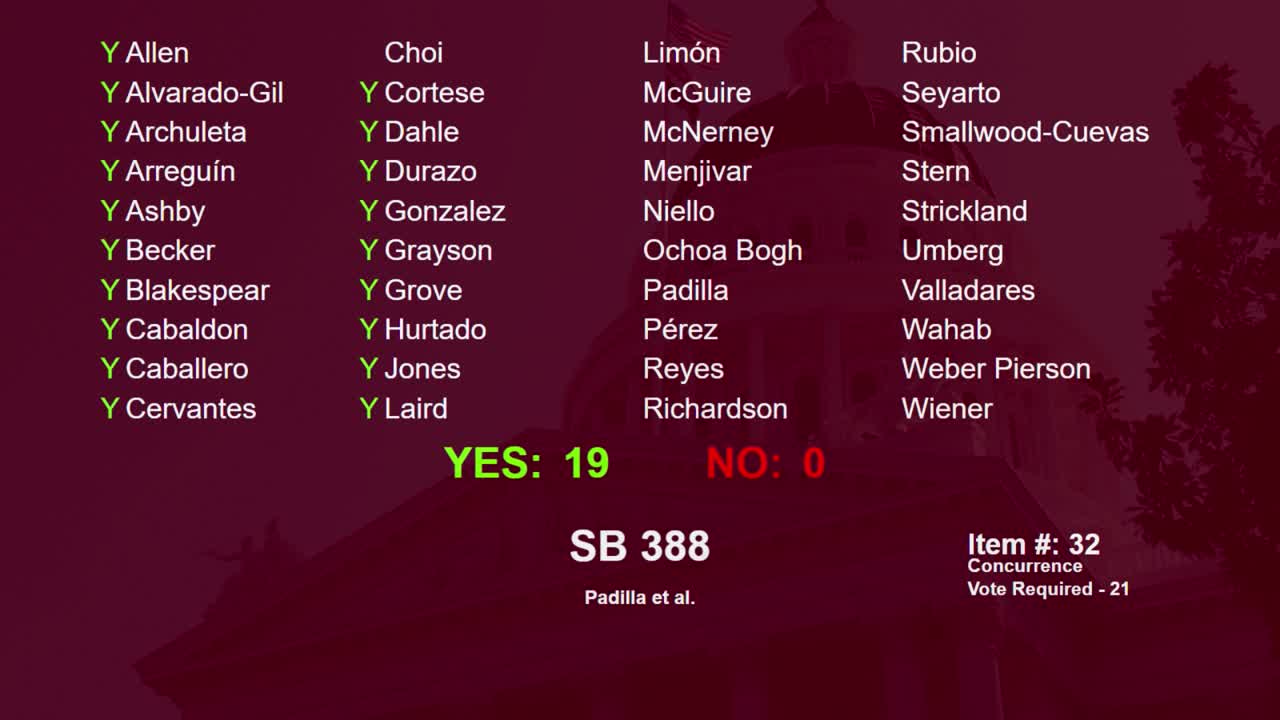 5MIN
Senate Floor
 14MIN
Senate Standing Committee on Judiciary
 12MIN
Senate Standing Committee on Local Government
 1MIN
Assembly Floor
 6MIN
Assembly Standing Committee on Judiciary
 8MIN
Assembly Standing Committee on Local Government
Bill Author