AB 692: Employment: contracts in restraint of trade.
- Session Year: 2025-2026
- House: Assembly
- Latest Version Date: 2025-10-13
Current Status:
Passed
(2025-10-13: Chaptered by Secretary of State - Chapter 703, Statutes of 2025.)
Introduced
In Committee
Awaiting First Chamber Vote
Passed First Chamber
In Committee
Awaiting Second Chamber Vote
Passed Second Chamber
Enacted
Existing law declares every contract by which anyone is restrained from engaging in a lawful profession, trade, or business of any kind to be void, except as expressly provided. Existing law provides for a system of labor standards enforcement administered by the Labor Commissioner.
This bill would, for contracts entered into on or after January 1, 2026, make it unlawful to include in any employment contract, or to require a worker to execute as a condition of employment or a work relationship a contract that includes, specified contract terms, including a term that requires the worker to pay an employer, training provider, or debt collector for a debt if the workers employment or work relationship with a specific employer terminates. The bill would declare these contracts as contracts that restrain a person from engaging in a lawful profession, trade, or business, and as void and contrary to public policy, except as provided.
This bill would authorize a worker who has been subjected to the above-described prohibited conduct regarding a contract or its terms or a work representative to bring an action on behalf of that worker, other persons similarly situated, or both, in any court of competent jurisdiction. The bill would make a person who violates these provisions liable for specified civil penalties and relief.
Existing law declares every contract by which anyone is restrained from engaging in a lawful profession, trade, or business of any kind to be void, except as expressly provided. Existing law provides for a system of labor standards enforcement administered by the Labor Commissioner.
This bill would authorize the Labor Commissioner to enforce the above-described provisions related to a contract restraining a lawful profession, trade, or business, according to specified existing law. The bill would authorize a worker, a prospective worker, or a worker representative, to bring a civil action on behalf of the person or other persons similarly situated to establish liability against an employer, and would provide that a person who violates these provisions is liable for specified civil penalties and relief.This bill would, for contracts entered into on or after January 1, 2026, make it unlawful to include in any employment contract, or to require a worker to execute as a condition of employment or a work relationship a contract that includes, specified contract terms, including a term that requires the worker to pay an employer, training provider, or debt collector for a debt if the workers employment or work relationship with a specific employer terminates. The bill would declare these contracts as contracts that restrain a person from engaging in a lawful profession, trade, or business, and as void and contrary to public policy, except as provided. The bill would also require the Labor Commissioner to coordinate with the Attorney General on the enforcement of a violation of these provisions.
(2)Existing law makes it unlawful for a person doing business in California and advertising to consumers in California to make any false or misleading advertising claim. Existing law, the Unfair Competition Law, makes various practices unlawful and provides that a person who engages, has engaged, or proposes to engage in unfair competition is liable for a civil penalty, as specified.This bill would make a violation of the above-described unlawful contract provisions an act of unfair competition.This bill would authorize a worker who has been subjected to the above-described prohibited conduct regarding a contract or its terms or a work representative to bring an action on behalf of that worker, other persons similarly situated, or both, in any court of competent jurisdiction. The bill would make a person who violates these provisions liable for specified civil penalties and relief.
(1)Existing law declares every contract by which anyone is restrained from engaging in a lawful profession, trade, or business of any kind to be void, except as expressly provided. Existing law provides for a system of labor standards enforcement administered by the Labor Commissioner.
This bill would authorize the Labor Commissioner to enforce the above-described provisions related to a contract restraining a lawful profession, trade, or business, according to specified existing law. The bill would authorize a worker, a prospective worker, or a worker representative, to bring a civil action on behalf of the person or other persons similarly situated to establish liability against an employer, and would provide that a person who violates these provisions is liable for specified civil penalties and relief.
This bill would, for contracts entered into on or after January 1, 2026, make it unlawful to include in any employment contract, or to require a worker to execute as a condition of employment or a work relationship a contract that includes, specified contract terms, including a term that requires the worker to pay an employer, training provider, or debt collector for a debt if the workers employment or work relationship with a specific employer terminates. The bill would declare these contracts as contracts that restrain a person from engaging in a lawful profession, trade, or business, and as void and contrary to public policy, except as provided. The bill would also require the Labor Commissioner to coordinate with the Attorney General on the enforcement of a violation of these provisions.
(2)Existing law makes it unlawful for a person doing business in California and advertising to consumers in California to make any false or misleading advertising claim. Existing law, the Unfair Competition Law, makes various practices unlawful and provides that a person who engages, has engaged, or proposes to engage in unfair competition is liable for a civil penalty, as specified.
This bill would make a violation of the above-described unlawful contract provisions an act of unfair competition.
(1)Existing law declares every contract by which anyone is restrained from engaging in a lawful profession, trade, or business of any kind to be void, except as expressly provided. Existing law provides for a system of labor standards enforcement administered by the Labor Commissioner.
This bill would authorize the Labor Commissioner to enforce the above-described provisions related to a contract restraining a lawful profession, trade, or business, according to specified existing law. The bill would authorize a person, including a local government worker, a prospective worker, or a worker representative, to bring a civil action on behalf of the person or other persons similarly situated to establish liability against an employer, and would provide that a person who violates these provisions is liable for specified civil penalties and relief.
(2)This
This bill would, for contracts entered into on or after January 1, 2026, make it unlawful to include in any employment contract, or to require a worker to execute as a condition of employment or a work relationship a contract that includes, specified contract terms, including a term that requires the worker to pay an employer, training provider, or debt collector for a debt if the workers employment or work relationship with a specific employer terminates. The bill would declare these contracts as contracts that restrain a person from engaging in a lawful profession, trade, or business, and as void and contrary to public policy, except as provided. The bill would also require the Labor Commissioner to coordinate with the Attorney General on the enforcement of a violation of these provisions.
(3)(2)Existing law makes it unlawful for a person doing business in California and advertising to consumers in California to make any false or misleading advertising claim. Existing law, the Unfair Competition Law, makes various practices unlawful and provides that a person who engages, has engaged, or proposes to engage in unfair competition is liable for a civil penalty, as specified.
This bill would make a violation of the above-described unlawful contract provisions an act of unfair competition.
(1)Existing law declares every contract by which anyone is restrained from engaging in a lawful profession, trade, or business of any kind to be void, except as expressly provided. Existing law provides for a system of labor standards enforcement administered by the Labor Commissioner.
This bill would authorize the Labor Commissioner to enforce the above-described provisions related to a contract restraining a lawful profession, trade, or business, according to specified existing law. The bill would authorize a person, including a local government or a worker representative, to bring a civil action on behalf of the person or other persons similarly situated to establish liability against an employer, and provide that a person who violates these provisions is liable for specified civil penalties and relief.
(2)This bill would, for contracts entered into on or after January 1, 2026, make it unlawful to include in any employment contract, or to require a worker to execute as a condition of employment or a work relationship a contract that includes, specified contract terms, including a term that requires the worker to pay an employer, training provider, or debt collector for a debt if the workers employment or work relationship with a specific employer terminates. The bill would declare these contracts as contracts that restrain a person from engaging in a lawful profession, trade, or business, and as void and contrary to public policy, except as provided. The bill would also require the Labor Commissioner to coordinate with the Attorney General on the enforcement of a violation of these provisions.
(3)Existing law makes it unlawful for a person doing business in California and advertising to consumers in California to make any false or misleading advertising claim. Existing law, the Unfair Competition Law, makes various practices unlawful and provides that a person who engages, has engaged, or proposes to engage in unfair competition is liable for a civil penalty, as specified.
This bill would make a violation of the above-described unlawful contract provisions an act of unfair competition.
Existing law establishes specific rules of construction and defines various terms for purposes of interpreting provisions of the Labor Code.This bill would make nonsubstantive changes to those provisions.Existing law establishes specific rules of construction and defines various terms for purposes of interpreting provisions of the Labor Code.
This bill would make nonsubstantive changes to those provisions.
(a)For purposes of this section, the following definitions apply:
(1)Contract includes a promise, undertaking, contract, or agreement, whether written or oral, express or implied.
(2)Debt means money, personal property, or their equivalent that is due or owing or alleged to be due or owing from a natural person to another person, including, but not limited to, for employment-related costs, education-related costs, or a consumer financial product or service, regardless of whether the debt is certain, contingent, or incurred voluntarily.
(3)Debt collector has the same meaning as defined in subdivision (c) of Section 1788.2 of the Civil Code.
(4)Employer means any person or entity that employs workers. Employer includes any parent company, subsidiary, division, affiliate, contractor, hiring party, or third-party agent of an employer.
(5)Freelance worker has the same meaning as defined in subdivision (a) of Section 18101.
(6)Misconduct has the same meaning as in Section 1256 of the Unemployment Insurance Code.
(7)Penalty, fee, or cost includes, but is not limited to, a replacement hire fee, retraining fee, replacement fee, quit fee, reimbursement for immigration or visa-related costs, liquidated damages, lost goodwill, and lost profit.
(8)Person means a natural person or an entity, including, but not limited to, a corporation, partnership, association, trust, limited liability company, cooperative, or other organization.
(9)Training provider means an entity, whether or not affiliated with an employer, that provides an education program, as defined in Section 94837 of the Education Code, a job training program, or a skills training program.
(10)Transferable credential means a degree that is offered by a third-party institution that is accredited and authorized to operate in the state, is not required for a workers current employment, and is transferable and useful for employment beyond the workers current employer.
(11)Worker means a natural person who is permitted to work for or on behalf of an employer or business entity, or who is permitted to participate in any other work relationship, job training program, or skills training program. Worker includes, but is not limited to, an employee or prospective employee.
(b)(1)Except as provided in paragraph (2), for contracts entered into on or after January 1, 2026, it shall be unlawful to include in any employment contract, or to require a worker to execute as a condition of employment or a work relationship a contract that includes, a contract term that does any of the following:
(A)Requires the worker to pay an employer, training provider, or debt collector for a debt if the workers employment or work relationship with a specific employer terminates.
(B)Authorizes the employer, training provider, or debt collector to resume or initiate collection of or end forbearance on a debt if the workers employment or work relationship with a specific employer terminates.
(C)Imposes any penalty, fee, or cost on a worker if the workers employment or work relationship with a specific employer terminates.
(2)This section does not apply to any of the following:
(A)A contract entered into under any loan repayment assistance program or loan forgiveness program provided by a federal, state, or local governmental agency.
(B)A contract related to the repayment of the cost of tuition for a transferable credential that meets all of the following requirements:
(i)The contract is offered separately from any contract for employment.
(ii)The contract does not require obtaining the transferable credential as a condition of employment.
(iii)The contract specifies the repayment amount before the worker agrees to the contract, and the repayment amount does not exceed the cost to the employer of the transferable credential received by the worker.
(iv)The contract provides for a prorated repayment amount during any required employment period that is proportional to the total repayment amount and the length of the required employment period and does not require an accelerated payment schedule if the worker separates from the employment.
(v)The contract does not require repayment to the employer by the worker if the worker is terminated, except if the worker is terminated for misconduct.
(C)A contract related to enrollment in an apprenticeship program approved by the Division of Apprenticeship Standards.
(D)A contract for the receipt of a discretionary or unearned monetary payment, including a financial bonus, at the outset of employment that is not tied to specific job performance, provided that all of the following conditions are met:
(i)The terms of any repayment obligation are set forth in a separate agreement from the primary employment contract.
(ii)The employee is notified that they have the right to consult an attorney regarding the agreement and provided with a reasonable time period of not less than five business days to obtain advice of counsel prior to executing the agreement.
(iii)Any repayment obligation for early separation from employment is not subject to interest accrual and is prorated based on the remaining term of any retention period, which shall not exceed two years from the receipt of payment.
(iv)The worker has an option to defer receipt of the payment to the end of a fully served retention period without any repayment obligation.
(v)Separation from employment prior to the retention period was at the sole election of the employee, or at the election of the employer for misconduct.
(E)A contract related to the lease, financing, or purchase of residential property, including, but not limited to, a contract pursuant to the California Residential Mortgage Lending Act (Division 20 (commencing with Section 50000) of the Financial Code).
(c)A contract that is unlawful under subdivision (b) is a contract restraining a person from engaging in a lawful profession, trade, or business, and is void under Section 16600 only if the contract was entered into on or after January 1, 2026.
(d)The rights, remedies, and penalties established by this section are cumulative and shall not be construed to supersede or limit the rights, remedies, or penalties established under other laws, or to limit the ability of any other person or entity to pursue enforcement of rights, remedies, or penalties established under other laws, including, but not limited to:
(1)Obligations of employers under Section 2802 of the Labor Code.
(2)Article 1.5 (commencing with Section 2775) of Chapter 2 of Division 3 of the Labor Code.
(3)The Unfair Competition Law (Chapter 5 (commencing with Section 17200)).
SEC. 2.Section 926 is added to the Labor Code, to read:926.(a)A contract or contract term that violates Section 16608 of the Business and Professions Code is void as contrary to public policy only if entered into on or after January 1, 2026.
(b)A worker who has been subjected to the conduct prohibited by subdivision (b) of Section 16608 of the Business and Professions Code or a worker representative may bring a civil action on behalf of that worker, other persons similarly situated, or both, in any court of competent jurisdiction.
(c)Any person found liable for a violation of this section shall be liable for actual damages sustained by the worker or workers on whose behalf the case is brought, or five thousand dollars ($5,000) per worker, whichever is greater, in addition to injunctive relief, and reasonable attorneys fees and costs.
(d)This section does not limit the remedies available to a worker or other natural person specified in Section 16608 of the Business and Professions Code.
(a)For purposes of this section, the following definitions apply:
(1)Contract includes a promise, undertaking, contract, or agreement, whether written or oral, express or implied.
(2)Debt means money, personal property, or their equivalent that is due or owing or alleged to be due or owing from a natural person to another person, including, but not limited to, for employment-related costs, education-related costs, or a consumer financial product or service, regardless of whether the debt is certain, contingent, or incurred voluntarily.
(3)Debt collector has the same meaning as defined in subdivision (c) of Section 1788.2 of the Civil Code.
(4)Employer means any person or entity that employs workers. Employer includes any parent company, subsidiary, division, affiliate, contractor, hiring party, or third-party agent of an employer.
(5)Freelance worker has the same meaning as defined in subdivision (a) of Section 18101.
(6)Misconduct has the same meaning as in Section 1256 of the Unemployment Insurance Code.
(7)Penalty, fee, or cost includes, but is not limited to, a replacement hire fee, retraining fee, replacement fee, quit fee, reimbursement for immigration or visa-related costs, liquidated damages, lost goodwill, and lost profit.
(8)Person means a natural person or an entity, including, but not limited to, a corporation, partnership, association, trust, limited liability company, cooperative, or other organization.
(9)Training provider means an entity, whether or not affiliated with an employer, that provides an education program, as defined in Section 94837 of the Education Code, a job training program, or a skills training program.
(10)Transferable credential means a degree that is offered by a third-party institution that is accredited and authorized to operate in the state, is not required for a workers current employment, and is transferable and useful for employment beyond the workers current employer.
(11)Worker means a natural person who is permitted to work for or on behalf of an employer or business entity, or who is permitted to participate in any other work relationship, job training program, or skills training program. Worker includes, but is not limited to, an employee, prospective employee, independent contractor, freelance worker, extern, intern, apprentice, or sole proprietor. employee or prospective employee.
(b)(1)Except as provided in paragraph (2), for contracts entered into on or after January 1, 2026, it shall be unlawful to include in any employment contract, or to require a worker to execute as a condition of employment or a work relationship a contract that includes, a contract term that does any of the following:
(A)Requires the worker to pay an employer, training provider, or debt collector for a debt if the workers employment or work relationship with a specific employer terminates.
(B)Authorizes the employer, training provider, or debt collector to resume or initiate collection of or end forbearance on a debt if the workers employment or work relationship with a specific employer terminates.
(C)Imposes any penalty, fee, or cost on a worker if the workers employment or work relationship with a specific employer terminates.
(2)This section does not apply to any of the following:
(A)A contract entered into under any loan repayment assistance program or loan forgiveness program provided by a federal, state, or local governmental agency.
(B)A contract related to the repayment of the cost of tuition for a transferable credential that meets all of the following requirements:
(i)The contract is offered separately from any contract for employment.
(ii)The contract does not require obtaining the transferable credential as a condition of employment.
(iii)The contract specifies the repayment amount before the worker agrees to the contract, and the repayment amount does not exceed the cost to the employer of the transferable credential received by the worker.
(iv)The contract provides for a prorated repayment amount during any required employment period that is proportional to the total repayment amount and the length of the required employment period and does not require an accelerated payment schedule if the worker separates from the employment.
(v)The contract does not require repayment to the employer by the worker if the worker is terminated, except if the worker is terminated for misconduct.
(C)A contract related to enrollment in an apprenticeship program approved by the Division of Apprenticeship Standards.
(D)A contract for the receipt of a discretionary or unearned monetary payment, including a financial bonus, at the outset of employment that is not tied to specific job performance, provided that all of the following conditions are met:
(i)The terms of any repayment obligation are set forth in a separate agreement from the primary employment contract.
(ii)The employee is notified that they have the right to consult an attorney regarding the agreement and provided with a reasonable time period of not less than five business days to obtain advice of counsel prior to executing the agreement.
(iii)Any repayment obligation for early separation from employment is not subject to interest accrual and is prorated based on the remaining term of any retention period, which shall not exceed two years from the receipt of payment.
(iv)The worker has an option to defer receipt of the payment to the end of a fully served retention period without any repayment obligation.
(v)Separation from employment prior to the retention period was at the sole election of the employee, or at the election of the employer for misconduct.
(E)A contract related to the lease, financing, or purchase of residential property, including, but not limited to, a contract pursuant to the California Residential Mortgage Lending Act (Division 20 (commencing with Section 50000) of the Financial Code).
(c)A contract that is unlawful under subdivision (b) is a contract restraining a person from engaging in a lawful profession, trade, or business, and is void under Section 16600 only if the contract was entered into on or after January 1, 2026.
(d)The rights, remedies, and penalties established by this section are cumulative and shall not be construed to supersede or limit the rights, remedies, or penalties established under other laws, or to limit the ability of any other person or entity to pursue enforcement of rights, remedies, or penalties established under other laws, including, but not limited to:
(1)Obligations of employers under Section 2802 of the Labor Code.
(2)Article 1.5 (commencing with Section 2775) of Chapter 2 of Division 3 of the Labor Code.
(3)The Unfair Competition Law (Chapter 5 (commencing with Section 17200)).
SEC. 2.Section 926 is added to the Labor Code, to read:926.(a)A contract or contract term that violates Section 16608 of the Business and Professions Code is void as contrary to public policy only if entered into on or after January 1, 2026.
(b)A worker who has been subjected to the conduct prohibited by subdivision (b) of Section 16608 of the Business and Professions Code or a worker representative may bring a civil action on behalf of that worker, other persons similarly situated, or both, in any court of competent jurisdiction.
(c)Any person found liable for a violation of this section shall be liable for actual damages sustained by the worker or workers on whose behalf the case is brought, or five thousand dollars ($5,000) per worker, whichever is greater, in addition to injunctive relief, and reasonable attorneys fees and costs.
(d)This section does not limit the remedies available to a worker or other natural person specified in Section 16608 of the Business and Professions Code.
(a)For purposes of this section, the following definitions apply:
(1)Contract includes a promise, undertaking, contract, or agreement, whether written or oral, express or implied.
(2)Debt means money, personal property, or their equivalent that is due or owing or alleged to be due or owing from a natural person to another person, including, but not limited to, for employment-related costs, education-related costs, or a consumer financial product or service, regardless of whether the debt is certain, contingent, or incurred voluntarily.
(3)Debt collector has the same meaning as defined in subdivision (c) of Section 1788.2 of the Civil Code.
(4)Employer means any person or entity that employs workers. Employer includes any parent company, subsidiary, division, affiliate, contractor, hiring party, or third-party agent of an employer.
(5)Freelance worker has the same meaning as defined in subdivision (a) of Section 18101.
(6)Misconduct has the same meaning as in Section 1256 of the Unemployment Insurance Code.
(6)(7)Penalty, fee, or cost includes, but is not limited to, a replacement hire fee, retraining fee, replacement fee, quit fee, reimbursement for immigration or visa-related costs, liquidated damages, lost goodwill, and lost profit.
(7)(8)Person means a natural person or an entity, including, but not limited to, a corporation, partnership, association, trust, limited liability company, cooperative, or other organization.
(8)(9)Training provider means an entity, whether or not affiliated with an employer, that provides an education program, as defined in Section 94837 of the Education Code, a job training program, or a skills training program.
(9)(10)Transferable credential means a degree that is offered by a third-party institution that is accredited and authorized to operate in the state, is not required for a workers current employment, and is transferable and useful for employment beyond the workers current employer.
(10)(11)Worker means a natural person who is permitted to work for or on behalf of an employer or business entity, or who is permitted to participate in any other work relationship, job training program, or skills training program. Worker includes, but is not limited to, an employee, prospective employee, independent contractor, freelance worker, extern, intern, apprentice, or sole proprietor.
(b)(1)Except as provided in paragraph (2), for contracts entered into on or after January 1, 2026, it shall be unlawful to include in any employment contract, or to require a worker to execute as a condition of employment or a work relationship a contract that includes, a contract term that does any of the following:
(A)Requires the worker to pay an employer, training provider, or debt collector for a debt if the workers employment or work relationship with a specific employer terminates.
(B)Authorizes the employer, training provider, or debt collector to resume or initiate collection of or end forbearance on a debt if the workers employment or work relationship with a specific employer terminates.
(C)Imposes any penalty, fee, or cost on a worker if the workers employment or work relationship with a specific employer terminates.
(2)This section does not apply to any of the following:
(A)A contract entered into under any loan repayment assistance program or loan forgiveness program provided by a federal, state, or local governmental agency.
(B)A contract related to the repayment of the cost of tuition for a transferable credential that meets all of the following requirements:
(i)The contract is offered separately from any contract for employment.
(ii)The contract does not require obtaining the transferable credential as a condition of employment.
(iii)The contract specifies the repayment amount before the worker agrees to the contract, and the repayment amount does not exceed the cost to the employer of the transferable credential received by the worker.
(iv)The contract provides for a prorated repayment amount during any required employment period that is proportional to the total repayment amount and the length of the required employment period and does not require an accelerated payment schedule if the worker separates from the employment.
(v)The contract does not require repayment to the employer by the worker if the worker is terminated, except if the worker is terminated for gross misconduct.
(C)A contract related to enrollment in an apprenticeship program approved by the Division of Apprenticeship Standards.
(D)A contract for the receipt of a discretionary or unearned monetary payment payment, including a financial bonus, at the outset of employment that is not tied to specific job performance, provided that all of the following conditions are met:
(i)The terms of any repayment obligation are set forth in a separate agreement subject to negotiation independent from the primary employment contract.
(ii)The employee is individually represented by legal counsel in negotiating the terms of any repayment obligation, provided that for purposes of this subdivision, an employee is not considered individually represented by legal counsel if the counsel is paid for by, or was selected based upon the suggestion of, the employees employer. notified that they have the right to consult an attorney regarding the agreement and provided with a reasonable time period of not less than five business days to obtain advice of counsel prior to executing the agreement.
(iii)Any repayment obligation for early termination of separation from employment is not subject to interest accrual and is prorated based on the remaining term of any retention period, which shall not exceed two years from the receipt of payment.
(iv)The worker has an option to defer receipt of the payment to the end of a fully served retention period without any repayment obligation.
(v)Termination of Separation from employment prior to the retention period was at the sole election of the employee, or at the election of the employer for material noncompliance or misconduct.
(E)A contract related to the lease, financing, or purchase of residential property, including, but not limited to, a contract pursuant to the California Residential Mortgage Lending Act (Division 20 (commencing with Section 50000) of the Financial Code).
(c)A contract that is unlawful under subdivision (b) is a contract restraining a person from engaging in a lawful profession, trade, or business, and is void under Section 16600 only if the contract was entered into on or after January 1, 2026.
(d)The rights, remedies, and penalties established by this section are cumulative and shall not be construed to supersede or limit the rights, remedies, or penalties established under other laws, or to limit the ability of any other person or entity to pursue enforcement of rights, remedies, or penalties established under other laws, including, but not limited to:
(1)Obligations of employers under Section 2802 of the Labor Code.
(2)Article 1.5 (commencing with Section 2775) of Chapter 2 of Division 3 of the Labor Code.
(3)The Unfair Competition Law (Chapter 5 (commencing with Section 17200)).
SEC. 2.Section 926 is added to the Labor Code, to read:926.(a)A contract or contract term that violates Section 16608 of the Business and Professions Code is void as contrary to public policy only if entered into on or after January 1, 2026.
(b)A worker who has been subjected to the conduct prohibited by subdivision (b) of Section 16608 of the Business and Professions Code or a worker representative may bring a civil action on behalf of that worker, other persons similarly situated, or both, in any court of competent jurisdiction.
(c)Any person found liable for a violation of this section shall be liable for actual damages sustained by the worker or workers on whose behalf the case is brought, or five thousand dollars ($5,000) per worker, whichever is greater, in addition to injunctive relief, and reasonable attorneys fees and costs.
(d)This section does not limit the remedies available to a worker or other natural person specified in Section 16608 of the Business and Professions Code.
(a)For purposes of this section, the following definitions apply:
(1)Business entity includes a corporation, partnership, or other association.(2)(1)Contract includes a promise, undertaking, contract, or agreement, whether written or oral, express or implied.
(3)Consumer financial product or service has the same meaning as defined in subdivision (e) of Section 90005 of the Financial Code.(4)(2)Debt means money, property, or their equivalent that is due or owing or alleged to be due or owing from a natural person to another person, including, but not limited to, for employment-related costs, education-related costs, or a consumer financial product or service, regardless of whether the debt is certain, contingent, or incurred voluntarily.
(5)(3)Debt collector has the same meaning as defined in subdivision (c) of Section 1788.2 of the Civil Code.
(6)Education-related cost means a cost associated with enrollment or attendance at an educational program, as defined in Section 94837 of the Education Code, a job training program, or a skills training program, and related expenses, including, but not limited to, tuition, fees, books, supplies, student loans, examinations, and equipment required for enrollment or attendance in an educational, training, or residency program.(7)(4)Employer means any person or entity that employs workers. Employer includes any parent company, subsidiary, division, affiliate, contractor, hiring party, or third-party agent of an employer.
(8)Employment-related cost means a necessary expenditure or loss incurred by a person in direct consequence of the discharge of their duties at work or of their obedience to a direction of their employer, including, but not limited to, a training, residency, orientation, licensure, or competency validation required either by an employer or to practice in a specific employee classification.(9)(5)Freelance worker has the same meaning as defined in subdivision (a) of Section 18101.
(10)Hiring party has the same meaning as defined in subdivision (b) of Section 18101.(11)(6)Penalty, fee, or cost includes, but is not limited to, a replacement hire fee, retraining fee, replacement fee, quit fee, reimbursement for immigration or visa-related costs, liquidated damages, lost goodwill, and lost profit.
(12)(7)Person means a natural person or an entity, including, but not limited to, a corporation, partnership, association, trust, limited liability company, cooperative, or other organization.
(13)(8)Training provider means an entity, whether or not affiliated with an employer, that provides an education program, as defined in Section 94837 of the Education Code, a job training program, or a skills training program.
(14)(9)Transferable credential means a degree that is offered by a third-party institution that is accredited and authorized to operate in the state, is not required for a workers current employment, and is transferable and useful for employment beyond the workers current employer.
(15)(10)Worker means a natural person who is permitted to work for or on behalf of an employer or business entity, or who is permitted to participate in any other work relationship, job training program, or skills training program. Worker includes, but is not limited to, an employee, prospective employee, independent contractor, freelance worker, extern, intern, apprentice, or sole proprietor.
(b)(1)Except as provided in paragraph (2), for contracts entered into on or after January 1, 2026, it shall be unlawful to include in any employment contract, or to require a worker to execute as a condition of employment or a work relationship a contract that includes, a contract term that does any of the following:
(A)Requires the worker to pay an employer, training provider, or debt collector for a debt if the workers employment or work relationship with a specific employer terminates.
(B)Authorizes the employer, training provider, or debt collector to resume or initiate collection of or end forbearance on a debt if the workers employment or work relationship with a specific employer terminates.
(C)Imposes any penalty, fee, or cost on a worker if the workers employment or work relationship with a specific employer terminates.
(2)This section does not apply to any of the following:
(A)A contract entered into under any loan repayment assistance program or loan forgiveness program provided by a federal, state, or local governmental agency.
(B)A contract related to the repayment of the cost of tuition for a transferable credential that meets all of the following requirements:
(i)The contract is offered separately from any contract for employment.
(ii)The contract does not require obtaining the transferable credential as a condition of employment.
(iii)The contract specifies the repayment amount before the worker agrees to the contract, and the repayment amount does not exceed the cost to the employer of the transferable credential received by the worker.
(iv)The contract provides for a prorated repayment amount during any required employment period that is proportional to the total repayment amount and the length of the required employment period. period and does not require an accelerated payment schedule if the worker separates from the employment.
(v)The contract does not require repayment to the employer by the worker if the worker is terminated, except if the worker is terminated for gross misconduct.
(C)A contract related to enrollment in an apprenticeship program approved by the Division of Apprenticeship Standards.
(D)A contract for the receipt of a discretionary or unearned monetary payment at the outset of employment that is not tied to specific job performance, provided that all of the following conditions are met:
(i)The terms of any repayment obligation are set forth in a separate agreement subject to negotiation independent from the primary employment contract.
(ii)The employee is individually represented by legal counsel in negotiating the terms of any repayment obligation, provided that for purposes of this subdivision, an employee is not considered individually represented by legal counsel if the counsel is paid for by, or was selected based upon the suggestion of, the employees employer.
(iii)Any repayment obligation for early termination of employment is not subject to interest accrual and is prorated based on the remaining term of any retention period, which shall not exceed two years from the receipt of payment.
(iv)The worker has an option to defer receipt of the payment to the end of a fully served retention period without any repayment obligation.
(v)Termination of employment prior to the retention period was at the sole election of the employee, or at the election of the employer for material noncompliance or misconduct.
(c)A contract that is unlawful under subdivision (b) is a contract restraining a person from engaging in a lawful profession, trade, or business, and is void under Section 16600. 16600 only if the contract was entered into on or after January 1, 2026.
(d)A violation of this section constitutes an act of unfair competition within the meaning of Chapter 5 (commencing with Section 17200).(e)(d)The rights, remedies, and penalties established by this section are cumulative and shall not be construed to supersede or limit the rights, remedies, or penalties established under other laws, or to limit the ability of any other person or entity to pursue enforcement of rights, remedies, or penalties established under other laws, including, but not limited to:
(1)Obligations of employers under Section 2802 of the Labor Code.
(2)Article 1.5 (commencing with Section 2775) of Chapter 2 of Division 3 of the Labor Code.
(3)The Unfair Competition Law (Chapter 5 (commencing with Section 17200)).
SEC. 2.Section 926 is added to the Labor Code, to read:926.(a)A contract or contract term that violates Chapter 1 (commencing with Section 16600) of Part 2 of Division 7 Section 16608 of the Business and Professions Code is void as contrary to public policy. policy only if entered into on or after January 1, 2026.
(b)The Labor Commissioner may enforce this section, including receiving and investigating complaints of an alleged violation and ordering appropriate temporary relief to mitigate the violation or to maintain the status quo pending the completion of a full investigation or hearing through the procedures set forth in Section 98, 98.3, or 1197.1, including by issuance of a citation against an employer who violates this article and by filing a civil action. If a citation is issued, the procedures for issuing, contesting, and enforcing judgments for citations and civil penalties issued by the Labor Commissioner shall be the same as those set out in Section 1197.1, as appropriate.(c)A worker, a prospective worker, or a worker representative, seeking to establish liability against an employer may bring a civil action on behalf of the person, other persons similarly situated, or both, in any court of competent jurisdiction. Any person found liable for a violation of this section shall be liable for actual damages sustained by the worker or five thousand dollars ($5,000), whichever is greater, in addition to injunctive relief, and reasonable attorneys fees and costs.(b)A worker who has been subjected to the conduct prohibited by subdivision (b) of Section 16608 of the Business and Professions Code or a worker representative may bring a civil action on behalf of that worker, other persons similarly situated, or both, in any court of competent jurisdiction.
(c)Any person found liable for a violation of this section shall be liable for actual damages sustained by the worker or workers on whose behalf the case is brought, or five thousand dollars ($5,000) per worker, whichever is greater, in addition to injunctive relief, and reasonable attorneys fees and costs.
(d)This section does not limit the remedies available to a worker or other natural person specified in Section 16608 of the Business and Professions Code.
(e)In carrying out their duties under this section, the Labor Commissioner shall coordinate with the Attorney General on the enforcement of a violation of Section 16608 of the Business and Professions Code.(a)For purposes of this section, the following definitions apply:
(1)Business entity includes a corporation, partnership, or other association.
(2)Contract includes a promise, undertaking, contract, or agreement, whether written or oral, express or implied.
(3)Consumer financial product or service has the same meaning as defined in subdivision (e) of Section 90005 of the Financial Code.
(4)Debt means money, property, or their equivalent that is due or owing or alleged to be due or owing from a natural person to another person, including, but not limited to, for employment-related costs, education-related costs, or a consumer financial product or service, regardless of whether the debt is certain, contingent, or incurred voluntarily.
(5)Debt collector has the same meaning as defined in subdivision (c) of Section 1788.2 of the Civil Code.
(6)Education-related cost means a cost associated with enrollment or attendance at an educational program, as defined in Section 94837 of the Education Code, a job training program, or a skills training program, and related expenses, including, but not limited to, tuition, fees, books, supplies, student loans, examinations, and equipment required for enrollment or attendance in an educational, training, or residency program.
(7)Employer means any person or entity that employs workers. Employer includes any parent company, subsidiary, division, affiliate, contractor, hiring party, or third-party agent of an employer.
(8)Employment-related cost means a necessary expenditure or loss incurred by a person in direct consequence of the discharge of their duties at work or of their obedience to a direction of their employer, including, but not limited to, a training, residency, orientation, licensure, or competency validation required either by an employer or to practice in a specific employee classification.
(9)Freelance worker has the same meaning as defined in subdivision (a) of Section 18101.
(10)Hiring party has the same meaning as defined in subdivision (b) of Section 18101.
(11)Penalty, fee, or cost includes, but is not limited to, a replacement hire fee, retraining fee, replacement fee, quit fee, reimbursement for immigration or visa-related costs, liquidated damages, lost goodwill, and lost profit.
(12)Person means a natural person or an entity, including, but not limited to, a corporation, partnership, association, trust, limited liability company, cooperative, or other organization.
(13)Training provider means an entity, whether or not affiliated with an employer, that provides an education program, as defined in Section 94837 of the Education Code, a job training program, or a skills training program.
(14)Transferable credential means a degree that is offered by a third-party institution that is accredited and authorized to operate in the state, is not required for a workers current employment, and is transferable and useful for employment beyond the workers current employer.
(15)Worker means a natural person who is permitted to work for or on behalf of an employer or business entity, or who is permitted to participate in any other work relationship, job training program, or skills training program. Worker includes, but is not limited to, an employee, prospective employee, independent contractor, freelance worker, extern, intern, apprentice, or sole proprietor.
(b)(1)Except as provided in paragraph (2), for contracts entered into on or after January 1, 2026, it shall be unlawful to include in any employment contract, or to require a worker to execute as a condition of employment or a work relationship a contract that includes, a contract term that does any of the following:
(A)Requires the worker to pay an employer, training provider, or debt collector for a debt if the workers employment or work relationship with a specific employer terminates.
(B)Authorizes the employer, training provider, or debt collector to resume or initiate collection of or end forbearance on a debt if the workers employment or work relationship with a specific employer terminates.
(C)Imposes any penalty, fee, or cost on a worker if the workers employment or work relationship with a specific employer terminates.
(2)This section does not apply to either any of the following:
(A)A contract entered into under any loan repayment assistance program or loan forgiveness program provided by a federal, state, or local governmental agency.
(B)A contract related to the repayment of the cost of tuition for a transferable credential that meets all of the following requirements:
(i)The contract is not a condition of employment and is offered separately from any contract for employment.
(ii)The contract does not require obtaining the transferable credential as a condition of employment.
(ii)(iii)The contract specifies the repayment amount before the worker agrees to the contract, and the repayment amount does not exceed the cost to the employer of the transferable credential received by the worker.
(iii)(iv)The contract provides for a prorated repayment amount during any required employment period that is proportional to the total repayment amount and the length of the required employment period.
(iv)(v)The contract does not require repayment to the employer by the worker if the worker is terminated. terminated, except if the worker is terminated for gross misconduct.
(C)A contract related to enrollment in an apprenticeship program approved by the Division of Apprenticeship Standards.
(c)A contract that is unlawful under subdivision (b) is a contract restraining a person from engaging in a lawful profession, trade, or business, and is void under Section 16600.
(d)A violation of this section constitutes an act of unfair competition within the meaning of Chapter 5 (commencing with Section 17200).
(e)The rights, remedies, and penalties established by this section are cumulative and shall not be construed to supersede the rights, remedies, or penalties established under other laws, including, but not limited to:
(1)Obligations of employers under Section 2802 of the Labor Code.
(2)Article 1.5 (commencing with Section 2775) of Chapter 2 of Division 3 of the Labor Code.
SEC. 2.Section 926 is added to the Labor Code, to read:926.(a)A contract or contract term that violates Chapter 1 (commencing with Section 16600) of Part 2 of Division 7 of the Business and Professions Code is void as contrary to public policy.
(b)The Labor Commissioner may enforce this section, including receiving and investigating complaints of an alleged violation and ordering appropriate temporary relief to mitigate the violation or to maintain the status quo pending the completion of a full investigation or hearing through the procedures set forth in Section 98, 98.3, or 1197.1, including by issuance of a citation against an employer who violates this article and by filing a civil action. If a citation is issued, the procedures for issuing, contesting, and enforcing judgments for citations and civil penalties issued by the Labor Commissioner shall be the same as those set out in Section 1197.1, as appropriate.
(c)A worker, a prospective worker, or a worker representative, seeking to establish liability against an employer may bring a civil action on behalf of the person, other persons similarly situated, or both, in any court of competent jurisdiction. Any person found liable for a violation of this section shall be liable for actual damages sustained by the worker or five thousand dollars ($5,000), whichever is greater, in addition to injunctive relief, and reasonable attorneys fees and costs.
(d)This section does not limit the remedies available to a worker or other natural person specified in Section 16608 of the Business and Professions Code.
(e)In carrying out their duties under this section, the Labor Commissioner shall coordinate with the Attorney General on the enforcement of a violation of Section 16608 of the Business and Professions Code.
(a)For purposes of this section, the following definitions apply:
(1)Business entity includes a corporation, partnership, or other association.
(2)Contract includes a promise, undertaking, contract, or agreement, whether written or oral, express or implied.
(3)Consumer financial product or service has the same meaning as defined in subdivision (e) of Section 90005 of the Financial Code.
(4)Debt means money, property, or their equivalent that is due or owing or alleged to be due or owing from a natural person to another person, including, but not limited to, for employment-related costs, education-related costs, or a consumer financial product or service, regardless of whether the debt is certain, contingent, or incurred voluntarily.
(5)Debt collector has the same meaning as defined in subdivision (c) of Section 1788.2 of the Civil Code.
(6)Education-related cost means a cost associated with enrollment or attendance at an educational program, as defined in Section 94837 of the Education Code, a job training program, or a skills training program, and related expenses, including, but not limited to, tuition, fees, books, supplies, student loans, examinations, and equipment required for enrollment or attendance in an educational, training, or residency program.
(7)Employer means any person or entity that employs workers. Employer includes any parent company, subsidiary, division, affiliate, contractor, hiring party, or third-party agent of an employer.
(8)Employment-related cost means a necessary expenditure or loss incurred by a person in direct consequence of the discharge of their duties at work or of their obedience to a direction of their employer, including, but not limited to, a training, residency, orientation, licensure, or competency validation required either by an employer or to practice in a specific employee classification.
(9)Freelance worker has the same meaning as defined in subdivision (a) of Section 18101.
(10)Hiring party has the same meaning as defined in subdivision (b) of Section 18101.
(11)Penalty, fee, or cost includes, but is not limited to, a replacement hire fee, retraining fee, replacement fee, quit fee, reimbursement for immigration or visa-related costs, liquidated damages, lost goodwill, and lost profit.
(12)Person means a natural person or an entity, including, but not limited to, a corporation, partnership, association, trust, limited liability company, cooperative, or other organization.
(13)Training provider means an entity, whether or not affiliated with an employer, that provides an education program, as defined in Section 94837 of the Education Code, a job training program, or a skills training program.
(14)Transferable credential means a degree that is offered by a third-party institution that is accredited and authorized to operate in the state, is not required for a workers current employment, and is transferable and useful for employment beyond the workers current employer.
(14)(15)Worker means a natural person who is permitted to work for or on behalf of an employer or business entity, or who is permitted to participate in any other work relationship, job training program, or skills training program. Worker includes, but is not limited to, an employee, prospective employee, independent contractor, freelance worker, extern, intern, apprentice, or sole proprietor.
(b)(1)Except as provided in paragraph (2), for contracts entered into on or after January 1, 2026, it shall be unlawful to include in any employment contract, or to require a worker to execute as a condition of employment or a work relationship a contract that includes, a contract term that does any of the following:
(A)Requires the worker to pay an employer, training provider, or debt collector for a debt if the workers employment or work relationship with a specific employer terminates.
(B)Authorizes the employer, training provider, or debt collector to resume or initiate collection of or end forbearance on a debt if the workers employment or work relationship with a specific employer terminates.
(C)Imposes any penalty, fee, or cost on a worker if the workers employment or work relationship with a specific employer terminates.
(2)This section does not apply to a either of the following:
(A)A contract entered into under any loan repayment assistance program or loan forgiveness program provided by a federal, state, or local governmental agency.
(B)A contract related to the repayment of the cost of tuition for a transferable credential that meets all of the following requirements:
(i)The contract is not a condition of employment and is offered separately from any contract for employment.
(ii)The contract specifies the repayment amount before the worker agrees to the contract, and the repayment amount does not exceed the cost to the employer of the transferable credential received by the worker.
(iii)The contract provides for a prorated repayment amount during any required employment period that is proportional to the total repayment amount and the length of the required employment period.
(iv)The contract does not require repayment to the employer by the worker if the worker is terminated.
(c)A contract that is unlawful under subdivision (b) is a contract restraining a person from engaging in a lawful profession, trade, or business, and is void under Section 16600.
(d)A violation of this section constitutes an act of unfair competition within the meaning of Chapter 5 (commencing with Section 17200).
(e)The rights, remedies, and penalties established by this section are cumulative and shall not be construed to supersede the rights, remedies, or penalties established under other laws, including, but not limited to:
(1)Obligations of employers under Section 2802 of the Labor Code.
(2)Article 1.5 (commencing with Section 2775) of Chapter 2 of Division 3 of the Labor Code.
SEC. 2.Section 926 is added to the Labor Code, to read:926.(a)A contract or contract term that violates Chapter 1 (commencing with Section 16600) of Part 2 of Division 7 of the Business and Professions Code is void as contrary to public policy.
(b)The Labor Commissioner may enforce this section, including receiving and investigating complaints of an alleged violation and ordering appropriate temporary relief to mitigate the violation or to maintain the status quo pending the completion of a full investigation or hearing through the procedures set forth in Section 98, 98.3, or 1197.1, including by issuance of a citation against an employer who violates this article and by filing a civil action. If a citation is issued, the procedures for issuing, contesting, and enforcing judgments for citations and civil penalties issued by the Labor Commissioner shall be the same as those set out in Section 1197.1, as appropriate.
(c)A worker, a prospective worker, or a worker representative, seeking to establish liability against an employer may bring a civil action on behalf of the person, other persons similarly situated, or both, in any court of competent jurisdiction. Any person found liable for a violation of this section shall be liable for actual damages sustained by the worker or five thousand dollars ($5,000), whichever is greater, in addition to injunctive relief, and reasonable attorneys fees and costs.
(d)This section does not limit the remedies available to a worker or other natural person specified in Section 16608 of the Business and Professions Code.
(e)In carrying out their duties under this section, the Labor Commissioner shall coordinate with the Attorney General on the enforcement of a violation of Section 16608 of the Business and Professions Code.
(a)For purposes of this section, the following definitions apply:
(1)Business entity includes a corporation, partnership, or other association.
(2)Contract includes a promise, undertaking, contract, or agreement, whether written or oral, express or implied.
(3)Consumer financial product or service has the same meaning as defined in subdivision (e) of Section 90005 of the Financial Code.
(4)Debt means money, property, or their equivalent that is due or owing or alleged to be due or owing from a natural person to another person, including, but not limited to, for employment-related costs, education-related costs, or a consumer financial product or service, regardless of whether the debt is certain, contingent, or incurred voluntarily.
(5)Debt collector has the same meaning as defined in subdivision (c) of Section 1788.2 of the Civil Code.
(6)Education-related cost means a cost associated with enrollment or attendance at an educational program, as defined in Section 94837 of the Education Code, a job training program, or a skills training program, and related expenses, including, but not limited to, tuition, fees, books, supplies, student loans, examinations, and equipment required for enrollment or attendance in an educational, training, or residency program.
(7)Employer means any person or entity that employs workers. Employer includes any parent company, subsidiary, division, affiliate, contractor, hiring party, or third-party agent of an employer.
(8)Employment-related cost means a necessary expenditure or loss incurred by a person in direct consequence of the discharge of their duties at work or of their obedience to a direction of their employer, including, but not limited to, a training, residency, orientation, licensure, or competency validation required either by an employer or to practice in a specific employee classification.
(9)Freelance worker has the same meaning as defined in subdivision (a) of Section 18101.
(10)Hiring party has the same meaning as defined in subdivision (b) of Section 18101.
(11)Penalty, fee, or cost includes, but is not limited to, a replacement hire fee, retraining fee, replacement fee, quit fee, reimbursement for immigration or visa-related costs, liquidated damages, lost goodwill, and lost profit.
(12)Person means a natural person or an entity, including, but not limited to, a corporation, partnership, association, trust, limited liability company, cooperative, or other organization.
(13)Training provider means an entity, whether or not affiliated with an employer, that provides an education program, as defined in Section 94837 of the Education Code, a job training program, or a skills training program.
(14)Worker means a natural person who is permitted to work for or on behalf of an employer or business entity, or who is permitted to participate in any other work relationship, job training program, or skills training program. Worker includes, but is not limited to, an employee, prospective employee, independent contractor, freelance worker, extern, intern, apprentice, or sole proprietor.
(b)(1)Except as provided in paragraph (2), for contracts entered into on or after January 1, 2026, it shall be unlawful to include in any employment contract, or to require a worker to execute as a condition of employment or a work relationship a contract that includes, a contract term that does any of the following:
(A)Requires the worker to pay an employer, training provider, or debt collector for a debt if the workers employment or work relationship with a specific employer terminates.
(B)Authorizes the employer, training provider, or debt collector to resume or initiate collection of or end forbearance on a debt if the workers employment or work relationship with a specific employer terminates.
(C)Imposes any penalty, fee, or cost on a worker if the workers employment or work relationship with a specific employer terminates.
(2)This section does not apply to a contract entered into under any loan repayment assistance program or loan forgiveness program provided by a federal, state, or local governmental agency.
(c)A contract that is unlawful under subdivision (b) is a contract restraining a person from engaging in a lawful profession, trade, or business, and is void under Section 16600.
(d)A violation of this section constitutes an act of unfair competition within the meaning of Chapter 5 (commencing with Section 17200).
(e)The rights, remedies, and penalties established by this section are cumulative and shall not be construed to supersede the rights, remedies, or penalties established under other laws, including including, but not limited to:
(1)Obligations of employers under Section 2802 of the Labor Code.
(2)Article 1.5 (commencing with Section 2775) of Chapter 2 of Division 3 of the Labor Code.
SEC. 2.Section 926 is added to the Labor Code, to read:926.(a)A contract or contract term that violates Chapter 1 (commencing with Section 16600) of Part 2 of Division 7 of the Business and Professions Code is void as contrary to public policy.
(b)The Labor Commissioner may enforce this section, including receiving and investigating complaints of an alleged violation and ordering appropriate temporary relief to mitigate the violation or to maintain the status quo pending the completion of a full investigation or hearing through the procedures set forth in Section 98, 98.3, or 1197.1, including by issuance of a citation against an employer who violates this article and by filing a civil action. If a citation is issued, the procedures for issuing, contesting, and enforcing judgments for citations and civil penalties issued by the Labor Commissioner shall be the same as those set out in Section 1197.1, as appropriate.
(c)A person, including a local government worker, a prospective worker, or a worker representative, seeking to establish liability against an employer may bring a civil action on behalf of the person, other persons similarly situated, or both, in any court of competent jurisdiction. Any person found liable for a violation of this section shall be liable for actual damages sustained by the worker or five thousand dollars ($5,000), whichever is greater, in addition to injunctive relief, and reasonable attorney's fees and costs.
(d)This section does not limit the remedies available to a worker or other natural person specified in Section 16608 of the Business and Professions Code.
(e)In carrying out their duties under this section, the Labor Commissioner shall coordinate with the Attorney General on the enforcement of a violation of Section 16608 of the Business and Professions Code.
(a)For purposes of this section, the following definitions apply:
(1)Business entity includes a corporation, partnership, or other association.
(2)Contract includes a promise, undertaking, contract, or agreement, whether written or oral, express or implied.
(3)Consumer financial product or service has the same meaning as defined in subdivision (e) of Section 90005 of the Financial Code.
(4)Debt means money, property, or their equivalent that is due or owing or alleged to be due or owing from a natural person to another person, including, but not limited to, for employment-related costs, education-related costs, or a consumer financial product or service, regardless of whether the debt is certain, contingent, or incurred voluntarily.
(5)Debt collector has the same meaning as defined in subdivision (c) of Section 1788.2 of the Civil Code.
(6)Education-related cost means a cost associated with enrollment or attendance at an educational program, as defined in Section 94837 of the Education Code, a job training program, or a skills training program, and related expenses, including, but not limited to, tuition, fees, books, supplies, student loans, examinations, and equipment required for enrollment or attendance in an educational, training, or residency program.
(7)Employer means any person or entity that employs workers. Employer includes any parent company, subsidiary, division, affiliate, contractor, hiring party, or third-party agent of an employer.
(8)Employment-related cost means a necessary expenditure or loss incurred by a person in direct consequence of the discharge of their duties at work or of their obedience to a direction of their employer, including, but not limited to, a training, residency, orientation, licensure, or competency validation required either by an employer or to practice in a specific employee classification.
(9)Freelance worker has the same meaning as defined in subdivision (a) of Section 18101.
(10)Hiring party has the same meaning as defined in subdivision (b) of Section 18101.
(11)Penalty, fee, or cost includes, but is not limited to, a replacement hire fee, retraining fee, replacement fee, quit fee, reimbursement for immigration or visa-related costs, liquidated damages, lost goodwill, and lost profit.
(12)Person means a natural person or an entity, including, but not limited to, a corporation, partnership, association, trust, limited liability company, cooperative, or other organization.
(13)Training provider means an entity, whether or not affiliated with an employer, that provides an education program, as defined in Section 94837 of the Education Code, a job training program, or a skills training program.
(14)Worker means a natural person who is permitted to work for or on behalf of an employer or business entity, or who is permitted to participate in any other work relationship, job training program, or skills training program. Worker includes, but is not limited to, an employee, prospective employee, independent contractor, freelance worker, extern, intern, apprentice, or sole proprietor.
(b)(1)Except as provided in paragraph (2), for contracts entered into on or after January 1, 2026, it shall be unlawful to include in any employment contract, or to require a worker to execute as a condition of employment or a work relationship a contract that includes, a contract term that does any of the following:
(A)Requires the worker to pay an employer, training provider, or debt collector for a debt if the workers employment or work relationship with a specific employer terminates.
(B)Authorizes the employer, training provider, or debt collector to resume or initiate collection of or end forbearance on a debt if the workers employment or work relationship with a specific employer terminates.
(C)Imposes any penalty, fee, or cost on a worker if the workers employment or work relationship with a specific employer terminates.
(2)This section does not apply to a contract entered into under any loan repayment assistance program or loan forgiveness program provided by a federal, state, or local governmental agency.
(c)A contract that is unlawful under subdivision (b) is a contract restraining a person from engaging in a lawful profession, trade, or business, and is void under Section 16600.
(d)A violation of this section constitutes an act of unfair competition within the meaning of Chapter 5 (commencing with Section 17200).
(e)The rights, remedies, and penalties established by this section are cumulative and shall not be construed to supersede the rights, remedies, or penalties established under other laws, including but not limited to:
(1)Obligations of employers under Section 2802 of the Labor Code.
(2)Article 1.5 (commencing with Section 2775) of Chapter 2 of Division 3 of the Labor Code.
SEC. 2.Section 926 is added to the Labor Code, to read:926.(a)A contract or contract term that violates Chapter 1 (commencing with Section 16600) of Part 2 of Division 7 of the Business and Professions Code is void as contrary to public policy.
(b)The Labor Commissioner may enforce this section, including receiving and investigating complaints of an alleged violation and ordering appropriate temporary relief to mitigate the violation or to maintain the status quo pending the completion of a full investigation or hearing through the procedures set forth in Section 98, 98.3, or 1197.1, including by issuance of a citation against an employer who violates this article and by filing a civil action. If a citation is issued, the procedures for issuing, contesting, and enforcing judgments for citations and civil penalties issued by the Labor Commissioner shall be the same as those set out in Section 1197.1, as appropriate.
(c)A person, including a local government or a worker representative, seeking to establish liability against an employer may bring a civil action on behalf of the person, other persons similarly situated, or both, in any court of competent jurisdiction. Any person found liable for a violation of this section shall be liable for actual damages sustained by the worker or five thousand dollars ($5,000), whichever is greater, in addition to injunctive relief, and reasonable attorney's fees and costs.
(d)This section does not limit the remedies available to a worker or other natural person specified in Section 16608 of the Business and Professions Code.
(e)In carrying out their duties under this section, the Labor Commissioner shall coordinate with the Attorney General on the enforcement of a violation of Section 16608 of the Business and Professions Code.
SECTION 1.Section 6 of the Labor Code is amended to read:6.Division, part, chapter, article, and section headings contained in this code shall not be deemed to govern, limit, modify, or in any manner affect the scope, meaning, or intent of the provisions of any division, part, chapter, article, or section of this code. REVISIONS: HeadingLines 2 and 3.Division, part, chapter, article, and section headings contained herein in this code shall not be deemed to govern, limit, modify modify, or in any manner affect the scope, meaning, or intent of the provisions of any division, part, chapter, article, or section hereof. of this code.
|
Date
|
Status
|
|---|---|
| Oct 13, 2025 | Chaptered by Secretary of State - Chapter 703, Statutes of 2025. |
| Oct 13, 2025 | Approved by the Governor. |
| Sep 23, 2025 | Enrolled and presented to the Governor at 4 p.m. |
| Sep 11, 2025 | Senate amendments concurred in. To Engrossing and Enrolling. (Ayes 46. Noes 20. Page 3340.). |
| Sep 10, 2025 | In Assembly. Concurrence in Senate amendments pending. |
| Sep 10, 2025 | Read third time. Passed. Ordered to the Assembly. (Ayes 25. Noes 11. Page 2815.). |
| Sep 8, 2025 | Read second time. Ordered to third reading. |
| Sep 5, 2025 | Read third time and amended. Ordered to second reading. |
| Sep 2, 2025 | Read second time. Ordered to third reading. |
| Aug 29, 2025 | Read second time and amended. Ordered returned to second reading. |
| Aug 29, 2025 | From committee: Amend, and do pass as amended. (Ayes 5. Noes 2.) (August 29). |
| Aug 18, 2025 | In committee: Referred to suspense file. |
| Jul 17, 2025 | Read second time and amended. Re-referred to Com. on APPR. |
| Jul 16, 2025 | From committee: Amend, and do pass as amended and re-refer to Com. on APPR. (Ayes 11. Noes 2.) (July 15). |
| Jun 26, 2025 | Read second time and amended. Re-referred to Com. on JUD. |
| Jun 25, 2025 | From committee: Amend, and do pass as amended and re-refer to Com. on JUD. (Ayes 4. Noes 1.) (June 25). |
| Jun 18, 2025 | Referred to Coms. on L., P.E. & R. and JUD. |
| Jun 9, 2025 | In Senate. Read first time. To Com. on RLS. for assignment. |
| Jun 5, 2025 | Read third time. Passed. Ordered to the Senate. (Ayes 47. Noes 21. Page 2112.) |
| May 29, 2025 | Read third time and amended. Ordered to third reading. (Page 1788.) |
| May 27, 2025 | Read second time. Ordered to third reading. |
| May 23, 2025 | Read second time and amended. Ordered returned to second reading. |
| May 23, 2025 | From committee: Amend, and do pass as amended. (Ayes 10. Noes 3.) (May 23). |
| May 23, 2025 | Assembly Rule 63 suspended. (Ayes 51. Noes 16. Page 1644.) |
| May 7, 2025 | In committee: Set, first hearing. Referred to APPR. suspense file. |
| Apr 22, 2025 | From committee: Do pass and re-refer to Com. on APPR. (Ayes 7. Noes 3.) (April 22). Re-referred to Com. on APPR. |
| Apr 22, 2025 | Coauthors revised. |
| Apr 3, 2025 | From committee: Do pass and re-refer to Com. on JUD. (Ayes 5. Noes 0.) (April 2). Re-referred to Com. on JUD. |
| Mar 27, 2025 | Coauthors revised. |
| Mar 11, 2025 | Re-referred to Com. on L. & E. |
| Mar 10, 2025 | Referred to Coms. on L. & E. and JUD. |
| Mar 10, 2025 | From committee chair, with author's amendments: Amend, and re-refer to Com. on L. & E. Read second time and amended. |
| Feb 15, 2025 | From printer. May be heard in committee March 17. |
| Feb 14, 2025 | Read first time. To print. |
|
Date
|
Description
|
Location
|
Votes
|
|
|---|---|---|---|---|
| Sep 11, 2025 | AB 692 Kalra Concurrence in Senate Amendments | Assembly Floor |
Passed |
|
| Sep 10, 2025 | Assembly 3rd Reading AB692 Kalra et al. By Pérez | Senate Floor |
Passed |
|
| Aug 29, 2025 | Do pass as amended | Senate Standing Committee on Appropriations |
Passed |
|
| Aug 18, 2025 | Placed on suspense file | Senate Standing Committee on Appropriations |
Passed |
|
| Jul 15, 2025 | Do pass as amended, but first amend, and re-refer to the Committee on [Appropriations] | Senate Standing Committee on Judiciary |
Passed |
|
| Jun 25, 2025 | Do pass as amended, but first amend, and re-refer to the Committee on [Judiciary] | Senate Standing Committee on Labor, Public Employment and Retirement |
Passed |
|
| Jun 5, 2025 | AB 692 Kalra Assembly Third Reading | Assembly Floor |
Passed |
|
| May 23, 2025 | Do pass as amended. | Assembly Standing Committee on Appropriations |
Passed |
|
| Apr 22, 2025 | Do pass and be re-referred to the Committee on [Appropriations] | Assembly Standing Committee on Judiciary |
Passed |
|
| Apr 2, 2025 | Do pass and be re-referred to the Committee on [Judiciary] | Assembly Standing Committee on Labor and Employment |
Passed |
This list shows positions taken on this bill by organizations on the date displayed, which is linked to the original source.
Positions by individuals are not included.
|
Organization
|
Position
|
Date
|
|---|---|---|
| Acclamation Insurance Management Services | ** Against | |
| Allied Managed Care | ** Against | |
| Altamed Health Services Corporation | ** Against | |
| American Economic Liberties Project | ** Support | |
| American Staffing Association | ** Against | |
| Attorney General Rob Bonta | ** Support | |
| California Apartment Association | ** Against | |
| California Association For Health Services At Home | ** Against | |
| California Attractions And Parks Association | ** Against | |
| California Business Properties Association | ** Against | |
| California Chamber Of Commerce | ** Against | |
| California Employment Lawyers Association | ** Support | |
| California Federation of Labor Unions, Afl-cio | ** Support | |
| California Hospital Association | ** Against | |
| California Hotel & Lodging Association | ** Against | |
| California League of Food Producers | ** Against | |
| California Life Sciences | ** Against | |
| California Low-Income Consumer Coalition | ** Support | |
| California Medical Association | ** Against | |
| California Nurses Association | ** Support | |
| California Restaurant Association | ** Against | |
| California Retailers Association | ** Against | |
| California School Employees Association | ** Support | |
| California Staffing Professionals | ** Against | |
| California State Association Of Counties | ** Against | |
| California Trucking Association | ** Against | |
| CELA | ** Support | |
| Coalition of Orange County Community Health Centers | ** Against | |
| Coalition of Small and Disabled Veteran Businesses | ** Against | |
| Community Clinic Association of Los Angeles County | ** Against | |
| Consumer Federation Of California | ** Support | |
| Cottage Health | ** Against | |
| CPCA Advocates | ** Against | |
| Dairy Institute Of California | ** Against | |
| Economic Security California Action | ** Support | |
| Flasher Barricade Association | ** Against | |
| National Federation Of Independent Business | ** Against | |
| Public Risk Innovation Solutions and Management | ** Against | |
| Rural County Representatives of California | ** Against | |
| Santa Clarita Valley Chamber of Commerce | ** Against | |
| Society For Human Resource Management | ** Against | |
| Student Borrower Protection Center | ** Support | |
| Techequity Action | ** Support | |
| United Food And Commercial Workers Western States Council | ** Support | |
| Urban Counties of California | ** Against |
CONCURRENCE IN SENATE AMENDMENTS
CSA1 Bill Id:AB 692
Author:(Kalra)
As Amended Ver:September 5, 2025
Majority vote
SUMMARY
Makes it unlawful to include in any employment contract, or to require a worker to execute as a condition of employment or a work relationship a contract that includes, specified contract terms that require a worker to assume a debt if the employment is terminated, except as provided; provides that the unlawful contract is a contract in restraint of trade and is void; and provides for a private right of action.
Senate Amendments
- Modify certain criteria that must be met in order for a contract related to the repayment of the cost of tuition for a transferable credential to be exempt from the bill's provisions making contracts with specified terms unlawful, as follows:
- Provide that the contract must not require obtaining the transferable credential as a condition of employment, rather than requiring that the contract itself must not be a condition of employment.
- Modify the requirement that the contract must provide for a prorated amount during any required employment period that is proportional to the total repayment amount and the length of the required employment period, to also specify that the contract must not require an accelerated payment schedule if the worker separates from the employment.
- Modify the requirement that the contract must not require repayment to the employer by the worker if the worker is terminated, to allow for repayment by the employee if the employee is terminated for misconduct.
- Add to the list of contracts that are exempt from the bill's provisions making contracts with specified terms unlawful:
- A contract related to enrollment in an apprenticeship program approved by the Division of Apprenticeship Standards.
- A contract for the receipt of a discretionary or unearned monetary payment, including a financial bonus, at the outset of employment that is not tied to specific job performance, provided that all of the following conditions are met:
- The terms of any repayment obligation are set forth in a separate agreement from the primary employment contract.
- The employee is notified that they have the right to consult an attorney regarding the agreement and provided with a reasonable time period of not less than five business days to obtain advice of counsel prior to executing the agreement.
- Any repayment obligation for early separation from employment is not subject to interest accrual and is prorated based on the remaining term of any retention period, which shall not exceed two years from the receipt of payment.
- The worker has an option to defer receipt of the payment to the end of a fully served retention period without any repayment obligation.
- Separation from employment prior to the retention period was at the sole election of the employee, or at the election of the employer for misconduct.
- A contract related to the lease, financing, or purchase of residential property, including, but not limited to, a contract pursuant to the California Residential Mortgage Lending Act.
- Modify the provision that a contract that is unlawful under this bill is a contract restraining a person from engaging in a lawful profession, trade, or business, and is void, as specified, to instead apply only if the contract was entered into on or after January 1, 2026.
- Remove the provision that a violation of this bill constitutes an act of unfair competition, as specified.
- Modify the provision that, under the Labor Code, a contract or contract term that violates the bill's provisions is void and contrary to public policy to instead apply only if entered into on or after January 1, 2026.
- Remove the authority for the Labor Commissioner (LC) to enforce the bill, and the requirement that the LC coordinate with the Attorney General (AG) on enforcement.
- Modify the definition of "worker" to remove independent contractors, freelance workers, externs, interns, apprentices, or sole proprietors and instead specify that "worker" includes, but is not limited to, an employee or prospective employee.
- Define "misconduct" to have the same meaning as in Section 1256 of the Unemployment Insurance Code.
- Delete certain definitions, including "business entity," "consumer financial product or service," "education-related cost," "employment-related cost," and "hiring party."
- Make other minor and technical changes.
COMMENTS
Training repayment agreement provisions, known as "TRAPs," refer to clauses in employment contracts that require the worker to pay for training programs if the worker leaves their job within a certain amount of time. These provisions are gaining popularity especially in light of many state and federal proposals to ban noncompete agreements that temporarily prohibit departing employees from joining or starting competing enterprises.
A report by the Student Borrower Protection Center in 2022 estimated that three industries heavily reliant on the clauses – healthcare, trucking, and retail – employ one third of US workers.[1] A 2022 survey of registered nurses (RNs) found that nearly 40% of RNs who started their career in the past decade were subject to a TRAP for new graduate residency programs.[2]
Proponents of these "stay-or-pay" provisions argue that they are necessary to lessen the costs of turnover, and are a more narrowly tailored and fairer substitute for noncompete clauses, given that TRAPs only apply if the worker leaves before the employer's investment has been recouped. However, opponents argue that these programs shift onto workers the costs of basic on-the-job training, and limit their mobility and bargaining power.
According to the Author
"AB 692 will place an end to these deceptive and unethical practices of entrapping workers into debt agreements that discourage them from speaking out against unfair wages or unsafe working conditions. These types of debt agreements known as "stay-or-pay" contracts or "Training Repayment Agreement Provisions (TRAPs)," lock workers into jobs and place an "exit fee" on them regardless of whether they are fired, laid-off, or quit. These exploitative debt contracts impact low-wage workers and are prevalent in the transportation, healthcare, retail, aviation, and tech industries. Workers should not be bound to debt as a condition of employment."
Arguments in Support
The California Nurses Association, Student Borrower Protection Center, California Employment Lawyers Association, California Federation of Labor Unions AFL-CIO, and American Economic Liberties Project, co-sponsors of this measure, state that, "In 2023, the Consumer Financial Protection Bureau (CFPB)'s comprehensive report on employer-driven debt included examples of TRAPs where workers were indebted to their employers between $4,000 and $30,000. Through TRAPs, employers often shift onto workers the costs of on-the-job training, orientation, equipment, or other supplies necessary to perform their work duties. In other stay-or-pay contracts, employers force workers into contracts with income-share requirements, quit fees, liquidated damages provisions, or other financial arrangements that a worker must pay their employer if they leave their job before fulfilling a minimum work commitment.
Often buried deep in employment contracts or in onboarding paperwork that a worker must sign as a condition of employment, a growing number of employers are using stay-or-pay contracts to exploit workers in transportation, health care, retail, aviation and tech industries. This is particularly true in areas with highly concentrated labor markets and in industries with low-wage workers, immigrant workers, new graduates, and nonunion workers."
Arguments in Opposition
A coalition of business and employer organizations, including the California Chamber of Commerce, is in opposition and states that "the intent behind AB 692 appears to be aimed at prohibiting employers from requiring specific training and then saddling employees with a bill for that training upon termination of employment. That scenario is already addressed under Labor Code section 2802. Under section 2802, employers must reimburse employees for all necessary expenses and/or losses incurred in the course and scope of their employment. Courts have interpreted this provision quite broadly in favor of the employee. For example, if an employee makes a mistake at work that costs the employer money – such as damaging valuable equipment – the employee cannot be required to reimburse the employer. Or if the employer requires the employee to use their cell phone to conduct work, the employer must provide reimbursement, even if the employee is not incurring any additional cost because they have an unlimited data plan."
FISCAL COMMENTS
According to the Senate Appropriations Committee:
- The Department of Industrial Relations (DIR) indicates that this bill would result in first year costs of $517,000, and $493,000 annually thereafter, to implement the provisions of the bill. (Labor Enforcement and Compliance Fund).
- The Department of Justice indicates that this bill would result in minor and absorbable costs.
- This bill could result in increased penalty revenue to the State. The magnitude is unknown, but probably minor.
- By authorizing a new civil action, as specified, this bill could result in an increased number of civil actions. Consequently, the bill could result in potentially significant cost pressures to the courts; the magnitude is unknown (Trial Court Trust Fund (TCTF)). The specific number of new actions that could be filed under the bill also is unknown; however, it generally costs about $10,500 to operate a courtroom for an eight-hour day. Courts are not funded on the basis of workload, and increased pressure on TCTF may create a need for increased funding for courts from the General Fund. The enacted 2025-26 budget includes $38 million in ongoing support from the General Fund to continue to backfill TCTF for revenue declines.
VOTES:
ASM LABOR AND EMPLOYMENT: 5-0-2
YES: Ortega, Elhawary, Kalra, Lee, Ward
ABS, ABST OR NV: Flora, Chen
ASM JUDICIARY: 7-3-2
YES: Kalra, Bryan, Connolly, Harabedian, Lee, Stefani, Zbur
NO: Dixon, Macedo, Sanchez
ABS, ABST OR NV: Bauer-Kahan, Pacheco
ASM APPROPRIATIONS: 10-3-2
YES: Wicks, Arambula, Calderon, Caloza, Elhawary, Fong, Mark González, Hart, Pellerin, Solache
NO: Dixon, Ta, Tangipa
ABS, ABST OR NV: Sanchez, Pacheco
ASSEMBLY FLOOR: 47-21-11
YES: Addis, Aguiar-Curry, Ahrens, Alvarez, Arambula, Bennett, Boerner, Bonta, Bryan, Calderon, Caloza, Carrillo, Connolly, Elhawary, Fong, Garcia, Gipson, Mark González, Haney, Harabedian, Irwin, Jackson, Kalra, Krell, Lee, Lowenthal, McKinnor, Muratsuchi, Pacheco, Papan, Pellerin, Petrie-Norris, Quirk-Silva, Ransom, Celeste Rodriguez, Rogers, Schiavo, Schultz, Sharp-Collins, Solache, Soria, Stefani, Valencia, Ward, Wicks, Zbur, Rivas
NO: Alanis, Ávila Farías, Bauer-Kahan, Castillo, Chen, Davies, DeMaio, Dixon, Ellis, Flora, Gallagher, Jeff Gonzalez, Hadwick, Hoover, Lackey, Macedo, Patterson, Sanchez, Ta, Tangipa, Wallis
ABS, ABST OR NV: Bains, Berman, Gabriel, Hart, Nguyen, Ortega, Patel, Ramos, Michelle Rodriguez, Blanca Rubio, Wilson
UPDATED
VERSION: September 5, 2025
CONSULTANT: Erin Hickey / L. & E. / (916) 319-2091 FN: 0001944
Student Borrower Protection Center (July 2022), "Trapped at Work." https://protectborrowers.org/wp-content/uploads/2023/12/stay-or-pay-compendium_12-2023_FINAL.pdf ↑
National Nurses United (Dec. 2022), "Caught in a TRAP," National Nurse Magazine. https://nnumagazine.uberflip.com/i/1489186-national-nurse-magazine-october-november-december-2022/19? ↑
SENATE RULES COMMITTEE Office of Senate Floor Analyses (916) 651-1520 Fax: (916) 327-4478 | AB 692 |
THIRD READING
Bill No: AB 692
Author: Kalra (D), et al.
Amended: 9/5/25 in Senate
Vote: 21
SENATE LABOR, PUB. EMP. & RET. COMMITTEE: 4-1, 6/25/25
AYES: Smallwood-Cuevas, Cortese, Durazo, Laird
NOES: Strickland
SENATE JUDICIARY COMMITTEE: 11-2, 7/15/25
AYES: Umberg, Allen, Arreguín, Ashby, Caballero, Durazo, Laird, Stern, Wahab, Weber Pierson, Wiener
NOES: Niello, Valladares
SENATE APPROPRIATIONS COMMITTEE: 5-2, 8/29/25
AYES: Caballero, Cabaldon, Grayson, Richardson, Wahab
NOES: Seyarto, Dahle
ASSEMBLY FLOOR: 47-21, 6/5/25 - See last page for vote
SUBJECT: Employment: contracts in restraint of trade
SOURCE: American Economic Liberties Project
California Employment Lawyers Association
California Federation of Labor Unions
California Nurses Association/National Nurses United
Student Borrower Protection Center
DIGEST:
This bill (1) enhances penalties against employers who engage in practices that restrain workers from practicing their profession, business, or trade, and (2) makes specified contracts void that are entered into between workers and employers. Among other things, this bill makes it unlawful to include in any employment contract specified terms requiring a worker to pay an employer a debt if the worker’s employment or work relationship with that employer terminates.
Senate Floor Amendments of 9/5/25 modify the definition of “worker” in this bill to remove independent contractors, freelance workers, externs, interns, apprentices, or sole proprietors and instead specify that “worker” includes, but is not limited to, an employee or prospective employee.
ANALYSIS:
Existing law:
- Declares every contract by which anyone is restrained from engaging in a lawful profession, trade, or business as void, except as expressly provided. Specifies that this provision shall be read broadly to void the application of any non-compete agreement in an employment context, or any non-compete clause in an employment contract, no matter how narrowly tailored, except as specified. (Business and Professions Code §16600)
- Defines “unfair competition” to include any unlawful, unfair or fraudulent business act or practice and unfair, deceptive, untrue or misleading advertising, as specified. (Business and Professions Code §17200)
- Provides that any person who engages, has engaged, or proposes to engage in unfair competition shall be liable for a civil penalty not to exceed $2,500 for each violation, which shall be assessed and recovered in a civil action brought in the name of the people of the State of California by the Attorney General and other public prosecutors, as specified. (Business and Professions Code §17206)
- Establishes within the Department of Industrial Relations (DIR), various entities including the Division of Labor Standards Enforcement (DLSE) under the direction of the Labor Commissioner (LC), and empowers the LC with ensuring a just day’s pay in every workplace and promotes economic justice through robust enforcement of labor laws. (Labor Code §79-107)
- Requires an employer to indemnify their employees for all necessary expenditures or losses incurred by the employee in direct consequence of the discharge of their duties, or obedience to the directions of the employer, even though unlawful, unless the employee, at the time of obeying the directions, believed them to be unlawful. (Labor Code §2802)
- Specifies that the above provisions apply to any expense or cost of any employer-provided or employer-required educational program or training for an employee providing direct patient care or an applicant for direct patient care employment. Provides that those expenses or costs shall constitute a necessary expenditure or loss incurred by the employee in direct consequence of the discharge of the employee’s duties, as specified. (Labor Code Section §2802.1)
- Specifies that for purposes of the above provisions, “employer-provided or employer-required educational program or training” does not include either of the following:
- Requirements for a license, registration, or certification necessary to legally practice in a specific employee classification to provide direct patient care.
- Education or training that is voluntarily undertaken by the employee or applicant solely at their discretion. (Labor Code Section §2802.1)
- Prohibits an employer, or any person acting on behalf of the employer, from retaliating against an applicant for employment or employee for refusing to enter into a contract or agreement that violations the provisions specified above which apply only to applicants for employment or employees providing direct patient care for a general acute care hospital, as specified. (Labor Code Section §2802.1)
This bill:
- Defines, among other terms, the following:
- “Contract” includes a promise, undertaking, contract, or agreement, whether written or oral, express or implied.
- “Debt” means money, personal property, or their equivalent that is due or owing or alleged to be due or owing from a natural person to another person, including, but not limited to, for employment-related costs, education-related costs, or a consumer financial product or service, regardless of whether the debt is certain, contingent, or incurred voluntarily.
- “Employer” means any person or entity that employs workers. “Employer” includes any parent company, subsidiary, division, affiliate, contractor, hiring party, or third-party agent of an employer.
- “Penalty, fee, or cost” includes, but is not limited to, a replacement hire fee, retraining fee, replacement fee, quit fee, reimbursement for immigration or visa-related costs, liquidated damages, lost goodwill, and lost profit.
- “Worker” means a natural person who is permitted to work for or on behalf of an employer or business entity, or who is permitted to participate in any other work relationship, job training program, or skills training program. “Worker” includes, but is not limited to, an employee or prospective employee.
- “Misconduct” has the same meaning as in Section 1256 of the Unemployment Insurance Code.
- For contracts entered into on or after January 1, 2026, makes it unlawful to include in any employment contract, or to require a worker to execute as a condition of employment or a work relationship a contract that includes, a contract term that does any of the following:
- Requires the worker to pay an employer, training provider, or debt collector for a debt if the worker’s employment or work relationship with a specific employer terminates.
- Authorizes the employer, training provider, or debt collector to resume or initiate collection of or end forbearance on a debt if the worker’s employment or work relationship with a specific employer terminates.
- Imposes any penalty, fee, or cost on a worker if the worker’s employment or work relationship with a specific employer terminates.
- Specifies that the above contract provisions do not apply to any of the following:
- A contract entered into under any loan repayment assistance program or loan forgiveness program provided by a federal, state, or local governmental agency.
- A contract related to the repayment of the cost of tuition for a transferable credential that meets all of the following requirements:
- The contract is offered separately from any contract for employment.
- The contract does not require obtaining the transferable credential as a condition of employment.
- The contract specifies the repayment amount before the worker agrees to the contract, and the repayment amount does not exceed the cost to the employer of the transferable credential received by the worker.
- The contract provides for a prorated repayment amount during any required employment period that is proportional to the total repayment amount and the length of the required employment period and does not require an accelerated payment schedule if the worker separates from the employment.
- The contract does not require repayment to the employer by the worker if the worker is terminated, except if the worker is terminated for misconduct.
- A contract related to enrollment in an apprenticeship program approved by the Division of Apprenticeship Standards.
- A contract for the receipt of a discretionary or unearned monetary payment, including a financial bonus, at the outset of employment that is not tied to specific job performance, provided that all of the following conditions are met:
- The terms of any repayment obligation are set forth in a separate agreement from the primary employment contract.
- The employee is notified that they have the right to consult an attorney regarding the agreement and provided with a reasonable time period of not less than five business days to obtain advice of counsel prior to executing the agreement.
- Any repayment obligation for early separation from employment is not subject to interest accrual and is prorated based on the remaining term of any retention period, which shall not exceed two years from the receipt of payment.
- The worker has an option to defer receipt of the payment to the end of a fully served retention period without any repayment obligation.
- Separation from employment prior to the retention period was at the sole election of the employee, or at the election of the employer for misconduct.
- A contract related to the lease, financing, or purchase of residential property, as specified.
- Provides, under the Business and Professions Code, that a contract that is unlawful pursuant to these provisions is a contract restraining a person from engaging in a lawful profession, trade, or business, and is void, as specified, only if the contract was entered into on or after January 1, 2026.
- Provides that the rights, remedies, and penalties established by this bill are cumulative and shall not be construed to supersede or limit the rights, remedies, or penalties established under other laws, or to limit the ability of any other person or entity to pursue enforcement of rights, remedies, or penalties established under other existing laws, as specified.
- Provides, under the Labor Code, that a contract or contract term that violates the bill’s provisions is void and contrary to public policy only if entered into on or after January 1, 2026.
- Authorizes a worker who has been subjected to the conduct prohibited by the provisions of this bill, or a worker representative, to bring a civil action on behalf of that worker, other persons similarly situated, or both, in any court of competent jurisdiction.
- Provides that any person found liable for a violation of these provisions shall be liable for actual damages sustained by the worker or workers on whose behalf the case is brought, or five thousand dollars ($5,000) per worker, whichever is greater, in addition to injunctive relief, and reasonable attorney’s fees and costs.
Background
Employer-driven debt & Training Repayment Agreement Provisions (TRAPs)
Employer-driven debt, also known as “stay or pay” provisions, refers to debt obligations incurred by individuals through employment arrangements that include employer provided training, equipment, or supplies, in exchange for worker commitments to work with the employer for a specified amount of time. Contract provisions specific to training are also known as Training Repayment Agreement Provisions or “TRAPs.” These arrangements require the worker to reimburse the employer for such expenses if the worker leaves the job before the specified date, even if the worker is fired or laid off.
Need for this bill?
According to the author, “With the threat of financial ruin, stay-or-pay contracts or TRAPs discourage workers from speaking out against unsafe or unfair working conditions for fear of losing their jobs and being forced to pay off the debt… A worker’s ability to decide where they want to work and speak out against unfair wages or unsafe working conditions without the threat of retaliation is foundational to a free and fair economy. By prohibiting debt TRAPs, AB 692 levels the playing field and protects workers from being coerced into exploitative contracts.”
[NOTE: Please see the Senate Labor, Public Employment and Retirement Committee analysis on this bill for more background information and information on prior and related legislation.]
FISCAL EFFECT: Appropriation: No Fiscal Com.: Yes Local: No
According to the Senate Appropriations Committee:
- The Department of Industrial Relations (DIR) indicates that this bill would result in first year costs of $517,000, and $493,000 annually thereafter, to implement the provisions of the bill. (Labor Enforcement and Compliance Fund).
- The Department of Justice indicates that this bill would result in minor and absorbable costs.
- This bill could result in increased penalty revenue to the State. The magnitude is unknown, but probably minor.
- By authorizing a new civil action, as specified, this bill could result in an increased number of civil actions. Consequently, the bill could result in potentially significant cost pressures to the courts; the magnitude is unknown (Trial Court Trust Fund (TCTF)). The specific number of new actions that could be filed under the bill also is unknown; however, it generally costs about $10,500 to operate a courtroom for an eight-hour day. Courts are not funded on the basis of workload, and increased pressure on TCTF may create a need for increased funding for courts from the General Fund. The enacted 2025-26 budget includes $38 million in ongoing support from the General Fund to continue to backfill TCTF for revenue declines.
SUPPORT: (Verified 9/5/25)
American Economic Liberties Project (Co-source)
California Employment Lawyers Association (Co-source)
California Federation of Labor Unions, AFL-CIO (Co-source)
California Nurses Association/National Nurses United (Co-source)
Student Borrower Protection Center (Co-source)
Attorney General Rob Bonta
California Low-income Consumer Coalition
California School Employees Association
Consumer Federation of California
Economic Security California Action
TechEquity Action
United Food and Commercial Workers - Western States Council
OPPOSITION: (Verified 9/5/25)
Acclamation Insurance Management Services
Allied Managed Care
AltaMed Health Services Corporation
American Staffing Association
California Apartment Association
California Association for Health Services At Home
California Attractions and Parks Association
California Business Properties Association
California Chamber of Commerce
California Hospital Association
California Hotel & Lodging Association
California League of Food Producers
California Life Sciences
California Medical Association
California Restaurant Association
California Retailers Association
California Staffing Professionals
California State Association of Counties
California Trucking Association
Coalition of Orange County Community Health Centers
Coalition of Small and Disabled Veteran Businesses
Community Clinic Association of Los Angeles County
Cottage Health
CPCA Advocates
Dairy Institute of California
Flasher Barricade Association
National Federation of Independent Business
Public Risk Innovation, Solutions, and Management
Rural County Representatives of California
Santa Clarita Valley Chamber of Commerce
Society for Human Resource Management
Urban Counties of California
ARGUMENTS IN SUPPORT:
According to the sponsors, “Often buried deep in employment contracts or in onboarding paperwork that a worker must sign as a condition of employment, a growing number of employers are using stay-or-pay contracts to exploit workers in transportation, health care, retail, aviation and tech industries. This is particularly true in areas with highly concentrated labor markets and in industries with low-wage workers, immigrant workers, new graduates, and nonunion workers…AB 692 is necessary to end the exploitative practice of employers using debt to restrain worker job mobility, trapping workers in low-wages and unsafe working conditions.”
ARGUMENTS IN OPPOSITION:
A coalition of employer organizations are opposed to the measure, arguing that AB 692 will disincentivize voluntary benefit programs for employees and is duplicative of existing law regarding reimbursements and trainings. They argue:
“AB 692 jeopardizes these benefits because it would classify them as a “debt” if the employer placed conditions on the bonus or education. In other words, AB 692 would prohibit an employer from requiring that the worker remain at the company for a certain amount of time after receiving a benefit. Any requirement that the worker pay back the signing bonus would be considered unlawful, subjecting the employer to penalties and a private right of action. The unintended consequence of this bill is that it removes the incentive for employers to offer these benefits programs. That is especially true for small and medium-sized businesses in light of the mandatory minimum $5,000 penalty.”
ASSEMBLY FLOOR: 47-21, 6/5/25
AYES: Addis, Aguiar-Curry, Ahrens, Alvarez, Arambula, Bennett, Boerner, Bonta, Bryan, Calderon, Caloza, Carrillo, Connolly, Elhawary, Fong, Garcia, Gipson, Mark González, Haney, Harabedian, Irwin, Jackson, Kalra, Krell, Lee, Lowenthal, McKinnor, Muratsuchi, Pacheco, Papan, Pellerin, Petrie-Norris, Quirk-Silva, Ransom, Celeste Rodriguez, Rogers, Schiavo, Schultz, Sharp-Collins, Solache, Soria, Stefani, Valencia, Ward, Wicks, Zbur, Rivas
NOES: Alanis, Ávila Farías, Bauer-Kahan, Castillo, Chen, Davies, DeMaio, Dixon, Ellis, Flora, Gallagher, Jeff Gonzalez, Hadwick, Hoover, Lackey, Macedo, Patterson, Sanchez, Ta, Tangipa, Wallis
NO VOTE RECORDED: Bains, Berman, Gabriel, Hart, Nguyen, Ortega, Patel, Ramos, Michelle Rodriguez, Blanca Rubio, Wilson
Prepared by: Alma Perez-Schwab / L., P.E. & R. / (916) 651-1556
9/8/25 21:18:51
**** END ****
SENATE RULES COMMITTEE Office of Senate Floor Analyses (916) 651-1520 Fax: (916) 327-4478 | AB 692 |
THIRD READING
Bill No: AB 692
Author: Kalra (D), et al.
Amended: 8/29/25 in Senate
Vote: 21
SENATE LABOR, PUB. EMP. & RET. COMMITTEE: 4-1, 6/25/25
AYES: Smallwood-Cuevas, Cortese, Durazo, Laird
NOES: Strickland
SENATE JUDICIARY COMMITTEE: 11-2, 7/15/25
AYES: Umberg, Allen, Arreguín, Ashby, Caballero, Durazo, Laird, Stern, Wahab, Weber Pierson, Wiener
NOES: Niello, Valladares
SENATE APPROPRIATIONS COMMITTEE: 5-2, 8/29/25
AYES: Caballero, Cabaldon, Grayson, Richardson, Wahab
NOES: Seyarto, Dahle
ASSEMBLY FLOOR: 47-21, 6/5/25 - See last page for vote
SUBJECT: Employment: contracts in restraint of trade
SOURCE: American Economic Liberties Project
California Employment Lawyers Association
California Federation of Labor Unions
California Nurses Association/National Nurses United
Student Borrower Protection Center
DIGEST:
This bill (1) enhances penalties against employers who engage in practices that restrain workers from practicing their profession, business, or trade, and (2) makes specified contracts void that are entered into between workers and employers. Among other things, this bill makes it unlawful to include in any employment contract specified terms requiring a worker to pay an employer a debt if the worker’s employment or work relationship with that employer terminates.
ANALYSIS:
Existing law:
- Declares every contract by which anyone is restrained from engaging in a lawful profession, trade, or business as void, except as expressly provided. Specifies that this provision shall be read broadly to void the application of any non-compete agreement in an employment context, or any non-compete clause in an employment contract, no matter how narrowly tailored, except as specified. (Business and Professions Code §16600)
- Defines “unfair competition” to include any unlawful, unfair or fraudulent business act or practice and unfair, deceptive, untrue or misleading advertising, as specified. (Business and Professions Code §17200)
- Provides that any person who engages, has engaged, or proposes to engage in unfair competition shall be liable for a civil penalty not to exceed $2,500 for each violation, which shall be assessed and recovered in a civil action brought in the name of the people of the State of California by the Attorney General and other public prosecutors, as specified. (Business and Professions Code §17206)
- Establishes within the Department of Industrial Relations (DIR), various entities including the Division of Labor Standards Enforcement (DLSE) under the direction of the Labor Commissioner (LC), and empowers the LC with ensuring a just day’s pay in every workplace and promotes economic justice through robust enforcement of labor laws. (Labor Code §79-107)
- Requires an employer to indemnify their employees for all necessary expenditures or losses incurred by the employee in direct consequence of the discharge of their duties, or obedience to the directions of the employer, even though unlawful, unless the employee, at the time of obeying the directions, believed them to be unlawful. (Labor Code §2802)
- Specifies that the above provisions apply to any expense or cost of any employer-provided or employer-required educational program or training for an employee providing direct patient care or an applicant for direct patient care employment. Provides that those expenses or costs shall constitute a necessary expenditure or loss incurred by the employee in direct consequence of the discharge of the employee’s duties, as specified. (Labor Code Section §2802.1)
- Specifies that for purposes of the above provisions, “employer-provided or employer-required educational program or training” does not include either of the following:
- Requirements for a license, registration, or certification necessary to legally practice in a specific employee classification to provide direct patient care.
- Education or training that is voluntarily undertaken by the employee or applicant solely at their discretion. (Labor Code Section §2802.1)
- Prohibits an employer, or any person acting on behalf of the employer, from retaliating against an applicant for employment or employee for refusing to enter into a contract or agreement that violations the provisions specified above which apply only to applicants for employment or employees providing direct patient care for a general acute care hospital, as specified. (Labor Code Section §2802.1)
This bill:
- Defines, among other terms, the following:
- “Contract” includes a promise, undertaking, contract, or agreement, whether written or oral, express or implied.
- “Debt” means money, personal property, or their equivalent that is due or owing or alleged to be due or owing from a natural person to another person, including, but not limited to, for employment-related costs, education-related costs, or a consumer financial product or service, regardless of whether the debt is certain, contingent, or incurred voluntarily.
- “Employer” means any person or entity that employs workers. “Employer” includes any parent company, subsidiary, division, affiliate, contractor, hiring party, or third-party agent of an employer.
- “Penalty, fee, or cost” includes, but is not limited to, a replacement hire fee, retraining fee, replacement fee, quit fee, reimbursement for immigration or visa-related costs, liquidated damages, lost goodwill, and lost profit.
- “Worker” means a natural person who is permitted to work for or on behalf of an employer or business entity, or who is permitted to participate in any other work relationship, job training program, or skills training program. “Worker” includes, but is not limited to, an employee, prospective employee, independent contractor, freelance worker, extern, intern, apprentice, or sole proprietor.
- “Misconduct” has the same meaning as in Section 1256 of the Unemployment Insurance Code.
- For contracts entered into on or after January 1, 2026, makes it unlawful to include in any employment contract, or to require a worker to execute as a condition of employment or a work relationship a contract that includes, a contract term that does any of the following:
- Requires the worker to pay an employer, training provider, or debt collector for a debt if the worker’s employment or work relationship with a specific employer terminates.
- Authorizes the employer, training provider, or debt collector to resume or initiate collection of or end forbearance on a debt if the worker’s employment or work relationship with a specific employer terminates.
- Imposes any penalty, fee, or cost on a worker if the worker’s employment or work relationship with a specific employer terminates.
- Specifies that the above contract provisions do not apply to any of the following:
- A contract entered into under any loan repayment assistance program or loan forgiveness program provided by a federal, state, or local governmental agency.
- A contract related to the repayment of the cost of tuition for a transferable credential that meets all of the following requirements:
- The contract is offered separately from any contract for employment.
- The contract does not require obtaining the transferable credential as a condition of employment.
- The contract specifies the repayment amount before the worker agrees to the contract, and the repayment amount does not exceed the cost to the employer of the transferable credential received by the worker.
- The contract provides for a prorated repayment amount during any required employment period that is proportional to the total repayment amount and the length of the required employment period and does not require an accelerated payment schedule if the worker separates from the employment.
- The contract does not require repayment to the employer by the worker if the worker is terminated, except if the worker is terminated for misconduct.
- A contract related to enrollment in an apprenticeship program approved by the Division of Apprenticeship Standards.
- A contract for the receipt of a discretionary or unearned monetary payment, including a financial bonus, at the outset of employment that is not tied to specific job performance, provided that all of the following conditions are met:
- The terms of any repayment obligation are set forth in a separate agreement from the primary employment contract.
- The employee is notified that they have the right to consult an attorney regarding the agreement and provided with a reasonable time period of not less than five business days to obtain advice of counsel prior to executing the agreement.
- Any repayment obligation for early separation from employment is not subject to interest accrual and is prorated based on the remaining term of any retention period, which shall not exceed two years from the receipt of payment.
- The worker has an option to defer receipt of the payment to the end of a fully served retention period without any repayment obligation.
- Separation from employment prior to the retention period was at the sole election of the employee, or at the election of the employer for misconduct.
- A contract related to the lease, financing, or purchase of residential property, as specified.
- Provides, under the Business and Professions Code, that a contract that is unlawful pursuant to these provisions is a contract restraining a person from engaging in a lawful profession, trade, or business, and is void, as specified, only if the contract was entered into on or after January 1, 2026.
- Provides that the rights, remedies, and penalties established by this bill are cumulative and shall not be construed to supersede or limit the rights, remedies, or penalties established under other laws, or to limit the ability of any other person or entity to pursue enforcement of rights, remedies, or penalties established under other existing laws, as specified.
- Provides, under the Labor Code, that a contract or contract term that violates the bill’s provisions is void and contrary to public policy only if entered into on or after January 1, 2026.
- Authorizes a worker who has been subjected to the conduct prohibited by the provisions of this bill, or a worker representative, to bring a civil action on behalf of that worker, other persons similarly situated, or both, in any court of competent jurisdiction.
- Provides that any person found liable for a violation of these provisions shall be liable for actual damages sustained by the worker or workers on whose behalf the case is brought, or five thousand dollars ($5,000) per worker, whichever is greater, in addition to injunctive relief, and reasonable attorney’s fees and costs.
Background
Employer-driven debt & Training Repayment Agreement Provisions (TRAPs)
Employer-driven debt, also known as “stay or pay” provisions, refers to debt obligations incurred by individuals through employment arrangements that include employer provided training, equipment, or supplies, in exchange for worker commitments to work with the employer for a specified amount of time. Contract provisions specific to training are also known as Training Repayment Agreement Provisions or “TRAPs.” These arrangements require the worker to reimburse the employer for such expenses if the worker leaves the job before the specified date, even if the worker is fired or laid off.
Need for this bill? According to the author, “With the threat of financial ruin, stay-or-pay contracts or TRAPs discourage workers from speaking out against unsafe or unfair working conditions for fear of losing their jobs and being forced to pay off the debt… A worker’s ability to decide where they want to work and speak out against unfair wages or unsafe working conditions without the threat of retaliation is foundational to a free and fair economy. By prohibiting debt TRAPs, AB 692 levels the playing field and protects workers from being coerced into exploitative contracts.”
[NOTE: Please see the Senate Labor, Public Employment and Retirement Committee analysis on this bill for more background information and information on prior and related legislation.]
FISCAL EFFECT: Appropriation: No Fiscal Com.: Yes Local: No
According to the Senate Appropriations Committee:
- The Department of Industrial Relations (DIR) indicates that this bill would result in first year costs of $517,000, and $493,000 annually thereafter, to implement the provisions of the bill. (Labor Enforcement and Compliance Fund).
- The Department of Justice indicates that this bill would result in minor and absorbable costs.
- This bill could result in increased penalty revenue to the State. The magnitude is unknown, but probably minor.
- By authorizing a new civil action, as specified, this bill could result in an increased number of civil actions. Consequently, the bill could result in potentially significant cost pressures to the courts; the magnitude is unknown (Trial Court Trust Fund (TCTF)). The specific number of new actions that could be filed under the bill also is unknown; however, it generally costs about $10,500 to operate a courtroom for an eight-hour day. Courts are not funded on the basis of workload, and increased pressure on TCTF may create a need for increased funding for courts from the General Fund. The enacted 2025-26 budget includes $38 million in ongoing support from the General Fund to continue to backfill TCTF for revenue declines.
SUPPORT: (Verified 8/29/25)
American Economic Liberties Project (Co-source)
California Employment Lawyers Association (Co-source)
California Federation of Labor Unions, AFL-CIO (Co-source)
California Nurses Association/National Nurses United (Co-source)
Student Borrower Protection Center (Co-source)
Attorney General Rob Bonta
California Low-income Consumer Coalition
California School Employees Association
Consumer Federation of California
Economic Security California Action
TechEquity Action
United Food and Commercial Workers - Western States Council
OPPOSITION: (Verified 8/29/25)
Acclamation Insurance Management Services
Allied Managed Care
AltaMed Health Services Corporation
American Staffing Association
California Apartment Association
California Association for Health Services At Home
California Attractions and Parks Association
California Business Properties Association
California Chamber of Commerce
California Hospital Association
California Hotel & Lodging Association
California League of Food Producers
California Life Sciences
California Medical Association
California Restaurant Association
California Retailers Association
California Staffing Professionals
California State Association of Counties
California Trucking Association
Coalition of Orange County Community Health Centers
Coalition of Small and Disabled Veteran Businesses
Community Clinic Association of Los Angeles County
Cottage Health
CPCA Advocates
Dairy Institute of California
Flasher Barricade Association
National Federation of Independent Business
Public Risk Innovation, Solutions, and Management
Rural County Representatives of California
Santa Clarita Valley Chamber of Commerce
Society for Human Resource Management
Urban Counties of California
ARGUMENTS IN SUPPORT:
According to the sponsors, “Often buried deep in employment contracts or in onboarding paperwork that a worker must sign as a condition of employment, a growing number of employers are using stay-or-pay contracts to exploit workers in transportation, health care, retail, aviation and tech industries. This is particularly true in areas with highly concentrated labor markets and in industries with low-wage workers, immigrant workers, new graduates, and nonunion workers…AB 692 is necessary to end the exploitative practice of employers using debt to restrain worker job mobility, trapping workers in low-wages and unsafe working conditions.”
ARGUMENTS IN OPPOSITION:
A coalition of employer organizations are opposed to the measure, arguing that AB 692 will disincentivize voluntary benefit programs for employees and is duplicative of existing law regarding reimbursements and trainings. It imposes significant penalties for any good faith error and improperly sweeps in independent contractors in a way that is at odds with the legal definition of an independent contractor.
ASSEMBLY FLOOR: 47-21, 6/5/25
AYES: Addis, Aguiar-Curry, Ahrens, Alvarez, Arambula, Bennett, Boerner, Bonta, Bryan, Calderon, Caloza, Carrillo, Connolly, Elhawary, Fong, Garcia, Gipson, Mark González, Haney, Harabedian, Irwin, Jackson, Kalra, Krell, Lee, Lowenthal, McKinnor, Muratsuchi, Pacheco, Papan, Pellerin, Petrie-Norris, Quirk-Silva, Ransom, Celeste Rodriguez, Rogers, Schiavo, Schultz, Sharp-Collins, Solache, Soria, Stefani, Valencia, Ward, Wicks, Zbur, Rivas
NOES: Alanis, Ávila Farías, Bauer-Kahan, Castillo, Chen, Davies, DeMaio, Dixon, Ellis, Flora, Gallagher, Jeff Gonzalez, Hadwick, Hoover, Lackey, Macedo, Patterson, Sanchez, Ta, Tangipa, Wallis
NO VOTE RECORDED: Bains, Berman, Gabriel, Hart, Nguyen, Ortega, Patel, Ramos, Michelle Rodriguez, Blanca Rubio, Wilson
Prepared by: Alma Perez-Schwab / L., P.E. & R. / (916) 651-1556
9/2/25 18:04:43
**** END ****
SENATE COMMITTEE ON
Senator Anna Caballero, Chair
2025 - 2026 Regular Session
AB 692 (Kalra) - Employment: contracts in restraint of trade
Version: | Policy Vote: |
Urgency: | Mandate: |
Hearing Date: | Consultant: |
Bill Summary:
AB 692 would (1) enhance penalties against employers who engage in practices that restrain workers from practicing their profession, business, or trade, and (2) make specified contracts void that are entered into between workers and employers.
*********** ANALYSIS ADDENDUM – SUSPENSE FILE ***********
The following information is revised to reflect amendments
adopted by the committee on August 29, 2025
Fiscal Impact:
- The Department of Industrial Relations (DIR) indicates that this bill would result in first year costs of $517,000, and $493,000 annually thereafter, to implement the provisions of the bill. (Labor Enforcement and Compliance Fund).
- The Department of Justice indicates that this bill would result in minor and absorbable costs.
- This bill could result in increased penalty revenue to the State. The magnitude is unknown, but probably minor.
- By authorizing a new civil action, as specified, this bill could result in an increased number of civil actions. Consequently, the bill could result in potentially significant cost pressures to the courts; the magnitude is unknown (Trial Court Trust Fund (TCTF)). The specific number of new actions that could be filed under the bill also is unknown; however, it generally costs about $10,500 to operate a courtroom for an eight-hour day. Courts are not funded on the basis of workload, and increased pressure on TCTF may create a need for increased funding for courts from the General Fund. The enacted 2025-26 budget includes $38 million in ongoing support from the General Fund to continue to backfill TCTF for revenue declines.
Author Amendments:
- Add the definition of “misconduct,” as specified.
- Add “personal property” to the definition of “Debt.”
- Remove “gross” from the termination for misconduct, as specified.
- Add “financial bonus” to the exemption on the discretionary nonmonetary clause in (2)(D).
- Amend the independent legal counsel clause in the bonus exemption. Employers would notify workers they have the right to counsel vs require workers to be represented by independent counsel in (D)(ii)
- Remove “material noncompliance” from the bonus exemption clause - (2)(D)(v)
- Add “misconduct in connection with their work” to clarify both termination provisions in the exemptions
- Change “termination” to “separation from”
- Add the following exemption -- “A contract related to the lease, financing, or purchase of residential property, including, but not limited to, a contract pursuant to the California Residential Mortgage Lending Act (Division 20 (commencing with Section 50000) of the Financial Code. ”
-- END --
SENATE COMMITTEE ON
Senator Anna Caballero, Chair
2025 - 2026 Regular Session
AB 692 (Kalra) - Employment: contracts in restraint of trade
Version: | Policy Vote: |
Urgency: | Mandate: |
Hearing Date: | Consultant: |
Bill Summary:
AB 692 would (1) enhance penalties against employers who engage in practices that restrain workers from practicing their profession, business, or trade, and (2) make specified contracts void that are entered into between workers and employers.
Fiscal Impact:
- The Department of Industrial Relations (DIR) indicates that this bill would result in first year costs of $517,000, and $493,000 annually thereafter, to implement the provisions of the bill. (Labor Enforcement and Compliance Fund).
- The Department of Justice indicates that this bill would result in minor and absorbable costs.
- This bill could result in increased penalty revenue to the State. The magnitude is unknown, but probably minor.
- By authorizing a new civil action, as specified, this bill could result in an increased number of civil actions. Consequently, the bill could result in potentially significant cost pressures to the courts; the magnitude is unknown (Trial Court Trust Fund (TCTF)). The specific number of new actions that could be filed under the bill also is unknown; however, it generally costs about $10,500 to operate a courtroom for an eight-hour day. Courts are not funded on the basis of workload, and increased pressure on TCTF may create a need for increased funding for courts from the General Fund. The enacted 2025-26 budget includes $38 million in ongoing support from the General Fund to continue to backfill TCTF for revenue declines.
Background:
Employment contract provisions specific to training can include arrangements known as Training Repayment Agreement Provisions or “TRAPs.” Such arrangements require the worker to reimburse the employer for such expenses if the worker leaves the job before the specified date, even if the worker is fired or laid off.
The State’s Attorney General (AG) issued a legal alert regarding unlawful employer-driven debt arrangements in July 2023 where he warned that, “Use of employer-driven debt products has grown substantially in recent years, potentially stifling competition in the labor market and forcing workers to remain in jobs that they would otherwise prefer to leave due to low pay or substandard working conditions. As a form of consumer debt, employer-driven debt may also expose workers to significant financial risk and predatory debt collection practices. Employer-driven debt has been observed in numerous industries, including in healthcare, trucking, aviation, and the retail and service industries.” The AG warned that such arrangements may violate existing state labor law, which requires an employer to “indemnify employees for all necessary expenditures or losses incurred by the employee in direct consequence of the discharge of his or her duties,” as well as state consumer protection law, which prohibits an employer from engaging in unfair or deceptive practices when attempting to collect debt.
Employers argue that these mutually beneficial arrangements help workers improve their resume/skills while protecting the employer’s investment in the professional development of their workers. Given the investments made by employers, they want to ensure that the workers they are investing in do not receive the incentives and then quit a few weeks later.
Proposed Law:
This bill, among other things, would do the following:
- For contracts entered into on or after January 1, 2026, make it unlawful to include in any employment contract, or to require a worker to execute as a condition of employment or a work relationship a contract that includes, specified contract terms, including a term that requires the worker to pay an employer, training provider, or debt collector for a debt if the worker’s employment or work relationship with a specific employer terminates.
- Declare these contracts as contracts that restrain a person from engaging in a lawful profession, trade, or business, and as void and contrary to public policy, except as provided.
- Authorize a worker who has been subjected to the specified prohibited conduct regarding a contract or its terms or a work representative to bring an action on behalf of that worker, other persons similarly situated, or both, in any court of competent jurisdiction.
- Make a person who violates these provisions liable for specified civil penalties and relief.
Related Legislation:
- AB 747 (McCarty, 2023) would have prohibited an employer from entering into, presenting an employee or prospective employee as a term of employment, or attempting to enforce any contract in restraint of trade that is void, as specified. Additionally, the bill would have provided that an employer that violates this prohibition is liable for actual damages and an additional penalty per employee. AB 747 died on the Assembly Floor.
- AB 1076 (Bauer-Kahan, Chapter 828, Statutes of 2023) codified existing case law by specifying that the prohibition on noncompete agreements is to be broadly construed to void noncompete agreements or clauses in the employment context that do not satisfy specified exceptions. Additionally provides that a violation of the prohibition on noncompete agreements in employment constitutes unfair competition.
- SB 699 (Caballero, Chapter 157, Statutes of 2023) strengthened California’s restraint of trade prohibitions by clarifying, among other things, that any contract that is void under California’s restraint of trade law is unenforceable regardless of where and when the contract was signed.
- AB 2588 (Kalra, Chapter 351, Statutes of 2020) required an employer to reimburse an employee providing direct patient care or an applicant for direct patient care employment for the costs of any employer-provided or employer-required educational program or training, as defined.
-- END --
Senator Thomas Umberg, Chair
2025-2026 Regular Session
Bill No: AB 692 (Author:Kalra)
Version: June 26, 2025
Hearing Date: July 15, 2025
Fiscal: Yes
Urgency: No
Consultant: ME
SUBJECT
Employment: contracts in restraint of trade
DIGEST
This bill enhances penalties against employers who engage in practices that restrain workers from practicing their profession, business, or trade and make specified contracts void that are entered into between workers and employers.
EXECUTIVE SUMMARY
California has long codified that contracts are void if they restrain anyone from engaging in a lawful profession, trade, or business of any kind. Noncompete agreements in employment contracts are void under this law. Despite California’s strong public policy against contractual restraints on the practice of a profession, business, or trade, companies that do business in California continue to find ways to restrain workers from leaving their jobs. Contracts between employers and workers that effectively keep workers at jobs that no longer work for them are prevalent. Employers seem to have shifted from forcing employees to sign noncompete agreements, which are unlawful and void in California, to signing agreements that effectively keep employees from leaving their jobs. Employers have been entering into contracts with workers that bind workers to work for the employers for a number of years or pay the employer a certain amount of money. This effectively can act to prevent a worker from moving jobs or moving out of town, even if the worker is in a toxic work environment or the worker needs to move out of town to attend to a sick parent or for other reasons.
The author seeks to stop these practices by strengthening restraint of trade law and prohibiting employers from including these types of provisions in any employment contract or requiring a worker to execute as a condition of employment or a work relationship, a contract that includes, a contract term that: requires the worker to pay an employer, training provider, or debt collector for a debt if the worker’s employment or work relationship with a specific employer terminates; authorizes the employer, training provider, or debt collector to resume or initiate collection of or end forbearance on a debt if the worker’s employment or work relationship with a specific employer terminates; or imposes any penalty, fee, or cost on a worker if the worker’s employment or work relationship with a specific employer terminates. There are some exceptions to these prohibitions. The author has agreed to amendments that provide more exceptions to these prohibitions. The amendments are reflected in the mock-up at the end of this analysis.
The bill is sponsored by the American Economic Liberties Project, California Employment Lawyers Association, California Federation of Labor Unions, AFL-CIO, California Nurses, Association/National Nurses United, and Student Borrower Protection Center and supported by numerous worker organizations. The bill is opposed by the California Chamber of Commerce, numerous employer organizations, and the California Hospital Association. AB 692 passed out of the Senate Labor, Public Employment and Retirement Committee with a vote of 4 to 1.
PROPOSED CHANGES TO THE LAW
Existing law:
- Declares every contract by which anyone is restrained from engaging in a lawful profession, trade, or business as void, except as expressly provided. Specifies that this provision shall be read broadly to void the application of any non-compete agreement in an employment context, or any non-compete clause in an employment contract, no matter how narrowly tailored, except as specified. (Bus. and Prof. Code § 16600.)
- Defines “unfair competition” to include any unlawful, unfair or fraudulent business act or practice and unfair, deceptive, untrue or misleading advertising. Provides that any person who engages, has engaged, or proposes to engage in unfair competition shall be liable for a civil penalty not to exceed $2,500 for each violation, which shall be assessed and recovered in a civil action brought in the name of the people of the State of California by the Attorney General and other public prosecutors, as specified. (Bus. and Prof. Code §§ 17200, 17206, 17500.)
- Establishes within the Department of Industrial Relations (DIR) a Division of Labor Standards Enforcement (DLSE), which is administered by the Labor Commissioner (Commissioner). Authorizes the Commissioner to receive complaints, conduct investigations, and enforce the provisions of the Labor Code. (Lab. Code §§ 79-107.)
- Establishes the (DIR) in the Labor and Workforce Development Agency (LWDA), and vests it with various powers and duties to foster, promote, and develop the welfare of the wage earners of California, to improve their working conditions, and to advance their opportunities for profitable employment. (Lab. Code § 50.5.)
- Provides that an employer shall indemnify their employee for all necessary expenditures or losses incurred by the employee in direct consequence of the discharge of his or her duties, or of their obedience to the directions of the employer, even though unlawful, unless the employee, at the time of obeying the directions, believed them to be unlawful. (Lab. Code § 2802.)
- Specifies that 5) above applies to any expense or cost of any employer-provided or employer-required educational program or training for an employee providing direct patient care or an applicant for direct patient care employment. Provides that those expenses or costs shall constitute a necessary expenditure or loss incurred by the employee in direct consequence of the discharge of the employee’s duties, as specified. (Lab. Code § 2802.1 (a).)
- Specifies that for purposes of 6) above “employer-provided or employer-required educational program or training” does not include either of the following:
- requirements for a license, registration, or certification necessary to legally practice in a specific employee classification to provide direct patient care; or
- education or training that is voluntarily undertaken by the employee or applicant solely at their discretion. (Id.)
- Prohibits an employer, or any person acting on behalf of the employer, from retaliating against an applicant for employment or employee for refusing to enter into a contract or agreement that violates the provisions specified above which apply only to applicants for employment or employees providing direct patient care for a general acute care hospital, as specified. (Lab. Code § 2802.1.)
This bill:
- Except as provided in 5) and 6), below, for contracts entered into on or after January 1, 2026, it shall be unlawful to include in any employment contract, or to require a worker to execute as a condition of employment or a work relationship a contract that includes, a contract term that does any of the following:
- Requires the worker to pay an employer, training provider, or debt collector for a debt if the worker’s employment or work relationship with a specific employer terminates.
- Authorizes the employer, training provider, or debt collector to resume or initiate collection of or end forbearance on a debt if the worker’s employment or work relationship with a specific employer terminates.
- Imposes any penalty, fee, or cost on a worker if the worker’s employment or work relationship with a specific employer terminates.
- Provides that a contract that is unlawful under subdivision 1) is a contract restraining a person from engaging in a lawful profession, trade, or business, and is void under Section 16600.
- Provides that a violation of 1), above, constitutes an act of unfair competition within the meaning of Chapter 5 (commencing with Section 17200).
- Specifies that the rights, remedies, and penalties are cumulative and shall not be construed to supersede the rights, remedies, or penalties established under other laws, including, but not limited to: obligations of employers under Section 2802 of the Labor Code; and Article 1.5 (commencing with Section 2775) of Chapter 2 of Division 3 of the Labor Code.
- Provides that the prohibitions above do not apply to a contract entered into under any loan repayment assistance program or loan forgiveness program provided by a federal, state, or local governmental agency. Provides that the prohibitions above do not apply to a contract related to enrollment in an apprenticeship program approved by the Division of Apprenticeship Standards.
- Provides that the prohibitions above do not apply to a contract related to the repayment of the cost of tuition for a transferable credential if all of the following requirements are met:
- the contract is offered separately from any contract for employment;
- the contract does not require obtaining the transferable credential as a condition of employment;
- the contract specifies the repayment amount before the worker agrees to the contract, and the repayment amount does not exceed the cost to the employer of the transferable credential received by the worker;
- the contract provides for a prorated repayment amount during any required employment period that is proportional to the total repayment amount and the length of the required employment period; and
- the contract does not require repayment to the employer by the worker if the worker is terminated, except if the worker is terminated for gross misconduct.
- Enhances the enforcement mechanism for violations of the Business and Professions Code chapter relating to contracts in restraint of trade which can be found at Chapter 1 (commencing with Section 16600) of Part 2 of Division 7 of the Business and Professions Code.
- Provides that a contract or contract term that violates Chapter 1 (commencing with Section 16600) of Part 2 of Division 7 of the Business and Professions Code is void as contrary to public policy.
- Specifies that the Labor Commissioner may enforce violations of Chapter 1 (commencing with Section 16600) of Part 2 of Division 7 of the Business and Professions Code, including receiving and investigating complaints of an alleged violation and ordering appropriate temporary relief to mitigate the violation or to maintain the status quo pending the completion of a full investigation or hearing through the procedures set forth in Section 98, 98.3, or 1197.1, including by issuance of a citation against an employer who violates this article and by filing a civil action. If a citation is issued, the procedures for issuing, contesting, and enforcing judgments for citations and civil penalties issued by the Labor Commissioner shall be the same as those set out in Section 1197.1, as appropriate.
- Allows a worker, a prospective worker, or a worker representative, seeking to establish liability against an employer, for violations of Chapter 1 (commencing with Section 16600) of Part 2 of Division 7 of the Business and Professions Code, to bring a civil action on behalf of the person, other persons similarly situated, or both, in any court of competent jurisdiction. Provides that any person found liable for a violation shall be liable for actual damages sustained by the worker or $5,000, whichever is greater, in addition to injunctive relief, and reasonable attorney’s fees and costs.
- Specifies that these provisions do not limit the remedies available to a worker or other natural person specified in Section 16608 of the Business and Professions Code.
- Specifies that in carrying out their duties under these provisions, the Labor Commissioner shall coordinate with the Attorney General on the enforcement of a violation of Section 16608 of the Business and Professions Code, which is enacted through this bill in 1), above.
- Specifies that “business entity” includes a corporation, partnership, or other association.
- Specifies that “contract” includes a promise, undertaking, contract, or agreement, whether written or oral, express or implied.
- Specifies that “consumer financial product or service” has the same meaning as defined in subdivision (e) of Section 90005 of the Financial Code.
- Specifies that “debt” means money, property, or their equivalent that is due or owing or alleged to be due or owing from a natural person to another person, including, but not limited to, for employment-related costs, education-related costs, or a consumer financial product or service, regardless of whether the debt is certain, contingent, or incurred voluntarily.
- Specifies that “Debt collector” has the same meaning as defined in subdivision (c) of Section 1788.2 of the Civil Code.
- Specifies that “education-related cost” means a cost associated with enrollment or attendance at an educational program, as defined in Section 94837 of the Education Code, a job training program, or a skills training program, and related expenses, including, but not limited to, tuition, fees, books, supplies, student loans, examinations, and equipment required for enrollment or attendance in an educational, training, or residency program.
- Specifies that “employer” means any person or entity that employs workers. “Employer” includes any parent company, subsidiary, division, affiliate, contractor, hiring party, or third-party agent of an employer.
- Specifies that “employment-related cost” means a necessary expenditure or loss incurred by a person in direct consequence of the discharge of their duties at work or of their obedience to a direction of their employer, including, but not limited to, a training, residency, orientation, licensure, or competency validation required either by an employer or to practice in a specific employee classification.
- Specifies that “freelance worker” has the same meaning as defined in subdivision (a) of Section 18101.
- Specifies that “hiring party” has the same meaning as defined in subdivision (b) of Section 18101.
- Specifies that “penalty, fee, or cost” includes, but is not limited to, a replacement hire fee, retraining fee, replacement fee, quit fee, reimbursement for immigration or visa-related costs, liquidated damages, lost goodwill, and lost profit.
- Specifies that “person” means a natural person or an entity, including, but not limited to, a corporation, partnership, association, trust, limited liability company, cooperative, or other organization.
- Specifies that “training provider” means an entity, whether or not affiliated with an employer, that provides an education program, as defined in Section 94837 of the Education Code, a job training program, or a skills training program.
- Specifies that “transferable credential” means a degree that is offered by a third-party institution that is accredited and authorized to operate in the state, is not required for a worker’s current employment, and is transferable and useful for employment beyond the worker’s current employer.
- Specifies that “worker” means a natural person who is permitted to work for or on behalf of an employer or business entity, or who is permitted to participate in any other work relationship, job training program, or skills training program. “Worker” includes, but is not limited to, an employee, prospective employee, independent contractor, freelance worker, extern, intern, apprentice, or sole proprietor.
COMMENTS
- California’s public policy against contractual restraint of the practice of a profession, business, or trade
As explained by the California Supreme Court[1]:
Under the common law, as is still true in many states today, contractual restraints on the practice of a profession, business, or trade, were considered valid, as long as they were reasonably imposed. [citations omitted] This was true even in California. […] However, in 1872 California settled public policy in favor of open competition, and rejected the common law ”rule of reasonableness,” when the Legislature enacted the Civil Code. […]
Section 16600 states: “Except as provided in this chapter, every contract by which anyone is restrained from engaging in a lawful profession, trade, or business of any kind is to that extent void.” The chapter excepts noncompetition agreements in the sale or dissolution of corporations ( § 16601), partnerships (ibid.; § 16602), and limited liability corporations (§ 16602.5). […]
Under the statute’s plain meaning, therefore, an employer cannot by contract restrain a former employee from engaging in his or her profession, trade, or business unless the agreement falls within one of the exceptions to the rule (§ 16600.)
In the last few years the Legislature passed and the Governor signed bills to strengthen restraint of trade law. (SB 699 (Caballero, Ch. 157, Stats. 2023) and AB 1076 (Bauer-Kahan, Ch. 828, Stats. 2023).) These bills specifically targeted noncompete agreements which are agreements that aim to prevent an employee from leaving their employment to work for a competitor or prevent an employee from working for a competitor of their previous employer.
The author and sponsors of AB 692 seek to stop another practice that effectively prevents a worker from leaving their job. This bill would make it unlawful for an employer to include in any employment contract or to require a worker to execute as a condition of employment or a work relationship, a contract that includes, a term that: requires the worker to pay an employer, training provider, or debt collector for a debt if the worker’s employment or work relationship with a specific employer terminates; authorizes the employer, training provider, or debt collector to resume or initiate collection of or end forbearance on a debt if the worker’s employment or work relationship with a specific employer terminates; or imposes any penalty, fee, or cost on a worker if the worker’s employment or work relationship with a specific employer terminates. There are some exceptions to these prohibitions. A violation constitutes an act of unfair competition and subjects the employer to liability for actual damages sustained by the worker, or $5,000, whichever is greater, in addition to providing for injunctive relief, and reasonable attorney’s fees and costs. The author and sponsors argue that a worker is effectively restrained from leaving employment or speaking out about injustices at the workplace because of terms in the employment contract that make the employees liable to pay heavy sums to the employers if they leave their job before a specified length of time.
As explained by the Student Borrower Protection Center:[2]
Whereas traditional non-compete clauses directly prohibit employees from working for competing firms, stay-or-pay provisions — often presented as a precondition to employment — obligate employees who quit or are fired within a certain period of time, typically years, to pay their employer potentially huge sums of money. Because they create such large financial burdens for switching jobs, stay-or-pay contracts are sometimes called de facto non-compete clauses. Workers often aren’t aware of these penalties until it’s too late (for example, when they try to quit in favor of a better job or are disciplined for speaking up about poor conditions). And even when employees know they will be subject to a stay-or-pay contract, working conditions and wages are often much worse than they anticipate. Meanwhile, the contracts also deprive competitor firms of access to labor talent. Much like “junk fees,” stay-or-pay contracts operate to pad profit margins not by developing a new product or improving services, but through deception and raw exercises of market power.
Restrictive employment contracts like non-competes and stay-or-pay contracts produce relatively more negative impacts on women, workers of color, and workers with disabilities than other groups. These workers are generally more likely to be low-wage workers, who are most negatively impacted by stay-or-pay practices.
The author explains the following:
AB 692 will place an end to these deceptive and unethical practices of entrapping workers into debt agreements that discourage them from speaking out against unfair wages or unsafe working conditions.
These types of debt agreements, known as “stay-or-pay” contracts or “Training Repayment Agreement Provisions (TRAPs),” lock workers into jobs and place an “exit fee” on them regardless of whether they are fired, laid-off, or quit. These debt contracts impact low-wage workers and are prevalent in the transportation, healthcare, retail, aviation, and tech industries. Workers should not be bound to debt as a condition of employment.
AB 692 will prohibit these types of contracts and will empower workers to speak out on these unlawful practices and further protect workers.
The American Economic Liberties Project, California Employment Lawyers Association, California Federation of Labor Unions, AFL-CIO, California Nurses, Association/National Nurses United, and Student Borrower Protection Center, sponsors of the bill write:
These predatory employment arrangements—sometimes referred to as employer-driven debt agreements, stay-or-pay contracts, or Training Repayment Agreement Provisions (TRAPs)— undermine a worker’s job mobility and limit workers’ bargaining power over working conditions. With the threat of having to pay back a debt or fee to their employer, TRAPs and other stay-or-pay contracts can indenture workers into unsafe or exploitative working conditions, chilling workers from advocating for or seeking better wages or working conditions elsewhere. Effectively serving as an “exit fee”, these contracts force workers to pay their employer for unavoidable fees or damages, which are often disguised as the costs of on-the-job training, if they leave their job before completing a minimum period or work.
[ . . . ]
Through TRAPs, employers often shift onto workers the costs of on-the-job training, orientation, equipment, or other supplies necessary to perform their work duties. In other stay-or-pay contracts, employers force workers into contracts with income-share requirements, quit fees, liquidated damages provisions, or other financial arrangements that a worker must pay their employer if they leave their job before fulfilling a minimum work commitment. Often buried deep in employment contracts or in onboarding paperwork that a worker must sign as a condition of employment, a growing number of employers are using stay-or-pay contracts to exploit workers in transportation, health care, retail, aviation and tech industries.
[ . . . ]
Employers are using the threat of debt collection as an exploitative tool to trap workers into jobs, often with low wages and substandard working conditions. TRAPs can also silence whistleblowers and chill workers from acting collectively to improve working conditions. In healthcare workplaces, about a third of nurses who have been subject to a TRAP reported that they felt restrained from complaining about unsafe staffing or other unsafe or unfair working conditions. For example, TRAPs locked many new graduate nurses [in] unsafe jobs during the height of the Covid-19 pandemic as hospital employers failed to provide appropriate respiratory protection and were severely understaffed.
2. Examples of the problem
A 2022 survey of registered nurses found that almost 40% of registered nurses who started their careers within the past decade were subject to a TRAP for new graduate “residency” programs.[3] A news report highlights the impact on nurses:
When Jacqui Rum quit her nursing job at Los Robles Regional Medical Center last fall over the heavy workload and low staffing levels, it came with a high price — a $2,000 bill from her former employer for training costs.
The payment was related to a contract Rum was required to sign when she took the job at the Thousand Oaks, California, hospital owned by HCA Healthcare, the nation’s largest for-profit hospital chain. Under the agreement, which is standard for entry-level nurses working at HCA hospitals and becoming increasingly standard for other health systems, Rum agreed to pay back the hospital for training if she quit or was fired before her two-year contract expired.
Despite the agreement, Rum said she quit after 13 months because of the physical and mental strain, citing staffing that was so thin she was often unable to take even a 30-minute break during her 12-hour shifts. As a result of leaving, she has received seven letters since October from a collection agency working for HCA demanding payment for the remaining $2,000 in training costs the hospital says she owes, and threatening to charge her interest and legal fees.
[ . . . ] The practice of requiring repayment for training programs aimed at recent nursing school graduates has become increasingly common in recent years, with some hospitals requiring nurses to pay back as much as $15,000 if they quit or are fired before their contract is up, according to more than a dozen nursing contracts reviewed by NBC News and interviews with nurses, educators, hospital administrators and labor organizers.[4]
A Consumer Financial Protection Bureau report found that workers may be rushed into signing agreements that contain TRAPs with hidden terms and may not be aware of the debt trap, or employers may unilaterally change terms and conditions of the debt. They highlighted that debt TRAPs are often imposed as a condition of employment, impeding workers’ ability to consider and negotiate the terms of the employer-driven debt before accepting a job. They also noted that employers may misrepresent the value and nature of the employer-driven debt, work conditions, or the earnings of the prospective jobs for which workers are considering incurring debt.[5] These stay-or-pay provisions are utilized in a variety of fields. The California Attorney General (AG) issued legal alert directed to all California employers to remind them of state-law restrictions on employer-driven debt.[6] The AG explained how the use of “employer-driven debt products has grown substantially in recent years, potentially stifling competition in the labor market and forcing workers to remain in jobs that they would otherwise prefer to leave due to low pay or substandard working conditions. As a form of consumer debt, employer-driven debt may also expose workers to significant financial risk and predatory debt collection practices. Employer-driven debt has been observed in numerous industries, including in healthcare, trucking, aviation, and the retail and service industries.” The AG also noted various statutes employer-driven debt may violate, including Labor Code sections 2802, 2802.1, and 2804. The AG also highlighted how employer-driven debt practices may also violate a number of consumer protection statutes.
3. How the bill attempts to solve the problem
For contracts entered into on or after January 1, 2026, this bill makes it unlawful to include in any employment contract, or to require a worker to execute as a condition of employment or a work relationship a contract that includes, a contract term that does any of the following: requires the worker to pay an employer, training provider, or debt collector for a debt if the worker’s employment or work relationship with a specific employer terminates; authorizes the employer, training provider, or debt collector to resume or initiate collection of or end forbearance on a debt if the worker’s employment or work relationship with a specific employer terminates; or imposes any penalty, fee, or cost on a worker if the worker’s employment or work relationship with a specific employer terminates.
There are exceptions to the prohibitions. The bill provides that the prohibitions above do not apply to a contract entered into under any loan repayment assistance program or loan forgiveness program provided by a federal, state, or local governmental agency. The bill provides that the prohibitions above also do not apply to a contract related to enrollment in an apprenticeship program approved by the Division of Apprenticeship Standards. The bill also specifies that the prohibitions do not apply to a contract related to the repayment of the cost of tuition for a transferable credential if five requirements are met. The first requirement is that the contract is offered separately from any contract for employment. The second requirement is that the contract does not require obtaining the transferable credential as a condition of employment. The third requirement is that the contract specifies the repayment amount before the worker agrees to the contract, and the repayment amount does not exceed the cost to the employer of the transferable credential received by the worker. The fourth requirement is that the contract provides for a prorated repayment amount during any required employment period that is proportional to the total repayment amount and the length of the required employment period. And the fifth requirement is that the contract does not require repayment to the employer by the worker if the worker is terminated, except if the worker is terminated for gross misconduct.
Violations of the above provisions subject the employer to liability in a civil action for the worker to recover actual damages and a civil penalty. The prevailing plaintiff is also entitled to attorney fees and costs.
4. Opposition
A coalition of opponents to the bill, led by the California Chamber of Commerce writes the following in opposition to the bill:
Many California employers presently offer monetary bonuses or educational opportunities to their employees. For example, employers may pay a worker’s tuition to get an advanced degree or additional certification or pay a signing bonus at the outset of employment. These mutually beneficial programs give the employee an opportunity to improve their resume/skills or receive additional money up front while the employer simultaneously makes an investment in its workforce. Understandably, employers are more motivated to invest in these types of voluntary benefits if they know the worker will be at the company for a longer period of time. It is therefore common for employers to offer more benefits if the worker agrees to remain at the company for a certain amount of time afterwards. Conversely, it does not make sense to offer an employee a signing bonus only to have them quit two weeks later.
[ . . . ] The unintended consequence of this bill is that it removes the incentive for employers to offer these benefits programs. That is especially true for small and medium-sized businesses in light of the mandatory minimum $5,000 penalty.
[ . . . ] None of AB 692’s provisions should apply to independent contractors. For example, Labor Code 2802’s requirements apply to employees, not independent contractors. This makes sense given the concept of an independent contractor – someone who performs work outside of the company’s usual course of business, is free from control of the company regarding the performance of the work, and is customarily engaged in an independent trade or business. Independent contractors often work for many different companies. Anything specific to the needs of a specific company would be negotiated for in the terms and price of the contract between the contractor and that company.
Opponents also argue that current law, specifically Labor Code sections 2802 and 2802.1 already operate to ensure employers cannot make employees pay for training required for their job and that the provisions in AB 692 “will deter employers from offering employee benefits” that benefit the worker and the employer. They explain:
Many California employers presently offer monetary bonuses or educational opportunities to their employees. For example, employers may pay a worker’s tuition to get an advanced degree or additional certification or pay a signing bonus at the outset of employment. These mutually beneficial programs give the employee an opportunity to improve their resume/skills or receive additional money up front while the employer simultaneously makes an investment in its workforce. Understandably, employers are more motivated to invest in these types of voluntary benefits if they know the worker will be at the company for a longer period of time. It is therefore common for employers to offer more benefits if the worker agrees to remain at the company for a certain amount of time afterwards. Conversely, it does not make sense to offer an employee a signing bonus only to have them quit two weeks later.
5. Amendments
The author has agreed to accept amendments that would allow the employer to enter into a contract with the worker for discretionary or unearned monetary payments if specified conditions are met. The amendments are detailed in the mock-up at the end of this analysis. Amendments also streamline the enforcement mechanism and remove references to the Attorney General and Labor Commissioner.
SUPPORT
American Economic Liberties Project (sponsor)
California Employment Lawyers Association (sponsor)
California Federation of Labor Unions, AFL-CIO (sponsor)
California Nurses Association/National Nurses United (sponsor)
Student Borrower Protection Center (sponsor)
California School Employees Association
Consumer Federation of California
TechEquity Action
OPPOSITION
Acclamation Insurance Management Services
Allied Managed Care
AltaMed
American Staffing Association
California Apartment Association
California Association for Health Services at Home
California Attractions and Parks Association
California Business Properties Association
California Chamber of Commerce
California Hospital Association
California Hotel and Lodging Association
California League of Food Producers
California Life Sciences
California Medical Association
California Restaurant Association
California Retailers Association
California Staffing Professionals
California State Association of Counties
California Trucking Association
Coalition of Orange County Community Health Centers
Coalition of Small and Disabled Veteran Businesses
Community Clinic Association of Los Angeles County
Cottage Health
CPCA Advocates
Dairy Institute
Flasher Barricade Association
National Federation of Independent Businesses
Public Risk Innovation Solutions and Management
Rural County Representatives of California
Santa Clarita Valley Chamber of Commerce
Society for Human Resource Management
Society for Human Resource Management California
Urban Counties of California
RELATED LEGISLATION
Pending Legislation: None known.
Prior Legislation:
AB 1076 (Bauer-Kahan, Ch. 828, Stats. 2023) strengthened California’s restraint of trade prohibitions in the context of non-compete agreements.
SB 699 (Caballero, Ch. 157, Stats. 2023) strengthened California’s restraint of trade prohibitions by clarifying, among other things, that any contract that is void under California’s restraint of trade law is unenforceable regardless of where and when the contract was signed.
AB 747 (McCarty, 2023) would have provided, among other things, that an employer shall not enter into, present an employee or prospective employee as a term of employment, or attempt to enforce any contract in restraint of trade that is void under the chapter regarding contracts in restrain to trade, which is Sections 16600 through 16607 of the Business and Professions Code. AB 747 died on the Assembly Floor.
AB 2588 (Kalra, Ch. 351, Stats. 2020) clarified that the cost of any employer-required training incurred by a direct patient care employee or applicant for direct care employment constitutes an expenditure or loss to that employee or applicant during the discharge of their duties.
PRIOR VOTES:
Senate Labor, Public Employment and Retirement Committee (Ayes 4, Noes 1)
Assembly Floor (Ayes 47, Noes 21)
Assembly Appropriations Committee (Ayes 10, Noes 3)
Assembly Judiciary Committee (Ayes 7, Noes 3)
Assembly Labor and Employment Committee (Ayes 5, Noes 0)
**************
MOCK-UP OF AMENDMENTS TO AB 692 (KALRA)[7]
As amended on June 26, 2025
SECTION 1.
Section 16608 is added to the Business and Professions Code, immediately following Section 16607, to read:
16608.
(a) For purposes of this section, the following definitions apply:
(1) “Business entity” includes a corporation, partnership, or other association.
(1) (2) “Contract” includes a promise, undertaking, contract, or agreement, whether written or oral, express or implied.
(3) “Consumer financial product or service” has the same meaning as defined in subdivision (e) of Section 90005 of the Financial Code.
(2) (4) “Debt” means money, property, or their equivalent that is due or owing or alleged to be due or owing from a natural person to another person, including, but not limited to, for employment-related costs, education-related costs, or a consumer financial product or service, regardless of whether the debt is certain, contingent, or incurred voluntarily.
(3) (5) “Debt collector” has the same meaning as defined in subdivision (c) of Section 1788.2 of the Civil Code.
(6) “Education-related cost” means a cost associated with enrollment or attendance at an educational program, as defined in Section 94837 of the Education Code, a job training program, or a skills training program, and related expenses, including, but not limited to, tuition, fees, books, supplies, student loans, examinations, and equipment required for enrollment or attendance in an educational, training, or residency program.
(4) (7) “Employer” means any person or entity that employs workers. “Employer” includes any parent company, subsidiary, division, affiliate, contractor, hiring party, or third-party agent of an employer.
(8) “Employment-related cost” means a necessary expenditure or loss incurred by a person in direct consequence of the discharge of their duties at work or of their obedience to a direction of their employer, including, but not limited to, a training, residency, orientation, licensure, or competency validation required either by an employer or to practice in a specific employee classification.
(5) (9) “Freelance worker” has the same meaning as defined in subdivision (a) of Section 18101.
(10) “Hiring party” has the same meaning as defined in subdivision (b) of Section 18101.
(6) (11) “Penalty, fee, or cost” includes, but is not limited to, a replacement hire fee, retraining fee, replacement fee, quit fee, reimbursement for immigration or visa-related costs, liquidated damages, lost goodwill, and lost profit.
(7) (12) “Person” means a natural person or an entity, including, but not limited to, a corporation, partnership, association, trust, limited liability company, cooperative, or other organization.
(8) (13) “Training provider” means an entity, whether or not affiliated with an employer, that provides an education program, as defined in Section 94837 of the Education Code, a job training program, or a skills training program.
(9) (14) “Transferable credential” means a degree that is offered by a third-party institution that is accredited and authorized to operate in the state, is not required for a worker’s current employment, and is transferable and useful for employment beyond the worker’s current employer.
(10) (15) “Worker” means a natural person who is permitted to work for or on behalf of an employer or business entity, or who is permitted to participate in any other work relationship, job training program, or skills training program. “Worker” includes, but is not limited to, an employee, prospective employee, independent contractor, freelance worker, extern, intern, apprentice, or sole proprietor.
(b) (1) Except as provided in paragraph (2), for contracts entered into on or after January 1, 2026, it shall be unlawful to include in any employment contract, or to require a worker to execute as a condition of employment or a work relationship a contract that includes, a contract term that does any of the following:
(A) Requires the worker to pay an employer, training provider, or debt collector for a debt if the worker’s employment or work relationship with a specific employer terminates.
(B) Authorizes the employer, training provider, or debt collector to resume or initiate collection of or end forbearance on a debt if the worker’s employment or work relationship with a specific employer terminates.
(C) Imposes any penalty, fee, or cost on a worker if the worker’s employment or work relationship with a specific employer terminates.
(2) This section does not apply to any of the following:
(A) A contract entered into under any loan repayment assistance program or loan forgiveness program provided by a federal, state, or local governmental agency.
(B) A contract related to the repayment of the cost of tuition for a transferable credential that meets all of the following requirements:
(i) The contract is offered separately from any contract for employment.
(ii) The contract does not require obtaining the transferable credential as a condition of employment.
(iii) The contract specifies the repayment amount before the worker agrees to the contract, and the repayment amount does not exceed the cost to the employer of the transferable credential received by the worker.
(iv) The contract provides for a prorated repayment amount during any required employment period that is proportional to the total repayment amount and the length of the required employment period and does not require an accelerated payment schedule if the worker separates from the employment.
(v) The contract does not require repayment to the employer by the worker if the worker is terminated, except if the worker is terminated for gross misconduct.
(C) A contract related to enrollment in an apprenticeship program approved by the Division of Apprenticeship Standards.
(D) A contract for the receipt of a discretionary or unearned monetary payment at the outset of employment that is not tied to specific job performance, provided that all of the following conditions are met:
(i) The terms of any repayment obligation are set forth in a separate agreement subject to negotiation independent from the primary employment contract.
(ii) The worker is individually represented by legal counsel in negotiating the terms of any repayment obligation, provided that for purposes of this subdivision, a worker is not considered individually represented by legal counsel if the counsel is paid for by, or was selected based upon the suggestion of, the worker’s employer.
(iii) Any repayment obligation for early termination of employment is not subject to interest accrual and is prorated based on the remaining term of any retention period, which shall not exceed two years from the receipt of payment.
(iv) The worker has an option to defer receipt of the payment to the end of a fully served retention period without any repayment obligation.
(v) Termination of employment prior to the retention period was at the sole election of the worker, or at the election of the employer for material noncompliance or misconduct.
(c) A contract that is unlawful under subdivision (b) is a contract restraining a person from engaging in a lawful profession, trade, or business, and is void under Section 16600 only if the contract was entered into on or after January 1, 2026.
(d) A violation of this section constitutes an act of unfair competition within the meaning of Chapter 5 (commencing with Section 17200).
(d) (e) The rights, remedies, and penalties established by this section are cumulative and shall not be construed to supersede or limit the rights, remedies, or penalties established under other laws, or to limit the ability of any other person or entity to pursue enforcement of rights, remedies, or penalties established under other laws, including, but not limited to:
(1) Obligations of employers under Section 2802 of the Labor Code.
(2) Article 1.5 (commencing with Section 2775) of Chapter 2 of Division 3 of the Labor Code.
(3) The Unfair Competition Law (Business and Professions Code Section 17200, et seq.
SEC. 2.
Section 926 is added to the Labor Code, to read:
926.
(a) A contract or contract term that violates Chapter 1 (commencing with Section 16600) of Part 2 of Division 7 of the Business and Professions Code Section 16608 is void as contrary to public policy only if entered into on or after January 1, 2026.
(b) The Labor Commissioner may enforce this section, including receiving and investigating complaints of an alleged violation and ordering appropriate temporary relief to mitigate the violation or to maintain the status quo pending the completion of a full investigation or hearing through the procedures set forth in Section 98, 98.3, or 1197.1, including by issuance of a citation against an employer who violates this article and by filing a civil action. If a citation is issued, the procedures for issuing, contesting, and enforcing judgments for citations and civil penalties issued by the Labor Commissioner shall be the same as those set out in Section 1197.1, as appropriate.
(c) A worker, a prospective worker, or a worker representative, seeking to establish liability against an employer may bring a civil action on behalf of the person, other persons similarly situated, or both, in any court of competent jurisdiction. Any person found liable for a violation of this section shall be liable for actual damages sustained by the worker or five thousand dollars ($5,000), whichever is greater, in addition to injunctive relief, and reasonable attorney’s fees and costs.
(b) A worker or worker representative, who has been subjected to the conduct prohibited in Business and Professions Code Section 16608, subsection (b), or who has been induced to enter into a contract including terms prohibited in Business and Professions Code section 16608, subsection (b), or a worker representative, shall be authorized to bring a civil action on behalf of that person, other persons similarly situated, or both, in any court of competent jurisdiction.
(c) Any person found liable for a violation of this section shall be liable for actual damages sustained by the worker or workers on whose behalf the case is brought, or five thousand dollars ($5,000) per worker, whichever is greater, in addition to injunctive relief, and reasonable attorney’s fees and costs.
(d) This section does not limit the remedies available to a worker or other natural person specified in Section 16608 of the Business and Professions Code.
(e) In carrying out their duties under this section, the Labor Commissioner shall coordinate with the Attorney General on the enforcement of a violation of Section 16608 of the Business and Professions Code.
Edwards II, v. Arthur Andersen LLP (2008), 44 Cal. 4th 937, 945-46. ↑
Fact Sheet: Protecting Workers from Exploitative Stat-or-Pay Contracts, available at https://protectborrowers.org/wp-content/uploads/2024/04/FACT-SHEET_-Stay-or-Pay-Contracts.pdf [as of July 7, 2025]. ↑
National Nurses United (Dec. 2022), Caught in a TRAP, National Nurse Magazine. ↑
Shannon Pettypiece, ‘Indentured servitude’: Nurses hit with hefty debt when trying to leave hospitals (March 12, 2023) NBC News, available at: https://www.nbcnews.com/politics/economics/indentured-servitude-nurses-hit-hefty-debt-trying-leave-hospitals-rcna74204 [as of July 7, 2025]. ↑
Consumer Finance Protection Bureau, CFPB Office for Consumer Populations, Consumer risks posed by employer-driven debt (2023) available at: https://www.consumerfinance.gov/data-research/research-reports/issue-spotlight-consumer-risks-posed-by-employer-driven-debt/full-report/ [as of July 7, 2025]. ↑
California Department of Justice Office of the Attorney General, Legal Alert No. OAG-2023-01, State Law Restrictions on Employer-Driven Debt (July 25, 2023) available at: https://oag.ca.gov/system/files/media/legal-alert-oag-2023-01-employer-driven-debt.pdf [as of July 7, 2025]. ↑
Amendments are subject to technical nonsubstantive changes requested by the Office of Legislative Counsel. ↑
SENATE COMMITTEE ON LABOR, PUBLIC EMPLOYMENT AND RETIREMENT
Senator Lola Smallwood-Cuevas, Chair
2025 - 2026 Regular
Bill No: AB 692 Hearing Date: June 25, 2025
Author: | Kalra | ||
Version: | May 29, 2025 | ||
Urgency: | No | Fiscal: | Yes |
Consultant: | Alma Perez-Schwab | ||
SUBJECT: Employment: contracts in restraint of trade
KEY ISSUES
This bill 1) makes it unlawful to include in any employment contract a contract term that requires a worker to assume a debt or imposes any penalty, fee, or cost on a worker if the worker’s employment relationship with the employer terminates; 2) provides that such a contract is a contract in restraint of trade and is void; 3) provides that a violation of this prohibition constitutes an act of unfair competition; and 4) allows for enforcement by the Labor Commissioner (LC) in collaboration with the Attorney General’s Office, as well as provides for a private right of action.
ANALYSIS
Existing law:
- Declares every contract by which anyone is restrained from engaging in a lawful profession, trade, or business as void, except as expressly provided. Specifies that this provision shall be read broadly to void the application of any non-compete agreement in an employment context, or any non-compete clause in an employment contract, no matter how narrowly tailored, except as specified. (Business and Professions Code §16600)
- Defines “unfair competition” to include any unlawful, unfair or fraudulent business act or practice and unfair, deceptive, untrue or misleading advertising, as specified. (Business and Professions Code §17200)
- Provides that any person who engages, has engaged, or proposes to engage in unfair competition shall be liable for a civil penalty not to exceed $2,500 for each violation, which shall be assessed and recovered in a civil action brought in the name of the people of the State of California by the Attorney General and other public prosecutors, as specified. (Business and Professions Code §17206)
- Establishes the Department of Industrial Relations (DIR) in the Labor and Workforce Development Agency (LWDA), and vests it with various powers and duties to foster, promote, and develop the welfare of the wage earners of California, to improve their working conditions, and to advance their opportunities for profitable employment. (Labor Code §50.5)
- Establishes within the DIR, various entities including the Division of Labor Standards Enforcement (DLSE) under the direction of the Labor Commissioner (LC), and empowers the LC with ensuring a just day’s pay in every workplace and promotes economic justice through robust enforcement of labor laws. (Labor Code §79-107)
- Requires an employer to indemnify their employees for all necessary expenditures or losses incurred by the employee in direct consequence of the discharge of their duties, or obedience to the directions of the employer, even though unlawful, unless the employee, at the time of obeying the directions, believed them to be unlawful. (Labor Code §2802)
- Specifies that the above provisions apply to any expense or cost of any employer-provided or employer-required educational program or training for an employee providing direct patient care or an applicant for direct patient care employment. Provides that those expenses or costs shall constitute a necessary expenditure or loss incurred by the employee in direct consequence of the discharge of the employee’s duties, as specified. (Labor Code Section §2802.1)
- Specifies that for purposes of the above provisions, “employer-provided or employer-required educational program or training” does not include either of the following:
- Requirements for a license, registration, or certification necessary to legally practice in a specific employee classification to provide direct patient care.
- Education or training that is voluntarily undertaken by the employee or applicant solely at their discretion. (Labor Code Section §2802.1)
- Prohibits an employer, or any person acting on behalf of the employer, from retaliating against an applicant for employment or employee for refusing to enter into a contract or agreement that violations the provisions specified above which apply only to applicants for employment or employees providing direct patient care for a general acute care hospital, as specified. (Labor Code Section §2802.1)
This bill:
- Defines, among other terms, the following:
- “Contract” includes a promise, undertaking, contract, or agreement, whether written or oral, express or implied.
- “Debt” means money, property, or their equivalent that is due or owing or alleged to be due or owing from a natural person to another person, including, but not limited to, for employment-related costs, education-related costs, or a consumer financial product or service, regardless of whether the debt is certain, contingent, or incurred voluntarily.
- “Education-related cost” means a cost associated with enrollment or attendance at an educational program, as defined in Section 94837 of the Education Code, a job training program, or a skills training program, and related expenses, including, but not limited to, tuition, fees, books, supplies, student loans, examinations, and equipment required for enrollment or attendance in an educational, training, or residency program.
- “Employer” means any person or entity that employs workers. “Employer” includes any parent company, subsidiary, division, affiliate, contractor, hiring party, or third-party agent of an employer.
- “Penalty, fee, or cost” includes, but is not limited to, a replacement hire fee, retraining fee, replacement fee, quit fee, reimbursement for immigration or visa-related costs, liquidated damages, lost goodwill, and lost profit.
- “Worker” means a natural person who is permitted to work for or on behalf of an employer or business entity, or who is permitted to participate in any other work relationship, job training program, or skills training program. “Worker” includes, but is not limited to, an employee, prospective employee, independent contractor, freelance worker, extern, intern, apprentice, or sole proprietor.
- For contracts entered into on or after January 1, 2026, makes it unlawful to include in any employment contract, or to require a worker to execute as a condition of employment or a work relationship a contract that includes, a contract term that does any of the following:
- Requires the worker to pay an employer, training provider, or debt collector for a debt if the worker’s employment or work relationship with a specific employer terminates.
- Authorizes the employer, training provider, or debt collector to resume or initiate collection of or end forbearance on a debt if the worker’s employment or work relationship with a specific employer terminates.
- Imposes any penalty, fee, or cost on a worker if the worker’s employment or work relationship with a specific employer terminates.
- Specifies that the above contract provisions do not apply to either of the following:
- A contract entered into under any loan repayment assistance program or loan forgiveness program provided by a federal, state, or local governmental agency.
- A contract related to the repayment of the cost of tuition for a transferable credential that meets all of the following requirements:
- The contract is not a condition of employment and is offered separately from any contract for employment.
- The contract specifies the repayment amount before the worker agrees to the contract, and the repayment amount does not exceed the cost to the employer of the transferable credential received by the worker.
- The contract provides for a prorated repayment amount during any required employment period that is proportional to the total repayment amount and the length of the required employment period.
- The contract does not require repayment to the employer by the worker if the worker is terminated.
- Provides, under the Business and Professions Code, that a contract that is unlawful pursuant to these provisions is a contract restraining a person from engaging in a lawful profession, trade, or business, and is void, as specified.
- Provides that a contract that violates these provisions constitutes an act of unfair competition pursuant to provisions of the Business and Professions Code, as specified.
- Provides that the rights, remedies, and penalties established by this bill are cumulative and shall not be construed to supersede the rights, remedies, or penalties established under other laws, as specified.
- Provides, under the Labor Code, that a contract or contract term by which anyone is restrained from engaging in a lawful profession, trade, or business of any kind is to that extent void as contrary to public policy.
- Authorizes the LC to enforce these provisions, including receiving and investigating complaints of an alleged violation and ordering appropriate temporary relief to mitigate the violation or to maintain the status quo pending the completion of a full investigation or hearing through specified procedures in existing law, including by issuance of a citation against a violating employer and by filing a civil action.
- Provides that, if a citation is issued, the LC shall use its existing procedures for issuing, contesting, and enforcing judgments for citations and civil penalties issued, as appropriate.
- Authorizes a worker, a prospective worker, or a worker representative, seeking to establish liability against an employer to bring a civil action on behalf of the person, other persons similarly situated, or both, in any court of competent jurisdiction.
- Requires any person found liable for a violation of these provisions to be liable for actual damages sustained by the worker or five thousand dollars ($5,000), whichever is greater, in addition to injunctive relief, and reasonable attorney’s fees and costs.
- Provides that the protections added to the Labor Code do not limit the remedies available to a worker or other natural person pursuant to the Business and Professions Code Section 16608.
- Requires the LC, in carrying out their duties under these provisions, to coordinate with the Attorney General on the enforcement of a violation of Section 16608 of the Business and Professions Code.
COMMENTS
1. Background:
Employer-driven debt & Training Repayment Agreement Provisions (TRAPs):
Employer-driven debt, also known as “stay or pay” provisions, refers to debt obligations incurred by individuals through employment arrangements that include employer provided training, equipment, or supplies, in exchange for worker commitments to work with the employer for a specified amount of time. Contract provisions specific to training are also known as Training Repayment Agreement Provisions or “TRAPs.” These arrangements require the worker to reimburse the employer for such expenses if the worker leaves the job before the specified date, even if the worker is fired or laid off.
California’s Attorney General issued a legal alert regarding unlawful employer-driven debt arrangements in July 2023 where he warned that, “Use of employer-driven debt products has grown substantially in recent years, potentially stifling competition in the labor market and forcing workers to remain in jobs that they would otherwise prefer to leave due to low pay or substandard working conditions. As a form of consumer debt, employer-driven debt may also expose workers to significant financial risk and predatory debt collection practices. Employer-driven debt has been observed in numerous industries, including in healthcare, trucking, aviation, and the retail and service industries.”[1]
Below are some examples of TRAPs provided by proponents of the measure:
- Healthcare Workers: In a 2022 survey of registered nurses, almost 40 percent of nurses who started their career in the past decade reported being subject to a TRAP for new graduate “residency” programs. These new graduate nurse programs often provided on-the-job training that employers previously provided at no cost.
- Retail Workers: PetSmart workers in California filed a class action lawsuit against the retail giant for requiring these trainee pet groomers to sign a $5,000 TRAP. Workers described that training mostly consisted of completing “supervised grooms” while they groomed dogs for paying customers. Workers reported that the work was stressful with low wages, but they were afraid to leave with a debt hanging over their head. When workers did leave, some had their credit score damaged after PetSmart used debt collectors for the TRAP, making it hard for workers to rent an apartment.
- Transportation Workers: Former cargo airline pilots reported that an airline company imposed a 2-year work commitment for providing training that all airlines are required to provide. The company paid well below market rates for pilots, and only $12.50 per hour during the training period. When one pilot decided to pursue a better opportunity, the company told them they would have to pay $20,000 for the alleged costs of the training.
Employers argue that these mutually beneficial arrangements help workers improve their resume/skills while protecting the employer’s investment in the professional development of their workers. Given the investments made by employers, they want to ensure that the workers they are investing in do not receive the incentives and then quit a few weeks later. Unfortunately, the warning by the AG, another issued by the U.S. Consumer Financial Protection Bureau, and multiple news sources reveal that these arrangements are literally “trapping” workers in jobs they do not want but cannot leave.
In addition to training incentives, employers also offer monetary bonuses such as a signing bonus to come on board with the company or a moving bonus to relocate in exchange for the commitment to stay with the company for a specified amount of time. According to representatives from the California State Association of Counties, Rural County Representatives of California, and Urban Counties of California, who are opposed to the measure, these types of incentives are particularly important for the recruitment of workers to jobs in rural areas of the state.
Prevalence of TRAPs:
According to a report by the Consumer Financial Protection Bureau reviewing the risks to consumers posed by employer-driven debt:
“While it’s difficult to estimate how common TRAPs are across the workforce, a study by the Cornell Survey Research Institute found that nearly 10% of American workers surveyed in 2020 were covered by a training repayment agreement and the Student Borrower Protection Center estimates that major employers rely upon TRAPs in segments of the U.S. labor market that collectively employ more than one in three private-sector workers. A survey of registered nurses conducted by National Nurses United (NNU) shows a dramatic increase in their use: 44.8% of nurses who have been working 5 years or less and 45.3% who have been working between 6-10 years reported having been subject to a TRAP, as compared to 24.3% of those who have been working between 11-20 years and 9.4% who have been working 21 years or more.”[2]
Existing Protections under Labor Code Section 2802:
As noted by the AG in the Legal Alert mentioned above, employer-driven debt “may violate several provisions of California law, including Labor Code Section 2802, which mandates that employers ‘indemnify employees for all necessary expenditures or losses incurred by the employee in direct consequence of the discharge of his or her duties. Related to job training specifically, California law prohibits an employer from requiring a worker to repay training costs unless the training is (1) necessary to legally practice the profession at issue, or (2) undertaken by the worker voluntarily and not employer-mandated. These laws apply to workers in all industries. Another provision of the Labor Code, section 2802.1, expressly makes clear that section 2802, and the aforementioned rules regarding training debt, apply to workers providing direct patient care in hospitals and applicants for such positions. (Cal. Lab. Code, § 2802.1.) These protections and others established in the Labor Code may not be waived by contract. (See id., § 2804.)”[3]
The AG additionally noted, “employer-driven debt practices may also violate a number of California consumer protection statutes. For instance, the Rosenthal Fair Debt Collection Practices Act prohibits an employer or its agent from engaging in unfair or deceptive acts or practices when attempting to collect on employer-driven debt. (See Cal. Civ. Code, § 1788.1, subd. (b); see, e.g., §§ 1788.11, 1788.13.) Likewise, any abusive employer-driven debt practices may violate the California Consumer Financial Protection Law, such as if an employer takes advantage of a worker’s lack of information or knowledge about the risks or costs of the debt. (See Cal. Fin. Code, § 90003, subd. (a)(1) & (2); 12 U.S.C. § 5531(d).)”[4]
In Re Acknowledgment Cases, 239 Cal. App. 4th 1498 (2015)
As noted above, existing labor law already requires employers to pay for employer-required training or any other expenses required by the employer. The only situations under which an employer can require repayment of training costs is when the training is necessary to legally practice the profession or the training is undertaken by the worker voluntarily. The issue of responsibility for training costs was litigated in In Re Acknowledgment Cases, 239 Cal. App. 4th 1498 (2015).
In this case, the Los Angeles Police Department (LAPD) required their officers to take training at the Los Angeles Police Academy, in addition to their state required Peace Officer Standards and Training (POST). Some officers took the extra training required by the LAPD but eventually ended up taking jobs with other law enforcement agencies. As a result, the City of LA passed an ordinance requiring officers that take the LA Police Academy training to reimburse the city a pro-rated portion of the cost of the training if they voluntarily left the LAPD after serving less than 60 months. When several officers left the LAPD before serving the required five year period, the city sued them for breach of contract. The final ruling from the appellate court held that seeking reimbursement for leaving before the required term violated section 2802 of the Labor Code because the LAPD could not require officers to pay for employer required training.
This bill:
This bill aims to end employer debt TRAPs by clarifying that stay-or-pay contracts that lock workers into jobs through debt are prohibited under California law. This bill prohibits stay-or-pay contracts as unlawful contracts against public policy under the Labor Code and as unlawful contracts under the Business and Professions Code. AB 692 would allow workers to seek relief for violations in any court of competent jurisdiction, and to recover civil penalties for Labor Code violations through a private right of action. Additionally, this prohibition could be enforceable by the Attorney General and other public prosecutors under California’s Unfair Competition Law.
According to the author and proponents, these types of provisions are often hidden in employment contracts signed at the time of hire and are not truly voluntary. Opponents argue that the bill will disincentivize employers from offering these types of mutually beneficial programs, especially due to the mandatory minimum penalty of $5,000 and attorney’s fees and costs. As noted by the Assembly Judiciary analysis of this bill:
“Employers, as they always do, will adapt. For example, while an employer could not, under this bill, offer an employee an upfront signing bonus that requires them to stay one year or pay the bonus back, the employer could offer to pay a bonus to the employee after they have stayed one year. That would be acceptable under this bill because it would not be a “debt” that the employee must pay if they left early; it would, instead, be a reward to an employee who stayed a year. Moreover, it seems reasonable to assume that larger employers will continue to offer the benefits on the assumption that, in the aggregate, more employees will stay than leave. After all, employers can still offer an employee an upfront bonus or pay an employee’s tuition under this bill; they simply could not require the employee to repay it if they leave. Accordingly, this bill will, in accordance with free market principles, provide the employer an incentive to create conditions that will make well-trained workers want to stay. Both the trained worker and the employer will benefit.”
2. Amendments:
For purposes of the provisions of the bill authorizing a contract for the repayment of the cost of tuition for a transferable credential, one of the required criteria in order for tuition repayment to be authorized is that “the contract does not require repayment to the employer by the worker if the worker is terminated.” This provision essentially captures anyone terminated regardless of the circumstance of the departure.
To address this and other necessary clarifications, the author wishes to amend the bill in Committee today to do the following:
- Specify that the bill’s provisions do not apply to a contract related to enrollment in a Division of Apprenticeship Standards state-approved apprenticeship program.
- For provisions related to the repayment of the cost of tuition for transferable credentials:
- Clarifies that obtaining a transferable credential is not a condition of employment and is offered separately from any contract for employment.
- Specifies that repayment can be required if the worker is terminated for gross misconduct.
Although not specifically defined in code, case law generally defines “gross misconduct” as serious employee misconduct that justifies immediate dismissal without notice due to a fundamental breach of the employment contract. “Gross misconduct” is a factor used in the workers’ compensation system as well as the unemployment insurance program. In workers’ compensation claims, an employer’s “serious and willful misconduct” can lead to increased benefits for an injured employee. In the unemployment insurance program, an employee’s “misconduct,” including gross negligence, can be grounds for disqualification from benefits eligibility.[5]
Additional Committee Comment:
California has various accelerated and expedited licensing programs aimed at addressing understaffing and under-resourced areas of the State. For example, the Medical Board of California is required to expedite the licensure/registration process for physicians applying for a license on the condition that they have accepted an offer of employment in an underserved area or for underserved population.[6] Other similar efforts exist for nursing or teacher credentialing, among others. These programs exist in hopes of incentivizing recruitment and retention into essential fields like medicine or education. Would these programs be impacted by the prohibitions in this bill?
3. Need for this bill?
According to the author:
“A growing number of employers are using debt as an exploitative tool to trap workers in jobs, often with low wages and substandard working conditions. These stay-or-pay contracts or Training Repayment Agreement Provisions (‘TRAPs’) lock workers into jobs by serving as an ‘exit fee,’ regardless of whether that worker was fired, laid off, or quit. Debt agreements are often hidden in employment contracts or onboarding paperwork as a condition of employment. Employers then shift costs to workers for basic on-the-job training, orientation equipment loans, liquidated damages, or other financial arrangements necessary to perform their work duties.
With the threat of financial ruin, stay-or-pay contracts or TRAPs discourage workers from speaking out against unsafe or unfair working conditions for fear of losing their jobs and being forced to pay off the debt… A worker’s ability to decide where they want to work and speak out against unfair wages or unsafe working conditions without the threat of retaliation is foundational to a free and fair economy. By prohibiting debt TRAPs, AB 692 levels the playing field and protects workers from being coerced into exploitative contracts.”
4. Proponent Arguments:
According to the sponsors, including the California Federation of Labor Unions:
“These predatory employment arrangements - sometimes referred to as employer-driven debt agreements, stay-or-pay contracts, or Training Repayment Agreement Provisions (TRAPs) - undermine a worker’s job mobility and limit workers’ bargaining power over working conditions. With the threat of having to pay back a debt or fee to their employer, TRAPs and other stay-or-pay contracts can indenture workers into unsafe or exploitative working conditions, chilling workers from advocating for or seeking better wages or working conditions elsewhere. Effectively serving as an ‘exit fee’, these contracts force workers to pay their employer for unavoidable fees or damages, which are often disguised as the costs of on-the-job training, if they leave their job before completing a minimum period or work. …
TRAPs are alarmingly prevalent throughout workplaces across the country. A 2024 study found that 1 in 12 workers in the U.S. are subject to a TRAP. In 2023, the Consumer Financial Protection Bureau (CFPB)’s comprehensive report on employer-driven debt included examples of TRAPs where workers were indebted to their employers between $4,000 and $30,000. Through TRAPs, employers often shift onto workers the costs of on-the-job training, orientation, equipment, or other supplies necessary to perform their work duties. In other stay-or-pay contracts, employers force workers into contracts with income-share requirements, quit fees, liquidated damages provisions, or other financial arrangements that a worker must pay their employer if they leave their job before fulfilling a minimum work commitment.
Often buried deep in employment contracts or in onboarding paperwork that a worker must sign as a condition of employment, a growing number of employers are using stay-or-pay contracts to exploit workers in transportation, health care, retail, aviation and tech industries. This is particularly true in areas with highly concentrated labor markets and in industries with low-wage workers, immigrant workers, new graduates, and nonunion workers…AB 692 is necessary to end the exploitative practice of employers using debt to restrain worker job mobility, trapping workers in low-wages and unsafe working conditions.”
5. Opponent Arguments:
A coalition of employer organizations are opposed to the measure, arguing that AB 692 will disincentivize voluntary benefit programs for employees and is duplicative of existing law regarding reimbursements and trainings. It imposes significant penalties for any good faith error and improperly sweeps in independent contractors in a way that is at odds with the legal definition of an independent contractor. Specifically, they write:
“Many California employers presently offer monetary bonuses or educational opportunities to their employees. For example, employers may pay a worker’s tuition to get an advanced degree or additional certification or pay a signing bonus at the outset of employment. These mutually beneficial programs give the employee an opportunity to improve their resume/skills or receive additional money up front while the employer simultaneously makes an investment in its workforce. Understandably, employers are more motivated to invest in these types of voluntary benefits if they know the worker will be at the company for a longer period of time. It is therefore common for employers to offer more benefits if the worker agrees to remain at the company for a certain amount of time afterwards. Conversely, it does not make sense to offer an employee a signing bonus only to have them quit two weeks later.
AB 692 jeopardizes these benefits because it would classify them as a “debt” if the employer placed conditions on the bonus or education. In other words, AB 692 would prohibit an employer from requiring that the worker remain at the company for a certain amount of time after receiving a benefit. Any requirement that the worker pay back the signing bonus would be considered unlawful, subjecting the employer to penalties and a private right of action. The unintended consequence of this bill is that it removes the incentive for employers to offer these benefits programs. That is especially true for small and medium-sized businesses in light of the mandatory minimum $5,000 penalty.
The May 23rd and 29th amendments do not address our concerns. Those amendments merely create a very narrow exception for certain ‘degrees’. Not only does this not address programs like hiring/signing bonuses or other educational credentials, but the exception also does not apply if the employee is terminated for misconduct…
The intent behind AB 692 appears to be aimed at prohibiting employers from requiring specific training and then saddling employees with a bill for that training upon termination of employment. That scenario is already addressed under Labor Code section 2802. Under section 2802, employers must reimburse employees for all necessary expenses and/or losses incurred in the course and scope of their employment. Courts have interpreted this provision quite broadly in favor of the employee….AB 692 is not adding anything of substance here. Rather, its broad provisions will unintentionally deter employers from offering employee benefits like those discussed above.
None of AB 692’s provisions should apply to independent contractors. For example, Labor Code 2802’s requirements apply to employees, not independent contractors. This makes sense given the concept of an independent contractor – someone who performs work outside of the company’s usual course of business, is free from control of the company regarding the performance of the work, and is customarily engaged in an independent trade or business. Independent contractors often work for many different companies. Anything specific to the needs of a specific company would be negotiated for in the terms and price of the contract between the contractor and that company.
In summary, AB 692 will disincentivize employers investing in their own workforce by paying for additional certifications or degrees, and will make routine practices such as signing bonuses impossible to offer.”
Opposition from AltaMed, CA Primary Care Association Advocates, and the Community Clinic Association of LA County write:
“We are concerned about provisions of the bill which would declare an employment contract that requires a debtor to pay for a debt if the debtor’s employment is terminated. We believe AB 692 may inadvertently affect our workforce development and career advancement programs, which are bona fide programs with transferable benefits across employers. This would be to the detriment of the communities we serve–California’s medically underserved. We respectfully request that you consider amending AB 692 to include an exemption for safety net healthcare organizations that have programs specifically designed to support workforce development in service to underserved and under- resourced populations.”
6. Double Referral:
This bill has been double referred and if approved by this Committee today, will be sent to Senate Judiciary Committee for a hearing.
7. Prior/Related Legislation:
AB 747 (McCarty, 2023) would have prohibited an employer from entering into, presenting an employee or prospective employee as a term of employment, or attempting to enforce any contract in restraint of trade that is void, as specified. Additionally, the bill would have provided that an employer that violates this prohibition is liable for actual damages and an additional penalty per employee. AB 747 died on Assembly Third Reading.
AB 1076 (Bauer-Kahan, Chapter 828, Statutes of 2023) codified existing case law by specifying that the prohibition on noncompete agreements is to be broadly construed to void noncompete agreements or clauses in the employment context that do not satisfy specified exceptions. Additionally provides that a violation of the prohibition on noncompete agreements in employment constitutes unfair competition.
SB 699 (Caballero, Chapter 157, Statutes of 2023) strengthened California’s restraint of trade prohibitions by clarifying, among other things, that any contract that is void under California’s restraint of trade law is unenforceable regardless of where and when the contract was signed.
AB 2588 (Kalra, Chapter 351, Statutes of 2020) required an employer to reimburse an employee providing direct patient care or an applicant for direct patient care employment for the costs of any employer-provided or employer-required educational program or training, as defined.
SUPPORT
American Economic Liberties Project (Co-Sponsor)
California Employment Lawyers Association (Co-Sponsor)
California Federation of Labor Unions, AFL-CIO (Co-Sponsor)
California Nurses Association/National Nurses United (Co-Sponsor)
Student Borrower Protection Center (Co-Sponsor)
California Low-income Consumer Coalition
Consumer Federation of California
Economic Security California Action
TechEquity Action
United Food and Commercial Workers - Western States Council
OPPOSITION
Acclamation Insurance Management Services
Allied Managed Care
AltaMed Health Services Corporation
American Staffing Association
California Apartment Association
California Association for Health Services At Home
California Attractions and Parks Association
California Business Properties Association
California Chamber of Commerce
California Hospital Association
California Hotel & Lodging Association
California League of Food Producers
California Life Sciences
California Restaurant Association
California Retailers Association
California Staffing Professionals
California State Association of Counties
California Trucking Association
Coalition of Small and Disabled Veteran Businesses
Community Clinic Association of Los Angeles County
CPCA Advocates
Dairy Institute of California
Flasher Barricade Association
National Federation of Independent Business
Public Risk Innovation, Solutions, and Management
Rural County Representatives of California
Santa Clarita Valley Chamber of Commerce
Society for Human Resource Management
Urban Counties of California
-- END --
California Department of Justice, Office of the Attorney General. “State Law Restrictions on Employer-Driven Debt.” Legal Alert No. OAG-2023-01, 7/25/2023. https://oag.ca.gov/news/press-releases/attorney-general-bonta-issues-warning-against-unlawful-employer-driven-debt ↑
U.S. Consumer Financial Protection Bureau Office for Consumer Populations. Issue Spotlight, “Consumer risks posed by employer-driven debt,” July 20, 2023. https://www.consumerfinance.gov/data-research/research-reports/issue-spotlight-consumer-risks-posed-by-employer-driven-debt/full-report/ ↑
California Department of Justice, Office of the Attorney General. “State Law Restrictions on Employer-Driven Debt.” Legal Alert No. OAG-2023-01, 7/25/2023. https://oag.ca.gov/news/press-releases/attorney-general-bonta-issues-warning-against-unlawful-employer-driven-debt ↑
Ibid. ↑
22 CCR §1256-30. Discharge for Misconduct – General Principles. ↑
Business and Professions Code §2092 ↑
ASSEMBLY THIRD READING
ATR Bill Id:AB 692
Author:(Kalra)
As Amended Ver:May 29, 2025
Majority vote
SUMMARY
Makes it unlawful to include in any employment contract a contract term that requires a worker to assume a debt if the employment is terminated, as well as provides that the unlawful contract is a contract in restraint of trade and is void; provides that a violation of this prohibition constitutes an act of unfair competition; and allows for enforcement by the Labor Commissioner (LC) in collaboration with the Attorney General's Office, as well as provides for a private right of action.
Major Provisions
Makes the following changes to the Business and Professions Code:
- Makes it unlawful, for contracts entered into on or after January 1, 2026, to include in any employment contract, or to require a worker to execute as a condition of employment or a work relationship a contract that includes, a contract term that does any of the following:
- Requires the worker to pay an employer, training provider, or debt collector for a debt if the worker's employment or work relationship with a specific employer terminates.
- Authorizes the employer, training provider, or debt collector to resume or initiate collection of or end forbearance on a debt if the worker's employment or work relationship with a specific employer terminates.
- Imposes any penalty, fee, or cost on a worker if the worker's employment or work relationship with a specific employer terminates.
- Provides that 1) above does not apply to either of the following:
- A contract entered into under any loan repayment assistance program or loan forgiveness program provided by a federal, state, or local governmental agency.
- A contract related to the repayment of the cost of tuition for a transferable credential that meets all of the following requirements:
- The contract is not a condition of employment and is offered separately from any contract for employment.
- The contract specifies the repayment amount before the worker agrees to the contract, and the repayment amount does not exceed the cost to the employer of the transferable credential received by the worker.
- The contract provides for a prorated repayment amount during any required employment period that is proportional to the total repayment amount and the length of the required employment period.
- The contract does not require repayment to the employer by the worker if the worker is terminated.
- Provides that a contract that is unlawful under 1) above is a contract restraining a person from engaging in a lawful profession, trade, or business, and is void, as specified.
- Provides that a violation of 1) above constitutes an act of unfair competition, as specified.
- Provides that the rights, remedies, and penalties established by this section are cumulative and shall not be construed to supersede the rights, remedies, or penalties established under other laws, as specified.
- Defines "business entity" to include a corporation, partnership, or other association.
- Defines "contract" to include a promise, undertaking, contract, or agreement, whether written or oral, express or implied.
- Defines "consumer financial product or service" to have the same meaning as defined in existing law (see 6) below).
- Defines "debt" to mean money, property, or their equivalent that is due or owing or alleged to be due or owing from a natural person to another person, including, but not limited to, for employment-related costs, education-related costs, or a consumer financial product or service, regardless of whether the debt is certain, contingent, or incurred voluntarily.
- Defines "debt collector" to have the same meaning as in existing law (see 7) below).
- Defines "education-related cost" to mean a cost associated with enrollment or attendance at an educational program, as specified, a job training program, or a skills training program, and related expenses, including, but not limited to, tuition, fees, books, supplies, student loans, examinations, and equipment required for enrollment or attendance in an educational, training, or residency program.
- Defines "employer" to mean any person or entity that employs workers. "Employer" includes any parent company, subsidiary, division, affiliate, contractor, hiring party, or third-party agent of an employer.
- Defines "employment-related cost" to mean a necessary expenditure or loss incurred by a person in direct consequence of the discharge of their duties at work or of their obedience to a direction of their employer, including, but not limited to, a training, residency, orientation, licensure, or competency validation required either by an employer or to practice in a specific employee classification.
- Defines "freelance worker" to have the same meaning as in existing law (see 8) below).
- Defines "hiring party" to have the same meaning as in existing law (see 9) below).
- Defines "penalty, fee, or cost" to include, but not be limited to, a replacement hire fee, retraining fee, replacement fee, quit fee, reimbursement for immigration or visa-related costs, liquidated damages, lost goodwill, and lost profit.
- Defines "person" to mean a natural person or an entity, including, but not limited to, a corporation, partnership, association, trust, limited liability company, cooperative, or other organization.
- Defines "training provider" to mean an entity, whether or not affiliated with an employer that provides an education program, as specified, a job training program, or a skills training program.
- Defines "transferrable credential" to mean a degree that is offered by a third-party institution that is accredited and authorized to operate in the state, is not required for a worker's current employment, and is transferable and useful for employment beyond the worker's current employer.
- Defines "worker" to mean a natural person who is permitted to work for or on behalf of an employer or business entity, or who is permitted to participate in any other work relationship, job training program, or skills training program, as well as defines "worker" to include, but not be limited to, an employee, prospective employee, independent contractor, freelance worker, extern, intern, apprentice, or sole proprietor.
Makes the following changes to the Labor Code:
- Provides that a contract or contract term by which anyone is restrained from engaging in a lawful profession, trade, or business of any kind is to that extent void as contrary to public policy.
- Authorizes the LC to enforce this section, including receiving and investigating complaints of an alleged violation and ordering appropriate temporary relief to mitigate the violation or to maintain the status quo pending the completion of a full investigation or hearing through specified procedures, including by issuance of a citation against an employer who violates this article and by filing a civil action.
- Provides that, if a citation is issued, the LC shall use its existing procedures for issuing, contesting, and enforcing judgments for citations and civil penalties issued by the LC, as appropriate.
- Authorizes a worker, prospective worker, or worker representative, seeking to establish liability against an employer to bring a civil action on behalf of the person, other persons similarly situated, or both, in any court of competent jurisdiction.
- Requires any person found liable for a violation of this section to be liable for actual damages sustained by the worker or five thousand dollars ($5,000), whichever is greater, in addition to injunctive relief, and reasonable attorney's fees and costs.
- Provides that 21)-25) above do not limit the remedies available to a worker or other natural person specified in 1)-5) above.
- Requires the LC, in carrying out its duties under this section, to coordinate with the Attorney General on the enforcement of a violation of 1)-5) above.
COMMENTS
Training repayment agreement provisions, known as "TRAPs," refer to clauses in employment contracts that require the worker to pay for training programs if the worker leaves their job within a certain amount of time. These provisions are gaining popularity especially in light of many state and federal proposals to ban noncompete agreements that temporarily prohibit departing employees from joining or starting competing enterprises.
A report by the Student Borrower Protection Center in 2022 estimated that three industries heavily reliant on the clauses – healthcare, trucking, and retail – employ one third of US workers.[1] A 2022 survey of registered nurses (RNs) found that nearly 40% of RNs who started their career in the past decade were subject to a TRAP for new graduate residency programs.[2]
Proponents of these "stay-or-pay" provisions argue that they are necessary to lessen the costs of turnover, and are a more narrowly tailored and fairer substitute for noncompete clauses, given that TRAPs only apply if the worker leaves before the employer's investment has been recouped. However, opponents argue that these programs shift onto workers the costs of basic on-the-job training, and limit their mobility and bargaining power.
According to the Author
"AB 692 will place an end to these deceptive and unethical practices of entrapping workers into debt agreements that discourage them from speaking out against unfair wages or unsafe working conditions. These types of debt agreements known as "stay-or-pay" contracts or "Training Repayment Agreement Provisions (TRAPs)," lock workers into jobs and place an "exit fee" on them regardless of whether they are fired, laid-off, or quit. These exploitative debt contracts impact low-wage workers and are prevalent in the transportation, healthcare, retail, aviation, and tech industries. Workers should not be bound to debt as a condition of employment."
Regarding how the bill promotes equity solutions and maximizes benefits for underserved and marginalized communities, the author adds that "AB 692 will prohibit these debt traps, which will protect low-wage workers, women, workers of color, and workers with disabilities from being coerced into exploitative contracts that impact vulnerable workers. For example, people of color, and particularly women of color, are overrepresented in lower-wage work where stay-or-pay contracts are common, such as jobs offered to immigrant nurses by staffing companies that work with international recruiters."
Arguments in Support
The California Nurses Association, Student Borrower Protection Center, California Employment Lawyers Association, California Federation of Labor Unions AFL-CIO, and American Economic Liberties Project, co-sponsors of this measure, state that, "In 2023, the Consumer Financial Protection Bureau (CFPB)'s comprehensive report on employer-driven debt included examples of TRAPs where workers were indebted to their employers between $4,000 and $30,000. Through TRAPs, employers often shift onto workers the costs of on-the-job training, orientation, equipment, or other supplies necessary to perform their work duties. In other stay-or-pay contracts, employers force workers into contracts with income-share requirements, quit fees, liquidated damages provisions, or other financial arrangements that a worker must pay their employer if they leave their job before fulfilling a minimum work commitment.
Often buried deep in employment contracts or in onboarding paperwork that a worker must sign as a condition of employment, a growing number of employers are using stay-or-pay contracts to exploit workers in transportation, health care, retail, aviation and tech industries. This is particularly true in areas with highly concentrated labor markets and in industries with low-wage workers, immigrant workers, new graduates, and nonunion workers."
Arguments in Opposition
A coalition of business associations, including the California Chamber of Commerce, are in opposition and state that "Many California employers presently offer monetary bonuses or educational opportunities to their employees. For example, employers may pay a worker's tuition to get an advanced degree or additional certification or pay a signing bonus at the outset of employment. These mutually beneficial programs give the employee an opportunity to improve their resume/skills or receive additional money up front while the employer simultaneously makes an investment in its workforce. Understandably, employers are more motivated to invest in these types of voluntary benefits if they know the worker will be at the company for a longer period of time. It is therefore common for employers to offer more benefits if the worker agrees to remain at the company for a certain amount of time afterwards. Conversely, it does not make sense to offer an employee a signing bonus only to have them quit two weeks later.
AB 692 jeopardizes these benefits because it would classify them as a "debt" if the employer placed conditions on the bonus or education. In other words, AB 692 would prohibit an employer from requiring that the worker remain at the company for a certain amount of time after receiving a benefit."
FISCAL COMMENTS
According to the Assembly Appropriations Committee:
- Costs of approximately $517,000 in the first year and $493,000 annually thereafter, at a minimum, to the LC to investigate complaints and pursue enforcement through a citation or civil action (Labor Enforcement and Compliance Fund). The LC notes it may need further resources if there is a larger volume of complaints.
- Costs of approximately $320,000 in fiscal year 2025-26 and $564,000 annually thereafter to the AG for three positions to coordinate with the LC to investigate and potentially litigate an increase in complaints regarding prohibited contracts (General Fund (GF)).
- Annual cost pressures (GF or Trial Court Trust Fund (TCTF)) of an unknown amount, potentially up to $150,000, to the courts in additional workload by authorizing a new civil action to provide enforcement against certain employment contracts between an expansively defined "employer" and "worker." It is unclear how many civil actions may be filed statewide, but the estimated workload cost of one hour of court time is $1,000. Although courts are not funded on the basis of workload, increased pressure on staff and the TCTF may create a need for increased court funding from the GF to perform existing duties. The Budget Act of 2024 included $37.3 million ongoing GF to backfill declining TCTF revenue.
VOTES
ASM LABOR AND EMPLOYMENT: 5-0-2
YES: Ortega, Elhawary, Kalra, Lee, Ward
ABS, ABST OR NV: Flora, Chen
ASM JUDICIARY: 7-3-2
YES: Kalra, Bryan, Connolly, Harabedian, Lee, Stefani, Zbur
NO: Dixon, Macedo, Sanchez
ABS, ABST OR NV: Bauer-Kahan, Pacheco
ASM APPROPRIATIONS: 10-3-2
YES: Wicks, Arambula, Calderon, Caloza, Elhawary, Fong, Mark González, Hart, Pellerin, Solache
NO: Dixon, Ta, Tangipa
ABS, ABST OR NV: Sanchez, Pacheco
UPDATED
VERSION: May 29, 2025
CONSULTANT: Erin Hickey / L. & E. / (916) 319 2091 FN: 0000948
Student Borrower Protection Center (July 2022), "Trapped at Work." https://protectborrowers.org/wp-content/uploads/2023/12/stay-or-pay-compendium_12-2023_FINAL.pdf ↑
National Nurses United (Dec. 2022), "Caught in a TRAP," National Nurse Magazine. https://nnumagazine.uberflip.com/i/1489186-national-nurse-magazine-october-november-december-2022/19? ↑
ASSEMBLY THIRD READING
ATR Bill Id:AB 692
Author:(Kalra)
As Amended Ver:May 23, 2025
Majority vote
SUMMARY
Makes it unlawful to include in any employment contract a contract term that requires a worker to assume a debt if the employment is terminated, as well as provides that the unlawful contract is a contract in restraint of trade and is void; provides that a violation of this prohibition constitutes an act of unfair competition; and allows for enforcement by the Labor Commissioner (LC) in collaboration with the Attorney General's Office, as well as provides for a private right of action.
Major Provisions
Makes the following changes to the Business and Professions Code:
- Makes it unlawful, for contracts entered into on or after January 1, 2026, to include in any employment contract, or to require a worker to execute as a condition of employment or a work relationship a contract that includes, a contract term that does any of the following:
- Requires the worker to pay an employer, training provider, or debt collector for a debt if the worker's employment or work relationship with a specific employer terminates.
- Authorizes the employer, training provider, or debt collector to resume or initiate collection of or end forbearance on a debt if the worker's employment or work relationship with a specific employer terminates.
- Imposes any penalty, fee, or cost on a worker if the worker's employment or work relationship with a specific employer terminates.
- Provides that 1) above does not apply to a contract entered into under any loan repayment assistance program or loan forgiveness program provided by a federal, state, or local governmental agency.
- Provides that a contract that is unlawful under 1) above is a contract restraining a person from engaging in a lawful profession, trade, or business, and is void, as specified.
- Provides that a violation of 1) above constitutes an act of unfair competition, as specified.
- Provides that the rights, remedies, and penalties established by this section are cumulative and shall not be construed to supersede the rights, remedies, or penalties established under other laws, as specified.
- Defines "business entity" to include a corporation, partnership, or other association.
- Defines "contract" to include a promise, undertaking, contract, or agreement, whether written or oral, express or implied.
- Defines "consumer financial product or service" to have the same meaning as defined in existing law (see 6) below).
- Defines "debt" to mean money, property, or their equivalent that is due or owing or alleged to be due or owing from a natural person to another person, including, but not limited to, for employment-related costs, education-related costs, or a consumer financial product or service, regardless of whether the debt is certain, contingent, or incurred voluntarily.
- Defines "debt collector" to have the same meaning as in existing law (see 7) below).
- Defines "education-related cost" to mean a cost associated with enrollment or attendance at an educational program, as specified, a job training program, or a skills training program, and related expenses, including, but not limited to, tuition, fees, books, supplies, student loans, examinations, and equipment required for enrollment or attendance in an educational, training, or residency program.
- Defines "employer" to mean any person or entity that employs workers. "Employer" includes any parent company, subsidiary, division, affiliate, contractor, hiring party, or third-party agent of an employer.
- Defines "employment-related cost" to mean a necessary expenditure or loss incurred by a person in direct consequence of the discharge of their duties at work or of their obedience to a direction of their employer, including, but not limited to, a training, residency, orientation, licensure, or competency validation required either by an employer or to practice in a specific employee classification.
- Defines "freelance worker" to have the same meaning as in existing law (see 8) below).
- Defines "hiring party" to have the same meaning as in existing law (see 9) below).
- Defines "penalty, fee, or cost" to include, but not be limited to, a replacement hire fee, retraining fee, replacement fee, quit fee, reimbursement for immigration or visa-related costs, liquidated damages, lost goodwill, and lost profit.
- Defines "person" to mean a natural person or an entity, including, but not limited to, a corporation, partnership, association, trust, limited liability company, cooperative, or other organization.
- Defines "training provider" to mean an entity, whether or not affiliated with an employer that provides an education program, as specified, a job training program, or a skills training program.
- Defines "worker" to mean a natural person who is permitted to work for or on behalf of an employer or business entity, or who is permitted to participate in any other work relationship, job training program, or skills training program, as well as defines "worker" to include, but not be limited to, an employee, prospective employee, independent contractor, freelance worker, extern, intern, apprentice, or sole proprietor.
Makes the following changes to the Labor Code:
- Provides that a contract or contract term by which anyone is restrained from engaging in a lawful profession, trade, or business of any kind is to that extent void as contrary to public policy.
- Authorizes the LC to enforce this section, including receiving and investigating complaints of an alleged violation and ordering appropriate temporary relief to mitigate the violation or to maintain the status quo pending the completion of a full investigation or hearing through specified procedures, including by issuance of a citation against an employer who violates this article and by filing a civil action.
- Provides that, if a citation is issued, the LC shall use its existing procedures for issuing, contesting, and enforcing judgments for citations and civil penalties issued by the LC, as appropriate.
- Authorizes a worker, prospective worker, or worker representative, seeking to establish liability against an employer to bring a civil action on behalf of the person, other persons similarly situated, or both, in any court of competent jurisdiction.
- Requires any person found liable for a violation of this section to be liable for actual damages sustained by the worker or five thousand dollars ($5,000), whichever is greater, in addition to injunctive relief, and reasonable attorney's fees and costs.
- Provides that 20)-24) above do not limit the remedies available to a worker or other natural person specified in 1)-5) above.
- Requires the LC, in carrying out its duties under this section, to coordinate with the Attorney General on the enforcement of a violation of 1)-5) above.
COMMENTS
Training repayment agreement provisions, known as "TRAPs," refer to clauses in employment contracts that require the worker to pay for training programs if the worker leaves their job within a certain amount of time. These provisions are gaining popularity especially in light of many state and federal proposals to ban noncompete agreements that temporarily prohibit departing employees from joining or starting competing enterprises.
A report by the Student Borrower Protection Center in 2022 estimated that three industries heavily reliant on the clauses – healthcare, trucking, and retail – employ one third of US workers.[1] A 2022 survey of registered nurses (RNs) found that nearly 40 percent of RNs who started their career in the past decade were subject to a TRAP for new graduate residency programs.[2]
Proponents of these "stay-or-pay" provisions argue that they are necessary to lessen the costs of turnover, and are a more narrowly tailored and fairer substitute for noncompete clauses, given that TRAPs only apply if the worker leaves before the employer's investment has been recouped. However, opponents argue that these programs shift onto workers the costs of basic on-the-job training, and limit their mobility and bargaining power.
According to the Author
"AB 692 will place an end to these deceptive and unethical practices of entrapping workers into debt agreements that discourage them from speaking out against unfair wages or unsafe working conditions. These types of debt agreements known as "stay-or-pay" contracts or "Training Repayment Agreement Provisions (TRAPs)," lock workers into jobs and place an "exit fee" on them regardless of whether they are fired, laid-off, or quit. These exploitative debt contracts impact low-wage workers and are prevalent in the transportation, healthcare, retail, aviation, and tech industries. Workers should not be bound to debt as a condition of employment."
Regarding how the bill promotes equity solutions and maximizes benefits for underserved and marginalized communities, the author adds that "AB 692 will prohibit these debt traps, which will protect low-wage workers, women, workers of color, and workers with disabilities from being coerced into exploitative contracts that impact vulnerable workers. For example, people of color, and particularly women of color, are overrepresented in lower-wage work where stay-or-pay contracts are common, such as jobs offered to immigrant nurses by staffing companies that work with international recruiters."
Arguments in Support
The California Nurses Association, Student Borrower Protection Center, California Employment Lawyers Association, California Federation of Labor Unions AFL-CIO, and American Economic Liberties Project, co-sponsors of this measure, state that, "In 2023, the Consumer Financial Protection Bureau (CFPB)'s comprehensive report on employer-driven debt included examples of TRAPs where workers were indebted to their employers between $4,000 and $30,000. Through TRAPs, employers often shift onto workers the costs of on-the-job training, orientation, equipment, or other supplies necessary to perform their work duties. In other stay-or-pay contracts, employers force workers into contracts with income-share requirements, quit fees, liquidated damages provisions, or other financial arrangements that a worker must pay their employer if they leave their job before fulfilling a minimum work commitment.
Often buried deep in employment contracts or in onboarding paperwork that a worker must sign as a condition of employment, a growing number of employers are using stay-or-pay contracts to exploit workers in transportation, health care, retail, aviation and tech industries. This is particularly true in areas with highly concentrated labor markets and in industries with low-wage workers, immigrant workers, new graduates, and nonunion workers."
Arguments in Opposition
A coalition of business associations, including the California Chamber of Commerce, are in opposition and state that "Many California employers presently offer monetary bonuses or educational opportunities to their employees. For example, employers may pay a worker's tuition to get an advanced degree or additional certification or pay a signing bonus at the outset of employment. These mutually beneficial programs give the employee an opportunity to improve their resume/skills or receive additional money up front while the employer simultaneously makes an investment in its workforce. Understandably, employers are more motivated to invest in these types of voluntary benefits if they know the worker will be at the company for a longer period of time. It is therefore common for employers to offer more benefits if the worker agrees to remain at the company for a certain amount of time afterwards. Conversely, it does not make sense to offer an employee a signing bonus only to have them quit two weeks later.
AB 692 jeopardizes these benefits because it would classify them as a "debt" if the employer placed conditions on the bonus or education. In other words, AB 692 would prohibit an employer from requiring that the worker remain at the company for a certain amount of time after receiving a benefit."
FISCAL COMMENTS
According to the Assembly Appropriations Committee:
- Costs of approximately $517,000 in the first year and $493,000 annually thereafter, at a minimum, to the LC to investigate complaints and pursue enforcement through a citation or civil action (Labor Enforcement and Compliance Fund). The LC notes it may need further resources if there is a larger volume of complaints.
- Costs of approximately $320,000 in fiscal year 2025-26 and $564,000 annually thereafter to the AG for three positions to coordinate with the LC to investigate and potentially litigate an increase in complaints regarding prohibited contracts (General Fund (GF)).
- Annual cost pressures (GF or Trial Court Trust Fund (TCTF)) of an unknown amount, potentially up to $150,000, to the courts in additional workload by authorizing a new civil action to provide enforcement against certain employment contracts between an expansively defined "employer" and "worker." It is unclear how many civil actions may be filed statewide, but the estimated workload cost of one hour of court time is $1,000. Although courts are not funded on the basis of workload, increased pressure on staff and the TCTF may create a need for increased court funding from the GF to perform existing duties. The Budget Act of 2024 included $37.3 million ongoing GF to backfill declining TCTF revenue.
VOTES
ASM LABOR AND EMPLOYMENT: 5-0-2
YES: Ortega, Elhawary, Kalra, Lee, Ward
ABS, ABST OR NV: Flora, Chen
ASM JUDICIARY: 7-3-2
YES: Kalra, Bryan, Connolly, Harabedian, Lee, Stefani, Zbur
NO: Dixon, Macedo, Sanchez
ABS, ABST OR NV: Bauer-Kahan, Pacheco
ASM APPROPRIATIONS: 10-3-2
YES: Wicks, Arambula, Calderon, Caloza, Elhawary, Fong, Mark González, Hart, Pellerin, Solache
NO: Dixon, Ta, Tangipa
ABS, ABST OR NV: Sanchez, Pacheco
UPDATED
VERSION: May 23, 2025
CONSULTANT: Erin Hickey / L. & E. / (916) 319-2091 FN: 0000781
Student Borrower Protection Center (July 2022), "Trapped at Work." https://protectborrowers.org/wp-content/uploads/2023/12/stay-or-pay-compendium_12-2023_FINAL.pdf ↑
National Nurses United (Dec. 2022), "Caught in a TRAP," National Nurse Magazine. https://nnumagazine.uberflip.com/i/1489186-national-nurse-magazine-october-november-december-2022/19? ↑
Date of Hearing: May 7, 2025
ASSEMBLY COMMITTEE ON APPROPRIATIONS
Buffy Wicks, Chair
ABPCA Bill Id:AB 692
Author:(Kalra) – As Amended Ver:March 10, 2025
Policy Committee: | Labor and Employment | Vote: | 5 - 0 |
Judiciary | 7 - 3 | ||
|
|
Urgency: No State Mandated Local Program: No Reimbursable: No
SUMMARY:
This bill prohibits an employment contract that requires a worker to pay an employer, training provider, or debt collector for a debt if the worker’s employment or relationship with the employer terminates.
Specifically, this bill:
- Prohibits an employment contract entered into on or after January 1, 2026, that includes the following contract terms if a worker’s employment or relationship with the employer terminates: (a) requiring the worker to pay an employer, training provider, or debt collector for a debt, (b) authorizing the employer, training provider, or debt collector to resume collection, and (c) imposing a penalty, fee, or cost on the worker.
- Provides that a contract that violates the above-described prohibition is an act of unfair competition and restrains a person from engaging in a lawful profession, trade, or business, and thus, void and contrary to public policy.
- Defines “worker” to include an employee, prospective employee, independent contractor, freelance worker, extern, intern, apprentice, or sole proprietor.
- Authorizes the Labor Commissioner (LC) to provide enforcement against such a contract by issuing a citation against an employer and filing a civil action. The LC must coordinate with the Attorney General (AG) on enforcement efforts.
- Authorizes a person, including a local government or worker representative, seeking to establish liability against an employer for such a contract to bring a civil action on behalf of the person or other similarly situated persons for actual damages and other specified relief.
FISCAL EFFECT:
- Costs of approximately $517,000 in the first year and $493,000 annually thereafter, at a minimum, to the LC to investigate complaints and pursue enforcement through a citation or civil action (Labor Enforcement and Compliance Fund). The LC notes it may need further resources if there is a larger volume of complaints.
- Costs of approximately $320,000 in fiscal year 2025-26 and $564,000 annually thereafter to the AG for three positions to coordinate with the LC to investigate and potentially litigate an increase in complaints regarding prohibited contracts (General Fund (GF)).
- Annual cost pressures (GF or Trial Court Trust Fund (TCTF)) of an unknown amount, potentially up to $150,000, to the courts in additional workload by authorizing a broad new civil action to provide enforcement against certain employment contracts between an expansively defined “employer” and “worker,” which may be brought by a wide range of parties, from the LC or AG to any other person, including, but not limited to, a local government or worker representative. It is unclear how many civil actions may be filed statewide, but the estimated workload cost of one hour of court time is $1,000. Although courts are not funded on the basis of workload, increased pressure on staff and the TCTF may create a need for increased court funding from the GF to perform existing duties. The Budget Act of 2024 included $37.3 million ongoing GF to backfill declining TCTF revenue.
COMMENTS:
- Purpose. According to the author:
AB 692 will place an end to these deceptive and unethical practices of entrapping workers into debt agreements that discourage them from speaking out against unfair wages or unsafe working conditions. These types of debt agreements known as “stay-or-pay” contracts or “Training Repayment Agreement Provisions (TRAPs),” lock workers into jobs and place an “exit fee” on them regardless of whether they are fired, laid-off, or quit. These exploitative debt contracts impact low-wage workers and are prevalent in the transportation, healthcare, retail, aviation, and tech industries.
- TRAPs and Employer-driven Debt. A TRAP is a contract between an employer and employee requiring the employee to pay for various training programs if the employee elects to leave their job before a set date. While these programs are often well-intentioned opportunities for professional growth, TRAPs can also lead to poor working conditions. For example, an employment contract may provide the employee job-related training, but require the employee to work a minimum specified term or else shoulder the financial burden of the training. In the event the employee begins to experience workplace harassment or abuse, the employee would be faced with the decision to stay, despite the negative conditions, or leave, but assume potentially significant debt. Proponents of such programs argue the requirement for an employee to stay a certain period of time is necessary to stave off economic loss and lessen the burden of costly turnover.
On July 25, 2023, the AG issued a legal alert to employers about employer-driven debt, which, in addition to TRAPs, generally includes any agreement where an employer provides training, equipment, tools, or supplies to a worker, but then requires the worker to reimburse the employer for these expenses if the worker leaves the job before a specified period of time. The AG warned that such arrangements may violate existing state labor law, which requires an employer to “indemnify employees for all necessary expenditures or losses incurred by the employee in direct consequence of the discharge of his or her duties,” as well as state consumer protection law, which prohibits an employer from engaging in unfair or deceptive practices when attempting to collect debt.
This bill prohibits an employment contract that requires a worker to pay an employer, training provider, or debt collector for a debt if the worker’s employment or relationship with the employer terminates. This bill authorizes the prohibition to be enforced by the LC, AG, or any other person, including a local government or worker representative, through the LC’s citation process or through the courts under a new cause of action or existing remedies available under the Unfair Competition Law. As noted in the Assembly Labor and Employment Committee’s analysis of this bill:
Additionally, as written, these contract provisions would be prohibited in employment contracts for any worker, even independent contractors. Given that the [LC’s] jurisdiction does not extend to independent contractors, presumably complaints involving independent contractors would be handled by the [AG], but this is not clear.
- Prior Legislation. AB 747 (McCarty), of the 2023-24 Legislative Session, included a TRAP prohibition similar to this bill, among other provisions. AB 747 was ordered to third reading, but never presented by the author, on the Assembly Floor.
Analysis Prepared by: Irene Ho / APPR. / (916) 319-2081
Date of Hearing: April 22, 2025
ASSEMBLY COMMITTEE ON JUDICIARY
Ash Kalra, Chair
ABPCA Bill Id:AB 692
Author:(Kalra) – As Amended Ver:March 10, 2025
SUBJECT: Employment: contracts in restraint of trade
KEY ISSUES:
- should so-called “Stay or pay” contract provisions, Which requIre an employee to pay an employer for certain debts if the employment relationship ends, be unlawful?
- Should the Labor commissioner be authorized to enforce the existing prohibition against contracts that restrain a person from engaging in a lawful profession, trade, or business?
SYNOPSIS
This bill addresses the problem of employment contracts known as “stay or pay” or “training repayment agreement provisions” (TRAPs). These provisions typically involve the employer providing some financial benefit to the employee (for example, a signing bonus or paying an employee’s tuition or educational training) on the condition that the employee stay for some specified period of time. If the employment relationship ends before that time, the employee must repay this “debt” to the employer. From the employer’s perspective, the requirement that the employee repay the amount if they leave early reasonably protects the employer’s investment. From the employee’s perspective, the same requirement effectively locks them into a job that they would otherwise leave. From the perspective of the public and wider economy, such agreements stifle labor force mobility.
Although existing law requires employers to reimburse employees for all expenses incurred as a result of their employment, including training-related costs, it only applies to mandatory training or equipment. For example, under existing law an employer cannot require an employee to undergo job-related training and then require the employee to pay that back if the employee quits once the training is complete. This bill would go beyond existing law by making unlawful any provision in an employment contract that requires the employee to pay the employer for any “debt,” even if the debt is incurred voluntarily. Employers could still offer financial inducements to the employee as a recruitment tool, but under this bill those inducements would not become a debt that comes due if the employee quits or is terminated before a designated period of time. The bill would also declare that such contracts violate other provisions in existing law and are thus void and unenforceable. Importantly, the bill would not apply to loan assistance or forgiveness programs offered by government agencies.
This bill recently passed out of the Assembly Labor Committee on a 5-0 vote with two members not voting. The bill is sponsored and supported by several labor organizations who contend that these contracts are often “coercive” and “deceptive” and prevent employees from changing jobs or speaking out against poor working conditions. The bill is opposed by the California Chamber of Commerce and employer groups who contend that the bill would prohibit many genuinely voluntary agreements that mutually benefit both employer and employee.
SUMMARY: Prohibits certain employment contract provisions that require an employee to pay an employer, or certain others, upon termination of the employment relationship. The bill makes other corresponding changes to existing law. Specifically, this bill:
- Makes it unlawful to include in any employment contract, entered into on or after January 1, 2026, to require a worker to execute as a condition of employment a contract that includes, a contract term that does any of the following:
- Requires the worker to pay an employer, training provider, or debt collector for a debt if the worker’s employment or work relationship with a specific employer terminates.
- Authorizes the employer, training provider, or debt collector to resume or initiate collection of or end forbearance on a debt if the workers employment or work relationship with a specific employer terminates.
- Imposes any penalty, fee, or cost on a worker if the worker’s employment or work relationship with a specific employer terminates.
- Exempts from 1) above a contract entered into under any loan repayment assistance program or loan forgiveness program provided by a federal, state, or local governmental agency.
- Declares that a contract made unlawful in 1) above is a contract restraining a person from engaging in a lawful profession, trade, or business and is void under Business and Professions Code Section 16600.
- Declares that a violation of the provisions of this bill constitute an act of unfair competition under Business and Professions Code Section 17200.
- Authorizes the Labor Commissioner to enforce the contracts that restrain a person from engaging in a lawful profession, trade, or business, including by receiving and investigating complaints alleging a violation and ordering appropriate temporary relief to mitigate the violation or to maintain the status quo pending an investigation or hearing, as specified. Requires the Labor Commissioner, when carrying out these duties, to coordinate with the Attorney General.
- Permits a person, including a local government or worker representative, to bring a civil action, as specified, and subjects a person who violates the provisions of this bill for actual damages or $5,000, whichever is greater, in addition to injunctive relief and reasonable attorney’s fees and costs.
- Defines “debt” for purposes of the above to mean money, property, or their equivalent that is due or owing or alleged to be due or owing from a natural person to another person, including, but not limited to, for employment-related costs, education-related costs, or a consumer financial product or service, regardless of whether the debt is certain, contingent, or incurred voluntarily.
- Defines “worker,” for purposes of the above, to mean a natural person who is permitted to work for or on behalf of an employer or business entity, or who is permitted to participate in any other work relationship, job training program, or skills training program. Specifies that “worker” includes, but is not limited to, an employee, prospective employee, independent contractor, freelance worker, extern, intern, apprentice, or sole proprietor.
EXISTING LAW:
- Declares every contract by which anyone is restrained from engaging in a lawful profession, trade, or business as void, except as expressly provided. Specifies that this provision shall be read broadly to void the application of any non-compete agreement in an employment context, or any non-compete clause in an employment contract, no matter how narrowly tailored, except as specified. (Business and Professions Code 16600.)
- Defines “unfair competition” to include any unlawful, unfair or fraudulent business act or practice and unfair, deceptive, untrue or misleading advertising. Provides that any person who engages, has engaged, or proposes to engage in unfair competition shall be liable for a civil penalty not to exceed $2,500 for each violation, which shall be assessed and recovered in a civil action brought in the name of the people of the State of California by the Attorney General and other public prosecutors, as specified. (Business and Professions Code Sections 17200, 17206, and 17500.)
- Establishes within the Department of Industrial Relations a Division of Labor Standards Enforcement (DLSE), which is administered by the Labor Commissioner. Authorizes the Labor Commissioner to receive complaints, conduct investigations, and enforce the provisions of the Labor Code. (Labor Code Sections 79 - 107.)
- Provides that an employer shall indemnify his or her employee for all necessary expenditures or losses incurred by the employee in direct consequence of the discharge of his or her duties, or of his or her obedience to the directions of the employer, even though unlawful, unless the employee, at the time of obeying the directions, believed them to be unlawful. (Labor Code Section 2802.)
- Specifies that 4) above applies to any expense or cost of any employer-provided or employer-required educational program or training for an employee providing direct patient care or an applicant for direct patient care employment. Provides that those expenses or costs shall constitute a necessary expenditure or loss incurred by the employee in direct consequence of the discharge of the employee’s duties, as specified. (Labor Code Section 2802.1 (a).)
- Specifies that for purposes of 5) above “employer-provided or employer-required educational program or training” does not include either of the following:
- Requirements for a license, registration, or certification necessary to legally practice in a specific employee classification to provide direct patient care.
- Education or training that is voluntarily undertaken by the employee or applicant solely at their discretion.
FISCAL EFFECT: As currently in print this bill is keyed fiscal.
COMMENTS: According to the author, AB 692 will end “deceptive and unethical practices of entrapping workers into debt agreements that discourage them from speaking out against unfair wages or unsafe working conditions. . . These types of debt agreements known as ‘stay-or-pay’ contracts or ‘Training Repayment Agreement Provisions (TRAPs),’ lock workers into jobs and place an ‘exit fee’ on them regardless of whether they are fired, laid-off, or quit. These exploitative debt contracts impact low-wage workers and are prevalent in the transportation, healthcare, retail, aviation, and tech industries. Workers should not be bound to debt as a condition of employment.”
This bill would prohibit any provision in an “employment contract” that requires an employee to pay a debt to an employer, training provider, or debt collector, upon termination of the employment relationship. The bill would further declare that any such agreement is “a contract restraining a person from engaging in a lawful profession, trade, or business,” and is therefore void under Business and Professions Code Section 16600, and would authorize the Labor Commissioner to enforce violations of this section. Additionally, the bill would declare that a contract provision prohibited by this bill would constitute an act of “unfair competition,” as defined in Business and Professions Code Section 17200. The bill would exempt from its provisions, “any loan repayment assistance program or loan forgiveness program provided by a federal, state, or local governmental agency.” The stated purpose of the bill is to prohibit agreements that unfairly lock workers into a job because, if they leave before a prescribed period, they will be required to repay the debt. A worker who is subject to such an agreement could file a complaint with the Labor Commissioner or bring a civil action in court for actual damages or $5,000, whichever is greater, as well as injunctive relief and attorney’s fees and costs. Presumably, an action could also be brought under Section 17200, the Unfair Competition Law.
As detailed below, existing statutory and case law already prohibits an employer from requiring an employee to repay the costs of any mandatory training; however, existing law does not prohibit an employer from requiring an employee to repay any other kind of debt – including educational or training expenses – that are not required for the job and which the employee incurred “voluntarily.” For example, under existing law, while an employer could not require the employee to reimburse the employer for training that is required for the job, the employer could pay the tuition for an employee to obtain an advanced degree (so long as the degree is not required for the job) on the condition that the employee repay the amount if the employee leaves before a certain period of time. This bill, however, would prohibit any employment agreement that requires the employee to repay any debt to the employer, even for non-mandatory training or education, and regardless of whether the debt was incurred voluntarily. According to the author and sponsor, even agreements that appear voluntary may, in light of the unequal bargaining power of employer and employee, be coercive and reasonably perceived by the worker to be mandatory.
The problem of “employer-driven debt.” According to a recent legal alert issued to employers by the California Attorney General (AG), “employer-driven debt is a term referring to debt obligations incurred by individuals through employment arrangements.” (Office of the Attorney General, “State Law Restrictions on Employer-Driven Debt,” Legal Alert OAG-2023-01, July 25, 2023.) The term is typically used to include any agreement where an employer provides training, equipment, tools, or supplies to a worker, but then requires the worker to reimburse the employer for these expenses if the worker leaves the job before some specified period of time. These agreements are sometimes referred to as “stay or pay” contractual provisions. Those that require the employee to pay the employer for training, if the employee leaves early, are called TRAPs, a cleverly apt acronym for “training repayment agreement provisions.” Whatever the name, according the AG (and other reports) these arrangements are becoming more frequent, especially in healthcare, trucking, aviation, and retail.
From the employer’s perspective, these agreements protect the employer’s investment in the professional development of their workforce, and they provide financial assistance to employees who may wish to acquire new skills or enhance their resume. From the perspective of some employees, on the other hand, these agreements effectively lock them into a job that they would otherwise leave. If the employee must repay the debt even if they are terminated by the employer, as opposed to leaving voluntarily, the employee may be less willing to speak up about poor working conditions or unlawful activity. From the perspective of the public and wider economy, such agreements stifle labor force mobility, as workers can no longer move freely from one employer to another.
According to the AG, these arrangements “may violate several provisions of California law, including Labor Code Section 2802 [discussed at greater length below], which mandates that employers ‘indemnify employees for all necessary expenditures or losses incurred by the employee in direct consequence of the discharge of his or her duties.’” The AG also warned employers that “stay or pay” agreements and TRAPs may also violate “a number of California consumer protection statutes, including the Rosenthal Fair Debt Collection Practices Act, which prohibits an employer from engaging in unfair or deceptive acts or practices when attempting to collect on employer-driven debt.”
Labor Code Section 2802 and the In Re Acknowledgement Cases. Existing law – Labor Code Section 2802 – already prohibits an employer from requiring an employee to pay for any expenses incurred as part of the job, and the courts have interpreted this to prohibit agreements that require the employee to pay for mandatory training. First enacted in 1937, Section 2802 requires employers to “indemnify [or reimburse] his or her employee for all necessary expenditures or losses incurred by the employee in direct consequence of his or her duties.” While the statute does not expressly mention education costs or training-related expenses – much less that such expenses would become a debt owed to the employer – the courts have nonetheless interpreted the statute to prohibit many (though not all) of the kinds of TRAP agreements cited by the author and co-sponsors of this bill. The most relevant case involved a Los Angeles Police Department (LAPD) policy that required officers to take training at the Los Angeles Police Academy, training that was in addition to the Peace Officer Standards and Training (POST) required of all sworn law enforcement officers by state law. Because some officers took this extra training certification and then took jobs with other law enforcement agencies, the city passed an ordinance that required the officers to reimburse the city a pro-rated portion of the cost of the training if they voluntarily left the LAPD after serving less than 60 months. In short, if they received the training – which they were required to do by LAPD policy – they could not seek a job elsewhere for another five years or else they would be financially responsible for a portion of the cost of the training. The officers were required to sign an agreement – known as the “acknowledgment” – that they would reimburse the city if they left the force voluntarily, though they would not be liable for the costs if the city terminated the employment relationship.
While the city claimed that requiring officers to sign the acknowledgment reasonably protected its investment in its employees, from some officers the agreement effectively made them indentured servants; the acknowledgement locked them into jobs they would otherwise choose to leave and prevented them from seeking more satisfying employment elsewhere. They also argued – successfully as it turned out – that the ordinance violated state law. When some of the officers quit before serving the five-year period and refused to reimburse, the city sued them for breach of contract. Although the trial court ruled in favor of the city, an appellate court reversed, holding that the acknowledgement violated Labor Code Section 2802 and was void as unenforceable under Labor Code Section 2804. (In Re Acknowledgement Cases (2015) 239 Cal, App. 4th 1498.) While the court agreed that the statute was ambiguous as to whether the “expenditures” incurred included training costs, the court deferred to the interpretation of the Division of Labor Standards Enforcement (DLSE), which enforced the Labor Code, to conclude that the statute’s “broad purpose” included mandatory training that was not required by state law. By implication, the decision permitted agreements only if the training was (1) required by law or (2) if participation in the training was voluntary.
Notwithstanding the court’s interpretation of Section 2802, many employers, especially in the health care field, required employees to pay at least a pro-rated portion of the costs of educational and job training if they left before a designated period of time. In response to the continuing use of such agreements in the health care field, AB 2588 (Chap. 351, Stats. 2020) created Labor Code Section 2802.1. That statute requires an employer to reimburse an employee providing direct patient care (or an applicant for such a position) for the costs of any employer-provided or employer-required educational program or training. However, that bill limited the scope of its application in a manner that followed the reasoning of the In Re Acknowledgement Cases, creating an exception if (1) the training is for licensure required by law or (2) where the education or training was “voluntarily undertaken by the employee or applicant solely at their discretion.” One could argue, in light of the court’s interpretation, that Labor Code Section 2802 already covered the agreements that were more expressly covered by Section 2802.1. Indeed, subdivision (e) of Section 2802.1 seemingly acknowledged this by declaring that the section was “clarifying and declaratory of existing law.”
Inadequacy of existing law. To the extent that AB 692 prohibits employers from requiring employees to repay the costs of any required training or education, the bill makes no change to existing law. Indeed, many of the examples provided by the co-sponsors appear to apply to agreements to pay for required training that is already prohibited by Section 2802 as interpreted by the court in the In Re Acknowledgement Cases. The examples of such agreements in the nursing field, in particular, would appear to be prohibited by Section 2802.1, unless the training or education is required for state licensure or was voluntarily undertaken by the employee solely at their discretion. However, the bill goes beyond existing law in a two significant ways.
First, this bill would prohibit any provision in an employment contract that requires an employee to repay a debt to the employer upon termination, “regardless of whether the debt is certain, contingent, or incurred voluntarily.” [Emphasis added.] According to the author and co-sponsors, such agreements are never truly “voluntary.” Proponents of the bill claim that these provisions are “often buried deep” in the employment contract or other paperwork that the worker signs as a condition of employment. Even if the provision is made clear to the employee at the time of hire, few starting employees have the kind of bargaining power that would allow them to reject the “offer” if they think it is something the employer wants them to “voluntarily” accept. Moreover, at the outset of the employment, employees will not know enough about the quality of the education or training to make an informed assessment about whether the training is sufficiently necessary to perform the job as to make it worth taking on the debt.
Second, this bill defines a “worker” much more broadly than existing law defines an “employee” or an “applicant for employment.” Under this bill, a “worker” includes not only an employee as commonly understood, but also an “independent contractor, freelance worker, extern, intern, apprentice, or sole proprietor” who works “for or on behalf of an employer or business entity.” The inclusion of “independent contractor” and “freelance worker” seems reasonable given the growing number of workers whose murky status lies somewhere between an “employee” and an “independent contractor.” Given that these workers often have no more bargaining power than an employee who works for wages, they too may be subject to the kinds of agreements that this bill targets. The term “sole proprietor,” on the other hand, appears to go beyond what one would consider a “worker” in everyday usage. A sole proprietorship, after all, would include most small businesses, and perhaps even a few large ones. And while most small businesses that perform work “for or on behalf of” another business entity will not be receiving “training” or “education” from the other business entity, the bill’s definition of “debt” is not limited to education or training. If the bill moves out of this Committee, the author may wish to consider refining the definition of “sole proprietorship” so that it does not unintentionally allow a business that is not in any meaningful sense a “worker” to escape debt obligations incurred at arm’s length.
Remedies. This bill also differs from existing law in expanding the remedies available to a worker who is subject to a provision made unlawful by this bill. Sections 2802 and 2802.1, like other Labor Code provisions, are enforced primarily by the Labor Commissioner. And while this bill would authorize the Labor Commissioner to receive and investigate complaints under this bill and order appropriate relief, the bill’s substantive provisions lie in the Business and Professions Code. The bill expressly declares that a violation of this bill’s provision is also a violation of Business and Professions Code Section 16600, which makes void and unenforceable “every contract by which anyone is restrained from engaging in a lawful profession, trade, or business.” Similarly, this bill declares that a contract that violates the bill’s provisions constitutes an “unfair business practice” under Business and Professions Code Section 17200. Thus under this bill an aggrieved worker could file a complaint with the Labor Commissioner; they could bring a civil action for actual damages or $5,000, whichever is greater, as well as attorney fees and costs; and, because the bill declares that a violation of this bill constitutes an unfair labor practice, they could seek remedies available under Business and Professions Code Section 17200.
Will this bill eliminate programs that genuinely benefit employees? Opponents of this bill claim, among other things, that it “will disincentivize voluntary benefits programs” that benefit both employer and employee. While the proponents of the bill portray the agreements as “coercive,” “deceptive,” and “exploitative,” the opponents of the bill portray them as “mutually beneficial programs” that give the employee an opportunity to obtain a “signing bonus” at the outset of employment or give the employee an opportunity to obtain an advanced degree and improve their skills and resume. The opponents claim that most employers will not provide these benefits if there is a possibility that the employee will “quit two weeks later.” Opponents claim that smaller employers, in particular, will be less willing take the risk. This is especially so, opponents contend, because the bill provides a mandatory minimum penalty of $5,000 and attorney’s fees and costs.
Opponents raise a legitimate concern, and no doubt not all of the agreements targeted by this bill are as nefarious as the bill’s proponents suggest. However, it is by no means clear that most employers will stop offering bonuses, tuition assistance, student loan repayments, or other programs that help recruit talented workers and provide very real and tangible benefits to employees. Employers, as they always do, will adapt. For example, while an employer could not, under this bill, offer an employee an upfront signing bonus that requires them to stay one year or pay the bonus back, the employer could offer to pay a bonus to the employee after they have stayed one year. That would be acceptable under this bill because it would not be a “debt” that the employee must pay if they left early; it would, instead, be a reward to an employee who stayed a year. Moreover, it seems reasonable to assume that larger employers will continue to offer the benefits on the assumption that, in the aggregate, more employees will stay than leave. After all, employers can still offer an employee an upfront bonus or pay an employee’s tuition under this bill; they simply could not require the employee to repay it if they leave. Accordingly, this will bill, in accordance with free market principles, provide the employer an incentive to create conditions that will make well-trained workers want to stay. Both the trained worker and the employer will benefit.
ARGUMENTS IN SUPPORT: AB 692 will prohibit contracts that require workers to pay their employer a debt, fee, or other penalty if the worker leaves their job, regardless of whether that worker was fired, laid off, or quits. The co-sponsors explain further:
These predatory employment arrangements—sometimes referred to as employer-driven debt agreements, stay-or-pay contracts, or Training Repayment Agreement Provisions (TRAPs)—undermine a worker’s job mobility and limit workers’ bargaining power over working conditions. With the threat of having to pay back a debt or fee to their employer, TRAPs and other stay-or-pay contracts can indenture workers into unsafe or exploitative working conditions, chilling workers from advocating for or seeking better wages or working conditions elsewhere. Effectively serving as an “exit fee”, these contracts force workers to pay their employer for unavoidable fees or damages, which are often disguised as the costs of on-the-job training, if they leave their job before completing a minimum period or work.
This bill prohibits stay-or-pay contracts as unlawful contracts against public policy under the Labor Code and as unlawful contracts under the Business and Professions Code. AB 692 would allow workers to seek relief from stay-or-pay contracts in any court of competent jurisdiction, and to recover civil penalties for Labor Code violations under the Private Attorneys General Act. Additionally, this prohibition on stay-or-pay contracts would be enforceable by the Attorney General and other public prosecutors under California’s Unfair Competition Law. . . AB 692 is necessary to end the exploitative practice of employers using debt to restrain worker job mobility, trapping workers in low-wages and unsafe working conditions.”
ARGUMENTS IN OPPOSITION: Several business associations – including the California Chamber of Commerce – oppose this bill because they believe AB 692 (1) will “disincentivize” voluntary benefits programs for employees; (2) is duplicative of existing law regarding reimbursements and trainings; and (3) improperly sweeps in independent contractors in a way that is at odds with the legal definition of an independent contractor. The opposition elaborates on each of these points, as follows:
Many California employers presently offer monetary bonuses or educational opportunities to their employees. For example, employers may pay a worker’s tuition to get an advanced degree or additional certification or pay a signing bonus at the outset of employment. These mutually beneficial programs give the employee an opportunity to improve their resume/skills or receive additional money up front while the employer simultaneously makes an investment in its workforce. Understandably, employers are more motivated to invest in these types of voluntary benefits if they know the worker will be at the company for a longer period of time. It is therefore common for employers to offer more benefits if the worker agrees to remain at the company for a certain amount of time afterwards. Conversely, it does not make sense to offer an employee a signing bonus only to have them quit two weeks later.
[The bill] is duplicative of existing law. . . The intent behind AB 692 appears to be aimed at prohibiting employers from requiring specific training and then saddling employees with a bill for that training upon termination of employment. That scenario is already addressed under Labor Code section 2802. Under section 2802, employers must reimburse employees for all necessary expenses and/or losses incurred in the course and scope of their employment.
Courts have interpreted this provision quite broadly in favor of the employee.
None of AB 692’s provisions should apply to independent contractors. For example, Labor Code 2802’s requirements apply to employees, not independent contractors. This makes sense given the concept of an independent contractor – someone who performs work outside of the company’s usual course of business, is free from control of the company regarding the performance of the work, and is customarily engaged in an independent trade or business. Independent contractors often work for many different companies. Anything specific to the needs of a specific company would be negotiated for in the terms and price of the contract between the contractor and that company.
REGISTERED SUPPORT / OPPOSITION:
Support
American Economic Liberties Project
California Employment Lawyers Association
California Federation of Labor Unions
California Low-Income Consumer Coalition
California Nurses Association
Consumer Federation of California
Economic Security California Action
Student Borrower Protection Center
Techequity Action
Opposition
Acclamation Insurance Management Services
Allied Managed Care
Altamed Health Services Corporation
California Association for Health Services At Home
California Attractions and Parks Association
California Business Properties Association
California Chamber of Commerce
California Hospital Association
California Hotel & Lodging Association
California League of Food Producers
California Restaurant Association
California Retailers Association
California Staffing Professionals
California State Association of Counties
California Trucking Association
Coalition of Small and Disabled Veteran Businesses
Community Clinic Association of Los Angeles County
CPCA Advocates
Dairy Institute of California
Flasher Barricade Association
National Federation of Independent Business
Rural County Representatives of California
Society for Human Resource Management
Urban Counties of California
Analysis Prepared by: Tom Clark / JUD. / (916) 319-2334
Date of Hearing: April 2, 2025
ASSEMBLY COMMITTEE ON LABOR AND EMPLOYMENT
Liz Ortega, Chair
ABPCA Bill Id:AB 692 (
Author:Kalra) – As Amended Ver:March 10, 2025
SUBJECT: Employment: contracts in restraint of trade
SUMMARY: Makes it unlawful to include in any employment contract a contract term that requires a worker to assume a debt if the employment is terminated, as well as provides that the unlawful contract is a contract in restraint of trade and is void; provides that a violation of this prohibition constitutes an act of unfair competition; and allows for enforcement by the Labor Commissioner (LC) in collaboration with the Attorney General’s Office, as well as provides for a private right of action. Specifically, this bill:
Makes the following changes to the Business and Professions Code:
- Makes it unlawful, for contracts entered into on or after January 1, 2026, to include in any employment contract, or to require a worker to execute as a condition of employment or a work relationship a contract that includes, a contract term that does any of the following:
- Requires the worker to pay an employer, training provider, or debt collector for a debt if the worker’s employment or work relationship with a specific employer terminates.
- Authorizes the employer, training provider, or debt collector to resume or initiate collection of or end forbearance on a debt if the worker’s employment or work relationship with a specific employer terminates.
- Imposes any penalty, fee, or cost on a worker if the worker’s employment or work relationship with a specific employer terminates.
- Provides that 1) above does not apply to a contract entered into under any loan repayment assistance program or loan forgiveness program provided by a federal, state, or local governmental agency.
- Provides that a contract that is unlawful under 1) above is a contract restraining a person from engaging in a lawful profession, trade, or business, and is void, as specified.
- Provides that a violation of 1) above constitutes an act of unfair competition, as specified.
- Provides that the rights, remedies, and penalties established by this section are cumulative and shall not be construed to supersede the rights, remedies, or penalties established under other laws, as specified.
- Defines “business entity” to include a corporation, partnership, or other association.
- Defines “contract” to include a promise, undertaking, contract, or agreement, whether written or oral, express or implied.
- Defines “consumer financial product or service” to have the same meaning as defined in existing law (see 6) below).
- Defines “debt” to mean money, property, or their equivalent that is due or owing or alleged to be due or owing from a natural person to another person, including, but not limited to, for employment-related costs, education-related costs, or a consumer financial product or service, regardless of whether the debt is certain, contingent, or incurred voluntarily.
- Defines “debt collector” to have the same meaning as in existing law (see 7) below).
- Defines “education-related cost” to mean a cost associated with enrollment or attendance at an educational program, as specified, a job training program, or a skills training program, and related expenses, including, but not limited to, tuition, fees, books, supplies, student loans, examinations, and equipment required for enrollment or attendance in an educational, training, or residency program.
- Defines “employer” to mean any person or entity that employs workers. “Employer” includes any parent company, subsidiary, division, affiliate, contractor, hiring party, or third-party agent of an employer.
- Defines “employment-related cost” to mean a necessary expenditure or loss incurred by a person in direct consequence of the discharge of their duties at work or of their obedience to a direction of their employer, including, but not limited to, a training, residency, orientation, licensure, or competency validation required either by an employer or to practice in a specific employee classification.
- Defines “freelance worker” to have the same meaning as in existing law (see 8) below).
- Defines “hiring party” to have the same meaning as in existing law (see 9) below).
- Defines “penalty, fee, or cost” to include, but not be limited to, a replacement hire fee, retraining fee, replacement fee, quit fee, reimbursement for immigration or visa-related costs, liquidated damages, lost goodwill, and lost profit.
- Defines “person” to mean a natural person or an entity, including, but not limited to, a corporation, partnership, association, trust, limited liability company, cooperative, or other organization.
- Defines “training provider” to mean an entity, whether or not affiliated with an employer that provides an education program, as specified, a job training program, or a skills training program.
- Defines “worker” to mean a natural person who is permitted to work for or on behalf of an employer or business entity, or who is permitted to participate in any other work relationship, job training program, or skills training program, as well as defines “worker” to include, but not be limited to, an employee, prospective employee, independent contractor, freelance worker, extern, intern, apprentice, or sole proprietor.
Makes the following changes to the Labor Code:
- Provides that a contract or contract term by which anyone is restrained from engaging in a lawful profession, trade, or business of any kind is to that extent void as contrary to public policy.
- Authorizes the LC to enforce this section, including receiving and investigating complaints of an alleged violation and ordering appropriate temporary relief to mitigate the violation or to maintain the status quo pending the completion of a full investigation or hearing through specified procedures, including by issuance of a citation against an employer who violates this article and by filing a civil action.
- Provides that, if a citation is issued, the LC shall use its existing procedures for issuing, contesting, and enforcing judgments for citations and civil penalties issued by the LC, as appropriate.
- Authorizes a person, including a local government or a worker representative, seeking to establish liability against an employer to bring a civil action on behalf of the person, other persons similarly situated, or both, in any court of competent jurisdiction.
- Requires any person found liable for a violation of this section to be liable for actual damages sustained by the worker or five thousand dollars ($5,000), whichever is greater, in addition to injunctive relief, and reasonable attorney's fees and costs.
- Provides that 20)-24) above do not limit the remedies available to a worker or other natural person specified in 1)-5) above.
- Requires the LC, in carrying out its duties under this section, to coordinate with the Attorney General on the enforcement of a violation of 1)-5) above.
EXISTING LAW:
- Provides that every contract that restrains anyone from engaging in a lawful profession, trade, or business of any kind is void, subject to limited exceptions. B&P Code § 16600.
- Provides that any person who sells the goodwill of a business, or any owner of a business entity selling or otherwise disposing of all of his or her ownership interest in the business entity, or any owner of a business entity that sells specified assets or interests may agree with the buyer to refrain from carrying on a similar business within a specified geographic area in which the business so sold, or that of the business entity, division, or subsidiary has been carried on, so long as the buyer, or any person deriving title to the goodwill or ownership interest from the buyer, carries on a like business therein. B&P Code § 16601.
- Establishes the Division of Labor Standards Enforcement, under the direction of the LC, within the Department of Industrial Relations, and authorizes the LC to investigate employee complaints and enforce labor laws, as specified. Labor Code § 79 et seq.
- Requires an employer to indemnify an employee for all necessary expenditures or losses incurred by the employee in direct consequence of the discharge of the employee’s duties. Labor Code § 2802.
- Provides that the expense or cost of any employer-provided or employer-required educational program or training, as defined, for an employee providing direct patient care or an applicant for direct patient care employment constitutes a necessary expenditure or loss incurred by the employee in direct consequence of the discharge of the employee’s duties. Labor Code § 2802.1.
- Defines “consumer financial product or service” to mean either a financial product or service that is delivered, offered, or provided for use by consumers primarily for personal, family, or household purposes, or a financial product or service directly or indirectly brokering the offer or sale of a franchise in this state on behalf of another. Financial Code § 90005(e).
- Defines “debt collector” to mean any person who, in the ordinary course of business, regularly, on behalf of that person or others, engages in debt collection. The term includes any person who composes and sells, or offers to compose and sell, forms, letters, and other collection media used or intended to be used for debt collection. Civil Code § 1788.2(c).
- Defines “freelance worker” to mean a person or organization composed of no more than one person, whether or not incorporated or employing a trade name, that is hired or retained as a bona fide independent contractor by a hiring party to provide professional services in exchange for an amount equal to or greater than two hundred and fifty dollars ($250), either by itself or when aggregated with all contracts for services between the same hiring party and independent contractor during the immediately preceding 120 days. B&P Code § 18101(a).
- Defines “hiring party” to mean a person or organization in the State of California that retains a freelance worker to provide professional services, except the United States government, the State of California or any subdivision thereof, a foreign government, or an individual hiring services for the personal benefit of themselves, their family members, or their homestead. B&P Code § 18101(b).
FISCAL EFFECT: Unknown
COMMENTS: Note: This bill is double referred to the Assembly Judiciary Committee upon passage out of this Committee.
Training repayment agreement provisions, known as “TRAPs,” refer to clauses in employment contracts that require the worker to pay for training programs if the worker leaves their job within a certain amount of time. These provisions are gaining popularity especially in light of many state and federal proposals to ban noncompete agreements that temporarily prohibit departing employees from joining or starting competing enterprises.
A report by the Student Borrower Protection Center in 2022 estimated that three industries heavily reliant on the clauses – healthcare, trucking, and retail – employ one third of US workers.[1] A 2022 survey of registered nurses (RNs) found that nearly 40 percent of RNs who started their career in the past decade were subject to a TRAP for new graduate residency programs.[2]
Proponents of these “stay-or-pay” provisions argue that they are necessary to lessen the costs of turnover, and are a more narrowly tailored and fairer substitute for noncompete clauses, given that TRAPs only apply if the worker leaves before the employer’s investment has been recouped. However, opponents argue that these programs shift onto workers the costs of basic on-the-job training, and limit their mobility and bargaining power.
According to the author, “AB 692 will place an end to these deceptive and unethical practices of entrapping workers into debt agreements that discourage them from speaking out against unfair wages or unsafe working conditions. These types of debt agreements known as “stay-or-pay” contracts or “Training Repayment Agreement Provisions (TRAPs),” lock workers into jobs and place an “exit fee” on them regardless of whether they are fired, laid-off, or quit. These exploitative debt contracts impact low-wage workers and are prevalent in the transportation, healthcare, retail, aviation, and tech industries. Workers should not be bound to debt as a condition of employment.”
Regarding how the bill promotes equity solutions and maximizes benefits for underserved and marginalized communities, the author adds that “AB 692 will prohibit these debt traps, which will protect low-wage workers, women, workers of color, and workers with disabilities from being coerced into exploitative contracts that impact vulnerable workers. For example, people of color, and particularly women of color, are overrepresented in lower-wage work where stay-or-pay contracts are common, such as jobs offered to immigrant nurses by staffing companies that work with international recruiters.”
Committee Comments:
- Proposed Labor Code Section 926(e) proposes coordination between the Attorney General and the LC to receive, investigate, and prosecute complaints alleging a violation of the prohibition on a contract in restraint of trade.
As currently written, both entities could accept and investigate complaints but their processes are not the same. Similarly, both entities have enforcement tools. It is unclear how these various enforcement tools would be employed on a given complaint.
Additionally, as written, these contract provisions would be prohibited in employment contracts for any worker, even independent contractors. Given that the Labor Commissioner’s jurisdiction does not extend to independent contractors, presumably complaints involving independent contractors would be handled by the Attorney General, but this is not clear.
- Proposed Business and Professions Code Section 16608(a)(4) defines “debt” to include a “consumer financial product or service,” as defined in proposed Business and Professions Code Section 16608(a)(3).
As written, this definition is exceedingly broad and could encompass a wide variety of products and services. Committee Staff recommend narrowing the definition.
Arguments in Support
The California Nurses Association, Student Borrower Protection Center, California Employment Lawyers Association, California Federation of Labor Unions AFL-CIO, and American Economic Liberties Project, sponsors of this measure, state that, “In 2023, the Consumer Financial Protection Bureau (CFPB)’s comprehensive report on employer-driven debt included examples of TRAPs where workers were indebted to their employers between $4,000 and $30,000. Through TRAPs, employers often shift onto workers the costs of on-the-job training, orientation, equipment, or other supplies necessary to perform their work duties. In other stay-or-pay contracts, employers force workers into contracts with income-share requirements, quit fees, liquidated damages provisions, or other financial arrangements that a worker must pay their employer if they leave their job before fulfilling a minimum work commitment.
Often buried deep in employment contracts or in onboarding paperwork that a worker must sign as a condition of employment, a growing number of employers are using stay-or-pay contracts to exploit workers in transportation, health care, retail, aviation and tech industries. This is particularly true in areas with highly concentrated labor markets and in industries with low-wage workers, immigrant workers, new graduates, and nonunion workers.”
Arguments in Opposition
A coalition of business associations, including the California Chamber of Commerce, are in opposition and state that “Many California employers presently offer monetary bonuses or educational opportunities to their employees. For example, employers may pay a worker’s tuition to get an advanced degree or additional certification or pay a signing bonus at the outset of employment. These mutually beneficial programs give the employee an opportunity to improve their resume/skills or receive additional money up front while the employer simultaneously makes an investment in its workforce. Understandably, employers are more motivated to invest in these types of voluntary benefits if they know the worker will be at the company for a longer period of time. It is therefore common for employers to offer more benefits if the worker agrees to remain at the company for a certain amount of time afterwards. Conversely, it does not make sense to offer an employee a signing bonus only to have them quit two weeks later.
AB 692 jeopardizes these benefits because it would classify them as a “debt” if the employer placed conditions on the bonus or education. In other words, AB 692 would prohibit an employer from requiring that the worker remain at the company for a certain amount of time after receiving a benefit.”
Prior Legislation
AB 747 (McCarty) of 2023 would have prohibited an employer from entering into, presenting an employee or prospective employee as a term of employment, or attempting to enforce any contract in restraint of trade that is void, as specified, as well as provided that an employer that violates this prohibition is liable for actual damages and an additional penalty per employee. Died on Assembly Third Reading.
AB 1076 (Bauer-Kahan), Chapter 828, Statutes of 2023 codified existing case law by specifying that the prohibition on noncompete agreements is to be broadly construed to void noncompete agreements or clauses in the employment context that do not satisfy specified exceptions. Additionally provides that a violation of the prohibition on noncompete agreements in employment constitutes unfair competition.
SB 699 (Caballero) Chapter 157, Statutes of 2023 strengthened California’s restraint of trade prohibitions by clarifying, among other things, that any contract that is void under California’s restraint of trade law is unenforceable regardless of where and when the contract was signed.
AB 2588 (Kalra), Chapter 351, Statutes of 2020 requires an employer to reimburse an employee providing direct patient care or an applicant for direct patient care employment for the costs of any employer-provided or employer-required educational program or training, as defined.
SB 1241 (Wieckowski) Chapter 632, Statutes of 2016, prohibits an employer from requiring an employee who primarily resides and works in California, as a condition of employment, to agree to a provision that would require the employee to adjudicate outside of California a claim arising in California or deprive the employee of the substantive protection of California law with respect to a controversy arising in California.
REGISTERED SUPPORT / OPPOSITION:
Support
American Liberties Economic Project (Co-Sponsor)
California Federation of Labor Unions (Co-Sponsor)
California Nurses Association (Co-Sponsor)
CELA (Co-Sponsor)
Student Borrower Protection Center (Co-Sponsor)
California Low-Income Consumer Coalition
Economic Security California Action
Techequity Action
Oppose
Acclamation Insurance Management Services
Allied Managed Care
Altamed Health Services Corporation
California Association for Health Services At Home
California Chamber of Commerce
California Hospital Association
California Hotel & Lodging Association
California League of Food Producers
California Retailers Association
California State Association of Counties
California Trucking Association
Coalition of Small and Disabled Veteran Businesses
CPCA Advocates
Flasher Barricade Association
National Federation of Independent Business
Rural County Representatives of California
Society for Human Resource Management
Urban Counties of California
Analysis Prepared by: Erin Hickey / L. & E. / (916) 319-2733
Student Borrower Protection Center (July 2022), “Trapped at Work.” https://protectborrowers.org/wp-content/uploads/2023/12/stay-or-pay-compendium_12-2023_FINAL.pdf ↑
National Nurses United (Dec. 2022), “Caught in a TRAP,” National Nurse Magazine. https://nnumagazine.uberflip.com/i/1489186-national-nurse-magazine-october-november-december-2022/19? ↑
Discussed in Hearing
 3MIN
Assembly Floor
 3MIN
Senate Floor
 46SEC
Senate Standing Committee on Appropriations
 15MIN
Senate Standing Committee on Judiciary
 13MIN
Senate Standing Committee on Labor, Public Employment and Retirement
 7MIN
Assembly Floor
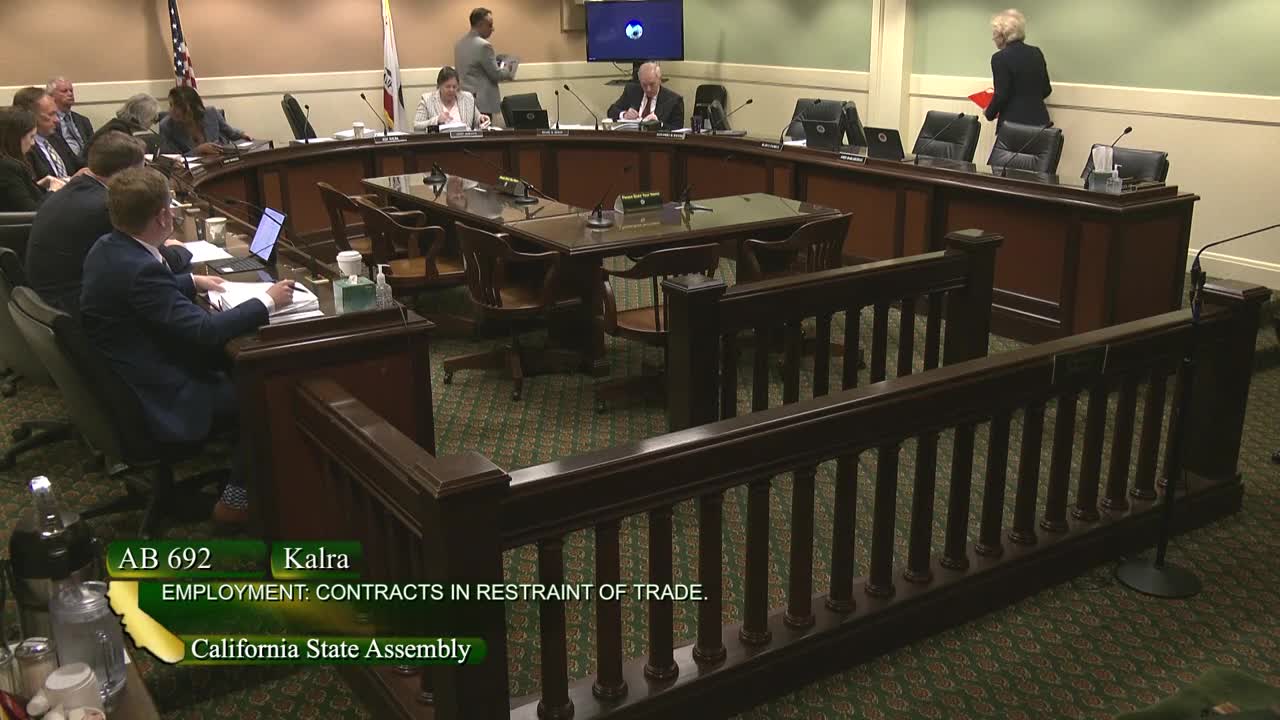 13MIN
Assembly Standing Committee on Judiciary
 23MIN
Assembly Standing Committee on Labor and Employment
Bill Author