AB 713: Public postsecondary education: student employment.
- Session Year: 2025-2026
- House: Assembly
- Latest Version Date: 2026-09-02
Current Status:
Failed
(2026-09-20: Vetoed by Governor.)
Introduced
In Committee
Awaiting First Chamber Vote
Passed First Chamber
In Committee
Awaiting Second Chamber Vote
Passed Second Chamber
Enacted
The Donahoe Higher Education Act sets forth the missions and functions of the public institutions of higher education, including the University of California, administered by the Regents of the University of California, the California State University, administered by the Trustees of the California State University, and the California Community Colleges, administered by the Board of Governors of the California Community Colleges. The provisions of the Donahoe Higher Education Act apply to the University of California only to the extent that the Regents of the University of California, by appropriate resolution, make them applicable.
This bill would prohibit the University of California, California State University, or California Community Colleges from disqualifying a student from being hired for an employment position due to the students failure to provide proof of federal work authorization, except where that proof is required by federal law or where that proof is required as a condition of a grant that funds the particular employment position for which the student has applied.
This bill would require the University of California, the California State University, and the California Community Colleges to treat a specified prohibition in federal law on hiring undocumented noncitizens as inapplicable because that provision does not apply to any branch of state government. The bill would further provide that, to the extent student employment is considered a benefit for purposes of federal law, the bill constitutes authorization to provide that benefit for purposes of specified federal law.
This bill would require the University of California, the California State University, and the California Community Colleges to implement the bill by January 6, 2027. The bills provisions would apply to the University of California, unless it is found inapplicable to the University of California and then only to the extent that the Regents of the University of California, by appropriate resolution, make them applicable. By imposing new duties on community college districts, the bill would impose a state-mandated local program.
The California Constitution requires the state to reimburse local agencies and school districts for certain costs mandated by the state. Statutory provisions establish procedures for making that reimbursement.
This bill would provide that, if the Commission on State Mandates determines that the bill contains costs mandated by the state, reimbursement for those costs shall be made pursuant to the statutory provisions noted above.
The Donahoe Higher Education Act sets forth the missions and functions of the public institutions of higher education, including the University of California, administered by the Regents of the University of California, the California State University, administered by the Trustees of the California State University, and the California Community Colleges, administered by the Board of Governors of the California Community Colleges. The provisions of the Donahoe Higher Education Act apply to the University of California only to the extent that the Regents of the University of California, by appropriate resolution, make them applicable.
This bill would prohibit the University of California, California State University, or California Community Colleges from disqualifying a student from being hired for an employment position due to the students failure to provide proof of federal work authorization, except where that proof is required by federal law or where that proof is required as a condition of a grant that funds the particular employment position for which the student has applied.
This bill would require the University of California, the California State University, and the California Community Colleges to treat a specified prohibition in federal law on hiring undocumented noncitizens as inapplicable because that provision does not apply to any branch of state government. The bill would further provide that, to the extent student employment is considered a benefit for purposes of federal law, the bill constitutes authorization to provide that benefit for purposes of specified federal law.
This bill would require the University of California, the California State University, and the California Community Colleges to implement the bill by January 6, 2026. 2027. The bills provisions would apply to the University of California, unless it is found inapplicable to the University of California and then only to the extent that the Regents of the University of California, by appropriate resolution, make them applicable. By imposing new duties on community college districts, the bill would impose a state-mandated local program.
The California Constitution requires the state to reimburse local agencies and school districts for certain costs mandated by the state. Statutory provisions establish procedures for making that reimbursement.
This bill would provide that, if the Commission on State Mandates determines that the bill contains costs mandated by the state, reimbursement for those costs shall be made pursuant to the statutory provisions noted above.
The Donahoe Higher Education Act sets forth the missions and functions of the public institutions of higher education, including the University of California, administered by the Regents of the University of California, the California State University, administered by the Trustees of the California State University, and the California Community Colleges, administered by the Board of Governors of the California Community Colleges. The provisions of the Donahoe Higher Education Act apply to the University of California only to the extent that the Regents of the University of California, by appropriate resolution, make them applicable.
This bill would prohibit the University of California, California State University, or California Community Colleges from disqualifying a student from being hired for an employment position due to the students failure to provide proof of federal work authorization, except where that proof is required by federal law or where that proof is required as a condition of a grant that funds the particular employment position for which the student has applied.
This bill would require the University of California, the California State University, and the California Community Colleges to treat a specified prohibition in federal law on hiring undocumented noncitizens as inapplicable because that provision does not apply to any branch of state government. The bill would further provide that, to the extent student employment is considered a benefit for purposes of federal law, the bill constitutes authorization to provide that benefit for purposes of specified federal law.
This bill would require the University of California, the California State University, and the California Community Colleges to implement the bill by January 6, 2026. The bills provisions would apply to the University of California, unless it is found inapplicable to the University of California and then only to the extent that the Regents of the University of California, by appropriate resolution, make them applicable. By imposing new duties on community college districts, the bill would impose a state-mandated local program.
The California Constitution requires the state to reimburse local agencies and school districts for certain costs mandated by the state. Statutory provisions establish procedures for making that reimbursement.
This bill would provide that, if the Commission on State Mandates determines that the bill contains costs mandated by the state, reimbursement for those costs shall be made pursuant to the statutory provisions noted above.
Existing law, the California Disaster Assistance Act, authorizes the Director of Emergency Services to provide financial assistance to state agencies for expenditures incurred performing extraordinary emergency measures and to local agencies for their personnel costs, equipment costs, and the cost of supplies and materials used during disaster response activities, incurred as a result of a state of emergency proclaimed by the Governor, subject to specified criteria. The act also authorizes an eligible private nonprofit organization, if a state of emergency is proclaimed, to receive state assistance for distribution of supplies and other disaster or emergency assistance activities resulting in extraordinary cost.This bill would state the intent of the Legislature to enact legislation relating to small business disaster relief, including establishing an employee disaster relief program.This bill would make legislative findings and declarations as to the necessity of a special statute for the Counties of Los Angeles and Ventura.This bill would declare that it is to take effect immediately as an urgency statute.Existing law, the California Disaster Assistance Act, authorizes the Director of Emergency Services to provide financial assistance to state agencies for expenditures incurred performing extraordinary emergency measures and to local agencies for their personnel costs, equipment costs, and the cost of supplies and materials used during disaster response activities, incurred as a result of a state of emergency proclaimed by the Governor, subject to specified criteria. The act also authorizes an eligible private nonprofit organization, if a state of emergency is proclaimed, to receive state assistance for distribution of supplies and other disaster or emergency assistance activities resulting in extraordinary cost.
This bill would state the intent of the Legislature to enact legislation relating to small business disaster relief, including establishing an employee disaster relief program.
This bill would make legislative findings and declarations as to the necessity of a special statute for the Counties of Los Angeles and Ventura.
This bill would declare that it is to take effect immediately as an urgency statute.
(a)The University of California, the California State University, or the California Community Colleges shall not disqualify a student from being hired for an employment position due to their failure to provide proof of federal work authorization, except in either of the following cases:
(1)Where that proof is required by federal law.
(2)Where that proof is required as a condition of a grant that funds the particular employment position for which the student has applied.
(b)The University of California, the California State University, and the California Community Colleges shall treat the prohibition on hiring undocumented noncitizens in Section 1324a(a) of Title 8 of the United States Code as inapplicable because that provision does not apply to any branch of state government.
(c)To the extent student employment is considered a benefit for purposes of federal law, this statute shall constitute authorization to provide that benefit for purposes of Section 1621(d) of Title 8 of the United States Code.
(d)The University of California, the California State University, and the California Community Colleges shall implement this article by January 6, 2027.
(e)This article shall apply to the University of California, unless it is found to be inapplicable to the university, then, consistent with Section 67400, this article shall apply to the university only to the extent that the Regents of the University of California, by appropriate resolution, make it applicable.
SEC. 2.If the Commission on State Mandates determines that this act contains costs mandated by the state, reimbursement to local agencies and school districts for those costs shall be made pursuant to Part 7 (commencing with Section 17500) of Division 4 of Title 2 of the Government Code.
(a)The University of California, California State University, or California Community Colleges shall not disqualify a student from being hired for an employment position due to their failure to provide proof of federal work authorization, except in either of the following cases:
(1)Where that proof is required by federal law.
(2)Where that proof is required as a condition of a grant that funds the particular employment position for which the student has applied.
(b)The University of California, the California State University, and the California Community Colleges shall treat the prohibition on hiring undocumented noncitizens in Section 1324a(a) of Title 8 of the United States Code as inapplicable because that provision does not apply to any branch of state government.
(c)To the extent student employment is considered a benefit for purposes of federal law, this statute shall constitute authorization to provide that benefit for purposes of Section 1621(d) of Title 8 of the United States Code.
(d)The University of California, the California State University, and the California Community Colleges shall implement this article by January 6, 2026. 2027.
(e)This article shall apply to the University of California, unless it is found to be inapplicable to the university, then, consistent with Section 67400, this article shall apply to the university only to the extent that the Regents of the University of California, by appropriate resolution, make it applicable.
SEC. 2.If the Commission on State Mandates determines that this act contains costs mandated by the state, reimbursement to local agencies and school districts for those costs shall be made pursuant to Part 7 (commencing with Section 17500) of Division 4 of Title 2 of the Government Code.
(a)The University of California, California State University, or California Community Colleges shall not disqualify a student from being hired for an employment position due to their failure to provide proof of federal work authorization, except in either of the following cases:
(1)Where that proof is required by federal law.
(2)Where that proof is required as a condition of a grant that funds the particular employment position for which the student has applied.
(b)The University of California, the California State University, and the California Community Colleges shall treat the prohibition on hiring undocumented noncitizens in Section 1324a(a) of Title 8 of the United States Code as inapplicable because that provision does not apply to any branch of state government.
(c)To the extent student employment is considered a benefit for purposes of federal law, this statute shall constitute authorization to provide that benefit for purposes of Section 1621(d) of Title 8 of the United States Code.
(d)The University of California, the California State University, and the California Community Colleges shall implement this article by January 6, 2026.
(e)This article shall apply to the University of California, unless it is found to be inapplicable to the university, then, consistent with Section 67400, this article shall apply to the university only to the extent that the Regents of the University of California, by appropriate resolution, make it applicable.
SEC. 2.If the Commission on State Mandates determines that this act contains costs mandated by the state, reimbursement to local agencies and school districts for those costs shall be made pursuant to Part 7 (commencing with Section 17500) of Division 4 of Title 2 of the Government Code.
SECTION 1.It is the intent of the Legislature to enact legislation relating to small business disaster relief, including establishing an employee disaster relief program. SEC. 2.The Legislature finds and declares that a special statute is necessary and that a general statute cannot be made applicable within the meaning of Section 16 of Article IV of the California Constitution because of the unique circumstances facing the Counties of Los Angeles and Ventura due to extreme wildfires beginning in January 2025 that have resulted in the urgent need for small business recovery and small business employee relief in those counties impacted by the wildfires.SEC. 3.This act is an urgency statute necessary for the immediate preservation of the public peace, health, or safety within the meaning of Article IV of the California Constitution and shall go into immediate effect. The facts constituting the necessity are:To ensure that the State of California is able to meet the immediate needs of small businesses and small business employees impacted by the 2025 wildfires, in the Counties of Los Angeles and Ventura, it is necessary that this act take effect immediately.It is the intent of the Legislature to enact legislation relating to small business disaster relief, including establishing an employee disaster relief program.
SEC. 2.The Legislature finds and declares that a special statute is necessary and that a general statute cannot be made applicable within the meaning of Section 16 of Article IV of the California Constitution because of the unique circumstances facing the Counties of Los Angeles and Ventura due to extreme wildfires beginning in January 2025 that have resulted in the urgent need for small business recovery and small business employee relief in those counties impacted by the wildfires.
SEC. 3.This act is an urgency statute necessary for the immediate preservation of the public peace, health, or safety within the meaning of Article IV of the California Constitution and shall go into immediate effect. The facts constituting the necessity are:
To ensure that the State of California is able to meet the immediate needs of small businesses and small business employees impacted by the 2025 wildfires, in the Counties of Los Angeles and Ventura, it is necessary that this act take effect immediately.
|
Date
|
Status
|
|---|---|
| Sep 20, 2026 | Vetoed by Governor. |
| Sep 8, 2026 | Enrolled and presented to the Governor at 3:30 p.m. |
| Aug 28, 2026 | Senate amendments concurred in. To Engrossing and Enrolling. (Ayes 58. Noes 13.). |
| Aug 28, 2026 | Senate amendments concurred in. To Engrossing and Enrolling. (Ayes 58. Noes 13. Page 6786.). |
| Aug 27, 2026 | In Assembly. Concurrence in Senate amendments pending. |
| Aug 27, 2026 | Read third time. Passed. Ordered to the Assembly. (Ayes 30. Noes 10.). |
| Aug 17, 2026 | Read second time. Ordered to third reading. |
| Aug 13, 2026 | Read second time and amended. Ordered returned to second reading. |
| Aug 13, 2026 | In committee: Reconsideration of a favorable vote granted. |
| Aug 13, 2026 | From committee: Amend, and do pass as amended. (Ayes 5. Noes 2.) (August 13). |
| Aug 3, 2026 | In committee: Referred to APPR. suspense file. |
| Jun 25, 2026 | From committee: Do pass and re-refer to Com. on APPR. (Ayes 5. Noes 2.) (June 24). Re-referred to Com. on APPR. |
| Jun 17, 2026 | From committee: Do pass and re-refer to Com. on ED. (Ayes 9. Noes 2.) (June 16). Re-referred to Com. on ED. |
| May 6, 2026 | Referred to Coms. on JUD. and ED. |
| Jan 29, 2026 | In Senate. Read first time. To Com. on RLS. for assignment. |
| Jan 29, 2026 | Read third time. Passed. Ordered to the Senate. (Ayes 54. Noes 14. Page 3866.) |
| Jan 22, 2026 | Read second time. Ordered to third reading. |
| Jan 22, 2026 | In committee: Set, first hearing. Referred to suspense file. |
| Jan 22, 2026 | From committee: Do pass. (Ayes 11. Noes 4.) (January 22). |
| Jan 22, 2026 | Assembly Rule 63 suspended. (Page 3806.) |
| Jan 14, 2026 | From committee: Do pass and re-refer to Com. on APPR. (Ayes 6. Noes 3.) (January 13). Re-referred to Com. on APPR. |
| Jan 6, 2026 | Re-referred to Com. on HIGHER ED. |
| Jan 5, 2026 | From committee chair, with author's amendments: Amend, and re-refer to Com. on HIGHER ED. Read second time and amended. |
| Mar 27, 2025 | Re-referred to Com. on HIGHER ED. |
| Mar 26, 2025 | From committee chair, with author's amendments: Amend, and re-refer to Com. on HIGHER ED. Read second time and amended. |
| Mar 24, 2025 | Referred to Com. on HIGHER ED. |
| Feb 15, 2025 | From printer. May be heard in committee March 17. |
| Feb 14, 2025 | Read first time. To print. |
|
Date
|
Description
|
Location
|
Votes
|
|
|---|---|---|---|---|
| Aug 28, 2026 | AB 713 Solache Concurrence in Senate Amendments | Assembly Floor |
Passed |
|
| Aug 27, 2026 | Assembly 3rd Reading AB713 Solache et al. By Cervantes | Senate Floor |
Passed |
|
| Aug 13, 2026 | Do pass as amended | Senate Standing Committee on Appropriations |
Passed |
|
| Aug 13, 2026 | [08-13-2026] set for [First] hearing: Reconsideration of favorable vote granted | Senate Standing Committee on Appropriations |
Passed |
|
| Aug 13, 2026 | Do pass as amended | Senate Standing Committee on Appropriations |
Passed |
|
| Aug 3, 2026 | Placed on suspense file | Senate Standing Committee on Appropriations |
Passed |
|
| Jun 24, 2026 | Do pass, but first be re-referred to the Committee on [Appropriations] | Senate Standing Committee on Education |
Passed |
|
| Jun 16, 2026 | Do pass, but first be re-referred to the Committee on [Education] | Senate Standing Committee on Judiciary |
Passed |
|
| Jan 29, 2026 | AB 713 Solache Assembly Third Reading | Assembly Floor |
Passed |
|
| Jan 22, 2026 | Do pass. | Assembly Standing Committee on Appropriations |
Passed |
|
| Jan 13, 2026 | Do pass and be re-referred to the Committee on [Appropriations] | Assembly Standing Committee on Higher Education |
Passed |
This list shows positions taken on this bill by organizations on the date displayed, which is linked to the original source.
Positions by individuals are not included.
|
Organization
|
Position
|
Date
|
|---|---|---|
| Aclu California Action | ** Support | |
| Alliance for A Better Community | ** Support | |
| Asian Americans Advancing Justice Southern California | ** Support | |
| Buen Vecino | ** Support | |
| Building Skills Partnership | ** Support | |
| Cal State Student Association | ** Support | |
| California Democratic Party | ** Support | |
| California Immigrant Policy Center | ** Support | |
| California Pan - Ethnic Health Network | ** Support | |
| California School Employees Association | ** Support | |
| California State University Employees Union | ** Support | |
| California Undocumented Higher Education Coalition | ** Support | |
| Californians Together | ** Support | |
| Campaign For College Opportunity | ** Support | |
| CFT – a Union of Educators & Classified Professionals, AFT, AFL-CIO | ** Support | |
| Coalition for Humane Immigrant Rights | ** Support | |
| College for All Coalition | ** Support | |
| Consejo De Federaciones Mexicanas (COFEM) | ** Support | |
| Economic Mobility for All Coalition | ** Support | |
| EdTrust-West | ** Support | |
| Education and Leadership Foundation | ** Support | |
| Faculty Association Of California Community Colleges | ** Support | |
| Friends Committee On Legislation Of California | ** Support | |
| Future Leaders Of America | ** Support | |
| Grace Institute - End Child Poverty in Ca | ** Support | |
| Immigrant Defenders Law Center | ** Support | |
| Immigrant Justice in Action Coalition | ** Support | |
| Immigrants Rising | ** Support | |
| Inland Coalition for Immigrant Justice | ** Support | |
| Inland Empire Immigrant Youth Collective | ** Support | |
| Institutional Solutions | ** Support | |
| Kid City Hope Place | ** Support | |
| Latino and Latina Roundtable of the San Gabriel and Pomona Valley | ** Support | |
| Los Angeles Urban Foundation | ** Support | |
| National Korean American Service And Education Consortium | ** Support | |
| NextGen California | ** Support | |
| Northern California College Promise Coalition | ** Support | |
| One individual | ** Support | |
| Pilipino Workers Center of Southern California | ** Support | |
| Public Advocates | ** Support | |
| Puente Learning Center | ** Support | |
| San Bernardino Community Service Center, Inc. | ** Support | |
| Santa Cruz Community Ventures | ** Support | |
| SFV Alliance | ** Against | |
| Southern California College Access Network | ** Support | |
| Southern California College Attainment Network | ** Support | |
| Student Senate for California Community Colleges | ** Support | |
| uAspire | ** Support | |
| UAW | ** Support | |
| UAW Local 4123 | ** Support | |
| UAW Local 4811 | ** Support | |
| UAW Region 6 | ** Support | |
| UC Student Association | ** Support | |
| Unidosus | ** Support | |
| Unite-LA | ** Support | |
| University Of California Student Association | ** Support | |
| Young Invincibles | ** Support |
GOVERNOR'S VETO
GV Bill Id:AB 713
Author:(Solache)
As Enrolled Ver:September 2, 2026
2/3 vote
SUMMARY
Prohibits California public universities, beginning January 6, 2027, from disqualifying a student for employment due to their failure to provide proof of federal employment authorization.
- Prohibits the University of California (UC), the California State University (CSU), and the California Community Colleges (CCC) from disqualifying a student from being hired for an employment position due to their failure to provide proof of federal work authorization, except where:
- Proof is required by federal law; and,
- Proof is required as a condition of a grant that funds the particular employment position for which the student applied.
- Specifies that, for the purposes of its provisions, the UC, CSU, and CCC must treat the prohibition on hiring undocumented noncitizens in the Immigration Reform and Control Act of 1986 (IRCA) as inapplicable because that provision does not apply to any branch of state government.
- Specifies that, to the extent that any employment is considered a "benefit" for the purposes of federal law, the bill constitutes authorization by the state to provide that benefit to undocumented individuals pursuant to the exception in the Personal Responsibility and Work Opportunity Reconciliation Act of 1996 (PRWORA).
- Requires that the UC, CSU, and CCC implement its provisions by January 6, 2027.
- Specifies that this bill applies to the UC, unless it is found to be inapplicable to the UC, in which case the bill shall apply only to the extent that the UC Regents make it applicable by an appropriate resolution.
Governor's Veto Message
"This bill prohibits California public universities, beginning January 6, 2027, from disqualifying a student from employment for failing to provide proof of federal employment authorization.
Two years ago, I vetoed a nearly identical bill and, unfortunately, my concerns about its unintended consequences have only grown. The current federal government has shown it is quick to wreak destruction for political spectacle – attacking California's public higher education institutions and terrorizing immigrants communities, including students, with reckless disregard for consequences and a desire for chaos.
California remains committed to economic opportunity and tuition affordability for all students, including leading efforts to support undocumented students who face growing barriers and threats under this cruel federal administration. But given the gravity of this bill's consequences – including potential criminal and civil liability for state employees – the federal courts must resolve the legality of the novel legal theory behind this legislation before we proceed. Seeking declaratory relief in federal court would provide such clarity."
COMMENTS
Background. The State has demonstrated a commitment to undocumented students by qualifying them for state aid programs that help make college more attainable. AB 540 (Firebaugh), Chapter 814, Statutes of 2001, and successor legislation has created a nonresident tuition exemption for certain students, including undocumented students, from paying nonresident tuition (higher than resident tuition) and/or allows them to apply and receive state aid at certain California public and private colleges. Since the enactment of AB 540, several legislative measures have modified or expanded eligibility for the exemption from nonresident tuition in order to better accommodate the diverse student population.
Existing employment challenges. On June 15, 2012, the U.S. Department of Homeland Security (DHS) announced that it would not deport certain undocumented youth who came to the United States as children. Under a directive from the DHS secretary, these youth may be granted a type of temporary permission to stay in the U.S. called "deferred action." This program became called Deferred Action for Childhood Arrivals (DACA). In September of 2017, DACA was rescinded, a decision that placed millions of Californians at risk of losing their protection from deportation and work authorization that allowed them to be employed. Since the rescinding of the program several federal courts have provided rulings that have allowed current DACA recipients to continue to enroll in the program. These rulings have impacted current students, where multiple incoming classes have entered that are ineligible to receive DACA and work authorization. These students have limited access to career-relevant and sustainable work opportunities during college and after graduation. Additionally, many of these students do not qualify for critical social safety net programs like CalFresh.
According to California Student Aid Commission's (CSAC's) 2023 report Renewing the Dream – Improving Financial Aid & College Affordability for California's Undocumented Students, there are over 75,000 AB 540 students in the University of California (UC), California State University (CSU), and California Community College (CCC) and virtually none of them can rely on DACA for employment eligibility – a major change from the experience of similar students only a few years prior.
According to the Author
According to the author, "California has a long-standing commitment to expanding access, affordability, equity, and student success in higher education. Since at least 2001, the Legislature has enacted multiple policies to support undocumented students, including eligibility for in-state tuition, access to state financial aid, loans, and grants. Despite these efforts, undocumented students continue to face significant financial and structural barriers that prevent them from fully accessing and completing higher education. One of the most significant barriers is the inability to access paid on-campus employment opportunities solely due to immigration status."
"While California law has progressively expanded educational access and labor protections for undocumented individuals, it has not clearly authorized public higher education institutions to employ undocumented students. As a result, campus employment policies have been shaped by uncertainty and overly broad interpretations of the federal Immigration Reform and Control Act of 1986 (IRCA). This uncertainty has led UC, CSU, and CCC campuses to exclude undocumented students from employment opportunities despite being state entities and despite the absence of clear federal restrictions on state hiring decisions. This issue causes serious issues for undocumented students who may only be able to pursue unsafe employment (including under the table work)."
"State hiring is an area of traditional state control, and Congress must be 'unmistakably clear' when it intends to regulate state employment decisions. IRCA does not explicitly state that it governs a state's own hiring practices when acting as an employer. Nevertheless, without explicit statutory direction, California's higher education systems have continued to deny employment opportunities to undocumented students out of legal caution. Legislative action is therefore necessary to clarify state authority, ensure consistency across segments, and align campus employment practices with California's broader higher education and equity policies."
Prior legislation and concerns. AB 713 (Solache) is essentially identical to AB 2586 (Alvarez), of 2024, with only the implementation date being revised. AB 2586 (Alvarez) was vetoed by the Governor, who wrote that "…this bill prohibits California public universities from disqualifying a student from employment due to their failure to provide proof of federal employment authorization. California has a proud history of being at the forefront of expanding opportunities for undocumented students who seek to realize their higher education dreams. Including immigrant students in opportunities to succeed through higher education is also important for local communities and California's economy."
"Since 2001, when the California DREAM Act (AB 540) was signed into law, the state has continually broadened access to financial aid opportunities and other supports for students who call California home, regardless of their immigration status. While I am proud of these efforts, I am unfortunately unable to sign this legislation at this time. Given the gravity of the potential consequences of this bill, which include potential criminal and civil liability for state employees, it is critical that the courts address the legality of such a policy and the novel legal theory behind this legislation before proceeding. Seeking declaratory relief in court - an option available to the University of California - would provide such clarity."
California's higher education segments did not oppose AB 2586, but expressed concerns that included:
- The exposure of undocumented students and their families to the possibility of criminal prosecution or deportation;
- The possibility of employees involved in the hiring process like faculty, human resources, and legal professionals being subject to criminal or civil prosecution if they knowingly participate in practices deemed impermissible under federal law;
- Civil fines, criminal penalties, or debarment from federal contracting if campuses were in violation of the Immigration Reform and Control Act (IRCA); and,
- The potential loss of billions of dollars in existing federal contracts and grants that are conditional on IRCA compliance
Guidance for students? State statute encourages the establishment of Dream Resource centers and requires that public higher education institutions designate an individual on campus who is knowledgeable in financial aid, social services, state-funded immigration legal services, and other support services to assist undocumented students. However, services on each campus vary and can range from having a designated center that is independent, sharing a space, and/or having a point of contact.
Additionally, in acknowledging the complexities undocumented students face and in recognizing the importance of sound legal advice, the state in the 2018-2019 Budget Act has allocated funds to support the provision of immigration legal services for students and staff at UC, CSU, or CCC campuses. In subsequent years, the CSU ($7 million) and CCCs ($10 million) received ongoing general fund allocations, but it is not clear if the UC's allocation was ongoing or one-time. It is important to recognize that each student's situation leading to undocumented status is individual, and any decision to pursue employment as an undocumented student should be made with appropriate guidance.
The Legislature has approved numerous measures to guide student decision-making through degree completion. This includes ensuring that students make informed academic and financial decisions that result in them achieving their academic goals. This bill is silent on the issue of providing legal guidance to undocumented students. Seemingly, support services are available to students, but if this is to be a precedent-setting measure, is it reasonable to place sole responsibility on students to actively seek them out prior to employment?
Arguments in Support
According to the California Immigrant Policy Center, which is a co-source of this bill:
Currently, many students are not eligible for student employment opportunities solely due to their immigration status. This prevents these students from filling vacancies on campuses, and enriching both themselves and our public higher education institutions. We believe that this legislation is consistent with the state's commitment to advance access, affordability, equity, and success for all students. However, despite that commitment, undocumented students continue to be blocked from essential opportunities. Currently, thousands of students in California are unjustly barred from obtaining paying jobs on campus— including experiential jobs and jobs needed to complete their degrees.
Legal scholars have identified that the federal prohibition on hiring undocumented people (the Immigration Reform and Control Act of 1986 (IRCA)) does not apply to state governments when they act as employers, like California's higher education systems. This means that the University of California, California State University, and California Community Colleges can authorize the hiring of all their undocumented students.
Moreover, in August 2025, a California Court of Appeals unanimously ruled that the University of California's policy denying educational employment opportunities to undocumented students is discriminatory. In October 2025, the California Supreme Court affirmed the lower court's ruling. This ruling clearly opens the door for California to pass AB 713 and remedy this discriminatory practice.
Amidst ongoing federal attacks on our immigrant communities, including students, California must remain steadfast in its commitment to advance dignity and justice for all Californians. By passing AB 713, California will once again serve as a model for the rest of the nation in our ability to truly provide support to our undocumented students. We strongly urge your support on AB 713.
Arguments in Opposition
The SFV Alliance wrote a letter of opposition, arguing that public funds derived from taxes and fees should first be directed toward benefits for US citizens and lawfully present immigrants. The letter acknowledges that the bill would likely comply with federal law, allowing states to extend eligibility for state and local public benefits to individuals not lawfully present through affirmative state legislation enacted after August 22, 1996. Nevertheless, the Alliance argues that allowing undocumented students to be hired as college employees is inconsistent with the purpose of federal immigration law.
FISCAL COMMENTS
According to the Senate Appropriations Committee:
- The University of California estimates unknown but potentially significant litigation costs, to the extent this bill results in litigation and a legal judgment implicating federal work authorization requirements. There would also be one-time General Fund implementation costs in the mid-hundreds of thousands of dollars to develop systemwide regulations, update internal HR policies, and retrain hiring personnel.
- The Chancellor's Office estimates one-time Proposition 98 General Fund costs of between $936,000 and $1.6 million for the 72 community college districts to update policies and procedures regarding the hiring of undocumented workers and ensure compliance with other state and federal laws (such as income taxes). The Chancellor's Office also estimates one- time General Fund costs of $25,000 to $65,000 to develop Title 5 regulations and issue guidance.
- The California State University (CSU) estimates General Fund costs in the hundreds of thousands of dollars to update CSU policies and provide guidance to campuses. Additionally, the CSU anticipates the bill is likely to be challenged in court which could result in significant but unknown legal costs.
- The Department of Justice does not anticipate significant costs resulting from this bill.
VOTES
ASM HIGHER EDUCATION: 6-3-1
YES: Fong, Boerner, Jackson, Muratsuchi, Ahrens, Sharp-Collins
NO: DeMaio, Jeff Gonzalez, Tangipa
ABS, ABST OR NV: Patel
ASM APPROPRIATIONS: 11-4-0
YES: Wicks, Stefani, Calderon, Caloza, Fong, Mark González, Krell, Bauer-Kahan, Pacheco, Pellerin, Solache
NO: Hoover, Dixon, Ta, Tangipa
ASSEMBLY FLOOR: 54-14-12
YES: Addis, Aguiar-Curry, Ahrens, Alvarez, Ávila Farías, Bains, Bauer-Kahan, Bennett, Berman, Boerner, Bonta, Bryan, Calderon, Caloza, Carrillo, Connolly, Elhawary, Fong, Gabriel, Garcia, Mark González, Haney, Harabedian, Hart, Irwin, Jackson, Kalra, Krell, Lee, Lowenthal, McKinnor, Muratsuchi, Nguyen, Ortega, Pacheco, Papan, Pellerin, Petrie-Norris, Quirk-Silva, Ramos, Michelle Rodriguez, Rogers, Blanca Rubio, Schiavo, Schultz, Sharp-Collins, Solache, Soria, Stefani, Ward, Wicks, Wilson, Zbur, Rivas
NO: Castillo, Chen, DeMaio, Dixon, Ellis, Gallagher, Jeff Gonzalez, Hadwick, Johnson, Macedo, Patterson, Sanchez, Ta, Tangipa
ABS, ABST OR NV: Alanis, Arambula, Davies, Flora, Gipson, Hoover, Lackey, Patel, Ransom, Celeste Rodriguez, Valencia, Wallis
SENATE FLOOR: 30-10-0
YES: Allen, Archuleta, Arreguín, Ashby, Becker, Blakespear, Cabaldon, Caballero, Cervantes, Cortese, Durazo, Gonzalez, Grayson, Hurtado, Laird, Limón, McGuire, McNerney, Menjivar, Padilla, Pérez, Reyes, Richardson, Rubio, Smallwood-Cuevas, Stern, Umberg, Wahab, Weber Pierson, Wiener
NO: Alvarado-Gil, Choi, Dahle, Grove, Jones, Niello, Ochoa Bogh, Seyarto, Strickland, Valladares
ASSEMBLY FLOOR: 58-13-8
YES: Addis, Aguiar-Curry, Ahrens, Alvarez, Arambula, Ávila Farías, Bains, Bauer-Kahan, Bennett, Berman, Boerner, Bonta, Bryan, Calderon, Caloza, Carrillo, Connolly, Elhawary, Fong, Garcia, Gipson, Mark González, Haney, Harabedian, Hart, Irwin, Jackson, Kalra, Krell, Lee, Lowenthal, Muratsuchi, Nguyen, Ortega, Pacheco, Papan, Pellerin, Petrie-Norris, Quirk-Silva, Ramos, Ransom, Celeste Rodriguez, Michelle Rodriguez, Rogers, Blanca Rubio, Schiavo, Schultz, Sharp-Collins, Solache, Soria, Stefani, Valencia, Wallis, Ward, Wicks, Wilson, Zbur, Rivas
NO: Castillo, Chen, DeMaio, Dixon, Ellis, Jeff Gonzalez, Hadwick, Johnson, Macedo, Patterson, Sanchez, Ta, Tangipa
ABS, ABST OR NV: Alanis, Davies, Flora, Gabriel, Hoover, Lackey, McKinnor, Patel
UPDATED
VERSION: September 2, 2026
CONSULTANT: Kevin Powers / HIGHER ED. / (916) 319-3960 FN: 0004578
CONCURRENCE IN SENATE AMENDMENTS
CSA1 Bill Id:AB 713
Author:(Solache)
As Amended Ver:August 13, 2026
Majority vote
SUMMARY
Prohibits California public universities, beginning January 6, 2027, from disqualifying a student for employment due to their failure to provide proof of federal employment authorization.
Senate Amendments
Amendments taken in the Senate add co-authors to the measure.
COMMENTS
Background. The State has demonstrated a commitment to undocumented students by qualifying them for state aid programs that help make college more attainable. AB 540 (Firebaugh), Chapter 814, Statutes of 2001, and successor legislation has created a nonresident tuition exemption for certain students, including undocumented students, from paying nonresident tuition (higher than resident tuition) and/or allows them to apply and receive state aid at certain California public and private colleges. Since the enactment of AB 540, several legislative measures have modified or expanded eligibility for the exemption from nonresident tuition in order to better accommodate the diverse student population.
Existing employment challenges. On June 15, 2012, the U.S. Department of Homeland Security (DHS) announced that it would not deport certain undocumented youth who came to the United States as children. Under a directive from the DHS secretary, these youth may be granted a type of temporary permission to stay in the U.S. called "deferred action." This program became called Deferred Action for Childhood Arrivals (DACA).
In September of 2017, DACA was rescinded, a decision that placed millions of Californians at risk of losing their protection from deportation and work authorization that allowed them to be employed. Since the rescinding of the program several federal courts have provided rulings that have allowed current DACA recipients to continue to enroll in the program. These rulings have impacted current students, where multiple incoming classes have entered that are ineligible to receive DACA and work authorization. These students have limited access to career-relevant and sustainable work opportunities during college and after graduation. Additionally, many of these students do not qualify for critical social safety net programs like CalFresh.
According to California Student Aid Commission's (CSAC's) 2023 report Renewing the Dream – Improving Financial Aid & College Affordability for California's Undocumented Students, there are over 75,000 AB 540 students in the University of California (UC), California State University (CSU), and California Community College (CCC) and virtually none of them can rely on DACA for employment eligibility – a major change from the experience of similar students only a few years prior.
According to the Author
According to the author, "California has a long-standing commitment to expanding access, affordability, equity, and student success in higher education. Since at least 2001, the Legislature has enacted multiple policies to support undocumented students, including eligibility for in-state tuition, access to state financial aid, loans, and grants. Despite these efforts, undocumented students continue to face significant financial and structural barriers that prevent them from fully accessing and completing higher education. One of the most significant barriers is the inability to access paid on-campus employment opportunities solely due to immigration status."
"While California law has progressively expanded educational access and labor protections for undocumented individuals, it has not clearly authorized public higher education institutions to employ undocumented students. As a result, campus employment policies have been shaped by uncertainty and overly broad interpretations of the federal Immigration Reform and Control Act of 1986 (IRCA). This uncertainty has led UC, CSU, and CCC campuses to exclude undocumented students from employment opportunities despite being state entities and despite the absence of clear federal restrictions on state hiring decisions. This issue causes serious issues for undocumented students who may only be able to pursue unsafe employment (including under the table work)."
"State hiring is an area of traditional state control, and Congress must be 'unmistakably clear' when it intends to regulate state employment decisions. IRCA does not explicitly state that it governs a state's own hiring practices when acting as an employer. Nevertheless, without explicit statutory direction, California's higher education systems have continued to deny employment opportunities to undocumented students out of legal caution. Legislative action is therefore necessary to clarify state authority, ensure consistency across segments, and align campus employment practices with California's broader higher education and equity policies."
Prior legislation and concerns. AB 713 (Solache) is essentially identical to AB 2586 (Alvarez), of 2024, with only the implementation date being revised. AB 2586 (Alvarez) was vetoed by the Governor, who wrote that "…this bill prohibits California public universities from disqualifying a student from employment due to their failure to provide proof of federal employment authorization. California has a proud history of being at the forefront of expanding opportunities for undocumented students who seek to realize their higher education dreams. Including immigrant students in opportunities to succeed through higher education is also important for local communities and California's economy"
"Since 2001, when the California DREAM Act (AB 540) was signed into law, the state has continually broadened access to financial aid opportunities and other supports for students who call California home, regardless of their immigration status. While I am proud of these efforts, I am unfortunately unable to sign this legislation at this time. Given the gravity of the potential consequences of this bill, which include potential criminal and civil liability for state employees, it is critical that the courts address the legality of such a policy and the novel legal theory behind this legislation before proceeding. Seeking declaratory relief in court - an option available to the University of California - would provide such clarity."
California's higher education segments did not oppose AB 2586, but expressed concerns that included:
- The exposure of undocumented students and their families to the possibility of criminal prosecution or deportation;
- The possibility of employees involved in the hiring process like faculty, human resources, and legal professionals being subject to criminal or civil prosecution if they knowingly participate in practices deemed impermissible under federal law;
- Civil fines, criminal penalties, or debarment from federal contracting if campuses were in violation of the Immigration Reform and Control Act (IRCA); and
- The potential loss of billions of dollars in existing federal contracts and grants that are conditional on IRCA compliance.
Guidance for students? State statute encourages the establishment of Dream Resource centers and requires that public higher education institutions designate an individual on campus who is knowledgeable in financial aid, social services, state-funded immigration legal services, and other support services to assist undocumented students. However, services on each campus vary and can range from having a designated center that is independent, sharing a space, and/or having a point of contact.
Additionally, in acknowledging the complexities undocumented students face and in recognizing the importance of sound legal advice, the state in the 2018-2019 Budget Act has allocated funds to support the provision of immigration legal services for students and staff at UC, CSU, or CCC campuses. In subsequent years, the CSU ($7 million) and CCCs ($10 million) received ongoing general fund allocations, but it is not clear if the UC's allocation was ongoing or one-time. It is important to recognize that each student's situation leading to undocumented status is individual, and any decision to pursue employment as an undocumented student should be made with appropriate guidance.
The Legislature has approved numerous measures to guide student decision-making through degree completion. This includes ensuring that students make informed academic and financial decisions that result in them achieving their academic goals. This bill is silent on the issue of providing legal guidance to undocumented students. Seemingly, support services are available to students, but if this is to be a precedent-setting measure, is it reasonable to place sole responsibility on students to actively seek them out prior to employment?
Arguments in Support
According to the California Immigrant Policy Center, which is a co-source of this bill:
Currently, many students are not eligible for student employment opportunities solely due to their immigration status. This prevents these students from filling vacancies on campuses, and enriching both themselves and our public higher education institutions. We believe that this legislation is consistent with the state's commitment to advance access, affordability, equity, and success for all students. However, despite that commitment, undocumented students continue to be blocked from essential opportunities. Currently, thousands of students in California are unjustly barred from obtaining paying jobs on campus— including experiential jobs and jobs needed to complete their degrees.
Legal scholars have identified that the federal prohibition on hiring undocumented people (the Immigration Reform and Control Act of 1986 (IRCA)) does not apply to state governments when they act as employers, like California's higher education systems. This means that the University of California, California State University, and California Community Colleges can authorize the hiring of all their undocumented students.
Moreover, in August 2025, a California Court of Appeals unanimously ruled that the University of California's policy denying educational employment opportunities to undocumented students is discriminatory. In October 2025, the California Supreme Court affirmed the lower court's ruling. This ruling clearly opens the door for California to pass AB 713 and remedy this discriminatory practice.
Amidst ongoing federal attacks on our immigrant communities, including students, California must remain steadfast in its commitment to advance dignity and justice for all Californians. By passing AB 713, California will once again serve as a model for the rest of the nation in our ability to truly provide support to our undocumented students. We strongly urge your support on AB 713.
Arguments in Opposition
The SFV Alliance wrote a letter of opposition, arguing that public funds derived from taxes and fees should first be directed toward benefits for US citizens and lawfully present immigrants. The letter acknowledges that the bill would likely comply with federal law, allowing states to extend eligibility for state and local public benefits to individuals not lawfully present through affirmative state legislation enacted after August 22, 1996. Nevertheless, the Alliance argues that allowing undocumented students to be hired as college employees is inconsistent with the purpose of federal immigration law.
FISCAL COMMENTS
According to the Senate Appropriations Committee:
- The University of California estimates unknown but potentially significant litigation costs, to the extent this bill results in litigation and a legal judgment implicating federal work authorization requirements. There would also be one-time General Fund implementation costs in the mid-hundreds of thousands of dollars to develop systemwide regulations, update internal HR policies, and retrain hiring personnel.
- The Chancellor's Office estimates one-time Proposition 98 General Fund costs of between $936,000 and $1.6 million for the 72 community college districts to update policies and procedures regarding the hiring of undocumented workers and ensure compliance with other state and federal laws (such as income taxes). The Chancellor's Office also estimates one- time General Fund costs of $25,000 to $65,000 to develop Title 5 regulations and issue guidance.
- The California State University (CSU) estimates General Fund costs in the hundreds of thousands of dollars to update CSU policies and provide guidance to campuses. Additionally, the CSU anticipates the bill is likely to be challenged in court which could result in significant but unknown legal costs.
- The Department of Justice does not anticipate significant costs resulting from this bill.
VOTES:
ASM HIGHER EDUCATION: 6-3-1
YES: Fong, Boerner, Jackson, Muratsuchi, Ahrens, Sharp-Collins
NO: DeMaio, Jeff Gonzalez, Tangipa
ABS, ABST OR NV: Patel
ASM APPROPRIATIONS: 11-4-0
YES: Wicks, Stefani, Calderon, Caloza, Fong, Mark González, Krell, Bauer-Kahan, Pacheco, Pellerin, Solache
NO: Hoover, Dixon, Ta, Tangipa
ASSEMBLY FLOOR: 54-14-12
YES: Addis, Aguiar-Curry, Ahrens, Alvarez, Ávila Farías, Bains, Bauer-Kahan, Bennett, Berman, Boerner, Bonta, Bryan, Calderon, Caloza, Carrillo, Connolly, Elhawary, Fong, Gabriel, Garcia, Mark González, Haney, Harabedian, Hart, Irwin, Jackson, Kalra, Krell, Lee, Lowenthal, McKinnor, Muratsuchi, Nguyen, Ortega, Pacheco, Papan, Pellerin, Petrie-Norris, Quirk-Silva, Ramos, Michelle Rodriguez, Rogers, Blanca Rubio, Schiavo, Schultz, Sharp-Collins, Solache, Soria, Stefani, Ward, Wicks, Wilson, Zbur, Rivas
NO: Castillo, Chen, DeMaio, Dixon, Ellis, Gallagher, Jeff Gonzalez, Hadwick, Johnson, Macedo, Patterson, Sanchez, Ta, Tangipa
ABS, ABST OR NV: Alanis, Arambula, Davies, Flora, Gipson, Hoover, Lackey, Patel, Ransom, Celeste Rodriguez, Valencia, Wallis
UPDATED
VERSION: August 13, 2026
CONSULTANT: Kevin J. Powers / HIGHER ED. / (916) 319-3960 FN: 0004393
SENATE RULES COMMITTEE Office of Senate Floor Analyses (916) 651-4171 | AB 713 |
THIRD READING
Bill No: AB 713
Author: Solache (D), et al.
Amended: 8/13/26 in Senate
Vote: 21
SENATE JUDICIARY COMMITTEE: 9-2, 6/16/26
AYES: Umberg, Allen, Caballero, Durazo, Laird, Reyes, Stern, Wahab, Wiener
NOES: Niello, Valladares
NO VOTE RECORDED: Ashby, Weber Pierson
SENATE EDUCATION COMMITTEE: 5-2, 6/24/26
AYES: Pérez, Cabaldon, Cortese, Gonzalez, Reyes
NOES: Ochoa Bogh, Choi
SENATE APPROPRIATIONS COMMITTEE: 5-2, 8/13/26
AYES: Cervantes, Cabaldon, Grayson, Richardson, Wahab
NOES: Seyarto, Dahle
ASSEMBLY FLOOR: 54-14, 1/29/26 - See last page for vote
SUBJECT: Public postsecondary education: student employment
SOURCE: CFT – a Union of Educators & Classified Professionals, AFT, AFL-CIO
California Immigrant Policy Center
Immigrant Justice in Action Coalition
Immigrants Rising
uAspire
UAW
UC Student Association
DIGEST:
This bill prohibits California public universities, beginning January 6, 2027, from disqualifying a student for employment due to their failure to provide proof of federal employment authorization.
ANALYSIS:
Existing federal law:
- Makes it unlawful for a person or other entity to:
- hire, recruit, or refer for a fee for employment in the United States an individual without authorization to work in the United States when the person or other entity knows the individual is not authorized to work in the United States; and
- hire for employment in the United States an individual without complying with specified employment authorization verification processes, or, if the person or other entity is an agricultural association or employer or farm labor contractor, to hire, recruit, or refer for a fee an individual for employment without complying with specified employment authorization verification processes. (8 United States Code (U.S.C.) § 1324a(a).)
- Establishes the Personal Responsibility and Work Opportunity Reconciliation Act of 1996 (PRWORA) and specifies that certain immigrants shall not be eligible for any state or local public benefit, except as provided.
- Defines “state or local public benefit” to mean the following:
- any grant, contract, loan, professional license, or commercial license provided by an agency of a state or local government, or by appropriated funds of a state or local government; and
- any retirement, welfare, health, disability, public or assisted housing, postsecondary education, food assistance, unemployment benefit, or any other similar benefit for which payments or assistance are provided to an individual, household, or family eligibility unit by an agency of a state or local government or by appropriated funds of a state or local government.
- Provides specified state or local public benefits that are exempt from the prohibition in (1). (8 U.S.C. § 1621.)
- Specifies that a state may provide that undocumented immigrants who are not lawfully present in the United States are eligible for a state or local public benefit for which the individual would otherwise be ineligible under this Act only through the enactment of a state law after August 22, 1996, that affirmatively provides for that eligibility. (8 U.S.C. § 1621(d).)
- Defines “state or local public benefit” to mean the following:
Existing state law:
- Establishes the University of California (UC) as a public trust to be administered by the Regents of the UC; and grants the Regents full powers of organization and government, subject only to such legislative control as may be necessary to insure security of its funds, compliance with the terms of its endowments, statutory requirements around competitive bidding and contracts, sales of property and the purchase of materials, goods, and services. (Art. IX, Sec. (9)(a), California Constitution.)
- Confers upon the California State University (CSU) Trustees the powers, duties, and functions with respect to the management, administration, and control of the CSU system and provides that the Trustees are responsible for the rule of government of their appointees and employees. (Education (Edu.) Code §§ 66606, 89500, et seq.)
- Establishes the California Community Colleges (CCCs) under the administration of the Board of Governors of the CCC, as one of the segments of public postsecondary education in this state, and specifies that the CCC is comprised of community college districts. (Edu. Code § 70900.)
- Makes it unlawful for an employer to discriminate against an employee or applicant because of their immigration status, unless the employer can show by clear and convincing evidence that it is required to do so in order to comply with federal immigration law. (2 California Code of Regulations (C.C.R.) § 11028(f)(3).)
This bill:
- Prohibits the UC, the CSU, and the CCC from disqualifying a student from being hired for an employment position due to their failure to provide proof of federal work authorization, except where:
- proof is required by federal law;
- proof is required as a condition of a grant that funds the particular employment position for which the student applied.
- Specifies that, for the purposes of its provisions, the UC, CSU, and CCC must treat the prohibition on hiring undocumented noncitizens in the Immigration Reform and Control Act of 1986 as inapplicable because that provision does not apply to any branch of state government.
- Specifies that, to the extent that any employment is considered a “benefit” for the purposes of federal law, the bill constitutes authorization by the state to provide that benefit to undocumented individuals pursuant to the exception in the PRWORA, as described above.
- Requires that the UC, CSU, and CCC must implement its provisions by January 6, 2027.
- Specifies that this bill applies to the UC, unless it is found to be inapplicable to the UC, in which case the bill shall apply only to the extent that the UC Regents make it applicable by an appropriate resolution.
FISCAL EFFECT: Appropriation: No Fiscal Com.: Yes Local: Yes
According to the Senate Appropriations Committee:
- The University of California estimates unknown but potentially significant litigation costs, to the extent this bill results in litigation and a legal judgment implicating federal work authorization requirements. There would also be one-time General Fund implementation costs in the mid-hundreds of thousands of dollars to develop systemwide regulations, update internal HR policies, and retrain hiring personnel.
- The Chancellor’s Office estimates one-time Proposition 98 General Fund costs of between $936,000 and $1.6 million for the 72 community college districts to update policies and procedures regarding the hiring of undocumented workers and ensure compliance with other state and federal laws (such as income taxes). The Chancellor’s Office also estimates one-time General Fund costs of $25,000 to $65,000 to develop Title 5 regulations and issue guidance.
- The California State University (CSU) estimates General Fund costs in the hundreds of thousands of dollars to update CSU policies and provide guidance to campuses. Additionally, the CSU anticipates the bill is likely to be challenged in court which could result in significant but unknown legal costs.
- The Department of Justice does not anticipate significant costs resulting from this bill.
SUPPORT: (Verified 8/12/26)
CFT – a Union of Educators & Classified Professionals, AFT, AFL-CIO
(co-source)
California Immigrant Policy Center (co-source)
Immigrant Justice in Action Coalition (co-source)
Immigrants Rising (co-source)
uAspire (co-source)
UAW (co-source)
UC Student Association (co-source)
ACLU California Action
Alliance for a Better Community
Asian Americans Advancing Justice Southern California
Building Skills Partnership
Cal State Student Association
California Pan - Ethnic Health Network
California School Employees Association
California State University Employees Union
Campaign for College Opportunity
Coalition for Humane Immigrant Rights
College for All Coalition
Economic Mobility for All Coalition
Edtrust-west
Education and Leadership Foundation
Faculty Association of California Community Colleges
Future Leaders of America
Grace Institute - End Child Poverty in CA
Immigrant Defenders Law Center
Inland Empire Immigrant Youth Collective
Institutional Solutions
Latino and Latina Roundtable of the San Gabriel and Pomona Valley
Los Angeles Urban Foundation
National Korean American Service and Education Consortium
Nextgen California
Northern California College Promise Coalition
Pilipino Workers Center of Southern California
Public Advocates
Puente Learning Center
Santa Cruz Community Ventures
Southern California College Access Network
Southern California College Attainment Network
Student Senate for California Community Colleges
UAW Local 4123
UAW Local 4811
UAW Region 6
UC Student Association
UnidosUS
University of California Student Association
Young Invincibles
OPPOSITION: (Verified 8/12/26)
None received
ARGUMENTS IN SUPPORT:
According to the California Immigrant Policy Center, which is a co-source of this bill:
Currently, many students are not eligible for student employment opportunities solely due to their immigration status. This prevents these students from filling vacancies on campuses, and enriching both themselves and our public higher education institutions. We believe that this legislation is consistent with the state’s commitment to advance access, affordability, equity, and success for all students. However, despite that commitment, undocumented students continue to be blocked from essential opportunities. Currently, thousands of students in California are unjustly barred from obtaining paying jobs on campus— including experiential jobs and jobs needed to complete their degrees.
Legal scholars have identified that the federal prohibition on hiring undocumented people (the Immigration Reform and Control Act of 1986 (IRCA)) does not apply to state governments when they act as employers, like California’s higher education systems. This means that the University of California, California State University, and California Community Colleges can authorize the hiring of all their undocumented students.
Moreover, in August 2025, a California Court of Appeals unanimously ruled that the University of California’s policy denying educational employment opportunities to undocumented students is discriminatory. In October 2025, the California Supreme Court affirmed the lower court’s ruling. This ruling clearly opens the door for California to pass AB 713 and remedy this discriminatory practice.
Amidst ongoing federal attacks on our immigrant communities, including students, California must remain steadfast in its commitment to advance dignity and justice for all Californians. By passing AB 713, California will once again serve as a model for the rest of the nation in our ability to truly provide support to our undocumented students. We strongly urge your support on AB 713.
ASSEMBLY FLOOR: 54-14, 1/29/26
AYES: Addis, Aguiar-Curry, Ahrens, Alvarez, Ávila Farías, Bains, Bauer-Kahan, Bennett, Berman, Boerner, Bonta, Bryan, Calderon, Caloza, Carrillo, Connolly, Elhawary, Fong, Gabriel, Garcia, Mark González, Haney, Harabedian, Hart, Irwin, Jackson, Kalra, Krell, Lee, Lowenthal, McKinnor, Muratsuchi, Nguyen, Ortega, Pacheco, Papan, Pellerin, Petrie-Norris, Quirk-Silva, Ramos, Michelle Rodriguez, Rogers, Blanca Rubio, Schiavo, Schultz, Sharp-Collins, Solache, Soria, Stefani, Ward, Wicks, Wilson, Zbur, Rivas
NOES: Castillo, Chen, DeMaio, Dixon, Ellis, Gallagher, Jeff Gonzalez, Hadwick, Johnson, Macedo, Patterson, Sanchez, Ta, Tangipa
NO VOTE RECORDED: Alanis, Arambula, Davies, Flora, Gipson, Hoover, Lackey, Patel, Ransom, Celeste Rodriguez, Valencia, Wallis
Prepared by: Ian Dougherty / JUD. / (916) 651-4113
8/17/26 10:37:56
**** END ****
SENATE COMMITTEE ON
Senator Sabrina Cervantes, Chair
2025 - 2026 Regular Session
AB 713 (Solache) - Public postsecondary education: student employment
Version: | Policy Vote: |
Urgency: | Mandate: |
Hearing Date: | Consultant: |
Bill Summary:
This bill prohibits California public universities, beginning January 6, 2027, from disqualifying a student for employment due to their failure to provide proof of federal employment authorization.
*********** ANALYSIS ADDENDUM – SUSPENSE FILE ***********
The following information is revised to reflect amendments
adopted by the committee on August 13, 2026
Fiscal Impact:
- The University of California estimates unknown but potentially significant litigation costs, to the extent this bill results in litigation and a legal judgment implicating federal work authorization requirements. There would also be one-time General Fund implementation costs in the mid-hundreds of thousands of dollars to develop systemwide regulations, update internal HR policies, and retrain hiring personnel.
- The Chancellor’s Office estimates one-time Proposition 98 General Fund costs of between $936,000 and $1.6 million for the 72 community college districts to update policies and procedures regarding the hiring of undocumented workers and ensure compliance with other state and federal laws (such as income taxes). The Chancellor’s Office also estimates one-time General Fund costs of $25,000 to $65,000 to develop Title 5 regulations and issue guidance.
- The California State University (CSU) estimates General Fund costs in the hundreds of thousands of dollars to update CSU policies and provide guidance to campuses. Additionally, the CSU anticipates the bill is likely to be challenged in court which could result in significant but unknown legal costs.
- The Department of Justice does not anticipate significant costs resulting from this bill.
Author Amendments:
Add coauthors for the bill.
-- END --
SENATE COMMITTEE ON
Senator Sabrina Cervantes, Chair
2025 - 2026 Regular Session
AB 713 (Solache) - Public postsecondary education: student employment
Version: | Policy Vote: |
Urgency: | Mandate: |
Hearing Date: | Consultant: |
Bill Summary:
This bill prohibits California public universities, beginning January 6, 2027, from disqualifying a student for employment due to their failure to provide proof of federal employment authorization.
Fiscal Impact:
- The University of California estimates unknown but potentially significant litigation costs, to the extent this bill results in litigation and a legal judgment implicating federal work authorization requirements. There would also be one-time General Fund implementation costs in the mid-hundreds of thousands of dollars to develop systemwide regulations, update internal HR policies, and retrain hiring personnel.
- The Chancellor’s Office estimates one-time Proposition 98 General Fund costs of between $936,000 and $1.6 million for the 72 community college districts to update policies and procedures regarding the hiring of undocumented workers and ensure compliance with other state and federal laws (such as income taxes). The Chancellor’s Office also estimates one-time General Fund costs of $25,000 to $65,000 to develop Title 5 regulations and issue guidance.
- The California State University (CSU) estimates General Fund costs in the hundreds of thousands of dollars to update CSU policies and provide guidance to campuses. Additionally, the CSU anticipates the bill is likely to be challenged in court which could result in significant but unknown legal costs.
- The Department of Justice does not anticipate significant costs resulting from this bill.
Background:
Existing law establishes the University of California (UC) as a public trust to be administered by the Regents of the UC; and grants the Regents full powers of organization and government, subject only to such legislative control as may be necessary to insure security of its funds, compliance with the terms of its endowments, statutory requirements around competitive bidding and contracts, sales of property and the purchase of materials, goods, and services.
Existing law confers upon the California State University (CSU) Trustees the powers, duties, and functions with respect to the management, administration, and control of the CSU system and provides that the Trustees are responsible for the rule of government of their appointees and employees.
Existing law establishes the California Community Colleges (CCCs) under the administration of the Board of Governors of the CCC, as one of the segments of public postsecondary education in this state, and specifies that the CCC is comprised of community college districts.
Existing federal law makes it unlawful for a person or other entity to:
- Hire, recruit, or refer for a fee for employment in the United States an individual without authorization to work in the United States when the person or other entity knows the individual is not authorized to work in the United States.
- Hire for employment in the United States an individual without complying with specified employment authorization verification processes, or, if the person or other entity is an agricultural association or employer or farm labor contractor, to hire, recruit, or refer for a fee an individual for employment without complying with specified employment authorization verification processes.
Existing federal law establishes the Personal Responsibility and Work Opportunity Reconciliation Act of 1996 and specifies that certain immigrants shall not be eligible for any state or local public benefit, except as provided. It defines “state or local public benefit” to mean the following:
- Any grant, contract, loan, professional license, or commercial license provided by an agency of a state or local government, or by appropriated funds of a state or local government.
- Any retirement, welfare, health, disability, public or assisted housing, postsecondary education, food assistance, unemployment benefit, or any other similar benefit for which payments or assistance are provided to an individual, household, or family eligibility unit by an agency of a state or local government or by appropriated funds of a state or local government.
Proposed Law:
This bill prohibits the UC, CSU, and CCCs from disqualifying a student from being hired for an employment position due to their failure to provide proof of federal work authorization, except where that proof is required by federal law or where that proof is required as a condition of a grant that funds the particular employment position for which the student has applied.
This bill requires the UC, the CSU and CCCs to treat the prohibition on hiring undocumented noncitizen in the Immigration Reform and Control Act of 1986 as inapplicable because that provision does not apply to any branch of state government. It also provides that, to the extent student employment is considered a “benefit” for purpose of federal law, the provision constitutes authorization by the state to provide that benefit to undocumented individuals pursuant to the exception in the federal PRWORA.
This bill provides that its provisions shall be implemented by January 2027.
This bill specifies that it applies to the UC, unless it is found to be inapplicable to the UC, in which case the bill is only to apply to the extent the UC Regents make it applicable by an appropriate resolution.
Staff Comments:
This bill prohibits the UC, CSU, and Community Colleges from disqualifying a student applicant for an on-campus job solely on the fact that they cannot provide proof of their federal employment authorization, unless proof is required by federal law or is required as a condition of a grant that funds the position. According to the author, “California has a long-standing commitment to expanding access, affordability, equity, and student success in higher education. Since at least 2001, the Legislature has enacted multiple policies to support undocumented students, including eligibility for in-state tuition, access to state financial aid, loans, and grants. Despite these efforts, undocumented students continue to face significant financial and structural barriers that prevent them from fully accessing and completing higher education. One of the most significant barriers is the inability to access paid on-campus employment opportunities solely due to immigration status. AB 713 would remove this barrier by allowing all students, regardless of immigration status, to access on-campus jobs. By providing equal access to these opportunities, the bill would reduce financial and structural inequities, help students persist in higher education, and promote more equitable outcomes across California’s public higher education systems.”
-- END --
SENATE COMMITTEE ON EDUCATION
Senator Sasha Renée Pérez, Chair
2025 - 2026 Regular
Bill No: Hearing Date: June 24, 2026
Author: | |||
Version: |
| ||
Urgency: | Fiscal: | ||
Consultant: | |||
Subject: .
SUMMARY
This bill prohibits California public universities, beginning January 6, 2027, from disqualifying a student for employment due to their failure to provide proof of federal employment authorization.
BACKGROUND
Existing federal law:
- Makes it unlawful for a person or other entity to:
- Hire, recruit, or refer for a fee for employment in the United States an individual without authorization to work in the United States when the person or other entity knows the individual is not authorized to work in the United States.
- Hire for employment in the United States an individual without complying with specified employment authorization verification processes, or, if the person or other entity is an agricultural association or employer or farm labor contractor, to hire, recruit, or refer for a fee an individual for employment without complying with specified employment authorization verification processes. (United States Code (USC) Title 8 § 1324a(a))
- Establishes the Personal Responsibility and Work Opportunity Reconciliation Act of 1996 (PRWORA) and specifies that certain immigrants shall not be eligible for any state or local public benefit, except as provided.
- Defines “state or local public benefit” to mean the following:
- Any grant, contract, loan, professional license, or commercial license provided by an agency of a state or local government, or by appropriated funds of a state or local government.
- Any retirement, welfare, health, disability, public or assisted housing, postsecondary education, food assistance, unemployment benefit, or any other similar benefit for which payments or assistance are provided to an individual, household, or family eligibility unit by an agency of a state or local government or by appropriated funds of a state or local government.
- Provides specified state or local public benefits that are exempt from the prohibition in (1). (USC, Title 8 § 1621)
- Specifies that a state may provide that undocumented immigrants who are not lawfully present in the United States are eligible for a state or local public benefit for which the individual would otherwise be ineligible under this Act only through the enactment of a state law after August 22, 1996, that affirmatively provides for that eligibility. (USC, Title 8 § 1621(d))
- Defines “state or local public benefit” to mean the following:
Existing state law:
1) Establishes the University of California (UC) as a public trust to be administered by the Regents of the UC; and grants the Regents full powers of organization and government, subject only to such legislative control as may be necessary to insure security of its funds, compliance with the terms of its endowments, statutory requirements around competitive bidding and contracts, sales of property and the purchase of materials, goods, and services. (California Constitution Art. IX, Sec. (9)(a))
2) Confers upon the California State University (CSU) Trustees the powers, duties, and functions with respect to the management, administration, and control of the CSU system and provides that the Trustees are responsible for the rule of government of their appointees and employees. (Education Code (EC) §§ 66606, 89500, et seq.)
3) Establishes the California Community Colleges (CCCs) under the administration of the Board of Governors of the CCC, as one of the segments of public postsecondary education in this state, and specifies that the CCC is comprised of community college districts (CCDs). (EC § 70900.)
- Establishes the California Student Aid Commission (Commission) for the purpose of administering specified student financial aid programs. (EC § 69510, et seq.)
5) Authorizes the Cal Grant Program, administered by the Commission, to provide grants to financially needy students to attend college. The Cal Grant programs include both the entitlement and the competitive Cal Grant awards. The program consists of the Cal Grant A, Cal Grant B, and Cal Grant C programs, and eligibility is based upon financial need, grade point average, California residency, and other eligibility criteria, as specified in EC § 69433.9. (EC § 69430-69433.9)
6) Established AB 540 (Firebaugh, Chapter 814, Statutes of 2001), exempts California nonresident students, regardless of citizenship status, from paying nonresident tuition at California public colleges and universities who meet all of the following requirements:
a) Satisfied requirements of either (i) or (ii):
i) A total attendance of, or attainment of credits earned while in California equivalent to, three or more years of full-time attendance or attainment of credits at any of the following:
(1) California high schools.
(2) California high schools established by the State Board of Education.
(3) California adult schools established by any of the following entities:
(a) A county office of education.
(b) A unified school district or high school district; and,
(c) The Department of Corrections and Rehabilitation.
(4) Campuses of the CCC.
(5) A combination of those schools set forth in (1) to (4), inclusive.
ii) Three or more years of full-time high school coursework in California, and a total of three or more years of attendance in California elementary schools, California secondary schools, or a combination of California elementary and secondary schools.
b) Satisfied any of the following:
i) Graduation from a California high school or attainment of the equivalent.
ii) Attainment of an associate degree from a campus of the CCC; and/or,
iii) Fulfillment of the minimum transfer requirements established for UC or CSU for students transferring from a campus of the CCC.
c) Stipulates that in the case of a person without lawful immigration status, the student must file an affidavit, as specified, stating that the student has filed an application to legalize the student’s immigration status, or will file an application as soon as the student is eligible to do so. (EC § 68130.5)
7) Provides that a student who meets the nonresident tuition exemption AB 540 requirements or who meets equivalent requirements adopted by the UC is eligible to apply for any financial aid program administered by the state to the full extent permitted by federal law. (EC § 69508.5)
8) Requires the Commission to establish procedures and forms that enable students who meet the nonresident tuition exemption AB 540 requirements, or who meet equivalent requirements adopted by the UC Regents, to apply for, and participate in, all student financial aid programs administered by the State of California to the full extent permitted by federal law. (EC § 69508.5 (b))
9) Provides that a student attending a CCC, CSU, or UC who is exempt from paying nonresident tuition exemption AB 540 requirements is eligible to receive a scholarship derived from non-state funds received, for the purpose of scholarships, by the segment (i.e., CCC, CSU, or UC) at which the student is enrolled. (EC § 66021.7)
10) Establishes the DREAM Loan Program at UC and CSU campuses that elect to participate in the program. Under the program, an AB 540 student meeting specified requirements, including demonstrating financial need, may obtain a loan. (EC § 70033)
11) Makes it unlawful for an employer to discriminate against an employee or applicant because of their immigration status, unless the employer can show by clear and convincing evidence that it is required to do so in order to comply with federal immigration law. (California Code of Regulations (CCR) Title § 11028(f)(3))
ANALYSIS
This bill:
- Prohibits the UC, CSU, and CCCs from disqualifying a student from being hired for an employment position due to their failure to provide proof of federal work authorization, except in either of the following cases:
- Where that proof is required by federal law.
- Where that proof is required as a condition of a grant that funds the
particular employment position for which the student has applied.
- Requires the UC, the CSU and CCCs to treat the prohibition on hiring undocumented noncitizen in the Immigration Reform and Control Act of 1986 as inapplicable because that provision does not apply to any branch of state government.
- Provides that, to the extent student employment is considered a “benefit” for purpose of federal law, the provision of this bill constitutes authorization by the state to provide that benefit to undocumented individuals pursuant to the exception in the federal PRWORA.
- Requires implementation of the bill’s provisions by January 2027.
- Specifies that this bill applies to the UC, unless it is found to be inapplicable to the UC, in which case the bill is only to apply to the extent the UC Regents make it applicable by an appropriate resolution.
STAFF COMMENTS
- Need for the bill. According to the author, “California has a long-standing commitment to expanding access, affordability, equity, and student success in higher education. Since at least 2001, the Legislature has enacted multiple policies to support undocumented students, including eligibility for in-state tuition, access to state financial aid, loans, and grants. Despite these efforts, undocumented students continue to face significant financial and structural barriers that prevent them from fully accessing and completing higher education. One of the most significant barriers is the inability to access paid on-campus employment opportunities solely due to immigration status. AB 713 would remove this barrier by allowing all students, regardless of immigration status, to access on-campus jobs. By providing equal access to these opportunities, the bill would reduce financial and structural inequities, help students persist in higher education, and promote more equitable outcomes across California’s public higher education systems.”
- State support for undocumented students in higher education. According to the California Student Aid Commission’s Renewing the Dream report, California is home to the largest population of undocumented college students in the nation, with nearly 100,000 students enrolled in higher education. Over the past two decades, the Legislature has adopted numerous policies intended to expand higher education access for undocumented students, including eligibility for resident tuition rates under AB 540, state financial aid programs, institutional aid, and Dream Resources Center support. Despite these efforts, undocumented students remain ineligible for most federal financial aid programs, including Pell Grants, federal work-study, and employment opportunities, and continue to face financial barriers while pursuing higher education.
- Efforts to create a path to campus employment. This issue of campus employment opportunities for undocumented students has been the subject of ongoing discussion at the federal, state, and institutional levels. While some undocumented students have been able to obtain employment authorization through programs such as the federal Deferred Action for Childhood Arrivals (DACA), many students remain ineligible for work authorization. However, in 2017, the federal government rescinded DACA. Since the rescinding of the program, several federal courts have provided rulings that allow current DACA recipients to continue to enroll in the program. The Commission’s report notes that close to 200,000 undocumented Californians participated in DACA. However, a growing number of undocumented students entering college are ineligible for DACA and do not have work authorization. It further states that the lack of federal action over the past decade has accelerated the need for steps to support undocumented students. The author notes that the lack of federal action has prompted consideration of state-level approaches to expanding access to a campus employment opportunity. In recent years, the UC Regents considered creating employment opportunities for undocumented students but ultimately delayed implementation. According to the author, recent state court decisions involving UC employment policies have renewed consideration of this issue and contributed to the reintroduction of this measure. One of the remaining barriers facing undocumented students is limited access to campus employment opportunities. Campus employment can provide students with income to help offset educational expenses while also offering professional experience, faculty mentorship, and opportunities to develop workplace skills. This bill seeks to expand access to those opportunities by prohibiting the public higher education segments from disqualifying a student from campus employment solely because the student lacks federal work authorization, except where required by federal law or grant conditions.
- Educational and professional experience. In addition to providing income, many campus jobs offer students opportunities to gain research, instructional, administrative, and professional experience that may support academic achievement and career preparation. Expanding access to campus employment opportunities would allow undocumented students to participate more fully in educational and career preparation experiences.
- Guidance for students? State statute encourages the establishment of Dream Resource centers and requires that public higher education institutions designate an individual on campus who is knowledgeable in financial aid, social services, state-funded immigration legal services, and other support services to assist undocumented students. However, services on each campus vary and can range from having a designated center that is independent, sharing a space, and/or having a point of contact. Additionally, in acknowledging the complexities undocumented students face and in recognizing the importance of sound legal advice, the state in the 2018-2019 Budget Act has allocated funds to support the provision of immigration legal services for students and staff at UC, CSU, or CCC campuses. In subsequent years, the CSU ($7 million) and CCCs ($10 million) received ongoing general fund allocations, but it is not clear if the UC’s allocation was ongoing or one-time. It is important to recognize that each student’s situation leading to undocumented status is individual, and any decision to pursue employment as an undocumented student should be made with appropriate guidance. This Committee has approved numerous measures to guide student decision-making through degree completion. This includes ensuring that students make informed academic and financial decisions that result in them achieving their academic goals. This bill is silent on the issue of providing legal guidance to undocumented students. Seemingly, support services are available to students, but if this is to be a precedent-setting measure, is it reasonable to place sole responsibility on students to actively seek them out prior to employment?
- Applicability to the UC. Consistent with existing law, the bill recognizes the UC’s constitutional autonomy and provides that, if the measure is determined not to apply to the UC, it would apply only to the extent that the Regents adopt it by resolution. Unlike most provisions of the Donahoe Higher Education Act, however, the bill first presumes applicability to the UC unless it is found to be inapplicable.
- Legal considerations. The bill states that if any employment is deemed a “benefit” under federal law, the bill constitutes state authorization to extend that benefit to undocumented individuals, as allowed by the exception in the federal law (PRWORA). While this Committee appropriately considers policy that impacts educational institutions and students, federal employment law is generally not within this Committee’s purview. This bill was previously heard by the Senate Judiciary Committee on June 16, where it passed by a vote of 9 to 2. The Senate Judiciary analysis examines the legal arguments surrounding the proposal for UC, CSU, and CCC to employ undocumented students. Refer to the analysis by the Senate Judiciary Committee for a comprehensive discussion on legal considerations.
SUPPORT
California Immigrant Policy Center (co-sponsor)
CFT – A Union of Educators & Classified Professionals, AFT, AFL-CIO (co-sponsor))
Immigrants Rising (co-sponsor))
University of California Student Association (co-sponsor))
ACLU California Action
Alliance for a Better Community
Asian Americans Advancing Justice Southern California
Buen Vecino
Building Skills Partnership
Cal State Student Association
California Pan - Ethnic Health Network
California State University Employees Union
California Undocumented Higher Education Coalition
Californians Together
Coalition for Humane Immigrant Rights
College for All Coalition
Economic Mobility for All Coalition
EdTrust-West
Future Leaders of America
Grace Institute - End Child Poverty in CA
Immigrant Defenders Law Center
Institutional Solutions
Latino and Latina Roundtable of the San Gabriel and Pomona Valley
Los Angeles Urban Foundation
NextGen California
Northern California College Promise Coalition
Public Advocates
Puente Learning Center
Santa Cruz Community Ventures
Southern California College Attainment Network
Student Senate for California Community Colleges
uAspire
UAW Local 4811
UAW Region 6
UC Student Association
UnidosUS
Young Invincibles
One Individual
OPPOSITION
None received
-- END --
Senator Thomas Umberg, Chair
2025-2026 Regular Session
Bill No: AB 713 (Author:Solache)
Version: January 5, 2026
Hearing Date: June 16, 2026
Fiscal: Yes
Urgency: No
Consultant: ID
SUBJECT
Public postsecondary education: student employment
DIGEST
This bill prohibits California public universities, beginning January 6, 2027, from disqualifying a student for employment due to their failure to provide proof of federal employment authorization.
EXECUTIVE SUMMARY
There are about 82,933 undocumented university students in California. Undocumented students are important members of their academic communities and California communities at large. However, without immigration status from the federal government, California’s undocumented students are denied access to federal public benefits and federal school loan and grant programs and do not have authorization from the federal government to work in the United States. In 2022, the University of California (UC) proposed to allow undocumented students employment on campus, on the legal theory that the federal law that prohibited “a person or other entity” from hiring an individual without employment authorization does not apply to the state government. However, the proposal stalled in 2024. This bill prohibits the UC, California State University (CSU), and Community Colleges (CCC) from disqualifying a student applicant for an on-campus job solely on the fact that they cannot provide proof of their federal employment authorization, unless proof is required by federal law or is required as a condition of a grant that funds the position.
AB 713 is sponsored by the Immigrant Justice in Action Coalition, the California Federation of Teachers, UAW, the California Immigrant Policy Center, Immigrants Rising, uAspire, and the UC Student Association. It is supported by the ACLU and various school employee and faculty associations, labor unions, and student and other organizations. The Committee has received no timely opposition to this bill. Should this bill pass this Committee, it will then be referred to the Senate Education Committee.
PROPOSED CHANGES TO THE LAW
Existing federal law:
- Makes it unlawful for a person or other entity to:
- Hire, recruit, or refer for a fee for employment in the United States an individual without authorization to work in the United States when the person or other entity knows the individual is not authorized to work in the United States; and
- Hire for employment in the United States an individual without complying with specified employment authorization verification processes, or, if the person or other entity is an agricultural association or employer or farm labor contractor, to hire, recruit, or refer for a fee an individual for employment without complying with specified employment authorization verification processes. (8 U.S.C. § 1324a(a).)
- Establishes the Personal Responsibility and Work Opportunity Reconciliation Act of 1996 (PRWORA) and specifies that certain immigrants shall not be eligible for any state or local public benefit, except as provided.
- Defines “state or local public benefit” to mean the following:
- any grant, contract, loan, professional license, or commercial license provided by an agency of a state or local government, or by appropriated funds of a state or local government; and
- any retirement, welfare, health, disability, public or assisted housing, postsecondary education, food assistance, unemployment benefit, or any other similar benefit for which payments or assistance are provided to an individual, household, or family eligibility unit by an agency of a state or local government or by appropriated funds of a state or local government.
- Provides specified state or local public benefits that are exempt from the prohibition in (1). (8 U.S.C. § 1621.)
- Specifies that a state may provide that undocumented immigrants who are not lawfully present in the United States are eligible for a state or local public benefit for which the individual would otherwise be ineligible under this Act only through the enactment of a state law after August 22, 1996, that affirmatively provides for that eligibility. (8 U.S.C. § 1621(d).)
- Defines “state or local public benefit” to mean the following:
Existing state law:
- Establishes the UC as a public trust to be administered by the Regents of the UC; and grants the Regents full powers of organization and government, subject only to such legislative control as may be necessary to insure security of its funds, compliance with the terms of its endowments, statutory requirements around competitive bidding and contracts, sales of property and the purchase of materials, goods, and services. (Art. IX, Sec. (9)(a), California Constitution.)
- Confers upon the CSU Trustees the powers, duties, and functions with respect to the management, administration, and control of the CSU system and provides that the Trustees are responsible for the rule of government of their appointees and employees. (Edu. Code §§ 66606, 89500, et seq.)
- Establishes the CCCs under the administration of the Board of Governors of the CCC, as one of the segments of public postsecondary education in this state, and specifies that the CCC is comprised of community college districts. (Edu. Code § 70900.)
- Makes it unlawful for an employer to discriminate against an employee or applicant because of their immigration status, unless the employer can show by clear and convincing evidence that it is required to do so in order to comply with federal immigration law. (2 C.C.R. § 11028(f)(3).)
This bill:
- Prohibits the UC, the CSU, and the CCC from disqualifying a student from being hired for an employment position due to their failure to provide proof of federal work authorization, except where:
- proof is required by federal law;
- proof is required as a condition of a grant that funds the particular employment position for which the student applied.
- Specifies that, for the purposes of its provisions, the UC, CSU, and CCC must treat the prohibition on hiring undocumented noncitizens in the Immigration Reform and Control Act of 1986 as inapplicable because that provision does not apply to any branch of state government.
- Specifies that, to the extent that any employment is considered a “benefit” for the purposes of federal law, the bill constitutes authorization by the state to provide that benefit to undocumented individuals pursuant to the exception in the PRWORA, as described above.
- Requires that the UC, CSU, and CCC must implement its provisions by January 6, 2027.
- Specifies that this bill applies to the UC, unless it is found to be inapplicable to the UC, in which case the bill shall apply only to the extent that the UC Regents make it applicable by an appropriate resolution.
COMMENTS
- Author’s statement
According to the author:
California has a long-standing commitment to expanding access, affordability, equity, and student success in higher education. Since at least 2001, the Legislature has enacted multiple policies to support undocumented students, including eligibility for in-state tuition, access to state financial aid, loans, and grants. Despite these efforts, undocumented students continue to face significant financial and structural barriers that prevent them from fully accessing and completing higher education. One of the most significant barriers is the inability to access paid on-campus employment opportunities solely due to immigration status. AB 713 would remove this barrier by allowing all students, regardless of immigration status, to access on-campus jobs. By providing equal access to these opportunities, the bill would reduce financial and structural inequities, help students persist in higher education, and promote more equitable outcomes across California’s public higher education systems.
- California’s undocumented students
There are an estimated 408,000 undocumented students enrolled in colleges and universities across the United States.[1] Of these students, 77% attend public universities. 182,000 of these students are students with Deferred Action for Childhood Arrivals (DACA) or who are DACA-eligible.[2] It is estimated that there are about 82,933 undocumented university students in California.[3] Undocumented students are important members of their academic communities and California communities at large. Many are studying to enter fields greatly impacted by worker shortages, or to conduct vital research in important fields of research.
Many undocumented students came to the United States when they were young, and have long attended California schools. About 76% of undocumented students arrived in the United States when they were children or adolescents, and those who arrived in the United States as adults on average have lived in the United States for eight years.[4] Many came to the United States with family, and were too young to remember the journey. The term “undocumented” generally refers to people who are in the United States without immigration status from the federal government. Lacking immigration status can be incredibly limiting; without immigration status, individuals are usually ineligible for federal public benefits and federal student loans, and may become subject to a deportation proceeding by federal immigration authorities at any time. In addition, undocumented persons are generally not authorized to work in the United States. (8 U.S.C. § 274a.)
An undocumented person may have entered the United States without any visa or immigration status, or they may have entered with an immigration status that has since expired. A person with a visa that is expiring is generally expected to renew or apply to adjust their status to a new category of immigration status, or depart the United States. However, many visas do not allow for renewals or are only designed to be temporary, and eligibility for and availability of permanent immigration status – called lawful permanent residency, or a green card – is incredibly limited. Even those who qualify for a green card may have to wait a decade or even two decades due to backlogs and administrative delays to actually be able to receive it. Without immigration reform from Congress, the United States’ immigration system continues to be broken and fails to provide meaningful opportunities for undocumented students and those who wish to stay in the United States to do so with immigration status.
- California has long worked to support undocumented students
California has long been committed to supporting undocumented students and removing barriers to accessing higher education. In 2001, the Legislature passed AB 540 (Firebaugh, Ch. 814, Stats. 2001) to provide undocumented students entering California public universities with in-state tuition when they have attended a California high school for at least three years, have graduated from a California high school or equivalent, and meet other requirements. In 2011, the Legislature passed AB 131 (Cedillo, Ch. 604, Stats. 2011) to provide students with AB 540 status eligibility for state financial aid like the Cal Grant, and in 2014 the Legislature enacted SB 1210 (Lara, Ch. 754, Stats. 2014) to establish the California DREAM Loan Program to assist undocumented students at UC and CSU campuses in financing their education. In 2023, the Legislature also enacted SB 633 (Gonzalez, Ch. 622, Stats. 2023) to create the California DREAM Grant Program to provide grants to certain undocumented students attending a UC or CSU. These programs are aimed at helping undocumented students achieve their educational goals regardless of their immigration status, and are aimed at reducing the barriers that make attending college as an undocumented person difficult.
- The University of California’s initiative to hire undocumented students
In 2022, a student-led organization on UC campuses, the Undocumented Student-Led Network, and the UCLA Center for Immigration Law and Policy (Center) started the Opportunity for All Campaign to advocate for the UC to open campus jobs to undocumented students.[5] In a September 2022 memorandum, the Center proposed that the UC could hire undocumented students for positions within the UC even if they lack employment authorization under federal immigration law.[6] The memorandum explained the Center’s and various immigration law experts’ legal analysis that the federal law prohibiting employers from hiring undocumented persons did not apply to the state. Following that letter, the UC Regents agreed and unanimously approved the proposal on May 18, 2023. The Regents also created the Working Group on Equitable Student Employment Opportunities, which then worked in the ensuing months to design the processes necessary to implement the proposal. However, in January 2024, the UC Regents reversed course, and suspended implementation of the proposal for a year for further review.[7] The explanation from UC President Michael Drake for this change was that the proposal presented too much risk for students, employees of the university that implement the program, and the UC.
- AB 713 requires the UC, CSU, and CCC to consider undocumented students for employment
AB 713 proposes to prohibit the UC, CSU, and CCC systems from disqualifying a student from a university employment position solely due to their lack of proof of federal work authorization. AB 713 provides two exceptions for when the proof of employment authorization is required by federal law, and where the proof is required as a condition of a grant that funds the particular employment position sought. AB 713 further directs the UC, CSU, and the CCC to treat the federal law prohibiting the hiring of individuals without immigration status as inapplicable because it does not apply to any state government. The requirements of the bill must be implemented by January 6, 2027, the first Monday of 2027.
AB 713 has two other provisions of note. First, it specifies that, to the degree that student employment is considered a “benefit” for federal law, the bill’s provisions constitute authorization by the state for the state to provide that benefit to undocumented persons. This provision relates to the Personal Responsibility and Work Opportunity Reconciliation Act (PRWORA), which prohibits states from providing individuals without lawful immigration status public benefits, unless the state enacts a law after August 22, 1996 that affirmatively provides for eligibility for the public benefit for undocumented individuals. (8 U.S.C. § 1621.) In Martinez v. Regents of University of California, out-of-state students of the University of California challenged AB 540 on the grounds that it violated the prohibition in Section 1621 against a state providing an undocumented individual with public benefits; however, the California Supreme Court determined that the law complied with PRWORA’s exception because it was enacted after PRWORA, and stated in numerous provisions that it applies to persons without lawful immigration status. (Martinez v. Regents of University of California, (2010)50 Cal. 4th 1277.) In referring to PRWORA, AB 713 is stating that its provisions permitting employment benefits for undocumented university students fit within the exception in PRWORA.
AB 713 also specifies that its provisions shall apply to the University of California, unless it is found to be inapplicable, in which case it shall apply if the UC Regents make it applicable by appropriate resolution. This provision recognizes the possibility that the provision may not bind the UC, as the UC enjoys autonomy from most acts of the Legislature under Section 9 of Article IX of the California Constitution. (Cal. Const. Art. IX, Sec. 9.) In such case, AB 713’s provisions would apply if the UC ratifies its provisions by resolution.
- The legal arguments underlying the proposal for UC, CSU, and CCC to be able to hire undocumented students
AB 713, like the proposal considered by the UC Regents, rests on a sound legal theory that the federal immigration law that generally prohibits employers from hiring undocumented persons does not apply to the state government. The theory, as described in the Center for Immigration Law and Policy’s 2022 memorandum, first applies traditional rules of statutory construction to the text of the law, asserting that, because the plain text of Section 1324a of Title 8 of the United States Code (created by the Immigration Reform and Control Act of 1986 (IRCA)) does not mention state governments, the law does not apply to state governments. The statute states that it is unlawful “for a person or other entity to hire, or to recruit or refer for a fee, for employment in the United States” an unauthorized individual. (8 U.S.C. § 1324a(a)(a).) This section notably does not mention state governments. The definition provided in the statute for “a person” also does not mention a state government. While the statute does not define “entity,” amendments subsequent to the original enactment of Section 1324a specified that an entity “includes any entity in any branch of the Federal Government.” (8 U.S.C. § 1324a(a)(7).
The legal concept relied upon by the 2022 memorandum here is the expressio unius est exclusio alterius (meaning “the expression of one thing is the exclusion of another”) canon of statutory interpretation, in that the inclusion of the Federal Government and the exclusion of state governments reinforces the inference that state governments are to be treated differently. (Ford v. United States, (1927) 273 U.S. 593, 611.) The 2022 memorandum also points to the fact that the law that amended Section 1324a to include the Federal Government added an explicit mention of state or local governments in a different section of the Immigration and Nationality Act (INA), thereby evidencing that Congress at that time knew to specify state governments if it intended to include them in a particular provision.
The memorandum makes a number of other observations to support this reasoning. The first is that various other federal statutes that apply to state governments include explicit references to state governments in their text; for example, Title VII of the Civil Rights Act of 1964 explicitly includes states in its definition of “employer” covered by its requirements, an inclusion specifically amended into the Act after its initial enactment. In another example cited by the memorandum, the Family Medical Leave Act (FMLA) applies to state governments because it explicitly lists state governments or any political subdivision thereof in its definition of employer for the purposes of the Act. (See, 29 U.S.C. § 2611(4)(A).) Even in the text of IRCA that does mention states, those provisions, the memorandum concludes, do not provide any clear statement or inference that the Act as a whole and its prohibition on the employment of undocumented workers in Section 1324a applies to state governments. For example, the provisions of IRCA regarding the employment verification system (e-verify) suggest that a state is not required to comply with the employment verification system, as it states that verification is not required of a state employment agency in making an employment referral, which regulations also reiterate. (See 8 U.S.C. § 1324a(a)(5); 8 C.F.R. § 274a(6)(a).)
The memorandum also argues that there are other legal reasons to believe that IRCA needed to clearly apply its provisions to state governments in order for them to actually apply. The first reason is because, if IRCA’s limitations on employment of undocumented persons applied to states, it would be dictating the criteria under which state governments may hire individuals into their own governments. This would implicate federalism and the balance of power between states and the federal government. The second reason is because IRCA regulates employment, which is an area traditionally of state control. While the federal government traditionally has primary authority over immigration law, IRCA and the proposal considered in the 2022 memorandum (and thus likewise AB 713) deal with the regulation of employment, not immigration, because it involves the state government’s qualifications for and hiring of students already in the United States. Thus, due to the facts that Section 1324a deals with an area of traditional state control and implicates the balance of power between the state and the federal government, the plain-statement rule applies. This rule states that, “when Congress intends to alter the usual constitutional balance between the states and the federal government, it must make its intention to do so ‘unmistakably clear in the language of the statute.’” (Gregory v. Ashcroft, (1991) 501 U.S. 452, 460 (quoting Atascadero State Hospital v. Scanlon (1985) 473 U.S. 234, 242).)
Because IRCA did not include an unmistakably clear, plain statement that it applies to state governments’ hiring of undocumented workers, it cannot be read to do so. The memorandum argues that the concepts of federalism and states’ traditional areas of control, as supported by precedent, require the conclusion that IRCA does not reach the state government’s decision to hire individuals regardless of immigration status. While the issue has not been decided by a court, the arguments made by the memorandum are well-founded and rest on solid legal theory and reasoning.
- AB 2586 and Muñoz v. Regents of University of California
AB 713 is nearly identical to a bill previously passed by this Committee – AB 2586 (Alvarez, 2024). The only difference between that bill and AB 713 is the implementation date. Although AB 2586 passed this Committee and ultimately was approved by the Legislature, it was vetoed by Governor Newsom. In his veto message, Governor Newsom stated that:
California has a proud history of being at the forefront of expanding opportunities for undocumented students who seek to realize their higher education dreams … While I am proud of these efforts, I am unfortunately unable to sign this legislation at this time. Given the gravity of the potential consequences of this bill, which include potential criminal and civil liability for state employees, it is critical that the courts address the legality of such a policy and the novel legal theory behind this legislation before proceeding. Seeking declaratory relief in court - an option available to the University of California - would provide such clarity.
Shortly after AB 2586 was vetoed, a student and university professor filed a petition for a writ of mandate in state court challenging the UC’s policy of prohibiting undocumented students from being considered for on-campus employment opportunities. The suit claimed that the UC policy unlawfully discriminates against students based on their immigration status under the Fair Employment and Housing Act (FEHA), and that it was an abuse of discretion by the UC because the policy was based on an incorrect interpretation of IRCA. (Muñoz v. Regents of the University of California (2025), 113 Cal. App. 5th 466.) The specific provision of FEHA at issue makes it unlawful “to discriminate against an employee because of the employee’s or applicant’s immigration status, unless the employer has shown by clear and convincing evidence that it is required to do so in order to comply with federal immigration law.” (Muñoz, 113 Cal App. 5th at 470.) The California First District Court of Appeal ruled for the plaintiffs and ordered the UC to reconsider its policy, finding that the UC’s policy was an abuse of discretion because it was facially discriminatory, and the UC failed to show that it was required by the federal government. (Id., p. 482.) However, the court did not make a finding on whether 8 U.S.C. section 1324a actually applies to the state government. Review of the court’s decision was subsequently denied by the California Supreme Court. (Muñoz v. Regents of the University of California (2025) Cal. LEXIS 7114.)
- Considerations for students
In the past, questions have been raised regarding whether AB 713 presents a risk that the federal government will have access to undocumented students’ information or identities should those students become employees of the UC, CSU, or CCCs. It should first be noted that there is an argument that states are not required to comply with employment authorization verification, and in fact the UC does not do so for its employees whose position is not funded by federal funding that requires employment verification. (See, 8 C.F.R. § 274a(6)(a), University of California, E-Verify Guidelines (Aug. 2009).) Moreover, both federal and state laws limit the disclosure of student records. Federally, the Family Educational Rights and Privacy Act (FERPA) prohibits educational funds from being provided to educational institutions that have “a policy or practice of permitting the release of education records (or personally identifiable information)” without the student’s consent. (20 U.S.C. § 1232g(b)(1).) While FERPA includes a number of exceptions, relevant exceptions only relate to: audits of federally-funded programs; disclosure for law enforcement purposes; a federal grand jury subpoena; and emergencies, if such information is necessary to protect the health and safety of the student or others. (20 U.S.C. § 1232g(b)(1).) Even where disclosure is permitted under those exceptions, FERPA specifies that an educational institution’s refusal to provide personally identifiable information on students as part of any applicable program, on the grounds that it constitutes a violation of the right to privacy and confidentiality of students, does not constitute grounds to suspend or terminate federal funding. (20 U.S.C. § 1232i.)
In addition to FERPA, state laws limit the disclosure of student information. The California Information Practices Act (IPA) prohibits state agencies from disclosing personally-identifying information, except for in accordance with the requirements of the California Public Records Act (PRA), in response to subpoenas or search warrants, or for other limited circumstances. (Civ. Code § 1798.24.) The PRA does not itself require disclosure of personnel files that would constitute an invasion of personal privacy. (Gov. Code § 7922.700.)
Beyond the IPA, California and its universities also have laws and policies in place that protect students’ information. Specifically, state law requires that the CSU, CCC, and requests that the UC, refrain from disclosing personal information about students, except in limited circumstances, and to implement model policies developed by the Attorney General. (Edu. Code § 66093.3.) Those model policies include numerous requirements and limitations on the collection and storage of students’ information regarding their immigration or citizenship status, or that could disclose their immigration status, are meant to minimize the amount of information a university might have, and to keep confidential whatever information they do collect or maintain.[8]
Moreover, if the federal government were to request state student employee data for the purposes of immigration enforcement, they would arguably be barred from requiring the state to provide that information under the “anti-commandeering” doctrine of the U.S. Constitution, in which Congress cannot conscript state officers to enforce federal laws. Recently, California’s SB 54 (De Leon, Ch. 495, Stats. 2017), which limits local law enforcement agencies’ sharing of inmate information with federal immigration agencies, was upheld by the Ninth Circuit under the anti-commandeering doctrine, and the United States Supreme Court refused to disturb that decision. (United States v. California (2019) 921 F.3d 865; United States v. California (2020) 141 S. Ct. 124.) Thus, under the anti-commandeering doctrine, the state’s universities are not required to assist the federal government in any immigration enforcement, and the state may also adopt laws, like SB 54, to ensure certain levels of protection for undocumented employee information.
Despite these protections, it is difficult to say there is no risk posed to an undocumented student who accepts university employment. Recent troubling reports of various UC campuses sharing student and staff data with the federal government certainly highlight that fact.[9] However, this is not something new to many undocumented students or to the universities; whether it be applying for DACA, in which a student must submit their information directly to DHS, or applying for an AB 60 drivers’ license or for the California DREAM Act. Undocumented students must regularly consider the risks of providing their information to government entities, and while the risks may vary some by Presidential Administrations, that risk exists regardless of the Administration. AB 713 simply allows undocumented students to make that calculation, with respect to on-campus employment, themselves.
Lastly, there may be a concern that a student’s future immigration status may be at risk if they choose to work under the provisions of this bill. It is true that unauthorized employment can affect an individual’s eligibility for some immigration statuses. For example, a requirement for some green cards through the process of adjustment of status – where a green card applicant completes the process from within the United States because they previously had or currently have some form of immigration status, and now qualify for a green card and meet various other requirements for adjustment of status – requires that the applicant never have worked without authorization. (8 U.S.C. 1255(c).) However, for many types of green cards, such as for a green card through marriage to a United States citizen or Special Immigrant Juvenile Status, this prohibition to adjustment of status for unauthorized employment does not apply. With appropriate advice and notice from the universities and an immigration attorney, such as one of the immigration attorneys at the UC Immigrant Legal Services Center and other organizations that serve most of California’s UC, CSU, and CCC campuses, undocumented students can make an informed decision about accepting employment from a state university and the potential impacts doing so may have on their future eligibility for immigration status.
SUPPORT
California Immigrant Policy Center (co-sponsor)
CFT – a Union of Educators & Classified Professionals, AFT, AFL-CIO (co-sponsor)
Immigrants Rising (co-sponsor)
uAspire (co-sponsor)
UC Student Association (co-sponsor)
ACLU California Action
Alliance for a Better Community
Asian Americans Advancing Justice Southern California
Building Skills Partnership
California Pan - Ethnic Health Network
California School Employees Association
Campaign for College Opportunity
Cft – a Union of Educators & Classified Professionals, Aft, Afl-cio
Coalition for Humane Immigrant Rights (CHIRLA)
College for All Coalition
Economic Mobility for All Coalition
Edtrust-west
Faculty Association of California Community Colleges
Future Leaders of America
Grace Institute - End Child Poverty in CA
Immigrant Defenders Law Center
Inland Empire Immigrant Youth Collective
Institutional Solutions
Latino and Latina Roundtable of the San Gabriel and Pomona Valley
Los Angeles Urban Foundation
Nextgen California
Northern California College Promise Coalition
Pilipino Workers Center of Southern California
Puente Learning Center
Santa Cruz Community Ventures
Southern California College Access Network (soCal Can)
Southern California College Attainment Network
Student Senate for California Community Colleges
UAW Local 4123
UAW Local 4811 (UNREG)
UAW Region 6
UnidosUS
Young Invincibles
OPPOSITION
None received
RELATED LEGISLATION
Pending Legislation: None known.
Prior Legislation:
SB 307 (Cervantes, Ch. 668, Stats. 2025) required the CSU Trustees and requests the UC Regents to take a number of actions to support students subject to immigration enforcement, including adopting a system-wide policy on course grades, administrative withdrawal, and reenrollment for undocumented students unable to attend their courses due to immigration enforcement activity.
SB 98 (Perez, Ch. 124, Stats. 2025) required, as an urgency measure, the governing boards of school districts and county offices of education, and the governing boards of charter schools, to include procedures within the school safety plan for notifying parents and school staff when immigration enforcement is confirmed on the school site. It further requires the CSU, each CCC District, and each Cal Grant qualifying independent institution of higher education, and requests the UC Regents, to issue a notification to specified individuals when the presence of immigration enforcement is confirmed on their respective campuses or schoolsites.
AB 2586 (Alvarez, 2024) is identical to this bill, except with an effective date of January 6, 2026. AB 2586 was passed by the Legislature, but vetoed by Governor Newsom, who stated: “Given the gravity of the potential consequences of this bill, which include potential criminal and civil liability for state employees, it is critical that the courts address the legality of such a policy and the novel legal theory behind this legislation before proceeding.” See Comment 7.
AB 278 (Reyes, Ch. 424, Stats. 2023) established the DREAM Resource Center Grant Program to provide students, including undocumented students, in California high schools with specified resources.
SB 633 (Gonzalez, Ch. 622, Stats. 2023) created the California DREAM Grant Program to provide grants to certain students attending a UC or CSU campus, and allowed the UC and CSU to fund the program using unspent California DREAM Loan Program funds.
SB 354 (Durazo, Ch. 526, Stats. 2019) expanded the provisions of the DREAM Loan Program to include eligible graduate students seeking a graduate or professional degree.
SB 1210 (Lara, Ch. 754, Stats. 2014) established the California DREAM Loan Program to assist undocumented students at UC and CSU campuses in financing their education. The California DREAM Loan Program is an affordable loan option that is offered to AB 540 students to assist in financing their education.
AB 131 (Cedillo, Ch. 604, Stats. 2011) provided students with AB 540 status eligibility for state financial aid such as the Cal Grant, and charged the California Student Aid Commission (CSAC) with establishing and administering procedures and forms to enable eligible undocumented students access to state aid. As a result, CSAC developed the California DREAM Act Application.
AB 540 (Firebaugh, Ch. 814, Stats. 2001) provided undocumented students entering California public universities with in-state tuition when they have attended a California high school for at least three years, have graduated from a California high school or equivalent, and met other requirements.
PRIOR VOTES:
Assembly Floor (Ayes 54, Noes 14)
Assembly Appropriations Committee (Ayes 11, Noes 4)
Assembly Higher Education Committee (Ayes 6, Noes 3)
**************
American Immigration Council and Presidents’ Alliance on Higher Education and Immigration, “Fact Sheet: Undocumented Students in Higher Education: How Many Students Are in U.S. Colleges and Universities, and Who Are They?” (Aug. 2023) (hereafter American Immigration Council). ↑
Id. DACA is a program created by President Obama in 2012 that provides temporary protection from deportation and the opportunity for employment authorization to certain undocumented youth who entered the United States as children before June 15, 2007, and have, or are, completing some amount of school. ↑
Higher Ed Immigration Portal, “California” (accessed Jun 13, 2024), available at https://www.higheredimmigrationportal.org/state/california/. ↑
American Immigration Council, supra note 1. ↑
Adulfo Guzman-Lopez, “UC Pledged to Let Undocumented Students Get Jobs, Then Changed Course. What Happened, and What’s Next,” LAist (Apr. 24, 2024), available at https://laist.com/news/education/uc-pledged-to-let-undocumented-students-get-jobs-then-changed-course-whats-next. ↑
Ahilan Arulanantham et al, Memorandum Analyzing IRCA Applies to States, UCLA Center for Immigration Law and Policy (Oct. 2022). ↑
UC Office of the President, “UC President Michael V. Drake, M.D. Remarks at January 25 Regents Meeting,” (Jan. 25, 2024), available at https://www.universityofcalifornia.edu/press-room/uc-president-michael-v-drake-md-remarks-january-25-regents-meeting. ↑
California Attorney General, Promoting a Safe and Secure Campus for All: guidance and model policies to assist California’s Colleges and Universities in responding to immigration issues, Cal. Dept. of Just. (Dec. 2024), available at https://oag.ca.gov/news/press-releases/attorney-general-bonta-issues-guidance-educational-rights-immigrant-students-and. ↑
See, https://www.politico.com/news/2025/09/16/uc-faces-criticism-over-sharing-student-faculty-names-to-trump-administration-00567895; https://www.dailycal.org/news/uc/records-show-uc-sharing-data-with-us-customs-and-border-protection/article_785ac3ca-9ab2-4ab0-bbb8-07742e62d3d8.html. ↑
ASSEMBLY THIRD READING
ATR Bill Id:AB 713
Author:(Solache)
As Amended Ver:January 5, 2026
Majority vote
SUMMARY
Prohibits California public universities, beginning January 6, 2027, from disqualifying a student for employment due to their failure to provide proof of federal employment authorization.
Major Provisions
- Prohibits the University of California (UC), the California State University (CSU), and the California Community Colleges (CCC) from disqualifying a student from being hired for an employment position due to their failure to provide proof of federal work authorization, except where:
- Proof is required by federal law; and,
- Proof is required as a condition of a grant that funds the particular employment position for which the student applied.
- Specifies that, for the purposes of its provisions, the UC, CSU, and CCC must treat the prohibition on hiring undocumented noncitizens in the Immigration Reform and Control Act of 1986 (IRCA) as inapplicable because that provision does not apply to any branch of state government.
- Specifies that, to the extent that any employment is considered a "benefit" for the purposes of federal law, the bill constitutes authorization by the state to provide that benefit to undocumented individuals pursuant to the exception in the Personal Responsibility and Work Opportunity Reconciliation Act of 1996 (PRWORA).
- Requires that the UC, CSU, and CCC implement its provisions by January 6, 2027.
- Specifies that this bill applies to the UC, unless it is found to be inapplicable to the UC, in which case the bill shall apply only to the extent that the UC Regents make it applicable by an appropriate resolution.
COMMENTS
Background. The State has demonstrated a commitment to undocumented students by qualifying
them for state aid programs that help make college more attainable. AB 540 (Firebaugh), Chapter 814, Statutes of 2001, and successor legislation has created a nonresident tuition exemption for certain students, including undocumented students, from paying nonresident tuition (higher than resident tuition) and/or allows them to apply and receive state aid at certain California public and private colleges. Since the enactment of AB 540, several legislative measures have modified or expanded eligibility for the exemption from nonresident tuition in order to better accommodate the diverse student population.
Existing employment challenges. On June 15, 2012, the U.S. Department of Homeland Security
(DHS) announced that it would not deport certain undocumented youth who came to the United
States as children. Under a directive from the DHS secretary, these youth may be granted a type of temporary permission to stay in the U.S. called "deferred action." This program became called Deferred Action for Childhood Arrivals (DACA).
In September of 2017, DACA was rescinded, a decision that placed millions of Californians at risk of losing their protection from deportation and work authorization that allowed them to be employed. Since the rescinding of the program several federal courts have provided rulings that
have allowed current DACA recipients to continue to enroll in the program. These rulings have impacted current students, where multiple incoming classes have entered that are ineligible to receive DACA and work authorization. These students have limited access to career-relevant and sustainable work opportunities during college and after graduation. Additionally, many of these students do not qualify for critical social safety net programs like CalFresh.
According to CSAC's 2023 report Renewing the Dream – Improving Financial Aid & College Affordability for California's Undocumented Students, there are over 75,000 AB 540 students in the UC, CSU, and CCC and virtually none of them can rely on DACA for employment eligibility – a major change from the experience of similar students only a few years prior.
Prior legislation and concerns. AB 713 (Solache) is essentially identical to AB 2586 (Alvarez), of 2024, with only the implementation date being revised. AB 2586 (Alvarez) was vetoed by the Governor, who wrote that "…this bill prohibits California public universities from disqualifying a student from employment due to their failure to provide proof of federal employment authorization. California has a proud history of being at the forefront of expanding opportunities for undocumented students who seek to realize their higher education dreams. Including immigrant students in opportunities to succeed through higher education is also important for local communities and California's economy"
"Since 2001, when the California DREAM Act (AB 540) was signed into law, the state has continually broadened access to financial aid opportunities and other supports for students who call California home, regardless of their immigration status. While I am proud of these efforts, I am unfortunately unable to sign this legislation at this time. Given the gravity of the potential consequences of this bill, which include potential criminal and civil liability for state employees, it is critical that the courts address the legality of such a policy and the novel legal theory behind this legislation before proceeding. Seeking declaratory relief in court - an option available to the University of California - would provide such clarity."
California's higher education segments did not oppose AB 2586, but expressed concerns that included:
- The exposure of undocumented students and their families to the possibility of criminal prosecution or deportation;
- The possibility of employees involved in the hiring process like faculty, human resources, and legal professionals being subject to criminal or civil prosecution if they knowingly participate in practices deemed impermissible under federal law;
- Civil fines, criminal penalties, or debarment from federal contracting if campuses were in violation of the Immigration Reform and Control Act (IRCA); and
- The potential loss of billions of dollars in existing federal contracts and grants that are conditional on IRCA compliance.
Committee comments. California has continuously sought to increase equitable access to higher education with the hope of producing a more diverse workforce. While the provisions of the bill would expand job opportunities for undocumented collegiate students and potentially future workforce opportunities for undocumented graduates, a question remains as to the unintended consequences of employing undocumented students. The UC and CSU are currently being investigated by the Federal government, and – as noted in the background of the November 17, 2025 Assembly Higher Education Committee oversight hearing on the impact of the Federal Government on the future of higher education - both systems have disclosed employment records due to subpoenas. The question remains as to whether these students have more protections on campus as students or if being employed changes the level of protection an institution can provide if action is taken by the Federal government.
State statute encourages the establishment of Dream Resource Centers and requires that public higher education institutions designate an individual on campus who is knowledgeable in financial aid, social services, state-funded immigration legal services and other support services, to assist undocumented students. However, services on each campus vary and can range from having a designated center that is independent, sharing a space, and/or having a point of contact. This bill is silent on the issue of providing legal guidance to undocumented students. Seemingly, support services are available to students, but if this is to be a precedent setting measure is it reasonable to place sole responsibility on students to actively seek them out prior to employment?
It is unclear whether local community college districts can be considered state entities. There are specific requirements in existing law stipulating how community college districts are formed, which are determined by local county committees on school district organization.
According to the Author
According to the author, "California has a long-standing commitment to expanding access, affordability, equity, and student success in higher education. Since at least 2001, the Legislature has enacted multiple policies to support undocumented students, including eligibility for in-state tuition, access to state financial aid, loans, and grants. Despite these efforts, undocumented students continue to face significant financial and structural barriers that prevent them from fully accessing and completing higher education. One of the most significant barriers is the inability to access paid on-campus employment opportunities solely due to immigration status."
"While California law has progressively expanded educational access and labor protections for undocumented individuals, it has not clearly authorized public higher education institutions to employ undocumented students. As a result, campus employment policies have been shaped by uncertainty and overly broad interpretations of the federal Immigration Reform and Control Act of 1986 (IRCA). This uncertainty has led UC, CSU, and CCC campuses to exclude undocumented students from employment opportunities despite being state entities and despite the absence of clear federal restrictions on state hiring decisions. This issue causes serious issues for undocumented students who may only be able to pursue unsafe employment (including under the table work)."
"State hiring is an area of traditional state control, and Congress must be 'unmistakably clear' when it intends to regulate state employment decisions. IRCA does not explicitly state that it governs a state's own hiring practices when acting as an employer. Nevertheless, without explicit statutory direction, California's higher education systems have continued to deny employment opportunities to undocumented students out of legal caution. Legislative action is therefore necessary to clarify state authority, ensure consistency across segments, and align campus employment practices with California's broader higher education and equity policies."
Arguments in Support
The UC Student Association wrote that "Currently, many students are not eligible for employment due to their immigration status, preventing them from filling vacancies on campuses and strengthening their professional experiences while enriching our public higher education institutions with diverse talent through student workers. We believe that this legislation is consistent with the state's commitment to provide equitable access for students regardless of their background, in order to promote college affordability and career preparation for all students. However, undocumented students continue to be blocked from essential opportunities, with thousands of students in California unjustly barred from obtaining paid jobs on campus—including experiential jobs and paid opportunities needed for their degrees."
They continued that "legal scholars have identified that the federal prohibition on hiring undocumented people (the Immigration Reform and Control Act of 1986 (IRCA) does not apply to state governments when they act as employers, such as California's higher education systems, which means that the UC, CSU, and CCCs can authorize the hiring of undocumented students. Moreover, in August 2025, a California Court of Appeals unanimously ruled that the University of California's policy denying educational employment opportunities to undocumented students is discriminatory, reaffirmed in October 2025 by the California Supreme Court, opening the door for California to pass AB 713 and remedy this discriminatory practice. Amidst ongoing federal attacks on our immigrant communities, California must remain steadfast in its commitment to advance dignity and justice for all Californians. By passing AB 713, California will continue to serve as a model."
Arguments in Opposition
None on file.
FISCAL COMMENTS
According to the Assembly Committee on Appropriations:
- Significant General Fund cost exposure, potentially in the tens of millions to hundreds of millions of dollars, to the extent this bill results in litigation and a legal judgement implicating one or all of California's public colleges and universities regarding federal work authorization requirements.
- One-time Proposition 98 General Fund costs likely between $936,000 and $1.6 million for 72 community college districts to update policies and procedures regarding the hiring of undocumented workers and ensure compliance with other state and federal laws.
- One-time General Fund costs likely in the hundreds of thousands to low millions of dollars for the UC Office of the President, CSU Chancellor's Office, and Community Colleges Chancellor's Office to develop regulations and issue guidance and for individual UC and CSU campuses to update policies and procedures.
VOTES
ASM HIGHER EDUCATION: 6-3-1
YES: Fong, Boerner, Jackson, Muratsuchi, Ahrens, Sharp-Collins
NO: DeMaio, Jeff Gonzalez, Tangipa
ABS, ABST OR NV: Patel
ASM APPROPRIATIONS: 11-4-0
YES: Wicks, Stefani, Calderon, Caloza, Fong, Mark González, Krell, Bauer-Kahan, Pacheco, Pellerin, Solache
NO: Hoover, Dixon, Ta, Tangipa
UPDATED
VERSION: January 5, 2026
CONSULTANT: Kevin J. Powers / HIGHER ED. / (916) 319-3960 FN: 0002247
Date of Hearing: January 22, 2026
ASSEMBLY COMMITTEE ON APPROPRIATIONS
Buffy Wicks, Chair
ABPCA Bill Id:AB 713
Author:(Solache) – As Amended Ver:January 5, 2026
Policy Committee: | Higher Education | Vote: | 6 - 3 |
|
| ||
|
|
Urgency: No State Mandated Local Program: Yes Reimbursable: Yes
SUMMARY:
This bill, beginning January 6, 2027, prohibits the University of California (UC), California State University (CSU), or California Community Colleges (CCC) from disqualifying a student for employment based on a failure to provide proof of federal work authorization, unless proof is required by federal law or proof is required as a condition of a grant funding the position the student has applied for.
FISCAL EFFECT:
- Significant General Fund cost exposure, potentially in the tens of millions to hundreds of millions of dollars, to the extent this bill results in litigation and a legal judgement implicating one or all of California’s public colleges and universities regarding federal work authorization requirements.
- One-time Proposition 98 General Fund costs likely between $936,000 and $1.6 million for 72 community college districts to update policies and procedures regarding the hiring of undocumented workers and ensure compliance with other state and federal laws.
- One-time General Fund costs likely in the hundreds of thousands to low millions of dollars for the UC Office of the President, CSU Chancellor’s Office, and Community Colleges Chancellor’s Office to develop regulations and issue guidance and for individual UC and CSU campuses to update policies and procedures.
COMMENTS:
- Purpose. According to the author:
The federal Immigration Reform and Control Act of 1986 (ICRA) does not explicitly state that it governs a state’s own hiring practices when acting as an employer. Nevertheless, without explicit statutory direction, California’s higher education systems have continued to deny employment opportunities to undocumented students out of legal caution. Legislative action is therefore necessary to clarify state authority, ensure consistency across segments, and align campus employment practices with California’s broader higher education and equity policies.
- Background. According to the California Undocumented Higher Education Coalition, there are over 82,000 undocumented students enrolled in colleges and universities in California, many of whom do not qualify for Deferred Action for Childhood Arrivals (DACA) status and are thereby prohibited from legal employment. Further, according to Immigrants Rising, co-sponsors of this bill, a recent California Court of Appeals ruling, which the California Supreme Court upheld, deemed the UC’s prior policy of barring undocumented immigrants from accessing on-campus jobs and paid research positions as discriminatory and in violation of state law. Therefore, proponents of this bill argue this bill, by prohibiting public colleges and universities from disqualifying a student from employment based upon a lack of proof of federal work authorization, would provide undocumented immigrants with opportunities to better support themselves financially as they pursue higher education, provide them career skills, and aid them in pursuing a career post-graduation. However, federal law may still compel colleges and universities to disqualify students without federal work authorization from employment, regardless of state policy.
- Prior Legislation. AB 2586 (Alvarez), of the 2023-2024 legislative session, was identical to this bill, but with an implementation date of January 6, 2025. The bill was vetoed by Governor Newsom, who cited concerns of potential criminal and civil liability for state employees who no longer disqualify students from employment for failing to provide valid federal work authorization.
Analysis Prepared by: Aaron Heredia / APPR. / (916) 319-2081
Date of Hearing: January 13, 2026
ASSEMBLY COMMITTEE ON HIGHER EDUCATION
Mike Fong, Chair
ABPCA Bill Id:AB 713 (
Author:Solache) – As Amended Ver:January 5, 2026
SUBJECT: Public postsecondary education: student employment
SUMMARY: Prohibits California public universities, beginning January 6, 2027, from disqualifying a student for employment due to their failure to provide proof of federal employment authorization. Specifically, this bill:
- Prohibits the University of California (UC), the California State University (CSU), and the California Community Colleges (CCC) from disqualifying a student from being hired for an employment position due to their failure to provide proof of federal work authorization, except where:
- Proof is required by federal law; and,
- Proof is required as a condition of a grant that funds the particular employment position for which the student applied.
- Specifies that, for the purposes of its provisions, the UC, CSU, and CCC must treat the prohibition on hiring undocumented noncitizens in the Immigration Reform and Control Act of 1986 (IRCA) as inapplicable because that provision does not apply to any branch of state government.
- Specifies that, to the extent that any employment is considered a “benefit” for the purposes of federal law, the bill constitutes authorization by the state to provide that benefit to undocumented individuals pursuant to the exception in the Personal Responsibility and Work Opportunity Reconciliation Act of 1996 (PRWORA).
- Requires that the UC, CSU, and CCC implement its provisions by January 6, 2027.
- Specifies that this bill applies to the UC, unless it is found to be inapplicable to the UC, in which case the bill shall apply only to the extent that the UC Regents make it applicable by an appropriate resolution.
EXISTING LAW:
- Establishes the UC as a public trust to be administered by the Regents of the UC; and, grants the Regents full powers of organization and government, subject only to such legislative control as may be necessary to insure security of its funds, compliance with the terms of its endowments, statutory requirements around competitive bidding and contracts, sales of property and the purchase of materials, goods and services. (Article IX, Section (9)(a) of the California Constitution)
- Confers upon the CSU Trustees the powers, duties, and functions with respect to the management, administration, control of the CSU system and provides that the Trustees are responsible for the rule of government of their appointees and employees. (Education Code (EDC) Sections 66606 and 89500, et seq.)
- Establishes the CCC under the administration of the Board of Governors of the CCC, as one of the segments of public postsecondary education in this state, and specifies that the CCC is comprised of community college districts. (EDC Section 70900)
- Establishes the California Student Aid Commission (CSAC) for the purpose of administering specified student financial aid programs. (EDC Section 69510, et seq.)
- Authorizes the Cal Grant Program, administered by the CSAC, to provide grants to financially needy students to attend college. The Cal Grant programs include both the entitlement and the competitive Cal Grant awards. The program consists of the Cal Grant A, Cal Grant B, and Cal Grant C programs, and eligibility is based upon financial need, grade point average, California residency, and other eligibility criteria, as specified in Education Code Section 69433.9. (EDC Sections 69430-69433.9)
- Established AB 540 (Firebaugh, Chapter 814, Statutes of 2001), exempts California nonresident students, regardless of citizenship status, from paying nonresident tuition at California public colleges and universities who meet all of the following requirements:
- Satisfied requirements of either (i) or (ii):
- A total attendance of, or attainment of credits earned while in California equivalent to, three or more years of full-time attendance or attainment of credits at any of the following:
- California high schools;
- California high schools established by the State Board of Education;
- California adult schools established by any of the following entities:
- A county office of education;
- A unified school district or high school district; and,
- The Department of Corrections and Rehabilitation.
- Campuses of the CCC.
- A combination of those schools set forth in (1) to (4), inclusive.
- Three or more years of full-time high school coursework in California, and a total of three or more years of attendance in California elementary schools, California secondary schools, or combination of California elementary and secondary schools.
- A total attendance of, or attainment of credits earned while in California equivalent to, three or more years of full-time attendance or attainment of credits at any of the following:
- Satisfied any of the following:
- Graduation from a California high school or attainment of the equivalent;
- Attainment of an associate degree from a campus of the CCC; and/or,
- Fulfillment of the minimum transfer requirements established for UC or CSU for students transferring from a campus of the CCC.
- Stipulates that in the case of a person without lawful immigration status, the student must file an affidavit, as specified, stating that the student has filed an application to legalize the student’s immigration status, or will file an application as soon as the student is eligible to do so. (EDC Section 68130.5)
- Satisfied requirements of either (i) or (ii):
- Provides that a student who meets the nonresident tuition exemption AB 540 requirements or who meets equivalent requirements adopted by the UC is eligible to apply for any financial aid program administered by the state to the full extent permitted by federal law. (EDC Section 69508.5)
- Requires CSAC to establish procedures and forms that enable students who meet the nonresident tuition exemption AB 540 requirements, or who meet equivalent requirements adopted by the UC Regents, to apply for, and participate in, all student financial aid programs administered by the State of California to the full extent permitted by federal law. (EDC Section 69508.5 (b))
- Provides that a student attending a CCC, CSU, or UC who is exempt from paying nonresident tuition exemption AB 540 requirements is eligible to receive a scholarship derived from non-state funds received, for the purpose of scholarships, by the segment (i.e., CCC, CSU, or UC) at which the student is enrolled. (EDC Section 66021.7)
- Establishes the DREAM Loan Program at UC and CSU campuses that elect to participate in the program. Under the program, an AB 540 student meeting specified requirements, including demonstrating financial need, may obtain a loan of up to $4,000 per academic year, up to a maximum of $20,000 as an undergraduate student. No more than $20,000 as a graduate student. The repayment term for the loan is 10 years, and repayment commences following a six-month grace period beginning when the student graduates or ceases to maintain at least half-time enrollment. Eligibility for deferment or forbearance of loan repayments is consistent with the federal direct student loan program. (EDC Section 70033)
Federal law.
- Makes it unlawful for a person or other entity to:
- Hire, recruit, or refer for a fee for employment in the United States an individual without authorization to work in the United States when the person or other entity knows the individual is not authorized to work in the United States; and,
- Hire for employment in the United States an individual without complying with specified employment authorization verification processes, or if the person or other entity is an agricultural association or employer or farm labor contractor, to hire, or recruit or refer for a fee an individual for employment without complying with specified employment authorization verification processes. (8 United States Code (U.S.C.) Section 1324a(a))
- Establishes PRWORA and specifies that certain immigrants shall not be eligible for any state or local public benefit, except as provided:
- Defines “state or local public benefit” to mean the following:
- Any grant, contract, loan, professional license, or commercial license provided by an agency or state of local government or by appropriated funds of a State or local government; and
- Any retirement, welfare, health, disability, public or assisted housing, postsecondary education, food assistance, unemployment benefit, or any other similar benefit for which payments or assistance are provided to an individual, household, or family eligibility unit by an agency of a State or local government or by appropriated funds of a State of local government.
- Provides specified state or local public benefits that are exempt from the prohibition in (1). (8 U.S.C. Section 1621); and,
- Specifies that a state may provide that undocumented immigrants who are not lawfully present in the United States are eligible for a state or local public benefit for which the individual would otherwise be ineligible under this Act only through the enactment of a state law after August 22, 1996, that affirmatively provides for that eligibility. (8 U.S.C. Section 1621(d)).
- Defines “state or local public benefit” to mean the following:
FISCAL EFFECT: Unknown.
COMMENTS: Purpose. According to the author, “California has a long-standing commitment to expanding access, affordability, equity, and student success in higher education. Since at least 2001, the Legislature has enacted multiple policies to support undocumented students, including eligibility for in-state tuition, access to state financial aid, loans, and grants. Despite these efforts, undocumented students continue to face significant financial and structural barriers that prevent them from fully accessing and completing higher education. One of the most significant barriers is the inability to access paid on-campus employment opportunities solely due to immigration status.”
“While California law has progressively expanded educational access and labor protections for undocumented individuals, it has not clearly authorized public higher education institutions to employ undocumented students. As a result, campus employment policies have been shaped by uncertainty and overly broad interpretations of the federal Immigration Reform and Control Act of 1986 (IRCA). This uncertainty has led UC, CSU, and CCC campuses to exclude undocumented students from employment opportunities despite being state entities and despite the absence of clear federal restrictions on state hiring decisions. This issue causes serious issues for undocumented students who may only be able to pursue unsafe employment (including under the table work).”
“State hiring is an area of traditional state control, and Congress must be ‘unmistakably clear’ when it intends to regulate state employment decisions. IRCA does not explicitly state that it governs a state’s own hiring practices when acting as an employer. Nevertheless, without explicit statutory direction, California’s higher education systems have continued to deny employment opportunities to undocumented students out of legal caution. Legislative action is therefore necessary to clarify state authority, ensure consistency across segments, and align campus employment practices with California’s broader higher education and equity policies.”
Background. The State has demonstrated a commitment to undocumented students by qualifying
them for state aid programs that help make college more attainable. AB 540 (Firebaugh), Chapter 814, Statutes of 2001, and successor legislation has created a nonresident tuition exemption for certain students, including undocumented students, from paying nonresident tuition (higher than resident tuition) and/or allows them to apply and receive state aid at certain California public and private colleges. Since the enactment of AB 540, several legislative measures have modified or expanded eligibility for the exemption from nonresident tuition in order to better accommodate the diverse student population.
Existing employment challenges. On June 15, 2012, the U.S. Department of Homeland Security
(DHS) announced that it would not deport certain undocumented youth who came to the United
States as children. Under a directive from the DHS secretary, these youth may be granted a type of temporary permission to stay in the U.S. called "deferred action." This program became called Deferred Action for Childhood Arrivals (DACA).
In September of 2017, DACA was rescinded, a decision that placed millions of Californians at risk of losing their protection from deportation and work authorization that allowed them to be employed. Since the rescinding of the program several federal courts have provided rulings that
have allowed current DACA recipients to continue to enroll in the program. These rulings have impacted current students, where multiple incoming classes have entered that are ineligible to receive DACA and work authorization. These students have limited access to career-relevant and sustainable work opportunities during college and after graduation. Additionally, many of these students do not qualify for critical social safety net programs like CalFresh.
Prior legislation and concerns. AB 713 (Solache) is essentially identical to AB 2586 (Alvarez, of 2024), with only the implementation date being revised. AB 2586 (Alvarez) was vetoed by the Governor, who wrote that “…this bill prohibits California public universities from disqualifying a student from employment due to their failure to provide proof of federal employment authorization. California has a proud history of being at the forefront of expanding opportunities for undocumented students who seek to realize their higher education dreams. Including immigrant students in opportunities to succeed through higher education is also important for local communities and California's economy”
“Since 2001, when the California DREAM Act (AB 540) was signed into law, the state has continually broadened access to financial aid opportunities and other supports for students who call California home, regardless of their immigration status. While I am proud of these efforts, I am unfortunately unable to sign this legislation at this time. Given the gravity of the potential consequences of this bill, which include potential criminal and civil liability for state employees, it is critical that the courts address the legality of such a policy and the novel legal theory behind this legislation before proceeding. Seeking declaratory relief in court - an option available to the University of California - would provide such clarity.”
California’s higher education segments did not oppose AB 2586, but expressed concerns that included:
- The exposure of undocumented students and their families to the possibility of
criminal prosecution or deportation;
- The possibility of employees involved in the hiring process like faculty, human resources, and legal professionals being subject to criminal or civil prosecution if they knowingly participate in practices deemed impermissible under federal law;
- Civil fines, criminal penalties, or debarment from federal contracting if campuses were in violation of the Immigration Reform and Control Act (IRCA); and
- The potential loss of billions of dollars in existing federal contracts and grants that are conditional on IRCA compliance.
UCLA legal analysis and UC Regents' actions. The UC has considered taking action on
student employment for several years. As part of these efforts the UCLA Center for Immigration
Law and Policy published a memorandum in September of 2022 analyzing whether the federal
IRCA applies to States. In their memorandum it is asserted that "Nothing in 8 U.S.C. [Section]
1324a or anywhere else in IRCA comes close to meeting the U.S. Supreme Court's requirement
of a clear statement that binds states. In stark contrast to IRCA, other federal statutes that do bind states mention them explicitly. These statutes include, among others, the Fair Labor Standards Act, the Family and Medical Leave Act, and the Age Discrimination in Employment Act."
"In short, when Congress passed IRCA, Congress did not curtail states' historic power to
determine the employment qualifications of state employees. As a result, IRCA's prohibition on
hiring undocumented persons does not bind state government entities. State entities can lawfully
hire undocumented students irrespective of employment authorization status under federal law.
And as the U.S. Supreme Court recognized long ago, California law provides definitively that
the UC system is part of the State of California."
On May 18, 2023, the UC Regents adopted Regents Policy 4407, which stated that, in order to
pursue the goal that all persons who are enrolled as UC students should have equal access to UC employment opportunities, the Chair of the Board of Regents would convene a Regents working group to work with the President of the UC to determine next steps.
On January 25, 2024, the UC Regents passed a motion on a 10-6 vote to suspend implementation
of Regents Policy 4407 for one year, delaying the internal effort to create employment
opportunities for students. In their letter of concern to the Committee, the UC wrote that "last
year, a working group of the Regents of the [UC] studied this issue and sought a legal path
forward. However, after receiving advice from both inside and outside legal counsel, we
concluded that there were considerable risks for the University and the students we aim to
support. This led the Regents to postpone further action until next year while we continue to
examine ways to expand undocumented students' access to equitable educational experiences."
Recent California Supreme Court Decision. A recent court case, Munoz v. The Regents of the University of California, argued that the UC’s current employment policy violated elements of the California Fair Employment and Housing Act and specifically Section 11028 (f)(3) of Title 2 of the California Code of Regulations, which provides that it is “an unlawful practice for an employer or other covered entity to discriminate against an employee because of the employee’s or applicant’s immigration status, unless the employer has shown by clear and convincing evidence that it is required to do so in order to comply with federal immigration law.”
On November 4, 2025, the California Supreme Court upheld an August 5, 2025 ruling by the California Court of Appeal, First Appellate District, Division Four, that the UC policy violated California’s Fair Employment and Housing Act because it “facially discriminates based on immigration status and that, in light of applicable state law…the University abused its discretion when it relied on improper criteria in deciding to continue using its policy.” The UC was
directed to reconsider of the policy “based on proper criteria.”
The opinion further states that said, “None of the authority cited by the University establishes . . . that an employer may engage in an ‘unlawful employment practice’—i.e., discriminate based on immigration status without a showing that such discrimination is required by federal law—based solely on concerns, however reasonable, that there may be significant consequences to adopting a contrary practice.”
Arguments in support. The UC Student Association wrote that “Currently, many students are not eligible for employment due to their immigration status, preventing them from filling vacancies on campuses and strengthening their professional experiences while enriching our public higher education institutions with diverse talent through student workers. We believe that this legislation is consistent with the state’s commitment to provide equitable access for students regardless of their background, in order to promote college affordability and career preparation for all students. However, undocumented students continue to be blocked from essential opportunities, with thousands of students in California unjustly barred from obtaining paid jobs on campus—including experiential jobs and paid opportunities needed for their degrees.”
They continued that “legal scholars have identified that the federal prohibition on hiring undocumented people (the Immigration Reform and Control Act of 1986 (IRCA) does not apply to state governments when they act as employers, such as California’s higher education systems, which means that the UC, CSU, and CCCs can authorize the hiring of undocumented students. Moreover, in August 2025, a California Court of Appeals unanimously ruled that the University of California’s policy denying educational employment opportunities to undocumented students is discriminatory, reaffirmed in October 2025 by the California Supreme Court, opening the door for California to pass AB 713 and remedy this discriminatory practice. Amidst ongoing federal attacks on our immigrant communities, California must remain steadfast in its commitment to advance dignity and justice for all Californians. By passing AB 713, California will continue to serve as a model.”
Immigrants Rising wrote in support, stating that “California invests in undocumented students’ right to a public K-12 education and their pursuit of postsecondary degrees, yet federal law bars those same graduates from meaningful employment. This gap produces a clear and unnecessary economic loss to California, turning years of public investment into reduced tax contributions, unrealized earnings, and limited innovation. Ensuring that undocumented students have equal access to campus jobs will also help California achieve equitable implementation of its Master Plan for Career Education, which aims to “prepare all learners for the workforce of tomorrow” by strengthening career pathways and prioritizing hands-on learning “so that all Californians can navigate toward career-sustaining jobs.” A truly inclusive and strong economic California will require enabling individuals, regardless of immigration status, to fully participate in the workforce.”
Committee comments. California has continuously sought to increase equitable access to higher education with the hope of producing a more diverse workforce. While the provisions of the bill would expand job opportunities for undocumented collegiate students and potentially future workforce opportunities for undocumented graduates, a question remains as to the unintended consequences of employing undocumented students. The UC and CSU are currently being investigated by the Federal government, and – as noted in the background of the November 17, 2025 Assembly Higher Education Committee oversight hearing on the impact of the Federal Government on the future of higher education - both systems have disclosed employment records due to subpoenas. The question remains as to whether these students have more protections on campus as students or if being employed changes the level of protection an institution can provide if action is taken by the Federal government.
The Committee may wish to consider the legal exposure that becoming an employee may have to the student, and whether the students should be informed of the potential exposure that being an employee would create for federal intervention.
State statute encourages the establishment of Dream Resource Centers and requires that public higher education institutions designate an individual on campus who is knowledgeable in financial aid, social services, state-funded immigration legal services and other support services, to assist undocumented students. However, services on each campus vary and can range from having a designated center that is independent, sharing a space, and/or having a point of contact. This bill is silent on the issue of providing legal guidance to undocumented students. Seemingly, support services are available to students, but if this is to be a precedent setting measure is it reasonable to place sole responsibility on students to actively seek them out prior to employment?
Committee staff notes that it is unclear whether local community college districts can be considered state entities. There are specific requirements in existing law stipulating how community college districts are formed, which are determined by local county committees on school district organization.
The core question of this bill centers on the interpretation of Federal law on employment that is inherently outside of the jurisdiction and expertise of this of this Committee. The author makes a compelling argument based on the expert assessment of scholars in their field – yet a lack of action on this issue at the system level calls into question the potential ramifications to students and staff. What is clear is clear that, according to CSAC's 2023 report Renewing the Dream – Improving Financial Aid & College Affordability for California's Undocumented Students, there are over 75,000 AB 540 students in the UC, CSU, and CCC and virtually none of them can rely on DACA for employment eligibility – a major change from the experience of similar students only a few years prior.
Prior legislation. AB 2586 (Alvarez), of 2024, was essentially identical to this bill, though it would have had an implementation date of January 6th, 2025. That bill was vetoed by Governor Newsom, which is quoted on page five of this analysis.
AB 278 (Reyes, Ch. 424, Stats. 2023) established the Dream Resource Center Grant
Program to provide students, including undocumented students, in California high
schools with specified resources.
SB 633 (Gonzalez, Ch. 622, Stats. 2023) created the California DREAM Grant Program to
provide grants to certain students attending a UC or CSU campus, and allowed the UC
and CSU to fund the program using unspent California DREAM Loan Program funds.
SB 354 (Durazo, Ch. 526, Stats. 2019) expanded the provisions of the DREAM Loan Program to include eligible graduate students seeking a graduate or professional degree.
SB 1210 (Lara, Ch. 754, Stats. 2014) established the California DREAM Loan Program to assist undocumented students at UC and CSU campuses in financing their education. The California DREAM Loan Program is an affordable loan option that is offered to AB 540 students to assist in financing their education.
AB 131 (Cedillo, Ch. 604, Stats. 2011) provided students with AB 540 status eligibility for state financial aid such as the Cal Grant, and charged the California Student Aid Commission (CSAC) with establishing and administering procedures and forms to enable eligible undocumented students access to state aid. As a result, CSAC developed the California Dream Act Application.
AB 540 (Firebaugh, Ch. 814, Stats. 2001) provided undocumented students entering California public universities with in-state tuition when they have attended a California high school for at least three years, have graduated from a California high school or equivalent, and met other requirements.
REGISTERED SUPPORT / OPPOSITION:
Support
Alliance for a Better Community
California Democratic Party
California Federation of Teachers Afl-cio
California Immigrant Policy Center
California School Employees Association
California State University Employees Union (CSUEU)
California Undocumented Higher Education Coalition
Californians Together
College for All Coalition
Consejo De Federaciones Mexicanas (COFEM)
Friends Committee on Legislation of California
Immigrants Rising
Individual (12)
Inland Coalition for Immigrant Justice
Kid City Hope Place
Los Angeles Urban Foundation
San Bernardino Community Service Center, INC.
Southern California College Attainment Network
UAW Local 4811
UAW Region 6
Unite-la
University of California Student Association
Opposition
None on file
Analysis Prepared by: Kevin J. Powers / HIGHER ED. / (916) 319-3960
Discussed in Hearing
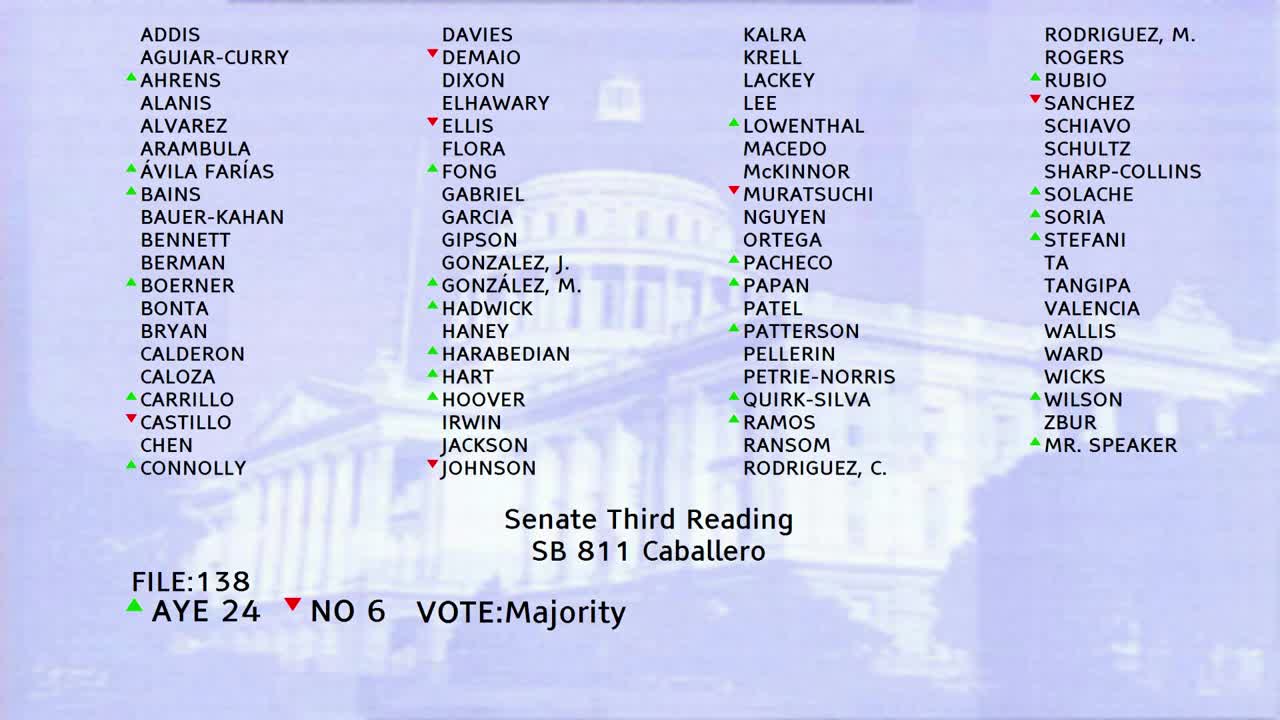 1MIN
Assembly Floor
 2MIN
Senate Floor
 2MIN
Senate Standing Committee on Appropriations
 25MIN
Senate Standing Committee on Education
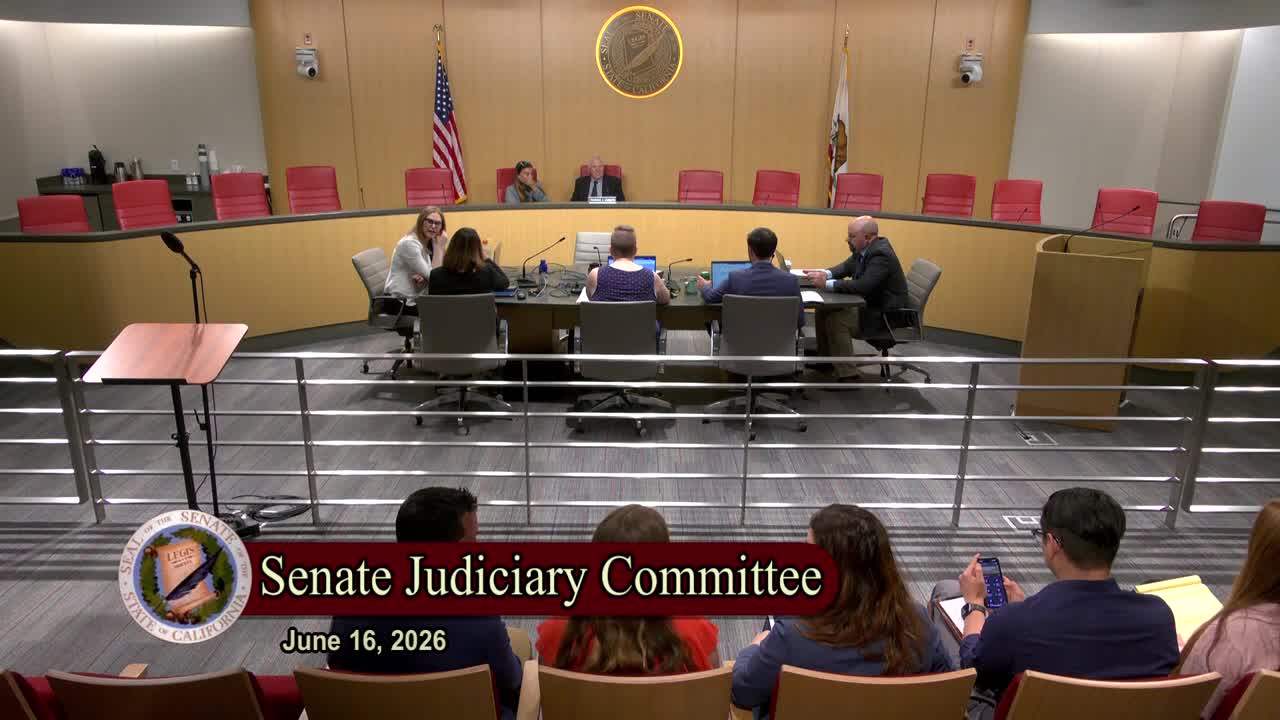 14MIN
Senate Standing Committee on Judiciary
 4MIN
Assembly Floor
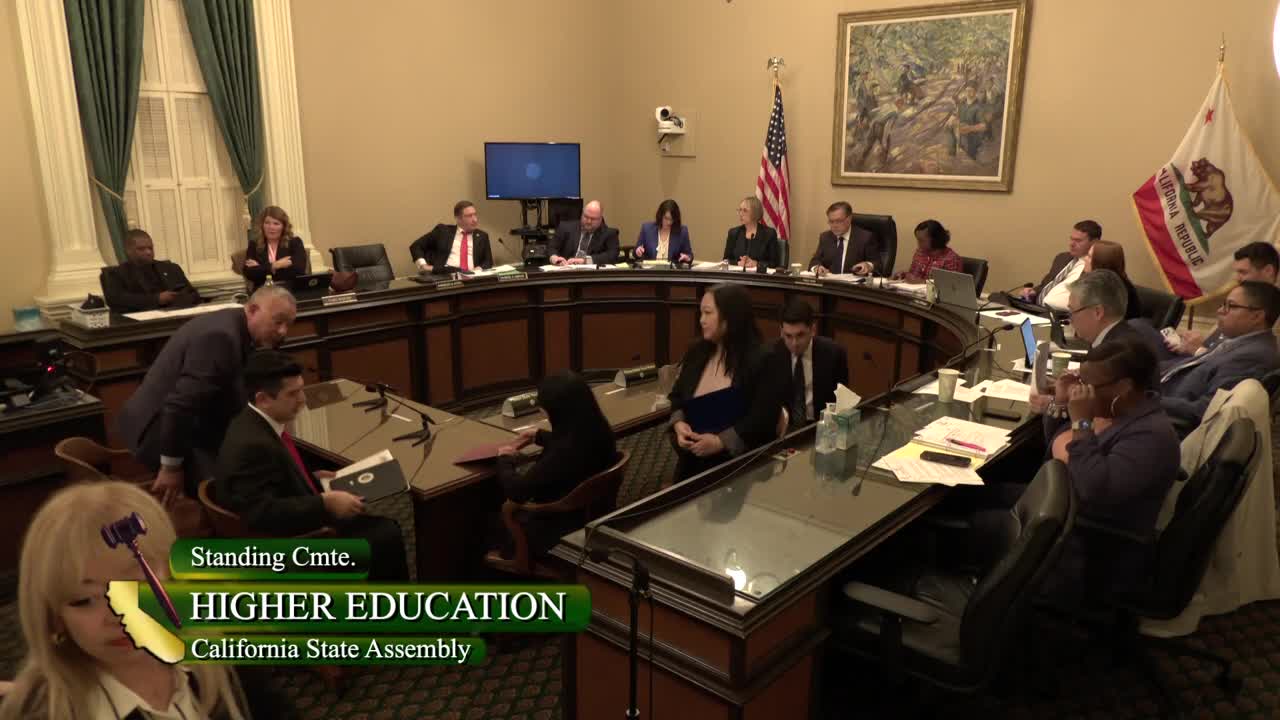 32MIN
Assembly Standing Committee on Higher Education
Bill Author