AB 726: Planning and zoning: annual report: rehabilitated units.
- Session Year: 2025-2026
- House: Assembly
- Latest Version Date: 2025-10-13
Current Status:
Passed
(2025-10-13: Chaptered by Secretary of State - Chapter 704, Statutes of 2025.)
Introduced
In Committee
Awaiting First Chamber Vote
Passed First Chamber
In Committee
Awaiting Second Chamber Vote
Passed Second Chamber
Enacted
Existing law, the Planning and Zoning Law, requires each county and each city to adopt a comprehensive, long-term general plan for the physical development of the county or city, and specified land outside its boundaries, that includes, among other specified mandatory elements, a housing element. That law requires the planning agency of a city or county to provide by April 1 of each year an annual report to, among other entities, the Office of Land Use and Climate Innovation, formerly known as the Office of Planning and Research, and the Department of Housing and Community Development. Existing law requires the annual report to include, among other things, the citys or countys progress in meeting its share of regional housing needs, as specified.
This bill would permit a local agency to include in its annual report the number of units of existing deed-restricted affordable housing within a specified affordability threshold that are at least 15 years old and have been substantially rehabilitated with at least $60,000 per unit in funds awarded from the city or county, as specified. The bill would prohibit any of the units included in the annual report from being considered when determining affordability requirements for the purposes of eligibility for streamlined approvals, as specified. The bill would also make a nonsubstantive change to update a reference to the Office of Land Use and Climate Innovation in these provisions.
This bill would incorporate additional changes to Section 65400 of the Government Code proposed by AB 670 to be operative only if this bill and AB 670 are enacted and this bill is enacted last.
Existing law, the Planning and Zoning Law, requires each county and each city to adopt a comprehensive, long-term general plan for the physical development of the county or city, and specified land outside its boundaries, that includes, among other specified mandatory elements, a housing element. That law requires the planning agency of a city or county to provide by April 1 of each year an annual report to, among other entities, the Office of Land Use and Climate Innovation, formerly known as the Office of Planning and Research, and the Department of Housing and Community Development. Existing law requires the annual report to include, among other things, the citys or countys progress in meeting its share of regional housing needs, as specified.
This bill would permit a local agency to include in its annual report the number of units of existing deed-restricted affordable housing within a specified affordability threshold that are at least 15 years old and have been substantially rehabilitated with at least sixty thousand dollars $60,000 per unit in funds awarded from the city or county, as specified. The bill would prohibit any of the units included in the annual report from being considered when determining affordability requirements for the purposes of eligibility for streamlined approvals, as specified. The bill would also make a nonsubstantive change to update a reference to the Office of Land Use and Climate Innovation in these provisions.
Existing law, the Planning and Zoning Law, requires each county and each city to adopt a comprehensive, long-term general plan for the physical development of the county or city, and specified land outside its boundaries, that includes, among other specified mandatory elements, a housing element. That law requires the planning agency of a city or county to provide by April 1 of each year an annual report to, among other entities, the Office of Land Use and Climate Innovation, formerly known as the Office of Planning and Research, and the Department of Housing and Community Development. Existing law requires the annual report to include, among other things, the citys or countys progress in meeting its share of regional housing needs, as specified.
This bill would permit a local agency to include in its annual report the number of units of existing deed-restricted affordable housing within a specified affordability threshold that are at least 15 years old and have been substantially rehabilitated with at least sixty thousand dollars per unit in funds awarded from the city or county, as specified. The bill would prohibit any of the units included in the annual report from being considered when determining affordability requirements for the purposes of eligibility for streamlined approvals, as specified. The bill would also make a nonsubstantive change to update a reference to the Office of Land Use and Climate Innovation in these provisions.
(a)After the legislative body has adopted all or part of a general plan, the planning agency shall do both of the following:
(1)Investigate and make recommendations to the legislative body regarding reasonable and practical means for implementing the general plan or element of the general plan so that it will serve as an effective guide for orderly growth and development, preservation and conservation of open-space land and natural resources, and the efficient expenditure of public funds relating to the subjects addressed in the general plan.
(2)Provide by April 1 of each year an annual report to the legislative body, the Office of Land Use and Climate Innovation, and the Department of Housing and Community Development that includes all of the following:
(A)The status of the plan and progress in its implementation.
(B)(i)(I)The progress in meeting its share of regional housing needs determined pursuant to Section 65584, including the need for extremely low income households, as determined pursuant to Section 65583, and local efforts to remove governmental constraints to the maintenance, improvement, and development of housing pursuant to paragraph (3) of subdivision (c) of Section 65583.
(II)The annual report shall include the progress in meeting the citys or countys progress in meeting its share of regional housing need, as described in subclause (I), for the sixth and previous revisions of the housing element.
(ii)The housing element portion of the annual report, as required by this paragraph, shall be prepared through the use of standards, forms, and definitions adopted by the Department of Housing and Community Development. The department may review, adopt, amend, and repeal the standards, forms, or definitions to implement this article. Any standards, forms, or definitions adopted to implement this article shall not be subject to Chapter 3.5 (commencing with Section 11340) of Part 1 of Division 3 of Title 2. Before and after adoption of the forms, the housing element portion of the annual report shall include a section that describes the actions taken by the local government towards completion of the programs and status of the local governments compliance with the deadlines in its housing element. The report shall be considered at an annual public meeting before the legislative body where members of the public shall be allowed to provide oral testimony and written comments.
(iii)The report may include the number of units that have been completed pursuant to subdivision (c) of Section 65583.1. For purposes of this paragraph, committed assistance may be executed throughout the planning period, and the program under paragraph (1) of subdivision (c) of Section 65583.1 shall not be required. The report shall document how the units meet the standards set forth in that subdivision.
(iv)The planning agency shall include the number of units in a student housing development for lower income students for which the developer of the student housing development was granted a density bonus pursuant to subparagraph (F) of paragraph (1) of subdivision (b) of Section 65915.
(v)The report may include the number of units of existing deed-restricted affordable housing with an average affordability no greater than 45 percent of area median income that are at least 15 years old and have been substantially rehabilitated with at least sixty thousand dollars ($60,000) per unit in funds awarded from the city or, for unincorporated areas, the county, inclusive of forgiveness of principal or interest on existing debt. Any units included in the report pursuant to this clause shall not be considered when determining affordability requirements for purposes of paragraph (4) of subdivision (a) of Section 65913.4.
(C)The number of housing development applications received in the prior year, including whether each housing development application is subject to a ministerial or discretionary approval process.
(D)The number of units included in all development applications in the prior year.
(E)(i)The number of units approved and disapproved in the prior year, which shall include all of the following subcategories:
(I)The number of units located within an opportunity area.
(II)For the seventh and each subsequent revision of the housing element, the number of units approved and disapproved for acutely low income households within each opportunity area.
(III)For the seventh and each subsequent revision of the housing element, the number of units approved and disapproved for extremely low income households within each opportunity area.
(IV)The number of units approved and disapproved for very low income households within each opportunity area.
(V)The number of units approved and disapproved for lower income households within each opportunity area.
(VI)The number of units approved and disapproved for moderate-income households within each opportunity area.
(VII)The number of units approved and disapproved for above moderate-income households within each opportunity area.
(ii)For purposes of this subparagraph, opportunity area means a highest, high, moderate, or low resource area pursuant to the most recent CTCAC/HCD Opportunity Map published by the California Tax Credit Allocation Committee and the Department of Housing and Community Development.
(F)The degree to which its approved general plan complies with the guidelines developed and adopted pursuant to Section 65040.2 and the date of the last revision to the general plan.
(G)A listing of sites rezoned to accommodate that portion of the citys or countys share of the regional housing need for each income level that could not be accommodated on sites identified in the inventory required by paragraph (1) of subdivision (c) of Section 65583 and Section 65584.09. The listing of sites shall also include any additional sites that may have been required to be identified by Section 65863.
(H)(i)The number of units of housing demolished and new units of housing, including both rental housing and for-sale housing and any units that the County of Napa or the City of Napa may report pursuant to an agreement entered into pursuant to Section 65584.08, that have been issued a completed entitlement, a building permit, or a certificate of occupancy, thus far in the housing element cycle, and the income category, by area median income category, that each unit of housing satisfies. That production report shall do the following:
(I)For each income category described in this subparagraph, distinguish between the number of rental housing units and the number of for-sale units that satisfy each income category.
(II)For each entitlement, building permit, or certificate of occupancy, include a unique site identifier that must include the assessors parcel number, but may also include street address, or other identifiers.
(ii)For the County of Napa and the City of Napa, the production report may report units identified in the agreement entered into pursuant to Section 65584.08.
(I)The number of applications submitted pursuant to subdivision (a) of Section 65913.4, the location and the total number of developments approved pursuant to subdivision (c) of Section 65913.4, the total number of building permits issued pursuant to subdivision (c) of Section 65913.4, the total number of units including both rental housing and for-sale housing by area median income category constructed using the process provided for in subdivision (c) of Section 65913.4.
(J)If the city or county has received funding pursuant to the Local Government Planning Support Grants Program (Chapter 3.1 (commencing with Section 50515) of Part 2 of Division 31 of the Health and Safety Code), the information required pursuant to subdivision (a) of Section 50515.04 of the Health and Safety Code.
(K)The progress of the city or county in adopting or amending its general plan or local open-space element in compliance with its obligations to consult with California Native American tribes, and to identify and protect, preserve, and mitigate impacts to places, features, and objects described in Sections 5097.9 and 5097.993 of the Public Resources Code, pursuant to Chapter 905 of the Statutes of 2004.
(L)The following information with respect to density bonuses granted in accordance with Section 65915:
(i)The number of density bonus applications received by the city or county.
(ii)The number of density bonus applications approved by the city or county.
(iii)Data from all projects approved to receive a density bonus from the city or county, including, but not limited to, the percentage of density bonus received, the percentage of affordable units in the project, the number of other incentives or concessions granted to the project, and any waiver or reduction of parking standards for the project.
(M)The following information with respect to each application submitted pursuant to Chapter 4.1 (commencing with Section 65912.100):
(i)The location of the project.
(ii)The status of the project, including whether it has been entitled, whether a building permit has been issued, and whether or not it has been completed.
(iii)The number of units in the project.
(iv)The number of units in the project that are rental housing.
(v)The number of units in the project that are for-sale housing.
(vi)The household income category of the units, as determined pursuant to subdivision (f) of Section 65584.
(N)A list of all historic designations listed on the National Register of Historic Places, the California Register of Historical Resources, or a local register of historic places by the city or county in the past year, and the status of any housing development projects proposed for the new historic designations, including all of the following:
(i)Whether the housing development project has been entitled.
(ii)Whether a building permit has been issued for the housing development project.
(iii)The number of units in the housing development project.
(O)The following information with respect to housing development projects under Section 65913.16:
(i)The number of applications submitted under Section 65913.16.
(ii)The location and number of developments approved under Section 65913.16.
(iii)The total number of building permits issued pursuant to Section 65913.16.
(iv)The total number of units constructed under Section 65913.16 and the income category of those units.
(b)(1)(A)The department may request corrections to the housing element portion of an annual report submitted pursuant to paragraph (2) of subdivision (a) within 90 days of receipt. A planning agency shall make the requested corrections within 30 days after which the department may reject the report if the report is not in substantial compliance with the requirements of that paragraph.
(B)If the department rejects the housing element portion of an annual report as authorized by subparagraph (A), the department shall provide the reasons the report is inconsistent with paragraph (2) of subdivision (a) to the planning agency in writing.
(2)If a court finds, upon a motion to that effect, that a city, county, or city and county failed to submit, within 60 days of the deadline established in this section, the housing element portion of the report required pursuant to subparagraph (B) of paragraph (2) of subdivision (a) that substantially complies with the requirements of this section, the court shall issue an order or judgment compelling compliance with this section within 60 days. If the city, county, or city and county fails to comply with the courts order within 60 days, the plaintiff or petitioner may move for sanctions, and the court may, upon that motion, grant appropriate sanctions. The court shall retain jurisdiction to ensure that its order or judgment is carried out. If the court determines that its order or judgment is not carried out within 60 days, the court may issue further orders as provided by law to ensure that the purposes and policies of this section are fulfilled. This subdivision applies to proceedings initiated on or after the first day of October following the adoption of forms and definitions by the Department of Housing and Community Development pursuant to paragraph (2) of subdivision (a), but no sooner than six months following that adoption.
(c)The Department of Housing and Community Development shall post a report submitted pursuant to this section on its internet website within a reasonable time of receiving the report.
SEC. 1.5.Section 65400 of the Government Code is amended to read:65400.(a)After the legislative body has adopted all or part of a general plan, the planning agency shall do both of the following:
(1)Investigate and make recommendations to the legislative body regarding reasonable and practical means for implementing the general plan or element of the general plan so that it will serve as an effective guide for orderly growth and development, preservation and conservation of open-space land and natural resources, and the efficient expenditure of public funds relating to the subjects addressed in the general plan.
(2)Provide by April 1 of each year an annual report to the legislative body, the Office of Land Use and Climate Innovation, and the Department of Housing and Community Development that includes all of the following:
(A)The status of the plan and progress in its implementation.
(B)(i)(I)The progress in meeting its share of regional housing needs determined pursuant to Section 65584, including the need for extremely low income households, as determined pursuant to Section 65583, and local efforts to remove governmental constraints to the maintenance, improvement, and development of housing pursuant to paragraph (3) of subdivision (c) of Section 65583.
(II)The annual report shall include the progress in meeting the citys or countys progress in meeting its share of regional housing need, as described in subclause (I), for the sixth and previous revisions of the housing element.
(ii)The housing element portion of the annual report, as required by this paragraph, shall be prepared through the use of standards, forms, and definitions adopted by the Department of Housing and Community Development. The department may review, adopt, amend, and repeal the standards, forms, or definitions to implement this article. Any standards, forms, or definitions adopted to implement this article shall not be subject to Chapter 3.5 (commencing with Section 11340) of Part 1 of Division 3 of Title 2. Before and after adoption of the forms, the housing element portion of the annual report shall include a section that describes the actions taken by the local government towards completion of the programs and status of the local governments compliance with the deadlines in its housing element. The report shall be considered at an annual public meeting before the legislative body where members of the public shall be allowed to provide oral testimony and written comments.
(iii)The report may include the number of units that have been completed pursuant to subdivision (c) of Section 65583.1. For purposes of this paragraph, committed assistance may be executed throughout the planning period, and the program under paragraph (1) of subdivision (c) of Section 65583.1 shall not be required. The report shall document how the units meet the standards set forth in that subdivision.
(iv)The planning agency shall include the number of units in a student housing development for lower income students for which the developer of the student housing development was granted a density bonus pursuant to subparagraph (F) of paragraph (1) of subdivision (b) of Section 65915.
(v)The report may include the number of units of existing deed-restricted affordable housing with an average affordability no greater than 45 percent of area median income that are at least 15 years old and have been substantially rehabilitated with at least sixty thousand dollars ($60,000) per unit in funds awarded from the city or, for unincorporated areas, the county, inclusive of forgiveness of principal or interest on existing debt. Any units included in the report pursuant to this clause shall not be considered when determining affordability requirements for purposes of paragraph (4) of subdivision (a) of Section 65913.4.
(C)The number of housing development applications received in the prior year, including both of the following, when applicable:
(i)Whether each housing development application is subject to a ministerial or discretionary approval process.
(ii)Beginning with the report due by April 1, 2027, whether each application is subject to a replacement housing or relocation assistance obligation pursuant to local, state, or federal law, including, but not limited to, Section 65583.2, 65915, or 66300.6.
(D)The number of units included in all development applications in the prior year.
(E)(i)The number of units approved and disapproved in the prior year, which shall include all of the following subcategories:
(I)The number of units located within an opportunity area.
(II)For the seventh and each subsequent revision of the housing element, the number of units approved and disapproved for acutely low income households within each opportunity area.
(III)For the seventh and each subsequent revision of the housing element, the number of units approved and disapproved for extremely low income households within each opportunity area.
(IV)The number of units approved and disapproved for very low income households within each opportunity area.
(V)The number of units approved and disapproved for lower income households within each opportunity area.
(VI)The number of units approved and disapproved for moderate-income households within each opportunity area.
(VII)The number of units approved and disapproved for above moderate-income households within each opportunity area.
(ii)For purposes of this subparagraph, opportunity area means a highest, high, moderate, or low resource area pursuant to the most recent CTCAC/HCD Opportunity Map published by the California Tax Credit Allocation Committee and the Department of Housing and Community Development.
(F)The degree to which its approved general plan complies with the guidelines developed and adopted pursuant to Section 65040.2 and the date of the last revision to the general plan.
(G)A listing of sites rezoned to accommodate that portion of the citys or countys share of the regional housing need for each income level that could not be accommodated on sites identified in the inventory required by paragraph (1) of subdivision (c) of Section 65583 and Section 65584.09. The listing of sites shall also include any additional sites that may have been required to be identified by Section 65863.
(H)(i)The number of units of housing demolished and new units of housing, including both rental housing and for-sale housing and any units that the County of Napa or the City of Napa may report pursuant to an agreement entered into pursuant to Section 65584.08, that have been issued a completed entitlement, a building permit, or a certificate of occupancy, thus far in the housing element cycle, and the income category, by area median income category, that each unit of housing satisfies. That production report shall do the following:
(I)For each income category described in this subparagraph, distinguish between the number of rental housing units and the number of for-sale units that satisfy each income category.
(II)For each entitlement, building permit, or certificate of occupancy, include a unique site identifier that must include the assessors parcel number, but may also include street address, or other identifiers.
(III)Beginning with the report due by April 1, 2027, for each entitlement, building permit, or certificate of occupancy, include the total number of replacement housing units by income level required pursuant to local, state, or federal law, including, but not limited to, Section 65583.2, 65915, or 66300.6.
(IV)Beginning with the report due by April 1, 2027, for each entitlement, building permit, or certificate of occupancy, include the number, by income level, of replacement housing units entitled, permitted, or issued a certificate of occupancy.
(ii)For the County of Napa and the City of Napa, the production report may report units identified in the agreement entered into pursuant to Section 65584.08.
(I)The number of applications submitted pursuant to subdivision (a) of Section 65913.4, the location and the total number of developments approved pursuant to subdivision (c) of Section 65913.4, the total number of building permits issued pursuant to subdivision (c) of Section 65913.4, the total number of units including both rental housing and for-sale housing by area median income category constructed using the process provided for in subdivision (c) of Section 65913.4.
(J)If the city or county has received funding pursuant to the Local Government Planning Support Grants Program (Chapter 3.1 (commencing with Section 50515) of Part 2 of Division 31 of the Health and Safety Code), the information required pursuant to subdivision (a) of Section 50515.04 of the Health and Safety Code.
(K)The progress of the city or county in adopting or amending its general plan or local open-space element in compliance with its obligations to consult with California Native American tribes, and to identify and protect, preserve, and mitigate impacts to places, features, and objects described in Sections 5097.9 and 5097.993 of the Public Resources Code, pursuant to Chapter 905 of the Statutes of 2004.
(L)The following information with respect to density bonuses granted in accordance with Section 65915:
(i)The number of density bonus applications received by the city or county.
(ii)The number of density bonus applications approved by the city or county.
(iii)Data from all projects approved to receive a density bonus from the city or county, including, but not limited to, the percentage of density bonus received, the percentage of affordable units in the project, the number of other incentives or concessions granted to the project, and any waiver or reduction of parking standards for the project.
(M)The following information with respect to each application submitted pursuant to Chapter 4.1 (commencing with Section 65912.100):
(i)The location of the project.
(ii)The status of the project, including whether it has been entitled, whether a building permit has been issued, and whether or not it has been completed.
(iii)The number of units in the project.
(iv)The number of units in the project that are rental housing.
(v)The number of units in the project that are for-sale housing.
(vi)The household income category of the units, as determined pursuant to subdivision (f) of Section 65584.
(N)A list of all historic designations listed on the National Register of Historic Places, the California Register of Historical Resources, or a local register of historic places by the city or county in the past year, and the status of any housing development projects proposed for the new historic designations, including all of the following:
(i)Whether the housing development project has been entitled.
(ii)Whether a building permit has been issued for the housing development project.
(iii)The number of units in the housing development project.
(O)The following information with respect to housing development projects under Section 65913.16:
(i)The number of applications submitted under Section 65913.16.
(ii)The location and number of developments approved under Section 65913.16.
(iii)The total number of building permits issued pursuant to Section 65913.16.
(iv)The total number of units constructed under Section 65913.16 and the income category of those units.
(P)Beginning with the report due by April 1, 2027, a report on the demolition of housing units for any purpose, which shall include, but not be limited to, all of the following:
(i)The total number of housing units approved for demolition during the year.
(ii)The total number of housing units demolished during the year.
(iii)For each approved or completed demolition, all of the following:
(I)The location of the approved or completed demolition, using a unique site identifier that shall include the assessors parcel number, and may also include the street address or other identifiers.
(II)The date the demolition was approved.
(III)The total number of rental and ownership units demolished or approved for demolition.
(IV)The number, by income level, of protected units, as defined in subdivision (h) of Section 66300.5, demolished or approved for demolition.
(V)A description of any approved uses on the site.
(VI)A description of any relocation assistance provided as required pursuant to local, state, or federal law, including, but not limited to, the relocation assistance required to be provided to each displaced occupant of any demolished protected unit pursuant to Section 66300.6.
(Q)Beginning with the report due by April 1, 2027, a report on replacement housing units required pursuant to local, state, or federal law, including, but not limited to, Section 66300.6, for approved development projects that are not housing development projects, which shall include, for each applicable development project, all of the following:
(i)The approved or proposed location of the replacement units, using a unique site identifier that shall include the assessors parcel number, and may also include the street address or other identifiers.
(ii)The entity that is developing the replacement units.
(iii)The anticipated completion date of the replacement units.
(b)(1)(A)The department may request corrections to the housing element portion of an annual report submitted pursuant to paragraph (2) of subdivision (a) within 90 days of receipt. A planning agency shall make the requested corrections within 30 days after which the department may reject the report if the report is not in substantial compliance with the requirements of that paragraph.
(B)If the department rejects the housing element portion of an annual report as authorized by subparagraph (A), the department shall provide the reasons the report is inconsistent with paragraph (2) of subdivision (a) to the planning agency in writing.
(2)If a court finds, upon a motion to that effect, that a city, county, or city and county failed to submit, within 60 days of the deadline established in this section, the housing element portion of the report required pursuant to subparagraph (B) of paragraph (2) of subdivision (a) that substantially complies with the requirements of this section, the court shall issue an order or judgment compelling compliance with this section within 60 days. If the city, county, or city and county fails to comply with the courts order within 60 days, the plaintiff or petitioner may move for sanctions, and the court may, upon that motion, grant appropriate sanctions. The court shall retain jurisdiction to ensure that its order or judgment is carried out. If the court determines that its order or judgment is not carried out within 60 days, the court may issue further orders as provided by law to ensure that the purposes and policies of this section are fulfilled. This subdivision applies to proceedings initiated on or after the first day of October following the adoption of forms and definitions by the Department of Housing and Community Development pursuant to paragraph (2) of subdivision (a), but no sooner than six months following that adoption.
(c)The Department of Housing and Community Development shall post a report submitted pursuant to this section on its internet website within a reasonable time of receiving the report.
SEC. 2.Section 1.5 of this bill incorporates amendments to Section 65400 of the Government Code proposed by both this bill and Assembly Bill 670. That section of this bill shall only become operative if (1) both bills are enacted and become effective on or before January 1, 2026, (2) each bill amends Section 65400 of the Government Code, and (3) this bill is enacted after Assembly Bill 670, in which case Section 1 of this bill shall not become operative.
(a)After the legislative body has adopted all or part of a general plan, the planning agency shall do both of the following:
(1)Investigate and make recommendations to the legislative body regarding reasonable and practical means for implementing the general plan or element of the general plan so that it will serve as an effective guide for orderly growth and development, preservation and conservation of open-space land and natural resources, and the efficient expenditure of public funds relating to the subjects addressed in the general plan.
(2)Provide by April 1 of each year an annual report to the legislative body, the Office of Land Use and Climate Innovation, and the Department of Housing and Community Development that includes all of the following:
(A)The status of the plan and progress in its implementation.
(B)(i)(I)The progress in meeting its share of regional housing needs determined pursuant to Section 65584, including the need for extremely low income households, as determined pursuant to Section 65583, and local efforts to remove governmental constraints to the maintenance, improvement, and development of housing pursuant to paragraph (3) of subdivision (c) of Section 65583.
(II)The annual report shall include the progress in meeting the citys or countys progress in meeting its share of regional housing need, as described in subclause (I), for the sixth and previous revisions of the housing element.
(ii)The housing element portion of the annual report, as required by this paragraph, shall be prepared through the use of standards, forms, and definitions adopted by the Department of Housing and Community Development. The department may review, adopt, amend, and repeal the standards, forms, or definitions to implement this article. Any standards, forms, or definitions adopted to implement this article shall not be subject to Chapter 3.5 (commencing with Section 11340) of Part 1 of Division 3 of Title 2. Before and after adoption of the forms, the housing element portion of the annual report shall include a section that describes the actions taken by the local government towards completion of the programs and status of the local governments compliance with the deadlines in its housing element. The report shall be considered at an annual public meeting before the legislative body where members of the public shall be allowed to provide oral testimony and written comments.
(iii)The report may include the number of units that have been completed pursuant to subdivision (c) of Section 65583.1. For purposes of this paragraph, committed assistance may be executed throughout the planning period, and the program under paragraph (1) of subdivision (c) of Section 65583.1 shall not be required. The report shall document how the units meet the standards set forth in that subdivision.
(iv)The planning agency shall include the number of units in a student housing development for lower income students for which the developer of the student housing development was granted a density bonus pursuant to subparagraph (F) of paragraph (1) of subdivision (b) of Section 65915.
(v)The report may include the number of units of existing deed-restricted affordable housing with an average affordability no greater than 45 percent of area median income that are at least 15 years old and have been substantially rehabilitated with at least sixty thousand dollars ($60,000) per unit in funds awarded from the city or, for unincorporated areas, the county, inclusive of forgiveness of principal or interest on existing debt. Any units included in the report pursuant to this clause shall not be considered when determining affordability requirements for purposes of paragraph (4) of subdivision (a) of Section 65913.4.
(C)The number of housing development applications received in the prior year, including whether each housing development application is subject to a ministerial or discretionary approval process.
(D)The number of units included in all development applications in the prior year.
(E)(i)The number of units approved and disapproved in the prior year, which shall include all of the following subcategories:
(I)The number of units located within an opportunity area.
(II)For the seventh and each subsequent revision of the housing element, the number of units approved and disapproved for acutely low income households within each opportunity area.
(III)For the seventh and each subsequent revision of the housing element, the number of units approved and disapproved for extremely low income households within each opportunity area.
(IV)The number of units approved and disapproved for very low income households within each opportunity area.
(V)The number of units approved and disapproved for lower income households within each opportunity area.
(VI)The number of units approved and disapproved for moderate-income households within each opportunity area.
(VII)The number of units approved and disapproved for above moderate-income households within each opportunity area.
(ii)For purposes of this subparagraph, opportunity area means a highest, high, moderate, or low resource area pursuant to the most recent CTCAC/HCD Opportunity Map published by the California Tax Credit Allocation Committee and the Department of Housing and Community Development.
(F)The degree to which its approved general plan complies with the guidelines developed and adopted pursuant to Section 65040.2 and the date of the last revision to the general plan.
(G)A listing of sites rezoned to accommodate that portion of the citys or countys share of the regional housing need for each income level that could not be accommodated on sites identified in the inventory required by paragraph (1) of subdivision (c) of Section 65583 and Section 65584.09. The listing of sites shall also include any additional sites that may have been required to be identified by Section 65863.
(H)(i)The number of units of housing demolished and new units of housing, including both rental housing and for-sale housing and any units that the County of Napa or the City of Napa may report pursuant to an agreement entered into pursuant to Section 65584.08, that have been issued a completed entitlement, a building permit, or a certificate of occupancy, thus far in the housing element cycle, and the income category, by area median income category, that each unit of housing satisfies. That production report shall do the following:
(I)For each income category described in this subparagraph, distinguish between the number of rental housing units and the number of for-sale units that satisfy each income category.
(II)For each entitlement, building permit, or certificate of occupancy, include a unique site identifier that must include the assessors parcel number, but may also include street address, or other identifiers.
(ii)For the County of Napa and the City of Napa, the production report may report units identified in the agreement entered into pursuant to Section 65584.08.
(I)The number of applications submitted pursuant to subdivision (a) of Section 65913.4, the location and the total number of developments approved pursuant to subdivision (c) of Section 65913.4, the total number of building permits issued pursuant to subdivision (c) of Section 65913.4, the total number of units including both rental housing and for-sale housing by area median income category constructed using the process provided for in subdivision (c) of Section 65913.4.
(J)If the city or county has received funding pursuant to the Local Government Planning Support Grants Program (Chapter 3.1 (commencing with Section 50515) of Part 2 of Division 31 of the Health and Safety Code), the information required pursuant to subdivision (a) of Section 50515.04 of the Health and Safety Code.
(K)The progress of the city or county in adopting or amending its general plan or local open-space element in compliance with its obligations to consult with California Native American tribes, and to identify and protect, preserve, and mitigate impacts to places, features, and objects described in Sections 5097.9 and 5097.993 of the Public Resources Code, pursuant to Chapter 905 of the Statutes of 2004.
(L)The following information with respect to density bonuses granted in accordance with Section 65915:
(i)The number of density bonus applications received by the city or county.
(ii)The number of density bonus applications approved by the city or county.
(iii)Data from all projects approved to receive a density bonus from the city or county, including, but not limited to, the percentage of density bonus received, the percentage of affordable units in the project, the number of other incentives or concessions granted to the project, and any waiver or reduction of parking standards for the project.
(M)The following information with respect to each application submitted pursuant to Chapter 4.1 (commencing with Section 65912.100):
(i)The location of the project.
(ii)The status of the project, including whether it has been entitled, whether a building permit has been issued, and whether or not it has been completed.
(iii)The number of units in the project.
(iv)The number of units in the project that are rental housing.
(v)The number of units in the project that are for-sale housing.
(vi)The household income category of the units, as determined pursuant to subdivision (f) of Section 65584.
(N)A list of all historic designations listed on the National Register of Historic Places, the California Register of Historical Resources, or a local register of historic places by the city or county in the past year, and the status of any housing development projects proposed for the new historic designations, including all of the following:
(i)Whether the housing development project has been entitled.
(ii)Whether a building permit has been issued for the housing development project.
(iii)The number of units in the housing development project.
(O)The following information with respect to housing development projects under Section 65913.16:
(i)The number of applications submitted under Section 65913.16.
(ii)The location and number of developments approved under Section 65913.16.
(iii)The total number of building permits issued pursuant to Section 65913.16.
(iv)The total number of units constructed under Section 65913.16 and the income category of those units.
(b)(1)(A)The department may request corrections to the housing element portion of an annual report submitted pursuant to paragraph (2) of subdivision (a) within 90 days of receipt. A planning agency shall make the requested corrections within 30 days after which the department may reject the report if the report is not in substantial compliance with the requirements of that paragraph.
(B)If the department rejects the housing element portion of an annual report as authorized by subparagraph (A), the department shall provide the reasons the report is inconsistent with paragraph (2) of subdivision (a) to the planning agency in writing.
(2)If a court finds, upon a motion to that effect, that a city, county, or city and county failed to submit, within 60 days of the deadline established in this section, the housing element portion of the report required pursuant to subparagraph (B) of paragraph (2) of subdivision (a) that substantially complies with the requirements of this section, the court shall issue an order or judgment compelling compliance with this section within 60 days. If the city, county, or city and county fails to comply with the courts order within 60 days, the plaintiff or petitioner may move for sanctions, and the court may, upon that motion, grant appropriate sanctions. The court shall retain jurisdiction to ensure that its order or judgment is carried out. If the court determines that its order or judgment is not carried out within 60 days, the court may issue further orders as provided by law to ensure that the purposes and policies of this section are fulfilled. This subdivision applies to proceedings initiated on or after the first day of October following the adoption of forms and definitions by the Department of Housing and Community Development pursuant to paragraph (2) of subdivision (a), but no sooner than six months following that adoption.
(c)The Department of Housing and Community Development shall post a report submitted pursuant to this section on its internet website within a reasonable time of receiving the report.
SEC. 1.5.Section 65400 of the Government Code is amended to read:65400.(a)After the legislative body has adopted all or part of a general plan, the planning agency shall do both of the following:
(1)Investigate and make recommendations to the legislative body regarding reasonable and practical means for implementing the general plan or element of the general plan so that it will serve as an effective guide for orderly growth and development, preservation and conservation of open-space land and natural resources, and the efficient expenditure of public funds relating to the subjects addressed in the general plan.
(2)Provide by April 1 of each year an annual report to the legislative body, the Office of Planning and Research, Land Use and Climate Innovation, and the Department of Housing and Community Development that includes all of the following:
(A)The status of the plan and progress in its implementation.
(B)(i)(I)The progress in meeting its share of regional housing needs determined pursuant to Section 65584, including the need for extremely low income households, as determined pursuant to Section 65583, and local efforts to remove governmental constraints to the maintenance, improvement, and development of housing pursuant to paragraph (3) of subdivision (c) of Section 65583.
(II)The annual report shall include the progress in meeting the citys or countys progress in meeting its share of regional housing need, as described in subclause (I), for the sixth and previous revisions of the housing element.
(ii)The housing element portion of the annual report, as required by this paragraph, shall be prepared through the use of standards, forms, and definitions adopted by the Department of Housing and Community Development. The department may review, adopt, amend, and repeal the standards, forms, or definitions to implement this article. Any standards, forms, or definitions adopted to implement this article shall not be subject to Chapter 3.5 (commencing with Section 11340) of Part 1 of Division 3 of Title 2. Before and after adoption of the forms, the housing element portion of the annual report shall include a section that describes the actions taken by the local government towards completion of the programs and status of the local governments compliance with the deadlines in its housing element. The report shall be considered at an annual public meeting before the legislative body where members of the public shall be allowed to provide oral testimony and written comments.
(iii)The report may include the number of units that have been completed pursuant to subdivision (c) of Section 65583.1. For purposes of this paragraph, committed assistance may be executed throughout the planning period, and the program under paragraph (1) of subdivision (c) of Section 65583.1 shall not be required. The report shall document how the units meet the standards set forth in that subdivision.
(iv)The planning agency shall include the number of units in a student housing development for lower income students for which the developer of the student housing development was granted a density bonus pursuant to subparagraph (F) of paragraph (1) of subdivision (b) of Section 65915.
(v)The report may include the number of units of existing deed-restricted affordable housing with an average affordability no greater than 45 percent of area median income that are at least 15 years old and have been substantially rehabilitated with at least sixty thousand dollars ($60,000) per unit in funds awarded from the city or, for unincorporated areas, the county, inclusive of forgiveness of principal or interest on existing debt. Any units included in the report pursuant to this clause shall not be considered when determining affordability requirements for purposes of paragraph (4) of subdivision (a) of Section 65913.4.
(C)The number of housing development applications received in the prior year, including whether each housing development application is subject to a ministerial or discretionary approval process. both of the following, when applicable:
(i)Whether each housing development application is subject to a ministerial or discretionary approval process.
(ii)Beginning with the report due by April 1, 2027, whether each application is subject to a replacement housing or relocation assistance obligation pursuant to local, state, or federal law, including, but not limited to, Section 65583.2, 65915, or 66300.6.
(D)The number of units included in all development applications in the prior year.
(E)(i)The number of units approved and disapproved in the prior year, which shall include all of the following subcategories:
(I)The number of units located within an opportunity area.
(II)For the seventh and each subsequent revision of the housing element, the number of units approved and disapproved for acutely low income households within each opportunity area.
(III)For the seventh and each subsequent revision of the housing element, the number of units approved and disapproved for extremely low income households within each opportunity area.
(IV)The number of units approved and disapproved for very low income households within each opportunity area.
(V)The number of units approved and disapproved for lower income households within each opportunity area.
(VI)The number of units approved and disapproved for moderate-income households within each opportunity area.
(VII)The number of units approved and disapproved for above moderate-income households within each opportunity area.
(ii)For purposes of this subparagraph, opportunity area means a highest, high, moderate, or low resource area pursuant to the most recent CTCAC/HCD Opportunity Map published by the California Tax Credit Allocation Committee and the Department of Housing and Community Development.
(F)The degree to which its approved general plan complies with the guidelines developed and adopted pursuant to Section 65040.2 and the date of the last revision to the general plan.
(G)A listing of sites rezoned to accommodate that portion of the citys or countys share of the regional housing need for each income level that could not be accommodated on sites identified in the inventory required by paragraph (1) of subdivision (c) of Section 65583 and Section 65584.09. The listing of sites shall also include any additional sites that may have been required to be identified by Section 65863.
(H)(i)The number of units of housing demolished and new units of housing, including both rental housing and for-sale housing and any units that the County of Napa or the City of Napa may report pursuant to an agreement entered into pursuant to Section 65584.08, that have been issued a completed entitlement, a building permit, or a certificate of occupancy, thus far in the housing element cycle, and the income category, by area median income category, that each unit of housing satisfies. That production report shall do the following:
(I)For each income category described in this subparagraph, distinguish between the number of rental housing units and the number of for-sale units that satisfy each income category.
(II)For each entitlement, building permit, or certificate of occupancy, include a unique site identifier that must include the assessors parcel number, but may also include street address, or other identifiers.
(III)Beginning with the report due by April 1, 2027, for each entitlement, building permit, or certificate of occupancy, include the total number of replacement housing units by income level required pursuant to local, state, or federal law, including, but not limited to, Section 65583.2, 65915, or 66300.6.
(IV)Beginning with the report due by April 1, 2027, for each entitlement, building permit, or certificate of occupancy, include the number, by income level, of replacement housing units entitled, permitted, or issued a certificate of occupancy.
(ii)For the County of Napa and the City of Napa, the production report may report units identified in the agreement entered into pursuant to Section 65584.08.
(I)The number of applications submitted pursuant to subdivision (a) of Section 65913.4, the location and the total number of developments approved pursuant to subdivision (c) of Section 65913.4, the total number of building permits issued pursuant to subdivision (c) of Section 65913.4, the total number of units including both rental housing and for-sale housing by area median income category constructed using the process provided for in subdivision (c) of Section 65913.4.
(J)If the city or county has received funding pursuant to the Local Government Planning Support Grants Program (Chapter 3.1 (commencing with Section 50515) of Part 2 of Division 31 of the Health and Safety Code), the information required pursuant to subdivision (a) of Section 50515.04 of the Health and Safety Code.
(K)The progress of the city or county in adopting or amending its general plan or local open-space element in compliance with its obligations to consult with California Native American tribes, and to identify and protect, preserve, and mitigate impacts to places, features, and objects described in Sections 5097.9 and 5097.993 of the Public Resources Code, pursuant to Chapter 905 of the Statutes of 2004.
(L)The following information with respect to density bonuses granted in accordance with Section 65915:
(i)The number of density bonus applications received by the city or county.
(ii)The number of density bonus applications approved by the city or county.
(iii)Data from all projects approved to receive a density bonus from the city or county, including, but not limited to, the percentage of density bonus received, the percentage of affordable units in the project, the number of other incentives or concessions granted to the project, and any waiver or reduction of parking standards for the project.
(M)The following information with respect to each application submitted pursuant to Chapter 4.1 (commencing with Section 65912.100):
(i)The location of the project.
(ii)The status of the project, including whether it has been entitled, whether a building permit has been issued, and whether or not it has been completed.
(iii)The number of units in the project.
(iv)The number of units in the project that are rental housing.
(v)The number of units in the project that are for-sale housing.
(vi)The household income category of the units, as determined pursuant to subdivision (f) of Section 65584.
(N)A list of all historic designations listed on the National Register of Historic Places, the California Register of Historic Historical Resources, or a local register of historic places by the city or county in the past year, and the status of any housing development projects proposed for the new historic designations, including all of the following:
(i)Whether the housing development project has been entitled.
(ii)Whether a building permit has been issued for the housing development project.
(iii)The number of units in the housing development project.
(O)The following information with respect to housing development projects under Section 65913.16:
(i)The number of applications submitted under Section 65913.16.
(ii)The location and number of developments approved under Section 65913.16.
(iii)The total number of building permits issued pursuant to Section 65913.16.
(iv)The total number of units constructed under Section 65913.16 and the income category of those units.
(P)Beginning with the report due by April 1, 2027, a report on the demolition of housing units for any purpose, which shall include, but not be limited to, all of the following:
(i)The total number of housing units approved for demolition during the year.
(ii)The total number of housing units demolished during the year.
(iii)For each approved or completed demolition, all of the following:
(I)The location of the approved or completed demolition, using a unique site identifier that shall include the assessors parcel number, and may also include the street address or other identifiers.
(II)The date the demolition was approved.
(III)The total number of rental and ownership units demolished or approved for demolition.
(IV)The number, by income level, of protected units, as defined in subdivision (h) of Section 66300.5, demolished or approved for demolition.
(V)A description of any approved uses on the site.
(VI)A description of any relocation assistance provided as required pursuant to local, state, or federal law, including, but not limited to, the relocation assistance required to be provided to each displaced occupant of any demolished protected unit pursuant to Section 66300.6.
(Q)Beginning with the report due by April 1, 2027, a report on replacement housing units required pursuant to local, state, or federal law, including, but not limited to, Section 66300.6, for approved development projects that are not housing development projects, which shall include, for each applicable development project, all of the following:
(i)The approved or proposed location of the replacement units, using a unique site identifier that shall include the assessors parcel number, and may also include the street address or other identifiers.
(ii)The entity that is developing the replacement units.
(iii)The anticipated completion date of the replacement units.
(b)(1)(A)The department may request corrections to the housing element portion of an annual report submitted pursuant to paragraph (2) of subdivision (a) within 90 days of receipt. A planning agency shall make the requested corrections within 30 days after which the department may reject the report if the report is not in substantial compliance with the requirements of that paragraph.
(B)If the department rejects the housing element portion of an annual report as authorized by subparagraph (A), the department shall provide the reasons the report is inconsistent with paragraph (2) of subdivision (a) to the planning agency in writing.
(2)If a court finds, upon a motion to that effect, that a city, county, or city and county failed to submit, within 60 days of the deadline established in this section, the housing element portion of the report required pursuant to subparagraph (B) of paragraph (2) of subdivision (a) that substantially complies with the requirements of this section, the court shall issue an order or judgment compelling compliance with this section within 60 days. If the city, county, or city and county fails to comply with the courts order within 60 days, the plaintiff or petitioner may move for sanctions, and the court may, upon that motion, grant appropriate sanctions. The court shall retain jurisdiction to ensure that its order or judgment is carried out. If the court determines that its order or judgment is not carried out within 60 days, the court may issue further orders as provided by law to ensure that the purposes and policies of this section are fulfilled. This subdivision applies to proceedings initiated on or after the first day of October following the adoption of forms and definitions by the Department of Housing and Community Development pursuant to paragraph (2) of subdivision (a), but no sooner than six months following that adoption.
(c)The Department of Housing and Community Development shall post a report submitted pursuant to this section on its internet website within a reasonable time of receiving the report.
SEC. 2.Section 1.5 of this bill incorporates amendments to Section 65400 of the Government Code proposed by both this bill and Assembly Bill 670. That section of this bill shall only become operative if (1) both bills are enacted and become effective on or before January 1, 2026, (2) each bill amends Section 65400 of the Government Code, and (3) this bill is enacted after Assembly Bill 670, in which case Section 1 of this bill shall not become operative.
(a)After the legislative body has adopted all or part of a general plan, the planning agency shall do both of the following:
(1)Investigate and make recommendations to the legislative body regarding reasonable and practical means for implementing the general plan or element of the general plan so that it will serve as an effective guide for orderly growth and development, preservation and conservation of open-space land and natural resources, and the efficient expenditure of public funds relating to the subjects addressed in the general plan.
(2)Provide by April 1 of each year an annual report to the legislative body, the Office of Planning and Research, Land Use and Climate Innovation, and the Department of Housing and Community Development that includes all of the following:
(A)The status of the plan and progress in its implementation.
(B)(i)(I)The progress in meeting its share of regional housing needs determined pursuant to Section 65584, including the need for extremely low income households, as determined pursuant to Section 65583, and local efforts to remove governmental constraints to the maintenance, improvement, and development of housing pursuant to paragraph (3) of subdivision (c) of Section 65583.
(II)The annual report shall include the progress in meeting the citys or countys progress in meeting its share of regional housing need, as described in subclause (I), for the sixth and previous revisions of the housing element.
(ii)The housing element portion of the annual report, as required by this paragraph, shall be prepared through the use of standards, forms, and definitions adopted by the Department of Housing and Community Development. The department may review, adopt, amend, and repeal the standards, forms, or definitions to implement this article. Any standards, forms, or definitions adopted to implement this article shall not be subject to Chapter 3.5 (commencing with Section 11340) of Part 1 of Division 3 of Title 2. Before and after adoption of the forms, the housing element portion of the annual report shall include a section that describes the actions taken by the local government towards completion of the programs and status of the local governments compliance with the deadlines in its housing element. The report shall be considered at an annual public meeting before the legislative body where members of the public shall be allowed to provide oral testimony and written comments.
(iii)The report may include the number of units that have been completed pursuant to subdivision (c) of Section 65583.1. For purposes of this paragraph, committed assistance may be executed throughout the planning period, and the program under paragraph (1) of subdivision (c) of Section 65583.1 shall not be required. The report shall document how the units meet the standards set forth in that subdivision.
(iv)The planning agency shall include the number of units in a student housing development for lower income students for which the developer of the student housing development was granted a density bonus pursuant to subparagraph (F) of paragraph (1) of subdivision (b) of Section 65915.
(v)The report may include the number of units of existing deed-restricted affordable housing with an average affordability no greater than 45 percent of area median income that are at least 15 years old and have been substantially rehabilitated with at least sixty thousand dollars ($60,000) per unit in funds awarded from the city or, for unincorporated areas, the county, inclusive of forgiveness of principal or interest on existing debt. Any units included in the report pursuant to this clause shall not be considered when determining affordability requirements for purposes of paragraph (4) of subdivision (a) of Section 65913.4.
(C)The number of housing development applications received in the prior year, including whether each housing development application is subject to a ministerial or discretionary approval process.
(D)The number of units included in all development applications in the prior year.
(E)(i)The number of units approved and disapproved in the prior year, which shall include all of the following subcategories:
(I)The number of units located within an opportunity area.
(II)For the seventh and each subsequent revision of the housing element, the number of units approved and disapproved for acutely low income households within each opportunity area.
(III)For the seventh and each subsequent revision of the housing element, the number of units approved and disapproved for extremely low income households within each opportunity area.
(IV)The number of units approved and disapproved for very low income households within each opportunity area.
(V)The number of units approved and disapproved for lower income households within each opportunity area.
(VI)The number of units approved and disapproved for moderate-income households within each opportunity area.
(VII)The number of units approved and disapproved for above moderate-income households within each opportunity area.
(ii)For purposes of this subparagraph, opportunity area means a highest, high, moderate, or low resource area pursuant to the most recent CTCAC/HCD Opportunity Map published by the California Tax Credit Allocation Committee and the Department of Housing and Community Development.
(F)The degree to which its approved general plan complies with the guidelines developed and adopted pursuant to Section 65040.2 and the date of the last revision to the general plan.
(G)A listing of sites rezoned to accommodate that portion of the citys or countys share of the regional housing need for each income level that could not be accommodated on sites identified in the inventory required by paragraph (1) of subdivision (c) of Section 65583 and Section 65584.09. The listing of sites shall also include any additional sites that may have been required to be identified by Section 65863.
(H)(i)The number of units of housing demolished and new units of housing, including both rental housing and for-sale housing and any units that the County of Napa or the City of Napa may report pursuant to an agreement entered into pursuant to Section 65584.08, that have been issued a completed entitlement, a building permit, or a certificate of occupancy, thus far in the housing element cycle, and the income category, by area median income category, that each unit of housing satisfies. That production report shall do the following:
(I)For each income category described in this subparagraph, distinguish between the number of rental housing units and the number of for-sale units that satisfy each income category.
(II)For each entitlement, building permit, or certificate of occupancy, include a unique site identifier that must include the assessors parcel number, but may also include street address, or other identifiers.
(ii)For the County of Napa and the City of Napa, the production report may report units identified in the agreement entered into pursuant to Section 65584.08.
(I)The number of applications submitted pursuant to subdivision (a) of Section 65913.4, the location and the total number of developments approved pursuant to subdivision (c) of Section 65913.4, the total number of building permits issued pursuant to subdivision (c) of Section 65913.4, the total number of units including both rental housing and for-sale housing by area median income category constructed using the process provided for in subdivision (c) of Section 65913.4.
(J)If the city or county has received funding pursuant to the Local Government Planning Support Grants Program (Chapter 3.1 (commencing with Section 50515) of Part 2 of Division 31 of the Health and Safety Code), the information required pursuant to subdivision (a) of Section 50515.04 of the Health and Safety Code.
(K)The progress of the city or county in adopting or amending its general plan or local open-space element in compliance with its obligations to consult with California Native American tribes, and to identify and protect, preserve, and mitigate impacts to places, features, and objects described in Sections 5097.9 and 5097.993 of the Public Resources Code, pursuant to Chapter 905 of the Statutes of 2004.
(L)The following information with respect to density bonuses granted in accordance with Section 65915:
(i)The number of density bonus applications received by the city or county.
(ii)The number of density bonus applications approved by the city or county.
(iii)Data from all projects approved to receive a density bonus from the city or county, including, but not limited to, the percentage of density bonus received, the percentage of affordable units in the project, the number of other incentives or concessions granted to the project, and any waiver or reduction of parking standards for the project.
(M)The following information with respect to each application submitted pursuant to Chapter 4.1 (commencing with Section 65912.100):
(i)The location of the project.
(ii)The status of the project, including whether it has been entitled, whether a building permit has been issued, and whether or not it has been completed.
(iii)The number of units in the project.
(iv)The number of units in the project that are rental housing.
(v)The number of units in the project that are for-sale housing.
(vi)The household income category of the units, as determined pursuant to subdivision (f) of Section 65584.
(N)A list of all historic designations listed on the National Register of Historic Places, the California Register of Historic Historical Resources, or a local register of historic places by the city or county in the past year, and the status of any housing development projects proposed for the new historic designations, including all of the following:
(i)Whether the housing development project has been entitled.
(ii)Whether a building permit has been issued for the housing development project.
(iii)The number of units in the housing development project.
(O)The following information with respect to housing development projects under Section 65913.16:
(i)The number of applications submitted under Section 65913.16.
(ii)The location and number of developments approved under Section 65913.16.
(iii)The total number of building permits issued pursuant to Section 65913.16.
(iv)The total number of units constructed under Section 65913.16 and the income category of those units.
(b)(1)(A)The department may request corrections to the housing element portion of an annual report submitted pursuant to paragraph (2) of subdivision (a) within 90 days of receipt. A planning agency shall make the requested corrections within 30 days after which the department may reject the report if the report is not in substantial compliance with the requirements of that paragraph.
(B)If the department rejects the housing element portion of an annual report as authorized by subparagraph (A), the department shall provide the reasons the report is inconsistent with paragraph (2) of subdivision (a) to the planning agency in writing.
(2)If a court finds, upon a motion to that effect, that a city, county, or city and county failed to submit, within 60 days of the deadline established in this section, the housing element portion of the report required pursuant to subparagraph (B) of paragraph (2) of subdivision (a) that substantially complies with the requirements of this section, the court shall issue an order or judgment compelling compliance with this section within 60 days. If the city, county, or city and county fails to comply with the courts order within 60 days, the plaintiff or petitioner may move for sanctions, and the court may, upon that motion, grant appropriate sanctions. The court shall retain jurisdiction to ensure that its order or judgment is carried out. If the court determines that its order or judgment is not carried out within 60 days, the court may issue further orders as provided by law to ensure that the purposes and policies of this section are fulfilled. This subdivision applies to proceedings initiated on or after the first day of October following the adoption of forms and definitions by the Department of Housing and Community Development pursuant to paragraph (2) of subdivision (a), but no sooner than six months following that adoption.
(c)The Department of Housing and Community Development shall post a report submitted pursuant to this section on its internet website within a reasonable time of receiving the report.
(a)After the legislative body has adopted all or part of a general plan, the planning agency shall do both of the following:
(1)Investigate and make recommendations to the legislative body regarding reasonable and practical means for implementing the general plan or element of the general plan so that it will serve as an effective guide for orderly growth and development, preservation and conservation of open-space land and natural resources, and the efficient expenditure of public funds relating to the subjects addressed in the general plan.
(2)Provide by April 1 of each year an annual report to the legislative body, the Office of Planning and Research, Land Use and Climate Innovation, and the Department of Housing and Community Development that includes all of the following:
(A)The status of the plan and progress in its implementation.
(B)(i)(I)The progress in meeting its share of regional housing needs determined pursuant to Section 65584, including the need for extremely low income households, as determined pursuant to Section 65583, and local efforts to remove governmental constraints to the maintenance, improvement, and development of housing pursuant to paragraph (3) of subdivision (c) of Section 65583.
(II)The annual report shall include the progress in meeting the citys or countys progress in meeting its share of regional housing need, as described in subclause (I), for the sixth and previous revisions of the housing element.
(ii)The housing element portion of the annual report, as required by this paragraph, shall be prepared through the use of standards, forms, and definitions adopted by the Department of Housing and Community Development. The department may review, adopt, amend, and repeal the standards, forms, or definitions to implement this article. Any standards, forms, or definitions adopted to implement this article shall not be subject to Chapter 3.5 (commencing with Section 11340) of Part 1 of Division 3 of Title 2. Before and after adoption of the forms, the housing element portion of the annual report shall include a section that describes the actions taken by the local government towards completion of the programs and status of the local governments compliance with the deadlines in its housing element. The report shall be considered at an annual public meeting before the legislative body where members of the public shall be allowed to provide oral testimony and written comments.
(iii)The report may include the number of units that have been completed pursuant to subdivision (c) of Section 65583.1. For purposes of this paragraph, committed assistance may be executed throughout the planning period, and the program under paragraph (1) of subdivision (c) of Section 65583.1 shall not be required. The report shall document how the units meet the standards set forth in that subdivision.
(iv)The planning agency shall include the number of units in a student housing development for lower income students for which the developer of the student housing development was granted a density bonus pursuant to subparagraph (F) of paragraph (1) of subdivision (b) of Section 65915.
(v)The report may include the number of units of existing deed-restricted affordable housing with an average affordability no greater than 45 percent of area median income that are at least 15 years old and have been substantially rehabilitated with at least ($60,000) per unit in funds awarded from the city or, for unincorporated areas, the county, inclusive of forgiveness of principal or interest on existing debt. Any units included in the report pursuant to this clause shall not be considered when determining affordability requirements for purposes of paragraph (4) of subdivision (a) of Section 65913.4.
(C)The number of housing development applications received in the prior year, including whether each housing development application is subject to a ministerial or discretionary approval process.
(D)The number of units included in all development applications in the prior year.
(E)(i)The number of units approved and disapproved in the prior year, which shall include all of the following subcategories:
(I)The number of units located within an opportunity area.
(II)For the seventh and each subsequent revision of the housing element, the number of units approved and disapproved for acutely low income households within each opportunity area.
(III)For the seventh and each subsequent revision of the housing element, the number of units approved and disapproved for extremely low income households within each opportunity area.
(IV)The number of units approved and disapproved for very low income households within each opportunity area.
(V)The number of units approved and disapproved for lower income households within each opportunity area.
(VI)The number of units approved and disapproved for moderate-income households within each opportunity area.
(VII)The number of units approved and disapproved for above moderate-income households within each opportunity area.
(ii)For purposes of this subparagraph, opportunity area means a highest, high, moderate, or low resource area pursuant to the most recent CTCAC/HCD Opportunity Map published by the California Tax Credit Allocation Committee and the Department of Housing and Community Development.
(F)The degree to which its approved general plan complies with the guidelines developed and adopted pursuant to Section 65040.2 and the date of the last revision to the general plan.
(G)A listing of sites rezoned to accommodate that portion of the citys or countys share of the regional housing need for each income level that could not be accommodated on sites identified in the inventory required by paragraph (1) of subdivision (c) of Section 65583 and Section 65584.09. The listing of sites shall also include any additional sites that may have been required to be identified by Section 65863.
(H)(i)The number of units of housing demolished and new units of housing, including both rental housing and for-sale housing and any units that the County of Napa or the City of Napa may report pursuant to an agreement entered into pursuant to Section 65584.08, that have been issued a completed entitlement, a building permit, or a certificate of occupancy, thus far in the housing element cycle, and the income category, by area median income category, that each unit of housing satisfies. That production report shall do the following:
(I)For each income category described in this subparagraph, distinguish between the number of rental housing units and the number of for-sale units that satisfy each income category.
(II)For each entitlement, building permit, or certificate of occupancy, include a unique site identifier that must include the assessors parcel number, but may also include street address, or other identifiers.
(ii)For the County of Napa and the City of Napa, the production report may report units identified in the agreement entered into pursuant to Section 65584.08.
(I)The number of applications submitted pursuant to subdivision (a) of Section 65913.4, the location and the total number of developments approved pursuant to subdivision (c) of Section 65913.4, the total number of building permits issued pursuant to subdivision (c) of Section 65913.4, the total number of units including both rental housing and for-sale housing by area median income category constructed using the process provided for in subdivision (c) of Section 65913.4.
(J)If the city or county has received funding pursuant to the Local Government Planning Support Grants Program (Chapter 3.1 (commencing with Section 50515) of Part 2 of Division 31 of the Health and Safety Code), the information required pursuant to subdivision (a) of Section 50515.04 of the Health and Safety Code.
(K)The progress of the city or county in adopting or amending its general plan or local open-space element in compliance with its obligations to consult with California Native American tribes, and to identify and protect, preserve, and mitigate impacts to places, features, and objects described in Sections 5097.9 and 5097.993 of the Public Resources Code, pursuant to Chapter 905 of the Statutes of 2004.
(L)The following information with respect to density bonuses granted in accordance with Section 65915:
(i)The number of density bonus applications received by the city or county.
(ii)The number of density bonus applications approved by the city or county.
(iii)Data from all projects approved to receive a density bonus from the city or county, including, but not limited to, the percentage of density bonus received, the percentage of affordable units in the project, the number of other incentives or concessions granted to the project, and any waiver or reduction of parking standards for the project.
(M)The following information with respect to each application submitted pursuant to Chapter 4.1 (commencing with Section 65912.100):
(i)The location of the project.
(ii)The status of the project, including whether it has been entitled, whether a building permit has been issued, and whether or not it has been completed.
(iii)The number of units in the project.
(iv)The number of units in the project that are rental housing.
(v)The number of units in the project that are for-sale housing.
(vi)The household income category of the units, as determined pursuant to subdivision (f) of Section 65584.
(N)A list of all historic designations listed on the National Register of Historic Places, the California Register of Historic Resources, or a local register of historic places by the city or county in the past year, and the status of any housing development projects proposed for the new historic designations, including all of the following:
(i)Whether the housing development project has been entitled.
(ii)Whether a building permit has been issued for the housing development project.
(iii)The number of units in the housing development project.
(b)(1)(A)The department may request corrections to the housing element portion of an annual report submitted pursuant to paragraph (2) of subdivision (a) within 90 days of receipt. A planning agency shall make the requested corrections within 30 days after which the department may reject the report if the report is not in substantial compliance with the requirements of that paragraph.
(B)If the department rejects the housing element portion of an annual report as authorized by subparagraph (A), the department shall provide the reasons the report is inconsistent with paragraph (2) of subdivision (a) to the planning agency in writing.
(2)If a court finds, upon a motion to that effect, that a city, county, or city and county failed to submit, within 60 days of the deadline established in this section, the housing element portion of the report required pursuant to subparagraph (B) of paragraph (2) of subdivision (a) that substantially complies with the requirements of this section, the court shall issue an order or judgment compelling compliance with this section within 60 days. If the city, county, or city and county fails to comply with the courts order within 60 days, the plaintiff or petitioner may move for sanctions, and the court may, upon that motion, grant appropriate sanctions. The court shall retain jurisdiction to ensure that its order or judgment is carried out. If the court determines that its order or judgment is not carried out within 60 days, the court may issue further orders as provided by law to ensure that the purposes and policies of this section are fulfilled. This subdivision applies to proceedings initiated on or after the first day of October following the adoption of forms and definitions by the Department of Housing and Community Development pursuant to paragraph (2) of subdivision (a), but no sooner than six months following that adoption.
(c)The Department of Housing and Community Development shall post a report submitted pursuant to this section on its internet website within a reasonable time of receiving the report.
|
Date
|
Status
|
|---|---|
| Oct 13, 2025 | Chaptered by Secretary of State - Chapter 704, Statutes of 2025. |
| Oct 13, 2025 | Approved by the Governor. |
| Sep 24, 2025 | Enrolled and presented to the Governor at 3 p.m. |
| Sep 12, 2025 | Senate amendments concurred in. To Engrossing and Enrolling. (Ayes 80. Noes 0. Page 3379.). |
| Sep 12, 2025 | In Assembly. Concurrence in Senate amendments pending. |
| Sep 11, 2025 | Read third time. Passed. Ordered to the Assembly. (Ayes 40. Noes 0. Page 2933.). |
| Sep 9, 2025 | Ordered to special consent calendar. |
| Sep 8, 2025 | Read second time. Ordered to third reading. |
| Sep 4, 2025 | Read third time and amended. Ordered to second reading. |
| Sep 2, 2025 | Read second time. Ordered to third reading. |
| Aug 29, 2025 | Read second time and amended. Ordered returned to second reading. |
| Aug 29, 2025 | From committee: Amend, and do pass as amended. (Ayes 7. Noes 0.) (August 29). |
| Aug 18, 2025 | In committee: Referred to suspense file. |
| Jul 16, 2025 | From committee: Do pass and re-refer to Com. on APPR. with recommendation: To Consent Calendar. (Ayes 10. Noes 0.) (July 15). Re-referred to Com. on APPR. |
| Jun 11, 2025 | Referred to Com. on HOUSING. |
| Jun 3, 2025 | In Senate. Read first time. To Com. on RLS. for assignment. |
| Jun 2, 2025 | Read third time. Passed. Ordered to the Senate. (Ayes 79. Noes 0. Page 1848.) |
| May 27, 2025 | Read second time. Ordered to third reading. |
| May 23, 2025 | From committee: Do pass. (Ayes 14. Noes 0.) (May 23). |
| Apr 30, 2025 | In committee: Set, first hearing. Referred to suspense file. |
| Apr 10, 2025 | From committee: Do pass and re-refer to Com. on APPR. with recommendation: To Consent Calendar. (Ayes 10. Noes 0.) (April 9). Re-referred to Com. on APPR. |
| Mar 26, 2025 | From committee: Do pass and re-refer to Com. on L. GOV. with recommendation: To Consent Calendar. (Ayes 10. Noes 0.) (March 26). Re-referred to Com. on L. GOV. |
| Mar 3, 2025 | Referred to Coms. on H. & C.D. and L. GOV. |
| Feb 19, 2025 | From printer. May be heard in committee March 21. |
| Feb 18, 2025 | Read first time. To print. |
|
Date
|
Description
|
Location
|
Votes
|
|
|---|---|---|---|---|
| Sep 12, 2025 | AB 726 Ávila Farías Concurrence in Senate Amendments | Assembly Floor |
Passed |
|
| Sep 11, 2025 | Special Consent AB726 Ávila Farías By Wiener | Senate Floor |
Passed |
|
| Aug 29, 2025 | Do pass as amended | Senate Standing Committee on Appropriations |
Passed |
|
| Aug 18, 2025 | Placed on suspense file | Senate Standing Committee on Appropriations |
Passed |
|
| Jul 15, 2025 | Do pass, but first be re-referred to the Committee on [Appropriations] with the recommendation: To Consent Calendar | Senate Standing Committee on Housing |
Passed |
|
| Jun 2, 2025 | AB 726 Ávila Farías Assembly Third Reading | Assembly Floor |
Passed |
|
| May 23, 2025 | Do pass. | Assembly Standing Committee on Appropriations |
Passed |
|
| Apr 9, 2025 | Do pass and be re-referred to the Committee on [Appropriations] with recommendation: To Consent Calendar | Assembly Standing Committee on Local Government |
Passed |
|
| Mar 26, 2025 | Do pass and be re-referred to the Committee on [Local Government] with recommendation: To Consent Calendar | Assembly Standing Committee on Housing and Community Development |
Passed |
This list shows positions taken on this bill by organizations on the date displayed, which is linked to the original source.
Positions by individuals are not included.
|
Organization
|
Position
|
Date
|
|---|---|---|
| California Contract Cities Association | ** Support | |
| California Housing Consortium | ** Support | |
| California Housing Partnership | ** Support | |
| City of Norwalk | ** Support | |
| City of Sunnyvale | ** Support | |
| County of Monterey | ** Support | |
| East Bay Housing Organizations | ** Support | |
| Eden Housing | ** Support | |
| ENTERPRISE COMMUNITY PARTNERS, INC. | ** Support | |
| Housing California | ** Support | |
| League Of California Cities | ** Support | |
| National Community Renaissance | ** Support | |
| Non-Profit Housing Association of Northern California | ** Support | |
| Resources for Community Development | ** Support | |
| South Bay Cities Council of Governments | ** Support | |
| Southern California Association of Nonprofit Housing | ** Support | |
| Supportive Housing Alliance | ** Support |
CONCURRENCE IN SENATE AMENDMENTS
CSA1 Bill Id:AB 726
Author:(Ávila Farías)
As Amended Ver:September 4, 2025
Majority vote
SUMMARY
Allows local governments to include in their Annual Progress Report (APR) the number of units of existing deed-restricted affordable housing that have been substantially rehabilitated with at least $60,000 per unit in funds from the local government, as specified.
Senate Amendments
Make technical changes and add chaptering language.
COMMENTS
Annual Progress Reports: Current law requires all local jurisdictions to provide housing information annually to HCD via the APR, including the following information from the current housing element cycle:
- The number of housing development applications received, and whether those applications are subject to ministerial or discretionary approval;
- The number of units included in all development applications;
- The number of units approved and disapproved;
- For each income category, the number of net new units of housing, including both rental housing and for-sale housing, that have been issued a completed entitlement, a building permit, or a certificate of occupancy;
- A unique site identifier (such as assessor's parcel number) for each entitlement, building permit, or certificate of occupancy; and
- The overall progress in meeting its share of regional housing needs.
This bill creates an option for a local government to include in the housing element progress section of their APR the number of units of existing deed-restricted affordable housing that are at least 15 years old and have been substantially rehabilitated with at least $60,000 per unit in funds from a local government in the prior year, which may also include the forgiveness of principal or interest on existing debt issued by the local government. The average affordability of these units would have to be no greater than 45% of AMI in order to be reportable under the bill.
The bill further specifies that these substantially rehabilitated units would not be considered when HCD evaluates progress in meeting RHNA targets for purposes of determining if a local government is subject to the streamlined, ministerial approval process created by SB 35 (Wiener), Chapter 366, Statutes of 2017.
It is important to note that APR submission has become a lengthy and involved process for city and county planning staff to undertake each year, and changing components can also prompt HCD to need to reconfigure its existing APR data collection and visualization tools to account for different categories of information. Adding new components to APRs should be considered carefully in light of the additional workload that will be placed on planning staff or consultants as well as HCD. This bill allows, rather than requires, a local government to report this additional information if it so chooses.
According to the Author
"Before 2000, much of the affordable housing that the Department of Housing and Community Development (HCD) funded required extremely affordable rents that barely or do not cover the development's annual operating expenses.
These developments have no extra money to fund long-term repairs. The only funding source developed to address this need is the Portfolio Restructuring Program (PRP) at HCD, which was funded at low levels during the last surplus but has since run out of money. Properties cannot wait much longer for repair.
AB 726 incentivizes local governments to invest in the rehabilitation of deeply-affordable housing by allowing them to receive housing element credit for doing so. This bill addresses the need to preserve existing affordable housing stock that is deteriorating due to rents being too low to cover long-term repairs, and it prevents the potential loss of these vital units. AB 726 will ensure local governments can meet their housing obligations while addressing the urgent need to maintain deeply-affordable housing."
Arguments in Support
According to the California Housing Partnership and the California Housing Consortium, the bill's cosponsors, "Local governments have some resources for affordable housing purposes. However, since investments in the rehabilitation of affordable housing does not give them credit toward their regional housing needs goals, they tend to prioritize their resources for new construction. AB 726 offers a smart solution. By allowing cities and counties to receive Housing Element credit for substantial rehabilitation of deeply-targeted affordable housing, this bill directly incentivizes local investment in these at-risk properties. Granting Housing Element credit for rehabilitation purposes will encourage local governments to dedicate resources to preserving existing affordable housing, alongside new construction."
Arguments in Opposition
None on file.
FISCAL COMMENTS
According to the Senate Appropriations Committee:
- HCD indicates that this bill would impose ongoing workload costs to collect, validate, and store reported data on substantially rehabilitated housing units, and provide technical assistance to local agencies, as well as one-time costs to update the housing element APR form and make IT systems upgrades. HCD estimates that costs associated with this bill would be absorbable, assuming resources are approved for other APR-related bills that are pending in the Legislature. Staff estimates that ongoing workload directly attributable to this bill would likely exceed $50,000 in staff time, and first-year costs could be as high as $150,000 to $200,000 if no other APR bills are enacted and HCD would still be responsible for one-time fixed costs to update forms and IT systems, and to provide ongoing data collection and technical assistance services. (General Fund)
VOTES:
ASM HOUSING AND COMMUNITY DEVELOPMENT: 10-0-1
YES: Haney, Patterson, Ávila Farías, Caloza, Kalra, Lee, Quirk-Silva, Ta, Wicks, Wilson
ABS, ABST OR NV: Gallagher
ASM LOCAL GOVERNMENT: 10-0-0
YES: Carrillo, Ta, Hoover, Pacheco, Ramos, Ransom, Blanca Rubio, Stefani, Ward, Wilson
ASM APPROPRIATIONS: 14-0-1
YES: Wicks, Arambula, Calderon, Caloza, Dixon, Elhawary, Fong, Mark González, Hart, Pacheco, Pellerin, Solache, Ta, Tangipa
ABS, ABST OR NV: Sanchez
ASSEMBLY FLOOR: 79-0-0
YES: Addis, Aguiar-Curry, Ahrens, Alanis, Alvarez, Arambula, Ávila Farías, Bains, Bauer-Kahan, Bennett, Berman, Boerner, Bonta, Bryan, Calderon, Caloza, Carrillo, Castillo, Chen, Connolly, Davies, DeMaio, Dixon, Elhawary, Ellis, Flora, Fong, Gabriel, Gallagher, Garcia, Gipson, Jeff Gonzalez, Mark González, Hadwick, Haney, Harabedian, Hart, Hoover, Irwin, Jackson, Kalra, Krell, Lackey, Lee, Lowenthal, Macedo, McKinnor, Muratsuchi, Nguyen, Ortega, Pacheco, Papan, Patel, Patterson, Pellerin, Petrie-Norris, Quirk-Silva, Ramos, Ransom, Celeste Rodriguez, Michelle Rodriguez, Rogers, Blanca Rubio, Sanchez, Schiavo, Schultz, Sharp-Collins, Solache, Soria, Stefani, Ta, Tangipa, Valencia, Wallis, Ward, Wicks, Wilson, Zbur, Rivas
UPDATED
VERSION: September 4, 2025
CONSULTANT: Nicole Restmeyer / H. & C.D. / (916) 319-2085 FN: 0001756
SENATE RULES COMMITTEE Office of Senate Floor Analyses (916) 651-1520 Fax: (916) 327-4478 | AB 726 |
THIRD READING
Bill No: AB 726
Author: Ávila Farías (D)
Amended: 9/4/25 in Senate
Vote: 21
SENATE HOUSING COMMITTEE: 10-0, 7/15/25
AYES: Wahab, Seyarto, Arreguín, Caballero, Cortese, Durazo, Gonzalez, Grayson, Ochoa Bogh, Padilla
NO VOTE RECORDED: Cabaldon
SENATE APPROPRIATIONS COMMITTEE: 7-0, 8/29/25
AYES: Caballero, Seyarto, Cabaldon, Dahle, Grayson, Richardson, Wahab
ASSEMBLY FLOOR: 79-0, 6/2/25 - See last page for vote
SUBJECT: Planning and zoning: annual report: rehabilitated units
SOURCE: Author
DIGEST:
This bill authorizes a city or county to include in the annual progress report (APR) that it is required to submit to the state Department of Housing and Community Development (HCD), the number of units of deed-restricted affordable housing that have been substantially rehabilitated, as specified.
Senate Floor Amendments of 9/4/2025 address chaptering conflicts with AB 670 (Quirk-Silva).
ANALYSIS:
Existing law:
- Requires each city and county to submit an APR to HCD and the Office of Planning and Research by April 1 of each year that includes all of the following:
- Progress in meeting its regional housing needs allocation (RHNA) share.
- Local efforts to remove governmental constraints to the maintenance, improvement, and development of housing.
- Actions taken by the city or county towards completing programs contained within the housing element and the status of compliance with deadlines in the housing element.
- The number of housing development applications received in the prior year, as well as the number of units included in these applications and the number of units approved and disapproved.
- The number of units approved and disapproved in the prior year, including the number of units located in an opportunity area, as specified.
- The number of units of housing demolished and new units of housing, including both rental housing and for-sale housing, that have been issued a completed entitlement, a building permit, or a certificate of occupancy, by income category.
- A list of sites rezoned to accommodate the city’s or county’s RHNA allocation for each income level that could not be accommodated on sites identified in the housing element’s site inventory, and any additional sites that may be necessary to accommodate the city’s or county’s share of regional housing need.
- The number of net new units of housing, with a unique site identifier including but not limited to the parcel number, including both rental and for-sale housing, that have been issued a completed entitlement, building permit, or certificate of occupancy in the housing element cycle, and the income category that each unit satisfies.
- The number of SB 35 (Wiener, Chapter 366, Statutes of 2017) applications submitted and the total number of developments approved the number of building permits issued, and the total number of units including both rental and for-sale housing by area median income, constructed through the SB 35 process.
- The number of density bonus applications received, and approved, by the city or county.
- A list of all historic designations listed in the city or county in the past year and the status of any housing development projects proposed for new historic designations, as specified.
This bill:
- Authorizes a local government to include in its APR, the number of units of existing deed-restricted affordable housing with an average affordability of no greater than 45% of area median income (AMI) that are at least 15 years old and have been substantially rehabilitated with at least $60,000 per unit in funds awarded from the city (or county, for unincorporated areas), including forgiveness of principal or interest on existing debt.
- Provides that any units included in the APR pursuant to 1) shall not be considered when HCD evaluates progress in meeting RHNA targets for purposes of determining if a local government is subject to the streamlined, ministerial approval process created by SB 35 (Wiener, Chapter 366, Statutes of 2017).
Background
APRs. APRs are an important tool for both local governments and the state, as both parties can rely on them to track progress in implementing the housing policy in their housing element, as well as to track outcomes. They also help highlight implementation challenges that may require technical assistance or other support from HCD. Additionally, APRs are important for informing statewide housing policy. The APRs provide the data that, aggregated across the state’s 539 cities and counties, convey the amount, type, location, and affordability of housing be produced in California. Existing law provides a list of requirements for what must be reported in the APR.
Comments
Author statement. “Before 2000, much of the affordable housing that the Department of Housing and Community Development (HCD) funded required extremely affordable rents that barely or do not cover the development’s annual operating expenses. These developments have no extra money to fund long-term repairs. The only funding source developed to address this need is the Portfolio Restructuring Program (PRP) at HCD, which was funded at low levels during the last surplus but has since run out of money. Properties cannot wait much longer for repair. AB 726 incentivizes local governments to invest in the rehabilitation of deeply-affordable housing by allowing them to receive housing element credit for doing so. This bill addresses the need to preserve existing affordable housing stock that is deteriorating due to rents being too low to cover long-term repairs, and it prevents the potential loss of these vital units. AB 726 will ensure local governments can meet their housing obligations while addressing the urgent need to maintain deeply-affordable housing.”
Preserving affordable units. According to the California Housing Partnership (CHP), the state lost 18,056 affordable units between 2000 and 2024 due to expiring restrictions on government-assisted multifamily developments and owner decisions to opt out, sell, or allow their properties to convert to market rate. An additional 6,800 homes may be lost as soon as next year, and 47,869 homes are at risk of losing affordability in the next 10 years. CHP further notes that an estimated 189,051 “formerly unsubsidized affordable units” are no longer affordable to low-income households. An unsubsidized affordable property is defined as a multifamily building with at least five units where at least half the units previously had rents affordable to households at 80% of the AMI, and rents have since increased beyond that threshold. These properties comprise nearly a quarter of the state’s multifamily housing units, totaling an estimated 901,764 units. Of these, these 39,738 units are currently at very high risk of losing their affordability; several hundred thousand more are at high or moderate risk, with the highest concentrations in Southern California and the Bay Area.
Increasingly, these properties have been targeted for acquisition and conversion by for-profit entities seeking to maximize rents, which is leading to the displacement of low-income residents and the loss of affordability for future low-income residents. CHP notes that acquiring and preserving more of these units would provide an opportunity to immediately create new deed-restricted homes, as opposed to lengthy financing and construction timelines for new units.
Incentivizing rehabilitation of affordable housing. This bill seeks to address the loss of affordable properties by authorizing a local government to include in the housing element portion of its APR, affordable units that have been substantially rehabilitated. Specifically, the units must be in existing deed-restricted affordable housing with an average affordability of no greater than 45% AMI, must be at least 15 years old, and must have been substantially rehabilitated with at least $60,000 per unit in funds awarded from the city (or county, in unincorporated areas).
FISCAL EFFECT: Appropriation: No Fiscal Com.: Yes Local: No
According to the Senate Appropriations Committee:
- HCD indicates that this bill would impose ongoing workload costs to collect, validate, and store reported data on substantially rehabilitated housing units, and provide technical assistance to local agencies, as well as one-time costs to update the housing element APR form and make IT systems upgrades. HCD estimates that costs associated with this bill would be absorbable, assuming resources are approved for other APR-related bills that are pending in the Legislature. Staff estimates that ongoing workload directly attributable to this bill would likely exceed $50,000 in staff time, and first-year costs could be as high as $150,000 to $200,000 if no other APR bills are enacted and HCD would still be responsible for one-time fixed costs to update forms and IT systems, and to provide ongoing data collection and technical assistance services. (General Fund)
SUPPORT: (Verified 9/4/25)
California Contract Cities Association
California Housing Consortium
California Housing Partnership
City of Norwalk
City of Sunnyvale
County of Monterey
East Bay Housing Organizations
Eden Housing
Enterprise Community Partners, INC.
Housing California
League of California Cities
Non-profit Housing Association of Northern California
Resources for Community Development
South Bay Cities Council of Governments
Supportive Housing Alliance
OPPOSITION: (Verified 9/4/25)
None received.
ASSEMBLY FLOOR: 79-0, 6/2/25
AYES: Addis, Aguiar-Curry, Ahrens, Alanis, Alvarez, Arambula, Ávila Farías, Bains, Bauer-Kahan, Bennett, Berman, Boerner, Bonta, Bryan, Calderon, Caloza, Carrillo, Castillo, Chen, Connolly, Davies, DeMaio, Dixon, Elhawary, Ellis, Flora, Fong, Gabriel, Gallagher, Garcia, Gipson, Jeff Gonzalez, Mark González, Hadwick, Haney, Harabedian, Hart, Hoover, Irwin, Jackson, Kalra, Krell, Lackey, Lee, Lowenthal, Macedo, McKinnor, Muratsuchi, Nguyen, Ortega, Pacheco, Papan, Patel, Patterson, Pellerin, Petrie-Norris, Quirk-Silva, Ramos, Ransom, Celeste Rodriguez, Michelle Rodriguez, Rogers, Blanca Rubio, Sanchez, Schiavo, Schultz, Sharp-Collins, Solache, Soria, Stefani, Ta, Tangipa, Valencia, Wallis, Ward, Wicks, Wilson, Zbur, Rivas
Prepared by: Hank Brady / HOUSING / (916) 651-4124
9/8/25 21:21:15
**** END ****
SENATE RULES COMMITTEE Office of Senate Floor Analyses (916) 651-1520 Fax: (916) 327-4478 | AB 726 |
THIRD READING
Bill No: AB 726
Author: Ávila Farías (D)
Amended: 8/29/25 in Senate
Vote: 21
SENATE HOUSING COMMITTEE: 10-0, 7/15/25
AYES: Wahab, Seyarto, Arreguín, Caballero, Cortese, Durazo, Gonzalez, Grayson, Ochoa Bogh, Padilla
NO VOTE RECORDED: Cabaldon
SENATE APPROPRIATIONS COMMITTEE: 7-0, 8/29/25
AYES: Caballero, Seyarto, Cabaldon, Dahle, Grayson, Richardson, Wahab
ASSEMBLY FLOOR: 79-0, 6/2/25 - See last page for vote
SUBJECT: Planning and zoning: annual report: rehabilitated units
SOURCE: Author
DIGEST:
This bill authorizes a city or county to include in the annual progress report (APR) that it is required to submit to the state Department of Housing and Community Development (HCD), the number of units of deed-restricted affordable housing that have been substantially rehabilitated, as specified.
ANALYSIS:
Existing law:
- Requires each city and county to submit an APR to HCD and the Office of Planning and Research by April 1 of each year that includes all of the following:
- Progress in meeting its Rural Housing Needs Allocation (RHNA) share.
- Local efforts to remove governmental constraints to the maintenance, improvement, and development of housing.
- Actions taken by the city or county towards completing programs contained within the housing element and the status of compliance with deadlines in the housing element.
- The number of housing development applications received in the prior year, as well as the number of units included in these applications and the number of units approved and disapproved.
- The number of units approved and disapproved in the prior year, including the number of units located in an opportunity area, as specified.
- The number of units of housing demolished and new units of housing, including both rental housing and for-sale housing, that have been issued a completed entitlement, a building permit, or a certificate of occupancy, by income category.
- A list of sites rezoned to accommodate the city’s or county’s RHNA allocation for each income level that could not be accommodated on sites identified in the housing element’s site inventory, and any additional sites that may be necessary to accommodate the city’s or county’s share of regional housing need.
- The number of net new units of housing, with a unique site identifier including but not limited to the parcel number, including both rental and for-sale housing, that have been issued a completed entitlement, building permit, or certificate of occupancy in the housing element cycle, and the income category that each unit satisfies.
- The number of SB 35 (Wiener, Chapter 366, Statutes of 2017) applications submitted and the total number of developments approved the number of building permits issued, and the total number of units including both rental and for-sale housing by area median income, constructed through the SB 35 process.
- The number of density bonus applications received, and approved, by the city or county.
- A list of all historic designations listed in the city or county in the past year and the status of any housing development projects proposed for new historic designations, as specified.
This bill:
- Authorizes a local government to include in its APR, the number of units of existing deed-restricted affordable housing with an average affordability of no greater than 45% of area median income (AMI) that are at least 15 years old and have been substantially rehabilitated with at least $60,000 per unit in funds awarded from the city (or county, for unincorporated areas), including forgiveness of principal or interest on existing debt.
- Provides that any units included in the APR pursuant to 1) shall not be considered when HCD evaluates progress in meeting RHNA targets for purposes of determining if a local government is subject to the streamlined, ministerial approval process created by SB 35 (Wiener, Chapter 366, Statutes of 2017).
Background
APRs. APRs are an important tool for both local governments and the state, as both parties can rely on them to track progress in implementing the housing policy in their housing element, as well as to track outcomes. They also help highlight implementation challenges that may require technical assistance or other support from HCD. Additionally, APRs are important for informing statewide housing policy. The APRs provide the data that, aggregated across the state’s 539 cities and counties, convey the amount, type, location, and affordability of housing be produced in California. Existing law provides a list of requirements for what must be reported in the APR.
Comments
- Author statement. “Before 2000, much of the affordable housing that the Department of Housing and Community Development (HCD) funded required extremely affordable rents that barely or do not cover the development’s annual operating expenses. These developments have no extra money to fund long-term repairs. The only funding source developed to address this need is the Portfolio Restructuring Program (PRP) at HCD, which was funded at low levels during the last surplus but has since run out of money. Properties cannot wait much longer for repair. AB 726 incentivizes local governments to invest in the rehabilitation of deeply-affordable housing by allowing them to receive housing element credit for doing so. This bill addresses the need to preserve existing affordable housing stock that is deteriorating due to rents being too low to cover long-term repairs, and it prevents the potential loss of these vital units. AB 726 will ensure local governments can meet their housing obligations while addressing the urgent need to maintain deeply-affordable housing.”
- Preserving affordable units. According to the California Housing Partnership (CHP), the state lost 18,056 affordable units between 2000 and 2024 due to expiring restrictions on government-assisted multifamily developments and owner decisions to opt out, sell, or allow their properties to convert to market rate. An additional 6,800 homes may be lost as soon as next year, and 47,869 homes are at risk of losing affordability in the next 10 years. CHP further notes that an estimated 189,051 “formerly unsubsidized affordable units” are no longer affordable to low-income households. An unsubsidized affordable property is defined as a multifamily building with at least five units where at least half the units previously had rents affordable to households at 80% of the area median income (AMI), and rents have since increased beyond that threshold. These properties comprise nearly a quarter of the state’s multifamily housing units, totaling an estimated 901,764 units. Of these, these 39,738 units are currently at very high risk of losing their affordability; several hundred thousand more are at high or moderate risk, with the highest concentrations in Southern California and the Bay Area.
Increasingly, these properties have been targeted for acquisition and conversion by for-profit entities seeking to maximize rents, which is leading to the displacement of low-income residents and the loss of affordability for future low-income residents. CHP notes that acquiring and preserving more of these units would provide an opportunity to immediately create new deed-restricted homes, as opposed to lengthy financing and construction timelines for new units.
- Incentivizing rehabilitation of affordable housing. This bill seeks to address the loss of affordable properties by authorizing a local government to include in the housing element portion of its APR, affordable units that have been substantially rehabilitated. Specifically, the units must be in existing deed-restricted affordable housing with an average affordability of no greater than 45% AMI, must be at least 15 years old, and must have been substantially rehabilitated with at least $60,000 per unit in funds awarded from the city (or county, in unincorporated areas).
FISCAL EFFECT: Appropriation: No Fiscal Com.: Yes Local: No
According to the Senate Appropriations Committee:
- HCD indicates that this bill would impose ongoing workload costs to collect, validate, and store reported data on substantially rehabilitated housing units, and provide technical assistance to local agencies, as well as one-time costs to update the housing element APR form and make IT systems upgrades. HCD estimates that costs associated with this bill would be absorbable, assuming resources are approved for other APR-related bills that are pending in the Legislature. Staff estimates that ongoing workload directly attributable to this bill would likely exceed $50,000 in staff time, and first-year costs could be as high as $150,000 to $200,000 if no other APR bills are enacted and HCD would still be responsible for one-time fixed costs to update forms and IT systems, and to provide ongoing data collection and technical assistance services. (General Fund)
SUPPORT: (Verified 8/29/25)
California Contract Cities Association
California Housing Consortium
California Housing Partnership
City of Norwalk
City of Sunnyvale
County of Monterey
East Bay Housing Organizations
Eden Housing
Enterprise Community Partners, INC.
Housing California
League of California Cities
Non-profit Housing Association of Northern California
Resources for Community Development
South Bay Cities Council of Governments
Supportive Housing Alliance
OPPOSITION: (Verified 8/29/25)
None received.
ASSEMBLY FLOOR: 79-0, 6/2/25
AYES: Addis, Aguiar-Curry, Ahrens, Alanis, Alvarez, Arambula, Ávila Farías, Bains, Bauer-Kahan, Bennett, Berman, Boerner, Bonta, Bryan, Calderon, Caloza, Carrillo, Castillo, Chen, Connolly, Davies, DeMaio, Dixon, Elhawary, Ellis, Flora, Fong, Gabriel, Gallagher, Garcia, Gipson, Jeff Gonzalez, Mark González, Hadwick, Haney, Harabedian, Hart, Hoover, Irwin, Jackson, Kalra, Krell, Lackey, Lee, Lowenthal, Macedo, McKinnor, Muratsuchi, Nguyen, Ramos, Ransom, Celeste Rodriguez, Michelle Rodriguez, Rogers, Blanca Rubio, Sanchez, Schiavo, Schultz, Sharp-Collins, Solache, Soria, Stefani, Ta, Tangipa, Valencia, Wallis, Ward, Wicks, Wilson, Zbur, Rivas
Prepared by: Hank Brady / HOUSING / (916) 651-4124
9/2/25 18:04:45
**** END ****
SENATE COMMITTEE ON
Senator Anna Caballero, Chair
2025 - 2026 Regular Session
AB 726 (Ávila Farías) - Planning and zoning: annual report: rehabilitated units
Version: | Policy Vote: |
Urgency: | Mandate: |
Hearing Date: | Consultant: |
Bill Summary:
AB 726 would authorize local agencies to include additional information regarding the number of units of existing deed-restricted affordable housing units that have been substantially rehabilitated, as specified, in their annual progress reports (APRs) submitted to the Department of Housing and Community Development (HCD).
*********** ANALYSIS ADDENDUM – SUSPENSE FILE ***********
The following information is revised to reflect amendments
adopted by the committee on August 29, 2025
Fiscal Impact:
- HCD indicates that this bill would impose ongoing workload costs to collect, validate, and store reported data on substantially rehabilitated housing units, and provide technical assistance to local agencies, as well as one-time costs to update the housing element APR form and make IT systems upgrades. HCD estimates that costs associated with this bill would be absorbable, assuming resources are approved for other APR-related bills that are pending in the Legislature. Staff estimates that ongoing workload directly attributable to this bill would likely exceed $50,000 in staff time, and first-year costs could be as high as $150,000 to $200,000 if no other APR bills are enacted and HCD would still be responsible for one-time fixed costs to update forms and IT systems, and to provide ongoing data collection and technical assistance services. (General Fund)
Committee Amendments:
Make technical changes necessary to avoid chaptering out provisions of AB 130 (Budget Committee), Chap. 22/2025, the recently enacted housing budget trailer bill.
-- END --
SENATE COMMITTEE ON
Senator Anna Caballero, Chair
2025 - 2026 Regular Session
AB 726 (Ávila Farías) - Planning and zoning: annual report: rehabilitated units
Version: | Policy Vote: |
Urgency: | Mandate: |
Hearing Date: | Consultant: |
Bill Summary:
AB 726 would authorize local agencies to include additional information regarding the number of units of existing deed-restricted affordable housing units that have been substantially rehabilitated, as specified, in their annual progress reports (APRs) submitted to the Department of Housing and Community Development (HCD).
Fiscal Impact:
- HCD indicates that this bill would impose ongoing workload to collect, validate, and store reported data on substantially rehabilitated housing units, and provide technical assistance to local agencies, as well as one-time costs to update the housing element APR form and to update IT systems. HCD estimates that costs associated with this bill would be absorbable, assuming resources are approved for other APR-related bills that are pending in the Legislature. Staff estimates that ongoing workload directly attributable to this bill would likely exceed $50,000 in staff time, and first-year costs could be as high as $150,000 to $200,000 if no other APR bills are enacted and HCD would still be responsible for one-time fixed costs to update forms and IT systems, and to provide ongoing data collection and technical assistance services. See Staff Comments. (General Fund)
Background:
Existing law requires cities and counties to prepare a general plan comprised of seven mandatory elements, including a housing element that includes an identification of existing and projected housing needs. The housing element must include an inventory of land suitable for residential development, which is used to identify sites that can be developed for housing within the planning period that is sufficient to meet the regional housing needs for all income levels. Housing elements must be updated every eight years in urban areas, and every five years in more rural areas.
Existing law requires each city and county to submit an APR to HCD and the Governor’s Office of Land Use and Climate Innovation (LCI) by April 1 of each year that includes specified information relating to the status and progress of implementing the general plan, including steps taken to meet the jurisdiction’s share of regional housing needs pursuant to its housing element. Among this information, cities and counties must report zoning and rezoning information, specified information regarding density bonuses granted, the number of housing development applications received in the prior year and the number of proposed units included in those developments, the number of units approved and disapproved in the prior year, the number of housing units that were demolished in the prior year, and the net number of new housing units issued a completed entitlement, building permit, or certificate of occupancy in the housing element cycle, and the income category of each unit.
Existing law authorizes a city or county to meet up to 25% of its RHNA obligation in any income category through “committed assistance” – specifically, the local government commits to providing units at housing costs or rents that are affordable to low- or very low-income households. Existing law establishes a number of conditions on this authority, including that the units constitute a net increase in the community’s stock of housing affordable to low- or very low-income households, the units have long-term affordability covenants and restrictions, and the units were not provided with committed assistance in the prior planning period. Existing law also authorizes a city or county, for up to 25% of its moderate income regional housing need allocation (RHNA) in its APR, to include the number of market rate units in an existing multifamily building that were converted to deed-restricted housing for moderate income, as specified.
Proposed Law:
AB 726 would authorize a local agency’s APR to include the number of units of existing deed-restricted affordable housing with an average affordability not greater than 45% of area median income that are at least 15 years old and have been substantially rehabilitated with at least $60,000 per unit in funds awarded from the local agency, inclusive of forgiveness of principal or interest on existing debt.
The bill would also specify that any units included in the APR under these provisions must not be considered when HCD evaluates progress in meeting RHNA targets for purposes of determining whether a local agency is subject to the streamlined, ministerial approval process created by SB 35 (Wiener), Chap. 366/2017.
Related Legislation:
AB 670 (Quirk-Silva), which is currently pending on this Committee’s Suspense File, would require local agencies to include additional information regarding the demolition and replacement of housing units in their APRs, and authorize local agencies to count the number of existing multifamily housing units converted to long-term, deed-restricted affordable housing towards meeting their share of the regional housing need.
AB 1131 (Ta), which is currently pending on this Committee’s Suspense File, would authorize cities and counties to include the number of units approved for congregate housing for the elderly for up to 15% of their RHNA for any income category in their APRs.
AB 130 (Budget Committee), Chap. 22/2025, a recently enacted housing budget trailer bill, includes a provision that requires cities and counties to include specified information in their APRs regarding housing development projects approved and constructed pursuant to the Affordable Housing on Faith and Higher Education Lands Act of 2023.
AB 787 (Gabriel), Chap. 350/2021, authorized cities and counties to receive credit towards their RHNA for the conversion of above moderate-income units to deed restricted moderate-income units, as specified.
Staff Comments:
HCD notes that there are multiple bills pending in the Legislature that would revise the information that local agencies include in their APRs, including this bill, as well as AB 670 (Quirk-Silva) and AB 1131 (Ta), all of which would create ongoing staff workload for HCD’s Data and Innovation Unit for new data collection and coordination with local agencies, as well as one-time costs to make changes to the APR form and IT systems. HCD estimates that one-time costs of $100,000 for APR form updates and IT changes, and ongoing staff workload costs of $230,000 for 1.0 PY of new staff that have been identified in the fiscal impact for AB 670 (Quirk-Silva) should be sufficient to accommodate the workload associated with all three of these APR-related bills combined. As such, staff notes that the costs directly attributable to this bill would likely only represent a portion of the one-time and ongoing costs reported by the department if all of the APR-related bills are enacted. If this bill is the only bill enacted that impacts HCD’s workload, however, staff notes that HCD would likely incur General Fund costs in the range of $100,000 to $150,000 in the first year, and ongoing administrative costs of over $50,000 for a partial PY of staff time.
Recommended Amendments:
Staff notes that AB 130 (Budget Committee), Chap. 22/2025, was recently enacted as a Housing budget trailer bill, and included a provision that amended Government Code 65400, which this bill would also amend. This bill should be amended to avoid chaptering out the changes enacted by AB 130.
-- END --
SENATE COMMITTEE ON HOUSING
Senator Aisha Wahab, Chair
2025 - 2026 Regular
Bill No: AB 726 Hearing Date: 7/15/25
Author: | Ávila Farías | ||
Version: | 2/18/2025 Introduced | ||
Urgency: | No | Fiscal: | Yes |
Consultant: | Erin Riches | ||
SUBJECT: Planning and zoning: annual report: rehabilitated units
DIGEST: This bill authorizes a city or county to include in the annual progress report (APR) that it is required to submit to the state Department of Housing and Community Development (HCD), the number of units of deed-restricted affordable housing that have been substantially rehabilitated, as specified.
ANALYSIS:
Existing law relating to housing elements:
- Requires every city and county to prepare and adopt a general plan, including a housing element, to guide the future growth of a community. The housing element must identify and analyze existing and projected housing needs, identify adequate sites with appropriate zoning to meet the housing needs of all income segments of the community, and ensure that regulatory systems provide opportunities for, and do not unduly constrain, housing development.
- Provides that each community’s fair share of housing be determined through the regional housing needs allocation (RHNA) process, which is composed of three main stages: (a) the Department of Finance and HCD develop regional housing needs estimates; (b) councils of government (COGs) allocate housing within each region based on these estimates (where a COG does not exist, HCD makes the determinations); and (c) cities and counties incorporate their allocations into their housing elements.
Existing law relating to Annual Progress Reports (APRs):
- Requires each city and county to submit an APR to HCD and the Office of Planning and Research by April 1 of each year that includes all of the following:
- Progress in meeting its RHNA share.
- Local efforts to remove governmental constraints to the maintenance, improvement, and development of housing.
- Actions taken by the city or county towards completing programs contained within the housing element and the status of compliance with deadlines in the housing element.
- The number of housing development applications received in the prior year, as well as the number of units included in these applications and the number of units approved and disapproved.
- The number of units approved and disapproved in the prior year, including the number of units located in an opportunity area, as specified.
- The number of units of housing demolished and new units of housing, including both rental housing and for-sale housing, that have been issued a completed entitlement, a building permit, or a certificate of occupancy, by income category.
- A list of sites rezoned to accommodate the city’s or county’s RHNA allocation for each income level that could not be accommodated on sites identified in the housing element’s site inventory, and any additional sites that may be necessary to accommodate the city’s or county’s share of regional housing need.
- The number of net new units of housing, with a unique site identifier including but not limited to the parcel number, including both rental and for-sale housing, that have been issued a completed entitlement, building permit, or certificate of occupancy in the housing element cycle, and the income category that each unit satisfies.
- The number of SB 35 (Wiener, Chapter 366, Statutes of 2017) applications submitted and the total number of developments approved the number of building permits issued, and the total number of units including both rental and for-sale housing by area median income, constructed through the SB 35 process.
- The number of density bonus applications received, and approved, by the city or county.
- A list of all historic designations listed in the city or county in the past year and the status of any housing development projects proposed for new historic designations, as specified.
This bill:
- Authorizes a local government to include in its APR, the number of units of existing deed-restricted affordable housing with an average affordability of no greater than 45% of area median income (AMI) that are at least 15 years old and have been substantially rehabilitated with at least $60,000 per unit in funds awarded from the city (or county, for unincorporated areas), including forgiveness of principal or interest on existing debt.
- Provides that any units included in the APR pursuant to 1) shall not be considered when HCD evaluates progress in meeting RHNA targets for purposes of determining if a local government is subject to the streamlined, ministerial approval process created by SB 35 (Wiener, Chapter 366, Statutes of 2017).
Background
Housing Elements and RHNA. Each community’s general plan must include a housing element, which outlines a long-term plan for meeting the community’s existing and projected housing needs. The housing element demonstrates how the community plans to accommodate its “fair share” of its region’s housing needs. Following a staggered schedule, cities and counties located within the territory of a metropolitan planning organization (MPO) must revise their housing elements every eight years, and cities and counties in rural non-MPO regions must revise their housing elements every five years. These five- and eight-year periods are known as the housing element planning period.
Before each revision, each community is assigned its fair share of the region’s housing need for four separate income categories (very low-, low-, moderate-, and above-moderate income households) through a two-step process known as RHNA. In the first step, HCD determines the aggregate housing need for the region during the planning period the housing element will cover. In the second step, the council of governments (COG) for the region allocates the regional housing need to each city and county within the region.
In general, a housing element must identify and analyze existing and projected housing needs, identify adequate sites with appropriate zoning to meet its share of the RHNA, and ensure that regulatory systems provide opportunities for, and do not unduly constrain, housing development.
APRs. APRs are an important tool for both local governments and the state, as both parties can rely on them to track progress in implementing the housing policy in their housing element, as well as to track outcomes. They also help highlight implementation challenges that may require technical assistance or other support from HCD. Additionally, APRs are important for informing statewide housing policy. The APRs provide the data that, aggregated across the state’s 539 cities and counties, convey the amount, type, location, and affordability of housing be produced in California. Existing law provides a list of requirements for what must be reported in the APR.
Comments
- Author statement. “Before 2000, much of the affordable housing that the Department of Housing and Community Development (HCD) funded required extremely affordable rents that barely or do not cover the development’s annual operating expenses. These developments have no extra money to fund long-term repairs. The only funding source developed to address this need is the Portfolio Restructuring Program (PRP) at HCD, which was funded at low levels during the last surplus but has since run out of money. Properties cannot wait much longer for repair. AB 726 incentivizes local governments to invest in the rehabilitation of deeply-affordable housing by allowing them to receive housing element credit for doing so. This bill addresses the need to preserve existing affordable housing stock that is deteriorating due to rents being too low to cover long-term repairs, and it prevents the potential loss of these vital units. AB 726 will ensure local governments can meet their housing obligations while addressing the urgent need to maintain deeply-affordable housing.”
- Preserving affordable units. According to the California Housing Partnership (CHP), the state lost 18,056 affordable units between 2000 and 2024 due to expiring restrictions on government-assisted multifamily developments and owner decisions to opt out, sell, or allow their properties to convert to market rate. An additional 6,800 homes may be lost as soon as next year, and 47,869 homes are at risk of losing affordability in the next 10 years.[1] CHP further notes that an estimated 189,051 “formerly unsubsidized affordable units” are no longer affordable to low-income households. An unsubsidized affordable property is defined as a multifamily building with at least five units where at least half the units previously had rents affordable to households at 80% of the area median income (AMI), and rents have since increased beyond that threshold. These properties comprise nearly a quarter of the state’s multifamily housing units, totaling an estimated 901,764 units. Of these, these 39,738 units are currently at very high risk of losing their affordability; several hundred thousand more are at high or moderate risk, with the highest concentrations in Southern California and the Bay Area.[2]
Increasingly, these properties have been targeted for acquisition and conversion by for-profit entities seeking to maximize rents, which is leading to the displacement of low-income residents and the loss of affordability for future low-income residents. CHP notes that acquiring and preserving more of these units would provide an opportunity to immediately create new deed-restricted homes, as opposed to lengthy financing and construction timelines for new units.
- Committed assistance. Existing law allows a locality that met its lower-income RHNA allocation in the prior planning period, to meet up to 25% of its obligation in the next period through “committed assistance” – essentially, a legally enforceable agreement to rehabilitate and preserve existing units. Since the purpose of RHNA is to identify a locality’s capacity to meet housing need by identifying development for new housing units, this exception was written to be used only under narrow circumstances. Localities should arguably be committing to rehabilitate and preserve existing units in addition to adding new units, not as a replacement for new units.
- Incentivizing rehabilitation of affordable housing. This bill seeks to address the loss of affordable properties discussed in 2) above by authorizing a local government to include in the housing element portion of its APR, affordable units that have been substantially rehabilitated. Specifically, the units must be in existing deed-restricted affordable housing with an average affordability of no greater than 45% AMI, must be at least 15 years old, and must have been substantially rehabilitated with at least $60,000 per unit in funds awarded from the city (or county, in unincorporated areas).
Unlike committed assistance, discussed in 4) above, this bill does not authorize a local government to claim RHNA credit for these units; instead, it authorizes them to report these units as a demonstration of progress toward meeting their housing element goals. However, this bill specifically excludes these rehabilitated units from HCD consideration of progress toward RHNA targets for purposes of determining whether or not the streamlined, ministerial process for certain affordable housing projects established by SB 35 (Wiener, Chapter 366, Statutes of 2017) and updated in SB 423 (Wiener, Chapter 778, Statutes of 2023) applies to the jurisdiction.
The author and sponsors state that this bill would help deteriorating affordable housing developments that have no cash to finance a rehabilitation due to very low rents. This bill does not provide a direct incentive in terms of granting RHNA credit; however, the sponsors argue that it would help local governments who are eager to show more progress on meeting housing needs in their jurisdictions. Although RHNA is focused primarily on construction of new housing to increase the state’s overall housing supply, incentivizing local governments to help fund rehabilitation of affordable units could help preserve the existing portion of the state’s housing supply that is affordable to lower income households.
Related/Prior Legislation
AB 670 (Quirk-Silva, 2025) – adds a number of requirements to the annual progress report (APR) that local cities and counties are required to submit to the state Department of Housing and Community Development (HCD) in relation to demolished and replacement housing units. This bill is pending hearing in the Senate Appropriations Committee (July 14, 2025).
AB 1131 (Ta, 2025) – authorizes cities and counties to include the number of units approved for congregate housing for the elderly in their APRs. This bill is pending hearing in the Senate Appropriations Committee (July 14, 2025).
FISCAL EFFECT: Appropriation: Fiscal Com.: Local:
POSITIONS: (Communicated to the committee before noon on Wednesday,
July 9, 2025.)
SUPPORT:
California Contract Cities Association
California Housing Consortium
California Housing Partnership
City of Norwalk
City of Sunnyvale
County of Monterey
East Bay Housing Organizations
Housing California
League of California Cities
Non-profit Housing Association of Northern California (NPH)
Resources for Community Development
Supportive Housing Alliance
OPPOSITION:
None received
-- END --
California Housing Partnership, 6,800 Affordable Homes At Risk, April 2025, CHP_2025-Subsidized-At-Risk-Report.pdf (chpc.net). ↑
California Housing Partnership, 40,000 Unsubsidized Affordable Homes At Risk, April 2025, CHP_2025-Unsubsidized-At-Risk-Report.pdf (chpc.net) ↑
ASSEMBLY THIRD READING
ATR Bill Id:AB 726
Author:(Ávila Farías)
As Introduced Ver:February 18, 2025
Majority vote
SUMMARY
Allows local governments to include in their Annual Progress Report (APR) the number of units of existing deed-restricted affordable housing that have been substantially rehabilitated with at least $60,000 per unit in funds from the local government, as specified.
Major Provisions
- Allows a local government to include in its APR the number of units of existing deed-restricted affordable housing with an average affordability no greater than 45% of area median income (AMI) that are at least 15 years old and have been substantially rehabilitated with at least $60,000 per unit in funds awarded from the city or, for unincorporated areas, the county, inclusive of forgiveness of principal or interest on existing debt.
- Provides that units eligible to be included in the APR under 1) above shall not be considered in determining affordability requirements for purposes of an application for a streamlined, ministerial approval process established by SB 35 (Wiener), Chapter 366, Statutes of 2017.
COMMENTS
Annual Progress Reports: Current law requires all local jurisdictions to provide housing information annually to the Department of Housing and Community Development (HCD) via the APR, including the following information from the current housing element cycle:
- The number of housing development applications received, and whether those applications are subject to ministerial or discretionary approval;
- The number of units included in all development applications;
- The number of units approved and disapproved;
- For each income category, the number of net new units of housing, including both rental housing and for-sale housing, that have been issued a completed entitlement, a building permit, or a certificate of occupancy;
- A unique site identifier (such as assessor's parcel number) for each entitlement, building permit, or certificate of occupancy; and
- The overall progress in meeting its share of regional housing needs.
This bill creates an option for a local government to include in the housing element progress section of their APR the number of units of existing deed-restricted affordable housing that are at least 15 years old and have been substantially rehabilitated with at least $60,000 per unit in funds from a local government in the prior year, which may also include the forgiveness of principal or interest on existing debt issued by the local government. The average affordability of these units would have to be no greater than 45% of AMI in order to be reportable under the bill.
The bill further specifies that these substantially rehabilitated units would not be considered when HCD evaluates progress in meeting RHNA targets for purposes of determining if a local government is subject to the streamlined, ministerial approval process created by SB 35 (Wiener), Chapter 366, Statutes of 2017.
It is important to note that APR submission has become a lengthy and involved process for city and county planning staff to undertake each year, and changing components can also prompt HCD to need to reconfigure its existing APR data collection and visualization tools to account for different categories of information. Adding new components to APRs should be considered carefully in light of the additional workload that will be placed on planning staff or consultants as well as HCD. This bill allows, rather than requires, a local government to report this additional information if it so chooses.
According to the Author
"Before 2000, much of the affordable housing that the Department of Housing and Community Development (HCD) funded required extremely affordable rents that barely or do not cover the development's annual operating expenses.
These developments have no extra money to fund long-term repairs. The only funding source developed to address this need is the Portfolio Restructuring Program (PRP) at HCD, which was funded at low levels during the last surplus but has since run out of money. Properties cannot wait much longer for repair.
AB 726 incentivizes local governments to invest in the rehabilitation of deeply-affordable housing by allowing them to receive housing element credit for doing so. This bill addresses the need to preserve existing affordable housing stock that is deteriorating due to rents being too low to cover long-term repairs, and it prevents the potential loss of these vital units. AB 726 will ensure local governments can meet their housing obligations while addressing the urgent need to maintain deeply-affordable housing."
Arguments in Support
According to the California Housing Partnership and the California Housing Consortium, the bill's cosponsors, "Local governments have some resources for affordable housing purposes. However, since investments in the rehabilitation of affordable housing does not give them credit toward their regional housing needs goals, they tend to prioritize their resources for new construction. AB 726 offers a smart solution. By allowing cities and counties to receive Housing Element credit for substantial rehabilitation of deeply-targeted affordable housing, this bill directly incentivizes local investment in these at-risk properties. Granting Housing Element credit for rehabilitation purposes will encourage local governments to dedicate resources to preserving existing affordable housing, alongside new construction."
Arguments in Opposition
None on file.
FISCAL COMMENTS
According to the Assembly Committee on Appropriations:
HCD notes there are multiple bills moving through the Legislature that impact the APR. These bills together create new workload for HCD's Data and Innovation unit for new data collection tasks and changes to the APR form. HCD indicates the staff position costs of $224,000 and one-time fixed costs of $100,000 identified in the fiscal estimate for AB 670 (Quirk-Silva), should be sufficient to absorb new workload created by all of the APR-related bills, including this one. Under that scenario, HCD indicates minor and absorbable costs for this bill.
However, if this bill is the only APR-related bill, or one of only a couple, that takes effect, costs for this bill would include the fixed costs noted above and a portion of the $224,000 staffing costs, resulting in General Fund costs for this bill in the range of $150,000 to $200,000.
VOTES
ASM HOUSING AND COMMUNITY DEVELOPMENT: 10-0-1
YES: Haney, Patterson, Ávila Farías, Caloza, Kalra, Lee, Quirk-Silva, Ta, Wicks, Wilson
ABS, ABST OR NV: Gallagher
ASM LOCAL GOVERNMENT: 10-0-0
YES: Carrillo, Ta, Hoover, Pacheco, Ramos, Ransom, Blanca Rubio, Stefani, Ward, Wilson
ASM APPROPRIATIONS: 14-0-1
YES: Wicks, Arambula, Calderon, Caloza, Dixon, Elhawary, Fong, Mark González, Hart, Pacheco, Pellerin, Solache, Ta, Tangipa
ABS, ABST OR NV: Sanchez
UPDATED
VERSION: February 18, 2025
CONSULTANT: Nicole Restmeyer / H. & C.D. / (916) 319-2085 FN: 0000618
Date of Hearing: April 30, 2025
ASSEMBLY COMMITTEE ON APPROPRIATIONS
Buffy Wicks, Chair
ABPCA Bill Id:AB 726
Author:(Ávila Farías) – As Introduced Ver:February 18, 2025
Policy Committee: | Housing and Community Development | Vote: | 10 - 0 |
Local Government | 10 - 0 | ||
|
|
Urgency: No State Mandated Local Program: No Reimbursable: No
SUMMARY:
This bill authorizes a local government to include in its annual progress report (APR) to the Department of Housing and Community Development (HCD) the number of units of existing deed-restricted affordable housing that have been substantially rehabilitated with at least $60,000 per unit in funds from the local government.
Specifically, this bill:
- Allows a local government to include in its APR the number of units of existing deed-restricted affordable housing with an average affordability no greater than 45% of area median income (AMI) that are at least 15 years old and have been substantially rehabilitated with at least $60,000 per unit in funds awarded from the city or, for unincorporated areas, the county, inclusive of forgiveness of principal or interest on existing debt.
- Provides that any units included in the APR under item 1, above must not be considered when determining affordability requirements for purposes of the streamlined, ministerial approval process established under SB 35 (Wiener), Chapter 366, Statutes of 2017.
FISCAL EFFECT:
HCD notes there are multiple bills moving through the Legislature that impact the APR. These bills together create new workload for HCD’s Data and Innovation unit for new data collection tasks and changes to the APR form. HCD indicates the staff position costs of $224,000 and one-time fixed costs of $100,000 identified in the fiscal estimate for AB 670 (Quirk-Silva), should be sufficient to absorb new workload created by all of the APR-related bills, including this one. Under that scenario, HCD indicates minor and absorbable costs for this bill.
However, if this bill is the only APR-related bill, or one of only a couple, that takes effect, costs for this bill would include the fixed costs noted above and a portion of the $224,000 staffing costs, resulting in General Fund costs for this bill in the range of $150,000 to $200,000.
COMMENTS:
- Purpose. According to the author:
[This bill] incentivizes local governments to invest in the rehabilitation of deeply-affordable housing by allowing them to receive housing element credit for doing so. This bill addresses the need to preserve existing affordable housing stock that is deteriorating due to rents being too low to cover long-term repairs, and it prevents the potential loss of these vital units. [This bill] will ensure local governments can meet their housing obligations while addressing the urgent need to maintain deeply-affordable housing.
- Background. Existing law requires each city and county to adopt a general plan for land use within its jurisdiction. Each general plan must include a housing element detailing existing housing conditions within the jurisdiction, the need for new housing and the strategy the jurisdiction will use to address that need. Local governments must adopt a new housing element every eight years, although some rural jurisdictions must do so every five years.
The RHNA is used to determine the number and affordability level of new homes each local government must plan for in its housing element over the next eight-year planning cycle. HCD collaborates with regional Councils of Government (COGs) and others per a prescribed process. HCD communicates its estimations and final determinations to the COGs who then allocate the housing need to subregions of the COGs or directly to local governments. Each local government then develops an implementation plan to accommodate its share of need for all income levels through updates to its housing element.
Each year, the local government’s planning agency must submit an APR to HCD that includes specified information relating to the jurisdiction’s progress in meeting its share of RHNA, pursuant to its housing element. The APR must include specific information about all proposed and approved development projects in the prior year, including the number of housing development applications received, the number of units included in all development applications, the number of units approved and disapproved, and the number of new housing units issued a completed entitlement, building permit, or certificate of occupancy, among other provisions.
This bill allows a local government to include in its APR additional information regarding the number of units of existing deed-restricted affordable housing that have been substantially rehabilitated with at least $60,000 per unit in funds from the local government. Advocates assert that allowing cities and counties to receive housing element credit for substantial rehabilitation of deeply-targeted affordable housing will encourage local governments to dedicate resources to preserving existing affordable housing.
- Related Legislation. This bill is one of three Assembly bills moving through the Legislature that affect APR requirements, including AB 670 (Quirk-Silva) and AB 1131 (Ta). Each of these bills is pending in this committee.
Analysis Prepared by: Jennifer Swenson / APPR. / (916) 319-2081
Date of Hearing: April 9, 2025
ASSEMBLY COMMITTEE ON LOCAL GOVERNMENT
Juan Carrillo, Chair
ABPCA Bill Id:AB 726 (
Author:Ávila Farías) – As Introduced Ver:February 18, 2025
SUBJECT: Planning and zoning: annual report: rehabilitated units
SUMMARY: Allows local governments to include in their Annual Progress Report (APR) the number of units of existing deed-restricted affordable housing that have been substantially rehabilitated with at least $60,000 per unit in funds from the local government, as specified. Specifically, this bill:
- Updates an outdated reference to the Governor’s Office of Land Use and Climate Innovation (LCI).
- Allows a local government to include the number of units of existing deed-restricted affordable housing with an average affordability no greater than 45% of area median income (AMI) that are at least 15 years old and have been substantially rehabilitated with at least $60,000 per unit in funds awarded from the city or, for unincorporated areas, the county, inclusive of forgiveness of principal or interest on existing debt in its annual report to LCI and the Department of Housing and Community Development (HCD).
- Provides that units eligible to be included in the APR shall not be considered to meet determining affordability requirements for purposes of an application for a streamlined, ministerial approval process established by SB 35 (Wiener) Chapter 366, Statutes of 2017.
EXISTING LAW:
- Requires a planning agency to provide an APR to its legislative body, the Office of Planning and Research, and HCD by April 1 of each year that includes all of the following:
- The status of the general plan and progress in its implementation;
- The progress in meeting its share of the regional housing needs allocation (RHNA), including the need for extremely low-income households, and local efforts to remove governmental constraints to the maintenance, improvement, and development of housing included in the housing element;
- The number of housing development applications received in the prior year, including whether each housing development application is subject to a ministerial or discretionary approval process;
- The number of units included in all development applications in the prior year;
- The number of units approved and disapproved in the prior year, disaggregated into income subcategories within opportunity areas, as specified;
- The degree to which the approved general plan complies with the guidelines developed in existing law for addressing specified matters, including environmental justice matters, collaborative land use planning of adjacent civilian and military lands, consultation with Native American tribes, and road and highway safety;
- A listing of sites rezoned to accommodate that portion of the city or county’s share of the RHNA for each income level that could not be accommodated on sites identified in the housing element’s site inventory and any sites that may have been required to be identified under the No Net Loss Zoning law;
- The number of housing units demolished and new units of housing, including both rental housing and for-sale housing, that have been issued a completed entitlement, a building permit, or a certificate of occupancy, thus far in the housing element cycle, and the income category by AMI that each housing unit satisfies;
- Certain information regarding funding that may have been allocated via the Local Government Planning Support Grants Program;
- The progress of the city or county in adopting or amending its general plan or local open-space element in compliance with its obligations to consult with California Native American tribes and to identify and protect, preserve, and mitigate impacts to tribal places, features, and objects;
- Specified information related to density bonus law applications, including the number of units in a student housing development for lower income students for which the developer was granted a student housing density bonus;
- Specified information related to Affordable Housing and High Road Jobs Act of 2022 applications; and
- A list of all historic designations listed on the National Register of Historic Places, the California Register of Historic Resources, or a local register of historic places by the city or county in the past year, and the status of any housing development projects proposed for the new historic designations. [Government Code (GOV) § 65400(a)(2)(A)-(N)]
- Requires HCD to post APR reports on its website within a reasonable time of receiving the reports. [GOV § 65400(c)]
- Authorizes local agency zoning and permit fees to include costs reasonably necessary to prepare and revise the plans and policies that a local agency is required to adopt before it can make any necessary findings and determinations. (GOV § 66014)
FISCAL EFFECT: This bill is keyed fiscal.
COMMENTS:
- Bill Summary. This bill allows a local government to include in its APR the number of rehabilitated affordable housing units that have received at least $60,000 per unit in funds from the local government.
This bill is sponsored by the California Housing Consortium and the California Housing Partnership. - Author’s Statement. According to the author, “Before 2000, much of the affordable housing that the Department of Housing and Community Development (HCD) funded required extremely affordable rents that barely or do not cover the development’s annual operating expenses.
“These developments have no extra money to fund long-term repairs. The only funding source developed to address this need is the Portfolio Restructuring Program (PRP) at HCD, which was funded at low levels during the last surplus but has since run out of money. Properties cannot wait much longer for repair.
“AB 726 incentivizes local governments to invest in the rehabilitation of deeply-affordable housing by allowing them to receive housing element credit for doing so. This bill addresses the need to preserve existing affordable housing stock that is deteriorating due to rents being too low to cover long-term repairs, and it prevents the potential loss of these vital units. AB 726 will ensure local governments can meet their housing obligations while addressing the urgent need to maintain deeply-affordable housing.” - General Plan. A general plan serves as a local government’s blueprint for long-term growth and development, outlining policies and goals to shape the community’s future. Required by state law, every city and county in California must adopt a general plan that addresses key planning topics, known as elements. At a minimum, these include land use, circulation, housing, conservation, open space, noise, and safety. The general plan provides a foundation for zoning regulations, infrastructure investments, and public services, ensuring that development aligns with both local priorities and state requirements.
According to state law, “The general plan shall consist of a statement of development policies and shall include a diagram or diagrams and text setting forth objectives, principles, standards, and plan proposals” (GOV § 65302). As communities evolve, general plans are periodically updated to reflect changing demographics, economic conditions, and environmental factors, making them a critical tool for sustainable and equitable development.
While state law mandates that general plans cover specific topics, cities and counties have broad discretion in their structure, content, and level of detail. General plans range from 200 to over 2,000 pages and vary significantly based on local conditions and priorities. This flexibility reflects the Legislature’s recognition that “the diversity of the state’s communities and their residents requires planning agencies and legislative bodies to implement (general plan law) in ways that accommodate local conditions and circumstances, while meeting its minimum requirements” (GOV § 65300.7). - Adoption and Implementation of Housing Elements. One important tool in addressing the state’s housing crisis is to ensure that all of the state’s cities and counties appropriately plan for new housing. Such planning is required through the housing element of each community’s General Plan, which outlines a long-term plan for meeting the community’s existing and projected housing needs. Cities and counties are required to update their housing elements every eight years in most of the high population parts of the state, and five years in areas with smaller populations. Localities must adopt a legally valid housing element by their statutory deadline for adoption. Failure to do so can result in certain escalating penalties, including exposure to the “builder’s remedy” as well as public or private lawsuits, financial penalties, potential loss of permitting authority, or even court receivership. Localities that do not adopt a compliant housing element within 120 days from their statutory deadline also must complete any rezones within one year of their deadline, rather than the three years afforded to on-time adopters.
Among other things, the housing element must demonstrate how the community plans to accommodate its share of its RHNA which is a figure determined by HCD through a demographic analysis of housing needs and population projections. HCD establishes its determination of each COG’s regional housing targets across the state for the next five- or eight-year planning cycle. Each COG (or in some areas, HCD acting directly as COG) then sub-allocates the RHNA to each local government within the COG’s jurisdiction, and in turn each jurisdiction uses its housing element to show how it will accommodate that number of new housing units, split out by income level and with a focus on certain special needs housing types and on affirmatively furthering fair housing.
It is critical that local jurisdictions adopt legally compliant housing elements on time in order to meet statewide housing goals and create the environment for the successful construction of desperately needed housing at all income levels. Unless communities plan for production and preservation of affordable housing, new housing will be slow or extremely difficult to build.
Adequate zoning, removal of regulatory barriers, protection of existing stock and targeting of resources are essential to obtaining a sufficient permanent supply of housing affordable to all economic segments of the community. Although not requiring the community to develop the housing, housing element law requires the community to plan for housing. Recognizing that local governments may lack adequate resources to house all those in need, the law nevertheless mandates that the community do all that it can and not engage in exclusionary zoning practices. - Planning for Housing and Tracking Outcomes. Each year, the local government's planning agency must submit an APR to HCD and LCI that documents the jurisdiction's progress towards meeting its general plan goals, including the implementation of its housing element and progress towards meetings its RHNA. Current law requires all local jurisdictions to include the following information from the current housing element cycle in its APR:
- The number of housing development applications received, and whether those applications are subject to ministerial or discretionary approval;
- The number of units included in all development applications;
- The number of units approved and disapproved;
- For each income category, the number of net new units of housing, including both rental housing and for-sale housing, that have been issued a completed entitlement, a building permit, or a certificate of occupancy;
- A unique site identifier (such as assessor’s parcel number) for each entitlement, building permit, or certificate of occupancy; and
- The overall progress in meeting its share of regional housing needs.
APRs are an important tool for both local governments and the state, as both parties can rely on them to track progress in implementing the housing policy in their housing element, as well as to track outcomes. They also help highlight implementation challenges that may require technical assistance or other support from HCD. Additionally, APRs are important for informing statewide housing policy. The APRs provide the data that, aggregated across all of the state's cities and counties, convey the amount, type, location, and affordability of housing produced in California.
- Show Me the Money! In 2002, the Legislature changed state law to allow development fees to include “costs reasonably necessary to prepare and revise the plans and policies that a local agency is required to adopt before it can make any necessary findings and determinations” (AB 2936 (Aroner), Chapter 963, Statutes of 2002). It is important to note that as more is added into preparing the general plan, the housing element, or the APR, a local government may need to increase staff and acquire additional resources. By allowing a local government to add data to its APR, a local government is empowered to weigh the demands of their budget and consider pathways to meet policy goals in ways that consider the local governments’ current and projected workload and staffing levels. In contrast, imposing additional requirements to the planning process, including the APR, may prompt a local government to consider raising development fees to increase staffing and resources in order to comply with state law. This bill allows, instead of requiring, a local agency to provide data on rehabilitated units in their APR.
- Related Legislation. AB 670 (Quirk-Silva) makes changes to the information that local governments must report in their APR each year regarding demolished and replacement units, and allows local governments to report the number of units in an existing multifamily building that were converted to affordable housing, as specified, for up to 25% of a jurisdiction’s RHNA for lower income units. This bill is currently in the Assembly Local Government Committee.
AB 1131 (Ta) authorizes a planning agency to include in the APR the number of units approved for congregate care for the elderly at or below 100% of the area median income, as defined. This bill is in the Assembly Housing and Community Development Committee.
SB 681 (Wahab) requires a city or county that has a local density bonus ordinance to submit as part of their annual report a copy of the text of that ordinance. This bill is in the Senate Housing Committee.
SB 733 (Wahab) requires a local agency to identify in its APR the number of low barrier navigation centers permitted as a use by right. This bill is in the Senate Appropriations Committee. - Previous Legislation. SB 721 (Becker) of 2024 would have required a local jurisdiction to include in its APR the number of new and demolished “suite-style student housing quarters,” and would have allowed a local jurisdiction to count these units towards meeting its RHNA. This bill was held in the Assembly Appropriations Committee.
AB 2653 (Santiago), Chapter 657, Statutes of 2022, authorized HCD to reject the housing element portion of a planning agency's APR if the report is not in substantial compliance with the law.
AB 2094 (Rivas), Chapter 649, Statutes of 2022, required cities to include progress towards meeting their share of regional housing needs for extremely low-income households in their APR submitted to the HCD.
AB 787 (Gabriel), Chapter 350, Statutes of 2021, authorized cities and counties to receive credit towards their RHNA for the conversion of above moderate-income units to moderate-income units.
AB 2936 (Aroner), Chapter 963, Statutes of 2002, authorized local agency zoning and permit fees to include costs reasonably necessary to prepare and revise the plans and policies that a local agency is required to adopt before it can make any necessary findings and determinations.
- Arguments in Support. The California Housing Consortium and the California Housing Partnership write in support, “California faces a looming crisis. A significant portion of the affordable housing stock built prior to the 2000s is in need of critical repairs. Rents in these developments, intentionally set at deeply-affordable levels, struggle to cover basic operating expenses, leaving no reserves for long-term repairs. The only funding source developed to address this need is the Portfolio Reinvestment Program (PRP) from the Department of Housing and Community Development (HCD), which was funded at low levels during the last surplus but has since run out of money. Without intervention, these properties will continue to deteriorate, risking the permanent loss of deeply-targeted affordable housing. This situation demands urgent action, and AB 726 offers a timely solution…
“…By allowing cities and counties to receive Housing Element credit for substantial rehabilitation of deeply-targeted affordable housing, this bill directly incentivizes local investment in these at-risk properties. Granting Housing Element credit for rehabilitation purposes will encourage local governments to dedicate resources to preserving existing affordable housing, alongside new construction.” - Arguments in Opposition. None on file.
- Double-Referral. This bill is double-referred to the Assembly Housing and Community Development Committee, where it passed on a 10-0-1 vote on March 26, 2025.
REGISTERED SUPPORT / OPPOSITION:
Support
California Housing Consortium (Co-Sponsor)
California Housing Partnership (Co-Sponsor)
Housing California
League of California Cities
National Community Renaissance
Resources for Community Development
Southern California Association of Nonprofit Housing
Supportive Housing Alliance
Opposition
None on file.
Analysis Prepared by: Linda Rios / L. GOV. / (916) 319-3958
Date of Hearing: March 26, 2025
ASSEMBLY COMMITTEE ON HOUSING AND COMMUNITY DEVELOPMENT
Matt Haney, Chair
ABPCA Bill Id:AB 726 (
Author:Ávila Farías) – As Introduced Ver:February 18, 2025
SUBJECT: Planning and zoning: annual report: rehabilitated units
SUMMARY: Allows local governments to include in their Annual Progress Report (APR) the number of units of existing deed-restricted affordable housing that have been substantially rehabilitated with at least $60,000 per unit in funds from the local government, as specified. Specifically, this bill:
- Allows a local government to include in their APR the number of units of existing deed-restricted affordable housing with an average affordability no greater than 45% of area median income (AMI) that are at least 15 years old and have been substantially rehabilitated with at least $60,000 per unit in funds awarded from the city or, for unincorporated areas, the county, inclusive of forgiveness of principal or interest on existing debt.
- Provides that any units included in the APR under 1) above shall not be considered when determining affordability requirements for purposes of the streamlined, ministerial approval process established under SB 35 (Wiener, Chapter 366, Statutes of 2017).
EXISTING LAW:
- Requires a planning agency to provide an APR to the legislative body, the Office of Planning and Research, and the Department of Housing and Community Development (HCD) by April 1 of each year that includes all of the following:
- The status of the general plan and progress in its implementation;
- The progress in meeting its share of the regional housing needs allocation (RHNA), including the need for extremely low-income households, and local efforts to remove governmental constraints to the maintenance, improvement, and development of housing included in the housing element;
- The number of housing development applications received in the prior year, including whether each housing development application is subject to a ministerial or discretionary approval process;
- The number of units included in all development applications in the prior year;
- The number of units approved and disapproved in the prior year, disaggregated into income subcategories within opportunity areas, as specified;
- The degree to which the approved general plan complies with the guidelines developed in existing law for addressing specified matters, including environmental justice matters, collaborative land use planning of adjacent civilian and military lands, consultation with Native American tribes, and road and highway safety;
- A listing of sites rezoned to accommodate that portion of the city or county’s share of the RHNA for each income level that could not be accommodated on sites identified in the housing element’s site inventory and any sites that may have been required to be identified under the No Net Loss Zoning law;
- The number of housing units demolished and new units of housing, including both rental housing and for-sale housing, that have been issued a completed entitlement, a building permit, or a certificate of occupancy, thus far in the housing element cycle, and the income category by AMI that each housing unit satisfies;
- Certain information regarding funding that may have been allocated via the Local Government Planning Support Grants Program;
- The progress of the city or county in adopting or amending its general plan or local open-space element in compliance with its obligations to consult with California Native American tribes and to identify and protect, preserve, and mitigate impacts to tribal places, features, and objects;
- Specified information related to density bonus law applications, including the number of units in a student housing development for lower income students for which the developer was granted a student housing density bonus;
- Specified information related to Affordable Housing and High Road Jobs Act of 2022 applications; and
- A list of all historic designations listed on the National Register of Historic Places, the California Register of Historic Resources, or a local register of historic places by the city or county in the past year, and the status of any housing development projects proposed for the new historic designations. (Government Code (GOV) 65400(a)(2)(A)-(N))
- Requires HCD to post APR reports on its website within a reasonable time of receiving the reports. (GOV 65400(c))
FISCAL EFFECT: Unknown.
COMMENTS:
Author’s Statement: According to the author, “Before 2000, much of the affordable housing that the Department of Housing and Community Development (HCD) funded required extremely affordable rents that barely or do not cover the development’s annual operating expenses.
These developments have no extra money to fund long-term repairs. The only funding source developed to address this need is the Portfolio Restructuring Program (PRP) at HCD, which was funded at low levels during the last surplus but has since run out of money. Properties cannot wait much longer for repair.
AB 726 incentivizes local governments to invest in the rehabilitation of deeply-affordable housing by allowing them to receive housing element credit for doing so. This bill addresses the need to preserve existing affordable housing stock that is deteriorating due to rents being too low to cover long-term repairs, and it prevents the potential loss of these vital units. AB 726 will ensure local governments can meet their housing obligations while addressing the urgent need to maintain deeply-affordable housing.”
Annual Progress Reports: Current law requires all local jurisdictions to provide housing information annually to HCD via the APR, including the following information from the current housing element cycle:
- The number of housing development applications received, and whether those applications are subject to ministerial or discretionary approval;
- The number of units included in all development applications;
- The number of units approved and disapproved;
- For each income category, the number of net new units of housing, including both rental housing and for-sale housing, that have been issued a completed entitlement, a building permit, or a certificate of occupancy;
- A unique site identifier (such as assessor’s parcel number) for each entitlement, building permit, or certificate of occupancy; and
- The overall progress in meeting its share of regional housing needs.
This bill creates an option for a local government to include in the housing element progress section of their APR the number of units of existing deed-restricted affordable housing that are at least 15 years old and have been substantially rehabilitated with at least $60,000 per unit in funds from a local government in the prior year, which may also include the forgiveness of principal or interest on existing debt issued by the local government. The average affordability of these units would have to be no greater than 45% of AMI in order to be reportable under the bill.
The bill further specifies that these substantially rehabilitated units would not be considered when HCD evaluates progress in meeting RHNA targets for purposes of determining if a local government is subject to the streamlined, ministerial approval process created by SB 35 (Wiener), Chapter 366, Statutes of 2017.
It is important to note that APR submission has become a lengthy and involved process for city and county planning staff to undertake each year, and changing components can also prompt HCD to need to reconfigure its existing APR data collection and visualization tools to account for different categories of information. Adding new components to APRs should be considered carefully in light of the additional workload that will be placed on planning staff or consultants as well as HCD. This bill allows, rather than requires, a local government to report this additional information if it so chooses.
Arguments in Support: According to the California Housing Partnership and the California Housing Consortium, the bill’s cosponsors, “Local governments have some resources for affordable housing purposes. However, since investments in the rehabilitation of affordable housing does not give them credit toward their regional housing needs goals, they tend to prioritize their resources for new construction. AB 726 offers a smart solution. By allowing cities and counties to receive Housing Element credit for substantial rehabilitation of deeply-targeted affordable housing, this bill directly incentivizes local investment in these at-risk properties. Granting Housing Element credit for rehabilitation purposes will encourage local governments to dedicate resources to preserving existing affordable housing, alongside new construction.”
Arguments in Opposition: None on file.
Related Legislation:
AB 670 (Quirk-Silva) of the current legislative session would allow a local government to include in its APR the number of units in an existing multifamily building that were converted to affordable housing by the imposition of long-term affordability covenants and restrictions, and modifies reporting requirements for demolished units and replacement housing units, among other changes. This bill is currently pending a hearing in this committee.
AB 1131 (Ta) of the current legislative session would allow a local government to include in its APR the number of units approved for congregate housing for the elderly that is at or below 100% of AMI. This bill is currently pending a hearing in this committee.
SB 721 (Becker) of 2024 would have added to the list of information local governments must provide in their APR the number of new and demolished suite-style student housing quarters by income category thus far in the housing element cycle, as determined by the Department of Housing and Community Development (HCD). That bill was held in the Assembly Appropriations Committee.
Double Referred: This bill was also referred to the Assembly Committee on Local Government where it will be heard should it pass out of this committee.
REGISTERED SUPPORT / OPPOSITION:
Support
California Housing Consortium (Sponsor)
California Housing Partnership Corporation (Sponsor)
Housing California
National Community Renaissance
Resources for Community Development
Southern California Association of Nonprofit Housing
Supportive Housing Alliance
Opposition
None on file.
Analysis Prepared by: Nicole Restmeyer / H. & C.D. / (916) 319-2085
Discussed in Hearing
View Older Hearings
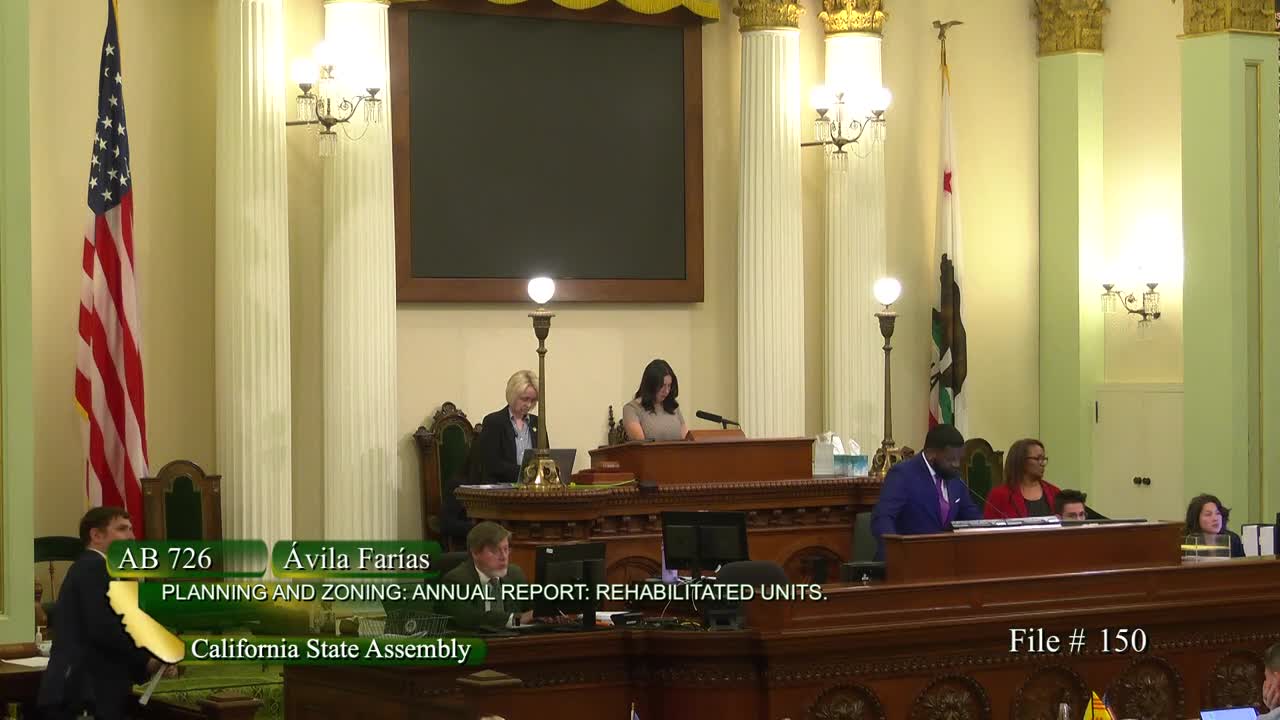
Bill Author

Bill Co-Author(s):