AB 82: Health care: legally protected health care activity.
- Session Year: 2025-2026
- House: Assembly
- Latest Version Date: 2025-10-13
Current Status:
Passed
(2025-10-13: Chaptered by Secretary of State - Chapter 679, Statutes of 2025.)
Introduced
In Committee
Awaiting First Chamber Vote
Passed First Chamber
In Committee
Awaiting Second Chamber Vote
Passed Second Chamber
Enacted
(1)Existing law authorizes reproductive health care service providers, employees, volunteers, and patients, and individuals who face threats of violence or violence or harassment from the public because of their affiliation with a reproductive health care services facility, to complete an application to be approved by the Secretary of State for the purposes of enabling state and local agencies to respond to requests for public records without disclosing a program participants residence address contained in any public record and otherwise provide for confidentiality of identity for that person, subject to specified conditions. Under existing law, any person who makes a false statement in an application is guilty of a misdemeanor.
This bill would expand the address confidentiality program to a gender-affirming health care provider, employee, or volunteer, as defined, who faces threats of violence or harassment from the public because of their affiliation with a gender-affirming health care services facility. The bill would also make conforming changes. By imposing new duties on local agencies and expanding the scope of a crime, this bill would create a state-mandated local program.
(2)Existing law prohibits a person, business, or association from knowingly publicly posting or publicly displaying, disclosing, or distributing on internet websites or on social media, the personal information or image of any reproductive health care services patient, provider, or assistant, or other individuals residing at the same home address, with the intent to incite a 3rd person to cause imminent great bodily harm to the person identified in the posting or display, or to a coresident of that person, as specified, or to threaten the person identified in the posting or display, or a coresident of that person, as specified. Existing law additionally prohibits a person, business, or association from soliciting, selling, or trading on the internet or social media the personal information or image of a reproductive health care services patient, provider, or assistant with the intent described above. Existing law establishes a cause of action for injunctive or declarative relief for a violation of these prohibitions.
Existing law prohibits a person from posting on the internet or social media, with the intent that another person imminently use that information to commit a crime involving violence or a threat of violence against a reproductive health care services patient, provider, or assistant, or other individuals residing at the same home address, the personal information or image of a reproductive health care services patient, provider, or assistant, or other individuals residing at the same home address. Existing law makes a violation of this prohibition punishable by a fine of up to $10,000 per violation, imprisonment, as specified, or by both that fine and imprisonment.
This bill would additionally prohibit a person, business, or association from soliciting, selling, or trading on the internet or social media the personal information or image of a gender-affirming health care services provider, employee, volunteer, or patient with the intent described above. The bill would also prohibit a person from posting on the internet or social media, as described above, the personal information or image of a gender-affirming health care services provider, employee, volunteer, or patient, or other individuals residing at the same home address. The bill would define various terms for these purposes. By expanding the scope of a crime, this bill would create a state-mandated local program.
(3)Existing law, the California Uniform Controlled Substances Act (the act), classifies controlled substances into 5 designated schedules, with the most restrictive limitations generally placed on controlled substances classified in Schedule I, and the least restrictive limitations generally placed on controlled substances classified in Schedule V. The act requires the Department of Justice to maintain the Controlled Substances Utilization Review and Evaluation System (CURES) for the electronic monitoring of the prescribing and dispensing of certain controlled substances by a health care practitioner authorized to prescribe, order, administer, furnish, or dispense those controlled substances. Existing law limits the entities to which data may be provided from CURES, as well as the type of data that may be released and the uses to which it may be put. Existing law makes a violation of the act a crime. Existing law defines the term legally protected health care activity to include the exercise of, or an act undertaken to aid a person to exercise, the provision of reproductive health care services, gender-affirming health care services, or gender-affirming mental health care services.
This bill would prohibit a prescription for or the dispensing of testosterone or mifepristone from being reported to the department, CURES, or a contractor, as specified. The bill would require the department, on or before January 1, 2027, to remove certain existing records that were created or maintained prior to January 1, 2026, and make other conforming changes. By creating a new crime, the bill would establish a state-mandated local program.
(4)Existing law authorizes a court to issue various orders relating to criminal investigations, including the interception of wire or electronic communications, the installation and use of a pen register or trap and trace device, or a search warrant upon specified grounds. Existing law prohibits the issuance of any orders or warrants for the purpose of investigating or recovering evidence of a prohibited violation. Existing law defines prohibited violation for this purpose as a violation of a law that creates liability for, or arising out of, either providing, facilitating, or obtaining an abortion or intending or attempting to provide, facilitate, or obtain an abortion that is lawful under the laws of this state.
This bill would instead define a prohibited violation as a violation of a law that creates liability for, or arising out of, either providing, facilitating, or obtaining a legally protected health care activity or intending or attempting to provide, facilitate, or obtain a legally protected health care activity, as defined.
(5)Existing law requires superior court judges in each county to prepare, adopt, and annually revise a uniform countywide schedule of bail for all bailable offenses, as specified. Existing law requires a uniform countywide schedule of bail to set $0 bail for an individual who has been arrested in connection with a proceeding in another state regarding an individual performing, supporting, or aiding in the performance of an abortion in this state, or an individual obtaining an abortion in this state, if the abortion is lawful under California law.
This bill would instead require a uniform countywide schedule of bail to set $0 bail for an individual who has been arrested in connection with a proceeding in another state regarding an individual performing, supporting, or aiding in the performance of a legally protected health care activity in this state, or an individual obtaining a legally protected health care activity in this state, as specified.
(6)Existing law prohibits a state or local law enforcement agency or officer from knowingly arresting or knowingly participating in the arrest of any person for performing, supporting, or aiding in the performance of an abortion or for obtaining an abortion, if the abortion is lawful in this state. Existing law prohibits a state or local public agency from cooperating with or providing information to an individual or agency from another state or a federal law enforcement agency, as specified, regarding a lawful abortion. Existing law prohibits specified persons, including a judicial officer, a court employee, or an authorized attorney, among others, from issuing a subpoena in connection with a proceeding in another state regarding an individual performing, supporting, or aiding in the performance of an abortion in this state, or an individual obtaining an abortion in this state, if the abortion is lawful in this state. Existing law does not prohibit the investigation of criminal activity that may involve an abortion, provided that no information relating to any medical procedure performed on a specific individual is shared with an agency or individual from another state for the purpose of enforcing another states abortion law.
This bill would instead expand those above-described provisions to apply to legally protected health care activity, as defined.
(7)Existing law prohibits a state or local government employee or a person acting on behalf of the local or state government, among others, from providing information or expending resources in furtherance of an investigation that seeks to impose civil or criminal liability or professional sanctions on an individual for a legally protected health care activity, as defined, that occurred in this state or that would be legal if it occurred in this state. Existing law requires any out-of-state subpoena, warrant, wiretap order, pen register trap and trace order, or other legal process to include an affidavit or declaration under penalty of perjury that the discovery request is not in connection with an out-of-state proceeding relating to a legally protected health care activity, except as specified.
This bill would authorize the Attorney General to bring a civil action against a person or entity that submitted a false affidavit under these provisions and would make submission of a false affidavit punishable by a civil penalty of $15,000, in addition to any other penalties or remedies provided by law.
(8)Existing constitutional provisions require that a statute that limits the right of access to the meetings of public bodies or the writings of public officials and agencies be adopted with findings demonstrating the interest protected by the limitation and the need for protecting that interest.
This bill would make legislative findings to that effect.
(9)This bill would incorporate additional changes to Section 11165 of the Health and Safety Code proposed by SB 497 to be operative only if this bill and SB 497 are enacted and this bill is enacted last.
(10)The California Constitution requires the state to reimburse local agencies and school districts for certain costs mandated by the state. Statutory provisions establish procedures for making that reimbursement.
This bill would provide that with regard to certain mandates no reimbursement is required by this act for a specified reason.
With regard to any other mandates, this bill would provide that, if the Commission on State Mandates determines that the bill contains costs so mandated by the state, reimbursement for those costs shall be made pursuant to the statutory provisions noted above.
(1)Existing law authorizes reproductive health care service providers, employees, volunteers, and patients, and individuals who face threats of violence or violence or harassment from the public because of their affiliation with a reproductive health care services facility, to complete an application to be approved by the Secretary of State for the purposes of enabling state and local agencies to respond to requests for public records without disclosing a program participants residence address contained in any public record and otherwise provide for confidentiality of identity for that person, subject to specified conditions. Under existing law, any person who makes a false statement in an application is guilty of a misdemeanor.
This bill would expand the address confidentiality program to a gender-affirming health care provider, employee, or volunteer, as defined, who faces threats of violence or harassment from the public because of their affiliation with a gender-affirming health care services facility. The bill would also make conforming changes. By imposing new duties on local agencies and expanding the scope of a crime, this bill would create a state-mandated local program.
(2)Existing law prohibits a person, business, or association from knowingly publicly posting or publicly displaying, disclosing, or distributing on internet websites or on social media, the personal information or image of any reproductive health care services patient, provider, or assistant, or other individuals residing at the same home address, with the intent to incite a 3rd person to cause imminent great bodily harm to the person identified in the posting or display, or to a coresident of that person, as specified, or to threaten the person identified in the posting or display, or a coresident of that person, as specified. Existing law additionally prohibits a person, business, or association from soliciting, selling, or trading on the internet or social media the personal information or image of a reproductive health care services patient, provider, or assistant with the intent described above. Existing law establishes a cause of action for injunctive or declarative relief for a violation of these prohibitions.
Existing law prohibits a person from posting on the internet or social media, with the intent that another person imminently use that information to commit a crime involving violence or a threat of violence against a reproductive health care services patient, provider, or assistant, or other individuals residing at the same home address, the personal information or image of a reproductive health care services patient, provider, or assistant, or other individuals residing at the same home address. Existing law makes a violation of this prohibition punishable by a fine of up to $10,000 per violation, imprisonment, as specified, or by both that fine and imprisonment.
This bill would additionally prohibit a person, business, or association from soliciting, selling, or trading on the internet or social media the personal information or image of a gender-affirming health care services provider, employee, volunteer, or patient with the intent described above. The bill would also prohibit a person from posting on the internet or social media, as described above, the personal information or image of a gender-affirming health care services provider, employee, volunteer, or patient, or other individuals residing at the same home address. The bill would define various terms for these purposes. By expanding the scope of a crime, this bill would create a state-mandated local program.
(3)Existing law, the California Uniform Controlled Substances Act (the act), classifies controlled substances into 5 designated schedules, with the most restrictive limitations generally placed on controlled substances classified in Schedule I, and the least restrictive limitations generally placed on controlled substances classified in Schedule V. The act requires the Department of Justice to maintain the Controlled Substances Utilization Review and Evaluation System (CURES) for the electronic monitoring of the prescribing and dispensing of certain controlled substances by a health care practitioner authorized to prescribe, order, administer, furnish, or dispense those controlled substances. Existing law limits the entities to which data may be provided from CURES, as well as the type of data that may be released and the uses to which it may be put. Existing law makes a violation of the act a crime. Existing law defines the term legally protected health care activity to include the exercise of, or an act undertaken to aid a person to exercise, the provision of reproductive health care services, gender-affirming health care services, or gender-affirming mental health care services.
This bill would prohibit a prescription for or the dispensing of testosterone or mifepristone from being reported to the department, CURES, or a contractor, as specified. The bill would require the department, on or before January 1, 2027, to remove certain existing records that were created or maintained prior to January 1, 2026, and make other conforming changes. By creating a new crime, the bill would establish a state-mandated local program.
(4)Existing law authorizes a court to issue various orders relating to criminal investigations, including the interception of wire or electronic communications, the installation and use of a pen register or trap and trace device, or a search warrant upon specified grounds. Existing law prohibits the issuance of any orders or warrants for the purpose of investigating or recovering evidence of a prohibited violation. Existing law defines prohibited violation for this purpose as a violation of a law that creates liability for, or arising out of, either providing, facilitating, or obtaining an abortion or intending or attempting to provide, facilitate, or obtain an abortion that is lawful under the laws of this state.
This bill would instead define a prohibited violation as a violation of a law that creates liability for, or arising out of, either providing, facilitating, or obtaining a legally protected health care activity or intending or attempting to provide, facilitate, or obtain a legally protected health care activity, as defined.
(5)Existing law requires superior court judges in each county to prepare, adopt, and annually revise a uniform countywide schedule of bail for all bailable offenses, as specified. Existing law requires a uniform countywide schedule of bail to set $0 bail for an individual who has been arrested in connection with a proceeding in another state regarding an individual performing, supporting, or aiding in the performance of an abortion in this state, or an individual obtaining an abortion in this state, if the abortion is lawful under California law.
This bill would instead require a uniform countywide schedule of bail to set $0 bail for an individual who has been arrested in connection with a proceeding in another state regarding an individual performing, supporting, or aiding in the performance of a legally protected health care activity in this state, or an individual obtaining a legally protected health care activity in this state, as specified.
(6)Existing law prohibits a state or local law enforcement agency or officer from knowingly arresting or knowingly participating in the arrest of any person for performing, supporting, or aiding in the performance of an abortion or for obtaining an abortion, if the abortion is lawful in this state. Existing law prohibits a state or local public agency from cooperating with or providing information to an individual or agency from another state or a federal law enforcement agency, as specified, regarding a lawful abortion. Existing law prohibits specified persons, including a judicial officer, a court employee, or an authorized attorney, among others, from issuing a subpoena in connection with a proceeding in another state regarding an individual performing, supporting, or aiding in the performance of an abortion in this state, or an individual obtaining an abortion in this state, if the abortion is lawful in this state. Existing law does not prohibit the investigation of criminal activity that may involve an abortion, provided that no information relating to any medical procedure performed on a specific individual is shared with an agency or individual from another state for the purpose of enforcing another states abortion law.
This bill would instead expand those above-described provisions to apply to legally protected health care activity, as defined.
(7)Existing law prohibits a state or local government employee or a person acting on behalf of the local or state government, among others, from providing information or expending resources in furtherance of an investigation that seeks to impose civil or criminal liability or professional sanctions on an individual for a legally protected health care activity, as defined, that occurred in this state or that would be legal if it occurred in this state. Existing law requires any out-of-state subpoena, warrant, wiretap order, pen register trap and trace order, or other legal process to include an affidavit or declaration under penalty of perjury that the discovery request is not in connection with an out-of-state proceeding relating to a legally protected health care activity, except as specified.
This bill would authorize the Attorney General to bring a civil action against a person or entity that submitted a false affidavit under these provisions and would make submission of a false affidavit punishable by a civil penalty of $15,000, in addition to any other penalties or remedies provided by law.
(8)Existing constitutional provisions require that a statute that limits the right of access to the meetings of public bodies or the writings of public officials and agencies be adopted with findings demonstrating the interest protected by the limitation and the need for protecting that interest.
This bill would make legislative findings to that effect.
(9)This bill would incorporate additional changes to Section 11165 of the Health and Safety Code proposed by SB 497 to be operative only if this bill and SB 497 are enacted and this bill is enacted last.
(9)(10)The California Constitution requires the state to reimburse local agencies and school districts for certain costs mandated by the state. Statutory provisions establish procedures for making that reimbursement.
This bill would provide that with regard to certain mandates no reimbursement is required by this act for a specified reason.
With regard to any other mandates, this bill would provide that, if the Commission on State Mandates determines that the bill contains costs so mandated by the state, reimbursement for those costs shall be made pursuant to the statutory provisions noted above.
(1)Existing law authorizes reproductive health care service providers, employees, volunteers, and patients, and individuals who face threats of violence or violence or harassment from the public because of their affiliation with a reproductive health care services facility, to complete an application to be approved by the Secretary of State for the purposes of enabling state and local agencies to respond to requests for public records without disclosing a program participants residence address contained in any public record and otherwise provide for confidentiality of identity for that person, subject to specified conditions. Under existing law, any person who makes a false statement in an application is guilty of a misdemeanor.
This bill would expand the address confidentiality program to a gender-affirming health care provider, employee, or volunteer, as defined, who faces threats of violence or harassment from the public because of their affiliation with a gender-affirming health care services facility. The bill would also make conforming changes. By imposing new duties on local agencies and expanding the scope of a crime, this bill would create a state-mandated local program.
(2)Existing law prohibits a person, business, or association from knowingly publicly posting or publicly displaying, disclosing, or distributing on internet websites or on social media, the personal information or image of any reproductive health care services patient, provider, or assistant, or other individuals residing at the same home address, with the intent to incite a 3rd person to cause imminent great bodily harm to the person identified in the posting or display, or to a coresident of that person, as specified, or to threaten the person identified in the posting or display, or a coresident of that person, as specified. Existing law additionally prohibits a person, business, or association from soliciting, selling, or trading on the internet or social media the personal information or image of a reproductive health care services patient, provider, or assistant with the intent described above. Existing law establishes a cause of action for injunctive or declarative relief for a violation of these prohibitions.
Existing law prohibits a person from posting on the internet or social media, with the intent that another person imminently use that information to commit a crime involving violence or a threat of violence against a reproductive health care services patient, provider, or assistant, or other individuals residing at the same home address, the personal information or image of a reproductive health care services patient, provider, or assistant, or other individuals residing at the same home address. Existing law makes a violation of this prohibition punishable by a fine of up to $10,000 per violation, imprisonment, as specified, or by both that fine and imprisonment.
This bill would additionally prohibit a person, business, or association from soliciting, selling, or trading on the internet or social media the personal information or image of a gender-affirming health care services provider, employee, volunteer, or patient with the intent described above. The bill would also prohibit a person from posting on the internet or social media, as described above, the personal information or image of a gender-affirming health care services provider, employee, volunteer, or patient, or other individuals residing at the same home address. The bill would define various terms for these purposes. By expanding the scope of a crime, this bill would create a state-mandated local program.
(3)Existing law, the California Uniform Controlled Substances Act (the act), classifies controlled substances into 5 designated schedules, with the most restrictive limitations generally placed on controlled substances classified in Schedule I, and the least restrictive limitations generally placed on controlled substances classified in Schedule V. The act requires the Department of Justice to maintain the Controlled Substances Utilization Review and Evaluation System (CURES) for the electronic monitoring of the prescribing and dispensing of certain controlled substances by a health care practitioner authorized to prescribe, order, administer, furnish, or dispense those controlled substances. Existing law limits the entities to which data may be provided from CURES, as well as the type of data that may be released and the uses to which it may be put. Existing law makes a violation of the act a crime. Existing law defines the term legally protected health care activity to include the exercise of, or an act undertaken to aid a person to exercise, the provision of reproductive health care services, gender-affirming health care services, or gender-affirming mental health care services.
This bill would prohibit a prescription for or the dispensing of testosterone or mifepristone from being reported to the department, CURES, or a contractor, as specified. The bill would require the department, on or before January 1, 2027, to remove certain existing records that were created or maintained prior to January 1, 2026, and make other conforming changes. The bill would authorize the department, in consultation with the California Health and Human Services Agency, health care providers, and clinicians, to add medications for legally protected health care activity to the list of medications prohibited from being reported. By creating a new crime, the bill would establish a state-mandated local program.
(4)Existing law authorizes a court to issue various orders relating to criminal investigations, including the interception of wire or electronic communications, the installation and use of a pen register or trap and trace device, or a search warrant upon specified grounds. Existing law prohibits the issuance of any orders or warrants for the purpose of investigating or recovering evidence of a prohibited violation. Existing law defines prohibited violation for this purpose as a violation of a law that creates liability for, or arising out of, either providing, facilitating, or obtaining an abortion or intending or attempting to provide, facilitate, or obtain an abortion that is lawful under the laws of this state.
This bill would instead define a prohibited violation as a violation of a law that creates liability for, or arising out of, either providing, facilitating, or obtaining a legally protected health care activity or intending or attempting to provide, facilitate, or obtain a legally protected health care activity, as defined.
(5)Existing law requires superior court judges in each county to prepare, adopt, and annually revise a uniform countywide schedule of bail for all bailable offenses, as specified. Existing law requires a uniform countywide schedule of bail to set $0 bail for an individual who has been arrested in connection with a proceeding in another state regarding an individual performing, supporting, or aiding in the performance of an abortion in this state, or an individual obtaining an abortion in this state, if the abortion is lawful under California law.
This bill would instead require a uniform countywide schedule of bail to set $0 bail for an individual who has been arrested in connection with a proceeding in another state regarding an individual performing, supporting, or aiding in the performance of a legally protected health care activity in this state, or an individual obtaining a legally protected health care activity in this state, as specified.
(6)Existing law prohibits a state or local law enforcement agency or officer from knowingly arresting or knowingly participating in the arrest of any person for performing, supporting, or aiding in the performance of an abortion or for obtaining an abortion, if the abortion is lawful in this state. Existing law prohibits a state or local public agency from cooperating with or providing information to an individual or agency from another state or a federal law enforcement agency, as specified, regarding a lawful abortion. Existing law prohibits specified persons, including a judicial officer, a court employee, or an authorized attorney, among others, from issuing a subpoena in connection with a proceeding in another state regarding an individual performing, supporting, or aiding in the performance of an abortion in this state, or an individual obtaining an abortion in this state, if the abortion is lawful in this state. Existing law does not prohibit the investigation of criminal activity that may involve an abortion, provided that no information relating to any medical procedure performed on a specific individual is shared with an agency or individual from another state for the purpose of enforcing another states abortion law.
This bill would instead expand those above-described provisions to apply to legally protected health care activity, as defined.
(7)Existing law prohibits a state or local government employee or a person acting on behalf of the local or state government, among others, from providing information or expending resources in furtherance of an investigation that seeks to impose civil or criminal liability or professional sanctions on an individual for a legally protected health care activity, as defined, that occurred in this state or that would be legal if it occurred in this state. Existing law requires any out-of-state subpoena, warrant, wiretap order, pen register trap and trace order, or other legal process to include an affidavit or declaration under penalty of perjury that the discovery request is not in connection with an out-of-state proceeding relating to a legally protected health care activity, except as specified.
This bill would authorize the Attorney General to bring a civil action against a person or entity that submitted a false affidavit under these provisions and would make submission of a false affidavit punishable by a civil penalty of $15,000, in addition to any other penalties or remedies provided by law.
(8)Existing constitutional provisions require that a statute that limits the right of access to the meetings of public bodies or the writings of public officials and agencies be adopted with findings demonstrating the interest protected by the limitation and the need for protecting that interest.
This bill would make legislative findings to that effect.
(9)The California Constitution requires the state to reimburse local agencies and school districts for certain costs mandated by the state. Statutory provisions establish procedures for making that reimbursement.
This bill would provide that with regard to certain mandates no reimbursement is required by this act for a specified reason.
With regard to any other mandates, this bill would provide that, if the Commission on State Mandates determines that the bill contains costs so mandated by the state, reimbursement for those costs shall be made pursuant to the statutory provisions noted above.
(1)Existing law authorizes reproductive health care service providers, employees, volunteers, and patients, and individuals who face threats of violence or violence or harassment from the public because of their affiliation with a reproductive health care services facility, to complete an application to be approved by the Secretary of State for the purposes of enabling state and local agencies to respond to requests for public records without disclosing a program participants residence address contained in any public record and otherwise provide for confidentiality of identity for that person, subject to specified conditions. Under existing law, any person who makes a false statement in an application is guilty of a misdemeanor.
This bill would expand the address confidentiality program to a gender-affirming health care provider, employee, or volunteer, as defined, who faces threats of violence or harassment from the public because of their affiliation with a gender-affirming health care services facility. By imposing new duties on local agencies and expanding the scope of a crime, this bill would create a state-mandated local program.
(2)Existing law prohibits a person, business, or association from knowingly publicly posting or publicly displaying, disclosing, or distributing on internet websites or on social media, the personal information or image of any reproductive health care services patient, provider, or assistant, or other individuals residing at the same home address, with the intent to incite a 3rd person to cause imminent great bodily harm to the person identified in the posting or display, or to a coresident of that person, as specified, or to threaten the person identified in the posting or display, or a coresident of that person, as specified. Existing law additionally prohibits a person, business, or association from soliciting, selling, or trading on the internet or social media the personal information or image of a reproductive health care services patient, provider, or assistant with the intent described above. Existing law establishes a cause of action for injunctive or declarative relief for a violation of these prohibitions.
Existing law prohibits a person from posting on the internet or social media, with the intent that another person imminently use that information to commit a crime involving violence or a threat of violence against a reproductive health care services patient, provider, or assistant, or other individuals residing at the same home address, the personal information or image of a reproductive health care services patient, provider, or assistant, or other individuals residing at the same home address. Existing law makes a violation of this prohibition punishable by a fine of up to $10,000 per violation, imprisonment, as specified, or by both that fine and imprisonment.
This bill would additionally prohibit a person, business, or association from soliciting, selling, or trading on the internet or social media the personal information or image of a gender-affirming health care services patient, provider, or assistant provider, employee, volunteer, or patient with the intent described above. The bill would also prohibit a person from posting on the internet or social media, as described above, the personal information or image of a gender-affirming health care services patient, provider, or assistant, provider, employee, volunteer, or patient, or other individuals residing at the same home address. The bill would define various terms for these purposes. By expanding the scope of a crime, this bill would create a state-mandated local program.
(3)Existing law, the California Uniform Controlled Substances Act (the act), classifies controlled substances into 5 designated schedules, with the most restrictive limitations generally placed on controlled substances classified in Schedule I, and the least restrictive limitations generally placed on controlled substances classified in Schedule V. The act requires the Department of Justice to maintain the Controlled Substances Utilization Review and Evaluation System (CURES) for the electronic monitoring of the prescribing and dispensing of certain controlled substances by a health care practitioner authorized to prescribe, order, administer, furnish, or dispense those controlled substances. Existing law limits the entities to which data may be provided from CURES, as well as the type of data that may be released and the uses to which it may be put. Existing law makes a violation of the act a crime. Existing law defines the term legally protected health care activity to include the exercise of, or an act undertaken to aid a person to exercise, the provision of reproductive health care services, gender-affirming health care services, or gender-affirming mental health care services.
This bill would prohibit a prescription for or the dispensing of testosterone or mifepristone from being reported to the department, CURES, or a contractor, as specified. The bill would require the department, on or before January 1, 2027, to remove certain existing records that were created or maintained prior to January 1, 2026, and make other conforming changes. The bill would authorize the department, in consultation with the California Health and Human Services Agency, health care providers, and clinicians, to add medications for legally protected health care activity to the list of medications prohibited from being reported. By creating a new crime, the bill would establish a state-mandated local program.
(4)Existing law authorizes a court to issue various orders relating to criminal investigations, including the interception of wire or electronic communications, the installation and use of a pen register or trap and trace device, or a search warrant upon specified grounds. Existing law prohibits the issuance of any orders or warrants for the purpose of investigating or recovering evidence of a prohibited violation. Existing law defines prohibited violation for this purpose as a violation of a law that creates liability for, or arising out of, either providing, facilitating, or obtaining an abortion or intending or attempting to provide, facilitate, or obtain an abortion that is lawful under the laws of this state.
This bill would instead define a prohibited violation as a violation of a law that creates liability for, or arising out of, either providing, facilitating, or obtaining a legally protected health care activity or intending or attempting to provide, facilitate, or obtain a legally protected health care activity, as defined.
(5)Existing law requires superior court judges in each county to prepare, adopt, and annually revise a uniform countywide schedule of bail for all bailable offenses, as specified. Existing law requires a uniform countywide schedule of bail to set $0 bail for an individual who has been arrested in connection with a proceeding in another state regarding an individual performing, supporting, or aiding in the performance of an abortion in this state, or an individual obtaining an abortion in this state, if the abortion is lawful under California law.
This bill would instead require a uniform countywide schedule of bail to set $0 bail for an individual who has been arrested in connection with a proceeding in another state regarding an individual performing, supporting, or aiding in the performance of a legally protected health care activity in this state, or an individual obtaining a legally protected health care activity in this state, as specified.
(6)Existing law prohibits a state or local law enforcement agency or officer from knowingly arresting or knowingly participating in the arrest of any person for performing, supporting, or aiding in the performance of an abortion or for obtaining an abortion, if the abortion is lawful in this state. Existing law prohibits a state or local public agency from cooperating with or providing information to an individual or agency from another state or a federal law enforcement agency, as specified, regarding a lawful abortion. Existing law prohibits specified persons, including a judicial officer, a court employee, or an authorized attorney, among others, from issuing a subpoena in connection with a proceeding in another state regarding an individual performing, supporting, or aiding in the performance of an abortion in this state, or an individual obtaining an abortion in this state, if the abortion is lawful in this state. Existing law does not prohibit the investigation of criminal activity that may involve an abortion, provided that no information relating to any medical procedure performed on a specific individual is shared with an agency or individual from another state for the purpose of enforcing another states abortion law.
This bill would instead expand those above-described provisions to apply to legally protected health care activity, as defined.
(7)Existing law prohibits a state or local government employee or a person acting on behalf of the local or state government, among others, from providing information or expending resources in furtherance of an investigation that seeks to impose civil or criminal liability or professional sanctions on an individual for a legally protected health care activity, as defined, that occurred in this state or that would be legal if it occurred in this state. Existing law requires any out-of-state subpoena, warrant, wiretap order, pen register trap and trace order, or other legal process to include an affidavit or declaration under penalty of perjury that the discovery request is not in connection with an out-of-state proceeding relating to a legally protected health care activity, except as specified.
This bill would authorize the Attorney General to bring a civil action against a person or entity that submitted a false affidavit under these provisions and would make submission of a false affidavit punishable by a civil penalty of $15,000, in addition to any other penalties or remedies provided by law.
(8)Existing constitutional provisions require that a statute that limits the right of access to the meetings of public bodies or the writings of public officials and agencies be adopted with findings demonstrating the interest protected by the limitation and the need for protecting that interest.
This bill would make legislative findings to that effect.
(9)The California Constitution requires the state to reimburse local agencies and school districts for certain costs mandated by the state. Statutory provisions establish procedures for making that reimbursement.
This bill would provide that with regard to certain mandates no reimbursement is required by this act for a specified reason.
With regard to any other mandates, this bill would provide that, if the Commission on State Mandates determines that the bill contains costs so mandated by the state, reimbursement for those costs shall be made pursuant to the statutory provisions noted above.
(1)Existing law authorizes reproductive health care service providers, employees, volunteers, and patients, and individuals who face threats of violence or violence or harassment from the public because of their affiliation with a reproductive health care services facility, to complete an application to be approved by the Secretary of State for the purposes of enabling state and local agencies to respond to requests for public records without disclosing a program participants residence address contained in any public record and otherwise provide for confidentiality of identity for that person, subject to specified conditions. Under existing law, any person who makes a false statement in an application is guilty of a misdemeanor.
This bill would expand the address confidentiality program to a gender-affirming health care provider, employee, or volunteer, as defined, who faces threats of violence or harassment from the public because of their affiliation with a gender-affirming health care services facility. By imposing new duties on local agencies and expanding the scope of a crime, this bill would create a state-mandated local program.
(2)Existing law prohibits a person, business, or association from knowingly publicly posting or publicly displaying, disclosing, or distributing on internet websites or on social media, the personal information or image of any reproductive health care services patient, provider, or assistant, or other individuals residing at the same home address, with the intent to incite a 3rd person to cause imminent great bodily harm to the person identified in the posting or display, or to a coresident of that person, as specified, or to threaten the person identified in the posting or display, or a coresident of that person, as specified. Existing law additionally prohibits a person, business, or association from soliciting, selling, or trading on the internet or social media the personal information or image of a reproductive health care services patient, provider, or assistant with the intent described above. Existing law establishes a cause of action for injunctive or declarative relief for a violation of these prohibitions.
Existing law prohibits a person from posting on the internet or social media, with the intent that another person imminently use that information to commit a crime involving violence or a threat of violence against a reproductive health care services patient, provider, or assistant, or other individuals residing at the same home address, the personal information or image of a reproductive health care services patient, provider, or assistant, or other individuals residing at the same home address. Existing law makes a violation of this prohibition punishable by a fine of up to $10,000 per violation, imprisonment, as specified, or by both that fine and imprisonment.
This bill would additionally prohibit a person, business, or association from soliciting, selling, or trading on the internet or social media the personal information or image of a gender-affirming health care services patient, provider, or assistant with the intent described above. The bill would also prohibit a person from posting on the internet or social media, as described above, the personal information or image of a gender-affirming health care services patient, provider, or assistant, or other individuals residing at the same home address. The bill would define various terms for these purposes. By expanding the scope of a crime, this bill would create a state-mandated local program.
(3)Existing law, the California Uniform Controlled Substances Act (the act), classifies controlled substances into 5 designated schedules, with the most restrictive limitations generally placed on controlled substances classified in Schedule I, and the least restrictive limitations generally placed on controlled substances classified in Schedule V. The act requires the Department of Justice to maintain the Controlled Substances Utilization Review and Evaluation System (CURES) for the electronic monitoring of the prescribing and dispensing of certain controlled substances by a health care practitioner authorized to prescribe, order, administer, furnish, or dispense those controlled substances. Existing law limits the entities to which data may be provided from CURES, as well as the type of data that may be released and the uses to which it may be put. Existing law makes a violation of the act a crime. Existing law defines the term legally protected health care activity to include the exercise of, or an act undertaken to aid a person to exercise, the provision of reproductive health care services, gender-affirming health care services, or gender-affirming mental health care services.
This bill would prohibit a prescription for or the dispensing of testosterone or mifepristone from being reported to the department, CURES, or a contractor, as specified. The bill would require the department, on or before January 1, 2027, to remove certain existing records that were created or maintained prior to January 1, 2026, and make other conforming changes. The bill would authorize the department, in consultation with the California Health and Human Services Agency, health care providers, and clinicians, to add medications for legally protected health care activity to the list of medications prohibited from being reported. By creating a new crime, the bill would establish a state-mandated local program.
(4)Existing law authorizes a court to issue various orders relating to criminal investigations, including the interception of wire or electronic communications, the installation and use of a pen register or trap and trace device, or a search warrant upon specified grounds. Existing law prohibits the issuance of any orders or warrants for the purpose of investigating or recovering evidence of a prohibited violation. Existing law defines prohibited violation for this purpose as a violation of a law that creates liability for, or arising out of, either providing, facilitating, or obtaining an abortion or intending or attempting to provide, facilitate, or obtain an abortion that is lawful under the laws of this state.
This bill would instead define a prohibited violation as a violation of a law that creates liability for, or arising out of, either providing, facilitating, or obtaining a legally protected health care activity or intending or attempting to provide, facilitate, or obtain a legally protected health care activity, as defined.
(5)Existing law requires superior court judges in each county to prepare, adopt, and annually revise a uniform countywide schedule of bail for all bailable offenses, as specified. Existing law requires a uniform countywide schedule of bail to set $0 bail for an individual who has been arrested in connection with a proceeding in another state regarding an individual performing, supporting, or aiding in the performance of an abortion in this state, or an individual obtaining an abortion in this state, if the abortion is lawful under California law.
This bill would instead require a uniform countywide schedule of bail to set $0 bail for an individual who has been arrested in connection with a proceeding in another state regarding an individual performing, supporting, or aiding in the performance of a legally protected health care activity in this state, or an individual obtaining a legally protected health care activity in this state, as specified.
(6)Existing law prohibits a state or local law enforcement agency or officer from knowingly arresting or knowingly participating in the arrest of any person for performing, supporting, or aiding in the performance of an abortion or for obtaining an abortion, if the abortion is lawful in this state. Existing law prohibits a state or local public agency from cooperating with or providing information to an individual or agency from another state or a federal law enforcement agency, as specified, regarding a lawful abortion. Existing law prohibits specified persons, including a judicial officer, a court employee, or an authorized attorney, among others, from issuing a subpoena in connection with a proceeding in another state regarding an individual performing, supporting, or aiding in the performance of an abortion in this state, or an individual obtaining an abortion in this state, if the abortion is lawful in this state. Existing law does not prohibit the investigation of criminal activity that may involve an abortion, provided that no information relating to any medical procedure performed on a specific individual is shared with an agency or individual from another state for the purpose of enforcing another states abortion law.
This bill would instead expand those above-described provisions to apply to legally protected health care activity, as defined.
(7)Existing law prohibits a state or local government employee or a person acting on behalf of the local or state government, among others, from providing information or expending resources in furtherance of an investigation that seeks to impose civil or criminal liability or professional sanctions on an individual for a legally protected health care activity, as defined, that occurred in this state or that would be legal if it occurred in this state. Existing law requires any out-of-state subpoena, warrant, wiretap order, pen register trap and trace order, or other legal process to include an affidavit or declaration under penalty of perjury that the discovery request is not in connection with an out-of-state proceeding relating to a legally protected health care activity, except as specified.
This bill would authorize the Attorney General to bring a civil action against a person or entity that submitted a false affidavit under these provisions and would make submission of a false affidavit punishable by a civil penalty of $15,000, in addition to any other penalties or remedies provided by law.
(7)(8)Existing constitutional provisions require that a statute that limits the right of access to the meetings of public bodies or the writings of public officials and agencies be adopted with findings demonstrating the interest protected by the limitation and the need for protecting that interest.
This bill would make legislative findings to that effect.
(8)(9)The California Constitution requires the state to reimburse local agencies and school districts for certain costs mandated by the state. Statutory provisions establish procedures for making that reimbursement.
This bill would provide that with regard to certain mandates no reimbursement is required by this act for a specified reason.
With regard to any other mandates, this bill would provide that, if the Commission on State Mandates determines that the bill contains costs so mandated by the state, reimbursement for those costs shall be made pursuant to the statutory provisions noted above.
(1)Existing law authorizes reproductive health care service providers, employees, volunteers, and patients, and individuals who face threats of violence or violence or harassment from the public because of their affiliation with a reproductive health care services facility, to complete an application to be approved by the Secretary of State for the purposes of enabling state and local agencies to respond to requests for public records without disclosing a program participants residence address contained in any public record and otherwise provide for confidentiality of identity for that person, subject to specified conditions. Under existing law, any person who makes a false statement in an application is guilty of a misdemeanor.
This bill would expand the address confidentiality program to a gender-affirming health care provider, employee, or volunteer, as defined, who faces threats of violence or harassment from the public because of their affiliation with a gender-affirming health care services facility. By imposing new duties on local agencies and expanding the scope of a crime, this bill would create a state-mandated local program.
(3)(2)Existing law prohibits a person, business, or association from knowingly publicly posting or publicly displaying, disclosing, or distributing on internet websites or on social media, the personal information or image of any reproductive health care services patient, provider, or assistant, or other individuals residing at the same home address, with the intent to incite a 3rd person to cause imminent great bodily harm to the person identified in the posting or display, or to a coresident of that person, as specified, or to threaten the person identified in the posting or display, or a coresident of that person, as specified. Existing law additionally prohibits a person, business, or association from soliciting, selling, or trading on the internet or social media the personal information or image of a reproductive health care services patient, provider, or assistant with the intent described above. Existing law establishes a cause of action for injunctive or declarative relief for a violation of these prohibitions.
Existing law prohibits a person from posting on the internet or social media, with the intent that another person imminently use that information to commit a crime involving violence or a threat of violence against a reproductive health care services patient, provider, or assistant, or other individuals residing at the same home address, the personal information or image of a reproductive health care services patient, provider, or assistant, or other individuals residing at the same home address. Existing law makes a violation of this prohibition punishable by a fine of up to $10,000 per violation, imprisonment, as specified, or by both that fine and imprisonment.
This bill would additionally prohibit a person, business, or association from soliciting, selling, or trading on the internet or social media the personal information or image of a gender-affirming health care services patient, provider, or assistant with the intent described above. The bill would also prohibit a person from posting on the internet or social media, as described above, the personal information or image of a gender-affirming health care services patient, provider, or assistant, or other individuals residing at the same home address. The bill would define various terms for these purposes. By expanding the scope of a crime, this bill would create a state-mandated local program.
(4)(3)Existing law, the California Uniform Controlled Substances Act (the act), classifies controlled substances into 5 designated schedules, with the most restrictive limitations generally placed on controlled substances classified in Schedule I, and the least restrictive limitations generally placed on controlled substances classified in Schedule V. The act requires the Department of Justice to maintain the Controlled Substances Utilization Review and Evaluation System (CURES) for the electronic monitoring of the prescribing and dispensing of certain controlled substances by a health care practitioner authorized to prescribe, order, administer, furnish, or dispense those controlled substances. Existing law limits the entities to which data may be provided from CURES, as well as the type of data that may be released and the uses to which it may be put. Existing law makes a violation of the act a crime. Existing law defines the term legally protected health care activity to include the exercise of, or an act undertaken to aid a person to exercise, the provision of reproductive health care services, gender-affirming health care services, or gender-affirming mental health care services.
This bill would prohibit a prescription for or the dispensing of testosterone or mifepristone from being reported to the department, CURES, or a contractor, as specified. The bill would require the department, on or before January 1, 2027, to remove certain existing records that were created or maintained prior to January 1, 2026, and make other conforming changes. The bill would authorize the department, in consultation with the California Health and Human Services Agency, health care providers, and clinicians, to add medications for legally protected health care activity to the list of medications prohibited from being reported. By creating a new crime, the bill would establish a state-mandated local program.
(5)(4)Existing law authorizes a court to issue various orders relating to criminal investigations, including the interception of wire or electronic communications, the installation and use of a pen register or trap and trace device, or a search warrant upon specified grounds. Existing law prohibits the issuance of any orders or warrants for the purpose of investigating or recovering evidence of a prohibited violation. Existing law defines prohibited violation for this purpose as a violation of a law that creates liability for, or arising out of, either providing, facilitating, or obtaining an abortion or intending or attempting to provide, facilitate, or obtain an abortion that is lawful under the laws of this state.
This bill would instead define a prohibited violation as a violation of a law that creates liability for, or arising out of, either providing, facilitating, or obtaining a legally protected health care activity or intending or attempting to provide, facilitate, or obtain a legally protected health care activity, as defined.
(6)(5)Existing law requires superior court judges in each county to prepare, adopt, and annually revise a uniform countywide schedule of bail for all bailable offenses, as specified. Existing law requires a uniform countywide schedule of bail to set $0 bail for an individual who has been arrested in connection with a proceeding in another state regarding an individual performing, supporting, or aiding in the performance of an abortion in this state, or an individual obtaining an abortion in this state, if the abortion is lawful under California law.
This bill would instead require a uniform countywide schedule of bail to set $0 bail for an individual who has been arrested in connection with a proceeding in another state regarding an individual performing, supporting, or aiding in the performance of a legally protected health care activity in this state, or an individual obtaining a legally protected health care activity in this state, as specified.
(7)(6)Existing law prohibits a state or local law enforcement agency or officer from knowingly arresting or knowingly participating in the arrest of any person for performing, supporting, or aiding in the performance of an abortion or for obtaining an abortion, if the abortion is lawful in this state. Existing law prohibits a state or local public agency from cooperating with or providing information to an individual or agency from another state or a federal law enforcement agency, as specified, regarding a lawful abortion. Existing law prohibits specified persons, including a judicial officer, a court employee, or an authorized attorney, among others, from issuing a subpoena in connection with a proceeding in another state regarding an individual performing, supporting, or aiding in the performance of an abortion in this state, or an individual obtaining an abortion in this state, if the abortion is lawful in this state. Existing law does not prohibit the investigation of criminal activity that may involve an abortion, provided that no information relating to any medical procedure performed on a specific individual is shared with an agency or individual from another state for the purpose of enforcing another states abortion law.
This bill would instead expand those above-described provisions to apply to legally protected health care activity, as defined.
(8)(7)Existing constitutional provisions require that a statute that limits the right of access to the meetings of public bodies or the writings of public officials and agencies be adopted with findings demonstrating the interest protected by the limitation and the need for protecting that interest.
This bill would make legislative findings to that effect.
(9)(8)The California Constitution requires the state to reimburse local agencies and school districts for certain costs mandated by the state. Statutory provisions establish procedures for making that reimbursement.
This bill would provide that with regard to certain mandates no reimbursement is required by this act for a specified reason.
With regard to any other mandates, this bill would provide that, if the Commission on State Mandates determines that the bill contains costs so mandated by the state, reimbursement for those costs shall be made pursuant to the statutory provisions noted above.
(1)Existing law, the Confidentiality of Medical Information Act (CMIA), generally prohibits a provider of health care, a health care service plan, or a contractor from disclosing medical information regarding a patient, enrollee, or subscriber without first obtaining an authorization, unless a specified exception applies. The CMIA prohibits a provider of health care, health care service plan, pharmaceutical company, contractor, or employer from knowingly disclosing, transmitting, transferring, sharing, or granting access to medical information in an electronic health records system or through a health information exchange that would identify an individual and that is related to an individual seeking, obtaining, providing, supporting, or aiding in the performance of an abortion that is lawful under the laws of this state to any individual or entity from another state, unless the disclosure, transmittal, transfer, sharing, or granting of access is authorized in accordance with specified existing provisions of law. Existing law makes a violation of the CMIA that results in economic loss or personal injury to a patient punishable as a misdemeanor.
This bill would state the intent of the Legislature to expand existing confidentiality protections for the exchange of health information to include gender-affirming health care.
(2)Existing law authorizes reproductive health care service providers, employees, volunteers, and patients, and individuals who face threats of violence or violence or harassment from the public because of their affiliation with a reproductive health care services facility, to complete an application to be approved by the Secretary of State for the purposes of enabling state and local agencies to respond to requests for public records without disclosing a program participants residence address contained in any public record and otherwise provide for confidentiality of identity for that person, subject to specified conditions. Under existing law, any person who makes a false statement in an application is guilty of a misdemeanor.
This bill would expand the address confidentiality program to a gender-affirming health care provider, employee, or volunteer, as defined, who faces threats of violence or harassment from the public because of their affiliation with a gender-affirming health care services facility. By imposing new duties on local agencies and expanding the scope of a crime, this bill would create a state-mandated local program.
(3)Existing law prohibits a person, business, or association from knowingly publicly posting or publicly displaying, disclosing, or distributing on internet websites or on social media, the personal information or image of any reproductive health care services patient, provider, or assistant, or other individuals residing at the same home address, with the intent to incite a 3rd person to cause imminent great bodily harm to the person identified in the posting or display, or to a coresident of that person, as specified, or to threaten the person identified in the posting or display, or a coresident of that person, as specified. Existing law additionally prohibits a person, business, or association from soliciting, selling, or trading on the internet or social media the personal information or image of a reproductive health care services patient, provider, or assistant with the intent described above. Existing law establishes a cause of action for injunctive or declarative relief for a violation of these prohibitions.
Existing law prohibits a person from posting on the internet or social media, with the intent that another person imminently use that information to commit a crime involving violence or a threat of violence against a reproductive health care services patient, provider, or assistant, or other individuals residing at the same home address, the personal information or image of a reproductive health care services patient, provider, or assistant, or other individuals residing at the same home address. Existing law makes a violation of this prohibition punishable by a fine of up to $10,000 per violation, imprisonment, as specified, or by both that fine and imprisonment.
This bill would additionally prohibit a person, business, or association from soliciting, selling, or trading on the internet or social media the personal information or image of a gender-affirming health care services patient, provider, or assistant with the intent described above. The bill would also prohibit a person from posting on the internet or social media, as described above, the personal information or image of a gender-affirming health care services patient, provider, or assistant, or other individuals residing at the same home address. The bill would define various terms for these purposes. By expanding the scope of a crime, this bill would create a state-mandated local program.
(4)Existing law, the California Uniform Controlled Substances Act (the act), classifies controlled substances into 5 designated schedules, with the most restrictive limitations generally placed on controlled substances classified in Schedule I, and the least restrictive limitations generally placed on controlled substances classified in Schedule V. The act requires the Department of Justice to maintain the Controlled Substances Utilization Review and Evaluation System (CURES) for the electronic monitoring of the prescribing and dispensing of certain controlled substances by a health care practitioner authorized to prescribe, order, administer, furnish, or dispense those controlled substances. Existing law limits the entities to which data may be provided from CURES, as well as the type of data that may be released and the uses to which it may be put. Existing law makes a violation of the act a crime. Existing law defines the term legally protected health care activity to include the exercise of, or an act undertaken to aid a person to exercise, the provision of reproductive health care services, gender-affirming health care services, or gender-affirming mental health care services.
This bill would prohibit a prescription for or the dispensing of testosterone or mifepristone from being reported to the department, CURES, or a contractor, as specified. The bill would authorize the department, in consultation with the California Health and Human Services Agency, health care providers, and clinicians, to add medications for legally protected health care activity to the list of medications prohibited from being reported. By creating a new crime, the bill would establish a state-mandated local program.
(5)Existing law authorizes a court to issue various orders relating to criminal investigations, including the interception of wire or electronic communications, the installation and use of a pen register or trap and trace device, or a search warrant upon specified grounds. Existing law prohibits the issuance of any orders or warrants for the purpose of investigating or recovering evidence of a prohibited violation. Existing law defines prohibited violation for this purpose as a violation of a law that creates liability for, or arising out of, either providing, facilitating, or obtaining an abortion or intending or attempting to provide, facilitate, or obtain an abortion that is lawful under the laws of this state.
This bill would instead define a prohibited violation as a violation of a law that creates liability for, or arising out of, either providing, facilitating, or obtaining a legally protected health care activity or intending or attempting to provide, facilitate, or obtain a legally protected health care activity, as defined.
(6)Existing law requires superior court judges in each county to prepare, adopt, and annually revise a uniform countywide schedule of bail for all bailable offenses, as specified. Existing law requires a uniform countywide schedule of bail to set $0 bail for an individual who has been arrested in connection with a proceeding in another state regarding an individual performing, supporting, or aiding in the performance of an abortion in this state, or an individual obtaining an abortion in this state, if the abortion is lawful under California law.
This bill would instead require a uniform countywide schedule of bail to set $0 bail for an individual who has been arrested in connection with a proceeding in another state regarding an individual performing, supporting, or aiding in the performance of a legally protected health care activity in this state, or an individual obtaining a legally protected health care activity in this state, as specified.
(7)Existing law prohibits a state or local law enforcement agency or officer from knowingly arresting or knowingly participating in the arrest of any person for performing, supporting, or aiding in the performance of an abortion or for obtaining an abortion, if the abortion is lawful in this state. Existing law prohibits a state or local public agency from cooperating with or providing information to an individual or agency from another state or a federal law enforcement agency, as specified, regarding a lawful abortion. Existing law prohibits specified persons, including a judicial officer, a court employee, or an authorized attorney, among others, from issuing a subpoena in connection with a proceeding in another state regarding an individual performing, supporting, or aiding in the performance of an abortion in this state, or an individual obtaining an abortion in this state, if the abortion is lawful in this state. Existing law does not prohibit the investigation of criminal activity that may involve an abortion, provided that no information relating to any medical procedure performed on a specific individual is shared with an agency or individual from another state for the purpose of enforcing another states abortion law.
This bill would instead expand those above-described provisions to apply to legally protected health care activity, as defined.
(8)Existing constitutional provisions require that a statute that limits the right of access to the meetings of public bodies or the writings of public officials and agencies be adopted with findings demonstrating the interest protected by the limitation and the need for protecting that interest.
This bill would make legislative findings to that effect.
(9)The California Constitution requires the state to reimburse local agencies and school districts for certain costs mandated by the state. Statutory provisions establish procedures for making that reimbursement.
This bill would provide that with regard to certain mandates no reimbursement is required by this act for a specified reason.
With regard to any other mandates, this bill would provide that, if the Commission on State Mandates determines that the bill contains costs so mandated by the state, reimbursement for those costs shall be made pursuant to the statutory provisions noted above.
Existing law, the Information Practices Act of 1977, authorizes an individual to bring an action against an agency, as defined, under specified conditions, including whenever an agency refuses to comply with an individuals lawful request to inspect certain records. The act authorizes a court to enjoin the agency from withholding the records and to order production to the complainant, as specified, and requires the court to assess against the agency reasonable attorneys fees and other litigation costs, as provided.This bill would make a nonsubstantive change to these provisions.Existing law, the Information Practices Act of 1977, authorizes an individual to bring an action against an agency, as defined, under specified conditions, including whenever an agency refuses to comply with an individuals lawful request to inspect certain records. The act authorizes a court to enjoin the agency from withholding the records and to order production to the complainant, as specified, and requires the court to assess against the agency reasonable attorneys fees and other litigation costs, as provided.
This bill would make a nonsubstantive change to these provisions.
The Legislature finds and declares the following:
(a)Persons working in the reproductive health care field, specifically the provision of terminating a pregnancy, are often subject to harassment, threats, and acts of violence by persons or groups.
(1)In 2000, 30 percent of respondents to a Senate Office of Research survey of 172 California reproductive health care providers reported they or their families had been targets of acts of violence by groups that oppose reproductive rights at locations away from their clinics or offices.
(2)Persons and groups that oppose reproductive rights attempt to stop the provision of legal reproductive health care services by threatening reproductive health care service providers, clinics, employees, volunteers, and patients. The names, photographs, spouses names, and home addresses of these providers, employees, volunteers, and patients have been posted on Internet Web sites. From one website list that includes personal information of reproductive health care service providers, seven persons have been murdered and 14 have been injured. As of August 5, 2002, there are 78 Californians listed on this site. The threat of violence toward reproductive health care service providers and those who assist them has clearly extended beyond the clinic and into the home.
(3)Nationally, between 1992 and 1996, the number of reproductive health care service providers declined by 14 percent. Nearly one out of every four women must travel more than 50 miles to obtain reproductive health care services dealing with the termination of a pregnancy. There exists a fear on the part of physicians to enter the reproductive health care field and to provide reproductive health care services.
(4)Reproductive health care services are legal medical procedures. In order to prevent potential acts of violence from being committed against providers, employees, and volunteers who assist in the provision of reproductive health care services and the patients seeking those services, it is necessary for the Legislature to ensure that the home address information of these individuals is kept confidential.
(b)Other individuals are also subject to harassment, threats, and acts of violence from the public because of their work with the public, which have become more frequent and serious since the start of the COVID-19 pandemic. They include, but are not limited to, public health officers and public health workers, election workers, school board members, and code enforcement officers.
(1)For example, persons working in the elections field are often subject to harassment, threats, and acts of violence by persons or groups. Violent threats and harassment of election workers reached alarming levels in the 2020 general election and continued into 2021. A survey of election officials in 2021 found that one in three election officials feel unsafe because of their job, and nearly one in five listed threats to their lives as a job-related concern.
(2)The names, photographs, and home addresses of these public servants have been posted on internet websites. While performing election-related duties, election officials were subjected to explicit death threats, anger-laden language and demoralizing behavior, statements that threatened their own and their familys safety and well-being, and statements that interfered with their ability to do their job. The threat of violence toward election workers has extended beyond the polling place and into the home.
(3)Experts predict a massive departure from the profession of election administration if protective measures are not implemented. In California, 15 percent of election officials have retired since the 2020 election. Elections play a vital role in a free and fair society and are a cornerstone of American democracy, but those charged with administrating elections are increasingly subjected to violent threats, harassment, and intimidation. In order to prevent acts of violence from being committed against employees who assist in the administration of elections, it is necessary for the Legislature to ensure that the home addresses of these individuals are kept confidential.
(4)While many of these individuals wish to protect the confidentiality of their home addresses by means of address confidentiality programs operated by the Secretary of State, they may not be eligible to do so under current law. It is the intent of the Legislature in this chapter to offer address protection services to persons whose work for a public entity exposes them to violent threats, harassment, and intimidation from the public that are equivalent to what is experienced by those now eligible for the address confidentiality program pursuant to this chapter.
(c)The purpose of this chapter is to enable state and local agencies to respond to requests for public records without disclosing the residential location of a designated health care services provider, employee, volunteer, or patient, as defined in Section 6215.1, or other individual who faces threats of violence or violence from the public because of their work for a public entity, to enable interagency cooperation with the Secretary of State in providing address confidentiality for program participants, and to enable state and local agencies to accept a program participants use of an address designated by the Secretary of State as a substitute mailing address.
SEC. 2.Section 6215.1 of the Government Code is amended to read:6215.1.Unless the context clearly requires otherwise, the definitions in this section apply throughout this chapter.
(a)Address means a residential street address, school address, or work address of an individual, as specified on the individuals application to be a program participant under this chapter.
(b)Designated health care services means gender-affirming health care services or reproductive health care services.
(c)Designated health care services provider, employee, volunteer, or patient means a gender-affirming health care or a gender-affirming mental health care provider, employee, volunteer, or patient, or a reproductive health care services provider, employee, volunteer, or patient.
(d)Designated health care services facility means a gender-affirming health care services facility or a reproductive health care services facility.
(e)Domicile means a place of habitation as defined in Section 349 of the Elections Code.
(f)Gender-affirming health care and gender-affirming mental health care shall have the same meaning as provided in Section 16010.2 of the Welfare and Institutions Code.
(g)Gender-affirming health care and gender-affirming mental health care provider, employee, volunteer, or patient means a person who obtains, provides, or assists, at the request of another person, in obtaining or providing gender-affirming health care services, or a person who owns or operates a gender-affirming health care services facility.
(h)Gender-affirming health care services facility includes a hospital, an office operated by a licensed health care provider, a licensed clinic, or other licensed health care facility that provides gender-affirming health care services.
(i)Reproductive health care services means health care services relating to the termination of a pregnancy in a reproductive health care services facility.
(j)Reproductive health care services provider, employee, volunteer, or patient means a person who obtains, provides, or assists, at the request of another person, in obtaining or providing reproductive health care services, or a person who owns or operates a reproductive health care services facility.
(k)Reproductive health care services facility includes a hospital, an office operated by a licensed physician and surgeon, a licensed clinic, or other licensed health care facility that provides reproductive health care services and includes only the building or structure in which the reproductive health care services are actually provided.
SEC. 3.Section 6215.2 of the Government Code is amended to read:6215.2.(a)An adult person, a parent or guardian acting on behalf of a minor, or a guardian acting on behalf of an incapacitated person, who is domiciled in California, may apply to the Secretary of State to have an address designated by the Secretary of State to serve as the persons address or the address of the minor or incapacitated person. An application shall be completed in person at a community-based assistance program designated by the Secretary of State. The application process shall include a requirement that the applicant shall meet with a counselor and receive orientation information about the program. The Secretary of State shall approve an application if it is filed in the manner and on the form prescribed by the Secretary of State and if it contains all of the following:
(1)If the applicant alleges that the basis for the application is that the applicant, or the minor or incapacitated person on whose behalf the application is made, is a designated health care provider, employee, or volunteer, who is fearful for their safety or the safety of their family because of their affiliation with a designated health care services facility, the application shall be accompanied by all of the following:
(A)Documentation showing that the individual is to commence employment or is currently employed as a provider or employee at a designated health care services facility, or is volunteering at a designated health care services facility.
(B)One of the following:
(i)A certified statement signed by a person authorized by the designated health care services facility stating that the facility or any of its providers, employees, volunteers, or patients is or was the target of threats, harassment, or acts of violence or harassment within one year of the date of the application. A person who willfully certifies as true any material matter pursuant to this section that the person knows to be false is guilty of a misdemeanor.
(ii)A certified statement signed by the employee or patient of, or volunteer for, the designated health care services facility stating that they have been the target of threats, harassment, or acts of violence within one year of the date of the application because of their association with the designated health care services facility. A person who willfully certifies as true any material matter pursuant to this section that the person knows to be false is guilty of a misdemeanor.
(iii)A workplace violence restraining order described in Section 527.8 of the Code of Civil Procedure, issued after a noticed hearing, or a civil restraining order described in Section 527.6 of the Code of Civil Procedure, issued after a noticed hearing, protecting the applicant or the minor or incapacitated person on whose behalf the application is made. The order must be based upon threats or acts of violence to the applicant or the minor or incapacitated person on whose behalf the application is made and connected with the designated health care services facility.
(C)A sworn statement that the applicant fears for their safety or the safety of their family, or the safety of the minor or incapacitated person on whose behalf the application is made due to their affiliation with the designated health care services facility authorized to provide the declaration described in subparagraph (B).
(2)If the applicant alleges that the basis for the application is that the applicant is a designated health care services facility volunteer, the application shall, in addition to the documents specified in paragraph (1), be accompanied by documentation by the designated health care services facility showing the length of time the volunteer has committed to working at the facility.
(3)If the applicant alleges that the basis of the application is that the applicant, or the minor or incapacitated person on whose behalf the application is made, is a person who is or has been the target of threats or acts of violence because the applicant is obtaining or seeking to obtain services at a designated health care services facility within one year of the date of the application, the application shall be accompanied by the following:
(A)A sworn statement that the applicant has good reason to fear for their safety or the safety of their family.
(B)Any police, court, or other governmental agency records or files that show any complaints of the alleged threats or acts of violence.
(4)A designation of the Secretary of State as agent for purposes of service of process and for the purpose of receipt of mail.
(A)Service on the Secretary of State of any summons, writ, notice, demand, or process shall be made by delivering to the address confidentiality program personnel of the office of the Secretary of State two copies of the summons, writ, notice, demand, or process.
(B)If a summons, writ, notice, demand, or process is served on the Secretary of State, the Secretary of State shall immediately cause a copy to be forwarded to the program participant at the address shown on the records of the address confidentiality program so that the summons, writ, notice, demand, or process is received by the program participant within three days of the Secretary of States having received it.
(C)The Secretary of State shall keep a record of all summonses, writs, notices, demands, and processes served upon the Secretary of State under this section and shall record the time of that service and the Secretary of States action.
(D)The office of the Secretary of State and any agent or person employed by the Secretary of State shall be held harmless from any liability in any action brought by any person injured or harmed as a result of the handling of first-class mail on behalf of program participants.
(5)The mailing address where the applicant can be contacted by the Secretary of State, and the telephone number or numbers where the applicant can be called by the Secretary of State.
(6)The address or addresses that the applicant requests not be disclosed for the reason that disclosure will increase the risk of threats or acts of violence or harassment toward the applicant.
(7)The signature of the applicant and of any individual or representative of any office designated in writing who assisted in the preparation of the application, and the date on which the applicant signed the application.
(b)An application may be submitted on the basis that a person is employed by or performs work pursuant to a contract with a public entity and faces threats of violence or violence or harassment from the public because of their work for the public entity. An adult person, a parent or guardian acting on behalf of a minor, or a guardian acting on behalf of an incapacitated person, who is domiciled in California, may apply to the Secretary of State to have an address designated by the Secretary of State to serve as the persons address or the address of the minor or incapacitated person. An application shall be completed in person at a community-based assistance program designated by the Secretary of State. The application process shall include a requirement that the applicant shall meet with a counselor and receive orientation information about the program. The Secretary of State shall approve an application if it is filed in the manner and on the form prescribed by the Secretary of State and if it contains all of the following:
(1)If the applicant alleges that the basis for the application is that the applicant, or the minor or incapacitated person on whose behalf the application is made is employed by a public entity or performs work pursuant to a contract with a public entity and faces threats of violence or violence or harassment from the public because of their work for the public entity and is fearful for their safety or the safety of their family because of their work for the public entity, the application shall be accompanied by all of the following:
(A)Documentation showing that the individual is to commence employment or is currently employed by a public entity or performs work pursuant to a contract with a public entity in an occupation where workers have faced threats of violence or violence or harassment from the public because of their work for the public entity.
(B)One of the following:
(i)A certified statement signed by a person affiliated with the applicants place of work or employment who has personal knowledge of the circumstances at the place of work or employment, stating that workers or employees have been the target of threats or acts of violence or harassment within one year of the date of the application. A person who willfully certifies as true any material matter pursuant to this section that the person knows to be false is guilty of a misdemeanor.
(ii)A certified statement signed by the worker or employee, stating that they have been the target of threats or acts of violence or harassment within one year of the date of the application because of their work for a public entity. A person who willfully certifies as true any material matter pursuant to this section that the person knows to be false is guilty of a misdemeanor.
(iii)A workplace violence restraining order described in Section 527.8 of the Code of Civil Procedure, issued after a noticed hearing, or a civil restraining order described in Section 527.6 of the Code of Civil Procedure, issued after a noticed hearing, protecting the applicant or the minor or incapacitated person on whose behalf the application is made. The order must be based upon threats or acts of violence connected with the applicants work for a public entity or the minor or incapacitated person on whose behalf the application is made.
(C)A sworn statement that the applicant fears for their safety or the safety of their family, or the safety of the minor or incapacitated person on whose behalf the application is made, due to their work for a public entity.
(2)A designation of the Secretary of State as agent for purposes of service of process and for the purpose of receipt of mail.
(A)Service on the Secretary of State of any summons, writ, notice, demand, or process shall be made by delivering to the address confidentiality program personnel of the office of the Secretary of State two copies of the summons, writ, notice, demand, or process.
(B)If a summons, writ, notice, demand, or process is served on the Secretary of State, the Secretary of State shall immediately cause a copy to be forwarded to the program participant at the address shown on the records of the address confidentiality program so that the summons, writ, notice, demand, or process is received by the program participant within three days of the Secretary of States having received it.
(C)The Secretary of State shall keep a record of all summonses, writs, notices, demands, and processes served upon the Secretary of State under this section and shall record the time of that service and the Secretary of States action.
(D)The office of the Secretary of State and any agent or person employed by the Secretary of State shall be held harmless from any liability in any action brought by any person injured or harmed as a result of the handling of first-class mail on behalf of program participants.
(3)The mailing address where the applicant can be contacted by the Secretary of State, and the telephone number or numbers where the applicant can be called by the Secretary of State.
(4)The address or addresses that the applicant requests not be disclosed for the reason that disclosure will increase the risk of acts of violence or harassment toward the applicant.
(5)The signature of the applicant and of any individual or representative of any office designated in writing who assisted in the preparation of the application, and the date on which the applicant signed the application.
(c)Applications shall be filed with the office of the Secretary of State.
(d)Submitted applications shall be accompanied by payment of a fee to be determined by the Secretary of State. This fee shall not exceed the actual costs of enrolling in the program. In addition, annual fees may also be assessed by the Secretary of State to defray the actual costs of maintaining this program. Annual fees assessed by the Secretary of State shall also be used to reimburse the General Fund for any amounts expended from that fund for the purposes of this chapter. No applicant who is a patient of a designated health care services facility shall be required to pay an application fee or the annual fee under this program.
(e)The Address Confidentiality for Reproductive Health Care Services Fund is hereby created in the General Fund. Upon appropriation by the Legislature, moneys in the fund are available for the administration of the program established pursuant to this chapter.
(f)Upon filing a properly completed application, the Secretary of State shall certify the applicant as a program participant. Applicants, with the exception of designated health care services facilities volunteers, shall be certified for four years following the date of filing unless the certification is withdrawn, or invalidated before that date. Designated health care services facility volunteers shall be certified until six months from the last date of volunteering with the facility. The Secretary of State shall by rule establish a renewal procedure. A minor program participant, who reaches 18 years of age, may renew as an adult following the renewal procedures established by the Secretary of State.
(g)A person who falsely attests in an application that disclosure of the applicants address would endanger the applicants safety or the safety of the applicants family or the minor or incapacitated person on whose behalf the application is made, or who knowingly provides false or incorrect information upon making an application, is guilty of a misdemeanor. A notice shall be printed in bold type and in a conspicuous location on the face of the application informing the applicant of the penalties under this subdivision.
(h)For purposes of this section:
(1)Harassment is repeated, unreasonable, and unwelcome conduct directed at a targeted individual that would cause a reasonable person to fear for their own safety or the safety of a household member. Harassing conduct may include, but is not limited to, following, stalking, phone calls, or written correspondence.
(2)Public entity means a federal, state, or local governmental agency.
(3)Work for a public entity means work performed by an employee of a public entity, or work performed for a public entity by a person pursuant to a contract with the public entity.
SEC. 4.Section 6218 of the Government Code is amended to read:6218.(a)(1)A person, business, or association shall not knowingly publicly post or publicly display, disclose, or distribute on internet websites or social media, the personal information or image of any designated health care services provider, employee, volunteer, or patient, or other individuals residing at the same home address, with the intent to do either of the following:
(A)Incite a third person to cause imminent great bodily harm to the designated health care services provider, employee, volunteer, or patient identified in the posting or display, or to a coresident of that person, where the third person is likely to commit this harm.
(B)Threaten the designated health care services provider, employee, volunteer, or patient, identified in the posting or display, or a coresident of that person, in a manner that places the person identified or the coresident in objectively reasonable fear for their personal safety.
(2)A designated health care services provider, employee, volunteer, or patient whose personal information or image is made public as a result of a violation of paragraph (1), or any individual entity or organization authorized to act on their behalf, may do either or both of the following:
(A)Bring an action seeking injunctive or declarative relief in any court of competent jurisdiction. If a jury or court finds that a violation has occurred, it may grant injunctive or declarative relief and shall award the successful plaintiff court costs and reasonable attorneys fees.
(B)Bring an action for money damages in any court of competent jurisdiction. In addition to any other legal rights or remedies, if a jury or court finds that a violation has occurred, it shall award damages to that individual in an amount up to a maximum of three times the actual damages, but in no case less than four thousand dollars ($4,000).
(b)(1)A person, business, or association shall not publicly post or publicly display, disclose, or distribute, on internet websites or social media, the personal information or image of a designated health care services provider, employee, volunteer, or patient if that individual, or any individual, entity, or organization authorized to act on their behalf, has made a written demand of that person, business, or association to not disclose the personal information or image. A written demand made under this paragraph shall include a statement declaring that the individual is subject to the protection of this section and describing a reasonable fear for the safety of that individual or of any person residing at the individuals home address, based on a violation of subdivision (a). A demand made under this paragraph shall be effective for four years, regardless of whether or not the individuals affiliation with a designated health care services facility has expired prior to the end of the four-year period.
(2)A designated health care services provider, employee, volunteer, or patient whose personal information or image is made public as a result of a failure to honor a demand made pursuant to paragraph (1), or any individual, entity, or organization authorized to act on their behalf, may bring an action seeking injunctive or declarative relief in any court of competent jurisdiction. If a jury or court finds that a violation has occurred, it may grant injunctive or declarative relief and shall award the successful plaintiff court costs and reasonable attorneys fees.
(3)This subdivision does not apply to a person or entity defined in Section 1070 of the Evidence Code.
(c)(1)A person, business, or association shall not solicit, sell, or trade on the internet or social media the personal information or image of a designated health care services provider, employee, volunteer, or patient with the intent to do either of the following:
(A)Incite a third person to cause imminent great bodily harm to the person identified in the posting or display, or to a coresident of that person, where the third person is likely to commit this harm.
(B)Threaten the person identified in the posting or display, or a coresident of that person, in a manner that places the person identified or the coresident in objectively reasonable fear for their personal safety.
(2)A designated health care services provider, employee, volunteer, or patient whose personal information or image is solicited, sold, or traded in violation of paragraph (1), or any individual, entity, or organization authorized to act on their behalf, may bring an action in any court of competent jurisdiction. In addition to any other legal rights and remedies, if a jury or court finds that a violation has occurred, it shall award damages to that individual in an amount up to a maximum of three times the actual damages, but in no case less than four thousand dollars ($4,000).
(d)An interactive computer service or access software provider, as defined in Section 230(f) of Title 47 of the United States Code, shall not be liable under this section unless the service or provider intends to abet or cause bodily harm that is likely to occur or threatens to cause bodily harm to a designated health care services patient, provider, or assistant, or any person residing at the same home address.
(e)This section does not preclude punishment under any other provision of law.
SEC. 5.Section 6218.01 of the Government Code is amended to read:6218.01.(a)(1)A person shall not post on the internet or social media, with the intent that another person imminently use that information to commit a crime involving violence or a threat of violence against a designated health care services provider, employee, volunteer, or patient, or other individuals residing at the same home address, the personal information or image of a designated health care services patient, provider, or assistant, or other individuals residing at the same home address.
(2)A violation of this subdivision is punishable by a fine of up to ten thousand dollars ($10,000) per violation, imprisonment of either up to one year in a county jail or pursuant to subdivision (h) of Section 1170 of the Penal Code, or by both that fine and imprisonment.
(3)A violation of this subdivision that leads to the bodily injury of a designated health care services provider, employee, volunteer, or patient, or other individuals residing at the same home address, is a felony punishable by a fine of up to fifty thousand dollars ($50,000), imprisonment pursuant to subdivision (h) of Section 1170 of the Penal Code, or by both that fine and imprisonment.
(b)Nothing in this section shall preclude prosecution under any other provision of law.
SEC. 6.Section 6218.05 of the Government Code is amended to read:6218.05.For purposes of this chapter, the following definitions apply:
(a)Designated health care services means gender-affirming health care services or reproductive health care services.
(b)Designated health care services provider, employee, volunteer, or patient means a gender-affirming health care or a gender-affirming mental health care provider, employee, volunteer, or patient, or a reproductive health care services provider, employee, volunteer, or patient.
(c)Designated health care services facility means a gender-affirming health care services facility or a reproductive health care services facility.
(d)Gender-affirming health care and gender-affirming mental health care shall have the same meaning as provided in Section 16010.2 of the Welfare and Institutions Code.
(e)Gender-affirming health care and gender-affirming mental health care provider, employee, volunteer, or patient means a person who obtains, provides, or assists, at the request of another person, in obtaining or providing gender-affirming health care services, or a person who owns or operates a gender-affirming health care services facility.
(f)Gender-affirming health care services facility includes a hospital, an office operated by a licensed physician and surgeon, a licensed clinic, or other licensed health care facility that provides gender-affirming health care services and includes only the building or structure in which the gender-affirming health care services are actually provided.
(g)Image includes, but is not limited to, a photograph, video footage, sketch, or computer-generated image that provides a means to visually identify the person depicted.
(h)Personal information means information that identifies, relates to, describes, or is capable of being associated with a reproductive health care services patient, provider, or assistant, including, but not limited to, their name, signature, social security number, physical characteristics or description, address, telephone number, passport number, drivers license or state identification card number, license plate number, employment, employment history, and financial information.
(i)Publicly post or publicly display means to intentionally communicate or otherwise make available to the general public.
(j)Reproductive health care services means health care services relating to the termination of a pregnancy in a reproductive health care services facility.
(k)Reproductive health care services patient, provider, or assistant means a person or entity, including, but not limited to, employees, staff, volunteers, and third-party vendors, that is or was involved in obtaining, seeking to obtain, providing, seeking to provide, or assisting or seeking to assist another person, at that persons request, to obtain or provide any services in a reproductive health care services facility, or a person or entity that is or was involved in owning or operating or seeking to own or operate a reproductive health care services facility.
(l)Reproductive health care services facility includes a hospital, clinic, physicians office, or other facility that provides or seeks to provide reproductive health care services and includes the building or structure in which the facility is located.
(m)Social media means an electronic service or account, or electronic content, including, but not limited to, videos or still photographs, blogs, video blogs, podcasts, instant and text messages, email, online services or accounts, or internet website profiles or locations.
SEC. 7.Section 11165 of the Health and Safety Code is amended to read:11165.(a)To assist health care practitioners in their efforts to ensure appropriate prescribing, ordering, administering, furnishing, and dispensing of controlled substances, law enforcement and regulatory agencies in their efforts to control the diversion and resultant abuse of Schedule II, Schedule III, Schedule IV, and Schedule V controlled substances, and for statistical analysis, education, and research, the Department of Justice shall, contingent upon the availability of adequate funds in the CURES Fund, maintain the Controlled Substance Utilization Review and Evaluation System (CURES) for the electronic monitoring of, and internet access to information regarding, the prescribing and dispensing of Schedule II, Schedule III, Schedule IV, and Schedule V controlled substances by all practitioners authorized to prescribe, order, administer, furnish, or dispense these controlled substances.
(b)The department may seek and use grant funds to pay the costs incurred by the operation and maintenance of CURES. The department shall annually report to the Legislature and make available to the public the amount and source of funds it receives for support of CURES.
(c)(1)The operation of CURES shall comply with all applicable federal and state privacy and security laws and regulations.
(2)(A)CURES shall operate under existing provisions of law to safeguard the privacy and confidentiality of patients. Data obtained from CURES shall only be provided to appropriate state, local, and federal public agencies for disciplinary, civil, or criminal purposes and to other agencies or entities, as determined by the department, for the purpose of educating practitioners and others in lieu of disciplinary, civil, or criminal actions. Data may be provided to public or private entities, as approved by the department, for educational, peer review, statistical, or research purposes, if patient information, including information that may identify the patient, is not compromised. The University of California shall be provided access to identifiable data for research purposes if the requirements of subdivision (t) of Section 1798.24 of the Civil Code are satisfied. Further, data disclosed to an individual or agency as described in this subdivision shall not be disclosed, sold, or transferred to a third party, unless authorized by, or pursuant to, state and federal privacy and security laws and regulations. The department shall establish policies, procedures, and regulations regarding the use, access, evaluation, management, implementation, operation, storage, disclosure, and security of the information within CURES, consistent with this subdivision.
(B)Notwithstanding subparagraph (A), a regulatory board whose licensees do not prescribe, order, administer, furnish, or dispense controlled substances shall not be provided data obtained from CURES.
(3)The department shall, no later than January 1, 2021, adopt regulations regarding the access and use of the information within CURES. The department shall consult with all stakeholders identified by the department during the rulemaking process. The regulations shall, at a minimum, address all of the following in a manner consistent with this chapter:
(A)The process for approving, denying, and disapproving individuals or entities seeking access to information in CURES.
(B)The purposes for which a health care practitioner may access information in CURES.
(C)The conditions under which a warrant, subpoena, or court order is required for a law enforcement agency to obtain information from CURES as part of a criminal investigation.
(D)The process by which information in CURES may be provided for educational, peer review, statistical, or research purposes.
(4)In accordance with federal and state privacy laws and regulations, a health care practitioner may provide a patient with a copy of the patients CURES patient activity report as long as no additional CURES data are provided and the health care practitioner keeps a copy of the report in the patients medical record in compliance with subdivision (d) of Section 11165.1.
(d)Except as provided in subdivision (k), for each prescription for a Schedule II, Schedule III, Schedule IV, or Schedule V controlled substance, as defined in the controlled substances schedules in federal law and regulations, specifically Sections 1308.12, 1308.13, 1308.14, and 1308.15, respectively, of Title 21 of the Code of Federal Regulations, the dispensing pharmacy, clinic, or other dispenser shall report the following information to the department or contracted prescription data processing vendor as soon as reasonably possible, but not more than one working day after the date a controlled substance is released to the patient or patients representative, in a format specified by the department:
(1)Full name, address, and, if available, telephone number of the ultimate user or research subject, or contact information as determined by the Secretary of the United States Department of Health and Human Services, and the gender and date of birth of the ultimate user.
(2)The prescribers category of licensure, license number, national provider identifier (NPI) number, if applicable, the federal controlled substance registration number, and the state medical license number of a prescriber using the federal controlled substance registration number of a government-exempt facility.
(3)Pharmacy prescription number, license number, NPI number, and federal controlled substance registration number.
(4)National Drug Code (NDC) number of the controlled substance dispensed.
(5)Quantity of the controlled substance dispensed.
(6)The International Statistical Classification of Diseases (ICD) Code contained in the most current ICD revision, or any revision deemed sufficient by the State Board of Pharmacy, if available.
(7)Number of refills ordered.
(8)Whether the drug was dispensed as a refill of a prescription or as a first-time request.
(9)Prescribing date of the prescription.
(10)Date of dispensing of the prescription.
(11)The serial number for the corresponding prescription form, if applicable.
(e)The department may invite stakeholders to assist, advise, and make recommendations on the establishment of rules and regulations necessary to ensure the proper administration and enforcement of the CURES database. A prescriber or dispenser invitee shall be licensed by one of the boards or committees identified in subdivision (d) of Section 208 of the Business and Professions Code, in active practice in California, and a regular user of CURES.
(f)The department shall, prior to upgrading CURES, consult with prescribers licensed by one of the boards or committees identified in subdivision (d) of Section 208 of the Business and Professions Code, one or more of the boards or committees identified in subdivision (d) of Section 208 of the Business and Professions Code, and any other stakeholder identified by the department, for the purpose of identifying desirable capabilities and upgrades to the CURES Prescription Drug Monitoring Program (PDMP).
(g)The department may establish a process to educate authorized subscribers of the CURES PDMP on how to access and use the CURES PDMP.
(h)(1)The department may enter into an agreement with an entity operating an interstate data sharing hub, or an agency operating a prescription drug monitoring program in another state, for purposes of interstate data sharing of prescription drug monitoring program information.
(2)Data obtained from CURES may be provided to authorized users of another states prescription drug monitoring program, as determined by the department pursuant to subdivision (c), if the entity operating the interstate data sharing hub, and the prescription drug monitoring program of that state, as applicable, have entered into an agreement with the department for interstate data sharing of prescription drug monitoring program information.
(3)An agreement entered into by the department for purposes of interstate data sharing of prescription drug monitoring program information shall ensure that all access to data obtained from CURES and the handling of data contained within CURES comply with California law, including regulations, and meet the same patient privacy, audit, and data security standards employed and required for direct access to CURES.
(4)For purposes of interstate data sharing of CURES information pursuant to this subdivision, an authorized user of another states prescription drug monitoring program shall not be required to register with CURES, if the authorized user is registered and in good standing with that states prescription drug monitoring program.
(5)The department shall not enter into an agreement pursuant to this subdivision until the department has issued final regulations regarding the access and use of the information within CURES as required by paragraph (3) of subdivision (c).
(i)Notwithstanding subdivision (d), a veterinarian shall report the information required by that subdivision to the department as soon as reasonably possible, but not more than seven days after the date a controlled substance is dispensed.
(j)If the dispensing pharmacy, clinic, or other dispenser experiences a temporary technological or electrical failure, it shall, without undue delay, seek to correct any cause of the temporary technological or electrical failure that is reasonably within its control. The deadline for transmitting prescription information to the department or contracted prescription data processing vendor pursuant to subdivision (d) shall be extended until the failure is corrected. If the dispensing pharmacy, clinic, or other dispenser experiences technological limitations that are not reasonably within its control, or is impacted by a natural or manmade disaster, the deadline for transmitting prescription information to the department or contracted prescription data processing vendor shall be extended until normal operations have resumed.
(k)(1)Notwithstanding subdivision (d), a prescription for or the dispensing of testosterone or mifepristone shall not be reported to the department, CURES, or a contracted prescription data processing vendor.
(2)On or before January 1, 2027, the department shall remove existing records of a prescription described in this subdivision created or maintained prior to January 1, 2026.
SEC. 7.5.Section 11165 of the Health and Safety Code is amended to read:11165.(a)To assist health care practitioners in their efforts to ensure appropriate prescribing, ordering, administering, furnishing, and dispensing of controlled substances, law enforcement and regulatory agencies in their efforts to control the diversion and resultant abuse of Schedule II, Schedule III, Schedule IV, and Schedule V controlled substances, and for statistical analysis, education, and research, the Department of Justice shall, contingent upon the availability of adequate funds in the CURES Fund, maintain the Controlled Substance Utilization Review and Evaluation System (CURES) for the electronic monitoring of, and internet access to information regarding, the prescribing and dispensing of Schedule II, Schedule III, Schedule IV, and Schedule V controlled substances by all practitioners authorized to prescribe, order, administer, furnish, or dispense these controlled substances.
(b)The department may seek and use grant funds to pay the costs incurred by the operation and maintenance of CURES. The department shall annually report to the Legislature and make available to the public the amount and source of funds it receives for support of CURES.
(c)(1)The operation of CURES shall comply with all applicable federal and state privacy and security laws and regulations.
(2)(A)CURES shall operate under existing provisions of law to safeguard the privacy and confidentiality of patients. Data obtained from CURES shall only be provided to appropriate state, local, and federal public agencies for disciplinary, civil, or criminal purposes and to other agencies or entities, as determined by the department, for the purpose of educating practitioners and others in lieu of disciplinary, civil, or criminal actions. Data may be provided to public or private entities, as approved by the department, for educational, peer review, statistical, or research purposes, if patient information, including information that may identify the patient, is not compromised. The University of California shall be provided access to identifiable data for research purposes if the requirements of subdivision (t) of Section 1798.24 of the Civil Code are satisfied. Further, data disclosed to an individual or agency as described in this subdivision shall not be disclosed, sold, or transferred to a third party, unless authorized by, or pursuant to, state and federal privacy and security laws and regulations. The department shall establish policies, procedures, and regulations regarding the use, access, evaluation, management, implementation, operation, storage, disclosure, and security of the information within CURES, consistent with this subdivision.
(B)Notwithstanding subparagraph (A), a regulatory board whose licensees do not prescribe, order, administer, furnish, or dispense controlled substances shall not be provided data obtained from CURES.
(C)(i)Notwithstanding subparagraph (A) or any other law, a state or local agency or employee, appointee, officer, contractor, or official or any other person acting on behalf of a public agency shall not knowingly provide any CURES data or knowingly expend or use time, money, facilities, property, equipment, personnel, or other resources in furtherance of any interstate investigation or proceeding seeking to impose civil, criminal, or disciplinary liability based on another states laws for the provision or receipt of legally protected health care activity, as defined in Section 1798.300 of the Civil Code.
(ii)This section does not prohibit the investigation of any activity that is punishable as a crime under the laws of this state so long as CURES data related to any legally protected health care activity, as defined in Section 1798.300 of the Civil Code, is not knowingly shared with any individual or entity from another state.
(iii)This section does not prohibit compliance with an audit or investigation of activity that is unlawful under the laws of this state or federal law, or with an audit, review, or investigation conducted for purposes of licensure, registration, accreditation, or certification under the laws of this state or federal law or pursuant to an accrediting organization recognized by the State Department of Public Health or the federal Centers for Medicare and Medicaid Services.
(3)The department may adopt regulations regarding the access and use of the information within CURES. The department shall consult with all stakeholders identified by the department during the rulemaking process. The regulations shall, at a minimum, address all of the following in a manner consistent with this chapter:
(A)The process for approving, denying, and disapproving individuals or entities seeking access to information in CURES.
(B)The purposes for which a health care practitioner may access information in CURES.
(C)The conditions under which a warrant, subpoena, or court order is required for a law enforcement agency to obtain information from CURES as part of a criminal investigation.
(D)The process by which information in CURES may be provided for educational, peer review, statistical, or research purposes.
(4)In accordance with federal and state privacy laws and regulations, a health care practitioner may provide a patient with a copy of the patients CURES patient activity report as long as no additional CURES data are provided and the health care practitioner keeps a copy of the report in the patients medical record in compliance with subdivision (d) of Section 11165.1.
(d)Except as provided in subdivision (k), for each prescription for a Schedule II, Schedule III, Schedule IV, or Schedule V controlled substance, as defined in the controlled substances schedules in federal law and regulations, specifically Sections 1308.12, 1308.13, 1308.14, and 1308.15, respectively, of Title 21 of the Code of Federal Regulations, the dispensing pharmacy, clinic, or other dispenser shall report the following information to the department or contracted prescription data processing vendor as soon as reasonably possible, but not more than one working day after the date a controlled substance is released to the patient or patients representative, in a format specified by the department:
(1)Full name, address, and, if available, telephone number of the ultimate user or research subject, or contact information as determined by the Secretary of the United States Department of Health and Human Services, and the gender and date of birth of the ultimate user.
(2)The prescribers category of licensure, license number, national provider identifier (NPI) number, if applicable, the federal controlled substance registration number, and the state medical license number of a prescriber using the federal controlled substance registration number of a government-exempt facility.
(3)Pharmacy prescription number, license number, NPI number, and federal controlled substance registration number.
(4)National Drug Code (NDC) number of the controlled substance dispensed.
(5)Quantity of the controlled substance dispensed.
(6)The International Statistical Classification of Diseases (ICD) Code contained in the most current ICD revision, or any revision deemed sufficient by the State Board of Pharmacy, if available.
(7)Number of refills ordered.
(8)Whether the drug was dispensed as a refill of a prescription or as a first-time request.
(9)Prescribing date of the prescription.
(10)Date of dispensing of the prescription.
(11)The serial number for the corresponding prescription form, if applicable.
(e)The department may invite stakeholders to assist, advise, and make recommendations on the establishment of rules and regulations necessary to ensure the proper administration and enforcement of the CURES database. A prescriber or dispenser invitee shall be licensed by one of the boards or committees identified in subdivision (d) of Section 208 of the Business and Professions Code, in active practice in California, and a regular user of CURES.
(f)The department shall, prior to upgrading CURES, consult with prescribers licensed by one of the boards or committees identified in subdivision (d) of Section 208 of the Business and Professions Code, one or more of the boards or committees identified in subdivision (d) of Section 208 of the Business and Professions Code, and any other stakeholder identified by the department, for the purpose of identifying desirable capabilities and upgrades to the CURES Prescription Drug Monitoring Program (PDMP).
(g)The department may establish a process to educate authorized subscribers of the CURES PDMP on how to access and use the CURES PDMP.
(h)(1)The department may enter into an agreement with an entity operating an interstate data sharing hub, or an agency operating a prescription drug monitoring program in another state, for purposes of interstate data sharing of prescription drug monitoring program information. An out-of-state authorized user who obtains CURES data through the interstate data sharing hub shall not provide any CURES data in furtherance of any investigation or proceeding seeking to impose civil, criminal, or disciplinary liability based on another states laws for the provision or receipt of legally protected health care activity, as defined in Section 1798.300 of the Civil Code.
(2)Data obtained from CURES may be provided to authorized users of another states prescription drug monitoring program, as determined by the department pursuant to subdivision (c), if the entity operating the interstate data sharing hub, and the prescription drug monitoring program of that state, as applicable, have entered into an agreement with the department for interstate data sharing of prescription drug monitoring program information.
(3)An agreement entered into by the department for purposes of interstate data sharing of prescription drug monitoring program information shall ensure that all access to data obtained from CURES and the handling of data contained within CURES comply with California law, including regulations, and meet the same patient privacy, audit, and data security standards employed and required for direct access to CURES.
(4)For purposes of interstate data sharing of CURES information pursuant to this subdivision, an authorized user of another states prescription drug monitoring program shall not be required to register with CURES, if the authorized user is registered and in good standing with that states prescription drug monitoring program.
(5)The department shall not enter into an agreement pursuant to this subdivision until the department has issued final regulations regarding the access and use of the information within CURES as required by paragraph (3) of subdivision (c).
(6)Notwithstanding subdivision (c), the department shall not provide CURES data to out-of-state law enforcement absent a warrant, subpoena, or court order, issued pursuant to Section 2029.300 or 2029.350 of the Code of Civil Procedure, or Section 1326 of the Penal Code.
(i)Notwithstanding subdivision (d), a veterinarian shall report the information required by that subdivision to the department as soon as reasonably possible, but not more than seven days after the date a controlled substance is dispensed.
(j)If the dispensing pharmacy, clinic, or other dispenser experiences a temporary technological or electrical failure, it shall, without undue delay, seek to correct any cause of the temporary technological or electrical failure that is reasonably within its control. The deadline for transmitting prescription information to the department or contracted prescription data processing vendor pursuant to subdivision (d) shall be extended until the failure is corrected. If the dispensing pharmacy, clinic, or other dispenser experiences technological limitations that are not reasonably within its control, or is impacted by a natural or manmade disaster, the deadline for transmitting prescription information to the department or contracted prescription data processing vendor shall be extended until normal operations have resumed.
(k)(1)Notwithstanding subdivision (d), a prescription for or the dispensing of testosterone or mifepristone shall not be reported to the department, CURES, or a contracted prescription data processing vendor.
(2)On or before January 1, 2027, the department shall remove existing records of a prescription described in this subdivision created or maintained prior to January 1, 2026.
(l)(1)Any person who accesses the CURES database and who is not authorized by law to do so is guilty of a misdemeanor.
(2)Any person authorized by law to access the CURES database and who knowingly furnishes the information from the CURES database to a person who is not authorized by law to receive that information is guilty of a misdemeanor.
(3)This subdivision does not apply to a provider of health care as defined in Section 56.06 of the Civil Code that is subject to applicable state and federal medical privacy laws.
SEC. 8.Section 11190 of the Health and Safety Code is amended to read:11190.(a) Every practitioner, other than a pharmacist, who prescribes or administers a controlled substance classified in Schedule II shall make a record that, as to the transaction, shows all of the following:
(1)The name and address of the patient.
(2)The date.
(3)The character, including the name and strength, and quantity of controlled substances involved.
(b)The prescribers record shall show the pathology and purpose for which the controlled substance was administered or prescribed.
(c)(1) For each prescription for a Schedule II, Schedule III, or Schedule IV controlled substance that is dispensed by a prescriber pursuant to Section 4170 of the Business and Professions Code, the prescriber shall record and maintain the following information:
(A)Full name, address, and the telephone number of the ultimate user or research subject, or contact information as determined by the Secretary of the United States Department of Health and Human Services, and the gender, and date of birth of the patient.
(B)The prescribers category of licensure and license number; federal controlled substance registration number; and the state medical license number of any prescriber using the federal controlled substance registration number of a government-exempt facility.
(C)NDC (National Drug Code) number of the controlled substance dispensed.
(D)Quantity of the controlled substance dispensed.
(E)ICD-9 (diagnosis code), if available.
(F)Number of refills ordered.
(G)Whether the drug was dispensed as a refill of a prescription or as a first-time request.
(H)Date of origin of the prescription.
(2)(A)Each prescriber that dispenses controlled substances shall provide the Department of Justice the information required by this subdivision on a weekly basis in a format set by the Department of Justice pursuant to regulation.
(B)The reporting requirement in this section shall not apply to the direct administration of a controlled substance to the body of an ultimate user or a prescription described in subdivision (k) of Section 11165.
(d)This section shall become operative on January 1, 2005.
(e)The reporting requirement in this section for Schedule IV controlled substances shall not apply to any of the following:
(1)The dispensing of a controlled substance in a quantity limited to an amount adequate to treat the ultimate user involved for 48 hours or less.
(2)The administration or dispensing of a controlled substance in accordance with any other exclusion identified by the United States Health and Human Service Secretary for the National All Schedules Prescription Electronic Reporting Act of 2005.
(f)Notwithstanding paragraph (2) of subdivision (c), the reporting requirement of the information required by this section for a Schedule II or Schedule III controlled substance, in a format set by the Department of Justice pursuant to regulation, shall be on a monthly basis for all of the following:
(1)The dispensing of a controlled substance in a quantity limited to an amount adequate to treat the ultimate user involved for 48 hours or less.
(2)The administration or dispensing of a controlled substance in accordance with any other exclusion identified by the United States Health and Human Service Secretary for the National All Schedules Prescription Electronic Reporting Act of 2005.
SEC. 9.Section 629.51 of the Penal Code is amended to read:629.51.(a)For the purposes of this chapter, the following terms have the following meanings:
(1)Wire communication means any aural transfer made in whole or in part through the use of facilities for the transmission of communications by the aid of wire, cable, or other like connection between the point of origin and the point of reception (including the use of a like connection in a switching station), furnished or operated by any person engaged in providing or operating these facilities for the transmission of communications.
(2)Electronic communication means any transfer of signs, signals, writings, images, sounds, data, or intelligence of any nature in whole or in part by a wire, radio, electromagnetic, photoelectric, or photo-optical system, but does not include any of the following:
(A)Any wire communication defined in paragraph (1).
(B)Any communication made through a tone-only paging device.
(C)Any communication from a tracking device.
(D)Electronic funds transfer information stored by a financial institution in a communications system used for the electronic storage and transfer of funds.
(3)Tracking device means an electronic or mechanical device that permits the tracking of the movement of a person or object.
(4)Aural transfer means a transfer containing the human voice at any point between and including the point of origin and the point of reception.
(5)(A)Prohibited violation means any violation of law that creates liability for, or arising out of, either of the following:
(i)Providing, facilitating, or obtaining a legally protected health care activity, as defined in Section 1549.15, that is lawful under California law.
(ii)Intending or attempting to provide, facilitate, or obtain a legally protected health care activity, as defined in Section 1549.15, that is lawful under California law.
(B)As used in this paragraph, facilitating or facilitate means assisting, directly or indirectly in any way, with the obtaining of a legally protected health care activity, as defined in Section 1549.15, that is lawful under California law.
(b)This chapter applies to the interceptions of wire and electronic communications. It does not apply to stored communications or stored content.
(c)The act that added this subdivision is not intended to change the law as to stored communications or stored content.
SEC. 10.Section 1269b of the Penal Code is amended to read:1269b.(a)The officer in charge of a jail in which an arrested person is held in custody, an officer of a sheriffs department or police department of a city who is in charge of a jail or is employed at a fixed police or sheriffs facility and is acting under an agreement with the agency that keeps the jail in which an arrested person is held in custody, an employee of a sheriffs department or police department of a city who is assigned by the department to collect bail, the clerk of the superior court of the county in which the offense was alleged to have been committed, and the clerk of the superior court in which the case against the defendant is pending may approve and accept bail in the amount fixed by the warrant of arrest, schedule of bail, or order admitting to bail in cash or surety bond executed by a certified, admitted surety insurer as provided in the Insurance Code, to issue and sign an order for the release of the arrested person, and to set a time and place for the appearance of the arrested person before the appropriate court and give notice thereof.
(b)If a defendant has appeared before a judge of the court on the charge contained in the complaint, indictment, or information, the bail shall be in the amount fixed by the judge at the time of the appearance. If that appearance has not been made, the bail shall be in the amount fixed in the warrant of arrest or, if no warrant of arrest has been issued, the amount of bail shall be pursuant to the uniform countywide schedule of bail for the county in which the defendant is required to appear, previously fixed and approved as provided in subdivisions (c) and (d).
(c)It is the duty of the superior court judges in each county to prepare, adopt, and annually revise a uniform countywide schedule of bail for all bailable felony offenses and for all misdemeanor and infraction offenses except Vehicle Code infractions. The penalty schedule for infraction violations of the Vehicle Code shall be established by the Judicial Council in accordance with Section 40310 of the Vehicle Code.
(d)A court may, by local rule, prescribe the procedure by which the uniform countywide schedule of bail is prepared, adopted, and annually revised by the judges. If a court does not adopt a local rule, the uniform countywide schedule of bail shall be prepared, adopted, and annually revised by a majority of the judges.
(e)In adopting a uniform countywide schedule of bail for all bailable felony offenses the judges shall consider the seriousness of the offense charged. In considering the seriousness of the offense charged the judges shall assign an additional amount of required bail for each aggravating or enhancing factor chargeable in the complaint, including, but not limited to, additional bail for charges alleging facts that would bring a person within any of the following sections: Section 667.5, 667.51, 667.6, 667.8, 667.85, 667.9, 667.10, 12022, 12022.1, 12022.2, 12022.3, 12022.4, 12022.5, 12022.53, 12022.6, 12022.7, 12022.8, or 12022.9 of this code, or Section 11356.5, 11370.2, or 11370.4 of the Health and Safety Code.
In considering offenses in which a violation of Chapter 6 (commencing with Section 11350) of Division 10 of the Health and Safety Code is alleged, the judge shall assign an additional amount of required bail for offenses involving large quantities of controlled substances.
(f)(1)The countywide bail schedule shall contain a list of the offenses and the amounts of bail applicable for each as the judges determine to be appropriate. If the schedule does not list all offenses specifically, it shall contain a general clause for designated amounts of bail as the judges of the county determine to be appropriate for all the offenses not specifically listed in the schedule. A copy of the countywide bail schedule shall be sent to the officer in charge of the county jail, to the officer in charge of each city jail within the county, to each superior court judge and commissioner in the county, and to the Judicial Council.
(2)The countywide bail schedule shall set zero dollars ($0) bail for an individual who has been arrested in connection with a proceeding in another state regarding an individual performing, supporting, or aiding in the performance of a legally protected health care activity, as defined in Section 1549.15, in this state, or an individual obtaining a legally protected health care activity, as defined in Section 1549.15, in this state, if the legally protected health care activity is lawful under the laws of this state.
(g)Upon posting bail, the defendant or arrested person shall be discharged from custody as to the offense on which the bail is posted.
All money and surety bonds so deposited with an officer authorized to receive bail shall be transmitted immediately to the judge or clerk of the court by which the order was made or warrant issued or bail schedule fixed. If, in the case of felonies, an indictment is filed, the judge or clerk of the court shall transmit all of the money and surety bonds to the clerk of the court.
(h)If a defendant or arrested person so released fails to appear at the time and in the court so ordered upon their release from custody, Sections 1305 and 1306 apply.
SEC. 11.Section 13778.2 of the Penal Code is amended to read:13778.2.(a)A state or local law enforcement agency or officer shall not knowingly arrest or knowingly participate in the arrest of any person for performing, supporting, or aiding in the performance of a legally protected health care activity, as defined in Section 1549.15, in this state, or obtaining a legally protected health care activity, as defined in Section 1549.15, in this state, if the legally protected health care activity is lawful under the laws of this state.
(b)A state or local public agency, or any employee thereof acting in their official capacity, shall not cooperate with or provide information to any individual or agency or department from another state or, to the extent permitted by federal law, to a federal law enforcement agency regarding a legally protected health care activity, as defined in Section 1549.15, that is lawful under the laws of this state and that is performed in this state.
(c)(1)A law of another state that authorizes the imposition of civil or criminal penalties related to an individual performing, supporting, or aiding in the performance of a legally protected health care activity, as defined in Section 1549.15, in this state, or an individual obtaining a legally protected health care activity, as defined in Section 1549.15, in this state, if the legally protected health care activity is lawful under the laws of this state, is against the public policy of this state.
(2)No state court, judicial officer, or court employee or clerk, or authorized attorney shall issue a subpoena pursuant to any state law in connection with a proceeding in another state regarding an individual performing, supporting, or aiding in the performance of a legally protected health care activity, as defined in Section 1549.15, in this state, or an individual obtaining a legally protected health care activity, as defined in Section 1549.15, in this state, if the legally protected health care activity is lawful under the laws of this state.
(d)This section does not prohibit the investigation of any criminal activity in this state that may involve the performance of a legally protected health care activity, as defined in Section 1549.15, provided that information relating to any medical procedure performed on a specific individual is not shared with an agency or individual from another state for the purpose of enforcing another states law involving a legally protected health care activity.
SEC. 12.Section 13778.3 of the Penal Code is amended to read:13778.3.(a)For purposes of this section, the following terms shall have the following meaning:
(1)Gender-affirming health care and gender-affirming mental health care have the same meaning as in paragraph (3) of subdivision (b) of Section 16010.2 of the Welfare and Institutions Code.
(2)Legally protected health care activity shall have the same meaning as in Section 1549.15.
(3)Reproductive health care services shall have the same meaning as in Section 1549.15.
(4)California corporation refers to any corporation or other entity that is subject to Section 102 of the Corporations Code, with the exception of foreign corporations.
(b)A state or local government employee, person or entity contracted by a state or local government, or person or entity acting on behalf of a local or state government shall not cooperate with or provide information to any individual, including a bondsman or person authorized, pursuant to subdivision (a) of Section 1299.02, to apprehend, detain, or arrest a fugitive admitted to bail in another state, or out-of-state agency or department regarding any legally protected health care activity or otherwise expend or use time, moneys, facilities, property, equipment, personnel, or other resources in furtherance of any investigation or proceeding that seeks to impose civil or criminal liability or professional sanctions upon a person or entity for any legally protected health care activity that occurred in this state or that would be legal if it occurred in this state.
(c)This section does not prohibit compliance with a valid, court-issued subpoena, warrant, wiretap order, pen register trap and trace order, or other legal process which does not relate to a law seeking to impose civil or criminal liability or professional sanctions for a legally protected health care activity, or in response to the written request of a person who is the subject of such an investigation or proceeding, to the extent necessary, in each case, to fulfill such request.
(d)Any out-of-state subpoena, warrant, wiretap order, pen register trap and trace order, legal process, or request from any law enforcement agent or entity shall include an affidavit or declaration under penalty of perjury that the discovery is not in connection with an out-of-state proceeding relating to any legally protected health care activity unless the out-of-state proceeding meets all of the following requirements:
(1)Is based in tort, contract, or on statute.
(2)Is actionable, in an equivalent or similar manner, under the laws of this state.
(3)Was brought by the patient who received a legally protected health care activity or the patients legal representative.
(e)A state court, judicial officer, court employee or clerk, or authorized attorney shall not issue a subpoena pursuant to any other states law unless it includes the affidavit or declaration defined in subdivision (d).
(f)A California corporation that provides electronic communication services or remote computing services to the general public shall not comply with an out-of-state subpoena, warrant, wiretap order, pen register trap and trace order, other legal process, or request by a law enforcement agent or entity seeking records that would reveal the identity of the customers using those services, data stored by, or on behalf of, the customer, the customers usage of those services, the recipient or destination of communications sent to or from those customers, or the content of those communications, unless the out-of-state subpoena, warrant, wiretap order, pen register trap and trace order, other legal process, or request from law enforcement includes the affidavit or declaration defined in subdivision (d). A corporation subject to this subdivision is entitled to rely on the representations made in the affidavit or declaration.
(g)(1)The Attorney General may commence a civil action against a person or entity that submits a false affidavit in violation of subdivision (d). Any action brought by the Attorney General pursuant to this section shall be commenced within six years of the date on which the Attorney General received notice of the subpoena, warrant, wiretap order, pen register trap and trace order, legal process, or request from any law enforcement agent or entity that the false affidavit accompanied.
(2)A person or entity that submits a false affidavit in violation of subdivision (d) shall be punished by a civil penalty of fifteen thousand dollars ($15,000). This shall be in addition to any other penalties or remedies provided by law.
SEC. 13.The provisions of this act are severable. If any provision of this act or its application is held invalid, that invalidity shall not affect other provisions or applications that can be given effect without the invalid provision or application.
SEC. 14.The Legislature finds and declares that this act imposes a limitation on the publics right of access to the meetings of public bodies or the writings of public officials and agencies within the meaning of Section 3 of Article I of the California Constitution. Pursuant to that constitutional provision, the Legislature makes the following findings to demonstrate the interest protected by this limitation and the need for protecting that interest:
Individuals, including, but not limited to, health care providers, employees, volunteers, patients, and their loved ones have become increasingly subjected to violent threats, harassment, and intimidation for simply accessing, providing, and assisting with legally protected health care activities, as defined in Section 1798.300 of the Civil Code. In order to prevent acts of violence from being committed against those individuals, it is necessary for the Legislature to ensure that the home addresses of these individuals are kept confidential.
SEC. 15.Section 7.5 of this bill incorporates amendments to Section 11165 of the Health and Safety Code proposed by this bill and Senate Bill 497. That section of this bill shall only become operative if (1) both bills are enacted and become effective on or before January 1, 2026, (2) each bill amends Section 11165 of the Health and Safety Code, and (3) this bill is enacted after Senate Bill 497, in which case Section 11165 of the Health and Safety Code, as amended by Senate Bill 497, shall remain operative only until the operative date of this bill, at which time Section 7.5 of this bill shall become operative, and Section 7 of this bill shall not become operative.
SEC. 16.No reimbursement is required by this act pursuant to Section 6 of Article XIIIB of the California Constitution for certain costs that may be incurred by a local agency or school district because, in that regard, this act creates a new crime or infraction, eliminates a crime or infraction, or changes the penalty for a crime or infraction, within the meaning of Section 17556 of the Government Code, or changes the definition of a crime within the meaning of Section 6 of Article XIIIB of the California Constitution.
However, if the Commission on State Mandates determines that this act contains other costs mandated by the state, reimbursement to local agencies and school districts for those costs shall be made pursuant to Part 7 (commencing with Section 17500) of Division 4 of Title 2 of the Government Code.
The Legislature finds and declares the following:
(a)Persons working in the reproductive health care field, specifically the provision of terminating a pregnancy, are often subject to harassment, threats, and acts of violence by persons or groups.
(1)In 2000, 30 percent of respondents to a Senate Office of Research survey of 172 California reproductive health care providers reported they or their families had been targets of acts of violence by groups that oppose reproductive rights at locations away from their clinics or offices.
(2)Persons and groups that oppose reproductive rights attempt to stop the provision of legal reproductive health care services by threatening reproductive health care service providers, clinics, employees, volunteers, and patients. The names, photographs, spouses names, and home addresses of these providers, employees, volunteers, and patients have been posted on Internet Web sites. From one website list that includes personal information of reproductive health care service providers, seven persons have been murdered and 14 have been injured. As of August 5, 2002, there are 78 Californians listed on this site. The threat of violence toward reproductive health care service providers and those who assist them has clearly extended beyond the clinic and into the home.
(3)Nationally, between 1992 and 1996, the number of reproductive health care service providers declined by 14 percent. Nearly one out of every four women must travel more than 50 miles to obtain reproductive health care services dealing with the termination of a pregnancy. There exists a fear on the part of physicians to enter the reproductive health care field and to provide reproductive health care services.
(4)Reproductive health care services are legal medical procedures. In order to prevent potential acts of violence from being committed against providers, employees, and volunteers who assist in the provision of reproductive health care services and the patients seeking those services, it is necessary for the Legislature to ensure that the home address information of these individuals is kept confidential.
(b)Other individuals are also subject to harassment, threats, and acts of violence from the public because of their work with the public, which have become more frequent and serious since the start of the COVID-19 pandemic. They include, but are not limited to, public health officers and public health workers, election workers, school board members, and code enforcement officers.
(1)For example, persons working in the elections field are often subject to harassment, threats, and acts of violence by persons or groups. Violent threats and harassment of election workers reached alarming levels in the 2020 general election and continued into 2021. A survey of election officials in 2021 found that one in three election officials feel unsafe because of their job, and nearly one in five listed threats to their lives as a job-related concern.
(2)The names, photographs, and home addresses of these public servants have been posted on internet websites. While performing election-related duties, election officials were subjected to explicit death threats, anger-laden language and demoralizing behavior, statements that threatened their own and their familys safety and well-being, and statements that interfered with their ability to do their job. The threat of violence toward election workers has extended beyond the polling place and into the home.
(3)Experts predict a massive departure from the profession of election administration if protective measures are not implemented. In California, 15 percent of election officials have retired since the 2020 election. Elections play a vital role in a free and fair society and are a cornerstone of American democracy, but those charged with administrating elections are increasingly subjected to violent threats, harassment, and intimidation. In order to prevent acts of violence from being committed against employees who assist in the administration of elections, it is necessary for the Legislature to ensure that the home addresses of these individuals are kept confidential.
(4)While many of these individuals wish to protect the confidentiality of their home addresses by means of address confidentiality programs operated by the Secretary of State, they may not be eligible to do so under current law. It is the intent of the Legislature in this chapter to offer address protection services to persons whose work for a public entity exposes them to violent threats, harassment, and intimidation from the public that are equivalent to what is experienced by those now eligible for the address confidentiality program pursuant to this chapter.
(c)The purpose of this chapter is to enable state and local agencies to respond to requests for public records without disclosing the residential location of a designated health care services provider, employee, volunteer, or patient, as defined in Section 6215.1, or other individual who faces threats of violence or violence from the public because of their work for a public entity, to enable interagency cooperation with the Secretary of State in providing address confidentiality for program participants, and to enable state and local agencies to accept a program participants use of an address designated by the Secretary of State as a substitute mailing address.
SEC. 2.Section 6215.1 of the Government Code is amended to read:6215.1.Unless the context clearly requires otherwise, the definitions in this section apply throughout this chapter.
(a)Address means a residential street address, school address, or work address of an individual, as specified on the individuals application to be a program participant under this chapter.
(b)Designated health care services means gender-affirming health care services or reproductive health care services.
(c)Designated health care services provider, employee, volunteer, or patient means a gender-affirming health care or a gender-affirming mental health care provider, employee, volunteer, or patient, or a reproductive health care services provider, employee, volunteer, or patient.
(d)Designated health care services facility means a gender-affirming health care services facility or a reproductive health care services facility.
(e)Domicile means a place of habitation as defined in Section 349 of the Elections Code.
(f)Gender-affirming health care and gender-affirming mental health care shall have the same meaning as provided in Section 16010.2 of the Welfare and Institutions Code.
(g)Gender-affirming health care and gender-affirming mental health care provider, employee, volunteer, or patient means a person who obtains, provides, or assists, at the request of another person, in obtaining or providing gender-affirming health care services, or a person who owns or operates a gender-affirming health care services facility.
(h)Gender-affirming health care services facility includes a hospital, an office operated by a licensed health care provider, a licensed clinic, or other licensed health care facility that provides gender-affirming health care services.
(i)Reproductive health care services means health care services relating to the termination of a pregnancy in a reproductive health care services facility.
(j)Reproductive health care services provider, employee, volunteer, or patient means a person who obtains, provides, or assists, at the request of another person, in obtaining or providing reproductive health care services, or a person who owns or operates a reproductive health care services facility.
(k)Reproductive health care services facility includes a hospital, an office operated by a licensed physician and surgeon, a licensed clinic, or other licensed health care facility that provides reproductive health care services and includes only the building or structure in which the reproductive health care services are actually provided.
SEC. 3.Section 6215.2 of the Government Code is amended to read:6215.2.(a)An adult person, a parent or guardian acting on behalf of a minor, or a guardian acting on behalf of an incapacitated person, who is domiciled in California, may apply to the Secretary of State to have an address designated by the Secretary of State to serve as the persons address or the address of the minor or incapacitated person. An application shall be completed in person at a community-based assistance program designated by the Secretary of State. The application process shall include a requirement that the applicant shall meet with a counselor and receive orientation information about the program. The Secretary of State shall approve an application if it is filed in the manner and on the form prescribed by the Secretary of State and if it contains all of the following:
(1)If the applicant alleges that the basis for the application is that the applicant, or the minor or incapacitated person on whose behalf the application is made, is a designated health care provider, employee, or volunteer, who is fearful for their safety or the safety of their family because of their affiliation with a designated health care services facility, the application shall be accompanied by all of the following:
(A)Documentation showing that the individual is to commence employment or is currently employed as a provider or employee at a designated health care services facility, or is volunteering at a designated health care services facility.
(B)One of the following:
(i)A certified statement signed by a person authorized by the designated health care services facility stating that the facility or any of its providers, employees, volunteers, or patients is or was the target of threats, harassment, or acts of violence or harassment within one year of the date of the application. A person who willfully certifies as true any material matter pursuant to this section that the person knows to be false is guilty of a misdemeanor.
(ii)A certified statement signed by the employee or patient of, or volunteer for, the designated health care services facility stating that they have been the target of threats, harassment, or acts of violence within one year of the date of the application because of their association with the designated health care services facility. A person who willfully certifies as true any material matter pursuant to this section that the person knows to be false is guilty of a misdemeanor.
(iii)A workplace violence restraining order described in Section 527.8 of the Code of Civil Procedure, issued after a noticed hearing, or a civil restraining order described in Section 527.6 of the Code of Civil Procedure, issued after a noticed hearing, protecting the applicant or the minor or incapacitated person on whose behalf the application is made. The order must be based upon threats or acts of violence to the applicant or the minor or incapacitated person on whose behalf the application is made and connected with the designated health care services facility.
(C)A sworn statement that the applicant fears for their safety or the safety of their family, or the safety of the minor or incapacitated person on whose behalf the application is made due to their affiliation with the designated health care services facility authorized to provide the declaration described in subparagraph (B).
(2)If the applicant alleges that the basis for the application is that the applicant is a designated health care services facility volunteer, the application shall, in addition to the documents specified in paragraph (1), be accompanied by documentation by the designated health care services facility showing the length of time the volunteer has committed to working at the facility.
(3)If the applicant alleges that the basis of the application is that the applicant, or the minor or incapacitated person on whose behalf the application is made, is a person who is or has been the target of threats or acts of violence because the applicant is obtaining or seeking to obtain services at a designated health care services facility within one year of the date of the application, the application shall be accompanied by the following:
(A)A sworn statement that the applicant has good reason to fear for their safety or the safety of their family.
(B)Any police, court, or other governmental agency records or files that show any complaints of the alleged threats or acts of violence.
(4)A designation of the Secretary of State as agent for purposes of service of process and for the purpose of receipt of mail.
(A)Service on the Secretary of State of any summons, writ, notice, demand, or process shall be made by delivering to the address confidentiality program personnel of the office of the Secretary of State two copies of the summons, writ, notice, demand, or process.
(B)If a summons, writ, notice, demand, or process is served on the Secretary of State, the Secretary of State shall immediately cause a copy to be forwarded to the program participant at the address shown on the records of the address confidentiality program so that the summons, writ, notice, demand, or process is received by the program participant within three days of the Secretary of States having received it.
(C)The Secretary of State shall keep a record of all summonses, writs, notices, demands, and processes served upon the Secretary of State under this section and shall record the time of that service and the Secretary of States action.
(D)The office of the Secretary of State and any agent or person employed by the Secretary of State shall be held harmless from any liability in any action brought by any person injured or harmed as a result of the handling of first-class mail on behalf of program participants.
(5)The mailing address where the applicant can be contacted by the Secretary of State, and the telephone number or numbers where the applicant can be called by the Secretary of State.
(6)The address or addresses that the applicant requests not be disclosed for the reason that disclosure will increase the risk of threats or acts of violence or harassment toward the applicant.
(7)The signature of the applicant and of any individual or representative of any office designated in writing who assisted in the preparation of the application, and the date on which the applicant signed the application.
(b)An application may be submitted on the basis that a person is employed by or performs work pursuant to a contract with a public entity and faces threats of violence or violence or harassment from the public because of their work for the public entity. An adult person, a parent or guardian acting on behalf of a minor, or a guardian acting on behalf of an incapacitated person, who is domiciled in California, may apply to the Secretary of State to have an address designated by the Secretary of State to serve as the persons address or the address of the minor or incapacitated person. An application shall be completed in person at a community-based assistance program designated by the Secretary of State. The application process shall include a requirement that the applicant shall meet with a counselor and receive orientation information about the program. The Secretary of State shall approve an application if it is filed in the manner and on the form prescribed by the Secretary of State and if it contains all of the following:
(1)If the applicant alleges that the basis for the application is that the applicant, or the minor or incapacitated person on whose behalf the application is made is employed by a public entity or performs work pursuant to a contract with a public entity and faces threats of violence or violence or harassment from the public because of their work for the public entity and is fearful for their safety or the safety of their family because of their work for the public entity, the application shall be accompanied by all of the following:
(A)Documentation showing that the individual is to commence employment or is currently employed by a public entity or performs work pursuant to a contract with a public entity in an occupation where workers have faced threats of violence or violence or harassment from the public because of their work for the public entity.
(B)One of the following:
(i)A certified statement signed by a person affiliated with the applicants place of work or employment who has personal knowledge of the circumstances at the place of work or employment, stating that workers or employees have been the target of threats or acts of violence or harassment within one year of the date of the application. A person who willfully certifies as true any material matter pursuant to this section that the person knows to be false is guilty of a misdemeanor.
(ii)A certified statement signed by the worker or employee, stating that they have been the target of threats or acts of violence or harassment within one year of the date of the application because of their work for a public entity. A person who willfully certifies as true any material matter pursuant to this section that the person knows to be false is guilty of a misdemeanor.
(iii)A workplace violence restraining order described in Section 527.8 of the Code of Civil Procedure, issued after a noticed hearing, or a civil restraining order described in Section 527.6 of the Code of Civil Procedure, issued after a noticed hearing, protecting the applicant or the minor or incapacitated person on whose behalf the application is made. The order must be based upon threats or acts of violence connected with the applicants work for a public entity or the minor or incapacitated person on whose behalf the application is made.
(C)A sworn statement that the applicant fears for their safety or the safety of their family, or the safety of the minor or incapacitated person on whose behalf the application is made, due to their work for a public entity.
(2)A designation of the Secretary of State as agent for purposes of service of process and for the purpose of receipt of mail.
(A)Service on the Secretary of State of any summons, writ, notice, demand, or process shall be made by delivering to the address confidentiality program personnel of the office of the Secretary of State two copies of the summons, writ, notice, demand, or process.
(B)If a summons, writ, notice, demand, or process is served on the Secretary of State, the Secretary of State shall immediately cause a copy to be forwarded to the program participant at the address shown on the records of the address confidentiality program so that the summons, writ, notice, demand, or process is received by the program participant within three days of the Secretary of States having received it.
(C)The Secretary of State shall keep a record of all summonses, writs, notices, demands, and processes served upon the Secretary of State under this section and shall record the time of that service and the Secretary of States action.
(D)The office of the Secretary of State and any agent or person employed by the Secretary of State shall be held harmless from any liability in any action brought by any person injured or harmed as a result of the handling of first-class mail on behalf of program participants.
(3)The mailing address where the applicant can be contacted by the Secretary of State, and the telephone number or numbers where the applicant can be called by the Secretary of State.
(4)The address or addresses that the applicant requests not be disclosed for the reason that disclosure will increase the risk of acts of violence or harassment toward the applicant.
(5)The signature of the applicant and of any individual or representative of any office designated in writing who assisted in the preparation of the application, and the date on which the applicant signed the application.
(c)Applications shall be filed with the office of the Secretary of State.
(d)Submitted applications shall be accompanied by payment of a fee to be determined by the Secretary of State. This fee shall not exceed the actual costs of enrolling in the program. In addition, annual fees may also be assessed by the Secretary of State to defray the actual costs of maintaining this program. Annual fees assessed by the Secretary of State shall also be used to reimburse the General Fund for any amounts expended from that fund for the purposes of this chapter. No applicant who is a patient of a designated health care services facility shall be required to pay an application fee or the annual fee under this program.
(e)The Address Confidentiality for Reproductive Health Care Services Fund is hereby created in the General Fund. Upon appropriation by the Legislature, moneys in the fund are available for the administration of the program established pursuant to this chapter.
(f)Upon filing a properly completed application, the Secretary of State shall certify the applicant as a program participant. Applicants, with the exception of designated health care services facilities volunteers, shall be certified for four years following the date of filing unless the certification is withdrawn, or invalidated before that date. Designated health care services facility volunteers shall be certified until six months from the last date of volunteering with the facility. The Secretary of State shall by rule establish a renewal procedure. A minor program participant, who reaches 18 years of age, may renew as an adult following the renewal procedures established by the Secretary of State.
(g)A person who falsely attests in an application that disclosure of the applicants address would endanger the applicants safety or the safety of the applicants family or the minor or incapacitated person on whose behalf the application is made, or who knowingly provides false or incorrect information upon making an application, is guilty of a misdemeanor. A notice shall be printed in bold type and in a conspicuous location on the face of the application informing the applicant of the penalties under this subdivision.
(h)For purposes of this section:
(1)Harassment is repeated, unreasonable, and unwelcome conduct directed at a targeted individual that would cause a reasonable person to fear for their own safety or the safety of a household member. Harassing conduct may include, but is not limited to, following, stalking, phone calls, or written correspondence.
(2)Public entity means a federal, state, or local governmental agency.
(3)Work for a public entity means work performed by an employee of a public entity, or work performed for a public entity by a person pursuant to a contract with the public entity.
SEC. 4.Section 6218 of the Government Code is amended to read:6218.(a)(1)A person, business, or association shall not knowingly publicly post or publicly display, disclose, or distribute on internet websites or social media, the personal information or image of any designated health care services provider, employee, volunteer, or patient, or other individuals residing at the same home address, with the intent to do either of the following:
(A)Incite a third person to cause imminent great bodily harm to the designated health care services provider, employee, volunteer, or patient identified in the posting or display, or to a coresident of that person, where the third person is likely to commit this harm.
(B)Threaten the designated health care services provider, employee, volunteer, or patient, identified in the posting or display, or a coresident of that person, in a manner that places the person identified or the coresident in objectively reasonable fear for their personal safety.
(2)A designated health care services provider, employee, volunteer, or patient whose personal information or image is made public as a result of a violation of paragraph (1), or any individual entity or organization authorized to act on their behalf, may do either or both of the following:
(A)Bring an action seeking injunctive or declarative relief in any court of competent jurisdiction. If a jury or court finds that a violation has occurred, it may grant injunctive or declarative relief and shall award the successful plaintiff court costs and reasonable attorneys fees.
(B)Bring an action for money damages in any court of competent jurisdiction. In addition to any other legal rights or remedies, if a jury or court finds that a violation has occurred, it shall award damages to that individual in an amount up to a maximum of three times the actual damages, but in no case less than four thousand dollars ($4,000).
(b)(1)A person, business, or association shall not publicly post or publicly display, disclose, or distribute, on internet websites or social media, the personal information or image of a designated health care services provider, employee, volunteer, or patient if that individual, or any individual, entity, or organization authorized to act on their behalf, has made a written demand of that person, business, or association to not disclose the personal information or image. A written demand made under this paragraph shall include a statement declaring that the individual is subject to the protection of this section and describing a reasonable fear for the safety of that individual or of any person residing at the individuals home address, based on a violation of subdivision (a). A demand made under this paragraph shall be effective for four years, regardless of whether or not the individuals affiliation with a designated health care services facility has expired prior to the end of the four-year period.
(2)A designated health care services provider, employee, volunteer, or patient whose personal information or image is made public as a result of a failure to honor a demand made pursuant to paragraph (1), or any individual, entity, or organization authorized to act on their behalf, may bring an action seeking injunctive or declarative relief in any court of competent jurisdiction. If a jury or court finds that a violation has occurred, it may grant injunctive or declarative relief and shall award the successful plaintiff court costs and reasonable attorneys fees.
(3)This subdivision does not apply to a person or entity defined in Section 1070 of the Evidence Code.
(c)(1)A person, business, or association shall not solicit, sell, or trade on the internet or social media the personal information or image of a designated health care services provider, employee, volunteer, or patient with the intent to do either of the following:
(A)Incite a third person to cause imminent great bodily harm to the person identified in the posting or display, or to a coresident of that person, where the third person is likely to commit this harm.
(B)Threaten the person identified in the posting or display, or a coresident of that person, in a manner that places the person identified or the coresident in objectively reasonable fear for their personal safety.
(2)A designated health care services provider, employee, volunteer, or patient whose personal information or image is solicited, sold, or traded in violation of paragraph (1), or any individual, entity, or organization authorized to act on their behalf, may bring an action in any court of competent jurisdiction. In addition to any other legal rights and remedies, if a jury or court finds that a violation has occurred, it shall award damages to that individual in an amount up to a maximum of three times the actual damages, but in no case less than four thousand dollars ($4,000).
(d)An interactive computer service or access software provider, as defined in Section 230(f) of Title 47 of the United States Code, shall not be liable under this section unless the service or provider intends to abet or cause bodily harm that is likely to occur or threatens to cause bodily harm to a designated health care services patient, provider, or assistant, or any person residing at the same home address.
(e)This section does not preclude punishment under any other provision of law.
SEC. 5.Section 6218.01 of the Government Code is amended to read:6218.01.(a)(1)A person shall not post on the internet or social media, with the intent that another person imminently use that information to commit a crime involving violence or a threat of violence against a designated health care services provider, employee, volunteer, or patient, or other individuals residing at the same home address, the personal information or image of a designated health care services patient, provider, or assistant, or other individuals residing at the same home address.
(2)A violation of this subdivision is punishable by a fine of up to ten thousand dollars ($10,000) per violation, imprisonment of either up to one year in a county jail or pursuant to subdivision (h) of Section 1170 of the Penal Code, or by both that fine and imprisonment.
(3)A violation of this subdivision that leads to the bodily injury of a designated health care services provider, employee, volunteer, or patient, or other individuals residing at the same home address, is a felony punishable by a fine of up to fifty thousand dollars ($50,000), imprisonment pursuant to subdivision (h) of Section 1170 of the Penal Code, or by both that fine and imprisonment.
(b)Nothing in this section shall preclude prosecution under any other provision of law.
SEC. 6.Section 6218.05 of the Government Code is amended to read:6218.05.For purposes of this chapter, the following definitions apply:
(a)Designated health care services means gender-affirming health care services or reproductive health care services.
(b)Designated health care services provider, employee, volunteer, or patient means a gender-affirming health care or a gender-affirming mental health care provider, employee, volunteer, or patient, or a reproductive health care services provider, employee, volunteer, or patient.
(c)Designated health care services facility means a gender-affirming health care services facility or a reproductive health care services facility.
(d)Gender-affirming health care and gender-affirming mental health care shall have the same meaning as provided in Section 16010.2 of the Welfare and Institutions Code.
(e)Gender-affirming health care and gender-affirming mental health care provider, employee, volunteer, or patient means a person who obtains, provides, or assists, at the request of another person, in obtaining or providing gender-affirming health care services, or a person who owns or operates a gender-affirming health care services facility.
(f)Gender-affirming health care services facility includes a hospital, an office operated by a licensed physician and surgeon, a licensed clinic, or other licensed health care facility that provides gender-affirming health care services and includes only the building or structure in which the gender-affirming health care services are actually provided.
(g)Image includes, but is not limited to, a photograph, video footage, sketch, or computer-generated image that provides a means to visually identify the person depicted.
(h)Personal information means information that identifies, relates to, describes, or is capable of being associated with a reproductive health care services patient, provider, or assistant, including, but not limited to, their name, signature, social security number, physical characteristics or description, address, telephone number, passport number, drivers license or state identification card number, license plate number, employment, employment history, and financial information.
(i)Publicly post or publicly display means to intentionally communicate or otherwise make available to the general public.
(j)Reproductive health care services means health care services relating to the termination of a pregnancy in a reproductive health care services facility.
(k)Reproductive health care services patient, provider, or assistant means a person or entity, including, but not limited to, employees, staff, volunteers, and third-party vendors, that is or was involved in obtaining, seeking to obtain, providing, seeking to provide, or assisting or seeking to assist another person, at that persons request, to obtain or provide any services in a reproductive health care services facility, or a person or entity that is or was involved in owning or operating or seeking to own or operate a reproductive health care services facility.
(l)Reproductive health care services facility includes a hospital, clinic, physicians office, or other facility that provides or seeks to provide reproductive health care services and includes the building or structure in which the facility is located.
(m)Social media means an electronic service or account, or electronic content, including, but not limited to, videos or still photographs, blogs, video blogs, podcasts, instant and text messages, email, online services or accounts, or internet website profiles or locations.
SEC. 7.Section 11165 of the Health and Safety Code is amended to read:11165.(a)To assist health care practitioners in their efforts to ensure appropriate prescribing, ordering, administering, furnishing, and dispensing of controlled substances, law enforcement and regulatory agencies in their efforts to control the diversion and resultant abuse of Schedule II, Schedule III, Schedule IV, and Schedule V controlled substances, and for statistical analysis, education, and research, the Department of Justice shall, contingent upon the availability of adequate funds in the CURES Fund, maintain the Controlled Substance Utilization Review and Evaluation System (CURES) for the electronic monitoring of, and internet access to information regarding, the prescribing and dispensing of Schedule II, Schedule III, Schedule IV, and Schedule V controlled substances by all practitioners authorized to prescribe, order, administer, furnish, or dispense these controlled substances.
(b)The department may seek and use grant funds to pay the costs incurred by the operation and maintenance of CURES. The department shall annually report to the Legislature and make available to the public the amount and source of funds it receives for support of CURES.
(c)(1)The operation of CURES shall comply with all applicable federal and state privacy and security laws and regulations.
(2)(A)CURES shall operate under existing provisions of law to safeguard the privacy and confidentiality of patients. Data obtained from CURES shall only be provided to appropriate state, local, and federal public agencies for disciplinary, civil, or criminal purposes and to other agencies or entities, as determined by the department, for the purpose of educating practitioners and others in lieu of disciplinary, civil, or criminal actions. Data may be provided to public or private entities, as approved by the department, for educational, peer review, statistical, or research purposes, if patient information, including information that may identify the patient, is not compromised. The University of California shall be provided access to identifiable data for research purposes if the requirements of subdivision (t) of Section 1798.24 of the Civil Code are satisfied. Further, data disclosed to an individual or agency as described in this subdivision shall not be disclosed, sold, or transferred to a third party, unless authorized by, or pursuant to, state and federal privacy and security laws and regulations. The department shall establish policies, procedures, and regulations regarding the use, access, evaluation, management, implementation, operation, storage, disclosure, and security of the information within CURES, consistent with this subdivision.
(B)Notwithstanding subparagraph (A), a regulatory board whose licensees do not prescribe, order, administer, furnish, or dispense controlled substances shall not be provided data obtained from CURES.
(3)The department shall, no later than January 1, 2021, adopt regulations regarding the access and use of the information within CURES. The department shall consult with all stakeholders identified by the department during the rulemaking process. The regulations shall, at a minimum, address all of the following in a manner consistent with this chapter:
(A)The process for approving, denying, and disapproving individuals or entities seeking access to information in CURES.
(B)The purposes for which a health care practitioner may access information in CURES.
(C)The conditions under which a warrant, subpoena, or court order is required for a law enforcement agency to obtain information from CURES as part of a criminal investigation.
(D)The process by which information in CURES may be provided for educational, peer review, statistical, or research purposes.
(4)In accordance with federal and state privacy laws and regulations, a health care practitioner may provide a patient with a copy of the patients CURES patient activity report as long as no additional CURES data are provided and the health care practitioner keeps a copy of the report in the patients medical record in compliance with subdivision (d) of Section 11165.1.
(d)Except as provided in subdivision (k), for each prescription for a Schedule II, Schedule III, Schedule IV, or Schedule V controlled substance, as defined in the controlled substances schedules in federal law and regulations, specifically Sections 1308.12, 1308.13, 1308.14, and 1308.15, respectively, of Title 21 of the Code of Federal Regulations, the dispensing pharmacy, clinic, or other dispenser shall report the following information to the department or contracted prescription data processing vendor as soon as reasonably possible, but not more than one working day after the date a controlled substance is released to the patient or patients representative, in a format specified by the department:
(1)Full name, address, and, if available, telephone number of the ultimate user or research subject, or contact information as determined by the Secretary of the United States Department of Health and Human Services, and the gender and date of birth of the ultimate user.
(2)The prescribers category of licensure, license number, national provider identifier (NPI) number, if applicable, the federal controlled substance registration number, and the state medical license number of a prescriber using the federal controlled substance registration number of a government-exempt facility.
(3)Pharmacy prescription number, license number, NPI number, and federal controlled substance registration number.
(4)National Drug Code (NDC) number of the controlled substance dispensed.
(5)Quantity of the controlled substance dispensed.
(6)The International Statistical Classification of Diseases (ICD) Code contained in the most current ICD revision, or any revision deemed sufficient by the State Board of Pharmacy, if available.
(7)Number of refills ordered.
(8)Whether the drug was dispensed as a refill of a prescription or as a first-time request.
(9)Prescribing date of the prescription.
(10)Date of dispensing of the prescription.
(11)The serial number for the corresponding prescription form, if applicable.
(e)The department may invite stakeholders to assist, advise, and make recommendations on the establishment of rules and regulations necessary to ensure the proper administration and enforcement of the CURES database. A prescriber or dispenser invitee shall be licensed by one of the boards or committees identified in subdivision (d) of Section 208 of the Business and Professions Code, in active practice in California, and a regular user of CURES.
(f)The department shall, prior to upgrading CURES, consult with prescribers licensed by one of the boards or committees identified in subdivision (d) of Section 208 of the Business and Professions Code, one or more of the boards or committees identified in subdivision (d) of Section 208 of the Business and Professions Code, and any other stakeholder identified by the department, for the purpose of identifying desirable capabilities and upgrades to the CURES Prescription Drug Monitoring Program (PDMP).
(g)The department may establish a process to educate authorized subscribers of the CURES PDMP on how to access and use the CURES PDMP.
(h)(1)The department may enter into an agreement with an entity operating an interstate data sharing hub, or an agency operating a prescription drug monitoring program in another state, for purposes of interstate data sharing of prescription drug monitoring program information.
(2)Data obtained from CURES may be provided to authorized users of another states prescription drug monitoring program, as determined by the department pursuant to subdivision (c), if the entity operating the interstate data sharing hub, and the prescription drug monitoring program of that state, as applicable, have entered into an agreement with the department for interstate data sharing of prescription drug monitoring program information.
(3)An agreement entered into by the department for purposes of interstate data sharing of prescription drug monitoring program information shall ensure that all access to data obtained from CURES and the handling of data contained within CURES comply with California law, including regulations, and meet the same patient privacy, audit, and data security standards employed and required for direct access to CURES.
(4)For purposes of interstate data sharing of CURES information pursuant to this subdivision, an authorized user of another states prescription drug monitoring program shall not be required to register with CURES, if the authorized user is registered and in good standing with that states prescription drug monitoring program.
(5)The department shall not enter into an agreement pursuant to this subdivision until the department has issued final regulations regarding the access and use of the information within CURES as required by paragraph (3) of subdivision (c).
(i)Notwithstanding subdivision (d), a veterinarian shall report the information required by that subdivision to the department as soon as reasonably possible, but not more than seven days after the date a controlled substance is dispensed.
(j)If the dispensing pharmacy, clinic, or other dispenser experiences a temporary technological or electrical failure, it shall, without undue delay, seek to correct any cause of the temporary technological or electrical failure that is reasonably within its control. The deadline for transmitting prescription information to the department or contracted prescription data processing vendor pursuant to subdivision (d) shall be extended until the failure is corrected. If the dispensing pharmacy, clinic, or other dispenser experiences technological limitations that are not reasonably within its control, or is impacted by a natural or manmade disaster, the deadline for transmitting prescription information to the department or contracted prescription data processing vendor shall be extended until normal operations have resumed.
(k)(1)Notwithstanding subdivision (d), a prescription for or the dispensing of testosterone or mifepristone shall not be reported to the department, CURES, or a contracted prescription data processing vendor.
(2)On or before January 1, 2027, the department shall remove existing records of a prescription described in this subdivision created or maintained prior to January 1, 2026.
SEC. 7.5.Section 11165 of the Health and Safety Code is amended to read:11165.(a)To assist health care practitioners in their efforts to ensure appropriate prescribing, ordering, administering, furnishing, and dispensing of controlled substances, law enforcement and regulatory agencies in their efforts to control the diversion and resultant abuse of Schedule II, Schedule III, Schedule IV, and Schedule V controlled substances, and for statistical analysis, education, and research, the Department of Justice shall, contingent upon the availability of adequate funds in the CURES Fund, maintain the Controlled Substance Utilization Review and Evaluation System (CURES) for the electronic monitoring of, and internet access to information regarding, the prescribing and dispensing of Schedule II, Schedule III, Schedule IV, and Schedule V controlled substances by all practitioners authorized to prescribe, order, administer, furnish, or dispense these controlled substances.
(b)The department may seek and use grant funds to pay the costs incurred by the operation and maintenance of CURES. The department shall annually report to the Legislature and make available to the public the amount and source of funds it receives for support of CURES.
(c)(1)The operation of CURES shall comply with all applicable federal and state privacy and security laws and regulations.
(2)(A)CURES shall operate under existing provisions of law to safeguard the privacy and confidentiality of patients. Data obtained from CURES shall only be provided to appropriate state, local, and federal public agencies for disciplinary, civil, or criminal purposes and to other agencies or entities, as determined by the department, for the purpose of educating practitioners and others in lieu of disciplinary, civil, or criminal actions. Data may be provided to public or private entities, as approved by the department, for educational, peer review, statistical, or research purposes, if patient information, including information that may identify the patient, is not compromised. The University of California shall be provided access to identifiable data for research purposes if the requirements of subdivision (t) of Section 1798.24 of the Civil Code are satisfied. Further, data disclosed to an individual or agency as described in this subdivision shall not be disclosed, sold, or transferred to a third party, unless authorized by, or pursuant to, state and federal privacy and security laws and regulations. The department shall establish policies, procedures, and regulations regarding the use, access, evaluation, management, implementation, operation, storage, disclosure, and security of the information within CURES, consistent with this subdivision.
(B)Notwithstanding subparagraph (A), a regulatory board whose licensees do not prescribe, order, administer, furnish, or dispense controlled substances shall not be provided data obtained from CURES.
(C)(i)Notwithstanding subparagraph (A) or any other law, a state or local agency or employee, appointee, officer, contractor, or official or any other person acting on behalf of a public agency shall not knowingly provide any CURES data or knowingly expend or use time, money, facilities, property, equipment, personnel, or other resources in furtherance of any interstate investigation or proceeding seeking to impose civil, criminal, or disciplinary liability based on another states laws for the provision or receipt of legally protected health care activity, as defined in Section 1798.300 of the Civil Code.
(ii)This section does not prohibit the investigation of any activity that is punishable as a crime under the laws of this state so long as CURES data related to any legally protected health care activity, as defined in Section 1798.300 of the Civil Code, is not knowingly shared with any individual or entity from another state.
(iii)This section does not prohibit compliance with an audit or investigation of activity that is unlawful under the laws of this state or federal law, or with an audit, review, or investigation conducted for purposes of licensure, registration, accreditation, or certification under the laws of this state or federal law or pursuant to an accrediting organization recognized by the State Department of Public Health or the federal Centers for Medicare and Medicaid Services.
(3)The department shall, no later than January 1, 2021, may adopt regulations regarding the access and use of the information within CURES. The department shall consult with all stakeholders identified by the department during the rulemaking process. The regulations shall, at a minimum, address all of the following in a manner consistent with this chapter:
(A)The process for approving, denying, and disapproving individuals or entities seeking access to information in CURES.
(B)The purposes for which a health care practitioner may access information in CURES.
(C)The conditions under which a warrant, subpoena, or court order is required for a law enforcement agency to obtain information from CURES as part of a criminal investigation.
(D)The process by which information in CURES may be provided for educational, peer review, statistical, or research purposes.
(4)In accordance with federal and state privacy laws and regulations, a health care practitioner may provide a patient with a copy of the patients CURES patient activity report as long as no additional CURES data are provided and the health care practitioner keeps a copy of the report in the patients medical record in compliance with subdivision (d) of Section 11165.1.
(d)For Except as provided in subdivision (k), for each prescription for a Schedule II, Schedule III, Schedule IV, or Schedule V controlled substance, as defined in the controlled substances schedules in federal law and regulations, specifically Sections 1308.12, 1308.13, 1308.14, and 1308.15, respectively, of Title 21 of the Code of Federal Regulations, the dispensing pharmacy, clinic, or other dispenser shall report the following information to the department or contracted prescription data processing vendor as soon as reasonably possible, but not more than one working day after the date a controlled substance is released to the patient or patients representative, in a format specified by the department:
(1)Full name, address, and, if available, telephone number of the ultimate user or research subject, or contact information as determined by the Secretary of the United States Department of Health and Human Services, and the gender and date of birth of the ultimate user.
(2)The prescribers category of licensure, license number, national provider identifier (NPI) number, if applicable, the federal controlled substance registration number, and the state medical license number of a prescriber using the federal controlled substance registration number of a government-exempt facility.
(3)Pharmacy prescription number, license number, NPI number, and federal controlled substance registration number.
(4)National Drug Code (NDC) number of the controlled substance dispensed.
(5)Quantity of the controlled substance dispensed.
(6)The International Statistical Classification of Diseases (ICD) Code contained in the most current ICD revision, or any revision deemed sufficient by the State Board of Pharmacy, if available.
(7)Number of refills ordered.
(8)Whether the drug was dispensed as a refill of a prescription or as a first-time request.
(9)Prescribing date of the prescription.
(10)Date of dispensing of the prescription.
(11)The serial number for the corresponding prescription form, if applicable.
(e)The department may invite stakeholders to assist, advise, and make recommendations on the establishment of rules and regulations necessary to ensure the proper administration and enforcement of the CURES database. A prescriber or dispenser invitee shall be licensed by one of the boards or committees identified in subdivision (d) of Section 208 of the Business and Professions Code, in active practice in California, and a regular user of CURES.
(f)The department shall, prior to upgrading CURES, consult with prescribers licensed by one of the boards or committees identified in subdivision (d) of Section 208 of the Business and Professions Code, one or more of the boards or committees identified in subdivision (d) of Section 208 of the Business and Professions Code, and any other stakeholder identified by the department, for the purpose of identifying desirable capabilities and upgrades to the CURES Prescription Drug Monitoring Program (PDMP).
(g)The department may establish a process to educate authorized subscribers of the CURES PDMP on how to access and use the CURES PDMP.
(h)(1)The department may enter into an agreement with an entity operating an interstate data sharing hub, or an agency operating a prescription drug monitoring program in another state, for purposes of interstate data sharing of prescription drug monitoring program information. An out-of-state authorized user who obtains CURES data through the interstate data sharing hub shall not provide any CURES data in furtherance of any investigation or proceeding seeking to impose civil, criminal, or disciplinary liability based on another states laws for the provision or receipt of legally protected health care activity, as defined in Section 1798.300 of the Civil Code.
(2)Data obtained from CURES may be provided to authorized users of another states prescription drug monitoring program, as determined by the department pursuant to subdivision (c), if the entity operating the interstate data sharing hub, and the prescription drug monitoring program of that state, as applicable, have entered into an agreement with the department for interstate data sharing of prescription drug monitoring program information.
(3)An agreement entered into by the department for purposes of interstate data sharing of prescription drug monitoring program information shall ensure that all access to data obtained from CURES and the handling of data contained within CURES comply with California law, including regulations, and meet the same patient privacy, audit, and data security standards employed and required for direct access to CURES.
(4)For purposes of interstate data sharing of CURES information pursuant to this subdivision, an authorized user of another states prescription drug monitoring program shall not be required to register with CURES, if the authorized user is registered and in good standing with that states prescription drug monitoring program.
(5)The department shall not enter into an agreement pursuant to this subdivision until the department has issued final regulations regarding the access and use of the information within CURES as required by paragraph (3) of subdivision (c).
(6)Notwithstanding subdivision (c), the department shall not provide CURES data to out-of-state law enforcement absent a warrant, subpoena, or court order, issued pursuant to Section 2029.300 or 2029.350 of the Code of Civil Procedure, or Section 1326 of the Penal Code.
(i)Notwithstanding subdivision (d), a veterinarian shall report the information required by that subdivision to the department as soon as reasonably possible, but not more than seven days after the date a controlled substance is dispensed.
(j)If the dispensing pharmacy, clinic, or other dispenser experiences a temporary technological or electrical failure, it shall, without undue delay, seek to correct any cause of the temporary technological or electrical failure that is reasonably within its control. The deadline for transmitting prescription information to the department or contracted prescription data processing vendor pursuant to subdivision (d) shall be extended until the failure is corrected. If the dispensing pharmacy, clinic, or other dispenser experiences technological limitations that are not reasonably within its control, or is impacted by a natural or manmade disaster, the deadline for transmitting prescription information to the department or contracted prescription data processing vendor shall be extended until normal operations have resumed.
(k)(1)Notwithstanding subdivision (d), a prescription for or the dispensing of testosterone or mifepristone shall not be reported to the department, CURES, or a contracted prescription data processing vendor.
(2)On or before January 1, 2027, the department shall remove existing records of a prescription described in this subdivision created or maintained prior to January 1, 2026.
(l)(1)Any person who accesses the CURES database and who is not authorized by law to do so is guilty of a misdemeanor.
(2)Any person authorized by law to access the CURES database and who knowingly furnishes the information from the CURES database to a person who is not authorized by law to receive that information is guilty of a misdemeanor.
(3)This subdivision does not apply to a provider of health care as defined in Section 56.06 of the Civil Code that is subject to applicable state and federal medical privacy laws.
SEC. 8.Section 11190 of the Health and Safety Code is amended to read:11190.(a) Every practitioner, other than a pharmacist, who prescribes or administers a controlled substance classified in Schedule II shall make a record that, as to the transaction, shows all of the following:
(1)The name and address of the patient.
(2)The date.
(3)The character, including the name and strength, and quantity of controlled substances involved.
(b)The prescribers record shall show the pathology and purpose for which the controlled substance was administered or prescribed.
(c)(1) For each prescription for a Schedule II, Schedule III, or Schedule IV controlled substance that is dispensed by a prescriber pursuant to Section 4170 of the Business and Professions Code, the prescriber shall record and maintain the following information:
(A)Full name, address, and the telephone number of the ultimate user or research subject, or contact information as determined by the Secretary of the United States Department of Health and Human Services, and the gender, and date of birth of the patient.
(B)The prescribers category of licensure and license number; federal controlled substance registration number; and the state medical license number of any prescriber using the federal controlled substance registration number of a government-exempt facility.
(C)NDC (National Drug Code) number of the controlled substance dispensed.
(D)Quantity of the controlled substance dispensed.
(E)ICD-9 (diagnosis code), if available.
(F)Number of refills ordered.
(G)Whether the drug was dispensed as a refill of a prescription or as a first-time request.
(H)Date of origin of the prescription.
(2)(A)Each prescriber that dispenses controlled substances shall provide the Department of Justice the information required by this subdivision on a weekly basis in a format set by the Department of Justice pursuant to regulation.
(B)The reporting requirement in this section shall not apply to the direct administration of a controlled substance to the body of an ultimate user or a prescription described in subdivision (k) of Section 11165.
(d)This section shall become operative on January 1, 2005.
(e)The reporting requirement in this section for Schedule IV controlled substances shall not apply to any of the following:
(1)The dispensing of a controlled substance in a quantity limited to an amount adequate to treat the ultimate user involved for 48 hours or less.
(2)The administration or dispensing of a controlled substance in accordance with any other exclusion identified by the United States Health and Human Service Secretary for the National All Schedules Prescription Electronic Reporting Act of 2005.
(f)Notwithstanding paragraph (2) of subdivision (c), the reporting requirement of the information required by this section for a Schedule II or Schedule III controlled substance, in a format set by the Department of Justice pursuant to regulation, shall be on a monthly basis for all of the following:
(1)The dispensing of a controlled substance in a quantity limited to an amount adequate to treat the ultimate user involved for 48 hours or less.
(2)The administration or dispensing of a controlled substance in accordance with any other exclusion identified by the United States Health and Human Service Secretary for the National All Schedules Prescription Electronic Reporting Act of 2005.
SEC. 9.Section 629.51 of the Penal Code is amended to read:629.51.(a)For the purposes of this chapter, the following terms have the following meanings:
(1)Wire communication means any aural transfer made in whole or in part through the use of facilities for the transmission of communications by the aid of wire, cable, or other like connection between the point of origin and the point of reception (including the use of a like connection in a switching station), furnished or operated by any person engaged in providing or operating these facilities for the transmission of communications.
(2)Electronic communication means any transfer of signs, signals, writings, images, sounds, data, or intelligence of any nature in whole or in part by a wire, radio, electromagnetic, photoelectric, or photo-optical system, but does not include any of the following:
(A)Any wire communication defined in paragraph (1).
(B)Any communication made through a tone-only paging device.
(C)Any communication from a tracking device.
(D)Electronic funds transfer information stored by a financial institution in a communications system used for the electronic storage and transfer of funds.
(3)Tracking device means an electronic or mechanical device that permits the tracking of the movement of a person or object.
(4)Aural transfer means a transfer containing the human voice at any point between and including the point of origin and the point of reception.
(5)(A)Prohibited violation means any violation of law that creates liability for, or arising out of, either of the following:
(i)Providing, facilitating, or obtaining a legally protected health care activity, as defined in Section 1549.15, that is lawful under California law.
(ii)Intending or attempting to provide, facilitate, or obtain a legally protected health care activity, as defined in Section 1549.15, that is lawful under California law.
(B)As used in this paragraph, facilitating or facilitate means assisting, directly or indirectly in any way, with the obtaining of a legally protected health care activity, as defined in Section 1549.15, that is lawful under California law.
(b)This chapter applies to the interceptions of wire and electronic communications. It does not apply to stored communications or stored content.
(c)The act that added this subdivision is not intended to change the law as to stored communications or stored content.
SEC. 10.Section 1269b of the Penal Code is amended to read:1269b.(a)The officer in charge of a jail in which an arrested person is held in custody, an officer of a sheriffs department or police department of a city who is in charge of a jail or is employed at a fixed police or sheriffs facility and is acting under an agreement with the agency that keeps the jail in which an arrested person is held in custody, an employee of a sheriffs department or police department of a city who is assigned by the department to collect bail, the clerk of the superior court of the county in which the offense was alleged to have been committed, and the clerk of the superior court in which the case against the defendant is pending may approve and accept bail in the amount fixed by the warrant of arrest, schedule of bail, or order admitting to bail in cash or surety bond executed by a certified, admitted surety insurer as provided in the Insurance Code, to issue and sign an order for the release of the arrested person, and to set a time and place for the appearance of the arrested person before the appropriate court and give notice thereof.
(b)If a defendant has appeared before a judge of the court on the charge contained in the complaint, indictment, or information, the bail shall be in the amount fixed by the judge at the time of the appearance. If that appearance has not been made, the bail shall be in the amount fixed in the warrant of arrest or, if no warrant of arrest has been issued, the amount of bail shall be pursuant to the uniform countywide schedule of bail for the county in which the defendant is required to appear, previously fixed and approved as provided in subdivisions (c) and (d).
(c)It is the duty of the superior court judges in each county to prepare, adopt, and annually revise a uniform countywide schedule of bail for all bailable felony offenses and for all misdemeanor and infraction offenses except Vehicle Code infractions. The penalty schedule for infraction violations of the Vehicle Code shall be established by the Judicial Council in accordance with Section 40310 of the Vehicle Code.
(d)A court may, by local rule, prescribe the procedure by which the uniform countywide schedule of bail is prepared, adopted, and annually revised by the judges. If a court does not adopt a local rule, the uniform countywide schedule of bail shall be prepared, adopted, and annually revised by a majority of the judges.
(e)In adopting a uniform countywide schedule of bail for all bailable felony offenses the judges shall consider the seriousness of the offense charged. In considering the seriousness of the offense charged the judges shall assign an additional amount of required bail for each aggravating or enhancing factor chargeable in the complaint, including, but not limited to, additional bail for charges alleging facts that would bring a person within any of the following sections: Section 667.5, 667.51, 667.6, 667.8, 667.85, 667.9, 667.10, 12022, 12022.1, 12022.2, 12022.3, 12022.4, 12022.5, 12022.53, 12022.6, 12022.7, 12022.8, or 12022.9 of this code, or Section 11356.5, 11370.2, or 11370.4 of the Health and Safety Code.
In considering offenses in which a violation of Chapter 6 (commencing with Section 11350) of Division 10 of the Health and Safety Code is alleged, the judge shall assign an additional amount of required bail for offenses involving large quantities of controlled substances.
(f)(1)The countywide bail schedule shall contain a list of the offenses and the amounts of bail applicable for each as the judges determine to be appropriate. If the schedule does not list all offenses specifically, it shall contain a general clause for designated amounts of bail as the judges of the county determine to be appropriate for all the offenses not specifically listed in the schedule. A copy of the countywide bail schedule shall be sent to the officer in charge of the county jail, to the officer in charge of each city jail within the county, to each superior court judge and commissioner in the county, and to the Judicial Council.
(2)The countywide bail schedule shall set zero dollars ($0) bail for an individual who has been arrested in connection with a proceeding in another state regarding an individual performing, supporting, or aiding in the performance of a legally protected health care activity, as defined in Section 1549.15, in this state, or an individual obtaining a legally protected health care activity, as defined in Section 1549.15, in this state, if the legally protected health care activity is lawful under the laws of this state.
(g)Upon posting bail, the defendant or arrested person shall be discharged from custody as to the offense on which the bail is posted.
All money and surety bonds so deposited with an officer authorized to receive bail shall be transmitted immediately to the judge or clerk of the court by which the order was made or warrant issued or bail schedule fixed. If, in the case of felonies, an indictment is filed, the judge or clerk of the court shall transmit all of the money and surety bonds to the clerk of the court.
(h)If a defendant or arrested person so released fails to appear at the time and in the court so ordered upon their release from custody, Sections 1305 and 1306 apply.
SEC. 11.Section 13778.2 of the Penal Code is amended to read:13778.2.(a)A state or local law enforcement agency or officer shall not knowingly arrest or knowingly participate in the arrest of any person for performing, supporting, or aiding in the performance of a legally protected health care activity, as defined in Section 1549.15, in this state, or obtaining a legally protected health care activity, as defined in Section 1549.15, in this state, if the legally protected health care activity is lawful under the laws of this state.
(b)A state or local public agency, or any employee thereof acting in their official capacity, shall not cooperate with or provide information to any individual or agency or department from another state or, to the extent permitted by federal law, to a federal law enforcement agency regarding a legally protected health care activity, as defined in Section 1549.15, that is lawful under the laws of this state and that is performed in this state.
(c)(1)A law of another state that authorizes the imposition of civil or criminal penalties related to an individual performing, supporting, or aiding in the performance of a legally protected health care activity, as defined in Section 1549.15, in this state, or an individual obtaining a legally protected health care activity, as defined in Section 1549.15, in this state, if the legally protected health care activity is lawful under the laws of this state, is against the public policy of this state.
(2)No state court, judicial officer, or court employee or clerk, or authorized attorney shall issue a subpoena pursuant to any state law in connection with a proceeding in another state regarding an individual performing, supporting, or aiding in the performance of a legally protected health care activity, as defined in Section 1549.15, in this state, or an individual obtaining a legally protected health care activity, as defined in Section 1549.15, in this state, if the legally protected health care activity is lawful under the laws of this state.
(d)This section does not prohibit the investigation of any criminal activity in this state that may involve the performance of a legally protected health care activity, as defined in Section 1549.15, provided that information relating to any medical procedure performed on a specific individual is not shared with an agency or individual from another state for the purpose of enforcing another states law involving a legally protected health care activity.
SEC. 12.Section 13778.3 of the Penal Code is amended to read:13778.3.(a)For purposes of this section, the following terms shall have the following meaning:
(1)Gender-affirming health care and gender-affirming mental health care have the same meaning as in paragraph (3) of subdivision (b) of Section 16010.2 of the Welfare and Institutions Code.
(2)Legally protected health care activity shall have the same meaning as in Section 1549.15.
(3)Reproductive health care services shall have the same meaning as in Section 1549.15.
(4)California corporation refers to any corporation or other entity that is subject to Section 102 of the Corporations Code, with the exception of foreign corporations.
(b)A state or local government employee, person or entity contracted by a state or local government, or person or entity acting on behalf of a local or state government shall not cooperate with or provide information to any individual, including a bondsman or person authorized, pursuant to subdivision (a) of Section 1299.02, to apprehend, detain, or arrest a fugitive admitted to bail in another state, or out-of-state agency or department regarding any legally protected health care activity or otherwise expend or use time, moneys, facilities, property, equipment, personnel, or other resources in furtherance of any investigation or proceeding that seeks to impose civil or criminal liability or professional sanctions upon a person or entity for any legally protected health care activity that occurred in this state or that would be legal if it occurred in this state.
(c)This section does not prohibit compliance with a valid, court-issued subpoena, warrant, wiretap order, pen register trap and trace order, or other legal process which does not relate to a law seeking to impose civil or criminal liability or professional sanctions for a legally protected health care activity, or in response to the written request of a person who is the subject of such an investigation or proceeding, to the extent necessary, in each case, to fulfill such request.
(d)Any out-of-state subpoena, warrant, wiretap order, pen register trap and trace order, legal process, or request from any law enforcement agent or entity shall include an affidavit or declaration under penalty of perjury that the discovery is not in connection with an out-of-state proceeding relating to any legally protected health care activity unless the out-of-state proceeding meets all of the following requirements:
(1)Is based in tort, contract, or on statute.
(2)Is actionable, in an equivalent or similar manner, under the laws of this state.
(3)Was brought by the patient who received a legally protected health care activity or the patients legal representative.
(e)A state court, judicial officer, court employee or clerk, or authorized attorney shall not issue a subpoena pursuant to any other states law unless it includes the affidavit or declaration defined in subdivision (d).
(f)A California corporation that provides electronic communication services or remote computing services to the general public shall not comply with an out-of-state subpoena, warrant, wiretap order, pen register trap and trace order, other legal process, or request by a law enforcement agent or entity seeking records that would reveal the identity of the customers using those services, data stored by, or on behalf of, the customer, the customers usage of those services, the recipient or destination of communications sent to or from those customers, or the content of those communications, unless the out-of-state subpoena, warrant, wiretap order, pen register trap and trace order, other legal process, or request from law enforcement includes the affidavit or declaration defined in subdivision (d). A corporation subject to this subdivision is entitled to rely on the representations made in the affidavit or declaration.
(g)(1)The Attorney General may commence a civil action against a person or entity that submits a false affidavit in violation of subdivision (d). Any action brought by the Attorney General pursuant to this section shall be commenced within six years of the date on which the Attorney General received notice of the subpoena, warrant, wiretap order, pen register trap and trace order, legal process, or request from any law enforcement agent or entity that the false affidavit accompanied.
(2)A person or entity that submits a false affidavit in violation of subdivision (d) shall be punished by a civil penalty of fifteen thousand dollars ($15,000). This shall be in addition to any other penalties or remedies provided by law.
SEC. 13.The provisions of this act are severable. If any provision of this act or its application is held invalid, that invalidity shall not affect other provisions or applications that can be given effect without the invalid provision or application.
SEC. 14.The Legislature finds and declares that this act imposes a limitation on the publics right of access to the meetings of public bodies or the writings of public officials and agencies within the meaning of Section 3 of Article I of the California Constitution. Pursuant to that constitutional provision, the Legislature makes the following findings to demonstrate the interest protected by this limitation and the need for protecting that interest:
Individuals, including, but not limited to, health care providers, employees, volunteers, patients, and their loved ones have become increasingly subjected to violent threats, harassment, and intimidation for simply accessing, providing, and assisting with legally protected health care activities, as defined in Section 1798.300 of the Civil Code. In order to prevent acts of violence from being committed against those individuals, it is necessary for the Legislature to ensure that the home addresses of these individuals are kept confidential.
SEC. 15.Section 7.5 of this bill incorporates amendments to Section 11165 of the Health and Safety Code proposed by this bill and Senate Bill 497. That section of this bill shall only become operative if (1) both bills are enacted and become effective on or before January 1, 2026, (2) each bill amends Section 11165 of the Health and Safety Code, and (3) this bill is enacted after Senate Bill 497, in which case Section 11165 of the Health and Safety Code, as amended by Senate Bill 497, shall remain operative only until the operative date of this bill, at which time Section 7.5 of this bill shall become operative, and Section 7 of this bill shall not become operative.
SEC. 15.SEC. 16.No reimbursement is required by this act pursuant to Section 6 of Article XIIIB of the California Constitution for certain costs that may be incurred by a local agency or school district because, in that regard, this act creates a new crime or infraction, eliminates a crime or infraction, or changes the penalty for a crime or infraction, within the meaning of Section 17556 of the Government Code, or changes the definition of a crime within the meaning of Section 6 of Article XIIIB of the California Constitution.
However, if the Commission on State Mandates determines that this act contains other costs mandated by the state, reimbursement to local agencies and school districts for those costs shall be made pursuant to Part 7 (commencing with Section 17500) of Division 4 of Title 2 of the Government Code.
The Legislature finds and declares the following:
(a)Persons working in the reproductive health care field, specifically the provision of terminating a pregnancy, are often subject to harassment, threats, and acts of violence by persons or groups.
(1)In 2000, 30 percent of respondents to a Senate Office of Research survey of 172 California reproductive health care providers reported they or their families had been targets of acts of violence by groups that oppose reproductive rights at locations away from their clinics or offices.
(2)Persons and groups that oppose reproductive rights attempt to stop the provision of legal reproductive health care services by threatening reproductive health care service providers, clinics, employees, volunteers, and patients. The names, photographs, spouses names, and home addresses of these providers, employees, volunteers, and patients have been posted on Internet Web sites. From one website list that includes personal information of reproductive health care service providers, seven persons have been murdered and 14 have been injured. As of August 5, 2002, there are 78 Californians listed on this site. The threat of violence toward reproductive health care service providers and those who assist them has clearly extended beyond the clinic and into the home.
(3)Nationally, between 1992 and 1996, the number of reproductive health care service providers declined by 14 percent. Nearly one out of every four women must travel more than 50 miles to obtain reproductive health care services dealing with the termination of a pregnancy. There exists a fear on the part of physicians to enter the reproductive health care field and to provide reproductive health care services.
(4)Reproductive health care services are legal medical procedures. In order to prevent potential acts of violence from being committed against providers, employees, and volunteers who assist in the provision of reproductive health care services and the patients seeking those services, it is necessary for the Legislature to ensure that the home address information of these individuals is kept confidential.
(b)Other individuals are also subject to harassment, threats, and acts of violence from the public because of their work with the public, which have become more frequent and serious since the start of the COVID-19 pandemic. They include, but are not limited to, public health officers and public health workers, election workers, school board members, and code enforcement officers.
(1)For example, persons working in the elections field are often subject to harassment, threats, and acts of violence by persons or groups. Violent threats and harassment of election workers reached alarming levels in the 2020 general election and continued into 2021. A survey of election officials in 2021 found that one in three election officials feel unsafe because of their job, and nearly one in five listed threats to their lives as a job-related concern.
(2)The names, photographs, and home addresses of these public servants have been posted on internet websites. While performing election-related duties, election officials were subjected to explicit death threats, anger-laden language and demoralizing behavior, statements that threatened their own and their familys safety and well-being, and statements that interfered with their ability to do their job. The threat of violence toward election workers has extended beyond the polling place and into the home.
(3)Experts predict a massive departure from the profession of election administration if protective measures are not implemented. In California, 15 percent of election officials have retired since the 2020 election. Elections play a vital role in a free and fair society and are a cornerstone of American democracy, but those charged with administrating elections are increasingly subjected to violent threats, harassment, and intimidation. In order to prevent acts of violence from being committed against employees who assist in the administration of elections, it is necessary for the Legislature to ensure that the home addresses of these individuals are kept confidential.
(4)While many of these individuals wish to protect the confidentiality of their home addresses by means of address confidentiality programs operated by the Secretary of State, they may not be eligible to do so under current law. It is the intent of the Legislature in this chapter to offer address protection services to persons whose work for a public entity exposes them to violent threats, harassment, and intimidation from the public that are equivalent to what is experienced by those now eligible for the address confidentiality program pursuant to this chapter.
(c)The purpose of this chapter is to enable state and local agencies to respond to requests for public records without disclosing the residential location of a reproductive designated health care services provider, employee, volunteer, or patient, as defined in Section 6215.1, or other individual who faces threats of violence or violence from the public because of their work for a public entity, to enable interagency cooperation with the Secretary of State in providing address confidentiality for program participants, and to enable state and local agencies to accept a program participants use of an address designated by the Secretary of State as a substitute mailing address.
SECTION 1.SEC. 2.Section 6215.1 of the Government Code is amended to read:6215.1.Unless the context clearly requires otherwise, the definitions in this section apply throughout this chapter.
(a)Address means a residential street address, school address, or work address of an individual, as specified on the individuals application to be a program participant under this chapter.
(b)Covered Designated health care services means gender-affirming health care services or reproductive health care services.
(c)Covered Designated health care services provider, employee, volunteer, or patient means a gender-affirming health care or a gender-affirming mental health care provider, employee, volunteer, or patient, or a reproductive health care services provider, employee, volunteer, or patient.
(d)Covered Designated health care services facility means a gender-affirming health care services facility or a reproductive health care services facility.
(e)Domicile means a place of habitation as defined in Section 349 of the Elections Code.
(f)Gender-affirming health care and gender-affirming mental health care shall have the same meaning as provided in Section 16010.2 of the Welfare and Institutions Code.
(g)Gender-affirming health care and gender-affirming mental health care provider, employee, volunteer, or patient means a person who obtains, provides, or assists, at the request of another person, in obtaining or providing gender-affirming health care services, or a person who owns or operates a gender-affirming health care services facility.
(h)Gender-affirming health care services facility includes a hospital, an office operated by a licensed health care provider, a licensed clinic, or other licensed health care facility that provides gender-affirming health care services.
(i)Reproductive health care services means health care services relating to the termination of a pregnancy in a reproductive health care services facility.
(j)Reproductive health care services provider, employee, volunteer, or patient means a person who obtains, provides, or assists, at the request of another person, in obtaining or providing reproductive health care services, or a person who owns or operates a reproductive health care services facility.
(k)Reproductive health care services facility includes a hospital, an office operated by a licensed physician and surgeon, a licensed clinic, or other licensed health care facility that provides reproductive health care services and includes only the building or structure in which the reproductive health care services are actually provided.
SEC. 2.SEC. 3.Section 6215.2 of the Government Code is amended to read:6215.2.(a)An adult person, a parent or guardian acting on behalf of a minor, or a guardian acting on behalf of an incapacitated person, who is domiciled in California, may apply to the Secretary of State to have an address designated by the Secretary of State to serve as the persons address or the address of the minor or incapacitated person. An application shall be completed in person at a community-based assistance program designated by the Secretary of State. The application process shall include a requirement that the applicant shall meet with a counselor and receive orientation information about the program. The Secretary of State shall approve an application if it is filed in the manner and on the form prescribed by the Secretary of State and if it contains all of the following:
(1)If the applicant alleges that the basis for the application is that the applicant, or the minor or incapacitated person on whose behalf the application is made, is a covered designated health care provider, employee, or volunteer, who is fearful for their safety or the safety of their family because of their affiliation with a covered designated health care services facility, the application shall be accompanied by all of the following:
(A)Documentation showing that the individual is to commence employment or is currently employed as a provider or employee at a covered designated health care services facility, or is volunteering at a covered designated health care services facility.
(B)One of the following:
(i)A certified statement signed by a person authorized by the covered designated health care services facility stating that the facility or any of its providers, employees, volunteers, or patients is or was the target of threats, harassment, or acts of violence or harassment within one year of the date of the application. A person who willfully certifies as true any material matter pursuant to this section that the person knows to be false is guilty of a misdemeanor.
(ii)A certified statement signed by the employee or patient of, or volunteer for, the covered designated health care services facility stating that they have been the target of threats, harassment, or acts of violence within one year of the date of the application because of their association with the covered designated health care services facility. A person who willfully certifies as true any material matter pursuant to this section that the person knows to be false is guilty of a misdemeanor.
(iii)A workplace violence restraining order described in Section 527.8 of the Code of Civil Procedure, issued after a noticed hearing, or a civil restraining order described in Section 527.6 of the Code of Civil Procedure, issued after a noticed hearing, protecting the applicant or the minor or incapacitated person on whose behalf the application is made. The order must be based upon threats or acts of violence to the applicant or the minor or incapacitated person on whose behalf the application is made and connected with the covered designated health care services facility.
(C)A sworn statement that the applicant fears for their safety or the safety of their family, or the safety of the minor or incapacitated person on whose behalf the application is made due to their affiliation with the covered designated health care services facility authorized to provide the declaration described in subparagraph (B).
(2)If the applicant alleges that the basis for the application is that the applicant is a covered designated health care services facility volunteer, the application shall, in addition to the documents specified in paragraph (1), be accompanied by documentation by the covered designated health care services facility showing the length of time the volunteer has committed to working at the facility.
(3)If the applicant alleges that the basis of the application is that the applicant, or the minor or incapacitated person on whose behalf the application is made, is a person who is or has been the target of threats or acts of violence because the applicant is obtaining or seeking to obtain services at a covered designated health care services facility within one year of the date of the application, the application shall be accompanied by the following:
(A)A sworn statement that the applicant has good reason to fear for their safety or the safety of their family.
(B)Any police, court, or other governmental agency records or files that show any complaints of the alleged threats or acts of violence.
(4)A designation of the Secretary of State as agent for purposes of service of process and for the purpose of receipt of mail.
(A)Service on the Secretary of State of any summons, writ, notice, demand, or process shall be made by delivering to the address confidentiality program personnel of the office of the Secretary of State two copies of the summons, writ, notice, demand, or process.
(B)If a summons, writ, notice, demand, or process is served on the Secretary of State, the Secretary of State shall immediately cause a copy to be forwarded to the program participant at the address shown on the records of the address confidentiality program so that the summons, writ, notice, demand, or process is received by the program participant within three days of the Secretary of States having received it.
(C)The Secretary of State shall keep a record of all summonses, writs, notices, demands, and processes served upon the Secretary of State under this section and shall record the time of that service and the Secretary of States action.
(D)The office of the Secretary of State and any agent or person employed by the Secretary of State shall be held harmless from any liability in any action brought by any person injured or harmed as a result of the handling of first-class mail on behalf of program participants.
(5)The mailing address where the applicant can be contacted by the Secretary of State, and the telephone number or numbers where the applicant can be called by the Secretary of State.
(6)The address or addresses that the applicant requests not be disclosed for the reason that disclosure will increase the risk of threats or acts of violence or harassment toward the applicant.
(7)The signature of the applicant and of any individual or representative of any office designated in writing who assisted in the preparation of the application, and the date on which the applicant signed the application.
(b)An application may be submitted on the basis that a person is employed by or performs work pursuant to a contract with a public entity and faces threats of violence or violence or harassment from the public because of their work for the public entity. An adult person, a parent or guardian acting on behalf of a minor, or a guardian acting on behalf of an incapacitated person, who is domiciled in California, may apply to the Secretary of State to have an address designated by the Secretary of State to serve as the persons address or the address of the minor or incapacitated person. An application shall be completed in person at a community-based assistance program designated by the Secretary of State. The application process shall include a requirement that the applicant shall meet with a counselor and receive orientation information about the program. The Secretary of State shall approve an application if it is filed in the manner and on the form prescribed by the Secretary of State and if it contains all of the following:
(1)If the applicant alleges that the basis for the application is that the applicant, or the minor or incapacitated person on whose behalf the application is made is employed by a public entity or performs work pursuant to a contract with a public entity and faces threats of violence or violence or harassment from the public because of their work for the public entity and is fearful for their safety or the safety of their family because of their work for the public entity, the application shall be accompanied by all of the following:
(A)Documentation showing that the individual is to commence employment or is currently employed by a public entity or performs work pursuant to a contract with a public entity in an occupation where workers have faced threats of violence or violence or harassment from the public because of their work for the public entity.
(B)One of the following:
(i)A certified statement signed by a person affiliated with the applicants place of work or employment who has personal knowledge of the circumstances at the place of work or employment, stating that workers or employees have been the target of threats or acts of violence or harassment within one year of the date of the application. A person who willfully certifies as true any material matter pursuant to this section that the person knows to be false is guilty of a misdemeanor.
(ii)A certified statement signed by the worker or employee, stating that they have been the target of threats or acts of violence or harassment within one year of the date of the application because of their work for a public entity. A person who willfully certifies as true any material matter pursuant to this section that the person knows to be false is guilty of a misdemeanor.
(iii)A workplace violence restraining order described in Section 527.8 of the Code of Civil Procedure, issued after a noticed hearing, or a civil restraining order described in Section 527.6 of the Code of Civil Procedure, issued after a noticed hearing, protecting the applicant or the minor or incapacitated person on whose behalf the application is made. The order must be based upon threats or acts of violence connected with the applicants work for a public entity or the minor or incapacitated person on whose behalf the application is made.
(C)A sworn statement that the applicant fears for their safety or the safety of their family, or the safety of the minor or incapacitated person on whose behalf the application is made, due to their work for a public entity.
(2)A designation of the Secretary of State as agent for purposes of service of process and for the purpose of receipt of mail.
(A)Service on the Secretary of State of any summons, writ, notice, demand, or process shall be made by delivering to the address confidentiality program personnel of the office of the Secretary of State two copies of the summons, writ, notice, demand, or process.
(B)If a summons, writ, notice, demand, or process is served on the Secretary of State, the Secretary of State shall immediately cause a copy to be forwarded to the program participant at the address shown on the records of the address confidentiality program so that the summons, writ, notice, demand, or process is received by the program participant within three days of the Secretary of States having received it.
(C)The Secretary of State shall keep a record of all summonses, writs, notices, demands, and processes served upon the Secretary of State under this section and shall record the time of that service and the Secretary of States action.
(D)The office of the Secretary of State and any agent or person employed by the Secretary of State shall be held harmless from any liability in any action brought by any person injured or harmed as a result of the handling of first-class mail on behalf of program participants.
(3)The mailing address where the applicant can be contacted by the Secretary of State, and the telephone number or numbers where the applicant can be called by the Secretary of State.
(4)The address or addresses that the applicant requests not be disclosed for the reason that disclosure will increase the risk of acts of violence or harassment toward the applicant.
(5)The signature of the applicant and of any individual or representative of any office designated in writing who assisted in the preparation of the application, and the date on which the applicant signed the application.
(c)Applications shall be filed with the office of the Secretary of State.
(d)Submitted applications shall be accompanied by payment of a fee to be determined by the Secretary of State. This fee shall not exceed the actual costs of enrolling in the program. In addition, annual fees may also be assessed by the Secretary of State to defray the actual costs of maintaining this program. Annual fees assessed by the Secretary of State shall also be used to reimburse the General Fund for any amounts expended from that fund for the purposes of this chapter. No applicant who is a patient of a covered designated health care services facility shall be required to pay an application fee or the annual fee under this program.
(e)The Address Confidentiality for Reproductive Health Care Services Fund is hereby created in the General Fund. Upon appropriation by the Legislature, moneys in the fund are available for the administration of the program established pursuant to this chapter.
(f)Upon filing a properly completed application, the Secretary of State shall certify the applicant as a program participant. Applicants, with the exception of covered designated health care services facilities volunteers, shall be certified for four years following the date of filing unless the certification is withdrawn, or invalidated before that date. Covered Designated health care services facility volunteers shall be certified until six months from the last date of volunteering with the facility. The Secretary of State shall by rule establish a renewal procedure. A minor program participant, who reaches 18 years of age, may renew as an adult following the renewal procedures established by the Secretary of State.
(g)A person who falsely attests in an application that disclosure of the applicants address would endanger the applicants safety or the safety of the applicants family or the minor or incapacitated person on whose behalf the application is made, or who knowingly provides false or incorrect information upon making an application, is guilty of a misdemeanor. A notice shall be printed in bold type and in a conspicuous location on the face of the application informing the applicant of the penalties under this subdivision.
(h)For purposes of this section:
(1)Harassment is repeated, unreasonable, and unwelcome conduct directed at a targeted individual that would cause a reasonable person to fear for their own safety or the safety of a household member. Harassing conduct may include, but is not limited to, following, stalking, phone calls, or written correspondence.
(2)Public entity means a federal, state, or local governmental agency.
(3)Work for a public entity means work performed by an employee of a public entity, or work performed for a public entity by a person pursuant to a contract with the public entity.
SEC. 3.SEC. 4.Section 6218 of the Government Code is amended to read:6218.(a)(1)A person, business, or association shall not knowingly publicly post or publicly display, disclose, or distribute on internet websites or social media, the personal information or image of any covered designated health care services provider, employee, volunteer, or patient, or other individuals residing at the same home address, with the intent to do either of the following:
(A)Incite a third person to cause imminent great bodily harm to the covered designated health care services provider, employee, volunteer, or patient identified in the posting or display, or to a coresident of that person, where the third person is likely to commit this harm.
(B)Threaten the covered designated health care services provider, employee, volunteer, or patient, identified in the posting or display, or a coresident of that person, in a manner that places the person identified or the coresident in objectively reasonable fear for their personal safety.
(2)A covered designated health care services provider, employee, volunteer, or patient whose personal information or image is made public as a result of a violation of paragraph (1), or any individual entity or organization authorized to act on their behalf, may do either or both of the following:
(A)Bring an action seeking injunctive or declarative relief in any court of competent jurisdiction. If a jury or court finds that a violation has occurred, it may grant injunctive or declarative relief and shall award the successful plaintiff court costs and reasonable attorneys fees.
(B)Bring an action for money damages in any court of competent jurisdiction. In addition to any other legal rights or remedies, if a jury or court finds that a violation has occurred, it shall award damages to that individual in an amount up to a maximum of three times the actual damages, but in no case less than four thousand dollars ($4,000).
(b)(1)A person, business, or association shall not publicly post or publicly display, disclose, or distribute, on internet websites or social media, the personal information or image of a covered designated health care services provider, employee, volunteer, or patient if that individual, or any individual, entity, or organization authorized to act on their behalf, has made a written demand of that person, business, or association to not disclose the personal information or image. A written demand made under this paragraph shall include a statement declaring that the individual is subject to the protection of this section and describing a reasonable fear for the safety of that individual or of any person residing at the individuals home address, based on a violation of subdivision (a). A demand made under this paragraph shall be effective for four years, regardless of whether or not the individuals affiliation with a covered designated health care services facility has expired prior to the end of the four-year period.
(2)A covered designated health care services provider, employee, volunteer, or patient whose personal information or image is made public as a result of a failure to honor a demand made pursuant to paragraph (1), or any individual, entity, or organization authorized to act on their behalf, may bring an action seeking injunctive or declarative relief in any court of competent jurisdiction. If a jury or court finds that a violation has occurred, it may grant injunctive or declarative relief and shall award the successful plaintiff court costs and reasonable attorneys fees.
(3)This subdivision does not apply to a person or entity defined in Section 1070 of the Evidence Code.
(c)(1)A person, business, or association shall not solicit, sell, or trade on the internet or social media the personal information or image of a covered designated health care services provider, employee, volunteer, or patient with the intent to do either of the following:
(A)Incite a third person to cause imminent great bodily harm to the person identified in the posting or display, or to a coresident of that person, where the third person is likely to commit this harm.
(B)Threaten the person identified in the posting or display, or a coresident of that person, in a manner that places the person identified or the coresident in objectively reasonable fear for their personal safety.
(2)A covered designated health care services provider, employee, volunteer, or patient whose personal information or image is solicited, sold, or traded in violation of paragraph (1), or any individual, entity, or organization authorized to act on their behalf, may bring an action in any court of competent jurisdiction. In addition to any other legal rights and remedies, if a jury or court finds that a violation has occurred, it shall award damages to that individual in an amount up to a maximum of three times the actual damages, but in no case less than four thousand dollars ($4,000).
(d)An interactive computer service or access software provider, as defined in Section 230(f) of Title 47 of the United States Code, shall not be liable under this section unless the service or provider intends to abet or cause bodily harm that is likely to occur or threatens to cause bodily harm to a covered designated health care services patient, provider, or assistant, or any person residing at the same home address.
(e)This section does not preclude punishment under any other provision of law.
SEC. 4.SEC. 5.Section 6218.01 of the Government Code is amended to read:6218.01.(a)(1)A person shall not post on the internet or social media, with the intent that another person imminently use that information to commit a crime involving violence or a threat of violence against a covered designated health care services provider, employee, volunteer, or patient, or other individuals residing at the same home address, the personal information or image of a covered designated health care services patient, provider, or assistant, or other individuals residing at the same home address.
(2)A violation of this subdivision is punishable by a fine of up to ten thousand dollars ($10,000) per violation, imprisonment of either up to one year in a county jail or pursuant to subdivision (h) of Section 1170 of the Penal Code, or by both that fine and imprisonment.
(3)A violation of this subdivision that leads to the bodily injury of a covered designated health care services provider, employee, volunteer, or patient, or other individuals residing at the same home address, is a felony punishable by a fine of up to fifty thousand dollars ($50,000), imprisonment pursuant to subdivision (h) of Section 1170 of the Penal Code, or by both that fine and imprisonment.
(b)Nothing in this section shall preclude prosecution under any other provision of law.
SEC. 5.SEC. 6.Section 6218.05 of the Government Code is amended to read:6218.05.For purposes of this chapter, the following definitions apply:
(a)Covered Designated health care services means gender-affirming health care services or reproductive health care services.
(b)Covered Designated health care services provider, employee, volunteer, or patient means a gender-affirming health care or a gender-affirming mental health care provider, employee, volunteer, or patient, or a reproductive health care services provider, employee, volunteer, or patient.
(c)Covered Designated health care services facility means a gender-affirming health care services facility or a reproductive health care services facility.
(d)Gender-affirming health care and gender-affirming mental health care shall have the same meaning as provided in Section 16010.2 of the Welfare and Institutions Code.
(e)Gender-affirming health care and gender-affirming mental health care provider, employee, volunteer, or patient means a person who obtains, provides, or assists, at the request of another person, in obtaining or providing gender-affirming health care services, or a person who owns or operates a gender-affirming health care services facility.
(f)Gender-affirming health care services facility includes a hospital, an office operated by a licensed physician and surgeon, a licensed clinic, or other licensed health care facility that provides gender-affirming health care services and includes only the building or structure in which the gender-affirming health care services are actually provided.
(g)Image includes, but is not limited to, a photograph, video footage, sketch, or computer-generated image that provides a means to visually identify the person depicted.
(h)Personal information means information that identifies, relates to, describes, or is capable of being associated with a reproductive health care services patient, provider, or assistant, including, but not limited to, their name, signature, social security number, physical characteristics or description, address, telephone number, passport number, drivers license or state identification card number, license plate number, employment, employment history, and financial information.
(i)Publicly post or publicly display means to intentionally communicate or otherwise make available to the general public.
(j)Reproductive health care services means health care services relating to the termination of a pregnancy in a reproductive health care services facility.
(k)Reproductive health care services patient, provider, or assistant means a person or entity, including, but not limited to, employees, staff, volunteers, and third-party vendors, that is or was involved in obtaining, seeking to obtain, providing, seeking to provide, or assisting or seeking to assist another person, at that persons request, to obtain or provide any services in a reproductive health care services facility, or a person or entity that is or was involved in owning or operating or seeking to own or operate a reproductive health care services facility.
(l)Reproductive health care services facility includes a hospital, clinic, physicians office, or other facility that provides or seeks to provide reproductive health care services and includes the building or structure in which the facility is located.
(m)Social media means an electronic service or account, or electronic content, including, but not limited to, videos or still photographs, blogs, video blogs, podcasts, instant and text messages, email, online services or accounts, or internet website profiles or locations.
SEC. 6.SEC. 7.Section 11165 of the Health and Safety Code is amended to read:11165.(a)To assist health care practitioners in their efforts to ensure appropriate prescribing, ordering, administering, furnishing, and dispensing of controlled substances, law enforcement and regulatory agencies in their efforts to control the diversion and resultant abuse of Schedule II, Schedule III, Schedule IV, and Schedule V controlled substances, and for statistical analysis, education, and research, the Department of Justice shall, contingent upon the availability of adequate funds in the CURES Fund, maintain the Controlled Substance Utilization Review and Evaluation System (CURES) for the electronic monitoring of, and internet access to information regarding, the prescribing and dispensing of Schedule II, Schedule III, Schedule IV, and Schedule V controlled substances by all practitioners authorized to prescribe, order, administer, furnish, or dispense these controlled substances.
(b)The department may seek and use grant funds to pay the costs incurred by the operation and maintenance of CURES. The department shall annually report to the Legislature and make available to the public the amount and source of funds it receives for support of CURES.
(c)(1)The operation of CURES shall comply with all applicable federal and state privacy and security laws and regulations.
(2)(A)CURES shall operate under existing provisions of law to safeguard the privacy and confidentiality of patients. Data obtained from CURES shall only be provided to appropriate state, local, and federal public agencies for disciplinary, civil, or criminal purposes and to other agencies or entities, as determined by the department, for the purpose of educating practitioners and others in lieu of disciplinary, civil, or criminal actions. Data may be provided to public or private entities, as approved by the department, for educational, peer review, statistical, or research purposes, if patient information, including information that may identify the patient, is not compromised. The University of California shall be provided access to identifiable data for research purposes if the requirements of subdivision (t) of Section 1798.24 of the Civil Code are satisfied. Further, data disclosed to an individual or agency as described in this subdivision shall not be disclosed, sold, or transferred to a third party, unless authorized by, or pursuant to, state and federal privacy and security laws and regulations. The department shall establish policies, procedures, and regulations regarding the use, access, evaluation, management, implementation, operation, storage, disclosure, and security of the information within CURES, consistent with this subdivision.
(B)Notwithstanding subparagraph (A), a regulatory board whose licensees do not prescribe, order, administer, furnish, or dispense controlled substances shall not be provided data obtained from CURES.
(3)The department shall, no later than January 1, 2021, adopt regulations regarding the access and use of the information within CURES. The department shall consult with all stakeholders identified by the department during the rulemaking process. The regulations shall, at a minimum, address all of the following in a manner consistent with this chapter:
(A)The process for approving, denying, and disapproving individuals or entities seeking access to information in CURES.
(B)The purposes for which a health care practitioner may access information in CURES.
(C)The conditions under which a warrant, subpoena, or court order is required for a law enforcement agency to obtain information from CURES as part of a criminal investigation.
(D)The process by which information in CURES may be provided for educational, peer review, statistical, or research purposes.
(4)In accordance with federal and state privacy laws and regulations, a health care practitioner may provide a patient with a copy of the patients CURES patient activity report as long as no additional CURES data are provided and the health care practitioner keeps a copy of the report in the patients medical record in compliance with subdivision (d) of Section 11165.1.
(d)Except as provided in subdivision (k), for each prescription for a Schedule II, Schedule III, Schedule IV, or Schedule V controlled substance, as defined in the controlled substances schedules in federal law and regulations, specifically Sections 1308.12, 1308.13, 1308.14, and 1308.15, respectively, of Title 21 of the Code of Federal Regulations, the dispensing pharmacy, clinic, or other dispenser shall report the following information to the department or contracted prescription data processing vendor as soon as reasonably possible, but not more than one working day after the date a controlled substance is released to the patient or patients representative, in a format specified by the department:
(1)Full name, address, and, if available, telephone number of the ultimate user or research subject, or contact information as determined by the Secretary of the United States Department of Health and Human Services, and the gender and date of birth of the ultimate user.
(2)The prescribers category of licensure, license number, national provider identifier (NPI) number, if applicable, the federal controlled substance registration number, and the state medical license number of a prescriber using the federal controlled substance registration number of a government-exempt facility.
(3)Pharmacy prescription number, license number, NPI number, and federal controlled substance registration number.
(4)National Drug Code (NDC) number of the controlled substance dispensed.
(5)Quantity of the controlled substance dispensed.
(6)The International Statistical Classification of Diseases (ICD) Code contained in the most current ICD revision, or any revision deemed sufficient by the State Board of Pharmacy, if available.
(7)Number of refills ordered.
(8)Whether the drug was dispensed as a refill of a prescription or as a first-time request.
(9)Prescribing date of the prescription.
(10)Date of dispensing of the prescription.
(11)The serial number for the corresponding prescription form, if applicable.
(e)The department may invite stakeholders to assist, advise, and make recommendations on the establishment of rules and regulations necessary to ensure the proper administration and enforcement of the CURES database. A prescriber or dispenser invitee shall be licensed by one of the boards or committees identified in subdivision (d) of Section 208 of the Business and Professions Code, in active practice in California, and a regular user of CURES.
(f)The department shall, prior to upgrading CURES, consult with prescribers licensed by one of the boards or committees identified in subdivision (d) of Section 208 of the Business and Professions Code, one or more of the boards or committees identified in subdivision (d) of Section 208 of the Business and Professions Code, and any other stakeholder identified by the department, for the purpose of identifying desirable capabilities and upgrades to the CURES Prescription Drug Monitoring Program (PDMP).
(g)The department may establish a process to educate authorized subscribers of the CURES PDMP on how to access and use the CURES PDMP.
(h)(1)The department may enter into an agreement with an entity operating an interstate data sharing hub, or an agency operating a prescription drug monitoring program in another state, for purposes of interstate data sharing of prescription drug monitoring program information.
(2)Data obtained from CURES may be provided to authorized users of another states prescription drug monitoring program, as determined by the department pursuant to subdivision (c), if the entity operating the interstate data sharing hub, and the prescription drug monitoring program of that state, as applicable, have entered into an agreement with the department for interstate data sharing of prescription drug monitoring program information.
(3)An agreement entered into by the department for purposes of interstate data sharing of prescription drug monitoring program information shall ensure that all access to data obtained from CURES and the handling of data contained within CURES comply with California law, including regulations, and meet the same patient privacy, audit, and data security standards employed and required for direct access to CURES.
(4)For purposes of interstate data sharing of CURES information pursuant to this subdivision, an authorized user of another states prescription drug monitoring program shall not be required to register with CURES, if the authorized user is registered and in good standing with that states prescription drug monitoring program.
(5)The department shall not enter into an agreement pursuant to this subdivision until the department has issued final regulations regarding the access and use of the information within CURES as required by paragraph (3) of subdivision (c).
(i)Notwithstanding subdivision (d), a veterinarian shall report the information required by that subdivision to the department as soon as reasonably possible, but not more than seven days after the date a controlled substance is dispensed.
(j)If the dispensing pharmacy, clinic, or other dispenser experiences a temporary technological or electrical failure, it shall, without undue delay, seek to correct any cause of the temporary technological or electrical failure that is reasonably within its control. The deadline for transmitting prescription information to the department or contracted prescription data processing vendor pursuant to subdivision (d) shall be extended until the failure is corrected. If the dispensing pharmacy, clinic, or other dispenser experiences technological limitations that are not reasonably within its control, or is impacted by a natural or manmade disaster, the deadline for transmitting prescription information to the department or contracted prescription data processing vendor shall be extended until normal operations have resumed.
(k)(1)Notwithstanding subdivision (d), a prescription for or the dispensing of testosterone or mifepristone shall not be reported to the department, CURES, or a contracted prescription data processing vendor. The department, in consultation with the California Health and Human Services Agency, health care providers, and clinicians, may add medications for legally protected health care activity, as defined in Section 1798.300 of the Civil Code, to the list of medications prohibited from being reported to the department, CURES, or a contracted prescription data processing vendor.
(2)On or before January 1, 2027, the department shall remove existing records of a prescription described in this subdivision created or maintained prior to January 1, 2026.
SEC. 7.SEC. 8.Section 11190 of the Health and Safety Code is amended to read:11190.(a) Every practitioner, other than a pharmacist, who prescribes or administers a controlled substance classified in Schedule II shall make a record that, as to the transaction, shows all of the following:
(1)The name and address of the patient.
(2)The date.
(3)The character, including the name and strength, and quantity of controlled substances involved.
(b)The prescribers record shall show the pathology and purpose for which the controlled substance was administered or prescribed.
(c)(1) For each prescription for a Schedule II, Schedule III, or Schedule IV controlled substance that is dispensed by a prescriber pursuant to Section 4170 of the Business and Professions Code, the prescriber shall record and maintain the following information:
(A)Full name, address, and the telephone number of the ultimate user or research subject, or contact information as determined by the Secretary of the United States Department of Health and Human Services, and the gender, and date of birth of the patient.
(B)The prescribers category of licensure and license number; federal controlled substance registration number; and the state medical license number of any prescriber using the federal controlled substance registration number of a government-exempt facility.
(C)NDC (National Drug Code) number of the controlled substance dispensed.
(D)Quantity of the controlled substance dispensed.
(E)ICD-9 (diagnosis code), if available.
(F)Number of refills ordered.
(G)Whether the drug was dispensed as a refill of a prescription or as a first-time request.
(H)Date of origin of the prescription.
(2)(A)Each prescriber that dispenses controlled substances shall provide the Department of Justice the information required by this subdivision on a weekly basis in a format set by the Department of Justice pursuant to regulation.
(B)The reporting requirement in this section shall not apply to the direct administration of a controlled substance to the body of an ultimate user or a prescription described in subdivision (k) of Section 11165.
(d)This section shall become operative on January 1, 2005.
(e)The reporting requirement in this section for Schedule IV controlled substances shall not apply to any of the following:
(1)The dispensing of a controlled substance in a quantity limited to an amount adequate to treat the ultimate user involved for 48 hours or less.
(2)The administration or dispensing of a controlled substance in accordance with any other exclusion identified by the United States Health and Human Service Secretary for the National All Schedules Prescription Electronic Reporting Act of 2005.
(f)Notwithstanding paragraph (2) of subdivision (c), the reporting requirement of the information required by this section for a Schedule II or Schedule III controlled substance, in a format set by the Department of Justice pursuant to regulation, shall be on a monthly basis for all of the following:
(1)The dispensing of a controlled substance in a quantity limited to an amount adequate to treat the ultimate user involved for 48 hours or less.
(2)The administration or dispensing of a controlled substance in accordance with any other exclusion identified by the United States Health and Human Service Secretary for the National All Schedules Prescription Electronic Reporting Act of 2005.
SEC. 8.SEC. 9.Section 629.51 of the Penal Code is amended to read:629.51.(a)For the purposes of this chapter, the following terms have the following meanings:
(1)Wire communication means any aural transfer made in whole or in part through the use of facilities for the transmission of communications by the aid of wire, cable, or other like connection between the point of origin and the point of reception (including the use of a like connection in a switching station), furnished or operated by any person engaged in providing or operating these facilities for the transmission of communications.
(2)Electronic communication means any transfer of signs, signals, writings, images, sounds, data, or intelligence of any nature in whole or in part by a wire, radio, electromagnetic, photoelectric, or photo-optical system, but does not include any of the following:
(A)Any wire communication defined in paragraph (1).
(B)Any communication made through a tone-only paging device.
(C)Any communication from a tracking device.
(D)Electronic funds transfer information stored by a financial institution in a communications system used for the electronic storage and transfer of funds.
(3)Tracking device means an electronic or mechanical device that permits the tracking of the movement of a person or object.
(4)Aural transfer means a transfer containing the human voice at any point between and including the point of origin and the point of reception.
(5)(A)Prohibited violation means any violation of law that creates liability for, or arising out of, either of the following:
(i)Providing, facilitating, or obtaining a legally protected health care activity, as defined in Section 1549.15, that is lawful under California law.
(ii)Intending or attempting to provide, facilitate, or obtain a legally protected health care activity, as defined in Section 1549.15, that is lawful under California law.
(B)As used in this paragraph, facilitating or facilitate means assisting, directly or indirectly in any way, with the obtaining of a legally protected health care activity, as defined in Section 1549.15, that is lawful under California law.
(b)This chapter applies to the interceptions of wire and electronic communications. It does not apply to stored communications or stored content.
(c)The act that added this subdivision is not intended to change the law as to stored communications or stored content.
SEC. 9.SEC. 10.Section 1269b of the Penal Code is amended to read:1269b.(a)The officer in charge of a jail in which an arrested person is held in custody, an officer of a sheriffs department or police department of a city who is in charge of a jail or is employed at a fixed police or sheriffs facility and is acting under an agreement with the agency that keeps the jail in which an arrested person is held in custody, an employee of a sheriffs department or police department of a city who is assigned by the department to collect bail, the clerk of the superior court of the county in which the offense was alleged to have been committed, and the clerk of the superior court in which the case against the defendant is pending may approve and accept bail in the amount fixed by the warrant of arrest, schedule of bail, or order admitting to bail in cash or surety bond executed by a certified, admitted surety insurer as provided in the Insurance Code, to issue and sign an order for the release of the arrested person, and to set a time and place for the appearance of the arrested person before the appropriate court and give notice thereof.
(b)If a defendant has appeared before a judge of the court on the charge contained in the complaint, indictment, or information, the bail shall be in the amount fixed by the judge at the time of the appearance. If that appearance has not been made, the bail shall be in the amount fixed in the warrant of arrest or, if no warrant of arrest has been issued, the amount of bail shall be pursuant to the uniform countywide schedule of bail for the county in which the defendant is required to appear, previously fixed and approved as provided in subdivisions (c) and (d).
(c)It is the duty of the superior court judges in each county to prepare, adopt, and annually revise a uniform countywide schedule of bail for all bailable felony offenses and for all misdemeanor and infraction offenses except Vehicle Code infractions. The penalty schedule for infraction violations of the Vehicle Code shall be established by the Judicial Council in accordance with Section 40310 of the Vehicle Code.
(d)A court may, by local rule, prescribe the procedure by which the uniform countywide schedule of bail is prepared, adopted, and annually revised by the judges. If a court does not adopt a local rule, the uniform countywide schedule of bail shall be prepared, adopted, and annually revised by a majority of the judges.
(e)In adopting a uniform countywide schedule of bail for all bailable felony offenses the judges shall consider the seriousness of the offense charged. In considering the seriousness of the offense charged the judges shall assign an additional amount of required bail for each aggravating or enhancing factor chargeable in the complaint, including, but not limited to, additional bail for charges alleging facts that would bring a person within any of the following sections: Section 667.5, 667.51, 667.6, 667.8, 667.85, 667.9, 667.10, 12022, 12022.1, 12022.2, 12022.3, 12022.4, 12022.5, 12022.53, 12022.6, 12022.7, 12022.8, or 12022.9 of this code, or Section 11356.5, 11370.2, or 11370.4 of the Health and Safety Code.
In considering offenses in which a violation of Chapter 6 (commencing with Section 11350) of Division 10 of the Health and Safety Code is alleged, the judge shall assign an additional amount of required bail for offenses involving large quantities of controlled substances.
(f)(1)The countywide bail schedule shall contain a list of the offenses and the amounts of bail applicable for each as the judges determine to be appropriate. If the schedule does not list all offenses specifically, it shall contain a general clause for designated amounts of bail as the judges of the county determine to be appropriate for all the offenses not specifically listed in the schedule. A copy of the countywide bail schedule shall be sent to the officer in charge of the county jail, to the officer in charge of each city jail within the county, to each superior court judge and commissioner in the county, and to the Judicial Council.
(2)The countywide bail schedule shall set zero dollars ($0) bail for an individual who has been arrested in connection with a proceeding in another state regarding an individual performing, supporting, or aiding in the performance of a legally protected health care activity, as defined in Section 1549.15, in this state, or an individual obtaining a legally protected health care activity, as defined in Section 1549.15, in this state, if the legally protected health care activity is lawful under the laws of this state.
(g)Upon posting bail, the defendant or arrested person shall be discharged from custody as to the offense on which the bail is posted.
All money and surety bonds so deposited with an officer authorized to receive bail shall be transmitted immediately to the judge or clerk of the court by which the order was made or warrant issued or bail schedule fixed. If, in the case of felonies, an indictment is filed, the judge or clerk of the court shall transmit all of the money and surety bonds to the clerk of the court.
(h)If a defendant or arrested person so released fails to appear at the time and in the court so ordered upon their release from custody, Sections 1305 and 1306 apply.
SEC. 10.SEC. 11.Section 13778.2 of the Penal Code is amended to read:13778.2.(a)A state or local law enforcement agency or officer shall not knowingly arrest or knowingly participate in the arrest of any person for performing, supporting, or aiding in the performance of a legally protected health care activity, as defined in Section 1549.15, in this state, or obtaining a legally protected health care activity, as defined in Section 1549.15, in this state, if the legally protected health care activity is lawful under the laws of this state.
(b)A state or local public agency, or any employee thereof acting in their official capacity, shall not cooperate with or provide information to any individual or agency or department from another state or, to the extent permitted by federal law, to a federal law enforcement agency regarding a legally protected health care activity, as defined in Section 1549.15, that is lawful under the laws of this state and that is performed in this state.
(c)(1)A law of another state that authorizes the imposition of civil or criminal penalties related to an individual performing, supporting, or aiding in the performance of a legally protected health care activity, as defined in Section 1549.15, in this state, or an individual obtaining a legally protected health care activity, as defined in Section 1549.15, in this state, if the legally protected health care activity is lawful under the laws of this state, is against the public policy of this state.
(2)No state court, judicial officer, or court employee or clerk, or authorized attorney shall issue a subpoena pursuant to any state law in connection with a proceeding in another state regarding an individual performing, supporting, or aiding in the performance of a legally protected health care activity, as defined in Section 1549.15, in this state, or an individual obtaining a legally protected health care activity, as defined in Section 1549.15, in this state, if the legally protected health care activity is lawful under the laws of this state.
(d)This section does not prohibit the investigation of any criminal activity in this state that may involve the performance of a legally protected health care activity, as defined in Section 1549.15, provided that information relating to any medical procedure performed on a specific individual is not shared with an agency or individual from another state for the purpose of enforcing another states law involving a legally protected health care activity.
SEC. 11.SEC. 12.Section 13778.3 of the Penal Code is amended to read:13778.3.(a)For purposes of this section, the following terms shall have the following meaning:
(1)Gender-affirming health care and gender-affirming mental health care have the same meaning as in paragraph (3) of subdivision (b) of Section 16010.2 of the Welfare and Institutions Code.
(2)Legally protected health care activity shall have the same meaning as in Section 1549.15.
(3)Reproductive health care services shall have the same meaning as in Section 1549.15.
(4)California corporation refers to any corporation or other entity that is subject to Section 102 of the Corporations Code, with the exception of foreign corporations.
(b)A state or local government employee, person or entity contracted by a state or local government, or person or entity acting on behalf of a local or state government shall not cooperate with or provide information to any individual, including a bondsman or person authorized, pursuant to subdivision (a) of Section 1299.02, to apprehend, detain, or arrest a fugitive admitted to bail in another state, or out-of-state agency or department regarding any legally protected health care activity or otherwise expend or use time, moneys, facilities, property, equipment, personnel, or other resources in furtherance of any investigation or proceeding that seeks to impose civil or criminal liability or professional sanctions upon a person or entity for any legally protected health care activity that occurred in this state or that would be legal if it occurred in this state.
(c)This section does not prohibit compliance with a valid, court-issued subpoena, warrant, wiretap order, pen register trap and trace order, or other legal process which does not relate to a law seeking to impose civil or criminal liability or professional sanctions for a legally protected health care activity, or in response to the written request of a person who is the subject of such an investigation or proceeding, to the extent necessary, in each case, to fulfill such request.
(d)Any out-of-state subpoena, warrant, wiretap order, pen register trap and trace order, legal process, or request from any law enforcement agent or entity shall include an affidavit or declaration under penalty of perjury that the discovery is not in connection with an out-of-state proceeding relating to any legally protected health care activity unless the out-of-state proceeding meets all of the following requirements:
(1)Is based in tort, contract, or on statute.
(2)Is actionable, in an equivalent or similar manner, under the laws of this state.
(3)Was brought by the patient who received a legally protected health care activity or the patients legal representative.
(e)A state court, judicial officer, court employee or clerk, or authorized attorney shall not issue a subpoena pursuant to any other states law unless it includes the affidavit or declaration defined in subdivision (d).
(f)A California corporation that provides electronic communication services or remote computing services to the general public shall not comply with an out of state out-of-state subpoena, warrant, wiretap order, pen register trap and trace order, other legal process, or request by a law enforcement agent or entity seeking records that would reveal the identity of the customers using those services, data stored by, or on behalf of, the customer, the customers usage of those services, the recipient or destination of communications sent to or from those customers, or the content of those communications, unless the out of state out-of-state subpoena, warrant, wiretap order, pen register trap and trace order, other legal process, or request from law enforcement includes the affidavit or declaration defined in subdivision (d). A corporation subject to this subdivision is entitled to rely on the representations made in the affidavit or declaration.
(g)(1)The Attorney General may commence a civil action against a person or entity that submits a false affidavit in violation of subdivision (d). Any action brought by the Attorney General pursuant to this section shall be commenced within six years of the date on which the Attorney General received notice of the subpoena, warrant, wiretap order, pen register trap and trace order, legal process, or request from any law enforcement agent or entity that the false affidavit accompanied.
(2)A person or entity that submits a false affidavit in violation of subdivision (d) shall be punished by a civil penalty of fifteen thousand dollars ($15,000). This shall be in addition to any other penalties or remedies provided by law.
SEC. 12.SEC. 13.The provisions of this act are severable. If any provision of this act or its application is held invalid, that invalidity shall not affect other provisions or applications that can be given effect without the invalid provision or application.
SEC. 13.SEC. 14.The Legislature finds and declares that this act imposes a limitation on the publics right of access to the meetings of public bodies or the writings of public officials and agencies within the meaning of Section 3 of Article I of the California Constitution. Pursuant to that constitutional provision, the Legislature makes the following findings to demonstrate the interest protected by this limitation and the need for protecting that interest:
Individuals, including, but not limited to, health care providers, employees, volunteers, patients, and their loved ones have become increasingly subjected to violent threats, harassment, and intimidation for simply accessing, providing, and assisting with legally protected health care activities, as defined in Section 1798.300 of the Civil Code. In order to prevent acts of violence from being committed against those individuals, it is necessary for the Legislature to ensure that the home addresses of these individuals are kept confidential.
SEC. 14.SEC. 15.No reimbursement is required by this act pursuant to Section 6 of Article XIIIB of the California Constitution for certain costs that may be incurred by a local agency or school district because, in that regard, this act creates a new crime or infraction, eliminates a crime or infraction, or changes the penalty for a crime or infraction, within the meaning of Section 17556 of the Government Code, or changes the definition of a crime within the meaning of Section 6 of Article XIIIB of the California Constitution.
However, if the Commission on State Mandates determines that this act contains other costs mandated by the state, reimbursement to local agencies and school districts for those costs shall be made pursuant to Part 7 (commencing with Section 17500) of Division 4 of Title 2 of the Government Code.
Unless the context clearly requires otherwise, the definitions in this section apply throughout this chapter.
(a)Address means a residential street address, school address, or work address of an individual, as specified on the individuals application to be a program participant under this chapter.
(b)Covered health care services means gender-affirming health care services or reproductive health care services.
(c)Covered health care services provider, employee, volunteer, or patient means a gender-affirming health care or a gender-affirming mental health care provider, employee, volunteer, or patient, or a reproductive health care services provider, employee, volunteer, or patient.
(d)Covered health care services facility means a gender-affirming health care services facility or a reproductive health care services facility.
(e)Domicile means a place of habitation as defined in Section 349 of the Elections Code.
(f)Gender-affirming health care and gender-affirming mental health care shall have the same meaning as provided in Section 16010.2 of the Welfare and Institutions Code.
(g)Gender-affirming health care and gender-affirming mental health care provider, employee, volunteer, or patient means a person who obtains, provides, or assists, at the request of another person, in obtaining or providing gender-affirming health care services, or a person who owns or operates a gender-affirming health care services facility.
(h)Gender-affirming health care services facility includes a hospital, an office operated by a licensed health care provider, a licensed clinic, or other licensed health care facility that provides gender-affirming health care services.
(i)Reproductive health care services means health care services relating to the termination of a pregnancy in a reproductive health care services facility.
(j)Reproductive health care services provider, employee, volunteer, or patient means a person who obtains, provides, or assists, at the request of another person, in obtaining or providing reproductive health care services, or a person who owns or operates a reproductive health care services facility.
(k)Reproductive health care services facility includes a hospital, an office operated by a licensed physician and surgeon, a licensed clinic, or other licensed health care facility that provides reproductive health care services and includes only the building or structure in which the reproductive health care services are actually provided.
SEC. 2.Section 6215.2 of the Government Code is amended to read:6215.2.(a)An adult person, a parent or guardian acting on behalf of a minor, or a guardian acting on behalf of an incapacitated person, who is domiciled in California, may apply to the Secretary of State to have an address designated by the Secretary of State to serve as the persons address or the address of the minor or incapacitated person. An application shall be completed in person at a community-based assistance program designated by the Secretary of State. The application process shall include a requirement that the applicant shall meet with a counselor and receive orientation information about the program. The Secretary of State shall approve an application if it is filed in the manner and on the form prescribed by the Secretary of State and if it contains all of the following:
(1)If the applicant alleges that the basis for the application is that the applicant, or the minor or incapacitated person on whose behalf the application is made, is a covered health care provider, employee, or volunteer, who is fearful for their safety or the safety of their family because of their affiliation with a covered health care services facility, the application shall be accompanied by all of the following:
(A)Documentation showing that the individual is to commence employment or is currently employed as a provider or employee at a covered health care services facility, or is volunteering at a covered health care services facility.
(B)One of the following:
(i)A certified statement signed by a person authorized by the covered health care services facility stating that the facility or any of its providers, employees, volunteers, or patients is or was the target of threats, harassment, or acts of violence or harassment within one year of the date of the application. A person who willfully certifies as true any material matter pursuant to this section that the person knows to be false is guilty of a misdemeanor.
(ii)A certified statement signed by the employee or patient of, or volunteer for, the covered health care services facility stating that they have been the target of threats, harassment, or acts of violence within one year of the date of the application because of their association with the covered health care services facility. A person who willfully certifies as true any material matter pursuant to this section that the person knows to be false is guilty of a misdemeanor.
(iii)A workplace violence restraining order described in Section 527.8 of the Code of Civil Procedure, issued after a noticed hearing, or a civil restraining order described in Section 527.6 of the Code of Civil Procedure, issued after a noticed hearing, protecting the applicant or the minor or incapacitated person on whose behalf the application is made. The order must be based upon threats or acts of violence to the applicant or the minor or incapacitated person on whose behalf the application is made and connected with the covered health care services facility.
(C)A sworn statement that the applicant fears for their safety or the safety of their family, or the safety of the minor or incapacitated person on whose behalf the application is made due to their affiliation with the covered health care services facility authorized to provide the declaration described in subparagraph (B).
(2)If the applicant alleges that the basis for the application is that the applicant is a covered health care services facility volunteer, the application shall, in addition to the documents specified in paragraph (1), be accompanied by documentation by the covered health care services facility showing the length of time the volunteer has committed to working at the facility.
(3)If the applicant alleges that the basis of the application is that the applicant, or the minor or incapacitated person on whose behalf the application is made, is a person who is or has been the target of threats or acts of violence because the applicant is obtaining or seeking to obtain services at a covered health care services facility within one year of the date of the application, the application shall be accompanied by the following:
(A)A sworn statement that the applicant has good reason to fear for their safety or the safety of their family.
(B)Any police, court, or other governmental agency records or files that show any complaints of the alleged threats or acts of violence.
(4)A designation of the Secretary of State as agent for purposes of service of process and for the purpose of receipt of mail.
(A)Service on the Secretary of State of any summons, writ, notice, demand, or process shall be made by delivering to the address confidentiality program personnel of the office of the Secretary of State two copies of the summons, writ, notice, demand, or process.
(B)If a summons, writ, notice, demand, or process is served on the Secretary of State, the Secretary of State shall immediately cause a copy to be forwarded to the program participant at the address shown on the records of the address confidentiality program so that the summons, writ, notice, demand, or process is received by the program participant within three days of the Secretary of States having received it.
(C)The Secretary of State shall keep a record of all summonses, writs, notices, demands, and processes served upon the Secretary of State under this section and shall record the time of that service and the Secretary of States action.
(D)The office of the Secretary of State and any agent or person employed by the Secretary of State shall be held harmless from any liability in any action brought by any person injured or harmed as a result of the handling of first-class mail on behalf of program participants.
(5)The mailing address where the applicant can be contacted by the Secretary of State, and the telephone number or numbers where the applicant can be called by the Secretary of State.
(6)The address or addresses that the applicant requests not be disclosed for the reason that disclosure will increase the risk of threats or acts of violence or harassment toward the applicant.
(7)The signature of the applicant and of any individual or representative of any office designated in writing who assisted in the preparation of the application, and the date on which the applicant signed the application.
(b)An application may be submitted on the basis that a person is employed by or performs work pursuant to a contract with a public entity and faces threats of violence or violence or harassment from the public because of their work for the public entity. An adult person, a parent or guardian acting on behalf of a minor, or a guardian acting on behalf of an incapacitated person, who is domiciled in California, may apply to the Secretary of State to have an address designated by the Secretary of State to serve as the persons address or the address of the minor or incapacitated person. An application shall be completed in person at a community-based assistance program designated by the Secretary of State. The application process shall include a requirement that the applicant shall meet with a counselor and receive orientation information about the program. The Secretary of State shall approve an application if it is filed in the manner and on the form prescribed by the Secretary of State and if it contains all of the following:
(1)If the applicant alleges that the basis for the application is that the applicant, or the minor or incapacitated person on whose behalf the application is made is employed by a public entity or performs work pursuant to a contract with a public entity and faces threats of violence or violence or harassment from the public because of their work for the public entity and is fearful for their safety or the safety of their family because of their work for the public entity, the application shall be accompanied by all of the following:
(A)Documentation showing that the individual is to commence employment or is currently employed by a public entity or performs work pursuant to a contract with a public entity in an occupation where workers have faced threats of violence or violence or harassment from the public because of their work for the public entity.
(B)One of the following:
(i)A certified statement signed by a person affiliated with the applicants place of work or employment who has personal knowledge of the circumstances at the place of work or employment, stating that workers or employees have been the target of threats or acts of violence or harassment within one year of the date of the application. A person who willfully certifies as true any material matter pursuant to this section that the person knows to be false is guilty of a misdemeanor.
(ii)A certified statement signed by the worker or employee, stating that they have been the target of threats or acts of violence or harassment within one year of the date of the application because of their work for a public entity. A person who willfully certifies as true any material matter pursuant to this section that the person knows to be false is guilty of a misdemeanor.
(iii)A workplace violence restraining order described in Section 527.8 of the Code of Civil Procedure, issued after a noticed hearing, or a civil restraining order described in Section 527.6 of the Code of Civil Procedure, issued after a noticed hearing, protecting the applicant or the minor or incapacitated person on whose behalf the application is made. The order must be based upon threats or acts of violence connected with the applicants work for a public entity or the minor or incapacitated person on whose behalf the application is made.
(C)A sworn statement that the applicant fears for their safety or the safety of their family, or the safety of the minor or incapacitated person on whose behalf the application is made, due to their work for a public entity.
(2)A designation of the Secretary of State as agent for purposes of service of process and for the purpose of receipt of mail.
(A)Service on the Secretary of State of any summons, writ, notice, demand, or process shall be made by delivering to the address confidentiality program personnel of the office of the Secretary of State two copies of the summons, writ, notice, demand, or process.
(B)If a summons, writ, notice, demand, or process is served on the Secretary of State, the Secretary of State shall immediately cause a copy to be forwarded to the program participant at the address shown on the records of the address confidentiality program so that the summons, writ, notice, demand, or process is received by the program participant within three days of the Secretary of States having received it.
(C)The Secretary of State shall keep a record of all summonses, writs, notices, demands, and processes served upon the Secretary of State under this section and shall record the time of that service and the Secretary of States action.
(D)The office of the Secretary of State and any agent or person employed by the Secretary of State shall be held harmless from any liability in any action brought by any person injured or harmed as a result of the handling of first-class mail on behalf of program participants.
(3)The mailing address where the applicant can be contacted by the Secretary of State, and the telephone number or numbers where the applicant can be called by the Secretary of State.
(4)The address or addresses that the applicant requests not be disclosed for the reason that disclosure will increase the risk of acts of violence or harassment toward the applicant.
(5)The signature of the applicant and of any individual or representative of any office designated in writing who assisted in the preparation of the application, and the date on which the applicant signed the application.
(c)Applications shall be filed with the office of the Secretary of State.
(d)Submitted applications shall be accompanied by payment of a fee to be determined by the Secretary of State. This fee shall not exceed the actual costs of enrolling in the program. In addition, annual fees may also be assessed by the Secretary of State to defray the actual costs of maintaining this program. Annual fees assessed by the Secretary of State shall also be used to reimburse the General Fund for any amounts expended from that fund for the purposes of this chapter. No applicant who is a patient of a covered health care services facility shall be required to pay an application fee or the annual fee under this program.
(e)The Address Confidentiality for Reproductive Health Care Services Fund is hereby created in the General Fund. Upon appropriation by the Legislature, moneys in the fund are available for the administration of the program established pursuant to this chapter.
(f)Upon filing a properly completed application, the Secretary of State shall certify the applicant as a program participant. Applicants, with the exception of covered health care services facilities volunteers, shall be certified for four years following the date of filing unless the certification is withdrawn, or invalidated before that date. Covered health care services facility volunteers shall be certified until six months from the last date of volunteering with the facility. The Secretary of State shall by rule establish a renewal procedure. A minor program participant, who reaches 18 years of age, may renew as an adult following the renewal procedures established by the Secretary of State.
(g)A person who falsely attests in an application that disclosure of the applicants address would endanger the applicants safety or the safety of the applicants family or the minor or incapacitated person on whose behalf the application is made, or who knowingly provides false or incorrect information upon making an application, is guilty of a misdemeanor. A notice shall be printed in bold type and in a conspicuous location on the face of the application informing the applicant of the penalties under this subdivision.
(h)For purposes of this section:
(1)Harassment is repeated, unreasonable, and unwelcome conduct directed at a targeted individual that would cause a reasonable person to fear for their own safety or the safety of a household member. Harassing conduct may include, but is not limited to, following, stalking, phone calls, or written correspondence.
(2)Public entity means a federal, state, or local governmental agency.
(3)Work for a public entity means work performed by an employee of a public entity, or work performed for a public entity by a person pursuant to a contract with the public entity.
SEC. 3.Section 6218 of the Government Code is amended to read:6218.(a)(1)A person, business, or association shall not knowingly publicly post or publicly display, disclose, or distribute on internet websites or social media, the personal information or image of any covered health care services patient, provider, or assistant, provider, employee, volunteer, or patient, or other individuals residing at the same home address, with the intent to do either of the following:
(A)Incite a third person to cause imminent great bodily harm to the covered health care services patient, provider, or assistant provider, employee, volunteer, or patient identified in the posting or display, or to a coresident of that person, where the third person is likely to commit this harm.
(B)Threaten the covered health care services patient, provider, or assistant, provider, employee, volunteer, or patient, identified in the posting or display, or a coresident of that person, in a manner that places the person identified or the coresident in objectively reasonable fear for their personal safety.
(2)A covered health care services patient, provider, or assistant provider, employee, volunteer, or patient whose personal information or image is made public as a result of a violation of paragraph (1), or any individual entity or organization authorized to act on their behalf, may do either or both of the following:
(A)Bring an action seeking injunctive or declarative relief in any court of competent jurisdiction. If a jury or court finds that a violation has occurred, it may grant injunctive or declarative relief and shall award the successful plaintiff court costs and reasonable attorneys fees.
(B)Bring an action for money damages in any court of competent jurisdiction. In addition to any other legal rights or remedies, if a jury or court finds that a violation has occurred, it shall award damages to that individual in an amount up to a maximum of three times the actual damages, but in no case less than four thousand dollars ($4,000).
(b)(1)A person, business, or association shall not publicly post or publicly display, disclose, or distribute, on internet websites or social media, the personal information or image of a covered health care services patient, provider, or assistant provider, employee, volunteer, or patient if that individual, or any individual, entity, or organization authorized to act on their behalf, has made a written demand of that person, business, or association to not disclose the personal information or image. A written demand made under this paragraph shall include a statement declaring that the individual is subject to the protection of this section and describing a reasonable fear for the safety of that individual or of any person residing at the individuals home address, based on a violation of subdivision (a). A demand made under this paragraph shall be effective for four years, regardless of whether or not the individuals affiliation with a covered health care services facility has expired prior to the end of the four-year period.
(2)A covered health care services patient, provider, or assistant provider, employee, volunteer, or patient whose personal information or image is made public as a result of a failure to honor a demand made pursuant to paragraph (1), or any individual, entity, or organization authorized to act on their behalf, may bring an action seeking injunctive or declarative relief in any court of competent jurisdiction. If a jury or court finds that a violation has occurred, it may grant injunctive or declarative relief and shall award the successful plaintiff court costs and reasonable attorneys fees.
(3)This subdivision does not apply to a person or entity defined in Section 1070 of the Evidence Code.
(c)(1)A person, business, or association shall not solicit, sell, or trade on the internet or social media the personal information or image of a covered health care services patient, provider, or assistant provider, employee, volunteer, or patient with the intent to do either of the following:
(A)Incite a third person to cause imminent great bodily harm to the person identified in the posting or display, or to a coresident of that person, where the third person is likely to commit this harm.
(B)Threaten the person identified in the posting or display, or a coresident of that person, in a manner that places the person identified or the coresident in objectively reasonable fear for their personal safety.
(2)A covered health care services patient, provider, or assistant provider, employee, volunteer, or patient whose personal information or image is solicited, sold, or traded in violation of paragraph (1), or any individual, entity, or organization authorized to act on their behalf, may bring an action in any court of competent jurisdiction. In addition to any other legal rights and remedies, if a jury or court finds that a violation has occurred, it shall award damages to that individual in an amount up to a maximum of three times the actual damages, but in no case less than four thousand dollars ($4,000).
(d)An interactive computer service or access software provider, as defined in Section 230(f) of Title 47 of the United States Code, shall not be liable under this section unless the service or provider intends to abet or cause bodily harm that is likely to occur or threatens to cause bodily harm to a covered health care services patient, provider, or assistant, or any person residing at the same home address.
(e)This section does not preclude punishment under any other provision of law.
SEC. 4.Section 6218.01 of the Government Code is amended to read:6218.01.(a)(1)A person shall not post on the internet or social media, with the intent that another person imminently use that information to commit a crime involving violence or a threat of violence against a covered health care services patient, provider, or assistant, provider, employee, volunteer, or patient, or other individuals residing at the same home address, the personal information or image of a covered health care services patient, provider, or assistant, or other individuals residing at the same home address.
(2)A violation of this subdivision is punishable by a fine of up to ten thousand dollars ($10,000) per violation, imprisonment of either up to one year in a county jail or pursuant to subdivision (h) of Section 1170 of the Penal Code, or by both that fine and imprisonment.
(3)A violation of this subdivision that leads to the bodily injury of a covered health care services patient, provider, or assistant, provider, employee, volunteer, or patient, or other individuals residing at the same home address, is a felony punishable by a fine of up to fifty thousand dollars ($50,000), imprisonment pursuant to subdivision (h) of Section 1170 of the Penal Code, or by both that fine and imprisonment.
(b)Nothing in this section shall preclude prosecution under any other provision of law.
SEC. 5.Section 6218.05 of the Government Code is amended to read:6218.05.For purposes of this chapter, the following definitions apply:
(a)Covered health care services means gender-affirming health care services or reproductive health care services.
(b)Covered health care services provider, employee, volunteer, or patient means a gender-affirming health care or a gender-affirming mental health care provider, employee, volunteer, or patient, or a reproductive health care services provider, employee, volunteer, or patient.
(c)Covered health care services facility means a gender-affirming health care services facility or a reproductive health care services facility.
(d)Gender-affirming health care and gender-affirming mental health care shall have the same meaning as provided in Section 16010.2 of the Welfare and Institutions Code.
(e)Gender-affirming health care and gender-affirming mental health care provider, employee, volunteer, or patient means a person who obtains, provides, or assists, at the request of another person, in obtaining or providing gender-affirming health care services, or a person who owns or operates a gender-affirming health care services facility.
(f)Gender-affirming health care services facility includes a hospital, an office operated by a licensed physician and surgeon, a licensed clinic, or other licensed health care facility that provides gender-affirming health care services and includes only the building or structure in which the gender-affirming health care services are actually provided.
(g)Image includes, but is not limited to, a photograph, video footage, sketch, or computer-generated image that provides a means to visually identify the person depicted.
(h)Personal information means information that identifies, relates to, describes, or is capable of being associated with a reproductive health care services patient, provider, or assistant, including, but not limited to, their name, signature, social security number, physical characteristics or description, address, telephone number, passport number, drivers license or state identification card number, license plate number, employment, employment history, and financial information.
(i)Publicly post or publicly display means to intentionally communicate or otherwise make available to the general public.
(j)Reproductive health care services means health care services relating to the termination of a pregnancy in a reproductive health care services facility.
(k)Reproductive health care services patient, provider, or assistant means a person or entity, including, but not limited to, employees, staff, volunteers, and third-party vendors, that is or was involved in obtaining, seeking to obtain, providing, seeking to provide, or assisting or seeking to assist another person, at that persons request, to obtain or provide any services in a reproductive health care services facility, or a person or entity that is or was involved in owning or operating or seeking to own or operate a reproductive health care services facility.
(l)Reproductive health care services facility includes a hospital, clinic, physicians office, or other facility that provides or seeks to provide reproductive health care services and includes the building or structure in which the facility is located.
(m)Social media means an electronic service or account, or electronic content, including, but not limited to, videos or still photographs, blogs, video blogs, podcasts, instant and text messages, email, online services or accounts, or internet website profiles or locations.
SEC. 6.Section 11165 of the Health and Safety Code is amended to read:11165.(a)To assist health care practitioners in their efforts to ensure appropriate prescribing, ordering, administering, furnishing, and dispensing of controlled substances, law enforcement and regulatory agencies in their efforts to control the diversion and resultant abuse of Schedule II, Schedule III, Schedule IV, and Schedule V controlled substances, and for statistical analysis, education, and research, the Department of Justice shall, contingent upon the availability of adequate funds in the CURES Fund, maintain the Controlled Substance Utilization Review and Evaluation System (CURES) for the electronic monitoring of, and internet access to information regarding, the prescribing and dispensing of Schedule II, Schedule III, Schedule IV, and Schedule V controlled substances by all practitioners authorized to prescribe, order, administer, furnish, or dispense these controlled substances.
(b)The department may seek and use grant funds to pay the costs incurred by the operation and maintenance of CURES. The department shall annually report to the Legislature and make available to the public the amount and source of funds it receives for support of CURES.
(c)(1)The operation of CURES shall comply with all applicable federal and state privacy and security laws and regulations.
(2)(A)CURES shall operate under existing provisions of law to safeguard the privacy and confidentiality of patients. Data obtained from CURES shall only be provided to appropriate state, local, and federal public agencies for disciplinary, civil, or criminal purposes and to other agencies or entities, as determined by the department, for the purpose of educating practitioners and others in lieu of disciplinary, civil, or criminal actions. Data may be provided to public or private entities, as approved by the department, for educational, peer review, statistical, or research purposes, if patient information, including information that may identify the patient, is not compromised. The University of California shall be provided access to identifiable data for research purposes if the requirements of subdivision (t) of Section 1798.24 of the Civil Code are satisfied. Further, data disclosed to an individual or agency as described in this subdivision shall not be disclosed, sold, or transferred to a third party, unless authorized by, or pursuant to, state and federal privacy and security laws and regulations. The department shall establish policies, procedures, and regulations regarding the use, access, evaluation, management, implementation, operation, storage, disclosure, and security of the information within CURES, consistent with this subdivision.
(B)Notwithstanding subparagraph (A), a regulatory board whose licensees do not prescribe, order, administer, furnish, or dispense controlled substances shall not be provided data obtained from CURES.
(3)The department shall, no later than January 1, 2021, adopt regulations regarding the access and use of the information within CURES. The department shall consult with all stakeholders identified by the department during the rulemaking process. The regulations shall, at a minimum, address all of the following in a manner consistent with this chapter:
(A)The process for approving, denying, and disapproving individuals or entities seeking access to information in CURES.
(B)The purposes for which a health care practitioner may access information in CURES.
(C)The conditions under which a warrant, subpoena, or court order is required for a law enforcement agency to obtain information from CURES as part of a criminal investigation.
(D)The process by which information in CURES may be provided for educational, peer review, statistical, or research purposes.
(4)In accordance with federal and state privacy laws and regulations, a health care practitioner may provide a patient with a copy of the patients CURES patient activity report as long as no additional CURES data are provided and the health care practitioner keeps a copy of the report in the patients medical record in compliance with subdivision (d) of Section 11165.1.
(d)Except as provided in subdivision (k), for each prescription for a Schedule II, Schedule III, Schedule IV, or Schedule V controlled substance, as defined in the controlled substances schedules in federal law and regulations, specifically Sections 1308.12, 1308.13, 1308.14, and 1308.15, respectively, of Title 21 of the Code of Federal Regulations, the dispensing pharmacy, clinic, or other dispenser shall report the following information to the department or contracted prescription data processing vendor as soon as reasonably possible, but not more than one working day after the date a controlled substance is released to the patient or patients representative, in a format specified by the department:
(1)Full name, address, and, if available, telephone number of the ultimate user or research subject, or contact information as determined by the Secretary of the United States Department of Health and Human Services, and the gender and date of birth of the ultimate user.
(2)The prescribers category of licensure, license number, national provider identifier (NPI) number, if applicable, the federal controlled substance registration number, and the state medical license number of a prescriber using the federal controlled substance registration number of a government-exempt facility.
(3)Pharmacy prescription number, license number, NPI number, and federal controlled substance registration number.
(4)National Drug Code (NDC) number of the controlled substance dispensed.
(5)Quantity of the controlled substance dispensed.
(6)The International Statistical Classification of Diseases (ICD) Code contained in the most current ICD revision, or any revision deemed sufficient by the State Board of Pharmacy, if available.
(7)Number of refills ordered.
(8)Whether the drug was dispensed as a refill of a prescription or as a first-time request.
(9)Prescribing date of the prescription.
(10)Date of dispensing of the prescription.
(11)The serial number for the corresponding prescription form, if applicable.
(e)The department may invite stakeholders to assist, advise, and make recommendations on the establishment of rules and regulations necessary to ensure the proper administration and enforcement of the CURES database. A prescriber or dispenser invitee shall be licensed by one of the boards or committees identified in subdivision (d) of Section 208 of the Business and Professions Code, in active practice in California, and a regular user of CURES.
(f)The department shall, prior to upgrading CURES, consult with prescribers licensed by one of the boards or committees identified in subdivision (d) of Section 208 of the Business and Professions Code, one or more of the boards or committees identified in subdivision (d) of Section 208 of the Business and Professions Code, and any other stakeholder identified by the department, for the purpose of identifying desirable capabilities and upgrades to the CURES Prescription Drug Monitoring Program (PDMP).
(g)The department may establish a process to educate authorized subscribers of the CURES PDMP on how to access and use the CURES PDMP.
(h)(1)The department may enter into an agreement with an entity operating an interstate data sharing hub, or an agency operating a prescription drug monitoring program in another state, for purposes of interstate data sharing of prescription drug monitoring program information.
(2)Data obtained from CURES may be provided to authorized users of another states prescription drug monitoring program, as determined by the department pursuant to subdivision (c), if the entity operating the interstate data sharing hub, and the prescription drug monitoring program of that state, as applicable, have entered into an agreement with the department for interstate data sharing of prescription drug monitoring program information.
(3)An agreement entered into by the department for purposes of interstate data sharing of prescription drug monitoring program information shall ensure that all access to data obtained from CURES and the handling of data contained within CURES comply with California law, including regulations, and meet the same patient privacy, audit, and data security standards employed and required for direct access to CURES.
(4)For purposes of interstate data sharing of CURES information pursuant to this subdivision, an authorized user of another states prescription drug monitoring program shall not be required to register with CURES, if the authorized user is registered and in good standing with that states prescription drug monitoring program.
(5)The department shall not enter into an agreement pursuant to this subdivision until the department has issued final regulations regarding the access and use of the information within CURES as required by paragraph (3) of subdivision (c).
(i)Notwithstanding subdivision (d), a veterinarian shall report the information required by that subdivision to the department as soon as reasonably possible, but not more than seven days after the date a controlled substance is dispensed.
(j)If the dispensing pharmacy, clinic, or other dispenser experiences a temporary technological or electrical failure, it shall, without undue delay, seek to correct any cause of the temporary technological or electrical failure that is reasonably within its control. The deadline for transmitting prescription information to the department or contracted prescription data processing vendor pursuant to subdivision (d) shall be extended until the failure is corrected. If the dispensing pharmacy, clinic, or other dispenser experiences technological limitations that are not reasonably within its control, or is impacted by a natural or manmade disaster, the deadline for transmitting prescription information to the department or contracted prescription data processing vendor shall be extended until normal operations have resumed.
(k)(1)Notwithstanding subdivision (d), a prescription for or the dispensing of testosterone or mifepristone shall not be reported to the department, CURES, or a contracted prescription data processing vendor. The department, in consultation with the California Health and Human Services Agency, health care providers, and clinicians, may add medications for legally protected health care activity, as defined in Section 1798.300 of the Civil Code, to the list of medications prohibited from being reported to the department, CURES, or a contracted prescription data processing vendor.
(2)On or before January 1, 2027, the department shall remove existing records of a prescription described in this subdivision created or maintained prior to January 1, 2026.
SEC. 7.Section 11190 of the Health and Safety Code is amended to read:11190.(a) Every practitioner, other than a pharmacist, who prescribes or administers a controlled substance classified in Schedule II shall make a record that, as to the transaction, shows all of the following:
(1)The name and address of the patient.
(2)The date.
(3)The character, including the name and strength, and quantity of controlled substances involved.
(b)The prescribers record shall show the pathology and purpose for which the controlled substance was administered or prescribed.
(c)(1) For each prescription for a Schedule II, Schedule III, or Schedule IV controlled substance that is dispensed by a prescriber pursuant to Section 4170 of the Business and Professions Code, the prescriber shall record and maintain the following information:
(A)Full name, address, and the telephone number of the ultimate user or research subject, or contact information as determined by the Secretary of the United States Department of Health and Human Services, and the gender, and date of birth of the patient.
(B)The prescribers category of licensure and license number; federal controlled substance registration number; and the state medical license number of any prescriber using the federal controlled substance registration number of a government-exempt facility.
(C)NDC (National Drug Code) number of the controlled substance dispensed.
(D)Quantity of the controlled substance dispensed.
(E)ICD-9 (diagnosis code), if available.
(F)Number of refills ordered.
(G)Whether the drug was dispensed as a refill of a prescription or as a first-time request.
(H)Date of origin of the prescription.
(2)(A)Each prescriber that dispenses controlled substances shall provide the Department of Justice the information required by this subdivision on a weekly basis in a format set by the Department of Justice pursuant to regulation.
(B)The reporting requirement in this section shall not apply to the direct administration of a controlled substance to the body of an ultimate user or a prescription described in subdivision (k) of Section 11165.
(d)This section shall become operative on January 1, 2005.
(e)The reporting requirement in this section for Schedule IV controlled substances shall not apply to any of the following:
(1)The dispensing of a controlled substance in a quantity limited to an amount adequate to treat the ultimate user involved for 48 hours or less.
(2)The administration or dispensing of a controlled substance in accordance with any other exclusion identified by the United States Health and Human Service Secretary for the National All Schedules Prescription Electronic Reporting Act of 2005.
(f)Notwithstanding paragraph (2) of subdivision (c), the reporting requirement of the information required by this section for a Schedule II or Schedule III controlled substance, in a format set by the Department of Justice pursuant to regulation, shall be on a monthly basis for all of the following:
(1)The dispensing of a controlled substance in a quantity limited to an amount adequate to treat the ultimate user involved for 48 hours or less.
(2)The administration or dispensing of a controlled substance in accordance with any other exclusion identified by the United States Health and Human Service Secretary for the National All Schedules Prescription Electronic Reporting Act of 2005.
SEC. 8.Section 629.51 of the Penal Code is amended to read:629.51.(a)For the purposes of this chapter, the following terms have the following meanings:
(1)Wire communication means any aural transfer made in whole or in part through the use of facilities for the transmission of communications by the aid of wire, cable, or other like connection between the point of origin and the point of reception (including the use of a like connection in a switching station), furnished or operated by any person engaged in providing or operating these facilities for the transmission of communications.
(2)Electronic communication means any transfer of signs, signals, writings, images, sounds, data, or intelligence of any nature in whole or in part by a wire, radio, electromagnetic, photoelectric, or photo-optical system, but does not include any of the following:
(A)Any wire communication defined in paragraph (1).
(B)Any communication made through a tone-only paging device.
(C)Any communication from a tracking device.
(D)Electronic funds transfer information stored by a financial institution in a communications system used for the electronic storage and transfer of funds.
(3)Tracking device means an electronic or mechanical device that permits the tracking of the movement of a person or object.
(4)Aural transfer means a transfer containing the human voice at any point between and including the point of origin and the point of reception.
(5)(A)Prohibited violation means any violation of law that creates liability for, or arising out of, either of the following:
(i)Providing, facilitating, or obtaining a legally protected health care activity, as defined in Section 1549.15, that is lawful under California law.
(ii)Intending or attempting to provide, facilitate, or obtain a legally protected health care activity, as defined in Section 1549.15, that is lawful under California law.
(B)As used in this paragraph, facilitating or facilitate means assisting, directly or indirectly in any way, with the obtaining of a legally protected health care activity, as defined in Section 1549.15, that is lawful under California law.
(b)This chapter applies to the interceptions of wire and electronic communications. It does not apply to stored communications or stored content.
(c)The act that added this subdivision is not intended to change the law as to stored communications or stored content.
SEC. 9.Section 1269b of the Penal Code is amended to read:1269b.(a)The officer in charge of a jail in which an arrested person is held in custody, an officer of a sheriffs department or police department of a city who is in charge of a jail or is employed at a fixed police or sheriffs facility and is acting under an agreement with the agency that keeps the jail in which an arrested person is held in custody, an employee of a sheriffs department or police department of a city who is assigned by the department to collect bail, the clerk of the superior court of the county in which the offense was alleged to have been committed, and the clerk of the superior court in which the case against the defendant is pending may approve and accept bail in the amount fixed by the warrant of arrest, schedule of bail, or order admitting to bail in cash or surety bond executed by a certified, admitted surety insurer as provided in the Insurance Code, to issue and sign an order for the release of the arrested person, and to set a time and place for the appearance of the arrested person before the appropriate court and give notice thereof.
(b)If a defendant has appeared before a judge of the court on the charge contained in the complaint, indictment, or information, the bail shall be in the amount fixed by the judge at the time of the appearance. If that appearance has not been made, the bail shall be in the amount fixed in the warrant of arrest or, if no warrant of arrest has been issued, the amount of bail shall be pursuant to the uniform countywide schedule of bail for the county in which the defendant is required to appear, previously fixed and approved as provided in subdivisions (c) and (d).
(c)It is the duty of the superior court judges in each county to prepare, adopt, and annually revise a uniform countywide schedule of bail for all bailable felony offenses and for all misdemeanor and infraction offenses except Vehicle Code infractions. The penalty schedule for infraction violations of the Vehicle Code shall be established by the Judicial Council in accordance with Section 40310 of the Vehicle Code.
(d)A court may, by local rule, prescribe the procedure by which the uniform countywide schedule of bail is prepared, adopted, and annually revised by the judges. If a court does not adopt a local rule, the uniform countywide schedule of bail shall be prepared, adopted, and annually revised by a majority of the judges.
(e)In adopting a uniform countywide schedule of bail for all bailable felony offenses the judges shall consider the seriousness of the offense charged. In considering the seriousness of the offense charged the judges shall assign an additional amount of required bail for each aggravating or enhancing factor chargeable in the complaint, including, but not limited to, additional bail for charges alleging facts that would bring a person within any of the following sections: Section 667.5, 667.51, 667.6, 667.8, 667.85, 667.9, 667.10, 12022, 12022.1, 12022.2, 12022.3, 12022.4, 12022.5, 12022.53, 12022.6, 12022.7, 12022.8, or 12022.9 of this code, or Section 11356.5, 11370.2, or 11370.4 of the Health and Safety Code.
In considering offenses in which a violation of Chapter 6 (commencing with Section 11350) of Division 10 of the Health and Safety Code is alleged, the judge shall assign an additional amount of required bail for offenses involving large quantities of controlled substances.
(f)(1)The countywide bail schedule shall contain a list of the offenses and the amounts of bail applicable for each as the judges determine to be appropriate. If the schedule does not list all offenses specifically, it shall contain a general clause for designated amounts of bail as the judges of the county determine to be appropriate for all the offenses not specifically listed in the schedule. A copy of the countywide bail schedule shall be sent to the officer in charge of the county jail, to the officer in charge of each city jail within the county, to each superior court judge and commissioner in the county, and to the Judicial Council.
(2)The countywide bail schedule shall set zero dollars ($0) bail for an individual who has been arrested in connection with a proceeding in another state regarding an individual performing, supporting, or aiding in the performance of a legally protected health care activity, as defined in Section 1549.15, in this state, or an individual obtaining a legally protected health care activity, as defined in Section 1549.15, in this state, if the legally protected health care activity is lawful under the laws of this state.
(g)Upon posting bail, the defendant or arrested person shall be discharged from custody as to the offense on which the bail is posted.
All money and surety bonds so deposited with an officer authorized to receive bail shall be transmitted immediately to the judge or clerk of the court by which the order was made or warrant issued or bail schedule fixed. If, in the case of felonies, an indictment is filed, the judge or clerk of the court shall transmit all of the money and surety bonds to the clerk of the court.
(h)If a defendant or arrested person so released fails to appear at the time and in the court so ordered upon their release from custody, Sections 1305 and 1306 apply.
SEC. 10.Section 13778.2 of the Penal Code is amended to read:13778.2.(a)A state or local law enforcement agency or officer shall not knowingly arrest or knowingly participate in the arrest of any person for performing, supporting, or aiding in the performance of a legally protected health care activity, as defined in Section 1549.15, in this state, or obtaining a legally protected health care activity, as defined in Section 1549.15, in this state, if the legally protected health care activity is lawful under the laws of this state.
(b)A state or local public agency, or any employee thereof acting in their official capacity, shall not cooperate with or provide information to any individual or agency or department from another state or, to the extent permitted by federal law, to a federal law enforcement agency regarding a legally protected health care activity, as defined in Section 1549.15, that is lawful under the laws of this state and that is performed in this state.
(c)(1)A law of another state that authorizes the imposition of civil or criminal penalties related to an individual performing, supporting, or aiding in the performance of a legally protected health care activity, as defined in Section 1549.15, in this state, or an individual obtaining a legally protected health care activity, as defined in Section 1549.15, in this state, if the legally protected health care activity is lawful under the laws of this state, is against the public policy of this state.
(2)No state court, judicial officer, or court employee or clerk, or authorized attorney shall issue a subpoena pursuant to any state law in connection with a proceeding in another state regarding an individual performing, supporting, or aiding in the performance of a legally protected health care activity, as defined in Section 1549.15, in this state, or an individual obtaining a legally protected health care activity, as defined in Section 1549.15, in this state, if the legally protected health care activity is lawful under the laws of this state.
(d)This section does not prohibit the investigation of any criminal activity in this state that may involve the performance of a legally protected health care activity, as defined in Section 1549.15, provided that information relating to any medical procedure performed on a specific individual is not shared with an agency or individual from another state for the purpose of enforcing another states law involving a legally protected health care activity.
SEC. 11.Section 13778.3 of the Penal Code is amended to read:13778.3.(a)For purposes of this section, the following terms shall have the following meaning:
(1)Gender-affirming health care and gender-affirming mental health care have the same meaning as in paragraph (3) of subdivision (b) of Section 16010.2 of the Welfare and Institutions Code.
(2)Legally protected health care activity shall have the same meaning as in Section 1549.15.
(3)Reproductive health care services shall have the same meaning as in Section 1549.15.
(4)California corporation refers to any corporation or other entity that is subject to Section 102 of the Corporations Code, with the exception of foreign corporations.
(b)A state or local government employee, person or entity contracted by a state or local government, or person or entity acting on behalf of a local or state government shall not cooperate with or provide information to any individual, including a bondsman or person authorized, pursuant to subdivision (a) of Section 1299.02, to apprehend, detain, or arrest a fugitive admitted to bail in another state, or out-of-state agency or department regarding any legally protected health care activity or otherwise expend or use time, moneys, facilities, property, equipment, personnel, or other resources in furtherance of any investigation or proceeding that seeks to impose civil or criminal liability or professional sanctions upon a person or entity for any legally protected health care activity that occurred in this state or that would be legal if it occurred in this state.
(c)This section does not prohibit compliance with a valid, court-issued subpoena, warrant, wiretap order, pen register trap and trace order, or other legal process which does not relate to a law seeking to impose civil or criminal liability or professional sanctions for a legally protected health care activity, or in response to the written request of a person who is the subject of such an investigation or proceeding, to the extent necessary, in each case, to fulfill such request.
(d)Any out-of-state subpoena, warrant, wiretap order, pen register trap and trace order, legal process, or request from any law enforcement agent or entity shall include an affidavit or declaration under penalty of perjury that the discovery is not in connection with an out-of-state proceeding relating to any legally protected health care activity unless the out-of-state proceeding meets all of the following requirements:
(1)Is based in tort, contract, or on statute.
(2)Is actionable, in an equivalent or similar manner, under the laws of this state.
(3)Was brought by the patient who received a legally protected health care activity or the patients legal representative.
(e)A state court, judicial officer, court employee or clerk, or authorized attorney shall not issue a subpoena pursuant to any other states law unless it includes the affidavit or declaration defined in subdivision (d).
(f)A California corporation that provides electronic communication services or remote computing services to the general public shall not comply with an out of state subpoena, warrant, wiretap order, pen register trap and trace order, other legal process, or request by a law enforcement agent or entity seeking records that would reveal the identity of the customers using those services, data stored by, or on behalf of, the customer, the customers usage of those services, the recipient or destination of communications sent to or from those customers, or the content of those communications, unless the out of state subpoena, warrant, wiretap order, pen register trap and trace order, other legal process, or request from law enforcement includes the affidavit or declaration defined in subdivision (d). A corporation subject to this subdivision is entitled to rely on the representations made in the affidavit or declaration.
(g)(1)The Attorney General may commence a civil action against a person or entity that submits a false affidavit in violation of subdivision (d). Any action brought by the Attorney General pursuant to this section shall be commenced within six years of the date on which the Attorney General received notice of the subpoena, warrant, wiretap order, pen register trap and trace order, legal process, or request from any law enforcement agent or entity that the false affidavit accompanied.
(2)A person or entity that submits a false affidavit in violation of subdivision (d) shall be punished by a civil penalty of fifteen thousand dollars ($15,000). This shall be in addition to any other penalties or remedies provided by law.
SEC. 12.The provisions of this act are severable. If any provision of this act or its application is held invalid, that invalidity shall not affect other provisions or applications that can be given effect without the invalid provision or application.
SEC. 13.The Legislature finds and declares that this act imposes a limitation on the publics right of access to the meetings of public bodies or the writings of public officials and agencies within the meaning of Section 3 of Article I of the California Constitution. Pursuant to that constitutional provision, the Legislature makes the following findings to demonstrate the interest protected by this limitation and the need for protecting that interest:
Individuals, including, but not limited to, health care providers, employees, volunteers, patients, and their loved ones have become increasingly subjected to violent threats, harassment, and intimidation for simply accessing, providing, and assisting with legally protected health care activities, as defined in Section 1798.300 of the Civil Code. In order to prevent acts of violence from being committed against those individuals, it is necessary for the Legislature to ensure that the home addresses of these individuals are kept confidential.
SEC. 14.No reimbursement is required by this act pursuant to Section 6 of Article XIIIB of the California Constitution for certain costs that may be incurred by a local agency or school district because, in that regard, this act creates a new crime or infraction, eliminates a crime or infraction, or changes the penalty for a crime or infraction, within the meaning of Section 17556 of the Government Code, or changes the definition of a crime within the meaning of Section 6 of Article XIIIB of the California Constitution.
However, if the Commission on State Mandates determines that this act contains other costs mandated by the state, reimbursement to local agencies and school districts for those costs shall be made pursuant to Part 7 (commencing with Section 17500) of Division 4 of Title 2 of the Government Code.
Unless the context clearly requires otherwise, the definitions in this section apply throughout this chapter.
(a)Address means a residential street address, school address, or work address of an individual, as specified on the individuals application to be a program participant under this chapter.
(b)Covered health care services means gender-affirming health care services or reproductive health care services.
(c)Covered health care services provider, employee, volunteer, or patient means a gender-affirming health care or a gender-affirming mental health care provider, employee, volunteer, or patient, or a reproductive health care services provider, employee, volunteer, or patient.
(d)Covered health care services facility means a gender-affirming health care services facility or a reproductive health care services facility.
(e)Domicile means a place of habitation as defined in Section 349 of the Elections Code.
(f)Gender-affirming health care and gender-affirming mental health care shall have the same meaning as provided in Section 16010.2 of the Welfare and Institutions Code.
(g)Gender-affirming health care and gender-affirming mental health care provider, employee, volunteer, or patient means a person who obtains, provides, or assists, at the request of another person, in obtaining or providing gender-affirming health care services, or a person who owns or operates a gender-affirming health care services facility.
(h)Gender-affirming health care services facility includes a hospital, an office operated by a licensed physician and surgeon, health care provider, a licensed clinic, or other licensed health care facility that provides gender-affirming health care services and includes only the building or structure in which the gender-affirming health care services are actually provided. services.
(i)Reproductive health care services means health care services relating to the termination of a pregnancy in a reproductive health care services facility.
(j)Reproductive health care services provider, employee, volunteer, or patient means a person who obtains, provides, or assists, at the request of another person, in obtaining or providing reproductive health care services, or a person who owns or operates a reproductive health care services facility.
(k)Reproductive health care services facility includes a hospital, an office operated by a licensed physician and surgeon, a licensed clinic, or other licensed health care facility that provides reproductive health care services and includes only the building or structure in which the reproductive health care services are actually provided.
SEC. 2.Section 6215.2 of the Government Code is amended to read:6215.2.(a)An adult person, a parent or guardian acting on behalf of a minor, or a guardian acting on behalf of an incapacitated person, who is domiciled in California, may apply to the Secretary of State to have an address designated by the Secretary of State to serve as the persons address or the address of the minor or incapacitated person. An application shall be completed in person at a community-based assistance program designated by the Secretary of State. The application process shall include a requirement that the applicant shall meet with a counselor and receive orientation information about the program. The Secretary of State shall approve an application if it is filed in the manner and on the form prescribed by the Secretary of State and if it contains all of the following:
(1)If the applicant alleges that the basis for the application is that the applicant, or the minor or incapacitated person on whose behalf the application is made, is a covered health care provider, employee, or volunteer, who is fearful for their safety or the safety of their family because of their affiliation with a covered health care services facility, the application shall be accompanied by all of the following:
(A)Documentation showing that the individual is to commence employment or is currently employed as a provider or employee at a covered health care services facility, or is volunteering at a covered health care services facility.
(B)One of the following:
(i)A certified statement signed by a person authorized by the covered health care services facility stating that the facility or any of its providers, employees, volunteers, or patients is or was the target of threats, harassment, or acts of violence or harassment within one year of the date of the application. A person who willfully certifies as true any material matter pursuant to this section that the person knows to be false is guilty of a misdemeanor.
(ii)A certified statement signed by the employee or patient of, or volunteer for, the covered health care services facility stating that they have been the target of threats, harassment, or acts of violence within one year of the date of the application because of their association with the covered health care services facility. A person who willfully certifies as true any material matter pursuant to this section that the person knows to be false is guilty of a misdemeanor.
(iii)A workplace violence restraining order described in Section 527.8 of the Code of Civil Procedure, issued after a noticed hearing, or a civil restraining order described in Section 527.6 of the Code of Civil Procedure, issued after a noticed hearing, protecting the applicant or the minor or incapacitated person on whose behalf the application is made. The order must be based upon threats or acts of violence to the applicant or the minor or incapacitated person on whose behalf the application is made and connected with the covered health care services facility.
(C)A sworn statement that the applicant fears for their safety or the safety of their family, or the safety of the minor or incapacitated person on whose behalf the application is made due to their affiliation with the covered health care services facility authorized to provide the declaration described in subparagraph (B).
(2)If the applicant alleges that the basis for the application is that the applicant is a covered health care services facility volunteer, the application shall, in addition to the documents specified in paragraph (1), be accompanied by documentation by the covered health care services facility showing the length of time the volunteer has committed to working at the facility.
(3)If the applicant alleges that the basis of the application is that the applicant, or the minor or incapacitated person on whose behalf the application is made, is a person who is or has been the target of threats or acts of violence because the applicant is obtaining or seeking to obtain services at a covered health care services facility within one year of the date of the application, the application shall be accompanied by the following:
(A)A sworn statement that the applicant has good reason to fear for their safety or the safety of their family.
(B)Any police, court, or other governmental agency records or files that show any complaints of the alleged threats or acts of violence.
(4)A designation of the Secretary of State as agent for purposes of service of process and for the purpose of receipt of mail.
(A)Service on the Secretary of State of any summons, writ, notice, demand, or process shall be made by delivering to the address confidentiality program personnel of the office of the Secretary of State two copies of the summons, writ, notice, demand, or process.
(B)If a summons, writ, notice, demand, or process is served on the Secretary of State, the Secretary of State shall immediately cause a copy to be forwarded to the program participant at the address shown on the records of the address confidentiality program so that the summons, writ, notice, demand, or process is received by the program participant within three days of the Secretary of States having received it.
(C)The Secretary of State shall keep a record of all summonses, writs, notices, demands, and processes served upon the Secretary of State under this section and shall record the time of that service and the Secretary of States action.
(D)The office of the Secretary of State and any agent or person employed by the Secretary of State shall be held harmless from any liability in any action brought by any person injured or harmed as a result of the handling of first-class mail on behalf of program participants.
(5)The mailing address where the applicant can be contacted by the Secretary of State, and the telephone number or numbers where the applicant can be called by the Secretary of State.
(6)The address or addresses that the applicant requests not be disclosed for the reason that disclosure will increase the risk of threats or acts of violence or harassment toward the applicant.
(7)The signature of the applicant and of any individual or representative of any office designated in writing who assisted in the preparation of the application, and the date on which the applicant signed the application.
(b)An application may be submitted on the basis that a person is employed by or performs work pursuant to a contract with a public entity and faces threats of violence or violence or harassment from the public because of their work for the public entity. An adult person, a parent or guardian acting on behalf of a minor, or a guardian acting on behalf of an incapacitated person, who is domiciled in California, may apply to the Secretary of State to have an address designated by the Secretary of State to serve as the persons address or the address of the minor or incapacitated person. An application shall be completed in person at a community-based assistance program designated by the Secretary of State. The application process shall include a requirement that the applicant shall meet with a counselor and receive orientation information about the program. The Secretary of State shall approve an application if it is filed in the manner and on the form prescribed by the Secretary of State and if it contains all of the following:
(1)If the applicant alleges that the basis for the application is that the applicant, or the minor or incapacitated person on whose behalf the application is made is employed by a public entity or performs work pursuant to a contract with a public entity and faces threats of violence or violence or harassment from the public because of their work for the public entity and is fearful for their safety or the safety of their family because of their work for the public entity, the application shall be accompanied by all of the following:
(A)Documentation showing that the individual is to commence employment or is currently employed by a public entity or performs work pursuant to a contract with a public entity in an occupation where workers have faced threats of violence or violence or harassment from the public because of their work for the public entity.
(B)One of the following:
(i)A certified statement signed by a person affiliated with the applicants place of work or employment who has personal knowledge of the circumstances at the place of work or employment, stating that workers or employees have been the target of threats or acts of violence or harassment within one year of the date of the application. A person who willfully certifies as true any material matter pursuant to this section that the person knows to be false is guilty of a misdemeanor.
(ii)A certified statement signed by the worker or employee, stating that they have been the target of threats or acts of violence or harassment within one year of the date of the application because of their work for a public entity. A person who willfully certifies as true any material matter pursuant to this section that the person knows to be false is guilty of a misdemeanor.
(iii)A workplace violence restraining order described in Section 527.8 of the Code of Civil Procedure, issued after a noticed hearing, or a civil restraining order described in Section 527.6 of the Code of Civil Procedure, issued after a noticed hearing, protecting the applicant or the minor or incapacitated person on whose behalf the application is made. The order must be based upon threats or acts of violence connected with the applicants work for a public entity or the minor or incapacitated person on whose behalf the application is made.
(C)A sworn statement that the applicant fears for their safety or the safety of their family, or the safety of the minor or incapacitated person on whose behalf the application is made, due to their work for a public entity.
(2)A designation of the Secretary of State as agent for purposes of service of process and for the purpose of receipt of mail.
(A)Service on the Secretary of State of any summons, writ, notice, demand, or process shall be made by delivering to the address confidentiality program personnel of the office of the Secretary of State two copies of the summons, writ, notice, demand, or process.
(B)If a summons, writ, notice, demand, or process is served on the Secretary of State, the Secretary of State shall immediately cause a copy to be forwarded to the program participant at the address shown on the records of the address confidentiality program so that the summons, writ, notice, demand, or process is received by the program participant within three days of the Secretary of States having received it.
(C)The Secretary of State shall keep a record of all summonses, writs, notices, demands, and processes served upon the Secretary of State under this section and shall record the time of that service and the Secretary of States action.
(D)The office of the Secretary of State and any agent or person employed by the Secretary of State shall be held harmless from any liability in any action brought by any person injured or harmed as a result of the handling of first-class mail on behalf of program participants.
(3)The mailing address where the applicant can be contacted by the Secretary of State, and the telephone number or numbers where the applicant can be called by the Secretary of State.
(4)The address or addresses that the applicant requests not be disclosed for the reason that disclosure will increase the risk of acts of violence or harassment toward the applicant.
(5)The signature of the applicant and of any individual or representative of any office designated in writing who assisted in the preparation of the application, and the date on which the applicant signed the application.
(c)Applications shall be filed with the office of the Secretary of State.
(d)Submitted applications shall be accompanied by payment of a fee to be determined by the Secretary of State. This fee shall not exceed the actual costs of enrolling in the program. In addition, annual fees may also be assessed by the Secretary of State to defray the actual costs of maintaining this program. Annual fees assessed by the Secretary of State shall also be used to reimburse the General Fund for any amounts expended from that fund for the purposes of this chapter. No applicant who is a patient of a covered health care services facility shall be required to pay an application fee or the annual fee under this program.
(e)The Address Confidentiality for Reproductive Health Care Services Fund is hereby created in the General Fund. Upon appropriation by the Legislature, moneys in the fund are available for the administration of the program established pursuant to this chapter.
(f)Upon filing a properly completed application, the Secretary of State shall certify the applicant as a program participant. Applicants, with the exception of covered health care services facilities volunteers, shall be certified for four years following the date of filing unless the certification is withdrawn, or invalidated before that date. Covered health care services facility volunteers shall be certified until six months from the last date of volunteering with the facility. The Secretary of State shall by rule establish a renewal procedure. A minor program participant, who reaches 18 years of age, may renew as an adult following the renewal procedures established by the Secretary of State.
(g)A person who falsely attests in an application that disclosure of the applicants address would endanger the applicants safety or the safety of the applicants family or the minor or incapacitated person on whose behalf the application is made, or who knowingly provides false or incorrect information upon making an application, is guilty of a misdemeanor. A notice shall be printed in bold type and in a conspicuous location on the face of the application informing the applicant of the penalties under this subdivision.
(h)For purposes of this section:
(1)Harassment is repeated, unreasonable, and unwelcome conduct directed at a targeted individual that would cause a reasonable person to fear for their own safety or the safety of a household member. Harassing conduct may include, but is not limited to, following, stalking, phone calls, or written correspondence.
(2)Public entity means a federal, state, or local governmental agency.
(3)Work for a public entity means work performed by an employee of a public entity, or work performed for a public entity by a person pursuant to a contract with the public entity.
SEC. 3.Section 6218 of the Government Code is amended to read:6218.(a)(1)A person, business, or association shall not knowingly publicly post or publicly display, disclose, or distribute on internet websites or social media, the personal information or image of any covered health care services patient, provider, or assistant, or other individuals residing at the same home address, with the intent to do either of the following:
(A)Incite a third person to cause imminent great bodily harm to the covered health care services patient, provider, or assistant identified in the posting or display, or to a coresident of that person, where the third person is likely to commit this harm.
(B)Threaten the covered health care services patient, provider, or assistant, identified in the posting or display, or a coresident of that person, in a manner that places the person identified or the coresident in objectively reasonable fear for their personal safety.
(2)A covered health care services patient, provider, or assistant whose personal information or image is made public as a result of a violation of paragraph (1), or any individual entity or organization authorized to act on their behalf, may do either or both of the following:
(A)Bring an action seeking injunctive or declarative relief in any court of competent jurisdiction. If a jury or court finds that a violation has occurred, it may grant injunctive or declarative relief and shall award the successful plaintiff court costs and reasonable attorneys fees.
(B)Bring an action for money damages in any court of competent jurisdiction. In addition to any other legal rights or remedies, if a jury or court finds that a violation has occurred, it shall award damages to that individual in an amount up to a maximum of three times the actual damages, but in no case less than four thousand dollars ($4,000).
(b)(1)A person, business, or association shall not publicly post or publicly display, disclose, or distribute, on internet websites or social media, the personal information or image of a covered health care services patient, provider, or assistant if that individual, or any individual, entity, or organization authorized to act on their behalf, has made a written demand of that person, business, or association to not disclose the personal information or image. A written demand made under this paragraph shall include a statement declaring that the individual is subject to the protection of this section and describing a reasonable fear for the safety of that individual or of any person residing at the individuals home address, based on a violation of subdivision (a). A demand made under this paragraph shall be effective for four years, regardless of whether or not the individuals affiliation with a covered health care services facility has expired prior to the end of the four-year period.
(2)A covered health care services patient, provider, or assistant whose personal information or image is made public as a result of a failure to honor a demand made pursuant to paragraph (1), or any individual, entity, or organization authorized to act on their behalf, may bring an action seeking injunctive or declarative relief in any court of competent jurisdiction. If a jury or court finds that a violation has occurred, it may grant injunctive or declarative relief and shall award the successful plaintiff court costs and reasonable attorneys fees.
(3)This subdivision does not apply to a person or entity defined in Section 1070 of the Evidence Code.
(c)(1)A person, business, or association shall not solicit, sell, or trade on the internet or social media the personal information or image of a covered health care services patient, provider, or assistant with the intent to do either of the following:
(A)Incite a third person to cause imminent great bodily harm to the person identified in the posting or display, or to a coresident of that person, where the third person is likely to commit this harm.
(B)Threaten the person identified in the posting or display, or a coresident of that person, in a manner that places the person identified or the coresident in objectively reasonable fear for their personal safety.
(2)A covered health care services patient, provider, or assistant whose personal information or image is solicited, sold, or traded in violation of paragraph (1), or any individual, entity, or organization authorized to act on their behalf, may bring an action in any court of competent jurisdiction. In addition to any other legal rights and remedies, if a jury or court finds that a violation has occurred, it shall award damages to that individual in an amount up to a maximum of three times the actual damages, but in no case less than four thousand dollars ($4,000).
(d)An interactive computer service or access software provider, as defined in Section 230(f) of Title 47 of the United States Code, shall not be liable under this section unless the service or provider intends to abet or cause bodily harm that is likely to occur or threatens to cause bodily harm to a covered health care services patient, provider, or assistant, or any person residing at the same home address.
(e)This section does not preclude punishment under any other provision of law.
SEC. 4.Section 6218.01 of the Government Code is amended to read:6218.01.(a)(1)A person shall not post on the internet or social media, with the intent that another person imminently use that information to commit a crime involving violence or a threat of violence against a covered health care services patient, provider, or assistant, or other individuals residing at the same home address, the personal information or image of a covered health care services patient, provider, or assistant, or other individuals residing at the same home address.
(2)A violation of this subdivision is punishable by a fine of up to ten thousand dollars ($10,000) per violation, imprisonment of either up to one year in a county jail or pursuant to subdivision (h) of Section 1170 of the Penal Code, or by both that fine and imprisonment.
(3)A violation of this subdivision that leads to the bodily injury of a covered health care services patient, provider, or assistant, or other individuals residing at the same home address, is a felony punishable by a fine of up to fifty thousand dollars ($50,000), imprisonment pursuant to subdivision (h) of Section 1170 of the Penal Code, or by both that fine and imprisonment.
(b)Nothing in this section shall preclude prosecution under any other provision of law.
SEC. 5.Section 6218.05 of the Government Code is amended to read:6218.05.For purposes of this chapter, the following definitions apply:
(a)Covered health care services means gender-affirming health care services or reproductive health care services.
(b)Covered health care services provider, employee, volunteer, or patient means a gender-affirming health care or a gender-affirming mental health care provider, employee, volunteer, or patient, or a reproductive health care services provider, employee, volunteer, or patient.
(c)Covered health care services facility means a gender-affirming health care services facility or a reproductive health care services facility.
(d)Gender-affirming health care and gender-affirming mental health care shall have the same meaning as provided in Section 16010.2 of the Welfare and Institutions Code.
(e)Gender-affirming health care and gender-affirming mental health care provider, employee, volunteer, or patient means a person who obtains, provides, or assists, at the request of another person, in obtaining or providing gender-affirming health care services, or a person who owns or operates a gender-affirming health care services facility.
(f)Gender-affirming health care services facility includes a hospital, an office operated by a licensed physician and surgeon, a licensed clinic, or other licensed health care facility that provides gender-affirming health care services and includes only the building or structure in which the gender-affirming health care services are actually provided.
(g)Image includes, but is not limited to, a photograph, video footage, sketch, or computer-generated image that provides a means to visually identify the person depicted.
(h)Personal information means information that identifies, relates to, describes, or is capable of being associated with a reproductive health care services patient, provider, or assistant, including, but not limited to, their name, signature, social security number, physical characteristics or description, address, telephone number, passport number, drivers license or state identification card number, license plate number, employment, employment history, and financial information.
(i)Publicly post or publicly display means to intentionally communicate or otherwise make available to the general public.
(j)Reproductive health care services means health care services relating to the termination of a pregnancy in a reproductive health care services facility.
(k)Reproductive health care services patient, provider, or assistant means a person or entity, including, but not limited to, employees, staff, volunteers, and third-party vendors, that is or was involved in obtaining, seeking to obtain, providing, seeking to provide, or assisting or seeking to assist another person, at that persons request, to obtain or provide any services in a reproductive health care services facility, or a person or entity that is or was involved in owning or operating or seeking to own or operate a reproductive health care services facility.
(l)Reproductive health care services facility includes a hospital, clinic, physicians office, or other facility that provides or seeks to provide reproductive health care services and includes the building or structure in which the facility is located.
(m)Social media means an electronic service or account, or electronic content, including, but not limited to, videos or still photographs, blogs, video blogs, podcasts, instant and text messages, email, online services or accounts, or internet website profiles or locations.
SEC. 6.Section 11165 of the Health and Safety Code is amended to read:11165.(a)To assist health care practitioners in their efforts to ensure appropriate prescribing, ordering, administering, furnishing, and dispensing of controlled substances, law enforcement and regulatory agencies in their efforts to control the diversion and resultant abuse of Schedule II, Schedule III, Schedule IV, and Schedule V controlled substances, and for statistical analysis, education, and research, the Department of Justice shall, contingent upon the availability of adequate funds in the CURES Fund, maintain the Controlled Substance Utilization Review and Evaluation System (CURES) for the electronic monitoring of, and internet access to information regarding, the prescribing and dispensing of Schedule II, Schedule III, Schedule IV, and Schedule V controlled substances by all practitioners authorized to prescribe, order, administer, furnish, or dispense these controlled substances.
(b)The department may seek and use grant funds to pay the costs incurred by the operation and maintenance of CURES. The department shall annually report to the Legislature and make available to the public the amount and source of funds it receives for support of CURES.
(c)(1)The operation of CURES shall comply with all applicable federal and state privacy and security laws and regulations.
(2)(A)CURES shall operate under existing provisions of law to safeguard the privacy and confidentiality of patients. Data obtained from CURES shall only be provided to appropriate state, local, and federal public agencies for disciplinary, civil, or criminal purposes and to other agencies or entities, as determined by the department, for the purpose of educating practitioners and others in lieu of disciplinary, civil, or criminal actions. Data may be provided to public or private entities, as approved by the department, for educational, peer review, statistical, or research purposes, if patient information, including information that may identify the patient, is not compromised. The University of California shall be provided access to identifiable data for research purposes if the requirements of subdivision (t) of Section 1798.24 of the Civil Code are satisfied. Further, data disclosed to an individual or agency as described in this subdivision shall not be disclosed, sold, or transferred to a third party, unless authorized by, or pursuant to, state and federal privacy and security laws and regulations. The department shall establish policies, procedures, and regulations regarding the use, access, evaluation, management, implementation, operation, storage, disclosure, and security of the information within CURES, consistent with this subdivision.
(B)Notwithstanding subparagraph (A), a regulatory board whose licensees do not prescribe, order, administer, furnish, or dispense controlled substances shall not be provided data obtained from CURES.
(3)The department shall, no later than January 1, 2021, adopt regulations regarding the access and use of the information within CURES. The department shall consult with all stakeholders identified by the department during the rulemaking process. The regulations shall, at a minimum, address all of the following in a manner consistent with this chapter:
(A)The process for approving, denying, and disapproving individuals or entities seeking access to information in CURES.
(B)The purposes for which a health care practitioner may access information in CURES.
(C)The conditions under which a warrant, subpoena, or court order is required for a law enforcement agency to obtain information from CURES as part of a criminal investigation.
(D)The process by which information in CURES may be provided for educational, peer review, statistical, or research purposes.
(4)In accordance with federal and state privacy laws and regulations, a health care practitioner may provide a patient with a copy of the patients CURES patient activity report as long as no additional CURES data are provided and the health care practitioner keeps a copy of the report in the patients medical record in compliance with subdivision (d) of Section 11165.1.
(d)Except as provided in subdivision (k), for each prescription for a Schedule II, Schedule III, Schedule IV, or Schedule V controlled substance, as defined in the controlled substances schedules in federal law and regulations, specifically Sections 1308.12, 1308.13, 1308.14, and 1308.15, respectively, of Title 21 of the Code of Federal Regulations, the dispensing pharmacy, clinic, or other dispenser shall report the following information to the department or contracted prescription data processing vendor as soon as reasonably possible, but not more than one working day after the date a controlled substance is released to the patient or patients representative, in a format specified by the department:
(1)Full name, address, and, if available, telephone number of the ultimate user or research subject, or contact information as determined by the Secretary of the United States Department of Health and Human Services, and the gender and date of birth of the ultimate user.
(2)The prescribers category of licensure, license number, national provider identifier (NPI) number, if applicable, the federal controlled substance registration number, and the state medical license number of a prescriber using the federal controlled substance registration number of a government-exempt facility.
(3)Pharmacy prescription number, license number, NPI number, and federal controlled substance registration number.
(4)National Drug Code (NDC) number of the controlled substance dispensed.
(5)Quantity of the controlled substance dispensed.
(6)The International Statistical Classification of Diseases (ICD) Code contained in the most current ICD revision, or any revision deemed sufficient by the State Board of Pharmacy, if available.
(7)Number of refills ordered.
(8)Whether the drug was dispensed as a refill of a prescription or as a first-time request.
(9)Prescribing date of the prescription.
(10)Date of dispensing of the prescription.
(11)The serial number for the corresponding prescription form, if applicable.
(e)The department may invite stakeholders to assist, advise, and make recommendations on the establishment of rules and regulations necessary to ensure the proper administration and enforcement of the CURES database. A prescriber or dispenser invitee shall be licensed by one of the boards or committees identified in subdivision (d) of Section 208 of the Business and Professions Code, in active practice in California, and a regular user of CURES.
(f)The department shall, prior to upgrading CURES, consult with prescribers licensed by one of the boards or committees identified in subdivision (d) of Section 208 of the Business and Professions Code, one or more of the boards or committees identified in subdivision (d) of Section 208 of the Business and Professions Code, and any other stakeholder identified by the department, for the purpose of identifying desirable capabilities and upgrades to the CURES Prescription Drug Monitoring Program (PDMP).
(g)The department may establish a process to educate authorized subscribers of the CURES PDMP on how to access and use the CURES PDMP.
(h)(1)The department may enter into an agreement with an entity operating an interstate data sharing hub, or an agency operating a prescription drug monitoring program in another state, for purposes of interstate data sharing of prescription drug monitoring program information.
(2)Data obtained from CURES may be provided to authorized users of another states prescription drug monitoring program, as determined by the department pursuant to subdivision (c), if the entity operating the interstate data sharing hub, and the prescription drug monitoring program of that state, as applicable, have entered into an agreement with the department for interstate data sharing of prescription drug monitoring program information.
(3)An agreement entered into by the department for purposes of interstate data sharing of prescription drug monitoring program information shall ensure that all access to data obtained from CURES and the handling of data contained within CURES comply with California law, including regulations, and meet the same patient privacy, audit, and data security standards employed and required for direct access to CURES.
(4)For purposes of interstate data sharing of CURES information pursuant to this subdivision, an authorized user of another states prescription drug monitoring program shall not be required to register with CURES, if the authorized user is registered and in good standing with that states prescription drug monitoring program.
(5)The department shall not enter into an agreement pursuant to this subdivision until the department has issued final regulations regarding the access and use of the information within CURES as required by paragraph (3) of subdivision (c).
(i)Notwithstanding subdivision (d), a veterinarian shall report the information required by that subdivision to the department as soon as reasonably possible, but not more than seven days after the date a controlled substance is dispensed.
(j)If the dispensing pharmacy, clinic, or other dispenser experiences a temporary technological or electrical failure, it shall, without undue delay, seek to correct any cause of the temporary technological or electrical failure that is reasonably within its control. The deadline for transmitting prescription information to the department or contracted prescription data processing vendor pursuant to subdivision (d) shall be extended until the failure is corrected. If the dispensing pharmacy, clinic, or other dispenser experiences technological limitations that are not reasonably within its control, or is impacted by a natural or manmade disaster, the deadline for transmitting prescription information to the department or contracted prescription data processing vendor shall be extended until normal operations have resumed.
(k)(1)Notwithstanding subdivision (d), a prescription for or the dispensing of testosterone or mifepristone shall not be reported to the department, CURES, or a contracted prescription data processing vendor. The department, in consultation with the California Health and Human Services Agency, health care providers, and clinicians, may add medications for legally protected health care activity, as defined in Section 1798.300 of the Civil Code, to the list of medications prohibited from being reported to the department, CURES, or a contracted prescription data processing vendor.
(2)On or before January 1, 2027, the department shall remove existing records of a prescription described in this subdivision created or maintained prior to January 1, 2026.
SEC. 7.Section 11190 of the Health and Safety Code is amended to read:11190.(a) Every practitioner, other than a pharmacist, who prescribes or administers a controlled substance classified in Schedule II shall make a record that, as to the transaction, shows all of the following:
(1)The name and address of the patient.
(2)The date.
(3)The character, including the name and strength, and quantity of controlled substances involved.
(b)The prescribers record shall show the pathology and purpose for which the controlled substance was administered or prescribed.
(c)(1) For each prescription for a Schedule II, Schedule III, or Schedule IV controlled substance that is dispensed by a prescriber pursuant to Section 4170 of the Business and Professions Code, the prescriber shall record and maintain the following information:
(A)Full name, address, and the telephone number of the ultimate user or research subject, or contact information as determined by the Secretary of the United States Department of Health and Human Services, and the gender, and date of birth of the patient.
(B)The prescribers category of licensure and license number; federal controlled substance registration number; and the state medical license number of any prescriber using the federal controlled substance registration number of a government-exempt facility.
(C)NDC (National Drug Code) number of the controlled substance dispensed.
(D)Quantity of the controlled substance dispensed.
(E)ICD-9 (diagnosis code), if available.
(F)Number of refills ordered.
(G)Whether the drug was dispensed as a refill of a prescription or as a first-time request.
(H)Date of origin of the prescription.
(2)(A)Each prescriber that dispenses controlled substances shall provide the Department of Justice the information required by this subdivision on a weekly basis in a format set by the Department of Justice pursuant to regulation.
(B)The reporting requirement in this section shall not apply to the direct administration of a controlled substance to the body of an ultimate user or a prescription described in subdivision (k) of Section 11165.
(d)This section shall become operative on January 1, 2005.
(e)The reporting requirement in this section for Schedule IV controlled substances shall not apply to any of the following:
(1)The dispensing of a controlled substance in a quantity limited to an amount adequate to treat the ultimate user involved for 48 hours or less.
(2)The administration or dispensing of a controlled substance in accordance with any other exclusion identified by the United States Health and Human Service Secretary for the National All Schedules Prescription Electronic Reporting Act of 2005.
(f)Notwithstanding paragraph (2) of subdivision (c), the reporting requirement of the information required by this section for a Schedule II or Schedule III controlled substance, in a format set by the Department of Justice pursuant to regulation, shall be on a monthly basis for all of the following:
(1)The dispensing of a controlled substance in a quantity limited to an amount adequate to treat the ultimate user involved for 48 hours or less.
(2)The administration or dispensing of a controlled substance in accordance with any other exclusion identified by the United States Health and Human Service Secretary for the National All Schedules Prescription Electronic Reporting Act of 2005.
SEC. 8.Section 629.51 of the Penal Code is amended to read:629.51.(a)For the purposes of this chapter, the following terms have the following meanings:
(1)Wire communication means any aural transfer made in whole or in part through the use of facilities for the transmission of communications by the aid of wire, cable, or other like connection between the point of origin and the point of reception (including the use of a like connection in a switching station), furnished or operated by any person engaged in providing or operating these facilities for the transmission of communications.
(2)Electronic communication means any transfer of signs, signals, writings, images, sounds, data, or intelligence of any nature in whole or in part by a wire, radio, electromagnetic, photoelectric, or photo-optical system, but does not include any of the following:
(A)Any wire communication defined in paragraph (1).
(B)Any communication made through a tone-only paging device.
(C)Any communication from a tracking device.
(D)Electronic funds transfer information stored by a financial institution in a communications system used for the electronic storage and transfer of funds.
(3)Tracking device means an electronic or mechanical device that permits the tracking of the movement of a person or object.
(4)Aural transfer means a transfer containing the human voice at any point between and including the point of origin and the point of reception.
(5)(A)Prohibited violation means any violation of law that creates liability for, or arising out of, either of the following:
(i)Providing, facilitating, or obtaining a legally protected health care activity, as defined in Section 1549.15, that is lawful under California law.
(ii)Intending or attempting to provide, facilitate, or obtain a legally protected health care activity, as defined in Section 1549.15, that is lawful under California law.
(B)As used in this paragraph, facilitating or facilitate means assisting, directly or indirectly in any way, with the obtaining of a legally protected health care activity, as defined in Section 1549.15, that is lawful under California law.
(b)This chapter applies to the interceptions of wire and electronic communications. It does not apply to stored communications or stored content.
(c)The act that added this subdivision is not intended to change the law as to stored communications or stored content.
SEC. 9.Section 1269b of the Penal Code is amended to read:1269b.(a)The officer in charge of a jail in which an arrested person is held in custody, an officer of a sheriffs department or police department of a city who is in charge of a jail or is employed at a fixed police or sheriffs facility and is acting under an agreement with the agency that keeps the jail in which an arrested person is held in custody, an employee of a sheriffs department or police department of a city who is assigned by the department to collect bail, the clerk of the superior court of the county in which the offense was alleged to have been committed, and the clerk of the superior court in which the case against the defendant is pending may approve and accept bail in the amount fixed by the warrant of arrest, schedule of bail, or order admitting to bail in cash or surety bond executed by a certified, admitted surety insurer as provided in the Insurance Code, to issue and sign an order for the release of the arrested person, and to set a time and place for the appearance of the arrested person before the appropriate court and give notice thereof.
(b)If a defendant has appeared before a judge of the court on the charge contained in the complaint, indictment, or information, the bail shall be in the amount fixed by the judge at the time of the appearance. If that appearance has not been made, the bail shall be in the amount fixed in the warrant of arrest or, if no warrant of arrest has been issued, the amount of bail shall be pursuant to the uniform countywide schedule of bail for the county in which the defendant is required to appear, previously fixed and approved as provided in subdivisions (c) and (d).
(c)It is the duty of the superior court judges in each county to prepare, adopt, and annually revise a uniform countywide schedule of bail for all bailable felony offenses and for all misdemeanor and infraction offenses except Vehicle Code infractions. The penalty schedule for infraction violations of the Vehicle Code shall be established by the Judicial Council in accordance with Section 40310 of the Vehicle Code.
(d)A court may, by local rule, prescribe the procedure by which the uniform countywide schedule of bail is prepared, adopted, and annually revised by the judges. If a court does not adopt a local rule, the uniform countywide schedule of bail shall be prepared, adopted, and annually revised by a majority of the judges.
(e)In adopting a uniform countywide schedule of bail for all bailable felony offenses the judges shall consider the seriousness of the offense charged. In considering the seriousness of the offense charged the judges shall assign an additional amount of required bail for each aggravating or enhancing factor chargeable in the complaint, including, but not limited to, additional bail for charges alleging facts that would bring a person within any of the following sections: Section 667.5, 667.51, 667.6, 667.8, 667.85, 667.9, 667.10, 12022, 12022.1, 12022.2, 12022.3, 12022.4, 12022.5, 12022.53, 12022.6, 12022.7, 12022.8, or 12022.9 of this code, or Section 11356.5, 11370.2, or 11370.4 of the Health and Safety Code.
In considering offenses in which a violation of Chapter 6 (commencing with Section 11350) of Division 10 of the Health and Safety Code is alleged, the judge shall assign an additional amount of required bail for offenses involving large quantities of controlled substances.
(f)(1)The countywide bail schedule shall contain a list of the offenses and the amounts of bail applicable for each as the judges determine to be appropriate. If the schedule does not list all offenses specifically, it shall contain a general clause for designated amounts of bail as the judges of the county determine to be appropriate for all the offenses not specifically listed in the schedule. A copy of the countywide bail schedule shall be sent to the officer in charge of the county jail, to the officer in charge of each city jail within the county, to each superior court judge and commissioner in the county, and to the Judicial Council.
(2)The countywide bail schedule shall set zero dollars ($0) bail for an individual who has been arrested in connection with a proceeding in another state regarding an individual performing, supporting, or aiding in the performance of a legally protected health care activity, as defined in Section 1549.15, in this state, or an individual obtaining a legally protected health care activity, as defined in Section 1549.15, in this state, if the legally protected health care activity is lawful under the laws of this state.
(g)Upon posting bail, the defendant or arrested person shall be discharged from custody as to the offense on which the bail is posted.
All money and surety bonds so deposited with an officer authorized to receive bail shall be transmitted immediately to the judge or clerk of the court by which the order was made or warrant issued or bail schedule fixed. If, in the case of felonies, an indictment is filed, the judge or clerk of the court shall transmit all of the money and surety bonds to the clerk of the court.
(h)If a defendant or arrested person so released fails to appear at the time and in the court so ordered upon their release from custody, Sections 1305 and 1306 apply.
SEC. 10.Section 13778.2 of the Penal Code is amended to read:13778.2.(a)A state or local law enforcement agency or officer shall not knowingly arrest or knowingly participate in the arrest of any person for performing, supporting, or aiding in the performance of a legally protected health care activity, as defined in Section 1549.15, in this state, or obtaining a legally protected health care activity, as defined in Section 1549.15, in this state, if the legally protected health care activity is lawful under the laws of this state.
(b)A state or local public agency, or any employee thereof acting in their official capacity, shall not cooperate with or provide information to any individual or agency or department from another state or, to the extent permitted by federal law, to a federal law enforcement agency regarding a legally protected health care activity, as defined in Section 1549.15, that is lawful under the laws of this state and that is performed in this state.
(c)(1)A law of another state that authorizes the imposition of civil or criminal penalties related to an individual performing, supporting, or aiding in the performance of a legally protected health care activity, as defined in Section 1549.15, in this state, or an individual obtaining a legally protected health care activity, as defined in Section 1549.15, in this state, if the legally protected health care activity is lawful under the laws of this state, is against the public policy of this state.
(2)No state court, judicial officer, or court employee or clerk, or authorized attorney shall issue a subpoena pursuant to any state law in connection with a proceeding in another state regarding an individual performing, supporting, or aiding in the performance of a legally protected health care activity, as defined in Section 1549.15, in this state, or an individual obtaining a legally protected health care activity, as defined in Section 1549.15, in this state, if the legally protected health care activity is lawful under the laws of this state.
(d)This section does not prohibit the investigation of any criminal activity in this state that may involve the performance of a legally protected health care activity, as defined in Section 1549.15, provided that information relating to any medical procedure performed on a specific individual is not shared with an agency or individual from another state for the purpose of enforcing another states law involving a legally protected health care activity.
SEC. 11.Section 13778.3 of the Penal Code is amended to read:13778.3.(a)For purposes of this section, the following terms shall have the following meaning:
(1)Gender-affirming health care and gender-affirming mental health care have the same meaning as in paragraph (3) of subdivision (b) of Section 16010.2 of the Welfare and Institutions Code.
(2)Legally protected health care activity shall have the same meaning as in Section 1549.15.
(3)Reproductive health care services shall have the same meaning as in Section 1549.15.
(4)California corporation refers to any corporation or other entity that is subject to Section 102 of the Corporations Code, with the exception of foreign corporations.
(b)A state or local government employee, person or entity contracted by a state or local government, or person or entity acting on behalf of a local or state government shall not cooperate with or provide information to any individual, including a bondsman or person authorized, pursuant to subdivision (a) of Section 1299.02, to apprehend, detain, or arrest a fugitive admitted to bail in another state, or out-of-state agency or department regarding any legally protected health care activity or otherwise expend or use time, moneys, facilities, property, equipment, personnel, or other resources in furtherance of any investigation or proceeding that seeks to impose civil or criminal liability or professional sanctions upon a person or entity for any legally protected health care activity that occurred in this state or that would be legal if it occurred in this state.
(c)This section does not prohibit compliance with a valid, court-issued subpoena, warrant, wiretap order, pen register trap and trace order, or other legal process which does not relate to a law seeking to impose civil or criminal liability or professional sanctions for a legally protected health care activity, or in response to the written request of a person who is the subject of such an investigation or proceeding, to the extent necessary, in each case, to fulfill such request.
(d)Any out-of-state subpoena, warrant, wiretap order, pen register trap and trace order, legal process, or request from any law enforcement agent or entity shall include an affidavit or declaration under penalty of perjury that the discovery is not in connection with an out-of-state proceeding relating to any legally protected health care activity unless the out-of-state proceeding meets all of the following requirements:
(1)Is based in tort, contract, or on statute.
(2)Is actionable, in an equivalent or similar manner, under the laws of this state.
(3)Was brought by the patient who received a legally protected health care activity or the patients legal representative.
(e)A state court, judicial officer, court employee or clerk, or authorized attorney shall not issue a subpoena pursuant to any other states law unless it includes the affidavit or declaration defined in subdivision (d).
(f)A California corporation that provides electronic communication services or remote computing services to the general public shall not comply with an out of state subpoena, warrant, wiretap order, pen register trap and trace order, other legal process, or request by a law enforcement agent or entity seeking records that would reveal the identity of the customers using those services, data stored by, or on behalf of, the customer, the customers usage of those services, the recipient or destination of communications sent to or from those customers, or the content of those communications, unless the out of state subpoena, warrant, wiretap order, pen register trap and trace order, other legal process, or request from law enforcement includes the affidavit or declaration defined in subdivision (d). A corporation subject to this subdivision is entitled to rely on the representations made in the affidavit or declaration.
(g)(1)The Attorney General may commence a civil action against a person or entity that submits a false affidavit in violation of subdivision (d). Any action brought by the Attorney General pursuant to this section shall be commenced within six years of the date on which the Attorney General received notice of the subpoena, warrant, wiretap order, pen register trap and trace order, legal process, or request from any law enforcement agent or entity that the false affidavit accompanied.
(2)A person or entity that submits a false affidavit in violation of subdivision (d) shall be punished by a civil penalty of fifteen thousand dollars ($15,000). This shall be in addition to any other penalties or remedies provided by law.
SEC. 11.SEC. 12.The provisions of this act are severable. If any provision of this act or its application is held invalid, that invalidity shall not affect other provisions or applications that can be given effect without the invalid provision or application.
SEC. 12.SEC. 13.The Legislature finds and declares that this act imposes a limitation on the publics right of access to the meetings of public bodies or the writings of public officials and agencies within the meaning of Section 3 of Article I of the California Constitution. Pursuant to that constitutional provision, the Legislature makes the following findings to demonstrate the interest protected by this limitation and the need for protecting that interest:
Individuals, including, but not limited to, health care providers, employees, volunteers, patients, and their loved ones have become increasingly subjected to violent threats, harassment, and intimidation for simply accessing, providing, and assisting with legally protected health care activities, as defined in Section 1798.300 of the Civil Code. In order to prevent acts of violence from being committed against those individuals, it is necessary for the Legislature to ensure that the home addresses of these individuals are kept confidential.
SEC. 13.SEC. 14.No reimbursement is required by this act pursuant to Section 6 of Article XIIIB of the California Constitution for certain costs that may be incurred by a local agency or school district because, in that regard, this act creates a new crime or infraction, eliminates a crime or infraction, or changes the penalty for a crime or infraction, within the meaning of Section 17556 of the Government Code, or changes the definition of a crime within the meaning of Section 6 of Article XIIIB of the California Constitution.
However, if the Commission on State Mandates determines that this act contains other costs mandated by the state, reimbursement to local agencies and school districts for those costs shall be made pursuant to Part 7 (commencing with Section 17500) of Division 4 of Title 2 of the Government Code.
Unless the context clearly requires otherwise, the definitions in this section apply throughout this chapter.
(a)Address means a residential street address, school address, or work address of an individual, as specified on the individuals application to be a program participant under this chapter.
(b)Covered health care services means gender-affirming health care services or reproductive health care services.
(c)Covered health care services provider, employee, volunteer, or patient means a gender-affirming health care or a gender-affirming mental health care provider, employee, volunteer, or patient, or a reproductive health care services provider, employee, volunteer, or patient.
(d)Covered health care services facility means a gender-affirming health care services facility or a reproductive health care services facility.
(e)Domicile means a place of habitation as defined in Section 349 of the Elections Code.
(f)Gender-affirming health care and gender-affirming mental health care shall have the same meaning as provided in Section 16010.2 of the Welfare and Institutions Code.
(g)Gender-affirming health care and gender-affirming mental health care provider, employee, volunteer, or patient means a person who obtains, provides, or assists, at the request of another person, in obtaining or providing gender-affirming health care services, or a person who owns or operates a gender-affirming health care services facility.
(h)Gender-affirming health care services facility includes a hospital, an office operated by a licensed physician and surgeon, a licensed clinic, or other licensed health care facility that provides gender-affirming health care services and includes only the building or structure in which the gender-affirming health care services are actually provided.
(i)Reproductive health care services means health care services relating to the termination of a pregnancy in a reproductive health care services facility.
(j)Reproductive health care services provider, employee, volunteer, or patient means a person who obtains, provides, or assists, at the request of another person, in obtaining or providing reproductive health care services, or a person who owns or operates a reproductive health care services facility.
(k)Reproductive health care services facility includes a hospital, an office operated by a licensed physician and surgeon, a licensed clinic, or other licensed health care facility that provides reproductive health care services and includes only the building or structure in which the reproductive health care services are actually provided.
SEC. 3.SEC. 2.Section 6215.2 of the Government Code is amended to read:6215.2.(a)An adult person, a parent or guardian acting on behalf of a minor, or a guardian acting on behalf of an incapacitated person, who is domiciled in California, may apply to the Secretary of State to have an address designated by the Secretary of State to serve as the persons address or the address of the minor or incapacitated person. An application shall be completed in person at a community-based assistance program designated by the Secretary of State. The application process shall include a requirement that the applicant shall meet with a counselor and receive orientation information about the program. The Secretary of State shall approve an application if it is filed in the manner and on the form prescribed by the Secretary of State and if it contains all of the following:
(1)If the applicant alleges that the basis for the application is that the applicant, or the minor or incapacitated person on whose behalf the application is made, is a covered health care provider, employee, or volunteer, who is fearful for their safety or the safety of their family because of their affiliation with a covered health care services facility, the application shall be accompanied by all of the following:
(A)Documentation showing that the individual is to commence employment or is currently employed as a provider or employee at a covered health care services facility, or is volunteering at a covered health care services facility.
(B)One of the following:
(i)A certified statement signed by a person authorized by the covered health care services facility stating that the facility or any of its providers, employees, volunteers, or patients is or was the target of threats, harassment, or acts of violence or harassment within one year of the date of the application. A person who willfully certifies as true any material matter pursuant to this section that the person knows to be false is guilty of a misdemeanor.
(ii)A certified statement signed by the employee or patient of, or volunteer for, the covered health care services facility stating that they have been the target of threats, harassment, or acts of violence within one year of the date of the application because of their association with the covered health care services facility. A person who willfully certifies as true any material matter pursuant to this section that the person knows to be false is guilty of a misdemeanor.
(iii)A workplace violence restraining order described in Section 527.8 of the Code of Civil Procedure, issued after a noticed hearing, or a civil restraining order described in Section 527.6 of the Code of Civil Procedure, issued after a noticed hearing, protecting the applicant or the minor or incapacitated person on whose behalf the application is made. The order must be based upon threats or acts of violence to the applicant or the minor or incapacitated person on whose behalf the application is made and connected with the covered health care services facility.
(C)A sworn statement that the applicant fears for their safety or the safety of their family, or the safety of the minor or incapacitated person on whose behalf the application is made due to their affiliation with the covered health care services facility authorized to provide the declaration described in subparagraph (B).
(2)If the applicant alleges that the basis for the application is that the applicant is a covered health care services facility volunteer, the application shall, in addition to the documents specified in paragraph (1), be accompanied by documentation by the covered health care services facility showing the length of time the volunteer has committed to working at the facility.
(3)If the applicant alleges that the basis of the application is that the applicant, or the minor or incapacitated person on whose behalf the application is made, is a person who is or has been the target of threats or acts of violence because the applicant is obtaining or seeking to obtain services at a covered health care services facility within one year of the date of the application, the application shall be accompanied by the following:
(A)A sworn statement that the applicant has good reason to fear for their safety or the safety of their family.
(B)Any police, court, or other governmental agency records or files that show any complaints of the alleged threats or acts of violence.
(4)A designation of the Secretary of State as agent for purposes of service of process and for the purpose of receipt of mail.
(A)Service on the Secretary of State of any summons, writ, notice, demand, or process shall be made by delivering to the address confidentiality program personnel of the office of the Secretary of State two copies of the summons, writ, notice, demand, or process.
(B)If a summons, writ, notice, demand, or process is served on the Secretary of State, the Secretary of State shall immediately cause a copy to be forwarded to the program participant at the address shown on the records of the address confidentiality program so that the summons, writ, notice, demand, or process is received by the program participant within three days of the Secretary of States having received it.
(C)The Secretary of State shall keep a record of all summonses, writs, notices, demands, and processes served upon the Secretary of State under this section and shall record the time of that service and the Secretary of States action.
(D)The office of the Secretary of State and any agent or person employed by the Secretary of State shall be held harmless from any liability in any action brought by any person injured or harmed as a result of the handling of first-class mail on behalf of program participants.
(5)The mailing address where the applicant can be contacted by the Secretary of State, and the telephone number or numbers where the applicant can be called by the Secretary of State.
(6)The address or addresses that the applicant requests not be disclosed for the reason that disclosure will increase the risk of threats or acts of violence or harassment toward the applicant.
(7)The signature of the applicant and of any individual or representative of any office designated in writing who assisted in the preparation of the application, and the date on which the applicant signed the application.
(b)An application may be submitted on the basis that a person is employed by or performs work pursuant to a contract with a public entity and faces threats of violence or violence or harassment from the public because of their work for the public entity. An adult person, a parent or guardian acting on behalf of a minor, or a guardian acting on behalf of an incapacitated person, who is domiciled in California, may apply to the Secretary of State to have an address designated by the Secretary of State to serve as the persons address or the address of the minor or incapacitated person. An application shall be completed in person at a community-based assistance program designated by the Secretary of State. The application process shall include a requirement that the applicant shall meet with a counselor and receive orientation information about the program. The Secretary of State shall approve an application if it is filed in the manner and on the form prescribed by the Secretary of State and if it contains all of the following:
(1)If the applicant alleges that the basis for the application is that the applicant, or the minor or incapacitated person on whose behalf the application is made is employed by a public entity or performs work pursuant to a contract with a public entity and faces threats of violence or violence or harassment from the public because of their work for the public entity and is fearful for their safety or the safety of their family because of their work for the public entity, the application shall be accompanied by all of the following:
(A)Documentation showing that the individual is to commence employment or is currently employed by a public entity or performs work pursuant to a contract with a public entity in an occupation where workers have faced threats of violence or violence or harassment from the public because of their work for the public entity.
(B)One of the following:
(i)A certified statement signed by a person affiliated with the applicants place of work or employment who has personal knowledge of the circumstances at the place of work or employment, stating that workers or employees have been the target of threats or acts of violence or harassment within one year of the date of the application. A person who willfully certifies as true any material matter pursuant to this section that the person knows to be false is guilty of a misdemeanor.
(ii)A certified statement signed by the worker or employee, stating that they have been the target of threats or acts of violence or harassment within one year of the date of the application because of their work for a public entity. A person who willfully certifies as true any material matter pursuant to this section that the person knows to be false is guilty of a misdemeanor.
(iii)A workplace violence restraining order described in Section 527.8 of the Code of Civil Procedure, issued after a noticed hearing, or a civil restraining order described in Section 527.6 of the Code of Civil Procedure, issued after a noticed hearing, protecting the applicant or the minor or incapacitated person on whose behalf the application is made. The order must be based upon threats or acts of violence connected with the applicants work for a public entity or the minor or incapacitated person on whose behalf the application is made.
(C)A sworn statement that the applicant fears for their safety or the safety of their family, or the safety of the minor or incapacitated person on whose behalf the application is made, due to their work for a public entity.
(2)A designation of the Secretary of State as agent for purposes of service of process and for the purpose of receipt of mail.
(A)Service on the Secretary of State of any summons, writ, notice, demand, or process shall be made by delivering to the address confidentiality program personnel of the office of the Secretary of State two copies of the summons, writ, notice, demand, or process.
(B)If a summons, writ, notice, demand, or process is served on the Secretary of State, the Secretary of State shall immediately cause a copy to be forwarded to the program participant at the address shown on the records of the address confidentiality program so that the summons, writ, notice, demand, or process is received by the program participant within three days of the Secretary of States having received it.
(C)The Secretary of State shall keep a record of all summonses, writs, notices, demands, and processes served upon the Secretary of State under this section and shall record the time of that service and the Secretary of States action.
(D)The office of the Secretary of State and any agent or person employed by the Secretary of State shall be held harmless from any liability in any action brought by any person injured or harmed as a result of the handling of first-class mail on behalf of program participants.
(3)The mailing address where the applicant can be contacted by the Secretary of State, and the telephone number or numbers where the applicant can be called by the Secretary of State.
(4)The address or addresses that the applicant requests not be disclosed for the reason that disclosure will increase the risk of acts of violence or harassment toward the applicant.
(5)The signature of the applicant and of any individual or representative of any office designated in writing who assisted in the preparation of the application, and the date on which the applicant signed the application.
(c)Applications shall be filed with the office of the Secretary of State.
(d)Submitted applications shall be accompanied by payment of a fee to be determined by the Secretary of State. This fee shall not exceed the actual costs of enrolling in the program. In addition, annual fees may also be assessed by the Secretary of State to defray the actual costs of maintaining this program. Annual fees assessed by the Secretary of State shall also be used to reimburse the General Fund for any amounts expended from that fund for the purposes of this chapter. No applicant who is a patient of a covered health care services facility shall be required to pay an application fee or the annual fee under this program.
(e)The Address Confidentiality for Reproductive Health Care Services Fund is hereby created in the General Fund. Upon appropriation by the Legislature, moneys in the fund are available for the administration of the program established pursuant to this chapter.
(f)Upon filing a properly completed application, the Secretary of State shall certify the applicant as a program participant. Applicants, with the exception of covered health care services facilities volunteers, shall be certified for four years following the date of filing unless the certification is withdrawn, or invalidated before that date. Covered health care services facility volunteers shall be certified until six months from the last date of volunteering with the facility. The Secretary of State shall by rule establish a renewal procedure. A minor program participant, who reaches 18 years of age, may renew as an adult following the renewal procedures established by the Secretary of State.
(g)A person who falsely attests in an application that disclosure of the applicants address would endanger the applicants safety or the safety of the applicants family or the minor or incapacitated person on whose behalf the application is made, or who knowingly provides false or incorrect information upon making an application, is guilty of a misdemeanor. A notice shall be printed in bold type and in a conspicuous location on the face of the application informing the applicant of the penalties under this subdivision.
(h)For purposes of this section:
(1)Harassment is repeated, unreasonable, and unwelcome conduct directed at a targeted individual that would cause a reasonable person to fear for their own safety or the safety of a household member. Harassing conduct may include, but is not limited to, following, stalking, phone calls, or written correspondence.
(2)Public entity means a federal, state, or local governmental agency.
(3)Work for a public entity means work performed by an employee of a public entity, or work performed for a public entity by a person pursuant to a contract with the public entity.
SEC. 4.SEC. 3.Section 6218 of the Government Code is amended to read:6218.(a)(1)A person, business, or association shall not knowingly publicly post or publicly display, disclose, or distribute on internet websites or social media, the personal information or image of any covered health care services patient, provider, or assistant, or other individuals residing at the same home address, with the intent to do either of the following:
(A)Incite a third person to cause imminent great bodily harm to the covered health care services patient, provider, or assistant identified in the posting or display, or to a coresident of that person, where the third person is likely to commit this harm.
(B)Threaten the covered health care services patient, provider, or assistant, identified in the posting or display, or a coresident of that person, in a manner that places the person identified or the coresident in objectively reasonable fear for their personal safety.
(2)A covered health care services patient, provider, or assistant whose personal information or image is made public as a result of a violation of paragraph (1), or any individual entity or organization authorized to act on their behalf, may do either or both of the following:
(A)Bring an action seeking injunctive or declarative relief in any court of competent jurisdiction. If a jury or court finds that a violation has occurred, it may grant injunctive or declarative relief and shall award the successful plaintiff court costs and reasonable attorneys fees.
(B)Bring an action for money damages in any court of competent jurisdiction. In addition to any other legal rights or remedies, if a jury or court finds that a violation has occurred, it shall award damages to that individual in an amount up to a maximum of three times the actual damages, but in no case less than four thousand dollars ($4,000).
(b)(1)A person, business, or association shall not publicly post or publicly display, disclose, or distribute, on internet websites or social media, the personal information or image of a covered health care services patient, provider, or assistant if that individual, or any individual, entity, or organization authorized to act on their behalf, has made a written demand of that person, business, or association to not disclose the personal information or image. A written demand made under this paragraph shall include a statement declaring that the individual is subject to the protection of this section and describing a reasonable fear for the safety of that individual or of any person residing at the individuals home address, based on a violation of subdivision (a). A demand made under this paragraph shall be effective for four years, regardless of whether or not the individuals affiliation with a covered health care services facility has expired prior to the end of the four-year period.
(2)A covered health care services patient, provider, or assistant whose personal information or image is made public as a result of a failure to honor a demand made pursuant to paragraph (1), or any individual, entity, or organization authorized to act on their behalf, may bring an action seeking injunctive or declarative relief in any court of competent jurisdiction. If a jury or court finds that a violation has occurred, it may grant injunctive or declarative relief and shall award the successful plaintiff court costs and reasonable attorneys fees.
(3)This subdivision does not apply to a person or entity defined in Section 1070 of the Evidence Code.
(c)(1)A person, business, or association shall not solicit, sell, or trade on the internet or social media the personal information or image of a covered health care services patient, provider, or assistant with the intent to do either of the following:
(A)Incite a third person to cause imminent great bodily harm to the person identified in the posting or display, or to a coresident of that person, where the third person is likely to commit this harm.
(B)Threaten the person identified in the posting or display, or a coresident of that person, in a manner that places the person identified or the coresident in objectively reasonable fear for their personal safety.
(2)A covered health care services patient, provider, or assistant whose personal information or image is solicited, sold, or traded in violation of paragraph (1), or any individual, entity, or organization authorized to act on their behalf, may bring an action in any court of competent jurisdiction. In addition to any other legal rights and remedies, if a jury or court finds that a violation has occurred, it shall award damages to that individual in an amount up to a maximum of three times the actual damages, but in no case less than four thousand dollars ($4,000).
(d)An interactive computer service or access software provider, as defined in Section 230(f) of Title 47 of the United States Code, shall not be liable under this section unless the service or provider intends to abet or cause bodily harm that is likely to occur or threatens to cause bodily harm to a covered health care services patient, provider, or assistant, or any person residing at the same home address.
(e)This section does not preclude punishment under any other provision of law.
SEC. 5.SEC. 4.Section 6218.01 of the Government Code is amended to read:6218.01.(a)(1)A person shall not post on the internet or social media, with the intent that another person imminently use that information to commit a crime involving violence or a threat of violence against a covered health care services patient, provider, or assistant, or other individuals residing at the same home address, the personal information or image of a covered health care services patient, provider, or assistant, or other individuals residing at the same home address.
(2)A violation of this subdivision is punishable by a fine of up to ten thousand dollars ($10,000) per violation, imprisonment of either up to one year in a county jail or pursuant to subdivision (h) of Section 1170 of the Penal Code, or by both that fine and imprisonment.
(3)A violation of this subdivision that leads to the bodily injury of a covered health care services patient, provider, or assistant, or other individuals residing at the same home address, is a felony punishable by a fine of up to fifty thousand dollars ($50,000), imprisonment pursuant to subdivision (h) of Section 1170 of the Penal Code, or by both that fine and imprisonment.
(b)Nothing in this section shall preclude prosecution under any other provision of law.
SEC. 6.SEC. 5.Section 6218.05 of the Government Code is amended to read:6218.05.For purposes of this chapter, the following definitions apply:
(a)Covered health care services means gender-affirming health care services or reproductive health care services.
(b)Covered health care services provider, employee, volunteer, or patient means a gender-affirming health care or a gender-affirming mental health care provider, employee, volunteer, or patient, or a reproductive health care services provider, employee, volunteer, or patient.
(c)Covered health care services facility means a gender-affirming health care services facility or a reproductive health care services facility.
(d)Gender-affirming health care and gender-affirming mental health care shall have the same meaning as provided in Section 16010.2 of the Welfare and Institutions Code.
(e)Gender-affirming health care and gender-affirming mental health care provider, employee, volunteer, or patient means a person who obtains, provides, or assists, at the request of another person, in obtaining or providing gender-affirming health care services, or a person who owns or operates a gender-affirming health care services facility.
(f)Gender-affirming health care services facility includes a hospital, an office operated by a licensed physician and surgeon, a licensed clinic, or other licensed health care facility that provides gender-affirming health care services and includes only the building or structure in which the gender-affirming health care services are actually provided.
(g)Image includes, but is not limited to, a photograph, video footage, sketch, or computer-generated image that provides a means to visually identify the person depicted.
(h)Personal information means information that identifies, relates to, describes, or is capable of being associated with a reproductive health care services patient, provider, or assistant, including, but not limited to, their name, signature, social security number, physical characteristics or description, address, telephone number, passport number, drivers license or state identification card number, license plate number, employment, employment history, and financial information.
(i)Publicly post or publicly display means to intentionally communicate or otherwise make available to the general public.
(j)Reproductive health care services means health care services relating to the termination of a pregnancy in a reproductive health care services facility.
(k)Reproductive health care services patient, provider, or assistant means a person or entity, including, but not limited to, employees, staff, volunteers, and third-party vendors, that is or was involved in obtaining, seeking to obtain, providing, seeking to provide, or assisting or seeking to assist another person, at that persons request, to obtain or provide any services in a reproductive health care services facility, or a person or entity that is or was involved in owning or operating or seeking to own or operate a reproductive health care services facility.
(l)Reproductive health care services facility includes a hospital, clinic, physicians office, or other facility that provides or seeks to provide reproductive health care services and includes the building or structure in which the facility is located.
(m)Social media means an electronic service or account, or electronic content, including, but not limited to, videos or still photographs, blogs, video blogs, podcasts, instant and text messages, email, online services or accounts, or internet website profiles or locations.
SEC. 7.SEC. 6.Section 11165 of the Health and Safety Code is amended to read:11165.(a)To assist health care practitioners in their efforts to ensure appropriate prescribing, ordering, administering, furnishing, and dispensing of controlled substances, law enforcement and regulatory agencies in their efforts to control the diversion and resultant abuse of Schedule II, Schedule III, Schedule IV, and Schedule V controlled substances, and for statistical analysis, education, and research, the Department of Justice shall, contingent upon the availability of adequate funds in the CURES Fund, maintain the Controlled Substance Utilization Review and Evaluation System (CURES) for the electronic monitoring of, and internet access to information regarding, the prescribing and dispensing of Schedule II, Schedule III, Schedule IV, and Schedule V controlled substances by all practitioners authorized to prescribe, order, administer, furnish, or dispense these controlled substances.
(b)The department may seek and use grant funds to pay the costs incurred by the operation and maintenance of CURES. The department shall annually report to the Legislature and make available to the public the amount and source of funds it receives for support of CURES.
(c)(1)The operation of CURES shall comply with all applicable federal and state privacy and security laws and regulations.
(2)(A)CURES shall operate under existing provisions of law to safeguard the privacy and confidentiality of patients. Data obtained from CURES shall only be provided to appropriate state, local, and federal public agencies for disciplinary, civil, or criminal purposes and to other agencies or entities, as determined by the department, for the purpose of educating practitioners and others in lieu of disciplinary, civil, or criminal actions. Data may be provided to public or private entities, as approved by the department, for educational, peer review, statistical, or research purposes, if patient information, including information that may identify the patient, is not compromised. The University of California shall be provided access to identifiable data for research purposes if the requirements of subdivision (t) of Section 1798.24 of the Civil Code are satisfied. Further, data disclosed to an individual or agency as described in this subdivision shall not be disclosed, sold, or transferred to a third party, unless authorized by, or pursuant to, state and federal privacy and security laws and regulations. The department shall establish policies, procedures, and regulations regarding the use, access, evaluation, management, implementation, operation, storage, disclosure, and security of the information within CURES, consistent with this subdivision.
(B)Notwithstanding subparagraph (A), a regulatory board whose licensees do not prescribe, order, administer, furnish, or dispense controlled substances shall not be provided data obtained from CURES.
(3)The department shall, no later than January 1, 2021, adopt regulations regarding the access and use of the information within CURES. The department shall consult with all stakeholders identified by the department during the rulemaking process. The regulations shall, at a minimum, address all of the following in a manner consistent with this chapter:
(A)The process for approving, denying, and disapproving individuals or entities seeking access to information in CURES.
(B)The purposes for which a health care practitioner may access information in CURES.
(C)The conditions under which a warrant, subpoena, or court order is required for a law enforcement agency to obtain information from CURES as part of a criminal investigation.
(D)The process by which information in CURES may be provided for educational, peer review, statistical, or research purposes.
(4)In accordance with federal and state privacy laws and regulations, a health care practitioner may provide a patient with a copy of the patients CURES patient activity report as long as no additional CURES data are provided and the health care practitioner keeps a copy of the report in the patients medical record in compliance with subdivision (d) of Section 11165.1.
(d)Except as provided in subdivision (k), for each prescription for a Schedule II, Schedule III, Schedule IV, or Schedule V controlled substance, as defined in the controlled substances schedules in federal law and regulations, specifically Sections 1308.12, 1308.13, 1308.14, and 1308.15, respectively, of Title 21 of the Code of Federal Regulations, the dispensing pharmacy, clinic, or other dispenser shall report the following information to the department or contracted prescription data processing vendor as soon as reasonably possible, but not more than one working day after the date a controlled substance is released to the patient or patients representative, in a format specified by the department:
(1)Full name, address, and, if available, telephone number of the ultimate user or research subject, or contact information as determined by the Secretary of the United States Department of Health and Human Services, and the gender and date of birth of the ultimate user.
(2)The prescribers category of licensure, license number, national provider identifier (NPI) number, if applicable, the federal controlled substance registration number, and the state medical license number of a prescriber using the federal controlled substance registration number of a government-exempt facility.
(3)Pharmacy prescription number, license number, NPI number, and federal controlled substance registration number.
(4)National Drug Code (NDC) number of the controlled substance dispensed.
(5)Quantity of the controlled substance dispensed.
(6)The International Statistical Classification of Diseases (ICD) Code contained in the most current ICD revision, or any revision deemed sufficient by the State Board of Pharmacy, if available.
(7)Number of refills ordered.
(8)Whether the drug was dispensed as a refill of a prescription or as a first-time request.
(9)Prescribing date of the prescription.
(10)Date of dispensing of the prescription.
(11)The serial number for the corresponding prescription form, if applicable.
(e)The department may invite stakeholders to assist, advise, and make recommendations on the establishment of rules and regulations necessary to ensure the proper administration and enforcement of the CURES database. A prescriber or dispenser invitee shall be licensed by one of the boards or committees identified in subdivision (d) of Section 208 of the Business and Professions Code, in active practice in California, and a regular user of CURES.
(f)The department shall, prior to upgrading CURES, consult with prescribers licensed by one of the boards or committees identified in subdivision (d) of Section 208 of the Business and Professions Code, one or more of the boards or committees identified in subdivision (d) of Section 208 of the Business and Professions Code, and any other stakeholder identified by the department, for the purpose of identifying desirable capabilities and upgrades to the CURES Prescription Drug Monitoring Program (PDMP).
(g)The department may establish a process to educate authorized subscribers of the CURES PDMP on how to access and use the CURES PDMP.
(h)(1)The department may enter into an agreement with an entity operating an interstate data sharing hub, or an agency operating a prescription drug monitoring program in another state, for purposes of interstate data sharing of prescription drug monitoring program information.
(2)Data obtained from CURES may be provided to authorized users of another states prescription drug monitoring program, as determined by the department pursuant to subdivision (c), if the entity operating the interstate data sharing hub, and the prescription drug monitoring program of that state, as applicable, have entered into an agreement with the department for interstate data sharing of prescription drug monitoring program information.
(3)An agreement entered into by the department for purposes of interstate data sharing of prescription drug monitoring program information shall ensure that all access to data obtained from CURES and the handling of data contained within CURES comply with California law, including regulations, and meet the same patient privacy, audit, and data security standards employed and required for direct access to CURES.
(4)For purposes of interstate data sharing of CURES information pursuant to this subdivision, an authorized user of another states prescription drug monitoring program shall not be required to register with CURES, if the authorized user is registered and in good standing with that states prescription drug monitoring program.
(5)The department shall not enter into an agreement pursuant to this subdivision until the department has issued final regulations regarding the access and use of the information within CURES as required by paragraph (3) of subdivision (c).
(i)Notwithstanding subdivision (d), a veterinarian shall report the information required by that subdivision to the department as soon as reasonably possible, but not more than seven days after the date a controlled substance is dispensed.
(j)If the dispensing pharmacy, clinic, or other dispenser experiences a temporary technological or electrical failure, it shall, without undue delay, seek to correct any cause of the temporary technological or electrical failure that is reasonably within its control. The deadline for transmitting prescription information to the department or contracted prescription data processing vendor pursuant to subdivision (d) shall be extended until the failure is corrected. If the dispensing pharmacy, clinic, or other dispenser experiences technological limitations that are not reasonably within its control, or is impacted by a natural or manmade disaster, the deadline for transmitting prescription information to the department or contracted prescription data processing vendor shall be extended until normal operations have resumed.
(k)(1)Notwithstanding subdivision (d), a prescription for or the dispensing of testosterone or mifepristone shall not be reported to the department, CURES, or a contracted prescription data processing vendor. The department, in consultation with the California Health and Human Services Agency, health care providers, and clinicians, may add medications for legally protected health care activity, as defined in Section 1798.300 of the Civil Code, to the list of medications prohibited from being reported to the department, CURES, or a contracted prescription data processing vendor.
(2)On or before January 1, 2027, the department shall remove existing records of a prescription described in this subdivision created or maintained prior to January 1, 2026.
SEC. 7.Section 11190 of the Health and Safety Code is amended to read:11190.(a) Every practitioner, other than a pharmacist, who prescribes or administers a controlled substance classified in Schedule II shall make a record that, as to the transaction, shows all of the following:
(1)The name and address of the patient.
(2)The date.
(3)The character, including the name and strength, and quantity of controlled substances involved.
(b)The prescribers record shall show the pathology and purpose for which the controlled substance was administered or prescribed.
(c)(1) For each prescription for a Schedule II, Schedule III, or Schedule IV controlled substance that is dispensed by a prescriber pursuant to Section 4170 of the Business and Professions Code, the prescriber shall record and maintain the following information:
(A)Full name, address, and the telephone number of the ultimate user or research subject, or contact information as determined by the Secretary of the United States Department of Health and Human Services, and the gender, and date of birth of the patient.
(B)The prescribers category of licensure and license number; federal controlled substance registration number; and the state medical license number of any prescriber using the federal controlled substance registration number of a government-exempt facility.
(C)NDC (National Drug Code) number of the controlled substance dispensed.
(D)Quantity of the controlled substance dispensed.
(E)ICD-9 (diagnosis code), if available.
(F)Number of refills ordered.
(G)Whether the drug was dispensed as a refill of a prescription or as a first-time request.
(H)Date of origin of the prescription.
(2)(A)Each prescriber that dispenses controlled substances shall provide the Department of Justice the information required by this subdivision on a weekly basis in a format set by the Department of Justice pursuant to regulation.
(B)The reporting requirement in this section shall not apply to the direct administration of a controlled substance to the body of an ultimate user. user or a prescription described in subdivision (k) of Section 11165.
(d)This section shall become operative on January 1, 2005.
(e)The reporting requirement in this section for Schedule IV controlled substances shall not apply to any of the following:
(1)The dispensing of a controlled substance in a quantity limited to an amount adequate to treat the ultimate user involved for 48 hours or less.
(2)The administration or dispensing of a controlled substance in accordance with any other exclusion identified by the United States Health and Human Service Secretary for the National All Schedules Prescription Electronic Reporting Act of 2005.
(f)Notwithstanding paragraph (2) of subdivision (c), the reporting requirement of the information required by this section for a Schedule II or Schedule III controlled substance, in a format set by the Department of Justice pursuant to regulation, shall be on a monthly basis for all of the following:
(1)The dispensing of a controlled substance in a quantity limited to an amount adequate to treat the ultimate user involved for 48 hours or less.
(2)The administration or dispensing of a controlled substance in accordance with any other exclusion identified by the United States Health and Human Service Secretary for the National All Schedules Prescription Electronic Reporting Act of 2005.
SEC. 8.Section 629.51 of the Penal Code is amended to read:629.51.(a)For the purposes of this chapter, the following terms have the following meanings:
(1)Wire communication means any aural transfer made in whole or in part through the use of facilities for the transmission of communications by the aid of wire, cable, or other like connection between the point of origin and the point of reception (including the use of a like connection in a switching station), furnished or operated by any person engaged in providing or operating these facilities for the transmission of communications.
(2)Electronic communication means any transfer of signs, signals, writings, images, sounds, data, or intelligence of any nature in whole or in part by a wire, radio, electromagnetic, photoelectric, or photo-optical system, but does not include any of the following:
(A)Any wire communication defined in paragraph (1).
(B)Any communication made through a tone-only paging device.
(C)Any communication from a tracking device.
(D)Electronic funds transfer information stored by a financial institution in a communications system used for the electronic storage and transfer of funds.
(3)Tracking device means an electronic or mechanical device that permits the tracking of the movement of a person or object.
(4)Aural transfer means a transfer containing the human voice at any point between and including the point of origin and the point of reception.
(5)(A)Prohibited violation means any violation of law that creates liability for, or arising out of, either of the following:
(i)Providing, facilitating, or obtaining a legally protected health care activity, as defined in Section 1549.15, that is lawful under California law.
(ii)Intending or attempting to provide, facilitate, or obtain a legally protected health care activity, as defined in Section 1549.15, that is lawful under California law.
(B)As used in this paragraph, facilitating or facilitate means assisting, directly or indirectly in any way, with the obtaining of a legally protected health care activity, as defined in Section 1549.15, that is lawful under California law.
(b)This chapter applies to the interceptions of wire and electronic communications. It does not apply to stored communications or stored content.
(c)The act that added this subdivision is not intended to change the law as to stored communications or stored content.
SEC. 9.Section 1269b of the Penal Code is amended to read:1269b.(a)The officer in charge of a jail in which an arrested person is held in custody, an officer of a sheriffs department or police department of a city who is in charge of a jail or is employed at a fixed police or sheriffs facility and is acting under an agreement with the agency that keeps the jail in which an arrested person is held in custody, an employee of a sheriffs department or police department of a city who is assigned by the department to collect bail, the clerk of the superior court of the county in which the offense was alleged to have been committed, and the clerk of the superior court in which the case against the defendant is pending may approve and accept bail in the amount fixed by the warrant of arrest, schedule of bail, or order admitting to bail in cash or surety bond executed by a certified, admitted surety insurer as provided in the Insurance Code, to issue and sign an order for the release of the arrested person, and to set a time and place for the appearance of the arrested person before the appropriate court and give notice thereof.
(b)If a defendant has appeared before a judge of the court on the charge contained in the complaint, indictment, or information, the bail shall be in the amount fixed by the judge at the time of the appearance. If that appearance has not been made, the bail shall be in the amount fixed in the warrant of arrest or, if no warrant of arrest has been issued, the amount of bail shall be pursuant to the uniform countywide schedule of bail for the county in which the defendant is required to appear, previously fixed and approved as provided in subdivisions (c) and (d).
(c)It is the duty of the superior court judges in each county to prepare, adopt, and annually revise a uniform countywide schedule of bail for all bailable felony offenses and for all misdemeanor and infraction offenses except Vehicle Code infractions. The penalty schedule for infraction violations of the Vehicle Code shall be established by the Judicial Council in accordance with Section 40310 of the Vehicle Code.
(d)A court may, by local rule, prescribe the procedure by which the uniform countywide schedule of bail is prepared, adopted, and annually revised by the judges. If a court does not adopt a local rule, the uniform countywide schedule of bail shall be prepared, adopted, and annually revised by a majority of the judges.
(e)In adopting a uniform countywide schedule of bail for all bailable felony offenses the judges shall consider the seriousness of the offense charged. In considering the seriousness of the offense charged the judges shall assign an additional amount of required bail for each aggravating or enhancing factor chargeable in the complaint, including, but not limited to, additional bail for charges alleging facts that would bring a person within any of the following sections: Section 667.5, 667.51, 667.6, 667.8, 667.85, 667.9, 667.10, 12022, 12022.1, 12022.2, 12022.3, 12022.4, 12022.5, 12022.53, 12022.6, 12022.7, 12022.8, or 12022.9 of this code, or Section 11356.5, 11370.2, or 11370.4 of the Health and Safety Code.
In considering offenses in which a violation of Chapter 6 (commencing with Section 11350) of Division 10 of the Health and Safety Code is alleged, the judge shall assign an additional amount of required bail for offenses involving large quantities of controlled substances.
(f)(1)The countywide bail schedule shall contain a list of the offenses and the amounts of bail applicable for each as the judges determine to be appropriate. If the schedule does not list all offenses specifically, it shall contain a general clause for designated amounts of bail as the judges of the county determine to be appropriate for all the offenses not specifically listed in the schedule. A copy of the countywide bail schedule shall be sent to the officer in charge of the county jail, to the officer in charge of each city jail within the county, to each superior court judge and commissioner in the county, and to the Judicial Council.
(2)The countywide bail schedule shall set zero dollars ($0) bail for an individual who has been arrested in connection with a proceeding in another state regarding an individual performing, supporting, or aiding in the performance of a legally protected health care activity, as defined in Section 1549.15, in this state, or an individual obtaining a legally protected health care activity, as defined in Section 1549.15, in this state, if the legally protected health care activity is lawful under the laws of this state.
(g)Upon posting bail, the defendant or arrested person shall be discharged from custody as to the offense on which the bail is posted.
All money and surety bonds so deposited with an officer authorized to receive bail shall be transmitted immediately to the judge or clerk of the court by which the order was made or warrant issued or bail schedule fixed. If, in the case of felonies, an indictment is filed, the judge or clerk of the court shall transmit all of the money and surety bonds to the clerk of the court.
(h)If a defendant or arrested person so released fails to appear at the time and in the court so ordered upon their release from custody, Sections 1305 and 1306 apply.
SEC. 10.Section 13778.2 of the Penal Code is amended to read:13778.2.(a)A state or local law enforcement agency or officer shall not knowingly arrest or knowingly participate in the arrest of any person for performing, supporting, or aiding in the performance of a legally protected health care activity, as defined in Section 1549.15, in this state, or obtaining a legally protected health care activity, as defined in Section 1549.15, in this state, if the legally protected health care activity is lawful under the laws of this state.
(b)A state or local public agency, or any employee thereof acting in their official capacity, shall not cooperate with or provide information to any individual or agency or department from another state or, to the extent permitted by federal law, to a federal law enforcement agency regarding a legally protected health care activity, as defined in Section 1549.15, that is lawful under the laws of this state and that is performed in this state.
(c)(1)A law of another state that authorizes the imposition of civil or criminal penalties related to an individual performing, supporting, or aiding in the performance of a legally protected health care activity, as defined in Section 1549.15, in this state, or an individual obtaining a legally protected health care activity, as defined in Section 1549.15, in this state, if the legally protected health care activity is lawful under the laws of this state, is against the public policy of this state.
(2)No state court, judicial officer, or court employee or clerk, or authorized attorney shall issue a subpoena pursuant to any state law in connection with a proceeding in another state regarding an individual performing, supporting, or aiding in the performance of a legally protected health care activity, as defined in Section 1549.15, in this state, or an individual obtaining a legally protected health care activity, as defined in Section 1549.15, in this state, if the legally protected health care activity is lawful under the laws of this state.
(d)This section does not prohibit the investigation of any criminal activity in this state that may involve the performance of a legally protected health care activity, as defined in Section 1549.15, provided that information relating to any medical procedure performed on a specific individual is not shared with an agency or individual from another state for the purpose of enforcing another states law involving a legally protected health care activity.
SEC. 11.The provisions of this act are severable. If any provision of this act or its application is held invalid, that invalidity shall not affect other provisions or applications that can be given effect without the invalid provision or application.
SEC. 12.The Legislature finds and declares that this act imposes a limitation on the publics right of access to the meetings of public bodies or the writings of public officials and agencies within the meaning of Section 3 of Article I of the California Constitution. Pursuant to that constitutional provision, the Legislature makes the following findings to demonstrate the interest protected by this limitation and the need for protecting that interest:
Individuals, including, but not limited to, health care providers, employees, volunteers, patients, and their loved ones have become increasingly subjected to violent threats, harassment, and intimidation for simply accessing, providing, and assisting with legally protected health care activities, as defined in Section 1798.300 of the Civil Code. In order to prevent acts of violence from being committed against those individuals, it is necessary for the Legislature to ensure that the home addresses of these individuals are kept confidential.
SEC. 13.No reimbursement is required by this act pursuant to Section 6 of Article XIIIB of the California Constitution for certain costs that may be incurred by a local agency or school district because, in that regard, this act creates a new crime or infraction, eliminates a crime or infraction, or changes the penalty for a crime or infraction, within the meaning of Section 17556 of the Government Code, or changes the definition of a crime within the meaning of Section 6 of Article XIIIB of the California Constitution.
However, if the Commission on State Mandates determines that this act contains other costs mandated by the state, reimbursement to local agencies and school districts for those costs shall be made pursuant to Part 7 (commencing with Section 17500) of Division 4 of Title 2 of the Government Code.
It is the intent of the Legislature to expand existing confidentiality protections for the exchange of health information to include gender-affirming health care.
SEC. 2.Section 6215.1 of the Government Code is amended to read:6215.1.Unless the context clearly requires otherwise, the definitions in this section apply throughout this chapter.
(a)Address means a residential street address, school address, or work address of an individual, as specified on the individuals application to be a program participant under this chapter.
(b)Covered health care services means gender-affirming health care services or reproductive health care services.
(c)Covered health care services provider, employee, volunteer, or patient means a gender-affirming health care or a gender-affirming mental health care provider, employee, volunteer, or patient, or a reproductive health care services provider, employee, volunteer, or patient.
(d)Covered health care services facility means a gender-affirming health care services facility or a reproductive health care services facility.
(b)(e)Domicile means a place of habitation as defined in Section 349 of the Elections Code.
(c)(f)Gender-affirming health care and gender-affirming mental health care shall have the same meaning as provided in Section 16010.2 of the Welfare and Institutions Code.
(d)(g)Gender-affirming health care and gender-affirming mental health care provider, employee, volunteer, or patient means a person who obtains, provides, or assists, at the request of another person, in obtaining or providing gender-affirming health care services, or a person who owns or operates a gender-affirming health care services facility.
(e)(h)Gender-affirming health care services facility includes a hospital, an office operated by a licensed physician and surgeon, a licensed clinic, or other licensed health care facility that provides gender-affirming health care services and includes only the building or structure in which the gender-affirming health care services are actually provided.
(f)(i)Reproductive health care services means health care services relating to the termination of a pregnancy in a reproductive health care services facility.
(g)(j)Reproductive health care services provider, employee, volunteer, or patient means a person who obtains, provides, or assists, at the request of another person, in obtaining or providing reproductive health care services, or a person who owns or operates a reproductive health care services facility.
(h)(k)Reproductive health care services facility includes a hospital, an office operated by a licensed physician and surgeon, a licensed clinic, or other licensed health care facility that provides reproductive health care services and includes only the building or structure in which the reproductive health care services are actually provided.
SEC. 3.Section 6215.2 of the Government Code is amended to read:6215.2.(a)An adult person, a parent or guardian acting on behalf of a minor, or a guardian acting on behalf of an incapacitated person, who is domiciled in California, may apply to the Secretary of State to have an address designated by the Secretary of State to serve as the persons address or the address of the minor or incapacitated person. An application shall be completed in person at a community-based assistance program designated by the Secretary of State. The application process shall include a requirement that the applicant shall meet with a counselor and receive orientation information about the program. The Secretary of State shall approve an application if it is filed in the manner and on the form prescribed by the Secretary of State and if it contains all of the following:
(1)If the applicant alleges that the basis for the application is that the applicant, or the minor or incapacitated person on whose behalf the application is made, is a reproductive health care service provider, employee, or volunteer, or a gender-affirming covered health care provider, employee, or volunteer, who is fearful for their safety or the safety of their family because of their affiliation with a reproductive health care services facility or gender-affirming covered health care services facility, the application shall be accompanied by all of the following:
(A)Documentation showing that the individual is to commence employment or is currently employed as a provider or employee at a reproductive health care services facility or gender-affirming covered health care services facility, or is volunteering at a reproductive health care services facility or gender-affirming covered health care services facility.
(B)One of the following:
(i)A certified statement signed by a person authorized by the reproductive health care services facility or gender-affirming covered health care services facility stating that the facility or any of its providers, employees, volunteers, or patients is or was the target of threats, harassment, or acts of violence or harassment within one year of the date of the application. A person who willfully certifies as true any material matter pursuant to this section that the person knows to be false is guilty of a misdemeanor.
(ii)A certified statement signed by the employee or patient of, or volunteer for, the reproductive health care services facility or gender-affirming covered health care services facility stating that they have been the target of threats, harassment, or acts of violence within one year of the date of the application because of their association with the reproductive health care services facility or gender-affirming covered health care services facility. A person who willfully certifies as true any material matter pursuant to this section that the person knows to be false is guilty of a misdemeanor.
(iii)A workplace violence restraining order described in Section 527.8 of the Code of Civil Procedure, issued after a noticed hearing, or a civil restraining order described in Section 527.6 of the Code of Civil Procedure, issued after a noticed hearing, protecting the applicant or the minor or incapacitated person on whose behalf the application is made. The order must be based upon threats or acts of violence to the applicant or the minor or incapacitated person on whose behalf the application is made and connected with the reproductive health care services facility or gender-affirming covered health care services facility.
(C)A sworn statement that the applicant fears for their safety or the safety of their family, or the safety of the minor or incapacitated person on whose behalf the application is made due to their affiliation with the reproductive health care services facility or gender-affirming covered health care services facility authorized to provide the declaration described in subparagraph (B).
(2)If the applicant alleges that the basis for the application is that the applicant is a reproductive health care services facility or gender-affirming covered health care services facility volunteer, the application shall, in addition to the documents specified in paragraph (1), be accompanied by reproductive health care services facility or gender-affirming health care services facility documentation by the covered health care services facility showing the length of time the volunteer has committed to working at the facility.
(3)If the applicant alleges that the basis of the application is that the applicant, or the minor or incapacitated person on whose behalf the application is made, is a person who is or has been the target of threats or acts of violence because the applicant is obtaining or seeking to obtain services at a reproductive health care services facility or gender-affirming covered health care services facility within one year of the date of the application, the application shall be accompanied by the following:
(A)A sworn statement that the applicant has good reason to fear for their safety or the safety of their family.
(B)Any police, court, or other governmental agency records or files that show any complaints of the alleged threats or acts of violence.
(4)A designation of the Secretary of State as agent for purposes of service of process and for the purpose of receipt of mail.
(A)Service on the Secretary of State of any summons, writ, notice, demand, or process shall be made by delivering to the address confidentiality program personnel of the office of the Secretary of State two copies of the summons, writ, notice, demand, or process.
(B)If a summons, writ, notice, demand, or process is served on the Secretary of State, the Secretary of State shall immediately cause a copy to be forwarded to the program participant at the address shown on the records of the address confidentiality program so that the summons, writ, notice, demand, or process is received by the program participant within three days of the Secretary of States having received it.
(C)The Secretary of State shall keep a record of all summonses, writs, notices, demands, and processes served upon the Secretary of State under this section and shall record the time of that service and the Secretary of States action.
(D)The office of the Secretary of State and any agent or person employed by the Secretary of State shall be held harmless from any liability in any action brought by any person injured or harmed as a result of the handling of first-class mail on behalf of program participants.
(5)The mailing address where the applicant can be contacted by the Secretary of State, and the telephone number or numbers where the applicant can be called by the Secretary of State.
(6)The address or addresses that the applicant requests not be disclosed for the reason that disclosure will increase the risk of threats or acts of violence or harassment toward the applicant.
(7)The signature of the applicant and of any individual or representative of any office designated in writing who assisted in the preparation of the application, and the date on which the applicant signed the application.
(b)An application may be submitted on the basis that a person is employed by or performs work pursuant to a contract with a public entity and faces threats of violence or violence or harassment from the public because of their work for the public entity. An adult person, a parent or guardian acting on behalf of a minor, or a guardian acting on behalf of an incapacitated person, who is domiciled in California, may apply to the Secretary of State to have an address designated by the Secretary of State to serve as the persons address or the address of the minor or incapacitated person. An application shall be completed in person at a community-based assistance program designated by the Secretary of State. The application process shall include a requirement that the applicant shall meet with a counselor and receive orientation information about the program. The Secretary of State shall approve an application if it is filed in the manner and on the form prescribed by the Secretary of State and if it contains all of the following:
(1)If the applicant alleges that the basis for the application is that the applicant, or the minor or incapacitated person on whose behalf the application is made is employed by a public entity or performs work pursuant to a contract with a public entity and faces threats of violence or violence or harassment from the public because of their work for the public entity and is fearful for their safety or the safety of their family because of their work for the public entity, the application shall be accompanied by all of the following:
(A)Documentation showing that the individual is to commence employment or is currently employed by a public entity or performs work pursuant to a contract with a public entity in an occupation where workers have faced threats of violence or violence or harassment from the public because of their work for the public entity.
(B)One of the following:
(i)A certified statement signed by a person affiliated with the applicants place of work or employment who has personal knowledge of the circumstances at the place of work or employment, stating that workers or employees have been the target of threats or acts of violence or harassment within one year of the date of the application. A person who willfully certifies as true any material matter pursuant to this section that the person knows to be false is guilty of a misdemeanor.
(ii)A certified statement signed by the worker or employee, stating that they have been the target of threats or acts of violence or harassment within one year of the date of the application because of their work for a public entity. A person who willfully certifies as true any material matter pursuant to this section that the person knows to be false is guilty of a misdemeanor.
(iii)A workplace violence restraining order described in Section 527.8 of the Code of Civil Procedure, issued after a noticed hearing, or a civil restraining order described in Section 527.6 of the Code of Civil Procedure, issued after a noticed hearing, protecting the applicant or the minor or incapacitated person on whose behalf the application is made. The order must be based upon threats or acts of violence connected with the applicants work for a public entity or the minor or incapacitated person on whose behalf the application is made.
(C)A sworn statement that the applicant fears for their safety or the safety of their family, or the safety of the minor or incapacitated person on whose behalf the application is made, due to their work for a public entity.
(2)A designation of the Secretary of State as agent for purposes of service of process and for the purpose of receipt of mail.
(A)Service on the Secretary of State of any summons, writ, notice, demand, or process shall be made by delivering to the address confidentiality program personnel of the office of the Secretary of State two copies of the summons, writ, notice, demand, or process.
(B)If a summons, writ, notice, demand, or process is served on the Secretary of State, the Secretary of State shall immediately cause a copy to be forwarded to the program participant at the address shown on the records of the address confidentiality program so that the summons, writ, notice, demand, or process is received by the program participant within three days of the Secretary of States having received it.
(C)The Secretary of State shall keep a record of all summonses, writs, notices, demands, and processes served upon the Secretary of State under this section and shall record the time of that service and the Secretary of States action.
(D)The office of the Secretary of State and any agent or person employed by the Secretary of State shall be held harmless from any liability in any action brought by any person injured or harmed as a result of the handling of first-class mail on behalf of program participants.
(3)The mailing address where the applicant can be contacted by the Secretary of State, and the telephone number or numbers where the applicant can be called by the Secretary of State.
(4)The address or addresses that the applicant requests not be disclosed for the reason that disclosure will increase the risk of acts of violence or harassment toward the applicant.
(5)The signature of the applicant and of any individual or representative of any office designated in writing who assisted in the preparation of the application, and the date on which the applicant signed the application.
(c)Applications shall be filed with the office of the Secretary of State.
(d)Submitted applications shall be accompanied by payment of a fee to be determined by the Secretary of State. This fee shall not exceed the actual costs of enrolling in the program. In addition, annual fees may also be assessed by the Secretary of State to defray the actual costs of maintaining this program. Annual fees assessed by the Secretary of State shall also be used to reimburse the General Fund for any amounts expended from that fund for the purposes of this chapter. No applicant who is a patient of a reproductive health care services facility or gender-affirming covered health care services facility shall be required to pay an application fee or the annual fee under this program.
(e)The Address Confidentiality for Reproductive Health Care Services Fund is hereby created in the General Fund. Upon appropriation by the Legislature, moneys in the fund are available for the administration of the program established pursuant to this chapter.
(f)Upon filing a properly completed application, the Secretary of State shall certify the applicant as a program participant. Applicants, with the exception of reproductive health care services facilities or gender-affirming covered health care services facilities volunteers, shall be certified for four years following the date of filing unless the certification is withdrawn, or invalidated before that date. Reproductive health care services facility or gender-affirming Covered health care services facility volunteers shall be certified until six months from the last date of volunteering with the facility. The Secretary of State shall by rule establish a renewal procedure. A minor program participant, who reaches 18 years of age, may renew as an adult following the renewal procedures established by the Secretary of State.
(g)A person who falsely attests in an application that disclosure of the applicants address would endanger the applicants safety or the safety of the applicants family or the minor or incapacitated person on whose behalf the application is made, or who knowingly provides false or incorrect information upon making an application, is guilty of a misdemeanor. A notice shall be printed in bold type and in a conspicuous location on the face of the application informing the applicant of the penalties under this subdivision.
(h)For purposes of this section:
(1)Harassment is repeated, unreasonable, and unwelcome conduct directed at a targeted individual that would cause a reasonable person to fear for their own safety or the safety of a household member. Harassing conduct may include, but is not limited to, following, stalking, phone calls, or written correspondence.
(2)Public entity means a federal, state, or local governmental agency.
(3)Work for a public entity means work performed by an employee of a public entity, or work performed for a public entity by a person pursuant to a contract with the public entity.
SEC. 4.Section 6218 of the Government Code is amended to read:6218.(a)(1)A person, business, or association shall not knowingly publicly post or publicly display, disclose, or distribute on internet websites or social media, the personal information or image of any reproductive health care services or gender-affirming covered health care services patient, provider, or assistant, or other individuals residing at the same home address, with the intent to do either of the following:
(A)Incite a third person to cause imminent great bodily harm to the reproductive health care services or gender-affirming covered health care services patient, provider, or assistant identified in the posting or display, or to a coresident of that person, where the third person is likely to commit this harm.
(B)Threaten the reproductive health care services or gender-affirming covered health care services patient, provider, or assistant, identified in the posting or display, or a coresident of that person, in a manner that places the person identified or the coresident in objectively reasonable fear for their personal safety.
(2)A reproductive health care services or gender-affirming covered health care services patient, provider, or assistant whose personal information or image is made public as a result of a violation of paragraph (1), or any individual entity or organization authorized to act on their behalf, may do either or both of the following:
(A)Bring an action seeking injunctive or declarative relief in any court of competent jurisdiction. If a jury or court finds that a violation has occurred, it may grant injunctive or declarative relief and shall award the successful plaintiff court costs and reasonable attorneys fees.
(B)Bring an action for money damages in any court of competent jurisdiction. In addition to any other legal rights or remedies, if a jury or court finds that a violation has occurred, it shall award damages to that individual in an amount up to a maximum of three times the actual damages, but in no case less than four thousand dollars ($4,000).
(b)(1)A person, business, or association shall not publicly post or publicly display, disclose, or distribute, on internet websites or social media, the personal information or image of a reproductive health care services or gender-affirming covered health care services patient, provider, or assistant if that individual, or any individual, entity, or organization authorized to act on their behalf, has made a written demand of that person, business, or association to not disclose the personal information or image. A written demand made under this paragraph shall include a statement declaring that the individual is subject to the protection of this section and describing a reasonable fear for the safety of that individual or of any person residing at the individuals home address, based on a violation of subdivision (a). A demand made under this paragraph shall be effective for four years, regardless of whether or not the individuals affiliation with a reproductive health care services or gender-affirming covered health care services facility has expired prior to the end of the four-year period.
(2)A reproductive health care services or gender-affirming covered health care services patient, provider, or assistant whose personal information or image is made public as a result of a failure to honor a demand made pursuant to paragraph (1), or any individual, entity, or organization authorized to act on their behalf, may bring an action seeking injunctive or declarative relief in any court of competent jurisdiction. If a jury or court finds that a violation has occurred, it may grant injunctive or declarative relief and shall award the successful plaintiff court costs and reasonable attorneys fees.
(3)This subdivision does not apply to a person or entity defined in Section 1070 of the Evidence Code.
(c)(1)A person, business, or association shall not solicit, sell, or trade on the internet or social media the personal information or image of a reproductive health care services or gender-affirming covered health care services patient, provider, or assistant with the intent to do either of the following:
(A)Incite a third person to cause imminent great bodily harm to the person identified in the posting or display, or to a coresident of that person, where the third person is likely to commit this harm.
(B)Threaten the person identified in the posting or display, or a coresident of that person, in a manner that places the person identified or the coresident in objectively reasonable fear for their personal safety.
(2)A reproductive health care services or gender-affirming covered health care services patient, provider, or assistant whose personal information or image is solicited, sold, or traded in violation of paragraph (1), or any individual, entity, or organization authorized to act on their behalf, may bring an action in any court of competent jurisdiction. In addition to any other legal rights and remedies, if a jury or court finds that a violation has occurred, it shall award damages to that individual in an amount up to a maximum of three times the actual damages, but in no case less than four thousand dollars ($4,000).
(d)An interactive computer service or access software provider, as defined in Section 230(f) of Title 47 of the United States Code, shall not be liable under this section unless the service or provider intends to abet or cause bodily harm that is likely to occur or threatens to cause bodily harm to a reproductive covered health care services patient, provider, or assistant, or any person residing at the same home address.
(e)This section does not preclude punishment under any other provision of law.
SEC. 5.Section 6218.01 of the Government Code is amended to read:6218.01.(a)(1)A person shall not post on the internet or social media, with the intent that another person imminently use that information to commit a crime involving violence or a threat of violence against a reproductive health care services or gender-affirming covered health care services patient, provider, or assistant, or other individuals residing at the same home address, the personal information or image of a reproductive health care services or gender-affirming covered health care services patient, provider, or assistant, or other individuals residing at the same home address.
(2)A violation of this subdivision is punishable by a fine of up to ten thousand dollars ($10,000) per violation, imprisonment of either up to one year in a county jail or pursuant to subdivision (h) of Section 1170 of the Penal Code, or by both that fine and imprisonment.
(3)A violation of this subdivision that leads to the bodily injury of a reproductive covered health care services patient, provider, or assistant, or other individuals residing at the same home address, is a felony punishable by a fine of up to fifty thousand dollars ($50,000), imprisonment pursuant to subdivision (h) of Section 1170 of the Penal Code, or by both that fine and imprisonment.
(b)Nothing in this section shall preclude prosecution under any other provision of law.
SEC. 6.Section 6218.05 of the Government Code is amended to read:6218.05.For purposes of this chapter, the following definitions apply:
(a)Covered health care services means gender-affirming health care services or reproductive health care services.
(b)Covered health care services provider, employee, volunteer, or patient means a gender-affirming health care or a gender-affirming mental health care provider, employee, volunteer, or patient, or a reproductive health care services provider, employee, volunteer, or patient.
(c)Covered health care services facility means a gender-affirming health care services facility or a reproductive health care services facility.
(a)(d)Gender-affirming health care and gender-affirming mental health care shall have the same meaning as provided in Section 16010.2 of the Welfare and Institutions Code.
(b)(e)Gender-affirming health care and gender-affirming mental health care provider, employee, volunteer, or patient means a person who obtains, provides, or assists, at the request of another person, in obtaining or providing gender-affirming health care services, or a person who owns or operates a gender-affirming health care services facility.
(c)(f)Gender-affirming health care services facility includes a hospital, an office operated by a licensed physician and surgeon, a licensed clinic, or other licensed health care facility that provides gender-affirming health care services and includes only the building or structure in which the gender-affirming health care services are actually provided.
(d)(g)Image includes, but is not limited to, a photograph, video footage, sketch, or computer-generated image that provides a means to visually identify the person depicted.
(e)(h)Personal information means information that identifies, relates to, describes, or is capable of being associated with a reproductive health care services patient, provider, or assistant, including, but not limited to, their name, signature, social security number, physical characteristics or description, address, telephone number, passport number, drivers license or state identification card number, license plate number, employment, employment history, and financial information.
(f)(i)Publicly post or publicly display means to intentionally communicate or otherwise make available to the general public.
(g)(j)Reproductive health care services means health care services relating to the termination of a pregnancy in a reproductive health care services facility.
(h)(k)Reproductive health care services patient, provider, or assistant means a person or entity, including, but not limited to, employees, staff, volunteers, and third-party vendors, that is or was involved in obtaining, seeking to obtain, providing, seeking to provide, or assisting or seeking to assist another person, at that persons request, to obtain or provide any services in a reproductive health care services facility, or a person or entity that is or was involved in owning or operating or seeking to own or operate a reproductive health care services facility.
(i)(l)Reproductive health care services facility includes a hospital, clinic, physicians office, or other facility that provides or seeks to provide reproductive health care services and includes the building or structure in which the facility is located.
(j)(m)Social media means an electronic service or account, or electronic content, including, but not limited to, videos or still photographs, blogs, video blogs, podcasts, instant and text messages, email, online services or accounts, or internet website profiles or locations.
SEC. 7.Section 11165 of the Health and Safety Code is amended to read:11165.(a)To assist health care practitioners in their efforts to ensure appropriate prescribing, ordering, administering, furnishing, and dispensing of controlled substances, law enforcement and regulatory agencies in their efforts to control the diversion and resultant abuse of Schedule II, Schedule III, Schedule IV, and Schedule V controlled substances, and for statistical analysis, education, and research, the Department of Justice shall, contingent upon the availability of adequate funds in the CURES Fund, maintain the Controlled Substance Utilization Review and Evaluation System (CURES) for the electronic monitoring of, and internet access to information regarding, the prescribing and dispensing of Schedule II, Schedule III, Schedule IV, and Schedule V controlled substances by all practitioners authorized to prescribe, order, administer, furnish, or dispense these controlled substances.
(b)The department may seek and use grant funds to pay the costs incurred by the operation and maintenance of CURES. The department shall annually report to the Legislature and make available to the public the amount and source of funds it receives for support of CURES.
(c)(1)The operation of CURES shall comply with all applicable federal and state privacy and security laws and regulations.
(2)(A)CURES shall operate under existing provisions of law to safeguard the privacy and confidentiality of patients. Data obtained from CURES shall only be provided to appropriate state, local, and federal public agencies for disciplinary, civil, or criminal purposes and to other agencies or entities, as determined by the department, for the purpose of educating practitioners and others in lieu of disciplinary, civil, or criminal actions. Data may be provided to public or private entities, as approved by the department, for educational, peer review, statistical, or research purposes, if patient information, including information that may identify the patient, is not compromised. The University of California shall be provided access to identifiable data for research purposes if the requirements of subdivision (t) of Section 1798.24 of the Civil Code are satisfied. Further, data disclosed to an individual or agency as described in this subdivision shall not be disclosed, sold, or transferred to a third party, unless authorized by, or pursuant to, state and federal privacy and security laws and regulations. The department shall establish policies, procedures, and regulations regarding the use, access, evaluation, management, implementation, operation, storage, disclosure, and security of the information within CURES, consistent with this subdivision.
(B)Notwithstanding subparagraph (A), a regulatory board whose licensees do not prescribe, order, administer, furnish, or dispense controlled substances shall not be provided data obtained from CURES.
(3)The department shall, no later than January 1, 2021, adopt regulations regarding the access and use of the information within CURES. The department shall consult with all stakeholders identified by the department during the rulemaking process. The regulations shall, at a minimum, address all of the following in a manner consistent with this chapter:
(A)The process for approving, denying, and disapproving individuals or entities seeking access to information in CURES.
(B)The purposes for which a health care practitioner may access information in CURES.
(C)The conditions under which a warrant, subpoena, or court order is required for a law enforcement agency to obtain information from CURES as part of a criminal investigation.
(D)The process by which information in CURES may be provided for educational, peer review, statistical, or research purposes.
(4)In accordance with federal and state privacy laws and regulations, a health care practitioner may provide a patient with a copy of the patients CURES patient activity report as long as no additional CURES data are provided and the health care practitioner keeps a copy of the report in the patients medical record in compliance with subdivision (d) of Section 11165.1.
(d)Except as provided in subdivision (k), for each prescription for a Schedule II, Schedule III, Schedule IV, or Schedule V controlled substance, as defined in the controlled substances schedules in federal law and regulations, specifically Sections 1308.12, 1308.13, 1308.14, and 1308.15, respectively, of Title 21 of the Code of Federal Regulations, the dispensing pharmacy, clinic, or other dispenser shall report the following information to the department or contracted prescription data processing vendor as soon as reasonably possible, but not more than one working day after the date a controlled substance is released to the patient or patients representative, in a format specified by the department:
(1)Full name, address, and, if available, telephone number of the ultimate user or research subject, or contact information as determined by the Secretary of the United States Department of Health and Human Services, and the gender and date of birth of the ultimate user.
(2)The prescribers category of licensure, license number, national provider identifier (NPI) number, if applicable, the federal controlled substance registration number, and the state medical license number of a prescriber using the federal controlled substance registration number of a government-exempt facility.
(3)Pharmacy prescription number, license number, NPI number, and federal controlled substance registration number.
(4)National Drug Code (NDC) number of the controlled substance dispensed.
(5)Quantity of the controlled substance dispensed.
(6)The International Statistical Classification of Diseases (ICD) Code contained in the most current ICD revision, or any revision deemed sufficient by the State Board of Pharmacy, if available.
(7)Number of refills ordered.
(8)Whether the drug was dispensed as a refill of a prescription or as a first-time request.
(9)Prescribing date of the prescription.
(10)Date of dispensing of the prescription.
(11)The serial number for the corresponding prescription form, if applicable.
(e)The department may invite stakeholders to assist, advise, and make recommendations on the establishment of rules and regulations necessary to ensure the proper administration and enforcement of the CURES database. A prescriber or dispenser invitee shall be licensed by one of the boards or committees identified in subdivision (d) of Section 208 of the Business and Professions Code, in active practice in California, and a regular user of CURES.
(f)The department shall, prior to upgrading CURES, consult with prescribers licensed by one of the boards or committees identified in subdivision (d) of Section 208 of the Business and Professions Code, one or more of the boards or committees identified in subdivision (d) of Section 208 of the Business and Professions Code, and any other stakeholder identified by the department, for the purpose of identifying desirable capabilities and upgrades to the CURES Prescription Drug Monitoring Program (PDMP).
(g)The department may establish a process to educate authorized subscribers of the CURES PDMP on how to access and use the CURES PDMP.
(h)(1)The department may enter into an agreement with an entity operating an interstate data sharing hub, or an agency operating a prescription drug monitoring program in another state, for purposes of interstate data sharing of prescription drug monitoring program information.
(2)Data obtained from CURES may be provided to authorized users of another states prescription drug monitoring program, as determined by the department pursuant to subdivision (c), if the entity operating the interstate data sharing hub, and the prescription drug monitoring program of that state, as applicable, have entered into an agreement with the department for interstate data sharing of prescription drug monitoring program information.
(3)An agreement entered into by the department for purposes of interstate data sharing of prescription drug monitoring program information shall ensure that all access to data obtained from CURES and the handling of data contained within CURES comply with California law, including regulations, and meet the same patient privacy, audit, and data security standards employed and required for direct access to CURES.
(4)For purposes of interstate data sharing of CURES information pursuant to this subdivision, an authorized user of another states prescription drug monitoring program shall not be required to register with CURES, if the authorized user is registered and in good standing with that states prescription drug monitoring program.
(5)The department shall not enter into an agreement pursuant to this subdivision until the department has issued final regulations regarding the access and use of the information within CURES as required by paragraph (3) of subdivision (c).
(i)Notwithstanding subdivision (d), a veterinarian shall report the information required by that subdivision to the department as soon as reasonably possible, but not more than seven days after the date a controlled substance is dispensed.
(j)If the dispensing pharmacy, clinic, or other dispenser experiences a temporary technological or electrical failure, it shall, without undue delay, seek to correct any cause of the temporary technological or electrical failure that is reasonably within its control. The deadline for transmitting prescription information to the department or contracted prescription data processing vendor pursuant to subdivision (d) shall be extended until the failure is corrected. If the dispensing pharmacy, clinic, or other dispenser experiences technological limitations that are not reasonably within its control, or is impacted by a natural or manmade disaster, the deadline for transmitting prescription information to the department or contracted prescription data processing vendor shall be extended until normal operations have resumed.
(k)Notwithstanding subdivision (d), a prescription for or the dispensing of testosterone or mifepristone shall not be reported to the department, CURES, or a contracted prescription data processing vendor. The department, in consultation with the California Health and Human Services Agency, health care providers, and clinicians, may add medications for legally protected health care activity, as defined in Section 1798.300 of the Civil Code, to the list of medications prohibited from being reported to the department, CURES, or a contracted prescription data processing vendor.
SEC. 8.Section 629.51 of the Penal Code is amended to read:629.51.(a)For the purposes of this chapter, the following terms have the following meanings:
(1)Wire communication means any aural transfer made in whole or in part through the use of facilities for the transmission of communications by the aid of wire, cable, or other like connection between the point of origin and the point of reception (including the use of a like connection in a switching station), furnished or operated by any person engaged in providing or operating these facilities for the transmission of communications.
(2)Electronic communication means any transfer of signs, signals, writings, images, sounds, data, or intelligence of any nature in whole or in part by a wire, radio, electromagnetic, photoelectric, or photo-optical system, but does not include any of the following:
(A)Any wire communication defined in paragraph (1).
(B)Any communication made through a tone-only paging device.
(C)Any communication from a tracking device.
(D)Electronic funds transfer information stored by a financial institution in a communications system used for the electronic storage and transfer of funds.
(3)Tracking device means an electronic or mechanical device that permits the tracking of the movement of a person or object.
(4)Aural transfer means a transfer containing the human voice at any point between and including the point of origin and the point of reception.
(5)(A)Prohibited violation means any violation of law that creates liability for, or arising out of, either of the following:
(i)Providing, facilitating, or obtaining a legally protected health care activity, as defined in Section 1549.15, that is lawful under California law.
(ii)Intending or attempting to provide, facilitate, or obtain a legally protected health care activity, as defined in Section 1549.15, that is lawful under California law.
(B)As used in this paragraph, facilitating or facilitate means assisting, directly or indirectly in any way, with the obtaining of a legally protected health care activity, as defined in Section 1549.15, that is lawful under California law.
(b)This chapter applies to the interceptions of wire and electronic communications. It does not apply to stored communications or stored content.
(c)The act that added this subdivision is not intended to change the law as to stored communications or stored content.
SEC. 9.Section 1269b of the Penal Code is amended to read:1269b.(a)The officer in charge of a jail in which an arrested person is held in custody, an officer of a sheriffs department or police department of a city who is in charge of a jail or is employed at a fixed police or sheriffs facility and is acting under an agreement with the agency that keeps the jail in which an arrested person is held in custody, an employee of a sheriffs department or police department of a city who is assigned by the department to collect bail, the clerk of the superior court of the county in which the offense was alleged to have been committed, and the clerk of the superior court in which the case against the defendant is pending may approve and accept bail in the amount fixed by the warrant of arrest, schedule of bail, or order admitting to bail in cash or surety bond executed by a certified, admitted surety insurer as provided in the Insurance Code, to issue and sign an order for the release of the arrested person, and to set a time and place for the appearance of the arrested person before the appropriate court and give notice thereof.
(b)If a defendant has appeared before a judge of the court on the charge contained in the complaint, indictment, or information, the bail shall be in the amount fixed by the judge at the time of the appearance. If that appearance has not been made, the bail shall be in the amount fixed in the warrant of arrest or, if no warrant of arrest has been issued, the amount of bail shall be pursuant to the uniform countywide schedule of bail for the county in which the defendant is required to appear, previously fixed and approved as provided in subdivisions (c) and (d).
(c)It is the duty of the superior court judges in each county to prepare, adopt, and annually revise a uniform countywide schedule of bail for all bailable felony offenses and for all misdemeanor and infraction offenses except Vehicle Code infractions. The penalty schedule for infraction violations of the Vehicle Code shall be established by the Judicial Council in accordance with Section 40310 of the Vehicle Code.
(d)A court may, by local rule, prescribe the procedure by which the uniform countywide schedule of bail is prepared, adopted, and annually revised by the judges. If a court does not adopt a local rule, the uniform countywide schedule of bail shall be prepared, adopted, and annually revised by a majority of the judges.
(e)In adopting a uniform countywide schedule of bail for all bailable felony offenses the judges shall consider the seriousness of the offense charged. In considering the seriousness of the offense charged the judges shall assign an additional amount of required bail for each aggravating or enhancing factor chargeable in the complaint, including, but not limited to, additional bail for charges alleging facts that would bring a person within any of the following sections: Section 667.5, 667.51, 667.6, 667.8, 667.85, 667.9, 667.10, 12022, 12022.1, 12022.2, 12022.3, 12022.4, 12022.5, 12022.53, 12022.6, 12022.7, 12022.8, or 12022.9 of this code, or Section 11356.5, 11370.2, or 11370.4 of the Health and Safety Code.
In considering offenses in which a violation of Chapter 6 (commencing with Section 11350) of Division 10 of the Health and Safety Code is alleged, the judge shall assign an additional amount of required bail for offenses involving large quantities of controlled substances.
(f)(1)The countywide bail schedule shall contain a list of the offenses and the amounts of bail applicable for each as the judges determine to be appropriate. If the schedule does not list all offenses specifically, it shall contain a general clause for designated amounts of bail as the judges of the county determine to be appropriate for all the offenses not specifically listed in the schedule. A copy of the countywide bail schedule shall be sent to the officer in charge of the county jail, to the officer in charge of each city jail within the county, to each superior court judge and commissioner in the county, and to the Judicial Council.
(2)The countywide bail schedule shall set zero dollars ($0) bail for an individual who has been arrested in connection with a proceeding in another state regarding an individual performing, supporting, or aiding in the performance of a legally protected health care activity, as defined in Section 1549.15, in this state, or an individual obtaining a legally protected health care activity, as defined in Section 1549.15, in this state, if the legally protected health care activity is lawful under the laws of this state.
(g)Upon posting bail, the defendant or arrested person shall be discharged from custody as to the offense on which the bail is posted.
All money and surety bonds so deposited with an officer authorized to receive bail shall be transmitted immediately to the judge or clerk of the court by which the order was made or warrant issued or bail schedule fixed. If, in the case of felonies, an indictment is filed, the judge or clerk of the court shall transmit all of the money and surety bonds to the clerk of the court.
(h)If a defendant or arrested person so released fails to appear at the time and in the court so ordered upon their release from custody, Sections 1305 and 1306 apply.
SEC. 10.Section 13778.2 of the Penal Code is amended to read:13778.2.(a)A state or local law enforcement agency or officer shall not knowingly arrest or knowingly participate in the arrest of any person for performing, supporting, or aiding in the performance of a legally protected health care activity, as defined in Section 1549.15, in this state, or obtaining a legally protected health care activity, as defined in Section 1549.15, in this state, if the legally protected health care activity is lawful under the laws of this state.
(b)A state or local public agency, or any employee thereof acting in their official capacity, shall not cooperate with or provide information to any individual or agency or department from another state or, to the extent permitted by federal law, to a federal law enforcement agency regarding a legally protected health care activity, as defined in Section 1549.15, that is lawful under the laws of this state and that is performed in this state.
(c)(1)A law of another state that authorizes the imposition of civil or criminal penalties related to an individual performing, supporting, or aiding in the performance of a legally protected health care activity, as defined in Section 1549.15, in this state, or an individual obtaining a legally protected health care activity, as defined in Section 1549.15, in this state, if the legally protected health care activity is lawful under the laws of this state, is against the public policy of this state.
(2)No state court, judicial officer, or court employee or clerk, or authorized attorney shall issue a subpoena pursuant to any state law in connection with a proceeding in another state regarding an individual performing, supporting, or aiding in the performance of a legally protected health care activity, as defined in Section 1549.15, in this state, or an individual obtaining a legally protected health care activity, as defined in Section 1549.15, in this state, if the legally protected health care activity is lawful under the laws of this state.
(d)This section does not prohibit the investigation of any criminal activity in this state that may involve the performance of a legally protected health care activity, as defined in Section 1549.15, provided that information relating to any medical procedure performed on a specific individual is not shared with an agency or individual from another state for the purpose of enforcing another states law involving a legally protected health care activity.
SEC. 11.The provisions of this act are severable. If any provision of this act or its application is held invalid, that invalidity shall not affect other provisions or applications that can be given effect without the invalid provision or application.
SEC. 12.The Legislature finds and declares that this act imposes a limitation on the publics right of access to the meetings of public bodies or the writings of public officials and agencies within the meaning of Section 3 of Article I of the California Constitution. Pursuant to that constitutional provision, the Legislature makes the following findings to demonstrate the interest protected by this limitation and the need for protecting that interest:
Individuals Individuals, including, but not limited to, health care providers, employees, volunteers, patients, and their loved ones have become increasingly subjected to violent threats, harassment, and intimidation for simply accessing, providing, and assisting with legally protected health care activities, as defined in Section 1798.300 of the Civil Code. In order to prevent acts of violence from being committed against those individuals, it is necessary for the Legislature to ensure that the home addresses of these individuals are kept confidential.
SEC. 13.No reimbursement is required by this act pursuant to Section 6 of Article XIIIB of the California Constitution for certain costs that may be incurred by a local agency or school district because, in that regard, this act creates a new crime or infraction, eliminates a crime or infraction, or changes the penalty for a crime or infraction, within the meaning of Section 17556 of the Government Code, or changes the definition of a crime within the meaning of Section 6 of Article XIIIB of the California Constitution.
However, if the Commission on State Mandates determines that this act contains other costs mandated by the state, reimbursement to local agencies and school districts for those costs shall be made pursuant to Part 7 (commencing with Section 17500) of Division 4 of Title 2 of the Government Code.
REVISIONS: HeadingLines 2 and 3.It is the intent of the Legislature to expand existing confidentiality protections for the exchange of health information to include gender-affirming health care.
SEC. 2.Section 6215.1 of the Government Code is amended to read:6215.1.Unless the context clearly requires otherwise, the definitions in this section apply throughout this chapter.
(a)Address means a residential street address, school address, or work address of an individual, as specified on the individuals application to be a program participant under this chapter.
(b)Domicile means a place of habitation as defined in Section 349 of the Elections Code.
(c)Gender-affirming health care and gender-affirming mental health care shall have the same meaning as provided in Section 16010.2 of the Welfare and Institutions Code.
(d)Gender-affirming health care and gender-affirming mental health care provider, employee, volunteer, or patient means a person who obtains, provides, or assists, at the request of another person, in obtaining or providing gender-affirming health care services, or a person who owns or operates a gender-affirming health care services facility.
(e)Gender-affirming health care services facility includes a hospital, an office operated by a licensed physician and surgeon, a licensed clinic, or other licensed health care facility that provides gender-affirming health care services and includes only the building or structure in which the gender-affirming health care services are actually provided.
(c)(f)Reproductive health care services means health care services relating to the termination of a pregnancy in a reproductive health care services facility.
(d)(g)Reproductive health care services provider, employee, volunteer, or patient means a person who obtains, provides, or assists, at the request of another person, in obtaining or providing reproductive health care services, or a person who owns or operates a reproductive health care services facility.
(e)(h)Reproductive health care services facility includes a hospital, an office operated by a licensed physician and surgeon, a licensed clinic, or other licensed health care facility that provides reproductive health care services and includes only the building or structure in which the reproductive health care services are actually provided.
SEC. 3.Section 6215.2 of the Government Code is amended to read:6215.2.(a)An adult person, a parent or guardian acting on behalf of a minor, or a guardian acting on behalf of an incapacitated person, who is domiciled in California, may apply to the Secretary of State to have an address designated by the Secretary of State to serve as the persons address or the address of the minor or incapacitated person. An application shall be completed in person at a community-based assistance program designated by the Secretary of State. The application process shall include a requirement that the applicant shall meet with a counselor and receive orientation information about the program. The Secretary of State shall approve an application if it is filed in the manner and on the form prescribed by the Secretary of State and if it contains all of the following:
(1)If the applicant alleges that the basis for the application is that the applicant, or the minor or incapacitated person on whose behalf the application is made, is a reproductive health care service provider, employee, or volunteer volunteer, or a gender-affirming health care provider, employee, or volunteer, who is fearful for their safety or the safety of their family because of their affiliation with a reproductive health care services facility, facility or gender-affirming health care services facility, the application shall be accompanied by all of the following:
(A)Documentation showing that the individual is to commence employment or is currently employed as a provider or employee at a reproductive health care services facility or gender-affirming health care services facility, or is volunteering at a reproductive health care services facility. facility or gender-affirming health care services facility.
(B)One of the following:
(i)A certified statement signed by a person authorized by the reproductive health care services facility or gender-affirming health care services facility stating that the facility or any of its providers, employees, volunteers, or patients is or was the target of threats, harassment, or acts of violence or harassment within one year of the date of the application. A person who willfully certifies as true any material matter pursuant to this section that the person knows to be false is guilty of a misdemeanor.
(ii)A certified statement signed by the employee or patient of, or volunteer for, the reproductive health care services facility or gender-affirming health care services facility stating that they have been the target of threats, harassment, or acts of violence within one year of the date of the application because of their association with the reproductive health care services facility. facility or gender-affirming health care services facility. A person who willfully certifies as true any material matter pursuant to this section which that the person knows to be false is guilty of a misdemeanor.
(iii)A workplace violence restraining order described in Section 527.8 of the Code of Civil Procedure, issued after a noticed hearing, or a civil restraining order described in Section 527.6 of the Code of Civil Procedure, issued after a noticed hearing, protecting the applicant or the minor or incapacitated person on whose behalf the application is made. The order must be based upon threats or acts of violence to the applicant or the minor or incapacitated person on whose behalf the application is made and connected with the reproductive health care services facility. facility or gender-affirming health care services facility.
(C)A sworn statement that the applicant fears for their safety or the safety of their family, or the safety of the minor or incapacitated person on whose behalf the application is made due to their affiliation with the reproductive health care services facility or gender-affirming health care services facility authorized to provide the declaration described in subparagraph (B).
(2)If the applicant alleges that the basis for the application is that the applicant is a reproductive health care services facility or gender-affirming health care services facility volunteer, the application shall, in addition to the documents specified in paragraph (1), be accompanied by reproductive health care services facility or gender-affirming health care services facility documentation showing the length of time the volunteer has committed to working at the facility.
(3)If the applicant alleges that the basis of the application is that the applicant, or the minor or incapacitated person on whose behalf the application is made, is a person who is or has been the target of threats or acts of violence because the applicant is obtaining or seeking to obtain services at a reproductive health care services facility or gender-affirming health care services facility within one year of the date of the application, the application shall be accompanied by the following:
(A)A sworn statement that the applicant has good reason to fear for their safety or the safety of their family.
(B)Any police, court, or other government governmental agency records or files that show any complaints of the alleged threats or acts of violence.
(4)A designation of the Secretary of State as agent for purposes of service of process and for the purpose of receipt of mail.
(A)Service on the Secretary of State of any summons, writ, notice, demand, or process shall be made by delivering to the address confidentiality program personnel of the office of the Secretary of State two copies of the summons, writ, notice, demand, or process.
(B)If a summons, writ, notice, demand, or process is served on the Secretary of State, the Secretary of State shall immediately cause a copy to be forwarded to the program participant at the address shown on the records of the address confidentiality program so that the summons, writ, notice, demand, or process is received by the program participant within three days of the Secretary of States having received it.
(C)The Secretary of State shall keep a record of all summonses, writs, notices, demands, and processes served upon the Secretary of State under this section and shall record the time of that service and the Secretary of States action.
(D)The office of the Secretary of State and any agent or person employed by the Secretary of State shall be held harmless from any liability in any action brought by any person injured or harmed as a result of the handling of first-class mail on behalf of program participants.
(5)The mailing address where the applicant can be contacted by the Secretary of State, and the telephone number or numbers where the applicant can be called by the Secretary of State.
(6)The address or addresses that the applicant requests not be disclosed for the reason that disclosure will increase the risk of threats or acts of violence or harassment toward the applicant.
(7)The signature of the applicant and of any individual or representative of any office designated in writing who assisted in the preparation of the application, and the date on which the applicant signed the application.
(b)An application may be submitted on the basis that a person is employed by or performs work pursuant to a contract with a public entity and faces threats of violence or violence or harassment from the public because of their work for the public entity. An adult person, a parent or guardian acting on behalf of a minor, or a guardian acting on behalf of an incapacitated person, who is domiciled in California, may apply to the Secretary of State to have an address designated by the Secretary of State to serve as the persons address or the address of the minor or incapacitated person. An application shall be completed in person at a community-based assistance program designated by the Secretary of State. The application process shall include a requirement that the applicant shall meet with a counselor and receive orientation information about the program. The Secretary of State shall approve an application if it is filed in the manner and on the form prescribed by the Secretary of State and if it contains all of the following:
(1)If the applicant alleges that the basis for the application is that the applicant, or the minor or incapacitated person on whose behalf the application is made is employed by a public entity or performs work pursuant to a contract with a public entity and faces threats of violence or violence or harassment from the public because of their work for the public entity and is fearful for their safety or the safety of their family because of their work for the public entity, the application shall be accompanied by all of the following:
(A)Documentation showing that the individual is to commence employment or is currently employed by a public entity or performs work pursuant to a contract with a public entity in an occupation where workers have faced threats of violence or violence or harassment from the public because of their work for the public entity.
(B)One of the following:
(i)A certified statement signed by a person affiliated with the applicants place of work or employment who has personal knowledge of the circumstances at the place of work or employment, stating that workers or employees have been the target of threats or acts of violence or harassment within one year of the date of the application. A person who willfully certifies as true any material matter pursuant to this section which that the person knows to be false is guilty of a misdemeanor.
(ii)A certified statement signed by the worker or employee, stating that they have been the target of threats or acts of violence or harassment within one year of the date of the application because of their work for a public entity. A person who willfully certifies as true any material matter pursuant to this section which that the person knows to be false is guilty of a misdemeanor.
(iii)A workplace violence restraining order described in Section 527.8 of the Code of Civil Procedure, issued after a noticed hearing, or a civil restraining order described in Section 527.6 of the Code of Civil Procedure, issued after a noticed hearing, protecting the applicant or the minor or incapacitated person on whose behalf the application is made. The order must be based upon threats or acts of violence connected with the applicants work for a public entity or the minor or incapacitated person on whose behalf the application is made.
(C)A sworn statement that the applicant fears for their safety or the safety of their family, or the safety of the minor or incapacitated person on whose behalf the application is made, due to their work for a public entity.
(2)A designation of the Secretary of State as agent for purposes of service of process and for the purpose of receipt of mail.
(A)Service on the Secretary of State of any summons, writ, notice, demand, or process shall be made by delivering to the address confidentiality program personnel of the office of the Secretary of State two copies of the summons, writ, notice, demand, or process.
(B)If a summons, writ, notice, demand, or process is served on the Secretary of State, the Secretary of State shall immediately cause a copy to be forwarded to the program participant at the address shown on the records of the address confidentiality program so that the summons, writ, notice, demand, or process is received by the program participant within three days of the Secretary of States having received it.
(C)The Secretary of State shall keep a record of all summonses, writs, notices, demands, and processes served upon the Secretary of State under this section and shall record the time of that service and the Secretary of States action.
(D)The office of the Secretary of State and any agent or person employed by the Secretary of State shall be held harmless from any liability in any action brought by any person injured or harmed as a result of the handling of first-class mail on behalf of program participants.
(3)The mailing address where the applicant can be contacted by the Secretary of State, and the telephone number or numbers where the applicant can be called by the Secretary of State.
(4)The address or addresses that the applicant requests not be disclosed for the reason that disclosure will increase the risk of acts of violence or harassment toward the applicant.
(5)The signature of the applicant and of any individual or representative of any office designated in writing who assisted in the preparation of the application, and the date on which the applicant signed the application.
(c)Applications shall be filed with the office of the Secretary of State.
(d)Submitted applications shall be accompanied by payment of a fee to be determined by the Secretary of State. This fee shall not exceed the actual costs of enrolling in the program. In addition, annual fees may also be assessed by the Secretary of State to defray the actual costs of maintaining this program. Annual fees assessed by the Secretary of State shall also be used to reimburse the General Fund for any amounts expended from that fund for the purposes of this chapter. No applicant who is a patient of a reproductive health care services facility or gender-affirming health care services facility shall be required to pay an application fee or the annual fee under this program.
(e)The Address Confidentiality for Reproductive Health Care Services Fund is hereby created in the General Fund. Upon appropriation by the Legislature, moneys in the fund are available for the administration of the program established pursuant to this chapter.
(f)Upon filing a properly completed application, the Secretary of State shall certify the applicant as a program participant. Applicants, with the exception of reproductive health care services facilities or gender-affirming health care services facilities volunteers, shall be certified for four years following the date of filing unless the certification is withdrawn, or invalidated before that date. Reproductive health care services facility or gender-affirming health care services facility volunteers shall be certified until six months from the last date of volunteering with the facility. The Secretary of State shall by rule establish a renewal procedure. A minor program participant, who reaches 18 years of age, may renew as an adult following the renewal procedures established by the Secretary of State.
(g)A person who falsely attests in an application that disclosure of the applicants address would endanger the applicants safety or the safety of the applicants family or the minor or incapacitated person on whose behalf the application is made, or who knowingly provides false or incorrect information upon making an application, is guilty of a misdemeanor. A notice shall be printed in bold type and in a conspicuous location on the face of the application informing the applicant of the penalties under this subdivision.
(h)For purposes of this section:
(1)Harassment is repeated, unreasonable, and unwelcome conduct directed at a targeted individual that would cause a reasonable person to fear for their own safety or the safety of a household member. Harassing conduct may include, but is not limited to, following, stalking, phone calls, or written correspondence.
(2)Public entity means a federal, state, or local government governmental agency.
(3)Work for a public entity means work performed by an employee of a public entity, or work performed for a public entity by a person pursuant to a contract with the public entity.
SEC. 4.Section 6218 of the Government Code is amended to read:6218.(a)(1)A person, business, or association shall not knowingly publicly post or publicly display, disclose, or distribute on internet websites or social media, the personal information or image of any reproductive health care services or gender-affirming health care services patient, provider, or assistant, or other individuals residing at the same home address address, with the intent to do either of the following:
(A)Incite a third person to cause imminent great bodily harm to the reproductive health care services or gender-affirming health care services patient, provider, or assistant identified in the posting or display, or to a coresident of that person, where the third person is likely to commit this harm.
(B)Threaten the reproductive health care services or gender-affirming health care services patient, provider, or assistant, identified in the posting or display, or a coresident of that person, in a manner that places the person identified or the coresident in objectively reasonable fear for their personal safety.
(2)A reproductive health care services or gender-affirming health care services patient, provider, or assistant whose personal information or image is made public as a result of a violation of paragraph (1), or any individual entity or organization authorized to act on their behalf, may do either or both of the following:
(A)Bring an action seeking injunctive or declarative relief in any court of competent jurisdiction. If a jury or court finds that a violation has occurred, it may grant injunctive or declarative relief and shall award the successful plaintiff court costs and reasonable attorneys fees.
(B)Bring an action for money damages in any court of competent jurisdiction. In addition to any other legal rights or remedies, if a jury or court finds that a violation has occurred, it shall award damages to that individual in an amount up to a maximum of three times the actual damages, but in no case less than four thousand dollars ($4,000).
(b)(1)A person, business, or association shall not publicly post or publicly display, disclose, or distribute, on internet websites or social media, the personal information or image of a reproductive health care services or gender-affirming health care services patient, provider, or assistant if that individual, or any individual, entity, or organization authorized to act on their behalf, has made a written demand of that person, business, or association to not disclose the personal information or image. A written demand made under this paragraph shall include a statement declaring that the individual is subject to the protection of this section and describing a reasonable fear for the safety of that individual or of any person residing at the individuals home address, based on a violation of subdivision (a). A demand made under this paragraph shall be effective for four years, regardless of whether or not the individuals affiliation with a reproductive health care services or gender-affirming health care services facility has expired prior to the end of the four-year period.
(2)A reproductive health care services or gender-affirming health care services patient, provider, or assistant whose personal information or image is made public as a result of a failure to honor a demand made pursuant to paragraph (1), or any individual, entity, or organization authorized to act on their behalf, may bring an action seeking injunctive or declarative relief in any court of competent jurisdiction. If a jury or court finds that a violation has occurred, it may grant injunctive or declarative relief and shall award the successful plaintiff court costs and reasonable attorneys fees.
(3)This subdivision does not apply to a person or entity defined in Section 1070 of the Evidence Code.
(c)(1)A person, business, or association shall not solicit, sell, or trade on the internet or social media the personal information or image of a reproductive health care services or gender-affirming health care services patient, provider, or assistant with the intent to do either of the following:
(A)Incite a third person to cause imminent great bodily harm to the person identified in the posting or display, or to a coresident of that person, where the third person is likely to commit this harm.
(B)Threaten the person identified in the posting or display, or a coresident of that person, in a manner that places the person identified or the coresident in objectively reasonable fear for their personal safety.
(2)A reproductive health care services or gender-affirming health care services patient, provider, or assistant whose personal information or image is solicited, sold, or traded in violation of paragraph (1), or any individual, entity, or organization authorized to act on their behalf, may bring an action in any court of competent jurisdiction. In addition to any other legal rights and remedies, if a jury or court finds that a violation has occurred, it shall award damages to that individual in an amount up to a maximum of three times the actual damages, but in no case less than four thousand dollars ($4,000).
(d)An interactive computer service or access software provider, as defined in Section 230(f) of Title 47 of the United States Code, shall not be liable under this section unless the service or provider intends to abet or cause bodily harm that is likely to occur or threatens to cause bodily harm to a reproductive health care services patient, provider, or assistant, or any person residing at the same home address.
(e)This section does not preclude punishment under any other provision of law.
SEC. 5.Section 6218.01 of the Government Code is amended to read:6218.01.(a)(1)A person shall not post on the internet or social media, with the intent that another person imminently use that information to commit a crime involving violence or a threat of violence against a reproductive health care services or gender-affirming health care services patient, provider, or assistant, or other individuals residing at the same home address, the personal information or image of a reproductive health care services or gender-affirming health care services patient, provider, or assistant, or other individuals residing at the same home address.
(2)A violation of this subdivision is punishable by a fine of up to ten thousand dollars ($10,000) per violation, imprisonment of either up to one year in a county jail or pursuant to subdivision (h) of Section 1170 of the Penal Code, or by both that fine and imprisonment.
(3)A violation of this subdivision that leads to the bodily injury of a reproductive health care services patient, provider, or assistant, or other individuals residing at the same home address, is a felony punishable by a fine of up to fifty thousand dollars ($50,000), imprisonment pursuant to subdivision (h) of Section 1170 of the Penal Code, or by both that fine and imprisonment.
(b)Nothing in this section shall preclude prosecution under any other provision of law.
SEC. 6.Section 6218.05 of the Government Code is amended to read:6218.05.For purposes of this chapter, the following definitions apply:
(a)Gender-affirming health care and gender-affirming mental health care shall have the same meaning as provided in Section 16010.2 of the Welfare and Institutions Code.
(b)Gender-affirming health care and gender-affirming mental health care provider, employee, volunteer, or patient means a person who obtains, provides, or assists, at the request of another person, in obtaining or providing gender-affirming health care services, or a person who owns or operates a gender-affirming health care services facility.
(c)Gender-affirming health care services facility includes a hospital, an office operated by a licensed physician and surgeon, a licensed clinic, or other licensed health care facility that provides gender-affirming health care services and includes only the building or structure in which the gender-affirming health care services are actually provided.
(d)Image includes, but is not limited to, a photograph, video footage, sketch, or computer-generated image that provides a means to visually identify the person depicted.
(e)Personal information means information that identifies, relates to, describes, or is capable of being associated with a reproductive health care services patient, provider, or assistant, including, but not limited to, their name, signature, social security number, physical characteristics or description, address, telephone number, passport number, drivers license or state identification card number, license plate number, employment, employment history, and financial information.
(f)Publicly post or publicly display means to intentionally communicate or otherwise make available to the general public.
(a)(g)Reproductive health care services means health care services relating to the termination of a pregnancy in a reproductive health care services facility.
(b)(h)Reproductive health care services patient, provider, or assistant means a person or entity, including, but not limited to, employees, staff, volunteers, and third-party vendors, that is or was involved in obtaining, seeking to obtain, providing, seeking to provide, or assisting or seeking to assist another person, at that persons request, to obtain or provide any services in a reproductive health care services facility, or a person or entity that is or was involved in owning or operating or seeking to own or operate a reproductive health care services facility.
(c)(i)Reproductive health care services facility includes a hospital, clinic, physicians office, or other facility that provides or seeks to provide reproductive health care services and includes the building or structure in which the facility is located.
(d)Publicly post or publicly display means to intentionally communicate or otherwise make available to the general public.(e)Image includes, but is not limited to, a photograph, video footage, sketch, or computer-generated image that provides a means to visually identify the person depicted.(f)Personal information means information that identifies, relates to, describes, or is capable of being associated with a reproductive health care services patient, provider, or assistant, including, but not limited to, their name, signature, social security number, physical characteristics or description, address, telephone number, passport number, drivers license or state identification card number, license plate number, employment, employment history, and financial information. (g)(j)Social media means an electronic service or account, or electronic content, including, but not limited to, videos or still photographs, blogs, video blogs, podcasts, instant and text messages, email, online services or accounts, or internet website profiles or locations.
SEC. 7.Section 11165 of the Health and Safety Code is amended to read:11165.(a)To assist health care practitioners in their efforts to ensure appropriate prescribing, ordering, administering, furnishing, and dispensing of controlled substances, law enforcement and regulatory agencies in their efforts to control the diversion and resultant abuse of Schedule II, Schedule III, Schedule IV, and Schedule V controlled substances, and for statistical analysis, education, and research, the Department of Justice shall, contingent upon the availability of adequate funds in the CURES Fund, maintain the Controlled Substance Utilization Review and Evaluation System (CURES) for the electronic monitoring of, and internet access to information regarding, the prescribing and dispensing of Schedule II, Schedule III, Schedule IV, and Schedule V controlled substances by all practitioners authorized to prescribe, order, administer, furnish, or dispense these controlled substances.
(b)The department may seek and use grant funds to pay the costs incurred by the operation and maintenance of CURES. The department shall annually report to the Legislature and make available to the public the amount and source of funds it receives for support of CURES.
(c)(1)The operation of CURES shall comply with all applicable federal and state privacy and security laws and regulations.
(2)(A)CURES shall operate under existing provisions of law to safeguard the privacy and confidentiality of patients. Data obtained from CURES shall only be provided to appropriate state, local, and federal public agencies for disciplinary, civil, or criminal purposes and to other agencies or entities, as determined by the department, for the purpose of educating practitioners and others in lieu of disciplinary, civil, or criminal actions. Data may be provided to public or private entities, as approved by the department, for educational, peer review, statistical, or research purposes, if patient information, including information that may identify the patient, is not compromised. The University of California shall be provided access to identifiable data for research purposes if the requirements of subdivision (t) of Section 1798.24 of the Civil Code are satisfied. Further, data disclosed to an individual or agency as described in this subdivision shall not be disclosed, sold, or transferred to a third party, unless authorized by, or pursuant to, state and federal privacy and security laws and regulations. The department shall establish policies, procedures, and regulations regarding the use, access, evaluation, management, implementation, operation, storage, disclosure, and security of the information within CURES, consistent with this subdivision.
(B)Notwithstanding subparagraph (A), a regulatory board whose licensees do not prescribe, order, administer, furnish, or dispense controlled substances shall not be provided data obtained from CURES.
(3)The department shall, no later than January 1, 2021, adopt regulations regarding the access and use of the information within CURES. The department shall consult with all stakeholders identified by the department during the rulemaking process. The regulations shall, at a minimum, address all of the following in a manner consistent with this chapter:
(A)The process for approving, denying, and disapproving individuals or entities seeking access to information in CURES.
(B)The purposes for which a health care practitioner may access information in CURES.
(C)The conditions under which a warrant, subpoena, or court order is required for a law enforcement agency to obtain information from CURES as part of a criminal investigation.
(D)The process by which information in CURES may be provided for educational, peer review, statistical, or research purposes.
(4)In accordance with federal and state privacy laws and regulations, a health care practitioner may provide a patient with a copy of the patients CURES patient activity report as long as no additional CURES data are provided and the health care practitioner keeps a copy of the report in the patients medical record in compliance with subdivision (d) of Section 11165.1.
(d)For Except as provided in subdivision (k), for each prescription for a Schedule II, Schedule III, Schedule IV, or Schedule V controlled substance, as defined in the controlled substances schedules in federal law and regulations, specifically Sections 1308.12, 1308.13, 1308.14, and 1308.15, respectively, of Title 21 of the Code of Federal Regulations, the dispensing pharmacy, clinic, or other dispenser shall report the following information to the department or contracted prescription data processing vendor as soon as reasonably possible, but not more than one working day after the date a controlled substance is released to the patient or patients representative, in a format specified by the department:
(1)Full name, address, and, if available, telephone number of the ultimate user or research subject, or contact information as determined by the Secretary of the United States Department of Health and Human Services, and the gender and date of birth of the ultimate user.
(2)The prescribers category of licensure, license number, national provider identifier (NPI) number, if applicable, the federal controlled substance registration number, and the state medical license number of a prescriber using the federal controlled substance registration number of a government-exempt facility.
(3)Pharmacy prescription number, license number, NPI number, and federal controlled substance registration number.
(4)National Drug Code (NDC) number of the controlled substance dispensed.
(5)Quantity of the controlled substance dispensed.
(6)The International Statistical Classification of Diseases (ICD) Code contained in the most current ICD revision, or any revision deemed sufficient by the State Board of Pharmacy, if available.
(7)Number of refills ordered.
(8)Whether the drug was dispensed as a refill of a prescription or as a first-time request.
(9)Prescribing date of the prescription.
(10)Date of dispensing of the prescription.
(11)The serial number for the corresponding prescription form, if applicable.
(e)The department may invite stakeholders to assist, advise, and make recommendations on the establishment of rules and regulations necessary to ensure the proper administration and enforcement of the CURES database. A prescriber or dispenser invitee shall be licensed by one of the boards or committees identified in subdivision (d) of Section 208 of the Business and Professions Code, in active practice in California, and a regular user of CURES.
(f)The department shall, prior to upgrading CURES, consult with prescribers licensed by one of the boards or committees identified in subdivision (d) of Section 208 of the Business and Professions Code, one or more of the boards or committees identified in subdivision (d) of Section 208 of the Business and Professions Code, and any other stakeholder identified by the department, for the purpose of identifying desirable capabilities and upgrades to the CURES Prescription Drug Monitoring Program (PDMP).
(g)The department may establish a process to educate authorized subscribers of the CURES PDMP on how to access and use the CURES PDMP.
(h)(1)The department may enter into an agreement with an entity operating an interstate data sharing hub, or an agency operating a prescription drug monitoring program in another state, for purposes of interstate data sharing of prescription drug monitoring program information.
(2)Data obtained from CURES may be provided to authorized users of another states prescription drug monitoring program, as determined by the department pursuant to subdivision (c), if the entity operating the interstate data sharing hub, and the prescription drug monitoring program of that state, as applicable, have entered into an agreement with the department for interstate data sharing of prescription drug monitoring program information.
(3)An agreement entered into by the department for purposes of interstate data sharing of prescription drug monitoring program information shall ensure that all access to data obtained from CURES and the handling of data contained within CURES comply with California law, including regulations, and meet the same patient privacy, audit, and data security standards employed and required for direct access to CURES.
(4)For purposes of interstate data sharing of CURES information pursuant to this subdivision, an authorized user of another states prescription drug monitoring program shall not be required to register with CURES, if the authorized user is registered and in good standing with that states prescription drug monitoring program.
(5)The department shall not enter into an agreement pursuant to this subdivision until the department has issued final regulations regarding the access and use of the information within CURES as required by paragraph (3) of subdivision (c).
(i)Notwithstanding subdivision (d), a veterinarian shall report the information required by that subdivision to the department as soon as reasonably possible, but not more than seven days after the date a controlled substance is dispensed.
(j)If the dispensing pharmacy, clinic, or other dispenser experiences a temporary technological or electrical failure, it shall, without undue delay, seek to correct any cause of the temporary technological or electrical failure that is reasonably within its control. The deadline for transmitting prescription information to the department or contracted prescription data processing vendor pursuant to subdivision (d) shall be extended until the failure is corrected. If the dispensing pharmacy, clinic, or other dispenser experiences technological limitations that are not reasonably within its control, or is impacted by a natural or manmade disaster, the deadline for transmitting prescription information to the department or contracted prescription data processing vendor shall be extended until normal operations have resumed.
(k)Notwithstanding subdivision (d), a prescription for or the dispensing of testosterone or mifepristone shall not be reported to the department, CURES, or a contracted prescription data processing vendor. The department, in consultation with the California Health and Human Services Agency, health care providers, and clinicians, may add medications for legally protected health care activity, as defined in Section 1798.300 of the Civil Code, to the list of medications prohibited from being reported to the department, CURES, or a contracted prescription data processing vendor.
SEC. 8.Section 629.51 of the Penal Code is amended to read:629.51.(a)For the purposes of this chapter, the following terms have the following meanings:
(1)Wire communication means any aural transfer made in whole or in part through the use of facilities for the transmission of communications by the aid of wire, cable, or other like connection between the point of origin and the point of reception (including the use of a like connection in a switching station), furnished or operated by any person engaged in providing or operating these facilities for the transmission of communications.
(2)Electronic communication means any transfer of signs, signals, writings, images, sounds, data, or intelligence of any nature in whole or in part by a wire, radio, electromagnetic, photoelectric, or photo-optical system, but does not include any of the following:
(A)Any wire communication defined in paragraph (1).
(B)Any communication made through a tone-only paging device.
(C)Any communication from a tracking device.
(D)Electronic funds transfer information stored by a financial institution in a communications system used for the electronic storage and transfer of funds.
(3)Tracking device means an electronic or mechanical device that permits the tracking of the movement of a person or object.
(4)Aural transfer means a transfer containing the human voice at any point between and including the point of origin and the point of reception.
(5)(A)Prohibited violation means any violation of law that creates liability for, or arising out of, either of the following:
(i)Providing, facilitating, or obtaining an abortion a legally protected health care activity, as defined in Section 1549.15, that is lawful under California law.
(ii)Intending or attempting to provide, facilitate, or obtain an abortion a legally protected health care activity, as defined in Section 1549.15, that is lawful under California law.
(B)As used in this paragraph, facilitating or facilitate means assisting, directly or indirectly in any way, with the obtaining of an abortion a legally protected health care activity, as defined in Section 1549.15, that is lawful under California law.
(b)This chapter applies to the interceptions of wire and electronic communications. It does not apply to stored communications or stored content.
(c)The act that added this subdivision is not intended to change the law as to stored communications or stored content.
SEC. 9.Section 1269b of the Penal Code is amended to read:1269b.(a)The officer in charge of a jail in which an arrested person is held in custody, an officer of a sheriffs department or police department of a city who is in charge of a jail or is employed at a fixed police or sheriffs facility and is acting under an agreement with the agency that keeps the jail in which an arrested person is held in custody, an employee of a sheriffs department or police department of a city who is assigned by the department to collect bail, the clerk of the superior court of the county in which the offense was alleged to have been committed, and the clerk of the superior court in which the case against the defendant is pending may approve and accept bail in the amount fixed by the warrant of arrest, schedule of bail, or order admitting to bail in cash or surety bond executed by a certified, admitted surety insurer as provided in the Insurance Code, to issue and sign an order for the release of the arrested person, and to set a time and place for the appearance of the arrested person before the appropriate court and give notice thereof.
(b)If a defendant has appeared before a judge of the court on the charge contained in the complaint, indictment, or information, the bail shall be in the amount fixed by the judge at the time of the appearance. If that appearance has not been made, the bail shall be in the amount fixed in the warrant of arrest or, if no warrant of arrest has been issued, the amount of bail shall be pursuant to the uniform countywide schedule of bail for the county in which the defendant is required to appear, previously fixed and approved as provided in subdivisions (c) and (d).
(c)It is the duty of the superior court judges in each county to prepare, adopt, and annually revise a uniform countywide schedule of bail for all bailable felony offenses and for all misdemeanor and infraction offenses except Vehicle Code infractions. The penalty schedule for infraction violations of the Vehicle Code shall be established by the Judicial Council in accordance with Section 40310 of the Vehicle Code.
(d)A court may, by local rule, prescribe the procedure by which the uniform countywide schedule of bail is prepared, adopted, and annually revised by the judges. If a court does not adopt a local rule, the uniform countywide schedule of bail shall be prepared, adopted, and annually revised by a majority of the judges.
(e)In adopting a uniform countywide schedule of bail for all bailable felony offenses the judges shall consider the seriousness of the offense charged. In considering the seriousness of the offense charged the judges shall assign an additional amount of required bail for each aggravating or enhancing factor chargeable in the complaint, including, but not limited to, additional bail for charges alleging facts that would bring a person within any of the following sections: Section 667.5, 667.51, 667.6, 667.8, 667.85, 667.9, 667.10, 12022, 12022.1, 12022.2, 12022.3, 12022.4, 12022.5, 12022.53, 12022.6, 12022.7, 12022.8, or 12022.9 of this code, or Section 11356.5, 11370.2, or 11370.4 of the Health and Safety Code.
In considering offenses in which a violation of Chapter 6 (commencing with Section 11350) of Division 10 of the Health and Safety Code is alleged, the judge shall assign an additional amount of required bail for offenses involving large quantities of controlled substances.
(f)(1)The countywide bail schedule shall contain a list of the offenses and the amounts of bail applicable for each as the judges determine to be appropriate. If the schedule does not list all offenses specifically, it shall contain a general clause for designated amounts of bail as the judges of the county determine to be appropriate for all the offenses not specifically listed in the schedule. A copy of the countywide bail schedule shall be sent to the officer in charge of the county jail, to the officer in charge of each city jail within the county, to each superior court judge and commissioner in the county, and to the Judicial Council.
(2)The countywide bail schedule shall set zero dollars ($0) bail for an individual who has been arrested in connection with a proceeding in another state regarding an individual performing, supporting, or aiding in the performance of an abortion a legally protected health care activity, as defined in Section 1549.15, in this state, or an individual obtaining an abortion a legally protected health care activity, as defined in Section 1549.15, in this state, if the abortion legally protected health care activity is lawful under the laws of this state.
(g)Upon posting bail, the defendant or arrested person shall be discharged from custody as to the offense on which the bail is posted.
All money and surety bonds so deposited with an officer authorized to receive bail shall be transmitted immediately to the judge or clerk of the court by which the order was made or warrant issued or bail schedule fixed. If, in the case of felonies, an indictment is filed, the judge or clerk of the court shall transmit all of the money and surety bonds to the clerk of the court.
(h)If a defendant or arrested person so released fails to appear at the time and in the court so ordered upon their release from custody, Sections 1305 and 1306 apply.
SEC. 10.Section 13778.2 of the Penal Code is amended to read:13778.2.(a)A state or local law enforcement agency or officer shall not knowingly arrest or knowingly participate in the arrest of any person for performing, supporting, or aiding in the performance of an abortion a legally protected health care activity, as defined in Section 1549.15, in this state, or obtaining an abortion a legally protected health care activity, as defined in Section 1549.15, in this state, if the abortion legally protected health care activity is lawful under the laws of this state.
(b)A state or local public agency, or any employee thereof acting in their official capacity, shall not cooperate with or provide information to any individual or agency or department from another state or, to the extent permitted by federal law, to a federal law enforcement agency regarding an abortion a legally protected health care activity, as defined in Section 1549.15, that is lawful under the laws of this state and that is performed in this state.
(c)(1)A law of another state that authorizes the imposition of civil or criminal penalties related to an individual performing, supporting, or aiding in the performance of an abortion a legally protected health care activity, as defined in Section 1549.15, in this state, or an individual obtaining an abortion a legally protected health care activity, as defined in Section 1549.15, in this state, if the abortion legally protected health care activity is lawful under the laws of this state, is against the public policy of this state.
(2)No state court, judicial officer, or court employee or clerk, or authorized attorney shall issue a subpoena pursuant to any state law in connection with a proceeding in another state regarding an individual performing, supporting, or aiding in the performance of an abortion a legally protected health care activity, as defined in Section 1549.15, in this state, or an individual obtaining an abortion a legally protected health care activity, as defined in Section 1549.15, in this state, if the abortion legally protected health care activity is lawful under the laws of this state.
(d)This section does not prohibit the investigation of any criminal activity in this state that may involve the performance of an abortion, a legally protected health care activity, as defined in Section 1549.15, provided that information relating to any medical procedure performed on a specific individual is not shared with an agency or individual from another state for the purpose of enforcing another states abortion law. law involving a legally protected health care activity.
SEC. 11.The provisions of this act are severable. If any provision of this act or its application is held invalid, that invalidity shall not affect other provisions or applications that can be given effect without the invalid provision or application.
SEC. 12.The Legislature finds and declares that this act imposes a limitation on the publics right of access to the meetings of public bodies or the writings of public officials and agencies within the meaning of Section 3 of Article I of the California Constitution. Pursuant to that constitutional provision, the Legislature makes the following findings to demonstrate the interest protected by this limitation and the need for protecting that interest:
Individuals including, but not limited to, health care providers, employees, volunteers, patients, and their loved ones have become increasingly subjected to violent threats, harassment, and intimidation for simply accessing, providing, and assisting with legally protected health care activities, as defined in Section 1798.300 of the Civil Code. In order to prevent acts of violence from being committed against those individuals, it is necessary for the Legislature to ensure that the home addresses of these individuals are kept confidential.
SEC. 13.No reimbursement is required by this act pursuant to Section 6 of Article XIIIB of the California Constitution for certain costs that may be incurred by a local agency or school district because, in that regard, this act creates a new crime or infraction, eliminates a crime or infraction, or changes the penalty for a crime or infraction, within the meaning of Section 17556 of the Government Code, or changes the definition of a crime within the meaning of Section 6 of Article XIIIB of the California Constitution.
However, if the Commission on State Mandates determines that this act contains other costs mandated by the state, reimbursement to local agencies and school districts for those costs shall be made pursuant to Part 7 (commencing with Section 17500) of Division 4 of Title 2 of the Government Code.
SECTION 1.Section 1798.46 of the Civil Code is amended to read:1798.46.In any suit brought under the provisions of subdivision (a) of Section 1798.45:(a)The court may enjoin the agency from withholding the records and order the production to the complainant of any agency records improperly withheld from the complainant. In such a suit the court shall determine the matter de novo, and may examine the contents of any agency records in camera to determine whether the records or any portion thereof may be withheld as being exempt from the individuals right of access and the burden is on the agency to sustain its action.(b)The court shall assess against the agency reasonable attorneys fees and other litigation costs reasonably incurred in any suit under this section in which the complainant has prevailed. A party may be considered to have prevailed even though the party does not prevail on all issues or against all parties.In any suit brought under the provisions of subdivision (a) of Section 1798.45:
(a)The court may enjoin the agency from withholding the records and order the production to the complainant of any agency records improperly withheld from the complainant. In such a suit the court shall determine the matter de novo, and may examine the contents of any agency records in camera to determine whether the records or any portion thereof may be withheld as being exempt from the individuals right of access and the burden is on the agency to sustain its action.
(b)The court shall assess against the agency reasonable attorneys fees and other litigation costs reasonably incurred in any suit under this section in which the complainant has prevailed. A party may be considered to have prevailed even though he or she the party does not prevail on all issues or against all parties.
|
Date
|
Status
|
|---|---|
| Oct 13, 2025 | Chaptered by Secretary of State - Chapter 679, Statutes of 2025. |
| Oct 13, 2025 | Approved by the Governor. |
| Sep 22, 2025 | Enrolled and presented to the Governor at 3 p.m. |
| Sep 10, 2025 | Senate amendments concurred in. To Engrossing and Enrolling. (Ayes 61. Noes 12. Page 3212.). |
| Sep 9, 2025 | In Assembly. Concurrence in Senate amendments pending. |
| Sep 9, 2025 | Read third time. Passed. Ordered to the Assembly. (Ayes 29. Noes 8. Page 2655.). |
| Sep 8, 2025 | Read second time. Ordered to third reading. |
| Sep 5, 2025 | Read third time and amended. Ordered to second reading. |
| Sep 2, 2025 | Read second time. Ordered to third reading. |
| Aug 29, 2025 | Read second time and amended. Ordered returned to second reading. |
| Aug 29, 2025 | From committee: Amend, and do pass as amended. (Ayes 5. Noes 2.) (August 29). |
| Aug 18, 2025 | In committee: Referred to suspense file. |
| Jul 10, 2025 | Read second time and amended. Re-referred to Com. on APPR. |
| Jul 9, 2025 | From committee: Amend, and do pass as amended and re-refer to Com. on APPR. (Ayes 11. Noes 0.) (July 8). |
| Jul 2, 2025 | From committee: Do pass and re-refer to Com. on JUD. (Ayes 5. Noes 1.) (July 1). Re-referred to Com. on JUD. |
| Jun 19, 2025 | From committee chair, with author's amendments: Amend, and re-refer to committee. Read second time, amended, and re-referred to Com. on PUB. S. |
| Jun 11, 2025 | Referred to Coms. on PUB. S. and JUD. |
| Jun 3, 2025 | In Senate. Read first time. To Com. on RLS. for assignment. |
| Jun 2, 2025 | Read third time. Passed. Ordered to the Senate. (Ayes 62. Noes 5. Page 1896.) |
| May 27, 2025 | Read second time. Ordered to third reading. |
| May 23, 2025 | Read second time and amended. Ordered returned to second reading. |
| May 23, 2025 | From committee: Amend, and do pass as amended. (Ayes 11. Noes 0.) (May 23). |
| May 23, 2025 | Assembly Rule 63 suspended. (Ayes 51. Noes 16. Page 1644.) |
| May 14, 2025 | In committee: Set, first hearing. Referred to suspense file. |
| Apr 30, 2025 | From committee: Do pass and re-refer to Com. on APPR. (Ayes 9. Noes 0.) (April 29). Re-referred to Com. on APPR. |
| Apr 30, 2025 | Coauthors revised. |
| Apr 23, 2025 | From committee: Do pass and re-refer to Com. on JUD. (Ayes 8. Noes 0.) (April 22). Re-referred to Com. on JUD. |
| Apr 23, 2025 | Coauthors revised. |
| Apr 21, 2025 | Re-referred to Com. on PUB. S. |
| Apr 10, 2025 | From committee chair, with author's amendments: Amend, and re-refer to Com. on PUB. S. Read second time and amended. |
| Apr 1, 2025 | Re-referred to Com. on PUB. S. |
| Mar 28, 2025 | Referred to Coms. on PUB. S. and P. & C.P. |
| Mar 28, 2025 | From committee chair, with author's amendments: Amend, and re-refer to Com. on PUB. S. Read second time and amended. |
| Jan 6, 2025 | Read first time. |
| Dec 21, 2024 | From printer. May be heard in committee January 20. |
| Dec 20, 2024 | Introduced. To print. |
|
Date
|
Description
|
Location
|
Votes
|
|
|---|---|---|---|---|
| Sep 10, 2025 | AB 82 Ward Concurrence in Senate Amendments | Assembly Floor |
Passed |
|
| Sep 9, 2025 | Assembly 3rd Reading AB82 Ward et al. By Wiener | Senate Floor |
Passed |
|
| Aug 29, 2025 | Do pass as amended | Senate Standing Committee on Appropriations |
Passed |
|
| Aug 18, 2025 | Placed on suspense file | Senate Standing Committee on Appropriations |
Passed |
|
| Jul 8, 2025 | Do pass as amended, but first amend, and re-refer to the Committee on [Appropriations] | Senate Standing Committee on Judiciary |
Passed |
|
| Jul 1, 2025 | Do pass, but first be re-referred to the Committee on [Judiciary] | Senate Standing Committee on Public Safety |
Passed |
|
| Jun 2, 2025 | AB 82 Ward Assembly Third Reading | Assembly Floor |
Passed |
|
| May 23, 2025 | Do pass as amended. | Assembly Standing Committee on Appropriations |
Passed |
|
| Apr 29, 2025 | Do pass and be re-referred to the Committee on [Appropriations] | Assembly Standing Committee on Judiciary |
Passed |
|
| Apr 22, 2025 | Do pass and be re-referred to the Committee on [Judiciary] | Assembly Standing Committee on Public Safety |
Passed |
This list shows positions taken on this bill by organizations on the date displayed, which is linked to the original source.
Positions by individuals are not included.
|
Organization
|
Position
|
Date
|
|---|---|---|
| Alliance for Trans Youth | ** Support | |
| Alliance for Transyouth Liberation | ** Support | |
| AMERICAN COLLEGE OF OBSTETRICIANS & GYNECOLOGISTS - DISTRICT IX | ** Support | |
| APLA Health | ** Support | |
| Asian Americans Advancing Justice Southern California | ** Support | |
| California Academy of Child and Adolescent Psychiatry | ** Support | |
| California Family Council | ** Against | |
| California Legislative LGBTQ Caucus | ** Support | |
| California LGBTQ Health and Human Services Network | ** Support | |
| California Psychological Association | ** Support | |
| California Public Defenders Association | ** Support | |
| California Women's Law Center | ** Support | |
| Californians United for Sex-Based Evidence in Policy and Law | ** Against | |
| Calpride | ** Support | |
| CalPride Sierras | ** Support | |
| Calpride Stanislaus | ** Support | |
| Central Coast Coalition for Inclusive Schools | ** Support | |
| CFT- a Union of Educators & Classified Professionals, Aft, Afl-cio | ** Support | |
| Children'S Hospital Los Angeles | ** Support | |
| County of Santa Clara | ** Support | |
| Courage California | ** Support | |
| East Bay Community Law Center | ** Support | |
| Easterseals Northern California | ** Support | |
| El/La Para TransLatinas | ** Support | |
| Electronic Frontier Foundation | ** Support | |
| Ella Baker Center For Human Rights | ** Support | |
| Equality California | ** Support | |
| Essential Access Health | ** Support | |
| Family Violence Appellate Project | ** Support | |
| LA Defensa | ** Support | |
| Los Angeles LGBT Center | ** Support | |
| Oakland Privacy | ** Support | |
| Oasis Legal Services | ** Support | |
| Our Duty | ** Against | |
| Parivar Bay Area | ** Support | |
| PFLAG Clayton-Concord | ** Support | |
| PFLAG Fresno | ** Support | |
| PFLAG Los Angeles | ** Support | |
| PFLAG Oakland-East Bay | ** Support | |
| PFLAG Sacramento | ** Support | |
| Planned Parenthood Affiliates Of California | ** Support | |
| Pride At the Pier | ** Support | |
| Public Counsel | ** Support | |
| Rainbow Families Action Bay Area | ** Support | |
| Reproductive Freedom for All California | ** Support | |
| Sacramento LGBT Community Center | ** Support | |
| The Children's Partnership | ** Support | |
| The Fresno Collective for Inclusive Medicine INC. | ** Support | |
| The LGBT Asylum Project | ** Support | |
| the san diego lgbt community center | ** Support | |
| The Source Lgbt+ Center | ** Support | |
| The Translatin@ Coalition | ** Support | |
| Transfamily Support Services | ** Support | |
| Transgender Law Center | ** Support | |
| Viet Rainbow of Orange County | ** Support | |
| West Hollywood/hernan Molina, Governmental Affairs Liaison | ** Support | |
| Western Center on Law & Poverty, INC. | ** Support | |
| Women'S Liberation Front | ** Against | |
| Youth Leadership Institute | ** Support |
CONCURRENCE IN SENATE AMENDMENTS
CSA1 Bill Id:AB 82
Author:(Ward)
As Amended Ver:September 5, 2025
Majority vote
SUMMARY
Expands existing protections for reproductive health care services to include gender-affirming health care services.
Senate Amendments
- Authorizes the Attorney General (AG) to commence a civil action, to be commenced within six years of receipt by the AG, against a person or entity that submits a false affidavit in support of any out-of-state subpoena, warrant, wiretap order, pen register trap and trace order, legal process, or request from any law enforcement agent or entity, as specified.
- Provides that a person or entity that submits a false affidavit as described above shall be punished by a civil penalty of $15,000, in addition to any other penalties or remedies provided by law.
- Extends the protections for covered health care services providers and patients to covered health care services volunteers and employees.
- Remove the proposed authorization for the California Department of Justice (DOJ), in consultation with the California Health and Human Services Agency, health care providers, and clinicians, to add medications for legally protected health care activity, as defined, to the list of medications prohibited from being reported to DOJ, CURES, or a contracted prescription data processing vendor.
- Double-joints this bill with SB 497 (Wiener) in order to avoid chaptering issues.
COMMENTS
As passed by the Assembly: This bill expanded existing protections for reproductive health care services to include gender-affirming health care services.
Major Provisions
- Prohibited a state or local law enforcement agency or officer from doing either of the following:
- Arresting or knowingly participating in the arrest of any person for performing, supporting, or aiding in the performance of a legally protected health care activity in this state, or obtaining legally protected health care activity in this states, if the activity is lawful in this state; or,
- Cooperating with or providing information to any individual or agency or department from another state or, to the extent permitted by federal law, to a federal law enforcement agency regarding a legally protected health care activity that is lawful in this state and performed in this state.
- Provided that a law of another state that authorizes the imposition of civil or criminal penalties related to an individual performing, supporting, or aiding in the performance of a legally protected health care activity in this state, or an individual obtaining a legally protected health care activity in this state, if lawful in this state, is against the public policy of this state.
- Prohibited a state court, judicial officer, or court employee or clerk, or authorized attorney from issuing a subpoena pursuant to any state law in connection with a proceeding in another state regarding an individual performing, supporting, or aiding in the performance of a legally protected health care activity in this state, or an individual obtaining a legally protected health care activity in this state, if lawful under the laws of this state.
- Provided that an the investigation of any criminal activity in this state that may involve the performance of a legally protected health care activity is not prohibited, provided that information relating to any medical procedure performed on a specific individual is not shared with an agency or individual from another state for the purpose of enforcing another state′s law involving a legally protected health care activity.
- Expanded the requirement that a countywide bail schedule set $0 bail for any person arrested in connection with a proceeding in another state regarding an individual performing, supporting, or aiding in the performance of abortion specifically to reproductive health care services, gender-affirming health care services, and gender-affirming mental health care services.
- Made it a crime for a person to post on the internet or social media, with the intent that another person imminently use that information to commit a crime involving violence or threat of violence against a gender-affirming health care or gender-affirming mental health care patient, provider, or assistant, or other individuals residing at the same home address, the personal information or image of the patient, provider, or assistant, or other individuals residing at the same home address.
- Provided that the above crime is an alternate felony-misdemeanor is punishable by a fine of up to $10,000 per violation, imprisonment in a county jail for up to one year or by imprisonment for 16 months, two years, or three years, or by both a fine and imprisonment.
- Made the above crime a felony punishable by a fine of up to $50,000, by imprisonment of 16 months, two years, or three years, or by both a fine and imprisonment, if the violation leads to bodily injury to a gender-affirming health care or gender-affirming mental health care patient, provider, or assistant, or other individuals residing at the same home address.
- Provided that a prescription for or the dispensing of testosterone or mifepristone shall not be reported to the Department of Justice (DOJ), Controlled Substance Utilization Review and Evaluation System (CURES), or a contracted prescription data processing vendor.
- Required DOJ, on or before January 1, 2027, to remove existing records of prescriptions for the dispensing of testosterone or mifepristone created or maintained prior to January 1, 2026.
- Authorized DOJ, in consultation with the California Health and Human Services Agency, health care providers, and clinicians, to add medications for legally protected health care activity, as defined, to the list of medications prohibited from being reported to DOJ, CURES, or a contracted prescription data processing vendor.
- Expanded the authority of specified adults, domiciled in California, to apply to the Secretary of State to have an address designated by the Secretary as their address or the address of a minor or incapacitated person of who they are an acting guardian to include circumstances where the applicant, or person on whose behalf the application was made, is a gender-affirming health care provider or volunteer who is fearful of their safety.
- Expanded the prohibition on a person or covered entity from knowingly publicly displaying, disclosing, or distributing on internet websites or social media, the personal information or image of any reproductive health care services patient, provider, or assistant, or other individuals residing at the same home address, to also apply to those people with regards to gender-affirming health care.
- Authorized the Attorney General to commence a civil action against a person or entity that submits a false affidavit in support of any out-of-state subpoena, warrant, wiretap order, pen register trap and trace order, legal process, or request from any law enforcement agent or entity, as specified. Any action brought by the Attorney General shall be commenced within six years of the date on which the Attorney General received notice of the subpoena, warrant, wiretap order, pen register trap and trace order, legal process, or request from any law enforcement agent or entity that the false affidavit accompanied.
- Provided that a person or entity that submits a false affidavit as described above shall be punished by a civil penalty of $15,000, in addition to any other penalties or remedies provided by law.
- Established the following definitions:
- ″Covered health care services″ as gender-affirming health care services or reproductive health care services.
- ″Covered health care services provider, employee, volunteer, or patient″ as a gender-affirming health care or a gender-affirming mental health care provider, employee, volunteer, or patient, or a reproductive health care services provider, employee, volunteer, or patient.
- ″Covered health care services facility″ as a gender-affirming health care services facility or a reproductive health care services facility.
- ″Gender-affirming health care″ and ″gender-affirming mental health care″ shall have the same meaning as medically necessary health care that respects the gender identity of the patient, as experienced and defined by the patient, and may include, but is not limited to, interventions to suppress the development of endogenous secondary sex characteristics; interventions to align the patient′s appearance or physical body with the patient′s gender identity; and intervention to alleviate symptoms of clinically significant distress resulting from gender dysphoria, as defined in the Diagnostic and Statistical Manual of Mental Disorders, 5th Edition.
- ″Gender-affirming health care and gender-affirming mental health care provider, employee, volunteer, or patient″ as a person who obtains, provides, or assists, at the request of another person, in obtaining or providing gender-affirming health care services, or a person who owns or operates a gender-affirming health care services facility.
- ″Gender-affirming health care services facility″ to include a hospital, an office operated by a health care provider, a licensed clinic, or other licensed health care facility that provides gender-affirming health care services.
- Extended the protections for covered health care services providers and patients to covered health care services volunteers and employees.
- Contained a severability clause.
- Made conforming changes.
According to the Author
″It is imperative that we support the privacy and safety of patients and their families – whose basic obligation is to ensure the utmost health for themselves and loved ones – as well as the safety of health professionals – whose basic obligation is to provide necessary care for their patients as they were trained to do. Reports not only highlight hostile entities utilizing our data systems to target those who are accessing legal health care services, but also illuminate a rise in harassment and violence directed towards those who work in health care settings or seek necessary health services for themselves or their loved ones. As such, AB 82 shores up existing state law by protecting the privacy of Californians′ health data and expanding existing protections to uphold the safety of patients, their families, and health professionals.″
Arguments in Support
According to Equality California, a cosponsor of the bill: ″In recent years, we have witnessed an alarming rise in coordinated attacks on the rights of LGBTQ+ people, especially transgender individuals. More than 500 anti-LGBTQ+ bills have been introduced nationwide this year alone. Many of these harmful efforts specifically target access to healthcare for transgender people—including attempts to criminalize providers and restrict medically necessary, evidence-based care. At the federal level, the Trump administration has issued executive actions to restrict basic healthcare access for transgender youth and threaten healthcare providers who offer this care.
″California′s Controlled Substance Utilization Review and Evaluation System (CURES)—our state′s Prescription Drug Monitoring Program (PDMP)—contains sensitive data on prescriptions for controlled substances. While CURES plays an important role in safeguarding public health, current law allows for data sharing with out-of-state law enforcement agencies, which creates significant safety and privacy risks for patients and healthcare providers.
″Because testosterone, a medication commonly prescribed as part of gender-affirming care, is a controlled substance, there are mounting concerns that out-of-state actors hostile to transgender rights could misuse CURES data to identify and target transgender patients and their providers. Similarly, states that are criminalizing abortion care are using PDMP data to monitor prescriptions of mifepristone—posing a threat to reproductive healthcare access as well.
″Although California leads the nation in protecting access to reproductive and gender-affirming care, more must be done to ensure the privacy and safety of all who seek and provide these services. AB 82 provides essential safeguards by:
- Prohibiting the reporting of testosterone and mifepristone prescriptions to the CURES database;
- Expanding the Safe at Home Program to include gender-affirming care providers, shielding their personal information from public access;
- Strengthening anti-doxing protections for both patients and providers of gender-affirming care; and
- Expanding safe haven protections against adverse action for aiding and assisting the access of legally protected health services in California.
″By advancing these protections, AB 82 ensures that individuals accessing and providing essential healthcare in California can do so without fear of surveillance, retaliation, or harassment.″
Arguments in Opposition
According to Our Duty: ″This bill is reprehensible. It reads like a wish-list for sex-traffickers and child abductors and an unscrupulous medical provider′s dream. AB82 also violates the First Amendment, specifically the Establishment Clause, and freedom of speech—viewpoint and content—and freedom of the press. Further, it deceptively conceals the number of females placed on testosterone, a Schedule III drug, which intentionally erases the number of female patients being poisoned by any single medical provider or clinic…
"Pursuant to the bill′s amendments to section 6218 of the Government Code, no person, business or association shall knowingly post or publicly display, disclose or distribute on internet sites personal information or an image of the provider, patient, or assistant who has received or provided gender interventions IF that individual, or anyone authorized to act on their behalf, has made a written demand of that person, business or association not to disclose the personal information or image, even if that person, business or association is not posting that information with any intent to incite harm to that individual… A profilic child genital mutilator who does not like the unfavorable attention he is getting from the press, can use this law to get any person to take down a story that he does not like…
″The entire purpose of the Controlled Substance Utilization Review and Evaluation System (CURES) is to monitor for the abuse of controlled substances. Testosterone is a Schedule III substance for both males and females, but is especially harmful for females who want to appear to others as if they are male. Should this bill pass, providers will prescribe this harmful synthetic hormone with abandon and without fear that any governmental agency will track their activities. Testosterone has both short-term and long-term deleterious effects on females, but providers, hospitals, and clinics will once again be shielded from liability for harming this ever-growing cohort of self-loathing females, mentally unwell females and lesbians who have shame about their sexed bodies…
″AB82 adds another shield of protection. Any medical provider or violator of the law who is performing abortions or gender interventions, whether legally or not, will be handed a ″Get Out of Jail Free″ card. No need for any bail for this special group!... California will house and hide all the criminal violators of their home state laws, where they can continue to their practice of sterilizing, maiming and providing false promises to vulnerable adults and children.
″Finally, AB82 will hide from the public and press any public-records requests related to the sacred teams of providers, parents, and volunteers that are destroying human bodies to perpetuate an ideology that defies science, logic, and human compassion.″
FISCAL COMMENTS
According to the Senate Appropriations Committee, ″The Secretary of State (SOS) estimates $332,657 in Budget Year and $255,038 in on-going fiscal impacts if this bill is enacted (General Fund).″
VOTES:
ASM PUBLIC SAFETY: 8-0-1
YES: Schultz, Alanis, Mark González, Haney, Harabedian, Nguyen, Ramos, Sharp-Collins
ABS, ABST OR NV: Lackey
ASM JUDICIARY: 9-0-3
YES: Kalra, Dixon, Bryan, Connolly, Harabedian, Pacheco, Papan, Stefani, Zbur
ABS, ABST OR NV: Bauer-Kahan, Macedo, Sanchez
ASM APPROPRIATIONS: 11-0-4
YES: Wicks, Arambula, Calderon, Caloza, Elhawary, Fong, Mark González, Hart, Pacheco, Pellerin, Solache
ABS, ABST OR NV: Sanchez, Dixon, Ta, Tangipa
ASSEMBLY FLOOR: 62-5-12
YES: Addis, Aguiar-Curry, Ahrens, Alanis, Alvarez, Arambula, Ávila Farías, Bains, Bauer-Kahan, Bennett, Berman, Boerner, Bonta, Bryan, Calderon, Caloza, Carrillo, Connolly, Elhawary, Fong, Gabriel, Garcia, Gipson, Mark González, Haney, Harabedian, Hart, Irwin, Jackson, Kalra, Krell, Lee, Lowenthal, McKinnor, Muratsuchi, Nguyen, Ortega, Pacheco, Papan, Patel, Pellerin, Petrie-Norris, Quirk-Silva, Ramos, Ransom, Celeste Rodriguez, Michelle Rodriguez, Rogers, Blanca Rubio, Schiavo, Schultz, Sharp-Collins, Solache, Soria, Stefani, Valencia, Wallis, Ward, Wicks, Wilson, Zbur, Rivas
NO: Castillo, DeMaio, Gallagher, Patterson, Sanchez
ABS, ABST OR NV: Chen, Davies, Dixon, Ellis, Flora, Jeff Gonzalez, Hadwick, Hoover, Lackey, Macedo, Ta, Tangipa
UPDATED
VERSION: July 10, 2025
CONSULTANT: Andrew Ironside / PUB. S. / (916) 319-3744 FN: 0001954
SENATE RULES COMMITTEE Office of Senate Floor Analyses (916) 651-1520 Fax: (916) 327-4478 | AB 82 |
THIRD READING
Bill No: AB 82
Author: Ward (D), et al.
Amended: 9/5/25 in Senate
Vote: 21
SENATE PUBLIC SAFETY COMMITTEE: 5-1, 7/1/25
AYES: Arreguín, Caballero, Gonzalez, Pérez, Wiener
NOES: Seyarto
SENATE JUDICIARY COMMITTEE: 11-0, 7/8/25
AYES: Umberg, Allen, Arreguín, Ashby, Caballero, Durazo, Laird, Stern, Wahab, Weber Pierson, Wiener
NO VOTE RECORDED: Niello, Valladares
SENATE APPROPRIATIONS COMMITTEE: 5-2, 8/29/25
AYES: Caballero, Cabaldon, Grayson, Richardson, Wahab
NOES: Seyarto, Dahle
ASSEMBLY FLOOR: 62-5, 6/2/25 - See last page for vote
SUBJECT: Health care: legally protected health care activity
SOURCE: Alliance for Trans Youth
Equality California
Planned Parenthood Affiliates of California
TransFamily Support Services
DIGEST:
This bill expands safe haven protections against adverse action for aiding and assisting the access of legally protected health care activities in California, prohibits the reporting of testosterone and mifepristone to California’s Prescription Drug Monitoring Program (PDMP), and requires bail to be set at zero dollars for an individual who has been arrested in connection with a proceeding in another state regarding the individual performing, supporting, or aiding in the performance of “a legally protected health care activity.”
Senate Floor Amendments of 9/5/25 double joint this bill with SB 497 (Wiener) to avoid chaptering out issues.
ANALYSIS:
Existing law:
- Classifies controlled substances into five schedules according to their danger and potential for abuse. (Health and Safety Code (Health & Saf. Code), §§ 11054-11058.)
- Classifies testosterone as a Schedule III controlled substance. (Health & Saf. Code, §11056, subd. (f)(30).)
- Establishes the Controlled Substances Utilization Review and Evaluation System (CURES), a PDMP maintained by the Department of Justice (DOJ), the purpose of which is to assist health care practitioners in their efforts to ensure appropriate prescribing, ordering, administering, furnishing, and dispensing of controlled substances, and law enforcement and regulatory agencies in controlling diversion and abuse of Schedule II, III, IV, and V controlled substances and for statistical analysis, education, and research. (Health & Saf. Code, § 11165, subd. (a).)
- Requires pharmacists and other dispensers to report information relating to prescriptions of Schedule II, III, IV, and V controlled substances to CURES as soon as reasonably possible but not more than one working day after the date a controlled substance is dispensed. (Health & Saf. Code, § 11165, subd. (d).)
- Requires CURES to operate under existing provisions of law to safeguard the privacy and confidentiality of patients. Provides that data obtained from CURES can only be provided to appropriate state, local, and federal public agencies for disciplinary, civil, or criminal purposes and to other agencies or entities, as determined by DOJ, for the purpose of educating practitioners and others in lieu of disciplinary, civil, or criminal actions. (Health & Saf. Code, § 11165, subd. (b)(2)(A).)
- Requires DOJ to establish policies, procedures, and regulations regarding the use, access, evaluation, management, implementation, operation, storage, disclosure, and security of the information within CURES. (Health & Saf. Code, § 11165, subd. (b)(2)(A).)
- Allows DOJ to enter into an agreement with an entity operating an interstate data sharing hub, or an agency operating a PDMP in another state, for purposes of interstate data sharing of PDMP information. (Health & Saf. Code, § 11165, subd. (h)(1).)
- Allows data obtained from CURES to be provided to authorized users of another state’s PDMP, as determined by DOJ, if the entity operating the interstate data sharing hub, and the PDMP of that state, as applicable, have entered into an agreement with the department for interstate data sharing of PDMP information. (Health & Saf. Code, § 11165, subd. (h)(2).)
- Authorizes a court, by local rule, to prescribe the procedure by which the uniform countywide schedule of bail is prepared, adopted, and annually revised by the judges. If a court does not adopt a local rule, the uniform countywide schedule of bail shall be prepared, adopted, and annually revised by a majority of the judges. (Penal Code (Pen. Code), § 1269b, subd. (d).)
- Requires the countywide bail schedule to contain a list of the offenses and the amounts of bail applicable for each as the judges determine to be appropriate; and requires the schedule, if the schedule does not list all offenses specifically, to contain a general clause for designated amounts of bail as the judges of the county determine to be appropriate for all the offenses not specifically listed in the schedule. (Pen. Code, § 1269b, subd. (f)(1).)
- Requires the countywide bail schedule to set $0 bail for an individual who has been arrested in connection with a proceeding in another state regarding an individual performing, supporting, or aiding in the performance of an abortion in this state, or an individual obtaining an abortion in this state, if the abortion is lawful under the laws of this state. (Pen. Code, § 1269b, subd. (f)(2).)
- Makes it a crime for a person to post on the internet or social media, with the intent that another person imminently use that information to commit a crime involving violence or threat of violence against a reproductive health care patient, provider, or assistant, or other individuals residing at the same home address, the personal information or image of the patient, provider, or assistant, or other individuals residing at the same home address. (Government Code (Gov. Code), § 6218.01.)
- Establishes an address confidentiality (or "Safe at Home") program within the Office of the Secretary of State in order to enable state and local agencies to both accept and respond to requests for public records without disclosing the name or address of a victim of domestic violence, sexual assault, or stalking. Permits any such adult victim, or parent or guardian acting on behalf of a minor or incapacitated person, to apply through a community-based victims' assistance program to have an address designated by the SOS as their substitute mailing address. (Gov. Code § 6205 et seq.)
- Allows reproductive health care providers, employees, volunteers, and patients to apply to the address confidentiality program through a community-based victims’ assistance program, as specified. (Gov. Code §§ 6215 et seq.)
This bill:
- Prohibits the reporting of a prescription for, or the dispensing of, testosterone or mifepristone to DOJ, CURES, or a contracted prescription data processing vendor.
- Requires DOJ to remove from CURES existing records of these prescriptions created or maintained on or before January 1, 2026, by January 1, 2027.
- Expands the requirement that a countywide bail schedule set $0 bail for any person arrested in connection with a proceeding in another state regarding an individual performing, supporting, or aiding in the performance of abortion specifically to reproductive health care services, gender-affirming health care services, and gender-affirming mental health care services.
- Makes it a crime for a person to post on the internet or social media, with the intent that another person imminently use that information to commit a crime involving violence or threat of violence against a gender-affirming health care or gender-affirming mental health care patient, provider, or assistant, or other individuals residing at the same home address, the personal information or image of the patient, provider, or assistant, or other individuals residing at the same home address.
- Expands the Safe at Home program that currently applies to providers, employees, volunteers, and patients of reproductive health care to providers, employees, volunteers, and patients of gender-affirming health care services, who collectively are defined as “designated health care services provider, employee, volunteer, or patient,” as specified.
- Contains a severability clause.
- Contains findings and declarations.
- Double joints this bill with SB 497 (Wiener) to avoid chaptering out issues.
Background
In the past few years, numerous states have introduced legislation targeting transgender individuals in an attempt to prohibit or limit their ability to obtain gender-affirming care. More recently, on President Trump’s first day in office of his second term, he issued an executive order titled “Defending Women from Gender Ideology Extremism and Restoring Biological Truth to the Federal Government” which states that “the United States recognizes two sexes, male and female.” (Exec. Order No. 14168, 90 Fed. Reg. 8615 (Jan. 20, 2025), available at <https://www.federalregister.gov/documents/2025/01/30/2025-02090/defending-women-from-gender-ideology-extremism-and-restoring-biological-truth-to-the-federal.) Since then, the President has issued an executive order banning transgender girls and women from participating in women’s sports, and another one banning the use of federal funding for youth gender affirming care, including funding for research on gender affirming care. (See Exec. Order No. 14201, 90 Fed. Reg. 9279 (Feb. 5, 2025), available at <http://www.federalregister.gov/documents/2025/02/11/2025-02513/keeping-men-out-of-womens-sports ; Exec. Order No. 14187, 90 Fed. Reg. 8771 (Jan. 28, 2025), available at <https://www.federalregister.gov/documents/2025/02/03/2025-02194/protecting-children-from-chemical-and-surgical-mutilation.)
Although some of these orders are currently being challenged in court, the outcome of those cases is uncertain. In response to these executive orders, the Trump Administration has taken several actions, including: rescinding all existing federal policies protecting transgender people from sex and disability discrimination; revoking the ability to obtain passports and federal documents reflecting their gender identity; denying transition-related healthcare to federal employees; and directing federal prisons to deny medical treatment and house transgender people according to sex assigned at birth. (Jennifer Levi, GLAD Law, From the Front Lines: The Fight for Transgender Rights Is a Fight for Democracy, (Feb. 10, 2025), available at <https://www.glad.org/the-fight-for-transgender-rights-is-a-fight-for-democracy/).
Some California healthcare providers are beginning to scale back care for transgender youth, following efforts by the Trump administration to restrict access to such care. Stanford is the second provider in this state that has begun restricting gender-affirming health care because of the recent actions of the Trump administration. Stanford recently issued the following statement on the matter:
After careful review of the latest actions and directives from the federal government and following consultations with clinical leadership, including our multidisciplinary LGBTQ+ program and its providers, Stanford Medicine paused providing gender-related surgical procedures as part of our comprehensive range of medical services for LGBTQ+ patients under the age of 19, effective June 2, 2025.
(See <https://www.ktvu.com/news/stanford-no-longer-providing-gender-affirming-surgeries-children [as of June 26, 2025].)
In light of the Trump Administration’s actions against and impacting transgender individuals, this bill seeks to expand existing protections to ensure the safety of people seeking gender-affirming care.
FISCAL EFFECT: Appropriation: No Fiscal Com.: Yes Local: Yes
According to the Senate Appropriations Committee:
The Secretary of State (SOS) estimates $332,657 in Budget Year and $255,038 in on-going fiscal impacts if this bill is enacted (General Fund).
SUPPORT: (Verified 9/5/25)
Alliance for Trans Youth (co-source)
Equality California (co-source)
Planned Parenthood Affiliates of California (co-source)
TransFamily Support Services (co-source)
American College of Obstetricians & Gynecologists - District IX
APLA Health
Asian Americans Advancing Justice-Southern California
California Academy of Child and Adolescent Psychiatry
California Legislative LGBTQ Caucus
California LGBTQ Health and Human Services Network
California Psychological Association
California Public Defenders Association
California Women's Law Center
Central Coast Coalition for Inclusive Schools
CFT- A Union of Educators & Classified Professionals, AFT, AFL-CIO
Children's Hospital Los Angeles
County of Santa Clara
Courage California
East Bay Community Law Center
Easterseals Northern California
El/La Para Translatinas
Electronic Frontier Foundation
Ella Baker Center for Human Rights
Essential Access Health
LA Defensa
Los Angeles LGBT Center
Oakland Privacy
PFLAG Clayton-Concord
PFLAG Fresno
PFLAG Los Angeles
PFLAG Oakland-East Bay
PFLAG Sacramento
Public Counsel
Rainbow Families Action Bay Area
Reproductive Freedom for All California
Sacramento LGBT Community Center
The Fresno Collective for Inclusive Medicine INC.
The San Diego LGBT Community Center
The Source LGBT+ Center
The Translatin@ Coalition
Viet Rainbow of Orange County
Western Center on Law & Poverty, INC.
Youth Leadership Institute
OPPOSITION: (Verified 9/5/2025)
California Family Council
Cause: Californians United for Sex-Based Evidence in Policy and Law
Our Duty
Women’s Liberation Front
ARGUMENTS IN SUPPORT: According to Equality California, a co-sponsor of this bill:
California’s Controlled Substance Utilization Review and Evaluation System (CURES)—our state’s Prescription Drug Monitoring Program (PDMP)—contains sensitive data on prescriptions for controlled substances. While CURES plays an important role in safeguarding public health, current law allows for data sharing with out-of-state law enforcement agencies, which creates significant safety and privacy risks for patients and health care providers.
Because testosterone, a medication commonly prescribed as part of gender-affirming care, is a controlled substance, there are mounting concerns that out-of-state actors hostile to transgender rights could misuse CURES data to identify and target transgender patients and their providers. Similarly, states that are criminalizing abortion care are using PDMP data to monitor prescriptions of mifepristone—posing a threat to reproductive health care access as well.
Although California leads the nation in protecting access to reproductive and gender-affirming care, more must be done to ensure the privacy and safety of all who seek and provide these services. AB 82 provides essential safeguards by:
- Prohibiting the reporting of testosterone and mifepristone prescriptions to the CURES database;
- Expanding the Safe at Home Program to include gender-affirming care providers, shielding their personal information from public access;
- Strengthening anti-doxing protections for both patients and providers of gender-affirming care; and,
- Expanding safe haven protections against adverse action for aiding and assisting the access of legally protected health services in California.
By advancing these protections, AB 82 ensures that individuals accessing and providing essential health care in California can do so without fear of surveillance, retaliation, or harassment.
ARGUMENTS IN OPPOSITION: According to Californians United for Sex-Based Evidence in Policy and Law:
California is making a grave mistake by continuing to treat so-called “gender-affirming care” for minors as if it has a proven record of safety and efficacy. It does not. A growing body of evidence calls this entire area of medicine into serious question. There is indeed a public safety crisis here, as ideology has overtaken ethical medical research and reason. For the safety of patients and their families, we respectfully request that the Public Safety Committee show appropriate caution by voting NO on AB 82. …
AB 82 extends extraordinary legal protections—originally intended for abortion providers—to those providing “gender-affirming care.” This is an untenable overreach. It is illogical and dangerous to extend far-reaching and unique legal shields to providers of medical interventions the purpose of which is to effect extreme changes in the appearance of a person’s normal and healthy body. Puberty blockers, cross-sex hormones, and surgeries all pose significant risks to patients. Proponents of these treatments have not demonstrated measurable efficacy, safety, or improvements in mental health outcomes.
AB 82 does not protect patients; it undermines their ability to access essential information required for informed medical decisions. It also severely restricts the ability of harmed individuals—even legal residents of other states—to seek legal redress. All patients and families have a right to clear, comprehensive information about treatment options, risks, potential long-term consequences, and the likely outcomes of any medical intervention. They must also retain the legal ability to seek recourse if harmed.
ASSEMBLY FLOOR: 62-5, 6/2/25
AYES: Addis, Aguiar-Curry, Ahrens, Alanis, Alvarez, Arambula, Ávila Farías, Bains, Bauer-Kahan, Bennett, Berman, Boerner, Bonta, Bryan, Calderon, Caloza, Carrillo, Connolly, Elhawary, Fong, Gabriel, Garcia, Gipson, Mark González, Haney, Harabedian, Hart, Irwin, Jackson, Kalra, Krell, Lee, Lowenthal, McKinnor, Muratsuchi, Nguyen, Ortega, Pacheco, Papan, Patel, Pellerin, Petrie-Norris, Quirk-Silva, Ramos, Ransom, Celeste Rodriguez, Michelle Rodriguez, Rogers, Blanca Rubio, Schiavo, Schultz, Sharp-Collins, Solache, Soria, Stefani, Valencia, Wallis, Ward, Wicks, Wilson, Zbur, Rivas
NOES: Castillo, DeMaio, Gallagher, Patterson, Sanchez
NO VOTE RECORDED: Chen, Davies, Dixon, Ellis, Flora, Jeff Gonzalez, Hadwick, Hoover, Lackey, Macedo, Ta, Tangipa
Prepared by: Sandy Uribe / PUB. S. /
9/8/25 21:05:57
SENATE RULES COMMITTEE Office of Senate Floor Analyses (916) 651-1520 Fax: (916) 327-4478 | AB 82 |
THIRD READING
Bill No: AB 82
Author: Ward (D), et al.
Amended: 8/29/25 in Senate
Vote: 21
SENATE PUBLIC SAFETY COMMITTEE: 5-1, 7/1/25
AYES: Arreguín, Caballero, Gonzalez, Pérez, Wiener
NOES: Seyarto
SENATE JUDICIARY COMMITTEE: 11-0, 7/8/25
AYES: Umberg, Allen, Arreguín, Ashby, Caballero, Durazo, Laird, Stern, Wahab, Weber Pierson, Wiener
NO VOTE RECORDED: Niello, Valladares
SENATE APPROPRIATIONS COMMITTEE: 5-2, 8/29/25
AYES: Caballero, Cabaldon, Grayson, Richardson, Wahab
NOES: Seyarto, Dahle
ASSEMBLY FLOOR: 62-5, 6/2/25 - See last page for vote
SUBJECT: Health care: legally protected health care activity
SOURCE: Alliance for Trans Youth
Equality California
Planned Parenthood Affiliates of California
TransFamily Support Services
DIGEST:
This bill expands safe haven protections against adverse action for aiding and assisting the access of legally protected health care activities in California, prohibits the reporting of testosterone and mifepristone to California’s Prescription Drug Monitoring Program (PDMP), and requires bail to be set at zero dollars for an individual who has been arrested in connection with a proceeding in another state regarding the individual performing, supporting, or aiding in the performance of “a legally protected health care activity.”
ANALYSIS:
Existing law:
- Classifies controlled substances into five schedules according to their danger and potential for abuse. (Health and Safety Code (Health & Saf. Code), §§ 11054-11058.)
- Classifies testosterone as a Schedule III controlled substance. (Health & Saf. Code, §11056, subd. (f)(30).)
- Establishes the Controlled Substances Utilization Review and Evaluation System (CURES), a PDMP maintained by the Department of Justice (DOJ), the purpose of which is to assist health care practitioners in their efforts to ensure appropriate prescribing, ordering, administering, furnishing, and dispensing of controlled substances, and law enforcement and regulatory agencies in controlling diversion and abuse of Schedule II, III, IV, and V controlled substances and for statistical analysis, education, and research. (Health & Saf. Code, § 11165, subd. (a).)
- Requires pharmacists and other dispensers to report information relating to prescriptions of Schedule II, III, IV, and V controlled substances to CURES as soon as reasonably possible but not more than one working day after the date a controlled substance is dispensed. (Health & Saf. Code, § 11165, subd. (d).)
- Requires CURES to operate under existing provisions of law to safeguard the privacy and confidentiality of patients. Provides that data obtained from CURES can only be provided to appropriate state, local, and federal public agencies for disciplinary, civil, or criminal purposes and to other agencies or entities, as determined by DOJ, for the purpose of educating practitioners and others in lieu of disciplinary, civil, or criminal actions. (Health & Saf. Code, § 11165, subd. (b)(2)(A).)
- Requires DOJ to establish policies, procedures, and regulations regarding the use, access, evaluation, management, implementation, operation, storage, disclosure, and security of the information within CURES. (Health & Saf. Code, § 11165, subd. (b)(2)(A).)
- Allows DOJ to enter into an agreement with an entity operating an interstate data sharing hub, or an agency operating a PDMP in another state, for purposes of interstate data sharing of PDMP information. (Health & Saf. Code, § 11165, subd. (h)(1).)
- Allows data obtained from CURES to be provided to authorized users of another state’s PDMP, as determined by DOJ, if the entity operating the interstate data sharing hub, and the PDMP of that state, as applicable, have entered into an agreement with the department for interstate data sharing of PDMP information. (Health & Saf. Code, § 11165, subd. (h)(2).)
- Authorizes a court, by local rule, to prescribe the procedure by which the uniform countywide schedule of bail is prepared, adopted, and annually revised by the judges. If a court does not adopt a local rule, the uniform countywide schedule of bail shall be prepared, adopted, and annually revised by a majority of the judges. (Penal Code (Pen. Code), § 1269b, subd. (d).)
- Requires the countywide bail schedule to contain a list of the offenses and the amounts of bail applicable for each as the judges determine to be appropriate; and requires the schedule, if the schedule does not list all offenses specifically, to contain a general clause for designated amounts of bail as the judges of the county determine to be appropriate for all the offenses not specifically listed in the schedule. (Pen. Code, § 1269b, subd. (f)(1).)
- Requires the countywide bail schedule to set $0 bail for an individual who has been arrested in connection with a proceeding in another state regarding an individual performing, supporting, or aiding in the performance of an abortion in this state, or an individual obtaining an abortion in this state, if the abortion is lawful under the laws of this state. (Pen. Code, § 1269b, subd. (f)(2).)
- Makes it a crime for a person to post on the internet or social media, with the intent that another person imminently use that information to commit a crime involving violence or threat of violence against a reproductive health care patient, provider, or assistant, or other individuals residing at the same home address, the personal information or image of the patient, provider, or assistant, or other individuals residing at the same home address. (Government Code (Gov. Code), § 6218.01.)
- Establishes an address confidentiality (or "Safe at Home") program within the Office of the Secretary of State in order to enable state and local agencies to both accept and respond to requests for public records without disclosing the name or address of a victim of domestic violence, sexual assault, or stalking. Permits any such adult victim, or parent or guardian acting on behalf of a minor or incapacitated person, to apply through a community-based victims' assistance program to have an address designated by the SOS as their substitute mailing address. (Gov. Code § 6205 et seq.)
- Allows reproductive health care providers, employees, volunteers, and patients to apply to the address confidentiality program through a community-based victims’ assistance program, as specified. (Gov. Code §§ 6215 et seq.)
This bill:
- Prohibits the reporting of a prescription for, or the dispensing of, testosterone or mifepristone to DOJ, CURES, or a contracted prescription data processing vendor.
- Requires DOJ to remove from CURES existing records of these prescriptions created or maintained on or before January 1, 2026, by January 1, 2027.
- Expands the requirement that a countywide bail schedule set $0 bail for any person arrested in connection with a proceeding in another state regarding an individual performing, supporting, or aiding in the performance of abortion specifically to reproductive health care services, gender-affirming health care services, and gender-affirming mental health care services.
- Makes it a crime for a person to post on the internet or social media, with the intent that another person imminently use that information to commit a crime involving violence or threat of violence against a gender-affirming health care or gender-affirming mental health care patient, provider, or assistant, or other individuals residing at the same home address, the personal information or image of the patient, provider, or assistant, or other individuals residing at the same home address.
- Expands the Safe at Home program that currently applies to providers, employees, volunteers, and patients of reproductive health care to providers, employees, volunteers, and patients of gender-affirming health care services, who collectively are defined as “designated health care services provider, employee, volunteer, or patient,” as specified.
- Contains a severability clause.
- Contains findings and declarations.
Background
In the past few years, numerous states have introduced legislation targeting transgender individuals in an attempt to prohibit or limit their ability to obtain gender-affirming care. More recently, on President Trump’s first day in office of his second term, he issued an executive order titled “Defending Women from Gender Ideology Extremism and Restoring Biological Truth to the Federal Government” which states that “the United States recognizes two sexes, male and female.” (Exec. Order No. 14168, 90 Fed. Reg. 8615 (Jan. 20, 2025), available at <https://www.federalregister.gov/documents/2025/01/30/2025-02090/defending-women-from-gender-ideology-extremism-and-restoring-biological-truth-to-the-federal .) Since then, the President has issued an executive order banning transgender girls and women from participating in women’s sports, and another one banning the use of federal funding for youth gender affirming care, including funding for research on gender affirming care. (See Exec. Order No. 14201, 90 Fed. Reg. 9279 (Feb. 5, 2025), available at <http://www.federalregister.gov/documents/2025/02/11/2025-02513/keeping-men-out-of-womens-sports ; Exec. Order No. 14187, 90 Fed. Reg. 8771 (Jan. 28, 2025), available at <https://www.federalregister.gov/documents/2025/02/03/2025-02194/protecting-children-from-chemical-and-surgical-mutilation .)
Although some of these orders are currently being challenged in court, the outcome of those cases is uncertain. In response to these executive orders, the Trump Administration has taken several actions, including: rescinding all existing federal policies protecting transgender people from sex and disability discrimination; revoking the ability to obtain passports and federal documents reflecting their gender identity; denying transition-related healthcare to federal employees; and directing federal prisons to deny medical treatment and house transgender people according to sex assigned at birth. (Jennifer Levi, GLAD Law, From the Front Lines: The Fight for Transgender Rights Is a Fight for Democracy, (Feb. 10, 2025), available at <https://www.glad.org/the-fight-for-transgender-rights-is-a-fight-for-democracy/ ).
Some California healthcare providers are beginning to scale back care for transgender youth, following efforts by the Trump administration to restrict access to such care. Stanford is the second provider in this state that has begun restricting gender-affirming health care because of the recent actions of the Trump administration. Stanford recently issued the following statement on the matter:
After careful review of the latest actions and directives from the federal government and following consultations with clinical leadership, including our multidisciplinary LGBTQ+ program and its providers, Stanford Medicine paused providing gender-related surgical procedures as part of our comprehensive range of medical services for LGBTQ+ patients under the age of 19, effective June 2, 2025.
(See <https://www.ktvu.com/news/stanford-no-longer-providing-gender-affirming-surgeries-children [as of June 26, 2025].)
In light of the Trump Administration’s actions against and impacting transgender individuals, this bill seeks to expand existing protections to ensure the safety of people seeking gender-affirming care.
FISCAL EFFECT: Appropriation: No Fiscal Com.: Yes Local: Yes
According to the Senate Appropriations Committee:
The Secretary of State (SOS) estimates $332,657 in Budget Year and $255,038 in on-going fiscal impacts if this bill is enacted (General Fund).
SUPPORT: (Verified 8/29/25)
Alliance for Trans Youth (co-source)
Equality California (co-source)
Planned Parenthood Affiliates of California (co-source)
TransFamily Support Services (co-source)
American College of Obstetricians & Gynecologists - District IX
APLA Health
Asian Americans Advancing Justice-Southern California
California Legislative LGBTQ Caucus
California LGBTQ Health and Human Services Network
California Psychological Association
California Public Defenders Association
California Women's Law Center
Central Coast Coalition for Inclusive Schools
CFT- A Union of Educators & Classified Professionals, AFT, AFL-CIO
Children's Hospital Los Angeles
County of Santa Clara
Courage California
East Bay Community Law Center
Easterseals Northern California
El/La Para Translatinas
Electronic Frontier Foundation
Ella Baker Center for Human Rights
Essential Access Health
LA Defensa
Los Angeles LGBT Center
Oakland Privacy
PFLAG Clayton-Concord
PFLAG Fresno
PFLAG Los Angeles
PFLAG Oakland-East Bay
PFLAG Sacramento
Public Counsel
Rainbow Families Action Bay Area
Reproductive Freedom for All California
Sacramento LGBT Community Center
The Fresno Collective for Inclusive Medicine INC.
The San Diego LGBT Community Center
The Source LGBT+ Center
The Translatin@ Coalition
Viet Rainbow of Orange County
Western Center on Law & Poverty, INC.
Youth Leadership Institute
OPPOSITION: (Verified 8/6/25)
California Family Council
Cause: Californians United for Sex-Based Evidence in Policy and Law
Our Duty
Women’s Liberation Front
ARGUMENTS IN SUPPORT: According to Equality California, a co-sponsor of this bill:
California’s Controlled Substance Utilization Review and Evaluation System (CURES)—our state’s Prescription Drug Monitoring Program (PDMP)—contains sensitive data on prescriptions for controlled substances. While CURES plays an important role in safeguarding public health, current law allows for data sharing with out-of-state law enforcement agencies, which creates significant safety and privacy risks for patients and health care providers.
Because testosterone, a medication commonly prescribed as part of gender-affirming care, is a controlled substance, there are mounting concerns that out-of-state actors hostile to transgender rights could misuse CURES data to identify and target transgender patients and their providers. Similarly, states that are criminalizing abortion care are using PDMP data to monitor prescriptions of mifepristone—posing a threat to reproductive health care access as well.
Although California leads the nation in protecting access to reproductive and gender-affirming care, more must be done to ensure the privacy and safety of all who seek and provide these services. AB 82 provides essential safeguards by:
- Prohibiting the reporting of testosterone and mifepristone prescriptions to the CURES database;
- Expanding the Safe at Home Program to include gender-affirming care providers, shielding their personal information from public access;
- Strengthening anti-doxing protections for both patients and providers of gender-affirming care; and,
- Expanding safe haven protections against adverse action for aiding and assisting the access of legally protected health services in California.
By advancing these protections, AB 82 ensures that individuals accessing and providing essential health care in California can do so without fear of surveillance, retaliation, or harassment.
ARGUMENTS IN OPPOSITION: According to Californians United for Sex-Based Evidence in Policy and Law:
California is making a grave mistake by continuing to treat so-called “gender-affirming care” for minors as if it has a proven record of safety and efficacy. It does not. A growing body of evidence calls this entire area of medicine into serious question. There is indeed a public safety crisis here, as ideology has overtaken ethical medical research and reason. For the safety of patients and their families, we respectfully request that the Public Safety Committee show appropriate caution by voting NO on AB 82. …
AB 82 extends extraordinary legal protections—originally intended for abortion providers—to those providing “gender-affirming care.” This is an untenable overreach. It is illogical and dangerous to extend far-reaching and unique legal shields to providers of medical interventions the purpose of which is to effect extreme changes in the appearance of a person’s normal and healthy body. Puberty blockers, cross-sex hormones, and surgeries all pose significant risks to patients. Proponents of these treatments have not demonstrated measurable efficacy, safety, or improvements in mental health outcomes.
AB 82 does not protect patients; it undermines their ability to access essential information required for informed medical decisions. It also severely restricts the ability of harmed individuals—even legal residents of other states—to seek legal redress. All patients and families have a right to clear, comprehensive information about treatment options, risks, potential long-term consequences, and the likely outcomes of any medical intervention. They must also retain the legal ability to seek recourse if harmed.
ASSEMBLY FLOOR: 62-5, 6/2/25
AYES: Addis, Aguiar-Curry, Ahrens, Alanis, Alvarez, Arambula, Ávila Farías, Bains, Bauer-Kahan, Bennett, Berman, Boerner, Bonta, Bryan, Calderon, Caloza, Carrillo, Connolly, Elhawary, Fong, Gabriel, Garcia, Gipson, Mark González, Haney, Harabedian, Hart, Irwin, Jackson, Kalra, Krell, Lee, Lowenthal, McKinnor, Muratsuchi, Nguyen, Ortega, Pacheco, Papan, Patel, Pellerin, Petrie-Norris, Quirk-Silva, Ramos, Ransom, Celeste Rodriguez, Michelle Rodriguez, Rogers, Blanca Rubio, Schiavo, Schultz, Sharp-Collins, Solache, Soria, Stefani, Valencia, Wallis, Ward, Wicks, Wilson, Zbur, Rivas
NOES: Castillo, DeMaio, Gallagher, Patterson, Sanchez
NO VOTE RECORDED: Chen, Davies, Dixon, Ellis, Flora, Jeff Gonzalez, Hadwick, Hoover, Lackey, Macedo, Ta, Tangipa
Prepared by: Sandy Uribe / PUB. S. /
9/2/25 17:49:57
**** END ****
SENATE COMMITTEE ON APPROPRIATIONS
Senator Anna Caballero, Chair
2025 - 2026 Regular Session
AB 82 (Ward) - Health care: legally protected health care activity
Version: July 10, 2025 | Policy Vote: PUB. S. 5 - 1, JUD. 11 - 0 |
Urgency: No | Mandate: Yes |
Hearing Date: August 29, 2025 | Consultant: Liah Burnley |
Bill Summary:
Prohibits the reporting of testosterone and mifepristone to the Prescription Drug Monitoring Program.
*********** ANALYSIS ADDENDUM – SUSPENSE FILE ***********
The following information is revised to reflect amendments
adopted by the committee on August 29, 2025
Fiscal Impact:
The Secretary of State (SOS) estimates $332,657 in Budget Year and $255,038 in on-going fiscal impacts if this bill is enacted (General Fund).
Committee Amendments:
- Add legislative findings and declarations.
- Change the term “covered health care services” to “designated healthcare services.”
- Make technical conforming changes.
- Strike the provision authorizing the Department of Justice, in consultation with the California Health and Human Services Agency, health care providers, and clinicians, to add medications for legally protected health care activity from the list of medications prohibited from being reported in CURES.
-- END --
SENATE COMMITTEE ON
Senator Anna Caballero, Chair
2025 - 2026 Regular Session
AB 82 (Ward) - Health care: legally protected health care activity
Version: | Policy Vote: |
Urgency: | Mandate: |
Hearing Date: | Consultant: |
Bill Summary:
AB 82 prohibits the reporting of testosterone and mifepristone to the Prescription Drug Monitoring Program.
Fiscal Impact:
The Secretary of State (SOS) estimates $332,657 in Budget Year and $255,038 in on-going fiscal impacts if this bill is enacted (General Fund) including:
- Online portal licenses for EAs to submit applications to Safe at Home, for a total of $5,701 in the first year and ongoing. This is based on the cost for the 24/25 fiscal year, which was $57.01 per license for a total of 100 licenses. Typically, licenses are renewed annually;
- Postage costs for the increase in mail that will be forwarded, for a total of $13,391 in the first year and ongoing. This cost is based on the total postage cost per participant in 2024, which was $19.13, multiplied by the anticipated increase of 700 participants;
- Online payment processing to collect initial and annual fees required from Covered Health Care Services applicants and participants to participate in the program. This is estimated at $5,664 for the initial budget year and $4,197 for ongoing cost. This cost is based on the existing department contract the Secretary of State has in place with Elavon for credit card services;
- Translation services are estimated at $2,450 to support the addition of a new applicant type. The application and other supporting documents will need to be translated into Spanish, Chinese, Korean, Tagalog, and Vietnamese, as required by California Government Code 6209.5(b). The translation rate per word is $0.16, which is based on the most recent translation contract the Secretary of State acquired in the 24/25 fiscal year;
- General information brochures in English, Spanish, Chinese, Korea, Tagalog, and Vietnamese, for outreach efforts, for a total of $8,702 for 10,000 brochures. This total is based on the most recent cost to print English and Spanish brochures in the 23/24 fiscal year, which was $0.87 per brochure;
- It will be necessary to update regulations as a result of this bill. The estimated cost of $55,000 will be for staff time that will go toward the rulemaking process to amend Title 2, Division 7, Chapter 11 of the California Code of Regulations to align with the new requirements established by AB 82;
- Additional staffing positions will be needed o One Associate Governmental Program Analyst; and,
- One Program Technician II.
- Online portal licenses for EAs to submit applications to Safe at Home, for a total of $5,701 in the first year and ongoing. This is based on the cost for the 24/25 fiscal year, which was $57.01 per license for a total of 100 licenses. Typically, licenses are renewed annually;
Background:
The current Trump administration has spearheaded a vicious anti-transgender crusade. Example’s of the administration’s push to exclude transgendered people from public life include executive orders that mandate federal departments define gender as an unchangeable male-female binary determined by sex assigned at conception; require the replacement of “gender” with “sex” in all materials; prohibit gender self-identification on federal documents and the use of federally funded facilities congruent with one’s gender identity; and, to potentially remove Title VII protection based on gender identity in federal activities.[1] Executive orders also limit federal funding for K–12 schools that promote what the order defines as “gender ideology” and “discriminatory equity ideology”;[2] prohibit transgender female athletes of all ages from participating in girls’ and women’s sports teams;[3] ban transgender individuals from serving in the armed forces;[4] and, prevent gender-affirming care for Americans under nineteen.[5]
Several states have introduced legislation targeting transgender individuals in an attempt to prohibit or limit their ability to obtain gender-affirming care.
This bill builds upon existing protections for healthcare providers for transgendered people under California law by expanding the “Safe at Home” address confidentiality program.
Proposed Law:
- Expands the Safe at Home program administered by the California Secretary of State that currently applies to providers, employees, volunteers, and patients of reproductive health care so it also applies to providers, employees, volunteers, and patients of gender-affirming health care services, who collectively are defined as “covered health care services provider, employee, volunteer, or patient.”
- Defines the following terms:
- “Covered health care services” means gender-affirming health care services or reproductive health care services.
- “Covered health care services provider, employee, volunteer, or patient” means a gender-affirming health care or a gender-affirming mental health care provider, employee, volunteer, or patient, or a reproductive health care services provider, employee, volunteer, or patient.
- “Covered health care services facility” means a gender-affirming health care services facility or a reproductive health care services facility.
- “Gender-affirming health care” and “gender-affirming mental health care” have the same meaning as provided in Section 16010.2 of the Welfare and Institutions Code.
- “Gender-affirming health care and gender-affirming mental health care provider, employee, volunteer, or patient” means a person who obtains, provides, or assists, at the request of another person, in obtaining or providing gender-affirming health care services, or a person who owns or operates a gender-affirming health care services facility.
- “Gender-affirming health care services facility” includes a hospital, an office operated by a licensed physician and surgeon, a licensed clinic, or other licensed health care facility that provides gender-affirming health care services.
- Expands the existing prohibition that a person, business, or association not publicly post or publicly display, disclose, or distribute, on websites or social media, the personal information or image of a reproductive health care services patient, provider, or assistant to apply to a gender-affirming health care and gender-affirming mental health care provider, employee, volunteer, or patient.
- Provides that a prescription for or the dispensing of testosterone or mifepristone is not to be reported to CURES or a contracted prescription data processing vendor.
- Authorizes the Department of Justice, in consultation with the California Health and Human Services Agency, health care providers, and clinicians, to add medications for legally protected health care activity, as defined, to the list of medications prohibited from being reported CURES or a contracted prescription data processing vendor.
- Provides that a law of another state which authorizes the imposition of civil or criminal penalties related to an individual performing, supporting, or aiding in the performance of a legally protected health care activity in this state, or an individual obtaining a legally protected health care activity in this state, if lawful in this state, is against the public policy of this state.
- Prohibits a state court, judicial officer, court employee or clerk, or authorized attorney from issuing a subpoena pursuant to any state law in connection with a proceeding in another state regarding an individual performing, supporting, or aiding in the performance of a legally protected health care activity in this state, or an individual obtaining a legally protected health care activity in this state, if lawful under the laws of this state.
- Provides that an investigation of any criminal activity in this state that may involve the performance of a legally protected health care activity is not prohibited, provided that information relating to any medical procedure performed on a specific individual is not shared with an agency or individual from another state for the purpose of enforcing another state’s law involving a legally protected health care activity.
- Expands the requirement that a countywide bail schedule set $0 bail for any person arrested in connection with a proceeding in another state regarding an individual performing, supporting, or aiding in the performance of abortion specifically to reproductive health care services, gender-affirming health care services, and gender-affirming mental health care services.
-- END --
Executive Order 14168, “Defending Women from Gender Ideology Extremism and Restoring Biological Truth to the Federal Government” ↑
Executive Order 14190,“Ending Radical Indoctrination in K-12 Schooling” ↑
Executive Order 14201, “Keeping Men Out of Women’s Sports” ↑
Executive Order 14183, “Prioritizing Military Excellence and Readiness” ↑
Executive Order 14187,“Protecting Children from Chemical and Surgical Mutilation” ↑
ASSEMBLY THIRD READING
ATR Bill Id:AB 82
Author:(Ward)
As Amended Ver:May 23, 2025
Majority vote
SUMMARY
Expands existing protections for reproductive health care services to include gender-affirming health care services.
Major Provisions
- Prohibits a state or local law enforcement agency or officer from doing either of the following:
- Arresting or knowingly participating in the arrest of any person for performing, supporting, or aiding in the performance of a legally protected health care activity in this state, or obtaining legally protected health care activity in this states, if the activity is lawful in this state; or,
- Cooperating with or providing information to any individual or agency or department from another state or, to the extent permitted by federal law, to a federal law enforcement agency regarding a legally protected health care activity that is lawful in this state and performed in this state.
- Provides that a law of another state that authorizes the imposition of civil or criminal penalties related to an individual performing, supporting, or aiding in the performance of a legally protected health care activity in this state, or an individual obtaining a legally protected health care activity in this state, if lawful in this state, is against the public policy of this state.
- Prohibits a state court, judicial officer, or court employee or clerk, or authorized attorney from issuing a subpoena pursuant to any state law in connection with a proceeding in another state regarding an individual performing, supporting, or aiding in the performance of a legally protected health care activity in this state, or an individual obtaining a legally protected health care activity in this state, if lawful under the laws of this state.
- Provides that an the investigation of any criminal activity in this state that may involve the performance of a legally protected health care activity is not prohibited, provided that information relating to any medical procedure performed on a specific individual is not shared with an agency or individual from another state for the purpose of enforcing another state's law involving a legally protected health care activity.
- Expands the requirement that a countywide bail schedule set $0 bail for any person arrested in connection with a proceeding in another state regarding an individual performing, supporting, or aiding in the performance of abortion specifically to reproductive health care services, gender-affirming health care services, and gender-affirming mental health care services.
- Makes it a crime for a person to post on the internet or social media, with the intent that another person imminently use that information to commit a crime involving violence or threat of violence against a gender-affirming health care or gender-affirming mental health care patient, provider, or assistant, or other individuals residing at the same home address, the personal information or image of the patient, provider, or assistant, or other individuals residing at the same home address.
- Provides that the above crime is an alternate felony-misdemeanor is punishable by a fine of up to $10,000 per violation, imprisonment in a county jail for up to one year or by imprisonment for 16 months, two years, or three years, or by both a fine and imprisonment.
- Makes the above crime a felony punishable by a fine of up to $50,000, by imprisonment of 16 months, two years, or three years, or by both a fine and imprisonment, if the violation leads to bodily injury to a gender-affirming health care or gender-affirming mental health care patient, provider, or assistant, or other individuals residing at the same home address.
- Provides that a prescription for or the dispensing of testosterone or mifepristone shall not be reported to the Department of Justice (DOJ), Controlled Substance Utilization Review and Evaluation System (CURES), or a contracted prescription data processing vendor.
- Requires DOJ, on or before January 1, 2027, to remove existing records of prescriptions for the dispensing of testosterone or mifepristone created or maintained prior to January 1, 2026.
- Authorizes DOJ, in consultation with the California Health and Human Services Agency, health care providers, and clinicians, to add medications for legally protected health care activity, as defined, to the list of medications prohibited from being reported to DOJ, CURES, or a contracted prescription data processing vendor.
- Expands the authority of specified adults, domiciled in California, to apply to the Secretary of State to have an address designated by the Secretary as their address or the address of a minor or incapacitated person of who they are an acting guardian to include circumstances where the applicant, or person on whose behalf the application was made, is a gender-affirming health care provider or volunteer who is fearful of their safety.
- Expands the prohibition on a person or covered entity from knowingly publicly displaying, disclosing, or distributing on internet websites or social media, the personal information or image of any reproductive health care services patient, provider, or assistant, or other individuals residing at the same home address, to also apply to those people with regards to gender-affirming health care.
- Establishes the following definitions:
- "Covered health care services" as gender-affirming health care services or reproductive health care services.
- "Covered health care services provider, employee, volunteer, or patient" as a gender-affirming health care or a gender-affirming mental health care provider, employee, volunteer, or patient, or a reproductive health care services provider, employee, volunteer, or patient.
- "Covered health care services facility" as a gender-affirming health care services facility or a reproductive health care services facility.
- "Gender-affirming health care" and "gender-affirming mental health care" shall have the same meaning as medically necessary health care that respects the gender identity of the patient, as experienced and defined by the patient, and may include, but is not limited to, interventions to suppress the development of endogenous secondary sex characteristics; interventions to align the patient's appearance or physical body with the patient's gender identity; and intervention to alleviate symptoms of clinically significant distress resulting from gender dysphoria, as defined in the Diagnostic and Statistical Manual of Mental Disorders, 5th Edition.
- "Gender-affirming health care and gender-affirming mental health care provider, employee, volunteer, or patient" as a person who obtains, provides, or assists, at the request of another person, in obtaining or providing gender-affirming health care services, or a person who owns or operates a gender-affirming health care services facility.
- "Gender-affirming health care services facility" to include a hospital, an office operated by a licensed physician and surgeon, a licensed clinic, or other licensed health care facility that provides gender-affirming health care services and includes only the building or structure in which the gender-affirming health care services are actually provided.
- Contains a severability clause.
- Makes conforming changes.
COMMENTS
According to the Author
"It is imperative that we support the privacy and safety of patients and their families – whose basic obligation is to ensure the utmost health for themselves and loved ones – as well as the safety of health professionals – whose basic obligation is to provide necessary care for their patients as they were trained to do. Reports not only highlight hostile entities utilizing our data systems to target those who are accessing legal health care services, but also illuminate a rise in harassment and violence directed towards those who work in health care settings or seek necessary health services for themselves or their loved ones. As such, AB 82 shores up existing state law by protecting the privacy of Californians' health data and expanding existing protections to uphold the safety of patients, their families, and health professionals."
Arguments in Support
According to Equality California, a cosponsor of the bill: "In recent years, we have witnessed an alarming rise in coordinated attacks on the rights of LGBTQ+ people, especially transgender individuals. More than 500 anti-LGBTQ+ bills have been introduced nationwide this year alone. Many of these harmful efforts specifically target access to healthcare for transgender people—including attempts to criminalize providers and restrict medically necessary, evidence-based care. At the federal level, the Trump administration has issued executive actions to restrict basic healthcare access for transgender youth and threaten healthcare providers who offer this care.
"California's Controlled Substance Utilization Review and Evaluation System (CURES)—our state's Prescription Drug Monitoring Program (PDMP)—contains sensitive data on prescriptions for controlled substances. While CURES plays an important role in safeguarding public health, current law allows for data sharing with out-of-state law enforcement agencies, which creates significant safety and privacy risks for patients and healthcare providers.
"Because testosterone, a medication commonly prescribed as part of gender-affirming care, is a controlled substance, there are mounting concerns that out-of-state actors hostile to transgender rights could misuse CURES data to identify and target transgender patients and their providers. Similarly, states that are criminalizing abortion care are using PDMP data to monitor prescriptions of mifepristone—posing a threat to reproductive healthcare access as well.
"Although California leads the nation in protecting access to reproductive and gender-affirming care, more must be done to ensure the privacy and safety of all who seek and provide these services. AB 82 provides essential safeguards by:
- Prohibiting the reporting of testosterone and mifepristone prescriptions to the CURES database;
- Expanding the Safe at Home Program to include gender-affirming care providers, shielding their personal information from public access;
- Strengthening anti-doxing protections for both patients and providers of gender-affirming care; and
- Expanding safe haven protections against adverse action for aiding and assisting the access of legally protected health services in California.
"By advancing these protections, AB 82 ensures that individuals accessing and providing essential healthcare in California can do so without fear of surveillance, retaliation, or harassment."
Arguments in Opposition
According to Our Duty: "This bill is reprehensible. It reads like a wish-list for sex-traffickers and child abductors and an unscrupulous medical provider's dream. AB82 also violates the First Amendment, specifically the Establishment Clause, and freedom of speech—viewpoint and content—and freedom of the press. Further, it deceptively conceals the number of females placed on testosterone, a Schedule III drug, which intentionally erases the number of female patients being poisoned by any single medical provider or clinic…
"Pursuant to the bill's amendments to section 6218 of the Government Code, no person, business or association shall knowingly post or publicly display, disclose or distribute on internet sites personal information or an image of the provider, patient, or assistant who has received or provided gender interventions IF that individual, or anyone authorized to act on their behalf, has made a written demand of that person, business or association not to disclose the personal information or image, even if that person, business or association is not posting that information with any intent to incite harm to that individual… A profilic child genital mutilator who does not like the unfavorable attention he is getting from the press, can use this law to get any person to take down a story that he does not like…
"The entire purpose of the Controlled Substance Utilization Review and Evaluation System (CURES) is to monitor for the abuse of controlled substances. Testosterone is a Schedule III substance for both males and females, but is especially harmful for females who want to appear to others as if they are male. Should this bill pass, providers will prescribe this harmful synthetic hormone with abandon and without fear that any governmental agency will track their activities. Testosterone has both short-term and long-term deleterious effects on females, but providers, hospitals, and clinics will once again be shielded from liability for harming this ever-growing cohort of self-loathing females, mentally unwell females and lesbians who have shame about their sexed bodies…
"AB82 adds another shield of protection. Any medical provider or violator of the law who is performing abortions or gender interventions, whether legally or not, will be handed a "Get Out of Jail Free" card. No need for any bail for this special group!... California will house and hide all the criminal violators of their home state laws, where they can continue to their practice of sterilizing, maiming and providing false promises to vulnerable adults and children.
"Finally, AB 82 will hide from the public and press any public-records requests related to the sacred teams of providers, parents, and volunteers that are destroying human bodies to perpetuate an ideology that defies science, logic, and human compassion."
FISCAL COMMENTS
According to the Assembly Appropriations Committee:
- Cost pressures (Trial Court Trust Fund, General Fund) of an unknown but potentially significant amount to the courts to adjudicate civil cases and criminal charges resulting from this bill. Actual costs will depend on the number of cases filed and the amount of court time needed to resolve each case. A defendant charged with a misdemeanor or felony is entitled to a jury trial and, if the defendant is indigent, legal representation provided by the government. It generally costs approximately $1,000 to operate a courtroom for one hour. Although courts are not funded on the basis of workload, increased pressure on the Trial Court Trust Fund may create a demand for increased funding for courts from the General Fund. The fiscal year 2024-25 state budget provides $37.3 million ongoing General Fund to backfill declining revenue to the Trial Court Trust Fund.
- Costs (local funds, General Fund) to the counties and the California Department of Corrections and Rehabilitation to incarcerate people convicted of the crimes expanded by this bill. Actual incarceration costs will depend on the number of convictions, the length of each sentence, and whether each sentence must be served in county jail or state prison. The average annual cost to incarcerate one person in county jail is approximately $29,000. The Legislative Analyst's Office estimates the average annual cost to incarcerate one person in state prison is $133,000. County incarceration costs are not subject to reimbursement by the state. However, overcrowding in county jails creates cost pressure on the General Fund because the state has historically granted new funding to counties to offset overcrowding resulting from public safety realignment.
- Ongoing costs (General Fund) to SOS to expand the Safe at Home program to include providers of gender-affirming health care services, possibly in the low hundreds of thousands of dollars annually. The Safe at Home program helps protect participants' private mailing addresses from public release by acting as an intermediary for their mail service.
- Costs (General Fund, special funds) to DOJ of an unknown but potentially significant amount to add medications for legally protected health care activity to the list of medications that should not be reported to CURES. DOJ maintains CURES, the state's prescription drug monitoring system. It is not clear how DOJ would designate medications as authorized by this bill; if the department must issue regulations, costs may be in the low hundreds of thousands of dollars annually until the regulations are finalized.
VOTES
ASM PUBLIC SAFETY: 8-0-1
YES: Schultz, Alanis, Mark González, Haney, Harabedian, Nguyen, Ramos, Sharp-Collins
ABS, ABST OR NV: Lackey
ASM JUDICIARY: 9-0-3
YES: Kalra, Dixon, Bryan, Connolly, Harabedian, Pacheco, Papan, Stefani, Zbur
ABS, ABST OR NV: Bauer-Kahan, Macedo, Sanchez
ASM APPROPRIATIONS: 11-0-4
YES: Wicks, Arambula, Calderon, Caloza, Elhawary, Fong, Mark González, Hart, Pacheco, Pellerin, Solache
ABS, ABST OR NV: Sanchez, Dixon, Ta, Tangipa
UPDATED
VERSION: May 23, 2025
CONSULTANT: Andrew Ironside / PUB. S. / (916) 319-3744 FN: 0000738
Date of Hearing: May 14, 2025
ASSEMBLY COMMITTEE ON APPROPRIATIONS
Buffy Wicks, Chair
ABPCA Bill Id:AB 82
Author:(Ward) – As Amended Ver:April 10, 2025
Policy Committee: | Public Safety | Vote: | 8 - 0 |
Judiciary | 9 - 0 | ||
|
|
Urgency: No State Mandated Local Program: Yes Reimbursable: Yes
SUMMARY:
This bill extends existing protections for providers and patients of reproductive health care services to providers and patients of gender-affirming health care services.
Specifically, among other provisions, this bill:
- Provides that a law of another state is against the public policy of California if it authorizes civil or criminal penalties related to the performance or support of gender-affirming health care activity that is lawful in California.
- Prohibits a state or local law enforcement agency from assisting another state’s prosecution of a provider of gender-affirming health care, including arresting a person for or providing information about gender-affirming health care activity that is lawful in California and performed in California.
- Makes it a crime to post on the internet or on social media with the intent that another person use the posted information to commit a crime involving violence or threat of violence against specified providers and patients of gender-affirming health care services. This offense is punishable as a misdemeanor by up to one year in county jail or as a felony by 16 months, two years, or three years in county jail, or in state prison if the defendant has certain prior convictions. If the violation leads to bodily injury it is a felony.
- Prohibits, subject to a private right of action by an injured party, a person or business from publicly posting, displaying, soliciting, or selling the personal information of a provider or patient of gender-affirming health care services, as specified.
- Expands the Safe at Home program operated by the Secretary of State (SOS) to include health professionals who provide gender-affirming health care.
- Prohibits the reporting of prescriptions for testosterone and mifepristone to the Controlled Substance Utilization Review and Evaluation System (CURES), and permits the Department of Justice (DOJ), in consultation with specified entities, to add medications for legally protected health care activities to the list of medications prohibited from being reported to CURES.
FISCAL EFFECT:
- Cost pressures (Trial Court Trust Fund, General Fund) of an unknown but potentially significant amount to the courts to adjudicate civil cases and criminal charges resulting from this bill. Actual costs will depend on the number of cases filed and the amount of court time needed to resolve each case. A defendant charged with a misdemeanor or felony is entitled to a jury trial and, if the defendant is indigent, legal representation provided by the government. It generally costs approximately $1,000 to operate a courtroom for one hour. Although courts are not funded on the basis of workload, increased pressure on the Trial Court Trust Fund may create a demand for increased funding for courts from the General Fund. The fiscal year 2024-25 state budget provides $37.3 million ongoing General Fund to backfill declining revenue to the Trial Court Trust Fund.
- Costs (local funds, General Fund) to the counties and the California Department of Corrections and Rehabilitation to incarcerate people convicted of the crimes expanded by this bill. Actual incarceration costs will depend on the number of convictions, the length of each sentence, and whether each sentence must be served in county jail or state prison. The average annual cost to incarcerate one person in county jail is approximately $29,000. The Legislative Analyst’s Office estimates the average annual cost to incarcerate one person in state prison is $133,000. County incarceration costs are not subject to reimbursement by the state. However, overcrowding in county jails creates cost pressure on the General Fund because the state has historically granted new funding to counties to offset overcrowding resulting from public safety realignment.
- Ongoing costs (General Fund) to SOS to expand the Safe at Home program to include providers of gender-affirming health care services, possibly in the low hundreds of thousands of dollars annually. The Safe at Home program helps protect participants’ private mailing addresses from public release by acting as an intermediary for their mail service.
- Costs (General Fund, special funds) to DOJ of an unknown but potentially significant amount to add medications for legally protected health care activity to the list of medications that should not be reported to CURES. DOJ maintains CURES, the state’s prescription drug monitoring system. It is not clear how DOJ would designate medications as authorized by this bill; if the department must issue regulations, costs may be in the low hundreds of thousands of dollars annually until the regulations are finalized.
COMMENTS:
- Background. After the U.S. Supreme Court overturned the federal constitutional right to an abortion in 2022, the Legislature enacted multiple laws ensuring access to reproductive health care in this state, protecting the privacy of people providing and receiving reproductive health care services, and prohibiting California law enforcement agencies and other entities from helping enforce other states’ laws criminalizing abortion and other reproductive health care.
According to the California LBGTQ+ Health and Human Services Network, writing in support of this bill:
There has been a growing national attack on LGBTQ+ people, particularly transgender community members, with over 500 anti-LGBTQ+ introduced across State Legislatures in 2024 alone. Among these attacks on individuals’ rights includes the right for people to access legally protected health services, such as gender-affirming care.
This bill extends many of the protections enacted for providers of and patients seeking abortion and other reproductive health care services to people who provide and seek gender-affirming health care in California, and seeks to limit the impact in California of other state laws criminalizing provision and receipt of gender-affirming health care.
- Related Legislation. AB 45 (Bauer-Kahan) prohibits the collection and sale of personal location information gathered near a reproductive health care services provider, and limits the release of research records that contain personally identifying health care information. AB 45 is pending on this committee’s suspense file.
AB 54 (Krell) prohibits the imposition of criminal liability, civil liability, or professional discipline against specified parties for accessing, shipping, distributing, dispensing, or administering mifepristone or misoprostol, commonly used for medication abortion. AB 54 is pending on the Assembly floor.
Analysis Prepared by: Annika Carlson / APPR. / (916) 319-2081
Date of Hearing: April 29, 2025
ASSEMBLY COMMITTEE ON JUDICIARY
Ash Kalra, Chair
ABPCA Bill Id:AB 82
Author:(Ward) – As Amended Ver:April 10, 2025
SUBJECT: Health care: legally protected health care activity
KEY ISSUE: should various legal protections available to gender-affirming health care service providers and patients be expanded; and should civil and criminal penalties be imposed for violations of those rights?
SYNOPSIS
According to the author and co-sponsors of this bill, there has been a growing national attack on LGBTQ+ people, particularly transgender community members, with over 500 anti-LGBTQ+ introduced across State Legislatures in 2024 alone. Among these attacks on individuals’ rights includes the right for people to access legally protected health services, such as gender-affirming care. The introduction of regressive and unlawful directives that target an individual’s right to access legal health care services have become more prevalent. Decisions on health care should be made between patients, their families, and their doctors – not by any politician or outside actor.
This sweeping bill, addressing issues of privacy, licensing, and criminal prosecution, expands existing legal protections available to gender-affirming health care service providers and patients; and imposes civil and criminal penalties for violations of those rights. The bill is co-sponsored by Alliance for Trans Youth Rights: Equality California: Planned Parenthood Affiliates of California: and TransFamily Support Services. It does the following: (1) expands the Safe at Home program to include health professionals who provide gender-affirming health care; (2) expands existing civil and criminal liability for online violations of privacy; (3) prohibits the reporting of testosterone and mifepristone to California’s Prescription Drug Monitoring Program, CURES; (4) requires that bail must be set at zero dollars for an individual who has been arrested in connection with a proceeding in another state regarding the individual performing, supporting, or aiding in the performance of “a legally protected health care activity,” (including abortion-related services and gender-affirming health care); and (5) prohibits a state or local law enforcement agency from assisting another state’s prosecution of a provider of a legally protected health care activity, including gender-affirming health care and enacts other protections from criminal prosecution for those activities. Because the bill’s provisions regarding the CURES database and its amendments to the Penal Code were thoroughly analyzed by the Committee on Public Safety, which recently approved the bill by a vote of 8-0 (with one member not voting), this analysis will focus on the bill’s changes to the Safe at Home Program and civil liability for online violations of privacy.
The bill is supported by a large number of groups that advocate for civil rights, health care, privacy, and children, as well as seven individuals. It is opposed by two groups and one individual.
SUMMARY: Expands existing legal protections available to gender-affirming health care service providers and patients; and imposes civil and criminal penalties for violations of those rights. Specifically, this bill:
- Defines the following terms for purposes of the bill:
- “Covered health care services” as gender-affirming health care services or reproductive health care services.
- “Covered health care services provider, employee, volunteer, or patient” as a gender-affirming health care or a gender-affirming mental health care provider, employee, volunteer, or patient, or a reproductive health care services provider, employee, volunteer, or patient.
- “Covered health care services facility” as a gender-affirming health care services facility or a reproductive health care services facility.
- “Gender-affirming health care” and “gender-affirming mental health care” shall have the same meaning as medically necessary health care that respects the gender identity of the patient, as experienced and defined by the patient, and may include, but is not limited to, interventions to suppress the development of endogenous secondary sex characteristics; interventions to align the patient’s appearance or physical body with the patient’s gender identity; and intervention to alleviate symptoms of clinically significant distress resulting from gender dysphoria, as defined in the Diagnostic and Statistical Manual of Mental Disorders, 5th Edition.
- “Gender-affirming health care and gender-affirming mental health care provider, employee, volunteer, or patient” as a person who obtains, provides, or assists, at the request of another person, in obtaining or providing gender-affirming health care services, or a person who owns or operates a gender-affirming health care services facility.
- “Gender-affirming health care services facility” to include a hospital, an office operated by a licensed physician and surgeon, a licensed clinic, or other licensed health care facility that provides gender-affirming health care services and includes only the building or structure in which the gender-affirming health care services are actually provided.
- Expands the address protection program administered by the California Secretary of State that currently applies to providers, employees, volunteers, and patients of reproductive health care so it also applies to providers, employees, volunteers, and patients of gender-affirming health care services, who collectively are defined as “covered health care services provider, employee, volunteer, or patient”; but does not otherwise alter the existing requirements to qualify for, or enroll in, the program.
- Provides that a person, business, or association shall not publicly post or publicly display, disclose, or distribute, on internet websites or social media, the personal information or image of a covered health care services patient, provider, or assistant if that individual, or any individual, entity, or organization authorized to act on their behalf, has made a written demand of that person, business, or association to not disclose the personal information or image.
- Requires that a written demand made under 3) shall include a statement declaring that the individual is subject to the protection of this section and describing a reasonable fear for the safety of that individual or of any person residing at the individual’s home address.
- Specifies that a demand made under this paragraph shall be effective for four years, regardless of whether or not the individual’s affiliation with a covered health care services facility has expired prior to the end of the four-year period.
- Provides that a covered health care services patient, provider, or assistant whose personal information or image is made public as a result of a failure to honor a demand made pursuant to 3), or any individual, entity, or organization authorized to act on their behalf, may bring an action seeking injunctive or declarative relief in any court of competent jurisdiction. If a jury or court finds that a violation has occurred, it may grant injunctive or declarative relief and shall award the successful plaintiff court costs and reasonable attorney’s fees.
- Clarifies that 3) does not apply to a person or entity defined in Section 1070 of the Evidence Code (a publisher, editor, reporter, or other person connected with or employed upon a newspaper, magazine, or other periodical publication, etc.)
- Provides that a person, business, or association shall not solicit, sell, or trade on the internet or social media the personal information or image of a covered health care services patient, provider, or assistant with the intent to do either of the following:
- Incite a third person to cause imminent great bodily harm to the person identified in the posting or display, or to a coresident of that person, where the third person is likely to commit this harm.
- Threaten the person identified in the posting or display, or a coresident of that person, in a manner that places the person identified or the coresident in objectively reasonable fear for their personal safety.
- Allows a covered health care services patient, provider, or assistant whose personal information or image is solicited, sold, or traded in violation of 4), or any individual, entity, or organization authorized to act on their behalf, to bring an action in any court of competent jurisdiction. In addition to any other legal rights and remedies, if a jury or court finds that a violation has occurred, it shall award damages to that individual in an amount up to a maximum of three times the actual damages, but in no case less than four thousand dollars ($4,000).
- Clarifies that an interactive computer service or access software provider (which is exempt from liability for third party content under Section 230(f) of Title 47 of the United States Code), shall not be liable under this section unless the service or provider intends to abet or cause bodily harm that is likely to occur or threatens to cause bodily harm to a covered health care services patient, provider, or assistant, or any person residing at the same home address.
- Clarifies that this provision does not preclude punishment under any other provision of law.
- Makes it a crime for a person to post on the internet or social media, with the intent that another person imminently use that information to commit a crime involving violence or threat of violence against a gender-affirming health care or gender-affirming mental health care patient, provider, or assistant, or other individuals residing at the same home address, the personal information or image of the patient, provider, or assistant, or other individuals residing at the same home address.
- Provides that a prescription for or the dispensing of testosterone or mifepristone shall not be reported to the Department of Justice (DOJ), Controlled Substance Utilization Review and Evaluation System (CURES), or a contracted prescription data processing vendor.
- Authorizes DOJ, in consultation with the California Health and Human Services Agency, health care providers, and clinicians, to add medications for legally protected health care activity, as defined, to the list of medications prohibited from being reported to DOJ, CURES, or a contracted prescription data processing vendor.
- Provides that a law of another state that authorizes the imposition of civil or criminal penalties related to an individual performing, supporting, or aiding in the performance of a legally protected health care activity in this state, or an individual obtaining a legally protected health care activity in this state, if lawful in this state, is against the public policy of this state.
- Prohibits a state court, judicial officer, or court employee or clerk, or authorized attorney from issuing a subpoena pursuant to any state law in connection with a proceeding in another state regarding an individual performing, supporting, or aiding in the performance of a legally protected health care activity in this state, or an individual obtaining a legally protected health care activity in this state, if lawful under the laws of this state.
- Provides that an investigation of any criminal activity in this state that may involve the performance of a legally protected health care activity is not prohibited, provided that information relating to any medical procedure performed on a specific individual is not shared with an agency or individual from another state for the purpose of enforcing another state’s law involving a legally protected health care activity.
- Expands the requirement that a countywide bail schedule set $0 bail for any person arrested in connection with a proceeding in another state regarding an individual performing, supporting, or aiding in the performance of abortion specifically to reproductive health care services, gender-affirming health care services, and gender-affirming mental health care services.
- Contains a severability clause.
- Makes conforming changes.
EXISTING LAW:
- Establishes the Safe at Home (SAH) address confidentiality program within the office of the Secretary of State (SOS) in order to enable state and local agencies to both accept and respond to requests for public records without disclosing the changed name or address of a victim of domestic violence, sexual assault, or stalking. Permits any such adult victim, or parent or guardian acting on behalf of a minor or incapacitated person, to apply through a community-based victims’ assistance program to have an address designated by the SOS as his or her substitute mailing address. (Chapter 3.1 (commencing with Section 6205) of Division 7 of Title 1 of the Government Code.)
- Allows reproductive health care providers, employees, volunteers, and patients to apply to the address confidentiality program through a community-based victims’ assistance program, as specified. (Government Code Section 6215 et seq.)
- Requires an applicant, as part of their application, to provide the following in order to qualify for the reproductive health care provider address confidentiality program:
- Documentation showing that the individual is to commence employment or is currently employed as a provider or employee at a reproductive health care services facility or is volunteering at a reproductive health care services facility.
- A certified statement signed by a person authorized by the reproductive health care services facility stating that the facility or any of its providers, employees, volunteers, or patients is or was the target of threats or acts of violence within one year of the date of the application; and provides that a person who willfully certifies as true any material matter pursuant to this section which he or she knows to be false is guilty of a misdemeanor.
- A sworn statement that the applicant fears for his or her safety or the safety of his or her family, or the safety of the minor or incapacitated person on whose behalf the application is made due to his or her affiliation with the reproductive health care services facility providing the declaration described in 3b). (Government Code Section 6215.2 (a)(1).)
- Provides that if the applicant alleges that the basis for the application is that the applicant is a reproductive health care services facility volunteer, the application shall, in addition to the documents specified above, be accompanied by reproductive health care services facility documentation showing the length of time the volunteer has committed to working at the facility. (Government Code Section 6215.2 (a)(2).)
- Requires that the SOS certify a successful applicant as a program participant for four years following the date of filing, unless the certification is withdrawn or invalidated before that date, except reproductive health care services facilities volunteers shall be certified until six months from the last date of volunteering with the facility. Provides that the SOS shall establish a renewal procedure. (Government Code Sections 6206 (c), 6215.2 (e).)
- Allows a participant to withdraw from the Safe at Home program. Provides the SOS with the authority to cancel a program participant’s certification for specified reasons. (See Government Code Sections 6206.5, 6206.7, 6215.3, 6215.4.)
- Provides that a person, business, or association shall not solicit, sell, or trade on the internet or social media the personal information or image of a reproductive health care services patient, provider, or assistant with the intent to do either of the following:
- Incite a third person to cause imminent great bodily harm to the person identified in the posting or display, or to a coresident of that person, where the third person is likely to commit this harm.
- Threaten the person identified in the posting or display, or a coresident of that person, in a manner that places the person identified or the coresident in objectively reasonable fear for their personal safety. (Government Code Section 6218 (a)(1).)
- Allows a reproductive health care services patient, provider, or assistant whose personal information or image is solicited, sold, or traded in violation of 7), or any individual, entity, or organization authorized to act on their behalf, to bring an action in any court of competent jurisdiction. In addition to any other legal rights and remedies, if a jury or court finds that a violation has occurred, it shall award damages to that individual in an amount up to a maximum of three times the actual damages, but in no case less than four thousand dollars ($4,000). (Government Code Section 6218 (a)(2).)
- Provides that a person, business, or association shall not publicly post or publicly display, disclose, or distribute, on internet websites or social media, the personal information or image of a reproductive health care services patient, provider, or assistant if that individual, or any individual, entity, or organization authorized to act on their behalf, has made a written demand of that person, business, or association to not disclose the personal information or image. (Government Code Section 6218 (b)(1).)
- Requires that a written demand made under 9) shall include a statement declaring that the individual is subject to the protection of this section and describing a reasonable fear for the safety of that individual or of any person residing at the individual’s home address. (Ibid.)
- Specifies that a demand made under this paragraph shall be effective for four years, regardless of whether or not the individual’s affiliation with a reproductive health care services facility has expired prior to the end of the four-year period. (Ibid.)
- Provides that a reproductive health care services patient, provider, or assistant whose personal information or image is made public as a result of a failure to honor a demand made pursuant to 9), or any individual, entity, or organization authorized to act on their behalf, may bring an action seeking injunctive or declarative relief in any court of competent jurisdiction. If a jury or court finds that a violation has occurred, it may grant injunctive or declarative relief and shall award the successful plaintiff court costs and reasonable attorney’s fees. (Government Code Section 6218 (b)(2).)
- Clarifies that 9) does not apply to a person or entity defined in Section 1070 of the Evidence Code (a publisher, editor, reporter, or other person connected with or employed upon a newspaper, magazine, or other periodical publication, etc.) (Id., at (b)(3).)
- Clarifies that an interactive computer service or access software provider (which is exempt from liability for third party content under Section 230(f) of Title 47 of the United States Code), shall not be liable under this section unless the service or provider intends to abet or cause bodily harm that is likely to occur or threatens to cause bodily harm to a reproductive health care services patient, provider, or assistant, or any person residing at the same home address. (Id., at (d).)
- Prohibits a person from posting on the internet or social media, with the intent that another person imminently use that information to commit a crime involving violence or a threat of violence against a reproductive health care services patient, provider, or assistant, or other individuals residing at the same home address, the personal information or image of a reproductive health care services patient, provider, or assistant, or other individuals residing at the same home address. (Government Code Section 6218.01 (a)(1).)
- Provides that the above is punishable by a fine of up to $10,000 per violation, imprisonment of either up to one year in a county jail or by imprisonment for 16 months, two years, or three years, or by both that fine and imprisonment. (Id, at (a)(2).)
- Provides that a violation of the above that leads to the bodily injury of a reproductive health care services patient, provider, or assistant, or other individuals residing at the same home address, is a felony punishable by a fine of up to $50,000, imprisonment for 16 months, two years, or three years, or by both that fine and imprisonment. (Ibid.)
- Establishes CURES, a prescription drug monitoring program (PDMP) maintained by the DOJ, for the purposes of collecting records of dispensed controlled substances for review by licensed prescribers and dispensers, regulatory investigators, law enforcement, and statistical researchers. (Health and Safety Code Section 11165 (a).)
- Requires pharmacists and other dispensers to report information to CURES within seven days relating to prescriptions of Schedule II, III, and IV controlled substances. (Id. at (d).)
- Requires the CURES database to comply with all applicable federal and state privacy and security laws and regulations and requires the DOJ to establish policies, procedures, and regulations regarding the use, access, evaluation, management, implementation, operation, storage, disclosure, and security of the information within CURES. (Health and Safety Code Section 11165 (c).)
- Prohibits licensing boards from disciplining healthcare providers based on out-of-state judgments related to sensitive services like reproductive or gender-affirming healthcare, protects personal information at family planning centers, and blocks enforcement of certain out-of-state laws against individuals or providers offering such services. (Business and Professions Code Section 852.)
- Prohibits a state or local law enforcement agency or officer from knowingly arresting or knowingly participating in the arrest of any person for performing, supporting, or aiding in the performance of an abortion in this state, or obtaining an abortion in this state, if the abortion is lawful under the laws of this state. (Penal Code Section 13778.2 (a).)
- Prohibits a state or local public agency, or any employee thereof acting in their official capacity, from cooperating with or providing information to any individual or agency or department from another state or, to the extent permitted by federal law, to a federal law enforcement agency regarding an abortion that is lawful under the laws of this state and that is performed in this state. (Penal Code Section 13778.2 (b).)
- Provides that a law of another state that authorizes the imposition of civil or criminal penalties related to an individual performing, supporting, or aiding in the performance of an abortion in this state, or an individual obtaining an abortion in this state, if the abortion is lawful under the laws of this state, is against the public policy of this state. (Penal Code Section 13778.2 (c)(1).)
- Prohibits a state court, judicial officer, or court employee or clerk, or authorized attorney from issuing a subpoena pursuant to any state law in connection with a proceeding in another state regarding an individual performing, supporting, or aiding in the performance of an abortion in this state, or an individual obtaining an abortion in this state, if the abortion is lawful under the laws of this state. (Penal Code Section 13778.2 (c)(2).)
- Provides that the investigation of any criminal activity in this state that may involve the performance of an abortion is not prohibited, provided that information relating to any medical procedure performed on a specific individual is not shared with an agency or individual from another state for the purpose of enforcing another state’s abortion law. (Penal Code Section 13778.2 (d).)
FISCAL EFFECT: As currently in print this bill is keyed fiscal.
COMMENTS: This sweeping bill, addressing issues of privacy, licensing, and criminal prosecution, expands existing legal protections available to gender-affirming health care service providers and patients; and imposes civil and criminal penalties for violations of those rights. The bill is co-sponored by Alliance for Trans Youth Rights: Equality California: Planned Parenthood Affiliates of California: and TransFamily Support Services. It does the following: (1) expands the Safe at Home program to include health professionals who provide gender-affirming health care; (2) expands existing civil and criminal liability for online violations of privacy; (3) prohibits the reporting of testosterone and mifepristone to California’s Prescription Drug Monitoring Program, CURES; (4) requires that bail must be set at zero dollars for an individual who has been arrested in connection with a proceeding in another state regarding the individual performing, supporting, or aiding in the performance of “a legally protected health care activity,” (including abortion-related services and gender-affirming health care); and (5) Prohibits a state or local law enforcement agency from assisting another state’s prosecution of a provider of a legally protected health care activity, including gender-affirming health care and enacts other protections from criminal prosecution for those activities. Because the bill’s provisions regarding the CURES database and its amendments to the Penal Code were thoroughly analyzed by the Committee on Public Safety, which recently approved the bill by a vote of 8-0 (with one member not voting), this analysis will focus on the bill’s changes to the Safe at Home Program and civil liability for online violations of privacy. According to the author:
It is imperative that we support the privacy and safety of patients and their families – whose basic obligation is to ensure the utmost health for themselves and loved ones – as well as the safety of health professionals – whose basic obligation is to provide necessary care for their patients as they were trained to do. Reports not only highlight hostile entities utilizing our data systems to target those who are accessing legal health care services, but also illuminate a rise in harassment and violence directed towards those who work in health care settings or seek necessary health services for themselves or their loved ones. As such, AB 82 shores up existing state law by protecting the privacy of Californians’ health data and expanding existing protections to uphold the safety of patients, their families, and health professionals.
Background about the need for the bill. According to the author and co-sponsors:
There has been a growing national attack on LGBTQ+ people, particularly transgender community members, with over 500 anti-LGBTQ+ introduced across State Legislatures in 2024 alone. Among these attacks on individuals’ rights includes the right for people to access legally protected health services, such as gender-affirming care.
The introduction of regressive and unlawful directives that target an individual’s right to access legal health care services have become more prevalent. Decisions on health care should be made between patients, their families, and their doctors – not by any politician or outside actor.
As hate and unlawful directives increase, reports illuminate a rise in harassment and violence directed towards those who work in health care settings. Such reports include but are not limited to threats of violence, doxing, and bomb threats. Such threats against professionals and their patients impact physical and psychological safety, require increased security measures, and exacerbate overall access issues and the workload of legal health services.
Further, patients, their families, and health professionals are put in potentially consequential situations where they must either comply with unlawful federal orders and face liability for violating state law or refuse to comply with the unlawful orders and risk retaliation – including the rescinding of funds to support an individual’s health care – for violating unlawful federal orders. This has created a chilling effect on one of the most basic obligations of families – providing the utmost care needed for their loved ones – as well as health professionals – providing necessary health care for their patients, as they were trained to do.
Just this week, the Texas State Senate passed “The Women’s Privacy Act,” which requires a “political subdivision or state agency shall require each private space located within a facility owned, operated, or controlled by the political subdivision or state agency be designated for and used only by persons based on the person ’s biological sex,” literally banning tansgender individuals from public facilities. (See SB 240 (Middleton), page 1, available at https://capitol.texas.gov/tlodocs/89R/billtext/pdf/SB00240I.pdf#navpanes=0.) The penalties, in the event that a transgender individual uses a public facility that corresponds to their gender identity, are severe: $5,000 for the first violation and $25,000 for a second or subsequent violation. (Id., at p. 4.)
Safe at Home. An important tool to protect the safety of persons who are subject to abuse and harassment is the SOS’s Safe at Home (SAH) address confidentiality program. The SAH program was created in 1998 to allow victims of domestic violence or stalking to obtain an alternate confidential address to be used in public records. Under the SAH program, the SOS is responsible for providing a substitute address to program participants while protecting their actual residential addresses, and also acts as the participants’ agent for service of process, and forwards mail received at the substitute address. A participant must be certified by the enrolling office and may stay in the program for four years unless recertified. Their SAH address is also accepted by California state, county, and city government agencies in lieu of a residential or other mailing address.
The SAH address confidentiality program has been expanded over time to include survivors of other crimes – including sexual assault, human trafficking, stalking, and elder or dependent adult abuse. (See Section 6205.) In 2002, the SAH program was replicated and made available to reproductive health care services providers, employees, volunteers and patients who are fearful for their safety. (See Government Code Section 6215 (a).) In 2022, as the result of AB 1131 (Newman), Chap. 554, Stats. 2022, the program for reproductive service providers, employees, volunteers and patients was expanded to include a person is employed by or performs work pursuant to a contract with a public entity and faces threats of violence or violence or harassment from the public because of their work for the public entity. (See Government Code Section 6215 (b).)
This bill would expand the address confidentiality program that is now available to reproductive health care providers, employees, volunteers, or patients (as well as public employees) so that it would also apply to a gender-affirming mental health care provider, employee, volunteer, or patient. The bill defines these health care providers, employees, volunteers, and patients as a “covered health care services provider, employee, volunteer, or patient.” This definition can be expanded in the future to include other providers, employees, volunteers, or patients of sensitive health care services in the unfortunate event that they, like those who provide or use gender-affirming health care and reproductive health care services, are targeted by draconian laws in other states.
Existing civil action for violating the online privacy of reproductive health services providers, employees, volunteers, and patients. Government Code 6218 provides that a person, business, or association shall not solicit, sell, or trade on the internet or social media the personal information or image of a reproductive health care services patient, provider, or assistant with the intent to do either of the following: (1) incite a third person to cause imminent great bodily harm to the person identified in the posting or display, or to a coresident of that person, where the third person is likely to commit this harm; or (2) threaten the person identified in the posting or display, or a coresident of that person, in a manner that places the person identified or the coresident in objectively reasonable fear for their personal safety. (Government Code Section 6218 (a)(1).) The law allows a reproductive health care services patient, provider, or assistant whose personal information or image is solicited, sold, or traded in violation of this prohibition, or any individual, entity, or organization authorized to act on their behalf, to bring an action in any court of competent jurisdiction. In addition to any other legal rights and remedies, if a jury or court finds that a violation has occurred, it shall award damages to that individual in an amount up to a maximum of three times the actual damages, but in no case less than four thousand dollars ($4,000). (Government Code Section 6218 (a)(2).)
- This bill expands this civil action to apply to a gender-affirming mental health care provider, employee, volunteer, or patient. The bill defines these providers, employees, volunteers, and patients within the definition of a “covered health care services provider, employee, volunteer, or patient.” Under the bill, a gender-affirming health care services provider, patient, or assistant would have the same rights that a reproductive health care services patient, provider, or assistant – or an individual, entity, or organization authorized to act on their behalf – have under current law to bring a civil action and collect damages if their personal information or image is solicited, sold, or traded on the internet or social media. They would also have the opportunity to collect at least $4,000 and up to three times the amount of their actual damages.
- The bill also amends a related criminal statute that happens to be in the Government Code, Government Code Section 6218.01, which makes it a crime for a person to post on the internet or social media, with the intent that another person imminently use that information to commit a crime involving violence or a threat of violence against a reproductive health care services patient, provider, or assistant, or other individuals residing at the same home address, the personal information or image of a reproductive health care services patient, provider, or assistant, or other individuals residing at the same home address. (Government Code Section 6218.01 (a)(1).) Existing law makes a violation punishable by a fine of up to $10,000 per violation, imprisonment of either up to one year in a county jail or by imprisonment for 16 months, two years, or three years, or by both that fine and imprisonment. (Id, at (a)(2).) If a violation leads to the bodily injury of a reproductive health care services patient, provider, or assistant, or other individuals residing at the same home address, is a felony punishable by a fine of up to $50,000, imprisonment for 16 months, two years, or three years, or by both that fine and imprisonment. (Ibid.) This bill expands this crime to apply to a gender-affirming mental health care provider, employee, volunteer, or patient. The bill defines these providers, employees, volunteers, and patients within the definition of a “covered health care services provider, employee, volunteer, or patient.”
Prior Legislation: SB 487 (Atkins), Chap. 261, Stats. 2023, prohibited health plans and health insurers from terminating, discriminating against, or otherwise penalizing a provider based on a civil judgment, criminal conviction, or another disciplinary action in another state if the judgment, conviction, or disciplinary action is solely based on the application of another state’s law that interferes with a person’s right to receive care that would be lawful if provided in California, among other provisions.
SB 345 (Skinner), Chap. 260, Stats. 2023, enacted various safeguards against the enforcement of other states’ laws that prohibit, criminalize, sanction, authorize civil liability against, or otherwise interfere with a person, provider, or other entity in California that offers reproductive health care services or gender-affirming health care services.
AB 1707 (Pacheco), Chap. 258, Stats. 2023, protected licensed health care professionals, clinics, and health facilities from being denied a license or subjected to discipline on the basis of a civil judgment, criminal conviction, or disciplinary action imposed by another state based solely on the application of a law that interferes with a person's right to receive sensitive services that would be lawful in California.
AB 352 (Bauer-Kahan), Chap. 255, Stats. 2023, required specified businesses that electronically store or maintain medical information on the provision of sensitive services, as specified, on or before July 1, 2024, to enable certain security features, including limiting user access privileges and segregating medical information related to gender affirming care, abortion and abortion-related services, and contraception, among other provisions.
AB 254 (Bauer-Kahan), Chap. 254, Stats. 2023, prohibited businesses that provide digital health services from intentionally sharing, selling, and/or otherwise using users' medical information for any purpose not necessary to provide health care services to the user, among other provisions.
SB 107 (Wiener), Chap. 810, Stats. 2022, enacted various safeguards against the enforcement of other states’ laws that purport to penalize individuals from obtaining gender-affirming care that is legal in California.
AB 2091 (Bonta), Chap. 628, Stats. 2022, prohibited providers, health care service plans, contractors, employers from releasing medical information related to abortion services or information related to a person allowing a minor to receive gender-affirming health care and gender-affirming mental health care in response to a subpoena/investigation-related request seeking to impose liability under another state's law for an abortion lawful in CA or for allowing a minor to receive gender-affirming health care and gender-affirming mental health care, among other provisions.
AB 1242 (Bauer-Kahan), Chap.627, Stats. 2022, prohibited law enforcement from cooperating with, or providing information to, out-of-state entities regarding a lawful abortion under California law, and from knowingly arresting a person for performing or aiding in the performance of a lawful abortion or for obtaining an abortion, and prohibited specified corporations from providing information to out-of-state entities regarding an abortion that is lawful under California law, except as specified.
AB 1666 (Bauer-Kahan), Chap. 42, Stats. of 2022, prohibited California courts from applying another state's laws authorizing civil action for receiving, seeking, providing, and/or aiding abortion in deciding the cases before them or from enforcing civil judgments under those laws, and thus designates those laws contrary to California public policy, among other provisions.
ARGUMENTS IN SUPPORT: Co-sponsor Alliance for TransYouth Rights provides the following explanation about the need for the bill:
As the new federal administration moves forward with an agenda of removing protections for transgender youth and ending gender affirming care, California needs to put protections in place to ensure Californians are protected and that our State continues to be a refuge for people being singled out for persecution by the federal government. AB 82 accomplishes these goals by expanding the confidentiality protections for the exchange of healthcare information including gender-affirming health care.
Co-sponsor Planned Parenthood of California writes:
For California to be a reproductive freedom state, it must stand up for the basic rights of our transgender community and uphold its values as a place where every person has the freedom to live their best lives, with dignity, opportunity, and without fear and limitations. AB 82 will help to ensure that California remains a safe haven for both abortion and gender-affirming care by protecting patient privacy, patient and provider safety, and the ability to access essential health care free from interference. It is for these reasons that Planned Parenthood Affiliates of California is proud to co-sponsor this legislation.
ARGUMENTS IN OPPOSITION: Californians United for Sex-Based Evidence in Policy and Law writes:
SB 82 is beyond troubling. If passed, it will assist sex-traffickers and pedophilic child abductors, as well as unscrupulous medical providers. AB 82 violates the First Amendment, specifically the Establishment Clause, freedom of speech, and freedom fo the press. Further, it deceptively conceals the number of females prescribed testosterone, a Schedule III drug, intentionally erasing the number of female patients harmed by improper drug prescriptions by and single medical provider or clinic.
Our Duty writes:
All of this shielding and hiding of the medical providers, volunteers, employees, patients, and parents of the minor or incapacitated persons is funded with taxpayer dollars, and resources of the Secretary of State. One must wonder: Why is the California government so intent on having perfectly healthy humans turn into lifelong trans-identified medical patients? The oft-repeated civil rights argument is a sham. This is about money - money flowing from taxpayers to medical providers and transgender-focused non-profits with politicians like Superintendent Tony Thurmond on its board and politicians’ campaigns (yes, we are tracking the cross-profiteering of those in power and the transgender movement).
REGISTERED SUPPORT / OPPOSITION:
Support
Alliance for Transyouth Liberation
American College of Obstetricians & Gynecologists - District Ix
Asian Americans Advancing Justice-southern California
California Legislative LGBTQ Caucus
California LGBTQ Health and Human Services Network
California Psychological Association
Calpride
Calpride Sierras
Calpride Stanislaus
Courage California
El/la Para Translatinas
Electronic Frontier Foundation
Ella Baker Center for Human Rights
Equality California
Essential Access Health
Family Violence Appellate Project
LA Defensa
Oakland Privacy
Oasis Legal Services
Parivar Bay Area
Pflag Danville-san Ramon Valley Chapter
Pflag Fresno
Pflag Los Angeles
Planned Parenthood Affiliates of California
Pride At the Pier
Rainbow Families Action Bay Area
Sacramento LGBT Community Center
The Children's Partnership
The LGBT Asylum Project
The San Diego LGBT Community Center
Trans Family Services
Transgender Law Center
West Hollywood/hernan Molina, Governmental Affairs Liaison
Western Center on Law & Poverty, Inc.
Seven individuals
Opposition
Cause: Californians United for Sex-based Evidence in Policy and Law
Our Duty
One individual
Analysis Prepared by: Alison Merrilees / JUD. / (916) 319-2334
Date of Hearing:
Chief Counsel: Andrew Ironside
ASSEMBLY COMMITTEE ON PUBLIC SAFETY
Nick Schultz, Chair
ABPCA Bill Id:AB 82
Author:(Ward) – As Amended Ver:April 10, 2025
SUMMARY:
Expands existing protections for reproductive health care services to include gender-affirming health care services. Specifically, this bill:
- Prohibits a state or local law enforcement agency or officer from doing either of the following:
- Arresting or knowingly participating in the arrest of any person for performing, supporting, or aiding in the performance of a legally protected health care activity in this state, or obtaining legally protected health care activity in this states, if the activity is lawful in this state; or,
- Cooperating with or providing information to any individual or agency or department from another state or, to the extent permitted by federal law, to a federal law enforcement agency regarding a legally protected health care activity that is lawful in this state and performed in this state.
- Arresting or knowingly participating in the arrest of any person for performing, supporting, or aiding in the performance of a legally protected health care activity in this state, or obtaining legally protected health care activity in this states, if the activity is lawful in this state; or,
- Provides that a law of another state that authorizes the imposition of civil or criminal penalties related to an individual performing, supporting, or aiding in the performance of a legally protected health care activity in this state, or an individual obtaining a legally protected health care activity in this state, if lawful in this state, is against the public policy of this state.
- Prohibits a state court, judicial officer, or court employee or clerk, or authorized attorney from issuing a subpoena pursuant to any state law in connection with a proceeding in another state regarding an individual performing, supporting, or aiding in the performance of a legally protected health care activity in this state, or an individual obtaining a legally protected health care activity in this state, if lawful under the laws of this state.
- Provides that an the investigation of any criminal activity in this state that may involve the performance of a legally protected health care activity is not prohibited, provided that information relating to any medical procedure performed on a specific individual is not shared with an agency or individual from another state for the purpose of enforcing another state’s law involving a legally protected health care activity.
- Expands the requirement that a countywide bail schedule set $0 bail for any person arrested in connection with a proceeding in another state regarding an individual performing, supporting, or aiding in the performance of abortion specifically to reproductive health care services, gender-affirming health care services, and gender-affirming mental health care services.
- Makes it a crime for a person to post on the internet or social media, with the intent that another person imminently use that information to commit a crime involving violence or threat of violence against a gender-affirming health care or gender-affirming mental health care patient, provider, or assistant, or other individuals residing at the same home address, the personal information or image of the patient, provider, or assistant, or other individuals residing at the same home address.
- Provides that the above crime is an alternate felony-misdemeanor is punishable by a fine of up to $10,000 per violation, imprisonment in a county jail for up to one year or by imprisonment for 16 months, two years, or three years, or by both a fine and imprisonment.
- Makes the above crime a felony punishable by a fine of up to $50,000, by imprisonment of 16 months, two years, or three years, or by both a fine and imprisonment, if the violation leads to bodily injury to a gender-affirming health care or gender-affirming mental health care patient, provider, or assistant, or other individuals residing at the same home address.
- Provides that a prescription for or the dispensing of testosterone or mifepristone shall not be reported to the Department of Justice (DOJ), Controlled Substance Utilization Review and Evaluation System (CURES), or a contracted prescription data processing vendor.
- Authorizes DOJ, in consultation with the California Health and Human Services Agency, health care providers, and clinicians, to add medications for legally protected health care activity, as defined, to the list of medications prohibited from being reported to DOJ, CURES, or a contracted prescription data processing vendor.
- Expands the authority of specified adults, domiciled in California, to apply to the Secretary of State to have an address designated by the Secretary as their address or the address of a minor or incapacitated person of who they are an acting guardian to include circumstances where the applicant, or person on whose behalf the application was made, is a gender-affirming health care provider or volunteer who is fearful of their safety.
- Expands the prohibition on a person or covered entity from knowingly publicly displaying, disclosing, or distributing on internet websites or social media, the personal information or image of any reproductive health care services patient, provider, or assistant, or other individuals residing at the same home address, to also apply to those people with regards to gender-affirming health care.
- Establishes the following definitions:
- “Covered health care services” as gender-affirming health care services or reproductive health care services.
- “Covered health care services provider, employee, volunteer, or patient” as a gender-affirming health care or a gender-affirming mental health care provider, employee, volunteer, or patient, or a reproductive health care services provider, employee, volunteer, or patient.
- “Covered health care services facility” as a gender-affirming health care services facility or a reproductive health care services facility.
- “Gender-affirming health care” and “gender-affirming mental health care” shall have the same meaning as medically necessary health care that respects the gender identity of the patient, as experienced and defined by the patient, and may include, but is not limited to, interventions to suppress the development of endogenous secondary sex characteristics; interventions to align the patient’s appearance or physical body with the patient’s gender identity; and intervention to alleviate symptoms of clinically significant distress resulting from gender dysphoria, as defined in the Diagnostic and Statistical Manual of Mental Disorders, 5th Edition.
- “Gender-affirming health care and gender-affirming mental health care provider, employee, volunteer, or patient” as a person who obtains, provides, or assists, at the request of another person, in obtaining or providing gender-affirming health care services, or a person who owns or operates a gender-affirming health care services facility.
- “Gender-affirming health care services facility” to include a hospital, an office operated by a licensed physician and surgeon, a licensed clinic, or other licensed health care facility that provides gender-affirming health care services and includes only the building or structure in which the gender-affirming health care services are actually provided.
- “Covered health care services” as gender-affirming health care services or reproductive health care services.
- Contains a severability clause.
- Makes conforming changes.
EXISTING LAW:
- Defines “legally protected health care activity” as any of the following:
- The exercise and enjoyment, or attempted exercise and enjoyment, by a person of rights to reproductive health care services, gender-affirming health care services, or gender-affirming mental health care services secured by the Constitution or laws of California or the provision by a health care service plan contract or a policy, or a certificate of health insurance, that provides for such services.
- An act or omission undertaken to aid or encourage, or attempt to aid or encourage, a person in the exercise and enjoyment or attempted exercise and enjoyment of rights to reproductive health care services, gender-affirming health care services, or gender-affirming mental health care services secured by the Constitution or laws of California.
- The provision of reproductive health care services, gender-affirming health care services, or gender-affirming mental health care services by a person duly licensed under the laws of California or the coverage of, and reimbursement for, those services or care by a health care service plan or a health insurer, if the service or care is lawful under the laws of California, regardless of the patient’s location. (Pen. Code, § 1549.15, subd. (b)(1)(A)-(C).)
- Provides that “gender-affirming health care” and “gender-affirming mental health care” shall have the same meaning as medically necessary health care that respects the gender identity of the patient, as experienced and defined by the patient, and may include, but is not limited to, interventions to suppress the development of endogenous secondary sex characteristics; interventions to align the patient’s appearance or physical body with the patient’s gender identity; and intervention to alleviate symptoms of clinically significant distress resulting from gender dysphoria, as defined in the Diagnostic and Statistical Manual of Mental Disorders, 5th Edition. (Pen. Code, § 1549.15, subd. (a).)
- States that “reproductive health care services” means and includes all services, care, or products of a medical, surgical, psychiatric, therapeutic, diagnostic, mental health, behavioral health, preventative, rehabilitative, supportive, consultative, referral, prescribing, or dispensing nature relating to the human reproductive system provided in accordance with the constitution and laws of this state, whether provided in person or by means of telehealth services which includes, but is not limited to, all services, care, and products relating to pregnancy, the termination of a pregnancy, assisted reproduction, or contraception. (Pen. Code, § 1549.15, subd. (c).)
- Provides that it is the duty of the superior court judges in each county to prepare, adopt, and annually revise a uniform countywide schedule of bail for all bailable felony offenses and for all misdemeanor and infraction offenses except Vehicle Code infractions. (Pen. Code, § 1269b, subd. (c).)
- Authorizes a court, by local rule, to prescribe the procedure by which the uniform countywide schedule of bail is prepared, adopted, and annually revised by the judges. If a court does not adopt a local rule, the uniform countywide schedule of bail shall be prepared, adopted, and annually revised by a majority of the judges. (Pen. Code, § 1269b, subd. (d).)
- Requires the countywide bail schedule to contain a list of the offenses and the amounts of bail applicable for each as the judges determine to be appropriate; and requires the schedule, if the schedule does not list all offenses specifically, to contain a general clause for designated amounts of bail as the judges of the county determine to be appropriate for all the offenses not specifically listed in the schedule. (Pen. Code, § 1269b, subd. (f)(1).)
- Requires the countywide bail schedule to set $0 bail for an individual who has been arrested in connection with a proceeding in another state regarding an individual performing, supporting, or aiding in the performance of an abortion in this state, or an individual obtaining an abortion in this state, if the abortion is lawful under the laws of this state. (Pen. Code, § 1269b, subd. (f)(2).)
- Prohibits a state or local law enforcement agency or officer from knowingly arresting or knowingly participating in the arrest of any person for performing, supporting, or aiding in the performance of an abortion in this state, or obtaining an abortion in this state, if the abortion is lawful under the laws of this state. (Pen. Code, § 13778.2, subd. (a).)
- Prohibits a state or local public agency, or any employee thereof acting in their official capacity, from cooperating with or providing information to any individual or agency or department from another state or, to the extent permitted by federal law, to a federal law enforcement agency regarding an abortion that is lawful under the laws of this state and that is performed in this state. (Pen. Code, § 13778.2, subd. (b).)
- Provides that a law of another state that authorizes the imposition of civil or criminal penalties related to an individual performing, supporting, or aiding in the performance of an abortion in this state, or an individual obtaining an abortion in this state, if the abortion is lawful under the laws of this state, is against the public policy of this state. (Pen. Code, § 13778.2, subd. (c)(1).)
- Prohibits a state court, judicial officer, or court employee or clerk, or authorized attorney from issuing a subpoena pursuant to any state law in connection with a proceeding in another state regarding an individual performing, supporting, or aiding in the performance of an abortion in this state, or an individual obtaining an abortion in this state, if the abortion is lawful under the laws of this state. (Pen. Code, § 13778.2, subd. (c)(2).)
- Provides that the investigation of any criminal activity in this state that may involve the performance of an abortion is not prohibited, provided that information relating to any medical procedure performed on a specific individual is not shared with an agency or individual from another state for the purpose of enforcing another state’s abortion law. (Pen. Code, § 13778.2, subd. (d).)
- Prohibits a person shall from posting on the internet or social media, with the intent that another person imminently use that information to commit a crime involving violence or a threat of violence against a reproductive health care services patient, provider, or assistant, or other individuals residing at the same home address, the personal information or image of a reproductive health care services patient, provider, or assistant, or other individuals residing at the same home address. (Gov. Code, § 6218.01, subd. (a)(1).)
- Provides that the above is punishable by a fine of up to $10,000 per violation, imprisonment of either up to one year in a county jail or by imprisonment for 16 months, two years, or three years, or by both that fine and imprisonment. (Gov. Code, § 6218.01, subd. (a)(2).)
- Provides that a violation the above that leads to the bodily injury of a reproductive health care services patient, provider, or assistant, or other individuals residing at the same home address, is a felony punishable by a fine of up to $50,000, imprisonment for 16 months, two years, or three years, or by both that fine and imprisonment. (Gov. Code, § 6218.01, subd. (a)(2).)
- Establishes CURES, a prescription drug monitoring program (PDMP) maintained by the DOJ, for the purposes of collecting records of dispensed controlled substances for review by licensed prescribers and dispensers, regulatory investigators, law enforcement, and statistical researchers. (Health & Saf. Code, § 11165, subd. (a).)
- Requires pharmacists and other dispensers to report information to CURES within seven days relating to prescriptions of Schedule II, III, and IV controlled substances. (Health & Saf. Code, § 11165, subd. (d).)
- Places testosterone on Schedule III of the California Uniform Controlled Substances Act. (Health & Saf. Code, § 11056, subd. (f)(30).)
- Requires the DOJ to upgrade CURES to allow health information technology systems that meet certain patient privacy and data security requirements to interoperate with the database, allowing prescribers and dispensers to make queries through their electronic health record applications. (Health & Saf. Code, § 11165.1.)
- Requires the CURES database to comply with all applicable federal and state privacy and security laws and regulations and requires the DOJ to establish policies, procedures, and regulations regarding the use, access, evaluation, management, implementation, operation, storage, disclosure, and security of the information within CURES. (Health & Saf. Code, § 11165, subd. (c).)
- Specifies that a prescription for a controlled substance shall only be issued for a legitimate medical purpose and establishes responsibility for proper prescribing on the prescribing practitioner. A violation shall result in imprisonment for up to one year or a fine of up to $20,000, or both. (Health & Saf. Code, § 11153.)
- Prohibits licensing boards from disciplining healthcare providers based on out-of-state judgments related to sensitive services like reproductive or gender-affirming healthcare, protects personal information at family planning centers, and blocks enforcement of certain out-of-state laws against individuals or providers offering such services. (Bus. & Prof. Code, § 852.)
FISCAL EFFECT:
Unknown
COMMENTS:
- Author's Statement: According to the author, “It is imperative that we support the privacy and safety of patients and their families – whose basic obligation is to ensure the utmost health for themselves and loved ones – as well as the safety of health professionals – whose basic obligation is to provide necessary care for their patients as they were trained to do. Reports not only highlight hostile entities utilizing our data systems to target those who are accessing legal health care services, but also illuminate a rise in harassment and violence directed towards those who work in health care settings or seek necessary health services for themselves or their loved ones. As such, AB 82 shores up existing state law by protecting the privacy of Californians’ health data and expanding existing protections to uphold the safety of patients, their families, and health professionals.”
- Shield Laws: Even before the overturn of Roe v. Wade in 2022, abortion access has been under attack. The Dobbs v. Jackson Women’s Health Organization decision, coupled with a federal administration hostile to reproductive health access creates new and emerging legal threats to access, even in California. For instance, a pending lawsuit challenges the FDA’s approval of mifepristone (Missouri et al. v. FDA; Alliance for Hippocratic Medicine v. FDA) and Texas has sued a NY healthcare provider for proscribing abortion pills to a patient. This bill proposes to protect access to medication abortion for Californians by shielding the transporting, distributing, and administering of this vital and safe product.
Access to medication abortion plays an important role in reducing barriers and promoting equitable access to healthcare, particularly for those who live in rural and underserved communities. According to the Guttmacher Institute, 60% of individuals who seek abortions are people of color, and half live below the poverty line. Communities of color continue to get worse medical care overall, including worse reproductive health care with less access to contraception, and are more likely to be uninsured than white individuals. About 19% of American Indian and Alaska Native communities and about 18% of Hispanic or Latino people are uninsured, compared with less than 6% of non-Hispanic white people. Therefore, making access to reproductive care is an equity issue, and especially critical for underserved communities.
Since the overturn of Roe v. Wade, eight states (California, Colorado, Maine, Massachusetts, New York, Rhode Island, Vermont and Washington) have passed shield laws, which say that the state government will not comply with civil or criminal prosecutions targeting health care providers who perform abortions from their home states, including mailing medication to patients in places where the procedure is outlawed. Recently a doctor in New York was sued for mailing medication abortion to patients in Louisiana and Texas, two states in which abortion is heavily restricted.
This bill would seek to protect reproductive health care patients and providers by providing that a prescription for or the dispensing of mifepristone, a medication abortion drug, shall not be reported to DOJ, CURES, or a contracted prescription data processing vendor. - CURES: A PDMP is “an electronic database that tracks controlled substance prescriptions in a state. PDMPs can provide health authorities timely information about prescribing and patient behaviors.”[1] Forty-nine states currently have monitoring programs (Missouri is the only state currently without a PDMP). Of the 50 programs throughout the nation, only four are housed at the state’s Department of Justice, 17 are housed at a state Department of Health or substance abuse agency, 19 are housed at a state Board of Pharmacy, and 7 are housed state professional licensing agency.[2] California is one of only four states that houses its PDMP within a law enforcement agency.
CURES. The CURES database was first established in 1996 as a “technologically sophisticated” database containing prescription records collected through California’s Triplicate Prescription Program, which provided the DOJ with copies of all Schedule II drug prescriptions. Subsequent legislation made CURES the state’s sole prescription record repository and added Schedule III, IV, and V drugs to the database. In 2008, CURES was upgraded to function as a PDMP, allowing health professionals, regulators, and law enforcement to conduct web-based searches of the system to inform prescribing practices and support investigations.
Budget problems later plagued the database as the elimination of the DOJ’s Bureau of Narcotics Enforcement effectively defunded the CURES program. Users of the system complained that the PDMP offered insufficient client support and was plagued with technical issues. In response, Attorney General Kamala Harris sponsored legislation to overhaul the database with revenue newly derived from a license fee charged to healing arts professionals. The resulting system, commonly referred to as “CURES 2.0,” was considered to be a significantly improved, state-of-the-art tool for addressing the abuse and diversion of opioids and other prescription drugs.
Every dispenser of controlled substances and every health practitioner authorized by the DEA to prescribe controlled substances is required to obtain a login for access to CURES. For each dispensed Schedule II, III, IV, or V drug, pharmacists are required to report basic information about the patient and their prescription within one working day. This information is then made available to other system users in a variety of possible contexts. For example, physicians may query a patient’s prescription history prior to writing a new prescription; pharmacists can check the system before agreeing to fill a prescription for a controlled substance; regulators may review a licensee’s prescribing practices as part of a disciplinary investigation; and law enforcement can incorporate a search of the system into a potential criminal case of drug diversion.
The vast majority of these searches (over 99%) are made by prescribers and dispensers seeking to review a patient’s prescription history as a component of exercising informed clinical judgment before providing access to opioids or other controlled substances. As of October 2018, health practitioners are required to consult the CURES database prior to writing a prescription for a Schedule II, III, or IV drug for the first time, and then at least once every six months as long as the prescription continues to be renewed. There are a number of existing exceptions to this requirement, including exemptions for pharmacists, veterinarians, and prescribers working in specified settings.
Placement of CURES Database. California is one of only four states that houses its PDMP within a law enforcement agency. This is because the database traces its origins back to the TPP, created in 1939 within the Bureau of Narcotics Enforcement, which was principally considered a tool for law enforcement to investigate cases of criminal drug diversion. The earliest iterations of prescription monitoring in California were not available to health professionals, but served to aid law enforcement in cracking down on illicit drug activity.
As national attention to combatting the opioid crisis has grown, experts have established that abuse and addiction are best addressed through a public health lens, rather than through criminal prosecution. While regulatory investigators and local law enforcement may still utilize PDMP data, prescription drug misuse and diversion by patients should be treated by medical professionals rather than stigmatized as a chiefly criminal concern. This paradigm shift has led most states away from housing their PDMPs within a justice department, with some states having transitioned their own databases away from their Department of Justice in recent years.
Most states house their PDMP within either their state’s health department or a licensing agency. Over half of all states currently have their PDMP within either their Board of Pharmacy or their licensing department (equivalent to the DCA in California). The majority of other states house their PDMP within either their Department of Health or their Department of Human Services. While proposals have been introduced to relocate California’s CURES database from the DOJ to another department, none have been successful and DOJ continues to operate the system.
Privacy and Security of CURES Data. A number of state and federal privacy laws apply to information contained in CURES. This includes the federal Health Insurance Portability and Accountability Act (HIPAA), the California Medical Information Act, and the Information Practices Act. Whether law enforcement use of the system implicates the Fourth Amendment’s protections against unreasonable searches has historically been a topic of discussion. In 2017, the Supreme Court of California ruled in Lewis v. Superior Court that privacy interests are justified by the state’s interest in preventing drug diversion.
CURES access is also subject to specific privacy and security regulations that have evolved as the state has modernized and expanded its PDMP. In 2013, SB 809 required the DOJ to develop regulations to implement access and use protocols for CURES, which DOJ formally promulgated in 2016. These regulations established clear standards for system access, data use, user eligibility, and interagency and interstate data sharing. In 2018, Assembly Bill 1751 (Low) mandated the DOJ to adopt additional regulations governing access to and use of CURES information. These regulations, effective July 1, 2020, delineate additional processes for approving or denying access requests, specify permissible purposes for health care practitioners to access CURES, establish protocols for using CURES data in education, research, or peer review, and outline conditions under which law enforcement must obtain warrants or subpoenas to access CURES data as part of an investigation into a patient or prescriber.
Interstate PDMP Datasharing. Currently, all 50 states and the District of Columbia have some form of PDMP. Many of these states participate in one of several interstate data share hubs that allow for the exchange of prescription information. For example, the National Association of Boards of Pharmacy administers PMP InterConnect, a technology solution developed in partnership with Bamboo Health that currently connects 48 state PDMPs. Another interstate data share hub, RxCheck, has historically been operated by the federal Bureau of Justice Assistant using Prescription Monitoring Information Exchange National Architecture specifications developed by a PDMP Training and Technical Assistance Center housed within Brandeis University.
As of April, 2025, California does not participate in any major interstate data share hubs. AB 1751 was enacted in 2018 to authorize, but not require, the DOJ to share prescription records between the CURES PDMP and other databases across state lines, with a requirement that other states meet California’s patient privacy and data security standards. To date, DOJ has not reached an agreement to share prescription data with PMP InterConnect or RxCheck in a manner consistent with California’s privacy and security requirements. However, DOJ does currently have a direct interstate data-sharing agreement with the State of Oregon, which allows for prescription data to be shared between CURES and Oregon’s PDMP.
Federal vs. State Controlled Substances Scheduling. The federal Controlled Substances Act classifies a number of drugs and chemicals into one of five schedules. Drugs falling within Schedules II through V may be prescribed only by health practitioners in possession of a DEA registration and are ranked according to the drug’s potential for abuse, with lower numbered schedules representing drugs with a higher risk of abuse or dependence. Schedule I drugs have been determined to have no currently accepted medical use and a high potential for abuse. Schedule I drugs may not be prescribed by any health practitioner in the United States. Examples of Schedule I drugs include cannabis, LSD, peyote, heroin, and ecstasy.
California also has its own schedule of controlled substances under the Uniform Controlled Substances Act. While the federal and state schedules are typically aligned in regards to how medications are classified, there have been conflicts between the federal and state acts, typically when the federal government reschedules a substance or exempts a specific drug from the Controlled Substances Act. When this occurs, statute in California typically must be legislatively amended to reconcile the differences.
For purposes of reporting to the CURES database, subdivision (d) of Section 11165 of the Health and Safety Code specifically references the controlled substances schedules in federal law and regulations, specifically Sections 1308.12, 1308.13, 1308.14, and 1308.15, respectively, of Title 21 of the Code of Federal Regulations. This would mean that if the federal government were to add a drug like mifepristone to a schedule within the federal Controlled Substances Act that is not currently considered a controlled substance in California, prescriptions for that drug would be required for reporting to CURES. Meanwhile, testosterone is listed as a Schedule III substance in both the state and federal acts. - Mifepristone: According to a March 20, 2024 Kaiser Family Foundation (KFF) issue brief, “The Availability and Use of Medication Abortion,” medication abortion, also known as medical abortion or abortion with pills, is a pregnancy termination protocol that involves taking two different drugs: mifepristone and misoprostol. Mifepristone, also known as the abortion pill, or RU-486, is sold under the brand name Mifeprex and through a generic manufactured by GenBioPro in the United States. Mifepristone works by blocking progesterone, a hormone essential to the development of a pregnancy, and thereby preventing an existing pregnancy from progressing. Misoprostol, taken 24 to 48 hours after mifepristone, works to empty the uterus by causing cramping and bleeding, similar to an early miscarriage. A follow-up visit can be scheduled a week or two later, to confirm that the pregnancy was terminated via ultrasound or blood test. The federal Food and Drug Administration (FDA) has found that medication abortion is a safe and highly effective method of pregnancy termination. When taken, medication abortion successfully terminates the pregnancy 99.6% of the time, with a 0.4% risk of major complications, and an associated mortality rate of less than 0.001 percent (0.00064%).
The FDA first approved Mifeprex in 2000. In 2016, the FDA updated and approved a new evidence-based regimen and drug label. This regimen approves use of medical abortions for up to 70 days (10 weeks) of pregnancy. Until 2019, mifepristone was only sold under the brand name Mifeprex, manufactured by Danco Laboratories. In 2019, the FDA approved GenBioPro, Inc.’s application for generic mifepristone. In 2021, the FDA announced they would not enforce the in-person dispensing requirement that had been in effect since the approval of mifepristone.
This bill would provide that a prescription for or the dispensing of mifepristone shall not be reported to DOJ, CURES, or a contracted prescription data processing vendor. - Testosterone: Testosterone is a Schedule III controlled substance under California’s Uniform Controlled Substances Act. (Health & Saf. Code, § 11056, subd. (f)(30). Testosterone is used in hormone replacement therapy. According to the Mayo Clinic:
Masculinizing hormone therapy typically begins by taking testosterone. A low dose of testosterone is prescribed. Then the dose is slowly increased over time. Testosterone usually is given through a shot, also called an injection, or through a gel or patch applied to the skin. Other forms of testosterone that may be appropriate for some people include testosterone pellets placed under the skin, a prolonged action injection and an oral capsule taken twice a day.
The testosterone that's used for masculinizing hormone therapy is identical to the hormone that the testicles and ovaries make naturally. Don't use synthetic androgens, such as oral methyl testosterone or anabolic steroids. They can harm your liver and cannot be accurately monitored.[3]
Like with mifepristone, this bill would provide that a prescription for or the dispensing of testosterone not be reported to DOJ, CURES, or a contracted prescription data processing vendor.
- Argument in Support: According to Equality California, a cosponsor of the bill: “In recent years, we have witnessed an alarming rise in coordinated attacks on the rights of LGBTQ+ people, especially transgender individuals. More than 500 anti-LGBTQ+ bills have been introduced nationwide this year alone. Many of these harmful efforts specifically target access to healthcare for transgender people—including attempts to criminalize providers and restrict medically necessary, evidence-based care. At the federal level, the Trump administration has issued executive actions to restrict basic healthcare access for transgender youth and threaten healthcare providers who offer this care.
“California’s Controlled Substance Utilization Review and Evaluation System (CURES)—our state’s Prescription Drug Monitoring Program (PDMP)—contains sensitive data on prescriptions for controlled substances. While CURES plays an important role in safeguarding public health, current law allows for data sharing with out-of-state law enforcement agencies, which creates significant safety and privacy risks for patients and healthcare providers.
“Because testosterone, a medication commonly prescribed as part of gender-affirming care, is a controlled substance, there are mounting concerns that out-of-state actors hostile to transgender rights could misuse CURES data to identify and target transgender patients and their providers. Similarly, states that are criminalizing abortion care are using PDMP data to monitor prescriptions of mifepristone—posing a threat to reproductive healthcare access as well.
“Although California leads the nation in protecting access to reproductive and gender-affirming care, more must be done to ensure the privacy and safety of all who seek and provide these services. AB 82 provides essential safeguards by:
- Prohibiting the reporting of testosterone and mifepristone prescriptions to the CURES database;
- Expanding the Safe at Home Program to include gender-affirming care providers, shielding their personal information from public access;
- Strengthening anti-doxing protections for both patients and providers of gender-affirming care; and
- Expanding safe haven protections against adverse action for aiding and assisting the access of legally protected health services in California.
“By advancing these protections, AB 82 ensures that individuals accessing and providing essential healthcare in California can do so without fear of surveillance, retaliation, or harassment.”
- Argument in Opposition: None on file.
- Related Legislation:
- AB 45 (Bauer-Kahan) would, similar to the provisions of the CMIA, prohibit the release of research records, in a personally identifying form, developed or acquired by a person in the course of conducting research relating to anyone seeking or obtaining health care services, or relating to personal information, in response to a subpoena or a request or to law enforcement if that subpoena, request, or the purpose of law enforcement for the medical information is based on, or for the purpose of enforcement of, either another state’s laws that interfere with a person’s rights to choose or obtain an abortion or a foreign penal civil action, among other provisions. AB 45 is pending a hearing in the Assembly Privacy and Consumer Protection Committee.
- AB 54 (Krell) would set forth provisions regarding the lack of civil or criminal liability, or professional disciplinary action, for accessing or administering mifepristone or misoprostol, among other certain conduct. AB 54 is pending a hearing in the Assembly Judiciary Committee.
- AB 260 (Aguiar-Curry) would prohibit subjecting a healing arts practitioner who is authorized to prescribe, furnish, order, or administer dangerous drugs to civil, criminal, disciplinary, or other administrative action for prescribing, furnishing, ordering, or administering mifepristone or other medication abortion drugs for a use that is different from the use for which that drug has been approved for marketing by the FDA or that varies from an approved risk evaluation and mitigation strategy under federal law, among other provisions. AB 260 is pending a hearing in the Assembly Business and Professions Committee.
- SB 497 (Wiener) would safeguard sensitive patient data by requiring warrants for out-of-state law enforcement to access the state’s prescription drug monitoring program database, and establish criminal penalties for accessing or sharing information from the database without a warrant, among other provisions. SB 497 is pending a hearing in the Senate Public Safety Committee.
- AB 45 (Bauer-Kahan) would, similar to the provisions of the CMIA, prohibit the release of research records, in a personally identifying form, developed or acquired by a person in the course of conducting research relating to anyone seeking or obtaining health care services, or relating to personal information, in response to a subpoena or a request or to law enforcement if that subpoena, request, or the purpose of law enforcement for the medical information is based on, or for the purpose of enforcement of, either another state’s laws that interfere with a person’s rights to choose or obtain an abortion or a foreign penal civil action, among other provisions. AB 45 is pending a hearing in the Assembly Privacy and Consumer Protection Committee.
- Prior Legislation:
- AB 2099 (Bauer-Kahan and McCarty), Chapter 821, Statutes of 2024, increased penalties for violations of the California Freedom of Access to Clinics and Church Entrances ("FACCE") Act, including but not limited to penalties for doxing of reproductive health care providers and patients.
- SB 487 (Atkins), Chapter 261, Statutes of 2023, prohibited health plans and health insurers from terminating, discriminating against, or otherwise penalizing a provider based on a civil judgment, criminal conviction, or another disciplinary action in another state if the judgment, conviction, or disciplinary action is solely based on the application of another state’s law that interferes with a person’s right to receive care that would be lawful if provided in California, among other provisions.
- SB 345 (Skinner), Chapter 260, Statutes of 2023, enacted various safeguards against the enforcement of other states’ laws that prohibit, criminalize, sanction, authorize civil liability against, or otherwise interfere with a person, provider, or other entity in California that offers reproductive health care services or gender-affirming health care services.
- AB 1707 (Pacheco), Chapter 258, Statutes of 2023, protected licensed health care professionals, clinics, and health facilities from being denied a license or subjected to discipline on the basis of a civil judgment, criminal conviction, or disciplinary action imposed by another state based solely on the application of a law that interferes with a person's right to receive sensitive services that would be lawful in California.
- AB 352 (Bauer-Kahan), Chapter 255, Statutes of 2023, required specified businesses that electronically store or maintain medical information on the provision of sensitive services, as specified, on or before July 1, 2024, to enable certain security features, including limiting user access privileges and segregating medical information related to gender affirming care, abortion and abortion-related services, and contraception, among other provisions.
- AB 254 (Bauer-Kahan), Chapter 254, Statutes of 2023, prohibited businesses that provide digital health services from intentionally sharing, selling, and/or otherwise using users' medical information for any purpose not necessary to provide health care services to the user, among other provisions.
- AB 1731 (Santiago), Chapter 144, Statutes of 2023 exempted a health care practitioner who prescribes, orders, administers, or furnishes buprenorphine in the emergency department of a hospital from the duty to consult CURES.
- SB 107 (Wiener), Chapter 810, Statutes of 2022, enacted various safeguards against the enforcement of other states’ laws that purport to penalize individuals from obtaining gender-affirming care that is legal in California.
- AB 2091 (Bonta), Chapter 628, statutes of 2022, prohibited providers, health care service plans, contractors, employers from releasing medical information related to abortion services or information related to a person allowing a minor to receive gender-affirming health care and gender-affirming mental health care in response to a subpoena/investigation-related request seeking to impose liability under another state's law for an abortion lawful in CA or for allowing minor to receive gender-affirming health care and gender-affirming mental health care, among other provisions.
- AB 1242 (Bauer-Kahan), Chapter 627, Statutes of 2022, prohibited law enforcement from cooperating with, or providing information to, out-of-state entities regarding a lawful abortion under California law, and from knowingly arresting a person for performing or aiding in the performance of a lawful abortion or for obtaining an abortion, and prohibited specified corporations from providing information to out-of-state entities regarding an abortion that is lawful under California law, except as specified.
- AB 2626 (Calderon), Chapter 565, Statutes of 2022, prohibited specified licensing boards from suspending, revoking, or denying a license solely for performing an abortion that is lawful in California in accordance with the licensee’s practice act.
- AB 1666 (Bauer-Kahan), Chapter 42, Statutes of 2022, prohibited California courts from applying another state's laws authorizing civil action for receiving, seeking, providing, and/or aiding abortion in deciding the cases before them or from enforcing civil judgments under those laws, and thus designates those laws contrary to California public policy, among other provisions.
- AB 528 (Low), Chapter 677, Statutes of 2019 reduced the required timeframe in which pharmacists are required to report dispensed prescriptions to CURES from seven days to the following business day, added Schedule V drugs to CURES, and changed the requirement for health practitioners to continue consulting the CURES database from every four months to every six months beginning July 1, 2021.
- AB 1751 (Low), Chapter 478, Statutes of 2018, authorized the California Department of Justice (DOJ) to share prescription records between the state's prescription drug monitoring program (PDMP), Controlled Substance Utilization Review and Evaluation System (CURES), and other databases across state lines, with a requirement that other states meet California's patient privacy and data security standards>
- AB 2099 (Bauer-Kahan and McCarty), Chapter 821, Statutes of 2024, increased penalties for violations of the California Freedom of Access to Clinics and Church Entrances ("FACCE") Act, including but not limited to penalties for doxing of reproductive health care providers and patients.
REGISTERED SUPPORT / OPPOSITION:
Support
Alliance for Transyouth Liberation
American College of Obstetricians & Gynecologists - District Ix
Asian Americans Advancing Justice-southern California
California Legislative Lgbtq Caucus
California Lgbtq Health and Human Services Network
California Psychological Association
Calpride
Calpride Sierras
Calpride Stanislaus
Courage California
Electronic Frontier Foundation
Ella Baker Center for Human Rights
Equality California
Essential Access Health
Family Violence Appellate Project
LA Defensa
Oakland Privacy
Oasis Legal Services
Parivar Bay Area
Parivarbayarea
Pflag Fresno
Pflag Los Angeles
Planned Parenthood Affiliates of California
Pride At the Pier
Rainbow Families Action Bay Area
Sacramento Lgbt Community Center
The Children's Partnership
The Lgbt Asylum Project
The San Diego Lgbt Community Center
Trans Family Services
Transgender Law Center
West Hollywood/hernan Molina, Governmental Affairs Liaison
Western Center on Law & Poverty, INC.
Opposition
One private individual
Analysis Prepared by:
Andrew Ironside / PUB. S. / (916) 319-3744
Discussed in Hearing
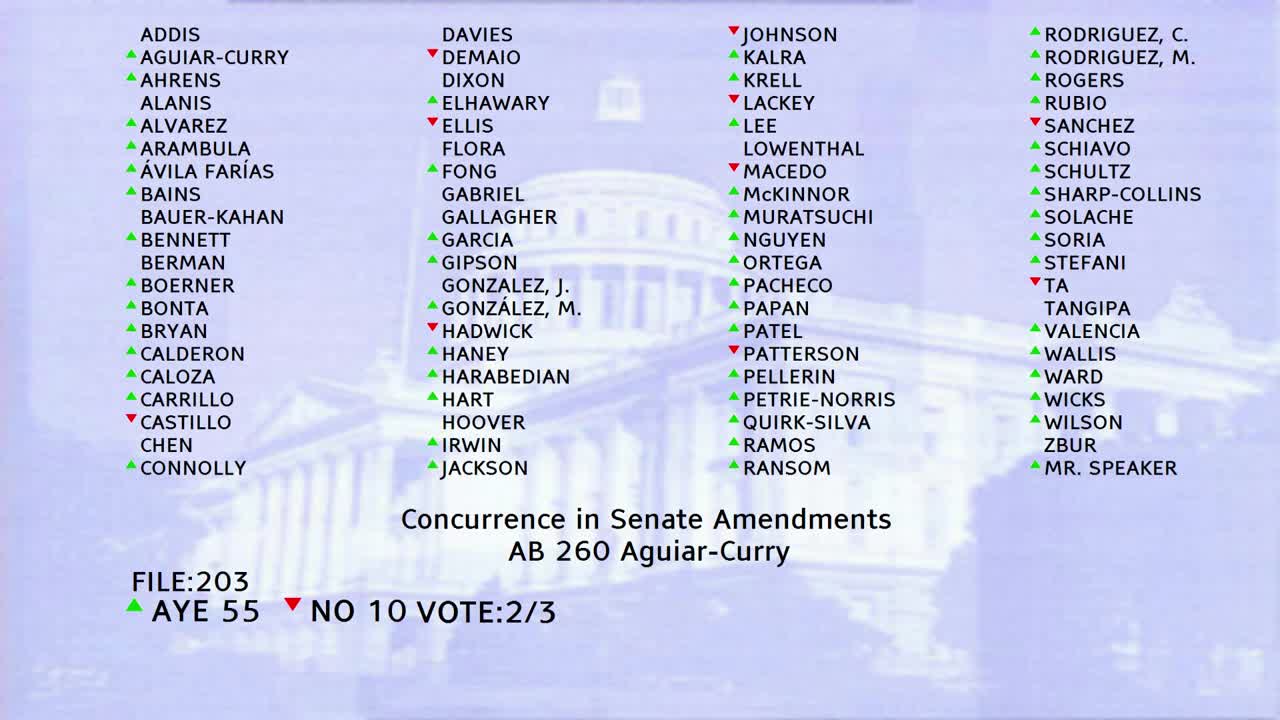 49SEC
Assembly Floor
 2MIN
Senate Floor
 42SEC
Senate Standing Committee on Appropriations
 9MIN
Senate Standing Committee on Judiciary
 15MIN
Senate Standing Committee on Public Safety
 1MIN
Assembly Floor
 9MIN
Assembly Standing Committee on Judiciary
 14MIN