AB 851: Real property transactions: Counties of Los Angeles and Ventura wildfires: unsolicited offers.
- Session Year: 2025-2026
- House: Assembly
- Latest Version Date: 2025-10-10
Current Status:
Passed
(2025-10-10: Chaptered by Secretary of State - Chapter 535, Statutes of 2025.)
Introduced
In Committee
Awaiting First Chamber Vote
Passed First Chamber
In Committee
Awaiting Second Chamber Vote
Passed Second Chamber
Enacted
What does this bill do?
The bill bans anyone from making unsolicited offers (for example by text, email, phone call, or mail) to buy residential property in specified ZIP codes in Los Angeles and Ventura counties. Before title transfers, the buyer and seller must sign—and the buyer must record—a written attestation that the sale was not the result of an unsolicited offer, and a seller can cancel a contract entered in violation for up to four months. Violators face civil fines (up to $25,000 per violation), possible misdemeanor penalties, and licensed agents can be disciplined under licensing law; the rule expires January 1, 2027.
The summary is provided by generative AI which can make mistakes. For original language, please view the details in the table below.
Existing law regulates sale transactions of real property. On January 7, 2025, the Governor proclaimed a state of emergency to exist in the Counties of Los Angeles and Ventura due to fire and windstorm conditions that caused multiple fires. Executive Order No. N-7-25, signed by the Governor on January 14, 2025, prohibited a buyer from making an unsolicited offer to an owner of real property located in specified ZIP Codes in the County of Los Angeles to purchase the real property for an amount less than what the fair market value of the property was on January 6, 2025. Executive Order No. N-17-25 expanded that prohibition to include real properties in additional specified ZIP Codes. Subsequent executive orders extended the prohibition until July 1, 2025. Existing law makes a violation of the executive order a misdemeanor, as specified.
Existing law, the Real Estate Law, provides for the licensure and regulation of real estate brokers and salespersons by the Real Estate Commissioner, the chief officer of the Department of Real Estate within the Business, Consumer Services, and Housing Agency. Existing law makes a willful violation of the Real Estate Law a crime.
This bill would prohibit a person, as defined, from making an unsolicited offer to purchase residential real property in certain ZIP Codes in the County of Los Angeles covered by the above-described executive orders and other specified ZIP Codes in the Counties of Los Angeles and Ventura. The bill would define unsolicited offer to purchase for this purpose. The bill would require the buyer and seller, before the transfer of title in the purchase of residential real property subject to the above-described prohibition, to execute a written attestation affirming compliance with that prohibition, which, if signed, would create a presumption that the accepted offer was solicited by the seller, as specified. The bill would require the buyer to record the signed attestation as an attachment to the deed or other conveyance of title when recording the transfer of title, as specified. Because the bill would expand the crime of perjury, the bill would impose a state-mandated local program.
This bill would make a written offer in violation of these provisions by a licensed person under the Real Estate Law on their own behalf, or on behalf of another person while conducting licensed activity, a violation of the persons licensing law, unless SB 641 is enacted and becomes operative, in which case the offer would be a violation of a provision added by SB 641. The bill would authorize the Attorney General, a county counsel, city attorney, or a district attorney to bring a civil action to enforce these provisions. In addition to any other available remedies or penalties, the bill would grant a seller the right to cancel a purchase agreement entered into in violation of these provisions, as specified. The bill would subject a person who violates the above-described prohibition on making an unsolicited offer to purchase real property in those ZIP Codes to an assessment of a civil penalty, and would make the violation a misdemeanor, as specified. By creating new crimes, this bill would impose a state-mandated local program.
This bill would make these provisions severable, would make these provisions operative 30 days after the effective date of the bill, and would repeal these provisions on January 1, 2027.
This bill would make legislative findings and declarations as to the necessity of a special statute for the Counties of Los Angeles and Ventura.
The California Constitution requires the state to reimburse local agencies and school districts for certain costs mandated by the state. Statutory provisions establish procedures for making that reimbursement.
This bill would provide that no reimbursement is required by this act for a specified reason.
This bill would declare that it is to take effect immediately as an urgency statute.
Existing law regulates sale transactions of real property. On January 7, 2025, the Governor proclaimed a state of emergency to exist in the Counties of Los Angeles and Ventura due to fire and windstorm conditions that caused multiple fires. Executive Order No. N-7-25, signed by the Governor on January 14, 2025, prohibited a buyer from making an unsolicited offer to an owner of real property located in specified ZIP Codes in the County of Los Angeles to purchase the real property for an amount less than what the fair market value of the property was on January 6, 2025. Executive Order No. N-17-25 expanded that prohibition to include real properties in additional specified ZIP Codes. Subsequent executive orders extended the prohibition until July 1, 2025. Existing law makes a violation of the executive order a misdemeanor, as specified.
Existing law, the Real Estate Law, provides for the licensure and regulation of real estate brokers and salespersons by the Real Estate Commissioner, the chief officer of the Department of Real Estate within the Business, Consumer Services, and Housing Agency. Existing law makes a willful violation of the Real Estate Law a crime.
This bill would prohibit a person, as defined, from making an unsolicited offer to purchase residential real property in certain ZIP Codes in the County of Los Angeles covered by the above-described executive orders and other specified ZIP Codes in the Counties of Los Angeles and Ventura. The bill would define unsolicited offer to purchase for this purpose. The bill would require the buyer and seller, before the transfer of title in the purchase of residential real property subject to the above-described prohibition, to execute a written attestation affirming compliance with that prohibition, which, if signed, would create a presumption that the accepted offer was solicited by the seller, as specified. The bill would require the buyer to record the signed attestation as an attachment to the deed or other conveyance of title when recording the transfer of title, as specified. Because the bill would expand the crime of perjury, the bill would impose a state-mandated local program.
This bill would make a written offer in violation of these provisions by a licensed person under the Real Estate Law on their own behalf, or on behalf of another person while conducting licensed activity, a violation of the persons licensing law. law, unless SB 641 is enacted and becomes operative, in which case the offer would be a violation of a provision added by SB 641. The bill would authorize the Attorney General, a county counsel, city attorney, or a district attorney to bring a civil action to enforce these provisions. In addition to any other available remedies or penalties, the bill would grant a seller the right to cancel a purchase agreement entered into in violation of these provisions, as specified. The bill would subject a person who violates the above-described prohibition on making an unsolicited offer to purchase real property in those ZIP Codes to an assessment of a civil penalty, and would make the violation a misdemeanor, as specified. By making a violation of the bills provisions a violation of the Real Estate Law and creating a new crime, creating new crimes, this bill would impose a state-mandated local program.
This bill would make these provisions severable, would make these provisions operative 30 days after the effective date of the bill, and would repeal these provisions on January 1, 2027.
This bill would make legislative findings and declarations as to the necessity of a special statute for the Counties of Los Angeles and Ventura.
The California Constitution requires the state to reimburse local agencies and school districts for certain costs mandated by the state. Statutory provisions establish procedures for making that reimbursement.
This bill would provide that no reimbursement is required by this act for a specified reason.
This bill would declare that it is to take effect immediately as an urgency statute.
Existing law regulates sale transactions of real property, including requiring real property sales contracts to include specified disclosures. property. On January 7, 2025, the Governor proclaimed a state of emergency to exist in the Counties of Los Angeles and Ventura due to fire and windstorm conditions that caused multiple fires. Executive Order No. N-7-25, signed by the Governor on January 14, 2025, prohibits prohibited a buyer from making an unsolicited offer to an owner of real property located in specified ZIP Codes in the County of Los Angeles to purchase the real property for an amount less than what the fair market value of the property was on January 6, 2025. Executive Order No. N-17-25 expanded that prohibition to include real properties in additional specified ZIP Codes. Executive Order No. N-7-25 imposes the prohibition for 3 months from January 14, 2025. Subsequent executive orders extended the prohibition until July 1, 2025. Existing law makes a violation of the executive order a misdemeanor, as specified.
Existing law, the Real Estate Law, provides for the licensure and regulation of real estate brokers and salespersons by the Real Estate Commissioner, the chief officer of the Department of Real Estate within the Business, Consumer Services, and Housing Agency. Existing law makes a willful violation of the Real Estate Law a crime.
This bill would prohibit a buyer person, as defined, from making an unsolicited offer to purchase residential real property in the certain ZIP Codes in the County of Los Angeles covered by the above-described executive orders. orders and other specified ZIP Codes in the Counties of Los Angeles and Ventura. The bill would define unsolicited offer to purchase for this purpose. The bill would require a the buyer and seller seller, before the transfer of title in the purchase of residential real property subject to the above-described prohibition, to execute a written attestation affirming compliance with this provision, as specified, prior to the transfer of title, that prohibition, which, if signed, would create a presumption that the accepted offer was solicited by the seller, as specified. The bill would require a county recorder to require that the buyer to record the signed attestation be attached as an attachment to the deed or other conveyance of title as a condition of when recording the transfer of title. title, as specified. Because the bill would expand the crime of perjury and impose a new duty on county recorders, perjury, the bill would impose a state-mandated local program.
This bill would make a written offer on behalf of a buyer in violation of these provisions by a licensed person under the Real Estate Law on their own behalf, or on behalf of another person while conducting licensed activity, a violation of the persons licensing law. The bill would define person to include a corporation, firm, partnership, or association existing under or authorized by the laws of this state or any other state, or any foreign country. The bill would authorize the Attorney General, a county counsel, city attorney, or a district attorney to bring a civil action to enforce these provisions. In addition to any other available remedies or penalties, for violations of these provisions, the bill would grant a seller the right to cancel a real property sales contract, authorize purchase agreement entered into in violation of these provisions, as specified. The bill would subject a person who violates the above-described prohibition on making an unsolicited offer to purchase real property in those ZIP Codes to an assessment of a civil penalty, and penalty, and would make the violations violation a misdemeanor, as specified. By making a violation of the bills provisions a violation of the Real Estate Law and creating a new crime, this bill would impose a state-mandated local program.
This bill would make these provisions severable, would make these provisions operative 30 days after the effective date of the bill, and would repeal these provisions on January 1, 2027.
This bill would make legislative findings and declarations as to the necessity of a special statute for the County Counties of Los Angeles. Los Angeles and Ventura.
The California Constitution requires the state to reimburse local agencies and school districts for certain costs mandated by the state. Statutory provisions establish procedures for making that reimbursement.This bill would provide that no reimbursement is required by this act for specified reasons.The California Constitution requires the state to reimburse local agencies and school districts for certain costs mandated by the state. Statutory provisions establish procedures for making that reimbursement.
This bill would provide that no reimbursement is required by this act for a specified reason.
This bill would declare that it is to take effect immediately as an urgency statute.
Existing law regulates sale transactions of real property, including requiring real property sales contracts to include specified disclosures. On January 7, 2025, the Governor proclaimed a state of emergency to exist in the Counties of Los Angeles and Ventura due to fire and windstorm conditions that caused multiple fires. Executive Order No. N-7-25, signed by the Governor on January 14, 2025, prohibits a buyer from making an unsolicited offer to an owner of real property located in specified ZIP Codes in the County of Los Angeles to purchase the real property for an amount less than what the fair market value of the property was on January 6, 2025. Executive Order No. N-17-25 expanded that prohibition to include real properties in additional specified ZIP Codes. Executive Order No. N-7-25 imposes the prohibition for 3 months from January 14, 2025. Existing law makes a violation of the executive order a misdemeanor, as specified.
Existing law, the Real Estate Law, provides for the licensure and regulation of real estate brokers and salespersons by the Real Estate Commissioner, the chief officer of the Department of Real Estate within the Business, Consumer Services, and Housing Agency. Existing law makes a willful violation of the Real Estate Law a crime.
This bill would prohibit a buyer from making an unsolicited offer to purchase residential real property in the ZIP Codes in the County of Los Angeles covered by the above-described executive orders. The bill would define unsolicited offer to purchase for this purpose. The bill would require a buyer and seller to execute a written attestation affirming compliance with this provision, as specified, prior to the transfer of title, which, if signed, would create a presumption that the accepted offer was solicited by the seller, as specified. The bill would require a county recorder to require that the signed attestation be attached to the deed or other conveyance of title as a condition of recording the transfer of title. Because the bill would expand the crime of perjury and impose a new duty on county recorders, the bill would impose a state-mandated local program.
This bill would make a written offer on behalf of a buyer in violation of these provisions by a licensed person under the Real Estate Law a violation of the persons licensing law. The bill would define person to include a corporation, firm, partnership, or association existing under or authorized by the laws of this state or any other state, or any foreign country. The bill would authorize the Attorney General, a county counsel, city attorney, or a district attorney to bring a civil action to enforce these provisions. In addition to any other available remedies or penalties, for violations of these provisions, the bill would grant a seller the right to cancel a real property sales contract, authorize an assessment of a civil penalty, and make the violations a misdemeanor, as specified. By making a violation of the bills provisions a violation of the Real Estate Law and creating a new crime, this bill would impose a state-mandated local program.
This bill would repeal these provisions on January 1, 2027.
This bill would make legislative findings and declarations as to the necessity of a special statute for the County of Los Angeles.
The California Constitution requires the state to reimburse local agencies and school districts for certain costs mandated by the state. Statutory provisions establish procedures for making that reimbursement.
This bill would provide that no reimbursement is required by this act for specified reasons.
This bill would declare that it is to take effect immediately as an urgency statute.
Existing law regulates sale transactions of real property, including requiring real property sales contracts to include specified disclosures. On January 7, 2025, the Governor proclaimed a state of emergency to exist in the Counties of Los Angeles and Ventura due to fire and windstorm conditions that caused multiple fires. Executive Order No. N-7-25, signed by the Governor on January 14, 2025, prohibits a buyer from making an unsolicited offer to an owner of real property located in specified ZIP Codes in the County of Los Angeles to purchase the real property for an amount less than what the fair market value of the property was on January 6, 2025. Executive Order No. N-17-25 expanded that prohibition to include real properties in additional specified ZIP Codes. Executive Order No. N-7-25 imposes the prohibition for 3 months from January 14, 2025. Existing law makes a violation of the executive order a misdemeanor, as specified.
Existing law, the Real Estate Law, provides for the licensure and regulation of real estate brokers and salespersons by the Real Estate Commissioner, the chief officer of the Department of Real Estate within the Business, Consumer Services, and Housing Agency. Existing law makes a willful violation of the Real Estate Law a crime.
This bill would prohibit a buyer from making an unsolicited offer to purchase any one to 4 family residential real properties property in the ZIP Codes in the County of Los Angeles covered by the above-described executive orders. The bill would require a buyer and seller to execute a written attestation affirming compliance with this provision, as specified, prior to the close of escrow. transfer of title, which, if signed, would create a presumption that the accepted offer was solicited by the seller, as specified. The bill would require a county recorder to require that the signed attestation to be attached to the deed or other conveyance of title as a condition of recording the transfer of title. Because the bill would expand the crime of perjury and impose a new duty on county recorders, the bill would impose a state-mandated local program.
This bill would make a written offer on behalf of a buyer in violation of these provisions by a licensed person under the Real Estate Law a violation of the persons licensing law. The bill would authorize the Attorney General, a county counsel, city attorney, or a district attorney to bring a civil action to enforce these provisions. In addition to any other available remedies or penalties, for violations of these provisions, the bill would grant a seller the right to cancel a real property sales contract, authorize an assessment of a civil penalty, and make the violations a misdemeanor, as specified. By making a violation of the bills provisions a violation of the Real Estate Law and creating a new crime, this bill would impose a state-mandated local program.
This bill would repeal these provisions on January 1, 2027.
This bill would make legislative findings and declarations as to the necessity of a special statute for the County of Los Angeles.
The California Constitution requires the state to reimburse local agencies and school districts for certain costs mandated by the state. Statutory provisions establish procedures for making that reimbursement.
This bill would provide that no reimbursement is required by this act for specified reasons.
This bill would declare that it is to take effect immediately as an urgency statute.
Existing law regulates sale transactions of real property, including requiring real property sales contracts to include specified disclosures. On January 7, 2025, the Governor proclaimed a state of emergency to exist in the Counties of Los Angeles and Ventura due to fire and windstorm conditions that caused multiple fires. Executive Order No. N-7-25, signed by the Governor on January 14, 2025, prohibits a buyer from making an unsolicited offer to an owner of real property located in specified ZIP Codes in the County of Los Angeles to purchase the real property for an amount less than what the fair market value of the property was on January 6, 2025. Executive Order No. N-17-25 expanded that prohibition to include real properties in additional specified ZIP Codes. Executive Order No. N-7-25 imposes the prohibition for 3 months from January 14, 2025. Existing law makes a violation of the executive order a misdemeanor, as specified.
This bill would codify and extend that prohibition until January 1, 2027. By creating a new crime, this bill would impose a state-mandated local program. The bill also, until January 1, 2027, would require a real property sales contract entered into on or after the bills effective date for a property in one of those ZIP Codes to contain provisions that give the seller the right to cancel the contract for 6 months after the date of execution of the contract, and, if so canceled, entitle the buyer to reimbursement of the purchase price and cost of improvements.Existing law, the Real Estate Law, provides for the licensure and regulation of real estate brokers and salespersons by the Real Estate Commissioner, the chief officer of the Department of Real Estate within the Business, Consumer Services, and Housing Agency. Existing law makes a willful violation of the Real Estate Law a crime.
This bill would prohibit a buyer from making an unsolicited offer to purchase any one to 4 family residential real properties in the ZIP Codes in the County of Los Angeles covered by the above-described executive orders. The bill would require a buyer and seller to execute a written attestation affirming compliance with this provision, as specified, prior to the close of escrow. The bill would require a county recorder to require that attestation to be attached to the deed or other conveyance of title as a condition of recording the transfer of title. Because the bill would expand the crime of perjury and impose a new duty on county recorders, the bill would impose a state-mandated local program.
This bill would make a violation of these provisions by a licensed person under the Real Estate Law a violation of the persons licensing law. The bill would authorize the Attorney General, a county counsel, or a district attorney to bring a civil action to enforce these provisions. In addition to any other available remedies or penalties, for violations of these provisions, the bill would grant a seller the right to cancel a real property sales contract, authorize an assessment of a civil penalty, and make the violations a misdemeanor, as specified. By making a violation of the bills provisions a violation of the Real Estate Law and creating a new crime, this bill would impose a state-mandated local program.
This bill would repeal these provisions on January 1, 2027.
This bill would make legislative findings and declarations as to the necessity of a special statute for the County of Los Angeles.
The California Constitution requires the state to reimburse local agencies and school districts for certain costs mandated by the state. Statutory provisions establish procedures for making that reimbursement.This bill would provide that no reimbursement is required by this act for a specified reason.The California Constitution requires the state to reimburse local agencies and school districts for certain costs mandated by the state. Statutory provisions establish procedures for making that reimbursement.
This bill would provide that no reimbursement is required by this act for specified reasons.
This bill would declare that it is to take effect immediately as an urgency statute.
Existing law regulates sale transactions of real property, including requiring real property sales contracts to include specified disclosures. On January 7, 2025, the Governor proclaimed a state of emergency to exist in the Counties of Los Angeles and Ventura due to fire and windstorm conditions that caused multiple fires. Executive Order No. N-7-25, signed by the Governor on January 14, 2025, prohibits a buyer from making an unsolicited offer to an owner of real property located in specified ZIP Codes in the County of Los Angeles to purchase the real property for an amount less than what the fair market value of the property was on January 6, 2025. Executive Order No. N-17-25 expanded that prohibition to include real properties in additional specified ZIP Codes. Executive Order No. N-7-25 imposes the prohibition for 3 months from January 14, 2025. Existing law makes a violation of the executive order a misdemeanor, as specified.
This bill would codify and extend that prohibition until January 1, 2027. By creating a new crime, this bill would impose a state-mandated local program. The bill also, until January 1, 2027, would require a real property sales contract entered into on or after the bills effective date for a property in one of those ZIP Codes to contain provisions that give the seller the right to cancel the contract for 6 months after the date of execution of the contract, and, if so canceled, entitle the buyer to reimbursement of the purchase price and cost of improvements.
This bill would make legislative findings and declarations as to the necessity of a special statute for the County of Los Angeles.
The California Constitution requires the state to reimburse local agencies and school districts for certain costs mandated by the state. Statutory provisions establish procedures for making that reimbursement.
This bill would provide that no reimbursement is required by this act for a specified reason.
This bill would declare that it is to take effect immediately as an urgency statute.
(a)A person shall not make an unsolicited offer to purchase residential real property in the 90049, 90263, 90265, 90272, 90290, 90402, 91001, 91024, 91103, 91104, 91106, 91107, 91301, 91302, or 91320 ZIP Codes.
(b)(1)Prior to the transfer of title in the purchase of residential real property described in subdivision (a), the buyer and seller shall execute a written attestation affirming that the purchase agreement was not entered into as a result of an unsolicited offer in violation of subdivision (a).
(2)The signed attestation described in paragraph (1) shall create a presumption that the accepted offer was solicited by the seller of the property, unless there is clear and convincing evidence to the contrary.
(3)The buyer shall record the signed attestation described in paragraph (1) as an attachment to the deed or other conveyance of title when recording the transfer of title.
(4)Failure to record the signed attestation described in paragraph (1) as an attachment to the deed or other conveyance of title shall not affect any constructive notice imparted by proper recordation of the deed or other conveyance and shall not affect the rights of any subsequent bona fide purchaser or encumbrancer.
(c)A person licensed pursuant to Division 4 (commencing with Section 10000) of the Business and Professions Code who makes a written offer on their own behalf, or on behalf of another person while conducting licensed activity, in violation of this section shall be deemed to have violated that persons licensing law.
(d)The Attorney General, a county counsel, city attorney, or a district attorney may bring a civil action to enforce this section.
(e)(1)A seller shall have the right to cancel a purchase agreement entered into in violation of this section, exercisable until four months after the date of execution of the contract.
(2)A person who violates subdivision (a) may be assessed a civil penalty not to exceed twenty-five thousand dollars ($25,000) per violation. The civil penalty may be assessed and recovered in a civil action brought in any court of competent jurisdiction.
(3)A person who violates subdivision (a) shall be guilty of a misdemeanor and, upon conviction thereof, shall be punishable by a fine not to exceed one thousand dollars ($1,000) or by imprisonment not to exceed six months.
(4)The remedies and penalties provided by this subdivision are nonexclusive and are in addition to any other remedies or penalties available under other laws.
(f)For purposes of this section:
(1)Person includes a corporation, firm, partnership, or association existing under or authorized by the laws of this state or any other state, or any foreign country.
(2)Unsolicited offer to purchase means any offer to purchase a property made by any person by text message, email, telephone call, mail, or other means of communication, unless either of the following conditions are met:
(A)At or before the time that the offer is made, there is public indication that the owner is willing to sell the property, including, but not limited to:
(i)The property is listed for sale by the owner or their agent on a multiple listing service or in any publicly available marketing platform.
(ii)The owner placed a for sale sign on the property or advertised the property for sale in a print publication or a flyer posted in a public place.
(B)The offer was made prior to the enactment of this section.
(g)The provisions of this section are severable. If any provision of this section or its application is held invalid, that invalidity shall not affect other provisions or applications that can be given effect without the invalid provision or application.
(h)This article shall become operative 30 days after the effective date of the act that added this section.
(i)This article shall be repealed on January 1, 2027.
SEC. 1.5.Article 3 (commencing with Section 2079.26) is added to Chapter 3 of Title 6 of Part 4 of Division 3 of the Civil Code, to read:3.Unsolicited Offers to Purchase Real Property Affected by January 2025 Fires in the Counties of Los Angeles and Ventura2079.26.(a)A person shall not make an unsolicited offer to purchase residential real property in the 90049, 90263, 90265, 90272, 90290, 90402, 91001, 91024, 91103, 91104, 91106, 91107, 91301, 91302, or 91320 ZIP Codes.
(b)(1)Prior to the transfer of title in the purchase of residential real property described in subdivision (a), the buyer and seller shall execute a written attestation affirming that the purchase agreement was not entered into as a result of an unsolicited offer in violation of subdivision (a).
(2)The signed attestation described in paragraph (1) shall create a presumption that the accepted offer was solicited by the seller of the property, unless there is clear and convincing evidence to the contrary.
(3)The buyer shall record the signed attestation described in paragraph (1) as an attachment to the deed or other conveyance of title when recording the transfer of title.
(4)Failure to record the signed attestation described in paragraph (1) as an attachment to the deed or other conveyance of title shall not affect any constructive notice imparted by proper recordation of the deed or other conveyance and shall not affect the rights of any subsequent bona fide purchaser or encumbrancer.
(c)A person licensed pursuant to Division 4 (commencing with Section 10000) of the Business and Professions Code who makes a written offer on their own behalf, or on behalf of another person while conducting licensed activity, in violation of this section shall be deemed to have violated subdivision (n) of Section 10176 of the Business and Professions Code.
(d)The Attorney General, a county counsel, city attorney, or a district attorney may bring a civil action to enforce this section.
(e)(1)A seller shall have the right to cancel a purchase agreement entered into in violation of this section, exercisable until four months after the date of execution of the contract.
(2)A person who violates subdivision (a) may be assessed a civil penalty not to exceed twenty-five thousand dollars ($25,000) per violation. The civil penalty may be assessed and recovered in a civil action brought in any court of competent jurisdiction.
(3)A person who violates subdivision (a) shall be guilty of a misdemeanor and, upon conviction thereof, shall be punishable by a fine not to exceed one thousand dollars ($1,000) or by imprisonment not to exceed six months.
(4)The remedies and penalties provided by this subdivision are nonexclusive and are in addition to any other remedies or penalties available under other laws.
(f)For purposes of this section:
(1)Person includes a corporation, firm, partnership, or association existing under or authorized by the laws of this state or any other state, or any foreign country.
(2)Unsolicited offer to purchase means any offer to purchase a property made by any person by text message, email, telephone call, mail, or other means of communication, unless either of the following conditions are met:
(A)At or before the time that the offer is made, there is public indication that the owner is willing to sell the property, including, but not limited to:
(i)The property is listed for sale by the owner or their agent on a multiple listing service or in any publicly available marketing platform.
(ii)The owner placed a for sale sign on the property or advertised the property for sale in a print publication or a flyer posted in a public place.
(B)The offer was made prior to the enactment of this section.
(g)The provisions of this section are severable. If any provision of this section or its application is held invalid, that invalidity shall not affect other provisions or applications that can be given effect without the invalid provision or application.
(h)This article shall become operative 30 days after the effective date of the act that added this section.
(i)This article shall be repealed on January 1, 2027.
SEC. 2.The Legislature finds and declares that a special statute is necessary and that a general statute cannot be made applicable within the meaning of Section 16 of Article IV of the California Constitution because of the immediate need to protect those impacted by the wildfires that began on January 7, 2025, in the Counties of Los Angeles and Ventura from exploitative practices.
SEC. 3.No reimbursement is required by this act pursuant to Section 6 of Article XIIIB of the California Constitution because the only costs that may be incurred by a local agency or school district will be incurred because this act creates a new crime or infraction, eliminates a crime or infraction, or changes the penalty for a crime or infraction, within the meaning of Section 17556 of the Government Code, or changes the definition of a crime within the meaning of Section 6 of Article XIIIB of the California Constitution.
SEC. 4.Section 1.5 of this bill shall only become operative if (1) both this bill and Senate Bill 641 are enacted and become effective on or before January 1, 2026, and (2) Senate Bill 641 amends Section 10176 of the Business and Professions Code, in which case Section 1 of this bill shall not become operative.
SEC. 5.This act is an urgency statute necessary for the immediate preservation of the public peace, health, or safety within the meaning of Article IV of the California Constitution and shall go into immediate effect. The facts constituting the necessity are:
There is an immediate need to protect those impacted by the wildfires that began on January 7, 2025, in the Counties of Los Angeles and Ventura from exploitative practices.
(a)A person shall not make an unsolicited offer to purchase residential real property in the 90049, 90263, 90265, 90272, 90290, 90402, 91001, 91024, 91103, 91104, 91106, 91107, 91301, 91302, or 91320 ZIP Codes.
(b)(1)Prior to the transfer of title in the purchase of residential real property described in subdivision (a), the buyer and seller shall execute a written attestation affirming that the purchase agreement was not entered into as a result of an unsolicited offer in violation of subdivision (a).
(2)The signed attestation described in paragraph (1) shall create a presumption that the accepted offer was solicited by the seller of the property, unless there is clear and convincing evidence to the contrary.
(3)The buyer shall record the signed attestation described in paragraph (1) as an attachment to the deed or other conveyance of title when recording the transfer of title.
(4)Failure to record the signed attestation described in paragraph (1) as an attachment to the deed or other conveyance of title shall not affect any constructive notice imparted by proper recordation of the deed or other conveyance and shall not affect the rights of any subsequent bona fide purchaser or encumbrancer.
(c)A person licensed pursuant to Division 4 (commencing with Section 10000) of the Business and Professions Code who makes a written offer on their own behalf, or on behalf of another person while conducting licensed activity, in violation of this section shall be deemed to have violated that persons licensing law.
(d)The Attorney General, a county counsel, city attorney, or a district attorney may bring a civil action to enforce this section.
(e)(1)A seller shall have the right to cancel a purchase agreement entered into in violation of this section, exercisable until four months after the date of execution of the contract.
(2)A person who violates subdivision (a) may be assessed a civil penalty not to exceed twenty-five thousand dollars ($25,000) per violation. The civil penalty may be assessed and recovered in a civil action brought in any court of competent jurisdiction.
(3)A person who violates subdivision (a) shall be guilty of a misdemeanor and, upon conviction thereof, shall be punishable by a fine not to exceed one thousand dollars ($1,000) or by imprisonment not to exceed six months.
(4)The remedies and penalties provided by this subdivision are nonexclusive and are in addition to any other remedies or penalties available under other laws.
(f)For purposes of this section:
(1)Person includes a corporation, firm, partnership, or association existing under or authorized by the laws of this state or any other state, or any foreign country.
(2)Unsolicited offer to purchase means any offer to purchase a property made by any person by text message, email, telephone call, mail, or other means of communication, unless either of the following conditions are met:
(A)At or before the time that the offer is made, there is public indication that the owner is willing to sell the property, including, but not limited to:
(i)The property is listed for sale by the owner or their agent on a multiple listing service or in any publicly available marketing platform.
(ii)The owner placed a for sale sign on the property or advertised the property for sale in a print publication or a flyer posted in a public place.
(B)The offer was made prior to the enactment of this section.
(g)The provisions of this section are severable. If any provision of this section or its application is held invalid, that invalidity shall not affect other provisions or applications that can be given effect without the invalid provision or application.
(h)This article shall become operative 30 days after the effective date of the act that added this section.
(i)This article shall be repealed on January 1, 2027.
SEC. 1.5.Article 3 (commencing with Section 2079.26) is added to Chapter 3 of Title 6 of Part 4 of Division 3 of the Civil Code, to read:3.Unsolicited Offers to Purchase Real Property Affected by January 2025 Fires in the Counties of Los Angeles and Ventura2079.26.(a)A person shall not make an unsolicited offer to purchase residential real property in the 90049, 90263, 90265, 90272, 90290, 90402, 91001, 91024, 91103, 91104, 91106, 91107, 91301, 91302, or 91320 ZIP Codes.
(b)(1)Prior to the transfer of title in the purchase of residential real property described in subdivision (a), the buyer and seller shall execute a written attestation affirming that the purchase agreement was not entered into as a result of an unsolicited offer in violation of subdivision (a).
(2)The signed attestation described in paragraph (1) shall create a presumption that the accepted offer was solicited by the seller of the property, unless there is clear and convincing evidence to the contrary.
(3)The buyer shall record the signed attestation described in paragraph (1) as an attachment to the deed or other conveyance of title when recording the transfer of title.
(4)Failure to record the signed attestation described in paragraph (1) as an attachment to the deed or other conveyance of title shall not affect any constructive notice imparted by proper recordation of the deed or other conveyance and shall not affect the rights of any subsequent bona fide purchaser or encumbrancer.
(c)A person licensed pursuant to Division 4 (commencing with Section 10000) of the Business and Professions Code who makes a written offer on their own behalf, or on behalf of another person while conducting licensed activity, in violation of this section shall be deemed to have violated subdivision (n) of Section 10176 of the Business and Professions Code.
(d)The Attorney General, a county counsel, city attorney, or a district attorney may bring a civil action to enforce this section.
(e)(1)A seller shall have the right to cancel a purchase agreement entered into in violation of this section, exercisable until four months after the date of execution of the contract.
(2)A person who violates subdivision (a) may be assessed a civil penalty not to exceed twenty-five thousand dollars ($25,000) per violation. The civil penalty may be assessed and recovered in a civil action brought in any court of competent jurisdiction.
(3)A person who violates subdivision (a) shall be guilty of a misdemeanor and, upon conviction thereof, shall be punishable by a fine not to exceed one thousand dollars ($1,000) or by imprisonment not to exceed six months.
(4)The remedies and penalties provided by this subdivision are nonexclusive and are in addition to any other remedies or penalties available under other laws.
(f)For purposes of this section:
(1)Person includes a corporation, firm, partnership, or association existing under or authorized by the laws of this state or any other state, or any foreign country.
(2)Unsolicited offer to purchase means any offer to purchase a property made by any person by text message, email, telephone call, mail, or other means of communication, unless either of the following conditions are met:
(A)At or before the time that the offer is made, there is public indication that the owner is willing to sell the property, including, but not limited to:
(i)The property is listed for sale by the owner or their agent on a multiple listing service or in any publicly available marketing platform.
(ii)The owner placed a for sale sign on the property or advertised the property for sale in a print publication or a flyer posted in a public place.
(B)The offer was made prior to the enactment of this section.
(g)The provisions of this section are severable. If any provision of this section or its application is held invalid, that invalidity shall not affect other provisions or applications that can be given effect without the invalid provision or application.
(h)This article shall become operative 30 days after the effective date of the act that added this section.
(i)This article shall be repealed on January 1, 2027.
SEC. 2.The Legislature finds and declares that a special statute is necessary and that a general statute cannot be made applicable within the meaning of Section 16 of Article IV of the California Constitution because of the immediate need to protect those impacted by the wildfires that began on January 7, 2025, in the Counties of Los Angeles and Ventura from exploitative practices.
SEC. 3.No reimbursement is required by this act pursuant to Section 6 of Article XIIIB of the California Constitution because the only costs that may be incurred by a local agency or school district will be incurred because this act creates a new crime or infraction, eliminates a crime or infraction, or changes the penalty for a crime or infraction, within the meaning of Section 17556 of the Government Code, or changes the definition of a crime within the meaning of Section 6 of Article XIIIB of the California Constitution.
SEC. 4.Section 1.5 of this bill shall only become operative if (1) both this bill and Senate Bill 641 are enacted and become effective on or before January 1, 2026, and (2) Senate Bill 641 amends Section 10176 of the Business and Professions Code, in which case Section 1 of this bill shall not become operative.
SEC. 4.SEC. 5.This act is an urgency statute necessary for the immediate preservation of the public peace, health, or safety within the meaning of Article IV of the California Constitution and shall go into immediate effect. The facts constituting the necessity are:
There is an immediate need to protect those impacted by the wildfires that began on January 7, 2025, in the Counties of Los Angeles and Ventura from exploitative practices.
(a)A buyer person shall not make an unsolicited offer to purchase residential real property in the 90019, 90041, 90049, 90066, 90263, 90265, 90272, 90290, 90402, 91001, 91024, 91040, 91103, 91104, 91106, 91107, 91367, 93535, or 93536 91301, 91302, or 91320 ZIP Codes.
(b)(1)Prior to the transfer of title, title in the purchase of residential real property described in subdivision (a), the buyer and seller shall execute a written attestation affirming that the real property sales contract purchase agreement was not entered into as a result of an unsolicited offer in violation of subdivision (a).
(2)The signed attestation described in paragraph (1) shall create a presumption that the accepted offer was solicited by the seller of the property, unless there is clear and convincing evidence to the contrary.
(3)A county recorder The buyer shall require record the signed attestation described in paragraph (1) to be attached as an attachment to the deed or other conveyance of title as a condition of when recording the transfer of title.
(4)Failure to record the signed attestation described in paragraph (1) as an attachment to the deed or other conveyance of title shall not affect any constructive notice imparted by proper recordation of the deed or other conveyance and shall not affect the rights of any subsequent bona fide purchaser or encumbrancer.
(c)A person licensed pursuant to Division 4 (commencing with Section 10000) of the Business and Professions Code who makes a written offer on behalf of a buyer their own behalf, or on behalf of another person while conducting licensed activity, in violation of this section shall be deemed to have violated that persons licensing law.
(d)The Attorney General, a county counsel, city attorney, or a district attorney may bring a civil action to enforce this section.
(e)(1)A seller shall have the right to cancel a real property sales contract purchase agreement entered into in violation of this section, exercisable until four months after the date of execution of the contract.
(2)A person who violates this section subdivision (a) may be assessed a civil penalty not to exceed twenty-five thousand dollars ($25,000) per violation. The civil penalty may be assessed and recovered in a civil action brought in any court of competent jurisdiction.
(3)A person who violates this section subdivision (a) shall be guilty of a misdemeanor and, upon conviction thereof, shall be punishable by a fine not to exceed one thousand dollars ($1,000) or by imprisonment not to exceed six months.
(4)The remedies and penalties provided by this subdivision are nonexclusive and are in addition to any other remedies or penalties available under other laws.
(f)For purposes of this section:
(1)Person includes a corporation, firm, partnership, or association existing under or authorized by the laws of this state or any other state, or any foreign country.
(2)Unsolicited offer to purchase means any offer to purchase a property made by any person by text message, email, telephone call, mail, or other means of communication, unless either of the following conditions are met:
(A)At or before the time that the offer is made, there is public indicia indication that the owner is willing to sell the property, including, but not limited to:
(i)The property is listed for sale by the owner or their agent on a multiple listing service or in any publicly available marketing platform for the sale of the property. platform.
(ii)The owner placed a for sale sign on the property, posted in a public place a flyer listing the property for sale, or advertised the property in a print publication. property or advertised the property for sale in a print publication or a flyer posted in a public place.
(B)The offer was made prior to the enactment of this section.
(g)The provisions of this section are severable. If any provision of this section or its application is held invalid, that invalidity shall not affect other provisions or applications that can be given effect without the invalid provision or application.
(h)This article shall become operative 30 days after the effective date of the act that added this section.
(g)(i)This article shall be repealed on January 1, 2027.
SEC. 2.The Legislature finds and declares that a special statute is necessary and that a general statute cannot be made applicable within the meaning of Section 16 of Article IV of the California Constitution because of the immediate need to protect those impacted by the wildfires that began on January 7, 2025, in the County Counties of Los Angeles and Ventura from exploitative practices.
SEC. 3.No reimbursement is required by this act pursuant to Section 6 of Article XIIIB of the California Constitution because a local agency or school district has the authority to levy service charges, fees, or assessments sufficient to pay for the program or level of service mandated by this act or because costs that may be incurred by a local agency or school district will be incurred because this act creates a new crime or infraction, eliminates a crime or infraction, or changes the penalty for a crime or infraction, within the meaning of Section 17556 of the Government Code, or changes the definition of a crime within the meaning of Section 6 of Article XIIIB of the California Constitution.SEC. 3.No reimbursement is required by this act pursuant to Section 6 of Article XIIIB of the California Constitution because the only costs that may be incurred by a local agency or school district will be incurred because this act creates a new crime or infraction, eliminates a crime or infraction, or changes the penalty for a crime or infraction, within the meaning of Section 17556 of the Government Code, or changes the definition of a crime within the meaning of Section 6 of Article XIIIB of the California Constitution.
SEC. 4.This act is an urgency statute necessary for the immediate preservation of the public peace, health, or safety within the meaning of Article IV of the California Constitution and shall go into immediate effect. The facts constituting the necessity are:
There is an immediate need to protect those impacted by the wildfires that began on January 7, 2025, in the County Counties of Los Angeles and Ventura from exploitative practices.
(a)A buyer shall not make an unsolicited offer to purchase residential real property in the 90019, 90041, 90049, 90066, 90265, 90272, 90290, 90402, 91001, 91024, 91040, 91103, 91104, 91106, 91107, 91367, 93535, or 93536 ZIP Codes.
(b)(1)Prior to the transfer of title, the buyer and seller shall execute a written attestation affirming that the real property sales contract was not entered into as a result of an unsolicited offer in violation of subdivision (a).
(2)The signed attestation described in paragraph (1) shall create a presumption that the accepted offer was solicited by the seller of the property, unless there is clear and convincing evidence to the contrary.
(3)A county recorder shall require the signed attestation described in paragraph (1) to be attached to the deed or other conveyance of title as a condition of recording the transfer of title.
(c)A person licensed pursuant to Division 4 (commencing with Section 10000) of the Business and Professions Code who makes a written offer on behalf of a buyer in violation of this section shall be deemed to have violated that persons licensing law.
(d)The Attorney General, a county counsel, city attorney, or a district attorney may bring a civil action to enforce this section.
(e)(1)A seller shall have the right to cancel a real property sales contract entered in violation of this section, exercisable until four months after the date of execution of the contract.
(2)A person who violates this section may be assessed a civil penalty not to exceed twenty-five thousand dollars ($25,000) per violation. The civil penalty may be assessed and recovered in a civil action brought in any court of competent jurisdiction.
(3)A person who violates this section shall be guilty of a misdemeanor and, upon conviction thereof, shall be punishable by a fine not to exceed one thousand dollars ($1,000) or by imprisonment not to exceed six months.
(4)The remedies and penalties provided by this subdivision are nonexclusive and are in addition to any other remedies or penalties available under other laws.
(f)For purposes of this section:
(1)Person includes a corporation, firm, partnership, or association existing under or authorized by the laws of this state or any other state, or any foreign country.
(2)Unsolicited offer to purchase means any offer to purchase a property made by any person by text message, email, telephone call, mail, or other means of communication, unless either of the following conditions are met:
(A)At or before the time that the offer is made, there is public indicia that the owner is willing to sell the property, including, but not limited to:
(i)The property is listed for sale by the owner or their agent on a multiple listing service or in any publicly available marketing platform for the sale of the property.
(ii)The owner placed a for sale sign on the property, posted in a public place a flyer listing the property for sale, or advertised the property in a print publication.
(B)The offer was made prior to the enactment of this section.
(f)(g)This article shall be repealed on January 1, 2027.
SEC. 2.The Legislature finds and declares that a special statute is necessary and that a general statute cannot be made applicable within the meaning of Section 16 of Article IV of the California Constitution because of the immediate need to protect those impacted by the wildfires that began on January 7, 2025, in the County of Los Angeles from exploitative practices.
SEC. 3.No reimbursement is required by this act pursuant to Section 6 of Article XIIIB of the California Constitution because a local agency or school district has the authority to levy service charges, fees, or assessments sufficient to pay for the program or level of service mandated by this act or because costs that may be incurred by a local agency or school district will be incurred because this act creates a new crime or infraction, eliminates a crime or infraction, or changes the penalty for a crime or infraction, within the meaning of Section 17556 of the Government Code, or changes the definition of a crime within the meaning of Section 6 of Article XIIIB of the California Constitution.
SEC. 4.This act is an urgency statute necessary for the immediate preservation of the public peace, health, or safety within the meaning of Article IV of the California Constitution and shall go into immediate effect. The facts constituting the necessity are:
There is an immediate need to protect those impacted by the wildfires that began on January 7, 2025, in the County of Los Angeles from exploitative practices.
(a)A buyer shall not make an unsolicited offer to purchase any one to four family residential real properties property in the 90019, 90041, 90049, 90066, 90265, 90272, 90290, 90402, 91001, 91024, 91040, 91103, 91104, 91106, 91107, 91367, 93535, or 93536 ZIP Codes.
(b)(1)Prior to the closing of escrow, transfer of title, the buyer and seller shall execute a written attestation affirming that the real property sales contract was not entered into as a result of an unsolicited offer in violation of subdivision (a).
(2)The signed attestation described in paragraph (1) shall create a presumption that the accepted offer was solicited by the seller of the property, unless there is clear and convincing evidence to the contrary.
(2)(3)A county recorder shall require the signed attestation described in paragraph (1) to be attached to the deed or other conveyance of title as a condition of recording the transfer of title.
(c)A person licensed pursuant to Division 4 (commencing with Section 10000) of the Business and Professions Code who violates makes a written offer on behalf of a buyer in violation of this section shall be deemed to have violated that persons licensing law.
(d)The Attorney General, a county counsel, city attorney, or a district attorney may bring a civil action to enforce this section.
(e)(1)A seller shall have the right to cancel a real property sales contract entered in violation of this section, exercisable until four months after the date of execution of the contract.
(2)A person who violates this section may be assessed a civil penalty not to exceed twenty-five thousand dollars ($25,000) per violation. The civil penalty may be assessed and recovered in a civil action brought in any court of competent jurisdiction.
(3)A person who violates this section shall be guilty of a misdemeanor and, upon conviction thereof, shall be punishable by a fine not to exceed one thousand dollars ($1,000) or by imprisonment not to exceed six months.
(4)The remedies and penalties provided by this subdivision are nonexclusive and are in addition to any other remedies or penalties available under other laws.
(f)This article shall be repealed on January 1, 2027.
SEC. 2.The Legislature finds and declares that a special statute is necessary and that a general statute cannot be made applicable within the meaning of Section 16 of Article IV of the California Constitution because of the immediate need to protect those impacted by the wildfires that began on January 7, 2025, in the County of Los Angeles from exploitative practices.
SEC. 3.No reimbursement is required by this act pursuant to Section 6 of Article XIIIB of the California Constitution because a local agency or school district has the authority to levy service charges, fees, or assessments sufficient to pay for the program or level of service mandated by this act or because costs that may be incurred by a local agency or school district will be incurred because this act creates a new crime or infraction, eliminates a crime or infraction, or changes the penalty for a crime or infraction, within the meaning of Section 17556 of the Government Code, or changes the definition of a crime within the meaning of Section 6 of Article XIIIB of the California Constitution.
SEC. 4.This act is an urgency statute necessary for the immediate preservation of the public peace, health, or safety within the meaning of Article IV of the California Constitution and shall go into immediate effect. The facts constituting the necessity are:
There is an immediate need to protect those impacted by the wildfires that began on January 7, 2025, in the County of Los Angeles from exploitative practices.
(a)A buyer shall not make an unsolicited offer to purchase any one to four family residential real property for a price less than the propertys fair market value on January 6, 2025. properties in the 90019, 90041, 90049, 90066, 90265, 90272, 90290, 90402, 91001, 91024, 91040, 91103, 91104, 91106, 91107, 91367, 93535, or 93536 ZIP Codes.
(b)(1)Prior to the closing of escrow, the buyer and seller shall execute a written attestation affirming that the real property sales contract was not entered into as a result of an unsolicited offer in violation of subdivision (a).
(2)A county recorder shall require the attestation described in paragraph (1) to be attached to the deed or other conveyance of title as a condition of recording the transfer of title.
(c)A person licensed pursuant to Division 4 (commencing with Section 10000) of the Business and Professions Code who violates this section shall be deemed to have violated that persons licensing law.
(d)The Attorney General, a county counsel, or a district attorney may bring a civil action to enforce this section.
(e)(1)A seller shall have the right to cancel a real property sales contract entered in violation of this section, exercisable until four months after the date of execution of the contract.
(2)A person who violates this section may be assessed a civil penalty not to exceed twenty-five thousand dollars ($25,000) per violation. The civil penalty may be assessed and recovered in a civil action brought in any court of competent jurisdiction.
(3)A person who violates this section shall be guilty of a misdemeanor and, upon conviction thereof, shall be punishable by a fine not to exceed one thousand dollars ($1,000) or by imprisonment not to exceed six months.
(4)The remedies and penalties provided by this subdivision are nonexclusive and are in addition to any other remedies or penalties available under other laws.
(b)This section shall apply only to real property located in the 90019, 90041, 90049, 90066, 90265, 90272, 90290, 90402, 91001, 91024, 91040, 91103, 91104, 91106, 91107, 91367, 93535, or 93536 ZIP Code.(c)A person who violates this section shall be guilty of a misdemeanor and, upon conviction thereof, shall be punishable by a fine not to exceed one thousand dollars ($1,000) or by imprisonment for not to exceed six months.(d)(f)This article shall be repealed on January 1, 2027.
SEC. 2.Section 2985.52 is added to the Civil Code, to read:2985.52.(a)A real property sales contract entered into on or after the effective date of this section shall contain provisions that do both of the following:(1)Give the seller the right to cancel the contract until six months after the date of execution of the contract have passed.(2)Entitle the buyer to reimbursement of the purchase price and cost of improvements constructed on the property between the date of execution of the contract and six months after the date of execution of the contract if the seller cancels the contract pursuant to paragraph (1).(b)This section shall apply only to real property located in the 90019, 90041, 90049, 90066, 90265, 90272, 90290, 90402, 91001, 91024, 91040, 91103, 91104, 91106, 91107, 91367, 93535, or 93536 ZIP Code.(c)This section shall be repealed on January 1, 2027.SEC. 3.SEC. 2.The Legislature finds and declares that a special statute is necessary and that a general statute cannot be made applicable within the meaning of Section 16 of Article IV of the California Constitution because of the immediate need to protect those impacted by the wildfires that began on January 7, 2025, in the County of Los Angeles from exploitative practices.
SEC. 4.No reimbursement is required by this act pursuant to Section 6 of Article XIIIB of the California Constitution because the only costs that may be incurred by a local agency or school district will be incurred because this act creates a new crime or infraction, eliminates a crime or infraction, or changes the penalty for a crime or infraction, within the meaning of Section 17556 of the Government Code, or changes the definition of a crime within the meaning of Section 6 of Article XIIIB of the California Constitution.SEC. 3.No reimbursement is required by this act pursuant to Section 6 of Article XIIIB of the California Constitution because a local agency or school district has the authority to levy service charges, fees, or assessments sufficient to pay for the program or level of service mandated by this act or because costs that may be incurred by a local agency or school district will be incurred because this act creates a new crime or infraction, eliminates a crime or infraction, or changes the penalty for a crime or infraction, within the meaning of Section 17556 of the Government Code, or changes the definition of a crime within the meaning of Section 6 of Article XIIIB of the California Constitution.
SEC. 5.SEC. 4.This act is an urgency statute necessary for the immediate preservation of the public peace, health, or safety within the meaning of Article IV of the California Constitution and shall go into immediate effect. The facts constituting the necessity are:
There is an immediate need to protect those impacted by the wildfires that began on January 7, 2025, in the County of Los Angeles from exploitative practices.
(a)A buyer shall not make an unsolicited offer to purchase real property for a price less than the propertys fair market value on January 6, 2025.
(b)This section shall apply only to real property located in the 90019, 90041, 90049, 90066, 90265, 90272, 90290, 90402, 91001, 91024, 91040, 91103, 91104, 91106, 91107, 91367, 93535, or 93536 ZIP Code.
(c)A person who violates this section shall be guilty of a misdemeanor and, upon conviction thereof, shall be punishable by a fine not to exceed one thousand dollars ($1,000) or by imprisonment for not to exceed six months.
(d)This article shall be repealed on January 1, 2027.
SEC. 2.Section 2985.52 is added to the Civil Code, to read:2985.52.(a)A real property sales contract entered into on or after the effective date of this section shall contain provisions that do both of the following:
(1)Give the seller the right to cancel the contract until six months after the date of execution of the contract have passed.
(2)Entitle the buyer to reimbursement of the purchase price and cost of improvements constructed on the property between the date of execution of the contract and six months after the date of execution of the contract if the seller cancels the contract pursuant to paragraph (1).
(b)This section shall apply only to real property located in the 90019, 90041, 90049, 90066, 90265, 90272, 90290, 90402, 91001, 91024, 91040, 91103, 91104, 91106, 91107, 91367, 93535, or 93536 ZIP Code.
(c)This section shall be repealed on January 1, 2027.
SEC. 3.The Legislature finds and declares that a special statute is necessary and that a general statute cannot be made applicable within the meaning of Section 16 of Article IV of the California Constitution because of the immediate need to protect those impacted by the wildfires that began on January 7, 2025, in the County of Los Angeles from exploitative practices.
SEC. 4.No reimbursement is required by this act pursuant to Section 6 of Article XIIIB of the California Constitution because the only costs that may be incurred by a local agency or school district will be incurred because this act creates a new crime or infraction, eliminates a crime or infraction, or changes the penalty for a crime or infraction, within the meaning of Section 17556 of the Government Code, or changes the definition of a crime within the meaning of Section 6 of Article XIIIB of the California Constitution.
SEC. 5.This act is an urgency statute necessary for the immediate preservation of the public peace, health, or safety within the meaning of Article IV of the California Constitution and shall go into immediate effect. The facts constituting the necessity are:
There is an immediate need to protect those impacted by the wildfires that began on January 7, 2025, in the County of Los Angeles from exploitative practices.
|
Date
|
Status
|
|---|---|
| Oct 10, 2025 | Chaptered by Secretary of State - Chapter 535, Statutes of 2025. |
| Oct 10, 2025 | Approved by the Governor. |
| Sep 23, 2025 | Enrolled and presented to the Governor at 4 p.m. |
| Sep 11, 2025 | Senate amendments concurred in. To Engrossing and Enrolling. (Ayes 66. Noes 7. Page 3303.). |
| Sep 10, 2025 | In Assembly. Concurrence in Senate amendments pending. |
| Sep 10, 2025 | Read third time. Urgency clause adopted. Passed. Ordered to the Assembly. (Ayes 30. Noes 8. Page 2814.). |
| Sep 8, 2025 | Read second time. Ordered to third reading. |
| Sep 5, 2025 | Read third time and amended. Ordered to second reading. |
| Sep 2, 2025 | Read second time. Ordered to third reading. |
| Aug 29, 2025 | Read second time and amended. Ordered returned to second reading. |
| Aug 29, 2025 | From committee: Amend, and do pass as amended. (Ayes 5. Noes 2.) (August 29). |
| Aug 18, 2025 | In committee: Referred to suspense file. |
| Jul 8, 2025 | From committee: Do pass and re-refer to Com. on APPR. (Ayes 5. Noes 1.) (July 8). Re-referred to Com. on APPR. |
| Jul 7, 2025 | Read second time and amended. Re-referred to Com. on PUB. S. |
| Jul 3, 2025 | From committee: Amend, and do pass as amended and re-refer to Com. on PUB. S. (Ayes 11. Noes 2.) (July 1). |
| Jun 11, 2025 | Referred to Coms. on JUD. and PUB. S. |
| Jun 3, 2025 | In Senate. Read first time. To Com. on RLS. for assignment. |
| Jun 2, 2025 | Read third time. Urgency clause adopted. Passed. Ordered to the Senate. (Ayes 67. Noes 6. Page 1858.). |
| May 27, 2025 | Read second time. Ordered to third reading. |
| May 23, 2025 | From committee: Do pass. (Ayes 12. Noes 0.) (May 23). |
| Apr 9, 2025 | In committee: Set, first hearing. Referred to APPR. suspense file. |
| Mar 28, 2025 | Re-referred to Com. on APPR. |
| Mar 27, 2025 | Read second time and amended. |
| Mar 26, 2025 | From committee: Amend, and do pass as amended and re-refer to Com. on APPR. (Ayes 12. Noes 0.) (March 25). |
| Mar 20, 2025 | Re-referred to Com. on JUD. |
| Mar 19, 2025 | From committee chair, with author's amendments: Amend, and re-refer to Com. on JUD. Read second time and amended. |
| Mar 3, 2025 | Referred to Com. on JUD. |
| Feb 20, 2025 | From printer. May be heard in committee March 22. |
| Feb 19, 2025 | Read first time. To print. |
|
Date
|
Description
|
Location
|
Votes
|
|
|---|---|---|---|---|
| Sep 11, 2025 | AB 851 McKinnor Concurrence in Senate Amendments | Assembly Floor |
Passed |
|
| Sep 10, 2025 | Assembly 3rd Reading AB851 McKinnor By Pérez Urgency Clause | Senate Floor |
Passed |
|
| Aug 29, 2025 | Do pass as amended | Senate Standing Committee on Appropriations |
Passed |
|
| Aug 18, 2025 | Placed on suspense file | Senate Standing Committee on Appropriations |
Passed |
|
| Jul 8, 2025 | Do pass, but first be re-referred to the Committee on [Appropriations] | Senate Standing Committee on Public Safety |
Passed |
|
| Jul 1, 2025 | Do pass as amended, but first amend, and re-refer to the Committee on [Public Safety] | Senate Standing Committee on Judiciary |
Passed |
|
| Jun 2, 2025 | AB 851 McKinnor Third Reading Urgency | Assembly Floor |
Passed |
|
| May 23, 2025 | Do pass. | Assembly Standing Committee on Appropriations |
Passed |
|
| Mar 25, 2025 | Do pass as amended and be re-referred to the Committee on [Appropriations] | Assembly Standing Committee on Judiciary |
Passed |
This list shows positions taken on this bill by organizations on the date displayed, which is linked to the original source.
Positions by individuals are not included.
|
Organization
|
Position
|
Date
|
|---|---|---|
| Altadena CLT Workgroup | ** Support | |
| Altadena Not for Sale | ** Support | |
| California Community Land Trust | ** Support | |
| California Green New Deal Coalition | ** Support | |
| City of Linwood | ** Support | |
| County of Los Angeles Board of Supervisors | ** Support | |
| Housing Now! | ** Support | |
| Inclusive Action for the City | ** Support | |
| Inglewood Board of Realtors | ** Support | |
| Morena Strategies | ** Support | |
| Nine individuals | ** Support | |
| Public Counsel | ** Support | |
| San Francisco Community Land Trust | ** Support | |
| San Gabriel Valley Community Land Trust | ** Support | |
| Starting Over Inc. | ** Support | |
| Two Valleys Community Land Trust | ** Support |
CONCURRENCE IN SENATE AMENDMENTS
CSA1 Bill Id:AB 851
Author:(McKinnor)
As Amended Ver:September 5, 2025
2/3 vote. Urgency
SUMMARY
Prohibits buyers from making unsolicited offers on residential property in fire-affected zip codes until January 1, 2027.
Major Provisions
- Prohibits a person from making an unsolicited offer to purchase residential real property in fire-affected zip codes.
- Establishes that prior to the transfer of title, in the purchase of residential real property in fire-affected zip codes, the buyer and seller must execute a written attestation affirming that the real property sales contract was not entered into as a result of an unsolicited offer.
- Establishes that the signed attestation in 2) creates a presumption that the accepted offer was solicited by the seller of the property unless there is a clear and convincing evidence to the contrary.
- Requires the buyer to record the signed attestation as an attachment to the deed or other conveyance of title when recording the transfer of title.
- Provides that the failure to record the signed attestation does not affect any constructive notice imparted by the deed and does not affect the rights of any subsequent bona fide purchaser or encumbrancer.
- Provides that a person licensed by the Department of Real Estate who makes a written offer on behalf of a buyer in violation of this bill is deemed to have violated that person's licensing law.
- Establishes that the Attorney General, a county counsel, city attorney, or a district attorney may bring a civil action to enforce the prohibition on unsolicited offers in 1).
- Provides a seller the right to cancel a purchase agreement that was entered into based on an unsolicited offer, for up to four months after the contract is signed.
- Establishes that any person who makes an unsolicited offer pursuant to 1) may be assessed a civil penalty of up to $25,000 and is guilty of a misdemeanor, which upon conviction is punishable by a fine of up to $1,000 or by imprisonment of up to six months.
- Defines "unsolicited offer to purchase" as an offer to purchase a property made by any person by text message, email, telephone call, mail, or other means of communication, unless either of the following conditions are met:
- At or before the time that the offer is made, there is public indication that the owner is willing to sell the property, such as the property being listed for sale.
- The offer was made prior to the enactment of this bill.
- Provides that the remedies and penalties are noncumulative and can be added to other remedies or penalties available by law.
- Provides that the provisions of the bill are severable.
- Establishes that the article is operative 30 days after the effective date of the act that added this section.
- Establishes that this bill will remain in effect until January 1, 2027.
- Contains an urgency clause. States that this act must take effect immediately because of the immediate need to protect those impacted by the wildfires that began on January 7, 2025, in the County of Los Angeles from exploitative practices.
- Adds chaptering amendments to resolve potential conflict with pending legislation.
Senate Amendments
Add definitions, clarify the effect of failure to record the signed attestation, include severability clause, and add chaptering amendments.
COMMENTS
The January 2025 wildfires in Los Angeles County were among the most devastating in California's history, scorching tens of thousands of acres, destroying entire neighborhoods, and displacing thousands of residents. In the wake of this devastation, there is significant concern that real estate speculators and predatory investors will exploit the crisis by making unsolicited offers to purchase homes at below-market prices, targeting vulnerable homeowners grappling with the trauma of displacement and financial uncertainty. This kind of pressure to sell, often before insurance claims are settled or homeowners have had time to assess their options, can strip survivors of their assets at a time when they most need stability.
This bill is designed to combat these exploitative practices by prohibiting unsolicited offers for residential real estate in the hardest-hit ZIP codes. By blocking opportunistic buyers from preying on fire victims, the bill ensures that homeowners have the time and space to make informed decisions about their property without undue pressure or manipulation. Through enforceable penalties, mandatory attestations, and county recording requirements, the bill aims to protect fire-affected communities from predatory real estate tactics and preserve homeownership in the wake of disaster.
Recognizing the severity of the situation, California Governor Gavin Newsom issued an executive order aimed at safeguarding fire victims from such exploitative real estate practices. (Executive Order N-7-25.) This order prohibits unsolicited and undervalued offers on properties in specific Los Angeles County zip codes, including Altadena, for a period of three months.
Governor Newsom explained the impetus for the executive order:
As families mourn, the last thing they need is greedy speculators taking advantage of their pain. I have heard first-hand from community members and victims who have received unsolicited and predatory offers from speculators offering cash far below market value — some while their homes were burning. We will not allow greedy developers to rip off these working-class communities at a time when they need more support than ever before.
(https://www.gov.ca.gov/2025/01/14/governor-newsom-issues-order-to-protect-fire-victims-from-predatory-real-estate-speculators/.)
This bill would prohibit any unsolicited offers on residential real property within the zip codes most affected by the Los Angeles fires until January 1, 2027. These zip codes cover areas in the Greater Los Angeles Area especially hard hit by the recent fires, such as parts of Altadena, Pacific Palisades, Pasadena, Mid-Wilshire, Eagle Rock, Barrington, Mar Vista, Malibu, Topanga, Santa Monica, Sunland, Lancaster, Culver City, and Mar Vista. Unlike the Executive Order, this bill prohibits all unsolicited offers, regardless of price.
To ensure compliance with the prohibition on unsolicited offers, the bill requires that, prior to the transfer of title, both the buyer and seller execute a written attestation affirming that the transaction was not the result of an unsolicited offer. This attestation, which must be recorded as an attachment to the deed or other conveyance of title, serves as a safeguard against circumvention of the law. It also provides certainty to title insurers, and the market generally, that a sales transaction did not unlawfully result from an unsolicited offer. In the absence of such documentation, it would be a case of "he said-he said" if the seller later tried to cancel the contract for violating the prohibition on unsolicited offers. Senate amendments clarify that the failure to record the signed attestation as an attachment to the deed does not affect the rights of any subsequence bona fide purchaser or encumbrancer. The bill creates a legal presumption that any accepted offer was solicited by the seller unless rebutted by clear and convincing evidence to the contrary. This heightened evidentiary standard strengthens the enforceability of the prohibition while placing the burden on those challenging a transaction to demonstrate that an unsolicited offer led to the sale.
What about people who want to sell their property? For homeowners who lost their houses in the wildfires, much of their property's remaining value lies in the land itself. However, rebuilding is a daunting and costly endeavor that could take years to complete. Many affected homeowners may be underinsured or completely uninsured, especially as several major insurers have pulled back from the California market, making it even more difficult to finance reconstruction. Even for those with full insurance coverage, the process of navigating claims, hiring contractors, and obtaining local permits can be overwhelming and time-consuming. Rather than enduring the uncertainty and hassle of rebuilding, some homeowners may prefer to sell their land as-is and move on. This not only spares them from a prolonged and complex recovery process but also provides an opportunity for a buyer to step in and begin construction immediately. Under this bill, a homeowner who seeks to sell their property, can do just that—but the seller must be the one to initiate the transaction. The bill in no way prohibits or inhibits property owners from actively seeking a buyer or listing their home for sale.
If a property owner (whether their home is still standing, damaged, or just the land remains) decides to sell their property, they can list it for sale on the MLS using a real estate agent, or list it as "For Sale By Owner" through online platforms like Zillow or Redfin. The listing would include pertinent details about the property, including the listing price. This allows the owner to set the price and make the decision to sell on their own terms. Senate amendments clarify that an unsolicited offer to purchase does not include scenarios where the property is listed for sale.
According to the Author
Many homeowners in Los Angeles County who were affected by the January 2025 fires have reported being targeted by unscrupulous businesses, scam artists and predatory buyers. Some of these bad actors engaged in illegal price gouging in the rental market and made unsolicited offers to property owners who lost their homes.
In response, Governor Newsom issued Executive Order No. N-7-25, which prohibits buyers from making unsolicited below market offers on residential properties in specified Los Angeles County zip codes for less than their fair market value as of January 6, 2025. The Governor later expanded this restriction through Executive Order No. N-17-25, adding more zip codes to the list. Executive Order No. N-7-25 enforces this prohibition for only three months.
AB 851 would codify Governor Newsom's Executive Order and extend impacted homeowner protections from unsolicited offers on residential properties and allow a seller in the affected zip codes to rescind the sale of their residential property for up to four months after the close of escrow, in the case of an unsolicited offer. These additional protections would expire in January 2027.
Fire survivors in LA County have experienced unimaginable trauma and need additional time to make an informed decision whether to rebuild their home or sell their property. These protections will prevent predatory real estate practices and give owners a reasonable amount of time to rescind the sale of their residential property.
Arguments in Support
The California Community Land Trust, the sponsor of this measure, explains its importance:
Many homeowners in Los Angeles County who were affected by the January 2025 fires have reported being targeted by unscrupulous businesses, scam artists and predatory buyers. Some of these bad actors engaged in illegal price gouging in the rental market and made unsolicited offers to property owners who lost their homes. In response, Governor Newsom issued Executive Order No. N-7-25, which prohibits buyers from making unsolicited below market offers on residential properties in specified Los Angeles County zip codes for less than their fair market value as of January 6, 2025. The Governor later expanded this restriction through Executive Order No. N-17-25, adding more zip codes to the list. Executive Order No. N-7-25 enforces this prohibition for only three months.
As recovery efforts continue, affected homeowners will need to make informed decisions about rebuilding their home or selling their property. These survivors should be protected from predatory practices as the recovery process is taking place. AB 851 would codify Governor Newsom's Executive Order and extend impacted homeowner protections from unsolicited offers on residential properties. Should a seller receive an unsolicited offer and sell their home to a predatory actor, a seller in the affected zip codes could rescind the sale of their residential property for up to four months after the close of escrow. These additional protections would expire in January 2027. Fire survivors in LA County have experienced unimaginable trauma and need to make an informed decision whether to rebuild their home or sell their property. These protections will prevent predatory unsolicited offers. If the home owner does fall victim to an unsolicited offer, AB 851 would give owners a reasonable amount of time to rescind the sale of their residential property.
Arguments in Opposition
None on file
FISCAL COMMENTS
According to the Senate Appropriations Committee:
Unknown, potentially significant costs (local funds, General Fund) to the counties to incarcerate people for the crime created by this bill. The average annual cost to incarcerate one person in county jail varies by county, but likely ranges from $70,000 to $90,000 per year. For example, in 2021, Los Angeles County budgeted $1.3 billion for jail spending, including $89,580 per incarcerated person. Actual incarceration costs to counties will depend on the number of convictions and the length of each sentence. Generally, county incarceration costs are not reimbursable state mandates pursuant to Proposition 30 (2012).
Workload cost pressures (General Fund) to the Department of Justice (DOJ) of an unknown but potentially significant amount. If state prosecutors file civil enforcement actions as authorized by this bill it will result in a significant workload increase.
Unknown, potentially significant costs to the state funded trial court system (Trial Court Trust Fund, General Fund) to adjudicate the criminal and civil penalties in this bill. Defendants are constitutionally guaranteed certain rights during criminal proceedings, including the right to a jury trial and the right to counsel (at public expense if the defendants are unable to afford the costs of representation). Increasing penalties leads to lengthier and more complex court proceedings with attendant workload and resource costs to the court. The fiscal impact of this bill to the courts will depend on many unknowns, including the numbers of people charged with an offense and the factors unique to each case. An eight-hour court day costs approximately $10,500 in staff in workload. This is a conservative estimate, based on the hourly rate of court personnel including at minimum the judge, clerk, bailiff, court reporter, jury administrator, administrative staff, and jury per-diems. If court days exceed 10, costs to the trial courts could reach hundreds of thousands of dollars. While the courts are not funded on a workload basis, an increase in workload could result in delayed court services and would put pressure on the General Fund to fund additional staff and resources and to increase the amount appropriated to backfill for trial court operations.
VOTES:
ASM JUDICIARY: 12-0-0
YES: Kalra, Dixon, Bauer-Kahan, Bryan, Connolly, Essayli, Harabedian, Pacheco, Papan, Sanchez, Stefani, Zbur
ASM APPROPRIATIONS: 12-0-3
YES: Wicks, Arambula, Calderon, Caloza, Dixon, Elhawary, Fong, Mark González, Hart, Pacheco, Pellerin, Solache
ABS, ABST OR NV: Sanchez, Ta, Tangipa
ASSEMBLY FLOOR: 67-6-6
YES: Addis, Aguiar-Curry, Ahrens, Alanis, Alvarez, Arambula, Ávila Farías, Bains, Bauer-Kahan, Bennett, Berman, Boerner, Bonta, Bryan, Calderon, Caloza, Carrillo, Connolly, Davies, Dixon, Elhawary, Flora, Fong, Gabriel, Garcia, Gipson, Jeff Gonzalez, Mark González, Haney, Harabedian, Hart, Hoover, Irwin, Jackson, Kalra, Krell, Lee, Lowenthal, McKinnor, Muratsuchi, Nguyen, Ortega, Pacheco, Papan, Patel, Pellerin, Petrie-Norris, Quirk-Silva, Ramos, Ransom, Celeste Rodriguez, Michelle Rodriguez, Rogers, Blanca Rubio, Schiavo, Schultz, Sharp-Collins, Solache, Soria, Stefani, Valencia, Wallis, Ward, Wicks, Wilson, Zbur, Rivas
NO: Chen, DeMaio, Gallagher, Patterson, Sanchez, Tangipa
ABS, ABST OR NV: Castillo, Ellis, Hadwick, Lackey, Macedo, Ta
UPDATED
VERSION: September 5, 2025
CONSULTANT: Shiran Zohar / JUD. / (916) 319-2334 FN: 0001841
SENATE RULES COMMITTEE Office of Senate Floor Analyses (916) 651-1520 Fax: (916) 327-4478 | AB 851 |
THIRD READING
Bill No: AB 851
Author: McKinnor (D)
Amended: 9/5/25 in Senate
Vote: 27 - Urgency
SENATE JUDICIARY COMMITTEE: 11-2, 7/1/25
AYES: Umberg, Allen, Arreguín, Ashby, Caballero, Durazo, Laird, Stern, Wahab, Weber Pierson, Wiener
NOES: Niello, Valladares
SENATE PUBLIC SAFETY COMMITTEE: 5-1, 7/8/25
AYES: Arreguín, Caballero, Gonzalez, Pérez, Wiener
NOES: Seyarto
SENATE APPROPRIATIONS COMMITTEE: 5-2, 8/29/25
AYES: Caballero, Cabaldon, Grayson, Richardson, Wahab
NOES: Seyarto, Dahle
ASSEMBLY FLOOR: 67-6, 6/2/25 - See last page for vote
SUBJECT: Real property transactions: Counties of Los Angeles and Ventura wildfires: unsolicited offers
SOURCE: California Community Land Trust
DIGEST:
This bill prohibits a person from making an unsolicited offer to purchase residential real property in specified ZIP codes, requires that the buyer and seller execute a specified written attestation affirming that the purchase agreement was not entered into as a result of an unsolicited offer, and provides various civil and criminal enforcement provisions.
Senate Floor Amendments of 9/5/25 add amendments that specify that, if both this bill and SB 641 are enacted and become effective on or before January 1, 2026, and SB 641 amends Business and Professions Code section 10176, a section of this bill will become operative that specifies that a person licensed pursuant to Division 4 of the Business and Professions Code who makes a written offer on their own behalf, or on behalf of another person while conducting licensed activity, in violation of the bill’s provisions, will be deemed to have violated subdivision (n) of the Business and Professions Code section 10176 created by SB 641.
ANALYSIS:
Existing law:
- Prohibits unfair, fraudulent, and deceptive practices in contracting, including for real estate transactions. (Civil (Civ.) Code §§ 1573, 1709, 1710.)
- Specifies that a person defrauded in the purchase, sale, or exchange of property is entitled to recover damages from the fraud, as specified. (Civ. Code § 3343.)
- Protects homeowners from certain predatory practices when the homeowner is being foreclosed upon. (Civ. Code §§ 2945 et seq.)
- Places specific duties upon real estate brokers or salespersons, and requires various disclosures and verifications for certain real estate transactions. (Civ. Code §§ 20179 et seq.; Civ. Code §§ 1102 et seq.; Gov. Code §§ 27201 et seq.)
- Establishes the Real Estate Law to provide for the licensure and regulation of real estate brokers and realtors and prohibits fraudulent, dishonest, or misleading conduct in real estate transactions. (Bus. & Prof. Code §§ 10000 et seq.)
This bill:
- Prohibits a person from making an unsolicited offer to purchase residential real property in specified ZIP codes.
- Requires, prior to the transfer of title in the purchase of residential real property in the zip codes specified in (1), that the buyer and seller of residential real property execute a written attestation affirming that the purchase agreement was not entered into as a result of an unsolicited offer.
- Requires the buyer to record the signed written attestation required by (2), above, as an attachment to the deed of the property or other conveyance of title when recording the transfer of title.
- Specifies that the failure to record the signed attestation as an attachment to the deed or other conveyance of title shall not affect any constructive notice imparted by proper recordation of the deed or other conveyance and shall not affect the rights of any subsequent bona fide purchaser or encumbrancer.
- Specifies that the signed attestation required by (2), above, creates a presumption that the accepted offer was solicited by the seller of the property, unless there is clear and convincing evidence to the contrary.
- Specifies that a licensed real estate agent or broker who makes a written offer on their own behalf, or on behalf of another person while conducting licensed activity, in violation of (2), above, is deemed to have violated their licensing law.
- Permits the Attorney General, county counsel, city attorney, or a district attorney to bring a civil action to enforce these provisions.
- Provides a seller of residential real property the right to cancel purchase agreement that was entered into in violation of these provisions within four months after the date of execution of the contract.
- Permits the assessment of a civil penalty of up to $25,000 per violation against a person who violates these provisions, to be assessed and recovered in a civil action in any court of competent jurisdiction.
- Specifies that a person who violates (1), above, is guilty of a misdemeanor punishable by a fine of not more than $1,000 or imprisonment for up to six months.
- Specifies that the remedies described in (8) through (10), above, are nonexclusive and in addition to any other remedies or penalties available under law.
- Defines, for the purposes of its provisions, the following:
- “person” to include a corporation, firm, partnership, or association existing under or authorized by the laws of this state or any other state, or any foreign country;
- “unsolicited offer to purchase” to mean any offer to purchase a property made by any person by text message, email, telephone call, mail, or other means of communication, unless either of the following are met:
- At or before the time that the offer is made, there is public indication that the owner is willing to sell the property, including but not limited to:
- The property is listed for sale by the owner or their agent on a multiple listing service or in any publicly available marketing platform;
- The owner placed a “for sale” sign on the property or advertised the property for sale in a print publication or a flyer posted in a public placed;
- The offer was made prior to the enactment of this section.
- At or before the time that the offer is made, there is public indication that the owner is willing to sell the property, including but not limited to:
- Specifies that its provisions are severable and that, if any provision or its application is held invalid, that validity shall not affect other provisions or applications that can be given effect without the invalid provision or application.
- Specifies that, if this bill and Senate Bill 641 are enacted and become effective on or before January 1, 2026, and Senate Bill amends Business and Professions Code section 10176, provisions of this bill that specify that a licensed real estate agent or broker who makes a written offer on their own behalf, or on behalf of another person while conducting licensed activity, in violation of (2), above, is deemed to have violated subdivision (n) of Business and Professions Code section 10176, shall become operative instead of the provisions described in (6), above.
- Repeals its provisions on January 1, 2027.
- Specifies that this bill is an urgency statute to take immediate effect, to become operative 30 days after the effective date of the act.
FISCAL EFFECT: Appropriation: No Fiscal Com.: Yes Local: Yes
According to the Senate Appropriations Committee:
Unknown, potentially significant costs (local funds, General Fund) to the counties to incarcerate people for the crime created by this bill. The average annual cost to incarcerate one person in county jail varies by county, but likely ranges from $70,000 to $90,000 per year. For example, in 2021, Los Angeles County budgeted $1.3 billion for jail spending, including $89,580 per incarcerated person. Actual incarceration costs to counties will depend on the number of convictions and the length of each sentence. Generally, county incarceration costs are not reimbursable state mandates pursuant to Proposition 30 (2012).
Workload cost pressures (General Fund) to the Department of Justice (DOJ) of an unknown but potentially significant amount. If state prosecutors file civil enforcement actions as authorized by this bill it will result in a significant workload increase.
Unknown, potentially significant costs to the state funded trial court system (Trial Court Trust Fund, General Fund) to adjudicate the criminal and civil penalties in this bill. Defendants are constitutionally guaranteed certain rights during criminal proceedings, including the right to a jury trial and the right to counsel (at public expense if the defendants are unable to afford the costs of representation). Increasing penalties leads to lengthier and more complex court proceedings with attendant workload and resource costs to the court. The fiscal impact of this bill to the courts will depend on many unknowns, including the numbers of people charged with an offense and the factors unique to each case. An eight-hour court day costs approximately $10,500 in staff in workload. This is a conservative estimate, based on the hourly rate of court personnel including at minimum the judge, clerk, bailiff, court reporter, jury administrator, administrative staff, and jury per-diems. If court days exceed 10, costs to the trial courts could reach hundreds of thousands of dollars. While the courts are not funded on a workload basis, an increase in workload could result in delayed court services and would put pressure on the General Fund to fund additional staff and resources and to increase the amount appropriated to backfill for trial court operations.
SUPPORT: (Verified 9/8/25)
California Community Land Trust Network (source)
Altadena CLT Work Group
Altadena Not for Sale
California Green New Deal Coalition
City of Linwood
County of Los Angeles Board of Supervisors
Housing Now!
Inclusive Action for the City
Inglewood Board of Realtors
Morena Strategies
Public Counsel
San Francisco Community Land Trust
San Gabriel Valley Community Land Trust
Starting Over Inc.
Two Valleys Community Land Trust
Nine individuals
OPPOSITION: (Verified 9/8/25)
None received
ARGUMENTS IN SUPPORT: According to the California Community Land Trust Network, which is the sponsor of this bill:
Many homeowners in Los Angeles County who were affected by the January 2025 fires have reported being targeted by unscrupulous businesses, scam artists and predatory buyers. Some of these bad actors engaged in illegal price gouging in the rental market and made unsolicited offers to property owners who lost their homes.
In response, Governor Newsom issued Executive Order No. N-7-25, which prohibits buyers from making unsolicited below market offers on residential properties in specified Los Angeles County zip codes for less than their fair market value as of January 6, 2025. The Governor later expanded this restriction through Executive Order No. N-17-25, adding more zip codes to the list. Executive Order No. N-7-25 enforces this prohibition and has now been extended by the Governor beyond the former expiration date.
We are working with the Department of Justice and Department of Real Estate representatives to assist with a precise definition section for this bill. These amendments are forthcoming and we are confident that the definition of an unsolicited offer will meet everyone’s needs.
As recovery efforts continue, affected homeowners will need to make informed decisions about rebuilding their home or selling their property. These survivors should be protected from predatory practices as the recovery process is taking place.
AB 851 would codify Governor Newsom’s Executive Order and extend impacted homeowner protections from unsolicited offers on residential properties. Should a seller receive an unsolicited offer and sell their home to a predatory actor, a seller in the affected zip codes could rescind the sale of their residential property for up to four months after the close of escrow. These additional protections would expire in January 2027.
Fire survivors in LA County have experienced unimaginable trauma and need to make an informed decision whether to rebuild their home or sell their property. These protections will prevent predatory unsolicited offers. If the homeowner does fall victim to an unsolicited offer, AB 851 would give owners a reasonable amount of time to rescind the sale of their residential property.
ASSEMBLY FLOOR: 67-6, 6/2/25
AYES: Addis, Aguiar-Curry, Ahrens, Alanis, Alvarez, Arambula, Ávila Farías, Bains, Bauer-Kahan, Bennett, Berman, Boerner, Bonta, Bryan, Calderon, Caloza, Carrillo, Connolly, Davies, Dixon, Elhawary, Flora, Fong, Gabriel, Garcia, Gipson, Jeff Gonzalez, Mark González, Haney, Harabedian, Hart, Hoover, Irwin, Jackson, Kalra, Krell, Lee, Lowenthal, McKinnor, Muratsuchi, Nguyen, Ortega, Pacheco, Papan, Patel, Pellerin, Petrie-Norris, Quirk-Silva, Ramos, Ransom, Celeste Rodriguez, Michelle Rodriguez, Rogers, Blanca Rubio, Schiavo, Schultz, Sharp-Collins, Solache, Soria, Stefani, Valencia, Wallis, Ward, Wicks, Wilson, Zbur, Rivas
NOES: Chen, DeMaio, Gallagher, Patterson, Sanchez, Tangipa
NO VOTE RECORDED: Castillo, Ellis, Hadwick, Lackey, Macedo, Ta
Prepared by: Ian Dougherty / JUD. / (916) 651-4113
9/8/25 21:26:38
**** END ****
SENATE RULES COMMITTEE Office of Senate Floor Analyses (916) 651-1520 Fax: (916) 327-4478 | AB 851 |
THIRD READING
Bill No: AB 851
Author: McKinnor (D)
Amended: 8/29/25 in Senate
Vote: 27 - Urgency
SENATE JUDICIARY COMMITTEE: 11-2, 7/1/25
AYES: Umberg, Allen, Arreguín, Ashby, Caballero, Durazo, Laird, Stern, Wahab, Weber Pierson, Wiener
NOES: Niello, Valladares
SENATE PUBLIC SAFETY COMMITTEE: 5-1, 7/8/25
AYES: Arreguín, Caballero, Gonzalez, Pérez, Wiener
NOES: Seyarto
SENATE APPROPRIATIONS COMMITTEE: 5-2, 8/29/25
AYES: Caballero, Cabaldon, Grayson, Richardson, Wahab
NOES: Seyarto, Dahle
ASSEMBLY FLOOR: 67-6, 6/2/25 - See last page for vote
SUBJECT: Real property transactions: Counties of Los Angeles and Ventura wildfires: unsolicited offers
SOURCE: California Community Land Trust
DIGEST:
This bill prohibits a person from making an unsolicited offer to purchase residential real property in specified ZIP codes, requires that the buyer and seller execute a specified written attestation affirming that the purchase agreement was not entered into as a result of an unsolicited offer, and provides various civil and criminal enforcement provisions.
ANALYSIS:
Existing law:
- Prohibits unfair, fraudulent, and deceptive practices in contracting, including for real estate transactions. (Civil Code (Civ. Code) §§ 1573, 1709, 1710.)
- Specifies that a person defrauded in the purchase, sale, or exchange of property is entitled to recover damages from the fraud, as specified. (Civ. Code § 3343.
- Protects homeowners from certain predatory practices when the homeowner is being foreclosed upon. (Civ. Code §§ 2945 et seq.)
- Places specific duties upon real estate brokers or salespersons, and requires various disclosures and verifications for certain real estate transactions. (Civ. Code §§ 20179 et seq.; Civ. Code §§ 1102 et seq.; Gov. Code §§ 27201 et seq.)
- Establishes the Real Estate Law to provide for the licensure and regulation of real estate brokers and realtors and prohibits fraudulent, dishonest, or misleading conduct in real estate transactions. (Bus. & Prof. Code §§ 10000 et seq.)
This bill:
- Prohibits a person from making an unsolicited offer to purchase residential real property in specified ZIP codes.
- Requires, prior to the transfer of title in the purchase of residential real property in the zip codes specified in (1), that the buyer and seller of residential real property execute a written attestation affirming that the purchase agreement was not entered into as a result of an unsolicited offer.
- Requires the buyer to record the signed written attestation required by (2), above, as an attachment to the deed of the property or other conveyance of title when recording the transfer of title.
- Specifies that the failure to record the signed attestation as an attachment to the deed or other conveyance of title shall not affect any constructive notice imparted by proper recordation of the deed or other conveyance and shall not affect the rights of any subsequent bona fide purchaser or encumbrancer.
- Specifies that the signed attestation required by (2), above, creates a presumption that the accepted offer was solicited by the seller of the property, unless there is clear and convincing evidence to the contrary.
- Specifies that a licensed real estate agent or broker who makes a written offer on their own behalf, or on behalf of another person while conducting licensed activity, in violation of (2), above, is deemed to have violated their licensing law.
- Permits the Attorney General, county counsel, city attorney, or a district attorney to bring a civil action to enforce these provisions.
- Provides a seller of residential real property the right to cancel purchase agreement that was entered into in violation of these provisions within four months after the date of execution of the contract.
- Permits the assessment of a civil penalty of up to $25,000 per violation against a person who violates these provisions, to be assessed and recovered in a civil action in any court of competent jurisdiction.
- Specifies that a person who violates (1), above, is guilty of a misdemeanor punishable by a fine of not more than $1,000 or imprisonment for up to six months.
- Specifies that the remedies described in (8) through (10), above, are nonexclusive and in addition to any other remedies or penalties available under law.
- Defines, for the purposes of its provisions, the following:
- “Person” to include a corporation, firm, partnership, or association existing under or authorized by the laws of this state or any other state, or any foreign country;
- “Unsolicited offer to purchase” to mean any offer to purchase a property made by any person by text message, email, telephone call, mail, or other means of communication, unless either of the following are met:
- At or before the time that the offer is made, there is public indication that the owner is willing to sell the property, including but not limited to:
- The property is listed for sale by the owner or their agent on a multiple listing service or in any publicly available marketing platform;
- The owner placed a “for sale” sign on the property or advertised the property for sale in a print publication or a flyer posted in a public placed;
- The offer was made prior to the enactment of this section.
- At or before the time that the offer is made, there is public indication that the owner is willing to sell the property, including but not limited to:
- Specifies that its provisions are severable and that, if any provision or its application is held invalid, that validity shall not affect other provisions or applications that can be given effect without the invalid provision or application.
- Repeals its provisions on January 1, 2027.
- Specifies that this bill is an urgency statute to take immediate effect, to become operative 30 days after the effective date of the act.
FISCAL EFFECT: Appropriation: No Fiscal Com.: Yes Local: Yes
According to the Senate Appropriations Committee:
Unknown, potentially significant costs (local funds, General Fund) to the counties to incarcerate people for the crime created by this bill. The average annual cost to incarcerate one person in county jail varies by county, but likely ranges from $70,000 to $90,000 per year. For example, in 2021, Los Angeles County budgeted $1.3 billion for jail spending, including $89,580 per incarcerated person. Actual incarceration costs to counties will depend on the number of convictions and the length of each sentence. Generally, county incarceration costs are not reimbursable state mandates pursuant to Proposition 30 (2012).
Workload cost pressures (General Fund) to the Department of Justice (DOJ) of an unknown but potentially significant amount. If state prosecutors file civil enforcement actions as authorized by this bill it will result in a significant workload increase.
Unknown, potentially significant costs to the state funded trial court system (Trial Court Trust Fund, General Fund) to adjudicate the criminal and civil penalties in this bill. Defendants are constitutionally guaranteed certain rights during criminal proceedings, including the right to a jury trial and the right to counsel (at public expense if the defendants are unable to afford the costs of representation). Increasing penalties leads to lengthier and more complex court proceedings with attendant workload and resource costs to the court. The fiscal impact of this bill to the courts will depend on many unknowns, including the numbers of people charged with an offense and the factors unique to each case. An eight-hour court day costs approximately $10,500 in staff in workload. This is a conservative estimate, based on the hourly rate of court personnel including at minimum the judge, clerk, bailiff, court reporter, jury administrator, administrative staff, and jury per-diems. If court days exceed 10, costs to the trial courts could reach hundreds of thousands of dollars. While the courts are not funded on a workload basis, an increase in workload could result in delayed court services and would put pressure on the General Fund to fund additional staff and resources and to increase the amount appropriated to backfill for trial court operations.
SUPPORT: (Verified 8/29/25)
California Community Land Trust Network (source)
Altadena CLT Work Group
Altadena Not for Sale
California Green New Deal Coalition
City of Linwood
County of Los Angeles Board of Supervisors
Housing Now!
Inclusive Action for the City
Morena Strategies
Public Counsel
San Francisco Community Land Trust
San Gabriel Valley Community Land Trust
Starting Over Inc.
Two Valleys Community Land Trust
Nine individuals
OPPOSITION: (Verified 8/29/25)
None received
ARGUMENTS IN SUPPORT:
According to the California Community Land Trust Network, which is the sponsor of AB 851:
Many homeowners in Los Angeles County who were affected by the January 2025 fires have reported being targeted by unscrupulous businesses, scam artists and predatory buyers. Some of these bad actors engaged in illegal price gouging in the rental market and made unsolicited offers to property owners who lost their homes.
In response, Governor Newsom issued Executive Order No. N-7-25, which prohibits buyers from making unsolicited below market offers on residential properties in specified Los Angeles County zip codes for less than their fair market value as of January 6, 2025. The Governor later expanded this restriction through Executive Order No. N-17-25, adding more zip codes to the list. Executive Order No. N-7-25 enforces this prohibition and has now been extended by the Governor beyond the former expiration date.
We are working with the Department of Justice and Department of Real Estate representatives to assist with a precise definition section for this bill. These amendments are forthcoming and we are confident that the definition of an unsolicited offer will meet everyone’s needs.
As recovery efforts continue, affected homeowners will need to make informed decisions about rebuilding their home or selling their property. These survivors should be protected from predatory practices as the recovery process is taking place.
AB 851 would codify Governor Newsom’s Executive Order and extend impacted homeowner protections from unsolicited offers on residential properties. Should a seller receive an unsolicited offer and sell their home to a predatory actor, a seller in the affected zip codes could rescind the sale of their residential property for up to four months after the close of escrow. These additional protections would expire in January 2027.
Fire survivors in LA County have experienced unimaginable trauma and need to make an informed decision whether to rebuild their home or sell their property. These protections will prevent predatory unsolicited offers. If the homeowner does fall victim to an unsolicited offer, AB 851 would give owners a reasonable amount of time to rescind the sale of their residential property.
ASSEMBLY FLOOR: 67-6, 6/2/25
AYES: Addis, Aguiar-Curry, Ahrens, Alanis, Alvarez, Arambula, Ávila Farías, Bains, Bauer-Kahan, Bennett, Berman, Boerner, Bonta, Bryan, Calderon, Caloza, Carrillo, Connolly, Davies, Dixon, Elhawary, Flora, Fong, Gabriel, Garcia, Gipson, Jeff Gonzalez, Mark González, Haney, Harabedian, Hart, Hoover, Irwin, Jackson, Kalra, Krell, Lee, Lowenthal, McKinnor, Muratsuchi, Nguyen, Ortega, Pacheco, Papan, Patel, Pellerin, Petrie-Norris, Quirk-Silva, Ramos, Ransom, Celeste Rodriguez, Michelle Rodriguez, Rogers, Blanca Rubio, Schiavo, Schultz, Sharp-Collins, Solache, Soria, Stefani, Valencia, Wallis, Ward, Wicks, Wilson, Zbur, Rivas
NOES: Chen, DeMaio, Gallagher, Patterson, Sanchez, Tangipa
NO VOTE RECORDED: Castillo, Ellis, Hadwick, Lackey, Macedo, Ta
Prepared by: Ian Dougherty / JUD. / (916) 651-4113
9/2/25 18:08:40
**** END ****
SENATE COMMITTEE ON
Senator Anna Caballero, Chair
2025 - 2026 Regular Session
AB 851 (McKinnor) - Real property transactions: County of Los Angeles wildfires: unsolicited offers
Version: | Policy Vote: |
Urgency: | Mandate: |
Hearing Date: | Consultant: |
Bill Summary:
Makes it a crime to make unsolicited offers on residential property in specified zip codes until January 1, 2027.
*********** ANALYSIS ADDENDUM – SUSPENSE FILE ***********
The following information is revised to reflect amendments
adopted by the committee on August 29, 2025
Fiscal Impact:
- Unknown, potentially significant costs (local funds, General Fund) to the counties to incarcerate people for the crime created by this bill. The average annual cost to incarcerate one person in county jail varies by county, but likely ranges from $70,000 to $90,000 per year. For example, in 2021, Los Angeles County budgeted $1.3 billion for jail spending, including $89,580 per incarcerated person. Actual incarceration costs to counties will depend on the number of convictions and the length of each sentence. Generally, county incarceration costs are not reimbursable state mandates pursuant to Proposition 30 (2012).
- Workload cost pressures (General Fund) to the Department of Justice (DOJ) of an unknown but potentially significant amount. If state prosecutors file civil enforcement actions as authorized by this bill it will result in a significant workload increase.
- Unknown, potentially significant costs to the state funded trial court system (Trial Court Trust Fund, General Fund) to adjudicate the criminal and civil penalties in this bill. Defendants are constitutionally guaranteed certain rights during criminal proceedings, including the right to a jury trial and the right to counsel (at public expense if the defendants are unable to afford the costs of representation). Increasing penalties leads to lengthier and more complex court proceedings with attendant workload and resource costs to the court. The fiscal impact of this bill to the courts will depend on many unknowns, including the numbers of people charged with an offense and the factors unique to each case. An eight-hour court day costs approximately $10,500 in staff in workload. This is a conservative estimate, based on the hourly rate of court personnel including at minimum the judge, clerk, bailiff, court reporter, jury administrator, administrative staff, and jury per-diems. If court days exceed 10, costs to the trial courts could reach hundreds of thousands of dollars. While the courts are not funded on a workload basis, an increase in workload could result in delayed court services and would put pressure on the General Fund to fund additional staff and resources and to increase the amount appropriated to backfill for trial court operations.
Author Amendments:
- Make the bill applicable to Ventura County.
- Add a severability clause.
- Make technical and conforming changes.
-- END --
SENATE COMMITTEE ON APPROPRIATIONS
Senator Anna Caballero, Chair
2025 - 2026 Regular Session
AB 851 (McKinnor) - Real property transactions: County of Los Angeles wildfires: unsolicited offers
Version: July 7, 2025 | Policy Vote: JUD. 11 - 2, PUB. S. 5 - 1 |
Urgency: Yes | Mandate: Yes |
Hearing Date: August 18, 2025 | Consultant: Liah Burnley |
Bill Summary:
AB 851 makes it a crime to make unsolicited offers on residential property in specified zip codes until January 1, 2027.
Fiscal Impact:
- Unknown, potentially significant costs (local funds, General Fund) to the counties to incarcerate people for the crime created by this bill. The average annual cost to incarcerate one person in county jail varies by county, but likely ranges from $70,000 to $90,000 per year. For example, in 2021, Los Angeles County budgeted $1.3 billion for jail spending, including $89,580 per incarcerated person. Actual incarceration costs to counties will depend on the number of convictions and the length of each sentence. Generally, county incarceration costs are not reimbursable state mandates pursuant to Proposition 30 (2012).
- Workload cost pressures (General Fund) to the Department of Justice (DOJ) of an unknown but potentially significant amount. If state prosecutors file civil enforcement actions as authorized by this bill it will result in a significant workload increase.
- Unknown, potentially significant costs to the state funded trial court system (Trial Court Trust Fund, General Fund) to adjudicate the criminal and civil penalties in this bill. Defendants are constitutionally guaranteed certain rights during criminal proceedings, including the right to a jury trial and the right to counsel (at public expense if the defendants are unable to afford the costs of representation). Increasing penalties leads to lengthier and more complex court proceedings with attendant workload and resource costs to the court. The fiscal impact of this bill to the courts will depend on many unknowns, including the numbers of people charged with an offense and the factors unique to each case. An eight-hour court day costs approximately $10,500 in staff in workload. This is a conservative estimate, based on the hourly rate of court personnel including at minimum the judge, clerk, bailiff, court reporter, jury administrator, administrative staff, and jury per-diems. If court days exceed 10, costs to the trial courts could reach hundreds of thousands of dollars. While the courts are not funded on a workload basis, an increase in workload could result in delayed court services and would put pressure on the General Fund to fund additional staff and resources and to increase the amount appropriated to backfill for trial court operations.
Background:
In response to wildfires, Governor Newsom issued Executive Order No. N-7-25, which, in part, prohibited buyers from making unsolicited below market offers on residential properties in specified Los Angeles County zip codes for less than their fair market value as of January 6, 2025. The Governor later expanded this restriction through Executive Order No. N-17-25, adding more zip codes to the list. This bill makes any unsolicited offer on a property a criminal offense, punishable by incarceration, and makes the conduct subject to civil penalties, and loss of licensure. Research shows that lengthy criminal sentences, which are costly to state and local governments, do not effectively deter crime. In general, the certainty that someone will be punished for an offense plays a larger role in deterring their criminal activity, rather than the length of their potential punishment.
Proposed Law:
- A buyer shall not make an unsolicited offer to purchase residential real property in specified ZIP Codes in Los Angeles County.
- Prior to the transfer of title, the buyer and seller shall execute a written attestation affirming that the real property sales contract was not entered into as a result of an unsolicited offer.
- A county recorder shall require the signed attestation to be attached to the deed or other conveyance of title as a condition of recording the transfer of title.
- A person licensed pursuant to the Business and Professions Code who makes a written offer on behalf of a buyer shall be deemed to have violated that person’s licensing law.
- The Attorney General, a county counsel, city attorney, or a district attorney may bring a civil enforcement action.
- A seller has the right to cancel a real property sales contract entered in violation of these provisions, exercisable until four months after the date of execution of the contract.
- A person who violates this section may be assessed a civil penalty not to exceed $25,000 per violation. The civil penalty may be assessed and recovered in a civil action brought in any court of competent jurisdiction.
- A person who violates this section is guilty of a misdemeanor and, upon conviction thereof, shall be punishable by a fine of $1,000 or by imprisonment not to exceed six months.
- “Unsolicited offer to purchase” means any offer to purchase a property made by any person by text message, email, telephone call, mail, or other means of communication, unless either of the following conditions are met:
- At or before the time that the offer is made, there is public indicia that the owner is willing to sell the property, including, but not limited to:
- The property is listed for sale by the owner or their agent on a multiple listing service or in any publicly available marketing platform for the sale of the property;
- The owner placed a “for sale” sign on the property, posted in a public place a flyer listing the property for sale, or advertised the property in a print publication;
- The offer was made prior to the enactment of this section.
- This article shall be repealed on January 1, 2027.
-- END --
SENATE COMMITTEE ON PUBLIC SAFETY
Senator Jesse Arreguín, Chair
2025 - 2026 Regular
Bill No: AB 851 Hearing Date: July 8, 2025
Author: | McKinnor | ||
Version: | July 7, 2025 | ||
Urgency: | Yes | Fiscal: | Yes |
Consultant: | SU | ||
Subject: Real property transactions: County of Los Angeles wildfires: unsolicited offers
HISTORY
Source: California Community Land Trust Network
Support: Altadena CLT Workgroup; Altadena Not for Sale; California Community Land Trust Network; California Green New Deal Coalition; County of Los Angeles Board of Supervisors; Inclusive Action for the City; Morena Strategies; Public Counsel; San Francisco Community Land Trust; Starting Over INC.; Two Valleys Community Land Trust
Opposition: None known
Assembly Floor Vote: 67 - 6
PURPOSE
The purpose of this bill is to prohibit buyers from making unsolicited offers on residential property in specified fire-affected zip codes until January 1, 2027, and to make this conduct a crime.
Existing law provides that a person who violates any of the provisions of the California Emergency Services Act, or who refuses or willfully neglects to obey any lawful order or regulation promulgated or issued pursuant to the Act, is guilty of a misdemeanor punishable by a fine not to exceed $1,000, or by imprisonment not to exceed six months, or by both. (Gov. Code, § 8665.)
Existing law establishes the Real Estate Law to provide for the Department of Real Estate (DRE) regulation of real estate salespersons, real estate brokers, transactions associated with the purchase or lease new homes or subdivided interests, and the sales of timeshare interests to consumers in California. (Bus. & Prof. Code, §§ 10000 et seq.)
Existing law authorizes the DRE to investigate the actions of any person engaged in the business or acting in the capacity of a real estate licensee and temporarily suspend or permanently revoke a real estate license for performing, or attempting to perform, specified violations of the Real Estate Law. (Bus. & Prof. Code, § 10176.)
Existing law states that any person, including officers, directors, agents or employees of corporations, who willfully violates or knowingly participates in violating provisions of the Real Estate Law is guilty of a misdemeanor punishable by a fine not exceeding $10,000, or by imprisonment in the county jail not exceeding six months, or by both. (Bus. & Prof. Code, § 10185.)
Existing law states that no part of the Real Estate Law which makes a violation of its provisions a crime shall be construed to preclude application of any other criminal provision of the law of this state. (Bus. & Prof. Code, § 10035.)
Existing law prohibits unfair and deceptive practices in real estate transactions, including fraud, misrepresentation, and undue influence in contractual agreements. (Civ. Code, §§ 1573, 1709, 1710.)
Existing law subjects buyers or real estate professionals who engage in coercive, misleading, or exploitative practices to civil and criminal liability. (Civ. Code, §§ 3343, 3345.)
Existing law protects homeowners from certain predatory real estate practices, particularly in transactions involving seniors, financially distressed individuals, or those affected by disasters. (Civ. Code, § 2945 et seq.)
Existing law provides that an act or omission that is punishable in different ways by different provisions of law may be punished under either of such provisions, but in no case shall the act or omission be punished under more than one provision. (Pen. Code, § 654, subd. (a).)
This bill prohibits a buyer from making an unsolicited offer to purchase residential real property in specified zip codes in Los Angeles County.
This bill requires the buyer and seller to execute a written attestation prior to the transfer of title affirming that the real property sales contract was not entered into as a result of an unsolicited offer.
This bill provides that the signed attestation creates a presumption that the accepted offer was solicited by the seller of the property, unless there is clear and convincing evidence to the contrary.
This bill requires the signed attestation be attached to the deed or other conveyance of title as a condition of recording the transfer of title.
This bill entitles a seller to cancel a real property sales contract entered into based on an unsolicited offer up to four months after the date of the contract’s execution.
This bill states that a person licensed under the Real Estate Law who makes a written offer on behalf of a buyer in violation of this section is deemed to have violated that person’s licensing law.
This bill states that a person who makes an unsolicited offer in the specified zip codes may be assessed a civil penalty of up to $25,000 per violation. The civil penalty may be assessed and recovered in a civil action brought in any court of competent jurisdiction.
This bill makes a violation of these provisions a misdemeanor punishable by a fine of up to $1,000, or by imprisonment not to exceed six months.
This bill authorizes the Attorney General, a county counsel, city attorney, or a district attorney to bring a civil action to enforce these provisions.
This bill states that these penalties are nonexclusive and are in addition to any other remedies or penalties available under other laws.
This bill repeals these provisions on January 1, 2027.
This bill declares that a special statute is necessary and that a general statute cannot be made applicable because of the immediate need to protect those impacted by the wildfires that began on January 7, 2025, in the County of Los Angeles from exploitative practices.
This bill contains an urgency clause.
COMMENTS
- Need for This Bill
According to the author:
Many homeowners in Los Angeles County who were affected by the January 2025 fires have reported being targeted by unscrupulous businesses, scam artists and predatory buyers. Some of these bad actors engaged in illegal price gouging in the rental market and made unsolicited offers to property owners who lost their homes.
In response, Governor Newsom issued Executive Order No. N-7-25, which prohibits buyers from making unsolicited below market offers on residential properties in specified Los Angeles County zip codes for less than their fair market value as of January 6, 2025. The Governor later expanded this restriction through Executive Order No. N-17-25, adding more zip codes to the list. Executive Order No. N-7-25 enforces this prohibition for only three months.
AB 851 would codify Governor Newsom’s Executive Order and extend impacted homeowner protections from unsolicited offers on residential properties and allow a seller in the affected zip codes to rescind the sale of their residential property for up to four months after the close of escrow, in the case of an unsolicited offer. These additional protections would expire in January 2027.
Fire survivors in LA County have experienced unimaginable trauma and need additional time to make an informed decision whether to rebuild their home or sell their property. These protections will prevent predatory real estate practices and give owners a reasonable amount of time to rescind the sale of their residential property.
- Governor Newsom’s Executive Order
After the January 2025 Palisades and Eaton fires in Los Angeles County, many home owners had their properties covered by toxic chemicals, significantly damaged, or completely destroyed. Residents within the affected areas of the fires have reported being solicited almost immediately after the fires to sell their properties, particularly in Altadena. (Bloomberg, “Fire Ravaged Altadena Attracting Real Estate Vultures Eyeing Deals,” Orange County Register, Jan. 15, 2025, https://www.ocregister.com/2025/01/15/fire-ravaged-altadena-attracts-real-estate-vultures-eyeing-deals/ [as of June 29, 2025].)
In light of these concerns, Governor Newsom issued an Executive Order prohibiting unsolicited offers to buy the property of victims of the wildfires. The Governor’s order prohibited unsolicited offers to purchase property for below the property’s fair market value in zip codes affected by the Los Angeles fires for a period of three months from the order’s issuance. In support of his Executive Order, Governor Newsom stated:
[…] as families mourn, the last thing they need is greedy speculators taking advantage of their pain. I have heard first-hand from community members and victims who have received unsolicited and predatory offers from speculators offering cash far below market value – some while their homes were burning. We will not allow greedy developers to rip off these working-class communities at a time when they need more support than ever before.
(Executive Order N-7-25, Jan. 14, 2025.) The Department of Real Estate issued a companion consumer alert warning homeowners affected by the wildfires of the risks of predatory purchasers and urging people to report unsolicited offers to buy their properties under fair market value. (https://www.dre.ca.gov/Consumers/PublicNotice_01172025_LA_Wildfires.html#:~:text=An%20unsolicited%20offer%20is%20an,%2C%20phone%20call%2C%20or%20mail. [as of June 29, 2025].)
In February, the Governor extended the executive order to include additional zip codes. (Executive Order N-17-25.) Subsequently, in April the timeline for the prohibition was extended to July 1, 2025. (Executive Order N-26-25.)
With the Executive Order now expired, this bill seeks to extend those protections through January 1, 2027. This bill differs from the Executive Order, however, in that it prohibits all unsolicited offers, whereas Executive Order N-7-25 prohibited unsolicited offers “for an amount less than the fair market or interest in the property on January 6, 2025.”
- Creation of New Crime
In order to protect property owners from predatory purchasers, this bill would make it a crime for any person to make an unsolicited offer to an owner of real property in specified zip codes. This bill would punish that conduct as a misdemeanor punishable by up to six months in county jail, or a fine of up to $1,000.
This punishment is consistent with the punishment noted in Executive Order N-7-25, which was based on the punishment for violation of an order issued under the California Emergency
Services Act. (See Gov. Code, § 8665.) However, as noted above, this new crime affects all unsolicited offers, not just those which are less than fair market value.
In addition to the criminal misdemeanor punishment, this bill also provides that a person who violates its provisions may be assessed a civil penalty of up to $25,000 per violation. This second penalty raises potential issues regarding the proscription against multiple punishment.
Penal Code section 654 states, in pertinent part, that an act or omission that is punishable in different ways by different provisions of law may be punished under either of such provisions, but in no case shall the act or omission be punished under more than one provision. (Pen. Code, § 654, subd. (a).) While the prohibition is most commonly an issue raised with regards to imposition of carceral sentences, it also applies to fines. (See Ralph’s Grocery Co. v. Department of Food and Agriculture (2003) 110 Cal.App.4th 694, 701.) In Ralph’s Grocery Co., supra, a case involving civil fines, the court noted, “Penal Code section 654 is broadly written to apply to any form of punishment under any provision of law. A fine clearly constitutes ‘punishment’ and [citations to several statutes] are clearly ‘provisions of law.’ … Punishment is punishment regardless of who imposes it.” (Ibid.)
- Double Referral
This bill was doubled referred to the Senate Judiciary Committee and this Committee. The Senate Judiciary Committee proposed amendments to this bill to define the term unsolicited offer. Those amendments will be taken in this Committee.
As proposed to be amended, this bill defines the term “unsolicited offer” as follows:
For purposes of this section, an “unsolicited offer to purchase” shall mean any offer to purchase a property made by any person by text, email, phone call, mail or other means of communication, unless one of the following conditions are met:
(1) At or before the time that the offer is made, there is public indicia that the owner is willing to sell the property, including, but not limited to:
(A) The property is listed for sale by the owner or their agent on a multiple listing service or in any publicly available marketing platform for the sale of the property
(B) The owner placed a for-sale sign on the property, posted in a public place a flyer listing the property for sale, or advertised the property in a print publication
(2) The offer was made prior to the enactment of these provisions.
In addition, as proposed to be amended, this bill defines the term “person” for purposes of these provisions as including “corporations, firms, partnerships and associations existing under or authorized by the laws of this State or any other State, or any foreign country.”
- Argument in Support
According to California Community Land Trust Network, the sponsor of this bill:
Many homeowners in Los Angeles County who were affected by the January 2025 fires have reported being targeted by unscrupulous businesses, scam artists and predatory buyers. Some of these bad actors engaged in illegal price gouging in the rental market and made unsolicited offers to property owners who lost their homes.
In response, Governor Newsom issued Executive Order No. N-7-25, which prohibits buyers from making unsolicited below market offers on residential properties in specified Los Angeles County zip codes for less than their fair market value as of January 6, 2025. The Governor later expanded this restriction through Executive Order No. N-17-25, adding more zip codes to the list. Executive Order No. N-7-25 enforces this prohibition and has now been extended by the Governor beyond the former expiration date.
We are working with the Department of Justice and Department of Real Estate representatives to assist with a precise definition section for this bill. These amendments are forthcoming and we are confident that the definition of an unsolicited offer will meet everyone’s needs.
As recovery efforts continue, affected homeowners will need to make informed decisions about rebuilding their home or selling their property. These survivors should be protected from predatory practices as the recovery process is taking place.
AB 851 would codify Governor Newsom’s Executive Order and extend impacted homeowner protections from unsolicited offers on residential properties. Should a seller receive an unsolicited offer and sell their home to a predatory actor, a seller in the affected zip codes could rescind the sale of their residential property for up to four months after the close of escrow. These additional protections would expire in January 2027.
Fire survivors in LA County have experienced unimaginable trauma and need to make an informed decision whether to rebuild their home or sell their property. These protections will prevent predatory unsolicited offers. If the homeowner does fall victim to an unsolicited offer, AB 851 would give owners a reasonable amount of time to rescind the sale of their residential property.
– END –
Senator Thomas Umberg, Chair
2025-2026 Regular Session
Bill No: AB 851 (Author:McKinnor)
Version: March 27, 2025
Hearing Date: July 1, 2025
Fiscal: Yes
Urgency: Yes
Consultant: ID
SUBJECT
Real property transactions: County of Los Angeles wildfires: unsolicited offers
DIGEST
This bill prohibits a buyer of residential real property in specified ZIP codes from making an unsolicited offer to purchase the property, requires that the buyer and seller execute a specified written attestation affirming that the contract was not entered into as a result of an unsolicited offer, and provides various civil and criminal enforcement provisions.
EXECUTIVE SUMMARY
In early January 2025, extremely dry conditions and high winds in Los Angeles resulted in two of the worst wildfires in state history: the Palisades and Eaton fires. The fires burned 37,469 acres and damaged or destroyed almost 18,000 structures, including 373 mobilehomes, and resulted in 29 fatalities. Many homeowners were significantly affected by the wildfires, because their properties were covered by hazardous debris and ash, significantly damaged, or completely destroyed by the blazes. For those whose homes were damaged and destroyed, the process of rebuilding will be a long and arduous one. In the aftermath of this tragedy, there have been reports of predatory buyers contacting property owners affected by the fires to make unsolicited offers to purchase their properties, often at prices much lower than the property’s fair market value. To protect vulnerable homeowners, the Governor issued an executive order prohibiting buyers from making unsolicited offers to purchase residential properties for below their fair market value; however, this prohibition ends on July 1, 2025. AB 851 would create a statutory prohibition against unsolicited offers to purchase residential real property in ZIP codes affected by the fires, and requires a buyer and seller to sign and record a written attestation affirming that the sale was not the result of an unsolicited offer. AB 851 would permit the Attorney General, a county counsel, city attorney, or district attorney to enforce its provisions, and would make a buyer who violates these provisions liable for a civil penalty of up to $25,000 per violation. In addition, AB 851 makes a violation of its provisions a misdemeanor punishable by a fine of $1,000 or imprisonment for no more than six months. AB also provides a seller the right to cancel the real estate sales contract within four months if these provisions are violated. AB 851 is an urgency measure to take effect immediately upon enactment, and would repeal its provisions on January 1, 2027. AB 851 is sponsored by the California Community Land Trust Network, and is supported by the County of Los Angeles. The Committee has received no timely letters of opposition. Should it pass this Committee, it will be next be referred to the Senate Public Safety Committee.
PROPOSED CHANGES TO THE LAW
Existing law:
- Prohibits unfair, fraudulent, and deceptive practices in contracting, including for real estate transactions. (Civ. Code §§ 1573, 1709, 1710.)
- Specifies that a person defrauded in the purchase, sale, or exchange of property is entitled to recover damages from the fraud, as specified. (Civ. Code § 3343.
- Protects homeowners from certain predatory practices when the homeowner is being foreclosed upon. (Civ. Code §§ 2945 et seq.)
- Places specific duties upon real estate brokers or salespersons, and requires various disclosures and verifications for certain real estate transactions. (Civ. Code §§ 20179 et seq.; Civ. Code §§ 1102 et seq.; Gov. Code §§ 27201 et seq.)
- Establishes the Real Estate Law to provide for the licensure and regulation of real estate brokers and realtors and prohibits fraudulent, dishonest, or misleading conduct in real estate transactions. (Bus. & Prof. Code §§ 10000 et seq.)
This bill:
- Prohibits a buyer from making an unsolicited offer to purchase residential real property in specified ZIP codes.
- Requires, prior to the transfer of title, that the buyer and seller of residential real property execute a written attestation affirming that the real property sales contract was not entered into as a result of an unsolicited offer.
- Requires the county recorder to require the signed written attestation required by (2), above, to be attached to the deed of the property as a condition of recording the transfer of title.
- Specifies that the signed attestation required by (2), above, creates a presumption that the accepted offer was solicited by the seller of the property, unless there is clear and convincing evidence to the contrary.
- Specifies that a licensed real estate agent or broker who makes an unsolicited written offer on behalf of a buyer in violation of (2), above, is deemed to have violated their licensing law.
- Permits the Attorney General, county counsel, city attorney, or a district attorney to bring a civil action to enforce these provisions.
- Provides a seller of residential real property the right to cancel a real property sales contract that was entered into in violation of these provisions within four months after the execution of the contract.
- Permits the assessment of a civil penalty of up to $25,000 per violation against a person who violates these provisions, to be assessed and recovered in a civil action.
- Specifies that a person who violates these provisions is guilty of a misdemeanor punishable by a fine of not more than $1,000 or imprisonment for up to six months.
- Specifies that the remedies described in (7) through (9), above, are nonexclusive and in addition to any other remedies or penalties available under law.
- Repeals its provisions on January 1, 2027.
- Specifies that this bill is an urgency statute to take immediate effect.
COMMENTS
- Author’s statement
According to the author:
Many homeowners in Los Angeles County who were affected by the January 2025 fires have reported being targeted by unscrupulous businesses, scam artists and predatory buyers. Some of these bad actors engaged in illegal price gouging in the rental market and made unsolicited offers to property owners who lost their homes.
In response, Governor Newsom issued an Executive Order to prohibit buyers from making unsolicited below market offers on residential properties in specified Los Angeles County zip codes for less than their fair market value as of January 6, 2025.
AB 851 would codify Governor Newsom’s Executive Order and extend impacted homeowner protections from unsolicited offers on residential properties and allow a seller in the affected zip codes to rescind the sale of their residential property for up to four months after the close of escrow, in the case of an unsolicited offer. These additional protections would expire in January 2027.
Fire survivors in LA County have experienced unimaginable trauma and need additional time to make an informed decision whether to rebuild their home or sell their property. These protections will prevent predatory real estate practices and give owners a reasonable amount of time to rescind the sale of their residential property.
- The Palisades and Eaton fires
In early January 2025, extremely dry conditions and high winds in Los Angeles resulted in two of the most destructive wildfires in state history. The Palisades fire, which started on January 7th, burned a total of 23,448 acres and damaged or destroyed almost 8,000 structures in the Pacific Palisades and Topanga State Park area of West Los Angeles.[1] That same day, another major fire also broke out in the greater Los Angeles area: the Eaton fire. The Eaton fire consumed 14,021 acres and damaged or destroyed more than 10,000 structures, including significant portions of the city of Altadena.[2] About half of all properties in the Pacific Palisades and Altadena were destroyed by the Palisades and Eaton fires, and both fires together tragically took the lives of 29 civilians and injured a dozen firefighters. Real estate losses have been estimated to be as high as $30 billion, and just under 13,000 households were displaced by the Palisades and Eaton fires.[3] An estimated 9,592 single family homes and condominiums, 678 apartment units, 2,210 duplex and bungalow courts, and 373 mobilehomes were either heavily damaged or destroyed. All told, the January wildfires in Los Angeles were some of the most tragic and destructive wildfires in state history.
Many homeowners were significantly affected by the wildfires. Many had their properties covered by hazardous debris and ash, significantly damaged, or completely destroyed by the blazes. The wildfires also interrupted numerous businesses and many people’s jobs. Homeowners whose homes were damaged or destroyed found themselves searching for temporary housing as they worked to rebuild or clean up their properties, all while still having mortgage payments due and possibly also experiencing interruptions in their employment or income. For homeowners who were uninsured or underinsured, the financial strain of the fires have been even more significant.
- The spectre of predatory buyers after the fire and Governor Newsom’s executive order
In the aftermath of this tragedy, affected property owners are incredibly vulnerable to further victimization and harm. This is the exact vulnerability that some have attempted to capitalize upon. Residents within the affected areas of the fires – particularly in Altadena – have reported being solicited almost immediately after the fires to sell their properties.[4] Sometimes, these solicitors try to entice wildfire victims by offering cash for their property, warning that home values will only go down due to the fires or that they will be unable to obtain insurance, or by offering to buy the property in any condition. However, these enticements come with a trade-off: the offers are often far below the market value of the property. Vulnerable homeowners facing the daunting task of rebuilding and additional financial strains from the wildfires may be easily convinced to take these unscrupulous buyers’ offers for the promise of a quick solution or quick cash. When they do, they may lose out on a significant amount of accumulated equity in their homes and the fair market value of the property, and they may be forced ultimately to move out of the community. For the city of Altadena, a historically African American and working-class city with a strong sense of community, the effects of these predatory property sales may significantly change the community’s identity and result in the displacement of families that have resided in Altadena for generations. These concerns caused some in Altadena to start a movement after the wildfires, the “Altadena Not for Sale” movement, to advocate against the predatory buying up of properties in the city that were impacted by the Eaton fire.[5]
In light of these concerns, the Department of Real Estate issued a consumer alert warning homeowners affected by the wildfires of the risks of predatory buyers.[6] In addition, Governor Newsom issued an Executive Order prohibiting unsolicited offers to buy the property of victims of the wildfires.[7] The Governor’s order prohibits unsolicited offers to purchase property for below the property’s fair market value in zip codes affected by the Los Angeles fires for a period of three months from the order’s issuance. The Governor extended this order to include additional zip codes on February 4th, and in April the timeline for the prohibition was extended to July 1, 2025.[8] In support of his Executive Order, Governor Newsom stated:
[…] as families mourn, the last thing they need is greedy speculators taking advantage of their pain. I have heard first-hand from community members and victims who have received unsolicited and predatory offers from speculators offering cash far below market value – some while their homes were burning. We will not allow greedy developers to rip off these working-class communities at a time when they need more support than ever before.[9]
- AB 851 proposes to prohibit a seller from making an unsolicited offer to buy a property of a homeowner affected by the LA wildfires
Considering that the Governor’s Executive Order expires on July 1st of this year, and the continuing risk to Los Angeles residents who are still trying to recover and rebuild, AB 851 proposes to place a prohibition against unsolicited offers to purchase properties in zip codes affected by the wildfires into statute. Specifically, AB 851 prohibits a buyer from making an unsolicited offer to purchase residential real property in specified zip codes, and requires a buyer and seller in the listed zip codes to execute a written attestation affirming that the property sales contract entered into was not entered into as a result of an unsolicited offer. This attestation would be required to be recorded with the county recorder and attached to the deed of the property. AB 851 would create a presumption that the accepted purchase offer was not unsolicited if this signed attestation is obtained.
AB 851 includes a number of enforcement provisions. First, it provides that, if a licensed real estate agent makes a written unsolicited offer on behalf of a buyer in violation of the bill, they will be deemed to have violated their real estate license. AB 851 also permits the Attorney General, county counsel, a city attorney, or a district attorney to bring a civil action to enforce the bill’s provisions, and provides that a person who violates the bill’s provisions may be assessed a civil penalty of up to $25,000 per violation. In addition, AB 851 provides a seller the right to cancel a real estate sales contract entered into in violation of the bill’s provisions, as can be done with unsolicited offers, within four months of the execution of the sales contract. Lastly, the bill makes a violation of its provisions a misdemeanor punishable by a fine of up to $1,000 or imprisonment of up to six months. While AB 851 would be enacted as an urgency statute to take effect immediately, its provisions would be repealed on January 1, 2027.
A property owner whose property was destroyed or otherwise affected by the Los Angeles wildfires may well wish to sell their property. This may be the easiest way for the property owner to recover their losses and move to another home immediately. Undoubtedly, the other option – staying and rebuilding on their property – could take many years before the property owner can use their property again. If a homeowner is underinsured, selling and moving may be even more appealing, since the costs to rebuild would be significant without insurance proceeds to cover the loss. Thus, many Angelenos affected by the wildfire may actually wish to sell their properties, whether or not the person to whom they finally sell their property to solicited them first.
However, at the same time, when a homeowner has lost their home to a disaster, they are vulnerable to being taken advantage of by unscrupulous buyers. Selling may appear to be the easiest option: any amount of immediate cash that a would-be buyer offers may seem quite appealing, if a homeowner is facing the uncertainty of rebuilding and is experiencing financial insecurity because of the wildfires. But the seller and the buyer in such cases are not negotiating from equal positions of power, given the distress and financial strain that the seller may be experiencing due to their property loss. Predatory buyers know this, and try to use it to their advantage in order to convince property owners to sell on the buyers’ terms. But, as previously mentioned, those terms could seriously deprive the homeowner of the true value of their home, the equity they have built in their home over time, and their ability to actually financially recover from the fire. Thus, a tension exists at the heart of AB 851, in which the need to protect vulnerable homeowners against the predatory activities of unscrupulous actors conflicts with the homeowner’s need to recover quickly from the wildfire, and with parties’ freedom to contract. Yet despite that tension, the risk of harm to vulnerable homeowners is real and significant, and AB 851 strikes a balance by limiting its applicability to properties affected by the wildfires and setting a sunset date of January 1, 2027. Additionally, by requiring an attestation that the sale was not from an unsolicited offer, AB 851 provides a process to ensure non-predatory, law-abiding buyers reasonable protection against later lawsuits challenging the sale.
It is still possible, even with AB 851’s prohibition on unsolicited offers, that affected homeowners will be take advantage of, as homeowners actively seeking buyers may still be in a vulnerable financial situation and willing to sell their property for below its actual market value. AB 851 would not stop such transactions. If a homeowner makes the decision to sell upon their own free will, they will be able to do so. However, in that situation, the homeowner already has made a conscious decision to sell their property before they received any actual offers. They therefore retained their agency, and made the decision to sell without the undue influence of a predatory buyer.
- Legal considerations
The First Amendment of the United States Constitution protects an individual’s freedom of speech. Under the First Amendment, any restriction on speech that is based on the content of the speech is presumptively unconstitutional and subject to strict scrutiny. (Reed v. Town of Gilbert (2015), 576 U.S. 155, 163.) However, when the speech involved is commercial speech, in that it solely relates to the economic interests of the speaker and its audience, it is less protected than other forms of speech. (Central Hudson v. Public Svn. Comm’n (1980) 447 U.S. 557, 562.) For government regulation of commercial speech to be constitutional, it must meet a four-part test first established in Central Hudson. First, it must be determined that the commercial speech is protected, which will be the case if it concerns lawful activity and is not misleading. Next, the government’s interest in regulating the commercial speech must be substantial. Third, the regulation must directly advance the governmental interest asserted, and finally, the regulation must not be more extensive than is necessary to serve the government’s interest. (Central Hudson¸ 447 U.S. 566.)
Because AB 851 prohibits a seller’s free speech in making unsolicited offers, concerns may arise that it violates the First Amendment. However, AB 851’s provisions would clearly be considered commercial speech, and thus be given lesser protection than other forms of speech. Furthermore, under the four-part test for regulations of commercial speech, the regulation in AB 851 would likely be constitutional. Specifically, the government’s interest in regulating unsolicited offers is substantial, given the extent of destruction caused by the Los Angeles wildfires and the risk that vulnerable, financially-stressed homeowners would be defrauded out of the value of the property by an unscrupulous buyer is a significant concern. Moreover, the speech may not even be protected if it is misleading. A prohibition against unsolicited offers arguably directly advances the government’s interest in protecting homeowners, and is designed to only limit the unsolicited offers in areas affected by the recent LA wildfires. Thus, while AB 851’s provisions may raise concerns that it abridges free speech, AB 851 is likely within the constitutional authority of the government, since it governs commercial speech and likely can satisfy the lessened constitutional standards for commercial speech.
- Amendments
The author has agreed to amendments that will provide a definition of “unsolicited offer.” The definition would define an unsolicited offer as an offer to purchase the property in which there is no public indicia that the seller is willing to sell the property at or before the time of the offer. A full mock-up of those amendments is attached at the end of this analysis.
- Arguments in support
According to the California Community Land Trust Network, which is the sponsor of AB 851:
Many homeowners in Los Angeles County who were affected by the January 2025 fires have reported being targeted by unscrupulous businesses, scam artists and predatory buyers. Some of these bad actors engaged in illegal price gouging in the rental market and made unsolicited offers to property owners who lost their homes.
In response, Governor Newsom issued Executive Order No. N-7-25, which prohibits buyers from making unsolicited below market offers on residential properties in specified Los Angeles County zip codes for less than their fair market value as of January 6, 2025. The Governor later expanded this restriction through Executive Order No. N-17-25, adding more zip codes to the list. Executive Order No. N-7-25 enforces this prohibition and has now been extended by the Governor beyond the former expiration date.
We are working with the Department of Justice and Department of Real Estate representatives to assist with a precise definition section for this bill. These amendments are forthcoming and we are confident that the definition of an unsolicited offer will meet everyone’s needs.
As recovery efforts continue, affected homeowners will need to make informed decisions about rebuilding their home or selling their property. These survivors should be protected from predatory practices as the recovery process is taking place.
AB 851 would codify Governor Newsom’s Executive Order and extend impacted homeowner protections from unsolicited offers on residential properties. Should a seller receive an unsolicited offer and sell their home to a predatory actor, a seller in the affected zip codes could rescind the sale of their residential property for up to four months after the close of escrow. These additional protections would expire in January 2027.
Fire survivors in LA County have experienced unimaginable trauma and need to make an informed decision whether to rebuild their home or sell their property. These protections will prevent predatory unsolicited offers. If the homeowner does fall victim to an unsolicited offer, AB 851 would give owners a reasonable amount of time to rescind the sale of their residential property.
SUPPORT
California Community Land Trust Network (sponsor)
County of Los Angeles Board of Supervisors
OPPOSITION
None received
RELATED LEGISLATION
Pending Legislation:
SB 641 (Ashby, 2025) authorizes the Real Estate Commissioner to revoke the real estate license of any realtor who makes an unsolicited offer to an owner of real property to purchase the property for an amount less than the fair market value if the property is located in a declared disaster area, and would make a violation of that provision a misdemeanor. SB 641 is currently pending before the Assembly Business and Professions Committee.
SB 610 (Pérez, 2025) requires, among other things, that the Commissioner of Financial Protection and Innovation of the Department of Financial Protection and Innovation to coordinate with mortgage lenders and servicers operating in the state to facilitate and monitor the implementation and promotion of mortgage forbearance, foreclosure prevention, and loss mitigation programs available to borrowers who experience a material decrease in household income or an increase in household expenses due to a wildfire, upon the declaration of a state of emergency due to wildfire. AB 610 is currently pending before the Assembly Housing and Community Development Committee.
AB 493 (Harabedian, 2025) requires mortgage lenders that make loans secured by property containing one- to four-family residences pay two percent interest on any insurance proceeds following property damage or loss that is held by the mortgage lender. AB 493 is currently pending before the Senate Appropriations Committee.
AB 238 (Harabedian, 2025) authorizes a borrower experiencing financial hardship due to the wildfire disasters in Los Angeles County in January 2025 to request forbearance on their residential mortgage loan, and requires a mortgage servicer to offer mortgage payment forbearance of up to an initial 90 days, up to 12 months. AB 238 is currently pending before the Senate Appropriations Committee.
Prior Legislation:
SB 455 (McGuire, Ch. 873, Stats. 2023) required that, when a mortgage on a property located within the geographic area of a declared state of emergency or local emergency is transferred to a new mortgage servicer, the transferor mortgage servicer provide the new mortgage servicer with any written records between the borrower and the mortgage servicer relating to the borrower’s use of insurance proceeds to repair or replace property damaged or destroyed by the disaster, and required the new mortgage servicer to honor any previous written agreements between the borrower and the previous mortgage servicer.
PRIOR VOTES:
Assembly Floor (Ayes 67, Noes 6)
Assembly Appropriations Committee (Ayes 12, Noes 0)
Assembly Judiciary Committee (Ayes 12, Noes 0)
**************
Mock-up of Amendments for 2025-2026 AB-851 (McKinnor (A))
(Amendments may be subject to technical changes by Legislative Counsel)
The people of the State of California do enact as follows:
SECTION 1. Article 3 (commencing with Section 2079.26) is added to Chapter 3 of Title 6 of Part 4 of Division 3 of the Civil Code, to read:
Article 3. Unsolicited Offers to Purchase Real Property Affected by January 2025 Fires in the County of Los Angeles
2079.26. (a) A buyer shall not make an unsolicited offer to purchase residential real property in the 90019, 90041, 90049, 90066, 90265, 90272, 90290, 90402, 91001, 91024, 91040, 91103, 91104, 91106, 91107, 91367, 93535, or 93536 ZIP Codes.
(b) (1) Prior to the transfer of title, the buyer and seller shall execute a written attestation affirming that the real property sales contract was not entered into as a result of an unsolicited offer in violation of subdivision (a).
(2) The signed attestation described in paragraph (1) shall create a presumption that the accepted offer was solicited by the seller of the property, unless there is clear and convincing evidence to the contrary.
(3) A county recorder shall require the signed attestation described in paragraph (1) to be attached to the deed or other conveyance of title as a condition of recording the transfer of title.
(c) A person licensed pursuant to Division 4 (commencing with Section 10000) of the Business and Professions Code who makes a written offer on behalf of a buyer in violation of this section shall be deemed to have violated that person’s licensing law.
(d) The Attorney General, a county counsel, city attorney, or a district attorney may bring a civil action to enforce this section.
(e) (1) A seller shall have the right to cancel a real property sales contract entered in violation of this section, exercisable until four months after the date of execution of the contract.
(2) A person who violates this section may be assessed a civil penalty not to exceed twenty-five thousand dollars ($25,000) per violation. The civil penalty may be assessed and recovered in a civil action brought in any court of competent jurisdiction.
(3) A person who violates this section shall be guilty of a misdemeanor and, upon conviction thereof, shall be punishable by a fine not to exceed one thousand dollars ($1,000) or by imprisonment not to exceed six months.
(4) The remedies and penalties provided by this subdivision are nonexclusive and are in addition to any other remedies or penalties available under other laws.
f) For purposes of this section, an “unsolicited offer to purchase” shall mean any offer to purchase a property made by any person by text, email, phone call, mail or other means of communication, unless one of the following conditions are met:
(1) At or before the time that the offer is made, there is public indicia that the owner is willing to sell the property, including, but not limited to:
(A) The property is listed for sale by the owner or their agent on a multiple listing service or in any publicly available marketing platform for the sale of the property
(B) The owner placed a for-sale sign on the property, posted in a public place a flyer listing the property for sale, or advertised the property in a print publication
(2) The offer was made prior to the enactment of these provisions
(h) For purposes of this section, “person” includes corporations, firms, partnerships and associations existing under or authorized by the laws of this State or any other State, or any foreign country.
(f) (g) This article shall be repealed on January 1, 2027.
SEC. 2. The Legislature finds and declares that a special statute is necessary and that a general statute cannot be made applicable within the meaning of Section 16 of Article IV of the California Constitution because of the immediate need to protect those impacted by the wildfires that began on January 7, 2025, in the County of Los Angeles from exploitative practices.
SEC. 3. No reimbursement is required by this act pursuant to Section 6 of Article XIII B of the California Constitution because a local agency or school district has the authority to levy service charges, fees, or assessments sufficient to pay for the program or level of service mandated by this act or because costs that may be incurred by a local agency or school district will be incurred because this act creates a new crime or infraction, eliminates a crime or infraction, or changes the penalty for a crime or infraction, within the meaning of Section 17556 of the Government Code, or changes the definition of a crime within the meaning of Section 6 of Article XIII B of the California Constitution.
SEC. 4. This act is an urgency statute necessary for the immediate preservation of the public peace, health, or safety within the meaning of Article IV of the California Constitution and shall go into immediate effect. The facts constituting the necessity are:
There is an immediate need to protect those impacted by the wildfires that began on January 7, 2025, in the County of Los Angeles from exploitative practices.
CalFire, “Palisades Fire,” (3/27/2025) https://www.fire.ca.gov/incidents/2025/1/7/palisades-fire. ↑
CalFire, “Eaton Fire,” (3/04/2025) https://www.fire.ca.gov/incidents/2025/1/7/eaton-fire. ↑
Doug Smith and Sandhya Kambhampati, “Real Estate losses from fires may top $30 billion, from old mobile homes to $23-million mansions,” Los Angeles Times (Feb. 21, 2025) https://www.latimes.com/california/story/2025-02-21/real-estate-losses-from-palisades-and-eaton-fires-top-30-billion#:~:text=Los%20Angeles%20Housing%20Department%20records,the%20city's%20rent%20stabilization%20ordinance. ↑
Amanda Del Cid Lugo, “Altadena residents sift through calls to sell – but the soul is not for sale,” Los Angeles Public Press (Feb. 12, 2025), https://lapublicpress.org/2025/02/altadena-real-estate-not-for-sale-eaton-property/. ↑
Id. ↑
Cal. Dept. of Real Estate, “Public Notice: Los Angeles property owners near wildfires urged to report unsolicited offers to buy their properties under fair market value,” (Jan. 17, 2025), https://www.dre.ca.gov/Consumers/PublicNotice_01172025_LA_Wildfires.html#:~:text=An%20unsolicited%20offer%20is%20an,%2C%20phone%20call%2C%20or%20mail. ↑
Governor Gavin Newsom, Executive Order N-7-25 (Jan. 14, 2025). ↑
See Governor Gavin Newsom, Executive Order N-17-25 (Feb. 4, 2025); Governor Gavin Newsom, Executive Order N-26-25 (Apr. 14, 2025). ↑
Office of the Governor, “Governor Newsom issues order to protect fire victims from predatory real estate speculators” (Jan. 14, 2025), https://www.gov.ca.gov/2025/01/14/governor-newsom-issues-order-to-protect-fire-victims-from-predatory-real-estate-speculators/. ↑
ASSEMBLY THIRD READING
ATR Bill Id:AB 851
Author:(McKinnor)
As Amended Ver:March 27, 2025
2/3 vote. Urgency
SUMMARY
Prohibits buyers from making unsolicited offers on residential property in fire-affected zip codes until January 1, 2027.
Major Provisions
- Prohibits a buyer from making an unsolicited offer to purchase residential real property in fire-affected zip codes.
- Establishes that prior to the transfer of title, the buyer and seller must execute a written attestation affirming that the real property sales contract was not entered into as a result of an unsolicited offer.
- Establishes that the signed attestation in 2) creates a presumption that the accepted offer was solicited by the seller of the property unless there is a clear and convincing evidence to the contrary.
- Requires that the signed attestation to be attached to the deed or other conveyance of title as a condition of recording the transfer of title.
- Provides that a person licensed by the Department of Real Estate who makes a written offer on behalf of a buyer in violation of this bill is deemed to have violated that person's licensing law.
- Establishes that the Attorney General, a county counsel, city attorney, or a district attorney may bring a civil action to enforce the prohibition on unsolicited offers in 1).
- Provides a seller the right to cancel a real property sales contract that was entered into based on an unsolicited offer, for up to four months after the contract is signed.
- Establishes that any person who makes an unsolicited offer pursuant to 1) may be assessed a civil penalty of up to $25,000 and is guilty of a misdemeanor, which upon conviction is punishable by a fine of up to $1,000 or by imprisonment of up to six months.
- Provides that the remedies and penalties are noncumulative and can be added to other remedies or penalties available by law.
- Establishes that this bill will remain in effect until January 1, 2027.
- Contains an urgency clause. States that this act must take effect immediately because of the immediate need to protect those impacted by the wildfires that began on January 7, 2025, in the County of Los Angeles from exploitative practices.
COMMENTS
The January 2025 wildfires in Los Angeles County were among the most devastating in California's history, scorching tens of thousands of acres, destroying entire neighborhoods, and displacing thousands of residents. In the wake of this devastation, there is significant concern that real estate speculators and predatory investors will exploit the crisis by making unsolicited offers to purchase homes at below-market prices, targeting vulnerable homeowners grappling with the trauma of displacement and financial uncertainty. This kind of pressure to sell, often before insurance claims are settled or homeowners have had time to assess their options, can strip survivors of their assets at a time when they most need stability.
This bill is designed to combat these exploitative practices by prohibiting unsolicited offers for residential real estate in the hardest-hit ZIP codes. By blocking opportunistic buyers from preying on fire victims, the bill ensures that homeowners have the time and space to make informed decisions about their property without undue pressure or manipulation. Through enforceable penalties, mandatory attestations, and county recording requirements, the bill aims to protect fire-affected communities from predatory real estate tactics and preserve homeownership in the wake of disaster.
Recognizing the severity of the situation, California Governor Gavin Newsom issued an executive order aimed at safeguarding fire victims from such exploitative real estate practices. (Executive Order N-7-25.) This order prohibits unsolicited and undervalued offers on properties in specific Los Angeles County zip codes, including Altadena, for a period of three months.
Governor Newsom explained the impetus for the executive order:
As families mourn, the last thing they need is greedy speculators taking advantage of their pain. I have heard first-hand from community members and victims who have received unsolicited and predatory offers from speculators offering cash far below market value — some while their homes were burning. We will not allow greedy developers to rip off these working-class communities at a time when they need more support than ever before.
(https://www.gov.ca.gov/2025/01/14/governor-newsom-issues-order-to-protect-fire-victims-from-predatory-real-estate-speculators/.)
This bill would prohibit any unsolicited offers on residential real property within the zip codes most affected by the Los Angeles fires until January 1, 2027. These zip codes cover areas in the Greater Los Angeles Area especially hard hit by the recent fires, such as parts of Altadena, Pacific Palisades, Pasadena, Mid-Wilshire, Eagle Rock, Barrington, Mar Vista, Malibu, Topanga, Santa Monica, Sunland, Lancaster, Culver City, and Mar Vista. The recent amendments reflected in the bill in print mark a shift from both and the originally introduced version of the bill. Unlike the Executive Order, this bill prohibits all unsolicited offers, regardless of price.
To ensure compliance with the prohibition on unsolicited offers, the bill requires that, prior to the transfer of title, both the buyer and seller execute a written attestation affirming that the transaction was not the result of an unsolicited offer. This attestation, which must be attached to the deed or other conveyance of title as a condition of recording, serves as a safeguard against circumvention of the law. It also provides certainty to title insurers, and the market generally, that a sales transaction did not unlawfully result from an unsolicited offer. In the absence of such documentation, it would be a case of "he said-he said" if the seller later tried to cancel the contract for violating the prohibition on unsolicited offers. The bill creates a legal presumption that any accepted offer was solicited by the seller unless rebutted by clear and convincing evidence to the contrary. This heightened evidentiary standard strengthens the enforceability of the prohibition while placing the burden on those challenging a transaction to demonstrate that an unsolicited offer led to the sale. By conditioning the recording of title transfers on the execution of this attestation, the bill provides a concrete enforcement mechanism that ensures compliance with its restrictions while maintaining the integrity of property transactions in fire-affected areas.
How is this bill enforced? The bill establishes multiple enforcement mechanisms to deter and penalize violations of its prohibition on unsolicited offers. Real estate professionals licensed by the Department of Real Estate who knowingly facilitate a prohibited unsolicited offer would be deemed to have violated their licensing law, subjecting them to potential disciplinary action, including suspension or revocation of their license. Additionally, the bill grants enforcement authority to the Attorney General, county counsels, city attorneys, and district attorneys, who may initiate civil actions against violators. Sellers who enter into a sales contract in violation of this measure are provided a statutory right to cancel the contract within four months of its execution, offering an added layer of protection against coercive sales practices. Violators may also face significant financial and criminal penalties: each violation may result in a civil penalty of up to $25,000, enforceable through civil litigation, and a misdemeanor charge punishable by a fine of up to $1,000 and/or imprisonment for up to six months. By combining regulatory oversight, prosecutorial enforcement, and direct remedies for sellers, the bill ensures a robust framework to deter unlawful real estate solicitations in fire-affected communities.
What about people who want to sell their property? For homeowners who lost their houses in the wildfires, much of their property's remaining value lies in the land itself. However, rebuilding is a daunting and costly endeavor that could take years to complete. Many affected homeowners may be underinsured or completely uninsured, especially as several major insurers have pulled back from the California market, making it even more difficult to finance reconstruction. Even for those with full insurance coverage, the process of navigating claims, hiring contractors, and obtaining local permits can be overwhelming and time-consuming. Rather than enduring the uncertainty and hassle of rebuilding, some homeowners may prefer to sell their land as-is and move on. This not only spares them from a prolonged and complex recovery process but also provides an opportunity for a buyer to step in and begin construction immediately. Under this bill, a homeowner who seeks to sell their property, can do just that—but the seller must be the one to initiate the transaction. The bill in no way prohibits or inhibits property owners from actively seeking a buyer or listing their home for sale.
If a property owner (whether their home is still standing, damaged, or just the land remains) decides to sell their property, they can list it for sale on the MLS using a real estate agent, or list it as "For Sale By Owner" through online platforms like Zillow or Redfin. The listing would include pertinent details about the property, including the listing price. This allows the owner to set the price and make the decision to sell on their own terms.
According to the Author
Many homeowners in Los Angeles County who were affected by the January 2025 fires have reported being targeted by unscrupulous businesses, scam artists and predatory buyers. Some of these bad actors engaged in illegal price gouging in the rental market and made unsolicited offers to property owners who lost their homes.
In response, Governor Newsom issued Executive Order No. N-7-25, which prohibits buyers from making unsolicited below market offers on residential properties in specified Los Angeles County zip codes for less than their fair market value as of January 6, 2025. The Governor later expanded this restriction through Executive Order No. N-17-25, adding more zip codes to the list. Executive Order No. N-7-25 enforces this prohibition for only three months.
AB 851 would codify Governor Newsom's Executive Order and extend impacted homeowner protections from unsolicited offers on residential properties and allow a seller in the affected zip codes to rescind the sale of their residential property for up to four months after the close of escrow, in the case of an unsolicited offer. These additional protections would expire in January 2027.
Fire survivors in LA County have experienced unimaginable trauma and need additional time to make an informed decision whether to rebuild their home or sell their property. These protections will prevent predatory real estate practices and give owners a reasonable amount of time to rescind the sale of their residential property.
Arguments in Support
The California Community Land Trust, the sponsor of this measure, explains its importance:
Many homeowners in Los Angeles County who were affected by the January 2025 fires have reported being targeted by unscrupulous businesses, scam artists and predatory buyers. Some of these bad actors engaged in illegal price gouging in the rental market and made unsolicited offers to property owners who lost their homes. In response, Governor Newsom issued Executive Order No. N-7-25, which prohibits buyers from making unsolicited below market offers on residential properties in specified Los Angeles County zip codes for less than their fair market value as of January 6, 2025. The Governor later expanded this restriction through Executive Order No. N-17-25, adding more zip codes to the list. Executive Order No. N-7-25 enforces this prohibition for only three months.
As recovery efforts continue, affected homeowners will need to make informed decisions about rebuilding their home or selling their property. These survivors should be protected from predatory practices as the recovery process is taking place. AB 851 would codify Governor Newsom's Executive Order and extend impacted homeowner protections from unsolicited offers on residential properties. Should a seller receive an unsolicited offer and sell their home to a predatory actor, a seller in the affected zip codes could rescind the sale of their residential property for up to four months after the close of escrow. These additional protections would expire in January 2027. Fire survivors in LA County have experienced unimaginable trauma and need to make an informed decision whether to rebuild their home or sell their property. These protections will prevent predatory unsolicited offers. If the home owner does fall victim to an unsolicited offer, AB 851 would give owners a reasonable amount of time to rescind the sale of their residential property.
Arguments in Opposition
None on file
FISCAL COMMENTS
According to the Assembly Appropriations Committee:
- Possible costs (General Fund, special funds) to the Department of Justice (DOJ) of an unknown amount. Actual costs will depend on whether the Attorney General pursues enforcement actions, and, if so, the level of additional staffing needed by DOJ to handle the related workload. If DOJ hires staff to handle enforcement actions permitted by this bill, the department would incur significant costs, likely in the low hundreds of thousands of dollars annually, at a minimum. If DOJ does not pursue enforcement as permitted by this bill, the department would likely not incur any costs.
- Cost pressures (Trial Court Trust Fund, General Fund) of an unknown but potentially significant amount to the courts to adjudicate civil and criminal cases filed to enforce this bill's prohibition. Actual costs will depend on the number of cases filed and the amount of court time needed to resolve each case. It generally costs approximately $1,000 to operate a courtroom for one hour. Although courts are not funded on the basis of workload, increased pressure on the Trial Court Trust Fund may create a demand for increased funding for courts from the General Fund. The fiscal year 2024-25 state budget provides $37.3 million ongoing General Fund to backfill declining revenue to the Trial Court Trust Fund.
- Costs (local funds, General Fund) to the counties to incarcerate people convicted of the misdemeanor created by this bill. The average annual cost to incarcerate one person in county jail is approximately $29,000. Although county incarceration costs are generally not considered reimbursable state mandates pursuant to Proposition 30 (2012), overcrowding in county jails creates cost pressure on the General Fund because the state has historically granted new funding to counties to offset overcrowding resulting from 2011 public safety realignment.
- Possible costs (special funds) of an unknown amount to the Real Estate Department to handle licensing violations resulting from the bill's prohibitions.
VOTES
ASM JUDICIARY: 12-0-0
YES: Kalra, Dixon, Bauer-Kahan, Bryan, Connolly, Essayli, Harabedian, Pacheco, Papan, Sanchez, Stefani, Zbur
ASM APPROPRIATIONS: 12-0-3
YES: Wicks, Arambula, Calderon, Caloza, Dixon, Elhawary, Fong, Mark González, Hart, Pacheco, Pellerin, Solache
ABS, ABST OR NV: Sanchez, Ta, Tangipa
UPDATED
VERSION: March 27, 2025
CONSULTANT: Shiran Zohar / JUD. / (916) 319-2334 FN: 0000515
Date of Hearing: April 9, 2025
ASSEMBLY COMMITTEE ON APPROPRIATIONS
Buffy Wicks, Chair
ABPCA Bill Id:AB 851
Author:(McKinnor) – As Amended Ver:March 27, 2025
Policy Committee: | Judiciary | Vote: | 12 - 0 |
|
| ||
|
|
Urgency: Yes State Mandated Local Program: Yes Reimbursable: No
SUMMARY:
This bill prohibits, until December 31, 2026, a buyer from making an unsolicited offer to purchase residential real property in specified ZIP codes affected by the Los Angeles wildfires.
The Attorney General and other specified public prosecutors are authorized to bring civil actions to enforce violations of the prohibition. A violation of the prohibition may also be charged as a misdemeanor, punishable by a fine or up to six months in county jail. Making a written offer in violation of the prohibition is a licensing violation for any person licensed under the Real Estate Law.
FISCAL EFFECT:
- Possible costs (General Fund, special funds) to the Department of Justice (DOJ) of an unknown amount. Actual costs will depend on whether the Attorney General pursues enforcement actions, and, if so, the level of additional staffing needed by DOJ to handle the related workload. If DOJ hires staff to handle enforcement actions permitted by this bill, the department would incur significant costs, likely in the low hundreds of thousands of dollars annually, at a minimum. If DOJ does not pursue enforcement as permitted by this bill, the department would likely not incur any costs.
- Cost pressures (Trial Court Trust Fund, General Fund) of an unknown but potentially significant amount to the courts to adjudicate civil and criminal cases filed to enforce this bill’s prohibition. Actual costs will depend on the number of cases filed and the amount of court time needed to resolve each case. It generally costs approximately $1,000 to operate a courtroom for one hour. Although courts are not funded on the basis of workload, increased pressure on the Trial Court Trust Fund may create a demand for increased funding for courts from the General Fund. The fiscal year 2024-25 state budget provides $37.3 million ongoing General Fund to backfill declining revenue to the Trial Court Trust Fund.
- Costs (local funds, General Fund) to the counties to incarcerate people convicted of the misdemeanor created by this bill. The average annual cost to incarcerate one person in county jail is approximately $29,000. Although county incarceration costs are generally not considered reimbursable state mandates pursuant to Proposition 30 (2012), overcrowding in county jails creates cost pressure on the General Fund because the state has historically granted new funding to counties to offset overcrowding resulting from 2011 public safety realignment.
- Possible costs (special funds) of an unknown amount to the Real Estate Department to handle licensing violations resulting from the bill’s prohibitions.
COMMENTS:
- Purpose. This bill is sponsored by the California Community Land Trust Network. According to the author:
Many homeowners in Los Angeles County who were affected by the January 2025 fires have reported being targeted by unscrupulous businesses, scam artists and predatory buyers. Some of these bad actors engaged in illegal price gouging in the rental market and made unsolicited offers to property owners who lost their homes…Fire survivors in LA County have experienced unimaginable trauma and need additional time to make an informed decision whether to rebuild their home or sell their property. These protections will prevent predatory real estate practices and give owners a reasonable amount of time to rescind the sale of their residential property.
- Background. In January 2025, several devastating wildfires swept Los Angeles County. Estimates indicate the fires destroyed 18,000 homes and other structures, and displaced between 150,000 and 200,000 residents. Among the many wrenching impacts of these fires, homeowners in the Los Angeles area have reported receiving predatory, unscrupulous offers to purchase properties affected by the fires. On January 14, 2025, Governor Newsom issued Executive Order N-7-25, which prohibited making an unsolicited offer to purchase real property for less than the property’s fair market value the day before the Los Angeles fires began. This prohibition applied in the ZIP codes most affected by the fires and remained in effect until March 14, 2025.
This bill seeks to codify the executive order’s prohibition on unsolicited offers, but makes several notable changes. While the executive order’s prohibition applied to below-market-value offers, the bill prohibits an unsolicited offer of any amount. The bill extends the prohibition on unsolicited offers until December 31, 2026, and, as described above, includes both criminal and civil enforcement mechanisms.
Analysis Prepared by: Annika Carlson / APPR. / (916) 319-2081
Date of Hearing: March 25, 2025
ASSEMBLY COMMITTEE ON JUDICIARY
Ash Kalra, Chair
ABPCA Bill Id:AB 851
Author:(McKinnor) – As Amended Ver:March 19, 2025
As Proposed to be Amended
SUBJECT: Real property transactions: County of Los Angeles wildfires: unsolicited offers
KEY ISSUE: IN ORDER TO PREVENT EXPLOITATIVE REAL ESTATE PRACTICES, SHOULD THE LEGISLATURE PROHIBIT UNSOLICITED OFFERS TO PURCHASE RESIDENTIAL REAL PROPERTY IN CERTAIN ZIP CODES AFFECTED BY THE JANUARY 2025 LOS ANGELES county FIRES?
SYNOPSIS
In the wake of the devastating January 2025 wildfires in Los Angeles County, many affected homeowners face the prospect of rebuilding or relocating while navigating financial uncertainty. Affected homeowners have already been targeted by opportunistic buyers seeking to acquire properties at significantly reduced prices, often before owners have had a full opportunity to assess their options. As proposed to be amended, this bill seeks to prevent such exploitation by prohibiting unsolicited offers to purchase residential real property in designated fire-affected ZIP codes. To ensure compliance with the prohibition on unsolicited offers, AB 851 requires that, prior to the transfer of title, both the buyer and seller execute a written attestation affirming that the transaction was not the result of an unsolicited offer. This attestation, which must be attached to the deed or other conveyance of title as a condition of recording, serves as a safeguard against circumvention of the law. It also provides certainty to title insurers—and the market generally—that a sales transaction did not result from an unlawful unsolicited offer.
AB 851 establishes multiple enforcement mechanisms to deter and penalize violations of its prohibition on unsolicited offers. Licensed real estate professionals who knowingly facilitate a prohibited unsolicited offer would be deemed to have violated their licensing law, subjecting them to potential disciplinary action, including suspension or revocation of their license. Additionally, the bill grants enforcement authority to public prosecutors, who may initiate civil actions against violators. Sellers who enter into a sales contract in violation of this measure are provided a statutory right to cancel the contract within four months of its execution, offering an added layer of protection against coercive sales practices. Violators may also face significant financial and criminal penalties. The measure includes a 2027 sunset date, ensuring the law remains temporary and targeted. It also includes an urgency clause, reflecting the Legislature’s recognition of the immediate need to protect vulnerable homeowners in fire-affected areas from predatory real estate practices. The amendments are incorporated into the SUMMARY, below, and explained in the analysis. This bill is sponsored by the California Community Land Trust Network. As proposed to be amended, stakeholder concerns have been resolved and there is no known opposition.
SUMMARY: Prohibits buyers from making unsolicited offers on residential property in fire-affected zip codes until January 1, 2027. Specifically, this bill:
- Prohibits a buyer from making an unsolicited offer to purchase residential real property in fire-affected zip codes.
- Establishes that prior to the transfer of title, the buyer and seller must execute a written attestation affirming that the real property sales contract was not entered into as a result of an unsolicited offer.
- Establishes that the signed attestation in 2) creates a presumption that the accepted offer was solicited by the seller of the property unless there is a clear and convincing evidence to the contrary.
- Requires that the signed attestation to be attached to the deed or other conveyance of title as a condition of recording the transfer of title.
- Provides that a person licensed by the Department of Real Estate who makes a written offer on behalf of a buyer in violation of this bill is deemed to have violated that person’s licensing law.
- Establishes that the Attorney General, a county counsel, city attorney, or a district attorney may bring a civil action to enforce the prohibition on unsolicited offers in 1).
- Provides a seller the right to cancel a real property sales contract that was entered into based on an unsolicited offer, for up to four months after the contract is signed.
- Establishes that any person who makes an unsolicited offer pursuant to 1) may be assessed a civil penalty of up to $25,000 and is guilty of a misdemeanor, which upon conviction is punishable by a fine of up to $1,000 or by imprisonment of up to six months.
- Provides that the remedies and penalties are noncumulative and can be added to other remedies or penalties available by law.
- Establishes that this bill will remain in effect until January 1, 2027.
- Contains an urgency clause. States that this act must take effect immediately because of the immediate need to protect those impacted by the wildfires that began on January 7, 2025, in the County of Los Angeles from exploitative practices.
EXISTING LAW:
- Prohibits unfair and deceptive practices in real estate transactions, including fraud, misrepresentation, and undue influence in contractual agreements. (Civil Code Sections 1573, 1709, 1710.)
- Exposes buyers or real estate professionals who engage in coercive, misleading, or exploitative practices to civil and criminal liability. (Civil Code Sections 3343, 3345.)
- Protects homeowners from certain predatory real estate practices, particularly in transactions involving seniors, financially distressed individuals, or those affected by disasters. (Civil Code Section 2945 et seq.)
- Requires specific disclosures and verifications for certain real estate transactions. (Government Code Section 27201 et seq.)
- Regulates licensed real estate professionals and prohibits fraudulent, dishonest, or misleading conduct in real estate transactions. (Business and Professions Code Section 10000 et seq.)
- Provides financial and logistical assistance to local governments and other entities for disaster response, recovery, and mitigation efforts following state-declared emergencies. (Government Code Section 8680 et seq.).
FISCAL EFFECT: As currently in print this bill is keyed fiscal.
COMMENTS: The January 2025 wildfires in Los Angeles County were among the most devastating in California’s history, scorching tens of thousands of acres, destroying entire neighborhoods, and displacing thousands of residents. Hard-hit communities, including Altadena, Malibu, Pacific Palisades, and Pasadena saw widespread home losses, business closures, and long-term economic disruption. For many, these fires not only obliterated their homes but also wiped out generational wealth, destabilized livelihoods, and left survivors in financial distress as they struggled to rebuild.
In the wake of this devastation, there is significant concern that real estate speculators and predatory investors will exploit the crisis by making unsolicited offers to purchase homes at below-market prices, targeting vulnerable homeowners grappling with the trauma of displacement and financial uncertainty. This kind of pressure to sell, often before insurance claims are settled or homeowners have had time to assess their options, can strip survivors of their assets at a time when they most need stability.
AB 851 is designed to combat these exploitative practices by prohibiting unsolicited offers for residential real estate in the hardest-hit ZIP codes. By blocking opportunistic buyers from preying on fire victims, the bill ensures that homeowners have the time and space to make informed decisions about their property without undue pressure or manipulation. Through enforceable penalties, mandatory attestations, and county recording requirements, AB 851 aims to protect fire-affected communities from predatory real estate tactics and preserve homeownership in the wake of disaster. Recent amendments to this bill, including author’s amendments discussed below, add certainty to real estate transactions and alleviate concerns that the bill would unintentionally impair the market for those affirmatively wanting to sell their property.
As explained by the author:
Many homeowners in Los Angeles County who were affected by the January 2025 fires have reported being targeted by unscrupulous businesses, scam artists and predatory buyers. Some of these bad actors engaged in illegal price gouging in the rental market and made unsolicited offers to property owners who lost their homes.
In response, Governor Newsom issued Executive Order No. N-7-25, which prohibits buyers from making unsolicited below market offers on residential properties in specified Los Angeles County zip codes for less than their fair market value as of January 6, 2025. The Governor later expanded this restriction through Executive Order No. N-17-25, adding more zip codes to the list. Executive Order No. N-7-25 enforces this prohibition for only three months.
AB 851 would codify Governor Newsom’s Executive Order and extend impacted homeowner protections from unsolicited offers on residential properties and allow a seller in the affected zip codes to rescind the sale of their residential property for up to four months after the close of escrow, in the case of an unsolicited offer. These additional protections would expire in January 2027.
Fire survivors in LA County have experienced unimaginable trauma and need additional time to make an informed decision whether to rebuild their home or sell their property. These protections will prevent predatory real estate practices and give owners a reasonable amount of time to rescind the sale of their residential property.
Unsolicited offers in the aftermath of the Los Angeles Fires. An unsolicited offer is when someone approaches a property owner with an unexpected bid to purchase their home or land, even though the owner was not actively looking to sell. These offers often come in the form of phone calls, letters, or even people knocking on doors with seemingly attractive cash offers. While some unsolicited offers may be legitimate, they can also be predatory, especially in times of crisis, when homeowners are vulnerable and may not fully understand the true value of their property. Examples of this could take multiple forms, including a letter that says, “We’re interested in buying your property for CASH! No need to wait months on the market. Close in just days!” The offer might seem appealing, but the price is often well below market value. Other examples could include a call from a real estate investor who claims, “With all the destruction in the area, property values will tank. This is your best chance to sell before prices drop further!”—a classic scare tactic to push the owner into a rushed decision.
These scenarios are not just hypothetical. For example, following the devastating wildfires in Maui, reports emerged of real estate investors contacting homeowners with unsolicited offers to purchase properties at undervalued prices. These speculators aimed to capitalize on the disaster by acquiring land cheaply for future development, threatening to displace long-standing communities. (https://www.cbsnews.com/news/maui-fire-victims-predatory-realtors-land-grab/).
In the aftermath of the January 2025 Los Angeles wildfires, Altadena emerged as one of the most severely affected communities, with many longtime homeowners—particularly elderly residents and families with deep generational ties—facing significant challenges related to rebuilding costs, insurance complications, and fears of displacement. Reports indicate that within days of the fires, homeowners began receiving aggressive solicitations from investors aiming to purchase their fire-damaged properties at prices significantly below market value. Some residents reported receiving unsolicited calls from investors offering quick cash deals that undervalued their properties. (https://lapublicpress.org/2025/02/altadena-real-estate-not-for-sale-eaton-property/.) These predatory tactics have raised significant concerns about the potential displacement of long-standing residents and the erosion of community fabric. The “Altadena Not For Sale” movement emerged as a grassroots effort to prevent displacement and preserve the area’s cultural and historical integrity. (https://www.theguardian.com/us-news/2025/feb/14/eaton-wildfires-altadena-gentrification-building-fears).
Recognizing the severity of the situation, California Governor Gavin Newsom issued an executive order aimed at safeguarding fire victims from such exploitative real estate practices. (Executive Order N-7-25.) This order prohibits unsolicited and undervalued offers on properties in specific Los Angeles County zip codes, including Altadena, for a period of three months.
Governor Newsom explained the impetus for the executive order:
As families mourn, the last thing they need is greedy speculators taking advantage of their pain. I have heard first-hand from community members and victims who have received unsolicited and predatory offers from speculators offering cash far below market value — some while their homes were burning. We will not allow greedy developers to rip off these working-class communities at a time when they need more support than ever before.
(https://www.gov.ca.gov/2025/01/14/governor-newsom-issues-order-to-protect-fire-victims-from-predatory-real-estate-speculators/.)
What does the bill do? AB 851 would prohibit any unsolicited offers on residential real property within the zip codes most affected by the Los Angeles fires until January 1, 2027. These zip codes cover areas in the Greater Los Angeles Area especially hard hit by the recent fires, such as parts of Altadena, Pacific Palisades, Pasadena, Mid-Wilshire, Eagle Rock, Barrington, Mar Vista, Malibu, Topanga, Santa Monica, Sunland, Lancaster, Culver City, and Mar Vista. The recent amendments reflected in the bill in print mark a shift from both the Executive Order and the originally introduced version of the bill. Unlike the previous approach, which restricted only below-market unsolicited offers, the amended version prohibits all unsolicited offers, regardless of price. This change was made in response to stakeholder concerns about enforceability, as determining whether an offer was below fair market value as of January 6, 2025, was deemed too ambiguous and difficult to verify.
To ensure compliance with the prohibition on unsolicited offers, AB 851 requires that, prior to the transfer of title, both the buyer and seller execute a written attestation affirming that the transaction was not the result of an unsolicited offer. This attestation, which must be attached to the deed or other conveyance of title as a condition of recording, serves as a safeguard against circumvention of the law. It also provides certainty to title insurers, and the market generally, that a sales transaction did not unlawfully result from an unsolicited offer. In the absence of such documentation, it would be a case of “he said-he said” if the seller later tried to cancel the contract for violating the prohibition on unsolicited offers. The bill creates a legal presumption that any accepted offer was solicited by the seller unless rebutted by clear and convincing evidence to the contrary. This heightened evidentiary standard strengthens the enforceability of the prohibition while placing the burden on those challenging a transaction to demonstrate that an unsolicited offer led to the sale. By conditioning the recording of title transfers on the execution of this attestation, AB 851 provides a concrete enforcement mechanism that ensures compliance with its restrictions while maintaining the integrity of property transactions in fire-affected areas. However, the author may wish to add a definition of “unsolicited offer” to provide additional clarity.
How is this bill enforced? AB 851 establishes multiple enforcement mechanisms to deter and penalize violations of its prohibition on unsolicited offers. Real estate professionals licensed by the Department of Real Estate who knowingly facilitate a prohibited unsolicited offer would be deemed to have violated their licensing law, subjecting them to potential disciplinary action, including suspension or revocation of their license. Additionally, the bill grants enforcement authority to the Attorney General, county counsels, city attorneys, and district attorneys, who may initiate civil actions against violators. Sellers who enter into a sales contract in violation of this measure are provided a statutory right to cancel the contract within four months of its execution, offering an added layer of protection against coercive sales practices. Violators may also face significant financial and criminal penalties: each violation may result in a civil penalty of up to $25,000, enforceable through civil litigation, and a misdemeanor charge punishable by a fine of up to $1,000 and/or imprisonment for up to six months. By combining regulatory oversight, prosecutorial enforcement, and direct remedies for sellers, AB 851 ensures a robust framework to deter unlawful real estate solicitations in fire-affected communities.
What about people who want to sell their property? For homeowners who lost their houses in the wildfires, much of their property’s remaining value lies in the land itself. However, rebuilding is a daunting and costly endeavor that could take years to complete. Many affected homeowners may be underinsured or completely uninsured, especially as several major insurers have pulled back from the California market, making it even more difficult to finance reconstruction. Even for those with full insurance coverage, the process of navigating claims, hiring contractors, and obtaining local permits can be overwhelming and time-consuming. Rather than enduring the uncertainty and hassle of rebuilding, some homeowners may prefer to sell their land as-is and move on. This not only spares them from a prolonged and complex recovery process but also provides an opportunity for a buyer to step in and begin construction immediately.
Under this bill, a homeowner who seeks to sell their property, can do just that—but the seller must be the one to initiate the transaction. The bill in no way prohibits or inhibits property owners from actively seeking a buyer or listing their home for sale.
If a property owner (whether their home is still standing, damaged, or just the land remains) decides to sell their property, they can list it for sale on the MLS using a real estate agent, or list it as “For Sale By Owner” through online platforms like Zillow or Redfin. The listing would include pertinent details about the property, including the listing price. This allows the owner to set the price and make the decision to sell on their own terms.
Author’s Amendments. First, in order to clarify that this bill applies to the broadest category of residential property (including condominiums, mobile homes, etc.), “any one to four family residential real properties” is being amended to “residential real property.” Second, based on stakeholder input, “close of escrow” is amended to “transfer of title,” which is more precise and legally appropriate. The presumption language was added to subdivision (b)(2) to support market stability and encourage compliance with the attestation requirement. It protects legitimate transactions from undue legal challenges while still allowing enforcement actions only in cases with strong evidence of violations. Finally, the proposed amendments also make clarifying and technical changes.
As proposed to be amended, the bill will read as follows:
2079.26. (a) A buyer shall not make an unsolicited offer to purchase any one to four family residential real property properties in the 90019, 90041, 90049, 90066, 90265, 90272, 90290, 90402, 91001, 91024, 91040, 91103, 91104, 91106, 91107, 91367, 93535, or 93536 ZIP C codes.
(b) (1) Prior to the closing of escrow transfer of title, the buyer and seller shall execute a written attestation affirming that the real property sales contract was not entered into as a result of an unsolicited offer in violation of subdivision (a).
(2) The signed attestation in (b) (1) of this section shall create a presumption that the accepted offer was solicited by the seller of the property unless there is clear and convincing evidence to the contrary.
(2) (3) A county recorder shall require the signed attestation described in paragraph (1) to be attached to the deed or other conveyance of title as a condition of recording the transfer of title.
(c) A person licensed pursuant to Division 4 (commencing with Section 10000) of the Business and Professions Code who makes a written offer on behalf of a buyer in violation of this section, violates this section shall be deemed to have violated that person’s licensing law.
(d) The Attorney General, a county counsel, city attorney, or a district attorney may bring a civil action to enforce this section.
…
ARGUMENTS IN SUPPORT: The California Community Land Trust, the sponsor of this measure, explains its importance:
Many homeowners in Los Angeles County who were affected by the January 2025 fires have reported being targeted by unscrupulous businesses, scam artists and predatory buyers. Some of these bad actors engaged in illegal price gouging in the rental market and made unsolicited offers to property owners who lost their homes. In response, Governor Newsom issued Executive Order No. N-7-25, which prohibits buyers from making unsolicited below market offers on residential properties in specified Los Angeles County zip codes for less than their fair market value as of January 6, 2025. The Governor later expanded this restriction through Executive Order No. N-17-25, adding more zip codes to the list. Executive Order No. N-7-25 enforces this prohibition for only three months.
As recovery efforts continue, affected homeowners will need to make informed decisions about rebuilding their home or selling their property. These survivors should be protected from predatory practices as the recovery process is taking place. AB 851 would codify Governor Newsom’s Executive Order and extend impacted homeowner protections from unsolicited offers on residential properties. Should a seller receive an unsolicited offer and sell their home to a predatory actor, a seller in the affected zip codes could rescind the sale of their residential property for up to four months after the close of escrow. These additional protections would expire in January 2027. Fire survivors in LA County have experienced unimaginable trauma and need to make an informed decision whether to rebuild their home or sell their property. These protections will prevent predatory unsolicited offers. If the home owner does fall victim to an unsolicited offer, AB 851 would give owners a reasonable amount of time to rescind the sale of their residential property.
REGISTERED SUPPORT / OPPOSITION:
Support
The California Community Land Trust Network
Altadena Not for Sale
Opposition
None on file
Analysis Prepared by: Shiran Zohar / JUD. / (916) 319-2334
Discussed in Hearing
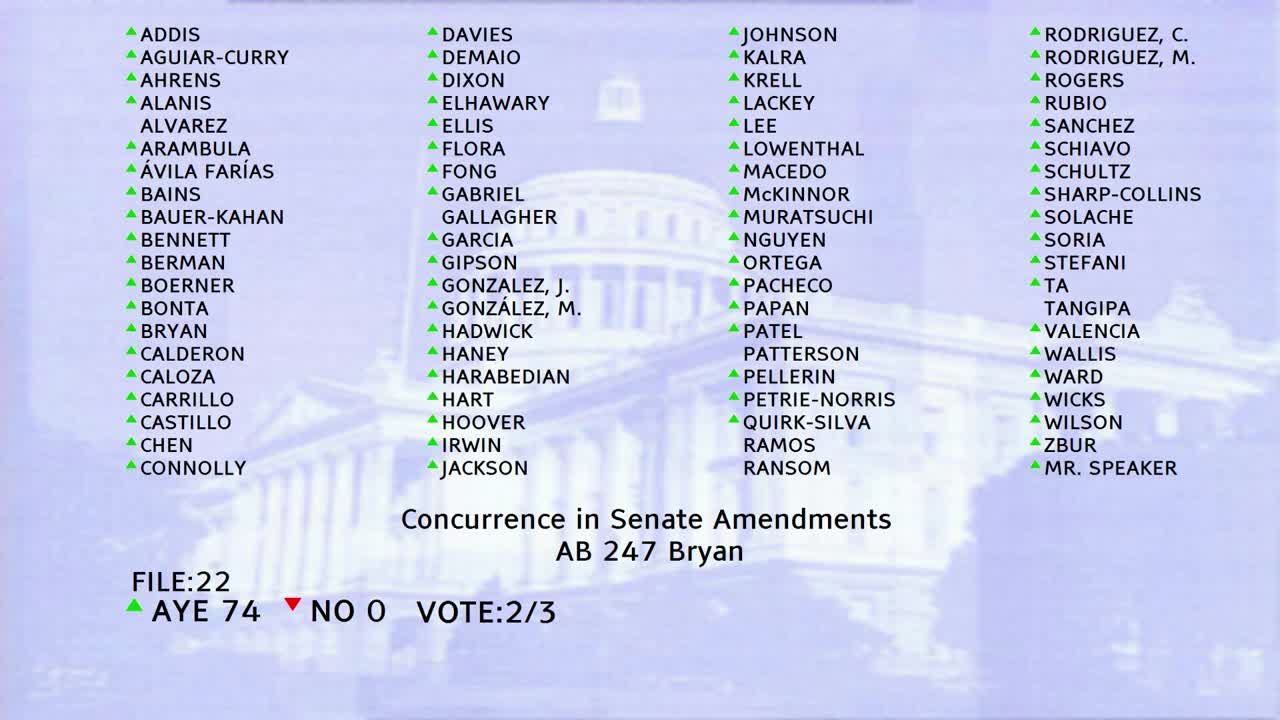 2MIN
Assembly Floor
 2MIN
Senate Floor
 9MIN
Senate Standing Committee on Public Safety
 8MIN
Senate Standing Committee on Judiciary
 1MIN
Assembly Floor
 10MIN
Assembly Standing Committee on Judiciary
Bill Author

Bill Co-Author(s):