AB 853: California AI Transparency Act.
- Session Year: 2025-2026
- House: Assembly
- Latest Version Date: 2025-10-13
Current Status:
Passed
(2025-10-13: Chaptered by Secretary of State - Chapter 674, Statutes of 2025.)
Introduced
In Committee
Awaiting First Chamber Vote
Passed First Chamber
In Committee
Awaiting Second Chamber Vote
Passed Second Chamber
Enacted
What does this bill do?
The bill delays the California AI Transparency Act and adds rules for large platforms, GenAI hosts, and makers of cameras and recording devices. It requires platforms to detect and show standard provenance data about content—whether it was AI‑generated or altered, the system or device name, and any digital signature—and to let users view or download that data instead of removing it; hosting services may not offer GenAI systems that lack required disclosures, and device makers must offer and, when feasible, embed by default a hidden disclosure naming the device and the time of capture.
The summary is provided by generative AI which can make mistakes. For original language, please view the details in the table below.
The California AI Transparency Act requires a person that creates, codes, or otherwise produces a generative artificial intelligence system that has over 1,000,000 monthly visitors or users and is publicly accessible within the geographic boundaries of the state to make available an AI detection tool at no cost to the user that, among other things, allows a user to assess whether image, video, or audio content, or content that is a combination thereof, was created or altered by that persons generative artificial intelligence system and outputs any system provenance data that is detected in the content. Existing law makes the California AI Transparency Act operative on January 1, 2026.
This bill would delay the operation of the California AI Transparency Act until August 2, 2026.
This bill would, beginning January 1, 2027, additionally require a large online platform, as defined, to, among other things related to the provenance of content on the platform, detect whether any provenance data that is compliant with widely adopted specifications adopted by an established standards-setting body is embedded into or attached to content distributed on the large online platform. The bill would also require, beginning January 1, 2028, a capture device manufacturer, with respect to any capture device the capture device manufacturer first produced for sale in the state on or after January 1, 2028, to, among other things, provide a user with the option to include a latent disclosure in content captured by the capture device that conveys certain information, including the name of the capture device manufacturer. The bill would define capture device to mean a device that can record photographs, audio, or video content, including, but not limited to, video and still photography cameras, mobile phones with built-in cameras or microphones, and voice recorders.
Existing law requires a covered provider to include a latent disclosure in AI-generated image, video, or audio content, or content that is any combination thereof, created by the covered providers GenAI system that, among other things, conveys certain information and is permanent or extraordinarily difficult to remove, to the extent it is technically feasible.
This bill would, beginning January 1, 2027, prohibit a GenAI system hosting platform, as defined, from knowingly making available a GenAI system that does not place disclosures, pursuant to those provisions.
This bill would declare that its provisions are severable.
The California AI Transparency Act requires a person that creates, codes, or otherwise produces a generative artificial intelligence system that has over 1,000,000 monthly visitors or users and is publicly accessible within the geographic boundaries of the state to make available an AI detection tool at no cost to the user that, among other things, allows a user to assess whether image, video, or audio content, or content that is a combination thereof, was created or altered by that persons generative artificial intelligence system and outputs any system provenance data that is detected in the content. Existing law makes the California AI Transparency Act operative on January 1, 2026.
This bill would delay the operation of the California AI Transparency Act until August 2, 2026.
This bill would would, beginning January 1, 2027, additionally require a large online platform, as defined, to, among other things, use a specified label to disclose any machine-readable provenance data detected in content distributed on the large online platform. things related to the provenance of content on the platform, detect whether any provenance data that is compliant with widely adopted specifications adopted by an established standards-setting body is embedded into or attached to content distributed on the large online platform. The bill would also require, beginning January 1, 2028, a capture device manufacturer, with respect to any capture device the capture device manufacturer produces first produced for sale in the state, state on or after January 1, 2028, to, among other things, provide a user with the option to include a latent disclosure in content captured by the capture device that, to the extent that it is technically feasible and reasonable, that conveys certain information, including the name of the capture device manufacturer. The bill would define capture device to mean a device that can record photographs, audio, or video content, including, but not limited to, video and still photography cameras, mobile phones with built-in cameras or microphones, and voice recorders.
Existing law requires a covered provider to include a latent disclosure in AI-generated image, video, or audio content, or content that is any combination thereof, created by the covered providers GenAI system that, among other things, conveys certain information and is permanent or extraordinarily difficult to remove, to the extent it is technically feasible.
This bill would would, beginning January 1, 2027, prohibit a GenAI system hosting platform, as defined, from knowingly making available a GenAI system that does not place disclosures, pursuant to those provisions, that are permanent or extraordinarily difficult to remove into content created or substantially modified by the GenAI system. The bill would prohibit a provider or a distributor of software or online services from making available a system, application, tool, or service that is designed for the primary purpose of removing the latent disclosures. provisions.
This bill would declare that its provisions are severable.
The California AI Transparency Act requires a person that creates, codes, or otherwise produces a generative artificial intelligence system that has over 1,000,000 monthly visitors or users and is publicly accessible within the geographic boundaries of the state to make available an AI detection tool at no cost to the user that, among other things, allows a user to assess whether image, video, or audio content, or content that is a combination thereof, was created or altered by that persons generative artificial intelligence system and outputs any system provenance data that is detected in the content.
This bill would additionally require a large online platform, as defined, to, among other things, use a specified label to disclose any machine-readable provenance data detected in content distributed on the large online platform. The bill would also require require, beginning January 1, 2028, a capture device manufacturer, with respect to any capture device the capture device manufacturer produces for sale in the state, to, among other things, provide a user with the option to include a latent disclosure in content captured by the capture device that, to the extent that it is technically feasible and reasonable, conveys certain information, including the name of the capture device manufacturer. The bill would define capture device to mean a device that can record photographs, audio, or video content, including, but not limited to, video and still photography cameras, mobile phones with built-in cameras or microphones, and voice recorders.
Existing law requires a covered provider to include a latent disclosure in AI-generated image, video, or audio content, or content that is any combination thereof, created by the covered providers GenAI system that, among other things, conveys certain information and is permanent or extraordinarily difficult to remove, to the extent it is technically feasible.
This bill would prohibit a GenAI system hosting platform, as defined, from making available a GenAI system that does not place disclosures, pursuant to those provisions, that are permanent or extraordinarily difficult to remove into content created or substantially modified by the GenAI system. The bill would prohibit a provider or a distributor of software or online services from making available a system, application, tool, or service that is designed for the primary purpose of removing the latent disclosures.
This bill would declare that its provisions are severable.
The California AI Transparency Act requires a person that creates, codes, or otherwise produces a generative artificial intelligence system that has over 1,000,000 monthly visitors or users and is publicly accessible within the geographic boundaries of the state to make available an AI detection tool at no cost to the user that, among other things, allows a user to assess whether image, video, or audio content, or content that is a combination thereof, was created or altered by that persons generative artificial intelligence system and outputs any system provenance data that is detected in the content.
This bill would additionally require a large online platform, as defined, to, among other things, retain any available provenance data in content provided to, or posted on, the large online platform. use a specified label to disclose any machine-readable provenance data detected in content distributed on the large online platform. The bill would also require a capture device manufacturer, with respect to any capture device the capture device manufacturer produces for sale in the state, to, among other things, include in the capture devices default capture app the ability for a user to enable the inclusion of provenance data in the users captured content. provide a user with the option to include a latent disclosure in content captured by the capture device that, to the extent that it is technically feasible and reasonable, conveys certain information, including the name of the capture device manufacturer. The bill would define capture device to mean a device that can record photographs, audio, or video content, including, but not limited to, video and still photography cameras, mobile phones with built-in cameras or microphones, and voice recorders.
Existing law requires a covered provider to include a latent disclosure in AI-generated image, video, or audio content, or content that is any combination thereof, created by the covered providers GenAI system that, among other things, conveys certain information and is permanent or extraordinarily difficult to remove, to the extent it is technically feasible.
This bill would prohibit a GenAI system hosting platform, as defined, from making available a GenAI system that does not place disclosures, pursuant to those provisions, that are permanent or extraordinarily difficult to remove into content created or substantially modified by the GenAI system. The bill would prohibit a provider or a distributor of software or online services from making available a system, application, tool, or service that is designed for the primary purpose of removing the latent disclosures.
This bill would declare that its provisions are severable.
The California AI Transparency Act requires a person that creates, codes, or otherwise produces a generative artificial intelligence system that has over 1,000,000 monthly visitors or users and is publicly accessible within the geographic boundaries of the state to make available an AI detection tool at no cost to the user that, among other things, allows a user to assess whether image, video, or audio content, or content that is a combination thereof, was created or altered by that persons generative artificial intelligence system. system and outputs any system provenance data that is detected in the content.
This bill would make a nonsubstantive change to that provision. additionally require a large online platform, as defined, to, among other things, retain any available provenance data in content provided to, or posted on, the large online platform. The bill would also require a capture device manufacturer, with respect to any capture device the capture device manufacturer produces for sale in the state, to, among other things, include in the capture devices default capture app the ability for a user to enable the inclusion of provenance data in the users captured content. The bill would define capture device to mean a device that can record photographs, audio, or video content, including, but not limited to, video and still photography cameras, mobile phones with built-in cameras or microphones, and voice recorders.
The California AI Transparency Act requires a person that creates, codes, or otherwise produces a generative artificial intelligence system that has over 1,000,000 monthly visitors or users and is publicly accessible within the geographic boundaries of the state to make available an AI detection tool at no cost to the user that, among other things, allows a user to assess whether image, video, or audio content, or content that is a combination thereof, was created or altered by that persons generative artificial intelligence system.
This bill would make a nonsubstantive change to that provision.
As used in this chapter:
(a)Artificial intelligence or AI means an engineered or machine-based system that varies in its level of autonomy and that can, for explicit or implicit objectives, infer from the input it receives how to generate outputs that can influence physical or virtual environments.
(b)Capture device means a device that can record photographs, audio, or video content, including, but not limited to, video and still photography cameras, mobile phones with built-in cameras or microphones, and voice recorders.
(c)(1)Capture device manufacturer means a person who produces a capture device for sale in the state.
(2)Capture device manufacturer does not include a person exclusively engaged in the assembly of a capture device.
(d)Covered provider means a person that creates, codes, or otherwise produces a generative artificial intelligence system that has over 1,000,000 monthly visitors or users and is publicly accessible within the geographic boundaries of the state.
(e)Digital signature means a cryptography-based method that identifies the user or entity that attests to the information provided in the signed section.
(f)Generative artificial intelligence system or GenAI system means an artificial intelligence that can generate derived synthetic content, including text, images, video, and audio, that emulates the structure and characteristics of the systems training data.
(g)GenAI hosting platform means an internet website or application that makes available for download the source code or model weights a generative artificial intelligence system by a resident of the state, regardless of whether the terms of that use include compensation.
(h)(1)Large online platform means a public-facing social media platform, file-sharing platform, mass messaging platform, or stand-alone search engine that distributes content to users who did not create or collaborate in creating the content that exceeded 2,000,000 unique monthly users during the preceding 12 months.
(2)Large online platform does not include either of the following:
(A)A broadband internet access service, as defined in Section 3100 of the Civil Code.
(B)A telecommunications service, as defined in Section 153 of Title 47 of the United States Code.
(i)Latent means present but not manifest.
(j)Manifest means easily perceived, understood, or recognized by a natural person.
(k)Mass messaging platform means a direct messaging platform that allows users to distribute content to more than 100 users simultaneously.
(l)Metadata means structural or descriptive information about data.
(m)Personal information has the same meaning as defined in Section 1798.140 of the Civil Code.
(n)(1)Personal provenance data means provenance data that contains either of the following:
(A)Personal information.
(B)Unique device, system, or service information that is reasonably capable of being associated with a particular user.
(2)Personal provenance data does not include information contained within a digital signature.
(o)Provenance data means data that is embedded into digital content, or that is included in the digital contents metadata, for the purpose of verifying the digital contents authenticity, origin, or history of modification.
(p)System provenance data means provenance data that is not reasonably capable of being associated with a particular user and that contains either of the following:
(1)Information regarding the type of device, system, or service that was used to generate a piece of digital content.
(2)Information related to content authenticity.
SEC. 2.Section 22757.3.1 is added to the Business and Professions Code, to read:22757.3.1.(a)A large online platform shall do all of the following:
(1)Detect whether any provenance data that is compliant with widely adopted specifications adopted by an established standards-setting body is embedded into or attached to content distributed on the large online platform.
(2)(A)Provide a user interface to disclose the availability of system provenance data that reliably indicates that the content was generated or substantially altered by a GenAI system or captured by a capture device.
(B)The user interface required by this paragraph shall make clearly and conspicuously available to users information sufficient to identify the contents authenticity, origin, or history of modification, including, but not limited to, all of the following:
(i)Whether provenance data is available.
(ii)The name of the GenAI system or capture device that created or substantially altered the content, if applicable.
(iii)Whether any digital signatures are available.
(3)Allow a user to inspect all available system provenance data that is compliant with widely adopted specifications adopted by an established standards-setting body in an easily accessible manner by any of the following means:
(A)Directly through the large online platforms user interface pursuant to paragraph (2).
(B)Allow the user to download a version of the content with its attached system provenance data.
(C)Provide a link to the contents system provenance data displayed on an internet website or in another application provided either by the large online platform or a third party.
(b)A large online platform shall not, to the extent technically feasible, knowingly strip any system provenance data or digital signature that is compliant with widely adopted specifications adopted by an established standards-setting body from content uploaded or distributed on the large online platform.
(c)This section shall become operative on January 1, 2027.
SEC. 3.Section 22757.3.2 is added to the Business and Professions Code, to read:22757.3.2.(a)A GenAI system hosting platform shall not knowingly make available a GenAI system that does not place disclosures pursuant to Section 22757.3.
(b)This section shall become operative on January 1, 2027.
SEC. 4.Section 22757.3.3 is added to the Business and Professions Code, to read:22757.3.3.(a)A capture device manufacturer shall, with respect to any capture device the capture device manufacturer first produced for sale in the state on or after January 1, 2028, do both of the following:
(1)Provide a user with the option to include a latent disclosure in content captured by the capture device that conveys all of the following information:
(A)The name of the capture device manufacturer.
(B)The name and version number of the capture device that created or altered the content.
(C)The time and date of the contents creation or alteration.
(2)Embed latent disclosures in content captured by the device by default.
(b)A capture device manufacturer shall comply with this section only to the extent technically feasible and compliant with widely adopted specifications adopted by an established standards-setting body.
(c)This section shall become operative on January 1, 2028.
SEC. 5.Section 22757.4 of the Business and Professions Code is amended to read:22757.4.(a)(1)A violator of this chapter shall be liable for a civil penalty in the amount of five thousand dollars ($5,000) per violation to be collected in a civil action filed by the Attorney General, a city attorney, or a county counsel.
(2)A prevailing plaintiff in an action brought pursuant to this subdivision shall be entitled to all reasonable attorneys costs and fees.
(b)Each day that a covered provider, large online platform, or capture device manufacturer is in violation of this chapter shall be deemed a discrete violation.
(c)For a violation by a third-party licensee of paragraph (3) of subdivision (c) of Section 22757.3, the Attorney General, a county counsel, or a city attorney may bring a civil action for both of the following:
(1)Injunctive relief.
(2)Reasonable attorneys fees and costs.
SEC. 6.Section 22757.6 of the Business and Professions Code is amended to read:22757.6.This chapter shall become operative on August 2, 2026.
SEC. 7.The provisions of this act are severable. If any provision of this act or its application is held invalid, that invalidity shall not affect other provisions or applications that can be given effect without the invalid provision or application.
As used in this chapter:
(a)Artificial intelligence or AI means an engineered or machine-based system that varies in its level of autonomy and that can, for explicit or implicit objectives, infer from the input it receives how to generate outputs that can influence physical or virtual environments.
(b)Capture device means a device that can record photographs, audio, or video content, including, but not limited to, video and still photography cameras, mobile phones with built-in cameras or microphones, and voice recorders.
(c)(1)Capture device manufacturer means a person who produces a capture device for sale in the state.
(2)Capture device manufacturer does not include a person exclusively engaged in the assembly of a capture device.
(d)Covered provider means a person that creates, codes, or otherwise produces a generative artificial intelligence system that has over 1,000,000 monthly visitors or users and is publicly accessible within the geographic boundaries of the state.
(e)Digital signature means a cryptography-based method that identifies the user or entity that attests to the information provided in the signed section.
(f)Generative artificial intelligence system or GenAI system means an artificial intelligence that can generate derived synthetic content, including text, images, video, and audio, that emulates the structure and characteristics of the systems training data.
(g)GenAI hosting platform means an internet website or application that makes available for download the source code or model weights a generative artificial intelligence system available for use by a resident of the state, regardless of whether the terms of that use include compensation.
(h)(1)Large online platform means a public-facing social media platform, content-sharing file-sharing platform, mass messaging platform, advertising network, or stand-alone search engine, or web browser engine that distributes content to users who did not create or collaborate in creating the content that exceeded 2,000,000 unique monthly users during the preceding 12 months.
(2)Large online platform does not include either of the following:
(A)A broadband internet access service, as defined in Section 3100 of the Civil Code.
(B)A telecommunications service, as defined in Section 153 of Title 47 of the United States Code.
(i)Latent means present but not manifest.
(j)Manifest means easily perceived, understood, or recognized by a natural person.
(k)Mass messaging platform means a direct messaging platform that allows users to distribute content to more than 100 users simultaneously.
(k)(l)Metadata means structural or descriptive information about data.
(l)(m)Personal information has the same meaning as defined in Section 1798.140 of the Civil Code.
(m)(n)(1)Personal provenance data means provenance data that contains either of the following:
(A)Personal information.
(B)Unique device, system, or service information that is reasonably capable of being associated with a particular user.
(2)Personal provenance data does not include information contained within a digital signature.
(n)(o)Provenance data means data that is embedded into digital content, or that is included in the digital contents metadata, for the purpose of verifying the digital contents authenticity, origin, or history of modification.
(o)(p)System provenance data means provenance data that is not reasonably capable of being associated with a particular user and that contains either of the following:
(1)Information regarding the type of device, system, or service that was used to generate a piece of digital content.
(2)Information related to content authenticity.
SEC. 2.Section 22757.3.1 is added to the Business and Professions Code, to read:22757.3.1.(a)A large online platform shall do both all of the following:
(1)Use a label to disclose any machine-readable provenance data detected in content distributed on the large online platform that meets all of the following criteria:(A)The label indicates whether provenance data is available.(B)The label indicates the name and version number of the GenAI system that created or altered the content, if applicable.(C)The label indicates whether any digital signatures are available.(D)The label is presented in a conspicuous manner to users.(2)Allow a user to inspect any provenance information in an easily accessible manner.(b)A large online platform shall not do any of the following:(1)Strip any system provenance data or digital signature from content uploaded or distributed on the large online platform.(2)Retain any personal provenance data from content shared on the large online platform.(1)Detect whether any provenance data that is compliant with widely adopted specifications adopted by an established standards-setting body is embedded into or attached to content distributed on the large online platform.
(2)(A)Provide a user interface to disclose the availability of system provenance data that reliably indicates that the content was generated or substantially altered by a GenAI system or captured by a capture device.
(B)The user interface required by this paragraph shall make clearly and conspicuously available to users information sufficient to identify the contents authenticity, origin, or history of modification, including, but not limited to, all of the following:
(i)Whether provenance data is available.
(ii)The name of the GenAI system or capture device that created or substantially altered the content, if applicable.
(iii)Whether any digital signatures are available.
(3)Allow a user to inspect all available system provenance data that is compliant with widely adopted specifications adopted by an established standards-setting body in an easily accessible manner by any of the following means:
(A)Directly through the large online platforms user interface pursuant to paragraph (2).
(B)Allow the user to download a version of the content with its attached system provenance data.
(C)Provide a link to the contents system provenance data displayed on an internet website or in another application provided either by the large online platform or a third party.
(b)A large online platform shall not, to the extent technically feasible, knowingly strip any system provenance data or digital signature that is compliant with widely adopted specifications adopted by an established standards-setting body from content uploaded or distributed on the large online platform.
(c)This section shall become operative on January 1, 2027.
SEC. 3.Section 22757.3.2 is added to the Business and Professions Code, to read:22757.3.2.(a)A GenAI system hosting platform shall not knowingly make available a GenAI system that does not place disclosures pursuant to Section 22757.3 that are permanent or extraordinarily difficult to remove into content created or substantially modified by the GenAI system. 22757.3.
(b)A provider or a distributor of software or online services shall not make available a system, application, tool, or service that is designed for the primary purpose of removing latent disclosures applied pursuant to this chapter.(b)This section shall become operative on January 1, 2027.
SEC. 4.Section 22757.3.3 is added to the Business and Professions Code, to read:22757.3.3.(a)A capture device manufacturer shall, with respect to any capture device the capture device manufacturer produces first produced for sale in the state, state on or after January 1, 2028, do all both of the following:
(1)(A)Provide a user with the option to include a latent disclosure in content captured by the capture device that, to the extent that it is technically feasible and reasonable, that conveys all of the following information:
(i)(A)The name of the capture device manufacturer.
(ii)(B)The name and version number of the capture device that created or altered the content.
(iii)(C)The time and date of the contents creation or alteration.
(B)The option required by this paragraph shall be available for the capture devices default capture application and third-party applications that bypass default capture applications in order to offer capture functionalities.(2)Embed latent disclosures in content captured by the device by default.
(3)Clearly inform users of the existence of settings relating to provenance data upon a users first use of the recording function on the capture device.(4)When any capture device application is in use, contain a clear indicator when provenance data is applied.(5)Include in the capture devices default capture application the ability for a user to opt out of the inclusion of provenance data based on guidelines or specifications promulgated by an established standard-setting body in the users captured content.(6)Make secure hardware-based provenance data capture available to third-party applications.(b)A capture device manufacturer shall comply with this section only to the extent technically feasible and compliant with widely adopted specifications adopted by an established standards-setting body.
(b)(c)This section shall become operative on January 1, 2028.
SEC. 5.Section 22757.4 of the Business and Professions Code is amended to read:22757.4.(a)(1)A violator of this chapter shall be liable for a civil penalty in the amount of five thousand dollars ($5,000) per violation to be collected in a civil action filed by the Attorney General, a city attorney, or a county counsel.
(2)A prevailing plaintiff in an action brought pursuant to this subdivision shall be entitled to all reasonable attorneys costs and fees.
(b)Each day that a covered provider, large online platform, or capture device manufacturer is in violation of this chapter shall be deemed a discrete violation.
(c)For a violation by a third-party licensee of paragraph (3) of subdivision (c) of Section 22757.3, the Attorney General, a county counsel, or a city attorney may bring a civil action for both of the following:
(1)Injunctive relief.
(2)Reasonable attorneys fees and costs.
SEC. 6.Section 22757.6 of the Business and Professions Code is amended to read:22757.6.This chapter shall become operative on January 1, August 2, 2026.
SEC. 6.SEC. 7.The provisions of this act are severable. If any provision of this act or its application is held invalid, that invalidity shall not affect other provisions or applications that can be given effect without the invalid provision or application.
As used in this chapter:
(a)Artificial intelligence or AI means an engineered or machine-based system that varies in its level of autonomy and that can, for explicit or implicit objectives, infer from the input it receives how to generate outputs that can influence physical or virtual environments.
(b)Capture device means a device that can record photographs, audio, or video content, including, but not limited to, video and still photography cameras, mobile phones with built-in cameras or microphones, and voice recorders.
(c)Capture device manufacturer means a person who produces a capture device for sale in the state.
(d)Covered provider means a person that creates, codes, or otherwise produces a generative artificial intelligence system that has over 1,000,000 monthly visitors or users and is publicly accessible within the geographic boundaries of the state.
(e)Digital signature means a cryptography-based method that identifies the user or entity that attests to the information provided in the signed section.
(f)Generative artificial intelligence system or GenAI system means an artificial intelligence that can generate derived synthetic content, including text, images, video, and audio, that emulates the structure and characteristics of the systems training data.
(g)GenAI hosting platform means an internet website that makes a generative artificial intelligence system available for use by a resident of the state, regardless of whether the terms of that use include compensation.
(h)Large online platform means a public-facing social media platform, content-sharing platform, messaging platform, advertising network, stand-alone search engine, or web browser that distributes content to users who did not create or collaborate in creating the content that exceeded 2,000,000 unique monthly users during the preceding 12 months.
(i)Latent means present but not manifest.
(j)Manifest means easily perceived, understood, or recognized by a natural person.
(k)Metadata means structural or descriptive information about data.
(l)Personal information has the same meaning as defined in Section 1798.140 of the Civil Code.
(m)(1)Personal provenance data means provenance data that contains either of the following:
(A)Personal information.
(B)Unique device, system, or service information that is reasonably capable of being associated with a particular user.
(2)Personal provenance data does not include information contained within a digital signature.
(n)Provenance data means data that is embedded into digital content, or that is included in the digital contents metadata, for the purpose of verifying the digital contents authenticity, origin, or history of modification.
(o)System provenance data means provenance data that is not reasonably capable of being associated with a particular user and that contains either of the following:
(1)Information regarding the type of device, system, or service that was used to generate a piece of digital content.
(2)Information related to content authenticity.
SEC. 2.Section 22757.3.1 is added to the Business and Professions Code, to read:22757.3.1.(a)A large online platform shall do both of the following:
(1)Use a label to disclose any machine-readable provenance data detected in content distributed on the large online platform that meets all of the following criteria:
(A)The label indicates whether provenance data is available.
(B)The label indicates the name and version number of the GenAI system that created or altered the content, if applicable.
(C)The label indicates whether any digital signatures are available.
(D)The label is presented in a conspicuous manner to users.
(2)Allow a user to inspect any provenance information in an easily accessible manner.
(b)A large online platform shall not do any of the following:
(1)Strip any system provenance data or digital signature from content uploaded or distributed on the large online platform.
(2)Retain any personal provenance data from content shared on the large online platform.
(c)A capture device manufacturer shall, with respect to any capture device the capture device manufacturer produces for sale in the state, do all of the following:(1)(A)Provide a user with the option to include a latent disclosure in content captured by the capture device that, to the extent that it is technically feasible and reasonable, conveys all of the following information:(i)The name of the capture device manufacturer.(ii)The name and version number of the capture device that created or altered the content.(iii)The time and date of the contents creation or alteration.(B)The option required by this paragraph shall be available for the capture devices default capture application and third-party applications that bypass default capture applications in order to offer capture functionalities.(2)Embed latent disclosures in content captured by the device by default.(3)Clearly inform users of the existence of settings relating to provenance data upon a users first use of the recording function on the capture device.(4)When any capture device application is in use, contain a clear indicator when provenance data is applied.(5)Include in the capture devices default capture application the ability for a user to opt out of the inclusion of provenance data based on guidelines or specifications promulgated by an established standard-setting body in the users captured content.(6)Make secure hardware-based provenance data capture available to third-party applications.SEC. 3.Section 22757.3.2 is added to the Business and Professions Code, to read:22757.3.2.(a)A GenAI system hosting platform shall not make available a GenAI system that does not place disclosures pursuant to Section 22757.3 that are permanent or extraordinarily difficult to remove into content created or substantially modified by the GenAI system.
(b)A provider or a distributor of software or online services shall not make available a system, application, tool, or service that is designed for the primary purpose of removing latent disclosures applied pursuant to this chapter.
SEC. 4.Section 22757.3.3 is added to the Business and Professions Code, to read:22757.3.3.(a)A capture device manufacturer shall, with respect to any capture device the capture device manufacturer produces for sale in the state, do all of the following:
(1)(A)Provide a user with the option to include a latent disclosure in content captured by the capture device that, to the extent that it is technically feasible and reasonable, conveys all of the following information:
(i)The name of the capture device manufacturer.
(ii)The name and version number of the capture device that created or altered the content.
(iii)The time and date of the contents creation or alteration.
(B)The option required by this paragraph shall be available for the capture devices default capture application and third-party applications that bypass default capture applications in order to offer capture functionalities.
(2)Embed latent disclosures in content captured by the device by default.
(3)Clearly inform users of the existence of settings relating to provenance data upon a users first use of the recording function on the capture device.
(4)When any capture device application is in use, contain a clear indicator when provenance data is applied.
(5)Include in the capture devices default capture application the ability for a user to opt out of the inclusion of provenance data based on guidelines or specifications promulgated by an established standard-setting body in the users captured content.
(6)Make secure hardware-based provenance data capture available to third-party applications.
(b)This section shall become operative on January 1, 2028.
SEC. 4.SEC. 5.Section 22757.4 of the Business and Professions Code is amended to read:22757.4.(a)(1)A violator of this chapter shall be liable for a civil penalty in the amount of five thousand dollars ($5,000) per violation to be collected in a civil action filed by the Attorney General, a city attorney, or a county counsel.
(2)A prevailing plaintiff in an action brought pursuant to this subdivision shall be entitled to all reasonable attorneys costs and fees.
(b)Each day that a covered provider, large online platform, or capture device manufacturer is in violation of this chapter shall be deemed a discrete violation.
(c)For a violation by a third-party licensee of paragraph (3) of subdivision (c) of Section 22757.3, the Attorney General, a county counsel, or a city attorney may bring a civil action for both of the following:
(1)Injunctive relief.
(2)Reasonable attorneys fees and costs.
SEC. 5.SEC. 6.The provisions of this act are severable. If any provision of this act or its application is held invalid, that invalidity shall not affect other provisions or applications that can be given effect without the invalid provision or application.
As used in this chapter:
(a)Artificial intelligence or AI means an engineered or machine-based system that varies in its level of autonomy and that can, for explicit or implicit objectives, infer from the input it receives how to generate outputs that can influence physical or virtual environments.
(b)Capture device means a device that can record photographs, audio, or video content, including, but not limited to, video and still photography cameras, mobile phones with built-in cameras or microphones, and voice recorders.
(c)Capture device manufacturer means a person who produces a capture device for sale in the state.
(d)Covered provider means a person that creates, codes, or otherwise produces a generative artificial intelligence system that has over 1,000,000 monthly visitors or users and is publicly accessible within the geographic boundaries of the state.
(e)Digital signature means a cryptography-based method that identifies the user or entity that attests to the information provided in the signed section.
(e)(f)Generative artificial intelligence system or GenAI system means an artificial intelligence that can generate derived synthetic content, including text, images, video, and audio, that emulates the structure and characteristics of the systems training data.
(g)GenAI hosting platform means an internet website that makes a generative artificial intelligence system available for use by a resident of the state, regardless of whether the terms of that use include compensation.
(f)(h)Large online platform means a public-facing social media platform, content-sharing platform, messaging platform, advertising network, or standalone stand-alone search engine engine, or web browser that distributes content to users who did not create or collaborate in creating the content that exceeded 2,000,000 unique monthly users during the preceding 12 months.
(g)(i)Latent means present but not manifest.
(h)(j)Manifest means easily perceived, understood, or recognized by a natural person.
(i)(k)Metadata means structural or descriptive information about data.
(j)(l)Personal information has the same meaning as defined in Section 1798.140 of the Civil Code.
(k)(m)(1)Personal provenance data means provenance data that contains either of the following:
(1)(A)Personal information.
(2)(B)Unique device, system, or service information that is reasonably capable of being associated with a particular user.
(2)Personal provenance data does not include information contained within a digital signature.
(l)(n)Provenance data means data that is embedded into digital content, or that is included in the digital contents metadata, for the purpose of verifying the digital contents authenticity, origin, or history of modification.
(m)(o)System provenance data means provenance data that is not reasonably capable of being associated with a particular user and that contains either of the following:
(1)Information regarding the type of device, system, or service that was used to generate a piece of digital content.
(2)Information related to content authenticity.
SEC. 2.Section 22757.3.1 is added to the Business and Professions Code, to read:22757.3.1.(a)A large online platform shall do both of the following:
(1)Retain any available provenance data in content provided to, or posted on, the large online platform.(2)Make available to a consumer of content on the large online platform either of the following:(A)The provenance data.(B)A conspicuous indicator that provenance data is available.(1)Use a label to disclose any machine-readable provenance data detected in content distributed on the large online platform that meets all of the following criteria:
(A)The label indicates whether provenance data is available.
(B)The label indicates the name and version number of the GenAI system that created or altered the content, if applicable.
(C)The label indicates whether any digital signatures are available.
(D)The label is presented in a conspicuous manner to users.
(2)Allow a user to inspect any provenance information in an easily accessible manner.
(b)A large online platform shall not do any of the following:
(1)Strip any system provenance data or digital signature from content uploaded or distributed on the large online platform.
(2)Retain any personal provenance data from content shared on the large online platform.
(b)(c)A capture device manufacturer shall, with respect to any capture device the capture device manufacturer produces for sale in the state, do both all of the following:
(1)Include in the capture devices default capture app the ability for a user to enable the inclusion of provenance data in the users captured content.(2)Ensure secure hardware-based provenance capture is available to third-party applications.(1)(A)Provide a user with the option to include a latent disclosure in content captured by the capture device that, to the extent that it is technically feasible and reasonable, conveys all of the following information:
(i)The name of the capture device manufacturer.
(ii)The name and version number of the capture device that created or altered the content.
(iii)The time and date of the contents creation or alteration.
(B)The option required by this paragraph shall be available for the capture devices default capture application and third-party applications that bypass default capture applications in order to offer capture functionalities.
(2)Embed latent disclosures in content captured by the device by default.
(3)Clearly inform users of the existence of settings relating to provenance data upon a users first use of the recording function on the capture device.
(4)When any capture device application is in use, contain a clear indicator when provenance data is applied.
(5)Include in the capture devices default capture application the ability for a user to opt out of the inclusion of provenance data based on guidelines or specifications promulgated by an established standard-setting body in the users captured content.
(6)Make secure hardware-based provenance data capture available to third-party applications.
SEC. 3.Section 22757.3.2 is added to the Business and Professions Code, to read:22757.3.2.(a)A GenAI system hosting platform shall not make available a GenAI system that does not place disclosures pursuant to Section 22757.3 that are permanent or extraordinarily difficult to remove into content created or substantially modified by the GenAI system.
(b)A provider or a distributor of software or online services shall not make available a system, application, tool, or service that is designed for the primary purpose of removing latent disclosures applied pursuant to this chapter.
SEC. 3.SEC. 4.Section 22757.4 of the Business and Professions Code is amended to read:22757.4.(a)(1)A covered provider, large online platform, or capture device manufacturer that violates violator of this chapter shall be liable for a civil penalty in the amount of five thousand dollars ($5,000) per violation to be collected in a civil action filed by the Attorney General, a city attorney, or a county counsel.
(2)A prevailing plaintiff in an action brought pursuant to this subdivision shall be entitled to all reasonable attorneys costs and fees.
(b)Each day that a covered provider, large online platform, or capture device manufacturer is in violation of this chapter shall be deemed a discrete violation.
(c)For a violation by a third-party licensee of paragraph (3) of subdivision (c) of Section 22757.3, the Attorney General, a county counsel, or a city attorney may bring a civil action for both of the following:
(1)Injunctive relief.
(2)Reasonable attorneys fees and costs.
SEC. 5.The provisions of this act are severable. If any provision of this act or its application is held invalid, that invalidity shall not affect other provisions or applications that can be given effect without the invalid provision or application.
As used in this chapter:
(a)Artificial intelligence or AI means an engineered or machine-based system that varies in its level of autonomy and that can, for explicit or implicit objectives, infer from the input it receives how to generate outputs that can influence physical or virtual environments.
(b)Capture device means a device that can record photographs, audio, or video content, including, but not limited to, video and still photography cameras, mobile phones with built-in cameras or microphones, and voice recorders.
(c)Capture device manufacturer means a person who produces a capture device for sale in the state.
(b)(d)Covered provider means a person that creates, codes, or otherwise produces a generative artificial intelligence system that has over 1,000,000 monthly visitors or users and is publicly accessible within the geographic boundaries of the state.
(c)(e)Generative artificial intelligence system or GenAI system means an artificial intelligence that can generate derived synthetic content, including text, images, video, and audio, that emulates the structure and characteristics of the systems training data.
(f)Large online platform means a public-facing social media platform, content-sharing platform, messaging platform, advertising network, or standalone search engine that distributes content to users who did not create or collaborate in creating the content that exceeded 2,000,000 unique monthly users during the preceding 12 months.
(d)(g)Latent means present but not manifest.
(e)(h)Manifest means easily perceived, understood, or recognized by a natural person.
(f)(i)Metadata means structural or descriptive information about data.
(g)(j)Personal information has the same meaning as defined in Section 1798.140 of the Civil Code.
(h)(k)Personal provenance data means provenance data that contains either of the following:
(1)Personal information.
(2)Unique device, system, or service information that is reasonably capable of being associated with a particular user.
(i)(l)Provenance data means data that is embedded into digital content, or that is included in the digital contents metadata, for the purpose of verifying the digital contents authenticity, origin, or history of modification.
(j)(m)System provenance data means provenance data that is not reasonably capable of being associated with a particular user and that contains either of the following:
(1)Information regarding the type of device, system, or service that was used to generate a piece of digital content.
(2)Information related to content authenticity.
SEC. 2.Section 22757.3.1 is added to the Business and Professions Code, to read:22757.3.1.(a)A large online platform shall do both of the following:
(1)Retain any available provenance data in content provided to, or posted on, the large online platform.
(2)Make available to a consumer of content on the large online platform either of the following:
(A)The provenance data.
(B)A conspicuous indicator that provenance data is available.
(b)A capture device manufacturer shall, with respect to any capture device the capture device manufacturer produces for sale in the state, do both of the following:
(1)Include in the capture devices default capture app the ability for a user to enable the inclusion of provenance data in the users captured content.
(2)Ensure secure hardware-based provenance capture is available to third-party applications.
SEC. 3.Section 22757.4 of the Business and Professions Code is amended to read:22757.4.(a)(1)A covered provider provider, large online platform, or capture device manufacturer that violates this chapter shall be liable for a civil penalty in the amount of five thousand dollars ($5,000) per violation to be collected in a civil action filed by the Attorney General, a city attorney, or a county counsel.
(2)A prevailing plaintiff in an action brought pursuant to this subdivision shall be entitled to all reasonable attorneys costs and fees.
(b)Each day that a covered provider provider, large online platform, or capture device manufacturer is in violation of this chapter shall be deemed a discrete violation.
(c)For a violation by a third-party licensee of paragraph (3) of subdivision (c) of Section 22757.3, the Attorney General, a county counsel, or a city attorney may bring a civil action for both of the following:
(1)Injunctive relief.
(2)Reasonable attorneys fees and costs.
SECTION 1.Section 22757.2 of the Business and Professions Code is amended to read:22757.2.(a)A covered provider shall make available an AI detection tool at no cost to the user that meets all of the following criteria:(1)The tool allows a user to assess whether image, video, or audio content, or content that is a combination thereof, was created or altered by the covered providers GenAI system.(2)The tool outputs any system provenance data that is detected in the content.(3)The tool does not output any personal provenance data that is detected in the content.(4)(A)Subject to subparagraph (B), the tool is publicly accessible.(B)A covered provider may impose reasonable limitations on access to the tool to prevent, or respond to, demonstrable risks to the security or integrity of its GenAI system.(5)The tool allows a user to upload content or provide a uniform resource locator (URL) linking to online content.(6)The tool supports an application programming interface that allows a user to invoke the tool without visiting the covered providers internet website.(b)A covered provider shall collect user feedback related to the efficacy of the covered providers AI detection tool and incorporate relevant feedback into any attempt to improve the efficacy of the tool.(c)A covered provider shall not do any of the following:(1)(A)Except as provided in subparagraph (B), collect or retain personal information from users of the covered providers AI detection tool.(B)(i)A covered provider may collect and retain the contact information of a user who submits feedback pursuant to subdivision (b) if the user opts in to being contacted by the covered provider.(ii)User information collected pursuant to clause (i) shall be used only to evaluate and improve the efficacy of the covered providers AI detection tool.(2)Retain any content submitted to the AI detection tool for longer than is necessary to comply with this section.(3)Retain any personal provenance data from content submitted to the AI detection tool by a user. REVISIONS: HeadingLine 2.(a)A covered provider shall make available an AI detection tool at no cost to the user that meets all of the following criteria:
(1)The tool allows a user to assess whether image, video, or audio content, or content that is any a combination thereof, was created or altered by the covered providers GenAI system.
(2)The tool outputs any system provenance data that is detected in the content.
(3)The tool does not output any personal provenance data that is detected in the content.
(4)(A)Subject to subparagraph (B), the tool is publicly accessible.
(B)A covered provider may impose reasonable limitations on access to the tool to prevent, or respond to, demonstrable risks to the security or integrity of its GenAI system.
(5)The tool allows a user to upload content or provide a uniform resource locator (URL) linking to online content.
(6)The tool supports an application programming interface that allows a user to invoke the tool without visiting the covered providers internet website.
(b)A covered provider shall collect user feedback related to the efficacy of the covered providers AI detection tool and incorporate relevant feedback into any attempt to improve the efficacy of the tool.
(c)A covered provider shall not do any of the following:
(1)(A)Except as provided in subparagraph (B), collect or retain personal information from users of the covered providers AI detection tool.
(B)(i)A covered provider may collect and retain the contact information of a user who submits feedback pursuant to subdivision (b) if the user opts in to being contacted by the covered provider.
(ii)User information collected pursuant to clause (i) shall be used only to evaluate and improve the efficacy of the covered providers AI detection tool.
(2)Retain any content submitted to the AI detection tool for longer than is necessary to comply with this section.
(3)Retain any personal provenance data from content submitted to the AI detection tool by a user.
|
Date
|
Status
|
|---|---|
| Oct 13, 2025 | Chaptered by Secretary of State - Chapter 674, Statutes of 2025. |
| Oct 13, 2025 | Approved by the Governor. |
| Sep 24, 2025 | Enrolled and presented to the Governor at 3 p.m. |
| Sep 12, 2025 | Senate amendments concurred in. To Engrossing and Enrolling. (Ayes 60. Noes 4. Page 3381.). |
| Sep 12, 2025 | In Assembly. Concurrence in Senate amendments pending. |
| Sep 11, 2025 | Read third time. Passed. Ordered to the Assembly. (Ayes 30. Noes 6. Page 2906.). |
| Sep 8, 2025 | Read second time. Ordered to third reading. |
| Sep 5, 2025 | Read third time and amended. Ordered to second reading. |
| Aug 29, 2025 | Read second time. Ordered to third reading. |
| Aug 29, 2025 | From committee: Do pass. (Ayes 5. Noes 2.) (August 29). |
| Aug 18, 2025 | In committee: Referred to suspense file. |
| Jul 17, 2025 | Read second time and amended. Re-referred to Com. on APPR. |
| Jul 16, 2025 | From committee: Amend, and do pass as amended and re-refer to Com. on APPR. (Ayes 11. Noes 0.) (July 15). |
| Jun 11, 2025 | Referred to Com. on JUD. |
| Jun 3, 2025 | In Senate. Read first time. To Com. on RLS. for assignment. |
| Jun 2, 2025 | Read third time. Passed. Ordered to the Senate. (Ayes 58. Noes 2. Page 1908.) |
| May 27, 2025 | Read second time. Ordered to third reading. |
| May 23, 2025 | Read second time and amended. Ordered returned to second reading. |
| May 23, 2025 | From committee: Amend, and do pass as amended. (Ayes 11. Noes 0.) (May 23). |
| May 23, 2025 | Assembly Rule 63 suspended. (Ayes 51. Noes 16. Page 1644.) |
| May 7, 2025 | In committee: Set, first hearing. Referred to APPR. suspense file. |
| Apr 30, 2025 | From committee: Do pass and re-refer to Com. on APPR. (Ayes 9. Noes 0.) (April 29). Re-referred to Com. on APPR. |
| Apr 30, 2025 | Coauthors revised. |
| Apr 23, 2025 | From committee: Do pass and re-refer to Com. on JUD. (Ayes 11. Noes 1.) (April 22). Re-referred to Com. on JUD. |
| Apr 1, 2025 | Re-referred to Com. on P. & C.P. |
| Mar 28, 2025 | Referred to Coms. on P. & C.P. and JUD. |
| Mar 28, 2025 | From committee chair, with author's amendments: Amend, and re-refer to Com. on P. & C.P. Read second time and amended. |
| Feb 20, 2025 | From printer. May be heard in committee March 22. |
| Feb 19, 2025 | Read first time. To print. |
|
Date
|
Description
|
Location
|
Votes
|
|
|---|---|---|---|---|
| Sep 12, 2025 | AB 853 Wicks Concurrence in Senate Amendments | Assembly Floor |
Passed |
|
| Sep 11, 2025 | Assembly 3rd Reading AB853 Wicks et al. By Becker | Senate Floor |
Passed |
|
| Aug 29, 2025 | Do pass | Senate Standing Committee on Appropriations |
Passed |
|
| Aug 18, 2025 | Placed on suspense file | Senate Standing Committee on Appropriations |
Passed |
|
| Jul 15, 2025 | Do pass as amended, but first amend, and re-refer to the Committee on [Appropriations] | Senate Standing Committee on Judiciary |
Passed |
|
| Jun 2, 2025 | AB 853 Wicks Assembly Third Reading | Assembly Floor |
Passed |
|
| May 23, 2025 | Do pass as amended. | Assembly Standing Committee on Appropriations |
Passed |
|
| Apr 29, 2025 | Do pass and be re-referred to the Committee on [Appropriations] | Assembly Standing Committee on Judiciary |
Passed |
|
| Apr 22, 2025 | Do pass and be re-referred to the Committee on [Judiciary] | Assembly Standing Committee on Privacy and Consumer Protection |
Passed |
This list shows positions taken on this bill by organizations on the date displayed, which is linked to the original source.
Positions by individuals are not included.
|
Organization
|
Position
|
Date
|
|---|---|---|
| California Civil Liberties Advocacy | ** Against | |
| California Initiative for Technology & Democracy | ** Support | |
| Computer And Communications Industry Association | ** Against | |
| Consumer Reports | ** Support | |
| Consumer Technology Association | ** Against | |
| Recording Industry Association Of America | ** Against | |
| Tech Oversight California | ** Support | |
| Techequity Action | ** Support | |
| Technet | ** Against | |
| Transparency Coalition.ai | ** Support | |
| Truepic | ** Support |
CONCURRENCE IN SENATE AMENDMENTS
CSA1 Bill Id:AB 853
Author:(Wicks)
As Amended Ver:September 5, 2025
Majority vote
SUMMARY
The bill requires large online platforms to develop a way for users to easily access provenance data of uploaded content. The bill would also require capture device manufacturers to include features on their products that enable users to include provenance data in the content that they capture. These requirements, coupled with SB 942, would create a comprehensive disclosure and detection framework that would enable the large-scale classification of content as either authentic or artificial.
Senate Amendments
Delayed implementation of the requirements for capture device manufacturers until Jan. 1, 2028 and for large online platforms until Jan. 1, 2027.
Delayed implementation of existing statute until Aug. 2, 2026 to align with the AI EU Act.
Narrowed the definition of "large online platforms" to exempt broadband internet access or telecommunications services, and advertising networks.
Refined the obligations placed on large online platforms to include that provenance data detected on their platforms must align with widely adopted specifications, the type of information that must be accessible to users of such platforms, and a prohibition, to the extent feasible, on platforms stripping content of provenance data.
Makes various other technical changes.
COMMENTS
1) Ctrl+Alt+Deceive: Deepfakes and Disinformation. Image manipulation and video doctoring have existed for nearly as long as photography and recording equipment, but they have historically required great effort and talent. In the past few years the rapid development of GenAI has drastically reduced those barriers to entry, allowing a vast quantity of convincing, but ultimately fake, content to be generated in an instant. The creation of imagery, video, and audio by GenAI has the potential to change the world by automating repetitive tasks and fostering creativity. When employed by bad actors, however, these capabilities have the potential to destroy lives and destabilize societies.
Deepfake pornography. The creation of text, imagery, video, and audio by GenAI has the potential to change the world by automating repetitive tasks and fostering creativity. When employed by bad actors, however, these capabilities have the potential to invade privacy and disrupt the lives of Californians. Since its inception, GenAI has been used to create nonconsensual pornography, more accurately referred to by sexual assault experts as image-based sexual abuse, almost entirely against women and girls.
While high-profile celebrities were most often targeted when this technology was first developed,[1] open-source GenAI models have been exploited to make this technology more accessible and affordable. This has led to a proliferation of websites and phone-based apps that offer user-friendly interfaces for uploading clothed images of real people to generate photorealistic nude images of not only adults, but also children. According to a New York Times article:
Boys in several states have used widely available "nudification" apps to pervert real, identifiable photos of their clothed female classmates, shown attending events like school proms, into graphic, convincing-looking images of the girls with exposed A.I.-generated breasts and genitalia. In some cases, boys shared the faked images in the school lunchroom, on the school bus or through group chats on platforms like Snapchat and Instagram, according to school and police reports.[2]
In February 2024, deepfake nude images of 16 eighth-grade students were circulated among students at a California middle school.[3] Similar reports of abuses, almost always against girls, have been reported across the country and show no sign of abating.[4] In the first six months of 2024, these sites had been visited over 200 million times.[5] Meanwhile, a 2024 study from Center on Democracy and Technology reports that 40% of students were aware of deepfakes being shared at school, 15% of which depicted an individual in a sexually explicit or intimate manner. In over 60% of these cases, the images were distributed via social media.[6] This provides a potent means of amplifying deepfake nonconsensual pornography, extending the content's reach by, in effect, and crowdsourcing abuse, potentially reaching thousands or even millions of viewers.
2) What this bill would do. The challenge of content authentication could theoretically be solved with three steps:
1. Require that all GenAI-derived content be labeled as "fake."
2. Require all content produced by recording devices be labeled as "real."
3. Require social media platforms to clearly present these labels.
Last year, SB 942 (Becker) was chaptered to address concerns around labeling GenAI-produced content as "fake." The bill requires developers of GenAI systems with over one million users to embed latent disclosures within content generated using their systems. Additionally, those developers must provide a publicly accessible and free AI detection tool capable of identifying the embedded disclosures. While SB 942 is prescriptive regarding the type of provenance data that must be detectable by such tools, it allows the industry to establish best practices for ensuring GenAI-produced content can be reliably identified.
This bill would require manufacturers of capture devices, such as cameras, smartphones with cameras, scanners, audio recorders, and other devices capable of storing and transferring digital media, to provide users with the ability to embed provenance data in the content they capture. This approach offers a particularly effective means of content authentication. Unlike GenAI tools, which can produce limitless amounts of synthetic content and are increasingly accessible due to open-source code, capture devices are produced by a limited number of manufacturers. By focusing compliance efforts on these manufacturers, enforcement becomes more feasible. Additionally, the volume of content generated by capture devices is significantly lower than that produced by GenAI systems, further increasing the likelihood that captured content can be reliably authenticated.
This bill would also require large online platforms, such as Instagram and X, to provide users with a readily accessible method for inspecting the provenance data of content shared on their platforms. Given that most individuals engage with digital content through these platforms, it is both practical and impactful to place a duty on them to help users determine the authenticity of the content they encounter. Under current law, the responsibility falls on the viewer to seek out and use AI detection tools to verify content. This bill would shift that burden, establishing a more uniform and accessible framework for identifying content provenance directly within the platforms themselves.
For a full analysis of the issues that this bill is addressing, please see the policy committee analyses.
According to the Author
New and emerging developments of generative AI (GenAI) tools have made it easier to create, edit, and doctor images, video, and audio. GenAI technologies can create and manipulate content to look realistic and convincing, which allow bad actors to create harmful content and spread disinformation.
AB 853 will help provide more transparency of AI-generated content in the digital information ecosystem and would provide more information to understand the source of content and discern what is real and what is inauthentic. This bill will help mitigate some of the harmful impacts of AI-generated content.
Arguments in Support
California Initiative for Technology & Democracy (CITED) a sponsor of the bill, write in support:
Last year, the California Legislature passed SB 942, the AI Transparency Act, which created the first-in-the-nation rules requiring generative AI providers to implement content provenance for AI-generated content. When this law takes effect in 2026, the public will be able to use AI detection tools to identify the source of AI-generated content. SB 942 represents an important foundation in our effort to rebuild trust in our information ecosystem.
But more must be done to stem the tide of mis- and dis-information in the age of AI. AB 853 builds upon the framework of the AI Transparency Act by adding several critical interventions, first at the point of content creation and then at the point of dissemination.
At the point of content creation, AB 853 would enable human-created authentic content to be differentiated from AI-generated synthetic content by requiring cameras and recording devices sold in California to include an option to place provenance information on the content that the device produces. This provenance information, together with existing provenance requirements for generative AI under the AI Transparency Act, would allow the public to easily differentiate between human vs. AI-generated content.
Thereafter, at the point of content dissemination, AB 853 would require social media and other online platforms to display the source of the content shared on their platforms by leveraging the underlying provenance data. By requiring clear, factual labeling of the source of online content, AB 853 would equip the public with a tool to make their own judgment about what information they deem to be trustworthy.
With the rapid proliferation of GenAI tools, the public must be equipped with the necessary tools to distinguish the content we see online in order to restore trust in our democracy and our society. For these reasons, CITED is proud to sponsor and support AB 853.
Arguments in Opposition
Technet and the Computers and Communications Industry Association argue:
Industry-led standards are still being developed by organizations like the Coalition for Content Provenance and Authenticity (C2PA). Locking in rigid mandates at this stage risks undermining those collaborative efforts. Additionally, SB 942, enacted last year, has not yet taken effect. That law already established a framework for synthetic media transparency. Imposing additional prescriptive requirements for watermarking and provenance technology before SB 942 is implemented is premature.
AB 853 requires every new capture device manufactured after 2028 to embed provenance data by default, with opt-out functionality. While the bill now references feasibility and standards-setting bodies, these requirements remain commercially impractical, especially in B2B markets where use cases are distinct from consumer needs. The result could be higher costs for manufacturers and consumers, with little demonstrated benefit.
Recent amendments create new obligations leading to significant compliance burdens The September 5 amendments impose new obligations on "large online platforms" and GenAI hosting platforms, including requirements around latent disclosures that were covered by SB 942. While we support transparency, these provisions are overly broad, lack clarity, and raise serious compliance questions. Furthermore, the bill fails to address how liability attaches when content is modified downstream and could hinder innovation without significantly improving consumer understanding.
AB 853 still doesn't address whether platforms are responsible for third-party or embedded content. This ambiguity poses significant compliance risks and will be particularly challenging
FISCAL COMMENTS
According to the Senate Appropriations Committee:
- The Department of Justice (DOJ) reports a fiscal impact of approximately $1 million or less (Unfair Competition Law Fund). DOJ notes that implementation of this bill will be dependent upon the appropriation of funds. The DOJ will be unable to absorb the costs to comply with or implement the requirements of the bill within existing budgeted resources. DOJ reports that the Consumer Protection Section (CPS) within the Public Rights Division anticipates increased workloads in investigating and enforcing violations of this bill, beginning on January 1, 2026, and ongoing. CPS will require additional resources consisting of two Deputy Attorneys General (DAGs), one Associate Governmental Program Analyst (AGPA), and one Legal Secretary.
- Unknown, potentially significant costs to the state funded trial court system (Trial Court Trust Fund, General Fund) to adjudicate civil actions. By expanding a civil penalty with statutory damages, this bill may lead to additional case filings that otherwise would not have been commenced. Expanding civil penalties could lead to lengthier and more complex court proceedings with attendant workload and resource costs to the court. The fiscal impact of this bill to the courts will depend on many unknowns, including the number of cases filed and the factors unique to each case. An eight-hour court day costs approximately $10,500 in staff in workload. While the courts are not funded on a workload basis, an increase in workload could result in delayed court services and would put pressure on the General Fund to fund additional staff and resources and to increase the amount appropriated to backfill for trial court operations.
VOTES:
ASM PRIVACY AND CONSUMER PROTECTION: 11-1-3
YES: Bauer-Kahan, Bryan, Irwin, Lowenthal, McKinnor, Ortega, Pellerin, Petrie-Norris, Ward, Wicks, Wilson
NO: DeMaio
ABS, ABST OR NV: Dixon, Macedo, Patterson
ASM JUDICIARY: 9-0-3
YES: Kalra, Bauer-Kahan, Bryan, Connolly, Harabedian, Pacheco, Papan, Stefani, Zbur
ABS, ABST OR NV: Dixon, Macedo, Sanchez
ASM APPROPRIATIONS: 11-0-4
YES: Wicks, Arambula, Calderon, Caloza, Elhawary, Fong, Mark González, Hart, Pacheco, Pellerin, Solache
ABS, ABST OR NV: Sanchez, Dixon, Ta, Tangipa
ASSEMBLY FLOOR: 58-2-19
YES: Addis, Aguiar-Curry, Ahrens, Alvarez, Arambula, Ávila Farías, Bauer-Kahan, Bennett, Berman, Boerner, Bonta, Bryan, Calderon, Caloza, Carrillo, Connolly, Elhawary, Fong, Gabriel, Garcia, Gipson, Mark González, Haney, Harabedian, Hart, Irwin, Jackson, Kalra, Krell, Lee, Lowenthal, McKinnor, Muratsuchi, Nguyen, Ortega, Pacheco, Papan, Patel, Pellerin, Petrie-Norris, Quirk-Silva, Ramos, Ransom, Celeste Rodriguez, Michelle Rodriguez, Rogers, Blanca Rubio, Schiavo, Schultz, Sharp-Collins, Solache, Soria, Stefani, Ward, Wicks, Wilson, Zbur, Rivas
NO: DeMaio, Patterson
ABS, ABST OR NV: Alanis, Bains, Castillo, Chen, Davies, Dixon, Ellis, Flora, Gallagher, Jeff Gonzalez, Hadwick, Hoover, Lackey, Macedo, Sanchez, Ta, Tangipa, Valencia, Wallis
UPDATED
VERSION: September 5, 2025
CONSULTANT: John Bennett / P. & C.P. / (916) 319-2200 FN: 0002079
Brian Contreras, "Tougher AI Policies Could Protect Taylor Swift—And Everyone Else—From Deepfakes," Scientific American (Feb. 8. 2024) accessed at www.scientificamerican.com/article/tougher-ai-policies-could-protect-taylor-swift-and-everyone-else-from-deepfakes/. ↑
Natasha Singer, "Teen Girls Confront an Epidemic of Deepfake Nudes in Schools", The New York Times (Apr. 8, 2024), https://www.nytimes.com/2024/04/08/technology/deepfake-ai-nudes-westfield-high-school.html. ↑
Mackenzie Tatananni, " 'Inappropriate images' circulate at yet another California high school, as officials grapple with how to protect teens from AI porn created by classmates," Daily Mail (Apr. 11, 2024) accessed at https://www.dailymail.co.uk/news/article-13295475/Inappropriate-images-California-Fairfax-High-School-AI-deepfake.html. ↑
Tim McNicholas, "New Jersey high school students accused of making AI-generated pornographic images of classmates," CBS News (Nov. 2, 2023), https://www.cbsnews.com/newyork/news/westfield-high-school-ai-pornographic-images-students/; Lauraine Langreo, "Students Are Sharing Sexually Explicit 'Deepfakes.' Are Schools Prepared?" Ed Week (Sept. 26, 2024), https://www.edweek.org/leadership/studentsare-sharing-sexually-explicit-deepfakes-are-schools-prepared/2024/09; Gabrielle Hunt and Daryl Higgens "AI nudes of Victorian students were allegedly shared online. How can schools and parents respond to deepfake porn?," The Guardian (June, 12, 2024),
https://www.theguardian.com/australia-news/article/2024/jun/12/ai-nudes-of-victorian-students-were-allegedly-shared-online-how-canschools-and-parents-respond-to-deepfake-porn. ↑
People of the State of California v. Sol Ecom, Inc, et al. (2024) Case No. CGC-24-617237, p. 2, https://www.sfcityattorney.org/wp-content/uploads/2024/08/2024-08-16-First-Amended-Complaint_Redacted.pdf ↑
Elizabeth Laird, Maddy Dwyer and Kristin Woelfel, "In Deep Trouble: Surfacing Tech-Powered Sexual Harassment in K-12 Schools," Center for Democracy & Technology (Sept. 26, 2024), https://cdt.org/wp-content/uploads/2024/09/FINAL-UPDATED-CDT-2024-NCII-Polling-Slide-Deck. Pdf. ↑
SENATE RULES COMMITTEE Office of Senate Floor Analyses (916) 651-1520 Fax: (916) 327-4478 | AB 853 |
THIRD READING
Bill No: AB 853
Author: Wicks (D), et al.
Amended: 9/5/25 in Senate
Vote: 21
SENATE JUDICIARY COMMITTEE: 11-0, 7/15/25
AYES: Umberg, Allen, Arreguín, Ashby, Caballero, Durazo, Laird, Stern, Wahab, Weber Pierson, Wiener
NO VOTE RECORDED: Niello, Valladares
SENATE APPROPRIATIONS COMMITTEE: 5-2, 8/29/25
AYES: Caballero, Cabaldon, Grayson, Richardson, Wahab
NOES: Seyarto, Dahle
ASSEMBLY FLOOR: 58-2, 6/2/25 - See last page for vote
SUBJECT: California AI Transparency Act
SOURCE: California Initiative on Technology and Democracy
DIGEST:
This bill establishes requirements on large online platforms, capture device manufacturers, and generative AI (GenAI) system hosting platforms to embed and disclose provenance data in certain GenAI created or altered content.
Senate Floor amendments of 9/5/25 delay implementation of the existing statute, clarify its application, and narrow the scope by, in part, including exemptions and removing several of the requirements placed on large online platforms and capture device manufacturers.
ANALYSIS:
Existing law:
- Establishes the California AI Transparency Act, which becomes operative on January 1, 2026. (Business and Professions Code (Bus. & Prof. Code) § 22757 et seq.)
- Requires a “covered provider,” a person that creates, codes, or otherwise produces a GenAI system that has over 1,000,000 monthly visitors or users and is publicly accessible within the geographic boundaries of the state, to make an AI detection tool available at no cost by which a person can assess whether content was created or altered by the provider’s GenAI system. (Bus. & Prof. Code § 22757.2(a).)
- Prohibits a covered provider from doing any of the following in carrying out the duties above:
- Collect or retain personal information when a person utilizes the covered provider’s AI detection tool, except that it may collect and retain the contact information of a person who submitted feedback.
- Retain any content submitted to the AI detection tool for longer than is necessary to comply with this law. (Bus. & Prof. Code § 22757.2(c).)
- Requires a covered provider to offer users the option to include in AI-generated image, video, or audio content created by its own generative AI system a manifest disclosure that meets specified criteria, including that it identifies the content as AI-generated content. (Bus. & Prof. Code § 22757.3(a).)
- Requires a covered provider to include in AI-generated image, audio, and video content created by its generative AI system a latent disclosure that is detectable by the tool specified above and is, to the extent technically feasible, permanent or extraordinarily difficult to remove. (Bus. & Prof. Code § 22757.3(b).)
- Provides that a covered provider that violates the above provisions is liable for a civil penalty in the amount of $5,000 per violation to be collected in a civil action filed by the Attorney General, a city attorney, or a county counsel. Each day that a covered provider is in violation shall be deemed a discrete violation. (Bus. & Prof. Code § 22757.4.)
This bill:
- Requires a large online platform to do both of the following:
- Detect whether any provenance data that is compliant with widely adopted specifications adopted by an established standards-setting body is embedded into or attached to content distributed on the large online platform.
- Provide a user interface to disclose the availability of system provenance data that reliably indicates that the content was generated or substantially altered by a GenAI system or captured by a capture device. The user interface shall make clearly and conspicuously available to users information sufficient to identify the content’s authenticity, origin, or history of modification, including specified information such as whether provenance data is available.
- Allow a user to inspect all available system provenance data that is compliant with widely adopted specifications adopted by an established standards-setting body in an easily accessible manner by any of several specified means.
- Provides that a large online platform shall not, to the extent technically feasible, knowingly strip any system provenance data or digital signature that is compliant with widely adopted specifications adopted by an established standards-setting body from content uploaded or distributed on the large online platform.
- Makes the above provisions operative on January 1, 2027.
- Defines “digital signature” as a cryptography-based method that identifies the user or entity that attests to the information provided in the signed section. “Large online platform” means a public-facing social media platform, file-sharing platform, mass messaging platform, or stand-alone search engine that distributes content to users who did not create or collaborate in creating the content that exceeded 2,000,000 unique monthly users during the preceding 12 months. It does not include a broadband internet access service or telecommunications service, as provided.
- Requires a capture device manufacturer, with respect to any capture device the capture device manufacturer first produced for sale in the state on or after January 1, 2028, to do the following to the extent technically feasible and compliant with widely adopted specifications adopted by an established standards-setting body:
- Provide a user with the option to include a latent disclosure in content captured by the capture device that conveys specified information, including identifying information for the manufacturer and the device, as well as the time and date of the content’s creation or alteration.
- Embed latent disclosures in content captured by the device by default.
- Defines “capture device” as a device that can record photographs, audio, or video content, including video and still photography cameras, mobile phones with built-in cameras or microphones, and voice recorders.
- Prohibits, as of January 1, 2027, a GenAI system hosting platform from knowingly making available a GenAI system that does not place disclosures pursuant to existing Section 22757.3.
- Defines “GenAI hosting platform” as a website or application that makes available for download the source code or model weights for a GenAI system by a resident of the state, regardless of whether the terms of that use include compensation.
- Subjects those in violation of these provisions to the liability currently imposed by the California AI Transparency Act.
- Includes a severability clause.
- Delays operation of the California AI Transparency Act until August 2, 2026.
Background
Certain forms of media – audio recordings, video recordings, and still images – can be powerful evidence of the truth. While such media have always been susceptible to some degree of manipulation, fakes were relatively easy to detect. The rapid advancement of AI technology, specifically the wide-scale introduction of GenAI models, has made it drastically cheaper and easier to produce synthetic content created, audio, images, text, and video recordings that are not real, but that are so realistic that they are virtually impossible to distinguish from authentic content, including so-called “deepfakes.”
This bill builds on, and delays the operative date of, the California AI Transparency Act (CAIT Act), passed last year. It places obligations on large online platforms, manufacturers of devices that can record photographs, audio, or video content, like cameras and phones, and GenAI system hosting platforms.
This bill is sponsored by the California Initiative on Technology and Democracy (CITED). It is supported by several groups, including Consumer Reports. This bill is opposed by several industry associations, including the Consumer Technology Association.
Comments
Last year, the Legislature responded to issues concerning the proliferation of AI-generated content by passing the CAIT Act, SB 942 (Becker, Chapter 291, Statsutes 2024), which is set to become operative on January 1, 2026. The CAIT Act requires providers to make an AI detection tool available at no cost by which a person can assess whether content was created or altered by the provider’s GenAI system. The CAIT Act also regulates AI-generated images, video, or audio that are created by a GenAI system. Covered providers are required to include a latent disclosure in such content that is detectable using the above tool, and that is, to the extent technically feasible, permanent or extraordinarily difficult to remove. This latent disclosure must identify the provider, the tool, and the time and date of the content’s creation or alteration. Covered providers are also required to provide users making such content with their system with the option to include a manifest disclosure that identifies it as AI-generated content.
A covered provider that violates the CAIT Act is liable for a civil penalty in the amount of $5,000 per violation to be collected in a civil action filed by the Attorney General, a city attorney, or a county counsel. Each day that a covered provider is in violation is a discrete violation.
This bill seeks to bolster the CAIT Act by establishing similar transparency requirements on large online platforms, capture device manufacturers, and GenAI system hosting platforms. However, it delays the operation of the CAIT Act until August 2, 2026.
According to the author:
New and emerging developments of generative AI (GenAI) tools have made it easier to create, edit, and doctor images, video, and audio. AI technologies can create and manipulate content to look realistic and convincing, which allows bad actors to create harmful content and spread disinformation. AB 853 will help mitigate some of the harmful impacts of AI-generated content and provide more transparency of content in the digital information ecosystem by ensuring that large online platforms and capture devices provide more information for users to understand the source of content.
FISCAL EFFECT: Appropriation: No Fiscal Com.: Yes Local: No
According to the Senate Appropriations Committee:
- The Department of Justice (DOJ) reports a fiscal impact of approximately $1 million or less (Unfair Competition Law Fund). DOJ notes that implementation of this bill will be dependent upon the appropriation of funds. The DOJ will be unable to absorb the costs to comply with or implement the requirements of the bill within existing budgeted resources. DOJ reports that the Consumer Protection Section (CPS) within the Public Rights Division anticipates increased workloads in investigating and enforcing violations of this bill, beginning on January 1, 2026, and ongoing. CPS will require additional resources consisting of two Deputy Attorneys General (DAGs), one Associate Governmental Program Analyst (AGPA), and one Legal Secretary.
- Unknown, potentially significant costs to the state funded trial court system (Trial Court Trust Fund, General Fund) to adjudicate civil actions. By expanding a civil penalty with statutory damages, this bill may lead to additional case filings that otherwise would not have been commenced. Expanding civil penalties could lead to lengthier and more complex court proceedings with attendant workload and resource costs to the court. The fiscal impact of this bill to the courts will depend on many unknowns, including the number of cases filed and the factors unique to each case. An eight-hour court day costs approximately $10,500 in staff in workload. While the courts are not funded on a workload basis, an increase in workload could result in delayed court services and would put pressure on the General Fund to fund additional staff and resources and to increase the amount appropriated to backfill for trial court operations.
SUPPORT: (Verified 9/8/25)
California Initiative on Technology and Democracy (Source)
Consumer Reports
Tech Oversight California
TechEquity Action
Transparency Coalition.ai
Truepic
OPPOSITION: (Verified 9/8/25)
California Civil Liberties Advocacy
Computer & Communications Industry Association
Consumer Technology Association
Recording Industry Association of America
Technet
ARGUMENTS IN SUPPORT: CITED, the sponsor of the bill, writes:
Generative artificial intelligence (GenAI) technologies are powerful tools capable of creating all manners of images, audio, video, and text content from simple prompts. The breakneck speed at which these tools have evolved has meant human beings are increasingly unable to tell the difference between authentic, human-generated content, and synthetic content generated by AI.[1]
The impact of this increasingly blurry line between authentic and synthetic digital media is already being felt by our society. From supercharging online scams,[2] to using child sexual abuse material to generate non-consensual intimate imagery,[3] to the proliferation of public safety[4] and political disinformation,[5] GenAI tools have contributed to the steady erosion of trust in our information ecosystem. Without adequate tools to help differentiate between human-generated authentic content and AI-generated synthetic content, the truth decay[6] already happening in our society will only accelerate.
ARGUMENTS IN OPPOSITION: The Consumer Technology Association writes:
AI is not static—it is dynamic infrastructure that evolves at exponential velocity. Regulating at the application layer, before consensus has formed on the tooling, provenance standards, or technological feasibility, risks freezing innovation in place. That is the essential flaw of AB 853: it attempts to legislate before the tools for compliance are widely available, widely adopted, or even fully developed.
CTA supports meaningful transparency and accountability in AI-generated content. In fact, we’ve published ANSI/CTA-2125, a standard which can address content provenance and assurance by providing a foundation for detecting and labeling AI-generated media in a consistent way. But like all standards, it requires time, industry convergence, and implementation capacity. AB 853 ignores this timeline, imposing requirements without the supporting ecosystem.
ASSEMBLY FLOOR: 58-2, 6/2/25
AYES: Addis, Aguiar-Curry, Ahrens, Alvarez, Arambula, Ávila Farías, Bauer-Kahan, Bennett, Berman, Boerner, Bonta, Bryan, Calderon, Caloza, Carrillo, Connolly, Elhawary, Fong, Gabriel, Garcia, Gipson, Mark González, Haney, Harabedian, Hart, Irwin, Jackson, Kalra, Krell, Lee, Lowenthal, McKinnor, Muratsuchi, Nguyen, Ortega, Pacheco, Papan, Patel, Pellerin, Petrie-Norris, Quirk-Silva, Ramos, Ransom, Celeste Rodriguez, Michelle Rodriguez, Rogers, Blanca Rubio, Schiavo, Schultz, Sharp-Collins, Solache, Soria, Stefani, Ward, Wicks, Wilson, Zbur, Rivas
NOES: DeMaio, Patterson
NO VOTE RECORDED: Alanis, Bains, Castillo, Chen, Davies, Dixon, Ellis, Flora, Gallagher, Jeff Gonzalez, Hadwick, Hoover, Lackey, Macedo, Sanchez, Ta, Tangipa, Valencia, Wallis
Prepared by: Christian Kurpiewski / JUD. / (916) 651-4113
9/8/25 21:26:38
**** END ****
Nightingale & Farid, AI-synthesized faces are indistinguishable from real faces and more trustworthy, Proceedings of the National Academy of Sciences (Feb. 14, 2022),
Bob Violino, AI tools such as ChatGPT are generating a mammoth increase in malicious phishing emails, CNBC (Nov. 28, 2023), https://www.cnbc.com/2023/11/28/ai-like-chatgpt-is-creating-huge-increase-in-malicious-phishing-email.html. ↑
Thiel, David, Identifying and Eliminating CSAM in Generative ML Training Data and Models, Stanford Digital Repository (Dec. 20, 2023), https://purl.stanford.edu/kh752sm9123. ↑
Shannon Bond, Fake viral images of an explosion at the Pentagon were probably created by AI, NPR (May 22, 2023), https://www.npr.org/2023/05/22/1177590231/fake-viral-images-of-an-explosion-at-the-pentagon-were-pro bably-created-by-ai. ↑
Alex Isenstadt, Desantis PAC uses AI-generated Trump voice in ad attacking ex-president, Politico (Jul. 17, 2023), https://www.politico.com/news/2023/07/17/desantis-pac-ai-generated-trump-in-ad-00106695. ↑
J. Kavanagh & M. Rich, Truth Decay: An Initial Exploration, Rand, (Jan 16, 2018), https://www.rand.org/pubs/research_reports/RR2314.html. ↑
SENATE RULES COMMITTEE Office of Senate Floor Analyses (916) 651-1520 Fax: (916) 327-4478 | AB 853 |
THIRD READING
Bill No: AB 853
Author: Wicks (D), et al.
Amended: 7/17/25 in Senate
Vote: 21
SENATE JUDICIARY COMMITTEE: 11-0, 7/15/25
AYES: Umberg, Allen, Arreguín, Ashby, Caballero, Durazo, Laird, Stern, Wahab, Weber Pierson, Wiener
NO VOTE RECORDED: Niello, Valladares
SENATE APPROPRIATIONS COMMITTEE: 5-2, 8/29/25
AYES: Caballero, Cabaldon, Grayson, Richardson, Wahab
NOES: Seyarto, Dahle
ASSEMBLY FLOOR: 58-2, 6/2/25 - See last page for vote
SUBJECT: California AI Transparency Act
SOURCE: California Initiative on Technology and Democracy
DIGEST:
This bill establishes requirements on large online platforms, capture device manufacturers, and generative AI (GenAI) system hosting platforms to embed and disclose provenance data in certain GenAI created or altered content.
ANALYSIS:
Existing law:
- Establishes the California AI Transparency Act, which becomes operative on January 1, 2026. (Business and Professions Code (Bus. & Prof. Code) § 22757 et seq.)
- Requires a “covered provider,” a person that creates, codes, or otherwise produces a GenAI system that has over 1,000,000 monthly visitors or users and is publicly accessible within the geographic boundaries of the state, to make an AI detection tool available at no cost by which a person can assess whether content was created or altered by the provider’s GenAI system. (Bus. & Prof. Code § 22757.2(a).)
- Prohibits a covered provider from doing any of the following in carrying out the duties above:
- Collect or retain personal information when a person utilizes the covered provider’s AI detection tool, except that it may collect and retain the contact information of a person who submitted feedback.
- Retain any content submitted to the AI detection tool for longer than is necessary to comply with this law. (Bus. & Prof. Code § 22757.2(c).)
- Requires a covered provider to offer users the option to include in AI-generated image, video, or audio content created by its own generative AI system a manifest disclosure that meets specified criteria, including that it identifies the content as AI-generated content. (Bus. & Prof. Code § 22757.3(a).)
- Requires a covered provider to include in AI-generated image, audio, and video content created by its generative AI system a latent disclosure that is detectable by the tool specified above and is, to the extent technically feasible, permanent or extraordinarily difficult to remove. (Bus. & Prof. Code § 22757.3(b).)
- Provides that a covered provider that violates the above provisions is liable for a civil penalty in the amount of $5,000 per violation to be collected in a civil action filed by the Attorney General, a city attorney, or a county counsel. Each day that a covered provider is in violation shall be deemed a discrete violation. (Bus. & Prof. Code § 22757.4.)
This bill:
- Requires a large online platform to do both of the following:
- Use a label to disclose any machine-readable provenance data detected in content distributed on the platform that meets all of the following criteria:
- The label indicates whether provenance data is available.
- The label indicates the name and version number of the GenAI system that created or altered the content, if applicable.
- The label indicates whether any digital signatures are available.
- The label is presented in a conspicuous manner to users.
- Allow a user to inspect any provenance information in an easily accessible manner.
- Use a label to disclose any machine-readable provenance data detected in content distributed on the platform that meets all of the following criteria:
- Prohibits a large online platform from doing the following:
- Stripping any system provenance data or digital signature from content uploaded or distributed on the platform.
- Retain any personal provenance data from content shared on the large online platform.
- Defines “digital signature” as a cryptography-based method that identifies the user or entity that attests to the information provided in the signed section. “Large online platform” means a public-facing social media platform, content-sharing platform, messaging platform, advertising network, stand-alone search engine, or web browser that distributes content to users who did not create or collaborate in creating the content that exceeded 2,000,000 unique monthly users during the preceding 12 months.
- Requires a capture device manufacturer, with respect to any capture device the capture device manufacturer produces for sale in the state, to do all of the following:
- Provide a user with the option to include a latent disclosure in content captured by the capture device that, to the extent that it is technically feasible and reasonable, conveys specified information, including identifying information for the manufacturer and the device, as well as the time and date of the content’s creation or alteration. This option must be available for the capture device’s default capture application and third-party applications, as specified.
- Embed latent disclosures in content captured by the device by default.
- Clearly inform users of the existence of settings relating to provenance data upon a user’s first use of the recording function on the capture device.
- When any capture device application is in use, contain a clear indicator when provenance data is applied.
- Include in the capture device’s default capture application the ability for a user to opt out of the inclusion of provenance data based on guidelines or specifications promulgated by an established standard-setting body in the user’s captured content.
- Make secure hardware-based provenance data capture available to third-party applications.
- Defines “capture device” as a device that can record photographs, audio, or video content, including video and still photography cameras, mobile phones with built-in cameras or microphones, and voice recorders.
- Prohibits a GenAI system hosting platform from making available a GenAI system that does not place disclosures pursuant to existing Section 22757.3 that are permanent or extraordinarily difficult to remove into content created or substantially modified by the GenAI system.
- Defines “GenAI hosting platform” as a website that makes a GenAI system available for use by a resident of the state, regardless of whether the terms of that use include compensation.
- Prohibits a provider or a distributor of software or online services from making available a system, application, tool, or service that is designed for the primary purpose of removing latent disclosures applied pursuant hereto.
- Subjects those in violation of these provisions to the liability currently imposed by the California AI Transparency Act.
- Includes a severability clause.
Background
Certain forms of media – audio recordings, video recordings, and still images – can be powerful evidence of the truth. While such media have always been susceptible to some degree of manipulation, fakes were relatively easy to detect. The rapid advancement of AI technology, specifically the wide-scale introduction of GenAI models, has made it drastically cheaper and easier to produce synthetic content created, audio, images, text, and video recordings that are not real, but that are so realistic that they are virtually impossible to distinguish from authentic content, including so-called “deepfakes.”
This bill builds on the California AI Transparency Act (CAIT Act), passed last year. It places obligations on large online platforms to use a label to disclose certain provenance data that is accessible to users. To begin to create a paper trail of authenticity, manufacturers of devices that can record photographs, audio, or video content, like cameras and phones, must embed latent disclosures in content captured by them and allow users to include latent disclosures. Websites that make GenAI systems available for use are prohibited from making a system available unless it places disclosures into the content it creates or modifies that are permanent or difficult to remove.
This bill is sponsored by the California Initiative on Technology and Democracy (CITED). It is supported by several groups, including Consumer Reports. This bill is opposed by several industry associations, including the Consumer Technology Association.
Comments
Last year, the Legislature responded to issues concerning the proliferation of AI-generated content by passing the CAIT Act, SB 942 (Becker, Chapter 291, Statsutes 2024), which is set to become operative on January 1, 2026. The CAIT Act requires providers to make an AI detection tool available at no cost by which a person can assess whether content was created or altered by the provider’s GenAI system. The CAIT Act also regulates AI-generated images, video, or audio that are created by a GenAI system. Covered providers are required to include a latent disclosure in such content that is detectable using the above tool, and that is, to the extent technically feasible, permanent or extraordinarily difficult to remove. This latent disclosure must identify the provider, the tool, and the time and date of the content’s creation or alteration. Covered providers are also required to provide users making such content with their system with the option to include a manifest disclosure that identifies it as AI-generated content.
A covered provider that violates the CAIT Act is liable for a civil penalty in the amount of $5,000 per violation to be collected in a civil action filed by the Attorney General, a city attorney, or a county counsel. Each day that a covered provider is in violation is a discrete violation.
This bill seeks to bolster the CAIT Act by establishing similar transparency requirements on large online platforms, capture device manufacturers, and GenAI system hosting platforms.
According to the author:
New and emerging developments of generative AI (GenAI) tools have made it easier to create, edit, and doctor images, video, and audio. AI technologies can create and manipulate content to look realistic and convincing, which allows bad actors to create harmful content and spread disinformation. AB 853 will help mitigate some of the harmful impacts of AI-generated content and provide more transparency of content in the digital information ecosystem by ensuring that large online platforms and capture devices provide more information for users to understand the source of content.
FISCAL EFFECT: Appropriation: No Fiscal Com.: Yes Local: No
According to the Senate Appropriations Committee:
- The Department of Justice (DOJ) reports a fiscal impact of approximately $1 million or less (Unfair Competition Law Fund). DOJ notes that implementation of this bill will be dependent upon the appropriation of funds. The DOJ will be unable to absorb the costs to comply with or implement the requirements of the bill within existing budgeted resources. DOJ reports that the Consumer Protection Section (CPS) within the Public Rights Division anticipates increased workloads in investigating and enforcing violations of this bill, beginning on January 1, 2026, and ongoing. CPS will require additional resources consisting of two Deputy Attorneys General (DAGs), one Associate Governmental Program Analyst (AGPA), and one Legal Secretary.
- Unknown, potentially significant costs to the state funded trial court system (Trial Court Trust Fund, General Fund) to adjudicate civil actions. By expanding a civil penalty with statutory damages, this bill may lead to additional case filings that otherwise would not have been commenced. Expanding civil penalties could lead to lengthier and more complex court proceedings with attendant workload and resource costs to the court. The fiscal impact of this bill to the courts will depend on many unknowns, including the number of cases filed and the factors unique to each case. An eight-hour court day costs approximately $10,500 in staff in workload. While the courts are not funded on a workload basis, an increase in workload could result in delayed court services and would put pressure on the General Fund to fund additional staff and resources and to increase the amount appropriated to backfill for trial court operations.
SUPPORT: (Verified 8/29/25)
California Initiative on Technology and Democracy (Source)
Consumer Reports
Tech Oversight California
TechEquity Action
Transparency Coalition.ai
Truepic
OPPOSITION: (Verified 8/29/25)
California Civil Liberties Advocacy
Computer & Communications Industry Association
Consumer Technology Association
Recording Industry Association of America
Technet
ARGUMENTS IN SUPPORT: CITED, the sponsor of the bill, writes:
Generative artificial intelligence (GenAI) technologies are powerful tools capable of creating all manners of images, audio, video, and text content from simple prompts. The breakneck speed at which these tools have evolved has meant human beings are increasingly unable to tell the difference between authentic, human-generated content, and synthetic content generated by AI.[1]
The impact of this increasingly blurry line between authentic and synthetic digital media is already being felt by our society. From supercharging online scams,[2] to using child sexual abuse material to generate non-consensual intimate imagery,[3] to the proliferation of public safety[4] and political disinformation,[5] GenAI tools have contributed to the steady erosion of trust in our information ecosystem. Without adequate tools to help differentiate between human-generated authentic content and AI-generated synthetic content, the truth decay[6] already happening in our society will only accelerate.
ARGUMENTS IN OPPOSITION: The Consumer Technology Association writes:
AI is not static—it is dynamic infrastructure that evolves at exponential velocity. Regulating at the application layer, before consensus has formed on the tooling, provenance standards, or technological feasibility, risks freezing innovation in place. That is the essential flaw of AB 853: it attempts to legislate before the tools for compliance are widely available, widely adopted, or even fully developed.
CTA supports meaningful transparency and accountability in AI-generated content. In fact, we’ve published ANSI/CTA-2125, a standard which can address content provenance and assurance by providing a foundation for detecting and labeling AI-generated media in a consistent way. But like all standards, it requires time, industry convergence, and implementation capacity. AB 853 ignores this timeline, imposing requirements without the supporting ecosystem.
ASSEMBLY FLOOR: 58-2, 6/2/25
AYES: Addis, Aguiar-Curry, Ahrens, Alvarez, Arambula, Ávila Farías, Bauer-Kahan, Bennett, Berman, Boerner, Bonta, Bryan, Calderon, Caloza, Carrillo, Connolly, Elhawary, Fong, Gabriel, Garcia, Gipson, Mark González, Haney, Harabedian, Hart, Irwin, Jackson, Kalra, Krell, Lee, Lowenthal, McKinnor, Muratsuchi, Nguyen, Ortega, Pacheco, Papan, Patel, Pellerin, Petrie-Norris, Quirk-Silva, Ramos, Ransom, Celeste Rodriguez, Michelle Rodriguez, Rogers, Blanca Rubio, Schiavo, Schultz, Sharp-Collins, Solache, Soria, Stefani, Ward, Wicks, Wilson, Zbur, Rivas
NOES: DeMaio, Patterson
NO VOTE RECORDED: Alanis, Bains, Castillo, Chen, Davies, Dixon, Ellis, Flora, Gallagher, Jeff Gonzalez, Hadwick, Hoover, Lackey, Macedo, Sanchez, Ta, Tangipa, Valencia, Wallis
Prepared by: Christian Kurpiewski / JUD. / (916) 651-4113
8/29/25 21:01:04
**** END ****
Nightingale & Farid, AI-synthesized faces are indistinguishable from real faces and more trustworthy, Proceedings of the National Academy of Sciences (Feb. 14, 2022),
Bob Violino, AI tools such as ChatGPT are generating a mammoth increase in malicious phishing emails, CNBC (Nov. 28, 2023), https://www.cnbc.com/2023/11/28/ai-like-chatgpt-is-creating-huge-increase-in-malicious-phishing-email.html. ↑
Thiel, David, Identifying and Eliminating CSAM in Generative ML Training Data and Models, Stanford Digital Repository (Dec. 20, 2023), https://purl.stanford.edu/kh752sm9123. ↑
Shannon Bond, Fake viral images of an explosion at the Pentagon were probably created by AI, NPR (May 22, 2023), https://www.npr.org/2023/05/22/1177590231/fake-viral-images-of-an-explosion-at-the-pentagon-were-pro bably-created-by-ai. ↑
Alex Isenstadt, Desantis PAC uses AI-generated Trump voice in ad attacking ex-president, Politico (Jul. 17, 2023), https://www.politico.com/news/2023/07/17/desantis-pac-ai-generated-trump-in-ad-00106695. ↑
J. Kavanagh & M. Rich, Truth Decay: An Initial Exploration, Rand, (Jan 16, 2018), https://www.rand.org/pubs/research_reports/RR2314.html. ↑
SENATE COMMITTEE ON
Senator Anna Caballero, Chair
2025 - 2026 Regular Session
AB 853 (Wicks) - California AI Transparency Act
Version: | Policy Vote: |
Urgency: | Mandate: |
Hearing Date: | Consultant: |
Bill Summary:
AB 853 would prohibit a GenAI hosting platform from making a GenAI system available that does not place disclosures that are permanent or extraordinarily difficult to remove into content created or substantially modified by the GenAI system. AB 853 would also prohibit a provider or a distributor of software or online services from making available a system, application, tool, or service that is designed for the primary purpose of removing the latent disclosures.
Fiscal Impact:
- The Department of Justice (DOJ) reports a fiscal impact of approximately $1 million or less (Unfair Competition Law Fund). DOJ notes that implementation of this bill will be dependent upon the appropriation of funds. The DOJ will be unable to absorb the costs to comply with or implement the requirements of the bill within existing budgeted resources. DOJ reports that the Consumer Protection Section (CPS) within the Public Rights Division anticipates increased workloads in investigating and enforcing violations of this bill, beginning on January 1, 2026, and ongoing. CPS will require additional resources consisting of two Deputy Attorneys General (DAGs), one Associate Governmental Program Analyst (AGPA), and one Legal Secretary.
- Unknown, potentially significant costs to the state funded trial court system (Trial Court Trust Fund, General Fund) to adjudicate civil actions. By expanding a civil penalty with statutory damages, this bill may lead to additional case filings that otherwise would not have been commenced. Expanding civil penalties could lead to lengthier and more complex court proceedings with attendant workload and resource costs to the court. The fiscal impact of this bill to the courts will depend on many unknowns, including the number of cases filed and the factors unique to each case. An eight-hour court day costs approximately $10,500 in staff in workload. While the courts are not funded on a workload basis, an increase in workload could result in delayed court services and would put pressure on the General Fund to fund additional staff and resources and to increase the amount appropriated to backfill for trial court operations.
Background:
Although images have long been manipulated or faked, the proliferation of generative AI (GenAI) systems that can generate and modify images and videos has dramatically increased the amount of convincing but ultimately fake content circulating in the public domain. This technology has facilitated the creation and spread of nonconsensual pornography, scams targeting individuals and corporations, and political propaganda and misinformation. Media consumers often cannot tell the difference between real and synthetic content, and cannot determine the provenance of GenAI content.
Last year, the Legislature enacted SB 942 (Becker), Chapter 291, Statutes of 2024, the California AI Transparency Act. Among other provisions, the law requires the provider of a covered GenAI system to include latent provenance disclosure in original content produced by the system, and requires such a provider to make tools available that can identify GenAI content produced by its system. Failure to fulfill the law’s requirements is subject to civil enforcement by the Attorney General, a city attorney, or county counsel. The law will become operative in January 1, 2026.
While the existing law focuses on the makers of GenAI systems, this bill expands the law to include requirements for large online platforms that distribute content and for the makers of content capture devices – like digital cameras and smartphones.
Proposed Law:
- Defines the following:
- “Capture device” as a device that can record photographs, audio, or video content, including, but not limited to, video and still photography cameras, mobile phones with built-in cameras or microphones, and voice recorders;
- “Capture device manufacturer” as a person who produces a capture device for sale in the state;
- “Digital signature” as a cryptography-based method that identifies the user or entity that attests to the information provided in the signed section;
- “GenAI hosting platform” as an internet website that makes a generative artificial intelligence system available for use by a resident of the state, regardless of whether the terms of that use include compensation;
- “Large online platform” as a public-facing social media platform, content-sharing platform, messaging platform, advertising network, stand-alone search engine, or web browser that distributes content to users who did not create or collaborate in creating the content that exceeded 2,000,000 unique monthly users during the preceding 12 months; and,
- “Personal provenance data” does not include information contained within a digital signature.
- “Capture device” as a device that can record photographs, audio, or video content, including, but not limited to, video and still photography cameras, mobile phones with built-in cameras or microphones, and voice recorders;
- Requires a large online platform to do both of the following:
- Use a label to disclose any machine-readable provenance data detected in content distributed on the large online platform that meets all of the following criteria:
- The label indicates whether provenance data is available;
- The label indicates the name and version number of the GenAI system that created or altered the content, if applicable;
- The label indicates whether any digital signatures are available; and,
- The label is presented in a conspicuous manner to users;
- The label indicates whether provenance data is available;
- Allow a user to inspect any provenance information in an easily accessible manner.
- Use a label to disclose any machine-readable provenance data detected in content distributed on the large online platform that meets all of the following criteria:
- Provides that a large online platform shall not do any of the following:
- Strip any system provenance data or digital signature from content uploaded or distributed on the large online platform; and,
- Retain any personal provenance data from content shared on the large online platform.
- Strip any system provenance data or digital signature from content uploaded or distributed on the large online platform; and,
- Provides that a GenAI system hosting platform shall not make available a GenAI system that does not place disclosures that are permanent or extraordinarily difficult to remove into content created or substantially modified by the GenAI system.
- States that a provider or a distributor of software or online services shall not make available a system, application, tool, or service that is designed for the primary purpose of removing latent disclosures.
- Operative on January 1, 2028, requires a capture device manufacturer to, with respect to any capture device the capture device manufacturer produces for sale in the state to provide a user with the option to include a latent disclosure in content captured by the capture device that, to the extent that it is technically feasible and reasonable, conveys all of the following information:
- The name of the capture device manufacturer;
- The name and version number of the capture device that created or altered the content; and,
- The time and date of the content’s creation or alteration.
- The name of the capture device manufacturer;
- States that the option shall be available for the capture device’s default capture application and third-party applications that bypass default capture applications in order to offer capture functionalities:
- Embed latent disclosures in content captured by the device by default;
- Clearly inform users of the existence of settings relating to provenance data upon a user’s first use of the recording function on the capture device;
- When any capture device application is in use, contain a clear indicator when provenance data is applied;
- Include in the capture device’s default capture application the ability for a user to opt out of the inclusion of provenance data based on guidelines or specifications promulgated by an established standard-setting body in the user’s captured content; and,
- Make secure hardware-based provenance data capture available to third-party applications.
- Embed latent disclosures in content captured by the device by default;
- Provides that a violator shall be liable for a civil penalty of $5,000 per violation to be collected in a civil action filed by the Attorney General, a city attorney, or a county counsel. A prevailing plaintiff in an action brought pursuant to this subdivision shall be entitled to all reasonable attorney’s costs and fees.
Related Legislation:
This bill is one of a many related to AI this Legislative Session:
- SB 53 (Weiner) establishes a consortium develop a framework for the creation of a public cloud computing cluster to advance the development of AI that is safe, ethical, equitable, and sustainable. SB 53 is pending in the Assembly Appropriations Committee.
- SB 366 (Smallwood Cuevas) creates a study evaluating the impact of AI on worker well-being. SB 366 was held under submission in this Committee.
- SB 503 (Weber Pierson) requires developers of patient care decision support tools and health facilities to make reasonable efforts to identify uses of patient care decision support tools in health programs. SB 503 is pending in the Assembly Appropriations Committee.
- SB 524 (Arreguin) requires law enforcement agencies to note when they use AI on official reports. SB 524 is pending in the Assembly Appropriations Committee.
- SB 579 (Padilla) establishes a mental health and AI working group. SB 579 was held under submission in this Committee.
- SB 833 (McNerney) requires a state agency in charge of critical infrastructure that deploys AI to establish a human oversight mechanism. SB 833 is pending in the Assembly Appropriations Committee.
- AB 222 (Bauer-Kahan) requires reporting about energy use related to AI. AB 222 is pending in this Committee.
- AB 316 (Krell) prohibits a defendant that used AI from asserting a defense that the AI autonomously caused the harm to the plaintiff. AB 316 is pending on this Committee’s Suspense File.
- AB 410 (Wilson) requires bots using AI to disclose that they are bots. AB 410 is pending in this Committee.
- AB 412 (Bauer Kahan) requires a of a generative AI model to document any copyrighted materials used to train the model. AB 412 was not heard in the Senate Judiciary committee at the request of the author.
- SB 420 (Padilla) regulates high-risk automated decision systems. SB 420 was not head in the Assembly Committee on Privacy and Consumer Protection.
- SB 468 (Becker) imposes a duty on business that deploy a high-risk AI systems that processes personal information to protect personal information. SB 468 was held under submission in this Committee.
- AB 489 (Bonta) makes provisions of law that prohibit the use of specified terms, letters, or phrases to falsely indicate or imply possession of a license or certificate to practice a health care profession enforceable against an entity who uses AI. AB 489 is pending in this Committee.
- AB 979 (Irwin) develops a California AI Cybersecurity Collaboration Playbook to facilitate information sharing across the AI community. AB 979 is pending in this Committee.
- AB 1018 (Bauer-Kahan) regulates automated decision systems. AB 1018 is pending in this Committee.
- AB 1064 (Bauer-Kahan) adopts criteria for determining the level of estimated risk of an AI system on children. AB 1064 is pending in this Committee.
- AB 1159 (Addis) prohibits using student personal information to train AI. AB 1159 is was not heard at the request of the author in the Assembly Committee on Privacy and Consumer Protection.
- AB 1405 (Bauer-Kahan) establishes a mechanism allowing natural persons to report misconduct by AI auditors. AB 1405 is pending in this Committee.
-- END --
Senator Thomas Umberg, Chair
2025-2026 Regular Session
Bill No: AB 853 (Author:Wicks)
Version: May 23, 2025
Hearing Date: July 15, 2025
Fiscal: Yes
Urgency: No
Consultant: CK
SUBJECT
California AI Transparency Act
DIGEST
This bill establishes requirements on large online platforms, capture device manufacturers, and generative AI (GenAI) system hosting platforms to embed and disclose provenance data in certain GenAI created or altered content.
EXECUTIVE SUMMARY
Certain forms of media – audio recordings, video recordings, and still images – can be powerful evidence of the truth. While such media have always been susceptible to some degree of manipulation, fakes were relatively easy to detect. The rapid advancement of AI technology, specifically the wide-scale introduction of GenAI models, has made it drastically cheaper and easier to produce synthetic content created, audio, images, text, and video recordings that are not real, but that are so realistic that they are virtually impossible to distinguish from authentic content, including so-called “deepfakes.”
This bill builds on the California AI Transparency Act (CAIT Act), passed last year. It places obligations on large online platforms to use a label to disclose certain provenance data that is accessible to users. To begin to create a paper trail of authenticity, manufacturers of devices that can record photographs, audio, or video content, like cameras and phones, must embed latent disclosures in content captured by them and allow users to include latent disclosures. Websites that make GenAI systems available for use are prohibited from making a system available unless it places disclosures into the content it creates or modifies that are permanent or difficult to remove.
This bill is sponsored by the California Initiative on Technology and Democracy (CITED). It is supported by several groups, including Consumer Reports. The bill is opposed by several industry associations, including the Consumer Technology Association.
PROPOSED CHANGES TO THE LAW
Existing law:
- Establishes the California AI Transparency Act, which becomes operative on January 1, 2026. (Bus. & Prof. Code § 22757 et seq.)
- Requires a “covered provider,” a person that creates, codes, or otherwise produces a GenAI system that has over 1,000,000 monthly visitors or users and is publicly accessible within the geographic boundaries of the state, to make an AI detection tool available at no cost by which a person can assess whether content was created or altered by the provider’s GenAI system. (Bus. & Prof. Code § 22757.2(a).)
- Prohibits a covered provider from doing any of the following in carrying out the duties above:
- Collect or retain personal information when a person utilizes the covered provider’s AI detection tool, except that it may collect and retain the contact information of a person who submitted feedback.
- Retain any content submitted to the AI detection tool for longer than is necessary to comply with this law. (Bus. & Prof. Code § 22757.2(c).)
- Requires a covered provider to offer users the option to include in AI-generated image, video, or audio content created by its own generative AI system a manifest disclosure that meets specified criteria, including that it identifies the content as AI-generated content. (Bus. & Prof. Code § 22757.3(a).)
- Requires a covered provider to include in AI-generated image, audio, and video content created by its generative AI system a latent disclosure that is detectable by the tool specified above and is, to the extent technically feasible, permanent or extraordinarily difficult to remove. (Bus. & Prof. Code § 22757.3(b).)
- Provides that a covered provider that violates the above provisions is liable for a civil penalty in the amount of $5,000 per violation to be collected in a civil action filed by the Attorney General, a city attorney, or a county counsel. Each day that a covered provider is in violation shall be deemed a discrete violation. (Bus. & Prof. Code § 22757.4.)
This bill:
- Requires a large online platform to do both of the following:
- Use a label to disclose any machine-readable provenance data detected in content distributed on the platform that meets all of the following criteria:
- The label indicates whether provenance data is available.
- The label indicates the name and version number of the GenAI system that created or altered the content, if applicable.
- The label indicates whether any digital signatures are available.
- The label is presented in a conspicuous manner to users.
- Allow a user to inspect any provenance information in an easily accessible manner.
- Use a label to disclose any machine-readable provenance data detected in content distributed on the platform that meets all of the following criteria:
- Prohibits a large online platform from doing the following:
- Stripping any system provenance data or digital signature from content uploaded or distributed on the platform.
- Retain any personal provenance data from content shared on the large online platform.
- Defines “digital signature” as a cryptography-based method that identifies the user or entity that attests to the information provided in the signed section. “Large online platform” means a public-facing social media platform, content-sharing platform, messaging platform, advertising network, stand-alone search engine, or web browser that distributes content to users who did not create or collaborate in creating the content that exceeded 2,000,000 unique monthly users during the preceding 12 months.
- Requires a capture device manufacturer, with respect to any capture device the capture device manufacturer produces for sale in the state, to do all of the following:
- Provide a user with the option to include a latent disclosure in content captured by the capture device that, to the extent that it is technically feasible and reasonable, conveys specified information, including identifying information for the manufacturer and the device, as well as the time and date of the content’s creation or alteration. This option must be available for the capture device’s default capture application and third-party applications, as specified.
- Embed latent disclosures in content captured by the device by default.
- Clearly inform users of the existence of settings relating to provenance data upon a user’s first use of the recording function on the capture device.
- When any capture device application is in use, contain a clear indicator when provenance data is applied.
- Include in the capture device’s default capture application the ability for a user to opt out of the inclusion of provenance data based on guidelines or specifications promulgated by an established standard-setting body in the user’s captured content.
- Make secure hardware-based provenance data capture available to third-party applications.
- Defines “capture device” as a device that can record photographs, audio, or video content, including video and still photography cameras, mobile phones with built-in cameras or microphones, and voice recorders.
- Prohibits a GenAI system hosting platform from making available a GenAI system that does not place disclosures pursuant to existing Section 22757.3 that are permanent or extraordinarily difficult to remove into content created or substantially modified by the GenAI system.
- Defines “GenAI hosting platform” as a website that makes a GenAI system available for use by a resident of the state, regardless of whether the terms of that use include compensation.
- Prohibits a provider or a distributor of software or online services from making available a system, application, tool, or service that is designed for the primary purpose of removing latent disclosures applied pursuant hereto.
- Subjects those in violation of these provisions to the liability currently imposed by the California AI Transparency Act.
- Includes a severability clause.
COMMENTS
- Blurring reality: AI-generated content
GenAI can create new content, including text, images, code, or music, by learning from existing data. GenAI models can produce realistic and novel artifacts that resemble the data they were trained on, but do not copy it. For example, GenAI can write a poem, draw a picture, or compose a song based on a given prompt or theme. It enables users to quickly generate new content based on a variety of inputs.
The world has been in awe of the powers of this new technology but the capabilities of these advanced systems leads to a blurring between reality and fiction. The Brookings Institution lays out the issue:
Over the last year, generative AI tools have made the jump from research prototype to commercial product. Generative AI models like OpenAI’s ChatGPT and Google’s Gemini can now generate realistic text and images that are often indistinguishable from human-authored content, with generative AI for audio and video not far behind. Given these advances, it’s no longer surprising to see AI-generated images of public figures go viral or AI-generated reviews and comments on digital platforms. As such, generative AI models are raising concerns about the credibility of digital content and the ease of producing harmful content going forward.
Against the backdrop of such technological advances, civil society and policymakers have taken increasing interest in ways to distinguish AI-generated content from human-authored content.[1]
The problematic applications are seemingly infinite, whether it be deepfakes to blackmail or shame victims, misinformation in elections, false impersonations to commit fraud, or other nefarious purposes. Infamously, last year, Taylor Swift was the victim of sexually explicit, nonconsensual GenAI deepfake images that were widely spread across social media platforms.[2]
More recently, the impact of GenAI-created content has hit closer to home during the protests in Los Angeles:
The spread of falsified information, especially images, is emerging as a troubling issue in recent civil disturbances and demonstrations — such as the George Floyd protests of 2020. Back then, outdated videos of explosions from different countries, or arrests made months before in a different city, made the rounds on social media, stoking fear of extreme violence.
The introduction of AI, however, marks new territory. The latest rollout of accessible AI video generators presents unique challenges to the truth — and public perception of it — because videos are “more powerful as a medium in terms of convincing people of reality,” said Jamie Cohen, an assistant professor at CUNY Queens College who studies internet literacy.
“Pictures are easily manipulated,” he said. “That idea has been there. But when it comes to videos, we’ve just been trained as an individual society to believe videos. Up until recently, we haven’t really had the opportunity to assume videos could be faked at the scale that it’s being faked at this point.”
It’s not just the sheer amount of slop that is filling social media feeds that’s posing a problem. It’s the ability to visually manipulate scenes to fit the creator’s political agenda that is making it so much harder to decipher the truth during the L.A. protests. Consider these completely fake AI-generated videos posted over the past few days: one of a hypocritical protester who preaches peace and then throws a molotov cocktail. Or another of a man screaming “Viva Mexico,” but then cowering away from an officer who says he will take him to Mexico. These clips aren’t just delivering conservative talking points either: This one emanates from the left, featuring a young man delivering a heartfelt speech about standing with his community and fighting injustice.
Until recently, the concern with manipulated images has been related to their ability to misinform a crowd and sway public opinion. But a growing body of research proves that not much can change people’s minds — not even AI misinformation. What the technology can do, however, is reinforce preexisting beliefs, leaving people impervious to actual facts.[3]
A former federal judge urged the federal judiciary’s Advisory Committee on Evidence Rules to update evidentiary rules regarding the admissibility of evidence believed to be AI generated.[4] But, in addition to concerns about the potential for AI-generated evidence to be admitted is the reverse, false claims that real evidence is synthetic. As more of the population becomes aware of the potential to realistically fake images, video, and text, some will use the skepticism that creates to challenge the authenticity of real content, a phenomena coined the “liar’s dividend.”[5]
- Taking action to identify synthetic content and address its usage
Last year the European Union AI Act was enacted. It highlights these very issues and obligates developers and deployers to assist in ensuring, to the extent feasible, that individuals are able to distinguish between original and AI-generated or manipulated content. The Act states:
A variety of AI systems can generate large quantities of synthetic content that becomes increasingly hard for humans to distinguish from human-generated and authentic content. The wide availability and increasing capabilities of those systems have a significant impact on the integrity and trust in the information ecosystem, raising new risks of misinformation and manipulation at scale, fraud, impersonation and consumer deception. In light of those impacts, the fast technological pace and the need for new methods and techniques to trace origin of information, it is appropriate to require providers of those systems to embed technical solutions that enable marking in a machine readable format and detection that the output has been generated or manipulated by an AI system and not a human. Such techniques and methods should be sufficiently reliable, interoperable, effective and robust as far as this is technically feasible, taking into account available techniques or a combination of such techniques, such as watermarks, metadata identifications, cryptographic methods for proving provenance and authenticity of content, logging methods, fingerprints or other techniques, as may be appropriate. When implementing this obligation, providers should also take into account the specificities and the limitations of the different types of content and the relevant technological and market developments in the field, as reflected in the generally acknowledged state-of-the-art. Such techniques and methods can be implemented at the level of the system or at the level of the model, including general purpose AI models generating content, thereby facilitating fulfilment of this obligation by the downstream provider of the AI system. To remain proportionate, it is appropriate to envisage that this marking obligation should not cover AI systems performing primarily an assistive function for standard editing or AI systems not substantially altering the input data provided by the deployer or the semantics thereof.
It also specifically obligates deployers who use an AI system to generate or manipulate image, audio, or video content that “appreciably resembles existing persons, places or events and would falsely appear to a person to be authentic (deep fakes), [to] also clearly and distinguishably disclose that the content has been artificially created or manipulated by labelling the artificial intelligence output accordingly and disclosing its artificial origin.”
There is currently an arms race in techniques for distinguishing between synthetic and authentic content and companies are declaring their commitment to identifying such content. Meta has committed to “label images that users post to Facebook, Instagram and Threads when we can detect industry standard indicators that they are AI-generated.”[6] They stated their goal:
We want people to know when they see posts that have been made with AI. Earlier this year, we announced a new approach for labeling AI-generated content. An important part of this approach relies on industry standard indicators that other companies include in content created using their tools, which help us assess whether something is created using AI.
A group of tech companies, including OpenAI, Adobe, Google, and Microsoft, has established the Coalition for Content Provenance and Authenticity (C2PA) to address “the prevalence of misleading information online through the development of technical standards for certifying the source and history (or provenance) of media content.”[7] Recently, OpenAI announced advances in this space with regard to one of their newest models:
OpenAI, a leading research organization in artificial intelligence, has taken a significant step forward by integrating advanced image generation capabilities into its latest model, GPT-4o. This update not only expands the functionalities of GPT-4o but also addresses the growing concern of digital authenticity and transparency in AI-generated content.
The new feature allows GPT-4o to generate high-quality images that can be used for various applications, from content creation to visual design. However, to ensure that these images are not mistaken for real-world content, OpenAI has implemented a crucial security measure. All images generated by GPT-4o will include C2PA (Content Authenticity Initiative) metadata. This metadata serves as a digital signature, clearly indicating that the image is AI-generated and not a genuine photograph.[8]
- Requiring tools to identify synthetic content
Last year, the Legislature responded to these issues by passing the California AI Transparency Act (CAIT Act), SB 942 (Becker, Ch. 291, Stats. 2024), which is set to become operative on January 1, 2026. The CAIT Act imposed obligations on “covered providers,” persons that create, code, or otherwise produce a GenAI system that has over 1,000,000 monthly visitors or users and is publicly accessible within the geographic boundaries of the state. It requires such providers to make an AI detection tool available at no cost by which a person can assess whether content was created or altered by the provider’s GenAI system.
The CAIT Act also regulates AI-generated images, video, or audio that are created by a GenAI system. Covered providers are required to include a latent disclosure in such content that is detectable using the above tool, and that is, to the extent technically feasible, permanent or extraordinarily difficult to remove. This latent disclosure must identify the provider, the tool, and the time and date of the content’s creation or alteration.
Covered providers are also required to provide users making such content with their system with the option to include a manifest disclosure that identifies it as AI-generated content.
A covered provider that violates the CAIT Act is liable for a civil penalty in the amount of $5,000 per violation to be collected in a civil action filed by the Attorney General, a city attorney, or a county counsel. Each day that a covered provider is in violation is a discrete violation.
- Expanding the scope of the CAIT Act
This bill seeks to bolster the CAIT Act by establishing similar transparency requirements on large online platforms, capture device manufacturers, and GenAI system hosting platforms.
- Large online Platforms
This bill lays out a set of obligations and prohibitions on large online platforms. The bill requires platforms to use a conspicuous label to disclose any machine-readable provenance data detected in content distributed on the platform. The label must indicate whether provenance data or any digital signatures are available and the name and version number of the GenAI system that created or altered the content, if applicable. Users must be able to inspect any provenance information in an easily accessible manner. The bill prohibits platforms from stripping any such system provenance data or digital signature from the content uploaded or distributed on the platform, but also prohibits platforms from retaining any personal provenance data from content shared.
“Digital signature” is defined as a cryptography-based method that identifies the user or entity that attests to the information provided in the signed section. Under existing law, “system provenance data” is provenance data that is not reasonably capable of being associated with a particular user and that contains information regarding the type of device, system, or service that was used to generate a piece of digital content or information related to content authenticity. “Personal provenance data” is provenance data that contains either personal information or unique device, system, or service information that is reasonably capable of being associated with a particular user, but excludes any information contained in a digital signature.
- Capture device manufacturers
This bill also places obligations on “capture device manufacturers.” “Capture device” means a device that can record photographs, audio, or video content, including, but not limited to, video and still photography cameras, mobile phones with built-in cameras or microphones, and voice recorders. Manufacturers of these devices must provide users with the option to include latent disclosures in content that is captured by the device by default. Users must be informed of the provenance data settings and an indicator must alert a user when provenance data is being applied while a capture device application is in use. The latent disclosure must indicate the name of the manufacturer and the device and the time and date of the content’s creation or alteration, to the extent that it is technically feasible and reasonable.
Concerns have been raised about the technical feasibility of some of these requirements. While certain latent disclosures have been embedded in such devices for years, technology allowing for such disclosures to be embedded into other recordings is still developing. Given these realities the author has agreed to an amendment that delays the operative date of these provisions by two years.
- GenAI system hosting platforms
Finally, the bill prohibits a GenAI system hosting platform from making available a GenAI system that does not place disclosures pursuant to existing Section 22757.3, discussed above, that are permanent or extraordinarily difficult to remove into content created or substantially modified by the GenAI system. “GenAI hosting platform” means a website that makes a GenAI system available for use by a resident of the state, regardless of whether the terms of that use include compensation. To ensure the integrity of these latent disclosures, the bill prohibits specified parties from making available a system, application, tool, or service that is designed for the primary purpose of removing such disclosures.
- Stakeholder positions
According to the author:
New and emerging developments of generative AI (GenAI) tools have made it easier to create, edit, and doctor images, video, and audio. AI technologies can create and manipulate content to look realistic and convincing, which allows bad actors to create harmful content and spread disinformation. AB 853 will help mitigate some of the harmful impacts of AI-generated content and provide more transparency of content in the digital information ecosystem by ensuring that large online platforms and capture devices provide more information for users to understand the source of content.
CITED, the sponsor of the bill, explains the need for it:
Generative artificial intelligence (GenAI) technologies are powerful tools capable of creating all manners of images, audio, video, and text content from simple prompts. The breakneck speed at which these tools have evolved has meant human beings are increasingly unable to tell the difference between authentic, human-generated content, and synthetic content generated by AI.[9]
The impact of this increasingly blurry line between authentic and synthetic digital media is already being felt by our society. From supercharging online scams,[10] to using child sexual abuse material to generate non-consensual intimate imagery,[11] to the proliferation of public safety[12] and political disinformation,[13] GenAI tools have contributed to the steady erosion of trust in our information ecosystem. Without adequate tools to help differentiate between human-generated authentic content and AI-generated synthetic content, the truth decay[14] already happening in our society will only accelerate.
Writing in opposition, the Consumer Technology Association argues:
AI is not static—it is dynamic infrastructure that evolves at exponential velocity. Regulating at the application layer, before consensus has formed on the tooling, provenance standards, or technological feasibility, risks freezing innovation in place. That is the essential flaw of AB 853: it attempts to legislate before the tools for compliance are widely available, widely adopted, or even fully developed.
CTA supports meaningful transparency and accountability in AI-generated content. In fact, we’ve published ANSI/CTA-2125, a standard which can address content provenance and assurance by providing a foundation for detecting and labeling AI-generated media in a consistent way. But like all standards, it requires time, industry convergence, and implementation capacity. AB 853 ignores this timeline, imposing requirements without the supporting ecosystem.
Writing in support, Consumer Reports states:
Last year, SB 942 was enacted to ensure provenance information will be embedded into AI-generated content that will allow users to identify its origins. AB 853 complements this effort by adding two additional tools to make provenance information more useful:
- At the point of content creation, AB 853 enables provenance markings on authentic, human-generated content by requiring that recording devices sold in California include the option to embed such information.
- At the point of content dissemination, the bill requires social media and online platforms to display the source of content shared on their platforms, leveraging provenance data.
Together with the foundation laid by SB 942, AB 853 empowers consumers to distinguish between AI-generated and human-created content, helping to slow the tide of misinformation. It equips individuals with the tools they need to make informed decisions about the trustworthiness of the media they encounter. It also would accelerate the adoption of and build upon voluntary provenance standards that major tech companies are currently developing, such as those proposed by the Coalition for Content Provenance and Authenticity (C2PA).
SUPPORT
California Initiative on Technology and Democracy (sponsor)
Consumer Reports
Tech Oversight Project dba Tech Oversight California
TechEquity Action
Transparency Coalition.ai
Truepic
OPPOSITION
California Civil Liberties Advocacy
Computer & Communications Industry Association
Consumer Technology Association
Technet
RELATED LEGISLATION
Pending Legislation: None known.
Prior Legislation:
SB 942 (Becker, Ch. 291, Stats. 2024) See Comment 3.
AB 3211 (Wicks, 2024) would have established the California Digital Content Provenance Standards Act, which requires a GenAI provider to, among other things, take certain actions to assist in the disclosure of provenance data. It would have required an online platform, as defined, to, among other things, use labels to disclose provenance data found in synthetic content, as specified. It also would have required recording device manufacturers to enable options for embedding provenance data into recordings. AB 3211 died on the Senate Floor.
PRIOR VOTES:
Assembly Floor (Ayes 58, Noes 2)
Assembly Appropriations Committee (Ayes 11, Noes 0)
Assembly Judiciary Committee (Ayes 9, Noes 0)
Assembly Privacy and Consumer Protection Committee (Ayes 11, Noes 1)
**************
Siddarth Srinivasan, Detecting AI fingerprints: A guide to watermarking and beyond (January 4, 2024) Brookings Institution, https://www.brookings.edu/articles/detecting-ai-fingerprints-a-guide-to-watermarking-and-beyond/#:~:text=Google%20also%20recently%20announced%20SynthID,model%20to%20detect%20the%20watermark. All internet citations are current as of June 23, 2025. ↑
Brian Contreras, Tougher AI Policies Could Protect Taylor Swift—And Everyone Else—From Deepfakes (February 8, 2024) Scientific American, https://www.scientificamerican.com/article/tougher-ai-policies-could-protect-taylor-swift-and-everyone-else-from-deepfakes/. ↑
Catherine Kim, The LA protests are drowning in AI slop (June 11, 2025) Politico, https://www.politico.com/newsletters/politico-nightly/2025/06/11/the-la-protests-are-drowning-in-ai-slop-00401401. ↑
Avalon Zoppo, Threat of AI-Generated ‘Deepfake’ Evidence Needs Judiciary’s Attention, Former Judge Says (October 27, 2023) The National Law Journal, https://www.law.com/nationallawjournal/2023/10/27/threat-of-ai-generated-deepfake-evidence-needs-judiciarys-attention-former-judge-says/?slreturn=20240303000917. ↑
Bobby Chesney & Danielle Citron, Deep Fakes: A Looming Challenge for Privacy, Democracy, and National Security (July 14, 2018) 107 California Law Review 1753 (2019), https://ssrn.com/abstract=3213954. ↑
Nick Clegg, Labeling AI-Generated Images on Facebook, Instagram and Threads (February 6, 2024) Meta, https://about.fb.com/news/2024/02/labeling-ai-generated-images-on-facebook-instagram-and-threads/. ↑
Overview, Coalition for Content Provenance and Authenticity, https://c2pa.org/. ↑
OpenAI Launches Advanced Image Gen in GPT-4 with C2PA Metadata (March 26, 2025) Visive.ai, https://www.visive.ai/news/openai-launches-advanced-image-gen-in-gpt-4-with-c2pa-metadata. ↑
Nightingale & Farid, AI-synthesized faces are indistinguishable from real faces and more trustworthy, Proceedings of the National Academy of Sciences (Feb. 14, 2022),
Bob Violino, AI tools such as ChatGPT are generating a mammoth increase in malicious phishing emails, CNBC (Nov. 28, 2023), https://www.cnbc.com/2023/11/28/ai-like-chatgpt-is-creating-huge-increase-in-malicious-phishing-email.html. ↑
Thiel, David, Identifying and Eliminating CSAM in Generative ML Training Data and Models, Stanford Digital Repository (Dec. 20, 2023), https://purl.stanford.edu/kh752sm9123. ↑
Shannon Bond, Fake viral images of an explosion at the Pentagon were probably created by AI, NPR (May 22, 2023), https://www.npr.org/2023/05/22/1177590231/fake-viral-images-of-an-explosion-at-the-pentagon-were-pro bably-created-by-ai. ↑
Alex Isenstadt, Desantis PAC uses AI-generated Trump voice in ad attacking ex-president, Politico (Jul. 17, 2023), https://www.politico.com/news/2023/07/17/desantis-pac-ai-generated-trump-in-ad-00106695. ↑
J. Kavanagh & M. Rich, Truth Decay: An Initial Exploration, Rand, (Jan 16, 2018), https://www.rand.org/pubs/research_reports/RR2314.html. ↑
ASSEMBLY THIRD READING
ATR Bill Id:AB 853
Author:(Wicks)
As Amended Ver:May 23, 2025
Majority vote
SUMMARY
The bill requires large online platforms to develop a way for users to easily access provenance data of uploaded content. The bill would also require capture device manufacturers to include features on their products that enable users to include provenance data in the content that they capture. These requirements, coupled with SB 942, would create a comprehensive disclosure and detection framework that would enable the large-scale classification of content as either authentic or artificial.
Major Provisions
- Requires large online platforms to disclose whether there is machine readable provenance data detected in content distributed on their platforms and enable users to inspect that provenance data in an accessible manner.
- Prohibits large online platforms from stripping content distributed on their platforms of any provenance data and from retaining any personal provenance from content shared on their platform.
- Requires manufacturers of capture devices to provide users an option to include latent disclosures that conveys specified provenance information and that these capabilities are interoperable with third-party applications that bypass default capture applications.
- Prohibits a provider or distributor of software or online services from making available a tool or service that is designed for the primary purpose of removing latent disclosures.
COMMENTS
- Ctrl+Alt+Deceive: Deepfakes and Disinformation. Image manipulation and video doctoring have existed for nearly as long as photography and recording equipment, but they have historically required great effort and talent. In the past few years the rapid development of GenAI has drastically reduced those barriers to entry, allowing a vast quantity of convincing, but ultimately fake, content to be generated in an instant. The creation of imagery, video, and audio by GenAI has the potential to change the world by automating repetitive tasks and fostering creativity. When employed by bad actors, however, these capabilities have the potential to destroy lives and destabilize societies.
Deepfake pornography. The creation of text, imagery, video, and audio by GenAI has the potential to change the world by automating repetitive tasks and fostering creativity. When employed by bad actors, however, these capabilities have the potential to invade privacy and disrupt the lives of Californians. Since its inception, GenAI has been used to create nonconsensual pornography, more accurately referred to by sexual assault experts as image-based sexual abuse, almost entirely against women and girls.
While high-profile celebrities were most often targeted when this technology was first developed,[1] open-source GenAI models have been exploited to make this technology more accessible and affordable. This has led to a proliferation of websites and phone-based apps that offer user-friendly interfaces for uploading clothed images of real people to generate photorealistic nude images of not only adults, but also children. According to a New York Times article:
Boys in several states have used widely available “nudification” apps to pervert real, identifiable photos of their clothed female classmates, shown attending events like school proms, into graphic, convincing-looking images of the girls with exposed A.I.-generated breasts and genitalia. In some cases, boys shared the faked images in the school lunchroom, on the school bus or through group chats on platforms like Snapchat and Instagram, according to school and police reports.[2]
In February 2024, deepfake nude images of 16 eighth-grade students were circulated among students at a California middle school.[3] Similar reports of abuses, almost always against girls, have been reported across the country and show no sign of abating.[4] In the first six months of 2024, these sites had been visited over 200 million times.[5] Meanwhile, a 2024 study from Center on Democracy and Technology reports that 40% of students were aware of deepfakes being shared at school, 15% of which depicted an individual in a sexually explicit or intimate manner. In over 60% of these cases, the images were distributed via social media.[6] This provides a potent means of amplifying deepfake nonconsensual pornography, extending the content’s reach by, in effect, and crowdsourcing abuse, potentially reaching thousands or even millions of viewers.
2) What this bill would do. The challenge of content authentication could theoretically be solved with three steps:
- Require that all GenAI-derived content be labeled as “fake.”
- Require all content produced by recording devices be labeled as “real.”
- Require social media platforms to clearly present these labels.
Last year, SB 942 (Becker) was chaptered to address concerns around labeling GenAI-produced content as “fake.” The bill requires developers of GenAI systems with over one million users to embed latent disclosures within content generated using their systems. Additionally, those developers must provide a publicly accessible and free AI detection tool capable of identifying the embedded disclosures. While SB 942 is prescriptive regarding the type of provenance data that must be detectable by such tools, it allows the industry to establish best practices for ensuring GenAI-produced content can be reliably identified.
This bill would require manufacturers of capture devices, such as cameras, smartphones with cameras, scanners, audio recorders, and other devices capable of storing and transferring digital media, to provide users with the ability to embed provenance data in the content they capture. This approach offers a particularly effective means of content authentication. Unlike GenAI tools, which can produce limitless amounts of synthetic content and are increasingly accessible due to open-source code, capture devices are produced by a limited number of manufacturers. By focusing compliance efforts on these manufacturers, enforcement becomes more feasible. Additionally, the volume of content generated by capture devices is significantly lower than that produced by GenAI systems, further increasing the likelihood that captured content can be reliably authenticated.
This bill would also require large online platforms, such as Instagram and X, to provide users with a readily accessible method for inspecting the provenance data of content shared on their platforms. Given that most individuals engage with digital content through these platforms, it is both practical and impactful to place a duty on them to help users determine the authenticity of the content they encounter. Under current law, the responsibility falls on the viewer to seek out and use AI detection tools to verify content. This bill would shift that burden, establishing a more uniform and accessible framework for identifying content provenance directly within the platforms themselves.
For a full analysis of the issues that this bill is addressing, please see the policy committee analyses.
According to the Author
New and emerging developments of generative AI (GenAI) tools have made it easier to create, edit, and doctor images, video, and audio. GenAI technologies can create and manipulate content to look realistic and convincing, which allow bad actors to create harmful content and spread disinformation.
AB 853 will help provide more transparency of AI-generated content in the digital information ecosystem and would provide more information to understand the source of content and discern what is real and what is inauthentic. This bill will help mitigate some of the harmful impacts of AI-generated content.
Arguments in Support
California Initiative for Technology & Democracy (CITED) co-sponsors of the bill, write in support:
Last year, the California Legislature passed SB 942, the AI Transparency Act, which created the first-in-the-nation rules requiring generative AI providers to implement content provenance for AI-generated content. When this law takes effect in 2026, the public will be able to use AI detection tools to identify the source of AI-generated content. SB 942 represents an important foundation in our effort to rebuild trust in our information ecosystem.
But more must be done to stem the tide of mis- and dis-information in the age of AI. AB 853 builds upon the framework of the AI Transparency Act by adding several critical interventions, first at the point of content creation and then at the point of dissemination.
At the point of content creation, AB 853 would enable human-created authentic content to be differentiated from AI-generated synthetic content by requiring cameras and recording devices sold in California to include an option to place provenance information on the content that the device produces. This provenance information, together with existing provenance requirements for generative AI under the AI Transparency Act, would allow the public to easily differentiate between human vs. AI-generated content.
Thereafter, at the point of content dissemination, AB 853 would require social media and other online platforms to display the source of the content shared on their platforms by leveraging the underlying provenance data. By requiring clear, factual labeling of the source of online content, AB 853 would equip the public with a tool to make their own judgment about what information they deem to be trustworthy.
With the rapid proliferation of GenAI tools, the public must be equipped with the necessary tools to distinguish the content we see online in order to restore trust in our democracy and our society. For these reasons, CITED is proud to sponsor and support AB 853.
Arguments in Opposition
In opposition to the bill, TechNet and the Computer and Communications Industry Association argue:
Manufacturers of capture devices and large online platforms are actively leading the development of industry-wide standards for provenance and watermarking technology. These technologies remain emergent and complex, and the relevant standards are still being refined by the organizations best positioned to ensure their success.
For camera and recording device manufacturers, AB 853 imposes technically infeasible and commercially impracticable requirements regarding any capture device. The state of the technology has not yet matured to enshrine this requirement in law at this time. There are only a handful of devices on the market today that have the capability to include provenance information by default, and it is unclear if there are any video cameras on the market with these capabilities. We would suggest a standard that is more permissive by phasing in these requirements over time and by requiring a manufacturer to provide at least one product or offering that allows users to incorporate provenance information into nonsynthetic content - rather than requiring it in every recording device. This more targeted approach would ensure that, if there are significant costs to developing and incorporating the technology, those costs do not have to be passed onto consumers who do not want them. Consumers could choose this functionality if desired, and the requirements could be phased in over time. In addition, capture device requirements should not apply in B2B, where the needs, considerations, and use cases are sharply different than in the consumer context.
Similarly, large online platforms are deeply engaged in collaborative, multistakeholder efforts to build a scalable and interoperable ecosystem for provenance data. Many are members of key industry organizations, like the Coalition for Content Provenance and Authenticity (C2PA), and are working to establish consensus-driven standards that will give consumers meaningful transparency into synthetic content. Many of these platforms have already made public commitments and investments to build out technical infrastructure aligned with these evolving standards.
By contrast, imposing rigid compliance obligations at this stage risks sidelining these robust industry-led initiatives. Narrowly targeting large platforms also overlooks the broader ecosystem, particularly fringe or noncompliant actors that are unlikely to voluntarily adhere to provenance standards—effectively weakening the bill’s intended impact.
[…]
The bill’s scope remains unclear regarding platform obligations for third-party or embedded content. Whether large online platforms would be held responsible for the visibility or preservation of provenance information in media hosted elsewhere— such as content embedded from or linked to external sites is ambiguous. While the operative language refers to content “posted,” the expansive definition of “online platform” introduces confusion.
For these reasons, we respectfully oppose AB 853.
FISCAL COMMENTS
- Possible costs (General Fund, special funds) to the Department of Justice (DOJ) of an unknown amount. Actual costs will depend on whether the Attorney General pursues enforcement actions, and, if so, the level of additional staffing DOJ needs to handle the related workload. If DOJ hires staff to handle enforcement actions authorized by this bill, the department would incur significant costs, likely in the low hundreds of thousands of dollars annually at a minimum. If DOJ does not pursue enforcement as authorized by this bill, the department would likely not incur any costs.
- Cost pressures (Trial Court Trust Fund, General Fund) of an unknown but potentially significant amount to the courts to adjudicate cases filed under the new cause of action created by this bill. Actual costs will depend on the number of cases filed and the amount of court time needed to resolve each case.
Although courts are not funded on the basis of workload, increased pressure on the Trial Court Trust Fund may create a demand for increased funding for courts from the General Fund. The fiscal year 2024-25 state budget provides $37.3 million ongoing General Fund to backfill declining revenue to the Trial Court Trust Fund.
VOTES
ASM PRIVACY AND CONSUMER PROTECTION: 11-1-3
YES: Bauer-Kahan, Bryan, Irwin, Lowenthal, McKinnor, Ortega, Pellerin, Petrie-Norris, Ward, Wicks, Wilson
NO: DeMaio
ABS, ABST OR NV: Dixon, Macedo, Patterson
ASM JUDICIARY: 9-0-3
YES: Kalra, Bauer-Kahan, Bryan, Connolly, Harabedian, Pacheco, Papan, Stefani, Zbur
ABS, ABST OR NV: Dixon, Macedo, Sanchez
ASM APPROPRIATIONS: 11-0-4
YES: Wicks, Arambula, Calderon, Caloza, Elhawary, Fong, Mark González, Hart, Pacheco, Pellerin, Solache
ABS, ABST OR NV: Sanchez, Dixon, Ta, Tangipa
UPDATED
VERSION: May 23, 2025
CONSULTANT: John Bennett / P. & C.P. / (916) 319-2200 FN: 0000934
Brian Contreras, “Tougher AI Policies Could Protect Taylor Swift—And Everyone Else—From Deepfakes,” Scientific American (Feb. 8. 2024) accessed at www.scientificamerican.com/article/tougher-ai-policies-could-protect-taylor-swift-and-everyone-else-from-deepfakes/. ↑
Natasha Singer, “Teen Girls Confront an Epidemic of Deepfake Nudes in Schools”, The New York Times (Apr. 8, 2024), https://www.nytimes.com/2024/04/08/technology/deepfake-ai-nudes-westfield-high-school.html. ↑
Mackenzie Tatananni, “ ‘Inappropriate images’ circulate at yet another California high school, as officials grapple with how to protect teens from AI porn created by classmates,” Daily Mail (Apr. 11, 2024) accessed at https://www.dailymail.co.uk/news/article-13295475/Inappropriate-images-California-Fairfax-High-School-AI-deepfake.html. ↑
Tim McNicholas, “New Jersey high school students accused of making AI-generated pornographic images of classmates,” CBS News (Nov. 2, 2023), https://www.cbsnews.com/newyork/news/westfield-high-school-ai-pornographic-images-students/; Lauraine Langreo, “Students Are Sharing Sexually Explicit ‘Deepfakes.’ Are Schools Prepared?” Ed Week (Sept. 26, 2024), https://www.edweek.org/leadership/studentsare-sharing-sexually-explicit-deepfakes-are-schools-prepared/2024/09; Gabrielle Hunt and Daryl Higgens “AI nudes of Victorian students were allegedly shared online. How can schools and parents respond to deepfake porn?,” The Guardian (June, 12, 2024),
https://www.theguardian.com/australia-news/article/2024/jun/12/ai-nudes-of-victorian-students-were-allegedly-shared-online-how-canschools-and-parents-respond-to-deepfake-porn. ↑
People of the State of California v. Sol Ecom, Inc, et al. (2024) Case No. CGC-24-617237, p. 2, https://www.sfcityattorney.org/wp-content/uploads/2024/08/2024-08-16-First-Amended-Complaint_Redacted.pdf ↑
Elizabeth Laird, Maddy Dwyer and Kristin Woelfel, “In Deep Trouble: Surfacing Tech-Powered Sexual Harassment in K-12 Schools,” Center for Democracy & Technology (Sept. 26, 2024), https://cdt.org/wp-content/uploads/2024/09/FINAL-UPDATED-CDT-2024-NCII-Polling-Slide-Deck. Pdf. ↑
Date of Hearing: May 7, 2025
ASSEMBLY COMMITTEE ON APPROPRIATIONS
Buffy Wicks, Chair
ABPCA Bill Id:AB 853
Author:(Wicks) – As Amended Ver:March 28, 2025
Policy Committee: | Privacy and Consumer Protection | Vote: | 11 - 1 |
Judiciary | 9 - 0 | ||
|
|
Urgency: No State Mandated Local Program: No Reimbursable: No
SUMMARY:
This bill expands the California Artificial Intelligence (AI) Transparency Act to include requirements for large online platforms and capture device manufacturers.
Specifically, the bill:
- Requires a large online platform to retain any available provenance data in content provided to or posted on the platform, and to make available to a consumer the provenance data or a conspicuous indicator that the provenance data is available.
- Requires, for any capture device produced for sale in California, a capture device manufacturer to do both of the following:
- Include in the device’s default app the ability for a user to enable inclusion of provenance data in the user’s captured content.
- Ensure secure hardware-based provenance capture is available to third party applications.
- Subjects both of these requirements to civil enforcement by public prosecutors.
FISCAL EFFECT:
- Possible costs (General Fund, special funds) to the Department of Justice (DOJ) of an unknown amount. Actual costs will depend on whether the Attorney General pursues enforcement actions, and, if so, the level of additional staffing DOJ needs to handle the related workload. If DOJ hires staff to handle enforcement actions authorized by this bill, the department would incur significant costs, likely in the low hundreds of thousands of dollars annually at a minimum. If DOJ does not pursue enforcement as authorized by this bill, the department would likely not incur any costs.
- Cost pressures (Trial Court Trust Fund, General Fund) of an unknown but potentially significant amount to the courts to adjudicate cases filed under the new cause of action created by this bill. Actual costs will depend on the number of cases filed and the amount of court time needed to resolve each case.
Although courts are not funded on the basis of workload, increased pressure on the Trial Court Trust Fund may create a demand for increased funding for courts from the General Fund. The fiscal year 2024-25 state budget provides $37.3 million ongoing General Fund to backfill declining revenue to the Trial Court Trust Fund.
COMMENTS:
Although images have long been manipulated or faked, the proliferation of generative AI (GenAI) systems that can generate and modify images and videos has dramatically increased the amount of convincing but ultimately fake content circulating in the public domain. This technology has facilitated the creation and spread of nonconsensual pornography, scams targeting individuals and corporations, and political propaganda and misinformation. Media consumers often cannot tell the difference between real and synthetic content, and cannot determine the provenance of GenAI content.
Last year, the Legislature enacted SB 942 (Becker), Chapter 291, Statutes of 2024 – the California AI Transparency Act. Among other provisions, the law requires the provider of a covered GenAI system to include latent provenance disclosure in original content produced by the system, and requires such a provider to make tools available that can identify GenAI content produced by its system. Failure to fulfill the law’s requirements is subject to civil enforcement by the Attorney General, a city attorney, or county counsel. The law will become operative in January 1, 2026.
While the existing law focuses on the makers of GenAI systems, this bill expands the law to include requirements for large online platforms that distribute content and for the makers of content capture devices – like digital cameras and smartphones. In doing so, the author hopes to more comprehensively address provenance concerns in the content creation and distribution pipeline.
Analysis Prepared by: Annika Carlson / APPR. / (916) 319-2081
Date of Hearing: April 29, 2025
ASSEMBLY COMMITTEE ON JUDICIARY
Ash Kalra, Chair
ABPCA Bill Id:AB 853
Author:(Wicks) – As Amended Ver:March 28, 2025
SUBJECT: California AI Transparency Act
KEY ISSUE: Should California expand the provenance transparency framework established by the California AI Transparency Act to include obligations for large online platforms and capture device manufacturers to help ensure that authenticity signals embedded in AI-generated and user-generated content are preserved, and accessible across the digital content lifecycle?
SYNOPSIS
The rapid advancement of generative artificial intelligence (GenAI) has led to the widespread creation of synthetic content—images, videos, and audio—that are increasingly indistinguishable from authentic media. This proliferation poses significant challenges to information integrity, public trust, and democratic processes. While initiatives like California’s SB 942 (2024) have mandated that developers of large-scale GenAI systems embed provenance data into AI-generated content, these measures primarily focus on the content creation phase. However, according to the author of this measure, two critical gaps remain unaddressed:
- Capture Devices: Most consumer devices, such as smartphones and cameras, lack built-in capabilities to embed provenance data into the content they capture. This absence makes it challenging to verify the authenticity of user-generated content, leaving it vulnerable to manipulation and misuse.
- Content Distribution Platforms: Major online platforms often process and reformat user-uploaded content, which can inadvertently strip away embedded provenance data. Without obligations to retain or display this data, users are left without context regarding the authenticity of the content they consume.
AB 853 aims to bridge these gaps at the point of content creation—by requiring cameras and recording devices sold in California to include an option to place provenance information on the content that the device produce, and at the point of content dissemination— by mandating that large online platforms retain any available provenance data in content they host and make this information accessible to users, either directly or through clear indicators. Opponents of this measure, including TechNet, raise concerns that this bill is premature, technologically unfeasible, and ambiguous in scope. This measure is sponsored by the California Initiative for Technology and Democracy. The bill was previously heard by the Assembly Committee on Privacy and Consumer Protection, where it passed by a vote of 11-1.
SUMMARY: Requires large online platforms to retain and disclose provenance data associated with digital content and directs capture device manufacturers to support secure provenance embedding and access in both default and third-party applications. Specifically, this bill:
- Defines “capture device” as a device that can record photographs, audio, or video content, including, but not limited to, video and still photography cameras, mobile phones with built-in cameras or microphones, and voice recorders.
- Defines “capture device manufacturer” as a person who produces a capture device for sale in the state.
- Defines “large online platform” as a public-facing social media platform, content-sharing platform, messaging platform, advertising network, or standalone search engine that distributes content to users who did not create or collaborate in creating the content that exceeded 2,000,000 unique monthly users during the preceding 12 months.
- Requires a large online platform to retain available provenance data in content provided to, or posted on, the large online platform.
- Requires a large online platform to make available to a consumer of content on the large online platform either of the following:
- The provenance data.
- A conspicuous indicator that provenance data is available.
- Requires any capture device sold in California to have the ability for a user to enable the inclusion of provenance data in the user’s captured content.
- Requires a capture device manufacturer to ensure hardware-based provenance capture is available to third-party applications.
- Extends the enforcement framework established under the California AI Transparency Act to cover large online platforms and capture device manufacturers.
EXISTING LAW:
- Requires the developers of GenAI systems to both include provenance disclosures in the content their systems produce, and make tools available to identify GenAI-content produced by their systems. (Business and Professions Code Section 22757 et seq. All further statutory references are to the Business and Professions Code unless otherwise indicated.)
- Defines “covered provider” as a person that creates, codes, or otherwise produces a generative artificial intelligence system that has over 1,000,000 monthly visitors or users and is publicly accessible within the geographic boundaries of the state. (Section 22757.1 (b).)
- Defines “provenance data” to mean data that is embedded into digital content, or that is included in the digital content’s metadata, for the purpose of verifying the digital content’s authenticity, origin, or history of modification. (Section 22757.1 (i).)
- Requires a covered provider to make available an artificial intelligence (AI) detection tool that can be used to assess whether digital content was created or altered by the covered provider's GenAI system, and that has various specified characteristics. (Section 22757.2 (a).)
- Requires a covered provider to offer a user of a GenAI tool the option to include a manifest (visible) disclosure in generated content, with various specified properties. (Section 22757.3 (a).)
- Requires a covered provider include a latent (invisible) disclosure in generated content, with various specified properties. (Section 22757.3 (b).)
- Provides that a covered provider that violates this chapter be liable for a civil penalty of $5000 per violation, to be collected in a civil action filed by the Attorney General, a city attorney, or county counsel. (Section 22757.4 (a).)
- Provides that each day that a covered provider is in violation of this chapter is to be deemed a discrete violation. (Section 22757.4 (b).)
- Provides that the Attorney General, a county counsel, or a city attorney may bring a civil action for injunctive relief and reasonable attorney’s fees and costs against a third-party licensee who violates this chapter. (Section 22757.4 (c).)
- Mandates that a prevailing plaintiff in an action brought pursuant to this chapter is to be entitled to all attorneys’ costs and fees. (Ibid.)
FISCAL EFFECT: As currently in print this bill is keyed fiscal.
COMMENTS: The rapid advancement of generative artificial intelligence (GenAI) has led to the widespread creation of synthetic content—images, videos, and audio—that are increasingly indistinguishable from authentic media. This proliferation poses significant challenges to information integrity, public trust, and democratic processes. While initiatives like California’s SB 942 (2024) have mandated that developers of large-scale GenAI systems embed provenance data into AI-generated content, these measures primarily focus on the content creation phase. However, according to the author, gaps remain. In support of closing those gaps the author states:
New and emerging developments of generative AI (GenAI) tools have made it easier to create, edit, and doctor images, video, and audio. GenAI technologies can create and manipulate content to look realistic and convincing, which allow bad actors to create harmful content and spread disinformation.
AB 853 will help provide more transparency of AI-generated content in the digital information ecosystem and would provide more information to understand the source of content and discern what is real and what is inauthentic. This bill will help mitigate some of the harmful impacts of AI-generated content.
Is this real? The rapid advancement of generative AI technologies has made it increasingly easy to produce hyper-realistic images, audio, and video content that are virtually indistinguishable from authentic media. Yet in most cases, this content is disseminated without any indication that it was machine-generated, leaving viewers unable to distinguish between genuine recordings and AI fabrications. The absence of built-in disclosure—whether visual labels, embedded metadata, or cryptographic provenance—allows synthetic content to circulate as if it were real, enabling deception at scale and undermining trust in digital information ecosystems. This opacity has been exploited in real-world contexts—from politically manipulated deepfakes to local incidents where AI-generated media has fueled disinformation in schools and community groups. (Alex Isenstadt, Desantis PAC uses AI-generated Trump voice in ad attacking ex-president, Politico (Jul. 17, 2023), available at: https://www.politico.com/news/2023/07/17/desantis-pac-ai-generated-trump-in-ad-00106695; Fast Company, Deepfakes are threatening local communities. The harm is real—and growing (Feb. 27, 2024), available at: https://www.fastcompany.com/91091992/deepfakes-local-communities.)
What is provenance data and what can it tell us about authenticity? Provenance data refers to embedded information that records the origin, authorship, or modification history of digital content—such as whether it was generated by AI, when and how it was created, and by whom—allowing viewers to assess its authenticity and trace its source.
Does existing law require provenance data to be disclosed? In 2024, the Legislature enacted SB 942 (Becker) Chap. 291, Stats. 2024, the California AI Transparency Act, to establish the state’s first regulatory framework for synthetic content provenance. The law applies to developers of generative artificial intelligence (GenAI) systems with more than one million monthly California users and imposes content labeling and detection obligations on those entities. Specifically, covered GenAI providers must embed both a visible “manifest” disclosure and a hidden “latent” disclosure in AI-generated audiovisual content. These disclosures must, where technically feasible, communicate the provider’s identity, the system version, the date of generation, and a unique identifier. Providers must also offer a public-facing AI detection tool capable of reading system provenance data, while prohibiting the collection or retention of personal information. Enforcement authority is vested in the Attorney General, city attorneys, and county counsel, with penalties of $5,000 per violation, per day. SB 942 is scheduled to become operative on January 1, 2026.
That same year, the Legislature considered a more expansive proposal—AB 3211 (Wicks)—that ultimately failed to advance. AB 3211 sought to establish a comprehensive provenance regime spanning the entire digital content lifecycle, including AI developers, large online platforms, and recording device manufacturers. It would have required AI providers to embed provenance data, make detection tools public, and conduct adversarial testing of their systems’ vulnerability to provenance spoofing. Large online platforms with at least two million monthly California users would have been required to preserve and visibly label synthetic content, including instances where provenance data was absent or unreadable. The bill also directed recording device manufacturers to offer optional provenance-embedding capabilities for consumer-generated content and issue firmware updates to enable secure metadata support. AB 3211 authorized administrative penalties of up to $100,000 per intentional violation and delegated enforcement to the Department of Technology.
While SB 942 marked a critical first step in establishing provenance standards for AI-generated content, it left key structural gaps in the content ecosystem. Most notably, it did not impose any obligations on content distribution platforms, which often serve as the primary vector for AI-generated media. As a result, platforms may unknowingly strip or fail to disclose embedded provenance data, frustrating the legislative intent behind SB 942’s disclosure regime. Additionally, SB 942 does not address content authenticity at the point of capture, meaning no provisions require camera manufacturers or mobile device producers to support the embedding of provenance data in non-AI, user-generated content. Without secure provenance support at both ends of the content pipeline—creation and distribution—even rigorous upstream AI labeling requirements can be easily circumvented or rendered ineffective.
What does this bill do? AB 853 is intended to close these two critical gaps. First, it requires large online platforms to preserve any provenance data contained in uploaded content and to either display that data to users or indicate conspicuously when it is available. Second, the bill requires manufacturers of recording devices sold in California to include, in their default applications, user settings enabling provenance embedding in recorded media. It also mandates that device hardware be configured to allow secure access to provenance functionality by third-party apps. These provisions aim to ensure that provenance information is not only created by AI developers, as required by SB 942, but also retained and surfaced by platforms, and optionally embedded in authentic content at the time of creation. In doing so, AB 853 complements and extends California’s AI transparency regime, building a more robust and interoperable digital provenance infrastructure.
Opposition. Opponents of AB 853 argue that the bill imposes technologically premature and overly prescriptive requirements on both capture device manufacturers and large online platforms, while duplicating provisions already addressed by SB 942, which has not yet taken effect. With respect to capture devices, opponents contend that the bill mandates the inclusion of provenance functionality in all devices, despite the fact that only a limited number of products on the market currently support such capabilities. They assert that embedding hardware-level provenance in all consumer devices is neither technically feasible nor commercially practical at this stage of technological development. They propose a more flexible, phased-in approach that would allow manufacturers to offer at least one provenance-enabled device rather than imposing a blanket requirement across all products. They further request that business-to-business (B2B) devices be exempted entirely due to differing use cases and deployment contexts.
Regarding large online platforms, opponents argue that the bill could interfere with ongoing industry efforts to develop scalable and interoperable standards through multi-stakeholder organizations such as the Coalition for Content Provenance and Authenticity (C2PA). They express concern that rigid statutory mandates, such as the requirement that platforms “shall retain” provenance data, could conflict with the current state of technical infrastructure and inadvertently penalize good-faith actors. Provenance data, they note, may degrade or be lost for benign technical reasons (e.g., compression or transcoding), and they recommend replacing the retention mandate with a narrower prohibition on intentional removal of provenance metadata.
Finally, opponents urge caution around privacy risks, noting that even if AB 853 distinguishes between personal and system-level metadata, mandatory retention of provenance information could still expose sensitive user data or create opportunities for misuse, depending on how metadata is structured and surfaced.
ARGUMENTS IN SUPPORT: The California Initiative for Technology & Democracy (CITED) explains their support of this measure:
Last year, the California Legislature passed SB 942, the AI Transparency Act, which created the first-in-the-nation rules requiring generative AI providers to implement content provenance for AI-generated content. When this law takes effect in 2026, the public will be able to use AI detection tools to identify the source of AI-generated content. SB 942 represents an important foundation in our effort to rebuild trust in our information ecosystem.
But more must be done to stem the tide of mis- and dis-information in the age of AI. AB 853 builds upon the framework of the AI Transparency Act by adding several critical interventions, first at the point of content creation and then at the point of dissemination.
At the point of content creation, AB 853 would enable human-created authentic content to be differentiated from AI-generated synthetic content by requiring cameras and recording devices sold in California to include an option to place provenance information on the content that the device produces. This provenance information, together with existing provenance requirements for generative AI under the AI Transparency Act, would allow the public to easily differentiate between human vs. AI-generated content.
Thereafter, at the point of content dissemination, AB 853 would require social media and other online platforms to display the source of the content shared on their platforms by leveraging the underlying provenance data. By requiring clear, factual labeling of the source of online content, AB 853 would equip the public with a tool to make their own judgment about what information they deem to be trustworthy.
With the rapid proliferation of GenAI tools, the public must be equipped with the necessary tools to distinguish the content we see online in order to restore trust in our democracy and our society. For these reasons, CITED is proud to sponsor and support AB 853.
ARGUMENTS IN OPPOSITION: TechNet, which opposes this measure, raises additional concerns:
Manufacturers of capture devices and large online platforms are actively leading the development of industry-wide standards for provenance and watermarking technology. These technologies remain emergent and complex, and the relevant standards are still being refined by the organizations best positioned to ensure their success.
For camera and recording device manufacturers, AB 853 imposes technically infeasible and commercially impracticable requirements regarding any capture device. The state of the technology has not yet matured to enshrine this requirement in law at this time. There are only a handful of devices on the market today that have the capability to include provenance information by default, and it is unclear if there are any video cameras on the market with these capabilities. We would suggest a standard that is more permissive by phasing in these requirements over time and by requiring a manufacturer to provide at least one product or offering that allows users to incorporate provenance information into nonsynthetic content - rather than requiring it in every recording device. This more targeted approach would ensure that, if there are significant costs to developing and incorporating the technology, those costs do not have to be passed onto consumers who do not want them. Consumers could choose this functionality if desired, and the requirements could be phased in over time. In addition, capture device requirements should not apply in B2B, where the needs, considerations, and use cases are sharply different than in the consumer context.
Similarly, large online platforms are deeply engaged in collaborative, multistakeholder efforts to build a scalable and interoperable ecosystem for provenance data. Many are members of key industry organizations, like the Coalition for Content Provenance and Authenticity (C2PA), and are working to establish consensus-driven standards that will give consumers meaningful transparency into synthetic content. Many of these platforms have already made public commitments and investments to build out technical infrastructure aligned with these evolving standards.
By contrast, imposing rigid compliance obligations at this stage risks sidelining these robust industry-led initiatives. Narrowly targeting large platforms also overlooks the broader ecosystem, particularly fringe or noncompliant actors that are unlikely to voluntarily adhere to provenance standards—effectively weakening the bill’s intended impact.
[…]
The bill’s scope remains unclear regarding platform obligations for third-party or embedded content. Whether large online platforms would be held responsible for the visibility or preservation of provenance information in media hosted elsewhere— such as content embedded from or linked to external sites is ambiguous. While the operative language refers to content “posted,” the expansive definition of “online platform” introduces confusion.
REGISTERED SUPPORT / OPPOSITION:
Support
California Initiative on Technology and Democracy
Opposition
Computer & Communications Industry Association
Technet-technology Network
Analysis Prepared by: Shiran Zohar / JUD. / (916) 319-2334
Date of Hearing: April 22, 2025
Fiscal:
ASSEMBLY COMMITTEE ON PRIVACY AND CONSUMER PROTECTION
Rebecca Bauer-Kahan, Chair
ABPCA Bill Id:AB 853 (
Author:Wicks) – As Amended Ver:March 28, 2025
SUBJECT: California AI Transparency Act
SYNOPSIS
As generative artificial intelligence (GenAI) becomes more accessible, online content that appears real, but that is actually false, threatens to flood social media and other large online platforms. The unmitigated spread of synthetic content threatens to harm individual Californians in numerous ways, such as through the proliferation of nonconsensual deepfake pornography, scams, reputational harms, and the distribution of targeted election disinformation. One strategy to combat this is to embed within content generated by AI and captured in real life provenance data that enables viewers to authenticate content.
Last session, SB 942 (Becker, Stats. 2024, Ch. 291) required GenAI developers to ensure that content created using their tools must include provenance data that can be readily accessed through AI detection tools. That legislation was a crucial first step towards creating a regime in which all content can be verified for its authentication.
This bill, sponsored by The California Initiative for Technology & Democracy (CITED), represents the next key step. The bill requires large online platforms to develop a way for users to easily access provenance data of uploaded content. The bill would also require capture device manufacturers to include features on their products that enable users to include provenance data in the content that they capture. These requirements, coupled with SB 942, would create a comprehensive disclosure and detection framework that would enable the large-scale classification of content as either authentic or artificial.
This bill is opposed by TechNet and the Computer and Communications Industry Association (CCIA), who argue that the content provenance and watermarking are immature technologies that should not be subjected to prescriptive regulation, and that the bill as written is ambiguous in certain respects.
If passed by this Committee, this bill will next be heard by the Assembly Judiciary Committee
THIS BILL:
- Defines the following terms:
- “Capture device” to mean a device that can record photographs, audio, or video content, including, but not limited to, video and still photography cameras, mobile phones with built-in cameras or microphones, and voice recorders.
- “Capture device manufacturer” to mean a person who produces a capture device for sale in the state.
- “Large online platform” to mean a public-facing social media platform, content-sharing platform, messaging platform, advertising network, or standalone search engine that distributes content to users who did not create or collaborate in creating the content that exceeded 2,000,000 unique monthly users during the preceding 12 months.
- Requires that a large online platform do the following:
- Retain any available provenance data in content provided to, or posted on, the large online platform.
- Make available to a consumer of content on the large online platform either of the following:
- The provenance data.
- A conspicuous indicator that provenance data is available.
- Require that a capture device manufacturer, with respect to any capture device the capture device manufacturer produces for sale in the state, do the following:
- Include in the capture device’s default capture app the ability for a user to enable the inclusion of provenance data in the user’s captured content.
- Ensure secure hardware-based provenance capture is available to third-party applications.
- Establishes that large online platforms and capture device manufacturers can be held liable for violations of this bill.
EXISTING LAW:
- Provides, pursuant to the California Constitution, that all people are by nature free and independent and have inalienable rights. Among these are the fundamental right to privacy. (Cal. Const. art. I, § 1.)
- States that the “right to privacy is a personal and fundamental right protected by Section 1 of Article I of the Constitution of California and by the United States Constitution and that all individuals have a right of privacy in information pertaining to them.” Further states these findings of the Legislature:
- The right to privacy is being threatened by the indiscriminate collection, maintenance, and dissemination of personal information and the lack of effective laws and legal remedies.
- The increasing use of computers and other sophisticated information technology has greatly magnified the potential risk to individual privacy that can occur from the maintenance of personal information.
- In order to protect the privacy of individuals, it is necessary that the maintenance and dissemination of personal information be subject to strict limits. (Civ. Code § 1798.1.)
- Defines “personal information” to mean information that identifies, relates to, describes, is reasonably capable of being associated with, or could reasonably be linked, directly or indirectly, with a particular consumer or household. States that personal information includes, but is not limited to, the following if it identifies, relates to, describes, is reasonably capable of being associated with, or could be reasonably linked, directly or indirectly, with a particular consumer or household (Civ. Code § 1798.140(v).):
- Identifiers such as a real name, alias, postal address, unique personal identifier, online identifier, Internet Protocol address, email address, account name, social security number, driver’s license number, passport number, or other similar identifiers.
- Any personal information described in Section 1798.80(e).
- Characteristics of protected classifications under California or federal law.
- Commercial information, including records of personal property, products or services purchased, obtained, or considered, or other purchasing or consuming histories or tendencies.
- Biometric information.
- Internet or other electronic network activity information, including, but not limited to, browsing history, search history, and information regarding a consumer’s interaction with an internet website application, or advertisement.
- Geolocation data.
- Audio, electronic, visual, thermal, olfactory, or similar information.
- Professional or employment-related information.
- Education information, defined as information that is not publicly available personally identifiable information as defined in the Family Educational Rights and Privacy Act. (20 U.S.C. Sec. 1232g; 34 C.F.R. Part 99).
- Inferences drawn from any of the information identified in this subdivision to create a profile about a consumer reflecting the consumer’s preferences, characteristics, psychological trends, predispositions, behavior, attitudes, intelligence, abilities, and aptitudes.
- Sensitive personal information.
- Defines “deepfake” to mean audio or visual content that has been generated or manipulated by artificial intelligence (AI) which would falsely appear to be authentic or truthful and which features depictions of people appearing to say or do things they did not say or do without their consent. Requires the Secretary of Government Operations to evaluate the impact of the proliferation of deepfakes on the state. (Gov. Code § 11547.5.)
- Defines the following terms:
- “Artificial intelligence” or “AI” to mean an engineered or machine-based system that varies in its level of autonomy and that can, for explicit or implicit objectives, infer from the input it receives how to generate outputs that can influence physical or virtual environments.
- “Covered provider” to mean a person that creates, codes, or otherwise produces a generative artificial intelligence system that has over 1,000,000 monthly visitors or users and is publicly accessible within the geographic boundaries of the state.
- “Generative artificial intelligence system” or “GenAI system” to mean an artificial intelligence that can generate derived synthetic content, including text, images, video, and audio that emulates the structure and characteristics of the system’s training data.
- “Latent” to mean present but not manifest.
- “Manifest” to mean easily perceived, understood, or recognized by a natural person.
- “Metadata” to mean structural or descriptive information about data.
- “Personal information” to have the same meaning as defined in Section 1798.140 of the Civil Code.
- “Personal provenance data” to mean provenance data that contains either of the following:
- Personal information.
- Unique device, system, or service information that is reasonably capable of being associated with a particular user.
- “Provenance data” to mean data that is embedded into digital content, or that is included in the digital content’s metadata, for the purpose of verifying the digital content’s authenticity, origin, or history of modification.
- “System provenance data” to mean provenance data that is not reasonably capable of being associated with a particular user and that contains either of the following:
- Information regarding the type of device, system, or service that was used to generate a piece of digital content.
- Information related to content authenticity. (Bus. & Prof. Code § 22757.1.)
- Requires that a covered provider make available an AI detection tool at no cost to the user that meets all of the following criteria:
- The tool allows a user to assess whether image, video, or audio content, or content that is any combination thereof, was created or altered by the covered provider’s GenAI system.
- The tool outputs any system provenance data that is detected in the content.
- The tool does not output any personal provenance data that is detected in the content.
- The tool is publicly accessible. A covered provider may impose reasonable limitations on access to the tool to prevent, or respond to, demonstrable risks to the security or integrity of its GenAI system.
- The tool allows a user to upload content or provide a uniform resource locator (URL) linking to online content.
- The tool supports an application programming interface that allows a user to invoke the tool without visiting the covered provider’s internet website. (Bus. & Prof. Code [hereafter, BPC] § 22757.2(a).)
- Requires that a covered provider collect user feedback related to the efficacy of the covered provider’s AI detection tool and incorporate relevant feedback into any attempt to improve the efficacy of the tool. (BPC § 22757.2(b).)
- Prohibits a covered provider from do any of the following:
- Except as provided with some exceptions collect or retain personal information from users of the covered provider’s AI detection tool.
- A covered provider may collect and retain the contact information of a user who submits feedback if the user opts in to being contacted by the covered provider.
- Retain any content submitted to the AI detection tool for longer than is necessary to comply with this section.
- Retain any personal provenance data from content submitted to the AI detection tool by a user. (BPC § 22757.2(c).)
- Requires that a covered provider offer the user the option to include a manifest disclosure in image, video, or audio content, or content that is any combination thereof, created or altered by the covered provider’s GenAI system that meets all of the following criteria:
- The disclosure identifies content as AI-generated content.
- The disclosure is clear, conspicuous, appropriate for the medium of the content, and understandable to a reasonable person.
- The disclosure is permanent or extraordinarily difficult to remove, to the extent it is technically feasible. (BPC § 22757.3(a).)
- Requires that a covered provider include a latent disclosure in AI-generated image, video, or audio content, or content that is any combination thereof, created by the covered provider’s GenAI system that meets all of the following criteria:
- To the extent that it is technically feasible and reasonable, the disclosure conveys all of the following information, either directly or through a link to a permanent internet website:
- The name of the covered provider.
- The name and version number of the GenAI system that created or altered the content.
- The time and date of the content’s creation or alteration.
- A unique identifier.
- The disclosure is detectable by the covered provider’s AI detection tool.
- The disclosure is consistent with widely accepted industry standards.
- The disclosure is permanent or extraordinarily difficult to remove, to the extent it is technically feasible. (BPC § 22757.3(b).)
- To the extent that it is technically feasible and reasonable, the disclosure conveys all of the following information, either directly or through a link to a permanent internet website:
- Requires that if a covered provider licenses its GenAI system to a third party, the covered provider shall require by contract that the licensee maintain the system’s capability to include a disclosure in content the system creates or alters. (BPC § 22757.3(c).)
- Establishes that if a covered provider knows that a third-party licensee modified a licensed GenAI system such that it is no longer capable of including a required disclosure in content the system creates or alters, the covered provider must revoke the license within 96 hours of discovering the licensee’s action. (BPC § 22757.3(c).)
- Establishes that a third-party licensee shall cease using a licensed GenAI system after the license for the system has been revoked by the covered provider. (BPC § 22757.3(c).)
- Establishes a civil penalty for covered providers who do not abide requirements for latent and manifest disclosures on GenAI content. (BPC § 22757.4.)
COMMENTS:
1) Author’s statement. According to the author:
New and emerging developments of generative AI (GenAI) tools have made it easier to create, edit, and doctor images, video, and audio. GenAI technologies can create and manipulate content to look realistic and convincing, which allow bad actors to create harmful content and spread disinformation.
AB 853 will help provide more transparency of AI-generated content in the digital information ecosystem and would provide more information to understand the source of content and discern what is real and what is inauthentic. This bill will help mitigate some of the harmful impacts of AI-generated content.
2) AI and GenAI. The development of GenAI is creating exciting opportunities to grow California’s economy and improve the lives of its residents. GenAI can generate compelling text, images and audio in an instant – but with novel technologies come novel safety concerns.
What is AI? In brief, AI is the mimicking of human intelligence by artificial systems such as computers. AI uses algorithms – sets of rules – to transform inputs into outputs. Inputs and outputs can be anything a computer can process: numbers, text, audio, video, or movement. AI is not fundamentally different from other computer functions; its novelty lies in its application. Unlike normal computer functions, AI is able to accomplish tasks that are normally performed by humans.
AI that are trained on small, specific datasets in order to make recommendations and predictions are sometimes referred to as “predictive AI.” This differentiates them from GenAI, which are trained on massive datasets in order to produce detailed text and images. When Netflix suggests a TV show to a viewer, the recommendation is produced by predictive AI that has been trained on the viewing habits of Netflix users. When ChatGPT generates text in clear, concise paragraphs, it uses GenAI that has been trained on the written contents of the internet.
GenAI tools can be released in open-source or closed-source formats by their creators. Open-source tools are publically available; researchers and developers can access their code and parameters. This accessibility increases transparency, but it has downsides: when a tool’s code and parameters can be easily accessed, they can be easily altered, and open-source tools have the potential to be used for nefarious purposes such as generating deepfake pornography and targeted propaganda. By comparison, closed-source tools are opaque with respect to their security features. It is harder for bad actors to generate illicit materials using these tools. But unlike open-source tools, closed-source tools are not subject to collective oversight because their inner workings cannot be examined by independent experts.
3) Ctrl+Alt+Deceive: Deepfakes and Disinformation. Image manipulation and video doctoring have existed for nearly as long as photography and recording equipment, but they have historically required great effort and talent. In the past few years the rapid development of GenAI has drastically reduced those barriers to entry, allowing a vast quantity of convincing, but ultimately fake, content to be generated in an instant. The creation of imagery, video, and audio by GenAI has the potential to change the world by automating repetitive tasks and fostering creativity. When employed by bad actors, however, these capabilities have the potential to destroy lives and destabilize societies.
Deepfake pornography. The creation of text, imagery, video, and audio by GenAI has the potential to change the world by automating repetitive tasks and fostering creativity. When employed by bad actors, however, these capabilities have the potential to invade privacy and disrupt the lives of Californians. Since its inception, GenAI has been used to create nonconsensual pornography, more accurately referred to by sexual assault experts as image-based sexual abuse, almost entirely against women and girls.
While high-profile celebrities were most often targeted when this technology was first developed,[1] open-source GenAI models have been exploited to make this technology more accessible and affordable. This has led to a proliferation of websites and phone-based apps that offer user-friendly interfaces for uploading clothed images of real people to generate photorealistic nude images of not only adults, but also children. According to a New York Times article:
Boys in several states have used widely available “nudification” apps to pervert real, identifiable photos of their clothed female classmates, shown attending events like school proms, into graphic, convincing-looking images of the girls with exposed A.I.-generated breasts and genitalia. In some cases, boys shared the faked images in the school lunchroom, on the school bus or through group chats on platforms like Snapchat and Instagram, according to school and police reports.[2]
In February 2024, deepfake nude images of 16 eighth-grade students were circulated among students at a California middle school.[3] Similar reports of abuses, almost always against girls, have been reported across the country and show no sign of abating.[4] In the first six months of 2024, these sites had been visited over 200 million times.[5] Meanwhile, a 2024 study from Center on Democracy and Technology reports that 40% of students were aware of deepfakes being shared at school, 15% of which depicted an individual in a sexually explicit or intimate manner. In over 60% of these cases, the images were distributed via social media.[6] This provides a potent means of amplifying deepfake nonconsensual pornography, extending the content’s reach by, in effect, and crowdsourcing abuse, potentially reaching thousands or even millions of viewers.
Scams. GenAI-powered speech and video is driving a new era in scamming. These AI tools are often trained on publicly available data – the more data a target has online, the easier it is to develop a passable imitation of them or their loved ones. This is especially true of wealthy clients, whose public appearances, including speeches, are often widely available on the internet.[7] For example, a complicated scam utilizing both deepfake video and false audio was recently performed in Hong Kong. A multinational company lost $25.6 million after employees were fooled by deepfake technology, with one incident involving a digitally recreated version of its chief financial officer ordering money transfers in a video conference call. Everyone present on the video call, except the victim, was a fake representation of real people. The scammers applied deepfake technology to turn publicly available video and other footage into convincing versions of the meeting’s participants.[8]
In December 2024, the FBI issued a public service announcement warning about the potential dangers posed by GenAI.[9] Among the concerns highlighted was the technology’s ability to significantly lower the barrier for producing counterfeit documents, such as fake IDs, passports, and other fraudulent government-issued identification, which could greatly facilitate identity theft. Additionally, GenAI enables the creation of entirely fictitious profiles on social media and dating platforms, which can be used to exploit individuals both financially and emotionally.
Elections. Deepfake technology is being used around the world to spread disinformation and propaganda. This has already been observed in Slovakia, where deepfake audio influenced an election in 2023:
Days before a pivotal election in Slovakia to determine who would lead the country, a damning audio recording spread online in which one of the top candidates seemingly boasted about how he’d rigged the election. And if that wasn’t bad enough, his voice could be heard on another recording talking about raising the cost of beer. The recordings immediately went viral on social media, and the candidate, who is pro-NATO and aligned with Western interests, was defeated in September by an opponent who supported closer ties to Moscow and Russian President Vladimir Putin.[10]
Similar deepfakes surfaced in the United States ahead of the 2024 presidential election. In July 2024, Elon Musk shared a video featuring an AI-generated voice clone of then-Vice President Kamala Harris, in which the fabricated voice claimed she was a “diversity hire” due to being a woman of color and that she “did not know the first thing about running a country.”[11] Although Musk admitted two days after posting that the video was intended as satire, the potential impact of such content on political campaigns remains a serious concern.
Given the high risk that generative AI poses in spreading campaign disinformation, 17 states have enacted laws addressing the use of deepfakes online, and at least 40 states have considered legislative action.[12] Last year the Legislature enacted a trio of bills aimed at addressing elections deepfakes: AB 2655 (Berman, Stats. 2024, Ch. 261), which imposes removal and disclosure obligations on large online platforms during the four months leading up to an election; AB 2839 (Pellerin, Stats. 2024, Ch. 262), which prohibits the distribution of election materials containing certain types of deceptively altered digital content; and AB 2355 (Carillo, Stats. 2024, Ch. 260), which requires AI-altered campaign materials to include clear disclosures. Notably, the first two bills are currently facing a legal challenge.[13]
4) Content Provenance. Many of the issues associated with deepfakes could be resolved, if only there were a reliable way to identify GenAI content. While at present no single solution exists, there are ongoing efforts to embed information related to “content provenance”, the verifiable history of a piece of content, into both GenAI products and the products of real-life recorders, such as digital cameras. Under this framework, the users of social media platforms would be able to rely on provenance data to identify trustworthy content.
Metadata. The Merriam-Webster Dictionary defines metadata as “data that provides information about other data.” In practice, metadata is a structured set of descriptors attached to digital content. A photograph’s metadata might include information about the camera used to take the photo, the time and date the photo was taken, and the photo’s precise geolocation. A written document’s metadata may include details about its author, its creation date, and the number of times the document has been edited. Metadata can be used to verify content authenticity, helping to combat fake news by providing a traceable history of content creation and modification. But metadata can also contain personal information about the individual who creates or modifies a piece of content.
Watermarking. Watermarking is the process of embedding an identifiable marker into digital content. This “watermark” can be visible, such as a logo or text overlay, or it can be invisible, data embedded into a file in a manner that does not noticeably alter the content. As a technology, watermarking is in its infancy. Watermarks can be stripped from content relatively easily by common screenshotting tools, file compression software, and image editing programs like Photoshop. They can also be faked by treating a GenAI system like a copy machine: a real image or video can be fed into a GenAI system and spit back out, unaltered except for the addition of a watermark. The system’s user receives a piece of authentic content that has been incorrectly marked as inauthentic, ready to be posted online in order to create confusion and sow discord. Furthermore, while progress has been made towards developing standards for watermarking of images and video, how text should be watermarked is far less clear.
5) What this bill would do. The challenge of content authentication could theoretically be solved with three steps:
1. Require that all GenAI-derived content be labeled as “fake.”
2. Require all content produced by recording devices be labeled as “real.”
3. Require social media platforms to clearly present these labels.
Last year, SB 942 (Becker) was chaptered to address concerns around labeling GenAI-produced content as “fake.” The bill requires developers of GenAI systems with over one million users to embed latent disclosures within content generated using their systems. Additionally, those developers must provide a publicly accessible and free AI detection tool capable of identifying the embedded disclosures. While SB 942 is prescriptive regarding the type of provenance data that must be detectable by such tools, it allows the industry to establish best practices for ensuring GenAI-produced content can be reliably identified.
This bill incorporates elements of AB 3211 (Wicks, 2024) to establish a more comprehensive framework for authenticating content. Specifically, it builds upon the foundation set by SB 942 by requiring manufacturers of recording devices to provide users with a tool to embed provenance data into images and audio captured by those devices. Additionally, it mandates that large online platforms display the provenance of shared audio and visual content. Together, these measures address the second and third key points in the effort to enhance transparency and trust in digital media.
This bill would require manufacturers of capture devices, such as cameras, smartphones with cameras, scanners, audio recorders, and other devices capable of storing and transferring digital media, to provide users with the ability to embed provenance data in the content they capture. This approach offers a particularly effective means of content authentication. Unlike GenAI tools, which can produce limitless amounts of synthetic content and are increasingly accessible due to open-source code, capture devices are produced by a limited number of manufacturers. By focusing compliance efforts on these manufacturers, enforcement becomes more feasible. Additionally, the volume of content generated by capture devices is significantly lower than that produced by GenAI systems, further increasing the likelihood that captured content can be reliably authenticated.
This bill would also require large online platforms, such as Instagram and X, to provide users with a readily accessible method for inspecting the provenance data of content shared on their platforms. Given that most individuals engage with digital content through these platforms, it is both practical and impactful to place a duty on them to help users determine the authenticity of the content they encounter. Under current law, the responsibility falls on the viewer to seek out and use AI detection tools to verify content. This bill would shift that burden, establishing a more uniform and accessible framework for identifying content provenance directly within the platforms themselves.
6) Technical Feasibility. The policy goals of this bill would complete a framework for large-scale detection of content provenance online. However, this raises important questions about whether the necessary technology currently exists to support such goals. The Coalition for Content Provenance and Authenticity (C2PA), a consortium of eleven industry organizations, including Microsoft, Adobe, and the BBC, is actively working to develop standards and best practices for content provenance.[14] C2PA collaborates closely with the Content Authenticity Initiative (CAI), a broader coalition of over 4,000 civil society, media, and technology organizations.[15] The CAI publishes open-source tools that enable the embedding of provenance data across various content types, helping to lay the groundwork for the technical infrastructure needed to support this bill's aims.[16]
Currently, the CAI notes that provenance disclosures embedded using their open-source code can be stripped from content when shared on platforms that do not support compatible software. However, this issue could be addressed by supplementing disclosures with invisible watermarks or digital fingerprints that link to an external database where users can access the associated provenance data. Meta, which operates Facebook, Instagram, and WhatsApp and is a member of the C2PA, already utilizes the C2PA standard to label AI-generated content.[17] However, users are still unable to access the specific provenance data. Given that the company already uses this metadata internally, it would likely be feasible to embed links or tools directly within the content, allowing users to easily inspect the same provenance information.
Regarding capture devices, both Nikon and Leica have developed cameras capable of embedding provenance data directly into captured images.[18] Though, as noted by TechNet and CCIA in their opposition letter, only a few cameras have these capabilities and no known video camera has been created to incorporate these technologies. The CAI does, however, provides open-source code for embedding provenance data across a range of file types, including images, videos, and audio. The availability of open code alongside this bill should help create the industry impetus to incorporate disclosures into their devices. Nevertheless, no smartphones on the market offer the ability to embed provenance data into captured content. However, Samsung recently announced that its upcoming phone release will include a tool for accessing provenance data on content encountered while using the device.[19] Despite the current absence of this feature in smartphones, the successful implementation in cameras indicates that capture hardware can indeed be designed to support the embedding of provenance data.
7) Policy Considerations. Going forward, the author may wish to consider clarifying the specific types of provenance information that should be embedded in captured content. Under SB 942, a prescriptive framework was established for GenAI-generated content, requiring inclusion of details such as the name of the GenAI developer, the system used to generate the content, the date of creation, and a unique content identifier. A similar standardized approach could be applied to capture devices to ensure consistency in provenance data. This might include information such as the manufacturer and model of the capture device, the date and time of content creation, and a unique identifier linked to the captured file.
As noted above, the incorporation of provenance data into content captured on cameras and in phones is a relatively nascent technology. The author may wish to consider including a delayed operative date for this requirement to give industry a buffer to incorporate this technology into their devices.
Additionally, the author may wish to examine what provenance data must be retained by large online platforms. As currently drafted, the bill would require platforms to retain any available provenance data associated with content uploaded or shared on their services. However, this could potentially include personal provenance data, raising privacy concerns. The language could be refined to require platforms to retain only system provenance data, such as device type, AI system, or creation timestamp that cannot be easily linked to individual content creators.
At the same time, the author may also consider whether there should be an option for including personal provenance data. Photojournalists, professional photographers, and videographers, for instance, may wish to embed personal information to assert authorship and demonstrate ownership of their work. Balancing the need for privacy with the desire for proper attribution will be crucial in shaping fair and effective provenance policies.
ARGUMENTS IN SUPPORT: California Initiative for Technology & Democracy (CITED) co-sponsors of the bill, write in support:
Last year, the California Legislature passed SB 942, the AI Transparency Act, which created the first-in-the-nation rules requiring generative AI providers to implement content provenance for AI-generated content. When this law takes effect in 2026, the public will be able to use AI detection tools to identify the source of AI-generated content. SB 942 represents an important foundation in our effort to rebuild trust in our information ecosystem.
But more must be done to stem the tide of mis- and dis-information in the age of AI. AB 853 builds upon the framework of the AI Transparency Act by adding several critical interventions, first at the point of content creation and then at the point of dissemination.
At the point of content creation, AB 853 would enable human-created authentic content to be differentiated from AI-generated synthetic content by requiring cameras and recording devices sold in California to include an option to place provenance information on the content that the device produces. This provenance information, together with existing provenance requirements for generative AI under the AI Transparency Act, would allow the public to easily differentiate between human vs. AI-generated content.
Thereafter, at the point of content dissemination, AB 853 would require social media and other online platforms to display the source of the content shared on their platforms by leveraging the underlying provenance data. By requiring clear, factual labeling of the source of online content, AB 853 would equip the public with a tool to make their own judgment about what information they deem to be trustworthy.
With the rapid proliferation of GenAI tools, the public must be equipped with the necessary tools to distinguish the content we see online in order to restore trust in our democracy and our society. For these reasons, CITED is proud to sponsor and support AB 853.
ARGUMENTS IN OPPOSITION: In opposition to the bill, TechNet and the Computer and Communications Industry Association argue:
Manufacturers of capture devices and large online platforms are actively leading the development of industry-wide standards for provenance and watermarking technology. These technologies remain emergent and complex, and the relevant standards are still being refined by the organizations best positioned to ensure their success.
For camera and recording device manufacturers, AB 853 imposes technically infeasible and commercially impracticable requirements regarding any capture device. The state of the technology has not yet matured to enshrine this requirement in law at this time. There are only a handful of devices on the market today that have the capability to include provenance information by default, and it is unclear if there are any video cameras on the market with these capabilities. We would suggest a standard that is more permissive by phasing in these requirements over time and by requiring a manufacturer to provide at least one product or offering that allows users to incorporate provenance information into nonsynthetic content - rather than requiring it in every recording device. This more targeted approach would ensure that, if there are significant costs to developing and incorporating the technology, those costs do not have to be passed onto consumers who do not want them. Consumers could choose this functionality if desired, and the requirements could be phased in over time. In addition, capture device requirements should not apply in B2B, where the needs, considerations, and use cases are sharply different than in the consumer context.
Similarly, large online platforms are deeply engaged in collaborative, multistakeholder efforts to build a scalable and interoperable ecosystem for provenance data. Many are members of key industry organizations, like the Coalition for Content Provenance and Authenticity (C2PA), and are working to establish consensus-driven standards that will give consumers meaningful transparency into synthetic content. Many of these platforms have already made public commitments and investments to build out technical infrastructure aligned with these evolving standards.
By contrast, imposing rigid compliance obligations at this stage risks sidelining these robust industry-led initiatives. Narrowly targeting large platforms also overlooks the broader ecosystem, particularly fringe or noncompliant actors that are unlikely to voluntarily adhere to provenance standards—effectively weakening the bill’s intended impact.
[…]
The bill’s scope remains unclear regarding platform obligations for third-party or embedded content. Whether large online platforms would be held responsible for the visibility or preservation of provenance information in media hosted elsewhere— such as content embedded from or linked to external sites is ambiguous. While the operative language refers to content “posted,” the expansive definition of “online platform” introduces confusion.
For these reasons, we respectfully oppose AB 853.
REGISTERED SUPPORT / OPPOSITION:
Support
California Initiative on Technology and Democracy (Cited) (Sponsor)
Opposition
Computer & Communications Industry Association
Technet-technology Network
Analysis Prepared by: John Bennett / P. & C.P. / (916) 319-2200
Brian Contreras, “Tougher AI Policies Could Protect Taylor Swift—And Everyone Else—From Deepfakes,” Scientific American (Feb. 8. 2024) accessed at www.scientificamerican.com/article/tougher-ai-policies-could-protect-taylor-swift-and-everyone-else-from-deepfakes/. ↑
Natasha Singer, “Teen Girls Confront an Epidemic of Deepfake Nudes in Schools”, The New York Times (Apr. 8, 2024), https://www.nytimes.com/2024/04/08/technology/deepfake-ai-nudes-westfield-high-school.html. ↑
Mackenzie Tatananni, “ ‘Inappropriate images’ circulate at yet another California high school, as officials grapple with how to protect teens from AI porn created by classmates,” Daily Mail (Apr. 11, 2024) accessed at https://www.dailymail.co.uk/news/article-13295475/Inappropriate-images-California-Fairfax-High-School-AI-deepfake.html. ↑
Tim McNicholas, “New Jersey high school students accused of making AI-generated pornographic images of classmates,” CBS News (Nov. 2, 2023), https://www.cbsnews.com/newyork/news/westfield-high-school-ai-pornographic-images-students/; Lauraine Langreo, “Students Are Sharing Sexually Explicit ‘Deepfakes.’ Are Schools Prepared?” Ed Week (Sept. 26, 2024), https://www.edweek.org/leadership/studentsare-sharing-sexually-explicit-deepfakes-are-schools-prepared/2024/09; Gabrielle Hunt and Daryl Higgens “AI nudes of Victorian students were allegedly shared online. How can schools and parents respond to deepfake porn?,” The Guardian (June, 12, 2024),
https://www.theguardian.com/australia-news/article/2024/jun/12/ai-nudes-of-victorian-students-were-allegedly-shared-online-how-canschools-and-parents-respond-to-deepfake-porn. ↑
People of the State of California v. Sol Ecom, Inc, et al. (2024) Case No. CGC-24-617237, p. 2, https://www.sfcityattorney.org/wp-content/uploads/2024/08/2024-08-16-First-Amended-Complaint_Redacted.pdf ↑
Elizabeth Laird, Maddy Dwyer and Kristin Woelfel, “In Deep Trouble: Surfacing Tech-Powered Sexual Harassment in K-12 Schools,” Center for Democracy & Technology (Sept. 26, 2024), https://cdt.org/wp-content/uploads/2024/09/FINAL-UPDATED-CDT-2024-NCII-Polling-Slide-Deck. Pdf. ↑
Emily Flitter and Stacy Cowley, "Voice Deepfakes Are Coming for Your Bank Balance", New York Times (Aug. 30, 2023), www.nytimes.com/2023/08/30/business/voice-deepfakes-bank-scams.html. ↑
Harvey Kong, "‘Everyone looked real’: multinational firm’s Hong Kong office loses HK$200 million after scammers stage deepfake video meeting," South China Morning Post (Feb. 4, 2024), www.scmp.com/news/hong-kong/law-and-crime/article/3250851/everyone-looked-real-multinational-firms-hong-kong-office-loses-hk200-million-after-scammers-stage. ↑
Department of Justice Federal Bureau of Investigations, “Criminals Use Generative Artificial Intelligence to Facilitate Financial Fraud” (Dec. 3, 2024) , https://www.ic3.gov/PSA/2024/PSA241203. ↑
Curt Devine, Donie O'Sullivan, Sean Lyngass, "A fake recording of a candidate saying he’d rigged the election went viral. Experts say it’s only the beginning," CNN (Feb. 1, 2024), www.cnn.com/2024/02/01/politics/election-deepfake-threats-invs/index.html. ↑
Ken Bensinger, “Elon Musk Shares Manipulated Harris Video, in Seeming Violation of X’s Policies”, The New York Times (July 27, 2024), https://www.nytimes.com/2024/07/27/us/politics/elon-musk-kamala-harris-deepfake.html ↑
National Conference of State Legislatures, “Deceptive Audio or Visual Media (‘Deepfakes’) 2024 Legislation” (Nov. 22, 2024), https://www.ncsl.org/technology-and-communication/deceptive-audio-or-visual-media-deepfakes-2024-legislation ↑
Tori Guidry, “CALIFORNIA AI LAW HIT WITH A CONSTITUTIONAL CHALLENGE: X Corp. Attempts To Take Down California’s Law Regulating AI-Generated Political Content”, The National Law Review (Nov. 20, 2024), https://natlawreview.com/article/california-ai-law-hit-constitutional-challenge-x-corp-attempts-take-down ↑
Information about the C2PA can be found at https://c2pa.org/ ↑
Information about CAI can be found at https://contentauthenticity.org/ ↑
Open source code for embedding disclosures in content from CAI can be afound at https://opensource.contentauthenticity.org/docs/sb-algs/ ↑
Monika Bickert, “Our Approach to Labeling AI-Generated Content and Manipulated Media”, Meta (Sept. 12, 2024), https://about.fb.com/news/2024/04/metas-approach-to-labeling-ai-generated-content-and-manipulated-media/ ↑
Jaron Schneider, “Nikon Will Add C2PA Content Credentials to the Z6 III by Next Year”, PetaPixel (Oct. 14, 2024), https://petapixel.com/2024/10/14/nikon-will-add-c2pa-content-credentials-to-the-z6-iii-by-next-year/ ↑
Devesh Beri, “A New Feature in Samsung Galaxy S25 Phones Helps Spot AI-Edited Photos”, Yahoo Tech (Feb. 6, 2025), https://tech.yahoo.com/phones/articles/feature-samsung-galaxy-s25-phones-130000863.html ↑
Discussed in Hearing
 46SEC
Assembly Floor
 3MIN
Senate Floor
 9MIN
Senate Standing Committee on Judiciary
 1MIN
Assembly Floor
 15MIN
Assembly Standing Committee on Judiciary
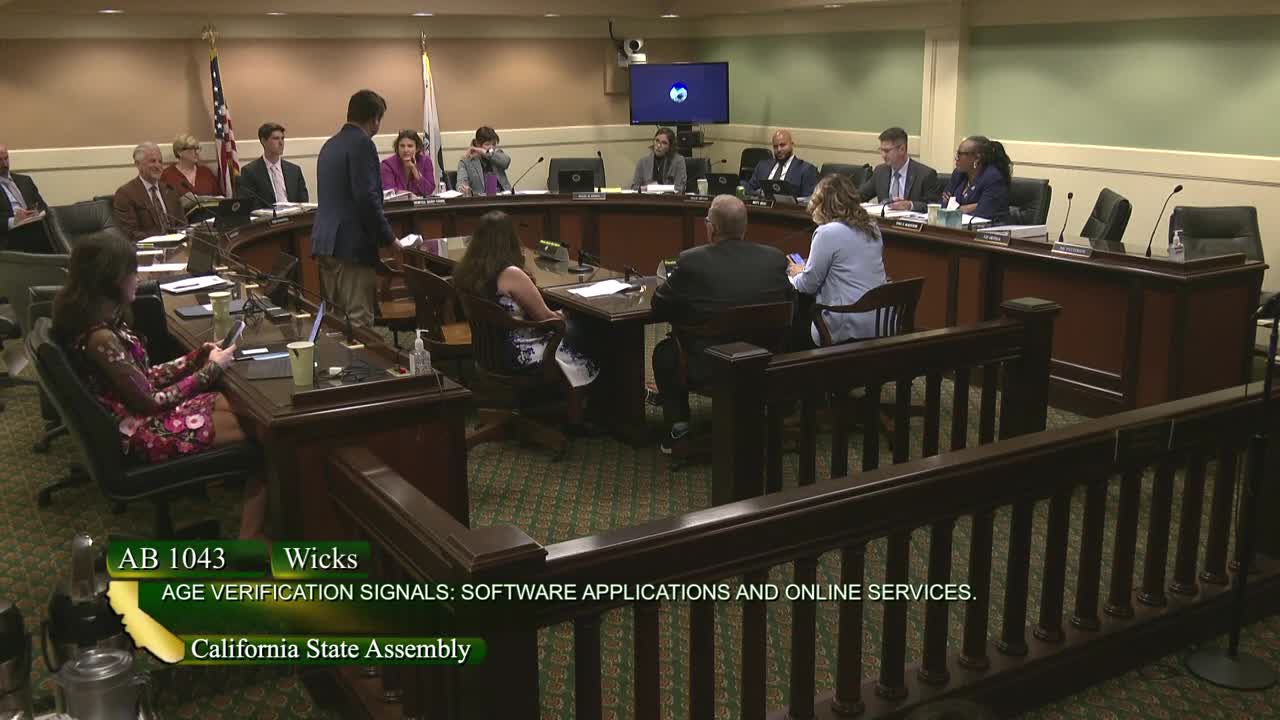 13MIN
Assembly Standing Committee on Privacy and Consumer Protection
Bill Author