AB 940: Economic development: industry strategies.
- Session Year: 2025-2026
- House: Assembly
- Latest Version Date: 2025-10-03
Current Status:
Passed
(2025-10-03: Chaptered by Secretary of State - Chapter 333, Statutes of 2025.)
Introduced
In Committee
Awaiting First Chamber Vote
Passed First Chamber
In Committee
Awaiting Second Chamber Vote
Passed Second Chamber
Enacted
Existing law establishes the Governors Office of Business and Economic Development, also known as GO-Biz, to, among other duties, serve the Governor as the lead entity for economic strategy and the marketing of California on issues relating to business development, private sector investment, and economic growth.
This bill would require GO-Biz to develop industry strategies for the strategic sectors identified in the California Jobs First State Economic Blueprint to ensure an industry-specific approach that builds on the strategies outlined in the blueprint and outlines the activities and investments necessary to ensure that these sectors continue to grow in California. The bill would require each industry strategy to include specified elements, including an industry overview outlining the current state of the industry, why it is critical to California, and the specific strategies that would lead to increased jobs and capital investments.
This bill would also require GO-Biz to develop an industry strategy for the quantum technology subsector identified in the blueprint and would authorize the department to develop industry strategies for the other subsectors identified in the blueprint. The bill would require GO-Biz to prioritize the industry strategy for quantum technology and submit a copy of the completed industry strategy to the Legislature on or before July 1, 2026, as provided.
Existing law establishes procedures for the formation of infrastructure financing districts, enhanced infrastructure financing districts, infrastructure and revitalization financing districts, and community revitalization and investment authorities, as specified, to undertake various economic development projects, including financing public facilities and infrastructure, affordable housing, and economic revitalization.
This bill would authorize the establishment of a Quantum Innovation Zone by two or more cities and counties upon the adoption of a resolution by the legislative body of each city and county that states the intent of the city or county to participate in the Quantum Innovation Zone. The bill would require a Quantum Innovation Zone to be governed by a board of directors with a specified membership. The bill would task a Quantum Innovation Zone with various duties, including, among other things, identification of projects and programs that will best utilize public dollars and improve the economic vitality of the Quantum Innovation Zone in a coordinated effort to support the development of the quantum computing economy.
The bill would require a Quantum Innovation Zone to create and maintain an internet website that is managed and updated by an entity designated by the board of directors, would require the board of directors to appoint a steering committee to produce a report each year gauging the progress of the zone, and would require the report to be posted on the zones internet website, as specified.
Existing law requires an operator of an internet website, online service, online application, or mobile application (website) directed to minors or an operator of a website that has actual knowledge that a minor is using its website to take certain actions, including permitting a minor who is a registered user of the operators website to remove or, if the operator prefers, to request and obtain removal of, content or information posted on the operators website by the user.This bill would make nonsubstantive changes to those provisions.Existing law requires an operator of an internet website, online service, online application, or mobile application (website) directed to minors or an operator of a website that has actual knowledge that a minor is using its website to take certain actions, including permitting a minor who is a registered user of the operators website to remove or, if the operator prefers, to request and obtain removal of, content or information posted on the operators website by the user.
This bill would make nonsubstantive changes to those provisions.
The Legislature finds and declares all of the following:
(a)California has made significant and lasting investments into regional and inclusive economic development strategies to ensure that the state continues to support the creation and attraction of, and access to, good-paying jobs for all Californians.
(b)The California Jobs First State Economic Blueprint was released as the first statewide economic development strategy in over 20 years, and the first statewide plan in the nation built from the work of regional collaboratives across the state, with particular emphasis on strengthening regional and local economies, investing in the workforce for the future, partnering with employers, and investing in innovation and technology.
(c)The California Jobs First State Economic Blueprint identifies strategic sectors and subsectors that make up the states economy, and each sector has been identified as a priority by at least one of the states economic regions.
(d)Californias high-tech sector stands as a cornerstone of the states economy, known for its influential role in driving the states reputation for innovation and outsized productivity. Across the states 13 Jobs First Collaboratives, 7 have identified high-tech, which includes quantum technology, as a regional strategic sector.
(e)Quantum technology has the potential to revolutionize industries, with astounding implications for society in terms of health care, climate change, energy, and security. Quantum technologies utilize the properties identified by quantum physics to provide new capabilities in a variety of applications, including computing, networking, communications, and sensing.
(f)Quantum technology is expected to create trillions of dollars of value over the next decade, and policymakers worldwide are investing in quantum technology to ensure their participation in a future quantum economy. As economic competition grows and businesses choose to go where there is investment, California has limited time to leverage its unmatched technological and scientific assets to lead the next generation and drive new economic growth in the quantum technology sector.
SEC. 2.Article 6.3 (commencing with Section 12099.8) is added to Chapter 1.6 of Part 2 of Division 3 of Title 2 of the Government Code, to read:6.3.Industry Strategies for Strategic Sectors12099.8.(a)The office shall develop industry strategies for the strategic sectors identified in the California Jobs First State Economic Blueprint to ensure an industry-specific approach that builds on the strategies outlined in the blueprint and outlines the activities and investments necessary to ensure that these sectors continue to grow in California.
(b)The industry strategies shall build upon Californias comparative advantage, including its concentration of academic, scientific, and technological assets, coupled with a highly skilled workforce. The industry strategies shall include prioritizing access to tax incentives, grants, loan programs, and workforce training programs to catalyze private sector investment in the respective sector.
(c)Each industry strategy shall contain all of the following elements:
(1)An industry overview outlining the current state of the industry, why it is critical to California, and the specific strategies that would lead to increased jobs and capital investments.
(2)Identification of the key dependencies and risks associated with implementing the strategies.
(3)Identification of projects and programs that will most quickly improve the economic vitality of the industry, and the types of public-private partnerships between government, academia, and private investors that will be critical to access the funding necessary to accelerate the industry.
(4)An analysis of relevant state policies and regulations to identify opportunities to grow the industry and determine whether alternative approaches may accomplish goals in less costly ways.
(5)A summary of sector-level outcomes expected with the implementation of the strategies.
(6)A dedicated section on the State of Californias internet website that is managed and updated with industry-specific information.
(d)(1)The office shall also develop an industry strategy for the quantum technology subsector identified in the blueprint and may develop industry strategies for the other subsectors identified in the blueprint.
(2)The office shall prioritize the industry strategy for quantum technology and submit a copy of the completed industry strategy to the Legislature on or before July 1, 2026. The industry strategy shall be submitted in compliance with Section 9795.
(3)The office shall develop the industry strategy for quantum technology with engagement from key stakeholders in the regions that have identified quantum technology as a priority.
SECTION 1.The Legislature hereby finds and declares all of the following:(a)Earth is at a pivotal juncture in human history prompted by a scientific paradigm shift. Quantum entanglement is a nonintuitive but powerful property of the natural world, at the atomic and subatomic level, where two or more quantum systems become so connected that they affect each other even when separated by large distances. The essentials of this phenomenon have been known for over 100 years, but we now understand that quantum physics has the potential to fundamentally change the world of computing. The implications for society are astounding.(b)The theory of quantum mechanics was developed early in the 20th century to explain the counterintuitive wavelike and particulate behavior of atomic and subatomic matter. In the 21st century, humanity has begun to harness quantum mechanics to develop an array of diverse technologies that can make quantum computing a reality. California research institutions are at the forefront of pioneering these techniques.(c)Computers are designed to complete mechanical tasks rapidly and repeatedly. Yet storing data as binary bits with values of 0 and 1 has inherent limitations. The size of the computer grows linearly with the size of the problem. We are also reaching the physical limits of silicon semiconductor technology, with growth in speed and capacity described by Moores Law coming close to its end point.(d)If society does not shift its computing strategy, by 2050, as much as 40 percent of global energy consumption could come from maintaining and cooling computers. This would be untenable for the planet.(e)Quantum bits (qubits) do not have precise values of 0 or 1. They simultaneously sample both values with probabilities intimately tied to the values of other qubits through entanglement. As a result, the size of the calculations they perform grows exponentially with the number of qubits. Quantum computers require orders of magnitude less energy and can tackle problems that would never be possible with conventional computers.(f)As economic competition grows and businesses choose to go where there is investment, California has limited time to leverage its unmatched technological and scientific assets to lead the next generation and drive new economic growth.SEC. 2.Chapter 37 (commencing with Section 7599.300) is added to Division 7 of Title 1 of the Government Code, to read:37.Quantum Innovation Zones7599.300.A Quantum Innovation Zone may be established by two or more cities and counties upon the adoption of a resolution by the legislative body of each city and county that states the intent of the city or county to participate in the Quantum Innovation Zone.7599.301.The purpose of a Quantum Innovation Zone is to build upon Californias comparative advantage provided by its concentration of academic, scientific, and technological assets, coupled with a highly skilled workforce, thereby prioritizing access to tax incentives, grants, loan programs, workforce training programs, and private sector investment in the quantum computing sector.7599.302.(a)A Quantum Innovation Zone shall be governed by a board of directors.(b)The board of directors of a Quantum Innovation Zone shall be comprised of representatives from seven stakeholder groups who shall serve as voting directors, as follows:(1)Local government directors, one from each of the cities and counties that have adopted a resolution expressing its intent to participate in the Quantum Innovation Zone. Each city and county shall select one representative who shall serve a two-year term.(2)Five large employer directors, located within one or more of the cities and counties that have adopted a resolution. Each of the five largest private employers in the fields of quantum computing within the area of the Quantum Innovation Zone shall select a representative who will serve a two-year term. Employer size shall be based upon data from the local workforce board.(3)Four state government directors.(4)Five small business and economic development directors who shall represent existing economic and business development organizations that serve the cities and counties that have adopted a resolution. These small business and economic development representatives shall be nominated by the regional planning agencies encompassing the geography of the Quantum Innovation Zone and confirmed by the board to serve two-year terms.(5)Five directors from universities, laboratories, and foundations with specialized expertise and knowledge of quantum computing, who shall, upon agreement by the regents, be nominated by the Office of the President of the University of California and confirmed by the board. These university, laboratory, and foundation representatives shall serve two-year terms.(6)Five directors representing the five largest private sector organized labor organizations whose membership works in the cities and counties that have adopted a resolution to establish a Quantum Innovation Zone. Each union shall select its own representative to the Quantum Innovation Zone board who shall each serve a two-year term.(7)Five directors representing workforce development and public and private educational entities that serve the cities and counties that have adopted a resolution to establish a Quantum Innovation Zone, at least one of whom shall be a representative from the California State University and at least one of whom shall be a representative from the California Community Colleges. These workforce development and education representatives shall be nominated by the regional planning agencies encompassing the geography of the Quantum Innovation Zone and confirmed by the board to serve two-year terms.(8)Confirmation of a nominee for membership on the board of directors shall be by majority vote of the sitting members of the board.(c)Every member of the Legislature and of the United States Congress who represents the cities and counties that have adopted a resolution to establish a Quantum Innovation Zone shall be ex officio voting members of the board of directors.(d)A board chair and two deputy chairs shall be selected by a majority vote of the board. The chair and deputy chairs shall serve two-year terms. An individual may serve as chair or deputy chair more than once, however, they shall not serve consecutive terms. The chair and deputy chairs shall be chosen from among the following:(1)One member shall be a Member of the Legislature who represents one or more of the cities and counties that have adopted a resolution to establish a Quantum Innovation Zone.(2)One member shall be a representative from a local agency in a city or county that has adopted a resolution to establish a Quantum Innovation Zone.(3)One member shall be a representative whose residence and place of employment is within one or more of the cities and counties that have adopted a resolution to establish a Quantum Innovation Zone.(e)A Quantum Innovation Zone shall also have an executive board comprised of the chair, deputy chairs, and up to seven members of the board of directors selected by a majority vote of the board of directors.(f)The members of the board of directors shall serve without compensation.(g)A member of the board of directors, including the chair, shall, upon identifying a conflict of interest, or a potential conflict of interest, regarding a matter before the board of directors of the Quantum Innovation Zone, immediately and before consideration of the matter, do all of the following:(1)Provide written notice to the chair regarding the interest that gives rise to the conflict of interest or potential conflict of interest. In the case of the chair, written notice shall be given to one of the deputy chairs.(2)Recuse themselves from discussing or voting on the matter.(3)Leave the meeting room until after discussion, vote, and any other consideration of disposition of the matter is concluded.(h)A member of the board of directors shall not use the name of the Quantum Innovation Zone on any letterhead, business code, or identification badge unless the person has been authorized to do so by the board of directors.7599.303.A Quantum Innovation Zone shall have all of the following duties:(a)Identification of projects and programs that will best utilize public dollars and most quickly improve the economic vitality of the Quantum Innovation Zone, especially those that leverage federal, state, local, and private sector resources in a coordinated effort to support the development of the quantum computing economy.(b)Work with members of the states congressional delegation and federal officials, including any relevant federal interagency task force, to gain federal support for projects identified by the zone as critical to the regions quantum computing economy.(c)Partner with the University of California, the California State University, community colleges, and the states other research and educational institutions, as well as private foundations, to provide guidance, advice, and encouragement in support of studies of particular interest and importance to quantum computing and related industries.(d)Review state policies and regulations to ensure they are fair and appropriate for the states diverse geographic regions, including the Quantum Innovation Zone, and determine whether alternative approaches can accomplish goals in less costly ways.(e)Make recommendations to the Governor that would improve the economic well-being of the region encompassing the Quantum Innovation Zone and the quality of life of its residents.(f)Create and maintain an internet website that is managed and updated by an entity designated by the board of directors.7599.304.(a)The board of directors of a Quantum Innovation Zone shall appoint a steering committee that, on or before one year after the establishment of a Quantum Innovation Zone, shall develop metrics that shall be reported to the Legislature and state departments and agencies gauging the progress of the zone that shall include, but not be limited to, all of the following:(1)The number of jobs that were gained and lost in the quantum computing sector and related industries.(2)The average wage of the jobs gained in the quantum computing sector and related industries.(3)The number and types of grants solicited and received by, or on behalf of, the zone.(4)The type and amount of workforce training conducted in the zone, by whom it was provided, and the amount of capital investment attached to provision of that training.(b)The Quantum Innovation Zone shall annually post the report described in subdivision (a) on its internet website and submit a letter to the Legislature informing the Legislature that the report has been posted.The Legislature hereby finds and declares all of the following:
(a)Earth is at a pivotal juncture in human history prompted by a scientific paradigm shift. Quantum entanglement is a nonintuitive but powerful property of the natural world, at the atomic and subatomic level, where two or more quantum systems become so connected that they affect each other even when separated by large distances. The essentials of this phenomenon have been known for over 100 years, but we now understand that quantum physics has the potential to fundamentally change the world of computing. The implications for society are astounding.
(b)The theory of quantum mechanics was developed early in the 20th century to explain the counterintuitive wavelike and particulate behavior of atomic and subatomic matter. In the 21st century, humanity has begun to harness quantum mechanics to develop an array of diverse technologies that can make quantum computing a reality. California research institutions are at the forefront of pioneering these techniques.
(c)Computers are designed to complete mechanical tasks rapidly and repeatedly. Yet storing data as binary bits with values of 0 and 1 has inherent limitations. The size of the computer grows linearly with the size of the problem. We are also reaching the physical limits of silicon semiconductor technology, with growth in speed and capacity described by Moores Law coming close to its end point.
(d)If society does not shift its computing strategy, by 2050, as much as 40 percent of global energy consumption could come from maintaining and cooling computers. This would be untenable for the planet.
(e)Quantum bits (qubits) do not have precise values of 0 or 1. They simultaneously sample both values with probabilities intimately tied to the values of other qubits through entanglement. As a result, the size of the calculations they perform grows exponentially with the number of qubits. Quantum computers require orders of magnitude less energy and can tackle problems that would never be possible with conventional computers.
(f)As economic competition grows and businesses choose to go where there is investment, California has limited time to leverage its unmatched technological and scientific assets to lead the next generation and drive new economic growth.
SEC. 2.Chapter 37 (commencing with Section 7599.300) is added to Division 7 of Title 1 of the Government Code, to read:37.Quantum Innovation Zones 7599.300.A Quantum Innovation Zone may be established by two or more cities and counties upon the adoption of a resolution by the legislative body of each city and county that states the intent of the city or county to participate in the Quantum Innovation Zone.
7599.301.The purpose of a Quantum Innovation Zone is to build upon Californias comparative advantage provided by its concentration of academic, scientific, and technological assets, coupled with a highly skilled workforce, thereby prioritizing access to tax incentives, grants, loan programs, workforce training programs, and private sector investment in the quantum computing sector.
7599.302.(a)A Quantum Innovation Zone shall be governed by a board of directors.
(b)The board of directors of a Quantum Innovation Zone shall be comprised of representatives from seven stakeholder groups who shall serve as voting directors, as follows:
(1)Local government directors, one from each of the cities and counties that have adopted a resolution expressing its intent to participate in the Quantum Innovation Zone. Each city and county shall select one representative who shall serve a two-year term.
(2)Five large employer directors, located within one or more of the cities and counties that have adopted a resolution. Each of the five largest private employers in the fields of quantum computing within the area of the Quantum Innovation Zone shall select a representative who will serve a two-year term. Employer size shall be based upon data from the local workforce board.
(3)Four state government directors.
(4)Five small business and economic development directors who shall represent existing economic and business development organizations that serve the cities and counties that have adopted a resolution. These small business and economic development representatives shall be nominated by the regional planning agencies encompassing the geography of the Quantum Innovation Zone and confirmed by the board to serve two-year terms.
(5)Five directors from universities, laboratories, and foundations with specialized expertise and knowledge of quantum computing, who shall, upon agreement by the regents, be nominated by the Office of the President of the University of California and confirmed by the board. These university, laboratory, and foundation representatives shall serve two-year terms.
(6)Five directors representing the five largest private sector organized labor organizations whose membership works in the cities and counties that have adopted a resolution to establish a Quantum Innovation Zone. Each union shall select its own representative to the Quantum Innovation Zone board who shall each serve a two-year term.
(7)Five directors representing workforce development and public and private educational entities that serve the cities and counties that have adopted a resolution to establish a Quantum Innovation Zone, at least one of whom shall be a representative from the California State University and at least one of whom shall be a representative from the California Community Colleges. These workforce development and education representatives shall be nominated by the regional planning agencies encompassing the geography of the Quantum Innovation Zone and confirmed by the board to serve two-year terms.
(8)Confirmation of a nominee for membership on the board of directors shall be by majority vote of the sitting members of the board.
(c)Every member of the Legislature and of the United States Congress who represents the cities and counties that have adopted a resolution to establish a Quantum Innovation Zone shall be ex officio voting members of the board of directors.
(d)A board chair and two deputy chairs shall be selected by a majority vote of the board. The chair and deputy chairs shall serve two-year terms. An individual may serve as chair or deputy chair more than once, however, they shall not serve consecutive terms. The chair and deputy chairs shall be chosen from among the following:
(1)One member shall be a Member of the Legislature who represents one or more of the cities and counties that have adopted a resolution to establish a Quantum Innovation Zone.
(2)One member shall be a representative from a local agency in a city or county that has adopted a resolution to establish a Quantum Innovation Zone.
(3)One member shall be a representative whose residence and place of employment is within one or more of the cities and counties that have adopted a resolution to establish a Quantum Innovation Zone.
(e)A Quantum Innovation Zone shall also have an executive board comprised of the chair, deputy chairs, and up to seven members of the board of directors selected by a majority vote of the board of directors.
(f)The members of the board of directors shall serve without compensation.
(g)A member of the board of directors, including the chair, shall, upon identifying a conflict of interest, or a potential conflict of interest, regarding a matter before the board of directors of the Quantum Innovation Zone, immediately and before consideration of the matter, do all of the following:
(1)Provide written notice to the chair regarding the interest that gives rise to the conflict of interest or potential conflict of interest. In the case of the chair, written notice shall be given to one of the deputy chairs.
(2)Recuse themselves from discussing or voting on the matter.
(3)Leave the meeting room until after discussion, vote, and any other consideration of disposition of the matter is concluded.
(h)A member of the board of directors shall not use the name of the Quantum Innovation Zone on any letterhead, business code, or identification badge unless the person has been authorized to do so by the board of directors.
7599.303.A Quantum Innovation Zone shall have all of the following duties:
(a)Identification of projects and programs that will best utilize public dollars and most quickly improve the economic vitality of the Quantum Innovation Zone, especially those that leverage federal, state, local, and private sector resources in a coordinated effort to support the development of the quantum computing economy.
(b)Work with members of the states congressional delegation and federal officials, including any relevant federal interagency task force, to gain federal support for projects identified by the zone as critical to the regions quantum computing economy.
(c)Partner with the University of California, the California State University, community colleges, and the states other research and educational institutions, as well as private foundations, to provide guidance, advice, and encouragement in support of studies of particular interest and importance to quantum computing and related industries.
(d)Review state policies and regulations to ensure they are fair and appropriate for the states diverse geographic regions, including the Quantum Innovation Zone, and determine whether alternative approaches can accomplish goals in less costly ways.
(e)Make recommendations to the Governor that would improve the economic well-being of the region encompassing the Quantum Innovation Zone and the quality of life of its residents.
(f)Create and maintain an internet website that is managed and updated by an entity designated by the board of directors.
7599.304.(a)The board of directors of a Quantum Innovation Zone shall appoint a steering committee that, on or before one year after the establishment of a Quantum Innovation Zone, shall develop metrics that shall be reported to the Legislature and state departments and agencies gauging the progress of the zone that shall include, but not be limited to, all of the following:
(1)The number of jobs that were gained and lost in the quantum computing sector and related industries.
(2)The average wage of the jobs gained in the quantum computing sector and related industries.
(3)The number and types of grants solicited and received by, or on behalf of, the zone.
(4)The type and amount of workforce training conducted in the zone, by whom it was provided, and the amount of capital investment attached to provision of that training.
(b)The Quantum Innovation Zone shall annually post the report described in subdivision (a) on its internet website and submit a letter to the Legislature informing the Legislature that the report has been posted.
SECTION 1.Section 22581 of the Business and Professions Code is amended to read:22581.(a)An operator of an internet website, online service, online application, or mobile application directed to minors or an operator of an internet website, online service, online application, or mobile application that has actual knowledge that a minor is using its internet website, online service, online application, or mobile application shall do all of the following:(1)Permit a minor who is a registered user of the operators internet website, online service, online application, or mobile application to remove or, if the operator prefers, to request and obtain removal of, content or information posted on the operators internet website, online service, online application, or mobile application by the user.(2)Provide notice to a minor who is a registered user of the operators internet website, online service, online application, or mobile application that the minor may remove or, if the operator prefers, request and obtain removal of, content or information posted on the operators internet website, online service, online application, or mobile application by the registered user.(3)Provide clear instructions to a minor who is a registered user of the operators internet website, online service, online application, or mobile application on how the user may remove or, if the operator prefers, request and obtain the removal of content or information posted on the operators internet website, online service, online application, or mobile application.(4)Provide notice to a minor who is a registered user of the operators internet website, online service, online application, or mobile application that the removal described under paragraph (1) does not ensure complete or comprehensive removal of the content or information posted on the operators internet website, online service, online application, or mobile application by the registered user.(b)An operator or a third party is not required to erase or otherwise eliminate, or to enable erasure or elimination of, content or information in any of the following circumstances:(1)Any other provision of federal or state law requires the operator or third party to maintain the content or information.(2)The content or information was stored on or posted to the operators internet website, online service, online application, or mobile application by a third party other than the minor, who is a registered user, including any content or information posted by the registered user that was stored, republished, or reposted by the third party.(3)The operator anonymizes the content or information posted by the minor who is a registered user, so that the minor who is a registered user cannot be individually identified.(4)The minor does not follow the instructions provided to the minor pursuant to paragraph (3) of subdivision (a) on how the registered user may request and obtain the removal of content or information posted on the operators internet website, online service, online application, or mobile application by the registered user.(5)The minor has received compensation or other consideration for providing the content.(c)This section shall not be construed to limit the authority of a law enforcement agency to obtain any content or information from an operator as authorized by law or pursuant to an order of a court of competent jurisdiction.(d)An operator shall be deemed compliant with this section if:(1)It renders the content or information posted by the minor user no longer visible to other users of the service and the public even if the content or information remains on the operators servers in some form.(2)Despite making the original posting by the minor user invisible, it remains visible because a third party has copied the posting or reposted the content or information posted by the minor.(e)This section shall not be construed to require an operator of an internet website, online service, online application, or mobile application to collect age information about users.(f)Posted means content or information that can be accessed by a user in addition to the minor who posted the content or information, whether the user is a registered user or not, of the internet website, online service, online application, or mobile application where the content or information is posted. REVISIONS: HeadingLines 1 and 2.(a)An operator of an Internet Web site, internet website, online service, online application, or mobile application directed to minors or an operator of an Internet Web site, internet website, online service, online application, or mobile application that has actual knowledge that a minor is using its Internet Web site, internet website, online service, online application, or mobile application shall do all of the following:
(1)Permit a minor who is a registered user of the operators Internet Web site, internet website, online service, online application, or mobile application to remove or, if the operator prefers, to request and obtain removal of, content or information posted on the operators Internet Web site, internet website, online service, online application, or mobile application by the user.
(2)Provide notice to a minor who is a registered user of the operators Internet Web site, internet website, online service, online application, or mobile application that the minor may remove or, if the operator prefers, request and obtain removal of, content or information posted on the operators Internet Web site, internet website, online service, online application, or mobile application by the registered user.
(3)Provide clear instructions to a minor who is a registered user of the operators Internet Web site, internet website, online service, online application, or mobile application on how the user may remove or, if the operator prefers, request and obtain the removal of content or information posted on the operators Internet Web site, internet website, online service, online application, or mobile application.
(4)Provide notice to a minor who is a registered user of the operators Internet Web site, internet website, online service, online application, or mobile application that the removal described under paragraph (1) does not ensure complete or comprehensive removal of the content or information posted on the operators Internet Web site, internet website, online service, online application, or mobile application by the registered user.
(b)An operator or a third party is not required to erase or otherwise eliminate, or to enable erasure or elimination of, content or information in any of the following circumstances:
(1)Any other provision of federal or state law requires the operator or third party to maintain the content or information.
(2)The content or information was stored on or posted to the operators Internet Web site, internet website, online service, online application, or mobile application by a third party other than the minor, who is a registered user, including any content or information posted by the registered user that was stored, republished, or reposted by the third party.
(3)The operator anonymizes the content or information posted by the minor who is a registered user, so that the minor who is a registered user cannot be individually identified.
(4)The minor does not follow the instructions provided to the minor pursuant to paragraph (3) of subdivision (a) on how the registered user may request and obtain the removal of content or information posted on the operators Internet Web site, internet website, online service, online application, or mobile application by the registered user.
(5)The minor has received compensation or other consideration for providing the content.
(c)This section shall not be construed to limit the authority of a law enforcement agency to obtain any content or information from an operator as authorized by law or pursuant to an order of a court of competent jurisdiction.
(d)An operator shall be deemed compliant with this section if:
(1)It renders the content or information posted by the minor user no longer visible to other users of the service and the public even if the content or information remains on the operators servers in some form.
(2)Despite making the original posting by the minor user invisible, it remains visible because a third party has copied the posting or reposted the content or information posted by the minor.
(e)This section shall not be construed to require an operator of an Internet Web site, internet website, online service, online application, or mobile application to collect age information about users.
(f)Posted means content or information that can be accessed by a user in addition to the minor who posted the content or information, whether the user is a registered user or not, of the Internet Web site, internet website, online service, online application, or mobile application where the content or information is posted.
|
Date
|
Status
|
|---|---|
| Oct 3, 2025 | Chaptered by Secretary of State - Chapter 333, Statutes of 2025. |
| Oct 3, 2025 | Approved by the Governor. |
| Sep 24, 2025 | Enrolled and presented to the Governor at 3 p.m. |
| Sep 13, 2025 | Senate amendments concurred in. To Engrossing and Enrolling. (Ayes 76. Noes 0. Page 3501.). |
| Sep 13, 2025 | Joint Rules 61(a)(14) and 51(a)(4) suspended. (Ayes 59. Noes 20. Page 3413.) |
| Sep 13, 2025 | In Assembly. Concurrence in Senate amendments pending. |
| Sep 13, 2025 | Assembly Rule 63 suspended. (Page 3484.) |
| Sep 12, 2025 | Senate Rule 29 suspended. (Page 2961.) |
| Sep 12, 2025 | Read third time. Passed. Ordered to the Assembly. (Ayes 37. Noes 0. Page 3003.). |
| Sep 12, 2025 | Read second time. Ordered to third reading. |
| Sep 11, 2025 | From committee: Do pass. (Ayes 5. Noes 0.) (September 11). |
| Sep 10, 2025 | From committee: Do pass and re-refer to Com. on APPR. (Ayes 9. Noes 0.) (September 10). Re-referred to Com. on APPR. |
| Sep 9, 2025 | Re-referred to Com. on B. P. & E.D. |
| Sep 9, 2025 | Withdrawn from committee. |
| Sep 9, 2025 | Senate Rule 29.3(b) suspended. (Ayes 28. Noes 8. Page 2568.) |
| Sep 9, 2025 | Re-referred to Com. on RLS. |
| Sep 9, 2025 | Joint Rules 61 and 62(a) suspended. (Ayes 30. Noes 9. Page 2731.) |
| Sep 9, 2025 | From committee chair, with author's amendments: Amend, and re-refer to committee. Read second time, amended, and re-referred to Com. on L. GOV. |
| Jun 23, 2025 | From committee: Do pass and re-refer to Com. on L. GOV. (Ayes 10. Noes 0.) (June 23). Re-referred to Com. on L. GOV. |
| Jun 11, 2025 | In committee: Hearing postponed by committee. |
| Jun 4, 2025 | Referred to Coms. on B. P. & E.D. and L. GOV. |
| May 28, 2025 | In Senate. Read first time. To Com. on RLS. for assignment. |
| May 27, 2025 | Read third time. Passed. Ordered to the Senate. (Ayes 77. Noes 0. Page 1730.) |
| May 15, 2025 | Read second time. Ordered to third reading. |
| May 14, 2025 | From committee: Do pass. (Ayes 15. Noes 0.) (May 14). |
| Apr 22, 2025 | From committee: Do pass and re-refer to Com. on APPR. (Ayes 8. Noes 0.) (April 22). Re-referred to Com. on APPR. |
| Apr 22, 2025 | Coauthors revised. |
| Mar 25, 2025 | Re-referred to Com. on E.D., G., & H.I. |
| Mar 24, 2025 | Referred to Com. on E.D., G., & H.I. |
| Mar 24, 2025 | From committee chair, with author's amendments: Amend, and re-refer to Com. on E.D., G., & H.I. Read second time and amended. |
| Feb 20, 2025 | From printer. May be heard in committee March 22. |
| Feb 19, 2025 | Read first time. To print. |
|
Date
|
Description
|
Location
|
Votes
|
|
|---|---|---|---|---|
| Sep 13, 2025 | AB 940 WICKS Concurrence in Senate Amendments | Assembly Floor |
Passed |
|
| Sep 12, 2025 | Assembly 2nd Reading AB940 Wicks et al. By Grayson | Senate Floor |
Passed |
|
| Sep 11, 2025 | Do pass | Senate Standing Committee on Appropriations |
Passed |
|
| Sep 10, 2025 | Do pass, but first be re-referred to the Committee on [Appropriations] | Senate Standing Committee on Business, Professions and Economic Development |
Passed |
|
| Jun 23, 2025 | Do pass, but first be re-referred to the Committee on [Local Government] | Senate Standing Committee on Business, Professions and Economic Development |
Passed |
|
| May 27, 2025 | AB 940 Wicks Assembly Third Reading | Assembly Floor |
Passed |
|
| May 14, 2025 | Do pass. | Assembly Standing Committee on Appropriations |
Passed |
This list shows positions taken on this bill by organizations on the date displayed, which is linked to the original source.
Positions by individuals are not included.
|
Organization
|
Position
|
Date
|
|---|---|---|
| BASIC | ** Support | |
| Bay Area Science | ** Support | |
| Bay Area Science and Innovation Consortium | ** Support | |
| Innovation Consortium (BASIC) | ** Support | |
| IonQ | ** Support | |
| Microsoft Corporation | ** Support | |
| Technet | ** Support | |
| University of California | ** Support |
CONCURRENCE IN SENATE AMENDMENTS
CSA1 Bill Id:AB 940
Author:(Wicks, et al.)
As Amended Ver:September 9, 2025
Majority vote
SUMMARY
Directs the Governor's Office of Business and Economic Development (GO-Biz) to develop a statewide industry strategy for the quantum technology sector, in collaboration with regional partners. The bill replaces the original proposal for local "quantum innovation zones" with a more coordinated, statewide approach aligned with the California Jobs First State Economic Blueprint. The strategy will identify key investments, partnerships, and regulatory opportunities to support job creation and economic growth in this emerging sector.
Senate Amendments
- Replace the original framework authorizing local governments to establish "quantum innovation zones" with a directive for GO-Biz to develop a statewide strategy to support the quantum technology sector.
- Require GO-Biz to collaborate with regional partners to build and implement this industry strategy, focusing on broader economic development goals, statewide coordination and regional alignment.
- Directs GO-Biz to create industry-specific strategies for the strategic sectors named in the Blueprint, including quantum technology. Requires strategies to include:
- Industry overviews
- Risk assessments
- Project and partnership identification
- Policy and regulatory analysis
- Expected outcomes
- Public-facing online content
- Requires stakeholder engagement in regions prioritizing quantum technology.
- Mandates that the quantum technology strategy be prioritized and submitted to the Legislature by July 1, 2026.
COMMENTS
In response to the 2003 elimination of the Technology, Trade, and Commerce Agency, the Little Hoover Commission's 2010 report recommended creating a centralized entity to coordinate California's economic development efforts. This led to the establishment of the Governor's Office of Economic Development (GOED), later codified as GO-Biz in 2011.
GO-Biz now oversees a wide range of programs supporting business growth, innovation, international trade, small business assistance, and regional economic development. In 2025, the California Jobs First Economic Blueprint identified 13 distinct economic regions and emphasized place-based, inclusive strategies through the Regional Investment Initiative (RII).
At the national level, Quantum Information Science (QIS) has emerged as a transformative field with implications for economic growth and national security. The National Quantum Initiative Act (2018) and CHIPS and Science Act (2022) support coordinated federal investment in quantum R&D, infrastructure, and workforce development.
Several states have already made major investments in quantum technology:
- Colorado: $40 million for a Regional Tech Hub
- Connecticut: $60 million in a public-private partnership
- Maryland: $1 billion for the Potomac Quantum Innovation Center
To remain competitive, AB 940 proposes the creation of Quantum Zones in California to strengthen regional collaboration, foster workforce development, and attract federal and private investment building on the state's strong foundation in economic development and innovation.
According to the Author
The author states, "Quantum computing has the potential to fundamentally change the world of computing, and California is uniquely positioned to be a leader in this cutting edge technology. The state is home to world-class research institutions, trailblazing tech companies, and a highly skilled workforce that have driven innovation for decades. AB 940 reaffirms California's support of technological advancement by creating a pathway for the establishment of Quantum Innovation Zones (QIZs), which will allow these stakeholders to come together as organized entities governed by a board of directors. The establishment of QIZs will further knowledge sharing, boost economic vitality, enhance workforce development training, and bolster California's place as a leader in the world of quantum computing."
Arguments in Support
TechNet writes in support stating AB 940 positions California as a national leader in quantum information sciences, enhancing the state's competitiveness for federal and private investment. The bill promotes the development of coordinated workforce programs to train a diverse and highly skilled talent pool within the state.
By establishing Quantum Zones, AB 940 creates a unique opportunity to unite California's top industry experts, research institutions, and workforce. BASIC supports the bill and recommends flexibility in the composition of the proposed boards of directors for each Zone. This flexibility will allow regions to tailor strategies to their unique strengths, fostering more effective collaboration, resource sharing, and innovation across California's quantum ecosystem.
Arguments in Opposition
None.
FISCAL COMMENTS
According to the Senate Appropriations Committee, the effect of this bill has an unknown, potentially significant fiscal impact to GO-Biz, to the extent that workload to develop the strategies cannot be absorbed within GO-Biz's current activities related to developing and implementing the Blueprint (General Fund). It is unclear if GO-Biz would be required to update the strategies as new quantum technologies emerge and the quantum technology subsector evolves to ensure that the sectors identified in the Blueprint continue to grow. Ongoing cost pressures for GO-Biz to do so may range into the millions of dollars (General Fund).
VOTES:
ASM ECONOMIC DEVELOPMENT, GROWTH, AND HOUSEHOLD IMPACT: 8-0-0
YES: Solache, Castillo, Bonta, Patel, Petrie-Norris, Soria, Stefani, Wallis
ASM APPROPRIATIONS: 15-0-0
YES: Wicks, Sanchez, Arambula, Calderon, Caloza, Dixon, Elhawary, Fong, Mark González, Hart, Pacheco, Pellerin, Solache, Ta, Tangipa
ASSEMBLY FLOOR: 77-0-2
YES: Addis, Aguiar-Curry, Ahrens, Alanis, Alvarez, Arambula, Ávila Farías, Bains, Bauer-Kahan, Bennett, Berman, Boerner, Bonta, Bryan, Calderon, Caloza, Carrillo, Castillo, Chen, Connolly, Davies, DeMaio, Dixon, Elhawary, Ellis, Flora, Fong, Gabriel, Gallagher, Garcia, Gipson, Mark González, Hadwick, Haney, Harabedian, Hart, Hoover, Irwin, Jackson, Kalra, Krell, Lackey, Lee, Lowenthal, Macedo, McKinnor, Muratsuchi, Ortega, Pacheco, Papan, Patel, Patterson, Pellerin, Petrie-Norris, Quirk-Silva, Ramos, Ransom, Celeste Rodriguez, Michelle Rodriguez, Rogers, Blanca Rubio, Sanchez, Schiavo, Schultz, Sharp-Collins, Solache, Soria, Stefani, Ta, Tangipa, Valencia, Wallis, Ward, Wicks, Wilson, Zbur, Rivas
ABS, ABST OR NV: Jeff Gonzalez, Nguyen
UPDATED
VERSION: September 9, 2025
CONSULTANT: Carla Castilla / E.D., G., & H.I. / (916) 319-2090 FN: 0002098
SENATE RULES COMMITTEE Office of Senate Floor Analyses (916) 651-1520 Fax: (916) 327-4478 | AB 940 |
THIRD READING
Bill No: AB 940
Author: Wicks (D), Ellis (R) and Hoover (R), et al.
Amended: 9/9/25 in Senate
Vote: 21
SENATE BUS., PROF. & ECON. DEV. COMMITTEE: 9-0, 9/10/25
AYES: Ashby, Choi, Archuleta, Arreguín, Grayson, Smallwood-Cuevas, Strickland, Umberg, Weber Pierson
NO VOTE RECORDED: Menjivar, Niello
SENATE APPROPRIATIONS COMMITTEE: 5-0, 9/11/25
AYES: Caballero, Seyarto, Cabaldon, Richardson, Wahab
NO VOTE RECORDED: Dahle, Grayson
ASSEMBLY FLOOR: 77-0, 5/27/25 - See last page for vote
SUBJECT: Economic development: industry strategies
SOURCE: Author
DIGEST:
This bill (1) requires the Governor’s Office of Business and Economic Development (GO-Biz) to develop industry strategies containing specified information for the strategic sectors identified in the California Jobs First State Economic Blueprint (Blueprint); (2) requires GO-Biz to additionally develop an industry strategy for the quantum technology subsector identified in the Blueprint and authorizes GO-Biz to develop industry strategies for the other subsectors identified in the Blueprint.
ANALYSIS:
Existing law:
- Establishes GO-Biz within the Governor's office for the purpose of serving as the lead state entity for economic strategy and marketing of California on issues relating to business development, private sector investment and economic growth. (Government Code (GC) §§ 12096 et. seq.)
- Authorizes GO-Biz to develop content in order to provide information and resources to inform the general public about place-based and other geographically targeted economic development programs, including, but not limited to, federal Promise Zones within California that are designated by the United States Department of Housing and Urban Development; and Opportunity Zones designated by the United States Treasury. Requires GO-Biz to at least annually convene representatives from various programs and agencies across the state and from various federal programs and agencies for the purpose of discussing how California can leverage Promise Zones and Opportunity Zones to meet state and local community and economic development needs. (GC § 12097.5)
This bill:
- Requires GO-Biz to develop industry strategies for the strategic sectors identified in the Blueprint to ensure an industry-specific approach that builds on the strategies outlined in the blueprint and outlines the activities and investments necessary to ensure that these sectors continue to grow in California. Requires the industry strategies to contain specified elements.
- Requires GO-Biz to additionally develop an industry strategy for the quantum technology subsector identified in the Blueprint and authorizes GO-Biz to develop industry strategies for the other subsectors identified in the Blueprint.
- States findings and declarations related to California investments in jobs; information about the Blueprint; the identification of high-tech, which includes quantum technology, as a regional strategic sector; the potential that quantum technology has to revolutionize industries and capability in a variety of applications like computing, networking, communications, and sensing.
Background
The National Quantum Initiative Act (NQI Act) was signed into law on December 21, 2018 “...to accelerate quantum research and development for the economic and national security of the United States.” The NQI Act authorizes the National Institute of Standards and Technology, the National Science Foundation, and the Department of Energy to strengthen QIS programs. The NQI Act also calls for a coordinated approach to QIS Research and Development efforts across the United States Government, including the civilian, defense, and intelligence sectors. To guide these actions, the NQI Act legislates some responsibilities to the National Science and Technology Council (NSTC) Subcommittee on Quantum Information Science, the NSTC Subcommittee on the Economic and Security Implications of Quantum Science, the National Quantum Coordination Office, and the National Quantum Initiative Advisory Committee.
The CHIPS and Science Act of 2022 amended the NQI Act to authorize research and development in quantum networking infrastructure; the development of standards in quantum networking and communication; the establishment of a program to facilitate a competitive, merit-reviewed base process for access to U.S.-based quantum computing resources for research purposes; and, the integration of quantum information science and engineering into the science, technology, engineering, and mathematics curriculum at all education levels. It also explicitly includes quantum information science in the new National Science Foundation Directorate for Technology, Innovation, and Partnerships, as well as in existing Federal scholarship programs.
Examples of technologies that have used quantum information science include semiconductor microelectronics, the global positioning system, and magnetic resonance imaging.
An August 2024 report of the Subcommittee on Quantum Information Science, of the Committee on Science, of the National Science & Technology Council notes that “Quantum information science and technology (QIST) is a critical and emerging field that could revolutionize the way information is collected, processed, and transmitted…Due to the many potential societal benefits of QIST, the field is being enthusiastically pursued around the globe.”
The U.S. Economic Development Administration designated Colorado as a Regional Technology and Innovation Hub focused on the advancement of the quantum industry, with an investment of $40 million. Connecticut is also investing $60 million in QuantumCt, which is a public-private partnership seeking to accelerate the adoption of quantum technology in the state. Additionally, Maryland is investing $1 billion in the Potomac Quantum Innovation Center, and Illinois is also considering investments in quantum technology.
Comments
The Author notes that “California is behind many other states in recognizing the potential of quantum computing for what is very likely to be its revolutionary impact on society, the economy, and national security...California has long been the national leader on technology-Silicon Valley has led on research and innovation for decades, and our State continues to be the world's largest hub for technology…However, other states are now making direct, substantial investments into quantum innovation, and as economic competition grows, businesses will look to establish themselves in regions with more favorable investment environments…At this critical moment, California has limited time to establish itself as a leader in quantum innovation to retain and grow the state's quantum businesses and workforce and to access significant federal funding…California-trained talent are beginning to pursue research and start companies elsewhere because other governments are offering critical incentives and infrastructure investments. California cannot afford to educate a quantum-ready workforce, only to have them to leave the State to work elsewhere…other states are now making direct, substantial investments into quantum innovation.”
FISCAL EFFECT: Appropriation: No Fiscal Com.: Yes Local: No
SUPPORT: (Verified 9/10/25)
Innovation Consortium (BASIC)
IonQ
Bay Area Science
University of California
OPPOSITION: (Verified 9/10/25)
None received
ARGUMENTS IN SUPPORT: According to the University of California, “California has long been the national leader in technology and economic development. Silicon Valley has led on research and innovation for decades, and our State continues to be the world’s largest hub for technology. Many of the world’s largest tech companies were started and/or are based in the State – and California’s current policymakers are continuing to position the State aggressively relative to Artificial Intelligence. AB 940 seeks to ensure that California stakes its claim as a national leader in key industry sectors. In the absence of such clear and proactive steps, the inevitable assemblage of innovation, talent and investment that will drive commerce, employment and discovery relative to quantum computing might occur elsewhere in the U.S.”
IonQ writes that “AB 940 is a critical stepping stone to ensure California has an opportunity to take the lead in this next frontier of computing…Quantum technology has the potential to address global challenges in climate, energy, materials science, cybersecurity and healthcare. AB 940 provides the structure to accelerate this work in California while laying the groundwork for future investment through the budget process.”
ASSEMBLY FLOOR: 77-0, 5/27/25
AYES: Addis, Aguiar-Curry, Ahrens, Alanis, Alvarez, Arambula, Ávila Farías, Bains, Bauer-Kahan, Bennett, Berman, Boerner, Bonta, Bryan, Calderon, Caloza, Carrillo, Castillo, Chen, Connolly, Davies, DeMaio, Dixon, Elhawary, Ellis, Flora, Fong, Gabriel, Gallagher, Garcia, Gipson, Mark González, Hadwick, Haney, Harabedian, Hart, Hoover, Irwin, Jackson, Kalra, Krell, Lackey, Lee, Lowenthal, Macedo, McKinnor, Muratsuchi, Ortega, Pacheco, Papan, Patel, Patterson, Pellerin, Petrie-Norris, Quirk-Silva, Ramos, Ransom, Celeste Rodriguez, Michelle Rodriguez, Rogers, Blanca Rubio, Sanchez, Schiavo, Schultz, Sharp-Collins, Solache, Soria, Stefani, Ta, Tangipa, Valencia, Wallis, Ward, Wicks, Wilson, Zbur, Rivas
NO VOTE RECORDED: Jeff Gonzalez, Nguyen
Prepared by: Sarah Mason / B., P. & E.D. /
9/12/25 11:18:43
**** END ****
SENATE COMMITTEE ON
Senator Anna Caballero, Chair
2025 - 2026 Regular Session
AB 940 (Wicks) - Economic development: industry strategies
Version: | Policy Vote: |
Urgency: | Mandate: |
Hearing Date: | Consultant: |
Bill Summary:
AB 940 requires the Governor’s Office of Business and Economic Development (GO-Biz) to develop industry strategies for the strategic sectors identified in the California Jobs First State Economic Blueprint (Blueprint). AB 940 also requires GO-Biz to develop an industry strategy with engagement from key stakeholders for the quantum technology subsector identified in the Blueprint.
Fiscal Impact:
Unknown potentially significant fiscal impact to GO-Biz, to the extent that workload to develop the strategies cannot be absorbed within GO-Biz’s current activities related to developing and implementing the Blueprint (General Fund). It is unclear if GO-Biz would be required to update the strategies as new quantum technologies emerge and the quantum technology subsector evolves to ensure that the sectors identified in the Blueprint continue to grow. Ongoing cost pressures for GO-Biz to do so may range into the millions of dollars (General Fund).
Background:
The Blueprint was released in February 2025 following the establishment of state Regional Investment Initiative (RII) in 2021. The Blueprint identifies strategic sectors in 13 economic regions of California and aims to drive sustainable economic growth and job creation. The RII’s 13 economic regions are North State, Redwood, Capital, Sierra, Bay Area, North San Joaquin, Central San Joaquin, Central Coast, Kern County, Los Angeles County, Inland SoCal, Orange County, and Southern Border.
The Blueprint is organized into four categories, each with various industry sectors to be prioritized for investment. According to the Blueprint, the four categories and their industry sectors include:
- Strengthen – Sectors where California has an established competitive position or significant employment, but where there is leveling growth or wages. These sectors are historic assets with built out infrastructure to support them. Industry sectors include the creative economy (film, television, and the arts), manufacturing, financial and professional services, tourism and outdoor recreation, working lands and water (agricultural production and food processing), and transport and logistics.
- Accelerate – Sectors with moderate to high projected growth that are ready for expansion, where additional investments may generate growth. These sectors may require near-term investments, both funding and otherwise, to grow. Industry sectors include aerospace and defense (aircraft, space, and defense and satellites), clean economy (batteries, onshore wind, solar, zero emission vehicles), life sciences (medical technology, pharmaceuticals, and biotechnology), working lands and water (agricultural technology (agtech) and farm equipment), and high-tech (hardware, semiconductors and microelectronics, and software and services).
- Bet – Emerging sectors where significant investment or high strategic importance may generate growth. These sectors may require support for entrepreneurs and researches to access capital and support to the innovation ecosystem. These sectors include the clean economy (carbon management, critical minerals, hydrogen, and offshore wind), working lands and water (bioeconomy and blue economy and technology), and high-tech (artificial intelligence, quantum, and robotics).
- Anchor – regional “anchor” sectors that are critical for attracting and supporting other industry activities while providing quality, good-paying jobs within local communities. These sectors include childcare, education and skilled workforce, healthcare, housing, and infrastructure (broadband, transmission and distribution, transportation infrastructure, and water).
In August 2025, the Governor Newsom and the California Jobs First Council (Council) announced $80 million to 11 projects across seven regions in the following industry sectors: aerospace and defense, agtech and farm equipment, bioeconomy, and life sciences. The announcement noted the awards are part of a two-phased approached to distribute a total of $125 million to projects that advance the Accelerate and Bet sectors. The second round of implementation funding is slated to begin in October 2025.
Proposed Law:
- Requires GO-Biz to develop industry strategies for the strategic sectors identified in the Blueprint to ensure an industry-specific approach that builds on the strategies outlined in the blueprint and outlines the activities and investments necessary to ensure that these sectors continue to grow in California. Requires the strategies to build upon California’s comparative advantage and include prioritizing access to tax incentives, grants, loan programs, and workforce training programs to catalyze private sector investment in the respective sector. Requires each industry strategy to contain all of the following elements:
- An industry overview outlining the current state of the industry, why it is critical to California and the specific strategies that would lead to increased jobs and capital investments.
- Identification of the key dependencies and risks associated with implementing the strategies.
- Identification of projects and programs that will most quickly improve the economic vitality of the industry, and the types of public-private partnerships between government, academia, and private investors that will be critical to access the funding necessary to accelerate the industry.
- An analysis of relevant state policies and regulations to identify opportunities to grow the industry and determine whether alternative approaches may accomplish goals in less costly ways.
- A summary of sector-level outcomes expected with the implementation of the strategies.
- A dedicated section on the State of California’s internet website that is managed and updated with industry-specific information.
- Requires GO-Biz to also develop an industry strategy with engagement from key stakeholders in the regions that have identified quantum technology as a priority for the quantum technology subsector identified in the Blueprint. Authorizes GO-Biz to develop industry strategies for the other subsectors in the Blueprint.
- Requires GO-Biz to prioritize the industry strategy for quantum technology and submit a copy of the completed strategy to the Legislature on or before July 1, 2026.
- States legislative findings and declarations.
Staff Comments:
It is unknown if GO-Biz may absorb workload associated with this bill into its current responsibilities under the Council and program, or if there are additional resources that may support development of the Blueprint specific to the quantum technology subsector.
For context, AB 105 (Gabriel, 2025) is a budget bill that, among other things, appropriates $4 million in one-time 2025-26 General Fund to GO-Biz to support quantum research and innovation and to convene stakeholders supporting California’s leadership in quantum. It is unknown if or to what extent GO-Biz may utilize this appropriation or other resources to develop industry strategies for the quantum technology subsector as required by this bill. At the time of this analysis, AB 105 is pending on the Senate Floor.
-- END --
SENATE COMMITTEE ON
BUSINESS, PROFESSIONS AND ECONOMIC DEVELOPMENT
Senator Angelique Ashby, Chair
2025 - 2026 Regular
Bill No: AB 940 Hearing Date: September 10, 2025
Author: | Wicks | ||
Version: |
| ||
Urgency: | Fiscal: | ||
Consultant: | |||
Subject: Economic development: industry strategies
SUMMARY:
Requires the Governor’s Office of Business and Economic Development (GO-Biz) to develop industry strategies containing specified information for the strategic sectors identified in the California Jobs First State Economic Blueprint (Blueprint). Requires GO-Biz to additionally develop an industry strategy for the quantum technology subsector identified in the Blueprint and authorizes GO-Biz to develop industry strategies for the other subsectors identified in the Blueprint.
Existing law:
- Establishes GO-Biz within the Governor's office for the purpose of serving as the lead state entity for economic strategy and marketing of California on issues relating to business development, private sector investment and economic growth. (Government Code (GC) §§ 12096 et. seq.)
- Authorizes GO-Biz to develop content in order to provide information and resources to inform the general public about place-based and other geographically targeted economic development programs, including, but not limited to, federal Promise Zones within California that are designated by the United States Department of Housing and Urban Development; and Opportunity Zones designated by the United States Treasury. Requires GO-Biz to at least annually convene representatives from various programs and agencies across the state and from various federal programs and agencies for the purpose of discussing how California can leverage Promise Zones and Opportunity Zones to meet state and local community and economic development needs. (GC § 12097.5)
This bill:
- Requires GO-Biz to develop industry strategies for the strategic sectors identified in the Blueprint to ensure an industry-specific approach that builds on the strategies outlined in the blueprint and outlines the activities and investments necessary to ensure that these sectors continue to grow in California. Specifies that the industry strategies must build upon California’s comparative advantage, including its concentration of academic, scientific, and technological assets, coupled with a highly skilled workforce and that the industry strategies must include prioritizing access to tax incentives, grants, loan programs, and workforce training programs to catalyze private sector investment in the respective sector.
- Requires the industry strategies to contain the following elements:
- An industry overview outlining the current state of the industry, why it is critical to California, and the specific strategies that would lead to increased jobs and capital investments.
- Identification of the key dependencies and risks associated with implementing the strategies.
- Identification of projects and programs that will most quickly improve the economic vitality of the industry, and the types of public-private partnerships between government, academia, and private investors that will be critical to access the funding necessary to accelerate the industry.
- An analysis of relevant state policies and regulations to identify opportunities to grow the industry and determine whether alternative approaches may accomplish goals in less costly ways.
- A summary of sector-level outcomes expected with the implementation of the strategies.
- A dedicated section on the State of California’s website that is managed and updated with industry-specific information.
- Requires GO-Biz to additionally develop an industry strategy for the quantum technology subsector identified in the Blueprint and authorizes GO-Biz to develop industry strategies for the other subsectors identified in the Blueprint. Requires GO-Biz to prioritize the industry strategy for quantum technology and submit a copy of the completed industry strategy to the Legislature on or before July 1, 2026. Requires GO-Biz to develop the industry strategy for quantum technology with engagement from key stakeholders in the regions that have identified quantum technology as a priority.
- States findings and declarations that:
- California has made significant and lasting investments into regional and inclusive economic development strategies to ensure that the state continues to support the creation and attraction of, and access to, good-paying jobs for all Californians.
- The Blueprint was released as the first statewide economic development strategy in over 20 years, and the first statewide plan in the nation built from the work of regional collaboratives across the state, with particular emphasis on strengthening regional and local economies, investing in the workforce for the future, partnering with employers, and investing in innovation and technology.
- The Blueprint identifies strategic sectors and subsectors that make up the state’s economy, and each sector has been identified as a priority by at least one of the state’s economic regions.
- California’s high-tech sector stands as a cornerstone of the state’s economy, known for its influential role in driving the state’s reputation for innovation and outsized productivity. Across the state’s 13 Jobs First Collaboratives, 7 have identified high-tech, which includes quantum technology, as a regional strategic sector.
- Quantum technology has the potential to revolutionize industries, with astounding implications for society in terms of health care, climate change, energy, and security. Quantum technologies utilize the properties identified by quantum physics to provide new capabilities in a variety of applications, including computing, networking, communications, and sensing.
- Quantum technology is expected to create trillions of dollars of value over the next decade, and policymakers worldwide are investing in quantum technology to ensure their participation in a future quantum economy. As economic competition grows and businesses choose to go where there is investment, California has limited time to leverage its unmatched technological and scientific assets to lead the next generation and drive new economic growth in the quantum technology sector.
FISCAL EFFECT:
Unknown. This bill is keyed fiscal by Legislative Counsel
COMMENTS:
- Purpose. The Author is the Sponsor of this bill. According to the Author, “We all know that California has historically been a tech leader: our world-class research institutions, trailblazing tech companies, and a highly skilled workforce have driven innovation for decades. However, we are now at risk of falling behind in the quantum technology sector, as other states and countries continue to make direct investments into their own quantum ecosystems. AB 940 will create a much needed framework for California’s quantum economy, ensuring our continued leadership in this rapidly emerging technology. Without state buy-in, we risk missing the opportunity to be at the forefront of this revolutionary technology, which has the potential to generate trillions of dollars of value in the next decade.”
The Author adds that “California is behind many other states in recognizing the potential of quantum computing for what is very likely to be its revolutionary impact on society, the economy, and national security. Quantum computing is an emerging field of cutting-edge computer science harnessing the unique qualities of quantum mechanics to solve problems beyond the ability of today's most powerful computers. For a quantum computer, challenges that might take a classic computer thousands of years to complete may be accomplished in minutes.
California has long been the national leader on technology-Silicon Valley has led on research and innovation for decades, and our State continues to be the world's largest hub for technology. Many of the world's largest tech companies were started and/or are based in the State, and California's current policymakers are continuing to position the State aggressively relative to Artificial Intelligence.
However, other states are now making direct, substantial investments into quantum innovation, and as economic competition grows, businesses will look to establish themselves in regions with more favorable investment environments. A spotlight is being placed on the vast potential of quantum computing-the U.N. proclaimed 2025 as the International Year of Quantum Science and Technology, and U.S. Senators have introduced the National Quantum Initiative Reauthorization Act, authorizing $2.7 billion over five years to advance practical applications in quantum technology.
At this critical moment, California has limited time to establish itself as a leader in quantum innovation to retain and grow the state's quantum businesses and workforce and to access significant federal funding.
California's top competitors in quantum such as Harvard and the University of Chicago are now constructing new research facilities totaling tens of thousands of square feet and creating complementary educational programming. As a result, California-trained talent are beginning to pursue research and start companies elsewhere because other governments are offering critical incentives and infrastructure investments. California cannot afford to educate a quantum-ready workforce, only to have them to leave the State to work elsewhere…other states are now making direct, substantial investments into quantum innovation.”
- Background. In February 2010, the Little Hoover Commission undertook a review of the state's economic and workforce development programs. In its final report, Making up for Lost Ground: Creating a Governor's Office of Economic Development, it analyzed the status and effectiveness of current programs since the 2003 demise of the Technology, Trade and Commerce Agency and recommended the creation of a new governmental entity to fill the void left by the dismantled agency.
The report called for a single entity that would promote greater economic development, foster job creation, serve as a policy advisor and deliver specific services (i.e., permitting, tax, regulatory, and other information) directly to the California business community. In April 2010, Governor Schwarzenegger issued Executive Order S-05-10 as a means to operationalize the report recommendations including the creation of the Governor's Office of Economic Development (GOED).
In October 2011, the Governor signed AB 29 (John A. Pérez, Chapter 475, Statutes of 2011), which effectively codified GOED and changed its name to GO-Biz. Since its inception, the office has served thousands of businesses, 95 percent of which are small businesses. The most frequent types of assistance include help with permit streamlining, starting a business, relocation and expansion of businesses, and regulatory challenges.
In March 2012, Governor Brown initiated a reorganization process to realign the state's administrative structure. Key changes include dismantling of the Business, Transportation and Housing Agency and the shifting of a number of key programs to GO-Biz including the Small Business Loan Guarantee Program, the California Travel and Tourism Commission, the California Film Commission, the Film California First Program, and the Infrastructure and Economic Development Bank (IBank). Currently, GO-Biz administers the following programs and units:
- Made In California program for the purpose of encouraging consumer product awareness and to foster the purchases of products manufactured in California.
- The California Inclusive Innovation Hub Program (iHub2) to incubate and/or accelerate technology and science-based firms, with a focus on underserved regions and communities.
- The California Competes Tax Credit Program under which “businesses who want to come to California or stay and grow in California” can receive an income tax credit.
- The California Business Investment Services Unit, which provides no-fee, tailored site selection services to employers and others who may be considering California for relocation or expansion.
- The California Business Portal, which provides information to California businesses about common questions, permitting, financial options, and more.
- The California Community Reinvestment Grants Program, which was included in Proposition 64, authorized GO-Biz to award grants to local health departments and certain nonprofit organizations to support communities disproportionately affected by the War on Drugs.
- Office of the Small Business Advocate, which provides information and assistance to small businesses.
- The Zero Emission Vehicles (ZEV) Infrastructure Unit, which works to accelerate the deployment of ZEV infrastructure.
- The International Affairs and Business Development Unit, which serves as California’s primary point of contact for expanding international trade and investment relations. This unit focuses on foreign direct investment (services for foreign investors, foreign investment technical assistance, and the EB-5 Investor Visa Program), international trade promotion (STEP program, trade missions, export assistance, and the California-China Trade Office), and international agreements.
In 2022, GO-Biz established the Community and Place-Based Solutions Team (Team) to support local governments, non-profits, community-based organizations, colleges and universities, and other economic development partners in their community development needs. The Team provides key technical assistance for community and economic development planning. According to the Team’s website, place-based economic development strategies are initiatives to encourage economic and community development activity in defined geographic areas. Many communities have started emphasizing place-based strategies to strengthen hyperlocal activities around physical place, economic conditions and social infrastructure. Place-based economic development strategies include a variety of approaches to incentivize investment in disadvantaged communities, including funding for infrastructure & public facilities, job creation & workforce development, affordable & workforce housing, and more.
In February 2025, the California Jobs First State Economic Blueprint was released, following the establishment of a state Regional Investment Initiative (RII) in 2021. The report noted that the RII brought together “a diverse set of community members to build the economic vision for their region”. 13 economic regions were identified: North State, Redwood, Capital, Sierra, Bay Area, North San Joaquin, Central San Joaquin, Central Coast, Kern County, Los Angeles County, Inland SoCal, Orange County, and Southern Border.
Quantum Technology. According to the National Quantum Initiative, “Quantum Information Science (QIS) emerges from a deeper consideration of how quantum physics (our description of the world at the microscopic level) has implications for information science (how real systems like computers process information). Quantum information technology takes advantage of the fundamentally quantum properties of matter to design new types of computers, sensors, and networks which enable new speed, precision, or functionality. Building on key QIS scientific discoveries since the 1980s, pioneering experiments starting in the 1990’s, quantum engineering from the 2000s, and commercial activity today, the world is on the cusp of a second quantum revolution. The prospects for innovation fueled by QIS, with implications for our economic prosperity and national security, motivate an all-of-government and all-of-nation approach to coordinating QIS activities in the United States.”
The National Quantum Initiative Act (NQI Act) was signed into law on December 21, 2018 “...to accelerate quantum research and development for the economic and national security of the United States.” The NQI Act authorizes the National Institute of Standards and Technology, the National Science Foundation, and the Department of Energy to strengthen QIS programs. The NQI Act also calls for a coordinated approach to QIS Research and Development efforts across the United States Government, including the civilian, defense, and intelligence sectors. To guide these actions, the NQI Act legislates some responsibilities to the National Science and Technology Council (NSTC) Subcommittee on Quantum Information Science, the NSTC Subcommittee on the Economic and Security Implications of Quantum Science, the National Quantum Coordination Office, and the National Quantum Initiative Advisory Committee.
The CHIPS and Science Act of 2022 amended the NQI Act to authorize research and development in quantum networking infrastructure; the development of standards in quantum networking and communication; the establishment of a program to facilitate a competitive, merit-reviewed base process for access to U.S.-based quantum computing resources for research purposes; and, the integration of quantum information science and engineering into the science, technology, engineering, and mathematics curriculum at all education levels. It also explicitly includes quantum information science in the new National Science Foundation Directorate for Technology, Innovation, and Partnerships, as well as in existing Federal scholarship programs.
Examples of technologies that have used quantum information science include semiconductor microelectronics, the global positioning system, and magnetic resonance imaging.
An August 2024 report of the Subcommittee on Quantum Information Science, of the Committee on Science, of the National Science & Technology Council notes that “Quantum information science and technology (QIST) is a critical and emerging field that could revolutionize the way information is collected, processed, and transmitted…Due to the many potential societal benefits of QIST, the field is being enthusiastically pursued around the globe.”
The Author notes that in October 2023, the U.S. Economic Development Administration designated Colorado as a Regional Technology and Innovation Hub focused on the advancement of the quantum industry, with an investment of $40 million. Connecticut is also investing $60 million in QuantumCt, which is a public-private partnership seeking to accelerate the adoption of quantum technology in the state. Additionally, Maryland is investing $1 billion in the Potomac Quantum Innovation Center, and Illinois is also considering investments in quantum technology.
- Arguments in Support. According to the University of California, “California has long been the national leader in technology and economic development. Silicon Valley has led on research and innovation for decades, and our State continues to be the world’s largest hub for technology. Many of the world’s largest tech companies were started and/or are based in the State – and California’s current policymakers are continuing to position the State aggressively relative to Artificial Intelligence. AB 940 seeks to ensure that California stakes its claim as a national leader in key industry sectors. In the absence of such clear and proactive steps, the inevitable assemblage of innovation, talent and investment that will drive commerce, employment and discovery relative to quantum computing might occur elsewhere in the U.S.”
IonQ writes that “AB 940 is a critical stepping stone to ensure California has an opportunity to take the lead in this next frontier of computing…Quantum technology has the potential to address global challenges in climate, energy, materials science, cybersecurity and healthcare. AB 940 provides the structure to accelerate this work in California while laying the groundwork for future investment through the budget process.”
SUPPORT AND OPPOSITION:
Support:
IonQ
University of California
Opposition:
None received
-- END --
SENATE COMMITTEE ON
BUSINESS, PROFESSIONS AND ECONOMIC DEVELOPMENT
Senator Angelique Ashby, Chair
2025 - 2026 Regular
Bill No: Hearing Date: June 23, 2025
Author: | |||
Version: | March 24, 2025 | ||
Urgency: | No | Fiscal: | Yes |
Consultant: | Sarah Mason | ||
Subject:
SUMMARY:
Authorizes the establishment of a Quantum Innovation Zone according to specified conditions.
NOTE: This measure is double-referred to the Senate Committee on Local Government, second.
Existing law:
- Establishes GO-Biz within the Governor's office for the purpose of serving as the lead state entity for economic strategy and marketing of California on issues relating to business development, private sector investment and economic growth. (Government Code (GC) §§ 12096 et. seq.)
- Authorizes GO-Biz to develop content in order to provide information and resources to inform the general public about place-based and other geographically targeted economic development programs, including, but not limited to, federal Promise Zones within California that are designated by the United States Department of Housing and Urban Development; and Opportunity Zones designated by the United States Treasury. Requires GO-Biz to at least annually convene representatives from various programs and agencies across the state and from various federal programs and agencies for the purpose of discussing how California can leverage Promise Zones and Opportunity Zones to meet state and local community and economic development needs. (GC § 12097.5)
- Authorizes the establishment of a GEZ for the Northern Waterfront area of Contra Costa County until January 1, 2028 with a specified geography and stated purpose to build upon the comparative advantage provided by the regional concentration of highly skilled energy industry workers by prioritizing access to tax incentives, grants, loan programs, workforce training programs, and private sector investment in the renewable energy sector. Specifies that various cities in Contra Costa County, one city in Solano County, and Contra Costa County may be included in the GEZ upon adoption by the city or county legislative body that states intent to participate in the GEZ. Authorizes the GEZ board of directors to vote to include additional jurisdictions in the GEZ membership. (Government Code (GC) § 7599.100)
- Specifies that the GEZ is comprised of representatives from stakeholder groups who serve as directors (GEZ Board). (GC § 7599.101)
- Tasks the GEZ with: identifying projects and programs that best utilize public dollars and most quickly improve the economic vitality of the Northern Waterfront area of the County of Contra Costa; working with members of Congress and federal officials to gain federal support for projects identified as critical; partnering with the UC, the California State University, community colleges, and the state’s other research and educational institutions, as well as private foundations; reviewing state policies and regulations; making recommendations to the Governor that would improve the economic well-being of the region and the quality of life of its residents and; creating an internet website that is managed and updated by an entity designated by the board of directors. (GC § 7599.102)
- Requires a GEZ Board steering committee, on or before January 1, 2023, to develop metrics to be reported to the Legislature and state departments and agencies gauging the progress of the zone that include, but are not limited to jobs, wages, grants, and workforce training. Requires the GEZ, beginning January 1, 2023 and on or before January 1 of each year to post a report on its website and submit a letter to the Legislature informing that it has been posted. (GC § 7599.103)
This bill:
- Authorizes the establishment of a Quantum Innovation Zone (QIZ) by two or more cities and counties upon the adoption of a resolution by the legislative body of each city and county that states the intent of the city or county to participate in the Quantum Innovation Zone. States that the purpose of a QIZ is to build upon California’s comparative advantage provided by its concentration of academic, scientific, and technological assets, coupled with a highly skilled workforce, thereby prioritizing access to tax incentives, grants, loan programs, workforce training programs, and private sector investment in the quantum computing sector.
- Specifies the representatives of stakeholder groups who comprise the QIZ board of directors (QIZ Board) and establishes a framework to determine: how QIZ Board members are confirmed; how Chairs are determined; how an executive board is selected and; conflict of interests and recusal processes if a conflict exists. Prohibits a QIZ Board member from using the name of the QIZ on any letterhead, business code, or identification badge unless the person has been authorized by the QIZ Board to do so.
- Requires the QIZ to:
- Identify projects and programs that will best utilize public dollars and most quickly improve the economic vitality of the QIZ, especially those that leverage federal, state, local, and private sector resources in a coordinated effort to support the development of the quantum computing economy.
- Work with members of the state’s congressional delegation and federal officials, including any relevant federal interagency task force, to gain federal support for projects identified by the zone as critical to the region’s quantum computing economy.
- Partner with the University of California, the California State University, community colleges, and the state’s other research and educational institutions, as well as private foundations, to provide guidance, advice, and encouragement in support of studies of particular interest and importance to quantum computing and related industries.
- Review state policies and regulations to ensure they are fair and appropriate for the state’s diverse geographic regions, including the QIZ, and determine whether alternative approaches can accomplish goals in less costly ways.
- Make recommendations to the Governor that would improve the economic well-being of the region encompassing the QIZ and the quality of life of its residents.
- Create and maintain an internet website that is managed and updated by an entity designated by the board of directors.
- Requires the QIZ Board to appoint a steering committee and, on or before one year after the establishment of a QIZ, submit a progress report submitted to the Legislature and state departments and agencies that is also posted on the QIZ website, based on metrics the steering committee develops that include: the number of jobs that were gained and lost in the quantum computing sector and related industries; the average wage of the jobs gained in the quantum computing sector and related industries; the number and types of grants solicited and received by, or on behalf of, the QIZ; the type and amount of workforce training conducted in the QIZ, by whom it was provided, and the amount of capital investment attached to provision of that training.
- States findings and declarations that:
- Earth is at a pivotal juncture in human history prompted by a scientific paradigm shift. Quantum entanglement is a nonintuitive but powerful property of the natural world, at the atomic and subatomic level, where two or more quantum systems become so connected that they affect each other even when separated by large distances. The essentials of this phenomenon have been known for over 100 years, but we now understand that quantum physics has the potential to fundamentally change the world of computing. The implications for society are astounding.
- The theory of quantum mechanics was developed early in the 20th century to explain the counterintuitive wavelike and particulate behavior of atomic and subatomic matter. In the 21st century, humanity has begun to harness quantum mechanics to develop an array of diverse technologies that can make quantum computing a reality. California research institutions are at the forefront of pioneering these techniques.
- Computers are designed to complete mechanical tasks rapidly and repeatedly. Yet storing data as binary bits with values of 0 and 1 has inherent limitations. The size of the computer grows linearly with the size of the problem. We are also reaching the physical limits of silicon semiconductor technology, with growth in speed and capacity described by Moore’s Law coming close to its end point.
- If society does not shift its computing strategy, by 2050, as much as 40 percent of global energy consumption could come from maintaining and cooling computers. This would be untenable for the planet.
- Quantum bits (qubits) do not have precise values of 0 or 1. They simultaneously sample both values with probabilities intimately tied to the values of other qubits through entanglement. As a result, the size of the calculations they perform grows exponentially with the number of qubits. Quantum computers require orders of magnitude less energy and can tackle problems that would never be possible with conventional computers.
- As economic competition grows and businesses choose to go where there is investment, California has limited time to leverage its unmatched technological and scientific assets to lead the next generation and drive new economic growth.
FISCAL EFFECT:
This bill is keyed fiscal by Legislative Counsel. According to the Assembly Committee on Appropriations, the bill will result in minor and absorbable costs to the Legislature and state agencies to receive QIZ reports.
COMMENTS:
- Purpose. The Author is the Sponsor of this bill. According to the Author, “quantum computing has the potential to fundamentally change the world of computing, and California is uniquely positioned to be a leader in this cutting edge technology. The state is home to world-class research institutions, trailblazing tech companies, and a highly skilled workforce that have driven innovation for decades. AB 940 reaffirms California's support of technological advancement by creating a pathway for the establishment of Quantum Innovation Zones, which will allow these stakeholders to come together as organized entities governed by a board of directors. The establishment of these zones will further knowledge sharing, boost economic vitality, enhance workforce development training, and bolster California's place as a leader in the world of quantum computing.”
The Author adds that “California is behind many other states in recognizing the potential of quantum computing for what is very likely to be its revolutionary impact on society, the economy, and national security. Quantum computing is an emerging field of cutting-edge computer science harnessing the unique qualities of quantum mechanics to solve problems beyond the ability of today's most powerful computers. For a quantum computer, challenges that might take a classic computer thousands of years to complete may be accomplished in minutes.
California has long been the national leader on technology-Silicon Valley has led on research and innovation for decades, and our State continues to be the world's largest hub for technology. Many of the world's largest tech companies were started and/or are based in the State, and California's current policymakers are continuing to position the State aggressively relative to Artificial Intelligence.
However, other states are now making direct, substantial investments into quantum innovation, and as economic competition grows, businesses will look to establish themselves in regions with more favorable investment environments. A spotlight is being placed on the vast potential of quantum computing-the U.N. proclaimed 2025 as the International Year of Quantum Science and Technology, and U.S. Senators have introduced the National Quantum Initiative Reauthorization Act, authorizing $2.7 billion over five years to advance practical applications in quantum technology.
At this critical moment, California has limited time to establish itself as a leader in quantum innovation to retain and grow the state's quantum businesses and workforce and to access significant federal funding. Without state buy-in, we risk missing the opportunity to be at the forefront of this revolutionary technology.
California's top competitors in quantum such as Harvard and the University of Chicago are now constructing new research facilities totaling tens of thousands of square feet and creating complementary educational programming. As a result, California-trained talent are beginning to pursue research and start companies elsewhere because other governments are offering critical incentives and infrastructure investments. California cannot afford to educate a quantum-ready workforce, only to have them to leave the State to work elsewhere…other states are now making direct, substantial investments into quantum innovation.”
- Background. In February 2010, the Little Hoover Commission undertook a review of the state's economic and workforce development programs. In its final report, Making up for Lost Ground: Creating a Governor's Office of Economic Development, it analyzed the status and effectiveness of current programs since the 2003 demise of the Technology, Trade and Commerce Agency and recommended the creation of a new governmental entity to fill the void left by the dismantled agency.
The report called for a single entity that would promote greater economic development, foster job creation, serve as a policy advisor and deliver specific services (i.e., permitting, tax, regulatory, and other information) directly to the California business community. In April 2010, Governor Schwarzenegger issued Executive Order S-05-10 as a means to operationalize the report recommendations including the creation of the Governor's Office of Economic Development (GOED).
In October 2011, the Governor signed AB 29 (John A. Pérez, Chapter 475, Statutes of 2011), which effectively codified GOED and changed its name to GO-Biz. Since its inception, the office has served thousands of businesses, 95 percent of which are small businesses. The most frequent types of assistance include help with permit streamlining, starting a business, relocation and expansion of businesses, and regulatory challenges.
In March 2012, Governor Brown initiated a reorganization process to realign the state's administrative structure. Key changes include dismantling of the Business, Transportation and Housing Agency and the shifting of a number of key programs to GO-Biz including the Small Business Loan Guarantee Program, the California Travel and Tourism Commission, the California Film Commission, the Film California First Program, and the Infrastructure and Economic Development Bank (IBank). Currently, GO-Biz administers the following programs and units:
- Made In California program for the purpose of encouraging consumer product awareness and to foster the purchases of products manufactured in California.
- The California Inclusive Innovation Hub Program (iHub2) to incubate and/or accelerate technology and science-based firms, with a focus on underserved regions and communities.
- The California Competes Tax Credit Program under which “businesses who want to come to California or stay and grow in California” can receive an income tax credit.
- The California Business Investment Services Unit, which provides no-fee, tailored site selection services to employers and others who may be considering California for relocation or expansion.
- The California Business Portal, which provides information to California businesses about common questions, permitting, financial options, and more.
- The California Community Reinvestment Grants Program, which was included in Proposition 64, authorized GO-Biz to award grants to local health departments and certain nonprofit organizations to support communities disproportionately affected by the War on Drugs.
- Office of the Small Business Advocate which provides information and assistance to small businesses.
- The Zero Emission Vehicles (ZEV) Infrastructure Unit which works to accelerate the deployment of ZEV infrastructure.
- The International Affairs and Business Development Unit, which serves as California’s primary point of contact for expanding international trade and investment relations. This unit focuses on foreign direct investment (services for foreign investors, foreign investment technical assistance, and the EB-5 Investor Visa Program), international trade promotion (STEP program, trade missions, export assistance, and the California-China Trade Office), and international agreements.
In 2022, GO-Biz established the Community and Place-Based Solutions Team (Team) to support local governments, non-profits, community-based organizations, colleges and universities, and other economic development partners in their community development needs. The Team provides key technical assistance for community and economic development planning. According to the Team’s website, place-based economic development strategies are initiatives to encourage economic and community development activity in defined geographic areas. Many communities have started emphasizing place-based strategies to strengthen hyperlocal activities around physical place, economic conditions and social infrastructure. Place-based economic development strategies include a variety of approaches to incentivize investment in disadvantaged communities, including funding for infrastructure & public facilities, job creation & workforce development, affordable & workforce housing, and more.
In February 2025, the California Jobs First State Economic Blueprint was released, following the establishment of a state Regional Investment Initiative (RII) in 2021. The report noted that the RII brought together “a diverse set of community members to build the economic vision for their region”. 13 economic regions were identified: North State, Redwood, Capital, Sierra, Bay Area, North San Joaquin, Central San Joaquin, Central Coast, Kern County, Los Angeles County, Inland SoCal, Orange County, and Southern Border.
Promise Zones and Opportunity Zones as Efforts to Increase Economic Development. In the last decade, efforts such as Promise Zones and Opportunity Zones have emerged as a way to support the country’s most disadvantaged and economically-distressed geographical locations and communities. Generally speaking, Promise Zones are high-poverty areas that are eligible for various tax credits in order to create jobs and spur investment. These zones also receive governmental aid and partnership in the form of assistance to reduce crime and recidivism, as well as increase educational opportunities. There are currently 22 Promise Zones in the United States.
Originally created via the federal 2017 Tax Cuts and Jobs Acts, Opportunity Zones are economically-distressed areas where private investments may be eligible for capital gain tax incentives, under certain conditions. According to the Brookings Institute, “Opportunity Zones offer favorable capital gains treatment for taxpayers with unrealized gains who invest in designated low-income communities.” Only investors with pre-existing capital gains and those who anticipate facing future capital gains taxes qualify for Opportunity Zone tax benefits. Both of these efforts are examples of programs meant to increase economic development in areas that need assistance.
Green Enterprise Zones. In response to state mandates related to greenhouse gas emissions reduction mandates and goals to produce a clean-energy economy in the coming decades, AB 844 (Grayson, Chapter 377, Statutes of 2021) established a Green Enterprise Zone (GEZ) in Contra Costa County, the statutory framework for which this bill follows very closely. Following the passage of AB 844, Contra Costa County received $5 million in the state budget for one-time startup funding for the GEZ. The GEZ is administered by Contra Costa County and the GEZ Board convened for the first time on December 7, 2023.
Quantum Technology. According to the National Quantum Initiative, “Quantum Information Science (QIS) emerges from a deeper consideration of how quantum physics (our description of the world at the microscopic level) has implications for information science (how real systems like computers process information). Quantum information technology takes advantage of the fundamentally quantum properties of matter to design new types of computers, sensors, and networks which enable new speed, precision, or functionality. Building on key QIS scientific discoveries since the 1980s, pioneering experiments starting in the 1990’s, quantum engineering from the 2000s, and commercial activity today, the world is on the cusp of a second quantum revolution. The prospects for innovation fueled by QIS, with implications for our economic prosperity and national security, motivate an all-of-government and all-of-nation approach to coordinating QIS activities in the United States.”
An August 2024 report of the Subcommittee on Quantum Information Science, of the Committee on Science, of the National Science & Technology Council notes that “Quantum information science and technology (QIST) is a critical and emerging field that could revolutionize the way information is collected, processed, and transmitted…Due to the many potential societal benefits of QIST, the field is being enthusiastically pursued around the globe.”
- Arguments in Support. Supporters write that QIZs can build upon California’s comparative advantage in quantum computing that is provided by our concentration of academic, scientific, and technological assets and coupled with a highly skilled workforce. This will prioritize state access to tax incentives, grants, loan programs, workforce training programs, and private sector investments in the quantum sector. According to supporters, this bill will also foster the development of coordinated programs for workforce development, ensuring that a diverse and talented workforce is trained here and note these zones represent a unique opportunity to strategically bring together California’s leading industry experts, skilled workforce, and world-class research institutions. According to supporters, AB 940 helps ensure that California remains at the forefront of this next frontier in computing.
SUPPORT AND OPPOSITION:
Support:
Bay Area Science and Innovation Consortium
IonQ
Microsoft Corporation
Technet
University of California
Opposition:
None received
-- END --
ASSEMBLY THIRD READING
ATR Bill Id:AB 940
Author:(Wicks, et al.)
As Amended Ver:March 24, 2025
Majority vote
SUMMARY
This bill authorizes two or more cities and counties in California to jointly establish Quantum Innovation Zones (QIZs) to advance the state's leadership in quantum computing. These zones aim to leverage California's academic, technological, and workforce strengths by prioritizing access to tax incentives, grants, workforce training, and private investment. Each zone is governed by a board of directors representing key stakeholders and must appoint a steering committee to develop performance metrics. A public website and annual progress reports are required to ensure transparency and legislative oversight.
Major Provisions
COMMENTS
California has a long history of leveraging targeted legislative frameworks to drive innovation and economic development in key emerging industries. These include geographic clustering, public-private partnerships, state-level incentives, and workforce development programs. For example:
- California's life sciences sector has flourished under the support of state-led initiatives such as the California Institute for Regenerative Medicine (CIRM), created by Proposition 71 in 2004. The initiative allocated billions in funding for stem cell and biomedical research and established a framework for long-term public-private partnerships. Additional tax incentives and grants have further strengthened biotech clusters like South San Francisco.
- The state created the iHub Program through AB 250 (Holden), Chapter 530, Statutes of 2013 to support innovation in clean energy and sustainable technologies. These Innovation Hubs (iHubs) are regional clusters designed to accelerate startup formation, commercialization, and investment. Programs under the California Energy Commission complement this by funding clean tech demonstration projects and workforce training.
- California promotes innovation in manufacturing through programs such as the Competes Tax Credit and support from the Governor's Office of Business and Economic Development (GO-Biz). These initiatives aim to modernize manufacturing with technologies like robotics, automation, and 3D printing. Some regions have established manufacturing innovation hubs to consolidate workforce, infrastructure, and business support.
- Following the legalization of recreational cannabis via Proposition 64 (2016), local jurisdictions have established Cannabis Business Zones to manage regulation and spur economic activity. These zones offer streamlined licensing, reduced taxes, or business development incentives for cannabis entrepreneurs.
- California has retained its status as a global entertainment capital through legislation like the Film and Television Tax Credit Program, created by AB 1839 (Gatto) Chapter 413, Statutes of 2014 and updated in later bills. This program offers tax rebates and incentives for productions filmed within designated California zones, encouraging local job creation and investment in digital media infrastructure.
The California Department of Technology's Digital Strategy, unveiled in July 2023, emphasizes the state's commitment to emerging technologies, including quantum computing. The strategy focuses on accessibility, inclusion, and fostering innovation to improve digital services for all Californians, acknowledging the transformative potential of technologies like quantum computing.
In January 2024, Governor Gavin Newsom announced the transformation of the former Westside Pavilion shopping mall in Los Angeles into the UCLA Research Park. This 700,000-square-foot facility will house the Center for Quantum Science and Engineering, focusing on quantum computing, communication, and sensing technologies. The center aims to foster breakthroughs in areas such as artificial intelligence, climate change modeling, and drug discovery, positioning California as a leader in quantum innovation.
This bill seeks to establish a legislative framework to create Quantum Innovation Zones (QIZs) in California, allowing two or more cities or counties to jointly form a zone through the adoption of a resolution stating their intent to participate. These zones are designed to drive investment, innovation, and workforce development in the rapidly emerging field of quantum computing, positioning California to maintain its leadership in advanced technology sectors.
The purpose of the QIZs is to strategically leverage California's existing assets—its concentration of world-class academic institutions, a highly skilled workforce, and a thriving technology industry—to support the growth of the quantum computing ecosystem. The zones will prioritize the identification and development of projects and programs that maximize the impact of public dollars, including access to tax incentives, grants, loans, workforce training programs, and private sector investment.
Each QIZ will be governed by a board of directors composed of representatives from key stakeholder groups, and will be required to appoint a steering committee. Within one year of the zone's establishment, the steering committee must develop performance metrics to measure the zone's progress. These metrics will be reported to the Legislature and relevant state agencies. The zones must also maintain a public website and publish an annual progress report, ensuring transparency and accountability.
This bill draws its structural foundation from AB 844 (Grayson) Chapter 377, Statutes of 2021, which authorized the creation of a Green Empowerment Zone for the Northern Waterfront area in Contra Costa and Solano Counties. Similar to AB 844, AB 940 entrusts the zone with a clear set of responsibilities and legislative reporting requirements.
Quantum computing, the central focus of this legislation, represents a new frontier in computer science. Unlike classical computers that use binary bits, quantum computers use qubits governed by the principles of quantum mechanics. These machines have the potential to solve certain problems—such as complex simulations or massive data analysis—millions of times faster than today's supercomputers. For instance, a problem that might take a traditional computer thousands of years could be solved by a quantum computer in minutes.
The global and national interest in quantum technology is accelerating. The United Nations has designated 2025 as the International Year of Quantum Science and Technology, and U.S. policymakers are pushing forward major investments such as the National Quantum Initiative Reauthorization Act, which proposes $2.7 billion over five years to advance quantum applications. Other U.S. states are moving aggressively with direct investments and partnerships to attract quantum businesses and talent.
California, while historically a global leader in technology and innovation through hubs like Silicon Valley, currently risks falling behind in the quantum race if proactive steps are not taken. Without targeted investment and policy support, the state could lose access to significant federal funding, high-wage jobs, and critical advancements in emerging technologies.
This bill is a strategic response to this challenge. By enabling collaboration between academia, industry, and government within designated innovation zones, the bill aims to ensure California is at the forefront of quantum development—capturing the economic, scientific, and technological benefits of this next-generation computing revolution.
According to the Author
Quantum computing has the potential to fundamentally change the world of computing, and California is uniquely positioned to be a leader in this cutting edge technology. The state is home to world-class research institutions, trailblazing tech companies, and a highly skilled workforce that have driven innovation for decades. AB 940 reaffirms California's support of technological advancement by creating a pathway for the establishment of Quantum Innovation Zones (QIZs), which will allow these stakeholders to come together as organized entities governed by a board of directors. The establishment of QIZs will further knowledge sharing, boost economic vitality, enhance workforce development training, and bolster California's place as a leader in the world of quantum computing.
Arguments in Support
Those who support state the zones will lead efforts to support California's quantum computing economy by identifying key projects and using public funds effectively. As quantum computing advances, offering speeds far beyond classical computers, AB 940 aims to ensure California remains a national leader in this transformative field and does not lose ground to other states.
Arguments in Opposition
None on file.
FISCAL COMMENTS
According to Assembly Appropriations, the fiscal effect has minor and absorbable costs to the Legislature and state agencies to the receive reports from Quantum Innovation Zone steering committees.
VOTES
ASM ECONOMIC DEVELOPMENT, GROWTH, AND HOUSEHOLD IMPACT: 8-0-0
YES: Solache, Castillo, Bonta, Patel, Petrie-Norris, Soria, Stefani, Wallis
ASM APPROPRIATIONS: 15-0-0
YES: Wicks, Sanchez, Arambula, Calderon, Caloza, Dixon, Elhawary, Fong, Mark González, Hart, Pacheco, Pellerin, Solache, Ta, Tangipa
UPDATED
VERSION: March 24, 2025
CONSULTANT: Carla Castilla / E.D., G., & H.I. / (916) 319-2090 FN: 0000447
Date of Hearing: May 14, 2025
ASSEMBLY COMMITTEE ON APPROPRIATIONS
Buffy Wicks, Chair
ABPCA Bill Id:AB 940
Author:(Wicks) – As Amended Ver:March 24, 2025
Policy Committee: | Economic Development, Growth, and Household Impact | Vote: | 8 - 0 |
|
| ||
|
|
Urgency: No State Mandated Local Program: No Reimbursable: No
SUMMARY:
This bill allows local governments to create Quantum Innovation Zones, the purpose of which is to build upon California’s comparative advantage provided by its concentration of academic, scientific, and technological assets, coupled with a highly skilled workforce, thereby prioritizing access to tax incentives, grants, loan programs, workforce training programs, and private sector investment in the quantum computing sector.
Specifically, this bill authorizes any two or more cities and counties to establish a Quantum Innovation Zone upon the adoption of a resolution by the legislative body of each city and county that states the intent of the city or county to participate in a Quantum Innovation Zone.
The bill defines the duties of a Quantum Innovation Zone and specifies that each such zone is to be governed by a board of directors, and specifies stakeholder groups the directors are to represent.
Finally, the bill requires the board of directors of a Quantum Innovation Zone to appoint a steering committee that, on or before one year after the establishment of a Quantum Innovation Zone, is to develop metrics that shall be reported to the Legislature and state departments and agencies gauging the progress of the zone.
FISCAL EFFECT:
Minor and absorbable costs to the Legislature and state agencies to the receive reports from Quantum Innovation Zone steering committees.
COMMENTS:
According to the United States Department of Energy, quantum computers are:
computers that consist of quantum bits, or “qubits,” that play a similar role to the bits in today's digital computers. The laws of quantum mechanics allow qubits to encode exponentially more information than bits. By manipulating information stored in these qubits, scientists can quickly produce high-quality solutions to difficult problems. This means quantum computing may revolutionize our ability to solve problems that are hard to address with even the largest supercomputers. Scientists have demonstrated these quantum speedups in several applications, including database searches.
The author intends this bill to reaffirm the state’s comparative advantages in quantum computing:
Quantum computing has the potential to fundamentally change the world of computing, and California is uniquely positioned to be a leader in this cutting edge technology. The state is home to world-class research institutions, trailblazing tech companies, and a highly skilled workforce that have driven innovation for decades. AB 940 reaffirms California’s support of technological advancement by creating a pathway for the establishment of Quantum Innovation Zones (QIZs), which will allow these stakeholders to come together as organized entities governed by a board of directors. The establishment of QIZs will further knowledge sharing, boost economic vitality, enhance workforce development training, and bolster California’s place as a leader in the world of quantum computing.
Analysis Prepared by: Jay Dickenson / APPR. / (916) 319-2081
Date of Hearing: April 22, 2025
ASSEMBLY COMMITTEE ON ECONOMIC DEVELOPMENT, GROWTH, AND HOUSEHOLD IMPACT
José Solache, Chair
ABPCA Bill Id:AB 940 (
Author:Wicks) – As Amended Ver:March 24, 2025
SUBJECT: Quantum Innovation Zones
SUMMARY: AB 940 authorizes the creation of a Quantum Innovation Zone by two or more cities and counties, governed by a board of directors. The zone will focus on projects to boost economic vitality and support the quantum computing economy. It will maintain a website and produce an annual progress report, managed by a steering committee, and posted online.
Specifically, this bill:
- Authorize the establishment of a Quantum Innovation Zone by two or more cities and counties upon the adoption of a resolution by the legislative body of each city and county that states the intent of the city or county to participate in the Quantum Innovation Zone.
- Require a Quantum Innovation Zone to be governed by a board of directors with a specified membership.
- Task a Quantum Innovation Zone with various duties, including, among other things, identification of projects and programs that will best utilize public dollars and improve the economic vitality of the Quantum Innovation Zone in a coordinated effort to support the development of the quantum computing economy.
- Would require a Quantum Innovation Zone to create and maintain an internet website that is managed and updated by an entity designated by the board of directors.
- Would require the board of directors to appoint a steering committee to produce a report each year gauging the progress of the zone.
- Would require the report to be posted on the zone’s internet website, as specified.
EXISTING LAW:
- Establishes procedures for the formation of infrastructure financing districts, enhanced infrastructure financing districts, infrastructure and revitalization financing districts, and community revitalization and investment authorities, as specified, to undertake various economic development projects, including financing public facilities and infrastructure, affordable housing, and economic revitalization.
FISCAL EFFECT: Unknown. According to the author, this bill would have a negligible fiscal impact.
COMMENTS: For California to remain a leader in technology and continue to attract talent and retain business, investments are required in emerging technology such as quantum computing. The U.S. and other states are increasingly investing in quantum technology, and without California's support, the state risks falling behind. This could impact California's ability to access federal funding and maintain its competitive edge in the tech industry.
The initial framework for AB 940 draws heavily from the framework of AB 844 (Grayson, chaptered September 28, 2021). AB 844 authorized the establishment of a Green Empowerment Zone (Green EZ) for the Northern Waterfront area of the Counties of Contra Costa and Solano until January 1, 2028. The bill also tasked the Green EZ with various duties and requires the Green EZ to report to the Legislature.
Quantum computing is an emerging field of cutting-edge computer science harnessing the unique qualities of quantum mechanics to solve problems beyond the ability of today’s most powerful computers. For a quantum computer, challenges that might take a classic computer thousands of years to complete could be accomplished in minutes.
California has long been the national leader on technology—Silicon Valley has led on research and innovation for decades, and our State continues to be the world’s largest hub for technology. Many of the world’s largest tech companies were started and/or are based in the State, and California’s current policymakers are continuing to position the State aggressively relative to Artificial Intelligence.
However, other states are now making direct, substantial investments into quantum innovation, and as economic competition grows, businesses will look to establish themselves in regions with more favorable investment environments. A spotlight is being placed on the vast potential of quantum computing—the U.N. proclaimed 2025 as the International Year of Quantum Science and Technology, and U.S. Senators have introduced the National Quantum Initiative Reauthorization Act, authorizing $2.7 billion over five years to advance practical applications in quantum technology. At this critical moment, California has limited time to establish itself as a leader in quantum innovation to retain and grow the state’s quantum businesses and workforce and to access significant federal funding.
Future progress in the rapidly emerging field of quantum computing will require key collaboration between academia, industry, and federal and state governments. AB 940 will enable that collaboration and ensure that California stakes is claim as a national leader in the area of quantum computing by facilitating the creation of Quantum Innovation Zones (QIZs).
Author’s Statement: “Quantum computing has the potential to fundamentally change the world of computing, and California is uniquely positioned to be a leader in this cutting edge technology. The state is home to world-class research institutions, trailblazing tech companies, and a highly skilled workforce that have driven innovation for decades. AB 940 reaffirms California’s support of technological advancement by creating a pathway for the establishment of Quantum Innovation Zones (QIZs), which will allow these stakeholders to come together as organized entities governed by a board of directors. The establishment of QIZs will further knowledge sharing, boost economic vitality, enhance workforce development training, and bolster California’s place as a leader in the world of quantum computing.”
REGISTERED SUPPORT / OPPOSITION:
Support
University of California
Opposition
None on file
Analysis Prepared by: Carla Castilla / E.D., G., & H.I. / (916) 319-2090
Discussed in Hearing
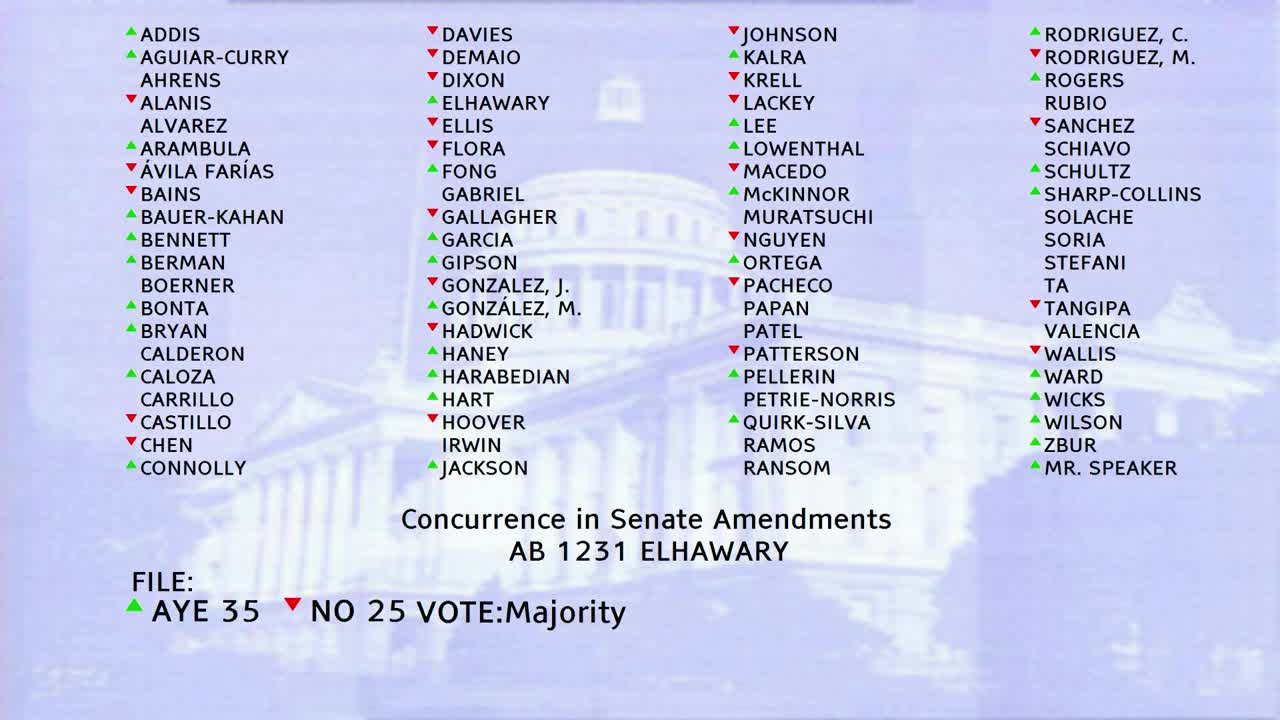 53SEC
Assembly Floor
 3MIN
Senate Floor
 3MIN
Senate Standing Committee on Appropriations
 21MIN
Senate Standing Committee on Business, Professions and Economic Development
 15MIN
Senate Standing Committee on Business, Professions and Economic Development
 4MIN
Assembly Floor
 14MIN