AB 962: Pupil safety: comprehensive school safety plans: use of smartphones.
- Session Year: 2025-2026
- House: Assembly
- Latest Version Date: 2025-10-03
Current Status:
Passed
(2025-10-03: Chaptered by Secretary of State - Chapter 284, Statutes of 2025.)
Introduced
In Committee
Awaiting First Chamber Vote
Passed First Chamber
In Committee
Awaiting Second Chamber Vote
Passed Second Chamber
Enacted
Existing law provides that it is the intent of the Legislature that all public schools, teaching kindergarten or any of grades 1 to 12, inclusive, operated by a school district, in cooperation with specified entities and individuals, develop a comprehensive school safety plan, as provided. Existing law provides that school districts and county offices of education are responsible for the overall development of a comprehensive school safety plan for each of its schools, as provided. Existing law requires a comprehensive school safety plan to, among other things, identify appropriate strategies and programs that will provide or maintain a high level of school safety and address the schools procedures for complying with existing laws related to school safety.
Existing law requires the governing board of a school district, a county board of education, and the governing body of a charter school to, by July 1, 2026, develop and adopt a policy to limit or prohibit the use by its pupils of smartphones while the pupils are at a schoolsite or while the pupils are under the supervision and control of an employee or employees of that school district, county office of education, or charter school. Existing law, however, specifies circumstances in which a pupil may not be prohibited from possessing or using a smartphone, including, among others, in the case of an emergency or in response to a perceived threat of danger.
This bill would instead authorize the prohibition on the use of a smartphone by a pupil in the case of an emergency or in response to a perceived threat of danger if that circumstance is explicitly addressed in a comprehensive school safety plan.
Existing law provides that it is the intent of the Legislature that all public schools, teaching kindergarten or any of grades 1 to 12, inclusive, operated by a school district, in cooperation with specified entities and individuals, develop a comprehensive school safety plan, as provided. Existing law provides that school districts and county offices of education are responsible for the overall development of a comprehensive school safety plan for each of its schools, as provided. Existing law requires a comprehensive school safety plan to, among other things, identify appropriate strategies and programs that will provide or maintain a high level of school safety and address the schools procedures for complying with existing laws related to school safety.
Existing law requires the governing body board of a school district, a county office board of education, or and the governing body of a charter school to, by July 1, 2026, develop and adopt a policy to limit or prohibit the use by its pupils of smartphones while the pupils are at a schoolsite or while the pupils are under the supervision and control of an employee or employees of that school district, county office of education, or charter school. Existing law, however, specifies circumstances in which a pupil may not be prohibited from possessing or using a smartphone, including, among others, in the case of an emergency or in response to a perceived threat of danger.
This bill would instead authorize the prohibition on the use of a smartphone by a pupil in the case of an emergency or in response to a perceived threat of danger if that circumstance is explicitly addressed in a comprehensive school safety plan.
Existing law provides that it is the intent of the Legislature that all public schools, teaching kindergarten or any of grades 1 to 12, inclusive, operated by a school district, in cooperation with specified entities and individuals, develop a comprehensive school safety plan, as provided. Existing law provides that school districts and county offices of education are responsible for the overall development of a comprehensive school safety plan for each of its schools, as provided. Existing law requires a comprehensive school safety plan to, among other things, identify appropriate strategies and programs that will provide or maintain a high level of school safety and address the schools procedures for complying with existing laws related to school safety.
Existing law requires the governing body of a school district, a county office of education, or a charter school to, by July 1, 2026, develop and adopt a policy to limit or prohibit the use by its pupils of smartphones while the pupils are at a schoolsite or while the pupils are under the supervision and control of an employee or employees of that school district, county office of education, or charter school. Existing law, however, specifies circumstances in which a pupil may not be prohibited from possessing or using a smartphone, including, among others, in the case of an emergency or in response to a perceived threat of danger.
This bill would expressly prohibit, if one or more parts of a comprehensive school safety plan address the use of smartphones by pupils, those parts from prohibiting a pupil from possessing or using a smartphone under those specified circumstances. instead authorize the prohibition on the use of a smartphone by a pupil in the case of an emergency or in response to a perceived threat of danger if that circumstance is explicitly addressed in a comprehensive school safety plan.
Existing law provides that it is the intent of the Legislature that all public schools, teaching kindergarten or any of grades 1 to 12, inclusive, operated by a school district, in cooperation with specified entities and individuals, develop a comprehensive school safety plan, as provided. Existing law provides that school districts and county offices of education are responsible for the overall development of a comprehensive school safety plan for each of its schools, as provided. Existing law requires a comprehensive school safety plan to, among other things, identify appropriate strategies and programs that will provide or maintain a high level of school safety and address the schools procedures for complying with existing laws related to school safety.
Existing law requires the governing body of a school district, a county office of education, or a charter school to, by July 1, 2026, develop and adopt a policy to limit or prohibit the use by its pupils of smartphones while the pupils are at a schoolsite or while the pupils are under the supervision and control of an employee or employees of that school district, county office of education, or charter school. Existing law, however, specifies circumstances in which a pupil may not be prohibited from possessing or using a smartphone, including, among others, in the case of an emergency or in response to a perceived threat of danger.
This bill would expressly prohibit, if one or more parts of a comprehensive school safety plan address the use of smartphones by pupils, those parts from prohibiting a pupil from possessing or using a smartphone under those specified circumstances.
(a)The governing board of a school district, a county board of education, and the governing body of a charter school shall, no later than July 1, 2026, develop and adopt, and shall update every five years, a policy to limit or prohibit the use by its pupils of smartphones while the pupils are at a schoolsite or while the pupils are under the supervision and control of an employee or employees of that school district, county office of education, or charter school. The goal of the policy shall be to promote evidence-based use of smartphone practices to support pupil learning and well-being. The development of the policy shall involve significant stakeholder participation in order to ensure that the policies are responsive to the unique needs and desires of pupils, parents, and educators in each community. The policy may also include enforcement mechanisms that limit access to smartphones.
(b)Notwithstanding subdivision (a), a pupil shall not be prohibited from possessing or using a smartphone under any of the following circumstances:
(1)Unless explicitly addressed in a comprehensive school safety plan adopted pursuant to Section 32282, in the case of an emergency or in response to a perceived threat of danger.
(2)When a teacher or administrator of the school district, county office of education, or charter school grants permission to a pupil to possess or use a smartphone, subject to any reasonable limitation imposed by that teacher or administrator.
(3)When a licensed physician and surgeon determines that the possession or use of a smartphone is necessary for the health or well-being of the pupil.
(4)When the possession or use of a smartphone is required in a pupils individualized education program.
(c)This section does not authorize monitoring, collecting, or otherwise accessing any information related to a pupils online activities.
(a)The governing body board of a school district, a county office board of education, or and the governing body of a charter school shall, no later than July 1, 2026, develop and adopt, and shall update every five years, a policy to limit or prohibit the use by its pupils of smartphones while the pupils are at a schoolsite or while the pupils are under the supervision and control of an employee or employees of that school district, county office of education, or charter school. The goal of the policy shall be to promote evidence-based use of smartphone practices to support pupil learning and well-being. The development of the policy shall involve significant stakeholder participation in order to ensure that the policies are responsive to the unique needs and desires of pupils, parents, and educators in each community. The policy may also include enforcement mechanisms that limit access to smartphones.
(b)Notwithstanding subdivision (a), a pupil shall not be prohibited from possessing or using a smartphone under any of the following circumstances:
(1)Unless explicitly addressed in a comprehensive school safety plan adopted pursuant to Section 32282, in the case of an emergency or in response to a perceived threat of danger.
(2)When a teacher or administrator of the school district, county office of education, or charter school grants permission to a pupil to possess or use a smartphone, subject to any reasonable limitation imposed by that teacher or administrator.
(3)When a licensed physician and surgeon determines that the possession or use of a smartphone is necessary for the health or well-being of the pupil.
(4)When the possession or use of a smartphone is required in a pupils individualized education program.
(c)This section does not authorize monitoring, collecting, or otherwise accessing any information related to a pupils online activities.
(a)The governing body of a school district, a county office of education, or a charter school shall, no later than July 1, 2026, develop and adopt, and shall update every five years, a policy to limit or prohibit the use by its pupils of smartphones while the pupils are at a schoolsite or while the pupils are under the supervision and control of an employee or employees of that school district, county office of education, or charter school. The goal of the policy shall be to promote evidence-based use of smartphone practices to support pupil learning and well-being. The development of the policy shall involve significant stakeholder participation in order to ensure that the policies are responsive to the unique needs and desires of pupils, parents, and educators in each community. The policy may also include enforcement mechanisms that limit access to smartphones.
(b)Notwithstanding subdivision (a), a pupil shall not be prohibited from possessing or using a smartphone under any of the following circumstances:
(1)In Unless explicitly addressed in a comprehensive school safety plan adopted pursuant to Section 32282, in the case of an emergency, emergency or in response to a perceived threat of danger.
(2)When a teacher or administrator of the school district, county office of education, or charter school grants permission to a pupil to possess or use a smartphone, subject to any reasonable limitation imposed by that teacher or administrator.
(3)When a licensed physician and surgeon determines that the possession or use of a smartphone is necessary for the health or well-being of the pupil.
(4)When the possession or use of a smartphone is required in a pupils individualized education program.
(c)This section does not authorize monitoring, collecting, or otherwise accessing any information related to a pupils online activities.
All matter omitted in this version of the bill appears in the bill as introduced in the Assembly, February 20, 2025. (JR11)(a)The comprehensive school safety plan shall include, but not be limited to, all of the following:
(1)Assessing the current status of school crime committed on school campuses and at school-related functions.
(2)Identifying appropriate strategies and programs that will provide or maintain a high level of school safety and address the schools procedures for complying with existing laws related to school safety, which shall include the development of all of the following:
(A)Child abuse reporting procedures consistent with Article 2.5 (commencing with Section 11164) of Chapter 2 of Title 1 of Part 4 of the Penal Code.
(B)(i)Disaster procedures, routine and emergency, including adaptations for pupils with disabilities in accordance with the federal Americans with Disabilities Act of 1990 (42 U.S.C. Sec. 12101 et seq.), the federal Individuals with Disabilities Education Act (20 U.S.C. Sec. 1400 et seq.), and Section 504 of the federal Rehabilitation Act of 1973 (29 U.S.C. Sec. 794(a)). The disaster procedures shall also include, but not be limited to, all of the following:
(I)Establishing an earthquake emergency procedure system in every public school building having an occupant capacity of 50 or more pupils or more than one classroom. A school district or county office of education may work with the Office of Emergency Services and the Alfred E. Alquist Seismic Safety Commission to develop and establish the earthquake emergency procedure system. The system shall include, but not be limited to, all of the following:
(ia)A school building disaster plan, ready for implementation at any time, for maintaining the safety and care of pupils and staff. The department shall provide general direction to school districts and county offices of education on what to include in the school building disaster plan.
(ib)A drop procedure whereby each pupil and staff member takes cover under a table or desk, dropping to their knees, with the head protected by the arms, and the back to the windows. A drop procedure practice shall be held at least once a school quarter in elementary schools and at least once a semester in secondary schools.
(ic)Protective measures to be taken before, during, and following an earthquake.
(id)A program to ensure that pupils and both the certificated and classified staff are aware of, and properly trained in, the earthquake emergency procedure system.
(II)Establishing a procedure to allow a public agency, including the American Red Cross, to use school buildings, grounds, and equipment for mass care and welfare shelters during disasters or other emergencies affecting the public health and welfare. The school district or county office of education shall cooperate with the public agency in furnishing and maintaining the services as the school district or county office of education may deem necessary to meet the needs of the community.
(III)(ia)Commencing with the 202627 fiscal year, establishing a procedure to identify appropriate refuge shelter for all pupils and staff to be used in the event of an evacuation order by local authorities and notify the operational area having jurisdiction within the schools boundaries of this identified refuge, in order to first prioritize the safety of pupils and staff, and then the defense of that structure in the event of a fire. Each public school, including a charter school, serving more than 50 pupils in kindergarten or any of grades 1 to 12, inclusive, that is in a high or very high fire hazard severity zone, identified pursuant to Section 51178 of the Government Code or Section 4204 of the Public Resources Code, shall coordinate the procedure with the operational area having jurisdiction within the schools boundaries. For those schools under the jurisdiction of a school district or county office of education, the school district or county office of education shall be the entity that coordinates with the operational area having jurisdiction within each of the schools boundaries.
(ib)Commencing with the 202627 fiscal year, the development by each public school, including a charter school, serving more than 50 pupils in kindergarten or any of grades 1 to 12, inclusive, that is in a high or very high fire hazard severity zone, identified pursuant to Section 51178 of the Government Code or Section 4204 of the Public Resources Code, of a communication and evacuation plan, to be used in the event of an early notice evacuation warning, that allows enough time to evacuate all pupils and staff. These plans shall clearly identify a decision process to determine whether an evacuation order is appropriate.
(ic)For purposes of this subclause, operational area means an intermediate level of the state emergency services organization, consisting of a county and all political subdivisions within the county area, that serves as a link in the system of communication and coordination between the states emergency operation centers and the operating centers of the political subdivisions that make up the operational area, as described in subdivision (b) of Section 8559 of the Government Code and Section 8605 of the Government Code.
(ii)The evaluation of a comprehensive school safety plan pursuant to subdivision (d) and the review of a school safety plan pursuant to clause (iii) of subparagraph (F) of paragraph (5) of subdivision (c) of Section 47605 or clause (iii) of subparagraph (G) of paragraph (5) of subdivision (b) of Section 47605.6, as applicable, shall include ensuring that the plan includes appropriate adaptations for pupils with disabilities, as required pursuant to clause (i).
(iii)(I)After the first evaluation or review, as applicable, for purposes of subdivision (d) and clause (ii) is conducted, and after each annual evaluation or review thereafter, a school employee, a pupils parent, guardian, or educational rights holder, or a pupil themselves may bring concerns about an individual pupils ability to access disaster safety procedures described in the comprehensive school safety plan or the school safety plan to the school principal. If the school principal determines there is merit to a concern, the principal shall direct the schoolsite council, school safety planning committee, or charter school, as applicable, to make appropriate modifications to the comprehensive school safety plan or school safety plan, as applicable, during the evaluation of the comprehensive school safety plan pursuant to subdivision (d) or the review of the school safety plan pursuant to clause (iii) of subparagraph (F) of paragraph (5) of subdivision (c) of Section 47605 or clause (iii) of subparagraph (G) of paragraph (5) of subdivision (b) of Section 47605.6, as applicable. The school principal may direct the schoolsite council, the school safety planning committee, or the charter school, as applicable, to make such modifications before the evaluation of the comprehensive school safety plan pursuant to subdivision (d) or the review of the school safety plan pursuant to clause (iii) of subparagraph (F) of paragraph (5) of subdivision (c) of Section 47605 or clause (iii) of subparagraph (G) of paragraph (5) of subdivision (b) of Section 47605.6, as applicable.
(II)Subclause (I) does not prohibit a school employee, a pupils parent, guardian, or educational rights holder, or a pupil themselves from bringing their concerns to the school principal before an evaluation or review, as applicable, for purposes of subdivision (d) and clause (ii) is conducted.
(iv)All deliberations of the schoolsite council, school safety planning committee, or charter school, as applicable, related to individual pupils with disabilities for purposes of the requirements of clauses (i) to (iii), inclusive, shall be subject to applicable state and federal laws regarding the privacy of pupil information.
(C)Policies pursuant to subdivision (d) of Section 48915 for pupils who committed an act listed in subdivision (c) of Section 48915 and other school-designated serious acts that would lead to suspension, expulsion, or mandatory expulsion recommendations pursuant to Article 1 (commencing with Section 48900) of Chapter 6 of Part 27 of Division 4 of Title 2.
(D)Procedures to notify teachers of dangerous pupils pursuant to Section 49079.
(E)A discrimination and harassment policy consistent with the prohibition against discrimination contained in Chapter 2 (commencing with Section 200) of Part 1.
(F)The provisions of any schoolwide dress code, pursuant to Section 35183, that prohibits pupils from wearing gang-related apparel, if the school has adopted that type of a dress code. For those purposes, the comprehensive school safety plan shall define gang-related apparel. The definition shall be limited to apparel that, if worn or displayed on a school campus, reasonably could be determined to threaten the health and safety of the school environment. A schoolwide dress code established pursuant to this section and Section 35183 shall be enforced on the school campus and at any school-sponsored activity by the principal of the school or the person designated by the principal. For purposes of this subparagraph, gang-related apparel shall not be considered a protected form of speech pursuant to Section 48950.
(G)Procedures for safe ingress and egress of pupils, parents, and school employees to and from school.
(H)A safe and orderly environment conducive to learning at the school.
(I)The rules and procedures on school discipline adopted pursuant to Sections 35291, 35291.5, 47605, and 47605.6.
(J)Procedures for conducting tactical responses to criminal incidents, including procedures related to individuals with guns on school campuses and at school-related functions. The procedures to prepare for active shooters or other armed assailants shall be based on the specific needs and context of each school and community.
(K)If a comprehensive school safety plan includes procedures to prepare for active shooters or other armed assailants by conducting a drill, a school shall comply with all of the following relating to the drill:
(i)(I)The school shall not conduct a high-intensity drill.
(II)For purposes of this clause, high-intensity drill means a drill that includes simulations that mimic an actual school shooter or other armed assailant incident, including, but not limited to, theatrical makeup or other materials to give an image of blood or gunshot wounds, acting by an individual posing to be the assailant, acting by individuals posing as victims, or simulations that instruct pupils to actively resist an assailant by throwing objects, attacking, or swarming the assailant.
(ii)The school shall not include the use of real weapons, gunfire blanks, or explosions in the conducting of the drill.
(iii)The school shall ensure a trauma-informed approach to the design and execution of any drill, which shall include all of the following:
(I)Age-appropriate and developmentally appropriate drill content and terminology developed with the involvement of school personnel, including school-based mental health professionals.
(II)Notice to all parents and guardians of pupils, teachers, administrators, and school personnel subject to the drills in advance of the drill and of the drills expected length of time.
(III)The ability for parents or guardians to opt their child or children out of the drills.
(IV)An announcement to pupils and educators immediately before the start of the drills and an announcement to pupils and educators immediately after the drills have concluded.
(V)A notice to all parents and guardians after the drill has concluded.
(VI)The provision of contact information for community-based resources, including local organizations with objectives to reduce gun violence or provide mental health counseling, to parents or guardians, pupils, and staff who are negatively impacted by the drills, and, where available, prioritizing school-based resources.
(L)Procedures to assess and respond to reports of any dangerous, violent, or unlawful activity that is being conducted or threatened to be conducted at the school, at an activity sponsored by the school, or on a schoolbus serving the school.
(M)(i)When a comprehensive school safety plan is next reviewed and updated on or after July 1, 2025, procedures to respond to incidents involving an individual experiencing a sudden cardiac arrest or a similar life-threatening medical emergency while on school grounds.
(ii)The procedures described in clause (i) are encouraged to integrate evidence-based core elements, including any cardiopulmonary resuscitation training offered and the placement of any automated external defibrillator available on the schoolsite in accordance with nationally recognized evidence-based emergency cardiac care guidelines, as dictated by the school safety plan.
(N)For schools that serve pupils in any of grades 7 to 12, inclusive, a protocol in the event a pupil is suffering or is reasonably believed to be suffering from an opioid overdose.
(3)(A)Beginning July 1, 2025, an instructional continuity plan to establish communication with pupils and their families and provide instruction to pupils when in-person instruction is disrupted due to an emergency pursuant to Section 41422 or subdivision (a) of Section 46392. The plan shall include all the following:
(i)Procedures for pupil engagement, as soon as practicable, and no later than five calendar days following the emergency. Procedures shall be designed to establish two-way communication with pupils and their families and identify and provide supports for pupils social-emotional, mental health, and academic needs.
(ii)A plan to provide access to in-person instruction or remote instruction pursuant to Sections 51747 and 51749.5, as soon as practicable, but no later than 10 instructional days following the emergency. The plan may include support to pupils and families to enroll in or be temporarily reassigned to another school district, county office of education, or charter school.
(B)Local educational agencies are encouraged to plan to meet instructional standards that are at least equivalent to those applicable to independent study programs.
(C)(i)For purposes of this paragraph, temporarily reassigned means temporarily reassigned to another local educational agency outside of the school district, but within the county or an immediately adjacent county, in which the pupils parent or guardian resides. Notwithstanding Section 48200 or any other law, a pupil who is temporarily reassigned shall be deemed to have complied with the residency requirements for attendance in the local educational agency that is temporarily serving the pupil pursuant to this section.
(ii)Notwithstanding Section 48200 or any other law, a school district, county office of education, or charter school may continue to enroll a pupil who is temporarily reassigned to another school district, county office of education, or charter school pursuant to this section in order to facilitate the timely reentry of the pupil in their prior school after the emergency event has ended.
(D)This paragraph applies to school districts, county offices of education, and charter schools.
(b)It is the intent of the Legislature that schools develop comprehensive school safety plans using existing resources, including the materials and services of the partnership, pursuant to this chapter. It is also the intent of the Legislature that schools use the handbook developed and distributed in partnership by the departments Safe Schools and Violence Prevention Center and the Attorney Generals Crime and Violence Prevention Center entitled Safe Schools: A Planning Guide for Action in conjunction with developing their plan for school safety.
(c)If one or more parts of a comprehensive school safety plan address the use of smartphones by pupils, those parts shall not conflict with subdivision (b) of Section 48901.7.
(c)(d)Each schoolsite council or school safety planning committee, in developing and updating a comprehensive school safety plan, shall, where practical, consult, cooperate, and coordinate with other schoolsite councils or school safety planning committees.
(d)(e)The comprehensive school safety plan may be evaluated and amended, as needed, by the school safety planning committee, but shall be evaluated at least once a year, to ensure that the comprehensive school safety plan is properly implemented. An updated file of all safety-related plans and materials shall be readily available for inspection by the public.
(e)(f)As comprehensive school safety plans are reviewed and updated, the Legislature encourages all plans, to the extent that resources are available, to include policies and procedures aimed at the prevention of bullying.
(f)(g)The comprehensive school safety plan, as written and updated by the schoolsite council or school safety planning committee, shall be submitted for approval pursuant to subdivision (a) of Section 32288.
(g)(h)The department shall maintain and conspicuously post on its internet website a compliance checklist for developing a comprehensive school safety plan, and shall update the checklist when necessary.
(h)(i)On or before March 1, 2025, the Superintendent shall develop and post on the departments internet website instructional continuity plan guidance, including guidance for continued academic and school engagement strategies during disruptions in instruction due to emergencies.
|
Date
|
Status
|
|---|---|
| Oct 3, 2025 | Chaptered by Secretary of State - Chapter 284, Statutes of 2025. |
| Oct 3, 2025 | Approved by the Governor. |
| Sep 24, 2025 | Enrolled and presented to the Governor at 3 p.m. |
| Sep 13, 2025 | Senate amendments concurred in. To Engrossing and Enrolling. (Ayes 74. Noes 0. Page 3504.). |
| Sep 13, 2025 | Joint Rules 61(a)(14) and 51(a)(4) suspended. (Ayes 59. Noes 20. Page 3413.) |
| Sep 12, 2025 | In Assembly. Concurrence in Senate amendments pending. |
| Sep 12, 2025 | Read third time. Passed. Ordered to the Assembly. (Ayes 38. Noes 0. Page 2962.). |
| Sep 8, 2025 | Read second time. Ordered to third reading. |
| Sep 4, 2025 | Read third time and amended. Ordered to second reading. |
| Jun 13, 2025 | Read second time and amended. Ordered to third reading. |
| Jun 12, 2025 | From committee: Amend, and do pass as amended. (Ayes 6. Noes 0.) (June 11). |
| May 7, 2025 | Referred to Com. on ED. |
| Apr 24, 2025 | In Senate. Read first time. To Com. on RLS. for assignment. |
| Apr 24, 2025 | Read third time. Passed. Ordered to the Senate. (Ayes 75. Noes 0. Page 1280.) |
| Apr 21, 2025 | Read second time. Ordered to Consent Calendar. |
| Apr 10, 2025 | From committee: Do pass. To Consent Calendar. (Ayes 9. Noes 0.) (April 9). |
| Mar 10, 2025 | Referred to Com. on ED. |
| Feb 21, 2025 | From printer. May be heard in committee March 23. |
| Feb 20, 2025 | Read first time. To print. |
|
Date
|
Description
|
Location
|
Votes
|
|
|---|---|---|---|---|
| Sep 13, 2025 | AB 962 Hoover Concurrence in Senate Amendments | Assembly Floor |
Passed |
|
| Sep 12, 2025 | Assembly 3rd Reading AB962 Hoover By Allen | Senate Floor |
Passed |
|
| Jun 11, 2025 | Do pass as amended | Senate Standing Committee on Education |
Passed |
|
| Apr 24, 2025 | AB 962 Hoover Consent Calendar Second Day Regular Session | Assembly Floor |
Passed |
|
| Apr 9, 2025 | Do pass. To Consent Calendar. | Assembly Standing Committee on Education |
Passed |
This list shows positions taken on this bill by organizations on the date displayed, which is linked to the original source.
Positions by individuals are not included.
|
Organization
|
Position
|
Date
|
|---|---|---|
| Association Of California School Administrators | ** Support | |
| California Association Of School Business Officials | ** Support | |
| California It In Education | ** Support | |
| California School Nurses Organization | ** Support | |
| Small School Districts Association | ** Support |
CONCURRENCE IN SENATE AMENDMENTS
CSA1 Bill Id:AB 962
Author:(Hoover)
As Amended Ver:September 4, 2025
Majority vote
SUMMARY
Authorizes a prohibition on smartphone use of a student in the case of emergency or in response to a perceived threat of danger, if that circumstance is explicitly addressed in a comprehensive school safety plan.
Senate Amendments
- Specify that a pupil may not be prohibited from possessing or using a smartphone in the case of an emergency or in response to a perceived threat of danger, unless it is explicitly addressed in a school's comprehensive school safety plan.
- Other technical changes related to the appropriate governance bodies of local educational agencies.
COMMENTS
Smartphones and emergencies. School safety experts suggest that students use of cell phones can impact school safety in a number of ways. Potential positive impacts may include the following:
- During a crisis, cell phones allow students to notify their parents that they're safe and keep family members updated on the situation;
- Allows students to clarify to their parents any rumors that may be circulating on social media;
- Allows emergency responders to send directions to the students; and
- Students can stay updated on the situation through news outlets, as they may otherwise not have access to such information.
There are also potential negative consequences of students having access to smartphones during an emergency, including:
- Student use of cell phones during an unfolding emergency can distract their attention from safety and emergency response directions being given by school staff;
- Cell phone use by students can hamper rumor control and, in doing so, disrupt and delay effective public safety personnel response;
- A ringing or vibrating cell phone can reveal to a shooter where hiding places are; and
- Cell phone use by students can impede public safety response by accelerating parental and community arrival at the scene of an emergency during times when officials may be attempting to evacuate students to another site.
In addition, it is possible that hundreds or thousands of students and others rushing to use their cell phones in a crisis could potentially overload cell phone systems in some areas and thus hamper first responders' lines of communication. Therefore the use of cell phones by students and others in the immediate school community could potentially decrease, not increase, school safety during a crisis.
According to the Author
"AB 3216 was signed into law in 2024 requiring all schools to adopt a student smartphone policy limiting their use during the school day by July 2026. With this forthcoming requirement, there is anticipated confusion in regards to any potential conflicts between student smartphone policies and school safety plans when responding to an emergency. AB 962 would provide that unless a school's comprehensive safety plan includes language that addresses student smartphone use during a school emergency, the student smartphone access requirements set by law in 2024 must apply. Eliminating this confusion will ensure smooth coordination amongst emergency responders (police, fire, EMTs) and school officials, and further protect the collective safety of students, teachers, and administrators."
Arguments in Support
The Association of California School Administrators writes, "Under current law, all schools serving K-12 students are required annually to adopt a Comprehensive School Safety Plan (CSSP) to address campus risks, such as natural and man-made disasters, to prepare for emergencies, and to create a safe, secure learning environment for students and school personnel. The CSSP, developed in collaboration with school communities and emergency responders, often includes policy limiting student smartphone use during emergencies unless at the direction of school personnel. This is for several reasons including mitigating the spread of misinformation as well as protecting against location sharing that could inadvertently increase the risk for a student and those around them.
AB 962 is proactively helping LEAs avoid confusion that may arise with the annual CSSP adoption process and July 1, 2026, deadline to enact a student smartphone limitation policy (pursuant to Education Code Section 48901.7). This is because current law related to student smartphone use policies provides some exceptions to restricting smartphone use, including in the case of an emergency, or in response to a threat of danger. Our members have expressed concerns about potential inconsistencies with their CSSP and we believe addressing the issue now will help ensure a more seamless policy adoption and revision process.
To be clear, AB 962 does not seek to create additional content for the CSSP, nor mandate smartphone restrictions in emergencies. Rather, the measure seeks to limit confusion by stating that a CSSP may address smartphone use in an emergency as a permitted exception to mandatory access requirements."
Arguments in Opposition
None on file
FISCAL COMMENTS
The Office of Legislative Counsel has keyed this bill as non-fiscal.
VOTES:
ASM EDUCATION: 9-0-0
YES: Muratsuchi, Hoover, Addis, Alvarez, Bonta, Castillo, Garcia, Lowenthal, Patel
ASSEMBLY FLOOR: 75-0-4
YES: Addis, Aguiar-Curry, Ahrens, Alanis, Alvarez, Arambula, Ávila Farías, Bains, Bauer-Kahan, Bennett, Berman, Boerner, Bonta, Bryan, Calderon, Caloza, Carrillo, Castillo, Connolly, Davies, DeMaio, Dixon, Elhawary, Ellis, Flora, Fong, Gabriel, Garcia, Gipson, Jeff Gonzalez, Mark González, Hadwick, Haney, Hart, Hoover, Irwin, Jackson, Kalra, Krell, Lee, Lowenthal, Macedo, McKinnor, Muratsuchi, Nguyen, Ortega, Pacheco, Papan, Patel, Patterson, Pellerin, Petrie-Norris, Quirk-Silva, Ramos, Ransom, Celeste Rodriguez, Michelle Rodriguez, Rogers, Blanca Rubio, Sanchez, Schiavo, Schultz, Sharp-Collins, Solache, Soria, Stefani, Ta, Tangipa, Valencia, Wallis, Ward, Wicks, Wilson, Zbur, Rivas
ABS, ABST OR NV: Chen, Gallagher, Harabedian, Lackey
UPDATED
VERSION: September 4, 2025
CONSULTANT: Debbie Look / ED. / (916) 319-2087 FN: 0002106
SENATE RULES COMMITTEE Office of Senate Floor Analyses (916) 651-1520 Fax: (916) 327-4478 | AB 962 |
THIRD READING
Bill No: AB 962
Author: Hoover (R)
Introduced: 9/3/25 in Senate
Vote: 21
SENATE EDUCATION COMMITTEE: 6-0, 6/11/25
AYES: Pérez, Ochoa Bogh, Cabaldon, Choi, Cortese, Laird
NO VOTE RECORDED: Gonzalez
ASSEMBLY FLOOR: 75-0, 4/24/25 (Consent) - See last page for vote
SUBJECT: Pupil safety: comprehensive school safety plans: use of smartphones
SOURCE: Author
DIGEST:
This bill authorizes a prohibition on smartphone use of a student in the case of emergency or in response to a perceived threat of danger, if that circumstance is explicitly addressed in a comprehensive school safety plan.
Senate Floor Amendments of 9/3/25 resolve a chaptering out conflict with AB 1216 (Assembly Committee on Education, Chapter 88, Statutes of 2025).
ANALYSIS:
Existing law:
- Requires the governing board of a school district, county office of education (COE), and the governing body of charter school to develop and adopt a policy by July 1, 2026, to limit or prohibit the use of smartphones by students while they are at school or under the supervision of a school employee, and to update the policy every five years. (Education Code (EC) § 48901.7(a))
- Prohibits an LEA’s adopted smartphone use policy from restricting a student’s use of a smartphone under any of the following circumstances:
- In the case of an emergency, or in response to a perceived threat of danger;
- When a teacher or administrator grants permission to a student to possess or use a smartphone, subject to any reasonable limitation imposed by that teacher or administrator;
- When a licensed physician and surgeon determines that the possession or use of a smartphone is necessary for the health or well-being of the student; or
- When the possession or use of a smartphone is required in a student’s individualized education program (IEP). (EC § 48901.7(b))
- Requires each school district or COE to be responsible for the overall development of all CSSPs for its schools operating kindergarten or any of grades 1 through 12. (EC § 32281)
- Requires that the CSSP include an assessment of the current status of school crime committed on school campuses and at school-related functions and identification of appropriate strategies and programs to provide or maintain a high level of school safety and address the school’s procedures for complying with existing laws related to school safety, including child abuse reporting procedures; disaster procedures; an earthquake emergency procedure system; policies regarding pupils who commit specified acts that would lead to suspension or expulsion; procedures to notify teachers of dangerous pupils; a discrimination and harassment policy; the provisions of any schoolwide dress code; procedures for safe ingress and egress of pupils, parents, and school employees to and from school; a safe and orderly environment conducive to learning; and rules and procedures on school discipline. (EC § 32282)
- Requires the CSSP to be submitted annually to the school district or COE for approval and requires a school district or COE to notify the California Department of Education (CDE) by October 15 of every year of any school that is not in compliance. (EC § 32288)
This bill authorizes a prohibition on smartphone use of a student in the case of emergency or in response to a perceived threat of danger, if that circumstance is explicitly addressed in a comprehensive school safety plan.
Comments
- Need for the bill. According to the author, “AB 3216 was signed into law in 2024 requiring all schools to adopt a student smartphone policy limiting their use during the school day by July 2026. With this forthcoming requirement, there is anticipated confusion in regards to any potential conflicts between student smart phone policies and school safety plans when responding to an emergency. AB 962 would provide that unless a school’s Comprehensive Safety Plan includes language that addresses student smartphone use during a school emergency, the student smartphone access requirements set by law in 2024 must apply. Eliminating this confusion will ensure smooth coordination amongst emergency responders (police, fire, EMTs) and school officials, and further protect the collective safety of students, teachers, and administrators.”
- Comprehensive School Safety Plans. LEAs, COEs, and charter schools serving students in grades kindergarten through 12 are required to develop and maintain a CSSP designed to address campus risks, prepare for emergencies, and create a safe, secure learning environment for students and school personnel.
The law requires designated stakeholders to annually engage in a systematic planning process to develop strategies and policies to prevent and respond to potential incidents involving emergencies, natural and other disasters, hate crimes, violence, active assailants/intruders, bullying and cyberbullying, discrimination, and harassment, child abuse and neglect, discipline, suspension and expulsion, and other safety aspects.
The law requires that each school update and adopt its CSSP by March 1 annually. Before an LEA, COE, or charter school adopts their CSSP, the schoolsite council or school safety planning committee must hold a public meeting at the schoolsite to allow members of the public to express an opinion about the school safety plan. The schoolsite council or school safety planning committee must also notify the local mayor and representatives of the following:
- The local school employee organization.
- The parent organization at the school site, including the parent-teacher association and parent-teacher clubs.
- Each teacher organization at the school site.
- The student body government.
- All persons who have indicated they want to be notified.
Once the public meeting has been held and the CSSP is adopted, the school must submit its CSSP to its respective LEA or COE for approval. LEAs and COEs must annually notify the CDE by October 15 of any schools that have not complied with requirements. Statute also requires the CDE to develop and post on its website best practices for reviewing and approving school safety plans.
- School smartphone use policies. Since the passage of AB 272 (Muratsuchi, Chapter 42, Statutes of 2019), LEAs have had the explicit authorization to adopt policies to limit or prohibit student use of smartphones while they are on a schoolsite or are under the supervision of an LEA employee. Alongside this authorization, AB 272 also established circumstances under which a pupil shall not be prohibited from possessing or using a smartphone. These circumstances are as follows:
- In the case of an emergency, or in response to a perceived threat of danger.
- When a teacher or administrator of the school district, COE, or charter school grants permission to a pupil to possess or use a smartphone, subject to any reasonable limitation imposed by that teacher or administrator.
- When a licensed physician and surgeon determines that the possession or use of a smartphone is necessary for the health or well-being of the pupil.
- When the possession or use of a smartphone is required in a pupil’s IEP.
With the passage of AB 3216 (Hoover, Chapter 500, Statutes of 2024), this authorization afforded to LEAs became a requirement, thus requiring the governing boards of LEAs, to develop and adopt a smartphone use policy by July 1, 2026, and update that policy every five years thereafter.
- Mixed messaging. This bill aims to address a point of confusion that has arisen as LEAs prepare to adopt smartphone use policies in compliance with the new requirement. According to the bill’s proponent, the Association of California School Administrators:
“The CSSP, developed in collaboration with school communities and emergency responders, often includes policy limiting student smartphone use during emergencies unless at the direction of school personnel. This is for several reasons including mitigating the spread of misinformation as well as protecting against location sharing that could inadvertently increase the risk for a student and those around them.
“.. [C]urrent law related to student smartphone use policies provides some exceptions to restricting smartphone use, including in the case of an emergency, or in response to a threat of danger. Our members have expressed concerns about potential inconsistencies with their CSSP and we believe addressing the issue now will help ensure a more seamless policy adoption and revision process.”
Examples of CSSP provisions that address smartphone use during emergencies include the following:
“While in the area under threat, all cell phones, beepers and hand-held radios should be turned off since many explosive devices can be triggered by radio transmissions. Bomb threat experts recommend no radio transmission within 500 feet of a device, or suspected location of a device. Use of any electronic device within the 500’ restriction zone must be cleared in advance with the Incident Commander.”
“In the event of an emergency, the safety and well-being of the students is the top priority. In certain emergency situations, students will be allowed access to their cell phones, and staff will ensure that students can use their devices when it is deemed safe and necessary.”
“This measure (smartphone use) is intended to allow students to communicate with their families to give and receive important updates. Our staff is trained to assess emergency situations and will guide students appropriately to ensure that the use of cell phones does not interfere with safety protocols or emergency procedures.”
This bill addresses this conflict by establishing that if a comprehensive school safety plan has provisions that address smartphone use during emergency situations or incidences of perceived threats, then those provisions serve as a permitted exception to the mandated access provisions under existing law.
FISCAL EFFECT: Appropriation: No Fiscal Com.: No Local: No
SUPPORT: (Verified 9/3/25)
Association of California School Administrators
California Association of School Business Officials
California IT in Education
California School Nurses Organization
Small School Districts Association
OPPOSITION: (Verified 9/3/25)
None received
ASSEMBLY FLOOR: 75-0, 4/24/25
AYES: Addis, Aguiar-Curry, Ahrens, Alanis, Alvarez, Arambula, Ávila Farías, Bains, Bauer-Kahan, Bennett, Berman, Boerner, Bonta, Bryan, Calderon, Caloza, Carrillo, Castillo, Connolly, Davies, DeMaio, Dixon, Elhawary, Ellis, Flora, Fong, Gabriel, Garcia, Gipson, Jeff Gonzalez, Mark González, Hadwick, Haney, Hart, Hoover, Irwin, Jackson, Kalra, Krell, Lee, Lowenthal, Macedo, McKinnor, Muratsuchi, Nguyen, Ortega, Pacheco, Papan, Patel, Patterson, Pellerin, Petrie-Norris, Quirk-Silva, Ramos, Ransom, Celeste Rodriguez, Michelle Rodriguez, Rogers, Blanca Rubio, Sanchez, Schiavo, Schultz, Sharp-Collins, Solache, Soria, Stefani, Ta, Tangipa, Valencia, Wallis, Ward, Wicks, Wilson, Zbur, Rivas
NO VOTE RECORDED: Chen, Gallagher, Harabedian, Lackey
Prepared by: Therresa Austin / ED. / (916) 651-4105
9/8/25 21:29:48
**** END ****
SENATE RULES COMMITTEE Office of Senate Floor Analyses (916) 651-1520 Fax: (916) 327-4478 | AB 962 |
THIRD READING
Bill No: AB 962
Author: Hoover (R)
Amended: 6/13/25 in Senate
Vote: 21
SENATE EDUCATION COMMITTEE: 6-0, 6/11/25
AYES: Pérez, Ochoa Bogh, Cabaldon, Choi, Cortese, Laird
NO VOTE RECORDED: Gonzalez
ASSEMBLY FLOOR: 75-0, 4/24/25 (Consent) - See last page for vote
SUBJECT: Pupil safety: comprehensive school safety plans: use of smartphones
SOURCE: Author
DIGEST:
This bill authorizes a prohibition on smartphone use of a student in the case of emergency or in response to a perceived threat of danger, if that circumstance is explicitly addressed in a comprehensive school safety plan.
ANALYSIS:
Existing law:
- Requires the governing body of a school district, county office of education (COE), or charter school to develop and adopt a policy by July 1, 2026, to limit or prohibit the use of smartphones by students while they are at school or under the supervision of a school employee, and to update the policy every five years. (Education Code (EC) § 48901.7(a))
- Prohibits an LEA’s adopted smartphone use policy from restricting a student’s use of a smartphone under any of the following circumstances:
- In the case of an emergency, or in response to a perceived threat of danger;
- When a teacher or administrator grants permission to a student to possess or use a smartphone, subject to any reasonable limitation imposed by that teacher or administrator;
- When a licensed physician and surgeon determines that the possession or use of a smartphone is necessary for the health or well-being of the student; or
- When the possession or use of a smartphone is required in a student’s individualized education program (IEP). (EC § 48901.7(b))
- Requires each school district or COE to be responsible for the overall development of all CSSPs for its schools operating kindergarten or any of grades 1 through 12. (EC § 32281)
- Requires that the CSSP include an assessment of the current status of school crime committed on school campuses and at school-related functions and identification of appropriate strategies and programs to provide or maintain a high level of school safety and address the school’s procedures for complying with existing laws related to school safety, including child abuse reporting procedures; disaster procedures; an earthquake emergency procedure system; policies regarding pupils who commit specified acts that would lead to suspension or expulsion; procedures to notify teachers of dangerous pupils; a discrimination and harassment policy; the provisions of any schoolwide dress code; procedures for safe ingress and egress of pupils, parents, and school employees to and from school; a safe and orderly environment conducive to learning; and rules and procedures on school discipline. (EC § 32282)
- Requires the CSSP to be submitted annually to the school district or COE for approval and requires a school district or COE to notify the California Department of Education (CDE) by October 15 of every year of any school that is not in compliance. (EC § 32288)
This bill authorizes a prohibition on smartphone use of a student in the case of emergency or in response to a perceived threat of danger, if that circumstance is explicitly addressed in a comprehensive school safety plan.
Comments
- Need for this bill. According to the author, “AB 3216 was signed into law in 2024 requiring all schools to adopt a student smartphone policy limiting their use during the school day by July 2026. With this forthcoming requirement, there is anticipated confusion in regards to any potential conflicts between student smart phone policies and school safety plans when responding to an emergency. AB 962 would provide that unless a school’s Comprehensive Safety Plan includes language that addresses student smartphone use during a school emergency, the student smartphone access requirements set by law in 2024 must apply. Eliminating this confusion will ensure smooth coordination amongst emergency responders (police, fire, EMTs) and school officials, and further protect the collective safety of students, teachers, and administrators.”
- Comprehensive School Safety Plans. LEAs, COEs, and charter schools serving students in grades kindergarten through 12 are required to develop and maintain a CSSP designed to address campus risks, prepare for emergencies, and create a safe, secure learning environment for students and school personnel.
The law requires designated stakeholders to annually engage in a systematic planning process to develop strategies and policies to prevent and respond to potential incidents involving emergencies, natural and other disasters, hate crimes, violence, active assailants/intruders, bullying and cyberbullying, discrimination, and harassment, child abuse and neglect, discipline, suspension and expulsion, and other safety aspects.
The law requires that each school update and adopt its CSSP by March 1 annually. Before an LEA, COE, or charter school adopts their CSSP, the schoolsite council or school safety planning committee must hold a public meeting at the schoolsite to allow members of the public to express an opinion about the school safety plan. The schoolsite council or school safety planning committee must also notify the local mayor and representatives of the following:
- The local school employee organization.
- The parent organization at the school site, including the parent-teacher association and parent-teacher clubs.
- Each teacher organization at the school site.
- The student body government.
- All persons who have indicated they want to be notified.
Once the public meeting has been held and the CSSP is adopted, the school must submit its CSSP to its respective LEA or COE for approval. LEAs and COEs must annually notify the CDE by October 15 of any schools that have not complied with requirements. Statute also requires the CDE to develop and post on its website best practices for reviewing and approving school safety plans.
- School smartphone use policies. Since the passage of AB 272 (Muratsuchi, Chapter 42, Statutes of 2019), LEAs have had the explicit authorization to adopt policies to limit or prohibit student use of smartphones while they are on a schoolsite or are under the supervision of an LEA employee. Alongside this authorization, AB 272 also established circumstances under which a pupil shall not be prohibited from possessing or using a smartphone. These circumstances are as follows:
- In the case of an emergency, or in response to a perceived threat of danger.
- When a teacher or administrator of the school district, COE, or charter school grants permission to a pupil to possess or use a smartphone, subject to any reasonable limitation imposed by that teacher or administrator.
- When a licensed physician and surgeon determines that the possession or use of a smartphone is necessary for the health or well-being of the pupil.
- When the possession or use of a smartphone is required in a pupil’s IEP.
With the passage of AB 3216 (Hoover, Chapter 500, Statutes of 2024), this authorization afforded to LEAs became a requirement, thus requiring the governing boards of LEAs, to develop and adopt a smartphone use policy by July 1, 2026, and update that policy every five years thereafter.
- Mixed messaging. This bill aims to address a point of confusion that has arisen as LEAs prepare to adopt smartphone use policies in compliance with the new requirement. According to this bill’s proponent, the Association of California Schools Administrators:
The CSSP, developed in collaboration with school communities and emergency responders, often includes policy limiting student smartphone use during emergencies unless at the direction of school personnel. This is for several reasons including mitigating the spread of misinformation as well as protecting against location sharing that could inadvertently increase the risk for a student and those around them.
.. [C]urrent law related to student smartphone use policies provides some exceptions to restricting smartphone use, including in the case of an emergency, or in response to a threat of danger. Our members have expressed concerns about potential inconsistencies with their CSSP and we believe addressing the issue now will help ensure a more seamless policy adoption and revision process.
Examples of CSSP provisions that address smartphone use during emergencies include the following:
While in the area under threat, all cell phones, beepers and hand-held radios should be turned off since many explosive devices can be triggered by radio transmissions. Bomb threat experts recommend no radio transmission within 500 feet of a device, or suspected location of a device. Use of any electronic device within the 500’ restriction zone must be cleared in advance with the Incident Commander.
In the event of an emergency, the safety and well-being of the students is the top priority. In certain emergency situations, students will be allowed access to their cell phones, and staff will ensure that students can use their devices when it is deemed safe and necessary.
This measure (smartphone use) is intended to allow students to communicate with their families to give and receive important updates. Our staff is trained to assess emergency situations and will guide students appropriately to ensure that the use of cell phones does not interfere with safety protocols or emergency procedures.
This bill addresses this conflict by establishing that if a comprehensive school safety plan has provisions that address smartphone use during emergency situations or incidences of perceived threats, then those provisions serve as a permitted exception to the mandated access provisions under existing law.
FISCAL EFFECT: Appropriation: No Fiscal Com.: No Local: No
SUPPORT: (Verified 6/12/25)
Association of California School Administrators
California Association of School Business Officials
California IT in Education
California School Nurses Organization
Small School Districts Association
OPPOSITION: (Verified 6/12/25)
None received
ASSEMBLY FLOOR: 75-0, 4/24/25
AYES: Addis, Aguiar-Curry, Ahrens, Alanis, Alvarez, Arambula, Ávila Farías, Bains, Bauer-Kahan, Bennett, Berman, Boerner, Bonta, Bryan, Calderon, Caloza, Carrillo, Castillo, Connolly, Davies, DeMaio, Dixon, Elhawary, Ellis, Flora, Fong, Gabriel, Garcia, Gipson, Jeff Gonzalez, Mark González, Hadwick, Haney, Hart, Hoover, Irwin, Jackson, Kalra, Krell, Lee, Lowenthal, Macedo, McKinnor, Muratsuchi, Nguyen, Ortega, Pacheco, Papan, Patel, Patterson, Pellerin, Petrie-Norris, Quirk-Silva, Ramos, Ransom, Celeste Rodriguez, Michelle Rodriguez, Rogers, Blanca Rubio, Sanchez, Schiavo, Schultz, Sharp-Collins, Solache, Soria, Stefani, Ta, Tangipa, Valencia, Wallis, Ward, Wicks, Wilson, Zbur, Rivas
NO VOTE RECORDED: Chen, Gallagher, Harabedian, Lackey
Prepared by: Therresa Austin / ED. / (916) 651-4105
6/16/25 9:10:00
**** END ****
SENATE COMMITTEE ON EDUCATION
Senator Sasha Renée Pérez, Chair
2025 - 2026 Regular
Bill No: Hearing Date: June 11, 2025
Author: | |||
Version: |
| ||
Urgency: | Fiscal: | ||
Consultant: | |||
Subject: .
SUMMARY
This bill establishes that if the provisions of a local educational agency’s (LEA) adopted comprehensive school safety plan (CSSP) address student smartphone use, those provisions shall not conflict with the existing mandatory smartphone use and access requirements, as specified.
BACKGROUND
Existing law:
- Requires the governing body of a school district, county office of education (COE), or charter school to develop and adopt a policy by July 1, 2026, to limit or prohibit the use of smartphones by students while they are at school or under the supervision of a school employee, and to update the policy every five years. (Education Code (EC) § 48901.7(a))
- Prohibits an LEA’s adopted smartphone use policy from restricting a student’s use of a smartphone under any of the following circumstances:
- In the case of an emergency, or in response to a perceived threat of danger;
- When a teacher or administrator grants permission to a student to possess or use a smartphone, subject to any reasonable limitation imposed by that teacher or administrator;
- When a licensed physician and surgeon determines that the possession or use of a smartphone is necessary for the health or well-being of the student; or
- When the possession or use of a smartphone is required in a student’s individualized education program (IEP). (EC § 48901.7(b))
- Requires each school district or COE to be responsible for the overall development of all CSSPs for its schools operating kindergarten or any of grades 1 through 12. (EC § 32281)
- Requires that the CSSP include an assessment of the current status of school crime committed on school campuses and at school-related functions and identification of appropriate strategies and programs to provide or maintain a high level of school safety and address the school’s procedures for complying with existing laws related to school safety, including child abuse reporting procedures; disaster procedures; an earthquake emergency procedure system; policies regarding pupils who commit specified acts that would lead to suspension or expulsion; procedures to notify teachers of dangerous pupils; a discrimination and harassment policy; the provisions of any schoolwide dress code; procedures for safe ingress and egress of pupils, parents, and school employees to and from school; a safe and orderly environment conducive to learning; and rules and procedures on school discipline. (EC § 32282)
- Requires the CSSP to be submitted annually to the school district or COE for approval and requires a school district or COE to notify the California Department of Education (CDE) by October 15 of every year of any school that is not in compliance. (EC § 32288)
ANALYSIS
This bill establishes that if an LEA’s CSSP contains provisions addressing student use of smartphones, those provisions shall not conflict with the mandatory use and access requirements established in law.
STAFF COMMENTS
- Need for the bill. According to the author, “AB 3216 was signed into law in 2024 requiring all schools to adopt a student smartphone policy limiting their use during the school day by July 2026. With this forthcoming requirement, there is anticipated confusion in regards to any potential conflicts between student smart phone policies and school safety plans when responding to an emergency. AB 962 would provide that unless a school’s Comprehensive Safety Plan includes language that addresses student smartphone use during a school emergency, the student smartphone access requirements set by law in 2024 must apply. Eliminating this confusion will ensure smooth coordination amongst emergency responders (police, fire, EMTs) and school officials, and further protect the collective safety of students, teachers, and administrators.”
- Comprehensive School Safety Plans. LEAs, COEs, and charter schools serving students in grades kindergarten through 12 are required to develop and maintain a CSSP designed to address campus risks, prepare for emergencies, and create a safe, secure learning environment for students and school personnel.
The law requires designated stakeholders to annually engage in a systematic planning process to develop strategies and policies to prevent and respond to potential incidents involving emergencies, natural and other disasters, hate crimes, violence, active assailants/intruders, bullying and cyberbullying, discrimination, and harassment, child abuse and neglect, discipline, suspension and expulsion, and other safety aspects.
The law requires that each school update and adopt its CSSP by March 1 annually. Before an LEA, COE, or charter school adopts their CSSP, the schoolsite council or school safety planning committee must hold a public meeting at the schoolsite to allow members of the public to express an opinion about the school safety plan. The schoolsite council or school safety planning committee must also notify the local mayor and representatives of the following:
- The local school employee organization.
- The parent organization at the school site, including the parent-teacher association and parent-teacher clubs.
- Each teacher organization at the school site.
- The student body government.
- All persons who have indicated they want to be notified.
Once the public meeting has been held and the CSSP is adopted, the school must submit its CSSP to its respective LEA or COE for approval. LEAs and COEs must annually notify the CDE by October 15 of any schools that have not complied with requirements. Statute also requires the CDE to develop and post on its website best practices for reviewing and approving school safety plans.
- School smartphone use policies. Since the passage of AB 272 (Muratsuchi, Chapter 42, Statutes of 2019), LEAs have had the explicit authorization to adopt policies to limit or prohibit student use of smartphones while they are on a schoolsite or are under the supervision of an LEA employee. Alongside this authorization, AB 272 also established circumstances under which a pupil shall not be prohibited from possessing or using a smartphone. These circumstances are as follows:
- In the case of an emergency, or in response to a perceived threat of danger.
- When a teacher or administrator of the school district, COE, or charter school grants permission to a pupil to possess or use a smartphone, subject to any reasonable limitation imposed by that teacher or administrator.
- When a licensed physician and surgeon determines that the possession or use of a smartphone is necessary for the health or well-being of the pupil.
- When the possession or use of a smartphone is required in a pupil’s IEP.
With the passage of AB 3216 (Hoover, Chapter 500, Statutes of 2024), this authorization afforded to LEAs became a requirement, thus requiring the governing boards of LEAs, to develop and adopt a smartphone use policy by July 1, 2026, and update that policy every five years thereafter.
- Mixed messaging. This bill aims to address a point of confusion that has arisen as LEAs prepare to adopt smartphone use policies in compliance with the new requirement. According to the bill’s proponent, the Association of California Schools Administrators:
“The CSSP, developed in collaboration with school communities and emergency responders, often includes policy limiting student smartphone use during emergencies unless at the direction of school personnel. This is for several reasons including mitigating the spread of misinformation as well as protecting against location sharing that could inadvertently increase the risk for a student and those around them.
“.. [C]urrent law related to student smartphone use policies provides some exceptions to restricting smartphone use, including in the case of an emergency, or in response to a threat of danger. Our members have expressed concerns about potential inconsistencies with their CSSP and we believe addressing the issue now will help ensure a more seamless policy adoption and revision process.”
Examples of CSSP provisions that address smartphone use during emergencies include the following:
“While in the area under threat, all cell phones, beepers and hand-held radios should be turned off since many explosive devices can be triggered by radio transmissions. Bomb threat experts recommend no radio transmission within 500 feet of a device, or suspected location of a device. Use of any electronic device within the 500’ restriction zone must be cleared in advance with the Incident Commander.”
“In the event of an emergency, the safety and well-being of the students is the top priority. In certain emergency situations, students will be allowed access to their cell phones, and staff will ensure that students can use their devices when it is deemed safe and necessary.”
“This measure (smartphone use) is intended to allow students to communicate with their families to give and receive important updates. Our staff is trained to assess emergency situations and will guide students appropriately to ensure that the use of cell phones does not interfere with safety protocols or emergency procedures.”
According to information provided by the author’s office, the bill intends to eliminate confusion caused by these conflicts by specifying that if an LEA’s adopted CSSP addresses smartphone use in a way that is counter to the adopted smartphone use policy and the mandatory use and access requirements discussed in Comment 3, then the CSSP’s provisions take precedence.
This intent is again emphasized in the letter submitted by the Association of California School Administrators, indicating the following:
“To be clear, AB 962 does not seek to create additional content for the CSSP, nor mandate smartphone restrictions in emergencies. Rather, the measure seeks to limit confusion by stating that a CSSP may address smartphone use in an emergency as a permitted exception to mandatory access requirements” [emphasis added].
However, the current language of the bill does not achieve this intended outcome. The bill states the following:
“If one or more parts of a comprehensive school safety plan address the use of smartphones by pupils, those parts shall not conflict with subdivision (b) of Section 48901.7.”
This language may result in further confusion as its plain reading would lead one to conclude that the mandatory access and use provisions enshrined in EC § 48901.7(b) would take precedence, and the conflicting CSSP provisions would therefore need to be amended to comply with existing law.
To bring the language of the bill in closer alignment with the intended policy outcome, the author wishes to make the following amendment:
- Strike the contents of this bill; and
- Recast the provisions within EC § 48901.7(b)(1) to specify the mandatory access and use provision during an emergency or a perceived threat apply unless explicitly addressed within a CSSP pursuant to EC § 32282.
- Prior and related legislation.
AB 3216 (Hoover, Chapter 500, Statutes of 2024) requires the governing body of a school district, a county office of education (COE), or a charter school to adopt a policy to limit or prohibit the use by its pupils of smartphones, except in specified circumstances.
AB 272 (Muratsuchi, Chapter 42, Statutes of 2019) provides that a student shall not be prohibited from possessing or using a smartphone under specified circumstances, and authorizes governing bodies to adopt a policy to limit or prohibit the use of smartphones by students while at school.
SB 1253 (Figueroa, Chapter 253, Statutes of 2002) allows school district governing boards to regulate the possession and use of electronic signaling devices (cell phones, pagers, etc.) by pupils while on campus or attending school functions.
SUPPORT
Association of California School Administrators
California Association of School Business Officials
California IT in Education
California School Nurses Organization
Small School Districts Association
OPPOSITION
None received
-- END --
Date of Hearing: April 9, 2025
ASSEMBLY COMMITTEE ON EDUCATION
Al Muratsuchi, Chair
ABPCA Bill Id:AB 962 (
Author:Hoover) – As Introduced Ver:February 20, 2025
SUBJECT: Pupil safety: comprehensive school safety plans: use of smartphones
SUMMARY: Requires that if a comprehensive school safety plan addresses the use of smartphones by students, the provisions not conflict with the requirement that local educational agencies (LEAs) adopt a policy to limit or prohibit the use of smartphones while students are at a schoolsite or under the supervision of an employee of the LEA. Specifically, this bill:
- Requires that if a comprehensive school safety plan addresses the use of smartphones by students, the provisions not conflict with the requirement that LEAs adopt a policy to limit or prohibit the use of smartphones while students are at a schoolsite or under the supervision of an employee of the LEA and the accompanying exceptions.
EXISTING LAW:
- Requires the governing body of a school district, county office of education (COE), or charter school to develop and adopt a policy by July 1, 2026, to limit or prohibit the use of smartphones by students while they are at school or under the supervision of a school employee, and to update the policy every five years. (Education Code (EC) 48901.7)
- Prohibits the policy in (1) from restricting a student’s use of a smartphone under any of the following circumstances:
- In the case of an emergency, or in response to a perceived threat of danger;
- When a teacher or administrator grants permission to a student to possess or use a smartphone, subject to any reasonable limitation imposed by that teacher or administrator;
- When a licensed physician and surgeon determines that the possession or use of a smartphone is necessary for the health or well-being of the student; or
- When the possession or use of a smartphone is required in a student’s individualized education program (IEP). (EC 48901.7)
- Requires each school district or county office of education (COE) to be responsible for the overall development of all comprehensive school safety plans for its schools operating kindergarten or any of grades 1 through 12. (EC 32281)
- Specifies that the comprehensive school safety plan must include an assessment of the current status of school crime committed on school campuses and at school-related functions and identification of appropriate strategies and programs to provide or maintain a high level of school safety, and address the school’s procedures for complying with existing laws related to school safety, including child abuse reporting procedures; disaster procedures; an earthquake emergency procedure system; policies regarding pupils who commit specified acts that would lead to suspension or expulsion; procedures to notify teachers of dangerous pupils; a discrimination and harassment policy; the provisions of any schoolwide dress code; procedures for safe ingress and egress of pupils, parents, and school employees to and from school; a safe and orderly environment conducive to learning; rules and procedures on school discipline; procedures for conducting tactical responses to criminal incidents, including procedures related to individuals with guns on school campuses and at school-related functions; accommodations for students with special needs in case of emergency; procedures related to severe fires, including a communication, refuge, and evacuation plan; procedures to respond to incidents involving an individual experiencing a sudden cardiac arrest or a similar life-threatening medical emergency while on school grounds; and a protocol for responding to a student suffering from an opioid overdose. (EC 32282)
- Requires the petition to establish a charter school to include the development of a school safety plan with specified safety topics aligned with the requirements for a school district’s comprehensive school safety plan. (EC 47605 and 47605.5)
FISCAL EFFECT: The Office of Legislative Counsel has keyed this bill as non-fiscal.
COMMENTS:
Need for the bill. According to the author, “AB 3216 was signed into law in 2024 requiring all schools to adopt a student smartphone policy limiting their use during the school day by July 2026. With this forthcoming requirement, there is anticipated confusion in regards to any potential conflicts between student smartphone policies and school safety plans when responding to an emergency. AB 962 would provide that unless a school’s comprehensive safety plan includes language that addresses student smartphone use during a school emergency, the student smartphone access requirements set by law in 2024 must apply. Eliminating this confusion will ensure smooth coordination amongst emergency responders (police, fire, EMTs) and school officials, and further protect the collective safety of students, teachers, and administrators.”
This bill would prohibit school safety plan provisions regarding the use of smartphones by students from conflicting with current law, which states that students should not be prohibited from possessing or using a smartphone in the case of an emergency or in response to a perceived threat of danger.
Smartphones and emergencies. School safety experts suggest that students use of cell phones can impact school safety in a number of ways. Potential positive impacts may include the following:
- During a crisis, cell phones allow students to notify their parents that they’re safe and keep family members updated on the situation;
- Allows students to clarify to their parents any rumors that may be circulating on social media;
- Allows emergency responders to send directions to the students; and
- Students can stay updated on the situation through news outlets, as they may otherwise not have access to such information.
There are also potential negative consequences of students having access to smartphones during an emergency, including:
- Student use of cell phones during an unfolding emergency can distract their attention from safety and emergency response directions being given by school staff;
- Cell phone use by students can hamper rumor control and, in doing so, disrupt and delay effective public safety personnel response;
- A ringing or vibrating cell phone can reveal to a shooter where hiding places are; and
- Cell phone use by students can impede public safety response by accelerating parental and community arrival at the scene of an emergency during times when officials may be attempting to evacuate students to another site.
In addition, it is possible that hundreds or thousands of students and others rushing to use their cell phones in a crisis could potentially overload cell phone systems in some areas and thus hamper first responders’ lines of communication. Therefore the use of cell phones by students and others in the immediate school community could potentially decrease, not increase, school safety during a crisis.
School safety plans. Existing law requires each school to develop a school safety plan that includes procedures and policies to ensure student and staff safety at a school site. The components of the plan range from procedures for safe ingress and egress of pupils, parents, and school employees; to disaster and emergency procedures, such as those during and after earthquakes; to behavioral policies, such as discrimination and harassment policies.
The school safety plan is developed by a school site council or a school safety planning committee. Current law requires a school to submit the school safety plan to the school district or COE for approval and requires the school district or COE to annually notify the CDE of any schools that have not complied with the requirement to develop a school safety plan.
Arguments in support. The Association of California School Administrators writes, “Under current law, all schools serving K-12 students are required annually to adopt a Comprehensive School Safety Plan (CSSP) to address campus risks, such as natural and man-made disasters, to prepare for emergencies, and to create a safe, secure learning environment for students and school personnel. The CSSP, developed in collaboration with school communities and emergency responders, often includes policy limiting student smartphone use during emergencies unless at the direction of school personnel. This is for several reasons including mitigating the spread of misinformation as well as protecting against location sharing that could inadvertently increase the risk for a student and those around them.
AB 962 is proactively helping LEAs avoid confusion that may arise with the annual CSSP adoption process and July 1, 2026, deadline to enact a student smartphone limitation policy (pursuant to Education Code Section 48901.7). This is because current law related to student smartphone use policies provides some exceptions to restricting smartphone use, including in the case of an emergency, or in response to a threat of danger. Our members have expressed concerns about potential inconsistencies with their CSSP and we believe addressing the issue now will help ensure a more seamless policy adoption and revision process.
To be clear, AB 962 does not seek to create additional content for the CSSP, nor mandate smartphone restrictions in emergencies. Rather, the measure seeks to limit confusion by stating that a CSSP may address smartphone use in an emergency as a permitted exception to mandatory access requirements.”
Related legislation. AB 453 (Muratsuchi) of the 2025-26 Session would require the Superintendent of Public Instruction (SPI), in consultation with the State Board of Education (SBE), to convene a stakeholder workgroup on school safety by July 1, 2026, and for the workgroup to make recommendations on the development and approval process as well as the required elements of a comprehensive school safety plan.
AB 3216 (Hoover and Muratsuchi) Chapter 500, Statutes of 2024, requires, rather than allows, a governing board of an LEA, COE, or a charter school no later than July 1, 2026, to develop, adopt, and update every five years a policy, to limit or prohibit the use by its pupils of smartphones while the pupils are at a schoolsite or while the pupils are under the supervision and control of an employee of that LEA, COE, and charter school.
SB 1283 (Stern) Chapter 891, Statutes of 2024, authorizes a school district, a COE, or a charter school to adopt a policy to limit or prohibit students from using social media while at a schoolsite or under the supervision and control of an employee of the school district, COE, or charter school.
AB 272 (Muratsuchi) Chapter 42, Statutes of 2019, provides that a student shall not be prohibited from possessing or using a smartphone under specified circumstances, and authorizes governing bodies to adopt a policy to limit or prohibit the use of smartphones by students while at school.
REGISTERED SUPPORT / OPPOSITION:
Support
Association of California School Administrators (Sponsor)
California Association of School Business Officials
Small School Districts Association
Opposition
None on file
Analysis Prepared by: Debbie Look / ED. / (916) 319-2087
Discussed in Hearing
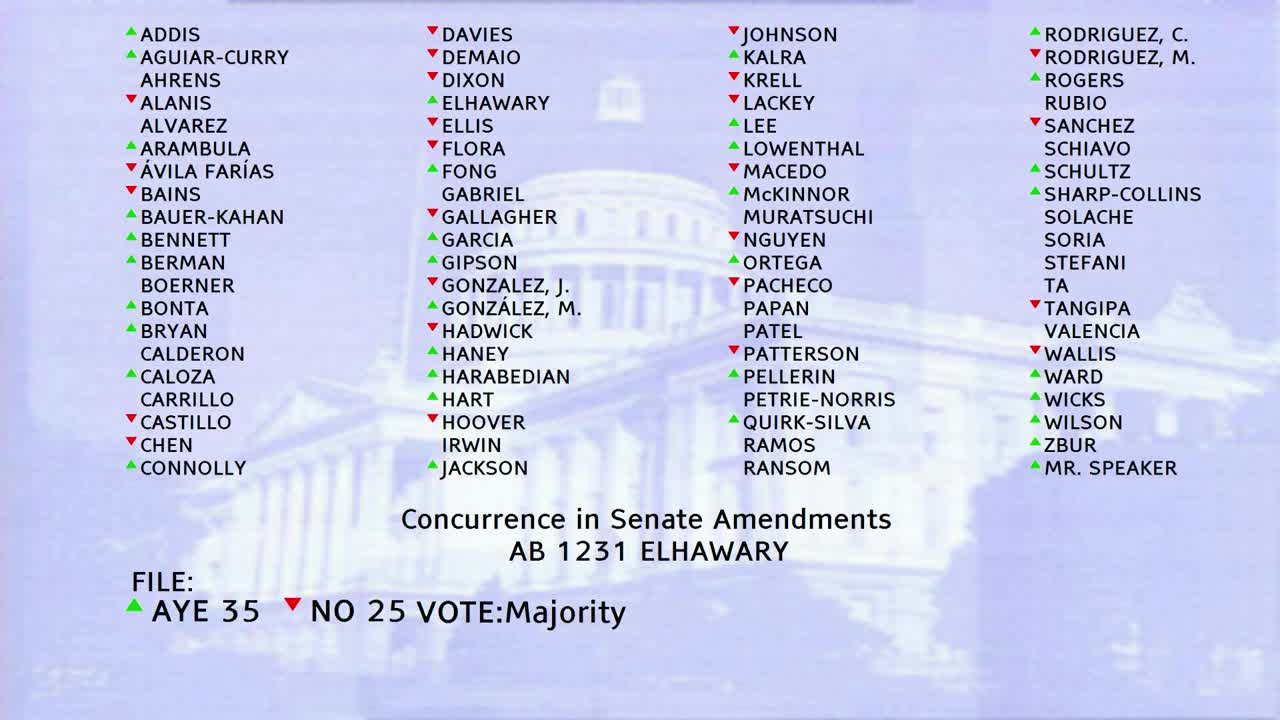 53SEC
Assembly Floor
 3MIN
Senate Floor
 3MIN
Senate Standing Committee on Education
Bill Author

Bill Co-Author(s):