SB 1148: Security guards: training.
- Session Year: 2025-2026
- House: Senate
- Latest Version Date: 2026-09-30
Current Status:
Passed
(2026-09-30: Chaptered by Secretary of State. Chapter 1011, Statutes of 2026.)
Introduced
In Committee
Awaiting First Chamber Vote
Passed First Chamber
In Committee
Awaiting Second Chamber Vote
Passed Second Chamber
Enacted
Existing law, the Private Security Services Act, provides for the licensure and regulation of, among others, security guards by the Bureau of Security and Investigative Services. Existing law requires a security guard registrant to complete not less than 32 hours of training in security officer skills within 6 months from the date an initial registration is issued and requires a security guard registrant to complete 16 of the 32 hours within 30 days from the date the registration is issued, except as specified.
Existing law requires a security guard registrant to complete a course in the exercise of the power to arrest and the appropriate use of force as a condition for registration issuance.
This bill would, notwithstanding those provisions, allow a registrant who has completed a course in the exercise of the power to arrest and the appropriate use of force to complete the training in security officer skills before registration is issued.
Existing law, the Proprietary Security Services Act, provides for the registration and regulation of proprietary private security officers by the Department of Consumer Affairs. Existing law requires a proprietary private security officer registrant to complete a training in security officer skills within 6 months from the date of registration issuance, or within 6 months of employment by a proprietary private security employer. Existing law requires the department to develop and establish a standard course and curriculum, including the minimum hours of instruction, for the security officer skills training.
This bill would, notwithstanding those provisions, allow a registrant who has completed a course in the exercise of the power to arrest and the appropriate use of force to complete the training in security officer skills before registration is issued.
This bill would incorporate additional changes to Sections 7574.18 and 7583.6 of the Business and Professions Code proposed by SB 1203 to be operative only if this bill and SB 1203 are enacted and this bill is enacted last.
Existing law, the Private Security Services Act, provides for the licensure and regulation of, among others, security guards by the Bureau of Security and Investigative Services. Existing law requires a security guard registrant to complete not less than 32 hours of training in security officer skills within 6 months from the date an initial registration is issued and requires a security guard registrant to complete 16 of the 32 hours within 30 days from the date the registration is issued, except as specified.
Existing law requires a security guard registrant to complete a course in the exercise of the power to arrest and the appropriate use of force as a condition for registration issuance.
This bill would also authorize a security guard registrant to complete those required hours of training before the date the registration is issued. would, notwithstanding those provisions, allow a registrant who has completed a course in the exercise of the power to arrest and the appropriate use of force to complete the training in security officer skills before registration is issued.
Existing law, the Proprietary Security Services Act, provides for the registration and regulation of proprietary private security officers by the Department of Consumer Affairs. Existing law requires a proprietary private security officer registrant to complete a training in security officer skills within 6 months from the date of registration issuance, or within 6 months of employment by a proprietary private security employer. Existing law requires the department to develop and establish a standard course and curriculum, including the minimum hours of instruction, for the security officer skills training.
This bill would, notwithstanding those provisions, allow a registrant who has completed a course in the exercise of the power to arrest and the appropriate use of force to complete the training in security officer skills before registration is issued.
Existing law, the Private Security Services Act, provides for the licensure and regulation of, among others, security guards by the Bureau of Security and Investigative Services. Existing law requires a security guard registrant to complete not less than 32 hours of training in security officer skills within 6 months from the date an initial registration is issued and requires a security guard registrant to complete 16 of the 32 hours within 30 days from the date the registration is issued, except as specified.
This bill would also authorize a security guard registrant to complete those required hours of training before the date the registration is issued.
(a)(1)Except for a person who has completed the course of training required by Section 7583.45, a person registered and hired as a proprietary private security officer shall complete training in security officer skills within six months from the date upon which registration is issued, or within six months of their employment with a proprietary private security employer.
(2)Notwithstanding paragraph (1), a person who has completed a course in the exercise of the power to arrest and the appropriate use of force may complete training in security officer skills before registration is issued.
(b)(1)Except as provided in paragraph (2), a course provider shall issue a certificate to a proprietary private security officer upon satisfactory completion of a required course, conducted in accordance with the departments requirements.
(2)If a proprietary private security employer administers a course of training pursuant to this section, that proprietary private security employer shall issue a certificate to a proprietary private security officer for the completion of training in security officer skills that each proprietary private security officer is required to complete, as determined by the department, including, but not limited to, training in the exercise of the power to arrest and the appropriate use of force. However, the employer shall not be required to provide a certificate for training courses provided pursuant to a curriculum adopted by the department that are specific to that employers business and where the subject of training is not specifically required by the department.
(c)An employer of a proprietary private security officer may provide training programs and courses in addition to the training required in this section.
(d)The department shall develop and establish by regulation a standard course and curriculum, which shall include a minimum number of hours of instruction, for the skills training required by subdivision (a) to promote and protect the safety of persons and the security of property. For this purpose, the regulations adopted by the department pursuant to Section 7574.5, as added by Chapter 721 of the Statutes of 2007, are continued in existence, and shall be amended by the department as necessary.
(e)The course of training required by subdivision (a) may be administered, tested, and certified by any proprietary private security employer, organization, or school approved by the department. The department may approve any proprietary private security employer, organization, or school to teach the course.
(f)(1)A proprietary private security employer shall annually provide each employee registered pursuant to this chapter with specifically dedicated review or practice of security officer skills prescribed in the training required in this section. The bureau shall adopt and approve by regulation the minimum number of hours required for annual review.
(2)A proprietary private security employer shall maintain at the principal place of business or branch office a record verifying completion of the review or practice training for a period of not less than two years. The records shall be available for inspection by the department upon request.
(g)This section does not apply to a peace officer, as defined in Chapter 4.5 (commencing with Section 830) of Title 3 of Part 2 of the Penal Code, who has successfully completed a course of study in the exercise of the power to arrest and the appropriate use of force approved by the Commission on Peace Officer Standards and Training. This section does not apply to armored vehicle guards.
(h)A person registered and hired as a proprietary private security officer may submit Verification of Military Experience and Training (VMET) records that document that the person has completed equivalent military training in lieu of completing a course of training in security officer skills pursuant to subdivision (a). The department shall determine the type of equivalent military training that qualifies to serve as a substitute.
(i)This section shall become operative on July 1, 2023.
SEC. 1.1.Section 7574.18 of the Business and Professions Code is amended to read:7574.18.(a)(1)Except for a person who has completed the course of training required by Section 7583.45, a person registered and hired as a proprietary private security officer shall complete training in security officer skills within six months from the date upon which registration is issued, or within six months of their employment with a proprietary private security employer.
(2)Notwithstanding paragraph (1), a person who has completed a course in the exercise of the power to arrest and the appropriate use of force may complete training in security officer skills before registration is issued.
(b)(1)Except as provided in paragraph (2), a course provider shall issue a certificate to a proprietary private security officer upon satisfactory completion of a required course, conducted in accordance with the departments requirements.
(2)If a proprietary private security employer administers a course of training pursuant to this section, that proprietary private security employer shall issue a certificate to a proprietary private security officer for the completion of training in security officer skills that each proprietary private security officer is required to complete, as determined by the department, including, but not limited to, training in the exercise of the power to arrest and the appropriate use of force. However, the employer shall not be required to provide a certificate for training courses provided pursuant to a curriculum adopted by the department that are specific to that employers business and where the subject of training is not specifically required by the department.
(c)An employer of a proprietary private security officer may provide training programs and courses in addition to the training required in this section.
(d)The department shall develop and establish by regulation a standard course and curriculum, which shall include a minimum number of hours of instruction, for the skills training required by subdivision (a) to promote and protect the safety of persons and the security of property. For this purpose, the regulations adopted by the department pursuant to Section 7574.5, as added by Chapter 721 of the Statutes of 2007, are continued in existence, and shall be amended by the department as necessary.
(e)The course of training required by subdivision (a) may be administered, tested, and certified by any proprietary private security employer, organization, or school approved by the department. The department may approve any proprietary private security employer, organization, or school to teach the course.
(f)(1)A proprietary private security employer shall annually provide each employee registered pursuant to this chapter with specifically dedicated review or practice of security officer skills prescribed in the training required in this section. The bureau shall adopt and approve by regulation the minimum number of hours required for annual review.
(2)A proprietary private security employer shall maintain at the principal place of business or branch office a record verifying completion of the review or practice training for a period of not less than two years. The records shall be available for inspection by the department upon request.
(g)This section does not apply to a peace officer, as defined in Chapter 4.5 (commencing with Section 830) of Title 3 of Part 2 of the Penal Code, who has successfully completed a course of study in the exercise of the power to arrest and the appropriate use of force approved by the Commission on Peace Officer Standards and Training. This section does not apply to armored vehicle guards.
(h)A person registered and hired as a proprietary private security officer may submit Verification of Military Experience and Training (VMET) records that document that the person has completed equivalent military training in lieu of completing a course of training in security officer skills pursuant to subdivision (a). The department shall determine the type of equivalent military training that qualifies to serve as a substitute.
(i)This section shall remain in effect only until January 1, 2029, and as of that date is repealed.
SEC. 1.2.Section 7574.18 is added to the Business and Professions Code, to read:7574.18.(a)(1)Each applicant for a proprietary private security officer registration shall complete a course in the exercise of the power to arrest and the appropriate use of force as a condition of issuance of the registration. Training on the power to arrest and the appropriate use of force shall meet the requirements of Section 7583.7. Course providers authorized to provide training pursuant to Section 7583.7 shall issue a certificate of completion to the person upon satisfactory completion of each training. The course provider shall conduct the training in accordance with Section 7583.7 and any applicable regulations adopted by the bureau. The training shall be administered and certified by a single course provider, pursuant to subdivision (f), and shall be completed within six months preceding the date the application is submitted to the bureau.
(2)Notwithstanding paragraph (1), a person who has completed a course in the exercise of the power to arrest and the appropriate use of force may complete training in security officer skills before registration is issued.
(b)(1)Except for a person who has completed the course training required by Section 7583.45, a person registered and employed as a proprietary private security officer shall complete 42 hours of training in security officer skills within six months from the date upon which registration is issued, or within six months of their employment with a proprietary private security employer. A proprietary private security officer registrant shall complete 18 of the 42 hours within 30 days from the date the registration is issued. The 42 hours of training shall be conducted through traditional classroom instruction, as defined by paragraph (2) of subdivision (b) of Section 7583.7. The eight hours of deescalation training required by this section shall be conducted by an instructor who is a human being and physically present, in person, and live with students in a classroom for 100 percent of the course and available at all times to answer students questions while providing the required training. No part of the security skills training shall be completed while a guard is on duty at their post. The time spent to attend the security skills training, including the deescalation training, shall be compensated by the proprietary private security employer if the guard is employed by, or has a pending offer of employment from, the employer. The cost of the security skills training shall be provided by the employer of the guard.
(2)Two of the first 18 hours of the 42 hours of training, which are required to be completed within 30 days from the date the registration is issued, shall be dedicated to training employees on the rights contained in the notice described in subdivision (a) of Section 1553 of the Labor Code.
(3)Eight hours of the 42 hours of security skills training shall be dedicated to practicing deescalation skills through in-person role-play and interactive training methods that involve evidence-based, trauma-informed techniques and strategies. The portions of the deescalation training shall be no less than eight hours in duration. These eight hours of deescalation training shall be compensated by the proprietary private security employer if the individual is employed by, or has a pending offer of employment with, the employer. The cost of the deescalation training shall be paid for by the employer of an individual who takes the course if they are employed by, or have a pending offer of employment with, the employer.
(4)For the purpose of this chapter, evidence-based, trauma-informed techniques and strategies shall be based on principles and methods informed by peer-reviewed or clinical research on trauma and includes role-playing and interactive methods. The bureau shall determine the criteria to evaluate whether deescalation trainings provided pursuant to this section are based on principles and methods informed by peer-reviewed or clinical research on trauma.
(c)(1)Except as provided in paragraph (2), a course provider shall issue a certificate to a proprietary private security officer upon satisfactory completion of a required course, conducted in accordance with the departments requirements. A course provider shall also issue a certificate to a proprietary private security officer upon satisfactory completion of the deescalation training required by paragraphs (1), (3), and (4) of subdivision (b).
(2)If a proprietary private security employer administers a course of training pursuant to this section, that proprietary private security employer shall issue a certificate to a proprietary private security officer for the completion of training in the power to arrest and the appropriate use of force, deescalation training, or the security officer skills training. However, the employer shall not be required to provide a certificate for training courses provided pursuant to a curriculum adopted by the department that are specific to that employers business and where the subject of training is not specifically required by the department.
(d)(1)A registrant who is unable to provide their employing licensee the certificate of satisfactory completion of the training required by subdivision (a) shall complete the training within six months of the registrants employment date.
(2)A registrant who is unable to provide their employing licensee the certificate of satisfactory completion of the training required by subdivision (b) shall complete 18 hours of the training within 30 days of the registrants employment date and shall complete the 24 remaining hours within six months of the registrants employment date.
(e)An employer of a proprietary private security officer may provide training programs and courses in addition to the training required in this section.
(f)The trainings specified in this section may be administered, tested, and certified by one of the following:
(1)Any proprietary private security employer, provided that the employer shall provide the training only to their applicants for employment and direct employees.
(2)Any training facility approved by the bureau.
(3)Any organization or school approved by the bureau. The bureau shall approve any instructor of an organization or school who will administer the trainings specified in this section to ensure that the organization or school complies with the requirements of this chapter, as well as any applicable regulations.
(4)(A)Upon request, a labor organization that represents security guards of a proprietary private security employer and is approved by the bureau as provided in this paragraph shall be entitled to provide the two-hour training on rights contained in the notice described in subdivision (a) of Section 1553 of the Labor Code to the proprietary private security employers security guards. Absent such request, this two-hour training may be provided by the entities listed in paragraphs (1) to (3), inclusive. A labor organization seeking approval of the bureau to offer the two-hour training on rights prescribed by this paragraph shall complete an application for certification as a labor training organization. This application shall be accompanied by a four-hundred-dollar ($400) application fee, be in a form prescribed by the chief, and shall include, but not be limited to, all of the following information:
(i)The name, business address, and telephone number of the organization.
(ii)The name or names of the instructors who will teach the course.
(iii)A certification that the applying organization will conduct the training as required by this section.
(B)Upon approval by the bureau, the chief shall issue to the facility a labor organization certificate. A labor organization certificate shall be valid for two years and may be renewed upon written request of the organization and upon payment of the three-hundred-dollar ($300) renewal fee. A labor organization certificate not renewed before the expiration date shall be canceled. A labor organization certificate may be reinstated upon payment of the renewal fee and a reinstatement fee of three-hundred-fifty-dollars ($350).
(C)A labor organization holding a labor organization certificate issued by the bureau shall be subject to the provisions of Article 7 (commencing with Section 7587) of Chapter 11.5 of Division 3.
(g)(1)A proprietary private security employer shall annually provide each employee registered pursuant to this chapter, or ensure that each employee is provided, with at least 12 hours of specifically dedicated review or practice of security officer skills prescribed in the training required in this section. At least four of these hours must be dedicated to practicing deescalation skills through in-person role-play and interactive training methods that involve evidence-based, trauma-informed techniques and strategies. This annual training shall be compensated by any employer for whom the officer works, or from whom the officer has a pending offer of employment.
(2)A proprietary private security employer shall maintain at the principal place of business or branch office a record verifying completion of the review or practice training for a period of not less than two years. The records shall be available for inspection by the department upon request.
(h)(1)A proprietary private security officer shall maintain the certificate of completion received for each training course prescribed in this section until the registration expires or has been canceled. The proprietary private security officer shall provide the records to the bureau upon request.
(2)A proprietary private security employer shall maintain at the principal place of business or branch office a record for each of its employees verifying completion of the trainings required by this section for the duration of the employees employment. The records shall be available for inspection by the bureau upon request.
(i)This section does not apply to a peace officer, as defined in Chapter 4.5 (commencing with Section 830) of Title 3 of Part 2 of the Penal Code, who has successfully completed a course of study in the exercise of the power to arrest and the appropriate use of force approved by the Commission on Peace Officer Standards and Training. This section does not apply to armored vehicle guards.
(j)A person registered and hired as a proprietary private security officer may submit Verification of Military Experience and Training (VMET) records that document that the person has completed equivalent military training in lieu of completing a course of training in security officer skills pursuant to subdivision (a). The department shall determine the type of equivalent military training that qualifies to serve as a substitute.
(k)This section shall become operative on January 1, 2029.
SEC. 2.Section 7583.6 of the Business and Professions Code is amended to read:7583.6.(a)Each applicant for a security guard registration shall complete a course in the exercise of the power to arrest and the appropriate use of force as a condition for the issuance of the registration. A course provider authorized to provide the training pursuant to Section 7583.7 shall issue a certificate of completion to the person upon satisfactory completion of the training. The course provider shall conduct the training in accordance with Section 7583.7 and any applicable regulations adopted by the bureau. The training shall be administered and certified by a single course provider, pursuant to subdivision (f), and shall be completed within six months preceding the date the application is submitted to the bureau.
(b)(1)Except for a registrant who has completed the course of training required by Section 7583.45, a security guard registrant shall complete not less than 32 hours of training in security officer skills within six months from the date an initial registration is issued. A security guard registrant shall complete 16 of the 32 hours within 30 days from the date the registration is issued.
(2)Notwithstanding paragraph (1), a person who has completed a course in the exercise of the power to arrest and the appropriate use of force may complete training in security officer skills before registration is issued.
(c)A course provider, which is authorized to provide the training required by subdivision (b) pursuant to subdivision (f), shall issue a certificate of completion to a registrant after the registrant completes each training course. The course provider shall conduct the trainings in accordance with any applicable regulations adopted by the bureau subject to this chapter.
(d)(1)A registrant who is unable to provide their employing licensee the certificate of satisfactory completion of the training required by subdivision (a) shall complete the training within six months of the registrants employment date.
(2)A registrant who is unable to provide their employing licensee the certificate of satisfactory completion of the training required by subdivision (b) shall complete 16 hours of the training within 30 days of the registrants employment date and shall complete the 16 remaining hours within six months of the registrants employment date.
(e)A registrant shall annually complete eight hours of specifically dedicated review or practice of security officer skills prescribed in this section, Section 7583.7, or by the bureau by regulation.
(f)The trainings specified in this section may be administered, tested, and certified by one of the following:
(1)Any licensee, provided that the licensee shall provide the training only to their applicants for employment and direct employees.
(2)Any training facility certified pursuant to this chapter.
(3)Any organization or school approved by the bureau. The bureau shall approve any instructor of an organization or school who will administer the trainings specified in this section to ensure that the organization or school complies with the requirements of this chapter, as well as any applicable regulations.
(g)(1)A registrant shall maintain the certificate of completion the registrant received for each training course prescribed in this section until the registration expires or has been canceled. The registrant shall provide the records to the bureau upon request.
(2)A licensee shall maintain at the principal place of business or branch office a record for each of its registrant employees verifying completion of the trainings required by this section for the duration of the registrants employment. The records shall be available for inspection by the bureau upon request.
(h)This section does not apply to a peace officer as defined in Chapter 4.5 (commencing with Section 830) of Title 3 of Part 2 of the Penal Code who has successfully completed a course of study in the exercise of the power to arrest and the appropriate use of force approved by the Commission on Peace Officer Standards and Training or a federal qualified law enforcement officer, as defined in Section 926B of Title 18 of the United States Code, who has successfully completed a course of study in the exercise of the power to arrest and the appropriate use of force.
(i)This section does not apply to armored vehicle guards.
(j)(1)The bureau shall develop and approve by regulation a standard course and curriculum for the skills trainings required by this section to promote and protect the safety of persons and the security of property.
(2)The bureau shall develop an outline for the course and curriculum described in paragraph (1) in consultation with the Commission on Peace Officer Standards and Training.
SEC. 2.1.Section 7583.6 of the Business and Professions Code is amended to read:7583.6.(a)Each applicant for a security guard registration shall complete a course in the exercise of the power to arrest and the appropriate use of force as a condition for the issuance of the registration. A course provider authorized to provide the training pursuant to Section 7583.7 shall issue a certificate of completion to the person upon satisfactory completion of the training. The course provider shall conduct the training in accordance with Section 7583.7 and any applicable regulations adopted by the bureau. The training shall be administered and certified by a single course provider, pursuant to subdivision (f), and shall be completed within six months preceding the date the application is submitted to the bureau.
(b)(1)Except for a registrant who has completed the course of training required by Section 7583.45, a security guard registrant shall complete not less than 32 hours of training in security officer skills within six months from the date an initial registration is issued. A security guard registrant shall complete 16 of the 32 hours within 30 days from the date the registration is issued.
(2)Notwithstanding paragraph (1), a person who has completed a course in the exercise of the power to arrest and the appropriate use of force may complete training in security officer skills before registration is issued.
(c)A course provider, which is authorized to provide the training required by subdivision (b) pursuant to subdivision (f), shall issue a certificate of completion to a registrant after the registrant completes each training course. The course provider shall conduct the trainings in accordance with any applicable regulations adopted by the bureau subject to this chapter.
(d)(1)A registrant who is unable to provide their employing licensee the certificate of satisfactory completion of the training required by subdivision (a) shall complete the training within six months of the registrants employment date.
(2)A registrant who is unable to provide their employing licensee the certificate of satisfactory completion of the training required by subdivision (b) shall complete 16 hours of the training within 30 days of the registrants employment date and shall complete the 16 remaining hours within six months of the registrants employment date.
(e)A registrant shall annually complete eight hours of specifically dedicated review or practice of security officer skills prescribed in this section, Section 7583.7, or by the bureau by regulation.
(f)The trainings specified in this section may be administered, tested, and certified by one of the following:
(1)Any licensee, provided that the licensee shall provide the training only to their applicants for employment and direct employees.
(2)Any training facility certified pursuant to this chapter.
(3)Any organization or school approved by the bureau. The bureau shall approve any instructor of an organization or school who will administer the trainings specified in this section to ensure that the organization or school complies with the requirements of this chapter, as well as any applicable regulations.
(g)(1)A registrant shall maintain the certificate of completion the registrant received for each training course prescribed in this section until the registration expires or has been canceled. The registrant shall provide the records to the bureau upon request.
(2)A licensee shall maintain at the principal place of business or branch office a record for each of its registrant employees verifying completion of the trainings required by this section for the duration of the registrants employment. The records shall be available for inspection by the bureau upon request.
(h)This section does not apply to a peace officer as defined in Chapter 4.5 (commencing with Section 830) of Title 3 of Part 2 of the Penal Code who has successfully completed a course of study in the exercise of the power to arrest and the appropriate use of force approved by the Commission on Peace Officer Standards and Training or a federal qualified law enforcement officer, as defined in Section 926B of Title 18 of the United States Code, who has successfully completed a course of study in the exercise of the power to arrest and the appropriate use of force.
(i)This section does not apply to armored vehicle guards.
(j)(1)The bureau shall develop and approve by regulation a standard course and curriculum for the skills trainings required by this section to promote and protect the safety of persons and the security of property.
(2)The bureau shall develop an outline for the course and curriculum described in paragraph (1) in consultation with the Commission on Peace Officer Standards and Training.
(k)This section shall remain in effect only until January 1, 2029, and as of that date is repealed.
SEC. 2.2.Section 7583.6 is added to the Business and Professions Code, to read:7583.6.(a)(1)Each applicant for a security guard registration shall complete a course in the exercise of the power to arrest and the appropriate use of force as a condition for the issuance of the registration. A course provider authorized to provide the training pursuant to Section 7583.7 shall issue a certificate of completion to the person upon satisfactory completion of the training. The course provider shall conduct the training in accordance with Section 7583.7 and any applicable regulations adopted by the bureau. The training shall be administered and certified by a single course provider, pursuant to subdivision (f), and shall be completed within six months preceding the date the application is submitted to the bureau.
(2)Notwithstanding paragraph (1), a person who has completed a course in the exercise of the power to arrest and the appropriate use of force may complete training in security officer skills before registration is issued.
(b)(1)(A)Except for a registrant who has completed the course of training required by Section 7583.45, a security guard registrant shall complete not less than 42 hours of training in security guard skills within six months from the date an initial registration is issued. A security guard registrant shall complete 18 of the 42 hours within 30 days from the date the registration is issued. The 42 hours of training shall be conducted through traditional classroom instruction, as defined by paragraph (2) of subdivision (b) of Section 7583.7. The eight hours of deescalation training prescribed by subparagraph (C) shall be conducted by an instructor who is a human being and physically present, in person, and live with students in a classroom 100 percent of the course and available at all times to answer students questions while providing the required training. No part of this training shall be completed while a guard is on duty at their post. The time spent to attend the security skills training, including the deescalation training, shall be compensated by the licensee if the guard is employed by, or has a pending offer of employment from, the licensee. The cost of the training shall be provided by the employer of the guard.
(B)Two of the first 18 hours of the 42 hours of training, which are required to be completed within 30 days from the date the registration is issued, shall be dedicated to training employees on the rights contained in the notice described in subdivision (a) of Section 1553 of the Labor Code.
(C)Eight hours of the 42 hours of security skills training shall be dedicated to practicing deescalation skills through in-person role-play and interactive training methods that involve evidence-based, trauma-informed techniques and strategies. The portions of the deescalation training shall be no less than eight hours in duration. These eight hours of deescalation training shall be compensated by the employer if the individual is employed by, or has a pending offer of employment with, the employer. The cost of the deescalation training shall be paid for by the employer of an individual who takes the course if they are employed by, or have a pending offer of employment with, the employer.
(D)For the purpose of this chapter, evidence-based, trauma-informed techniques and strategies shall be based on principles and methods informed by peer-reviewed or clinical research on trauma and includes role-playing and interactive methods. The bureau shall determine the criteria to evaluate whether deescalation trainings provided pursuant to this section are based on principles and methods informed by peer-reviewed or clinical research on trauma.
(2)Notwithstanding paragraph (1), a person who has completed a course in the exercise of the power to arrest and the appropriate use of force may complete training in security officer skills before registration is issued.
(c)A course provider, which is authorized to provide the training required by subdivision (b) pursuant to subdivision (f) shall issue a certificate of completion to a registrant after the registrant completes each training course. A course provider shall also issue a certificate to a proprietary private security officer upon satisfactory completion of the deescalation training required by paragraphs (1), (3), and (4) of subdivision (b). The course provider shall conduct the training in accordance with any applicable regulations adopted by the bureau subject to this chapter.
(d)(1)A registrant who is unable to provide their employing licensee the certificate of satisfactory completion of the training required by subdivision (a) shall complete the training within six months of the registrants employment date.
(2)A registrant who is unable to provide their employing licensee the certificate of satisfactory completion of the training required by subdivision (b) shall complete 18 hours of the training within 30 days of the registrants employment date and shall complete the 24 remaining hours within six months of the registrants employment date.
(e)A registrant shall annually complete 12 hours of specifically dedicated review or practice of security guard skills prescribed in this section, Section 7583.7, or by the bureau by regulation. At least four of these hours must be dedicated to practicing deescalation skills through in-person role-play and interactive training methods that involve evidence-based, trauma-informed techniques and strategies. This annual training shall be compensated by any employer for whom the guard works, or from whom the guard has a pending offer of employment.
(f)The trainings specified in this section may be administered, tested, and certified by one of the following:
(1)Any licensee, provided that the licensee shall provide the training only to their applicants for employment and direct employees.
(2)Any training facility certified pursuant to this chapter.
(3)Any organization or school approved by the bureau. The bureau shall approve any instructor of an organization or school who will administer the trainings specified in this section to ensure that the organization or school complies with the requirements of this chapter, as well as any applicable regulations.
(4)(A)Upon request, a labor organization that represents security guards of a licensee and is approved by the bureau as provided in this paragraph shall be entitled to provide the two-hour training on rights contained in the notice described in subdivision (a) of Section 1553 of the Labor Code to the licensees security guards. Absent such request, this two-hour training may be provided by the entities listed in paragraphs (1) to (3), inclusive. A labor organization seeking approval of the bureau to offer the two-hour training on rights prescribed by this paragraph shall complete an application for certification as a labor training organization. This application shall be accompanied by a four-hundred-dollar ($400) application fee, be in a form prescribed by the chief, and shall include, but not be limited to, all of the following information:
(i)The name, business address, and telephone number of the organization.
(ii)The name or names of the instructors who will teach the course.
(iii)A certification that the applying organization will conduct the training as required by this section.
(B)Upon approval by the bureau, the chief shall issue to the facility a labor organization certificate. A labor organization certificate shall be valid for two years and may be renewed upon written request of the organization and upon payment of the three-hundred-dollar ($300) renewal fee. A labor organization certificate not renewed before the expiration date shall be canceled. A labor organization certificate may be reinstated upon payment of the renewal fee and a reinstatement fee of three-hundred-fifty-dollars ($350).
(C)A labor organization holding a labor organization certificate issued by the bureau shall be subject to the provisions of Article 7 (commencing with Section 7587) of Chapter 11.5 of Division 3.
(g)(1)A registrant shall maintain the certificate of completion the registrant received for each training course prescribed in this section until the registration expires or has been canceled. The registrant shall provide the records to the bureau upon request.
(2)A licensee shall maintain at the principal place of business or branch office a record for each of its registrant employees verifying completion of the trainings required by this section for the duration of the registrants employment. The records shall be available for inspection by the bureau upon request.
(h)This section does not apply to a peace officer as defined in Chapter 4.5 (commencing with Section 830) of Title 3 of Part 2 of the Penal Code who has successfully completed a course of study in the exercise of the power to arrest and the appropriate use of force approved by the Commission on Peace Officer Standards and Training or a federal qualified law enforcement officer, as defined in Section 926B of Title 18 of the United States Code, who has successfully completed a course of study in the exercise of the power to arrest and the appropriate use of force.
(i)This section does not apply to armored vehicle guards.
(j)(1)The bureau shall develop and approve by regulation a standard course and curriculum for the skills trainings required by this section to promote and protect the safety of persons and the security of property.
(2)The bureau shall develop an outline for the course and curriculum described in paragraph (1) in consultation with the Commission on Peace Officer Standards and Training.
(3)The bureau shall develop and establish a standard course and curriculum for the deescalation training prescribed by paragraphs (1), (3), and (4) of subdivision (b).
(k)This section shall become operative on January 1, 2029.
SEC. 3.Sections 1.1 and 1.2 of this bill incorporate amendments to Section 7574.18 of the Business and Professions Code proposed by both this bill and Senate Bill 1203. Those sections of this bill shall only become operative if (1) both bills are enacted and become effective on or before January 1, 2027, (2) this bill amends Section 7574.18 of the Business and Professions Code and Senate Bill 1203 amends, repeals, and adds Section 7574.18 of the Business and Professions Code, and (3) this bill is enacted after Senate Bill 1203, in which case Section 1 of this bill shall not become operative.
SEC. 4.Sections 2.1 and 2.2 of this bill incorporate amendments to Section 7583.6 of the Business and Professions Code proposed by both this bill and Senate Bill 1203. Those sections of this bill shall only become operative if (1) both bills are enacted and become effective on or before January 1, 2027, (2) this bill amends Section 7583.6 of the Business and Professions Code and Senate Bill 1203 amends, repeals, and adds Section 7583.6 of the Business and Professions Code, and (3) this bill is enacted after Senate Bill 1203, in which case Section 2 of this bill shall not become operative.
(a)(1)Except for a person who has completed the course of training required by Section 7583.45, a person registered and hired as a proprietary private security officer shall complete training in security officer skills within six months from the date upon which registration is issued, or within six months of their employment with a proprietary private security employer.
(2)Notwithstanding paragraph (1), a person who has completed a course in the exercise of the power to arrest and the appropriate use of force may complete training in security officer skills before registration is issued.
(b)(1)Except as provided in paragraph (2), a course provider shall issue a certificate to a proprietary private security officer upon satisfactory completion of a required course, conducted in accordance with the departments requirements.
(2)If a proprietary private security employer administers a course of training pursuant to this section, that proprietary private security employer shall issue a certificate to a proprietary private security officer for the completion of training in security officer skills that each proprietary private security officer is required to complete, as determined by the department, including, but not limited to, training in the exercise of the power to arrest and the appropriate use of force. However, the employer shall not be required to provide a certificate for training courses provided pursuant to a curriculum adopted by the department that are specific to that employers business and where the subject of training is not specifically required by the department.
(c)An employer of a proprietary private security officer may provide training programs and courses in addition to the training required in this section.
(d)The department shall develop and establish by regulation a standard course and curriculum, which shall include a minimum number of hours of instruction, for the skills training required by subdivision (a) to promote and protect the safety of persons and the security of property. For this purpose, the regulations adopted by the department pursuant to Section 7574.5, as added by Chapter 721 of the Statutes of 2007, are continued in existence, and shall be amended by the department as necessary.
(e)The course of training required by subdivision (a) may be administered, tested, and certified by any proprietary private security employer, organization, or school approved by the department. The department may approve any proprietary private security employer, organization, or school to teach the course.
(f)(1)A proprietary private security employer shall annually provide each employee registered pursuant to this chapter with specifically dedicated review or practice of security officer skills prescribed in the training required in this section. The bureau shall adopt and approve by regulation the minimum number of hours required for annual review.
(2)A proprietary private security employer shall maintain at the principal place of business or branch office a record verifying completion of the review or practice training for a period of not less than two years. The records shall be available for inspection by the department upon request.
(g)This section does not apply to a peace officer, as defined in Chapter 4.5 (commencing with Section 830) of Title 3 of Part 2 of the Penal Code, who has successfully completed a course of study in the exercise of the power to arrest and the appropriate use of force approved by the Commission on Peace Officer Standards and Training. This section does not apply to armored vehicle guards.
(h)A person registered and hired as a proprietary private security officer may submit Verification of Military Experience and Training (VMET) records that document that the person has completed equivalent military training in lieu of completing a course of training in security officer skills pursuant to subdivision (a). The department shall determine the type of equivalent military training that qualifies to serve as a substitute.
(i)This section shall become operative on July 1, 2023.
SEC. 1.1.Section 7574.18 of the Business and Professions Code is amended to read:7574.18.(a)(1)Except for a person who has completed the course of training required by Section 7583.45, a person registered and hired as a proprietary private security officer shall complete training in security officer skills within six months from the date upon which registration is issued, or within six months of their employment with a proprietary private security employer.
(2)Notwithstanding paragraph (1), a person who has completed a course in the exercise of the power to arrest and the appropriate use of force may complete training in security officer skills before registration is issued.
(b)(1)Except as provided in paragraph (2), a course provider shall issue a certificate to a proprietary private security officer upon satisfactory completion of a required course, conducted in accordance with the departments requirements.
(2)If a proprietary private security employer administers a course of training pursuant to this section, that proprietary private security employer shall issue a certificate to a proprietary private security officer for the completion of training in security officer skills that each proprietary private security officer is required to complete, as determined by the department, including, but not limited to, training in the exercise of the power to arrest and the appropriate use of force. However, the employer shall not be required to provide a certificate for training courses provided pursuant to a curriculum adopted by the department that are specific to that employers business and where the subject of training is not specifically required by the department.
(c)An employer of a proprietary private security officer may provide training programs and courses in addition to the training required in this section.
(d)The department shall develop and establish by regulation a standard course and curriculum, which shall include a minimum number of hours of instruction, for the skills training required by subdivision (a) to promote and protect the safety of persons and the security of property. For this purpose, the regulations adopted by the department pursuant to Section 7574.5, as added by Chapter 721 of the Statutes of 2007, are continued in existence, and shall be amended by the department as necessary.
(e)The course of training required by subdivision (a) may be administered, tested, and certified by any proprietary private security employer, organization, or school approved by the department. The department may approve any proprietary private security employer, organization, or school to teach the course.
(f)(1)A proprietary private security employer shall annually provide each employee registered pursuant to this chapter with specifically dedicated review or practice of security officer skills prescribed in the training required in this section. The bureau shall adopt and approve by regulation the minimum number of hours required for annual review.
(2)A proprietary private security employer shall maintain at the principal place of business or branch office a record verifying completion of the review or practice training for a period of not less than two years. The records shall be available for inspection by the department upon request.
(g)This section does not apply to a peace officer, as defined in Chapter 4.5 (commencing with Section 830) of Title 3 of Part 2 of the Penal Code, who has successfully completed a course of study in the exercise of the power to arrest and the appropriate use of force approved by the Commission on Peace Officer Standards and Training. This section does not apply to armored vehicle guards.
(h)A person registered and hired as a proprietary private security officer may submit Verification of Military Experience and Training (VMET) records that document that the person has completed equivalent military training in lieu of completing a course of training in security officer skills pursuant to subdivision (a). The department shall determine the type of equivalent military training that qualifies to serve as a substitute.
(i)This section shall become operative on July 1, 2023.(i)This section shall remain in effect only until January 1, 2029, and as of that date is repealed.
SEC. 1.2.Section 7574.18 is added to the Business and Professions Code, to read:7574.18.(a)(1)Each applicant for a proprietary private security officer registration shall complete a course in the exercise of the power to arrest and the appropriate use of force as a condition of issuance of the registration. Training on the power to arrest and the appropriate use of force shall meet the requirements of Section 7583.7. Course providers authorized to provide training pursuant to Section 7583.7 shall issue a certificate of completion to the person upon satisfactory completion of each training. The course provider shall conduct the training in accordance with Section 7583.7 and any applicable regulations adopted by the bureau. The training shall be administered and certified by a single course provider, pursuant to subdivision (f), and shall be completed within six months preceding the date the application is submitted to the bureau.
(2)Notwithstanding paragraph (1), a person who has completed a course in the exercise of the power to arrest and the appropriate use of force may complete training in security officer skills before registration is issued.
(b)(1)Except for a person who has completed the course training required by Section 7583.45, a person registered and employed as a proprietary private security officer shall complete 42 hours of training in security officer skills within six months from the date upon which registration is issued, or within six months of their employment with a proprietary private security employer. A proprietary private security officer registrant shall complete 18 of the 42 hours within 30 days from the date the registration is issued. The 42 hours of training shall be conducted through traditional classroom instruction, as defined by paragraph (2) of subdivision (b) of Section 7583.7. The eight hours of deescalation training required by this section shall be conducted by an instructor who is a human being and physically present, in person, and live with students in a classroom for 100 percent of the course and available at all times to answer students questions while providing the required training. No part of the security skills training shall be completed while a guard is on duty at their post. The time spent to attend the security skills training, including the deescalation training, shall be compensated by the proprietary private security employer if the guard is employed by, or has a pending offer of employment from, the employer. The cost of the security skills training shall be provided by the employer of the guard.
(2)Two of the first 18 hours of the 42 hours of training, which are required to be completed within 30 days from the date the registration is issued, shall be dedicated to training employees on the rights contained in the notice described in subdivision (a) of Section 1553 of the Labor Code.
(3)Eight hours of the 42 hours of security skills training shall be dedicated to practicing deescalation skills through in-person role-play and interactive training methods that involve evidence-based, trauma-informed techniques and strategies. The portions of the deescalation training shall be no less than eight hours in duration. These eight hours of deescalation training shall be compensated by the proprietary private security employer if the individual is employed by, or has a pending offer of employment with, the employer. The cost of the deescalation training shall be paid for by the employer of an individual who takes the course if they are employed by, or have a pending offer of employment with, the employer.
(4)For the purpose of this chapter, evidence-based, trauma-informed techniques and strategies shall be based on principles and methods informed by peer-reviewed or clinical research on trauma and includes role-playing and interactive methods. The bureau shall determine the criteria to evaluate whether deescalation trainings provided pursuant to this section are based on principles and methods informed by peer-reviewed or clinical research on trauma.
(c)(1)Except as provided in paragraph (2), a course provider shall issue a certificate to a proprietary private security officer upon satisfactory completion of a required course, conducted in accordance with the departments requirements. A course provider shall also issue a certificate to a proprietary private security officer upon satisfactory completion of the deescalation training required by paragraphs (1), (3), and (4) of subdivision (b).
(2)If a proprietary private security employer administers a course of training pursuant to this section, that proprietary private security employer shall issue a certificate to a proprietary private security officer for the completion of training in the power to arrest and the appropriate use of force, deescalation training, or the security officer skills training. However, the employer shall not be required to provide a certificate for training courses provided pursuant to a curriculum adopted by the department that are specific to that employers business and where the subject of training is not specifically required by the department.
(d)(1)A registrant who is unable to provide their employing licensee the certificate of satisfactory completion of the training required by subdivision (a) shall complete the training within six months of the registrants employment date.
(2)A registrant who is unable to provide their employing licensee the certificate of satisfactory completion of the training required by subdivision (b) shall complete 18 hours of the training within 30 days of the registrants employment date and shall complete the 24 remaining hours within six months of the registrants employment date.
(e)An employer of a proprietary private security officer may provide training programs and courses in addition to the training required in this section.
(f)The trainings specified in this section may be administered, tested, and certified by one of the following:
(1)Any proprietary private security employer, provided that the employer shall provide the training only to their applicants for employment and direct employees.
(2)Any training facility approved by the bureau.
(3)Any organization or school approved by the bureau. The bureau shall approve any instructor of an organization or school who will administer the trainings specified in this section to ensure that the organization or school complies with the requirements of this chapter, as well as any applicable regulations.
(4)(A)Upon request, a labor organization that represents security guards of a proprietary private security employer and is approved by the bureau as provided in this paragraph shall be entitled to provide the two-hour training on rights contained in the notice described in subdivision (a) of Section 1553 of the Labor Code to the proprietary private security employers security guards. Absent such request, this two-hour training may be provided by the entities listed in paragraphs (1) to (3), inclusive. A labor organization seeking approval of the bureau to offer the two-hour training on rights prescribed by this paragraph shall complete an application for certification as a labor training organization. This application shall be accompanied by a four-hundred-dollar ($400) application fee, be in a form prescribed by the chief, and shall include, but not be limited to, all of the following information:
(i)The name, business address, and telephone number of the organization.
(ii)The name or names of the instructors who will teach the course.
(iii)A certification that the applying organization will conduct the training as required by this section.
(B)Upon approval by the bureau, the chief shall issue to the facility a labor organization certificate. A labor organization certificate shall be valid for two years and may be renewed upon written request of the organization and upon payment of the three-hundred-dollar ($300) renewal fee. A labor organization certificate not renewed before the expiration date shall be canceled. A labor organization certificate may be reinstated upon payment of the renewal fee and a reinstatement fee of three-hundred-fifty-dollars ($350).
(C)A labor organization holding a labor organization certificate issued by the bureau shall be subject to the provisions of Article 7 (commencing with Section 7587) of Chapter 11.5 of Division 3.
(g)(1)A proprietary private security employer shall annually provide each employee registered pursuant to this chapter, or ensure that each employee is provided, with at least 12 hours of specifically dedicated review or practice of security officer skills prescribed in the training required in this section. At least four of these hours must be dedicated to practicing deescalation skills through in-person role-play and interactive training methods that involve evidence-based, trauma-informed techniques and strategies. This annual training shall be compensated by any employer for whom the officer works, or from whom the officer has a pending offer of employment.
(2)A proprietary private security employer shall maintain at the principal place of business or branch office a record verifying completion of the review or practice training for a period of not less than two years. The records shall be available for inspection by the department upon request.
(h)(1)A proprietary private security officer shall maintain the certificate of completion received for each training course prescribed in this section until the registration expires or has been canceled. The proprietary private security officer shall provide the records to the bureau upon request.
(2)A proprietary private security employer shall maintain at the principal place of business or branch office a record for each of its employees verifying completion of the trainings required by this section for the duration of the employees employment. The records shall be available for inspection by the bureau upon request.
(i)This section does not apply to a peace officer, as defined in Chapter 4.5 (commencing with Section 830) of Title 3 of Part 2 of the Penal Code, who has successfully completed a course of study in the exercise of the power to arrest and the appropriate use of force approved by the Commission on Peace Officer Standards and Training. This section does not apply to armored vehicle guards.
(j)A person registered and hired as a proprietary private security officer may submit Verification of Military Experience and Training (VMET) records that document that the person has completed equivalent military training in lieu of completing a course of training in security officer skills pursuant to subdivision (a). The department shall determine the type of equivalent military training that qualifies to serve as a substitute.
(k)This section shall become operative on January 1, 2029.
SEC. 2.Section 7583.6 of the Business and Professions Code is amended to read:7583.6.(a)Each applicant for a security guard registration shall complete a course in the exercise of the power to arrest and the appropriate use of force as a condition for the issuance of the registration. A course provider authorized to provide the training pursuant to Section 7583.7 shall issue a certificate of completion to the person upon satisfactory completion of the training. The course provider shall conduct the training in accordance with Section 7583.7 and any applicable regulations adopted by the bureau. The training shall be administered and certified by a single course provider, pursuant to subdivision (f), and shall be completed within six months preceding the date the application is submitted to the bureau.
(b)(1)Except for a registrant who has completed the course of training required by Section 7583.45, a security guard registrant shall complete not less than 32 hours of training in security officer skills within six months from the date an initial registration is issued. A security guard registrant shall complete 16 of the 32 hours within 30 days from the date the registration is issued.
(2)Notwithstanding paragraph (1), a person who has completed a course in the exercise of the power to arrest and the appropriate use of force may complete training in security officer skills before registration is issued.
(c)A course provider, which is authorized to provide the training required by subdivision (b) pursuant to subdivision (f), shall issue a certificate of completion to a registrant after the registrant completes each training course. The course provider shall conduct the trainings in accordance with any applicable regulations adopted by the bureau subject to this chapter.
(d)(1)A registrant who is unable to provide their employing licensee the certificate of satisfactory completion of the training required by subdivision (a) shall complete the training within six months of the registrants employment date.
(2)A registrant who is unable to provide their employing licensee the certificate of satisfactory completion of the training required by subdivision (b) shall complete 16 hours of the training within 30 days of the registrants employment date and shall complete the 16 remaining hours within six months of the registrants employment date.
(e)A registrant shall annually complete eight hours of specifically dedicated review or practice of security officer skills prescribed in this section, Section 7583.7, or by the bureau by regulation.
(f)The trainings specified in this section may be administered, tested, and certified by one of the following:
(1)Any licensee, provided that the licensee shall provide the training only to their applicants for employment and direct employees.
(2)Any training facility certified pursuant to this chapter.
(3)Any organization or school approved by the bureau. The bureau shall approve any instructor of an organization or school who will administer the trainings specified in this section to ensure that the organization or school complies with the requirements of this chapter, as well as any applicable regulations.
(g)(1)A registrant shall maintain the certificate of completion the registrant received for each training course prescribed in this section until the registration expires or has been canceled. The registrant shall provide the records to the bureau upon request.
(2)A licensee shall maintain at the principal place of business or branch office a record for each of its registrant employees verifying completion of the trainings required by this section for the duration of the registrants employment. The records shall be available for inspection by the bureau upon request.
(h)This section does not apply to a peace officer as defined in Chapter 4.5 (commencing with Section 830) of Title 3 of Part 2 of the Penal Code who has successfully completed a course of study in the exercise of the power to arrest and the appropriate use of force approved by the Commission on Peace Officer Standards and Training or a federal qualified law enforcement officer, as defined in Section 926B of Title 18 of the United States Code, who has successfully completed a course of study in the exercise of the power to arrest and the appropriate use of force.
(i)This section does not apply to armored vehicle guards.
(j)(1)The bureau shall develop and approve by regulation a standard course and curriculum for the skills trainings required by this section to promote and protect the safety of persons and the security of property.
(2)The bureau shall develop an outline for the course and curriculum described in paragraph (1) in consultation with the Commission on Peace Officer Standards and Training.
SEC. 2.1.Section 7583.6 of the Business and Professions Code is amended to read:7583.6.(a)Each applicant for a security guard registration shall complete a course in the exercise of the power to arrest and the appropriate use of force as a condition for the issuance of the registration. A course provider authorized to provide the training pursuant to Section 7583.7 shall issue a certificate of completion to the person upon satisfactory completion of the training. The course provider shall conduct the training in accordance with Section 7583.7 and any applicable regulations adopted by the bureau. The training shall be administered and certified by a single course provider, pursuant to subdivision (f), and shall be completed within six months preceding the date the application is submitted to the bureau.
(b)(1)Except for a registrant who has completed the course of training required by Section 7583.45, a security guard registrant shall complete not less than 32 hours of training in security officer skills within six months from the date an initial registration is issued. A security guard registrant shall complete 16 of the 32 hours within 30 days from the date the registration is issued.
(2)Notwithstanding paragraph (1), a person who has completed a course in the exercise of the power to arrest and the appropriate use of force may complete training in security officer skills before registration is issued.
(c)A course provider, which is authorized to provide the training required by subdivision (b) pursuant to subdivision (f), shall issue a certificate of completion to a registrant after the registrant completes each training course. The course provider shall conduct the trainings in accordance with any applicable regulations adopted by the bureau subject to this chapter.
(d)(1)A registrant who is unable to provide their employing licensee the certificate of satisfactory completion of the training required by subdivision (a) shall complete the training within six months of the registrants employment date.
(2)A registrant who is unable to provide their employing licensee the certificate of satisfactory completion of the training required by subdivision (b) shall complete 16 hours of the training within 30 days of the registrants employment date and shall complete the 16 remaining hours within six months of the registrants employment date.
(e)A registrant shall annually complete eight hours of specifically dedicated review or practice of security officer skills prescribed in this section, Section 7583.7, or by the bureau by regulation.
(f)The trainings specified in this section may be administered, tested, and certified by one of the following:
(1)Any licensee, provided that the licensee shall provide the training only to their applicants for employment and direct employees.
(2)Any training facility certified pursuant to this chapter.
(3)Any organization or school approved by the bureau. The bureau shall approve any instructor of an organization or school who will administer the trainings specified in this section to ensure that the organization or school complies with the requirements of this chapter, as well as any applicable regulations.
(g)(1)A registrant shall maintain the certificate of completion the registrant received for each training course prescribed in this section until the registration expires or has been canceled. The registrant shall provide the records to the bureau upon request.
(2)A licensee shall maintain at the principal place of business or branch office a record for each of its registrant employees verifying completion of the trainings required by this section for the duration of the registrants employment. The records shall be available for inspection by the bureau upon request.
(h)This section does not apply to a peace officer as defined in Chapter 4.5 (commencing with Section 830) of Title 3 of Part 2 of the Penal Code who has successfully completed a course of study in the exercise of the power to arrest and the appropriate use of force approved by the Commission on Peace Officer Standards and Training or a federal qualified law enforcement officer, as defined in Section 926B of Title 18 of the United States Code, who has successfully completed a course of study in the exercise of the power to arrest and the appropriate use of force.
(i)This section does not apply to armored vehicle guards.
(j)(1)The bureau shall develop and approve by regulation a standard course and curriculum for the skills trainings required by this section to promote and protect the safety of persons and the security of property.
(2)The bureau shall develop an outline for the course and curriculum described in paragraph (1) in consultation with the Commission on Peace Officer Standards and Training.
(k)This section shall remain in effect only until January 1, 2029, and as of that date is repealed.
SEC. 2.2.Section 7583.6 is added to the Business and Professions Code, to read:7583.6.(a)(1)Each applicant for a security guard registration shall complete a course in the exercise of the power to arrest and the appropriate use of force as a condition for the issuance of the registration. A course provider authorized to provide the training pursuant to Section 7583.7 shall issue a certificate of completion to the person upon satisfactory completion of the training. The course provider shall conduct the training in accordance with Section 7583.7 and any applicable regulations adopted by the bureau. The training shall be administered and certified by a single course provider, pursuant to subdivision (f), and shall be completed within six months preceding the date the application is submitted to the bureau.
(2)Notwithstanding paragraph (1), a person who has completed a course in the exercise of the power to arrest and the appropriate use of force may complete training in security officer skills before registration is issued.
(b)(1)(A)Except for a registrant who has completed the course of training required by Section 7583.45, a security guard registrant shall complete not less than 42 hours of training in security guard skills within six months from the date an initial registration is issued. A security guard registrant shall complete 18 of the 42 hours within 30 days from the date the registration is issued. The 42 hours of training shall be conducted through traditional classroom instruction, as defined by paragraph (2) of subdivision (b) of Section 7583.7. The eight hours of deescalation training prescribed by subparagraph (C) shall be conducted by an instructor who is a human being and physically present, in person, and live with students in a classroom 100 percent of the course and available at all times to answer students questions while providing the required training. No part of this training shall be completed while a guard is on duty at their post. The time spent to attend the security skills training, including the deescalation training, shall be compensated by the licensee if the guard is employed by, or has a pending offer of employment from, the licensee. The cost of the training shall be provided by the employer of the guard.
(B)Two of the first 18 hours of the 42 hours of training, which are required to be completed within 30 days from the date the registration is issued, shall be dedicated to training employees on the rights contained in the notice described in subdivision (a) of Section 1553 of the Labor Code.
(C)Eight hours of the 42 hours of security skills training shall be dedicated to practicing deescalation skills through in-person role-play and interactive training methods that involve evidence-based, trauma-informed techniques and strategies. The portions of the deescalation training shall be no less than eight hours in duration. These eight hours of deescalation training shall be compensated by the employer if the individual is employed by, or has a pending offer of employment with, the employer. The cost of the deescalation training shall be paid for by the employer of an individual who takes the course if they are employed by, or have a pending offer of employment with, the employer.
(D)For the purpose of this chapter, evidence-based, trauma-informed techniques and strategies shall be based on principles and methods informed by peer-reviewed or clinical research on trauma and includes role-playing and interactive methods. The bureau shall determine the criteria to evaluate whether deescalation trainings provided pursuant to this section are based on principles and methods informed by peer-reviewed or clinical research on trauma.
(2)Notwithstanding paragraph (1), a person who has completed a course in the exercise of the power to arrest and the appropriate use of force may complete training in security officer skills before registration is issued.
(c)A course provider, which is authorized to provide the training required by subdivision (b) pursuant to subdivision (f) shall issue a certificate of completion to a registrant after the registrant completes each training course. A course provider shall also issue a certificate to a proprietary private security officer upon satisfactory completion of the deescalation training required by paragraphs (1), (3), and (4) of subdivision (b). The course provider shall conduct the training in accordance with any applicable regulations adopted by the bureau subject to this chapter.
(d)(1)A registrant who is unable to provide their employing licensee the certificate of satisfactory completion of the training required by subdivision (a) shall complete the training within six months of the registrants employment date.
(2)A registrant who is unable to provide their employing licensee the certificate of satisfactory completion of the training required by subdivision (b) shall complete 18 hours of the training within 30 days of the registrants employment date and shall complete the 24 remaining hours within six months of the registrants employment date.
(e)A registrant shall annually complete 12 hours of specifically dedicated review or practice of security guard skills prescribed in this section, Section 7583.7, or by the bureau by regulation. At least four of these hours must be dedicated to practicing deescalation skills through in-person role-play and interactive training methods that involve evidence-based, trauma-informed techniques and strategies. This annual training shall be compensated by any employer for whom the guard works, or from whom the guard has a pending offer of employment.
(f)The trainings specified in this section may be administered, tested, and certified by one of the following:
(1)Any licensee, provided that the licensee shall provide the training only to their applicants for employment and direct employees.
(2)Any training facility certified pursuant to this chapter.
(3)Any organization or school approved by the bureau. The bureau shall approve any instructor of an organization or school who will administer the trainings specified in this section to ensure that the organization or school complies with the requirements of this chapter, as well as any applicable regulations.
(4)(A)Upon request, a labor organization that represents security guards of a licensee and is approved by the bureau as provided in this paragraph shall be entitled to provide the two-hour training on rights contained in the notice described in subdivision (a) of Section 1553 of the Labor Code to the licensees security guards. Absent such request, this two-hour training may be provided by the entities listed in paragraphs (1) to (3), inclusive. A labor organization seeking approval of the bureau to offer the two-hour training on rights prescribed by this paragraph shall complete an application for certification as a labor training organization. This application shall be accompanied by a four-hundred-dollar ($400) application fee, be in a form prescribed by the chief, and shall include, but not be limited to, all of the following information:
(i)The name, business address, and telephone number of the organization.
(ii)The name or names of the instructors who will teach the course.
(iii)A certification that the applying organization will conduct the training as required by this section.
(B)Upon approval by the bureau, the chief shall issue to the facility a labor organization certificate. A labor organization certificate shall be valid for two years and may be renewed upon written request of the organization and upon payment of the three-hundred-dollar ($300) renewal fee. A labor organization certificate not renewed before the expiration date shall be canceled. A labor organization certificate may be reinstated upon payment of the renewal fee and a reinstatement fee of three-hundred-fifty-dollars ($350).
(C)A labor organization holding a labor organization certificate issued by the bureau shall be subject to the provisions of Article 7 (commencing with Section 7587) of Chapter 11.5 of Division 3.
(g)(1)A registrant shall maintain the certificate of completion the registrant received for each training course prescribed in this section until the registration expires or has been canceled. The registrant shall provide the records to the bureau upon request.
(2)A licensee shall maintain at the principal place of business or branch office a record for each of its registrant employees verifying completion of the trainings required by this section for the duration of the registrants employment. The records shall be available for inspection by the bureau upon request.
(h)This section does not apply to a peace officer as defined in Chapter 4.5 (commencing with Section 830) of Title 3 of Part 2 of the Penal Code who has successfully completed a course of study in the exercise of the power to arrest and the appropriate use of force approved by the Commission on Peace Officer Standards and Training or a federal qualified law enforcement officer, as defined in Section 926B of Title 18 of the United States Code, who has successfully completed a course of study in the exercise of the power to arrest and the appropriate use of force.
(i)This section does not apply to armored vehicle guards.
(j)(1)The bureau shall develop and approve by regulation a standard course and curriculum for the skills trainings required by this section to promote and protect the safety of persons and the security of property.
(2)The bureau shall develop an outline for the course and curriculum described in paragraph (1) in consultation with the Commission on Peace Officer Standards and Training.
(3)The bureau shall develop and establish a standard course and curriculum for the deescalation training prescribed by paragraphs (1), (3), and (4) of subdivision (b).
(k)This section shall become operative on January 1, 2029.
SEC. 3.Sections 1.1 and 1.2 of this bill incorporate amendments to Section 7574.18 of the Business and Professions Code proposed by both this bill and Senate Bill 1203. Those sections of this bill shall only become operative if (1) both bills are enacted and become effective on or before January 1, 2027, (2) this bill amends Section 7574.18 of the Business and Professions Code and Senate Bill 1203 amends, repeals, and adds Section 7574.18 of the Business and Professions Code, and (3) this bill is enacted after Senate Bill 1203, in which case Section 1 of this bill shall not become operative.
SEC. 4.Sections 2.1 and 2.2 of this bill incorporate amendments to Section 7583.6 of the Business and Professions Code proposed by both this bill and Senate Bill 1203. Those sections of this bill shall only become operative if (1) both bills are enacted and become effective on or before January 1, 2027, (2) this bill amends Section 7583.6 of the Business and Professions Code and Senate Bill 1203 amends, repeals, and adds Section 7583.6 of the Business and Professions Code, and (3) this bill is enacted after Senate Bill 1203, in which case Section 2 of this bill shall not become operative.
(a)(1)Except for a person who has completed the course of training required by Section 7583.45, a person registered and hired as a proprietary private security officer shall complete training in security officer skills within six months from the date upon which registration is issued, or within six months of their employment with a proprietary private security employer.
(2)Notwithstanding paragraph (1), a person who has completed a course in the exercise of the power to arrest and the appropriate use of force may complete training in security officer skills before registration is issued.
(b)(1)Except as provided in paragraph (2), a course provider shall issue a certificate to a proprietary private security officer upon satisfactory completion of a required course, conducted in accordance with the departments requirements.
(2)If a proprietary private security employer administers a course of training pursuant to this section, that proprietary private security employer shall issue a certificate to a proprietary private security officer for the completion of training in security officer skills that each proprietary private security officer is required to complete, as determined by the department, including, but not limited to, training in the exercise of the power to arrest and the appropriate use of force. However, the employer shall not be required to provide a certificate for training courses provided pursuant to a curriculum adopted by the department that are specific to that employers business and where the subject of training is not specifically required by the department.
(c)An employer of a proprietary private security officer may provide training programs and courses in addition to the training required in this section.
(d)The department shall develop and establish by regulation a standard course and curriculum, which shall include a minimum number of hours of instruction, for the skills training required by subdivision (a) to promote and protect the safety of persons and the security of property. For this purpose, the regulations adopted by the department pursuant to Section 7574.5, as added by Chapter 721 of the Statutes of 2007, are continued in existence, and shall be amended by the department as necessary.
(e)The course of training required by subdivision (a) may be administered, tested, and certified by any proprietary private security employer, organization, or school approved by the department. The department may approve any proprietary private security employer, organization, or school to teach the course.
(f)(1)A proprietary private security employer shall annually provide each employee registered pursuant to this chapter with specifically dedicated review or practice of security officer skills prescribed in the training required in this section. The bureau shall adopt and approve by regulation the minimum number of hours required for annual review.
(2)A proprietary private security employer shall maintain at the principal place of business or branch office a record verifying completion of the review or practice training for a period of not less than two years. The records shall be available for inspection by the department upon request.
(g)This section does not apply to a peace officer, as defined in Chapter 4.5 (commencing with Section 830) of Title 3 of Part 2 of the Penal Code, who has successfully completed a course of study in the exercise of the power to arrest and the appropriate use of force approved by the Commission on Peace Officer Standards and Training. This section does not apply to armored vehicle guards.
(h)A person registered and hired as a proprietary private security officer may submit Verification of Military Experience and Training (VMET) records that document that the person has completed equivalent military training in lieu of completing a course of training in security officer skills pursuant to subdivision (a). The department shall determine the type of equivalent military training that qualifies to serve as a substitute.
(i)This section shall become operative on July 1, 2023.
SECTION 1.SEC. 2.Section 7583.6 of the Business and Professions Code is amended to read:7583.6.(a)Each applicant for a security guard registration shall complete a course in the exercise of the power to arrest and the appropriate use of force as a condition for the issuance of the registration. A course provider authorized to provide the training pursuant to Section 7583.7 shall issue a certificate of completion to the person upon satisfactory completion of the training. The course provider shall conduct the training in accordance with Section 7583.7 and any applicable regulations adopted by the bureau. The training shall be administered and certified by a single course provider, pursuant to subdivision (f), and shall be completed within six months preceding the date the application is submitted to the bureau.
(b)(1)Except for a registrant who has completed the course of training required by Section 7583.45, a security guard registrant shall complete not less than 32 hours of training in security officer skills before, or within six months from, from the date an initial registration is issued. A security guard registrant shall complete 16 of the 32 hours before, or within 30 days from, from the date the registration is issued.
(2)Notwithstanding paragraph (1), a person who has completed a course in the exercise of the power to arrest and the appropriate use of force may complete training in security officer skills before registration is issued.
(c)A course provider, which is authorized to provide the training required by subdivision (b) pursuant to subdivision (f), shall issue a certificate of completion to a registrant after the registrant completes each training course. The course provider shall conduct the trainings in accordance with any applicable regulations adopted by the bureau subject to this chapter.
(d)(1)A registrant who is unable to provide their employing licensee the certificate of satisfactory completion of the training required by subdivision (a) shall complete the training within six months of the registrants employment date.
(2)A registrant who is unable to provide their employing licensee the certificate of satisfactory completion of the training required by subdivision (b) shall complete 16 hours of the training within 30 days of the registrants employment date and shall complete the 16 remaining hours within six months of the registrants employment date.
(e)A registrant shall annually complete eight hours of specifically dedicated review or practice of security officer skills prescribed in this section, Section 7583.7, or by the bureau by regulation.
(f)The trainings specified in this section may be administered, tested, and certified by one of the following:
(1)Any licensee, provided that the licensee shall provide the training only to their applicants for employment and direct employees.
(2)Any training facility certified pursuant to this chapter.
(3)Any organization or school approved by the bureau. The bureau shall approve any instructor of an organization or school who will administer the trainings specified in this section to ensure that the organization or school complies with the requirements of this chapter, as well as any applicable regulations.
(g)(1)A registrant shall maintain the certificate of completion the registrant received for each training course prescribed in this section until the registration expires or has been canceled. The registrant shall provide the records to the bureau upon request.
(2)A licensee shall maintain at the principal place of business or branch office a record for each of its registrant employees verifying completion of the trainings required by this section for the duration of the registrants employment. The records shall be available for inspection by the bureau upon request.
(h)This section does not apply to a peace officer as defined in Chapter 4.5 (commencing with Section 830) of Title 3 of Part 2 of the Penal Code who has successfully completed a course of study in the exercise of the power to arrest and the appropriate use of force approved by the Commission on Peace Officer Standards and Training or a federal qualified law enforcement officer, as defined in Section 926B of Title 18 of the United States Code, who has successfully completed a course of study in the exercise of the power to arrest and the appropriate use of force.
(i)This section does not apply to armored vehicle guards.
(j)(1)The bureau shall develop and approve by regulation a standard course and curriculum for the skills trainings required by this section to promote and protect the safety of persons and the security of property.
(2)The bureau shall develop an outline for the course and curriculum described in paragraph (1) in consultation with the Commission on Peace Officer Standards and Training.
(a)Each applicant for a security guard registration shall complete a course in the exercise of the power to arrest and the appropriate use of force as a condition for the issuance of the registration. A course provider authorized to provide the training pursuant to Section 7583.7 shall issue a certificate of completion to the person upon satisfactory completion of the training. The course provider shall conduct the training in accordance with Section 7583.7 and any applicable regulations adopted by the bureau. The training shall be administered and certified by a single course provider, pursuant to subdivision (f), and shall be completed within six months preceding the date the application is submitted to the bureau.
(b)Except for a registrant who has completed the course of training required by Section 7583.45, a security guard registrant shall complete not less than 32 hours of training in security officer skills before, or within six months from from, the date an initial registration is issued. A security guard registrant shall complete 16 of the 32 hours before, or within 30 days from from, the date the registration is issued.
(c)A course provider, which is authorized to provide the training required by subdivision (b) pursuant to subdivision (f), shall issue a certificate of completion to a registrant after the registrant completes each training course. The course provider shall conduct the trainings in accordance with any applicable regulations adopted by the bureau subject to this chapter.
(d)(1)A registrant who is unable to provide their employing licensee the certificate of satisfactory completion of the training required by subdivision (a) shall complete the training within six months of the registrants employment date.
(2)A registrant who is unable to provide their employing licensee the certificate of satisfactory completion of the training required by subdivision (b) shall complete 16 hours of the training within 30 days of the registrants employment date and shall complete the 16 remaining hours within six months of the registrants employment date.
(e)A registrant shall annually complete eight hours of specifically dedicated review or practice of security officer skills prescribed in this section, Section 7583.7, or by the bureau by regulation.
(f)The trainings specified in this section may be administered, tested, and certified by one of the following:
(1)Any licensee, provided that the licensee shall provide the training only to their applicants for employment and direct employees.
(2)Any training facility certified pursuant to this chapter.
(3)Any organization or school approved by the bureau. The bureau shall approve any instructor of an organization or school who will administer the trainings specified in this section to ensure that the organization or school complies with the requirements of this chapter, as well as any applicable regulations.
(g)(1)A registrant shall maintain the certificate of completion the registrant received for each training course prescribed in this section until the registration expires or has been canceled. The registrant shall provide the records to the bureau upon request.
(2)A licensee shall maintain at the principal place of business or branch office a record for each of its registrant employees verifying completion of the trainings required by this section for the duration of the registrants employment. The records shall be available for inspection by the bureau upon request.
(h)This section does not apply to a peace officer as defined in Chapter 4.5 (commencing with Section 830) of Title 3 of Part 2 of the Penal Code who has successfully completed a course of study in the exercise of the power to arrest and the appropriate use of force approved by the Commission on Peace Officer Standards and Training or a federal qualified law enforcement officer, as defined in Section 926B of Title 18 of the United States Code, who has successfully completed a course of study in the exercise of the power to arrest and the appropriate use of force.
(i)This section does not apply to armored vehicle guards.
(j)(1)The bureau shall develop and approve by regulation a standard course and curriculum for the skills trainings required by this section to promote and protect the safety of persons and the security of property.
(2)The bureau shall develop an outline for the course and curriculum described in paragraph (1) in consultation with the Commission on Peace Officer Standards and Training.
|
Date
|
Status
|
|---|---|
| Sep 30, 2026 | Chaptered by Secretary of State. Chapter 1011, Statutes of 2026. |
| Sep 30, 2026 | Approved by the Governor. |
| Sep 10, 2026 | Enrolled and presented to the Governor at 4 p.m. |
| Aug 31, 2026 | Assembly amendments concurred in. (Ayes 39. Noes 0.) Ordered to engrossing and enrolling. |
| Aug 31, 2026 | Read third time. Passed. (Ayes 76. Noes 0. Page 6976.) Ordered to the Senate. |
| Aug 31, 2026 | In Senate. Concurrence in Assembly amendments pending. |
| Aug 31, 2026 | Read third time. Passed. Ordered to the Senate. |
| Aug 28, 2026 | Read third time and amended. |
| Aug 28, 2026 | Ordered to third reading. |
| Aug 28, 2026 | Joint Rule 61(b)(16) suspended. |
| Aug 27, 2026 | Joint Rule 61(b)(16) suspended. (Ayes 58. Noes 1. Page 6727.) |
| Aug 6, 2026 | Read second time. Ordered to third reading. |
| Aug 5, 2026 | From committee: Do pass. (Ayes 15. Noes 0.) (August 5). |
| Jul 1, 2026 | Read second time and amended. Re-referred to Com. on APPR. |
| Jun 30, 2026 | From committee: Do pass as amended and re-refer to Com. on APPR. (Ayes 17. Noes 0.) (June 30). |
| May 11, 2026 | Referred to Com. on B. & P. |
| Apr 16, 2026 | In Assembly. Read first time. Held at Desk. |
| Apr 16, 2026 | Read third time. Passed. (Ayes 38. Noes 0.) Ordered to the Assembly. |
| Apr 16, 2026 | Read third time. Passed. (Ayes 38. Noes 0. Page 3920.) Ordered to the Assembly. |
| Apr 14, 2026 | Read second time. Ordered to consent calendar. |
| Apr 13, 2026 | From committee: Be ordered to second reading pursuant to Senate Rule 28.8 and ordered to consent calendar. |
| Mar 27, 2026 | Set for hearing April 13. |
| Mar 23, 2026 | From committee: Do pass and re-refer to Com. on APPR. with recommendation: To consent calendar. (Ayes 9. Noes 0.) (March 23). Re-referred to Com. on APPR. |
| Mar 23, 2026 | From committee: Do pass and re-refer to Com. on APPR. with recommendation: To consent calendar. (Ayes 9. Noes 0. Page 3638.) (March 23). Re-referred to Com. on APPR. |
| Mar 16, 2026 | Set for hearing March 23. |
| Feb 26, 2026 | Referred to Com. on B. P. & E.D. |
| Feb 19, 2026 | From printer. May be acted upon on or after March 21. |
| Feb 18, 2026 | Introduced. Read first time. To Com. on RLS. for assignment. To print. |
|
Date
|
Description
|
Location
|
Votes
|
|
|---|---|---|---|---|
| Aug 31, 2026 | SB 1148 Niello Senate Third Reading By Patterson | Assembly Floor |
Passed |
|
| Aug 31, 2026 | Unfinished Business SB1148 Niello Concurrence | Senate Floor |
Passed |
|
| Aug 5, 2026 | Do pass. | Assembly Standing Committee on Appropriations |
Passed |
|
| Jun 30, 2026 | Do pass as amended and be re-referred to the Committee on [Appropriations] | Assembly Standing Committee on Business and Professions |
Passed |
|
| Apr 16, 2026 | Consent Calendar 2nd SB1148 Niello | Senate Floor |
Passed |
|
| Mar 23, 2026 | Do pass, but first be re-referred to the Committee on [Appropriations] with the recommendation: To Consent Calendar | Senate Standing Committee on Business, Professions and Economic Development |
Passed |
This list shows positions taken on this bill by organizations on the date displayed, which is linked to the original source.
Positions by individuals are not included.
|
Organization
|
Position
|
Date
|
|---|---|---|
| California Association Of Licensed Investigators | ** Support | |
| Securitas | ** Support | |
| SECURITAS SECURITY SERVICES USA | ** Support | |
| Securitas USA | ** Support |
SENATE RULES COMMITTEE Office of Senate Floor Analyses (916) 651-4171 | SB 1148 |
UNFINISHED BUSINESS
Bill No: SB 1148
Author: Niello (R)
Amended: 7/1/26
Vote: 21
SENATE BUS., PROF. & ECON. DEV. COMMITTEE: 9-0, 3/23/26
AYES: Wahab, Choi, Archuleta, Caballero, Grayson, Niello, Smallwood-Cuevas, Strickland, Umberg
NO VOTE RECORDED: Arreguín, Menjivar
SENATE APPROPRIATIONS COMMITTEE: Senate Rule 28.8
SENATE FLOOR: 38-0, 4/16/26 (Consent)
AYES: Allen, Alvarado-Gil, Archuleta, Arreguín, Ashby, Becker, Blakespear, Cabaldon, Caballero, Cervantes, Choi, Cortese, Dahle, Durazo, Gonzalez, Grayson, Grove, Hurtado, Jones, Laird, Limón, McGuire, McNerney, Niello, Ochoa Bogh, Padilla, Pérez, Reyes, Richardson, Rubio, Smallwood-Cuevas, Stern, Strickland, Umberg, Valladares, Wahab, Weber Pierson, Wiener
NO VOTE RECORDED: Menjivar, Seyarto
ASSEMBLY FLOOR: Passed, 8/31/26
SUBJECT: Security guards: training
SOURCE: Author
DIGEST:
This bill authorizes applicants planning to become registered as a security guard, patrolperson, and proprietary private security officer with the Bureau of Security and Investigative Services (Bureau) to complete all 40 hours of required training before their registration is issued.
Assembly Amendments
add proprietary private security officers to the applicants for registration with the Bureau who are authorized to complete required training within six month of when registration to be employed as a security guard, private patrolperson, or proprietary private security officer is issued.
ANALYSIS:
Existing law:
- Contains the Private Security Services Act (Act), which establishes the Bureau within the Department of Consumer Affairs (DCA or Department) and provides for Bureau regulation of private patrol operators (PPOs) that employ private security guards and security patrolpersons. (Business and Professions Code (BPC) §§ 7580, et seq.)
- Contains the Proprietary Security Services Act (PSS Act), which provides for Bureau regulation of Proprietary Private Security Employers (PPSEs) that employ registered proprietary private security officers. (BPC §§ 7574, et seq.)
- Prohibits any person from engaging in a business regulated by the Act or assuming to act as, or representing himself or herself to be, a licensee unless he or she is licensed under the Act and prohibits any person from falsely representing that he or she is employed by a licensee; prohibits a person from engaging in the business of a proprietary private security officer unless registered. (BPC §§ 7582; 7274.10)
- Defines a PPO as a person who agrees to furnish, or furnishes, a watchman, guard, patrolperson, or other person to protect persons or property or to prevent the theft, unlawful taking, loss, embezzlement, misappropriation, or concealment of any goods, wares, merchandise, money, bonds, stocks, notes, documents, papers, or property of any kind; or performs the service of a watchman, guard, patrolperson, or other person, for any of these purposes. (BPC § 7582.1(a))
- Defines a security guard or security officer as an employee of a PPO or an employee of a lawful business or public agency who performs the functions described above in 4) on or about the premises owned or controlled by the customer of the PPO or by the guard’s employer or in the company of persons being protected. (BPC § 7582.1(e))
- Defines a “proprietary private security employer” as a person who has one or more employees who provide security services for the employer and only for the employer; defines a “proprietary private security officer” as an unarmed individual who is employed exclusively by any one employer whose primary duty is to provide security services for their employer, whose services are not contracted to any other entity or person, is required to wear a distinctive uniform clearly identifying the individual as a security officer, and is likely to interact with the public while performing their duties. (BPC § 7474.01(f),(g))
- Requires each applicant for a security guard or proprietary private security office registration to complete a course in the exercise of the power to arrest and the appropriate use of force, i.e. security officer skills training, as a condition for the issuance of the registration. Specifies that the training must be administered and certified by a single course provider and must be completed within six months preceding the date the application is submitted to the Bureau (BPC §§ 7583.6, 7574.18)
- Requires security guard registrants to complete no less than 32 hours of training in security officer skills within six months from the date an initial registration is issued and specifies that 16 of the 32 hours must be completed within 30 days from the date the registration is issued. (BPC § 7583.6 (b))
- Requires the Department to develop and establish by regulation a standard course and curriculum, which shall include a minimum number of hours of instruction, for the skills training for proprietary private security officers. (BPC § 7574.18(d))
- Requires licensees to maintain at the principal place of business or branch office a record for each of its registrant employees verifying completion of the trainings and to make the records available for inspection by the Bureau upon request. (BPC § 7583.6(g)(2); 7574.18(f)(2))
- Requires the course of training in the exercise of the power to arrest and the appropriate use of force to be administered, tested, and certified by any licensee or by any organization or school approved by the Department. The course of training is required to be approximately eight hours in length and cover 24 individual topics, as specified. (BPC § 7583.7(a))
- Requires use of force topics to be taught through traditional classroom instruction where the instructor is physically present with students in a classroom for a minimum of 50 percent of the course and is available at all times, including during instruction provided through distance learning or remote platforms, to answer students’ questions while providing the required training, as specified. (BPC § 7583.7(b))
- Specifies that, among other requirements, an application to the Bureau include a statement that the applicant completed the training course in the exercise of power to arrest and the appropriate use of force within six months preceding the date the application is submitted to the Bureau. (BPC § 7583.10)
This bill authorizes, for the 32 hours of required training in 7) above, the training to be completed within six months from the date an initial registration is issued and authorizes 16 of the 32 hours currently required to be completed within 30 days from the date of registration issuance to be completed before 30 days of the date of registration issuance.
Background
BSIS and Private Security. Regulatory oversight of the private security industry in California began in 1915 with the creation of the Detective Licensing Board (Board) under the State Board of Prison Directors, which licensed and regulated private detectives. The Detective Licensing Board went through several iterations, structures, and scope changes until AB 936 (Rainey, Chapter 1263, Statutes of 1993) formally renamed the Bureau as its current identifier, the Bureau of Security and Investigative Services. The Bureau currently licenses more than 3,000 PPOs and registers more than 345,000 security guards who are employed by the PPOs. Additionally, the Bureau registers 666 private security officer employers and more than 9,000 proprietary private security officers.
The Act and PSS Act require any security guard, patrolperson, and proprietary private security officer applicant to complete an eight-hour course in the exercise of Powers to Arrest and the Appropriate Use of Force as a requirement of registration. Within six months of obtaining a Bureau registration, the applicant must complete an additional 32 hours of security guard skills training, for a total of 40 hours of training.
This bill will allow security registration applicants to complete the required training within six months of the Bureau issuing a registration, rather than requiring a portion of the training to be completed after Bureau registration is issued to the individual.
FISCAL EFFECT: Appropriation: No Fiscal Com.: Yes Local: No
BSIS anticipates minor and absorbable special fund costs to update public facing and internal materials to reflect the bill’s revised timeframe requirements, including updates to the BSIS website, applications, factsheets, FAQs, training syllabi, training manuals, and internal job aids. BSIS also anticipates minor and absorbable special fund costs for the Complaint Resolution Unit to address an unknown, but likely small number of additional complaints from security guards and proprietary private security officers if an employer requires subject-specific skills training that differs from previously completed training, and potentially from applicants who complete training but are denied licensure due to criminal history. The Department of Consumer Affairs (DCA) Office of Information Services (OIS) estimates one-time IT costs of approximately $2,000 for text updates in BreEZe, ADA review and posting of the revised paper application, and website language updates. OIS indicates these costs can be absorbed through existing maintenance resources.
SUPPORT: (Verified 8/25/26)
California Association of Licensed Investigators
Securitas
OPPOSITION: (Verified 8/25/26)
None received
ARGUMENTS IN SUPPORT: The California Association of Licensed Investigators writes, “CALI supports the provisions of SB 1148 that would authorize a person who has completed a course in the exercise of the power to arrest and the appropriate use of force to complete training in security officer skills before registration is issued by the Bureau of Security and Investigative Services.”
Securitas writes, “…permitting applicants to complete their skills training while awaiting issuance of their registration allows them to be more fully trained and prepared prior to being placed on post to execute their duties. At times, the processing of submitted registration applications is delayed for various reasons, up to several weeks or months. Rather than having to first wait until the registration is issued to complete their training, applicants can use that time to continue and complete their training, so they are fully prepared to start their assignment once their registration is issued.”
Prepared by: Yeaphana La Marr / B., P. & E.D. /
8/31/26 12:11:22
**** END ****
SENATE THIRD READING
STR Bill Id:SB 1148
Author:(Niello)
As Amended Ver:August 28, 2026
Majority vote
SUMMARY
Allows a security guard applicant to complete security skills training before the Bureau of Security and Investigative Services (BSIS or Bureau) issues an initial registration, as specified.
Major Provisions
- Authorizes a person who has completed a course in the exercise of the power to arrest and the appropriate use of force to complete training in security officer skills before BSIS registration is issued.
COMMENTS
BSIS. The BSIS licenses and regulates the alarm, locksmith, private investigator, private security services, and repossession industries through the administration and enforcement of six practice acts, including the Proprietary Security Services Act, which regulates PSEs and PSOs. A PSE is a person who employs PSOs. A PSE cannot subcontract its security services. PSOs are employees of a PSE who are required to wear a distinctive uniform that clearly identifies them as security officers and who are likely to interact with the public in the course of their duties. They cannot provide security services for any other entity or person, and they are not authorized to carry a firearm, nor any other weapon, such as a baton, chemical weapons, or stun guns. The Bureau also regulates PPOs and security guards through the Private Security Services Act. A PPO is a company that protects people or property or prevents theft. Security guards are employed by licensed PPOs or PSEs and contracted out to protect people or property or prevent theft. A security guard is not authorized to contract themselves out for private security services unless they also hold a PPO license. There are significantly more PPOs and security guards than PSE and PSO. Security guards make up most of the Bureau’s licensee population.
Training. Before registering as a PSO or security guard, an applicant must complete an eight-hour course on the exercise of powers to arrest and the appropriate use of force. After registering with BSIS, PSOs and security guards must complete 32 hours of security skills training. Each course must include written material, a lecture, or exercises. There are four mandatory courses on the following subjects: Public Relations (Community and Customer); Observation and Documentation; Communication and its Significance; and Liability/Legal Aspects. Each course is four hours long for a total of 16 hours. PSOs and security guards are required to complete two mandatory courses within 30 days of BSIS registration or the first day of employment. The remaining two courses must be completed within six months.
PSOs and security guards are also required to complete 16 hours of elective training. Subjects include: Post Orders and Assignments; Employer Policies/Orientation; Evacuation Procedures; Officer Safety; Arrests, Search and Seizure; Access Control; Trespass; Laws, Codes, Regulations and Ordinances; First Aid/CPR; Handling Difficult People; Work Place Violence; Chemical Agents; Preserving the Incident Scene; Crowd Control; Driver Safety; Supervision; Courtroom Demeanor; Parking/Traffic Control; Radio Procedures; BSIS's Certified Course in Firearms Training; BSIS's Certified Course in Baton Training; School Security Guard Training; Introduction to Executive Protection; Annual Firearms Requalification; Fire Safety Course; and Courses in the Use of a Stun Gun or Air Taser. Elective courses can be no longer than two, four, or eight hours, depending on the subject. Eight hours of elective courses must be completed within 30 days of BSIS registration or a PSO's or security guard’s first day of employment. An additional eight hours of elective courses must be completed within six months. PSOs and security guards are also required to complete eight hours of continuing education annually and may fulfill that requirement by repeating previous courses or taking new ones.
Training may be provided by any BSIS-approved organization or school, or BSIS-licensed firearms training facility. Employers (PSEs and PPOs) may provide training to their direct employees. Training providers must issue a Certificate of Completion to the individual completing the course and the certification must identify the course(s) taken, the number of hours of training provided, the identification of the issuing entity, the name of the individual and the instructor, the date, and state that the course(s) comply with the DCA’s Skills Training Course for PSOs and security guards. Training providers must maintain Certificates of Completion for at least two years.
This bill would allow a person who has completed power-of-arrest and appropriate use of force training to additionally complete security skills training before registering with BSIS.
According to the Author
"[This bill] introduces a simple but impactful change by allowing guards the option to complete the full 40 hours before receiving their guard card. By authorizing training to occur prior to registration, the bill allows prospective guards to enter the job market fully certified. The bill does not change the content or quality of the training, nor does it remove the BSIS oversight of training providers; it merely adjusts the calendar to better reflect the needs of the industry."
Arguments in Support
Securitas Security Services USA writes in support:
[This bill] provides clarity that the additional 32 hours of skills training may be completed prior to issuance of the initial registration. This makes sense for several reasons. First, from a qualifications standpoint, whether a security officer is fully trained before or after being issued a guard license makes no difference, as long as the training is completed no later than the proscribed deadlines. Second, permitting applicants to complete their skills training while awaiting issuance of their registration allows them to be more fully trained and prepared prior to being placed on post to execute their duties. At times, the processing of submitted registration applications is delayed for various reasons, up to several weeks or months. Rather than having to first wait until the registration is issued to complete their training, applicants can use that time to continue and complete their training, so they are fully prepared to start their assignment once their registration is issued. Third, for private patrol operators such as Securitas USA that require security guards to complete all 40 hours of skills training prior to assignment, this will allow registration applicants to complete their training, and begin working once their registration is issued, without delay.
Arguments in Opposition
There is no opposition.
FISCAL COMMENTS
According to the Assembly Appropriations Committee:
BSIS anticipates minor and absorbable special fund costs to update public facing and internal materials to reflect the bill's revised timeframe requirements, including updates to the BSIS website, applications, factsheets, FAQs, training syllabi, training manuals, and internal job aids.
BSIS also anticipates minor and absorbable special fund costs for the Complaint Resolution Unit to address an unknown, but likely small number of additional complaints from security guards and proprietary private security officers if an employer requires subject-specific skills training that differs from previously completed training, and potentially from applicants who complete training but are denied licensure due to criminal history.
The Department of Consumer Affairs (DCA) Office of Information Services (OIS) estimates one-time IT costs of approximately $2,000 for text updates in BreEZe, ADA review and posting of the revised paper application, and website language updates. OIS indicates these costs can be absorbed through existing maintenance resources.
VOTES
SENATE FLOOR: 38-0-2
YES: Allen, Alvarado-Gil, Archuleta, Arreguín, Ashby, Becker, Blakespear, Cabaldon, Caballero, Cervantes, Choi, Cortese, Dahle, Durazo, Gonzalez, Grayson, Grove, Hurtado, Jones, Laird, Limón, McGuire, McNerney, Niello, Ochoa Bogh, Padilla, Pérez, Reyes, Richardson, Rubio, Smallwood-Cuevas, Stern, Strickland, Umberg, Valladares, Wahab, Weber Pierson, Wiener
ABS, ABST OR NV: Menjivar, Seyarto
ASM BUSINESS AND PROFESSIONS: 17-0-2
YES: Berman, Johnson, Addis, Ahrens, Alanis, Bauer-Kahan, Chen, Elhawary, Hadwick, Haney, Hart, Irwin, Jackson, Lowenthal, Macedo, Nguyen, Pellerin
ABS, ABST OR NV: Bains, Caloza
ASM APPROPRIATIONS: 15-0-0
YES: Wicks, Hoover, Arambula, Calderon, Caloza, Dixon, Fong, Mark González, Krell, Pacheco, Pellerin, Sharp-Collins, Solache, Ta, Tangipa
UPDATED
VERSION: August 28, 2026
CONSULTANT: Kaitlin Curry / B. & P. / (916) 319-3301 FN: 0004425
SENATE THIRD READING
STR Bill Id:SB 1148
Author:(Niello)
As Amended Ver:July 1, 2026
Majority vote
SUMMARY
Allows a security guard applicant to complete security skills training before the Bureau of Security and Investigative Services (BSIS or Bureau) issues an initial registration, as specified.
Major Provisions
Authorizes a person who has completed a course in the exercise of the power to arrest and the appropriate use of force to complete training in security officer skills before BSIS registration is issued.
COMMENTS
BSIS. The BSIS licenses and regulates the alarm, locksmith, private investigator, private security services, and repossession industries through the administration and enforcement of six practice acts, including the Proprietary Security Services Act, which regulates Proprietary Private Security Employers (PSEs) and Proprietary Private Security Officers (PSOs). A PSE is a person who employs PSOs. A PSE cannot subcontract its security services. PSOs are employees of a PSE who are required to wear a distinctive uniform that clearly identifies them as security officers and who are likely to interact with the public in the course of their duties. They cannot provide security services for any other entity or person, and they are not authorized to carry a firearm, nor any other weapon, such as a baton, chemical weapons, or stun guns. The Bureau also regulates Private Patrol Operators (PPOs) and security guards through the Private Security Services Act. A PPO is a company that protects people or property or prevents theft. Security guards are employed by licensed PPOs or PSEs and contracted out to protect people or property or prevent theft. A security guard is not authorized to contract themselves out for private security services unless they also hold a PPO license. There are significantly more PPOs and security guards than PSE and PSO. Security guards make up most of the Bureau's licensee population.
Training. Before registering as a PSO or security guard, an applicant must complete an eight-hour course on the exercise of powers to arrest and the appropriate use of force. After registering with BSIS, PSOs and security guards must complete 32 hours of security skills training. Each course must include written material, a lecture, or exercises. There are four mandatory courses on the following subjects: Public Relations (Community and Customer); Observation and Documentation; Communication and its Significance; and Liability/Legal Aspects. Each course is four hours long for a total of 16 hours. PSOs and security guards are required to complete two mandatory courses within 30 days of BSIS registration or the first day of employment. The remaining two courses must be completed within six months.
PSOs and security guards are also required to complete 16 hours of elective training. Subjects include: Post Orders and Assignments; Employer Policies/Orientation; Evacuation Procedures; Officer Safety; Arrests, Search and Seizure; Access Control; Trespass; Laws, Codes, Regulations and Ordinances; First Aid/CPR; Handling Difficult People; Work Place Violence; Chemical Agents; Preserving the Incident Scene; Crowd Control; Driver Safety; Supervision; Courtroom Demeanor; Parking/Traffic Control; Radio Procedures; BSIS's Certified Course in Firearms Training; BSIS's Certified Course in Baton Training; School Security Guard Training; Introduction to Executive Protection; Annual Firearms Requalification; Fire Safety Course; and Courses in the Use of a Stun Gun or Air Taser. Elective courses can be no longer than two, four, or eight hours, depending on the subject. Eight hours of elective courses must be completed within 30 days of BSIS registration or a PSO's or security guard's first day of employment. An additional eight hours of elective courses must be completed within six months. PSOs and security guards are also required to complete eight hours of continuing education annually and may fulfill that requirement by repeating previous courses or taking new ones.
Training may be provided by any BSIS-approved organization or school, or BSIS-licensed firearms training facility. Employers (PSEs and PPOs) may provide training to their direct employees. Training providers must issue a Certificate of Completion to the individual completing the course and the certification must identify the course(s) taken, the number of hours of training provided, the identification of the issuing entity, the name of the individual and the instructor, the date, and state that the course(s) comply with the DCA's Skills Training Course for PSOs and security guards. Training providers must maintain Certificates of Completion for at least two years.
This bill would allow a person who has completed power-of-arrest and appropriate use of force training to additionally complete security skills training before registering with BSIS.
According to the Author
"[This bill] introduces a simple but impactful change by allowing guards the option to complete the full 40 hours before receiving their guard card. By authorizing training to occur prior to registration, the bill allows prospective guards to enter the job market fully certified. The bill does not change the content or quality of the training, nor does it remove the BSIS oversight of training providers; it merely adjusts the calendar to better reflect the needs of the industry."
Arguments in Support
Securitas Security Services USA writes in support:
[This bill] provides clarity that the additional 32 hours of skills training may be completed prior to issuance of the initial registration. This makes sense for several reasons. First, from a qualifications standpoint, whether a security officer is fully trained before or after being issued a guard license makes no difference, as long as the training is completed no later than the proscribed deadlines. Second, permitting applicants to complete their skills training while awaiting issuance of their registration allows them to be more fully trained and prepared prior to being placed on post to execute their duties. At times, the processing of submitted registration applications is delayed for various reasons, up to several weeks or months. Rather than having to first wait until the registration is issued to complete their training, applicants can use that time to continue and complete their training, so they are fully prepared to start their assignment once their registration is issued. Third, for private patrol operators such as Securitas USA that require security guards to complete all 40 hours of skills training prior to assignment, this will allow registration applicants to complete their training, and begin working once their registration is issued, without delay.
Arguments in Opposition
There is no opposition on file.
FISCAL COMMENTS
According to the Assembly Appropriations Committee:
BSIS anticipates minor and absorbable special fund costs to update public facing and internal materials to reflect the bill's revised timeframe requirements, including updates to the BSIS website, applications, factsheets, FAQs, training syllabi, training manuals, and internal job aids.
BSIS also anticipates minor and absorbable special fund costs for the Complaint Resolution Unit to address an unknown, but likely small number of additional complaints from security guards and proprietary private security officers if an employer requires subject-specific skills training that differs from previously completed training, and potentially from applicants who complete training but are denied licensure due to criminal history.
The Department of Consumer Affairs (DCA) Office of Information Services (OIS) estimates one-time IT costs of approximately $2,000 for text updates in BreEZe, ADA review and posting of the revised paper application, and website language updates. OIS indicates these costs can be absorbed through existing maintenance resources.
VOTES
SENATE FLOOR: 38-0-2
YES: Allen, Alvarado-Gil, Archuleta, Arreguín, Ashby, Becker, Blakespear, Cabaldon, Caballero, Cervantes, Choi, Cortese, Dahle, Durazo, Gonzalez, Grayson, Grove, Hurtado, Jones, Laird, Limón, McGuire, McNerney, Niello, Ochoa Bogh, Padilla, Pérez, Reyes, Richardson, Rubio, Smallwood-Cuevas, Stern, Strickland, Umberg, Valladares, Wahab, Weber Pierson, Wiener
ABS, ABST OR NV: Menjivar, Seyarto
ASM BUSINESS AND PROFESSIONS: 17-0-2
YES: Berman, Johnson, Addis, Ahrens, Alanis, Bauer-Kahan, Chen, Elhawary, Hadwick, Haney, Hart, Irwin, Jackson, Lowenthal, Macedo, Nguyen, Pellerin
ABS, ABST OR NV: Bains, Caloza
ASM APPROPRIATIONS: 15-0-0
YES: Wicks, Hoover, Arambula, Calderon, Caloza, Dixon, Fong, Mark González, Krell, Pacheco, Pellerin, Sharp-Collins, Solache, Ta, Tangipa
UPDATED
VERSION: July 1, 2026
CONSULTANT: Kaitlin Curry / B. & P. / (916) 319-3301 FN: 0003355
Date of Hearing: August 5, 2026
ASSEMBLY COMMITTEE ON APPROPRIATIONS
Buffy Wicks, Chair
SBPCA Bill Id:SB 1148
Author:(Niello) – As Amended Ver:July 1, 2026
Policy Committee: | Business and Professions | Vote: | 17 - 0 |
|
| ||
|
|
Urgency: No State Mandated Local Program: No Reimbursable: No
SUMMARY:
This bill allows a security guard or a proprietary private security officer who has completed a course in the exercise of the power to arrest and the appropriate use of force to complete their training in security officer skills before initial registration is issued by the Bureau of Security and Investigative Services (BSIS).
FISCAL EFFECT:
BSIS anticipates minor and absorbable special fund costs to update public facing and internal materials to reflect the bill’s revised timeframe requirements, including updates to the BSIS website, applications, factsheets, FAQs, training syllabi, training manuals, and internal job aids.
BSIS also anticipates minor and absorbable special fund costs for the Complaint Resolution Unit to address an unknown, but likely small number of additional complaints from security guards and proprietary private security officers if an employer requires subject-specific skills training that differs from previously completed training, and potentially from applicants who complete training but are denied licensure due to criminal history.
The Department of Consumer Affairs (DCA) Office of Information Services (OIS) estimates one-time IT costs of approximately $2,000 for text updates in BreEZe, ADA review and posting of the revised paper application, and website language updates. OIS indicates these costs can be absorbed through existing maintenance resources.
COMMENTS:
- Purpose. According to the author:
[This bill] introduces a simple but impactful change by allowing guards who have completed a course in the exercise of the power to arrest and the appropriate use of force the option to complete their skills training before receiving their guard card. By authorizing training to occur prior to registration, the bill allows prospective guards to enter the job market fully certified. The bill does not change the content or quality of the training, nor does it remove the BSIS oversight of training providers; it merely adjusts the calendar to better reflect the needs of the industry.
This bill is supported by Securitas and the California Association of Licensed Investigators. There is no known opposition.
- Background. Existing law establishes BSIS within DCA to license and regulate the private security industry, private investigators, locksmiths, repossessors, and alarm companies. BSIS administers and enforces six practice acts, including the Proprietary Security Services Act, which provides for the registration and regulation of, among others, proprietary private security officers and private security guards.
Prior to registration as a security guard (but not as a proprietary private security officer), an applicant must complete an eight-hour course in the exercise of powers to arrest and the appropriate use of force. After registering with BSIS, a proprietary private security officer or a security guard must complete 32 hours of security skills training within six months from the date the initial registration is issued, or within six months of employment by a proprietary private security employer, including two mandatory courses within 30 days of BSIS registration or the first day of employment. In addition, a proprietary private security officer or security guard must complete eight hours of continuing education annually. Existing law requires DCA to develop and establish a standard course and curriculum, including the minimum hours of instruction, for the security officer skills training.
This bill allows an individual who has completed a course in the exercise of the power to arrest and the appropriate use of force to complete the required security skills training before registering with BSIS as a proprietary private security officer or a security guard.
Securitas USA, a licensed private patrol operator providing uniformed security officer and patrol services asserts:
Allowing applicants to complete their skills training while awaiting issuance of their registration allows them to be more fully trained and prepared prior to being placed on post to execute their duties. At times, the processing of submitted registration applications is delayed for various reasons, up to several weeks or months. Rather than having to first wait until the registration is issued to complete their training, applicants can use that time to continue and complete their training, so they are fully prepared to start their assignment once their registration is issued.
- Related Legislation. SB 1203 (Smallwood-Cuevas), among other items, requires proprietary private security officers to complete a course in the exercise of the power to arrest and the appropriate use of force as a condition registration with BSIS. SB 1203 also requires proprietary private security officers and security guards to complete eight hours of deescalation training and two hours of employee-rights training after BSIS registration, and an additional eight hours of deescalation training annually. SB 1203 is pending in this committee.
Analysis Prepared by: Jennifer Swenson / APPR. / (916) 319-2081
Date of Hearing: June 30, 2026
ASSEMBLY COMMITTEE ON BUSINESS AND PROFESSIONS
Marc Berman, Chair
SBPCA Bill Id:SB 1148
Author:(Niello) – As Introduced Ver:February 18, 2026
SENATE VOTE: 38-0
SUBJECT: Security guards: training
SUMMARY: Allows a security guard to complete security skills training prior to the issuance of an initial registration by the Bureau of Security and Investigative Services (BSIS or Bureau).
EXISTING LAW:
- Establishes the BSIS within the Department of Consumer Affairs (DCA) to license and regulate the private security industry, private investigators, locksmiths, repossessors, and alarm companies. (Business and Professions Code (BPC) §§ 7512 et seq.)
- Establishes the Proprietary Security Services Act, which provides for the BSIS’s regulation of Proprietary Private Security Employers (PSE) and Proprietary Private Security Officers (PSO). (BPC §§ 7574 et seq.)
- Establishes the Private Security Services Act, which provides for the BSIS’s regulation of Private Patrol Operators (PPO) and private security guards and security patrolpersons. (BPC §§ 7580 et seq.)
- Defines PSE to mean a person who has one or more employees who provide security services for the employer and only for the employer. (BPC § 7574.01(f))
- Defines PSO to mean an unarmed individual who is employed exclusively by any one employer whose primary duty is to provide security services for their employer, whose services are not contracted to any other entity or person, and who meets both of the following criteria:
- Is required to wear a distinctive uniform clearly identifying the individual as a security officer.
- Is likely to interact with the public while performing their duties.
(BPC § 7574.01(g))
- Defines a PPO as a person who agrees to furnish, or furnishes, a watchman, guard, patrolperson, or other person to protect persons or property or to prevent the theft, unlawful taking, loss, embezzlement, misappropriation, or concealment of any goods, wares, merchandise, money, bonds, stocks, notes, documents, papers, or property of any kind; or performs the service of a watchman, guard, patrolperson, or other person, for any of these purposes. (BPC § 7582.1(a))
- Defines a security guard or security officer as an employee of a PPO or an employee of a lawful business or public agency who performs the functions described above on or about the premises owned or controlled by the customer of the PPO or by the guard’s employer or in the company of persons being protected. (BPC § 7582.1(e))
- Requires PSOs to complete training in security officer skills within six months from the date upon which registration is issued, or within six months of their employment with a PSE. (BPC § 7574.18(a))
- Requires DCA to develop and establish by regulation a standard course and curriculum, which shall include a minimum number of hours of instruction, for the skills training to promote and protect the safety of persons and the security of property. (BPC § 7474.18(d))
- Authorizes DCA to approve any PSE, organization, or school to teach the security skills training. (BPC § 7474.18(e))
- Requires each PSE to annually provide each registered employee with specifically dedicated review or practice of the security officer skills and requires the BSIS to adopt by regulation the minimum number of hours required for annual review. (BPC § 7474.18(f)(1))
- Requires each applicant for a security guard registration to complete a course in the exercise of the power to arrest and the appropriate use of force as a condition for the issuance of the registration. The training shall be administered and certified by a single course provider and completed within six months preceding the date of application to BSIS. (BPC § 7583.6(a))
- Requires a security guard registrant to complete 32 hours of security officer skills within six months from the date an initial registration is issued, including 16 of the 32 hours within 30 days from the date of registration. (BPC § 7583.6(b))
- Requires security guard registrants to annually complete eight hours of specifically dedicated review or practice of security officer skills, as specified. (BPC § 7583.6(e))
- Authorizes the security skills training to be administered, tested, and certified by any licensee; any BSIS-certified training facility; or any BSIS-approved organization or school approved by the Bureau so long as the Bureau approves any instructor of an organization or school who will administer the trainings. (BPC § 7583.6(f))
- Requires each licensee to maintain at the principal place of business or branch office a record for each of its registrant employees verifying completion of the training for the duration of the registrant’s employment and to make the records available for inspection by the Bureau upon request. (BPC § 7583.6(g)(2))
THIS BILL:
- Authorizes a security guard registrant to complete required security officer skills training before the date an initial registration is issued by BSIS, and makes additional conforming changes.
FISCAL EFFECT: Pursuant to Senate Rule 28.8, no significant state costs are anticipated.
COMMENTS:
Purpose. This bill is author-sponsored. According to the author:
[This bill] introduces a simple but impactful change by allowing guards the option to complete the full 40 hours before receiving their guard card. By authorizing training to occur prior to registration, the bill allows prospective guards to enter the job market fully certified. The bill does not change the content or quality of the training, nor does it remove the BSIS oversight of training providers; it merely adjusts the calendar to better reflect the needs of the industry.
Background.
Security Guard Workforce. According to an April 2026 factsheet on the demographic and job characteristics of the security guard workforce in California by the UC Berkeley Labor Center, the security guard workforce is predominantly male and relatively young, with a median age of 35, although nearly 20% are over the age of 55.[1] A majority of employees are people of color, and foreign-born workers account for roughly one-fifth of the workforce. The majority have some education beyond high school. Nearly four in five security guards work full-time. Four in five security guards also earn below the MIT Living Wage for their region.[2] In 2024, the security services sector in California had a turnover rate of 91.6 percent compared to 95.1 percent in 2019 and 82.5 percent in 2014.
BSIS. The BSIS licenses and regulates the alarm, locksmith, private investigator, private security services, and repossession industries through the administration and enforcement of six practice acts, including the Proprietary Security Services Act, which regulates PSEs and PSOs. A PSE is a person who employs PSOs. They cannot subcontract their security services. PSOs are employees of a PSE who are required to wear a distinctive uniform that clearly identifies them as security officers and who are likely to interact with the public in the course of their duties. They cannot provide security services for any other entity or person, and they are not authorized to carry a firearm, nor any other weapon, such as a baton, chemical weapons, or stun guns. The Bureau also regulates PPOs and security guards through the Private Security Services Act. A PPO is a company that protects people or property or prevents theft. Security guards are employed by licensed PPOs or PSEs and contracted out to protect people or property or prevent theft. A security guard is not authorized to contract themselves out for private security services unless they also hold a PPO license.
There are significantly more PPOs and security guards than PSE and PSO. Security guards make up most of the Bureau’s licensee population. Private security is one of the largest regulated professions in California; licensing data from Fiscal Year (FY) 2023-24 indicates that the number of security guards is second only to that of registered nurses. In FY 2023-24, there were more than 310,000 active registered security guards and more than 7,800 PSOs. That year, the Bureau’s total licensee population grew more than 20 percent. In the current FY, the BSIS has approved more than 80,000 applications across all professions it regulates.
Training. Prior to registration as a PSO or security guard, an applicant must complete an eight-hour course in the exercise of powers to arrest and the appropriate use of force. After registering with BSIS, PSOs and security guards must complete 32 hours of security skills training “to familiarize and instruct the individual in basic skills and provide a common body of knowledge in the performance of security guard work.”[3] Each course must include written material, a lecture, or exercises. There are four mandatory courses on the following subjects: Public Relations (Community and Customer); Observation and Documentation; Communication and its Significance; and Liability/Legal Aspects. Each course is four hours long for a total of 16 hours. PSOs and security guards are required to complete two mandatory courses within 30 days of BSIS registration or the first day of employment. The remaining two courses must be completed within six months.
PSOs and security guards are also required to complete 16 hours of elective training to “familiarize and instruct the individual in basic employer requirements relating to the performance and guard duties” and “to provide the employer and individual with the opportunity to select additional coursework to improve the skills and knowledge of the individual.”[4] Subjects include: Post Orders and Assignments; Employer Policies/Orientation; Evacuation Procedures; Officer Safety; Arrests, Search and Seizure; Access Control; Trespass; Laws, Codes, Regulations and Ordinances; First Aid/CPR; Handling Difficult People; Work Place Violence; Chemical Agents; Preserving the Incident Scene; Crowd Control; Driver Safety; Supervision; Courtroom Demeanor; Parking/Traffic Control; Radio Procedures; BSIS’s Certified Course in Firearms Training; BSIS’s Certified Course in Baton Training; School Security Guard Training; Introduction to Executive Protection; Annual Firearms Requalification; Fire Safety Course; and Courses in the Use of a Stun Gun or Air Taser. Elective courses can be no longer than two, four, or eight hours, depending on the subject. Eight hours of elective courses must be completed within 30 days of BSIS registration or a PSO’s or security guard’s first day of employment. An additional eight hours of elective courses must be completed within six months. PSOs and security guards are also required to complete eight hours of annual continuing education and may fulfill that requirement by repeating previous courses or taking new ones.
Training may be provided by any BSIS-approved organization or school, or BSIS-licensed firearms training facility. Employers (PSEs and PPOs) may provide training to their direct employees. Training providers must issue a Certificate of Completion to the individual completing the course and the certification must identify the course(s) taken, the number of hours of training provided, the identification of the issuing entity, the name of the individual and the instructor, the date, and state that the course(s) comply with the DCA’s Skills Training Course for PSOs and security guards. Training providers must maintain Certificates of Completion for at least two years.
This bill would authorize an individual to complete the required 32 hours of security skills training before registering with BSIS.
Current Related Legislation. SB 1203 (Smallwood-Cuevas), as it relates to this bill, would require PSOs and private security guards to complete 8 hours of deescalation training and two hours of employee-rights training after BSIS registration, and an additional 8 hours of deescalation training annually. SB 1203 is pending in the Assembly Public Safety Committee.
Prior Related Legislation. SB 652 (Richardson), Chapter 94, Statutes of 2025, clarified that the required power-to-arrest and appropriate-use-of-force training courses for security guard applicants must be administered and certified by a single course provider and completed within six months of applying for registration, and clarified that PPOs shall only administer and certify training to their applicants for employment and direct employees.
SB 1454 (Ashby), Chapter 484, Statutes of 2024, extended the sunset date for the BSIS until January 1, 2029, and made additional technical changes, statutory improvements, and policy reforms in response to issues raised during the BSIS's sunset review oversight process.
AB 229 (Holden), Chapter 697, Statutes of 2021, required that various licensees regulated by the BSIS complete a course of training in the exercise of the appropriate use of force to be issued a license or a firearms permit; mandates that the training be conducted through traditional classroom instruction, as specified; required PPOs to report within seven business days any incidents involving physical altercation with a member of the public requiring any type of first aid or other medical attention, and any physical use of force or violence on any person while on duty; increased the fines for failing to report incidents to $5,000; requires private security guard registrants to maintain certificates of training completion until they expire or are cancelled; and prohibited a person required to be registered as a security guard from carrying or using a firearm or baton unless they are an employee of a PPO, the state, or a political subdivision of the state.
AB 2515 (Holden), Chapter 287, Statutes of 2022, in part, required PSOs and PSEs to deliver to BSIS a written report describing any physical altercation including, but not limited, to injuries or damages incurred, the identity of all participants, and whether a police investigation was conducted with a member of the public while on duty within seven business days after the incident, except as specified; made failure to report subject to a $2,500 fine per violation; prohibited PSOs and PSEs from doing specified acts and established accompanying fines; and exempted the Power to Arrest and Appropriate Use of Force Manual from the Administrative Procedures Act.
SB 609 (Glazer), Chapter 377, Statutes of 2019, extended the sunset for the BSIS to January 1, 2024, and as it relates to this bill, required an applicant for a security guard registration to complete a course in the exercise of the power to arrest as a condition of registration as a security guard rather than prior to being assigned to a duty location; required a course provider to issue a certificate to the person upon satisfactory completion of the training; authorized training to be provided by any licensee or any BSIS-certified training facility; and required the BSIS to develop a standard course and curriculum for required skills trainings instead of DCA and removed the requirement to do so in consultation with consumers, labor organizations, and subject matter experts.
AB 2880 (Chavez), Chapter 886, Statutes of 2002, in part, increased the power to arrest training from three hours to eight hours, and specified additional topics required to be included in the training; required registered security guards to complete 32 hours of training within 90 days of registration and 16 of the 32 hours to be completed within 30 days of registration; required DCA to develop a standard course and curriculum for security skills training; authorizes licensees or DCA-approved organizations to provide the security officer skills training; and required PPOs to annually provide employees with eight hours of specifically dedicated review or practice of security skills.
AB 2928 (Koretz) of 2002 would have prohibited employers of security guards from deducting the fees and costs associated with obtaining licenses, background clearances, and training from the wages of security guards, and required employers to pay guards at their regular rate of pay for all time spent obtaining required job-related training or re-training, except for those with a collective bargaining agreement that addresses these topics. AB 2928 was gutted and amended into a bill on another subject entirely and its authorship changed.
ARGUMENTS IN SUPPORT:
Securitas Security Services USA writes in support:
[This bill] provides clarity that the additional 32 hours of skills training may be completed prior to issuance of the initial registration. This makes sense for several reasons. First, from a qualifications standpoint, whether a security officer is fully trained before or after being issued a guard license makes no difference, as long as the training is completed no later than the proscribed deadlines. Second, permitting applicants to complete their skills training while awaiting issuance of their registration allows them to be more fully trained and prepared prior to being placed on post to execute their duties. At times, the processing of submitted registration applications is delayed for various reasons, up to several weeks or months. Rather than having to first wait until the registration is issued to complete their training, applicants can use that time to continue and complete their training, so they are fully prepared to start their assignment once their registration is issued. Third, for private patrol operators such as Securitas USA that require security guards to complete all 40 hours of skills training prior to assignment, this will allow registration applicants to complete their training, and begin working once their registration is issued, without delay.
ARGUMENTS IN OPPOSITION:
There is no opposition on file.
POLICY ISSUES:
Financial Risk. Employers tailor training to fit their needs by requiring employees to complete certain elective courses. Individuals who complete all 32 hours of security skills training prior to registration may not have the specific training their future employer is looking for and may be required to complete additional training. Additionally, individuals who complete security skills training before registering with BSIS may learn after the fact that they are ineligible for registration due to a qualifying criminal conviction. The author may wish to require training providers to notify individuals, prior to training, that a future employer may require additional training and that they may be ineligible for BSIS registration due to a prior criminal conviction.
IMPLEMENTATION ISSUES:
Code Placement. As currently drafted, this bill would allow private security guards to complete security skills training prior to BSIS registration, but not proprietary security officers. The author may wish to amend BPC § 7574.18 for consistency within the profession.
Additionally, this bill amends subdivision (b) of BPC 7583.6, which applies specifically to registered security guards. The author may wish to permit individuals to complete security skills training in another subdivision.
AMENDMENTS:
To address the implementation issues raised above, the author should amend the bill as follows:
SECTION 1. Section 7574.18 of the Business and Professions Code is amended to read:
7574.18. (a) (1) Except for a person who has completed the course of training required by Section 7583.45, a person registered and hired as a proprietary private security officer shall complete training in security officer skills within six months from the date upon which registration is issued, or within six months of their employment with a proprietary private security employer.
(2) Notwithstanding paragraph (1), a person who has completed a course in the exercise of the power to arrest and the appropriate use of force may complete training in security officer skills before registration is issued.
(b) (1) Except as provided in paragraph (2), a course provider shall issue a certificate to a proprietary private security officer upon satisfactory completion of a required course, conducted in accordance with the department’s requirements.
(2) If a proprietary private security employer administers a course of training pursuant to this section, that proprietary private security employer shall issue a certificate to a proprietary private security officer for the completion of training in security officer skills that each proprietary private security officer is required to complete, as determined by the department, including, but not limited to, training in the exercise of the power to arrest and the appropriate use of force. However, the employer shall not be required to provide a certificate for training courses provided pursuant to a curriculum adopted by the department that are specific to that employer’s business and where the subject of training is not specifically required by the department.
(c) An employer of a proprietary private security officer may provide training programs and courses in addition to the training required in this section.
(d) The department shall develop and establish by regulation a standard course and curriculum, which shall include a minimum number of hours of instruction, for the skills training required by subdivision (a) to promote and protect the safety of persons and the security of property. For this purpose, the regulations adopted by the department pursuant to Section 7574.5, as added by Chapter 721 of the Statutes of 2007, are continued in existence, and shall be amended by the department as necessary.
(e) The course of training required by subdivision (a) may be administered, tested, and certified by any proprietary private security employer, organization, or school approved by the department. The department may approve any proprietary private security employer, organization, or school to teach the course.
(f) (1) A proprietary private security employer shall annually provide each employee registered pursuant to this chapter with specifically dedicated review or practice of security officer skills prescribed in the training required in this section. The bureau shall adopt and approve by regulation the minimum number of hours required for annual review.
(2) A proprietary private security employer shall maintain at the principal place of business or branch office a record verifying completion of the review or practice training for a period of not less than two years. The records shall be available for inspection by the department upon request.
(g) This section does not apply to a peace officer, as defined in Chapter 4.5 (commencing with Section 830) of Title 3 of Part 2 of the Penal Code, who has successfully completed a course of study in the exercise of the power to arrest and the appropriate use of force approved by the Commission on Peace Officer Standards and Training. This section does not apply to armored vehicle guards.
(h) A person registered and hired as a proprietary private security officer may submit Verification of Military Experience and Training (VMET) records that document that the person has completed equivalent military training in lieu of completing a course of training in security officer skills pursuant to subdivision (a). The department shall determine the type of equivalent military training that qualifies to serve as a substitute.
(i) This section shall become operative on July 1, 2023.
SECTION 1.
SEC. 2. Section 7583.6 of the Business and Professions Code is amended to read:
7583.6. (a) Each applicant for a security guard registration shall complete a course in the exercise of the power to arrest and the appropriate use of force as a condition for the issuance of the registration. A course provider authorized to provide the training pursuant to Section 7583.7 shall issue a certificate of completion to the person upon satisfactory completion of the training. The course provider shall conduct the training in accordance with Section 7583.7 and any applicable regulations adopted by the bureau. The training shall be administered and certified by a single course provider, pursuant to subdivision (f), and shall be completed within six months preceding the date the application is submitted to the bureau.
(b) (1) Except for a registrant who has completed the course of training required by Section 7583.45, a security guard registrant shall complete not less than 32 hours of training in security officer skills before, or within six months from, from the date an initial registration is issued. A security guard registrant shall complete 16 of the 32 hours before, or within 30 days from, from the date the registration is issued.
(2) Notwithstanding paragraph (1), a person who has completed a course in the exercise of the power to arrest and the appropriate use of force may complete training in security officer skills before registration is issued.
(c) A course provider, which is authorized to provide the training required by subdivision (b) pursuant to subdivision (f), shall issue a certificate of completion to a registrant after the registrant completes each training course. The course provider shall conduct the trainings in accordance with any applicable regulations adopted by the bureau subject to this chapter.
(d) (1) A registrant who is unable to provide their employing licensee the certificate of satisfactory completion of the training required by subdivision (a) shall complete the training within six months of the registrant’s employment date.
(2) A registrant who is unable to provide their employing licensee the certificate of satisfactory completion of the training required by subdivision (b) shall complete 16 hours of the training within 30 days of the registrant’s employment date and shall complete the 16 remaining hours within six months of the registrant’s employment date.
(e) A registrant shall annually complete eight hours of specifically dedicated review or practice of security officer skills prescribed in this section, Section 7583.7, or by the bureau by regulation.
(f) The trainings specified in this section may be administered, tested, and certified by one of the following:
(1) Any licensee, provided that the licensee shall provide the training only to their applicants for employment and direct employees.
(2) Any training facility certified pursuant to this chapter.
(3) Any organization or school approved by the bureau. The bureau shall approve any instructor of an organization or school who will administer the trainings specified in this section to ensure that the organization or school complies with the requirements of this chapter, as well as any applicable regulations.
(g) (1) A registrant shall maintain the certificate of completion the registrant received for each training course prescribed in this section until the registration expires or has been canceled. The registrant shall provide the records to the bureau upon request.
(2) A licensee shall maintain at the principal place of business or branch office a record for each of its registrant employees verifying completion of the trainings required by this section for the duration of the registrant’s employment. The records shall be available for inspection by the bureau upon request.
(h) This section does not apply to a peace officer as defined in Chapter 4.5 (commencing with Section 830) of Title 3 of Part 2 of the Penal Code who has successfully completed a course of study in the exercise of the power to arrest and the appropriate use of force approved by the Commission on Peace Officer Standards and Training or a federal qualified law enforcement officer, as defined in Section 926B of Title 18 of the United States Code, who has successfully completed a course of study in the exercise of the power to arrest and the appropriate use of force.
(i) This section does not apply to armored vehicle guards.
(j) (1) The bureau shall develop and approve by regulation a standard course and curriculum for the skills trainings required by this section to promote and protect the safety of persons and the security of property.
(2) The bureau shall develop an outline for the course and curriculum described in paragraph (1) in consultation with the Commission on Peace Officer Standards and Training.
REGISTERED SUPPORT:
Securitas Security Services USA
REGISTERED OPPOSITION:
None on file
Analysis Prepared by: Kaitlin Curry / B. & P. / (916) 319-3301
UC Berkeley Labor Center, Demographic and Job Characteristics of the Security Guard Workforce in California (Apr. 23, 2026), https://laborcenter.berkeley.edu/demographic-and-job-characteristics-of-the-security-guard-workforce-in-california/?utm_source=chatgpt.com. ↑
The MIT Living Wage estimates the hourly wage required for a full-time worker to cover basic living costs. It is $30.48 per hour statewide for a household with one adult and no children. ↑
Cal. Code Regs. tit. 16, art. 9 app. (2026). ↑
Ibid. ↑
SENATE RULES COMMITTEE Office of Senate Floor Analyses (916) 651-4171 | SB 1148 |
CONSENT
Bill No: SB 1148
Author: Niello (R)
Introduced: 2/18/26
Vote: 21
SENATE BUS., PROF. & ECON. DEV. COMMITTEE: 9-0, 3/23/26
AYES: Wahab, Choi, Archuleta, Caballero, Grayson, Niello, Smallwood-Cuevas, Strickland, Umberg
NO VOTE RECORDED: Arreguín, Menjivar
SENATE APPROPRIATIONS COMMITTEE: Senate Rule 28.8
SUBJECT: Security guards: training
SOURCE: Author
DIGEST:
This bill authorizes applicants for registration as a security guard with the Bureau of Security and Investigative Services (Bureau) to complete all 40 hours of required training before their registration is issued.
ANALYSIS:
Existing law:
- Contains the Private Security Services Act (Act), which establishes the Bureau within the Department of Consumer Affairs (DCA or Department) and provides for Bureau regulation of private patrol operators (PPOs) that employ private security guards and security patrolpersons. (Business and Professions Code (BPC) §§ 7580, et seq.)
- Prohibits any person from engaging in a business regulated by the Act or assuming to act as, or representing himself or herself to be, a licensee unless he or she is licensed under the Act; and prohibits any person from falsely representing that he or she is employed by a licensee. (BPC § 7582)
- Defines a PPO as a person who agrees to furnish, or furnishes, a watchman, guard, patrolperson, or other person to protect persons or property or to prevent the theft, unlawful taking, loss, embezzlement, misappropriation, or concealment of any goods, wares, merchandise, money, bonds, stocks, notes, documents, papers, or property of any kind; or performs the service of a watchman, guard, patrolperson, or other person, for any of these purposes. (BPC § 7582.1(a))
- Defines a security guard or security officer as an employee of a PPO or an employee of a lawful business or public agency who performs the functions described above in 3) on or about the premises owned or controlled by the customer of the PPO or by the guard’s employer or in the company of persons being protected. (BPC § 7582.1(e))
- Requires each applicant for a security guard registration to complete a course in the exercise of the power to arrest and the appropriate use of force as a condition for the issuance of the registration. Specifies that the training must be administered and certified by a single course provider and must be completed within six months preceding the date the application is submitted to the Bureau (BPC § 7583.6)
- Requires security guard registrants to complete no less than 32 hours of training in security officer skills within six months from the date an initial registration is issued and specifies that 16 of the 32 hours must be completed within 30 days from the date the registration is issued. (BPC § 7583.6 (b))
- Authorizes the trainings specified above in 5) to be administered, tested, and certified by one of the following:
- Any licensee, provided that the licensee provides the training only to their applicants for employment and to direct employees;
- Any training facility certified pursuant to this chapter; or
- Any organization or school approved by the bureau so long as the bureau approves any instructor of an organization or school who will administer the trainings specified in this section to ensure that the organization or school complies with the requirements of the Act, as well as any applicable regulations. (BPC § 7583.6(f))
- Requires each licensee to maintain at the principal place of business or branch office a record for each of its registrant employees verifying completion of the trainings required by BPC § 7583.6 for the duration of the registrant’s employment and to make the records available for inspection by the Bureau upon request. (BPC § 7583.6(g)(2))
- Requires the course of training in the exercise of the power to arrest and the appropriate use of force to be administered, tested, and certified by any licensee or by any organization or school approved by the Department. The course of training is required to be approximately eight hours in length and cover 24 individual topics, as specified. (BPC § 7583.7(a))
- Requires the following use of force topics to be taught through traditional classroom instruction where the instructor is physically present with students in a classroom for a minimum of 50% of the course and is available at all times, including during instruction provided through distance learning or remote platforms, to answer students’ questions while providing the required training:
- Legal standards for use of force;
- Duty to intercede;
- The use of objectively reasonable force;
- Supervisory responsibilities;
- Use of force review and analysis;
- De-escalation and interpersonal communication training, including tactical methods that use time, distance, cover, and concealment, to avoid escalating situations that lead to violence;
- Implicit and explicit bias and cultural competency;
- Skills, including de-escalation techniques, to effectively, safely, and respectfully interact with people with disabilities or behavioral health issues;
- Use of force scenario training, including simulations of low-frequency, high-risk situations and calls for service, shoot-or-don’t-shoot situations, and real-time force option decision making;
- Mental health and policing, including bias and stigma; and
- Active shooter situations. (BPC § 7583.7(b))
- Specifies that, among other requirements, an application to the Bureau include a statement that the applicant completed the training course in the exercise of power to arrest and the appropriate use of force within six months preceding the date the application is submitted to the Bureau. (BPC § 7583.10)
This bill authorizes, for the 32 hours of required training in 6) above, the training to be completed before six months from the date an initial registration is issued and authorizes 16 of the 32 hours currently required to be completed within 30 days from the date of registration issuance to be completed before 30 days of the date of registration issuance.
Background
BSIS and Private Security. The private security industry in the U.S. dates back to the 19th century, with private citizens performing many duties associated with today’s federal and state law enforcement. Growth in the number of individuals and breadth of activities performed, including guarding railroad shipments, detective work to investigate crimes, tracking down and apprehending criminals, and providing security advice to banks was integral to supporting regulation of the industry.
Regulatory oversight of the private security industry in California began in 1915 with the creation of the Detective Licensing Board (Board) under the State Board of Prison Directors, which licensed and regulated private detectives. The Detective Licensing Board went through several iterations, structures, and scope changes until AB 936 (Rainey, Chapter 1263, Statutes of 1993) formally renamed the Bureau as its current identifier, the Bureau of Security and Investigative Services. The Bureau currently licenses approximately 3,000 PPOs and registers approximately 313,000 security guards who are employed by the PPOs.
The Act requires any security guard applicant to complete an eight-hour course in the exercise of Powers to Arrest and the Appropriate Use of Force as a requirement of registration. Within six months of obtaining a Bureau registration, the security guard applicant must complete an additional 32 hours of security guard skills training, for a total of 40 hours of training.
To provide security guard training to security guard and security officer applicants and registrants, the organization or school must be approved by the Bureau (BPC § 7583.6). To obtain approval, organizations and schools must submit a letter to the Bureau with a request to this effect and include the name of the organization or school; the location where the training will take place; the location where all training records will be maintained; and the names and resumes for all related instructors.
Conversely, PPOs that provide the required security guard training to their own employees are not required to obtain approval or notify the Bureau. PPOs are required to maintain at the principal place of business or branch office a record for each of its registrant employees verifying completion of the Powers to Arrest and Appropriate Use of Force trainings for the duration of the registrant’s employment. The Bureau may inspect the records of any PPO to ensure compliance. If an employee’s training is not provided by the employer or an approved training provider, the Bureau cannot ensure that the training provider complies with the requirements of the Act or its implementing regulations.
FISCAL EFFECT: Appropriation: No Fiscal Com.: Yes Local: No
SUPPORT: (Verified 4/14/26)
None received
OPPOSITION: (Verified 4/14/26)
None received
Prepared by: Yeaphana La Marr / B., P. & E.D. / 916-651-4104
4/14/26 16:16:06
**** END ****
SENATE COMMITTEE ON
BUSINESS, PROFESSIONS AND ECONOMIC DEVELOPMENT
Senator Aisha Wahab, Chair
2025 - 2026 Regular
Bill No: Hearing Date: March 23, 2026
Author: | |||
Version: |
| ||
Urgency: | Fiscal: | ||
Consultant: | |||
Subject:
SUMMARY:
Authorizes applicants for registration as a security guard with the Bureau of Security and Investigative Services (Bureau) to complete all 40 hours of required training before their registration is issued.
Existing law:
- Contains the Private Security Services Act (Act), which establishes the Bureau within the Department of Consumer Affairs (DCA or Department) and provides for Bureau regulation of private patrol operators (PPOs) that employ private security guards and security patrolpersons. (Business and Professions Code (BPC) §§ 7580, et seq.)
- Prohibits any person from engaging in a business regulated by the Act or assuming to act as, or representing himself or herself to be, a licensee unless he or she is licensed under the Act; and prohibits any person from falsely representing that he or she is employed by a licensee. (BPC § 7582)
- Defines a PPO as a person who agrees to furnish, or furnishes, a watchman, guard, patrolperson, or other person to protect persons or property or to prevent the theft, unlawful taking, loss, embezzlement, misappropriation, or concealment of any goods, wares, merchandise, money, bonds, stocks, notes, documents, papers, or property of any kind; or performs the service of a watchman, guard, patrolperson, or other person, for any of these purposes. (BPC § 7582.1(a))
- Defines a security guard or security officer as an employee of a PPO or an employee of a lawful business or public agency who performs the functions described above in 3) on or about the premises owned or controlled by the customer of the PPO or by the guard’s employer or in the company of persons being protected. (BPC § 7582.1(e))
- Requires each applicant for a security guard registration to complete a course in the exercise of the power to arrest and the appropriate use of force as a condition for the issuance of the registration. Specifies that the training must be administered and certified by a single course provider and must be completed within six months preceding the date the application is submitted to the Bureau (BPC § 7583.6)
- Requires security guard registrants to complete no less than 32 hours of training in security officer skills within six months from the date an initial registration is issued and specifies that 16 of the 32 hours must be completed within 30 days from the date the registration is issued. (BPC § 7583.6 (b))
- Authorizes the trainings specified above in 5) to be administered, tested, and certified by one of the following:
- Any licensee, provided that the licensee provides the training only to their applicants for employment and to direct employees;
- Any training facility certified pursuant to this chapter; or
- Any organization or school approved by the bureau so long as the bureau approves any instructor of an organization or school who will administer the trainings specified in this section to ensure that the organization or school complies with the requirements of the Act, as well as any applicable regulations. (BPC § 7583.6(f))
- Requires each licensee to maintain at the principal place of business or branch office a record for each of its registrant employees verifying completion of the trainings required by BPC § 7583.6 for the duration of the registrant’s employment and to make the records available for inspection by the Bureau upon request. (BPC § 7583.6(g)(2))
- Requires the course of training in the exercise of the power to arrest and the appropriate use of force to be administered, tested, and certified by any licensee or by any organization or school approved by the Department. The course of training is required to be approximately eight hours in length and cover 24 individual topics, as specified. (BPC § 7583.7(a))
- Requires the following use of force topics to be taught through traditional classroom instruction where the instructor is physically present with students in a classroom for a minimum of 50 percent of the course and is available at all times, including during instruction provided through distance learning or remote platforms, to answer students’ questions while providing the required training:
- Legal standards for use of force;
- Duty to intercede;
- The use of objectively reasonable force;
- Supervisory responsibilities;
- Use of force review and analysis;
- Deescalation and interpersonal communication training, including tactical methods that use time, distance, cover, and concealment, to avoid escalating situations that lead to violence;
- Implicit and explicit bias and cultural competency;
- Skills, including deescalation techniques, to effectively, safely, and respectfully interact with people with disabilities or behavioral health issues;
- Use of force scenario training, including simulations of low-frequency, high-risk situations and calls for service, shoot-or-don’t-shoot situations, and real-time force option decision making;
- Mental health and policing, including bias and stigma; and
- Active shooter situations. (BPC § 7583.7(b))
- Specifies that, among other requirements, an application to the Bureau include a statement that the applicant completed the training course in the exercise of power to arrest and the appropriate use of force within six months preceding the date the application is submitted to the Bureau. (BPC § 7583.10)
This bill authorizes, for the 32 hours of required training in 6) above, the training to be completed before six months from the date an initial registration is issued and authorizes 16 of the 32 hours currently required to be completed within 30 days from the date of registration issuance to be completed before 30 days of the date of registration issuance.
FISCAL EFFECT: Unknown. This bill is keyed fiscal by Legislative Counsel.
COMMENTS:
- Purpose. The idea for the bill came from one of the Author’s constituents. According to the Author, SB 1148 introduces a simple but impactful change by allowing guards the option to complete the full 40 hours before receiving their guard card. By authorizing training to occur prior to registration, the bill allows prospective guards to enter the job market fully certified. The bill does not change the content or quality of the training, nor does it remove the BSIS oversight of training providers; it merely adjusts the calendar to better reflect the needs of the industry. Because the current statute defines these windows as starting from the date of issuance, it creates a "hurry up and wait" scenario. Applicants who are eager to finish their education often find themselves technically restricted from completing the full curriculum until their paperwork is processed by the state, leading to administrative bottlenecks for both the guards and their employers.”
- Background.
BSIS and Private Security. The private security industry in the U.S. dates back to the 19th century, with private citizens performing many duties associated with today’s federal and state law enforcement. Growth in the number of individuals and breadth of activities performed, including guarding railroad shipments, detective work to investigate crimes, tracking down and apprehending criminals, and providing security advice to banks was integral to supporting regulation of the industry.
Regulatory oversight of the private security industry in California began in 1915 with the creation of the Detective Licensing Board (Board) under the State Board of Prison Directors, which licensed and regulated private detectives. The Detective Licensing Board went through several iterations, structures, and scope changes until AB 936 (Rainey, Chapter 1263, Statutes of 1993) formally renamed the Bureau as its current identifier, the Bureau of Security and Investigative Services. The Bureau currently licenses approximately 3,000 PPOs and registers approximately 313,000 security guards who are employed by the PPOs.
Approved Training Providers. The Act requires any security guard applicant to complete an eight-hour course in the exercise of Powers to Arrest and the Appropriate Use of Force as a requirement of registration. Within six months of obtaining a Bureau registration, the security guard applicant must complete an additional 32 hours of security guard skills training, for a total of 40 hours of training.
To provide security guard training to security guard and security officer applicants and registrants, the organization or school must be approved by the Bureau (BPC § 7583.6). To obtain approval, organizations and schools must submit a letter to the Bureau with a request to this effect and include the name of the organization or school; the location where the training will take place; the location where all training records will be maintained; and the names and resumes for all related instructors.
Conversely, PPOs that provide the required security guard training to their own employees are not required to obtain approval or notify the Bureau. PPOs are required to maintain at the principal place of business or branch office a record for each of its registrant employees verifying completion of the Powers to Arrest and Appropriate Use of Force trainings for the duration of the registrant’s employment. The Bureau may inspect the records of any PPO to ensure compliance. If an employee’s training is not provided by the employer or an approved training provider, the Bureau cannot ensure that the training provider complies with the requirements of the Act or its implementing regulations.
- Related Legislation. SB 652 (Richardson, Chapter 94, Statutes of 2025) requires an applicant for a security guard registration with the Bureau to complete the power to arrest and the appropriate use of force training courses, to be administered and certified by a single course provider and also limits the individuals to whom a PPO licensee may provide the required training to employees of that licensee.
AB 229 (Holden, Chapter 697, Statutes of 2021) requires significant changes to the private security training standards, including expanding power to arrest training to include appropriate use of force topics and mandates that 50 percent of the appropriate use of force training be provided through traditional classroom instruction.
SUPPORT AND OPPOSITION:
Support:
None received
Opposition:
None received
-- END --
Discussed in Hearing
 38SEC
Senate Floor
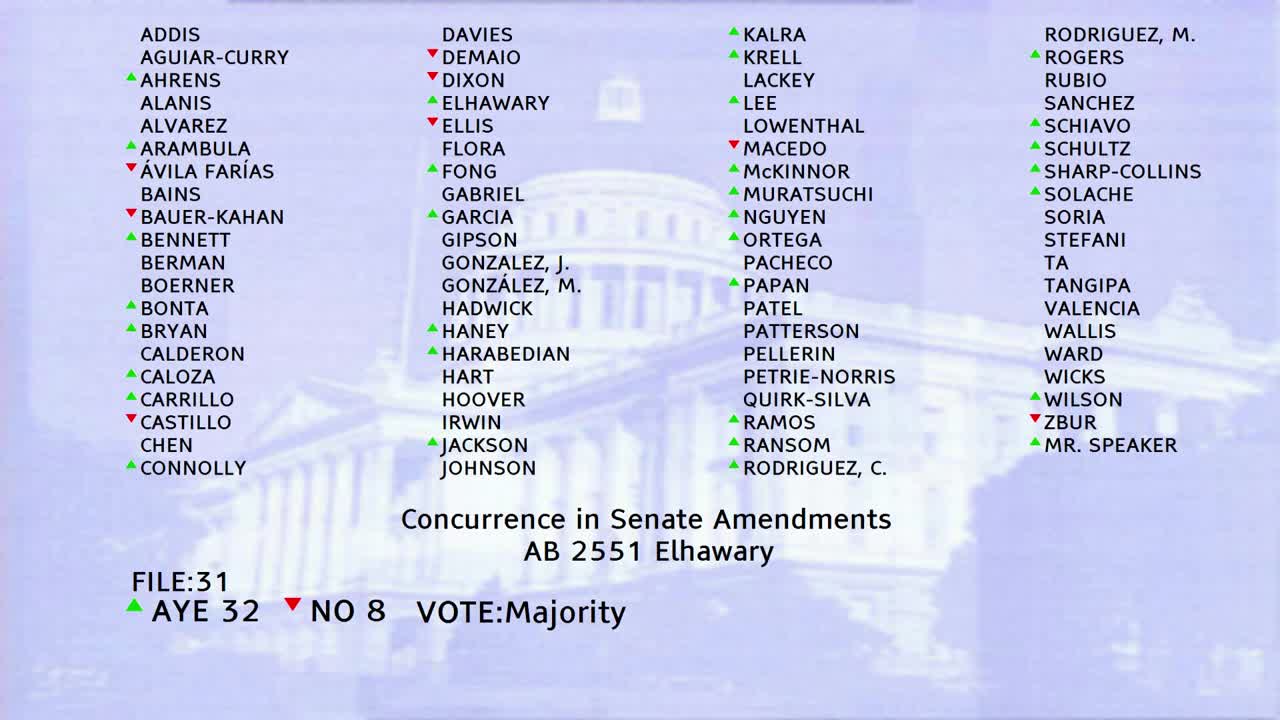 2MIN
Assembly Floor
 5MIN
Assembly Standing Committee on Business and Professions
Bill Author

Bill Co-Author(s):