SB 1154: Public contracts: best value procurement: community college districts.
- Session Year: 2025-2026
- House: Senate
- Latest Version Date: 2026-09-18
Current Status:
Passed
(2026-09-18: Chaptered by Secretary of State. Chapter 323, Statutes of 2026.)
Introduced
In Committee
Awaiting First Chamber Vote
Passed First Chamber
In Committee
Awaiting Second Chamber Vote
Passed Second Chamber
Enacted
What does this bill do?
The bill lets community college districts use a “best value” bidding method for public construction projects over $1 million so awards can be based on a mix of price and contractor qualifications instead of price alone. It defines best value scoring (including a score that divides price by a qualifications score) and requires bidder prequalification and evaluation of experience, finances, safety, and labor compliance. It also requires bidders to commit to a skilled, trained workforce or a project labor agreement, limits retainage to 5% when a performance and payment bond is required, and requires an independent third‑party report to the Legislature on use of the method.
The summary is provided by generative AI which can make mistakes. For original language, please view the details in the table below.
Existing law, the Local Agency Public Construction Act, sets forth procedures that a local agency is required to follow when procuring certain services or work. The act requires the governing board of any school district and the governing board of any community college district to let contracts for the purchase of, among other things, equipment, materials, or supplies to be furnished, sold, or leased to the district, involving an expenditure of more than $50,000, to the lowest responsible bidder that gives security as the board requires, or else reject all bids. The act also authorizes the governing board of a school district, as described, to use, before December 31, 2030, a best value procurement method for bid evaluation and selection for public projects that exceed $1,000,000.
This bill would additionally authorize the governing board of a community college district to use, before December 31, 2030, a best value procurement method for bid evaluation and selection for public projects that exceed $1,000,000. The bill would establish various requirements applicable to the use of the best value procurement method under this authorization. The bill would require a community college district to submit a report on the use of the best value procurement method, as specified, to the appropriate policy and fiscal committees of the Legislature, on or before January 1, 2030. The bill would repeal these provisions on January 1, 2031.
As used in this article:
(a)Best value means a procurement process whereby the selected bidder may be selected on the basis of objective criteria for evaluating the qualifications of bidders with the resulting selection representing the best combination of price and qualifications.
(b)Best value contract means a competitively bid contract entered into pursuant to this article.
(c)Best value contractor means a properly licensed person, firm, or corporation that submits a bid for and is awarded a best value contract.
(d)Best value score means the resulting score when the community college district divides the bidders price by the bidders qualification score.
(e)Demonstrated management competency means the experience, competency, capability, and capacity of the proposed management staffing to complete projects of similar size, scope, or complexity.
(f)Financial condition means the financial resources needed to perform the contract. The criteria used to evaluate a bidders financial condition shall include, at a minimum, capacity to obtain all required payment bonds and required insurance.
(g)Governing board or governing board of the community college district means the governing board of a community college district.
(h)Labor compliance means the ability to comply with, and past conformance with, contract and statutory requirements for the payment of wages and qualifications of the workforce. The criteria used to evaluate a bidders labor compliance shall include, at a minimum, the bidders ability to comply with the apprenticeship requirements of the California Apprenticeship Council and the Department of Industrial Relations, its past conformance with such requirements, and its past conformance with requirements to pay prevailing wages on public works projects.
(i)Project has the same meaning as public project, as defined in subdivision (c) of Section 22002.
(j)Qualifications means financial condition, relevant experience, demonstrated management competency, labor compliance, the safety record of the bidder, and, to the extent relevant, the preceding qualifications as they pertain to all subcontractors proposed to be used by the bidder for designated portions of the work.
(k)Relevant experience means the experience, competency, capability, and capacity to complete projects of similar size, scope, or complexity.
(l)Safety record shall be deemed acceptable if a contractors experience modification rate for the most recent three-year period is an average of 1.00 or less, and the contractors average total recordable injury or illness rate and average lost work rate for the most recent three-year period do not exceed the applicable statistical standards for its business category or if the bidder is a party to an alternative dispute resolution system as provided for in Section 3201.5 of the Labor Code.
20666.1.(a)The governing board, for projects over one million dollars ($1,000,000), before December 31, 2030, may use the best value procurement method in accordance with this article.
(b)(1)The bidder may be selected on the basis of the best value to the governing board of the community college district.
(2)In order to implement this method of selection, the governing board of the community college district shall adopt and publish procedures and required guidelines for evaluating the qualifications of the bidders that ensure the best value selections by the community college district and conducted in a fair and impartial manner.
(3)These procedures and guidelines shall conform to this article and shall be mandatory for the community college district when using best value selection.
(c)(1)If the governing board of the community college district deems it to be for the best interest of the community college district, the governing board of the community college district, on the refusal or failure of the selected bidder for a project to execute a tendered contract, may award it to the bidder with the second lowest best value score.
(2)If the second bidder fails or refuses to execute the contract, the governing board of the community college district may likewise award it to the bidder with the third lowest best value score.
(d)The governing board of the community college district shall let any contract for a project pursuant to this article to the selected bidder that represents the best value or else reject all bids.
(e)(1)If the community college district elects to award a project pursuant to this section, retention proceeds withheld by the community college district from the selected best value contractor shall not exceed 5 percent if a performance and payment bond, issued by an admitted surety insurer, is required in the solicitation of bids.
(2)(A)In a contract between the selected best value contractor and a subcontractor, and in a contract between a subcontractor and any subcontractor thereunder, the percentage of the retention proceeds withheld shall not exceed the percentage specified in the contract between the community college district and the selected best value contractor.
(B)If the selected best value contractor provides written notice to a subcontractor that, prior to or at the time the bid is requested, a bond may be required and the subcontractor subsequently is unable or refuses to furnish a bond to the selected best value contractor, then the selected best value contractor may withhold retention proceeds in excess of the percentage specified in the contract between the community college district and the selected best value contractor from any payment made by the selected best value contractor to the subcontractor.
(f)All subcontractors bidding on contracts pursuant to this chapter shall be afforded the protection contained in Chapter 4 (commencing with Section 4100) of Part 1.
20666.2.The governing board of the community college district shall proceed in accordance with all of the following when awarding best value contracts under this article:
(a)The community college district shall prepare a solicitation for bids and give notice pursuant to Section 20651.7.
(b)(1)(A)The community college district shall establish a procedure to prequalify bidders as required by this code.
(B)Information submitted by the bidder as part of the evaluation process shall not be open to public inspection to the extent that information is exempt from disclosure under the California Public Records Act (Division 10 (commencing with Section 7920.000) of Title 1 of the Government Code).
(2)A best value entity shall not be prequalified or shortlisted unless the entity provides an enforceable commitment to the governing board of the community college district that the entity and its subcontractors at every tier will use a skilled and trained workforce to perform all work on the project or contract that falls within an apprenticeable occupation in the building and construction trades, in accordance with Chapter 2.9 (commencing with Section 2600) of Part 1.
(3)Paragraph (2) shall not apply if any of the following requirements are met:
(A)The community college district has entered into a project labor agreement that will bind all contractors and subcontractors performing work on the project or contract to use a skilled and trained workforce, and the entity agrees to be bound by that project labor agreement.
(B)The project or contract is being performed under the extension or renewal of a project labor agreement that was entered into by the community college district prior to January 1, 2027.
(C)The entity has entered into a project labor agreement that will bind the entity and all its subcontractors at every tier performing the project or contract to use a skilled and trained workforce.
(4)For purposes of this subdivision, project labor agreement has the same meaning as in paragraph (1) of subdivision (b) of Section 2500.
(c)Each solicitation for bids shall do all of the following:
(1)Invite prequalified bidders to submit sealed bids in the manner prescribed by this article.
(2)Include a section identifying and describing all of the following:
(A)Criteria that the community college district will consider in evaluating the qualifications of the bidders.
(B)The methodology and rating or weighting system that will be used by the community college district in evaluating bids.
(C)The relative importance or weight assigned to the criteria for evaluating the qualifications of bidders identified in the request for bids.
(d)Final evaluation of the bidders shall be done in a manner that prevents the identity of the bidders and the cost or price information from being revealed in evaluating the qualifications of the bidders prior to completion of qualification scoring.
20666.3.(a)(1)(A)A community college district that uses the best value procurement method pursuant to this article shall submit to the appropriate policy and fiscal committees of the Legislature a report on the use of the best value procurement method.
(B)The report shall be prepared by an independent third party and the community college district shall pay for the cost of the report.
(C)Multiple community college districts may work together to submit a single report reflecting each of the participating community college districts.
(D)The report shall be submitted on or before January 1, 2030, to the appropriate policy and fiscal committees of the Legislature.
(2)The report shall include, but is not limited to, all of the following information:
(A)A description of the projects awarded using the best value procedures.
(B)The contract award amounts.
(C)The names of the best value contractors awarded the projects.
(D)A description of any written protests concerning any aspect of the solicitation, bid, or award of the best value contracts, including the resolution of the protests.
(E)A description of the prequalification process.
(F)The criteria used to evaluate the bids, including the weighting of the criteria and an assessment of the effectiveness of the methodology.
(G)If a project awarded under this article has been completed, an assessment of the project performance, including a summary of any delays or cost increases.
(b)(1)The requirement for submitting a report imposed under subdivision (a) is inoperative on January 1, 2031, pursuant to Section 10231.5 of the Government Code.
(2)A report to be submitted pursuant to subdivision (a) shall be submitted in compliance with Section 9795 of the Government Code.
20666.4.Except as otherwise provided in this article, the best value procurement method is not intended to change any guideline, criterion, procedure, or requirement of the governing board of the community college district to let a contract for a project to the lowest responsible bidder or else reject all bids.
20666.5.This article shall remain in effect only until January 1, 2031, and as of that date is repealed.
|
Date
|
Status
|
|---|---|
| Sep 18, 2026 | Chaptered by Secretary of State. Chapter 323, Statutes of 2026. |
| Sep 18, 2026 | Approved by the Governor. |
| Aug 24, 2026 | Enrolled and presented to the Governor at 3 p.m. |
| Aug 19, 2026 | In Senate. Ordered to engrossing and enrolling. |
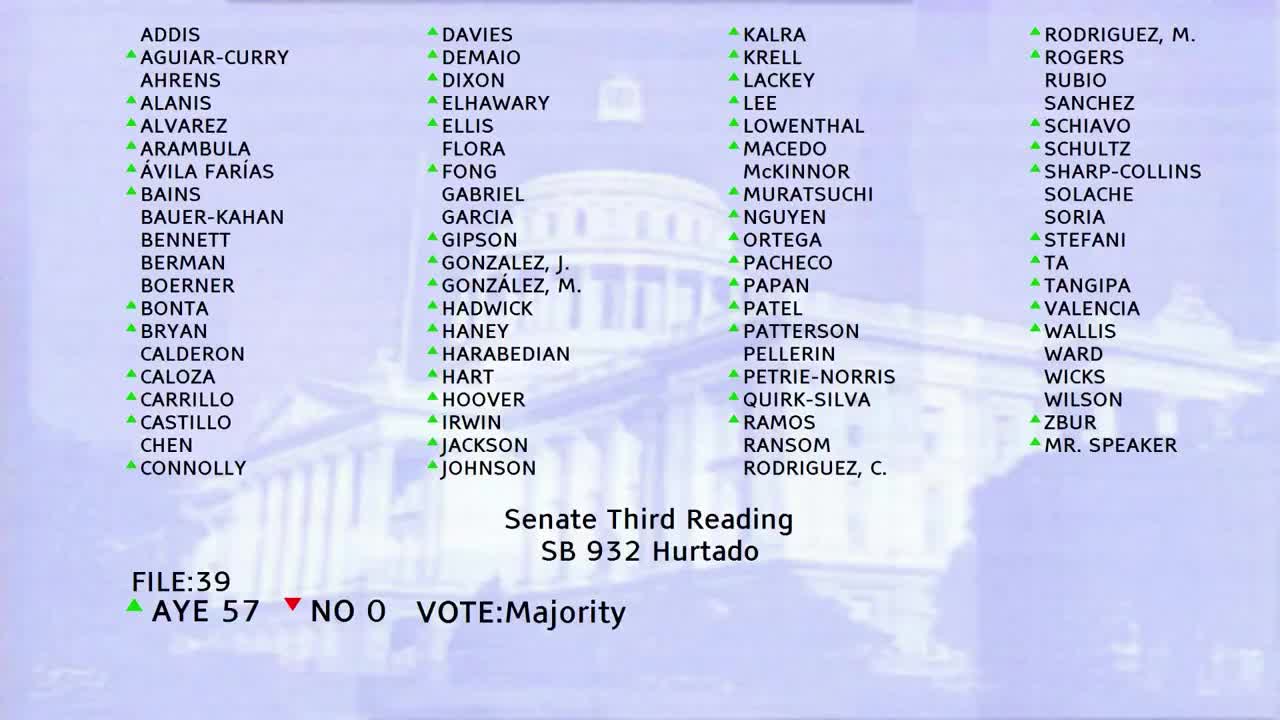
| Aug 19, 2026 | Read third time. Passed. (Ayes 63. Noes 11. Page 6260.) Ordered to the Senate. |
| Aug 19, 2026 | Read third time. Passed. Ordered to the Senate. |
| Jun 25, 2026 | Read second time. Ordered to third reading. |
| Jun 24, 2026 | From committee: Do pass. (Ayes 8. Noes 2.) (June 23). |
| May 26, 2026 | Referred to Com. on HIGHER ED. |
| May 20, 2026 | In Assembly. Read first time. Held at Desk. |
| May 19, 2026 | Read third time. Passed. (Ayes 29. Noes 9.) Ordered to the Assembly. |
| May 19, 2026 | Read third time. Passed. (Ayes 29. Noes 9. Page 4334.) Ordered to the Assembly. |
| Apr 9, 2026 | Read second time. Ordered to third reading. |
| Apr 8, 2026 | From committee: Do pass. (Ayes 5. Noes 2.) (April 8). |
| Apr 8, 2026 | From committee: Do pass. (Ayes 5. Noes 2. Page 3791.) (April 8). |
| Mar 23, 2026 | Set for hearing April 8. |
| Feb 26, 2026 | Referred to Com. on ED. |
| Feb 19, 2026 | From printer. May be acted upon on or after March 21. |
| Feb 18, 2026 | Introduced. Read first time. To Com. on RLS. for assignment. To print. |
|
Date
|
Description
|
Location
|
Votes
|
|
|---|---|---|---|---|
| Aug 19, 2026 | SB 1154 Reyes Senate Third Reading By Schultz | Assembly Floor |
Passed |
|
| Jun 23, 2026 | Do pass. | Assembly Standing Committee on Higher Education |
Passed |
|
| May 19, 2026 | Senate 3rd Reading SB1154 Reyes | Senate Floor |
Passed |
|
| Apr 8, 2026 | Do pass | Senate Standing Committee on Education |
Passed |
This list shows positions taken on this bill by organizations on the date displayed, which is linked to the original source.
Positions by individuals are not included.
|
Organization
|
Position
|
Date
|
|---|---|---|
| Associated General Contractors, California Chapters | ** Against | |
| Citrus College | ** Support | |
| Contra Costa Community College District | ** Support | |
| Foothill-De Anza Community College District | ** Support | |
| San Bernardino Community College District | ** Support | |
| San Diego Community College District | ** Support | |
| Southwestern Community College District | ** Support | |
| Southwestern Community College District Governing Board | ** Support | |
| State Building and Construction Trades Council | ** Support | |
| State Center Community College District | ** Support | |
| Western Electrical Contractors Association | ** Against |
SENATE THIRD READING
STR Bill Id:SB 1154
Author:(Reyes)
As Introduced Ver:February 18, 2026
Majority vote
SUMMARY
Authorizes California Community College (CCC) districts (CCD), through December 31, 2030, to use a best value procurement method for public works projects exceeding $1 million.
Major Provisions
- Authorizes CCDs, through December 31, 2030, to use a best value procurement method for public works projects exceeding $1 million.
- Defines "best value" as a procurement process using objective criteria that considers both price and qualifications rather than selecting solely the lowest responsible bidder.
- Requires CCDs using this method to establish and publish procedures and guidelines ensuring a fair and impartial evaluation process.
- Requires CCDs to evaluate contractor qualifications using criteria that include:
- Relevant experience;
- Demonstrated management competency;
- Financial condition;
- Labor compliance history;
- Safety records; and,
- Subcontractor qualifications where applicable.
- Requires contractors and subcontractors to use a skilled and trained workforce unless certain project labor agreement (PLA) provisions apply.
- Requires bid evaluations to prevent disclosure of bidder identities and pricing information until qualification scoring has been completed.
- Requires CCDs using best value procurement to submit an independent report to legislative policy and fiscal committees by January 1, 2030, evaluating implementation outcomes.
- Stipulates that the report must include, but is not limited to, all of the following:
- A description of the projects awarded using the best value procedures;
- The contract award amounts;
- The names of the best value contractors awarded the projects;
- A description of any written protests concerning any aspect of the solicitation, bid, or award of the best value contracts, including the resolution of the protests;
- A description of the prequalification process;
- The criteria used to evaluate the bids, including the weighting of the criteria and an assessment of the effectiveness of the methodology; and,
- If a project awarded under this article has been completed, an assessment of the project performance, including a summary of any delays or cost increases.
- Stipulates that the report must include, but is not limited to, all of the following:
- Repeals these provisions on January 1, 2031.
COMMENTS
Background. California public contracting traditionally follows a "lowest responsible bidder" model intended to promote fairness, competition, and protection of taxpayer resources. Under this approach, public agencies generally award contracts to the lowest bidder that satisfies required qualifications.
Over time, policymakers have recognized that lowest-price procurement may not always produce the best overall project outcomes, particularly for large or complex construction projects where contractor experience, workforce quality, safety history, and project management capabilities may substantially affect final costs and project delivery. As a result, California has authorized limited use of "best value" procurement in several contexts, including state agencies and K–12 school districts.
Lowest bidder model. The lowest responsible bidder model prioritizes initial project cost as the principal determinant of contract award. This framework has historically been viewed as a safeguard against favoritism and arbitrary decision-making because selection criteria rely heavily on price.
Supporters of best value procurement argue that focusing exclusively on low bids may create incentives for contractors to underbid projects and potentially generate downstream costs through delays, change orders, disputes, or construction deficiencies. Opponents of expanding best value procurement sometimes raise concerns regarding subjectivity in evaluating non-price factors and the possibility that broader discretion could reduce transparency or increase procurement disputes.
This measure appears to balance these concerns by requiring objective scoring methodologies, published evaluation criteria, prequalification requirements, and independent reporting regarding outcomes.
Best value procurement method. As defined in the PCC Section 20155.1, "best value" means a procurement process whereby the selected bidder may be selected on the basis of objective criteria for evaluating the qualifications of bidders with the resulting selection representing the best combination of price and qualifications. Further, according to the San Bernardino CCD report titled, AB 361 and the Case for Inclusion of California Community College Districts, best value contractors must commit to using a skilled and trained workforce. This requirement may be satisfied through a PLA or other qualifying statutory mechanisms. These provisions seek to align procurement decisions with workforce development, apprenticeship, and labor compliance goals.
Best value pilot programs. This measure appears to be related to SB 667 (Migden), Chapter 367, Statutes of 2006, which established a five-year best value pilot program for the University of California (UC). SB 835 (Wolk), Chapter 636, Statutes of 2011, extended the sunset in SB 667 until January 1, 2017, and expanded the best value pilot to encompass all UC campuses and medical centers. Under this program, UC prequalifies bidders, then evaluates the bid and assigns a qualification score based upon five factors, which include the bidder's financial condition, relevant experience, demonstrated management competency, labor compliance, and safety record. The UC then divides each bidder's price by its qualification score, and the lowest resulting cost per quality point represents the best value bid. AB 1424 (Levine), Chapter 850, Statutes of 2017, removed the sunset on UC's program while also amending law to conform UC's best value contracting provisions to similar statutes for other government entities with respect to requirements for use of a skilled and trained workforce.
The Los Angeles Unified School District (LAUSD) implemented a pilot program in AB 1185 (Ridley-Thomas), Chapter 786, Statutes of 2015, that is substantively similar to the pilot proposed in this legislation. That legislation called for an interim report, which was published in June of 2018. The report found that since January 1, 2016, LAUSD awarded nine construction contracts totaling more than $185 million dollars—or 19 percent of LAUSD construction contracts awarded—following the best value procurement method. The types of contracts awarded using this method range from the removal and replacement of heating, ventilation, and air conditioning systems to the modernization of existing buildings or ancillary structures to the complete design and construction of new buildings and facilities.
The report found that change orders affecting budgets and schedule delays were minimized as compared to formal traditional bids. Additional benefits of the best value process were cited as including more qualified proposers, an open dialogue resulting in better project approach, and increased quality of subcontractors.
How does this work for K–12 school districts versus CCDs? Current law authorizes K–12 school districts to use a best value procurement method for projects exceeding $1 million through December 31, 2030. The CCDs currently generally remain subject to traditional lowest responsible bidder requirements.
Under current law, K–12 school districts may use best value procurement for projects over $1 million and must provide objective criteria and reporting on its usage. This authority sunsets on December 31, 2030.
Under this proposal, CCDs would receive similar authority through December 31, 2030. Additionally, this measure requires CCDs use of skilled and trained workforces. The measure requires independent implementation reports.
Essentially, this measure aligns CCDs procurement authority with that of K–12 school districts and other higher education segments.
According to the Author
According to the author, "California's Community College Districts play a critical role in preparing our workforce, supporting economic mobility, and serving millions of students across the state. The quality, safety, and functionality of campus facilities directly impact student learning, program access, and overall student success. Unfortunately, when it comes to delivering major construction projects, community colleges are held to a procurement standard that limits their ability to select contractors based on overall quality and long-term value."
The author contends that, "SB 1154 addresses this issue by allowing community college districts to use a best value procurement method for public works projects exceeding one million dollars, allowing contracts to be awarded based on a combination of price and objective qualitative criteria, not simply the lowest bid. This grants them with the same flexibility already provided to K–12 school districts, the University of California, and the California State University."
Further, the author states that, "best value procurement helps ensure that projects are completed on time, built to high standards, and designed to support long-term functionality. By allowing districts to evaluate contractor experience, safety records, technical expertise, and life-cycle costs, SB 1154 promotes durable, high-quality facilities that enhance learning environments and support innovative instruction. These projects are essential to preparing students for transfer, career pathways, and participation in California's evolving workforce and will ensure we are setting up our infrastructure for their long-term success."
Arguments in Support
The Contra Costa, Foothill – De Anza, San Diego, San Bernardino, State Center, and Southwestern Community College Districts, jointly submitted a letter stating that, "SB 1154 would modernize community college public construction procurement by authorizing the use of best value procurement. Community colleges routinely deliver complex, bond-funded capital projects, including: Healthcare and nursing facilities, STEM and applied technology labs, Workforce training centers, and Infrastructure and sustainability projects. The projects are often as complex, if not more complex than K-12 construction projects, yet community colleges do not have all of the necessary options available for adequate delivery. Additionally, these complex facilities require a skilled workforce in order to complete them safely and on time. The aforementioned CCDs further state that, "extending best value procurement authority to community college districts would improve project delivery and construction risk management, support skilled workforce and apprenticeship pipelines through project labor agreements or equivalent requirements, align procurement policy across public education systems, preserve local control by making the authority optional, and create no new fiscal impact on the state."
Arguments in Opposition
According to the Associated General Contractors (AGC), California Chapters, "SB 1154 provides community colleges with a new delivery option, but it does so while requiring all bidders and subcontractors at every tier to use a skilled and trained workforce as a condition of prequalification. This mandate imposes rigid apprenticeship-graduation thresholds that many qualified contractors—particularly small, emerging, and specialty firms—cannot meet. Skilled and trained workforce requirements do not reflect the structure of many trades, the availability of apprenticeship programs in certain regions, or the staffing realities of small businesses. The AGC, California Chapters, further state that, "as result, SB 1154 would exclude a substantial portion of California's construction industry from even being eligible to bid on community college projects, regardless of their experience, safety record, or past performance. California's community colleges benefit when procurement remains open, competitive, and accessible to the full breadth of the state's construction industry."
FISCAL COMMENTS
Unknown. This measure is keyed nonfiscal by the Legislative Counsel.
VOTES
SENATE FLOOR: 29-9-2
YES: Archuleta, Arreguín, Ashby, Becker, Blakespear, Cabaldon, Caballero, Cervantes, Cortese, Durazo, Gonzalez, Grayson, Hurtado, Laird, Limón, McGuire, McNerney, Menjivar, Padilla, Pérez, Reyes, Richardson, Rubio, Smallwood-Cuevas, Stern, Umberg, Wahab, Weber Pierson, Wiener
NO: Alvarado-Gil, Choi, Dahle, Grove, Jones, Ochoa Bogh, Seyarto, Strickland, Valladares
ABS, ABST OR NV: Allen, Niello
ASM HIGHER EDUCATION: 8-2-0
YES: Fong, Boerner, Jeff Gonzalez, Jackson, Muratsuchi, Patel, Celeste Rodriguez, Sharp-Collins
NO: DeMaio, Tangipa
UPDATED
VERSION: February 18, 2026
CONSULTANT: Jeanice Warden / HIGHER ED. / (916) 319-3960 FN: 0003199
Date of Hearing: June 23, 2026
ASSEMBLY COMMITTEE ON HIGHER EDUCATION
Mike Fong, Chair
SBPCA Bill Id:SB 1154
Author:(Reyes) – As Introduced Ver:February 18, 2026
SENATE VOTE: 29-9
SUBJECT: Public contracts: best value procurement: community college districts.
SUMMARY: Authorizes California Community College (CCC) districts (CCD), through December 31, 2030, to use a best value procurement method for public works projects exceeding $1 million. Specifically, this bill:
- Authorizes CCDs, through December 31, 2030, to use a best value procurement method for public works projects exceeding $1 million.
- Defines “best value” as a procurement process using objective criteria that considers both price and qualifications rather than selecting solely the lowest responsible bidder.
- Requires CCDs using this method to establish and publish procedures and guidelines ensuring a fair and impartial evaluation process.
- Requires CCDs to evaluate contractor qualifications using criteria that include:
- Relevant experience;
- Demonstrated management competency;
- Financial condition;
- Labor compliance history;
- Safety records; and,
- Subcontractor qualifications where applicable.
- Requires contractors and subcontractors to use a skilled and trained workforce unless certain project labor agreement (PLA) provisions apply.
- Requires bid evaluations to prevent disclosure of bidder identities and pricing information until qualification scoring has been completed.
- Requires CCDs using best value procurement to submit an independent report to legislative policy and fiscal committees by January 1, 2030, evaluating implementation outcomes.
- Stipulates that the report must include, but is not limited to, all of the following:
- A description of the projects awarded using the best value procedures;
- The contract award amounts;
- The names of the best value contractors awarded the projects;
- A description of any written protests concerning any aspect of the solicitation, bid, or award of the best value contracts, including the resolution of the protests;
- A description of the prequalification process;
- The criteria used to evaluate the bids, including the weighting of the criteria and an assessment of the effectiveness of the methodology; and,
- If a project awarded under this article has been completed, an assessment of the project performance, including a summary of any delays or cost increases.
- Stipulates that the report must include, but is not limited to, all of the following:
- Repeals these provisions on January 1, 2031.
EXISTING LAW:
- Requires school districts and CCDs to award contracts involving expenditures exceeding $50,000 to the lowest responsible bidder or reject all bids (Public Contract Code (PCC) Sections 20111 and 20651).
- Authorizes school districts, until December 31, 2030, to use best value procurement methods for public projects exceeding $1 million (PCC Section 20119.1, et seq.).
- Requires specified public works projects to utilize skilled and trained workforces (PCC Section 2600, et seq.).
- Defines "skilled and trained workforce", in part, as, all the workers performing work in an apprenticeable occupation in the building and construction trades are either skilled journeypersons or apprentices registered in an apprenticeship program approved by the Chief of the Division of Apprenticeship Standards of the Department of Industrial Relations (PCC Section 2601).
- Stipulates that the above skilled and trained workforce requirements do not apply if any of the following requirements are met:
- The public entity has entered into a PLA, as specified;
- The design-build project is being performed under the extension or renewal of a PLA entered into prior to January 1, 2017; and,
- The design-build entity has entered into a PLA binding the entity and all its subcontractors to use a skilled and trained workforce (Education Code Section 17250.25(c)(2); PCC Sections 10191(c)(2) and 22164(c)(2).)
- Provides subcontractor protections through California’s Subletting and Subcontracting Fair Practices Act (PCC Section 4100, et seq.).
FISCAL EFFECT: Unknown. This measure is keyed nonfiscal by the Legislative Counsel.
COMMENTS: Need for the measure. According to the author, “California’s Community College Districts play a critical role in preparing our workforce, supporting economic mobility, and serving millions of students across the state. The quality, safety, and functionality of campus facilities directly impact student learning, program access, and overall student success. Unfortunately, when it comes to delivering major construction projects, community colleges are held to a procurement standard that limits their ability to select contractors based on overall quality and long-term value.”
The author contends that, “SB 1154 addresses this issue by allowing community college districts to use a best value procurement method for public works projects exceeding one million dollars, allowing contracts to be awarded based on a combination of price and objective qualitative criteria, not simply the lowest bid. This grants them with the same flexibility already provided to K–12 school districts, the University of California, and the California State University.”
Further, the author states that, “best value procurement helps ensure that projects are completed on time, built to high standards, and designed to support long-term functionality. By allowing districts to evaluate contractor experience, safety records, technical expertise, and life-cycle costs, SB 1154 promotes durable, high-quality facilities that enhance learning environments and support innovative instruction. These projects are essential to preparing students for transfer, career pathways, and participation in California’s evolving workforce and will ensure we are setting up our infrastructure for their long-term success.”
This measure appears to close the policy gap within California’s public education procurement framework.
Background. California public contracting traditionally follows a “lowest responsible bidder” model intended to promote fairness, competition, and protection of taxpayer resources. Under this approach, public agencies generally award contracts to the lowest bidder that satisfies required qualifications.
Over time, policymakers have recognized that lowest-price procurement may not always produce the best overall project outcomes, particularly for large or complex construction projects where contractor experience, workforce quality, safety history, and project management capabilities may substantially affect final costs and project delivery. As a result, California has authorized limited use of “best value” procurement in several contexts, including state agencies and K–12 school districts.
Lowest bidder model. The lowest responsible bidder model prioritizes initial project cost as the principal determinant of contract award. This framework has historically been viewed as a safeguard against favoritism and arbitrary decision-making because selection criteria rely heavily on price.
Supporters of best value procurement argue that focusing exclusively on low bids may create incentives for contractors to underbid projects and potentially generate downstream costs through delays, change orders, disputes, or construction deficiencies. Opponents of expanding best value procurement sometimes raise concerns regarding subjectivity in evaluating non-price factors and the possibility that broader discretion could reduce transparency or increase procurement disputes.
This measure appears to balance these concerns by requiring objective scoring methodologies, published evaluation criteria, prequalification requirements, and independent reporting regarding outcomes.
Best value procurement method. As defined in the PCC Section 20155.1,“best value” means a procurement process whereby the selected bidder may be selected on the basis of objective criteria for evaluating the qualifications of bidders with the resulting selection representing the best combination of price and qualifications. Further, according to the San Bernardino CCD report titled, AB 361 and the Case for Inclusion of California Community College Districts, best value contractors must commit to using a skilled and trained workforce. This requirement may be satisfied through a PLA or other qualifying statutory mechanisms. These provisions seek to align procurement decisions with workforce development, apprenticeship, and labor compliance goals.
Best value pilot programs. This measure appears to be related to SB 667 (Migden), Chapter 367, Statutes of 2006, which established a five-year best value pilot program for the University of California (UC). SB 835 (Wolk), Chapter 636, Statutes of 2011, extended the sunset in SB 667 until January 1, 2017, and expanded the best value pilot to encompass all UC campuses and medical centers. Under this program, UC prequalifies bidders, then evaluates the bid and assigns a qualification score based upon five factors, which include the bidder's financial condition, relevant experience, demonstrated management competency, labor compliance, and safety record. The UC then divides each bidder's price by its qualification score, and the lowest resulting cost per quality point represents the best value bid. AB 1424 (Levine), Chapter 850, Statutes of 2017, removed the sunset on UC’s program while also amending law to conform UC's best value contracting provisions to similar statutes for other government entities with respect to requirements for use of a skilled and trained workforce.
The Los Angeles Unified School District (LAUSD) implemented a pilot program in AB 1185 (Ridley-Thomas), Chapter 786, Statutes of 2015, that is substantively similar to the pilot proposed in this legislation. That legislation called for an interim report, which was published in June of 2018. The report found that since January 1, 2016, LAUSD awarded nine construction contracts totaling more than $185 million dollars—or 19 percent of LAUSD construction contracts awarded—following the best value procurement method.
The types of contracts awarded using this method range from the removal and replacement of heating, ventilation, and air conditioning systems to the modernization of existing buildings or ancillary structures to the complete design and construction of new buildings and facilities.
The report found that change orders affecting budgets and schedule delays were minimized as compared to formal traditional bids. Additional benefits of the best value process were cited as including more qualified proposers, an open dialogue resulting in better project approach, and increased quality of subcontractors.
How does this work for K–12 school districts versus CCDs? Current law authorizes K–12 school districts to use a best value procurement method for projects exceeding $1 million through December 31, 2030. The CCDs currently generally remain subject to traditional lowest responsible bidder requirements.
Under current law, K–12 school districts may use best value procurement for projects over $1 million and must provide objective criteria and reporting on its usage. This authority sunsets on December 31, 2030.
Under this proposal, CCDs would receive similar authority through December 31, 2030. Additionally, this measure requires CCDs use of skilled and trained workforces. The measure requires independent implementation reports.
Essentially, this measure aligns CCDs procurement authority with that of K–12 school districts and other higher education segments.
Arguments in support. The Contra Costa, Foothill – De Anza, San Diego, San Bernardino, State Center, and Southwestern Community College Districts, jointly submitted a letter stating that, “SB 1154 would modernize community college public construction procurement by authorizing the use of best value procurement. Community colleges routinely deliver complex, bond-funded capital projects, including: Healthcare and nursing facilities, STEM and applied technology labs, Workforce training centers, and Infrastructure and sustainability projects. The projects are often as complex, if not more complex than K-12 construction projects, yet community colleges do not have all of the necessary options available for adequate delivery. Additionally, these complex facilities require a skilled workforce in order to complete them safely and on time.”
The aforementioned CCDs further state that, “extending best value procurement authority to community college districts would improve project delivery and construction risk management, support skilled workforce and apprenticeship pipelines through project labor agreements or equivalent requirements, align procurement policy across public education systems, preserve local control by making the authority optional, and create no new fiscal impact on the state.”
Arguments in opposition. According to the Associated General Contractors (AGC), California Chapters, “SB 1154 provides community colleges with a new delivery option, but it does so while requiring all bidders and subcontractors at every tier to use a skilled and trained workforce as a condition of prequalification. This mandate imposes rigid apprenticeship-graduation thresholds that many qualified contractors—particularly small, emerging, and specialty firms—cannot meet. Skilled and trained workforce requirements do not reflect the structure of many trades, the availability of apprenticeship programs in certain regions, or the staffing realities of small businesses.”
The AGC, California Chapters, further state that, “as result, SB 1154 would exclude a substantial portion of California’s construction industry from even being eligible to bid on community college projects, regardless of their experience, safety record, or past performance. California’s community colleges benefit when procurement remains open, competitive, and accessible to the full breadth of the state’s construction industry.”
Prior legislation. AB 361 (Schultz), Chapter 144, Statutes of 2025, permanently authorized the LAUSD to use the best value procurement method and established a pilot program authorizing all other school districts and county offices of education to use best value procurement for construction projects over $1 million until December 31, 2030.
AB 1981 (Nazarian), Chapter 46, Statutes of 2020, extended the authority for the LAUSD to use the best value procurement method by five years, from January 1, 2021, to January 1, 2026.
AB 356 (Santiago), Chapter 173, Statutes of 2019, authorized the Los Angeles Community College District to utilize a best value procurement process as a pilot project until January 1, 2025, for construction projects over $1 million.
AB 1424 (Levine), Chapter 850, Statutes of 2017, made permanent the authority for UC to use best value contracting for construction projects; and, when using best value contracting, requires contractors and all subcontractors to conform with the skilled and trained workforce requirements applicable to alternative construction delivery methods authorized in statute for use by other state or local government entities.
SB 1214 (Allen), Chapter 788, Statutes of 2016, extended the sunset for UC’s Best Value Construction Contracting Pilot Program by one year, until January 2018.
AB 1185 (Ridley-Thomas), Chapter 786, Statutes of 2015, authorized LAUSD to utilize a best value procurement process as a pilot project until January 1, 2021, for construction projects over $1 million.
SB 693 (Hueso), Chapter 774, Statutes of 2016, consolidated the skilled and trained workforce requirements of various provisions of law related to alternative construction delivery methods, defined the terms of these requirements, and made other conforming changes.
SB 835 (Wolk), Chapter 636, Statutes of 2011, extended the sunset of UC’s Best Value Construction Contracting Pilot Program until January 2017, and expanded the pilot to all UC campuses and medical centers.
SB 667 (Migden), Chapter 367, Statutes of 2006, established the five-year Best Value Construction Contracting Pilot Program at UC San Francisco.
REGISTERED SUPPORT / OPPOSITION:
Support
Citrus College
Contra Costa Community College District
Foothill-De Anza Community College District
San Bernardino Community College District
San Diego Community College District
Southwestern Community College District
Southwestern Community College District Governing Board
State Building and Construction Trades Council
State Center Community College District
Opposition
Associated General Contractors, California Chapters
Western Electrical Contractors Association
Analysis Prepared by: Jeanice Warden / HIGHER ED. / (916) 319-3960
SENATE RULES COMMITTEE Office of Senate Floor Analyses (916) 651-4171 | SB 1154 |
THIRD READING
Bill No: SB 1154
Author: Reyes (D)
Introduced: 2/18/26
Vote: 21
SENATE EDUCATION COMMITTEE: 5-2, 4/8/26
AYES: Pérez, Cabaldon, Cortese, Gonzalez, Reyes
NOES: Ochoa Bogh, Choi
SUBJECT: Public contracts: best value procurement: community college districts
SOURCE: San Bernardino Community College District
DIGEST:
This bill authorizes community college districts to use the best value procurement method for public works projects over $1 million until December 31, 2030, establishes related procedural requirements, and requires participating districts to submit a report to the Legislature by January 1, 2030.
ANALYSIS:
Existing law:
- Requires school districts and community college districts to competitively bid contracts for equipment, materials, or supplies exceeding $50,000 and award to the lowest responsible bidder, or reject all bids.
- Authorizes school districts, until December 31, 2030, to use the best value procurement method for public works projects exceeding $1 million.
- Permanently authorizes the Los Angeles Unified School District (LAUSD) to use best value procurement.
- Requires school districts using best value procurement under the statewide pilot to submit a report to the Legislature by January 1, 2030.
- Allows other public entities, including the University of California (UC), to use best value procurement methods.
This bill:
- Authorizes the governing board of a community college district to use the best value procurement method for public works projects exceeding $1 million until December 31, 2030.
- Requires community college districts using this method to adopt and publish procedures and guidelines for evaluating bidder qualifications that ensure a fair and impartial process.
- Requires contracts to be awarded to the bidder representing the best value, or else all bids must be rejected.
- Establishes procedural requirements for bid solicitations, evaluation criteria, and selection processes consistent with existing best value statutes applicable to school districts.
- Requires community college districts using best value procurement to submit a report to the appropriate policy and fiscal committees of the Legislature on or before January 1, 2030.
- Repeals these provisions on January 1, 2031.
Comments
- Need for the bill. According to the author, “California’s Community College Districts play a critical role in preparing our workforce, supporting economic mobility, and serving millions of students across the state. The quality, safety, and functionality of campus facilities directly impact student learning, program access, and overall student success. Unfortunately, when it comes to delivering major construction projects, community colleges are held to a procurement standard that limits their ability to select contractors based on overall quality and long-term value.
SB 1154 addresses this issue by allowing community college districts to use a best value procurement method for public works projects exceeding one million dollars, allowing contracts to be awarded based on a combination of price and objective qualitative criteria, not simply the lowest bid. This grants them with same flexibility already provided to K–12 school districts, the University of California, and the California State University.
Best value procurement helps ensure that projects are completed on time, built to high standards, and designed to support long-term functionality. By allowing districts to evaluate contractor experience, safety records, technical expertise, and life-cycle costs, SB 1154 promotes durable, high-quality facilities that enhance learning environments and support innovative instruction. These projects are essential to preparing students for transfer, career pathways, and participation in California’s evolving workforce and will ensure we are setting up our infrastructure for their long-term success.”
- Aligning K–14 procurement authority. With the enactment of AB 361 (Schultz, Chapter 144, Statutes of 2025), school districts now have statewide authority, on a pilot basis, to use best value procurement, while LAUSD has permanent authority. Community college districts remain outside this framework despite managing significant capital outlay programs. This bill brings community college districts into alignment with the K-12 system, creating a more consistent procurement structure across publicly funded education segments.
- Revisiting the “lowest responsible bidder” model. California’s traditional procurement model emphasizes awarding contracts based on the lowest responsible bid. While straightforward, this approach can undervalue contractor experience, safety records, and demonstrated ability to deliver projects on time and within budget. Best value procurement reflects a broader definition of value that incorporates qualitative factors alongside cost. This bill extends that policy shift to community college districts, raising similar questions considered in prior legislation: whether upfront cost savings should continue to outweigh long-term project performance.
- Evidence from K-12 and higher education entities. The Legislature has already authorized best value procurement for several entities, including LAUSD and the UC. Evaluations of LAUSD’s use of best value procurement have found reductions in change orders, project delays, and claims. These findings suggest that incorporating non-cost factors into procurement decisions can produce more predictable project outcomes. Extending this authority to community college districts allows the state to test whether these benefits translate to a different segment of the education system with its own governance structures and project delivery needs.
- Guardrails and accountability. Consistent with the K-12 pilot, this bill includes procedural safeguards to promote fairness and transparency, including requirements for published evaluation criteria and formal bid processes. It also requires community college districts to report to the Legislature on their use of best value procurement by January 1, 2030. These reporting requirements will provide important data to assess whether the method improves project delivery and cost outcomes in the community college context.
- A parallel pilot structure. By aligning the sunset date (January 1, 2031) and reporting deadline (January 1, 2030) with the K-12 best value pilot, this bill creates an opportunity for the Legislature to evaluate procurement outcomes across both systems simultaneously. This parallel structure may support a more comprehensive statewide assessment of best value procurement and inform future decisions about whether to expand, modify, or make permanent these authorities.
- Capacity and implementation considerations. Best value procurement requires more administrative capacity than traditional low-bid contracting, including the ability to design evaluation criteria, review qualifications, and conduct structured scoring processes. While some community college districts, particularly larger ones, may be well-positioned to implement these requirements, smaller districts may face challenges. As with the K-12 pilot, the effectiveness of this authority may depend in part on local capacity and the availability of technical assistance or model procurement frameworks.
FISCAL EFFECT: Appropriation: No Fiscal Com.: No Local: No
SUPPORT: (Verified 4/8/26)
San Bernardino Community College District (source)
OPPOSITION: (Verified 4/8/26)
Associated General Contractors
Prepared by: Ian Johnson / ED. / (916) 651-4105
4/10/26 12:30:55
**** END ****
SENATE COMMITTEE ON EDUCATION
Senator Sasha Renée Pérez, Chair
2025 - 2026 Regular
Bill No: Hearing Date: April 8, 2026
Author: | |||
Version: |
| ||
Urgency: | Fiscal: | ||
Consultant: | |||
Subject: .
SUMMARY
This bill authorizes community college districts to use the best value procurement method for public works projects over $1 million until December 31, 2030, establishes related procedural requirements, and requires participating districts to submit a report to the Legislature by January 1, 2030.
BACKGROUND
Existing law:
- Requires school districts and community college districts to competitively bid contracts for equipment, materials, or supplies exceeding $50,000 and award to the lowest responsible bidder, or reject all bids.
- Authorizes school districts, until December 31, 2030, to use the best value procurement method for public works projects exceeding $1 million.
- Permanently authorizes the Los Angeles Unified School District (LAUSD) to use best value procurement.
- Requires school districts using best value procurement under the statewide pilot to submit a report to the Legislature by January 1, 2030.
- Allows other public entities, including the University of California (UC), to use best value procurement methods.
ANALYSIS
This bill:
- Authorizes the governing board of a community college district to use the best value procurement method for public works projects exceeding $1 million until December 31, 2030.
- Requires community college districts using this method to adopt and publish procedures and guidelines for evaluating bidder qualifications that ensure a fair and impartial process.
- Requires contracts to be awarded to the bidder representing the best value, or else all bids must be rejected.
- Establishes procedural requirements for bid solicitations, evaluation criteria, and selection processes consistent with existing best value statutes applicable to school districts.
- Requires community college districts using best value procurement to submit a report to the appropriate policy and fiscal committees of the Legislature on or before January 1, 2030.
- Repeals these provisions on January 1, 2031.
STAFF COMMENTS
- Need for the bill. According to the author, “California’s Community College Districts play a critical role in preparing our workforce, supporting economic mobility, and serving millions of students across the state. The quality, safety, and functionality of campus facilities directly impact student learning, program access, and overall student success. Unfortunately, when it comes to delivering major construction projects, community colleges are held to a procurement standard that limits their ability to select contractors based on overall quality and long-term value.
SB 1154 addresses this issue by allowing community college districts to use a best value procurement method for public works projects exceeding one million dollars, allowing contracts to be awarded based on a combination of price and objective qualitative criteria, not simply the lowest bid. This grants them with same flexibility already provided to K–12 school districts, the University of California, and the California State University.
Best value procurement helps ensure that projects are completed on time, built to high standards, and designed to support long-term functionality. By allowing districts to evaluate contractor experience, safety records, technical expertise, and life-cycle costs, SB 1154 promotes durable, high-quality facilities that enhance learning environments and support innovative instruction. These projects are essential to preparing students for transfer, career pathways, and participation in California’s evolving workforce and will ensure we are setting up our infrastructure for their long-term success.”
- Aligning K–14 procurement authority. With the enactment of AB 361 (Schultz, Chapter 144, Statutes of 2025), school districts now have statewide authority, on a pilot basis, to use best value procurement, while LAUSD has permanent authority. Community college districts remain outside this framework despite managing significant capital outlay programs. This bill brings community college districts into alignment with the K-12 system, creating a more consistent procurement structure across publicly funded education segments.
- Revisiting the “lowest responsible bidder” model. California’s traditional procurement model emphasizes awarding contracts based on the lowest responsible bid. While straightforward, this approach can undervalue contractor experience, safety records, and demonstrated ability to deliver projects on time and within budget. Best value procurement reflects a broader definition of value that incorporates qualitative factors alongside cost. This bill extends that policy shift to community college districts, raising similar questions considered in prior legislation: whether upfront cost savings should continue to outweigh long-term project performance.
- Evidence from K-12 and higher education entities. The Legislature has already authorized best value procurement for several entities, including LAUSD and the UC. Evaluations of LAUSD’s use of best value procurement have found reductions in change orders, project delays, and claims. These findings suggest that incorporating non-cost factors into procurement decisions can produce more predictable project outcomes. Extending this authority to community college districts allows the state to test whether these benefits translate to a different segment of the education system with its own governance structures and project delivery needs.
- Guardrails and accountability. Consistent with the K-12 pilot, this bill includes procedural safeguards to promote fairness and transparency, including requirements for published evaluation criteria and formal bid processes. It also requires community college districts to report to the Legislature on their use of best value procurement by January 1, 2030. These reporting requirements will provide important data to assess whether the method improves project delivery and cost outcomes in the community college context.
- A parallel pilot structure. By aligning the sunset date (January 1, 2031) and reporting deadline (January 1, 2030) with the K-12 best value pilot, this bill creates an opportunity for the Legislature to evaluate procurement outcomes across both systems simultaneously. This parallel structure may support a more comprehensive statewide assessment of best value procurement and inform future decisions about whether to expand, modify, or make permanent these authorities.
- Capacity and implementation considerations. Best value procurement requires more administrative capacity than traditional low-bid contracting, including the ability to design evaluation criteria, review qualifications, and conduct structured scoring processes. While some community college districts, particularly larger ones, may be well-positioned to implement these requirements, smaller districts may face challenges. As with the K-12 pilot, the effectiveness of this authority may depend in part on local capacity and the availability of technical assistance or model procurement frameworks.
SUPPORT
San Bernardino Community College District (sponsor)
OPPOSITION
Associated General Contractors, California Chapters
-- END --
Discussed in Hearing
 1MIN
Assembly Floor
 13MIN
Assembly Standing Committee on Higher Education
 10MIN
Senate Floor
 33MIN
Senate Standing Committee on Education
Bill Author

Bill Co-Author(s):