SB 1203: Security services.
- Session Year: 2025-2026
- House: Senate
- Latest Version Date: 2026-09-30
Current Status:
Passed
(2026-09-30: Chaptered by Secretary of State. Chapter 1016, Statutes of 2026.)
Introduced
In Committee
Awaiting First Chamber Vote
Passed First Chamber
In Committee
Awaiting Second Chamber Vote
Passed Second Chamber
Enacted
What does this bill do?
The bill tightens training and oversight for private security guards and their employers by requiring 42 hours of initial in-person classroom training (including an arrest/use-of-force course as a condition of registration), eight hours of in-person role‑play deescalation training, two hours on workers’ rights, and 12 hours of paid annual refresher training with at least four hours of deescalation practice. It also requires employers to keep training records, expands incident reports to note the apparent race and gender of the public and whether the officer had required training (and if the officer needed first aid), lets the state bureau set and approve curricula and trainers (including certified labor organizations to teach the 2‑hour rights class), and raises many administrative fines for training, recordkeeping, and other violations.
The summary is provided by generative AI which can make mistakes. For original language, please view the details in the table below.
Existing law, the Proprietary Security Services Act, prohibits a person from engaging in the business of a proprietary private security officer or a proprietary private security employer unless registered with the Department of Consumer Affairs. Existing law makes a violation of these provisions an infraction, as specified. Existing law requires a person who is registered and hired as a proprietary private security officer to complete training in security officer skills within 6 months from the date upon which registration is issued, or within 6 months of their employment with a proprietary private security employer, as specified. Existing law prohibits a proprietary private security employer from engaging in specified acts and authorizes the Director of Consumer Affairs to issue a citation, which may include an order to pay specified administrative fines for a violation of these provisions.
This bill, commencing January 1, 2029, would recast those training provisions to require the training to be 42 hours, to require an applicant for a proprietary private security officer registration to complete, within the first 6 months of their employment date, a course in the exercise of the power to arrest and the appropriate use of force as a condition of issuance of the registration, and to require that the training be conducted through traditional classroom instruction, as defined. The bill would require 2 hours of training to be dedicated to training employees on specified workers rights contained in a notice employers are required to provide employees, as specified. The bill would require the Bureau of Security and Investigative Services to administer certain provisions governing the approval of training providers, and would create a certificate authorizing a labor organization that represents security guards of a proprietary private security employer to provide the 2-hour training, as specified. The bill would also require a registered proprietary private security employee annually to complete a minimum of 12 hours of security officer skills training, with at least 4 hours of training dedicated to practicing deescalation skills, as specified, and that the time spent attending the annual training be compensated by the employer. The bill would require the bureau to determine the criteria to evaluate whether the deescalation trainings conform to the required principles and methods, as specified.
This bill, commencing January 1, 2029, would increase the administrative fine that the director may impose upon a proprietary private security employer for failure to properly maintain accurate and current employment and training records or failure to administer to registered employees of the licensee the review or practice training, as specified, from $500 to $1,000, and would specify that the fine is for each violation. The bill would require a private security employer to ensure that the security skills training occurs and to compensate employees for training, as specified. The bill would authorize the director to impose an administrative fine for a violation of these provisions not exceeding $5,000 per violation and $2,500 per violation, respectively.
Existing law requires a person registered as a proprietary private security employer to deliver to the director a written report describing the circumstances surrounding any physical altercation by a registered proprietary private security officer with a member of the public while on duty and while acting within the course and scope of their employment within 7 business days after the qualifying incident. The report is required only for certain physical altercations, including those resulting in a member of the public requiring first aid or other medical attention.
This bill, commencing January 1, 2029, would expand the circumstances requiring a report to include those in which the physical altercation resulted in a security officer requiring first aid or other medical attention. The bill would expand the information required in the report to include the apparent race and gender of the member of the public and whether the security officer involved had received all required training at the time of the incident. The bill would require the bureau to release a report annually with respect to these reports describing the circumstances surrounding the physical altercations with members of the public containing specified information.
Existing law, the Private Security Services Act, requires the director to administer its provisions. Existing law prohibits a person licensed as a private patrol operator from engaging in specified acts. Existing law requires a person registered as a security guard or patrolperson, and their employer, to deliver to the director a written report fully describing the circumstances surrounding any discharge of any firearm or physical altercation with a member of the public in which they were involved while acting within the course and scope of their employment within 7 days after the incident, as specified. Existing law makes any person who violates any of these provisions relating to private patrol operator licensure guilty of a misdemeanor.
This bill, commencing January 1, 2029, would require the firearm discharge or altercation report to include the apparent race and gender of the member of the public and whether the security officer involved had received all required training at the time of the incident. The bill would also require the altercation report to specify whether a security officer required first aid or other medical attention. Because the bill would change the definition of a crime, it would impose a state-mandated local program. The bill would require the Bureau of Security and Investigative Services to release a report annually with respect to these reports describing the circumstances surrounding the discharge of any firearm, or physical altercation with a member of the public containing specified information.
Existing law requires persons licensed under these provisions and persons who are employed and compensated by a licensee as a security guard or patrolperson, and who in the course of that employment or business carries a firearm, to undergo specified training in the exercise of the power to arrest and the appropriate use of force and a course of training in the carrying and use of firearms.
This bill, commencing January 1, 2029, would require the department to develop and establish a standard course and curriculum that includes a minimum number of hours of instruction for training individuals on the role of implicit and explicit bias on racial profiling and the use of firearms in various settings.
Existing law requires each applicant for a security guard registration to complete a course in the exercise of the power to arrest and the appropriate use of force as a condition for the issuance of the registration. Existing law requires a security guard registrant to, as specified, complete 32 hours of training in security officer skills within 6 months from the date of an initial registration, 16 of which are required to be completed within 30 days from the date that the registration is issued.
This bill, commencing January 1, 2029, would recast these training provisions, increase the required hours of security guard training to 42, and require that the training be conducted through traditional in-person classroom instruction, as defined. The bill would increase the requirement that a registrant annually complete 8 hours of review or practice of security officer skills to 12 hours, require that 4 of those hours be dedicated to deescalation skills, as specified, and make other conforming changes. The bill would require 2 hours of training to be dedicated to training employees on specified workers rights contained in a notice employers are required to provide employees, as specified. The bill would require the bureau to administer certain provisions governing the approval of training providers, and would create a certificate authorizing a labor organization that represents security guards of a proprietary private security employer to provide the 2-hour training, as specified. The bill would require a person licensed as a private patrol operator to ensure that security skills training occurs and to compensate employees for this training. The bill would require the bureau to determine the criteria to evaluate whether the deescalation trainings conform to the required principles and methods, as specified.
This bill, commencing January 1, 2029, would revise provisions that describe those entities that are qualified to administer, test, and certify the course of training in the exercise of the power to arrest and the appropriate use of force.
This bill, commencing January 1, 2029, would require the Bureau of Security and Investigative Services to annually solicit feedback from representatives from the security industry, as specified, regarding possible changes to a rule or regulation relating to the provisions described above for private patrol operators.
Existing law authorizes the director to issue a citation to a licensee or registrant for violation of specified provisions which may contain an assessment of an administrative fine not exceeding $2,500.
This bill would increase the amount of the administrative fine that may be assessed by the director to $10,000 per violation.
Existing law authorizes the director to impose fines on licensed private patrol operators in the amount of $500 for each violation relating to a failure to properly maintain employment records or proof of completion of required training, as specified. Existing law also authorizes the director to impose fines on licensed private patrol operators in the amount of $250 for each violation relating to a failure to administer required security skills training, as specified.
This bill, commencing January 1, 2029, would increase these fine amounts to $1,000 for each violation.
Existing law authorizes the director to impose fines on licensed private patrol operators in the amount of $5,000 for each violation relating to a failure to deliver to the director a report describing the circumstances surrounding the discharge of any firearm or physical altercation with a member of the public while on duty, as specified.
This bill, commencing January 1, 2029, would reduce the fine for violating these provisions to $2,500 per violation.
This bill would declare the severability of its provisions.
This bill would incorporate additional changes to Sections 7574.18 and 7583.6 of the Business and Professions Code proposed by SB 1148 to be operative only if this bill and SB 1148 are enacted and this bill is enacted last.
The California Constitution requires the state to reimburse local agencies and school districts for certain costs mandated by the state. Statutory provisions establish procedures for making that reimbursement.
This bill would provide that no reimbursement is required by this act for a specified reason.
Existing law, the Proprietary Security Services Act, prohibits a person from engaging in the business of a proprietary private security officer or a proprietary private security employer unless registered with the Department of Consumer Affairs. Existing law makes a violation of these provisions an infraction, as specified. Existing law requires a person who is registered and hired as a proprietary private security officer to complete training in security officer skills within 6 months from the date upon which registration is issued, or within 6 months of their employment with a proprietary private security employer, as specified. Existing law prohibits a proprietary private security employer from engaging in specified acts and authorizes the Director of Consumer Affairs to issue a citation, which may include an order to pay specified administrative fines for a violation of these provisions.
This bill, commencing July 1, 2028, January 1, 2029, would recast those training provisions to require the training to be 42 hours, to require an applicant for a proprietary private security officer registration to complete, within the first 6 months of their employment date, a course in the exercise of the power to arrest and the appropriate use of force as a condition of issuance of the registration, and to require that the training be conducted through traditional classroom instruction, as defined. The bill would require 2 hours of training to be dedicated to training employees on specified workers rights contained in a notice employers are required to provide employees, as specified. The bill would require the Bureau of Security and Investigative Services to administer certain provisions governing the approval of training providers, and would create a certificate authorizing a labor organization that represents security guards of a proprietary private security employer to provide the 2-hour training, as specified. The bill would also require a registered proprietary private security employee annually to complete a minimum of 8 12 hours of security officer skills training, with at least 4 hours of training dedicated to practicing deescalation skills, as specified, and that the time spent attending the deescalation annual training be compensated by the employer. The bill would require the Bureau of Security and Investigative Services bureau to determine the criteria to evaluate whether the deescalation trainings conform to the required principles and methods, as specified.
This bill, commencing July 1, 2028, January 1, 2029, would increase the administrative fine that the director may impose upon a proprietary private security employer for failure to properly maintain accurate and current employment and training records or failure to administer to registered employees of the licensee the review or practice training, as specified, from $500 to $1,000, and would specify that the fine is for each violation. The bill would require a private security employer to ensure that the security skills training occurs and to compensate employees for training, as specified. The bill would authorize the director to impose an administrative fine for a violation of these provisions not exceeding $5,000 per violation and $2,500 per violation, respectively.
Existing law requires a person registered as a proprietary private security employer to deliver to the director a written report describing the circumstances surrounding any physical altercation by a registered proprietary private security officer with a member of the public while on duty and while acting within the course and scope of their employment within 7 business days after the qualifying incident. The report is required only for certain physical altercations, including those resulting in a member of the public requiring first aid or other medical attention.
This bill, commencing July 1, 2028, January 1, 2029, would expand the circumstances requiring a report to include those in which the physical altercation resulted in a security officer requiring first aid or other medical attention. The bill would expand the information required in the report to include the apparent race and gender of the member of the public and whether the security officer involved had received all required training at the time of the incident. The bill would require the bureau to release a report annually with respect to these reports describing the circumstances surrounding the physical altercations with members of the public containing specified information.
Existing law, the Private Security Services Act, requires the director to administer its provisions. Existing law prohibits a person licensed as a private patrol operator from engaging in specified acts. Existing law requires a person registered as a security guard or patrolperson, and their employer, to deliver to the director a written report fully describing the circumstances surrounding any discharge of any firearm or physical altercation with a member of the public in which they were involved while acting within the course and scope of their employment within 7 days after the incident, as specified. Existing law makes any person who violates any of these provisions relating to private patrol operator licensure guilty of a misdemeanor.
This bill, commencing July 1, 2028, January 1, 2029, would require the firearm discharge or altercation report to include the apparent race and gender of the member of the public and whether the security officer involved had received all required training at the time of the incident. The bill would also require the altercation report to specify whether a security officer required first aid or other medical attention. Because the bill would change the definition of a crime, it would impose a state-mandated local program. The bill would require the Bureau of Security and Investigative Services to release a report annually with respect to these reports describing the circumstances surrounding the discharge of any firearm, or physical altercation with a member of the public containing specified information.
Existing law requires persons licensed under these provisions and persons who are employed and compensated by a licensee as a security guard or patrolperson, and who in the course of that employment or business carries a firearm, to undergo specified training in the exercise of the power to arrest and the appropriate use of force and a course of training in the carrying and use of firearms.
This bill, commencing July 1, 2028, January 1, 2029, would require the department to develop and establish a standard course and curriculum that includes a minimum number of hours of instruction for training individuals on the role of implicit and explicit bias on racial profiling and the use of firearms in various settings.
Existing law requires each applicant for a security guard registration to complete a course in the exercise of the power to arrest and the appropriate use of force as a condition for the issuance of the registration. Existing law requires a security guard registrant to, as specified, complete 32 hours of training in security officer skills within 6 months from the date of an initial registration, 16 of which are required to be completed within 30 days from the date that the registration is issued.
This bill, commencing July 1, 2028, January 1, 2029, would recast these training provisions, increase the required hours of security guard training to 42, and require that the training be conducted through traditional in-person classroom instruction, as defined. The bill would increase the requirement that a registrant annually complete 8 hours of review or practice of security officer skills to 16 12 hours, require that 8 4 of those hours be dedicated to deescalation skills, as specified, and make other conforming changes. The bill would require 2 hours of training to be dedicated to training employees on specified workers rights contained in a notice employers are required to provide employees, as specified. The bill would require the bureau to administer certain provisions governing the approval of training providers, and would create a certificate authorizing a labor organization that represents security guards of a proprietary private security employer to provide the 2-hour training, as specified. The bill would require a person licensed as a private patrol operator to ensure that security skills training occurs and to compensate employees for this training. The bill would require the bureau to determine the criteria to evaluate whether the deescalation trainings conform to the required principles and methods, as specified.
This bill, commencing July 1, 2028, January 1, 2029, would revise provisions that describe those entities that are qualified to administer, test, and certify the course of training in the exercise of the power to arrest and the appropriate use of force.
This bill bill, commencing January 1, 2029, would require the Bureau of Security and Investigative Services, if it adopts, modifies, or seeks to rescind a rule or regulation related to the provisions described above relating to the private security services, except for grammatical or technical changes, to convene a training advisory committee to recommend requirements and share their experience in the security industry, as specified. Services to annually solicit feedback from representatives from the security industry, as specified, regarding possible changes to a rule or regulation relating to the provisions described above for private patrol operators.
Existing law authorizes the director to issue a citation to a licensee or registrant for violation of specified provisions which may contain an assessment of an administrative fine not exceeding $2,500.
This bill would increase the amount of the administrative fine that may be assessed by the director to $10,000 per violation.
Existing law authorizes the director to impose fines on licensed private patrol operators in the amount of $500 for each violation relating to a failure to properly maintain employment records or proof of completion of required training, as specified. Existing law also authorizes the director to impose fines on licensed private patrol operators in the amount of $250 for each violation relating to a failure to administer required security skills training, as specified.
This bill, commencing July 1, 2028, January 1, 2029, would increase these fine amounts to $1,000 for each violation.
Existing law authorizes the director to impose fines on licensed private patrol operators in the amount of $5,000 for each violation relating to a failure to deliver to the director a report describing the circumstances surrounding the discharge of any firearm or physical altercation with a member of the public while on duty, as specified.
This bill, commencing July 1, 2028, January 1, 2029, would reduce the fine for violating these provisions to $2,500 per violation.
Existing law requires the Industrial Welfare Commission to conduct a full review of the adequacy of the minimum wage at least once every 2 years and to amend or rescind any wage order or portion of any order or adopt an order covering any occupation, trade, or industry not covered by an existing order.This bill would require the commission to convene on or before July 1, 2027, to perform the duties and functions described above for the property services industry, as defined, and to issue a wage order specific to employees in that industry by October 1, 2028, as specified.This bill would declare the severability of its provisions.
This bill would incorporate additional changes to Sections 7574.18 and 7583.6 of the Business and Professions Code proposed by SB 1148 to be operative only if this bill and SB 1148 are enacted and this bill is enacted last.
The California Constitution requires the state to reimburse local agencies and school districts for certain costs mandated by the state. Statutory provisions establish procedures for making that reimbursement.
This bill would provide that no reimbursement is required by this act for a specified reason.
Existing law, the Proprietary Security Services Act, prohibits a person from engaging in the business of a proprietary private security officer or a proprietary private security employer unless registered with the Department of Consumer Affairs. Existing law makes a violation of these provisions an infraction, as specified. Existing law requires a person who is registered and hired as a proprietary private security officer to complete training in security officer skills within 6 months from the date upon which registration is issued, or within 6 months of their employment with a proprietary private security employer, as specified. Existing law prohibits a proprietary private security employer from engaging in specified acts and authorizes the Director of Consumer Affairs to issue a citation, which may include an order to pay specified administrative fines for a violation of these provisions.
This bill, commencing July 1, 2028, would recast those training provisions to require the training to be 42 hours, to require an applicant for a proprietary private security officer registration to complete complete, within the first 6 months of their employment date, a course in the exercise of the power to arrest and the appropriate use of force as a condition of issuance of the registration, and to require a proprietary private security officer registrant to meet specified standards and requirements. that the training be conducted through traditional classroom instruction, as defined. The bill would also require a registered proprietary private security employee annually to complete a minimum of 8 hours of training dedicated to practicing deescalation skills, as specified. specified, and that the time spent attending the deescalation training be compensated by the employer. The bill would require the Bureau of Security and Investigative Services to determine the criteria to evaluate whether the deescalation trainings conform to the required principles and methods, as specified.
This bill, commencing July 1, 2028, would increase the administrative fine that the director may impose upon a proprietary private security employer for failure to properly maintain accurate and current employment and training records or failure to administer to registered employees of the licensee the review or practice training, as specified, from $500 to $1,000, and would specify that the fine is for each violation. The bill would require a private security employer to ensure that the security skills training occurs and to compensate employees for training, as specified. The bill would authorize the director to impose an administrative fine for a violation of these provisions not exceeding $10,000 per violation. $5,000 per violation and $2,500 per violation, respectively.
Existing law requires a person registered as a proprietary private security employer to deliver to the director a written report describing the circumstances surrounding any physical altercation by a registered proprietary private security officer with a member of the public while on duty and while acting within the course and scope of their employment within 7 business days after the qualifying incident. The report is required only for certain physical altercations, including those resulting in a member of the public requiring first aid or other medical attention.
This bill, commencing July 1, 2028, would expand the circumstances requiring a report to include those in which the physical altercation resulted in a security officer requiring first aid or other medical attention. The bill would expand the information required in the report to include the apparent race and gender of the member of the public and whether the security officer involved had received all required training at the time of the incident. The bill would require the bureau to release a report annually with respect to these reports describing the circumstances surrounding the physical altercations with members of the public containing specified information.
Existing law, the Private Security Services Act, requires the Director of Consumer Affairs director to administer its provisions. Existing law prohibits a person licensed as a private patrol operator from engaging in specified acts. Existing law requires a person registered as a security guard or patrolperson, and their employer, to deliver to the director a written report fully describing the circumstances surrounding any discharge of any firearm or physical altercation with a member of the public in which they were involved while acting within the course and scope of their employment within 7 days after the incident, as specified. Existing law makes any person who violates any of these provisions relating to private patrol operator licensure guilty of a misdemeanor.
This bill, commencing July 1, 2028, would require the firearm discharge or altercation report to include the apparent race and gender of the member of the public and whether the security officer involved had received all required training at the time of the incident. The bill would also require the altercation report to specify whether a security officer required first aid or other medical attention. Because the bill would change the definition of a crime, it would impose a state-mandated local program. The bill would require the Bureau of Security and Investigative Services to release a report annually with respect to these reports describing the circumstances surrounding the discharge of any firearm, or physical altercation with a member of the public containing specified information.
Existing law requires persons licensed under these provisions and persons who are employed and compensated by a licensee as a security guard or patrolperson, and who in the course of that employment or business carries a firearm, to undergo specified training in the exercise of the power to arrest and the appropriate use of force and a course of training in the carrying and use of firearms.
This bill, commencing July 1, 2028, would require the department to develop and establish by emergency regulation a standard course and curriculum that includes a minimum number of hours of instruction for training individuals on the role of implicit and explicit bias on racial profiling and the use of firearms in various settings.
Existing law requires each applicant for a security guard registration to complete a course in the exercise of the power to arrest and the appropriate use of force as a condition for the issuance of the registration. Existing law requires a security guard registrant to, as specified, complete 32 hours of training in security officer skills within 6 months from the date of an initial registration, 16 of which are required to be completed within 30 days from the date that the registration is issued.
This bill, commencing July 1, 2028, would recast these training provisions, increase the required hours of security guard training t to 42, and require that the training be conducted through traditional in-person classroom instruction, as defined. The bill would increase the requirement that a registrant annually complete 8 hours of review or practice of security officer skills to 16 hours, require that 8 of those hours be dedicated to deescalation skills, as specified, and make other conforming changes. The bill would require 2 hours of training to be dedicated to training employees on specified workers rights contained in a notice employers are required to provide employees, as specified. The bill would require a person licensed as a private patrol operator to ensure that security skills training occurs and to compensate employees for this training. The bill would require the bureau to determine the criteria to evaluate whether the deescalation trainings conform to the required principles and methods, as specified.
This bill, commencing July 1, 2028, would revise provisions that describe those entities that are qualified to administer, test, and certify the course of training in the exercise of the power to arrest and the appropriate use of force.
This bill would require the Bureau of Security and Investigative Services, if it adopts, modifies, or seeks to rescind a rule or regulation related to the provisions described above relating to the private security services services, except for grammatical or technical changes, to convene a training advisory committee to recommend requirements and share their experience in the security industry, as specified.
Existing law authorizes the director to issue a citation to a licensee or registrant for violation of specified provisions which may contain an assessment of an administrative fine not exceeding $2,500.
This bill would increase the amount of the administrative fine that may be assessed by the director to $10,000 per violation.
Existing law authorizes the director to impose fines on licensed private patrol operators in the amount of $500 for each violation relating to a failure to properly maintain employment records or proof of completion of required training, as specified. Existing law also authorizes the director to impose fines on licensed private patrol operators in the amount of $250 for each violation relating to a failure to administer required security skills training, as specified.
This bill, commencing July 1, 2028, would increase these fine amounts to $1,000 for each violation.
Existing law authorizes the director to impose fines on licensed private patrol operators in the amount of $5,000 for each violation relating to a failure to deliver to the director a report describing the circumstances surrounding the discharge of any firearm or physical altercation with a member of the public while on duty, as specified.
This bill, commencing July 1, 2028, would reduce the fine for violating these provisions to $2,500 per violation.
Existing law requires the Industrial Welfare Commission to conduct a full review of the adequacy of the minimum wage at least once every 2 years and to amend or rescind any wage order or portion of any order or adopt an order covering any occupation, trade, or industry not covered by an existing order.
This bill would require the commission to convene on or before July 1, 2027, to perform the duties and functions described above for the property services industry, as defined, and to issue a wage order specific to employees in that industry by June 30, October 1, 2028, as specified.
The California Constitution requires the state to reimburse local agencies and school districts for certain costs mandated by the state. Statutory provisions establish procedures for making that reimbursement.
This bill would provide that no reimbursement is required by this act for a specified reason.
Existing law, the Proprietary Security Services Act, prohibits a person from engaging in the business of a proprietary private security officer or a proprietary private security employer unless registered with the Department of Consumer Affairs. Existing law makes a violation of these provisions an infraction, as specified. Existing law requires a person who is registered and hired as a proprietary private security officer to complete training in security officer skills within 6 months from the date upon which registration is issued, or within 6 months of their employment with a proprietary private security employer, as specified. Existing law prohibits a proprietary private security employer from engaging in specified acts and authorizes the Director of Consumer Affairs to issue a citation, which may include an order to pay specified administrative fines for a violation of these provisions.
This bill bill, commencing July 1, 2028, would recast those training provisions to require the training to be 34 42 hours, to require an applicant for a proprietary private security officer registration to complete a course in the exercise of the power to arrest and the appropriate use of force as a condition of issuance of the registration, and to require a proprietary private security officer registrant to meet specified standards and requirements. The bill would also require a registered proprietary private security employee annually to complete a minimum of 8 hours of training dedicated to practicing deescalation skills, as specified.
This bill bill, commencing July 1, 2028, would increase the administrative fine that the director may impose upon a proprietary private security employer for failure to properly maintain accurate and current employment and training records or failure to administer to registered employees of the licensee the review or practice training, as specified, from $500 to $1,000, and would specify that the fine is for each violation. The bill would require a private security employer to ensure that the security skills training occurs and to compensate employees for training, as specified. The bill would authorize the director to impose an administrative fine for a violation of these provisions not exceeding $10,000 per violation.
Existing law, the Private Security Services Act, requires the Director of Consumer Affairs to administer its provisions. Existing law prohibits a person licensed as a private patrol operator from engaging in specified acts. Existing law requires a person registered as a security guard or patrolperson, and their employer, to deliver to the director a written report fully describing the circumstances surrounding any discharge of any firearm or physical altercation with a member of the public in which they were involved while acting within the course and scope of their employment within 7 days after the incident, as specified. Existing law makes any person who violates any of these provisions relating to private patrol operator licensure guilty of a misdemeanor.
This bill bill, commencing July 1, 2028, would require the firearm discharge or altercation report to include the apparent race and gender of the member of the public and whether the security officer involved had received all required training at the time of the incident. The bill would also require the altercation report to specify whether a security officer required first aid or other medical attention. Because the bill would change the definition of a crime, it would impose a state-mandated local program. The bill would require the Bureau of Security and Investigative Services to release a report annually with respect to these reports describing the circumstances surrounding the discharge of any firearm, or physical altercation with a member of the public containing specified information.
Existing law requires persons licensed under these provisions and persons who are employed and compensated by a licensee as a security guard or patrolperson, and who in the course of that employment or business carries a firearm, to undergo specified training in the exercise of the power to arrest and the appropriate use of force and a course of training in the carrying and use of firearms.
This bill bill, commencing July 1, 2028, would require the department to develop and establish by emergency regulation a standard course and curriculum that shall include includes a minimum number of hours of instruction for training individuals on the role of implicit and explicit bias on racial profiling and the use of firearms in various settings.
Existing law requires each applicant for a security guard registration to complete a course in the exercise of the power to arrest and the appropriate use of force as a condition for the issuance of the registration. Existing law requires a security guard registrant to, as specified, complete 32 hours of training in security officer skills within 6 months from the date of an initial registration, 16 of which are required to be completed within 30 days from the date that the registration is issued.
This bill bill, commencing July 1, 2028, would recast these training provisions, increase the required hours of security guard training to 34, 42, and require that the training be conducted through traditional in-person classroom instruction, as defined. The bill would increase the requirement that a registrant annually complete 8 hours of review or practice of security officer skills to 16 hours, require that 8 of those hours be dedicated to deescalation skills, as specified, and make other conforming changes. The bill would require 2 hours of training to be dedicated to training employees on specified workers rights contained in a notice employers are required to provide employees employees, as specified. The bill would require a person licensed as a private patrol operator to ensure that security skills training occurs and to compensate employees for this training, as specified. training.
This bill, beginning on January commencing July 1, 2028, would revise provisions that describe those entities that are qualified to administer, test, and certify the course of training in the exercise of the power to arrest and the appropriate use of force.
This bill would require the Bureau of Security and Investigative Services, if it adopts, modifies, or seeks to rescind a rule or regulation related to the provisions described above relating to the private security services to convene a training advisory committee to recommend requirements and share their experience in the security industry, as specified.
Existing law authorizes the bureau to issue a firearm permit to an applicant who has satisfied specified qualifications, including satisfactory completion of a course of training in the carrying and usage of firearms in the format delineated in the bureaus Firearms Training Manual which is required to be covered in class instruction totaling not less than 8 hours for the initial firearms qualification.This bill would increase the class instruction requirement from 8 hours to 16.Existing law authorizes the director to issue a citation to a licensee or registrant for violation of specified provisions which may contain an assessment of an administrative fine not exceeding $2,500.
This bill would increase the amount of the administrative fine that may be assessed by the director to $10,000 per violation.
Existing law requires the Industrial Welfare Commission to conduct a full review of the adequacy of the minimum wage at least once every 2 years and to amend or rescind any wage order or portion of any order or adopt an order covering any occupation, trade, or industry not covered by an existing order.
This bill would require the commission to convene on or before July 1, 2027, to perform the duties and functions described above for the property services industry, as defined, and to issue a wage order specific to employees in that industry by June 30, 2028, as specified.
The California Constitution requires the state to reimburse local agencies and school districts for certain costs mandated by the state. Statutory provisions establish procedures for making that reimbursement.
This bill would provide that no reimbursement is required by this act for a specified reason.
Existing law, the Proprietary Security Services Act, prohibits a person from engaging in the business of a proprietary private security officer or a proprietary private security employer unless registered with the Department of Consumer Affairs. Existing law makes a violation of these provisions an infraction, as specified. Existing law requires a person who is registered and hired as a proprietary private security officer to complete training in security officer skills within 6 months from the date upon which registration is issued, or within 6 months of their employment with a proprietary private security employer, as specified. Existing law prohibits a proprietary private security employer from engaging in specified acts and authorizes the Director of Consumer Affairs to issue a citation, which may include an order to pay specified administrative fines for a violation of these provisions.
This bill would recast those training provisions to require the training to be 34 hours, to require an applicant for a proprietary private security officer registration to complete a course in the exercise of the power to arrest and the appropriate use of force as a condition of issuance of the registration, and to require a proprietary private security officer registrant to meet specified standards and requirements. The bill would also require a registered proprietary private security employee annually to complete a minimum of 8 hours of training dedicated to practicing deescalation skills, as specified.
This bill would increase the administrative fine that the director may impose upon a proprietary private security employer for failure to properly maintain accurate and current employment and training records or failure to administer to registered employees of the licensee the review or practice training, as specified, from $500 to $1,000, and would specify that the fine is for each violation. The bill would require a private security employer to ensure that the security skills training occurs and to compensate employees for training, as specified. The bill would authorize the director to impose an administrative fine for a violation of these provisions not exceeding $10,000 per violation.
Existing law, the Private Security Services Act, requires the Director of Consumer Affairs to administer its provisions. Existing law prohibits a person licensed as a private patrol operator from engaging in specified acts. Existing law requires a person registered as a security guard or patrolperson, and their employer, to deliver to the director a written report fully describing the circumstances surrounding any discharge of any firearm or physical altercation with a member of the public in which they were involved while acting within the course and scope of their employment within 7 days after the incident, as specified. Existing law makes any person who violates any of these provisions relating to private patrol operator licensure guilty of a misdemeanor.
This bill would require the firearm discharge or altercation report to include the apparent race and gender of the member of the public and whether the security officer involved had received all required training at the time of the incident. The bill would also require the altercation report to specify whether a security officer required first aid or other medical attention. Because the bill would change the definition of a crime, it would impose a state-mandated local program. The bill would require the Bureau of Security and Investigative Services to release a report annually with respect to these reports describing the circumstances surrounding the discharge of any firearm, or physical altercation with a member of the public containing specified information.
Existing law requires persons licensed under these provisions and persons who are employed and compensated by a licensee as a security guard or patrolperson, and who in the course of that employment or business carries a firearm, to undergo specified training in the exercise of the power to arrest and the appropriate use of force and a course of training in the carrying and use of firearms.
This bill would require the department to develop and establish by regulation a standard course and curriculum that shall include a minimum number of hours of instruction for training individuals on the role of implicit and explicit bias on racial profiling and the use of firearms in various settings.
Existing law requires each applicant for a security guard registration to complete a course in the exercise of the power to arrest and the appropriate use of force as a condition for the issuance of the registration. Existing law requires a security guard registrant to, as specified, complete 32 hours of training in security officer skills within 6 months from the date of an initial registration, 16 of which are required to be completed within 30 days from the date that the registration is issued.
This bill would recast these training provisions, increase the required hours of security guard training to 34, and require that the training be conducted through traditional in-person classroom instruction, as defined. The bill would increase the requirement that a registrant annually complete 8 hours of review or practice of security officer skills to 16 hours, require that 8 of those hours be dedicated to deescalation skills, as specified, and make other conforming changes. The bill would require 2 hours of training to be dedicated to training employees on specified workers rights contained in a notice employers are required to provide employees as specified. The bill would require a person licensed as a private patrol operator to ensure that security skills training occurs and to compensate employees for this training, as specified.
This bill, beginning on July 1, 2027, January 1, 2028, would revise provisions that describe those entities that are qualified to administer, test, and certify the course of training in the exercise of the power to arrest and the appropriate use of force.
This bill would require the Bureau of Security and Investigative Services, if it adopts, modifies, or seeks to rescind a rule or regulation related to the provisions described above relating to the private security services to convene a training advisory committee to recommend requirements and share their experience in the security industry, as specified.
Existing law authorizes the bureau to issue a firearm permit to an applicant who has satisfied specified qualifications, including satisfactory completion of a course of training in the carrying and usage of firearms in the format delineated in the bureaus Firearms Training Manual which is required to be covered in class instruction totaling not less than 8 hours for the initial firearms qualification.
This bill would increase the class instruction requirement from 8 hours to 16.
Existing law authorizes the director to issue a citation to a licensee or registrant for violation of specified provisions which may contain an assessment of an administrative fine not exceeding $2,500.
This bill would increase the amount of the administrative fine that may be assessed by the director to $10,000 per violation.
Existing law requires the Industrial Welfare Commission to conduct a full review of the adequacy of the minimum wage at least once every 2 years and to amend or rescind any wage order or portion of any order or adopt an order covering any occupation, trade, or industry not covered by an existing order.
This bill would require the commission to convene on or before July 1, 2027, to perform the duties and functions described above for the property services industry, as defined, and to issue a wage order specific to employees in that industry by June 30, 2028, as specified.
The California Constitution requires the state to reimburse local agencies and school districts for certain costs mandated by the state. Statutory provisions establish procedures for making that reimbursement.
This bill would provide that no reimbursement is required by this act for a specified reason.
Existing law, the Proprietary Security Services Act, prohibits a person from engaging in the business of a proprietary private security officer or a proprietary private security employer unless registered with the Department of Consumer Affairs. Existing law makes a violation of these provisions an infraction, as specified. Existing law requires a person who is registered and hired as a proprietary private security officer to complete training in security officer skills within 6 months from the date upon which registration is issued, or within 6 months of their employment with a proprietary private security employer, as specified. Existing law prohibits a proprietary private security employer from engaging in specified acts and authorizes the Director of Consumer Affairs to issue a citation, which may include an order to pay specified administrative fines for a violation of these provisions.
This bill would recast those training provisions to require the training to be 34 hours, to require an applicant for a proprietary private security officer registration to complete a course in the exercise of the power to arrest and the appropriate use of force as a condition of issuance of the registration, and to require a proprietary private security officer registrant to meet specified standards and requirements. The bill would also require a registered proprietary private security employee annually to complete a minimum of 8 hours of training dedicated to practicing deescalation skills, as specified.
This bill would increase the administrative fine that the director may impose upon a proprietary private security employer for failure to properly maintain accurate and current employment and training records or failure to administer to registered employees of the licensee the review or practice training, as specified, from $500 to $1,000, and would specify that the fine is for each violation. The bill would require a private security employer to ensure that the security skills training occurs and to compensate employees for training, as specified. The bill would authorize the director to impose an administrative fine for a violation of these provisions not exceeding $10,000 per violation.
Existing law, the Private Security Services Act, requires the Director of Consumer Affairs to administer its provisions. Existing law prohibits a person licensed as a private patrol operator from engaging in specified acts. Existing law requires a person registered as a security guard or patrolperson, and their employer, to deliver to the director a written report fully describing fully the circumstances surrounding any discharge of any firearm or physical altercation with a member of the public in which they were involved while acting within the course and scope of their employment within 7 days after the incident. incident, as specified. Existing law makes any person who violates any of these provisions relating to private patrol operator licensure guilty of a misdemeanor.
This bill would require the firearm discharge or altercation report to include the apparent race and gender of the member of the public and whether the security officer involved had received all required training at the time of the incident. The bill would also require the altercation report to specify whether a security officer required first aid or other medical attention. Because the bill would change the definition of a crime, it would impose a state-mandated local program. The bill would require the Bureau of Security and Investigative Services to release a report annually with respect to these reports describing the circumstances surrounding the discharge of any firearm, or physical altercation with a member of the public containing specified information.
Existing law requires persons licensed under these provisions and persons who are employed and compensated by a licensee as a security guard or patrolperson, and who in the course of that employment or business carries a firearm, to undergo specified training in the exercise of the power to arrest and the appropriate use of force and a course of training in the carrying and use of firearms.
This bill would require the department to develop and establish by regulation a standard course and curriculum that shall include a minimum number of hours of instruction for training individuals on the role of implicit and explicit bias on racial profiling and the use of firearms in various settings.
Existing law requires each applicant for a security guard registration to complete a course in the exercise of the power to arrest and the appropriate use of force as a condition for the issuance of the registration. Existing law requires a security guard registrant to, as specified, complete 32 hours of training in security officer skills within 6 months from the date of an initial registration, 16 of which are required to be completed within 30 days from the date that the registration is issued.
This bill would recast these training provisions, increase the required hours of security guard training to 34, and require that the training be conducted through traditional in-person classroom instruction, as defined. The bill would increase the requirement that a registrant annually complete 8 hours of review or practice of security officer skills to 16 hours, require that 8 of those hours be dedicated to deescalation skills, as specified, and make other conforming changes. The bill would require 2 hours of training to be dedicated to training employees on specified workers rights contained in a notice employers are required to provide employees as specified. The bill would require a person licensed as a private patrol operator to ensure that security skills training occurs and to compensate employees for this training, as specified.
This bill, beginning on July 1, 2027, would revise provisions that describe those entities that are qualified to administer, test, and certify the course of training in the exercise of the power to arrest and the appropriate use of force.
This bill would require the Bureau of Security and Investigative Services, if it adopts, modifies, or seeks to rescind a rule or regulation related to the provisions described above relating to the private security services to convene a training advisory committee to recommend requirements and share their experience in the security industry, as specified.
Existing law authorizes the bureau to issue a firearm permit to an applicant who has satisfied specified qualifications, including satisfactory completion of a course of training in the carrying and usage of firearms in the format delineated in the bureaus Firearms Training Manual which is required to be covered in class instruction totaling not less than 8 hours for the initial firearms qualification.
This bill would increase the class instruction requirement from 8 hours to 16.
Existing law authorizes the director to issue a citation to a licensee or registrant for violation of specified provisions which may contain an assessment of an administrative fine not exceeding $2,500.
This bill would increase the amount of the administrative fine that may be assessed by the director to $10,000 per violation.
Existing law requires the Industrial Welfare Commission to conduct a full review of the adequacy of the minimum wage at least once every 2 years and to amend or rescind any wage order or portion of any order or adopt an order covering any occupation, trade, or industry not covered by an existing order.
This bill would require the commission to convene on or before July 1, 2027, to perform the duties and functions described above for the property services industry, as defined, and to issue a wage order specific to employees in that industry by June 30, 2028, as specified.
The California Constitution requires the state to reimburse local agencies and school districts for certain costs mandated by the state. Statutory provisions establish procedures for making that reimbursement.
This bill would provide that no reimbursement is required by this act for a specified reason.
This bill would make nonsubstantive changes to that provision.Existing law, the Private Security Services Act, requires the Director of Consumer Affairs to administer its provisions. Existing law requires a person registered as a security guard or patrolperson, and their employer, to deliver to the director a written report describing fully the circumstances surrounding any discharge of any firearm in which they were involved while acting within the course and scope of their employment within 7 days after the incident.
This bill would make nonsubstantive changes to that provision.
This act shall be known, and may be cited, as the Stand for Security: Security Industry Standards and Public Safety Act.
SEC. 2.The Legislature finds and declares all of the following:
(a)Security guards are increasingly relied upon by property managers, businesses, nonprofits, unincorporated associations, public entities, as well as stakeholders within those organizations, to professionally deescalate stressful and dangerous situations, secure property, and protect the interests of the organizations and individuals they serve.
(b)Security guards are essential to the safety and security of organizations, individuals, and the public.
(c)Security guards in California interact with individuals from the public with substance abuse, mental health, behavioral, and other challenging issues that elevate risks for guards and members of the public.
(d)Current deescalation training requirements for security guards primarily rely on descriptive methods that do not require security guards to practice the deescalation tactics they are informed about.
(e)It is the intent of the Legislature that California security guards have a strong understanding of their rights as workers, as well as their constitutional rights, and the constitutional rights of security contractors clients.
(f)It is further the intent of the Legislature to equip security guards with knowledge of their rights that they can also use to protect their families, neighbors, and communities at a time of potential disruption, dislocation, and fear for many Californians.
SEC. 3.Section 7574.18 of the Business and Professions Code is amended to read:7574.18.(a)Except for a person who has completed the course of training required by Section 7583.45, a person registered and hired as a proprietary private security officer shall complete training in security officer skills within six months from the date upon which registration is issued, or within six months of their employment with a proprietary private security employer.
(b)(1)Except as provided in paragraph (2), a course provider shall issue a certificate to a proprietary private security officer upon satisfactory completion of a required course, conducted in accordance with the departments requirements.
(2)If a proprietary private security employer administers a course of training pursuant to this section, that proprietary private security employer shall issue a certificate to a proprietary private security officer for the completion of training in security officer skills that each proprietary private security officer is required to complete, as determined by the department, including, but not limited to, training in the exercise of the power to arrest and the appropriate use of force. However, the employer shall not be required to provide a certificate for training courses provided pursuant to a curriculum adopted by the department that are specific to that employers business and where the subject of training is not specifically required by the department.
(c)An employer of a proprietary private security officer may provide training programs and courses in addition to the training required in this section.
(d)The department shall develop and establish by regulation a standard course and curriculum, which shall include a minimum number of hours of instruction, for the skills training required by subdivision (a) to promote and protect the safety of persons and the security of property. For this purpose, the regulations adopted by the department pursuant to Section 7574.5, as added by Chapter 721 of the Statutes of 2007, are continued in existence, and shall be amended by the department as necessary.
(e)The course of training required by subdivision (a) may be administered, tested, and certified by any proprietary private security employer, organization, or school approved by the department. The department may approve any proprietary private security employer, organization, or school to teach the course.
(f)(1)A proprietary private security employer shall annually provide each employee registered pursuant to this chapter with specifically dedicated review or practice of security officer skills prescribed in the training required in this section. The bureau shall adopt and approve by regulation the minimum number of hours required for annual review.
(2)A proprietary private security employer shall maintain at the principal place of business or branch office a record verifying completion of the review or practice training for a period of not less than two years. The records shall be available for inspection by the department upon request.
(g)This section does not apply to a peace officer, as defined in Chapter 4.5 (commencing with Section 830) of Title 3 of Part 2 of the Penal Code, who has successfully completed a course of study in the exercise of the power to arrest and the appropriate use of force approved by the Commission on Peace Officer Standards and Training. This section does not apply to armored vehicle guards.
(h)A person registered and hired as a proprietary private security officer may submit Verification of Military Experience and Training (VMET) records that document that the person has completed equivalent military training in lieu of completing a course of training in security officer skills pursuant to subdivision (a). The department shall determine the type of equivalent military training that qualifies to serve as a substitute.
(i)This section shall remain in effect only until January 1, 2029, and as of that date is repealed.
SEC. 3.5.Section 7574.18 of the Business and Professions Code is amended to read:7574.18.(a)(1)Except for a person who has completed the course of training required by Section 7583.45, a person registered and hired as a proprietary private security officer shall complete training in security officer skills within six months from the date upon which registration is issued, or within six months of their employment with a proprietary private security employer.
(2)Notwithstanding paragraph (1), a person who has completed a course in the exercise of the power to arrest and the appropriate use of force may complete training in security officer skills before registration is issued.
(b)(1)Except as provided in paragraph (2), a course provider shall issue a certificate to a proprietary private security officer upon satisfactory completion of a required course, conducted in accordance with the departments requirements.
(2)If a proprietary private security employer administers a course of training pursuant to this section, that proprietary private security employer shall issue a certificate to a proprietary private security officer for the completion of training in security officer skills that each proprietary private security officer is required to complete, as determined by the department, including, but not limited to, training in the exercise of the power to arrest and the appropriate use of force. However, the employer shall not be required to provide a certificate for training courses provided pursuant to a curriculum adopted by the department that are specific to that employers business and where the subject of training is not specifically required by the department.
(c)An employer of a proprietary private security officer may provide training programs and courses in addition to the training required in this section.
(d)The department shall develop and establish by regulation a standard course and curriculum, which shall include a minimum number of hours of instruction, for the skills training required by subdivision (a) to promote and protect the safety of persons and the security of property. For this purpose, the regulations adopted by the department pursuant to Section 7574.5, as added by Chapter 721 of the Statutes of 2007, are continued in existence, and shall be amended by the department as necessary.
(e)The course of training required by subdivision (a) may be administered, tested, and certified by any proprietary private security employer, organization, or school approved by the department. The department may approve any proprietary private security employer, organization, or school to teach the course.
(f)(1)A proprietary private security employer shall annually provide each employee registered pursuant to this chapter with specifically dedicated review or practice of security officer skills prescribed in the training required in this section. The bureau shall adopt and approve by regulation the minimum number of hours required for annual review.
(2)A proprietary private security employer shall maintain at the principal place of business or branch office a record verifying completion of the review or practice training for a period of not less than two years. The records shall be available for inspection by the department upon request.
(g)This section does not apply to a peace officer, as defined in Chapter 4.5 (commencing with Section 830) of Title 3 of Part 2 of the Penal Code, who has successfully completed a course of study in the exercise of the power to arrest and the appropriate use of force approved by the Commission on Peace Officer Standards and Training. This section does not apply to armored vehicle guards.
(h)A person registered and hired as a proprietary private security officer may submit Verification of Military Experience and Training (VMET) records that document that the person has completed equivalent military training in lieu of completing a course of training in security officer skills pursuant to subdivision (a). The department shall determine the type of equivalent military training that qualifies to serve as a substitute.
(i)This section shall remain in effect only until January 1, 2029, and as of that date is repealed.
SEC. 4.Section 7574.18 is added to the Business and Professions Code, to read:7574.18.(a)Each applicant for a proprietary private security officer registration shall complete a course in the exercise of the power to arrest and the appropriate use of force as a condition of issuance of the registration. Training on the power to arrest and the appropriate use of force shall meet the requirements of Section 7583.7. Course providers authorized to provide training pursuant to Section 7583.7 shall issue a certificate of completion to the person upon satisfactory completion of each training. The course provider shall conduct the training in accordance with Section 7583.7 and any applicable regulations adopted by the bureau. The training shall be administered and certified by a single course provider, pursuant to subdivision (f), and shall be completed within six months preceding the date the application is submitted to the bureau.
(b)(1)Except for a person who has completed the course training required by Section 7583.45, a person registered and employed as a proprietary private security officer shall complete 42 hours of training in security officer skills within six months from the date upon which registration is issued, or within six months of their employment with a proprietary private security employer. A proprietary private security officer registrant shall complete 18 of the 42 hours within 30 days from the date the registration is issued. The 42 hours of training shall be conducted through traditional classroom instruction, as defined by paragraph (2) of subdivision (b) of Section 7583.7. The eight hours of deescalation training required by this section shall be conducted by an instructor who is a human being and physically present, in person, and live with students in a classroom for 100 percent of the course and available at all times to answer students questions while providing the required training. No part of the security skills training shall be completed while a guard is on duty at their post. The time spent to attend the security skills training, including the deescalation training, shall be compensated by the proprietary private security employer if the guard is employed by, or has a pending offer of employment from, the employer. The cost of the security skills training shall be provided by the employer of the guard.
(2)Two of the first 18 hours of the 42 hours of training, which are required to be completed within 30 days from the date the registration is issued, shall be dedicated to training employees on the rights contained in the notice described in subdivision (a) of Section 1553 of the Labor Code.
(3)Eight hours of the 42 hours of security skills training shall be dedicated to practicing deescalation skills through in-person role-play and interactive training methods that involve evidence-based, trauma-informed techniques and strategies. The portions of the deescalation training shall be no less than eight hours in duration. These eight hours of deescalation training shall be compensated by the proprietary private security employer if the individual is employed by, or has a pending offer of employment with, the employer. The cost of the deescalation training shall be paid for by the employer of an individual who takes the course if they are employed by, or have a pending offer of employment with, the employer.
(4)For the purpose of this chapter, evidence-based, trauma-informed techniques and strategies shall be based on principles and methods informed by peer-reviewed or clinical research on trauma and includes role-playing and interactive methods. The bureau shall determine the criteria to evaluate whether deescalation trainings provided pursuant to this section are based on principles and methods informed by peer-reviewed or clinical research on trauma.
(c)(1)Except as provided in paragraph (2), a course provider shall issue a certificate to a proprietary private security officer upon satisfactory completion of a required course, conducted in accordance with the departments requirements. A course provider shall also issue a certificate to a proprietary private security officer upon satisfactory completion of the deescalation training required by paragraphs (1), (3), and (4) of subdivision (b).
(2)If a proprietary private security employer administers a course of training pursuant to this section, that proprietary private security employer shall issue a certificate to a proprietary private security officer for the completion of training in the power to arrest and the appropriate use of force, deescalation training, or the security officer skills training. However, the employer shall not be required to provide a certificate for training courses provided pursuant to a curriculum adopted by the department that are specific to that employers business and where the subject of training is not specifically required by the department.
(d)(1)A registrant who is unable to provide their employing licensee the certificate of satisfactory completion of the training required by subdivision (a) shall complete the training within six months of the registrants employment date.
(2)A registrant who is unable to provide their employing licensee the certificate of satisfactory completion of the training required by subdivision (b) shall complete 18 hours of the training within 30 days of the registrants employment date and shall complete the 24 remaining hours within six months of the registrants employment date.
(e)An employer of a proprietary private security officer may provide training programs and courses in addition to the training required in this section.
(f)The trainings specified in this section may be administered, tested, and certified by one of the following:
(1)Any proprietary private security employer, provided that the employer shall provide the training only to their applicants for employment and direct employees.
(2)Any training facility approved by the bureau.
(3)Any organization or school approved by the bureau. The bureau shall approve any instructor of an organization or school who will administer the trainings specified in this section to ensure that the organization or school complies with the requirements of this chapter, as well as any applicable regulations.
(4)(A)Upon request, a labor organization that represents security guards of a proprietary private security employer and is approved by the bureau as provided in this paragraph shall be entitled to provide the two-hour training on rights contained in the notice described in subdivision (a) of Section 1553 of the Labor Code to the proprietary private security employers security guards. Absent such request, this two-hour training may be provided by the entities listed in paragraphs (1) to (3), inclusive. A labor organization seeking approval of the bureau to offer the two-hour training on rights prescribed by this paragraph shall complete an application for certification as a labor training organization. This application shall be accompanied by a four-hundred-dollar ($400) application fee, be in a form prescribed by the chief, and shall include, but not be limited to, all of the following information:
(i)The name, business address, and telephone number of the organization.
(ii)The name or names of the instructors who will teach the course.
(iii)A certification that the applying organization will conduct the training as required by this section.
(B)Upon approval by the bureau, the chief shall issue to the facility a labor organization certificate. A labor organization certificate shall be valid for two years and may be renewed upon written request of the organization and upon payment of the three-hundred-dollar ($300) renewal fee. A labor organization certificate not renewed before the expiration date shall be canceled. A labor organization certificate may be reinstated upon payment of the renewal fee and a reinstatement fee of three-hundred-fifty-dollars ($350).
(C)A labor organization holding a labor organization certificate issued by the bureau shall be subject to the provisions of Article 7 (commencing with Section 7587) of Chapter 11.5 of Division 3.
(g)(1)A proprietary private security employer shall annually provide each employee registered pursuant to this chapter, or ensure that each employee is provided, with at least 12 hours of specifically dedicated review or practice of security officer skills prescribed in the training required in this section. At least four of these hours must be dedicated to practicing deescalation skills through in-person role-play and interactive training methods that involve evidence-based, trauma-informed techniques and strategies. This annual training shall be compensated by any employer for whom the officer works, or from whom the officer has a pending offer of employment.
(2)A proprietary private security employer shall maintain at the principal place of business or branch office a record verifying completion of the review or practice training for a period of not less than two years. The records shall be available for inspection by the department upon request.
(h)(1)A proprietary private security officer shall maintain the certificate of completion received for each training course prescribed in this section until the registration expires or has been canceled. The proprietary private security officer shall provide the records to the bureau upon request.
(2)A proprietary private security employer shall maintain at the principal place of business or branch office a record for each of its employees verifying completion of the trainings required by this section for the duration of the employees employment. The records shall be available for inspection by the bureau upon request.
(i)This section does not apply to a peace officer, as defined in Chapter 4.5 (commencing with Section 830) of Title 3 of Part 2 of the Penal Code, who has successfully completed a course of study in the exercise of the power to arrest and the appropriate use of force approved by the Commission on Peace Officer Standards and Training. This section does not apply to armored vehicle guards.
(j) A person registered and hired as a proprietary private security officer may submit Verification of Military Experience and Training (VMET) records that document that the person has completed equivalent military training in lieu of completing a course of training in security officer skills pursuant to subdivision (a). The department shall determine the type of equivalent military training that qualifies to serve as a substitute.
(k)This section shall become operative on January 1, 2029.
SEC. 4.5.Section 7574.18 is added to the Business and Professions Code, to read:7574.18.(a)(1)Each applicant for a proprietary private security officer registration shall complete a course in the exercise of the power to arrest and the appropriate use of force as a condition of issuance of the registration. Training on the power to arrest and the appropriate use of force shall meet the requirements of Section 7583.7. Course providers authorized to provide training pursuant to Section 7583.7 shall issue a certificate of completion to the person upon satisfactory completion of each training. The course provider shall conduct the training in accordance with Section 7583.7 and any applicable regulations adopted by the bureau. The training shall be administered and certified by a single course provider, pursuant to subdivision (f), and shall be completed within six months preceding the date the application is submitted to the bureau.
(2)Notwithstanding paragraph (1), a person who has completed a course in the exercise of the power to arrest and the appropriate use of force may complete training in security officer skills before registration is issued.
(b)(1)Except for a person who has completed the course training required by Section 7583.45, a person registered and employed as a proprietary private security officer shall complete 42 hours of training in security officer skills within six months from the date upon which registration is issued, or within six months of their employment with a proprietary private security employer. A proprietary private security officer registrant shall complete 18 of the 42 hours within 30 days from the date the registration is issued. The 42 hours of training shall be conducted through traditional classroom instruction, as defined by paragraph (2) of subdivision (b) of Section 7583.7. The eight hours of deescalation training required by this section shall be conducted by an instructor who is a human being and physically present, in person, and live with students in a classroom for 100 percent of the course and available at all times to answer students questions while providing the required training. No part of the security skills training shall be completed while a guard is on duty at their post. The time spent to attend the security skills training, including the deescalation training, shall be compensated by the proprietary private security employer if the guard is employed by, or has a pending offer of employment from, the employer. The cost of the security skills training shall be provided by the employer of the guard.
(2)Two of the first 18 hours of the 42 hours of training, which are required to be completed within 30 days from the date the registration is issued, shall be dedicated to training employees on the rights contained in the notice described in subdivision (a) of Section 1553 of the Labor Code.
(3)Eight hours of the 42 hours of security skills training shall be dedicated to practicing deescalation skills through in-person role-play and interactive training methods that involve evidence-based, trauma-informed techniques and strategies. The portions of the deescalation training shall be no less than eight hours in duration. These eight hours of deescalation training shall be compensated by the proprietary private security employer if the individual is employed by, or has a pending offer of employment with, the employer. The cost of the deescalation training shall be paid for by the employer of an individual who takes the course if they are employed by, or have a pending offer of employment with, the employer.
(4)For the purpose of this chapter, evidence-based, trauma-informed techniques and strategies shall be based on principles and methods informed by peer-reviewed or clinical research on trauma and includes role-playing and interactive methods. The bureau shall determine the criteria to evaluate whether deescalation trainings provided pursuant to this section are based on principles and methods informed by peer-reviewed or clinical research on trauma.
(c)(1)Except as provided in paragraph (2), a course provider shall issue a certificate to a proprietary private security officer upon satisfactory completion of a required course, conducted in accordance with the departments requirements. A course provider shall also issue a certificate to a proprietary private security officer upon satisfactory completion of the deescalation training required by paragraphs (1), (3), and (4) of subdivision (b).
(2)If a proprietary private security employer administers a course of training pursuant to this section, that proprietary private security employer shall issue a certificate to a proprietary private security officer for the completion of training in the power to arrest and the appropriate use of force, deescalation training, or the security officer skills training. However, the employer shall not be required to provide a certificate for training courses provided pursuant to a curriculum adopted by the department that are specific to that employers business and where the subject of training is not specifically required by the department.
(d)(1)A registrant who is unable to provide their employing licensee the certificate of satisfactory completion of the training required by subdivision (a) shall complete the training within six months of the registrants employment date.
(2)A registrant who is unable to provide their employing licensee the certificate of satisfactory completion of the training required by subdivision (b) shall complete 18 hours of the training within 30 days of the registrants employment date and shall complete the 24 remaining hours within six months of the registrants employment date.
(e)An employer of a proprietary private security officer may provide training programs and courses in addition to the training required in this section.
(f)The trainings specified in this section may be administered, tested, and certified by one of the following:
(1)Any proprietary private security employer, provided that the employer shall provide the training only to their applicants for employment and direct employees.
(2)Any training facility approved by the bureau.
(3)Any organization or school approved by the bureau. The bureau shall approve any instructor of an organization or school who will administer the trainings specified in this section to ensure that the organization or school complies with the requirements of this chapter, as well as any applicable regulations.
(4)(A)Upon request, a labor organization that represents security guards of a proprietary private security employer and is approved by the bureau as provided in this paragraph shall be entitled to provide the two-hour training on rights contained in the notice described in subdivision (a) of Section 1553 of the Labor Code to the proprietary private security employers security guards. Absent such request, this two-hour training may be provided by the entities listed in paragraphs (1) to (3), inclusive. A labor organization seeking approval of the bureau to offer the two-hour training on rights prescribed by this paragraph shall complete an application for certification as a labor training organization. This application shall be accompanied by a four-hundred-dollar ($400) application fee, be in a form prescribed by the chief, and shall include, but not be limited to, all of the following information:
(i)The name, business address, and telephone number of the organization.
(ii)The name or names of the instructors who will teach the course.
(iii)A certification that the applying organization will conduct the training as required by this section.
(B)Upon approval by the bureau, the chief shall issue to the facility a labor organization certificate. A labor organization certificate shall be valid for two years and may be renewed upon written request of the organization and upon payment of the three-hundred-dollar ($300) renewal fee. A labor organization certificate not renewed before the expiration date shall be canceled. A labor organization certificate may be reinstated upon payment of the renewal fee and a reinstatement fee of three-hundred-fifty-dollars ($350).
(C)A labor organization holding a labor organization certificate issued by the bureau shall be subject to the provisions of Article 7 (commencing with Section 7587) of Chapter 11.5 of Division 3.
(g)(1)A proprietary private security employer shall annually provide each employee registered pursuant to this chapter, or ensure that each employee is provided, with at least 12 hours of specifically dedicated review or practice of security officer skills prescribed in the training required in this section. At least four of these hours must be dedicated to practicing deescalation skills through in-person role-play and interactive training methods that involve evidence-based, trauma-informed techniques and strategies. This annual training shall be compensated by any employer for whom the officer works, or from whom the officer has a pending offer of employment.
(2)A proprietary private security employer shall maintain at the principal place of business or branch office a record verifying completion of the review or practice training for a period of not less than two years. The records shall be available for inspection by the department upon request.
(h)(1)A proprietary private security officer shall maintain the certificate of completion received for each training course prescribed in this section until the registration expires or has been canceled. The proprietary private security officer shall provide the records to the bureau upon request.
(2)A proprietary private security employer shall maintain at the principal place of business or branch office a record for each of its employees verifying completion of the trainings required by this section for the duration of the employees employment. The records shall be available for inspection by the bureau upon request.
(i)This section does not apply to a peace officer, as defined in Chapter 4.5 (commencing with Section 830) of Title 3 of Part 2 of the Penal Code, who has successfully completed a course of study in the exercise of the power to arrest and the appropriate use of force approved by the Commission on Peace Officer Standards and Training. This section does not apply to armored vehicle guards.
(j)A person registered and hired as a proprietary private security officer may submit Verification of Military Experience and Training (VMET) records that document that the person has completed equivalent military training in lieu of completing a course of training in security officer skills pursuant to subdivision (a). The department shall determine the type of equivalent military training that qualifies to serve as a substitute.
(k)This section shall become operative on January 1, 2029.
SEC. 5.Section 7574.30 of the Business and Professions Code is amended to read:7574.30.(a)Pursuant to Section 125.9, the director may issue a citation, which may include an order of abatement or an order to pay an administrative fine, for a violation of this chapter or any regulations adopted pursuant to this chapter.
(b)Pursuant to Section 148, the director may issue an administrative citation, which may include an order of abatement or an order to pay an administrative fine, to an unregistered person who is acting as a proprietary private security officer without a valid registration or to a person who is acting as a proprietary private security employer without a valid registration.
(c)The fine for violating subdivision (a), (b), or (e) of Section 7574.38 shall be five hundred dollars ($500) per violation.
(d)The fine for violating subdivision (c) or (d) of Section 7574.38 shall be two thousand five hundred dollars ($2,500) per violation.
(e)The fine for violating subdivision (a) or (c) of Section 7574.39 shall be five hundred dollars ($500) per violation.
(f)The fine for violating subdivision (b) of Section 7574.39 shall be one thousand dollars ($1,000).
(g)This section shall remain in effect only until January 1, 2029, and as of that date is repealed.
SEC. 6.Section 7574.30 is added to the Business and Professions Code, to read:7574.30.(a)Pursuant to Section 125.9, the director may issue a citation, which may include an order of abatement or an order to pay an administrative fine, for a violation of this chapter or any regulations adopted pursuant to this chapter.
(b)Pursuant to Section 148, the director may issue an administrative citation, which may include an order of abatement or an order to pay an administrative fine, to an unregistered person who is acting as a proprietary private security officer without a valid registration or to a person who is acting as a proprietary private security employer without a valid registration.
(c)The fine for violating subdivision (a), (b), or (e) of Section 7574.38 shall be one thousand dollars ($1,000) per violation.
(d)The fine for violating subdivision (c), (d), or (g) of Section 7574.38 shall be two thousand five hundred dollars ($2,500) per violation.
(e)The fine for violating subdivision (a) or (c) of Section 7574.39 shall be five hundred dollars ($500) per violation.
(f)The fine for violating subdivision (b) of Section 7574.39 shall be one thousand dollars ($1,000).
(g)The fine for violating subdivision (f) of Section 7574.38 shall not exceed five thousand dollars ($5,000) per violation.
(h)This section shall become operative on January 1, 2029.
SEC. 7.Section 7574.37 of the Business and Professions Code is amended to read:7574.37.(a)A person registered as a proprietary private security employer shall deliver to the director a written report describing the circumstances surrounding any physical altercation by a registered proprietary private security officer with a member of the public while on duty and while acting within the course and scope of their employment within seven business days after the qualifying incident.
(b)For purposes of this section, a report shall be required only for physical altercations that result in any of the following:
(1)The arrest of a proprietary private security officer.
(2)The filing of a police report by a member of the public.
(3)A member of the public requiring any type of first aid or other medical attention.
(4)The discharge, suspension, or reprimand of a proprietary private security officer by their employer.
(5)Any physical use of force or violence on any person while on duty.
(c)The report shall include, but not be limited to, a description of any injuries or damages incurred, the identity of all participants, and whether a police investigation was conducted.
(d)A report may be investigated by the director to determine if any disciplinary action is necessary.
(e)A report shall not be required when a proprietary private security officer or multiple proprietary security officers are requested by hospital staff to assist in restraining a patient by either holding the patient or limiting the movement of the patient for medical or mental health reasons.
(f)The failure to deliver a report to the director shall be subject to a fine of two thousand five hundred dollars ($2,500).
(g)This section shall remain in effect only until January 1, 2029, and as of that date is repealed.
SEC. 8.Section 7574.37 is added to the Business and Professions Code, to read:7574.37.(a)A person registered as a proprietary private security employer shall deliver to the director a written report describing the circumstances surrounding any physical altercation by a registered proprietary private security officer with a member of the public while on duty and while acting within the course and scope of their employment within seven business days after the qualifying incident.
(b)For purposes of this section, a report shall be required only for physical altercations that result in any of the following:
(1)The arrest of a proprietary private security officer.
(2)The filing of a police report by a member of the public.
(3)A member of the public requiring any type of first aid or other medical attention.
(4)The discharge, suspension, or reprimand of a proprietary private security officer by their employer.
(5)Any physical use of force or violence on any person while on duty.
(6)A security officer requiring first aid or other medical attention.
(c)The report shall include, but not be limited to, a description of any injuries or damages incurred, the identity of all participants, the apparent race and gender of the member of the public, whether the security officer involved had received all required training at the time of the incident, and whether a police investigation was conducted.
(d)A report may be investigated by the director to determine if any disciplinary action is necessary.
(e)A report shall not be required when a proprietary private security officer or multiple proprietary security officers are requested by hospital staff to assist in restraining a patient by either holding the patient or limiting the movement of the patient for medical or mental health reasons.
(f)The bureau shall release a report annually containing data, per county, with respect to the reports required pursuant to this section, as follows:
(1)Total number of reports.
(2)Total number of reports involving the discharge of a firearm, including reports based upon the apparent race and gender of the member of the public.
(3)Total number of reports involving other physical use of force or violence on a person, including reports based on the apparent race and gender of the member of the public.
(4)Total number of reports in which a member of the public required first aid or other medical attention.
(5)Total number of reports in which a security officer required first aid or other medical attention.
(6)Total number of reports in which a security officer lacked all required training at the time of the incident.
(7)A comparison of the current years data with data from the previous two years.
(g)The failure to deliver a report to the director shall be subject to a fine of two thousand five hundred dollars ($2,500).
(h)This section shall become operative on January 1, 2029.
SEC. 9.Section 7574.38 of the Business and Professions Code is amended to read:7574.38.A proprietary private security employer shall not do any of the following:
(a)Fail to properly maintain an accurate and current record of the name, address, commencing date of employment, and position of each proprietary private security officer, and the date of termination of employment when a proprietary private security officer is terminated as required by subdivision (a) of Section 7574.21.
(b)Fail to properly maintain an accurate and current record of proof of completion by each proprietary private security officer of the trainings required by Section 7574.18.
(c)Fail to certify proof of current and valid registration for each employee who is subject to registration.
(d)Permit any employee to carry a firearm or other deadly weapon, including any electronic control device, stun gun, baton, or any chemical agent, including pepper spray.
(e)Fail to administer to each registered employee of the licensee the review or practice training required by paragraph (1) of subdivision (f) of Section 7574.18.
(f)This section shall remain in effect only until January 1, 2029, and as of that date is repealed.
SEC. 10.Section 7574.38 is added to the Business and Professions Code, to read:7574.38.A proprietary private security employer shall not do any of the following:
(a)Fail to properly maintain an accurate and current record of the name, address, commencing date of employment, and position of each proprietary private security officer, and the date of termination of employment when a proprietary private security officer is terminated as required by subdivision (a) of Section 7574.21.
(b)Fail to properly maintain an accurate and current record of proof of completion by each proprietary private security officer of the training required by Section 7574.18.
(c)Fail to certify proof of current and valid registration for each employee who is subject to registration.
(d)Permit any employee to carry a firearm or other deadly weapon, including any electronic control device, stun gun, baton, or any chemical agent, including pepper spray.
(e)Fail to administer to each registered employee of the licensee the review or practice training required by paragraph (1) of subdivision (g) of Section 7574.18.
(f)Fail to ensure that the security skills training occurs as required by subdivision (b) of Section 7574.18.
(g)Fail to compensate employees for training as required by subdivision (b) of Section 7574.18, or paragraph (1) of subdivision (g) of Section 7574.18.
(h)This section shall become operative on January 1, 2029.
SEC. 11.Section 7583.2 of the Business and Professions Code is amended to read:7583.2.A person licensed as a private patrol operator shall not do any of the following:
(a)Fail to properly maintain an accurate and current record of all firearms or other deadly weapons that are in the possession of the licensee or of any employee while on duty. Within seven days after a licensee or the licensees employees discover that a deadly weapon that has been recorded as being in the licensees possession has been misplaced, lost, or stolen, or is in any other way missing, the licensee or their manager shall mail or deliver to any local law enforcement agency that has jurisdiction, a written report concerning the incident. The report shall describe fully the circumstances surrounding the incident, any injuries or damages incurred, the identity of all participants, and whether a police investigation was conducted.
(b)Fail to properly maintain an accurate and current record of the name, address, commencing date of employment, and position of each employee, and the date of termination of employment when an employee is terminated.
(c)Fail to properly maintain an accurate and current record of proof of completion by each employee of the licensee of the trainings and for the retention period specified in Section 7583.6.
(d)Fail to certify proof of current and valid registration for each employee who is subject to registration.
(e)Permit any employee to carry a firearm or other deadly weapon without first ascertaining that the employee is proficient in the use of each weapon to be carried. With respect to firearms, evidence of proficiency shall include a certificate from a firearm training facility approved by the director certifying that the employee is proficient in the use of that specified caliber of firearm and a current and valid firearm qualification permit issued by the department. With respect to other deadly weapons, evidence of proficiency shall include a certificate from a training facility approved by the director certifying that the employee is proficient in the use of that particular deadly weapon.
(f)(1)Fail to deliver to the director a written report describing the circumstances surrounding the discharge of any firearm, or physical altercation with a member of the public while on duty, by a licensee or any officer, partner, or employee of a licensee while acting within the course and scope of their employment within seven business days after the qualifying incident.
(2)The report shall be required only for physical altercations that result in any of the following:
(A)The arrest of a security guard.
(B)The filing of a police report by a member of the public.
(C)A member of the public requiring any type of first aid or other medical attention.
(D)The discharge, suspension, or reprimand of a security guard by their employer.
(E)Any physical use of force or violence on any person while on duty.
(3)The report shall include, but not be limited to, a description of any injuries or damages incurred, the identity of all participants, and whether a police investigation was conducted. Any report may be investigated by the director to determine if any disciplinary action is necessary.
(4)A report shall not be required when a security officer or multiple security officers are requested by hospital staff to assist in restraining a patient by either holding the patient or limiting the movement of the patient for medical or mental health reasons.
(g)Fail to notify the bureau in writing and within 30 days that a manager previously qualified pursuant to this chapter is no longer connected with the licensee.
(h)Fail to administer to each registered employee of the licensee the review or practice training required by subdivision (e) of Section 7583.6.
(i)This section shall remain in effect only until January 1, 2029, and as of that date is repealed.
SEC. 12.Section 7583.2 is added to the Business and Professions Code, to read:7583.2.A person licensed as a private patrol operator shall not do any of the following:
(a)Fail to properly maintain an accurate and current record of all firearms or other deadly weapons that are in the possession of the licensee or of any employee while on duty. Within seven days after a licensee or the licensees employees discover that a deadly weapon that has been recorded as being in the licensees possession has been misplaced, lost, or stolen, or is in any other way missing, the licensee or their manager shall mail or deliver to any local law enforcement agency that has jurisdiction, a written report concerning the incident. The report shall describe fully the circumstances surrounding the incident, any injuries or damages incurred, the identity of all participants, and whether a police investigation was conducted.
(b)Fail to properly maintain an accurate and current record of the name, address, commencing date of employment, and position of each employee, and the date of termination of employment when an employee is terminated.
(c)Fail to properly maintain an accurate and current record of proof of completion by each employee of the licensee of the trainings and for the retention period specified in Section 7583.6.
(d)Fail to certify proof of current and valid registration for each employee who is subject to registration.
(e)Permit any employee to carry a firearm or other deadly weapon without first ascertaining that the employee is proficient in the use of each weapon to be carried. With respect to firearms, evidence of proficiency shall include a certificate from a firearm training facility approved by the director certifying that the employee is proficient in the use of that specified caliber of firearm and a current and valid firearm qualification permit issued by the department. With respect to other deadly weapons, evidence of proficiency shall include a certificate from a training facility approved by the director certifying that the employee is proficient in the use of that particular deadly weapon.
(f)(1)Fail to deliver to the director a written report describing the circumstances surrounding the discharge of any firearm, or physical altercation with a member of the public while on duty, by a licensee or any officer, partner, or employee of a licensee while acting within the course and scope of their employment within seven business days after the qualifying incident.
(2)The report shall be required only for physical altercations that result in any of the following:
(A)The arrest of a security guard.
(B)The filing of a police report by a member of the public.
(C)A member of the public requiring any type of first aid or other medical attention.
(D)The discharge, suspension, or reprimand of a security guard by their employer.
(E)Any physical use of force or violence on any person while on duty.
(F)A security officer requiring first aid or other medical attention.
(3)The report shall include, but not be limited to, a description of any injuries or damages incurred, the identity of all participants, apparent race and gender of the member of the public, whether the security officer involved had received all required training at the time of the incident, and whether a police investigation was conducted. Any report may be investigated by the director to determine if any disciplinary action is necessary.
(4)A report shall not be required when a security officer or multiple security officers are requested by hospital staff to assist in restraining a patient by either holding the patient or limiting the movement of the patient for medical or mental health reasons.
(5)The bureau shall release a report annually containing data, per county, with respect to the reports required pursuant to this subdivision, as follows:
(A)Total number of reports.
(B)Total number of reports involving the discharge of a firearm, including reports based upon apparent race and gender of the member of the public.
(C)Total number of reports involving other physical use of force or violence on a person, including reports based on apparent race and gender of the member of the public.
(D)Total number of reports in which a member of the public required first aid or other medical attention.
(E)Total number of reports in which a security officer required first aid or other medical attention.
(F)Total number of reports in which a security officer lacked all required training at the time of the incident.
(G)A comparison of the current years data with data from the previous two years.
(g)Fail to notify the bureau in writing and within 30 days that a manager previously qualified pursuant to this chapter is no longer connected with the licensee.
(h)Fail to administer to each registered employee of the licensee the review or practice training required by subdivision (e) of Section 7583.6.
(i)Fail to ensure that the security skills training occurs as required by subdivision (b) of Section 7583.6, or paragraph (4) of subdivision (f) of Section 7583.6 occurs.
(j)Fail to compensate employees for training as required by subdivisions (b) and (e) of Section 7583.6.
(k)This section shall become operative on January 1, 2029.
SEC. 13.Section 7583.5 of the Business and Professions Code is amended to read:7583.5.(a)Every licensee and any person employed and compensated by a licensee, other lawful business, or public agency as a security guard or patrolperson, and who in the course of that employment or business carries a firearm, shall complete a course of training in the exercise of the power to arrest and the appropriate use of force and a course of training in the carrying and use of firearms. This subdivision shall not apply to armored vehicle guards hired prior to January 1, 1977. Armored vehicle guards hired on or after January 1, 1977, shall complete a course of training in the carrying and use of firearms, but shall not be required to complete a course of training in the exercise of the power to arrest and the appropriate use of force. The course of training in the carrying and use of firearms shall not be required of any employee who is not required or permitted by a licensee to carry or use firearms. The course in the carrying and use of firearms and the course of training in the exercise of the power to arrest and the appropriate use of force shall meet the standards which shall be prescribed by the Department of Consumer Affairs. The department shall encourage restraint and caution in the use of firearms.
(b)No licensee or uniformed employee of a licensee shall carry or use any firearm unless the licensee or employee has in their possession a valid firearms qualification card.
(c)This section shall remain in effect only until January 1, 2029, and as of that date is repealed.
SEC. 14.Section 7583.5 is added to the Business and Professions Code, to read:7583.5.(a)Every licensee and any person employed and compensated by a licensee, other lawful business, or public agency as a security guard or patrolperson, and who in the course of that employment or business carries a firearm, shall complete a course of training in the exercise of the power to arrest and the appropriate use of force and a course of training in the carrying and use of firearms. This subdivision shall not apply to armored vehicle guards hired prior to January 1, 1977. Armored vehicle guards hired on or after January 1, 1977, shall complete a course of training in the carrying and use of firearms, but shall not be required to complete a course of training in the exercise of the power to arrest and the appropriate use of force. The course of training in the carrying and use of firearms shall not be required of any employee who is not required or permitted by a licensee to carry or use firearms. The course in the carrying and use of firearms and the course of training in the exercise of the power to arrest and the appropriate use of force shall meet the standards which shall be prescribed by the Department of Consumer Affairs. The department shall encourage restraint and caution in the use of firearms.
(b)No licensee or uniformed employee of a licensee shall carry or use any firearm unless the licensee or employee has in their possession a valid firearms qualification card.
(c)In addition to any other required training, the department shall develop and establish a standard course and curriculum that shall include a minimum number of hours of instruction for training individuals on the role of implicit and explicit bias on racial profiling and the use of firearms in commercial, entertainment, government property, urban street, and residential settings.
(d)This section shall become operative on January 1, 2029.
SEC. 15.Section 7583.6 of the Business and Professions Code is amended to read:7583.6.(a)Each applicant for a security guard registration shall complete a course in the exercise of the power to arrest and the appropriate use of force as a condition for the issuance of the registration. A course provider authorized to provide the training pursuant to Section 7583.7 shall issue a certificate of completion to the person upon satisfactory completion of the training. The course provider shall conduct the training in accordance with Section 7583.7 and any applicable regulations adopted by the bureau. The training shall be administered and certified by a single course provider, pursuant to subdivision (f), and shall be completed within six months preceding the date the application is submitted to the bureau.
(b)Except for a registrant who has completed the course of training required by Section 7583.45, a security guard registrant shall complete not less than 32 hours of training in security officer skills within six months from the date an initial registration is issued. A security guard registrant shall complete 16 of the 32 hours within 30 days from the date the registration is issued.
(c)A course provider, which is authorized to provide the training required by subdivision (b) pursuant to subdivision (f), shall issue a certificate of completion to a registrant after the registrant completes each training course. The course provider shall conduct the trainings in accordance with any applicable regulations adopted by the bureau subject to this chapter.
(d)(1)A registrant who is unable to provide their employing licensee the certificate of satisfactory completion of the training required by subdivision (a) shall complete the training within six months of the registrants employment date.
(2)A registrant who is unable to provide their employing licensee the certificate of satisfactory completion of the training required by subdivision (b) shall complete 16 hours of the training within 30 days of the registrants employment date and shall complete the 16 remaining hours within six months of the registrants employment date.
(e)A registrant shall annually complete eight hours of specifically dedicated review or practice of security officer skills prescribed in this section, Section 7583.7, or by the bureau by regulation.
(f)The trainings specified in this section may be administered, tested, and certified by one of the following:
(1)Any licensee, provided that the licensee shall provide the training only to their applicants for employment and direct employees.
(2)Any training facility certified pursuant to this chapter.
(3)Any organization or school approved by the bureau. The bureau shall approve any instructor of an organization or school who will administer the trainings specified in this section to ensure that the organization or school complies with the requirements of this chapter, as well as any applicable regulations.
(g)(1)A registrant shall maintain the certificate of completion the registrant received for each training course prescribed in this section until the registration expires or has been canceled. The registrant shall provide the records to the bureau upon request.
(2)A licensee shall maintain at the principal place of business or branch office a record for each of its registrant employees verifying completion of the trainings required by this section for the duration of the registrants employment. The records shall be available for inspection by the bureau upon request.
(h)This section does not apply to a peace officer as defined in Chapter 4.5 (commencing with Section 830) of Title 3 of Part 2 of the Penal Code who has successfully completed a course of study in the exercise of the power to arrest and the appropriate use of force approved by the Commission on Peace Officer Standards and Training or a federal qualified law enforcement officer, as defined in Section 926B of Title 18 of the United States Code, who has successfully completed a course of study in the exercise of the power to arrest and the appropriate use of force.
(i)This section does not apply to armored vehicle guards.
(j)(1)The bureau shall develop and approve by regulation a standard course and curriculum for the skills trainings required by this section to promote and protect the safety of persons and the security of property.
(2)The bureau shall develop an outline for the course and curriculum described in paragraph (1) in consultation with the Commission on Peace Officer Standards and Training.
(k)This section shall remain in effect only until January 1, 2029, and as of that date is repealed.
SEC. 15.5.Section 7583.6 of the Business and Professions Code is amended to read:7583.6.(a)Each applicant for a security guard registration shall complete a course in the exercise of the power to arrest and the appropriate use of force as a condition for the issuance of the registration. A course provider authorized to provide the training pursuant to Section 7583.7 shall issue a certificate of completion to the person upon satisfactory completion of the training. The course provider shall conduct the training in accordance with Section 7583.7 and any applicable regulations adopted by the bureau. The training shall be administered and certified by a single course provider, pursuant to subdivision (f), and shall be completed within six months preceding the date the application is submitted to the bureau.
(b)(1)Except for a registrant who has completed the course of training required by Section 7583.45, a security guard registrant shall complete not less than 32 hours of training in security officer skills within six months from the date an initial registration is issued. A security guard registrant shall complete 16 of the 32 hours within 30 days from the date the registration is issued.
(2)Notwithstanding paragraph (1), a person who has completed a course in the exercise of the power to arrest and the appropriate use of force may complete training in security officer skills before registration is issued.
(c)A course provider, which is authorized to provide the training required by subdivision (b) pursuant to subdivision (f), shall issue a certificate of completion to a registrant after the registrant completes each training course. The course provider shall conduct the trainings in accordance with any applicable regulations adopted by the bureau subject to this chapter.
(d)(1)A registrant who is unable to provide their employing licensee the certificate of satisfactory completion of the training required by subdivision (a) shall complete the training within six months of the registrants employment date.
(2)A registrant who is unable to provide their employing licensee the certificate of satisfactory completion of the training required by subdivision (b) shall complete 16 hours of the training within 30 days of the registrants employment date and shall complete the 16 remaining hours within six months of the registrants employment date.
(e)A registrant shall annually complete eight hours of specifically dedicated review or practice of security officer skills prescribed in this section, Section 7583.7, or by the bureau by regulation.
(f)The trainings specified in this section may be administered, tested, and certified by one of the following:
(1)Any licensee, provided that the licensee shall provide the training only to their applicants for employment and direct employees.
(2)Any training facility certified pursuant to this chapter.
(3)Any organization or school approved by the bureau. The bureau shall approve any instructor of an organization or school who will administer the trainings specified in this section to ensure that the organization or school complies with the requirements of this chapter, as well as any applicable regulations.
(g)(1)A registrant shall maintain the certificate of completion the registrant received for each training course prescribed in this section until the registration expires or has been canceled. The registrant shall provide the records to the bureau upon request.
(2)A licensee shall maintain at the principal place of business or branch office a record for each of its registrant employees verifying completion of the trainings required by this section for the duration of the registrants employment. The records shall be available for inspection by the bureau upon request.
(h)This section does not apply to a peace officer as defined in Chapter 4.5 (commencing with Section 830) of Title 3 of Part 2 of the Penal Code who has successfully completed a course of study in the exercise of the power to arrest and the appropriate use of force approved by the Commission on Peace Officer Standards and Training or a federal qualified law enforcement officer, as defined in Section 926B of Title 18 of the United States Code, who has successfully completed a course of study in the exercise of the power to arrest and the appropriate use of force.
(i)This section does not apply to armored vehicle guards.
(j)(1)The bureau shall develop and approve by regulation a standard course and curriculum for the skills trainings required by this section to promote and protect the safety of persons and the security of property.
(2)The bureau shall develop an outline for the course and curriculum described in paragraph (1) in consultation with the Commission on Peace Officer Standards and Training.
(k)This section shall remain in effect only until January 1, 2029, and as of that date is repealed.
SEC. 16.Section 7583.6 is added to the Business and Professions Code, to read:7583.6.(a)Each applicant for a security guard registration shall complete a course in the exercise of the power to arrest and the appropriate use of force as a condition for the issuance of the registration. A course provider authorized to provide the training pursuant to Section 7583.7 shall issue a certificate of completion to the person upon satisfactory completion of the training. The course provider shall conduct the training in accordance with Section 7583.7 and any applicable regulations adopted by the bureau. The training shall be administered and certified by a single course provider, pursuant to subdivision (f), and shall be completed within six months preceding the date the application is submitted to the bureau.
(b)(1)Except for a registrant who has completed the course of training required by Section 7583.45, a security guard registrant shall complete not less than 42 hours of training in security guard skills within six months from the date an initial registration is issued. A security guard registrant shall complete 18 of the 42 hours within 30 days from the date the registration is issued. The 42 hours of training shall be conducted through traditional classroom instruction, as defined by paragraph (2) of subdivision (b) of Section 7583.7. The eight hours of deescalation training prescribed by paragraph (3) shall be conducted by an instructor who is a human being and physically present, in person, and live with students in a classroom 100 percent of the course and available at all times to answer students questions while providing the required training. No part of this training shall be completed while a guard is on duty at their post. The time spent to attend the security skills training, including the deescalation training, shall be compensated by the licensee if the guard is employed by, or has a pending offer of employment from, the licensee. The cost of the training shall be provided by the employer of the guard.
(2)Two of the first 18 hours of the 42 hours of training, which are required to be completed within 30 days from the date the registration is issued, shall be dedicated to training employees on the rights contained in the notice described in subdivision (a) of Section 1553 of the Labor Code.
(3)Eight hours of the 42 hours of security skills training shall be dedicated to practicing deescalation skills through in-person role-play and interactive training methods that involve evidence-based, trauma-informed techniques and strategies. The portions of the deescalation training shall be no less than eight hours in duration. These eight hours of deescalation training shall be compensated by the employer if the individual is employed by, or has a pending offer of employment with, the employer. The cost of the deescalation training shall be paid for by the employer of an individual who takes the course if they are employed by, or have a pending offer of employment with, the employer.
(4)For the purpose of this chapter, evidence-based, trauma-informed techniques and strategies shall be based on principles and methods informed by peer-reviewed or clinical research on trauma and includes role-playing and interactive methods. The bureau shall determine the criteria to evaluate whether deescalation trainings provided pursuant to this section are based on principles and methods informed by peer-reviewed or clinical research on trauma.
(c)A course provider, which is authorized to provide the training required by subdivision (b) pursuant to subdivision (f) shall issue a certificate of completion to a registrant after the registrant completes each training course. A course provider shall also issue a certificate to a proprietary private security officer upon satisfactory completion of the deescalation training required by paragraphs (1), (3), and (4) of subdivision (b). The course provider shall conduct the training in accordance with any applicable regulations adopted by the bureau subject to this chapter.
(d)(1)A registrant who is unable to provide their employing licensee the certificate of satisfactory completion of the training required by subdivision (a) shall complete the training within six months of the registrants employment date.
(2)A registrant who is unable to provide their employing licensee the certificate of satisfactory completion of the training required by subdivision (b) shall complete 18 hours of the training within 30 days of the registrants employment date and shall complete the 24 remaining hours within six months of the registrants employment date.
(e)A registrant shall annually complete 12 hours of specifically dedicated review or practice of security guard skills prescribed in this section, Section 7583.7, or by the bureau by regulation. At least four of these hours must be dedicated to practicing deescalation skills through in-person role-play and interactive training methods that involve evidence-based, trauma-informed techniques and strategies. This annual training shall be compensated by any employer for whom the guard works, or from whom the guard has a pending offer of employment.
(f)The trainings specified in this section may be administered, tested, and certified by one of the following:
(1)Any licensee, provided that the licensee shall provide the training only to their applicants for employment and direct employees.
(2)Any training facility certified pursuant to this chapter.
(3)Any organization or school approved by the bureau. The bureau shall approve any instructor of an organization or school who will administer the trainings specified in this section to ensure that the organization or school complies with the requirements of this chapter, as well as any applicable regulations.
(4)(A)Upon request, a labor organization that represents security guards of a licensee and is approved by the bureau as provided in this paragraph shall be entitled to provide the two-hour training on rights contained in the notice described in subdivision (a) of Section 1553 of the Labor Code to the licensees security guards. Absent such request, this two-hour training may be provided by the entities listed in paragraphs (1) to (3), inclusive. A labor organization seeking approval of the bureau to offer the two-hour training on rights prescribed by this paragraph shall complete an application for certification as a labor training organization. This application shall be accompanied by a four-hundred-dollar ($400) application fee, be in a form prescribed by the chief, and shall include, but not be limited to, all of the following information:
(i)The name, business address, and telephone number of the organization.
(ii)The name or names of the instructors who will teach the course.
(iii)A certification that the applying organization will conduct the training as required by this section.
(B)Upon approval by the bureau, the chief shall issue to the facility a labor organization certificate. A labor organization certificate shall be valid for two years and may be renewed upon written request of the organization and upon payment of the three-hundred-dollar ($300) renewal fee. A labor organization certificate not renewed before the expiration date shall be canceled. A labor organization certificate may be reinstated upon payment of the renewal fee and a reinstatement fee of three-hundred-fifty-dollars ($350).
(C)A labor organization holding a labor organization certificate issued by the bureau shall be subject to the provisions of Article 7 (commencing with Section 7587) of Chapter 11.5 of Division 3.
(g)(1)A registrant shall maintain the certificate of completion the registrant received for each training course prescribed in this section until the registration expires or has been canceled. The registrant shall provide the records to the bureau upon request.
(2)A licensee shall maintain at the principal place of business or branch office a record for each of its registrant employees verifying completion of the trainings required by this section for the duration of the registrants employment. The records shall be available for inspection by the bureau upon request.
(h)This section does not apply to a peace officer as defined in Chapter 4.5 (commencing with Section 830) of Title 3 of Part 2 of the Penal Code who has successfully completed a course of study in the exercise of the power to arrest and the appropriate use of force approved by the Commission on Peace Officer Standards and Training or a federal qualified law enforcement officer, as defined in Section 926B of Title 18 of the United States Code, who has successfully completed a course of study in the exercise of the power to arrest and the appropriate use of force.
(i)This section does not apply to armored vehicle guards.
(j)(1)The bureau shall develop and approve by regulation a standard course and curriculum for the skills trainings required by this section to promote and protect the safety of persons and the security of property.
(2)The bureau shall develop an outline for the course and curriculum described in paragraph (1) in consultation with the Commission on Peace Officer Standards and Training.
(3)The bureau shall develop and establish a standard course and curriculum for the deescalation training prescribed by paragraphs (1), (3), and (4) of subdivision (b).
(k)This section shall become operative on January 1, 2029.
SEC. 16.5.Section 7583.6 is added to the Business and Professions Code, to read:7583.6.(a)(1)Each applicant for a security guard registration shall complete a course in the exercise of the power to arrest and the appropriate use of force as a condition for the issuance of the registration. A course provider authorized to provide the training pursuant to Section 7583.7 shall issue a certificate of completion to the person upon satisfactory completion of the training. The course provider shall conduct the training in accordance with Section 7583.7 and any applicable regulations adopted by the bureau. The training shall be administered and certified by a single course provider, pursuant to subdivision (f), and shall be completed within six months preceding the date the application is submitted to the bureau.
(2)Notwithstanding paragraph (1), a person who has completed a course in the exercise of the power to arrest and the appropriate use of force may complete training in security officer skills before registration is issued.
(b)(1)(A)Except for a registrant who has completed the course of training required by Section 7583.45, a security guard registrant shall complete not less than 42 hours of training in security guard skills within six months from the date an initial registration is issued. A security guard registrant shall complete 18 of the 42 hours within 30 days from the date the registration is issued. The 42 hours of training shall be conducted through traditional classroom instruction, as defined by paragraph (2) of subdivision (b) of Section 7583.7. The eight hours of deescalation training prescribed by subparagraph (C) shall be conducted by an instructor who is a human being and physically present, in person, and live with students in a classroom 100 percent of the course and available at all times to answer students questions while providing the required training. No part of this training shall be completed while a guard is on duty at their post. The time spent to attend the security skills training, including the deescalation training, shall be compensated by the licensee if the guard is employed by, or has a pending offer of employment from, the licensee. The cost of the training shall be provided by the employer of the guard.
(B)Two of the first 18 hours of the 42 hours of training, which are required to be completed within 30 days from the date the registration is issued, shall be dedicated to training employees on the rights contained in the notice described in subdivision (a) of Section 1553 of the Labor Code.
(C)Eight hours of the 42 hours of security skills training shall be dedicated to practicing deescalation skills through in-person role-play and interactive training methods that involve evidence-based, trauma-informed techniques and strategies. The portions of the deescalation training shall be no less than eight hours in duration. These eight hours of deescalation training shall be compensated by the employer if the individual is employed by, or has a pending offer of employment with, the employer. The cost of the deescalation training shall be paid for by the employer of an individual who takes the course if they are employed by, or have a pending offer of employment with, the employer.
(D)For the purpose of this chapter, evidence-based, trauma-informed techniques and strategies shall be based on principles and methods informed by peer-reviewed or clinical research on trauma and includes role-playing and interactive methods. The bureau shall determine the criteria to evaluate whether deescalation trainings provided pursuant to this section are based on principles and methods informed by peer-reviewed or clinical research on trauma.
(2)Notwithstanding paragraph (1), a person who has completed a course in the exercise of the power to arrest and the appropriate use of force may complete training in security officer skills before registration is issued.
(c)A course provider, which is authorized to provide the training required by subdivision (b) pursuant to subdivision (f) shall issue a certificate of completion to a registrant after the registrant completes each training course. A course provider shall also issue a certificate to a proprietary private security officer upon satisfactory completion of the deescalation training required by paragraphs (1), (3), and (4) of subdivision (b). The course provider shall conduct the training in accordance with any applicable regulations adopted by the bureau subject to this chapter.
(d)(1)A registrant who is unable to provide their employing licensee the certificate of satisfactory completion of the training required by subdivision (a) shall complete the training within six months of the registrants employment date.
(2)A registrant who is unable to provide their employing licensee the certificate of satisfactory completion of the training required by subdivision (b) shall complete 18 hours of the training within 30 days of the registrants employment date and shall complete the 24 remaining hours within six months of the registrants employment date.
(e)A registrant shall annually complete 12 hours of specifically dedicated review or practice of security guard skills prescribed in this section, Section 7583.7, or by the bureau by regulation. At least four of these hours must be dedicated to practicing deescalation skills through in-person role-play and interactive training methods that involve evidence-based, trauma-informed techniques and strategies. This annual training shall be compensated by any employer for whom the guard works, or from whom the guard has a pending offer of employment.
(f)The trainings specified in this section may be administered, tested, and certified by one of the following:
(1)Any licensee, provided that the licensee shall provide the training only to their applicants for employment and direct employees.
(2)Any training facility certified pursuant to this chapter.
(3)Any organization or school approved by the bureau. The bureau shall approve any instructor of an organization or school who will administer the trainings specified in this section to ensure that the organization or school complies with the requirements of this chapter, as well as any applicable regulations.
(4)(A)Upon request, a labor organization that represents security guards of a licensee and is approved by the bureau as provided in this paragraph shall be entitled to provide the two-hour training on rights contained in the notice described in subdivision (a) of Section 1553 of the Labor Code to the licensees security guards. Absent such request, this two-hour training may be provided by the entities listed in paragraphs (1) to (3), inclusive. A labor organization seeking approval of the bureau to offer the two-hour training on rights prescribed by this paragraph shall complete an application for certification as a labor training organization. This application shall be accompanied by a four-hundred-dollar ($400) application fee, be in a form prescribed by the chief, and shall include, but not be limited to, all of the following information:
(i)The name, business address, and telephone number of the organization.
(ii)The name or names of the instructors who will teach the course.
(iii)A certification that the applying organization will conduct the training as required by this section.
(B)Upon approval by the bureau, the chief shall issue to the facility a labor organization certificate. A labor organization certificate shall be valid for two years and may be renewed upon written request of the organization and upon payment of the three-hundred-dollar ($300) renewal fee. A labor organization certificate not renewed before the expiration date shall be canceled. A labor organization certificate may be reinstated upon payment of the renewal fee and a reinstatement fee of three-hundred-fifty-dollars ($350).
(C)A labor organization holding a labor organization certificate issued by the bureau shall be subject to the provisions of Article 7 (commencing with Section 7587) of Chapter 11.5 of Division 3.
(g)(1)A registrant shall maintain the certificate of completion the registrant received for each training course prescribed in this section until the registration expires or has been canceled. The registrant shall provide the records to the bureau upon request.
(2)A licensee shall maintain at the principal place of business or branch office a record for each of its registrant employees verifying completion of the trainings required by this section for the duration of the registrants employment. The records shall be available for inspection by the bureau upon request.
(h)This section does not apply to a peace officer as defined in Chapter 4.5 (commencing with Section 830) of Title 3 of Part 2 of the Penal Code who has successfully completed a course of study in the exercise of the power to arrest and the appropriate use of force approved by the Commission on Peace Officer Standards and Training or a federal qualified law enforcement officer, as defined in Section 926B of Title 18 of the United States Code, who has successfully completed a course of study in the exercise of the power to arrest and the appropriate use of force.
(i)This section does not apply to armored vehicle guards.
(j)(1)The bureau shall develop and approve by regulation a standard course and curriculum for the skills trainings required by this section to promote and protect the safety of persons and the security of property.
(2)The bureau shall develop an outline for the course and curriculum described in paragraph (1) in consultation with the Commission on Peace Officer Standards and Training.
(3)The bureau shall develop and establish a standard course and curriculum for the deescalation training prescribed by paragraphs (1), (3), and (4) of subdivision (b).
(k)This section shall become operative on January 1, 2029.
SEC. 17.Section 7583.7 of the Business and Professions Code is amended to read:7583.7.(a)The course of training in the exercise of the power to arrest and the appropriate use of force may be administered, tested, and certified by any licensee or by any organization or school approved by the department. The department may approve any person or school to teach the course in the exercise of the power to arrest and the appropriate use of force. The department may review and provide more guidance on courses of training when best practices are updated. The course of training shall be approximately eight hours in length and shall cover all of the following topics:
(1)Responsibilities and ethics in citizen arrest.
(2)Relationship between a security guard and a peace officer in making an arrest.
(3)Limitations on security guard power to arrest.
(4)Restrictions on searches and seizures.
(5)Criminal and civil liabilities, including both of the following:
(A)Personal liability.
(B)Employer liability.
(6)Trespass law.
(7)Ethics and communications.
(8)Emergency situation response, including response to medical emergencies.
(9)Security officer safety.
(10)The appropriate use of force, including all of the following topics:
(A)Legal standards for use of force.
(B)Duty to intercede.
(C)The use of objectively reasonable force.
(D)Supervisory responsibilities.
(E)Use of force review and analysis.
(F)Deescalation and interpersonal communication training, including tactical methods that use time, distance, cover, and concealment, to avoid escalating situations that lead to violence.
(G)Implicit and explicit bias and cultural competency.
(H)Skills, including deescalation techniques, to effectively, safely, and respectfully interact with people with disabilities or behavioral health issues.
(I)Use of force scenario training, including simulations of low-frequency, high-risk situations and calls for service, shoot-or-dont-shoot situations, and real-time force option decisionmaking.
(J)Mental health and policing, including bias and stigma.
(K)Active shooter situations.
(11)Any other topic deemed appropriate by the bureau, excluding Weapons of Mass Destruction and Terrorism Awareness, which may be an elective topic only.
(b)(1)The majority of the course shall be taught by means of verbal instruction. This instruction may include the use of a video presentation.
(2)Paragraph (10) of subdivision (a) shall be conducted through traditional classroom instruction. For the purposes of this paragraph, traditional classroom instruction means instruction where the instructor is physically present with students in a classroom for a minimum of 50 percent of the course and is available at all times, including during instruction provided through distance learning or remote platforms, to answer students questions while providing the required training. In this setting, the instructor provides demonstrations and hands-on instruction in order to establish each students proficiency as to the course content.
(c)(1)The department shall make available a guidebook as a standard for teaching the course in the exercise of the power to arrest and the appropriate use of force, which may be known as the Power to Arrest and Appropriate Use of Force Manual. The department shall encourage additional training and may provide a training guide recommending additional courses to be taken by security personnel.
(2)The development, adoption, amendment, or repeal of the Power to Arrest and Appropriate Use of Force Manual by the bureau is exempt from the Administrative Procedure Act (Chapter 3.5 (commencing with Section 11340) of Part 1 of Division 3 of Title 2 of the Government Code).
(d)Private patrol operators may provide a copy of the Power to Arrest and Appropriate Use of Force Manual to each person that they currently employ as a security guard. The private patrol operator may provide the guidebook to each person the private patrol operator intends to hire as a security guard a reasonable time prior to the time the person begins the course in the exercise of the power to arrest and the appropriate use of force.
(e)The bureau may inspect, supervise, or view the administration of the test at any time and without any prior notification. Any impropriety in the administration of the course or the test shall constitute grounds for disciplinary action.
(f)This section shall remain in effect only until January 1, 2029, and as of that date is repealed.
SEC. 18.Section 7583.7 is added to the Business and Professions Code, to read:7583.7.(a)The course of training in the exercise of the power to arrest and the appropriate use of force may be administered, tested, and certified by any licensee or by any organization or school approved by the department. The department may approve any person or a school to teach the course in the exercise of the power to arrest and the appropriate use of force. The department may review and provide more guidance on courses of training when best practices are updated. The course of training shall be approximately eight hours in length and shall cover all of the following topics:
(1)Responsibilities and ethics in citizen arrest.
(2)Relationship between a security guard and a peace officer in making an arrest.
(3)Limitations on security guard power to arrest.
(4)Restrictions on searches and seizures.
(5)Criminal and civil liabilities, including both of the following:
(A)Personal liability.
(B)Employer liability.
(6)Trespass law.
(7)Ethics and communications.
(8)Emergency situation response, including response to medical emergencies.
(9)Security officer safety.
(10)The appropriate use of force, including all of the following topics:
(A)Legal standards for use of force.
(B)Duty to intercede.
(C)The use of objectively reasonable force.
(D)Supervisory responsibilities.
(E)Use of force review and analysis.
(F)Deescalation and interpersonal communication training, including tactical methods that use time, distance, cover, and concealment, to avoid escalating situations that lead to violence.
(G)Implicit and explicit bias and cultural competency.
(H)Skills, including deescalation techniques, to effectively, safely, and respectfully interact with people with disabilities or behavioral health issues.
(I)Use of force scenario training, including simulations of low-frequency, high-risk situations and calls for service, shoot-or-dont-shoot situations, and real-time force option decisionmaking.
(J)Mental health and policing, including bias and stigma.
(K)Active shooter situations.
(11)Any other topic deemed appropriate by the bureau, excluding Weapons of Mass Destruction and Terrorism Awareness, which may be an elective topic only.
(b)(1)The majority of the course shall be taught by means of verbal instruction. This instruction may include the use of a video presentation.
(2)Paragraph (10) of subdivision (a) shall be conducted through traditional classroom instruction. For the purposes of this article, traditional classroom instruction means instruction where the instructor is physically present with students in a classroom for a minimum of 50 percent of the course and is available at all times, including during instruction provided through distance learning or remote platforms, to answer students questions while providing the required training. In this setting, the instructor provides demonstrations and hands-on instruction in order to establish each students proficiency as to the course content.
(c)(1)The department shall make available a guidebook as a standard for teaching the course in the exercise of the power to arrest and the appropriate use of force that may be known as the Power to Arrest and Appropriate Use of Force Manual. The department shall encourage additional training and may provide a training guide recommending additional courses to be taken by security personnel.
(2)The development, adoption, amendment, or repeal of the Power to Arrest and Appropriate Use of Force Manual by the bureau is exempt from the Administrative Procedure Act (Chapter 3.5 (commencing with Section 11340) of Part 1 of Division 3 of Title 2 of the Government Code).
(d)Private patrol operators may provide a copy of the Power to Arrest and Appropriate Use of Force Manual to each person that they currently employ as a security guard. The private patrol operator may provide the guidebook to each person the private patrol operator intends to hire as a security guard a reasonable time before the person begins the course in the exercise of the power to arrest and the appropriate use of force.
(e)The bureau may inspect, supervise, or view the administration of the test at any time and without any prior notification. Any impropriety in the administration of the course or the test shall constitute grounds for disciplinary action.
(f)This section shall become operative on January 1, 2029.
SEC. 19.Section 7583.48 is added to the Business and Professions Code, to read:7583.48.(a)The bureau shall annually solicit feedback from representatives from a recognized or certified collective bargaining agent that represents security workers, security employers, labor-management groups in the security industry, security officers, worker centers, and other related subject matter experts about possible changes or modifications to a rule or regulation pursuant to Section 7583.5, 7583.6, or 7583.7.
(b)This section shall become operative on January 1, 2029.
SEC. 20.Section 7587.7 of the Business and Professions Code is amended to read:7587.7.If, upon investigation, the director determines a licensee, including a corporation, or registrant is in violation of Section 7583.2, 7583.3, 7583.37, 7585.19, 7587.2, or 7587.14, the director may issue a citation to the licensee or registrant. The citation shall be in writing and shall describe with particularity the nature of the violation, including specific reference to the provision of law determined to have been violated. If the director deems it appropriate, the citation may contain an order of abatement fixing a reasonable time for abatement of the violation and may contain an assessment of an administrative fine. The amount of the fine shall in no event exceed ten thousand dollars ($10,000) per violation or as otherwise provided in this chapter, whichever is less.
A citation or fine assessment shall inform the licensee or registrant that if they contest the finding of a violation, they may request a review by a disciplinary review committee in accordance with Section 7581.3. If a review is not requested pursuant to this section, payment of any fine shall not constitute an admission of the violation charged. If a review is not allowed under this chapter, a licensee or registrant may request a hearing in accordance with the provisions of Chapter 5 (commencing with Section 11500) of Part 1 of Division 3 of Title 2 of the Government Code if they wish to contest the findings of a violation, and if a hearing is not requested, payment of any fines shall not constitute an admission of the violation charged.
If the licensee or registrant neither requests a review, nor pays the assessed fine within 30 days of the assessment, the license or registration of the person shall not be renewed pursuant to the provisions of this chapter until the assessed fine is paid.
Administrative fines collected pursuant to this article shall be deposited in the Private Security Services Fund, which fund is hereby created to carry out the purposes of this chapter.
SEC. 21.Section 7587.8 of the Business and Professions Code is amended to read:7587.8.The director may assess fines for the following acts pursuant to Article 4 (commencing with Section 7583) only as follows:
(a)Violation of subdivisions (a), (b), and (c) of Section 7583.2; five hundred dollars ($500) per violation.
(b)Violation of subdivisions (g) and (h) of Section 7583.2; two hundred fifty dollars ($250) per violation.
(c)Violation of subdivision (f) of Section 7583.2; five thousand dollars ($5,000).
(d)Violation of subdivision (e) of Section 7583.2; two thousand five hundred dollars ($2,500) per violation, notwithstanding any other provision of law.
(e)This section shall remain in effect only until January 1, 2029, and as of that date is repealed.
SEC. 22.Section 7587.8 is added to the Business and Professions Code, to read:7587.8.The director may assess fines for the following acts pursuant to Article 4 (commencing with Section 7583) only as follows:
(a)Violation of subdivision (a) of Section 7583.2; five hundred dollars ($500) per violation.
(b)Violation of subdivisions (b) and (c) of Section 7583.2; one thousand dollars ($1,000) per violation.
(c)Violation of subdivision (g) of Section 7583.2; two hundred fifty dollars ($250) per violation.
(d)Violation of subdivision (h) of Section 7583.2; one thousand dollars ($1,000) per violation.
(e)Violation of subdivision (f) of Section 7583.2; two thousand five hundred dollars ($2,500) per violation.
(f)Violation of subdivision (e) of Section 7583.2; two thousand five hundred dollars ($2,500) per violation, notwithstanding any other provision of law.
(g)This section shall become operative on January 1, 2029.
SEC. 23.The provisions of this act are severable. If any provision of this act or its application is held invalid, that invalidity shall not affect other provisions or applications that can be given effect without the invalid provision or application.
SEC. 24.Sections 3.5 and 4.5 of this bill incorporate amendments to Section 7574.18 of the Business and Professions Code proposed by both this bill and Senate Bill 1148. Those sections of this bill shall only become operative if (1) both bills are enacted and become effective on or before January 1, 2027, (2) this bill amends, repeals, and adds Section 7574.18 of the Business and Professions Code and Senate Bill 1148 amends Section 7574.18 of the Business and Professions Code, and (3) this bill is enacted after Senate Bill 1148, in which case Sections 3 and 4 of this bill shall not become operative.
SEC. 25.Sections 15.5 and 16.5 of this bill incorporate amendments to Section 7583.6 of the Business and Professions Code proposed by both this bill and Senate Bill 1148. Those sections of this bill shall only become operative if (1) both bills are enacted and become effective on or before January 1, 2027, (2) this bill amends, repeals, and adds Section 7583.6 of the Business and Professions Code and Senate Bill 1148 amends Section 7583.6 of the Business and Professions Code, and (3) this bill is enacted after Senate Bill 1148, in which case Sections 15 and 16 of this bill shall not become operative.
SEC. 26.No reimbursement is required by this act pursuant to Section 6 of Article XIIIB of the California Constitution because the only costs that may be incurred by a local agency or school district will be incurred because this act creates a new crime or infraction, eliminates a crime or infraction, or changes the penalty for a crime or infraction, within the meaning of Section 17556 of the Government Code, or changes the definition of a crime within the meaning of Section 6 of Article XIIIB of the California Constitution.
This act shall be known, and may be cited, as the Stand for Security: Security Industry Standards and Public Safety Act.
SEC. 2.The Legislature finds and declares all of the following:
(a)Security guards are increasingly relied upon by property managers, businesses, nonprofits, unincorporated associations, public entities, as well as stakeholders within those organizations, to professionally deescalate stressful and dangerous situations, secure property, and protect the interests of the organizations and individuals they serve.
(b)Security guards are essential to the safety and security of organizations, individuals, and the public.
(c)Security guards in California interact with individuals from the public with substance abuse, mental health, behavioral, and other challenging issues that elevate risks for guards and members of the public.
(d)Current deescalation training requirements for security guards primarily rely on descriptive methods that do not require security guards to practice the deescalation tactics they are informed about.
(e)It is the intent of the Legislature that California security guards have a strong understanding of their rights as workers, as well as their constitutional rights, and the constitutional rights of security contractors clients.
(f)It is further the intent of the Legislature to equip security guards with knowledge of their rights that they can also use to protect their families, neighbors, and communities at a time of potential disruption, dislocation, and fear for many Californians.
(g)Higher wages are an important means of retaining an experienced workforce and attracting new workers. A stable workforce benefits the safety and security of individuals and organizations throughout California.(h)Security guards have traditionally included low-wage workers. Security employers compete with fast food employers and other historically low-wage employers to find workers willing to undergo the regulatory requirements, demands, stress, and personal risk of serving as security guards.(i)Employers across multiple industries are raising wages. The security services sector in California must offer higher wages to remain competitive while providing the services necessary for the public interest.SEC. 3.Section 7574.18 of the Business and Professions Code is amended to read:7574.18.(a)Except for a person who has completed the course of training required by Section 7583.45, a person registered and hired as a proprietary private security officer shall complete training in security officer skills within six months from the date upon which registration is issued, or within six months of their employment with a proprietary private security employer.
(b)(1)Except as provided in paragraph (2), a course provider shall issue a certificate to a proprietary private security officer upon satisfactory completion of a required course, conducted in accordance with the departments requirements.
(2)If a proprietary private security employer administers a course of training pursuant to this section, that proprietary private security employer shall issue a certificate to a proprietary private security officer for the completion of training in security officer skills that each proprietary private security officer is required to complete, as determined by the department, including, but not limited to, training in the exercise of the power to arrest and the appropriate use of force. However, the employer shall not be required to provide a certificate for training courses provided pursuant to a curriculum adopted by the department that are specific to that employers business and where the subject of training is not specifically required by the department.
(c)An employer of a proprietary private security officer may provide training programs and courses in addition to the training required in this section.
(d)The department shall develop and establish by regulation a standard course and curriculum, which shall include a minimum number of hours of instruction, for the skills training required by subdivision (a) to promote and protect the safety of persons and the security of property. For this purpose, the regulations adopted by the department pursuant to Section 7574.5, as added by Chapter 721 of the Statutes of 2007, are continued in existence, and shall be amended by the department as necessary.
(e)The course of training required by subdivision (a) may be administered, tested, and certified by any proprietary private security employer, organization, or school approved by the department. The department may approve any proprietary private security employer, organization, or school to teach the course.
(f)(1)A proprietary private security employer shall annually provide each employee registered pursuant to this chapter with specifically dedicated review or practice of security officer skills prescribed in the training required in this section. The bureau shall adopt and approve by regulation the minimum number of hours required for annual review.
(2)A proprietary private security employer shall maintain at the principal place of business or branch office a record verifying completion of the review or practice training for a period of not less than two years. The records shall be available for inspection by the department upon request.
(g)This section does not apply to a peace officer, as defined in Chapter 4.5 (commencing with Section 830) of Title 3 of Part 2 of the Penal Code, who has successfully completed a course of study in the exercise of the power to arrest and the appropriate use of force approved by the Commission on Peace Officer Standards and Training. This section does not apply to armored vehicle guards.
(h)A person registered and hired as a proprietary private security officer may submit Verification of Military Experience and Training (VMET) records that document that the person has completed equivalent military training in lieu of completing a course of training in security officer skills pursuant to subdivision (a). The department shall determine the type of equivalent military training that qualifies to serve as a substitute.
(i)This section shall become inoperative on July 1, 2028, and, as of January 1, 2029, is repealed.(i)This section shall remain in effect only until January 1, 2029, and as of that date is repealed.
SEC. 3.5.Section 7574.18 of the Business and Professions Code is amended to read:7574.18.(a)(1)Except for a person who has completed the course of training required by Section 7583.45, a person registered and hired as a proprietary private security officer shall complete training in security officer skills within six months from the date upon which registration is issued, or within six months of their employment with a proprietary private security employer.
(2)Notwithstanding paragraph (1), a person who has completed a course in the exercise of the power to arrest and the appropriate use of force may complete training in security officer skills before registration is issued.
(b)(1)Except as provided in paragraph (2), a course provider shall issue a certificate to a proprietary private security officer upon satisfactory completion of a required course, conducted in accordance with the departments requirements.
(2)If a proprietary private security employer administers a course of training pursuant to this section, that proprietary private security employer shall issue a certificate to a proprietary private security officer for the completion of training in security officer skills that each proprietary private security officer is required to complete, as determined by the department, including, but not limited to, training in the exercise of the power to arrest and the appropriate use of force. However, the employer shall not be required to provide a certificate for training courses provided pursuant to a curriculum adopted by the department that are specific to that employers business and where the subject of training is not specifically required by the department.
(c)An employer of a proprietary private security officer may provide training programs and courses in addition to the training required in this section.
(d)The department shall develop and establish by regulation a standard course and curriculum, which shall include a minimum number of hours of instruction, for the skills training required by subdivision (a) to promote and protect the safety of persons and the security of property. For this purpose, the regulations adopted by the department pursuant to Section 7574.5, as added by Chapter 721 of the Statutes of 2007, are continued in existence, and shall be amended by the department as necessary.
(e)The course of training required by subdivision (a) may be administered, tested, and certified by any proprietary private security employer, organization, or school approved by the department. The department may approve any proprietary private security employer, organization, or school to teach the course.
(f)(1)A proprietary private security employer shall annually provide each employee registered pursuant to this chapter with specifically dedicated review or practice of security officer skills prescribed in the training required in this section. The bureau shall adopt and approve by regulation the minimum number of hours required for annual review.
(2)A proprietary private security employer shall maintain at the principal place of business or branch office a record verifying completion of the review or practice training for a period of not less than two years. The records shall be available for inspection by the department upon request.
(g)This section does not apply to a peace officer, as defined in Chapter 4.5 (commencing with Section 830) of Title 3 of Part 2 of the Penal Code, who has successfully completed a course of study in the exercise of the power to arrest and the appropriate use of force approved by the Commission on Peace Officer Standards and Training. This section does not apply to armored vehicle guards.
(h)A person registered and hired as a proprietary private security officer may submit Verification of Military Experience and Training (VMET) records that document that the person has completed equivalent military training in lieu of completing a course of training in security officer skills pursuant to subdivision (a). The department shall determine the type of equivalent military training that qualifies to serve as a substitute.
(i)This section shall become operative on July 1, 2023.(i)This section shall remain in effect only until January 1, 2029, and as of that date is repealed.
SEC. 4.Section 7574.18 is added to the Business and Professions Code, to read:7574.18.(a)Each applicant for a proprietary private security officer registration shall complete a course in the exercise of the power to arrest and the appropriate use of force as a condition of issuance of the registration. Training on the power to arrest and the appropriate use of force shall meet the requirements of Section 7583.7. Course providers authorized to provide training pursuant to Section 7583.7 shall issue a certificate of completion to the person upon satisfactory completion of each training. The course provider shall conduct the training in accordance with Section 7583.7 and any applicable regulations adopted by the bureau. The training shall be administered and certified by a single course provider, pursuant to subdivision (f), and shall be completed within six months preceding the date the application is submitted to the bureau.
(b)(1)Except for a person who has completed the course training required by Section 7583.45, a person registered and employed as a proprietary private security officer shall complete 42 hours of training in security officer skills within six months from the date upon which registration is issued, or within six months of their employment with a proprietary private security employer. A proprietary private security officer registrant shall complete 18 of the 42 hours within 30 days from the date the registration is issued. The 42 hours of training shall be conducted through traditional classroom instruction, as defined by paragraph (2) of subdivision (b) of Section 7583.7. The eight hours of deescalation training required by this section shall be conducted by an instructor who is a human being and physically present, in person, and live with students in a classroom for 100 percent of the course and available at all times to answer students questions while providing the required training. No part of the security skills training shall be completed while a guard is on duty at their post. The time spent to attend the security skills training, including the deescalation training, shall be compensated by the proprietary private security employer if the guard is employed by, or has a pending offer of employment from, the employer. The cost of the security skills training shall be provided by the employer of the guard.
(2)Two of the first 18 hours of the 42 hours of training, which are required to be completed within 30 days from the date the registration is issued, shall be dedicated to training employees on the rights contained in the notice described in subdivision (a) of Section 1553 of the Labor Code.
(3)Eight hours of the 42 hours of security skills training shall be dedicated to practicing deescalation skills through in-person role-play and interactive training methods that involve evidence-based, trauma-informed techniques and strategies. The portions of the deescalation training shall be no less than eight hours in duration. These eight hours of deescalation training shall be compensated by the proprietary private security employer if the individual is employed by, or has a pending offer of employment with, the employer. The cost of the deescalation training shall be paid for by the employer of an individual who takes the course if they are employed by, or have a pending offer of employment with, the employer.
(4)For the purpose of this chapter, evidence-based, trauma-informed techniques and strategies shall be based on principles and methods informed by peer-reviewed or clinical research on trauma and includes role-playing and interactive methods. The bureau shall determine the criteria to evaluate whether deescalation trainings provided pursuant to this section are based on principles and methods informed by peer-reviewed or clinical research on trauma.
(c)(1)Except as provided in paragraph (2), a course provider shall issue a certificate to a proprietary private security officer upon satisfactory completion of a required course, conducted in accordance with the departments requirements. A course provider shall also issue a certificate to a proprietary private security officer upon satisfactory completion of the deescalation training required by paragraphs (1), (3), and (4) of subdivision (b).
(2)If a proprietary private security employer administers a course of training pursuant to this section, that proprietary private security employer shall issue a certificate to a proprietary private security officer for the completion of training in the power to arrest and the appropriate use of force, deescalation training, or the security officer skills training. However, the employer shall not be required to provide a certificate for training courses provided pursuant to a curriculum adopted by the department that are specific to that employers business and where the subject of training is not specifically required by the department.
(d)(1)A registrant who is unable to provide their employing licensee the certificate of satisfactory completion of the training required by subdivision (a) shall complete the training within six months of the registrants employment date.
(2)A registrant who is unable to provide their employing licensee the certificate of satisfactory completion of the training required by subdivision (b) shall complete 18 hours of the training within 30 days of the registrants employment date and shall complete the 24 remaining hours within six months of the registrants employment date.
(e)An employer of a proprietary private security officer may provide training programs and courses in addition to the training required in this section.
(f)The trainings specified in this section may be administered, tested, and certified by one of the following:
(1)Any proprietary private security employer, provided that the employer shall provide the training only to their applicants for employment and direct employees.
(2)Any training facility approved by the bureau.
(3)Any organization or school approved by the bureau. The bureau shall approve any instructor of an organization or school who will administer the trainings specified in this section to ensure that the organization or school complies with the requirements of this chapter, as well as any applicable regulations.
(4)(A)Upon request, a labor organization that represents security guards of a proprietary private security employer and is approved by the bureau as provided in this paragraph shall be entitled to provide the two-hour training on rights contained in the notice described in subdivision (a) of Section 1553 of the Labor Code to the proprietary private security employers security guards. Absent such request, this two-hour training may be provided by the entities listed in paragraphs (1) to (3), inclusive. The bureau shall approve a labor organization to be a provider of this two-hour training within 30 days of a labor organizations written request to the bureau to be approved as a trainer if the request identifies the names of the trainers to provide the training and certifies that the trainers are qualified to train on the rights contained in the notice described in subdivision (a) of Section 1553 of the Labor Code. A labor organization seeking approval of the bureau to offer the two-hour training on rights prescribed by this paragraph shall complete an application for certification as a labor training organization. This application shall be accompanied by a four-hundred-dollar ($400) application fee, be in a form prescribed by the chief, and shall include, but not be limited to, all of the following information:
(i)The name, business address, and telephone number of the organization.
(ii)The name or names of the instructors who will teach the course.
(iii)A certification that the applying organization will conduct the training as required by this section.
(B)Upon approval by the bureau, the chief shall issue to the facility a labor organization certificate. A labor organization certificate shall be valid for two years and may be renewed upon written request of the organization and upon payment of the three-hundred-dollar ($300) renewal fee. A labor organization certificate not renewed before the expiration date shall be canceled. A labor organization certificate may be reinstated upon payment of the renewal fee and a reinstatement fee of three-hundred-fifty-dollars ($350).
(C)A labor organization holding a labor organization certificate issued by the bureau shall be subject to the provisions of Article 7 (commencing with Section 7587) of Chapter 11.5 of Division 3.
(g)(1)A proprietary private security employer shall annually provide each employee registered pursuant to this chapter, or ensure that each employee is provided, with at least 16 12 hours of specifically dedicated review or practice of security officer skills prescribed in the training required in this section. At least eight four of these hours must be dedicated to practicing deescalation skills through in-person role-play and interactive training methods that involve evidence-based, trauma-informed techniques and strategies. This annual training shall be compensated by any employer for whom the officer works, or from whom the officer has a pending offer of employment.
(2)A proprietary private security employer shall maintain at the principal place of business or branch office a record verifying completion of the review or practice training for a period of not less than two years. The records shall be available for inspection by the department upon request.
(h)(1)A proprietary private security officer shall maintain the certificate of completion received for each training course prescribed in this section until the registration expires or has been canceled. The proprietary private security officer shall provide the records to the bureau upon request.
(2)A proprietary private security employer shall maintain at the principal place of business or branch office a record for each of its employees verifying completion of the trainings required by this section for the duration of the employees employment. The records shall be available for inspection by the bureau upon request.
(i)This section does not apply to a peace officer, as defined in Chapter 4.5 (commencing with Section 830) of Title 3 of Part 2 of the Penal Code, who has successfully completed a course of study in the exercise of the power to arrest and the appropriate use of force approved by the Commission on Peace Officer Standards and Training. This section does not apply to armored vehicle guards.
(j) A person registered and hired as a proprietary private security officer may submit Verification of Military Experience and Training (VMET) records that document that the person has completed equivalent military training in lieu of completing a course of training in security officer skills pursuant to subdivision (a). The department shall determine the type of equivalent military training that qualifies to serve as a substitute.
(k)This section shall become operative on July 1, 2028. January 1, 2029.
SEC. 4.5.Section 7574.18 is added to the Business and Professions Code, to read:7574.18.(a)(1)Each applicant for a proprietary private security officer registration shall complete a course in the exercise of the power to arrest and the appropriate use of force as a condition of issuance of the registration. Training on the power to arrest and the appropriate use of force shall meet the requirements of Section 7583.7. Course providers authorized to provide training pursuant to Section 7583.7 shall issue a certificate of completion to the person upon satisfactory completion of each training. The course provider shall conduct the training in accordance with Section 7583.7 and any applicable regulations adopted by the bureau. The training shall be administered and certified by a single course provider, pursuant to subdivision (f), and shall be completed within six months preceding the date the application is submitted to the bureau.
(2)Notwithstanding paragraph (1), a person who has completed a course in the exercise of the power to arrest and the appropriate use of force may complete training in security officer skills before registration is issued.
(b)(1)Except for a person who has completed the course training required by Section 7583.45, a person registered and employed as a proprietary private security officer shall complete 42 hours of training in security officer skills within six months from the date upon which registration is issued, or within six months of their employment with a proprietary private security employer. A proprietary private security officer registrant shall complete 18 of the 42 hours within 30 days from the date the registration is issued. The 42 hours of training shall be conducted through traditional classroom instruction, as defined by paragraph (2) of subdivision (b) of Section 7583.7. The eight hours of deescalation training required by this section shall be conducted by an instructor who is a human being and physically present, in person, and live with students in a classroom for 100 percent of the course and available at all times to answer students questions while providing the required training. No part of the security skills training shall be completed while a guard is on duty at their post. The time spent to attend the security skills training, including the deescalation training, shall be compensated by the proprietary private security employer if the guard is employed by, or has a pending offer of employment from, the employer. The cost of the security skills training shall be provided by the employer of the guard.
(2)Two of the first 18 hours of the 42 hours of training, which are required to be completed within 30 days from the date the registration is issued, shall be dedicated to training employees on the rights contained in the notice described in subdivision (a) of Section 1553 of the Labor Code.
(3)Eight hours of the 42 hours of security skills training shall be dedicated to practicing deescalation skills through in-person role-play and interactive training methods that involve evidence-based, trauma-informed techniques and strategies. The portions of the deescalation training shall be no less than eight hours in duration. These eight hours of deescalation training shall be compensated by the proprietary private security employer if the individual is employed by, or has a pending offer of employment with, the employer. The cost of the deescalation training shall be paid for by the employer of an individual who takes the course if they are employed by, or have a pending offer of employment with, the employer.
(4)For the purpose of this chapter, evidence-based, trauma-informed techniques and strategies shall be based on principles and methods informed by peer-reviewed or clinical research on trauma and includes role-playing and interactive methods. The bureau shall determine the criteria to evaluate whether deescalation trainings provided pursuant to this section are based on principles and methods informed by peer-reviewed or clinical research on trauma.
(c)(1)Except as provided in paragraph (2), a course provider shall issue a certificate to a proprietary private security officer upon satisfactory completion of a required course, conducted in accordance with the departments requirements. A course provider shall also issue a certificate to a proprietary private security officer upon satisfactory completion of the deescalation training required by paragraphs (1), (3), and (4) of subdivision (b).
(2)If a proprietary private security employer administers a course of training pursuant to this section, that proprietary private security employer shall issue a certificate to a proprietary private security officer for the completion of training in the power to arrest and the appropriate use of force, deescalation training, or the security officer skills training. However, the employer shall not be required to provide a certificate for training courses provided pursuant to a curriculum adopted by the department that are specific to that employers business and where the subject of training is not specifically required by the department.
(d)(1)A registrant who is unable to provide their employing licensee the certificate of satisfactory completion of the training required by subdivision (a) shall complete the training within six months of the registrants employment date.
(2)A registrant who is unable to provide their employing licensee the certificate of satisfactory completion of the training required by subdivision (b) shall complete 18 hours of the training within 30 days of the registrants employment date and shall complete the 24 remaining hours within six months of the registrants employment date.
(e)An employer of a proprietary private security officer may provide training programs and courses in addition to the training required in this section.
(f)The trainings specified in this section may be administered, tested, and certified by one of the following:
(1)Any proprietary private security employer, provided that the employer shall provide the training only to their applicants for employment and direct employees.
(2)Any training facility approved by the bureau.
(3)Any organization or school approved by the bureau. The bureau shall approve any instructor of an organization or school who will administer the trainings specified in this section to ensure that the organization or school complies with the requirements of this chapter, as well as any applicable regulations.
(4)(A)Upon request, a labor organization that represents security guards of a proprietary private security employer and is approved by the bureau as provided in this paragraph shall be entitled to provide the two-hour training on rights contained in the notice described in subdivision (a) of Section 1553 of the Labor Code to the proprietary private security employers security guards. Absent such request, this two-hour training may be provided by the entities listed in paragraphs (1) to (3), inclusive. A labor organization seeking approval of the bureau to offer the two-hour training on rights prescribed by this paragraph shall complete an application for certification as a labor training organization. This application shall be accompanied by a four-hundred-dollar ($400) application fee, be in a form prescribed by the chief, and shall include, but not be limited to, all of the following information:
(i)The name, business address, and telephone number of the organization.
(ii)The name or names of the instructors who will teach the course.
(iii)A certification that the applying organization will conduct the training as required by this section.
(B)Upon approval by the bureau, the chief shall issue to the facility a labor organization certificate. A labor organization certificate shall be valid for two years and may be renewed upon written request of the organization and upon payment of the three-hundred-dollar ($300) renewal fee. A labor organization certificate not renewed before the expiration date shall be canceled. A labor organization certificate may be reinstated upon payment of the renewal fee and a reinstatement fee of three-hundred-fifty-dollars ($350).
(C)A labor organization holding a labor organization certificate issued by the bureau shall be subject to the provisions of Article 7 (commencing with Section 7587) of Chapter 11.5 of Division 3.
(g)(1)A proprietary private security employer shall annually provide each employee registered pursuant to this chapter, or ensure that each employee is provided, with at least 12 hours of specifically dedicated review or practice of security officer skills prescribed in the training required in this section. At least four of these hours must be dedicated to practicing deescalation skills through in-person role-play and interactive training methods that involve evidence-based, trauma-informed techniques and strategies. This annual training shall be compensated by any employer for whom the officer works, or from whom the officer has a pending offer of employment.
(2)A proprietary private security employer shall maintain at the principal place of business or branch office a record verifying completion of the review or practice training for a period of not less than two years. The records shall be available for inspection by the department upon request.
(h)(1)A proprietary private security officer shall maintain the certificate of completion received for each training course prescribed in this section until the registration expires or has been canceled. The proprietary private security officer shall provide the records to the bureau upon request.
(2)A proprietary private security employer shall maintain at the principal place of business or branch office a record for each of its employees verifying completion of the trainings required by this section for the duration of the employees employment. The records shall be available for inspection by the bureau upon request.
(i)This section does not apply to a peace officer, as defined in Chapter 4.5 (commencing with Section 830) of Title 3 of Part 2 of the Penal Code, who has successfully completed a course of study in the exercise of the power to arrest and the appropriate use of force approved by the Commission on Peace Officer Standards and Training. This section does not apply to armored vehicle guards.
(j)A person registered and hired as a proprietary private security officer may submit Verification of Military Experience and Training (VMET) records that document that the person has completed equivalent military training in lieu of completing a course of training in security officer skills pursuant to subdivision (a). The department shall determine the type of equivalent military training that qualifies to serve as a substitute.
(k)This section shall become operative on January 1, 2029.
SEC. 5.Section 7574.30 of the Business and Professions Code is amended to read:7574.30.(a)Pursuant to Section 125.9, the director may issue a citation, which may include an order of abatement or an order to pay an administrative fine, for a violation of this chapter or any regulations adopted pursuant to this chapter.
(b)Pursuant to Section 148, the director may issue an administrative citation, which may include an order of abatement or an order to pay an administrative fine, to an unregistered person who is acting as a proprietary private security officer without a valid registration or to a person who is acting as a proprietary private security employer without a valid registration.
(c)The fine for violating subdivision (a), (b), or (e) of Section 7574.38 shall be five hundred dollars ($500) per violation.
(d)The fine for violating subdivision (c) or (d) of Section 7574.38 shall be two thousand five hundred dollars ($2,500) per violation.
(e)The fine for violating subdivision (a) or (c) of Section 7574.39 shall be five hundred dollars ($500) per violation.
(f)The fine for violating subdivision (b) of Section 7574.39 shall be one thousand dollars ($1,000).
(g)This section shall become inoperative on July 1, 2028, and, as of January 1, 2029, is repealed.(g)This section shall remain in effect only until January 1, 2029, and as of that date is repealed.
SEC. 6.Section 7574.30 is added to the Business and Professions Code, to read:7574.30.(a)Pursuant to Section 125.9, the director may issue a citation, which may include an order of abatement or an order to pay an administrative fine, for a violation of this chapter or any regulations adopted pursuant to this chapter.
(b)Pursuant to Section 148, the director may issue an administrative citation, which may include an order of abatement or an order to pay an administrative fine, to an unregistered person who is acting as a proprietary private security officer without a valid registration or to a person who is acting as a proprietary private security employer without a valid registration.
(c)The fine for violating subdivision (a), (b), or (e) of Section 7574.38 shall be one thousand dollars ($1,000) per violation.
(d)The fine for violating subdivision (c), (d), or (g) of Section 7574.38 shall be two thousand five hundred dollars ($2,500) per violation.
(e)The fine for violating subdivision (a) or (c) of Section 7574.39 shall be five hundred dollars ($500) per violation.
(f)The fine for violating subdivision (b) of Section 7574.39 shall be one thousand dollars ($1,000).
(g)The fine for violating subdivision (f) of Section 7574.38 shall not exceed five thousand dollars ($5,000) per violation.
(h)This section shall become operative on July 1, 2028. January 1, 2029.
SEC. 7.Section 7574.37 of the Business and Professions Code is amended to read:7574.37.(a)A person registered as a proprietary private security employer shall deliver to the director a written report describing the circumstances surrounding any physical altercation by a registered proprietary private security officer with a member of the public while on duty and while acting within the course and scope of their employment within seven business days after the qualifying incident.
(b)For purposes of this section, a report shall be required only for physical altercations that result in any of the following:
(1)The arrest of a proprietary private security officer.
(2)The filing of a police report by a member of the public.
(3)A member of the public requiring any type of first aid or other medical attention.
(4)The discharge, suspension, or reprimand of a proprietary private security officer by their employer.
(5)Any physical use of force or violence on any person while on duty.
(c)The report shall include, but not be limited to, a description of any injuries or damages incurred, the identity of all participants, and whether a police investigation was conducted.
(d)A report may be investigated by the director to determine if any disciplinary action is necessary.
(e)A report shall not be required when a proprietary private security officer or multiple proprietary security officers are requested by hospital staff to assist in restraining a patient by either holding the patient or limiting the movement of the patient for medical or mental health reasons.
(f)The failure to deliver a report to the director shall be subject to a fine of two thousand five hundred dollars ($2,500).
(g)This section shall become inoperative on July 1, 2028, and, as of January 1, 2029, is repealed.(g)This section shall remain in effect only until January 1, 2029, and as of that date is repealed.
SEC. 8.Section 7574.37 is added to the Business and Professions Code, to read:7574.37.(a)A person registered as a proprietary private security employer shall deliver to the director a written report describing the circumstances surrounding any physical altercation by a registered proprietary private security officer with a member of the public while on duty and while acting within the course and scope of their employment within seven business days after the qualifying incident.
(b)For purposes of this section, a report shall be required only for physical altercations that result in any of the following:
(1)The arrest of a proprietary private security officer.
(2)The filing of a police report by a member of the public.
(3)A member of the public requiring any type of first aid or other medical attention.
(4)The discharge, suspension, or reprimand of a proprietary private security officer by their employer.
(5)Any physical use of force or violence on any person while on duty.
(6)A security officer requiring first aid or other medical attention.
(c)The report shall include, but not be limited to, a description of any injuries or damages incurred, the identity of all participants, the apparent race and gender of the member of the public, whether the security officer involved had received all required training at the time of the incident, and whether a police investigation was conducted.
(d)A report may be investigated by the director to determine if any disciplinary action is necessary.
(e)A report shall not be required when a proprietary private security officer or multiple proprietary security officers are requested by hospital staff to assist in restraining a patient by either holding the patient or limiting the movement of the patient for medical or mental health reasons.
(f)The bureau shall release a report annually containing data, per county, with respect to the reports required pursuant to this section, as follows:
(1)Total number of reports.
(2)Total number of reports involving the discharge of a firearm, including reports based upon the apparent race and gender of the member of the public.
(3)Total number of reports involving other physical use of force or violence on a person, including reports based on the apparent race and gender of the member of the public.
(4)Total number of reports in which a member of the public required first aid or other medical attention.
(5)Total number of reports in which a security officer required first aid or other medical attention.
(6)Total number of reports in which a security officer lacked all required training at the time of the incident.
(7)A comparison of the current years data with data from the previous two years.
(g)The failure to deliver a report to the director shall be subject to a fine of two thousand five hundred dollars ($2,500).
(h)This section shall become operative on July 1, 2028. January 1, 2029.
SEC. 9.Section 7574.38 of the Business and Professions Code is amended to read:7574.38.A proprietary private security employer shall not do any of the following:
(a)Fail to properly maintain an accurate and current record of the name, address, commencing date of employment, and position of each proprietary private security officer, and the date of termination of employment when a proprietary private security officer is terminated as required by subdivision (a) of Section 7574.21.
(b)Fail to properly maintain an accurate and current record of proof of completion by each proprietary private security officer of the trainings required by Section 7574.18.
(c)Fail to certify proof of current and valid registration for each employee who is subject to registration.
(d)Permit any employee to carry a firearm or other deadly weapon, including any electronic control device, stun gun, baton, or any chemical agent, including pepper spray.
(e)Fail to administer to each registered employee of the licensee the review or practice training required by paragraph (1) of subdivision (f) of Section 7574.18.
(f)This section shall become inoperative on July 1, 2028, and, as of January 1, 2029, is repealed.(f)This section shall remain in effect only until January 1, 2029, and as of that date is repealed.
SEC. 10.Section 7574.38 is added to the Business and Professions Code, to read:7574.38.A proprietary private security employer shall not do any of the following:
(a)Fail to properly maintain an accurate and current record of the name, address, commencing date of employment, and position of each proprietary private security officer, and the date of termination of employment when a proprietary private security officer is terminated as required by subdivision (a) of Section 7574.21.
(b)Fail to properly maintain an accurate and current record of proof of completion by each proprietary private security officer of the training required by Section 7574.18.
(c)Fail to certify proof of current and valid registration for each employee who is subject to registration.
(d)Permit any employee to carry a firearm or other deadly weapon, including any electronic control device, stun gun, baton, or any chemical agent, including pepper spray.
(e)Fail to administer to each registered employee of the licensee the review or practice training required by paragraph (1) of subdivision (g) of Section 7574.18.
(f)Fail to ensure that the security skills training occurs as required by subdivision (b) of Section 7574.18.
(g)Fail to compensate employees for training as required by subdivision (b) of Section 7574.18, or paragraph (1) of subdivision (g) of Section 7574.18.
(h)This section shall become operative on July 1, 2028. January 1, 2029.
SEC. 11.Section 7583.2 of the Business and Professions Code is amended to read:7583.2.A person licensed as a private patrol operator shall not do any of the following:
(a)Fail to properly maintain an accurate and current record of all firearms or other deadly weapons that are in the possession of the licensee or of any employee while on duty. Within seven days after a licensee or the licensees employees discover that a deadly weapon that has been recorded as being in the licensees possession has been misplaced, lost, or stolen, or is in any other way missing, the licensee or their manager shall mail or deliver to any local law enforcement agency that has jurisdiction, a written report concerning the incident. The report shall describe fully the circumstances surrounding the incident, any injuries or damages incurred, the identity of all participants, and whether a police investigation was conducted.
(b)Fail to properly maintain an accurate and current record of the name, address, commencing date of employment, and position of each employee, and the date of termination of employment when an employee is terminated.
(c)Fail to properly maintain an accurate and current record of proof of completion by each employee of the licensee of the trainings and for the retention period specified in Section 7583.6.
(d)Fail to certify proof of current and valid registration for each employee who is subject to registration.
(e)Permit any employee to carry a firearm or other deadly weapon without first ascertaining that the employee is proficient in the use of each weapon to be carried. With respect to firearms, evidence of proficiency shall include a certificate from a firearm training facility approved by the director certifying that the employee is proficient in the use of that specified caliber of firearm and a current and valid firearm qualification permit issued by the department. With respect to other deadly weapons, evidence of proficiency shall include a certificate from a training facility approved by the director certifying that the employee is proficient in the use of that particular deadly weapon.
(f)(1)Fail to deliver to the director a written report describing the circumstances surrounding the discharge of any firearm, or physical altercation with a member of the public while on duty, by a licensee or any officer, partner, or employee of a licensee while acting within the course and scope of their employment within seven business days after the qualifying incident.
(2)The report shall be required only for physical altercations that result in any of the following:
(A)The arrest of a security guard.
(B)The filing of a police report by a member of the public.
(C)A member of the public requiring any type of first aid or other medical attention.
(D)The discharge, suspension, or reprimand of a security guard by their employer.
(E)Any physical use of force or violence on any person while on duty.
(3)The report shall include, but not be limited to, a description of any injuries or damages incurred, the identity of all participants, and whether a police investigation was conducted. Any report may be investigated by the director to determine if any disciplinary action is necessary.
(4)A report shall not be required when a security officer or multiple security officers are requested by hospital staff to assist in restraining a patient by either holding the patient or limiting the movement of the patient for medical or mental health reasons.
(g)Fail to notify the bureau in writing and within 30 days that a manager previously qualified pursuant to this chapter is no longer connected with the licensee.
(h)Fail to administer to each registered employee of the licensee the review or practice training required by subdivision (e) of Section 7583.6.
(i)This section shall become inoperative on July 1, 2028, and, as of January 1, 2029, is repealed.(i)This section shall remain in effect only until January 1, 2029, and as of that date is repealed.
SEC. 12.Section 7583.2 is added to the Business and Professions Code, to read:7583.2.A person licensed as a private patrol operator shall not do any of the following:
(a)Fail to properly maintain an accurate and current record of all firearms or other deadly weapons that are in the possession of the licensee or of any employee while on duty. Within seven days after a licensee or the licensees employees discover that a deadly weapon that has been recorded as being in the licensees possession has been misplaced, lost, or stolen, or is in any other way missing, the licensee or their manager shall mail or deliver to any local law enforcement agency that has jurisdiction, a written report concerning the incident. The report shall describe fully the circumstances surrounding the incident, any injuries or damages incurred, the identity of all participants, and whether a police investigation was conducted.
(b)Fail to properly maintain an accurate and current record of the name, address, commencing date of employment, and position of each employee, and the date of termination of employment when an employee is terminated.
(c)Fail to properly maintain an accurate and current record of proof of completion by each employee of the licensee of the trainings and for the retention period specified in Section 7583.6.
(d)Fail to certify proof of current and valid registration for each employee who is subject to registration.
(e)Permit any employee to carry a firearm or other deadly weapon without first ascertaining that the employee is proficient in the use of each weapon to be carried. With respect to firearms, evidence of proficiency shall include a certificate from a firearm training facility approved by the director certifying that the employee is proficient in the use of that specified caliber of firearm and a current and valid firearm qualification permit issued by the department. With respect to other deadly weapons, evidence of proficiency shall include a certificate from a training facility approved by the director certifying that the employee is proficient in the use of that particular deadly weapon.
(f)(1)Fail to deliver to the director a written report describing the circumstances surrounding the discharge of any firearm, or physical altercation with a member of the public while on duty, by a licensee or any officer, partner, or employee of a licensee while acting within the course and scope of their employment within seven business days after the qualifying incident.
(2)The report shall be required only for physical altercations that result in any of the following:
(A)The arrest of a security guard.
(B)The filing of a police report by a member of the public.
(C)A member of the public requiring any type of first aid or other medical attention.
(D)The discharge, suspension, or reprimand of a security guard by their employer.
(E)Any physical use of force or violence on any person while on duty.
(F)A security officer requiring first aid or other medical attention.
(3)The report shall include, but not be limited to, a description of any injuries or damages incurred, the identity of all participants, apparent race and gender of the member of the public, whether the security officer involved had received all required training at the time of the incident, and whether a police investigation was conducted. Any report may be investigated by the director to determine if any disciplinary action is necessary.
(4)A report shall not be required when a security officer or multiple security officers are requested by hospital staff to assist in restraining a patient by either holding the patient or limiting the movement of the patient for medical or mental health reasons.
(5)The bureau shall release a report annually containing data, per county, with respect to the reports required pursuant to this subdivision, as follows:
(A)Total number of reports.
(B)Total number of reports involving the discharge of a firearm, including reports based upon apparent race and gender of the member of the public.
(C)Total number of reports involving other physical use of force or violence on a person, including reports based on apparent race and gender of the member of the public.
(D)Total number of reports in which a member of the public required first aid or other medical attention.
(E)Total number of reports in which a security officer required first aid or other medical attention.
(F)Total number of reports in which a security officer lacked all required training at the time of the incident.
(G)A comparison of the current years data with data from the previous two years.
(g)Fail to notify the bureau in writing and within 30 days that a manager previously qualified pursuant to this chapter is no longer connected with the licensee.
(h)Fail to administer to each registered employee of the licensee the review or practice training required by subdivision (e) of Section 7583.6.
(i)Fail to ensure that the security skills training occurs as required by subdivision (b) of Section 7583.6, or paragraph (4) of subdivision (f) of Section 7583.6 occurs.
(j)Fail to compensate employees for training as required by subdivisions (b) and (e) of Section 7583.6.
(k)This section shall become operative on July 1, 2028. January 1, 2029.
SEC. 13.Section 7583.5 of the Business and Professions Code is amended to read:7583.5.(a)Every licensee and any person employed and compensated by a licensee, other lawful business, or public agency as a security guard or patrolperson, and who in the course of that employment or business carries a firearm, shall complete a course of training in the exercise of the power to arrest and the appropriate use of force and a course of training in the carrying and use of firearms. This subdivision shall not apply to armored vehicle guards hired prior to January 1, 1977. Armored vehicle guards hired on or after January 1, 1977, shall complete a course of training in the carrying and use of firearms, but shall not be required to complete a course of training in the exercise of the power to arrest and the appropriate use of force. The course of training in the carrying and use of firearms shall not be required of any employee who is not required or permitted by a licensee to carry or use firearms. The course in the carrying and use of firearms and the course of training in the exercise of the power to arrest and the appropriate use of force shall meet the standards which shall be prescribed by the Department of Consumer Affairs. The department shall encourage restraint and caution in the use of firearms.
(b)No licensee or uniformed employee of a licensee shall carry or use any firearm unless the licensee or employee has in their possession a valid firearms qualification card.
(c)This section shall become inoperative on July 1, 2028, and, as of January 1, 2029, is repealed.(c)This section shall remain in effect only until January 1, 2029, and as of that date is repealed.
SEC. 14.Section 7583.5 is added to the Business and Professions Code, to read:7583.5.(a)Every licensee and any person employed and compensated by a licensee, other lawful business, or public agency as a security guard or patrolperson, and who in the course of that employment or business carries a firearm, shall complete a course of training in the exercise of the power to arrest and the appropriate use of force and a course of training in the carrying and use of firearms. This subdivision shall not apply to armored vehicle guards hired prior to January 1, 1977. Armored vehicle guards hired on or after January 1, 1977, shall complete a course of training in the carrying and use of firearms, but shall not be required to complete a course of training in the exercise of the power to arrest and the appropriate use of force. The course of training in the carrying and use of firearms shall not be required of any employee who is not required or permitted by a licensee to carry or use firearms. The course in the carrying and use of firearms and the course of training in the exercise of the power to arrest and the appropriate use of force shall meet the standards which shall be prescribed by the Department of Consumer Affairs. The department shall encourage restraint and caution in the use of firearms.
(b)No licensee or uniformed employee of a licensee shall carry or use any firearm unless the licensee or employee has in their possession a valid firearms qualification card.
(c)In addition to any other required training, the department shall develop and establish a standard course and curriculum that shall include a minimum number of hours of instruction for training individuals on the role of implicit and explicit bias on racial profiling and the use of firearms in commercial, entertainment, government property, urban street, and residential settings.
(d)This section shall become operative on July 1, 2028. January 1, 2029.
SEC. 15.Section 7583.6 of the Business and Professions Code is amended to read:7583.6.(a)Each applicant for a security guard registration shall complete a course in the exercise of the power to arrest and the appropriate use of force as a condition for the issuance of the registration. A course provider authorized to provide the training pursuant to Section 7583.7 shall issue a certificate of completion to the person upon satisfactory completion of the training. The course provider shall conduct the training in accordance with Section 7583.7 and any applicable regulations adopted by the bureau. The training shall be administered and certified by a single course provider, pursuant to subdivision (f), and shall be completed within six months preceding the date the application is submitted to the bureau.
(b)Except for a registrant who has completed the course of training required by Section 7583.45, a security guard registrant shall complete not less than 32 hours of training in security officer skills within six months from the date an initial registration is issued. A security guard registrant shall complete 16 of the 32 hours within 30 days from the date the registration is issued.
(c)A course provider, which is authorized to provide the training required by subdivision (b) pursuant to subdivision (f), shall issue a certificate of completion to a registrant after the registrant completes each training course. The course provider shall conduct the trainings in accordance with any applicable regulations adopted by the bureau subject to this chapter.
(d)(1)A registrant who is unable to provide their employing licensee the certificate of satisfactory completion of the training required by subdivision (a) shall complete the training within six months of the registrants employment date.
(2)A registrant who is unable to provide their employing licensee the certificate of satisfactory completion of the training required by subdivision (b) shall complete 16 hours of the training within 30 days of the registrants employment date and shall complete the 16 remaining hours within six months of the registrants employment date.
(e)A registrant shall annually complete eight hours of specifically dedicated review or practice of security officer skills prescribed in this section, Section 7583.7, or by the bureau by regulation.
(f)The trainings specified in this section may be administered, tested, and certified by one of the following:
(1)Any licensee, provided that the licensee shall provide the training only to their applicants for employment and direct employees.
(2)Any training facility certified pursuant to this chapter.
(3)Any organization or school approved by the bureau. The bureau shall approve any instructor of an organization or school who will administer the trainings specified in this section to ensure that the organization or school complies with the requirements of this chapter, as well as any applicable regulations.
(g)(1)A registrant shall maintain the certificate of completion the registrant received for each training course prescribed in this section until the registration expires or has been canceled. The registrant shall provide the records to the bureau upon request.
(2)A licensee shall maintain at the principal place of business or branch office a record for each of its registrant employees verifying completion of the trainings required by this section for the duration of the registrants employment. The records shall be available for inspection by the bureau upon request.
(h)This section does not apply to a peace officer as defined in Chapter 4.5 (commencing with Section 830) of Title 3 of Part 2 of the Penal Code who has successfully completed a course of study in the exercise of the power to arrest and the appropriate use of force approved by the Commission on Peace Officer Standards and Training or a federal qualified law enforcement officer, as defined in Section 926B of Title 18 of the United States Code, who has successfully completed a course of study in the exercise of the power to arrest and the appropriate use of force.
(i)This section does not apply to armored vehicle guards.
(j)(1)The bureau shall develop and approve by regulation a standard course and curriculum for the skills trainings required by this section to promote and protect the safety of persons and the security of property.
(2)The bureau shall develop an outline for the course and curriculum described in paragraph (1) in consultation with the Commission on Peace Officer Standards and Training.
(k)This section shall become inoperative on July 1, 2028, and, as of January 1, 2029, is repealed.(k)This section shall remain in effect only until January 1, 2029, and as of that date is repealed.
SEC. 15.5.Section 7583.6 of the Business and Professions Code is amended to read:7583.6.(a)Each applicant for a security guard registration shall complete a course in the exercise of the power to arrest and the appropriate use of force as a condition for the issuance of the registration. A course provider authorized to provide the training pursuant to Section 7583.7 shall issue a certificate of completion to the person upon satisfactory completion of the training. The course provider shall conduct the training in accordance with Section 7583.7 and any applicable regulations adopted by the bureau. The training shall be administered and certified by a single course provider, pursuant to subdivision (f), and shall be completed within six months preceding the date the application is submitted to the bureau.
(b)(1)Except for a registrant who has completed the course of training required by Section 7583.45, a security guard registrant shall complete not less than 32 hours of training in security officer skills within six months from the date an initial registration is issued. A security guard registrant shall complete 16 of the 32 hours within 30 days from the date the registration is issued.
(2)Notwithstanding paragraph (1), a person who has completed a course in the exercise of the power to arrest and the appropriate use of force may complete training in security officer skills before registration is issued.
(c)A course provider, which is authorized to provide the training required by subdivision (b) pursuant to subdivision (f), shall issue a certificate of completion to a registrant after the registrant completes each training course. The course provider shall conduct the trainings in accordance with any applicable regulations adopted by the bureau subject to this chapter.
(d)(1)A registrant who is unable to provide their employing licensee the certificate of satisfactory completion of the training required by subdivision (a) shall complete the training within six months of the registrants employment date.
(2)A registrant who is unable to provide their employing licensee the certificate of satisfactory completion of the training required by subdivision (b) shall complete 16 hours of the training within 30 days of the registrants employment date and shall complete the 16 remaining hours within six months of the registrants employment date.
(e)A registrant shall annually complete eight hours of specifically dedicated review or practice of security officer skills prescribed in this section, Section 7583.7, or by the bureau by regulation.
(f)The trainings specified in this section may be administered, tested, and certified by one of the following:
(1)Any licensee, provided that the licensee shall provide the training only to their applicants for employment and direct employees.
(2)Any training facility certified pursuant to this chapter.
(3)Any organization or school approved by the bureau. The bureau shall approve any instructor of an organization or school who will administer the trainings specified in this section to ensure that the organization or school complies with the requirements of this chapter, as well as any applicable regulations.
(g)(1)A registrant shall maintain the certificate of completion the registrant received for each training course prescribed in this section until the registration expires or has been canceled. The registrant shall provide the records to the bureau upon request.
(2)A licensee shall maintain at the principal place of business or branch office a record for each of its registrant employees verifying completion of the trainings required by this section for the duration of the registrants employment. The records shall be available for inspection by the bureau upon request.
(h)This section does not apply to a peace officer as defined in Chapter 4.5 (commencing with Section 830) of Title 3 of Part 2 of the Penal Code who has successfully completed a course of study in the exercise of the power to arrest and the appropriate use of force approved by the Commission on Peace Officer Standards and Training or a federal qualified law enforcement officer, as defined in Section 926B of Title 18 of the United States Code, who has successfully completed a course of study in the exercise of the power to arrest and the appropriate use of force.
(i)This section does not apply to armored vehicle guards.
(j)(1)The bureau shall develop and approve by regulation a standard course and curriculum for the skills trainings required by this section to promote and protect the safety of persons and the security of property.
(2)The bureau shall develop an outline for the course and curriculum described in paragraph (1) in consultation with the Commission on Peace Officer Standards and Training.
(k)This section shall remain in effect only until January 1, 2029, and as of that date is repealed.
SEC. 16.Section 7583.6 is added to the Business and Professions Code, to read:7583.6.(a)Each applicant for a security guard registration shall complete a course in the exercise of the power to arrest and the appropriate use of force as a condition for the issuance of the registration. A course provider authorized to provide the training pursuant to Section 7583.7 shall issue a certificate of completion to the person upon satisfactory completion of the training. The course provider shall conduct the training in accordance with Section 7583.7 and any applicable regulations adopted by the bureau. The training shall be administered and certified by a single course provider, pursuant to subdivision (f), and shall be completed within six months preceding the date the application is submitted to the bureau.
(b)(1)Except for a registrant who has completed the course of training required by Section 7583.45, a security guard registrant shall complete not less than 42 hours of training in security guard skills within six months from the date an initial registration is issued. A security guard registrant shall complete 18 of the 42 hours within 30 days from the date the registration is issued. The 42 hours of training shall be conducted through traditional classroom instruction, as defined by paragraph (2) of subdivision (b) of Section 7583.7. The eight hours of deescalation training prescribed by paragraph (3) shall be conducted by an instructor who is a human being and physically present, in person, and live with students in a classroom 100 percent of the course and available at all times to answer students questions while providing the required training. No part of this training shall be completed while a guard is on duty at their post. The time spent to attend the security skills training, including the deescalation training, shall be compensated by the licensee if the guard is employed by, or has a pending offer of employment from, the licensee. The cost of the training shall be provided by the employer of the guard.
(2)Two of the first 18 hours of the 42 hours of training, which are required to be completed within 30 days from the date the registration is issued, shall be dedicated to training employees on the rights contained in the notice described in subdivision (a) of Section 1553 of the Labor Code.
(3)Eight hours of the 42 hours of security skills training shall be dedicated to practicing deescalation skills through in-person role-play and interactive training methods that involve evidence-based, trauma-informed techniques and strategies. The portions of the deescalation training shall be no less than eight hours in duration. These eight hours of deescalation training shall be compensated by the employer if the individual is employed by, or has a pending offer of employment with, the employer. The cost of the deescalation training shall be paid for by the employer of an individual who takes the course if they are employed by, or have a pending offer of employment with, the employer.
(4)For the purpose of this chapter, evidence-based, trauma-informed techniques and strategies shall be based on principles and methods informed by peer-reviewed or clinical research on trauma and includes role-playing and interactive methods. The bureau shall determine the criteria to evaluate whether deescalation trainings provided pursuant to this section are based on principles and methods informed by peer-reviewed or clinical research on trauma.
(c)A course provider, which is authorized to provide the training required by subdivision (b) pursuant to subdivision (f) shall issue a certificate of completion to a registrant after the registrant completes each training course. A course provider shall also issue a certificate to a proprietary private security officer upon satisfactory completion of the deescalation training required by paragraphs (1), (3), and (4) of subdivision (b). The course provider shall conduct the training in accordance with any applicable regulations adopted by the bureau subject to this chapter.
(d)(1)A registrant who is unable to provide their employing licensee the certificate of satisfactory completion of the training required by subdivision (a) shall complete the training within six months of the registrants employment date.
(2)A registrant who is unable to provide their employing licensee the certificate of satisfactory completion of the training required by subdivision (b) shall complete 18 hours of the training within 30 days of the registrants employment date and shall complete the 24 remaining hours within six months of the registrants employment date.
(e)A registrant shall annually complete 16 12 hours of specifically dedicated review or practice of security guard skills prescribed in this section, Section 7583.7, or by the bureau by regulation. At least eight four of these hours must be dedicated to practicing deescalation skills through in-person role-play and interactive training methods that involve evidence-based, trauma-informed techniques and strategies. This annual training shall be compensated by any employer for whom the guard works, or from whom the guard has a pending offer of employment.
(f)The trainings specified in this section may be administered, tested, and certified by one of the following:
(1)Any licensee, provided that the licensee shall provide the training only to their applicants for employment and direct employees.
(2)Any training facility certified pursuant to this chapter.
(3)Any organization or school approved by the bureau. The bureau shall approve any instructor of an organization or school who will administer the trainings specified in this section to ensure that the organization or school complies with the requirements of this chapter, as well as any applicable regulations.
(4)(A)Upon request, a labor organization that represents security guards of a licensee and is approved by the bureau as provided in this paragraph shall be entitled to provide the two-hour training on rights contained in the notice described in subdivision (a) of Section 1553 of the Labor Code to the licensees security guards. Absent such request, this two-hour training may be provided by the entities listed in paragraphs (1) to (3), inclusive. The bureau shall approve a labor organization to be a provider of this two-hour training within 30 days of a labor organizations written request to the bureau to be approved as a trainer if the request identifies the names of the trainers to provide the training and certifies that the trainers are qualified to train on the rights contained in the notice described in subdivision (a) of Section 1553 of the Labor Code. A labor organization seeking approval of the bureau to offer the two-hour training on rights prescribed by this paragraph shall complete an application for certification as a labor training organization. This application shall be accompanied by a four-hundred-dollar ($400) application fee, be in a form prescribed by the chief, and shall include, but not be limited to, all of the following information:
(i)The name, business address, and telephone number of the organization.
(ii)The name or names of the instructors who will teach the course.
(iii)A certification that the applying organization will conduct the training as required by this section.
(B)Upon approval by the bureau, the chief shall issue to the facility a labor organization certificate. A labor organization certificate shall be valid for two years and may be renewed upon written request of the organization and upon payment of the three-hundred-dollar ($300) renewal fee. A labor organization certificate not renewed before the expiration date shall be canceled. A labor organization certificate may be reinstated upon payment of the renewal fee and a reinstatement fee of three-hundred-fifty-dollars ($350).
(C)A labor organization holding a labor organization certificate issued by the bureau shall be subject to the provisions of Article 7 (commencing with Section 7587) of Chapter 11.5 of Division 3.
(g)(1)A registrant shall maintain the certificate of completion the registrant received for each training course prescribed in this section until the registration expires or has been canceled. The registrant shall provide the records to the bureau upon request.
(2)A licensee shall maintain at the principal place of business or branch office a record for each of its registrant employees verifying completion of the trainings required by this section for the duration of the registrants employment. The records shall be available for inspection by the bureau upon request.
(h)This section does not apply to a peace officer as defined in Chapter 4.5 (commencing with Section 830) of Title 3 of Part 2 of the Penal Code who has successfully completed a course of study in the exercise of the power to arrest and the appropriate use of force approved by the Commission on Peace Officer Standards and Training or a federal qualified law enforcement officer, as defined in Section 926B of Title 18 of the United States Code, who has successfully completed a course of study in the exercise of the power to arrest and the appropriate use of force.
(i)This section does not apply to armored vehicle guards.
(j)(1)The bureau shall develop and approve by regulation a standard course and curriculum for the skills trainings required by this section to promote and protect the safety of persons and the security of property.
(2)The bureau shall develop an outline for the course and curriculum described in paragraph (1) in consultation with the Commission on Peace Officer Standards and Training.
(3)The bureau shall develop and establish a standard course and curriculum for the deescalation training prescribed by paragraphs (1), (3), and (4) of subdivision (b). In developing and establishing a standard course and curriculum, the bureau shall convene a training advisory committee to recommend requirements and share their experience in the security industry. The training advisory committee shall be composed of representatives of the department and the bureau, and shall also include representatives from a recognized or certified collective bargaining agent that represents security workers, security employers, labor-management groups in the security industry, security officers, worker centers, and other related subject matter experts, including at least one mental health professional. The course and curriculum shall be developed and established by July 1, 2028.
(k)This section shall become operative on July 1, 2028. January 1, 2029.
SEC. 16.5.Section 7583.6 is added to the Business and Professions Code, to read:7583.6.(a)(1)Each applicant for a security guard registration shall complete a course in the exercise of the power to arrest and the appropriate use of force as a condition for the issuance of the registration. A course provider authorized to provide the training pursuant to Section 7583.7 shall issue a certificate of completion to the person upon satisfactory completion of the training. The course provider shall conduct the training in accordance with Section 7583.7 and any applicable regulations adopted by the bureau. The training shall be administered and certified by a single course provider, pursuant to subdivision (f), and shall be completed within six months preceding the date the application is submitted to the bureau.
(2)Notwithstanding paragraph (1), a person who has completed a course in the exercise of the power to arrest and the appropriate use of force may complete training in security officer skills before registration is issued.
(b)(1)(A)Except for a registrant who has completed the course of training required by Section 7583.45, a security guard registrant shall complete not less than 42 hours of training in security guard skills within six months from the date an initial registration is issued. A security guard registrant shall complete 18 of the 42 hours within 30 days from the date the registration is issued. The 42 hours of training shall be conducted through traditional classroom instruction, as defined by paragraph (2) of subdivision (b) of Section 7583.7. The eight hours of deescalation training prescribed by subparagraph (C) shall be conducted by an instructor who is a human being and physically present, in person, and live with students in a classroom 100 percent of the course and available at all times to answer students questions while providing the required training. No part of this training shall be completed while a guard is on duty at their post. The time spent to attend the security skills training, including the deescalation training, shall be compensated by the licensee if the guard is employed by, or has a pending offer of employment from, the licensee. The cost of the training shall be provided by the employer of the guard.
(B)Two of the first 18 hours of the 42 hours of training, which are required to be completed within 30 days from the date the registration is issued, shall be dedicated to training employees on the rights contained in the notice described in subdivision (a) of Section 1553 of the Labor Code.
(C)Eight hours of the 42 hours of security skills training shall be dedicated to practicing deescalation skills through in-person role-play and interactive training methods that involve evidence-based, trauma-informed techniques and strategies. The portions of the deescalation training shall be no less than eight hours in duration. These eight hours of deescalation training shall be compensated by the employer if the individual is employed by, or has a pending offer of employment with, the employer. The cost of the deescalation training shall be paid for by the employer of an individual who takes the course if they are employed by, or have a pending offer of employment with, the employer.
(D)For the purpose of this chapter, evidence-based, trauma-informed techniques and strategies shall be based on principles and methods informed by peer-reviewed or clinical research on trauma and includes role-playing and interactive methods. The bureau shall determine the criteria to evaluate whether deescalation trainings provided pursuant to this section are based on principles and methods informed by peer-reviewed or clinical research on trauma.
(2)Notwithstanding paragraph (1), a person who has completed a course in the exercise of the power to arrest and the appropriate use of force may complete training in security officer skills before registration is issued.
(c)A course provider, which is authorized to provide the training required by subdivision (b) pursuant to subdivision (f) shall issue a certificate of completion to a registrant after the registrant completes each training course. A course provider shall also issue a certificate to a proprietary private security officer upon satisfactory completion of the deescalation training required by paragraphs (1), (3), and (4) of subdivision (b). The course provider shall conduct the training in accordance with any applicable regulations adopted by the bureau subject to this chapter.
(d)(1)A registrant who is unable to provide their employing licensee the certificate of satisfactory completion of the training required by subdivision (a) shall complete the training within six months of the registrants employment date.
(2)A registrant who is unable to provide their employing licensee the certificate of satisfactory completion of the training required by subdivision (b) shall complete 18 hours of the training within 30 days of the registrants employment date and shall complete the 24 remaining hours within six months of the registrants employment date.
(e)A registrant shall annually complete 12 hours of specifically dedicated review or practice of security guard skills prescribed in this section, Section 7583.7, or by the bureau by regulation. At least four of these hours must be dedicated to practicing deescalation skills through in-person role-play and interactive training methods that involve evidence-based, trauma-informed techniques and strategies. This annual training shall be compensated by any employer for whom the guard works, or from whom the guard has a pending offer of employment.
(f)The trainings specified in this section may be administered, tested, and certified by one of the following:
(1)Any licensee, provided that the licensee shall provide the training only to their applicants for employment and direct employees.
(2)Any training facility certified pursuant to this chapter.
(3)Any organization or school approved by the bureau. The bureau shall approve any instructor of an organization or school who will administer the trainings specified in this section to ensure that the organization or school complies with the requirements of this chapter, as well as any applicable regulations.
(4)(A)Upon request, a labor organization that represents security guards of a licensee and is approved by the bureau as provided in this paragraph shall be entitled to provide the two-hour training on rights contained in the notice described in subdivision (a) of Section 1553 of the Labor Code to the licensees security guards. Absent such request, this two-hour training may be provided by the entities listed in paragraphs (1) to (3), inclusive. A labor organization seeking approval of the bureau to offer the two-hour training on rights prescribed by this paragraph shall complete an application for certification as a labor training organization. This application shall be accompanied by a four-hundred-dollar ($400) application fee, be in a form prescribed by the chief, and shall include, but not be limited to, all of the following information:
(i)The name, business address, and telephone number of the organization.
(ii)The name or names of the instructors who will teach the course.
(iii)A certification that the applying organization will conduct the training as required by this section.
(B)Upon approval by the bureau, the chief shall issue to the facility a labor organization certificate. A labor organization certificate shall be valid for two years and may be renewed upon written request of the organization and upon payment of the three-hundred-dollar ($300) renewal fee. A labor organization certificate not renewed before the expiration date shall be canceled. A labor organization certificate may be reinstated upon payment of the renewal fee and a reinstatement fee of three-hundred-fifty-dollars ($350).
(C)A labor organization holding a labor organization certificate issued by the bureau shall be subject to the provisions of Article 7 (commencing with Section 7587) of Chapter 11.5 of Division 3.
(g)(1)A registrant shall maintain the certificate of completion the registrant received for each training course prescribed in this section until the registration expires or has been canceled. The registrant shall provide the records to the bureau upon request.
(2)A licensee shall maintain at the principal place of business or branch office a record for each of its registrant employees verifying completion of the trainings required by this section for the duration of the registrants employment. The records shall be available for inspection by the bureau upon request.
(h)This section does not apply to a peace officer as defined in Chapter 4.5 (commencing with Section 830) of Title 3 of Part 2 of the Penal Code who has successfully completed a course of study in the exercise of the power to arrest and the appropriate use of force approved by the Commission on Peace Officer Standards and Training or a federal qualified law enforcement officer, as defined in Section 926B of Title 18 of the United States Code, who has successfully completed a course of study in the exercise of the power to arrest and the appropriate use of force.
(i)This section does not apply to armored vehicle guards.
(j)(1)The bureau shall develop and approve by regulation a standard course and curriculum for the skills trainings required by this section to promote and protect the safety of persons and the security of property.
(2)The bureau shall develop an outline for the course and curriculum described in paragraph (1) in consultation with the Commission on Peace Officer Standards and Training.
(3)The bureau shall develop and establish a standard course and curriculum for the deescalation training prescribed by paragraphs (1), (3), and (4) of subdivision (b).
(k)This section shall become operative on January 1, 2029.
SEC. 17.Section 7583.7 of the Business and Professions Code is amended to read:7583.7.(a)The course of training in the exercise of the power to arrest and the appropriate use of force may be administered, tested, and certified by any licensee or by any organization or school approved by the department. The department may approve any person or school to teach the course in the exercise of the power to arrest and the appropriate use of force. The department may review and provide more guidance on courses of training when best practices are updated. The course of training shall be approximately eight hours in length and shall cover all of the following topics:
(1)Responsibilities and ethics in citizen arrest.
(2)Relationship between a security guard and a peace officer in making an arrest.
(3)Limitations on security guard power to arrest.
(4)Restrictions on searches and seizures.
(5)Criminal and civil liabilities, including both of the following:
(A)Personal liability.
(B)Employer liability.
(6)Trespass law.
(7)Ethics and communications.
(8)Emergency situation response, including response to medical emergencies.
(9)Security officer safety.
(10)The appropriate use of force, including all of the following topics:
(A)Legal standards for use of force.
(B)Duty to intercede.
(C)The use of objectively reasonable force.
(D)Supervisory responsibilities.
(E)Use of force review and analysis.
(F)Deescalation and interpersonal communication training, including tactical methods that use time, distance, cover, and concealment, to avoid escalating situations that lead to violence.
(G)Implicit and explicit bias and cultural competency.
(H)Skills, including deescalation techniques, to effectively, safely, and respectfully interact with people with disabilities or behavioral health issues.
(I)Use of force scenario training, including simulations of low-frequency, high-risk situations and calls for service, shoot-or-dont-shoot situations, and real-time force option decisionmaking.
(J)Mental health and policing, including bias and stigma.
(K)Active shooter situations.
(11)Any other topic deemed appropriate by the bureau, excluding Weapons of Mass Destruction and Terrorism Awareness, which may be an elective topic only.
(b)(1)The majority of the course shall be taught by means of verbal instruction. This instruction may include the use of a video presentation.
(2)Paragraph (10) of subdivision (a) shall be conducted through traditional classroom instruction. For the purposes of this paragraph, traditional classroom instruction means instruction where the instructor is physically present with students in a classroom for a minimum of 50 percent of the course and is available at all times, including during instruction provided through distance learning or remote platforms, to answer students questions while providing the required training. In this setting, the instructor provides demonstrations and hands-on instruction in order to establish each students proficiency as to the course content.
(c)(1)The department shall make available a guidebook as a standard for teaching the course in the exercise of the power to arrest and the appropriate use of force, which may be known as the Power to Arrest and Appropriate Use of Force Manual. The department shall encourage additional training and may provide a training guide recommending additional courses to be taken by security personnel.
(2)The development, adoption, amendment, or repeal of the Power to Arrest and Appropriate Use of Force Manual by the bureau is exempt from the Administrative Procedure Act (Chapter 3.5 (commencing with Section 11340) of Part 1 of Division 3 of Title 2 of the Government Code).
(d)Private patrol operators may provide a copy of the Power to Arrest and Appropriate Use of Force Manual to each person that they currently employ as a security guard. The private patrol operator may provide the guidebook to each person the private patrol operator intends to hire as a security guard a reasonable time prior to the time the person begins the course in the exercise of the power to arrest and the appropriate use of force.
(e)The bureau may inspect, supervise, or view the administration of the test at any time and without any prior notification. Any impropriety in the administration of the course or the test shall constitute grounds for disciplinary action.
(f)This section shall become inoperative on July 1, 2028, and, as of January 1, 2029, is repealed.(f)This section shall remain in effect only until January 1, 2029, and as of that date is repealed.
SEC. 18.Section 7583.7 is added to the Business and Professions Code, to read:7583.7.(a)The course of training in the exercise of the power to arrest and the appropriate use of force may be administered, tested, and certified by any licensee or by any organization or school approved by the department. The department may approve any person or a school to teach the course in the exercise of the power to arrest and the appropriate use of force. The department may review and provide more guidance on courses of training when best practices are updated. The course of training shall be approximately eight hours in length and shall cover all of the following topics:
(1)Responsibilities and ethics in citizen arrest.
(2)Relationship between a security guard and a peace officer in making an arrest.
(3)Limitations on security guard power to arrest.
(4)Restrictions on searches and seizures.
(5)Criminal and civil liabilities, including both of the following:
(A)Personal liability.
(B)Employer liability.
(6)Trespass law.
(7)Ethics and communications.
(8)Emergency situation response, including response to medical emergencies.
(9)Security officer safety.
(10)The appropriate use of force, including all of the following topics:
(A)Legal standards for use of force.
(B)Duty to intercede.
(C)The use of objectively reasonable force.
(D)Supervisory responsibilities.
(E)Use of force review and analysis.
(F)Deescalation and interpersonal communication training, including tactical methods that use time, distance, cover, and concealment, to avoid escalating situations that lead to violence.
(G)Implicit and explicit bias and cultural competency.
(H)Skills, including deescalation techniques, to effectively, safely, and respectfully interact with people with disabilities or behavioral health issues.
(I)Use of force scenario training, including simulations of low-frequency, high-risk situations and calls for service, shoot-or-dont-shoot situations, and real-time force option decisionmaking.
(J)Mental health and policing, including bias and stigma.
(K)Active shooter situations.
(11)Any other topic deemed appropriate by the bureau, excluding Weapons of Mass Destruction and Terrorism Awareness, which may be an elective topic only.
(b)(1)The majority of the course shall be taught by means of verbal instruction. This instruction may include the use of a video presentation.
(2)Paragraph (10) of subdivision (a) shall be conducted through traditional classroom instruction. For the purposes of this article, traditional classroom instruction means instruction where the instructor is physically present with students in a classroom for a minimum of 50 percent of the course and is available at all times, including during instruction provided through distance learning or remote platforms, to answer students questions while providing the required training. In this setting, the instructor provides demonstrations and hands-on instruction in order to establish each students proficiency as to the course content.
(c)(1)The department shall make available a guidebook as a standard for teaching the course in the exercise of the power to arrest and the appropriate use of force that may be known as the Power to Arrest and Appropriate Use of Force Manual. The department shall encourage additional training and may provide a training guide recommending additional courses to be taken by security personnel.
(2)The development, adoption, amendment, or repeal of the Power to Arrest and Appropriate Use of Force Manual by the bureau is exempt from the Administrative Procedure Act (Chapter 3.5 (commencing with Section 11340) of Part 1 of Division 3 of Title 2 of the Government Code).
(d)Private patrol operators may provide a copy of the Power to Arrest and Appropriate Use of Force Manual to each person that they currently employ as a security guard. The private patrol operator may provide the guidebook to each person the private patrol operator intends to hire as a security guard a reasonable time before the person begins the course in the exercise of the power to arrest and the appropriate use of force.
(e)The bureau may inspect, supervise, or view the administration of the test at any time and without any prior notification. Any impropriety in the administration of the course or the test shall constitute grounds for disciplinary action.
(f)This section shall become operative on July 1, 2028. January 1, 2029.
SEC. 19.Section 7583.48 is added to the Business and Professions Code, to read:7583.48.If the bureau or the department adopts, modifies, or seeks to rescind a rule or regulation pursuant to Section 7583.5, 7583.6, or 7583.7, except for grammatical or technical changes, the bureau shall convene a training advisory committee to recommend requirements and share their experience in the security industry. The training advisory committee shall be composed of representatives of the department and the bureau, and shall also include 7583.48.(a)The bureau shall annually solicit feedback from representatives from a recognized or certified collective bargaining agent that represents security workers, security employers, labor-management groups in the security industry, security officers, worker centers, and other related subject matter experts. experts about possible changes or modifications to a rule or regulation pursuant to Section 7583.5, 7583.6, or 7583.7.
(b)This section shall become operative on January 1, 2029.
SEC. 20.Section 7587.7 of the Business and Professions Code is amended to read:7587.7.If, upon investigation, the director determines a licensee, including a corporation, or registrant is in violation of Section 7583.2, 7583.3, 7583.37, 7585.19, 7587.2, or 7587.14, the director may issue a citation to the licensee or registrant. The citation shall be in writing and shall describe with particularity the nature of the violation, including specific reference to the provision of law determined to have been violated. If the director deems it appropriate, the citation may contain an order of abatement fixing a reasonable time for abatement of the violation and may contain an assessment of an administrative fine. The amount of the fine shall in no event exceed ten thousand dollars ($10,000) per violation or as otherwise provided in this chapter, whichever is less.
A citation or fine assessment shall inform the licensee or registrant that if they contest the finding of a violation, they may request a review by a disciplinary review committee in accordance with Section 7581.3. If a review is not requested pursuant to this section, payment of any fine shall not constitute an admission of the violation charged. If a review is not allowed under this chapter, a licensee or registrant may request a hearing in accordance with the provisions of Chapter 5 (commencing with Section 11500) of Part 1 of Division 3 of Title 2 of the Government Code if they wish to contest the findings of a violation, and if a hearing is not requested, payment of any fines shall not constitute an admission of the violation charged.
If the licensee or registrant neither requests a review, nor pays the assessed fine within 30 days of the assessment, the license or registration of the person shall not be renewed pursuant to the provisions of this chapter until the assessed fine is paid.
Administrative fines collected pursuant to this article shall be deposited in the Private Security Services Fund, which fund is hereby created to carry out the purposes of this chapter.
SEC. 21.Section 7587.8 of the Business and Professions Code is amended to read:7587.8.The director may assess fines for the following acts pursuant to Article 4 (commencing with Section 7583) only as follows:
(a)Violation of subdivisions (a), (b), and (c) of Section 7583.2; five hundred dollars ($500) per violation.
(b)Violation of subdivisions (g) and (h) of Section 7583.2; two hundred fifty dollars ($250) per violation.
(c)Violation of subdivision (f) of Section 7583.2; five thousand dollars ($5,000).
(d)Violation of subdivision (e) of Section 7583.2; two thousand five hundred dollars ($2,500) per violation, notwithstanding any other provision of law.
(e)This section shall become inoperative on July 1, 2028, and, as of January 1, 2029, is repealed.(e)This section shall remain in effect only until January 1, 2029, and as of that date is repealed.
SEC. 22.Section 7587.8 is added to the Business and Professions Code, to read:7587.8.The director may assess fines for the following acts pursuant to Article 4 (commencing with Section 7583) only as follows:
(a)Violation of subdivision (a) of Section 7583.2; five hundred dollars ($500) per violation.
(b)Violation of subdivisions (b) and (c) of Section 7583.2; one thousand dollars ($1,000) per violation.
(c)Violation of subdivision (g) of Section 7583.2; two hundred fifty dollars ($250) per violation.
(d)Violation of subdivision (h) of Section 7583.2; one thousand dollars ($1,000) per violation.
(e)Violation of subdivision (f) of Section 7583.2; two thousand five hundred dollars ($2,500) per violation.
(f)Violation of subdivision (e) of Section 7583.2; two thousand five hundred dollars ($2,500) per violation, notwithstanding any other provision of law.
(g)This section shall become operative on July 1, 2028. January 1, 2029.
SEC. 23.Section 1173.1 is added to the Labor Code, to read:1173.1.(a)On or before July 1, 2027, the commission shall convene to perform the duties and functions required by Section 1173 solely for the property services industry.(b)In carrying out its duties and functions as required by this section, the commission shall convene regional hearings located in at least each of the following regions: Sacramento, San Francisco Bay area, Silicon Valley, Los Angeles, and San Diego.(c)For purposes of this section, the term property services industry shall mean the industry that consists of employers who hire personnel registered as proprietary private security officers pursuant to Chapter 11.4 (commencing with Section 7574) of, and security officers pursuant to Chapter 11.5 (commencing with Section 7580) of, Division 3 of the Business and Professions Code.(d)The commission shall issue a wage order specific to employees employed in the property services industry by October 1, 2028. After the issuance of the wage order required by this subdivision, the commission shall meet every two years, as required by Section 1173, to evaluate the adequacy of the minimum wage and to make any other determinations about hours and conditions of employment in the property services industry. In performing the requirements of this section, the commission shall not reduce the minimum wage or decrease worker protections with respect to hours and conditions of employment.SEC. 24.The Legislature finds and declares that laws that establish, require, impose, limit, or otherwise relate to wages, salary, or compensation affect access to the provision of safe, consistent, and reliable security services to private and public entities, as well as to their employees, customers, and visitors. The Legislature further finds and declares that access to safe, consistent, and reliable security services for private and public entities is a matter of statewide concern and is not a municipal affair as that term is used in Section 5 of Article XI of the California Constitution. Therefore, this section occupies the whole field of wages, salary, or compensation for covered security officers, and applies to all cities and counties, including charter cities, charter counties, and charter cities and counties.SEC. 23.The provisions of this act are severable. If any provision of this act or its application is held invalid, that invalidity shall not affect other provisions or applications that can be given effect without the invalid provision or application.
SEC. 24.Sections 3.5 and 4.5 of this bill incorporate amendments to Section 7574.18 of the Business and Professions Code proposed by both this bill and Senate Bill 1148. Those sections of this bill shall only become operative if (1) both bills are enacted and become effective on or before January 1, 2027, (2) this bill amends, repeals, and adds Section 7574.18 of the Business and Professions Code and Senate Bill 1148 amends Section 7574.18 of the Business and Professions Code, and (3) this bill is enacted after Senate Bill 1148, in which case Sections 3 and 4 of this bill shall not become operative.
SEC. 25.Sections 15.5 and 16.5 of this bill incorporate amendments to Section 7583.6 of the Business and Professions Code proposed by both this bill and Senate Bill 1148. Those sections of this bill shall only become operative if (1) both bills are enacted and become effective on or before January 1, 2027, (2) this bill amends, repeals, and adds Section 7583.6 of the Business and Professions Code and Senate Bill 1148 amends Section 7583.6 of the Business and Professions Code, and (3) this bill is enacted after Senate Bill 1148, in which case Sections 15 and 16 of this bill shall not become operative.
SEC. 25.SEC. 26.No reimbursement is required by this act pursuant to Section 6 of Article XIIIB of the California Constitution because the only costs that may be incurred by a local agency or school district will be incurred because this act creates a new crime or infraction, eliminates a crime or infraction, or changes the penalty for a crime or infraction, within the meaning of Section 17556 of the Government Code, or changes the definition of a crime within the meaning of Section 6 of Article XIIIB of the California Constitution.
This act shall be known, and may be cited, as the Stand for Security: Security Industry Standards and Public Safety Act.
SEC. 2.The Legislature finds and declares all of the following:
(a)Security guards are increasingly relied upon by property managers, businesses, nonprofits, unincorporated associations, public entities, as well as stakeholders within those organizations, to professionally deescalate stressful and dangerous situations, secure property, and protect the interests of the organizations and individuals they serve.
(b)Security guards are essential to the safety and security of organizations, individuals, and the public.
(c)Security guards in California interact with individuals from the public with substance abuse, mental health, behavioral, and other challenging issues that elevate risks for guards and members of the public.
(d)Current deescalation training requirements for security guards primarily rely on descriptive methods that do not require security guards to practice the deescalation tactics they are informed about.
(e)It is the intent of the Legislature that California security guards have a strong understanding of their rights as workers, as well as their constitutional rights, and the constitutional rights of security contractors clients.
(f)It is further the intent of the Legislature to equip security guards with knowledge of their rights that they can also use to protect their families, neighbors, and communities at a time of potential disruption, dislocation, and fear for many Californians.
(g)Higher wages are an important means of retaining an experienced workforce and attracting new workers. A stable workforce benefits the safety and security of individuals and organizations throughout California.
(h)Security guards have traditionally included low-wage workers. Security employers compete with fast food employers and other historically low-wage employers to find workers willing to undergo the regulatory requirements, demands, stress, and personal risk of serving as security guards.
(i)Employers across multiple industries are raising wages. The security services sector in California must offer higher wages to remain competitive while providing the services necessary for the public interest.
SEC. 3.Section 7574.18 of the Business and Professions Code is amended to read:7574.18.(a)Except for a person who has completed the course of training required by Section 7583.45, a person registered and hired as a proprietary private security officer shall complete training in security officer skills within six months from the date upon which registration is issued, or within six months of their employment with a proprietary private security employer.
(b)(1)Except as provided in paragraph (2), a course provider shall issue a certificate to a proprietary private security officer upon satisfactory completion of a required course, conducted in accordance with the departments requirements.
(2)If a proprietary private security employer administers a course of training pursuant to this section, that proprietary private security employer shall issue a certificate to a proprietary private security officer for the completion of training in security officer skills that each proprietary private security officer is required to complete, as determined by the department, including, but not limited to, training in the exercise of the power to arrest and the appropriate use of force. However, the employer shall not be required to provide a certificate for training courses provided pursuant to a curriculum adopted by the department that are specific to that employers business and where the subject of training is not specifically required by the department.
(c)An employer of a proprietary private security officer may provide training programs and courses in addition to the training required in this section.
(d)The department shall develop and establish by regulation a standard course and curriculum, which shall include a minimum number of hours of instruction, for the skills training required by subdivision (a) to promote and protect the safety of persons and the security of property. For this purpose, the regulations adopted by the department pursuant to Section 7574.5, as added by Chapter 721 of the Statutes of 2007, are continued in existence, and shall be amended by the department as necessary.
(e)The course of training required by subdivision (a) may be administered, tested, and certified by any proprietary private security employer, organization, or school approved by the department. The department may approve any proprietary private security employer, organization, or school to teach the course.
(f)(1)A proprietary private security employer shall annually provide each employee registered pursuant to this chapter with specifically dedicated review or practice of security officer skills prescribed in the training required in this section. The bureau shall adopt and approve by regulation the minimum number of hours required for annual review.
(2)A proprietary private security employer shall maintain at the principal place of business or branch office a record verifying completion of the review or practice training for a period of not less than two years. The records shall be available for inspection by the department upon request.
(g)This section does not apply to a peace officer, as defined in Chapter 4.5 (commencing with Section 830) of Title 3 of Part 2 of the Penal Code, who has successfully completed a course of study in the exercise of the power to arrest and the appropriate use of force approved by the Commission on Peace Officer Standards and Training. This section does not apply to armored vehicle guards.
(h)A person registered and hired as a proprietary private security officer may submit Verification of Military Experience and Training (VMET) records that document that the person has completed equivalent military training in lieu of completing a course of training in security officer skills pursuant to subdivision (a). The department shall determine the type of equivalent military training that qualifies to serve as a substitute.
(i)This section shall remain in effect only until July 1, 2028, and as of that date is repealed.(i)This section shall become inoperative on July 1, 2028, and, as of January 1, 2029, is repealed.
SEC. 4.Section 7574.18 is added to the Business and Professions Code, to read:7574.18.(a)Except for a person who has completed the course of training required by Section 7583.45, each Each applicant for a proprietary private security officer registration shall complete a course in the exercise of the power to arrest and the appropriate use of force as a condition of issuance of the registration. Training on the power to arrest and the appropriate use of force shall meet the requirements of Section 7583.7. Course providers authorized to provide training pursuant to Section 7583.7 shall issue a certificate of completion to the person upon satisfactory completion of each training. A The course provider shall conduct the training in accordance with Section 7583.7 and any applicable regulations adopted by the bureau. The training shall be administered and certified by a single course provider, pursuant to subdivision (f), and shall be completed within six months preceding the date the application is submitted to the bureau.
(b)(1)Except for a person who has completed the course training required by Section 7583.45, a person registered and hired employed as a proprietary private security officer shall complete 42 hours of training in security officer skills within six months from the date upon which registration is issued, or within six months of their employment with a proprietary private security employer. A proprietary private security officer registrant shall complete 18 of the 42 hours within 30 days from the date the registration is issued. Training on the power to arrest and the appropriate use of force, and security officer skills training, shall meet the standards and requirements described in Sections 7583.6 and 7583.7. The 42 hours of training shall be conducted through traditional classroom instruction, as defined by paragraph (2) of subdivision (b) of Section 7583.7. The eight hours of deescalation training required by this section shall be conducted by an instructor who is a human being and physically present, in person, and live with students in a classroom for 100 percent of the course and available at all times to answer students questions while providing the required training. No part of the security skills training shall be completed while a guard is on duty at their post. The time spent to attend the security skills training, including the deescalation training, shall be compensated by the proprietary private security employer if the guard is employed by, or has a pending offer of employment from, the employer. The cost of the security skills training shall be provided by the employer of the guard.
(2)Two of the first 18 hours of the 42 hours of training, which are required to be completed within 30 days from the date the registration is issued, shall be dedicated to training employees on the rights contained in the notice described in subdivision (a) of Section 1553 of the Labor Code.
(3)Eight hours of the 42 hours of security skills training shall be dedicated to practicing deescalation skills through in-person role-play and interactive training methods that involve evidence-based, trauma-informed techniques and strategies. The portions of the deescalation training shall be no less than eight hours in duration. These eight hours of deescalation training shall be compensated by the proprietary private security employer if the individual is employed by, or has a pending offer of employment with, the employer. The cost of the deescalation training shall be paid for by the employer of an individual who takes the course if they are employed by, or have a pending offer of employment with, the employer.
(4)For the purpose of this chapter, evidence-based, trauma-informed techniques and strategies shall be based on principles and methods informed by peer-reviewed or clinical research on trauma and includes role-playing and interactive methods. The bureau shall determine the criteria to evaluate whether deescalation trainings provided pursuant to this section are based on principles and methods informed by peer-reviewed or clinical research on trauma.
(b)(c)(1)Except as provided in paragraph (2), a course provider shall issue a certificate to a proprietary private security officer upon satisfactory completion of a required course, conducted in accordance with the departments requirements. A course provider shall also issue a certificate to a proprietary private security officer upon satisfactory completion of the deescalation training required by paragraphs (1), (3), and (4) of subdivision (b).
(2)If a proprietary private security employer administers a course of training pursuant to this section, that proprietary private security employer shall issue a certificate to a proprietary private security officer for the completion of training in the power to arrest and the appropriate use of force, deescalation training, or the security officer skills that each proprietary private security officer is required to complete, as determined by the department, including, but not limited to, training in the exercise of the power to arrest and the appropriate use of force. training. However, the employer shall not be required to provide a certificate for training courses provided pursuant to a curriculum adopted by the department that are specific to that employers business and where the subject of training is not specifically required by the department.
(d)(1)A registrant who is unable to provide their employing licensee the certificate of satisfactory completion of the training required by subdivision (a) shall complete the training within six months of the registrants employment date.
(2)A registrant who is unable to provide their employing licensee the certificate of satisfactory completion of the training required by subdivision (b) shall complete 18 hours of the training within 30 days of the registrants employment date and shall complete the 24 remaining hours within six months of the registrants employment date.
(c)(e)An employer of a proprietary private security officer may provide training programs and courses in addition to the training required in this section.
(d)The department shall develop and establish by regulation a standard course and curriculum, which shall include a minimum number of hours of instruction, for the skills training required by subdivision (a) to promote and protect the safety of persons and the security of property. For this purpose, the regulations adopted by the department pursuant to Section 7574.5, as added by Chapter 721 of the Statutes of 2007, are continued in existence, and shall be amended by the department as necessary. (e)The course of training required by subdivision (a) may be administered, tested, and certified by any proprietary private security employer, organization, or school approved by the department. The department may approve any proprietary private security employer, organization, or school to teach the course, except for the deescalation training prescribed by paragraphs (3) to (9), inclusive, of subdivision (b) of Section 7583.6.(f)The trainings specified in this section may be administered, tested, and certified by one of the following:
(1)Any proprietary private security employer, provided that the employer shall provide the training only to their applicants for employment and direct employees.
(2)Any training facility approved by the bureau.
(3)Any organization or school approved by the bureau. The bureau shall approve any instructor of an organization or school who will administer the trainings specified in this section to ensure that the organization or school complies with the requirements of this chapter, as well as any applicable regulations.
(4)Upon request, a labor organization that represents security guards of a proprietary private security employer and is approved by the bureau as provided in this paragraph shall be entitled to provide the two-hour training on rights contained in the notice described in subdivision (a) of Section 1553 of the Labor Code to the proprietary private security employers security guards. Absent such request, this two-hour training may be provided by the entities listed in paragraphs (1) to (3), inclusive. The bureau shall approve a labor organization to be a provider of this two-hour training within 30 days of a labor organizations written request to the bureau to be approved as a trainer if the request identifies the names of the trainers to provide the training and certifies that the trainers are qualified to train on the rights contained in the notice described in subdivision (a) of Section 1553 of the Labor Code.
(f)(g)(1)A proprietary private security employer shall annually provide each employee registered pursuant to this chapter chapter, or ensure that each employee is provided, with at least 16 hours of specifically dedicated review or practice of security officer skills prescribed in the training required in this section. The bureau shall adopt and approve by regulation the minimum number of hours required for annual review. At least eight of these hours must be dedicated to practicing deescalation skills through in-person role-play and interactive training methods that involve evidence-based, trauma-informed techniques and strategies. This annual training shall be compensated by any employer for whom the officer works, or from whom the officer has a pending offer of employment.
(2)A proprietary private security employer shall maintain at the principal place of business or branch office a record verifying completion of the review or practice training for a period of not less than two years. The records shall be available for inspection by the department upon request.
(3)In addition to any annual training required by regulation, each employee registered pursuant to this chapter shall annually complete a minimum of eight hours of training dedicated to practicing deescalation skills through in-person role-plays and interactive training methods administered by an organization approved pursuant to paragraphs (4) to (9), inclusive, of subdivision (b) of Section 7583.6.(h)(1)A proprietary private security officer shall maintain the certificate of completion received for each training course prescribed in this section until the registration expires or has been canceled. The proprietary private security officer shall provide the records to the bureau upon request.
(2)A proprietary private security employer shall maintain at the principal place of business or branch office a record for each of its employees verifying completion of the trainings required by this section for the duration of the employees employment. The records shall be available for inspection by the bureau upon request.
(g)(i)This section does not apply to a peace officer, as defined in Chapter 4.5 (commencing with Section 830) of Title 3 of Part 2 of the Penal Code, who has successfully completed a course of study in the exercise of the power to arrest and the appropriate use of force approved by the Commission on Peace Officer Standards and Training. This section does not apply to armored vehicle guards.
(h)(j) A person registered and hired as a proprietary private security officer may submit Verification of Military Experience and Training (VMET) records that document that the person has completed equivalent military training in lieu of completing a course of training in security officer skills pursuant to subdivision (a). The department shall determine the type of equivalent military training that qualifies to serve as a substitute.
(i)A church, mosque, shrine, synagogue, temple, or other place of worship:(1)Is exempt from requiring its proprietary private security officers to take the eight hours of initial deescalation training as a part of the security skills training and the annual deescalation trainings prescribed by subdivision (a) of this section and Section 7583.6.(2)Is exempt from requiring its proprietary private security officers to take the annual deescalation trainings prescribed by paragraph (3) of subdivision (f).(3)Shall only be required to ensure its proprietary private security officers take 16 hours of the security officer skills training prescribed in subdivision (a).(j)(k)This section shall become operative on July 1, 2028.
SEC. 5.Section 7574.30 of the Business and Professions Code is amended to read:7574.30.(a)Pursuant to Section 125.9, the director may issue a citation, which may include an order of abatement or an order to pay an administrative fine, for a violation of this chapter or any regulations adopted pursuant to this chapter.
(b)Pursuant to Section 148, the director may issue an administrative citation, which may include an order of abatement or an order to pay an administrative fine, to an unregistered person who is acting as a proprietary private security officer without a valid registration or to a person who is acting as a proprietary private security employer without a valid registration.
(c)The fine for violating subdivision (a), (b), or (e) of Section 7574.38 shall be five hundred dollars ($500) per violation.
(d)The fine for violating subdivision (c) or (d) of Section 7574.38 shall be two thousand five hundred dollars ($2,500) per violation.
(e)The fine for violating subdivision (a) or (c) of Section 7574.39 shall be five hundred dollars ($500) per violation.
(f)The fine for violating subdivision (b) of Section 7574.39 shall be one thousand dollars ($1,000).
(g)This section shall remain in effect only until July 1, 2028, and as of that date is repealed.(g)This section shall become inoperative on July 1, 2028, and, as of January 1, 2029, is repealed.
SEC. 6.Section 7574.30 is added to the Business and Professions Code, to read:7574.30.(a)Pursuant to Section 125.9, the director may issue a citation, which may include an order of abatement or an order to pay an administrative fine, for a violation of this chapter or any regulations adopted pursuant to this chapter.
(b)Pursuant to Section 148, the director may issue an administrative citation, which may include an order of abatement or an order to pay an administrative fine, to an unregistered person who is acting as a proprietary private security officer without a valid registration or to a person who is acting as a proprietary private security employer without a valid registration.
(c)The fine for violating subdivision (a), (b), or (e) of Section 7574.38 shall be one thousand dollars ($1,000) per violation.
(d)The fine for violating subdivision (c) or (d) (c), (d), or (g) of Section 7574.38 shall be two thousand five hundred dollars ($2,500) per violation.
(e)The fine for violating subdivision (a) or (c) of Section 7574.39 shall be five hundred dollars ($500) per violation.
(f)The fine for violating subdivision (b) of Section 7574.39 shall be one thousand dollars ($1,000).
(g)The fine for violating subdivisions (f) or (g) subdivision (f) of Section 7574.38 shall not exceed ten five thousand dollars ($10,000) ($5,000) per violation.
(h)This section shall become operative on July 1, 2028.
SEC. 7.Section 7574.37 of the Business and Professions Code is amended to read:7574.37.(a)A person registered as a proprietary private security employer shall deliver to the director a written report describing the circumstances surrounding any physical altercation by a registered proprietary private security officer with a member of the public while on duty and while acting within the course and scope of their employment within seven business days after the qualifying incident.
(b)For purposes of this section, a report shall be required only for physical altercations that result in any of the following:
(1)The arrest of a proprietary private security officer.
(2)The filing of a police report by a member of the public.
(3)A member of the public requiring any type of first aid or other medical attention.
(4)The discharge, suspension, or reprimand of a proprietary private security officer by their employer.
(5)Any physical use of force or violence on any person while on duty.
(c)The report shall include, but not be limited to, a description of any injuries or damages incurred, the identity of all participants, and whether a police investigation was conducted.
(d)A report may be investigated by the director to determine if any disciplinary action is necessary.
(e)A report shall not be required when a proprietary private security officer or multiple proprietary security officers are requested by hospital staff to assist in restraining a patient by either holding the patient or limiting the movement of the patient for medical or mental health reasons.
(f)The failure to deliver a report to the director shall be subject to a fine of two thousand five hundred dollars ($2,500).
(g)This section shall become inoperative on July 1, 2028, and, as of January 1, 2029, is repealed.
SEC. 8.Section 7574.37 is added to the Business and Professions Code, to read:7574.37.(a)A person registered as a proprietary private security employer shall deliver to the director a written report describing the circumstances surrounding any physical altercation by a registered proprietary private security officer with a member of the public while on duty and while acting within the course and scope of their employment within seven business days after the qualifying incident.
(b)For purposes of this section, a report shall be required only for physical altercations that result in any of the following:
(1)The arrest of a proprietary private security officer.
(2)The filing of a police report by a member of the public.
(3)A member of the public requiring any type of first aid or other medical attention.
(4)The discharge, suspension, or reprimand of a proprietary private security officer by their employer.
(5)Any physical use of force or violence on any person while on duty.
(6)A security officer requiring first aid or other medical attention.
(c)The report shall include, but not be limited to, a description of any injuries or damages incurred, the identity of all participants, the apparent race and gender of the member of the public, whether the security officer involved had received all required training at the time of the incident, and whether a police investigation was conducted.
(d)A report may be investigated by the director to determine if any disciplinary action is necessary.
(e)A report shall not be required when a proprietary private security officer or multiple proprietary security officers are requested by hospital staff to assist in restraining a patient by either holding the patient or limiting the movement of the patient for medical or mental health reasons.
(f)The bureau shall release a report annually containing data, per county, with respect to the reports required pursuant to this section, as follows:
(1)Total number of reports.
(2)Total number of reports involving the discharge of a firearm, including reports based upon the apparent race and gender of the member of the public.
(3)Total number of reports involving other physical use of force or violence on a person, including reports based on the apparent race and gender of the member of the public.
(4)Total number of reports in which a member of the public required first aid or other medical attention.
(5)Total number of reports in which a security officer required first aid or other medical attention.
(6)Total number of reports in which a security officer lacked all required training at the time of the incident.
(7)A comparison of the current years data with data from the previous two years.
(g)The failure to deliver a report to the director shall be subject to a fine of two thousand five hundred dollars ($2,500).
(h)This section shall become operative on July 1, 2028.
SEC. 7.SEC. 9.Section 7574.38 of the Business and Professions Code is amended to read:7574.38.A proprietary private security employer shall not do any of the following:
(a)Fail to properly maintain an accurate and current record of the name, address, commencing date of employment, and position of each proprietary private security officer, and the date of termination of employment when a proprietary private security officer is terminated as required by subdivision (a) of Section 7574.21.
(b)Fail to properly maintain an accurate and current record of proof of completion by each proprietary private security officer of the trainings required by Section 7574.18.
(c)Fail to certify proof of current and valid registration for each employee who is subject to registration.
(d)Permit any employee to carry a firearm or other deadly weapon, including any electronic control device, stun gun, baton, or any chemical agent, including pepper spray.
(e)Fail to administer to each registered employee of the licensee the review or practice training required by paragraph (1) of subdivision (f) of Section 7574.18.
(f)This section shall remain in effect only until July 1, 2028, and as of that date is repealed.(f)This section shall become inoperative on July 1, 2028, and, as of January 1, 2029, is repealed.
SEC. 8.SEC. 10.Section 7574.38 is added to the Business and Professions Code, to read:7574.38.A proprietary private security employer shall not do any of the following:
(a)Fail to properly maintain an accurate and current record of the name, address, commencing date of employment, and position of each proprietary private security officer, and the date of termination of employment when a proprietary private security officer is terminated as required by subdivision (a) of Section 7574.21.
(b)Fail to properly maintain an accurate and current record of proof of completion by each proprietary private security officer of the training required by Section 7574.18.
(c)Fail to certify proof of current and valid registration for each employee who is subject to registration.
(d)Permit any employee to carry a firearm or other deadly weapon, including any electronic control device, stun gun, baton, or any chemical agent, including pepper spray.
(e)Fail to administer to each registered employee of the licensee the review or practice training required by paragraph (1) of subdivision (f) (g) of Section 7574.18.
(f)Fail to ensure that the security skills training occurs as required by subdivision (a) (b) of Section 7574.18.
(g)Fail to compensate employees for training as required by subdivisions (a) subdivision (b) of Section 7574.18, or paragraph (3) (1) of subdivision (f) (g) of Section 7574.18.
(h)This section shall become operative on July 1, 2028.
SEC. 9.Section 7581.2 of the Business and Professions Code is amended to read:7581.2.(a)Each disciplinary review committee shall perform the following functions as they pertain to private patrol operators, security guards, firearm qualification cardholders, baton permitholders, firearm training facilities, firearm training instructors, baton training facilities, and baton training instructors, as licensed, permitted, certified, or registered by the bureau under this chapter, and proprietary security officers, as registered by the bureau under Chapter 11.4 (commencing with Section 7574):(1)Affirm, rescind, or modify all appealed decisions that concern administrative fines assessed by the director.(2)Affirm, rescind, or modify all appealed decisions that concern denials, revocations, or suspensions of a license, certificate, or registration except denials, revocations, or suspensions ordered by the director in accordance with Chapter 5 (commencing with Section 11500) of Part 1 of Division 3 of Title 2 of the Government Code.(b)This section shall remain in effect only until July 1, 2028, and as of that date is repealed.SEC. 10.Section 7581.2 is added to the Business and Professions Code, to read:7581.2.(a)Each disciplinary review committee shall perform the following functions as they pertain to private patrol operators, security guards, firearm qualification cardholders, baton permitholders, firearm training facilities, firearm training instructors, baton training facilities, baton training instructors, and deescalation organizations, as licensed, permitted, certified, or registered by the bureau under this chapter, and proprietary security officers, as registered by the bureau under Chapter 11.4 (commencing with Section 7574):(1)Affirm, rescind, or modify all appealed decisions that concern administrative fines assessed by the director.(2)Affirm, rescind, or modify all appealed decisions that concern denials, revocations, or suspensions of a license, certificate, or registration except denials, revocations, or suspensions ordered by the director in accordance with Chapter 5 (commencing with Section 11500) of Part 1 of Division 3 of Title 2 of the Government Code.(b)This section shall become operative on July 1, 2028. SEC. 11.Section 7581.3 of the Business and Professions Code is amended to read:7581.3.(a)A private patrol operator, qualified manager of a private patrol operator, security guard, firearm qualification cardholder, baton permitholder, firearm training facility, firearm training instructor, baton training facility, or baton training instructor may request a review by a disciplinary review committee to contest the assessment of an administrative fine or to appeal a denial, revocation, or suspension of a license, certificate, or registration unless the denial, revocation, or suspension is ordered by the director in accordance with Chapter 5 (commencing with Section 11500) of Part 1 of Division 3 of Title 2 of the Government Code.(b)A request for a review shall be by written notice to the bureau within 30 days of the issuance of the citation and assessment, denial, revocation, or suspension.(c)Following a review by a disciplinary review committee, the appellant shall be notified within 30 days, in writing, by regular mail, of the committees decision.(d)If the appellant disagrees with the decision made by a disciplinary review committee, they may request a hearing in accordance with Chapter 5 (commencing with Section 11500) of Part 1 of Division 3 of Title 2 of the Government Code. A request for a hearing following a decision by a disciplinary review committee shall be by written notice to the bureau within 30 days following notice of the committees decision.(e)If the appellant does not request a hearing within 30 days, the review committees decision shall become final.(f)This section shall remain in effect only until July 1, 2028, and as of that date is repealed.SEC. 12.Section 7581.3 is added to the Business and Professions Code, to read:7581.3.(a)A private patrol operator, qualified manager of a private patrol operator, security guard, firearm qualification cardholder, baton permitholder, firearm training facility, firearm training instructor, baton training facility, baton training instructor, or deescalation organization may request a review by a disciplinary review committee to contest the assessment of an administrative fine or to appeal a denial, revocation, or suspension of a license, certificate, or registration unless the denial, revocation, or suspension is ordered by the director in accordance with Chapter 5 (commencing with Section 11500) of Part 1 of Division 3 of Title 2 of the Government Code.(b)A request for a review shall be by written notice to the bureau within 30 days of the issuance of the citation and assessment, denial, revocation, or suspension.(c)Following a review by a disciplinary review committee, the appellant shall be notified within 30 days, in writing, by regular mail, of the committees decision.(d)If the appellant disagrees with the decision made by a disciplinary review committee, they may request a hearing in accordance with Chapter 5 (commencing with Section 11500) of Part 1 of Division 3 of Title 2 of the Government Code. A request for a hearing following a decision by a disciplinary review committee shall be by written notice to the bureau within 30 days following notice of the committees decision.(e)If the appellant does not request a hearing within 30 days, the review committees decision shall become final.(f)This section shall become operative on July 1, 2028. SEC. 13.SEC. 11.Section 7583.2 of the Business and Professions Code is amended to read:7583.2.A person licensed as a private patrol operator shall not do any of the following:
(a)Fail to properly maintain an accurate and current record of all firearms or other deadly weapons that are in the possession of the licensee or of any employee while on duty. Within seven days after a licensee or the licensees employees discover that a deadly weapon that has been recorded as being in the licensees possession has been misplaced, lost, or stolen, or is in any other way missing, the licensee or their manager shall mail or deliver to any local law enforcement agency that has jurisdiction, a written report concerning the incident. The report shall describe fully the circumstances surrounding the incident, any injuries or damages incurred, the identity of all participants, and whether a police investigation was conducted.
(b)Fail to properly maintain an accurate and current record of the name, address, commencing date of employment, and position of each employee, and the date of termination of employment when an employee is terminated.
(c)Fail to properly maintain an accurate and current record of proof of completion by each employee of the licensee of the trainings and for the retention period specified in Section 7583.6.
(d)Fail to certify proof of current and valid registration for each employee who is subject to registration.
(e)Permit any employee to carry a firearm or other deadly weapon without first ascertaining that the employee is proficient in the use of each weapon to be carried. With respect to firearms, evidence of proficiency shall include a certificate from a firearm training facility approved by the director certifying that the employee is proficient in the use of that specified caliber of firearm and a current and valid firearm qualification permit issued by the department. With respect to other deadly weapons, evidence of proficiency shall include a certificate from a training facility approved by the director certifying that the employee is proficient in the use of that particular deadly weapon.
(f)(1)Fail to deliver to the director a written report describing the circumstances surrounding the discharge of any firearm, or physical altercation with a member of the public while on duty, by a licensee or any officer, partner, or employee of a licensee while acting within the course and scope of their employment within seven business days after the qualifying incident.
(2)The report shall be required only for physical altercations that result in any of the following:
(A)The arrest of a security guard.
(B)The filing of a police report by a member of the public.
(C)A member of the public requiring any type of first aid or other medical attention.
(D)The discharge, suspension, or reprimand of a security guard by their employer.
(E)Any physical use of force or violence on any person while on duty.
(3)The report shall include, but not be limited to, a description of any injuries or damages incurred, the identity of all participants, and whether a police investigation was conducted. Any report may be investigated by the director to determine if any disciplinary action is necessary.
(4)A report shall not be required when a security officer or multiple security officers are requested by hospital staff to assist in restraining a patient by either holding the patient or limiting the movement of the patient for medical or mental health reasons.
(g)Fail to notify the bureau in writing and within 30 days that a manager previously qualified pursuant to this chapter is no longer connected with the licensee.
(h)Fail to administer to each registered employee of the licensee the review or practice training required by subdivision (e) of Section 7583.6.
(i)This section shall remain in effect only until July 1, 2028, and as of that date is repealed.(i)This section shall become inoperative on July 1, 2028, and, as of January 1, 2029, is repealed.
SEC. 14.SEC. 12.Section 7583.2 is added to the Business and Professions Code, to read:7583.2.A person licensed as a private patrol operator shall not do any of the following:
(a)Fail to properly maintain an accurate and current record of all firearms or other deadly weapons that are in the possession of the licensee or of any employee while on duty. Within seven days after a licensee or the licensees employees discover that a deadly weapon that has been recorded as being in the licensees possession has been misplaced, lost, or stolen, or is in any other way missing, the licensee or their manager shall mail or deliver to any local law enforcement agency that has jurisdiction, a written report concerning the incident. The report shall describe fully the circumstances surrounding the incident, any injuries or damages incurred, the identity of all participants, and whether a police investigation was conducted.
(b)Fail to properly maintain an accurate and current record of the name, address, commencing date of employment, and position of each employee, and the date of termination of employment when an employee is terminated.
(c)Fail to properly maintain an accurate and current record of proof of completion by each employee of the licensee of the trainings and for the retention period specified in Section 7583.6.
(d)Fail to certify proof of current and valid registration for each employee who is subject to registration.
(e)Permit any employee to carry a firearm or other deadly weapon without first ascertaining that the employee is proficient in the use of each weapon to be carried. With respect to firearms, evidence of proficiency shall include a certificate from a firearm training facility approved by the director certifying that the employee is proficient in the use of that specified caliber of firearm and a current and valid firearm qualification permit issued by the department. With respect to other deadly weapons, evidence of proficiency shall include a certificate from a training facility approved by the director certifying that the employee is proficient in the use of that particular deadly weapon.
(f)(1)Fail to deliver to the director a written report describing the circumstances surrounding the discharge of any firearm, or physical altercation with a member of the public while on duty, by a licensee or any officer, partner, or employee of a licensee while acting within the course and scope of their employment within seven business days after the qualifying incident.
(2)The report shall be required only for physical altercations that result in any of the following:
(A)The arrest of a security guard.
(B)The filing of a police report by a member of the public.
(C)A member of the public requiring any type of first aid or other medical attention.
(D)The discharge, suspension, or reprimand of a security guard by their employer.
(E)Any physical use of force or violence on any person while on duty.
(F)A security officer requiring first aid or other medical attention.
(3)The report shall include, but not be limited to, a description of any injuries or damages incurred, the identity of all participants, apparent race and gender of the member of the public, whether the security officer involved had received all required training at the time of the incident, and whether a police investigation was conducted. Any report may be investigated by the director to determine if any disciplinary action is necessary.
(4)A report shall not be required when a security officer or multiple security officers are requested by hospital staff to assist in restraining a patient by either holding the patient or limiting the movement of the patient for medical or mental health reasons.
(5)The bureau shall release a report annually containing data, per county, with respect to the reports required pursuant to this subdivision, as follows:
(A)Total number of reports.
(B)Total number of reports involving the discharge of a firearm, including reports based upon apparent race and gender of the member of the public.
(C)Total number of reports involving other physical use of force or violence on a person, including reports based on apparent race and gender of the member of the public.
(D)Total number of reports in which a member of the public required first aid or other medical attention.
(E)Total number of reports in which a security officer required first aid or other medical attention.
(F)Total number of reports in which a security officer lacked all required training at the time of the incident.
(G)A comparison of the current years data with data from the previous two years.
(g)Fail to notify the bureau in writing and within 30 days that a manager previously qualified pursuant to this chapter is no longer connected with the licensee.
(h)Fail to administer to each registered employee of the licensee the review or practice training required by subdivision (e) of Section 7583.6.
(i)Fail to ensure that the security skills training occurs as required by subdivision (b) of Section 7583.6, or paragraph (4) of subdivision (f) of Section 7583.6 occurs.
(j)Fail to compensate employees for training as required by subdivisions (b) and (e) of Section 7583.6, or paragraph (3) of subdivision (b) of Section 7583.7. 7583.6.
(k)This section shall become operative on July 1, 2028.
SEC. 15.SEC. 13.Section 7583.5 of the Business and Professions Code is amended to read:7583.5.(a)Every licensee and any person employed and compensated by a licensee, other lawful business, or public agency as a security guard or patrolperson, and who in the course of that employment or business carries a firearm, shall complete a course of training in the exercise of the power to arrest and the appropriate use of force and a course of training in the carrying and use of firearms. This subdivision shall not apply to armored vehicle guards hired prior to January 1, 1977. Armored vehicle guards hired on or after January 1, 1977, shall complete a course of training in the carrying and use of firearms, but shall not be required to complete a course of training in the exercise of the power to arrest and the appropriate use of force. The course of training in the carrying and use of firearms shall not be required of any employee who is not required or permitted by a licensee to carry or use firearms. The course in the carrying and use of firearms and the course of training in the exercise of the power to arrest and the appropriate use of force shall meet the standards which shall be prescribed by the Department of Consumer Affairs. The department shall encourage restraint and caution in the use of firearms.
(b)No licensee or uniformed employee of a licensee shall carry or use any firearm unless the licensee or employee has in their possession a valid firearms qualification card.
(c)This section shall remain in effect only until July 1, 2028, and as of that date is repealed.(c)This section shall become inoperative on July 1, 2028, and, as of January 1, 2029, is repealed.
SEC. 16.SEC. 14.Section 7583.5 is added to the Business and Professions Code, to read:7583.5.(a)Every licensee and any person employed and compensated by a licensee, other lawful business, or public agency as a security guard or patrolperson, and who in the course of that employment or business carries a firearm, shall complete a course of training in the exercise of the power to arrest and the appropriate use of force and a course of training in the carrying and use of firearms. This subdivision shall not apply to armored vehicle guards hired prior to January 1, 1977. Armored vehicle guards hired on or after January 1, 1977, shall complete a course of training in the carrying and use of firearms, but shall not be required to complete a course of training in the exercise of the power to arrest and the appropriate use of force. The course of training in the carrying and use of firearms shall not be required of any employee who is not required or permitted by a licensee to carry or use firearms. The course in the carrying and use of firearms and the course of training in the exercise of the power to arrest and the appropriate use of force shall meet the standards which shall be prescribed by the Department of Consumer Affairs. The department shall encourage restraint and caution in the use of firearms.
(b)No licensee or uniformed employee of a licensee shall carry or use any firearm unless the licensee or employee has in their possession a valid firearms qualification card.
(c)In addition to any other required training, the department shall develop and establish by emergency regulation a standard course and curriculum that shall include a minimum number of hours of instruction for training individuals on the role of implicit and explicit bias on racial profiling and the use of firearms in commercial, entertainment, government property, urban street, and residential settings. The emergency regulation shall be adopted in accordance with the rulemaking provisions of the Administrative Procedure Act (Chapter 3.5 (commencing with Section 11340) of Part 1 of Division 3 of Title 2 of the Government Code), and, for purposes of that chapter, including Section 11349.6 of the Government Code, the adoption of the regulation is an emergency and shall be considered by the Office of Administrative Law as necessary for the immediate preservation of public peace, health, safety, or general welfare.
(d)This section shall become operative on July 1, 2028.
SEC. 17.SEC. 15.Section 7583.6 of the Business and Professions Code is amended to read:7583.6.(a)Each applicant for a security guard registration shall complete a course in the exercise of the power to arrest and the appropriate use of force as a condition for the issuance of the registration. A course provider authorized to provide the training pursuant to Section 7583.7 shall issue a certificate of completion to the person upon satisfactory completion of the training. The course provider shall conduct the training in accordance with Section 7583.7 and any applicable regulations adopted by the bureau. The training shall be administered and certified by a single course provider, pursuant to subdivision (f), and shall be completed within six months preceding the date the application is submitted to the bureau.
(b)Except for a registrant who has completed the course of training required by Section 7583.45, a security guard registrant shall complete not less than 32 hours of training in security officer skills within six months from the date an initial registration is issued. A security guard registrant shall complete 16 of the 32 hours within 30 days from the date the registration is issued.
(c)A course provider, which is authorized to provide the training required by subdivision (b) pursuant to subdivision (f), shall issue a certificate of completion to a registrant after the registrant completes each training course. The course provider shall conduct the trainings in accordance with any applicable regulations adopted by the bureau subject to this chapter.
(d)(1)A registrant who is unable to provide their employing licensee the certificate of satisfactory completion of the training required by subdivision (a) shall complete the training within six months of the registrants employment date.
(2)A registrant who is unable to provide their employing licensee the certificate of satisfactory completion of the training required by subdivision (b) shall complete 16 hours of the training within 30 days of the registrants employment date and shall complete the 16 remaining hours within six months of the registrants employment date.
(e)A registrant shall annually complete eight hours of specifically dedicated review or practice of security officer skills prescribed in this section, Section 7583.7, or by the bureau by regulation.
(f)The trainings specified in this section may be administered, tested, and certified by one of the following:
(1)Any licensee, provided that the licensee shall provide the training only to their applicants for employment and direct employees.
(2)Any training facility certified pursuant to this chapter.
(3)Any organization or school approved by the bureau. The bureau shall approve any instructor of an organization or school who will administer the trainings specified in this section to ensure that the organization or school complies with the requirements of this chapter, as well as any applicable regulations.
(g)(1)A registrant shall maintain the certificate of completion the registrant received for each training course prescribed in this section until the registration expires or has been canceled. The registrant shall provide the records to the bureau upon request.
(2)A licensee shall maintain at the principal place of business or branch office a record for each of its registrant employees verifying completion of the trainings required by this section for the duration of the registrants employment. The records shall be available for inspection by the bureau upon request.
(h)This section does not apply to a peace officer as defined in Chapter 4.5 (commencing with Section 830) of Title 3 of Part 2 of the Penal Code who has successfully completed a course of study in the exercise of the power to arrest and the appropriate use of force approved by the Commission on Peace Officer Standards and Training or a federal qualified law enforcement officer, as defined in Section 926B of Title 18 of the United States Code, who has successfully completed a course of study in the exercise of the power to arrest and the appropriate use of force.
(i)This section does not apply to armored vehicle guards.
(j)(1)The bureau shall develop and approve by regulation a standard course and curriculum for the skills trainings required by this section to promote and protect the safety of persons and the security of property.
(2)The bureau shall develop an outline for the course and curriculum described in paragraph (1) in consultation with the Commission on Peace Officer Standards and Training.
(k)This section shall remain in effect only until July 1, 2028, and as of that date is repealed.(k)This section shall become inoperative on July 1, 2028, and, as of January 1, 2029, is repealed.
SEC. 18.SEC. 16.Section 7583.6 is added to the Business and Professions Code, to read:7583.6.(a)Each applicant for a security guard registration shall complete a course in the exercise of the power to arrest and the appropriate use of force as a condition for the issuance of the registration. A course provider authorized to provide the training pursuant to Section 7583.7 shall issue a certificate of completion to the person upon satisfactory completion of the training. The course provider shall conduct the training in accordance with Section 7583.7 and any applicable regulations adopted by the bureau. The training shall be administered and certified by a single course provider, pursuant to subdivision (f), and shall be completed within six months preceding the date the application is submitted to the bureau. Notwithstanding the requirements of this subdivision, the deescalation training required by paragraph (3) of subdivision (b) of Section 7583.7 may be provided by a separate provider as provided in that section.
(b)(1)Except for a registrant who has completed the course of training required by Section 7583.45, a security guard registrant shall complete not less than 42 hours of training in security guard skills within six months from the date an initial registration is issued. A security guard registrant shall complete 18 of the 42 hours within 30 days from the date the registration is issued. The 42 hours of training shall be conducted through traditional classroom instruction, as defined by paragraph (2) of subdivision (b) of Section 7583.7. The eight hours of deescalation training prescribed by paragraph (3) shall be conducted by an instructor who is a human being and physically present, in person, and live with students in a classroom 100 percent of the course and available at all times to answer students questions while providing the required training. No part of this training shall be completed while a guard is on duty at their post. The time spent to attend the training security skills training, including the deescalation training, shall be compensated by the licensee if the guard is employed by, or has a pending offer of employment from, the licensee. The cost of the training shall be provided by the employer of the guard.
(2)Two of the first 18 hours of the 42 hours of training, which are required to be completed within 30 days from the date the registration is issued, shall be dedicated to training employees on the rights contained in the notice described in subdivision (a) of Section 1553 of the Labor Code.
(3)Eight hours of the 42 hours of security skills training shall be dedicated to practicing deescalation skills through in-person role-play and interactive training methods administered by an organization, or a person certified by an organization, that employs that involve evidence-based, trauma-informed techniques and strategies in their training. strategies. The portions of the deescalation training shall be no less than eight hours in duration. These eight hours of deescalation training shall be compensated by the employer if the individual is employed by, or has a pending offer of employment with, the employer. The cost of the deescalation training shall be paid for by the employer of an individual who takes the course if they are employed by, or have a pending offer of employment with, the employer.
(4)For the purpose of this chapter, an organization that employs evidence-based, trauma-informed techniques and strategies shall be an organization that provides specialized deescalation training that is based on principles and methods informed by peer-reviewed or clinical research on trauma and includes role-playing and interactive methods. The bureau shall develop emergency regulations establishing the criteria the bureau shall use determine the criteria to evaluate whether any organization is a qualifying organization. Organizations qualified to provide this training shall be identified by July 1, 2028. An organization shall be ineligible to provide the training prescribed herein if the organization is a licensee, a subsidiary of a licensee, or is a subsidiary of an organization that shares the same parent organization as a licensee. The emergency regulations shall be adopted in accordance with the rulemaking provisions of the Administrative Procedure Act (Chapter 3.5 (commencing with Section 11340) of Part 1 of Division 3 of Title 2 of the Government Code), and, for purposes of that chapter, including Section 11349.6 of the Government Code, the adoption of the regulation is an emergency and shall be considered by the Office of Administrative Law as necessary for the immediate preservation of public peace, health, safety, or general welfare. deescalation trainings provided pursuant to this section are based on principles and methods informed by peer-reviewed or clinical research on trauma.
(5)A person certified by an organization that employs evidence-based, trauma-informed techniques and strategies shall be a natural person. A person shall not provide this training if they are employed by a licensee, a subsidiary of a licensee, or a subsidiary of an organization that shares the same parent organization as a licensee.(6)The organization, or person certified by an organization, that employs evidence-based, trauma-informed techniques and strategies shall issue a certificate of completion to the trainee and their employer, if any, upon satisfactory completion of this training.(7)An organization wishing approval of the bureau to offer the deescalation training prescribed by this section shall complete an application for certification as a deescalation training organization. This application shall be accompanied by a two-hundred-fifty-dollar ($250) application fee, be in a form prescribed by the chief, and shall include, but not be limited to, all of the following information:(A)The name, business address, and telephone number of the organization. (B)A detailed description of the places, days, and times the course will be offered.(C)An estimate of the minimum and maximum class size.(D)Location and description of the facilities.(E)The name or names of the instructors who will teach the course, each instructors months or years of experience providing deescalation training, and each instructors months or years of experience providing in-person deescalation training.(F)A certification that the applying organization will conduct the training as required by this section, any applicable regulations, and the standard course and curriculum developed pursuant to paragraph (3) of subdivision (j).(8)Upon approval by the bureau, the chief shall issue to the facility a deescalation organization certificate. The certificate shall be posted in a conspicuous place at the facility.(9)The chief may refuse to issue or may cancel a previously issued deescalation organization certificate or may assess fines pursuant to Section 7587.7 on the grounds that the organization or a person certified by that organization failed to conduct the trainings as required by this section, any applicable regulations, and the standard course and curriculum developed pursuant to paragraph (3) of subdivision (j).(c)A course provider, which is authorized to provide the training required by subdivision (b) pursuant to subdivision (f), other than the deescalation training required by paragraphs (3) to (9) of subdivision (b), (f) shall issue a certificate of completion to a registrant after the registrant completes each training course. A course provider shall also issue a certificate to a proprietary private security officer upon satisfactory completion of the deescalation training required by paragraphs (1), (3), and (4) of subdivision (b). The course provider shall conduct the training in accordance with any applicable regulations adopted by the bureau subject to this chapter.
(d)(1)A registrant who is unable to provide their employing licensee the certificate of satisfactory completion of the training required by subdivision (a) shall complete the training within six months of the registrants employment date.
(2)A registrant who is unable to provide their employing licensee the certificate of satisfactory completion of the training required by subdivision (b) shall complete 18 hours of the training within 30 days of the registrants employment date and shall complete the 24 remaining hours within six months of the registrants employment date.
(e)A registrant shall annually complete 16 hours of specifically dedicated review or practice of security guard skills prescribed in this section, Section 7583.7, or by the bureau by regulation. At least eight of these hours must be dedicated to practicing deescalation skills through in-person role-play and interactive training methods administered by an organization, or a person certified by an organization, approved pursuant to paragraphs (4) to (9) of subdivision (b). that involve evidence-based, trauma-informed techniques and strategies. This annual training shall be compensated by any employer for whom the guard works, or from whom the guard has a pending offer of employment.
(f)The trainings specified in this section, except for the evidence-based, trauma-informed deescalation skills trainings, section may be administered, tested, and certified by one of the following:
(1)Any licensee, provided that the licensee shall provide the training only to their applicants for employment and direct employees.
(2)Any training facility certified pursuant to this chapter.
(3)Any organization or school approved by the bureau. The bureau shall approve any instructor of an organization or school who will administer the trainings specified in this section to ensure that the organization or school complies with the requirements of this chapter, as well as any applicable regulations.
(4)Upon request, a labor organization that represents security guards of a licensee and is approved by the bureau as provided in this paragraph shall be entitled to provide the two-hour training on rights contained in the notice described in subdivision (a) of Section 1553 of the Labor Code to the licensees security guards. Absent such request, this two-hour training may be provided by the entities listed in paragraphs (1) to (3), inclusive. The bureau shall approve a labor organization to be a provider of this two-hour training within 30 days of a labor organizations written request to the bureau to be approved as a trainer if the request identifies the names of the trainers to provide the training and certifies that the trainers are qualified to train on the rights contained in the notice described in subdivision (a) of Section 1553 of the Labor Code.
(g)(1)A registrant shall maintain the certificate of completion the registrant received for each training course prescribed in this section until the registration expires or has been canceled. The registrant shall provide the records to the bureau upon request.
(2)A licensee shall maintain at the principal place of business or branch office a record for each of its registrant employees verifying completion of the trainings required by this section for the duration of the registrants employment. The records shall be available for inspection by the bureau upon request.
(h)This section does not apply to a peace officer as defined in Chapter 4.5 (commencing with Section 830) of Title 3 of Part 2 of the Penal Code who has successfully completed a course of study in the exercise of the power to arrest and the appropriate use of force approved by the Commission on Peace Officer Standards and Training or a federal qualified law enforcement officer, as defined in Section 926B of Title 18 of the United States Code, who has successfully completed a course of study in the exercise of the power to arrest and the appropriate use of force.
(i)This section does not apply to armored vehicle guards.
(j)(1)The bureau shall develop and approve by regulation a standard course and curriculum for the skills trainings required by this section to promote and protect the safety of persons and the security of property.
(2)The bureau shall develop an outline for the course and curriculum described in paragraph (1) in consultation with the Commission on Peace Officer Standards and Training.
(3)The bureau shall develop and establish by emergency regulation a standard course and curriculum for the deescalation training prescribed by paragraphs (3) to (9) (1), (3), and (4) of subdivision (b). The emergency regulations shall be adopted in accordance with the rulemaking provisions of the Administrative Procedure Act (Chapter 3.5 (commencing with Section 11340) of Part 1 of Division 3 of Title 2 of the Government Code), and, for purposes of that chapter, including Section 11349.6 of the Government Code, the adoption of the regulation is an emergency and shall be considered by the Office of Administrative Law as necessary for the immediate preservation of public peace, health, safety, or general welfare. In developing and establishing a standard course and curriculum, the bureau shall convene a training advisory committee to recommend requirements and share their experience in the security industry. The training advisory committee shall be composed of representatives of the department and the bureau, and shall also include representatives from a recognized or certified collective bargaining agent that represents security workers, security employers, labor-management groups in the security industry, security officers, worker centers, and other related subject matter experts, including at least one mental health professional. The course and curriculum shall be developed and established by July 1, 2028.
(k)This section shall become operative on July 1, 2028.
SEC. 19.SEC. 17.Section 7583.7 of the Business and Professions Code is amended to read:7583.7.(a)The course of training in the exercise of the power to arrest and the appropriate use of force may be administered, tested, and certified by any licensee or by any organization or school approved by the department. The department may approve any person or school to teach the course in the exercise of the power to arrest and the appropriate use of force. The department may review and provide more guidance on courses of training when best practices are updated. The course of training shall be approximately eight hours in length and shall cover all of the following topics:
(1)Responsibilities and ethics in citizen arrest.
(2)Relationship between a security guard and a peace officer in making an arrest.
(3)Limitations on security guard power to arrest.
(4)Restrictions on searches and seizures.
(5)Criminal and civil liabilities, including both of the following:
(A)Personal liability.
(B)Employer liability.
(6)Trespass law.
(7)Ethics and communications.
(8)Emergency situation response, including response to medical emergencies.
(9)Security officer safety.
(10)The appropriate use of force, including all of the following topics:
(A)Legal standards for use of force.
(B)Duty to intercede.
(C)The use of objectively reasonable force.
(D)Supervisory responsibilities.
(E)Use of force review and analysis.
(F)Deescalation and interpersonal communication training, including tactical methods that use time, distance, cover, and concealment, to avoid escalating situations that lead to violence.
(G)Implicit and explicit bias and cultural competency.
(H)Skills, including deescalation techniques, to effectively, safely, and respectfully interact with people with disabilities or behavioral health issues.
(I)Use of force scenario training, including simulations of low-frequency, high-risk situations and calls for service, shoot-or-dont-shoot situations, and real-time force option decisionmaking.
(J)Mental health and policing, including bias and stigma.
(K)Active shooter situations.
(11)Any other topic deemed appropriate by the bureau, excluding Weapons of Mass Destruction and Terrorism Awareness, which may be an elective topic only.
(b)(1)The majority of the course shall be taught by means of verbal instruction. This instruction may include the use of a video presentation.
(2)Paragraph (10) of subdivision (a) shall be conducted through traditional classroom instruction. For the purposes of this paragraph, traditional classroom instruction means instruction where the instructor is physically present with students in a classroom for a minimum of 50 percent of the course and is available at all times, including during instruction provided through distance learning or remote platforms, to answer students questions while providing the required training. In this setting, the instructor provides demonstrations and hands-on instruction in order to establish each students proficiency as to the course content.
(c)(1)The department shall make available a guidebook as a standard for teaching the course in the exercise of the power to arrest and the appropriate use of force, which may be known as the Power to Arrest and Appropriate Use of Force Manual. The department shall encourage additional training and may provide a training guide recommending additional courses to be taken by security personnel.
(2)The development, adoption, amendment, or repeal of the Power to Arrest and Appropriate Use of Force Manual by the bureau is exempt from the Administrative Procedure Act (Chapter 3.5 (commencing with Section 11340) of Part 1 of Division 3 of Title 2 of the Government Code).
(d)Private patrol operators may provide a copy of the Power to Arrest and Appropriate Use of Force Manual to each person that they currently employ as a security guard. The private patrol operator may provide the guidebook to each person the private patrol operator intends to hire as a security guard a reasonable time prior to the time the person begins the course in the exercise of the power to arrest and the appropriate use of force.
(e)The bureau may inspect, supervise, or view the administration of the test at any time and without any prior notification. Any impropriety in the administration of the course or the test shall constitute grounds for disciplinary action.
(f)This section shall remain in effect only until July 1, 2028, and as of that date is repealed.(f)This section shall become inoperative on July 1, 2028, and, as of January 1, 2029, is repealed.
SEC. 20.SEC. 18.Section 7583.7 is added to the Business and Professions Code, to read:7583.7.(a)The course of training in the exercise of the power to arrest and the appropriate use of force may be administered, tested, and certified by any licensee or by any organization or school approved by the department. The department may approve any person or a school to teach the course in the exercise of the power to arrest and the appropriate use of force. The department may review and provide more guidance on courses of training when best practices are updated. The course of training shall be approximately eight hours in length and shall cover all of the following topics:
(1)Responsibilities and ethics in citizen arrest.
(2)Relationship between a security guard and a peace officer in making an arrest.
(3)Limitations on security guard power to arrest.
(4)Restrictions on searches and seizures.
(5)Criminal and civil liabilities, including both of the following:
(A)Personal liability.
(B)Employer liability.
(6)Trespass law.
(7)Ethics and communications.
(8)Emergency situation response, including response to medical emergencies.
(9)Security officer safety.
(10)The appropriate use of force, including all of the following topics:
(A)Legal standards for use of force.
(B)Duty to intercede.
(C)The use of objectively reasonable force.
(D)Supervisory responsibilities.
(E)Use of force review and analysis.
(F)Deescalation and interpersonal communication training, including tactical methods that use time, distance, cover, and concealment, to avoid escalating situations that lead to violence.
(G)Implicit and explicit bias and cultural competency.
(H)Skills, including deescalation techniques, to effectively, safely, and respectfully interact with people with disabilities or behavioral health issues.
(I)Use of force scenario training, including simulations of low-frequency, high-risk situations and calls for service, shoot-or-dont-shoot situations, and real-time force option decisionmaking.
(J)Mental health and policing, including bias and stigma.
(K)Active shooter situations.
(11)Any other topic deemed appropriate by the bureau, excluding Weapons of Mass Destruction and Terrorism Awareness, which may be an elective topic only.
(b)(1)The majority of the course shall be taught by means of verbal instruction. This instruction may include the use of a video presentation.
(2)Paragraph (10) of subdivision (a) shall be conducted through traditional classroom instruction. For the purposes of this article, traditional classroom instruction means instruction where the instructor is physically present with students in a classroom for a minimum of 50 percent of the course and is available at all times, including during instruction provided through distance learning or remote platforms, to answer students questions while providing the required training. In this setting, the instructor provides demonstrations and hands-on instruction in order to establish each students proficiency as to the course content.
(c)(1)The department shall make available a guidebook as a standard for teaching the course in the exercise of the power to arrest and the appropriate use of force that may be known as the Power to Arrest and Appropriate Use of Force Manual. The department shall encourage additional training and may provide a training guide recommending additional courses to be taken by security personnel.
(2)The development, adoption, amendment, or repeal of the Power to Arrest and Appropriate Use of Force Manual by the bureau is exempt from the Administrative Procedure Act (Chapter 3.5 (commencing with Section 11340) of Part 1 of Division 3 of Title 2 of the Government Code).
(d)Private patrol operators may provide a copy of the Power to Arrest and Appropriate Use of Force Manual to each person that they currently employ as a security guard. The private patrol operator may provide the guidebook to each person the private patrol operator intends to hire as a security guard a reasonable time before the person begins the course in the exercise of the power to arrest and the appropriate use of force.
(e)The bureau may inspect, supervise, or view the administration of the test at any time and without any prior notification. Any impropriety in the administration of the course or the test shall constitute grounds for disciplinary action.
(f)This section shall become operative on July 1, 2028.
SEC. 21.SEC. 19.Section 7583.48 is added to the Business and Professions Code, to read:7583.48.If the bureau or the department adopts, modifies, or seeks to rescind a rule or regulation pursuant to Section 7583.5, 7583.6, or 7583.7, or the Power to Arrest and Appropriate Use of Force Manual required by Section 7583.7, except for grammatical or technical changes, the bureau shall convene a training advisory committee to recommend requirements and share their experience in the security industry. The training advisory committee shall be composed of representatives of the department and the bureau, and shall also include representatives from a recognized or certified collective bargaining agent that represents security workers, security employers, labor-management groups in the security industry, security officers, worker centers, and other related subject matter experts.
SEC. 22.SEC. 20.Section 7587.7 of the Business and Professions Code is amended to read:7587.7.If, upon investigation, the director determines a licensee, including a corporation, or registrant is in violation of Section 7583.2, 7583.3, 7583.37, 7585.19, 7587.2, or 7587.14, the director may issue a citation to the licensee or registrant. The citation shall be in writing and shall describe with particularity the nature of the violation, including specific reference to the provision of law determined to have been violated. If the director deems it appropriate, the citation may contain an order of abatement fixing a reasonable time for abatement of the violation and may contain an assessment of an administrative fine. The amount of the fine shall in no event exceed ten thousand dollars ($10,000) per violation or as otherwise provided in this chapter, whichever is less.
A citation or fine assessment shall inform the licensee or registrant that if they contest the finding of a violation, they may request a review by a disciplinary review committee in accordance with Section 7581.3. If a review is not requested pursuant to this section, payment of any fine shall not constitute an admission of the violation charged. If a review is not allowed under this chapter, a licensee or registrant may request a hearing in accordance with the provisions of Chapter 5 (commencing with Section 11500) of Part 1 of Division 3 of Title 2 of the Government Code if they wish to contest the findings of a violation, and if a hearing is not requested, payment of any fines shall not constitute an admission of the violation charged.
If the licensee or registrant neither requests a review, nor pays the assessed fine within 30 days of the assessment, the license or registration of the person shall not be renewed pursuant to the provisions of this chapter until the assessed fine is paid.
Administrative fines collected pursuant to this article shall be deposited in the Private Security Services Fund, which fund is hereby created to carry out the purposes of this chapter.
SEC. 21.Section 7587.8 of the Business and Professions Code is amended to read:7587.8.The director may assess fines for the following acts pursuant to Article 4 (commencing with Section 7583) only as follows:
(a)Violation of subdivisions (a), (b), and (c) of Section 7583.2; five hundred dollars ($500) per violation.
(b)Violation of subdivisions (g) and (h) of Section 7583.2; two hundred fifty dollars ($250) per violation.
(c)Violation of subdivision (f) of Section 7583.2; five thousand dollars ($5,000).
(d)Violation of subdivision (e) of Section 7583.2; two thousand five hundred dollars ($2,500) per violation, notwithstanding any other provision of law.
(e)This section shall become inoperative on July 1, 2028, and, as of January 1, 2029, is repealed.
SEC. 22.Section 7587.8 is added to the Business and Professions Code, to read:7587.8.The director may assess fines for the following acts pursuant to Article 4 (commencing with Section 7583) only as follows:
(a)Violation of subdivision (a) of Section 7583.2; five hundred dollars ($500) per violation.
(b)Violation of subdivisions (b) and (c) of Section 7583.2; one thousand dollars ($1,000) per violation.
(c)Violation of subdivision (g) of Section 7583.2; two hundred fifty dollars ($250) per violation.
(d)Violation of subdivision (h) of Section 7583.2; one thousand dollars ($1,000) per violation.
(e)Violation of subdivision (f) of Section 7583.2; two thousand five hundred dollars ($2,500) per violation.
(f)Violation of subdivision (e) of Section 7583.2; two thousand five hundred dollars ($2,500) per violation, notwithstanding any other provision of law.
(g)This section shall become operative on July 1, 2028.
SEC. 23.Section 1173.1 is added to the Labor Code, to read:1173.1.(a)On or before July 1, 2027, the commission shall convene to perform the duties and functions required by Section 1173 solely for the property services industry.
(b)In carrying out its duties and functions as required by this section, the commission shall convene regional hearings located in at least each of the following regions: Sacramento, San Francisco Bay area, Silicon Valley, Los Angeles, and San Diego.
(c)For purposes of this section, the term property services industry shall mean the industry that consists of employers who hire personnel registered as proprietary private security officers pursuant to Chapter 11.4 (commencing with Section 7574) of, and security officers pursuant to Chapter 11.5 (commencing with Section 7580) of, Division 3 of the Business and Professions Code.
(d)The commission shall issue a wage order specific to employees employed in the property services industry by June 30, October 1, 2028. After the issuance of the wage order required by this subdivision, the commission shall meet every two years, as required by Section 1173, to evaluate the adequacy of the minimum wage and to make any other determinations about hours and conditions of employment in the property services industry. In performing the requirements of this section, the commission shall not reduce the minimum wage or decrease worker protections with respect to hours and conditions of employment.
SEC. 24.The Legislature finds and declares that laws that establish, require, impose, limit, or otherwise relate to wages, salary, or compensation affect access to the provision of safe, consistent, and reliable security services to private and public entities, as well as to their employees, customers, and visitors. The Legislature further finds and declares that access to safe, consistent, and reliable security services for private and public entities is a matter of statewide concern and is not a municipal affair as that term is used in Section 5 of Article XI of the California Constitution. Therefore, this section occupies the whole field of wages, salary, or compensation for covered security officers, and applies to all cities and counties, including charter cities, charter counties, and charter cities and counties.
SEC. 25.No reimbursement is required by this act pursuant to Section 6 of Article XIIIB of the California Constitution because the only costs that may be incurred by a local agency or school district will be incurred because this act creates a new crime or infraction, eliminates a crime or infraction, or changes the penalty for a crime or infraction, within the meaning of Section 17556 of the Government Code, or changes the definition of a crime within the meaning of Section 6 of Article XIIIB of the California Constitution.
This act shall be known, and may be cited, as the Stand for Security: Security Industry Standards and Public Safety Act.
SEC. 2.The Legislature finds and declares all of the following:
(a)Security guards are increasingly relied upon by property managers, businesses, nonprofits, unincorporated associations, public entities, as well as stakeholders within those organizations, to professionally deescalate stressful and dangerous situations, secure property, and protect the interests of the organizations and individuals they serve.
(b)Security guards are essential to the safety and security of organizations, individuals, and the public.
(c)Security guards in California interact with individuals from the public with substance abuse, mental health, behavioral, and other challenging issues that elevate risks for guards and members of the public.
(d)Current deescalation training requirements for security guards primarily rely on descriptive methods that do not require security guards to practice the deescalation tactics they are informed about.
(e)It is the intent of the Legislature that California security guards have a strong understanding of their rights as workers, as well as their constitutional rights, and the constitutional rights of security contractors clients.
(f)It is further the intent of the Legislature to equip security guards with knowledge of their rights that they can also use to protect their families, neighbors, and communities at a time of potential disruption, dislocation, and fear for many Californians.
(g)Higher wages are an important means of retaining an experienced workforce and attracting new workers. A stable workforce benefits the safety and security of individuals and organizations throughout California.
(h)Security guards have traditionally included low-wage workers. Security employers compete with fast food employers and other historically low-wage employers to find workers willing to undergo the regulatory requirements, demands, stress, and personal risk of serving as security guards.
(i)Employers across multiple industries are raising wages. The security services sector in California must offer higher wages to remain competitive while providing the services necessary for the public interest.
SEC. 3.Section 7574.18 of the Business and Professions Code is amended to read:7574.18.(a)Except for a person who has completed the course of training required by Section 7583.45, each applicant for a proprietary private security officer registration shall complete a course in the exercise of the power to arrest and the appropriate use of force as a condition of issuance of the registration. Course providers authorized to provide training pursuant to Section 7583.7 shall issue a certificate of completion to the person upon satisfactory completion of each training. A person registered and hired as a proprietary private security officer shall complete 34 hours of training in security officer skills within six months from the date upon which registration is issued, or within six months of their employment with a proprietary private security employer. A proprietary private security officer registrant shall complete 18 of the 34 hours within 30 days from the date the registration is issued. Training on the power to arrest and the appropriate use of force, and security officer skills training, shall meet the standards and requirements described in Sections 7583.6 and 7583.7.(b)(1)Except as provided in paragraph (2), a course provider shall issue a certificate to a proprietary private security officer upon satisfactory completion of a required course, conducted in accordance with the departments requirements.(2)If a proprietary private security employer administers a course of training pursuant to this section, that proprietary private security employer shall issue a certificate to a proprietary private security officer for the completion of training in security officer skills that each proprietary private security officer is required to complete, as determined by the department, including, but not limited to, training in the exercise of the power to arrest and the appropriate use of force. However, the employer shall not be required to provide a certificate for training courses provided pursuant to a curriculum adopted by the department that are specific to that employers business and where the subject of training is not specifically required by the department.(c)An employer of a proprietary private security officer may provide training programs and courses in addition to the training required in this section.(d)The department shall develop and establish by regulation a standard course and curriculum, which shall include a minimum number of hours of instruction, for the skills training required by subdivision (a) to promote and protect the safety of persons and the security of property. For this purpose, the regulations adopted by the department pursuant to Section 7574.5, as added by Chapter 721 of the Statutes of 2007, are continued in existence, and shall be amended by the department as necessary.(e)The course of training required by subdivision (a) may be administered, tested, and certified by any proprietary private security employer, organization, or school approved by the department. The department may approve any proprietary private security employer, organization, or school to teach the course.(f)(1)A proprietary private security employer shall annually provide each employee registered pursuant to this chapter with specifically dedicated review or practice of security officer skills prescribed in the training required in this section. The bureau shall adopt and approve by regulation the minimum number of hours required for annual review.(2)A proprietary private security employer shall maintain at the principal place of business or branch office a record verifying completion of the review or practice training for a period of not less than two years. The records shall be available for inspection by the department upon request.(3)In addition to any annual training required by regulation, each employee registered pursuant to this chapter shall annually complete a minimum of eight hours of training dedicated to practicing deescalation skills through in-person role-play and interactive training methods administered by an organization, or a person certified by an organization, that employs evidence-based, trauma-informed techniques and strategies in their training. The training time shall be compensated by the employer.(g)This section does not apply to a peace officer, as defined in Chapter 4.5 (commencing with Section 830) of Title 3 of Part 2 of the Penal Code, who has successfully completed a course of study in the exercise of the power to arrest and the appropriate use of force approved by the Commission on Peace Officer Standards and Training. This section does not apply to armored vehicle guards.(h)A person registered and hired as a proprietary private security officer may submit Verification of Military Experience and Training (VMET) records that document that the person has completed equivalent military training in lieu of completing a course of training in security officer skills pursuant to subdivision (a). The department shall determine the type of equivalent military training that qualifies to serve as a substitute.(i)This section shall become operative on July 1, 2023.SEC. 4.Section 7574.30 of the Business and Professions Code is amended to read:7574.30.(a)Pursuant to Section 125.9, the director may issue a citation, which may include an order of abatement or an order to pay an administrative fine, for a violation of this chapter or any regulations adopted pursuant to this chapter.(b)Pursuant to Section 148, the director may issue an administrative citation, which may include an order of abatement or an order to pay an administrative fine, to an unregistered person who is acting as a proprietary private security officer without a valid registration or to a person who is acting as a proprietary private security employer without a valid registration.(c)The fine for violating subdivision (a), (b), or (e) of Section 7574.38 shall be one thousand dollars ($1,000) per violation.(d)The fine for violating subdivision (c) or (d) of Section 7574.38 shall be two thousand five hundred dollars ($2,500) per violation.(e)The fine for violating subdivision (a) or (c) of Section 7574.39 shall be five hundred dollars ($500) per violation.(f)The fine for violating subdivision (b) of Section 7574.39 shall be one thousand dollars ($1,000).(g)The fine for violating subdivisions (f) or (g) of Section 7574.38 shall not exceed ten thousand dollars ($10,000) per violation.SEC. 5.Section 7574.38 of the Business and Professions Code is amended to read:7574.38.A proprietary private security employer shall not do any of the following:(a)Fail to properly maintain an accurate and current record of the name, address, commencing date of employment, and position of each proprietary private security officer, and the date of termination of employment when a proprietary private security officer is terminated as required by subdivision (a) of Section 7574.21.(b)Fail to properly maintain an accurate and current record of proof of completion by each proprietary private security officer of the training required by Section 7574.18.(c)Fail to certify proof of current and valid registration for each employee who is subject to registration.(d)Permit any employee to carry a firearm or other deadly weapon, including any electronic control device, stun gun, baton, or any chemical agent, including pepper spray.(e)Fail to administer to each registered employee of the licensee the review or practice training required by paragraph (1) of subdivision (f) of Section 7574.18.(f)Fail to ensure that the security skills training occurs as required by subdivision (a) of Section 7574.18.(g)Fail to compensate employees for training as required by subdivisions (a) of Section 7574.18, or paragraph (3) of subdivision (f) of Section 7574.18.SEC. 6.Section 7583.2 of the Business and Professions Code is amended to read:7583.2.A person licensed as a private patrol operator shall not do any of the following:(a)Fail to properly maintain an accurate and current record of all firearms or other deadly weapons that are in the possession of the licensee or of any employee while on duty. Within seven days after a licensee or the licensees employees discover that a deadly weapon that has been recorded as being in the licensees possession has been misplaced, lost, or stolen, or is in any other way missing, the licensee or their manager shall mail or deliver to any local law enforcement agency that has jurisdiction, a written report concerning the incident. The report shall describe fully the circumstances surrounding the incident, any injuries or damages incurred, the identity of all participants, and whether a police investigation was conducted.(b)Fail to properly maintain an accurate and current record of the name, address, commencing date of employment, and position of each employee, and the date of termination of employment when an employee is terminated.(c)Fail to properly maintain an accurate and current record of proof of completion by each employee of the licensee of the trainings and for the retention period specified in Section 7583.6.(d)Fail to certify proof of current and valid registration for each employee who is subject to registration.(e)Permit any employee to carry a firearm or other deadly weapon without first ascertaining that the employee is proficient in the use of each weapon to be carried. With respect to firearms, evidence of proficiency shall include a certificate from a firearm training facility approved by the director certifying that the employee is proficient in the use of that specified caliber of firearm and a current and valid firearm qualification permit issued by the department. With respect to other deadly weapons, evidence of proficiency shall include a certificate from a training facility approved by the director certifying that the employee is proficient in the use of that particular deadly weapon.(f)(1)Fail to deliver to the director a written report describing the circumstances surrounding the discharge of any firearm, or physical altercation with a member of the public while on duty, by a licensee or any officer, partner, or employee of a licensee while acting within the course and scope of their employment within seven business days after the qualifying incident.(2)The report shall be required only for physical altercations that result in any of the following:(A)The arrest of a security guard.(B)The filing of a police report by a member of the public.(C)A member of the public requiring any type of first aid or other medical attention.(D)The discharge, suspension, or reprimand of a security guard by their employer.(E)Any physical use of force or violence on any person while on duty.(F)A security officer requiring first aid or other medical attention.(3)The report shall include, but not be limited to, a description of any injuries or damages incurred, the identity of all participants, apparent race and gender of the member of the public, whether the security officer involved had received all required training at the time of the incident, and whether a police investigation was conducted. Any report may be investigated by the director to determine if any disciplinary action is necessary.(4)A report shall not be required when a security officer or multiple security officers are requested by hospital staff to assist in restraining a patient by either holding the patient or limiting the movement of the patient for medical or mental health reasons.(5)The bureau shall release a report annually containing data, per county, with respect to the reports required pursuant to this subdivision, as follows:(A)Total number of reports.(B)Total number of reports involving the discharge of a firearm, including reports based upon apparent race and gender of the member of the public.(C)Total number of reports involving other physical use of force or violence on a person, including reports based on apparent race and gender of the member of the public.(D)Total number of reports in which a member of the public required first aid or other medical attention.(E)Total number of reports in which a security officer required first aid or other medical attention.(F)Total number of reports in which a security officer lacked all required training at the time of the incident.(G)A comparison of the current years data with data from the previous two years.(g)Fail to notify the bureau in writing and within 30 days that a manager previously qualified pursuant to this chapter is no longer connected with the licensee.(h)Fail to administer to each registered employee of the licensee, the review or practice training required by subdivision (e) of Section 7583.6.(i)Fail to ensure that the security skills training occurs as required by subdivision (b) of Section 7583.6, or paragraph (4) of subdivision (f) of Section 7583.6 occurs.(j)Fail to compensate employees for training as required by subdivisions (b) and (e) of Section 7583.6, or paragraph (3) of subdivision (b) of Section 7583.7.SEC. 7.Section 7583.5 of the Business and Professions Code is amended to read:7583.5.(a)Every licensee and any person employed and compensated by a licensee, other lawful business, or public agency as a security guard or patrolperson, and who in the course of that employment or business carries a firearm, shall complete a course of training in the exercise of the power to arrest and the appropriate use of force and a course of training in the carrying and use of firearms. This subdivision shall not apply to armored vehicle guards hired prior to January 1, 1977. Armored vehicle guards hired on or after January 1, 1977, shall complete a course of training in the carrying and use of firearms, but shall not be required to complete a course of training in the exercise of the power to arrest and the appropriate use of force. The course of training in the carrying and use of firearms shall not be required of any employee who is not required or permitted by a licensee to carry or use firearms. The course in the carrying and use of firearms and the course of training in the exercise of the power to arrest and the appropriate use of force shall meet the standards which shall be prescribed by the Department of Consumer Affairs. The department shall encourage restraint and caution in the use of firearms.(b)No licensee or uniformed employee of a licensee shall carry or use any firearm unless the licensee or employee has in their possession a valid firearms qualification card.(c)In addition to any other required training, the department shall develop and establish by regulation a standard course and curriculum that shall include a minimum number of hours of instruction for training individuals on the role of implicit and explicit bias on racial profiling and the use of firearms in commercial, entertainment, government property, urban street, and residential settings.SEC. 8.Section 7583.6 of the Business and Professions Code is amended to read:7583.6.(a)Each applicant for a security guard registration shall complete a course in the exercise of the power to arrest and the appropriate use of force as a condition for the issuance of the registration. A course provider authorized to provide the training pursuant to Section 7583.7 shall issue a certificate of completion to the person upon satisfactory completion of the training. The course provider shall conduct the training in accordance with Section 7583.7 and any applicable regulations adopted by the bureau. The training shall be administered and certified by a single course provider, pursuant to subdivision (f), and shall be completed within six months preceding the date the application is submitted to the bureau. Notwithstanding the requirements of this subdivision, the deescalation training required by paragraph (3) of subdivision (b) of Section 7583.7 may be provided by a separate provider as provided in that section.(b)(1)Except for a registrant who has completed the course of training required by Section 7583.45, a security guard registrant shall complete not less than 34 hours of training in security guard skills within six months from the date an initial registration is issued. A security guard registrant shall complete 18 of the 34 hours within 30 days from the date the registration is issued. The 34 hours of training shall be conducted through traditional classroom instruction, as defined by paragraph (2) of subdivision (b) of Section 7583.7. No part of this training shall be completed while a guard is on duty at their post. The time spent to attend the training shall be compensated by the licensee if the guard is employed by, or has a pending offer of employment from, the licensee. The cost of the training shall be provided by the employer of the guard.(2)Two of the first 18 hours of the 34 hours of training, which are required to be completed within 30 days from the date the registration is issued, shall be dedicated to training employees on the rights contained in the notice described in subdivision (a) of Section 1553 of the Labor Code.(c)A course provider, which is authorized to provide the training required by subdivision (b) pursuant to subdivision (f), shall issue a certificate of completion to a registrant after the registrant completes each training course. The course provider shall conduct the training in accordance with any applicable regulations adopted by the bureau subject to this chapter.(d)(1)A registrant who is unable to provide their employing licensee the certificate of satisfactory completion of the training required by subdivision (a) shall complete the training within six months of the registrants employment date.(2)A registrant who is unable to provide their employing licensee the certificate of satisfactory completion of the training required by subdivision (b) shall complete 16 hours of the training within 30 days of the registrants employment date and shall complete the 16 remaining hours within six months of the registrants employment date.(e)A registrant shall annually complete 16 hours of specifically dedicated review or practice of security guard skills prescribed in this section, Section 7583.7, or by the bureau by regulation. At least eight of these hours must be dedicated to practicing deescalation skills through in-person role-play and interactive training methods administered by an organization, or a person certified by an organization, that employs evidence-based, trauma-informed techniques and strategies in their training. This annual training shall be compensated by any employer for whom the guard works, or from whom the guard has a pending offer of employment.(f)The trainings specified in this section, except for the evidence-based, trauma-informed deescalation skills training, may be administered, tested, and certified by one of the following:(1)Any licensee, provided that the licensee shall provide the training only to their applicants for employment and direct employees.(2)Any training facility certified pursuant to this chapter.(3)Any organization or school approved by the bureau. The bureau shall approve any instructor of an organization or school who will administer the trainings specified in this section to ensure that the organization or school complies with the requirements of this chapter, as well as any applicable regulations.(4)Upon request, a labor organization that represents security guards of a licensee and is approved by the bureau as provided in this paragraph shall be entitled to provide the two-hour training on rights contained in the notice described in subdivision (a) of Section 1553 of the Labor Code to the licensees security guards. Absent such request, this two-hour training may be provided by the entities listed in paragraphs (1) to (3), inclusive. The bureau shall approve a labor organization to be a provider of this two-hour training within 30 days of a labor organizations written request to the bureau to be approved as a trainer if the request identifies the names of the trainers to provide the training and certifies that the trainers are qualified to train on the rights contained in the notice described in subdivision (a) of Section 1553 of the Labor Code.(g)(1)A registrant shall maintain the certificate of completion the registrant received for each training course prescribed in this section until the registration expires or has been canceled. The registrant shall provide the records to the bureau upon request.(2)A licensee shall maintain at the principal place of business or branch office a record for each of its registrant employees verifying completion of the trainings required by this section for the duration of the registrants employment. The records shall be available for inspection by the bureau upon request.(h)This section does not apply to a peace officer as defined in Chapter 4.5 (commencing with Section 830) of Title 3 of Part 2 of the Penal Code who has successfully completed a course of study in the exercise of the power to arrest and the appropriate use of force approved by the Commission on Peace Officer Standards and Training or a federal qualified law enforcement officer, as defined in Section 926B of Title 18 of the United States Code, who has successfully completed a course of study in the exercise of the power to arrest and the appropriate use of force.(i)This section does not apply to armored vehicle guards.(j)(1)The bureau shall develop and approve by regulation a standard course and curriculum for the skills trainings required by this section to promote and protect the safety of persons and the security of property.(2)The bureau shall develop an outline for the course and curriculum described in paragraph (1) in consultation with the Commission on Peace Officer Standards and Training.SEC. 3.Section 7574.18 of the Business and Professions Code is amended to read:7574.18.(a)Except for a person who has completed the course of training required by Section 7583.45, a person registered and hired as a proprietary private security officer shall complete training in security officer skills within six months from the date upon which registration is issued, or within six months of their employment with a proprietary private security employer.
(b)(1)Except as provided in paragraph (2), a course provider shall issue a certificate to a proprietary private security officer upon satisfactory completion of a required course, conducted in accordance with the departments requirements.
(2)If a proprietary private security employer administers a course of training pursuant to this section, that proprietary private security employer shall issue a certificate to a proprietary private security officer for the completion of training in security officer skills that each proprietary private security officer is required to complete, as determined by the department, including, but not limited to, training in the exercise of the power to arrest and the appropriate use of force. However, the employer shall not be required to provide a certificate for training courses provided pursuant to a curriculum adopted by the department that are specific to that employers business and where the subject of training is not specifically required by the department.
(c)An employer of a proprietary private security officer may provide training programs and courses in addition to the training required in this section.
(d)The department shall develop and establish by regulation a standard course and curriculum, which shall include a minimum number of hours of instruction, for the skills training required by subdivision (a) to promote and protect the safety of persons and the security of property. For this purpose, the regulations adopted by the department pursuant to Section 7574.5, as added by Chapter 721 of the Statutes of 2007, are continued in existence, and shall be amended by the department as necessary.
(e)The course of training required by subdivision (a) may be administered, tested, and certified by any proprietary private security employer, organization, or school approved by the department. The department may approve any proprietary private security employer, organization, or school to teach the course.
(f)(1)A proprietary private security employer shall annually provide each employee registered pursuant to this chapter with specifically dedicated review or practice of security officer skills prescribed in the training required in this section. The bureau shall adopt and approve by regulation the minimum number of hours required for annual review.
(2)A proprietary private security employer shall maintain at the principal place of business or branch office a record verifying completion of the review or practice training for a period of not less than two years. The records shall be available for inspection by the department upon request.
(g)This section does not apply to a peace officer, as defined in Chapter 4.5 (commencing with Section 830) of Title 3 of Part 2 of the Penal Code, who has successfully completed a course of study in the exercise of the power to arrest and the appropriate use of force approved by the Commission on Peace Officer Standards and Training. This section does not apply to armored vehicle guards.
(h)A person registered and hired as a proprietary private security officer may submit Verification of Military Experience and Training (VMET) records that document that the person has completed equivalent military training in lieu of completing a course of training in security officer skills pursuant to subdivision (a). The department shall determine the type of equivalent military training that qualifies to serve as a substitute.
(i)This section shall become operative on July 1, 2023.(i)This section shall remain in effect only until July 1, 2028, and as of that date is repealed.
SEC. 4.Section 7574.18 is added to the Business and Professions Code, to read:7574.18.(a)Except for a person who has completed the course of training required by Section 7583.45, each applicant for a proprietary private security officer registration shall complete a course in the exercise of the power to arrest and the appropriate use of force as a condition of issuance of the registration. Course providers authorized to provide training pursuant to Section 7583.7 shall issue a certificate of completion to the person upon satisfactory completion of each training. A person registered and hired as a proprietary private security officer shall complete 42 hours of training in security officer skills within six months from the date upon which registration is issued, or within six months of their employment with a proprietary private security employer. A proprietary private security officer registrant shall complete 18 of the 42 hours within 30 days from the date the registration is issued. Training on the power to arrest and the appropriate use of force, and security officer skills training, shall meet the standards and requirements described in Sections 7583.6 and 7583.7.
(b)(1)Except as provided in paragraph (2), a course provider shall issue a certificate to a proprietary private security officer upon satisfactory completion of a required course, conducted in accordance with the departments requirements.
(2)If a proprietary private security employer administers a course of training pursuant to this section, that proprietary private security employer shall issue a certificate to a proprietary private security officer for the completion of training in security officer skills that each proprietary private security officer is required to complete, as determined by the department, including, but not limited to, training in the exercise of the power to arrest and the appropriate use of force. However, the employer shall not be required to provide a certificate for training courses provided pursuant to a curriculum adopted by the department that are specific to that employers business and where the subject of training is not specifically required by the department.
(c)An employer of a proprietary private security officer may provide training programs and courses in addition to the training required in this section.
(d)The department shall develop and establish by regulation a standard course and curriculum, which shall include a minimum number of hours of instruction, for the skills training required by subdivision (a) to promote and protect the safety of persons and the security of property. For this purpose, the regulations adopted by the department pursuant to Section 7574.5, as added by Chapter 721 of the Statutes of 2007, are continued in existence, and shall be amended by the department as necessary.
(e)The course of training required by subdivision (a) may be administered, tested, and certified by any proprietary private security employer, organization, or school approved by the department. The department may approve any proprietary private security employer, organization, or school to teach the course, except for the deescalation training prescribed by paragraphs (3) to (9), inclusive, of subdivision (b) of Section 7583.6.
(f)(1)A proprietary private security employer shall annually provide each employee registered pursuant to this chapter with specifically dedicated review or practice of security officer skills prescribed in the training required in this section. The bureau shall adopt and approve by regulation the minimum number of hours required for annual review.
(2)A proprietary private security employer shall maintain at the principal place of business or branch office a record verifying completion of the review or practice training for a period of not less than two years. The records shall be available for inspection by the department upon request.
(3)In addition to any annual training required by regulation, each employee registered pursuant to this chapter shall annually complete a minimum of eight hours of training dedicated to practicing deescalation skills through in-person role-plays and interactive training methods administered by an organization approved pursuant to paragraphs (4) to (9), inclusive, of subdivision (b) of Section 7583.6.
(g)This section does not apply to a peace officer, as defined in Chapter 4.5 (commencing with Section 830) of Title 3 of Part 2 of the Penal Code, who has successfully completed a course of study in the exercise of the power to arrest and the appropriate use of force approved by the Commission on Peace Officer Standards and Training. This section does not apply to armored vehicle guards.
(h) A person registered and hired as a proprietary private security officer may submit Verification of Military Experience and Training (VMET) records that document that the person has completed equivalent military training in lieu of completing a course of training in security officer skills pursuant to subdivision (a). The department shall determine the type of equivalent military training that qualifies to serve as a substitute.
(i)A church, mosque, shrine, synagogue, temple, or other place of worship:
(1)Is exempt from requiring its proprietary private security officers to take the eight hours of initial deescalation training as a part of the security skills training and the annual deescalation trainings prescribed by subdivision (a) of this section and Section 7583.6.
(2)Is exempt from requiring its proprietary private security officers to take the annual deescalation trainings prescribed by paragraph (3) of subdivision (f).
(3)Shall only be required to ensure its proprietary private security officers take 16 hours of the security officer skills training prescribed in subdivision (a).
(j)This section shall become operative on July 1, 2028.
SEC. 5.Section 7574.30 of the Business and Professions Code is amended to read:7574.30.(a)Pursuant to Section 125.9, the director may issue a citation, which may include an order of abatement or an order to pay an administrative fine, for a violation of this chapter or any regulations adopted pursuant to this chapter.
(b)Pursuant to Section 148, the director may issue an administrative citation, which may include an order of abatement or an order to pay an administrative fine, to an unregistered person who is acting as a proprietary private security officer without a valid registration or to a person who is acting as a proprietary private security employer without a valid registration.
(c)The fine for violating subdivision (a), (b), or (e) of Section 7574.38 shall be five hundred dollars ($500) per violation.
(d)The fine for violating subdivision (c) or (d) of Section 7574.38 shall be two thousand five hundred dollars ($2,500) per violation.
(e)The fine for violating subdivision (a) or (c) of Section 7574.39 shall be five hundred dollars ($500) per violation.
(f)The fine for violating subdivision (b) of Section 7574.39 shall be one thousand dollars ($1,000).
(g)This section shall remain in effect only until July 1, 2028, and as of that date is repealed.
SEC. 6.Section 7574.30 is added to the Business and Professions Code, to read:7574.30.(a)Pursuant to Section 125.9, the director may issue a citation, which may include an order of abatement or an order to pay an administrative fine, for a violation of this chapter or any regulations adopted pursuant to this chapter.
(b)Pursuant to Section 148, the director may issue an administrative citation, which may include an order of abatement or an order to pay an administrative fine, to an unregistered person who is acting as a proprietary private security officer without a valid registration or to a person who is acting as a proprietary private security employer without a valid registration.
(c)The fine for violating subdivision (a), (b), or (e) of Section 7574.38 shall be one thousand dollars ($1,000) per violation.
(d)The fine for violating subdivision (c) or (d) of Section 7574.38 shall be two thousand five hundred dollars ($2,500) per violation.
(e)The fine for violating subdivision (a) or (c) of Section 7574.39 shall be five hundred dollars ($500) per violation.
(f)The fine for violating subdivision (b) of Section 7574.39 shall be one thousand dollars ($1,000).
(g)The fine for violating subdivisions (f) or (g) of Section 7574.38 shall not exceed ten thousand dollars ($10,000) per violation.
(h)This section shall become operative on July 1, 2028.
SEC. 7.Section 7574.38 of the Business and Professions Code is amended to read:7574.38.A proprietary private security employer shall not do any of the following:
(a)Fail to properly maintain an accurate and current record of the name, address, commencing date of employment, and position of each proprietary private security officer, and the date of termination of employment when a proprietary private security officer is terminated as required by subdivision (a) of Section 7574.21.
(b)Fail to properly maintain an accurate and current record of proof of completion by each proprietary private security officer of the trainings required by Section 7574.18.
(c)Fail to certify proof of current and valid registration for each employee who is subject to registration.
(d)Permit any employee to carry a firearm or other deadly weapon, including any electronic control device, stun gun, baton, or any chemical agent, including pepper spray.
(e)Fail to administer to each registered employee of the licensee the review or practice training required by paragraph (1) of subdivision (f) of Section 7574.18.
(f)This section shall remain in effect only until July 1, 2028, and as of that date is repealed.
SEC. 8.Section 7574.38 is added to the Business and Professions Code, to read:7574.38.A proprietary private security employer shall not do any of the following:
(a)Fail to properly maintain an accurate and current record of the name, address, commencing date of employment, and position of each proprietary private security officer, and the date of termination of employment when a proprietary private security officer is terminated as required by subdivision (a) of Section 7574.21.
(b)Fail to properly maintain an accurate and current record of proof of completion by each proprietary private security officer of the training required by Section 7574.18.
(c)Fail to certify proof of current and valid registration for each employee who is subject to registration.
(d)Permit any employee to carry a firearm or other deadly weapon, including any electronic control device, stun gun, baton, or any chemical agent, including pepper spray.
(e)Fail to administer to each registered employee of the licensee the review or practice training required by paragraph (1) of subdivision (f) of Section 7574.18.
(f)Fail to ensure that the security skills training occurs as required by subdivision (a) of Section 7574.18.
(g)Fail to compensate employees for training as required by subdivisions (a) of Section 7574.18, or paragraph (3) of subdivision (f) of Section 7574.18.
(h)This section shall become operative on July 1, 2028.
SEC. 9.Section 7581.2 of the Business and Professions Code is amended to read:7581.2.(a)Each disciplinary review committee shall perform the following functions as they pertain to private patrol operators, security guards, firearm qualification cardholders, baton permitholders, firearm training facilities, firearm training instructors, baton training facilities, and baton training instructors, as licensed, permitted, certified, or registered by the bureau under this chapter, and proprietary security officers, as registered by the bureau under Chapter 11.4 (commencing with Section 7574):
(1)Affirm, rescind, or modify all appealed decisions that concern administrative fines assessed by the director.
(2)Affirm, rescind, or modify all appealed decisions that concern denials, revocations, or suspensions of a license, certificate, or registration except denials, revocations, or suspensions ordered by the director in accordance with Chapter 5 (commencing with Section 11500) of Part 1 of Division 3 of Title 2 of the Government Code.
(b)This section shall become operative on January 1, 2024.(b)This section shall remain in effect only until July 1, 2028, and as of that date is repealed.
SEC. 10.Section 7581.2 is added to the Business and Professions Code, to read:7581.2.(a)Each disciplinary review committee shall perform the following functions as they pertain to private patrol operators, security guards, firearm qualification cardholders, baton permitholders, firearm training facilities, firearm training instructors, baton training facilities, baton training instructors, and deescalation organizations, as licensed, permitted, certified, or registered by the bureau under this chapter, and proprietary security officers, as registered by the bureau under Chapter 11.4 (commencing with Section 7574):
(1)Affirm, rescind, or modify all appealed decisions that concern administrative fines assessed by the director.
(2)Affirm, rescind, or modify all appealed decisions that concern denials, revocations, or suspensions of a license, certificate, or registration except denials, revocations, or suspensions ordered by the director in accordance with Chapter 5 (commencing with Section 11500) of Part 1 of Division 3 of Title 2 of the Government Code.
(b)This section shall become operative on July 1, 2028.
SEC. 11.Section 7581.3 of the Business and Professions Code is amended to read:7581.3.(a)A private patrol operator, qualified manager of a private patrol operator, security guard, firearm qualification cardholder, baton permitholder, firearm training facility, firearm training instructor, baton training facility, or baton training instructor may request a review by a disciplinary review committee to contest the assessment of an administrative fine or to appeal a denial, revocation, or suspension of a license, certificate, or registration unless the denial, revocation, or suspension is ordered by the director in accordance with Chapter 5 (commencing with Section 11500) of Part 1 of Division 3 of Title 2 of the Government Code.
(b)A request for a review shall be by written notice to the bureau within 30 days of the issuance of the citation and assessment, denial, revocation, or suspension.
(c)Following a review by a disciplinary review committee, the appellant shall be notified within 30 days, in writing, by regular mail, of the committees decision.
(d)If the appellant disagrees with the decision made by a disciplinary review committee, they may request a hearing in accordance with Chapter 5 (commencing with Section 11500) of Part 1 of Division 3 of Title 2 of the Government Code. A request for a hearing following a decision by a disciplinary review committee shall be by written notice to the bureau within 30 days following notice of the committees decision.
(e)If the appellant does not request a hearing within 30 days, the review committees decision shall become final.
(f)This section shall become operative on January 1, 2024.(f)This section shall remain in effect only until July 1, 2028, and as of that date is repealed.
SEC. 12.Section 7581.3 is added to the Business and Professions Code, to read:7581.3.(a)A private patrol operator, qualified manager of a private patrol operator, security guard, firearm qualification cardholder, baton permitholder, firearm training facility, firearm training instructor, baton training facility, baton training instructor, or deescalation organization may request a review by a disciplinary review committee to contest the assessment of an administrative fine or to appeal a denial, revocation, or suspension of a license, certificate, or registration unless the denial, revocation, or suspension is ordered by the director in accordance with Chapter 5 (commencing with Section 11500) of Part 1 of Division 3 of Title 2 of the Government Code.
(b)A request for a review shall be by written notice to the bureau within 30 days of the issuance of the citation and assessment, denial, revocation, or suspension.
(c)Following a review by a disciplinary review committee, the appellant shall be notified within 30 days, in writing, by regular mail, of the committees decision.
(d)If the appellant disagrees with the decision made by a disciplinary review committee, they may request a hearing in accordance with Chapter 5 (commencing with Section 11500) of Part 1 of Division 3 of Title 2 of the Government Code. A request for a hearing following a decision by a disciplinary review committee shall be by written notice to the bureau within 30 days following notice of the committees decision.
(e)If the appellant does not request a hearing within 30 days, the review committees decision shall become final.
(f)This section shall become operative on July 1, 2028.
SEC. 13.Section 7583.2 of the Business and Professions Code is amended to read:7583.2.A person licensed as a private patrol operator shall not do any of the following:
(a)Fail to properly maintain an accurate and current record of all firearms or other deadly weapons that are in the possession of the licensee or of any employee while on duty. Within seven days after a licensee or the licensees employees discover that a deadly weapon that has been recorded as being in the licensees possession has been misplaced, lost, or stolen, or is in any other way missing, the licensee or their manager shall mail or deliver to any local law enforcement agency that has jurisdiction, a written report concerning the incident. The report shall describe fully the circumstances surrounding the incident, any injuries or damages incurred, the identity of all participants, and whether a police investigation was conducted.
(b)Fail to properly maintain an accurate and current record of the name, address, commencing date of employment, and position of each employee, and the date of termination of employment when an employee is terminated.
(c)Fail to properly maintain an accurate and current record of proof of completion by each employee of the licensee of the trainings and for the retention period specified in Section 7583.6.
(d)Fail to certify proof of current and valid registration for each employee who is subject to registration.
(e)Permit any employee to carry a firearm or other deadly weapon without first ascertaining that the employee is proficient in the use of each weapon to be carried. With respect to firearms, evidence of proficiency shall include a certificate from a firearm training facility approved by the director certifying that the employee is proficient in the use of that specified caliber of firearm and a current and valid firearm qualification permit issued by the department. With respect to other deadly weapons, evidence of proficiency shall include a certificate from a training facility approved by the director certifying that the employee is proficient in the use of that particular deadly weapon.
(f)(1)Fail to deliver to the director a written report describing the circumstances surrounding the discharge of any firearm, or physical altercation with a member of the public while on duty, by a licensee or any officer, partner, or employee of a licensee while acting within the course and scope of their employment within seven business days after the qualifying incident.
(2)The report shall be required only for physical altercations that result in any of the following:
(A)The arrest of a security guard.
(B)The filing of a police report by a member of the public.
(C)A member of the public requiring any type of first aid or other medical attention.
(D)The discharge, suspension, or reprimand of a security guard by their employer.
(E)Any physical use of force or violence on any person while on duty.
(3)The report shall include, but not be limited to, a description of any injuries or damages incurred, the identity of all participants, and whether a police investigation was conducted. Any report may be investigated by the director to determine if any disciplinary action is necessary.
(4)A report shall not be required when a security officer or multiple security officers are requested by hospital staff to assist in restraining a patient by either holding the patient or limiting the movement of the patient for medical or mental health reasons.
(g)Fail to notify the bureau in writing and within 30 days that a manager previously qualified pursuant to this chapter is no longer connected with the licensee.
(h)Fail to administer to each registered employee of the licensee, licensee the review or practice training required by subdivision (e) of Section 7583.6.
(i)This section shall remain in effect only until July 1, 2028, and as of that date is repealed.
SEC. 14.Section 7583.2 is added to the Business and Professions Code, to read:7583.2.A person licensed as a private patrol operator shall not do any of the following:
(a)Fail to properly maintain an accurate and current record of all firearms or other deadly weapons that are in the possession of the licensee or of any employee while on duty. Within seven days after a licensee or the licensees employees discover that a deadly weapon that has been recorded as being in the licensees possession has been misplaced, lost, or stolen, or is in any other way missing, the licensee or their manager shall mail or deliver to any local law enforcement agency that has jurisdiction, a written report concerning the incident. The report shall describe fully the circumstances surrounding the incident, any injuries or damages incurred, the identity of all participants, and whether a police investigation was conducted.
(b)Fail to properly maintain an accurate and current record of the name, address, commencing date of employment, and position of each employee, and the date of termination of employment when an employee is terminated.
(c)Fail to properly maintain an accurate and current record of proof of completion by each employee of the licensee of the trainings and for the retention period specified in Section 7583.6.
(d)Fail to certify proof of current and valid registration for each employee who is subject to registration.
(e)Permit any employee to carry a firearm or other deadly weapon without first ascertaining that the employee is proficient in the use of each weapon to be carried. With respect to firearms, evidence of proficiency shall include a certificate from a firearm training facility approved by the director certifying that the employee is proficient in the use of that specified caliber of firearm and a current and valid firearm qualification permit issued by the department. With respect to other deadly weapons, evidence of proficiency shall include a certificate from a training facility approved by the director certifying that the employee is proficient in the use of that particular deadly weapon.
(f)(1)Fail to deliver to the director a written report describing the circumstances surrounding the discharge of any firearm, or physical altercation with a member of the public while on duty, by a licensee or any officer, partner, or employee of a licensee while acting within the course and scope of their employment within seven business days after the qualifying incident.
(2)The report shall be required only for physical altercations that result in any of the following:
(A)The arrest of a security guard.
(B)The filing of a police report by a member of the public.
(C)A member of the public requiring any type of first aid or other medical attention.
(D)The discharge, suspension, or reprimand of a security guard by their employer.
(E)Any physical use of force or violence on any person while on duty.
(F)A security officer requiring first aid or other medical attention.
(3)The report shall include, but not be limited to, a description of any injuries or damages incurred, the identity of all participants, apparent race and gender of the member of the public, whether the security officer involved had received all required training at the time of the incident, and whether a police investigation was conducted. Any report may be investigated by the director to determine if any disciplinary action is necessary.
(4)A report shall not be required when a security officer or multiple security officers are requested by hospital staff to assist in restraining a patient by either holding the patient or limiting the movement of the patient for medical or mental health reasons.
(5)The bureau shall release a report annually containing data, per county, with respect to the reports required pursuant to this subdivision, as follows:
(A)Total number of reports.
(B)Total number of reports involving the discharge of a firearm, including reports based upon apparent race and gender of the member of the public.
(C)Total number of reports involving other physical use of force or violence on a person, including reports based on apparent race and gender of the member of the public.
(D)Total number of reports in which a member of the public required first aid or other medical attention.
(E)Total number of reports in which a security officer required first aid or other medical attention.
(F)Total number of reports in which a security officer lacked all required training at the time of the incident.
(G)A comparison of the current years data with data from the previous two years.
(g)Fail to notify the bureau in writing and within 30 days that a manager previously qualified pursuant to this chapter is no longer connected with the licensee.
(h)Fail to administer to each registered employee of the licensee the review or practice training required by subdivision (e) of Section 7583.6.
(i)Fail to ensure that the security skills training occurs as required by subdivision (b) of Section 7583.6, or paragraph (4) of subdivision (f) of Section 7583.6 occurs.
(j)Fail to compensate employees for training as required by subdivisions (b) and (e) of Section 7583.6, or paragraph (3) of subdivision (b) of Section 7583.7.
(k)This section shall become operative on July 1, 2028.
SEC. 15.Section 7583.5 of the Business and Professions Code is amended to read:7583.5.(a)Every licensee and any person employed and compensated by a licensee, other lawful business, or public agency as a security guard or patrolperson, and who in the course of that employment or business carries a firearm, shall complete a course of training in the exercise of the power to arrest and the appropriate use of force and a course of training in the carrying and use of firearms. This subdivision shall not apply to armored vehicle guards hired prior to January 1, 1977. Armored vehicle guards hired on or after January 1, 1977, shall complete a course of training in the carrying and use of firearms, but shall not be required to complete a course of training in the exercise of the power to arrest and the appropriate use of force. The course of training in the carrying and use of firearms shall not be required of any employee who is not required or permitted by a licensee to carry or use firearms. The course in the carrying and use of firearms and the course of training in the exercise of the power to arrest and the appropriate use of force shall meet the standards which shall be prescribed by the Department of Consumer Affairs. The department shall encourage restraint and caution in the use of firearms.
(b)No licensee or uniformed employee of a licensee shall carry or use any firearm unless the licensee or employee has in their possession a valid firearms qualification card.
(c)This section shall become operative on July 1, 2023.(c)This section shall remain in effect only until July 1, 2028, and as of that date is repealed.
SEC. 16.Section 7583.5 is added to the Business and Professions Code, to read:7583.5.(a)Every licensee and any person employed and compensated by a licensee, other lawful business, or public agency as a security guard or patrolperson, and who in the course of that employment or business carries a firearm, shall complete a course of training in the exercise of the power to arrest and the appropriate use of force and a course of training in the carrying and use of firearms. This subdivision shall not apply to armored vehicle guards hired prior to January 1, 1977. Armored vehicle guards hired on or after January 1, 1977, shall complete a course of training in the carrying and use of firearms, but shall not be required to complete a course of training in the exercise of the power to arrest and the appropriate use of force. The course of training in the carrying and use of firearms shall not be required of any employee who is not required or permitted by a licensee to carry or use firearms. The course in the carrying and use of firearms and the course of training in the exercise of the power to arrest and the appropriate use of force shall meet the standards which shall be prescribed by the Department of Consumer Affairs. The department shall encourage restraint and caution in the use of firearms.
(b)No licensee or uniformed employee of a licensee shall carry or use any firearm unless the licensee or employee has in their possession a valid firearms qualification card.
(c)In addition to any other required training, the department shall develop and establish by emergency regulation a standard course and curriculum that shall include a minimum number of hours of instruction for training individuals on the role of implicit and explicit bias on racial profiling and the use of firearms in commercial, entertainment, government property, urban street, and residential settings. The emergency regulation shall be adopted in accordance with the rulemaking provisions of the Administrative Procedure Act (Chapter 3.5 (commencing with Section 11340) of Part 1 of Division 3 of Title 2 of the Government Code), and, for purposes of that chapter, including Section 11349.6 of the Government Code, the adoption of the regulation is an emergency and shall be considered by the Office of Administrative Law as necessary for the immediate preservation of public peace, health, safety, or general welfare.
(d)This section shall become operative on July 1, 2028.
SEC. 17.Section 7583.6 of the Business and Professions Code is amended to read:7583.6.(a)Each applicant for a security guard registration shall complete a course in the exercise of the power to arrest and the appropriate use of force as a condition for the issuance of the registration. A course provider authorized to provide the training pursuant to Section 7583.7 shall issue a certificate of completion to the person upon satisfactory completion of the training. The course provider shall conduct the training in accordance with Section 7583.7 and any applicable regulations adopted by the bureau. The training shall be administered and certified by a single course provider, pursuant to subdivision (f), and shall be completed within six months preceding the date the application is submitted to the bureau.
(b)Except for a registrant who has completed the course of training required by Section 7583.45, a security guard registrant shall complete not less than 32 hours of training in security officer skills within six months from the date an initial registration is issued. A security guard registrant shall complete 16 of the 32 hours within 30 days from the date the registration is issued.
(c)A course provider, which is authorized to provide the training required by subdivision (b) pursuant to subdivision (f), shall issue a certificate of completion to a registrant after the registrant completes each training course. The course provider shall conduct the trainings in accordance with any applicable regulations adopted by the bureau subject to this chapter.
(d)(1)A registrant who is unable to provide their employing licensee the certificate of satisfactory completion of the training required by subdivision (a) shall complete the training within six months of the registrants employment date.
(2)A registrant who is unable to provide their employing licensee the certificate of satisfactory completion of the training required by subdivision (b) shall complete 16 hours of the training within 30 days of the registrants employment date and shall complete the 16 remaining hours within six months of the registrants employment date.
(e)A registrant shall annually complete eight hours of specifically dedicated review or practice of security officer skills prescribed in this section, Section 7583.7, or by the bureau by regulation.
(f)The trainings specified in this section may be administered, tested, and certified by one of the following:
(1)Any licensee, provided that the licensee shall provide the training only to their applicants for employment and direct employees.
(2)Any training facility certified pursuant to this chapter.
(3)Any organization or school approved by the bureau. The bureau shall approve any instructor of an organization or school who will administer the trainings specified in this section to ensure that the organization or school complies with the requirements of this chapter, as well as any applicable regulations.
(g)(1)A registrant shall maintain the certificate of completion the registrant received for each training course prescribed in this section until the registration expires or has been canceled. The registrant shall provide the records to the bureau upon request.
(2)A licensee shall maintain at the principal place of business or branch office a record for each of its registrant employees verifying completion of the trainings required by this section for the duration of the registrants employment. The records shall be available for inspection by the bureau upon request.
(h)This section does not apply to a peace officer as defined in Chapter 4.5 (commencing with Section 830) of Title 3 of Part 2 of the Penal Code who has successfully completed a course of study in the exercise of the power to arrest and the appropriate use of force approved by the Commission on Peace Officer Standards and Training or a federal qualified law enforcement officer, as defined in Section 926B of Title 18 of the United States Code, who has successfully completed a course of study in the exercise of the power to arrest and the appropriate use of force.
(i)This section does not apply to armored vehicle guards.
(j)(1)The bureau shall develop and approve by regulation a standard course and curriculum for the skills trainings required by this section to promote and protect the safety of persons and the security of property.
(2)The bureau shall develop an outline for the course and curriculum described in paragraph (1) in consultation with the Commission on Peace Officer Standards and Training.
(k)This section shall remain in effect only until July 1, 2028, and as of that date is repealed.
SEC. 18.Section 7583.6 is added to the Business and Professions Code, to read:7583.6.(a)Each applicant for a security guard registration shall complete a course in the exercise of the power to arrest and the appropriate use of force as a condition for the issuance of the registration. A course provider authorized to provide the training pursuant to Section 7583.7 shall issue a certificate of completion to the person upon satisfactory completion of the training. The course provider shall conduct the training in accordance with Section 7583.7 and any applicable regulations adopted by the bureau. The training shall be administered and certified by a single course provider, pursuant to subdivision (f), and shall be completed within six months preceding the date the application is submitted to the bureau. Notwithstanding the requirements of this subdivision, the deescalation training required by paragraph (3) of subdivision (b) of Section 7583.7 may be provided by a separate provider as provided in that section.
(b)(1)Except for a registrant who has completed the course of training required by Section 7583.45, a security guard registrant shall complete not less than 42 hours of training in security guard skills within six months from the date an initial registration is issued. A security guard registrant shall complete 18 of the 42 hours within 30 days from the date the registration is issued. The 42 hours of training shall be conducted through traditional classroom instruction, as defined by paragraph (2) of subdivision (b) of Section 7583.7. The eight hours of deescalation training prescribed by paragraph (3) shall be conducted by an instructor who is a human being and physically present, in person, and live with students in a classroom 100 percent of the course and available at all times to answer students questions while providing the required training. No part of this training shall be completed while a guard is on duty at their post. The time spent to attend the training shall be compensated by the licensee if the guard is employed by, or has a pending offer of employment from, the licensee. The cost of the training shall be provided by the employer of the guard.
(2)Two of the first 18 hours of the 42 hours of training, which are required to be completed within 30 days from the date the registration is issued, shall be dedicated to training employees on the rights contained in the notice described in subdivision (a) of Section 1553 of the Labor Code.
(3)Eight hours of the 42 hours of security skills training shall be dedicated to practicing deescalation skills through in-person role-play and interactive training methods administered by an organization, or a person certified by an organization, that employs evidence-based, trauma-informed techniques and strategies in their training. The portions of the deescalation training shall be no less than eight hours in duration. These eight hours of deescalation training shall be compensated by the employer if the individual is employed by, or has a pending offer of employment with, the employer. The cost of the deescalation training shall be paid for by the employer of an individual who takes the course if they are employed by, or have a pending offer of employment with, the employer.
(4)For the purpose of this chapter, an organization that employs evidence-based, trauma-informed techniques and strategies shall be an organization that provides specialized deescalation training that is based on principles and methods informed by peer-reviewed or clinical research on trauma and includes role-playing and interactive methods. The bureau shall develop emergency regulations establishing the criteria the bureau shall use to evaluate whether any organization is a qualifying organization. Organizations qualified to provide this training shall be identified by July 1, 2028. An organization shall be ineligible to provide the training prescribed herein if the organization is a licensee, a subsidiary of a licensee, or is a subsidiary of an organization that shares the same parent organization as a licensee. The emergency regulations shall be adopted in accordance with the rulemaking provisions of the Administrative Procedure Act (Chapter 3.5 (commencing with Section 11340) of Part 1 of Division 3 of Title 2 of the Government Code), and, for purposes of that chapter, including Section 11349.6 of the Government Code, the adoption of the regulation is an emergency and shall be considered by the Office of Administrative Law as necessary for the immediate preservation of public peace, health, safety, or general welfare.
(5)A person certified by an organization that employs evidence-based, trauma-informed techniques and strategies shall be a natural person. A person shall not provide this training if they are employed by a licensee, a subsidiary of a licensee, or a subsidiary of an organization that shares the same parent organization as a licensee.
(6)The organization, or person certified by an organization, that employs evidence-based, trauma-informed techniques and strategies shall issue a certificate of completion to the trainee and their employer, if any, upon satisfactory completion of this training.
(7)An organization wishing approval of the bureau to offer the deescalation training prescribed by this section shall complete an application for certification as a deescalation training organization. This application shall be accompanied by a two-hundred-fifty-dollar ($250) application fee, be in a form prescribed by the chief, and shall include, but not be limited to, all of the following information:
(A)The name, business address, and telephone number of the organization.
(B)A detailed description of the places, days, and times the course will be offered.
(C)An estimate of the minimum and maximum class size.
(D)Location and description of the facilities.
(E)The name or names of the instructors who will teach the course, each instructors months or years of experience providing deescalation training, and each instructors months or years of experience providing in-person deescalation training.
(F)A certification that the applying organization will conduct the training as required by this section, any applicable regulations, and the standard course and curriculum developed pursuant to paragraph (3) of subdivision (j).
(8)Upon approval by the bureau, the chief shall issue to the facility a deescalation organization certificate. The certificate shall be posted in a conspicuous place at the facility.
(9)The chief may refuse to issue or may cancel a previously issued deescalation organization certificate or may assess fines pursuant to Section 7587.7 on the grounds that the organization or a person certified by that organization failed to conduct the trainings as required by this section, any applicable regulations, and the standard course and curriculum developed pursuant to paragraph (3) of subdivision (j).
(c)A course provider, which is authorized to provide the training required by subdivision (b) pursuant to subdivision (f), other than the deescalation training required by paragraphs (3) to (9) of subdivision (b), shall issue a certificate of completion to a registrant after the registrant completes each training course. The course provider shall conduct the training in accordance with any applicable regulations adopted by the bureau subject to this chapter.
(d)(1)A registrant who is unable to provide their employing licensee the certificate of satisfactory completion of the training required by subdivision (a) shall complete the training within six months of the registrants employment date.
(2)A registrant who is unable to provide their employing licensee the certificate of satisfactory completion of the training required by subdivision (b) shall complete 18 hours of the training within 30 days of the registrants employment date and shall complete the 24 remaining hours within six months of the registrants employment date.
(e)A registrant shall annually complete 16 hours of specifically dedicated review or practice of security guard skills prescribed in this section, Section 7583.7, or by the bureau by regulation. At least eight of these hours must be dedicated to practicing deescalation skills through in-person role-play and interactive training methods administered by an organization, or a person certified by an organization, approved pursuant to paragraphs (4) to (9) of subdivision (b). This annual training shall be compensated by any employer for whom the guard works, or from whom the guard has a pending offer of employment.
(f)The trainings specified in this section, except for the evidence-based, trauma-informed deescalation skills trainings, may be administered, tested, and certified by one of the following:
(1)Any licensee, provided that the licensee shall provide the training only to their applicants for employment and direct employees.
(2)Any training facility certified pursuant to this chapter.
(3)Any organization or school approved by the bureau. The bureau shall approve any instructor of an organization or school who will administer the trainings specified in this section to ensure that the organization or school complies with the requirements of this chapter, as well as any applicable regulations.
(4)Upon request, a labor organization that represents security guards of a licensee and is approved by the bureau as provided in this paragraph shall be entitled to provide the two-hour training on rights contained in the notice described in subdivision (a) of Section 1553 of the Labor Code to the licensees security guards. Absent such request, this two-hour training may be provided by the entities listed in paragraphs (1) to (3), inclusive. The bureau shall approve a labor organization to be a provider of this two-hour training within 30 days of a labor organizations written request to the bureau to be approved as a trainer if the request identifies the names of the trainers to provide the training and certifies that the trainers are qualified to train on the rights contained in the notice described in subdivision (a) of Section 1553 of the Labor Code.
(g)(1)A registrant shall maintain the certificate of completion the registrant received for each training course prescribed in this section until the registration expires or has been canceled. The registrant shall provide the records to the bureau upon request.
(2)A licensee shall maintain at the principal place of business or branch office a record for each of its registrant employees verifying completion of the trainings required by this section for the duration of the registrants employment. The records shall be available for inspection by the bureau upon request.
(h)This section does not apply to a peace officer as defined in Chapter 4.5 (commencing with Section 830) of Title 3 of Part 2 of the Penal Code who has successfully completed a course of study in the exercise of the power to arrest and the appropriate use of force approved by the Commission on Peace Officer Standards and Training or a federal qualified law enforcement officer, as defined in Section 926B of Title 18 of the United States Code, who has successfully completed a course of study in the exercise of the power to arrest and the appropriate use of force.
(i)This section does not apply to armored vehicle guards.
(j)(1)The bureau shall develop and approve by regulation a standard course and curriculum for the skills trainings required by this section to promote and protect the safety of persons and the security of property.
(2)The bureau shall develop an outline for the course and curriculum described in paragraph (1) in consultation with the Commission on Peace Officer Standards and Training.
(3)The bureau shall develop and establish by emergency regulation a standard course and curriculum for the deescalation training prescribed by paragraphs (3) to (9) of subdivision (b). The emergency regulations shall be adopted in accordance with the rulemaking provisions of the Administrative Procedure Act (Chapter 3.5 (commencing with Section 11340) of Part 1 of Division 3 of Title 2 of the Government Code), and, for purposes of that chapter, including Section 11349.6 of the Government Code, the adoption of the regulation is an emergency and shall be considered by the Office of Administrative Law as necessary for the immediate preservation of public peace, health, safety, or general welfare.
(k)This section shall become operative on July 1, 2028.
SEC. 9.SEC. 19.Section 7583.7 of the Business and Professions Code is amended to read:7583.7.(a)The course of training in the exercise of the power to arrest and the appropriate use of force may be administered, tested, and certified by any licensee or by any organization or school approved by the department. The department may approve any person or school to teach the course in the exercise of the power to arrest and the appropriate use of force. The department may review and provide more guidance on courses of training when best practices are updated. The course of training shall be approximately eight hours in length and shall cover all of the following topics:
(1)Responsibilities and ethics in citizen arrest.
(2)Relationship between a security guard and a peace officer in making an arrest.
(3)Limitations on security guard power to arrest.
(4)Restrictions on searches and seizures.
(5)Criminal and civil liabilities, including both of the following:
(A)Personal liability.
(B)Employer liability.
(6)Trespass law.
(7)Ethics and communications.
(8)Emergency situation response, including response to medical emergencies.
(9)Security officer safety.
(10)The appropriate use of force, including all of the following topics:
(A)Legal standards for use of force.
(B)Duty to intercede.
(C)The use of objectively reasonable force.
(D)Supervisory responsibilities.
(E)Use of force review and analysis.
(F)Deescalation and interpersonal communication training, including tactical methods that use time, distance, cover, and concealment, to avoid escalating situations that lead to violence.
(G)Implicit and explicit bias and cultural competency.
(H)Skills, including deescalation techniques, to effectively, safely, and respectfully interact with people with disabilities or behavioral health issues.
(I)Use of force scenario training, including simulations of low-frequency, high-risk situations and calls for service, shoot-or-dont-shoot situations, and real-time force option decisionmaking.
(J)Mental health and policing, including bias and stigma.
(K)Active shooter situations.
(11)Any other topic deemed appropriate by the bureau, excluding Weapons of Mass Destruction and Terrorism Awareness, which may be an elective topic only.
(b)(1)The majority of the course shall be taught by means of verbal instruction. This instruction may include the use of a video presentation.
(2)Paragraph (10) of subdivision (a) shall be conducted through traditional classroom instruction. For the purposes of this paragraph, traditional classroom instruction means instruction where the instructor is physically present with students in a classroom for a minimum of 50 percent of the course and is available at all times, including during instruction provided through distance learning or remote platforms, to answer students questions while providing the required training. In this setting, the instructor provides demonstrations and hands-on instruction in order to establish each students proficiency as to the course content.
(c)(1)The department shall make available a guidebook as a standard for teaching the course in the exercise of the power to arrest and the appropriate use of force, which may be known as the Power to Arrest and Appropriate Use of Force Manual. The department shall encourage additional training and may provide a training guide recommending additional courses to be taken by security personnel.
(2)The development, adoption, amendment, or repeal of the Power to Arrest and Appropriate Use of Force Manual by the bureau is exempt from the Administrative Procedure Act (Chapter 3.5 (commencing with Section 11340) of Part 1 of Division 3 of Title 2 of the Government Code).
(d)Private patrol operators may provide a copy of the Power to Arrest and Appropriate Use of Force Manual to each person that they currently employ as a security guard. The private patrol operator may provide the guidebook to each person the private patrol operator intends to hire as a security guard a reasonable time prior to the time the person begins the course in the exercise of the power to arrest and the appropriate use of force.
(e)The bureau may inspect, supervise, or view the administration of the test at any time and without any prior notification. Any impropriety in the administration of the course or the test shall constitute grounds for disciplinary action.
(f)This section shall remain in effect only until January July 1, 2028, and as of that date is repealed.
SEC. 10.SEC. 20.Section 7583.7 is added to the Business and Professions Code, to read:7583.7.(a)The course of training in the exercise of the power to arrest and the appropriate use of force may be administered, tested, and certified by any organization that is not a licensee, or it may be administered, tested, and certified by a licensee or by any organization or school approved by the department. The department may approve any person who is not a licensee or a school to teach the course in the exercise of the power to arrest and the appropriate use of force. However, a licensee may provide the power to arrest and the appropriate use of force training if expressly agreed to in a valid collective bargaining agreement that expressly refers to this section, provides for the wages, hours of work, and working conditions of employees, final and binding arbitration of disputes concerning any training provisions, premium wage rates for all overtime hours worked, and regular hourly rate of pay of not less than 30 percent more than the state minimum wage rate. The department may review and provide more guidance on courses of training when best practices are updated. The course of training shall be approximately 16 eight hours in length, including the deescalation training required pursuant to paragraph (3) of subdivision (b), length and shall cover all of the following topics:
(1)Responsibilities and ethics in citizen arrest.
(2)Relationship between a security guard and a peace officer in making an arrest.
(3)Limitations on security guard power to arrest.
(4)Restrictions on searches and seizures.
(5)Criminal and civil liabilities, including both of the following:
(A)Personal liability.
(B)Employer liability.
(6)Trespass law.
(7)Ethics and communications.
(8)Emergency situation response, including response to medical emergencies.
(9)Security officer safety.
(10)The appropriate use of force, including all of the following topics:
(A)Legal standards for use of force.
(B)Duty to intercede.
(C)The use of objectively reasonable force.
(D)Supervisory responsibilities.
(E)Use of force review and analysis.
(F)Deescalation and interpersonal communication training, including tactical methods that use time, distance, cover, and concealment, to avoid escalating situations that lead to violence.
(G)Implicit and explicit bias and cultural competency.
(H)Skills, including deescalation techniques, to effectively, safely, and respectfully interact with people with disabilities or behavioral health issues.
(I)Use of force scenario training, including simulations of low-frequency, high-risk situations and calls for service, shoot-or-dont-shoot situations, and real-time force option decisionmaking.
(J)Mental health and policing, including bias and stigma.
(K)Active shooter situations.
(11)Any other topic deemed appropriate by the bureau, excluding Weapons of Mass Destruction and Terrorism Awareness, which may be an elective topic only.
(b)(1)The majority of the course shall be taught by means of verbal instruction. This instruction may include the use of a video presentation.
(2)Paragraph (10) of subdivision (a) shall be conducted through traditional classroom instruction. For the purposes of this article, traditional classroom instruction means instruction where the instructor is physically present, in-person, and live present with students in a classroom for 100 a minimum of 50 percent of the course and is available at all times times, including during instruction provided through distance learning or remote platforms, to answer students questions while providing the required training. In this setting, the instructor, who shall be a human being, instructor provides demonstrations and hands-on instruction in order to establish each students proficiency as to the course content.
(3)Subparagraphs (F), (H), and (J) of paragraph (10) of subdivision (a) shall be dedicated to security guards practicing deescalation skills through in-person role-play and interactive training methods administered by an organization, or a person certified by an organization, that employs evidence-based, trauma-informed techniques and strategies in their training. An organization qualified to provide deescalation training shall be determined by the bureau. The portions of the deescalation training shall be no less than eight hours in duration. These eight hours of deescalation training shall not be considered when determining whether the power to arrest and use of force training as a whole meets the requirement of subdivision (b). These eight hours of deescalation training shall be compensated by the employer if the individual is employed by, or has a pending offer of employment with, the employer. The cost of the deescalation training shall be paid for by the employer of an individual who takes the course if they are employed by, or have a pending offer of employment with, the employer.(4)For the purpose of this chapter, an organization that employs evidence-based, trauma-informed techniques and strategies shall be an organization whose mission or purpose is to provide specialized deescalation training that is based on principles and methods informed by peer-reviewed or clinical research on trauma and includes role-playing and interactive methods. The bureau shall develop emergency regulations establishing the criteria the bureau shall use to evaluate whether any organization is a qualifying organization. Organizations qualified to provide this training shall be identified by January 1, 2028. An organization shall be ineligible to provide the training prescribed herein if the organization is a licensee, a subsidiary of a licensee, or is a subsidiary of an organization that shares the same parent organization as a licensee. The emergency regulations shall be adopted in accordance with the rulemaking provisions of the Administrative Procedure Act (Chapter 3.5 (commencing with Section 11340) of Part 1 of Division 3 of Title 2 of the Government Code), and, for purposes of that chapter, including Section 11349.6 of the Government Code, the adoption of the regulation is an emergency and shall be considered by the Office of Administrative Law as necessary for the immediate preservation of public peace, health, safety, or general welfare.(5)A person certified by an organization that employs evidence-based, trauma-informed techniques and strategies shall be a natural person. A person may not provide this training if they are employed by a licensee, a subsidiary of a licensee, or a subsidiary of an organization that shares the same parent organization as a licensee. Notwithstanding the prohibition in this paragraph, an employer of a licensee may provide this training if expressly agreed to in a valid collective bargaining agreement, as provided in subdivision (a).(6)The organization, or person certified by an organization, that employs evidence-based, trauma-informed techniques and strategies shall issue a certificate of completion to the trainee and their employer, if any, upon satisfactory completion of the training.(c)(1)The department shall make available a guidebook as a standard for teaching the course in the exercise of the power to arrest and the appropriate use of force that may be known as the Power to Arrest and Appropriate Use of Force Manual. The department shall encourage additional training and may provide a training guide recommending additional courses to be taken by security personnel. The department shall amend the Power to Arrest and Appropriate Use of Force Manual to include material on deescalation skills and techniques utilized by bureau-approved organizations that employ evidence-based, trauma-informed techniques and strategies and shall consult with such organizations in this amendment and when otherwise developing, adopting, amending, or repealing the Power to Arrest and Appropriate Use of Force Manual.
(2)The development, adoption, amendment, or repeal of the Power to Arrest and Appropriate Use of Force Manual by the bureau is exempt from the Administrative Procedure Act (Chapter 3.5 (commencing with Section 11340) of Part 1 of Division 3 of Title 2 of the Government Code).
(d)Private patrol operators may provide a copy of the Power to Arrest and Appropriate Use of Force Manual to each person that they currently employ as a security guard. The private patrol operator may provide the guidebook to each person the private patrol operator intends to hire as a security guard a reasonable time before the person begins the course in the exercise of the power to arrest and the appropriate use of force.
(e)The bureau may inspect, supervise, or view the administration of the test at any time and without any prior notification. Any impropriety in the administration of the course or the test shall constitute grounds for disciplinary action.
(f)This section shall become operative on January July 1, 2028.
SEC. 11.SEC. 21.Section 7583.48 is added to the Business and Professions Code, to read:7583.48.If the bureau or the department adopts, modifies, or seeks to rescind a rule or regulation pursuant to Section 7583.5, 7583.6, or 7583.7, or the Power to Arrest and Appropriate Use of Force Manual required by Section 7583.7, the bureau shall convene a training advisory committee to recommend requirements and share their experience in the security industry. The training advisory committee shall be composed of representatives of the department and the bureau, and shall also include representatives from a recognized or certified collective bargaining agent that represents security workers, security employers, labor-management groups in the security industry, security officers, worker centers, and other related subject matter experts.
SEC. 12.Section 7585.6 of the Business and Professions Code is amended to read:7585.6.(a)All firearms course material provided to the certificate holder in the Firearms Training Manual issued by the bureau shall be covered in each class session. In no event shall the class instruction total less than 16 hours for the initial firearms qualification.The range instruction for the initial firearms qualification shall not exceed eight hours and shall cover the following subjects:(1)Range safety and procedure.(2)Demonstration and dry firing.(3)Practice rounds.(4)Qualification firing.(b)If a person fails to successfully complete the range instruction, that person may, at the discretion of the firearms training facility, continue range instruction for an additional eight hours. However, the person shall, in order to receive a firearms qualification card, be required to successfully pass the range instruction within 30 days of the passage of the classroom instruction.(c)Prior to range instruction a person shall participate in the classroom instruction and pass a bureau-developed examination of the subject matter with a minimum score of 85 percent. If a person fails to pass the written examination, they shall once more participate in the entire classroom instruction before retaking the examination. In no event shall a firearm instructor review the examination question by question with a person, allow a person to review the examination questions and answers, or in any manner assist a person with the examination.SEC. 13.SEC. 22.Section 7587.7 of the Business and Professions Code is amended to read:7587.7.If, upon investigation, the director determines a licensee, including a corporation, or registrant is in violation of Section 7583.2, 7583.3, 7583.37, 7585.19, 7587.2, or 7587.14, the director may issue a citation to the licensee or registrant. The citation shall be in writing and shall describe with particularity the nature of the violation, including specific reference to the provision of law determined to have been violated. If the director deems it appropriate, the citation may contain an order of abatement fixing a reasonable time for abatement of the violation and may contain an assessment of an administrative fine. The amount of the fine shall in no event exceed ten thousand dollars ($10,000) per violation or as otherwise provided in this chapter, whichever is less.
A citation or fine assessment shall inform the licensee or registrant that if they contest the finding of a violation, they may request a review by a disciplinary review committee in accordance with Section 7581.3. If a review is not requested pursuant to this section, payment of any fine shall not constitute an admission of the violation charged. If a review is not allowed under this chapter, a licensee or registrant may request a hearing in accordance with the provisions of Chapter 5 (commencing with Section 11500) of Part 1 of Division 3 of Title 2 of the Government Code if they wish to contest the findings of a violation, and if a hearing is not requested, payment of any fines shall not constitute an admission of the violation charged.
If the licensee or registrant neither requests a review, nor pays the assessed fine within 30 days of the assessment, the license or registration of the person shall not be renewed pursuant to the provisions of this chapter until the assessed fine is paid.
Administrative fines collected pursuant to this article shall be deposited in the Private Security Services Fund, which fund is hereby created to carry out the purposes of this chapter.
SEC. 14.SEC. 23.Section 1173.1 is added to the Labor Code, to read:1173.1.(a)On or before July 1, 2027, the commission shall convene to perform the duties and functions required by Section 1173 solely for the property services industry.
(b)In carrying out its duties and functions as required by this section, the commission shall convene regional hearings located in at least each of the following regions: Sacramento, San Francisco Bay area, Silicon Valley, Los Angeles, and San Diego.
(c)For purposes of this section, the term property services industry shall mean the industry that consists of employers who hire personnel registered as proprietary private security officers pursuant to Chapter 11.4 (commencing with Section 7574) of, and security officers pursuant to Chapter 11.5 (commencing with Section 7580) of, Division 3 of the Business and Professions Code.
(d)The commission shall issue a wage order specific to employees employed in the property services industry by June 30, 2028. After the issuance of the wage order required by this subdivision, the commission shall meet every two years, as required by Section 1173, to evaluate the adequacy of the minimum wage and to make any other determinations about hours and conditions of employment in the property services industry. In performing the requirements of this section, the commission shall not reduce the minimum wage or decrease worker protections with respect to hours and conditions of employment.
SEC. 15.SEC. 24.The Legislature finds and declares that laws that establish, require, impose, limit, or otherwise relate to wages, salary, or compensation affect access to the provision of safe, consistent, and reliable security services to private and public entities, as well as to their employees, customers, and visitors. The Legislature further finds and declares that access to safe, consistent, and reliable security services for private and public entities is a matter of statewide concern and is not a municipal affair as that term is used in Section 5 of Article XI of the California Constitution. Therefore, this section occupies the whole field of wages, salary, or compensation for covered security officers, and applies to all cities and counties, including charter cities, charter counties, and charter cities and counties.
SEC. 16.SEC. 25.No reimbursement is required by this act pursuant to Section 6 of Article XIIIB of the California Constitution because the only costs that may be incurred by a local agency or school district will be incurred because this act creates a new crime or infraction, eliminates a crime or infraction, or changes the penalty for a crime or infraction, within the meaning of Section 17556 of the Government Code, or changes the definition of a crime within the meaning of Section 6 of Article XIIIB of the California Constitution.
REVISIONS: HeadingLine 3.This act shall be known, and may be cited, as the Stand for Security: Security Industry Standards and Public Safety Act.
SEC. 2.The Legislature finds and declares all of the following:
(a)Security officers guards are increasingly relied upon by property managers, businesses, nonprofits, unincorporated associations, public entities, as well as stakeholders within those organizations, to deter crime, professionally deescalate stressful and dangerous situations, secure property, and protect the interests of the organizations and individuals they serve.
(b)Security officers guards are essential to the safety and security of organizations, individuals, and the public.
(c)California faces a police officer shortage, resulting in slower response times throughout the state. Communities are increasingly relying upon government agencies, commercial establishments, property managers, and security companies to fill the gaps in services once provided by police.(d)(c)Security officers guards in California interact with individuals from the public with substance abuse, mental health, behavioral, and other challenging issues that elevate risks for officers guards and members of the public.
(e)(d)Current deescalation training requirements for security officers guards primarily rely on descriptive methods that do not require security officers guards to practice the deescalation tactics they are informed about.
(f)California leads the nation in protecting privacy. While security officers are trained on the limits of their abilities to search individuals, they are not currently trained on limitations on law enforcement officers rights to enter private areas of buildings, facilities, or other spaces. It is in the public interest that security officers who control access to private areas of property are trained on limitations on law enforcement agents rights to enter and search that property.(g)(e)It is the intent of the Legislature that California security officers guards have a strong understanding of their rights as workers, as well as their constitutional rights. rights, and the constitutional rights of security contractors clients.
(h)(f)It is further the intent of the Legislature to equip security officers guards with knowledge of their rights that they can also use to protect their families, neighbors, and communities at a time of potential disruption, dislocation, and fear for many Californians.
(i)(g)Higher wages are an important means of retaining an experienced workforce and attracting new workers. A stable workforce benefits the safety and security of individuals and organizations throughout California.
(j)(h)Security officers guards have traditionally included low-wage workers. Security employers compete with fast food employers and other historically low-wage employers to find workers willing to undergo the regulatory requirements, demands, stress, and personal risk of serving as security guards.
(k)(i)Employers across multiple industries are raising wages. The security services sector in California must offer higher wages to remain competitive while providing the services necessary for the public interest.
SEC. 3.Section 7574.18 of the Business and Professions Code is amended to read:7574.18.(a)Except for a person who has completed the course of training required by Section 7583.45, each applicant for a proprietary private security officer registration shall complete a course in the exercise of the power to arrest and the appropriate use of force as a condition of issuance of the registration. Course providers authorized to provide training pursuant to Section 7583.7 shall issue a certificate of completion to the person upon satisfactory completion of each training. A person registered and hired as a proprietary private security officer shall complete 34 hours of training in security officer skills within six months from the date upon which registration is issued, or within six months of their employment with a proprietary private security employer. A proprietary private security officer registrant shall complete 18 of the 34 hours within 30 days from the date the registration is issued. Training on the power to arrest and the appropriate use of force, and security officer skills training, shall meet the standards and requirements described in Sections 7583.6 and 7583.7.
(b)(1)Except as provided in paragraph (2), a course provider shall issue a certificate to a proprietary private security officer upon satisfactory completion of a required course, conducted in accordance with the departments requirements.
(2)If a proprietary private security employer administers a course of training pursuant to this section, that proprietary private security employer shall issue a certificate to a proprietary private security officer for the completion of training in security officer skills that each proprietary private security officer is required to complete, as determined by the department, including, but not limited to, training in the exercise of the power to arrest and the appropriate use of force. However, the employer shall not be required to provide a certificate for training courses provided pursuant to a curriculum adopted by the department that are specific to that employers business and where the subject of training is not specifically required by the department.
(c)An employer of a proprietary private security officer may provide training programs and courses in addition to the training required in this section.
(d)The department shall develop and establish by regulation a standard course and curriculum, which shall include a minimum number of hours of instruction, for the skills training required by subdivision (a) to promote and protect the safety of persons and the security of property. For this purpose, the regulations adopted by the department pursuant to Section 7574.5, as added by Chapter 721 of the Statutes of 2007, are continued in existence, and shall be amended by the department as necessary.
(e)The course of training required by subdivision (a) may be administered, tested, and certified by any proprietary private security employer, organization, or school approved by the department. The department may approve any proprietary private security employer, organization, or school to teach the course.
(f)(1)A proprietary private security employer shall annually provide each employee registered pursuant to this chapter with specifically dedicated review or practice of security officer skills prescribed in the training required in this section. The bureau shall adopt and approve by regulation the minimum number of hours required for annual review.
(2)A proprietary private security employer shall maintain at the principal place of business or branch office a record verifying completion of the review or practice training for a period of not less than two years. The records shall be available for inspection by the department upon request.
(3)In addition to any annual training required by regulation, each employee registered pursuant to this chapter shall annually complete a minimum of eight hours of training dedicated to practicing deescalation skills through in-person role-play and interactive training methods administered by an organization, or a person certified by an organization, that employs evidence-based, trauma-informed techniques and strategies in their training. The training time shall be compensated by the employer.
(g)This section does not apply to a peace officer, as defined in Chapter 4.5 (commencing with Section 830) of Title 3 of Part 2 of the Penal Code, who has successfully completed a course of study in the exercise of the power to arrest and the appropriate use of force approved by the Commission on Peace Officer Standards and Training. This section does not apply to armored vehicle guards.
(h)A person registered and hired as a proprietary private security officer may submit Verification of Military Experience and Training (VMET) records that document that the person has completed equivalent military training in lieu of completing a course of training in security officer skills pursuant to subdivision (a). The department shall determine the type of equivalent military training that qualifies to serve as a substitute.
(i)This section shall become operative on July 1, 2023.
SEC. 4.Section 7574.30 of the Business and Professions Code is amended to read:7574.30.(a)Pursuant to Section 125.9, the director may issue a citation, which may include an order of abatement or an order to pay an administrative fine, for a violation of this chapter or any regulations adopted pursuant to this chapter.
(b)Pursuant to Section 148, the director may issue an administrative citation, which may include an order of abatement or an order to pay an administrative fine, to an unregistered person who is acting as a proprietary private security officer without a valid registration or to a person who is acting as a proprietary private security employer without a valid registration.
(c)The fine for violating subdivision (a), (b), or (e) of Section 7574.38 shall be one thousand dollars ($1,000) per violation.
(d)The fine for violating subdivision (c) or (d) of Section 7574.38 shall be two thousand five hundred dollars ($2,500) per violation.
(e)The fine for violating subdivision (a) or (c) of Section 7574.39 shall be five hundred dollars ($500) per violation.
(f)The fine for violating subdivision (b) of Section 7574.39 shall be one thousand dollars ($1,000).
(g)The fine for violating subdivisions (f) or (g) of Section 7574.38 shall not exceed ten thousand dollars ($10,000) per violation.
SEC. 5.Section 7574.38 of the Business and Professions Code is amended to read:7574.38.A proprietary private security employer shall not do any of the following:
(a)Fail to properly maintain an accurate and current record of the name, address, commencing date of employment, and position of each proprietary private security officer, and the date of termination of employment when a proprietary private security officer is terminated as required by subdivision (a) of Section 7574.21.
(b)Fail to properly maintain an accurate and current record of proof of completion by each proprietary private security officer of the training required by Section 7574.18.
(c)Fail to certify proof of current and valid registration for each employee who is subject to registration.
(d)Permit any employee to carry a firearm or other deadly weapon, including any electronic control device, stun gun, baton, or any chemical agent, including pepper spray.
(e)Fail to administer to each registered employee of the licensee the review or practice training required by paragraph (1) of subdivision (f) of Section 7574.18.
(f)Fail to ensure that the security skills training occurs as required by subdivision (a) of Section 7574.18.
(g)Fail to compensate employees for training as required by subdivisions (a) of Section 7574.18, or Paragraph paragraph (3) of subdivision (f) of Section 7574.18.
SEC. 6.Section 7583.2 of the Business and Professions Code is amended to read:7583.2.A person licensed as a private patrol operator shall not do any of the following:
(a)Fail to properly maintain an accurate and current record of all firearms or other deadly weapons that are in the possession of the licensee or of any employee while on duty. Within seven days after a licensee or the licensees employees discover that a deadly weapon that has been recorded as being in the licensees possession has been misplaced, lost, or stolen, or is in any other way missing, the licensee or their manager shall mail or deliver to any local law enforcement agency that has jurisdiction, a written report concerning the incident. The report shall describe fully the circumstances surrounding the incident, any injuries or damages incurred, the identity of all participants, and whether a police investigation was conducted.
(b)Fail to properly maintain an accurate and current record of the name, address, commencing date of employment, and position of each employee, and the date of termination of employment when an employee is terminated.
(c)Fail to properly maintain an accurate and current record of proof of completion by each employee of the licensee of the trainings and for the retention period specified in Section 7583.6.
(d)Fail to certify proof of current and valid registration for each employee who is subject to registration.
(e)Permit any employee to carry a firearm or other deadly weapon without first ascertaining that the employee is proficient in the use of each weapon to be carried. With respect to firearms, evidence of proficiency shall include a certificate from a firearm training facility approved by the director certifying that the employee is proficient in the use of that specified caliber of firearm and a current and valid firearm qualification permit issued by the department. With respect to other deadly weapons, evidence of proficiency shall include a certificate from a training facility approved by the director certifying that the employee is proficient in the use of that particular deadly weapon.
(f)(1)Fail to deliver to the director a written report describing the circumstances surrounding the discharge of any firearm, or physical altercation with a member of the public while on duty, by a licensee or any officer, partner, or employee of a licensee while acting within the course and scope of their employment within seven business days after the qualifying incident.
(2)The report shall be required only for physical altercations that result in any of the following:
(A)The arrest of a security guard.
(B)The filing of a police report by a member of the public.
(C)A member of the public requiring any type of first aid or other medical attention.
(D)The discharge, suspension, or reprimand of a security guard by their employer.
(E)Any physical use of force or violence on any person while on duty.
(F)A security officer requiring first aid or other medical attention.
(3)The report shall include, but not be limited to, a description of any injuries or damages incurred, the identity of all participants, apparent race and gender of the member of the public, whether the security officer involved had received all required training at the time of the incident, and whether a police investigation was conducted. Any report may be investigated by the director to determine if any disciplinary action is necessary.
(4)A report shall not be required when a security officer or multiple security officers are requested by hospital staff to assist in restraining a patient by either holding the patient or limiting the movement of the patient for medical or mental health reasons.
(5)The bureau shall release a report annually containing data, per county, with respect to the reports required pursuant to this subdivision, as follows:
(A)Total number of reports.
(B)Total number of reports involving the discharge of a firearm, including reports based upon apparent race and gender of the member of the public.
(C)Total number of reports involving other physical use of force or violence on a person, including reports based on apparent race and gender of the member of the public.
(D)Total number of reports in which a member of the public required first aid or other medical attention.
(E)Total number of reports in which a security officer required first aid or other medical attention.
(F)Total number of reports in which a security officer lacked all required training at the time of the incident.
(G)A comparison of the current years data with data from the previous two years.
(g)Fail to notify the bureau in writing and within 30 days that a manager previously qualified pursuant to this chapter is no longer connected with the licensee.
(h)Fail to administer to each registered employee of the licensee, the review or practice training required by subdivision (e) of Section 7583.6.
(i)Fail to ensure that the security skills training occurs as required by subdivision (b) of Section 7583.6, or paragraph (4) of subdivision (f) of Section 7583.6 occurs.
(j)Fail to compensate employees for training as required by subdivisions (b) and (e) of Section 7583.6, or paragraph (3) of subdivision (b) of Section 7583.7.
SEC. 7.Section 7583.5 of the Business and Professions Code is amended to read:7583.5.(a)Every licensee and any person employed and compensated by a licensee, other lawful business, or public agency as a security guard or patrolperson, and who in the course of that employment or business carries a firearm, shall complete a course of training in the exercise of the power to arrest and the appropriate use of force and a course of training in the carrying and use of firearms. This subdivision shall not apply to armored vehicle guards hired prior to January 1, 1977. Armored vehicle guards hired on or after January 1, 1977, shall complete a course of training in the carrying and use of firearms, but shall not be required to complete a course of training in the exercise of the power to arrest and the appropriate use of force. The course of training in the carrying and use of firearms shall not be required of any employee who is not required or permitted by a licensee to carry or use firearms. The course in the carrying and use of firearms and the course of training in the exercise of the power to arrest and the appropriate use of force shall meet the standards which shall be prescribed by the Department of Consumer Affairs. The department shall encourage restraint and caution in the use of firearms.
(b)No licensee or uniformed employee of a licensee shall carry or use any firearm unless the licensee or employee has in their possession a valid firearms qualification card.
(c)In addition to any other required training, the department shall develop and establish by regulation a standard course and curriculum that shall include a minimum number of hours of instruction for training individuals on the role of implicit and explicit bias on racial profiling and the use of firearms in commercial, entertainment, government property, urban street, and residential settings.
SEC. 8.Section 7583.6 of the Business and Professions Code is amended to read:7583.6.(a)Each applicant for a security guard registration shall complete a course in the exercise of the power to arrest and the appropriate use of force as a condition for the issuance of the registration. A course provider authorized to provide the training pursuant to Section 7583.7 shall issue a certificate of completion to the person upon satisfactory completion of the training. The course provider shall conduct the training in accordance with Section 7583.7 and any applicable regulations adopted by the bureau. The training shall be administered and certified by a single course provider, pursuant to subdivision (f), and shall be completed within six months preceding the date the application is submitted to the bureau. Notwithstanding the requirements of this subdivision, the deescalation training required by paragraph (3) of subdivision (b) of Section 7583.7 may be provided by a separate provider as provided in that section.
(b)(1)Except for a registrant who has completed the course of training required by Section 7583.45, a security guard registrant shall complete not less than 34 hours of training in security officer guard skills within six months from the date an initial registration is issued. A security guard registrant shall complete 18 of the 34 hours within 30 days from the date the registration is issued. The 34 hours of training shall be conducted through traditional classroom instruction, as defined by paragraph (2) of subdivision (b) of Section 7583.7. No part of this training shall be completed while a guard is on duty at their post. The time spent to attend the training shall be compensated by the licensee if the guard is employed by, or has a pending offer of employment from, the licensee. The cost of the training shall be provided by the employer of the guard.
(2)Two of the first 18 hours of the 34 hours of training, which are required to be completed within 30 days from the date the registration is issued, shall be dedicated to training employees on the rights contained in the notice described in subdivision (a) of Section 1553 of the Labor Code.
(c)A course provider, which is authorized to provide the training required by subdivision (b) pursuant to subdivision (f), shall issue a certificate of completion to a registrant after the registrant completes each training course. The course provider shall conduct the training in accordance with any applicable regulations adopted by the bureau subject to this chapter.
(d)(1)A registrant who is unable to provide their employing licensee the certificate of satisfactory completion of the training required by subdivision (a) shall complete the training within six months of the registrants employment date.
(2)A registrant who is unable to provide their employing licensee the certificate of satisfactory completion of the training required by subdivision (b) shall complete 16 hours of the training within 30 days of the registrants employment date and shall complete the 16 remaining hours within six months of the registrants employment date.
(e)A registrant shall annually complete 16 hours of specifically dedicated review or practice of security officer guard skills prescribed in this section, Section 7583.7, or by the bureau by regulation. At least eight of these hours must be dedicated to practicing deescalation skills through in-person role-play and interactive training methods administered by an organization, or a person certified by an organization, that employs evidence-based, trauma-informed techniques and strategies in their training. This annual training shall be compensated by any employer for whom the officer guard works, or from whom the officer guard has a pending offer of employment.
(f)The trainings specified in this section, except for the evidence-based, trauma-informed deescalation skills training, may be administered, tested, and certified by one of the following:
(1)Any licensee, provided that the licensee shall provide the training only to their applicants for employment and direct employees.
(2)Any training facility certified pursuant to this chapter.
(3)Any organization or school approved by the bureau. The bureau shall approve any instructor of an organization or school who will administer the trainings specified in this section to ensure that the organization or school complies with the requirements of this chapter, as well as any applicable regulations.
(4)Upon request, a labor organization that represents security officers guards of a licensee and is approved by the bureau as provided in this paragraph shall be entitled to provide the two-hour training on rights contained in the notice described in subdivision (a) of Section 1553 of the Labor Code to the licensees security officers. guards. Absent such request, this two-hour training may be provided by the entities listed in paragraphs (1) to (3), inclusive. The bureau shall approve a labor organization to be a provider of this two-hour training within 30 days of a labor organizations written request to the bureau to be approved as a trainer if the request identifies the names of the trainers to provide the training and certifies that the trainers are qualified to train on the rights contained in the notice described in subdivision (a) of Section 1553 of the Labor Code.
(g)(1)A registrant shall maintain the certificate of completion the registrant received for each training course prescribed in this section until the registration expires or has been canceled. The registrant shall provide the records to the bureau upon request.
(2)A licensee shall maintain at the principal place of business or branch office a record for each of its registrant employees verifying completion of the trainings required by this section for the duration of the registrants employment. The records shall be available for inspection by the bureau upon request.
(h)This section does not apply to a peace officer as defined in Chapter 4.5 (commencing with Section 830) of Title 3 of Part 2 of the Penal Code who has successfully completed a course of study in the exercise of the power to arrest and the appropriate use of force approved by the Commission on Peace Officer Standards and Training or a federal qualified law enforcement officer, as defined in Section 926B of Title 18 of the United States Code, who has successfully completed a course of study in the exercise of the power to arrest and the appropriate use of force.
(i)This section does not apply to armored vehicle guards.
(j)(1)The bureau shall develop and approve by regulation a standard course and curriculum for the skills trainings required by this section to promote and protect the safety of persons and the security of property.
(2)The bureau shall develop an outline for the course and curriculum described in paragraph (1) in consultation with the Commission on Peace Officer Standards and Training.
SEC. 9.Section 7583.7 of the Business and Professions Code is amended to read:7583.7.(a)The course of training in the exercise of the power to arrest and the appropriate use of force may be administered, tested, and certified by any licensee or by any organization or school approved by the department. The department may approve any person or school to teach the course in the exercise of the power to arrest and the appropriate use of force. The department may review and provide more guidance on courses of training when best practices are updated. The course of training shall be approximately eight hours in length and shall cover all of the following topics:
(1)Responsibilities and ethics in citizen arrest.
(2)Relationship between a security guard and a peace officer in making an arrest.
(3)Limitations on security guard power to arrest.
(4)Restrictions on searches and seizures.
(5)Criminal and civil liabilities, including both of the following:
(A)Personal liability.
(B)Employer liability.
(6)Trespass law.
(7)Ethics and communications.
(8)Emergency situation response, including response to medical emergencies.
(9)Security officer safety.
(10)The appropriate use of force, including all of the following topics:
(A)Legal standards for use of force.
(B)Duty to intercede.
(C)The use of objectively reasonable force.
(D)Supervisory responsibilities.
(E)Use of force review and analysis.
(F)Deescalation and interpersonal communication training, including tactical methods that use time, distance, cover, and concealment, to avoid escalating situations that lead to violence.
(G)Implicit and explicit bias and cultural competency.
(H)Skills, including deescalation techniques, to effectively, safely, and respectfully interact with people with disabilities or behavioral health issues.
(I)Use of force scenario training, including simulations of low-frequency, high-risk situations and calls for service, shoot-or-dont-shoot situations, and real-time force option decisionmaking.
(J)Mental health and policing, including bias and stigma.
(K)Active shooter situations.
(11)Any other topic deemed appropriate by the bureau, excluding Weapons of Mass Destruction and Terrorism Awareness, which may be an elective topic only.
(b)(1)The majority of the course shall be taught by means of verbal instruction. This instruction may include the use of a video presentation.
(2)Paragraph (10) of subdivision (a) shall be conducted through traditional classroom instruction. For the purposes of this paragraph, traditional classroom instruction means instruction where the instructor is physically present with students in a classroom for a minimum of 50 percent of the course and is available at all times, including during instruction provided through distance learning or remote platforms, to answer students questions while providing the required training. In this setting, the instructor provides demonstrations and hands-on instruction in order to establish each students proficiency as to the course content.
(c)(1)The department shall make available a guidebook as a standard for teaching the course in the exercise of the power to arrest and the appropriate use of force, which may be known as the Power to Arrest and Appropriate Use of Force Manual. The department shall encourage additional training and may provide a training guide recommending additional courses to be taken by security personnel.
(2)The development, adoption, amendment, or repeal of the Power to Arrest and Appropriate Use of Force Manual by the bureau is exempt from the Administrative Procedure Act (Chapter 3.5 (commencing with Section 11340) of Part 1 of Division 3 of Title 2 of the Government Code).
(d)Private patrol operators may provide a copy of the Power to Arrest and Appropriate Use of Force Manual to each person that they currently employ as a security guard. The private patrol operator may provide the guidebook to each person the private patrol operator intends to hire as a security guard a reasonable time prior to the time the person begins the course in the exercise of the power to arrest and the appropriate use of force.
(e)The bureau may inspect, supervise, or view the administration of the test at any time and without any prior notification. Any impropriety in the administration of the course or the test shall constitute grounds for disciplinary action.
(f)This section shall remain in effect only until July 1, 2027, January 1, 2028, and as of that date is repealed.
SEC. 10.Section 7583.7 is added to the Business and Professions Code, to read:7583.7.(a)The course of training in the exercise of the power to arrest and the appropriate use of force may be administered, tested, and certified by any organization that is not a licensee, or it may be administered, tested, and certified by a school approved by the department. The department may approve any person who is not a licensee or a school to teach the course in the exercise of the power to arrest and the appropriate use of force. However, a licensee may provide the power to arrest and the appropriate use of force training if expressly agreed to in a valid collective bargaining agreement that expressly refers to this section, provides for the wages, hours of work, and working conditions of employees, final and binding arbitration of disputes concerning any training provisions, premium wage rates for all overtime hours worked, and regular hourly rate of pay of not less than 30 percent more than the state minimum wage rate. The department may review and provide more guidance on courses of training when best practices are updated. The course of training shall be approximately 16 hours in length, including the deescalation training required pursuant to paragraph (3) of subdivision (b), and shall cover all of the following topics:
(1)Responsibilities and ethics in citizen arrest.
(2)Relationship between a security guard and a peace officer in making an arrest.
(3)Limitations on security guard power to arrest.
(4)Restrictions on searches and seizures.
(5)Criminal and civil liabilities, including both of the following:
(A)Personal liability.
(B)Employer liability.
(6)Trespass law.
(7)Ethics and communications.
(8)Emergency situation response, including response to medical emergencies.
(9)Security officer safety.
(10)The appropriate use of force, including all of the following topics:
(A)Legal standards for use of force.
(B)Duty to intercede.
(C)The use of objectively reasonable force.
(D)Supervisory responsibilities.
(E)Use of force review and analysis.
(F)Deescalation and interpersonal communication training, including tactical methods that use time, distance, cover, and concealment, to avoid escalating situations that lead to violence.
(G)Implicit and explicit bias and cultural competency.
(H)Skills, including deescalation techniques, to effectively, safely, and respectfully interact with people with disabilities or behavioral health issues.
(I)Use of force scenario training, including simulations of low-frequency, high-risk situations and calls for service, shoot-or-dont-shoot situations, and real-time force option decisionmaking.
(J)Mental health and policing, including bias and stigma.
(K)Active shooter situations.
(11)Any other topic deemed appropriate by the bureau, excluding Weapons of Mass Destruction and Terrorism Awareness, which may be an elective topic only.
(b)(1)The majority of the course shall be taught by means of verbal instruction. This instruction may include the use of a video presentation.
(2)Paragraph (10) of subdivision (a) shall be conducted through traditional classroom instruction. For the purposes of this article, traditional classroom instruction means instruction where the instructor is physically present, in-person in-person, and live with students in a classroom for 100 percent of the course and is available at all times to answer students questions while providing the required training. In this setting, the instructor, who shall be a human being, provides demonstrations and hands-on instruction in order to establish each students proficiency as to the course content.
(3)Subparagraphs (F), (H), and (J) of paragraph (10) of subdivision (a) shall be dedicated to security guards practicing deescalation skills through in-person role-play and interactive training methods administered by an organization, or a person certified by an organization, that employs evidence-based, trauma-informed techniques and strategies in their training. An organizations organization qualified to provide deescalation training shall be determined by the bureau. The portions of the deescalation training shall be no less than eight hours in duration. These eight hours of deescalation training shall not be considered when determining whether the power to arrest and use of force training as a whole meets the requirement of subdivision (b). These eight hours of deescalation training shall be compensated by the employer if the individual is employed by, or has a pending offer of employment with, the employer. The cost of the deescalation training shall be paid for by the employer of an individual who takes the course if they are employed by, or have a pending offer of employment with, the employer.
(4)For the purpose of this chapter, an organization that employs evidence-based, trauma-informed techniques and strategies shall be an organization whose mission or purpose is to provide specialized deescalation training that is based on principles and methods informed by peer-reviewed or clinical research on trauma and includes role-playing and interactive methods. The bureau shall develop emergency regulations establishing the criteria the bureau shall use to evaluate whether any organization is a qualifying organization. Organizations qualified to provide this training shall be identified by January 1, 2028. An organization shall be ineligible to provide the training prescribed herein if the organization is a licensee, a subsidiary of a licensee, or is a subsidiary of an organization that shares the same parent organization as a licensee. The emergency regulations shall be adopted in accordance with the rulemaking provisions of the Administrative Procedure Act (Chapter 3.5 (commencing with Section 11340) of Part 1 of Division 3 of Title 2 of the Government Code), and, for purposes of that chapter, including Section 11349.6 of the Government Code, the adoption of the regulation is an emergency and shall be considered by the Office of Administrative Law as necessary for the immediate preservation of public peace, health, safety, or general welfare.
(5)A person certified by an organization that employs evidence-based, trauma-informed techniques and strategies shall be a natural person. A person may not provide this training if they are employed by a licensee, a subsidiary of a licensee, or a subsidiary of an organization that shares the same parent organization as a licensee. Notwithstanding the prohibition in this paragraph, an employer of a licensee may provide this training if expressly agreed to in a valid collective bargaining agreement, as provided in subdivision (a).
(6)The organization, or person certified by an organization, that employs evidence-based, trauma-informed techniques and strategies shall issue a certificate of completion to the trainee and their employer, if any, upon satisfactory completion of the training.
(c)(1)The department shall make available a guidebook as a standard for teaching the course in the exercise of the power to arrest and the appropriate use of force that may be known as the Power to Arrest and Appropriate Use of Force Manual. The department shall encourage additional training and may provide a training guide recommending additional courses to be taken by security personnel. The department shall amend the Power to Arrest and Appropriate Use of Force Manual to include material on deescalation skills and techniques utilized by bureau-approved organizations that employ evidence-based, trauma-informed techniques and strategies and shall consult with such organizations in this amendment and when otherwise developing, adopting, amending, or repealing the Power to Arrest and Appropriate Use of Force Manual.
(2)The development, adoption, amendment, or repeal of the Power to Arrest and Appropriate Use of Force Manual by the bureau is exempt from the Administrative Procedure Act (Chapter 3.5 (commencing with Section 11340) of Part 1 of Division 3 of Title 2 of the Government Code).
(d)Private patrol operators may provide a copy of the Power to Arrest and Appropriate Use of Force Manual to each person that they currently employ as a security guard. The private patrol operator may provide the guidebook to each person the private patrol operator intends to hire as a security guard a reasonable time before the person begins the course in the exercise of the power to arrest and the appropriate use of force.
(e)The bureau may inspect, supervise, or view the administration of the test at any time and without any prior notification. Any impropriety in the administration of the course or the test shall constitute grounds for disciplinary action.
(f)This section shall become operative on July 1, 2027. January 1, 2028.
SEC. 11.Section 7583.48 is added to the Business and Professions Code, to read:7583.48.If the bureau or the department adopts, modifies, or seeks to rescind a rule or regulation pursuant to Section 7583.5, 7583.6, or 7583.7, or the Power to Arrest and Appropriate Use of Force Manual required by Section 7583.7, the bureau shall convene a training advisory committee to recommend requirements and share their experience in the security industry. The training advisory committee shall be composed of representatives of the department and the bureau, and shall also include representatives from a recognized or certified collective bargaining agent that represents security workers, security employers, labor-management groups in the security industry, security officers, worker centers, and other related subject matter experts.
SEC. 12.Section 7585.6 of the Business and Professions Code is amended to read:7585.6.(a)All firearms course material provided to the certificate holder in the Firearms Training Manual issued by the bureau shall be covered in each class session. In no event shall the class instruction total less than 16 hours for the initial firearms qualification.
The range instruction for the initial firearms qualification shall not exceed eight hours and shall cover the following subjects:
(1)Range safety and procedure.
(2)Demonstration and dry firing.
(3)Practice rounds.
(4)Qualification firing.
(b)If a person fails to successfully complete the range instruction, that person may, at the discretion of the firearms training facility, continue range instruction for an additional eight hours. However, the person shall, in order to receive a firearms qualification card, be required to successfully pass the range instruction within 30 days of the passage of the classroom instruction.
(c)Prior to range instruction a person shall participate in the classroom instruction and pass a bureau-developed examination of the subject matter with a minimum score of 85 percent. If a person fails to pass the written examination, they shall once more participate in the entire classroom instruction before retaking the examination. In no event shall a firearm instructor review the examination question by question with a person, allow a person to review the examination questions and answers, or in any manner assist a person with the examination.
SEC. 13.Section 7587.7 of the Business and Professions Code is amended to read:7587.7.If, upon investigation, the director determines a licensee, including a corporation, or registrant is in violation of Section 7583.2, 7583.3, 7583.37, 7585.19, 7587.2, or 7587.14, the director may issue a citation to the licensee or registrant. The citation shall be in writing and shall describe with particularity the nature of the violation, including specific reference to the provision of law determined to have been violated. If the director deems it appropriate, the citation may contain an order of abatement fixing a reasonable time for abatement of the violation and may contain an assessment of an administrative fine. The amount of the fine shall in no event exceed ten thousand dollars ($10,000) per violation or as otherwise provided in this chapter, whichever is less.
A citation or fine assessment shall inform the licensee or registrant that if they contest the finding of a violation, they may request a review by a disciplinary review committee in accordance with Section 7581.3. If a review is not requested pursuant to this section, payment of any fine shall not constitute an admission of the violation charged. If a review is not allowed under this chapter, a licensee or registrant may request a hearing in accordance with the provisions of Chapter 5 (commencing with Section 11500) of Part 1 of Division 3 of Title 2 of the Government Code if they wish to contest the findings of a violation, and if a hearing is not requested, payment of any fines shall not constitute an admission of the violation charged.
If the licensee or registrant neither requests a review, nor pays the assessed fine within 30 days of the assessment, the license or registration of the person shall not be renewed pursuant to the provisions of this chapter until the assessed fine is paid.
Administrative fines collected pursuant to this article shall be deposited in the Private Security Services Fund, which fund is hereby created to carry out the purposes of this chapter.
SEC. 14.Section 1173.1 is added to the Labor Code, to read:1173.1.(a)On or before July 1, 2027, the commission shall convene to perform the duties and functions required by Section 1173 solely for the property services industry.
(b)In carrying out its duties and functions as required by this section, the commission shall convene regional hearings located in at least each of the following regions: Sacramento, San Francisco Bay area, Silicon Valley, Los Angeles, and San Diego.
(c)For purposes of this section, the term property services industry shall mean the industry that consists of employers who hire personnel registered as proprietary private security officers pursuant to Chapter 11.4 (commencing with Section 7574) of, and security officers pursuant to Chapter 11.5 (commencing with Section 7583) 7580) of, Division 3 of the Business and Professions Code.
(d)The commission shall issue a wage order specific to employees employed in the property services industry by June 30, 2028. After the issuance of the wage order required by this subdivision, the commission shall meet every two years, as required by Section 1173, to evaluate the adequacy of the minimum wage and to make any other determinations about hours and conditions of employment in the property services industry. In performing the requirements of this section, the commission shall not reduce the minimum wage or decrease worker protections with respect to hours and conditions of employment.
SEC. 15.The Legislature finds and declares that laws that establish, require, impose, limit, or otherwise relate to wages, salary, or compensation affect access to the provision of safe, consistent, and reliable security services to private and public entities, as well as to their employees, customers, and visitors. The Legislature further finds and declares that access to safe, consistent, and reliable security services for private and public entities is a matter of statewide concern and is not a municipal affair as that term is used in Section 5 of Article XI of the California Constitution. Therefore, this section occupies the whole field of wages, salary, or compensation for covered security officers, and applies to all cities and counties, including charter cities, charter counties, and charter cities and counties.
SEC. 16.No reimbursement is required by this act pursuant to Section 6 of Article XIIIB of the California Constitution because the only costs that may be incurred by a local agency or school district will be incurred because this act creates a new crime or infraction, eliminates a crime or infraction, or changes the penalty for a crime or infraction, within the meaning of Section 17556 of the Government Code, or changes the definition of a crime within the meaning of Section 6 of Article XIIIB of the California Constitution.
This act shall be known, and may be cited, as the Stand for Security: Security Industry Standards and Public Safety Act.
SEC. 2.The Legislature finds and declares all of the following:
(a)Security officers are increasingly relied upon by property managers, businesses, nonprofits, unincorporated associations, public entities, as well as stakeholders within those organizations, to deter crime, professionally deescalate stressful and dangerous situations, secure property, and protect the interests of the organizations and individuals they serve.
(b)Security officers are essential to the safety and security of organizations, individuals, and the public.
(c)California faces a police officer shortage, resulting in slower response times throughout the state. Communities are increasingly relying upon government agencies, commercial establishments, property managers, and security companies to fill the gaps in services once provided by police.
(d)Security officers in California interact with individuals from the public with substance abuse, mental health, behavioral, and other challenging issues that elevate risks for officers and members of the public.
(e)Current deescalation training requirements for security officers primarily rely on descriptive methods that do not require security officers to practice the deescalation tactics they are informed about.
(f)California leads the nation in protecting privacy. While security officers are trained on the limits of their abilities to search individuals, they are not currently trained on limitations on law enforcement officers rights to enter private areas of buildings, facilities, or other spaces. It is in the public interest that security officers who control access to private areas of property are trained on limitations on law enforcement agents rights to enter and search that property.
(g)It is the intent of the Legislature that California security officers have a strong understanding of their rights as workers, as well as their constitutional rights.
(h)It is further the intent of the Legislature to equip security officers with knowledge of their rights that they can also use to protect their families, neighbors, and communities at a time of potential disruption, dislocation, and fear for many Californians.
(i)Higher wages are an important means of retaining an experienced workforce and attracting new workers. A stable workforce benefits the safety and security of individuals and organizations throughout California.
(j)Security officers have traditionally included low-wage workers. Security employers compete with fast food employers and other historically low-wage employers to find workers willing to undergo the regulatory requirements, demands, stress, and personal risk of serving as security guards.
(k)Employers across multiple industries are raising wages. The security services sector in California must offer higher wages to remain competitive while providing the services necessary for the public interest.
SEC. 3.Section 7574.18 of the Business and Professions Code is amended to read:7574.18.(a)Except for a person who has completed the course of training required by Section 7583.45, a each applicant for a proprietary private security officer registration shall complete a course in the exercise of the power to arrest and the appropriate use of force as a condition of issuance of the registration. Course providers authorized to provide training pursuant to Section 7583.7 shall issue a certificate of completion to the person upon satisfactory completion of each training. A person registered and hired as a proprietary private security officer shall complete 34 hours of training in security officer skills within six months from the date upon which registration is issued, or within six months of their employment with a proprietary private security employer. A proprietary private security officer registrant shall complete 18 of the 34 hours within 30 days from the date the registration is issued. Training on the power to arrest and the appropriate use of force, and security officer skills training, shall meet the standards and requirements described in Sections 7583.6 and 7583.7.
(b)(1)Except as provided in paragraph (2), a course provider shall issue a certificate to a proprietary private security officer upon satisfactory completion of a required course, conducted in accordance with the departments requirements.
(2)If a proprietary private security employer administers a course of training pursuant to this section, that proprietary private security employer shall issue a certificate to a proprietary private security officer for the completion of training in security officer skills that each proprietary private security officer is required to complete, as determined by the department, including, but not limited to, training in the exercise of the power to arrest and the appropriate use of force. However, the employer shall not be required to provide a certificate for training courses provided pursuant to a curriculum adopted by the department that are specific to that employers business and where the subject of training is not specifically required by the department.
(c)An employer of a proprietary private security officer may provide training programs and courses in addition to the training required in this section.
(d)The department shall develop and establish by regulation a standard course and curriculum, which shall include a minimum number of hours of instruction, for the skills training required by subdivision (a) to promote and protect the safety of persons and the security of property. For this purpose, the regulations adopted by the department pursuant to Section 7574.5, as added by Chapter 721 of the Statutes of 2007, are continued in existence, and shall be amended by the department as necessary.
(e)The course of training required by subdivision (a) may be administered, tested, and certified by any proprietary private security employer, organization, or school approved by the department. The department may approve any proprietary private security employer, organization, or school to teach the course.
(f)(1)A proprietary private security employer shall annually provide each employee registered pursuant to this chapter with specifically dedicated review or practice of security officer skills prescribed in the training required in this section. The bureau shall adopt and approve by regulation the minimum number of hours required for annual review.
(2)A proprietary private security employer shall maintain at the principal place of business or branch office a record verifying completion of the review or practice training for a period of not less than two years. The records shall be available for inspection by the department upon request.
(3)In addition to any annual training required by regulation, each employee registered pursuant to this chapter shall annually complete a minimum of eight hours of training dedicated to practicing deescalation skills through in-person role-play and interactive training methods administered by an organization, or a person certified by an organization, that employs evidence-based, trauma-informed techniques and strategies in their training. The training time shall be compensated by the employer.
(g)This section does not apply to a peace officer, as defined in Chapter 4.5 (commencing with Section 830) of Title 3 of Part 2 of the Penal Code, who has successfully completed a course of study in the exercise of the power to arrest and the appropriate use of force approved by the Commission on Peace Officer Standards and Training. This section does not apply to armored vehicle guards.
(h)A person registered and hired as a proprietary private security officer may submit Verification of Military Experience and Training (VMET) records that document that the person has completed equivalent military training in lieu of completing a course of training in security officer skills pursuant to subdivision (a). The department shall determine the type of equivalent military training that qualifies to serve as a substitute.
(i)This section shall become operative on July 1, 2023.
SEC. 4.Section 7574.30 of the Business and Professions Code is amended to read:7574.30.(a)Pursuant to Section 125.9, the director may issue a citation, which may include an order of abatement or an order to pay an administrative fine, for a violation of this chapter or any regulations adopted pursuant to this chapter.
(b)Pursuant to Section 148, the director may issue an administrative citation, which may include an order of abatement or an order to pay an administrative fine, to an unregistered person who is acting as a proprietary private security officer without a valid registration or to a person who is acting as a proprietary private security employer without a valid registration.
(c)The fine for violating subdivision (a), (b), or (e) of Section 7574.38 shall be five hundred dollars ($500) one thousand dollars ($1,000) per violation.
(d)The fine for violating subdivision (c) or (d) of Section 7574.38 shall be two thousand five hundred dollars ($2,500) per violation.
(e)The fine for violating subdivision (a) or (c) of Section 7574.39 shall be five hundred dollars ($500) per violation.
(f)The fine for violating subdivision (b) of Section 7574.39 shall be one thousand dollars ($1,000).
(g)The fine for violating subdivisions (f) or (g) of Section 7574.38 shall not exceed ten thousand dollars ($10,000) per violation.
SEC. 5.Section 7574.38 of the Business and Professions Code is amended to read:7574.38.A proprietary private security employer shall not do any of the following:
(a)Fail to properly maintain an accurate and current record of the name, address, commencing date of employment, and position of each proprietary private security officer, and the date of termination of employment when a proprietary private security officer is terminated as required by subdivision (a) of Section 7574.21.
(b)Fail to properly maintain an accurate and current record of proof of completion by each proprietary private security officer of the trainings training required by Section 7574.18.
(c)Fail to certify proof of current and valid registration for each employee who is subject to registration.
(d)Permit any employee to carry a firearm or other deadly weapon, including any electronic control device, stun gun, baton, or any chemical agent, including pepper spray.
(e)Fail to administer to each registered employee of the licensee the review or practice training required by paragraph (1) of subdivision (f) of Section 7574.18.
(f)Fail to ensure that the security skills training occurs as required by subdivision (a) of Section 7574.18.
(g)Fail to compensate employees for training as required by subdivisions (a) of Section 7574.18, or Paragraph (3) of subdivision (f) of Section 7574.18.
SEC. 6.Section 7583.2 of the Business and Professions Code is amended to read:7583.2.A person licensed as a private patrol operator shall not do any of the following:
(a)Fail to properly maintain an accurate and current record of all firearms or other deadly weapons that are in the possession of the licensee or of any employee while on duty. Within seven days after a licensee or the licensees employees discover that a deadly weapon that has been recorded as being in the licensees possession has been misplaced, lost, or stolen, or is in any other way missing, the licensee or their manager shall mail or deliver to any local law enforcement agency that has jurisdiction, a written report concerning the incident. The report shall describe fully the circumstances surrounding the incident, any injuries or damages incurred, the identity of all participants, and whether a police investigation was conducted.
(b)Fail to properly maintain an accurate and current record of the name, address, commencing date of employment, and position of each employee, and the date of termination of employment when an employee is terminated.
(c)Fail to properly maintain an accurate and current record of proof of completion by each employee of the licensee of the trainings and for the retention period specified in Section 7583.6.
(d)Fail to certify proof of current and valid registration for each employee who is subject to registration.
(e)Permit any employee to carry a firearm or other deadly weapon without first ascertaining that the employee is proficient in the use of each weapon to be carried. With respect to firearms, evidence of proficiency shall include a certificate from a firearm training facility approved by the director certifying that the employee is proficient in the use of that specified caliber of firearm and a current and valid firearm qualification permit issued by the department. With respect to other deadly weapons, evidence of proficiency shall include a certificate from a training facility approved by the director certifying that the employee is proficient in the use of that particular deadly weapon.
(f)(1)Fail to deliver to the director a written report describing the circumstances surrounding the discharge of any firearm, or physical altercation with a member of the public while on duty, by a licensee or any officer, partner, or employee of a licensee while acting within the course and scope of their employment within seven business days after the qualifying incident.
(2)The report shall be required only for physical altercations that result in any of the following:
(A)The arrest of a security guard.
(B)The filing of a police report by a member of the public.
(C)A member of the public requiring any type of first aid or other medical attention.
(D)The discharge, suspension, or reprimand of a security guard by their employer.
(E)Any physical use of force or violence on any person while on duty.
(F)A security officer requiring first aid or other medical attention.
(3)The report shall include, but not be limited to, a description of any injuries or damages incurred, the identity of all participants, apparent race and gender of the member of the public, whether the security officer involved had received all required training at the time of the incident, and whether a police investigation was conducted. Any report may be investigated by the director to determine if any disciplinary action is necessary.
(4)A report shall not be required when a security officer or multiple security officers are requested by hospital staff to assist in restraining a patient by either holding the patient or limiting the movement of the patient for medical or mental health reasons.
(5)The bureau shall release a report annually containing data, per county, with respect to the reports required pursuant to this subdivision, as follows:
(A)Total number of reports.
(B)Total number of reports involving the discharge of a firearm, including reports based upon apparent race and gender of the member of the public.
(C)Total number of reports involving other physical use of force or violence on a person, including reports based on apparent race and gender of the member of the public.
(D)Total number of reports in which a member of the public required first aid or other medical attention.
(E)Total number of reports in which a security officer required first aid or other medical attention.
(F)Total number of reports in which a security officer lacked all required training at the time of the incident.
(G)A comparison of the current years data with data from the previous two years.
(g)Fail to notify the bureau in writing and within 30 days that a manager previously qualified pursuant to this chapter is no longer connected with the licensee.
(h)Fail to administer to each registered employee of the licensee, the review or practice training required by subdivision (e) of Section 7583.6.
(i)Fail to ensure that the security skills training occurs as required by subdivision (b) of Section 7583.6, or paragraph (4) of subdivision (f) of Section 7583.6 occurs.
(j)Fail to compensate employees for training as required by subdivisions (b) and (e) of Section 7583.6, or paragraph (3) of subdivision (b) of Section 7583.7.
SEC. 7.Section 7583.5 of the Business and Professions Code is amended to read:7583.5.(a)Every licensee and any person employed and compensated by a licensee, other lawful business, or public agency as a security guard or patrolperson, and who in the course of that employment or business carries a firearm, shall complete a course of training in the exercise of the power to arrest and the appropriate use of force and a course of training in the carrying and use of firearms. This subdivision shall not apply to armored vehicle guards hired prior to January 1, 1977. Armored vehicle guards hired on or after January 1, 1977, shall complete a course of training in the carrying and use of firearms, but shall not be required to complete a course of training in the exercise of the power to arrest and the appropriate use of force. The course of training in the carrying and use of firearms shall not be required of any employee who is not required or permitted by a licensee to carry or use firearms. The course in the carrying and use of firearms and the course of training in the exercise of the power to arrest and the appropriate use of force shall meet the standards which shall be prescribed by the Department of Consumer Affairs. The department shall encourage restraint and caution in the use of firearms.
(b)No licensee or uniformed employee of a licensee shall carry or use any firearm unless the licensee or employee has in their possession a valid firearms qualification card.
(c)In addition to any other required training, the department shall develop and establish by regulation a standard course and curriculum that shall include a minimum number of hours of instruction for training individuals on the role of implicit and explicit bias on racial profiling and the use of firearms in commercial, entertainment, government property, urban street, and residential settings.
(c)This section shall become operative on July 1, 2023.SEC. 8.Section 7583.6 of the Business and Professions Code is amended to read:7583.6.(a)Each applicant for a security guard registration shall complete a course in the exercise of the power to arrest and the appropriate use of force as a condition for the issuance of the registration. A course provider authorized to provide the training pursuant to Section 7583.7 shall issue a certificate of completion to the person upon satisfactory completion of the training. The course provider shall conduct the training in accordance with Section 7583.7 and any applicable regulations adopted by the bureau. The training shall be administered and certified by a single course provider, pursuant to subdivision (f), and shall be completed within six months preceding the date the application is submitted to the bureau. Notwithstanding the requirements of this subdivision, the deescalation training required by paragraph (3) of subdivision (b) of Section 7583.7 may be provided by a separate provider as provided in that section.
(b)(1)Except for a registrant who has completed the course of training required by Section 7583.45, a security guard registrant shall complete not less than 32 34 hours of training in security officer skills within six months from the date an initial registration is issued. A security guard registrant shall complete 16 18 of the 32 34 hours within 30 days from the date the registration is issued. The 34 hours of training shall be conducted through traditional classroom instruction, as defined by paragraph (2) of subdivision (b) of Section 7583.7. No part of this training shall be completed while a guard is on duty at their post. The time spent to attend the training shall be compensated by the licensee if the guard is employed by, or has a pending offer of employment from, the licensee.
(2)Two of the first 18 hours of the 34 hours of training, which are required to be completed within 30 days from the date the registration is issued, shall be dedicated to training employees on the rights contained in the notice described in subdivision (a) of Section 1553 of the Labor Code.
(c)A course provider, which is authorized to provide the training required by subdivision (b) pursuant to subdivision (f), shall issue a certificate of completion to a registrant after the registrant completes each training course. The course provider shall conduct the trainings training in accordance with any applicable regulations adopted by the bureau subject to this chapter.
(d)(1)A registrant who is unable to provide their employing licensee the certificate of satisfactory completion of the training required by subdivision (a) shall complete the training within six months of the registrants employment date.
(2)A registrant who is unable to provide their employing licensee the certificate of satisfactory completion of the training required by subdivision (b) shall complete 16 hours of the training within 30 days of the registrants employment date and shall complete the 16 remaining hours within six months of the registrants employment date.
(e)A registrant shall annually complete eight 16 hours of specifically dedicated review or practice of security officer skills prescribed in this section, Section 7583.7, or by the bureau by regulation. At least eight of these hours must be dedicated to practicing deescalation skills through in-person role-play and interactive training methods administered by an organization, or a person certified by an organization, that employs evidence-based, trauma-informed techniques and strategies in their training. This annual training shall be compensated by any employer for whom the officer works, or from whom the officer has a pending offer of employment.
(f)The trainings specified in this section section, except for the evidence-based, trauma-informed deescalation skills training, may be administered, tested, and certified by one of the following:
(1)Any licensee, provided that the licensee shall provide the training only to their applicants for employment and direct employees.
(2)Any training facility certified pursuant to this chapter.
(3)Any organization or school approved by the bureau. The bureau shall approve any instructor of an organization or school who will administer the trainings specified in this section to ensure that the organization or school complies with the requirements of this chapter, as well as any applicable regulations.
(4)Upon request, a labor organization that represents security officers of a licensee shall be entitled to provide the two-hour training on rights contained in the notice described in subdivision (a) of Section 1553 of the Labor Code to the licensees security officers. Absent such request, this two-hour training may be provided by the entities listed in paragraphs (1) to (3), inclusive.
(g)(1)A registrant shall maintain the certificate of completion the registrant received for each training course prescribed in this section until the registration expires or has been canceled. The registrant shall provide the records to the bureau upon request.
(2)A licensee shall maintain at the principal place of business or branch office a record for each of its registrant employees verifying completion of the trainings required by this section for the duration of the registrants employment. The records shall be available for inspection by the bureau upon request.
(h)This section does not apply to a peace officer as defined in Chapter 4.5 (commencing with Section 830) of Title 3 of Part 2 of the Penal Code who has successfully completed a course of study in the exercise of the power to arrest and the appropriate use of force approved by the Commission on Peace Officer Standards and Training or a federal qualified law enforcement officer, as defined in Section 926B of Title 18 of the United States Code, who has successfully completed a course of study in the exercise of the power to arrest and the appropriate use of force.
(i)This section does not apply to armored vehicle guards.
(j)(1)The bureau shall develop and approve by regulation a standard course and curriculum for the skills trainings required by this section to promote and protect the safety of persons and the security of property.
(2)The bureau shall develop an outline for the course and curriculum described in paragraph (1) in consultation with the Commission on Peace Officer Standards and Training.
SEC. 9.Section 7583.7 of the Business and Professions Code is amended to read:7583.7.(a)The course of training in the exercise of the power to arrest and the appropriate use of force may be administered, tested, and certified by any licensee or by any organization or school approved by the department. The department may approve any person or school to teach the course in the exercise of the power to arrest and the appropriate use of force. The department may review and provide more guidance on courses of training when best practices are updated. The course of training shall be approximately eight hours in length and shall cover all of the following topics:
(1)Responsibilities and ethics in citizen arrest.
(2)Relationship between a security guard and a peace officer in making an arrest.
(3)Limitations on security guard power to arrest.
(4)Restrictions on searches and seizures.
(5)Criminal and civil liabilities, including both of the following:
(A)Personal liability.
(B)Employer liability.
(6)Trespass law.
(7)Ethics and communications.
(8)Emergency situation response, including response to medical emergencies.
(9)Security officer safety.
(10)The appropriate use of force, including all of the following topics:
(A)Legal standards for use of force.
(B)Duty to intercede.
(C)The use of objectively reasonable force.
(D)Supervisory responsibilities.
(E)Use of force review and analysis.
(F)De-escalation Deescalation and interpersonal communication training, including tactical methods that use time, distance, cover, and concealment, to avoid escalating situations that lead to violence.
(G)Implicit and explicit bias and cultural competency.
(H)Skills, including de-escalation deescalation techniques, to effectively, safely, and respectfully interact with people with disabilities or behavioral health issues.
(I)Use of force scenario training, including simulations of low-frequency, high-risk situations and calls for service, shoot-or-dont-shoot situations, and real-time force option decisionmaking.
(J)Mental health and policing, including bias and stigma.
(K)Active shooter situations.
(11)Any other topic deemed appropriate by the bureau, excluding Weapons of Mass Destruction and Terrorism Awareness, which may be an elective topic only.
(b)(1)The majority of the course shall be taught by means of verbal instruction. This instruction may include the use of a video presentation.
(2)Paragraph (10) of subdivision (a) shall be conducted through traditional classroom instruction. For the purposes of this paragraph, traditional classroom instruction means instruction where the instructor is physically present with students in a classroom for a minimum of 50 percent of the course and is available at all times, including during instruction provided through distance learning or remote platforms, to answer students questions while providing the required training. In this setting, the instructor provides demonstrations and hands-on instruction in order to establish each students proficiency as to the course content.
(c)(1)The department shall make available a guidebook as a standard for teaching the course in the exercise of the power to arrest and the appropriate use of force, which may be known as the Power to Arrest and Appropriate Use of Force Manual. The department shall encourage additional training and may provide a training guide recommending additional courses to be taken by security personnel.
(2)The development, adoption, amendment, or repeal of the Power to Arrest and Appropriate Use of Force Manual by the bureau is exempt from the Administrative Procedure Act (Chapter 3.5 (commencing with Section 11340) of Part 1 of Division 3 of Title 2 of the Government Code).
(d)Private patrol operators may provide a copy of the Power to Arrest and Appropriate Use of Force Manual to each person that they currently employ as a security guard. The private patrol operator may provide the guidebook to each person the private patrol operator intends to hire as a security guard a reasonable time prior to the time the person begins the course in the exercise of the power to arrest and the appropriate use of force.
(e)The bureau may inspect, supervise, or view the administration of the test at any time and without any prior notification. Any impropriety in the administration of the course or the test shall constitute grounds for disciplinary action.
(f)This section shall become operative on July 1, 2023.(f)This section shall remain in effect only until July 1, 2027, and as of that date is repealed.
SEC. 10.Section 7583.7 is added to the Business and Professions Code, to read:7583.7.(a)The course of training in the exercise of the power to arrest and the appropriate use of force may be administered, tested, and certified by any organization that is not a licensee, or it may be administered, tested, and certified by a school approved by the department. The department may approve any person who is not a licensee or a school to teach the course in the exercise of the power to arrest and the appropriate use of force. The department may review and provide more guidance on courses of training when best practices are updated. The course of training shall be approximately 16 hours in length, including the deescalation training required pursuant to paragraph (3) of subdivision (b), and shall cover all of the following topics:
(1)Responsibilities and ethics in citizen arrest.
(2)Relationship between a security guard and a peace officer in making an arrest.
(3)Limitations on security guard power to arrest.
(4)Restrictions on searches and seizures.
(5)Criminal and civil liabilities, including both of the following:
(A)Personal liability.
(B)Employer liability.
(6)Trespass law.
(7)Ethics and communications.
(8)Emergency situation response, including response to medical emergencies.
(9)Security officer safety.
(10)The appropriate use of force, including all of the following topics:
(A)Legal standards for use of force.
(B)Duty to intercede.
(C)The use of objectively reasonable force.
(D)Supervisory responsibilities.
(E)Use of force review and analysis.
(F)Deescalation and interpersonal communication training, including tactical methods that use time, distance, cover, and concealment, to avoid escalating situations that lead to violence.
(G)Implicit and explicit bias and cultural competency.
(H)Skills, including deescalation techniques, to effectively, safely, and respectfully interact with people with disabilities or behavioral health issues.
(I)Use of force scenario training, including simulations of low-frequency, high-risk situations and calls for service, shoot-or-dont-shoot situations, and real-time force option decisionmaking.
(J)Mental health and policing, including bias and stigma.
(K)Active shooter situations.
(11)Any other topic deemed appropriate by the bureau, excluding Weapons of Mass Destruction and Terrorism Awareness, which may be an elective topic only.
(b)(1)The majority of the course shall be taught by means of verbal instruction. This instruction may include the use of a video presentation.
(2)Paragraph (10) of subdivision (a) shall be conducted through traditional classroom instruction. For the purposes of this article, traditional classroom instruction means instruction where the instructor is physically present, in-person and live with students in a classroom for 100 percent of the course and is available at all times to answer students questions while providing the required training. In this setting, the instructor, who shall be a human being, provides demonstrations and hands-on instruction in order to establish each students proficiency as to the course content.
(3)Subparagraphs (F), (H), and (J) of paragraph (10) of subdivision (a) shall be dedicated to security guards practicing deescalation skills through in-person role-play and interactive training methods administered by an organization, or a person certified by an organization, that employs evidence-based, trauma-informed techniques and strategies in their training. An organizations qualified to provide deescalation training shall be determined by the bureau. The portions of the deescalation training shall be no less than eight hours in duration. These eight hours of deescalation training shall not be considered when determining whether the power to arrest and use of force training as a whole meets the requirement of subdivision (b). These eight hours of deescalation training shall be compensated by the employer if the individual is employed by, or has a pending offer of employment with, the employer.
(4)For the purpose of this chapter, an organization that employs evidence-based, trauma-informed techniques and strategies shall be an organization whose mission or purpose is to provide specialized deescalation training that is based on principles and methods informed by peer-reviewed or clinical research on trauma and includes role-playing and interactive methods. The bureau shall develop regulations establishing the criteria the bureau shall use to evaluate whether any organization is a qualifying organization. An organization shall be ineligible to provide the training prescribed herein if the organization is a licensee, a subsidiary of a licensee, or is a subsidiary of an organization that shares the same parent organization as a licensee.
(5)A person certified by an organization that employs evidence-based, trauma-informed techniques and strategies shall be a natural person. A person may not provide this training if they are employed by a licensee, a subsidiary of a licensee, or a subsidiary of an organization that shares the same parent organization as a licensee.
(6)The organization, or person certified by an organization, that employs evidence-based, trauma-informed techniques and strategies shall issue a certificate of completion to the trainee and their employer, if any, upon satisfactory completion of the training.
(c)(1)The department shall make available a guidebook as a standard for teaching the course in the exercise of the power to arrest and the appropriate use of force that may be known as the Power to Arrest and Appropriate Use of Force Manual. The department shall encourage additional training and may provide a training guide recommending additional courses to be taken by security personnel. The department shall amend the Power to Arrest and Appropriate Use of Force Manual to include material on deescalation skills and techniques utilized by bureau-approved organizations that employ evidence-based, trauma-informed techniques and strategies and shall consult with such organizations in this amendment and when otherwise developing, adopting, amending, or repealing the Power to Arrest and Appropriate Use of Force Manual.
(2)The development, adoption, amendment, or repeal of the Power to Arrest and Appropriate Use of Force Manual by the bureau is exempt from the Administrative Procedure Act (Chapter 3.5 (commencing with Section 11340) of Part 1 of Division 3 of Title 2 of the Government Code).
(d)Private patrol operators may provide a copy of the Power to Arrest and Appropriate Use of Force Manual to each person that they currently employ as a security guard. The private patrol operator may provide the guidebook to each person the private patrol operator intends to hire as a security guard a reasonable time before the person begins the course in the exercise of the power to arrest and the appropriate use of force.
(e)The bureau may inspect, supervise, or view the administration of the test at any time and without any prior notification. Any impropriety in the administration of the course or the test shall constitute grounds for disciplinary action.
(f)This section shall become operative on July 1, 2027.
SEC. 11.Section 7583.48 is added to the Business and Professions Code, to read:7583.48.If the bureau or the department adopts, modifies, or seeks to rescind a rule or regulation pursuant to Section 7583.5, 7583.6, or 7583.7, or the Power to Arrest and Appropriate Use of Force Manual required by Section 7583.7, the bureau shall convene a training advisory committee to recommend requirements and share their experience in the security industry. The training advisory committee shall be composed of representatives of the department and the bureau, and shall also include representatives from a recognized or certified collective bargaining agent that represents security workers, security employers, labor-management groups in the security industry, security officers, worker centers, and other related subject matter experts.
SEC. 12.Section 7585.6 of the Business and Professions Code is amended to read:7585.6.(a)All firearms course material provided to the certificate holder in the Firearms Training Manual issued by the bureau shall be covered in each class session. In no event shall the class instruction total less than eight 16 hours for the initial firearms qualification.
The range instruction for the initial firearms qualification shall not exceed eight hours and shall cover the following subjects:
(1)Range safety and procedure.
(2)Demonstration and dry firing.
(3)Practice rounds.
(4)Qualification firing.
(b)If a person fails to successfully complete the range instruction, that person may, at the discretion of the firearms training facility, continue range instruction for an additional eight hours. However, the person shall, in order to receive a firearms qualification card, be required to successfully pass the range instruction within 30 days of the passage of the classroom instruction.
(c)Prior to range instruction a person shall participate in the classroom instruction and pass a bureau-developed examination of the subject matter with a minimum score of 85 percent. If a person fails to pass the written examination, they shall once more participate in the entire classroom instruction prior to before retaking the examination. In no event shall a firearm instructor review the examination question by question with a person, allow a person to review the examination questions and answers, or in any manner assist a person with the examination.
(d)This section shall become operative on July 1, 2023.SEC. 13.Section 7587.7 of the Business and Professions Code is amended to read:7587.7.If, upon investigation, the director determines a licensee, including a corporation, or registrant is in violation of Section 7583.2, 7583.3, 7583.37, 7585.19, 7587.2, or 7587.14, the director may issue a citation to the licensee or registrant. The citation shall be in writing and shall describe with particularity the nature of the violation, including specific reference to the provision of law determined to have been violated. If the director deems it appropriate, the citation may contain an order of abatement fixing a reasonable time for abatement of the violation and may contain an assessment of an administrative fine. The amount of the fine shall in no event exceed two thousand five hundred dollars ($2,500) ten thousand dollars ($10,000) per violation or as otherwise provided in this chapter, whichever is less.
A citation or fine assessment shall inform the licensee or registrant that if he or she contests they contest the finding of a violation, they may request a review by a disciplinary review committee in accordance with Section 7581.3. If a review is not requested pursuant to this section, payment of any fine shall not constitute an admission of the violation charged. If a review is not allowed under this chapter, a licensee or registrant may request a hearing in accordance with the provisions of Chapter 5 (commencing with Section 11500) of Part 1 of Division 3 of Title 2 of the Government Code if he or she wishes they wish to contest the findings of a violation, and if a hearing is not requested, payment of any fines shall not constitute an admission of the violation charged.
If the licensee or registrant neither requests a review, nor pays the assessed fine within 30 days of the assessment, the license or registration of the person shall not be renewed pursuant to the provisions of this chapter until the assessed fine is paid.
Administrative fines collected pursuant to this article shall be deposited in the Private Security Services Fund, which fund is hereby created to carry out the purposes of this chapter.
SEC. 14.Section 1173.1 is added to the Labor Code, to read:1173.1.(a)On or before July 1, 2027, the commission shall convene to perform the duties and functions required by Section 1173 solely for the property services industry.
(b)In carrying out its duties and functions as required by this section, the commission shall convene regional hearings located in at least each of the following regions: Sacramento, San Francisco Bay area, Silicon Valley, Los Angeles, and San Diego.
(c)For purposes of this section, the term property services industry shall mean the industry that consists of employers who hire personnel registered as proprietary private security officers pursuant to Chapter 11.4 (commencing with Section 7574) of, and security officers pursuant to Chapter 11.5 (commencing with Section 7583) of, Division 3 of the Business and Professions Code.
(d)The commission shall issue a wage order specific to employees employed in the property services industry by June 30, 2028. After the issuance of the wage order required by this subdivision, the commission shall meet every two years, as required by Section 1173, to evaluate the adequacy of the minimum wage and to make any other determinations about hours and conditions of employment in the property services industry. In performing the requirements of this section, the commission shall not reduce the minimum wage or decrease worker protections with respect to hours and conditions of employment.
SEC. 15.The Legislature finds and declares that laws that establish, require, impose, limit, or otherwise relate to wages, salary, or compensation affect access to the provision of safe, consistent, and reliable security services to private and public entities, as well as to their employees, customers, and visitors. The Legislature further finds and declares that access to safe, consistent, and reliable security services for private and public entities is a matter of statewide concern and is not a municipal affair as that term is used in Section 5 of Article XI of the California Constitution. Therefore, this section occupies the whole field of wages, salary, or compensation for covered security officers, and applies to all cities and counties, including charter cities, charter counties, and charter cities and counties.
SEC. 16.No reimbursement is required by this act pursuant to Section 6 of Article XIIIB of the California Constitution because the only costs that may be incurred by a local agency or school district will be incurred because this act creates a new crime or infraction, eliminates a crime or infraction, or changes the penalty for a crime or infraction, within the meaning of Section 17556 of the Government Code, or changes the definition of a crime within the meaning of Section 6 of Article XIIIB of the California Constitution.
SECTION 1.Section 7583.4 of the Business and Professions Code is amended to read:7583.4.(a)Any person registered as a security guard or patrolperson, and the employer of the security guard or patrolperson, shall deliver to the director a written report describing fully the circumstances surrounding any incident involving the discharge of any firearm in which they were involved while acting within the course and scope of their employment, within seven days after the incident. The report shall be made on a form prescribed by the director which shall include, but not be limited to, the following:(1)The name, address, and date of birth of the guard or patrolperson.(2)The registration number of the guard or patrolperson.(3)The firearm permit number and baton permit number of the guard or patrolperson, if applicable.(4)The name of the employer of the person.(5)The description of any injuries and damages that occurred.(6)The identity of all participants in the incident.(7)Whether a police investigation was conducted relating to the incident.(8)The date and location of the incident. Any report may be investigated by the director to determine if any disciplinary action is necessary.(b)A copy of the report delivered to the director pursuant to this section shall also be delivered within seven days of the incident to the local police or sheriffs department which has jurisdiction over the geographic area where the incident occurred.(a)Any person registered as a security guard or patrolperson, and the employer of the security guard or patrolperson, shall deliver to the director a written report describing fully the circumstances surrounding any incident involving the discharge of any firearm in which he or she was they were involved while acting within the course and scope of his or her their employment, within seven days after the incident. The report shall be made on a form prescribed by the director which shall include, but not be limited to, the following:
(a)(1)The name, address, and date of birth of the guard or patrolperson.
(b)(2)The registration number of the guard or patrolperson.
(c)(3)The firearm permit number and baton permit number of the guard or patrolperson, if applicable.
(d)(4)The name of the employer of the person.
(e)(5)The description of any injuries and damages that occurred.
(f)(6)The identity of all participants in the incident.
(g)(7)Whether a police investigation was conducted relating to the incident.
(h)(8)The date and location of the incident. Any report may be investigated by the director to determine if any disciplinary action is necessary.
A(b)A copy of the report delivered to the director pursuant to this section shall also be delivered within seven days of the incident to the local police or sheriffs department which has jurisdiction over the geographic area where the incident occurred.
|
Date
|
Status
|
|---|---|
| Sep 30, 2026 | Chaptered by Secretary of State. Chapter 1016, Statutes of 2026. |
| Sep 30, 2026 | Approved by the Governor. |
| Sep 10, 2026 | Enrolled and presented to the Governor at 4 p.m. |
| Aug 31, 2026 | Unanimous consent granted to take up without reference to file. |
| Aug 31, 2026 | In Senate. Concurrence in Assembly amendments pending. |
| Aug 31, 2026 | Assembly amendments concurred in. (Ayes 29. Noes 10.) Ordered to engrossing and enrolling. |
| Aug 31, 2026 | Read third time. Passed. (Ayes 58. Noes 19. Page 7017.) Ordered to the Senate. |
| Aug 31, 2026 | Read third time. Passed. Ordered to the Senate. |
| Aug 28, 2026 | Read third time and amended. |
| Aug 28, 2026 | Ordered to third reading. |
| Aug 27, 2026 | Joint Rule 61(b)(16) suspended. |
| Aug 27, 2026 | Joint Rule 61(b)(16) suspended. (Ayes 58. Noes 1. Page 6727.) |
| Aug 18, 2026 | Read second time. Ordered to third reading. |
| Aug 17, 2026 | Read second time and amended. Ordered to second reading. |
| Aug 17, 2026 | From committee: Do pass as amended. (Ayes 10. Noes 3.) (August 13). |
| Aug 17, 2026 | Assembly Rule 63 suspended. |
| Aug 5, 2026 | August 5 set for first hearing. Placed on suspense file. |
| Jul 1, 2026 | From committee: Do pass and re-refer to Com. on APPR. (Ayes 5. Noes 2.) (June 30). Re-referred to Com. on APPR. |
| Jun 25, 2026 | From committee: Do pass and re-refer to Com. on PUB. S. (Ayes 5. Noes 2.) (June 24). Re-referred to Com. on PUB. S. |
| Jun 25, 2026 | Coauthors revised. |
| Jun 16, 2026 | From committee: Do pass and re-refer to Com. on L. & E. (Ayes 11. Noes 4.) (June 16). Re-referred to Com. on L. & E. |
| Jun 16, 2026 | Coauthors revised. |
| Jun 4, 2026 | Referred to Coms. on B. & P., PUB. S., and L. & E. |
| May 27, 2026 | In Assembly. Read first time. Held at Desk. |
| May 27, 2026 | Read third time. Passed. (Ayes 25. Noes 8.) Ordered to the Assembly. |
| May 27, 2026 | Read third time. Passed. (Ayes 25. Noes 8. Page 4487.) Ordered to the Assembly. |
| May 20, 2026 | Read second time. Ordered to third reading. |
| May 19, 2026 | Read third time and amended. |
| May 19, 2026 | Ordered to second reading. |
| May 14, 2026 | Read second time. Ordered to third reading. |
| May 14, 2026 | From committee: Do pass. (Ayes 5. Noes 2.) (May 14). |
| May 14, 2026 | From committee: Do pass. (Ayes 5. Noes 2. Page 4269.) (May 14). |
| May 8, 2026 | Set for hearing May 14. |
| May 4, 2026 | May 4 hearing: Placed on APPR. suspense file. |
| Apr 24, 2026 | Set for hearing May 4. |
| Apr 22, 2026 | From committee: Do pass and re-refer to Com. on APPR. (Ayes 4. Noes 1.) (April 21). Re-referred to Com. on APPR. |
| Apr 22, 2026 | From committee: Do pass and re-refer to Com. on APPR. (Ayes 4. Noes 1. Page 3983.) (April 21). Re-referred to Com. on APPR. |
| Apr 14, 2026 | Set for hearing April 21 in PUB. S. pending receipt. |
| Apr 13, 2026 | From committee: Do pass and re-refer to Com. on PUB. S. (Ayes 6. Noes 0.) (April 13). Re-referred to Com. on PUB. S. |
| Apr 13, 2026 | From committee: Do pass and re-refer to Com. on PUB. S. (Ayes 6. Noes 0. Page 3841.) (April 13). Re-referred to Com. on PUB. S. |
| Apr 9, 2026 | Set for hearing April 13. |
| Apr 9, 2026 | From committee with author's amendments. Read second time and amended. Re-referred to Com. on B. P. & E.D. |
| Apr 8, 2026 | Re-referred to Coms. on B. P. & E.D. and PUB. S. |
| Mar 23, 2026 | From committee with author's amendments. Read second time and amended. Re-referred to Com. on RLS. |
| Mar 4, 2026 | Referred to Com. on RLS. |
| Feb 20, 2026 | From printer. May be acted upon on or after March 22. |
| Feb 19, 2026 | Introduced. Read first time. To Com. on RLS. for assignment. To print. |
|
Date
|
Description
|
Location
|
Votes
|
|
|---|---|---|---|---|
| Aug 31, 2026 | SB 1203 Smallwood-Cuevas Senate Third Reading By Haney | Assembly Floor |
Passed |
|
| Aug 31, 2026 | W/O REF. TO FILE SB1203 Smallwood-Cuevas | Senate Floor |
Passed |
|
| Aug 13, 2026 | Do pass as amended. | Assembly Standing Committee on Appropriations |
Passed |
|
| Jun 30, 2026 | Do pass and be re-referred to the Committee on [Appropriations] | Assembly Standing Committee on Public Safety |
Passed |
|
| Jun 24, 2026 | Do pass and be re-referred to the Committee on [Public Safety] | Assembly Standing Committee on Labor and Employment |
Passed |
|
| Jun 16, 2026 | Do pass and be re-referred to the Committee on [Labor and Employment] | Assembly Standing Committee on Business and Professions |
Passed |
|
| May 27, 2026 | Senate 3rd Reading SB1203 Smallwood-Cuevas | Senate Floor |
Passed |
|
| May 14, 2026 | Do pass | Senate Standing Committee on Appropriations |
Passed |
|
| May 4, 2026 | Placed on suspense file | Senate Standing Committee on Appropriations |
Passed |
|
| Apr 21, 2026 | Do pass, but first be re-referred to the Committee on [Appropriations] | Senate Standing Committee on Public Safety |
Passed |
|
| Apr 13, 2026 | Do pass, but first be re-referred to the Committee on [Public Safety] | Senate Standing Committee on Business, Professions and Economic Development |
Passed |
This list shows positions taken on this bill by organizations on the date displayed, which is linked to the original source.
Positions by individuals are not included.
|
Organization
|
Position
|
Date
|
|---|---|---|
| Ace Secured Alliance | ** Against | |
| Aegis Security and Investigations INC. | ** Against | |
| Aegs Eagle Guard Services | ** Against | |
| Allied Universal | ** Against | |
| Allied Universal California Association of Licensed Security Agencies, Guards & Associates | ** Against | |
| Alpha DES Security | ** Against | |
| Americal Patrol | ** Against | |
| Americal Patrol, INC | ** Against | |
| Armed Guard Private Security | ** Against | |
| Armed Guard Private Security INC | ** Against | |
| Armed Guard Private Security, Inc. | ** Against | |
| Armorous Private Security | ** Against | |
| Armorous Security | ** Against | |
| Associa Desert Resort Management | ** Against | |
| Black Box Security INC | ** Against | |
| Blue Knight Security and Patrol | ** Against | |
| Blue Knight Security and Patrol, Inc. | ** Against | |
| BOMA California | ** Against | |
| California Association Of Licensed Security Agencies, Guards & Associates | ** Against | |
| CALIFORNIA ASSOCIATION OF LICENSED SECURITY AGENCIES, GUARDS & ASSOCIATES (CALSAGA) | ** Against | |
| California Business Properties Association | ** Against | |
| California Chamber Of Commerce | ** Against | |
| California Federal of Labor Unions, AFL-CIO | ** Support | |
| California Federation of Labor Unions, Afl-cio | ** Support | |
| CALSAGA | ** Against | |
| Capitol Business Alliance | ** Against | |
| Centurion Security Services | ** Against | |
| Centurion Security Services, Inc. | ** Against | |
| Cooke and Associates | ** Against | |
| Cooke and Associates, Inc. | ** Against | |
| Cox Security Group | ** Against | |
| Crew Protection Enterprises INC. | ** Against | |
| Custom Protective Services | ** Against | |
| Customized Guard Services and Systems | ** Against | |
| Diligence Security Group | ** Against | |
| Drewchain Security Corp | ** Against | |
| Elite Officers | ** Against | |
| Excell Security | ** Against | |
| Excell Security, INC. | ** Against | |
| Global Security Concepts, INC | ** Against | |
| Guardian Security Agency | ** Against | |
| Hawk Security Group | ** Against | |
| Hedge of Protection | ** Against | |
| High Rock Security | ** Against | |
| Inner Parish Security Corporation | ** Against | |
| Intercept Security | ** Against | |
| John 316 Private Security | ** Against | |
| Kern County Board of Supervisors | ** Against | |
| Law Security and Investigations | ** Against | |
| Law Security and Investigations, INC | ** Against | |
| Lead STAR Security | ** Against | |
| Lead Star Security, INC | ** Against | |
| Lions 4 Security | ** Against | |
| Metro Security Services | ** Against | |
| Militum in Terra Security | ** Against | |
| Militum in Terra Security, INC | ** Against | |
| Mint Security INC | ** Against | |
| Mint Security, INC | ** Against | |
| Mountain Valley Protective Services | ** Against | |
| Naiop California | ** Against | |
| Nobility Security and Maritime Solutions | ** Against | |
| North State Security | ** Against | |
| Odyssey Unlimited Security | ** Against | |
| Ontel Security Services INC | ** Against | |
| Orion Protection Services Group | ** Against | |
| Pac Protection Service | ** Against | |
| Palamerican Security | ** Against | |
| Plaza Protection | ** Against | |
| Practical Defense Systems | ** Against | |
| Praetorian USA | ** Against | |
| Principal Interest | ** Against | |
| Proguard Security Services | ** Against | |
| Prosegur Security | ** Against | |
| Pvh Medical Center | ** Against | |
| Resilient Protective Services and Silvercreek Academy | ** Against | |
| Restoration Security INC | ** Against | |
| Scorpion Security Services | ** Against | |
| Sdm Security Services, INC | ** Against | |
| Securitas | ** Against | |
| Security Management and Consulting International INC. | ** Against | |
| SEIU California | ** Support | |
| Six Maritime, INC | ** Against | |
| Southwest Patrol | ** Against | |
| Southwest Patrol, INC | ** Against | |
| SVT Gruppe INC | ** Against | |
| SVT Protective Services | ** Against | |
| THE GADITE GROUP INC | ** Against | |
| Triple Threat Solutions | ** Against | |
| Vision Security Consultants INC | ** Against | |
| WESTERN AREA SECURITY SERVICES | ** Against | |
| Woodside and Portola Private Patrol | ** Against | |
| Woodside Patrol | ** Against |
SENATE RULES COMMITTEE Office of Senate Floor Analyses (916) 651-4171 | SB 1203 |
UNFINISHED BUSINESS
Bill No: SB 1203
Author: Smallwood-Cuevas (D), et al.
Amended: 8/28/26
Vote: 21
SENATE BUS., PROF. & ECON. DEV. COMMITTEE: 6-0, 4/13/26
AYES: Wahab, Archuleta, Arreguín, Caballero, Grayson, Smallwood-Cuevas
NO VOTE RECORDED: Choi, Menjivar, Niello, Strickland, Umberg
SENATE PUBLIC SAFETY COMMITTEE: 4-1, 4/21/26
AYES: Arreguín, Cortese, Pérez, Wiener
NOES: Seyarto
NO VOTE RECORDED: Caballero
SENATE APPROPRIATIONS COMMITTEE: 5-2, 5/14/26
AYES: Cervantes, Cabaldon, Grayson, Richardson, Wahab
NOES: Seyarto, Dahle
SENATE FLOOR: 25-8, 5/27/26
AYES: Archuleta, Arreguín, Ashby, Becker, Blakespear, Cervantes, Cortese, Durazo, Gonzalez, Hurtado, Laird, Limón, McGuire, McNerney, Menjivar, Padilla, Pérez, Reyes, Rubio, Smallwood-Cuevas, Stern, Umberg, Wahab, Weber Pierson, Wiener
NOES: Alvarado-Gil, Grove, Jones, Niello, Ochoa Bogh, Seyarto, Strickland, Valladares
NO VOTE RECORDED: Allen, Cabaldon, Caballero, Choi, Dahle, Grayson, Richardson
ASSEMBLY FLOOR: Passed, 8/31/26
SUBJECT: Security services
SOURCE: SEIU
DIGEST:
This bill, beginning January 1, 2029: 1) increases the hours of security officer skills training from 32 to 42 hours that must be completed within six months of registration by the Bureau of Security and Investigative Services (BSIS), which shall include eight hours dedicated to de-escalation training; 2) requires security guards to complete two hours of training on workers’ rights, to be instructed by a labor organization, within 30 days from the date of registration; 3) requires BSIS to issue a certificate to a labor organization that meets specified requirements to provide workers’ rights training; 4) authorizes BSIS to charge application, renewal, and reinstatement fees to labor organizations seeking approval to provide workers’ rights training; 5) amends fines associated with employee recordkeeping and training; and 6) makes numerous changes to security officer training required by the security practice acts administered by BSIS.
Assembly Amendments:
1)
- Delay implementation to January 1, 2029;
- Add a severability clause to prevent sections that are held to be invalid from affecting sections that are held to be valid;
- Repeal and recast security officer skills training requirements including amendments to: remove exemptions from training requirements for a church, mosque, shine, synagogue, temple, or other place of worship; remove requirements for BSIS disciplinary review committees to perform functions related to de-escalation organizations; remove requirements that BSIS establish, by emergency regulation, a standard course and curriculum relevant to implicit and explicit bias on racial profiling; restore the single training provider requirement; remove the requirement that de-escalation training be provided by a “de-escalation organization”; require BSIS to determine criteria to evaluate whether de-escalation trainings are based on principles and methods informed by peer-reviewed or clinical research on trauma; require a course provider to issue a certificate of completion for the de-escalation portion of the security officer skills training; reduce mandated annual dedicated review or practice of security skills from 16 to 12 hours overall and hours dedicated to de-escalation from eight to four; require a labor organization seeking BSIS approval to offer training on worker rights to submit an application, as specified; require BSIS to issue a “labor organization certificate,” to an approved organization; authorize BSIS to charge fees to labor organizations to process applications, renewals, and reinstatements; subject labor organizations to discipline;
- Codify training requirements in the Proprietary Security Service Act;
- Require BSIS to annually solicit feedback from representatives of a recognized or certified collective bargaining agent representing security workers and other related subject matter experts about changes to regulations;
- Reduce the maximum proposed fine for failing to meet security skills training requirements from $10,000 to $5,000 per violation in the Proprietary Security Services Act;
- Amend, but do not align, fines for violations relevant to employee recordkeeping and training across both practice acts;
- Remove mandate for BSIS to convene a training advisory committee;
- Add chaptering amendments to conform to SB 1148 (Niello, 2026); and
- Make other technical amendments.
ANALYSIS:
Existing law:
- Establishes the Private Security Services Act, administered by BSIS to provide for regulation of Private Patrol Operators (PPOs) that employ security guards and patrolpersons. (Business and Professions Code (BPC) §§ 7580, et seq.)
- Defines a PPO as a person who agrees to furnish, or furnishes, a watchman, guard, patrolperson, or other person to protect persons or property or to prevent the theft, unlawful taking, loss, embezzlement, misappropriation, or concealment of any goods, wares, merchandise, money, bonds, stocks, notes, documents, papers, or property of any kind; or performs the service of a watchman, guard, patrolperson, or other person, for any of these purposes. (BPC § 7582.1(a))
- Requires a PPO to submit a written report describing circumstances surrounding the discharge of any firearm or physical altercation with a member of the public while on duty, by a licensee or any officer, partner, or employee of a licensee while acting within the course and scope of their employment within seven business days after the qualifying incident, as specified. (BPC § 7583.2(f))
- Requires each applicant for a security guard registration to complete a course in the exercise of the power to arrest and the appropriate use of force as a condition (collectively, “skills training”) as a condition of issuance of the registration. The skills training shall be administered and certified by a single course provider and completed within six months preceding the date of application to BSIS. (BPC § 7583.6(a))
- Requires a security guard registrant to complete 32 hours of skills training within six months from the date an initial registration is issued, including 16 of the 32 hours within 30 days from the date of registration. (BPC § 7583.6(b))
- Requires security guard registrants to annually complete eight hours of specifically dedicated review or practice of skills training, as specified. (BPC § 7583.6(e))
- Requires the skills training to be administered, tested, and certified by any licensee or by any organization or school approved by Department of Consumer Affairs (DCA). The course of training is required to be approximately eight hours in length and cover specified topics, including de-escalation. (BPC § 7583.7(a))
- Requires the skills training to be taught by means of verbal instruction where the instructor is physically present with students in a classroom for a minimum of 50 percent of the course and is available at all times, including during instruction provided through distance learning or remote platforms, to answer students’ questions while providing the required training. (BPC § 7583.7(b))
- Exempts the development, adoption, amendment, or repeal of the Power to Arrest and Appropriate Use of Force Manual from the Administrative Procedure Act. (BPC § 7583.7(c))
- Authorizes BSIS to issue a citation to a licensee for a violation of BPC §§ 7583.2, 7583.3, 7583.37, 7585.19, 7587.2, or 7587.14 that may contain an administrative fine that shall in no event exceed $2,500. (BPC § 7587.7)
- Establishes the Proprietary Security Services Act, administered by the BSIS within the DCA to license and regulate Proprietary Security Service Employers (PSS employer) and security officers. (BPC §§ 7574, et seq.)
- Requires security officers to complete skills training within six months from the date registration is issued, or within six months of their employment with a PSS employer. (BPC § 7574.18(a))
- Requires BSIS to develop and establish by regulation a standard course and curriculum, which shall include a minimum number of hours of instruction, for the skills training required by 12) above to promote and protect the safety of persons and the security of property, which may be administered, tested, and certified by any PSS employer, organization, or school approved by BSIS. (BPC § 7474.18(d))
- Authorizes BSIS to approve any PSS employer, organization, or school to teach the course required by 12). (BPC § 7474.18(e))
- Requires each PPS employer to annually provide each registered employee with specifically dedicated review or practice of the skills training prescribed above in 12). Requires BSIS to adopt by regulation the minimum number of hours required for annual review. (BPC § 7474.18(f)(1))
- Requires a PPS employer to maintain at the principal place of business or branch office a record verifying completion of the review or practice training for a period of not less than two years and make the records available for inspection by BSIS upon request. (BPC § 7474.18(f)(2))
- Provides that a PPS employer shall not do certain acts, including failing to properly maintain an accurate and current record of proof of completion by each proprietary private security officer of the trainings training required by BPC § 7574.18. (BPC § 7474.38 (b))
- Requires on or before February 1, 2026, and annually thereafter, an employer to provide a stand-alone written notice to each current employee, and each new employee upon hire, in a manner the employer normally uses to communicate employment-related information, whether by personal service, email, or text message, to include a description of specified workers’ rights, including the right to organize a union or engage in concerted activity in the workplace. (Labor Code (LAB) § 1553(a))
- Requires the Labor Commissioner to develop a video for employees advising them of their rights under the areas listed in LAB § 1553; requires the Labor Commissioner to make the video available in English and Spanish and authorizes to make the video available in other languages; requires the Labor Commission to post the videos to the Labor Commissioner’s website. (LAB § 1554 ((b),(c),(d))
This bill:
- Makes legislative findings and declarations regarding the role of security guards and states intent to equip security guards with knowledge of their rights.
- Delays implementation to January 1, 2029.
- States if any provision of this act or its application is held invalid, that invalidity shall not affect other provisions or applications that can be given effect without the invalid provision or application.
- Requires security guards to complete eight hours of training dedicated to de-escalation skills through in-person role-play and interactive training methods, in addition to the de-escalation training currently required.
- Requires the written report describing an incident describing a physical altercation to include those that include a security officer requiring first aid or other medical attention, the “apparent race and gender” of the member of the public, and whether the security officer involved received all required training at the time of the incident.
- Requires BSIS to release an annual report containing specified incident report data by county and comparative analysis with previous years’ data.
- Codifies PPS officer requirements to complete skills training and aligns requirements with the revised requirements proposed for PPO employees.
- Increases skills training from 32 to 42 hours that must be taken within six months of registration and increases the number of hours that must be completed within 30 days of registration from 16 to 18 hours.
- Requires the two additional hours to be taken within 30 days to be dedicated to training employees on rights contained in a notice, described in 18) above, to be taught by a BSIS-certified labor organization.
- Requires the eight hours of de-escalation training to be provided by an instructor who is a human being and physically present, in-person, and live.
- Requires the 42 hours of security officer skills training to be conducted through traditional classroom instruction 50 percent of the time and prohibits the training from being completed while on duty.
- Increases security guard annual review (or practice) training hours from eight to 12 with four of those hours dedicated to de-escalation training.
- Entitles a labor organization to provide the two-hour training on workers’ rights upon request; requires a labor organization to submit an application on a form, as specified, to BSIS accompanied by a fee for approval.
- Authorizes BSIS to charge fees to labor organizations seeking approval to offer labor rights training as follows: a $400 application fee; $300 biennial renewal fee; and a $350 reinstatement fee.
- Increases maximum fines in the Private Security Services Act that may be issued for failing to keep accurate employee and training records from $500 to $1,000; increases the fine for failing to administer to each registered employee of the licensee, the review or practice training from $250 to $1,000; and reduces the fine for failing to deliver to the director a written report describing the circumstances surrounding the discharge of any firearm, or physical altercation with a member of the public, as specified, from $5,000 to $2,500.
- Increases the fines in the Proprietary Security Services Act for failing to keep accurate employee and training records or failing to administer review or practice training to each employee from $500 to $1,000; imposes a fine of $2,500 for failing to compensate employees for training; imposes a fine of $5,000 for failing to ensure security skills training occurs as required.
- Increases maximum fines that may be assessed for specified violations of the Private Security Services Act to $10,000 per violation, for violations unrelated to training.
- Requires BSIS to develop a standard course and curriculum that shall include a minimum number of hours of instruction for training individuals on the role of implicit and explicit bias on racial profiling and the use of firearms in commercial, entertainment, government property, urban street, and residential settings in addition to any other training.
- Requires the bureau to annually solicit feedback from representatives from a recognized or certified collective bargaining agent that represents security workers, security employers, labor-management groups in the security industry, security officers, worker centers, and other related subject matter experts. experts about possible changes or modifications to a rule or regulation related to skills training.
Background
BSIS and Private Security. BSIS currently licenses approximately 3,000 PPOs and registers more than 345,000 security guards who are employed by the PPOs. BSIS also registers nearly 700 PPS Employers and more than 9,000 security officers. The BSIS requires any security guard, patrolperson, or security officer applicant to complete course in the exercise of Powers to Arrest and the Appropriate Use of Force (skills training) as a requirement of registration.
Required training, including power to arrest, appropriate use of force, de-escalation, and explicit and implicit bias training. Applicants must complete the full eight-hour Power to Arrest and Appropriate Use of Force training to qualify for a license. AB 229 (Holden, Chapter 697, Statutes of 2021) increased training requirements for security guard applicants and mandated that 50% of the appropriate use of force training be provided through traditional classroom instruction. Extensive regulations implementing AB 229 were adopted by BSIS, effective December 1, 2023.
Power to Arrest and Appropriate Use of Force are required to be taken within six months preceding application to BSIS for registration as a security guard or officer. Power to Arrest includes the following subject matter: responsibilities and ethics in citizen arrest; relationship between a security guard and a peace officer in making an arrest; limitations on security guard power to arrest; restrictions on searches and seizures; criminal and civil liabilities, including personal liability and employer liability; trespass law; ethics and communications; emergency situation response, including response to medical emergencies; and security officer safety.
Appropriate Use of Force is required to include the following: legal standards for use of force; duty to intercede; the use of objectively reasonable force; supervisory responsibilities; use of force review and analysis; de-escalation and interpersonal communication training, including tactical methods that use time, distance, cover, and concealment, to avoid escalating situations that lead to violence; implicit and explicit bias and cultural competency; skills, including de-escalation techniques, to effectively, safely, and respectfully interact with people with disabilities or behavioral health issues; use of force scenario training, including simulations of low-frequency, high-risk situations and calls for service, shoot-or-don’t-shoot situations, and real-time force option decision-making; mental health and policing, including bias and stigma; and active shooter situations.
Comments
This bill was amended several times since it was first heard in the Senate; however, the majority of policy concerns remain and recent amendments introduce additional policy concerns.
The Workplace Know Your Rights Act makes portions of this bill unnecessary. This bill adds two hours to the required training for security officers as necessary “skills training.” However, the newly added hours of the training is to be dedicated to training employees on the rights contained in a notice that is required to be given to employees as required by LAB § 1553(a). To comply, an employer is only required to provide written notice to each current employee and newly hired employee of their rights in a manner the employer normally uses to communicate employment-related information. Adding two hours of “training” not only is not required by the Labor Code, but does not comply with the Labor Code provisions and imposes an undue burden on employers who have not been proven to be out of compliance with this law.
The most recent amendments require BSIS to issue a certification to a labor organization that submits an application containing specified information and pays a fee. By “certifying” an applicant, a licensing entity essentially grants an applicant a sense of authority they would not have otherwise. For BSIS to be required to grant a labor organization a similar authority is untenable for multiple reasons: 1) BSIS is not a subject matter expert in the Labor Code or assessing who is qualified to teach employee rights under the Labor Code and should not certifying who is appropriate to provide the training, 2) BSIS did not, and is not required to develop or approve the curriculum being taught by the trainers; 3) By requiring BSIS certification, this bill could give captive audience security guards the impression that the labor organization providing the training has the endorsement of BSIS, i.e. the security guard’s licensing entity supports that organization, when a licensing entity should not endorse any licensee; and 4) Effective January 1, 2026, The Workplace Know Your Rights Act (SB 294, Reyes, Chapter 667, Statutes of 2025) requires the Labor Commissioner to develop a video for employees advising them of their rights and requirements under the areas listed in LAB § 1553, make the videos available in English and Spanish, and post the videos to the Labor Commissioner’s website by January 1, 2026. They are posted here https://youtu.be/mK8gcTDCJLk and here https://youtu.be/5hDkz3H3488.
Comprehensive sunset review oversight for BSIS was just undertaken by the Legislature and raised the issue of training but stakeholders did not participate and did not ask that topics in this bill be considered. This bill’s amended implementation date of January 1, 2029, is the same day the Bureau’s next sunset extension bill is projected to be effective. However, this bill will not have the benefit of stakeholder input and consensus as stakeholders have been opposing this bill since it was introduced. Additionally, because it is enacted in 2026, this bill will not reflect the lessons learned from the enhanced incident reporting or the training overhaul the Legislature enacted to determine whether there should be changes to BSIS training.
BSIS underwent sunset review oversight in 2024, during which BSIS proposed increasing the amount of training for security guards in its sunset report (see New Issue #7). In response, this Committee raised training as Issue #4: Security Guard Training Requirements in its background paper and asked the question, “Are current security guard training requirements rigorous enough to be effective in reducing inappropriate use of force and protecting the public from unnecessary violent incidents involving security guards?” A sunset hearing was held on March 11, 2024, and public comment allowed for stakeholders to provide input on these issues. Additionally, increased training was included in this Committee’s bill analysis for the sunset extension vehicle, SB 1454 (Ashby, Chapter 484, Statutes of 2024), as a potential reform for consideration (item d). Each of the three policy hearings for SB 1454 also allowed opportunity for public comment.
Since major reforms had so recently been adopted and implemented (AB 229 training was effective December 1, 2023), consideration was given to allow time for the new training requirements to take hold and demonstrate whether they are effective in improving public safety before making more changes. Therefore, this topic was not included in the final legislation. Because training was an issue in the Committee’s background paper, it will be revisited as a prior issue during the next BSIS sunset review in 2028. However, this bill will preempt any benefits realized from the recent training reforms, overshadow recommendations that may have been made to improve the training program, and hinder future progress.
Rationale behind nominal fee for approval of a training provider is unclear. The most recent amendments authorize the Bureau to charge an application fee of $400 to process an application for a labor organization. Similar fees – those for firearm training facilities and baton training facilities – are $800-$880 and $700-$770, respectively. The fees in this bill were selected without the benefit of a fee study or some connection to workload, the typical standard for establishing fees for DCA programs.
Effective October 1, 2025, BSIS increased license fees to offset a structural imbalance. The Bureau administers four additional practice acts – those that regulate alarm companies, locksmiths, repossessors, and private investigators – and the funds for those practice acts were merged into one by Senate Bill 609 (Glazer, Chapter 377, Statutes of 2019) effective July 1, 2020.
This bill adds workload and costs that, based on fees for other training provider approvals, may not cover the workload costs to process requests for approvals. Consequently, the cost of implementing this bill would fall on the licensees of the other four practice acts. The BSIS fiscal impact confirmed implementing this bill will result in a fee increase.
Requires BSIS to annually solicit feedback from specified groups prior to pursuing regulatory changes. This bill requires the Bureau to consult with a recognized or certified collective bargaining agent that represents security workers, labor-management groups, etc., if it wishes to modify training requirements that are adopted in regulation. Regulations must be adopted according to the Administrative Procedure Act (Government Code §§ 11340, et. seq), which provides substantial opportunity for public participation. It is unclear why it is necessary, or appropriate, for statute to require the Bureau to consult with a specific group on regulations when the public participation is already an integral element of the regulatory process.
Requiring duplicative training for security guards places undue burdens on registrants and industry. This bill requires each PPS officer to annually complete a minimum of eight hours of training dedicated to practicing de-escalation skills through in-person role-play and interactive training methods administered by an organization, or a person certified by an organization, that employs evidence-based, trauma-informed techniques and strategies in their training. This training is in addition to training already required in regulation. Bureau regulations already require security guards to complete in-person de-escalation and interpersonal communication training, including tactical methods that use time, distance, cover, and concealment, to avoid escalating situations that lead to violence; and skills, including de-escalation techniques, to effectively, safely, and respectfully interact with people with disabilities or behavioral health issues. (16 California Code of Regulations § 643 Appendix)
For PPO security guards, this bill requires BSIS to develop and establish implicit and explicit bias on racial profiling and the use of firearms in commercial, entertainment, government property, urban street, and residential settings, in addition to any other required training. Existing training includes implicit and explicit bias and cultural competency, making implicit an explicit bias training requirement duplicative. It is not clear why specialized training in urban street, residential settings, and government property is necessary as a matter of minimum standards for security guards statewide. Presumably, these are topics that are better suited to be determined on the employee’s individual job site.
Drafting issues will create inconsistent enforcement. The fines added or amended by this bill are not consistent. While the fines for failing to properly maintain accurate and current employee records (BPC §§ 7574.38(a) and 7583.2(b)), failing to properly maintain accurate and current proof of completion of training (BPC §§ 7574.38(b) and 7583.2(c)), and failing to administer annual review or practice training (BPC §§ 7574.38(e) and (7583.2(h)) were amended to be consistent across the practice acts, a $2,500 fine was added to the Proprietary Security Services Act for failing to compensate employees for training and a $5,000 fine was added for failing to ensure training occurred as required. No such fine authority is added to the Private Security Services Act.
Additionally, this bill reduces the fine in the Private Security Services Act for failing to submit a written report describing the circumstances surrounding the discharge of any firearm, or physical altercation with a member of the public while on duty, by a licensee or any officer, partner, or employee of a licensee while acting within the course and scope of their employment within seven business days after the qualifying incident (BPC § 7583.2 (f)). The rationale for this reduction is unknown and there has been no public discussion of whether reducing the fine for such an egregious violation is in the best interest of public safety.
FISCAL EFFECT: Appropriation: No Fiscal Com.: Yes Local: Yes
BSIS anticipates significant ongoing costs in the low millions of dollars annually for the expansion of its responsibilities (Private Security Services Fund). BSIS indicates the specific need for additional positions and IT support to accommodate new de-escalation and employee rights training responsibilities, meet new data reporting requirements, develop emergency regulation packages, create new categories of regulated entities, and handle an increased enforcement caseload, including referral of additional complaints to the Attorney General. BSIS indicates it may not be able to complete mandated regulations and hire new staff by the bill’s July 1, 2028, delayed implementation date. BSIS also notes it recently increased all fees to their statutory maximums and would need to raise its fees through statute to comply with this bill. As a special fund agency, BSIS receives no General Fund support, relying solely on fees set by statute and collected through licensing and renewal fees.
SUPPORT: (Verified 8/29/26)
None received for this version of the bill.
OPPOSITION: (Verified 8/29/26)
Allied Universal
Kern County Board of Supervisors
ARGUMENTS IN OPPOSITION: Allied Universal writes, “Without any clearly established need, SB 1203 would increase the required "Powers to Arrest and Appropriate Use of Force" training from 8 to 12 hours and similarly doubles the mandatory annual refresher training from 8 to 12 hours. In addition, the bill entitles labor organizations, upon request, to teach a two-hour training module on workers' rights. These requirements are costly and unnecessary. In addition to the very real operational challenges, this bill will create an excessive financial burden on private security employers, which will inevitably lead to job losses. Our industry trade group has estimated the total financial impact of SB 1203 may be near one billion dollars annually…the new training requirements alone could cost over $400 million a year. Initial training costs could exceed $150 million, factoring in 360,000 guards in California at an average wage of $20 per hour and a 15% payroll tax markup. Additionally, the 12 hours of annual refresher training, calculated at an overtime rate of $30 per hour plus payroll taxes, adds roughly $130 million. These massive costs will worsen existing difficulties for both private security employers and the businesses and local governments that utilize their services. By making lawful, regulated security services significantly more expensive, struggling retail operators may be forced to forgo professional security services entirely. These financial and operational pressures will result in increased costs, heighten public safety risks and likely give rise to unregulated operators.”
The Kern County Board of Supervisors writes, “…the extensive new costs, rigid training requirements, and significant administrative penalties in SB 1203 will reduce flexibility, strain public budgets, and may even discourage firms from bidding on public security contracts, particularly in rural counties like ours. These increasingly rigid and costly mandates risk making contracted security services financially impractical, limiting competition for public contracts and weakening Kern County’s ability to choose the most efficient and cost-effective method of providing security at county facilities.”
Prepared by: Yeaphana La Marr / B., P. & E.D. /
8/31/26 18:53:57
**** END ****
SENATE THIRD READING
STR Bill Id:SB 1203
Author:(Smallwood-Cuevas)
As Amended Ver:August 28, 2026
Majority vote
SUMMARY
Requires additional training for proprietary private security officers (PSO) and private security guards specific to deescalation and employee rights, beginning January 1, 2029.
Major Provisions
- Codify the Bureau of Security and Investigative Serviced (BSIS) regulations requiring PSOs to complete power to arrest and appropriate use of force training as a condition of registration and requiring course providers to issue a certificate of completion to the person upon satisfactory completion of each training.
- Require security skills training to be conducted through traditional classroom instruction, as defined, except as specified.
- Require employers to compensate PSOs and security guards for the time it takes to complete security skills training and to pay for the training.
- Prohibit PSOs and security guards from completing security skills training while on duty at their post.
- Require security PSOs and security guards to complete two hours of training on labor rights within 30 days of registration with the Bureau. A labor organization seeking BSIS approval to offer the two-hour training must apply and pay a $400 application fee. Upon approval, the BSIS must issue the facility a "labor organization certificate" valid for two years, which may be renewed upon the organization's written request and payment of a $300 renewal fee.
- Add eight hours of in-person deescalation training to the security skills training that PSOs and security guards must complete within six months of registration with the Bureau, or within six months of employment.
- Require PSOs and security guards to annually complete an additional four hours of training for a total of 12 hours and require that a minimum of four hours of training be dedicated to practicing deescalation skills, as specified.
- Revise numerous fines.
- Require PSE's and PPOs to report physical altercations that result in a security guard requiring first aid or other medical attention.
- Require BSIS to annually solicit feedback from labor organizations about possible changes or modifications to training requirements.
- Delays implementation until January 1, 2029.
COMMENTS
Security Guard Workforce. According to an April 2026 factsheet on the demographic and job characteristics of the security guard workforce in California by the University of California (UC) Berkeley Labor Center, the security guard workforce is predominantly male and relatively young, with a median age of 35, although nearly 20% are over the age of 55. A majority of employees are people of color, and foreign-born workers account for roughly one-fifth of the workforce. The majority have some education beyond high school. Nearly four in five security guards work full-time. Similarly, about four in five security guards earn below the MIT Living Wage for their region. In 2024, the security services sector in California had a turnover rate of 91.6% compared to 95.1% in 2019 and 82.5% in 2014.
BSIS. The BSIS licenses and regulates the alarm, locksmith, private investigator, private security services, and repossession industries by administering and enforcing six practice acts, including the Proprietary Security Services Act, which regulates PSEs and PSOs. A PSE is a person who employs PSOs. They cannot subcontract their security services. PSOs are employees of a PSE who must wear a distinctive uniform that clearly identifies them as security officers and are likely to interact with the public in the course of their duties. They cannot provide security services for any other entity or person, and they are not authorized to carry a firearm, nor any other weapon, such as a baton, chemical weapons, or stun guns. The Bureau also regulates PPOs and security guards through the Private Security Services Act. A PPO is a company that protects people or property or prevents theft. Security guards are employed by licensed PPOs or PSEs and contracted out to protect people or property or prevent theft. A security guard is not authorized to contract themselves out for private security services unless they also hold a PPO license. There are significantly more PPOs and security guards than PSE and PSO. Security guards make up most of the Bureau's licensee population. Private security is one of the largest regulated professions in California; licensing data from Fiscal Year (FY) 2023-24 indicates that the number of security guards is second only to that of registered nurses. In FY 2023-24, there were more than 310,000 active registered security guards and more than 7,800 PSOs. That year, the Bureau's total licensee population grew more than 20%.
Training. Before registering as a PSO or security guard, an applicant must complete an eight-hour course on the exercise of powers to arrest and the appropriate use of force. Once registered, they must complete an additional 32 hours of security skills training within six months. They must complete 16 hours within 30 days. These trainings cover a wide range of important topics, such as the legal standards for use of force, deescalation tactics, implicit and explicit bias, active shooter situations, trespass law, criminal liability, and much more. The training may be provided by an employer to its own applicants and employees, a BSIS-certified training facility, or a BSIS-approved organization or school. Consistent with Bureau regulations and an existing statutory requirement for security guards, this bill would require PSOs to complete power-to-arrest and appropriate use-of-force training prior to registering with the BSIS.
Additionally, this bill would require an additional eight hours of in-person deescalation training to be completed within six months of registration. The BSIS would be required to establish a standard course and curriculum for the training. This bill would also require PSOs and security guards to complete two hours of labor-rights training within 30 days of registration, which a BSIS-approved labor organization may provide upon request. Moreover, this bill would require security skills training to be conducted through traditional classroom instruction, meaning the instructor must be physically present with students in the classroom for at least 50% of the course, and it would prohibit completing this training while a guard is on duty. Lastly, the employer must pay for the training and compensate employees and applicants with a pending offer of employment for the time required to complete the training.
In addition to initial training, PSOs and security guards must complete eight hours of training annually. This bill would mandate an additional four hours of deescalation training each year. This bill would also require employers to compensate employees and applicants with a pending offer of employment for the time required to complete the training.
Violations and Fines. Currently, a PSE's or PPO's failure to administer annual training is subject to a $500 and $250 fine, respectively. This bill would align the fine at $1,000. This bill would also increase the fine for PSE and PPO violations of two recordkeeping requirements from $500 to $1,000. The fine for a PSE's or PPO's failure to deliver a written report to BSIS describing the circumstances surrounding the discharge of a firearm or a physical altercation with a member of the public is $2,500 and $5,000, respectively. This bill would lower the fine for PPOs to $2,500. This bill would also make a PSE's failure to compensate employees for security skills training subject to a $2,500 fine and failure to ensure security skills training occurs as required subject to a $5,000 fine. Additionally, this bill would increase the maximum fine for numerous violations committed by PPOs, including failure to compensate employees for security skills training and failure to ensure security skills training occurs as required, from $2,500 to $10,000.
Reporting. Under existing law, a PPO is required to provide a written report describing the circumstances surrounding the discharge of a firearm, or a physical altercation with a member of the public that results in various outcomes, such as the arrest of a security guard or a member of the public requiring first aid or other medical attention. This bill would require a PPO to report any physical altercation with a member of the public that results in a security officer needing first aid or other medical attention. This bill would also extend the same reporting requirements to PSEs and require BSIS to publish an annual report containing county-level data.
This bill was also referred to the Assembly Labor and Employment Committee and Assembly Public Safety Committee.
According to the Author
"Security guards are relied upon by communities, local businesses, property managers, nonprofits, and local governments to help keep people safe. They are often the first to respond during emergencies and high-stress situations and must act quickly to protect those around them. Communities increasingly rely on security guards as essential workers, and the scope of their work has significantly expanded. However, their wages, working conditions, and training standards have not kept pace with the importance of their role or the risks of the profession. [This bill] improves working conditions for security guards by ensuring they are adequately trained and fairly compensated for their responsibilities."
Arguments in Support
As the sponsor of this bill, SEIU California writes in support:
Security officers are on the front lines of public safety every day. Across California, they protect people and property in high-rise buildings, hospitals, airports, stadiums, warehouses, and other critical infrastructure. Increasingly, they are called upon to respond to complex and high-risk situations, including de-escalating conflicts, addressing behavioral health crises, and serving as the first point of contact in emergencies. Security officer duties often include responding to incidents and critical situations, apprehending or expelling persons engaged in suspicious or criminal acts, restraining or removing trespassers, protecting people from physical attack, preventing inappropriate occurrences, confronting and detaining violators, implementing conflict management techniques to resolve issues, and de-escalating conflicts [...] However, the reality is that many security officers are being asked to perform these duties without the training, support, or compensation necessary to safely do their jobs. As outlined in [this bill], current training standards are insufficient to prepare officers for the dangerous and unpredictable situations they routinely face. At the same time, a shortage of law enforcement personnel has increased reliance on security officers to fill critical public safety gaps, often placing them in precarious positions without adequate preparation. This disconnect puts both workers and the public at risk.
Arguments in Opposition
The California Association of Licensed Security Agencies, Guards & Associates writes:
While we support the sentiment and continuing need to ensure security officers are well-trained, [This bill] will immediately make it more expensive and more difficult to employ security guards, resulting in an even greater shortage and delayed deployment of the exact individuals the bill seeks as necessary to provide protection to California citizens and visitors, especially in light of the upcoming world-wide events coming to California (e.g., 2026 FIFA World Cup in Inglewood and Santa Clara, Super Bowl LXI in Inglewood, LA 2028 Summer Olympics, etc.). [This bill] will eliminate jobs making companies that seek to automate security functions more competitive thereby displacing the very people the bill intends to help. Cameras, computer screens, fences, and lighting will replace human security officers with the result of less support for our law enforcement officers. [This bill] is a job killer.
FISCAL COMMENTS
According to the Assembly Appropriations Committee:
- BSIS anticipates significant ongoing costs in the low millions of dollars annually for the expansion of its responsibilities (Private Security Services Fund). BSIS indicates the specific need for additional positions and IT support to accommodate new de-escalation and employee rights training responsibilities, meet new data reporting requirements, develop emergency regulation packages, create new categories of regulated entities, and handle an increased enforcement caseload, including referral of additional complaints to the Attorney General. BSIS indicates it may not be able to complete mandated regulations and hire new staff by the bill's July 1, 2028, delayed implementation date.
BSIS also notes it recently increased all fees to their statutory maximums and would need to raise its fees through statute to comply with this bill. As a special fund agency, BSIS receives no General Fund support, relying solely on fees set by statute and collected through licensing and renewal fees.
- Unknown, potentially significant fiscal impact, likely ranging from the high hundreds of thousands to low millions of dollars for the Industrial Welfare Commission (Commission) to convene and issue a wage order for the property services industry. The Commission has remained non-operational since 2004. Although the Budget Act of 2023 initially allocated $3 million to restart the Commission, this funding was subsequently repealed. To the extent the Commission requires resources comparable to those proposed in 2023, General Fund costs may range into the millions of dollars.
VOTES
SENATE FLOOR: 25-8-7
YES: Archuleta, Arreguín, Ashby, Becker, Blakespear, Cervantes, Cortese, Durazo, Gonzalez, Hurtado, Laird, Limón, McGuire, McNerney, Menjivar, Padilla, Pérez, Reyes, Rubio, Smallwood-Cuevas, Stern, Umberg, Wahab, Weber Pierson, Wiener
NO: Alvarado-Gil, Grove, Jones, Niello, Ochoa Bogh, Seyarto, Strickland, Valladares
ABS, ABST OR NV: Allen, Cabaldon, Caballero, Choi, Dahle, Grayson, Richardson
ASM BUSINESS AND PROFESSIONS: 11-4-4
YES: Berman, Addis, Ahrens, Bauer-Kahan, Caloza, Elhawary, Haney, Hart, Jackson, Lowenthal, Pellerin
NO: Alanis, Ellis, Dixon, Macedo
ABS, ABST OR NV: Bains, Chen, Irwin, Nguyen
ASM LABOR AND EMPLOYMENT: 5-2-0
YES: Ortega, Elhawary, Kalra, Lee, Ward
NO: Alanis, Chen
ASM PUBLIC SAFETY: 5-2-2
YES: Schultz, Mark González, Haney, Harabedian, Sharp-Collins
NO: Alanis, Lackey
ABS, ABST OR NV: Nguyen, Ramos
ASM APPROPRIATIONS: 10-3-2
YES: Wicks, Arambula, Calderon, Caloza, Fong, Mark González, Krell, Pellerin, Sharp-Collins, Solache
NO: Hoover, Ta, Tangipa
ABS, ABST OR NV: Dixon, Pacheco
UPDATED
VERSION: August 28, 2026
CONSULTANT: Kaitlin Curry / B. & P. / (916) 319-3301 FN: 0004443
SENATE THIRD READING
STR Bill Id:SB 1203
Author:(Smallwood-Cuevas)
As Amended Ver:August 17, 2026
Majority vote
SUMMARY
Requires additional training for proprietary private security officers (PSO) and private security guards specific to deescalation and employee rights; increases reporting requirements and fines for specified violations of law; and requires the Industrial Welfare Commission (IWC) to issue a specific wage order for the security services industry, among other provisions.
Major Provisions
- Codify Bureau of Security and Investigative Services (BSIS) regulations requiring PSOs to complete power to arrest and appropriate use of force training as a condition of registration and requiring course providers to issue a certificate of completion to the person upon satisfactory completion of each training.
- Require security skills training to be conducted through traditional classroom instruction, as defined, except as specified.
- Require employers to compensate PSOs and security guards for the time it takes to complete security skills training and to pay for the training.
- Prohibit PSOs and security guards from completing security skills training while on duty at their post.
- Require security PSOs and security guards to complete two hours of training on labor rights within 30 days of registration with the Bureau. A labor organization that is approved by the Bureau may provide the training, upon request.
- Add eight hours of deescalation training to the security skills training that PSOs and security guards must complete within six months of registration with the Bureau, or within six months of employment.
- Require PSOs and security guards to annually complete an additional eight hours of training for a total of 16 hours and requires that a minimum of eight hours of training be dedicated to practicing deescalation skills, as specified.
- Revise numerous fines.
- Require PSE's and PPOs to report physical altercations that result in a security guard requiring first aid or other medical attention.
- Require the IWC to issue a wage order specific to employees employed in the property services industry by October 1, 2028, and meet every two years to evaluate the adequacy of the minimum wage.
- Except as otherwise specified, delay implementation until July 1, 2028.
COMMENTS
Security Guard Workforce. According to an April 2026 factsheet on the demographic and job characteristics of the security guard workforce in California by the UC Berkeley Labor Center, the security guard workforce is predominantly male and relatively young, with a median age of 35, although nearly 20% are over the age of 55. A majority of employees are people of color, and foreign-born workers account for roughly one-fifth of the workforce. The majority have some education beyond high school. Nearly four in five security guards work full-time. Similarly, about four in five security guards earn below the MIT Living Wage for their region. In 2024, the security services sector in California had a turnover rate of 91.6 percent compared to 95.1 percent in 2019 and 82.5 percent in 2014.
BSIS. The BSIS licenses and regulates the alarm, locksmith, private investigator, private security services, and repossession industries by administering and enforcing six practice acts, including the Proprietary Security Services Act, which regulates PSEs and PSOs. A PSE is a person who employs PSOs. They cannot subcontract their security services. PSOs are employees of a PSE who must wear a distinctive uniform that clearly identifies them as security officers and are likely to interact with the public in the course of their duties. They cannot provide security services for any other entity or person, and they are not authorized to carry a firearm, nor any other weapon, such as a baton, chemical weapons, or stun guns. The Bureau also regulates PPOs and security guards through the Private Security Services Act. A PPO is a company that protects people or property or prevents theft. Security guards are employed by licensed PPOs or PSEs and contracted out to protect people or property or prevent theft. A security guard is not authorized to contract themselves out for private security services unless they also hold a PPO license. There are significantly more PPOs and security guards than PSE and PSO. Security guards make up most of the Bureau’s licensee population. Private security is one of the largest regulated professions in California; licensing data from Fiscal Year (FY) 2023-24 indicates that the number of security guards is second only to that of registered nurses. In FY 2023-24, there were more than 310,000 active registered security guards and more than 7,800 PSOs. That year, the Bureau’s total licensee population grew more than 20 percent.
Training. Before registering as a PSO or security guard, an applicant must complete an eight-hour course on the exercise of powers to arrest and the appropriate use of force. Once registered, they must complete an additional 32 hours of security skills training within six months. They must complete 16 hours within 30 days. These trainings cover a wide range of important topics, such as the legal standards for use of force, deescalation tactics, implicit and explicit bias, active shooter situations, trespass law, criminal liability, and much more. The training may be provided by an employer to its own applicants and employees, a BSIS-certified training facility, or a BSIS-approved organization or school. Consistent with Bureau regulations and an existing statutory requirement for security guards, this bill would require PSOs to complete power-to-arrest and appropriate use-of-force training prior to registering with the BSIS.
Additionally, this bill would require an additional eight hours of in-person deescalation training to be completed within six months of registration. The BSIS would be required to establish a standard course and curriculum for the training. This bill would also require PSOs and security guards to complete two hours of labor-rights training within 30 days of registration, which a BSIS-approved union may provide upon request. Moreover, this bill would require security skills training to be conducted through traditional classroom instruction, meaning the instructor must be physically present with students in the classroom for at least 50 percent of the course, and it would prohibit completing this training while a guard is on duty. Lastly, the employer must pay for the training and compensate employees and applicants with a pending offer of employment for the time required to complete the training.
In addition to initial training, PSOs and security guards must complete eight hours of training annually. This bill would double that requirement by mandating an additional eight hours of deescalation training each year. This bill would also require employers to compensate employees and applicants with a pending offer of employment for the time required to complete the training.
Violations and Fines. Currently, a PSE's or PPO's failure to administer annual training is subject to a $500 and $250 fine, respectively. This bill would align the fine at $1,000. This bill would also increase the fine for PSE and PPO violations of two recordkeeping requirements from $500 to $1,000. The fine for a PSE's or PPO's failure to deliver a written report to BSIS describing the circumstances surrounding the discharge of a firearm or a physical altercation with a member of the public is $2,500 and $5,000, respectively. This bill would lower the fine for PPOs to $2,500. This bill would also make a PSE's failure to compensate employees for security skills training subject to a $2,500 fine and failure to ensure security skills training occurs as required subject to a $5,000 fine. Additionally, this bill would increase the maximum fine for numerous violations committed by PPOs, including failure to compensate employees for security skills training and failure to ensure security skills training occurs as required, from $2,500 to $10,000.
Reporting. Under existing law, a PPO is required to provide a written report describing the circumstances surrounding the discharge of a firearm, or a physical altercation with a member of the public that results in various outcomes, such as the arrest of a security guard or a member of the public requiring first aid or other medical attention. This bill would require a PPO to report any physical altercation with a member of the public that results in a security officer needing first aid or other medical attention. This bill would also extend the same reporting requirements to PSEs and require BSIS to publish an annual report containing county-level data.
Security Guard Wages. This bill also requires the Industrial Welfare Commission to convene five regional hearings throughout the state and issue a wage order specific to employees in the property services industry by June 30, 2028. This bill was also referred to the Assembly Labor and Employment Committee and Assembly Public Safety Committee.
According to the Author
"Security guards are relied upon by communities, local businesses, property managers, nonprofits, and local governments to help keep people safe. They are often the first to respond during emergencies and high-stress situations and must act quickly to protect those around them. Communities increasingly rely on security guards as essential workers, and the scope of their work has significantly expanded. However, their wages, working conditions, and training standards have not kept pace with the importance of their role or the risks of the profession. [This bill] improves working conditions for security guards by ensuring they are adequately trained and fairly compensated for their responsibilities."
Arguments in Support
As the sponsor of this bill, SEIU California writes in support:
Security officers are on the front lines of public safety every day. Across California, they protect people and property in high-rise buildings, hospitals, airports, stadiums, warehouses, and other critical infrastructure. Increasingly, they are called upon to respond to complex and high-risk situations, including de-escalating conflicts, addressing behavioral health crises, and serving as the first point of contact in emergencies. Security officer duties often include responding to incidents and critical situations, apprehending or expelling persons engaged in suspicious or criminal acts, restraining or removing trespassers, protecting people from physical attack, preventing inappropriate occurrences, confronting and detaining violators, implementing conflict management techniques to resolve issues, and de-escalating conflicts [...] However, the reality is that many security officers are being asked to perform these duties without the training, support, or compensation necessary to safely do their jobs. As outlined in [this bill], current training standards are insufficient to prepare officers for the dangerous and unpredictable situations they routinely face. At the same time, a shortage of law enforcement personnel has increased reliance on security officers to fill critical public safety gaps, often placing them in precarious positions without adequate preparation. This disconnect puts both workers and the public at risk.
Arguments in Opposition
The California Association of Licensed Security Agencies, Guards & Associates writes:
While we support the sentiment and continuing need to ensure security officers are well-trained, [This bill] will immediately make it more expensive and more difficult to employ security guards, resulting in an even greater shortage and delayed deployment of the exact individuals the bill seeks as necessary to provide protection to California citizens and visitors, especially in light of the upcoming world-wide events coming to California (e.g., 2026 FIFA World Cup in Inglewood and Santa Clara, Super Bowl LXI in Inglewood, LA 2028 Summer Olympics, etc.). [This bill] will eliminate jobs making companies that seek to automate security functions more competitive thereby displacing the very people the bill intends to help. Cameras, computer screens, fences, and lighting will replace human security officers with the result of less support for our law enforcement officers. [This bill] is a job killer.
FISCAL COMMENTS
According to the Assembly Appropriations Committee:
- BSIS anticipates significant ongoing costs in the low millions of dollars annually for the expansion of its responsibilities (Private Security Services Fund). BSIS indicates the specific need for additional positions and IT support to accommodate new de-escalation and employee rights training responsibilities, meet new data reporting requirements, develop emergency regulation packages, create new categories of regulated entities, and handle an increased enforcement caseload, including referral of additional complaints to the Attorney General. BSIS indicates it may not be able to complete mandated regulations and hire new staff by the bill's July 1, 2028, delayed implementation date.
BSIS also notes it recently increased all fees to their statutory maximums and would need to raise its fees through statute to comply with this bill. As a special fund agency, BSIS receives no General Fund support, relying solely on fees set by statute and collected through licensing and renewal fees.
- Unknown, potentially significant fiscal impact, likely ranging from the high hundreds of thousands to low millions of dollars for the Industrial Welfare Commission (Commission) to convene and issue a wage order for the property services industry. The Commission has remained non-operational since 2004. Although the Budget Act of 2023 initially allocated $3 million to restart the Commission, this funding was subsequently repealed. To the extent the Commission requires resources comparable to those proposed in 2023, General Fund costs may range into the millions of dollars.
VOTES
SENATE FLOOR: 25-8-7
YES: Archuleta, Arreguín, Ashby, Becker, Blakespear, Cervantes, Cortese, Durazo, Gonzalez, Hurtado, Laird, Limón, McGuire, McNerney, Menjivar, Padilla, Pérez, Reyes, Rubio, Smallwood-Cuevas, Stern, Umberg, Wahab, Weber Pierson, Wiener
NO: Alvarado-Gil, Grove, Jones, Niello, Ochoa Bogh, Seyarto, Strickland, Valladares
ABS, ABST OR NV: Allen, Cabaldon, Caballero, Choi, Dahle, Grayson, Richardson
ASM BUSINESS AND PROFESSIONS: 11-4-4
YES: Berman, Addis, Ahrens, Bauer-Kahan, Caloza, Elhawary, Haney, Hart, Jackson, Lowenthal, Pellerin
NO: Alanis, Ellis, Dixon, Macedo
ABS, ABST OR NV: Bains, Chen, Irwin, Nguyen
ASM LABOR AND EMPLOYMENT: 5-2-0
YES: Ortega, Elhawary, Kalra, Lee, Ward
NO: Alanis, Chen
ASM PUBLIC SAFETY: 5-2-2
YES: Schultz, Mark González, Haney, Harabedian, Sharp-Collins
NO: Alanis, Lackey
ABS, ABST OR NV: Nguyen, Ramos
ASM APPROPRIATIONS: 10-3-2
YES: Wicks, Arambula, Calderon, Caloza, Fong, Mark González, Krell, Pellerin, Sharp-Collins, Solache
NO: Hoover, Ta, Tangipa
ABS, ABST OR NV: Dixon, Pacheco
UPDATED
VERSION: August 17, 2026
CONSULTANT: Kaitlin Curry / B. & P. / (916) 319-3301 FN: 0003721
Date of Hearing: August 5, 2026
ASSEMBLY COMMITTEE ON APPROPRIATIONS
Buffy Wicks, Chair
SBPCA Bill Id:SB 1203
Author:(Smallwood-Cuevas) – As Amended Ver:May 19, 2026
Policy Committee: | Business and Professions | Vote: | 11 - 4 |
Labor and Employment | 5 - 2 | ||
Public Safety | 5 - 2 |
Urgency: No State Mandated Local Program: Yes Reimbursable: No
SUMMARY:
This bill requires annual de-escalation training and workers’ rights training for proprietary private security officers and private security guards. The bill also convenes the Industrial Welfare Commission (IWC) to set a minimum wage for the “property services” industry.
Among its provisions, this bill:
- Prohibits a private patrol operator (PPO) from providing required de-escalation training and instead requires an organization that employs evidence-based, trauma-informed techniques and strategies to provide it.
- Requires, beginning July 1, 2028, each registered employee, in addition to any annual required training, to annually complete a minimum of eight hours of training dedicated to practicing de-escalation skills through in-person role-plays and interactive training methods administered by an approved organization, as specified.
- Requires the cost of the training be provided by the employer, and training time be compensated by the PPO if the guard is employed by, or has a pending offer of employment from, the PPO.
- Requires BSIS to develop emergency regulations establishing the criteria the bureau must use to evaluate whether any organization is a qualifying organization, and requires any organization qualified to provide training be identified by July 1, 2028.
- Requires an organization seeking approval to offer de-escalation training to complete an application for certification, as specified, and submit a $250 application fee. Requires BSIS to develop and establish by emergency regulation a standard course and curriculum for the de-escalation training.
- Requires, effective July 1, 2028, two of the first 18 hours of the annual 42 hours of training be dedicated to training employees on the notice of employee rights given to current employees regarding topics such as workers’ compensation, the right to organize, and immigration-related rights.
- Provides, upon request, a labor organization that represents security guards of a licensee and is approved by the bureau to be a trainer is entitled to provide the two-hour training on the notice of employee rights. Absent such request, this two-hour training may be provided by other entities, as specified.
- Requires, by July 1, 2027, the Department of Industrial Relations, IWC to set a minimum wage for the property services industry, which includes employers who hire personnel registered as proprietary private security officers or security officers.
FISCAL EFFECT:
- BSIS anticipates significant ongoing costs in the low millions of dollars annually for the expansion of its responsibilities (Private Security Services Fund). BSIS indicates the specific need for additional positions and IT support to accommodate new de-escalation and employee rights training responsibilities, meet new data reporting requirements, develop emergency regulation packages, create new categories of regulated entities, and handle an increased enforcement caseload, including referral of additional complaints to the Attorney General. BSIS indicates it may not be able to complete mandated regulations and hire new staff by the bill’s July 1, 2028, delayed implementation date.
BSIS also notes it recently increased all fees to their statutory maximums and would need to raise its fees through statute to comply with this bill. As a special fund agency, BSIS receives no General Fund support, relying solely on fees set by statute and collected through licensing and renewal fees.
- Unknown, potentially significant fiscal impact, likely ranging from the high hundreds of thousands to low millions of dollars for the Industrial Welfare Commission (Commission) to convene and issue a wage order for the property services industry. The Commission has remained non-operational since 2004. Although the Budget Act of 2023 initially allocated $3 million to restart the Commission, this funding was subsequently repealed. To the extent the Commission requires resources comparable to those proposed in 2023, General Fund costs may range into the millions of dollars.
COMMENTS:
- Purpose. According to the author:
Communities increasingly rely on security guards as essential workers, and the scope of their work has significantly expanded. However, their wages, working conditions, and training standards have not kept pace with the importance of their role or the risks of the profession. SB 1203 improves working conditions for security guards by ensuring they are adequately trained and fairly compensated for their responsibilities.
- Background. Training. Existing law establishes BSIS within DCA to license and regulate the private security industry, private investigators, locksmiths, repossessors, and alarm companies. BSIS administers and enforces six practice acts, including the Proprietary Security Services Act and the Private Security Services Act, which provides for the registration and regulation of, among others, proprietary private security officers and private security guards.
Under the Private Security Services Act, a security guard applicant must complete a comprehensive 40-hour training program, including an initial eight-hour course in the exercise of powers to arrest and the appropriate use of force required for registration, followed by an additional 32 hours of skills training within the first six months of obtaining a BSIS registration. In addition, security guards must complete eight hours of continuing education annually.
To administer this training, schools and organizations must obtain approval from BSIS by submitting a request that includes the name of the organization or school, facility locations, location where training records will be maintained, and instructor names and resumes. While Private Patrol Operators (PPOs) may train their own employees without separate bureau approval, they must maintain verified training records for all registrants at their principal place of business for the duration of employment. All PPO training records remain subject to BSIS inspection to ensure compliance.
AB 229 (Holden), Chapter 697, Statutes of 2021, and adoption of subsequent regulations in 2023, requires at least 50% of use-of-force training must be conducted through traditional classroom instruction.
This bill makes numerous changes to the Proprietary Security Services Act and the Private Security Services Act regarding training requirements and increases the fine amounts for training violations, including violations of record keeping requirements. This bill also makes changes to incident reporting requirements.
IWC. The IWC was established in 1913 to regulate wages, hours and working conditions in California. The IWC has issued 17 wage orders over the years covering various industries to establish minimum wage and other protections for employees. These wage orders are enforced by the Labor Commissioner. Today, the IWC does not operate and has no funding.
This bill requires the IWC to convene by July 1, 2027, and to issue a wage order specific to proprietary private security officers and security officers by June 30, 2028, as specified.
- Support and Opposition. This bill is sponsored by SEIU California and supported by the California Federation of Labor Unions, AFL-CIO, who assert security officers are being asked to perform their duties without proper training, support, or compensation necessary to safely do their jobs. They state this bill will improve overall working conditions, and wages, and ensure delivery of adequate training standards across the state.
This bill is opposed by the California Association of Licensed Security Agencies, Guards & Associates (CALSAGA) and a long list of private security companies. CALSAGA asserts this bill will result in unintended consequences, “including not furthering the interests of enhancing public safety, serving as a significant bar to employment, and resulting in additional costs to both private and public sector employers in excess of one billion dollars.” According to Allied Universal, a security services company:
Requiring third-party organizations that lack specific expertise in providing comprehensive security officer training is costly and unnecessary. This requirement will create a massive recruitment and hiring bottleneck. By complicating the hiring process and restricting on-the-job training capabilities, the bill will drive prospective guards to seek work elsewhere, directly exacerbating the current shortage of security officers. In addition to the very real operational challenges, this bill will create an excessive financial burden on private security employers.
- Related Legislation. SB 1148 (Niello), of this legislative session, allows a security guard or a proprietary private security officer who has completed a course in the exercise of the power to arrest and the appropriate use of force to complete their training in security officer skills before initial registration is issued by BSIS. SB 1148 is pending in this committee.
- Prior Legislation. AB 1228 (Holden) Chapter 262, Statutes of 2024 required, among other things, the establishment of the Fast Food Council to establish an hourly minimum wage for fast food restaurant employees.
Analysis Prepared by: Jennifer Swenson / APPR. / (916) 319-2081
Date of Hearing: June 30, 2026
Counsel: Kimberly Horiuchi
ASSEMBLY COMMITTEE ON PUBLIC SAFETY
Nick Schultz, Chair
SBPCA Bill Id:SB 1203
Author:(Smallwood-Cuevas) – As Amended Ver:May 19, 2026
SUMMARY: Requires annual de-escalation training and basic employee rights for proprietary private security officers and private security guards. Specifically, this bill:
- Prohibits a private patrol operator (PPO) from providing required de-escalation training, and instead requires an organization that employs evidence-based, trauma-informed techniques and strategies to provide it.
- Requires, on or before July 1, 2027, the Department of Industrial Relations, Industrial Welfare Commission (IWC) to set a minimum wage for the property services industry.
- Requires, beginning July 1, 2028, each registered employee, in addition to any annual required training, to annually complete a minimum of eight hours of training dedicated to practicing de-escalation skills through in-person role-plays and interactive training methods administered by an approved organization, as specified.
- Requires an instructor who is a human being, physically present, and in person when presenting the training and be available at all times during the training for student questions.
- Requires the cost of the training be provided by the employer, and training time must be compensated by the PPO if the guard is employed by, or has a pending offer of employment from, the PPO.
- Requires the additional de-escalation training to be administered by an organization, or a person certified by an organization, that employs evidence-based, trauma-informed techniques and strategies in their training.
- States an organization that employs evidence-based, trauma-informed techniques and strategies shall be an organization that provides specialized de-escalation training that is based on principles and methods informed by peer-reviewed or clinical research on trauma and includes role-playing and interactive methods.
- Requires the Department of Consumer Affairs (DCA), Bureau of Security and Investigative Services (BSIS) to develop emergency regulations establishing the criteria the bureau shall use to evaluate whether any organization is a qualifying organization, and requires any organization qualified to provide training be identified by July 1, 2028.
- States an PPO, a subsidiary of a PPO, or is a subsidiary of an organization that shares the same parent organization as an PPO is ineligible to provide the training described above.
- Requires any eligible training organization to issue a certificate of completion to a trainee and their employer, if any, upon satisfactory completion of this training.
- Requires an organization seeking approval to offer de-escalation training to complete an application for certification, as specified. This application shall be accompanied by a $250 application fee, be in a form prescribed by the BSIS chief of the bureau, and shall include, but not be limited to, all of the following information:
- The name, business address, and telephone number of the organization.
- A detailed description of the places, days, and times the course will be offered.
- An estimate of the minimum and maximum class size.
- Location and description of the facilities.
- The name of any instructor who will teach the course, each instructor’s months or years of experience in de-escalation training, and each instructor’s months or years of experience providing in-person de-escalation training.
- A certification that the applying organization will conduct the training as required by this section, any applicable regulations, and the standard course and curriculum developed, as specified.
- Requires the BSIS chief to issue, upon the DCA’s approval a “de-escalation organization certificate” (certificate), which must be posted in a conspicuous place at the facility.
- Authorizes the BSIS chief to refuse to issue or to cancel a previously issued certificate or to assess fines, as specified, for the failure of the organization to conduct trainings in accordance with this bill and any applicable regulations.
- Requires the BSIS to develop and establish by emergency regulation a standard course and curriculum for the de-escalation training. The emergency regulations shall be adopted in accordance with the rulemaking provisions of the Administrative Procedure Act.
- Requires, effective July 1, 2028, two of the first 18 hours of the annual 42 hours of training be dedicated to training employees on the notice of employee rights given to current employees regarding topics such as workers’ compensation, the right to organize, and immigration-related rights.
- Provides that, upon request, a labor organization that represents security guards of a licensee and is approved by the bureau to be a trainer shall be entitled to provide the two-hour training on the notice of employee rights. Absent such request, this two-hour training may be provided by other entities, as specified.
- Requires the BSIS to approve a labor organization to be a provider of the two-hour training within 30 days of a labor organization’s written request to the bureau to be approved as a trainer if the request identifies the names of the trainers to provide the training and certifies that the trainers are qualified to train on the notice of employee rights.
EXISTING LAW:
- States homicide is justifiable when committed by peace officers and those acting by their command in their aid and assistance, under either of the following circumstances:
- In obedience to any judgment of a competent court.
- When the homicide results from a peace officer’s use of force that is in compliance with existing law. (Pen. Code, § 186, subd. (a), (b).)
- Authorizes a peace officer who has reasonable cause to believe that the person to be arrested has committed a public offense may use objectively reasonable force to effect the arrest, to prevent escape, or to overcome resistance. (Pen. Code, § 835a, subd. (b).)
- States a peace officer is justified in using deadly force upon another person only when the officer reasonably believes, based on the totality of the circumstances, that such force is necessary for either of the following reasons:
- To defend against an imminent threat of death or serious bodily injury to the officer or to another person.
- To apprehend a fleeing person for any felony that threatened or resulted in death or serious bodily injury, if the officer reasonably believes that the person will cause death or serious bodily injury to another unless immediately apprehended. Where feasible, a peace officer shall, prior to the use of force, make reasonable efforts to identify themselves as a peace officer and to warn that deadly force may be used, unless the officer has objectively reasonable grounds to believe the person is aware of those facts. (Pen. Code, § 835a, subd. (c)(1)(a), (b).)
- Prohibits a peace officer from using deadly force against a person based on the danger that person poses to themselves, if an objectively reasonable officer would believe the person does not pose an imminent threat of death or serious bodily injury to the peace officer or to another person. ( Pen. Code, § 835a, subd. (c)(2).) )
- Defines “proprietary private security officer” to mean an unarmed individual who is employed exclusively by any one employer whose primary duty is to provide security services for their employer, whose services are not contracted to any other entity or person, and who is not exempt, as specified, and who meets both of the following criteria:
- Is required to wear a distinctive uniform clearly identifying the individual as a security officer.
- Is likely to interact with the public while performing their duties. (Bus & Prof., §7574.1, subd. (g).
- Defines a “PPO” as a person who agrees to furnish, or furnishes, a watchman, guard, patrolperson, or other person to protect persons or property or to prevent the theft, unlawful taking, loss, embezzlement, misappropriation, or concealment of any goods, wares, merchandise, money, bonds, stocks, notes, documents, papers, or property of any kind; or performs the service of a watchman, guard, patrolperson, or other person, for any of these purposes. (Bus. & Prof. Code, § 7582.1, subd. (a).)
- Defines a security guard or security officer as an employee of a private patrol operator or an employee of a lawful business or public agency who performs the functions described above on or about the premises owned or controlled by the customer of the PPO or by the guard’s employer or in the company of persons being protected. (Bus. & Prof. Code, § 7582.1, subd. (e).)
- Requires the training course in the exercise of the power to arrest and the appropriate use of force to be administered, tested, and certified by any licensee or by any organization or school approved by DCA. The course of training is required to be approximately eight hours in length and cover 24 individual topics, including:
- Responsibilities and ethics in citizen arrest.
- Relationship between a security guard and a peace officer in making an arrest.
- Limitations on security guard power to arrest.
- Restrictions on searches and seizures.
- Criminal and civil liabilities, including both of the following:
- Personal liability.
- Employer liability.
- Trespass law.
- Ethics and communications.
- Emergency situation response, including response to medical emergencies.
- Security officer safety.
- The appropriate use of force, to include, among other topics:
- Legal standards for use of force.
- Duty to intercede.
- De-escalation and interpersonal communication training, including tactical methods that use time, distance, cover, and concealment, to avoid escalating situations that lead to violence.
- Implicit and explicit bias and cultural competency.
- Skills, including de-escalation techniques, to effectively, safely, and respectfully interact with people with disabilities or behavioral health issues.
- Mental health and policing, including bias and stigma. (Bus. & Prof., § 7583.7, subd. (a).)
- Requires an employer, on or before February 1, 2026, and annually thereafter, to provide a stand-alone written notice to each current employee in a manner the employer normally uses to communicate employment-related information. The written notice shall also be provided to each new employee upon hire. The notice shall contain a description of workers’ rights in the following areas:
- The right to workers’ compensation benefits, including disability pay and medical care for work-related injuries or illness, as well as the contact information for the Division of Workers’ Compensation.
- The right to notice of inspection by immigration agencies, as specified.
- Protection against unfair immigration-related practices against a person exercising protected rights.
- The right to organize a union or engage in concerted activity in the workplace.
- Constitutional rights when interacting with law enforcement at the workplace, including an employee’s right under the Fourth Amendment to the United States Constitution to be free from unreasonable searches and seizures and rights under the Fifth Amendment to the United States Constitution to due process and against self-incrimination. (Lab. Code, § 1553, subd. (b).)
- Requires notice to also contain both of the following:
- A description of new legal developments pertaining to laws enforced by the Labor and Workforce Development Agency that the Labor Commissioner (LC) deems material and necessary.
- A list, developed by the LC, of the enforcement agencies that may enforce the underlying rights in the notice. (Lab. Code, § 1553, subd. (b).)
- Provides that it is the continuing duty of the IWC to ascertain the wages paid to all employees in this state, to ascertain the hours and conditions of labor and employment in the various occupations, trades, and industries in which employees are employed in this state, and to investigate the health, safety, and welfare of those employees. (Lab. Code, § 1173).
- Requires the IWC to conduct a full review of the adequacy of the minimum wage at least once every two years. The IWC may, upon its own motion or upon petition, amend or rescind any order or portion of any order or adopt an order covering any occupation, trade, or industry not covered by an existing order pursuant to this chapter. (Lab. Code, § 1173.)
- Requires the IWC, before adopting any new rules, regulations, or policies, to consult with the Occupational Safety and Health Standards Board to determine those areas and subject matters where the respective jurisdictions of the IWC and the Occupational Safety and Health Standards Board overlap. In the case of such overlapping jurisdiction, the Occupational Safety and Health Standards Board shall have exclusive jurisdiction, as specified. (Lab. Code, § 1173.)
FISCAL EFFECT: Unknown.
COMMENTS:
- Sponsor: SEIU California
- Author's Statement: According to the author, “Security guards are relied upon by communities, local businesses, property managers, nonprofits, and local governments to help keep people safe. They are often the first to respond during emergencies and high-stress situations and must act quickly to protect those around them.
“Communities increasingly rely on security guards as essential workers, and the scope of their work has significantly expanded. However, their wages, working conditions, and training standards have not kept pace with the importance of their role or the risks of the profession. SB 1203 improves working conditions for security guards by ensuring they are adequately trained and fairly compensated for their responsibilities.”
- Private Security: The private security industry in the U.S. dates back to the 19th century, with private citizens performing many duties associated with today’s federal and state law enforcement. Growth in the number of individuals and breadth of activities performed, including guarding railroad shipments, detective work to investigate crimes, tracking down and apprehending criminals, and providing security advice to banks was integral to supporting regulation of the industry.
Regulatory oversight of the private security industry in California began in 1915 with the creation of the Detective Licensing Board under the State Board of Prison Directors, which licensed and regulated private detectives. The Detective Licensing Board went through several iterations pertaining to structure and scope until the early 1990s.
In 1993, AB 936 (Rainey, Chapter 1263) was formally renamed the BSIS. The BSIS currently licenses approximately 3,000 PPOs and approximately 313,000 security guards who are employed by the PPOs.
According to the U.S. Bureau of Labor Statistics, there are around 186,000 security guards in California. Eighty percent of the workforce is male, and the majority are either Latino or Black workers.[1] Approximately 22 percent of the workforce is foreign-born.[2]
An April 2026 report by the UC Berkeley Labor Center found that despite a growing private security services industry, the workers remain poorly compensated and nearly half have no access to health insurance through their employer or the employer of a household member Furthermore, their working conditions are characterized by a higher-than-average number of workplace assaults and fatal injuries.[3] The median salary for security guards in California is approximately $38,371 and a median wage of $20.09.[4] The median wage for other workers in California is much higher at $28.16. The median wage for security guards is so low in fact that approximately 44% would qualify as “low wage” workers in California.[5]
Any organization or school that seeks to provide training to guards and officers must be approved by the BSIS (See Bus. & Prof. Code, § 7583.6). To obtain approval, an organization or school must submit a letter to BSIS with the name of the organization or school; the location where the training will take place; the location where all training records will be maintained; and the names and resumes for all related instructors.
A PPO that provides the required security guard training to their own employees are not required to obtain approval. A PPO is required to maintain at its principal place of business or branch office a record for each of its registrant employees verifying completion of the Powers to Arrest and Appropriate Use of Force training for the duration of the registrant’s employment. The BSIS may inspect the records of any PPO to ensure compliance.
BSIS requires applicants or employees to attend mandatory training on the power to arrest, appropriate use of force, de-escalation, and explicit and implicit bias training. Applicants must complete the full eight-hour power to arrest and appropriate use of force training in order to qualify for a license. AB 229 (Holden), Chapter 697, Statutes of 2021, increased training requirements for security guard applicants and mandated that fifty percent of the appropriate use of force training be provided through traditional classroom instruction. Extensive regulations implementing AB 229 were adopted by the BSIS, effective December 1, 2023.
A guard or officer must attend training on use of force and powers of arrest within six months prior to applying BSIS for registration as a guard or officer. Training on powers of arrest include responsibilities and ethics in citizen arrest; relationship between a security guard and a peace officer in making an arrest; limitations on security guard power to arrest; restrictions on searches and seizures; criminal and civil liabilities, including personal liability and employer liability; trespass law; ethics and communications; emergency situation response, including response to medical emergencies; and security officer safety.
Use of force training includes the following: legal standards for use of force; duty to intercede; the use of objectively reasonable force; supervisory responsibilities; use of force review and analysis; de-escalation and interpersonal communication training, including tactical methods that use time, distance, cover, and concealment, to avoid escalating situations that lead to violence; implicit and explicit bias and cultural competency; skills, including de-escalation techniques, to effectively, safely, and respectfully interact with people with disabilities or behavioral health issues; use of force scenario training, including simulations of low-frequency, high-risk situations and calls for service, shoot-or-don’t-shoot situations, and real-time force option decision-making; mental health and policing, including bias and stigma; and active shooter situations. In order to receive a BSIS-approved security guard training certificate (“Guard card”) for a contracted privacy security company, the applicant must attend 40 hours of training – eight hours to obtain a guard card and 32 hours within the first six months of registration.
- Use of Force: Security officers and guards are not peace officers and should not be treated as though they perform the same duties. Law enforcement operate under statutory and constitutional guidelines about use of force and the powers of arrest. Use of force, in particular, is a matter of intense constitutional and legislative debate because it implicates so many different constitutional rights. In 1985, the United States Supreme Court decided the case of Tennessee v. Garner, 471 U.S. 1. In Garner the court held:
The use of deadly force to prevent the escape of all felony suspects, whatever the circumstances, is constitutionally unreasonable. It is not better that all felony suspects die than that they escape. Where the suspect poses no immediate threat to the officer and no threat to others, the harm resulting from failing to apprehend him does not justify the use of deadly force to do so. . .. A police officer may not seize an unarmed, non-dangerous suspect by shooting him dead. (Tenn. v. Garner (1985) 471 U.S. 1, 11.)
Additionally, the United States Supreme Court decided Graham v. Connor, 490 U.S. 386 in 1989. In Graham the court held that an objective reasonableness test should be used as the standard to determine whether a law enforcement official used excessive force in the course of making an arrest, or other action. The court stated:
As in other Fourth Amendment contexts... the "reasonableness" inquiry in an excessive force case is an objective one: the question is whether the officers' actions are 'objectively reasonable' in light of the facts and circumstances confronting them, without regard to their underlying intent or motivation…[t]he "reasonableness" of a particular use of force must be judged from the perspective of a reasonable officer on the scene, rather than with the 20/20 vision of hindsight. (Graham v. Connor (1989) 490 U.S. 386, 396.)
Following the decisions in Graham and Garner, California operated in a reality where the statutes related to police use of force are outdated and unconstitutional. Prior to 2020, existing statute authorized police to use force to arrest, prevent escape, and overcome resistance – without requiring the force to be proportional. It authorized use of deadly force without limiting its use to situations where killing is needed to defend against a threat of death or serious injury. It appeared to authorize law enforcement to kill any person charged with a felony who is fleeing or resisting arrest – whether or not the person posed a danger to the officer or someone else.
In 2019, however, the Legislature passed, and the Governor signed AB 392 (S. Weber), Chapter 170, changing the standard for excessive force determinations to be more in line with constitutional law. AB 392 amended Penal Code sections 196 and 835a as follows:
Peace officers are justified in using deadly force upon another person only when the officer reasonably believes, based on the totality of the circumstances, that such force is necessary for either of the following reasons:
- To defend against an imminent threat of death or serious bodily injury to the officer or to another person; or
- To apprehend a fleeing person for any felony that threatened or resulted in death or serious bodily injury, if the officer reasonably believes that the person will cause death or serious bodily injury to another unless immediately apprehended. Where feasible, a peace officer shall, prior to the use of force, make reasonable efforts to identify themselves as a peace officer and to warn that deadly force may be used, unless the officer has objectively reasonable grounds to believe the person is aware of those facts.
This bill, as it pertains to security guards and officers, increases training for use of force and powers of arrest in an eye toward trauma-informed, evidence-based training modules; requires in-person training that uses role playing and other real life simulations in de-escalation training; and requires security guard and officers to be trained off-duty and compensated for training time.
- Argument in Support: According to SEIU California, “Security officers are on the front lines of public safety every day. Across California, they protect people and property in high-rise buildings, hospitals, airports, stadiums, warehouses, and other critical infrastructure. Increasingly, they are called upon to respond to complex and high-risk situations, including de-escalating conflicts, addressing behavioral health crises, and serving as the first point of contact in emergencies. Security officer duties often include responding to incidents and critical situations, apprehending or expelling persons engaged in suspicious or criminal acts, restraining or removing trespassers, protecting people from physical attack, preventing inappropriate occurrences, confronting and detaining violators, implementing conflict management techniques to resolve issues, and de-escalating conflicts (Appendix 1, Security Job Descriptions).
“However, the reality is that many security officers are being asked to perform these duties without the training, support, or compensation necessary to safely do their jobs. As outlined in SB 1203, current training standards are insufficient to prepare officers for the dangerous and unpredictable situations they routinely face. At the same time, a shortage of law enforcement personnel has increased reliance on security officers to fill critical public safety gaps, often placing them in precarious positions without adequate preparation. This disconnect puts both workers and the public at risk.
“Security officers deserve the tools to protect themselves and the communities they serve. SB 1203 takes an important step forward by strengthening training standards, requiring meaningful, in-person de-escalation training, ensuring workers are paid for required training, and improving oversight of wages and working conditions. These reforms recognize the evolving role of security officers and begin to align expectations with reality.
“For SEIU-USWW members, this bill is about more than training requirements. It is about dignity, safety, and professionalism. No worker should be placed in harm’s way without the preparation needed to respond effectively. And no community should have to rely on undertrained personnel to handle serious public safety situations. California law currently requires that security officers be trained on de-escalation. Yet, existing training requirements on de-escalation fail to ensure that officers have practiced and refined de-escalation skills before being placed in dangerous situations.
“SB 1203 acknowledges that security officers are a critical part of California’s safety infrastructure and ensures they are better equipped to meet that responsibility.”
- Argument in Opposition: According to Allied Universal, “Without any clearly established need, SB 1203 drastically alters how security training is conducted and who is permitted to conduct it. The bill mandates that an 8-hour evidence-based, trauma-informed de-escalation training be taught by third-party certified organizations rather than licensed security companies, unless a valid collective bargaining agreement is in place. Additionally, the bill entitles labor organizations, upon request, to teach a two-hour training module on workers' rights. Requiring third-party organizations that lack specific expertise in providing comprehensive security officer training is costly and unnecessary. This requirement will create a massive recruitment and hiring bottleneck. By complicating the hiring process and restricting on-the-job training capabilities, the bill will drive prospective guards to seek work elsewhere, directly exacerbating the current shortage of security officers.
“In addition to the very real operational challenges, this bill will create an excessive financial burden on private security employers, which will inevitably lead to job losses. Our industry trade group has estimated the total financial impact of SB 1203 may exceed one billion dollars annually. When broken down mathematically, the new training requirements alone will cost over $534 million a year. This includes initial training costs of approximately $207 million, factoring in 360,000 guards in California at an average wage of $20 per hour taking 50 hours of training in year one (consisting of the newly increased 42 hours of security guard training and the 8-hour "Powers to Arrest" course), plus a 15% payroll tax markup. Furthermore, the bill doubles the mandatory annual refresher training from 8 to 16 hours.
“Notably, 8 of these 16 annual hours must now be dedicated to in-person, role-play de-escalation training administered by a certified third-party organization using trauma-informed techniques. Calculated at an overtime rate of $30 per hour plus payroll taxes, this refresher training adds roughly $198.7 million. Finally, relying on third-party training instructors at an estimated cost of $300 per employee would contribute another $108 million in costs.
“In addition to the costly training mandates, the bill reconstitutes the Industrial Welfare Commission (IWC) to review and increase wages specifically in the property services industry, mandating a specific wage order by June 30, 2028. Establishing a separate minimum wage for security service workers makes no sense to us; we compete for employees with lots of different industries in California. Why is our industry being set apart? This could drive very significant cost increases.
“A $1.00 per hour wage increase across 360,000 licensed officers working 2,080 hours a year would add an estimated $750 million in costs to private security employers, and that cost would eventually be passed on to businesses and local governments in California. Faced with these sharply escalating expenses, clients will likely turn to automated non-human resources—such as cameras, fencing, and artificial intelligence—to replace human security officers, effectively making SB 1203 a job killer.
“These financial and operational pressures will result in increased costs, heighten public safety risks and likely give rise to unregulated operators. California currently faces high rates of retail theft and property crime. By making lawful, regulated security services significantly more expensive, struggling retail operators may be forced to forgo professional security services entirely. Furthermore, the intense cost pressures will incentivize unethical, unregulated providers to skip licensing requirements and operate under alternative titles like "Event Staff" or "Ushers". This proliferation of underground, unregulated personnel will jeopardize public safety during a time of heightened risk. This is especially concerning given the additional security needs for upcoming global events in California, including the 2026 FIFA World Cup, Super Bowl LXI, and the LA 2028 Summer Olympics.”
- Related Legislation: SB 1148 (Niello) would authorize a security guard applicant to complete all training prior to registration with BSIS. SB 1128 is pending in the Assembly Business & Professions Committee.
- Prior Legislation:
- AB 2515 (Holden), Chapter 287, Statutes of 2022, required, among other things, PSOs and private security operators to deliver to BSIS a written report describing any physical altercation including, but not limited, to injuries or damages incurred, the identity of all participants, and whether a police investigation was conducted with a member of the public while on duty within seven business days after the incident, except as specified.
- AB 229 (Holden), Chapter 697, Statutes of 2021, required, among other things, that various licensees regulated by the BSIS complete a course of training in the exercise of the appropriate use of force to be issued a license or a firearms permit.
- AB 392 (Weber), Chapter 170, Statutes of 2019, provided, among other things, that any peace officer who has reasonable cause to believe that the person to be arrested has committed a public offense may use objectively reasonable force to effect the arrest, to prevent escape, or to overcome resistance.
- SB 652 (Richardson), Chapter 94, Statutes of 2025, clarified that the required power-to-arrest and appropriate-use-of-force training courses for security guard applicants must be administered and certified by a single course provider and completed within six months of applying for registration, and clarified that PPOs shall only administer and certify training to their applicants for employment and direct employees.
- SB 1454 (Ashby), Chapter 484, Statutes of 2024, extended the sunset date for the BSIS until January 1, 2029, and made additional technical changes, statutory improvements, and policy reforms in response to issues raised during the BSIS's sunset review oversight process.
- AB 2515 (Holden), Chapter 287, Statutes of 2022, required, among other things, PSOs and private security operators to deliver to BSIS a written report describing any physical altercation including, but not limited, to injuries or damages incurred, the identity of all participants, and whether a police investigation was conducted with a member of the public while on duty within seven business days after the incident, except as specified.
REGISTERED SUPPORT / OPPOSITION:
Support
Seiu California (Sponsor)
California Federation of Labor Unions, Afl-cio
Opposition
Ace Secured Alliance
Aegis Security and Investigations INC.
Aegs Eagle Guard Services
Allied Universal
Alpha DES Security
Americal Patrol, INC
Armed Guard Private Security INC
Armorous Private Security
Associa Desert Resort Management
Black Box Security INC
Blue Knight Security and Patrol, INC.
Boma California
California Association of Licensed Security Agencies, Guards & Associates
California Business Properties Association
California Chamber of Commerce
Capitol Business Alliance
Centurion Security Services, INC.
Cooke and Associates, INC.
County of Kern
Cox Security Group
Crew Protection Enterprises INC.
Custom Protective Services
Customized Guard Services and Systems
Diligence Security Group
Excell Security, INC.
Global Security Concepts, INC
Guardian Security Agency
Hawk Security Group
High Rock Security
Intercept Security
John 316 Private Security
Law Security and Investigations, INC
Lead STAR Security, INC
Lions 4 Security
Metro Security Services
Militum in Terra Security, INC
Mint Security, INC
Mountain Valley Protective Services
Naiop California
Nobility Security and Maritime Solutions
North State Security
Odyssey Unlimited Security
Ontel Security Services INC
Orion Protection Services Group
Pac Protection Service
Palamerican Security
Plaza Protection
Practical Defense Systems
Praetorian USA
Principal Interest
Proguard Security Services
Prosegur Security
Resilient Protective Services and Silvercreek Academy
Restoration Security INC
Scorpion Security Services
Sdm Security Services, INC
Securitas
Security Management and Consulting International INC.
Six Maritime, INC
Southwest Patrol, INC
Svt Gruppe INC
The Gadite Group INC
Triple Threat Solutions
Vision Security Consultants INC
Western Area Security Services
Woodside Patrol
Analysis Prepared by: Kimberly Horiuchi / PUB. S. / (916) 319-3744
Hernández, Kassandra and Lopezlira, Enrique, “Demographic and Job Characteristics of the Security Guard Workforce in California,” UC Berkeley Labor Center, April 2026, utilizing American Community Survey data. ↑
Ibid. ↑
Wiatrowski, William, 2012. “On Guard Against Workplace Hazards,” Monthly Labor Review 0(0):3-11. ↑
Hernández, Kassandra and Lopezlira, Enrique, “Demographic and Job Characteristics of the Security Guard Workforce in California,” UC Berkeley Labor Center, April 2026, utilizing American Community Survey data. ↑
Ibid. ↑
Date of Hearing: June 24, 2026
ASSEMBLY COMMITTEE ON LABOR AND EMPLOYMENT
Liz Ortega, Chair
SBPCA Bill Id:SB 1203
Author:(Smallwood-Cuevas) – As Amended Ver:May 19, 2026
SENATE VOTE: 25-8
This analysis addresses the labor provisions of the bill
SUBJECT: Security services
SUMMARY: Requires annual training in deescalation and basic employee rights for proprietary private security officers and private security guards. Prohibits a private patrol operator (licensee) from providing the deescalation training, instead requiring an organization that employs evidence-based, trauma-informed techniques and strategies to provide it. Convenes, on or before July 1, 2027, the Industrial Welfare Commission (IWC) to set a minimum wage for the property services industry. Specifically, this bill:
Deescalation training requirements
- Requires, beginning July 1, 2028, each registered employee, in addition to any annual training required by regulation, to annually complete a minimum of eight hours of training dedicated to practicing deescalation skills through in-person role-plays and interactive training methods administered by an organization approved pursuant to 8) below.
- Requires the eight hours of deescalation training to be conducted by an instructor who is a human being, physically present, and live with students in a classroom 100 percent of the course and available at all times to answer students’ questions. No part of this training shall be completed while a guard is on duty at their post. The time spent to attend the training shall be compensated by the licensee if the guard is employed by, or has a pending offer of employment from, the licensee. The cost of the training shall be provided by the employer.
- Requires the deescalation training to be administered by an organization, or a person certified by an organization, that employs evidence-based, trauma-informed techniques and strategies in their training.
- States that an organization that employs evidence-based, trauma-informed techniques and strategies shall be an organization that provides specialized deescalation training that is based on principles and methods informed by peer-reviewed or clinical research on trauma and includes role-playing and interactive methods.
- Requires the Bureau of Security and Investigative Services (bureau) to develop emergency regulations establishing the criteria the bureau shall use to evaluate whether any organization is a qualifying organization. Organizations qualified to provide this training shall be identified by July 1, 2028.
- States that a licensee, a subsidiary of a licensee, or is a subsidiary of an organization that shares the same parent organization as a licensee is ineligible to provide the training described above.
- Requires the organization, or person certified by an organization, that employs evidence-based, trauma-informed techniques and strategies to issue a certificate of completion to the trainee and their employer, if any, upon satisfactory completion of this training.
- Requires an organization wishing approval of the bureau to offer the deescalation training to complete an application for certification as a deescalation training organization. This application shall be accompanied by a two-hundred-fifty-dollar ($250) application fee, be in a form prescribed by the chief of the bureau, and shall include, but not be limited to, all of the following information:
- The name, business address, and telephone number of the organization.
- A detailed description of the places, days, and times the course will be offered.
- An estimate of the minimum and maximum class size.
- Location and description of the facilities.
- The name or names of the instructors who will teach the course, each instructor’s months or years of experience providing deescalation training, and each instructor’s months or years of experience providing in-person deescalation training.
- A certification that the applying organization will conduct the training as required by this section, any applicable regulations, and the standard course and curriculum developed, as specified.
- Requires, upon approval by the bureau, the chief to issue to the facility a “deescalation organization certificate.” The certificate shall be posted in a conspicuous place at the facility.
- Authorizes the chief to refuse to issue or to cancel a previously issued deescalation organization certificate or to assess fines, as specified, for the failure of the organization to conduct the trainings as required by this section, any applicable regulations, and the standard course and curriculum developed, as specified.
- Requires the bureau to develop and establish by emergency regulation a standard course and curriculum for the deescalation training. The emergency regulations shall be adopted in accordance with the rulemaking provisions of the Administrative Procedure Act.
Know your rights notice training
- Requires, effective July 1, 2028, two of the first 18 hours of the annual 42 hours of training to be dedicated to training employees on the notice of employee rights given to current employees regarding topics such as workers’ compensation, the right to organize, and immigration-related rights.
- Provides that, upon request, a labor organization that represents security guards of a licensee and is approved by the bureau to be a trainer shall be entitled to provide the two-hour training on the notice of employee rights. Absent such request, this two-hour training may be provided by other entities, as specified.
- Requires the bureau to approve a labor organization to be a provider of the two-hour training within 30 days of a labor organization’s written request to the bureau to be approved as a trainer if the request identifies the names of the trainers to provide the training and certifies that the trainers are qualified to train on the notice of employee rights.
The IWC sets a minimum wage
- Requires, on or before July 1, 2027, the IWC to convene to perform its duties and functions regarding ascertaining what wages to be paid solely for the property services industry. The commission shall convene regional hearings located in at least each of the following regions: Sacramento, San Francisco Bay area, Silicon Valley, Los Angeles, and San Diego.
- Provides that the term “property services industry” means the industry that consists of employers who hire personnel registered as proprietary private security officers pursuant to Chapter 11.4 (commencing with Section 7574) of, and security officers pursuant to Chapter 11.5 (commencing with Section 7580) of, Division 3 of the Business and Professions Code. (See existing law 1)- 3)).
- Requires the IWC to issue a wage order specific to employees employed in the property services industry by June 30, 2028. After the issuance of the wage order, the IWC shall meet every two years, to evaluate the adequacy of the minimum wage and to make any other determinations about hours and conditions of employment. In performing its duties, the IWC shall not reduce the minimum wage or decrease worker protections with respect to hours and conditions of employment.
EXISTING LAW:
- Defines “proprietary private security officer” to mean an unarmed individual who is employed exclusively by any one employer whose primary duty is to provide security services for their employer, whose services are not contracted to any other entity or person, and who is not exempt, as specified, and who meets both of the following criteria:
- Is required to wear a distinctive uniform clearly identifying the individual as a security officer.
- Is likely to interact with the public while performing their duties. B&P Code §7574.1(g).
- Defines a “private patrol operator” as a person who agrees to furnish, or furnishes, a watchman, guard, patrolperson, or other person to protect persons or property or to prevent the theft, unlawful taking, loss, embezzlement, misappropriation, or concealment of any goods, wares, merchandise, money, bonds, stocks, notes, documents, papers, or property of any kind; or performs the service of a watchman, guard, patrolperson, or other person, for any of these purposes. B&P Code § 7582.1(a).
- Defines a security guard or security officer as an employee of a private patrol operator or an employee of a lawful business or public agency who performs the functions described above on or about the premises owned or controlled by the customer of the private patrol operator or by the guard’s employer or in the company of persons being protected. B&P Code § 7582.1(e).
- Requires the training course in the exercise of the power to arrest and the appropriate use of force to be administered, tested, and certified by any licensee or by any organization or school approved by Department of Consumer Affairs. The course of training is required to be approximately eight hours in length and cover 24 individual topics, including:
- Responsibilities and ethics in citizen arrest.
- Relationship between a security guard and a peace officer in making an arrest.
- Limitations on security guard power to arrest.
- Restrictions on searches and seizures.
- Criminal and civil liabilities, including both of the following:
- Personal liability.
- Employer liability.
- Trespass law.
- Ethics and communications.
- Emergency situation response, including response to medical emergencies.
- Security officer safety.
- The appropriate use of force, to include, among other topics:
- Legal standards for use of force.
- Duty to intercede.
- Deescalation and interpersonal communication training, including tactical methods that use time, distance, cover, and concealment, to avoid escalating situations that lead to violence.
- Implicit and explicit bias and cultural competency.
- Skills, including deescalation techniques, to effectively, safely, and respectfully interact with people with disabilities or behavioral health issues.
- Mental health and policing, including bias and stigma. B&P Code § 7583.7(a).
- Requires an employer, on or before February 1, 2026, and annually thereafter, to provide a stand-alone written notice to each current employee in a manner the employer normally uses to communicate employment-related information. The written notice shall also be provided to each new employee upon hire. The notice shall contain a description of workers’ rights in the following areas:
- The right to workers’ compensation benefits, including disability pay and medical care for work-related injuries or illness, as well as the contact information for the Division of Workers’ Compensation.
- The right to notice of inspection by immigration agencies, as specified.
- Protection against unfair immigration-related practices against a person exercising protected rights.
- The right to organize a union or engage in concerted activity in the workplace.
- Constitutional rights when interacting with law enforcement at the workplace, including an employee’s right under the Fourth Amendment to the United States Constitution to be free from unreasonable searches and seizures and rights under the Fifth Amendment to the United States Constitution to due process and against self-incrimination. Labor Code §1553(b).
- Requires the notice described in 5) to also contain both of the following:
- A description of new legal developments pertaining to laws enforced by the Labor and Workforce Development Agency that the Labor Commissioner (LC) deems material and necessary.
- A list, developed by the LC, of the enforcement agencies that may enforce the underlying rights in the notice. Labor Code §1553(b).
- Provides that it is the continuing duty of the IWC to ascertain the wages paid to all employees in this state, to ascertain the hours and conditions of labor and employment in the various occupations, trades, and industries in which employees are employed in this state, and to investigate the health, safety, and welfare of those employees. Labor Code §1173.
- Requires the IWC to conduct a full review of the adequacy of the minimum wage at least once every two years. The IWC may, upon its own motion or upon petition, amend or rescind any order or portion of any order or adopt an order covering any occupation, trade, or industry not covered by an existing order pursuant to this chapter. Labor Code §1173.
- Requires the IWC, before adopting any new rules, regulations, or policies, to consult with the Occupational Safety and Health Standards Board to determine those areas and subject matters where the respective jurisdictions of the IWC and the Occupational Safety and Health Standards Board overlap. In the case of such overlapping jurisdiction, the Occupational Safety and Health Standards Board shall have exclusive jurisdiction, as specified. Labor Code §1173.
FISCAL EFFECT: According to the Senate Appropriations Committee,
- The Bureau reports significant costs, ranging in the millions of dollars, for the expansion of its responsibilities to develop standards for power to arrest and use of force curricula, and to ensure licensee compliance with CBAs (Private Security Services Fund). The Bureau’s estimate accounts for additional personnel to handle various functions, such as reviewing applications, developing a standard guidebook, and approving schools and unlicensed persons seeking to provide training. The Bureau will also need staff resources to research and approve labor organizations as training providers within 30 days of an organization’s request to provide employee rights training.
- Unknown, potentially significant fiscal impact, likely ranging from the high hundreds of thousands to low millions of dollars for the Industrial Welfare Commission (Commission) to convene and issue a wage order for the property services industry. Staff notes that the Commission has remained non-operational since 2004. Although the Budget Act of 2023 initially allocated $3 million to restart the Commission, this funding was subsequently repealed. To the extent the Commission requires resources comparable to those proposed in 2023, General Fund costs may range into the millions of dollars.
COMMENTS: Note: This bill is triple-referred to the Assembly Business and Professions Committee, this committee, and the Assembly Public Safety Committee.
The private security workforce
According to the U.S. Bureau of Labor Statistics, there are around 186,000 security guards in California. In terms of demographics, eighty percent of the workforce is male and the majority are either Latino or Black workers.[1] Approximately 22 percent of the workforce is foreign-born.[2]
An April 2026 report by the UC Berkeley Labor Center found that despite a growing private security services industry, the workers remain poorly compensated and nearly half have no access to health insurance through their employer or the employer of a household member. Furthermore, their working conditions are characterized by a higher-than-average number of workplace assaults and fatal injuries.[3]
In terms of their compensation, security guards in California earn a median annual income of $38,371 and a median wage of $20.09.[4] The median wage for workers in California is much higher at $28.16. The median wage for security guards is so low in fact that approximately 44% would qualify as “low-wage” workers in California.[5]
Researchers have also focused their attention on training in the private security industry, finding it generally insufficient and inconsistent. Workers are being asked to take on more dangerous situations in public settings without the necessary training to do so. For example, research post- pandemic reveals that many security guards are feeling ill prepared for the “increasing complex and volatile situations they encounter on the job.[6]” This measure would seek to address the evolving safety risks in the industry by requiring robust deescalation training.
New York City is set to raise pay and benefits for security guards
NYC Local Law 61, signed into law in January of this year, will take effect in July with a phased-in implementation schedule. Similar to this measure, it addresses compensation for private security guards. Under Local Law 61, private security guards must be paid a minimum wage tied to the prevailing wage currently paid to security guards on New York City government contracts. Private security guard employers will also be required to provide, at a minimum, comparable “supplemental benefits” to security guards. Supplemental benefits include medical care, pensions, or retirement plans. Further, the local law has a “notice of rights” provision that requires private security guard employers to provide both new and incumbent workers with a notice of their rights under the law.
A note about the IWC
The IWC was established in 1913 to regulate wages, hours and working conditions in California. The commission has issued 17 wage orders over the years covering various industries in order to establish minimum wage and other protections for employees. These wage orders are enforced by the LC. Today, the IWC does not operate and has no funding. This measure purports to reinstitute the commission and have it resume its statutory duty of ascertaining the wages to be paid to employees in the state. It is unclear how this bill will resurrect and fund the IWC to fulfill its mission once again.
Committee Comments
The author has informed committee staff that, subsequent to this committee, they plan on removing the exemption for a church, mosque, shrine, synagogue, temple, or other place of worship from providing the deescalation training. See proposed B&P Code §7574.18(i).
Arguments in Support
SEIU California, sponsor of the bill, states “Security officers deserve the tools to protect themselves and the communities they serve. SB 1203 takes an important step forward by strengthening training standards, requiring meaningful, in-person de-escalation training, ensuring workers are paid for required training, and improving oversight of wages and working conditions. These reforms recognize the evolving role of security officers and begin to align expectations with reality.
For SEIU-USWW members, this bill is about more than training requirements. It is about dignity, safety, and professionalism. No worker should be placed in harm’s way without the preparation needed to respond effectively. And no community should have to rely on undertrained personnel to handle serious public safety situations. California law currently requires that security officers be trained on de-escalation. Yet, existing training requirements on de-escalation fail to ensure that officers have practiced and refined de-escalation skills before being placed in dangerous situations.
SB 1203 acknowledges that security officers are a critical part of California’s safety infrastructure and ensures they are better equipped to meet that responsibility.”
Arguments in Opposition
Allied Universal is opposed to the bill and states, “Without any clearly established need, SB 1203 drastically alters how security training is conducted and who is permitted to conduct it. The bill mandates that an 8-hour evidence-based, trauma-informed deescalation training be taught by third-party certified organizations rather than licensed security companies, unless a valid collective bargaining agreement is in place. Additionally, the bill entitles labor organizations, upon request, to teach a two-hour training module on workers' rights. Requiring third-party organizations that lack specific expertise in providing comprehensive security officer training is costly and unnecessary. This requirement will create a massive recruitment and hiring bottleneck. By complicating the hiring process and restricting on-the-job training capabilities, the bill will drive prospective guards to seek work elsewhere, directly exacerbating the current shortage of security officers.
In addition to the costly training mandates, the bill reconstitutes the Industrial Welfare Commission (IWC) to review and increase wages specifically in the property services industry, mandating a specific wage order by June 30, 2028. Establishing a separate minimum wage for security service workers makes no sense to us; we compete for employees with lots of different industries in California. Why is our industry being set apart? This could drive very significant cost increases. A $1.00 per hour wage increase across 360,000 licensed officers working 2,080 hours a year would add an estimated $750 million in costs to private security employers, and that cost would eventually be passed on to businesses and local governments in California. Faced with these sharply escalating expenses, clients will likely turn to automated non-human resources—such as cameras, fencing, and artificial intelligence—to replace human security officers, effectively making SB 1203 a job killer.”
Related and Prior Legislation
SB 1148 (Niello) of 2026 would authorize a security guard registrant to complete the not less than 32 hours of required training before the date the registration is issued. This bill is pending in the Assembly Business and Professions Committee.
SB 294 (Reyes) Chapter 667, Statutes of 2025 established the Workplace Know Your Rights Act. The bill would require an employer, on or before February 1, 2026, and annually thereafter, to provide a stand-alone written notice to each current employee of specified workers’ rights, as well as constitutional rights of an employee when interacting with law enforcement at the workplace, as specified.
AB 1228 (Holden) Chapter 262, Statutes of 2024 required, among other things, the establishment of the Fast Food Council to establish an hourly minimum wage for fast food restaurant employees.
REGISTERED SUPPORT / OPPOSITION:
Support
Service Employees International Union of California (Sponsor)
California Federation of Labor Unions, AFL-CIO
Opposition
Allied Universal
Americal Patrol, INC
Armed Guard Private Security, Inc.
Blue Knight Security and Patrol, Inc.
California Chamber of Commerce
Centurion Security Services, Inc.
Cooke and Associates, Inc.
County of Kern
Customized Guard Services and Systems
Diligence Security Group
Law Security and Investigations, INC
Lead Star Security, INC
Mint Security, INC
Mountain Valley Protective Services
Proguard Security Services
Scorpion Security Services
Southwest Patrol, INC
SVT Gruppe INC
Woodside and Portola Private Patrol
Analysis Prepared by: Megan Lane / L. & E. / (916) 319-2091
Hernández, Kassandra and Lopezlira, Enrique, “Demographic and Job Characteristics of the Security Guard Workforce in California,” UC Berkeley Labor Center, April 2026, utilizing American Community Survey data. ↑
Ibid. ↑
Wiatrowski, William, 2012. “On Guard Against Workplace Hazards,” Monthly Labor Review 0(0):3-11. ↑
Hernández, Kassandra and Lopezlira, Enrique, “Demographic and Job Characteristics of the Security Guard Workforce in California,” UC Berkeley Labor Center, April 2026, utilizing American Community Survey data. ↑
Ibid. ↑
Security Industry Association, Security After COVID, Washington, DC, 2023. ↑
Date of Hearing: June 16, 2026
ASSEMBLY COMMITTEE ON BUSINESS AND PROFESSIONS
Marc Berman, Chair
SBPCA Bill Id:SB 1203
Author:(Smallwood-Cuevas) – As Amended Ver:May 19, 2026
NOTE: This bill is triple-referred and if passed by this Committee will be re-referred to the Assembly Labor and Employment Committee and the Assembly Public Safety Committee.
SENATE VOTE: 25-8
SUBJECT: Security services
SUMMARY: Requires additional training for proprietary private security officers (PSO) and private security guards specific to deescalation and employee rights; increases reporting requirements and fines for specified violations of law; and requires the Industrial Welfare Commission (IWC) to issue a specific wage order for the security services industry, among other provisions.
EXISTING LAW:
- Establishes the Bureau of Security and Investigative Services (BSIS or Bureau) within the Department of Consumer Affairs (DCA) to license and regulate the private security industry, private investigators, locksmiths, repossessors, and alarm companies. (Business and Professions Code (BPC) §§ 7512 et seq.)
- Establishes the Proprietary Security Services Act, which provides for the BSIS’s regulation of proprietary private security employers (PSE) and PSOs. (BPC §§ 7574 et seq.)
- Establishes the Private Security Services Act, which provides for the BSIS’s regulation of Private Patrol Operators (PPO) and private security guards and security patrolpersons. (BPC §§ 7580 et seq.)
- Defines PSE to mean a person who has one or more employees who provide security services for the employer and only for the employer. (BPC § 7574.01(f))
- Defines PSO to mean an unarmed individual who is employed exclusively by any one employer whose primary duty is to provide security services for their employer, whose services are not contracted to any other entity or person, and who meets both of the following criteria:
- Is required to wear a distinctive uniform clearly identifying the individual as a security officer.
- Is likely to interact with the public while performing their duties.
(BPC § 7574.01(g))
- Defines a PPO as a person who agrees to furnish, or furnishes, a watchman, guard, patrolperson, or other person to protect persons or property or to prevent the theft, unlawful taking, loss, embezzlement, misappropriation, or concealment of any goods, wares, merchandise, money, bonds, stocks, notes, documents, papers, or property of any kind; or performs the service of a watchman, guard, patrolperson, or other person, for any of these purposes. (BPC § 7582.1(a))
- Defines a security guard or security officer as an employee of a PPO or an employee of a lawful business or public agency who performs the functions described above on or about the premises owned or controlled by the customer of the PPO or by the guard’s employer or in the company of persons being protected. (BPC § 7582.1(e))
- Requires PSOs to complete training in security officer skills within six months from the date upon which registration is issued, or within six months of their employment with a PSE. (BPC § 7574.18(a))
- Requires DCA to develop and establish by regulation a standard course and curriculum, which shall include a minimum number of hours of instruction, for the skills training to promote and protect the safety of persons and the security of property. (BPC § 7474.18(d))
- Authorizes DCA to approve any PSE, organization, or school to teach the security skills training. (BPC § 7474.18(e))
- Requires each PSE to annually provide each registered employee with specifically dedicated review or practice of the security officer skills and requires the BSIS to adopt by regulation the minimum number of hours required for annual review. (BPC § 7474.18(f)(1))
- Authorizes the director of DCA to issue a citation, which may include an order of abatement or an order to pay an administrative fine, for a violation of the Proprietary Security Services Act and establishes the following fines:
- The fine for violating subdivision (a), (b), or (e) of Section 7574.38 shall be $500 per violation.
- The fine for violating subdivision (c) or (d) of Section 7574.38 shall be $2,500 per violation.
- The fine for violating subdivision (a) or (c) of Section 7574.39 shall be $500 per violation.
- The fine for violating subdivision (b) of Section 7574.39 shall be $1,000.
(BPC § 7474.30(c),(d),(e),(f))
- Requires a person registered as a PSE to deliver to the director of DCA a written report describing the circumstances surrounding any physical altercation by a registered PSO with a member of the public while on duty and while acting within the course and scope of their employment within seven business days after the qualifying incident. (BPC § 7574.37(a))
- States that the report above shall be required only for physical altercations that result in any of the following:
- The arrest of a PSO.
- The filing of a police report by a member of the public.
- A member of the public requiring any type of first aid or other medical attention.
- The discharge, suspension, or reprimand of a PSO by their employer.
- Any physical use of force or violence on any person while on duty.
(BPC § 7574.37(b))
- Specifies that the report shall include, but not be limited to, a description of any injuries or damages incurred, the identity of all participants, and whether a police investigation was conducted. (BPC § 7574.37(c))
- Makes the failure to deliver the report to the director subject to a fine of two $2,500. (BPC § 7574.37(f))
- Provides that a PSE shall not do the following:
- Fail to properly maintain an accurate and current record of the name, address, commencing date of employment, and position of each PSO, and the date of termination of employment when a PSO is terminated.
- Fail to properly maintain an accurate and current record of proof of completion by each PSO of the security skills training.
- Fail to certify proof of current and valid registration for each employee who is subject to registration.
- Permit any employee to carry a firearm or other deadly weapon, including any electronic control device, stun gun, baton, or any chemical agent, including pepper spray.
- Fail to administer to each registered employee of the licensee the annual review or practice training required.
(BPC § 7474.38)
- Requires each disciplinary review committee to perform the following functions as they pertain to PPO, security guards, firearm qualification cardholders, baton permitholders, firearm training facilities, firearm training instructors, baton training facilities, and baton training instructors, as licensed, permitted, certified, or registered by the BSIS under the Private Security Services Act, and PSOs, as registered by the BSIS under the Proprietary Security Services Act:
- Affirm, rescind, or modify all appealed decisions that concern administrative fines assessed by the director of DCA.
- Affirm, rescind, or modify all appealed decisions that concern denials, revocations, or suspensions of a license, certificate, or registration except denials, revocations, or suspensions ordered by the director of DCA, as specified.
(BPC § 7581.2)
- Authorizes a PPO, qualified manager of a PPO, security guard, firearm qualification cardholder, baton permitholder, firearm training facility, firearm training instructor, baton training facility, or baton training instructor to request a review by a disciplinary review committee to contest the assessment of an administrative fine or to appeal a denial, revocation, or suspension of a license, certificate, or registration unless the denial, revocation, or suspension is ordered by the director of DCA. (BPC § 7581.3(a))
- Asserts that a person licensed as a PPO shall not do any of the following:
- Fail to properly maintain an accurate and current record of all firearms or other deadly weapons that are in the possession of the licensee or of any employee while on duty. Within seven days after a licensee or the licensee’s employees discover that a deadly weapon that has been recorded as being in the licensee’s possession has been misplaced, lost, or stolen, or is in any other way missing, the licensee or their manager must mail or deliver to any local law enforcement agency that has jurisdiction a written report concerning the incident, as specified. (BPC § 7583.2(a))
- Fail to properly maintain an accurate and current record of the name, address, commencing date of employment, and position of each employee, and the date of termination of employment when an employee is terminated. (BPC § 7583.2(b))
- Fail to properly maintain an accurate and current record of proof of completion by each employee of the licensee of the trainings and for the retention period specified in statute. (BPC § 7583.2(c))
- Fail to certify proof of current and valid registration for each employee who is subject to registration. (BPC § 7583.2(d))
- Permit any employee to carry a firearm or other deadly weapon without first ascertaining that the employee is proficient in the use of each weapon to be carried. (BPC § 7583.2(e))
- Fail to deliver to the director a written report describing the circumstances surrounding the discharge of any firearm, or physical altercation with a member of the public while on duty, by a licensee or any officer, partner, or employee of a licensee while acting within the course and scope of their employment within seven business days after the qualifying incident, except as specified. (BPC § 7583.2(f)(1))
- Specifies that the report above shall be required only for physical altercations that result in any of the following:
- The arrest of a security guard.
- The filing of a police report by a member of the public.
- A member of the public requiring any type of first aid or other medical attention.
- The discharge, suspension, or reprimand of a security guard by their employer.
- Any physical use of force or violence on any person while on duty.
- Specifies that the report above shall be required only for physical altercations that result in any of the following:
(BPC § 7583.2(f)(2))
- Requires the report to include, but not be limited to, a description of any injuries or damages incurred, the identity of all participants, and whether a police investigation was conducted. Any report may be investigated by the director to determine if any disciplinary action is necessary. (BPC § 7583.2(f)(3))
- Fail to notify the Bureau in writing and within 30 days that a manager is no longer connected with the licensee. (BPC § 7583.2(g))
- Fail to administer to each registered employee of the licensee eight hours of specifically dedicated review or practice of security officer skills annually. (BPC § 7583.2(h))
- Requires every PPO and any person employed and compensated by a PPO, other lawful business, or public agency as a security guard or patrolperson, and who in the course of that employment or business carries a firearm, to complete a course of training in the exercise of the power to arrest and the appropriate use of force and a course of training in the carrying and use of firearms, except as specified. The course must meet the standards prescribed by the DCA. (BPC § 7583.5(a))
- Requires each applicant for a security guard registration to complete a course in the exercise of the power to arrest and the appropriate use of force as a condition for the issuance of the registration. The training shall be administered and certified by a single course provider and completed within six months preceding the date of application to BSIS. (BPC § 7583.6(a))
- Requires a security guard registrant to complete 32 hours of security officer skills within six months from the date an initial registration is issued, including 16 of the 32 hours within 30 days from the date of registration. (BPC § 7583.6(b))
- Requires security guard registrants to annually complete eight hours of specifically dedicated review or practice of security officer skills, as specified. (BPC § 7583.6(e))
- Authorizes the security skills training to be administered, tested, and certified by any licensee; any BSIS-certified training facility; or any BSIS-approved organization or school approved by the Bureau so long as the Bureau approves any instructor of an organization or school who will administer the trainings. (BPC § 7583.6(f))
- Requires each licensee to maintain at the principal place of business or branch office a record for each of its registrant employees verifying completion of the training for the duration of the registrant’s employment and to make the records available for inspection by the Bureau upon request. (BPC § 7583.6(g)(2))
- Requires the course of training in the exercise of the power to arrest and the appropriate use of force to be administered, tested, and certified by any licensee or by any organization or school approved by DCA. The course of training is required to be approximately eight hours in length and cover 24 individual topics, including:
- Responsibilities and ethics in citizen arrest.
- Relationship between a security guard and a peace officer in making an arrest.
- Limitations on security guard power to arrest.
- Restrictions on searches and seizures.
- Criminal and civil liabilities, including both of the following:
- Personal liability.
- Employer liability.
- Trespass law.
- Ethics and communications.
- Emergency situation response, including response to medical emergencies.
- Security officer safety.
- The appropriate use of force, including all of the following topics:
- Legal standards for use of force.
- Duty to intercede.
- The use of objectively reasonable force.
- Supervisory responsibilities.
- Use of force review and analysis.
- Deescalation and interpersonal communication training, including tactical methods that use time, distance, cover, and concealment, to avoid escalating situations that lead to violence.
- Implicit and explicit bias and cultural competency.
- Skills, including deescalation techniques, to effectively, safely, and respectfully interact with people with disabilities or behavioral health issues.
- Use of force scenario training, including simulations of low-frequency, high-risk situations and calls for service, shoot-or-don’t-shoot situations, and real-time force option decision making.
- Mental health and policing, including bias and stigma.
- Active shooter situations.
- Any other topic deemed appropriate by the bureau, excluding Weapons of Mass Destruction and Terrorism Awareness, which may be an elective topic only.
(BPC § 7583.7(a))
Requires the majority of the course of training in the exercise of power and arrest and the appropriate use of force to be taught by means of verbal instruction. The instruction may include the use of video presentation. (BPC § 7583.7(b)(1))
- Requires the appropriate use of force portion of the course to be conducted through traditional classroom instruction, which means the instructor is physically present with students in a classroom for a minimum of 50 percent of the course and is available at all times, including during instruction provided through distance learning or remote platforms, to answer students’ questions while providing the required training. In this setting, the instructor provides demonstrations and hands-on instruction in order to establish each student’s proficiency as to the course content. (BPC § 7583.7(b)(2))
- Requires the DCA to make available a Power to Arrest and Appropriate Use of Force Manual, and exempts the development, adoption, amendment, or repeal of the Manual from the Administrative Procedure Act. (BPC § 7583.7(c))
- Authorizes the Bureau to issue a citation to a licensee for violation of BPC §§ 7583.2, 7583.3, 7583.37, 7585.19, 7587.2, or 7587.14 that may contain an assessment of an administrative fine that shall in no event exceed $2,500. (BPC § 7587.7)
- Authorizes the director of DCA to assess fines for the following acts only as follows:
- Violation of subdivisions (a), (b), and (c) of Section 7583.2; $500 per violation.
- Violation of subdivisions (g) and (h) of Section 7583.2; $250 per violation.
- Violation of subdivision (f) of Section 7583.2; $5,000.
- Violation of subdivision (e) of Section 7583.2; $2,500 per violation, notwithstanding any other provision of law.
(BPC § 7587.8)
- Requires on or before February 1, 2026, and annually thereafter, an employer to provide a stand-alone written notice to each current employee, and each new employee upon hire, in a manner the employer normally uses to communicate employment-related information, whether by personal service, email, or text message, to include a description of specified workers’ rights, including the right to organize a union or engage in concerted activity in the workplace. (Labor Code (LAB) § 1553(a))
- Requires the IWC to ascertain the wages paid to all employees in this state, to ascertain the hours and conditions of labor and employment in the various occupations, trades, and industries in which employees are employed in this state, and to investigate the health, safety, and welfare of those employees. (LAB § 1173)
- Sets forth the subjects that shall be taught and the minimum number of hours that shall be allowed towards meeting the required training for PSOs and security guards. (16 CCR § 643(a))
THIS BILL:
- Codifies BSIS regulations requiring PSOs to complete power to arrest and appropriate use of force training as a condition of registration and requiring course providers to issue a certificate of completion to the person upon satisfactory completion of each training.
- Adds 10 hours to the security officer skills training required of PSOs for a total of 42 hours, and specifies that 18 of the 42 hours must be completed within 30 days from the date of registration. The training on the power to arrest and the appropriate use of force, and the security officer skills training, must meet standards and requirements set forth in this bill and existing law.
- Prohibits the DCA from approving any PSE, organization, or school to teach the deescalation training required by this bill.
- Requires PSOs to annually complete a minimum of eight hours of training dedicated to practicing deescalation skills through in-person role-play and interactive training methods administered by an approved organization, as specified, in addition to current annual training.
- Specifies that a church, mosque, shrine, synagogue, temple, or other place of worship is exempt from requiring its PSOs to take deescalation training required by this bill and is only required to ensure that its PSOs take 16 hours of security officer skills training.
- Increases the fine for PSEs violating specified recordkeeping requirements or failing to provide annual review or practice training from $500 to $1,000.
- Specifies that a PSE shall not fail to ensure that the security skills training occurs as required, nor fail to compensate employees for training, and makes both failures a violation subject to a $10,000 fine.
- Adds deescalation organizations to the list of individuals and entities for which each disciplinary review committee must perform specified functions and authorizes a deescalation organization to request a review by a disciplinary review committee.
- Requires PPOs to deliver a written report to the director of DCA describing a physical altercation that results in a security guard requiring first aid or other medical attention. The report must include the apparent race and gender of the member of the public and whether the security guard involved had received all required training at the time of the incident.
- Requires the Bureau to release an annual report containing specified incident report data by county and comparative analysis with previous years’ data.
- Specifies that a PPO shall not fail to ensure that the security skills training for security guards occurs as required, nor fail to compensate employees for training.
- Requires the Bureau to develop and establish by emergency regulations a standard course and curriculum that must include a minimum number of hours of instruction for training individuals on the role of implicit and explicit bias on racial profiling and the use of firearms in commercial, entertainment, government property, urban street, and residential settings.
- Allows the deescalation training required by this bill to be provided by an approved organization that employs evidence-based, trauma-informed techniques and strategies, as specified. The deescalation training must be based on principles and methods informed by peer-reviewed or clinical research on trauma and include role-playing and interactive methods. The BSIS must develop emergency regulations establishing the criteria it will use to evaluate whether any organization qualifies. The BSIS must identify qualifying organizations by July 1, 2028. An organization cannot be a licensee.
- Specifies that a person certified by a deescalation organization must be a natural person and cannot provide deescalation training if they are employed by a licensee.
- Requires an organization seeking the BSIS’s approval to offer the deescalation training to complete an application containing specified information and pay a $250 application fee.
- Requires the Bureau chief to issue a “deescalation organization certificate,” to a facility upon approval by BSIS. The certificate must be posted in a conspicuous place at the facility.
- Authorizes the Bureau chief to refuse to issue or to cancel a deescalation organization certificate or may assess fines on the grounds that the trainings were not conducted as required.
- Adds 10 hours to the security officer skills training required of security guards for a total of 42 hours, and specifies that 18 of the 42 hours must be completed within 30 days from the date of registration. Specifies that the 42 hours of training must be conducted through traditional classroom instruction, as defined. The time spent attending the training must be compensated by the licensee if the guard is employed by, or has a pending offer of employment from, the licensee. The cost of the training must be provided by the employer of the guard. No part of this training may be completed while a guard is on duty at their post.
- Requires eight hours of security skills training to be dedicated to practicing deescalation skills through in-person role-play and interactive training methods administered by an organization, or a person certified by an organization, that employs evidence-based, trauma-informed techniques and strategies. These hours must be compensated by the employer, and the cost of the training must be paid by the employer if the individual has an offer of employment or is employed by the employer. The deescalation training must be conducted by an instructor who is a human being and physically present, in person, and live with students in a classroom 100 percent of the course and available to answer students’ questions while providing the required training. The Bureau must develop and establish by emergency regulation a standard course and curriculum for deescalation training.
- Requires the Bureau to develop emergency regulations establishing the criteria the Bureau shall use to evaluate whether any organization is a qualifying organization. Organizations qualified to provide this training shall be identified by July 1, 2028. An organization wishing to offer the deescalation training must complete an application for certification as a deescalation training organization and pay a $250 application fee.
- Requires two of the first 18 hours of security skills training to be dedicated to training on employee rights.
- Adds eight hours of annual dedicated review or practice of security skills, for a total of 16 hours, and requires at least eight of these hours to be dedicated to practicing deescalation skills through in-person role-play and interactive training methods administered by an organization, or a person certified by an organization, approved by the BSIS. This annual training must be compensated by any employer for whom the guard works, or from whom the guard has a pending offer of employment.
- Prohibits the deescalation skills trainings from being administered, tested, and certified by any licensee, BSIS-certified training facility, or BSIS-approved organization or school.
- Authorizes a labor union that represents the security guards of a licensee and is approved by the BSIS to provide the two-hour labor rights training, upon request to the Bureau. Absent such a request, this training may be provided by any licensee to their applicants for employment and direct employees, BSIS-certified training facilities, or any BSIS-approved organization or school.
- Requires, if the BSIS or DCA adopts, modifies, or seeks to rescind a rule or regulation pertaining to training or the Power to Arrest and Appropriate Use of Force Manual, to convene a training advisory committee to recommend requirements and share their experience in the security industry. The committee must be composed of representatives of the DCA and the BSIS as well as representatives from a recognized or certified collective bargaining agent that represents security workers, security employers, labor-management groups in the security industry, security officers, worker centers, and other related subject matter experts.
- Increases the maximum fine that may be issued for various violations of the Private Security Services Act from $2,500 to $10,000 per violation.
- Requires the IWC, on or before July 1, 2027, to convene regional hearings to perform their mandated duties for the “property services industry,” as defined.
- Requires the IWC to issue a wage order specific to employees employed in the property services industry by June 30, 2028, and meet every two years, to evaluate the adequacy of the minimum wage.
- Includes findings and declarations.
- Makes additional technical, nonsubstantive, and conforming changes.
- Except as otherwise specified, delays implementation until July 1, 2028.
FISCAL EFFECT: According to the Senate Appropriations Committee:
- The Bureau reports significant costs, ranging in the millions of dollars, for the expansion of its responsibilities to develop standards for power to arrest and use of force curricula, and to ensure licensee compliance with CBAs (Private Security Services Fund). The Bureau’s estimate accounts for additional personnel to handle various functions, such as reviewing applications, developing a standard guidebook, and approving schools and unlicensed persons seeking to provide training. The Bureau will also need staff resources to research and approve labor organizations as training providers within 30 days of an organization’s request to provide employee rights training.
- Unknown, potentially significant fiscal impact, likely ranging from the high hundreds of thousands to low millions of dollars for the Industrial Welfare Commission (Commission) to convene and issue a wage order for the property services industry. Staff notes that the Commission has remained non-operational since 2004. Although the Budget Act of 2023 initially allocated $3 million to restart the Commission, this funding was subsequently repealed. To the extent the Commission requires resources comparable to those proposed in 2023, General Fund costs may range into the millions of dollars.
COMMENTS:
Purpose. This bill is sponsored by SEIU California. According to the author:
Security guards are relied upon by communities, local businesses, property managers, nonprofits, and local governments to help keep people safe. They are often the first to respond during emergencies and high-stress situations and must act quickly to protect those around them. Communities increasingly rely on security guards as essential workers, and the scope of their work has significantly expanded. However, their wages, working conditions, and training standards have not kept pace with the importance of their role or the risks of the profession. [This bill] improves working conditions for security guards by ensuring they are adequately trained and fairly compensated for their responsibilities.
Background.
Security Guard Workforce. According to an April 2026 factsheet on the demographic and job characteristics of the security guard workforce in California by the UC Berkeley Labor Center, the security guard workforce is predominantly male and relatively young, with a median age of 35, although nearly 20% are over the age of 55.[1] A majority of employees are people of color, and foreign-born workers account for roughly one-fifth of the workforce. The majority have some education beyond high school. Nearly four in five security guards work full-time. Similarly, about four in five security guards earn below the MIT Living Wage for their region.[2] In 2024, the security services sector in California had a turnover rate of 91.6 percent compared to 95.1 percent in 2019 and 82.5 percent in 2014.
BSIS. The BSIS licenses and regulates the alarm, locksmith, private investigator, private security services, and repossession industries through the administration and enforcement of six practice acts, including the Proprietary Security Services Act, which regulates PSEs and PSOs. A PSE is a person who employs PSOs. They cannot subcontract their security services. PSOs are employees of a PSO who are required to wear a distinctive uniform that clearly identifies them as security officers and who are likely to interact with the public in the course of their duties. They cannot provide security services for any other entity or person, and they are not authorized to carry a firearm, nor any other weapon, such as a baton, chemical weapons, or stun guns. The Bureau also regulates PPOs and security guards through the Private Security Services Act. A PPO is a company that protects people or property or prevents theft. Security guards are employed by licensed PPOs or PSEs and contracted out to protect people or property or prevent theft. A security guard is not authorized to contract themselves out for private security services unless they also hold a PPO license.
There are significantly more PPOs and security guards than PSE and PSO. Security guards make up most of the Bureau’s licensee population. Private security is one of the largest regulated professions in California; licensing data from Fiscal Year (FY) 2023-24 indicates that the number of security guards is second only to that of registered nurses. In FY 2023-24, there were more than 310,000 active registered security guards and more than 7,800 PSOs. That year, the Bureau’s total licensee population grew more than 20 percent. In the current FY, the BSIS has approved more than 80,000 applications across all professions it regulates.
The BSIS has an advisory committee comprising seven industry members and six public members who provide insight and perspective on the industries regulated by the Bureau, conduct outreach, and advise on legislation and regulations affecting those industries. Members include one representative from the alarm, locksmith, private investigator, proprietary security services, private security services, and repossession industries and one owner of a BSIS training facility. Representatives from SEIU United Services Workers West and Huntington Hospital currently serve as two public members. The other public member positions are vacant. The committee meets two to four times per year, and membership is voluntary.
The Bureau has four Disciplinary Review Committees (DRCs): Alarm Company Operator DRC, Collateral Recovery DRC, Private Investigator DRC, and Private Security Services DRCs (Northern California and Southern California). DRCs consider appeals from applicants and licensees regarding the Bureau’s denials, suspensions, and revocations, as well as the assessment of administrative fines. DRCs consist of five members appointed by the Governor, with three members actively engaged in the industry for which the DRC oversees and two public members.
As a special fund agency, the Bureau receives no General Fund support, relying solely on fees set by statute and collected through licensing and renewal fees. The Private Security Services (PSS) Fund is not continuously appropriated. Until FY 2019/20, the Bureau oversaw two funds – the PSS Fund and the Private Investigator (PI) Fund. SB 609 (Glazer), Chapter 377, Statutes of 2019, combined the PI Fund with the PSS Fund and raised application and licensure fees for private investigators consistent with findings of the fee audit. Combining funds has eliminated the significant workload associated with administering two separate funds and allowed the Bureau to redirect staff to address workload spikes without cross-funding concerns. Effective October 1, 2025, the Bureau increased licensing fees by 10 percent to alleviate a structural imbalance and help ensure the Bureau has sufficient funds to carry out its consumer protection mandate and to continue its daily operations.[3]
Sunset Review. Each year, the Assembly Committee on Business and Professions and the Senate Committee on Business, Professions and Economic Development hold joint sunset review oversight hearings to review the licensing entities under the DCA. The sunset review process provides an opportunity for the Legislature, DCA, boards and bureaus, and stakeholders to discuss the performance of the licensing entity and make recommendations for improvements.
Issue #4 of the committee background paper prepared prior to the Bureau’s sunset hearing asked whether the current security guard training requirements were rigorous enough to effectively reduce inappropriate use of force and protect the public from unnecessary violent incidents involving security guards. At the time, the Bureau reported that an increasing number of security guards were applying for firearm and baton permits, which it took to mean greater demand for security guards to be proactive in preventive measures, rather than merely observing and reporting. Given the Bureau's belief that more armed security guards would increase the likelihood of a public safety incident, the Bureau proposed increasing security guard training from 40 to 80 hours to include additional training on security guard conduct and misconduct, civil and criminal liability, appropriate use-of-force methods, and in-depth deescalation techniques. The Bureau also noted the lack of specific training requirements or licensing requirements for chemical agents (pepper spray), kinetic energy weapons (rubber bullets or bean bags), or electronic control devices (stun guns or tasers), which are involved in numerous incidents reported to the Bureau. The Bureau reported that the absence of training standards and licensing requirements for these additional weapons limits the Bureau’s enforcement options and its ability to take action against a security company for misuse or abuse of these weapons. The committee background paper identified several bills that had recently modified the registration requirements for security guards, as well as firearm and baton permit requirements, that were intended to improve public safety and in the process of being implemented. No additional changes to security guard training were included in the sunset bill, SB 1454 (Ashby), Chapter 484, Statutes of 2024.
This bill proposes to substantially amend the Proprietary Security Services Act and the Private Security Services Act, including training requirements.
Training. Prior to registration as a PSO or security guard, an applicant must complete an eight-hour course in the exercise of powers to arrest and the appropriate use of force. Once registered, they must complete an additional 32 hours of security skills training within six months. Sixteen hours must be completed within 30 days. These trainings cover a wide range of important topics, such as the legal standards for use of force, deescalation tactics, implicit and explicit bias, active shooter situations, trespass law, criminal liability, and much more. The training may be provided by an employer to its own applicants and employees, a BSIS-certified training facility, or a BSIS-approved organization or school. Consistent with Bureau regulations and an existing statutory requirement for security guards, this bill would require PSOs to complete power-to-arrest and appropriate use-of-force training prior to registering with the BSIS.
Additionally, this bill would require an additional eight hours of in-person deescalation training to be completed within six months of registration. The deescalation training would have to be provided by an organization or person certified by an organization that employs evidence-based, trauma-informed techniques and strategies and is approved by the Bureau. The BSIS would be required to establish a standard course and curriculum for the training. This bill would also require PSOs and security guards to complete two hours of labor-rights training within 30 days of registration, which may be provided by an employer, a BSIS-certified training facility, a BSIS-approved organization or school, or, upon request, a union. Moreover, this bill would require that security skills training be conducted through traditional classroom instruction, meaning the instructor must be physically present with students in the classroom for at least 50 percent of the course, and prohibits this training from being completed while a guard is on duty. Lastly, the employer would be required to pay for the training and compensate employees and applicants with a pending offer of employment for the time required to complete the training.
In addition to initial training, PSOs and security guards are required to complete eight hours of training annually. This bill would double that requirement by mandating an additional eight hours of deescalation training each year. This bill would also require employers to compensate employees and applicants with a pending offer of employment for the time required to complete the training.
Before a security guard can carry a firearm or baton, they must obtain a Firearms Permit or Baton Permit from the Bureau. In addition to numerous qualifying criteria, applicants for a Firearms Permit training must complete a course of firearms training at a Bureau-approved firearms training facility from a Bureau-approved instructor. The BSIS is required to develop a Firearms Training Manual, which is required to include the following subjects: The moral and legal aspects of firearms usage; firearms nomenclature and maintenance; weapon handling and shooting fundamentals; emergency procedures; prequalification range training, including the firing of practice rounds; and the appropriate use of force, among others. This bill would require BSIS to develop a standard course and curriculum on the role of implicit and explicit bias on racial profiling and the use of firearms in commercial, entertainment, government property, urban street, and residential settings.
This bill would require the BSIS to convene a training advisory committee whenever it adopts, modifies, or seeks to rescind a rule or regulation related to security guard training or the Bureau’s Power to Arrest and Appropriate Use of Force Training Manual. Moreover, this bill would require that the advisory committee be composed of representatives of the DCA and Bureau as well as representatives from a union that represents security workers, security employers, labor-management groups in the security industry, security officers, worker centers, and other related subject matter experts.
Violations and Fines. Currently, an employer’s failure to administer annual training is subject to a $500 fine under the Proprietary Security Services Act and $250 under the Private Security Services Act. This bill would amend the Proprietary Security Services Act to make an employer’s failure to ensure that security skills training and annual deescalation training occur as required, or failure to compensate and pay for training, a violation subject to a $10,000 fine. This bill would also increase the fine for violations of two recordkeeping requirements in the Proprietary Security Services Act from $500 to $1,000. Additionally, this bill would increase the maximum fine for numerous specified violations of the Private Security Services Act from $2,500 to $10,000.
Reporting. Under existing law, a PPO is required to provide a written report describing the circumstances surrounding the discharge of a firearm, or a physical altercation with a member of the public that results in various outcomes, such as the arrest of a security guard or a member of the public requiring first aid or other medical attention. This bill would require a PPO to report any physical altercation with a member of the public that results in a security officer needing first aid or other medical attention. The report would have to include the apparent race and gender of the member of the public, as well as whether the security guard involved had received all required training at the time of the incident.
This bill would also require BSIS to publish an annual report containing a county-level breakdown on the number of reports received from PPOs and a comparison of the current year’s data to previous years.
Security Guard Wages. This bill also requires IWC to convene five regional hearings throughout the state and issue a wage order specific to employees in the property services industry by June 30, 2028. This bill is triple-referred to the Assembly Labor and Employment Committee and the Assembly Public Safety Committee so that those committees may evaluate the provisions of this bill within their jurisdiction.
Current Related Legislation. SB 1148 (Niello) would authorize a security guard applicant to complete all training prior to registration with BSIS. SB 1128 is pending in this committee.
Prior Related Legislation. SB 652 (Richardson), Chapter 94, Statutes of 2025, clarified that the required power-to-arrest and appropriate-use-of-force training courses for security guard applicants must be administered and certified by a single course provider and completed within six months of applying for registration, and clarified that PPOs shall only administer and certify training to their applicants for employment and direct employees.
SB 1454 (Ashby), Chapter 484, Statutes of 2024, extended the sunset date for the BSIS until January 1, 2029, and made additional technical changes, statutory improvements, and policy reforms in response to issues raised during the BSIS's sunset review oversight process.
AB 229 (Holden), Chapter 697, Statutes of 2021, required that various licensees regulated by the BSIS complete a course of training in the exercise of the appropriate use of force to be issued a license or a firearms permit; mandates that the training be conducted through traditional classroom instruction, as specified; required PPOs to report within seven business days any incidents involving physical altercation with a member of the public requiring any type of first aid or other medical attention, and any physical use of force or violence on any person while on duty; increased the fines for failing to report incidents to $5,000; requires private security guard registrants to maintain certificates of training completion until they expire or are cancelled; and prohibited a person required to be registered as a security guard from carrying or using a firearm or baton unless they are an employee of a PPO, the state, or a political subdivision of the state.
AB 2515 (Holden), Chapter 287, Statutes of 2022, as it relates to this bill, required PSOs and PSEs to deliver to BSIS a written report describing any physical altercation including, but not limited, to injuries or damages incurred, the identity of all participants, and whether a police investigation was conducted with a member of the public while on duty within seven business days after the incident, except as specified; made failure to report subject to a $2,500 fine per violation; prohibited PSOs and PSEs from doing specified acts and established accompanying fines; and exempted the Power to Arrest and Appropriate Use of Force Manual from the Administrative Procedures Act.
SB 609 (Glazer), Chapter 377, Statutes of 2019, extended the sunset for the BSIS to January 1, 2024, and as it relates to this bill, required an applicant for a security guard registration to complete a course in the exercise of the power to arrest as a condition of registration as a security guard rather than prior to being assigned to a duty location; required a course provider to issue a certificate to the person upon satisfactory completion the training; authorized training to be provided by any licensee or any BSIS-certified training facility; and required the BSIS to develop a standard course and curriculum for required skills trainings instead of DCA and removed the requirement to do so in consultation with consumers, labor organizations, and subject matter experts.
AB 2880 (Chavez), Chapter 886, Statutes of 2002, as it relates to this bill, increased the power to arrest training from three hours to eight hours, and specified additional topics required to be included in the training; required registered security guards to complete 32 hours of training within 90 days of registration and 16 of the 32 hours to be completed within 30 days of registration; required DCA to develop a standard course and curriculum for security skills training; authorizes licensees or DCA-approved organizations to provide the security officer skills training; and required PPOs to annually provide employees with eight hours of specifically dedicated review or practice of security skills.
AB 2928 (Koretz) of 2002 would have prohibited employers of security guards from deducting the fees and costs associated with obtaining licenses, background clearances, and training from the wages of security guards, and required employers to pay guards at their regular rate of pay for all time spent obtaining required job-related training or re-training, except for those with a collective bargaining agreement that addresses these topics. AB 2928 was gutted and amended into a bill on another subject entirely and its authorship changed.
ARGUMENTS IN SUPPORT:
As the sponsor of this bill, SEIU California writes in support:
Security officers are on the front lines of public safety every day. Across California, they protect people and property in high-rise buildings, hospitals, airports, stadiums, warehouses, and other critical infrastructure. Increasingly, they are called upon to respond to complex and high-risk situations, including de-escalating conflicts, addressing behavioral health crises, and serving as the first point of contact in emergencies. Security officer duties often include responding to incidents and critical situations, apprehending or expelling persons engaged in suspicious or criminal acts, restraining or removing trespassers, protecting people from physical attack, preventing inappropriate occurrences, confronting and detaining violators, implementing conflict management techniques to resolve issues, and de-escalating conflicts [...]
However, the reality is that many security officers are being asked to perform these duties without the training, support, or compensation necessary to safely do their jobs. As outlined in [this bill], current training standards are insufficient to prepare officers for the dangerous and unpredictable situations they routinely face. At the same time, a shortage of law enforcement personnel has increased reliance on security officers to fill critical public safety gaps, often placing them in precarious positions without adequate preparation.
This disconnect puts both workers and the public at risk.
Security officers deserve the tools to protect themselves and the communities they serve. [This bill] takes an important step forward by strengthening training standards, requiring meaningful, in-person de-escalation training, ensuring workers are paid for required training, and improving oversight of wages and working conditions. These reforms recognize the evolving role of security officers and begin to align expectations with reality.
ARGUMENTS IN OPPOSITION:
The California Association of Licensed Security Agencies, Guards & Associates writes:
While we support the sentiment and continuing need to ensure security officers are well-trained, [This bill] will immediately make it more expensive and more difficult to employ security guards, resulting in an even greater shortage and delayed deployment of the exact individuals the bill seeks as necessary to provide protection to California citizens and visitors, especially in light of the upcoming world-wide events coming to California (e.g., 2026 FIFA World Cup in Inglewood and Santa Clara, Super Bowl LXI in Inglewood, LA 2028 Summer Olympics, etc.). [This bill] will eliminate jobs making companies that seek to automate security functions more competitive thereby displacing the very people the bill intends to help. Cameras, computer screens, fences, and lighting will replace human security officers with the result of less support for our law enforcement officers. [This bill] is a job killer.
[This bill] will increase unregulated and untrained security personnel at events throughout California jeopardizing public safety at a time of heightened risk. Unregulated activity is a significant problem in the security industry today and has been a primary focus for CALSAGA and the Bureau of Security and Investigative Services (BSIS). [This bill’s] wage pressure on current lawful operators and those on the fringe will no doubt amplify and incentivize less than ethical providers to skip the licensing training requirements altogether. The bill will make the regulated companies uncompetitive in a marketplace that will be overrun by those calling themselves EVENT STAFF OR USHERS. The Department of Consumer Affairs and BSIS do not currently have the budget or resources to regulate this important issue. In essence, SB 1203 will start a race to the bottom due to its costly provisions. That is, underground and unregulated security operators will proliferate.
California still suffers from retail significant theft and property crimes. If retail operators cannot afford to retain contract security providers, they are likely to go without, thereby increasing safety risks. By imposing a billion dollars in new annual costs to these struggling business, [this bill] makes California more expensive and is antithetical to the stated goal of the legislation.
Finally, as we have seen across the nation, when the cost of retaining employees or providing human services escalates, those who would typically acquire such services (such as CALSAGA member clients) will turn to nonhuman resources (cameras, artificial intelligence, etc.). We believe that on this one point alone we occupy some common ground as we understand and support the desire to keep Californians working.
POLICY ISSUES:
Deescalation Training. This bill would require PSOs and security guards to complete an additional eight hours of training dedicated solely to deescalation, both at the outset of initial registration and annually thereafter. As currently drafted, it is unclear whether the annual training would be duplicative of the initial training or include new content.
Currently, required training may be provided by an employer, a BSIS-certified training facility, or a BSIS-approved organization or school, resulting in nearly 5,000 potential trainers. In contrast, this bill would require deescalation training to be provided by organizations that meet specified qualifications, including the use of evidence-based, trauma-informed techniques and strategies. Additionally, the training must be based on principles and methods informed by peer-reviewed or clinical research on trauma. It is unclear how many organizations, if any, would presently qualify for the Bureau’s approval and whether they could ultimately provide deescalation training at the scale required by this bill. There are currently more than 350,000 security guards, and the BSIS receives between 15,000 and 18,000 applications per month. Moreover, a bottleneck of security guards awaiting training would unfairly jeopardize compliance with this bill, while the bill simultaneously imposes a $10,000 fine on employers who fail to ensure that training occurs as required. In doing so, this bill would make employers liable for training they have no control over. To address concerns regarding the readiness of the third-party organizations to provide deescalation training, the author may wish to consider delaying the prohibition on employers providing this training until the Bureau completes a regional market analysis.
Employee-Rights Training. This bill would require PSOs and security guards to complete two hours of training on employee rights within 30 days of registration and authorize a labor union to provide this training, upon request to BSIS. It is unclear whether this training is necessary in addition to a new law, the Workplace Know Your Rights Act, which took effect on January 1, 2026, and requires employers to provide a yearly written notice to workers by February 1 explaining key rights under California’s labor laws.[4] The notice must include information explaining workers’ rights related to retaliation, workers’ compensation, protections against unfair immigration-related practices, the right to organize or act together with co-workers, emergency contact notification, and interactions with law enforcement at the workplace.
Mandated Costs for Employers. This bill would significantly increase costs for employers by requiring them to pay for security guards’ security skills training and to compensate employees for the time required to complete the initial and annual security skills training. The California Association of Licensed Security Agencies, Guards & Associates states in their opposition letter to this bill that “the additional cost of the training requirements alone will exceed $350 million a year.” Moreover, the private security industry has indicated that some of the additional costs will be passed on to the businesses and government entities that contract with these security companies. They have also stated that companies will hire fewer guards and instead rely on technology, fencing, lighting, and unregulated “event staff or ushers.”
Fines. Under the Proprietary Security Services Act, this bill would impose a $10,000 fine on PSEs that fail to compensate employees for training or ensure training occurs as required. For example, if an employer does not compensate 50 employees for training, whether intentionally or not, that PSE could be fined $500,000. In contrast, failure to provide the annual training required by law today is punishable by a $500 fine. This bill would increase that fine to $1,000.
Within the Private Security Services Act, this bill would increase from $2,500 to $10,000 the maximum fine that can be imposed upon a PPO for numerous violations, ranging from what a PPO, security guard, and training instructors are prohibited from doing to making a false statement on an application and failure to notify the BSIS within 30 days of any change of residence or business address. As such, the punishment may not fit the crime in every instance. The author may wish to establish new fines specific to failure of a PPO to compensate employees for training or ensure training occurs as required.
IMPLEMENTATION ISSUES:
Incongruent Changes to the Proprietary Security Services Act and the Private Security Services Act. This bill makes numerous changes to one act or the other, when arguably both should be amended for consistency within the profession. Regarding fines, this bill increases fines for specified recordkeeping violations or failing to provide annual training committed by PSEs, but not PPOs. The author may wish to amend BPC § 7587.8 also for fairness. Similarly, this bill would establish a $10,000 fine for PSEs that fail to compensate employees for training and to ensure security skills training occurs as required. In contrast, this bill increases the maximum fine for numerous violations committed by PPOs to $10,000. The author may wish to tailor the fine to the specific violations: failure to compensate employees for training and to ensure training occurs as required. Additionally, this bill would make it a violation for a PPO to fail to compensate employees for any annual training, whereas this bill would only make it a violation for a PSE to fail to compensate employees for annual deescalation training. In contrast, this bill would make it a violation for PSEs to fail to compensate employees for power to arrest and appropriate use of force training, but not for PPOs. The author may wish to clarify these provisions for consistency and fairness.
Regarding reporting, this bill would require PPOs to report to BSIS when physical altercations with a member of the public result in a security guard requiring first aid or other medical attention but would not impose the same requirement on PSEs. The author may wish to amend BPC § 7574.37 for consistency.
Regarding compensation for and payment of training, this bill would require PSEs to compensate employees for power to arrest and appropriate use of force training, but not PPOs. The author may wish to apply the same requirement to both for fairness. Moreover, unlike the Private Security Services Act (BPC § 7583.6(b)(1) and (3)), no provision in the Proprietary Security Services Act explicitly requires any training to be compensated or paid for by a PSE. Although the Proprietary Security Services Act cross-references the training requirements in the Private Security Services Act, it may be clearer to include the same requirements in both acts.
Training Advisory Committee. This bill requires the BSIS to convene a training advisory committee composed of representatives from various backgrounds in the private security industry whenever the BSIS adopts, modifies, or seeks to rescind a rule or regulation related to training or the Power to Arrest and Appropriate Use of Force Manual. Since its creation, the BSIS has updated the Manual several times each year to correct grammatical errors and make technical changes. This bill makes no exception for grammatical or technical changes. Moreover, this requirement is at odds with the current law, which exempts the development, adoption, amendment, or repeal of the manual from the Administrative Procedures Act.
Emergency Regulations. This bill erroneously tasks the DCA with promulgating emergency regulations. The author may wish to consider amending this bill to instead require the BSIS to promulgate regulations.
Exemption for PSOs Employed by Religious Institutions. This bill requires a place of worship to ensure its PSOs complete just 16 hours of security officer training. Although the likely intent is to exempt them from the deescalation training required by this bill, as currently drafted, it may unintentionally halve the required amount of security skills training for PSOs employed by a religious institution.
Drafting Errors. This bill includes erroneous cross-references to paragraph (3) of subdivision (b) of BPC § 7583.7, which does not exist.
General Need for Greater Clarity. It is unclear whether the author intends to require employers to pay for all security skills training, or only the eight hours of deescalation training. As amended by this bill, BPC § 7583.6(b)(1) would state that PSOs and security guards must complete 42 hours of security skills training, including eight hours of deescalation training. After describing the deescalation training in some detail, the bill states that the time spent attending the training shall be compensated and paid for by the employer. Subdivision (3) describes the deescalation training in greater detail and restates that it must be compensated by the employer. The author may wish to clarify which training employers would be required to pay for.
As amended by this bill, subdivision (a) of BPC § 7574.18 codifies a specific number of hours required for the security skills training, whereas subdivision (d), which this bill does not amend, instructs DCA to pick the number of hours of instruction by regulation.
REGISTERED SUPPORT:
SEIU California (Sponsor)
California Federation of Labor Unions
REGISTERED OPPOSITION:
Allied Universal
Americal Patrol
Armed Guard Private Security
Armorous Security
Blue Knight Security and Patrol
California Association of Licensed Security Agencies, Guards & Associates
California Chamber of Commerce
Centurion Security Services
Cooke and Associates
Capitol Business Alliance (unless amended)
County of Kern
Customized Guard Services and Systems
Diligence Security Group
Excell Security
John 316 Private Security
Law Security and Investigations
Lead STAR Security
Militum in Terra Security
Mint Security INC
Mountain Valley Protective Services
Proguard Security Services
Scorpion Security Services
Securitas
Southwest Patrol
SVT Protective Services
Triple Threat Solutions
Woodside Patrol
Analysis Prepared by: Kaitlin Curry / B. & P. / (916) 319-3301
UC Berkeley Labor Center, Demographic and Job Characteristics of the Security Guard Workforce in California (Apr. 23, 2026), https://laborcenter.berkeley.edu/demographic-and-job-characteristics-of-the-security-guard-workforce-in-california/?utm_source=chatgpt.com. ↑
The MIT Living Wage estimates the hourly wage required for a full-time worker to cover basic living costs. It is $30.48 per hour statewide for a household with one adult and no children. ↑
Bureau of Security & Investigative Services, California Department of Consumer Affairs, Initial Statement of Reasons: Fees (Nov. 19, 2024), https://www.bsis.ca.gov/about_us/laws/bsis_fees_isor.pdf. ↑
California Department of Industrial Relations, New California Law Requires Annual Workplace Rights Notice, News Release No. 2026-14 (Jan. 30, 2026), https://www.dir.ca.gov/DIRNews/2026/2026-14.html. ↑
SENATE RULES COMMITTEE Office of Senate Floor Analyses (916) 651-4171 | SB 1203 |
THIRD READING
Bill No: SB 1203
Author: Smallwood-Cuevas (D)
Amended: 5/18/26
Vote: 21
SENATE BUS., PROF. & ECON. DEV. COMMITTEE: 6-0, 4/13/26
AYES: Wahab, Archuleta, Arreguín, Caballero, Grayson, Smallwood-Cuevas
NO VOTE RECORDED: Choi, Menjivar, Niello, Strickland, Umberg
SENATE PUBLIC SAFETY COMMITTEE: 4-1, 4/21/26
AYES: Arreguín, Cortese, Pérez, Wiener
NOES: Seyarto
NO VOTE RECORDED: Caballero
SENATE APPROPRIATIONS COMMITTEE: 5-2, 5/14/26
AYES: Cervantes, Cabaldon, Grayson, Richardson, Wahab
NOES: Seyarto, Dahle
SUBJECT: Security services
SOURCE: SEIU California
DIGEST:
This bill: 1) requires security guards to complete eight hours of de-escalation training; 2) prohibits Proprietary Private Security (PPS) and Private Patrol Operator (PPO) licensees from providing that training; 3) increases mandated hours of security skills training by two additional hours to accommodate required training on workers’ rights to be instructed by a union organization upon request; 4) exempts churches, synagogues, mosques, temples, and other places of worship from requiring its PPS officers to complete the initial and annual de-escalation training; 5) authorizes the Bureau of Security and Investigative Services (Bureau or BSIS) to charge an application fee of $250 to a qualified “deescalation organization” for approval to provide de-escalation training; and 6) makes numerous other changes to security officer training required by the security practice acts administered by BSIS, effective July 1, 2028.
Senate Floor Amendments of 5/18/26 address implementation concerns in committee analysis.
ANALYSIS:
Existing law:
1) Establishes the Proprietary Security Services Act, administered by the Bureau within the Department of Consumer Affairs (DCA) to license and regulate PPS employers and security officers. (Business and Professions Code (BPC) §§ 7574, et seq.)
2) Requires PPS security officers to complete training in security officer skills, which includes Power to Arrest and Appropriate Use of Force, within six months from the date registration is issued, or within six months of their employment with a proprietary private security employer. (BPC § 7574.18(a))
3) Requires BSIS to develop and establish by regulation a standard course and curriculum, which shall include a minimum number of hours of instruction, for the skills training required by 2) above to promote and protect the safety of persons and the security of property, which may be administered, tested, and certified by any PPS employer, organization, or school approved by the Bureau. (BPC § 7474.18(d))
4) Authorizes the Bureau to approve any PPS employer, organization, or school to teach the course required by 2). (BPC § 7474.18(e))
5) Requires each PPS employer to annually provide each registered employee with specifically dedicated review or practice of the security officer skills prescribed in 2) above. Requires the Bureau to adopt by regulation the minimum number of hours required for annual review. (BPC § 7474.18(f)(1))
6) Requires a PPS employer to maintain at the principal place of business or branch office a record verifying completion of the review or practice training for a period of not less than two years and make the records available for inspection by the Bureau upon request. (BPC § 7474.18(f)(2))
7) Provides that a PPS employer shall not do certain acts, including failing to properly maintain an accurate and current record of proof of completion by each proprietary private security officer of the trainings training required by BPC § 7574.18. (BPC § 7474.38 (b))
8) Establishes the Private Security Services Act, administered by the Bureau, to provide for regulation of Private Patrol Operators (PPOs) that employ security guards and patrolpersons. (BPC §§ 7580, et seq.)
9) Establishes a Disciplinary Review Committee to affirm, rescind, or modify all appealed decisions that concern administrative fines assessed by the director or denials, revocations, or suspensions of a license, certificate, or registration (except denials, revocations, or suspensions ordered by the director in accordance with Government Code §§ 11500 et seq.) of private patrol operators, security guards, firearm qualification cardholders, baton permitholders, firearm training facilities, firearm training instructors, baton training facilities, and baton training instructors, as licensed, permitted, certified, or registered by BSIS, and proprietary security officers, as registered by BSIS.
10) Defines a PPO as a person who agrees to furnish, or furnishes, a watchman, guard, patrolperson, or other person to protect persons or property or to prevent the theft, unlawful taking, loss, embezzlement, misappropriation, or concealment of any goods, wares, merchandise, money, bonds, stocks, notes, documents, papers, or property of any kind; or performs the service of a watchman, guard, patrolperson, or other person, for any of these purposes. (BPC § 7582.1(a))
10) Requires a PPO to submit a written report describing circumstances surrounding the discharge of any firearm or physical altercation with a member of the public while on duty, by a licensee or any officer, partner, or employee of a licensee while acting within the course and scope of their employment within seven business days after the qualifying incident, as specified. (BPC § 7583.2(f))
11) Requires each applicant for a security guard registration to complete a course in the exercise of the power to arrest and the appropriate use of force as a condition for the issuance of the registration. The training shall be administered and certified by a single course provider and completed within six months preceding the date of application to the Bureau. (BPC § 7583.6(a))
12) Requires a PPO security guard registrant to complete 32 hours of security officer skills within six months from the date an initial registration is issued, including 16 of the 32 hours within 30 days from the date of registration. (BPC § 7583.6(b))
13) Requires PPO security guard registrants to annually complete eight hours of specifically dedicated review or practice of security officer skills, as specified. (BPC § 7583.6(e))
14) Authorizes the training in 11) to be administered, tested, and certified by: 1) any licensee; 2) any certified training facility; or 3) any organization or school approved by BSIS so long as BSIS approves any instructor who will administer the trainings to ensure the organization or school complies with the Proprietary Security Services Act, and applicable regulations. (BPC § 7583.6(f))
15) Requires each licensee to maintain at the principal place of business or branch office a record for each of its registrant employees verifying completion of the training required by BPC § 7583.6 for the duration of the registrant’s employment and to make the records available for inspection by the Bureau upon request. (BPC § 7583.6(g)(2))
16) Requires the course of training in the exercise of the power to arrest and the appropriate use of force to be administered, tested, and certified by any licensee or by any organization or school approved by DCA. The course of training is required to be approximately eight hours in length and cover specified topics, including de-escalation. (BPC § 7583.7(a))
17) Requires the PPO skills training to be taught by means of verbal instruction where the instructor is physically present with students in a classroom for a minimum of 50 percent of the course and is available at all times, including during instruction provided through distance learning or remote platforms, to answer students’ questions while providing the required training. (BPC § 7583.7(b))
18) Exempts the development, adoption, amendment, or repeal of the Power to Arrest and Appropriate Use of Force Manual from the Administrative Procedure Act. (BPC § 7583.7(c))
19) Authorizes BSIS to issue a citation to a licensee for a violation of BPC §§ 7583.2, 7583.3, 7583.37, 7585.19, 7587.2, or 7587.14 that may contain an administrative fine that shall in no event exceed $2,500. (BPC § 7587.7)
20) Requires on or before February 1, 2026, and annually thereafter, an employer to provide a stand-alone written notice to each current employee, and each new employee upon hire, in a manner the employer normally uses to communicate employment-related information, whether by personal service, email, or text message, to include a description of specified workers’ rights, including the right to organize a union or engage in concerted activity in the workplace. (Labor Code (LAB) § 1553(a))
This bill:
1) Makes legislative findings and declarations regarding the role of security officers and their historical status as low-wage workers.
2) Delays implementation to July 1, 2028.
3) Codifies PPS officer requirements to complete training in power to arrest and use of force training and requirements to issue a certificate of completion to the PPS officer upon completion of training as a condition of registration.
3) Requires PPS officers to complete eight hours of training dedicated to practicing de-escalation skills through in-person role-play and interactive training methods administered by an organization, or a person certified by an organization, that employs evidence-based, trauma-informed techniques and strategies in their training, in addition to the de-escalation training currently required.
4) Prohibits DCA from approving any PPS employer to teach the de-escalation training required by this bill.
5) Requires PPS officers to annually complete eight hours of training dedicated to de-escalation skills through in-person role plays and interactive training methods administered by a qualifying organization, as defined.
6) Exempts churches, mosques, shrines, synagogues, temples, and other places of worship from requiring its PPS officers to complete the initial and annual de-escalation training.
7) Requires churches, mosques, shrines, synagogues, temples, and other places of worship to ensure PPS employees take 16 hours of security officer skills training and eight hours of annual training, two of which cover power to arrest and use of force curriculum.
8) Increases maximum fines that may be issued for a violation of BPC Section 7574.38, subdivisions (a), (b), or (e) from $500 to $1,000, establishes that failing to ensure that the PPS training occurs as required by this bill is a violation and subject to a fine of up to $10,000 per violation, and establishes that failing to compensate a PPS employee for completing officer skills training and de-escalation training is a violation and authorizes a fine of up to $10,000 per violation.
9) Adds “deescalation organizations” to the list of those who may appeal a decision to the BSIS Disciplinary Review Committee.
10) Requires the written report describing an incident describing a physical altercation to include those that include a security officer requiring first aid or other medical attention, the race and gender of the member of the public, and whether the security officer involved received all required training at the time of the incident.
11) Requires the Bureau to release an annual report containing specified incident report data by county and comparative analysis with previous years’ data.
12) Establishes that failure of a PPO to ensure the security skills training occurs as required by BPC Section 7583.6 or to compensate employees for training is a violation and subject to fines referenced below in 28).
13) Requires the Bureau to develop through emergency regulation a standard course and curriculum that shall include a minimum number of hours of instruction for training individuals on the role of implicit and explicit bias on racial profiling and the use of firearms in commercial, entertainment, government property, urban street, and residential settings in addition to any other training.
14) Allows the de-escalation training required by this bill to be provided by a separate provider than approved training providers.
15) Increases PPO security officer skills training from 32 to 42 hours that must be taken within six months of registration and increases the number of hours that must be completed within 30 days of registration from 16 to 18 hours.
16) Requires the eight hours of de-escalation training to be provided by an instructor who is a human being and physically present, in-person, and live.
17) Requires the 42 hours of PPO security officer skills training to be conducted through traditional classroom instruction 100 percent of the time and prohibits the training from being completed while on duty.
18) Requires two hours of the first 18 hours of PPO security officer skills training to be dedicated to training employees on rights contained in a notice outlined in the Labor Code.
19) Requires eight of the first 42 hours of security skills training to be dedicated to de-escalation skills administered by an organization, or a person certified by an organization, that provides specialized de-escalation training that is based on principles and methods informed by peer-reviewed or clinical research on trauma and includes role-playing and interactive methods.
20) Requires the Bureau to develop emergency regulations establishing the criteria the Bureau to use in evaluating whether any organization is a qualifying organization to provide the de-escalation training required by this bill.
21) Prohibits a licensee, a subsidiary of a licensee, or a subsidiary of an organization that shares the same parent organization as a licensee from providing de-escalation training to their employees.
22) Requires an organization wishing Bureau approval to offer de-escalation training to complete an application, submit a $250 application fee, and submit information, as specified.
23) Authorizes the Bureau Chief to refuse to issue or cancel a de-escalation organization certificate or assess fines for failing to conduct training in accordance with requirements of this bill or its implementing regulations.
24) Increases PPO security guard registrant annual training from eight to 16 hours, with eight hours dedicated to practicing de-escalation skills through in-person role-play and interactive training methods administered by an organization, or a person certified by an organization, that employs evidence-based, trauma-informed techniques and strategies in their training.
25) States that, upon request, a Bureau-approved labor organization that represents security officers is entitled to provide the two-hour training on rights contained in the employee rights notice to the licensee’s security officers and specifies that it is a violation of the Act to fail to ensure compliance.
26) Requires the Bureau to approve a labor organization as a provider for the two-hour training within 30 days of the labor organization’s written request if the request identifies the names of the trainers and certifies that the trainers are qualified to provide the training.
27) Requires the Bureau or DCA to convene a training advisory committee to recommend requirements and share their experience in the security industry if they wish to adopt, modify, or seek to rescind a rule or regulation pursuant to this bill. Requires the committee to be comprised of representatives from a recognized or certified collective bargaining agent that represents security workers, security employers, worker centers, and other subject matter experts.
28) Increases maximum fines that may be issued for various violations of the Private Security Services Act from $2,500 to $10,000 per violation.
29) Requires the Commission to issue a wage order specific to employees employed in the “property services industry,” as defined, by June 30, 2028, and meet every two years, to evaluate the adequacy of the minimum wage.
Background
BSIS and Private Security Approved Training Providers. BSIS currently licenses approximately 3,000 PPOs and registers approximately 313,000 security guards who are employed by the PPOs. The Proprietary Security Services Act requires any security guard applicant to complete an eight-hour course in the exercise of Powers to Arrest and the Appropriate Use of Force as a requirement of registration. Within six months of registering, the security guard must complete an additional 32 hours of security guard skills training, for a total of 40 hours of training.
To provide training to security guard and security officer applicants and registrants, the organization or school must be approved by BSIS (BPC § 7583.6). To obtain approval, organizations and schools must submit a letter to the Bureau with a request to this effect and include the name of the organization or school; the location where the training will take place; the location where all training records will be maintained; and the names and resumes for all related instructors.
PPOs that provide the required security guard training to their own employees are not required to obtain approval. PPOs are required to maintain at the principal place of business or branch office a record for each of its registrant employees verifying completion of the Powers to Arrest and Appropriate Use of Force training for the duration of the registrant’s employment. The Bureau may inspect the records of any PPO to ensure compliance.
Required training, including power to arrest, appropriate use of force, de-escalation, and explicit and implicit bias training. Applicants must complete the full eight-hour Power to Arrest and Appropriate Use of Force training to qualify for a license. AB 229 (Holden, Chapter 697, Statutes of 2021) increased training requirements for security guard applicants and mandated that 50 percent of the appropriate use of force training be provided through traditional classroom instruction. Extensive regulations implementing AB 229 were adopted by the Bureau, effective December 1, 2023.
Power to Arrest and Appropriate Use of Force are required to be taken within six months preceding application to the Bureau for registration as a security guard or officer. Power to Arrest includes the following subject matter: responsibilities and ethics in citizen arrest; relationship between a security guard and a peace officer in making an arrest; limitations on security guard power to arrest; restrictions on searches and seizures; criminal and civil liabilities, including personal liability and employer liability; trespass law; ethics and communications; emergency situation response, including response to medical emergencies; and security officer safety.
Appropriate Use of Force is required to include the following: legal standards for use of force; duty to intercede; the use of objectively reasonable force; supervisory responsibilities; use of force review and analysis; deescalation and interpersonal communication training, including tactical methods that use time, distance, cover, and concealment, to avoid escalating situations that lead to violence; implicit and explicit bias and cultural competency; skills, including deescalation techniques, to effectively, safely, and respectfully interact with people with disabilities or behavioral health issues; use of force scenario training, including simulations of low-frequency, high-risk situations and calls for service, shoot-or-don’t-shoot situations, and real-time force option decision-making; mental health and policing, including bias and stigma; and active shooter situations.
Comments
Comprehensive sunset review oversight for the Bureau was just undertaken by the Legislature and raised the issue of training but stakeholders did not participate and did not ask that topics in this bill be considered. The Bureau underwent sunset review oversight n 2024, during which the Bureau proposed increasing the amount of training for security guards in its sunset report (see New Issue #7). In response, this Committee raised training as Issue #4: Security Guard Training Requirements in its background paper and asked the question, “Are current security guard training requirements rigorous enough to be effective in reducing inappropriate use of force and protecting the public from unnecessary violent incidents involving security guards?” A sunset hearing was held on March 11, 2024, and public comment allowed for stakeholders to provide input on these issues. Additionally, increased training was included in this Committee’s bill analysis for the sunset extension vehicle, SB 1454 (Ashby, Chapter 484, Statutes of 2024), as a potential reform for consideration (item d). Each of the three policy hearings for SB 1454 also allowed opportunity for public comment.
Absent stakeholder and Committee member interest in augmenting training requirements, and because major reforms were so recently adopted and implemented (AB 229 training was effective December 1, 2023), consideration was given to allow time for the new training requirements to take hold and demonstrate whether they are effective in improving public safety before making more changes. Therefore, this topic was not included in the final legislation, but because training was an issue in the Committee’s background paper, it will be revisited as a prior issue during the Bureau’s next sunset review in 2028. This bill’s implementation date of July 1, 2028, will occur in the middle of sunset review and will not allow the benefit of lessons learned from the enhanced incident reporting and the training overhaul the Legislature enacted to determine whether there should be changes to BSIS training.
Bill adds a nominal fee for approval of a training provider. The most recent amendments authorize the Bureau to charge an application fee of $250 to process and application for a de-escalation organization. Similar fees – those for firearm training facilities and baton training facilities – are $800-$880 and $700-$770, respectively.
Effective October 1, 2025, BSIS increased license fees to offset a structural imbalance. The Bureau administers four additional practice acts – those that regulate alarm companies, locksmiths, repossessors, and private investigators – and the funds for those practice acts were merged into one by Senate Bill 609 (Glazer, Chapter 377, Statutes of 2019) effective July 1, 2020. This bill would add workload and costs that, although they do fall within the Bureau’s scope, based on fees for other training provider approvals, likely would not cover the workload costs to process requests for approvals. Consequently, the cost of implementing this bill would fall on the licensees of the other four practice acts.
Reverses course on recent policy regarding security guard training. SB 652 (Richardson, Chapter 94, Statutes of 2025) allows a Proprietary Security Services licensee to provide required training so long as the training is to their applicants for employment and direct employees. This bill would prohibit a licensee from training their employees. Additionally, SB 652 requires the power to arrest and appropriate use of force to be provided by a single provider. This amendment was enacted because some online providers were not interested in providing the required in-person segment of the required training. This bill would reverse the single provider policy by singling out the de-escalation portion of the training and allowing that portion to be provided by a separate provider and requiring training on workers’ rights to be provided by yet another provider.
Additionally, AB 229 (Holden, Chapter 697, Statutes of 2021) makes significant changes to the private security training standards, including expanding Power to Arrest training to include Appropriate Use of Force topics, including de-escalation. AB 229 mandates that 50 percent of the appropriate use of force training be provided through traditional classroom instruction. This Committee recommended that consideration should be given to unintended consequences related to lack of access to training in certain regions throughout the state. Despite the policy consideration behind allowing 50 percent of the training to be taken online, this bill would require 100 percent in class training in one section (see proposed BPC § 7583.6 (b)(1)), but 50 percent in another (see BPC § 7583.7 (b)(2)).
Regulations and implementation issues. The training that would be enacted by this bill would be effective July 1, 2028. Because this bill requires the Bureau to adopt regulations in several places, this bill’s effective date is not reasonable. Without contingencies, a regulation proposal can take up to a year for development, posting, public comment, and approval. Most take up to three years and complex regulations take much longer. To address this timeline, the author amended the bill to require the Bureau to adopt emergency regulations. Emergency regulations only impact the Office of Administrative Law’s timeline and does not affect regulation development, department approval, or agency approval timelines.
Specifically troubling is the mandate that de-escalation skills training can only be administered by an organization, or a person certified by an organization, that employs evidence-based, trauma-informed techniques and strategies in their training. This bill requires the Bureau to “develop emergency regulations establishing the criteria the bureau shall use to evaluate whether any organization is a qualifying organization.” In other words, there may not even be a qualifying organization. Yet this bill would disqualify existing licensees, who are subject matter experts on providing security services, from providing training to their own employees to be security guards, while this matter is worked out over a number of years through the regulatory process. Replacing a training system that was recently overhauled before the efficacy of that system is properly evaluated and replacing it with unknowns about who will offer the training is untenable and should be strongly reconsidered.
Additionally, this bill requires the Bureau to consult with union representatives if they wish to modify training requirements, which are adopted in regulation. Regulations must be adopted according to the Administrative Procedure Act (Government Code §§ 11340, et. seq), which provides an opportunity for public participation. It is unclear why it is necessary, or appropriate, for statute to require the Bureau to consult with a specific group on regulations when the public participation is already an integral element of the regulatory process.
Requiring duplicative or unnecessary training for PPS and PPO Officers places undue burdens on industry and registrants. This bill adds two hours to the required training for security officers as necessary skills training. However, the newly added hours of the “skills” training is to be dedicated to training employees on the rights contained in a notice that is required to be given to employees as required by Labor Code § 1553(a). To comply with this notification requirement today, an employer is only required to provide written notice to each current employee and newly hired employee of their rights in a manner the employer normally uses to communicate employment-related information. Adding two hours of training does not comply with the Labor Code provisions and imposes an undue burden on employers who have not been proven to be out of compliance with this law.
This bill requires each PPS officer to annually complete a minimum of eight hours of training dedicated to practicing de-escalation skills through in-person role-play and interactive training methods administered by an organization, or a person certified by an organization, that employs evidence-based, trauma-informed techniques and strategies in their training. This training is in addition to training already required in regulation. Bureau regulations require PPS officers to complete in-person de-escalation and interpersonal communication training, including tactical methods that use time, distance, cover, and concealment, to avoid escalating situations that lead to violence; and skills, including de-escalation techniques, to effectively, safely, and respectfully interact with people with disabilities or behavioral health issues. (16 California Code of Regulations § 643 Appendix)
For PPO security officers, this bill requires the Bureau to develop and establish implicit and explicit bias on racial profiling and the use of firearms in commercial, entertainment, government property, urban street, and residential settings, in addition to any other required training. Existing training includes implicit and explicit bias and cultural competency, making implicit an explicit bias training requirement duplicative. It is not clear why specialized training in urban street, residential settings, and government property is necessary as a matter of minimum standards for security guards statewide. Presumably, these are topics that are better suited to be determined on the employee’s individual job site.
FISCAL EFFECT: Appropriation: No Fiscal Com.: Yes Local: Yes
According to the Senate Committee on Appropriations, “The Bureau reports significant costs, ranging in the millions of dollars, for the expansion of its responsibilities to develop standards for power to arrest and use of force curricula, and to ensure licensee compliance with CBAs (Private Security Services Fund). The Bureau’s estimate accounts for additional personnel to handle various functions, such as reviewing applications, developing a standard guidebook, and approving schools and unlicensed persons seeking to provide training. The Bureau will also need staff resources to research and approve labor organizations as training providers within 30 days of an organization’s request to provide employee rights training.
Unknown, potentially significant fiscal impact, likely ranging from the high hundreds of thousands to low millions of dollars for the Industrial Welfare Commission (Commission) to convene and issue a wage order for the property services industry. Staff notes that the Commission has remained non-operational since 2004. Although the Budget Act of 2023 initially allocated $3 million to restart the Commission, this funding was subsequently repealed. To the extent the Commission requires resources comparable to those proposed in 2023, General Fund costs may range into the millions of dollars.”
SUPPORT: (Verified 5/19/26)
SEIU California (Source)
California Federal of Labor Unions, AFL-CIO
OPPOSITION: (Verified 5/19/26)
Ace Secured Alliance
Aegis Security and Investigations INC.
Aegs Eagle Guard Services
Allied Universal
Allied Universal California Association of Licensed Security Agencies, Guards & Associates
Alpha DES Security
Armed Guard Private Security INC
Associa Desert Resort Management
Black Box Security INC
California Association of Licensed Security Agencies, Guards & Associates
California Chamber of Commerce
California Chamber of Commerce
County of Kern
County of Kern
Cox Security Group
Crew Protection Enterprises INC.
Custom Protective Services
Drewchain Security Corp
Elite Officers
Global Security Concepts, INC
Guardian Security Agency
Hawk Security Group
Hedge of Protection
High Rock Security
Inner Parish Security Corporation
Intercept Security
Lions 4 Security
Metro Security Services
North State Security
Odyssey Unlimited Security
Ontel Security Services INC
Orion Protection Services Group
Pac Protection Service
Palamerican Security
Plaza Protection
Praetorian USA
Principal Interest
Prosegur Security
Pvh Medical Center
Resilient Protective Services and Silvercreek Academy
Restoration Security INC
Sdm Security Services, INC
Securitas
Securitas
Security Management and Consulting International INC.
Six Maritime, INC
The Gadite Group INC
Vision Security Consultants INC
Western Area Security Services
ARGUMENTS IN SUPPORT: SEIU California writes in support, “Security officers deserve the tools to protect themselves and the communities they serve. SB 1203 takes an important step forward by strengthening training standards, requiring meaningful, in-person de-escalation training, ensuring workers are paid for required training, and improving oversight of wages and working conditions.”
The California Federal of Labor Unions writes, “Security officers report that training does not adequately prepare officers to respond to various situations that are part of their job. The lack of appropriate training puts security officers in dangerous situations without preparation, increasing the likelihood of injury or harm. To make sure security officers are well-equipped and trained, SB 1203 increases the overall total number of hours required to be licensed as a security officer and ensures the delivery of additional interactive, in-person de-escalation training.”
ARGUMENTS IN OPPOSITION: Allied Universal writes, “California currently faces high rates of retail theft and property crime. By making lawful, regulated security services significantly more expensive, struggling retail operators may be
forced to forgo professional security services entirely. Furthermore, the intense cost pressures will incentivize unethical, unregulated providers to skip licensing requirements and operate under alternative titles like "Event Staff" or "Ushers". This proliferation of underground, unregulated personnel will jeopardize public safety during a time of heightened risk. This is especially concerning given the additional security needs for upcoming global events in California, including the 2026 FIFA World Cup, Super Bowl LXI, and the LA 2028 Summer Olympics.”
The California Association of Licensed Security Agencies, Guards & Associates (CALSAGA) opposed this bill, writing, “SB 1203 will immediately make it more expensive and more difficult to employ security guards, resulting in an even greater shortage and delayed deployment of the exact individuals the bill seeks as necessary to provide protection to California citizens and visitors, especially in light of the upcoming world-wide events coming to California. SB 1203 will eliminate jobs making companies that seek to automate security functions more competitive thereby displacing the very people the bill intends to help.”
The California Chamber of Commerce writes, “We are concerned that labor organizations do not necessarily have the expertise to provide the kind of training required by this bill. However, in proposed Business and Professions Code section 7583.6(f)(4), the bureau would be required to approve a labor organization’s request to be a training provider based solely on self-certification. All the labor organization needs to do is provide the names of the trainers and self-certify they are qualified.”
The Kern County Board of Supervisors writes, “SB 1203 will reduce flexibility, strain public budgets, and may even discourage firms from bidding on public security contracts, particularly in rural counties like ours. These increasingly rigid and costly mandates risk making contracted security services financially impractical, effectively steering counties toward public-sector staffing models and weakening our ability to choose the most efficient and cost-effective method of providing security at county facilities.”
Securitas writes, “A top priority for Securitas is to keep our employees safe and out of harm’s way; SB 1203 proposes that officers become more exposed to potential danger and violence. Security officers should not be confused with police or law
enforcement officials. Security officers are not and cannot be guarantors of public safety. But that is the theme of SB 1203: more officer engagement and responsibility for safety.”
Prepared by: Yeaphana La Marr / B., P. & E.D. /
5/22/26 13:54:08
SENATE RULES COMMITTEE Office of Senate Floor Analyses (916) 651-4171 | SB 1203 |
THIRD READING
Bill No: SB 1203
Author: Smallwood-Cuevas (D)
Amended: 5/18/26
Vote: 21
SENATE BUS., PROF. & ECON. DEV. COMMITTEE: 6-0, 4/13/26
AYES: Wahab, Archuleta, Arreguín, Caballero, Grayson, Smallwood-Cuevas
NO VOTE RECORDED: Choi, Menjivar, Niello, Strickland, Umberg
SENATE PUBLIC SAFETY COMMITTEE: 4-1, 4/21/26
AYES: Arreguín, Cortese, Pérez, Wiener
NOES: Seyarto
NO VOTE RECORDED: Caballero
SENATE APPROPRIATIONS COMMITTEE: 5-2, 5/14/26
AYES: Cervantes, Cabaldon, Grayson, Richardson, Wahab
NOES: Seyarto, Dahle
SUBJECT: Security services
SOURCE: SEIU California
DIGEST:
This bill: 1) requires security guards to complete eight hours of de-escalation training; 2) prohibits Proprietary Private Security (PPS) and Private Patrol Operator (PPO) licensees from providing that training; 3) increases mandated hours of security skills training by two additional hours to accommodate required training on workers’ rights to be instructed by a union organization upon request; 4) exempts churches, synagogues, mosques, temples, and other places of worship from requiring its PPS officers to complete the initial and annual de-escalation training; 5) authorizes the Bureau of Security and Investigative Services (Bureau or BSIS) to charge an application fee of $250 to a qualified “deescalation organization” for approval to provide de-escalation training; and 6) makes numerous other changes to security officer training required by the security practice acts administered by BSIS, effective July 1, 2028.
Senate Floor Amendments of 5/18/26 address implementation concerns in committee analysis.
ANALYSIS:
Existing law:
1) Establishes the Proprietary Security Services Act, administered by the Bureau within the Department of Consumer Affairs (DCA) to license and regulate PPS employers and security officers. (Business and Professions Code (BPC) §§ 7574, et seq.)
2) Requires PPS security officers to complete training in security officer skills, which includes Power to Arrest and Appropriate Use of Force, within six months from the date registration is issued, or within six months of their employment with a proprietary private security employer. (BPC § 7574.18(a))
3) Requires BSIS to develop and establish by regulation a standard course and curriculum, which shall include a minimum number of hours of instruction, for the skills training required by 2) above to promote and protect the safety of persons and the security of property, which may be administered, tested, and certified by any PPS employer, organization, or school approved by the Bureau. (BPC § 7474.18(d))
4) Authorizes the Bureau to approve any PPS employer, organization, or school to teach the course required by 2). (BPC § 7474.18(e))
5) Requires each PPS employer to annually provide each registered employee with specifically dedicated review or practice of the security officer skills prescribed in 2) above. Requires the Bureau to adopt by regulation the minimum number of hours required for annual review. (BPC § 7474.18(f)(1))
6) Requires a PPS employer to maintain at the principal place of business or branch office a record verifying completion of the review or practice training for a period of not less than two years and make the records available for inspection by the Bureau upon request. (BPC § 7474.18(f)(2))
7) Provides that a PPS employer shall not do certain acts, including failing to properly maintain an accurate and current record of proof of completion by each proprietary private security officer of the trainings training required by BPC § 7574.18. (BPC § 7474.38 (b))
8) Establishes the Private Security Services Act, administered by the Bureau, to provide for regulation of Private Patrol Operators (PPOs) that employ security guards and patrolpersons. (BPC §§ 7580, et seq.)
9) Establishes a Disciplinary Review Committee to affirm, rescind, or modify all appealed decisions that concern administrative fines assessed by the director or denials, revocations, or suspensions of a license, certificate, or registration (except denials, revocations, or suspensions ordered by the director in accordance with Government Code §§ 11500 et seq.) of private patrol operators, security guards, firearm qualification cardholders, baton permitholders, firearm training facilities, firearm training instructors, baton training facilities, and baton training instructors, as licensed, permitted, certified, or registered by BSIS, and proprietary security officers, as registered by BSIS.
10) Defines a PPO as a person who agrees to furnish, or furnishes, a watchman, guard, patrolperson, or other person to protect persons or property or to prevent the theft, unlawful taking, loss, embezzlement, misappropriation, or concealment of any goods, wares, merchandise, money, bonds, stocks, notes, documents, papers, or property of any kind; or performs the service of a watchman, guard, patrolperson, or other person, for any of these purposes. (BPC § 7582.1(a))
10) Requires a PPO to submit a written report describing circumstances surrounding the discharge of any firearm or physical altercation with a member of the public while on duty, by a licensee or any officer, partner, or employee of a licensee while acting within the course and scope of their employment within seven business days after the qualifying incident, as specified. (BPC § 7583.2(f))
11) Requires each applicant for a security guard registration to complete a course in the exercise of the power to arrest and the appropriate use of force as a condition for the issuance of the registration. The training shall be administered and certified by a single course provider and completed within six months preceding the date of application to the Bureau. (BPC § 7583.6(a))
12) Requires a PPO security guard registrant to complete 32 hours of security officer skills within six months from the date an initial registration is issued, including 16 of the 32 hours within 30 days from the date of registration. (BPC § 7583.6(b))
13) Requires PPO security guard registrants to annually complete eight hours of specifically dedicated review or practice of security officer skills, as specified. (BPC § 7583.6(e))
14) Authorizes the training in 11) to be administered, tested, and certified by: 1) any licensee; 2) any certified training facility; or 3) any organization or school approved by BSIS so long as BSIS approves any instructor who will administer the trainings to ensure the organization or school complies with the Proprietary Security Services Act, and applicable regulations. (BPC § 7583.6(f))
15) Requires each licensee to maintain at the principal place of business or branch office a record for each of its registrant employees verifying completion of the training required by BPC § 7583.6 for the duration of the registrant’s employment and to make the records available for inspection by the Bureau upon request. (BPC § 7583.6(g)(2))
16) Requires the course of training in the exercise of the power to arrest and the appropriate use of force to be administered, tested, and certified by any licensee or by any organization or school approved by DCA. The course of training is required to be approximately eight hours in length and cover specified topics, including de-escalation. (BPC § 7583.7(a))
17) Requires the PPO skills training to be taught by means of verbal instruction where the instructor is physically present with students in a classroom for a minimum of 50 percent of the course and is available at all times, including during instruction provided through distance learning or remote platforms, to answer students’ questions while providing the required training. (BPC § 7583.7(b))
18) Exempts the development, adoption, amendment, or repeal of the Power to Arrest and Appropriate Use of Force Manual from the Administrative Procedure Act. (BPC § 7583.7(c))
19) Authorizes BSIS to issue a citation to a licensee for a violation of BPC §§ 7583.2, 7583.3, 7583.37, 7585.19, 7587.2, or 7587.14 that may contain an administrative fine that shall in no event exceed $2,500. (BPC § 7587.7)
20) Requires on or before February 1, 2026, and annually thereafter, an employer to provide a stand-alone written notice to each current employee, and each new employee upon hire, in a manner the employer normally uses to communicate employment-related information, whether by personal service, email, or text message, to include a description of specified workers’ rights, including the right to organize a union or engage in concerted activity in the workplace. (Labor Code (LAB) § 1553(a))
This bill:
1) Makes legislative findings and declarations regarding the role of security officers and their historical status as low-wage workers.
2) Delays implementation to July 1, 2028.
3) Codifies PPS officer requirements to complete training in power to arrest and use of force training and requirements to issue a certificate of completion to the PPS officer upon completion of training as a condition of registration.
3) Requires PPS officers to complete eight hours of training dedicated to practicing de-escalation skills through in-person role-play and interactive training methods administered by an organization, or a person certified by an organization, that employs evidence-based, trauma-informed techniques and strategies in their training, in addition to the de-escalation training currently required.
4) Prohibits DCA from approving any PPS employer to teach the de-escalation training required by this bill.
5) Requires PPS officers to annually complete eight hours of training dedicated to de-escalation skills through in-person role plays and interactive training methods administered by a qualifying organization, as defined.
6) Exempts churches, mosques, shrines, synagogues, temples, and other places of worship from requiring its PPS officers to complete the initial and annual de-escalation training.
7) Requires churches, mosques, shrines, synagogues, temples, and other places of worship to ensure PPS employees take 16 hours of security officer skills training and eight hours of annual training, two of which cover power to arrest and use of force curriculum.
8) Increases maximum fines that may be issued for a violation of BPC Section 7574.38, subdivisions (a), (b), or (e) from $500 to $1,000, establishes that failing to ensure that the PPS training occurs as required by this bill is a violation and subject to a fine of up to $10,000 per violation, and establishes that failing to compensate a PPS employee for completing officer skills training and de-escalation training is a violation and authorizes a fine of up to $10,000 per violation.
9) Adds “deescalation organizations” to the list of those who may appeal a decision to the BSIS Disciplinary Review Committee.
10) Requires the written report describing an incident describing a physical altercation to include those that include a security officer requiring first aid or other medical attention, the race and gender of the member of the public, and whether the security officer involved received all required training at the time of the incident.
11) Requires the Bureau to release an annual report containing specified incident report data by county and comparative analysis with previous years’ data.
12) Establishes that failure of a PPO to ensure the security skills training occurs as required by BPC Section 7583.6 or to compensate employees for training is a violation and subject to fines referenced below in 28).
13) Requires the Bureau to develop through emergency regulation a standard course and curriculum that shall include a minimum number of hours of instruction for training individuals on the role of implicit and explicit bias on racial profiling and the use of firearms in commercial, entertainment, government property, urban street, and residential settings in addition to any other training.
14) Allows the de-escalation training required by this bill to be provided by a separate provider than approved training providers.
15) Increases PPO security officer skills training from 32 to 42 hours that must be taken within six months of registration and increases the number of hours that must be completed within 30 days of registration from 16 to 18 hours.
16) Requires the eight hours of de-escalation training to be provided by an instructor who is a human being and physically present, in-person, and live.
17) Requires the 42 hours of PPO security officer skills training to be conducted through traditional classroom instruction 100 percent of the time and prohibits the training from being completed while on duty.
18) Requires two hours of the first 18 hours of PPO security officer skills training to be dedicated to training employees on rights contained in a notice outlined in the Labor Code.
19) Requires eight of the first 42 hours of security skills training to be dedicated to de-escalation skills administered by an organization, or a person certified by an organization, that provides specialized de-escalation training that is based on principles and methods informed by peer-reviewed or clinical research on trauma and includes role-playing and interactive methods.
20) Requires the Bureau to develop emergency regulations establishing the criteria the Bureau to use in evaluating whether any organization is a qualifying organization to provide the de-escalation training required by this bill.
21) Prohibits a licensee, a subsidiary of a licensee, or a subsidiary of an organization that shares the same parent organization as a licensee from providing de-escalation training to their employees.
22) Requires an organization wishing Bureau approval to offer de-escalation training to complete an application, submit a $250 application fee, and submit information, as specified.
23) Authorizes the Bureau Chief to refuse to issue or cancel a de-escalation organization certificate or assess fines for failing to conduct training in accordance with requirements of this bill or its implementing regulations.
24) Increases PPO security guard registrant annual training from eight to 16 hours, with eight hours dedicated to practicing de-escalation skills through in-person role-play and interactive training methods administered by an organization, or a person certified by an organization, that employs evidence-based, trauma-informed techniques and strategies in their training.
25) States that, upon request, a Bureau-approved labor organization that represents security officers is entitled to provide the two-hour training on rights contained in the employee rights notice to the licensee’s security officers and specifies that it is a violation of the Act to fail to ensure compliance.
26) Requires the Bureau to approve a labor organization as a provider for the two-hour training within 30 days of the labor organization’s written request if the request identifies the names of the trainers and certifies that the trainers are qualified to provide the training.
27) Requires the Bureau or DCA to convene a training advisory committee to recommend requirements and share their experience in the security industry if they wish to adopt, modify, or seek to rescind a rule or regulation pursuant to this bill. Requires the committee to be comprised of representatives from a recognized or certified collective bargaining agent that represents security workers, security employers, worker centers, and other subject matter experts.
28) Increases maximum fines that may be issued for various violations of the Private Security Services Act from $2,500 to $10,000 per violation.
29) Requires the Commission to issue a wage order specific to employees employed in the “property services industry,” as defined, by June 30, 2028, and meet every two years, to evaluate the adequacy of the minimum wage.
Background
BSIS and Private Security Approved Training Providers. BSIS currently licenses approximately 3,000 PPOs and registers approximately 313,000 security guards who are employed by the PPOs. The Proprietary Security Services Act requires any security guard applicant to complete an eight-hour course in the exercise of Powers to Arrest and the Appropriate Use of Force as a requirement of registration. Within six months of registering, the security guard must complete an additional 32 hours of security guard skills training, for a total of 40 hours of training.
To provide training to security guard and security officer applicants and registrants, the organization or school must be approved by BSIS (BPC § 7583.6). To obtain approval, organizations and schools must submit a letter to the Bureau with a request to this effect and include the name of the organization or school; the location where the training will take place; the location where all training records will be maintained; and the names and resumes for all related instructors.
PPOs that provide the required security guard training to their own employees are not required to obtain approval. PPOs are required to maintain at the principal place of business or branch office a record for each of its registrant employees verifying completion of the Powers to Arrest and Appropriate Use of Force training for the duration of the registrant’s employment. The Bureau may inspect the records of any PPO to ensure compliance.
Required training, including power to arrest, appropriate use of force, de-escalation, and explicit and implicit bias training. Applicants must complete the full eight-hour Power to Arrest and Appropriate Use of Force training to qualify for a license. AB 229 (Holden, Chapter 697, Statutes of 2021) increased training requirements for security guard applicants and mandated that 50 percent of the appropriate use of force training be provided through traditional classroom instruction. Extensive regulations implementing AB 229 were adopted by the Bureau, effective December 1, 2023.
Power to Arrest and Appropriate Use of Force are required to be taken within six months preceding application to the Bureau for registration as a security guard or officer. Power to Arrest includes the following subject matter: responsibilities and ethics in citizen arrest; relationship between a security guard and a peace officer in making an arrest; limitations on security guard power to arrest; restrictions on searches and seizures; criminal and civil liabilities, including personal liability and employer liability; trespass law; ethics and communications; emergency situation response, including response to medical emergencies; and security officer safety.
Appropriate Use of Force is required to include the following: legal standards for use of force; duty to intercede; the use of objectively reasonable force; supervisory responsibilities; use of force review and analysis; deescalation and interpersonal communication training, including tactical methods that use time, distance, cover, and concealment, to avoid escalating situations that lead to violence; implicit and explicit bias and cultural competency; skills, including deescalation techniques, to effectively, safely, and respectfully interact with people with disabilities or behavioral health issues; use of force scenario training, including simulations of low-frequency, high-risk situations and calls for service, shoot-or-don’t-shoot situations, and real-time force option decision-making; mental health and policing, including bias and stigma; and active shooter situations.
Comments
Comprehensive sunset review oversight for the Bureau was just undertaken by the Legislature and raised the issue of training but stakeholders did not participate and did not ask that topics in this bill be considered. The Bureau underwent sunset review oversight n 2024, during which the Bureau proposed increasing the amount of training for security guards in its sunset report (see New Issue #7). In response, this Committee raised training as Issue #4: Security Guard Training Requirements in its background paper and asked the question, “Are current security guard training requirements rigorous enough to be effective in reducing inappropriate use of force and protecting the public from unnecessary violent incidents involving security guards?” A sunset hearing was held on March 11, 2024, and public comment allowed for stakeholders to provide input on these issues. Additionally, increased training was included in this Committee’s bill analysis for the sunset extension vehicle, SB 1454 (Ashby, Chapter 484, Statutes of 2024), as a potential reform for consideration (item d). Each of the three policy hearings for SB 1454 also allowed opportunity for public comment.
Absent stakeholder and Committee member interest in augmenting training requirements, and because major reforms were so recently adopted and implemented (AB 229 training was effective December 1, 2023), consideration was given to allow time for the new training requirements to take hold and demonstrate whether they are effective in improving public safety before making more changes. Therefore, this topic was not included in the final legislation, but because training was an issue in the Committee’s background paper, it will be revisited as a prior issue during the Bureau’s next sunset review in 2028. This bill’s implementation date of July 1, 2028, will occur in the middle of sunset review and will not allow the benefit of lessons learned from the enhanced incident reporting and the training overhaul the Legislature enacted to determine whether there should be changes to BSIS training.
Bill adds a nominal fee for approval of a training provider. The most recent amendments authorize the Bureau to charge an application fee of $250 to process and application for a de-escalation organization. Similar fees – those for firearm training facilities and baton training facilities – are $800-$880 and $700-$770, respectively.
Effective October 1, 2025, BSIS increased license fees to offset a structural imbalance. The Bureau administers four additional practice acts – those that regulate alarm companies, locksmiths, repossessors, and private investigators – and the funds for those practice acts were merged into one by Senate Bill 609 (Glazer, Chapter 377, Statutes of 2019) effective July 1, 2020. This bill would add workload and costs that, although they do fall within the Bureau’s scope, based on fees for other training provider approvals, likely would not cover the workload costs to process requests for approvals. Consequently, the cost of implementing this bill would fall on the licensees of the other four practice acts.
Reverses course on recent policy regarding security guard training. SB 652 (Richardson, Chapter 94, Statutes of 2025) allows a Proprietary Security Services licensee to provide required training so long as the training is to their applicants for employment and direct employees. This bill would prohibit a licensee from training their employees. Additionally, SB 652 requires the power to arrest and appropriate use of force to be provided by a single provider. This amendment was enacted because some online providers were not interested in providing the required in-person segment of the required training. This bill would reverse the single provider policy by singling out the de-escalation portion of the training and allowing that portion to be provided by a separate provider and requiring training on workers’ rights to be provided by yet another provider.
Additionally, AB 229 (Holden, Chapter 697, Statutes of 2021) makes significant changes to the private security training standards, including expanding Power to Arrest training to include Appropriate Use of Force topics, including de-escalation. AB 229 mandates that 50 percent of the appropriate use of force training be provided through traditional classroom instruction. This Committee recommended that consideration should be given to unintended consequences related to lack of access to training in certain regions throughout the state. Despite the policy consideration behind allowing 50 percent of the training to be taken online, this bill would require 100 percent in class training in one section (see proposed BPC § 7583.6 (b)(1)), but 50 percent in another (see BPC § 7583.7 (b)(2)).
Regulations and implementation issues. The training that would be enacted by this bill would be effective July 1, 2028. Because this bill requires the Bureau to adopt regulations in several places, this bill’s effective date is not reasonable. Without contingencies, a regulation proposal can take up to a year for development, posting, public comment, and approval. Most take up to three years and complex regulations take much longer. To address this timeline, the author amended the bill to require the Bureau to adopt emergency regulations. Emergency regulations only impact the Office of Administrative Law’s timeline and does not affect regulation development, department approval, or agency approval timelines.
Specifically troubling is the mandate that de-escalation skills training can only be administered by an organization, or a person certified by an organization, that employs evidence-based, trauma-informed techniques and strategies in their training. This bill requires the Bureau to “develop emergency regulations establishing the criteria the bureau shall use to evaluate whether any organization is a qualifying organization.” In other words, there may not even be a qualifying organization. Yet this bill would disqualify existing licensees, who are subject matter experts on providing security services, from providing training to their own employees to be security guards, while this matter is worked out over a number of years through the regulatory process. Replacing a training system that was recently overhauled before the efficacy of that system is properly evaluated and replacing it with unknowns about who will offer the training is untenable and should be strongly reconsidered.
Additionally, this bill requires the Bureau to consult with union representatives if they wish to modify training requirements, which are adopted in regulation. Regulations must be adopted according to the Administrative Procedure Act (Government Code §§ 11340, et. seq), which provides an opportunity for public participation. It is unclear why it is necessary, or appropriate, for statute to require the Bureau to consult with a specific group on regulations when the public participation is already an integral element of the regulatory process.
Requiring duplicative or unnecessary training for PPS and PPO Officers places undue burdens on industry and registrants. This bill adds two hours to the required training for security officers as necessary skills training. However, the newly added hours of the “skills” training is to be dedicated to training employees on the rights contained in a notice that is required to be given to employees as required by Labor Code § 1553(a). To comply with this notification requirement today, an employer is only required to provide written notice to each current employee and newly hired employee of their rights in a manner the employer normally uses to communicate employment-related information. Adding two hours of training does not comply with the Labor Code provisions and imposes an undue burden on employers who have not been proven to be out of compliance with this law.
This bill requires each PPS officer to annually complete a minimum of eight hours of training dedicated to practicing de-escalation skills through in-person role-play and interactive training methods administered by an organization, or a person certified by an organization, that employs evidence-based, trauma-informed techniques and strategies in their training. This training is in addition to training already required in regulation. Bureau regulations require PPS officers to complete in-person de-escalation and interpersonal communication training, including tactical methods that use time, distance, cover, and concealment, to avoid escalating situations that lead to violence; and skills, including de-escalation techniques, to effectively, safely, and respectfully interact with people with disabilities or behavioral health issues. (16 California Code of Regulations § 643 Appendix)
For PPO security officers, this bill requires the Bureau to develop and establish implicit and explicit bias on racial profiling and the use of firearms in commercial, entertainment, government property, urban street, and residential settings, in addition to any other required training. Existing training includes implicit and explicit bias and cultural competency, making implicit an explicit bias training requirement duplicative. It is not clear why specialized training in urban street, residential settings, and government property is necessary as a matter of minimum standards for security guards statewide. Presumably, these are topics that are better suited to be determined on the employee’s individual job site.
FISCAL EFFECT: Appropriation: No Fiscal Com.: Yes Local: Yes
According to the Senate Committee on Appropriations, “The Bureau reports significant costs, ranging in the millions of dollars, for the expansion of its responsibilities to develop standards for power to arrest and use of force curricula, and to ensure licensee compliance with CBAs (Private Security Services Fund). The Bureau’s estimate accounts for additional personnel to handle various functions, such as reviewing applications, developing a standard guidebook, and approving schools and unlicensed persons seeking to provide training. The Bureau will also need staff resources to research and approve labor organizations as training providers within 30 days of an organization’s request to provide employee rights training.
Unknown, potentially significant fiscal impact, likely ranging from the high hundreds of thousands to low millions of dollars for the Industrial Welfare Commission (Commission) to convene and issue a wage order for the property services industry. Staff notes that the Commission has remained non-operational since 2004. Although the Budget Act of 2023 initially allocated $3 million to restart the Commission, this funding was subsequently repealed. To the extent the Commission requires resources comparable to those proposed in 2023, General Fund costs may range into the millions of dollars.”
SUPPORT: (Verified 5/19/26)
SEIU California (Source)
California Federal of Labor Unions, AFL-CIO
OPPOSITION: (Verified 5/19/26)
Allied Universal California Association of Licensed Security Agencies, Guards & Associates California Chamber of Commerce County of Kern Securitas
ARGUMENTS IN SUPPORT: SEIU California writes in support, “Security officers deserve the tools to protect themselves and the communities they serve. SB 1203 takes an important step forward by strengthening training standards, requiring meaningful, in-person de-escalation training, ensuring workers are paid for required training, and improving oversight of wages and working conditions.”
The California Federal of Labor Unions writes, “Security officers report that training does not adequately prepare officers to respond to various situations that are part of their job. The lack of appropriate training puts security officers in dangerous situations without preparation, increasing the likelihood of injury or harm. To make sure security officers are well-equipped and trained, SB 1203 increases the overall total number of hours required to be licensed as a security officer and ensures the delivery of additional interactive, in-person de-escalation training.”
ARGUMENTS IN OPPOSITION: Allied Universal writes, “California currently faces high rates of retail theft and property crime. By making lawful, regulated security services significantly more expensive, struggling retail operators may be
forced to forgo professional security services entirely. Furthermore, the intense cost pressures will incentivize unethical, unregulated providers to skip licensing requirements and operate under alternative titles like "Event Staff" or "Ushers". This proliferation of underground, unregulated personnel will jeopardize public safety during a time of heightened risk. This is especially concerning given the additional security needs for upcoming global events in California, including the 2026 FIFA World Cup, Super Bowl LXI, and the LA 2028 Summer Olympics.”
The California Association of Licensed Security Agencies, Guards & Associates (CALSAGA) opposed this bill, writing, “SB 1203 will immediately make it more expensive and more difficult to employ security guards, resulting in an even greater shortage and delayed deployment of the exact individuals the bill seeks as necessary to provide protection to California citizens and visitors, especially in light of the upcoming world-wide events coming to California. SB 1203 will eliminate jobs making companies that seek to automate security functions more competitive thereby displacing the very people the bill intends to help.”
The California Chamber of Commerce writes, “We are concerned that labor organizations do not necessarily have the expertise to provide the kind of training required by this bill. However, in proposed Business and Professions Code section 7583.6(f)(4), the bureau would be required to approve a labor organization’s request to be a training provider based solely on self-certification. All the labor organization needs to do is provide the names of the trainers and self-certify they are qualified.”
The Kern County Board of Supervisors writes, “SB 1203 will reduce flexibility, strain public budgets, and may even discourage firms from bidding on public security contracts, particularly in rural counties like ours. These increasingly rigid and costly mandates risk making contracted security services financially impractical, effectively steering counties toward public-sector staffing models and weakening our ability to choose the most efficient and cost-effective method of providing security at county facilities.”
Securitas writes, “A top priority for Securitas is to keep our employees safe and out of harm’s way; SB 1203 proposes that officers become more exposed to potential danger and violence. Security officers should not be confused with police or law
enforcement officials. Security officers are not and cannot be guarantors of public safety. But that is the theme of SB 1203: more officer engagement and responsibility for safety.”
Prepared by: Yeaphana La Marr / B., P. & E.D. /
5/21/26 16:14:15
SENATE RULES COMMITTEE Office of Senate Floor Analyses (916) 651-4171 | SB 1203 |
THIRD READING
Bill No: SB 1203
Author: Smallwood-Cuevas (D)
Amended: 4/9/26
Vote: 21
SENATE BUS., PROF. & ECON. DEV. COMMITTEE: 6-0, 4/13/26
AYES: Wahab, Archuleta, Arreguín, Caballero, Grayson, Smallwood-Cuevas
NO VOTE RECORDED: Choi, Menjivar, Niello, Strickland, Umberg
SENATE PUBLIC SAFETY COMMITTEE: 4-1, 4/21/26
AYES: Arreguín, Cortese, Pérez, Wiener
NOES: Seyarto
NO VOTE RECORDED: Caballero
SENATE APPROPRIATIONS COMMITTEE: 5-2, 5/14/26
AYES: Cervantes, Cabaldon, Grayson, Richardson, Wahab
NOES: Seyarto, Dahle
SUBJECT: Security services
SOURCE: SEIU California
DIGEST:
This bill 1) prohibits Proprietary Private Security (PPS) and Private Patrol Operator (PPO) licensees from providing security officer skills training to registered security guards and officers unless the licensee enters into a collective bargaining agreement, as specified; 2) increases mandated hours of security skills training by two hours to accommodate required training on workers’ rights to be instructed by a union organization upon request; and 3) makes additional numerous changes to security officer training as required by the practice acts administered by the Bureau of Security and Investigative Services (Bureau or BSIS) and increases maximum fines for various violations of those acts.
ANALYSIS:
Existing law:
- Establishes the Proprietary Security Services Act, administered by the Bureau to license and regulate PPS employers and security officers. (Business and Professions Code (BPC) §§ 7574, et seq.)
- Requires PPS security officers to complete training in security officer skills, which includes Power to Arrest and Appropriate Use of Force, within six months from the date registration is issued, or within six months of their employment with a proprietary private security employer. (BPC § 7574.18(a))
- Requires BSIS to develop and establish by regulation a standard course and curriculum, which shall include a minimum number of hours of instruction, for the skills training required by 2) above to promote and protect the safety of persons and the security of property, which may be administered, tested, and certified by any PPS employer, organization, or school approved by the Bureau. (BPC § 7474.18(d))
- Authorizes the Bureau to approve any PPS employer, organization, or school to teach the course required by 2). (BPC § 7474.18(e))
- Requires each PPS employer to annually provide each registered employee with specifically dedicated review or practice of the security officer skills prescribed in 2) above. Requires the Bureau to adopt by regulation the minimum number of hours required for annual review. (BPC § 7474.18(f)(1))
- Requires a PPS employer to maintain at the principal place of business or branch office a record verifying completion of the review or practice training for a period of not less than two years and make the records available for inspection by the Bureau upon request. (BPC § 7474.18(f)(2))
- Provides that a PPS employer shall not do certain acts, including failing to properly maintain an accurate and current record of proof of completion by each proprietary private security officer of the trainings training required by BPC § 7574.18. (BPC § 7474.38 (b))
- Establishes the Private Security Services Act, administered by the Bureau, to provide for regulation of Private Patrol Operators (PPOs) that employ security guards and patrolpersons. (BPC §§ 7580, et seq.)
- Defines a PPO as a person who agrees to furnish, or furnishes, a watchman, guard, patrolperson, or other person to protect persons or property or to prevent the theft, unlawful taking, loss, embezzlement, misappropriation, or concealment of any goods, wares, merchandise, money, bonds, stocks, notes, documents, papers, or property of any kind; or performs the service of a watchman, guard, patrolperson, or other person, for any of these purposes. (BPC § 7582.1(a))
- Requires a PPO to submit a written report describing circumstances surrounding the discharge of any firearm or physical altercation with a member of the public while on duty, by a licensee or any officer, partner, or employee of a licensee while acting within the course and scope of their employment within seven business days after the qualifying incident, as specified. (BPC § 7583.2(f))
- Requires each applicant for a security guard registration to complete a course in the exercise of the power to arrest and the appropriate use of force as a condition for the issuance of the registration. The training shall be administered and certified by a single course provider and completed within six months preceding the date of application to the Bureau. (BPC § 7583.6(a))
- Requires a PPO security guard registrant to complete 32 hours of security officer skills within six months from the date an initial registration is issued, including 16 of the 32 hours within 30 days from the date of registration. (BPC § 7583.6(b))
- Requires PPO security guard registrants to annually complete eight hours of specifically dedicated review or practice of security officer skills, as specified. (BPC § 7583.6(e))
- Authorizes the training in 11) to be administered, tested, and certified by: 1) any licensee; 2) any certified training facility; or 3) any organization or school approved by BSIS so long as BSIS approves any instructor who will administer the trainings to ensure the organization or school complies with the Proprietary Security Services Act, and applicable regulations. (BPC § 7583.6(f))
- Requires each licensee to maintain at the principal place of business or branch office a record for each of its registrant employees verifying completion of the training required by BPC § 7583.6 for the duration of the registrant’s employment and to make the records available for inspection by the Bureau upon request. (BPC § 7583.6(g)(2))
- Requires the course of training in the exercise of the power to arrest and the appropriate use of force to be administered, tested, and certified by any licensee or by any organization or school approved by DCA. The course of training is required to be approximately eight hours in length and cover specified topics, including de-escalation. (BPC § 7583.7(a))
- Requires the PPO skills training to be taught by means of verbal instruction where the instructor is physically present with students in a classroom for a minimum of 50 percent of the course and is available at all times, including during instruction provided through distance learning or remote platforms, to answer students’ questions while providing the required training. (BPC § 7583.7(b))
- Exempts the development, adoption, amendment, or repeal of the Power to Arrest and Appropriate Use of Force Manual from the Administrative Procedure Act. (BPC § 7583.7(c))
- Authorizes BSIS to issue a citation to a licensee for a violation of BPC §§ 7583.2, 7583.3, 7583.37, 7585.19, 7587.2, or 7587.14 that may contain an administrative fine that shall in no event exceed $2,500. (BPC § 7587.7)
- Requires on or before February 1, 2026, and annually thereafter, an employer to provide a stand-alone written notice to each current employee, and each new employee upon hire, in a manner the employer normally uses to communicate employment-related information, whether by personal service, email, or text message, to include a description of specified workers’ rights, including the right to organize a union or engage in concerted activity in the workplace. (Labor Code (LAB) § 1553(a))
This bill:
- Makes legislative findings and declarations regarding the role of security officers and their historical status as low-wage workers.
- Codifies PPS officer requirements to complete training in power to arrest and use of force training and requirements to issue a certificate of completion to the PPS officer upon completion of training.
- Requires PPS officers to complete eight hours of training dedicated to practicing de-escalation skills through in-person role-play and interactive training methods administered by an organization, or a person certified by an organization, that employs evidence-based, trauma-informed techniques and strategies in their training, in addition to the de-escalation training currently required.
- Increases maximum fines that may be issued for a violation of BPC § 7574.38, subdivisions (a), (b), or (e) from $500 to $1,000, establishes that failing to ensure that the PPS training occurs as required by this bill is a violation and subject to a fine of up to $10,000 per violation, and establishes that failing to compensate a PPS employee for completing officer skills training and de-escalation training is a violation and authorizes a fine of up to $10,000 per violation.
- Requires the written report describing an incident describing a physical altercation to include those that include a security officer requiring first aid or other medical attention, the race and gender of the member of the public, and whether the security officer involved received all required training at the time of the incident.
- Requires the Bureau to release an annual report containing specified incident report data by county and comparative analysis with previous years’ data.
- Requires the Bureau to develop through regulation a standard course and curriculum that shall include a minimum number of hours of instruction for training individuals on the role of implicit and explicit bias on racial profiling and the use of firearms in commercial, entertainment, government property, urban street, and residential settings in addition to any other training.
- Allows the de-escalation training required by this bill to be provided by a separate provider than approved training providers.
- Increases PPO security officer skills training from 32 to 34 hours that must be taken within six months of registration and increases the number of hours that must be completed within 30 days of registration from 16 to 18 hours.
- Requires PPO security officer skills training to be conducted through traditional classroom instruction and prohibits the training from being completed while on duty.
- Requires two hours of PPO security officer skills training to be dedicated to training employees on rights contained in a notice outlined in the Labor Code.
- Increases PPO security guard registrant annual training from eight to 16 hours, with eight hours dedicated to practicing de-escalation skills through in-person role-play and interactive training methods administered by an organization, or a person certified by an organization, that employs evidence-based, trauma-informed techniques and strategies in their training.
- States that, upon request, a Bureau-approved labor organization that represents security officers is entitled to provide the two-hour training on rights contained in the employee rights notice to the licensee’s security officers and specifies that it is a violation of the Act to fail to ensure compliance.
- Requires the Bureau to approve a labor organization as a provider for the two-hour training within 30 days of the labor organization’s written request if the request identifies the names of the trainers and certifies that the trainers are qualified to provide the training.
- Effective July 1, 2028, requires the course of training in the exercise of power to arrest and the appropriate use of force to be administered, tested, and certified by any organization that is not a licensee except under 18).
- Effective July 1, 2028, allows a licensee to provide power to arrest and use of force training if expressly agreed to in a valid collective bargaining agreement that provides for hours of work, working conditions of employees, final and binding arbitration of disputes concerning any training provisions, premium wage rates for all overtime hours worked and regular hourly rate of pay of not less than 30 percent more than the state minimum wage.
- Effective July 1, 2028, requires 100 percent of the training in exercise of power to arrest and the appropriate use of force to be in-person.
- Requires the Bureau to develop emergency regulations establishing the criteria the Bureau to use in evaluating whether any organization is a qualifying organization to provide the de-escalation training required by this bill.
- Requires BSIS to amend the Power to Arrest and Appropriate Use of Force Manual (Manual) to include material on de-escalation skills and techniques and to consult with approved organizations when otherwise developing, adopting, amending, or repealing the Manual.
- Increases maximum fines that may be issued for various violations of the Private Security Services Act from $2,500 to $10,000 per violation.
- Requires the Commission to issue a wage order specific to employees employed in the “property services industry,” as defined, by June 30, 2028, and meet every two years, to evaluate the adequacy of the minimum wage.
Background
BSIS and Private Security Approved Training Providers. BSIS currently licenses approximately 3,000 PPOs and registers approximately 313,000 security guards who are employed by the PPOs. The Proprietary Security Services Act requires any security guard applicant to complete an eight-hour course in the exercise of Powers to Arrest and the Appropriate Use of Force as a requirement of registration. Within six months of registering, the security guard must complete an additional 32 hours of security guard skills training, for a total of 40 hours of training.
To provide training to security guard and security officer applicants and registrants, the organization or school must be approved by BSIS (BPC § 7583.6). To obtain approval, organizations and schools must submit a letter to the Bureau with a request to this effect and include the name of the organization or school; the location where the training will take place; the location where all training records will be maintained; and the names and resumes for all related instructors.
PPOs that provide the required security guard training to their own employees are not required to obtain approval. PPOs are required to maintain at the principal place of business or branch office a record for each of its registrant employees verifying completion of the Powers to Arrest and Appropriate Use of Force training for the duration of the registrant’s employment. The Bureau may inspect the records of any PPO to ensure compliance.
Required training, including power to arrest, appropriate use of force, de-escalation, and explicit and implicit bias training. Applicants must complete the full eight-hour Power to Arrest and Appropriate Use of Force training to qualify for a license. AB 229 (Holden, Chapter 697, Statutes of 2021) increased training requirements for security guard applicants and mandated that 50 percent of the appropriate use of force training be provided through traditional classroom instruction. Extensive regulations implementing AB 229 were adopted by the Bureau, effective December 1, 2023.
Power to Arrest and Appropriate Use of Force are required to be taken within six months preceding application to the Bureau for registration as a security guard or officer. Power to Arrest includes the following subject matter: responsibilities and ethics in citizen arrest; relationship between a security guard and a peace officer in making an arrest; limitations on security guard power to arrest; restrictions on searches and seizures; criminal and civil liabilities, including personal liability and employer liability; trespass law; ethics and communications; emergency situation response, including response to medical emergencies; and security officer safety.
Appropriate Use of Force is required to include the following: legal standards for use of force; duty to intercede; the use of objectively reasonable force; supervisory responsibilities; use of force review and analysis; deescalation and interpersonal communication training, including tactical methods that use time, distance, cover, and concealment, to avoid escalating situations that lead to violence; implicit and explicit bias and cultural competency; skills, including deescalation techniques, to effectively, safely, and respectfully interact with people with disabilities or behavioral health issues; use of force scenario training, including simulations of low-frequency, high-risk situations and calls for service, shoot-or-don’t-shoot situations, and real-time force option decision-making; mental health and policing, including bias and stigma; and active shooter situations.
Comments
Comprehensive sunset review oversight for the Bureau was just undertaken by the Legislature and raised the issue of training but stakeholders did not participate and did not ask that topics in this bill be considered. The Bureau underwent sunset review oversight n 2024, during which the Bureau proposed increasing the amount of training for security guards in its sunset report (see New Issue #7). In response, this Committee raised training as Issue #4: Security Guard Training Requirements in its background paper and asked the question, “Are current security guard training requirements rigorous enough to be effective in reducing inappropriate use of force and protecting the public from unnecessary violent incidents involving security guards?” A sunset hearing was held on March 11, 2024, and public comment allowed for stakeholders to provide input on these issues. Additionally, increased training was included in this Committee’s bill analysis for the sunset extension vehicle, SB 1454 (Ashby, Chapter 484, Statutes of 2024), as a potential reform for consideration (item d). Each of the three policy hearings for SB 1454 also allowed opportunity for public comment.
Absent stakeholder and Committee member interest in augmenting training requirements, and because major reforms were so recently adopted and implemented (AB 229 training was effective December 1, 2023), consideration was given to allow time for the new training requirements to take hold and demonstrate whether they are effective in improving public safety before making more changes. Therefore, this topic was not included in the final legislation, but because training was an issue in the Committee’s background paper, it will be revisited as a prior issue during the Bureau’s next sunset review in 2028.
Training authority and collective bargaining. This bill would tie eligibility for a licensee to offer training to its employees to whether it enters into collective bargaining with its employees and dictates the stipulations that must be met. Placing this provision into the Bureau’s practice acts does two things: 1) communicates that question of whether licensees provide adequate training is not the issue and 2) places enforcement of wages under the jurisdiction of the Bureau, an entity within the DCA, which has the role of ensuring California’s minimum professional standards are met. Although enforcing wages falls within the Department of Industrial Relations, this bill would place a substantial workload on the Bureau, a special fund agency, which is 100 percent funded by licensee fees, to ensure licensees only provide training if they have a bargaining agreement in place.
Effective October 1, 2025, BSIS increased license fees to offset a structural imbalance. This bill would add workload and costs that do not fall within the Bureau’s consumer protection mandate, which all BSIS licensees would be required to pay. Perhaps most significantly, the Bureau administers four additional practice acts – those that regulate alarm companies, locksmiths, repossessors, and private investigators – and the funds for those practice acts were merged into one by Senate Bill 609 (Glazer, Chapter 377, Statutes of 2019) effective July 1, 2020. Consequently, implementing this bill would result in an unprecedented misuse of fees from licensees of six practice acts – four of which would otherwise not be impacted by this legislation.
Reverses course on recent policy regarding security guard training. SB 652 (Richardson, Chapter 94, Statutes of 2025) allows a Proprietary Security Services licensee to provide required training so long as the training is to their applicants for employment and direct employees. This bill would prohibit a licensee from training their employees. Additionally, SB 652 requires the power to arrest and appropriate use of force to be provided by a single provider. This amendment was enacted because some online providers were not interested in providing the required in-person segment of the required training. This bill would reverse the single provider policy by singling out the de-escalation portion of the training and allowing that portion to be provided by a separate provider and requiring training on workers’ rights to be provided by yet another provider.
Additionally, AB 229 (Holden, Chapter 697, Statutes of 2021) makes significant changes to the private security training standards, including expanding Power to Arrest training to include Appropriate Use of Force topics, including de-escalation. AB 229 mandates that 50 percent of the appropriate use of force training be provided through traditional classroom instruction. This Committee recommended that consideration should be given to unintended consequences related to lack of access to training in certain regions throughout the state. Despite the policy consideration behind allowing 50 percent of the training to be taken online, this bill would require 100 percent in class training.
Requiring duplicative or unnecessary training for PPS and PPO Officers places undue burdens on industry and registrants. This bill adds two hours to the required training for security officers as necessary skills training. However, the newly added hours of the “skills” training is to be dedicated to training employees on the rights contained in a notice that is required to be given to employees as required by Labor Code § 1553(a). To comply with this notification requirement today, an employer is only required to provide written notice to each current employee and newly hired employee of their rights in a manner the employer normally uses to communicate employment-related information. Adding two hours of training does not comply with the Labor Code provisions and imposes an undue burden on employers who have not been proven to be out of compliance with this law.
This bill requires each PPS officer to annually complete a minimum of eight hours of training dedicated to practicing de-escalation skills through in-person role-play and interactive training methods administered by an organization, or a person certified by an organization, that employs evidence-based, trauma-informed techniques and strategies in their training. This training is in addition to training already required in regulation. Bureau regulations require PPS officers to complete in-person de-escalation and interpersonal communication training, including tactical methods that use time, distance, cover, and concealment, to avoid escalating situations that lead to violence; and skills, including de-escalation techniques, to effectively, safely, and respectfully interact with people with disabilities or behavioral health issues. (16 California Code of Regulations § 643 Appendix)
For PPO security officers, this bill requires the Bureau to develop and establish implicit and explicit bias on racial profiling and the use of firearms in commercial, entertainment, government property, urban street, and residential settings, in addition to any other required training. Existing training includes implicit and explicit bias and cultural competency, making implicit an explicit bias training requirement duplicative. It is not clear why specialized training in urban street, residential settings, and government property is necessary as a matter of minimum standards for security guards statewide. Presumably, these are topics that are better suited to be determined on the employee’s individual job site.
FISCAL EFFECT: Appropriation: No Fiscal Com.: Yes Local: Yes
According to the Senate Committee on Appropriations, “The Bureau reports significant costs, ranging in the millions of dollars, for the expansion of its responsibilities to develop standards for power to arrest and use of force curricula, and to ensure licensee compliance with CBAs (Private Security Services Fund). The Bureau’s estimate accounts for additional personnel to handle various functions, such as reviewing applications, developing a standard guidebook, and approving schools and unlicensed persons seeking to provide training. The Bureau will also need staff resources to research and approve labor organizations as training providers within 30 days of an organization’s request to provide employee rights training.
Unknown, potentially significant fiscal impact, likely ranging from the high hundreds of thousands to low millions of dollars for the Industrial Welfare Commission (Commission) to convene and issue a wage order for the property services industry. Staff notes that the Commission has remained non-operational since 2004. Although the Budget Act of 2023 initially allocated $3 million to restart the Commission, this funding was subsequently repealed. To the extent the Commission requires resources comparable to those proposed in 2023, General Fund costs may range into the millions of dollars.”
SUPPORT: (Verified 5/15/26)
SEIU California (Source)
California Federal of Labor Unions, AFL-CIO
OPPOSITION: (Verified 5/15/26)
Allied Universal
California Association of Licensed Security Agencies, Guards & Associates
California Chamber of Commerce
County of Kern
Securitas
ARGUMENTS IN SUPPORT: SEIU California writes in support, “Security officers deserve the tools to protect themselves and the communities they serve. SB 1203 takes an important step forward by strengthening training standards, requiring meaningful, in-person de-escalation training, ensuring workers are paid for required training, and improving oversight of wages and working conditions.”
The California Federal of Labor Unions writes, “Security officers report that training does not adequately prepare officers to respond to various situations that are part of their job. The lack of appropriate training puts security officers in dangerous situations without preparation, increasing the likelihood of injury or harm. To make sure security officers are well-equipped and trained, SB 1203 increases the overall total number of hours required to be licensed as a security officer and ensures the delivery of additional interactive, in-person de-escalation training.”
ARGUMENTS IN OPPOSITION: Allied Universal writes, “California currently faces high rates of retail theft and property crime. By making lawful, regulated security services significantly more expensive, struggling retail operators may be forced to forgo professional security services entirely. Furthermore, the intense cost pressures will incentivize unethical, unregulated providers to skip licensing requirements and operate under alternative titles like "Event Staff" or "Ushers". This proliferation of underground, unregulated personnel will jeopardize public safety during a time of heightened risk. This is especially concerning given the additional security needs for upcoming global events in California, including the 2026 FIFA World Cup, Super Bowl LXI, and the LA 2028 Summer Olympics.”
The California Association of Licensed Security Agencies, Guards & Associates (CALSAGA) opposed this bill, writing, “SB 1203 will immediately make it more expensive and more difficult to employ security guards, resulting in an even greater shortage and delayed deployment of the exact individuals the bill seeks as necessary to provide protection to California citizens and visitors, especially in light of the upcoming world-wide events coming to California. SB 1203 will eliminate jobs making companies that seek to automate security functions more competitive thereby displacing the very people the bill intends to help.”
The California Chamber of Commerce writes, “We are concerned that labor organizations do not necessarily have the expertise to provide the kind of training required by this bill. However, in proposed Business and Professions Code section 7583.6(f)(4), the bureau would be required to approve a labor organization’s request to be a training provider based solely on self-certification. All the labor organization needs to do is provide the names of the trainers and self-certify they are qualified.”
The Kern County Board of Supervisors writes, “SB 1203 will reduce flexibility, strain public budgets, and may even discourage firms from bidding on public security contracts, particularly in rural counties like ours. These increasingly rigid and costly mandates risk making contracted security services financially impractical, effectively steering counties toward public-sector staffing models and weakening our ability to choose the most efficient and cost-effective method of providing security at county facilities.”
Securitas writes, “A top priority for Securitas is to keep our employees safe and out of harm’s way; SB 1203 proposes that officers become more exposed to potential danger and violence. Security officers should not be confused with police or law enforcement officials. Security officers are not and cannot be guarantors of public safety. But that is the theme of SB 1203: more officer engagement and responsibility for safety.”
Prepared by: Yeaphana La Marr / B., P. & E.D. /
5/16/26 10:45:06
SENATE COMMITTEE ON
Senator Sabrina Cervantes, Chair
2025 - 2026 Regular Session
SB 1203 (Smallwood-Cuevas) - Security services
Version: | Policy Vote: |
Urgency: | Mandate: |
Hearing Date: | Consultant: |
Bill Summary:
SB 1203 revises training administration and enforcement for Proprietary Private Security (PPS) and Private Patrol Operator (PPO) licensees under the Bureau of Security and Investigative Services (Bureau) by restricting training delivery to entities with collective bargaining agreements (CBAs) and expanding the curriculum to include workers’ rights and additional training hours on arrest powers and use of force. SB 1203 also expands the required information for security guard incident reports involving a physical altercation and increases current and establishes new fines for various violations of the Proprietary Security Services Act and the Private Security Services Act.
Fiscal Impact:
- The Bureau reports significant costs, ranging in the millions of dollars, for the expansion of its responsibilities to develop standards for power to arrest and use of force curricula, and to ensure licensee compliance with CBAs (Private Security Services Fund). The Bureau’s estimate accounts for additional personnel to handle various functions, such as reviewing applications, developing a standard guidebook, and approving schools and unlicensed persons seeking to provide training. The Bureau will also need staff resources to research and approve labor organizations as training providers within 30 days of an organization’s request to provide employee rights training.
- Unknown, potentially significant fiscal impact, likely ranging from the high hundreds of thousands to low millions of dollars for the Industrial Welfare Commission (Commission) to convene and issue a wage order for the property services industry. Staff notes that the Commission has remained non-operational since 2004. Although the Budget Act of 2023 initially allocated $3 million to restart the Commission, this funding was subsequently repealed. To the extent the Commission requires resources comparable to those proposed in 2023, General Fund costs may range into the millions of dollars.
Background:
Under the Private Security Services Act, security guard applicants must complete a comprehensive 40-hour training program. This begins with an initial eight-hour course in the exercise of powers to arrest and the appropriate use of force required for registration, followed by an additional 32 hours of skills training within the first six months of obtaining a Bureau registration.
Training Provider Approval and Oversight. To administer this training, schools and organizations must obtain approval from the Bureau by submitting a request that includes the name of the organization or school, facility locations, location where training records will be maintained, and instructor names and resumes. While PPOs may train their own employees without separate Bureau approval, they must maintain verified training records for all registrants at their principal place of business for the duration of employment. All PPO training records remain subject to Bureau inspection to ensure compliance.
Mandated Curriculum and Standards. In accordance with AB 229 (Holden, Chapter 697, Statutes of 2021) and adoption of subsequent regulations in 2023, at least 50% of use of force training must be conducted through traditional classroom instruction. The initial training, which must be completed within six months prior to application, is divided into two primary areas:
- Powers to Arrest: This module covers the legal and ethical framework of citizen arrests, including the professional relationship between security guards and peace officers in making an arrest, limitations on arrest authority, and restrictions on search and seizure. It also addresses trespass law, civil and criminal liabilities for both the guard and employer, emergency medical response, and officer safety.
- Appropriate Use of Force: This curriculum focuses on legal standards for use of force, the duty to intercede, and supervisory responsibilities. It emphasizes de-escalation techniques such as the use of time, distance, and cover, alongside training on implicit and explicit bias, cultural competency, and interactions with individuals facing behavioral health issues. The program also includes scenario-based simulations, including "shoot-or-don't-shoot" decision-making and responses to active shooter situations.
Proposed Law:
- Provides that a PPS applicant must complete a course in the exercise of the power to arrest and the appropriate use of force as a condition of registration, specifying 18 of the 34 hours must be completed within 30 days their registration is issued. Requires a course provider to issue a certificate of completion to the PPS officer upon completion of training.
- Requires PPS officers to complete eight hours of training dedicated to practicing de-escalation skills through in-person role-play and interactive training methods administered by an organization, or a person certified by an organization, that employs evidence-based, trauma-informed techniques and strategies in their training, in addition to the de-escalation training currently required.
- Increases fines for PPS employers from $500 to $1,000 per violation for failing to meet employee recordkeeping and training review requirements.
- Establishes a fine of up to $10,000 per violation for PPS employers who fail to ensure that PPS officer skills training occurs or fail to compensate employees for training time.
- Requires the written report describing an incident describing a physical altercation to include those that include a security officer requiring first aid or other medical attention, the apparent race and gender of the member of the public, and whether the security officer involved received all required training at the time of the incident.
- Requires the Bureau to release an annual report containing specified incident report data by county and comparative analysis with previous years’ data.
- Requires the Bureau to develop through regulation a standard course and curriculum that shall include a minimum number of hours of instruction for training individuals on the role of implicit and explicit bias on racial profiling and the use of firearms in commercial, entertainment, government property, urban street, and residential settings in addition to any other training.
- Allows the de-escalation training required by this bill to be provided by a separate provider than approved training providers.
- Increases the total number of training hours for security guard registrants from 32 to 34, and increases the number of hours required to be completed within the first 30 days after registration is issued from 16 to 18.
- Requires two hours of the first 18 of the 34 hours of training to be dedicated to training employees on the rights contained in a notice outlined in Section 1553 of the Labor Code.
- Requires PPO security guard skills training to be conducted through traditional classroom instruction and prohibits the training from being completed while on duty.
- Increases PPO security guard registrant annual training from eight to 16 hours, with eight hours dedicated to practicing de-escalation skills through in-person role-play and interactive training methods administered by an organization, or a person certified by an organization, that employs evidence-based, trauma-informed techniques and strategies in their training.
- Requires an employer to compensate current guard employees and registrants with a pending employment offer for all trainings.
- States that, upon request, a Bureau-approved labor organization that represents security officers is entitled to provide the two-hour training on rights contained in the employee rights notice to the licensee’s security officers and specifies that it is a violation of the Act to fail to ensure compliance.
- Requires the Bureau to approve a labor organization as a provider for the two-hour training within 30 days of the labor organization’s written request if the request identifies the names of the trainers and certifies that the trainers are qualified to provide the training.
- Effective January 1, 2028, the required PPO training course on arrest powers and use of force may not be administered, tested or certified by any licensee; however, an exception is granted if expressly agreed to in a valid collective bargaining agreement that provides for hours of work, working conditions of employees, final and binding arbitration of disputes concerning any training provisions, premium wage rates for all overtime hours worked and regular hourly rate of pay of not less than 30 percent more than the state minimum wage.
- Authorizes the department to approve any non-licensed person or school to teach the course in the exercise of the power to arrest and the appropriate use of force.
- Requires the Bureau to develop emergency regulations establishing the criteria the Bureau to use in evaluating whether any organization is a qualifying organization to provide the de-escalation training required by this bill.
- Requires the Bureau to amend the Power to Arrest and Appropriate Use of Force Manual to include material on de-escalation skills and techniques and to consult with approved organizations when otherwise developing, adopting, amending, or repealing the Power to Arrest and Appropriate Use of Force Manual.
- Increases maximum fines that may be issued for various violations of the Private Security Services Act from $2,500 to $10,000 per violation.
- Requires the Commission to convene regional hearings to perform their mandated duties for the “property services industry,” as defined.
- Requires the Commission to issue a wage order specific to employees employed in the property services industry by June 30, 2028, and meet every two years, to evaluate the adequacy of the minimum wage.
- States legislative findings and declarations.
Related Legislation:
SB 652 (Richardson, Chapter 94, Statutes of 2025) requires an applicant for a security guard registration with the Bureau to complete the power to arrest and the appropriate use of force training courses to be administered and certified by a single course provider. SB 652 limits the individuals to whom a PPO licensee may provide the required training to employees of that licensee.
AB 229 (Holden, Chapter 697, Statutes of 2021) makes significant changes to the private security training standards, including expanding power to arrest training to include appropriate use of force topics and mandates 50 percent of the appropriate use of force training be provided through traditional classroom instruction.
-- END --
SENATE COMMITTEE ON PUBLIC SAFETY
Senator Jesse Arreguín, Chair
2025 - 2026 Regular
Bill No: SB 1203 Hearing Date: April 21, 2026
Author: | Smallwood-Cuevas | ||
Version: | April 9, 2026 | ||
Urgency: | No | Fiscal: | Yes |
Consultant: | AB | ||
Subject: Security services
HISTORY
Source: SEIU California
Prior Legislation: SB 652 (Richardson), Ch. 94, Stats. of 2025
AB 2515 (Holden) Ch. 287, Stats. of 2022
AB 229 (Holden), Ch. 697, Stats. of 2021
SB 609 (Glazer), Ch. 377, Stats. of 2019
AB 2349 (Chen), Ch. 20, Stats of 2018
SB 1196 (Hill), Ch. 800, Stats. of 2016
SB 1362 (Mendoza), not heard in Senate Public Safety, 2016
Support: California Federation of Labor Unions, AFL-CIO
Opposition: Allied Universal; California Association of Licensed Security Agencies, Guards & Associates
PURPOSE
The purpose of this bill is to revise and recast several provisions of existing law related to proprietary security services and private security services and employers, particularly with regard to the training of officers on the exercise of arrest powers and use of force, the imposition of fines by the Department of Consumer Affairs (DCA), reports to the DCA regarding the discharge of a firearm by a security officer, and the entities that may administer specified trainings.
Existing law establishes the Bureau of Security and Investigative Services (BSIS) within the Department of Consumer Affairs (DCA), which licenses and regulates the private security industry, private investigators, locksmiths, repossessors, and alarm companies. (Bus. & Prof. Code, §§ 7512 et seq.)
Existing law establishes the Private Security Services Act, which provides for the BSIS’s regulation of Private Patrol Operators (PPO) who employ private security guards and security patrolpersons. (Bus. & Prof. Code, §§ 7580 et seq.)
Existing law, the Proprietary Security Services Act, provides for BSIS’s regulation of proprietary private security (PPS) employers and officers. (Bus. & Prof. Code, §§ 7574 et seq.)
Existing law defines a “proprietary private security employer” as a person who has one or more employees who provide security services for the employer and only for the employer. A person who employs proprietary private security officers pursuant to this chapter at more than one location shall be considered a single employer. (Bus. & Prof. Code, § 7574.01, subd. (e))
Existing law defines a “proprietary private security officer (PSO)” as an unarmed individual who is employed exclusively by any one employer whose primary duty is to provide security services for his or her employer, whose services are not contracted to any other entity or person. (Bus. & Prof. Code, § 7574.01, subd. (f))
Existing law requires PSOs to complete training in security officer skills, which includes Power to Arrest and Appropriate Use of Force, within six months from the date upon which registration is issued, or within six months of their employment with a PPS employer. (Bus. & Prof. Code § 7574.18, subd. (a).)
Existing law requires the Bureau to develop and establish by regulation a standard course and curriculum, which shall include a minimum number of hours of instruction, for the skills training required per the above to promote and protect the safety of persons and the security of property, which may be administered, tested, and certified by any PPS employer, organization, or school approved by the Bureau. (Bus. & Prof. Code, § 7574.18, subd. (d).)
Existing law authorizes the Bureau to approve any PPS employer, organization, or school to teach the course on the power to arrest and use of force, specified above. (Bus. & Prof. Code, § 7574.18, subd. (e).)
Existing law requires each PPS employer to annually provide each registered employee with specifically dedicated review or practice of the security officer skills prescribed in 2) above. Requires the Bureau to adopt by regulation the minimum number of hours required for annual review. (Bus. & Prof. Code, § 7574.18, subd. (f)(1).)
Existing law authorizes the Director of the Department of Consumer Affairs (the “Director”) Director to issue a citation, which may include an administrative fine, for specified violations of the Proprietary Security Services Act, in amounts between $500 and $2,500 per violation. (Bus. & Prof. Code, § 7574.30, subds. (a)-(f).)
Existing law prohibits a PPS employer from doing any of the following:
- Failing to properly maintain an accurate and current record of the name, address, commencing date of employment, and position of each PPS officer, and the date of termination of employment when a PPS officer is terminated, as specified.
- Failing to properly maintain an accurate and current record of proof of completion by each PSO of the trainings required in the Proprietary Security Services Act.
- Failing to certify proof of current and valid registration for each employee who is subject to registration.
- Permitting any employee to carry a firearm or other deadly weapon, including any electronic control device, stun gun, baton, or any chemical agent, including pepper spray.
- Failing to administer to each registered employee of the licensee the review or practice training as required. (Bus. & Prof. Code, § 7574.38.)
Existing law prohibits any PSO from:
- Failing to carry on their person, while on duty, a valid and current PSO registration card, as specified.
- Carrying a firearm or other deadly weapon, including any electronic control device, stun gun, baton, or any chemical agent, including pepper spray.
- Failing to report to their employer any physical altercation with a member of the public while on duty and while acting within the course and scope of their employment. (Bus. & Prof. Code, § 7574.39.)
Existing law prohibits persons licensed as PPOs from failing to deliver to the Director a written report describing the circumstances surrounding the discharge of any firearm or physical altercation with a member of the public while on duty, by a licensee or any officer, partner, or employee of a licensee while acting within the course and scope of their employment within seven business days after the qualifying incident, and provides that the report shall be required only for physical altercations that result in any of the following:
- The arrest of a security guard.
- The filing of a police report by a member of the public.
- A member of the public requiring any type of first aid or other medical attention.
- The discharge, suspension, or reprimand of a security guard by their employer.
- Any physical use of force or violence on any person while on duty. (Bus. & Prof. Code, § 7583.2, subd. (f)(1)-(2).)
Existing law specifies that the report described above must include, but not be limited to, a description of any injuries or damages incurred, the identity of all participants, and whether a police investigation was conducted. (Bus. & Prof. Code, § 7583.2, subd. (f)(3).)
Existing law requires every PPO licensee and any person employed and compensated by a PPO licensee, other lawful business, or public agency as a security guard or patrolperson, and who in the course of that employment or business carries a firearm, to complete a course of training in the exercise of the power to arrest and the appropriate use of force and a course of training in the carrying and use of firearms, as specified. (Bus. & Prof. Code, § 7583.5, subd. (a).)
Existing law provides that each applicant for a security guard registration shall complete, within 6 months of registration, a course in the exercise of the power to arrest and the appropriate use of force as a condition for the issuance of the registration, and that a course provider authorized to provide the training shall issue a certificate of completion to the person upon satisfactory completion. (Bus. & Prof. Code, § 7583.6, subd. (a).)
Existing law provides that except as specified, a security guard registrant shall complete not less than 32 hours of training in security officer skills within six months from the date an initial registration is issued. A security guard registrant shall complete 16 of the 32 hours within 30 days from the date the registration is issued. (Bus. & Prof. Code, § 7583.6, subd. (b).)
Existing law provides that a registrant must annually complete 8 hours of specifically dedicated review or practice of security officer skills, as specified. (Bus. & Prof. Code, § 7583.6, subd. (e).)
Existing law provides that the course of training in the exercise of the power to arrest and the appropriate use of force may be administered, tested, and certified by any licensee or by any organization or school approved by the DCA, and must be approximately 8 hours in length and cover a range of specified topics, including several subtopics related to the appropriate use of force. (Bus. & Prof. Code, § 7583.7, subd. (a).)
Existing law provides that the majority of the training specified above shall be taught by means of verbal instruction, but that the use of force component must be conducted through traditional classroom instruction, which is defined, in part, as having the instructor physically present with students in the classroom at least 50% of the time. (Bus. & Prof. Code, § 7583.7, subd. (b).)
Existing law requires DCA to make available a guidebook as a standard for teaching the course in the exercise of the power to arrest and the appropriate use of force, which may be known as the Power to Arrest and Appropriate Use of Force Manual (hereinafter, “Use of Force Training Manual”). (Bus. & Prof. Code, § 7583.7, subd. (c).)
Existing law requires PPO applicants who wish to obtain a firearms qualification card to satisfactorily complete a course of training in the carrying and usage of firearms, which shall be in the format prescribed by the DCA as delineated in BSIS’s “Firearms Training Manual.” (Bus. & Prof. Code, § 7585.)
Existing law requires any institution, firm, participating tribe, or individual wishing the approval of the bureau to offer the firearms course shall complete an application for certification as a firearms training facility, as specified. (Bus. & Prof. Code, § 7585.3.)
Existing law provides that all firearms course material provided to the certificate holder in the “Firearms Training Manual” issued by the bureau shall be covered in each class session. In no event shall the class instruction total less than eight hours for the initial firearms qualification. (Bus. & Prof. Code, § 7585.6.)
Existing law provides that if, upon investigation, the Director determines a licensee, including a corporation, or registrant is in violation of specified requirements on PPOs, the Director may issue a citation to the licensee or registrant, and that the amount of the fine shall in no event exceed $2,500 per violation, as specified. (Bus. & Prof. Code, § 7585.7.)
This bill provides that each PSO applicant must complete a course in the exercise of the power to arrest and the appropriate use of force as a condition of issuance of the registration, and that course providers authorized to provide training must issue a certificate of completion to the PSO upon completion of the training.
This bill requires a PSO to complete 34 hours of training in security officer skills within 6 months from the date registration is issued, 18 of which must be completed 30 days from the date of registration.
This bill requires the PSO arrest power and use of force training specified above to meet the standards set forth in existing law and this bill pertaining to PPO arrest power and use of force training.
This bill provides that in addition to any annual training required by regulation, each employee registered pursuant to the Proprietary Security Services Act shall annually complete a minimum of eight hours of training dedicated to practicing deescalation skills through in-person role-play and interactive training methods administered by an organization, or a person certified by an organization, that employs evidence-based, trauma-informed techniques and strategies in their training. The training time shall be compensated by the employer.
This bill increases the fine for PPS employer violations related to employee recordkeeping and employee training from $500 to $1000 per violation.
This bill prohibits a PPS employer from failing to ensure that the security skills training for PSOs is completed as required and failing to compensate employees for training as provided, violations of which are subject to a fine not to exceed $10,000 per violation.
This bill adds to the circumstances under which a PPO must submit a report to the Director describing the circumstances surrounding the discharge of any firearm or physical altercation with a member of the public, as specified, incidents where the physical altercation results in a security officer requiring first aid or other medical attention.
This bill provides that the report must also include a description of the apparent race and gender of the member of the public with whom there was an altercation and whether the security officer involved had received all required training at the time of the incident.
This bill requires BSIS to release a report annually containing data, per county, with respect to reports to the Director regarding discharge of a firearm or altercation with a member of the public, as follows:
- Total number of reports.
- Total number of reports involving the discharge of a firearm, including reports based upon apparent race and gender of the member of the public.
- Total number of reports involving other physical use of force or violence on a person, including reports based on apparent race and gender of the member of the public.
- Total number of reports in which a member of the public required first aid or other medical attention.
- Total number of reports in which a security officer required first aid or other medical attention.
- Total number of reports in which a security officer lacked all required training at the time of the incident.
- A comparison of the current year’s data with data from the previous two years.
This bill requires that in addition to any other required training, DCA must develop and establish by regulation a standard course and curriculum that must include
This bill prohibits a PPO from failing to ensure that the security guard training occurs as required and failing to compensate employees for said training.
This bill requires DCA to develop and establish by regulation a training course including a minimum number of hours of instruction for training individuals on the role of implicit and explicit bias on racial profiling and the use of firearms in commercial, entertainment, government property, urban street, and residential settings.
This bill increases the total number of hours that a security guard registrant must complete from 32 to 34 and provides that 18 of these hours must be completed within 30 days from the date registration is issued.
This bill requires that all 34 hours shall be conducted through traditional classroom instruction and provides that no part of the training shall be completed while a guard is on duty.
This bill provides that the time spent to attend the training shall be compensated by the licensee if the guard is employed by, or has a pending offer of employment from a licensee, and the cost of the training shall be provided by the registrant’s employer.
This bill increases the annual number of hours a registrant shall complete dedicated to review or practice of security officer skills, from 8 to 16, and provides that At least eight of these hours must be dedicated to practicing deescalation skills through in-person role-play and interactive training methods administered by an organization, or a person certified by an organization, that employs evidence-based, trauma-informed techniques and strategies in their training.
This bill requires the PPO employer to compensate the employee for this annual training.
This bill prohibits a PPO from failing to ensure that security skills training occurs as required and from failing to compensate employes for said training.
This bill provides that upon request, a labor organization that approved by BSIS, as specified, represents security officers of a licensee shall be entitled to provide a specified two-hour training on labor rights, as provided.
This bill provides that, effective January 1, 2028, the required PPO training course on arrest powers and use of force may not be administered, tested or certified by any organization that is a licensee, and that the DCA may approve any non-licensed person to teach the course.
This bill increases the total duration of the PPO training course on arrest powers and use of force from 8 hours to 16 hours.
This bill modifies the definition of “traditional classroom instruction” for the purposes of the use of force component of the training to require the instructor to be present in the classroom with students for 100% of the course, and specifies that the instructor must be a human being.
This bill provides that de-escalation components of the arrest powers and use of force training shall be dedicated to security guards practicing deescalation skills through in-person role-play and interactive training methods administered by an organization, or a person certified by an organization, that employs evidence-based, trauma-informed techniques and strategies in their training, and requires BSIS to determine which organizations are qualified to provide such training.
This bill provides that, notwithstanding the above, a licensee may provide the power to arrest and use of force training if expressly agreed to in a valid collective bargaining agreement that meets specified conditions.
This bill specifies that the portions of the de-escalation training shall be no less than 8 hours in duration, which shall not be considered when determining whether the training as a whole meets the requirements of existing law and this bill, and must be compensated by the trainee’s employer, including the cost of the training.
This bill specifies that an organization that employs evidence-based, trauma-informed techniques and strategies shall be an organization whose mission or purpose is to provide specialized deescalation training that is based on principles and methods informed by peer-reviewed or clinical research on trauma and includes role-playing and interactive methods.
This bill requires BSIS to develop emergency regulations establishing the criteria that BSIS shall use to evaluate whether any organization is a qualifying organization, and identify qualifying organizations by January 1, 2028.
This bill provides that an organization or natural person shall be ineligible to provide the training prescribed herein if the organization is a licensee, a subsidiary of a licensee, or is a subsidiary of an organization that shares the same parent organization as a licensee, unless expressly agreed to in a valid collective bargaining agreement.
This bill provides that the organization, or person certified by an organization, that employs evidence-based, trauma-informed techniques and strategies shall issue a certificate of completion to the trainee and their employer, if any, upon satisfactory completion of the training.
This bill requires the DCA to amend the Use of Force Training Manual to include material on de-escalation skills and techniques utilized by bureau-approved organizations that employ evidence-based, trauma-informed techniques and strategies and to consult with such organizations in this amendment and when otherwise developing, adopting, amending, or repealing the manual.
This bill provides that if the BSIS or DCA adopts, modifies, or seeks to rescind a rule or regulation pursuant to specified provisions of existing law regarding PPO training, the BSIS must convene a training advisory committee to recommend requirements and share their experience in the security industry, which must be composed of representatives of the DCA and BSIS, and include representatives from a recognized or certified collective bargaining agent that represents security workers, security employers, labor-management groups in the security industry, security officers, worker centers, and other related subject matter experts.
This bill increases the duration of class instruction for the PPO firearms training from 8 to 16 hours.
This bill increases the maximum fine that may be imposed for the violation of specified requirements by PPO licensees or security guard registrants from $2,500 to $10,000.
This bill requires the Labor Commission to take specified actions regarding the property services industry, as defined.
This bill includes various legislative findings and declarations.
COMMENTS
- Need for This Bill
According to the author:
Security guards are relied upon by communities, local businesses, property managers, nonprofits, and local governments to help keep people safe. They are often the first to respond during emergencies and high-stress situations and must act quickly to protect those around them.
Communities increasingly rely on security guards as essential workers, and the scope of their work has significantly expanded. However, their wages, working conditions, and training standards have not kept pace with the importance of their role or the risks of the profession. SB 1203 improves working conditions for security guards by ensuring they are adequately trained and fairly compensated for their responsibilities.
- Bureau of Security and Investigative Services
BSIS is a division of the DCA that regulates, licenses and enforces California’s private security industry. There are currently over 520,000 BSIS licensees serving in the areas of alarm services, locksmith services, private investigation, private security, repossession, and firearm and baton training.[1] After the Board of Registered Nursing and the Board of Barbering and Cosmetology, BSIS has the most licensees of any DCA subdivision, and regulates licensees under the following statutes:
- Alarm Company Act
- Locksmith Act
- Private Investigator Act
- Private Security Services Act
- Proprietary Security Services Act
- Collateral Recovery Act[2]
This bill deals with two of these laws, the Proprietary Security Services Act[3], which regulates PSEs and PSOs, and the Private Security Services Act[4], which regulates PPOs and their security guard employees. A PSE is a person or business that employs PSOs and may not employ armed security guards, and PSOs are security officers who hold valid registration if they wear a distinctive uniform and interact with the public when performing security duties. For example, a business that hires its own “in-house” security employees, rather than contract out for security services, must obtain a PSE license. Conversely, a PPO is a person or business that employs security guards and contracts them out to another person or business. PPO security guards may be armed or unarmed. Unlike a security guard, a PSO may not contract out their security services and may only provide security services to the PSE by whom they are employed.[5]
There are significantly more PPO and PPO security guard licensees than there are PSEs and PSOs – per the licensing numbers from the latest fiscal year available:
- PSE licenses: 655
- PSO licenses: 9,180
- PPO licenses: 2,978
- PPO security guard registrants: 331,437[6]
- Recent Security Guard Use of Force Updates
California underwent an overhaul on the issue of uses of force, and standards for deadly force in 2019 with the passage of AB 392 (Weber), Chapter 170, Statutes of 2019, and SB 230 (Caballero), Chapter 285, Statutes of 2019. These bills updated California’s use of force statutes, and the mandated training of law enforcement in the updated standards. The standard for use of deadly force in California prior to the 2019 amendments was enacted in 1872 and at the time was the single oldest un-amended law enforcement use of force statute in the country. Like the standards for law enforcement, the standards for private armed security were due for an update to reflect the peace officer standards implemented in 2019.
This update was achieved via AB 229 (Holden), Chapter 697, Statutes of 2021, which applied many of the same principles to licensed private security that had been applied to law enforcement agencies by AB 392 and SB 230. Specifically, AB 229, among other changes, added a course of training in the use of force to existing requirements for PPO security guards and PSOs, and required PPOs to report the discharge of a firearm, altercations with a member of the public, and additional new uses of force to BSIS within 7 business days of the incident.[7] AB 229 also required DCA to make available a guidebook as a standard for teaching the course in the appropriate use of force. In 2022, these standards were further updated by AB 2515 (Holden), Chapter 287, Statutes of 2022, which imposed on PSEs many of the requirements that had previously applied only to PSOs, including the requirement that altercations between a guard and a member of the public be reported to BSIS. AB 2515 also strengthened requirements for PPO security guards to obtain a baton permit.
- This Bill Significantly Modifies Existing PSO and Security Guard Training Requirements
PSO Training Requirements
Existing law imposes considerably different training requirements on PSOs and PPO security guards. PSOs, who are not authorized to carry firearms, must complete an 8-hour power to arrest and use of force training prior to obtaining their license, and within 6 months of having their registration approved must complete an additional 16 hours. Each year, PSOs must complete 8 hours of continuing education, as specified by BSIS.[8] PSEs are responsible for annually providing each PSO employee with “specifically dedicated review or practice” of required security officer skills.[9] Moreover, existing law prohibits PSEs from failing to properly maintain proof of completion records related to PSO training. If PSEs fail to provide annual skills review or maintain training records, they are subject to a mandatory $500 fine per violation.[10]
This bill increases the total number of training hours that PSOs must complete within 6 months of obtaining registration from 24 to 34, and requires that 18 of these hours be completed within 30 days from the date that registration is issued. The bill also mandates that PSOs complete a course in the power to arrest and the appropriate use of force, a provision that seems redundant given that existing regulations already include such a requirement. The arrest powers and use of force training must meet standards identical to those prescribed for the PPO security guard arrest power and use of force training. Moreover, in addition to the 34 hours of required training referenced above, the bill requires each PSO to complete a minimum of eight hours of de-escalation training annually. A separate provision of the bill prohibits PSEs from failing to ensure that all PSO training is completed and failing to compensate employees for time spent completing the required trainings, violations of which are subject to a mandatory fine of $10,000 per violation.
PPO Security Guard Training Requirements
As mentioned previously, under existing law, PPO security guards are subject to far more rigorous training requirements than PSOs. Specifically, PPO security guards must complete 32 hours of training within 6 months from the date initial registration is issued, 16 of which must be completed within 30 days of registration. In addition to those 32 hours, a security guard registrant must complete an 8-hour training on the power to arrest and appropriate use of force, plus 8 hours of annual continuing education.[11] This bill increases the total required hours from 32 to 34 to provide for the addition of a mandatory 2-hour training on specified employee rights.[12] The bill also requires an additional 8 hours of continuing education per year, bringing the annual total to 16 hours. Similar to the provisions related to PSEs and PSOs, this bill prohibits PPOs from failing to ensure that the above training – including the arrest powers/use of force training – occurs as required and from failing to compensate employees for time spent training, and increases the fine for a violation of these – and several other – prohibitions from $2,500 per violation to $10,000 per violation. It should be noted that one of these prohibitions, which goes into effect January 1, 2027, references a provision that is not set to take effect until January 1, 2028, effectively prohibiting a PPO from failing to discharge an obligation that it is not legally required to discharge until a year later. The author and Committee may wish to amend the bill to address this incongruity.
This bill makes many changes to existing law regarding the mandatory arrest powers/use of force training for PPO security guards. Critically, whereas existing law provides that the training may be administered and certified by any PPO licensee, this bill inverts that requirement, instead providing that the training may be administered and tested by any organization that is not a licensee. However, under the bill, a licensee may provide the training “if expressly agreed to in a valid collective bargaining agreement that […] provides for the wages, hours of work, and working conditions of employees, final and binding arbitration of disputes concerning any training provisions, premium wage rates for all overtime hours worked, and regular hourly rate of pay of not less than 30 percent more than the state minimum wage rate.”[13] This shift from a framework under which most training entities are licensees to one precluding licensees from administering the training represents a substantial restructuring of the training regime for PPOs, especially in light of the significant overhaul of PSO and PPO security guard training in AB 2515. It should be noted that this particular provision of the bill has delayed implementation date of January 1, 2028, though given the extent of the bill’s prescriptions regarding the arrest powers/use of force training, a later date may be necessary. Additionally, because the new training entities are not BSIS licensees, it is unclear how BSIS would enforce these entities to comply with the applicable statutory requirements, as they would be unable to impose a fine on a non-licensed entity.
In addition, whereas existing law provides that the use of force component of the training need only be taught via in-person classroom discussion 50% of the time, this bill requires 100% of this component to be taught in-person. Moreover, the bill increases the total length of the arrest powers/use of force training from 8 to 16 hours due to the addition of a separate training focused solely on practicing de-escalation skills, a topic required under existing law but incorporated into the 8-hour curriculum. This distinct de-escalation training must include practice in de-escalation skills through in-person roleplay and interactive training methods, and be taught by a BSIS-approved, non-licensee organization, or person certified by an organization, that employes evidence-based, trauma-informed techniques and strategies in their training.
Firearms Training
Under existing law, PPO security guards are authorized to carry firearms or batons in the course of their employment. In order to carry a firearm, a licensee must obtain a BSIS Firearms Permit by undergoing a background check, completing extensive training, and passing an assessment for the purposes of determining whether they possess the judgment, restrain and self-control to carry a firearm while on duty.[14] Any individual security guard wishing to carry a firearm in the course of their duties must obtain a firearm qualification card, which must be renewed every two years via the completion of a range requalification and the successful passage of a written firearms examination.[15] Licensed firearm training facilities are required to provide no less than 8 hours of classroom instruction for the initial firearms qualification. This bill increases the total classroom instruction for initial firearms qualification to 16 hours.
- Argument in Support
According to the bill’s sponsor, SEIU California:
Security officers are on the front lines of public safety every day. Across California, they protect people and property in high-rise buildings, hospitals, airports, stadiums, warehouses, and other critical infrastructure. Increasingly, they are called upon to respond to complex and high-risk situations, including de-escalating conflicts, addressing behavioral health crises, and serving as the first point of contact in emergencies. Security officer duties often include responding to incidents and critical situations, apprehending or expelling persons engaged in suspicious or criminal acts, restraining or removing trespassers, protecting people from physical attack, preventing inappropriate occurrences, confronting and detaining violators, implementing conflict management techniques to resolve issues, and de-escalating conflicts (Appendix 1, Security Job Descriptions).
However, the reality is that many security officers are being asked to perform these duties without the training, support, or compensation necessary to safely do their jobs. As outlined in SB 1203, current training standards are insufficient to prepare officers for the dangerous and unpredictable situations they routinely face. At the same time, a shortage of law enforcement personnel has increased reliance on security officers to fill critical public safety gaps, often placing them in precarious positions without adequate preparation. This disconnect puts both workers and the public at risk.
Security officers deserve the tools to protect themselves and the communities they serve. SB 1203 takes an important step forward by strengthening training standards, requiring meaningful, in-person de-escalation training, ensuring workers are paid for required training, and improving oversight of wages and working conditions. […] California law currently requires that security officers be trained on de-escalation. Yet, existing training requirements on de-escalation fail to ensure that officers have practiced and refined de-escalation skills before being placed in dangerous situations.
- Argument in Opposition
According to Allied Universal, a security services company:
Without any clearly established need, SB 1203 would double the required "Powers to Arrest and Appropriate Use of Force" training from 8 to 16 hours and similarly doubles the mandatory annual refresher training from 8 to 16 hours. Furthermore, the bill disallows licensed security companies from teaching the 16-hour course, instead mandating that employers pay for training conducted by a labor organization. This requirement is costly and unnecessary. These third-party organizations lack expertise in providing security officer training so this requirement will create a massive recruitment and hiring bottleneck. By complicating the hiring process and eliminating on-the-job training, the bill will also drive prospective guards to seek work elsewhere, directly exacerbating the current shortage of security officers.
In addition to the very real operational challenges, this bill will create an excessive financial burden on private security employers, which will inevitably lead to job losses. Our industry trade group has estimated the total financial impact of SB 1203 may exceed one billion dollars annually. When broken down mathematically, the new training requirements alone will cost over $534 million a year. This includes initial training costs of approximately $207 million, factoring in 360,000 guards in California at an average wage of $20 per hour, 50 hours of training in year one, and a 15% payroll tax markup. Additionally, the 16 hours of annual refresher training,
calculated at an overtime rate of $30 per hour plus payroll taxes, adds roughly $198.7 million. Finally, relying on third-party training instructors at a cost of $300 per employee would contribute another $108 million in costs. […]
These financial and operational pressures will result in increased costs, heighten public safety risks and likely give rise to unregulated operators. California currently faces high rates of retail theft and property crime. By making lawful, regulated security services significantly more expensive, struggling retail operators may be forced to forgo professional security services entirely. Furthermore, the intense cost pressures will incentivize unethical, unregulated providers to skip licensing requirements and operate under alternative titles like "Event Staff" or "Ushers". This proliferation of underground, unregulated personnel will jeopardize public safety during a time of heightened risk. This is especially concerning given the additional security needs for upcoming global events in California, including the 2026 FIFA World Cup, Super Bowl LXI, and the LA 2028 Summer Olympics.
-- END --
Department of Consumer Affairs Annual Licensing Statistics: Active Licenses. Data from FY 23/24; https://www.dca.ca.gov/data/annual_license_stats.html ↑
Ibid. ↑
Bus. & Prof. Code, §§ 7574 et seq ↑
Bus. & Prof. Code, §§ 7580 et seq ↑
Bus. & Prof. Code, §§ 7574.01, 7582.1 ↑
Department of Consumer Affairs Annual Licensing Statistics: Active License Statistics. Data from FY 23/24; https://www.dca.ca.gov/data/annual_license_stats.html ↑
Bus. & Prof. Code, § 7583.2 ↑
Bus. & Prof. § 7574.18, subd. (a); 16 CCR §§ 643, 643 App. See also, https://www.bsis.ca.gov/consumers/faqs/ppso.shtml ↑
Bus. & Prof. § 7574.18, subd. (f) ↑
Bus. & Prof. § 7574.30, subd. (c) ↑
Bus. & Prof. Code, § 7583, subds. (a), (b), (e). ↑
The rights are those contained in the notice described in Labor Code, § 1553, subd. (a). ↑
This provision, which was recently added to the bill on April 9 falls outside the jurisdiction of this committee but raises a question better suited to the Senate Labor Committee: Is BSIS the appropriate entity to enforce this type of collective bargaining provision? Does it have the authority to do so? ↑
Bus. & Prof Code, §§ 7583.5; 7583.23 ↑
Bus. & Prof Code, § 7583.32 ↑
SENATE COMMITTEE ON
BUSINESS, PROFESSIONS AND ECONOMIC DEVELOPMENT
Senator Dr. Aisha Wahab, Chair
2025 - 2026 Regular
Bill No: Hearing Date: April 13, 2026
Author: | |||
Version: | April 9, 2026 | ||
Urgency: | Fiscal: | ||
Consultant: | |||
Subject:
SUMMARY:
Prohibits Proprietary Private Security (PPS) licensees and Private Patrol Operator (PPO) licensees with the Bureau of Security and Investigative Services (Bureau) from providing required security officer skills training to registered security guards and officers unless the licensee enters into a collective bargaining agreement, as specified. Increases the mandated hours of security skills training by two hours to accommodate required training on workers’ rights to be instructed by a union organization upon request. Makes many additional reforms to security officer and security guard training and Bureau administration of the training program. Increases maximum fines for various violations of the Proprietary Security Services Act and the Private Security Services Act.
NOTE:
This bill is double-referred to the Senate Committee on Public Safety, second.
Existing law:
- Establishes the Proprietary Security Services Act, administered by the Bureau to license and regulate PPS employers and security officers. (Business and Professions Code (BPC) §§ 7574, et seq.)
- Requires PPS security officers to complete training in security officer skills, which includes Power to Arrest and Appropriate Use of Force, within six months from the date upon which registration is issued, or within six months of their employment with a proprietary private security employer. (BPC § 7574.18(a))
- Requires the Bureau to develop and establish by regulation a standard course and curriculum, which shall include a minimum number of hours of instruction, for the skills training required by 2) above to promote and protect the safety of persons and the security of property, which may be administered, tested, and certified by any PPS employer, organization, or school approved by the Bureau. (BPC § 7474.18(d))
- Authorizes the Bureau to approve any PPS employer, organization, or school to teach the course required by 2). (BPC § 7474.18(e))
- Requires each PPS employer to annually provide each registered employee with specifically dedicated review or practice of the security officer skills prescribed in 2) above. Requires the Bureau to adopt by regulation the minimum number of hours required for annual review. (BPC § 7474.18(f)(1))
- Requires a PPS employer to maintain at the principal place of business or branch office a record verifying completion of the review or practice training for a period of not less than two years and make the records available for inspection by the Bureau upon request. (BPC § 7474.18(f)(2))
- Authorizes the Director of the Department of Consumer Affairs (DCA) to issue a citation, which may include an administrative fine, for a violation of the Proprietary Security Services Act as follows:
a) The fine for violating subdivision (a), (b), or (e) of Section 7574.38 shall be five hundred dollars ($500) per violation.
b) The fine for violating subdivision (c) or (d) of Section 7574.38 shall be two thousand five hundred dollars ($2,500) per violation.
c) The fine for violating subdivision (a) or (c) of Section 7574.39 shall be five hundred dollars ($500) per violation.
d) The fine for violating subdivision (b) of Section 7574.39 shall be one thousand dollars ($1,000). (BPC § 7474.30(c),(d),(e),(f))
- Provides that a PPS employer shall not do the following:
Fail to properly maintain an accurate and current record of the name, address, commencing date of employment, and position of each proprietary private security officer, and the date of termination of employment when a proprietary private security officer is terminated as required by subdivision (a) of Section 7574.21.
Fail to properly maintain an accurate and current record of proof of completion by each proprietary private security officer of the trainings training required by Section 7574.18.
Fail to certify proof of current and valid registration for each employee who is subject to registration.
Permit any employee to carry a firearm or other deadly weapon, including any electronic control device, stun gun, baton, or any chemical agent, including pepper spray.
Fail to administer to each registered employee of the licensee the review or practice training required by paragraph (1) of subdivision (f) of Section 7574.18. (BPC § 7474.38)
- Establishes the Private Security Services Act, administered by the Bureau, to provide for regulation of Private Patrol Operators (PPOs) that employ security guards and patrolpersons. (BPC §§ 7580, et seq.)
- Defines a PPO as a person who agrees to furnish, or furnishes, a watchman, guard, patrolperson, or other person to protect persons or property or to prevent the theft, unlawful taking, loss, embezzlement, misappropriation, or concealment of any goods, wares, merchandise, money, bonds, stocks, notes, documents, papers, or property of any kind; or performs the service of a watchman, guard, patrolperson, or other person, for any of these purposes. (BPC § 7582.1(a))
- Restricts a person licensed as a PPO from making, “any investigation or investigations except those that are incidental to the theft, loss, embezzlement, misappropriation, or concealment of any property, or any other thing enumerated in this section that they have been hired or engaged to protect, guard, or watch.” (BPC § 7582.1(b)(1))
- Defines a security guard or security officer as an employee of a PPO or an employee of a lawful business or public agency who performs the functions described above in 10) on or about the premises owned or controlled by the customer of the PPO or by the guard’s employer or in the company of persons being protected. (BPC § 7582.1(e))
- Requires a PPO to submit a written report describing circumstances surrounding the discharge of any firearm or physical altercation with a member of the public while on duty, by a licensee or any officer, partner, or employee of a licensee while acting within the course and scope of their employment within seven business days after the qualifying incident, as specified. (BPC § 7583.2(f))
- Requires each applicant for a security guard registration to complete a course in the exercise of the Power to Arrest and the Appropriate use of force as a condition for the issuance of the registration. The training shall be administered and certified by a single course provider and completed within six months preceding the date of application to the Bureau. (BPC § 7583.6(a))
- Requires a PPO security guard registrant to complete 32 hours of security officer skills within six months from the date an initial registration is issued, including 16 of the 32 hours within 30 days from the date of registration. (BPC § 7583.6(b))
- Requires PPO security guard registrants to annually complete eight hours of specifically dedicated review or practice of security officer skills, as specified. (BPC § 7583.6(e))
- Authorizes the training specified above in 14) to be administered, tested, and certified by one of the following:
a) Any licensee;
b) Any training facility certified pursuant to this chapter; or
c) Any organization or school approved by the bureau so long as the bureau approves any instructor of an organization or school who will administer the trainings specified in this section to ensure that the organization or school complies with the requirements of the Act, as well as any applicable regulations.
(BPC § 7583.6(f))
- Requires each licensee to maintain at the principal place of business or branch office a record for each of its registrant employees verifying completion of the training required by BPC § 7583.6 for the duration of the registrant’s employment and to make the records available for inspection by the Bureau upon request. (BPC § 7583.6(g)(2))
- Requires the course of training in the exercise of the power to arrest and the appropriate use of force to be administered, tested, and certified by any licensee or by any organization or school approved by DCA. The course of training is required to be approximately eight hours in length and cover 24 individual topics, including:
a) Legal standards for use of force;
b) Duty to intercede;
c) The use of objectively reasonable force;
d) Supervisory responsibilities;
e) Use of force review and analysis;
f) Deescalation and interpersonal communication training, including tactical methods that use time, distance, cover, and concealment, to avoid escalating situations that lead to violence;
g) Implicit and explicit bias and cultural competency;
h) Skills, including deescalation techniques, to effectively, safely, and respectfully interact with people with disabilities or behavioral health issues;
i) Use of force scenario training, including simulations of low-frequency, high-risk situations and calls for service, shoot-or-don’t-shoot situations, and real-time force option decision making;
j) Mental health and policing, including bias and stigma; and
k) Active shooter situations. (BPC § 7583.7(a))
- Requires the PPO skills training to be taught by means of verbal instruction where the instructor is physically present with students in a classroom for a minimum of 50 percent of the course and is available at all times, including during instruction provided through distance learning or remote platforms, to answer students’ questions while providing the required training. (BPC § 7583.7(b))
- Requires DCA to make available the Power to Arrest and Appropriate Use of Force Manual. Exempts the development, adoption, amendment, or repeal of the Power to Arrest and Appropriate Use of Force Manual from the Administrative Procedure Act. (BPC § 7583.7(c)
- Authorizes the Bureau to issue a citation to a licensee for violation of BPC §§ 7583.2, 7583.3, 7583.37, 7585.19, 7587.2, or 7587.14 that may contain an assessment of an administrative fine that shall in no event exceed $2,500. (BPC § 7587.7)
- Requires on or before February 1, 2026, and annually thereafter, an employer to provide a stand-alone written notice to each current employee, and each new employee upon hire, in a manner the employer normally uses to communicate employment-related information, whether by personal service, email, or text message, to include a description of specified workers’ rights, including the right to organize a union or engage in concerted activity in the workplace. (Labor Code (LAB) § 1553(a))
- Requires the Industrial Welfare Commission (Commission), “to ascertain the wages paid to all employees in this state, to ascertain the hours and conditions of labor and employment in the various occupations, trades, and industries in which employees are employed in this state, and to investigate the health, safety, and welfare of those employees.” (LAB § 1173)
Existing Regulations:
- Sets forth subjects that shall be taught and the minimum number of hours that shall be allowed toward meeting required training for PPS officers, including Power to Arrest and Use of Force training (Title 16 of the California Code of Regulations (16 CCR) §§ 643(a) and 643 Appendix)
- Requires PPS training providers to issue a certificate of completion to the individual completing the course for each training. (16 CCR § 663(b))
This bill:
- Makes legislative findings and declarations regarding the role of security officers and their historical status as low-wage workers.
- Codifies PPS officer requirement to complete training in Power to Arrest and Use of Force, but as a condition of registration, while also allowing 18 of the 34 hours within 30 days from the date registration is issued.
- Codifies course provider requirements to issue a certificate of completion to the PPS officer upon completion of training.
- Requires PPS officers to complete eight hours of training dedicated to practicing de-escalation skills through in-person role-play and interactive training methods administered by an organization, or a person certified by an organization, that employs evidence-based, trauma-informed techniques and strategies in their training, in addition to the de-escalation training currently required.
- Increases maximum fines that may be issued for a violation of BPC § 7574.38, subdivisions (a), (b), or (e) from $500 to $1,000.
- Establishes that failing to ensure that the PPS officer skills training occurs as required by this bill is a violation and authorizes a fine of up to $10,000 per violation.
- Establishes that failing to compensate a PPS employee for completing officer skills training and de-escalation training is a violation and authorizes a fine of up to $10,000 per violation.
- Requires the written report describing an incident describing a physical altercation to include those that include a security officer requiring first aid or other medical attention, the race and gender of the member of the public, and whether the security officer involved received all required training at the time of the incident.
- Requires the Bureau to release an annual report containing specified incident report data by county and comparative analysis with previous years’ data.
- Requires the Bureau to develop through regulation a standard course and curriculum that shall include a minimum number of hours of instruction for training individuals on the role of implicit and explicit bias on racial profiling and the use of firearms in commercial, entertainment, government property, urban street, and residential settings in addition to any other training.
- Allows the de-escalation training required by this bill to be provided by a separate provider than approved training providers.
- Increases PPO security officer skills training from 32 to 34 hours that must be taken within six months of registration and increases the number of hours that must be completed within 30 days of registration from 16 to 18 hours.
- Requires PPO security officer skills training to be conducted through traditional classroom instruction and prohibits the training from being completed while on duty.
- Requires the additional two hours of PPO security officer skills training to be dedicated to training employees on the rights contained in a notice outlined in the Labor Code.
- Increases PPO security guard registrant annual training from eight to 16 hours, with eight hours dedicated to practicing de-escalation skills through in-person role-play and interactive training methods administered by an organization, or a person certified by an organization, that employs evidence-based, trauma-informed techniques and strategies in their training.
- States that, upon request, a Bureau-approved labor organization that represents security officers is entitled to provide the two-hour training on rights contained in the employee rights notice to the licensee’s security officers and specifies that it is a violation of the Act to fail to ensure compliance.
- Requires the Bureau to approve a labor organization as a provider for the two-hour training within 30 days of the labor organization’s written request if the request identifies the names of the trainers and certifies that the trainers are qualified to provide the training.
- Effective July 1, 2028, requires the course of training in the exercise of power to arrest and the appropriate use of force to be administered, tested, and certified by any organization that is not a licensee except under 19).
- Effective July 1, 2028, allows a licensee to provide the power to arrest and appropriate use of force training if expressly agreed to in a valid collective bargaining agreement that provides for hours of work, working conditions of employees, final and binding arbitration of disputes concerning any training provisions, premium wage rates for all overtime hours worked and regular hourly rate of pay of not less than 30 percent more than the state minimum wage.
- Effective July 1, 2028, requires 100 percent of the training in exercise of power to arrest and the appropriate use of force to be in-person.
- Requires the Bureau to develop emergency regulations establishing the criteria the Bureau to use in evaluating whether any organization is a qualifying organization to provide the de-escalation training required by this bill.
- Requires the Bureau to amend the Power to Arrest and Appropriate Use of Force Manual to include material on de-escalation skills and techniques and to consult with approved organizations when otherwise developing, adopting, amending, or repealing the Power to Arrest and Appropriate Use of Force Manual.
- Increases maximum fines that may be issued for various violations of the Private Security Services Act from $2,500 to $10,000 per violation.
- Requires the Commission to convene regional hearings to perform their mandated duties for the “property services industry,” as defined.
- Requires the Commission to issue a wage order specific to employees employed in the property services industry by June 30, 2028, and meet every two years, to evaluate the adequacy of the minimum wage.
FISCAL EFFECT:
Unknown. This bill is keyed fiscal by Legislative Counsel.
COMMENTS:
- Purpose. Services Employees International Union is the sponsor of this bill. According to the Author, “Security guards are relied upon by communities, local businesses, property managers, nonprofits, and local governments to help keep people safe. They are often the first to respond during emergencies and high-stress situations and must act quickly to protect those around them.
Communities increasingly rely on security guards as essential workers, and the scope of their work has significantly expanded. However, their wages, working conditions, and training standards have not kept pace with the importance of their role or the risks of the profession. SB 1203 improves working conditions for security guards by ensuring they are adequately trained and fairly compensated for their responsibilities.”
- Background.
BSIS and Private Security. The private security industry in the U.S. dates back to the 19th century, with private citizens performing many duties associated with today’s federal and state law enforcement. Growth in the number of individuals and breadth of activities performed, including guarding railroad shipments, detective work to investigate crimes, tracking down and apprehending criminals, and providing security advice to banks was integral to supporting regulation of the industry.
Regulatory oversight of the private security industry in California began in 1915 with the creation of the Detective Licensing Board under the State Board of Prison Directors, which licensed and regulated private detectives. The Detective Licensing Board went through several iterations, structures, and scope changes until AB 936 (Rainey, Chapter 1263, Statutes of 1993) formally renamed the Bureau as its current identifier, the Bureau of Security and Investigative Services. The Bureau currently licenses approximately 3,000 PPOs and registers approximately 313,000 security guards who are employed by the PPOs.
Approved Training Providers. The PSS Act requires any security guard applicant to complete an eight-hour course in the exercise of Powers to Arrest and the Appropriate Use of Force as a requirement of registration. Within six months of obtaining a Bureau registration, the security guard applicant must complete an additional 32 hours of security guard skills training, for a total of 40 hours of training.
To provide security guard training to security guard and security officer applicants and registrants, the organization or school must be approved by the Bureau (BPC § 7583.6). To obtain approval, organizations and schools must submit a letter to the Bureau with a request to this effect and include the name of the organization or school; the location where the training will take place; the location where all training records will be maintained; and the names and resumes for all related instructors.
PPOs that provide the required security guard training to their own employees are not required to obtain approval. PPOs are required to maintain at the principal place of business or branch office a record for each of its registrant employees verifying completion of the Powers to Arrest and Appropriate Use of Force training for the duration of the registrant’s employment. The Bureau may inspect the records of any PPO to ensure compliance.
Required training, including power to arrest, appropriate use of force, de-escalation, and explicit and implicit bias training. Applicants must complete the full eight-hour Power to Arrest and Appropriate Use of Force training in order to qualify for a license. AB 229 (Holden, Chapter 697, Statutes of 2021) increased training requirements for security guard applicants and mandated that 50 percent of the appropriate use of force training be provided through traditional classroom instruction. Extensive regulations implementing AB 229 were adopted by the Bureau, effective December 1, 2023.
The Power to Arrest and the Appropriate Use of Force training is required to be taken within six months preceding application to the Bureau for registration as a security guard or security officer. The Power to Arrest training includes the following subject matter: responsibilities and ethics in citizen arrest; relationship between a security guard and a peace officer in making an arrest; limitations on security guard power to arrest; restrictions on searches and seizures; criminal and civil liabilities, including personal liability and employer liability; trespass law; ethics and communications; emergency situation response, including response to medical emergencies; and security officer safety.
The Appropriate Use of Force training is required to include all of the following topics: legal standards for use of force; duty to intercede; the use of objectively reasonable force; supervisory responsibilities; use of force review and analysis; deescalation and interpersonal communication training, including tactical methods that use time, distance, cover, and concealment, to avoid escalating situations that lead to violence; implicit and explicit bias and cultural competency; skills, including deescalation techniques, to effectively, safely, and respectfully interact with people with disabilities or behavioral health issues; use of force scenario training, including simulations of low-frequency, high-risk situations and calls for service, shoot-or-don’t-shoot situations, and real-time force option decision-making; mental health and policing, including bias and stigma; and active shooter situations.
- Related Legislation. SB 1148 (Niello of 2026) would authorize applicants for registration as a security guard with the Bureau to complete all 40 hours of required training before their registration is issued. (Status: This bill is currently pending in the Senate Committee on Appropriations.)
SB 652 (Richardson, Chapter 94, Statutes of 2025) requires an applicant for a security guard registration with the Bureau to complete the power to arrest and the appropriate use of force training courses to be administered and certified by a single course provider. Limits the individuals to whom a private patrol operator (PPO) licensee may provide the required training to employees of that licensee.
AB 229 (Holden, Chapter 697, Statutes of 2021) makes significant changes to the private security training standards, including expanding power to arrest training to include appropriate use of force topics and mandates 50 percent of the appropriate use of force training be provided through traditional classroom instruction.
- Arguments in Support. SEIU California writes in support, “Security officers deserve the tools to protect themselves and the communities they serve. SB 1203 takes an important step forward by strengthening training standards, requiring meaningful, in-person de-escalation training, ensuring workers are paid for required training, and improving oversight of wages and working conditions.”
The California Federal of Labor Unions writes, “Security officers report that training does not adequately prepare officers to respond to various situations that are part of their job. The lack of appropriate training puts security officers in dangerous situations without preparation, increasing the likelihood of injury or harm. To make sure security officers are well-equipped and trained, SB 1203 increases the overall total number of hours required to be licensed as a security officer and ensures the delivery of additional interactive, in-person de-escalation training.”
- Arguments in Opposition. Allied Universal writes in opposition, “California currently faces high rates of retail theft and property crime. By making lawful, regulated security services significantly more expensive, struggling retail operators may be forced to forgo professional security services entirely. Furthermore, the intense cost pressures will incentivize unethical, unregulated providers to skip licensing requirements and operate under alternative titles like "Event Staff" or "Ushers". This proliferation of underground, unregulated personnel will jeopardize public safety during a time of heightened risk. This is especially concerning given the additional security needs for upcoming global events in California, including the 2026 FIFA World Cup, Super Bowl LXI, and the LA 2028 Summer Olympics.
For these reasons, we must respectfully oppose SB 1203.”
The California Association of Licensed Security Agencies, Guards & Associates (CALSAGA) opposed this bill, writing, “SB 1203 will immediately make it more expensive and more difficult to employ security guards, resulting in an even greater shortage and delayed deployment of the exact individuals the bill seeks as necessary to provide protection to California citizens and visitors, especially in light of the upcoming world-wide events coming to California. SB 1203 will eliminate jobs making companies that seek to automate security functions more competitive thereby displacing the very people the bill intends to help.”
- Staff Comments, Policy Considerations, and Drafting Challenges.
Comprehensive sunset review oversight for the Bureau was just undertaken by the Legislature and raised the issue of training but stakeholders did not participate and did not ask that topics in this bill be considered. The Bureau underwent sunset review oversight n 2024, during which the Bureau proposed increasing the amount of training for security guards in its sunset report (see New Issue #7). In response, this Committee raised training as Issue #4: Security Guard Training Requirements in its background paper and asked the question, “Are current security guard training requirements rigorous enough to be effective in reducing inappropriate use of force and protecting the public from unnecessary violent incidents involving security guards?” A sunset hearing was held on March 11, 2024, and public comment allowed for stakeholders to provide input on these issues. Additionally, increased training was included in this Committee’s bill analysis for the sunset extension vehicle, SB 1454 (Ashby, Chapter 484, Statutes of 2024), as a potential reform for consideration (see item d). Each of the three policy hearings for SB 1454 also allowed opportunity for public comment.
Absent stakeholder and Committee member interest in augmenting training requirements, and because major reforms were so recently adopted and implemented (AB 229 training was effective December 1, 2023), consideration was given to allow time for the new training requirements to take hold and demonstrate whether they are effective in improving public safety before making more changes. Therefore, this topic was not included in the final legislation. Because training was brought up in the Committee’s background paper, it will be revisited as a prior issue during the Bureau’s next sunset review in 2028.
Training authority and collective bargaining. The amendments of April 9, 2026, would tie eligibility for a licensee to offer training to its employees to whether it enters into collective bargaining with its employees and dictates the stipulations that must be met. Placing this provision into the Bureau’s practice acts does two things: 1) communicates that question of whether licensees provide adequate training is not the issue and 2) places enforcement of wages under the jurisdiction of the Bureau, an entity within the Department of Consumer Affairs, which has the role of ensuring California’s minimum professional standards are met. Although enforcing wages falls within the Department of Industrial Relations, this bill would place a substantial workload on the Bureau, a special fund agency, which is 100 percent funded by licensee fees, to ensure licensees only provide training if they have a bargaining agreement in place.
Effective October 1, 2025, the Bureau increased fees for private security services and proprietary security services (and all other practice acts) to offset a structural imbalance to ensure the Bureau can continue to meet its consumer protection mandate. This bill would add workload and costs that do not fall within the Bureau’s consumer protection mandate, for which the licensees would be required to pay. If this bill were to result in another fee increase, or contribute to an increase sooner than would have been necessary otherwise, those costs would not be accounted for below in the economic impact stated by industry.
Perhaps most significantly, the Bureau administers four additional practice acts – those that regulate alarm companies, locksmiths, repossessors, and private investigators – and the funds for those practice acts were merged into one by Senate Bill 609 (Glazer, Chapter 377, Statutes of 2019) effective July 1, 2020. Therefore, this bill would result in an unprecedented misuse of license fees from industries that otherwise would not be impacted by this legislation.
Conflicting language for PPO training cannot be implemented, PPOs cannot achieve compliance, but penalties for non-compliance are increased. PPO security officers are currently required to complete security officer skills training, which includes Powers to Arrest and Use of Force training (see 16 CCR § 643 Appendix). This bill would mandate completion of these courses as a condition of issuance of registration, i.e. training must be completed prior to registration. However, this bill would leave the existing language that allows the skills training to be completed within six months. Further, this bill goes on to state that 18 of the 34 hours must be completed within 30 days from the date registration is issued. These statements are contradictory and cannot be implemented by the Bureau. Most importantly, this section cannot be complied with by registrants and this bill establishes failing to comply with these provisions as a violation punishable by a fine of up to $10,000 per violation. The threat of a $10,000 fine for non-compliance with a requirement that is impossible to comply with will not result in a better trained workforce or increase public safety.
Other implementation issues. The training that would be enacted by this bill would be effective July 1, 2027. Because this bill requires the Bureau to adopt regulations in several places, this bill’s effective date is not reasonable. Without contingencies, a regulation proposal can take up to a year for development, posting, public comment, and approval. Most take up to three years and complex regulations take much longer.
Specifically troubling is the mandate that de-escalation skills training can only be administered by an organization, or a person certified by an organization, that employs evidence-based, trauma-informed techniques and strategies in their training. This bill requires the Bureau to “develop regulations establishing the criteria the bureau shall use to evaluate whether any organization is a qualifying organization.” In other words, there may not even be a qualifying organization. Yet this bill would disqualify existing licensees, who are subject matter experts on providing security services, from providing training to their own employees to be security guards, while this matter is worked out over a number of years through the regulatory process. Replacing a training system that was recently overhauled before the efficacy of that system is properly evaluated and replacing it with unknowns about who will offer the training is untenable and should be strongly reconsidered.
Also concerning is that this bill requires consultation with these yet to be determined outside entities to amend the Power to Arrest and Appropriate Use of Force Manual. The development, adoption, amendment, and repeal of the Power to Arrest and Appropriate Use of Force Manual are exempt from requirements of the Administrative Procedure Act. The exemption allows the Bureau to work with its subject matter experts to develop and deploy revisions when necessary. The consultation requirement substantially imposes workload and time issues, in addition to delays while the Bureau adopts criteria through regulation to determine whether any organization is a qualifying organization with which the Bureau could consult.
Additionally, the Bureau would need to approve the organization through a yet to be determined approval process for which this bill does not provide statutory authority. The Bureau cannot implement an application process, charge a fee, apply due process, or many other components necessary of an approval process. This bill simply provides that the Bureau develop criteria to determine whether an organization is a qualifying organization.
Requiring duplicative or unnecessary training for PPS and PPO Officers places undue burdens on industry and registrants. This bill adds two hours to the required training for security officers as necessary skills training. However, the newly added hours of the “skills” training is to be dedicated to training employees on the rights contained in a notice that is required to be given to employees as required by Labor Code § 1553(a). To comply with this notification requirement today, an employer is only required to provide written notice to each current employee and newly hired employee of their rights in a manner the employer normally uses to communicate employment-related information. Adding two hours of training does not comply with the Labor Code provisions and imposes an undue burden on employers who have not been proven to be out of compliance with this law.
Other programs within the DCA have been tasked with assisting licensees in understanding their rights as employees. For example, the Board of Barbering and Cosmetology’s existing Advisory Committee was tasked with making recommendations on how to ensure licensees are made aware of basic labor laws through legislation in 2016 (AB 2025, Gonzalez, Chapter 409, Statutes of 2016). That bill also required applicants for licensure to sign that they understand their rights and basic labor laws. Is there a more streamlined way for Bureau licensees to continue receiving information about their rights as employees from their employer?
This bill requires each PPS officer to annually complete a minimum of eight hours of training dedicated to practicing de-escalation skills through in-person role-play and interactive training methods administered by an organization, or a person certified by an organization, that employs evidence-based, trauma-informed techniques and strategies in their training. This training is in addition to training already required in regulation. Bureau regulations require PPS officers to complete in-person de-escalation and interpersonal communication training, including tactical methods that use time, distance, cover, and concealment, to avoid escalating situations that lead to violence; and skills, including de-escalation techniques, to effectively, safely, and respectfully interact with people with disabilities or behavioral health issues. (16 CCR § 643 Appendix)
For PPO security officers, this bill requires the Bureau to develop and establish implicit and explicit bias on racial profiling and the use of firearms in commercial, entertainment, government property, urban street, and residential settings, in addition to any other required training. Existing training includes implicit and explicit bias and cultural competency, making implicit an explicit bias training requirement duplicative. It is not clear why specialized training in urban street, residential settings, and government property is necessary as a matter of minimum standards for security guards statewide. Presumably, these are topics that are better suited to be determined on the employee’s individual job site.
Multiple industry organizations project a severe economic toll as a result of this bill with estimated costs of more than two billion dollars as a direct result in job losses and extra costs (the additional cost of the training requirements alone is expected to exceed $350 Million a year). While some costs may be absorbed by business entities who contract with security companies, increased burden will also flow to state and local government entities who hire security companies. CALSAGA states that doubling the Powers to Arrest and Appropriate Use of Force training to 16 hours creates a barrier to employment without any demonstrated benefit by driving significant cost increases to the employer (again, including many state agencies) and prospective guards. Further, CALSAGA writes that because SB 1203 allows any organization other than a licensee to teach the Powers to Arrest and Appropriate Use of Force course, this bill will create a huge recruitment and hiring bottleneck because employers will be reliant on a third party to conduct the training.
Reverses course on recent policy regarding security guard training. SB 652 (Richardson, Chapter 94, Statutes of 2025) allows a PSS licensee to provide required training so long as the training is to their applicants for employment and direct employees. This bill would prohibit a licensee from training their employees. Additionally, SB 652 requires the power to arrest and appropriate use of force to be provided by a single provider. This amendment was enacted because some online providers were not interested in providing the required in-person segment of the required training. This bill would reverse the single provider policy by singling out the de-escalation portion of the training and allowing that portion to be provided by a separate provider and requiring training on workers’ rights to be provided by yet another provider.
Additionally, AB 229 (Holden, Chapter 697, Statutes of 2021) makes significant changes to the private security training standards, including expanding Power to Arrest training to include Appropriate Use of Force topics, including de-escalation. AB 229 mandates that 50 percent of the appropriate use of force training be provided through traditional classroom instruction. This Committee recommended that consideration should be given to unintended consequences related to lack of access to training in certain regions throughout the state. Despite the policy consideration behind allowing 50 percent of the training to be taken online, this bill would require 100 percent in class training.
SUPPORT AND OPPOSITION:
Support:
SEIU California (Sponsor)
California Federal of Labor Unions, AFL-CIO
Opposition:
Allied Universal
CALSAGA
-- END --
Discussed in Hearing
 2MIN
Senate Floor
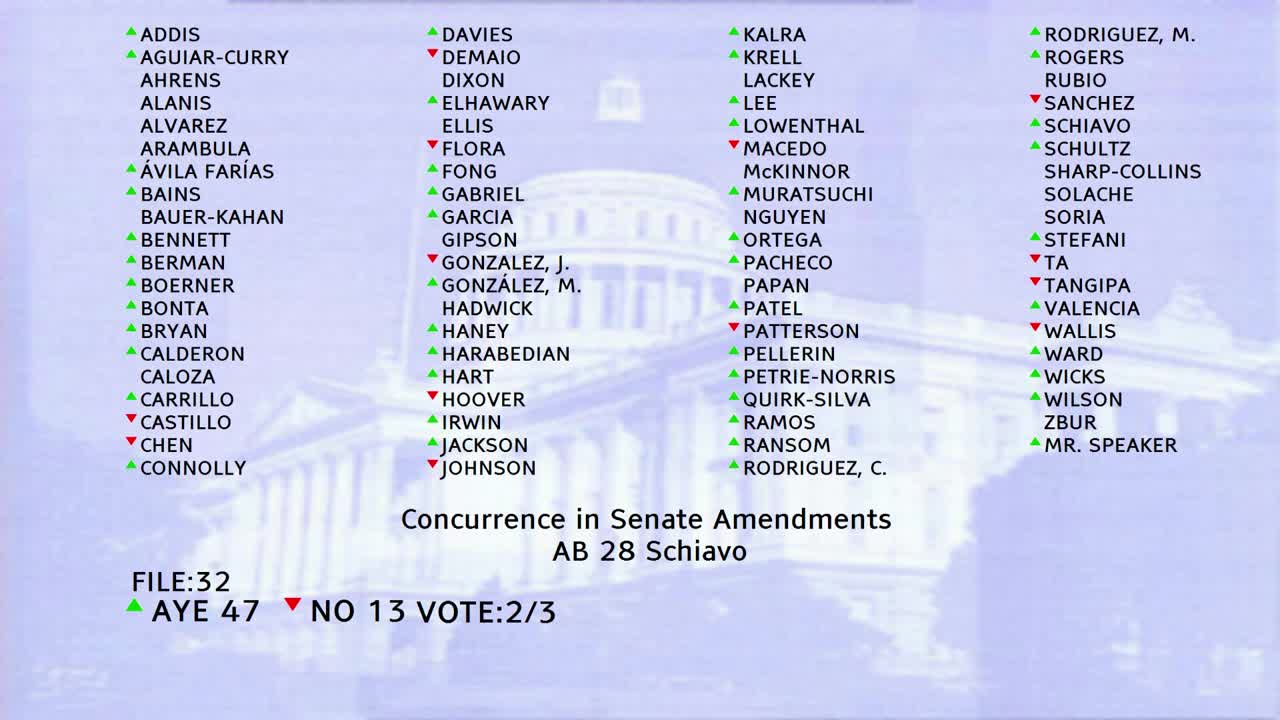 12MIN
Assembly Floor
 13SEC
Assembly Standing Committee on Appropriations
 35MIN
Assembly Standing Committee on Public Safety
 34MIN
Assembly Standing Committee on Labor and Employment
 30MIN
Assembly Standing Committee on Business and Professions
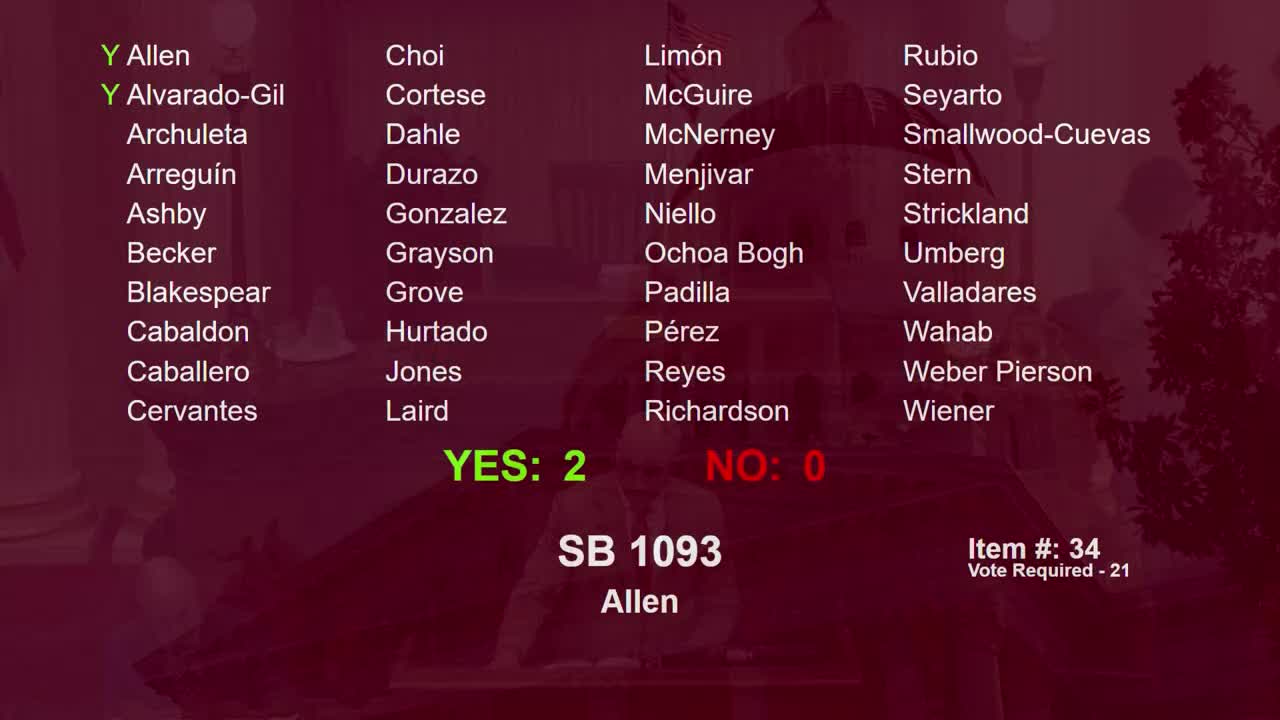 31MIN
Senate Floor
 22MIN
Senate Standing Committee on Public Safety
Bill Author