SB 122: Taxation.
- Session Year: 2025-2026
- House: Senate
- Latest Version Date: 2026-06-29
Current Status:
Passed
(2026-06-29: Chaptered by Secretary of State. Chapter 23, Statutes of 2026.)
Introduced
In Committee
Awaiting First Chamber Vote
Passed First Chamber
In Committee
Awaiting Second Chamber Vote
Passed Second Chamber
Enacted
(1)Existing state sales and use tax laws impose a tax on retailers measured by the gross receipts from the sale of tangible personal property sold at retail in this state of, or on the storage, use, or other consumption in this state of, tangible personal property purchased from a retailer for storage, use, or other consumption in this state. The Sales and Use Tax Law (SUT) defines tangible personal property to mean personal property that may be seen, weighed, measured, felt, or touched, or that is in any other manner perceptible to the senses. Existing law punishes various violations of the SUT as crimes.
The Bradley-Burns Uniform Local Sales and Use Tax Law (Bradley-Burns) authorizes counties and cities to impose local sales and use taxes in conformity with the SUT, and existing laws authorize districts, as specified, to impose transactions and use taxes in accordance with the Transactions and Use Tax Law, which generally conforms to the SUT. Amendments to the SUT are automatically incorporated into the local tax laws.
This bill would define tangible personal property to additionally mean a digital product and any copyright or patent interests associated therewith for the purposes of the application of the SUT, as prescribed. The bill would define digital product to mean, except as provided, prewritten computer software transferred on tangible storage media, transferred electronically, or accessed remotely. The bill would also make various conforming changes. By expanding the scope of violating the SUT, this bill would impose a state-mandated local program.
This bill would prohibit a purchaser or retailer of a digital product that is transferred electronically or accessed remotely from entering into any form of agreement that would result, directly or indirectly, in the payment, transfer, diversion, or rebate of any tax revenue resulting from the imposition of a sales and use tax under Bradley-Burns imposed on the sale or purchase of a digital product that is transferred electronically or accessed remotely.
This bill would make an appropriation of $750,000 from the General Fund to the California Department of Tax and Fee Administration for the purpose of administering these sales and use tax provisions.
(2)The Personal Income Tax Law and the Corporation Tax Law authorize various credits against the taxes imposed by those laws. Existing law, for taxable years beginning on or after January 1, 2024, and before January 1, 2027, limits the total tax reduction by all business credits, as defined, to $5,000,000 per taxable year, except as specified.
This bill would extend this limitation through taxable years beginning before January 1, 2030. The bill would also create additional exceptions to this limitation for certain refundable credits or refundable amounts. The bill would, for taxable years beginning on or after January 1, 2030, similarly apply a business credit limit of 70% of the total taxes imposed or $5,000,000, whichever is greater, except as specified.
Existing law, for taxable years beginning on or after January 1, 2024, and before January 1, 2027, allows a taxpayer to make an irrevocable election to receive an annual refundable credit amount, beginning the 3rd taxable year after the election is made, equal to 20% of the qualified credits that would have otherwise been available to the taxpayer but for the $5,000,000 limitation. Existing law requires the annual refundable credit amount to be allowed as a credit for the taxable year, as specified, and requires the balance, if any, to be paid from the Tax Relief and Refund Account, a continuously appropriated fund, to the taxpayer.
This bill would extend the provisions relating to elections to receive an annual refundable credit amount through taxable years beginning before January 1, 2030. By extending the operation of a continuous appropriation, this bill would make an appropriation.
(3)Existing law imposes an annual minimum franchise tax of $800, except as provided, on every corporation incorporated in this state, qualified to transact intrastate business in this state, or doing business in this state, and an annual tax in an amount equal to the minimum franchise tax, except as provided, on every limited partnership, limited liability partnership, and limited liability company doing business in this state, as specified.
This bill, for taxable years beginning on or after January 1, 2027, and before January 1, 2030, would reduce the amount of the annual tax imposed on a limited partnership, limited liability partnership, and limited liability company doing business in this state from $800 to $400 for the corporations first taxable year. The bill would require the Franchise Tax Board to submit an annual report to the Legislature regarding the reduction of the annual tax for these corporations, as provided.
(4)The Personal Income Tax Law and Corporation Tax Law impose taxes according to or measured by net income of a taxpayer subject to those laws, including residents of the state, at specified rates. Existing law requires the Franchise Tax Board to administer the Personal Income Tax Law and the Corporation Tax Law pursuant to existing law, the violation of which is a crime. The United States Department of Justice announced on May 18, 2026, the establishment of the federal Anti-Weaponization Fund for the purpose of providing a systematic process to hear and redress claims of persons who suffered weaponization and lawfare.
This bill would, for taxable years beginning on or after January 1, 2026, and before January 1, 2030, impose a tax on any settlement fund payment from the federal Anti-Weaponization Fund, or any subsequent fund, settlement, or agreement, as provided, at a rate of 100%. The bill would provide that the taxes imposed by these provisions would not be subject to reduction due to deductions or credits, as provided. The bill would require the Franchise Tax Board to administer this tax consistent with existing law relating to the administration of the Personal Income Tax Law and the Corporation Tax Law. By expanding the scope of crimes relating to those provisions, this bill would impose a state-mandated local program.
(5)This bill would include a change in state statute that would result in a taxpayer paying a higher tax within the meaning of Section 3 of Article XIIIA of the California Constitution, and thus would require for passage the approval of 2/3 of the membership of each house of the Legislature.
(6)The California Constitution requires the state to reimburse local agencies and school districts for certain costs mandated by the state. Statutory provisions establish procedures for making that reimbursement.
This bill would provide that no reimbursement is required by this act for a specified reason.
(7)This bill would declare that it is to take effect immediately as a bill providing for appropriations related to the Budget Bill.
(1)Existing state sales and use tax laws impose a tax on retailers measured by the gross receipts from the sale of tangible personal property sold at retail in this state of, or on the storage, use, or other consumption in this state of, tangible personal property purchased from a retailer for storage, use, or other consumption in this state. The Sales and Use Tax Law (SUT) defines tangible personal property to mean personal property that may be seen, weighed, measured, felt, or touched, or that is in any other manner perceptible to the senses. Existing law punishes various violations of the SUT as crimes.
The Bradley-Burns Uniform Local Sales and Use Tax Law (Bradley-Burns) authorizes counties and cities to impose local sales and use taxes in conformity with the SUT, and existing laws authorize districts, as specified, to impose transactions and use taxes in accordance with the Transactions and Use Tax Law, which generally conforms to the SUT. Amendments to the SUT are automatically incorporated into the local tax laws.
This bill would define tangible personal property to additionally mean a digital product and any copyright or patent interests associated therewith for the purposes of the application of the SUT, as prescribed. The bill would define digital product to mean, except as provided, prewritten computer software transferred on tangible storage media, transferred electronically, or accessed remotely. The bill would also make various conforming changes. By expanding the scope of violating the SUT, this bill would impose a state-mandated local program.
This bill would prohibit a purchaser or retailer of a digital product that is transferred electronically or accessed remotely from entering into any form of agreement that would result, directly or indirectly, in the payment, transfer, diversion, or rebate of any tax revenue resulting from the imposition of a sales and use tax under Bradley-Burns imposed on the sale or purchase of a digital product that is transferred electronically or accessed remotely.
This bill would make an appropriation of $750,000 from the General Fund to the California Department of Tax and Fee Administration for the purpose of administering these sales and use tax provisions.
(2)The Personal Income Tax Law and the Corporation Tax Law authorize various credits against the taxes imposed by those laws. Existing law, for taxable years beginning on or after January 1, 2024, and before January 1, 2027, limits the total tax reduction by all business credits, as defined, to $5,000,000 per taxable year, except as specified.
This bill would extend this limitation through taxable years beginning before January 1, 2030. The bill would also create additional exceptions to this limitation for certain refundable credits or refundable amounts. The bill would, for taxable years beginning on or after January 1, 2030, similarly apply a business credit limit of 70% of the total taxes imposed or $5,000,000, whichever is greater, except as specified.
Existing law, for taxable years beginning on or after January 1, 2024, and before January 1, 2027, allows a taxpayer to make an irrevocable election to receive an annual refundable credit amount, beginning the 3rd taxable year after the election is made, equal to 20% of the qualified credits that would have otherwise been available to the taxpayer but for the $5,000,000 limitation. Existing law requires the annual refundable credit amount to be allowed as a credit for the taxable year, as specified, and requires the balance, if any, to be paid from the Tax Relief and Refund Account, a continuously appropriated fund, to the taxpayer.
This bill would extend the provisions relating to elections to receive an annual refundable credit amount through taxable years beginning before January 1, 2030. By extending the operation of a continuous appropriation, this bill would make an appropriation.
(3)Existing law imposes an annual minimum franchise tax of $800, except as provided, on every corporation incorporated in this state, qualified to transact intrastate business in this state, or doing business in this state, and an annual tax in an amount equal to the minimum franchise tax, except as provided, on every limited partnership, limited liability partnership, and limited liability company doing business in this state, as specified.
This bill, for taxable years beginning on or after January 1, 2027, and before January 1, 2030, would reduce the amount of the annual tax imposed on a limited partnership, limited liability partnership, and limited liability company doing business in this state from $800 to $400 for the corporations first taxable year. The bill would require the Franchise Tax Board to submit an annual report to the Legislature regarding the reduction of the annual tax for these corporations, as provided.
(4)The Personal Income Tax Law and Corporation Tax Law impose taxes according to or measured by net income of a taxpayer subject to those laws, including residents of the state, at specified rates. Existing law requires the Franchise Tax Board to administer the Personal Income Tax Law and the Corporation Tax Law pursuant to existing law, the violation of which is a crime. The United States Department of Justice announced on May 18, 2026, the establishment of the federal Anti-Weaponization Fund for the purpose of providing a systematic process to hear and redress claims of persons who suffered weaponization and lawfare.
This bill would, for taxable years beginning on or after January 1, 2026, and before January 1, 2030, impose a tax on any settlement fund payment from the federal Anti-Weaponization Fund, or any subsequent fund, settlement, or agreement, as provided, at a rate of 100%. The bill would provide that the taxes imposed by these provisions would not be subject to reduction due to deductions or credits, as provided. The bill would require the Franchise Tax Board to administer this tax consistent with existing law relating to the administration of the Personal Income Tax Law and the Corporation Tax Law. By expanding the scope of crimes relating to those provisions, this bill would impose a state-mandated local program.
(5)This bill would include a change in state statute that would result in a taxpayer paying a higher tax within the meaning of Section 3 of Article XIIIA of the California Constitution, and thus would require for passage the approval of 2/3 of the membership of each house of the Legislature.
(6)The California Constitution requires the state to reimburse local agencies and school districts for certain costs mandated by the state. Statutory provisions establish procedures for making that reimbursement.
This bill would provide that no reimbursement is required by this act for a specified reason.
(7)This bill would declare that it is to take effect immediately as a bill providing for appropriations related to the Budget Bill.
(1)Existing state sales and use tax laws impose a tax on retailers measured by the gross receipts from the sale of tangible personal property sold at retail in this state of, or on the storage, use, or other consumption in this state of, tangible personal property purchased from a retailer for storage, use, or other consumption in this state. The Sales and Use Tax Law (SUT) defines tangible personal property to mean personal property that may be seen, weighed, measured, felt, or touched, or that is in any other manner perceptible to the senses. Existing law punishes various violations of the SUT as crimes.
The Bradley-Burns Uniform Local Sales and Use Tax Law (Bradley-Burns) authorizes counties and cities to impose local sales and use taxes in conformity with the SUT, and existing laws authorize districts, as specified, to impose transactions and use taxes in accordance with the Transactions and Use Tax Law, which generally conforms to the SUT. Amendments to the SUT are automatically incorporated into the local tax laws.
This bill would define tangible personal property to additionally mean a digital product and any copyright or patent interests associated therewith for the purposes of the application of the SUT, as prescribed. The bill would define digital product to mean, except as provided, prewritten computer software transferred on tangible storage media, transferred electronically, or accessed remotely. The bill would also make various conforming changes. By expanding the scope of violating the SUT, this bill would impose a state-mandated local program.
This bill would prohibit a purchaser or retailer of a digital product that is transferred electronically or accessed remotely from entering into any form of agreement that would result, directly or indirectly, in the payment, transfer, diversion, or rebate of any tax revenue resulting from the imposition of a sales and use tax under Bradley-Burns imposed on the sale or purchase of a digital product that is transferred electronically or accessed remotely.
This bill would make an appropriation of $750,000 from the General Fund to the California Department of Tax and Fee Administration for the purpose of administering these sales and use tax provisions.
(2)The Personal Income Tax Law and the Corporation Tax Law authorize various credits against the taxes imposed by those laws. Existing law, for taxable years beginning on or after January 1, 2024, and before January 1, 2027, limits the total tax reduction by all business credits, as defined, to $5,000,000 per taxable year, except as specified.
This bill would extend this limitation through taxable years beginning before January 1, 2030. The bill would also create additional exceptions to this limitation for certain refundable credits or refundable amounts. The bill would, for taxable years beginning on or after January 1, 2030, similarly apply a business credit limit of 70% of the total taxes imposed or $5,000,000, whichever is greater, except as specified.
Existing law, for taxable years beginning on or after January 1, 2024, and before January 1, 2027, allows a taxpayer to make an irrevocable election to receive an annual refundable credit amount, beginning the 3rd taxable year after the election is made, equal to 20% of the qualified credits that would have otherwise been available to the taxpayer but for the $5,000,000 limitation. Existing law requires the annual refundable credit amount to be allowed as a credit for the taxable year, as specified, and requires the balance, if any, to be paid from the Tax Relief and Refund Account, a continuously appropriated fund, to the taxpayer.
This bill would extend the provisions relating to elections to receive an annual refundable credit amount through taxable years beginning before January 1, 2030. By extending the operation of a continuous appropriation, this bill would make an appropriation.
(3)Existing law imposes an annual minimum franchise tax of $800, except as provided, on every corporation incorporated in this state, qualified to transact intrastate business in this state, or doing business in this state, and an annual tax in an amount equal to the minimum franchise tax, except as provided, on every limited partnership, limited liability partnership, and limited liability company doing business in this state, as specified.
This bill, for taxable years beginning on or after January 1, 2027, and before January 1, 2030, would reduce the amount of the annual tax imposed on a limited partnership, limited liability partnership, and limited liability company doing business in this state from $800 to $400 for the corporations first taxable year. The bill would require the Franchise Tax Board to submit an annual report to the Legislature regarding the reduction of the annual tax for these corporations, as provided.
(4)The Personal Income Tax Law and Corporation Tax Law impose taxes according to or measured by net income of a taxpayer subject to those laws, including residents of the state, at specified rates. Existing law requires the Franchise Tax Board to administer the Personal Income Tax Law and the Corporation Tax Law pursuant to existing law, the violation of which is a crime. The United States Department of Justice announced on May 18, 2026, the establishment of the federal Anti-Weaponization Fund for the purpose of providing a systematic process to hear and redress claims of persons who suffered weaponization and lawfare.
This bill would, for taxable years beginning on or after January 1, 2026, and before January 1, 2030, impose a tax on any settlement fund payment from the federal Anti-Weaponization Fund, or any subsequent fund, settlement, or agreement, as provided, at a rate of 100%. The bill would provide that the taxes imposed by these provisions would not be subject to reduction due to deductions or credits, as provided. The bill would require the Franchise Tax Board to administer this tax consistent with existing law relating to the administration of the Personal Income Tax Law and the Corporation Tax Law. By expanding the scope of crimes relating to those provisions, this bill would impose a state-mandated local program.
(5)This bill would include a change in state statute that would result in a taxpayer paying a higher tax within the meaning of Section 3 of Article XIIIA of the California Constitution, and thus would require for passage the approval of 2/3 of the membership of each house of the Legislature.
(6)The California Constitution requires the state to reimburse local agencies and school districts for certain costs mandated by the state. Statutory provisions establish procedures for making that reimbursement.
This bill would provide that no reimbursement is required by this act for a specified reason.
(7)This bill would declare that it is to take effect immediately as a bill providing for appropriations related to the Budget Bill.
This bill would express the intent of the Legislature to enact statutory changes relating to the Budget Act of 2025.This bill would express the intent of the Legislature to enact statutory changes relating to the Budget Act of 2025.
(a)On or after January 1, 2016, a local agency shall not enter into any form of agreement that would result, directly or indirectly, in the payment, transfer, diversion, or rebate of any tax revenue resulting from the imposition of a sales and use tax under the Bradley-Burns Uniform Local Sales and Use Tax Law (Part 1.5 (commencing with Section 7200) of Division 2 of the Revenue and Taxation Code) to any person for any purpose when both of the following apply:
(1)The agreement results in a reduction in the amount of revenue under the Bradley-Burns Uniform Local Sales and Use Tax Law that, in the absence of the agreement, would be received by another local agency.
(2)The retailer continues to maintain a physical presence within the territorial jurisdiction of that other local agency.
(b)(1)A local agency entering into an agreement that results in a reduction of the amount of revenue under the Bradley-Burns Uniform Local Sales and Use Tax Law that, in the absence of the agreement, would be received by another local agency shall post the proposed agreement on its internet website for at least 30 days prior to ratification or approval of that agreement by its governing body.
(2)A local agency entering into an agreement that results in a reduction of the amount of revenue under the Bradley-Burns Uniform Local Sales and Use Tax Law that, in the absence of the agreement, would be received by another local agency shall notify the other local agency by certified mail addressed to the attention of the chief executive of that other local agency at least 60 days prior to ratification or approval of that agreement by its governing body.
(3)A local agency shall post any agreement on its internet website it has entered into that results in a reduction of the amount of revenue under the Bradley-Burns Uniform Local Sales and Use Tax Law that, in the absence of the agreement, would be received by another local agency, including any agreements entered into prior to January 1, 2016, that are still in effect on and after that date.
(c)(1)A local agency shall not enter into any form of agreement that would result, directly or indirectly, in the payment, transfer, diversion, or rebate of any tax revenue resulting from the imposition of a sales and use tax under the Bradley-Burns Uniform Local Sales and Use Tax Law (Part 1.5 (commencing with Section 7200) of Division 2 of the Revenue and Taxation Code) imposed on the sale or purchase of a digital product that is transferred electronically or accessed remotely.
(2)A payment, transfer, diversion, or rebate of any tax revenue pursuant to an agreement described in paragraph (1) may be subject to redistribution by the California Department of Tax and Fee Administration pursuant to Section 7209 of the Revenue and Taxation Code.
(d)For the purposes of this section:
(1)Accessed remotely has the same meaning as defined in Section 6016.2 of the Revenue and Taxation Code.
(2)Digital product has the same meaning as defined in Section 6016.1 of the Revenue and Taxation Code.
(3)Local agency means a chartered or general law city, a chartered or general law county, or a city and county, of this state.
(4)Person has the same meaning as defined in Section 6005 of the Revenue and Taxation Code.
(5)Physical presence means the lease or ownership of any real property for the purpose of carrying on business operations.
(6)Purchase has the same meaning as defined in Section 6010 of the Revenue and Taxation Code.
(7)Retailer has the same meaning as defined in Section 6015 of the Revenue and Taxation Code.
(8)Sale has the same meaning as defined in Section 6006 of the Revenue and Taxation Code.
(9)Transferred electronically has the same meaning as defined in Section 6016.2 of the Revenue and Taxation Code.
(e)Except as provided in subdivision (c), this section shall not apply to any agreement by a local agency to pay or rebate any use tax revenue resulting from the imposition of a use tax under the Bradley-Burns Uniform Local Sales and Use Tax Law relating to a use tax direct payment permit issued under Section 7051.3 of the Revenue and Taxation Code.
(f)This section shall not be interpreted to limit the ability of a local agency to contract with or otherwise enter into an agreement pursuant to subdivision (b) of Section 7056 of the Revenue and Taxation Code.
(g)This section shall not apply to any mutual tax revenue sharing agreement between local agencies to pay, transfer, or divert tax revenues that would be received by a local agency resulting from the imposition of a sales and use tax under the Bradley-Burns Uniform Local Sales and Use Tax Law to another local agency, and where the agreement would not result, directly or indirectly, in the payment, transfer, diversion, or rebate of those tax revenues to a retailer.
(h)The amendments to this section by the act adding this subdivision shall become operative immediately upon enactment.
SEC. 2.Section 6006 of the Revenue and Taxation Code is amended to read:6006.Sale means and includes:
(a)Any transfer of title or possession, exchange, or barter, conditional or otherwise, in any manner or by any means whatsoever, of tangible personal property for a consideration. Transfer of possession includes only transactions found by the department to be in lieu of a transfer of title, exchange, or barter.
(b)The producing, fabricating, processing, printing, or imprinting of tangible personal property for a consideration for consumers who furnish either directly or indirectly the materials used in the producing, fabricating, processing, printing, or imprinting.
(c)The furnishing and distributing of tangible personal property for a consideration by social clubs and fraternal organizations to their members or others.
(d)The furnishing, preparing, or serving for a consideration of food, meals, or drinks.
(e)A transaction whereby the possession of property is transferred but the seller retains the title as security for the payment of the price.
(f)A transfer for a consideration of the title or possession of tangible personal property which has been produced, fabricated, or printed to the special order of the customer, or of any publication.
(g)Any lease of tangible personal property in any manner or by any means whatsoever, for a consideration, except a lease of:
(1)Motion pictures or animated motion pictures, including television, films, and tapes.
(2)Linen supplies and similar articles when an essential part of the lease agreement is the furnishing of the recurring service of laundering or cleaning the articles.
(3)Household furnishings with a lease of the living quarters in which they are to be used.
(4)Mobile transportation equipment for use in transportation of persons or property as defined in Section 6023.
(5)Tangible personal property leased in substantially the same form as acquired by the lessor or leased in substantially the same form as acquired by a transferor, as to which the lessor or transferor has paid sales tax reimbursement or has paid use tax measured by the purchase price of the property. For purposes of this paragraph, transferor shall mean the following:
(A)A person from whom the lessor acquired the property in a transaction described in subdivision (b) of Section 6006.5.
(B)A decedent from whom the lessor acquired the property by will or the laws of succession.
(6)A mobilehome, as defined in Sections 18008 and 18211 of the Health and Safety Code, other than a mobilehome originally sold new prior to July 1, 1980, and not subject to local property taxation.
(7)Paragraphs (1) and (5) and Section 6094.1 shall not apply to rentals or leases of video cassettes, video tapes, and video discs for private use under which the lessee or renter does not obtain or acquire the right to license, broadcast, exhibit, or reproduce the video cassette, video tape, or video disc.
(h)Any transfer of title or possession, exchange, or barter, conditional or otherwise, in any manner or by any means, of a digital product transferred on tangible storage media for a consideration.
(i)Any permanent or temporary transfer of the right, in any manner or by any means whatsoever, to open, view, access, download, copy, update, possess, store, manipulate, or otherwise use a digital product transferred electronically or accessed remotely for a consideration, beginning January 1, 2027.
(j)The amendments made to this section by the act adding this subdivision shall become operative on January 1, 2027.
SEC. 3.Section 6009 of the Revenue and Taxation Code is amended to read:6009.(a)Use includes the exercise of any right or power over tangible personal property incident to the ownership of that property, and also includes the possession of, or the exercise of any right or power over, tangible personal property by a lessee under a lease, except that it does not include the sale of that property in the regular course of business.
(b)For purposes of subdivision (a), the exercise of any right or power over tangible personal property incident to the ownership of that property includes opening, viewing, accessing, downloading, copying, updating, possessing, storing, or manipulating a digital product transferred electronically or accessed remotely.
(c)The amendments made to this section by the act adding this subdivision shall become operative on January 1, 2027.
SEC. 4.Section 6009.5 is added to the Revenue and Taxation Code, to read:6009.5.(a)For purposes of the use tax liability imposed pursuant to Sections 6052 and 6201.55, storage and use do not include the keeping, retaining, or exercising of any right or power over a digital product for the purpose of installing or deploying the digital product for use thereafter solely outside the state.
(b)This section shall become operative on January 1, 2027.
SEC. 5.Section 6010 of the Revenue and Taxation Code is amended to read:6010.Purchase means and includes:
(a)Any transfer of title or possession, exchange, or barter, conditional or otherwise, in any manner or by any means whatsoever, of tangible personal property for a consideration. Transfer of possession includes only transactions found by the department to be in lieu of a transfer of title, exchange, or barter.
(b)When performed outside this state or when the customer gives a resale certificate pursuant to Article 3 (commencing with Section 6091) of Chapter 2, the producing, fabricating, processing, printing, or imprinting of tangible personal property for a consideration for consumers who furnish either directly or indirectly the materials used in the producing, fabricating, processing, printing, or imprinting.
(c)A transaction whereby the possession of property is transferred but the seller retains the title as security for the payment of the price.
(d)A transfer for a consideration of tangible personal property which has been produced, fabricated, or printed to the special order of the customer, or of any publication.
(e)Any lease of tangible personal property in any manner or by any means whatsoever, for consideration, except a lease of:
(1)Motion pictures or animated motion pictures, including television, films, and tapes.
(2)Linen supplies and similar articles when an essential part of the lease agreement is the furnishing of the recurring service of laundering or cleaning the articles.
(3)Household furnishings with a lease of the living quarters in which they are to be used.
(4)Mobile transportation equipment for use in transportation of persons or property as defined in Section 6023.
(5)Tangible personal property leased in substantially the same form as acquired by the lessor or leased in substantially the same form as acquired by a transferor, as to which the lessor or transferor has paid sales tax reimbursement or has paid use tax measured by the purchase price of the property. For purposes of this paragraph, transferor shall mean the following:
(A)A person from whom the lessor acquired the property in a transaction described in subdivision (b) of Section 6006.5.
(B)A decedent from whom the lessor acquired the property by will or the laws of succession.
(6)A mobilehome, as defined in Sections 18008 and 18211 of the Health and Safety Code, other than a mobilehome originally sold new prior to July 1, 1980, and not subject to local property taxation.
(7)Paragraphs (1) and (5) and Section 6094.1 shall not apply to rentals or leases of video cassettes, video tapes, and video discs for private use under which the lessee or renter does not obtain or acquire the right to license, broadcast, exhibit, or reproduce the video cassette, video tape, or video disc.
(f)Any transfer of title or possession, exchange, or barter, conditional or otherwise, in any manner or by any means whatsoever, of a digital product transferred on tangible storage media for a consideration.
(g)Any permanent or temporary transfer of the right, in any manner or by any means whatsoever, to open, view, access, download, copy, update, possess, store, manipulate, or otherwise use a digital product transferred electronically or accessed remotely for a consideration, beginning January 1, 2027.
(h)The amendments made to this section by the act adding this subdivision shall become operative on January 1, 2027.
SEC. 6.Section 6010.5 of the Revenue and Taxation Code is amended to read:6010.5.(a)Subject to subdivision (b), for the purposes of this part, the place of the sale or purchase of tangible personal property is the place where the property is physically located at the time the act constituting the sale or purchase, as defined in this part, takes place.
(b)(1)For a digital product transferred on tangible storage media, the place of the sale or purchase of that digital product shall be the place where the tangible storage media is physically located at the time the act constituting the sale or purchase takes place.
(2)If the sale or purchase of a digital product that is not transferred on tangible storage media is an in-person sale or purchase at a location of the seller for which the seller is required to hold a sellers permit pursuant to Section 6066, the place of the sale or purchase of the digital product transferred electronically or accessed remotely shall be the sellers place of business in this state where the in-person sale or purchase occurred.
(3)(A)If the sale or purchase of a digital product that is not transferred on tangible storage media is not an in-person sale or purchase, the place of the sale or purchase of a digital product transferred electronically or accessed remotely shall be deemed to be the purchasers known address in this state shown in the sellers records maintained in good faith in the ordinary course of business.
(B)If the purchaser provided more than one address to the seller during the consummation of the sale or purchase, the purchasers known address shall be determined from those addresses in this state in the following order of priority:
(i)The purchasers billing address.
(ii)The purchasers shipping or delivery address.
(iii)The mailing address associated with the purchasers payment instrument.
(iv)The purchasers mailing address.
(C)If a purchaser does not provide an address to the seller during the consummation of the sale or purchase, the purchasers known address in this state shall be determined from the addresses in this state the purchaser previously provided to the seller in the following order of priority:
(i)The purchasers most recent billing address.
(ii)The purchasers most recent shipping or delivery address.
(iii)The purchasers most recent mailing address associated with the purchasers payment instrument.
(iv)The purchasers most recent mailing address.
(4)If neither paragraph (2) or (3) apply, the place of the sale or purchase of a digital product transferred electronically or accessed remotely shall be deemed to be outside of this state.
(c)The amendments made to this section by the act adding this subdivision shall become operative on January 1, 2027.
SEC. 7.Section 6010.5.1 is added to the Revenue and Taxation Code, to read:6010.5.1.(a)The place of use of a digital product shall be the place where any right or power is exercised over the digital product. The right or power to remotely access a digital product is exercised at the place where the person accessing the digital product is located.
(b)It shall be presumed that a digital product that was purchased outside of this state, as determined pursuant to Section 6010.5, and used in this state within 90 days from the date of sale or purchase was purchased for storage, use, or other consumption in this state.
(c)This section shall become operative on January 1, 2027.
SEC. 8.Section 6010.9 of the Revenue and Taxation Code is amended to read:6010.9.(a)Sale and purchase, for the purposes of this part, do not include the design, development, writing, translation, fabrication, lease, or transfer for a consideration of title or possession, of custom computer software, other than a basic operational program, either in the form of written procedures or in the form of tangible storage media on which, or in which, the custom computer software is recorded, or any required documentation or manuals designed to facilitate the use of the custom computer software so transferred.
(b)As used in this section:
(1)Basic operational program has the meaning defined in Section 995.2.
(2)Computer means an electronic device, including word processing equipment, that is programmable and includes a processor (CPU) and internal memory.
(3)Computer software means a set of coded instructions designed to cause a computer or automatic data processing equipment to perform a task.
(4)(A)Custom computer software means computer software prepared to the special order of a single customer and includes those services represented by separately stated charges for modifications to existing prewritten computer software that are prepared to the special order of the customer.
(B)Custom computer software does not include prewritten computer software that is held or existing for general or repeated sale or lease, even if the prewritten computer software was initially developed on a custom basis or for in-house use. Modification to existing prewritten computer software to meet the customers needs is custom computer software only to the extent of the modification.
(c)The amendments made to this section by the act adding this subdivision shall become operative on January 1, 2027.
SEC. 9.Section 6016 of the Revenue and Taxation Code is amended to read:6016.(a)Tangible personal property means either of the following:
(1)Personal property that can be seen, weighed, measured, felt, touched, or is in any other manner perceptible to the senses.
(2)A digital product and any copyright or patent interests associated therewith.
(b)The amendments made this section by the act adding this subdivision shall become operative on January 1, 2027.
SEC. 10.Section 6016.1 is added to the Revenue and Taxation Code, to read:6016.1.(a)Digital product means prewritten computer software transferred on tangible storage media, transferred electronically, or accessed remotely.
(b)Digital product does not include any of the following:
(1)A digital asset.
(2)A digital audio work.
(3)A digital audiovisual work.
(4)A digital book.
(5)Digital infrastructure.
(6)A digital video game product.
(7)A digital visual work.
(c)As used in this section:
(1)Computer has the meaning defined in Section 6010.9.
(2)Computer software has the meaning defined in Section 6010.9.
(3)Custom computer software has the meaning defined in Section 6010.9.
(4)Digital asset means a digital representation of value that is recorded on a cryptographically secured distributed ledger or any similar technology, as specified by the Secretary of the Treasury of the United States.
(5)Digital audio work means a work that results from the fixation of a series of musical, spoken, or other sounds, including a ringtone or music, that is transferred electronically or accessed remotely.
(6)Digital audiovisual work means a series of related images that when shown in succession impart an impression of motion, together with accompanying sounds, if any, that is transferred electronically or accessed remotely.
(7)Digital book means a work that is generally recognized in the ordinary and usual sense as a book that is transferred electronically or accessed remotely.
(8)Digital infrastructure means a cloud-based service provided remotely that allows a user to create, deploy, scale, or run the users own computer software on the service providers digital platform without managing, operating, or maintaining the users own infrastructure, including any hardware, software, networks, and facilities that are required to allow the user to create, deploy, scale, or run the users own computer software, required to complete the task.
(9)Digital video game product means an electronic, interactive game played for entertainment purposes by manipulating an input device to produce visual feedback on a screen that is transferred electronically or accessed remotely.
(10)Digital visual work means artwork created by using computer hardware and software processes which results in artwork in a digital format that is transferred electronically or accessed remotely.
(11)Prewritten computer software means computer software that is held or existing for general or repeated sale or lease, even if the prewritten software was initially developed on a custom basis or for in-house use, including the combination of two or more prewritten programs.
(d)This section shall become operative on January 1, 2027.
SEC. 11.Section 6016.2 is added to the Revenue and Taxation Code, to read:6016.2.(a)Accessed remotely means to have accessed for consideration by use of a digital code, password, or other means prewritten computer software that resides on the vendors server or the server of a third party.
(b)Tangible storage media means any tangible device or material capable of storing a digital product, including, but not limited to, any internal or external drive, disk, memory card, or other item capable of storing a digital product.
(c)Transferred electronically means obtained by the purchaser, by means other than tangible storage media, in a manner that allows the purchaser to open, view, access, download, copy, possess, store, manipulate, update, or otherwise use the digital product.
(d)This section shall become operative on January 1, 2027.
SEC. 12.Section 6052 is added to the Revenue and Taxation Code, to read:6052.(a)Notwithstanding Section 6010.5, and except as provided in subdivision (c), a retailer is relieved from liability to pay sales tax on the sale or purchase of a digital product that is transferred electronically or accessed remotely if the following applies, unless the purchaser is an insurer, as defined in Section 28 of Article XIII of the California Constitution:
(1)(A)The gross receipts from the sale of digital products by a retailer to a purchaser that are transferred electronically or accessed remotely exceed five million dollars ($5,000,000) in the aggregate in the current calendar year, or, beginning January 1, 2028, in the current or the preceding calendar year.
(B)The purchaser shall become liable for the use tax pursuant to subdivision (b) on the transaction that caused the retailer to exceed the threshold specified in subparagraph (A) and any adjustments made pursuant to paragraph (2).
(2)(A)On or before October 1, 2031, and every five years thereafter, the department shall multiply the amount specified in subparagraph (A) of paragraph (1) by the percentage increase in the California Consumer Price Index for All Urban Consumers between October 1, 2026, and the date of the calculation required by this subparagraph, and the result shall be rounded to the nearest one million dollars ($1,000,000) and shall be the applicable amount for the succeeding calendar year.
(B)The applicable amount computed pursuant to subparagraph (A) shall be operative beginning January 1 of the succeeding calendar year, and four years thereafter, as an adjustment of the amount specified in subparagraph (A) of paragraph (1).
(b)If a retailer is relieved from liability to pay sales tax pursuant to subdivision (a), the purchaser is liable for the use tax and shall self-assess and pay directly to the department taxes due under this part, Part 1.5 (commencing with Section 7200), and, if otherwise applicable, Part 1.6 (commencing with Section 7251) and Part 1.7 (commencing with Section 7280) on the transaction that caused the retailer to exceed the threshold specified in subparagraph (A) of paragraph (1) of subdivision (a) and any adjustments made pursuant to paragraph (2) of subdivision (a).
(c)(1)If the department determines that it is necessary for the efficient administration of this part, the department may waive the requirement for the purchaser to self-assess and pay taxes due directly to the department under subdivision (b), and the retailer shall be liable to pay the sales tax if the purchaser submits to the department a request for waiver in a form and manner prescribed by the department that includes all the places of business where the applicant expects to be a place of first use for purchases of digital products subject to subdivision (a).
(2)A purchaser that submits a request for waiver to the department under paragraph (1) shall also submit to the retailer all places of business where the purchaser expects to be a place of first use, which shall be considered the place of sale for purposes of the sales tax.
(d)A purchaser that is required to pay use taxes to the department under subdivision (b) shall obtain a use tax direct payment permit pursuant to the procedures provided in Section 7051.3.
(e)This section shall become operative on January 1, 2027.
SEC. 13.Section 6054 is added to the Revenue and Taxation Code, to read:6054.(a)A retailer is relieved from liability to pay sales tax or collect use tax on the sale or purchase of a digital product transferred electronically or accessed remotely if the place of the sale or purchase of the digital product was deemed to be outside of this state pursuant to Section 6010.5, and the retailer demonstrates to the satisfaction of the department that the retailer made a reasonable effort to obtain accurate and complete address information from the purchaser.
(b)This section shall become operative on January 1, 2027.
SEC. 14.Section 6201.55 is added to the Revenue and Taxation Code, immediately following Section 6201.5, to read:6201.55.(a)Notwithstanding Section 6010.5 and except as provided in subdivision (c), a retailer is relieved of the obligation to collect use tax on the sale or purchase of a digital product that is transferred electronically or accessed remotely if the following applies:
(1)(A)The sales price of digital products purchased by a purchaser from a retailer that are transferred electronically or accessed remotely exceeds five million dollars ($5,000,000) in the aggregate in the current calendar year, or beginning January 1, 2028, in the current or the preceding calendar year.
(B)The purchaser shall be responsible for reporting and paying the use tax to the department pursuant to subdivision (b) on the transaction that caused the purchaser to exceed the threshold specified in subparagraph (A) and any adjustments made pursuant to paragraph (2).
(2)(A)On or before October 1, 2031, and every five years thereafter, the department shall multiply the amount specified in subparagraph (A) of paragraph (1) by the percentage increase in the California Consumer Price Index for All Urban Consumers between October 1, 2026, and the date of the calculation required by this subparagraph, and the result shall be rounded to the nearest one million dollars ($1,000,000) and shall be the applicable amount for the succeeding calendar year.
(B)The applicable amount computed pursuant to subparagraph (A) shall be operative beginning January 1 of the succeeding calendar year, and four years thereafter, as an adjustment of the amount specified in subparagraph (A) of paragraph (1).
(b)If a retailer is relieved from the obligation to collect use tax pursuant to subdivision (a), the purchaser shall self-assess and pay directly to the department taxes due under this part, Part 1.5 (commencing with Section 7200), and, if otherwise applicable, Part 1.6 (commencing with Section 7251) and Part 1.7 (commencing with Section 7280) on the transaction that caused the purchaser to exceed the threshold specified in subparagraph (A) of paragraph (1) of subdivision (a) and any adjustments made pursuant to paragraph (2) of subdivision (a).
(c)(1)If the department determines that it is necessary for the efficient administration of this part, the department may waive the requirement for the purchaser to self-assess and pay taxes due directly to the department under subdivision (b), and the retailer shall have an obligation to collect the use tax if the purchaser submits to the department a request for waiver in a form and manner prescribed by the department that includes all the places of business where the applicant expects to be a place of first use for purchases of digital products subject to subdivision (a).
(2)A purchaser that submits a request for waiver to the department under paragraph (1) shall also submit to the retailer all places of business where the purchaser expects to be a place of first use, which shall be considered the place of use for purposes of the use tax.
(d)A purchaser that is required to pay taxes to the department under subdivision (b) shall obtain a use tax direct payment permit pursuant to the procedures provided in Section 7051.3.
(e)This section shall become operative on January 1, 2027.
SEC. 15.Section 6362.4 is added to the Revenue and Taxation Code, to read:6362.4.(a)There are exempted from the taxes imposed by this part the gross receipts from the sale or lease of, and the storage, use, or other consumption in this state of, the right to reproduce or copy a digital product in order for copies of the digital product to be distributed for consideration to third parties, even if a copy of the digital product is transferred concurrently with the granting of that right. Any tangible storage media on which the digital product is transferred is merely incidental.
(b)This section shall become operative on January 1, 2027.
SEC. 16.Section 6372 is added to the Revenue and Taxation Code, to read:6372.(a)There are exempted from the taxes imposed by this part the gross receipts from the sale of, and the storage, use, or other consumption of, a digital product purchased solely for use outside of this state or in interstate or foreign commerce.
(b)(1)The burden of proving that the exemption created by this section applies is on the seller who makes the sale of a digital product, unless the seller takes from the purchaser a certificate to the effect that the property is purchased solely for use outside of this state or in interstate or foreign commerce in the form and manner prescribed by the department.
(2)The certificate described by this subdivision relieves the person selling the digital product from the duty of paying sales tax and collecting the use tax only if taken in good faith.
(c)If a purchaser certifies in writing to a seller that a purchase of a digital product is exempted by this section and uses the digital product in this state, the purchaser shall be liable for payment of sales tax as if the purchaser were a retailer making a retail sale of the property at the time of that use, and the cost of the property to the purchaser shall be deemed the gross receipts from that retail sale.
(d)(1)A purchaser that purchases a digital product for use in this state and a digital product solely for use outside of this state or in interstate or foreign commerce in the same transaction may issue an exemption certificate under this section for the purchase of any of those digital products eligible for the exemption and report and pay use tax on any of those digital products used in this state.
(2)A purchaser that issues an exemption certificate described in paragraph (1) shall report and pay use tax in a manner that reflects the use tax due on any of those digital products used in this state.
(e)(1)The department may set forth, authorize, or require alternative methods to calculate the sales or use tax due in this state that fairly reflects the sales or use tax due on any digital product sold or purchased for use in this state, including on licenses of digital products concurrently available for use in multiple locations.
(2)If an alternative method set forth, authorized, or required by the department pursuant to paragraph (1) is used to calculate the sales or use tax due, Section 6406 shall not apply.
(3)The department may prescribe any forms or exemption certificates, as necessary to administer this subdivision.
(f)The exemption created by this section does not apply to a sale or purchase of a digital product transferred on tangible storage media.
(g)This section shall become operative on January 1, 2027.
SEC. 17.Section 6372.1 is added to the Revenue and Taxation Code, to read:6372.1.(a)There are exempted from the taxes imposed by this part the gross receipts from the sale of, and the storage, use, or other consumption of, a digital product that represents a service provided in electronic form in which both of the following apply:
(1)The service primarily involves the application of human effort by the service provider.
(2)The human effort described in paragraph (1) originated after the customer requested the service.
(b)The exemption provided by this section does not apply to the sale or purchase of the right to use the providers computer software running on a cloud infrastructure or the right to access that software from various client devices through either a thin client interface, including a web browser, or a program interface.
(c)This section shall become operative on January 1, 2027.
SEC. 18.Section 6406 of the Revenue and Taxation Code is amended to read:6406.(a)A credit shall be allowed against, but shall not exceed, the taxes imposed on any person by Chapter 3 (commencing with Section 6201) of this part, by any ordinance enacted pursuant to Part 1.5 (commencing with Section 7200), and by any ordinance enacted pursuant to Part 1.6 (commencing with Section 7251) by reason of the storage, use, or other consumption of tangible personal property in this state to the extent that the person has paid a retail sales or use tax, or reimbursement therefor, imposed with respect to that property by any other state, political subdivision thereof, or the District of Columbia prior to the storage, use, or other consumption of that property in this state. The credit shall be apportioned to the taxes against which it is allowed in proportion to the amounts of those taxes.
(b)A credit shall be allowed against, but shall not exceed, the total sales taxes imposed on any retailer by Chapter 2 (commencing with Section 6051) of this part, by any ordinance enacted pursuant to Part 1.5 (commencing with Section 7200), and by any ordinance enacted pursuant to Part 1.6 (commencing with Section 7251) with respect to a retail sale in this state of a digital product transferred electronically or accessed remotely to the extent that the retailer has paid a retail sales tax imposed with respect to that digital product by any other state, political subdivision thereof, or the District of Columbia at the time of sale.
(c)A credit allowed by this section shall not be allowed against taxes that are measured by periodic payments made under a lease, to the extent that the taxes imposed by any other state, political subdivision thereof, or the District of Columbia were also measured by periodic payments made under a lease for a period before the storage, use, or other consumption of the property in this state.
(d)The amendments made to this section by the act adding this subdivision shall become operative on January 1, 2027.
SEC. 19.Section 7051.3 of the Revenue and Taxation Code is amended to read:7051.3.(a)Use tax direct payment permit means a permit issued by the department that allows a taxpayer to self-assess and pay state and local use tax under Part 1 (commencing with Section 6001), Part 1.5 (commencing with Section 7200), and if otherwise applicable, Part 1.6 (commencing with Section 7251), and Part 1.7 (commencing with Section 7280) directly to the department.
(b)(1)(A)Every person seeking to pay use taxes directly to the department shall file an application for a use tax direct payment permit. An application for a use tax direct payment permit shall be made upon a form prescribed by the department and shall set forth the name under which the applicant transacts or intends to transact business, the location of the place or places of business where the applicant intends to make direct payment of use tax, and any other information that the department may require.
(B)(i)Except as provided in clause (ii), an applicant for a use tax direct payment permit may register as a place to make direct payment of use tax any of the places of business in this state that the applicant expects to be a place of first use for purchases subject to use tax in accordance with the requirements of subdivision (e).
(ii)An applicant for a use tax direct payment permit who is required to pay use tax directly to the department pursuant to Section 6052 or Section 6201.55 shall register as a place to make direct payment of use tax any of the places of business in this state that the applicant expects to be a place of first use for purchases of digital products transferred electronically or accessed remotely that are subject to use tax in accordance with the requirements of subdivision (e).
(2)The application described in paragraph (1) shall be signed pursuant to the following:
(A)If the owner of the taxpayer is a natural person, the owner shall sign the application.
(B)If the taxpayer is an association or partnership, a member or partner shall sign the application.
(C)If the taxpayer is a corporation, an executive officer or a person specifically authorized by the corporation shall sign the application.
(c)Pursuant to an application, a use tax direct payment permit shall be issued to any person who meets both of the following conditions:
(1)The applicant agrees to self-assess and pay directly to the department any use tax liability incurred under this section.
(2)The applicant certifies to the department either of the following:
(A)The applicant is the purchaser for its own use or is the lessee of tangible personal property at a cost of five hundred thousand dollars ($500,000) or more in the aggregate, during the calendar year immediately preceding the application for the permit.
(B)The applicant is a county, city, or city and county.
(d)A use tax direct payment permit shall be issued to any person required to pay use tax directly to the department on purchases of digital products transferred electronically or accessed remotely pursuant to Section 6052 or 6201.55 for a period of 12 months.
(e)(1)Any person who holds a valid use tax direct payment permit shall self-assess and pay directly to the department use taxes due under this part, Part 1.5 (commencing with Section 7200), and if otherwise applicable, Part 1.6 (commencing with Section 7251), and Part 1.7 (commencing with Section 7280) for all purchases subject to use tax for which a use tax direct payment exemption certificate was issued, and shall report on the tax return required to be filed by Section 6452, the amount of local use tax applicable to each county, city, or city and county in which the first use, as defined in Section 6009, occurs.
(2)A person required to pay use tax directly to the department on purchases of digital products pursuant to Section 6052 or 6201.55 shall issue an exemption certificate to a retailer of digital products transferred electronically or accessed remotely.
(f)The department shall allow any holder of a use tax direct payment permit to issue a use tax direct payment certificate to any registered retailer or seller subject to all of the following:
(1)The use tax direct payment certificate shall be in a form prescribed by the department and shall be signed by, and bear the name, address, and permit number of, the holder of the use tax direct payment permit.
(2)Once a use tax direct payment certificate has been issued by a holder of a use tax direct payment permit, it shall remain effective until revised or withdrawn by the holder of the permit or until the retailer or seller has received actual notice that the permit has been revoked by the department.
(3)A use tax direct payment certificate relieves a person selling property from the duty of collecting use tax only if taken in good faith from a person who holds a use tax direct payment permit. A purchaser who issues a use tax direct payment certificate that is accepted in good faith by a seller or retailer of tangible personal property shall be the sole person liable for any sales tax and related interest and penalties with respect to any transaction that is subsequently determined by the department to be subject to sales tax and not use tax.
(4)Any person who holds a use tax direct payment permit and gives a use tax direct payment certificate to a seller or retailer shall, in addition to any applicable use tax liabilities, be subject to the same penalty provisions that apply to a seller or retailer.
(g)It is the intent of the Legislature that the department administer this part in a manner that assures that local use tax will be received by the county, city, or city and county where the first use occurs.
(h)The amendments made to this section by the act adding this subdivision shall become operative on January 1, 2027.
SEC. 20.Section 7202.1 is added to the Revenue and Taxation Code, to read:7202.1.(a)For the purposes of a tax adopted under this part, any retail sale of a digital product transferred electronically or accessed remotely is subject to the sourcing rule established pursuant to subdivision (b) of Section 6010.5.
(b)This section shall become operative on January 1, 2027.
SEC. 21.Section 7254 is added to the Revenue and Taxation Code, immediately following Section 7253, to read:7254.(a)For the purposes of a tax adopted under this part, any retail sale of a digital product transferred electronically or accessed remotely is subject to the sourcing rule established pursuant to subdivision (b) of Section 6010.5.
(b)The section shall become operative on January 1, 2027.
SEC. 22.Section 17039.4 of the Revenue and Taxation Code is amended to read:17039.4.(a)Notwithstanding any provision of this part or Part 10.2 (commencing with Section 18401) to the contrary, for taxpayers not required to be included in a combined report under Section 25101 or 25110, or taxpayers not authorized to be included in a combined report under Section 25101.15, for each taxable year beginning on or after January 1, 2024, and before January 1, 2030, the total of all business credits otherwise allowable under any provision of Chapter 2 (commencing with Section 17041), including the carryover of any business credit under a former provision of that chapter, for the taxable year shall not reduce the net tax, as defined in Section 17039, by more than five million dollars ($5,000,000).
(b)Notwithstanding any provision of this part or Part 10.2 (commencing with Section 18401) to the contrary, for taxpayers required to be included in a combined report under Section 25101 or 25110, or taxpayers authorized to be included in a combined report under Section 25101.15, for each taxable year beginning on or after January 1, 2024, and before January 1, 2030, the total of all business credits otherwise allowable under any provision of Chapter 2 (commencing with Section 17041), including the carryover of any business credit under a former provision of that chapter, by all members of the combined report shall not reduce the aggregate amount of tax, as defined in Section 23036, of all members of the combined report by more than five million dollars ($5,000,000).
(c)For purposes of this section, business credit means a credit allowable under any provision of Chapter 2 (commencing with Section 17041) other than the following credits:
(1)The credit allowed by Section 17052 (relating to credit for earned income).
(2)The credit allowed by Section 17052.1 (relating to credit for young child).
(3)The credit allowed by Section 17052.2 (relating to credit for foster youth).
(4)The credit allowed by Section 17052.6 (relating to credit for household and dependent care).
(5)The credit allowed by Section 17052.10 or 17052.11 (relating to the elective tax under the Small Business Relief Act).
(6)The credit allowed by Section 17052.25 (relating to credit for adoption costs).
(7)The credit allowed by Section 17053.5 (relating to renters tax credit).
(8)The credit allowed by Section 17054 (relating to credit for personal exemption).
(9)The credit allowed by Section 17054.5 (relating to credit for qualified joint custody head of household and a qualified taxpayer with a dependent parent).
(10)The credit allowed by Section 17054.7 (relating to credit for qualified senior head of household).
(11)The credit allowed by Section 17058 (relating to credit for low-income housing).
(12)The credit allowed by Section 17061 (relating to refunds pursuant to the Unemployment Insurance Code).
(d)Any annual refundable credit amount included in an election pursuant to Section 17039.5 is not included in the limitation set forth in subdivision (a) or (b).
(e)Notwithstanding the operative date in subdivision (a), for taxable years beginning on or after January 1, 2027, if an election is made pursuant to subdivision (k) of Section 17053.98.1, both the credit allowed against the net tax under clause (i) of subparagraph (A) of paragraph (3) of subdivision (k) of Section 17053.98.1 and the annual refundable amount calculated under subdivision (k) of Section 17053.98.1 shall not be included in the limitation set forth in subdivisions (a) and (b).
(f)Any amounts included in an election pursuant to Section 6902.5, relating to an irrevocable election to apply credit amounts under Section 17053.85, 17053.95, 17053.98, 17053.98.1, 23685, 23695, 23698, or 23698.1 against qualified sales and use tax, as defined in Section 6902.5, are not included in the five-million-dollar ($5,000,000) limitation set forth in subdivision (a) or (b).
(g)The amount of any credit otherwise allowable for the taxable year under Section 17039 that is not allowed due to application of this section shall remain a credit carryover amount under this part.
(h)The carryover period for any credit that is not allowed due to the application of this section shall be increased by the number of taxable years the credit or any portion thereof was not allowed.
(i)Notwithstanding anything to the contrary in this part or Part 10.2 (commencing with Section 18401), the credits listed in subdivision (c) shall be applied after any business credits, as limited by subdivision (a) or (b), are applied.
(j)For taxpayers that make the election under subdivision (k) of Section 17053.98.1, any amount of refundable credits pursuant to that subdivision over the five-million-dollar ($5,000,000) limitation under this section shall be allowed in the first taxable year beginning on or after January 1, 2027.
(k)If a taxpayer makes the election under both Section 17039.5 and subdivision (k) of Section 17053.98.1 with respect to the credit amount under Section 17053.98.1, the total amount of credit allowed pursuant to both elections shall not exceed the credit amount allowed under subdivision (a) of Section 17053.98.1.
(l)Chapter 3.5 (commencing with Section 11340) of Part 1 of Division 3 of Title 2 of the Government Code does not apply to any standard, criterion, procedure, determination, rule, notice, or guideline established or issued by the Franchise Tax Board pursuant to this section.
(m)The amendments made to this section by Section 6 of Chapter 17 of the Statutes of 2025 shall be operative for taxable years beginning on or after January 1, 2026.
(n)The amendments made to this section by the act adding this subdivision shall be operative for taxable years beginning on or after January 1, 2027.
SEC. 23.Section 17039.5 of the Revenue and Taxation Code is amended to read:17039.5.(a)(1)For taxable years beginning on or after January 1, 2024, and before January 1, 2030, a taxpayer may make an election to receive an annual refundable credit amount of qualified credits for each taxable year to be allowed pursuant to paragraph (2).
(2)In each taxable year of the refundable period, the annual refundable credit amount shall be allowed as a credit against the net tax computed under this part for the taxable year, and the excess, if any, shall be credited against other amounts due, if any, and the balance, if any, shall be paid from the Tax Relief and Refund Account to the taxpayer.
(b)For purposes of this section, the following definitions shall apply:
(1)Annual refundable credit amount means 20 percent of the credit amount for the taxable year.
(2)(A)Credit amount means the amount of the qualified credits that would have otherwise been available to reduce net tax in the taxable year of the election but for the limitation under Section 17039.4.
(B)In the case of a pass-thru entity, the credit amount refers to the pro rata share or distributive share of the credit passed through to the partner or shareholder of the qualified taxpayer. For purposes of this subparagraph, the term pass-thru entity means any partnership, S corporation, or limited liability company treated as a partnership.
(C)In the case of an assigned credit, the credit amount refers to the credit amount that was assigned to the taxpayer.
(D)In the case of taxpayers required to be included in a combined report under Section 25101 or 25110, or taxpayers authorized to be included in a combined report under Section 25101.15, the credit amount refers to the credit amount of all members of the combined report.
(3)Qualified credits means the credits subject to the limitation under Section 17039.4.
(4)Refundable period means the first five consecutive taxable years beginning the third taxable year after the taxable year that the taxpayer makes an election under this section.
(c)No portion of the annual refundable credit amount can be assigned to another taxpayer.
(d)The following shall apply for purposes of the election pursuant to this section:
(1)The taxpayer may make an election for each taxable year beginning on or after January 1, 2024, and before January 1, 2030.
(2)Each election shall be irrevocable and shall be made on an original, timely filed return required under Part 10.2 (commencing with Section 18401) for the taxable year that the election is made in the form and manner as prescribed by the Franchise Tax Board.
(e)(1)Any adjustment of an annual refundable credit amount shall be treated as a mathematical error appearing on the return. This includes, but is not limited to, all of the following:
(A)A valid election as required under this section was not made.
(B)The Franchise Tax Board determines that credit amount overstatements in any taxable year resulted in an overstatement in any carryover amount or an overstatement of any refundable credit amount.
(C)The Franchise Tax Board determines that the credit amount was overstated as a result of any subsequent adjustment in the amount of net tax, including, but not limited to, an audit adjustment or claim for refund.
(2)Any amount of tax due resulting from such disallowance may be assessed by the Franchise Tax Board in the same manner as provided by Section 19051.
(f)(1)The Franchise Tax Board may prescribe regulations necessary or appropriate to carry out the purposes of this section.
(2)Chapter 3.5 (commencing with Section 11340) of Part 1 of Division 3 of Title 2 of the Government Code shall not apply to any rule, guideline, or procedure prescribed by the Franchise Tax Board pursuant to this section.
(g)This section shall remain in effect only until December 1, 2037, and as of that date is repealed.
SEC. 24.Section 17039.6 is added to the Revenue and Taxation Code, to read:17039.6.(a)Notwithstanding any provision of this part or Part 10.2 (commencing with Section 18401) to the contrary, for taxpayers not required to be included in a combined report under Section 25101 or 25110, or taxpayers not authorized to be included in a combined report under Section 25101.15, for each taxable year beginning on or after January 1, 2030, the total of all business credits otherwise allowable under any provision of Chapter 2 (commencing with Section 17041), including the carryover of any business credit under a former provision of that chapter, for the taxable year shall not reduce the net tax, as defined in Section 17039, by more than 70 percent or five million dollars ($5,000,000), whichever is greater.
(b)Notwithstanding any provision of this part or Part 10.2 (commencing with Section 18401) to the contrary, for taxpayers required to be included in a combined report under Section 25101 or 25110, or taxpayers authorized to be included in a combined report under Section 25101.15, for each taxable year beginning on or after January 1, 2030, the total of all business credits otherwise allowable under any provision of Chapter 2 (commencing with Section 17041), including the carryover of any business credit under a former provision of that chapter, by all members of the combined report shall not reduce the aggregate amount of tax, as defined in Section 23036, of all members of the combined report by more than 70 percent or five million dollars ($5,000,000), whichever is greater.
(c)For purposes of this section, business credit means a credit allowable under any provision of Chapter 2 (commencing with Section 17041) other than the following credits:
(1)The credit allowed by Section 17052 (relating to credit for earned income).
(2)The credit allowed by Section 17052.1 (relating to credit for young child).
(3)The credit allowed by Section 17052.2 (relating to credit for foster youth).
(4)The credit allowed by Section 17052.6 (relating to credit for household and dependent care).
(5)The credit allowed by Section 17052.10 or 17052.11 (relating to the elective tax under the Small Business Relief Act).
(6)The credit allowed by Section 17052.25 (relating to credit for adoption costs).
(7)The credit allowed by Section 17053.5 (relating to renters tax credit).
(8)The credit allowed by Section 17054 (relating to credit for personal exemption).
(9)The credit allowed by Section 17054.5 (relating to credit for qualified joint custody head of household and a qualified taxpayer with a dependent parent).
(10)The credit allowed by Section 17054.7 (relating to credit for qualified senior head of household).
(11)The credit allowed by Section 17058 (relating to credit for low-income housing).
(12)The credit allowed by Section 17061 (relating to refunds pursuant to the Unemployment Insurance Code).
(d)Any amounts included in an election pursuant to Section 6902.5, relating to an irrevocable election to apply credit amounts under Section 17053.85, 17053.95, 17053.98, 17053.98.1, 23685, 23695, 23698, or 23698.1 against qualified sales and use tax, as defined in Section 6902.5, are not included in the limitation set forth in subdivision (a) or (b).
(e)Any annual refundable credit amount included in an election pursuant to Section 17039.5 is not included in the limitation set forth in subdivision (a) or (b).
(f)If an election is made pursuant to subdivision (k) of Section 17053.98.1, both the credit allowed against the net tax under clause (i) of subparagraph (A) of paragraph (3) of subdivision (k) of Section 17053.98.1 and the annual refundable amount calculated under subdivision (k) of Section 17053.98.1 shall not be included in the limitation set forth in subdivisions (a) and (b) of this section.
(g)The amount of any credit otherwise allowable for the taxable year under Section 17039 that is not allowed due to application of this section shall remain a credit carryover amount under this part.
(h)Notwithstanding anything to the contrary in this part or Part 10.2 (commencing with Section 18401), the credits listed in subdivision (c) shall be applied after any business credits, as limited by subdivision (a) or (b), are applied.
(i)Chapter 3.5 (commencing with Section 11340) of Part 1 of Division 3 of Title 2 of the Government Code does not apply to any standard, criterion, procedure, determination, rule, notice, or guideline established or issued by the Franchise Tax Board pursuant to this section.
SEC. 25.Section 17935 of the Revenue and Taxation Code is amended to read:17935.(a)Except as provided in subdivision (f), for each taxable year beginning on or after January 1, 1997, every limited partnership doing business in this state (as defined by Section 23101) and required to file a return under Section 18633 shall pay annually to this state a tax for the privilege of doing business in this state in an amount equal to the applicable amount specified in Section 23153.
(b)(1)In addition to any limited partnership that is doing business in this state and therefore is subject to the tax imposed by subdivision (a), for each taxable year beginning on or after January 1, 1997, every limited partnership that has executed, acknowledged, and filed a certificate of limited partnership with the Secretary of State pursuant to Section 15621 or 15902.01 of the Corporations Code, and every foreign limited partnership that has registered with the Secretary of State pursuant to Section 15692 or 15909.01 of the Corporations Code, shall pay annually the tax prescribed in subdivision (a). The tax shall be paid for each taxable year, or part thereof, until a certificate of cancellation is filed on behalf of the limited partnership with the office of the Secretary of State pursuant to Section 15623, 15696, 15902.03, or 15909.07 of the Corporations Code.
(2)If a taxpayer files a return with the Franchise Tax Board that is designated its final return, that board shall notify the taxpayer that the tax imposed by this chapter is due annually until a certificate of cancellation is filed with the Secretary of State pursuant to Section 15623, 15696, 15902.03, or 15909.07 of the Corporations Code.
(c)The tax imposed by this chapter shall be due and payable on the date the return is required to be filed under former Section 18432 or 18633.
(d)For purposes of this section, limited partnership means any partnership formed by two or more persons under the laws of this state or any other jurisdiction and having one or more general partners and one or more limited partners.
(e)Notwithstanding subdivision (b), any limited partnership that ceased doing business prior to January 1, 1997, filed a final return with the Franchise Tax Board for a taxable year ending before January 1, 1997, and filed a certificate of dissolution with the Secretary of State pursuant to Section 15623 of the Corporations Code prior to January 1, 1997, shall not be subject to the tax imposed by this chapter for any period following the date the certificate of dissolution was filed with the Secretary of State, but only if the limited partnership files a certificate of cancellation with the Secretary of State pursuant to Section 15623 of the Corporations Code. In the case where a notice of proposed deficiency assessment of tax or a notice of tax due (whichever is applicable) is mailed after January 1, 2001, the first sentence of this subdivision shall not apply unless the certificate of cancellation is filed with the Secretary of State not later than 60 days after the date of the mailing of the notice.
(f)(1)(A)Every limited partnership doing business in this state as described in subdivision (a) that files a certificate of limited partnership or registers with the Secretary of the State pursuant to subdivision (b) on or after January 1, 2021, and before January 1, 2024, shall not be subject to the tax imposed under this section for its first taxable year.
(B)This subdivision shall become operative only for a taxable year in which any budget measure appropriates one dollar ($1) or more to the Franchise Tax Board for the costs associated with administration of this subdivision.
(2)For taxable years beginning on or after January 1, 2027, and before January 1, 2030, every limited partnership required to file a return under Section 18633 shall, instead of the amount specified in Section 23153, pay the annual tax to this state in the amount of four hundred dollars ($400) for its first taxable year.
SEC. 26.Section 17941 of the Revenue and Taxation Code is amended to read:17941.(a)Except as provided in subdivision (g), for each taxable year beginning on or after January 1, 1997, a limited liability company doing business in this state (as defined in Section 23101) shall pay annually to this state a tax for the privilege of doing business in this state in an amount equal to the applicable amount specified in subdivision (d) of Section 23153 for the taxable year.
(b)(1)In addition to any limited liability company that is doing business in this state and is therefore subject to the tax imposed by subdivision (a), for each taxable year beginning on or after January 1, 1997, a limited liability company shall pay annually the tax prescribed in subdivision (a) if articles of organization have been accepted, or a certificate of registration has been issued, by the office of the Secretary of State. The tax shall be paid for each taxable year, or part thereof, until a certificate of cancellation of registration or of articles of organization is filed on behalf of the limited liability company with the office of the Secretary of State.
(2)If a taxpayer files a return with the Franchise Tax Board that is designated as its final return, the Franchise Tax Board shall notify the taxpayer that the annual tax shall continue to be due annually until a certificate of dissolution is filed with the Secretary of State pursuant to Section 17707.08 of the Corporations Code or a certificate of cancellation is filed with the Secretary of State pursuant to Section 17708.06 of the Corporations Code.
(c)The tax assessed under this section shall be due and payable on or before the 15th day of the fourth month of the taxable year.
(d)For purposes of this section, limited liability company means an organization, other than a limited liability company that is exempt from the tax and fees imposed under this chapter pursuant to Section 23701h or Section 23701x, that is formed by one or more persons under the law of this state, any other country, or any other state, as a limited liability company and that is not taxable as a corporation for California tax purposes.
(e)Notwithstanding anything in this section to the contrary, if the office of the Secretary of State files a certificate of cancellation pursuant to Section 17707.02 of the Corporations Code for any limited liability company, then paragraph (1) of subdivision (f) of Section 23153 shall apply to that limited liability company as if the limited liability company were properly treated as a corporation for that limited purpose only, and paragraph (2) of subdivision (f) of Section 23153 shall not apply. Nothing in this subdivision entitles a limited liability company to receive a reimbursement for any annual taxes or fees already paid.
(f)(1)Notwithstanding any provision of this section to the contrary, for taxable years beginning on or after January 1, 2020, a limited liability company that is a small business solely owned by a deployed member of the United States Armed Forces shall not be subject to the tax imposed under this section for any taxable year the owner is deployed and the limited liability company operates at a loss or ceases operation.
(2)The Franchise Tax Board may promulgate regulations as necessary or appropriate to carry out the purposes of this subdivision, including a definition for ceases operation.
(3)For the purposes of this subdivision, all of the following definitions apply:
(A)Deployed means being called to active duty or active service during a period when a Presidential Executive order specifies that the United States is engaged in combat or homeland defense. Deployed does not include either of the following:
(i)Temporary duty for the sole purpose of training or processing.
(ii)A permanent change of station.
(B)Operates at a loss means a limited liability companys expenses exceed its receipts.
(C)Small business means a limited liability company with total income from all sources derived from, or attributable to, the state of two hundred fifty thousand dollars ($250,000) or less.
(4)This subdivision shall become inoperative for taxable years beginning on or after January 1, 2030.
(g)(1)(A)Every limited liability company doing business in this state as described in subdivision (a) that organizes or registers with the Secretary of the State pursuant to subdivision (b) on or after January 1, 2021, and before January 1, 2024, shall not be subject to the tax imposed under this section for its first taxable year.
(B)This subdivision shall become operative only for a taxable year in which any budget measure appropriates one dollar ($1) or more to the Franchise Tax Board for the costs associated with administration of this subdivision.
(2)For taxable years beginning on or after January 1, 2027, and before January 1, 2030, every limited liability company required to file a return under Section 18633 shall, instead of the amount specified in Section 23153, pay the annual tax to this state in the amount of four hundred dollars ($400) for its first taxable year.
SEC. 27.Section 17948 of the Revenue and Taxation Code is amended to read:17948.(a)Except as provided in subdivision (e), for each taxable year beginning on or after January 1, 1997, every limited liability partnership doing business in this state (as defined in Section 23101) and required to file a return under Section 18633 shall pay annually to the Franchise Tax Board a tax for the privilege of doing business in this state in an amount equal to the applicable amount specified in paragraph (1) of subdivision (d) of Section 23153 for the taxable year.
(b)In addition to any limited liability partnership that is doing business in this state and therefore is subject to the tax imposed by subdivision (a), for each taxable year beginning on or after January 1, 1997, every registered limited liability partnership that has registered with the Secretary of State pursuant to Section 16953 of the Corporations Code and every foreign limited liability partnership that has registered with the Secretary of State pursuant to Section 16959 of the Corporations Code shall pay annually the tax prescribed in subdivision (a). The tax shall be paid for each taxable year, or part thereof, until any of the following occurs:
(1)A notice of cessation is filed with the Secretary of State pursuant to subdivision (b) of Section 16954 or 16960 of the Corporations Code.
(2)A foreign limited liability partnership withdraws its registration pursuant to subdivision (a) of Section 16960 of the Corporations Code.
(3)The registered limited liability partnership or foreign limited liability partnership has been dissolved and finally wound up.
(c)The tax assessed under this section shall be due and payable on the date the return is required to be filed under Section 18633.
(d)If a taxpayer files a return with the Franchise Tax Board that is designated as its final return, the Franchise Tax Board shall notify the taxpayer that the annual tax shall continue to be due annually until a certificate of cancellation is filed with the Secretary of State pursuant to Section 16954 or 16960 of the Corporations Code.
(e)(1)(A)Every limited liability partnership doing business in this state as described in subdivision (a) that registers with the Secretary of the State pursuant to subdivision (b) on or after January 1, 2021, and before January 1, 2024, shall not be subject to the tax imposed under this section for its first taxable year.
(B)This subdivision shall become operative only for a taxable year in which any budget measure appropriates one dollar ($1) or more to the Franchise Tax Board for the costs associated with administration of this subdivision.
(2)For taxable years beginning on or after January 1, 2027, and before January 1, 2030, every limited liability partnership required to file a return under Section 18633 shall, instead of the amount specified in Section 23153, pay the annual tax to this state in the amount of four hundred dollars ($400) for its first taxable year.
SEC. 28.Section 19533 of the Revenue and Taxation Code is amended to read:19533.(a)In the event the debtor has more than one debt being collected by the Franchise Tax Board and the amount collected by the Franchise Tax Board is insufficient to satisfy the total amount owing, the amount collected shall be applied in the following priority:
(1)Payment of any taxes, additions to tax, penalties, interest, fees, or other amounts due and payable under Part 7.5 (commencing with Section 13201), Part 10 (commencing with Section 17001), Part 11 (commencing with Section 23001), Part 32 (commencing with Section 61000), or this part, amounts authorized to be collected under Section 19722 of this code, or payment of advanced premium subsides in excess of the amount allowed under Title 25 (commencing with Section 100800) of the Government Code.
(2)Payment of delinquencies collected under Section 10878.
(3)Payment of any amounts due that are referred for collection under Article 5.5 (commencing with Section 19280) of Chapter 5.
(4)Payment of any delinquencies referred for collection under Article 7 (commencing with Section 19291) of Chapter 5.
(5)Payment of any taxes imposed under Part 10.8 (commencing with Section 22000).
(b)Notwithstanding the payment priority established by this section, voluntary payments designated by the taxpayer as payment for a personal income tax liability or as a payment on amounts authorized to be collected under Section 19722, shall not be applied pursuant to this priority, but shall instead be applied as designated.
SEC. 29.Part 10.8 (commencing with Section 22000) is added to Division 2 of the Revenue and Taxation Code, to read:10.8.Taxation of Anti-Weaponization Fund Payments Act22000.(a)Notwithstanding any other law, for taxable years beginning on or after January 1, 2026, and before January 1, 2030, there shall be imposed on a taxpayer, a tax equal to 100 percent of any settlement fund payment received by the taxpayer during the taxable year.
(b)(1)For purposes of this part, the following definitions shall apply:
(A)Member of the family means the following:
(i)The spouse of an individual.
(ii)An individual who bears a relationship to an individual which is described in subparagraphs (A) to (G) of Section 152(d)(2) of the Internal Revenue Code, relating to relationship.
(B)Settlement fund payment means any payment, distribution, or monetary transfer received by a taxpayer during the taxable year, from either of the following:
(i)The Anti-Weaponization Fund established by the Department of Justice in relation to President Donald J. Trump v. Internal Revenue Service, Case No. 1:26-cv-20609 (S.D. Fla. 2026), or any subsequent fund, settlement, or agreement.
(ii)Any fund, trust, or account, the assets of which are derived from the outcome, whether by settlement, verdict, or otherwise, of any civil action that was filed by a specified person, who is not the taxpayer, against the United States, or any agency or instrumentality thereof, or against any state and its political subdivisions.
(C)Specified person means any of the following:
(i)An individual who served, or is currently serving, as President of the United States.
(ii)A member of the family of an individual who served, or is currently serving, as President of the United States.
(iii)A person controlled, based on principles specified in Section 52(b) of the Internal Revenue Code, by one or more individuals described in clause (i) or (ii).
(D)Taxpayer has the same meaning as Sections 17004 and 23037.
(2)Unless the context otherwise requires, the definitions set forth in this part and those in Part 10 (commencing with Section 17001), Part 10.2 (commencing with Section 18401), or Part 11 (commencing with Section 23001) shall apply to this part.
(c)Any specified settlement fund payment that is taxed under subdivision (a) shall be excluded from the gross income under Part 10 (commencing with Section 17001) or Part 11 (commencing with Section 23001) for the taxable year that the specified settlement fund payment is subject to tax.
(d)The tax imposed under subdivision (a) shall not be reduced by any deduction or credit allowed under Part 10 (commencing with Section 17001) or Part 11 (commencing with Section 23001).
(e)The tax imposed under subdivision (a) shall be in addition to, and not in place of, any other tax or fee that is due and payable under Part 10 (commencing with Section 17001), Part 10.2 (commencing with Section 18401), or Part 11 (commencing with Section 23001), and shall not change any filing requirements for those taxes and fees.
(f)(1)The tax imposed by this part shall be due and payable on or before the due date of the original return that the taxpayer is required to file pursuant to Part 10.2 (commencing with Section 18401) without regard to any extension of time for filing the return for the taxable year of the imposition of tax imposed under subdivision (a).
(2)All taxes paid pursuant to this section shall be made in the form and manner as prescribed by the Franchise Tax Board.
(3)The tax imposed under this part shall be assessed and collected pursuant to Part 10.2 (commencing with Section 18401), except Articles 6 (commencing with Section 19101) and 7 (commencing with Section 19131) of Chapter 4 of Part 10.2 shall not apply.
(g)(1)The Franchise Tax Board may adopt regulations that are necessary or appropriate to implement this part.
(2)The Administrative Procedure Act (Chapter 3.5 (commencing with Section 11340) of Part 1 of Division 3 of Title 2 of the Government Code) shall not apply to any regulation, rule, guideline, or procedure prescribed by the Franchise Tax Board pursuant to this part.
(h)This part shall remain in effect until December 1, 2030, and as of that date is repealed.
SEC. 30.Section 23036.4 of the Revenue and Taxation Code is amended to read:23036.4.(a)Notwithstanding any provision of this part or Part 10.2 (commencing with Section 18401) to the contrary, except as provided in subdivision (d), for taxpayers not required to be included in a combined report under Section 25101 or 25110, or taxpayers not authorized to be included in a combined report under Section 25101.15, for each taxable year beginning on or after January 1, 2024, and before January 1, 2030, the total of all credits otherwise allowable under any provision of Chapter 3.5 (commencing with Section 23604), including the carryover of any credit under a former provision of that chapter, for the taxable year shall not reduce the tax, as defined in Section 23036, by more than five million dollars ($5,000,000).
(b)Notwithstanding any provision of this part or Part 10.2 (commencing with Section 18401) to the contrary, except as provided in subdivision (d), for taxpayers required to be included in a combined report under Section 25101 or 25110, or taxpayers authorized to be included in a combined report under Section 25101.15, for each taxable year beginning on or after January 1, 2024, and before January 1, 2030, the total of all credits otherwise allowable under any provision of Chapter 3.5 (commencing with Section 23604), including the carryover of any credit under a former provision of that chapter, by all members of the combined report shall not reduce the aggregate amount of tax, as defined in Section 23036, of all members of the combined report by more than five million dollars ($5,000,000).
(c)Any amounts included in an election pursuant to Section 6902.5, relating to an irrevocable election to apply credit amounts under Section 17053.85, 17053.95, 17053.98, 17053.98.1, 23685, 23695, 23698, or 23698.1 against qualified sales and use tax, as defined in Section 6902.5, are not included in the five million dollar ($5,000,000) limitation set forth in subdivision (a) or (b).
(d)The limitation under subdivision (a) or (b) shall not apply to the credit allowed by Section 23610.5 (relating to credit for low-income housing).
(e)Any annual refundable credit amount included in an election pursuant to Section 23036.5 is not included in the limitation set forth in subdivision (a) or (b).
(f)Notwithstanding the operative date in subdivision (a), for taxable years beginning on or after January 1, 2027, if an election is made pursuant to subdivision (k) of Section 23698.1, both the credit allowed against the tax under clause (i) of subparagraph (A) of paragraph (3) of subdivision (k) of Section 23698.1 and the annual refundable amount calculated under subdivision (k) of Section 23698.1 shall not be included in the limitation set forth in subdivisions (a) and (b).
(g)The amount of any credit otherwise allowable for the taxable year under Section 23036 that is not allowed due to the application of this section shall remain a credit carryover amount under this part.
(h)The carryover period for any credit that is not allowed due to the application of this section shall be increased by the number of taxable years the credit or any portion thereof was not allowed.
(i)For taxpayers that make the election under subdivision (k) of Section 23698.1, any amount of refundable credits pursuant to that subdivision over the five-million-dollar ($5,000,000) limitation under this section shall be allowed in the first taxable year beginning on or after January 1, 2027.
(j)If a taxpayer makes the election under both Section 23036.5 and subdivision (k) of Section 23698.1 with respect to the credit amount under Section 23698.1, the total amount of credit allowed pursuant to both elections shall not exceed the credit amount allowed under subdivision (a) of Section 23698.1.
(k)Chapter 3.5 (commencing with Section 11340) of Part 1 of Division 3 of Title 2 of the Government Code does not apply to any standard, criterion, procedure, determination, rule, notice, or guideline established or issued by the Franchise Tax Board pursuant to this section.
(l)The amendments made to this section by the act adding this subdivision shall be operative for taxable years beginning on or after January 1, 2027.
SEC. 31.Section 23036.5 of the Revenue and Taxation Code is amended to read:23036.5.(a)(1)For taxable years beginning on or after January 1, 2024, and before January 1, 2030, a taxpayer may make an election to receive an annual refundable credit amount of qualified credits for each taxable year to be allowed pursuant to paragraph (2).
(2)In each taxable year of the refundable period, the annual refundable credit amount shall be allowed as a credit against the tax computed under this part for the taxable year, and the excess, if any, shall be credited against other amounts due, if any, and the balance, if any, shall be paid from the Tax Relief and Refund Account to the taxpayer.
(b)For purposes of this section, the following definitions shall apply:
(1)Annual refundable credit amount means 20 percent of the credit amount for the taxable year.
(2)(A)Credit amount means the amount of the qualified credits that would have otherwise been available to reduce net tax in the taxable year of the election but for the limitation under Section 23036.4.
(B)In the case of a pass-thru entity, the credit amount refers to the pro rata share or distributive share of the credit passed through to the partner or shareholder of the qualified taxpayer. For purposes of this subparagraph, the term pass-thru entity means any partnership, S corporation, or limited liability company treated as a partnership.
(C)In the case of an assigned credit, the credit amount refers to the credit amount that was assigned to the taxpayer.
(D)In the case of taxpayers required to be included in a combined report under Section 25101 or 25110, or taxpayers authorized to be included in a combined report under Section 25101.15, the credit amount refers to the credit amount of all members of the combined report.
(3)Qualified credits means the credits subject to the limitation under Section 23036.4.
(4)Refundable period means the first five consecutive taxable years beginning the third taxable year after the taxable year that the taxpayer makes an election under this section.
(c)No portion of the annual refundable credit amount can be assigned to another taxpayer.
(d)The following shall apply for purposes of the election pursuant to this section:
(1)The taxpayer may make an election for each taxable year beginning on or after January 1, 2024, and before January 1, 2030.
(2)Each election shall be irrevocable and shall be made on an original, timely filed return required under Part 10.2 (commencing with Section 18401) for the taxable year that the election is made in the form and manner as prescribed by the Franchise Tax Board.
(e)(1)Any adjustment of an annual refundable credit amount shall be treated as a mathematical error appearing on the return. This includes, but is not limited to, all of the following:
(A)A valid election as required under this section was not made.
(B)The Franchise Tax Board determines that credit amount overstatements in any taxable year resulted in an overstatement in any carryover amount or an overstatement of any refundable credit amount.
(C)The Franchise Tax Board determines that the credit amount was overstated as a result of any subsequent adjustment in the amount of net tax, including, but not limited to, an audit adjustment or claim for refund.
(2)Any amount of tax due resulting from such disallowance may be assessed by the Franchise Tax Board in the same manner as provided by Section 19051.
(f)(1)The Franchise Tax Board may prescribe regulations necessary or appropriate to carry out the purposes of this section.
(2)Chapter 3.5 (commencing with Section 11340) of Part 1 of Division 3 of Title 2 of the Government Code shall not apply to any rule, guideline, or procedure prescribed by the Franchise Tax Board pursuant to this section.
(g)This section shall remain in effect only until December 1, 2037, and as of that date is repealed.
SEC. 32.Section 23036.6 is added to the Revenue and Taxation Code, to read:23036.6.(a)Notwithstanding any provision of this part or Part 10.2 (commencing with Section 18401) to the contrary, except as provided in subdivision (d), for taxpayers not required to be included in a combined report under Section 25101 or 25110, or taxpayers not authorized to be included in a combined report under Section 25101.15, for each taxable year beginning on or after January 1, 2030, the total of all credits otherwise allowable under any provision of Chapter 3.5 (commencing with Section 23608), including the carryover of any credit under a former provision of that chapter, for the taxable year shall not reduce the tax, as defined in Section 23036, by more than 70 percent or five million dollars ($5,000,000), whichever is greater.
(b)Notwithstanding any provision of this part or Part 10.2 (commencing with Section 18401) to the contrary, except as provided in subdivision (d), for taxpayers required to be included in a combined report under Section 25101 or 25110, or taxpayers authorized to be included in a combined report under Section 25101.15, for each taxable year beginning on or after January 1, 2030, the total of all credits otherwise allowable under any provision of Chapter 3.5 (commencing with Section 23608), including the carryover of any credit under a former provision of that chapter, by all members of the combined report shall not reduce the aggregate amount of tax, as defined in Section 23036, of all members of the combined report by more than 70 percent or five million dollars ($5,000,000), whichever is greater.
(c)Any amounts included in an election pursuant to Section 6902.5, relating to an irrevocable election to apply credit amounts under Section 17053.85, 17053.95, 17053.98, 17053.98.1, 23685, 23695, 23698, or 23698.1 against qualified sales and use tax, as defined in Section 6902.5, are not included in the limitation set forth in subdivision (a) or (b).
(d)The limitation under subdivision (a) or (b) shall not apply to the credit allowed by Section 23610.5 (relating to credit for low-income housing).
(e)Any annual refundable credit amount included in an election pursuant to Section 23036.5 is not included in the limitation set forth in subdivision (a) or (b).
(f)If an election is made pursuant to subdivision (k) of Section 23698.1, both the credit allowed against the tax under clause (i) of subparagraph (A) of paragraph (3) of subdivision (k) of Section 23698.1 and the annual refundable amount calculated under subdivision (k) of Section 23698.1 shall not be included in the limitation set forth in subdivisions (a) and (b) of this section.
(g)The amount of any credit otherwise allowable for the taxable year under Section 23036 that is not allowed due to the application of this section shall remain a credit carryover amount under this part.
(h)Chapter 3.5 (commencing with Section 11340) of Part 1 of Division 3 of Title 2 of the Government Code does not apply to any standard, criterion, procedure, determination, rule, notice, or guideline established or issued by the Franchise Tax Board pursuant to this section.
SEC. 33.The sum of seven hundred fifty thousand dollars ($750,000) is hereby appropriated from the General Fund to the California Department of Tax and Fee Administration for the purpose of administering Sections 1 to 20, inclusive, of this act.
SEC. 34.(a)The California Department of Tax and Fee Administration may prescribe, adopt, and enforce any emergency regulations as necessary to implement, administer, and enforce its duties under Sections 1 to 20, inclusive, of this act.
(b)Any emergency regulation prescribed, adopted, or enforced pursuant to this section shall be adopted in accordance with Chapter 3.5 (commencing with Section 11340) of Part 1 of Division 3 of Title 2 of the Government Code, and, for purposes of that chapter, including Section 11349.6 of the Government Code, the adoption of the regulation is an emergency and shall be considered by the Office of Administrative Law as necessary for the immediate preservation of the public peace, health and safety, and general welfare.
(c)Notwithstanding any other law, an emergency regulation adopted by the California Department of Tax and Fee Administration under this section may remain in effect for two years from adoption and may be readopted in accordance with subdivision (h) of Section 11346.1 of the Government Code.
SEC. 35.(a)It is the intent of the Legislature to apply the requirements of Section 41 of the Revenue and Taxation Code to this act.
(b)With respect to Sections 17935, 17941, and 17948 of the Revenue and Taxation Code, as amended by Sections 25, 26, and 27 of this act, the Legislature finds and declares as follows:
(1)The goal of this act is to help and reduce costs for first-year California small businesses. Existing law imposes an annual minimum franchise tax of eight hundred dollars ($800) on every corporation, and an annual tax of eight hundred dollars ($800) on every limited liability company (LLC), limited partnership (LP), and limited liability partnership (LLP), which may be difficult to afford for first-year businesses.
(2)The performance indicator for this act is the number of first-year LLCs, LPs, and LLPs that are affected by the act.
(3)Notwithstanding Section 19542 of the Revenue and Taxation Code, on or before January 1, 2029, and on or before January 1 each year thereafter through, and including, January 1, 2031, the Franchise Tax Board shall submit an annual report to the Legislature on the performance of first-year LLCs, LPs, and LLPs in the state using the data in paragraph (2). The report required by this paragraph shall be submitted pursuant to Section 9795 of the Government Code.
SEC. 36.The provisions of this act are severable. If any provision of this act or its application is held invalid, that invalidity shall not affect other provisions or applications that can be given effect without the invalid provision or application.
SEC. 37.No reimbursement is required by this act pursuant to Section 6 of Article XIIIB of the California Constitution because the only costs that may be incurred by a local agency or school district will be incurred because this act creates a new crime or infraction, eliminates a crime or infraction, or changes the penalty for a crime or infraction, within the meaning of Section 17556 of the Government Code, or changes the definition of a crime within the meaning of Section 6 of Article XIIIB of the California Constitution.
SEC. 38.This act is a bill providing for appropriations related to the Budget Bill within the meaning of subdivision (e) of Section 12 of Article IV of the California Constitution, has been identified as related to the budget in the Budget Bill, and shall take effect immediately.
(a)On or after January 1, 2016, a local agency shall not enter into any form of agreement that would result, directly or indirectly, in the payment, transfer, diversion, or rebate of any tax revenue resulting from the imposition of a sales and use tax under the Bradley-Burns Uniform Local Sales and Use Tax Law (Part 1.5 (commencing with Section 7200) of Division 2 of the Revenue and Taxation Code) to any person for any purpose when both of the following apply:
(1)The agreement results in a reduction in the amount of revenue under the Bradley-Burns Uniform Local Sales and Use Tax Law that, in the absence of the agreement, would be received by another local agency.
(2)The retailer continues to maintain a physical presence within the territorial jurisdiction of that other local agency.
(b)(1)A local agency entering into an agreement that results in a reduction of the amount of revenue under the Bradley-Burns Uniform Local Sales and Use Tax Law that, in the absence of the agreement, would be received by another local agency shall post the proposed agreement on its internet website for at least 30 days prior to ratification or approval of that agreement by its governing body.
(2)A local agency entering into an agreement that results in a reduction of the amount of revenue under the Bradley-Burns Uniform Local Sales and Use Tax Law that, in the absence of the agreement, would be received by another local agency shall notify the other local agency by certified mail addressed to the attention of the chief executive of that other local agency at least 60 days prior to ratification or approval of that agreement by its governing body.
(3)A local agency shall post any agreement on its internet website it has entered into that results in a reduction of the amount of revenue under the Bradley-Burns Uniform Local Sales and Use Tax Law that, in the absence of the agreement, would be received by another local agency, including any agreements entered into prior to January 1, 2016, that are still in effect on and after that date.
(c)(1)A local agency shall not enter into any form of agreement that would result, directly or indirectly, in the payment, transfer, diversion, or rebate of any tax revenue resulting from the imposition of a sales and use tax under the Bradley-Burns Uniform Local Sales and Use Tax Law (Part 1.5 (commencing with Section 7200) of Division 2 of the Revenue and Taxation Code) imposed on the sale or purchase of a digital product that is transferred electronically or accessed remotely.
(2)A payment, transfer, diversion, or rebate of any tax revenue pursuant to an agreement described in paragraph (1) may be subject to redistribution by the California Department of Tax and Fee Administration pursuant to Section 7209 of the Revenue and Taxation Code.
(d)For the purposes of this section:
(1)Accessed remotely has the same meaning as defined in Section 6016.2 of the Revenue and Taxation Code.
(2)Digital product has the same meaning as defined in Section 6016.1 of the Revenue and Taxation Code.
(3)Local agency means a chartered or general law city, a chartered or general law county, or a city and county, of this state.
(4)Person has the same meaning as defined in Section 6005 of the Revenue and Taxation Code.
(5)Physical presence means the lease or ownership of any real property for the purpose of carrying on business operations.
(6)Purchase has the same meaning as defined in Section 6010 of the Revenue and Taxation Code.
(7)Retailer has the same meaning as defined in Section 6015 of the Revenue and Taxation Code.
(8)Sale has the same meaning as defined in Section 6006 of the Revenue and Taxation Code.
(9)Transferred electronically has the same meaning as defined in Section 6016.2 of the Revenue and Taxation Code.
(e)Except as provided in subdivision (c), this section shall not apply to any agreement by a local agency to pay or rebate any use tax revenue resulting from the imposition of a use tax under the Bradley-Burns Uniform Local Sales and Use Tax Law relating to a use tax direct payment permit issued under Section 7051.3 of the Revenue and Taxation Code.
(f)This section shall not be interpreted to limit the ability of a local agency to contract with or otherwise enter into an agreement pursuant to subdivision (b) of Section 7056 of the Revenue and Taxation Code.
(g)This section shall not apply to any mutual tax revenue sharing agreement between local agencies to pay, transfer, or divert tax revenues that would be received by a local agency resulting from the imposition of a sales and use tax under the Bradley-Burns Uniform Local Sales and Use Tax Law to another local agency, and where the agreement would not result, directly or indirectly, in the payment, transfer, diversion, or rebate of those tax revenues to a retailer.
(h)The amendments to this section by the act adding this subdivision shall become operative immediately upon enactment.
SEC. 2.Section 6006 of the Revenue and Taxation Code is amended to read:6006.Sale means and includes:
(a)Any transfer of title or possession, exchange, or barter, conditional or otherwise, in any manner or by any means whatsoever, of tangible personal property for a consideration. Transfer of possession includes only transactions found by the department to be in lieu of a transfer of title, exchange, or barter.
(b)The producing, fabricating, processing, printing, or imprinting of tangible personal property for a consideration for consumers who furnish either directly or indirectly the materials used in the producing, fabricating, processing, printing, or imprinting.
(c)The furnishing and distributing of tangible personal property for a consideration by social clubs and fraternal organizations to their members or others.
(d)The furnishing, preparing, or serving for a consideration of food, meals, or drinks.
(e)A transaction whereby the possession of property is transferred but the seller retains the title as security for the payment of the price.
(f)A transfer for a consideration of the title or possession of tangible personal property which has been produced, fabricated, or printed to the special order of the customer, or of any publication.
(g)Any lease of tangible personal property in any manner or by any means whatsoever, for a consideration, except a lease of:
(1)Motion pictures or animated motion pictures, including television, films, and tapes.
(2)Linen supplies and similar articles when an essential part of the lease agreement is the furnishing of the recurring service of laundering or cleaning the articles.
(3)Household furnishings with a lease of the living quarters in which they are to be used.
(4)Mobile transportation equipment for use in transportation of persons or property as defined in Section 6023.
(5)Tangible personal property leased in substantially the same form as acquired by the lessor or leased in substantially the same form as acquired by a transferor, as to which the lessor or transferor has paid sales tax reimbursement or has paid use tax measured by the purchase price of the property. For purposes of this paragraph, transferor shall mean the following:
(A)A person from whom the lessor acquired the property in a transaction described in subdivision (b) of Section 6006.5.
(B)A decedent from whom the lessor acquired the property by will or the laws of succession.
(6)A mobilehome, as defined in Sections 18008 and 18211 of the Health and Safety Code, other than a mobilehome originally sold new prior to July 1, 1980, and not subject to local property taxation.
(7)Paragraphs (1) and (5) and Section 6094.1 shall not apply to rentals or leases of video cassettes, video tapes, and video discs for private use under which the lessee or renter does not obtain or acquire the right to license, broadcast, exhibit, or reproduce the video cassette, video tape, or video disc.
(h)Any transfer of title or possession, exchange, or barter, conditional or otherwise, in any manner or by any means, of a digital product transferred on tangible storage media for a consideration.
(i)Any permanent or temporary transfer of the right, in any manner or by any means whatsoever, to open, view, access, download, copy, update, possess, store, manipulate, or otherwise use a digital product transferred electronically or accessed remotely for a consideration, beginning January 1, 2027.
(j)The amendments made to this section by the act adding this subdivision shall become operative on January 1, 2027.
SEC. 3.Section 6009 of the Revenue and Taxation Code is amended to read:6009.(a)Use includes the exercise of any right or power over tangible personal property incident to the ownership of that property, and also includes the possession of, or the exercise of any right or power over, tangible personal property by a lessee under a lease, except that it does not include the sale of that property in the regular course of business.
(b)For purposes of subdivision (a), the exercise of any right or power over tangible personal property incident to the ownership of that property includes opening, viewing, accessing, downloading, copying, updating, possessing, storing, or manipulating a digital product transferred electronically or accessed remotely.
(c)The amendments made to this section by the act adding this subdivision shall become operative on January 1, 2027.
SEC. 4.Section 6009.5 is added to the Revenue and Taxation Code, to read:6009.5.(a)For purposes of the use tax liability imposed pursuant to Sections 6052 and 6201.55, storage and use do not include the keeping, retaining, or exercising of any right or power over a digital product for the purpose of installing or deploying the digital product for use thereafter solely outside the state.
(b)This section shall become operative on January 1, 2027.
SEC. 5.Section 6010 of the Revenue and Taxation Code is amended to read:6010.Purchase means and includes:
(a)Any transfer of title or possession, exchange, or barter, conditional or otherwise, in any manner or by any means whatsoever, of tangible personal property for a consideration. Transfer of possession includes only transactions found by the department to be in lieu of a transfer of title, exchange, or barter.
(b)When performed outside this state or when the customer gives a resale certificate pursuant to Article 3 (commencing with Section 6091) of Chapter 2, the producing, fabricating, processing, printing, or imprinting of tangible personal property for a consideration for consumers who furnish either directly or indirectly the materials used in the producing, fabricating, processing, printing, or imprinting.
(c)A transaction whereby the possession of property is transferred but the seller retains the title as security for the payment of the price.
(d)A transfer for a consideration of tangible personal property which has been produced, fabricated, or printed to the special order of the customer, or of any publication.
(e)Any lease of tangible personal property in any manner or by any means whatsoever, for consideration, except a lease of:
(1)Motion pictures or animated motion pictures, including television, films, and tapes.
(2)Linen supplies and similar articles when an essential part of the lease agreement is the furnishing of the recurring service of laundering or cleaning the articles.
(3)Household furnishings with a lease of the living quarters in which they are to be used.
(4)Mobile transportation equipment for use in transportation of persons or property as defined in Section 6023.
(5)Tangible personal property leased in substantially the same form as acquired by the lessor or leased in substantially the same form as acquired by a transferor, as to which the lessor or transferor has paid sales tax reimbursement or has paid use tax measured by the purchase price of the property. For purposes of this paragraph, transferor shall mean the following:
(A)A person from whom the lessor acquired the property in a transaction described in subdivision (b) of Section 6006.5.
(B)A decedent from whom the lessor acquired the property by will or the laws of succession.
(6)A mobilehome, as defined in Sections 18008 and 18211 of the Health and Safety Code, other than a mobilehome originally sold new prior to July 1, 1980, and not subject to local property taxation.
(7)Paragraphs (1) and (5) and Section 6094.1 shall not apply to rentals or leases of video cassettes, video tapes, and video discs for private use under which the lessee or renter does not obtain or acquire the right to license, broadcast, exhibit, or reproduce the video cassette, video tape, or video disc.
(f)Any transfer of title or possession, exchange, or barter, conditional or otherwise, in any manner or by any means whatsoever, of a digital product transferred on tangible storage media for a consideration.
(g)Any permanent or temporary transfer of the right, in any manner or by any means whatsoever, to open, view, access, download, copy, update, possess, store, manipulate, or otherwise use a digital product transferred electronically or accessed remotely for a consideration, beginning January 1, 2027.
(h)The amendments made to this section by the act adding this subdivision shall become operative on January 1, 2027.
SEC. 6.Section 6010.5 of the Revenue and Taxation Code is amended to read:6010.5.(a)Subject to subdivision (b), for the purposes of this part, the place of the sale or purchase of tangible personal property is the place where the property is physically located at the time the act constituting the sale or purchase, as defined in this part, takes place.
(b)(1)For a digital product transferred on tangible storage media, the place of the sale or purchase of that digital product shall be the place where the tangible storage media is physically located at the time the act constituting the sale or purchase takes place.
(2)If the sale or purchase of a digital product that is not transferred on tangible storage media is an in-person sale or purchase at a location of the seller for which the seller is required to hold a sellers permit pursuant to Section 6066, the place of the sale or purchase of the digital product transferred electronically or accessed remotely shall be the sellers place of business in this state where the in-person sale or purchase occurred.
(3)(A)If the sale or purchase of a digital product that is not transferred on tangible storage media is not an in-person sale or purchase, the place of the sale or purchase of a digital product transferred electronically or accessed remotely shall be deemed to be the purchasers known address in this state shown in the sellers records maintained in good faith in the ordinary course of business.
(B)If the purchaser provided more than one address to the seller during the consummation of the sale or purchase, the purchasers known address shall be determined from those addresses in this state in the following order of priority:
(i)The purchasers billing address.
(ii)The purchasers shipping or delivery address.
(iii)The mailing address associated with the purchasers payment instrument.
(iv)The purchasers mailing address.
(C)If a purchaser does not provide an address to the seller during the consummation of the sale or purchase, the purchasers known address in this state shall be determined from the addresses in this state the purchaser previously provided to the seller in the following order of priority:
(i)The purchasers most recent billing address.
(ii)The purchasers most recent shipping or delivery address.
(iii)The purchasers most recent mailing address associated with the purchasers payment instrument.
(iv)The purchasers most recent mailing address.
(4)If neither paragraph (2) or (3) apply, the place of the sale or purchase of a digital product transferred electronically or accessed remotely shall be deemed to be outside of this state.
(c)The amendments made to this section by the act adding this subdivision shall become operative on January 1, 2027.
SEC. 7.Section 6010.5.1 is added to the Revenue and Taxation Code, to read:6010.5.1.(a)The place of use of a digital product shall be the place where any right or power is exercised over the digital product. The right or power to remotely access a digital product is exercised at the place where the person accessing the digital product is located.
(b)It shall be presumed that a digital product that was purchased outside of this state, as determined pursuant to Section 6010.5, and used in this state within 90 days from the date of sale or purchase was purchased for storage, use, or other consumption in this state.
(c)This section shall become operative on January 1, 2027.
SEC. 8.Section 6010.9 of the Revenue and Taxation Code is amended to read:6010.9.(a)Sale and purchase, for the purposes of this part, do not include the design, development, writing, translation, fabrication, lease, or transfer for a consideration of title or possession, of custom computer software, other than a basic operational program, either in the form of written procedures or in the form of tangible storage media on which, or in which, the custom computer software is recorded, or any required documentation or manuals designed to facilitate the use of the custom computer software so transferred.
(b)As used in this section:
(1)Basic operational program has the meaning defined in Section 995.2.
(2)Computer means an electronic device, including word processing equipment, that is programmable and includes a processor (CPU) and internal memory.
(3)Computer software means a set of coded instructions designed to cause a computer or automatic data processing equipment to perform a task.
(4)(A)Custom computer software means computer software prepared to the special order of a single customer and includes those services represented by separately stated charges for modifications to existing prewritten computer software that are prepared to the special order of the customer.
(B)Custom computer software does not include prewritten computer software that is held or existing for general or repeated sale or lease, even if the prewritten computer software was initially developed on a custom basis or for in-house use. Modification to existing prewritten computer software to meet the customers needs is custom computer software only to the extent of the modification.
(c)The amendments made to this section by the act adding this subdivision shall become operative on January 1, 2027.
SEC. 9.Section 6016 of the Revenue and Taxation Code is amended to read:6016.(a)Tangible personal property means either of the following:
(1)Personal property that can be seen, weighed, measured, felt, touched, or is in any other manner perceptible to the senses.
(2)A digital product and any copyright or patent interests associated therewith.
(b)The amendments made this section by the act adding this subdivision shall become operative on January 1, 2027.
SEC. 10.Section 6016.1 is added to the Revenue and Taxation Code, to read:6016.1.(a)Digital product means prewritten computer software transferred on tangible storage media, transferred electronically, or accessed remotely.
(b)Digital product does not include any of the following:
(1)A digital asset.
(2)A digital audio work.
(3)A digital audiovisual work.
(4)A digital book.
(5)Digital infrastructure.
(6)A digital video game product.
(7)A digital visual work.
(c)As used in this section:
(1)Computer has the meaning defined in Section 6010.9.
(2)Computer software has the meaning defined in Section 6010.9.
(3)Custom computer software has the meaning defined in Section 6010.9.
(4)Digital asset means a digital representation of value that is recorded on a cryptographically secured distributed ledger or any similar technology, as specified by the Secretary of the Treasury of the United States.
(5)Digital audio work means a work that results from the fixation of a series of musical, spoken, or other sounds, including a ringtone or music, that is transferred electronically or accessed remotely.
(6)Digital audiovisual work means a series of related images that when shown in succession impart an impression of motion, together with accompanying sounds, if any, that is transferred electronically or accessed remotely.
(7)Digital book means a work that is generally recognized in the ordinary and usual sense as a book that is transferred electronically or accessed remotely.
(8)Digital infrastructure means a cloud-based service provided remotely that allows a user to create, deploy, scale, or run the users own computer software on the service providers digital platform without managing, operating, or maintaining the users own infrastructure, including any hardware, software, networks, and facilities that are required to allow the user to create, deploy, scale, or run the users own computer software, required to complete the task.
(9)Digital video game product means an electronic, interactive game played for entertainment purposes by manipulating an input device to produce visual feedback on a screen that is transferred electronically or accessed remotely.
(10)Digital visual work means artwork created by using computer hardware and software processes which results in artwork in a digital format that is transferred electronically or accessed remotely.
(11)Prewritten computer software means computer software that is held or existing for general or repeated sale or lease, even if the prewritten software was initially developed on a custom basis or for in-house use, including the combination of two or more prewritten programs.
(d)This section shall become operative on January 1, 2027.
SEC. 11.Section 6016.2 is added to the Revenue and Taxation Code, to read:6016.2.(a)Accessed remotely means to have accessed for consideration by use of a digital code, password, or other means prewritten computer software that resides on the vendors server or the server of a third party.
(b)Tangible storage media means any tangible device or material capable of storing a digital product, including, but not limited to, any internal or external drive, disk, memory card, or other item capable of storing a digital product.
(c)Transferred electronically means obtained by the purchaser, by means other than tangible storage media, in a manner that allows the purchaser to open, view, access, download, copy, possess, store, manipulate, update, or otherwise use the digital product.
(d)This section shall become operative on January 1, 2027.
SEC. 12.Section 6052 is added to the Revenue and Taxation Code, to read:6052.(a)Notwithstanding Section 6010.5, and except as provided in subdivision (c), a retailer is relieved from liability to pay sales tax on the sale or purchase of a digital product that is transferred electronically or accessed remotely if the following applies, unless the purchaser is an insurer, as defined in Section 28 of Article XIII of the California Constitution:
(1)(A)The gross receipts from the sale of digital products by a retailer to a purchaser that are transferred electronically or accessed remotely exceed five million dollars ($5,000,000) in the aggregate in the current calendar year, or, beginning January 1, 2028, in the current or the preceding calendar year.
(B)The purchaser shall become liable for the use tax pursuant to subdivision (b) on the transaction that caused the retailer to exceed the threshold specified in subparagraph (A) and any adjustments made pursuant to paragraph (2).
(2)(A)On or before October 1, 2031, and every five years thereafter, the department shall multiply the amount specified in subparagraph (A) of paragraph (1) by the percentage increase in the California Consumer Price Index for All Urban Consumers between October 1, 2026, and the date of the calculation required by this subparagraph, and the result shall be rounded to the nearest one million dollars ($1,000,000) and shall be the applicable amount for the succeeding calendar year.
(B)The applicable amount computed pursuant to subparagraph (A) shall be operative beginning January 1 of the succeeding calendar year, and four years thereafter, as an adjustment of the amount specified in subparagraph (A) of paragraph (1).
(b)If a retailer is relieved from liability to pay sales tax pursuant to subdivision (a), the purchaser is liable for the use tax and shall self-assess and pay directly to the department taxes due under this part, Part 1.5 (commencing with Section 7200), and, if otherwise applicable, Part 1.6 (commencing with Section 7251) and Part 1.7 (commencing with Section 7280) on the transaction that caused the retailer to exceed the threshold specified in subparagraph (A) of paragraph (1) of subdivision (a) and any adjustments made pursuant to paragraph (2) of subdivision (a).
(c)(1)If the department determines that it is necessary for the efficient administration of this part, the department may waive the requirement for the purchaser to self-assess and pay taxes due directly to the department under subdivision (b), and the retailer shall be liable to pay the sales tax if the purchaser submits to the department a request for waiver in a form and manner prescribed by the department that includes all the places of business where the applicant expects to be a place of first use for purchases of digital products subject to subdivision (a).
(2)A purchaser that submits a request for waiver to the department under paragraph (1) shall also submit to the retailer all places of business where the purchaser expects to be a place of first use, which shall be considered the place of sale for purposes of the sales tax.
(d)A purchaser that is required to pay use taxes to the department under subdivision (b) shall obtain a use tax direct payment permit pursuant to the procedures provided in Section 7051.3.
(e)This section shall become operative on January 1, 2027.
SEC. 13.Section 6054 is added to the Revenue and Taxation Code, to read:6054.(a)A retailer is relieved from liability to pay sales tax or collect use tax on the sale or purchase of a digital product transferred electronically or accessed remotely if the place of the sale or purchase of the digital product was deemed to be outside of this state pursuant to Section 6010.5, and the retailer demonstrates to the satisfaction of the department that the retailer made a reasonable effort to obtain accurate and complete address information from the purchaser.
(b)This section shall become operative on January 1, 2027.
SEC. 14.Section 6201.55 is added to the Revenue and Taxation Code, immediately following Section 6201.5, to read:6201.55.(a)Notwithstanding Section 6010.5 and except as provided in subdivision (c), a retailer is relieved of the obligation to collect use tax on the sale or purchase of a digital product that is transferred electronically or accessed remotely if the following applies:
(1)(A)The sales price of digital products purchased by a purchaser from a retailer that are transferred electronically or accessed remotely exceeds five million dollars ($5,000,000) in the aggregate in the current calendar year, or beginning January 1, 2028, in the current or the preceding calendar year.
(B)The purchaser shall be responsible for reporting and paying the use tax to the department pursuant to subdivision (b) on the transaction that caused the purchaser to exceed the threshold specified in subparagraph (A) and any adjustments made pursuant to paragraph (2).
(2)(A)On or before October 1, 2031, and every five years thereafter, the department shall multiply the amount specified in subparagraph (A) of paragraph (1) by the percentage increase in the California Consumer Price Index for All Urban Consumers between October 1, 2026, and the date of the calculation required by this subparagraph, and the result shall be rounded to the nearest one million dollars ($1,000,000) and shall be the applicable amount for the succeeding calendar year.
(B)The applicable amount computed pursuant to subparagraph (A) shall be operative beginning January 1 of the succeeding calendar year, and four years thereafter, as an adjustment of the amount specified in subparagraph (A) of paragraph (1).
(b)If a retailer is relieved from the obligation to collect use tax pursuant to subdivision (a), the purchaser shall self-assess and pay directly to the department taxes due under this part, Part 1.5 (commencing with Section 7200), and, if otherwise applicable, Part 1.6 (commencing with Section 7251) and Part 1.7 (commencing with Section 7280) on the transaction that caused the purchaser to exceed the threshold specified in subparagraph (A) of paragraph (1) of subdivision (a) and any adjustments made pursuant to paragraph (2) of subdivision (a).
(c)(1)If the department determines that it is necessary for the efficient administration of this part, the department may waive the requirement for the purchaser to self-assess and pay taxes due directly to the department under subdivision (b), and the retailer shall have an obligation to collect the use tax if the purchaser submits to the department a request for waiver in a form and manner prescribed by the department that includes all the places of business where the applicant expects to be a place of first use for purchases of digital products subject to subdivision (a).
(2)A purchaser that submits a request for waiver to the department under paragraph (1) shall also submit to the retailer all places of business where the purchaser expects to be a place of first use, which shall be considered the place of use for purposes of the use tax.
(d)A purchaser that is required to pay taxes to the department under subdivision (b) shall obtain a use tax direct payment permit pursuant to the procedures provided in Section 7051.3.
(e)This section shall become operative on January 1, 2027.
SEC. 15.Section 6362.4 is added to the Revenue and Taxation Code, to read:6362.4.(a)There are exempted from the taxes imposed by this part the gross receipts from the sale or lease of, and the storage, use, or other consumption in this state of, the right to reproduce or copy a digital product in order for copies of the digital product to be distributed for consideration to third parties, even if a copy of the digital product is transferred concurrently with the granting of that right. Any tangible storage media on which the digital product is transferred is merely incidental.
(b)This section shall become operative on January 1, 2027.
SEC. 16.Section 6372 is added to the Revenue and Taxation Code, to read:6372.(a)There are exempted from the taxes imposed by this part the gross receipts from the sale of, and the storage, use, or other consumption of, a digital product purchased solely for use outside of this state or in interstate or foreign commerce.
(b)(1)The burden of proving that the exemption created by this section applies is on the seller who makes the sale of a digital product, unless the seller takes from the purchaser a certificate to the effect that the property is purchased solely for use outside of this state or in interstate or foreign commerce in the form and manner prescribed by the department.
(2)The certificate described by this subdivision relieves the person selling the digital product from the duty of paying sales tax and collecting the use tax only if taken in good faith.
(c)If a purchaser certifies in writing to a seller that a purchase of a digital product is exempted by this section and uses the digital product in this state, the purchaser shall be liable for payment of sales tax as if the purchaser were a retailer making a retail sale of the property at the time of that use, and the cost of the property to the purchaser shall be deemed the gross receipts from that retail sale.
(d)(1)A purchaser that purchases a digital product for use in this state and a digital product solely for use outside of this state or in interstate or foreign commerce in the same transaction may issue an exemption certificate under this section for the purchase of any of those digital products eligible for the exemption and report and pay use tax on any of those digital products used in this state.
(2)A purchaser that issues an exemption certificate described in paragraph (1) shall report and pay use tax in a manner that reflects the use tax due on any of those digital products used in this state.
(e)(1)The department may set forth, authorize, or require alternative methods to calculate the sales or use tax due in this state that fairly reflects the sales or use tax due on any digital product sold or purchased for use in this state, including on licenses of digital products concurrently available for use in multiple locations.
(2)If an alternative method set forth, authorized, or required by the department pursuant to paragraph (1) is used to calculate the sales or use tax due, Section 6406 shall not apply.
(3)The department may prescribe any forms or exemption certificates, as necessary to administer this subdivision.
(f)The exemption created by this section does not apply to a sale or purchase of a digital product transferred on tangible storage media.
(g)This section shall become operative on January 1, 2027.
SEC. 17.Section 6372.1 is added to the Revenue and Taxation Code, to read:6372.1.(a)There are exempted from the taxes imposed by this part the gross receipts from the sale of, and the storage, use, or other consumption of, a digital product that represents a service provided in electronic form in which both of the following apply:
(1)The service primarily involves the application of human effort by the service provider.
(2)The human effort described in paragraph (1) originated after the customer requested the service.
(b)The exemption provided by this section does not apply to the sale or purchase of the right to use the providers computer software running on a cloud infrastructure or the right to access that software from various client devices through either a thin client interface, including a web browser, or a program interface.
(c)This section shall become operative on January 1, 2027.
SEC. 18.Section 6406 of the Revenue and Taxation Code is amended to read:6406.(a)A credit shall be allowed against, but shall not exceed, the taxes imposed on any person by Chapter 3 (commencing with Section 6201) of this part, by any ordinance enacted pursuant to Part 1.5 (commencing with Section 7200), and by any ordinance enacted pursuant to Part 1.6 (commencing with Section 7251) by reason of the storage, use, or other consumption of tangible personal property in this state to the extent that the person has paid a retail sales or use tax, or reimbursement therefor, imposed with respect to that property by any other state, political subdivision thereof, or the District of Columbia prior to the storage, use, or other consumption of that property in this state. The credit shall be apportioned to the taxes against which it is allowed in proportion to the amounts of those taxes.
(b)A credit shall be allowed against, but shall not exceed, the total sales taxes imposed on any retailer by Chapter 2 (commencing with Section 6051) of this part, by any ordinance enacted pursuant to Part 1.5 (commencing with Section 7200), and by any ordinance enacted pursuant to Part 1.6 (commencing with Section 7251) with respect to a retail sale in this state of a digital product transferred electronically or accessed remotely to the extent that the retailer has paid a retail sales tax imposed with respect to that digital product by any other state, political subdivision thereof, or the District of Columbia at the time of sale.
(c)A credit allowed by this section shall not be allowed against taxes that are measured by periodic payments made under a lease, to the extent that the taxes imposed by any other state, political subdivision thereof, or the District of Columbia were also measured by periodic payments made under a lease for a period before the storage, use, or other consumption of the property in this state.
(d)The amendments made to this section by the act adding this subdivision shall become operative on January 1, 2027.
SEC. 19.Section 7051.3 of the Revenue and Taxation Code is amended to read:7051.3.(a)Use tax direct payment permit means a permit issued by the department that allows a taxpayer to self-assess and pay state and local use tax under Part 1 (commencing with Section 6001), Part 1.5 (commencing with Section 7200), and if otherwise applicable, Part 1.6 (commencing with Section 7251), and Part 1.7 (commencing with Section 7280) directly to the department.
(b)(1)(A)Every person seeking to pay use taxes directly to the department shall file an application for a use tax direct payment permit. An application for a use tax direct payment permit shall be made upon a form prescribed by the department and shall set forth the name under which the applicant transacts or intends to transact business, the location of the place or places of business where the applicant intends to make direct payment of use tax, and any other information that the department may require.
(B)(i)Except as provided in clause (ii), an applicant for a use tax direct payment permit may register as a place to make direct payment of use tax any of the places of business in this state that the applicant expects to be a place of first use for purchases subject to use tax in accordance with the requirements of subdivision (e).
(ii)An applicant for a use tax direct payment permit who is required to pay use tax directly to the department pursuant to Section 6052 or Section 6201.55 shall register as a place to make direct payment of use tax any of the places of business in this state that the applicant expects to be a place of first use for purchases of digital products transferred electronically or accessed remotely that are subject to use tax in accordance with the requirements of subdivision (e).
(2)The application described in paragraph (1) shall be signed pursuant to the following:
(A)If the owner of the taxpayer is a natural person, the owner shall sign the application.
(B)If the taxpayer is an association or partnership, a member or partner shall sign the application.
(C)If the taxpayer is a corporation, an executive officer or a person specifically authorized by the corporation shall sign the application.
(c)Pursuant to an application, a use tax direct payment permit shall be issued to any person who meets both of the following conditions:
(1)The applicant agrees to self-assess and pay directly to the department any use tax liability incurred under this section.
(2)The applicant certifies to the department either of the following:
(A)The applicant is the purchaser for its own use or is the lessee of tangible personal property at a cost of five hundred thousand dollars ($500,000) or more in the aggregate, during the calendar year immediately preceding the application for the permit.
(B)The applicant is a county, city, or city and county.
(d)A use tax direct payment permit shall be issued to any person required to pay use tax directly to the department on purchases of digital products transferred electronically or accessed remotely pursuant to Section 6052 or 6201.55 for a period of 12 months.
(e)(1)Any person who holds a valid use tax direct payment permit shall self-assess and pay directly to the department use taxes due under this part, Part 1.5 (commencing with Section 7200), and if otherwise applicable, Part 1.6 (commencing with Section 7251), and Part 1.7 (commencing with Section 7280) for all purchases subject to use tax for which a use tax direct payment exemption certificate was issued, and shall report on the tax return required to be filed by Section 6452, the amount of local use tax applicable to each county, city, or city and county in which the first use, as defined in Section 6009, occurs.
(2)A person required to pay use tax directly to the department on purchases of digital products pursuant to Section 6052 or 6201.55 shall issue an exemption certificate to a retailer of digital products transferred electronically or accessed remotely.
(f)The department shall allow any holder of a use tax direct payment permit to issue a use tax direct payment certificate to any registered retailer or seller subject to all of the following:
(1)The use tax direct payment certificate shall be in a form prescribed by the department and shall be signed by, and bear the name, address, and permit number of, the holder of the use tax direct payment permit.
(2)Once a use tax direct payment certificate has been issued by a holder of a use tax direct payment permit, it shall remain effective until revised or withdrawn by the holder of the permit or until the retailer or seller has received actual notice that the permit has been revoked by the department.
(3)A use tax direct payment certificate relieves a person selling property from the duty of collecting use tax only if taken in good faith from a person who holds a use tax direct payment permit. A purchaser who issues a use tax direct payment certificate that is accepted in good faith by a seller or retailer of tangible personal property shall be the sole person liable for any sales tax and related interest and penalties with respect to any transaction that is subsequently determined by the department to be subject to sales tax and not use tax.
(4)Any person who holds a use tax direct payment permit and gives a use tax direct payment certificate to a seller or retailer shall, in addition to any applicable use tax liabilities, be subject to the same penalty provisions that apply to a seller or retailer.
(g)It is the intent of the Legislature that the department administer this part in a manner that assures that local use tax will be received by the county, city, or city and county where the first use occurs.
(h)The amendments made to this section by the act adding this subdivision shall become operative on January 1, 2027.
SEC. 20.Section 7202.1 is added to the Revenue and Taxation Code, to read:7202.1.(a)For the purposes of a tax adopted under this part, any retail sale of a digital product transferred electronically or accessed remotely is subject to the sourcing rule established pursuant to subdivision (b) of Section 6010.5.
(b)This section shall become operative on January 1, 2027.
SEC. 21.Section 7254 is added to the Revenue and Taxation Code, immediately following Section 7253, to read:7254.(a)For the purposes of a tax adopted under this part, any retail sale of a digital product transferred electronically or accessed remotely is subject to the sourcing rule established pursuant to subdivision (b) of Section 6010.5.
(b)The section shall become operative on January 1, 2027.
SEC. 22.Section 17039.4 of the Revenue and Taxation Code is amended to read:17039.4.(a)Notwithstanding any provision of this part or Part 10.2 (commencing with Section 18401) to the contrary, for taxpayers not required to be included in a combined report under Section 25101 or 25110, or taxpayers not authorized to be included in a combined report under Section 25101.15, for each taxable year beginning on or after January 1, 2024, and before January 1, 2030, the total of all business credits otherwise allowable under any provision of Chapter 2 (commencing with Section 17041), including the carryover of any business credit under a former provision of that chapter, for the taxable year shall not reduce the net tax, as defined in Section 17039, by more than five million dollars ($5,000,000).
(b)Notwithstanding any provision of this part or Part 10.2 (commencing with Section 18401) to the contrary, for taxpayers required to be included in a combined report under Section 25101 or 25110, or taxpayers authorized to be included in a combined report under Section 25101.15, for each taxable year beginning on or after January 1, 2024, and before January 1, 2030, the total of all business credits otherwise allowable under any provision of Chapter 2 (commencing with Section 17041), including the carryover of any business credit under a former provision of that chapter, by all members of the combined report shall not reduce the aggregate amount of tax, as defined in Section 23036, of all members of the combined report by more than five million dollars ($5,000,000).
(c)For purposes of this section, business credit means a credit allowable under any provision of Chapter 2 (commencing with Section 17041) other than the following credits:
(1)The credit allowed by Section 17052 (relating to credit for earned income).
(2)The credit allowed by Section 17052.1 (relating to credit for young child).
(3)The credit allowed by Section 17052.2 (relating to credit for foster youth).
(4)The credit allowed by Section 17052.6 (relating to credit for household and dependent care).
(5)The credit allowed by Section 17052.10 or 17052.11 (relating to the elective tax under the Small Business Relief Act).
(6)The credit allowed by Section 17052.25 (relating to credit for adoption costs).
(7)The credit allowed by Section 17053.5 (relating to renters tax credit).
(8)The credit allowed by Section 17054 (relating to credit for personal exemption).
(9)The credit allowed by Section 17054.5 (relating to credit for qualified joint custody head of household and a qualified taxpayer with a dependent parent).
(10)The credit allowed by Section 17054.7 (relating to credit for qualified senior head of household).
(11)The credit allowed by Section 17058 (relating to credit for low-income housing).
(12)The credit allowed by Section 17061 (relating to refunds pursuant to the Unemployment Insurance Code).
(d)Any annual refundable credit amount included in an election pursuant to Section 17039.5 is not included in the limitation set forth in subdivision (a) or (b).
(e)Notwithstanding the operative date in subdivision (a), for taxable years beginning on or after January 1, 2027, if an election is made pursuant to subdivision (k) of Section 17053.98.1, both the credit allowed against the net tax under clause (i) of subparagraph (A) of paragraph (3) of subdivision (k) of Section 17053.98.1 and the annual refundable amount calculated under subdivision (k) of Section 17053.98.1 shall not be included in the limitation set forth in subdivisions (a) and (b).
(f)Any amounts included in an election pursuant to Section 6902.5, relating to an irrevocable election to apply credit amounts under Section 17053.85, 17053.95, 17053.98, 17053.98.1, 23685, 23695, 23698, or 23698.1 against qualified sales and use tax, as defined in Section 6902.5, are not included in the five-million-dollar ($5,000,000) limitation set forth in subdivision (a) or (b).
(g)The amount of any credit otherwise allowable for the taxable year under Section 17039 that is not allowed due to application of this section shall remain a credit carryover amount under this part.
(h)The carryover period for any credit that is not allowed due to the application of this section shall be increased by the number of taxable years the credit or any portion thereof was not allowed.
(i)Notwithstanding anything to the contrary in this part or Part 10.2 (commencing with Section 18401), the credits listed in subdivision (c) shall be applied after any business credits, as limited by subdivision (a) or (b), are applied.
(j)For taxpayers that make the election under subdivision (k) of Section 17053.98.1, any amount of refundable credits pursuant to that subdivision over the five-million-dollar ($5,000,000) limitation under this section shall be allowed in the first taxable year beginning on or after January 1, 2027.
(k)If a taxpayer makes the election under both Section 17039.5 and subdivision (k) of Section 17053.98.1 with respect to the credit amount under Section 17053.98.1, the total amount of credit allowed pursuant to both elections shall not exceed the credit amount allowed under subdivision (a) of Section 17053.98.1.
(l)Chapter 3.5 (commencing with Section 11340) of Part 1 of Division 3 of Title 2 of the Government Code does not apply to any standard, criterion, procedure, determination, rule, notice, or guideline established or issued by the Franchise Tax Board pursuant to this section.
(m)The amendments made to this section by Section 6 of Chapter 17 of the Statutes of 2025 shall be operative for taxable years beginning on or after January 1, 2026.
(n)The amendments made to this section by the act adding this subdivision shall be operative for taxable years beginning on or after January 1, 2027.
SEC. 23.Section 17039.5 of the Revenue and Taxation Code is amended to read:17039.5.(a)(1)For taxable years beginning on or after January 1, 2024, and before January 1, 2030, a taxpayer may make an election to receive an annual refundable credit amount of qualified credits for each taxable year to be allowed pursuant to paragraph (2).
(2)In each taxable year of the refundable period, the annual refundable credit amount shall be allowed as a credit against the net tax computed under this part for the taxable year, and the excess, if any, shall be credited against other amounts due, if any, and the balance, if any, shall be paid from the Tax Relief and Refund Account to the taxpayer.
(b)For purposes of this section, the following definitions shall apply:
(1)Annual refundable credit amount means 20 percent of the credit amount for the taxable year.
(2)(A)Credit amount means the amount of the qualified credits that would have otherwise been available to reduce net tax in the taxable year of the election but for the limitation under Section 17039.4.
(B)In the case of a pass-thru entity, the credit amount refers to the pro rata share or distributive share of the credit passed through to the partner or shareholder of the qualified taxpayer. For purposes of this subparagraph, the term pass-thru entity means any partnership, S corporation, or limited liability company treated as a partnership.
(C)In the case of an assigned credit, the credit amount refers to the credit amount that was assigned to the taxpayer.
(D)In the case of taxpayers required to be included in a combined report under Section 25101 or 25110, or taxpayers authorized to be included in a combined report under Section 25101.15, the credit amount refers to the credit amount of all members of the combined report.
(3)Qualified credits means the credits subject to the limitation under Section 17039.4.
(4)Refundable period means the first five consecutive taxable years beginning the third taxable year after the taxable year that the taxpayer makes an election under this section.
(c)No portion of the annual refundable credit amount can be assigned to another taxpayer.
(d)The following shall apply for purposes of the election pursuant to this section:
(1)The taxpayer may make an election for each taxable year beginning on or after January 1, 2024, and before January 1, 2030.
(2)Each election shall be irrevocable and shall be made on an original, timely filed return required under Part 10.2 (commencing with Section 18401) for the taxable year that the election is made in the form and manner as prescribed by the Franchise Tax Board.
(e)(1)Any adjustment of an annual refundable credit amount shall be treated as a mathematical error appearing on the return. This includes, but is not limited to, all of the following:
(A)A valid election as required under this section was not made.
(B)The Franchise Tax Board determines that credit amount overstatements in any taxable year resulted in an overstatement in any carryover amount or an overstatement of any refundable credit amount.
(C)The Franchise Tax Board determines that the credit amount was overstated as a result of any subsequent adjustment in the amount of net tax, including, but not limited to, an audit adjustment or claim for refund.
(2)Any amount of tax due resulting from such disallowance may be assessed by the Franchise Tax Board in the same manner as provided by Section 19051.
(f)(1)The Franchise Tax Board may prescribe regulations necessary or appropriate to carry out the purposes of this section.
(2)Chapter 3.5 (commencing with Section 11340) of Part 1 of Division 3 of Title 2 of the Government Code shall not apply to any rule, guideline, or procedure prescribed by the Franchise Tax Board pursuant to this section.
(g)This section shall remain in effect only until December 1, 2037, and as of that date is repealed.
SEC. 24.Section 17039.6 is added to the Revenue and Taxation Code, to read:17039.6.(a)Notwithstanding any provision of this part or Part 10.2 (commencing with Section 18401) to the contrary, for taxpayers not required to be included in a combined report under Section 25101 or 25110, or taxpayers not authorized to be included in a combined report under Section 25101.15, for each taxable year beginning on or after January 1, 2030, the total of all business credits otherwise allowable under any provision of Chapter 2 (commencing with Section 17041), including the carryover of any business credit under a former provision of that chapter, for the taxable year shall not reduce the net tax, as defined in Section 17039, by more than 70 percent or five million dollars ($5,000,000), whichever is greater.
(b)Notwithstanding any provision of this part or Part 10.2 (commencing with Section 18401) to the contrary, for taxpayers required to be included in a combined report under Section 25101 or 25110, or taxpayers authorized to be included in a combined report under Section 25101.15, for each taxable year beginning on or after January 1, 2030, the total of all business credits otherwise allowable under any provision of Chapter 2 (commencing with Section 17041), including the carryover of any business credit under a former provision of that chapter, by all members of the combined report shall not reduce the aggregate amount of tax, as defined in Section 23036, of all members of the combined report by more than 70 percent or five million dollars ($5,000,000), whichever is greater.
(c)For purposes of this section, business credit means a credit allowable under any provision of Chapter 2 (commencing with Section 17041) other than the following credits:
(1)The credit allowed by Section 17052 (relating to credit for earned income).
(2)The credit allowed by Section 17052.1 (relating to credit for young child).
(3)The credit allowed by Section 17052.2 (relating to credit for foster youth).
(4)The credit allowed by Section 17052.6 (relating to credit for household and dependent care).
(5)The credit allowed by Section 17052.10 or 17052.11 (relating to the elective tax under the Small Business Relief Act).
(6)The credit allowed by Section 17052.25 (relating to credit for adoption costs).
(7)The credit allowed by Section 17053.5 (relating to renters tax credit).
(8)The credit allowed by Section 17054 (relating to credit for personal exemption).
(9)The credit allowed by Section 17054.5 (relating to credit for qualified joint custody head of household and a qualified taxpayer with a dependent parent).
(10)The credit allowed by Section 17054.7 (relating to credit for qualified senior head of household).
(11)The credit allowed by Section 17058 (relating to credit for low-income housing).
(12)The credit allowed by Section 17061 (relating to refunds pursuant to the Unemployment Insurance Code).
(d)Any amounts included in an election pursuant to Section 6902.5, relating to an irrevocable election to apply credit amounts under Section 17053.85, 17053.95, 17053.98, 17053.98.1, 23685, 23695, 23698, or 23698.1 against qualified sales and use tax, as defined in Section 6902.5, are not included in the limitation set forth in subdivision (a) or (b).
(e)Any annual refundable credit amount included in an election pursuant to Section 17039.5 is not included in the limitation set forth in subdivision (a) or (b).
(f)If an election is made pursuant to subdivision (k) of Section 17053.98.1, both the credit allowed against the net tax under clause (i) of subparagraph (A) of paragraph (3) of subdivision (k) of Section 17053.98.1 and the annual refundable amount calculated under subdivision (k) of Section 17053.98.1 shall not be included in the limitation set forth in subdivisions (a) and (b) of this section.
(g)The amount of any credit otherwise allowable for the taxable year under Section 17039 that is not allowed due to application of this section shall remain a credit carryover amount under this part.
(h)Notwithstanding anything to the contrary in this part or Part 10.2 (commencing with Section 18401), the credits listed in subdivision (c) shall be applied after any business credits, as limited by subdivision (a) or (b), are applied.
(i)Chapter 3.5 (commencing with Section 11340) of Part 1 of Division 3 of Title 2 of the Government Code does not apply to any standard, criterion, procedure, determination, rule, notice, or guideline established or issued by the Franchise Tax Board pursuant to this section.
SEC. 25.Section 17935 of the Revenue and Taxation Code is amended to read:17935.(a)Except as provided in subdivision (f), for each taxable year beginning on or after January 1, 1997, every limited partnership doing business in this state (as defined by Section 23101) and required to file a return under Section 18633 shall pay annually to this state a tax for the privilege of doing business in this state in an amount equal to the applicable amount specified in Section 23153.
(b)(1)In addition to any limited partnership that is doing business in this state and therefore is subject to the tax imposed by subdivision (a), for each taxable year beginning on or after January 1, 1997, every limited partnership that has executed, acknowledged, and filed a certificate of limited partnership with the Secretary of State pursuant to Section 15621 or 15902.01 of the Corporations Code, and every foreign limited partnership that has registered with the Secretary of State pursuant to Section 15692 or 15909.01 of the Corporations Code, shall pay annually the tax prescribed in subdivision (a). The tax shall be paid for each taxable year, or part thereof, until a certificate of cancellation is filed on behalf of the limited partnership with the office of the Secretary of State pursuant to Section 15623, 15696, 15902.03, or 15909.07 of the Corporations Code.
(2)If a taxpayer files a return with the Franchise Tax Board that is designated its final return, that board shall notify the taxpayer that the tax imposed by this chapter is due annually until a certificate of cancellation is filed with the Secretary of State pursuant to Section 15623, 15696, 15902.03, or 15909.07 of the Corporations Code.
(c)The tax imposed by this chapter shall be due and payable on the date the return is required to be filed under former Section 18432 or 18633.
(d)For purposes of this section, limited partnership means any partnership formed by two or more persons under the laws of this state or any other jurisdiction and having one or more general partners and one or more limited partners.
(e)Notwithstanding subdivision (b), any limited partnership that ceased doing business prior to January 1, 1997, filed a final return with the Franchise Tax Board for a taxable year ending before January 1, 1997, and filed a certificate of dissolution with the Secretary of State pursuant to Section 15623 of the Corporations Code prior to January 1, 1997, shall not be subject to the tax imposed by this chapter for any period following the date the certificate of dissolution was filed with the Secretary of State, but only if the limited partnership files a certificate of cancellation with the Secretary of State pursuant to Section 15623 of the Corporations Code. In the case where a notice of proposed deficiency assessment of tax or a notice of tax due (whichever is applicable) is mailed after January 1, 2001, the first sentence of this subdivision shall not apply unless the certificate of cancellation is filed with the Secretary of State not later than 60 days after the date of the mailing of the notice.
(f)(1)(A)Every limited partnership doing business in this state as described in subdivision (a) that files a certificate of limited partnership or registers with the Secretary of the State pursuant to subdivision (b) on or after January 1, 2021, and before January 1, 2024, shall not be subject to the tax imposed under this section for its first taxable year.
(B)This subdivision shall become operative only for a taxable year in which any budget measure appropriates one dollar ($1) or more to the Franchise Tax Board for the costs associated with administration of this subdivision.
(2)For taxable years beginning on or after January 1, 2027, and before January 1, 2030, every limited partnership required to file a return under Section 18633 shall, instead of the amount specified in Section 23153, pay the annual tax to this state in the amount of four hundred dollars ($400) for its first taxable year.
SEC. 26.Section 17941 of the Revenue and Taxation Code is amended to read:17941.(a)Except as provided in subdivision (g), for each taxable year beginning on or after January 1, 1997, a limited liability company doing business in this state (as defined in Section 23101) shall pay annually to this state a tax for the privilege of doing business in this state in an amount equal to the applicable amount specified in subdivision (d) of Section 23153 for the taxable year.
(b)(1)In addition to any limited liability company that is doing business in this state and is therefore subject to the tax imposed by subdivision (a), for each taxable year beginning on or after January 1, 1997, a limited liability company shall pay annually the tax prescribed in subdivision (a) if articles of organization have been accepted, or a certificate of registration has been issued, by the office of the Secretary of State. The tax shall be paid for each taxable year, or part thereof, until a certificate of cancellation of registration or of articles of organization is filed on behalf of the limited liability company with the office of the Secretary of State.
(2)If a taxpayer files a return with the Franchise Tax Board that is designated as its final return, the Franchise Tax Board shall notify the taxpayer that the annual tax shall continue to be due annually until a certificate of dissolution is filed with the Secretary of State pursuant to Section 17707.08 of the Corporations Code or a certificate of cancellation is filed with the Secretary of State pursuant to Section 17708.06 of the Corporations Code.
(c)The tax assessed under this section shall be due and payable on or before the 15th day of the fourth month of the taxable year.
(d)For purposes of this section, limited liability company means an organization, other than a limited liability company that is exempt from the tax and fees imposed under this chapter pursuant to Section 23701h or Section 23701x, that is formed by one or more persons under the law of this state, any other country, or any other state, as a limited liability company and that is not taxable as a corporation for California tax purposes.
(e)Notwithstanding anything in this section to the contrary, if the office of the Secretary of State files a certificate of cancellation pursuant to Section 17707.02 of the Corporations Code for any limited liability company, then paragraph (1) of subdivision (f) of Section 23153 shall apply to that limited liability company as if the limited liability company were properly treated as a corporation for that limited purpose only, and paragraph (2) of subdivision (f) of Section 23153 shall not apply. Nothing in this subdivision entitles a limited liability company to receive a reimbursement for any annual taxes or fees already paid.
(f)(1)Notwithstanding any provision of this section to the contrary, for taxable years beginning on or after January 1, 2020, a limited liability company that is a small business solely owned by a deployed member of the United States Armed Forces shall not be subject to the tax imposed under this section for any taxable year the owner is deployed and the limited liability company operates at a loss or ceases operation.
(2)The Franchise Tax Board may promulgate regulations as necessary or appropriate to carry out the purposes of this subdivision, including a definition for ceases operation.
(3)For the purposes of this subdivision, all of the following definitions apply:
(A)Deployed means being called to active duty or active service during a period when a Presidential Executive order specifies that the United States is engaged in combat or homeland defense. Deployed does not include either of the following:
(i)Temporary duty for the sole purpose of training or processing.
(ii)A permanent change of station.
(B)Operates at a loss means a limited liability companys expenses exceed its receipts.
(C)Small business means a limited liability company with total income from all sources derived from, or attributable to, the state of two hundred fifty thousand dollars ($250,000) or less.
(4)This subdivision shall become inoperative for taxable years beginning on or after January 1, 2030.
(g)(1)(A)Every limited liability company doing business in this state as described in subdivision (a) that organizes or registers with the Secretary of the State pursuant to subdivision (b) on or after January 1, 2021, and before January 1, 2024, shall not be subject to the tax imposed under this section for its first taxable year.
(B)This subdivision shall become operative only for a taxable year in which any budget measure appropriates one dollar ($1) or more to the Franchise Tax Board for the costs associated with administration of this subdivision.
(2)For taxable years beginning on or after January 1, 2027, and before January 1, 2030, every limited liability company required to file a return under Section 18633 shall, instead of the amount specified in Section 23153, pay the annual tax to this state in the amount of four hundred dollars ($400) for its first taxable year.
SEC. 27.Section 17948 of the Revenue and Taxation Code is amended to read:17948.(a)Except as provided in subdivision (e), for each taxable year beginning on or after January 1, 1997, every limited liability partnership doing business in this state (as defined in Section 23101) and required to file a return under Section 18633 shall pay annually to the Franchise Tax Board a tax for the privilege of doing business in this state in an amount equal to the applicable amount specified in paragraph (1) of subdivision (d) of Section 23153 for the taxable year.
(b)In addition to any limited liability partnership that is doing business in this state and therefore is subject to the tax imposed by subdivision (a), for each taxable year beginning on or after January 1, 1997, every registered limited liability partnership that has registered with the Secretary of State pursuant to Section 16953 of the Corporations Code and every foreign limited liability partnership that has registered with the Secretary of State pursuant to Section 16959 of the Corporations Code shall pay annually the tax prescribed in subdivision (a). The tax shall be paid for each taxable year, or part thereof, until any of the following occurs:
(1)A notice of cessation is filed with the Secretary of State pursuant to subdivision (b) of Section 16954 or 16960 of the Corporations Code.
(2)A foreign limited liability partnership withdraws its registration pursuant to subdivision (a) of Section 16960 of the Corporations Code.
(3)The registered limited liability partnership or foreign limited liability partnership has been dissolved and finally wound up.
(c)The tax assessed under this section shall be due and payable on the date the return is required to be filed under Section 18633.
(d)If a taxpayer files a return with the Franchise Tax Board that is designated as its final return, the Franchise Tax Board shall notify the taxpayer that the annual tax shall continue to be due annually until a certificate of cancellation is filed with the Secretary of State pursuant to Section 16954 or 16960 of the Corporations Code.
(e)(1)(A)Every limited liability partnership doing business in this state as described in subdivision (a) that registers with the Secretary of the State pursuant to subdivision (b) on or after January 1, 2021, and before January 1, 2024, shall not be subject to the tax imposed under this section for its first taxable year.
(B)This subdivision shall become operative only for a taxable year in which any budget measure appropriates one dollar ($1) or more to the Franchise Tax Board for the costs associated with administration of this subdivision.
(2)For taxable years beginning on or after January 1, 2027, and before January 1, 2030, every limited liability partnership required to file a return under Section 18633 shall, instead of the amount specified in Section 23153, pay the annual tax to this state in the amount of four hundred dollars ($400) for its first taxable year.
SEC. 28.Section 19533 of the Revenue and Taxation Code is amended to read:19533.(a)In the event the debtor has more than one debt being collected by the Franchise Tax Board and the amount collected by the Franchise Tax Board is insufficient to satisfy the total amount owing, the amount collected shall be applied in the following priority:
(1)Payment of any taxes, additions to tax, penalties, interest, fees, or other amounts due and payable under Part 7.5 (commencing with Section 13201), Part 10 (commencing with Section 17001), Part 11 (commencing with Section 23001), Part 32 (commencing with Section 61000), or this part, amounts authorized to be collected under Section 19722 of this code, or payment of advanced premium subsides in excess of the amount allowed under Title 25 (commencing with Section 100800) of the Government Code.
(2)Payment of delinquencies collected under Section 10878.
(3)Payment of any amounts due that are referred for collection under Article 5.5 (commencing with Section 19280) of Chapter 5.
(4)Payment of any delinquencies referred for collection under Article 7 (commencing with Section 19291) of Chapter 5.
(5)Payment of any taxes imposed under Part 10.8 (commencing with Section 22000).
(b)Notwithstanding the payment priority established by this section, voluntary payments designated by the taxpayer as payment for a personal income tax liability or as a payment on amounts authorized to be collected under Section 19722, shall not be applied pursuant to this priority, but shall instead be applied as designated.
SEC. 29.Part 10.8 (commencing with Section 22000) is added to Division 2 of the Revenue and Taxation Code, to read:10.8.Taxation of Anti-Weaponization Fund Payments Act22000.(a)Notwithstanding any other law, for taxable years beginning on or after January 1, 2026, and before January 1, 2030, there shall be imposed on a taxpayer, a tax equal to 100 percent of any settlement fund payment received by the taxpayer during the taxable year.
(b)(1)For purposes of this part, the following definitions shall apply:
(A)Member of the family means the following:
(i)The spouse of an individual.
(ii)An individual who bears a relationship to an individual which is described in subparagraphs (A) to (G) of Section 152(d)(2) of the Internal Revenue Code, relating to relationship.
(B)Settlement fund payment means any payment, distribution, or monetary transfer received by a taxpayer during the taxable year, from either of the following:
(i)The Anti-Weaponization Fund established by the Department of Justice in relation to President Donald J. Trump v. Internal Revenue Service, Case No. 1:26-cv-20609 (S.D. Fla. 2026), or any subsequent fund, settlement, or agreement.
(ii)Any fund, trust, or account, the assets of which are derived from the outcome, whether by settlement, verdict, or otherwise, of any civil action that was filed by a specified person, who is not the taxpayer, against the United States, or any agency or instrumentality thereof, or against any state and its political subdivisions.
(C)Specified person means any of the following:
(i)An individual who served, or is currently serving, as President of the United States.
(ii)A member of the family of an individual who served, or is currently serving, as President of the United States.
(iii)A person controlled, based on principles specified in Section 52(b) of the Internal Revenue Code, by one or more individuals described in clause (i) or (ii).
(D)Taxpayer has the same meaning as Sections 17004 and 23037.
(2)Unless the context otherwise requires, the definitions set forth in this part and those in Part 10 (commencing with Section 17001), Part 10.2 (commencing with Section 18401), or Part 11 (commencing with Section 23001) shall apply to this part.
(c)Any specified settlement fund payment that is taxed under subdivision (a) shall be excluded from the gross income under Part 10 (commencing with Section 17001) or Part 11 (commencing with Section 23001) for the taxable year that the specified settlement fund payment is subject to tax.
(d)The tax imposed under subdivision (a) shall not be reduced by any deduction or credit allowed under Part 10 (commencing with Section 17001) or Part 11 (commencing with Section 23001).
(e)The tax imposed under subdivision (a) shall be in addition to, and not in place of, any other tax or fee that is due and payable under Part 10 (commencing with Section 17001), Part 10.2 (commencing with Section 18401), or Part 11 (commencing with Section 23001), and shall not change any filing requirements for those taxes and fees.
(f)(1)The tax imposed by this part shall be due and payable on or before the due date of the original return that the taxpayer is required to file pursuant to Part 10.2 (commencing with Section 18401) without regard to any extension of time for filing the return for the taxable year of the imposition of tax imposed under subdivision (a).
(2)All taxes paid pursuant to this section shall be made in the form and manner as prescribed by the Franchise Tax Board.
(3)The tax imposed under this part shall be assessed and collected pursuant to Part 10.2 (commencing with Section 18401), except Articles 6 (commencing with Section 19101) and 7 (commencing with Section 19131) of Chapter 4 of Part 10.2 shall not apply.
(g)(1)The Franchise Tax Board may adopt regulations that are necessary or appropriate to implement this part.
(2)The Administrative Procedure Act (Chapter 3.5 (commencing with Section 11340) of Part 1 of Division 3 of Title 2 of the Government Code) shall not apply to any regulation, rule, guideline, or procedure prescribed by the Franchise Tax Board pursuant to this part.
(h)This part shall remain in effect until December 1, 2030, and as of that date is repealed.
SEC. 30.Section 23036.4 of the Revenue and Taxation Code is amended to read:23036.4.(a)Notwithstanding any provision of this part or Part 10.2 (commencing with Section 18401) to the contrary, except as provided in subdivision (d), for taxpayers not required to be included in a combined report under Section 25101 or 25110, or taxpayers not authorized to be included in a combined report under Section 25101.15, for each taxable year beginning on or after January 1, 2024, and before January 1, 2030, the total of all credits otherwise allowable under any provision of Chapter 3.5 (commencing with Section 23604), including the carryover of any credit under a former provision of that chapter, for the taxable year shall not reduce the tax, as defined in Section 23036, by more than five million dollars ($5,000,000).
(b)Notwithstanding any provision of this part or Part 10.2 (commencing with Section 18401) to the contrary, except as provided in subdivision (d), for taxpayers required to be included in a combined report under Section 25101 or 25110, or taxpayers authorized to be included in a combined report under Section 25101.15, for each taxable year beginning on or after January 1, 2024, and before January 1, 2030, the total of all credits otherwise allowable under any provision of Chapter 3.5 (commencing with Section 23604), including the carryover of any credit under a former provision of that chapter, by all members of the combined report shall not reduce the aggregate amount of tax, as defined in Section 23036, of all members of the combined report by more than five million dollars ($5,000,000).
(c)Any amounts included in an election pursuant to Section 6902.5, relating to an irrevocable election to apply credit amounts under Section 17053.85, 17053.95, 17053.98, 17053.98.1, 23685, 23695, 23698, or 23698.1 against qualified sales and use tax, as defined in Section 6902.5, are not included in the five million dollar ($5,000,000) limitation set forth in subdivision (a) or (b).
(d)The limitation under subdivision (a) or (b) shall not apply to the credit allowed by Section 23610.5 (relating to credit for low-income housing).
(e)Any annual refundable credit amount included in an election pursuant to Section 23036.5 is not included in the limitation set forth in subdivision (a) or (b).
(f)Notwithstanding the operative date in subdivision (a), for taxable years beginning on or after January 1, 2027, if an election is made pursuant to subdivision (k) of Section 23698.1, both the credit allowed against the tax under clause (i) of subparagraph (A) of paragraph (3) of subdivision (k) of Section 23698.1 and the annual refundable amount calculated under subdivision (k) of Section 23698.1 shall not be included in the limitation set forth in subdivisions (a) and (b).
(g)The amount of any credit otherwise allowable for the taxable year under Section 23036 that is not allowed due to the application of this section shall remain a credit carryover amount under this part.
(h)The carryover period for any credit that is not allowed due to the application of this section shall be increased by the number of taxable years the credit or any portion thereof was not allowed.
(i)For taxpayers that make the election under subdivision (k) of Section 23698.1, any amount of refundable credits pursuant to that subdivision over the five-million-dollar ($5,000,000) limitation under this section shall be allowed in the first taxable year beginning on or after January 1, 2027.
(j)If a taxpayer makes the election under both Section 23036.5 and subdivision (k) of Section 23698.1 with respect to the credit amount under Section 23698.1, the total amount of credit allowed pursuant to both elections shall not exceed the credit amount allowed under subdivision (a) of Section 23698.1.
(k)Chapter 3.5 (commencing with Section 11340) of Part 1 of Division 3 of Title 2 of the Government Code does not apply to any standard, criterion, procedure, determination, rule, notice, or guideline established or issued by the Franchise Tax Board pursuant to this section.
(l)The amendments made to this section by the act adding this subdivision shall be operative for taxable years beginning on or after January 1, 2027.
SEC. 31.Section 23036.5 of the Revenue and Taxation Code is amended to read:23036.5.(a)(1)For taxable years beginning on or after January 1, 2024, and before January 1, 2030, a taxpayer may make an election to receive an annual refundable credit amount of qualified credits for each taxable year to be allowed pursuant to paragraph (2).
(2)In each taxable year of the refundable period, the annual refundable credit amount shall be allowed as a credit against the tax computed under this part for the taxable year, and the excess, if any, shall be credited against other amounts due, if any, and the balance, if any, shall be paid from the Tax Relief and Refund Account to the taxpayer.
(b)For purposes of this section, the following definitions shall apply:
(1)Annual refundable credit amount means 20 percent of the credit amount for the taxable year.
(2)(A)Credit amount means the amount of the qualified credits that would have otherwise been available to reduce net tax in the taxable year of the election but for the limitation under Section 23036.4.
(B)In the case of a pass-thru entity, the credit amount refers to the pro rata share or distributive share of the credit passed through to the partner or shareholder of the qualified taxpayer. For purposes of this subparagraph, the term pass-thru entity means any partnership, S corporation, or limited liability company treated as a partnership.
(C)In the case of an assigned credit, the credit amount refers to the credit amount that was assigned to the taxpayer.
(D)In the case of taxpayers required to be included in a combined report under Section 25101 or 25110, or taxpayers authorized to be included in a combined report under Section 25101.15, the credit amount refers to the credit amount of all members of the combined report.
(3)Qualified credits means the credits subject to the limitation under Section 23036.4.
(4)Refundable period means the first five consecutive taxable years beginning the third taxable year after the taxable year that the taxpayer makes an election under this section.
(c)No portion of the annual refundable credit amount can be assigned to another taxpayer.
(d)The following shall apply for purposes of the election pursuant to this section:
(1)The taxpayer may make an election for each taxable year beginning on or after January 1, 2024, and before January 1, 2030.
(2)Each election shall be irrevocable and shall be made on an original, timely filed return required under Part 10.2 (commencing with Section 18401) for the taxable year that the election is made in the form and manner as prescribed by the Franchise Tax Board.
(e)(1)Any adjustment of an annual refundable credit amount shall be treated as a mathematical error appearing on the return. This includes, but is not limited to, all of the following:
(A)A valid election as required under this section was not made.
(B)The Franchise Tax Board determines that credit amount overstatements in any taxable year resulted in an overstatement in any carryover amount or an overstatement of any refundable credit amount.
(C)The Franchise Tax Board determines that the credit amount was overstated as a result of any subsequent adjustment in the amount of net tax, including, but not limited to, an audit adjustment or claim for refund.
(2)Any amount of tax due resulting from such disallowance may be assessed by the Franchise Tax Board in the same manner as provided by Section 19051.
(f)(1)The Franchise Tax Board may prescribe regulations necessary or appropriate to carry out the purposes of this section.
(2)Chapter 3.5 (commencing with Section 11340) of Part 1 of Division 3 of Title 2 of the Government Code shall not apply to any rule, guideline, or procedure prescribed by the Franchise Tax Board pursuant to this section.
(g)This section shall remain in effect only until December 1, 2037, and as of that date is repealed.
SEC. 32.Section 23036.6 is added to the Revenue and Taxation Code, to read:23036.6.(a)Notwithstanding any provision of this part or Part 10.2 (commencing with Section 18401) to the contrary, except as provided in subdivision (d), for taxpayers not required to be included in a combined report under Section 25101 or 25110, or taxpayers not authorized to be included in a combined report under Section 25101.15, for each taxable year beginning on or after January 1, 2030, the total of all credits otherwise allowable under any provision of Chapter 3.5 (commencing with Section 23608), including the carryover of any credit under a former provision of that chapter, for the taxable year shall not reduce the tax, as defined in Section 23036, by more than 70 percent or five million dollars ($5,000,000), whichever is greater.
(b)Notwithstanding any provision of this part or Part 10.2 (commencing with Section 18401) to the contrary, except as provided in subdivision (d), for taxpayers required to be included in a combined report under Section 25101 or 25110, or taxpayers authorized to be included in a combined report under Section 25101.15, for each taxable year beginning on or after January 1, 2030, the total of all credits otherwise allowable under any provision of Chapter 3.5 (commencing with Section 23608), including the carryover of any credit under a former provision of that chapter, by all members of the combined report shall not reduce the aggregate amount of tax, as defined in Section 23036, of all members of the combined report by more than 70 percent or five million dollars ($5,000,000), whichever is greater.
(c)Any amounts included in an election pursuant to Section 6902.5, relating to an irrevocable election to apply credit amounts under Section 17053.85, 17053.95, 17053.98, 17053.98.1, 23685, 23695, 23698, or 23698.1 against qualified sales and use tax, as defined in Section 6902.5, are not included in the limitation set forth in subdivision (a) or (b).
(d)The limitation under subdivision (a) or (b) shall not apply to the credit allowed by Section 23610.5 (relating to credit for low-income housing).
(e)Any annual refundable credit amount included in an election pursuant to Section 23036.5 is not included in the limitation set forth in subdivision (a) or (b).
(f)If an election is made pursuant to subdivision (k) of Section 23698.1, both the credit allowed against the tax under clause (i) of subparagraph (A) of paragraph (3) of subdivision (k) of Section 23698.1 and the annual refundable amount calculated under subdivision (k) of Section 23698.1 shall not be included in the limitation set forth in subdivisions (a) and (b) of this section.
(g)The amount of any credit otherwise allowable for the taxable year under Section 23036 that is not allowed due to the application of this section shall remain a credit carryover amount under this part.
(h)Chapter 3.5 (commencing with Section 11340) of Part 1 of Division 3 of Title 2 of the Government Code does not apply to any standard, criterion, procedure, determination, rule, notice, or guideline established or issued by the Franchise Tax Board pursuant to this section.
SEC. 33.The sum of seven hundred fifty thousand dollars ($750,000) is hereby appropriated from the General Fund to the California Department of Tax and Fee Administration for the purpose of administering Sections 1 to 20, inclusive, of this act.
SEC. 34.(a)The California Department of Tax and Fee Administration may prescribe, adopt, and enforce any emergency regulations as necessary to implement, administer, and enforce its duties under Sections 1 to 20, inclusive, of this act.
(b)Any emergency regulation prescribed, adopted, or enforced pursuant to this section shall be adopted in accordance with Chapter 3.5 (commencing with Section 11340) of Part 1 of Division 3 of Title 2 of the Government Code, and, for purposes of that chapter, including Section 11349.6 of the Government Code, the adoption of the regulation is an emergency and shall be considered by the Office of Administrative Law as necessary for the immediate preservation of the public peace, health and safety, and general welfare.
(c)Notwithstanding any other law, an emergency regulation adopted by the California Department of Tax and Fee Administration under this section may remain in effect for two years from adoption and may be readopted in accordance with subdivision (h) of Section 11346.1 of the Government Code.
SEC. 35.(a)It is the intent of the Legislature to apply the requirements of Section 41 of the Revenue and Taxation Code to this act.
(b)With respect to Sections 17935, 17941, and 17948 of the Revenue and Taxation Code, as amended by Sections 25, 26, and 27 of this act, the Legislature finds and declares as follows:
(1)The goal of this act is to help and reduce costs for first-year California small businesses. Existing law imposes an annual minimum franchise tax of eight hundred dollars ($800) on every corporation, and an annual tax of eight hundred dollars ($800) on every limited liability company (LLC), limited partnership (LP), and limited liability partnership (LLP), which may be difficult to afford for first-year businesses.
(2)The performance indicator for this act is the number of first-year LLCs, LPs, and LLPs that are affected by the act.
(3)Notwithstanding Section 19542 of the Revenue and Taxation Code, on or before January 1, 2029, and on or before January 1 each year thereafter through, and including, January 1, 2031, the Franchise Tax Board shall submit an annual report to the Legislature on the performance of first-year LLCs, LPs, and LLPs in the state using the data in paragraph (2). The report required by this paragraph shall be submitted pursuant to Section 9795 of the Government Code.
SEC. 36.The provisions of this act are severable. If any provision of this act or its application is held invalid, that invalidity shall not affect other provisions or applications that can be given effect without the invalid provision or application.
SEC. 37.No reimbursement is required by this act pursuant to Section 6 of Article XIIIB of the California Constitution because the only costs that may be incurred by a local agency or school district will be incurred because this act creates a new crime or infraction, eliminates a crime or infraction, or changes the penalty for a crime or infraction, within the meaning of Section 17556 of the Government Code, or changes the definition of a crime within the meaning of Section 6 of Article XIIIB of the California Constitution.
SEC. 38.This act is a bill providing for appropriations related to the Budget Bill within the meaning of subdivision (e) of Section 12 of Article IV of the California Constitution, has been identified as related to the budget in the Budget Bill, and shall take effect immediately.
(a)On or after January 1, 2016, a local agency shall not enter into any form of agreement that would result, directly or indirectly, in the payment, transfer, diversion, or rebate of any tax revenue resulting from the imposition of a sales and use tax under the Bradley-Burns Uniform Local Sales and Use Tax Law (Part 1.5 (commencing with Section 7200) of Division 2 of the Revenue and Taxation Code) to any person for any purpose when both of the following apply:
(1)The agreement results in a reduction in the amount of revenue under the Bradley-Burns Uniform Local Sales and Use Tax Law that, in the absence of the agreement, would be received by another local agency.
(2)The retailer continues to maintain a physical presence within the territorial jurisdiction of that other local agency.
(b)(1)A local agency entering into an agreement that results in a reduction of the amount of revenue under the Bradley-Burns Uniform Local Sales and Use Tax Law that, in the absence of the agreement, would be received by another local agency shall post the proposed agreement on its Internet Web site internet website for at least 30 days prior to ratification or approval of that agreement by its governing body.
(2)A local agency entering into an agreement that results in a reduction of the amount of revenue under the Bradley-Burns Uniform Local Sales and Use Tax Law that, in the absence of the agreement, would be received by another local agency shall notify the other local agency by certified mail addressed to the attention of the chief executive of that other local agency at least 60 days prior to ratification or approval of that agreement by its governing body.
(3)A local agency shall post any agreement on its Internet Web site internet website it has entered into that results in a reduction of the amount of revenue under the Bradley-Burns Uniform Local Sales and Use Tax Law that, in the absence of the agreement, would be received by another local agency, including any agreements entered into prior to January 1, 2016, that are still in effect on and after that date.
(c)(1)A local agency shall not enter into any form of agreement that would result, directly or indirectly, in the payment, transfer, diversion, or rebate of any tax revenue resulting from the imposition of a sales and use tax under the Bradley-Burns Uniform Local Sales and Use Tax Law (Part 1.5 (commencing with Section 7200) of Division 2 of the Revenue and Taxation Code) imposed on the sale or purchase of a digital product that is transferred electronically or accessed remotely.
(2)A payment, transfer, diversion, or rebate of any tax revenue pursuant to an agreement described in paragraph (1) may be subject to redistribution by the California Department of Tax and Fee Administration pursuant to Section 7209 of the Revenue and Taxation Code.
(c)(d)For the purposes of this section, the following terms have the following meanings: section:
(1)Accessed remotely has the same meaning as defined in Section 6016.2 of the Revenue and Taxation Code.
(2)Digital product has the same meaning as defined in Section 6016.1 of the Revenue and Taxation Code.
(1)(3)Local agency means a chartered or general law city, a chartered or general law county, or a city and county, of this state.
(2)(4)Person means a person has the same meaning as defined in Section 6005 of the Revenue and Taxation Code.
(3)(5)Physical presence means the lease or ownership of any real property for the purpose of carrying on business operations.
(6)Purchase has the same meaning as defined in Section 6010 of the Revenue and Taxation Code.
(4)(7)Retailer means a retailer has the same meaning as defined by in Section 6015 of the Revenue and Taxation Code.
(8)Sale has the same meaning as defined in Section 6006 of the Revenue and Taxation Code.
(9)Transferred electronically has the same meaning as defined in Section 6016.2 of the Revenue and Taxation Code.
(d)This(e)Except as provided in subdivision (c), this section shall not apply to any agreement by a local agency to pay or rebate any use tax revenue resulting from the imposition of a use tax under the Bradley-Burns Uniform Local Sales and Use Tax Law relating to a use tax direct payment permit issued under Section 7051.3 of the Revenue and Taxation Code.
(e)(f)This section shall not be interpreted to limit the ability of a local agency to contract with or otherwise enter into an agreement pursuant to subdivision (b) of Section 7056 of the Revenue and Taxation Code.
(f)(g)This section shall not apply to any mutual tax revenue sharing agreement between local agencies to pay, transfer, or divert tax revenues that would be received by a local agency resulting from the imposition of a sales and use tax under the Bradley-Burns Uniform Local Sales and Use Tax Law to another local agency, and where the agreement would not result, directly or indirectly, in the payment, transfer, diversion, or rebate of those tax revenues to a retailer.
(h)The amendments to this section by the act adding this subdivision shall become operative immediately upon enactment.
SEC. 2.Section 6006 of the Revenue and Taxation Code is amended to read:6006.Sale means and includes:
(a)Any transfer of title or possession, exchange, or barter, conditional or otherwise, in any manner or by any means whatsoever, of tangible personal property for a consideration. Transfer of possession includes only transactions found by the board department to be in lieu of a transfer of title, exchange, or barter.
(b)The producing, fabricating, processing, printing, or imprinting of tangible personal property for a consideration for consumers who furnish either directly or indirectly the materials used in the producing, fabricating, processing, printing, or imprinting.
(c)The furnishing and distributing of tangible personal property for a consideration by social clubs and fraternal organizations to their members or others.
(d)The furnishing, preparing, or serving for a consideration of food, meals, or drinks.
(e)A transaction whereby the possession of property is transferred but the seller retains the title as security for the payment of the price.
(f)A transfer for a consideration of the title or possession of tangible personal property which has been produced, fabricated, or printed to the special order of the customer, or of any publication.
(g)Any lease of tangible personal property in any manner or by any means whatsoever, for a consideration, except a lease of:
(1)Motion pictures or animated motion pictures, including television, films, and tapes.
(2)Linen supplies and similar articles when an essential part of the lease agreement is the furnishing of the recurring service of laundering or cleaning the articles.
(3)Household furnishings with a lease of the living quarters in which they are to be used.
(4)Mobile transportation equipment for use in transportation of persons or property as defined in Section 6023.
(5)Tangible personal property leased in substantially the same form as acquired by the lessor or leased in substantially the same form as acquired by a transferor, as to which the lessor or transferor has paid sales tax reimbursement or has paid use tax measured by the purchase price of the property. For purposes of this paragraph, transferor shall mean the following:
(A)A person from whom the lessor acquired the property in a transaction described in subdivision (b) of Section 6006.5.
(B)A decedent from whom the lessor acquired the property by will or the laws of succession.
(6)A mobilehome, as defined in Sections 18008 and 18211 of the Health and Safety Code, other than a mobilehome originally sold new prior to July 1, 1980, and not subject to local property taxation.
(7)Paragraphs (1) and (5) and Section 6094.1 shall not apply to rentals or leases of video cassettes, video tapes, and video discs for private use under which the lessee or renter does not obtain or acquire the right to license, broadcast, exhibit, or reproduce the video cassette, video tape, or video disc.
(h)Any transfer of title or possession, exchange, or barter, conditional or otherwise, in any manner or by any means, of a digital product transferred on tangible storage media for a consideration.
(i)Any permanent or temporary transfer of the right, in any manner or by any means whatsoever, to open, view, access, download, copy, update, possess, store, manipulate, or otherwise use a digital product transferred electronically or accessed remotely for a consideration, beginning January 1, 2027.
(j)The amendments made to this section by the act adding this subdivision shall become operative on January 1, 2027.
SEC. 3.Section 6009 of the Revenue and Taxation Code is amended to read:6009.(a)Use includes the exercise of any right or power over tangible personal property incident to the ownership of that property, and also includes the possession of, or the exercise of any right or power over, tangible personal property by a lessee under a lease, except that it does not include the sale of that property in the regular course of business.
(b)For purposes of subdivision (a), the exercise of any right or power over tangible personal property incident to the ownership of that property includes opening, viewing, accessing, downloading, copying, updating, possessing, storing, or manipulating a digital product transferred electronically or accessed remotely.
(c)The amendments made to this section by the act adding this subdivision shall become operative on January 1, 2027.
SEC. 4.Section 6009.5 is added to the Revenue and Taxation Code, to read:6009.5.(a)For purposes of the use tax liability imposed pursuant to Sections 6052 and 6201.55, storage and use do not include the keeping, retaining, or exercising of any right or power over a digital product for the purpose of installing or deploying the digital product for use thereafter solely outside the state.
(b)This section shall become operative on January 1, 2027.
SEC. 5.Section 6010 of the Revenue and Taxation Code is amended to read:6010.Purchase means and includes:
(a)Any transfer of title or possession, exchange, or barter, conditional or otherwise, in any manner or by any means whatsoever, of tangible personal property for a consideration. Transfer of possession includes only transactions found by the board department to be in lieu of a transfer of title, exchange, or barter.
(b)When performed outside this state or when the customer gives a resale certificate pursuant to Article 3 (commencing with Section 6091) of Chapter 2, the producing, fabricating, processing, printing, or imprinting of tangible personal property for a consideration for consumers who furnish either directly or indirectly the materials used in the producing, fabricating, processing, printing, or imprinting.
(c)A transaction whereby the possession of property is transferred but the seller retains the title as security for the payment of the price.
(d)A transfer for a consideration of tangible personal property which has been produced, fabricated, or printed to the special order of the customer, or of any publication.
(e)Any lease of tangible personal property in any manner or by any means whatsoever, for consideration, except a lease of:
(1)Motion pictures or animated motion pictures, including television, films, and tapes.
(2)Linen supplies and similar articles when an essential part of the lease agreement is the furnishing of the recurring service of laundering or cleaning the articles.
(3)Household furnishings with a lease of the living quarters in which they are to be used.
(4)Mobile transportation equipment for use in transportation of persons or property as defined in Section 6023.
(5)Tangible personal property leased in substantially the same form as acquired by the lessor or leased in substantially the same form as acquired by a transferor, as to which the lessor or transferor has paid sales tax reimbursement or has paid use tax measured by the purchase price of the property. For purposes of this paragraph, transferor shall mean the following:
(A)A person from whom the lessor acquired the property in a transaction described in subdivision (b) of Section 6006.5.
(B)A decedent from whom the lessor acquired the property by will or the laws of succession.
(6)A mobilehome, as defined in Sections 18008 and 18211 of the Health and Safety Code, other than a mobilehome originally sold new prior to July 1, 1980, and not subject to local property taxation.
(7)Paragraphs (1) and (5) and Section 6094.1 shall not apply to rentals or leases of video cassettes, video tapes, and video discs for private use under which the lessee or renter does not obtain or acquire the right to license, broadcast, exhibit, or reproduce the video cassette, video tape, or video disc.
(f)Any transfer of title or possession, exchange, or barter, conditional or otherwise, in any manner or by any means whatsoever, of a digital product transferred on tangible storage media for a consideration.
(g)Any permanent or temporary transfer of the right, in any manner or by any means whatsoever, to open, view, access, download, copy, update, possess, store, manipulate, or otherwise use a digital product transferred electronically or accessed remotely for a consideration, beginning January 1, 2027.
(h)The amendments made to this section by the act adding this subdivision shall become operative on January 1, 2027.
SEC. 6.Section 6010.5 of the Revenue and Taxation Code is amended to read:6010.5.For6010.5.(a)Subject to subdivision (b), for the purposes of this part, the place of the sale or purchase of tangible personal property is the place where the property is physically located at the time the act constituting the sale or purchase, as defined in this part, takes place.
(b)(1)For a digital product transferred on tangible storage media, the place of the sale or purchase of that digital product shall be the place where the tangible storage media is physically located at the time the act constituting the sale or purchase takes place.
(2)If the sale or purchase of a digital product that is not transferred on tangible storage media is an in-person sale or purchase at a location of the seller for which the seller is required to hold a sellers permit pursuant to Section 6066, the place of the sale or purchase of the digital product transferred electronically or accessed remotely shall be the sellers place of business in this state where the in-person sale or purchase occurred.
(3)(A)If the sale or purchase of a digital product that is not transferred on tangible storage media is not an in-person sale or purchase, the place of the sale or purchase of a digital product transferred electronically or accessed remotely shall be deemed to be the purchasers known address in this state shown in the sellers records maintained in good faith in the ordinary course of business.
(B)If the purchaser provided more than one address to the seller during the consummation of the sale or purchase, the purchasers known address shall be determined from those addresses in this state in the following order of priority:
(i)The purchasers billing address.
(ii)The purchasers shipping or delivery address.
(iii)The mailing address associated with the purchasers payment instrument.
(iv)The purchasers mailing address.
(C)If a purchaser does not provide an address to the seller during the consummation of the sale or purchase, the purchasers known address in this state shall be determined from the addresses in this state the purchaser previously provided to the seller in the following order of priority:
(i)The purchasers most recent billing address.
(ii)The purchasers most recent shipping or delivery address.
(iii)The purchasers most recent mailing address associated with the purchasers payment instrument.
(iv)The purchasers most recent mailing address.
(4)If neither paragraph (2) or (3) apply, the place of the sale or purchase of a digital product transferred electronically or accessed remotely shall be deemed to be outside of this state.
(c)The amendments made to this section by the act adding this subdivision shall become operative on January 1, 2027.
SEC. 7.Section 6010.5.1 is added to the Revenue and Taxation Code, to read:6010.5.1.(a)The place of use of a digital product shall be the place where any right or power is exercised over the digital product. The right or power to remotely access a digital product is exercised at the place where the person accessing the digital product is located.
(b)It shall be presumed that a digital product that was purchased outside of this state, as determined pursuant to Section 6010.5, and used in this state within 90 days from the date of sale or purchase was purchased for storage, use, or other consumption in this state.
(c)This section shall become operative on January 1, 2027.
SEC. 8.Section 6010.9 of the Revenue and Taxation Code is amended to read:6010.9.(a)Sale and purchase, for the purposes of this part, do not include the design, development, writing, translation, fabrication, lease, or transfer for a consideration of title or possession, of a custom computer program, software, other than a basic operational program (as defined in Section 995.2), program, either in the form of written procedures or in the form of tangible storage media on which, or in which, the program custom computer software is recorded, or any required documentation or manuals designed to facilitate the use of the custom computer program software so transferred.
As(b)As used in this section:
(a)Storage media includes punched cards, tapes, discs, diskettes, or drums on which computer programs may be embodied or stored.(1)Basic operational program has the meaning defined in Section 995.2.
(b)(2)Computer does not include tape-controlled automatic drilling, milling, or other manufacturing machinery or equipment. means an electronic device, including word processing equipment, that is programmable and includes a processor (CPU) and internal memory.
(c)(3)Computer program software means the complete plan for the solution of a problem, such as the complete sequence set of automatic data-processing equipment coded instructions necessary designed to solve cause a problem and includes both systems and application programs and subdivisions, such as assemblers, compilers, routines, generators, and utility programs. computer or automatic data processing equipment to perform a task.
(4)(A)Custom computer software means computer software prepared to the special order of a single customer and includes those services represented by separately stated charges for modifications to existing prewritten computer software that are prepared to the special order of the customer.
(d)(B)Custom computer program means a computer program prepared to the special order of the customer and includes those services represented by separately stated charges for modifications to an existing prewritten program which are prepared to the special order of the customer. The term software does not include a canned or prewritten computer program which software that is held or existing for general or repeated sale or lease, even if the prewritten or canned program computer software was initially developed on a custom basis or for in-house use. Modification to an existing prewritten program computer software to meet the customers needs is custom computer programming software only to the extent of the modification.
(c)The amendments made to this section by the act adding this subdivision shall become operative on January 1, 2027.
SEC. 9.Section 6016 of the Revenue and Taxation Code is amended to read:6016.(a)Tangible personal property means either of the following:
Tangible personal property means personal(1)Personal property which may that can be seen, weighed, measured, felt, or touched, or which is in any other manner perceptible to the senses.
(2)A digital product and any copyright or patent interests associated therewith.
(b)The amendments made this section by the act adding this subdivision shall become operative on January 1, 2027.
SEC. 10.Section 6016.1 is added to the Revenue and Taxation Code, to read:6016.1.(a)Digital product means prewritten computer software transferred on tangible storage media, transferred electronically, or accessed remotely.
(b)Digital product does not include any of the following:
(1)A digital asset.
(2)A digital audio work.
(3)A digital audiovisual work.
(4)A digital book.
(5)Digital infrastructure.
(6)A digital video game product.
(7)A digital visual work.
(c)As used in this section:
(1)Computer has the meaning defined in Section 6010.9.
(2)Computer software has the meaning defined in Section 6010.9.
(3)Custom computer software has the meaning defined in Section 6010.9.
(4)Digital asset means a digital representation of value that is recorded on a cryptographically secured distributed ledger or any similar technology, as specified by the Secretary of the Treasury of the United States.
(5)Digital audio work means a work that results from the fixation of a series of musical, spoken, or other sounds, including a ringtone or music, that is transferred electronically or accessed remotely.
(6)Digital audiovisual work means a series of related images that when shown in succession impart an impression of motion, together with accompanying sounds, if any, that is transferred electronically or accessed remotely.
(7)Digital book means a work that is generally recognized in the ordinary and usual sense as a book that is transferred electronically or accessed remotely.
(8)Digital infrastructure means a cloud-based service provided remotely that allows a user to create, deploy, scale, or run the users own computer software on the service providers digital platform without managing, operating, or maintaining the users own infrastructure, including any hardware, software, networks, and facilities that are required to allow the user to create, deploy, scale, or run the users own computer software, required to complete the task.
(9)Digital video game product means an electronic, interactive game played for entertainment purposes by manipulating an input device to produce visual feedback on a screen that is transferred electronically or accessed remotely.
(10)Digital visual work means artwork created by using computer hardware and software processes which results in artwork in a digital format that is transferred electronically or accessed remotely.
(11)Prewritten computer software means computer software that is held or existing for general or repeated sale or lease, even if the prewritten software was initially developed on a custom basis or for in-house use, including the combination of two or more prewritten programs.
(d)This section shall become operative on January 1, 2027.
SEC. 11.Section 6016.2 is added to the Revenue and Taxation Code, to read:6016.2.(a)Accessed remotely means to have accessed for consideration by use of a digital code, password, or other means prewritten computer software that resides on the vendors server or the server of a third party.
(b)Tangible storage media means any tangible device or material capable of storing a digital product, including, but not limited to, any internal or external drive, disk, memory card, or other item capable of storing a digital product.
(c)Transferred electronically means obtained by the purchaser, by means other than tangible storage media, in a manner that allows the purchaser to open, view, access, download, copy, possess, store, manipulate, update, or otherwise use the digital product.
(d)This section shall become operative on January 1, 2027.
SEC. 12.Section 6052 is added to the Revenue and Taxation Code, to read:6052.(a)Notwithstanding Section 6010.5, and except as provided in subdivision (c), a retailer is relieved from liability to pay sales tax on the sale or purchase of a digital product that is transferred electronically or accessed remotely if the following applies, unless the purchaser is an insurer, as defined in Section 28 of Article XIII of the California Constitution:
(1)(A)The gross receipts from the sale of digital products by a retailer to a purchaser that are transferred electronically or accessed remotely exceed five million dollars ($5,000,000) in the aggregate in the current calendar year, or, beginning January 1, 2028, in the current or the preceding calendar year.
(B)The purchaser shall become liable for the use tax pursuant to subdivision (b) on the transaction that caused the retailer to exceed the threshold specified in subparagraph (A) and any adjustments made pursuant to paragraph (2).
(2)(A)On or before October 1, 2031, and every five years thereafter, the department shall multiply the amount specified in subparagraph (A) of paragraph (1) by the percentage increase in the California Consumer Price Index for All Urban Consumers between October 1, 2026, and the date of the calculation required by this subparagraph, and the result shall be rounded to the nearest one million dollars ($1,000,000) and shall be the applicable amount for the succeeding calendar year.
(B)The applicable amount computed pursuant to subparagraph (A) shall be operative beginning January 1 of the succeeding calendar year, and four years thereafter, as an adjustment of the amount specified in subparagraph (A) of paragraph (1).
(b)If a retailer is relieved from liability to pay sales tax pursuant to subdivision (a), the purchaser is liable for the use tax and shall self-assess and pay directly to the department taxes due under this part, Part 1.5 (commencing with Section 7200), and, if otherwise applicable, Part 1.6 (commencing with Section 7251) and Part 1.7 (commencing with Section 7280) on the transaction that caused the retailer to exceed the threshold specified in subparagraph (A) of paragraph (1) of subdivision (a) and any adjustments made pursuant to paragraph (2) of subdivision (a).
(c)(1)If the department determines that it is necessary for the efficient administration of this part, the department may waive the requirement for the purchaser to self-assess and pay taxes due directly to the department under subdivision (b), and the retailer shall be liable to pay the sales tax if the purchaser submits to the department a request for waiver in a form and manner prescribed by the department that includes all the places of business where the applicant expects to be a place of first use for purchases of digital products subject to subdivision (a).
(2)A purchaser that submits a request for waiver to the department under paragraph (1) shall also submit to the retailer all places of business where the purchaser expects to be a place of first use, which shall be considered the place of sale for purposes of the sales tax.
(d)A purchaser that is required to pay use taxes to the department under subdivision (b) shall obtain a use tax direct payment permit pursuant to the procedures provided in Section 7051.3.
(e)This section shall become operative on January 1, 2027.
SEC. 13.Section 6054 is added to the Revenue and Taxation Code, to read:6054.(a)A retailer is relieved from liability to pay sales tax or collect use tax on the sale or purchase of a digital product transferred electronically or accessed remotely if the place of the sale or purchase of the digital product was deemed to be outside of this state pursuant to Section 6010.5, and the retailer demonstrates to the satisfaction of the department that the retailer made a reasonable effort to obtain accurate and complete address information from the purchaser.
(b)This section shall become operative on January 1, 2027.
SEC. 14.Section 6201.55 is added to the Revenue and Taxation Code, immediately following Section 6201.5, to read:6201.55.(a)Notwithstanding Section 6010.5 and except as provided in subdivision (c), a retailer is relieved of the obligation to collect use tax on the sale or purchase of a digital product that is transferred electronically or accessed remotely if the following applies:
(1)(A)The sales price of digital products purchased by a purchaser from a retailer that are transferred electronically or accessed remotely exceeds five million dollars ($5,000,000) in the aggregate in the current calendar year, or beginning January 1, 2028, in the current or the preceding calendar year.
(B)The purchaser shall be responsible for reporting and paying the use tax to the department pursuant to subdivision (b) on the transaction that caused the purchaser to exceed the threshold specified in subparagraph (A) and any adjustments made pursuant to paragraph (2).
(2)(A)On or before October 1, 2031, and every five years thereafter, the department shall multiply the amount specified in subparagraph (A) of paragraph (1) by the percentage increase in the California Consumer Price Index for All Urban Consumers between October 1, 2026, and the date of the calculation required by this subparagraph, and the result shall be rounded to the nearest one million dollars ($1,000,000) and shall be the applicable amount for the succeeding calendar year.
(B)The applicable amount computed pursuant to subparagraph (A) shall be operative beginning January 1 of the succeeding calendar year, and four years thereafter, as an adjustment of the amount specified in subparagraph (A) of paragraph (1).
(b)If a retailer is relieved from the obligation to collect use tax pursuant to subdivision (a), the purchaser shall self-assess and pay directly to the department taxes due under this part, Part 1.5 (commencing with Section 7200), and, if otherwise applicable, Part 1.6 (commencing with Section 7251) and Part 1.7 (commencing with Section 7280) on the transaction that caused the purchaser to exceed the threshold specified in subparagraph (A) of paragraph (1) of subdivision (a) and any adjustments made pursuant to paragraph (2) of subdivision (a).
(c)(1)If the department determines that it is necessary for the efficient administration of this part, the department may waive the requirement for the purchaser to self-assess and pay taxes due directly to the department under subdivision (b), and the retailer shall have an obligation to collect the use tax if the purchaser submits to the department a request for waiver in a form and manner prescribed by the department that includes all the places of business where the applicant expects to be a place of first use for purchases of digital products subject to subdivision (a).
(2)A purchaser that submits a request for waiver to the department under paragraph (1) shall also submit to the retailer all places of business where the purchaser expects to be a place of first use, which shall be considered the place of use for purposes of the use tax.
(d)A purchaser that is required to pay taxes to the department under subdivision (b) shall obtain a use tax direct payment permit pursuant to the procedures provided in Section 7051.3.
(e)This section shall become operative on January 1, 2027.
SEC. 15.Section 6362.4 is added to the Revenue and Taxation Code, to read:6362.4.(a)There are exempted from the taxes imposed by this part the gross receipts from the sale or lease of, and the storage, use, or other consumption in this state of, the right to reproduce or copy a digital product in order for copies of the digital product to be distributed for consideration to third parties, even if a copy of the digital product is transferred concurrently with the granting of that right. Any tangible storage media on which the digital product is transferred is merely incidental.
(b)This section shall become operative on January 1, 2027.
SEC. 16.Section 6372 is added to the Revenue and Taxation Code, to read:6372.(a)There are exempted from the taxes imposed by this part the gross receipts from the sale of, and the storage, use, or other consumption of, a digital product purchased solely for use outside of this state or in interstate or foreign commerce.
(b)(1)The burden of proving that the exemption created by this section applies is on the seller who makes the sale of a digital product, unless the seller takes from the purchaser a certificate to the effect that the property is purchased solely for use outside of this state or in interstate or foreign commerce in the form and manner prescribed by the department.
(2)The certificate described by this subdivision relieves the person selling the digital product from the duty of paying sales tax and collecting the use tax only if taken in good faith.
(c)If a purchaser certifies in writing to a seller that a purchase of a digital product is exempted by this section and uses the digital product in this state, the purchaser shall be liable for payment of sales tax as if the purchaser were a retailer making a retail sale of the property at the time of that use, and the cost of the property to the purchaser shall be deemed the gross receipts from that retail sale.
(d)(1)A purchaser that purchases a digital product for use in this state and a digital product solely for use outside of this state or in interstate or foreign commerce in the same transaction may issue an exemption certificate under this section for the purchase of any of those digital products eligible for the exemption and report and pay use tax on any of those digital products used in this state.
(2)A purchaser that issues an exemption certificate described in paragraph (1) shall report and pay use tax in a manner that reflects the use tax due on any of those digital products used in this state.
(e)(1)The department may set forth, authorize, or require alternative methods to calculate the sales or use tax due in this state that fairly reflects the sales or use tax due on any digital product sold or purchased for use in this state, including on licenses of digital products concurrently available for use in multiple locations.
(2)If an alternative method set forth, authorized, or required by the department pursuant to paragraph (1) is used to calculate the sales or use tax due, Section 6406 shall not apply.
(3)The department may prescribe any forms or exemption certificates, as necessary to administer this subdivision.
(f)The exemption created by this section does not apply to a sale or purchase of a digital product transferred on tangible storage media.
(g)This section shall become operative on January 1, 2027.
SEC. 17.Section 6372.1 is added to the Revenue and Taxation Code, to read:6372.1.(a)There are exempted from the taxes imposed by this part the gross receipts from the sale of, and the storage, use, or other consumption of, a digital product that represents a service provided in electronic form in which both of the following apply:
(1)The service primarily involves the application of human effort by the service provider.
(2)The human effort described in paragraph (1) originated after the customer requested the service.
(b)The exemption provided by this section does not apply to the sale or purchase of the right to use the providers computer software running on a cloud infrastructure or the right to access that software from various client devices through either a thin client interface, including a web browser, or a program interface.
(c)This section shall become operative on January 1, 2027.
SEC. 18.Section 6406 of the Revenue and Taxation Code is amended to read:6406.(a)A credit shall be allowed against, but shall not exceed, the taxes imposed on any person by Chapter 3 (commencing with Section 6201) of this part, by any ordinance enacted pursuant to Part 1.5 (commencing with Section 7200), and by any ordinance enacted pursuant to Part 1.6 (commencing with Section 7251), and 7251) by any ordinance enacted pursuant to Article 2 (commencing with Section 37021) of Part 17 of this division by reason of the storage, use, or other consumption of tangible personal property in this state to the extent that the person has paid a retail sales or use tax, or reimbursement therefor, imposed with respect to that property by any other state, political subdivision thereof, or the District of Columbia prior to the storage, use, or other consumption of that property in this state. The credit shall be apportioned to the taxes against which it is allowed in proportion to the amounts of those taxes.
(b)A credit shall be allowed against, but shall not exceed, the total sales taxes imposed on any retailer by Chapter 2 (commencing with Section 6051) of this part, by any ordinance enacted pursuant to Part 1.5 (commencing with Section 7200), and by any ordinance enacted pursuant to Part 1.6 (commencing with Section 7251) with respect to a retail sale in this state of a digital product transferred electronically or accessed remotely to the extent that the retailer has paid a retail sales tax imposed with respect to that digital product by any other state, political subdivision thereof, or the District of Columbia at the time of sale.
A credit, otherwise permitted(c)A credit allowed by the foregoing provisions of this section, section shall not be allowed against taxes which that are measured by periodic payments made under a lease, to the extent that the taxes imposed by any other state, political subdivision thereof, or the District of Columbia were also measured by periodic payments made under a lease for a period prior to before the storage, use, or other consumption of the property in this state.
(d)The amendments made to this section by the act adding this subdivision shall become operative on January 1, 2027.
SEC. 19.Section 7051.3 of the Revenue and Taxation Code is amended to read:7051.3.(a)Use tax direct payment permit means a permit issued by the board department that allows a taxpayer to self-assess and pay state and local use tax under Part 1 (commencing with Section 6001), Part 1.5 (commencing with Section 7200), and if otherwise applicable, Part 1.6 (commencing with Section 7251), and Part 1.7 (commencing with Section 7280) directly to the board. department.
(b)(1)(A)Every person seeking to pay use taxes directly to the board department shall file an application for a use tax direct payment permit. An application for a use tax direct payment permit shall be made upon a form prescribed by the board department and shall set forth the name under which the applicant transacts or intends to transact business, the location of the place or places of business where the applicant intends to make direct payment of use tax, and any other information that the board department may require. An applicant for a use tax direct payment permit may register as a place to make direct payment of use tax, any of the places of business in this state that the applicant expects to be a place of first use for purchases subject to use tax, in accordance with the requirements of subdivision (d). The application shall be signed by the owner, if a natural person; in the case of an association or partnership, by a member or partner; and in the case of a corporation, by an executive officer or some person specifically authorized by the corporation to sign the application.
(B)(i)Except as provided in clause (ii), an applicant for a use tax direct payment permit may register as a place to make direct payment of use tax any of the places of business in this state that the applicant expects to be a place of first use for purchases subject to use tax in accordance with the requirements of subdivision (e).
(ii)An applicant for a use tax direct payment permit who is required to pay use tax directly to the department pursuant to Section 6052 or Section 6201.55 shall register as a place to make direct payment of use tax any of the places of business in this state that the applicant expects to be a place of first use for purchases of digital products transferred electronically or accessed remotely that are subject to use tax in accordance with the requirements of subdivision (e).
(2)The application described in paragraph (1) shall be signed pursuant to the following:
(A)If the owner of the taxpayer is a natural person, the owner shall sign the application.
(B)If the taxpayer is an association or partnership, a member or partner shall sign the application.
(C)If the taxpayer is a corporation, an executive officer or a person specifically authorized by the corporation shall sign the application.
(c)Pursuant to an application, a use tax direct payment permit shall be issued to any person who meets all both of the following conditions:
(1)The applicant agrees to self-assess and pay directly to the board department any use tax liability incurred under this section.
(2)The applicant certifies to the board department either of the following:
(A)The applicant is the purchaser for its own use or is the lessee of tangible personal property at a cost of five hundred thousand dollars ($500,000) or more in the aggregate, during the calendar year immediately preceding the application for the permit.
(B)The applicant is a county, city, or city and county, or redevelopment agency. county.
(d)A use tax direct payment permit shall be issued to any person required to pay use tax directly to the department on purchases of digital products transferred electronically or accessed remotely pursuant to Section 6052 or 6201.55 for a period of 12 months.
(d)(e)(1)Any person who holds a valid use tax direct payment permit shall self-assess and pay directly to the board department use taxes due under this part, Part 1.5 (commencing with Section 7200), and if otherwise applicable, Part 1.6 (commencing with Section 7251), and Part 1.7 (commencing with Section 7280) for all purchases subject to use tax for which a use tax direct payment exemption certificate was issued, and shall report on the tax return required to be filed by Section 6452, the amount of local use tax applicable to each county, city, or city and county, or redevelopment agency county in which the first use, as defined in Section 6009, occurs.
(2)A person required to pay use tax directly to the department on purchases of digital products pursuant to Section 6052 or 6201.55 shall issue an exemption certificate to a retailer of digital products transferred electronically or accessed remotely.
(e)(f)The board department shall allow any holder of a use tax direct payment permit to issue a use tax direct payment certificate to any registered retailer or seller subject to all of the following:
(1)The use tax direct payment certificate shall be in a form prescribed by the board, department and shall be signed by, and bear the name, address, and permit number of, the holder of the use tax direct payment permit.
(2)Once a use tax direct payment certificate has been issued by a holder of a use tax direct payment permit, it shall remain effective until revised or withdrawn by the holder of the permit or until the retailer or seller has received actual notice that the permit has been revoked by the board. department.
(3)A use tax direct payment certificate relieves a person selling property from the duty of collecting use tax only if taken in good faith from a person who holds a use tax direct payment permit. A purchaser who issues a use tax direct payment certificate that is accepted in good faith by a seller or retailer of tangible personal property shall be the sole person liable for any sales tax and related interest and penalties with respect to any transaction that is subsequently determined by the board department to be subject to sales tax and not use tax.
(4)Any person who holds a use tax direct payment permit and gives a use tax direct payment certificate to a seller or retailer shall, in addition to any applicable use tax liabilities, be subject to the same penalty provisions that apply to a seller or retailer.
(f)(g)It is the intent of the Legislature that the board department administer this part in a manner which that assures that local use tax will be received by the county, city, or city and county, or redevelopment agency county where the first use occurs.
(h)The amendments made to this section by the act adding this subdivision shall become operative on January 1, 2027.
SEC. 20.Section 7202.1 is added to the Revenue and Taxation Code, to read:7202.1.(a)For the purposes of a tax adopted under this part, any retail sale of a digital product transferred electronically or accessed remotely is subject to the sourcing rule established pursuant to subdivision (b) of Section 6010.5.
(b)This section shall become operative on January 1, 2027.
SEC. 21.Section 7254 is added to the Revenue and Taxation Code, immediately following Section 7253, to read:7254.(a)For the purposes of a tax adopted under this part, any retail sale of a digital product transferred electronically or accessed remotely is subject to the sourcing rule established pursuant to subdivision (b) of Section 6010.5.
(b)The section shall become operative on January 1, 2027.
SEC. 22.Section 17039.4 of the Revenue and Taxation Code is amended to read:17039.4.(a)Notwithstanding any provision of this part or Part 10.2 (commencing with Section 18401) to the contrary, for taxpayers not required to be included in a combined report under Section 25101 or 25110, or taxpayers not authorized to be included in a combined report under Section 25101.15, for each taxable year beginning on or after January 1, 2024, and before January 1, 2027, 2030, the total of all business credits otherwise allowable under any provision of Chapter 2 (commencing with Section 17041), including the carryover of any business credit under a former provision of that chapter, for the taxable year shall not reduce the net tax, as defined in Section 17039, by more than five million dollars ($5,000,000).
(b)Notwithstanding any provision of this part or Part 10.2 (commencing with Section 18401) to the contrary, for taxpayers required to be included in a combined report under Section 25101 or 25110, or taxpayers authorized to be included in a combined report under Section 25101.15, for each taxable year beginning on or after January 1, 2024, and before January 1, 2027, 2030, the total of all business credits otherwise allowable under any provision of Chapter 2 (commencing with Section 17041), including the carryover of any business credit under a former provision of that chapter, by all members of the combined report shall not reduce the aggregate amount of tax, as defined in Section 23036, of all members of the combined report by more than five million dollars ($5,000,000).
(c)For purposes of this section, business credit means a credit allowable under any provision of Chapter 2 (commencing with Section 17041) other than the following credits:
(1)The credit allowed by Section 17052 (relating to credit for earned income).
(2)The credit allowed by Section 17052.1 (relating to credit for young child).
(3)The credit allowed by Section 17052.2 (relating to credit for foster youth).
(4)The credit allowed by Section 17052.6 (relating to credit for household and dependent care).
(5)The credit allowed by Section 17052.10 or 17052.11 (relating to the elective tax under the Small Business Relief Act).
(6)The credit allowed by Section 17052.25 (relating to credit for adoption costs).
(7)The credit allowed by Section 17053.5 (relating to renters tax credit).
(8)The credit allowed by Section 17054 (relating to credit for personal exemption).
(9)The credit allowed by Section 17054.5 (relating to credit for qualified joint custody head of household and a qualified taxpayer with a dependent parent).
(10)The credit allowed by Section 17054.7 (relating to credit for qualified senior head of household).
(11)The credit allowed by Section 17058 (relating to credit for low-income housing).
(12)The credit allowed by Section 17061 (relating to refunds pursuant to the Unemployment Insurance Code).
(d)Any annual refundable credit amount included in an election pursuant to Section 17039.5 is not included in the limitation set forth in subdivision (a) or (b).
(e)Notwithstanding the operative date in subdivision (a), for taxable years beginning on or after January 1, 2027, if an election is made pursuant to subdivision (k) of Section 17053.98.1, both the credit allowed against the net tax under clause (i) of subparagraph (A) of paragraph (3) of subdivision (k) of Section 17053.98.1 and the annual refundable amount calculated under subdivision (k) of Section 17053.98.1 shall not be included in the limitation set forth in subdivisions (a) and (b).
(d)(f)Any amounts included in an election pursuant to Section 6902.5, relating to an irrevocable election to apply credit amounts under Section 17053.85, 17053.95, 17053.98, 17053.98.1, 23685, 23695, 23698, or 23698.1 against qualified sales and use tax, as defined in Section 6902.5, are not included in the five-million-dollar ($5,000,000) limitation set forth in subdivision (a) or (b).
(e)(g)The amount of any credit otherwise allowable for the taxable year under Section 17039 that is not allowed due to application of this section shall remain a credit carryover amount under this part.
(f)(h)The carryover period for any credit that is not allowed due to the application of this section shall be increased by the number of taxable years the credit or any portion thereof was not allowed.
(g)(i)Notwithstanding anything to the contrary in this part or Part 10.2 (commencing with Section 18401), the credits listed in subdivision (c) shall be applied after any business credits, as limited by subdivision (a) or (b), are applied.
(h)(j)For taxpayers that make the election under subdivision (k) of Section 17053.98.1, any amount of refundable credits pursuant to that subdivision over the five million dollar five-million-dollar ($5,000,000) limitation under this section shall be allowed in the first taxable year for which the limitation under this section is not operative. beginning on or after January 1, 2027.
(i)(k)If a taxpayer makes the election under both Section 17039.5 and subdivision (k) of Section 17053.98.1 with respect to the credit amount under Section 17053.98.1, the total amount of credit allowed pursuant to both elections shall not exceed the credit amount allowed under subdivision (a) of Section 17053.98.1.
(j)(l)Chapter 3.5 (commencing with Section 11340) of Part 1 of Division 3 of Title 2 of the Government Code does not apply to any standard, criterion, procedure, determination, rule, notice, or guideline established or issued by the Franchise Tax Board pursuant to this section.
(k)(1)For taxable years beginning on or after January 1, 2025, and before January 1, 2026, this section shall not apply if, by May 14, 2025, the Director of Finance determines that General Fund money over the multiyear forecast is sufficient without the revenue impact of the net operating loss suspension and credit limitation, and pursuant to legislation in the annual Budget Act to not apply this section of law. (2)For taxable years beginning on or after January 1, 2026, and before January 1, 2027, this section(m)The amendments made to this section by Section 6 of Chapter 17 of the Statutes of 2025 shall not apply if, by May 14, 2026, the Director of Finance determines that General Fund money over the multiyear forecast is sufficient without the revenue impact of the net operating loss suspension and credit limitation, and pursuant to legislation in the annual Budget Act to not apply this section of law. be operative for taxable years beginning on or after January 1, 2026.
(l)(n)The amendments made to this section by the act adding this subdivision shall be operative for taxable years beginning on or after January 1, 2026. 2027.
SEC. 23.Section 17039.5 of the Revenue and Taxation Code is amended to read:17039.5.(a)(1)For taxable years beginning on or after January 1, 2024, and before January 1, 2027, 2030, a taxpayer may make an election to receive an annual refundable credit amount of qualified credits for each taxable year to be allowed pursuant to paragraph (2).
(2)In each taxable year of the refundable period, the annual refundable credit amount shall be allowed as a credit against the net tax computed under this part for the taxable year, and the excess, if any, shall be credited against other amounts due, if any, and the balance, if any, shall be paid from the Tax Relief and Refund Account to the taxpayer.
(b)For purposes of this section, the following definitions shall apply:
(1)Annual refundable credit amount means 20 percent of the credit amount for the taxable year.
(2)(A)Credit amount means the amount of the qualified credits that would have otherwise been available to reduce net tax in the taxable year of the election but for the limitation under Section 17039.4.
(B)In the case of a pass-thru entity, the credit amount refers to the pro rata share or distributive share of the credit passed through to the partner or shareholder of the qualified taxpayer. For purposes of this subparagraph, the term pass-thru entity means any partnership, S corporation, or limited liability company treated as a partnership.
(C)In the case of an assigned credit, the credit amount refers to the credit amount that was assigned to the taxpayer.
(D)In the case of taxpayers required to be included in a combined report under Section 25101 or 25110, or taxpayers authorized to be included in a combined report under Section 25101.15, the credit amount refers to the credit amount of all members of the combined report.
(3)Qualified credits means the credits subject to the limitation under Section 17039.4.
(4)Refundable period means the first five consecutive taxable years beginning the third taxable year after the taxable year that the taxpayer makes an election under this section.
(c)No portion of the annual refundable credit amount can be assigned to another taxpayer.
(d)The following shall apply for purposes of the election pursuant to this section:
(1)The taxpayer may make an election for each taxable year beginning on or after January 1, 2024, and before January 1, 2027. 2030.
(2)Each election shall be irrevocable and shall be made on an original, timely filed return required under Part 10.2 (commencing with Section 18401) for the taxable year that the election is made in the form and manner as prescribed by the Franchise Tax Board.
(e)(1)Any adjustment of an annual refundable credit amount shall be treated as a mathematical error appearing on the return. This includes, but is not limited to, all of the following:
(A)A valid election as required under this section was not made.
(B)The Franchise Tax Board determines that credit amount overstatements in any taxable year resulted in an overstatement in any carryover amount or an overstatement of any refundable credit amount.
(C)The Franchise Tax Board determines that the credit amount was overstated as a result of any subsequent adjustment in the amount of net tax, including, but not limited to, an audit adjustment or claim for refund.
(2)Any amount of tax due resulting from such disallowance may be assessed by the Franchise Tax Board in the same manner as provided by Section 19051.
(f)(1)The Franchise Tax Board may prescribe regulations necessary or appropriate to carry out the purposes of this section.
(2)Chapter 3.5 (commencing with Section 11340) of Part 1 of Division 3 of Title 2 of the Government Code shall not apply to any rule, guideline, or procedure prescribed by the Franchise Tax Board pursuant to this section.
(g)This section shall remain in effect only until December 1, 2034, 2037, and as of that date is repealed.
SEC. 24.Section 17039.6 is added to the Revenue and Taxation Code, to read:17039.6.(a)Notwithstanding any provision of this part or Part 10.2 (commencing with Section 18401) to the contrary, for taxpayers not required to be included in a combined report under Section 25101 or 25110, or taxpayers not authorized to be included in a combined report under Section 25101.15, for each taxable year beginning on or after January 1, 2030, the total of all business credits otherwise allowable under any provision of Chapter 2 (commencing with Section 17041), including the carryover of any business credit under a former provision of that chapter, for the taxable year shall not reduce the net tax, as defined in Section 17039, by more than 70 percent or five million dollars ($5,000,000), whichever is greater.
(b)Notwithstanding any provision of this part or Part 10.2 (commencing with Section 18401) to the contrary, for taxpayers required to be included in a combined report under Section 25101 or 25110, or taxpayers authorized to be included in a combined report under Section 25101.15, for each taxable year beginning on or after January 1, 2030, the total of all business credits otherwise allowable under any provision of Chapter 2 (commencing with Section 17041), including the carryover of any business credit under a former provision of that chapter, by all members of the combined report shall not reduce the aggregate amount of tax, as defined in Section 23036, of all members of the combined report by more than 70 percent or five million dollars ($5,000,000), whichever is greater.
(c)For purposes of this section, business credit means a credit allowable under any provision of Chapter 2 (commencing with Section 17041) other than the following credits:
(1)The credit allowed by Section 17052 (relating to credit for earned income).
(2)The credit allowed by Section 17052.1 (relating to credit for young child).
(3)The credit allowed by Section 17052.2 (relating to credit for foster youth).
(4)The credit allowed by Section 17052.6 (relating to credit for household and dependent care).
(5)The credit allowed by Section 17052.10 or 17052.11 (relating to the elective tax under the Small Business Relief Act).
(6)The credit allowed by Section 17052.25 (relating to credit for adoption costs).
(7)The credit allowed by Section 17053.5 (relating to renters tax credit).
(8)The credit allowed by Section 17054 (relating to credit for personal exemption).
(9)The credit allowed by Section 17054.5 (relating to credit for qualified joint custody head of household and a qualified taxpayer with a dependent parent).
(10)The credit allowed by Section 17054.7 (relating to credit for qualified senior head of household).
(11)The credit allowed by Section 17058 (relating to credit for low-income housing).
(12)The credit allowed by Section 17061 (relating to refunds pursuant to the Unemployment Insurance Code).
(d)Any amounts included in an election pursuant to Section 6902.5, relating to an irrevocable election to apply credit amounts under Section 17053.85, 17053.95, 17053.98, 17053.98.1, 23685, 23695, 23698, or 23698.1 against qualified sales and use tax, as defined in Section 6902.5, are not included in the limitation set forth in subdivision (a) or (b).
(e)Any annual refundable credit amount included in an election pursuant to Section 17039.5 is not included in the limitation set forth in subdivision (a) or (b).
(f)If an election is made pursuant to subdivision (k) of Section 17053.98.1, both the credit allowed against the net tax under clause (i) of subparagraph (A) of paragraph (3) of subdivision (k) of Section 17053.98.1 and the annual refundable amount calculated under subdivision (k) of Section 17053.98.1 shall not be included in the limitation set forth in subdivisions (a) and (b) of this section.
(g)The amount of any credit otherwise allowable for the taxable year under Section 17039 that is not allowed due to application of this section shall remain a credit carryover amount under this part.
(h)Notwithstanding anything to the contrary in this part or Part 10.2 (commencing with Section 18401), the credits listed in subdivision (c) shall be applied after any business credits, as limited by subdivision (a) or (b), are applied.
(i)Chapter 3.5 (commencing with Section 11340) of Part 1 of Division 3 of Title 2 of the Government Code does not apply to any standard, criterion, procedure, determination, rule, notice, or guideline established or issued by the Franchise Tax Board pursuant to this section.
SEC. 25.Section 17935 of the Revenue and Taxation Code is amended to read:17935.(a)Except as provided in subdivision (f), for each taxable year beginning on or after January 1, 1997, every limited partnership doing business in this state (as defined by Section 23101) and required to file a return under Section 18633 shall pay annually to this state a tax for the privilege of doing business in this state in an amount equal to the applicable amount specified in Section 23153.
(b)(1)In addition to any limited partnership that is doing business in this state and therefore is subject to the tax imposed by subdivision (a), for each taxable year beginning on or after January 1, 1997, every limited partnership that has executed, acknowledged, and filed a certificate of limited partnership with the Secretary of State pursuant to Section 15621 or 15902.01 of the Corporations Code, and every foreign limited partnership that has registered with the Secretary of State pursuant to Section 15692 or 15909.01 of the Corporations Code, shall pay annually the tax prescribed in subdivision (a). The tax shall be paid for each taxable year, or part thereof, until a certificate of cancellation is filed on behalf of the limited partnership with the office of the Secretary of State pursuant to Section 15623, 15696, 15902.03, or 15909.07 of the Corporations Code.
(2)If a taxpayer files a return with the Franchise Tax Board that is designated its final return, that board shall notify the taxpayer that the tax imposed by this chapter is due annually until a certificate of cancellation is filed with the Secretary of State pursuant to Section 15623, 15696, 15902.03, or 15909.07 of the Corporations Code.
(c)The tax imposed by this chapter shall be due and payable on the date the return is required to be filed under former Section 18432 or 18633.
(d)For purposes of this section, limited partnership means any partnership formed by two or more persons under the laws of this state or any other jurisdiction and having one or more general partners and one or more limited partners.
(e)Notwithstanding subdivision (b), any limited partnership that ceased doing business prior to January 1, 1997, filed a final return with the Franchise Tax Board for a taxable year ending before January 1, 1997, and filed a certificate of dissolution with the Secretary of State pursuant to Section 15623 of the Corporations Code prior to January 1, 1997, shall not be subject to the tax imposed by this chapter for any period following the date the certificate of dissolution was filed with the Secretary of State, but only if the limited partnership files a certificate of cancellation with the Secretary of State pursuant to Section 15623 of the Corporations Code. In the case where a notice of proposed deficiency assessment of tax or a notice of tax due (whichever is applicable) is mailed after January 1, 2001, the first sentence of this subdivision shall not apply unless the certificate of cancellation is filed with the Secretary of State not later than 60 days after the date of the mailing of the notice.
(f)(1)(A)Every limited partnership doing business in this state as described in subdivision (a) that files a certificate of limited partnership or registers with the Secretary of the State pursuant to subdivision (b) on or after January 1, 2021, and before January 1, 2024, shall not be subject to the tax imposed under this section for its first taxable year.
(2)(B)This subdivision shall become operative only for a taxable year in which any budget measure appropriates one dollar ($1) or more to the Franchise Tax Board for the costs associated with administration of this subdivision.
(2)For taxable years beginning on or after January 1, 2027, and before January 1, 2030, every limited partnership required to file a return under Section 18633 shall, instead of the amount specified in Section 23153, pay the annual tax to this state in the amount of four hundred dollars ($400) for its first taxable year.
SEC. 26.Section 17941 of the Revenue and Taxation Code is amended to read:17941.(a)Except as provided in subdivision (g), for each taxable year beginning on or after January 1, 1997, a limited liability company doing business in this state (as defined in Section 23101) shall pay annually to this state a tax for the privilege of doing business in this state in an amount equal to the applicable amount specified in subdivision (d) of Section 23153 for the taxable year.
(b)(1)In addition to any limited liability company that is doing business in this state and is therefore subject to the tax imposed by subdivision (a), for each taxable year beginning on or after January 1, 1997, a limited liability company shall pay annually the tax prescribed in subdivision (a) if articles of organization have been accepted, or a certificate of registration has been issued, by the office of the Secretary of State. The tax shall be paid for each taxable year, or part thereof, until a certificate of cancellation of registration or of articles of organization is filed on behalf of the limited liability company with the office of the Secretary of State.
(2)If a taxpayer files a return with the Franchise Tax Board that is designated as its final return, the Franchise Tax Board shall notify the taxpayer that the annual tax shall continue to be due annually until a certificate of dissolution is filed with the Secretary of State pursuant to Section 17707.08 of the Corporations Code or a certificate of cancellation is filed with the Secretary of State pursuant to Section 17708.06 of the Corporations Code.
(c)The tax assessed under this section shall be due and payable on or before the 15th day of the fourth month of the taxable year.
(d)For purposes of this section, limited liability company means an organization, other than a limited liability company that is exempt from the tax and fees imposed under this chapter pursuant to Section 23701h or Section 23701x, that is formed by one or more persons under the law of this state, any other country, or any other state, as a limited liability company and that is not taxable as a corporation for California tax purposes.
(e)Notwithstanding anything in this section to the contrary, if the office of the Secretary of State files a certificate of cancellation pursuant to Section 17707.02 of the Corporations Code for any limited liability company, then paragraph (1) of subdivision (f) of Section 23153 shall apply to that limited liability company as if the limited liability company were properly treated as a corporation for that limited purpose only, and paragraph (2) of subdivision (f) of Section 23153 shall not apply. Nothing in this subdivision entitles a limited liability company to receive a reimbursement for any annual taxes or fees already paid.
(f)(1)Notwithstanding any provision of this section to the contrary, for taxable years beginning on or after January 1, 2020, a limited liability company that is a small business solely owned by a deployed member of the United States Armed Forces shall not be subject to the tax imposed under this section for any taxable year the owner is deployed and the limited liability company operates at a loss or ceases operation.
(2)The Franchise Tax Board may promulgate regulations as necessary or appropriate to carry out the purposes of this subdivision, including a definition for ceases operation.
(3)For the purposes of this subdivision, all of the following definitions apply:
(A)Deployed means being called to active duty or active service during a period when a Presidential Executive order specifies that the United States is engaged in combat or homeland defense. Deployed does not include either of the following:
(i)Temporary duty for the sole purpose of training or processing.
(ii)A permanent change of station.
(B)Operates at a loss means a limited liability companys expenses exceed its receipts.
(C)Small business means a limited liability company with total income from all sources derived from, or attributable to, the state of two hundred fifty thousand dollars ($250,000) or less.
(4)This subdivision shall become inoperative for taxable years beginning on or after January 1, 2030.
(g)(1)(A)Every limited liability company doing business in this state as described in subdivision (a) that organizes or registers with the Secretary of the State pursuant to subdivision (b) on or after January 1, 2021, and before January 1, 2024, shall not be subject to the tax imposed under this section for its first taxable year.
(2)(B)This subdivision shall become operative only for a taxable year in which any budget measure appropriates one dollar ($1) or more to the Franchise Tax Board for the costs associated with administration of this subdivision.
(2)For taxable years beginning on or after January 1, 2027, and before January 1, 2030, every limited liability company required to file a return under Section 18633 shall, instead of the amount specified in Section 23153, pay the annual tax to this state in the amount of four hundred dollars ($400) for its first taxable year.
SEC. 27.Section 17948 of the Revenue and Taxation Code is amended to read:17948.(a)Except as provided in subdivision (e), for each taxable year beginning on or after January 1, 1997, every limited liability partnership doing business in this state (as defined in Section 23101) and required to file a return under Section 18633 shall pay annually to the Franchise Tax Board a tax for the privilege of doing business in this state in an amount equal to the applicable amount specified in paragraph (1) of subdivision (d) of Section 23153 for the taxable year.
(b)In addition to any limited liability partnership that is doing business in this state and therefore is subject to the tax imposed by subdivision (a), for each taxable year beginning on or after January 1, 1997, every registered limited liability partnership that has registered with the Secretary of State pursuant to Section 16953 of the Corporations Code and every foreign limited liability partnership that has registered with the Secretary of State pursuant to Section 16959 of the Corporations Code shall pay annually the tax prescribed in subdivision (a). The tax shall be paid for each taxable year, or part thereof, until any of the following occurs:
(1)A notice of cessation is filed with the Secretary of State pursuant to subdivision (b) of Section 16954 or 16960 of the Corporations Code.
(2)A foreign limited liability partnership withdraws its registration pursuant to subdivision (a) of Section 16960 of the Corporations Code.
(3)The registered limited liability partnership or foreign limited liability partnership has been dissolved and finally wound up.
(c)The tax assessed under this section shall be due and payable on the date the return is required to be filed under Section 18633.
(d)If a taxpayer files a return with the Franchise Tax Board that is designated as its final return, the Franchise Tax Board shall notify the taxpayer that the annual tax shall continue to be due annually until a certificate of cancellation is filed with the Secretary of State pursuant to Section 16954 or 16960 of the Corporations Code.
(e)(1)(A)Every limited liability partnership doing business in this state as described in subdivision (a) that registers with the Secretary of the State pursuant to subdivision (b) on or after January 1, 2021, and before January 1, 2024, shall not be subject to the tax imposed under this section for its first taxable year.
(2)(B)This subdivision shall become operative only for a taxable year in which any budget measure appropriates one dollar ($1) or more to the Franchise Tax Board for the costs associated with administration of this subdivision.
(2)For taxable years beginning on or after January 1, 2027, and before January 1, 2030, every limited liability partnership required to file a return under Section 18633 shall, instead of the amount specified in Section 23153, pay the annual tax to this state in the amount of four hundred dollars ($400) for its first taxable year.
SEC. 28.Section 19533 of the Revenue and Taxation Code is amended to read:19533.(a)In the event the debtor has more than one debt being collected by the Franchise Tax Board and the amount collected by the Franchise Tax Board is insufficient to satisfy the total amount owing, the amount collected shall be applied in the following priority:
(1)Payment of any taxes, additions to tax, penalties, interest, fees, or other amounts due and payable under Part 7.5 (commencing with Section 13201), Part 10 (commencing with Section 17001), Part 11 (commencing with Section 23001), Part 32 (commencing with Section 61000), or this part, amounts authorized to be collected under Section 19722 of this code, or payment of advanced premium subsides in excess of the amount allowed under Title 25 (commencing with Section 100800) of the Government Code.
(2)Payment of delinquencies collected under Section 10878.
(3)Payment of any amounts due that are referred for collection under Article 5.5 (commencing with Section 19280) of Chapter 5.
(4)Payment of any delinquencies referred for collection under Article 7 (commencing with Section 19291) of Chapter 5.
(5)Payment of any taxes imposed under Part 10.8 (commencing with Section 22000).
(b)Notwithstanding the payment priority established by this section, voluntary payments designated by the taxpayer as payment for a personal income tax liability or as a payment on amounts authorized to be collected under Section 19722, shall not be applied pursuant to this priority, but shall instead be applied as designated.
SEC. 29.Part 10.8 (commencing with Section 22000) is added to Division 2 of the Revenue and Taxation Code, to read:10.8.Taxation of Anti-Weaponization Fund Payments Act22000.(a)Notwithstanding any other law, for taxable years beginning on or after January 1, 2026, and before January 1, 2030, there shall be imposed on a taxpayer, a tax equal to 100 percent of any settlement fund payment received by the taxpayer during the taxable year.
(b)(1)For purposes of this part, the following definitions shall apply:
(A)Member of the family means the following:
(i)The spouse of an individual.
(ii)An individual who bears a relationship to an individual which is described in subparagraphs (A) to (G) of Section 152(d)(2) of the Internal Revenue Code, relating to relationship.
(B)Settlement fund payment means any payment, distribution, or monetary transfer received by a taxpayer during the taxable year, from either of the following:
(i)The Anti-Weaponization Fund established by the Department of Justice in relation to President Donald J. Trump v. Internal Revenue Service, Case No. 1:26-cv-20609 (S.D. Fla. 2026), or any subsequent fund, settlement, or agreement.
(ii)Any fund, trust, or account, the assets of which are derived from the outcome, whether by settlement, verdict, or otherwise, of any civil action that was filed by a specified person, who is not the taxpayer, against the United States, or any agency or instrumentality thereof, or against any state and its political subdivisions.
(C)Specified person means any of the following:
(i)An individual who served, or is currently serving, as President of the United States.
(ii)A member of the family of an individual who served, or is currently serving, as President of the United States.
(iii)A person controlled, based on principles specified in Section 52(b) of the Internal Revenue Code, by one or more individuals described in clause (i) or (ii).
(D)Taxpayer has the same meaning as Sections 17004 and 23037.
(2)Unless the context otherwise requires, the definitions set forth in this part and those in Part 10 (commencing with Section 17001), Part 10.2 (commencing with Section 18401), or Part 11 (commencing with Section 23001) shall apply to this part.
(c)Any specified settlement fund payment that is taxed under subdivision (a) shall be excluded from the gross income under Part 10 (commencing with Section 17001) or Part 11 (commencing with Section 23001) for the taxable year that the specified settlement fund payment is subject to tax.
(d)The tax imposed under subdivision (a) shall not be reduced by any deduction or credit allowed under Part 10 (commencing with Section 17001) or Part 11 (commencing with Section 23001).
(e)The tax imposed under subdivision (a) shall be in addition to, and not in place of, any other tax or fee that is due and payable under Part 10 (commencing with Section 17001), Part 10.2 (commencing with Section 18401), or Part 11 (commencing with Section 23001), and shall not change any filing requirements for those taxes and fees.
(f)(1)The tax imposed by this part shall be due and payable on or before the due date of the original return that the taxpayer is required to file pursuant to Part 10.2 (commencing with Section 18401) without regard to any extension of time for filing the return for the taxable year of the imposition of tax imposed under subdivision (a).
(2)All taxes paid pursuant to this section shall be made in the form and manner as prescribed by the Franchise Tax Board.
(3)The tax imposed under this part shall be assessed and collected pursuant to Part 10.2 (commencing with Section 18401), except Articles 6 (commencing with Section 19101) and 7 (commencing with Section 19131) of Chapter 4 of Part 10.2 shall not apply.
(g)(1)The Franchise Tax Board may adopt regulations that are necessary or appropriate to implement this part.
(2)The Administrative Procedure Act (Chapter 3.5 (commencing with Section 11340) of Part 1 of Division 3 of Title 2 of the Government Code) shall not apply to any regulation, rule, guideline, or procedure prescribed by the Franchise Tax Board pursuant to this part.
(h)This part shall remain in effect until December 1, 2030, and as of that date is repealed.
SEC. 30.Section 23036.4 of the Revenue and Taxation Code is amended to read:23036.4.(a)Notwithstanding any provision of this part or Part 10.2 (commencing with Section 18401) to the contrary, except as provided in subdivision (d), for taxpayers not required to be included in a combined report under Section 25101 or 25110, or taxpayers not authorized to be included in a combined report under Section 25101.15, for each taxable year beginning on or after January 1, 2024, and before January 1, 2027, 2030, the total of all credits otherwise allowable under any provision of Chapter 3.5 (commencing with Section 23604) 23604), including the carryover of any credit under a former provision of that chapter, for the taxable year shall not reduce the tax, as defined in Section 23036, by more than five million dollars ($5,000,000).
(b)Notwithstanding any provision of this part or Part 10.2 (commencing with Section 18401) to the contrary, except as provided in subdivision (d), for taxpayers required to be included in a combined report under Section 25101 or 25110, or taxpayers authorized to be included in a combined report under Section 25101.15, for each taxable year beginning on or after January 1, 2024, and before January 1, 2027, 2030, the total of all credits otherwise allowable under any provision of Chapter 3.5 (commencing with Section 23604), including the carryover of any credit under a former provision of that chapter, by all members of the combined report shall not reduce the aggregate amount of tax, as defined in Section 23036, of all members of the combined report by more than five million dollars ($5,000,000).
(c)Any amounts included in an election pursuant to Section 6902.5, relating to an irrevocable election to apply credit amounts under Section 17053.85, 17053.95, 17053.98, 17053.98.1, 23685, 23695, 23698, or 23698.1 against qualified sales and use tax, as defined in Section 6902.5, are not included in the five million dollar ($5,000,000) limitation set forth in subdivision (a) or (b).
(d)The limitation under subdivision (a) or (b) shall not apply to the credit allowed by Section 23610.5 (relating to credit for low-income housing).
(e)Any annual refundable credit amount included in an election pursuant to Section 23036.5 is not included in the limitation set forth in subdivision (a) or (b).
(f)Notwithstanding the operative date in subdivision (a), for taxable years beginning on or after January 1, 2027, if an election is made pursuant to subdivision (k) of Section 23698.1, both the credit allowed against the tax under clause (i) of subparagraph (A) of paragraph (3) of subdivision (k) of Section 23698.1 and the annual refundable amount calculated under subdivision (k) of Section 23698.1 shall not be included in the limitation set forth in subdivisions (a) and (b).
(e)(g)The amount of any credit otherwise allowable for the taxable year under Section 23036 that is not allowed due to the application of this section shall remain a credit carryover amount under this part.
(f)(h)The carryover period for any credit that is not allowed due to the application of this section shall be increased by the number of taxable years the credit or any portion thereof was not allowed.
(g)(i)For taxpayers that make the election under subdivision (k) of Section 23698.1, any amount of refundable credits pursuant to that subdivision over the five million dollar five-million-dollar ($5,000,000) limitation under this section shall be allowed in the first taxable year for which the limitation under this section is not operative. beginning on or after January 1, 2027.
(h)(j)If a taxpayer makes the election under both Section 23036.5 and subdivision (k) of Section 23698.1 with respect to the credit amount under Section 23698.1, the total amount of credit allowed pursuant to both elections shall not exceed the credit amount allowed under subdivision (a) of Section 23698.1.
(i)(k)Chapter 3.5 (commencing with Section 11340) of Part 1 of Division 3 of Title 2 of the Government Code does not apply to any standard, criterion, procedure, determination, rule, notice, or guideline established or issued by the Franchise Tax Board pursuant to this section.
(j)(1)For taxable years beginning on or after January 1, 2025, and before January 1, 2026, this section shall not apply if, by May 14, 2025, the Director of Finance determines that General Fund money over the multiyear forecast is sufficient without the revenue impact of the net operating loss suspension and credit limitation, and pursuant to legislation in the annual Budget Act to not apply this section of law. (2)For taxable years beginning on or after January 1, 2026, and before January 1, 2027, this section shall not apply if, by May 14, 2026, the Director of Finance determines that General Fund money over the multiyear forecast is sufficient without the revenue impact of the net operating loss suspension and credit limitation, and pursuant to legislation in the annual Budget Act to not apply this section of law.(l)The amendments made to this section by the act adding this subdivision shall be operative for taxable years beginning on or after January 1, 2027.
SEC. 31.Section 23036.5 of the Revenue and Taxation Code is amended to read:23036.5.(a)(1)For taxable years beginning on or after January 1, 2024, and before January 1, 2027, 2030, a taxpayer may make an election to receive an annual refundable credit amount of qualified credits for each taxable year to be allowed pursuant to paragraph (2).
(2)In each taxable year of the refundable period, the annual refundable credit amount shall be allowed as a credit against the tax computed under this part for the taxable year, and the excess, if any, shall be credited against other amounts due, if any, and the balance, if any, shall be paid from the Tax Relief and Refund Account to the taxpayer.
(b)For purposes of this section, the following definitions shall apply:
(1)Annual refundable credit amount means 20 percent of the credit amount for the taxable year.
(2)(A)Credit amount means the amount of the qualified credits that would have otherwise been available to reduce net tax in the taxable year of the election but for the limitation under Section 23036.4.
(B)In the case of a pass-thru entity, the credit amount refers to the pro rata share or distributive share of the credit passed through to the partner or shareholder of the qualified taxpayer. For purposes of this subparagraph, the term pass-thru entity means any partnership, S corporation, or limited liability company treated as a partnership.
(C)In the case of an assigned credit, the credit amount refers to the credit amount that was assigned to the taxpayer.
(D)In the case of taxpayers required to be included in a combined report under Section 25101 or 25110, or taxpayers authorized to be included in a combined report under Section 25101.15, the credit amount refers to the credit amount of all members of the combined report.
(3)Qualified credits means the credits subject to the limitation under Section 23036.4.
(4)Refundable period means the first five consecutive taxable years beginning the third taxable year after the taxable year that the taxpayer makes an election under this section.
(c)No portion of the annual refundable credit amount can be assigned to another taxpayer.
(d)The following shall apply for purposes of the election pursuant to this section:
(1)The taxpayer may make an election for each taxable year beginning on or after January 1, 2024, and before January 1, 2027. 2030.
(2)Each election shall be irrevocable and shall be made on an original, timely filed return required under Part 10.2 (commencing with Section 18401) for the taxable year that the election is made in the form and manner as prescribed by the Franchise Tax Board.
(e)(1)Any adjustment of an annual refundable credit amount shall be treated as a mathematical error appearing on the return. This includes, but is not limited to, all of the following:
(A)A valid election as required under this section was not made.
(B)The Franchise Tax Board determines that credit amount overstatements in any taxable year resulted in an overstatement in any carryover amount or an overstatement of any refundable credit amount.
(C)The Franchise Tax Board determines that the credit amount was overstated as a result of any subsequent adjustment in the amount of net tax, including, but not limited to, an audit adjustment or claim for refund.
(2)Any amount of tax due resulting from such disallowance may be assessed by the Franchise Tax Board in the same manner as provided by Section 19051.
(f)(1)The Franchise Tax Board may prescribe regulations necessary or appropriate to carry out the purposes of this section.
(2)Chapter 3.5 (commencing with Section 11340) of Part 1 of Division 3 of Title 2 of the Government Code shall not apply to any rule, guideline, or procedure prescribed by the Franchise Tax Board pursuant to this section.
(g)This section shall remain in effect only until December 1, 2034, 2037, and as of that date is repealed.
SEC. 32.Section 23036.6 is added to the Revenue and Taxation Code, to read:23036.6.(a)Notwithstanding any provision of this part or Part 10.2 (commencing with Section 18401) to the contrary, except as provided in subdivision (d), for taxpayers not required to be included in a combined report under Section 25101 or 25110, or taxpayers not authorized to be included in a combined report under Section 25101.15, for each taxable year beginning on or after January 1, 2030, the total of all credits otherwise allowable under any provision of Chapter 3.5 (commencing with Section 23608), including the carryover of any credit under a former provision of that chapter, for the taxable year shall not reduce the tax, as defined in Section 23036, by more than 70 percent or five million dollars ($5,000,000), whichever is greater.
(b)Notwithstanding any provision of this part or Part 10.2 (commencing with Section 18401) to the contrary, except as provided in subdivision (d), for taxpayers required to be included in a combined report under Section 25101 or 25110, or taxpayers authorized to be included in a combined report under Section 25101.15, for each taxable year beginning on or after January 1, 2030, the total of all credits otherwise allowable under any provision of Chapter 3.5 (commencing with Section 23608), including the carryover of any credit under a former provision of that chapter, by all members of the combined report shall not reduce the aggregate amount of tax, as defined in Section 23036, of all members of the combined report by more than 70 percent or five million dollars ($5,000,000), whichever is greater.
(c)Any amounts included in an election pursuant to Section 6902.5, relating to an irrevocable election to apply credit amounts under Section 17053.85, 17053.95, 17053.98, 17053.98.1, 23685, 23695, 23698, or 23698.1 against qualified sales and use tax, as defined in Section 6902.5, are not included in the limitation set forth in subdivision (a) or (b).
(d)The limitation under subdivision (a) or (b) shall not apply to the credit allowed by Section 23610.5 (relating to credit for low-income housing).
(e)Any annual refundable credit amount included in an election pursuant to Section 23036.5 is not included in the limitation set forth in subdivision (a) or (b).
(f)If an election is made pursuant to subdivision (k) of Section 23698.1, both the credit allowed against the tax under clause (i) of subparagraph (A) of paragraph (3) of subdivision (k) of Section 23698.1 and the annual refundable amount calculated under subdivision (k) of Section 23698.1 shall not be included in the limitation set forth in subdivisions (a) and (b) of this section.
(g)The amount of any credit otherwise allowable for the taxable year under Section 23036 that is not allowed due to the application of this section shall remain a credit carryover amount under this part.
(h)Chapter 3.5 (commencing with Section 11340) of Part 1 of Division 3 of Title 2 of the Government Code does not apply to any standard, criterion, procedure, determination, rule, notice, or guideline established or issued by the Franchise Tax Board pursuant to this section.
SEC. 33.The sum of seven hundred fifty thousand dollars ($750,000) is hereby appropriated from the General Fund to the California Department of Tax and Fee Administration for the purpose of administering Sections 1 to 20, inclusive, of this act.
SEC. 34.(a)The California Department of Tax and Fee Administration may prescribe, adopt, and enforce any emergency regulations as necessary to implement, administer, and enforce its duties under Sections 1 to 20, inclusive, of this act.
(b)Any emergency regulation prescribed, adopted, or enforced pursuant to this section shall be adopted in accordance with Chapter 3.5 (commencing with Section 11340) of Part 1 of Division 3 of Title 2 of the Government Code, and, for purposes of that chapter, including Section 11349.6 of the Government Code, the adoption of the regulation is an emergency and shall be considered by the Office of Administrative Law as necessary for the immediate preservation of the public peace, health and safety, and general welfare.
(c)Notwithstanding any other law, an emergency regulation adopted by the California Department of Tax and Fee Administration under this section may remain in effect for two years from adoption and may be readopted in accordance with subdivision (h) of Section 11346.1 of the Government Code.
SEC. 35.(a)It is the intent of the Legislature to apply the requirements of Section 41 of the Revenue and Taxation Code to this act.
(b)With respect to Sections 17935, 17941, and 17948 of the Revenue and Taxation Code, as amended by Sections 25, 26, and 27 of this act, the Legislature finds and declares as follows:
(1)The goal of this act is to help and reduce costs for first-year California small businesses. Existing law imposes an annual minimum franchise tax of eight hundred dollars ($800) on every corporation, and an annual tax of eight hundred dollars ($800) on every limited liability company (LLC), limited partnership (LP), and limited liability partnership (LLP), which may be difficult to afford for first-year businesses.
(2)The performance indicator for this act is the number of first-year LLCs, LPs, and LLPs that are affected by the act.
(3)Notwithstanding Section 19542 of the Revenue and Taxation Code, on or before January 1, 2029, and on or before January 1 each year thereafter through, and including, January 1, 2031, the Franchise Tax Board shall submit an annual report to the Legislature on the performance of first-year LLCs, LPs, and LLPs in the state using the data in paragraph (2). The report required by this paragraph shall be submitted pursuant to Section 9795 of the Government Code.
SEC. 36.The provisions of this act are severable. If any provision of this act or its application is held invalid, that invalidity shall not affect other provisions or applications that can be given effect without the invalid provision or application.
SEC. 37.No reimbursement is required by this act pursuant to Section 6 of Article XIIIB of the California Constitution because the only costs that may be incurred by a local agency or school district will be incurred because this act creates a new crime or infraction, eliminates a crime or infraction, or changes the penalty for a crime or infraction, within the meaning of Section 17556 of the Government Code, or changes the definition of a crime within the meaning of Section 6 of Article XIIIB of the California Constitution.
SEC. 38.This act is a bill providing for appropriations related to the Budget Bill within the meaning of subdivision (e) of Section 12 of Article IV of the California Constitution, has been identified as related to the budget in the Budget Bill, and shall take effect immediately.
SECTION 1.It is the intent of the Legislature to enact statutory changes relating to the Budget Act of 2025.It is the intent of the Legislature to enact statutory changes relating to the Budget Act of 2025.
|
Date
|
Status
|
|---|---|
| Jun 29, 2026 | Chaptered by Secretary of State. Chapter 23, Statutes of 2026. |
| Jun 29, 2026 | Approved by the Governor. |
| Jun 18, 2026 | Enrolled and presented to the Governor at 2 p.m. |
| Jun 18, 2026 | Assembly amendments concurred in. (Ayes 27. Noes 9.) Ordered to engrossing and enrolling. |
| Jun 18, 2026 | Assembly amendments concurred in. (Ayes 27. Noes 9. Page 4845.) Ordered to engrossing and enrolling. |
| Jun 16, 2026 | In Senate. Concurrence in Assembly amendments pending. |
| Jun 15, 2026 | Amendments by Assembly Member Tangipa tabled on motion by Assembly Member Aguiar-Curry. (Ayes 54. Noes 20. Page 5703.) |
| Jun 15, 2026 | Read third time. Passed. (Ayes 56. Noes 20. Page 5704.) Ordered to the Senate. |
| Jun 15, 2026 | Read third time. Passed. Ordered to the Senate. |
| Jun 15, 2026 | Amendments by Assembly Member Tangipa tabled on motion by Assembly Member Aguiar-Curry. |
| Jun 15, 2026 | Assembly Rule 63 suspended. |
| Jun 15, 2026 | Withdrawn from committee pursuant to Assembly Rule 96. |
| Jun 12, 2026 | From committee with author's amendments. Read second time and amended. Re-referred to Com. on BUDGET. |
| Mar 24, 2025 | Referred to Com. on BUDGET. |
| Mar 20, 2025 | In Assembly. Read first time. Held at Desk. |
| Mar 20, 2025 | Read third time. Passed. (Ayes 28. Noes 10. Page 437.) Ordered to the Assembly. |
| Mar 18, 2025 | Read second time. Ordered to third reading. |
| Mar 17, 2025 | Withdrawn from committee. (Ayes 27. Noes 10. Page 384.) |
| Mar 17, 2025 | Ordered to second reading. |
| Feb 5, 2025 | Referred to Com. on B. & F. R. |
| Jan 24, 2025 | From printer. May be acted upon on or after February 23. |
| Jan 23, 2025 | Introduced. Read first time. To Com. on RLS. for assignment. To print. |
|
Date
|
Description
|
Location
|
Votes
|
|
|---|---|---|---|---|
| Jun 18, 2026 | Unfinished Business SB122 B. & F.R. (Laird) Concurrence | Senate Floor |
Passed |
|
| Jun 15, 2026 | SB 122 B. & F. R. Senate Third Reading By GABRIEL | Assembly Floor |
Passed |
|
| Jun 15, 2026 | SB 122 B. & F. R. Senate Third Reading By GABRIEL Amend By TANGIPA Set #1 Motion to Lay on the Table By AGUIAR-CURRY | Assembly Floor |
Passed |
|
| Mar 20, 2025 | The committee recommends that the measure pass with amendments, for recommittal for further consideration. | Senate Floor |
Passed |
This list shows positions taken on this bill by organizations on the date displayed, which is linked to the original source.
Positions by individuals are not included.
SENATE RULES COMMITTEE Office of Senate Floor Analyses (916) 651-4171 | SB 122 |
UNFINISHED BUSINESS
Bill No: SB 122
Author: Committee on Budget and Fiscal Review
Amended: 6/12/26
Vote: 27
SENATE FLOOR: 28-10, 3/20/25
AYES: Allen, Archuleta, Arreguín, Ashby, Becker, Blakespear, Cabaldon, Caballero, Cervantes, Cortese, Durazo, Gonzalez, Grayson, Hurtado, Laird, Limón, McGuire, McNerney, Menjivar, Padilla, Pérez, Richardson, Rubio, Smallwood-Cuevas, Umberg, Wahab, Weber Pierson, Wiener
NOES: Alvarado-Gil, Choi, Dahle, Grove, Jones, Niello, Ochoa Bogh, Seyarto, Strickland, Valladares
NO VOTE RECORDED: Reyes, Stern
ASSEMBLY FLOOR: 56-20, 6/15/26 - See last page for vote
SUBJECT: Taxation
SOURCE: Author
DIGEST:
This bill is a revenue trailer bill for the 2026-27 Budget. This bill contains various statutory changes necessary to implement the Budget Act of 2026.
Assembly Amendments
delete the Senate version of this bill and instead add the current language.
ANALYSIS:
This bill:
- Extends Sales and Use taxes to the sale of electronically delivered pre-written software, commencing January 1, 2027.
- Specifically, extends sales and use taxes on “tangible personal property” as defined in law to include digital products, except as provided, prewritten computer software transferred on tangible storage media, transferred electronically, or accessed remotely.
- Prohibits a purchaser or retailer of a digital product that is transferred electronically or accessed remotely from entering into any form of agreement that would result, directly or indirectly, in the payment, transfer, diversion, or rebate of any tax revenue resulting from the imposition of a sales and use tax on digital products.
- Extends temporary business tax credit cap for three additional years.
- Business tax credits claimed under the Personal Income Tax Law and the Corporate Tax Law may not exceed $5 million for each of taxable years 2024, 2025, and 2026. This bill extends those provisions for an additional three years, through tax year 2029.
- For each of the 2027, 2028, and 2029 taxable years, this bill allows a taxpayer to make an irrevocable annual election to receive a refundable tax credit in the amount of the credit over the $5 million cap.
- Businesses who make the election can claim an annual refundable credit amount, beginning the third taxable year after the election is made, equal to 20 percent of the qualified credits that would have otherwise been available to the taxpayer but for the limitation.
- Establishes a permanent business tax credit limitation commencing with the 2030 tax year.
- Limits business tax credit usage to $5 million per company per year or 70 percent of a company’s tax liability, whichever is greater.
- Refundable credits generated under the limitations in 2024 through 2026 may continue to be claimed in addition to the credit cap and refundable credits generated under the limitations in 2027 through 2029 may be claimed in addition to the credit cap beginning in the 2030 tax year.
- Establishes a 100 percent tax on settlement fund payments received by taxpayers during the taxable years 2026 through 2029 from the Anti-Weaponization Fund established by the federal Department of Justice and other specified funds resulting from legal action as detailed in the bill.
- Reduces the annual minimum franchise tax for Limited Liability Companies, Limited partnerships, and limited liability partnerships from $800 to $400 for the first year of operation, during the 2027 through 2029 tax years.
- Appropriates $750,000 from the General Fund to the California Department of Tax and Fee Administration for the purposes of administering the changes to the sales and use tax to include pre-written software as detailed in this bill.
FISCAL EFFECT: Appropriation: Yes Fiscal Com.: Yes Local: Yes
The provisions of this bill result in a net General Fund benefit of approximately $1.4 billion for the 2026-27 fiscal year.
- The extension of sales and use tax to pre-written software is estimated to increase General Fund revenues by $450 million in 2026-27 and by $900 million annually thereafter. This proposal is also estimated to increase revenues for local jurisdictions by $560 million in 2026-27 (one-half year) and by $1.1 billion per year thereafter.
- The reduction of the annual minimum franchise tax is estimated to reduce General Fund revenue by $100 million for each of 2027, 2028, and 2029.
- The temporary business tax credit cap is estimated to increase General Fund revenues by $1 billion in 2026-27, $3.3 billion in 2027-28 and growing to over $4.5 billion through 2029.
- State operations costs related to implementation of the sales and use tax changes are $750,000 in 2026-27.
SUPPORT: (Verified 06/12/26)
None received
OPPOSITION: (Verified 06/12/26)
None received
Assembly Floor: 56 AYES 20 NOES 3 NVR
Ayes: Addis, Aguiar-Curry, Ahrens, Alvarez, Arambula, Ávila Farías, Bauer-Kahan, Bennett, Berman, Boerner, Bonta, Bryan, Calderon, Caloza, Carrillo, Connolly, Elhawary, Fong, Gabriel, Garcia, Gipson, Mark González, Haney, Harabedian, Hart, Irwin, Jackson, Kalra, Krell, Lee, Lowenthal, McKinnor, Nguyen, Ortega, Pacheco, Papan, Pellerin, Petrie-Norris, Quirk-Silva, Ramos, Ransom, Celeste Rodriguez, Michelle Rodriguez, Rogers, Blanca Rubio, Schultz, Sharp-Collins, Solache, Soria, Stefani, Valencia, Ward, Wicks, Wilson, Zbur, Rivas
Noes: Alanis, Bains, Castillo, Chen, Davies, DeMaio, Dixon, Ellis, Flora, Jeff Gonzalez, Hadwick, Hoover, Johnson, Lackey, Macedo, Patterson, Sanchez, Ta, Tangipa, Wallis
No Vote Recorded: Muratsuchi, Patel, Schiavo
Prepared by: Elisa Wynne / B. & F.R. / (916) 651-4103
6/17/26 16:28:14
**** END ****
(Without Reference to File)
SENATE THIRD READING
STR Bill Id:SB 122
Author:(Committee on Budget and Fiscal Review)
As Amended Ver:June 12, 2026
2/3 vote. Budget Bill Appropriation Take Effect Immediately
SUMMARY
This bill is a revenue trailer bill for the 2026-27 Budget. This bill contains various statutory changes necessary to implement the Budget Act of 2026. Specifically, this bill:
Major Provisions
- Extends Sales and Use taxes to the sale of electronically delivered pre-written software, commencing January 1, 2027.
- Specifically, extends sales and use taxes on “tangible personal property” as defined in law to include digital products, except as provided, prewritten computer software transferred on tangible storage media, transferred electronically, or accessed remotely.
- Prohibits a purchaser or retailer of a digital product that is transferred electronically or accessed remotely from entering into any form of agreement that would result, directly or indirectly, in the payment, transfer, diversion, or rebate of any tax revenue resulting from the imposition of a sales and use tax on digital products.
- Extends temporary business tax credit cap for three additional years:
- Business tax credits claimed under the Personal Income Tax Law and the Corporate Tax Law may not exceed $5 million for each of taxable years 2024, 2025, and 2026. This bill extends those provisions for an additional three years, through tax year 2029.
- For each of the 2027, 2028, and 2029 taxable years, this bill allows a taxpayer to make an irrevocable annual election to receive a refundable tax credit in the amount of the credit over the $5 million cap.
- Businesses who make the election can claim an annual refundable credit amount, beginning the third taxable year after the election is made, equal to 20% of the qualified credits that would have otherwise been available to the taxpayer but for the limitation.
- Establishes a permanent business tax credit limitation commencing with the 2030 tax year.
- Limits business tax credit usage to $5 million per company per year or 70% of a company’s tax liability, whichever is greater.
- Refundable credits generated under the limitations in 2024 through 2026 may continue to be claimed in addition to the credit cap and refundable credits generated under the limitations in 2027 through 2029 may be claimed in addition to the credit cap beginning in the 2030 tax year.
- Establishes a 100% tax on settlement fund payments received by taxpayers during the taxable years 2026 through 2029 from the Anti-Weaponization Fund established by the federal Department of Justice and other specified funds resulting from legal action as detailed in the bill.
- Reduces the annual minimum franchise tax for Limited Liability Companies, Limited partnerships, and limited liability partnerships from $800 to $400 for the first year of operation, during the 2027 through 2029 tax years.
- Appropriates $750,000 from the General Fund to the California Department of Tax and Fee Administration for the purpose of administering the changes to the sales and use tax to include pre-written software as detailed in this bill.
COMMENTS
This bill contains various statutory changes necessary to implement the Budget Act of 2026.
According to the Author
Arguments in Support
None on file.
Arguments in Opposition
None on file.
FISCAL COMMENTS
The provisions of this bill result in a net General Fund benefit of approximately $1.4 billion for the 2026-27 fiscal year:
- The extension of sales and use tax to pre-written software is estimated to increase General Fund revenues by $450 million in 2026-27 and by $900 million annually thereafter. This proposal is also estimated to increase revenues for local jurisdictions by $560 million in 2026-27 (one-half year) and by $1.1 billion per year thereafter.
- The reduction of the annual minimum franchise tax is estimated to reduce General Fund revenue by $100 million for each of 2027, 2028, and 2029.
- The temporary business tax credit cap is estimated to increase General Fund revenues by $1 billion in 2026-27, $3.3 billion in 2027-28 and growing to over $4.5 billion through 2029.
- State operations costs related to implementation of the sales and use tax changes are $750,000 in 2026-27.
VOTES
SENATE FLOOR: 28-10-2
YES: Allen, Archuleta, Arreguín, Ashby, Becker, Blakespear, Cabaldon, Caballero, Cervantes, Cortese, Durazo, Gonzalez, Grayson, Hurtado, Laird, Limón, McGuire, McNerney, Menjivar, Padilla, Pérez, Richardson, Rubio, Smallwood-Cuevas, Umberg, Wahab, Weber Pierson, Wiener
NO: Alvarado-Gil, Choi, Dahle, Grove, Jones, Niello, Ochoa Bogh, Seyarto, Strickland, Valladares
ABS, ABST OR NV: Reyes, Stern
UPDATED
VERSION: June 12, 2026
CONSULTANT: Genevieve Morelos / BUDGET / (916) 319-2099 FN: 0003164
SENATE RULES COMMITTEE Office of Senate Floor Analyses (916) 651-1520 Fax: (916) 327-4478 | SB 122 |
THIRD READING
Bill No: SB 122
Author: Committee on Budget and Fiscal Review
Introduced: 1/23/25
Vote: 21
SUBJECT: Budget Act of 2025
SOURCE: Author
DIGEST:
This bill expresses the intent of the Legislature to enact statutory changes relating to the Budget Act of 2025.
ANALYSIS: Senate Bills 100 through 219, inclusive, are to be considered as vehicles for the 2025-26 Budget Trailer Bills.
FISCAL EFFECT: Appropriation: No Fiscal Com.: No Local: No
SUPPORT: (Verified 3/12/25)
None received
OPPOSITION: (Verified 3/12/25)
None received
Prepared by: Aizenia Randhawa / SFA / (916) 651-1520
3/19/25 15:13:03
**** END ****
Discussed in Hearing
View Older Hearings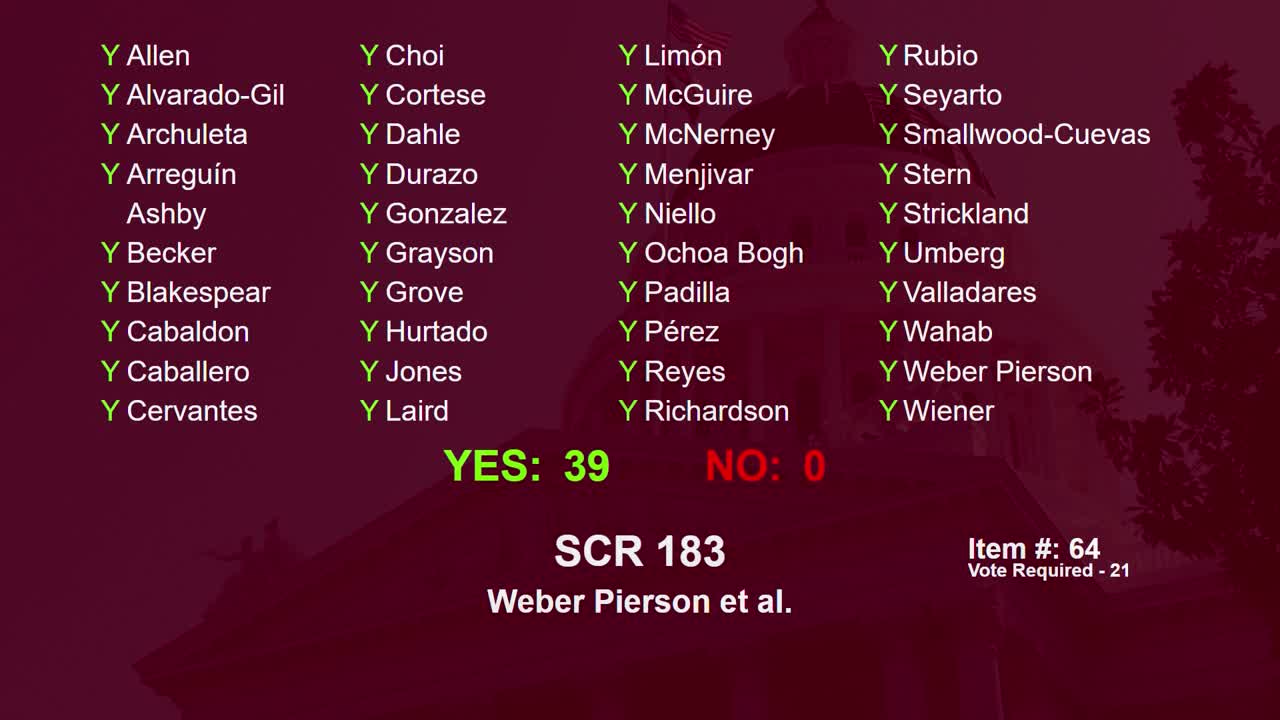
Bill Author
Bill Co-Author(s):