SB 1342: Criminal records: relief.
- Session Year: 2025-2026
- House: Senate
- Latest Version Date: 2026-09-27
Current Status:
Passed
(2026-09-27: Chaptered by Secretary of State. Chapter 702, Statutes of 2026.)
Introduced
In Committee
Awaiting First Chamber Vote
Passed First Chamber
In Committee
Awaiting Second Chamber Vote
Passed Second Chamber
Enacted
What does this bill do?
The bill expands record‑clearing rules for Californians with arrests and convictions. It makes some felony arrests eligible to be cleared when all charges are dismissed and one year passes with no refile, and it tells the Department of Justice to treat a record as having no pending charges after three years of no activity and to treat a person as no longer serving a sentence if it cannot verify completion after seven years from conviction. Courts would be barred from disclosing cleared records except to the person or criminal justice agencies, and must provide a register of action confirming they received and followed the DOJ notice when requested.
The summary is provided by generative AI which can make mistakes. For original language, please view the details in the table below.
Existing law, subject to an appropriation, requires the Department of Justice, on a monthly basis, to review the records in the statewide criminal justice databases and identify persons who are eligible for arrest record relief and automatic conviction record relief. Commencing on October 1, 2024, existing law makes arrest record relief available to an eligible person if the arrest occurred on or after January 1, 1973. Under existing law, a person is eligible for arrest record relief under these provisions if, among other things, the arrest was for a misdemeanor offense and the charge was dismissed.
This bill, on and after October 1, 2029, additionally makes a person eligible for that relief if the arrest was for a felony offense, all charges arising from the arrest were dismissed, one year has elapsed since the date on which the most recent charge arising from the arrest was dismissed, and no charge arising from the arrest was refiled or is pending during that period.
Under existing law, a person is eligible for automatic conviction record relief if the person meets certain requirements, including that it does not appear, based upon information available in the Department of Justices record, that the person is currently serving a sentence of an offense and there is no indication of pending criminal charges.
This bill would, on and after October 1, 2029, require, in determining whether there is a pending criminal charge based on the departments records, the department to conclude that there is no indication of pending criminal charges if at least 3 years have elapsed with no new activity related to that record. The bill would require, in determining whether a person is currently serving a sentence for an offense, the department to conclude that the person is no longer serving a sentence if the department is unable to determine whether a sentence is complete and at least 7 years have passed since the date of conviction.
Existing law, subject to an appropriation, on a monthly basis, requires the department to electronically submit a notice to the superior court having jurisdiction over the criminal case and inform the court of all cases for which a complaint was filed and for which relief was granted pursuant to the provisions above. Existing law, for any certain record retained by the court, prohibits the court from disclosing information concerning a conviction granted relief pursuant to specified provisions, including the above provisions, to any person or entity, in any format, except to the person whose conviction was granted relief or a criminal justice agency.
This bill would, on and after October 1, 2029, expand the above-described prohibition to include other provisions that authorize relief from a conviction. By placing additional duties on court staff, this bill would create a state-mandated local program.
This bill would, on and after October 1, 2029, also require a court, upon the request of the subject of a record granted relief, to furnish a register of action confirming the courts receipt of notification and compliance with a grant of relief for a specified record granted relief under the above provisions.
This bill would incorporate additional changes to Section 1203.425 of the Penal Code proposed by SB 1395 to be operative only if this bill and SB 1395 are enacted and this bill is enacted last.
The California Constitution requires the state to reimburse local agencies and school districts for certain costs mandated by the state. Statutory provisions establish procedures for making that reimbursement.
This bill would provide that, if the Commission on State Mandates determines that the bill contains costs mandated by the state, reimbursement for those costs shall be made pursuant to the statutory provisions noted above.
Existing law, subject to an appropriation, requires the Department of Justice, on a monthly basis, to review the records in the statewide criminal justice databases and identify persons who are eligible for arrest record relief and automatic conviction record relief. Commencing on October 1, 2024, existing law makes arrest record relief available to an eligible person if the arrest occurred on or after January 1, 1973. Under existing law, a person is eligible for arrest record relief under these provisions if, among other things, the arrest was for a misdemeanor offense and the charge was dismissed.
This bill removes the requirement that the arrest be for a misdemeanor offense and would instead make a person eligible for relief pursuant to the above-described provisions if the arrest occurred on or after January 1, 1973, and the charge was dismissed.This bill, on and after October 1, 2029, additionally makes a person eligible for that relief if the arrest was for a felony offense, all charges arising from the arrest were dismissed, one year has elapsed since the date on which the most recent charge arising from the arrest was dismissed, and no charge arising from the arrest was refiled or is pending during that period.
Under existing law, a person is eligible for automatic conviction record relief if the person meets certain requirements, including that it does not appear, based upon information available in the Department of Justices record, that the person is currently serving a sentence of an offense and there is no indication of pending criminal charges.
This bill would would, on and after October 1, 2029, require, in determining whether there is a pending criminal charge based on the departments records, the department to conclude that there is no indication of pending criminal charges if at least 3 years have elapsed with no new activity related to that record. The bill would require, in determining whether a person is currently serving a sentence for an offense, the department to conclude that the person is no longer serving a sentence if the department is unable to determine whether a sentence is complete and at least 7 years have passed since the date of conviction.
Existing law, subject to an appropriation, on a monthly basis, requires the department to electronically submit a notice to the superior court having jurisdiction over the criminal case and inform the court of all cases for which a complaint was filed and for which relief was granted pursuant to the provisions above. Existing law, for any certain record retained by the court, prohibits the court from disclosing information concerning a conviction granted relief pursuant to specified provisions, including the above provisions, to any person or entity, in any format, except to the person whose conviction was granted relief or a criminal justice agency.
This bill would would, on and after October 1, 2029, expand the above-described prohibition to include other provisions that authorize relief from a conviction. The bill would require local summary criminal history information provided by the court to any recipient to include notes for any entries for which relief has been granted, indicating that relief has been granted pursuant to the above provisions and listing the date the court received notice from the department. The bill would require this note to be included in all local criminal databases maintained by the court. By placing additional duties on court staff, this bill would create a state-mandated local program.
This bill would would, on and after October 1, 2029, also require a court, upon the request of the subject of a record granted relief, to furnish a register of action confirming the courts receipt of notification and compliance with a grant of relief for a specified record granted relief under the above provisions.
The California Constitution requires the state to reimburse local agencies and school districts for certain costs mandated by the state. Statutory provisions establish procedures for making that reimbursement.
This bill would provide that, if the Commission on State Mandates determines that the bill contains costs mandated by the state, reimbursement for those costs shall be made pursuant to the statutory provisions noted above.
Existing law, subject to an appropriation, requires the Department of Justice, on a monthly basis, to review the records in the statewide criminal justice databases and identify persons who are eligible for arrest record relief and automatic conviction record relief. Commencing on October 1, 2024, existing law makes arrest record relief available to an eligible person if the arrest occurred on or after January 1, 1973. Under existing law, a person is eligible for arrest record relief under these provisions if, among other things, the arrest was for a misdemeanor offense and the charge was dismissed.
This bill removes the requirement that the arrest be for a misdemeanor offense and would instead make a person eligible for relief pursuant to the above-described provisions if the arrest occurred on or after January 1, 1973, and the charge was dismissed.
Under existing law, a person is eligible for automatic conviction record relief if the person meets certain requirements, including that it does not appear, based upon information available in the Department of Justices record, that the person is currently serving a sentence of an offense and there is no indication of pending criminal charges.
This bill would require, in determining whether there is a pending criminal charge based on the departments records, the department to conclude that there is no indication of pending criminal charges if at least 3 years have elapsed with no new activity related to that record. The bill would require, in determining whether a person is currently serving a sentence for an offense, the department to conclude that the person is no longer serving a sentence if the department is unable to determine whether a sentence is complete and at least 7 years have passed since the date of conviction.
Existing law, subject to an appropriation, on a monthly basis, requires the department to electronically submit a notice to the superior court having jurisdiction over the criminal case and inform the court of all cases for which a complaint was filed and for which relief was granted pursuant to the provisions above. Existing law, for any certain record retained by the court, prohibits the court from disclosing information concerning a conviction granted relief pursuant to specified provisions, including the above provisions, to any person or entity, in any format, except to the person whose conviction was granted relief or a criminal justice agency.
This bill would expand the above-described prohibition to include other provisions that authorize relief from a conviction. The bill would require local summary criminal history information provided by the court to any recipient to include notes for any entries for which relief has been granted, indicating that relief has been granted pursuant to the above provisions and listing the date the court received notice from the department. The bill would require this note to be included in all local criminal databases maintained by the court. By placing additional duties on court staff, this bill would create a state-mandated local program.
This bill would also require a court, upon the request of the subject of a record granted relief, to furnish a register of action confirming the courts receipt of notification and compliance with a grant of relief for a specified record granted relief under the above provisions.
The California Constitution requires the state to reimburse local agencies and school districts for certain costs mandated by the state. Statutory provisions establish procedures for making that reimbursement.
This bill would provide that, if the Commission on State Mandates determines that the bill contains costs mandated by the state, reimbursement for those costs shall be made pursuant to the statutory provisions noted above.
Existing law, subject to an appropriation, requires the Department of Justice, on a monthly basis, to review the records in the statewide criminal justice databases and identify persons who are eligible for arrest record relief and automatic conviction record relief. Commencing on October 1, 2024, existing law makes arrest record relief available to eligible person if the arrest occurred on or after January 1, 1973. Under existing law, a person is eligible for arrest record relief under these provisions if, among other things, the arrest was for a misdemeanor offense and the charge was dismissed.
This bill removes the requirement that the arrest be for a misdemeanor offense and would instead make a person eligible for relief pursuant to the above-described provisions if the arrest occurred on or after January 1, 1973, and the charge was dismissed.
Under existing law, a person is eligible for automatic conviction record relief if the person meets certain requirements, including that it does not appear, based upon information available in the Department of Justices record, that the person is currently serving a sentence of an offense and there is no indication of pending criminal charges.
This bill would require, in determining whether there is a pending criminal charge based on the departments records, the department to conclude that there is no indication of pending criminal charges if at least 3 years have elapsed with no new activity related to that record. The bill would require, in determining whether a person is currently serving a sentence for an offense, the department to conclude that the person is no longer serving a sentence if the department is unable to determine whether a sentence is complete and at least 7 years have passed since the date of conviction.
Existing law, subject to an appropriation, on a monthly basis, requires the department to electronically submit a notice to the superior court having jurisdiction over the criminal case and inform the court of all cases for which a complaint was filed and for which relief was granted pursuant to the provisions above. Existing law, for any certain record retained by the court, prohibits the court from disclosing information concerning a conviction granted relief pursuant to specified provisions, including the above provisions, to any person or entity, in any format, except to the person whose conviction was granted relief or a criminal justice agency.
This bill would require local summary criminal history information provided by the court to any recipient to include notes for any entries for which relief has been granted, indicating that relief has been granted pursuant to the above provisions and listing the date the court received notice from the department. The bill would require this note to be included in all local criminal databases maintained by the court. By placing additional duties on court staff, this bill would create a state-mandated local program.
This bill would also require a court, upon the request of the subject of a record granted relief, to furnish a register of action confirming the courts receipt of notification and compliance with a grant of relief for a specified record granted relief under the above provisions.
The California Constitution requires the state to reimburse local agencies and school districts for certain costs mandated by the state. Statutory provisions establish procedures for making that reimbursement.
This bill would provide that, if the Commission on State Mandates determines that the bill contains costs mandated by the state, reimbursement for those costs shall be made pursuant to the statutory provisions noted above.
(a)(1)On a monthly basis, the Department of Justice shall review the records in the statewide criminal justice databases, and based on information in the state summary criminal history repository, shall identify persons with records of arrest that meet the criteria set forth in paragraph (2) and are eligible for arrest record relief.
(2)A person is eligible for relief pursuant to this section, if the arrest occurred on or after January 1, 1973, and meets any of the following conditions:
(A)The arrest was for a misdemeanor offense and the charge was dismissed.
(B)The arrest was for a misdemeanor offense, there is no indication that criminal proceedings have been initiated, at least one calendar year has elapsed since the date of the arrest, and no conviction occurred, or the arrestee was acquitted of any charges that arose, from that arrest.
(C)(i)The arrest was for a felony offense not described in clause (ii), there is no indication that criminal proceedings have been initiated, at least three calendar years have elapsed since the date of the arrest, and no conviction occurred, or the arrestee was acquitted of any charges arising, from that arrest.
(ii)If the arrest was for an offense punishable by imprisonment in the state prison for eight years or more or by imprisonment pursuant to subdivision (h) of Section 1170 for eight years or more, there is no indication that criminal proceedings have been initiated, at least six years have elapsed since the date of the arrest, and no conviction occurred, or the arrestee was acquitted of any charges arising, from that arrest.
(D)The person successfully completed any of the following, relating to that arrest:
(i)A prefiling diversion program, as defined in subdivision (d) of Section 851.87, administered by a prosecuting attorney in lieu of filing an accusatory pleading.
(ii)A drug diversion program administered by a superior court pursuant to Section 1000.5, or a deferred entry of judgment program pursuant to Section 1000 or 1000.8.
(iii)A pretrial diversion program, pursuant to Section 1000.4.
(iv)A diversion program, pursuant to Section 1001.9.
(v)A diversion program described in Chapter 2.8 (commencing with Section 1001.20), Chapter 2.8A (commencing with Section 1001.35), Chapter 2.81 (commencing with Section 1001.40), Chapter 2.9 (commencing with Section 1001.50), Chapter 2.9A (commencing with Section 1001.60), Chapter 2.9B (commencing with Section 1001.70), Chapter 2.9C (commencing with Section 1001.80), Chapter 2.9D (commencing with Section 1001.81), or Chapter 2.92 (commencing with Section 1001.85), of Title 6.
(b)(1)The department shall grant relief to a person identified pursuant to subdivision (a), without requiring a petition or motion by a party for that relief if the relevant information is present in the departments electronic records.
(2)The state summary criminal history information shall include, directly next to or below the entry or entries regarding the persons arrest record, a note stating arrest relief granted, listing the date that the department granted relief, and this section. This note shall be included in all statewide criminal databases with a record of the arrest.
(3)Except as otherwise provided in subdivision (d), an arrest for which arrest relief has been granted is deemed not to have occurred, and a person who has been granted arrest relief is released from any penalties and disabilities resulting from the arrest, and may answer any question relating to that arrest accordingly.
(c)On a monthly basis, the department shall electronically submit a notice to the superior court having jurisdiction over the criminal case, informing the court of all cases for which a complaint was filed in that jurisdiction and for which relief was granted pursuant to this section. Commencing on August 1, 2022, for any record retained by the court pursuant to Section 68152 of the Government Code, except as provided in subdivision (d), the court shall not disclose information concerning an arrest that is granted relief pursuant to this section to any person or entity, in any format, except to the person whose arrest was granted relief or a criminal justice agency, as defined in Section 851.92.
(d)Relief granted pursuant to this section is subject to all of the following conditions:
(1)Arrest relief does not relieve a person of the obligation to disclose an arrest in response to a direct question contained in a questionnaire or application for employment as a peace officer, as defined in Section 830.
(2)Relief granted pursuant to this section has no effect on the ability of a criminal justice agency, as defined in Section 851.92, to access and use records that are granted relief to the same extent that would have been permitted for a criminal justice agency had relief not been granted.
(3)This section does not limit the ability of a district attorney to prosecute, within the applicable statute of limitations, an offense for which arrest relief has been granted pursuant to this section.
(4)Relief granted pursuant to this section does not affect a persons authorization to own, possess, or have in the persons custody or control a firearm, or the persons susceptibility to conviction under Chapter 2 (commencing with Section 29800) of Division 9 of Title 4 of Part 6, if the arrest would otherwise affect this authorization or susceptibility.
(5)Relief granted pursuant to this section does not affect any prohibition from holding public office that would otherwise apply under law as a result of the arrest.
(6)Relief granted pursuant to this section does not affect the authority to receive, or take adverse action based on, criminal history information, including the authority to receive certified court records received or evaluated pursuant to Section 1522, 1568.09, 1569.17, or 1596.871 of the Health and Safety Code, or pursuant to any statutory or regulatory provisions that incorporate the criteria of those sections.
(e)This section does not limit petitions, motions, or orders for arrest record relief, as required or authorized by any other law, including, but not limited to, Sections 851.87, 851.90, 851.91, 1000.4, and 1001.9.
(f)The department shall annually publish on the OpenJustice Web portal, as described under Section 13010, statistics for each county regarding the total number of arrests granted relief pursuant to this section and the percentage of arrests for which the state summary criminal history information does not include a disposition.
(g)This section shall remain in effect only until October 1, 2029, and, as of January 1, 2030, is repealed.
SEC. 2.Section 851.93 is added to the Penal Code, to read:851.93.(a)(1)On a monthly basis, the Department of Justice shall review the records in the statewide criminal justice databases, and based on information in the state summary criminal history repository, shall identify persons with records of arrest that meet the criteria set forth in paragraph (2) and are eligible for arrest record relief.
(2)A person is eligible for relief pursuant to this section, if the arrest occurred on or after January 1, 1973, and meets any of the following conditions:
(A)The arrest was for a misdemeanor offense and the charge was dismissed.
(B)The arrest was for a felony offense, all charges arising from the arrest were dismissed, one year has elapsed since the date on which the most recent charge arising from the arrest was dismissed, and no charge arising from the arrest was refiled or is pending during that period.
(C)The arrest was for a misdemeanor offense, there is no indication that criminal proceedings have been initiated, at least one calendar year has elapsed since the date of the arrest, and no conviction occurred, or the arrestee was acquitted of any charges that arose, from that arrest.
(D)(i)The arrest was for a felony offense not described in clause (ii), there is no indication that criminal proceedings have been initiated, at least three calendar years have elapsed since the date of the arrest, and no conviction occurred, or the arrestee was acquitted of any charges arising, from that arrest.
(ii)If the arrest was for an offense punishable by imprisonment in the state prison for eight years or more or by imprisonment pursuant to subdivision (h) of Section 1170 for eight years or more, there is no indication that criminal proceedings have been initiated, at least six years have elapsed since the date of the arrest, and no conviction occurred, or the arrestee was acquitted of any charges arising, from that arrest.
(E)The person successfully completed any of the following, relating to that arrest:
(i)A prefiling diversion program, as defined in subdivision (d) of Section 851.87, administered by a prosecuting attorney in lieu of filing an accusatory pleading.
(ii)A drug diversion program administered by a superior court pursuant to Section 1000.5, or a deferred entry of judgment program pursuant to Section 1000 or 1000.8.
(iii)A pretrial diversion program, pursuant to Section 1000.4.
(iv)A diversion program, pursuant to Section 1001.9.
(v)A diversion program described in Chapter 2.8 (commencing with Section 1001.20), Chapter 2.8A (commencing with Section 1001.35), Chapter 2.81 (commencing with Section 1001.40), Chapter 2.9 (commencing with Section 1001.50), Chapter 2.9A (commencing with Section 1001.60), Chapter 2.9B (commencing with Section 1001.70), Chapter 2.9C (commencing with Section 1001.80), Chapter 2.9D (commencing with Section 1001.81), or Chapter 2.92 (commencing with Section 1001.85), of Title 6.
(b)(1)The department shall grant relief to a person identified pursuant to subdivision (a), without requiring a petition or motion by a party for that relief if the relevant information is present in the departments electronic records.
(2)The state summary criminal history information shall include, directly next to or below the entry or entries regarding the persons arrest record, a note stating arrest relief granted, listing the date that the department granted relief, and this section. This note shall be included in all statewide criminal databases with a record of the arrest.
(3)Except as otherwise provided in subdivision (d), an arrest for which arrest relief has been granted is deemed not to have occurred, and a person who has been granted arrest relief is released from any penalties and disabilities resulting from the arrest, and may answer any question relating to that arrest accordingly.
(c)On a monthly basis, the department shall electronically submit a notice to the superior court having jurisdiction over the criminal case, informing the court of all cases for which a complaint was filed in that jurisdiction and for which relief was granted pursuant to this section. Commencing on August 1, 2022, for any record retained by the court pursuant to Section 68152 of the Government Code, except as provided in subdivision (d), the court shall not disclose information concerning an arrest that is granted relief pursuant to this section to any person or entity, in any format, except to the person whose arrest was granted relief or a criminal justice agency, as defined in Section 851.92.
(d)Relief granted pursuant to this section is subject to all of the following conditions:
(1)Arrest relief does not relieve a person of the obligation to disclose an arrest in response to a direct question contained in a questionnaire or application for employment as a peace officer, as defined in Section 830.
(2)Relief granted pursuant to this section has no effect on the ability of a criminal justice agency, as defined in Section 851.92, to access and use records that are granted relief to the same extent that would have been permitted for a criminal justice agency had relief not been granted.
(3)This section does not limit the ability of a district attorney to prosecute, within the applicable statute of limitations, an offense for which arrest relief has been granted pursuant to this section.
(4)Relief granted pursuant to this section does not affect a persons authorization to own, possess, or have in the persons custody or control a firearm, or the persons susceptibility to conviction under Chapter 2 (commencing with Section 29800) of Division 9 of Title 4 of Part 6, if the arrest would otherwise affect this authorization or susceptibility.
(5)Relief granted pursuant to this section does not affect any prohibition from holding public office that would otherwise apply under law as a result of the arrest.
(6)Relief granted pursuant to this section does not affect the authority to receive, or take adverse action based on, criminal history information, including the authority to receive certified court records received or evaluated pursuant to Section 1522, 1568.09, 1569.17, or 1596.871 of the Health and Safety Code, or pursuant to any statutory or regulatory provisions that incorporate the criteria of those sections.
(e)This section does not limit petitions, motions, or orders for arrest record relief, as required or authorized by any other law, including, but not limited to, Sections 851.87, 851.90, 851.91, 1000.4, and 1001.9.
(f)The department shall annually publish on the OpenJustice Web portal, as described under Section 13010, statistics for each county regarding the total number of arrests granted relief pursuant to this section and the percentage of arrests for which the state summary criminal history information does not include a disposition.
(g)This section shall become operative on October 1, 2029.
SEC. 3.Section 1203.425 of the Penal Code is amended to read:1203.425.(a)(1)(A)Commencing October 1, 2024, and subject to an appropriation in the annual Budget Act, on a monthly basis, the Department of Justice shall review the records in the statewide criminal justice databases, and based on information in the state summary criminal history repository and the Supervised Release File, shall identify persons with convictions that meet the criteria set forth in subparagraph (B) and are eligible for automatic conviction record relief.
(B)A person is eligible for automatic conviction relief pursuant to this section if they meet all of the following conditions:
(i)The person is not required to register pursuant to the Sex Offender Registration Act.
(ii)The person does not have an active record for local, state, or federal supervision in the Supervised Release File.
(iii)Based upon the information available in the departments record, including disposition dates and sentencing terms, it does not appear that the person is currently serving a sentence for an offense and there is no indication of pending criminal charges.
(iv)The conviction meets either of the following criteria:
(I)The conviction occurred on or after January 1, 1973, and meets either of the following criteria:
(ia)The defendant was sentenced to probation and, based upon the disposition date and the term of probation specified in the departments records, appears to have completed their term of probation without revocation.
(ib)The defendant was convicted of an infraction or misdemeanor other than one eligible under sub-subclause (ia), and, based upon the disposition date and the term specified in the departments records, the defendant appears to have completed their sentence, and at least one calendar year has elapsed since the date of judgment.
(II)The conviction occurred on or after January 1, 1973, the defendant was convicted of a felony other than one for which the defendant completed probation without revocation, and based upon the disposition date and the sentence specified in the departments records, appears to have completed all terms of incarceration, probation, mandatory supervision, postrelease community supervision, and parole, and a period of four years has elapsed since the date on which the defendant completed probation or supervision for that conviction and during which the defendant was not convicted of a new felony offense. This subclause does not apply to a conviction of a serious felony defined in subdivision (c) of Section 1192.7, a violent felony as defined in Section 667.5, or a felony offense requiring registration pursuant to Chapter 5.5 (commencing with Section 290) of Title 9 of Part 1.
(2)(A)Except as specified in subdivision (b), the department shall grant relief, including dismissal of a conviction, to a person identified pursuant to paragraph (1) without requiring a petition or motion by a party for that relief if the relevant information is present in the departments electronic records.
(B)The state summary criminal history information shall include, directly next to or below the entry or entries regarding the persons criminal record, a note stating relief granted, listing the date that the department granted relief and this section. This note shall be included in all statewide criminal databases with a record of the conviction.
(C)Except as otherwise provided in paragraph (4) and in Section 13555 of the Vehicle Code, a person granted conviction relief pursuant to this section shall be released from all penalties and disabilities resulting from the offense of which the person has been convicted.
(3)(A)Commencing July 1, 2022, and subject to an appropriation in the annual Budget Act, on a monthly basis, the department shall electronically submit a notice to the superior court having jurisdiction over the criminal case, informing the court of all cases for which a complaint was filed in that jurisdiction and for which relief was granted pursuant to this section. Commencing on January 1, 2023, for any record retained by the court pursuant to Section 68152 of the Government Code, except as provided in paragraph (4), the court shall not disclose information concerning a conviction granted relief pursuant to this section or Section 1203.4, 1203.4a, 1203.41, or 1203.42, to any person or entity, in any format, except to the person whose conviction was granted relief or a criminal justice agency, as defined in Section 851.92.
(B)If probation is transferred pursuant to Section 1203.9, the department shall electronically submit a notice as provided in subparagraph (A) to both the transferring court and any subsequent receiving court. The electronic notice shall be in a mutually agreed upon format.
(C)If a receiving court reduces a felony to a misdemeanor pursuant to subdivision (b) of Section 17, or dismisses a conviction pursuant to law, including, but not limited to, Section 1203.4, 1203.4a, 1203.41, 1203.42, 1203.43, or 1203.49, it shall furnish a disposition report to the department with the original case number and CII number from the transferring court. The department shall electronically submit a notice to the superior court that sentenced the defendant. If probation is transferred multiple times, the department shall electronically submit a notice to all other involved courts. The electronic notice shall be in a mutually agreed upon format.
(D)If a court receives notification from the department pursuant to subparagraph (B), the court shall update its records to reflect the reduction or dismissal. If a court receives notification that a case was dismissed pursuant to this section or Section 1203.4, 1203.4a, 1203.41, or 1203.42, the court shall update its records to reflect the dismissal and shall not disclose information concerning a conviction granted relief to any person or entity, in any format, except to the person whose conviction was granted relief or a criminal justice agency, as defined in Section 851.92.
(4)Relief granted pursuant to this section is subject to the following conditions:
(A)Relief granted pursuant to this section does not relieve a person of the obligation to disclose a criminal conviction in response to a direct question contained in a questionnaire or application for employment as a peace officer, as defined in Section 830.
(B)Relief granted pursuant to this section does not relieve a person of the obligation to disclose the conviction in response to a direct question contained in a questionnaire or application for public office, for enrollment as a provider of in-home supportive services and waiver personal care services pursuant to Article 7 (commencing with Section 12300) of Chapter 3 of Part 3 of Division 9 of the Welfare and Institutions Code or pursuant to Section 14132.95, 14132.952, 14132.956, or 14132.97 of the Welfare and Institutions Code, or for contracting with the California State Lottery Commission.
(C)Relief granted pursuant to this section has no effect on the ability of a criminal justice agency, as defined in Section 851.92, to access and use records that are granted relief to the same extent that would have been permitted for a criminal justice agency had relief not been granted.
(D)Relief granted pursuant to this section does not limit the jurisdiction of the court over a subsequently filed motion to amend the record, petition or motion for postconviction relief, or collateral attack on a conviction for which relief has been granted pursuant to this section.
(E)Relief granted pursuant to this section does not affect a persons authorization to own, possess, or have in the persons custody or control a firearm, or the persons susceptibility to conviction under Chapter 2 (commencing with Section 29800) of Division 9 of Title 4 of Part 6, if the criminal conviction would otherwise affect this authorization or susceptibility.
(F)Relief granted pursuant to this section does not affect a prohibition from holding public office that would otherwise apply under law as a result of the criminal conviction.
(G)Relief granted pursuant to this section does not release a person from the terms and conditions of any unexpired criminal protective order that has been issued by the court pursuant to paragraph (1) of subdivision (i) of Section 136.2, subdivision (j) of Section 273.5, subdivision (l) of Section 368, or subdivision (k) of Section 646.9. These protective orders shall remain in full effect until expiration or until any further order by the court modifying or terminating the order, despite the dismissal of the underlying conviction.
(H)Relief granted pursuant to this section does not affect the authority to receive, or take adverse action based on, criminal history information, including the authority to receive certified court records received or evaluated pursuant to Section 1522, 1568.09, 1569.17, or 1596.871 of the Health and Safety Code, or pursuant to any statutory or regulatory provisions that incorporate the criteria of those sections.
(I)Relief granted pursuant to this section does not make eligible a person who is otherwise ineligible under state or federal law or regulation to provide, or receive payment for providing, in-home supportive services and waiver personal care services pursuant to Article 7 (commencing with Section 12300) of Chapter 3 of Part 3 of Division 9 of the Welfare and Institutions Code, or pursuant to Section 14132.95, 14132.952, 14132.956, or 14132.97 of the Welfare and Institutions Code.
(J)In a subsequent prosecution of the defendant for any other offense, the prior conviction may be pleaded and proved and shall have the same effect as if the relief had not been granted.
(K)(i)Relief granted pursuant to this section does not affect the authority to receive, or take adverse action based on, criminal history information, including the authority to receive certified court records received or evaluated pursuant to Article 1 (commencing with Section 44000) of Chapter 1, Article 3 (commencing with Section 44240) and Article 8 (commencing with Section 44330) of Chapter 2, Article 1 (commencing with Section 44420) of Chapter 3, Article 3 (commencing with Section 44930) of Chapter 4, Article 1 (commencing with Section 45100) and Article 6 (commencing with Section 45240) of Chapter 5, of Part 25 of Division 3 of Title 2 of the Education Code, or pursuant to any statutory or regulatory provisions that relate to, incorporate, expand upon, or interpret the authority of those provisions.
(ii)Notwithstanding clause (i) or any other law, information for a conviction for a controlled substance offense listed in Section 11350 or 11377, or former Section 11500 or 11500.5, of the Health and Safety Code that is more than five years old, for which relief is granted pursuant to this section, shall not be disclosed.
(L)Relief granted pursuant to this section does not release the defendant from the terms and conditions of any unexpired criminal protective orders that have been issued by the court pursuant to paragraph (1) of subdivision (i) of Section 136.2, subdivision (j) of Section 273.5, subdivision (l) of Section 368, or subdivision (k) of Section 646.9. These protective orders shall remain in full effect until expiration or until any further order by the court modifying or terminating the order, despite the dismissal of the underlying accusation or information.
(5)This section does not limit petitions, motions, or orders for relief in a criminal case, as required or authorized by any other law, including, but not limited to, Sections 1016.5, 1203.4, 1203.4a, 1203.4b, 1203.41, 1203.42, 1203.49, and 1473.7. This section does not limit petitions for a certificate of rehabilitation or pardon pursuant to Chapter 3.5 (commencing with Section 4852.01) of Title 6 of Part 3.
(6)Commencing July 1, 2022, and subject to an appropriation in the annual Budget Act, the department shall annually publish statistics for each county regarding the total number of convictions granted relief pursuant to this section and the total number of convictions prohibited from automatic relief pursuant to subdivision (b), on the OpenJustice Web portal, as defined in Section 13010.
(7)Upon request from the subject of the record for a copy of their state summary criminal history information record made in accordance with Sections 11122 and 11123, the department shall furnish a copy of the record to the subject of the record or to an individual designated by them in accordance with Section 11124 to provide confirmation that relief was granted pursuant to this section.
(b)(1)The prosecuting attorney or probation department may, no later than 90 calendar days before the date of a persons eligibility for relief pursuant to this section, file a petition to prohibit the department from granting automatic relief pursuant to this section, based on a showing that granting that relief would pose a substantial threat to the public safety. If probation was transferred pursuant to Section 1203.9, the prosecuting attorney or probation department in either the receiving county or the transferring county shall file the petition in the county of current jurisdiction.
(2)The court shall give notice to the defendant and conduct a hearing on the petition within 45 days after the petition is filed.
(3)At a hearing on the petition pursuant to this subdivision, the defendant, the probation department, the prosecuting attorney, and the arresting agency, through the prosecuting attorney, may present evidence to the court. Notwithstanding Sections 1538.5 and 1539, the hearing may be heard and determined upon declarations, affidavits, police investigative reports, copies of state summary criminal history information and local summary criminal history information, or any other evidence submitted by the parties that is material, reliable, and relevant.
(4)The prosecutor or probation department has the initial burden of proof to show that granting conviction relief would pose a substantial threat to the public safety. In determining whether granting relief would pose a substantial threat to the public safety, the court may consider any relevant factors, including, but not limited to, either of the following:
(A)Declarations or evidence regarding the offense for which a grant of relief is being contested.
(B)The defendants record of arrests and convictions.
(5)If the court finds that the prosecutor or probation department has satisfied the burden of proof, the burden shifts to the defendant to show that the hardship of not obtaining relief outweighs the threat to the public safety of providing relief. In determining whether the defendants hardship outweighs the threat to the public safety, the court may consider any relevant factors, including, but not limited to, either of the following:
(A)The hardship to the defendant that has been caused by the conviction and that would be caused if relief is not granted.
(B)Declarations or evidence regarding the defendants good character.
(6)If the court grants a petition pursuant to this subdivision, the court shall furnish a disposition report to the Department of Justice pursuant to Section 13151, stating that relief pursuant to this section was denied, and the department shall not grant relief pursuant to this section. If probation was transferred pursuant to Section 1203.9, the department shall electronically submit a notice to the transferring court, and, if probation was transferred multiple times, to all other involved courts.
(7)A person denied relief pursuant to this section may continue to be eligible for relief pursuant to law, including, but not limited to, Section 1203.4, 1203.4a, 1203.4b, or 1203.41. If the court subsequently grants relief pursuant to one of those sections, the court shall furnish a disposition report to the Department of Justice pursuant to Section 13151, stating that relief was granted pursuant to the applicable section, and the department shall grant relief pursuant to that section. If probation was transferred pursuant to Section 1203.9, the department shall electronically submit a notice that relief was granted pursuant to the applicable section to the transferring court and, if probation was transferred multiple times, to all other involved courts.
(c)At the time of sentencing, the court shall advise a defendant, either orally or in writing, of the provisions of this section and of the defendants right, if any, to petition for a certificate of rehabilitation and pardon.
(d)This section shall remain in effect only until October 1, 2029, and, as of January 1, 2030, is repealed.
SEC. 3.5.Section 1203.425 of the Penal Code is amended to read:1203.425.(a)(1)(A)Commencing October 1, 2024, and subject to an appropriation in the annual Budget Act, on a monthly basis, the Department of Justice shall review the records in the statewide criminal justice databases, and based on information in the state summary criminal history repository and the Supervised Release File, shall identify persons with convictions that meet the criteria set forth in subparagraph (B) and are eligible for automatic conviction record relief.
(B)A person is eligible for automatic conviction relief pursuant to this section if they meet all of the following conditions:
(i)The person is not required to register pursuant to the Sex Offender Registration Act.
(ii)The person does not have an active record for local, state, or federal supervision in the Supervised Release File.
(iii)Based upon the information available in the departments record, including disposition dates and sentencing terms, it does not appear that the person is currently serving a sentence for an offense and there is no indication of pending criminal charges.
(iv)The conviction meets either of the following criteria:
(I)The conviction occurred on or after January 1, 1973, and meets either of the following criteria:
(ia)The defendant was sentenced to probation and, based upon the disposition date and the term of probation specified in the departments records, appears to have completed their term of probation without revocation.
(ib)The defendant was convicted of an infraction or misdemeanor other than one eligible under sub-subclause (ia), and, based upon the disposition date and the term specified in the departments records, the defendant appears to have completed their sentence, and at least one calendar year has elapsed since the date of judgment.
(II)The conviction occurred on or after January 1, 1973, the defendant was convicted of a felony other than one for which the defendant completed probation without revocation, and based upon the disposition date and the sentence specified in the departments records, appears to have completed all terms of incarceration, probation, mandatory supervision, postrelease community supervision, and parole, and a period of four years has elapsed since the date on which the defendant completed probation or supervision for that conviction and during which the defendant was not convicted of a new felony offense. This subclause does not apply to a conviction of a serious felony defined in subdivision (c) of Section 1192.7, a violent felony as defined in Section 667.5, or a felony offense requiring registration pursuant to Chapter 5.5 (commencing with Section 290) of Title 9 of Part 1.
(2)(A)Except as specified in subdivision (b), the department shall grant relief, including dismissal of a conviction, to a person identified pursuant to paragraph (1) without requiring a petition or motion by a party for that relief if the relevant information is present in the departments electronic records.
(B)The state summary criminal history information shall include, directly next to or below the entry or entries regarding the persons criminal record, a note stating relief granted, listing the date that the department granted relief and this section. This note shall be included in all statewide criminal databases with a record of the conviction.
(C)Except as otherwise provided in paragraph (4) and in Section 13555 of the Vehicle Code, a person granted conviction relief pursuant to this section shall be released from all penalties and disabilities resulting from the offense of which the person has been convicted.
(3)(A)Commencing July 1, 2022, and subject to an appropriation in the annual Budget Act, on a monthly basis, the department shall electronically submit a notice to the superior court having jurisdiction over the criminal case, informing the court of all cases for which a complaint was filed in that jurisdiction and for which relief was granted pursuant to this section. Commencing on January 1, 2023, for any record retained by the court pursuant to Section 68152 of the Government Code, except as provided in paragraph (4), the court shall not disclose information concerning a conviction granted relief pursuant to this section or Section 1203.4, 1203.4a, 1203.41, or 1203.42, to any person or entity, in any format, except to the person whose conviction was granted relief or a criminal justice agency, as defined in Section 851.92.
(B)If probation is transferred pursuant to Section 1203.9, the department shall electronically submit a notice as provided in subparagraph (A) to both the transferring court and any subsequent receiving court. The electronic notice shall be in a mutually agreed upon format.
(C)If a receiving court reduces a felony to a misdemeanor pursuant to subdivision (b) of Section 17, or dismisses a conviction pursuant to law, including, but not limited to, Section 1203.4, 1203.4a, 1203.41, 1203.42, 1203.43, or 1203.49, it shall furnish a disposition report to the department with the original case number and CII number from the transferring court. The department shall electronically submit a notice to the superior court that sentenced the defendant. If probation is transferred multiple times, the department shall electronically submit a notice to all other involved courts. The electronic notice shall be in a mutually agreed upon format.
(D)If a court receives notification from the department pursuant to subparagraph (B), the court shall update its records to reflect the reduction or dismissal. If a court receives notification that a case was dismissed pursuant to this section or Section 1203.4, 1203.4a, 1203.41, or 1203.42, the court shall update its records to reflect the dismissal and shall not disclose information concerning a conviction granted relief to any person or entity, in any format, except to the person whose conviction was granted relief or a criminal justice agency, as defined in Section 851.92.
(4)Relief granted pursuant to this section is subject to the following conditions:
(A)Relief granted pursuant to this section does not relieve a person of the obligation to disclose a criminal conviction in response to a direct question contained in a questionnaire or application for employment as a peace officer, as defined in Section 830.
(B)Relief granted pursuant to this section does not relieve a person of the obligation to disclose the conviction in response to a direct question contained in a questionnaire or application for public office, for enrollment as a provider of in-home supportive services and waiver personal care services pursuant to Article 7 (commencing with Section 12300) of Chapter 3 of Part 3 of Division 9 of the Welfare and Institutions Code or pursuant to Section 14132.95, 14132.952, 14132.956, or 14132.97 of the Welfare and Institutions Code, or for contracting with the California State Lottery Commission.
(C)Relief granted pursuant to this section has no effect on the ability of a criminal justice agency, as defined in Section 851.92, to access and use records that are granted relief to the same extent that would have been permitted for a criminal justice agency had relief not been granted.
(D)Relief granted pursuant to this section does not limit the jurisdiction of the court over a subsequently filed motion to amend the record, petition or motion for postconviction relief, or collateral attack on a conviction for which relief has been granted pursuant to this section.
(E)Relief granted pursuant to this section does not affect a persons authorization to own, possess, or have in the persons custody or control a firearm, or the persons susceptibility to conviction under Chapter 2 (commencing with Section 29800) of Division 9 of Title 4 of Part 6, if the criminal conviction would otherwise affect this authorization or susceptibility.
(F)Relief granted pursuant to this section does not affect a prohibition from holding public office that would otherwise apply under law as a result of the criminal conviction.
(G)Relief granted pursuant to this section does not release a person from the terms and conditions of any unexpired criminal protective order that has been issued by the court pursuant to paragraph (1) of subdivision (i) of, or subdivision (j) of, Section 136.2, subdivision (j) of Section 273.5, subdivision (l) of Section 368, or subdivision (k) of Section 646.9. These protective orders shall remain in full effect until expiration or until any further order by the court modifying or terminating the order, despite the dismissal of the underlying conviction.
(H)Relief granted pursuant to this section does not affect the authority to receive, or take adverse action based on, criminal history information, including the authority to receive certified court records received or evaluated pursuant to Section 1522, 1568.09, 1569.17, or 1596.871 of the Health and Safety Code, or pursuant to any statutory or regulatory provisions that incorporate the criteria of those sections.
(I)Relief granted pursuant to this section does not make eligible a person who is otherwise ineligible under state or federal law or regulation to provide, or receive payment for providing, in-home supportive services and waiver personal care services pursuant to Article 7 (commencing with Section 12300) of Chapter 3 of Part 3 of Division 9 of the Welfare and Institutions Code, or pursuant to Section 14132.95, 14132.952, 14132.956, or 14132.97 of the Welfare and Institutions Code.
(J)In a subsequent prosecution of the defendant for any other offense, the prior conviction may be pleaded and proved and shall have the same effect as if the relief had not been granted.
(K)(i)Relief granted pursuant to this section does not affect the authority to receive, or take adverse action based on, criminal history information, including the authority to receive certified court records received or evaluated pursuant to Article 1 (commencing with Section 44000) of Chapter 1, Article 3 (commencing with Section 44240) and Article 8 (commencing with Section 44330) of Chapter 2, Article 1 (commencing with Section 44420) of Chapter 3, Article 3 (commencing with Section 44930) of Chapter 4, Article 1 (commencing with Section 45100) and Article 6 (commencing with Section 45240) of Chapter 5, of Part 25 of Division 3 of Title 2 of the Education Code, or pursuant to any statutory or regulatory provisions that relate to, incorporate, expand upon, or interpret the authority of those provisions.
(ii)Notwithstanding clause (i) or any other law, information for a conviction for a controlled substance offense listed in Section 11350 or 11377, or former Section 11500 or 11500.5, of the Health and Safety Code that is more than five years old, for which relief is granted pursuant to this section, shall not be disclosed.
(L)Relief granted pursuant to this section does not release the defendant from the terms and conditions of any unexpired criminal protective orders that have been issued by the court pursuant to paragraph (1) of subdivision (i) of Section 136.2, subdivision (j) of Section 273.5, subdivision (l) of Section 368, or subdivision (k) of Section 646.9. These protective orders shall remain in full effect until expiration or until any further order by the court modifying or terminating the order, despite the dismissal of the underlying accusation or information.
(5)This section does not limit petitions, motions, or orders for relief in a criminal case, as required or authorized by any other law, including, but not limited to, Sections 1016.5, 1203.4, 1203.4a, 1203.4b, 1203.41, 1203.42, 1203.49, and 1473.7. This section does not limit petitions for a certificate of rehabilitation or pardon pursuant to Chapter 3.5 (commencing with Section 4852.01) of Title 6 of Part 3.
(6)Commencing July 1, 2022, and subject to an appropriation in the annual Budget Act, the department shall annually publish statistics for each county regarding the total number of convictions granted relief pursuant to this section and the total number of convictions prohibited from automatic relief pursuant to subdivision (b), on the OpenJustice Web portal, as defined in Section 13010.
(7)Upon request from the subject of the record for a copy of their state summary criminal history information record made in accordance with Sections 11122 and 11123, the department shall furnish a copy of the record to the subject of the record or to an individual designated by them in accordance with Section 11124 to provide confirmation that relief was granted pursuant to this section.
(b)(1)The prosecuting attorney or probation department may, no later than 90 calendar days before the date of a persons eligibility for relief pursuant to this section, file a petition to prohibit the department from granting automatic relief pursuant to this section, based on a showing that granting that relief would pose a substantial threat to the public safety. If probation was transferred pursuant to Section 1203.9, the prosecuting attorney or probation department in either the receiving county or the transferring county shall file the petition in the county of current jurisdiction.
(2)The court shall give notice to the defendant and conduct a hearing on the petition within 45 days after the petition is filed.
(3)At a hearing on the petition pursuant to this subdivision, the defendant, the probation department, the prosecuting attorney, and the arresting agency, through the prosecuting attorney, may present evidence to the court. Notwithstanding Sections 1538.5 and 1539, the hearing may be heard and determined upon declarations, affidavits, police investigative reports, copies of state summary criminal history information and local summary criminal history information, or any other evidence submitted by the parties that is material, reliable, and relevant.
(4)The prosecutor or probation department has the initial burden of proof to show that granting conviction relief would pose a substantial threat to the public safety. In determining whether granting relief would pose a substantial threat to the public safety, the court may consider any relevant factors, including, but not limited to, either of the following:
(A)Declarations or evidence regarding the offense for which a grant of relief is being contested.
(B)The defendants record of arrests and convictions.
(5)If the court finds that the prosecutor or probation department has satisfied the burden of proof, the burden shifts to the defendant to show that the hardship of not obtaining relief outweighs the threat to the public safety of providing relief. In determining whether the defendants hardship outweighs the threat to the public safety, the court may consider any relevant factors, including, but not limited to, either of the following:
(A)The hardship to the defendant that has been caused by the conviction and that would be caused if relief is not granted.
(B)Declarations or evidence regarding the defendants good character.
(6)If the court grants a petition pursuant to this subdivision, the court shall furnish a disposition report to the Department of Justice pursuant to Section 13151, stating that relief pursuant to this section was denied, and the department shall not grant relief pursuant to this section. If probation was transferred pursuant to Section 1203.9, the department shall electronically submit a notice to the transferring court, and, if probation was transferred multiple times, to all other involved courts.
(7)A person denied relief pursuant to this section may continue to be eligible for relief pursuant to law, including, but not limited to, Section 1203.4, 1203.4a, 1203.4b, or 1203.41. If the court subsequently grants relief pursuant to one of those sections, the court shall furnish a disposition report to the Department of Justice pursuant to Section 13151, stating that relief was granted pursuant to the applicable section, and the department shall grant relief pursuant to that section. If probation was transferred pursuant to Section 1203.9, the department shall electronically submit a notice that relief was granted pursuant to the applicable section to the transferring court and, if probation was transferred multiple times, to all other involved courts.
(c)At the time of sentencing, the court shall advise a defendant, either orally or in writing, of the provisions of this section and of the defendants right, if any, to petition for a certificate of rehabilitation and pardon.
(d)This section shall remain in effect only until October 1, 2029, and, as of January 1, 2030, is repealed.
SEC. 4.Section 1203.425 is added to the Penal Code, to read:1203.425.(a)(1)(A)Commencing October 1, 2024, and subject to an appropriation in the annual Budget Act, on a monthly basis, the Department of Justice shall review the records in the statewide criminal justice databases, and based on information in the state summary criminal history repository and the Supervised Release File, shall identify persons with convictions that meet the criteria set forth in subparagraph (B) and are eligible for automatic conviction record relief.
(B)A person is eligible for automatic conviction relief pursuant to this section if they meet all of the following conditions:
(i)The person is not required to register pursuant to the Sex Offender Registration Act.
(ii)The person does not have an active record for local, state, or federal supervision in the Supervised Release File.
(iii)Based upon the information available in the departments record, including disposition dates and sentencing terms, it does not appear that the person is currently serving a sentence for an offense and there is no indication of pending criminal charges.
(iv)The conviction meets either of the following criteria:
(I)The conviction occurred on or after January 1, 1973, and meets either of the following criteria:
(ia)The defendant was sentenced to probation and, based upon the disposition date and the term of probation specified in the departments records, appears to have completed their term of probation without revocation.
(ib)The defendant was convicted of an infraction or misdemeanor other than one eligible under sub-subclause (ia), and, based upon the disposition date and the term specified in the departments records, the defendant appears to have completed their sentence, and at least one calendar year has elapsed since the date of judgment.
(II)The conviction occurred on or after January 1, 1973, the defendant was convicted of a felony other than one for which the defendant completed probation without revocation, and based upon the disposition date and the sentence specified in the departments records, appears to have completed all terms of incarceration, probation, mandatory supervision, postrelease community supervision, and parole, and a period of four years has elapsed since the date on which the defendant completed probation or supervision for that conviction and during which the defendant was not convicted of a new felony offense. This subclause does not apply to a conviction of a serious felony defined in subdivision (c) of Section 1192.7, a violent felony as defined in Section 667.5, or a felony offense requiring registration pursuant to Chapter 5.5 (commencing with Section 290) of Title 9 of Part 1.
(C)For the purposes of determining whether there are pending criminal charges as provided in clause (iii) of subparagraph (B), if at least three years have elapsed since an indication that criminal proceedings have been initiated with no new activity related to that arrest, the department shall conclude that there is no longer an indication of pending criminal charges.
(D)For the purposes of determining if someone is serving a sentence as provided in clause (iii) of subparagraph (B), if the department is unable to determine whether a sentence is complete and at least seven years have passed since the date of conviction, the department shall conclude that the person is no longer serving that sentence.
(2)(A)Except as specified in subdivision (b), the department shall grant relief, including dismissal of a conviction, to a person identified pursuant to paragraph (1) without requiring a petition or motion by a party for that relief if the relevant information is present in the departments electronic records.
(B)The state summary criminal history information shall include, directly next to or below the entry or entries regarding the persons criminal record, a note stating relief granted, listing the date that the department granted relief and this section. This note shall be included in all statewide criminal databases with a record of the conviction.
(C)Except as otherwise provided in paragraph (4) and in Section 13555 of the Vehicle Code, a person granted conviction relief pursuant to this section shall be released from all penalties and disabilities resulting from the offense of which the person has been convicted.
(3)(A)Commencing July 1, 2022, and subject to an appropriation in the annual Budget Act, on a monthly basis, the department shall electronically submit a notice to the superior court having jurisdiction over the criminal case, informing the court of all cases for which a complaint was filed in that jurisdiction and for which relief was granted pursuant to this section. Commencing on January 1, 2023, for any record retained by the court pursuant to Section 68152 of the Government Code, except as provided in paragraph (4), the court shall not disclose information concerning a conviction granted relief pursuant to this section or Section 1203.4, 1203.4a, 1203.4b, 1203.41, 1203.42, 1203.43, or 1203.49 to any person or entity, in any format, except to the person whose conviction was granted relief or a criminal justice agency, as defined in Section 851.92.
(B)If probation is transferred pursuant to Section 1203.9, the department shall electronically submit a notice as provided in subparagraph (A) to both the transferring court and any subsequent receiving court. The electronic notice shall be in a mutually agreed upon format.
(C)If a receiving court reduces a felony to a misdemeanor pursuant to subdivision (b) of Section 17, or dismisses a conviction pursuant to law, including, but not limited to, Section 1203.4, 1203.4a, 1203.41, 1203.42, 1203.43, or 1203.49, it shall furnish a disposition report to the department with the original case number and CII number from the transferring court. The department shall electronically submit a notice to the superior court that sentenced the defendant. If probation is transferred multiple times, the department shall electronically submit a notice to all other involved courts. The electronic notice shall be in a mutually agreed upon format.
(D)If a court receives notification from the department pursuant to subparagraph (B), the court shall update its records to reflect the reduction or dismissal. If a court receives notification that a case was dismissed pursuant to this section or Section 1203.4, 1203.4a, 1203.4b, 1203.41, 1203.42, 1203.43, or 1203.49, the court shall update its records to reflect the dismissal and shall not disclose information concerning a conviction granted relief to any person or entity, in any format, except to the person whose conviction was granted relief or a criminal justice agency, as defined in Section 851.92.
(4)Relief granted pursuant to this section is subject to the following conditions:
(A)Relief granted pursuant to this section does not relieve a person of the obligation to disclose a criminal conviction in response to a direct question contained in a questionnaire or application for employment as a peace officer, as defined in Section 830.
(B)Relief granted pursuant to this section does not relieve a person of the obligation to disclose the conviction in response to a direct question contained in a questionnaire or application for public office, for enrollment as a provider of in-home supportive services and waiver personal care services pursuant to Article 7 (commencing with Section 12300) of Chapter 3 of Part 3 of Division 9 of the Welfare and Institutions Code or pursuant to Section 14132.95, 14132.952, 14132.956, or 14132.97 of the Welfare and Institutions Code, or for contracting with the California State Lottery Commission.
(C)Relief granted pursuant to this section has no effect on the ability of a criminal justice agency, as defined in Section 851.92, to access and use records that are granted relief to the same extent that would have been permitted for a criminal justice agency had relief not been granted.
(D)Relief granted pursuant to this section does not limit the jurisdiction of the court over a subsequently filed motion to amend the record, petition or motion for postconviction relief, or collateral attack on a conviction for which relief has been granted pursuant to this section.
(E)Relief granted pursuant to this section does not affect a persons authorization to own, possess, or have in the persons custody or control a firearm, or the persons susceptibility to conviction under Chapter 2 (commencing with Section 29800) of Division 9 of Title 4 of Part 6, if the criminal conviction would otherwise affect this authorization or susceptibility.
(F)Relief granted pursuant to this section does not affect a prohibition from holding public office that would otherwise apply under law as a result of the criminal conviction.
(G)Relief granted pursuant to this section does not release a person from the terms and conditions of any unexpired criminal protective order that has been issued by the court pursuant to paragraph (1) of subdivision (i) of Section 136.2, subdivision (j) of Section 273.5, subdivision (l) of Section 368, or subdivision (k) of Section 646.9. These protective orders shall remain in full effect until expiration or until any further order by the court modifying or terminating the order, despite the dismissal of the underlying conviction.
(H)Relief granted pursuant to this section does not affect the authority to receive, or take adverse action based on, criminal history information, including the authority to receive certified court records received or evaluated pursuant to Section 1522, 1568.09, 1569.17, or 1596.871 of the Health and Safety Code, or pursuant to any statutory or regulatory provisions that incorporate the criteria of those sections.
(I)Relief granted pursuant to this section does not make eligible a person who is otherwise ineligible under state or federal law or regulation to provide, or receive payment for providing, in-home supportive services and waiver personal care services pursuant to Article 7 (commencing with Section 12300) of Chapter 3 of Part 3 of Division 9 of the Welfare and Institutions Code, or pursuant to Section 14132.95, 14132.952, 14132.956, or 14132.97 of the Welfare and Institutions Code.
(J)In a subsequent prosecution of the defendant for any other offense, the prior conviction may be pleaded and proved and shall have the same effect as if the relief had not been granted.
(K)(i)Relief granted pursuant to this section does not affect the authority to receive, or take adverse action based on, criminal history information, including the authority to receive certified court records received or evaluated pursuant to Article 1 (commencing with Section 44000) of Chapter 1, Article 3 (commencing with Section 44240) and Article 8 (commencing with Section 44330) of Chapter 2, Article 1 (commencing with Section 44420) of Chapter 3, Article 3 (commencing with Section 44930) of Chapter 4, Article 1 (commencing with Section 45100) and Article 6 (commencing with Section 45240) of Chapter 5, of Part 25 of Division 3 of Title 2 of the Education Code, or pursuant to any statutory or regulatory provisions that relate to, incorporate, expand upon, or interpret the authority of those provisions.
(ii)Notwithstanding clause (i) or any other law, information for a conviction for a controlled substance offense listed in Section 11350 or 11377, or former Section 11500 or 11500.5, of the Health and Safety Code that is more than five years old, for which relief is granted pursuant to this section, shall not be disclosed.
(L)Relief granted pursuant to this section does not release the defendant from the terms and conditions of any unexpired criminal protective orders that have been issued by the court pursuant to paragraph (1) of subdivision (i) of Section 136.2, subdivision (j) of Section 273.5, subdivision (l) of Section 368, or subdivision (k) of Section 646.9. These protective orders shall remain in full effect until expiration or until any further order by the court modifying or terminating the order, despite the dismissal of the underlying accusation or information.
(5)This section does not limit petitions, motions, or orders for relief in a criminal case, as required or authorized by any other law, including, but not limited to, Sections 1016.5, 1203.4, 1203.4a, 1203.4b, 1203.41, 1203.42, 1203.49, and 1473.7. This section does not limit petitions for a certificate of rehabilitation or pardon pursuant to Chapter 3.5 (commencing with Section 4852.01) of Title 6 of Part 3.
(6)Commencing July 1, 2022, and subject to an appropriation in the annual Budget Act, the department shall annually publish statistics for each county regarding the total number of convictions granted relief pursuant to this section and the total number of convictions prohibited from automatic relief pursuant to subdivision (b), on the OpenJustice Web portal, as defined in Section 13010.
(7)Upon request from the subject of the record for a copy of their state summary criminal history information record made in accordance with Sections 11122 and 11123, the department shall furnish a copy of the record to the subject of the record or to an individual designated by them in accordance with Section 11124 to provide confirmation that relief was granted pursuant to this section.
(b)(1)The prosecuting attorney or probation department may, no later than 90 calendar days before the date of a persons eligibility for relief pursuant to this section, file a petition to prohibit the department from granting automatic relief pursuant to this section, based on a showing that granting that relief would pose a substantial threat to the public safety. If probation was transferred pursuant to Section 1203.9, the prosecuting attorney or probation department in either the receiving county or the transferring county shall file the petition in the county of current jurisdiction.
(2)The court shall give notice to the defendant and conduct a hearing on the petition within 45 days after the petition is filed.
(3)At a hearing on the petition pursuant to this subdivision, the defendant, the probation department, the prosecuting attorney, and the arresting agency, through the prosecuting attorney, may present evidence to the court. Notwithstanding Sections 1538.5 and 1539, the hearing may be heard and determined upon declarations, affidavits, police investigative reports, copies of state summary criminal history information and local summary criminal history information, or any other evidence submitted by the parties that is material, reliable, and relevant.
(4)The prosecutor or probation department has the initial burden of proof to show that granting conviction relief would pose a substantial threat to the public safety. In determining whether granting relief would pose a substantial threat to the public safety, the court may consider any relevant factors, including, but not limited to, either of the following:
(A)Declarations or evidence regarding the offense for which a grant of relief is being contested.
(B)The defendants record of arrests and convictions.
(5)If the court finds that the prosecutor or probation department has satisfied the burden of proof, the burden shifts to the defendant to show that the hardship of not obtaining relief outweighs the threat to the public safety of providing relief. In determining whether the defendants hardship outweighs the threat to the public safety, the court may consider any relevant factors, including, but not limited to, either of the following:
(A)The hardship to the defendant that has been caused by the conviction and that would be caused if relief is not granted.
(B)Declarations or evidence regarding the defendants good character.
(6)If the court grants a petition pursuant to this subdivision, the court shall furnish a disposition report to the Department of Justice pursuant to Section 13151, stating that relief pursuant to this section was denied, and the department shall not grant relief pursuant to this section. If probation was transferred pursuant to Section 1203.9, the department shall electronically submit a notice to the transferring court, and, if probation was transferred multiple times, to all other involved courts.
(7)A person denied relief pursuant to this section may continue to be eligible for relief pursuant to law, including, but not limited to, Section 1203.4, 1203.4a, 1203.4b, or 1203.41. If the court subsequently grants relief pursuant to one of those sections, the court shall furnish a disposition report to the Department of Justice pursuant to Section 13151, stating that relief was granted pursuant to the applicable section, and the department shall grant relief pursuant to that section. If probation was transferred pursuant to Section 1203.9, the department shall electronically submit a notice that relief was granted pursuant to the applicable section to the transferring court and, if probation was transferred multiple times, to all other involved courts.
(c)At the time of sentencing, the court shall advise a defendant, either orally or in writing, of the provisions of this section and of the defendants right, if any, to petition for a certificate of rehabilitation and pardon.
(d)Upon the request of the subject of a record granted relief under this section, a court shall furnish a register of action confirming the courts receipt of notification and compliance with a grant of relief for a specified record granted relief under this section.
(e)Except as provided in paragraph (4) of subdivision (a), or otherwise permitted by law, any record of a conviction granted relief under this section shall not be considered to be accurate, relevant, timely, or complete for any purpose.
(f)This section shall become operative on October 1, 2029.
SEC. 4.5.Section 1203.425 is added to the Penal Code, to read:1203.425.(a)(1) (A) Commencing October 1, 2024, and subject to an appropriation in the annual Budget Act, on a monthly basis, the Department of Justice shall review the records in the statewide criminal justice databases, and based on information in the state summary criminal history repository and the Supervised Release File, shall identify persons with convictions that meet the criteria set forth in subparagraph (B) and are eligible for automatic conviction record relief.
(B)A person is eligible for automatic conviction relief pursuant to this section if they meet all of the following conditions:
(i)The person is not required to register pursuant to the Sex Offender Registration Act.
(ii)The person does not have an active record for local, state, or federal supervision in the Supervised Release File.
(iii)Based upon the information available in the departments record, including disposition dates and sentencing terms, it does not appear that the person is currently serving a sentence for an offense and there is no indication of pending criminal charges.
(iv)The conviction meets either of the following criteria:
(I)The conviction occurred on or after January 1, 1973, and meets either of the following criteria:
(ia)The defendant was sentenced to probation and, based upon the disposition date and the term of probation specified in the departments records, appears to have completed their term of probation without revocation.
(ib)The defendant was convicted of an infraction or misdemeanor other than one eligible under sub-subclause (ia), and, based upon the disposition date and the term specified in the departments records, the defendant appears to have completed their sentence, and at least one calendar year has elapsed since the date of judgment.
(II)The conviction occurred on or after January 1, 1973, the defendant was convicted of a felony other than one for which the defendant completed probation without revocation, and based upon the disposition date and the sentence specified in the departments records, appears to have completed all terms of incarceration, probation, mandatory supervision, postrelease community supervision, and parole, and a period of four years has elapsed since the date on which the defendant completed probation or supervision for that conviction and during which the defendant was not convicted of a new felony offense. This subclause does not apply to a conviction of a serious felony defined in subdivision (c) of Section 1192.7, a violent felony as defined in Section 667.5, or a felony offense requiring registration pursuant to Chapter 5.5 (commencing with Section 290) of Title 9 of Part 1.
(C)For the purposes of determining whether there are pending criminal charges as provided in clause (iii) of subparagraph (B), if at least three years have elapsed since an indication that criminal proceedings have been initiated with no new activity related to that arrest, the department shall conclude that there is no longer an indication of pending criminal charges.
(D)For the purposes of determining if someone is serving a sentence as provided in clause (iii) of subparagraph (B), if the department is unable to determine whether a sentence is complete and at least seven years have passed since the date of conviction, the department shall conclude that the person is no longer serving that sentence.
(2)(A) Except as specified in subdivision (b), the department shall grant relief, including dismissal of a conviction, to a person identified pursuant to paragraph (1) without requiring a petition or motion by a party for that relief if the relevant information is present in the departments electronic records.
(B)The state summary criminal history information shall include, directly next to or below the entry or entries regarding the persons criminal record, a note stating relief granted, listing the date that the department granted relief and this section. This note shall be included in all statewide criminal databases with a record of the conviction.
(C)Except as otherwise provided in paragraph (4) and in Section 13555 of the Vehicle Code, a person granted conviction relief pursuant to this section shall be released from all penalties and disabilities resulting from the offense of which the person has been convicted.
(3)(A) Commencing July 1, 2022, and subject to an appropriation in the annual Budget Act, on a monthly basis, the department shall electronically submit a notice to the superior court having jurisdiction over the criminal case, informing the court of all cases for which a complaint was filed in that jurisdiction and for which relief was granted pursuant to this section. Commencing on January 1, 2023, for any record retained by the court pursuant to Section 68152 of the Government Code, except as provided in paragraph (4), the court shall not disclose information concerning a conviction granted relief pursuant to this section or Section 1203.4, 1203.4a, 1203.4b, 1203.41, 1203.42, 1203.43, or 1203.49 to any person or entity, in any format, except to the person whose conviction was granted relief or a criminal justice agency, as defined in Section 851.92.
(B)If probation is transferred pursuant to Section 1203.9, the department shall electronically submit a notice as provided in subparagraph (A) to both the transferring court and any subsequent receiving court. The electronic notice shall be in a mutually agreed upon format.
(C)If a receiving court reduces a felony to a misdemeanor pursuant to subdivision (b) of Section 17, or dismisses a conviction pursuant to law, including, but not limited to, Section 1203.4, 1203.4a, 1203.41, 1203.42, 1203.43, or 1203.49, it shall furnish a disposition report to the department with the original case number and CII number from the transferring court. The department shall electronically submit a notice to the superior court that sentenced the defendant. If probation is transferred multiple times, the department shall electronically submit a notice to all other involved courts. The electronic notice shall be in a mutually agreed upon format.
(D)If a court receives notification from the department pursuant to subparagraph (B), the court shall update its records to reflect the reduction or dismissal. If a court receives notification that a case was dismissed pursuant to this section or Section 1203.4, 1203.4a, 1203.4b, 1203.41, 1203.42, 1203.43, or 1203.49, the court shall update its records to reflect the dismissal and shall not disclose information concerning a conviction granted relief to any person or entity, in any format, except to the person whose conviction was granted relief or a criminal justice agency, as defined in Section 851.92.
(4)Relief granted pursuant to this section is subject to the following conditions:
(A)Relief granted pursuant to this section does not relieve a person of the obligation to disclose a criminal conviction in response to a direct question contained in a questionnaire or application for employment as a peace officer, as defined in Section 830.
(B)Relief granted pursuant to this section does not relieve a person of the obligation to disclose the conviction in response to a direct question contained in a questionnaire or application for public office, for enrollment as a provider of in-home supportive services and waiver personal care services pursuant to Article 7 (commencing with Section 12300) of Chapter 3 of Part 3 of Division 9 of the Welfare and Institutions Code or pursuant to Section 14132.95, 14132.952, 14132.956, or 14132.97 of the Welfare and Institutions Code, or for contracting with the California State Lottery Commission.
(C)Relief granted pursuant to this section has no effect on the ability of a criminal justice agency, as defined in Section 851.92, to access and use records that are granted relief to the same extent that would have been permitted for a criminal justice agency had relief not been granted.
(D)Relief granted pursuant to this section does not limit the jurisdiction of the court over a subsequently filed motion to amend the record, petition or motion for postconviction relief, or collateral attack on a conviction for which relief has been granted pursuant to this section.
(E)Relief granted pursuant to this section does not affect a persons authorization to own, possess, or have in the persons custody or control a firearm, or the persons susceptibility to conviction under Chapter 2 (commencing with Section 29800) of Division 9 of Title 4 of Part 6, if the criminal conviction would otherwise affect this authorization or susceptibility.
(F)Relief granted pursuant to this section does not affect a prohibition from holding public office that would otherwise apply under law as a result of the criminal conviction.
(G)Relief granted pursuant to this section does not release a person from the terms and conditions of any unexpired criminal protective order that has been issued by the court pursuant to paragraph (1) of subdivision (i) of, or subdivision (j) of, Section 136.2, subdivision (j) of Section 273.5, subdivision (l) of Section 368, or subdivision (k) of Section 646.9. These protective orders shall remain in full effect until expiration or until any further order by the court modifying or terminating the order, despite the dismissal of the underlying conviction.
(H)Relief granted pursuant to this section does not affect the authority to receive, or take adverse action based on, criminal history information, including the authority to receive certified court records received or evaluated pursuant to Section 1522, 1568.09, 1569.17, or 1596.871 of the Health and Safety Code, or pursuant to any statutory or regulatory provisions that incorporate the criteria of those sections.
(I)Relief granted pursuant to this section does not make eligible a person who is otherwise ineligible under state or federal law or regulation to provide, or receive payment for providing, in-home supportive services and waiver personal care services pursuant to Article 7 (commencing with Section 12300) of Chapter 3 of Part 3 of Division 9 of the Welfare and Institutions Code, or pursuant to Section 14132.95, 14132.952, 14132.956, or 14132.97 of the Welfare and Institutions Code.
(J)In a subsequent prosecution of the defendant for any other offense, the prior conviction may be pleaded and proved and shall have the same effect as if the relief had not been granted.
(K)(i) Relief granted pursuant to this section does not affect the authority to receive, or take adverse action based on, criminal history information, including the authority to receive certified court records received or evaluated pursuant to Article 1 (commencing with Section 44000) of Chapter 1, Article 3 (commencing with Section 44240) and Article 8 (commencing with Section 44330) of Chapter 2, Article 1 (commencing with Section 44420) of Chapter 3, Article 3 (commencing with Section 44930) of Chapter 4, Article 1 (commencing with Section 45100) and Article 6 (commencing with Section 45240) of Chapter 5, of Part 25 of Division 3 of Title 2 of the Education Code, or pursuant to any statutory or regulatory provisions that relate to, incorporate, expand upon, or interpret the authority of those provisions.
(ii)Notwithstanding clause (i) or any other law, information for a conviction for a controlled substance offense listed in Section 11350 or 11377, or former Section 11500 or 11500.5, of the Health and Safety Code that is more than five years old, for which relief is granted pursuant to this section, shall not be disclosed.
(L)Relief granted pursuant to this section does not release the defendant from the terms and conditions of any unexpired criminal protective orders that have been issued by the court pursuant to paragraph (1) of subdivision (i) of Section 136.2, subdivision (j) of Section 273.5, subdivision (l) of Section 368, or subdivision (k) of Section 646.9. These protective orders shall remain in full effect until expiration or until any further order by the court modifying or terminating the order, despite the dismissal of the underlying accusation or information.
(5)This section does not limit petitions, motions, or orders for relief in a criminal case, as required or authorized by any other law, including, but not limited to, Sections 1016.5, 1203.4, 1203.4a, 1203.4b, 1203.41, 1203.42, 1203.49, and 1473.7. This section does not limit petitions for a certificate of rehabilitation or pardon pursuant to Chapter 3.5 (commencing with Section 4852.01) of Title 6 of Part 3.
(6)Commencing July 1, 2022, and subject to an appropriation in the annual Budget Act, the department shall annually publish statistics for each county regarding the total number of convictions granted relief pursuant to this section and the total number of convictions prohibited from automatic relief pursuant to subdivision (b), on the OpenJustice Web portal, as defined in Section 13010.
(7)Upon request from the subject of the record for a copy of their state summary criminal history information record made in accordance with Sections 11122 and 11123, the department shall furnish a copy of the record to the subject of the record or to an individual designated by them in accordance with Section 11124 to provide confirmation that relief was granted pursuant to this section.
(b)(1) The prosecuting attorney or probation department may, no later than 90 calendar days before the date of a persons eligibility for relief pursuant to this section, file a petition to prohibit the department from granting automatic relief pursuant to this section, based on a showing that granting that relief would pose a substantial threat to the public safety. If probation was transferred pursuant to Section 1203.9, the prosecuting attorney or probation department in either the receiving county or the transferring county shall file the petition in the county of current jurisdiction.
(2)The court shall give notice to the defendant and conduct a hearing on the petition within 45 days after the petition is filed.
(3)At a hearing on the petition pursuant to this subdivision, the defendant, the probation department, the prosecuting attorney, and the arresting agency, through the prosecuting attorney, may present evidence to the court. Notwithstanding Sections 1538.5 and 1539, the hearing may be heard and determined upon declarations, affidavits, police investigative reports, copies of state summary criminal history information and local summary criminal history information, or any other evidence submitted by the parties that is material, reliable, and relevant.
(4)The prosecutor or probation department has the initial burden of proof to show that granting conviction relief would pose a substantial threat to the public safety. In determining whether granting relief would pose a substantial threat to the public safety, the court may consider any relevant factors, including, but not limited to, either of the following:
(A)Declarations or evidence regarding the offense for which a grant of relief is being contested.
(B)The defendants record of arrests and convictions.
(5)If the court finds that the prosecutor or probation department has satisfied the burden of proof, the burden shifts to the defendant to show that the hardship of not obtaining relief outweighs the threat to the public safety of providing relief. In determining whether the defendants hardship outweighs the threat to the public safety, the court may consider any relevant factors, including, but not limited to, either of the following:
(A)The hardship to the defendant that has been caused by the conviction and that would be caused if relief is not granted.
(B)Declarations or evidence regarding the defendants good character.
(6)If the court grants a petition pursuant to this subdivision, the court shall furnish a disposition report to the Department of Justice pursuant to Section 13151, stating that relief pursuant to this section was denied, and the department shall not grant relief pursuant to this section. If probation was transferred pursuant to Section 1203.9, the department shall electronically submit a notice to the transferring court, and, if probation was transferred multiple times, to all other involved courts.
(7)A person denied relief pursuant to this section may continue to be eligible for relief pursuant to law, including, but not limited to, Section 1203.4, 1203.4a, 1203.4b, or 1203.41. If the court subsequently grants relief pursuant to one of those sections, the court shall furnish a disposition report to the Department of Justice pursuant to Section 13151, stating that relief was granted pursuant to the applicable section, and the department shall grant relief pursuant to that section. If probation was transferred pursuant to Section 1203.9, the department shall electronically submit a notice that relief was granted pursuant to the applicable section to the transferring court and, if probation was transferred multiple times, to all other involved courts.
(c)At the time of sentencing, the court shall advise a defendant, either orally or in writing, of the provisions of this section and of the defendants right, if any, to petition for a certificate of rehabilitation and pardon.
(d)Upon the request of the subject of a record granted relief under this section, a court shall furnish a register of action confirming the courts receipt of notification and compliance with a grant of relief for a specified record granted relief under this section.
(e)Except as provided in paragraph (4) of subdivision (a), or otherwise permitted by law, any record of a conviction granted relief under this section shall not be considered to be accurate, relevant, timely, or complete for any purpose.
(f)This section shall become operative on October 1, 2029.
SEC. 5.Sections 3.5 and 4.5 of this bill incorporate amendments to Section 1203.425 of the Penal Code proposed by both this bill and Senate Bill 1395. Those sections of this bill shall only become operative if (1) both bills are enacted and become effective on or before January 1, 2027, (2) this bill amends, repeals, and adds Section 1203.425 of the Penal Code and Senate Bill 1395 amends Section 1203.425 of the Penal Code, and (3) this bill is enacted after Senate Bill 1395, in which case Sections 3 and 4 of this bill shall not become operative.
SEC. 6.If the Commission on State Mandates determines that this act contains costs mandated by the state, reimbursement to local agencies and school districts for those costs shall be made pursuant to Part 7 (commencing with Section 17500) of Division 4 of Title 2 of the Government Code.
(a)(1)On a monthly basis, the Department of Justice shall review the records in the statewide criminal justice databases, and based on information in the state summary criminal history repository, shall identify persons with records of arrest that meet the criteria set forth in paragraph (2) and are eligible for arrest record relief.
(2)A person is eligible for relief pursuant to this section, if the arrest occurred on or after January 1, 1973, and meets any of the following conditions:
(A)The arrest was for a misdemeanor offense and the charge was dismissed.
(B)The arrest was for a misdemeanor offense, there is no indication that criminal proceedings have been initiated, at least one calendar year has elapsed since the date of the arrest, and no conviction occurred, or the arrestee was acquitted of any charges that arose, from that arrest.
(C)(i)The arrest was for a felony offense not described in clause (ii), there is no indication that criminal proceedings have been initiated, at least three calendar years have elapsed since the date of the arrest, and no conviction occurred, or the arrestee was acquitted of any charges arising, from that arrest.
(ii)If the arrest was for an offense punishable by imprisonment in the state prison for eight years or more or by imprisonment pursuant to subdivision (h) of Section 1170 for eight years or more, there is no indication that criminal proceedings have been initiated, at least six years have elapsed since the date of the arrest, and no conviction occurred, or the arrestee was acquitted of any charges arising, from that arrest.
(D)The person successfully completed any of the following, relating to that arrest:
(i)A prefiling diversion program, as defined in subdivision (d) of Section 851.87, administered by a prosecuting attorney in lieu of filing an accusatory pleading.
(ii)A drug diversion program administered by a superior court pursuant to Section 1000.5, or a deferred entry of judgment program pursuant to Section 1000 or 1000.8.
(iii)A pretrial diversion program, pursuant to Section 1000.4.
(iv)A diversion program, pursuant to Section 1001.9.
(v)A diversion program described in Chapter 2.8 (commencing with Section 1001.20), Chapter 2.8A (commencing with Section 1001.35), Chapter 2.81 (commencing with Section 1001.40), Chapter 2.9 (commencing with Section 1001.50), Chapter 2.9A (commencing with Section 1001.60), Chapter 2.9B (commencing with Section 1001.70), Chapter 2.9C (commencing with Section 1001.80), Chapter 2.9D (commencing with Section 1001.81), or Chapter 2.92 (commencing with Section 1001.85), of Title 6.
(b)(1)The department shall grant relief to a person identified pursuant to subdivision (a), without requiring a petition or motion by a party for that relief if the relevant information is present in the departments electronic records.
(2)The state summary criminal history information shall include, directly next to or below the entry or entries regarding the persons arrest record, a note stating arrest relief granted, listing the date that the department granted relief, and this section. This note shall be included in all statewide criminal databases with a record of the arrest.
(3)Except as otherwise provided in subdivision (d), an arrest for which arrest relief has been granted is deemed not to have occurred, and a person who has been granted arrest relief is released from any penalties and disabilities resulting from the arrest, and may answer any question relating to that arrest accordingly.
(c)On a monthly basis, the department shall electronically submit a notice to the superior court having jurisdiction over the criminal case, informing the court of all cases for which a complaint was filed in that jurisdiction and for which relief was granted pursuant to this section. Commencing on August 1, 2022, for any record retained by the court pursuant to Section 68152 of the Government Code, except as provided in subdivision (d), the court shall not disclose information concerning an arrest that is granted relief pursuant to this section to any person or entity, in any format, except to the person whose arrest was granted relief or a criminal justice agency, as defined in Section 851.92.
(d)Relief granted pursuant to this section is subject to all of the following conditions:
(1)Arrest relief does not relieve a person of the obligation to disclose an arrest in response to a direct question contained in a questionnaire or application for employment as a peace officer, as defined in Section 830.
(2)Relief granted pursuant to this section has no effect on the ability of a criminal justice agency, as defined in Section 851.92, to access and use records that are granted relief to the same extent that would have been permitted for a criminal justice agency had relief not been granted.
(3)This section does not limit the ability of a district attorney to prosecute, within the applicable statute of limitations, an offense for which arrest relief has been granted pursuant to this section.
(4)Relief granted pursuant to this section does not affect a persons authorization to own, possess, or have in the persons custody or control a firearm, or the persons susceptibility to conviction under Chapter 2 (commencing with Section 29800) of Division 9 of Title 4 of Part 6, if the arrest would otherwise affect this authorization or susceptibility.
(5)Relief granted pursuant to this section does not affect any prohibition from holding public office that would otherwise apply under law as a result of the arrest.
(6)Relief granted pursuant to this section does not affect the authority to receive, or take adverse action based on, criminal history information, including the authority to receive certified court records received or evaluated pursuant to Section 1522, 1568.09, 1569.17, or 1596.871 of the Health and Safety Code, or pursuant to any statutory or regulatory provisions that incorporate the criteria of those sections.
(e)This section does not limit petitions, motions, or orders for arrest record relief, as required or authorized by any other law, including, but not limited to, Sections 851.87, 851.90, 851.91, 1000.4, and 1001.9.
(f)The department shall annually publish on the OpenJustice Web portal, as described under Section 13010, statistics for each county regarding the total number of arrests granted relief pursuant to this section and the percentage of arrests for which the state summary criminal history information does not include a disposition.
(g)This section shall remain in effect only until October 1, 2029, and, as of January 1, 2030, is repealed.
SEC. 2.Section 851.93 is added to the Penal Code, to read:851.93.(a)(1)On a monthly basis, the Department of Justice shall review the records in the statewide criminal justice databases, and based on information in the state summary criminal history repository, shall identify persons with records of arrest that meet the criteria set forth in paragraph (2) and are eligible for arrest record relief.
(2)A person is eligible for relief pursuant to this section, if the arrest occurred on or after January 1, 1973, and meets any of the following conditions:
(A)The arrest was for a misdemeanor offense and the charge was dismissed.
(B)The arrest was for a felony offense, all charges arising from the arrest were dismissed, one year has elapsed since the date on which the most recent charge arising from the arrest was dismissed, and no charge arising from the arrest was refiled or is pending during that period.
(C)The arrest was for a misdemeanor offense, there is no indication that criminal proceedings have been initiated, at least one calendar year has elapsed since the date of the arrest, and no conviction occurred, or the arrestee was acquitted of any charges that arose, from that arrest.
(D)(i)The arrest was for a felony offense not described in clause (ii), there is no indication that criminal proceedings have been initiated, at least three calendar years have elapsed since the date of the arrest, and no conviction occurred, or the arrestee was acquitted of any charges arising, from that arrest.
(ii)If the arrest was for an offense punishable by imprisonment in the state prison for eight years or more or by imprisonment pursuant to subdivision (h) of Section 1170 for eight years or more, there is no indication that criminal proceedings have been initiated, at least six years have elapsed since the date of the arrest, and no conviction occurred, or the arrestee was acquitted of any charges arising, from that arrest.
(E)The person successfully completed any of the following, relating to that arrest:
(i)A prefiling diversion program, as defined in subdivision (d) of Section 851.87, administered by a prosecuting attorney in lieu of filing an accusatory pleading.
(ii)A drug diversion program administered by a superior court pursuant to Section 1000.5, or a deferred entry of judgment program pursuant to Section 1000 or 1000.8.
(iii)A pretrial diversion program, pursuant to Section 1000.4.
(iv)A diversion program, pursuant to Section 1001.9.
(v)A diversion program described in Chapter 2.8 (commencing with Section 1001.20), Chapter 2.8A (commencing with Section 1001.35), Chapter 2.81 (commencing with Section 1001.40), Chapter 2.9 (commencing with Section 1001.50), Chapter 2.9A (commencing with Section 1001.60), Chapter 2.9B (commencing with Section 1001.70), Chapter 2.9C (commencing with Section 1001.80), Chapter 2.9D (commencing with Section 1001.81), or Chapter 2.92 (commencing with Section 1001.85), of Title 6.
(b)(1)The department shall grant relief to a person identified pursuant to subdivision (a), without requiring a petition or motion by a party for that relief if the relevant information is present in the departments electronic records.
(2)The state summary criminal history information shall include, directly next to or below the entry or entries regarding the persons arrest record, a note stating arrest relief granted, listing the date that the department granted relief, and this section. This note shall be included in all statewide criminal databases with a record of the arrest.
(3)Except as otherwise provided in subdivision (d), an arrest for which arrest relief has been granted is deemed not to have occurred, and a person who has been granted arrest relief is released from any penalties and disabilities resulting from the arrest, and may answer any question relating to that arrest accordingly.
(c)On a monthly basis, the department shall electronically submit a notice to the superior court having jurisdiction over the criminal case, informing the court of all cases for which a complaint was filed in that jurisdiction and for which relief was granted pursuant to this section. Commencing on August 1, 2022, for any record retained by the court pursuant to Section 68152 of the Government Code, except as provided in subdivision (d), the court shall not disclose information concerning an arrest that is granted relief pursuant to this section to any person or entity, in any format, except to the person whose arrest was granted relief or a criminal justice agency, as defined in Section 851.92.
(d)Relief granted pursuant to this section is subject to all of the following conditions:
(1)Arrest relief does not relieve a person of the obligation to disclose an arrest in response to a direct question contained in a questionnaire or application for employment as a peace officer, as defined in Section 830.
(2)Relief granted pursuant to this section has no effect on the ability of a criminal justice agency, as defined in Section 851.92, to access and use records that are granted relief to the same extent that would have been permitted for a criminal justice agency had relief not been granted.
(3)This section does not limit the ability of a district attorney to prosecute, within the applicable statute of limitations, an offense for which arrest relief has been granted pursuant to this section.
(4)Relief granted pursuant to this section does not affect a persons authorization to own, possess, or have in the persons custody or control a firearm, or the persons susceptibility to conviction under Chapter 2 (commencing with Section 29800) of Division 9 of Title 4 of Part 6, if the arrest would otherwise affect this authorization or susceptibility.
(5)Relief granted pursuant to this section does not affect any prohibition from holding public office that would otherwise apply under law as a result of the arrest.
(6)Relief granted pursuant to this section does not affect the authority to receive, or take adverse action based on, criminal history information, including the authority to receive certified court records received or evaluated pursuant to Section 1522, 1568.09, 1569.17, or 1596.871 of the Health and Safety Code, or pursuant to any statutory or regulatory provisions that incorporate the criteria of those sections.
(e)This section does not limit petitions, motions, or orders for arrest record relief, as required or authorized by any other law, including, but not limited to, Sections 851.87, 851.90, 851.91, 1000.4, and 1001.9.
(f)The department shall annually publish on the OpenJustice Web portal, as described under Section 13010, statistics for each county regarding the total number of arrests granted relief pursuant to this section and the percentage of arrests for which the state summary criminal history information does not include a disposition.
(g)This section shall become operative on October 1, 2029.
SEC. 3.Section 1203.425 of the Penal Code is amended to read:1203.425.(a)(1)(A)Commencing October 1, 2024, and subject to an appropriation in the annual Budget Act, on a monthly basis, the Department of Justice shall review the records in the statewide criminal justice databases, and based on information in the state summary criminal history repository and the Supervised Release File, shall identify persons with convictions that meet the criteria set forth in subparagraph (B) and are eligible for automatic conviction record relief.
(B)A person is eligible for automatic conviction relief pursuant to this section if they meet all of the following conditions:
(i)The person is not required to register pursuant to the Sex Offender Registration Act.
(ii)The person does not have an active record for local, state, or federal supervision in the Supervised Release File.
(iii)Based upon the information available in the departments record, including disposition dates and sentencing terms, it does not appear that the person is currently serving a sentence for an offense and there is no indication of pending criminal charges.
(iv)The conviction meets either of the following criteria:
(I)The conviction occurred on or after January 1, 1973, and meets either of the following criteria:
(ia)The defendant was sentenced to probation and, based upon the disposition date and the term of probation specified in the departments records, appears to have completed their term of probation without revocation.
(ib)The defendant was convicted of an infraction or misdemeanor other than one eligible under sub-subclause (ia), and, based upon the disposition date and the term specified in the departments records, the defendant appears to have completed their sentence, and at least one calendar year has elapsed since the date of judgment.
(II)The conviction occurred on or after January 1, 1973, the defendant was convicted of a felony other than one for which the defendant completed probation without revocation, and based upon the disposition date and the sentence specified in the departments records, appears to have completed all terms of incarceration, probation, mandatory supervision, postrelease community supervision, and parole, and a period of four years has elapsed since the date on which the defendant completed probation or supervision for that conviction and during which the defendant was not convicted of a new felony offense. This subclause does not apply to a conviction of a serious felony defined in subdivision (c) of Section 1192.7, a violent felony as defined in Section 667.5, or a felony offense requiring registration pursuant to Chapter 5.5 (commencing with Section 290) of Title 9 of Part 1.
(2)(A)Except as specified in subdivision (b), the department shall grant relief, including dismissal of a conviction, to a person identified pursuant to paragraph (1) without requiring a petition or motion by a party for that relief if the relevant information is present in the departments electronic records.
(B)The state summary criminal history information shall include, directly next to or below the entry or entries regarding the persons criminal record, a note stating relief granted, listing the date that the department granted relief and this section. This note shall be included in all statewide criminal databases with a record of the conviction.
(C)Except as otherwise provided in paragraph (4) and in Section 13555 of the Vehicle Code, a person granted conviction relief pursuant to this section shall be released from all penalties and disabilities resulting from the offense of which the person has been convicted.
(3)(A)Commencing July 1, 2022, and subject to an appropriation in the annual Budget Act, on a monthly basis, the department shall electronically submit a notice to the superior court having jurisdiction over the criminal case, informing the court of all cases for which a complaint was filed in that jurisdiction and for which relief was granted pursuant to this section. Commencing on January 1, 2023, for any record retained by the court pursuant to Section 68152 of the Government Code, except as provided in paragraph (4), the court shall not disclose information concerning a conviction granted relief pursuant to this section or Section 1203.4, 1203.4a, 1203.41, or 1203.42, to any person or entity, in any format, except to the person whose conviction was granted relief or a criminal justice agency, as defined in Section 851.92.
(B)If probation is transferred pursuant to Section 1203.9, the department shall electronically submit a notice as provided in subparagraph (A) to both the transferring court and any subsequent receiving court. The electronic notice shall be in a mutually agreed upon format.
(C)If a receiving court reduces a felony to a misdemeanor pursuant to subdivision (b) of Section 17, or dismisses a conviction pursuant to law, including, but not limited to, Section 1203.4, 1203.4a, 1203.41, 1203.42, 1203.43, or 1203.49, it shall furnish a disposition report to the department with the original case number and CII number from the transferring court. The department shall electronically submit a notice to the superior court that sentenced the defendant. If probation is transferred multiple times, the department shall electronically submit a notice to all other involved courts. The electronic notice shall be in a mutually agreed upon format.
(D)If a court receives notification from the department pursuant to subparagraph (B), the court shall update its records to reflect the reduction or dismissal. If a court receives notification that a case was dismissed pursuant to this section or Section 1203.4, 1203.4a, 1203.41, or 1203.42, the court shall update its records to reflect the dismissal and shall not disclose information concerning a conviction granted relief to any person or entity, in any format, except to the person whose conviction was granted relief or a criminal justice agency, as defined in Section 851.92.
(4)Relief granted pursuant to this section is subject to the following conditions:
(A)Relief granted pursuant to this section does not relieve a person of the obligation to disclose a criminal conviction in response to a direct question contained in a questionnaire or application for employment as a peace officer, as defined in Section 830.
(B)Relief granted pursuant to this section does not relieve a person of the obligation to disclose the conviction in response to a direct question contained in a questionnaire or application for public office, for enrollment as a provider of in-home supportive services and waiver personal care services pursuant to Article 7 (commencing with Section 12300) of Chapter 3 of Part 3 of Division 9 of the Welfare and Institutions Code or pursuant to Section 14132.95, 14132.952, 14132.956, or 14132.97 of the Welfare and Institutions Code, or for contracting with the California State Lottery Commission.
(C)Relief granted pursuant to this section has no effect on the ability of a criminal justice agency, as defined in Section 851.92, to access and use records that are granted relief to the same extent that would have been permitted for a criminal justice agency had relief not been granted.
(D)Relief granted pursuant to this section does not limit the jurisdiction of the court over a subsequently filed motion to amend the record, petition or motion for postconviction relief, or collateral attack on a conviction for which relief has been granted pursuant to this section.
(E)Relief granted pursuant to this section does not affect a persons authorization to own, possess, or have in the persons custody or control a firearm, or the persons susceptibility to conviction under Chapter 2 (commencing with Section 29800) of Division 9 of Title 4 of Part 6, if the criminal conviction would otherwise affect this authorization or susceptibility.
(F)Relief granted pursuant to this section does not affect a prohibition from holding public office that would otherwise apply under law as a result of the criminal conviction.
(G)Relief granted pursuant to this section does not release a person from the terms and conditions of any unexpired criminal protective order that has been issued by the court pursuant to paragraph (1) of subdivision (i) of Section 136.2, subdivision (j) of Section 273.5, subdivision (l) of Section 368, or subdivision (k) of Section 646.9. These protective orders shall remain in full effect until expiration or until any further order by the court modifying or terminating the order, despite the dismissal of the underlying conviction.
(H)Relief granted pursuant to this section does not affect the authority to receive, or take adverse action based on, criminal history information, including the authority to receive certified court records received or evaluated pursuant to Section 1522, 1568.09, 1569.17, or 1596.871 of the Health and Safety Code, or pursuant to any statutory or regulatory provisions that incorporate the criteria of those sections.
(I)Relief granted pursuant to this section does not make eligible a person who is otherwise ineligible under state or federal law or regulation to provide, or receive payment for providing, in-home supportive services and waiver personal care services pursuant to Article 7 (commencing with Section 12300) of Chapter 3 of Part 3 of Division 9 of the Welfare and Institutions Code, or pursuant to Section 14132.95, 14132.952, 14132.956, or 14132.97 of the Welfare and Institutions Code.
(J)In a subsequent prosecution of the defendant for any other offense, the prior conviction may be pleaded and proved and shall have the same effect as if the relief had not been granted.
(K)(i)Relief granted pursuant to this section does not affect the authority to receive, or take adverse action based on, criminal history information, including the authority to receive certified court records received or evaluated pursuant to Article 1 (commencing with Section 44000) of Chapter 1, Article 3 (commencing with Section 44240) and Article 8 (commencing with Section 44330) of Chapter 2, Article 1 (commencing with Section 44420) of Chapter 3, Article 3 (commencing with Section 44930) of Chapter 4, Article 1 (commencing with Section 45100) and Article 6 (commencing with Section 45240) of Chapter 5, of Part 25 of Division 3 of Title 2 of the Education Code, or pursuant to any statutory or regulatory provisions that relate to, incorporate, expand upon, or interpret the authority of those provisions.
(ii)Notwithstanding clause (i) or any other law, information for a conviction for a controlled substance offense listed in Section 11350 or 11377, or former Section 11500 or 11500.5, of the Health and Safety Code that is more than five years old, for which relief is granted pursuant to this section, shall not be disclosed.
(L)Relief granted pursuant to this section does not release the defendant from the terms and conditions of any unexpired criminal protective orders that have been issued by the court pursuant to paragraph (1) of subdivision (i) of Section 136.2, subdivision (j) of Section 273.5, subdivision (l) of Section 368, or subdivision (k) of Section 646.9. These protective orders shall remain in full effect until expiration or until any further order by the court modifying or terminating the order, despite the dismissal of the underlying accusation or information.
(5)This section does not limit petitions, motions, or orders for relief in a criminal case, as required or authorized by any other law, including, but not limited to, Sections 1016.5, 1203.4, 1203.4a, 1203.4b, 1203.41, 1203.42, 1203.49, and 1473.7. This section does not limit petitions for a certificate of rehabilitation or pardon pursuant to Chapter 3.5 (commencing with Section 4852.01) of Title 6 of Part 3.
(6)Commencing July 1, 2022, and subject to an appropriation in the annual Budget Act, the department shall annually publish statistics for each county regarding the total number of convictions granted relief pursuant to this section and the total number of convictions prohibited from automatic relief pursuant to subdivision (b), on the OpenJustice Web portal, as defined in Section 13010.
(7)Upon request from the subject of the record for a copy of their state summary criminal history information record made in accordance with Sections 11122 and 11123, the department shall furnish a copy of the record to the subject of the record or to an individual designated by them in accordance with Section 11124 to provide confirmation that relief was granted pursuant to this section.
(b)(1)The prosecuting attorney or probation department may, no later than 90 calendar days before the date of a persons eligibility for relief pursuant to this section, file a petition to prohibit the department from granting automatic relief pursuant to this section, based on a showing that granting that relief would pose a substantial threat to the public safety. If probation was transferred pursuant to Section 1203.9, the prosecuting attorney or probation department in either the receiving county or the transferring county shall file the petition in the county of current jurisdiction.
(2)The court shall give notice to the defendant and conduct a hearing on the petition within 45 days after the petition is filed.
(3)At a hearing on the petition pursuant to this subdivision, the defendant, the probation department, the prosecuting attorney, and the arresting agency, through the prosecuting attorney, may present evidence to the court. Notwithstanding Sections 1538.5 and 1539, the hearing may be heard and determined upon declarations, affidavits, police investigative reports, copies of state summary criminal history information and local summary criminal history information, or any other evidence submitted by the parties that is material, reliable, and relevant.
(4)The prosecutor or probation department has the initial burden of proof to show that granting conviction relief would pose a substantial threat to the public safety. In determining whether granting relief would pose a substantial threat to the public safety, the court may consider any relevant factors, including, but not limited to, either of the following:
(A)Declarations or evidence regarding the offense for which a grant of relief is being contested.
(B)The defendants record of arrests and convictions.
(5)If the court finds that the prosecutor or probation department has satisfied the burden of proof, the burden shifts to the defendant to show that the hardship of not obtaining relief outweighs the threat to the public safety of providing relief. In determining whether the defendants hardship outweighs the threat to the public safety, the court may consider any relevant factors, including, but not limited to, either of the following:
(A)The hardship to the defendant that has been caused by the conviction and that would be caused if relief is not granted.
(B)Declarations or evidence regarding the defendants good character.
(6)If the court grants a petition pursuant to this subdivision, the court shall furnish a disposition report to the Department of Justice pursuant to Section 13151, stating that relief pursuant to this section was denied, and the department shall not grant relief pursuant to this section. If probation was transferred pursuant to Section 1203.9, the department shall electronically submit a notice to the transferring court, and, if probation was transferred multiple times, to all other involved courts.
(7)A person denied relief pursuant to this section may continue to be eligible for relief pursuant to law, including, but not limited to, Section 1203.4, 1203.4a, 1203.4b, or 1203.41. If the court subsequently grants relief pursuant to one of those sections, the court shall furnish a disposition report to the Department of Justice pursuant to Section 13151, stating that relief was granted pursuant to the applicable section, and the department shall grant relief pursuant to that section. If probation was transferred pursuant to Section 1203.9, the department shall electronically submit a notice that relief was granted pursuant to the applicable section to the transferring court and, if probation was transferred multiple times, to all other involved courts.
(c)At the time of sentencing, the court shall advise a defendant, either orally or in writing, of the provisions of this section and of the defendants right, if any, to petition for a certificate of rehabilitation and pardon.
(d)This section shall remain in effect only until October 1, 2029, and, as of January 1, 2030, is repealed.
SEC. 3.5.Section 1203.425 of the Penal Code is amended to read:1203.425.(a)(1)(A)Commencing October 1, 2024, and subject to an appropriation in the annual Budget Act, on a monthly basis, the Department of Justice shall review the records in the statewide criminal justice databases, and based on information in the state summary criminal history repository and the Supervised Release File, shall identify persons with convictions that meet the criteria set forth in subparagraph (B) and are eligible for automatic conviction record relief.
(B)A person is eligible for automatic conviction relief pursuant to this section if they meet all of the following conditions:
(i)The person is not required to register pursuant to the Sex Offender Registration Act.
(ii)The person does not have an active record for local, state, or federal supervision in the Supervised Release File.
(iii)Based upon the information available in the departments record, including disposition dates and sentencing terms, it does not appear that the person is currently serving a sentence for an offense and there is no indication of pending criminal charges.
(iv)The conviction meets either of the following criteria:
(I)The conviction occurred on or after January 1, 1973, and meets either of the following criteria:
(ia)The defendant was sentenced to probation and, based upon the disposition date and the term of probation specified in the departments records, appears to have completed their term of probation without revocation.
(ib)The defendant was convicted of an infraction or misdemeanor other than one eligible under sub-subclause (ia), and, based upon the disposition date and the term specified in the departments records, the defendant appears to have completed their sentence, and at least one calendar year has elapsed since the date of judgment.
(II)The conviction occurred on or after January 1, 1973, the defendant was convicted of a felony other than one for which the defendant completed probation without revocation, and based upon the disposition date and the sentence specified in the departments records, appears to have completed all terms of incarceration, probation, mandatory supervision, postrelease community supervision, and parole, and a period of four years has elapsed since the date on which the defendant completed probation or supervision for that conviction and during which the defendant was not convicted of a new felony offense. This subclause does not apply to a conviction of a serious felony defined in subdivision (c) of Section 1192.7, a violent felony as defined in Section 667.5, or a felony offense requiring registration pursuant to Chapter 5.5 (commencing with Section 290) of Title 9 of Part 1.
(2)(A)Except as specified in subdivision (b), the department shall grant relief, including dismissal of a conviction, to a person identified pursuant to paragraph (1) without requiring a petition or motion by a party for that relief if the relevant information is present in the departments electronic records.
(B)The state summary criminal history information shall include, directly next to or below the entry or entries regarding the persons criminal record, a note stating relief granted, listing the date that the department granted relief and this section. This note shall be included in all statewide criminal databases with a record of the conviction.
(C)Except as otherwise provided in paragraph (4) and in Section 13555 of the Vehicle Code, a person granted conviction relief pursuant to this section shall be released from all penalties and disabilities resulting from the offense of which the person has been convicted.
(3)(A)Commencing July 1, 2022, and subject to an appropriation in the annual Budget Act, on a monthly basis, the department shall electronically submit a notice to the superior court having jurisdiction over the criminal case, informing the court of all cases for which a complaint was filed in that jurisdiction and for which relief was granted pursuant to this section. Commencing on January 1, 2023, for any record retained by the court pursuant to Section 68152 of the Government Code, except as provided in paragraph (4), the court shall not disclose information concerning a conviction granted relief pursuant to this section or Section 1203.4, 1203.4a, 1203.41, or 1203.42, to any person or entity, in any format, except to the person whose conviction was granted relief or a criminal justice agency, as defined in Section 851.92.
(B)If probation is transferred pursuant to Section 1203.9, the department shall electronically submit a notice as provided in subparagraph (A) to both the transferring court and any subsequent receiving court. The electronic notice shall be in a mutually agreed upon format.
(C)If a receiving court reduces a felony to a misdemeanor pursuant to subdivision (b) of Section 17, or dismisses a conviction pursuant to law, including, but not limited to, Section 1203.4, 1203.4a, 1203.41, 1203.42, 1203.43, or 1203.49, it shall furnish a disposition report to the department with the original case number and CII number from the transferring court. The department shall electronically submit a notice to the superior court that sentenced the defendant. If probation is transferred multiple times, the department shall electronically submit a notice to all other involved courts. The electronic notice shall be in a mutually agreed upon format.
(D)If a court receives notification from the department pursuant to subparagraph (B), the court shall update its records to reflect the reduction or dismissal. If a court receives notification that a case was dismissed pursuant to this section or Section 1203.4, 1203.4a, 1203.41, or 1203.42, the court shall update its records to reflect the dismissal and shall not disclose information concerning a conviction granted relief to any person or entity, in any format, except to the person whose conviction was granted relief or a criminal justice agency, as defined in Section 851.92.
(4)Relief granted pursuant to this section is subject to the following conditions:
(A)Relief granted pursuant to this section does not relieve a person of the obligation to disclose a criminal conviction in response to a direct question contained in a questionnaire or application for employment as a peace officer, as defined in Section 830.
(B)Relief granted pursuant to this section does not relieve a person of the obligation to disclose the conviction in response to a direct question contained in a questionnaire or application for public office, for enrollment as a provider of in-home supportive services and waiver personal care services pursuant to Article 7 (commencing with Section 12300) of Chapter 3 of Part 3 of Division 9 of the Welfare and Institutions Code or pursuant to Section 14132.95, 14132.952, 14132.956, or 14132.97 of the Welfare and Institutions Code, or for contracting with the California State Lottery Commission.
(C)Relief granted pursuant to this section has no effect on the ability of a criminal justice agency, as defined in Section 851.92, to access and use records that are granted relief to the same extent that would have been permitted for a criminal justice agency had relief not been granted.
(D)Relief granted pursuant to this section does not limit the jurisdiction of the court over a subsequently filed motion to amend the record, petition or motion for postconviction relief, or collateral attack on a conviction for which relief has been granted pursuant to this section.
(E)Relief granted pursuant to this section does not affect a persons authorization to own, possess, or have in the persons custody or control a firearm, or the persons susceptibility to conviction under Chapter 2 (commencing with Section 29800) of Division 9 of Title 4 of Part 6, if the criminal conviction would otherwise affect this authorization or susceptibility.
(F)Relief granted pursuant to this section does not affect a prohibition from holding public office that would otherwise apply under law as a result of the criminal conviction.
(G)Relief granted pursuant to this section does not release a person from the terms and conditions of any unexpired criminal protective order that has been issued by the court pursuant to paragraph (1) of subdivision (i) of of, or subdivision (j) of, Section 136.2, subdivision (j) of Section 273.5, subdivision (l) of Section 368, or subdivision (k) of Section 646.9. These protective orders shall remain in full effect until expiration or until any further order by the court modifying or terminating the order, despite the dismissal of the underlying conviction.
(H)Relief granted pursuant to this section does not affect the authority to receive, or take adverse action based on, criminal history information, including the authority to receive certified court records received or evaluated pursuant to Section 1522, 1568.09, 1569.17, or 1596.871 of the Health and Safety Code, or pursuant to any statutory or regulatory provisions that incorporate the criteria of those sections.
(I)Relief granted pursuant to this section does not make eligible a person who is otherwise ineligible under state or federal law or regulation to provide, or receive payment for providing, in-home supportive services and waiver personal care services pursuant to Article 7 (commencing with Section 12300) of Chapter 3 of Part 3 of Division 9 of the Welfare and Institutions Code, or pursuant to Section 14132.95, 14132.952, 14132.956, or 14132.97 of the Welfare and Institutions Code.
(J)In a subsequent prosecution of the defendant for any other offense, the prior conviction may be pleaded and proved and shall have the same effect as if the relief had not been granted.
(K)(i)Relief granted pursuant to this section does not affect the authority to receive, or take adverse action based on, criminal history information, including the authority to receive certified court records received or evaluated pursuant to Article 1 (commencing with Section 44000) of Chapter 1, Article 3 (commencing with Section 44240) and Article 8 (commencing with Section 44330) of Chapter 2, Article 1 (commencing with Section 44420) of Chapter 3, Article 3 (commencing with Section 44930) of Chapter 4, Article 1 (commencing with Section 45100) and Article 6 (commencing with Section 45240) of Chapter 5, of Part 25 of Division 3 of Title 2 of the Education Code, or pursuant to any statutory or regulatory provisions that relate to, incorporate, expand upon, or interpret the authority of those provisions.
(ii)Notwithstanding clause (i) or any other law, information for a conviction for a controlled substance offense listed in Section 11350 or 11377, or former Section 11500 or 11500.5, of the Health and Safety Code that is more than five years old, for which relief is granted pursuant to this section, shall not be disclosed.
(L)Relief granted pursuant to this section does not release the defendant from the terms and conditions of any unexpired criminal protective orders that have been issued by the court pursuant to paragraph (1) of subdivision (i) of Section 136.2, subdivision (j) of Section 273.5, subdivision (l) of Section 368, or subdivision (k) of Section 646.9. These protective orders shall remain in full effect until expiration or until any further order by the court modifying or terminating the order, despite the dismissal of the underlying accusation or information.
(5)This section does not limit petitions, motions, or orders for relief in a criminal case, as required or authorized by any other law, including, but not limited to, Sections 1016.5, 1203.4, 1203.4a, 1203.4b, 1203.41, 1203.42, 1203.49, and 1473.7. This section does not limit petitions for a certificate of rehabilitation or pardon pursuant to Chapter 3.5 (commencing with Section 4852.01) of Title 6 of Part 3.
(6)Commencing July 1, 2022, and subject to an appropriation in the annual Budget Act, the department shall annually publish statistics for each county regarding the total number of convictions granted relief pursuant to this section and the total number of convictions prohibited from automatic relief pursuant to subdivision (b), on the OpenJustice Web portal, as defined in Section 13010.
(7)Upon request from the subject of the record for a copy of their state summary criminal history information record made in accordance with Sections 11122 and 11123, the department shall furnish a copy of the record to the subject of the record or to an individual designated by them in accordance with Section 11124 to provide confirmation that relief was granted pursuant to this section.
(b)(1)The prosecuting attorney or probation department may, no later than 90 calendar days before the date of a persons eligibility for relief pursuant to this section, file a petition to prohibit the department from granting automatic relief pursuant to this section, based on a showing that granting that relief would pose a substantial threat to the public safety. If probation was transferred pursuant to Section 1203.9, the prosecuting attorney or probation department in either the receiving county or the transferring county shall file the petition in the county of current jurisdiction.
(2)The court shall give notice to the defendant and conduct a hearing on the petition within 45 days after the petition is filed.
(3)At a hearing on the petition pursuant to this subdivision, the defendant, the probation department, the prosecuting attorney, and the arresting agency, through the prosecuting attorney, may present evidence to the court. Notwithstanding Sections 1538.5 and 1539, the hearing may be heard and determined upon declarations, affidavits, police investigative reports, copies of state summary criminal history information and local summary criminal history information, or any other evidence submitted by the parties that is material, reliable, and relevant.
(4)The prosecutor or probation department has the initial burden of proof to show that granting conviction relief would pose a substantial threat to the public safety. In determining whether granting relief would pose a substantial threat to the public safety, the court may consider any relevant factors, including, but not limited to, either of the following:
(A)Declarations or evidence regarding the offense for which a grant of relief is being contested.
(B)The defendants record of arrests and convictions.
(5)If the court finds that the prosecutor or probation department has satisfied the burden of proof, the burden shifts to the defendant to show that the hardship of not obtaining relief outweighs the threat to the public safety of providing relief. In determining whether the defendants hardship outweighs the threat to the public safety, the court may consider any relevant factors, including, but not limited to, either of the following:
(A)The hardship to the defendant that has been caused by the conviction and that would be caused if relief is not granted.
(B)Declarations or evidence regarding the defendants good character.
(6)If the court grants a petition pursuant to this subdivision, the court shall furnish a disposition report to the Department of Justice pursuant to Section 13151, stating that relief pursuant to this section was denied, and the department shall not grant relief pursuant to this section. If probation was transferred pursuant to Section 1203.9, the department shall electronically submit a notice to the transferring court, and, if probation was transferred multiple times, to all other involved courts.
(7)A person denied relief pursuant to this section may continue to be eligible for relief pursuant to law, including, but not limited to, Section 1203.4, 1203.4a, 1203.4b, or 1203.41. If the court subsequently grants relief pursuant to one of those sections, the court shall furnish a disposition report to the Department of Justice pursuant to Section 13151, stating that relief was granted pursuant to the applicable section, and the department shall grant relief pursuant to that section. If probation was transferred pursuant to Section 1203.9, the department shall electronically submit a notice that relief was granted pursuant to the applicable section to the transferring court and, if probation was transferred multiple times, to all other involved courts.
(c)At the time of sentencing, the court shall advise a defendant, either orally or in writing, of the provisions of this section and of the defendants right, if any, to petition for a certificate of rehabilitation and pardon.
(d)This section shall become operative on October 1, 2024.(d)This section shall remain in effect only until October 1, 2029, and, as of January 1, 2030, is repealed.
SEC. 4.Section 1203.425 is added to the Penal Code, to read:1203.425.(a)(1)(A)Commencing October 1, 2024, and subject to an appropriation in the annual Budget Act, on a monthly basis, the Department of Justice shall review the records in the statewide criminal justice databases, and based on information in the state summary criminal history repository and the Supervised Release File, shall identify persons with convictions that meet the criteria set forth in subparagraph (B) and are eligible for automatic conviction record relief.
(B)A person is eligible for automatic conviction relief pursuant to this section if they meet all of the following conditions:
(i)The person is not required to register pursuant to the Sex Offender Registration Act.
(ii)The person does not have an active record for local, state, or federal supervision in the Supervised Release File.
(iii)Based upon the information available in the departments record, including disposition dates and sentencing terms, it does not appear that the person is currently serving a sentence for an offense and there is no indication of pending criminal charges.
(iv)The conviction meets either of the following criteria:
(I)The conviction occurred on or after January 1, 1973, and meets either of the following criteria:
(ia)The defendant was sentenced to probation and, based upon the disposition date and the term of probation specified in the departments records, appears to have completed their term of probation without revocation.
(ib)The defendant was convicted of an infraction or misdemeanor other than one eligible under sub-subclause (ia), and, based upon the disposition date and the term specified in the departments records, the defendant appears to have completed their sentence, and at least one calendar year has elapsed since the date of judgment.
(II)The conviction occurred on or after January 1, 1973, the defendant was convicted of a felony other than one for which the defendant completed probation without revocation, and based upon the disposition date and the sentence specified in the departments records, appears to have completed all terms of incarceration, probation, mandatory supervision, postrelease community supervision, and parole, and a period of four years has elapsed since the date on which the defendant completed probation or supervision for that conviction and during which the defendant was not convicted of a new felony offense. This subclause does not apply to a conviction of a serious felony defined in subdivision (c) of Section 1192.7, a violent felony as defined in Section 667.5, or a felony offense requiring registration pursuant to Chapter 5.5 (commencing with Section 290) of Title 9 of Part 1.
(C)For the purposes of determining whether there are pending criminal charges as provided in clause (iii) of subparagraph (B), if at least three years have elapsed since an indication that criminal proceedings have been initiated with no new activity related to that arrest, the department shall conclude that there is no longer an indication of pending criminal charges.
(D)For the purposes of determining if someone is serving a sentence as provided in clause (iii) of subparagraph (B), if the department is unable to determine whether a sentence is complete and at least seven years have passed since the date of conviction, the department shall conclude that the person is no longer serving that sentence.
(2)(A)Except as specified in subdivision (b), the department shall grant relief, including dismissal of a conviction, to a person identified pursuant to paragraph (1) without requiring a petition or motion by a party for that relief if the relevant information is present in the departments electronic records.
(B)The state summary criminal history information shall include, directly next to or below the entry or entries regarding the persons criminal record, a note stating relief granted, listing the date that the department granted relief and this section. This note shall be included in all statewide criminal databases with a record of the conviction.
(C)Except as otherwise provided in paragraph (4) and in Section 13555 of the Vehicle Code, a person granted conviction relief pursuant to this section shall be released from all penalties and disabilities resulting from the offense of which the person has been convicted.
(3)(A)Commencing July 1, 2022, and subject to an appropriation in the annual Budget Act, on a monthly basis, the department shall electronically submit a notice to the superior court having jurisdiction over the criminal case, informing the court of all cases for which a complaint was filed in that jurisdiction and for which relief was granted pursuant to this section. Commencing on January 1, 2023, for any record retained by the court pursuant to Section 68152 of the Government Code, except as provided in paragraph (4), the court shall not disclose information concerning a conviction granted relief pursuant to this section or Section 1203.4, 1203.4a, 1203.4b, 1203.41, 1203.42, 1203.43, or 1203.49 to any person or entity, in any format, except to the person whose conviction was granted relief or a criminal justice agency, as defined in Section 851.92.
(B)If probation is transferred pursuant to Section 1203.9, the department shall electronically submit a notice as provided in subparagraph (A) to both the transferring court and any subsequent receiving court. The electronic notice shall be in a mutually agreed upon format.
(C)If a receiving court reduces a felony to a misdemeanor pursuant to subdivision (b) of Section 17, or dismisses a conviction pursuant to law, including, but not limited to, Section 1203.4, 1203.4a, 1203.41, 1203.42, 1203.43, or 1203.49, it shall furnish a disposition report to the department with the original case number and CII number from the transferring court. The department shall electronically submit a notice to the superior court that sentenced the defendant. If probation is transferred multiple times, the department shall electronically submit a notice to all other involved courts. The electronic notice shall be in a mutually agreed upon format.
(D)If a court receives notification from the department pursuant to subparagraph (B), the court shall update its records to reflect the reduction or dismissal. If a court receives notification that a case was dismissed pursuant to this section or Section 1203.4, 1203.4a, 1203.4b, 1203.41, 1203.42, 1203.43, or 1203.49, the court shall update its records to reflect the dismissal and shall not disclose information concerning a conviction granted relief to any person or entity, in any format, except to the person whose conviction was granted relief or a criminal justice agency, as defined in Section 851.92.
(4)Relief granted pursuant to this section is subject to the following conditions:
(A)Relief granted pursuant to this section does not relieve a person of the obligation to disclose a criminal conviction in response to a direct question contained in a questionnaire or application for employment as a peace officer, as defined in Section 830.
(B)Relief granted pursuant to this section does not relieve a person of the obligation to disclose the conviction in response to a direct question contained in a questionnaire or application for public office, for enrollment as a provider of in-home supportive services and waiver personal care services pursuant to Article 7 (commencing with Section 12300) of Chapter 3 of Part 3 of Division 9 of the Welfare and Institutions Code or pursuant to Section 14132.95, 14132.952, 14132.956, or 14132.97 of the Welfare and Institutions Code, or for contracting with the California State Lottery Commission.
(C)Relief granted pursuant to this section has no effect on the ability of a criminal justice agency, as defined in Section 851.92, to access and use records that are granted relief to the same extent that would have been permitted for a criminal justice agency had relief not been granted.
(D)Relief granted pursuant to this section does not limit the jurisdiction of the court over a subsequently filed motion to amend the record, petition or motion for postconviction relief, or collateral attack on a conviction for which relief has been granted pursuant to this section.
(E)Relief granted pursuant to this section does not affect a persons authorization to own, possess, or have in the persons custody or control a firearm, or the persons susceptibility to conviction under Chapter 2 (commencing with Section 29800) of Division 9 of Title 4 of Part 6, if the criminal conviction would otherwise affect this authorization or susceptibility.
(F)Relief granted pursuant to this section does not affect a prohibition from holding public office that would otherwise apply under law as a result of the criminal conviction.
(G)Relief granted pursuant to this section does not release a person from the terms and conditions of any unexpired criminal protective order that has been issued by the court pursuant to paragraph (1) of subdivision (i) of Section 136.2, subdivision (j) of Section 273.5, subdivision (l) of Section 368, or subdivision (k) of Section 646.9. These protective orders shall remain in full effect until expiration or until any further order by the court modifying or terminating the order, despite the dismissal of the underlying conviction.
(H)Relief granted pursuant to this section does not affect the authority to receive, or take adverse action based on, criminal history information, including the authority to receive certified court records received or evaluated pursuant to Section 1522, 1568.09, 1569.17, or 1596.871 of the Health and Safety Code, or pursuant to any statutory or regulatory provisions that incorporate the criteria of those sections.
(I)Relief granted pursuant to this section does not make eligible a person who is otherwise ineligible under state or federal law or regulation to provide, or receive payment for providing, in-home supportive services and waiver personal care services pursuant to Article 7 (commencing with Section 12300) of Chapter 3 of Part 3 of Division 9 of the Welfare and Institutions Code, or pursuant to Section 14132.95, 14132.952, 14132.956, or 14132.97 of the Welfare and Institutions Code.
(J)In a subsequent prosecution of the defendant for any other offense, the prior conviction may be pleaded and proved and shall have the same effect as if the relief had not been granted.
(K)(i)Relief granted pursuant to this section does not affect the authority to receive, or take adverse action based on, criminal history information, including the authority to receive certified court records received or evaluated pursuant to Article 1 (commencing with Section 44000) of Chapter 1, Article 3 (commencing with Section 44240) and Article 8 (commencing with Section 44330) of Chapter 2, Article 1 (commencing with Section 44420) of Chapter 3, Article 3 (commencing with Section 44930) of Chapter 4, Article 1 (commencing with Section 45100) and Article 6 (commencing with Section 45240) of Chapter 5, of Part 25 of Division 3 of Title 2 of the Education Code, or pursuant to any statutory or regulatory provisions that relate to, incorporate, expand upon, or interpret the authority of those provisions.
(ii)Notwithstanding clause (i) or any other law, information for a conviction for a controlled substance offense listed in Section 11350 or 11377, or former Section 11500 or 11500.5, of the Health and Safety Code that is more than five years old, for which relief is granted pursuant to this section, shall not be disclosed.
(L)Relief granted pursuant to this section does not release the defendant from the terms and conditions of any unexpired criminal protective orders that have been issued by the court pursuant to paragraph (1) of subdivision (i) of Section 136.2, subdivision (j) of Section 273.5, subdivision (l) of Section 368, or subdivision (k) of Section 646.9. These protective orders shall remain in full effect until expiration or until any further order by the court modifying or terminating the order, despite the dismissal of the underlying accusation or information.
(5)This section does not limit petitions, motions, or orders for relief in a criminal case, as required or authorized by any other law, including, but not limited to, Sections 1016.5, 1203.4, 1203.4a, 1203.4b, 1203.41, 1203.42, 1203.49, and 1473.7. This section does not limit petitions for a certificate of rehabilitation or pardon pursuant to Chapter 3.5 (commencing with Section 4852.01) of Title 6 of Part 3.
(6)Commencing July 1, 2022, and subject to an appropriation in the annual Budget Act, the department shall annually publish statistics for each county regarding the total number of convictions granted relief pursuant to this section and the total number of convictions prohibited from automatic relief pursuant to subdivision (b), on the OpenJustice Web portal, as defined in Section 13010.
(7)Upon request from the subject of the record for a copy of their state summary criminal history information record made in accordance with Sections 11122 and 11123, the department shall furnish a copy of the record to the subject of the record or to an individual designated by them in accordance with Section 11124 to provide confirmation that relief was granted pursuant to this section.
(b)(1)The prosecuting attorney or probation department may, no later than 90 calendar days before the date of a persons eligibility for relief pursuant to this section, file a petition to prohibit the department from granting automatic relief pursuant to this section, based on a showing that granting that relief would pose a substantial threat to the public safety. If probation was transferred pursuant to Section 1203.9, the prosecuting attorney or probation department in either the receiving county or the transferring county shall file the petition in the county of current jurisdiction.
(2)The court shall give notice to the defendant and conduct a hearing on the petition within 45 days after the petition is filed.
(3)At a hearing on the petition pursuant to this subdivision, the defendant, the probation department, the prosecuting attorney, and the arresting agency, through the prosecuting attorney, may present evidence to the court. Notwithstanding Sections 1538.5 and 1539, the hearing may be heard and determined upon declarations, affidavits, police investigative reports, copies of state summary criminal history information and local summary criminal history information, or any other evidence submitted by the parties that is material, reliable, and relevant.
(4)The prosecutor or probation department has the initial burden of proof to show that granting conviction relief would pose a substantial threat to the public safety. In determining whether granting relief would pose a substantial threat to the public safety, the court may consider any relevant factors, including, but not limited to, either of the following:
(A)Declarations or evidence regarding the offense for which a grant of relief is being contested.
(B)The defendants record of arrests and convictions.
(5)If the court finds that the prosecutor or probation department has satisfied the burden of proof, the burden shifts to the defendant to show that the hardship of not obtaining relief outweighs the threat to the public safety of providing relief. In determining whether the defendants hardship outweighs the threat to the public safety, the court may consider any relevant factors, including, but not limited to, either of the following:
(A)The hardship to the defendant that has been caused by the conviction and that would be caused if relief is not granted.
(B)Declarations or evidence regarding the defendants good character.
(6)If the court grants a petition pursuant to this subdivision, the court shall furnish a disposition report to the Department of Justice pursuant to Section 13151, stating that relief pursuant to this section was denied, and the department shall not grant relief pursuant to this section. If probation was transferred pursuant to Section 1203.9, the department shall electronically submit a notice to the transferring court, and, if probation was transferred multiple times, to all other involved courts.
(7)A person denied relief pursuant to this section may continue to be eligible for relief pursuant to law, including, but not limited to, Section 1203.4, 1203.4a, 1203.4b, or 1203.41. If the court subsequently grants relief pursuant to one of those sections, the court shall furnish a disposition report to the Department of Justice pursuant to Section 13151, stating that relief was granted pursuant to the applicable section, and the department shall grant relief pursuant to that section. If probation was transferred pursuant to Section 1203.9, the department shall electronically submit a notice that relief was granted pursuant to the applicable section to the transferring court and, if probation was transferred multiple times, to all other involved courts.
(c)At the time of sentencing, the court shall advise a defendant, either orally or in writing, of the provisions of this section and of the defendants right, if any, to petition for a certificate of rehabilitation and pardon.
(d)Upon the request of the subject of a record granted relief under this section, a court shall furnish a register of action confirming the courts receipt of notification and compliance with a grant of relief for a specified record granted relief under this section.
(e)Except as provided in paragraph (4) of subdivision (a), or otherwise permitted by law, any record of a conviction granted relief under this section shall not be considered to be accurate, relevant, timely, or complete for any purpose.
(f)This section shall become operative on October 1, 2029.
SEC. 4.5.Section 1203.425 is added to the Penal Code, to read:1203.425.(a)(1) (A) Commencing October 1, 2024, and subject to an appropriation in the annual Budget Act, on a monthly basis, the Department of Justice shall review the records in the statewide criminal justice databases, and based on information in the state summary criminal history repository and the Supervised Release File, shall identify persons with convictions that meet the criteria set forth in subparagraph (B) and are eligible for automatic conviction record relief.
(B)A person is eligible for automatic conviction relief pursuant to this section if they meet all of the following conditions:
(i)The person is not required to register pursuant to the Sex Offender Registration Act.
(ii)The person does not have an active record for local, state, or federal supervision in the Supervised Release File.
(iii)Based upon the information available in the departments record, including disposition dates and sentencing terms, it does not appear that the person is currently serving a sentence for an offense and there is no indication of pending criminal charges.
(iv)The conviction meets either of the following criteria:
(I)The conviction occurred on or after January 1, 1973, and meets either of the following criteria:
(ia)The defendant was sentenced to probation and, based upon the disposition date and the term of probation specified in the departments records, appears to have completed their term of probation without revocation.
(ib)The defendant was convicted of an infraction or misdemeanor other than one eligible under sub-subclause (ia), and, based upon the disposition date and the term specified in the departments records, the defendant appears to have completed their sentence, and at least one calendar year has elapsed since the date of judgment.
(II)The conviction occurred on or after January 1, 1973, the defendant was convicted of a felony other than one for which the defendant completed probation without revocation, and based upon the disposition date and the sentence specified in the departments records, appears to have completed all terms of incarceration, probation, mandatory supervision, postrelease community supervision, and parole, and a period of four years has elapsed since the date on which the defendant completed probation or supervision for that conviction and during which the defendant was not convicted of a new felony offense. This subclause does not apply to a conviction of a serious felony defined in subdivision (c) of Section 1192.7, a violent felony as defined in Section 667.5, or a felony offense requiring registration pursuant to Chapter 5.5 (commencing with Section 290) of Title 9 of Part 1.
(C)For the purposes of determining whether there are pending criminal charges as provided in clause (iii) of subparagraph (B), if at least three years have elapsed since an indication that criminal proceedings have been initiated with no new activity related to that arrest, the department shall conclude that there is no longer an indication of pending criminal charges.
(D)For the purposes of determining if someone is serving a sentence as provided in clause (iii) of subparagraph (B), if the department is unable to determine whether a sentence is complete and at least seven years have passed since the date of conviction, the department shall conclude that the person is no longer serving that sentence.
(2)(A) Except as specified in subdivision (b), the department shall grant relief, including dismissal of a conviction, to a person identified pursuant to paragraph (1) without requiring a petition or motion by a party for that relief if the relevant information is present in the departments electronic records.
(B)The state summary criminal history information shall include, directly next to or below the entry or entries regarding the persons criminal record, a note stating relief granted, listing the date that the department granted relief and this section. This note shall be included in all statewide criminal databases with a record of the conviction.
(C)Except as otherwise provided in paragraph (4) and in Section 13555 of the Vehicle Code, a person granted conviction relief pursuant to this section shall be released from all penalties and disabilities resulting from the offense of which the person has been convicted.
(3)(A) Commencing July 1, 2022, and subject to an appropriation in the annual Budget Act, on a monthly basis, the department shall electronically submit a notice to the superior court having jurisdiction over the criminal case, informing the court of all cases for which a complaint was filed in that jurisdiction and for which relief was granted pursuant to this section. Commencing on January 1, 2023, for any record retained by the court pursuant to Section 68152 of the Government Code, except as provided in paragraph (4), the court shall not disclose information concerning a conviction granted relief pursuant to this section or Section 1203.4, 1203.4a, 1203.4b, 1203.41, 1203.42, 1203.43, or 1203.49 to any person or entity, in any format, except to the person whose conviction was granted relief or a criminal justice agency, as defined in Section 851.92.
(B)If probation is transferred pursuant to Section 1203.9, the department shall electronically submit a notice as provided in subparagraph (A) to both the transferring court and any subsequent receiving court. The electronic notice shall be in a mutually agreed upon format.
(C)If a receiving court reduces a felony to a misdemeanor pursuant to subdivision (b) of Section 17, or dismisses a conviction pursuant to law, including, but not limited to, Section 1203.4, 1203.4a, 1203.41, 1203.42, 1203.43, or 1203.49, it shall furnish a disposition report to the department with the original case number and CII number from the transferring court. The department shall electronically submit a notice to the superior court that sentenced the defendant. If probation is transferred multiple times, the department shall electronically submit a notice to all other involved courts. The electronic notice shall be in a mutually agreed upon format.
(D)If a court receives notification from the department pursuant to subparagraph (B), the court shall update its records to reflect the reduction or dismissal. If a court receives notification that a case was dismissed pursuant to this section or Section 1203.4, 1203.4a, 1203.4b, 1203.41, 1203.42, 1203.43, or 1203.49, the court shall update its records to reflect the dismissal and shall not disclose information concerning a conviction granted relief to any person or entity, in any format, except to the person whose conviction was granted relief or a criminal justice agency, as defined in Section 851.92.
(4)Relief granted pursuant to this section is subject to the following conditions:
(A)Relief granted pursuant to this section does not relieve a person of the obligation to disclose a criminal conviction in response to a direct question contained in a questionnaire or application for employment as a peace officer, as defined in Section 830.
(B)Relief granted pursuant to this section does not relieve a person of the obligation to disclose the conviction in response to a direct question contained in a questionnaire or application for public office, for enrollment as a provider of in-home supportive services and waiver personal care services pursuant to Article 7 (commencing with Section 12300) of Chapter 3 of Part 3 of Division 9 of the Welfare and Institutions Code or pursuant to Section 14132.95, 14132.952, 14132.956, or 14132.97 of the Welfare and Institutions Code, or for contracting with the California State Lottery Commission.
(C)Relief granted pursuant to this section has no effect on the ability of a criminal justice agency, as defined in Section 851.92, to access and use records that are granted relief to the same extent that would have been permitted for a criminal justice agency had relief not been granted.
(D)Relief granted pursuant to this section does not limit the jurisdiction of the court over a subsequently filed motion to amend the record, petition or motion for postconviction relief, or collateral attack on a conviction for which relief has been granted pursuant to this section.
(E)Relief granted pursuant to this section does not affect a persons authorization to own, possess, or have in the persons custody or control a firearm, or the persons susceptibility to conviction under Chapter 2 (commencing with Section 29800) of Division 9 of Title 4 of Part 6, if the criminal conviction would otherwise affect this authorization or susceptibility.
(F)Relief granted pursuant to this section does not affect a prohibition from holding public office that would otherwise apply under law as a result of the criminal conviction.
(G)Relief granted pursuant to this section does not release a person from the terms and conditions of any unexpired criminal protective order that has been issued by the court pursuant to paragraph (1) of subdivision (i) of, or subdivision (j) of, Section 136.2, subdivision (j) of Section 273.5, subdivision (l) of Section 368, or subdivision (k) of Section 646.9. These protective orders shall remain in full effect until expiration or until any further order by the court modifying or terminating the order, despite the dismissal of the underlying conviction.
(H)Relief granted pursuant to this section does not affect the authority to receive, or take adverse action based on, criminal history information, including the authority to receive certified court records received or evaluated pursuant to Section 1522, 1568.09, 1569.17, or 1596.871 of the Health and Safety Code, or pursuant to any statutory or regulatory provisions that incorporate the criteria of those sections.
(I)Relief granted pursuant to this section does not make eligible a person who is otherwise ineligible under state or federal law or regulation to provide, or receive payment for providing, in-home supportive services and waiver personal care services pursuant to Article 7 (commencing with Section 12300) of Chapter 3 of Part 3 of Division 9 of the Welfare and Institutions Code, or pursuant to Section 14132.95, 14132.952, 14132.956, or 14132.97 of the Welfare and Institutions Code.
(J)In a subsequent prosecution of the defendant for any other offense, the prior conviction may be pleaded and proved and shall have the same effect as if the relief had not been granted.
(K)(i) Relief granted pursuant to this section does not affect the authority to receive, or take adverse action based on, criminal history information, including the authority to receive certified court records received or evaluated pursuant to Article 1 (commencing with Section 44000) of Chapter 1, Article 3 (commencing with Section 44240) and Article 8 (commencing with Section 44330) of Chapter 2, Article 1 (commencing with Section 44420) of Chapter 3, Article 3 (commencing with Section 44930) of Chapter 4, Article 1 (commencing with Section 45100) and Article 6 (commencing with Section 45240) of Chapter 5, of Part 25 of Division 3 of Title 2 of the Education Code, or pursuant to any statutory or regulatory provisions that relate to, incorporate, expand upon, or interpret the authority of those provisions.
(ii)Notwithstanding clause (i) or any other law, information for a conviction for a controlled substance offense listed in Section 11350 or 11377, or former Section 11500 or 11500.5, of the Health and Safety Code that is more than five years old, for which relief is granted pursuant to this section, shall not be disclosed.
(L)Relief granted pursuant to this section does not release the defendant from the terms and conditions of any unexpired criminal protective orders that have been issued by the court pursuant to paragraph (1) of subdivision (i) of Section 136.2, subdivision (j) of Section 273.5, subdivision (l) of Section 368, or subdivision (k) of Section 646.9. These protective orders shall remain in full effect until expiration or until any further order by the court modifying or terminating the order, despite the dismissal of the underlying accusation or information.
(5)This section does not limit petitions, motions, or orders for relief in a criminal case, as required or authorized by any other law, including, but not limited to, Sections 1016.5, 1203.4, 1203.4a, 1203.4b, 1203.41, 1203.42, 1203.49, and 1473.7. This section does not limit petitions for a certificate of rehabilitation or pardon pursuant to Chapter 3.5 (commencing with Section 4852.01) of Title 6 of Part 3.
(6)Commencing July 1, 2022, and subject to an appropriation in the annual Budget Act, the department shall annually publish statistics for each county regarding the total number of convictions granted relief pursuant to this section and the total number of convictions prohibited from automatic relief pursuant to subdivision (b), on the OpenJustice Web portal, as defined in Section 13010.
(7)Upon request from the subject of the record for a copy of their state summary criminal history information record made in accordance with Sections 11122 and 11123, the department shall furnish a copy of the record to the subject of the record or to an individual designated by them in accordance with Section 11124 to provide confirmation that relief was granted pursuant to this section.
(b)(1) The prosecuting attorney or probation department may, no later than 90 calendar days before the date of a persons eligibility for relief pursuant to this section, file a petition to prohibit the department from granting automatic relief pursuant to this section, based on a showing that granting that relief would pose a substantial threat to the public safety. If probation was transferred pursuant to Section 1203.9, the prosecuting attorney or probation department in either the receiving county or the transferring county shall file the petition in the county of current jurisdiction.
(2)The court shall give notice to the defendant and conduct a hearing on the petition within 45 days after the petition is filed.
(3)At a hearing on the petition pursuant to this subdivision, the defendant, the probation department, the prosecuting attorney, and the arresting agency, through the prosecuting attorney, may present evidence to the court. Notwithstanding Sections 1538.5 and 1539, the hearing may be heard and determined upon declarations, affidavits, police investigative reports, copies of state summary criminal history information and local summary criminal history information, or any other evidence submitted by the parties that is material, reliable, and relevant.
(4)The prosecutor or probation department has the initial burden of proof to show that granting conviction relief would pose a substantial threat to the public safety. In determining whether granting relief would pose a substantial threat to the public safety, the court may consider any relevant factors, including, but not limited to, either of the following:
(A)Declarations or evidence regarding the offense for which a grant of relief is being contested.
(B)The defendants record of arrests and convictions.
(5)If the court finds that the prosecutor or probation department has satisfied the burden of proof, the burden shifts to the defendant to show that the hardship of not obtaining relief outweighs the threat to the public safety of providing relief. In determining whether the defendants hardship outweighs the threat to the public safety, the court may consider any relevant factors, including, but not limited to, either of the following:
(A)The hardship to the defendant that has been caused by the conviction and that would be caused if relief is not granted.
(B)Declarations or evidence regarding the defendants good character.
(6)If the court grants a petition pursuant to this subdivision, the court shall furnish a disposition report to the Department of Justice pursuant to Section 13151, stating that relief pursuant to this section was denied, and the department shall not grant relief pursuant to this section. If probation was transferred pursuant to Section 1203.9, the department shall electronically submit a notice to the transferring court, and, if probation was transferred multiple times, to all other involved courts.
(7)A person denied relief pursuant to this section may continue to be eligible for relief pursuant to law, including, but not limited to, Section 1203.4, 1203.4a, 1203.4b, or 1203.41. If the court subsequently grants relief pursuant to one of those sections, the court shall furnish a disposition report to the Department of Justice pursuant to Section 13151, stating that relief was granted pursuant to the applicable section, and the department shall grant relief pursuant to that section. If probation was transferred pursuant to Section 1203.9, the department shall electronically submit a notice that relief was granted pursuant to the applicable section to the transferring court and, if probation was transferred multiple times, to all other involved courts.
(c)At the time of sentencing, the court shall advise a defendant, either orally or in writing, of the provisions of this section and of the defendants right, if any, to petition for a certificate of rehabilitation and pardon.
(d)Upon the request of the subject of a record granted relief under this section, a court shall furnish a register of action confirming the courts receipt of notification and compliance with a grant of relief for a specified record granted relief under this section.
(e)Except as provided in paragraph (4) of subdivision (a), or otherwise permitted by law, any record of a conviction granted relief under this section shall not be considered to be accurate, relevant, timely, or complete for any purpose.
(f)This section shall become operative on October 1, 2029.
SEC. 5.Sections 3.5 and 4.5 of this bill incorporate amendments to Section 1203.425 of the Penal Code proposed by both this bill and Senate Bill 1395. Those sections of this bill shall only become operative if (1) both bills are enacted and become effective on or before January 1, 2027, (2) this bill amends, repeals, and adds Section 1203.425 of the Penal Code and Senate Bill 1395 amends Section 1203.425 of the Penal Code, and (3) this bill is enacted after Senate Bill 1395, in which case Sections 3 and 4 of this bill shall not become operative.
SEC. 5.SEC. 6.If the Commission on State Mandates determines that this act contains costs mandated by the state, reimbursement to local agencies and school districts for those costs shall be made pursuant to Part 7 (commencing with Section 17500) of Division 4 of Title 2 of the Government Code.
(a)(1)On a monthly basis, the Department of Justice shall review the records in the statewide criminal justice databases, and based on information in the state summary criminal history repository, shall identify persons with records of arrest that meet the criteria set forth in paragraph (2) and are eligible for arrest record relief.
(2)A person is eligible for relief pursuant to this section, if the arrest occurred on or after January 1, 1973, and meets any of the following conditions:
(A)The arrest was for a misdemeanor offense and the charge was dismissed.
(B)The arrest was for a misdemeanor offense, there is no indication that criminal proceedings have been initiated, at least one calendar year has elapsed since the date of the arrest, and no conviction occurred, or the arrestee was acquitted of any charges that arose, from that arrest.
(C)(i)The arrest was for a felony offense not described in clause (ii), there is no indication that criminal proceedings have been initiated, at least three calendar years have elapsed since the date of the arrest, and no conviction occurred, or the arrestee was acquitted of any charges arising, from that arrest.
(ii)If the arrest was for an offense punishable by imprisonment in the state prison for eight years or more or by imprisonment pursuant to subdivision (h) of Section 1170 for eight years or more, there is no indication that criminal proceedings have been initiated, at least six years have elapsed since the date of the arrest, and no conviction occurred, or the arrestee was acquitted of any charges arising, from that arrest.
(D)The person successfully completed any of the following, relating to that arrest:
(i)A prefiling diversion program, as defined in subdivision (d) of Section 851.87, administered by a prosecuting attorney in lieu of filing an accusatory pleading.
(ii)A drug diversion program administered by a superior court pursuant to Section 1000.5, or a deferred entry of judgment program pursuant to Section 1000 or 1000.8.
(iii)A pretrial diversion program, pursuant to Section 1000.4.
(iv)A diversion program, pursuant to Section 1001.9.
(v)A diversion program described in Chapter 2.8 (commencing with Section 1001.20), Chapter 2.8A (commencing with Section 1001.35), Chapter 2.81 (commencing with Section 1001.40), Chapter 2.9 (commencing with Section 1001.50), Chapter 2.9A (commencing with Section 1001.60), Chapter 2.9B (commencing with Section 1001.70), Chapter 2.9C (commencing with Section 1001.80), Chapter 2.9D (commencing with Section 1001.81), or Chapter 2.92 (commencing with Section 1001.85), of Title 6.
(b)(1)The department shall grant relief to a person identified pursuant to subdivision (a), without requiring a petition or motion by a party for that relief if the relevant information is present in the departments electronic records.
(2)The state summary criminal history information shall include, directly next to or below the entry or entries regarding the persons arrest record, a note stating arrest relief granted, listing the date that the department granted relief, and this section. This note shall be included in all statewide criminal databases with a record of the arrest.
(3)Except as otherwise provided in subdivision (d), an arrest for which arrest relief has been granted is deemed not to have occurred, and a person who has been granted arrest relief is released from any penalties and disabilities resulting from the arrest, and may answer any question relating to that arrest accordingly.
(c)On a monthly basis, the department shall electronically submit a notice to the superior court having jurisdiction over the criminal case, informing the court of all cases for which a complaint was filed in that jurisdiction and for which relief was granted pursuant to this section. Commencing on August 1, 2022, for any record retained by the court pursuant to Section 68152 of the Government Code, except as provided in subdivision (d), the court shall not disclose information concerning an arrest that is granted relief pursuant to this section to any person or entity, in any format, except to the person whose arrest was granted relief or a criminal justice agency, as defined in Section 851.92.
(d)Relief granted pursuant to this section is subject to all of the following conditions:
(1)Arrest relief does not relieve a person of the obligation to disclose an arrest in response to a direct question contained in a questionnaire or application for employment as a peace officer, as defined in Section 830.
(2)Relief granted pursuant to this section has no effect on the ability of a criminal justice agency, as defined in Section 851.92, to access and use records that are granted relief to the same extent that would have been permitted for a criminal justice agency had relief not been granted.
(3)This section does not limit the ability of a district attorney to prosecute, within the applicable statute of limitations, an offense for which arrest relief has been granted pursuant to this section.
(4)Relief granted pursuant to this section does not affect a persons authorization to own, possess, or have in the persons custody or control a firearm, or the persons susceptibility to conviction under Chapter 2 (commencing with Section 29800) of Division 9 of Title 4 of Part 6, if the arrest would otherwise affect this authorization or susceptibility.
(5)Relief granted pursuant to this section does not affect any prohibition from holding public office that would otherwise apply under law as a result of the arrest.
(6)Relief granted pursuant to this section does not affect the authority to receive, or take adverse action based on, criminal history information, including the authority to receive certified court records received or evaluated pursuant to Section 1522, 1568.09, 1569.17, or 1596.871 of the Health and Safety Code, or pursuant to any statutory or regulatory provisions that incorporate the criteria of those sections.
(e)This section does not limit petitions, motions, or orders for arrest record relief, as required or authorized by any other law, including, but not limited to, Sections 851.87, 851.90, 851.91, 1000.4, and 1001.9.
(f)The department shall annually publish on the OpenJustice Web portal, as described under Section 13010, statistics for each county regarding the total number of arrests granted relief pursuant to this section and the percentage of arrests for which the state summary criminal history information does not include a disposition.
(g)This section shall be operative commencing October 1, 2024, subject to an appropriation in the annual Budget Act. remain in effect only until October 1, 2029, and, as of January 1, 2030, is repealed.SEC. 2.Section 851.93 is added to the Penal Code, to read:851.93.(a)(1)On a monthly basis, the Department of Justice shall review the records in the statewide criminal justice databases, and based on information in the state summary criminal history repository, shall identify persons with records of arrest that meet the criteria set forth in paragraph (2) and are eligible for arrest record relief.
(2)A person is eligible for relief pursuant to this section, if the arrest occurred on or after January 1, 1973, and meets any of the following conditions:
(A)The arrest was for a misdemeanor offense and the charge was dismissed.
(B)The arrest was for a felony offense, all charges arising from the arrest were dismissed, one year has elapsed since the date on which the most recent charge arising from the arrest was dismissed, and no charge arising from the arrest was refiled or is pending during that period.
(C)The arrest was for a misdemeanor offense, there is no indication that criminal proceedings have been initiated, at least one calendar year has elapsed since the date of the arrest, and no conviction occurred, or the arrestee was acquitted of any charges that arose, from that arrest.
(D)(i)The arrest was for a felony offense not described in clause (ii), there is no indication that criminal proceedings have been initiated, at least three calendar years have elapsed since the date of the arrest, and no conviction occurred, or the arrestee was acquitted of any charges arising, from that arrest.
(ii)If the arrest was for an offense punishable by imprisonment in the state prison for eight years or more or by imprisonment pursuant to subdivision (h) of Section 1170 for eight years or more, there is no indication that criminal proceedings have been initiated, at least six years have elapsed since the date of the arrest, and no conviction occurred, or the arrestee was acquitted of any charges arising, from that arrest.
(E)The person successfully completed any of the following, relating to that arrest:
(i)A prefiling diversion program, as defined in subdivision (d) of Section 851.87, administered by a prosecuting attorney in lieu of filing an accusatory pleading.
(ii)A drug diversion program administered by a superior court pursuant to Section 1000.5, or a deferred entry of judgment program pursuant to Section 1000 or 1000.8.
(iii)A pretrial diversion program, pursuant to Section 1000.4.
(iv)A diversion program, pursuant to Section 1001.9.
(v)A diversion program described in Chapter 2.8 (commencing with Section 1001.20), Chapter 2.8A (commencing with Section 1001.35), Chapter 2.81 (commencing with Section 1001.40), Chapter 2.9 (commencing with Section 1001.50), Chapter 2.9A (commencing with Section 1001.60), Chapter 2.9B (commencing with Section 1001.70), Chapter 2.9C (commencing with Section 1001.80), Chapter 2.9D (commencing with Section 1001.81), or Chapter 2.92 (commencing with Section 1001.85), of Title 6.
(b)(1)The department shall grant relief to a person identified pursuant to subdivision (a), without requiring a petition or motion by a party for that relief if the relevant information is present in the departments electronic records.
(2)The state summary criminal history information shall include, directly next to or below the entry or entries regarding the persons arrest record, a note stating arrest relief granted, listing the date that the department granted relief, and this section. This note shall be included in all statewide criminal databases with a record of the arrest.
(3)Except as otherwise provided in subdivision (d), an arrest for which arrest relief has been granted is deemed not to have occurred, and a person who has been granted arrest relief is released from any penalties and disabilities resulting from the arrest, and may answer any question relating to that arrest accordingly.
(c)On a monthly basis, the department shall electronically submit a notice to the superior court having jurisdiction over the criminal case, informing the court of all cases for which a complaint was filed in that jurisdiction and for which relief was granted pursuant to this section. Commencing on August 1, 2022, for any record retained by the court pursuant to Section 68152 of the Government Code, except as provided in subdivision (d), the court shall not disclose information concerning an arrest that is granted relief pursuant to this section to any person or entity, in any format, except to the person whose arrest was granted relief or a criminal justice agency, as defined in Section 851.92.
(d)Relief granted pursuant to this section is subject to all of the following conditions:
(1)Arrest relief does not relieve a person of the obligation to disclose an arrest in response to a direct question contained in a questionnaire or application for employment as a peace officer, as defined in Section 830.
(2)Relief granted pursuant to this section has no effect on the ability of a criminal justice agency, as defined in Section 851.92, to access and use records that are granted relief to the same extent that would have been permitted for a criminal justice agency had relief not been granted.
(3)This section does not limit the ability of a district attorney to prosecute, within the applicable statute of limitations, an offense for which arrest relief has been granted pursuant to this section.
(4)Relief granted pursuant to this section does not affect a persons authorization to own, possess, or have in the persons custody or control a firearm, or the persons susceptibility to conviction under Chapter 2 (commencing with Section 29800) of Division 9 of Title 4 of Part 6, if the arrest would otherwise affect this authorization or susceptibility.
(5)Relief granted pursuant to this section does not affect any prohibition from holding public office that would otherwise apply under law as a result of the arrest.
(6)Relief granted pursuant to this section does not affect the authority to receive, or take adverse action based on, criminal history information, including the authority to receive certified court records received or evaluated pursuant to Section 1522, 1568.09, 1569.17, or 1596.871 of the Health and Safety Code, or pursuant to any statutory or regulatory provisions that incorporate the criteria of those sections.
(e)This section does not limit petitions, motions, or orders for arrest record relief, as required or authorized by any other law, including, but not limited to, Sections 851.87, 851.90, 851.91, 1000.4, and 1001.9.
(f)The department shall annually publish on the OpenJustice Web portal, as described under Section 13010, statistics for each county regarding the total number of arrests granted relief pursuant to this section and the percentage of arrests for which the state summary criminal history information does not include a disposition.
(g)This section shall become operative on October 1, 2029.
SEC. 3.Section 1203.425 of the Penal Code is amended to read:1203.425.(a)(1)(A)Commencing October 1, 2024, and subject to an appropriation in the annual Budget Act, on a monthly basis, the Department of Justice shall review the records in the statewide criminal justice databases, and based on information in the state summary criminal history repository and the Supervised Release File, shall identify persons with convictions that meet the criteria set forth in subparagraph (B) and are eligible for automatic conviction record relief.
(B)A person is eligible for automatic conviction relief pursuant to this section if they meet all of the following conditions:
(i)The person is not required to register pursuant to the Sex Offender Registration Act.
(ii)The person does not have an active record for local, state, or federal supervision in the Supervised Release File.
(iii)Based upon the information available in the departments record, including disposition dates and sentencing terms, it does not appear that the person is currently serving a sentence for an offense and there is no indication of pending criminal charges.
(iv)The conviction meets either of the following criteria:
(I)The conviction occurred on or after January 1, 1973, and meets either of the following criteria:
(ia)The defendant was sentenced to probation and, based upon the disposition date and the term of probation specified in the departments records, appears to have completed their term of probation without revocation.
(ib)The defendant was convicted of an infraction or misdemeanor other than one eligible under sub-subclause (ia), and, based upon the disposition date and the term specified in the departments records, the defendant appears to have completed their sentence, and at least one calendar year has elapsed since the date of judgment.
(II)The conviction occurred on or after January 1, 1973, the defendant was convicted of a felony other than one for which the defendant completed probation without revocation, and based upon the disposition date and the sentence specified in the departments records, appears to have completed all terms of incarceration, probation, mandatory supervision, postrelease community supervision, and parole, and a period of four years has elapsed since the date on which the defendant completed probation or supervision for that conviction and during which the defendant was not convicted of a new felony offense. This subclause does not apply to a conviction of a serious felony defined in subdivision (c) of Section 1192.7, a violent felony as defined in Section 667.5, or a felony offense requiring registration pursuant to Chapter 5.5 (commencing with Section 290) of Title 9 of Part 1.
(2)(A)Except as specified in subdivision (b), the department shall grant relief, including dismissal of a conviction, to a person identified pursuant to paragraph (1) without requiring a petition or motion by a party for that relief if the relevant information is present in the departments electronic records.
(B)The state summary criminal history information shall include, directly next to or below the entry or entries regarding the persons criminal record, a note stating relief granted, listing the date that the department granted relief and this section. This note shall be included in all statewide criminal databases with a record of the conviction.
(C)Except as otherwise provided in paragraph (4) and in Section 13555 of the Vehicle Code, a person granted conviction relief pursuant to this section shall be released from all penalties and disabilities resulting from the offense of which the person has been convicted.
(3)(A)Commencing July 1, 2022, and subject to an appropriation in the annual Budget Act, on a monthly basis, the department shall electronically submit a notice to the superior court having jurisdiction over the criminal case, informing the court of all cases for which a complaint was filed in that jurisdiction and for which relief was granted pursuant to this section. Commencing on January 1, 2023, for any record retained by the court pursuant to Section 68152 of the Government Code, except as provided in paragraph (4), the court shall not disclose information concerning a conviction granted relief pursuant to this section or Section 1203.4, 1203.4a, 1203.41, or 1203.42, to any person or entity, in any format, except to the person whose conviction was granted relief or a criminal justice agency, as defined in Section 851.92.
(B)If probation is transferred pursuant to Section 1203.9, the department shall electronically submit a notice as provided in subparagraph (A) to both the transferring court and any subsequent receiving court. The electronic notice shall be in a mutually agreed upon format.
(C)If a receiving court reduces a felony to a misdemeanor pursuant to subdivision (b) of Section 17, or dismisses a conviction pursuant to law, including, but not limited to, Section 1203.4, 1203.4a, 1203.41, 1203.42, 1203.43, or 1203.49, it shall furnish a disposition report to the department with the original case number and CII number from the transferring court. The department shall electronically submit a notice to the superior court that sentenced the defendant. If probation is transferred multiple times, the department shall electronically submit a notice to all other involved courts. The electronic notice shall be in a mutually agreed upon format.
(D)If a court receives notification from the department pursuant to subparagraph (B), the court shall update its records to reflect the reduction or dismissal. If a court receives notification that a case was dismissed pursuant to this section or Section 1203.4, 1203.4a, 1203.41, or 1203.42, the court shall update its records to reflect the dismissal and shall not disclose information concerning a conviction granted relief to any person or entity, in any format, except to the person whose conviction was granted relief or a criminal justice agency, as defined in Section 851.92.
(4)Relief granted pursuant to this section is subject to the following conditions:
(A)Relief granted pursuant to this section does not relieve a person of the obligation to disclose a criminal conviction in response to a direct question contained in a questionnaire or application for employment as a peace officer, as defined in Section 830.
(B)Relief granted pursuant to this section does not relieve a person of the obligation to disclose the conviction in response to a direct question contained in a questionnaire or application for public office, for enrollment as a provider of in-home supportive services and waiver personal care services pursuant to Article 7 (commencing with Section 12300) of Chapter 3 of Part 3 of Division 9 of the Welfare and Institutions Code or pursuant to Section 14132.95, 14132.952, 14132.956, or 14132.97 of the Welfare and Institutions Code, or for contracting with the California State Lottery Commission.
(C)Relief granted pursuant to this section has no effect on the ability of a criminal justice agency, as defined in Section 851.92, to access and use records that are granted relief to the same extent that would have been permitted for a criminal justice agency had relief not been granted.
(D)Relief granted pursuant to this section does not limit the jurisdiction of the court over a subsequently filed motion to amend the record, petition or motion for postconviction relief, or collateral attack on a conviction for which relief has been granted pursuant to this section.
(E)Relief granted pursuant to this section does not affect a persons authorization to own, possess, or have in the persons custody or control a firearm, or the persons susceptibility to conviction under Chapter 2 (commencing with Section 29800) of Division 9 of Title 4 of Part 6, if the criminal conviction would otherwise affect this authorization or susceptibility.
(F)Relief granted pursuant to this section does not affect a prohibition from holding public office that would otherwise apply under law as a result of the criminal conviction.
(G)Relief granted pursuant to this section does not release a person from the terms and conditions of any unexpired criminal protective order that has been issued by the court pursuant to paragraph (1) of subdivision (i) of Section 136.2, subdivision (j) of Section 273.5, subdivision (l) of Section 368, or subdivision (k) of Section 646.9. These protective orders shall remain in full effect until expiration or until any further order by the court modifying or terminating the order, despite the dismissal of the underlying conviction.
(H)Relief granted pursuant to this section does not affect the authority to receive, or take adverse action based on, criminal history information, including the authority to receive certified court records received or evaluated pursuant to Section 1522, 1568.09, 1569.17, or 1596.871 of the Health and Safety Code, or pursuant to any statutory or regulatory provisions that incorporate the criteria of those sections.
(I)Relief granted pursuant to this section does not make eligible a person who is otherwise ineligible under state or federal law or regulation to provide, or receive payment for providing, in-home supportive services and waiver personal care services pursuant to Article 7 (commencing with Section 12300) of Chapter 3 of Part 3 of Division 9 of the Welfare and Institutions Code, or pursuant to Section 14132.95, 14132.952, 14132.956, or 14132.97 of the Welfare and Institutions Code.
(J)In a subsequent prosecution of the defendant for any other offense, the prior conviction may be pleaded and proved and shall have the same effect as if the relief had not been granted.
(K)(i)Relief granted pursuant to this section does not affect the authority to receive, or take adverse action based on, criminal history information, including the authority to receive certified court records received or evaluated pursuant to Article 1 (commencing with Section 44000) of Chapter 1, Article 3 (commencing with Section 44240) and Article 8 (commencing with Section 44330) of Chapter 2, Article 1 (commencing with Section 44420) of Chapter 3, Article 3 (commencing with Section 44930) of Chapter 4, Article 1 (commencing with Section 45100) and Article 6 (commencing with Section 45240) of Chapter 5, of Part 25 of Division 3 of Title 2 of the Education Code, or pursuant to any statutory or regulatory provisions that relate to, incorporate, expand upon, or interpret the authority of those provisions.
(ii)Notwithstanding clause (i) or any other law, information for a conviction for a controlled substance offense listed in Section 11350 or 11377, or former Section 11500 or 11500.5, of the Health and Safety Code that is more than five years old, for which relief is granted pursuant to this section, shall not be disclosed.
(L)Relief granted pursuant to this section does not release the defendant from the terms and conditions of any unexpired criminal protective orders that have been issued by the court pursuant to paragraph (1) of subdivision (i) of Section 136.2, subdivision (j) of Section 273.5, subdivision (l) of Section 368, or subdivision (k) of Section 646.9. These protective orders shall remain in full effect until expiration or until any further order by the court modifying or terminating the order, despite the dismissal of the underlying accusation or information.
(5)This section does not limit petitions, motions, or orders for relief in a criminal case, as required or authorized by any other law, including, but not limited to, Sections 1016.5, 1203.4, 1203.4a, 1203.4b, 1203.41, 1203.42, 1203.49, and 1473.7. This section does not limit petitions for a certificate of rehabilitation or pardon pursuant to Chapter 3.5 (commencing with Section 4852.01) of Title 6 of Part 3.
(6)Commencing July 1, 2022, and subject to an appropriation in the annual Budget Act, the department shall annually publish statistics for each county regarding the total number of convictions granted relief pursuant to this section and the total number of convictions prohibited from automatic relief pursuant to subdivision (b), on the OpenJustice Web portal, as defined in Section 13010.
(7)Upon request from the subject of the record for a copy of their state summary criminal history information record made in accordance with Sections 11122 and 11123, the department shall furnish a copy of the record to the subject of the record or to an individual designated by them in accordance with Section 11124 to provide confirmation that relief was granted pursuant to this section.
(b)(1)The prosecuting attorney or probation department may, no later than 90 calendar days before the date of a persons eligibility for relief pursuant to this section, file a petition to prohibit the department from granting automatic relief pursuant to this section, based on a showing that granting that relief would pose a substantial threat to the public safety. If probation was transferred pursuant to Section 1203.9, the prosecuting attorney or probation department in either the receiving county or the transferring county shall file the petition in the county of current jurisdiction.
(2)The court shall give notice to the defendant and conduct a hearing on the petition within 45 days after the petition is filed.
(3)At a hearing on the petition pursuant to this subdivision, the defendant, the probation department, the prosecuting attorney, and the arresting agency, through the prosecuting attorney, may present evidence to the court. Notwithstanding Sections 1538.5 and 1539, the hearing may be heard and determined upon declarations, affidavits, police investigative reports, copies of state summary criminal history information and local summary criminal history information, or any other evidence submitted by the parties that is material, reliable, and relevant.
(4)The prosecutor or probation department has the initial burden of proof to show that granting conviction relief would pose a substantial threat to the public safety. In determining whether granting relief would pose a substantial threat to the public safety, the court may consider any relevant factors, including, but not limited to, either of the following:
(A)Declarations or evidence regarding the offense for which a grant of relief is being contested.
(B)The defendants record of arrests and convictions.
(5)If the court finds that the prosecutor or probation department has satisfied the burden of proof, the burden shifts to the defendant to show that the hardship of not obtaining relief outweighs the threat to the public safety of providing relief. In determining whether the defendants hardship outweighs the threat to the public safety, the court may consider any relevant factors, including, but not limited to, either of the following:
(A)The hardship to the defendant that has been caused by the conviction and that would be caused if relief is not granted.
(B)Declarations or evidence regarding the defendants good character.
(6)If the court grants a petition pursuant to this subdivision, the court shall furnish a disposition report to the Department of Justice pursuant to Section 13151, stating that relief pursuant to this section was denied, and the department shall not grant relief pursuant to this section. If probation was transferred pursuant to Section 1203.9, the department shall electronically submit a notice to the transferring court, and, if probation was transferred multiple times, to all other involved courts.
(7)A person denied relief pursuant to this section may continue to be eligible for relief pursuant to law, including, but not limited to, Section 1203.4, 1203.4a, 1203.4b, or 1203.41. If the court subsequently grants relief pursuant to one of those sections, the court shall furnish a disposition report to the Department of Justice pursuant to Section 13151, stating that relief was granted pursuant to the applicable section, and the department shall grant relief pursuant to that section. If probation was transferred pursuant to Section 1203.9, the department shall electronically submit a notice that relief was granted pursuant to the applicable section to the transferring court and, if probation was transferred multiple times, to all other involved courts.
(c)At the time of sentencing, the court shall advise a defendant, either orally or in writing, of the provisions of this section and of the defendants right, if any, to petition for a certificate of rehabilitation and pardon.
(d)This section shall become operative on October 1, 2024. remain in effect only until October 1, 2029, and, as of January 1, 2030, is repealed.SEC. 4.Section 1203.425 is added to the Penal Code, to read:1203.425.(a)(1)(A)Commencing October 1, 2024, and subject to an appropriation in the annual Budget Act, on a monthly basis, the Department of Justice shall review the records in the statewide criminal justice databases, and based on information in the state summary criminal history repository and the Supervised Release File, shall identify persons with convictions that meet the criteria set forth in subparagraph (B) and are eligible for automatic conviction record relief.
(B)A person is eligible for automatic conviction relief pursuant to this section if they meet all of the following conditions:
(i)The person is not required to register pursuant to the Sex Offender Registration Act.
(ii)The person does not have an active record for local, state, or federal supervision in the Supervised Release File.
(iii)Based upon the information available in the departments record, including disposition dates and sentencing terms, it does not appear that the person is currently serving a sentence for an offense and there is no indication of pending criminal charges.
(iv)The conviction meets either of the following criteria:
(I)The conviction occurred on or after January 1, 1973, and meets either of the following criteria:
(ia)The defendant was sentenced to probation and, based upon the disposition date and the term of probation specified in the departments records, appears to have completed their term of probation without revocation.
(ib)The defendant was convicted of an infraction or misdemeanor other than one eligible under sub-subclause (ia), and, based upon the disposition date and the term specified in the departments records, the defendant appears to have completed their sentence, and at least one calendar year has elapsed since the date of judgment.
(II)The conviction occurred on or after January 1, 1973, the defendant was convicted of a felony other than one for which the defendant completed probation without revocation, and based upon the disposition date and the sentence specified in the departments records, appears to have completed all terms of incarceration, probation, mandatory supervision, postrelease community supervision, and parole, and a period of four years has elapsed since the date on which the defendant completed probation or supervision for that conviction and during which the defendant was not convicted of a new felony offense. This subclause does not apply to a conviction of a serious felony defined in subdivision (c) of Section 1192.7, a violent felony as defined in Section 667.5, or a felony offense requiring registration pursuant to Chapter 5.5 (commencing with Section 290) of Title 9 of Part 1.
(C)For the purposes of determining whether there are pending criminal charges as provided in clause (iii) of subparagraph (B), if at least three years have elapsed since an indication that criminal proceedings have been initiated with no new activity related to that arrest, the department shall conclude that there is no longer an indication of pending criminal charges.
(D)For the purposes of determining if someone is serving a sentence as provided in clause (iii) of subparagraph (B), if the department is unable to determine whether a sentence is complete and at least seven years have passed since the date of conviction, the department shall conclude that the person is no longer serving that sentence.
(2)(A)Except as specified in subdivision (b), the department shall grant relief, including dismissal of a conviction, to a person identified pursuant to paragraph (1) without requiring a petition or motion by a party for that relief if the relevant information is present in the departments electronic records.
(B)The state summary criminal history information shall include, directly next to or below the entry or entries regarding the persons criminal record, a note stating relief granted, listing the date that the department granted relief and this section. This note shall be included in all statewide criminal databases with a record of the conviction.
(C)Except as otherwise provided in paragraph (4) and in Section 13555 of the Vehicle Code, a person granted conviction relief pursuant to this section shall be released from all penalties and disabilities resulting from the offense of which the person has been convicted.
(3)(A)Commencing July 1, 2022, and subject to an appropriation in the annual Budget Act, on a monthly basis, the department shall electronically submit a notice to the superior court having jurisdiction over the criminal case, informing the court of all cases for which a complaint was filed in that jurisdiction and for which relief was granted pursuant to this section. Commencing on January 1, 2023, for any record retained by the court pursuant to Section 68152 of the Government Code, except as provided in paragraph (4), the court shall not disclose information concerning a conviction granted relief pursuant to this section or Section 1203.4, 1203.4a, 1203.4b, 1203.41, 1203.42, 1203.43, or 1203.49 to any person or entity, in any format, except to the person whose conviction was granted relief or a criminal justice agency, as defined in Section 851.92.
(B)If probation is transferred pursuant to Section 1203.9, the department shall electronically submit a notice as provided in subparagraph (A) to both the transferring court and any subsequent receiving court. The electronic notice shall be in a mutually agreed upon format.
(C)If a receiving court reduces a felony to a misdemeanor pursuant to subdivision (b) of Section 17, or dismisses a conviction pursuant to law, including, but not limited to, Section 1203.4, 1203.4a, 1203.41, 1203.42, 1203.43, or 1203.49, it shall furnish a disposition report to the department with the original case number and CII number from the transferring court. The department shall electronically submit a notice to the superior court that sentenced the defendant. If probation is transferred multiple times, the department shall electronically submit a notice to all other involved courts. The electronic notice shall be in a mutually agreed upon format.
(D)If a court receives notification from the department pursuant to subparagraph (B), the court shall update its records to reflect the reduction or dismissal. If a court receives notification that a case was dismissed pursuant to this section or Section 1203.4, 1203.4a, 1203.4b, 1203.41, 1203.42, 1203.43, or 1203.49, the court shall update its records to reflect the dismissal and shall not disclose information concerning a conviction granted relief to any person or entity, in any format, except to the person whose conviction was granted relief or a criminal justice agency, as defined in Section 851.92.
(4)Relief granted pursuant to this section is subject to the following conditions:
(A)Relief granted pursuant to this section does not relieve a person of the obligation to disclose a criminal conviction in response to a direct question contained in a questionnaire or application for employment as a peace officer, as defined in Section 830.
(B)Relief granted pursuant to this section does not relieve a person of the obligation to disclose the conviction in response to a direct question contained in a questionnaire or application for public office, for enrollment as a provider of in-home supportive services and waiver personal care services pursuant to Article 7 (commencing with Section 12300) of Chapter 3 of Part 3 of Division 9 of the Welfare and Institutions Code or pursuant to Section 14132.95, 14132.952, 14132.956, or 14132.97 of the Welfare and Institutions Code, or for contracting with the California State Lottery Commission.
(C)Relief granted pursuant to this section has no effect on the ability of a criminal justice agency, as defined in Section 851.92, to access and use records that are granted relief to the same extent that would have been permitted for a criminal justice agency had relief not been granted.
(D)Relief granted pursuant to this section does not limit the jurisdiction of the court over a subsequently filed motion to amend the record, petition or motion for postconviction relief, or collateral attack on a conviction for which relief has been granted pursuant to this section.
(E)Relief granted pursuant to this section does not affect a persons authorization to own, possess, or have in the persons custody or control a firearm, or the persons susceptibility to conviction under Chapter 2 (commencing with Section 29800) of Division 9 of Title 4 of Part 6, if the criminal conviction would otherwise affect this authorization or susceptibility.
(F)Relief granted pursuant to this section does not affect a prohibition from holding public office that would otherwise apply under law as a result of the criminal conviction.
(G)Relief granted pursuant to this section does not release a person from the terms and conditions of any unexpired criminal protective order that has been issued by the court pursuant to paragraph (1) of subdivision (i) of Section 136.2, subdivision (j) of Section 273.5, subdivision (l) of Section 368, or subdivision (k) of Section 646.9. These protective orders shall remain in full effect until expiration or until any further order by the court modifying or terminating the order, despite the dismissal of the underlying conviction.
(H)Relief granted pursuant to this section does not affect the authority to receive, or take adverse action based on, criminal history information, including the authority to receive certified court records received or evaluated pursuant to Section 1522, 1568.09, 1569.17, or 1596.871 of the Health and Safety Code, or pursuant to any statutory or regulatory provisions that incorporate the criteria of those sections.
(I)Relief granted pursuant to this section does not make eligible a person who is otherwise ineligible under state or federal law or regulation to provide, or receive payment for providing, in-home supportive services and waiver personal care services pursuant to Article 7 (commencing with Section 12300) of Chapter 3 of Part 3 of Division 9 of the Welfare and Institutions Code, or pursuant to Section 14132.95, 14132.952, 14132.956, or 14132.97 of the Welfare and Institutions Code.
(J)In a subsequent prosecution of the defendant for any other offense, the prior conviction may be pleaded and proved and shall have the same effect as if the relief had not been granted.
(K)(i)Relief granted pursuant to this section does not affect the authority to receive, or take adverse action based on, criminal history information, including the authority to receive certified court records received or evaluated pursuant to Article 1 (commencing with Section 44000) of Chapter 1, Article 3 (commencing with Section 44240) and Article 8 (commencing with Section 44330) of Chapter 2, Article 1 (commencing with Section 44420) of Chapter 3, Article 3 (commencing with Section 44930) of Chapter 4, Article 1 (commencing with Section 45100) and Article 6 (commencing with Section 45240) of Chapter 5, of Part 25 of Division 3 of Title 2 of the Education Code, or pursuant to any statutory or regulatory provisions that relate to, incorporate, expand upon, or interpret the authority of those provisions.
(ii)Notwithstanding clause (i) or any other law, information for a conviction for a controlled substance offense listed in Section 11350 or 11377, or former Section 11500 or 11500.5, of the Health and Safety Code that is more than five years old, for which relief is granted pursuant to this section, shall not be disclosed.
(L)Relief granted pursuant to this section does not release the defendant from the terms and conditions of any unexpired criminal protective orders that have been issued by the court pursuant to paragraph (1) of subdivision (i) of Section 136.2, subdivision (j) of Section 273.5, subdivision (l) of Section 368, or subdivision (k) of Section 646.9. These protective orders shall remain in full effect until expiration or until any further order by the court modifying or terminating the order, despite the dismissal of the underlying accusation or information.
(5)This section does not limit petitions, motions, or orders for relief in a criminal case, as required or authorized by any other law, including, but not limited to, Sections 1016.5, 1203.4, 1203.4a, 1203.4b, 1203.41, 1203.42, 1203.49, and 1473.7. This section does not limit petitions for a certificate of rehabilitation or pardon pursuant to Chapter 3.5 (commencing with Section 4852.01) of Title 6 of Part 3.
(6)Commencing July 1, 2022, and subject to an appropriation in the annual Budget Act, the department shall annually publish statistics for each county regarding the total number of convictions granted relief pursuant to this section and the total number of convictions prohibited from automatic relief pursuant to subdivision (b), on the OpenJustice Web portal, as defined in Section 13010.
(7)Upon request from the subject of the record for a copy of their state summary criminal history information record made in accordance with Sections 11122 and 11123, the department shall furnish a copy of the record to the subject of the record or to an individual designated by them in accordance with Section 11124 to provide confirmation that relief was granted pursuant to this section.
(b)(1)The prosecuting attorney or probation department may, no later than 90 calendar days before the date of a persons eligibility for relief pursuant to this section, file a petition to prohibit the department from granting automatic relief pursuant to this section, based on a showing that granting that relief would pose a substantial threat to the public safety. If probation was transferred pursuant to Section 1203.9, the prosecuting attorney or probation department in either the receiving county or the transferring county shall file the petition in the county of current jurisdiction.
(2)The court shall give notice to the defendant and conduct a hearing on the petition within 45 days after the petition is filed.
(3)At a hearing on the petition pursuant to this subdivision, the defendant, the probation department, the prosecuting attorney, and the arresting agency, through the prosecuting attorney, may present evidence to the court. Notwithstanding Sections 1538.5 and 1539, the hearing may be heard and determined upon declarations, affidavits, police investigative reports, copies of state summary criminal history information and local summary criminal history information, or any other evidence submitted by the parties that is material, reliable, and relevant.
(4)The prosecutor or probation department has the initial burden of proof to show that granting conviction relief would pose a substantial threat to the public safety. In determining whether granting relief would pose a substantial threat to the public safety, the court may consider any relevant factors, including, but not limited to, either of the following:
(A)Declarations or evidence regarding the offense for which a grant of relief is being contested.
(B)The defendants record of arrests and convictions.
(5)If the court finds that the prosecutor or probation department has satisfied the burden of proof, the burden shifts to the defendant to show that the hardship of not obtaining relief outweighs the threat to the public safety of providing relief. In determining whether the defendants hardship outweighs the threat to the public safety, the court may consider any relevant factors, including, but not limited to, either of the following:
(A)The hardship to the defendant that has been caused by the conviction and that would be caused if relief is not granted.
(B)Declarations or evidence regarding the defendants good character.
(6)If the court grants a petition pursuant to this subdivision, the court shall furnish a disposition report to the Department of Justice pursuant to Section 13151, stating that relief pursuant to this section was denied, and the department shall not grant relief pursuant to this section. If probation was transferred pursuant to Section 1203.9, the department shall electronically submit a notice to the transferring court, and, if probation was transferred multiple times, to all other involved courts.
(7)A person denied relief pursuant to this section may continue to be eligible for relief pursuant to law, including, but not limited to, Section 1203.4, 1203.4a, 1203.4b, or 1203.41. If the court subsequently grants relief pursuant to one of those sections, the court shall furnish a disposition report to the Department of Justice pursuant to Section 13151, stating that relief was granted pursuant to the applicable section, and the department shall grant relief pursuant to that section. If probation was transferred pursuant to Section 1203.9, the department shall electronically submit a notice that relief was granted pursuant to the applicable section to the transferring court and, if probation was transferred multiple times, to all other involved courts.
(c)At the time of sentencing, the court shall advise a defendant, either orally or in writing, of the provisions of this section and of the defendants right, if any, to petition for a certificate of rehabilitation and pardon.
(d)Upon the request of the subject of a record granted relief under this section, a court shall furnish a register of action confirming the courts receipt of notification and compliance with a grant of relief for a specified record granted relief under this section.
(e)Except as provided in paragraph (4) of subdivision (a), or otherwise permitted by law, any record of a conviction granted relief under this section shall not be considered to be accurate, relevant, timely, or complete for any purpose.
(f)This section shall become operative on October 1, 2029.
SEC. 5.If the Commission on State Mandates determines that this act contains costs mandated by the state, reimbursement to local agencies and school districts for those costs shall be made pursuant to Part 7 (commencing with Section 17500) of Division 4 of Title 2 of the Government Code.
SECTION 1.Section 851.93 of the Penal Code is amended to read:851.93.(a)(1)On a monthly basis, the Department of Justice shall review the records in the statewide criminal justice databases, and based on information in the state summary criminal history repository, shall identify persons with records of arrest that meet the criteria set forth in paragraph (2) and are eligible for arrest record relief.(2)A person is eligible for relief pursuant to this section, if the arrest occurred on or after January 1, 1973, and meets any of the following conditions:(A)The charge was dismissed.(B)The arrest was for a misdemeanor offense, there is no indication that criminal proceedings have been initiated, at least one calendar year has elapsed since the date of the arrest, and no conviction occurred, or the arrestee was acquitted of any charges that arose, from that arrest.(C)(i)The arrest was for a felony offense not described in clause (ii), there is no indication that criminal proceedings have been initiated, at least three calendar years have elapsed since the date of the arrest, and no conviction occurred, or the arrestee was acquitted of any charges arising, from that arrest.(ii)If the arrest was for an offense punishable by imprisonment in the state prison for eight years or more or by imprisonment pursuant to subdivision (h) of Section 1170 for eight years or more, there is no indication that criminal proceedings have been initiated, at least six years have elapsed since the date of the arrest, and no conviction occurred, or the arrestee was acquitted of any charges arising, from that arrest.(D)The person successfully completed any of the following, relating to that arrest:(i)A prefiling diversion program, as defined in subdivision (d) of Section 851.87, administered by a prosecuting attorney in lieu of filing an accusatory pleading.(ii)A drug diversion program administered by a superior court pursuant to Section 1000.5, or a deferred entry of judgment program pursuant to Section 1000 or 1000.8.(iii)A pretrial diversion program, pursuant to Section 1000.4.(iv)A diversion program, pursuant to Section 1001.9.(v)A diversion program described in Chapter 2.8 (commencing with Section 1001.20), Chapter 2.8A (commencing with Section 1001.35), Chapter 2.81 (commencing with Section 1001.40), Chapter 2.9 (commencing with Section 1001.50), Chapter 2.9A (commencing with Section 1001.60), Chapter 2.9B (commencing with Section 1001.70), Chapter 2.9C (commencing with Section 1001.80), Chapter 2.9D (commencing with Section 1001.81), or Chapter 2.92 (commencing with Section 1001.85), of Title 6.(b)(1)The department shall grant relief to a person identified pursuant to subdivision (a), without requiring a petition or motion by a party for that relief if the relevant information is present in the departments electronic records.(2)The state summary criminal history information shall include, directly next to or below the entry or entries regarding the persons arrest record, a note stating arrest relief granted, listing the date that the department granted relief, and this section. This note shall be included in all statewide criminal databases with a record of the arrest.(3)Except as otherwise provided in subdivision (d), an arrest for which arrest relief has been granted is deemed not to have occurred, and a person who has been granted arrest relief is released from any penalties and disabilities resulting from the arrest, and may answer any question relating to that arrest accordingly.(c)On a monthly basis, the department shall electronically submit a notice to the superior court having jurisdiction over the criminal case, informing the court of all cases for which a complaint was filed in that jurisdiction and for which relief was granted pursuant to this section. Commencing on August 1, 2022, for any record retained by the court pursuant to Section 68152 of the Government Code, except as provided in subdivision (d), the court shall not disclose information concerning an arrest that is granted relief pursuant to this section to any person or entity, in any format, except to the person whose arrest was granted relief or a criminal justice agency, as defined in Section 851.92.(d)Relief granted pursuant to this section is subject to all of the following conditions:(1)Arrest relief does not relieve a person of the obligation to disclose an arrest in response to a direct question contained in a questionnaire or application for employment as a peace officer, as defined in Section 830.(2)Relief granted pursuant to this section has no effect on the ability of a criminal justice agency, as defined in Section 851.92, to access and use records that are granted relief to the same extent that would have been permitted for a criminal justice agency had relief not been granted.(3)This section does not limit the ability of a district attorney to prosecute, within the applicable statute of limitations, an offense for which arrest relief has been granted pursuant to this section.(4)Relief granted pursuant to this section does not affect a persons authorization to own, possess, or have in the persons custody or control a firearm, or the persons susceptibility to conviction under Chapter 2 (commencing with Section 29800) of Division 9 of Title 4 of Part 6, if the arrest would otherwise affect this authorization or susceptibility.(5)Relief granted pursuant to this section does not affect any prohibition from holding public office that would otherwise apply under law as a result of the arrest.(6)Relief granted pursuant to this section does not affect the authority to receive, or take adverse action based on, criminal history information, including the authority to receive certified court records received or evaluated pursuant to Section 1522, 1568.09, 1569.17, or 1596.871 of the Health and Safety Code, or pursuant to any statutory or regulatory provisions that incorporate the criteria of those sections.(e)This section does not limit petitions, motions, or orders for arrest record relief, as required or authorized by any other law, including, but not limited to, Sections 851.87, 851.90, 851.91, 1000.4, and 1001.9.(f)The department shall annually publish on the OpenJustice Web portal, as described under Section 13010, statistics for each county regarding the total number of arrests granted relief pursuant to this section and the percentage of arrests for which the state summary criminal history information does not include a disposition.SEC. 2.Section 1203.425 of the Penal Code is amended to read:1203.425.(a)(1)(A)Commencing October 1, 2024, and subject to an appropriation in the annual Budget Act, on a monthly basis, the Department of Justice shall review the records in the statewide criminal justice databases, and based on information in the state summary criminal history repository and the Supervised Release File, shall identify persons with convictions that meet the criteria set forth in subparagraph (B) and are eligible for automatic conviction record relief.(B)A person is eligible for automatic conviction relief pursuant to this section if they meet all of the following conditions:(i)The person is not required to register pursuant to the Sex Offender Registration Act.(ii)The person does not have an active record for local, state, or federal supervision in the Supervised Release File.(iii)Based upon the information available in the departments record, including disposition dates and sentencing terms, it does not appear that the person is currently serving a sentence for an offense and there is no indication of pending criminal charges.(iv)The conviction meets either of the following criteria:(I)The conviction occurred on or after January 1, 1973, and meets either of the following criteria:(ia)The defendant was sentenced to probation and, based upon the disposition date and the term of probation specified in the departments records, appears to have completed their term of probation without revocation.(ib)The defendant was convicted of an infraction or misdemeanor other than one eligible under sub-subclause (ia), and, based upon the disposition date and the term specified in the departments records, the defendant appears to have completed their sentence, and at least one calendar year has elapsed since the date of judgment.(II)The conviction occurred on or after January 1, 1973, the defendant was convicted of a felony other than one for which the defendant completed probation without revocation, and based upon the disposition date and the sentence specified in the departments records, appears to have completed all terms of incarceration, probation, mandatory supervision, postrelease community supervision, and parole, and a period of four years has elapsed since the date on which the defendant completed probation or supervision for that conviction and during which the defendant was not convicted of a new felony offense. This subclause does not apply to a conviction of a serious felony defined in subdivision (c) of Section 1192.7, a violent felony as defined in Section 667.5, or a felony offense requiring registration pursuant to Chapter 5.5 (commencing with Section 290) of Title 9 of Part 1.(C)For the purposes of determining whether there are pending criminal charges as provided in clause (iii) of subparagraph (B), if at least three years have elapsed since an indication that criminal proceedings have been initiated with no new activity related to that arrest, the department shall conclude that there is no longer an indication of pending criminal charges.(D)For the purposes of determining if someone is serving a sentence as provided in clause (iii) of subparagraph (B), if the department is unable to determine whether a sentence is complete and at least seven years have passed since the date of conviction, the department shall conclude that the person is no longer serving that sentence.(2)(A)Except as specified in subdivision (b), the department shall grant relief, including dismissal of a conviction, to a person identified pursuant to paragraph (1) without requiring a petition or motion by a party for that relief if the relevant information is present in the departments electronic records.(B)The state summary criminal history information shall include, directly next to or below the entry or entries regarding the persons criminal record, a note stating relief granted, listing the date that the department granted relief and this section. This note shall be included in all statewide criminal databases with a record of the conviction.(C)Except as otherwise provided in paragraph (4) and in Section 13555 of the Vehicle Code, a person granted conviction relief pursuant to this section shall be released from all penalties and disabilities resulting from the offense of which the person has been convicted.(3)(A)Commencing July 1, 2022, and subject to an appropriation in the annual Budget Act, on a monthly basis, the department shall electronically submit a notice to the superior court having jurisdiction over the criminal case, informing the court of all cases for which a complaint was filed in that jurisdiction and for which relief was granted pursuant to this section. Commencing on January 1, 2023, for any record retained by the court pursuant to Section 68152 of the Government Code, except as provided in paragraph (4), the court shall not disclose information concerning a conviction granted relief pursuant to this section or Section 1203.4, 1203.4a, 1203.4b, 1203.41, 1203.42, 1203.43, or 1203.49 to any person or entity, in any format, except to the person whose conviction was granted relief or a criminal justice agency, as defined in Section 851.92. Local summary criminal history information, as that term is defined in Section 13300, provided by the court to any recipient shall include a note for any entries for which relief has been granted pursuant to this section. The note shall indicate that relief has been granted pursuant to this section and include the date that the court received notice from the department. This note shall be included in all local criminal databases maintained by the court.(B)If probation is transferred pursuant to Section 1203.9, the department shall electronically submit a notice as provided in subparagraph (A) to both the transferring court and any subsequent receiving court. The electronic notice shall be in a mutually agreed upon format.(C)If a receiving court reduces a felony to a misdemeanor pursuant to subdivision (b) of Section 17, or dismisses a conviction pursuant to law, including, but not limited to, Section 1203.4, 1203.4a, 1203.41, 1203.42, 1203.43, or 1203.49, it shall furnish a disposition report to the department with the original case number and CII number from the transferring court. The department shall electronically submit a notice to the superior court that sentenced the defendant. If probation is transferred multiple times, the department shall electronically submit a notice to all other involved courts. The electronic notice shall be in a mutually agreed upon format.(D)If a court receives notification from the department pursuant to subparagraph (B), the court shall update its records to reflect the reduction or dismissal. If a court receives notification that a case was dismissed pursuant to this section or Section 1203.4, 1203.4a, 1203.4b, 1203.41, 1203.42, 1203.43, or 1203.49, the court shall update its records to reflect the dismissal and shall not disclose information concerning a conviction granted relief to any person or entity, in any format, except to the person whose conviction was granted relief or a criminal justice agency, as defined in Section 851.92.(4)Relief granted pursuant to this section is subject to the following conditions:(A)Relief granted pursuant to this section does not relieve a person of the obligation to disclose a criminal conviction in response to a direct question contained in a questionnaire or application for employment as a peace officer, as defined in Section 830.(B)Relief granted pursuant to this section does not relieve a person of the obligation to disclose the conviction in response to a direct question contained in a questionnaire or application for public office, for enrollment as a provider of in-home supportive services and waiver personal care services pursuant to Article 7 (commencing with Section 12300) of Chapter 3 of Part 3 of Division 9 of the Welfare and Institutions Code or pursuant to Section 14132.95, 14132.952, 14132.956, or 14132.97 of the Welfare and Institutions Code, or for contracting with the California State Lottery Commission.(C)Relief granted pursuant to this section has no effect on the ability of a criminal justice agency, as defined in Section 851.92, to access and use records that are granted relief to the same extent that would have been permitted for a criminal justice agency had relief not been granted.(D)Relief granted pursuant to this section does not limit the jurisdiction of the court over a subsequently filed motion to amend the record, petition or motion for postconviction relief, or collateral attack on a conviction for which relief has been granted pursuant to this section.(E)Relief granted pursuant to this section does not affect a persons authorization to own, possess, or have in the persons custody or control a firearm, or the persons susceptibility to conviction under Chapter 2 (commencing with Section 29800) of Division 9 of Title 4 of Part 6, if the criminal conviction would otherwise affect this authorization or susceptibility.(F)Relief granted pursuant to this section does not affect a prohibition from holding public office that would otherwise apply under law as a result of the criminal conviction.(G)Relief granted pursuant to this section does not release a person from the terms and conditions of any unexpired criminal protective order that has been issued by the court pursuant to paragraph (1) of subdivision (i) of Section 136.2, subdivision (j) of Section 273.5, subdivision (l) of Section 368, or subdivision (k) of Section 646.9. These protective orders shall remain in full effect until expiration or until any further order by the court modifying or terminating the order, despite the dismissal of the underlying conviction.(H)Relief granted pursuant to this section does not affect the authority to receive, or take adverse action based on, criminal history information, including the authority to receive certified court records received or evaluated pursuant to Section 1522, 1568.09, 1569.17, or 1596.871 of the Health and Safety Code, or pursuant to any statutory or regulatory provisions that incorporate the criteria of those sections.(I)Relief granted pursuant to this section does not make eligible a person who is otherwise ineligible under state or federal law or regulation to provide, or receive payment for providing, in-home supportive services and waiver personal care services pursuant to Article 7 (commencing with Section 12300) of Chapter 3 of Part 3 of Division 9 of the Welfare and Institutions Code, or pursuant to Section 14132.95, 14132.952, 14132.956, or 14132.97 of the Welfare and Institutions Code.(J)In a subsequent prosecution of the defendant for any other offense, the prior conviction may be pleaded and proved and shall have the same effect as if the relief had not been granted.(K)(i)Relief granted pursuant to this section does not affect the authority to receive, or take adverse action based on, criminal history information, including the authority to receive certified court records received or evaluated pursuant to Article 1 (commencing with Section 44000) of Chapter 1, Article 3 (commencing with Section 44240) and Article 8 (commencing with Section 44330) of Chapter 2, Article 1 (commencing with Section 44420) of Chapter 3, Article 3 (commencing with Section 44930) of Chapter 4, Article 1 (commencing with Section 45100) and Article 6 (commencing with Section 45240) of Chapter 5, of Part 25 of Division 3 of Title 2 of the Education Code, or pursuant to any statutory or regulatory provisions that relate to, incorporate, expand upon, or interpret the authority of those provisions.(ii)Notwithstanding clause (i) or any other law, information for a conviction for a controlled substance offense listed in Section 11350 or 11377, or former Section 11500 or 11500.5, of the Health and Safety Code that is more than five years old, for which relief is granted pursuant to this section, shall not be disclosed.(L)Relief granted pursuant to this section does not release the defendant from the terms and conditions of any unexpired criminal protective orders that have been issued by the court pursuant to paragraph (1) of subdivision (i) of Section 136.2, subdivision (j) of Section 273.5, subdivision (l) of Section 368, or subdivision (k) of Section 646.9. These protective orders shall remain in full effect until expiration or until any further order by the court modifying or terminating the order, despite the dismissal of the underlying accusation or information.(5)This section does not limit petitions, motions, or orders for relief in a criminal case, as required or authorized by any other law, including, but not limited to, Sections 1016.5, 1203.4, 1203.4a, 1203.4b, 1203.41, 1203.42, 1203.49, and 1473.7. This section does not limit petitions for a certificate of rehabilitation or pardon pursuant to Chapter 3.5 (commencing with Section 4852.01) of Title 6 of Part 3.(6)Commencing July 1, 2022, and subject to an appropriation in the annual Budget Act, the department shall annually publish statistics for each county regarding the total number of convictions granted relief pursuant to this section and the total number of convictions prohibited from automatic relief pursuant to subdivision (b), on the OpenJustice Web portal, as defined in Section 13010.(7)Upon request from the subject of the record for a copy of their state summary criminal history information record made in accordance with Sections 11122 and 11123, the department shall furnish a copy of the record to the subject of the record or to an individual designated by them in accordance with Section 11124 to provide confirmation that relief was granted pursuant to this section.(b)(1)The prosecuting attorney or probation department may, no later than 90 calendar days before the date of a persons eligibility for relief pursuant to this section, file a petition to prohibit the department from granting automatic relief pursuant to this section, based on a showing that granting that relief would pose a substantial threat to the public safety. If probation was transferred pursuant to Section 1203.9, the prosecuting attorney or probation department in either the receiving county or the transferring county shall file the petition in the county of current jurisdiction.(2)The court shall give notice to the defendant and conduct a hearing on the petition within 45 days after the petition is filed.(3)At a hearing on the petition pursuant to this subdivision, the defendant, the probation department, the prosecuting attorney, and the arresting agency, through the prosecuting attorney, may present evidence to the court. Notwithstanding Sections 1538.5 and 1539, the hearing may be heard and determined upon declarations, affidavits, police investigative reports, copies of state summary criminal history information and local summary criminal history information, or any other evidence submitted by the parties that is material, reliable, and relevant.(4)The prosecutor or probation department has the initial burden of proof to show that granting conviction relief would pose a substantial threat to the public safety. In determining whether granting relief would pose a substantial threat to the public safety, the court may consider any relevant factors, including, but not limited to, either of the following:(A)Declarations or evidence regarding the offense for which a grant of relief is being contested.(B)The defendants record of arrests and convictions.(5)If the court finds that the prosecutor or probation department has satisfied the burden of proof, the burden shifts to the defendant to show that the hardship of not obtaining relief outweighs the threat to the public safety of providing relief. In determining whether the defendants hardship outweighs the threat to the public safety, the court may consider any relevant factors, including, but not limited to, either of the following:(A)The hardship to the defendant that has been caused by the conviction and that would be caused if relief is not granted.(B)Declarations or evidence regarding the defendants good character.(6)If the court grants a petition pursuant to this subdivision, the court shall furnish a disposition report to the Department of Justice pursuant to Section 13151, stating that relief pursuant to this section was denied, and the department shall not grant relief pursuant to this section. If probation was transferred pursuant to Section 1203.9, the department shall electronically submit a notice to the transferring court, and, if probation was transferred multiple times, to all other involved courts.(7)A person denied relief pursuant to this section may continue to be eligible for relief pursuant to law, including, but not limited to, Section 1203.4, 1203.4a, 1203.4b, or 1203.41. If the court subsequently grants relief pursuant to one of those sections, the court shall furnish a disposition report to the Department of Justice pursuant to Section 13151, stating that relief was granted pursuant to the applicable section, and the department shall grant relief pursuant to that section. If probation was transferred pursuant to Section 1203.9, the department shall electronically submit a notice that relief was granted pursuant to the applicable section to the transferring court and, if probation was transferred multiple times, to all other involved courts.(c)At the time of sentencing, the court shall advise a defendant, either orally or in writing, of the provisions of this section and of the defendants right, if any, to petition for a certificate of rehabilitation and pardon.(d)Upon the request of the subject of a record granted relief under this section, a court shall furnish a register of action confirming the courts receipt of notification and compliance with a grant of relief for a specified record granted relief under this section.(e)Except as provided in paragraph (4) of subdivision (a), or otherwise required by law, any record of a conviction granted relief under this section shall not be considered to be accurate, relevant, timely, or complete for any purpose.SEC. 3.If the Commission on State Mandates determines that this act contains costs mandated by the state, reimbursement to local agencies and school districts for those costs shall be made pursuant to Part 7 (commencing with Section 17500) of Division 4 of Title 2 of the Government Code.(a)(1)On a monthly basis, the Department of Justice shall review the records in the statewide criminal justice databases, and based on information in the state summary criminal history repository, shall identify persons with records of arrest that meet the criteria set forth in paragraph (2) and are eligible for arrest record relief.
(2)A person is eligible for relief pursuant to this section, if the arrest occurred on or after January 1, 1973, and meets any of the following conditions:
(A)The charge was dismissed.
(B)The arrest was for a misdemeanor offense, there is no indication that criminal proceedings have been initiated, at least one calendar year has elapsed since the date of the arrest, and no conviction occurred, or the arrestee was acquitted of any charges that arose, from that arrest.
(C)(i)The arrest was for a felony offense not described in clause (ii), there is no indication that criminal proceedings have been initiated, at least three calendar years have elapsed since the date of the arrest, and no conviction occurred, or the arrestee was acquitted of any charges arising, from that arrest.
(ii)If the arrest was for an offense punishable by imprisonment in the state prison for eight years or more or by imprisonment pursuant to subdivision (h) of Section 1170 for eight years or more, there is no indication that criminal proceedings have been initiated, at least six years have elapsed since the date of the arrest, and no conviction occurred, or the arrestee was acquitted of any charges arising, from that arrest.
(D)The person successfully completed any of the following, relating to that arrest:
(i)A prefiling diversion program, as defined in subdivision (d) of Section 851.87, administered by a prosecuting attorney in lieu of filing an accusatory pleading.
(ii)A drug diversion program administered by a superior court pursuant to Section 1000.5, or a deferred entry of judgment program pursuant to Section 1000 or 1000.8.
(iii)A pretrial diversion program, pursuant to Section 1000.4.
(iv)A diversion program, pursuant to Section 1001.9.
(v)A diversion program described in Chapter 2.8 (commencing with Section 1001.20), Chapter 2.8A (commencing with Section 1001.35), Chapter 2.81 (commencing with Section 1001.40), Chapter 2.9 (commencing with Section 1001.50), Chapter 2.9A (commencing with Section 1001.60), Chapter 2.9B (commencing with Section 1001.70), Chapter 2.9C (commencing with Section 1001.80), Chapter 2.9D (commencing with Section 1001.81), or Chapter 2.92 (commencing with Section 1001.85), of Title 6.
(b)(1)The department shall grant relief to a person identified pursuant to subdivision (a), without requiring a petition or motion by a party for that relief if the relevant information is present in the departments electronic records.
(2)The state summary criminal history information shall include, directly next to or below the entry or entries regarding the persons arrest record, a note stating arrest relief granted, listing the date that the department granted relief, and this section. This note shall be included in all statewide criminal databases with a record of the arrest.
(3)Except as otherwise provided in subdivision (d), an arrest for which arrest relief has been granted is deemed not to have occurred, and a person who has been granted arrest relief is released from any penalties and disabilities resulting from the arrest, and may answer any question relating to that arrest accordingly.
(c)On a monthly basis, the department shall electronically submit a notice to the superior court having jurisdiction over the criminal case, informing the court of all cases for which a complaint was filed in that jurisdiction and for which relief was granted pursuant to this section. Commencing on August 1, 2022, for any record retained by the court pursuant to Section 68152 of the Government Code, except as provided in subdivision (d), the court shall not disclose information concerning an arrest that is granted relief pursuant to this section to any person or entity, in any format, except to the person whose arrest was granted relief or a criminal justice agency, as defined in Section 851.92.
(d)Relief granted pursuant to this section is subject to all of the following conditions:
(1)Arrest relief does not relieve a person of the obligation to disclose an arrest in response to a direct question contained in a questionnaire or application for employment as a peace officer, as defined in Section 830.
(2)Relief granted pursuant to this section has no effect on the ability of a criminal justice agency, as defined in Section 851.92, to access and use records that are granted relief to the same extent that would have been permitted for a criminal justice agency had relief not been granted.
(3)This section does not limit the ability of a district attorney to prosecute, within the applicable statute of limitations, an offense for which arrest relief has been granted pursuant to this section.
(4)Relief granted pursuant to this section does not affect a persons authorization to own, possess, or have in the persons custody or control a firearm, or the persons susceptibility to conviction under Chapter 2 (commencing with Section 29800) of Division 9 of Title 4 of Part 6, if the arrest would otherwise affect this authorization or susceptibility.
(5)Relief granted pursuant to this section does not affect any prohibition from holding public office that would otherwise apply under law as a result of the arrest.
(6)Relief granted pursuant to this section does not affect the authority to receive, or take adverse action based on, criminal history information, including the authority to receive certified court records received or evaluated pursuant to Section 1522, 1568.09, 1569.17, or 1596.871 of the Health and Safety Code, or pursuant to any statutory or regulatory provisions that incorporate the criteria of those sections.
(e)This section does not limit petitions, motions, or orders for arrest record relief, as required or authorized by any other law, including, but not limited to, Sections 851.87, 851.90, 851.91, 1000.4, and 1001.9.
(f)The department shall annually publish on the OpenJustice Web portal, as described under Section 13010, statistics for each county regarding the total number of arrests granted relief pursuant to this section and the percentage of arrests for which the state summary criminal history information does not include a disposition.
SEC. 2.Section 1203.425 of the Penal Code is amended to read:1203.425.(a)(1)(A)Commencing October 1, 2024, and subject to an appropriation in the annual Budget Act, on a monthly basis, the Department of Justice shall review the records in the statewide criminal justice databases, and based on information in the state summary criminal history repository and the Supervised Release File, shall identify persons with convictions that meet the criteria set forth in subparagraph (B) and are eligible for automatic conviction record relief.
(B)A person is eligible for automatic conviction relief pursuant to this section if they meet all of the following conditions:
(i)The person is not required to register pursuant to the Sex Offender Registration Act.
(ii)The person does not have an active record for local, state, or federal supervision in the Supervised Release File.
(iii)Based upon the information available in the departments record, including disposition dates and sentencing terms, it does not appear that the person is currently serving a sentence for an offense and there is no indication of pending criminal charges.
(iv)The conviction meets either of the following criteria:
(I)The conviction occurred on or after January 1, 1973, and meets either of the following criteria:
(ia)The defendant was sentenced to probation and, based upon the disposition date and the term of probation specified in the departments records, appears to have completed their term of probation without revocation.
(ib)The defendant was convicted of an infraction or misdemeanor other than one eligible under sub-subclause (ia), and, based upon the disposition date and the term specified in the departments records, the defendant appears to have completed their sentence, and at least one calendar year has elapsed since the date of judgment.
(II)The conviction occurred on or after January 1, 1973, the defendant was convicted of a felony other than one for which the defendant completed probation without revocation, and based upon the disposition date and the sentence specified in the departments records, appears to have completed all terms of incarceration, probation, mandatory supervision, postrelease community supervision, and parole, and a period of four years has elapsed since the date on which the defendant completed probation or supervision for that conviction and during which the defendant was not convicted of a new felony offense. This subclause does not apply to a conviction of a serious felony defined in subdivision (c) of Section 1192.7, a violent felony as defined in Section 667.5, or a felony offense requiring registration pursuant to Chapter 5.5 (commencing with Section 290) of Title 9 of Part 1.
(C)For the purposes of determining whether there are pending criminal charges as provided in clause (iii) of subparagraph (B), if at least three years have elapsed since an indication that criminal proceedings have been initiated with no new activity related to that arrest, the department shall conclude that there is no longer an indication of pending criminal charges.
(D)For the purposes of determining if someone is serving a sentence as provided in clause (iii) of subparagraph (B), if the department is unable to determine whether a sentence is complete and at least seven years have passed since the date of conviction, the department shall conclude that the person is no longer serving that sentence.
(2)(A)Except as specified in subdivision (b), the department shall grant relief, including dismissal of a conviction, to a person identified pursuant to paragraph (1) without requiring a petition or motion by a party for that relief if the relevant information is present in the departments electronic records.
(B)The state summary criminal history information shall include, directly next to or below the entry or entries regarding the persons criminal record, a note stating relief granted, listing the date that the department granted relief and this section. This note shall be included in all statewide criminal databases with a record of the conviction.
(C)Except as otherwise provided in paragraph (4) and in Section 13555 of the Vehicle Code, a person granted conviction relief pursuant to this section shall be released from all penalties and disabilities resulting from the offense of which the person has been convicted.
(3)(A)Commencing July 1, 2022, and subject to an appropriation in the annual Budget Act, on a monthly basis, the department shall electronically submit a notice to the superior court having jurisdiction over the criminal case, informing the court of all cases for which a complaint was filed in that jurisdiction and for which relief was granted pursuant to this section. Commencing on January 1, 2023, for any record retained by the court pursuant to Section 68152 of the Government Code, except as provided in paragraph (4), the court shall not disclose information concerning a conviction granted relief pursuant to this section or Section 1203.4, 1203.4a, 1203.4b, 1203.41, 1203.42, 1203.43, or 1203.49 to any person or entity, in any format, except to the person whose conviction was granted relief or a criminal justice agency, as defined in Section 851.92. Local summary criminal history information, as that term is defined in Section 13300, provided by the court to any recipient shall include a note for any entries for which relief has been granted pursuant to this section. The note shall indicate that relief has been granted pursuant to this section and include the date that the court received notice from the department. This note shall be included in all local criminal databases maintained by the court.
(B)If probation is transferred pursuant to Section 1203.9, the department shall electronically submit a notice as provided in subparagraph (A) to both the transferring court and any subsequent receiving court. The electronic notice shall be in a mutually agreed upon format.
(C)If a receiving court reduces a felony to a misdemeanor pursuant to subdivision (b) of Section 17, or dismisses a conviction pursuant to law, including, but not limited to, Section 1203.4, 1203.4a, 1203.41, 1203.42, 1203.43, or 1203.49, it shall furnish a disposition report to the department with the original case number and CII number from the transferring court. The department shall electronically submit a notice to the superior court that sentenced the defendant. If probation is transferred multiple times, the department shall electronically submit a notice to all other involved courts. The electronic notice shall be in a mutually agreed upon format.
(D)If a court receives notification from the department pursuant to subparagraph (B), the court shall update its records to reflect the reduction or dismissal. If a court receives notification that a case was dismissed pursuant to this section or Section 1203.4, 1203.4a, 1203.4b, 1203.41, 1203.42, 1203.43, or 1203.49, the court shall update its records to reflect the dismissal and shall not disclose information concerning a conviction granted relief to any person or entity, in any format, except to the person whose conviction was granted relief or a criminal justice agency, as defined in Section 851.92.
(4)Relief granted pursuant to this section is subject to the following conditions:
(A)Relief granted pursuant to this section does not relieve a person of the obligation to disclose a criminal conviction in response to a direct question contained in a questionnaire or application for employment as a peace officer, as defined in Section 830.
(B)Relief granted pursuant to this section does not relieve a person of the obligation to disclose the conviction in response to a direct question contained in a questionnaire or application for public office, for enrollment as a provider of in-home supportive services and waiver personal care services pursuant to Article 7 (commencing with Section 12300) of Chapter 3 of Part 3 of Division 9 of the Welfare and Institutions Code or pursuant to Section 14132.95, 14132.952, 14132.956, or 14132.97 of the Welfare and Institutions Code, or for contracting with the California State Lottery Commission.
(C)Relief granted pursuant to this section has no effect on the ability of a criminal justice agency, as defined in Section 851.92, to access and use records that are granted relief to the same extent that would have been permitted for a criminal justice agency had relief not been granted.
(D)Relief granted pursuant to this section does not limit the jurisdiction of the court over a subsequently filed motion to amend the record, petition or motion for postconviction relief, or collateral attack on a conviction for which relief has been granted pursuant to this section.
(E)Relief granted pursuant to this section does not affect a persons authorization to own, possess, or have in the persons custody or control a firearm, or the persons susceptibility to conviction under Chapter 2 (commencing with Section 29800) of Division 9 of Title 4 of Part 6, if the criminal conviction would otherwise affect this authorization or susceptibility.
(F)Relief granted pursuant to this section does not affect a prohibition from holding public office that would otherwise apply under law as a result of the criminal conviction.
(G)Relief granted pursuant to this section does not release a person from the terms and conditions of any unexpired criminal protective order that has been issued by the court pursuant to paragraph (1) of subdivision (i) of Section 136.2, subdivision (j) of Section 273.5, subdivision (l) of Section 368, or subdivision (k) of Section 646.9. These protective orders shall remain in full effect until expiration or until any further order by the court modifying or terminating the order, despite the dismissal of the underlying conviction.
(H)Relief granted pursuant to this section does not affect the authority to receive, or take adverse action based on, criminal history information, including the authority to receive certified court records received or evaluated pursuant to Section 1522, 1568.09, 1569.17, or 1596.871 of the Health and Safety Code, or pursuant to any statutory or regulatory provisions that incorporate the criteria of those sections.
(I)Relief granted pursuant to this section does not make eligible a person who is otherwise ineligible under state or federal law or regulation to provide, or receive payment for providing, in-home supportive services and waiver personal care services pursuant to Article 7 (commencing with Section 12300) of Chapter 3 of Part 3 of Division 9 of the Welfare and Institutions Code, or pursuant to Section 14132.95, 14132.952, 14132.956, or 14132.97 of the Welfare and Institutions Code.
(J)In a subsequent prosecution of the defendant for any other offense, the prior conviction may be pleaded and proved and shall have the same effect as if the relief had not been granted.
(K)(i)Relief granted pursuant to this section does not affect the authority to receive, or take adverse action based on, criminal history information, including the authority to receive certified court records received or evaluated pursuant to Article 1 (commencing with Section 44000) of Chapter 1, Article 3 (commencing with Section 44240) and Article 8 (commencing with Section 44330) of Chapter 2, Article 1 (commencing with Section 44420) of Chapter 3, Article 3 (commencing with Section 44930) of Chapter 4, Article 1 (commencing with Section 45100) and Article 6 (commencing with Section 45240) of Chapter 5, of Part 25 of Division 3 of Title 2 of the Education Code, or pursuant to any statutory or regulatory provisions that relate to, incorporate, expand upon, or interpret the authority of those provisions.
(ii)Notwithstanding clause (i) or any other law, information for a conviction for a controlled substance offense listed in Section 11350 or 11377, or former Section 11500 or 11500.5, of the Health and Safety Code that is more than five years old, for which relief is granted pursuant to this section, shall not be disclosed.
(L)Relief granted pursuant to this section does not release the defendant from the terms and conditions of any unexpired criminal protective orders that have been issued by the court pursuant to paragraph (1) of subdivision (i) of Section 136.2, subdivision (j) of Section 273.5, subdivision (l) of Section 368, or subdivision (k) of Section 646.9. These protective orders shall remain in full effect until expiration or until any further order by the court modifying or terminating the order, despite the dismissal of the underlying accusation or information.
(5)This section does not limit petitions, motions, or orders for relief in a criminal case, as required or authorized by any other law, including, but not limited to, Sections 1016.5, 1203.4, 1203.4a, 1203.4b, 1203.41, 1203.42, 1203.49, and 1473.7. This section does not limit petitions for a certificate of rehabilitation or pardon pursuant to Chapter 3.5 (commencing with Section 4852.01) of Title 6 of Part 3.
(6)Commencing July 1, 2022, and subject to an appropriation in the annual Budget Act, the department shall annually publish statistics for each county regarding the total number of convictions granted relief pursuant to this section and the total number of convictions prohibited from automatic relief pursuant to subdivision (b), on the OpenJustice Web portal, as defined in Section 13010.
(7)Upon request from the subject of the record for a copy of their state summary criminal history information record made in accordance with Sections 11122 and 11123, the department shall furnish a copy of the record to the subject of the record or to an individual designated by them in accordance with Section 11124 to provide confirmation that relief was granted pursuant to this section.
(b)(1)The prosecuting attorney or probation department may, no later than 90 calendar days before the date of a persons eligibility for relief pursuant to this section, file a petition to prohibit the department from granting automatic relief pursuant to this section, based on a showing that granting that relief would pose a substantial threat to the public safety. If probation was transferred pursuant to Section 1203.9, the prosecuting attorney or probation department in either the receiving county or the transferring county shall file the petition in the county of current jurisdiction.
(2)The court shall give notice to the defendant and conduct a hearing on the petition within 45 days after the petition is filed.
(3)At a hearing on the petition pursuant to this subdivision, the defendant, the probation department, the prosecuting attorney, and the arresting agency, through the prosecuting attorney, may present evidence to the court. Notwithstanding Sections 1538.5 and 1539, the hearing may be heard and determined upon declarations, affidavits, police investigative reports, copies of state summary criminal history information and local summary criminal history information, or any other evidence submitted by the parties that is material, reliable, and relevant.
(4)The prosecutor or probation department has the initial burden of proof to show that granting conviction relief would pose a substantial threat to the public safety. In determining whether granting relief would pose a substantial threat to the public safety, the court may consider any relevant factors, including, but not limited to, either of the following:
(A)Declarations or evidence regarding the offense for which a grant of relief is being contested.
(B)The defendants record of arrests and convictions.
(5)If the court finds that the prosecutor or probation department has satisfied the burden of proof, the burden shifts to the defendant to show that the hardship of not obtaining relief outweighs the threat to the public safety of providing relief. In determining whether the defendants hardship outweighs the threat to the public safety, the court may consider any relevant factors, including, but not limited to, either of the following:
(A)The hardship to the defendant that has been caused by the conviction and that would be caused if relief is not granted.
(B)Declarations or evidence regarding the defendants good character.
(6)If the court grants a petition pursuant to this subdivision, the court shall furnish a disposition report to the Department of Justice pursuant to Section 13151, stating that relief pursuant to this section was denied, and the department shall not grant relief pursuant to this section. If probation was transferred pursuant to Section 1203.9, the department shall electronically submit a notice to the transferring court, and, if probation was transferred multiple times, to all other involved courts.
(7)A person denied relief pursuant to this section may continue to be eligible for relief pursuant to law, including, but not limited to, Section 1203.4, 1203.4a, 1203.4b, or 1203.41. If the court subsequently grants relief pursuant to one of those sections, the court shall furnish a disposition report to the Department of Justice pursuant to Section 13151, stating that relief was granted pursuant to the applicable section, and the department shall grant relief pursuant to that section. If probation was transferred pursuant to Section 1203.9, the department shall electronically submit a notice that relief was granted pursuant to the applicable section to the transferring court and, if probation was transferred multiple times, to all other involved courts.
(c)At the time of sentencing, the court shall advise a defendant, either orally or in writing, of the provisions of this section and of the defendants right, if any, to petition for a certificate of rehabilitation and pardon.
(d)Upon the request of the subject of a record granted relief under this section, a court shall furnish a register of action confirming the courts receipt of notification and compliance with a grant of relief for a specified record granted relief under this section.
(e)Except as provided in paragraph (4) of subdivision (a), or otherwise required by law, any record of a conviction granted relief under this section shall not be considered to be accurate, relevant, timely, or complete for any purpose.
SEC. 3.If the Commission on State Mandates determines that this act contains costs mandated by the state, reimbursement to local agencies and school districts for those costs shall be made pursuant to Part 7 (commencing with Section 17500) of Division 4 of Title 2 of the Government Code.
REVISIONS: HeadingLine 4.(a)(1)On a monthly basis, the Department of Justice shall review the records in the statewide criminal justice databases, and based on information in the state summary criminal history repository, shall identify persons with records of arrest that meet the criteria set forth in paragraph (2) and are eligible for arrest record relief.
(2)A person is eligible for relief pursuant to this section, if the arrest occurred on or after January 1, 1973, and meets any of the following conditions:
(A)The charge was dismissed.
(B)The arrest was for a misdemeanor offense, there is no indication that criminal proceedings have been initiated, at least one calendar year has elapsed since the date of the arrest, and no conviction occurred, or the arrestee was acquitted of any charges that arose, from that arrest.
(C)(i)The arrest was for a felony offense not described in clause (ii), there is no indication that criminal proceedings have been initiated, at least three calendar years have elapsed since the date of the arrest, and no conviction occurred, or the arrestee was acquitted of any charges arising, from that arrest.
(ii)If the arrest was for an offense punishable by imprisonment in the state prison for eight years or more or by imprisonment pursuant to subdivision (h) of Section 1170 for eight years or more, there is no indication that criminal proceedings have been initiated, at least six years have elapsed since the date of the arrest, and no conviction occurred, or the arrestee was acquitted of any charges arising, from that arrest.
(D)The person successfully completed any of the following, relating to that arrest:
(i)A prefiling diversion program, as defined in subdivision (d) of Section 851.87, administered by a prosecuting attorney in lieu of filing an accusatory pleading.
(ii)A drug diversion program administered by a superior court pursuant to Section 1000.5, or a deferred entry of judgment program pursuant to Section 1000 or 1000.8.
(iii)A pretrial diversion program, pursuant to Section 1000.4.
(iv)A diversion program, pursuant to Section 1001.9.
(v)A diversion program described in Chapter 2.8 (commencing with Section 1001.20), Chapter 2.8A (commencing with Section 1001.35), Chapter 2.81 (commencing with Section 1001.40), Chapter 2.9 (commencing with Section 1001.50), Chapter 2.9A (commencing with Section 1001.60), Chapter 2.9B (commencing with Section 1001.70), Chapter 2.9C (commencing with Section 1001.80), Chapter 2.9D (commencing with Section 1001.81), or Chapter 2.92 (commencing with Section 1001.85), of Title 6.
(b)(1)The department shall grant relief to a person identified pursuant to subdivision (a), without requiring a petition or motion by a party for that relief if the relevant information is present in the departments electronic records.
(2)The state summary criminal history information shall include, directly next to or below the entry or entries regarding the persons arrest record, a note stating arrest relief granted, listing the date that the department granted relief, and this section. This note shall be included in all statewide criminal databases with a record of the arrest.
(3)Except as otherwise provided in subdivision (d), an arrest for which arrest relief has been granted is deemed not to have occurred, and a person who has been granted arrest relief is released from any penalties and disabilities resulting from the arrest, and may answer any question relating to that arrest accordingly.
(c)On a monthly basis, the department shall electronically submit a notice to the superior court having jurisdiction over the criminal case, informing the court of all cases for which a complaint was filed in that jurisdiction and for which relief was granted pursuant to this section. Commencing on August 1, 2022, for any record retained by the court pursuant to Section 68152 of the Government Code, except as provided in subdivision (d), the court shall not disclose information concerning an arrest that is granted relief pursuant to this section to any person or entity, in any format, except to the person whose arrest was granted relief or a criminal justice agency, as defined in Section 851.92.
(d)Relief granted pursuant to this section is subject to all of the following conditions:
(1)Arrest relief does not relieve a person of the obligation to disclose an arrest in response to a direct question contained in a questionnaire or application for employment as a peace officer, as defined in Section 830.
(2)Relief granted pursuant to this section has no effect on the ability of a criminal justice agency, as defined in Section 851.92, to access and use records that are granted relief to the same extent that would have been permitted for a criminal justice agency had relief not been granted.
(3)This section does not limit the ability of a district attorney to prosecute, within the applicable statute of limitations, an offense for which arrest relief has been granted pursuant to this section.
(4)Relief granted pursuant to this section does not affect a persons authorization to own, possess, or have in the persons custody or control a firearm, or the persons susceptibility to conviction under Chapter 2 (commencing with Section 29800) of Division 9 of Title 4 of Part 6, if the arrest would otherwise affect this authorization or susceptibility.
(5)Relief granted pursuant to this section does not affect any prohibition from holding public office that would otherwise apply under law as a result of the arrest.
(6)Relief granted pursuant to this section does not affect the authority to receive, or take adverse action based on, criminal history information, including the authority to receive certified court records received or evaluated pursuant to Section 1522, 1568.09, 1569.17, or 1596.871 of the Health and Safety Code, or pursuant to any statutory or regulatory provisions that incorporate the criteria of those sections.
(e)This section does not limit petitions, motions, or orders for arrest record relief, as required or authorized by any other law, including, but not limited to, Sections 851.87, 851.90, 851.91, 1000.4, and 1001.9.
(f)The department shall annually publish on the OpenJustice Web portal, as described under Section 13010, statistics for each county regarding the total number of arrests granted relief pursuant to this section and the percentage of arrests for which the state summary criminal history information does not include a disposition.
SEC. 2.Section 1203.425 of the Penal Code is amended to read:1203.425.(a)(1)(A)Commencing October 1, 2024, and subject to an appropriation in the annual Budget Act, on a monthly basis, the Department of Justice shall review the records in the statewide criminal justice databases, and based on information in the state summary criminal history repository and the Supervised Release File, shall identify persons with convictions that meet the criteria set forth in subparagraph (B) and are eligible for automatic conviction record relief.
(B)A person is eligible for automatic conviction relief pursuant to this section if they meet all of the following conditions:
(i)The person is not required to register pursuant to the Sex Offender Registration Act.
(ii)The person does not have an active record for local, state, or federal supervision in the Supervised Release File.
(iii)Based upon the information available in the departments record, including disposition dates and sentencing terms, it does not appear that the person is currently serving a sentence for an offense and there is no indication of pending criminal charges.
(iv)The conviction meets either of the following criteria:
(I)The conviction occurred on or after January 1, 1973, and meets either of the following criteria:
(ia)The defendant was sentenced to probation and, based upon the disposition date and the term of probation specified in the departments records, appears to have completed their term of probation without revocation.
(ib)The defendant was convicted of an infraction or misdemeanor other than one eligible under sub-subclause (ia), and, based upon the disposition date and the term specified in the departments records, the defendant appears to have completed their sentence, and at least one calendar year has elapsed since the date of judgment.
(II)The conviction occurred on or after January 1, 1973, the defendant was convicted of a felony other than one for which the defendant completed probation without revocation, and based upon the disposition date and the sentence specified in the departments records, appears to have completed all terms of incarceration, probation, mandatory supervision, postrelease community supervision, and parole, and a period of four years has elapsed since the date on which the defendant completed probation or supervision for that conviction and during which the defendant was not convicted of a new felony offense. This subclause does not apply to a conviction of a serious felony defined in subdivision (c) of Section 1192.7, a violent felony as defined in Section 667.5, or a felony offense requiring registration pursuant to Chapter 5.5 (commencing with Section 290) of Title 9 of Part 1.
(C)For the purposes of determining whether there are pending criminal charges as provided in clause (iii) of subparagraph (B), if at least three years have elapsed since an indication that criminal proceedings have been initiated with no new activity related to that arrest, the department shall conclude that there is no longer an indication of pending criminal charges.
(D)For the purposes of determining if someone is serving a sentence as provided in clause (iii) of subparagraph (B), if the department is unable to determine whether a sentence is complete and at least seven years have passed since the date of conviction, the department shall conclude that the person is no longer serving that sentence.
(2)(A)Except as specified in subdivision (b), the department shall grant relief, including dismissal of a conviction, to a person identified pursuant to paragraph (1) without requiring a petition or motion by a party for that relief if the relevant information is present in the departments electronic records.
(B)The state summary criminal history information shall include, directly next to or below the entry or entries regarding the persons criminal record, a note stating relief granted, listing the date that the department granted relief and this section. This note shall be included in all statewide criminal databases with a record of the conviction.
(C)Except as otherwise provided in paragraph (4) and in Section 13555 of the Vehicle Code, a person granted conviction relief pursuant to this section shall be released from all penalties and disabilities resulting from the offense of which the person has been convicted.
(3)(A)Commencing July 1, 2022, and subject to an appropriation in the annual Budget Act, on a monthly basis, the department shall electronically submit a notice to the superior court having jurisdiction over the criminal case, informing the court of all cases for which a complaint was filed in that jurisdiction and for which relief was granted pursuant to this section. Commencing on January 1, 2023, for any record retained by the court pursuant to Section 68152 of the Government Code, except as provided in paragraph (4), the court shall not disclose information concerning a conviction granted relief pursuant to this section or Section 1203.4, 1203.4a, 1203.4b, 1203.41, or 1203.42, 1203.43, or 1203.49 to any person or entity, in any format, except to the person whose conviction was granted relief or a criminal justice agency, as defined in Section 851.92. Local summary criminal history information, as that term is defined in Section 13300, provided by the court to any recipient shall include a note for any entries for which relief has been granted pursuant to this section. The note shall indicate that relief has been granted pursuant to this section and include the date that the court received notice from the department. This note shall be included in all local criminal databases maintained by the court.
(B)If probation is transferred pursuant to Section 1203.9, the department shall electronically submit a notice as provided in subparagraph (A) to both the transferring court and any subsequent receiving court. The electronic notice shall be in a mutually agreed upon format.
(C)If a receiving court reduces a felony to a misdemeanor pursuant to subdivision (b) of Section 17, or dismisses a conviction pursuant to law, including, but not limited to, Section 1203.4, 1203.4a, 1203.41, 1203.42, 1203.43, or 1203.49, it shall furnish a disposition report to the department with the original case number and CII number from the transferring court. The department shall electronically submit a notice to the superior court that sentenced the defendant. If probation is transferred multiple times, the department shall electronically submit a notice to all other involved courts. The electronic notice shall be in a mutually agreed upon format.
(D)If a court receives notification from the department pursuant to subparagraph (B), the court shall update its records to reflect the reduction or dismissal. If a court receives notification that a case was dismissed pursuant to this section or Section 1203.4, 1203.4a, 1203.4b, 1203.41, or 1203.42, 1203.43, or 1203.49, the court shall update its records to reflect the dismissal and shall not disclose information concerning a conviction granted relief to any person or entity, in any format, except to the person whose conviction was granted relief or a criminal justice agency, as defined in Section 851.92.
(4)Relief granted pursuant to this section is subject to the following conditions:
(A)Relief granted pursuant to this section does not relieve a person of the obligation to disclose a criminal conviction in response to a direct question contained in a questionnaire or application for employment as a peace officer, as defined in Section 830.
(B)Relief granted pursuant to this section does not relieve a person of the obligation to disclose the conviction in response to a direct question contained in a questionnaire or application for public office, for enrollment as a provider of in-home supportive services and waiver personal care services pursuant to Article 7 (commencing with Section 12300) of Chapter 3 of Part 3 of Division 9 of the Welfare and Institutions Code or pursuant to Section 14132.95, 14132.952, 14132.956, or 14132.97 of the Welfare and Institutions Code, or for contracting with the California State Lottery Commission.
(C)Relief granted pursuant to this section has no effect on the ability of a criminal justice agency, as defined in Section 851.92, to access and use records that are granted relief to the same extent that would have been permitted for a criminal justice agency had relief not been granted.
(D)Relief granted pursuant to this section does not limit the jurisdiction of the court over a subsequently filed motion to amend the record, petition or motion for postconviction relief, or collateral attack on a conviction for which relief has been granted pursuant to this section.
(E)Relief granted pursuant to this section does not affect a persons authorization to own, possess, or have in the persons custody or control a firearm, or the persons susceptibility to conviction under Chapter 2 (commencing with Section 29800) of Division 9 of Title 4 of Part 6, if the criminal conviction would otherwise affect this authorization or susceptibility.
(F)Relief granted pursuant to this section does not affect a prohibition from holding public office that would otherwise apply under law as a result of the criminal conviction.
(G)Relief granted pursuant to this section does not release a person from the terms and conditions of any unexpired criminal protective order that has been issued by the court pursuant to paragraph (1) of subdivision (i) of Section 136.2, subdivision (j) of Section 273.5, subdivision (l) of Section 368, or subdivision (k) of Section 646.9. These protective orders shall remain in full effect until expiration or until any further order by the court modifying or terminating the order, despite the dismissal of the underlying conviction.
(H)Relief granted pursuant to this section does not affect the authority to receive, or take adverse action based on, criminal history information, including the authority to receive certified court records received or evaluated pursuant to Section 1522, 1568.09, 1569.17, or 1596.871 of the Health and Safety Code, or pursuant to any statutory or regulatory provisions that incorporate the criteria of those sections.
(I)Relief granted pursuant to this section does not make eligible a person who is otherwise ineligible under state or federal law or regulation to provide, or receive payment for providing, in-home supportive services and waiver personal care services pursuant to Article 7 (commencing with Section 12300) of Chapter 3 of Part 3 of Division 9 of the Welfare and Institutions Code, or pursuant to Section 14132.95, 14132.952, 14132.956, or 14132.97 of the Welfare and Institutions Code.
(J)In a subsequent prosecution of the defendant for any other offense, the prior conviction may be pleaded and proved and shall have the same effect as if the relief had not been granted.
(K)(i)Relief granted pursuant to this section does not affect the authority to receive, or take adverse action based on, criminal history information, including the authority to receive certified court records received or evaluated pursuant to Article 1 (commencing with Section 44000) of Chapter 1, Article 3 (commencing with Section 44240) and Article 8 (commencing with Section 44330) of Chapter 2, Article 1 (commencing with Section 44420) of Chapter 3, Article 3 (commencing with Section 44930) of Chapter 4, Article 1 (commencing with Section 45100) and Article 6 (commencing with Section 45240) of Chapter 5, of Part 25 of Division 3 of Title 2 of the Education Code, or pursuant to any statutory or regulatory provisions that relate to, incorporate, expand upon, or interpret the authority of those provisions.
(ii)Notwithstanding clause (i) or any other law, information for a conviction for a controlled substance offense listed in Section 11350 or 11377, or former Section 11500 or 11500.5, of the Health and Safety Code that is more than five years old, for which relief is granted pursuant to this section, shall not be disclosed.
(L)Relief granted pursuant to this section does not release the defendant from the terms and conditions of any unexpired criminal protective orders that have been issued by the court pursuant to paragraph (1) of subdivision (i) of Section 136.2, subdivision (j) of Section 273.5, subdivision (l) of Section 368, or subdivision (k) of Section 646.9. These protective orders shall remain in full effect until expiration or until any further order by the court modifying or terminating the order, despite the dismissal of the underlying accusation or information.
(5)This section does not limit petitions, motions, or orders for relief in a criminal case, as required or authorized by any other law, including, but not limited to, Sections 1016.5, 1203.4, 1203.4a, 1203.4b, 1203.41, 1203.42, 1203.49, and 1473.7. This section does not limit petitions for a certificate of rehabilitation or pardon pursuant to Chapter 3.5 (commencing with Section 4852.01) of Title 6 of Part 3.
(6)Commencing July 1, 2022, and subject to an appropriation in the annual Budget Act, the department shall annually publish statistics for each county regarding the total number of convictions granted relief pursuant to this section and the total number of convictions prohibited from automatic relief pursuant to subdivision (b), on the OpenJustice Web portal, as defined in Section 13010.
(7)Upon request from the subject of the record for a copy of their state summary criminal history information record made in accordance with Sections 11122 and 11123, the department shall furnish a copy of the record to the subject of the record or to an individual designated by them in accordance with Section 11124 to provide confirmation that relief was granted pursuant to this section.
(b)(1)The prosecuting attorney or probation department may, no later than 90 calendar days before the date of a persons eligibility for relief pursuant to this section, file a petition to prohibit the department from granting automatic relief pursuant to this section, based on a showing that granting that relief would pose a substantial threat to the public safety. If probation was transferred pursuant to Section 1203.9, the prosecuting attorney or probation department in either the receiving county or the transferring county shall file the petition in the county of current jurisdiction.
(2)The court shall give notice to the defendant and conduct a hearing on the petition within 45 days after the petition is filed.
(3)At a hearing on the petition pursuant to this subdivision, the defendant, the probation department, the prosecuting attorney, and the arresting agency, through the prosecuting attorney, may present evidence to the court. Notwithstanding Sections 1538.5 and 1539, the hearing may be heard and determined upon declarations, affidavits, police investigative reports, copies of state summary criminal history information and local summary criminal history information, or any other evidence submitted by the parties that is material, reliable, and relevant.
(4)The prosecutor or probation department has the initial burden of proof to show that granting conviction relief would pose a substantial threat to the public safety. In determining whether granting relief would pose a substantial threat to the public safety, the court may consider any relevant factors, including, but not limited to, either of the following:
(A)Declarations or evidence regarding the offense for which a grant of relief is being contested.
(B)The defendants record of arrests and convictions.
(5)If the court finds that the prosecutor or probation department has satisfied the burden of proof, the burden shifts to the defendant to show that the hardship of not obtaining relief outweighs the threat to the public safety of providing relief. In determining whether the defendants hardship outweighs the threat to the public safety, the court may consider any relevant factors, including, but not limited to, either of the following:
(A)The hardship to the defendant that has been caused by the conviction and that would be caused if relief is not granted.
(B)Declarations or evidence regarding the defendants good character.
(6)If the court grants a petition pursuant to this subdivision, the court shall furnish a disposition report to the Department of Justice pursuant to Section 13151, stating that relief pursuant to this section was denied, and the department shall not grant relief pursuant to this section. If probation was transferred pursuant to Section 1203.9, the department shall electronically submit a notice to the transferring court, and, if probation was transferred multiple times, to all other involved courts.
(7)A person denied relief pursuant to this section may continue to be eligible for relief pursuant to law, including, but not limited to, Section 1203.4, 1203.4a, 1203.4b, or 1203.41. If the court subsequently grants relief pursuant to one of those sections, the court shall furnish a disposition report to the Department of Justice pursuant to Section 13151, stating that relief was granted pursuant to the applicable section, and the department shall grant relief pursuant to that section. If probation was transferred pursuant to Section 1203.9, the department shall electronically submit a notice that relief was granted pursuant to the applicable section to the transferring court and, if probation was transferred multiple times, to all other involved courts.
(c)At the time of sentencing, the court shall advise a defendant, either orally or in writing, of the provisions of this section and of the defendants right, if any, to petition for a certificate of rehabilitation and pardon.
(d)Upon the request of the subject of a record granted relief under this section, a court shall furnish a register of action confirming the courts receipt of notification and compliance with a grant of relief for a specified record granted relief under this section.
SEC. 3.If the Commission on State Mandates determines that this act contains costs mandated by the state, reimbursement to local agencies and school districts for those costs shall be made pursuant to Part 7 (commencing with Section 17500) of Division 4 of Title 2 of the Government Code.
(a)(1)On a monthly basis, the Department of Justice shall review the records in the statewide criminal justice databases, and based on information in the state summary criminal history repository, shall identify persons with records of arrest that meet the criteria set forth in paragraph (2) and are eligible for arrest record relief.
(2)A person is eligible for relief pursuant to this section, if the arrest occurred on or after January 1, 1973, and meets any of the following conditions:
(A)The arrest was for a misdemeanor offense and the charge was dismissed.
(B)The arrest was for a misdemeanor offense, there is no indication that criminal proceedings have been initiated, at least one calendar year has elapsed since the date of the arrest, and no conviction occurred, or the arrestee was acquitted of any charges that arose, from that arrest.
(C)(i)The arrest was for a felony offense not described in clause (ii), there is no indication that criminal proceedings have been initiated, at least three calendar years have elapsed since the date of the arrest, and no conviction occurred, or the arrestee was acquitted of any charges arising, from that arrest.
(ii)If the arrest was for an offense punishable by imprisonment in the state prison for eight years or more or by imprisonment pursuant to subdivision (h) of Section 1170 for eight years or more, there is no indication that criminal proceedings have been initiated, at least six years have elapsed since the date of the arrest, and no conviction occurred, or the arrestee was acquitted of any charges arising, from that arrest.
(D)The person successfully completed any of the following, relating to that arrest:
(i)A prefiling diversion program, as defined in subdivision (d) of Section 851.87, administered by a prosecuting attorney in lieu of filing an accusatory pleading.
(ii)A drug diversion program administered by a superior court pursuant to Section 1000.5, or a deferred entry of judgment program pursuant to Section 1000 or 1000.8.
(iii)A pretrial diversion program, pursuant to Section 1000.4.
(iv)A diversion program, pursuant to Section 1001.9.
(v)A diversion program described in Chapter 2.8 (commencing with Section 1001.20), Chapter 2.8A (commencing with Section 1001.35), Chapter 2.81 (commencing with Section 1001.40), Chapter 2.9 (commencing with Section 1001.50), Chapter 2.9A (commencing with Section 1001.60), Chapter 2.9B (commencing with Section 1001.70), Chapter 2.9C (commencing with Section 1001.80), Chapter 2.9D (commencing with Section 1001.81), or Chapter 2.92 (commencing with Section 1001.85), of Title 6.
(b)(1)The department shall grant relief to a person identified pursuant to subdivision (a), without requiring a petition or motion by a party for that relief if the relevant information is present in the departments electronic records.
(2)The state summary criminal history information shall include, directly next to or below the entry or entries regarding the persons arrest record, a note stating arrest relief granted, listing the date that the department granted relief, and this section. This note shall be included in all statewide criminal databases with a record of the arrest.
(3)Except as otherwise provided in subdivision (d), an arrest for which arrest relief has been granted is deemed not to have occurred, and a person who has been granted arrest relief is released from any penalties and disabilities resulting from the arrest, and may answer any question relating to that arrest accordingly.
(c)On a monthly basis, the department shall electronically submit a notice to the superior court having jurisdiction over the criminal case, informing the court of all cases for which a complaint was filed in that jurisdiction and for which relief was granted pursuant to this section. Commencing on August 1, 2022, for any record retained by the court pursuant to Section 68152 of the Government Code, except as provided in subdivision (d), the court shall not disclose information concerning an arrest that is granted relief pursuant to this section to any person or entity, in any format, except to the person whose arrest was granted relief or a criminal justice agency, as defined in Section 851.92.
(d)Relief granted pursuant to this section is subject to all of the following conditions:
(1)Arrest relief does not relieve a person of the obligation to disclose an arrest in response to a direct question contained in a questionnaire or application for employment as a peace officer, as defined in Section 830.
(2)Relief granted pursuant to this section has no effect on the ability of a criminal justice agency, as defined in Section 851.92, to access and use records that are granted relief to the same extent that would have been permitted for a criminal justice agency had relief not been granted.
(3)This section does not limit the ability of a district attorney to prosecute, within the applicable statute of limitations, an offense for which arrest relief has been granted pursuant to this section.
(4)Relief granted pursuant to this section does not affect a persons authorization to own, possess, or have in the persons custody or control a firearm, or the persons susceptibility to conviction under Chapter 2 (commencing with Section 29800) of Division 9 of Title 4 of Part 6, if the arrest would otherwise affect this authorization or susceptibility.
(5)Relief granted pursuant to this section does not affect any prohibition from holding public office that would otherwise apply under law as a result of the arrest.
(6)Relief granted pursuant to this section does not affect the authority to receive, or take adverse action based on, criminal history information, including the authority to receive certified court records received or evaluated pursuant to Section 1522, 1568.09, 1569.17, or 1596.871 of the Health and Safety Code, or pursuant to any statutory or regulatory provisions that incorporate the criteria of those sections.
(e)This section does not limit petitions, motions, or orders for arrest record relief, as required or authorized by any other law, including, but not limited to, Sections 851.87, 851.90, 851.91, 1000.4, and 1001.9.
(f)The department shall annually publish on the OpenJustice Web portal, as described under Section 13010, statistics for each county regarding the total number of arrests granted relief pursuant to this section and the percentage of arrests for which the state summary criminal history information does not include a disposition.
(g)This section shall be operative commencing October 1, 2024, subject to an appropriation in the annual Budget Act.SEC. 2.Section 1203.425 of the Penal Code is amended to read:1203.425.(a)(1)(A)Commencing October 1, 2024, and subject to an appropriation in the annual Budget Act, on a monthly basis, the Department of Justice shall review the records in the statewide criminal justice databases, and based on information in the state summary criminal history repository and the Supervised Release File, shall identify persons with convictions that meet the criteria set forth in subparagraph (B) and are eligible for automatic conviction record relief.
(B)A person is eligible for automatic conviction relief pursuant to this section if they meet all of the following conditions:
(i)The person is not required to register pursuant to the Sex Offender Registration Act.
(ii)The person does not have an active record for local, state, or federal supervision in the Supervised Release File.
(iii)Based upon the information available in the departments record, including disposition dates and sentencing terms, it does not appear that the person is currently serving a sentence for an offense and there is no indication of pending criminal charges.
(iv)The conviction meets either of the following criteria:
(I)The conviction occurred on or after January 1, 1973, and meets either of the following criteria:
(ia)The defendant was sentenced to probation and, based upon the disposition date and the term of probation specified in the departments records, appears to have completed their term of probation without revocation.
(ib)The defendant was convicted of an infraction or misdemeanor other than one eligible under sub-subclause (ia), and, based upon the disposition date and the term specified in the departments records, the defendant appears to have completed their sentence, and at least one calendar year has elapsed since the date of judgment.
(II)The conviction occurred on or after January 1, 1973, the defendant was convicted of a felony other than one for which the defendant completed probation without revocation, and based upon the disposition date and the sentence specified in the departments records, appears to have completed all terms of incarceration, probation, mandatory supervision, postrelease community supervision, and parole, and a period of four years has elapsed since the date on which the defendant completed probation or supervision for that conviction and during which the defendant was not convicted of a new felony offense. This subclause does not apply to a conviction of a serious felony defined in subdivision (c) of Section 1192.7, a violent felony as defined in Section 667.5, or a felony offense requiring registration pursuant to Chapter 5.5 (commencing with Section 290) of Title 9 of Part 1.
(C)For the purposes of determining whether there are pending criminal charges as provided in clause (iii) of subparagraph (B), if at least three years have elapsed since an indication that criminal proceedings have been initiated with no new activity related to that arrest, the department shall conclude that there is no longer an indication of pending criminal charges.
(D)For the purposes of determining if someone is serving a sentence as provided in clause (iii) of subparagraph (B), if the department is unable to determine whether a sentence is complete and at least seven years have passed since the date of conviction, the department shall conclude that the person is no longer serving that sentence.
(2)(A)Except as specified in subdivision (b), the department shall grant relief, including dismissal of a conviction, to a person identified pursuant to paragraph (1) without requiring a petition or motion by a party for that relief if the relevant information is present in the departments electronic records.
(B)The state summary criminal history information shall include, directly next to or below the entry or entries regarding the persons criminal record, a note stating relief granted, listing the date that the department granted relief and this section. This note shall be included in all statewide criminal databases with a record of the conviction.
(C)Except as otherwise provided in paragraph (4) and in Section 13555 of the Vehicle Code, a person granted conviction relief pursuant to this section shall be released from all penalties and disabilities resulting from the offense of which the person has been convicted.
(3)(A)Commencing July 1, 2022, and subject to an appropriation in the annual Budget Act, on a monthly basis, the department shall electronically submit a notice to the superior court having jurisdiction over the criminal case, informing the court of all cases for which a complaint was filed in that jurisdiction and for which relief was granted pursuant to this section. Commencing on January 1, 2023, for any record retained by the court pursuant to Section 68152 of the Government Code, except as provided in paragraph (4), the court shall not disclose information concerning a conviction granted relief pursuant to this section or Section 1203.4, 1203.4a, 1203.41, or 1203.42, to any person or entity, in any format, except to the person whose conviction was granted relief or a criminal justice agency, as defined in Section 851.92. Local summary criminal history information, as that term is defined in Section 13300, provided by the court to any recipient shall include a note for any entries for which relief has been granted pursuant to this section. The note shall indicate that relief has been granted pursuant to this section and include the date that the court received notice from the department. This note shall be included in all local criminal databases maintained by the court.
(B)If probation is transferred pursuant to Section 1203.9, the department shall electronically submit a notice as provided in subparagraph (A) to both the transferring court and any subsequent receiving court. The electronic notice shall be in a mutually agreed upon format.
(C)If a receiving court reduces a felony to a misdemeanor pursuant to subdivision (b) of Section 17, or dismisses a conviction pursuant to law, including, but not limited to, Section 1203.4, 1203.4a, 1203.41, 1203.42, 1203.43, or 1203.49, it shall furnish a disposition report to the department with the original case number and CII number from the transferring court. The department shall electronically submit a notice to the superior court that sentenced the defendant. If probation is transferred multiple times, the department shall electronically submit a notice to all other involved courts. The electronic notice shall be in a mutually agreed upon format.
(D)If a court receives notification from the department pursuant to subparagraph (B), the court shall update its records to reflect the reduction or dismissal. If a court receives notification that a case was dismissed pursuant to this section or Section 1203.4, 1203.4a, 1203.41, or 1203.42, the court shall update its records to reflect the dismissal and shall not disclose information concerning a conviction granted relief to any person or entity, in any format, except to the person whose conviction was granted relief or a criminal justice agency, as defined in Section 851.92.
(4)Relief granted pursuant to this section is subject to the following conditions:
(A)Relief granted pursuant to this section does not relieve a person of the obligation to disclose a criminal conviction in response to a direct question contained in a questionnaire or application for employment as a peace officer, as defined in Section 830.
(B)Relief granted pursuant to this section does not relieve a person of the obligation to disclose the conviction in response to a direct question contained in a questionnaire or application for public office, for enrollment as a provider of in-home supportive services and waiver personal care services pursuant to Article 7 (commencing with Section 12300) of Chapter 3 of Part 3 of Division 9 of the Welfare and Institutions Code or pursuant to Section 14132.95, 14132.952, 14132.956, or 14132.97 of the Welfare and Institutions Code, or for contracting with the California State Lottery Commission.
(C)Relief granted pursuant to this section has no effect on the ability of a criminal justice agency, as defined in Section 851.92, to access and use records that are granted relief to the same extent that would have been permitted for a criminal justice agency had relief not been granted.
(D)Relief granted pursuant to this section does not limit the jurisdiction of the court over a subsequently filed motion to amend the record, petition or motion for postconviction relief, or collateral attack on a conviction for which relief has been granted pursuant to this section.
(E)Relief granted pursuant to this section does not affect a persons authorization to own, possess, or have in the persons custody or control a firearm, or the persons susceptibility to conviction under Chapter 2 (commencing with Section 29800) of Division 9 of Title 4 of Part 6, if the criminal conviction would otherwise affect this authorization or susceptibility.
(F)Relief granted pursuant to this section does not affect a prohibition from holding public office that would otherwise apply under law as a result of the criminal conviction.
(G)Relief granted pursuant to this section does not release a person from the terms and conditions of any unexpired criminal protective order that has been issued by the court pursuant to paragraph (1) of subdivision (i) of Section 136.2, subdivision (j) of Section 273.5, subdivision (l) of Section 368, or subdivision (k) of Section 646.9. These protective orders shall remain in full effect until expiration or until any further order by the court modifying or terminating the order, despite the dismissal of the underlying conviction.
(H)Relief granted pursuant to this section does not affect the authority to receive, or take adverse action based on, criminal history information, including the authority to receive certified court records received or evaluated pursuant to Section 1522, 1568.09, 1569.17, or 1596.871 of the Health and Safety Code, or pursuant to any statutory or regulatory provisions that incorporate the criteria of those sections.
(I)Relief granted pursuant to this section does not make eligible a person who is otherwise ineligible under state or federal law or regulation to provide, or receive payment for providing, in-home supportive services and waiver personal care services pursuant to Article 7 (commencing with Section 12300) of Chapter 3 of Part 3 of Division 9 of the Welfare and Institutions Code, or pursuant to Section 14132.95, 14132.952, 14132.956, or 14132.97 of the Welfare and Institutions Code.
(J)In a subsequent prosecution of the defendant for any other offense, the prior conviction may be pleaded and proved and shall have the same effect as if the relief had not been granted.
(K)(i)Relief granted pursuant to this section does not affect the authority to receive, or take adverse action based on, criminal history information, including the authority to receive certified court records received or evaluated pursuant to Article 1 (commencing with Section 44000) of Chapter 1, Article 3 (commencing with Section 44240) and Article 8 (commencing with Section 44330) of Chapter 2, Article 1 (commencing with Section 44420) of Chapter 3, Article 3 (commencing with Section 44930) of Chapter 4, Article 1 (commencing with Section 45100) and Article 6 (commencing with Section 45240) of Chapter 5, of Part 25 of Division 3 of Title 2 of the Education Code, or pursuant to any statutory or regulatory provisions that relate to, incorporate, expand upon, or interpret the authority of those provisions.
(ii)Notwithstanding clause (i) or any other law, information for a conviction for a controlled substance offense listed in Section 11350 or 11377, or former Section 11500 or 11500.5, of the Health and Safety Code that is more than five years old, for which relief is granted pursuant to this section, shall not be disclosed.
(L)Relief granted pursuant to this section does not release the defendant from the terms and conditions of any unexpired criminal protective orders that have been issued by the court pursuant to paragraph (1) of subdivision (i) of Section 136.2, subdivision (j) of Section 273.5, subdivision (l) of Section 368, or subdivision (k) of Section 646.9. These protective orders shall remain in full effect until expiration or until any further order by the court modifying or terminating the order, despite the dismissal of the underlying accusation or information.
(5)This section does not limit petitions, motions, or orders for relief in a criminal case, as required or authorized by any other law, including, but not limited to, Sections 1016.5, 1203.4, 1203.4a, 1203.4b, 1203.41, 1203.42, 1203.49, and 1473.7. This section does not limit petitions for a certificate of rehabilitation or pardon pursuant to Chapter 3.5 (commencing with Section 4852.01) of Title 6 of Part 3.
(6)Commencing July 1, 2022, and subject to an appropriation in the annual Budget Act, the department shall annually publish statistics for each county regarding the total number of convictions granted relief pursuant to this section and the total number of convictions prohibited from automatic relief pursuant to subdivision (b), on the OpenJustice Web portal, as defined in Section 13010.
(7)Upon request from the subject of the record for a copy of their state summary criminal history information record made in accordance with Sections 11122 and 11123, the department shall furnish a copy of the record to the subject of the record or to an individual designated by them in accordance with Section 11124 to provide confirmation that relief was granted pursuant to this section.
(b)(1)The prosecuting attorney or probation department may, no later than 90 calendar days before the date of a persons eligibility for relief pursuant to this section, file a petition to prohibit the department from granting automatic relief pursuant to this section, based on a showing that granting that relief would pose a substantial threat to the public safety. If probation was transferred pursuant to Section 1203.9, the prosecuting attorney or probation department in either the receiving county or the transferring county shall file the petition in the county of current jurisdiction.
(2)The court shall give notice to the defendant and conduct a hearing on the petition within 45 days after the petition is filed.
(3)At a hearing on the petition pursuant to this subdivision, the defendant, the probation department, the prosecuting attorney, and the arresting agency, through the prosecuting attorney, may present evidence to the court. Notwithstanding Sections 1538.5 and 1539, the hearing may be heard and determined upon declarations, affidavits, police investigative reports, copies of state summary criminal history information and local summary criminal history information, or any other evidence submitted by the parties that is material, reliable, and relevant.
(4)The prosecutor or probation department has the initial burden of proof to show that granting conviction relief would pose a substantial threat to the public safety. In determining whether granting relief would pose a substantial threat to the public safety, the court may consider any relevant factors, including, but not limited to, either of the following:
(A)Declarations or evidence regarding the offense for which a grant of relief is being contested.
(B)The defendants record of arrests and convictions.
(5)If the court finds that the prosecutor or probation department has satisfied the burden of proof, the burden shifts to the defendant to show that the hardship of not obtaining relief outweighs the threat to the public safety of providing relief. In determining whether the defendants hardship outweighs the threat to the public safety, the court may consider any relevant factors, including, but not limited to, either of the following:
(A)The hardship to the defendant that has been caused by the conviction and that would be caused if relief is not granted.
(B)Declarations or evidence regarding the defendants good character.
(6)If the court grants a petition pursuant to this subdivision, the court shall furnish a disposition report to the Department of Justice pursuant to Section 13151, stating that relief pursuant to this section was denied, and the department shall not grant relief pursuant to this section. If probation was transferred pursuant to Section 1203.9, the department shall electronically submit a notice to the transferring court, and, if probation was transferred multiple times, to all other involved courts.
(7)A person denied relief pursuant to this section may continue to be eligible for relief pursuant to law, including, but not limited to, Section 1203.4, 1203.4a, 1203.4b, or 1203.41. If the court subsequently grants relief pursuant to one of those sections, the court shall furnish a disposition report to the Department of Justice pursuant to Section 13151, stating that relief was granted pursuant to the applicable section, and the department shall grant relief pursuant to that section. If probation was transferred pursuant to Section 1203.9, the department shall electronically submit a notice that relief was granted pursuant to the applicable section to the transferring court and, if probation was transferred multiple times, to all other involved courts.
(c)At the time of sentencing, the court shall advise a defendant, either orally or in writing, of the provisions of this section and of the defendants right, if any, to petition for a certificate of rehabilitation and pardon.
(d)This section shall become operative on October 1, 2024.(d)Upon the request of the subject of a record granted relief under this section, a court shall furnish a register of action confirming the courts receipt of notification and compliance with a grant of relief for a specified record granted relief under this section.
SEC. 3.If the Commission on State Mandates determines that this act contains costs mandated by the state, reimbursement to local agencies and school districts for those costs shall be made pursuant to Part 7 (commencing with Section 17500) of Division 4 of Title 2 of the Government Code.
|
Date
|
Status
|
|---|---|
| Sep 27, 2026 | Chaptered by Secretary of State. Chapter 702, Statutes of 2026. |
| Sep 27, 2026 | Approved by the Governor. |
| Sep 10, 2026 | Enrolled and presented to the Governor at 4 p.m. |
| Aug 31, 2026 | Assembly amendments concurred in. (Ayes 26. Noes 11.) Ordered to engrossing and enrolling. |
| Aug 30, 2026 | In Senate. Concurrence in Assembly amendments pending. |
| Aug 30, 2026 | Read third time. Passed. (Ayes 44. Noes 20. Page 6903.) Ordered to the Senate. |
| Aug 30, 2026 | Read third time. Passed. Ordered to the Senate. |
| Aug 21, 2026 | Ordered to third reading. |
| Aug 21, 2026 | Assembly Rule 69(b)(1) suspended. |
| Aug 21, 2026 | Assembly Rule 69(b)(1) suspended. (Ayes 55. Noes 17. Page 6296.) |
| Aug 21, 2026 | Read third time and amended. |
| Aug 17, 2026 | Read second time. Ordered to third reading. |
| Aug 13, 2026 | Read second time and amended. Ordered to second reading. |
| Aug 13, 2026 | From committee: Do pass as amended. (Ayes 11. Noes 4.) (August 13). |
| Aug 13, 2026 | Assembly Rule 63 suspended. |
| Aug 5, 2026 | August 5 set for first hearing. Placed on suspense file. |
| Jun 24, 2026 | From committee: Do pass and re-refer to Com. on APPR. (Ayes 6. Noes 2.) (June 23). Re-referred to Com. on APPR. |
| Jun 24, 2026 | Coauthors revised. |
| Jun 16, 2026 | From committee with author's amendments. Read second time and amended. Re-referred to Com. on PUB. S. |
| Jun 4, 2026 | Referred to Com. on PUB. S. |
| May 27, 2026 | In Assembly. Read first time. Held at Desk. |
| May 27, 2026 | Read third time. Passed. (Ayes 27. Noes 9.) Ordered to the Assembly. |
| May 27, 2026 | Read third time. Passed. (Ayes 27. Noes 9. Page 4495.) Ordered to the Assembly. |
| May 14, 2026 | Read second time. Ordered to third reading. |
| May 14, 2026 | From committee: Do pass. (Ayes 5. Noes 2.) (May 14). |
| May 14, 2026 | From committee: Do pass. (Ayes 5. Noes 2. Page 4273.) (May 14). |
| May 8, 2026 | Set for hearing May 14. |
| Apr 20, 2026 | April 20 hearing: Placed on APPR. suspense file. |
| Apr 10, 2026 | Set for hearing April 20. |
| Apr 7, 2026 | From committee: Do pass and re-refer to Com. on APPR. (Ayes 5. Noes 1.) (April 7). Re-referred to Com. on APPR. |
| Apr 7, 2026 | From committee: Do pass and re-refer to Com. on APPR. (Ayes 5. Noes 1. Page 3759.) (April 7). Re-referred to Com. on APPR. |
| Mar 25, 2026 | From committee with author's amendments. Read second time and amended. Re-referred to Com. on PUB. S. |
| Mar 23, 2026 | Set for hearing April 7. |
| Mar 4, 2026 | Referred to Com. on PUB. S. |
| Feb 23, 2026 | Read first time. |
| Feb 23, 2026 | From printer. May be acted upon on or after March 23. |
| Feb 20, 2026 | Introduced. To Com. on RLS. for assignment. To print. |
|
Date
|
Description
|
Location
|
Votes
|
|
|---|---|---|---|---|
| Aug 31, 2026 | Unfinished Business SB1342 Durazo et al. Concurrence | Senate Floor |
Passed |
|
| Aug 30, 2026 | SB 1342 Durazo Senate Third Reading By BRYAN | Assembly Floor |
Passed |
|
| Aug 13, 2026 | Do pass as amended. | Assembly Standing Committee on Appropriations |
Passed |
|
| Jun 23, 2026 | Do pass and be re-referred to the Committee on [Appropriations] | Assembly Standing Committee on Public Safety |
Passed |
|
| May 27, 2026 | Senate 3rd Reading SB1342 Durazo et al. | Senate Floor |
Passed |
|
| May 14, 2026 | Do pass | Senate Standing Committee on Appropriations |
Passed |
|
| Apr 20, 2026 | Placed on suspense file | Senate Standing Committee on Appropriations |
Passed |
|
| Apr 7, 2026 | Do pass, but first be re-referred to the Committee on [Appropriations] | Senate Standing Committee on Public Safety |
Passed |
This list shows positions taken on this bill by organizations on the date displayed, which is linked to the original source.
Positions by individuals are not included.
|
Organization
|
Position
|
Date
|
|---|---|---|
| Aclu California Action | ** Support | |
| All of US or None (HQ) | ** Support | |
| Alliance for Boys and Men of Color | ** Support | |
| California Civil Liberties Advocacy | ** Support | |
| California Public Defenders Association | ** Support | |
| Californians for Safety and Justice | ** Support | |
| Courage California | ** Support | |
| Ella Baker Center For Human Rights | ** Support | |
| Felony Murder Elimination Project | ** Support | |
| Friends Committee On Legislation Of California | ** Support | |
| Glide | ** Support | |
| Justice2jobs Coalition | ** Support | |
| LA Defensa | ** Support | |
| Legal Services for Prisoners with Children | ** Support | |
| Local 148 Los Angeles County Public Defender's Union | ** Support | |
| Peace and Justice Law Center | ** Support | |
| Peace Officers Research Association Of California | ** Against | |
| Rubicon Programs | ** Support | |
| San Francisco Public Defender | ** Support | |
| San Quentin Skunkworks | ** Support | |
| Sister Warriors Freedom Coalition | ** Support | |
| Smart Justice California, a Project of Beyond Impact | ** Support |
SENATE RULES COMMITTEE Office of Senate Floor Analyses (916) 651-4171 | SB 1342 |
UNFINISHED BUSINESS
Bill No: SB 1342
Author: Durazo (D), et al.
Amended: 8/21/26
Vote: 21
SENATE PUBLIC SAFETY COMMITTEE: 5-1, 4/7/26
AYES: Arreguín, Caballero, Cortese, Pérez, Wiener
NOES: Seyarto
SENATE APPROPRIATIONS COMMITTEE: 5-2, 5/14/26
AYES: Cervantes, Cabaldon, Grayson, Richardson, Wahab
NOES: Seyarto, Dahle
SENATE FLOOR: 27-9, 5/27/26
AYES: Allen, Arreguín, Ashby, Becker, Blakespear, Cabaldon, Caballero, Cervantes, Cortese, Durazo, Gonzalez, Grayson, Laird, Limón, McGuire, McNerney, Menjivar, Padilla, Pérez, Reyes, Richardson, Rubio, Smallwood-Cuevas, Stern, Wahab, Weber Pierson, Wiener
NOES: Alvarado-Gil, Choi, Grove, Jones, Niello, Ochoa Bogh, Seyarto, Strickland, Valladares
NO VOTE RECORDED: Archuleta, Dahle, Hurtado, Umberg
ASSEMBLY FLOOR: Passed, 8/30/26
SUBJECT: Criminal records: relief
SOURCE: Californians for Safety and Justice
DIGEST:
This bill expands automatic record relief to include felony arrests and convictions, as specified, beginning October 1, 2029, and requires courts to provide individuals granted automatic conviction record relief with a register of action confirming such relief.
Assembly Amendments
impose additional requirements for someone to be eligible for automatic felony arrest record relief, delay the operative date for all provisions to October 1, 2029, and make clarifying changes.
ANALYSIS:
Existing law:
- Defines “state summary criminal history information” as the master record of information compiled by the Attorney General pertaining to the identification and criminal history of a person, such as name, date of birth, physical description, fingerprints, photographs, dates of arrests, arresting agencies and booking numbers, charges, dispositions, sentencing information, and similar data about the person, but does not refer to records and data compiled by criminal justice agencies other than the Attorney General, nor does it refer to records of complaints to or investigations conducted by, or records of intelligence information or security procedures of, the office of the Attorney General and the Department of Justice (DOJ). (Penal [Pen.] Code, § 11105, subd. (a).)
- Defines “local summary criminal history information” as the master record of information compiled by any local criminal justice agency pertaining to the identification and criminal history of any person, such as name, date of birth, physical description, dates of arrests, arresting agencies and booking numbers, charges, dispositions, and similar data about the person, but does not refer to records and data compiled by criminal justice agencies other than that local agency, nor does it refer to records of complaints to or investigations conducted by, or records of intelligence information or security procedures of, the local agency. (Pen. Code, § 13300.)
- Requires the DOJ, on a monthly basis, to review the records in the statewide criminal justice databases, and based on information in the state summary criminal history repository, to identify persons with records of arrest that meet specified criteria and are eligible for arrest record relief. (Pen. Code, § 851.93, subd. (a)(1).)
- Provides that a person is eligible relief pursuant to the above provision if the arrest occurred on or after January 1, 1973, and meets any of the following conditions:
- The arrest was for a misdemeanor offense and the charge was dismissed.
- The arrest was for a misdemeanor offense, there is no indication that criminal proceedings have been initiated, at least one calendar year has elapsed since the date of the arrest, and no conviction occurred, or the arrestee was acquitted of any charges that arose, from that arrest.
- The arrest was for a felony offense punishable by a term of imprisonment under 8 years, there is no indication that criminal proceedings have been initiated, at least 3 calendar years have elapsed since the date of the arrest, and no conviction occurred, or the arrestee was acquitted of any charges arising, from that arrest.
- The arrest was for an offense punishable by imprisonment in state prison or county jail for eight years or more, there is no indication that criminal proceedings have been initiated, at least 6 years have elapsed since the date of arrest, and no conviction occurred, or the arrestee was acquitted of any charges arising from that arrest.
- The person successfully completed one of several specified diversion programs relating to that arrest, including a prefiling diversion program, a drug diversion program, or a pretrial diversion program, as provided. (Pen. Code, § 851.93, subd. (a)(2).)
- Requires that the DOJ grant relief to a person who falls into one of the foregoing categories without requiring a petition or motion by a party for that relief if the relevant information is present in the DOJ’s electronic record. (Pen. Code, § 851.93, subd. (b)(1).
- Requires that the summary criminal history information include, directly next to or below the entry or entries regarding the person’s arrest record, a note stating “arrest relief granted,” listing the date that the DOJ granted relief, and this section. Requires this note to be included in all statewide criminal databases with a record of the arrest. (Pen. Code, § 851.93, subd. (b)(2).)
- Specifies that except as otherwise provided, an arrest for which arrest relief has been granted is deemed not to have occurred, and a person who has been granted arrest relief is released from any penalties and disabilities resulting from the arrest, and may answer any question relating to that arrest accordingly. (Pen. Code, § 851.93, subd. (b)(3).)
- Requires the DOJ to submit a notice to the superior court having jurisdiction over the criminal case, informing the court of all cases for which a complaint was filed in that jurisdiction and for which relief was granted pursuant to the above provisions, and to publish on its OpenJustice web portal statistics for each county regarding the total number of arrests granted relief, as specified. (Pen. Code, § 851.93, subds. (c),(f).)
- Imposes several conditions on record relief granted for arrests pursuant to the above, including that a district attorney may still prosecute the underlying offense within the applicable statute of limitations, that relief does not relieve the person from obligations to disclose the arrest in response to a direct question in an application to be a peace officer, and that relief does not affect a persons authorization to own or possess firearms, among others. (Pen. Code, § 851.93, subds. (d).)
- Allows individuals who have a specified prior conviction and who have successfully participated in certain incarcerated hand crew or firehouse programs to petition the court to dismiss their convictions and seek early termination of post-conviction supervision. (Pen. Code, § 1203.4b.)
- Allows individuals who were convicted of certain crimes and sentenced to state prison terms prior to AB 109 Realignment or Proposition 47 (2014) to have their convictions dismissed, subject to specified conditions. (Pen. Code, § 1203.42.)
- Allows individuals with a prior conviction who have completed a deferred entry of judgement program but entered the program without actual knowledge of the consequences of making a plea to petition to the court to dismiss their convictions. (Pen. Code, § 1203.43.)
- Allows individuals convicted of solicitation or prostitution who have completed their term of probation for that conviction and who can show that the conviction was the result of their status as a victim of human trafficking to petition the court to have their conviction dismissed. (Pen. Code, § 1203.49.)
- Requires, commencing October 1, 2024 and subject to an appropriation in the annual Budget Act, the DOJ to review the records in the statewide criminal justice databases on a monthly basis, and based on information in the state criminal history repository and the Supervised Release File, identify persons with convictions that meet the specified criteria and are eligible for automatic conviction record relief. (Pen. Code, § 1203.425, subd. (a)(1)(A).)
- Provides that a person is eligible for automatic conviction relief if they meet several specified conditions and the conviction meets specified criteria. (Pen. Code § 1203.425, subd. (a)(1)(B).)
- Requires, except as specified, DOJ to grant relief, including dismissal of a conviction, to identified persons without requiring a petition or motion for that relief if relevant information is present in DOJ’s electronic records. (Pen. Code, § 1203.425, subd. (a)(2)(A).)
- Provides, however, that the prosecuting attorney or probation department may, no later than 90 calendar days before the date of a person’s eligibility for relief, file a petition to prohibit DOJ from granting automatic record conviction relief, based on a showing that granting that relief would pose a substantial threat to the public safety. (Pen. Code, § 1203.425, subd. (b)(1).)
- Requires the state summary criminal history information for a person who has been granted this relief to include, directly next to or below the entry or entries regarding the person’s criminal record, a note stating “relief granted,” listing the date that DOJ granted, the relief, and the section authorizing relief. Requires this note to be included in all statewide criminal databases with a record of the conviction. (Pen. Code, § 1203.425, subd. (a)(2)(B).)
This bill:
- Mandates that, beginning October 1, 2029, the Department of Justice (DOJ) review felony arrests on a monthly basis for possible clearance if:
- All charges arising from the arrest were dismissed;
- One year has elapsed since the date on which the most recent charge arising from the arrest was dismissed; and
- There are no charges arising from the original arrest that were from the arrest were refiled or are pending during that period.
- Provides that, beginning October 1, 2029, for the purposes of determining whether there are pending criminal charges during a review for automatic conviction record relief, the DOJ must conclude there are no pending criminal charges if at least three years have elapsed, there is no indication that any criminal proceedings have been initiated, and there is no new activity related to that arrest.
- Provides that, beginning October 1, 2029, for the purpose of determining whether someone is serving a sentence during a review for automatic conviction record relief, the DOJ must conclude that the person is no longer serving that sentence if they are unable to determine whether a sentence is complete and at least seven years have passed since the date of conviction.
- Prohibits the court, commencing October 1, 2029 from disclosing any information concerning a conviction granted relief pursuant to the above provisions on any conviction dismissal for individuals who serve on fire crews, individuals who successfully complete deferred entry of judgement programs, and qualified individuals who were convicted of solicitation or prostitution to any person or entity except the person whose conviction was granted relief or to a criminal justice agency.
- Requires the court, commencing October 1, 2029, upon the request of the subject of a record granted relief, to furnish a register of action confirming the court’s receipt of notification and compliance with a grant of relief for a specified record.
- Requires any conviction cleared by DOJ and still on a person's record be considered to be inaccurate, irrelevant, untimely, or incomplete for any purpose.
FISCAL EFFECT: Appropriation: No Fiscal Com.: Yes Local: Yes
According to the Assembly Appropriations Committee:
- Costs of up to $950,000 (General Fund) to DOJ to implement this bill. DOJ's California Justice Information Services Division would plan, design, and implement business and system changes to identify and qualify the expanded universe of criminal records for automatic relief, including time-limited business analysis, project management, and SQL development consultants and three permanent information technology positions for systems analysis, development, quality assurance, and ongoing maintenance. DOJ indicates the system changes would require a minimum of one year to complete, that the department cannot absorb these costs within existing budgeted resources, and that implementation would be dependent upon an appropriation of funds. DOJ's estimate is contingent on the author adopting an exemption from California Department of Technology project approval requirements.
Whether DOJ's estimate captures ongoing staff workload to review the substantially expanded universe of arrest records and apply the new temporal presumptions to older records lacking disposition data remains unclear; actual ongoing costs may be higher if manual review is required at volume.
- Potential court cost pressures of an unknown, but potentially minor to moderate amount (Trial Court Trust Fund) for the recordkeeping duties this bill imposes on the courts. Although trial courts are not funded on the basis of workload, increased pressure on the Trial Court Trust Fund may create a need for increased General Fund support. The 2025-26 budget includes $117.3 million General Fund to backfill the Trial Court Trust Fund.
SUPPORT: (Verified 8/28/26)
Californians for Safety and Justice (source)
ACLU California Action
All of US or None (HQ)
Alliance for Boys and Men of Color
California Civil Liberties Advocacy
California Public Defenders Association
Courage California
Ella Baker Center for Human Rights
Felony Murder Elimination Project
Friends Committee on Legislation of California
Glide
Justice2jobs Coalition
LA Defensa
Legal Services for Prisoners With Children
Local 148 Los Angeles County Public Defender's Union
Peace and Justice Law Center
Rubicon Programs
San Francisco Public Defender
San Quentin Skunkworks
Sister Warriors Freedom Coalition
Smart Justice California, a Project of Beyond Impact
OPPOSITION: (Verified 8/28/26)
Peace Officers Research Association of California
Prepared by: Alex Barnett / PUB. S. /
8/30/26 20:28:32
**** END ****
SENATE THIRD READING
STR Bill Id:SB 1342
Author:(Durazo)
As Amended Ver:August 21, 2026
Majority vote
SUMMARY
Expands automatic record clearance to include felony arrests and convictions, as specified, beginning October 1, 2029.
Major Provisions
- Mandates the Department of Justice (DOJ) review felony arrests on a monthly basis for possible clearance if:
- All charges arising from the arrest were dismissed;
- One year has elapsed since the date on which the most recent charge arising from the arrest was dismissed; and
- There are no charges arising from the original arrest that were from the arrest were refiled or are pending during that period.
- Provides that, for the purposes of determining whether there are pending criminal charges during a review for automatic conviction record relief, the DOJ must conclude there are no pending criminal charges if at least three years have elapsed, there is no indication that any criminal proceedings have been initiated, and there is no new activity related to that arrest.
- Provides that for the purpose of determining whether someone is serving a sentence during a review for automatic conviction record relief, the DOJ must conclude that the person is no longer serving that sentence if they are unable to determine whether a sentence is complete and at least seven years have passed since the date of conviction.
- Prohibits the court from disclosing any information concerning a conviction granted relief pursuant to the above provisions on any conviction dismissal for individuals who serve on fire crews, individuals who successfully complete deferred entry of judgement programs, and qualified individuals who were convicted of solicitation or prostitution to any person or entity except the person whose conviction was granted relief or to a criminal justice agency.
- Requires any conviction cleared by DOJ and still on a person's record be considered to be inaccurate, irrelevant, untimely, or incomplete for any purpose.
- Double joints this bill with SB 1395 (Valladares), of the current legislative session, to avoid chaptering issues.
COMMENTS
According to the Author
"California made historic progress with AB 1076 (Chapter 578, Statutes of 2019) and SB 731 (Chapter 814, Statutes of 2022), expanding automatic record clearance for millions of residents with eligible arrests and convictions. These key reforms were designed to remove barriers to employment, housing, and opportunity by making relief automatic, accessible, and equitable. But gaps in implementation have left too many people behind, especially for those who the law should already be moving forward.
"For example, if an individual was arrested years ago but never charged, their record might still show the arrest as "pending" because no final outcome was reported to DOJ, even though the legal system abandoned the case long ago. This unresolved label blocks individuals from the automatic relief they are entitled to. Even for individuals who do receive relief, outdated local court records create ongoing harm. If a background check pulls from these local records, as many do, an old conviction may still appear, causing someone to lose out on a job, housing, or loan. These inconsistencies between records undermine the effectiveness of record clearance and perpetuate barriers the law intended to eliminate. Another barrier is when a person tries to correct the record, there's no straightforward way to prove their case since there isn't a court-issued certificate that confirms that their record has been cleared.
"Nationally, an estimated 70 million people (nearly one in three adults, and eight million people in California alone) have a past arrest or conviction on their record. The vast majority of people with convictions have long finished their sentence in prison, jail, parole or probation and exited the 'deepest end' of the justice system.
"Despite the data on recidivism, California still maintains these records until the person reaches 100 years of age. Due to the widespread usage of background checks in today's society, the availability of these records activate thousands of barriers for one quarter of the state's population resulting in chronic housing insecurities, long-term unemployment, and widespread lack of civic participation. These collateral consequences disproportionately affect Black and Latino communities and have become one of the leading drivers of multi-generational poverty.
"SB 1342 addresses barriers by streamlining processes and ensuring that those going through the proper channels get full justice and equity that they deserve."
Arguments in Support
According to Californians for Safety and Justice, "California made historic progress with AB 1076 (Chapter 578, Statutes of 2019) and SB 731 (Chapter 814, Statutes of 2022), expanding automatic record clearance for millions of Californians with eligible arrests and convictions. Implementation has revealed three critical barriers preventing some individuals from receiving or fully benefiting from this relief. SB 1342 addresses these issues by: 1) Preventing outdated pending charges from blocking record clearance. 2) Requiring local court records to be updated to match state Department of Justice (DOJ) records. 3) Establishing a clear process for individuals to obtain written proof of relief.
"Californians for Safety and Justice is a nonprofit organization working with Californians from all walks of life to replace prison and justice system waste with common sense solutions that create safe neighborhoods and save public dollars. Through policy advocacy, grassroots mobilization, public education, alliances, and support for local best practices, we promote strategies to stop the cycle of crime, reduce reliance on incarceration, and build healthy communities. Our work includes a growing statewide network of over 52,000 crime survivors and an organized constituency among the eight million Californians living with a past conviction or record and their families.
"Under AB 1076 and SB 731, individuals are eligible for automated record clearance if they meet certain criteria, including the absence of pending charges. Many old arrests lack complete disposition data in DOJ records and are labeled "pending." These include:
- Arrests where charges were never filed.
- Cases dismissed in court.
- Cases resolved without proper reporting to DOJ.
"Because these charges appear as "pending," individuals who would otherwise qualify for relief under AB 1076 and SB 731 are blocked from receiving it—even when no prosecution ever occurred.
"Additionally, when relief is granted under AB 1076 and SB 731, the DOJ is required to update the person's state criminal record (commonly known as a RAP sheet) to show that relief has been granted. However, there is no requirement for local courts to update their own records to reflect this relief. As a result, background checks that pull from local court databases—rather than directly from DOJ—may incorrectly show old convictions, even after they have been cleared at the state level.
"Without a process to resolve old, incomplete pending charges, individuals remain ineligible for relief under AB 1076 and SB 731—even when the legal system itself abandoned the charge years ago.
"At the same time, individuals who do receive relief under AB 1076 and SB 731 may have no reliable way to prove it because local records are outdated and there is no simple, court-issued proof of relief available for them to request.
"SB 1342 makes three critical fixes to strengthen California's record clearance process: 1) Ending the use of pending charges older than three years—if the DOJ has received no new information—that block eligibility for record clearance. 2) Requiring local courts to update their records to match state DOJ records when relief is granted. 3) Allowing individuals to request a register of action from the court."
Arguments in Opposition
According to the Peace Officers' Research Association of California (PORAC), "SB 1342 would expand eligibility for automatic arrest record relief by removing the requirement that the underlying arrest be for a misdemeanor offense, instead allowing relief for any arrest where charges were dismissed. While PORAC supports appropriate relief for individuals who are eligible under existing law, this bill significantly broadens that relief in a manner that raises public safety and transparency concerns.
"Current law strikes a careful balance by providing relief for lower-level offenses while preserving access to information that may be relevant in more serious cases. By extending automatic relief beyond misdemeanor arrests, SB 1342 risks eliminating records that may be important for law enforcement, prosecutors, and courts when evaluating patterns of conduct, making charging decisions, or assessing risk.
"Additionally, this expansion may limit access to information that can be critical in investigations or in protecting victims, particularly in cases where charges were dismissed for reasons unrelated to the underlying conduct. Automatically sealing or removing these records, regardless of the circumstances, may have unintended consequences for public safety and informed decision-making.
"PORAC supports policies that promote fairness and second chances. However, those policies must be balanced with the need to preserve access to relevant information for law enforcement and the justice system. SB 1342 shifts that balance too far."
FISCAL COMMENTS
According to the Assembly Appropriations Committee:
- Costs of up to $950,000 (General Fund) to DOJ to implement this bill. DOJ's California Justice Information Services Division would plan, design, and implement business and system changes to identify and qualify the expanded universe of criminal records for automatic relief, including time-limited business analysis, project management, and SQL development consultants and three permanent information technology positions for systems analysis, development, quality assurance, and ongoing maintenance. DOJ indicates the system changes would require a minimum of one year to complete, that the department cannot absorb these costs within existing budgeted resources, and that implementation would be dependent upon an appropriation of funds. DOJ's estimate is contingent on the author adopting an exemption from California Department of Technology project approval requirements.
Whether DOJ's estimate captures ongoing staff workload to review the substantially expanded universe of arrest records and apply the new temporal presumptions to older records lacking disposition data remains unclear; actual ongoing costs may be higher if manual review is required at volume.
- Potential court cost pressures of an unknown, but potentially minor to moderate amount (Trial Court Trust Fund) for the recordkeeping duties this bill imposes on the courts. Although trial courts are not funded on the basis of workload, increased pressure on the Trial Court Trust Fund may create a need for increased General Fund support. The 2025-26 budget includes $117.3 million General Fund to backfill the Trial Court Trust Fund.
VOTES
SENATE FLOOR: 27-9-4
YES: Allen, Arreguín, Ashby, Becker, Blakespear, Cabaldon, Caballero, Cervantes, Cortese, Durazo, Gonzalez, Grayson, Laird, Limón, McGuire, McNerney, Menjivar, Padilla, Pérez, Reyes, Richardson, Rubio, Smallwood-Cuevas, Stern, Wahab, Weber Pierson, Wiener
NO: Alvarado-Gil, Choi, Grove, Jones, Niello, Ochoa Bogh, Seyarto, Strickland, Valladares
ABS, ABST OR NV: Archuleta, Dahle, Hurtado, Umberg
ASM PUBLIC SAFETY: 6-2-1
YES: Schultz, Mark González, Haney, Harabedian, Nguyen, Sharp-Collins
NO: Alanis, Lackey
ABS, ABST OR NV: Ramos
ASM APPROPRIATIONS: 11-4-0
YES: Wicks, Arambula, Calderon, Caloza, Fong, Mark González, Krell, Pacheco, Pellerin, Sharp-Collins, Solache
NO: Hoover, Dixon, Ta, Tangipa
UPDATED
VERSION: August 21, 2026
CONSULTANT: Kimberly Horiuchi / PUB. S. / (916) 319-3744 FN: 0003985
SENATE THIRD READING
STR Bill Id:SB 1342
Author:(Durazo)
As Amended Ver:August 13, 2026
Majority vote
SUMMARY
Expands automatic record clearance to include felony arrests and convictions, as specified, beginning October 1, 2029.
Major Provisions
- Mandates the Department of Justice (DOJ) review felony arrests on a monthly basis for possible clearance if:
- All charges arising from the arrest were dismissed;
- One year has elapsed since the date on which the most recent charge arising from the arrest was dismissed; and
- There are no charges arising from the original arrest that were from the arrest were refiled or are pending during that period.
- Provides that, for the purposes of determining whether there are pending criminal charges during a review for automatic conviction record relief, the DOJ must conclude there are no pending criminal charges if at least three years have elapsed, there is no indication that any criminal proceedings have been initiated, and there is no new activity related to that arrest.
- Provides that for the purpose of determining whether someone is serving a sentence during a review for automatic conviction record relief, the DOJ must conclude that the person is no longer serving that sentence if they are unable to determine whether a sentence is complete and at least seven years have passed since the date of conviction.
- Prohibits the court from disclosing any information concerning a conviction granted relief pursuant to the above provisions on any conviction dismissal for individuals who serve on fire crews, individuals who successfully complete deferred entry of judgement programs, and qualified individuals who were convicted of solicitation or prostitution to any person or entity except the person whose conviction was granted relief or to a criminal justice agency.
- Requires any conviction cleared by DOJ and still on a person's record be considered to be inaccurate, irrelevant, untimely, or incomplete for any purpose.
COMMENTS
According to the Author
"California made historic progress with AB 1076 (2019) and SB 731 (2022), expanding automatic record clearance for millions of residents with eligible arrests and convictions. These key reforms were designed to remove barriers to employment, housing, and opportunity by making relief automatic, accessible, and equitable. But gaps in implementation have left too many people behind, especially for those who the law should already be moving forward.
"For example, if an individual was arrested years ago but never charged, their record might still show the arrest as "pending" because no final outcome was reported to DOJ, even though the legal system abandoned the case long ago. This unresolved label blocks individuals from the automatic relief they are entitled to. Even for individuals who do receive relief, outdated local court records create ongoing harm. If a background check pulls from these local records, as many do, an old conviction may still appear, causing someone to lose out on a job, housing, or loan. These inconsistencies between records undermine the effectiveness of record clearance and perpetuate barriers the law intended to eliminate. Another barrier is when a person tries to correct the record, there's no straightforward way to prove their case since there isn’t a court-issued certificate that confirms that their record has been cleared.
"Nationally, an estimated 70 million people (nearly one in three adults, and 8 million people in California alone) have a past arrest or conviction on their record. The vast majority of people with convictions have long finished their sentence in prison, jail, parole or probation and exited the ‘deepest end’ of the justice system.
"Despite the data on recidivism, California still maintains these records until the person reaches 100 years of age. Due to the widespread usage of background checks in today's society, the availability of these records activate thousands of barriers for one quarter of the state's population resulting in chronic housing insecurities, long-term unemployment, and widespread lack of civic participation. These collateral consequences disproportionately affect Black and Latino communities and have become one of the leading drivers of multi-generational poverty.
"SB 1342 addresses barriers by streamlining processes and ensuring that those going through the proper channels get full justice and equity that they deserve."
Arguments in Support
According to Californians for Safety and Justice, "California made historic progress with AB 1076 (Chapter 578, Statutes of 2019) and SB 731 (Chapter 814, Statutes of 2022), expanding automatic record clearance for millions of Californians with eligible arrests and convictions. Implementation has revealed three critical barriers preventing some individuals from receiving or fully benefiting from this relief. SB 1342 addresses these issues by: 1) Preventing outdated pending charges from blocking record clearance. 2) Requiring local court records to be updated to match state Department of Justice (DOJ) records. 3) Establishing a clear process for individuals to obtain written proof of relief.
"Californians for Safety and Justice is a nonprofit organization working with Californians from all walks of life to replace prison and justice system waste with common sense solutions that create safe neighborhoods and save public dollars. Through policy advocacy, grassroots mobilization, public education, alliances, and support for local best practices, we promote strategies to stop the cycle of crime, reduce reliance on incarceration, and build healthy communities. Our work includes a growing statewide network of over 52,000 crime survivors and an organized constituency among the 8 million Californians living with a past conviction or record and their families.
"Under AB 1076 and SB 731, individuals are eligible for automated record clearance if they meet certain criteria, including the absence of pending charges. Many old arrests lack complete disposition data in DOJ records and are labeled "pending." These include:
- Arrests where charges were never filed.
- Cases dismissed in court.
- Cases resolved without proper reporting to DOJ.
"Because these charges appear as "pending," individuals who would otherwise qualify for relief under AB 1076 and SB 731 are blocked from receiving it—even when no prosecution ever occurred.
"Additionally, when relief is granted under AB 1076 and SB 731, the DOJ is required to update the person’s state criminal record (commonly known as a RAP sheet) to show that relief has been granted. However, there is no requirement for local courts to update their own records to reflect this relief. As a result, background checks that pull from local court databases—rather than directly from DOJ—may incorrectly show old convictions, even after they have been cleared at the state level.
"Without a process to resolve old, incomplete pending charges, individuals remain ineligible for relief under AB 1076 and SB 731—even when the legal system itself abandoned the charge years ago.
"At the same time, individuals who do receive relief under AB 1076 and SB 731 may have no reliable way to prove it because local records are outdated and there is no simple, court-issued proof of relief available for them to request.
"SB 1342 makes three critical fixes to strengthen California's record clearance process: 1) Ending the use of pending charges older than 3 years—if the DOJ has received no new information—that block eligibility for record clearance. 2) Requiring local courts to update their records to match state DOJ records when relief is granted. 3) Allowing individuals to request a register of action from the court."
Arguments in Opposition
According to the Peace Officers' Research Association of California, "SB 1342 would expand eligibility for automatic arrest record relief by removing the requirement that the underlying arrest be for a misdemeanor offense, instead allowing relief for any arrest where charges were dismissed. While PORAC supports appropriate relief for individuals who are eligible under existing law, this bill significantly broadens that relief in a manner that raises public safety and transparency concerns.
"Current law strikes a careful balance by providing relief for lower-level offenses while preserving access to information that may be relevant in more serious cases. By extending automatic relief beyond misdemeanor arrests, SB 1342 risks eliminating records that may be important for law enforcement, prosecutors, and courts when evaluating patterns of conduct, making charging decisions, or assessing risk.
"Additionally, this expansion may limit access to information that can be critical in investigations or in protecting victims, particularly in cases where charges were dismissed for reasons unrelated to the underlying conduct. Automatically sealing or removing these records, regardless of the circumstances, may have unintended consequences for public safety and informed decision-making.
"PORAC supports policies that promote fairness and second chances. However, those policies must be balanced with the need to preserve access to relevant information for law enforcement and the justice system. SB 1342 shifts that balance too far."
FISCAL COMMENTS
According to the Assembly Appropriations Committee:
- Costs of up to $950,000 (General Fund) to DOJ to implement this bill. DOJ's California Justice Information Services Division would plan, design, and implement business and system changes to identify and qualify the expanded universe of criminal records for automatic relief, including time-limited business analysis, project management, and SQL development consultants and three permanent information technology positions for systems analysis, development, quality assurance, and ongoing maintenance. DOJ indicates the system changes would require a minimum of one year to complete, that the department cannot absorb these costs within existing budgeted resources, and that implementation would be dependent upon an appropriation of funds. DOJ's estimate is contingent on the author adopting an exemption from California Department of Technology project approval requirements.
Whether DOJ's estimate captures ongoing staff workload to review the substantially expanded universe of arrest records and apply the new temporal presumptions to older records lacking disposition data remains unclear; actual ongoing costs may be higher if manual review is required at volume.
- Potential court cost pressures of an unknown, but potentially minor to moderate amount (Trial Court Trust Fund) for the recordkeeping duties this bill imposes on the courts. Although trial courts are not funded on the basis of workload, increased pressure on the Trial Court Trust Fund may create a need for increased General Fund support. The 2025-26 budget includes $117.3 million General Fund to backfill the Trial Court Trust Fund.
VOTES
SENATE FLOOR: 27-9-4
YES: Allen, Arreguín, Ashby, Becker, Blakespear, Cabaldon, Caballero, Cervantes, Cortese, Durazo, Gonzalez, Grayson, Laird, Limón, McGuire, McNerney, Menjivar, Padilla, Pérez, Reyes, Richardson, Rubio, Smallwood-Cuevas, Stern, Wahab, Weber Pierson, Wiener
NO: Alvarado-Gil, Choi, Grove, Jones, Niello, Ochoa Bogh, Seyarto, Strickland, Valladares
ABS, ABST OR NV: Archuleta, Dahle, Hurtado, Umberg
ASM PUBLIC SAFETY: 6-2-1
YES: Schultz, Mark González, Haney, Harabedian, Nguyen, Sharp-Collins
NO: Alanis, Lackey
ABS, ABST OR NV: Ramos
ASM APPROPRIATIONS: 11-4-0
YES: Wicks, Arambula, Calderon, Caloza, Fong, Mark González, Krell, Pacheco, Pellerin, Sharp-Collins, Solache
NO: Hoover, Dixon, Ta, Tangipa
UPDATED
VERSION: August 13, 2026
CONSULTANT: Kimberly Horiuchi / PUB. S. / (916) 319-3744 FN: 0003547
Date of Hearing: August 5, 2026
ASSEMBLY COMMITTEE ON APPROPRIATIONS
Buffy Wicks, Chair
SBPCA Bill Id:SB 1342
Author:(Durazo) – As Amended Ver:June 16, 2026
Policy Committee: | Public Safety | Vote: | 6 - 2 |
|
| ||
|
|
Urgency: No State Mandated Local Program: Yes Reimbursable: Yes
SUMMARY:
This bill expands automatic arrest record relief to any arrest — misdemeanor or felony — where the associated charge was dismissed, and establishes temporal presumptions governing the Department of Justice’s (DOJ) automatic conviction record relief reviews.
More specifically, this bill:
- Requires DOJ to conclude there is no indication of pending criminal charges if at least three years have elapsed since criminal proceedings were initiated with no new activity on the record.
- Requires DOJ to conclude a person is no longer serving a sentence if DOJ cannot determine whether the sentence is complete and at least seven years have passed since the date of conviction.
- Requires local summary criminal history information provided by a court to include a note for entries granted relief, including the date the court received notice from DOJ, and requires the note to be included in all local criminal databases maintained by the court.
- Requires a court, upon request of a person granted relief, to furnish a register of action confirming the court’s receipt of notification and compliance with the grant of relief.
- Deletes the October 1, 2024 operative date and the requirement that automatic record relief be subject to an appropriation in the annual Budget Act.
FISCAL EFFECT:
- Costs of up to $950,000 (General Fund) to DOJ to implement this bill. DOJ’s California Justice Information Services Division would plan, design, and implement business and system changes to identify and qualify the expanded universe of criminal records for automatic relief, including time-limited business analysis, project management, and SQL development consultants and three permanent information technology positions for systems analysis, development, quality assurance, and ongoing maintenance. DOJ indicates the system changes would require a minimum of one year to complete, that the department cannot absorb these costs within existing budgeted resources, and that implementation would be dependent upon an appropriation of funds. DOJ’s estimate is contingent on the author adopting an exemption from California Department of Technology project approval requirements.
Whether DOJ’s estimate captures ongoing staff workload to review the substantially expanded universe of arrest records and apply the new temporal presumptions to older records lacking disposition data remains unclear; actual ongoing costs may be higher if manual review is required at volume.
- Potential court cost pressures of an unknown, but potentially significant amount (Trial Court Trust Fund) for the recordkeeping duties this bill imposes on the courts. Courts would incur one-time workload to annotate entries granted relief, including the date the court received notice from DOJ, in local summary criminal history information and in all local criminal databases maintained by the court, and ongoing workload to annotate new grants of relief and to furnish, upon request of a person granted relief, a register of actions confirming the court’s receipt of DOJ’s notification and compliance with the grant of relief. The volume of register-of-actions requests is unknown. Although trial courts are not funded on the basis of workload, increased pressure on the Trial Court Trust Fund may create a need for increased General Fund support. The 2025-26 budget includes $117.3 million General Fund to backfill the Trial Court Trust Fund.
COMMENTS:
- Purpose. According to the author:
California made historic progress with AB 1076 (2019) and SB 731 (2022), expanding automatic record clearance for millions of residents with eligible arrests and convictions. These key reforms were designed to remove barriers to employment, housing, and opportunity by making relief automatic, accessible, and equitable. But gaps in implementation have left too many people behind, especially for those who the law should already be moving forward.
- Background. When a person is arrested in California, a record of the arrest is created in DOJ’s statewide criminal history database, and that record persists even if prosecutors never file charges or the charges are later dismissed. Arrest records surface on background checks and can impede employment, housing, professional licensing, and other opportunities, despite the person never having been convicted. Historically, clearing a record required the person to petition a court, a process many eligible people never used because of cost, complexity, or simply not knowing relief was available. Automatic record relief inverts that default: rather than waiting for a petition, DOJ reviews the statewide criminal justice databases on a monthly basis, identifies records meeting the statutory criteria, and grants relief without the person asking.
AB 1076 (Ting), Chapter 578, Statutes of 2019, established automatic arrest and conviction record relief, and subsequent legislation expanded eligibility and adjusted implementation dates. AB 145 (Committee on Budget) extended the review to records dating back to January 1, 1973. SB 731 (Durazo), Chapter 814, Statutes of 2022, expanded eligibility to include certain felony arrests and additional felony convictions. Eligibility for arrest record relief is structured as a set of alternative conditions. A misdemeanor arrest qualifies where the charge was dismissed, or where no proceedings were initiated and a year has passed without a conviction. A felony arrest qualifies only where no criminal proceedings were initiated and three years have elapsed, or six years for an offense punishable by imprisonment for eight years or more. Successful completion of a diversion program also qualifies. Because every felony pathway requires that no proceedings have been initiated, a felony arrest that resulted in charges being filed and later dismissed satisfies no existing condition. This bill closes that gap by extending dismissed-charge relief to felony arrests.
Existing law also conditions conviction relief on there being no indication of pending criminal charges and no current sentence in DOJ’s records, but provides no guidance for older records lacking disposition data — so a decades-old arrest that the system abandoned without a reported outcome can appear “pending” indefinitely and block relief the person is otherwise entitled to. The bill’s three-year and seven-year presumptions supply that missing guidance by directing DOJ to treat prolonged inactivity as resolution: DOJ must conclude no charges are pending once three years pass with no new activity on the record, and must conclude a sentence is complete once seven years pass from the conviction date where completion cannot be determined, so that gaps in decades-old records no longer block relief for people the justice system stopped pursuing long ago.
Finally, although DOJ updates the state record when relief is granted, existing law does not require courts to update their own local records to match, so background checks drawing on local court databases can continue to show cleared records. This bill addresses that gap by requiring courts to note the relief, and the date of DOJ’s notice, in local summary criminal history information and all local criminal databases maintained by the court, and by requiring a court, upon the person’s request, to furnish a register of actions confirming receipt of DOJ’s notification and compliance with the grant of relief, giving the person court-issued proof their record was cleared. This bill also deletes the requirement that automatic record relief be subject to an appropriation in the annual Budget Act — converting DOJ’s duty from one that exists only in years the Legislature funds the program into a standing legal obligation DOJ must perform regardless of budget action.
- Related Legislation. SB 834 (Durazo) requires local summary criminal history information provided by the court to include notes for entries granted relief. SB 834 was held on this committee’s suspense file.
Analysis Prepared by: Shiran Zohar / APPR. / (916) 319-2081
Date of Hearing: June 23, 2026
Counsel: Kimberly Horiuchi
ASSEMBLY COMMITTEE ON PUBLIC SAFETY
Nick Schultz, Chair
SBPCA Bill Id:SB 1342
Author:(Durazo) – As Amended Ver:June 16, 2026
SUMMARY: Mandates the Department of Justice (DOJ), on a monthly basis, review any arrest, regardless of whether it is a misdemeanor or felony, if the arrest occurred on or after January 1, 1973, and any associated charge was dismissed. Mandates DOJ assume there is no new arrest for purposes of automatic conviction clearance where there is no new activity for three years, as specified. Specifically, this bill:
- Provides that, for the purposes of determining whether there are pending criminal charges during a review for automatic conviction record relief, the DOJ must conclude there are no pending criminal charges if at least three years have elapsed, there is no indication that any criminal proceedings have been initiated, and there is no new activity related to that arrest.
- Provides that for the purpose of determining whether someone is serving a sentence during a review for automatic conviction record relief, the DOJ must conclude that the person is no longer serving that sentence if they are unable to determine whether a sentence is complete and at least seven years have passed since the date of conviction.
- Requires the court, when sending any local summary criminal history information, to include notes indicating that conviction relief was granted, as specified, and to include the date the court received notice from DOJ. Requires the court to include these notes in all its local criminal history databases.
- Prohibits the court from disclosing any information concerning a conviction granted relief pursuant to the above provisions on any conviction dismissal for individuals who serve on fire crews, individuals who successfully complete deferred entry of judgement programs, and qualified individuals who were convicted of solicitation or prostitution to any person or entity except the person whose conviction was granted relief or to a criminal justice agency.
- Requires that upon the request of an individual granted automatic conviction record relief, the court must furnish them with a certificate of disposition confirming the court received notification and complied with a grant of relief.
- Requires any conviction cleared by DOJ and still on a person’s record be considered to be inaccurate, irrelevant, untimely, or incomplete for any purpose.
- Deletes the October 1, 2024, operative date and the requirement of an appropriation in the annual Budget.
EXISTING LAW:
- Defines “state summary criminal history information” as the master record of information compiled by the Attorney General pertaining to the identification and criminal history of a person, such as name, date of birth, physical description, fingerprints, photographs, dates of arrests, arresting agencies and booking numbers, charges, dispositions, sentencing information, and similar data about the person, but does not refer to records and data compiled by criminal justice agencies other than the Attorney General, nor does it refer to records of complaints to or investigations conducted by, or records of intelligence information or security procedures of, the office of the Attorney General and the DOJ. (Pen. Code, § 11105, subd. (a).)
- Defines “local summary criminal history information” as the master record of information compiled by any local criminal justice agency pertaining to the identification and criminal history of any person, such as name, date of birth, physical description, dates of arrests, arresting agencies and booking numbers, charges, dispositions, and similar data about the person, but does not refer to records and data compiled by criminal justice agencies other than that local agency, nor does it refer to records of complaints to or investigations conducted by, or records of intelligence information or security procedures of, the local agency. (Pen. Code, § 13300.)
- Requires the DOJ, on a monthly basis, to review the records in the statewide criminal justice databases, and based on information in the state summary criminal history repository, to identify individuals with arrest records that meet specified criteria and are eligible for arrest record relief. (Pen. Code, § 851.93, subd. (a)(1).)
- Provides that a person is eligible relief pursuant to the above provision if the arrest occurred on or after January 1, 1973, and meets any of the following conditions:
- The arrest was for a misdemeanor offense, and the charge was dismissed.
- The arrest was for a misdemeanor offense, there is no indication that criminal proceedings have been initiated, at least one calendar year has elapsed since the date of the arrest, and no conviction occurred, or the arrestee was acquitted of any charges that arose, from that arrest.
- The arrest was for a felony offense punishable by a term of imprisonment under 8 years, there is no indication that criminal proceedings have been initiated, at least 3 calendar years have elapsed since the date of the arrest, and no conviction occurred, or the arrestee was acquitted of any charges arising, from that arrest.
- The arrest was for an offense punishable by imprisonment in state prison or county jail for eight years or more, there is no indication that criminal proceedings have been initiated, at least 6 years have elapsed since the date of arrest, and no conviction occurred, or the arrestee was acquitted of any charges arising from that arrest.
- The person successfully completed one of several specified diversion programs relating to that arrest, including a prefiling diversion program, a drug diversion program, or a pretrial diversion program, as provided. (Pen. Code, § 851.93, subd. (a)(2).)
- Requires that the DOJ grant relief to a person who falls into one of the foregoing categories without requiring a petition or motion by a party for that relief if the relevant information is present in the DOJ’s electronic record. (Pen. Code, § 851.93, subd. (b)(1).
- Requires that the summary criminal history information include, directly next to or below the entry or entries regarding the person’s arrest record, a note stating, “arrest relief granted,” listing the date that the DOJ granted relief, and this section. Requires this note to be included in all statewide criminal databases with a record of the arrest. (Pen. Code, § 851.93, subd. (b)(2).)
- Specifies that except as otherwise provided, an arrest for which arrest relief has been granted is deemed not to have occurred, and a person who has been granted arrest relief is released from any penalties and disabilities resulting from the arrest, and may answer any question relating to that arrest accordingly. (Pen. Code, § 851.93, subd. (b)(3).)
- Requires the DOJ to submit a notice to the superior court having jurisdiction over the criminal case, informing the court of all cases for which a complaint was filed in that jurisdiction and for which relief was granted pursuant to the above provisions, and to publish on its OpenJustice web portal statistics for each county regarding the total number of arrests granted relief, as specified. (Pen. Code, § 851.93, subds. (c), (f).)
- Imposes several conditions on record relief granted for arrests pursuant to the above, including that a district attorney may still prosecute the underlying offense within the applicable statute of limitations, that relief does not relieve the person from obligations to disclose the arrest in response to a direct question in an application to be a peace officer, and that relief does not affect a person’s authorization to own or possess firearms, among others. (Pen. Code, § 851.93, subds. (d).)
- Allows individuals who have a specified prior conviction and who have successfully participated in certain incarcerated hand crew or firehouse programs to petition the court to dismiss their convictions and seek early termination of post-conviction supervision. (Pen. Code, § 1203.4b)
- Allows individuals who were convicted of certain crimes and sentenced to state prison terms prior to AB 109 Realignment or Proposition 47 (2014) to have their convictions dismissed, subject to specified conditions. (Pen. Code, § 1203.42.)
- Allows individuals with a prior conviction who have completed a deferred entry of judgement program but entered the program without actual knowledge of the consequences of making a plea to petition to the court to dismiss their convictions. (Pen. Code, § 1203.43.)
- Allows individuals convicted of solicitation or prostitution who have completed their term of probation for that conviction and who can show that the conviction was the result of their status as a victim of human trafficking to petition the court to have their conviction dismissed. (Pen. Code, § 1203.49.)
- Requires, commencing October 1, 2024, and subject to an appropriation in the annual Budget Act, the DOJ to review the records in the statewide criminal justice databases on a monthly basis, and based on information in the state criminal history repository and the Supervised Release File, identify persons with convictions that meet the specified criteria and are eligible for automatic conviction record relief. (Pen. Code, § 1203.425, subd. (a)(1)(A).)
- Provides that a person is eligible for automatic conviction relief if they meet several specified conditions and the conviction meets specified criteria. (Pen. Code, § 1203.425, subd. (a)(1)(B).)
- Requires, except as specified, DOJ to grant relief, including dismissal of a conviction, to identified persons without requiring a petition or motion for that relief if relevant information is present in DOJ’s electronic records. (Pen. Code, § 1203.425, subd. (a)(2)(A).)
- Provides, however, that the prosecuting attorney or probation department may, no later than 90 calendar days before the date of a person’s eligibility for relief, file a petition to prohibit DOJ from granting automatic record conviction relief, based on a showing that granting that relief would pose a substantial threat to the public safety. (Pen. Code, § 1203.425, subd. (b)(1).)
- Requires the state summary criminal history information for a person who has been granted this relief to include, directly next to or below the entry or entries regarding the person’s criminal record, a note stating, “relief granted,” listing the date that DOJ granted, the relief, and the section authorizing relief. Requires this note to be included in all statewide criminal databases with a record of the conviction. (Pen. Code, § 1203.425, subd. (a)(2)(B).)
- Requires, commencing July 1, 2022, and subject to an appropriation in the annual Budget Act, DOJ to electronically submit a notice to the superior court having jurisdiction over the criminal case and inform the court of all cases in which a complaint was filed, and automatic conviction relief was granted. (Pen. Code, § 1203.425, subd. (a)(3)(A).)
- Prohibits, commencing January 1, 2023, the court from disclosing information, for certain records obtained by the court, concerning a conviction granted relief pursuant to specified expungement provisions, including automatic record conviction relief, to any person or entity, in any format, except to the person whose conviction was granted relief or a criminal justice agency. (Pen. Code, § 1203.425, subd. (a)(3)(A).)
- Provides that if probation is transferred, the DOJ shall electronically submit a notice per the above provision to both the transferring court and any subsequent receiving court, as specified. (Pen. Code, § 1203.425, subd. (a)(3)(B).)
- Provides that if a court receives notification from the DOJ pursuant to the above provision, the court shall update its records to reflect the reduction or dismissal. Requires a court, if it receives notification that a case was dismissed pursuant to specified provisions of existing law, to update its records to reflect the dismissal and shall not disclose information concerning a conviction granted relief to any person or entity, in any format, except to the person whose conviction was granted relief or a criminal justice agency. (Pen. Code, § 1203.425, subd. (a)(3)(D).)
FISCAL EFFECT: Unknown.
COMMENTS:
- Sponsor: Californians for Safety & Justice
- Author’s Statement: According to the author, “California made historic progress with AB 1076 (2019) and SB 731 (2022), expanding automatic record clearance for millions of residents with eligible arrests and convictions. These key reforms were designed to remove barriers to employment, housing, and opportunity by making relief automatic, accessible, and equitable. But gaps in implementation have left too many people behind, especially for those who the law should already be moving forward.
“For example, if an individual was arrested years ago but never charged, their record might still show the arrest as “pending” because no final outcome was reported to DOJ, even though the legal system abandoned the case long ago. This unresolved label blocks individuals from the automatic relief they are entitled to. Even for individuals who do receive relief, outdated local court records create ongoing harm. If a background check pulls from these local records, as many do, an old conviction may still appear, causing someone to lose out on a job, housing, or loan. These inconsistencies between records undermine the effectiveness of record clearance and perpetuate barriers the law intended to eliminate. Another barrier is when a person tries to correct the record, there’s no straightforward way to prove their case since there isn’t a court-issued certificate that confirms that their record has been cleared.
“Nationally, an estimated 70 million people (nearly one in three adults, and 8 million people in California alone) have a past arrest or conviction on their record. The vast majority of people with convictions have long finished their sentence in prison, jail, parole or probation and exited the ‘deepest end’ of the justice system.
“Despite the data on recidivism, California still maintains these records until the person reaches 100 years of age. Due to the widespread usage of background checks in today's society, the availability of these records activate thousands of barriers for one quarter of the state's population resulting in chronic housing insecurities, long-term unemployment, and widespread lack of civic participation. These collateral consequences disproportionately affect Black and Latino communities and have become one of the leading drivers of multi-generational poverty.
“SB 1342 addresses barriers by streamlining processes and ensuring that those going through the proper channels get full justice and equity that they deserve.”
- Automatic Arrest Clearance: Starting 2019, the Legislature passed, and the Governor signed AB 1076 (Ting), Chapter 578, Statutes of 2019, which created a process for automatic arrest record relief whereby DOJ identifies eligible arrests and automatically removes them from the person’s criminal history without requiring a petition or motion for expungement. In accordance with the requirements of AB 1076, a misdemeanor arrest is eligible for relief if the arrest occurred after January 1, 1973, and: (a) the charge was dismissed, or (b) there is no indication that criminal proceedings have been initiated and at least one year has elapsed since the arrest, and either no conviction occurred or there was an acquittal related to that arrest.
For a felony arrest to be eligible, it must fall into one of two categories of crimes with different requirements for each: (a) the felony is punishable by fewer than eight years, there is no indication that criminal proceedings have been initiated, at least 3 years have elapsed since the arrest, and there was either no conviction or an acquittal related to the arrest; or (b) the felony is punishable by eight years or more in state prison or county jail, there is no indication that criminal proceedings have been initiated, at least 6 years have elapsed since the arrest, and there was either no conviction or an acquittal related to the arrest.
Once relief is granted, the arrest is legally deemed to have never occurred, allowing the arrestee to omit the arrest from most employment applications. However, even if relief is granted pursuant to this process, such relief does not relieve the arrestee of a requirement to disclose an arrest in an application to become a peace officer, does not limit the ability of the district attorney to prosecute the arrest within the applicable statute of limitations, and does not limit the ability of any law enforcement agency to access and use those arrest records.
Moreover, existing law makes clear that arrest record relief does not affect certain other prohibitions and responsibilities, including one’s rights regarding firearm ownership and restrictions on holding public office. This bill grants possible arrest relief for any crime – misdemeanor or felony – if the charge was dismissed or if there has been no activity on the arrest for one, three, or six years depending on the crime.
- Automatic Conviction Clearance Relief: AB 1076 also created a procedure in which a person could have certain convictions dismissed and withheld from disclosure without having to file a petition with the court. (Pen. Code, § 1203.425.) DOJ is required to review the records in the statewide criminal justice databases and identify any person eligible for automatic conviction record relief as specified in the law. These conditions include that the person is not required to register as a sex offender, that it does not appear, based upon information available in DOJ’s records, that the person is currently serving a sentence of an offense or that there is any indication of pending criminal charges. (Ibid.)
Additionally, the record may be accessed by criminal justice agencies including for purposes of pleading and proving the existence of a prior criminal conviction. (Pen. Code, § 1203.425, subd. (a)(4).) The law authorizes the prosecuting attorney or probation department, no later than 90 calendar days before the date of a person’s eligibility for relief, to file a petition to prevent DOJ from granting automatic relief based on a showing that granting that relief would pose a substantial threat to the public safety. (Pen. Code, § 1203.425, subd. (b)(1).)
Subsequent to the passage of AB 1076, AB 200 (Committee on Budget), Chapter 58, Statutes of 2022, delayed the implementation date of AB 1076 related to prohibiting dissemination of criminal records for which relief was granted to January 1, 2023. SB 731 (Durazo), Chapter 814, Statutes of 2022, expanded automatic conviction record relief to include additional felonies and delayed the effective date to July 1, 2023. AB 567 (Ting), Chapter 444, Statutes of 2023, expanded automatic conviction record relief to include misdemeanor convictions where the sentence has been successfully completed following revocation of probation and delayed implementation to July 1, 2024.
AB 134 (Com. on Budget), Chapter 47, Statutes of 2023, delayed implementation to July 1, 2024. AB 168 (Com. on Budget), Chapter 49, Statutes of 2024, delayed the implementation of automatic conviction record relief to October 1, 2024, and extended relief to eligible individuals with convictions on or after January 1, 1973.
According to DOJ’s website:
Automatic record relief is not a dismissal, sealing or expungement of a person's state summary criminal history information record. However, automatic record relief adds a notation in the record, which is then used by the Department to determine whether those records will be disseminated to employers and other agencies for employment, licensing, or certification purposes that are mandated and authorized by law to conduct fingerprint-based background checks in accordance with Penal Code section 11105, subdivisions (k)-(p).
Additionally, when a notation indicating relief is made, the Department also communicates this information to superior courts. When the superior courts receive notice that an arrest or conviction record received relief, the courts will also limit public access to those records. For any case record still retained by the court, the court shall not disclose information concerning an arrest or conviction receiving automatic record relief under Penal Code sections 851.93 and 1203.425, except as provided in Penal Code sections 851.93, subdivision (d) or 1203.425, subdivision (a)(4).[1]
Pursuant to current law, one condition for automatic conviction record relief is that, based on information available in the DOJ record, there is no indication of pending criminal charges. (Pen. Code, § 1203.425, subd. (a)(1)(B)(iii).) The current law does not provide guidance on how DOJ should proceed on older records lacking disposition data. This bill specifies that in determining whether there is a pending criminal charge, DOJ must conclude there is no indication of pending criminal charges if at least three years have elapsed with no new activity on that record.
In determining whether there is any indication pending criminal charges, DOJ would likely have to review arrest records for the individual. The three-year timeframe provided by this bill seems to align with the requirement in existing law on arrest record relief that provides that certain felony arrest records are eligible for relief if at least three years have elapsed since the date of the arrest and there is no indication that criminal proceedings have been initiated, among other things. (Pen. Code, § 851.93, subd. (a)(2)(C)(i).)
The existing law specifies that misdemeanor arrest records are eligible for relief if at least one calendar year has elapsed and there is no indication that criminal proceedings have been initiated. (Pen. Code, § 851.93, subd. (a)(2)(B).) However, the statute separately requires at least 6 years to have elapsed since the date of arrest with no indication that criminal proceedings have been initiated if the arrest was for a crime punishable by imprisonment of 8 years or more. (Pen. Code, § 851.93, subd. (a)(2)(C)(ii).)
DOJ could also review information available through the California Law Enforcement Telecommunications System (CLETS), a statewide telecommunications system for the use of law enforcement agencies maintained by DOJ, which could contain information regarding charges filed against the individual if the prosecuting agency input this information into CLETS. If charges are anticipated or pending, the prosecuting agency may also file a petition with the court to prohibit DOJ from granting automatic relief prior to the person’s eligibility for relief. (Pen. Code, § 1203.425, subd. (b)(1).)
Additionally, under current law as commenced July 1, 2022, and subject to an appropriation in the annual Budget Act, DOJ is required, on a monthly basis, to electronically submit a notice to the superior court having jurisdiction over the criminal case, informing the court of all cases in which a complaint was filed in that jurisdiction and in which relief was granted pursuant to this provision. Commencing on January 1, 2023, for certain records retained by the court, the court is prohibited from disclosing information about a conviction granted automatic record conviction relief to any person or entity, in any format, except to the person whose conviction was granted relief or a criminal justice agency. (Pen. Code, § 1203.425, subd. (a)(3).)
- Argument in Support: According to Californians for Safety and Justice, “California made historic progress with AB 1076 (Chapter 578, Statutes of 2019) and SB 731 (Chapter 814, Statutes of 2022), expanding automatic record clearance for millions of Californians with eligible arrests and convictions. Implementation has revealed three critical barriers preventing some individuals from receiving or fully benefiting from this relief. SB 1342 addresses these issues by: 1) Preventing outdated pending charges from blocking record clearance. 2) Requiring local court records to be updated to match state Department of Justice (DOJ) records. 3) Establishing a clear process for individuals to obtain written proof of relief.
“Californians for Safety and Justice is a nonprofit organization working with Californians from all walks of life to replace prison and justice system waste with common sense solutions that create safe neighborhoods and save public dollars. Through policy advocacy, grassroots mobilization, public education, alliances, and support for local best practices, we promote strategies to stop the cycle of crime, reduce reliance on incarceration, and build healthy communities. Our work includes a growing statewide network of over 52,000 crime survivors and an organized constituency among the 8 million Californians living with a past conviction or record and their families.
“Under AB 1076 and SB 731, individuals are eligible for automated record clearance if they meet certain criteria, including the absence of pending charges. Many old arrests lack complete disposition data in DOJ records and are labeled “pending.” These include:
- Arrests where charges were never filed.
- Cases dismissed in court.
- Cases resolved without proper reporting to DOJ.
“Because these charges appear as “pending,” individuals who would otherwise qualify for relief under AB 1076 and SB 731 are blocked from receiving it—even when no prosecution ever occurred.
“Additionally, when relief is granted under AB 1076 and SB 731, the DOJ is required to update the person’s state criminal record (commonly known as a RAP sheet) to show that relief has been granted. However, there is no requirement for local courts to update their own records to reflect this relief. As a result, background checks that pull from local court databases—rather than directly from DOJ—may incorrectly show old convictions, even after they have been cleared at the state level.
“Without a process to resolve old, incomplete pending charges, individuals remain ineligible for relief under AB 1076 and SB 731—even when the legal system itself abandoned the charge years ago.
“At the same time, individuals who do receive relief under AB 1076 and SB 731 may have no reliable way to prove it because local records are outdated and there is no simple, court-issued proof of relief available for them to request.
“SB 1342 makes three critical fixes to strengthen California’s record clearance process: 1) Ending the use of pending charges older than 3 years—if the DOJ has received no new information—that block eligibility for record clearance. 2) Requiring local courts to update their records to match state DOJ records when relief is granted. 3) Allowing individuals to request a register of action from the court.”
- Argument in Opposition: According to the Peace Officers’ Research Association of California, “SB 1342 would expand eligibility for automatic arrest record relief by removing the requirement that the underlying arrest be for a misdemeanor offense, instead allowing relief for any arrest where charges were dismissed. While PORAC supports appropriate relief for individuals who are eligible under existing law, this bill significantly broadens that relief in a manner that raises public safety and transparency concerns.
“Current law strikes a careful balance by providing relief for lower-level offenses while preserving access to information that may be relevant in more serious cases. By extending automatic relief beyond misdemeanor arrests, SB 1342 risks eliminating records that may be important for law enforcement, prosecutors, and courts when evaluating patterns of conduct, making charging decisions, or assessing
risk.
“Additionally, this expansion may limit access to information that can be critical in investigations or in protecting victims, particularly in cases where charges were dismissed for reasons unrelated to the underlying conduct. Automatically sealing or removing these records, regardless of the circumstances, may have unintended consequences for public safety and informed decision-making.
“PORAC supports policies that promote fairness and second chances. However, those policies must be balanced with the need to preserve access to relevant information for law enforcement and the justice system. SB 1342 shifts that balance too far.”
- Related Legislation: SB 834 (Durazo) required local summary criminal history information provided by the court include notes for any entries for which relief has been granted indicating that relief has been granted and listing the date the court received notice from DOJ. SB 834 was held on the Assembly Appropriations Committee suspense file.
- Prior Legislation:
- AB 168 (Com. on Budget), Chapter 49, Statutes of 2024, extended automatic record relief to persons convicted of crimes on or after January 1, 1973, and delayed implementation until October 1, 2024.
- SB 763 (Durazo), of the 2023-2024 Legislative Session, would have extended automatic record relief to persons convicted of crimes on or after January 1, 1973. SB 763 failed in Senate Appropriations.
- AB 134 (Comm. on Budget), Chapter 47, Statutes of 2023, delayed implementation of automatic records relief provisions to July 1, 2024.
- AB 567 (Ting), Chapter 444, Statutes of 2023, required DOJ, commencing July 1, 2024, to provide confirmation that records relief was granted upon request from the subject of the record.
- SB 731 (Durazo), Chapter 814, Statutes of 2022, expanded automatic conviction record relief to include additional felonies and delayed the effective date to July 1, 2023.
- AB 200 (Com. on Budget), Chapter 58, Statutes of 2022, delayed the implementation date of AB 1076 related to prohibiting dissemination of criminal records for which relief was granted to January 1, 2023.
- AB 1076 (Ting), Chapter 578, Statutes of 2019, established an automatic arrest and conviction record expungement process.
REGISTERED SUPPORT / OPPOSITION:
Support
California for Safety and Justice (Sponsor)
ACLU California Action
All of US or None (HQ)
Alliance for Boys and Men of Color
California Civil Liberties Advocacy
California Public Defenders Association
Courage California
Felony Murder Elimination Project
Friends Committee on Legislation of California
Glide
Justice2jobs Coalition
LA Defensa
Legal Services for Prisoners With Children
Local 148 Los Angeles County Public Defender's Union
Rubicon Programs
San Francisco Public Defender
San Quentin Skunkworks
Sister Warriors Freedom Coalition
Smart Justice California, a Project of Beyond Impact
Opposition
Peace Officers Research Association of California (PORAC)
Analysis Prepared by: Kimberly Horiuchi / PUB. S. / (916) 319-3744
See https://oag.ca.gov/fingerprints/automatic-record-relief-penal-code-sections-851.93-and-1203.425 (accessed Jun. 16, 2026). ↑
SENATE RULES COMMITTEE Office of Senate Floor Analyses (916) 651-4171 | SB 1342 |
THIRD READING
Bill No: SB 1342
Author: Durazo (D), et al.
Amended: 3/25/26
Vote: 21
SENATE PUBLIC SAFETY COMMITTEE: 5-1, 4/7/26
AYES: Arreguín, Caballero, Cortese, Pérez, Wiener
NOES: Seyarto
SENATE APPROPRIATIONS COMMITTEE: 5-2, 5/14/26
AYES: Cervantes, Cabaldon, Grayson, Richardson, Wahab
NOES: Seyarto, Dahle
SUBJECT: Criminal records: relief
SOURCE: Californians for Safety and Justice
DIGEST:
This bill 1) makes any dismissed charge eligible for arrest record relief, not just misdemeanor dismissals; 2) establishes temporal limits related to Department of Justice determinations regarding whether a person has pending charges or is still serving a sentence for the purposes of automatic conviction record relief; and 3) requires courts to provide individuals granted automatic conviction record relief with a register of action confirming such relief.
ANALYSIS:
Existing law:
- Defines “state summary criminal history information” as the master record of information compiled by the Attorney General pertaining to the identification and criminal history of a person, such as name, date of birth, physical description, fingerprints, photographs, dates of arrests, arresting agencies and booking numbers, charges, dispositions, sentencing information, and similar data about the person, but does not refer to records and data compiled by criminal justice agencies other than the Attorney General, nor does it refer to records of complaints to or investigations conducted by, or records of intelligence information or security procedures of, the office of the Attorney General and the Department of Justice (DOJ). (Penal (Pen.) Code, § 11105, subd. (a).)
- Defines “local summary criminal history information” as the master record of information compiled by any local criminal justice agency pertaining to the identification and criminal history of any person, such as name, date of birth, physical description, dates of arrests, arresting agencies and booking numbers, charges, dispositions, and similar data about the person, but does not refer to records and data compiled by criminal justice agencies other than that local agency, nor does it refer to records of complaints to or investigations conducted by, or records of intelligence information or security procedures of, the local agency. (Pen. Code, § 13300.)
- Requires the DOJ, on a monthly basis, to review the records in the statewide criminal justice databases, and based on information in the state summary criminal history repository, to identify persons with records of arrest that meet specified criteria and are eligible for arrest record relief. (Pen. Code, § 851.93, subd. (a)(1).)
- Provides that a person is eligible relief pursuant to the above provision if the arrest occurred on or after January 1, 1973, and meets any of the following conditions:
- The arrest was for a misdemeanor offense and the charge was dismissed.
- The arrest was for a misdemeanor offense, there is no indication that criminal proceedings have been initiated, at least one calendar year has elapsed since the date of the arrest, and no conviction occurred, or the arrestee was acquitted of any charges that arose, from that arrest.
- The arrest was for a felony offense punishable by a term of imprisonment under 8 years, there is no indication that criminal proceedings have been initiated, at least 3 calendar years have elapsed since the date of the arrest, and no conviction occurred, or the arrestee was acquitted of any charges arising, from that arrest.
- The arrest was for an offense punishable by imprisonment in state prison or county jail for eight years or more, there is no indication that criminal proceedings have been initiated, at least 6 years have elapsed since the date of arrest, and no conviction occurred, or the arrestee was acquitted of any charges arising from that arrest.
- The person successfully completed one of several specified diversion programs relating to that arrest, including a prefiling diversion program, a drug diversion program, or a pretrial diversion program, as provided. (Pen. Code, § 851.93, subd. (a)(2).)
- Requires that the DOJ grant relief to a person who falls into one of the foregoing categories without requiring a petition or motion by a party for that relief if the relevant information is present in the DOJ’s electronic record. (Pen. Code, § 851.93, subd. (b)(1).
- Requires that the summary criminal history information include, directly next to or below the entry or entries regarding the person’s arrest record, a note stating “arrest relief granted,” listing the date that the DOJ granted relief, and this section. Requires this note to be included in all statewide criminal databases with a record of the arrest. (Pen. Code, § 851.93, subd. (b)(2).)
- Specifies that except as otherwise provided, an arrest for which arrest relief has been granted is deemed not to have occurred, and a person who has been granted arrest relief is released from any penalties and disabilities resulting from the arrest, and may answer any question relating to that arrest accordingly. (Pen. Code, § 851.93, subd. (b)(3).)
- Requires the DOJ to submit a notice to the superior court having jurisdiction over the criminal case, informing the court of all cases for which a complaint was filed in that jurisdiction and for which relief was granted pursuant to the above provisions, and to publish on its OpenJustice web portal statistics for each county regarding the total number of arrests granted relief, as specified. (Pen. Code, § 851.93, subds. (c),(f).)
- Imposes several conditions on record relief granted for arrests pursuant to the above, including that a district attorney may still prosecute the underlying offense within the applicable statute of limitations, that relief does not relieve the person from obligations to disclose the arrest in response to a direct question in an application to be a peace officer, and that relief does not affect a persons authorization to own or possess firearms, among others. (Pen. Code, § 851.93, subds. (d).)
- Allows individuals who have a specified prior conviction and who have successfully participated in certain incarcerated hand crew or firehouse programs to petition the court to dismiss their convictions and seek early termination of post-conviction supervision. (Pen. Code, § 1203.4b)
- Allows individuals who were convicted of certain crimes and sentenced to state prison terms prior to AB 109 Realignment or Proposition 47 (2014) to have their convictions dismissed, subject to specified conditions. (Pen. Code, § 1203.42.)
- Allows individuals with a prior conviction who have completed a deferred entry of judgement program but entered the program without actual knowledge of the consequences of making a plea to petition to the court to dismiss their convictions. (Pen. Code, § 1203.43.)
- Allows individuals convicted of solicitation or prostitution who have completed their term of probation for that conviction and who can show that the conviction was the result of their status as a victim of human trafficking to petition the court to have their conviction dismissed. (Pen. Code, § 1203.49.)
- Requires, commencing October 1, 2024 and subject to an appropriation in the annual Budget Act, the DOJ to review the records in the statewide criminal justice databases on a monthly basis, and based on information in the state criminal history repository and the Supervised Release File, identify persons with convictions that meet the specified criteria and are eligible for automatic conviction record relief. (Pen. Code, § 1203.425, subd. (a)(1)(A).)
- Provides that a person is eligible for automatic conviction relief if they meet several specified conditions and the conviction meets specified criteria. (Pen. Code § 1203.425, subd. (a)(1)(B).)
- Requires, except as specified, DOJ to grant relief, including dismissal of a conviction, to identified persons without requiring a petition or motion for that relief if relevant information is present in DOJ’s electronic records. (Pen. Code, § 1203.425, subd. (a)(2)(A).)
- Provides, however, that the prosecuting attorney or probation department may, no later than 90 calendar days before the date of a person’s eligibility for relief, file a petition to prohibit DOJ from granting automatic record conviction relief, based on a showing that granting that relief would pose a substantial threat to the public safety. (Pen. Code, § 1203.425, subd. (b)(1).)
- Requires the state summary criminal history information for a person who has been granted this relief to include, directly next to or below the entry or entries regarding the person’s criminal record, a note stating “relief granted,” listing the date that DOJ granted, the relief, and the section authorizing relief. Requires this note to be included in all statewide criminal databases with a record of the conviction. (Pen. Code, § 1203.425, subd. (a)(2)(B).)
- Requires, commencing July 1, 2022, and subject to an appropriation in the annual Budget Act, DOJ to electronically submit a notice to the superior court having jurisdiction over the criminal case and inform the court of all cases in which a complaint was filed and automatic conviction relief was granted. (Pen. Code, § 1203.425, subd. (a)(3)(A).)
- Prohibits, commencing January 1, 2023, the court from disclosing information, for certain records obtained by the court, concerning a conviction granted relief pursuant to specified expungement provisions, including automatic record conviction relief, to any person or entity, in any format, except to the person whose conviction was granted relief or a criminal justice agency. (Pen. Code, § 1203.425, subd. (a)(3)(A).)
- Provides that if probation is transferred, the DOJ shall electronically submit a notice per the above provision to both the transferring court and any subsequent receiving court, as specified. (Pen. Code, § 1203.425, subd. (a)(3)(B).)
- Provides that if a court receives notification from the DOJ pursuant to the above provision, the court shall update its records to reflect the reduction or dismissal. Requires a court, if it receives notification that a case was dismissed pursuant to specified provisions of existing law, to update its records to reflect the dismissal and shall not disclose information concerning a conviction granted relief to any person or entity, in any format, except to the person whose conviction was granted relief or a criminal justice agency. (Pen. Code, § 1203.425, subd. (a)(3)(D).)
This bill:
- Provides that a person is eligible for arrest relief pursuant if the arrest occurred on or after January 1, 1973 and any associated charge was dismissed, regardless of whether the arrest was for a misdemeanor offense.
- Provides that for the purposes of determining whether there are pending criminal charges during a review for automatic conviction record relief, the DOJ must conclude that there is no indication of pending criminal charges if at least three years have elapsed since an indication that criminal proceedings have been initiated with no new activity related to that arrest.
- Provides that for the purpose of determining whether someone is serving a sentence during a review for automatic conviction record relief, the DOJ must conclude that the person is no longer serving that sentence if they are unable to determine whether a sentence is complete and at least seven years have passed since the date of conviction.
- Requires local summary criminal history information provided by the court to any recipient to include notes for entries granted relief indicating that relief has been granted pursuant to this provision and listing the date the court received notice from DOJ. Requires this note be included in all local criminal databases maintained by the court.
- Provides that the court shall not disclose information concerning a conviction granted relief pursuant to above provisions relating to dismissal of convictions for individuals who serve on fire crews, individuals who successfully complete deferred entry of judgement programs, and qualified individuals who were convicted of solicitation or prostitution to any person or entity except the person whose conviction was granted relief or to a criminal justice agency.
- Requires that upon the request of an individual granted automatic conviction record relief, the court must furnish them with a certificate of disposition confirming the court received notification and complied with a grant of relief under this provision.
Comments
In 2019, the Legislature passed AB 1076 (Ting, Chapter 578, Statutes of 2019), which created a process for automatic arrest record relief whereby the DOJ identifies eligible arrests and automatically removes them from the arrestee’s criminal history without requiring a petition or motion for that relief. Under this process, a misdemeanor arrest is eligible for relief if the arrest occurred after January 1, 1973 and 1) the charge was dismissed, or 2) there is no indication that criminal proceedings have been initiated and at least one year has elapsed since the arrest, and either no conviction occurred or there was an acquittal related to that arrest. For a felony arrest to be eligible, it must fall into one of two categories: either 1) the felony is punishable by fewer than 8 years, there is no indication that criminal proceedings have been initiated, at least 3 years have elapsed since the arrest, and there was either no conviction or an acquittal related to the arrest, or 2) the felony is punishable by 8 years or more in state prison or county jail, there is no indication that criminal proceedings have been initiated, at least 6 years have elapsed since the arrest, and there was either no conviction or an acquittal related to the arrest. This bill would expand eligibility for arrest record relief to all arrests where charges were dismissed, removing the limitation applying such relief only to dismissed misdemeanors.
AB 1076 (Ting, Chapter 578, Statutes of 2019), also created a process for automatic conviction record relief in which persons could have eligible convictions dismissed and have related information withheld from disclosure without having to file a petition to the court. Similar to the arrest record relief process, under AB 1076, DOJ is required to review records in statewide criminal justice databases on a monthly basis to identify eligible convictions. The purpose of AB 1076 was to remove barriers to housing and employment for convicted and arrested individuals in order to foster their successful reintegration into the community. Accordingly, relief under this process generally releases the individual from all “penalties and disabilities” resulting from the offense of which they have been convicted. However, like arrest record relief, conviction record relief is subject to a host of conditions: it remains accessible to law enforcement, can be used as a “prior” in future criminal proceedings, must still be disclosed in applications to become a peace officer or as required in obtaining public office, and does not relieve the individual of condition of an unexpired criminal protective order.
A conviction is eligible for automatic record relief if it meets several specified conditions, including that the convicted person does not have to register as a sex offender, the person does not have an active record for local, state, or federal supervision, the person has satisfied specified requirements regarding the completion of a sentence, and the person is not currently serving a sentence for an offense nor facing pending criminal charges. this bill specifies that in determining whether there is a pending criminal charge, DOJ must conclude there is no indication of pending criminal charges if at least three years have elapsed with no new activity related to that record. The bill also provides that in determining whether someone is serving a sentence, the DOJ must conclude that a person is no longer serving a sentence if it is unable to determine whether a sentence is complete and at least 7 years have passed since the date of conviction.
Another provision of the existing conviction record relief statute requires DOJ to electronically submit a notice to the superior court having jurisdiction over the criminal case, informing the court of all cases in which a complaint was filed in that jurisdiction and in which conviction relief was granted. Under this provision, for certain records retained by the court, the court is prohibited from disclosing information about a conviction granted automatic record conviction relief to any person or entity, in any format, except to the person whose conviction
was granted relief or a criminal justice agency. This bill requires local summary criminal history information provided by the court to any recipient to include notes indicating if automatic conviction record relief was granted and listing the date that the court received notice from DOJ. The bill requires this note to be included in all local criminal databases maintained by the court. This bill also requires a court, upon request by the individual, to furnish a person who has been granted automatic conviction record relief with a “register of action” confirming the court’s receipt of notification and compliance with a grant of record relief.
FISCAL EFFECT: Appropriation: No Fiscal Com.: Yes Local: Yes
According to the Senate Appropriations Committee:
DOJ costs are estimated to be up to $1million annually and ongoing to assist with the new inquiries from the courts and public that would result from this change, as well as the increase in the review of criminal history records (General Fund).
The fiscal impact of the provisions of arrest record relief and setting forth the circumstances under which DOJ must conclude that a person is no longer serving a sentence, likely intended to reduce the cost of the process, are undetermined. Penal Code 1203.425 (a) (3) (A) references “local summary criminal history information” and may inadvertently involve in court records under Penal Code 13102. This may require courts to update the case management system with every entry. Penal Code 1203.425 (a) (3) (A) references “all local criminal databases maintained by the court” which is not something the courts maintain. While a few courts may have user access into these systems, these systems are maintained by local law enforcement agencies. It is unclear if the court’s case management systems would be captured under this language.
The Judicial Council estimates ongoing major costs annually for new workload for the trial courts to review petitions seeking retroactive relief for the expanded eligibility period (Trail Court Trust Fund, General Fund). Costs are expected to decrease over time as eligible cases in the relevant time period are processed.
SUPPORT: (Verified 5/14/26)
California for Safety and Justice (source)
ACLU California Action
All of US or None (HQ)
Alliance for Boys and Men of Color
California Civil Liberties Advocacy
California Public Defenders Association
Courage California
Ella Baker Center for Human Rights
Felony Murder Elimination Project
Glide
Justice2jobs Coalition
LA Defensa
Legal Services for Prisoners With Children
Local 148 Los Angeles County Public Defender's Union
Rubicon Programs
San Francisco Public Defender
San Quentin Skunkworks
Sister Warriors Freedom Coalition
Smart Justice California
OPPOSITION: (Verified 5/14/26)
Peace Officers Research Association of California
Prepared by: Alex Barnett / PUB. S. /
5/14/26 16:56:43
**** END ****
SENATE COMMITTEE ON
Senator Sabrina Cervantes, Chair
2025 - 2026 Regular Session
SB 1342 (Durazo) - Criminal records: relief
Version: | Policy Vote: |
Urgency: | Mandate: |
Hearing Date: | Consultant: |
Bill Summary:
SB 1342 would make any dismissed charge eligible for arrest record relief to establish temporal limits related to Department of Justice (DOJ) determinations regarding whether a person has pending charges or is still serving a sentence for the purposes of automatic conviction record relief and requires Judicial Council to provide individuals granted automatic conviction record relief with a register of action confirming such relief.
Fiscal Impact:
DOJ costs are estimated to be up to $1million annually and ongoing to assist with the new inquiries from the courts and public that would result from this change, as well as the increase in the review of criminal history records (General Fund).
The fiscal impact of the provisions of arrest record relief and setting forth the circumstances under which DOJ must conclude that a person is no longer serving a sentence, likely intended to reduce the cost of the process, are undetermined. Penal Code 1203.425 (a) (3) (A) references “local summary criminal history information” and may inadvertently involve in court records under Penal Code 13102. This may require courts to update the case management system with every entry. Penal Code 1203.425 (a) (3) (A) references “all local criminal databases maintained by the court” which is not something the courts maintain. While a few courts may have user access into these systems, these systems are maintained by local law enforcement agencies. It is unclear if the court’s case management systems would be captured under this language.
The Judicial Council estimates ongoing major costs annually for new workload for the trial courts to review petitions seeking retroactive relief for the expanded eligibility period (Trail Court Trust Fund, General Fund). Costs are expected to decrease over time as eligible cases in the relevant time period are processed.
Background:
In 2019, the Legislature authorized automatic record clearance for millions of Californians with eligible arrests and convictions (Chapter 578/2019). Implementation has revealed barriers preventing some individuals from receiving or fully benefiting from this relief. Under current law, one eligibility requirement for automatic conviction record relief is that, based upon information available in the DOJ record, there is no indication of pending criminal charges. The current law, however, did not provide sufficient guidance on how DOJ should proceed on older records lacking disposition data.
Also, DOJ is required to electronically submit a notice to the superior court having jurisdiction over the criminal case, informing the court of all cases in which a complaint was filed in that jurisdiction and in which relief was granted pursuant to this provision. Commencing on January 1, 2023, for certain records retained by the court, the court is prohibited from disclosing information about a conviction granted automatic record conviction relief to any person or entity, in any format, except to the person whose conviction was granted relief or a criminal justice agency. However, there is no requirement for local courts to update their own records to reflect this relief. As a result, background checks that pull from local court databases, rather than directly from DOJ, may incorrectly show old convictions, even after they have been cleared at the state level.
Related Legislation:
This bill is similar to SB 834 (Durazo) 2025, except that bill did not include the arrest record relief provision or the provision setting forth the circumstances under which the DOJ must conclude that a person is no longer serving a sentence. As noted above, the potential fiscal impact of those relief provisions on DOJ, or Judicial Council, workload is undetermined at this time. SB 834 was held in the Assembly Appropriations Committee.
SENATE COMMITTEE ON PUBLIC SAFETY
Senator Jesse Arreguín, Chair
2025 - 2026 Regular
Bill No: SB 1342 Hearing Date: April 7, 2026
Author: | Durazo | ||
Version: | March 25, 2026 | ||
Urgency: | No | Fiscal: | Yes |
Consultant: | AB | ||
Subject: Criminal records: relief
HISTORY
Source: Californians for Safety and Justice
Prior Legislation: SB 834 (Durazo), held in Assembly Appropriations, 2025
SB 763 (Durazo), held in Senate Appropriations, 2023
AB 168 (Comm. on Budget), Ch. 49, Stats. of 2024
AB 134 (Comm. on Budget), Ch. 47, Stats. of 2023
AB 567 (Ting), Ch. 444, Stats. of 2023
SB 731 (Durazo), Ch. 814, Stats. of 2022
AB 200 (Comm. on Budget), Ch. 58, Stats. of 2022
AB 145 (Comm. on Budget), Ch. 80, Stats. of 2021
SB 118 (Comm. on Budget), Ch. 29, Stats. of 2020
AB 1076 (Ting), Ch. 578, Stats. of 2019
Support: ACLU California Action; Alliance for Boys and Men of Color; California Civil Liberties Advocacy; California Public Defenders Association; Courage California; Ella Baker Center for Human Rights; Felony Murder Elimination Project; Glide; Justice2jobs Coalition; LA Defensa; Legal Services for Prisoners with Children; Local 148 Los Angeles County Public Defender’s Union; Rubicon Programs; San Francisco Public Defender; San Quentin Skunkworks; Smart Justice California
Opposition: Peace Officers Research Association of California
PURPOSE
The purpose of this bill is to make any dismissed charge eligible for arrest record relief, not just misdemeanor dismissals, to establish temporal limits related to Department of Justice determinations regarding whether a person has pending charges or is still serving a sentence for the purposes of automatic conviction record relief, and requires courts to provide individuals granted automatic conviction record relief with a register of action confirming such relief.
Existing law defines “state summary criminal history information” as the master record of information compiled by the Attorney General pertaining to the identification and criminal history of a person, such as name, date of birth, physical description, fingerprints, photographs, dates of arrests, arresting agencies and booking numbers, charges, dispositions, sentencing information, and similar data about the person, but does not refer to records and data compiled by criminal justice agencies other than the Attorney General, nor does it refer to records of complaints to or investigations conducted by, or records of intelligence information or security procedures of, the office of the Attorney General and the Department of Justice (DOJ). (Pen. Code, § 11105, subd. (a).)
Existing law defines “local summary criminal history information” as the master record of information compiled by any local criminal justice agency pertaining to the identification and criminal history of any person, such as name, date of birth, physical description, dates of arrests, arresting agencies and booking numbers, charges, dispositions, and similar data about the person, but does not refer to records and data compiled by criminal justice agencies other than that local agency, nor does it refer to records of complaints to or investigations conducted by, or records of intelligence information or security procedures of, the local agency. (Pen. Code, § 13300.)
Existing law requires the DOJ, on a monthly basis, to review the records in the statewide criminal justice databases, and based on information in the state summary criminal history repository, to identify persons with records of arrest that meet specified criteria and are eligible for arrest record relief. (Pen. Code, § 851.93, subd. (a)(1).)
Existing law provides that a person is eligible relief pursuant to the above provision if the arrest occurred on or after January 1, 1973, and meets any of the following conditions:
- The arrest was for a misdemeanor offense and the charge was dismissed.
- The arrest was for a misdemeanor offense, there is no indication that criminal proceedings have been initiated, at least one calendar year has elapsed since the date of the arrest, and no conviction occurred, or the arrestee was acquitted of any charges that arose, from that arrest.
- The arrest was for a felony offense punishable by a term of imprisonment under 8 years, there is no indication that criminal proceedings have been initiated, at least 3 calendar years have elapsed since the date of the arrest, and no conviction occurred, or the arrestee was acquitted of any charges arising, from that arrest.
- The arrest was for an offense punishable by imprisonment in state prison or county jail for eight years or more, there is no indication that criminal proceedings have been initiated, at least 6 years have elapsed since the date of arrest, and no conviction occurred, or the arrestee was acquitted of any charges arising from that arrest.
- The person successfully completed one of several specified diversion programs relating to that arrest, including a prefiling diversion program, a drug diversion program, or a pretrial diversion program, as provided. (Pen. Code, § 851.93, subd. (a)(2).)
Existing law requires that the DOJ grant relief to a person who falls into one of the foregoing categories without requiring a petition or motion by a party for that relief if the relevant information is present in the DOJ’s electronic record. (Pen. Code, § 851.93, subd. (b)(1).)
Existing law requires that the summary criminal history information include, directly next to or below the entry or entries regarding the person’s arrest record, a note stating “arrest relief granted,” listing the date that the DOJ granted relief, and this section. Requires this note to be included in all statewide criminal databases with a record of the arrest. (Pen. Code, § 851.93, subd. (b)(2).)
Existing law specifies that except as otherwise provided, an arrest for which arrest relief has been granted is deemed not to have occurred, and a person who has been granted arrest relief is released from any penalties and disabilities resulting from the arrest, and may answer any question relating to that arrest accordingly. (Pen. Code, § 851.93, subd. (b)(3).)
Existing law requires the DOJ to submit a notice to the superior court having jurisdiction over the criminal case, informing the court of all cases for which a complaint was filed in that jurisdiction and for which relief was granted pursuant to the above provisions, and to publish on its OpenJustice web portal statistics for each county regarding the total number of arrests granted relief, as specified. (Pen. Code, § 851.93, subds. (c),(f).)
Existing law imposes several conditions on record relief granted for arrests pursuant to the above, including that a district attorney may still prosecute the underlying offense within the applicable statute of limitations, that relief does not relieve the person from obligations to disclose the arrest in response to a direct question in an application to be a peace officer, and that relief does not affect a persons authorization to own or possess firearms, among others. (Pen. Code, § 851.93, subds. (d).)
This bill provides that a person is eligible for arrest relief pursuant to the above provisions if the arrest occurred on or after January 1, 1973 and any associated charge was dismissed, regardless of whether the arrest was for a misdemeanor offense.
Existing law allows individuals who have a specified prior conviction and who have successfully participated in certain incarcerated hand crew or firehouse programs to petition the court to dismiss their convictions and seek early termination of post-conviction supervision. (Pen. Code, § 1203.4b)
Existing law allows individuals who were convicted of certain crimes and sentenced to state prison terms prior to AB 109 Realignment or Proposition 47 (2014) to have their convictions dismissed, subject to specified conditions. (Pen. Code, § 1203.42.)
Existing law allows individuals with a prior conviction who have completed a deferred entry of judgement program but entered the program without actual knowledge of the consequences of making a plea to petition to the court to dismiss their convictions. (Pen. Code, § 1203.43.)
Existing law allows individuals convicted of solicitation or prostitution who have completed their term of probation for that conviction and who can show that the conviction was the result of their status as a victim of human trafficking to petition the court to have their conviction dismissed. (Pen. Code, § 1203.49.)
Existing law requires, commencing October 1, 2024 and subject to an appropriation in the annual Budget Act, the DOJ to review the records in the statewide criminal justice databases on a monthly basis, and based on information in the state criminal history repository and the Supervised Release File, identify persons with convictions that meet the specified criteria and are eligible for automatic conviction record relief. (Pen. Code, § 1203.425, subd. (a)(1)(A).)
Existing law provides that a person is eligible for automatic conviction relief if they meet all of the following:
- The person is not required to register as a sex offender;
- The person does not have an active record for local, state, or federal supervision in the Supervised Release File;
- Based upon the information available in DOJ’s record, including disposition dates and sentencing terms, it does not appear that the person is currently serving a sentence for an offense and there is no indication of pending criminal charges; and
- The conviction meets either of the following criteria:
- The conviction occurred on or after January 1, 1973, and meets either one of the following criteria:
- The defendant was sentenced to probation and, based upon the disposition date and the term of probation specified in DOJ’s records, appears to have completed their term of probation without revocation; or,
- The defendant was convicted of an infraction or misdemeanor, was not granted probation, and, based upon the disposition date and the term specified in DOJ’s records, the defendant appears to have completed their sentence, and at least one calendar year has elapsed since the date of judgment; or
- The conviction occurred on or after January 1, 1973 and the defendant was convicted of a felony other than one for which the defendant completed probation without revocation, and based upon the disposition date and the sentence specified in the DOJ’s records, appears to have completed all terms of incarceration, probation, mandatory supervision, postrelease community supervision, and parole, and a period of four years has elapsed since the date on which the defendant completed probation or supervision for that conviction and during which the defendant was not convicted of a new felony offense. This does not apply to a conviction of a serious or violent felony, or a felony offense requiring sex offender registration. (Pen. Code § 1203.425, subd. (a)(1)(B).)
- The conviction occurred on or after January 1, 1973, and meets either one of the following criteria:
This bill provides that for the purposes of determining whether there are pending criminal charges, the DOJ must conclude that there is no indication of pending criminal charges if at least three years have elapsed since an indication that criminal proceedings have been initiated with no new activity related to that arrest.
This bill provides that for the purpose of determining whether someone is serving a sentence, the DOJ must conclude that the person is no longer serving that sentence if they are unable to determine whether a sentence is complete and at least seven years have passed since the date of conviction.
Existing law requires, except as specified, DOJ to grant relief, including dismissal of a conviction, to identified persons without requiring a petition or motion for that relief if relevant information is present in DOJ’s electronic records. (Pen. Code, § 1203.425, subd. (a)(2)(A).)
Existing law provides, however, that the prosecuting attorney or probation department may, no later than 90 calendar days before the date of a person’s eligibility for relief, file a petition to prohibit DOJ from granting automatic record conviction relief, based on a showing that granting that relief would pose a substantial threat to the public safety. (Pen. Code, § 1203.425, subd. (b)(1).)
Existing law requires the state summary criminal history information for a person who has been granted this relief to include, directly next to or below the entry or entries regarding the person’s criminal record, a note stating “relief granted,” listing the date that DOJ granted, the relief, and the section authorizing relief. Requires this note to be included in all statewide criminal databases with a record of the conviction. (Pen. Code, § 1203.425, subd. (a)(2)(B).)
Existing law requires, commencing July 1, 2022, and subject to an appropriation in the annual Budget Act, DOJ to electronically submit a notice to the superior court having jurisdiction over the criminal case and inform the court of all cases in which a complaint was filed and automatic conviction relief was granted. (Pen. Code, § 1203.425, subd. (a)(3)(A).)
Existing law prohibits, commencing January 1, 2023, the court from disclosing information, for certain records obtained by the court, concerning a conviction granted relief pursuant to specified expungement provisions, including automatic record conviction relief, to any person or entity, in any format, except to the person whose conviction was granted relief or a criminal justice agency. (Pen. Code, § 1203.425, subd. (a)(3)(A).)
Existing law provides that if probation is transferred, the DOJ shall electronically submit a notice per the above provision to both the transferring court and any subsequent receiving court, as specified. (Pen. Code, § 1203.425, subd. (a)(3)(B).)
Existing law provides that if a court receives notification from the DOJ pursuant to the above provision, the court shall update its records to reflect the reduction or dismissal. Requires a court, if it receives notification that a case was dismissed pursuant to specified provisions of existing law, to update its records to reflect the dismissal and shall not disclose information concerning a conviction granted relief to any person or entity, in any format, except to the person whose conviction was granted relief or a criminal justice agency. (Pen. Code, § 1203.425, subd. (a)(3)(D).)
This bill requires local summary criminal history information provided by the court to any recipient to include notes for entries granted relief indicating that relief has been granted pursuant to this provision and listing the date the court received notice from DOJ. Requires this note be included in all local criminal databases maintained by the court.
This bill provides that the court shall not disclose information concerning a conviction granted relief pursuant to above provisions relating to dismissal of convictions for individuals who serve on fire crews, individuals who successfully complete deferred entry of judgement programs, and qualified individuals who were convicted of solicitation or prostitution to any person or entity except the person whose conviction was granted relief or to a criminal justice agency.
This bill requires that upon the request of an individual granted automatic conviction record relief, the court must furnish them with a certificate of disposition confirming the court received notification and complied with a grant of relief under this provision.
COMMENTS
- Need for This Bill
According to the author:
California made historic progress with AB 1076 (2019) and SB 731 (2022), expanding automatic record clearance for millions of residents with eligible arrests and convictions. These key reforms were designed to remove barriers to employment, housing, and opportunity by making relief automatic, accessible, and equitable. But gaps in implementation have left too many people behind, especially for those who the law should already be moving forward.
For example, if an individual was arrested years ago but never charged, their record might still show as “pending” because no final outcome was reported to the Department of Justice (DOJ), even though the legal system abandoned the case long ago. This unresolved label blocks individuals from the automatic relief they are entitled to. Even for individuals who do receive relief, outdated local court records create ongoing harm. If a background check pulls from these local records, as many do, an old conviction may still appear, causing someone to lose out on a job, housing, or loan. These inconsistencies between records undermine the effectiveness of record clearance and perpetuate barriers the law intended to eliminate. Another barrier is when a person tries to correct the record, there’s no straightforward way to prove their case since there isn’t a court-issued certificate that confirms that their record has been cleared. […]
Despite the data on recidivism, California still maintains these records until the person reaches 100 years of age. Due to the widespread usage of background checks in today's society, the availability of these records activate thousands of barriers for one quarter of the state's population resulting in chronic housing insecurities, long-term unemployment, and widespread lack of civic participation. These collateral consequences disproportionately affect Black and Latino communities and have become one of the leading drivers of multi-generational poverty. SB 1342 addresses barriers by streamlining processes and ensuring that those going through the proper channels get full justice and equity that they deserve.
- Automatic Arrest Record Relief
In 2019, the Legislature passed AB 1076 (Ting), Chapter 578, Statutes of 2019, which created a process for automatic arrest record relief whereby the DOJ identifies eligible arrests and automatically removes them from the arrestee’s criminal history without requiring a petition or motion for that relief. Under this process, a misdemeanor arrest is eligible for relief if the arrest occurred after January 1, 1973 and 1) the charge was dismissed, or 2) there is no indication that criminal proceedings have been initiated and at least one year has elapsed since the arrest, and either no conviction occurred or there was an acquittal related to that arrest.[1] For a felony arrest to be eligible, it must fall into one of two categories: either 1) the felony is punishable by fewer than 8 years, there is no indication that criminal proceedings have been initiated, at least 3 years have elapsed since the arrest, and there was either no conviction or an acquittal related to the arrest, or 2) the felony is punishable by 8 years or more in state prison or county jail, there is no indication that criminal proceedings have been initiated, at least 6 years have elapsed since the arrest, and there was either no conviction or an acquittal related to the arrest.
Once relief is granted, the arrest is legally deemed never to have occurred, allowing the arrestee to omit the arrest from most employment applications. However, even if relief is granted pursuant to this process, such relief does not relieve the arrestee of a requirement to disclose an arrest in an application to become a peace officer, does not limit the ability of the district attorney to prosecute the arrest within the applicable statute of limitations, and does not limit the ability of any law enforcement agency to access and use those arrest records. Moreover, existing law makes clear that arrest record relief does not affect certain other prohibitions and responsibilities, including one’s rights regarding firearm ownership and restrictions on holding public office.[2] This bill would expand eligibility for arrest record relief to all arrests where charges were dismissed, removing the limitation applying such relief only to dismissed misdemeanors.
- Automatic Conviction Record Relief
AB 1076 (Ting), Chapter 578, Statutes of 2019, also created a process for automatic conviction record relief in which persons could have eligible convictions dismissed and have related information withheld from disclosure without having to file a petition to the court. Similar to the arrest record relief process, under AB 1076, DOJ is required to review records in statewide criminal justice databases on a monthly basis to identify eligible convictions. The purpose of AB 1076 was to remove barriers to housing and employment for convicted and arrested individuals in order to foster their successful reintegration into the community. Accordingly, relief under this process generally releases the individual from all “penalties and disabilities” resulting from the offense of which they have been convicted. However, like arrest record relief, conviction record relief is subject to a host of conditions: it remains accessible to law enforcement, can be used as a “prior” in future criminal proceedings, must still be disclosed in applications to become a peace officer or as required in obtaining public office, and does not relieve the individual of condition of an unexpired criminal protective order.[3]
A conviction is eligible for automatic record relief if it meets several specified conditions, including that the convicted person does not have to register as a sex offender, the person does not have an active record for local, state, or federal supervision, the person has satisfied specified requirements regarding the completion of a sentence, and the person is not currently serving a sentence for an offense nor facing pending criminal charges.[4] This last condition regarding a current sentence or pending criminal charges, as provided in statute, provides little guidance to DOJ on how to interpret older records lacking disposition data. For example, according to the Author, “if an individual was arrested years ago but never charged, their record might still show as “pending” because no final outcome was reported to the DOJ, even though the legal system abandoned the case long ago.” Ostensibly, there are similar data gaps with regard to whether someone is currently serving a sentence. Accordingly, this bill specifies that in determining whether there is a pending criminal charge, DOJ must conclude there is no indication of pending criminal charges if at least three years have elapsed with no new activity related to that record.
The bill also provides that in determining whether someone is serving a sentence, the DOJ must conclude that a person is no longer serving a sentence if it is unable to determine whether a sentence is complete and at least 7 years have passed since the date of conviction.
Another provision of the existing conviction record relief statute requires DOJ to electronically submit a notice to the superior court having jurisdiction over the criminal case, informing the court of all cases in which a complaint was filed in that jurisdiction and in which conviction relief was granted. Under this provision, for certain records retained by the court, the court is prohibited from disclosing information about a conviction granted automatic record conviction relief to any person or entity, in any format, except to the person whose conviction
was granted relief or a criminal justice agency.[5] This bill requires local summary criminal history information provided by the court to any recipient to include notes indicating if automatic conviction record relief was granted and listing the date that the court received notice from DOJ. The bill requires this note to be included in all local criminal databases maintained by the court.
The provision of existing law described in the preceding paragraph also prohibits the court from disclosing the information concerning a conviction granted relief pursuant to several specified record relief statutes to any person or entity except the person whose conviction was granted relief. A related provision requires a court to update its records when it receives a notification pursuant to those specified record relief statutes that such relief was granted. Since the enactment of AB 1076 establishing these requirements, several new record relief programs were created, including for individuals that participated in incarcerated fire crews, completed deferred entry of judgment programs, served sentences for specified crimes prior to criminal justice realignment in 2011, and served sentences for solicitation or prostitution but can show that they were victims of human trafficking.[6] This bill adds those relief programs to the aforementioned disclosure prohibition and record update requirements.
This bill also requires a court, upon request by the individual, to furnish a person who has been granted automatic conviction record relief with a “register of action” confirming the court’s receipt of notification and compliance with a grant of record relief. Indeed, a physical certification of record relief may be a useful tool, as most of the expungement process is automated and completed without the issuance of court orders.
- Prior Legislation
This bill is substantially similar to SB 834 (Durazo) from last year, except that SB 834 did not include the arrest record relief provision or the provision setting forth the circumstances under which the DOJ must conclude that a person is no longer serving a sentence. SB 834 passed out of this Committee on a vote of 5-1, but was ultimately held in the Assembly Appropriations Committee.
- Argument in Support
According to California Civil Liberties Advocacy:
First, the bill extends automatic arrest-record relief to dismissed felony arrests, correcting an inequity in existing law. A dismissed felony arrest often carries far greater stigma and collateral consequences than a dismissed misdemeanor, yet current statutory frameworks have not treated them equivalently. SB 1342 properly aligns the law with the principle that dismissal—regardless of charge level—should not function as a permanent mark against an individual.
Second, the bill addresses the real-world problem of incomplete or stale government records. Too often, individuals are left in limbo because the State’s own databases lack clear disposition information. By establishing reasonable time-based presumptions—three years for dormant charges and seven years for indeterminate sentence completion—the bill places the burden where it belongs: on the State to maintain accurate records, not on individuals to prove a negative years or decades later. This is especially important for working- and middle-class Californians who lack the resources to navigate the complex record-correction processes.
Third, SB 1342 improves transparency and administrative consistency by requiring courts to reflect granted relief in local records and to provide confirmation upon request. This will reduce confusion, streamline compliance, and ensure that individuals can meaningfully benefit from relief already granted under the law.
Importantly, the bill maintains appropriate safeguards. It preserves access to records for criminal justice agencies, does not disturb firearm prohibitions where otherwise applicable, and retains disclosure requirements in sensitive contexts such as public office, licensing, and caregiving. These provisions strike a prudent balance between second-chance policies and legitimate public-safety considerations.
From a civil liberties perspective, SB 1342 represents a measured and pragmatic reform. It reduces the long-tail consequences of dismissed or unresolved cases while respecting institutional needs for access and oversight. From a taxpayer perspective, it also reduces unnecessary administrative burdens and litigation that arise when individuals must repeatedly seek relief for records the State should have resolved in the first instance.
- Argument in Opposition
According to the Peace Officers Research Association of California:
SB 1342 would expand eligibility for automatic arrest record relief by removing the requirement that the underlying arrest be for a misdemeanor offense, instead allowing relief for any arrest where charges were dismissed. While PORAC supports appropriate relief for individuals who are eligible under existing law, this bill significantly broadens that relief in a manner that raises public safety and transparency concerns.
Current law strikes a careful balance by providing relief for lower-level offenses while preserving access to information that may be relevant in more serious cases. By extending automatic relief beyond misdemeanor arrests, SB 1342 risks eliminating records that may be important for law enforcement, prosecutors, and courts when evaluating patterns of conduct, making charging decisions, or assessing risk.
Additionally, this expansion may limit access to information that can be critical in investigations or in protecting victims, particularly in cases where charges were dismissed for reasons unrelated to the underlying conduct. Automatically sealing or removing these records, regardless of the circumstances, may have unintended consequences for public safety and informed decision-making. PORAC supports policies that promote fairness and second chances. However, those policies must be balanced with the need to preserve access to relevant information for law enforcement and the justice system. SB 1342 shifts that balance too far.
-- END --
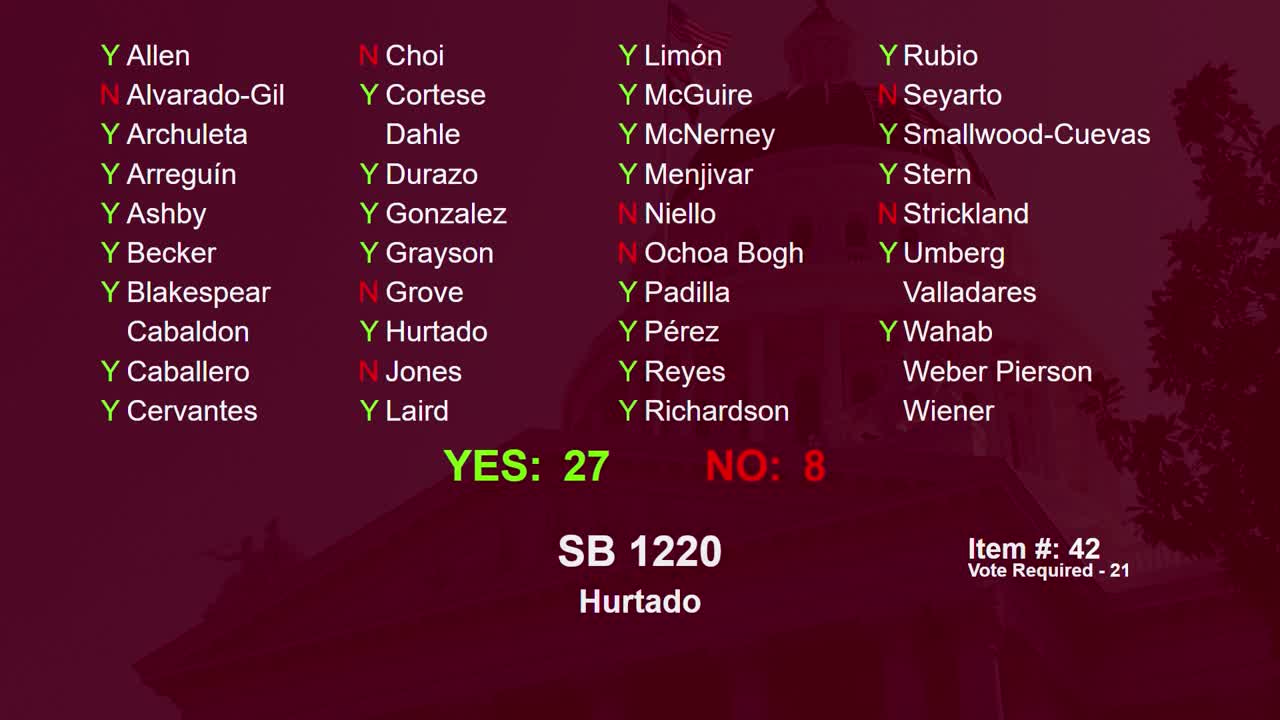
Bill Author