SB 1401: Criminal procedure: competence to stand trial.
- Session Year: 2025-2026
- House: Senate
- Latest Version Date: 2026-09-30
Current Status:
Passed
(2026-09-30: Chaptered by Secretary of State. Chapter 1035, Statutes of 2026.)
Introduced
In Committee
Awaiting First Chamber Vote
Passed First Chamber
In Committee
Awaiting Second Chamber Vote
Passed Second Chamber
Enacted
Existing law prohibits a person from being tried or adjudged to punishment while that person is mentally incompetent. Existing law requires the court to, for a person found mentally incompetent and not charged with certain felony offenses, among other things, determine whether restoring the person to mental competence is in the interests of justice. Existing law requires the court to, if restoring the person to mental competence is not in the interests of justice, conduct a hearing, as specified, and determine the persons eligibility for diversion. Under existing law, if the court determines that the person is ineligible or unsuitable for diversion, the court is authorized to hold a hearing to determine the persons other options, including referral to assisted outpatient treatment, county conservatorship, and the CARE program. Existing law requires a persons charges to be dismissed if the person is accepted into assisted outpatient treatment or the CARE program or upon a filing of either a temporary or permanent conservatorship petition.
This bill would authorize a county behavioral health agency to report to the court regarding relevant confidential medical information for the purpose of determining eligibility for behavioral health services pursuant to the above provisions. The bill would exempt from the requirement to dismiss charges instances where the persons case has been referred back to the court within certain time periods.
Existing law, when a defendant is returned to court after specified proceedings to restore competency and it appears the defendant is gravely disabled, requires the court to initiate specified conservatorship proceedings. Existing law defines gravely disabled for these purposes as meaning a condition in which a person, as a result of specified disorders, is unable to provide for their basic personal needs for food, clothing, shelter, personal safety, or necessary medical care, or a condition in which the person has been found mentally incompetent and specified facts exist, including that the person is unable to understand the nature and purpose of the proceedings taken against them and to assist counsel in the conduct of their defense in a rational manner.
This bill would clarify that gravely disabled includes meeting either or both of these definitions of gravely disabled.
Existing law, in the case of a misdemeanor charge in which the defendant is found incompetent, requires the court to hold a hearing to determine whether the defendant is eligible for both diversion and the CARE program. Under existing law, if the defendant is not eligible or suitable for diversion, the court is required to hold another hearing to decide if the defendant should be referred for, among other things, county conservatorship. Existing law only allows a referral for county conservatorship if, based on the opinion of a qualified mental health expert, the defendant appears to be gravely disabled, as defined.
This bill would also allow a referral for county conservatorship if, in the opinion of the court, the defendant appears to be gravely disabled.
Existing law prohibits a person from being tried or adjudged to punishment while that person is mentally incompetent. Existing law requires the court to, for a person found mentally incompetent and not charged with certain felony offenses, among other things, determine whether restoring the person to mental competence is in the interests of justice. Existing law requires the court to, if restoring the person to mental competence is not in the interests of justice, conduct a hearing, as specified, and determine the persons eligibility for diversion. Under existing law, if the court determines that the person is ineligible or unsuitable for diversion, the court is authorized to hold a hearing to determine the persons other options, including referral to assisted outpatient treatment, county conservatorship, and the CARE program. Existing law requires a persons charges to be dismissed if the person is accepted into assisted outpatient treatment or the CARE program or upon a filing of either a temporary or permanent conservatorship petition.
This bill would authorize a county behavioral health agency and jail medical provider to share confidential medical records and other relevant information with the court to report to the court regarding relevant confidential medical information for the purpose of determining likelihood of eligibility for behavioral health services and programs pursuant to the above provisions. The bill would exempt from the requirement to dismiss charges instances where the persons case has been referred back to the court within certain time periods.
Existing law, in the case of a misdemeanor charge in which the defendant is found incompetent, requires the court to hold a hearing to determine whether the defendant is eligible for both diversion and the CARE program. Under existing law, if the defendant is not eligible or suitable for diversion, the court is required to hold another hearing to decide if the defendant should be referred for, among other things, county conservatorship. Existing law only allows a referral for county conservatorship if, based on the opinion of a qualified mental health expert, the defendant appears to be gravely disabled, as defined.
This bill would also allow a referral for county conservatorship if, in the opinion of the court, the defendant appears to be gravely disabled.
Existing law prohibits a person from being tried or adjudged to punishment while that person is mentally incompetent. Existing law requires the court to, for a person found mentally incompetent and not charged with certain felony offenses, among other things, determine whether restoring the person to mental competence is in the interests of justice. Existing law requires the court to, if restoring the person to mental competence is not in the interests of justice, conduct a hearing, as specified, and determine the persons eligibility for diversion. Under existing law, if the court determines that the person is ineligible or unsuitable for diversion, the court is authorized to hold a hearing to determine the persons other options, including referral to assisted outpatient treatment, county conservatorship, and the CARE program. Existing law requires a persons charges to be dismissed if the person is accepted into assisted outpatient treatment or the CARE program or upon a filing of either a temporary or permanent conservatorship petition.
This bill would authorize a county behavioral health agency and jail medical provider to share confidential medical records and other relevant information with the court for the purpose of determining likelihood of eligibility for behavioral health services and programs pursuant to the above provisions. The bill would exempt from the requirement to dismiss charges instances where the persons case has been referred back to the court within certain time periods.
Existing law, in the case of a misdemeanor charge in which the defendant is found incompetent, requires the court to hold a hearing to determine whether the defendant is eligible for both diversion and the CARE program. Under existing law, if the defendant is not eligible or suitable for diversion, the court is required to hold another hearing to decide if the defendant should be referred for, among other things, county conservatorship. Existing law only allows a referral for county conservatorship if, based on the opinion of a qualified mental health expert, the defendant appears to be gravely disabled, as defined.
This bill would also allow a referral for county conservatorship if, in the opinion of the court, the defendant appears to be gravely disabled.
(a)(1)(A)If the defendant is found mentally competent, the criminal process shall resume, the trial on the offense charged or hearing on the alleged violation shall proceed, and judgment may be pronounced.
(B)If the defendant is found mentally incompetent and is not charged with an offense listed in subdivision (d) of Section 1001.36, the trial, the hearing on the alleged violation, or the judgment shall be suspended, and the court shall do all of the following:
(i)(I)Determine whether restoring the person to mental competence is in the interests of justice.
(II)In exercising its discretion pursuant to this clause, the court shall consider the relevant circumstances of the charged offense, including the harm done to the victim, the defendants mental health condition, including, without limitation, any intellectual or developmental disability, the history of treatment, the criminal history of the defendant, whether the defendant is likely to face incarceration if convicted, whether the defendant has previously been found incompetent to stand trial, whether restoring the person to mental competence will enhance public safety, and any other relevant considerations. The court shall provide the defense and prosecution an opportunity to be heard on whether restoration is in the interests of justice.
(ii)If restoring the person to mental competence is in the interests of justice, the court shall state its reasons orally on the record and the case shall proceed as provided in subparagraph (C).
(iii)If restoring the person to mental competence is not in the interests of justice, the court shall conduct a hearing, pursuant to Section 1001.36, and, if the court deems the defendant eligible, grant diversion pursuant to that section for a period not to exceed two years from the date the individual is accepted into diversion or the maximum term of imprisonment provided by law for the most serious offense charged in the complaint, whichever is shorter.
(I)The hearing shall be held no later than 30 days after the finding of incompetence. If the hearing is delayed beyond 30 days, the court shall order the defendant to be released on their own recognizance pending the hearing.
(II)If the defendant performs satisfactorily on diversion pursuant to this subclause, at the end of the period of diversion, the court shall dismiss the criminal charges that were the subject of the criminal proceedings at the time of the initial diversion.
(III)If the court finds the defendant ineligible or unsuitable for diversion based on the circumstances set forth in subdivision (b) or (c) of Section 1001.36, or if any of the conditions described in subdivision (g) of Section 1001.36 are present, the court may, after notice to the defendant, defense counsel, and the prosecution, hold a hearing to determine whether to do any of the following:
(ia)Order modification of the treatment plan in accordance with a recommendation from the treatment provider.
(ib)Refer the defendant to assisted outpatient treatment pursuant to Section 5346 of the Welfare and Institutions Code. A referral to assisted outpatient treatment may only occur in a county where services are available pursuant to Section 5348 of the Welfare and Institutions Code, and the agency agrees to accept responsibility for treatment of the defendant. A hearing to determine eligibility for assisted outpatient treatment shall be held within 45 days after the finding of incompetence. If the hearing is delayed beyond 45 days, the court shall order the defendant, if confined in county jail, to be released on their own recognizance pending that hearing. If the defendant is accepted into assisted outpatient treatment, the charges shall be dismissed, pursuant to Section 1385, six months after the date of the referral to assisted outpatient treatment, unless the defendants case is referred back to the court before the expiration of that time period. This section does not alter the confidential nature of assisted outpatient treatment.
(ic)Refer the defendant to the county conservatorship investigator in the county of commitment for possible conservatorship proceedings for the defendant pursuant to Chapter 3 (commencing with Section 5350) of Part 1 of Division 5 of the Welfare and Institutions Code. A defendant shall only be referred to the conservatorship investigator if it appears to the court or a qualified mental health expert that the defendant appears to be gravely disabled, as defined in paragraph (1) of subdivision (h) of Section 5008 of the Welfare and Institutions Code. Any hearings required in the conservatorship proceedings shall be held in the superior court in the county of commitment. The court shall transmit a copy of the order directing initiation of conservatorship proceedings to the county mental health director or the directors designee and shall notify the county mental health director or their designee of the outcome of the proceedings. Before establishing a conservatorship, the public guardian shall investigate all available alternatives to conservatorship pursuant to Section 5354 of the Welfare and Institutions Code. If a petition is not filed within 30 days of the referral, the court shall order the defendant, if confined in county jail, to be released on their own recognizance pending conservatorship proceedings. If the conservatorship proceedings result in the filing of a petition for the establishment of a temporary or permanent conservatorship, the charges shall be dismissed, pursuant to Section 1385, 90 days after the date of the filing of the petition, unless the case is referred back to the court before the expiration of that time period, or the basis for the petition is that the defendant is gravely disabled as defined in subparagraph (B) of paragraph (1) of subdivision (h) of Section 5008 of the Welfare and Institutions Code. This section does not alter the confidential nature of conservatorship proceedings.
(id)Refer the defendant to the CARE Act court pursuant to Section 5978 of the Welfare and Institutions Code. The CARE Act court shall hold a hearing to determine eligibility for the CARE program within 14 court days after the date of the referral. If the hearing is delayed beyond 14 court days, the court shall order the defendant, if confined in a county jail, to be released on their own recognizance pending that hearing. If the defendant is accepted into the CARE program, the CARE Act court shall notify the criminal court of the acceptance, and the charges shall be dismissed, pursuant to Section 1385, six months after the date of the referral to the CARE program, unless the case is referred back to the court before the expiration of that time period. Except as otherwise provided in this section and in Sections 5978 and 5978.2 of the Welfare and Institutions Code, this paragraph does not alter the confidential nature of CARE program proceedings.
(ie)Reinstate competency proceedings, in which case the court shall credit any time spent in mental health diversion against the maximum term of commitment as specified in paragraph (1) of subdivision (c).
(iv)A county behavioral health agency or its designee may report to the court regarding relevant confidential medical information, including, but not limited to, prior treatment interactions with the defendant, for the purpose of determining eligibility for behavioral health services pursuant to this section. This confidential information shall not be used for any other purpose. The information shall be kept confidential and after the disposition of the case shall be placed under seal and shall not be subject to disclosure to any person or entity. The disclosure of information pursuant to this subdivision is subject to applicable state and federal privacy laws.
(C)If the defendant is found mentally incompetent and restoring the defendant to competence is in the interests of justice or they are charged with an offense listed in subdivision (d) of Section 1001.36, the trial, the hearing on the alleged violation, or the judgment shall be suspended until the person becomes mentally competent.
(i)The court shall order that the mentally incompetent defendant be delivered by the sheriff to a State Department of State Hospitals facility, as defined in Section 4100 of the Welfare and Institutions Code, as directed by the State Department of State Hospitals, or to any other available public or private treatment facility, including a community-based residential treatment system approved by the community program director, or their designee, that will promote the defendants speedy restoration to mental competence, or placed on outpatient status as specified in Section 1600.
(ii)(I)If a defendant has been found mentally incompetent, and the court has ordered commitment to a State Department of State Hospitals facility as described in Section 4100 of the Welfare and Institutions Code, and is not in the custody of the local sheriff, the department shall inform the sheriff when a placement in a facility becomes available and make reasonable efforts to coordinate a delivery by the sheriff to transport the defendant to the facility. If the department has made reasonable attempts for 90 days, starting with the date of commitment, and the defendant has not been transported, as originally ordered under clause (i), the department shall inform the court and sheriff in writing.
(II)If the sheriff has not delivered the defendant to a State Department of State Hospitals facility within 90 days after the departments written notice, the commitment to the State Department of State Hospitals shall be automatically stayed and the department may remove the defendant from the pending placement list until the court notifies the department in writing that the defendant is available for transport and the defendant shall regain their place on the pending placement list.
(iii)However, if the action against the defendant who has been found mentally incompetent is on a complaint charging a felony offense specified in Section 290, the prosecutor shall determine whether the defendant previously has been found mentally incompetent to stand trial pursuant to this chapter on a charge of a Section 290 offense, or whether the defendant is currently the subject of a pending Section 1368 proceeding arising out of a charge of a Section 290 offense. If either determination is made, the prosecutor shall notify the court and defendant in writing. After this notification, and opportunity for hearing, the court shall order that the defendant be delivered by the sheriff to a State Department of State Hospitals facility, as directed by the State Department of State Hospitals, or other secure treatment facility for the care and treatment of persons with a mental health disorder, unless the court makes specific findings on the record that an alternative placement would provide more appropriate treatment for the defendant and would not pose a danger to the health and safety of others.
(iv)If the action against the defendant who has been found mentally incompetent is on a complaint charging a felony offense specified in Section 290 and the defendant has been denied bail pursuant to subdivision (b) of Section 12 of Article I of the California Constitution because the court has found, based upon clear and convincing evidence, a substantial likelihood that the persons release would result in great bodily harm to others, the court shall order that the defendant be delivered by the sheriff to a State Department of State Hospitals facility, as directed by the State Department of State Hospitals, unless the court makes specific findings on the record that an alternative placement would provide more appropriate treatment for the defendant and would not pose a danger to the health and safety of others.
(v)(I)If, at any time after the court finds that the defendant is mentally incompetent and before the defendant is transported to a facility pursuant to this section, the court is provided with any information that the defendant may benefit from diversion pursuant to Chapter 2.8A (commencing with Section 1001.35) of Title 6, the court may make a finding that the defendant is an appropriate candidate for diversion.
(II)Notwithstanding subclause (I), if a defendant is found mentally incompetent and is transferred to a facility described in Section 4361.6 of the Welfare and Institutions Code, the court may, at any time upon receiving any information that the defendant may benefit from diversion pursuant to Chapter 2.8A (commencing with Section 1001.35) of Title 6, make a finding that the defendant is an appropriate candidate for diversion.
(vi)If a defendant is found by the court to be an appropriate candidate for diversion pursuant to clause (v), the defendants eligibility shall be determined pursuant to Section 1001.36. A defendant granted diversion may participate for the lesser of the period specified in paragraph (1) of subdivision (c) or the applicable period described in subparagraph (C) of paragraph (1) of subdivision (f) of Section 1001.36. If, during that period, the court determines that criminal proceedings should be reinstated pursuant to subdivision (g) of Section 1001.36, the court shall, pursuant to Section 1369, appoint a psychiatrist, licensed psychologist, or any other expert the court may deem appropriate, to determine the defendants competence to stand trial.
(vii)Upon the dismissal of charges at the conclusion of the period of diversion, pursuant to subdivision (h) of Section 1001.36, a defendant shall no longer be deemed incompetent to stand trial pursuant to this section.
(viii)The clerk of the court shall notify the Department of Justice, in writing, of a finding of mental incompetence with respect to a defendant who is subject to clause (iii) or (iv) for inclusion in the defendants state summary criminal history information.
(D)If at any time after the finding of mental incompetence, but before the defendant begins treatment in a program or facility to promote the defendants speedy restoration of mental competence pursuant to this section, there is a change in circumstance that affects the likelihood that the defendant will be able to attain competence, either party may instead petition the court to proceed in accordance with subdivision (b).
(E)Upon the filing of a certificate of restoration to competence, the court shall order that the defendant be returned to court in accordance with Section 1372. The court shall transmit a copy of its order to the community program director or a designee.
(F)A defendant charged with a violent felony may not be delivered to a State Department of State Hospitals facility or treatment facility pursuant to this subdivision unless the State Department of State Hospitals facility or treatment facility has a secured perimeter or a locked and controlled treatment facility, and the judge determines that the public safety will be protected.
(G)For purposes of this paragraph, violent felony means an offense specified in subdivision (c) of Section 667.5.
(H)A defendant charged with a violent felony may be placed on outpatient status, as specified in Section 1600, only if the court finds that the placement will not pose a danger to the health or safety of others. If the court places a defendant charged with a violent felony on outpatient status, as specified in Section 1600, the court shall serve copies of the placement order on defense counsel, the sheriff in the county where the defendant will be placed, and the district attorney for the county in which the violent felony charges are pending against the defendant.
(I)If, at any time after the court has declared a defendant incompetent to stand trial pursuant to this section, counsel for the defendant or a jail medical or mental health staff provider provides the court with substantial evidence that the defendants psychiatric symptoms have changed to such a degree as to create a doubt in the mind of the judge as to the defendants current mental incompetence, the court may appoint a psychiatrist or a licensed psychologist to opine as to whether the defendant has attained competence. If, in the opinion of that expert, the defendant has attained competence, the court shall proceed as if a certificate of restoration of competence has been returned pursuant to paragraph (1) of subdivision (a) of Section 1372.
(J)(i)The State Department of State Hospitals may, pursuant to Section 4335.2 of the Welfare and Institutions Code, conduct an evaluation of the defendant in county custody to determine any of the following:
(I)The defendant has attained competence.
(II)There is no substantial likelihood that the defendant will attain competence in the foreseeable future.
(III)The defendant should be referred to the county for further evaluation for potential participation in a county diversion program, if one exists, or to another outpatient treatment program.
(ii)If, in the opinion of the departments expert, the defendant has attained competence, the court shall proceed as if a certificate of restoration of competence has been returned pursuant to paragraph (1) of subdivision (a) of Section 1372.
(iii)If, in the opinion of the departments expert, there is no substantial likelihood that the defendant will attain mental competence in the foreseeable future, the committing court shall proceed pursuant to paragraph (3) of subdivision (c) no later than 10 days following receipt of the report.
(2)Prior to making the order directing that the defendant be committed to the State Department of State Hospitals or other treatment facility or placed on outpatient status, the court shall proceed as follows:
(A)(i)The court shall order the community program director or a designee to evaluate the defendant and to submit to the court within 15 judicial days of the order a written recommendation as to whether the defendant should be required to undergo outpatient treatment, or be committed to the State Department of State Hospitals or to any other treatment facility. A person shall not be admitted to a State Department of State Hospitals facility or other treatment facility or placed on outpatient status under this section without having been evaluated by the community program director or a designee. The community program director or designee shall evaluate the appropriate placement for the defendant between a State Department of State Hospitals facility or the community-based residential treatment system based upon guidelines provided by the State Department of State Hospitals.
(ii)A defendant shall first be considered for placement in an outpatient treatment program, a community treatment program, or a diversion program, if any such program is available, unless a court, based upon the recommendation of the community program director or their designee, finds that either the clinical needs of the defendant or the risk to community safety, warrant placement in a State Department of State Hospitals facility.
(B)The court shall hear and determine whether the defendant lacks the capacity to make decisions regarding the administration of antipsychotic medication. The court shall consider opinions in the reports prepared pursuant to subdivision (b) of Section 1369, as applicable to the issue of whether the defendant lacks the capacity to make decisions regarding the administration of antipsychotic medication, and shall proceed as follows:
(i)The court shall hear and determine whether any of the following is true:
(I)Based upon the opinion of the psychiatrist or licensed psychologist offered to the court pursuant to subdivision (b) of Section 1369, the defendant lacks the capacity to make decisions regarding antipsychotic medication, the defendants mental disorder requires medical treatment with antipsychotic medication, and, if the defendants mental disorder is not treated with antipsychotic medication, it is probable that serious harm to the physical or mental health of the defendant will result. Probability of serious harm to the physical or mental health of the defendant requires evidence that the defendant is presently suffering adverse effects to their physical or mental health, or the defendant has previously suffered these effects as a result of a mental disorder and their condition is substantially deteriorating. The fact that a defendant has a diagnosis of a mental disorder does not alone establish probability of serious harm to the physical or mental health of the defendant.
(II)Based upon the opinion of the psychiatrist or licensed psychologist offered to the court pursuant to subdivision (b) of Section 1369, the defendant is a danger to others, in that the defendant has inflicted, attempted to inflict, or made a serious threat of inflicting substantial physical harm on another while in custody, or the defendant had inflicted, attempted to inflict, or made a serious threat of inflicting substantial physical harm on another that resulted in the defendant being taken into custody, and the defendant presents, as a result of mental disorder or mental defect, a demonstrated danger of inflicting substantial physical harm on others. Demonstrated danger may be based on an assessment of the defendants present mental condition, including a consideration of past behavior of the defendant within six years prior to the time the defendant last attempted to inflict, inflicted, or threatened to inflict substantial physical harm on another, and other relevant evidence.
(III)The people have charged the defendant with a serious crime against the person or property, and based upon the opinion of the psychiatrist offered to the court pursuant to subdivision (b) of Section 1369, the involuntary administration of antipsychotic medication is substantially likely to render the defendant competent to stand trial, the medication is unlikely to have side effects that interfere with the defendants ability to understand the nature of the criminal proceedings or to assist counsel in the conduct of a defense in a reasonable manner, less intrusive treatments are unlikely to have substantially the same results, and antipsychotic medication is medically necessary and appropriate in light of their medical condition.
(ii)(I)If the court finds the conditions described in subclause (I) or (II) of clause (i) to be true, and if pursuant to the opinion offered to the court pursuant to subdivision (b) of Section 1369, a psychiatrist has opined that treatment with antipsychotic medications is appropriate for the defendant, the court shall issue an order authorizing the administration of antipsychotic medication as needed, including on an involuntary basis, to be administered under the direction and supervision of a licensed psychiatrist.
(II)If the court finds the conditions described in subclause (I) or (II) of clause (i) to be true, and if pursuant to the opinion offered to the court pursuant to subdivision (b) of Section 1369, a licensed psychologist has opined that treatment with antipsychotic medication may be appropriate for the defendant, the court shall issue an order authorizing treatment by a licensed psychiatrist on an involuntary basis. That treatment may include the administration of antipsychotic medication as needed, to be administered under the direction and supervision of a licensed psychiatrist.
(III)If the court finds the conditions described in subclause (III) of clause (i) to be true, and if pursuant to the opinion offered to the court pursuant to subdivision (b) of Section 1369, a psychiatrist has opined that it is appropriate to treat the defendant with antipsychotic medication, the court shall issue an order authorizing the administration of antipsychotic medication as needed, including on an involuntary basis, to be administered under the direction and supervision of a licensed psychiatrist.
(iii)An order authorizing involuntary administration of antipsychotic medication to the defendant when and as prescribed by the defendants treating psychiatrist at any facility housing the defendant for purposes of this chapter, including a county jail, shall remain in effect when the defendant returns to county custody pursuant to subparagraph (A) of paragraph (1) of subdivision (b) or paragraph (1) of subdivision (c), or pursuant to subparagraph (C) of paragraph (3) of subdivision (a) of Section 1372, but shall be valid for no more than one year, pursuant to subparagraph (A) of paragraph (7). The court shall not order involuntary administration of psychotropic medication under subclause (III) of clause (i) unless the court has first found that the defendant does not meet the criteria for involuntary administration of psychotropic medication under subclause (I) of clause (i) and does not meet the criteria under subclause (II) of clause (i).
(iv)In all cases, the treating hospital, county jail, facility, or program may administer medically appropriate antipsychotic medication prescribed by a psychiatrist in an emergency as described in subdivision (m) of Section 5008 of the Welfare and Institutions Code.
(v)If the court has determined that the defendant has the capacity to make decisions regarding antipsychotic medication, and if the defendant, with advice of their counsel, consents, the court order of commitment shall include confirmation that antipsychotic medication may be given to the defendant as prescribed by a treating psychiatrist pursuant to the defendants consent. The commitment order shall also indicate that, if the defendant withdraws consent for antipsychotic medication, after the treating psychiatrist complies with the provisions of subparagraph (C), the defendant shall be returned to court for a hearing in accordance with subparagraphs (C) and (D) regarding whether antipsychotic medication shall be administered involuntarily.
(vi)If the court has determined that the defendant has the capacity to make decisions regarding antipsychotic medication and if the defendant, with advice from their counsel, does not consent, the court order for commitment shall indicate that, after the treating psychiatrist complies with the provisions of subparagraph (C), the defendant shall be returned to court for a hearing in accordance with subparagraphs (C) and (D) regarding whether antipsychotic medication shall be administered involuntarily.
(vii)A report made pursuant to paragraph (1) of subdivision (b) shall include a description of antipsychotic medication administered to the defendant and its effects and side effects, including effects on the defendants appearance or behavior that would affect the defendants ability to understand the nature of the criminal proceedings or to assist counsel in the conduct of a defense in a reasonable manner. During the time the defendant is confined in a State Department of State Hospitals facility or other treatment facility or placed on outpatient status, either the defendant or the people may request that the court review any order made pursuant to this subdivision. The defendant, to the same extent enjoyed by other patients in the State Department of State Hospitals facility or other treatment facility, shall have the right to contact the patients rights advocate regarding the defendants rights under this section.
(C)If the defendant consented to antipsychotic medication as described in clause (iv) of subparagraph (B), but subsequently withdraws their consent, or, if involuntary antipsychotic medication was not ordered pursuant to clause (v) of subparagraph (B), and the treating psychiatrist determines that antipsychotic medication has become medically necessary and appropriate, the treating psychiatrist shall make efforts to obtain informed consent from the defendant for antipsychotic medication. If informed consent is not obtained from the defendant, and the treating psychiatrist is of the opinion that the defendant lacks the capacity to make decisions regarding antipsychotic medication based on the conditions described in subclause (I) or (II) of clause (i) of subparagraph (B), the treating psychiatrist shall certify whether the lack of capacity and any applicable conditions described above exist. That certification shall contain an assessment of the current mental status of the defendant and the opinion of the treating psychiatrist that involuntary antipsychotic medication has become medically necessary and appropriate.
(D)(i)If the treating psychiatrist certifies that antipsychotic medication has become medically necessary and appropriate pursuant to subparagraph (C), antipsychotic medication may be administered to the defendant for not more than 21 days, provided, however, that, within 72 hours of the certification, the defendant is provided a medication review hearing before an administrative law judge to be conducted at the facility where the defendant is receiving treatment. The treating psychiatrist shall present the case for the certification for involuntary treatment and the defendant shall be represented by an attorney or a patients rights advocate. The attorney or patients rights advocate shall be appointed to meet with the defendant no later than one day prior to the medication review hearing to review the defendants rights at the medication review hearing, discuss the process, answer questions or concerns regarding involuntary medication or the hearing, assist the defendant in preparing for the hearing and advocating for the defendants interests at the hearing, review the panels final determination following the hearing, advise the defendant of their right to judicial review of the panels decision, and provide the defendant with referral information for legal advice on the subject. The defendant shall also have the following rights with respect to the medication review hearing:
(I)To be given timely access to the defendants records.
(II)To be present at the hearing, unless the defendant waives that right.
(III)To present evidence at the hearing.
(IV)To question persons presenting evidence supporting involuntary medication.
(V)To make reasonable requests for attendance of witnesses on the defendants behalf.
(VI)To a hearing conducted in an impartial and informal manner.
(ii)If the administrative law judge determines that the defendant either meets the criteria specified in subclause (I) of clause (i) of subparagraph (B), or meets the criteria specified in subclause (II) of clause (i) of subparagraph (B), antipsychotic medication may continue to be administered to the defendant for the 21-day certification period. Concurrently with the treating psychiatrists certification, the treating psychiatrist shall file a copy of the certification and a petition with the court for issuance of an order to administer antipsychotic medication beyond the 21-day certification period. For purposes of this subparagraph, the treating psychiatrist shall not be required to pay or deposit any fee for the filing of the petition or other document or paper related to the petition.
(iii)If the administrative law judge disagrees with the certification, medication may not be administered involuntarily until the court determines that antipsychotic medication should be administered pursuant to this section.
(iv)The court shall provide notice to the prosecuting attorney and to the attorney representing the defendant, and shall hold a hearing, no later than 18 days from the date of the certification, to determine whether antipsychotic medication should be ordered beyond the certification period.
(v)If, as a result of the hearing, the court determines that antipsychotic medication should be administered beyond the certification period, the court shall issue an order authorizing the administration of that medication.
(vi)The court shall render its decision on the petition and issue its order no later than three calendar days after the hearing and, in any event, no later than the expiration of the 21-day certification period.
(vii)If the administrative law judge upholds the certification pursuant to clause (ii), the court may, for a period not to exceed 14 days, extend the certification and continue the hearing pursuant to stipulation between the parties or upon a finding of good cause. In determining good cause, the court may review the petition filed with the court, the administrative law judges order, and any additional testimony needed by the court to determine if it is appropriate to continue medication beyond the 21-day certification and for a period of up to 14 days.
(viii)The district attorney, county counsel, or representative of a facility where a defendant found incompetent to stand trial is committed may petition the court for an order to administer involuntary medication pursuant to the criteria set forth in subclauses (II) and (III) of clause (i) of subparagraph (B). The order is reviewable as provided in paragraph (7).
(3)(A)When the court orders that the defendant be committed to a State Department of State Hospitals facility or other public or private treatment facility, the court shall provide copies of the following documents prior to the admission of the defendant to the State Department of State Hospitals or other treatment facility where the defendant is to be committed:
(i)The commitment order, which shall include a specification of the charges, an assessment of whether involuntary treatment with antipsychotic medications is warranted, and any orders by the court, pursuant to subparagraph (B) of paragraph (2), authorizing involuntary treatment with antipsychotic medications.
(ii)A computation or statement setting forth the maximum term of commitment in accordance with subdivision (c).
(iii)(I)A computation or statement setting forth the amount of credit for time served, if any, to be deducted from the maximum term of commitment.
(II)If a certificate of restoration of competency was filed with the court pursuant to Section 1372 and the court subsequently rejected the certification, a copy of the court order or minute order rejecting the certification shall be provided. The court order shall include a new computation or statement setting forth the amount of credit for time served, if any, to be deducted from the defendants maximum term of commitment based on the courts rejection of the certification.
(iv)State summary criminal history information.
(v)Jail classification records for the defendants current incarceration.
(vi)Arrest reports prepared by the police department or other law enforcement agency.
(vii)Court-ordered psychiatric examination or evaluation reports.
(viii)The community program directors placement recommendation report.
(ix)Records of a finding of mental incompetence pursuant to this chapter arising out of a complaint charging a felony offense specified in Section 290 or a pending Section 1368 proceeding arising out of a charge of a Section 290 offense.
(x)Medical records, including jail mental health records.
(B)If a defendant is committed to a State Department of State Hospitals facility, and the department determines that additional medical or mental health treatment records are needed for continuity of care, any private or public entity holding medical or mental health treatment records of that defendant shall release those records upon receiving a written request from the State Department of State Hospitals within 10 calendar days after the request. The private or public entity holding the medical or mental health treatment records shall comply with all applicable federal and state privacy laws prior to disclosure. The State Department of State Hospitals shall not release records obtained during the admission process under this subdivision, pursuant to Section 1798.68 of the Civil Code, or subdivision (b) of Section 5328 of the Welfare and Institutions Code.
(4)When the defendant is committed to a treatment facility pursuant to clause (i) of subparagraph (B) of paragraph (1) or the court makes the findings specified in clause (iii) or (iv) of subparagraph (B) of paragraph (1) to assign the defendant to a treatment facility other than a State Department of State Hospitals facility or other secure treatment facility, the court shall order that notice be given to the appropriate law enforcement agency or agencies having local jurisdiction at the placement facility of a finding of mental incompetence pursuant to this chapter arising out of a charge of a Section 290 offense.
(5)When directing that the defendant be confined in a State Department of State Hospitals facility pursuant to this subdivision, the court shall commit the defendant to the State Department of State Hospitals.
(6)(A)If the defendant is committed or transferred to the State Department of State Hospitals pursuant to this section, the court may, upon receiving the written recommendation of the medical director of the State Department of State Hospitals facility and the community program director that the defendant be transferred to a public or private treatment facility approved by the community program director, order the defendant transferred to that facility. If the defendant is committed or transferred to a public or private treatment facility approved by the community program director, the court may, upon receiving the written recommendation of the community program director, transfer the defendant to the State Department of State Hospitals or to another public or private treatment facility approved by the community program director. In the event of dismissal of the criminal charges before the defendant recovers competence, the person shall be subject to the applicable provisions of the Lanterman-Petris-Short Act (Part 1 (commencing with Section 5000) of Division 5 of the Welfare and Institutions Code). If either the defendant or the prosecutor chooses to contest either kind of order of transfer, a petition may be filed in the court for a hearing, which shall be held if the court determines that sufficient grounds exist. At the hearing, the prosecuting attorney or the defendant may present evidence bearing on the order of transfer. The court shall use the same standards as are used in conducting probation revocation hearings pursuant to Section 1203.2.
Prior to making an order for transfer under this section, the court shall notify the defendant, the attorney of record for the defendant, the prosecuting attorney, and the community program director or a designee.
(B)If the defendant is initially committed to a State Department of State Hospitals facility or secure treatment facility pursuant to clause (iii) or (iv) of subparagraph (B) of paragraph (1) and is subsequently transferred to any other facility, copies of the documents specified in paragraph (3) shall be electronically transferred or taken with the defendant to each subsequent facility to which the defendant is transferred. The transferring facility shall also notify the appropriate law enforcement agency or agencies having local jurisdiction at the site of the new facility that the defendant is a person subject to clause (iii) or (iv) of subparagraph (B) of paragraph (1).
(7)(A)An order by the court authorizing involuntary medication of the defendant shall be valid for no more than one year. The court shall review the order at the time of the review of the initial report and the six-month progress reports pursuant to paragraph (1) of subdivision (b) to determine if the grounds for the authorization remain. In the review, the court shall consider the reports of the treating psychiatrist or psychiatrists and the defendants patients rights advocate or attorney. The court may require testimony from the treating psychiatrist and the patients rights advocate or attorney, if necessary. The court may continue the order authorizing involuntary medication for up to another six months, or vacate the order, or make any other appropriate order.
(B)Within 60 days before the expiration of the one-year involuntary medication order, the district attorney, county counsel, or representative of any facility where a defendant found incompetent to stand trial is committed may petition the committing court for a renewal, subject to the same conditions and requirements as in subparagraph (A). The petition shall include the basis for involuntary medication set forth in clause (i) of subparagraph (B) of paragraph (2). Notice of the petition shall be provided to the defendant, the defendants attorney, and the district attorney. The court shall hear and determine whether the defendant continues to meet the criteria set forth in clause (i) of subparagraph (B) of paragraph (2). The hearing on a petition to renew an order for involuntary medication shall be conducted prior to the expiration of the current order.
(8)For purposes of subparagraph (D) of paragraph (2) and paragraph (7), if the treating psychiatrist determines that there is a need, based on preserving their rapport with the defendant or preventing harm, the treating psychiatrist may request that the facility medical director designate another psychiatrist to act in the place of the treating psychiatrist. If the medical director of the facility designates another psychiatrist to act pursuant to this paragraph, the treating psychiatrist shall brief the acting psychiatrist of the relevant facts of the case and the acting psychiatrist shall examine the defendant prior to the hearing.
(b)(1)Within 90 days after a commitment made pursuant to subdivision (a), the medical director of the State Department of State Hospitals facility or other treatment facility to which the defendant is confined shall make a written report to the court and the community program director for the county or region of commitment, or a designee, concerning the defendants progress toward recovery of mental competence and whether the administration of antipsychotic medication remains necessary.
If the defendant is in county custody, the county jail shall provide access to the defendant for purposes of the State Department of State Hospitals conducting an evaluation of the defendant pursuant to Section 4335.2 of the Welfare and Institutions Code. Based upon this evaluation, the State Department of State Hospitals may make a written report to the court within 90 days of a commitment made pursuant to subdivision (a) concerning the defendants progress toward recovery of mental competence and whether the administration of antipsychotic medication is necessary. If the defendant remains in county custody after the initial 90-day report, the State Department of State Hospitals may conduct an evaluation of the defendant pursuant to Section 4335.2 of the Welfare and Institutions Code and make a written report to the court concerning the defendants progress toward recovery of mental competence and whether the administration of antipsychotic medication is necessary.
If the defendant is on outpatient status, the outpatient treatment staff shall make a written report to the community program director concerning the defendants progress toward recovery of mental competence. Within 90 days of placement on outpatient status, the community program director shall report to the court on this matter. If the defendant has not recovered mental competence, but the report discloses a substantial likelihood that the defendant will attain mental competence in the foreseeable future, the defendant shall remain in the State Department of State Hospitals facility or other treatment facility or on outpatient status. Thereafter, at six-month intervals or until the defendant becomes mentally competent, if the defendant is confined in a treatment facility, the medical director of the State Department of State Hospitals facility or person in charge of the facility shall report, in writing, to the court and the community program director or a designee regarding the defendants progress toward recovery of mental competence and whether the administration of antipsychotic medication remains necessary. If the defendant is on outpatient status, after the initial 90-day report, the outpatient treatment staff shall report to the community program director on the defendants progress toward recovery, and the community program director shall report to the court on this matter at six-month intervals. A copy of these reports shall be provided to the prosecutor and defense counsel by the court.
(A)If the report indicates that there is no substantial likelihood that the defendant will attain mental competence in the foreseeable future, custody of the defendant shall be transferred without delay to the committing county and shall remain with the county until further order of the court. The defendant shall be returned to the court for proceedings pursuant to paragraph (3) of subdivision (c) no later than 10 days following receipt of the report. The court shall not order the defendant returned to the custody of the State Department of State Hospitals under the same commitment. The court shall transmit a copy of its order to the community program director or a designee.
(B)If the report indicates that there is no substantial likelihood that the defendant will attain mental competence in the foreseeable future, the medical director of the State Department of State Hospitals facility or other treatment facility to which the defendant is confined shall do both of the following:
(i)Promptly notify and provide a copy of the report to the defense counsel and the district attorney.
(ii)Provide a separate notification, in compliance with applicable privacy laws, to the committing countys sheriff that immediate transportation will be needed for the defendant pursuant to subparagraph (A).
(C)If a county does not take custody of a defendant committed to the State Department of State Hospitals within 10 calendar days following notification made pursuant to clause (ii) of subparagraph (B), the county shall be charged the daily rate for a state hospital bed, as established by the State Department of State Hospitals.
(2)The reports made pursuant to paragraph (1) concerning the defendants progress toward attaining competency shall also consider the issue of involuntary medication. Each report shall include, but not be limited to, all of the following:
(A)Whether or not the defendant has the capacity to make decisions concerning antipsychotic medication.
(B)If the defendant lacks the capacity to make decisions concerning antipsychotic medication, whether the defendant risks serious harm to their physical or mental health if not treated with antipsychotic medication.
(C)Whether or not the defendant presents a danger to others if the defendant is not treated with antipsychotic medication.
(D)Whether the defendant has a mental disorder for which medications are the only effective treatment.
(E)Whether there are any side effects from the medication currently being experienced by the defendant that would interfere with the defendants ability to collaborate with counsel.
(F)Whether there are any effective alternatives to medication.
(G)How quickly the medication is likely to bring the defendant to competency.
(H)Whether the treatment plan includes methods other than medication to restore the defendant to competency.
(I)A statement, if applicable, that no medication is likely to restore the defendant to competency.
(3)After reviewing the reports, the court shall determine if grounds for the involuntary administration of antipsychotic medication exist, whether or not an order was issued at the time of commitment, and shall do one of the following:
(A)If the original grounds for involuntary medication still exist, any order authorizing the treating facility to involuntarily administer antipsychotic medication to the defendant shall remain in effect.
(B)If the original grounds for involuntary medication no longer exist, and there is no other basis for involuntary administration of antipsychotic medication, any order for the involuntary administration of antipsychotic medication shall be vacated.
(C)If the original grounds for involuntary medication no longer exist, and the report states that there is another basis for involuntary administration of antipsychotic medication, the court shall determine whether to vacate the order or issue a new order for the involuntary administration of antipsychotic medication. The court shall consider the opinions in reports submitted pursuant to paragraph (1), including any opinions rendered pursuant to Section 4335.2 of the Welfare and Institutions Code. The court may, upon a showing of good cause, set a hearing within 21 days to determine whether the order for the involuntary administration of antipsychotic medication shall be vacated or whether a new order for the involuntary administration of antipsychotic medication shall be issued. The hearing shall proceed as set forth in subparagraph (B) of paragraph (2) of subdivision (a). The court shall require witness testimony to occur remotely, including clinical testimony pursuant to subdivision (d) of Section 4335.2 of the Welfare and Institutions Code. In-person witness testimony shall only be allowed upon a courts finding of good cause.
(D)If the report states a basis for involuntary administration of antipsychotic medication and the court did not issue such order at the time of commitment, the court shall determine whether to issue an order for the involuntary administration of antipsychotic medication. The court shall consider the opinions in reports submitted pursuant to paragraph (1), including any opinions rendered pursuant to Section 4335.2 of the Welfare and Institutions Code. The court may, upon a finding of good cause, set a hearing within 21 days to determine whether an order for the involuntary administration of antipsychotic medication shall be issued. The hearing shall proceed as set forth in subparagraph (B) of paragraph (2) of subdivision (a). The court shall require witness testimony to occur remotely, including clinical testimony pursuant to subdivision (d) of Section 4335.2 of the Welfare and Institutions Code. In-person witness testimony shall only be allowed upon a courts finding of good cause.
(E)This paragraph also applies to recommendations submitted pursuant to subdivision (e) of Section 1372, when a recommendation is included as to whether an order for the involuntary administration of antipsychotic medications should be extended or issued.
(4)If it is determined by the court that treatment for the defendants mental impairment is not being conducted, the defendant shall be returned to the committing court, and, if the defendant is not in county custody, returned to the custody of the county. The court shall transmit a copy of its order to the community program director or a designee.
(5)At each review by the court specified in this subdivision, the court shall determine if the security level of housing and treatment is appropriate and may make an order in accordance with its determination. If the court determines that the defendant shall continue to be treated in the State Department of State Hospitals facility or on an outpatient basis, the court shall determine issues concerning administration of antipsychotic medication, as set forth in subparagraph (B) of paragraph (2) of subdivision (a).
(c)(1)At the end of two years from the date of commitment or a period of commitment equal to the maximum term of imprisonment provided by law for the most serious offense charged in the information, indictment, or complaint, or the maximum term of imprisonment provided by law for a violation of probation or mandatory supervision, whichever is shorter, but no later than 90 days prior to the expiration of the defendants term of commitment, a defendant who has not recovered mental competence shall be returned to the committing court, and custody of the defendant shall be transferred without delay to the committing county and shall remain with the county until further order of the court. The court shall not order the defendant returned to the custody of the State Department of State Hospitals under the same commitment. The court shall notify the community program director or a designee of the return and of any resulting court orders. The maximum term of commitment applies to the aggregate of all previous commitments.
(2)(A)The medical director of the State Department of State Hospitals facility or other treatment facility to which the defendant is confined shall provide notification, in compliance with applicable privacy laws, to the committing countys sheriff that immediate transportation will be needed for the defendant pursuant to paragraph (1).
(B)If a county does not take custody of a defendant committed to the State Department of State Hospitals within 10 calendar days following notification pursuant to subparagraph (A), the county shall be charged the daily rate for a state hospital bed, as established by the State Department of State Hospitals.
(3)Whenever a defendant is returned to the court pursuant to paragraph (1) of this subdivision, subparagraph (D) of paragraph (1) of subdivision (a), or paragraph (1) or (4) of subdivision (b), and it appears to the court that the defendant is gravely disabled, as defined in subparagraph (A) or (B), or both, of paragraph (1) of subdivision (h) of Section 5008 of the Welfare and Institutions Code, the court shall order the conservatorship investigator of the county of commitment of the defendant to initiate conservatorship proceedings for the defendant pursuant to Chapter 3 (commencing with Section 5350) of Part 1 of Division 5 of the Welfare and Institutions Code. Hearings required in the conservatorship proceedings shall be held in the superior court in the county that ordered the commitment. The court shall transmit a copy of the order directing initiation of conservatorship proceedings to the community program director or a designee, the sheriff and the district attorney of the county in which criminal charges are pending, and the defendants counsel of record. The court shall notify the community program director or a designee, the sheriff and district attorney of the county in which criminal charges are pending, and the defendants counsel of record of the outcome of the conservatorship proceedings.
(4)If a defendant is returned to court pursuant to paragraph (1) of this subdivision, subparagraph (D) of paragraph (1) of subdivision (a), or paragraph (1) or (4) of subdivision (b), and the prosecution elects to dismiss and refile charges pursuant to Section 1387, the court shall presume that the defendant is incompetent unless the court is presented with relevant and credible evidence that the defendant is competent. This evidence may include medical records, witness statements, or reports by qualified medical experts. If the court is satisfied that it has received substantial evidence that the defendant is competent, the court shall proceed as provided in Section 1369. Otherwise, the court shall find that the defendant is not mentally competent to stand trial and shall proceed as provided in paragraphs (1) and (3). The court shall not order the defendant returned to the custody of the State Department of State Hospitals for the purpose of restoration of competency.
(5)If a change in placement is proposed for a defendant who is committed pursuant to subparagraph (A) or (B) of paragraph (1) of subdivision (h) of Section 5008 of the Welfare and Institutions Code, the court shall provide notice and an opportunity to be heard with respect to the proposed placement of the defendant to the sheriff and the district attorney of the county in which the criminal charges or revocation proceedings are pending.
(6)If the defendant is confined in a treatment facility, a copy of any report to the committing court regarding the defendants progress toward recovery of mental competence shall be provided by the committing court to the prosecutor and to the defense counsel.
(d)With the exception of proceedings alleging a violation of mandatory supervision, or in those instances where the defendant has been placed under a conservatorship pursuant to subparagraph (B) of paragraph (1) of subdivision (h) of Section 5008 of the Welfare and Institutions Code, the criminal action remains subject to dismissal pursuant to Section 1385. If the criminal action is dismissed, the court shall transmit a copy of the order of dismissal to the community program director or a designee. In a proceeding alleging a violation of mandatory supervision, if the person is not placed under a conservatorship as described in paragraph (3) of subdivision (c), or if a conservatorship is terminated, the court shall reinstate mandatory supervision and may modify the terms and conditions of supervision to include appropriate mental health treatment or refer the matter to a local mental health court, reentry court, or other collaborative justice court available for improving the mental health of the defendant.
(e)If the criminal action against the defendant is dismissed, the defendant shall be released from commitment ordered under this section, but without prejudice to the initiation of proceedings that may be appropriate under the Lanterman-Petris-Short Act (Part 1 (commencing with Section 5000) of Division 5 of the Welfare and Institutions Code).
(f)As used in this chapter, community program director means the person, agency, or entity designated by the State Department of State Hospitals pursuant to Section 1605 of this code and Section 4360 of the Welfare and Institutions Code.
(g)For the purpose of this section, secure treatment facility does not include, except for State Department of State Hospitals facilities, state developmental centers, and correctional treatment facilities, any facility licensed pursuant to Chapter 2 (commencing with Section 1250) of, Chapter 3 (commencing with Section 1500) of, or Chapter 3.2 (commencing with Section 1569) of, Division 2 of the Health and Safety Code, or any community board and care facility.
(h)This section does not preclude a defendant from filing a petition for habeas corpus to challenge the continuing validity of an order authorizing a treatment facility or outpatient program to involuntarily administer antipsychotic medication to a person being treated as incompetent to stand trial.
SEC. 2.Section 1370.01 of the Penal Code is amended to read:1370.01.(a)If the defendant is found mentally competent, the criminal process shall resume, and the trial on the offense charged or hearing on the alleged violation shall proceed.
(b)If the defendant is found mentally incompetent, the trial, judgment, or hearing on the alleged violation shall be suspended and the court shall, after notice to the defendant, defense counsel, and the prosecution, hold a hearing to determine whether to do one or more of the following:
(1)(A)(i)Conduct a hearing, pursuant to Chapter 2.8A (commencing with Section 1001.35) of Title 6, and, if the court deems the defendant eligible and suitable, grant diversion pursuant to Section 1001.36 for a period not to exceed one year from the date the individual is accepted into diversion or the maximum term of imprisonment provided by law for the most serious offense charged in the misdemeanor complaint, whichever is shorter.
(ii)Notwithstanding any other law, including Section 23640 of the Vehicle Code, a misdemeanor offense for which a defendant may be placed in a mental health diversion program in accordance with this section includes a misdemeanor violation of Section 23152 or 23153 of the Vehicle Code. However, this section does not limit the authority of the Department of Motor Vehicles to take administrative action concerning the driving privileges of a person arrested for a violation of Section 23152 or 23153 of the Vehicle Code.
(B)Any hearing to determine eligibility and suitability for diversion shall be held no later than 30 days after the finding of incompetence. If the hearing is delayed beyond 30 days, the court shall order the defendant to be released on their own recognizance pending the hearing.
(C)If the defendant performs satisfactorily on diversion pursuant to this section, at the end of the period of diversion, the court shall dismiss the criminal charges that were the subject of the criminal proceedings at the time of the initial diversion.
(2)Refer the defendant to the CARE Act court pursuant to Section 5978 of the Welfare and Institutions Code, if the defendant or counsel for the defendant agrees to the referral and the court has reason to believe that the defendant may be eligible for the CARE program. The CARE Act court shall hold a hearing to determine eligibility for the CARE program within 30 court days after the date of the referral. If the hearing is delayed beyond 30 court days, the court shall order the defendant, if confined in a county jail, to be released on their own recognizance pending that hearing. If the defendant is accepted into the CARE program, the CARE Act court shall notify the criminal court of the acceptance, and the charges shall be dismissed pursuant to Section 1385 six months after the date of the referral to the CARE program, unless the defendants case has been referred back to the court prior to the expiration of that six-month time period. If the defendant is not accepted into the CARE program or if the CARE Act court refers the defendant back to criminal court before the expiration of the six-month time period, the court shall proceed as provided in paragraph (1). Except as provided in this section and Sections 5978 and 5978.2 of the Welfare and Institutions Code, this paragraph does not alter the confidential nature of CARE program proceedings.
(c)If the court finds the defendant ineligible or unsuitable for diversion based on the circumstances set forth in subdivision (b), (c), (d), or (g) of Section 1001.36, the court shall, after notice to the defendant, defense counsel, and the prosecution, hold a hearing to determine which one of the following actions the court will take:
(1)Order modification of an existing mental health diversion treatment plan in accordance with a recommendation from the treatment provider.
(2)Refer the defendant to assisted outpatient treatment pursuant to Section 5346 of the Welfare and Institutions Code. A referral to assisted outpatient treatment may only occur in a county where services are available pursuant to Section 5348 of the Welfare and Institutions Code, and the agency agrees to accept responsibility for treatment of the defendant. A hearing to determine eligibility for assisted outpatient treatment shall be held within 45 days after the finding of incompetency. If the hearing is delayed beyond 45 days, the court shall order the defendant, if confined in county jail, to be released on their own recognizance pending that hearing. If the defendant is accepted into assisted outpatient treatment, the charges shall be dismissed pursuant to Section 1385 six months after the date of the referral to assisted outpatient treatment, unless the defendants case has been referred back to the court prior to the expiration of that time period. This section does not alter the confidential nature of assisted outpatient treatment.
(3)Refer the defendant to the county conservatorship investigator in the county of commitment for possible conservatorship proceedings for the defendant pursuant to Chapter 3 (commencing with Section 5350) of Part 1 of Division 5 of the Welfare and Institutions Code. A defendant shall only be referred to the conservatorship investigator if, in the opinion of the court or a qualified mental health expert, the defendant appears to be gravely disabled, as defined in subparagraph (A) of paragraph (1) of subdivision (h) of Section 5008 of the Welfare and Institutions Code. Any hearings required in the conservatorship proceedings shall be held in the superior court in the county of commitment. The court shall transmit a copy of the order directing initiation of conservatorship proceedings to the county mental health director or the directors designee and shall notify the county mental health director or their designee of the outcome of the proceedings. Before establishing a conservatorship, the public guardian shall investigate all available alternatives to conservatorship pursuant to Section 5354 of the Welfare and Institutions Code. If a petition is not filed within 30 days of the referral, the court shall order the defendant, if confined in county jail, to be released on their own recognizance pending conservatorship proceedings. If the outcome of the conservatorship proceedings results in the filing of a petition for the establishment of a temporary or permanent conservatorship, the charges shall be dismissed pursuant to Section 1385 90 days after the date of the filing of the petition, unless the defendants case has been referred back to the court prior to the expiration of that time period. This section does not alter the confidential nature of conservatorship proceedings.
(4)Refer the defendant to the CARE Act court pursuant to Section 5978 of the Welfare and Institutions Code. The CARE Act court shall hold a hearing to determine eligibility for the CARE program within 14 court days after the date that the petition is filed. If the hearing is delayed beyond 14 court days, the court shall order the defendant, if confined in a county jail, to be released on their own recognizance pending that hearing. If the defendant is accepted into the CARE program, the CARE Act court shall notify the criminal court of the acceptance, and the charges shall be dismissed pursuant to Section 1385 six months after the date of the referral to the CARE program, unless the defendants case has been referred back to the court prior to the expiration of that time period. Except as provided in this section and Sections 5978 and 5978.2 of the Welfare and Institutions Code, this paragraph does not alter the confidential nature of CARE program proceedings.
(5)If the defendant does not qualify for services pursuant to paragraphs (1) to (4), inclusive, dismiss the charges.
(d)It is the intent of the Legislature that a defendant subject to the terms of this section receive mental health treatment in a treatment facility and not a jail. A term of four days will be deemed to have been served for every two days spent in actual custody against the maximum period of treatment pursuant to paragraphs (2) and (4) of subdivision (c) and paragraphs (1) and (2) of subdivision (b), if applicable. A defendant not in actual custody shall otherwise receive day for day credit against the term of treatment from the date the defendant is accepted into treatment in the event that the criminal charges have not previously been dismissed. Actual custody has the same meaning as in Section 4019.
(e)The county behavioral health agency or its designee may report to the court regarding relevant confidential medical information, including, but not limited to, prior treatment interactions with the defendant, for the purpose of determining eligibility for behavioral health services pursuant to this section. This confidential information shall not be used for any other purpose. The information shall be kept confidential and after the disposition of the case shall be placed under seal and shall not be subject to disclosure to any person or entity. The disclosure of information pursuant to this subdivision is subject to applicable state and federal privacy laws.
(f)This section shall apply only as provided in subdivision (b) of Section 1367.
(g)It is the intent of the Legislature that the court shall consider all treatment options as provided in this section prior to dismissing criminal charges. However, nothing in this section limits a courts discretion pursuant to Section 1385.
(a)(1)(A)If the defendant is found mentally competent, the criminal process shall resume, the trial on the offense charged or hearing on the alleged violation shall proceed, and judgment may be pronounced.
(B)If the defendant is found mentally incompetent and is not charged with an offense listed in subdivision (d) of Section 1001.36, the trial, the hearing on the alleged violation, or the judgment shall be suspended, and the court shall do all of the following:
(i)(I)Determine whether restoring the person to mental competence is in the interests of justice.
(II)In exercising its discretion pursuant to this clause, the court shall consider the relevant circumstances of the charged offense, including the harm done to the victim, the defendants mental health condition, including, without limitation, any intellectual or developmental disability, the history of treatment, the criminal history of the defendant, whether the defendant is likely to face incarceration if convicted, whether the defendant has previously been found incompetent to stand trial, whether restoring the person to mental competence will enhance public safety, and any other relevant considerations. The court shall provide the defense and prosecution an opportunity to be heard on whether restoration is in the interests of justice.
(ii)If restoring the person to mental competence is in the interests of justice, the court shall state its reasons orally on the record and the case shall proceed as provided in subparagraph (C).
(iii)If restoring the person to mental competence is not in the interests of justice, the court shall conduct a hearing, pursuant to Section 1001.36, and, if the court deems the defendant eligible, grant diversion pursuant to that section for a period not to exceed two years from the date the individual is accepted into diversion or the maximum term of imprisonment provided by law for the most serious offense charged in the complaint, whichever is shorter.
(I)The hearing shall be held no later than 30 days after the finding of incompetence. If the hearing is delayed beyond 30 days, the court shall order the defendant to be released on their own recognizance pending the hearing.
(II)If the defendant performs satisfactorily on diversion pursuant to this subclause, at the end of the period of diversion, the court shall dismiss the criminal charges that were the subject of the criminal proceedings at the time of the initial diversion.
(III)If the court finds the defendant ineligible or unsuitable for diversion based on the circumstances set forth in subdivision (b) or (c) of Section 1001.36, or if any of the conditions described in subdivision (g) of Section 1001.36 are present, the court may, after notice to the defendant, defense counsel, and the prosecution, hold a hearing to determine whether to do any of the following:
(ia)Order modification of the treatment plan in accordance with a recommendation from the treatment provider.
(ib)Refer the defendant to assisted outpatient treatment pursuant to Section 5346 of the Welfare and Institutions Code. A referral to assisted outpatient treatment may only occur in a county where services are available pursuant to Section 5348 of the Welfare and Institutions Code, and the agency agrees to accept responsibility for treatment of the defendant. A hearing to determine eligibility for assisted outpatient treatment shall be held within 45 days after the finding of incompetence. If the hearing is delayed beyond 45 days, the court shall order the defendant, if confined in county jail, to be released on their own recognizance pending that hearing. If the defendant is accepted into assisted outpatient treatment, the charges shall be dismissed, pursuant to Section 1385, six months after the date of the referral to assisted outpatient treatment, unless the defendants case is referred back to the court before the expiration of that time period. This section does not alter the confidential nature of assisted outpatient treatment.
(ic)Refer the defendant to the county conservatorship investigator in the county of commitment for possible conservatorship proceedings for the defendant pursuant to Chapter 3 (commencing with Section 5350) of Part 1 of Division 5 of the Welfare and Institutions Code. A defendant shall only be referred to the conservatorship investigator if it appears to the court or a qualified mental health expert that the defendant appears to be gravely disabled, as defined in paragraph (1) of subdivision (h) of Section 5008 of the Welfare and Institutions Code. Any hearings required in the conservatorship proceedings shall be held in the superior court in the county of commitment. The court shall transmit a copy of the order directing initiation of conservatorship proceedings to the county mental health director or the directors designee and shall notify the county mental health director or their designee of the outcome of the proceedings. Before establishing a conservatorship, the public guardian shall investigate all available alternatives to conservatorship pursuant to Section 5354 of the Welfare and Institutions Code. If a petition is not filed within 30 days of the referral, the court shall order the defendant, if confined in county jail, to be released on their own recognizance pending conservatorship proceedings. If the conservatorship proceedings result in the filing of a petition for the establishment of a temporary or permanent conservatorship, the charges shall be dismissed, pursuant to Section 1385, 90 days after the date of the filing of the petition, unless the case is referred back to the court before the expiration of that time period, or the basis for the petition is that the defendant is gravely disabled as defined in subparagraph (B) of paragraph (1) of subdivision (h) of Section 5008 of the Welfare and Institutions Code. This section does not alter the confidential nature of conservatorship proceedings.
(id)Refer the defendant to the CARE Act court pursuant to Section 5978 of the Welfare and Institutions Code. The CARE Act court shall hold a hearing to determine eligibility for the CARE program within 14 court days after the date of the referral. If the hearing is delayed beyond 14 court days, the court shall order the defendant, if confined in a county jail, to be released on their own recognizance pending that hearing. If the defendant is accepted into the CARE program, the CARE Act court shall notify the criminal court of the acceptance, and the charges shall be dismissed, pursuant to Section 1385, six months after the date of the referral to the CARE program, unless the case is referred back to the court before the expiration of that time period. Except as otherwise provided in this section and in Sections 5978 and 5978.2 of the Welfare and Institutions Code, this paragraph does not alter the confidential nature of CARE program proceedings.
(ie)Reinstate competency proceedings, in which case the court shall credit any time spent in mental health diversion against the maximum term of commitment as specified in paragraph (1) of subdivision (c).
(iv)A county behavioral health agency or its designee may report to the court regarding relevant confidential medical information, including, but not limited to, prior treatment interactions with the defendant, for the purpose of determining eligibility for behavioral health services pursuant to this section. This confidential information shall not be used for any other purpose. The information shall be kept confidential and after the disposition of the case shall be placed under seal and shall not be subject to disclosure to any person or entity. The disclosure of information pursuant to this subdivision is subject to applicable state and federal privacy laws.
(C)If the defendant is found mentally incompetent and restoring the defendant to competence is in the interests of justice or they are charged with an offense listed in subdivision (d) of Section 1001.36, the trial, the hearing on the alleged violation, or the judgment shall be suspended until the person becomes mentally competent.
(i)The court shall order that the mentally incompetent defendant be delivered by the sheriff to a State Department of State Hospitals facility, as defined in Section 4100 of the Welfare and Institutions Code, as directed by the State Department of State Hospitals, or to any other available public or private treatment facility, including a community-based residential treatment system approved by the community program director, or their designee, that will promote the defendants speedy restoration to mental competence, or placed on outpatient status as specified in Section 1600.
(ii)(I)If a defendant has been found mentally incompetent, and the court has ordered commitment to a State Department of State Hospitals facility as described in Section 4100 of the Welfare and Institutions Code, and is not in the custody of the local sheriff, the department shall inform the sheriff when a placement in a facility becomes available and make reasonable efforts to coordinate a delivery by the sheriff to transport the defendant to the facility. If the department has made reasonable attempts for 90 days, starting with the date of commitment, and the defendant has not been transported, as originally ordered under clause (i), the department shall inform the court and sheriff in writing.
(II)If the sheriff has not delivered the defendant to a State Department of State Hospitals facility within 90 days after the departments written notice, the commitment to the State Department of State Hospitals shall be automatically stayed and the department may remove the defendant from the pending placement list until the court notifies the department in writing that the defendant is available for transport and the defendant shall regain their place on the pending placement list.
(iii)However, if the action against the defendant who has been found mentally incompetent is on a complaint charging a felony offense specified in Section 290, the prosecutor shall determine whether the defendant previously has been found mentally incompetent to stand trial pursuant to this chapter on a charge of a Section 290 offense, or whether the defendant is currently the subject of a pending Section 1368 proceeding arising out of a charge of a Section 290 offense. If either determination is made, the prosecutor shall notify the court and defendant in writing. After this notification, and opportunity for hearing, the court shall order that the defendant be delivered by the sheriff to a State Department of State Hospitals facility, as directed by the State Department of State Hospitals, or other secure treatment facility for the care and treatment of persons with a mental health disorder, unless the court makes specific findings on the record that an alternative placement would provide more appropriate treatment for the defendant and would not pose a danger to the health and safety of others.
(iv)If the action against the defendant who has been found mentally incompetent is on a complaint charging a felony offense specified in Section 290 and the defendant has been denied bail pursuant to subdivision (b) of Section 12 of Article I of the California Constitution because the court has found, based upon clear and convincing evidence, a substantial likelihood that the persons release would result in great bodily harm to others, the court shall order that the defendant be delivered by the sheriff to a State Department of State Hospitals facility, as directed by the State Department of State Hospitals, unless the court makes specific findings on the record that an alternative placement would provide more appropriate treatment for the defendant and would not pose a danger to the health and safety of others.
(v)(I)If, at any time after the court finds that the defendant is mentally incompetent and before the defendant is transported to a facility pursuant to this section, the court is provided with any information that the defendant may benefit from diversion pursuant to Chapter 2.8A (commencing with Section 1001.35) of Title 6, the court may make a finding that the defendant is an appropriate candidate for diversion.
(II)Notwithstanding subclause (I), if a defendant is found mentally incompetent and is transferred to a facility described in Section 4361.6 of the Welfare and Institutions Code, the court may, at any time upon receiving any information that the defendant may benefit from diversion pursuant to Chapter 2.8A (commencing with Section 1001.35) of Title 6, make a finding that the defendant is an appropriate candidate for diversion.
(vi)If a defendant is found by the court to be an appropriate candidate for diversion pursuant to clause (v), the defendants eligibility shall be determined pursuant to Section 1001.36. A defendant granted diversion may participate for the lesser of the period specified in paragraph (1) of subdivision (c) or the applicable period described in subparagraph (C) of paragraph (1) of subdivision (f) of Section 1001.36. If, during that period, the court determines that criminal proceedings should be reinstated pursuant to subdivision (g) of Section 1001.36, the court shall, pursuant to Section 1369, appoint a psychiatrist, licensed psychologist, or any other expert the court may deem appropriate, to determine the defendants competence to stand trial.
(vii)Upon the dismissal of charges at the conclusion of the period of diversion, pursuant to subdivision (h) of Section 1001.36, a defendant shall no longer be deemed incompetent to stand trial pursuant to this section.
(viii)The clerk of the court shall notify the Department of Justice, in writing, of a finding of mental incompetence with respect to a defendant who is subject to clause (iii) or (iv) for inclusion in the defendants state summary criminal history information.
(D)If at any time after the finding of mental incompetence, but before the defendant begins treatment in a program or facility to promote the defendants speedy restoration of mental competence pursuant to this section, there is a change in circumstance that affects the likelihood that the defendant will be able to attain competence, either party may instead petition the court to proceed in accordance with subdivision (b).
(E)Upon the filing of a certificate of restoration to competence, the court shall order that the defendant be returned to court in accordance with Section 1372. The court shall transmit a copy of its order to the community program director or a designee.
(F)A defendant charged with a violent felony may not be delivered to a State Department of State Hospitals facility or treatment facility pursuant to this subdivision unless the State Department of State Hospitals facility or treatment facility has a secured perimeter or a locked and controlled treatment facility, and the judge determines that the public safety will be protected.
(G)For purposes of this paragraph, violent felony means an offense specified in subdivision (c) of Section 667.5.
(H)A defendant charged with a violent felony may be placed on outpatient status, as specified in Section 1600, only if the court finds that the placement will not pose a danger to the health or safety of others. If the court places a defendant charged with a violent felony on outpatient status, as specified in Section 1600, the court shall serve copies of the placement order on defense counsel, the sheriff in the county where the defendant will be placed, and the district attorney for the county in which the violent felony charges are pending against the defendant.
(I)If, at any time after the court has declared a defendant incompetent to stand trial pursuant to this section, counsel for the defendant or a jail medical or mental health staff provider provides the court with substantial evidence that the defendants psychiatric symptoms have changed to such a degree as to create a doubt in the mind of the judge as to the defendants current mental incompetence, the court may appoint a psychiatrist or a licensed psychologist to opine as to whether the defendant has attained competence. If, in the opinion of that expert, the defendant has attained competence, the court shall proceed as if a certificate of restoration of competence has been returned pursuant to paragraph (1) of subdivision (a) of Section 1372.
(J)(i)The State Department of State Hospitals may, pursuant to Section 4335.2 of the Welfare and Institutions Code, conduct an evaluation of the defendant in county custody to determine any of the following:
(I)The defendant has attained competence.
(II)There is no substantial likelihood that the defendant will attain competence in the foreseeable future.
(III)The defendant should be referred to the county for further evaluation for potential participation in a county diversion program, if one exists, or to another outpatient treatment program.
(ii)If, in the opinion of the departments expert, the defendant has attained competence, the court shall proceed as if a certificate of restoration of competence has been returned pursuant to paragraph (1) of subdivision (a) of Section 1372.
(iii)If, in the opinion of the departments expert, there is no substantial likelihood that the defendant will attain mental competence in the foreseeable future, the committing court shall proceed pursuant to paragraph (3) of subdivision (c) no later than 10 days following receipt of the report.
(2)Prior to making the order directing that the defendant be committed to the State Department of State Hospitals or other treatment facility or placed on outpatient status, the court shall proceed as follows:
(A)(i)The court shall order the community program director or a designee to evaluate the defendant and to submit to the court within 15 judicial days of the order a written recommendation as to whether the defendant should be required to undergo outpatient treatment, or be committed to the State Department of State Hospitals or to any other treatment facility. A person shall not be admitted to a State Department of State Hospitals facility or other treatment facility or placed on outpatient status under this section without having been evaluated by the community program director or a designee. The community program director or designee shall evaluate the appropriate placement for the defendant between a State Department of State Hospitals facility or the community-based residential treatment system based upon guidelines provided by the State Department of State Hospitals.
(ii)A defendant shall first be considered for placement in an outpatient treatment program, a community treatment program, or a diversion program, if any such program is available, unless a court, based upon the recommendation of the community program director or their designee, finds that either the clinical needs of the defendant or the risk to community safety, warrant placement in a State Department of State Hospitals facility.
(B)The court shall hear and determine whether the defendant lacks the capacity to make decisions regarding the administration of antipsychotic medication. The court shall consider opinions in the reports prepared pursuant to subdivision (b) of Section 1369, as applicable to the issue of whether the defendant lacks the capacity to make decisions regarding the administration of antipsychotic medication, and shall proceed as follows:
(i)The court shall hear and determine whether any of the following is true:
(I)Based upon the opinion of the psychiatrist or licensed psychologist offered to the court pursuant to subdivision (b) of Section 1369, the defendant lacks the capacity to make decisions regarding antipsychotic medication, the defendants mental disorder requires medical treatment with antipsychotic medication, and, if the defendants mental disorder is not treated with antipsychotic medication, it is probable that serious harm to the physical or mental health of the defendant will result. Probability of serious harm to the physical or mental health of the defendant requires evidence that the defendant is presently suffering adverse effects to their physical or mental health, or the defendant has previously suffered these effects as a result of a mental disorder and their condition is substantially deteriorating. The fact that a defendant has a diagnosis of a mental disorder does not alone establish probability of serious harm to the physical or mental health of the defendant.
(II)Based upon the opinion of the psychiatrist or licensed psychologist offered to the court pursuant to subdivision (b) of Section 1369, the defendant is a danger to others, in that the defendant has inflicted, attempted to inflict, or made a serious threat of inflicting substantial physical harm on another while in custody, or the defendant had inflicted, attempted to inflict, or made a serious threat of inflicting substantial physical harm on another that resulted in the defendant being taken into custody, and the defendant presents, as a result of mental disorder or mental defect, a demonstrated danger of inflicting substantial physical harm on others. Demonstrated danger may be based on an assessment of the defendants present mental condition, including a consideration of past behavior of the defendant within six years prior to the time the defendant last attempted to inflict, inflicted, or threatened to inflict substantial physical harm on another, and other relevant evidence.
(III)The people have charged the defendant with a serious crime against the person or property, and based upon the opinion of the psychiatrist offered to the court pursuant to subdivision (b) of Section 1369, the involuntary administration of antipsychotic medication is substantially likely to render the defendant competent to stand trial, the medication is unlikely to have side effects that interfere with the defendants ability to understand the nature of the criminal proceedings or to assist counsel in the conduct of a defense in a reasonable manner, less intrusive treatments are unlikely to have substantially the same results, and antipsychotic medication is medically necessary and appropriate in light of their medical condition.
(ii)(I)If the court finds the conditions described in subclause (I) or (II) of clause (i) to be true, and if pursuant to the opinion offered to the court pursuant to subdivision (b) of Section 1369, a psychiatrist has opined that treatment with antipsychotic medications is appropriate for the defendant, the court shall issue an order authorizing the administration of antipsychotic medication as needed, including on an involuntary basis, to be administered under the direction and supervision of a licensed psychiatrist.
(II)If the court finds the conditions described in subclause (I) or (II) of clause (i) to be true, and if pursuant to the opinion offered to the court pursuant to subdivision (b) of Section 1369, a licensed psychologist has opined that treatment with antipsychotic medication may be appropriate for the defendant, the court shall issue an order authorizing treatment by a licensed psychiatrist on an involuntary basis. That treatment may include the administration of antipsychotic medication as needed, to be administered under the direction and supervision of a licensed psychiatrist.
(III)If the court finds the conditions described in subclause (III) of clause (i) to be true, and if pursuant to the opinion offered to the court pursuant to subdivision (b) of Section 1369, a psychiatrist has opined that it is appropriate to treat the defendant with antipsychotic medication, the court shall issue an order authorizing the administration of antipsychotic medication as needed, including on an involuntary basis, to be administered under the direction and supervision of a licensed psychiatrist.
(iii)An order authorizing involuntary administration of antipsychotic medication to the defendant when and as prescribed by the defendants treating psychiatrist at any facility housing the defendant for purposes of this chapter, including a county jail, shall remain in effect when the defendant returns to county custody pursuant to subparagraph (A) of paragraph (1) of subdivision (b) or paragraph (1) of subdivision (c), or pursuant to subparagraph (C) of paragraph (3) of subdivision (a) of Section 1372, but shall be valid for no more than one year, pursuant to subparagraph (A) of paragraph (7). The court shall not order involuntary administration of psychotropic medication under subclause (III) of clause (i) unless the court has first found that the defendant does not meet the criteria for involuntary administration of psychotropic medication under subclause (I) of clause (i) and does not meet the criteria under subclause (II) of clause (i).
(iv)In all cases, the treating hospital, county jail, facility, or program may administer medically appropriate antipsychotic medication prescribed by a psychiatrist in an emergency as described in subdivision (m) of Section 5008 of the Welfare and Institutions Code.
(v)If the court has determined that the defendant has the capacity to make decisions regarding antipsychotic medication, and if the defendant, with advice of their counsel, consents, the court order of commitment shall include confirmation that antipsychotic medication may be given to the defendant as prescribed by a treating psychiatrist pursuant to the defendants consent. The commitment order shall also indicate that, if the defendant withdraws consent for antipsychotic medication, after the treating psychiatrist complies with the provisions of subparagraph (C), the defendant shall be returned to court for a hearing in accordance with subparagraphs (C) and (D) regarding whether antipsychotic medication shall be administered involuntarily.
(vi)If the court has determined that the defendant has the capacity to make decisions regarding antipsychotic medication and if the defendant, with advice from their counsel, does not consent, the court order for commitment shall indicate that, after the treating psychiatrist complies with the provisions of subparagraph (C), the defendant shall be returned to court for a hearing in accordance with subparagraphs (C) and (D) regarding whether antipsychotic medication shall be administered involuntarily.
(vii)A report made pursuant to paragraph (1) of subdivision (b) shall include a description of antipsychotic medication administered to the defendant and its effects and side effects, including effects on the defendants appearance or behavior that would affect the defendants ability to understand the nature of the criminal proceedings or to assist counsel in the conduct of a defense in a reasonable manner. During the time the defendant is confined in a State Department of State Hospitals facility or other treatment facility or placed on outpatient status, either the defendant or the people may request that the court review any order made pursuant to this subdivision. The defendant, to the same extent enjoyed by other patients in the State Department of State Hospitals facility or other treatment facility, shall have the right to contact the patients rights advocate regarding the defendants rights under this section.
(C)If the defendant consented to antipsychotic medication as described in clause (iv) of subparagraph (B), but subsequently withdraws their consent, or, if involuntary antipsychotic medication was not ordered pursuant to clause (v) of subparagraph (B), and the treating psychiatrist determines that antipsychotic medication has become medically necessary and appropriate, the treating psychiatrist shall make efforts to obtain informed consent from the defendant for antipsychotic medication. If informed consent is not obtained from the defendant, and the treating psychiatrist is of the opinion that the defendant lacks the capacity to make decisions regarding antipsychotic medication based on the conditions described in subclause (I) or (II) of clause (i) of subparagraph (B), the treating psychiatrist shall certify whether the lack of capacity and any applicable conditions described above exist. That certification shall contain an assessment of the current mental status of the defendant and the opinion of the treating psychiatrist that involuntary antipsychotic medication has become medically necessary and appropriate.
(D)(i)If the treating psychiatrist certifies that antipsychotic medication has become medically necessary and appropriate pursuant to subparagraph (C), antipsychotic medication may be administered to the defendant for not more than 21 days, provided, however, that, within 72 hours of the certification, the defendant is provided a medication review hearing before an administrative law judge to be conducted at the facility where the defendant is receiving treatment. The treating psychiatrist shall present the case for the certification for involuntary treatment and the defendant shall be represented by an attorney or a patients rights advocate. The attorney or patients rights advocate shall be appointed to meet with the defendant no later than one day prior to the medication review hearing to review the defendants rights at the medication review hearing, discuss the process, answer questions or concerns regarding involuntary medication or the hearing, assist the defendant in preparing for the hearing and advocating for the defendants interests at the hearing, review the panels final determination following the hearing, advise the defendant of their right to judicial review of the panels decision, and provide the defendant with referral information for legal advice on the subject. The defendant shall also have the following rights with respect to the medication review hearing:
(I)To be given timely access to the defendants records.
(II)To be present at the hearing, unless the defendant waives that right.
(III)To present evidence at the hearing.
(IV)To question persons presenting evidence supporting involuntary medication.
(V)To make reasonable requests for attendance of witnesses on the defendants behalf.
(VI)To a hearing conducted in an impartial and informal manner.
(ii)If the administrative law judge determines that the defendant either meets the criteria specified in subclause (I) of clause (i) of subparagraph (B), or meets the criteria specified in subclause (II) of clause (i) of subparagraph (B), antipsychotic medication may continue to be administered to the defendant for the 21-day certification period. Concurrently with the treating psychiatrists certification, the treating psychiatrist shall file a copy of the certification and a petition with the court for issuance of an order to administer antipsychotic medication beyond the 21-day certification period. For purposes of this subparagraph, the treating psychiatrist shall not be required to pay or deposit any fee for the filing of the petition or other document or paper related to the petition.
(iii)If the administrative law judge disagrees with the certification, medication may not be administered involuntarily until the court determines that antipsychotic medication should be administered pursuant to this section.
(iv)The court shall provide notice to the prosecuting attorney and to the attorney representing the defendant, and shall hold a hearing, no later than 18 days from the date of the certification, to determine whether antipsychotic medication should be ordered beyond the certification period.
(v)If, as a result of the hearing, the court determines that antipsychotic medication should be administered beyond the certification period, the court shall issue an order authorizing the administration of that medication.
(vi)The court shall render its decision on the petition and issue its order no later than three calendar days after the hearing and, in any event, no later than the expiration of the 21-day certification period.
(vii)If the administrative law judge upholds the certification pursuant to clause (ii), the court may, for a period not to exceed 14 days, extend the certification and continue the hearing pursuant to stipulation between the parties or upon a finding of good cause. In determining good cause, the court may review the petition filed with the court, the administrative law judges order, and any additional testimony needed by the court to determine if it is appropriate to continue medication beyond the 21-day certification and for a period of up to 14 days.
(viii)The district attorney, county counsel, or representative of a facility where a defendant found incompetent to stand trial is committed may petition the court for an order to administer involuntary medication pursuant to the criteria set forth in subclauses (II) and (III) of clause (i) of subparagraph (B). The order is reviewable as provided in paragraph (7).
(3)(A)When the court orders that the defendant be committed to a State Department of State Hospitals facility or other public or private treatment facility, the court shall provide copies of the following documents prior to the admission of the defendant to the State Department of State Hospitals or other treatment facility where the defendant is to be committed:
(i)The commitment order, which shall include a specification of the charges, an assessment of whether involuntary treatment with antipsychotic medications is warranted, and any orders by the court, pursuant to subparagraph (B) of paragraph (2), authorizing involuntary treatment with antipsychotic medications.
(ii)A computation or statement setting forth the maximum term of commitment in accordance with subdivision (c).
(iii)(I)A computation or statement setting forth the amount of credit for time served, if any, to be deducted from the maximum term of commitment.
(II)If a certificate of restoration of competency was filed with the court pursuant to Section 1372 and the court subsequently rejected the certification, a copy of the court order or minute order rejecting the certification shall be provided. The court order shall include a new computation or statement setting forth the amount of credit for time served, if any, to be deducted from the defendants maximum term of commitment based on the courts rejection of the certification.
(iv)State summary criminal history information.
(v)Jail classification records for the defendants current incarceration.
(vi)Arrest reports prepared by the police department or other law enforcement agency.
(vii)Court-ordered psychiatric examination or evaluation reports.
(viii)The community program directors placement recommendation report.
(ix)Records of a finding of mental incompetence pursuant to this chapter arising out of a complaint charging a felony offense specified in Section 290 or a pending Section 1368 proceeding arising out of a charge of a Section 290 offense.
(x)Medical records, including jail mental health records.
(B)If a defendant is committed to a State Department of State Hospitals facility, and the department determines that additional medical or mental health treatment records are needed for continuity of care, any private or public entity holding medical or mental health treatment records of that defendant shall release those records upon receiving a written request from the State Department of State Hospitals within 10 calendar days after the request. The private or public entity holding the medical or mental health treatment records shall comply with all applicable federal and state privacy laws prior to disclosure. The State Department of State Hospitals shall not release records obtained during the admission process under this subdivision, pursuant to Section 1798.68 of the Civil Code, or subdivision (b) of Section 5328 of the Welfare and Institutions Code.
(4)When the defendant is committed to a treatment facility pursuant to clause (i) of subparagraph (B) of paragraph (1) or the court makes the findings specified in clause (iii) or (iv) of subparagraph (B) of paragraph (1) to assign the defendant to a treatment facility other than a State Department of State Hospitals facility or other secure treatment facility, the court shall order that notice be given to the appropriate law enforcement agency or agencies having local jurisdiction at the placement facility of a finding of mental incompetence pursuant to this chapter arising out of a charge of a Section 290 offense.
(5)When directing that the defendant be confined in a State Department of State Hospitals facility pursuant to this subdivision, the court shall commit the defendant to the State Department of State Hospitals.
(6)(A)If the defendant is committed or transferred to the State Department of State Hospitals pursuant to this section, the court may, upon receiving the written recommendation of the medical director of the State Department of State Hospitals facility and the community program director that the defendant be transferred to a public or private treatment facility approved by the community program director, order the defendant transferred to that facility. If the defendant is committed or transferred to a public or private treatment facility approved by the community program director, the court may, upon receiving the written recommendation of the community program director, transfer the defendant to the State Department of State Hospitals or to another public or private treatment facility approved by the community program director. In the event of dismissal of the criminal charges before the defendant recovers competence, the person shall be subject to the applicable provisions of the Lanterman-Petris-Short Act (Part 1 (commencing with Section 5000) of Division 5 of the Welfare and Institutions Code). If either the defendant or the prosecutor chooses to contest either kind of order of transfer, a petition may be filed in the court for a hearing, which shall be held if the court determines that sufficient grounds exist. At the hearing, the prosecuting attorney or the defendant may present evidence bearing on the order of transfer. The court shall use the same standards as are used in conducting probation revocation hearings pursuant to Section 1203.2.
Prior to making an order for transfer under this section, the court shall notify the defendant, the attorney of record for the defendant, the prosecuting attorney, and the community program director or a designee.
(B)If the defendant is initially committed to a State Department of State Hospitals facility or secure treatment facility pursuant to clause (iii) or (iv) of subparagraph (B) of paragraph (1) and is subsequently transferred to any other facility, copies of the documents specified in paragraph (3) shall be electronically transferred or taken with the defendant to each subsequent facility to which the defendant is transferred. The transferring facility shall also notify the appropriate law enforcement agency or agencies having local jurisdiction at the site of the new facility that the defendant is a person subject to clause (iii) or (iv) of subparagraph (B) of paragraph (1).
(7)(A)An order by the court authorizing involuntary medication of the defendant shall be valid for no more than one year. The court shall review the order at the time of the review of the initial report and the six-month progress reports pursuant to paragraph (1) of subdivision (b) to determine if the grounds for the authorization remain. In the review, the court shall consider the reports of the treating psychiatrist or psychiatrists and the defendants patients rights advocate or attorney. The court may require testimony from the treating psychiatrist and the patients rights advocate or attorney, if necessary. The court may continue the order authorizing involuntary medication for up to another six months, or vacate the order, or make any other appropriate order.
(B)Within 60 days before the expiration of the one-year involuntary medication order, the district attorney, county counsel, or representative of any facility where a defendant found incompetent to stand trial is committed may petition the committing court for a renewal, subject to the same conditions and requirements as in subparagraph (A). The petition shall include the basis for involuntary medication set forth in clause (i) of subparagraph (B) of paragraph (2). Notice of the petition shall be provided to the defendant, the defendants attorney, and the district attorney. The court shall hear and determine whether the defendant continues to meet the criteria set forth in clause (i) of subparagraph (B) of paragraph (2). The hearing on a petition to renew an order for involuntary medication shall be conducted prior to the expiration of the current order.
(8)For purposes of subparagraph (D) of paragraph (2) and paragraph (7), if the treating psychiatrist determines that there is a need, based on preserving their rapport with the defendant or preventing harm, the treating psychiatrist may request that the facility medical director designate another psychiatrist to act in the place of the treating psychiatrist. If the medical director of the facility designates another psychiatrist to act pursuant to this paragraph, the treating psychiatrist shall brief the acting psychiatrist of the relevant facts of the case and the acting psychiatrist shall examine the defendant prior to the hearing.
(b)(1)Within 90 days after a commitment made pursuant to subdivision (a), the medical director of the State Department of State Hospitals facility or other treatment facility to which the defendant is confined shall make a written report to the court and the community program director for the county or region of commitment, or a designee, concerning the defendants progress toward recovery of mental competence and whether the administration of antipsychotic medication remains necessary.
If the defendant is in county custody, the county jail shall provide access to the defendant for purposes of the State Department of State Hospitals conducting an evaluation of the defendant pursuant to Section 4335.2 of the Welfare and Institutions Code. Based upon this evaluation, the State Department of State Hospitals may make a written report to the court within 90 days of a commitment made pursuant to subdivision (a) concerning the defendants progress toward recovery of mental competence and whether the administration of antipsychotic medication is necessary. If the defendant remains in county custody after the initial 90-day report, the State Department of State Hospitals may conduct an evaluation of the defendant pursuant to Section 4335.2 of the Welfare and Institutions Code and make a written report to the court concerning the defendants progress toward recovery of mental competence and whether the administration of antipsychotic medication is necessary.
If the defendant is on outpatient status, the outpatient treatment staff shall make a written report to the community program director concerning the defendants progress toward recovery of mental competence. Within 90 days of placement on outpatient status, the community program director shall report to the court on this matter. If the defendant has not recovered mental competence, but the report discloses a substantial likelihood that the defendant will attain mental competence in the foreseeable future, the defendant shall remain in the State Department of State Hospitals facility or other treatment facility or on outpatient status. Thereafter, at six-month intervals or until the defendant becomes mentally competent, if the defendant is confined in a treatment facility, the medical director of the State Department of State Hospitals facility or person in charge of the facility shall report, in writing, to the court and the community program director or a designee regarding the defendants progress toward recovery of mental competence and whether the administration of antipsychotic medication remains necessary. If the defendant is on outpatient status, after the initial 90-day report, the outpatient treatment staff shall report to the community program director on the defendants progress toward recovery, and the community program director shall report to the court on this matter at six-month intervals. A copy of these reports shall be provided to the prosecutor and defense counsel by the court.
(A)If the report indicates that there is no substantial likelihood that the defendant will attain mental competence in the foreseeable future, custody of the defendant shall be transferred without delay to the committing county and shall remain with the county until further order of the court. The defendant shall be returned to the court for proceedings pursuant to paragraph (3) of subdivision (c) no later than 10 days following receipt of the report. The court shall not order the defendant returned to the custody of the State Department of State Hospitals under the same commitment. The court shall transmit a copy of its order to the community program director or a designee.
(B)If the report indicates that there is no substantial likelihood that the defendant will attain mental competence in the foreseeable future, the medical director of the State Department of State Hospitals facility or other treatment facility to which the defendant is confined shall do both of the following:
(i)Promptly notify and provide a copy of the report to the defense counsel and the district attorney.
(ii)Provide a separate notification, in compliance with applicable privacy laws, to the committing countys sheriff that immediate transportation will be needed for the defendant pursuant to subparagraph (A).
(C)If a county does not take custody of a defendant committed to the State Department of State Hospitals within 10 calendar days following notification made pursuant to clause (ii) of subparagraph (B), the county shall be charged the daily rate for a state hospital bed, as established by the State Department of State Hospitals.
(2)The reports made pursuant to paragraph (1) concerning the defendants progress toward attaining competency shall also consider the issue of involuntary medication. Each report shall include, but not be limited to, all of the following:
(A)Whether or not the defendant has the capacity to make decisions concerning antipsychotic medication.
(B)If the defendant lacks the capacity to make decisions concerning antipsychotic medication, whether the defendant risks serious harm to their physical or mental health if not treated with antipsychotic medication.
(C)Whether or not the defendant presents a danger to others if the defendant is not treated with antipsychotic medication.
(D)Whether the defendant has a mental disorder for which medications are the only effective treatment.
(E)Whether there are any side effects from the medication currently being experienced by the defendant that would interfere with the defendants ability to collaborate with counsel.
(F)Whether there are any effective alternatives to medication.
(G)How quickly the medication is likely to bring the defendant to competency.
(H)Whether the treatment plan includes methods other than medication to restore the defendant to competency.
(I)A statement, if applicable, that no medication is likely to restore the defendant to competency.
(3)After reviewing the reports, the court shall determine if grounds for the involuntary administration of antipsychotic medication exist, whether or not an order was issued at the time of commitment, and shall do one of the following:
(A)If the original grounds for involuntary medication still exist, any order authorizing the treating facility to involuntarily administer antipsychotic medication to the defendant shall remain in effect.
(B)If the original grounds for involuntary medication no longer exist, and there is no other basis for involuntary administration of antipsychotic medication, any order for the involuntary administration of antipsychotic medication shall be vacated.
(C)If the original grounds for involuntary medication no longer exist, and the report states that there is another basis for involuntary administration of antipsychotic medication, the court shall determine whether to vacate the order or issue a new order for the involuntary administration of antipsychotic medication. The court shall consider the opinions in reports submitted pursuant to paragraph (1), including any opinions rendered pursuant to Section 4335.2 of the Welfare and Institutions Code. The court may, upon a showing of good cause, set a hearing within 21 days to determine whether the order for the involuntary administration of antipsychotic medication shall be vacated or whether a new order for the involuntary administration of antipsychotic medication shall be issued. The hearing shall proceed as set forth in subparagraph (B) of paragraph (2) of subdivision (a). The court shall require witness testimony to occur remotely, including clinical testimony pursuant to subdivision (d) of Section 4335.2 of the Welfare and Institutions Code. In-person witness testimony shall only be allowed upon a courts finding of good cause.
(D)If the report states a basis for involuntary administration of antipsychotic medication and the court did not issue such order at the time of commitment, the court shall determine whether to issue an order for the involuntary administration of antipsychotic medication. The court shall consider the opinions in reports submitted pursuant to paragraph (1), including any opinions rendered pursuant to Section 4335.2 of the Welfare and Institutions Code. The court may, upon a finding of good cause, set a hearing within 21 days to determine whether an order for the involuntary administration of antipsychotic medication shall be issued. The hearing shall proceed as set forth in subparagraph (B) of paragraph (2) of subdivision (a). The court shall require witness testimony to occur remotely, including clinical testimony pursuant to subdivision (d) of Section 4335.2 of the Welfare and Institutions Code. In-person witness testimony shall only be allowed upon a courts finding of good cause.
(E)This paragraph also applies to recommendations submitted pursuant to subdivision (e) of Section 1372, when a recommendation is included as to whether an order for the involuntary administration of antipsychotic medications should be extended or issued.
(4)If it is determined by the court that treatment for the defendants mental impairment is not being conducted, the defendant shall be returned to the committing court, and, if the defendant is not in county custody, returned to the custody of the county. The court shall transmit a copy of its order to the community program director or a designee.
(5)At each review by the court specified in this subdivision, the court shall determine if the security level of housing and treatment is appropriate and may make an order in accordance with its determination. If the court determines that the defendant shall continue to be treated in the State Department of State Hospitals facility or on an outpatient basis, the court shall determine issues concerning administration of antipsychotic medication, as set forth in subparagraph (B) of paragraph (2) of subdivision (a).
(c)(1)At the end of two years from the date of commitment or a period of commitment equal to the maximum term of imprisonment provided by law for the most serious offense charged in the information, indictment, or complaint, or the maximum term of imprisonment provided by law for a violation of probation or mandatory supervision, whichever is shorter, but no later than 90 days prior to the expiration of the defendants term of commitment, a defendant who has not recovered mental competence shall be returned to the committing court, and custody of the defendant shall be transferred without delay to the committing county and shall remain with the county until further order of the court. The court shall not order the defendant returned to the custody of the State Department of State Hospitals under the same commitment. The court shall notify the community program director or a designee of the return and of any resulting court orders. The maximum term of commitment applies to the aggregate of all previous commitments.
(2)(A)The medical director of the State Department of State Hospitals facility or other treatment facility to which the defendant is confined shall provide notification, in compliance with applicable privacy laws, to the committing countys sheriff that immediate transportation will be needed for the defendant pursuant to paragraph (1).
(B)If a county does not take custody of a defendant committed to the State Department of State Hospitals within 10 calendar days following notification pursuant to subparagraph (A), the county shall be charged the daily rate for a state hospital bed, as established by the State Department of State Hospitals.
(3)Whenever a defendant is returned to the court pursuant to paragraph (1) of this subdivision, subparagraph (D) of paragraph (1) of subdivision (a), or paragraph (1) or (4) of subdivision (b), and it appears to the court that the defendant is gravely disabled, as defined in subparagraph (A) or (B) (B), or both, of paragraph (1) of subdivision (h) of Section 5008 of the Welfare and Institutions Code, the court shall order the conservatorship investigator of the county of commitment of the defendant to initiate conservatorship proceedings for the defendant pursuant to Chapter 3 (commencing with Section 5350) of Part 1 of Division 5 of the Welfare and Institutions Code. Hearings required in the conservatorship proceedings shall be held in the superior court in the county that ordered the commitment. The court shall transmit a copy of the order directing initiation of conservatorship proceedings to the community program director or a designee, the sheriff and the district attorney of the county in which criminal charges are pending, and the defendants counsel of record. The court shall notify the community program director or a designee, the sheriff and district attorney of the county in which criminal charges are pending, and the defendants counsel of record of the outcome of the conservatorship proceedings.
(4)If a defendant is returned to court pursuant to paragraph (1) of this subdivision, subparagraph (D) of paragraph (1) of subdivision (a), or paragraph (1) or (4) of subdivision (b), and the prosecution elects to dismiss and refile charges pursuant to Section 1387, the court shall presume that the defendant is incompetent unless the court is presented with relevant and credible evidence that the defendant is competent. This evidence may include medical records, witness statements, or reports by qualified medical experts. If the court is satisfied that it has received substantial evidence that the defendant is competent, the court shall proceed as provided in Section 1369. Otherwise, the court shall find that the defendant is not mentally competent to stand trial and shall proceed as provided in paragraphs (1) and (3). The court shall not order the defendant returned to the custody of the State Department of State Hospitals for the purpose of restoration of competency.
(5)If a change in placement is proposed for a defendant who is committed pursuant to subparagraph (A) or (B) of paragraph (1) of subdivision (h) of Section 5008 of the Welfare and Institutions Code, the court shall provide notice and an opportunity to be heard with respect to the proposed placement of the defendant to the sheriff and the district attorney of the county in which the criminal charges or revocation proceedings are pending.
(6)If the defendant is confined in a treatment facility, a copy of any report to the committing court regarding the defendants progress toward recovery of mental competence shall be provided by the committing court to the prosecutor and to the defense counsel.
(d)With the exception of proceedings alleging a violation of mandatory supervision, or in those instances where the defendant has been placed under a conservatorship pursuant to subparagraph (B) of paragraph (1) of subdivision (h) of Section 5008 of the Welfare and Institutions Code, the criminal action remains subject to dismissal pursuant to Section 1385. If the criminal action is dismissed, the court shall transmit a copy of the order of dismissal to the community program director or a designee. In a proceeding alleging a violation of mandatory supervision, if the person is not placed under a conservatorship as described in paragraph (3) of subdivision (c), or if a conservatorship is terminated, the court shall reinstate mandatory supervision and may modify the terms and conditions of supervision to include appropriate mental health treatment or refer the matter to a local mental health court, reentry court, or other collaborative justice court available for improving the mental health of the defendant.
(e)If the criminal action against the defendant is dismissed, the defendant shall be released from commitment ordered under this section, but without prejudice to the initiation of proceedings that may be appropriate under the Lanterman-Petris-Short Act (Part 1 (commencing with Section 5000) of Division 5 of the Welfare and Institutions Code).
(f)As used in this chapter, community program director means the person, agency, or entity designated by the State Department of State Hospitals pursuant to Section 1605 of this code and Section 4360 of the Welfare and Institutions Code.
(g)For the purpose of this section, secure treatment facility does not include, except for State Department of State Hospitals facilities, state developmental centers, and correctional treatment facilities, any facility licensed pursuant to Chapter 2 (commencing with Section 1250) of, Chapter 3 (commencing with Section 1500) of, or Chapter 3.2 (commencing with Section 1569) of, Division 2 of the Health and Safety Code, or any community board and care facility.
(h)This section does not preclude a defendant from filing a petition for habeas corpus to challenge the continuing validity of an order authorizing a treatment facility or outpatient program to involuntarily administer antipsychotic medication to a person being treated as incompetent to stand trial.
SEC. 2.Section 1370.01 of the Penal Code is amended to read:1370.01.(a)If the defendant is found mentally competent, the criminal process shall resume, and the trial on the offense charged or hearing on the alleged violation shall proceed.
(b)If the defendant is found mentally incompetent, the trial, judgment, or hearing on the alleged violation shall be suspended and the court shall, after notice to the defendant, defense counsel, and the prosecution, hold a hearing to determine whether to do one or more of the following:
(1)(A)(i)Conduct a hearing, pursuant to Chapter 2.8A (commencing with Section 1001.35) of Title 6, and, if the court deems the defendant eligible and suitable, grant diversion pursuant to Section 1001.36 for a period not to exceed one year from the date the individual is accepted into diversion or the maximum term of imprisonment provided by law for the most serious offense charged in the misdemeanor complaint, whichever is shorter.
(ii)Notwithstanding any other law, including Section 23640 of the Vehicle Code, a misdemeanor offense for which a defendant may be placed in a mental health diversion program in accordance with this section includes a misdemeanor violation of Section 23152 or 23153 of the Vehicle Code. However, this section does not limit the authority of the Department of Motor Vehicles to take administrative action concerning the driving privileges of a person arrested for a violation of Section 23152 or 23153 of the Vehicle Code.
(B)Any hearing to determine eligibility and suitability for diversion shall be held no later than 30 days after the finding of incompetence. If the hearing is delayed beyond 30 days, the court shall order the defendant to be released on their own recognizance pending the hearing.
(C)If the defendant performs satisfactorily on diversion pursuant to this section, at the end of the period of diversion, the court shall dismiss the criminal charges that were the subject of the criminal proceedings at the time of the initial diversion.
(2)Refer the defendant to the CARE Act court pursuant to Section 5978 of the Welfare and Institutions Code, if the defendant or counsel for the defendant agrees to the referral and the court has reason to believe that the defendant may be eligible for the CARE program. The CARE Act court shall hold a hearing to determine eligibility for the CARE program within 30 court days after the date of the referral. If the hearing is delayed beyond 30 court days, the court shall order the defendant, if confined in a county jail, to be released on their own recognizance pending that hearing. If the defendant is accepted into the CARE program, the CARE Act court shall notify the criminal court of the acceptance, and the charges shall be dismissed pursuant to Section 1385 six months after the date of the referral to the CARE program, unless the defendants case has been referred back to the court prior to the expiration of that six-month time period. If the defendant is not accepted into the CARE program or if the CARE Act court refers the defendant back to criminal court before the expiration of the six-month time period, the court shall proceed as provided in paragraph (1). Except as provided in this section and Sections 5978 and 5978.2 of the Welfare and Institutions Code, this paragraph does not alter the confidential nature of CARE program proceedings.
(c)If the court finds the defendant ineligible or unsuitable for diversion based on the circumstances set forth in subdivision (b), (c), (d), or (g) of Section 1001.36, the court shall, after notice to the defendant, defense counsel, and the prosecution, hold a hearing to determine which one of the following actions the court will take:
(1)Order modification of an existing mental health diversion treatment plan in accordance with a recommendation from the treatment provider.
(2)Refer the defendant to assisted outpatient treatment pursuant to Section 5346 of the Welfare and Institutions Code. A referral to assisted outpatient treatment may only occur in a county where services are available pursuant to Section 5348 of the Welfare and Institutions Code, and the agency agrees to accept responsibility for treatment of the defendant. A hearing to determine eligibility for assisted outpatient treatment shall be held within 45 days after the finding of incompetency. If the hearing is delayed beyond 45 days, the court shall order the defendant, if confined in county jail, to be released on their own recognizance pending that hearing. If the defendant is accepted into assisted outpatient treatment, the charges shall be dismissed pursuant to Section 1385 six months after the date of the referral to assisted outpatient treatment, unless the defendants case has been referred back to the court prior to the expiration of that time period. This section does not alter the confidential nature of assisted outpatient treatment.
(3)Refer the defendant to the county conservatorship investigator in the county of commitment for possible conservatorship proceedings for the defendant pursuant to Chapter 3 (commencing with Section 5350) of Part 1 of Division 5 of the Welfare and Institutions Code. A defendant shall only be referred to the conservatorship investigator if, in the opinion of the court or a qualified mental health expert, the defendant appears to be gravely disabled, as defined in subparagraph (A) of paragraph (1) of subdivision (h) of Section 5008 of the Welfare and Institutions Code. Any hearings required in the conservatorship proceedings shall be held in the superior court in the county of commitment. The court shall transmit a copy of the order directing initiation of conservatorship proceedings to the county mental health director or the directors designee and shall notify the county mental health director or their designee of the outcome of the proceedings. Before establishing a conservatorship, the public guardian shall investigate all available alternatives to conservatorship pursuant to Section 5354 of the Welfare and Institutions Code. If a petition is not filed within 30 days of the referral, the court shall order the defendant, if confined in county jail, to be released on their own recognizance pending conservatorship proceedings. If the outcome of the conservatorship proceedings results in the filing of a petition for the establishment of a temporary or permanent conservatorship, the charges shall be dismissed pursuant to Section 1385 90 days after the date of the filing of the petition, unless the defendants case has been referred back to the court prior to the expiration of that time period. This section does not alter the confidential nature of conservatorship proceedings.
(4)Refer the defendant to the CARE Act court pursuant to Section 5978 of the Welfare and Institutions Code. The CARE Act court shall hold a hearing to determine eligibility for the CARE program within 14 court days after the date that the petition is filed. If the hearing is delayed beyond 14 court days, the court shall order the defendant, if confined in a county jail, to be released on their own recognizance pending that hearing. If the defendant is accepted into the CARE program, the CARE Act court shall notify the criminal court of the acceptance, and the charges shall be dismissed pursuant to Section 1385 six months after the date of the referral to the CARE program, unless the defendants case has been referred back to the court prior to the expiration of that time period. Except as provided in this section and Sections 5978 and 5978.2 of the Welfare and Institutions Code, this paragraph does not alter the confidential nature of CARE program proceedings.
(5)If the defendant does not qualify for services pursuant to paragraphs (1) to (4), inclusive, dismiss the charges.
(d)It is the intent of the Legislature that a defendant subject to the terms of this section receive mental health treatment in a treatment facility and not a jail. A term of four days will be deemed to have been served for every two days spent in actual custody against the maximum period of treatment pursuant to paragraphs (2) and (4) of subdivision (c) and paragraphs (1) and (2) of subdivision (b), if applicable. A defendant not in actual custody shall otherwise receive day for day credit against the term of treatment from the date the defendant is accepted into treatment in the event that the criminal charges have not previously been dismissed. Actual custody has the same meaning as in Section 4019.
(e)The county behavioral health agency or its designee may report to the court regarding relevant confidential medical information, including, but not limited to, prior treatment interactions with the defendant, for the purpose of determining eligibility for behavioral health services pursuant to this section. This confidential information shall not be used for any other purpose. The information shall be kept confidential and after the disposition of the case shall be placed under seal and shall not be subject to disclosure to any person or entity. The disclosure of information pursuant to this subdivision is subject to applicable state and federal privacy laws.
(f)This section shall apply only as provided in subdivision (b) of Section 1367.
(g)It is the intent of the Legislature that the court shall consider all treatment options as provided in this section prior to dismissing criminal charges. However, nothing in this section limits a courts discretion pursuant to Section 1385.
(a)(1)(A)If the defendant is found mentally competent, the criminal process shall resume, the trial on the offense charged or hearing on the alleged violation shall proceed, and judgment may be pronounced.
(B)If the defendant is found mentally incompetent and is not charged with an offense listed in subdivision (d) of Section 1001.36, the trial, the hearing on the alleged violation, or the judgment shall be suspended, and the court shall do all of the following:
(i)(I)Determine whether restoring the person to mental competence is in the interests of justice.
(II)In exercising its discretion pursuant to this clause, the court shall consider the relevant circumstances of the charged offense, including the harm done to the victim, the defendants mental health condition, including, without limitation, any intellectual or developmental disability, the history of treatment, the criminal history of the defendant, whether the defendant is likely to face incarceration if convicted, whether the defendant has previously been found incompetent to stand trial, whether restoring the person to mental competence will enhance public safety, and any other relevant considerations. The court shall provide the defense and prosecution an opportunity to be heard on whether restoration is in the interests of justice.
(ii)If restoring the person to mental competence is in the interests of justice, the court shall state its reasons orally on the record and the case shall proceed as provided in subparagraph (C).
(iii)If restoring the person to mental competence is not in the interests of justice, the court shall conduct a hearing, pursuant to Section 1001.36, and, if the court deems the defendant eligible, grant diversion pursuant to that section for a period not to exceed two years from the date the individual is accepted into diversion or the maximum term of imprisonment provided by law for the most serious offense charged in the complaint, whichever is shorter.
(I)The hearing shall be held no later than 30 days after the finding of incompetence. If the hearing is delayed beyond 30 days, the court shall order the defendant to be released on their own recognizance pending the hearing.
(II)If the defendant performs satisfactorily on diversion pursuant to this subclause, at the end of the period of diversion, the court shall dismiss the criminal charges that were the subject of the criminal proceedings at the time of the initial diversion.
(III)If the court finds the defendant ineligible or unsuitable for diversion based on the circumstances set forth in subdivision (b) or (c) of Section 1001.36, or if any of the conditions described in subdivision (g) of Section 1001.36 are present, the court may, after notice to the defendant, defense counsel, and the prosecution, hold a hearing to determine whether to do any of the following:
(ia)Order modification of the treatment plan in accordance with a recommendation from the treatment provider.
(ib)Refer the defendant to assisted outpatient treatment pursuant to Section 5346 of the Welfare and Institutions Code. A referral to assisted outpatient treatment may only occur in a county where services are available pursuant to Section 5348 of the Welfare and Institutions Code, and the agency agrees to accept responsibility for treatment of the defendant. A hearing to determine eligibility for assisted outpatient treatment shall be held within 45 days after the finding of incompetence. If the hearing is delayed beyond 45 days, the court shall order the defendant, if confined in county jail, to be released on their own recognizance pending that hearing. If the defendant is accepted into assisted outpatient treatment, the charges shall be dismissed, pursuant to Section 1385, six months after the date of the referral to assisted outpatient treatment, unless the defendants case is referred back to the court before the expiration of that time period. This section does not alter the confidential nature of assisted outpatient treatment.
(ic)Refer the defendant to the county conservatorship investigator in the county of commitment for possible conservatorship proceedings for the defendant pursuant to Chapter 3 (commencing with Section 5350) of Part 1 of Division 5 of the Welfare and Institutions Code. A defendant shall only be referred to the conservatorship investigator if it appears to the court or a qualified mental health expert that the defendant appears to be gravely disabled, as defined in paragraph (1) of subdivision (h) of Section 5008 of the Welfare and Institutions Code. Any hearings required in the conservatorship proceedings shall be held in the superior court in the county of commitment. The court shall transmit a copy of the order directing initiation of conservatorship proceedings to the county mental health director or the directors designee and shall notify the county mental health director or their designee of the outcome of the proceedings. Before establishing a conservatorship, the public guardian shall investigate all available alternatives to conservatorship pursuant to Section 5354 of the Welfare and Institutions Code. If a petition is not filed within 30 days of the referral, the court shall order the defendant, if confined in county jail, to be released on their own recognizance pending conservatorship proceedings. If the conservatorship proceedings result in the filing of a petition for the establishment of a temporary or permanent conservatorship, the charges shall be dismissed, pursuant to Section 1385, 90 days after the date of the filing of the petition, unless the case is referred back to the court before the expiration of that time period, or the basis for the petition is that the defendant is gravely disabled as defined in subparagraph (B) of paragraph (1) of subdivision (h) of Section 5008 of the Welfare and Institutions Code. This section does not alter the confidential nature of conservatorship proceedings.
(id)Refer the defendant to the CARE Act court pursuant to Section 5978 of the Welfare and Institutions Code. The CARE Act court shall hold a hearing to determine eligibility for the CARE program within 14 court days after the date of the referral. If the hearing is delayed beyond 14 court days, the court shall order the defendant, if confined in a county jail, to be released on their own recognizance pending that hearing. If the defendant is accepted into the CARE program, the CARE Act court shall notify the criminal court of the acceptance, and the charges shall be dismissed, pursuant to Section 1385, six months after the date of the referral to the CARE program, unless the case is referred back to the court before the expiration of that time period. Except as otherwise provided in this section and in Sections 5978 and 5978.2 of the Welfare and Institutions Code, this paragraph does not alter the confidential nature of CARE program proceedings.
(ie)Reinstate competency proceedings, in which case the court shall credit any time spent in mental health diversion against the maximum term of commitment as specified in paragraph (1) of subdivision (c).
(iv)A county behavioral health agency and jail medical provider may share confidential medical records and other relevant information with the court, or its designee may report to the court regarding relevant confidential medical information, including, but not limited to, prior treatment interactions with and treatment of the defendant, for the purpose of determining the likelihood of eligibility for behavioral health services and programs pursuant to this section. This confidential information shall not be used for any other purpose. The information shall be kept confidential and after the disposition of the case shall be placed under seal and shall not be subject to disclosure to any person or entity. The disclosure of information pursuant to this subdivision is subject to applicable state and federal privacy laws.
(C)If the defendant is found mentally incompetent and restoring the defendant to competence is in the interests of justice or they are charged with an offense listed in subdivision (d) of Section 1001.36, the trial, the hearing on the alleged violation, or the judgment shall be suspended until the person becomes mentally competent.
(i)The court shall order that the mentally incompetent defendant be delivered by the sheriff to a State Department of State Hospitals facility, as defined in Section 4100 of the Welfare and Institutions Code, as directed by the State Department of State Hospitals, or to any other available public or private treatment facility, including a community-based residential treatment system approved by the community program director, or their designee, that will promote the defendants speedy restoration to mental competence, or placed on outpatient status as specified in Section 1600.
(ii)(I)If a defendant has been found mentally incompetent, and the court has ordered commitment to a State Department of State Hospitals facility as described in Section 4100 of the Welfare and Institutions Code, and is not in the custody of the local sheriff, the department shall inform the sheriff when a placement in a facility becomes available and make reasonable efforts to coordinate a delivery by the sheriff to transport the defendant to the facility. If the department has made reasonable attempts for 90 days, starting with the date of commitment, and the defendant has not been transported, as originally ordered under clause (i), the department shall inform the court and sheriff in writing.
(II)If the sheriff has not delivered the defendant to a State Department of State Hospitals facility within 90 days after the departments written notice, the commitment to the State Department of State Hospitals shall be automatically stayed and the department may remove the defendant from the pending placement list until the court notifies the department in writing that the defendant is available for transport and the defendant shall regain their place on the pending placement list.
(iii)However, if the action against the defendant who has been found mentally incompetent is on a complaint charging a felony offense specified in Section 290, the prosecutor shall determine whether the defendant previously has been found mentally incompetent to stand trial pursuant to this chapter on a charge of a Section 290 offense, or whether the defendant is currently the subject of a pending Section 1368 proceeding arising out of a charge of a Section 290 offense. If either determination is made, the prosecutor shall notify the court and defendant in writing. After this notification, and opportunity for hearing, the court shall order that the defendant be delivered by the sheriff to a State Department of State Hospitals facility, as directed by the State Department of State Hospitals, or other secure treatment facility for the care and treatment of persons with a mental health disorder, unless the court makes specific findings on the record that an alternative placement would provide more appropriate treatment for the defendant and would not pose a danger to the health and safety of others.
(iv)If the action against the defendant who has been found mentally incompetent is on a complaint charging a felony offense specified in Section 290 and the defendant has been denied bail pursuant to subdivision (b) of Section 12 of Article I of the California Constitution because the court has found, based upon clear and convincing evidence, a substantial likelihood that the persons release would result in great bodily harm to others, the court shall order that the defendant be delivered by the sheriff to a State Department of State Hospitals facility, as directed by the State Department of State Hospitals, unless the court makes specific findings on the record that an alternative placement would provide more appropriate treatment for the defendant and would not pose a danger to the health and safety of others.
(v)(I)If, at any time after the court finds that the defendant is mentally incompetent and before the defendant is transported to a facility pursuant to this section, the court is provided with any information that the defendant may benefit from diversion pursuant to Chapter 2.8A (commencing with Section 1001.35) of Title 6, the court may make a finding that the defendant is an appropriate candidate for diversion.
(II)Notwithstanding subclause (I), if a defendant is found mentally incompetent and is transferred to a facility described in Section 4361.6 of the Welfare and Institutions Code, the court may, at any time upon receiving any information that the defendant may benefit from diversion pursuant to Chapter 2.8A (commencing with Section 1001.35) of Title 6, make a finding that the defendant is an appropriate candidate for diversion.
(vi)If a defendant is found by the court to be an appropriate candidate for diversion pursuant to clause (v), the defendants eligibility shall be determined pursuant to Section 1001.36. A defendant granted diversion may participate for the lesser of the period specified in paragraph (1) of subdivision (c) or the applicable period described in subparagraph (C) of paragraph (1) of subdivision (f) of Section 1001.36. If, during that period, the court determines that criminal proceedings should be reinstated pursuant to subdivision (g) of Section 1001.36, the court shall, pursuant to Section 1369, appoint a psychiatrist, licensed psychologist, or any other expert the court may deem appropriate, to determine the defendants competence to stand trial.
(vii)Upon the dismissal of charges at the conclusion of the period of diversion, pursuant to subdivision (h) of Section 1001.36, a defendant shall no longer be deemed incompetent to stand trial pursuant to this section.
(viii)The clerk of the court shall notify the Department of Justice, in writing, of a finding of mental incompetence with respect to a defendant who is subject to clause (iii) or (iv) for inclusion in the defendants state summary criminal history information.
(D)If at any time after the finding of mental incompetence, but before the defendant begins treatment in a program or facility to promote the defendants speedy restoration of mental competence pursuant to this section, there is a change in circumstance that affects the likelihood that the defendant will be able to be attain competence, either party may instead petition the court to proceed in accordance with subdivision (b).
(E)Upon the filing of a certificate of restoration to competence, the court shall order that the defendant be returned to court in accordance with Section 1372. The court shall transmit a copy of its order to the community program director or a designee.
(F)A defendant charged with a violent felony may not be delivered to a State Department of State Hospitals facility or treatment facility pursuant to this subdivision unless the State Department of State Hospitals facility or treatment facility has a secured perimeter or a locked and controlled treatment facility, and the judge determines that the public safety will be protected.
(G)For purposes of this paragraph, violent felony means an offense specified in subdivision (c) of Section 667.5.
(H)A defendant charged with a violent felony may be placed on outpatient status, as specified in Section 1600, only if the court finds that the placement will not pose a danger to the health or safety of others. If the court places a defendant charged with a violent felony on outpatient status, as specified in Section 1600, the court shall serve copies of the placement order on defense counsel, the sheriff in the county where the defendant will be placed, and the district attorney for the county in which the violent felony charges are pending against the defendant.
(I)If, at any time after the court has declared a defendant incompetent to stand trial pursuant to this section, counsel for the defendant or a jail medical or mental health staff provider provides the court with substantial evidence that the defendants psychiatric symptoms have changed to such a degree as to create a doubt in the mind of the judge as to the defendants current mental incompetence, the court may appoint a psychiatrist or a licensed psychologist to opine as to whether the defendant has attained competence. If, in the opinion of that expert, the defendant has attained competence, the court shall proceed as if a certificate of restoration of competence has been returned pursuant to paragraph (1) of subdivision (a) of Section 1372.
(J)(i)The State Department of State Hospitals may, pursuant to Section 4335.2 of the Welfare and Institutions Code, conduct an evaluation of the defendant in county custody to determine any of the following:
(I)The defendant has attained competence.
(II)There is no substantial likelihood that the defendant will attain competence in the foreseeable future.
(III)The defendant should be referred to the county for further evaluation for potential participation in a county diversion program, if one exists, or to another outpatient treatment program.
(ii)If, in the opinion of the departments expert, the defendant has attained competence, the court shall proceed as if a certificate of restoration of competence has been returned pursuant to paragraph (1) of subdivision (a) of Section 1372.
(iii)If, in the opinion of the departments expert, there is no substantial likelihood that the defendant will attain mental competence in the foreseeable future, the committing court shall proceed pursuant to paragraph (3) of subdivision (c) no later than 10 days following receipt of the report.
(2)Prior to making the order directing that the defendant be committed to the State Department of State Hospitals or other treatment facility or placed on outpatient status, the court shall proceed as follows:
(A)(i)The court shall order the community program director or a designee to evaluate the defendant and to submit to the court within 15 judicial days of the order a written recommendation as to whether the defendant should be required to undergo outpatient treatment, or be committed to the State Department of State Hospitals or to any other treatment facility. A person shall not be admitted to a State Department of State Hospitals facility or other treatment facility or placed on outpatient status under this section without having been evaluated by the community program director or a designee. The community program director or designee shall evaluate the appropriate placement for the defendant between a State Department of State Hospitals facility or the community-based residential treatment system based upon guidelines provided by the State Department of State Hospitals.
(ii)A defendant shall first be considered for placement in an outpatient treatment program, a community treatment program, or a diversion program, if any such program is available, unless a court, based upon the recommendation of the community program director or their designee, finds that either the clinical needs of the defendant or the risk to community safety, warrant placement in a State Department of State Hospitals facility.
(B)The court shall hear and determine whether the defendant lacks the capacity to make decisions regarding the administration of antipsychotic medication. The court shall consider opinions in the reports prepared pursuant to subdivision (b) of Section 1369, as applicable to the issue of whether the defendant lacks the capacity to make decisions regarding the administration of antipsychotic medication, and shall proceed as follows:
(i)The court shall hear and determine whether any of the following is true:
(I)Based upon the opinion of the psychiatrist or licensed psychologist offered to the court pursuant to subdivision (b) of Section 1369, the defendant lacks the capacity to make decisions regarding antipsychotic medication, the defendants mental disorder requires medical treatment with antipsychotic medication, and, if the defendants mental disorder is not treated with antipsychotic medication, it is probable that serious harm to the physical or mental health of the defendant will result. Probability of serious harm to the physical or mental health of the defendant requires evidence that the defendant is presently suffering adverse effects to their physical or mental health, or the defendant has previously suffered these effects as a result of a mental disorder and their condition is substantially deteriorating. The fact that a defendant has a diagnosis of a mental disorder does not alone establish probability of serious harm to the physical or mental health of the defendant.
(II)Based upon the opinion of the psychiatrist or licensed psychologist offered to the court pursuant to subdivision (b) of Section 1369, the defendant is a danger to others, in that the defendant has inflicted, attempted to inflict, or made a serious threat of inflicting substantial physical harm on another while in custody, or the defendant had inflicted, attempted to inflict, or made a serious threat of inflicting substantial physical harm on another that resulted in the defendant being taken into custody, and the defendant presents, as a result of mental disorder or mental defect, a demonstrated danger of inflicting substantial physical harm on others. Demonstrated danger may be based on an assessment of the defendants present mental condition, including a consideration of past behavior of the defendant within six years prior to the time the defendant last attempted to inflict, inflicted, or threatened to inflict substantial physical harm on another, and other relevant evidence.
(III)The people have charged the defendant with a serious crime against the person or property, and based upon the opinion of the psychiatrist offered to the court pursuant to subdivision (b) of Section 1369, the involuntary administration of antipsychotic medication is substantially likely to render the defendant competent to stand trial, the medication is unlikely to have side effects that interfere with the defendants ability to understand the nature of the criminal proceedings or to assist counsel in the conduct of a defense in a reasonable manner, less intrusive treatments are unlikely to have substantially the same results, and antipsychotic medication is medically necessary and appropriate in light of their medical condition.
(ii)(I)If the court finds the conditions described in subclause (I) or (II) of clause (i) to be true, and if pursuant to the opinion offered to the court pursuant to subdivision (b) of Section 1369, a psychiatrist has opined that treatment with antipsychotic medications is appropriate for the defendant, the court shall issue an order authorizing the administration of antipsychotic medication as needed, including on an involuntary basis, to be administered under the direction and supervision of a licensed psychiatrist.
(II)If the court finds the conditions described in subclause (I) or (II) of clause (i) to be true, and if pursuant to the opinion offered to the court pursuant to subdivision (b) of Section 1369, a licensed psychologist has opined that treatment with antipsychotic medication may be appropriate for the defendant, the court shall issue an order authorizing treatment by a licensed psychiatrist on an involuntary basis. That treatment may include the administration of antipsychotic medication as needed, to be administered under the direction and supervision of a licensed psychiatrist.
(III)If the court finds the conditions described in subclause (III) of clause (i) to be true, and if pursuant to the opinion offered to the court pursuant to subdivision (b) of Section 1369, a psychiatrist has opined that it is appropriate to treat the defendant with antipsychotic medication, the court shall issue an order authorizing the administration of antipsychotic medication as needed, including on an involuntary basis, to be administered under the direction and supervision of a licensed psychiatrist.
(iii)An order authorizing involuntary administration of antipsychotic medication to the defendant when and as prescribed by the defendants treating psychiatrist at any facility housing the defendant for purposes of this chapter, including a county jail, shall remain in effect when the defendant returns to county custody pursuant to subparagraph (A) of paragraph (1) of subdivision (b) or paragraph (1) of subdivision (c), or pursuant to subparagraph (C) of paragraph (3) of subdivision (a) of Section 1372, but shall be valid for no more than one year, pursuant to subparagraph (A) of paragraph (7). The court shall not order involuntary administration of psychotropic medication under subclause (III) of clause (i) unless the court has first found that the defendant does not meet the criteria for involuntary administration of psychotropic medication under subclause (I) of clause (i) and does not meet the criteria under subclause (II) of clause (i).
(iv)In all cases, the treating hospital, county jail, facility, or program may administer medically appropriate antipsychotic medication prescribed by a psychiatrist in an emergency as described in subdivision (m) of Section 5008 of the Welfare and Institutions Code.
(v)If the court has determined that the defendant has the capacity to make decisions regarding antipsychotic medication, and if the defendant, with advice of their counsel, consents, the court order of commitment shall include confirmation that antipsychotic medication may be given to the defendant as prescribed by a treating psychiatrist pursuant to the defendants consent. The commitment order shall also indicate that, if the defendant withdraws consent for antipsychotic medication, after the treating psychiatrist complies with the provisions of subparagraph (C), the defendant shall be returned to court for a hearing in accordance with subparagraphs (C) and (D) regarding whether antipsychotic medication shall be administered involuntarily.
(vi)If the court has determined that the defendant has the capacity to make decisions regarding antipsychotic medication and if the defendant, with advice from their counsel, does not consent, the court order for commitment shall indicate that, after the treating psychiatrist complies with the provisions of subparagraph (C), the defendant shall be returned to court for a hearing in accordance with subparagraphs (C) and (D) regarding whether antipsychotic medication shall be administered involuntarily.
(vii)A report made pursuant to paragraph (1) of subdivision (b) shall include a description of antipsychotic medication administered to the defendant and its effects and side effects, including effects on the defendants appearance or behavior that would affect the defendants ability to understand the nature of the criminal proceedings or to assist counsel in the conduct of a defense in a reasonable manner. During the time the defendant is confined in a State Department of State Hospitals facility or other treatment facility or placed on outpatient status, either the defendant or the people may request that the court review any order made pursuant to this subdivision. The defendant, to the same extent enjoyed by other patients in the State Department of State Hospitals facility or other treatment facility, shall have the right to contact the patients rights advocate regarding the defendants rights under this section.
(C)If the defendant consented to antipsychotic medication as described in clause (iv) of subparagraph (B), but subsequently withdraws their consent, or, if involuntary antipsychotic medication was not ordered pursuant to clause (v) of subparagraph (B), and the treating psychiatrist determines that antipsychotic medication has become medically necessary and appropriate, the treating psychiatrist shall make efforts to obtain informed consent from the defendant for antipsychotic medication. If informed consent is not obtained from the defendant, and the treating psychiatrist is of the opinion that the defendant lacks the capacity to make decisions regarding antipsychotic medication based on the conditions described in subclause (I) or (II) of clause (i) of subparagraph (B), the treating psychiatrist shall certify whether the lack of capacity and any applicable conditions described above exist. That certification shall contain an assessment of the current mental status of the defendant and the opinion of the treating psychiatrist that involuntary antipsychotic medication has become medically necessary and appropriate.
(D)(i)If the treating psychiatrist certifies that antipsychotic medication has become medically necessary and appropriate pursuant to subparagraph (C), antipsychotic medication may be administered to the defendant for not more than 21 days, provided, however, that, within 72 hours of the certification, the defendant is provided a medication review hearing before an administrative law judge to be conducted at the facility where the defendant is receiving treatment. The treating psychiatrist shall present the case for the certification for involuntary treatment and the defendant shall be represented by an attorney or a patients rights advocate. The attorney or patients rights advocate shall be appointed to meet with the defendant no later than one day prior to the medication review hearing to review the defendants rights at the medication review hearing, discuss the process, answer questions or concerns regarding involuntary medication or the hearing, assist the defendant in preparing for the hearing and advocating for the defendants interests at the hearing, review the panels final determination following the hearing, advise the defendant of their right to judicial review of the panels decision, and provide the defendant with referral information for legal advice on the subject. The defendant shall also have the following rights with respect to the medication review hearing:
(I)To be given timely access to the defendants records.
(II)To be present at the hearing, unless the defendant waives that right.
(III)To present evidence at the hearing.
(IV)To question persons presenting evidence supporting involuntary medication.
(V)To make reasonable requests for attendance of witnesses on the defendants behalf.
(VI)To a hearing conducted in an impartial and informal manner.
(ii)If the administrative law judge determines that the defendant either meets the criteria specified in subclause (I) of clause (i) of subparagraph (B), or meets the criteria specified in subclause (II) of clause (i) of subparagraph (B), antipsychotic medication may continue to be administered to the defendant for the 21-day certification period. Concurrently with the treating psychiatrists certification, the treating psychiatrist shall file a copy of the certification and a petition with the court for issuance of an order to administer antipsychotic medication beyond the 21-day certification period. For purposes of this subparagraph, the treating psychiatrist shall not be required to pay or deposit any fee for the filing of the petition or other document or paper related to the petition.
(iii)If the administrative law judge disagrees with the certification, medication may not be administered involuntarily until the court determines that antipsychotic medication should be administered pursuant to this section.
(iv)The court shall provide notice to the prosecuting attorney and to the attorney representing the defendant, and shall hold a hearing, no later than 18 days from the date of the certification, to determine whether antipsychotic medication should be ordered beyond the certification period.
(v)If, as a result of the hearing, the court determines that antipsychotic medication should be administered beyond the certification period, the court shall issue an order authorizing the administration of that medication.
(vi)The court shall render its decision on the petition and issue its order no later than three calendar days after the hearing and, in any event, no later than the expiration of the 21-day certification period.
(vii)If the administrative law judge upholds the certification pursuant to clause (ii), the court may, for a period not to exceed 14 days, extend the certification and continue the hearing pursuant to stipulation between the parties or upon a finding of good cause. In determining good cause, the court may review the petition filed with the court, the administrative law judges order, and any additional testimony needed by the court to determine if it is appropriate to continue medication beyond the 21-day certification and for a period of up to 14 days.
(viii)The district attorney, county counsel, or representative of a facility where a defendant found incompetent to stand trial is committed may petition the court for an order to administer involuntary medication pursuant to the criteria set forth in subclauses (II) and (III) of clause (i) of subparagraph (B). The order is reviewable as provided in paragraph (7).
(3)(A)When the court orders that the defendant be committed to a State Department of State Hospitals facility or other public or private treatment facility, the court shall provide copies of the following documents prior to the admission of the defendant to the State Department of State Hospitals or other treatment facility where the defendant is to be committed:
(i)The commitment order, which shall include a specification of the charges, an assessment of whether involuntary treatment with antipsychotic medications is warranted, and any orders by the court, pursuant to subparagraph (B) of paragraph (2), authorizing involuntary treatment with antipsychotic medications.
(ii)A computation or statement setting forth the maximum term of commitment in accordance with subdivision (c).
(iii)(I)A computation or statement setting forth the amount of credit for time served, if any, to be deducted from the maximum term of commitment.
(II)If a certificate of restoration of competency was filed with the court pursuant to Section 1372 and the court subsequently rejected the certification, a copy of the court order or minute order rejecting the certification shall be provided. The court order shall include a new computation or statement setting forth the amount of credit for time served, if any, to be deducted from the defendants maximum term of commitment based on the courts rejection of the certification.
(iv)State summary criminal history information.
(v)Jail classification records for the defendants current incarceration.
(vi)Arrest reports prepared by the police department or other law enforcement agency.
(vii)Court-ordered psychiatric examination or evaluation reports.
(viii)The community program directors placement recommendation report.
(ix)Records of a finding of mental incompetence pursuant to this chapter arising out of a complaint charging a felony offense specified in Section 290 or a pending Section 1368 proceeding arising out of a charge of a Section 290 offense.
(x)Medical records, including jail mental health records.
(B)If a defendant is committed to a State Department of State Hospitals facility, and the department determines that additional medical or mental health treatment records are needed for continuity of care, any private or public entity holding medical or mental health treatment records of that defendant shall release those records upon receiving a written request from the State Department of State Hospitals within 10 calendar days after the request. The private or public entity holding the medical or mental health treatment records shall comply with all applicable federal and state privacy laws prior to disclosure. The State Department of State Hospitals shall not release records obtained during the admission process under this subdivision, pursuant to Section 1798.68 of the Civil Code, or subdivision (b) of Section 5328 of the Welfare and Institutions Code.
(4)When the defendant is committed to a treatment facility pursuant to clause (i) of subparagraph (B) of paragraph (1) or the court makes the findings specified in clause (iii) or (iv) of subparagraph (B) of paragraph (1) to assign the defendant to a treatment facility other than a State Department of State Hospitals facility or other secure treatment facility, the court shall order that notice be given to the appropriate law enforcement agency or agencies having local jurisdiction at the placement facility of a finding of mental incompetence pursuant to this chapter arising out of a charge of a Section 290 offense.
(5)When directing that the defendant be confined in a State Department of State Hospitals facility pursuant to this subdivision, the court shall commit the defendant to the State Department of State Hospitals.
(6)(A)If the defendant is committed or transferred to the State Department of State Hospitals pursuant to this section, the court may, upon receiving the written recommendation of the medical director of the State Department of State Hospitals facility and the community program director that the defendant be transferred to a public or private treatment facility approved by the community program director, order the defendant transferred to that facility. If the defendant is committed or transferred to a public or private treatment facility approved by the community program director, the court may, upon receiving the written recommendation of the community program director, transfer the defendant to the State Department of State Hospitals or to another public or private treatment facility approved by the community program director. In the event of dismissal of the criminal charges before the defendant recovers competence, the person shall be subject to the applicable provisions of the Lanterman-Petris-Short Act (Part 1 (commencing with Section 5000) of Division 5 of the Welfare and Institutions Code). If either the defendant or the prosecutor chooses to contest either kind of order of transfer, a petition may be filed in the court for a hearing, which shall be held if the court determines that sufficient grounds exist. At the hearing, the prosecuting attorney or the defendant may present evidence bearing on the order of transfer. The court shall use the same standards as are used in conducting probation revocation hearings pursuant to Section 1203.2.
Prior to making an order for transfer under this section, the court shall notify the defendant, the attorney of record for the defendant, the prosecuting attorney, and the community program director or a designee.
(B)If the defendant is initially committed to a State Department of State Hospitals facility or secure treatment facility pursuant to clause (iii) or (iv) of subparagraph (B) of paragraph (1) and is subsequently transferred to any other facility, copies of the documents specified in paragraph (3) shall be electronically transferred or taken with the defendant to each subsequent facility to which the defendant is transferred. The transferring facility shall also notify the appropriate law enforcement agency or agencies having local jurisdiction at the site of the new facility that the defendant is a person subject to clause (iii) or (iv) of subparagraph (B) of paragraph (1).
(7)(A)An order by the court authorizing involuntary medication of the defendant shall be valid for no more than one year. The court shall review the order at the time of the review of the initial report and the six-month progress reports pursuant to paragraph (1) of subdivision (b) to determine if the grounds for the authorization remain. In the review, the court shall consider the reports of the treating psychiatrist or psychiatrists and the defendants patients rights advocate or attorney. The court may require testimony from the treating psychiatrist and the patients rights advocate or attorney, if necessary. The court may continue the order authorizing involuntary medication for up to another six months, or vacate the order, or make any other appropriate order.
(B)Within 60 days before the expiration of the one-year involuntary medication order, the district attorney, county counsel, or representative of any facility where a defendant found incompetent to stand trial is committed may petition the committing court for a renewal, subject to the same conditions and requirements as in subparagraph (A). The petition shall include the basis for involuntary medication set forth in clause (i) of subparagraph (B) of paragraph (2). Notice of the petition shall be provided to the defendant, the defendants attorney, and the district attorney. The court shall hear and determine whether the defendant continues to meet the criteria set forth in clause (i) of subparagraph (B) of paragraph (2). The hearing on a petition to renew an order for involuntary medication shall be conducted prior to the expiration of the current order.
(8)For purposes of subparagraph (D) of paragraph (2) and paragraph (7), if the treating psychiatrist determines that there is a need, based on preserving their rapport with the defendant or preventing harm, the treating psychiatrist may request that the facility medical director designate another psychiatrist to act in the place of the treating psychiatrist. If the medical director of the facility designates another psychiatrist to act pursuant to this paragraph, the treating psychiatrist shall brief the acting psychiatrist of the relevant facts of the case and the acting psychiatrist shall examine the defendant prior to the hearing.
(b)(1)Within 90 days after a commitment made pursuant to subdivision (a), the medical director of the State Department of State Hospitals facility or other treatment facility to which the defendant is confined shall make a written report to the court and the community program director for the county or region of commitment, or a designee, concerning the defendants progress toward recovery of mental competence and whether the administration of antipsychotic medication remains necessary.
If the defendant is in county custody, the county jail shall provide access to the defendant for purposes of the State Department of State Hospitals conducting an evaluation of the defendant pursuant to Section 4335.2 of the Welfare and Institutions Code. Based upon this evaluation, the State Department of State Hospitals may make a written report to the court within 90 days of a commitment made pursuant to subdivision (a) concerning the defendants progress toward recovery of mental competence and whether the administration of antipsychotic medication is necessary. If the defendant remains in county custody after the initial 90-day report, the State Department of State Hospitals may conduct an evaluation of the defendant pursuant to Section 4335.2 of the Welfare and Institutions Code and make a written report to the court concerning the defendants progress toward recovery of mental competence and whether the administration of antipsychotic medication is necessary.
If the defendant is on outpatient status, the outpatient treatment staff shall make a written report to the community program director concerning the defendants progress toward recovery of mental competence. Within 90 days of placement on outpatient status, the community program director shall report to the court on this matter. If the defendant has not recovered mental competence, but the report discloses a substantial likelihood that the defendant will attain mental competence in the foreseeable future, the defendant shall remain in the State Department of State Hospitals facility or other treatment facility or on outpatient status. Thereafter, at six-month intervals or until the defendant becomes mentally competent, if the defendant is confined in a treatment facility, the medical director of the State Department of State Hospitals facility or person in charge of the facility shall report, in writing, to the court and the community program director or a designee regarding the defendants progress toward recovery of mental competence and whether the administration of antipsychotic medication remains necessary. If the defendant is on outpatient status, after the initial 90-day report, the outpatient treatment staff shall report to the community program director on the defendants progress toward recovery, and the community program director shall report to the court on this matter at six-month intervals. A copy of these reports shall be provided to the prosecutor and defense counsel by the court.
(A)If the report indicates that there is no substantial likelihood that the defendant will attain mental competence in the foreseeable future, custody of the defendant shall be transferred without delay to the committing county and shall remain with the county until further order of the court. The defendant shall be returned to the court for proceedings pursuant to paragraph (3) of subdivision (c) no later than 10 days following receipt of the report. The court shall not order the defendant returned to the custody of the State Department of State Hospitals under the same commitment. The court shall transmit a copy of its order to the community program director or a designee.
(B)If the report indicates that there is no substantial likelihood that the defendant will attain mental competence in the foreseeable future, the medical director of the State Department of State Hospitals facility or other treatment facility to which the defendant is confined shall do both of the following:
(i)Promptly notify and provide a copy of the report to the defense counsel and the district attorney.
(ii)Provide a separate notification, in compliance with applicable privacy laws, to the committing countys sheriff that immediate transportation will be needed for the defendant pursuant to subparagraph (A).
(C)If a county does not take custody of a defendant committed to the State Department of State Hospitals within 10 calendar days following notification made pursuant to clause (ii) of subparagraph (B), the county shall be charged the daily rate for a state hospital bed, as established by the State Department of State Hospitals.
(2)The reports made pursuant to paragraph (1) concerning the defendants progress toward attaining competency shall also consider the issue of involuntary medication. Each report shall include, but not be limited to, all of the following:
(A)Whether or not the defendant has the capacity to make decisions concerning antipsychotic medication.
(B)If the defendant lacks the capacity to make decisions concerning antipsychotic medication, whether the defendant risks serious harm to their physical or mental health if not treated with antipsychotic medication.
(C)Whether or not the defendant presents a danger to others if the defendant is not treated with antipsychotic medication.
(D)Whether the defendant has a mental disorder for which medications are the only effective treatment.
(E)Whether there are any side effects from the medication currently being experienced by the defendant that would interfere with the defendants ability to collaborate with counsel.
(F)Whether there are any effective alternatives to medication.
(G)How quickly the medication is likely to bring the defendant to competency.
(H)Whether the treatment plan includes methods other than medication to restore the defendant to competency.
(I)A statement, if applicable, that no medication is likely to restore the defendant to competency.
(3)After reviewing the reports, the court shall determine if grounds for the involuntary administration of antipsychotic medication exist, whether or not an order was issued at the time of commitment, and shall do one of the following:
(A)If the original grounds for involuntary medication still exist, any order authorizing the treating facility to involuntarily administer antipsychotic medication to the defendant shall remain in effect.
(B)If the original grounds for involuntary medication no longer exist, and there is no other basis for involuntary administration of antipsychotic medication, any order for the involuntary administration of antipsychotic medication shall be vacated.
(C)If the original grounds for involuntary medication no longer exist, and the report states that there is another basis for involuntary administration of antipsychotic medication, the court shall determine whether to vacate the order or issue a new order for the involuntary administration of antipsychotic medication. The court shall consider the opinions in reports submitted pursuant to paragraph (1), including any opinions rendered pursuant to Section 4335.2 of the Welfare and Institutions Code. The court may, upon a showing of good cause, set a hearing within 21 days to determine whether the order for the involuntary administration of antipsychotic medication shall be vacated or whether a new order for the involuntary administration of antipsychotic medication shall be issued. The hearing shall proceed as set forth in subparagraph (B) of paragraph (2) of subdivision (a). The court shall require witness testimony to occur remotely, including clinical testimony pursuant to subdivision (d) of Section 4335.2 of the Welfare and Institutions Code. In-person witness testimony shall only be allowed upon a courts finding of good cause.
(D)If the report states a basis for involuntary administration of antipsychotic medication and the court did not issue such order at the time of commitment, the court shall determine whether to issue an order for the involuntary administration of antipsychotic medication. The court shall consider the opinions in reports submitted pursuant to paragraph (1), including any opinions rendered pursuant to Section 4335.2 of the Welfare and Institutions Code. The court may, upon a finding of good cause, set a hearing within 21 days to determine whether an order for the involuntary administration of antipsychotic medication shall be issued. The hearing shall proceed as set forth in subparagraph (B) of paragraph (2) of subdivision (a). The court shall require witness testimony to occur remotely, including clinical testimony pursuant to subdivision (d) of Section 4335.2 of the Welfare and Institutions Code. In-person witness testimony shall only be allowed upon a courts finding of good cause.
(E)This paragraph also applies to recommendations submitted pursuant to subdivision (e) of Section 1372, when a recommendation is included as to whether an order for the involuntary administration of antipsychotic medications should be extended or issued.
(4)If it is determined by the court that treatment for the defendants mental impairment is not being conducted, the defendant shall be returned to the committing court, and, if the defendant is not in county custody, returned to the custody of the county. The court shall transmit a copy of its order to the community program director or a designee.
(5)At each review by the court specified in this subdivision, the court shall determine if the security level of housing and treatment is appropriate and may make an order in accordance with its determination. If the court determines that the defendant shall continue to be treated in the State Department of State Hospitals facility or on an outpatient basis, the court shall determine issues concerning administration of antipsychotic medication, as set forth in subparagraph (B) of paragraph (2) of subdivision (a).
(c)(1)At the end of two years from the date of commitment or a period of commitment equal to the maximum term of imprisonment provided by law for the most serious offense charged in the information, indictment, or complaint, or the maximum term of imprisonment provided by law for a violation of probation or mandatory supervision, whichever is shorter, but no later than 90 days prior to the expiration of the defendants term of commitment, a defendant who has not recovered mental competence shall be returned to the committing court, and custody of the defendant shall be transferred without delay to the committing county and shall remain with the county until further order of the court. The court shall not order the defendant returned to the custody of the State Department of State Hospitals under the same commitment. The court shall notify the community program director or a designee of the return and of any resulting court orders. The maximum term of commitment applies to the aggregate of all previous commitments.
(2)(A)The medical director of the State Department of State Hospitals facility or other treatment facility to which the defendant is confined shall provide notification, in compliance with applicable privacy laws, to the committing countys sheriff that immediate transportation will be needed for the defendant pursuant to paragraph (1).
(B)If a county does not take custody of a defendant committed to the State Department of State Hospitals within 10 calendar days following notification pursuant to subparagraph (A), the county shall be charged the daily rate for a state hospital bed, as established by the State Department of State Hospitals.
(3)Whenever a defendant is returned to the court pursuant to paragraph (1) of this subdivision, subparagraph (D) of paragraph (1) of subdivision (a), or paragraph (1) or (4) of subdivision (b), and it appears to the court that the defendant is gravely disabled, as defined in subparagraph (A) or (B) of paragraph (1) of subdivision (h) of Section 5008 of the Welfare and Institutions Code, the court shall order the conservatorship investigator of the county of commitment of the defendant to initiate conservatorship proceedings for the defendant pursuant to Chapter 3 (commencing with Section 5350) of Part 1 of Division 5 of the Welfare and Institutions Code. Hearings required in the conservatorship proceedings shall be held in the superior court in the county that ordered the commitment. The court shall transmit a copy of the order directing initiation of conservatorship proceedings to the community program director or a designee, the sheriff and the district attorney of the county in which criminal charges are pending, and the defendants counsel of record. The court shall notify the community program director or a designee, the sheriff and district attorney of the county in which criminal charges are pending, and the defendants counsel of record of the outcome of the conservatorship proceedings.
(4)If a defendant is returned to court pursuant to paragraph (1) of this subdivision, subparagraph (D) of paragraph (1) of subdivision (a), or paragraph (1) or (4) of subdivision (b), and the prosecution elects to dismiss and refile charges pursuant to Section 1387, the court shall presume that the defendant is incompetent unless the court is presented with relevant and credible evidence that the defendant is competent. This evidence may include medical records, witness statements, or reports by qualified medical experts. If the court is satisfied that it has received substantial evidence that the defendant is competent, the court shall proceed as provided in Section 1369. Otherwise, the court shall find that the defendant is not mentally competent to stand trial and shall proceed as provided in paragraphs (1) and (3). The court shall not order the defendant returned to the custody of the State Department of State Hospitals for the purpose of restoration of competency.
(5)If a change in placement is proposed for a defendant who is committed pursuant to subparagraph (A) or (B) of paragraph (1) of subdivision (h) of Section 5008 of the Welfare and Institutions Code, the court shall provide notice and an opportunity to be heard with respect to the proposed placement of the defendant to the sheriff and the district attorney of the county in which the criminal charges or revocation proceedings are pending.
(6)If the defendant is confined in a treatment facility, a copy of any report to the committing court regarding the defendants progress toward recovery of mental competence shall be provided by the committing court to the prosecutor and to the defense counsel.
(d)With the exception of proceedings alleging a violation of mandatory supervision, or in those instances where the defendant has been placed under a conservatorship pursuant to subparagraph (B) of paragraph (1) of subdivision (h) of Section 5008 of the Welfare and Institutions Code, the criminal action remains subject to dismissal pursuant to Section 1385. If the criminal action is dismissed, the court shall transmit a copy of the order of dismissal to the community program director or a designee. In a proceeding alleging a violation of mandatory supervision, if the person is not placed under a conservatorship as described in paragraph (3) of subdivision (c), or if a conservatorship is terminated, the court shall reinstate mandatory supervision and may modify the terms and conditions of supervision to include appropriate mental health treatment or refer the matter to a local mental health court, reentry court, or other collaborative justice court available for improving the mental health of the defendant.
(e)If the criminal action against the defendant is dismissed, the defendant shall be released from commitment ordered under this section, but without prejudice to the initiation of proceedings that may be appropriate under the Lanterman-Petris-Short Act (Part 1 (commencing with Section 5000) of Division 5 of the Welfare and Institutions Code).
(f)As used in this chapter, community program director means the person, agency, or entity designated by the State Department of State Hospitals pursuant to Section 1605 of this code and Section 4360 of the Welfare and Institutions Code.
(g)For the purpose of this section, secure treatment facility does not include, except for State Department of State Hospitals facilities, state developmental centers, and correctional treatment facilities, any facility licensed pursuant to Chapter 2 (commencing with Section 1250) of, Chapter 3 (commencing with Section 1500) of, or Chapter 3.2 (commencing with Section 1569) of, Division 2 of the Health and Safety Code, or any community board and care facility.
(h)This section does not preclude a defendant from filing a petition for habeas corpus to challenge the continuing validity of an order authorizing a treatment facility or outpatient program to involuntarily administer antipsychotic medication to a person being treated as incompetent to stand trial.
SEC. 2.Section 1370.01 of the Penal Code is amended to read:1370.01.(a)If the defendant is found mentally competent, the criminal process shall resume, and the trial on the offense charged or hearing on the alleged violation shall proceed.
(b)If the defendant is found mentally incompetent, the trial, judgment, or hearing on the alleged violation shall be suspended and the court shall, after notice to the defendant, defense counsel, and the prosecution, hold a hearing to determine whether to do one or more of the following:
(1)(A)(i)Conduct a hearing, pursuant to Chapter 2.8A (commencing with Section 1001.35) of Title 6, and, if the court deems the defendant eligible and suitable, grant diversion pursuant to Section 1001.36 for a period not to exceed one year from the date the individual is accepted into diversion or the maximum term of imprisonment provided by law for the most serious offense charged in the misdemeanor complaint, whichever is shorter.
(ii)Notwithstanding any other law, including Section 23640 of the Vehicle Code, a misdemeanor offense for which a defendant may be placed in a mental health diversion program in accordance with this section includes a misdemeanor violation of Section 23152 or 23153 of the Vehicle Code. However, this section does not limit the authority of the Department of Motor Vehicles to take administrative action concerning the driving privileges of a person arrested for a violation of Section 23152 or 23153 of the Vehicle Code.
(B)Any hearing to determine eligibility and suitability for diversion shall be held no later than 30 days after the finding of incompetence. If the hearing is delayed beyond 30 days, the court shall order the defendant to be released on their own recognizance pending the hearing.
(C)If the defendant performs satisfactorily on diversion pursuant to this section, at the end of the period of diversion, the court shall dismiss the criminal charges that were the subject of the criminal proceedings at the time of the initial diversion.
(2)Refer the defendant to the CARE Act court pursuant to Section 5978 of the Welfare and Institutions Code, if the defendant or counsel for the defendant agrees to the referral and the court has reason to believe that the defendant may be eligible for the CARE program. The CARE Act court shall hold a hearing to determine eligibility for the CARE program within 30 court days after the date of the referral. If the hearing is delayed beyond 30 court days, the court shall order the defendant, if confined in a county jail, to be released on their own recognizance pending that hearing. If the defendant is accepted into the CARE program, the CARE Act court shall notify the criminal court of the acceptance, and the charges shall be dismissed pursuant to Section 1385 six months after the date of the referral to the CARE program, unless the defendants case has been referred back to the court prior to the expiration of that six-month time period. If the defendant is not accepted into the CARE program or if the CARE Act court refers the defendant back to criminal court before the expiration of the six-month time period, the court shall proceed as provided in paragraph (1). Except as provided in this section and Sections 5978 and 5978.2 of the Welfare and Institutions Code, this paragraph does not alter the confidential nature of CARE program proceedings.
(c)If the court finds the defendant ineligible or unsuitable for diversion based on the circumstances set forth in subdivision (b), (c), (d), or (g) of Section 1001.36, the court shall, after notice to the defendant, defense counsel, and the prosecution, hold a hearing to determine which one of the following actions the court will take:
(1)Order modification of an existing mental health diversion treatment plan in accordance with a recommendation from the treatment provider.
(2)Refer the defendant to assisted outpatient treatment pursuant to Section 5346 of the Welfare and Institutions Code. A referral to assisted outpatient treatment may only occur in a county where services are available pursuant to Section 5348 of the Welfare and Institutions Code, and the agency agrees to accept responsibility for treatment of the defendant. A hearing to determine eligibility for assisted outpatient treatment shall be held within 45 days after the finding of incompetency. If the hearing is delayed beyond 45 days, the court shall order the defendant, if confined in county jail, to be released on their own recognizance pending that hearing. If the defendant is accepted into assisted outpatient treatment, the charges shall be dismissed pursuant to Section 1385 six months after the date of the referral to assisted outpatient treatment, unless the defendants case has been referred back to the court prior to the expiration of that time period. This section does not alter the confidential nature of assisted outpatient treatment.
(3)Refer the defendant to the county conservatorship investigator in the county of commitment for possible conservatorship proceedings for the defendant pursuant to Chapter 3 (commencing with Section 5350) of Part 1 of Division 5 of the Welfare and Institutions Code. A defendant shall only be referred to the conservatorship investigator if, in the opinion of the court or a qualified mental health expert, the defendant appears to be gravely disabled, as defined in subparagraph (A) of paragraph (1) of subdivision (h) of Section 5008 of the Welfare and Institutions Code. Any hearings required in the conservatorship proceedings shall be held in the superior court in the county of commitment. The court shall transmit a copy of the order directing initiation of conservatorship proceedings to the county mental health director or the directors designee and shall notify the county mental health director or their designee of the outcome of the proceedings. Before establishing a conservatorship, the public guardian shall investigate all available alternatives to conservatorship pursuant to Section 5354 of the Welfare and Institutions Code. If a petition is not filed within 30 days of the referral, the court shall order the defendant, if confined in county jail, to be released on their own recognizance pending conservatorship proceedings. If the outcome of the conservatorship proceedings results in the filing of a petition for the establishment of a temporary or permanent conservatorship, the charges shall be dismissed pursuant to Section 1385 90 days after the date of the filing of the petition, unless the defendants case has been referred back to the court prior to the expiration of that time period. This section does not alter the confidential nature of conservatorship proceedings.
(4)Refer the defendant to the CARE Act court pursuant to Section 5978 of the Welfare and Institutions Code. The CARE Act court shall hold a hearing to determine eligibility for the CARE program within 14 court days after the date that the petition is filed. If the hearing is delayed beyond 14 court days, the court shall order the defendant, if confined in a county jail, to be released on their own recognizance pending that hearing. If the defendant is accepted into the CARE program, the CARE Act court shall notify the criminal court of the acceptance, and the charges shall be dismissed pursuant to Section 1385 six months after the date of the referral to the CARE program, unless the defendants case has been referred back to the court prior to the expiration of that time period. Except as provided in this section and Sections 5978 and 5978.2 of the Welfare and Institutions Code, this paragraph does not alter the confidential nature of CARE program proceedings.
(5)If the defendant does not qualify for services pursuant to paragraphs (1) to (4), inclusive, dismiss the charges.
(d)It is the intent of the Legislature that a defendant subject to the terms of this section receive mental health treatment in a treatment facility and not a jail. A term of four days will be deemed to have been served for every two days spent in actual custody against the maximum period of treatment pursuant to paragraphs (2) and (4) of subdivision (c) and paragraphs (1) and (2) of subdivision (b), if applicable. A defendant not in actual custody shall otherwise receive day for day credit against the term of treatment from the date the defendant is accepted into treatment in the event that the criminal charges have not previously been dismissed. Actual custody has the same meaning as in Section 4019.
(e)The county behavioral health agency and jail medical providers may share confidential medical records and other relevant information with the court, or its designee may report to the court regarding relevant confidential medical information, including, but not limited to, prior treatment interactions with and treatment of the defendant, for the purpose of determining likelihood of eligibility for behavioral health services and programs pursuant to this section. This confidential information shall not be used for any other purpose. The information shall be kept confidential and after the disposition of the case shall be placed under seal and shall not be subject to disclosure to any person or entity. The disclosure of information pursuant to this subdivision is subject to applicable state and federal privacy laws.
(f)This section shall apply only as provided in subdivision (b) of Section 1367.
(g)It is the intent of the Legislature that the court shall consider all treatment options as provided in this section prior to dismissing criminal charges. However, nothing in this section limits a courts discretion pursuant to Section 1385.
(a)(1)(A)If the defendant is found mentally competent, the criminal process shall resume, the trial on the offense charged or hearing on the alleged violation shall proceed, and judgment may be pronounced.
(B)If the defendant is found mentally incompetent and is not charged with an offense listed in subdivision (d) of Section 1001.36, the trial, the hearing on the alleged violation, or the judgment shall be suspended, and the court shall do all of the following:
(i)(I)Determine whether restoring the person to mental competence is in the interests of justice.
(II)In exercising its discretion pursuant to this clause, the court shall consider the relevant circumstances of the charged offense, including the harm done to the victim, the defendants mental health condition, including, without limitation, any intellectual or developmental disability, the history of treatment, the criminal history of the defendant, whether the defendant is likely to face incarceration if convicted, whether the defendant has previously been found incompetent to stand trial, whether restoring the person to mental competence will enhance public safety, and any other relevant considerations. The court shall provide the defense and prosecution an opportunity to be heard on whether restoration is in the interests of justice.
(ii)If restoring the person to mental competence is in the interests of justice, the court shall state its reasons orally on the record and the case shall proceed as provided in subparagraph (C).
(iii)If restoring the person to mental competence is not in the interests of justice, the court shall conduct a hearing, pursuant to Section 1001.36, and, if the court deems the defendant eligible, grant diversion pursuant to that section for a period not to exceed two years from the date the individual is accepted into diversion or the maximum term of imprisonment provided by law for the most serious offense charged in the complaint, whichever is shorter.
(I)The hearing shall be held no later than 30 days after the finding of incompetence. If the hearing is delayed beyond 30 days, the court shall order the defendant to be released on their own recognizance pending the hearing.
(II)If the defendant performs satisfactorily on diversion pursuant to this subclause, at the end of the period of diversion, the court shall dismiss the criminal charges that were the subject of the criminal proceedings at the time of the initial diversion.
(III)If the court finds the defendant ineligible or unsuitable for diversion based on the circumstances set forth in subdivision (b) or (c) of Section 1001.36, or if any of the conditions described in subdivision (g) of Section 1001.36 are present, the court may, after notice to the defendant, defense counsel, and the prosecution, hold a hearing to determine whether to do any of the following:
(ia)Order modification of the treatment plan in accordance with a recommendation from the treatment provider.
(ib)Refer the defendant to assisted outpatient treatment pursuant to Section 5346 of the Welfare and Institutions Code. A referral to assisted outpatient treatment may only occur in a county where services are available pursuant to Section 5348 of the Welfare and Institutions Code, and the agency agrees to accept responsibility for treatment of the defendant. A hearing to determine eligibility for assisted outpatient treatment shall be held within 45 days after the finding of incompetence. If the hearing is delayed beyond 45 days, the court shall order the defendant, if confined in county jail, to be released on their own recognizance pending that hearing. If the defendant is accepted into assisted outpatient treatment, the charges shall be dismissed pursuant to Section 1385. dismissed, pursuant to Section 1385, six months after the date of the referral to assisted outpatient treatment, unless the defendants case is referred back to the court before the expiration of that time period. This section does not alter the confidential nature of assisted outpatient treatment.
(ic)Refer the defendant to the county conservatorship investigator in the county of commitment for possible conservatorship proceedings for the defendant pursuant to Chapter 3 (commencing with Section 5350) of Part 1 of Division 5 of the Welfare and Institutions Code. A defendant shall only be referred to the conservatorship investigator if it appears to the court or a qualified mental health expert that the defendant appears to be gravely disabled, as defined in paragraph (1) of subdivision (h) of Section 5008 of the Welfare and Institutions Code. Any hearings required in the conservatorship proceedings shall be held in the superior court in the county of commitment. The court shall transmit a copy of the order directing initiation of conservatorship proceedings to the county mental health director or the directors designee and shall notify the county mental health director or their designee of the outcome of the proceedings. Before establishing a conservatorship, the public guardian shall investigate all available alternatives to conservatorship pursuant to Section 5354 of the Welfare and Institutions Code. If a petition is not filed within 30 days of the referral, the court shall order the defendant, if confined in county jail, to be released on their own recognizance pending conservatorship proceedings. The charges shall be dismissed pursuant to Section 1385 upon the filing of either a temporary or permanent conservatorship petition unless If the conservatorship proceedings result in the filing of a petition for the establishment of a temporary or permanent conservatorship, the charges shall be dismissed, pursuant to Section 1385, 90 days after the date of the filing of the petition, unless the case is referred back to the court before the expiration of that time period, or the basis for the petition is that the defendant is gravely disabled as defined in subparagraph (B) of paragraph (1) of subdivision (h) of Section 5008 of the Welfare and Institutions Code. Code. This section does not alter the confidential nature of conservatorship proceedings.
(id)Refer the defendant to the CARE program pursuant to Section 5978 of the Welfare and Institutions Code. A hearing to determine eligibility for the CARE program shall be held within 14 court days after the date on which the petition for the referral is filed. If the hearing is delayed beyond 14 court days, the court shall order the defendant, if confined in county jail, to be released on their own recognizance pending that hearing. If the defendant is accepted into the CARE program, the charges shall be dismissed pursuant to Section 1385. Act court pursuant to Section 5978 of the Welfare and Institutions Code. The CARE Act court shall hold a hearing to determine eligibility for the CARE program within 14 court days after the date of the referral. If the hearing is delayed beyond 14 court days, the court shall order the defendant, if confined in a county jail, to be released on their own recognizance pending that hearing. If the defendant is accepted into the CARE program, the CARE Act court shall notify the criminal court of the acceptance, and the charges shall be dismissed, pursuant to Section 1385, six months after the date of the referral to the CARE program, unless the case is referred back to the court before the expiration of that time period. Except as otherwise provided in this section and in Sections 5978 and 5978.2 of the Welfare and Institutions Code, this paragraph does not alter the confidential nature of CARE program proceedings.
(ie)Reinstate competency proceedings, in which case the court shall credit any time spent in mental health diversion against the maximum term of commitment as specified in paragraph (1) of subdivision (c).
(iv)A county behavioral health agency and jail medical provider may share confidential medical records and other relevant information with the court, including, but not limited to, prior interactions with and treatment of the defendant, for the purpose of determining the likelihood of eligibility for behavioral health services and programs pursuant to this section. The disclosure of information pursuant to this subdivision is subject to applicable state and federal privacy laws.
(C)If the defendant is found mentally incompetent and restoring the defendant to competence is in the interests of justice or they are charged with an offense listed in subdivision (d) of Section 1001.36, the trial, the hearing on the alleged violation, or the judgment shall be suspended until the person becomes mentally competent.
(i)The court shall order that the mentally incompetent defendant be delivered by the sheriff to a State Department of State Hospitals facility, as defined in Section 4100 of the Welfare and Institutions Code, as directed by the State Department of State Hospitals, or to any other available public or private treatment facility, including a community-based residential treatment system approved by the community program director, or their designee, that will promote the defendants speedy restoration to mental competence, or placed on outpatient status as specified in Section 1600.
(ii)(I)If a defendant has been found mentally incompetent, and the court has ordered commitment to a State Department of State Hospitals facility as described in Section 4100 of the Welfare and Institutions Code, and is not in the custody of the local sheriff, the department shall inform the sheriff when a placement in a facility becomes available and make reasonable efforts to coordinate a delivery by the sheriff to transport the defendant to the facility. If the department has made reasonable attempts for 90 days, starting with the date of commitment, and the defendant has not been transported, as originally ordered under clause (i), the department shall inform the court and sheriff in writing.
(II)If the sheriff has not delivered the defendant to a State Department of State Hospitals facility within 90 days after the departments written notice, the commitment to the State Department of State Hospitals shall be automatically stayed and the department may remove the defendant from the pending placement list until the court notifies the department in writing that the defendant is available for transport and the defendant shall regain their place on the pending placement list.
(iii)However, if the action against the defendant who has been found mentally incompetent is on a complaint charging a felony offense specified in Section 290, the prosecutor shall determine whether the defendant previously has been found mentally incompetent to stand trial pursuant to this chapter on a charge of a Section 290 offense, or whether the defendant is currently the subject of a pending Section 1368 proceeding arising out of a charge of a Section 290 offense. If either determination is made, the prosecutor shall notify the court and defendant in writing. After this notification, and opportunity for hearing, the court shall order that the defendant be delivered by the sheriff to a State Department of State Hospitals facility, as directed by the State Department of State Hospitals, or other secure treatment facility for the care and treatment of persons with a mental health disorder, unless the court makes specific findings on the record that an alternative placement would provide more appropriate treatment for the defendant and would not pose a danger to the health and safety of others.
(iv)If the action against the defendant who has been found mentally incompetent is on a complaint charging a felony offense specified in Section 290 and the defendant has been denied bail pursuant to subdivision (b) of Section 12 of Article I of the California Constitution because the court has found, based upon clear and convincing evidence, a substantial likelihood that the persons release would result in great bodily harm to others, the court shall order that the defendant be delivered by the sheriff to a State Department of State Hospitals facility, as directed by the State Department of State Hospitals, unless the court makes specific findings on the record that an alternative placement would provide more appropriate treatment for the defendant and would not pose a danger to the health and safety of others.
(v)(I)If, at any time after the court finds that the defendant is mentally incompetent and before the defendant is transported to a facility pursuant to this section, the court is provided with any information that the defendant may benefit from diversion pursuant to Chapter 2.8A (commencing with Section 1001.35) of Title 6, the court may make a finding that the defendant is an appropriate candidate for diversion.
(II)Notwithstanding subclause (I), if a defendant is found mentally incompetent and is transferred to a facility described in Section 4361.6 of the Welfare and Institutions Code, the court may, at any time upon receiving any information that the defendant may benefit from diversion pursuant to Chapter 2.8A (commencing with Section 1001.35) of Title 6, make a finding that the defendant is an appropriate candidate for diversion.
(vi)If a defendant is found by the court to be an appropriate candidate for diversion pursuant to clause (v), the defendants eligibility shall be determined pursuant to Section 1001.36. A defendant granted diversion may participate for the lesser of the period specified in paragraph (1) of subdivision (c) or the applicable period described in subparagraph (C) of paragraph (1) of subdivision (f) of Section 1001.36. If, during that period, the court determines that criminal proceedings should be reinstated pursuant to subdivision (g) of Section 1001.36, the court shall, pursuant to Section 1369, appoint a psychiatrist, licensed psychologist, or any other expert the court may deem appropriate, to determine the defendants competence to stand trial.
(vii)Upon the dismissal of charges at the conclusion of the period of diversion, pursuant to subdivision (h) of Section 1001.36, a defendant shall no longer be deemed incompetent to stand trial pursuant to this section.
(viii)The clerk of the court shall notify the Department of Justice, in writing, of a finding of mental incompetence with respect to a defendant who is subject to clause (iii) or (iv) for inclusion in the defendants state summary criminal history information.
(D)If at any time after the finding of mental incompetence, but before the defendant begins treatment in a program or facility to promote the defendants speedy restoration of mental competence pursuant to this section, there is a change in circumstance that affects the likelihood that the defendant will be able to be attain competence, either party may instead petition the court to proceed in accordance with subdivision (b).
(E)Upon the filing of a certificate of restoration to competence, the court shall order that the defendant be returned to court in accordance with Section 1372. The court shall transmit a copy of its order to the community program director or a designee.
(F)A defendant charged with a violent felony may not be delivered to a State Department of State Hospitals facility or treatment facility pursuant to this subdivision unless the State Department of State Hospitals facility or treatment facility has a secured perimeter or a locked and controlled treatment facility, and the judge determines that the public safety will be protected.
(G)For purposes of this paragraph, violent felony means an offense specified in subdivision (c) of Section 667.5.
(H)A defendant charged with a violent felony may be placed on outpatient status, as specified in Section 1600, only if the court finds that the placement will not pose a danger to the health or safety of others. If the court places a defendant charged with a violent felony on outpatient status, as specified in Section 1600, the court shall serve copies of the placement order on defense counsel, the sheriff in the county where the defendant will be placed, and the district attorney for the county in which the violent felony charges are pending against the defendant.
(I)If, at any time after the court has declared a defendant incompetent to stand trial pursuant to this section, counsel for the defendant or a jail medical or mental health staff provider provides the court with substantial evidence that the defendants psychiatric symptoms have changed to such a degree as to create a doubt in the mind of the judge as to the defendants current mental incompetence, the court may appoint a psychiatrist or a licensed psychologist to opine as to whether the defendant has attained competence. If, in the opinion of that expert, the defendant has attained competence, the court shall proceed as if a certificate of restoration of competence has been returned pursuant to paragraph (1) of subdivision (a) of Section 1372.
(J)(i)The State Department of State Hospitals may, pursuant to Section 4335.2 of the Welfare and Institutions Code, conduct an evaluation of the defendant in county custody to determine any of the following:
(I)The defendant has attained competence.
(II)There is no substantial likelihood that the defendant will attain competence in the foreseeable future.
(III)The defendant should be referred to the county for further evaluation for potential participation in a county diversion program, if one exists, or to another outpatient treatment program.
(ii)If, in the opinion of the departments expert, the defendant has attained competence, the court shall proceed as if a certificate of restoration of competence has been returned pursuant to paragraph (1) of subdivision (a) of Section 1372.
(iii)If, in the opinion of the departments expert, there is no substantial likelihood that the defendant will attain mental competence in the foreseeable future, the committing court shall proceed pursuant to paragraph (3) of subdivision (c) no later than 10 days following receipt of the report.
(2)Prior to making the order directing that the defendant be committed to the State Department of State Hospitals or other treatment facility or placed on outpatient status, the court shall proceed as follows:
(A)(i)The court shall order the community program director or a designee to evaluate the defendant and to submit to the court within 15 judicial days of the order a written recommendation as to whether the defendant should be required to undergo outpatient treatment, or be committed to the State Department of State Hospitals or to any other treatment facility. A person shall not be admitted to a State Department of State Hospitals facility or other treatment facility or placed on outpatient status under this section without having been evaluated by the community program director or a designee. The community program director or designee shall evaluate the appropriate placement for the defendant between a State Department of State Hospitals facility or the community-based residential treatment system based upon guidelines provided by the State Department of State Hospitals.
(ii)A defendant shall first be considered for placement in an outpatient treatment program, a community treatment program, or a diversion program, if any such program is available, unless a court, based upon the recommendation of the community program director or their designee, finds that either the clinical needs of the defendant or the risk to community safety, warrant placement in a State Department of State Hospitals facility.
(B)The court shall hear and determine whether the defendant lacks the capacity to make decisions regarding the administration of antipsychotic medication. The court shall consider opinions in the reports prepared pursuant to subdivision (b) of Section 1369, as applicable to the issue of whether the defendant lacks the capacity to make decisions regarding the administration of antipsychotic medication, and shall proceed as follows:
(i)The court shall hear and determine whether any of the following is true:
(I)Based upon the opinion of the psychiatrist or licensed psychologist offered to the court pursuant to subdivision (b) of Section 1369, the defendant lacks the capacity to make decisions regarding antipsychotic medication, the defendants mental disorder requires medical treatment with antipsychotic medication, and, if the defendants mental disorder is not treated with antipsychotic medication, it is probable that serious harm to the physical or mental health of the defendant will result. Probability of serious harm to the physical or mental health of the defendant requires evidence that the defendant is presently suffering adverse effects to their physical or mental health, or the defendant has previously suffered these effects as a result of a mental disorder and their condition is substantially deteriorating. The fact that a defendant has a diagnosis of a mental disorder does not alone establish probability of serious harm to the physical or mental health of the defendant.
(II)Based upon the opinion of the psychiatrist or licensed psychologist offered to the court pursuant to subdivision (b) of Section 1369, the defendant is a danger to others, in that the defendant has inflicted, attempted to inflict, or made a serious threat of inflicting substantial physical harm on another while in custody, or the defendant had inflicted, attempted to inflict, or made a serious threat of inflicting substantial physical harm on another that resulted in the defendant being taken into custody, and the defendant presents, as a result of mental disorder or mental defect, a demonstrated danger of inflicting substantial physical harm on others. Demonstrated danger may be based on an assessment of the defendants present mental condition, including a consideration of past behavior of the defendant within six years prior to the time the defendant last attempted to inflict, inflicted, or threatened to inflict substantial physical harm on another, and other relevant evidence.
(III)The people have charged the defendant with a serious crime against the person or property, and based upon the opinion of the psychiatrist offered to the court pursuant to subdivision (b) of Section 1369, the involuntary administration of antipsychotic medication is substantially likely to render the defendant competent to stand trial, the medication is unlikely to have side effects that interfere with the defendants ability to understand the nature of the criminal proceedings or to assist counsel in the conduct of a defense in a reasonable manner, less intrusive treatments are unlikely to have substantially the same results, and antipsychotic medication is medically necessary and appropriate in light of their medical condition.
(ii)(I)If the court finds the conditions described in subclause (I) or (II) of clause (i) to be true, and if pursuant to the opinion offered to the court pursuant to subdivision (b) of Section 1369, a psychiatrist has opined that treatment with antipsychotic medications is appropriate for the defendant, the court shall issue an order authorizing the administration of antipsychotic medication as needed, including on an involuntary basis, to be administered under the direction and supervision of a licensed psychiatrist.
(II)If the court finds the conditions described in subclause (I) or (II) of clause (i) to be true, and if pursuant to the opinion offered to the court pursuant subdivision (b) of Section 1369, a licensed psychologist has opined that treatment with antipsychotic medication may be appropriate for the defendant, the court shall issue an order authorizing treatment by a licensed psychiatrist on an involuntary basis. That treatment may include the administration of antipsychotic medication as needed, to be administered under the direction and supervision of a licensed psychiatrist.
(III)If the court finds the conditions described in subclause (III) of clause (i) to be true, and if pursuant to the opinion offered to the court pursuant to subdivision (b) of Section 1369, a psychiatrist has opined that it is appropriate to treat the defendant with antipsychotic medication, the court shall issue an order authorizing the administration of antipsychotic medication as needed, including on an involuntary basis, to be administered under the direction and supervision of a licensed psychiatrist.
(iii)An order authorizing involuntary administration of antipsychotic medication to the defendant when and as prescribed by the defendants treating psychiatrist at any facility housing the defendant for purposes of this chapter, including a county jail, shall remain in effect when the defendant returns to county custody pursuant to subparagraph (A) of paragraph (1) of subdivision (b) or paragraph (1) of subdivision (c), or pursuant to subparagraph (C) of paragraph (3) of subdivision (a) of Section 1372, but shall be valid for no more than one year, pursuant to subparagraph (A) of paragraph (7). The court shall not order involuntary administration of psychotropic medication under subclause (III) of clause (i) unless the court has first found that the defendant does not meet the criteria for involuntary administration of psychotropic medication under subclause (I) of clause (i) and does not meet the criteria under subclause (II) of clause (i).
(iv)In all cases, the treating hospital, county jail, facility, or program may administer medically appropriate antipsychotic medication prescribed by a psychiatrist in an emergency as described in subdivision (m) of Section 5008 of the Welfare and Institutions Code.
(v)If the court has determined that the defendant has the capacity to make decisions regarding antipsychotic medication, and if the defendant, with advice of their counsel, consents, the court order of commitment shall include confirmation that antipsychotic medication may be given to the defendant as prescribed by a treating psychiatrist pursuant to the defendants consent. The commitment order shall also indicate that, if the defendant withdraws consent for antipsychotic medication, after the treating psychiatrist complies with the provisions of subparagraph (C), the defendant shall be returned to court for a hearing in accordance with subparagraphs (C) and (D) regarding whether antipsychotic medication shall be administered involuntarily.
(vi)If the court has determined that the defendant has the capacity to make decisions regarding antipsychotic medication and if the defendant, with advice from their counsel, does not consent, the court order for commitment shall indicate that, after the treating psychiatrist complies with the provisions of subparagraph (C), the defendant shall be returned to court for a hearing in accordance with subparagraphs (C) and (D) regarding whether antipsychotic medication shall be administered involuntarily.
(vii)A report made pursuant to paragraph (1) of subdivision (b) shall include a description of antipsychotic medication administered to the defendant and its effects and side effects, including effects on the defendants appearance or behavior that would affect the defendants ability to understand the nature of the criminal proceedings or to assist counsel in the conduct of a defense in a reasonable manner. During the time the defendant is confined in a State Department of State Hospitals facility or other treatment facility or placed on outpatient status, either the defendant or the people may request that the court review any order made pursuant to this subdivision. The defendant, to the same extent enjoyed by other patients in the State Department of State Hospitals facility or other treatment facility, shall have the right to contact the patients rights advocate regarding the defendants rights under this section.
(C)If the defendant consented to antipsychotic medication as described in clause (iv) of subparagraph (B), but subsequently withdraws their consent, or, if involuntary antipsychotic medication was not ordered pursuant to clause (v) of subparagraph (B), and the treating psychiatrist determines that antipsychotic medication has become medically necessary and appropriate, the treating psychiatrist shall make efforts to obtain informed consent from the defendant for antipsychotic medication. If informed consent is not obtained from the defendant, and the treating psychiatrist is of the opinion that the defendant lacks the capacity to make decisions regarding antipsychotic medication based on the conditions described in subclause (I) or (II) of clause (i) of subparagraph (B), the treating psychiatrist shall certify whether the lack of capacity and any applicable conditions described above exist. That certification shall contain an assessment of the current mental status of the defendant and the opinion of the treating psychiatrist that involuntary antipsychotic medication has become medically necessary and appropriate.
(D)(i)If the treating psychiatrist certifies that antipsychotic medication has become medically necessary and appropriate pursuant to subparagraph (C), antipsychotic medication may be administered to the defendant for not more than 21 days, provided, however, that, within 72 hours of the certification, the defendant is provided a medication review hearing before an administrative law judge to be conducted at the facility where the defendant is receiving treatment. The treating psychiatrist shall present the case for the certification for involuntary treatment and the defendant shall be represented by an attorney or a patients rights advocate. The attorney or patients rights advocate shall be appointed to meet with the defendant no later than one day prior to the medication review hearing to review the defendants rights at the medication review hearing, discuss the process, answer questions or concerns regarding involuntary medication or the hearing, assist the defendant in preparing for the hearing and advocating for the defendants interests at the hearing, review the panels final determination following the hearing, advise the defendant of their right to judicial review of the panels decision, and provide the defendant with referral information for legal advice on the subject. The defendant shall also have the following rights with respect to the medication review hearing:
(I)To be given timely access to the defendants records.
(II)To be present at the hearing, unless the defendant waives that right.
(III)To present evidence at the hearing.
(IV)To question persons presenting evidence supporting involuntary medication.
(V)To make reasonable requests for attendance of witnesses on the defendants behalf.
(VI)To a hearing conducted in an impartial and informal manner.
(ii)If the administrative law judge determines that the defendant either meets the criteria specified in subclause (I) of clause (i) of subparagraph (B), or meets the criteria specified in subclause (II) of clause (i) of subparagraph (B), antipsychotic medication may continue to be administered to the defendant for the 21-day certification period. Concurrently with the treating psychiatrists certification, the treating psychiatrist shall file a copy of the certification and a petition with the court for issuance of an order to administer antipsychotic medication beyond the 21-day certification period. For purposes of this subparagraph, the treating psychiatrist shall not be required to pay or deposit any fee for the filing of the petition or other document or paper related to the petition.
(iii)If the administrative law judge disagrees with the certification, medication may not be administered involuntarily until the court determines that antipsychotic medication should be administered pursuant to this section.
(iv)The court shall provide notice to the prosecuting attorney and to the attorney representing the defendant, and shall hold a hearing, no later than 18 days from the date of the certification, to determine whether antipsychotic medication should be ordered beyond the certification period.
(v)If, as a result of the hearing, the court determines that antipsychotic medication should be administered beyond the certification period, the court shall issue an order authorizing the administration of that medication.
(vi)The court shall render its decision on the petition and issue its order no later than three calendar days after the hearing and, in any event, no later than the expiration of the 21-day certification period.
(vii)If the administrative law judge upholds the certification pursuant to clause (ii), the court may, for a period not to exceed 14 days, extend the certification and continue the hearing pursuant to stipulation between the parties or upon a finding of good cause. In determining good cause, the court may review the petition filed with the court, the administrative law judges order, and any additional testimony needed by the court to determine if it is appropriate to continue medication beyond the 21-day certification and for a period of up to 14 days.
(viii)The district attorney, county counsel, or representative of a facility where a defendant found incompetent to stand trial is committed may petition the court for an order to administer involuntary medication pursuant to the criteria set forth in subclauses (II) and (III) of clause (i) of subparagraph (B). The order is reviewable as provided in paragraph (7).
(3)(A)When the court orders that the defendant be committed to a State Department of State Hospitals facility or other public or private treatment facility, the court shall provide copies of the following documents prior to the admission of the defendant to the State Department of State Hospitals or other treatment facility where the defendant is to be committed:
(i)The commitment order, which shall include a specification of the charges, an assessment of whether involuntary treatment with antipsychotic medications is warranted, and any orders by the court, pursuant to subparagraph (B) of paragraph (2), authorizing involuntary treatment with antipsychotic medications.
(ii)A computation or statement setting forth the maximum term of commitment in accordance with subdivision (c).
(iii)(I)A computation or statement setting forth the amount of credit for time served, if any, to be deducted from the maximum term of commitment.
(II)If a certificate of restoration of competency was filed with the court pursuant to Section 1372 and the court subsequently rejected the certification, a copy of the court order or minute order rejecting the certification shall be provided. The court order shall include a new computation or statement setting forth the amount of credit for time served, if any, to be deducted from the defendants maximum term of commitment based on the courts rejection of the certification.
(iv)State summary criminal history information.
(v)Jail classification records for the defendants current incarceration.
(vi)Arrest reports prepared by the police department or other law enforcement agency.
(vii)Court-ordered psychiatric examination or evaluation reports.
(viii)The community program directors placement recommendation report.
(ix)Records of a finding of mental incompetence pursuant to this chapter arising out of a complaint charging a felony offense specified in Section 290 or a pending Section 1368 proceeding arising out of a charge of a Section 290 offense.
(x)Medical records, including jail mental health records.
(B)If a defendant is committed to a State Department of State Hospitals facility, and the department determines that additional medical or mental health treatment records are needed for continuity of care, any private or public entity holding medical or mental health treatment records of that defendant shall release those records upon receiving a written request from the State Department of State Hospitals within 10 calendar days after the request. The private or public entity holding the medical or mental health treatment records shall comply with all applicable federal and state privacy laws prior to disclosure. The State Department of State Hospitals shall not release records obtained during the admission process under this subdivision, pursuant to Section 1798.68 of the Civil Code, or subdivision (b) of Section 5328 of the Welfare and Institutions Code.
(4)When the defendant is committed to a treatment facility pursuant to clause (i) of subparagraph (B) of paragraph (1) or the court makes the findings specified in clause (iii) or (iv) of subparagraph (B) of paragraph (1) to assign the defendant to a treatment facility other than a State Department of State Hospitals facility or other secure treatment facility, the court shall order that notice be given to the appropriate law enforcement agency or agencies having local jurisdiction at the placement facility of a finding of mental incompetence pursuant to this chapter arising out of a charge of a Section 290 offense.
(5)When directing that the defendant be confined in a State Department of State Hospitals facility pursuant to this subdivision, the court shall commit the defendant to the State Department of State Hospitals.
(6)(A)If the defendant is committed or transferred to the State Department of State Hospitals pursuant to this section, the court may, upon receiving the written recommendation of the medical director of the State Department of State Hospitals facility and the community program director that the defendant be transferred to a public or private treatment facility approved by the community program director, order the defendant transferred to that facility. If the defendant is committed or transferred to a public or private treatment facility approved by the community program director, the court may, upon receiving the written recommendation of the community program director, transfer the defendant to the State Department of State Hospitals or to another public or private treatment facility approved by the community program director. In the event of dismissal of the criminal charges before the defendant recovers competence, the person shall be subject to the applicable provisions of the Lanterman-Petris-Short Act (Part 1 (commencing with Section 5000) of Division 5 of the Welfare and Institutions Code). If either the defendant or the prosecutor chooses to contest either kind of order of transfer, a petition may be filed in the court for a hearing, which shall be held if the court determines that sufficient grounds exist. At the hearing, the prosecuting attorney or the defendant may present evidence bearing on the order of transfer. The court shall use the same standards as are used in conducting probation revocation hearings pursuant to Section 1203.2.
Prior to making an order for transfer under this section, the court shall notify the defendant, the attorney of record for the defendant, the prosecuting attorney, and the community program director or a designee.
(B)If the defendant is initially committed to a State Department of State Hospitals facility or secure treatment facility pursuant to clause (iii) or (iv) of subparagraph (B) of paragraph (1) and is subsequently transferred to any other facility, copies of the documents specified in paragraph (3) shall be electronically transferred or taken with the defendant to each subsequent facility to which the defendant is transferred. The transferring facility shall also notify the appropriate law enforcement agency or agencies having local jurisdiction at the site of the new facility that the defendant is a person subject to clause (iii) or (iv) of subparagraph (B) of paragraph (1).
(7)(A)An order by the court authorizing involuntary medication of the defendant shall be valid for no more than one year. The court shall review the order at the time of the review of the initial report and the six-month progress reports pursuant to paragraph (1) of subdivision (b) to determine if the grounds for the authorization remain. In the review, the court shall consider the reports of the treating psychiatrist or psychiatrists and the defendants patients rights advocate or attorney. The court may require testimony from the treating psychiatrist and the patients rights advocate or attorney, if necessary. The court may continue the order authorizing involuntary medication for up to another six months, or vacate the order, or make any other appropriate order.
(B)Within 60 days before the expiration of the one-year involuntary medication order, the district attorney, county counsel, or representative of any facility where a defendant found incompetent to stand trial is committed may petition the committing court for a renewal, subject to the same conditions and requirements as in subparagraph (A). The petition shall include the basis for involuntary medication set forth in clause (i) of subparagraph (B) of paragraph (2). Notice of the petition shall be provided to the defendant, the defendants attorney, and the district attorney. The court shall hear and determine whether the defendant continues to meet the criteria set forth in clause (i) of subparagraph (B) of paragraph (2). The hearing on a petition to renew an order for involuntary medication shall be conducted prior to the expiration of the current order.
(8)For purposes of subparagraph (D) of paragraph (2) and paragraph (7), if the treating psychiatrist determines that there is a need, based on preserving their rapport with the defendant or preventing harm, the treating psychiatrist may request that the facility medical director designate another psychiatrist to act in the place of the treating psychiatrist. If the medical director of the facility designates another psychiatrist to act pursuant to this paragraph, the treating psychiatrist shall brief the acting psychiatrist of the relevant facts of the case and the acting psychiatrist shall examine the defendant prior to the hearing.
(b)(1)Within 90 days after a commitment made pursuant to subdivision (a), the medical director of the State Department of State Hospitals facility or other treatment facility to which the defendant is confined shall make a written report to the court and the community program director for the county or region of commitment, or a designee, concerning the defendants progress toward recovery of mental competence and whether the administration of antipsychotic medication remains necessary.
If the defendant is in county custody, the county jail shall provide access to the defendant for purposes of the State Department of State Hospitals conducting an evaluation of the defendant pursuant to Section 4335.2 of the Welfare and Institutions Code. Based upon this evaluation, the State Department of State Hospitals may make a written report to the court within 90 days of a commitment made pursuant to subdivision (a) concerning the defendants progress toward recovery of mental competence and whether the administration of antipsychotic medication is necessary. If the defendant remains in county custody after the initial 90-day report, the State Department of State Hospitals may conduct an evaluation of the defendant pursuant to Section 4335.2 of the Welfare and Institutions Code and make a written report to the court concerning the defendants progress toward recovery of mental competence and whether the administration of antipsychotic medication is necessary.
If the defendant is on outpatient status, the outpatient treatment staff shall make a written report to the community program director concerning the defendants progress toward recovery of mental competence. Within 90 days of placement on outpatient status, the community program director shall report to the court on this matter. If the defendant has not recovered mental competence, but the report discloses a substantial likelihood that the defendant will attain mental competence in the foreseeable future, the defendant shall remain in the State Department of State Hospitals facility or other treatment facility or on outpatient status. Thereafter, at six-month intervals or until the defendant becomes mentally competent, if the defendant is confined in a treatment facility, the medical director of the State Department of State Hospitals facility or person in charge of the facility shall report, in writing, to the court and the community program director or a designee regarding the defendants progress toward recovery of mental competence and whether the administration of antipsychotic medication remains necessary. If the defendant is on outpatient status, after the initial 90-day report, the outpatient treatment staff shall report to the community program director on the defendants progress toward recovery, and the community program director shall report to the court on this matter at six-month intervals. A copy of these reports shall be provided to the prosecutor and defense counsel by the court.
(A)If the report indicates that there is no substantial likelihood that the defendant will attain mental competence in the foreseeable future, custody of the defendant shall be transferred without delay to the committing county and shall remain with the county until further order of the court. The defendant shall be returned to the court for proceedings pursuant to paragraph (3) of subdivision (c) no later than 10 days following receipt of the report. The court shall not order the defendant returned to the custody of the State Department of State Hospitals under the same commitment. The court shall transmit a copy of its order to the community program director or a designee.
(B)If the report indicates that there is no substantial likelihood that the defendant will attain mental competence in the foreseeable future, the medical director of the State Department of State Hospitals facility or other treatment facility to which the defendant is confined shall do both of the following:
(i)Promptly notify and provide a copy of the report to the defense counsel and the district attorney.
(ii)Provide a separate notification, in compliance with applicable privacy laws, to the committing countys sheriff that immediate transportation will be needed for the defendant pursuant to subparagraph (A).
(C)If a county does not take custody of a defendant committed to the State Department of State Hospitals within 10 calendar days following notification made pursuant to clause (ii) of subparagraph (B), the county shall be charged the daily rate for a state hospital bed, as established by the State Department of State Hospitals.
(2)The reports made pursuant to paragraph (1) concerning the defendants progress toward attaining competency shall also consider the issue of involuntary medication. Each report shall include, but not be limited to, all of the following:
(A)Whether or not the defendant has the capacity to make decisions concerning antipsychotic medication.
(B)If the defendant lacks the capacity to make decisions concerning antipsychotic medication, whether the defendant risks serious harm to their physical or mental health if not treated with antipsychotic medication.
(C)Whether or not the defendant presents a danger to others if the defendant is not treated with antipsychotic medication.
(D)Whether the defendant has a mental disorder for which medications are the only effective treatment.
(E)Whether there are any side effects from the medication currently being experienced by the defendant that would interfere with the defendants ability to collaborate with counsel.
(F)Whether there are any effective alternatives to medication.
(G)How quickly the medication is likely to bring the defendant to competency.
(H)Whether the treatment plan includes methods other than medication to restore the defendant to competency.
(I)A statement, if applicable, that no medication is likely to restore the defendant to competency.
(3)After reviewing the reports, the court shall determine if grounds for the involuntary administration of antipsychotic medication exist, whether or not an order was issued at the time of commitment, and shall do one of the following:
(A)If the original grounds for involuntary medication still exist, any order authorizing the treating facility to involuntarily administer antipsychotic medication to the defendant shall remain in effect.
(B)If the original grounds for involuntary medication no longer exist, and there is no other basis for involuntary administration of antipsychotic medication, any order for the involuntary administration of antipsychotic medication shall be vacated.
(C)If the original grounds for involuntary medication no longer exist, and the report states that there is another basis for involuntary administration of antipsychotic medication, the court shall determine whether to vacate the order or issue a new order for the involuntary administration of antipsychotic medication. The court shall consider the opinions in reports submitted pursuant to paragraph (1), including any opinions rendered pursuant to Section 4335.2 of the Welfare and Institutions Code. The court may, upon a showing of good cause, set a hearing within 21 days to determine whether the order for the involuntary administration of antipsychotic medication shall be vacated or whether a new order for the involuntary administration of antipsychotic medication shall be issued. The hearing shall proceed as set forth in subparagraph (B) of paragraph (2) of subdivision (a). The court shall require witness testimony to occur remotely, including clinical testimony pursuant to subdivision (d) of Section 4335.2 of the Welfare and Institutions Code. In-person witness testimony shall only be allowed upon a courts finding of good cause.
(D)If the report states a basis for involuntary administration of antipsychotic medication and the court did not issue such order at the time of commitment, the court shall determine whether to issue an order for the involuntary administration of antipsychotic medication. The court shall consider the opinions in reports submitted pursuant to paragraph (1), including any opinions rendered pursuant to Section 4335.2 of the Welfare and Institutions Code. The court may, upon a finding of good cause, set a hearing within 21 days to determine whether an order for the involuntary administration of antipsychotic medication shall be issued. The hearing shall proceed as set forth in subparagraph (B) of paragraph (2) of subdivision (a). The court shall require witness testimony to occur remotely, including clinical testimony pursuant to subdivision (d) of Section 4335.2 of the Welfare and Institutions Code. In-person witness testimony shall only be allowed upon a courts finding of good cause.
(E)This paragraph also applies to recommendations submitted pursuant to subdivision (e) of Section 1372, when a recommendation is included as to whether an order for the involuntary administration of antipsychotic medications should be extended or issued.
(4)If it is determined by the court that treatment for the defendants mental impairment is not being conducted, the defendant shall be returned to the committing court, and, if the defendant is not in county custody, returned to the custody of the county. The court shall transmit a copy of its order to the community program director or a designee.
(5)At each review by the court specified in this subdivision, the court shall determine if the security level of housing and treatment is appropriate and may make an order in accordance with its determination. If the court determines that the defendant shall continue to be treated in the State Department of State Hospitals facility or on an outpatient basis, the court shall determine issues concerning administration of antipsychotic medication, as set forth in subparagraph (B) of paragraph (2) of subdivision (a).
(c)(1)At the end of two years from the date of commitment or a period of commitment equal to the maximum term of imprisonment provided by law for the most serious offense charged in the information, indictment, or complaint, or the maximum term of imprisonment provided by law for a violation of probation or mandatory supervision, whichever is shorter, but no later than 90 days prior to the expiration of the defendants term of commitment, a defendant who has not recovered mental competence shall be returned to the committing court, and custody of the defendant shall be transferred without delay to the committing county and shall remain with the county until further order of the court. The court shall not order the defendant returned to the custody of the State Department of State Hospitals under the same commitment. The court shall notify the community program director or a designee of the return and of any resulting court orders. The maximum term of commitment applies to the aggregate of all previous commitments.
(2)(A)The medical director of the State Department of State Hospitals facility or other treatment facility to which the defendant is confined shall provide notification, in compliance with applicable privacy laws, to the committing countys sheriff that immediate transportation will be needed for the defendant pursuant to paragraph (1).
(B)If a county does not take custody of a defendant committed to the State Department of State Hospitals within 10 calendar days following notification pursuant to subparagraph (A), the county shall be charged the daily rate for a state hospital bed, as established by the State Department of State Hospitals.
(3)Whenever a defendant is returned to the court pursuant to paragraph (1) of this subdivision, subparagraph (D) of paragraph (1) of subdivision (a), or paragraph (1) or (4) of subdivision (b), and it appears to the court that the defendant is gravely disabled, as defined in subparagraph (A) or (B) of paragraph (1) of subdivision (h) of Section 5008 of the Welfare and Institutions Code, the court shall order the conservatorship investigator of the county of commitment of the defendant to initiate conservatorship proceedings for the defendant pursuant to Chapter 3 (commencing with Section 5350) of Part 1 of Division 5 of the Welfare and Institutions Code. Hearings required in the conservatorship proceedings shall be held in the superior court in the county that ordered the commitment. The court shall transmit a copy of the order directing initiation of conservatorship proceedings to the community program director or a designee, the sheriff and the district attorney of the county in which criminal charges are pending, and the defendants counsel of record. The court shall notify the community program director or a designee, the sheriff and district attorney of the county in which criminal charges are pending, and the defendants counsel of record of the outcome of the conservatorship proceedings.
(4)If a defendant is returned to court pursuant to paragraph (1) of this subdivision, subparagraph (D) of paragraph (1) of subdivision (a), or paragraph (1) or (4) of subdivision (b), and the prosecution elects to dismiss and refile charges pursuant to Section 1387, the court shall presume that the defendant is incompetent unless the court is presented with relevant and credible evidence that the defendant is competent. This evidence may include medical records, witness statements, or reports by qualified medical experts. If the court is satisfied that it has received substantial evidence that the defendant is competent, the court shall proceed as provided in Section 1369. Otherwise, the court shall find that the defendant is not mentally competent to stand trial and shall proceed as provided in paragraphs (1) and (3). The court shall not order the defendant returned to the custody of the State Department of State Hospitals for the purpose of restoration of competency.
(5)If a change in placement is proposed for a defendant who is committed pursuant to subparagraph (A) or (B) of paragraph (1) of subdivision (h) of Section 5008 of the Welfare and Institutions Code, the court shall provide notice and an opportunity to be heard with respect to the proposed placement of the defendant to the sheriff and the district attorney of the county in which the criminal charges or revocation proceedings are pending.
(6)If the defendant is confined in a treatment facility, a copy of any report to the committing court regarding the defendants progress toward recovery of mental competence shall be provided by the committing court to the prosecutor and to the defense counsel.
(d)With the exception of proceedings alleging a violation of mandatory supervision, or in those instances where the defendant has been placed under a conservatorship pursuant to subparagraph (B) of paragraph (1) of subdivision (h) of Section 5008 of the Welfare and Institutions Code, the criminal action remains subject to dismissal pursuant to Section 1385. If the criminal action is dismissed, the court shall transmit a copy of the order of dismissal to the community program director or a designee. In a proceeding alleging a violation of mandatory supervision, if the person is not placed under a conservatorship as described in paragraph (3) of subdivision (c), or if a conservatorship is terminated, the court shall reinstate mandatory supervision and may modify the terms and conditions of supervision to include appropriate mental health treatment or refer the matter to a local mental health court, reentry court, or other collaborative justice court available for improving the mental health of the defendant.
(e)If the criminal action against the defendant is dismissed, the defendant shall be released from commitment ordered under this section, but without prejudice to the initiation of proceedings that may be appropriate under the Lanterman-Petris-Short Act (Part 1 (commencing with Section 5000) of Division 5 of the Welfare and Institutions Code).
(f)As used in this chapter, community program director means the person, agency, or entity designated by the State Department of State Hospitals pursuant to Section 1605 of this code and Section 4360 of the Welfare and Institutions Code.
(g)For the purpose of this section, secure treatment facility does not include, except for State Department of State Hospitals facilities, state developmental centers, and correctional treatment facilities, any facility licensed pursuant to Chapter 2 (commencing with Section 1250) of, Chapter 3 (commencing with Section 1500) of, or Chapter 3.2 (commencing with Section 1569) of, Division 2 of the Health and Safety Code, or any community board and care facility.
(h)This section does not preclude a defendant from filing a petition for habeas corpus to challenge the continuing validity of an order authorizing a treatment facility or outpatient program to involuntarily administer antipsychotic medication to a person being treated as incompetent to stand trial.
SEC. 2.Section 1370.01 of the Penal Code is amended to read:1370.01.(a)If the defendant is found mentally competent, the criminal process shall resume, and the trial on the offense charged or hearing on the alleged violation shall proceed.
(b)If the defendant is found mentally incompetent, the trial, judgment, or hearing on the alleged violation shall be suspended and the court shall, after notice to the defendant, defense counsel, and the prosecution, hold a hearing to determine whether to do one or more of the following:
(1)(A)(i)Conduct a hearing, pursuant to Chapter 2.8A (commencing with Section 1001.35) of Title 6, and, if the court deems the defendant eligible and suitable, grant diversion pursuant to Section 1001.36 for a period not to exceed one year from the date the individual is accepted into diversion or the maximum term of imprisonment provided by law for the most serious offense charged in the misdemeanor complaint, whichever is shorter.
(ii)Notwithstanding any other law, including Section 23640 of the Vehicle Code, a misdemeanor offense for which a defendant may be placed in a mental health diversion program in accordance with this section includes a misdemeanor violation of Section 23152 or 23153 of the Vehicle Code. However, this section does not limit the authority of the Department of Motor Vehicles to take administrative action concerning the driving privileges of a person arrested for a violation of Section 23152 or 23153 of the Vehicle Code.
(B)Any hearing to determine eligibility and suitability for diversion shall be held no later than 30 days after the finding of incompetence. If the hearing is delayed beyond 30 days, the court shall order the defendant to be released on their own recognizance pending the hearing.
(C)If the defendant performs satisfactorily on diversion pursuant to this section, at the end of the period of diversion, the court shall dismiss the criminal charges that were the subject of the criminal proceedings at the time of the initial diversion.
(2)Refer the defendant to the CARE Act court pursuant to Section 5978 of the Welfare and Institutions Code, if the defendant or counsel for the defendant agrees to the referral and the court has reason to believe that the defendant may be eligible for the CARE program. The CARE Act court shall hold a hearing to determine eligibility for the CARE program within 30 court days after the date of the referral. If the hearing is delayed beyond 30 court days, the court shall order the defendant, if confined in a county jail, to be released on their own recognizance pending that hearing. If the defendant is accepted into the CARE program, the CARE Act court shall notify the criminal court of the acceptance, and the charges shall be dismissed pursuant to Section 1385 six months after the date of the referral to the CARE program, unless the defendants case has been referred back to the court prior to the expiration of that six-month time period. If the defendant is not accepted into the CARE program or if the CARE Act court refers the defendant back to criminal court before the expiration of the six-month time period, the court shall proceed as provided in paragraph (1). Except as provided in this section and Sections 5978 and 5978.2 of the Welfare and Institutions Code, this paragraph does not alter the confidential nature of CARE program proceedings.
(c)If the court finds the defendant ineligible or unsuitable for diversion based on the circumstances set forth in subdivision (b), (c), (d), or (g) of Section 1001.36, the court shall, after notice to the defendant, defense counsel, and the prosecution, hold a hearing to determine which one of the following actions the court will take:
(1)Order modification of an existing mental health diversion treatment plan in accordance with a recommendation from the treatment provider.
(2)Refer the defendant to assisted outpatient treatment pursuant to Section 5346 of the Welfare and Institutions Code. A referral to assisted outpatient treatment may only occur in a county where services are available pursuant to Section 5348 of the Welfare and Institutions Code, and the agency agrees to accept responsibility for treatment of the defendant. A hearing to determine eligibility for assisted outpatient treatment shall be held within 45 days after the finding of incompetency. If the hearing is delayed beyond 45 days, the court shall order the defendant, if confined in county jail, to be released on their own recognizance pending that hearing. If the defendant is accepted into assisted outpatient treatment, the charges shall be dismissed pursuant to Section 1385 six months after the date of the referral to assisted outpatient treatment, unless the defendants case has been referred back to the court prior to the expiration of that time period. This section does not alter the confidential nature of assisted outpatient treatment.
(3)Refer the defendant to the county conservatorship investigator in the county of commitment for possible conservatorship proceedings for the defendant pursuant to Chapter 3 (commencing with Section 5350) of Part 1 of Division 5 of the Welfare and Institutions Code. A defendant shall only be referred to the conservatorship investigator if, based on the opinion of a qualified mental health expert, if, in the opinion of the court or a qualified mental health expert, the defendant appears to be gravely disabled, as defined in subparagraph (A) of paragraph (1) of subdivision (h) of Section 5008 of the Welfare and Institutions Code. Any hearings required in the conservatorship proceedings shall be held in the superior court in the county of commitment. The court shall transmit a copy of the order directing initiation of conservatorship proceedings to the county mental health director or the directors designee and shall notify the county mental health director or their designee of the outcome of the proceedings. Before establishing a conservatorship, the public guardian shall investigate all available alternatives to conservatorship pursuant to Section 5354 of the Welfare and Institutions Code. If a petition is not filed within 30 days of the referral, the court shall order the defendant, if confined in county jail, to be released on their own recognizance pending conservatorship proceedings. If the outcome of the conservatorship proceedings results in the filing of a petition for the establishment of a temporary or permanent conservatorship, the charges shall be dismissed pursuant to Section 1385 90 days after the date of the filing of the petition, unless the defendants case has been referred back to the court prior to the expiration of that time period. This section does not alter the confidential nature of conservatorship proceedings.
(4)Refer the defendant to the CARE Act court pursuant to Section 5978 of the Welfare and Institutions Code. The CARE Act court shall hold a hearing to determine eligibility for the CARE program within 14 court days after the date that the petition is filed. If the hearing is delayed beyond 14 court days, the court shall order the defendant, if confined in a county jail, to be released on their own recognizance pending that hearing. If the defendant is accepted into the CARE program, the CARE Act court shall notify the criminal court of the acceptance, and the charges shall be dismissed pursuant to Section 1385 six months after the date of the referral to the CARE program, unless the defendants case has been referred back to the court prior to the expiration of that time period. Except as provided in this section and Sections 5978 and 5978.2 of the Welfare and Institutions Code, this paragraph does not alter the confidential nature of CARE program proceedings.
(5)If the defendant does not qualify for services pursuant to paragraphs (1) to (4), inclusive, dismiss the charges.
(d)It is the intent of the Legislature that a defendant subject to the terms of this section receive mental health treatment in a treatment facility and not a jail. A term of four days will be deemed to have been served for every two days spent in actual custody against the maximum period of treatment pursuant to paragraphs (2) and (4) of subdivision (c) and paragraphs (1) and (2) of subdivision (b), if applicable. A defendant not in actual custody shall otherwise receive day for day credit against the term of treatment from the date the defendant is accepted into treatment in the event that the criminal charges have not previously been dismissed. Actual custody has the same meaning as in Section 4019.
(e)The county behavioral health agency and jail medical providers may share confidential medical records and other relevant information with the court, including, but not limited to, prior interactions with and treatment of the defendant, for the purpose of determining likelihood of eligibility for behavioral health services and programs pursuant to this section. The disclosure of information pursuant to this subdivision is subject to applicable state and federal privacy laws.
(f)This section shall apply only as provided in subdivision (b) of Section 1367.
(g)It is the intent of the Legislature that the court shall consider all treatment options as provided in this section prior to dismissing criminal charges. However, nothing in this section limits a courts discretion pursuant to Section 1385.
|
Date
|
Status
|
|---|---|
| Sep 30, 2026 | Chaptered by Secretary of State. Chapter 1035, Statutes of 2026. |
| Sep 30, 2026 | Approved by the Governor. |
| Sep 3, 2026 | Enrolled and presented to the Governor at 3 p.m. |
| Aug 27, 2026 | Assembly amendments concurred in. (Ayes 40. Noes 0. Page 6028.) Ordered to engrossing and enrolling. |
| Aug 27, 2026 | Assembly amendments concurred in. (Ayes 39. Noes 0.) Ordered to engrossing and enrolling. |
| Aug 26, 2026 | In Senate. Concurrence in Assembly amendments pending. |
| Aug 26, 2026 | Read third time. Passed. (Ayes 75. Noes 0. Page 6610.) Ordered to the Senate. |
| Aug 26, 2026 | Read third time. Passed. Ordered to the Senate. |
| Aug 21, 2026 | Read third time and amended. |
| Aug 21, 2026 | Assembly Rule 69(b)(1) suspended. |
| Aug 21, 2026 | Assembly Rule 69(b)(1) suspended. (Ayes 55. Noes 17. Page 6296.) |
| Aug 21, 2026 | Ordered to third reading. |
| Aug 13, 2026 | Read second time. Ordered to third reading. |
| Aug 13, 2026 | From committee: Do pass. (Ayes 15. Noes 0.) (August 13). |
| Aug 13, 2026 | Assembly Rule 63 suspended. |
| Aug 5, 2026 | August 5 set for first hearing. Placed on suspense file. |
| Jun 25, 2026 | Read second time and amended. Re-referred to Com. on APPR. |
| Jun 24, 2026 | From committee: Do pass as amended and re-refer to Com. on APPR. (Ayes 9. Noes 0.) (June 23). |
| Jun 11, 2026 | June 9 set for first hearing canceled at the request of author. |
| Jun 1, 2026 | Referred to Com. on PUB. S. |
| May 22, 2026 | In Assembly. Read first time. Held at Desk. |
| May 22, 2026 | Read third time. Passed. (Ayes 33. Noes 0.) Ordered to the Assembly. |
| May 22, 2026 | Read third time. Passed. (Ayes 33. Noes 0. Page 4421.) Ordered to the Assembly. |
| May 20, 2026 | Ordered to special consent calendar. |
| May 14, 2026 | Read second time. Ordered to third reading. |
| May 14, 2026 | From committee: Do pass. (Ayes 7. Noes 0.) (May 14). |
| May 14, 2026 | From committee: Do pass. (Ayes 7. Noes 0. Page 4276.) (May 14). |
| May 8, 2026 | Set for hearing May 14. |
| Apr 27, 2026 | April 27 hearing: Placed on APPR. suspense file. |
| Apr 17, 2026 | Set for hearing April 27. |
| Apr 14, 2026 | From committee: Do pass and re-refer to Com. on APPR. (Ayes 6. Noes 0.) (April 14). Re-referred to Com. on APPR. |
| Apr 14, 2026 | From committee: Do pass and re-refer to Com. on APPR. (Ayes 6. Noes 0. Page 3872.) (April 14). Re-referred to Com. on APPR. |
| Mar 27, 2026 | Set for hearing April 14. |
| Mar 4, 2026 | Referred to Com. on PUB. S. |
| Feb 23, 2026 | Read first time. |
| Feb 23, 2026 | From printer. May be acted upon on or after March 23. |
| Feb 20, 2026 | Introduced. To Com. on RLS. for assignment. To print. |
|
Date
|
Description
|
Location
|
Votes
|
|
|---|---|---|---|---|
| Aug 27, 2026 | Unfinished Business SB1401 Stern Concurrence | Senate Floor |
Passed |
|
| Aug 26, 2026 | SB 1401 Stern Senate Third Reading By Schultz | Assembly Floor |
Passed |
|
| Aug 13, 2026 | Do pass. | Assembly Standing Committee on Appropriations |
Passed |
|
| Jun 23, 2026 | Do pass as amended and be re-referred to the Committee on [Appropriations] | Assembly Standing Committee on Public Safety |
Passed |
|
| May 22, 2026 | Special Consent SB1401 Stern | Senate Floor |
Passed |
|
| May 14, 2026 | Do pass | Senate Standing Committee on Appropriations |
Passed |
|
| Apr 27, 2026 | Placed on suspense file | Senate Standing Committee on Appropriations |
Passed |
|
| Apr 14, 2026 | Do pass, but first be re-referred to the Committee on [Appropriations] | Senate Standing Committee on Public Safety |
Passed |
This list shows positions taken on this bill by organizations on the date displayed, which is linked to the original source.
Positions by individuals are not included.
|
Organization
|
Position
|
Date
|
|---|---|---|
| Aclu California Action | ** Against | |
| California District Attorneys Association | ** Support | |
| California Public Defenders Association | ** Against | |
| California State Association of Psychiatrists | ** Support | |
| Disability Rights California | ** Against | |
| Family Advocates for Individuals with Serious Mental Illness of Sacramento | ** Support | |
| Local 148, Los Angeles County Public Defender's Union | ** Against | |
| Los Angeles County District Attorney'S Office | ** Support | |
| Los Angeles County Public Defender’s Union, Local 148 | ** Against | |
| National Alliance on Mental Illness (NAMI-CA) | ** Support | |
| National Alliance on Mental Illness- California | ** Support | |
| Riverside County District Attorney | ** Support | |
| Ventura County District Attorney's Office | ** Support |
SENATE RULES COMMITTEE Office of Senate Floor Analyses (916) 651-4171 | SB 1401 |
UNFINISHED BUSINESS
Bill No: SB 1401
Author: Stern (D)
Amended: 8/21/26
Vote: 21
SENATE PUBLIC SAFETY COMMITTEE: 6-0, 4/14/26
AYES: Arreguín, Seyarto, Caballero, Cortese, Pérez, Wiener
SENATE APPROPRIATIONS COMMITTEE: 7-0, 5/14/26
AYES: Cervantes, Seyarto, Cabaldon, Dahle, Grayson, Richardson, Wahab
SENATE FLOOR: 33-0, 5/22/26
AYES: Archuleta, Arreguín, Ashby, Blakespear, Cabaldon, Caballero, Cervantes, Choi, Cortese, Dahle, Durazo, Gonzalez, Grayson, Grove, Jones, Laird, Limón, McGuire, McNerney, Menjivar, Ochoa Bogh, Pérez, Reyes, Richardson, Rubio, Seyarto, Smallwood-Cuevas, Strickland, Umberg, Valladares, Wahab, Weber Pierson, Wiener
NO VOTE RECORDED: Allen, Alvarado-Gil, Becker, Hurtado, Niello, Padilla, Stern
ASSEMBLY FLOOR: Passed, 8/26/26
SUBJECT: Criminal procedure: competence to stand trial
SOURCE: Family Advocates for Individuals with Serious Mental Illness of Sacramento
DIGEST:
This bill 1) specifies timeframes for the dismissal of felony charges for a defendant who is incompetent to stand trial (IST) and referred to one of several specified programs; 2) authorizes a county behavioral health agency to share confidential medical records and other relevant information with the court for the purpose of determining eligibility for behavioral health services; and 3) allows the court to refer a misdemeanor IST defendant to the county conservatorship investigator in the county of commitment for possible conservatorship proceedings if in its opinion the defendant appears to be gravely disabled.
Assembly Amendments apply the following changes to both the felony and misdemeanor IST statutes: (1) remove jail medical providers from the entities authorized to share confidential medical records with the court; and (2) prohibit the confidential information shared by a county behavioral health agency with the court from being used for any purpose other than determining eligibility for services and require the information to be placed under seal after the disposition of the case.
ANALYSIS:
Existing law:
- Requires, if during the pendency of an action and prior to judgment, a doubt arises in the mind of the judge as to the mental competence of the defendant, the judge to state that doubt in the record and inquire of the attorney for the defendant whether, in the opinion of the attorney, the defendant is mentally competent. Requires the court, at the request of the defendant or defendant’s counsel or upon its own motion, to recess the proceedings for as long as may be reasonably necessary to permit counsel to confer with the defendant and to form an opinion as to the mental competence of the defendant at that point in time. (Penal (Pen.) Code, § 1368, subd. (a).)
- Requires the court, if counsel informs the court that they believe the defendant is or may be mentally incompetent, to order that the question of the defendant’s mental competence is to be determined. Authorizes the court, if counsel informs the court that they believe the defendant is mentally competent, to order a determination by the court of the defendant’s mental competence. (Pen. Code, § 1368, subd. (b).)
- Requires all proceedings in the criminal prosecution to be suspended when an inquiry into the present mental competence of the defendant has been commenced by the court until the question of the present mental competence of the defendant has been determined, except as provided. (Pen. Code, § 1368, subd. (c).)
- Outlines the process by which the question of mental competence must proceed. (Pen. Code, § 1369.)
- Provides that Section 1370 applies to a person who is charged with a felony or alleged to have violated the terms of probation for a felony or mandatory supervision and is incompetent as a result of a mental health disorder. Provides that Section 1370.01 applies to a person who is charged with a misdemeanor or misdemeanors only, or a violation of formal or informal probation for a misdemeanor, and the judge finds reason to believe that the defendant has a mental health disorder, and may, as a result of the mental health disorder, be incompetent to stand trial. (Pen. Code, § 1367, subd. (b).)
- Requires the criminal process to resume, the trial on the offense charged or hearing on the alleged violation to proceed, and judgment to be pronounced if the defendant is found mentally competent. (Pen. Code, § 1370, (a)(1)(A).)
- Requires the trial, the hearing on the alleged violation, or the judgment to be suspended, if the defendant is found mentally incompetent (and is not charged with an offense that would make the defendant ineligible for mental health diversion). Requires the court to do all of the following:
- Determine whether restoring the person to mental competence is in the interests of justice.
- If restoring the person to mental competence is in the interests of justice, the court must state its reasons orally on the record and the case shall proceed, as provided.
- If restoring the person to mental competence is not in the interests of justice, the court must conduct a mental health diversion hearing, and, if the court deems the defendant eligible, grant diversion for a period not to exceed two years from the date the individual is accepted into diversion or the maximum term of imprisonment provided by law for the most serious offense charged in the complaint, whichever is shorter. (Pen. Code, § 1370.01, subd. (a)(1)(B)(i)-(iii).)
- Defines “gravely disabled” to mean any of the following:
- A condition in which a person, as a result of a mental health disorder, a severe substance use disorder, or a co-occurring mental health disorder and a severe substance use disorder, is unable to provide for their basic personal needs for food, clothing, shelter, personal safety, or necessary medical care.
- A condition in which a person has been found IST under Penal Code section 1370 and all of the following facts exist: the complaint, indictment, or information pending against the person at the time of commitment charges a felony involving death, great bodily harm, or a serious threat to the physical well-being of another person; there has been a finding of probable cause on a complaint, a preliminary examination, or a grand jury indictment, and the complaint, indictment, or information has not been dismissed; as a result of a mental health disorder, the person is unable to understand the nature and purpose of the proceedings taken against them and to assist counsel in the conduct of their defense in a rational manner; and the person represents a substantial danger of physical harm to others by reason of a mental disease, defect, or disorder. (Welf. & Inst. Code, § 5008, subd. (h)(1).)
- Requires the criminal process to resume, and the trial on the offense charged or hearing on the alleged violation to proceed if the defendant charged with a misdemeanor is found mentally competent. (Pen. Code, § 1370.01, subd. (a)(1)(A).)
- Requires, if the defendant is found mentally incompetent, the trial, judgment, or hearing on the alleged violation to be suspended and the court to, after notice to the defendant, defense counsel, and the prosecution, hold a hearing to determine whether to do one or more of the following:
- Conduct a hearing, and, if the court deems the defendant eligible and suitable, grant mental health diversion for a period not to exceed one year from the date the individual is accepted into diversion or the maximum term of imprisonment provided by law for the most serious offense charged in the misdemeanor complaint, whichever is shorter.
- Refer the defendant to the Community Assistance, Recovery and Empowerment (CARE) Act court, if the defendant or counsel for the defendant agrees to the referral and the court has reason to believe that the defendant may be eligible for the CARE program. If the defendant is accepted into the CARE program, the CARE Act court must notify the criminal court of the acceptance, and the charges must be dismissed six months after the date of the referral to the CARE program, unless the defendant’s case has been referred back to the court prior to the expiration of that six-month time period. If the defendant is not accepted into the CARE program or if the CARE Act court refers the defendant back to criminal court before the expiration of the six-month time period, the court shall grant mental health diversion is the defendant eligible and suitable. (Pen. Code, § 1370.01, subd. (b).)
- Requires the court, if it finds the defendant ineligible or unsuitable for mental health diversion after notice to the defendant, defense counsel, and the prosecution, to hold a hearing to determine which one of the following actions the court will take:
- Order modification of an existing mental health diversion treatment plan in accordance with a recommendation from the treatment provider.
- Refer the defendant to assisted outpatient treatment.
- Refer the defendant to the county conservatorship investigator in the county of commitment for possible conservatorship proceedings. Provides that a defendant shall only be referred to the conservatorship investigator if, based on the opinion of a qualified mental health expert, the defendant appears to be gravely disabled, as defined.
- Refer the defendant to the CARE Act court.
- If the defendant does not qualify for any of the above services, dismiss the charges. (Pen. Code, § 1370.01, subd. (c).)
- States that it is the intent of the Legislature that a misdemeanor IST defendant receive mental health treatment in a treatment facility and not a jail. (Pen. Code, § 1370.01, subd. (d).)
- Authorizes the county behavioral health agency and jail medical providers to share confidential medical records and other relevant information with the court, including, but not limited to, prior interactions with and treatment of the defendant, for the purpose of determining likelihood of eligibility for behavioral health services and programs pursuant to this section. Specifies that the disclosure of information is subject to applicable state and federal privacy laws. (Pen. Code, § 1370.01, subd. (e).)
- States it is the intent of the Legislature that the court consider all treatment options as provided in this section prior to dismissing criminal charges. Specifies that nothing in Section 1370.01 limits a court’s discretion to dismiss charges pursuant to Section 1385. (Pen. Code, § 1370.01, subd. (g).)
This bill:
- Makes changes to the provisions of law that pertain to felony defendants who are IST and ineligible for mental health diversion.
- Requires, for a defendant referred to assisted outpatient treatment, that the charges are dismissed six months after the date of the referral to assisted outpatient treatment, unless the defendant’s case is referred back to the court before the expiration of that time period. Specifies that this does not alter the confidential nature of assisted outpatient treatment.
- Requires, for a defendant referred to the county conservatorship investigator, that if the conservatorship proceedings result in the filing of a petition for the establishment of a temporary or permanent conservatorship, the charges are dismissed 90 days after the date of the filing of the petition, unless the case is referred back to the court before the expiration of that time period. Specifies that this does not alter the confidential nature of conservatorship proceedings.
- Requires, for a defendant referred to CARE court and accepted into the CARE program, the CARE Act court must notify the criminal court of the acceptance, and the charges are dismissed six months after the date of the referral to the CARE program, unless the case is referred back to the court before the expiration of that time period. Specifies that this does not alter the confidential nature of CARE program proceedings, except as otherwise provided.
- Authorizes a county behavioral health agency to share confidential medical records and other relevant information with the court, including, but not limited to, prior interactions with and treatment of the defendant, for the purpose of determining eligibility for behavioral health services. Provides that the disclosure of information is subject to applicable state and federal privacy laws.
- Allows for a misdemeanor IST defendant, the court to refer the defendant to the county conservatorship investigator in the county of commitment for possible conservatorship proceedings if in its opinion the defendant appears to be gravely disabled, as defined.
Background
Both Penal Code sections 1370 (felony IST) and 1370.01 (misdemeanor IST) require the dismissal of charges if the defendant is referred and accepted to assisted outpatient treatment (AOT) or CARE court, or placed under conservatorship. While Penal Code section 1370.01 specifies the timeframe for the dismissal of charges to occur (e.g., 6 months after the date of referral to AOT, 90 days after the date of the filing of the petition for the establishment of conservatorship, etc.), Penal Code section 1370 does not explicitly state the timelines for the dismissal of charges. This bill addresses that by amending Penal Code section 1370 to include the same timelines for dismissals as contained in Section 1307.01.
This bill also amends Penal Code section 1370 to allow a county behavioral health agency to share confidential medical records and other relevant information with the court, including, but not limited to, prior treatment interactions with the defendant, for the purpose of determining eligibility for behavioral health services. This language is codified in Penal Code section 1370.01.
Finally, this bill allows the court to refer a misdemeanor IST defendant to the county conservatorship investigator in the county of commitment for possible conservatorship proceedings if in its opinion the defendant appears to be gravely disabled. This language mirrors language in Penal Code section 1370 that authorizes the court to make the referral.
FISCAL EFFECT: Appropriation: No Fiscal Com.: Yes Local: No
According to the Assembly Appropriations Committee:
Trial court cost pressures of up to $600,000 annually (Trial Court Trust Fund (TCTF), General Fund (GF)), according to the Judicial Council, for additional hearings resulting from cases referred back to the criminal court before dismissal. Replacing dismissal at the point of acceptance or petition filing with dismissal after a six-month or 90-day waiting period keeps felony criminal cases open on court calendars during those periods and creates a category of cases that may be referred back to the criminal court for further proceedings. A case referred back requires additional appearances and may require reinstatement of competency proceedings, appointment of experts, and a further competency determination. The Judicial Council notes that the estimate depends heavily on how often cases are actually referred back, because the referral provision is permissive. A comparable mechanism exists for misdemeanor cases, and referrals back to court are not common in that context; the Judicial Council observes that referrals may occur more regularly under this bill given the focus on felonies. Although courts are not funded on the basis of workload, increased pressure on the TCTF may create a demand for increased funding for courts from the GF. The state budget provides annual GF backfills to the TCTF to offset revenue reductions, totaling approximately $117.3 million in 2025-26.
SUPPORT: (Verified 8/24/26)
Family Advocates for Individuals With Serious Mental Illness of Sacramento (source)
California District Attorneys Association
California State Association of Psychiatrists
National Alliance on Mental Illness- California
Riverside County District Attorney
OPPOSITION: (Verified 8/24/26)
ACLU California Action
Disability Rights California
Los Angeles County Public Defender’s Union, Local 148
Prepared by: Stephanie Jordan / PUB. S. /
8/26/26 15:22:19
**** END ****
SENATE THIRD READING
STR Bill Id:SB 1401
Author:(Stern)
As Amended Ver:August 21, 2026
Majority vote
SUMMARY
Changes the timeframe for the dismissal of felony charges for a defendant who is incompetent to stand trial (IST) and referred to one of the specified programs after being found ineligible or unsuitable for mental health diversion; and makes other changes to the IST statutes.
Major Provisions
- Delays dismissal of felony charges for an IST defendant who is referred to the specified programs after being found ineligible or unsuitable for mental health diversion as follows:
- If a defendant is accepted into assisted outpatient treatment (AOT), the court shall dismiss the charges six months after the date of referral to AOT, unless the defendant's case is referred back to court before the expiration of that time period.
- If the defendant is referred to the county conservatorship and the conservatorship proceedings result in the filing of a petition for the establishment of a temporary or permanent conservatorship, the charges shall be dismissed 90 days after the date of the filing of the petition, unless the case is referred back to the court before the expiration of that time period or the basis for the petition is that the defendant is gravely disabled, as defined.
- If the defendant is referred and accepted into the Community Assistance, Recovery and Empowerment (CARE) Court program, the charges shall be dismissed six months after the date of the referral to the CARE program, unless the case is referred back to the court before the expiration of that time period.
- States that these provisions do not alter the confidential nature of AOT, conservatorship or CARE program proceedings.
- Authorizes a county behavioral health agency or its designee to report to the court regarding relevant medical information, including but not limited to, prior treatment interactions with the defendant, for the purpose of determining eligibility for behavioral health services and prohibits the use of this information for any other purpose.
- Requires the above information provided to the court to be kept confidential and after the disposition of the case placed under seal and not be subject to disclosure to any person or entity.
- Makes conforming changes in the misdemeanor IST statute regarding sharing of confidential information with the court for purposes of determining eligibility for behavioral health services.
- Allows a referral for county conservatorship for a misdemeanor IST defendant if, in the opinion of the court, the defendant appears to be gravely disabled, as defined.
- Clarifies that for the purpose of when a defendant is returned to the court, as specified, a person is “gravely disabled” if the person both has a condition, as a result of a specified mental health or substance use disorder, making them unable to provide for their basic needs and a condition for which they have been found mentally incompetent, as opposed to just either of those conditions.
COMMENTS
According to the Author
"SB 1401 seeks to align the time frames for dismissal and sharing of information in IST (incompetent to stand trial) cases to allow the court "in addition to a mental health expert" to find that a defendant appears to be gravely disabled in order to facilitate a referral for conservatorship investigation.
"This bill would, consistent with similar provisions in Section 1370.01, provide that for felonies under Section 1370, if the defendant is accepted into Assisted Outpatient treatment, has a petition for the establishment of a conservatorship filed, or is accepted into CARE Court, require the court dismiss the charges at specified timeframes.
"SB 1401 would also amend Section 1370 to authorize, similar to that in Section 1370.01, the county behavioral health agency and jail medical providers to share confidential medical records and other relevant information with the court for the purpose of determining likelihood of eligibility and suitability for behavioral health services and programs including Assisted Outpatient, CARE, and conservatorship.
"Lastly, this bill would amend Section 1370.01 consistent with the nearly identical provision in Section 1370 to authorize the court in a misdemeanor case, in addition to a qualified mental health expert, to make a finding that defendant appears to be gravely disabled to facilitate the referral of a defendant, found to be IST, to the county conservatorship investigator."
Arguments in Support
- According to California District Attorneys Association, "This bill would align the time frames for dismissal in Section 1370 with that of similar provisions in Section 1370.01, if a defendant is accepted into Assisted Outpatient treatment, has a petition for the establishment of a conservatorship filed, or is accepted into CARE Court. It also facilitates the sharing of confidential information in felony cases under Section 1370, as 1370.01 provides, to assist with the determination of eligibility and suitability for behavioral health services and programs. Lastly, it aligns Section 1370.01 with that of 1370 which allows a court in addition to a mental health expert to make a finding as to grave disability to facilitate a referral for conservatorship."
- According to California State Association of Psychiatrists (CSAP), "Under current law, key procedural elements—such as timelines for dismissal, the ability to share relevant information with the court, and standards for determining grave disability—are not aligned between misdemeanor and felony IST cases. These inconsistencies can delay referrals to appropriate treatment options, including conservatorship, CARE Court, and Assisted Outpatient Treatment, and can limit the court's ability to make timely and informed decisions about patient care.
"SB 1401 addresses these gaps by aligning timeframes for dismissal and authorizing appropriate information sharing between behavioral health providers and the court to support determinations of eligibility for treatment programs. The bill also allows courts, in addition to mental health experts, to determine when a defendant appears to be gravely disabled in order to facilitate referral for conservatorship investigation. By creating greater consistency across case types, SB 1401 improves coordination between the courts and behavioral health systems and helps ensure individuals are connected to appropriate care in a timely manner."
Arguments in Opposition
- According to California Public Defenders Association, who is opposed unless amended, “SB 1401 would authorize medical providers to share “confidential medical records” and other information “including, but not limited to, prior interactions with and treatment of the defendant” with courts. As currently drafted, this provision raises serious due process and public policy concerns, particularly where such sensitive and private information may be disclosed in criminal proceedings and ultimately provided to the parties, including the prosecution.
"The disclosure provisions in SB 1401 would erode trust in the mental health system. If individuals believe that sensitive disclosures made in the course of treatment may later be shared in a criminal proceeding, and potentially accessed by the District Attorney, they may be far less likely to seek voluntary mental health care. California has made substantial efforts to expand access to behavioral health services and to encourage early, voluntary engagement in treatment. This proposal moves in the opposite direction by creating a strong disincentive to seek care.
"Even for those who continue to access services, SB 1401 would chill candid communication between patients and providers. Effective mental health treatment depends on a foundation of trust and openness. Patients must feel secure in disclosing deeply personal and often stigmatizing information. The prospect that such disclosures could later be used in an adversarial criminal process will predictably result in less complete and accurate reporting. This, in turn, undermines diagnosis, treatment planning, medication adherence, and overall outcomes."
- According to Disability Rights California, "SB 1401 would authorize medical providers to share "confidential medical records" and other information "including, but not limited to, prior interactions with and treatment of the defendant” with courts. As currently drafted, this provision raises serious due process and public policy concerns, particularly where such sensitive and private information may be disclosed in criminal proceedings and ultimately provided to the parties, including the prosecution.
"The disclosure provisions in SB 1401 would erode trust in the mental health system. If individuals believe that sensitive disclosures made in the course of treatment may later be shared in a criminal proceeding, and potentially accessed by the District Attorney, they may be far less likely to seek voluntary mental health care. California has made substantial efforts to expand access to behavioral health services and to encourage early, voluntary engagement in treatment. This proposal moves in the opposite direction by creating a strong disincentive to seek care.
"Even for those who continue to access services, SB 1401 would chill candid communication between patients and providers. Effective mental health treatment depends on a foundation of trust and openness. Patients must feel secure in disclosing deeply personal and often stigmatizing information. The prospect that such disclosures could later be used in an adversarial criminal process will predictably result in less complete and accurate reporting. This, in turn, undermines diagnosis, treatment planning, medication adherence, and overall outcomes.
"The bill also creates significant due process and confidentiality concerns. Permitting broad disclosure of treatment history to the court, without clear and enforceable limits on redisclosure, creates a substantial likelihood that confidential medical information will be accessed and used by the prosecution. This expands the use of therapeutic records beyond their intended clinical purpose and into the adversarial process, where they may be relied upon to support arguments regarding dangerousness, credibility, or punishment. Such uses are inconsistent with longstanding protections for medical privacy and compromise the integrity of the therapeutic relationship."
FISCAL COMMENTS
According to the Assembly Appropriations Committee, "Trial court cost pressures of up to $600,000 annually (Trial Court Trust Fund (TCTF), General Fund (GF)), according to the Judicial Council, for additional hearings resulting from cases referred back to the criminal court before dismissal. Replacing dismissal at the point of acceptance or petition filing with dismissal after a six-month or 90-day waiting period keeps felony criminal cases open on court calendars during those periods and creates a category of cases that may be referred back to the criminal court for further proceedings. A case referred back requires additional appearances and may require reinstatement of competency proceedings, appointment of experts, and a further competency determination. The Judicial Council notes that the estimate depends heavily on how often cases are actually referred back, because the referral provision is permissive. A comparable mechanism exists for misdemeanor cases, and referrals back to court are not common in that context; the Judicial Council observes that referrals may occur more regularly under this bill given the focus on felonies. Although courts are not funded on the basis of workload, increased ressure on the TCTF may create a demand for increased funding for courts from the GF. The state budget provides annual GF backfills to the TCTF to offset revenue reductions, totaling approximately $117.3 million in 2025-26."
VOTES
SENATE FLOOR: 33-0-7
YES: Archuleta, Arreguín, Ashby, Blakespear, Cabaldon, Caballero, Cervantes, Choi, Cortese, Dahle, Durazo, Gonzalez, Grayson, Grove, Jones, Laird, Limón, McGuire, McNerney, Menjivar, Ochoa Bogh, Pérez, Reyes, Richardson, Rubio, Seyarto, Smallwood-Cuevas, Strickland, Umberg, Valladares, Wahab, Weber Pierson, Wiener
ABS, ABST OR NV: Allen, Alvarado-Gil, Becker, Hurtado, Niello, Padilla, Stern
ASM PUBLIC SAFETY: 9-0-0
YES: Schultz, Alanis, Mark González, Haney, Harabedian, Lackey, Nguyen, Ramos, Sharp-Collins
ASM APPROPRIATIONS: 15-0-0
YES: Wicks, Hoover, Arambula, Calderon, Caloza, Dixon, Fong, Mark González, Krell, Pacheco, Pellerin, Sharp-Collins, Solache, Ta, Tangipa
UPDATED
VERSION: August 21, 2026
CONSULTANT: Stella Choe / PUB. S. / (916) 319-3744 FN: 0004007
SENATE THIRD READING
STR Bill Id:SB 1401
Author:(Stern)
As Amended Ver:June 25, 2026
Majority vote
SUMMARY
Changes the timeframe for the dismissal of felony charges for a defendant who is incompetent to stand trial (IST) and referred to one of the specified programs after being found ineligible or unsuitable for mental health diversion; and makes other changes to the IST statutes.
Major Provisions
- Delays dismissal of felony charges for an IST defendant who is referred to the specified programs after being found ineligible or unsuitable for mental health diversion as follows:
- If a defendant is accepted into assisted outpatient treatment (AOT), the court shall dismiss the charges six months after the date of referral to AOT, unless the defendant’s case is referred back to court before the expiration of that time period.
- If the defendant is referred to the county conservatorship and the conservatorship proceedings result in the filing of a petition for the establishment of a temporary or permanent conservatorship, the charges shall be dismissed 90 days after the date of the filing of the petition, unless the case is referred back to the court before the expiration of that time period or the basis for the petition is that the defendant is gravely disabled, as defined.
- If the defendant is referred and accepted into the Community Assistance, Recovery and Empowerment (CARE) Court program, the charges shall be dismissed six months after the date of the referral to the CARE program, unless the case is referred back to the court before the expiration of that time period.
- States that these provisions do not alter the confidential nature of AOT, conservatorship or CARE program proceedings.
- Authorizes a county behavioral health agency or its designee to report to the court regarding relevant medical information, including but not limited to, prior treatment interactions with the defendant, for the purpose of determining eligibility for behavioral health services and prohibits the use of this information for any other purpose.
- Requires the above information provided to the court to be kept confidential and after the disposition of the case placed under seal and not be subject to disclosure to any person or entity.
- Makes conforming changes in the misdemeanor IST statute regarding sharing of confidential information with the court for purposes of determining eligibility for behavioral health services.
- Allows a referral for county conservatorship for a misdemeanor IST defendant if, in the opinion of the court, the defendant appears to be gravely disabled, as defined.
COMMENTS
According to the Author
"SB 1401 seeks to align the time frames for dismissal and sharing of information in IST (incompetent to stand trial) cases to allow the court "in addition to a mental health expert" to find that a defendant appears to be gravely disabled in order to facilitate a referral for conservatorship investigation.
"This bill would, consistent with similar provisions in Section 1370.01, provide that for felonies under Section 1370, if the defendant is accepted into Assisted Outpatient treatment, has a petition for the establishment of a conservatorship filed, or is accepted into CARE Court, require the court dismiss the charges at specified timeframes.
"SB 1401 would also amend Section 1370 to authorize, similar to that in Section 1370.01, the county behavioral health agency and jail medical providers to share confidential medical records and other relevant information with the court for the purpose of determining likelihood of eligibility and suitability for behavioral health services and programs including Assisted Outpatient, CARE, and conservatorship.
"Lastly, this bill would amend Section 1370.01 consistent with the nearly identical provision in Section 1370 to authorize the court in a misdemeanor case, in addition to a qualified mental health expert, to make a finding that defendant appears to be gravely disabled to facilitate the referral of a defendant, found to be IST, to the county conservatorship investigator."
Arguments in Support
- According to California District Attorneys Association, “This bill would align the time frames for dismissal in Section 1370 with that of similar provisions in Section 1370.01, if a defendant is accepted into Assisted Outpatient treatment, has a petition for the establishment of a conservatorship filed, or is accepted into CARE Court. It also facilitates the sharing of confidential information in felony cases under Section 1370, as 1370.01 provides, to assist with the determination of eligibility and suitability for behavioral health services and programs. Lastly, it aligns Section 1370.01 with that of 1370 which allows a court in addition to a mental health expert to make a finding as to grave disability to facilitate a referral for conservatorship."
- According to California State Association of Psychiatrists (CSAP), "Under current law, key procedural elements—such as timelines for dismissal, the ability to share relevant information with the court, and standards for determining grave disability—are not aligned between misdemeanor and felony IST cases. These inconsistencies can delay referrals to appropriate treatment options, including conservatorship, CARE Court, and Assisted Outpatient Treatment, and can limit the court’s ability to make timely and informed decisions about patient care.
"SB 1401 addresses these gaps by aligning timeframes for dismissal and authorizing appropriate information sharing between behavioral health providers and the court to support determinations of eligibility for treatment programs. The bill also allows courts, in addition to mental health experts, to determine when a defendant appears to be gravely disabled in order to facilitate referral for conservatorship investigation. By creating greater consistency across case types, SB 1401 improves coordination between the courts and behavioral health systems and helps ensure individuals are connected to appropriate care in a timely manner."
Arguments in Opposition
- According to California Public Defenders Association, who is opposed unless amended, “SB 1401 would authorize medical providers to share “confidential medical records” and other information “including, but not limited to, prior interactions with and treatment of the defendant” with courts. As currently drafted, this provision raises serious due process and public policy concerns, particularly where such sensitive and private information may be disclosed in criminal proceedings and ultimately provided to the parties, including the prosecution.
"The disclosure provisions in SB 1401 would erode trust in the mental health system. If individuals believe that sensitive disclosures made in the course of treatment may later be shared in a criminal proceeding, and potentially accessed by the District Attorney, they may be far less likely to seek voluntary mental health care. California has made substantial efforts to expand access to behavioral health services and to encourage early, voluntary engagement in treatment. This proposal moves in the opposite direction by creating a strong disincentive to seek care.
“Even for those who continue to access services, SB 1401 would chill candid communication between patients and providers. Effective mental health treatment depends on a foundation of trust and openness. Patients must feel secure in disclosing deeply personal and often stigmatizing information. The prospect that such disclosures could later be used in an adversarial criminal process will predictably result in less complete and accurate reporting. This, in turn, undermines diagnosis, treatment planning, medication adherence, and overall outcomes."
- According to Disability Rights California, "SB 1401 would authorize medical providers to share "confidential medical records" and other information "including, but not limited to, prior interactions with and treatment of the defendant” with courts. As currently drafted, this provision raises serious due process and public policy concerns, particularly where such sensitive and private information may be disclosed in criminal proceedings and ultimately provided to the parties, including the prosecution.
"The disclosure provisions in SB 1401 would erode trust in the mental health system. If individuals believe that sensitive disclosures made in the course of treatment may later be shared in a criminal proceeding, and potentially accessed by the District Attorney, they may be far less likely to seek voluntary mental health care. California has made substantial efforts to expand access to behavioral health services and to encourage early, voluntary engagement in treatment. This proposal moves in the opposite direction by creating a strong disincentive to seek care.
"Even for those who continue to access services, SB 1401 would chill candid communication between patients and providers. Effective mental health treatment depends on a foundation of trust and openness. Patients must feel secure in disclosing deeply personal and often stigmatizing information. The prospect that such disclosures could later be used in an adversarial criminal process will predictably result in less complete and accurate reporting. This, in turn, undermines diagnosis, treatment planning, medication adherence, and overall outcomes.
"The bill also creates significant due process and confidentiality concerns. Permitting broad disclosure of treatment history to the court, without clear and enforceable limits on redisclosure, creates a substantial likelihood that confidential medical information will be accessed and used by the prosecution. This expands the use of therapeutic records beyond their intended clinical purpose and into the adversarial process, where they may be relied upon to support arguments regarding dangerousness, credibility, or punishment. Such uses are inconsistent with longstanding protections for medical privacy and compromise the integrity of the therapeutic relationship."
FISCAL COMMENTS
According to the Assembly Appropriations Committee, "Trial court cost pressures of up to $600,000 annually (Trial Court Trust Fund (TCTF), General Fund (GF)), according to the Judicial Council, for additional hearings resulting from cases referred back to the criminal court before dismissal. Replacing dismissal at the point of acceptance or petition filing with dismissal after a six-month or 90-day waiting period keeps felony criminal cases open on court calendars during those periods and creates a category of cases that may be referred back to the criminal court for further proceedings. A case referred back requires additional appearances and may require reinstatement of competency proceedings, appointment of experts, and a further competency determination. The Judicial Council notes that the estimate depends heavily on how often cases are actually referred back, because the referral provision is permissive. A comparable mechanism exists for misdemeanor cases, and referrals back to court are not common in that context; the Judicial Council observes that referrals may occur more regularly under this bill given the focus on felonies. Although courts are not funded on the basis of workload, increased ressure on the TCTF may create a demand for increased funding for courts from the GF. The state budget provides annual GF backfills to the TCTF to offset revenue reductions, totaling approximately $117.3 million in 2025-26."
VOTES
SENATE FLOOR: 33-0-7
YES: Archuleta, Arreguín, Ashby, Blakespear, Cabaldon, Caballero, Cervantes, Choi, Cortese, Dahle, Durazo, Gonzalez, Grayson, Grove, Jones, Laird, Limón, McGuire, McNerney, Menjivar, Ochoa Bogh, Pérez, Reyes, Richardson, Rubio, Seyarto, Smallwood-Cuevas, Strickland, Umberg, Valladares, Wahab, Weber Pierson, Wiener
ABS, ABST OR NV: Allen, Alvarado-Gil, Becker, Hurtado, Niello, Padilla, Stern
ASM PUBLIC SAFETY: 9-0-0
YES: Schultz, Alanis, Mark González, Haney, Harabedian, Lackey, Nguyen, Ramos, Sharp-Collins
ASM APPROPRIATIONS: 15-0-0
YES: Wicks, Hoover, Arambula, Calderon, Caloza, Dixon, Fong, Mark González, Krell, Pacheco, Pellerin, Sharp-Collins, Solache, Ta, Tangipa
UPDATED
VERSION: June 25, 2026
CONSULTANT: Stella Choe / PUB. S. / (916) 319-3744 FN: 0003516
Date of Hearing: August 5, 2026
ASSEMBLY COMMITTEE ON APPROPRIATIONS
Buffy Wicks, Chair
SBPCA Bill Id:SB 1401
Author:(Stern) – As Amended Ver:June 25, 2026
Policy Committee: | Public Safety | Vote: | 9 - 0 |
|
| ||
|
|
Urgency: No State Mandated Local Program: No Reimbursable: No
SUMMARY:
This bill delays dismissal of felony charges against a defendant found incompetent to stand trial (IST) who is referred to specified county behavioral health programs, and makes conforming changes to the felony and misdemeanor IST statutes.
More specifically, this bill:
- Requires a court to dismiss felony charges six months after the date of referral to assisted outpatient treatment (AOT), rather than upon the defendant’s acceptance into AOT, unless the case is referred back to the court before that period expires.
- Requires a court to dismiss felony charges 90 days after the filing of a petition for a temporary or permanent conservatorship, rather than upon the filing of the petition, unless the case is referred back to the court before that period expires.
- Requires a court to dismiss felony charges six months after the date of referral to the Community Assistance, Recovery and Empowerment (CARE) program, rather than upon acceptance into the program, unless the case is referred back to the court before that period expires; changes the trigger for the existing 14-court-day eligibility hearing from the filing of the petition to the date of referral; and requires the CARE Act court to notify the criminal court when a defendant is accepted.
- Authorizes a county behavioral health agency or its designee to report to the court relevant confidential medical information, including prior treatment interactions with the defendant, for the purpose of determining eligibility for behavioral health services; bars use of that information for any other purpose; and requires the information to be sealed after disposition of the case.
- Authorizes referral of a misdemeanor IST defendant to the county conservatorship investigator based on the opinion of the court, in addition to the opinion of a qualified mental health expert.
FISCAL EFFECT:
Trial court cost pressures of up to $600,000 annually (Trial Court Trust Fund (TCTF), General Fund (GF)), according to the Judicial Council, for additional hearings resulting from cases referred back to the criminal court before dismissal. Replacing dismissal at the point of acceptance or petition filing with dismissal after a six-month or 90-day waiting period keeps felony criminal cases open on court calendars during those periods and creates a category of cases that may be referred back to the criminal court for further proceedings. A case referred back requires additional appearances and may require reinstatement of competency proceedings, appointment of experts, and a further competency determination. The Judicial Council notes that the estimate depends heavily on how often cases are actually referred back, because the referral provision is permissive. A comparable mechanism exists for misdemeanor cases, and referrals back to court are not common in that context; the Judicial Council observes that referrals may occur more regularly under this bill given the focus on felonies. Although courts are not funded on the basis of workload, increased pressure on the TCTF may create a demand for increased funding for courts from the GF. The state budget provides annual GF backfills to the TCTF to offset revenue reductions, totaling approximately $117.3 million in 2025-26.
COMMENTS:
- Purpose. According to the author:
SB 1401 seeks to align the time frames for dismissal and sharing of information in IST (incompetent to stand trial) cases to allow the court 'in addition to a mental health expert' to find that a defendant appears to be gravely disabled in order to facilitate a referral for conservatorship investigation.
The author states the bill conforms the felony statute to provisions already operative in the misdemeanor statute. The bill is sponsored by the California District Attorneys Association and Family Advocates for Individuals With Serious Mental Illness of Sacramento.
- Background. Due process bars the criminal prosecution of a defendant who is not mentally competent — that is, one who cannot understand the proceedings or assist counsel. When a defendant is found IST, the court suspends the criminal case and must decide what happens next.
Restoration. For felony defendants, the court first determines whether restoring the defendant to competence is in the interests of justice. Restoration is treatment directed at making the defendant competent so the criminal case can resume, generally provided through a commitment to the Department of State Hospitals (DSH), and is limited to two years or the maximum term for the charged offense, whichever is shorter. In making that determination, the court considers the harm done to the victim, the defendant’s mental health condition and treatment history, whether the defendant is likely to face incarceration if convicted, and whether restoration would enhance public safety. If restoration is in the interests of justice, the defendant is committed for treatment. If it is not, the court considers mental health diversion, and a defendant found ineligible or unsuitable for diversion may then be referred to assisted outpatient treatment (AOT), to a county conservatorship investigator, or to CARE court. Defendants charged with certain serious offenses do not go through this sequence; for them, restoration is the only available disposition.
IST Statutes. In 2024, two separate bills amended the misdemeanor and felony IST statutes at the same time, and the two came out slightly different. SB 1323 (Menjivar), Chapter 646, Statutes of 2024, required a hearing to consider granting mental health diversion or other programs to the defendant, following a restoration determination, as specified, with the charges dismissed as soon as the defendant is accepted into a program or a conservatorship petition is filed. SB 1400 (Stern), Chapter 647, Statutes of 2024, made the same programs (AOT, CARE, conservatorship) available in misdemeanor cases but built in a waiting period before dismissal — six months after referral to AOT or CARE, and 90 days after a conservatorship petition is filed — so that a defendant whose placement does not work out can be sent back to criminal court before the case is closed. This bill applies the same waiting periods to felony cases.
The waiting period in misdemeanor cases responded to an earlier change in the law. SB 317 (Stern), Chapter 599, Statutes of 2021, removed restoration as an option for misdemeanor defendants and expressly authorized courts to dismiss those cases. According to the Assembly Public Safety analysis, proponents of SB 1400 argued that this led to an increase in misdemeanor dismissals without a referral to treatment. That analysis observes that the same rationale does not carry over to felony cases, because restoration remains available to felony defendants, and notes that the committee has not seen data indicating felony IST charges are being dismissed at high rates without a referral to treatment. DSH, for its part, does not anticipate a fiscal or policy impact from this bill, stating that the felony provisions apply to individuals already in AOT, conservatorship, or CARE, and thus outside its care.
- Opposition. Opponents, including the California Public Defenders Association, Disability Rights California, ACLU California Action, and Local 148, Los Angeles County Public Defender’s Union, argue that disclosure of treatment information to the criminal court will chill candid communication between patients and providers and may result in therapeutic records being used in the adversarial process. Opponents also argue that expanding conservatorship referral authority to the court, without a qualified mental health expert’s opinion, will increase the volume of conservatorship investigations and the risk of inappropriate conservatorships. Those positions were registered against the bill as introduced, which would have imported the misdemeanor statute’s existing disclosure provision — added by SB 27 (Umberg), Chapter 528, Statutes of 2025 — into the felony statute without change. The author amended the bill in Assembly Public Safety to narrow that provision in both statutes, replacing the sharing of confidential medical records by behavioral health agencies and jail medical providers with a report of relevant information by the agency or its designee, limited to the eligibility determination and subject to a use restriction and a sealing requirement. It is unclear whether the opposition maintains its position against the amended version.
Analysis Prepared by: Shiran Zohar / APPR. / (916) 319-2081
Date of Hearing: June 23, 2026
Deputy Chief Counsel: Stella Choe
ASSEMBLY COMMITTEE ON PUBLIC SAFETY
Nick Schultz, Chair
SBPCA Bill Id:SB 1401
Author:(Stern) – As Introduced Ver:February 20, 2026
As Proposed to be Amended in Committee
SUMMARY: Changes the timeframe for the dismissal of felony charges for a defendant who is incompetent to stand trial (IST) and referred to one of the specified programs after being found ineligible or unsuitable for mental health diversion; and makes other changes to the IST statutes. Specifically, this bill:
- Delays dismissal of felony charges for an IST defendant who is referred to the specified programs after being found ineligible or unsuitable for mental health diversion as follows:
- If a defendant is accepted into assisted outpatient treatment (AOT), the court shall dismiss the charges six months after the date of referral to AOT, unless the defendant’s case is referred back to court before the expiration of that time period.
- If the defendant is referred to the county conservatorship and the conservatorship proceedings result in the filing of a petition for the establishment of a temporary or permanent conservatorship, the charges shall be dismissed 90 days after the date of the filing of the petition, unless the case is referred back to the court before the expiration of that time period or the basis for the petition is that the defendant is gravely disabled, as defined.
- If the defendant is referred and accepted into the Community Assistance, Recovery and Empowerment (CARE) Court program, the charges shall be dismissed six months after the date of the referral to the CARE program, unless the case is referred back to the court before the expiration of that time period.
- States that these provisions do not alter the confidential nature of AOT, conservatorship or CARE program proceedings.
- Authorizes a county behavioral health agency or its designee to report to the court regarding relevant medical information, including but not limited to, prior treatment interactions with the defendant, for the purpose of determining eligibility for behavioral health services and prohibits the use of this information for any other purpose.
- Requires the above information provided to the court to be kept confidential and after the disposition of the case placed under seal and not be subject to disclosure to any person or entity.
- Makes conforming changes in the misdemeanor IST statute regarding sharing of confidential information with the court for purposes of determining eligibility for behavioral health services.
- Allows a referral for county conservatorship for a misdemeanor IST defendant if, in the opinion of the court, the defendant appears to be gravely disabled, as defined.
EXISTING LAW:
- States that a person cannot be tried or adjudged to punishment or have his or her probation, mandatory supervision, postrelease community supervision, or parole revoked while that person is mentally incompetent. (Pen. Code, § 1367, subd. (a).)
- Requires, when counsel has declared a doubt as to the defendant’s competence, the court to hold a hearing to determine whether the defendant is IST. (Pen. Code, § 1368, subd. (b).)
- Provides that, except as provided, when an order for a hearing into the present mental competence of the defendant has been issued, all proceedings in the criminal prosecution shall be suspended until the question of whether the defendant is IST is determined. (Pen. Code, § 1368, subd. (c).)
- Specifies how the trial on the issue of mental competency shall proceed. (Pen. Code, § 1369.)
- Requires the court to suspend criminal proceedings and appoint a psychiatrist or licensed psychologist to examine the defendant. (Pen. Code, § 1369, subd. (a)(1).)
- Provides that if the defendant or defendant’s counsel informs the court that the defendant is not seeking a finding of mental incompetence, the court shall, upon request of defense counsel, appoint two licensed psychologists or psychiatrists, one to be named by the defense and one to be named by the prosecution. (Pen. Code, § 1369, subd. (a)(1).)
- Requires a licensed psychologist or psychiatrist to evaluate the defendant and submit a written report to the court. The report shall include the opinion of the expert regarding all of the following matters:
- A diagnosis of the defendant’s mental condition, if any.
- Whether the defendant, as a result of a mental disorder or developmental disability, is able to understand the nature of the criminal proceedings or to assist counsel in the conduct of a defense in a rational manner.
- Whether there is a substantial likelihood that the defendant will attain competency in the foreseeable future, with consideration as to whether the defendant would attain competency in response to treatment with antipsychotic medication.
- If requested by the defense, an opinion as to whether the defendant is eligible for mental health diversion. (Pen. Code, §1369, subd. (b)(1).)
- Provides that if neither party objects to any competency report submitted pursuant to subdivision (b), the court may determine the competency of the defendant based on any such competency report. The court shall also determine whether the defendant lacks the capacity to make decisions regarding the administration of antipsychotic medication. (Pen. Code, § 1369, subd. (c)(1).)
- States that if either party objects to any competency report and requests a hearing, the court shall hold a hearing to determine competence and to determine whether the defendant lacks the capacity to make decisions regarding the administration of antipsychotic medication. In a hearing to determine competence, the defendant shall be presumed competent to stand trial unless it is proved by a preponderance of the evidence that the defendant is mentally incompetent. (Pen. Code, § 1369, subd. (c)(2)-(3).)
- Requires generally a defendant’s competency to stand trial to be decided by jury trial. The verdict of the jury shall be unanimous. (Pen. Code, §1369, subd. (c)(4).)
- States that only a court trial is required to determine competency in a proceeding for a violation of probation, mandatory supervision, postrelease community supervision, or parole. (Pen Code, § 1369, subd. (c)(5).)
- Provides that if a defendant is found mentally competent, the criminal process shall resume and the trial on the offense charged or the hearing on the alleged violation shall proceed. (Pen. Code, § 1370, subd. (a)(1)(A).)
- States that if the defendant is found mentally incompetent and is not charged with a statutorily ineligible offense for mental health diversion, the trial, or judgement, or hearing on the alleged violation shall be suspended and the court shall do all of the following:
- Determine whether restoring the person to mental competence is in the interests of justice, as provided. If restoring the person to mental competence is in the interests of justice, the court shall state its reasons orally on the record. If it is not in the interests of justice, the court shall hold a hearing to determine whether to grant mental health diversion. If the court deems the defendant eligible, grant diversion pursuant to that section for a period not to exceed two years from the date the individual is accepted into diversion or the maximum term of imprisonment provided by law for the most serious offense charged in the complaint, whichever is shorter.
- If the court finds the defendant ineligible or unsuitable for diversion, the court may, after notice to the defendant, defense counsel, and the prosecution, hold a hearing to determine whether to do any of the following:
- Order modification of the treatment plan in accordance with a recommendation from the treatment provider.
- Refer the defendant to AOT, as provided. A hearing to determine eligibility for assisted outpatient treatment shall be held within 45 days after the finding of incompetence. If the hearing is delayed beyond 45 days, the court shall order the defendant, if confined in county jail, to be released on their own recognizance pending that hearing. If the defendant is accepted into assisted outpatient treatment, the charges shall be dismissed in the interests of justice.
- Refer the defendant to the county conservatorship investigator in the county of commitment for possible conservatorship proceedings for the defendant, as provided. A defendant shall only be referred to the conservatorship investigator if it appears to the court or a qualified mental health expert that the defendant appears to be gravely disabled, as defined. The charges shall be dismissed in the interests of justice upon the filing of either a temporary or permanent conservatorship petition, except as specified.
- Refer the defendant to the CARE program as provided. If the defendant is accepted into the CARE program, the charges shall be dismissed in the interests of justice.
- Reinstate competency proceedings, in which case the court shall credit any time spent in mental health diversion against the maximum term of commitment. (Pen. Code, §1370, subd. (a)(1)(B).)
- States that if the court finds that restoring the defendant to competence is in the interests of justice or the defendant is not eligible for mental health diversion, the court shall order the defendant be delivered by the sheriff to a State Department of Hospitals (DSH) facility or other approved facility that will promote the defendant’s speedy restoration to mental competence. (Pen. Code, §1370, subd. (a)(1)(B).)
- Requires within 90 days after a commitment made pursuant to subdivision (a), the medical director of the Department of State Hospital (DSH) facility or other treatment facility to which the defendant is confined shall make a written report to the court and the community program director for the county or region of commitment, or a designee, concerning the defendant’s progress toward recovery of mental competence and whether the administration of antipsychotic medication remains necessary. (Pen. Code, § 1370, subd. (b)(1).)
- Provides that if the report indicates that there is no substantial likelihood that the defendant will attain mental competence in the foreseeable future, custody of the defendant shall be transferred without delay to the committing county and shall remain with the county until further order of the court. (Pen. Code, § 1370, subd. (b)(1)(A).)
- States that at the end of two years from the date of commitment or a period of commitment equal to the maximum term of imprisonment provided by law for the most serious offense charged in the information, indictment, or complaint, or the maximum term of imprisonment provided by law for a violation of probation or mandatory supervision, whichever is shorter, but no later than 90 days prior to the expiration of the defendant’s term of commitment, a defendant who has not recovered mental competence shall be returned to the committing court, and custody of the defendant shall be transferred without delay to the committing county and shall remain with the county until further order of the court. (Pen. Code, §1370, subd. (c)(1).)
- Provides that whenever a defendant is returned to the court pursuant to the above, and it appears to the court that the defendant is gravely disabled, as defined, the court shall order the conservatorship investigator of the county of commitment of the defendant to initiate conservatorship proceedings for the defendant. (Pen. Code, § 1370, subd. (c)(3).
- Defines “gravely disabled” to mean any of the following:
- A condition in which a person, as a result of a mental health disorder, a severe substance use disorder, or a co-occurring mental health disorder and a severe substance use disorder, is unable to provide for their basic personal needs for food, clothing, shelter, personal safety, or necessary medical care.
- A condition in which a person has been found IST under Penal Code section 1370 and all of the following facts exist: the complaint, indictment, or information pending against the person at the time of commitment charges a felony involving death, great bodily harm, or a serious threat to the physical well-being of another person; there has been a finding of probable cause on a complaint, a preliminary examination, or a grand jury indictment, and the complaint, indictment, or information has not been dismissed; as a result of a mental health disorder, the person is unable to understand the nature and purpose of the proceedings taken against them and to assist counsel in the conduct of their defense in a rational manner; and the person represents a substantial danger of physical harm to others by reason of a mental disease, defect, or disorder. (Welf. & Inst. Code, § 5008, subd. (h)(1).)
FISCAL EFFECT: Unknown
COMMENTS:
- Sponsors: California District Attorneys Association (CDAA) and Family Advocates for Individuals With Serious Mental Illness (FAISMI) of Sacramento.
- Author's Statement: According to the author, “SB 1401 seeks to align the time frames for dismissal and sharing of information in IST (incompetent to stand trial) cases to allow the court “in addition to a mental health expert” to find that a defendant appears to be gravely disabled in order to facilitate a referral for conservatorship investigation.
“This bill would, consistent with similar provisions in Section 1370.01, provide that for felonies under Section 1370, if the defendant is accepted into Assisted Outpatient treatment, has a petition for the establishment of a conservatorship filed, or is accepted into CARE Court, require the court dismiss the charges at specified timeframes.
“SB 1401 would also amend Section 1370 to authorize, similar to that in Section 1370.01, the county behavioral health agency and jail medical providers to share confidential medical records and other relevant information with the court for the purpose of determining likelihood of eligibility and suitability for behavioral health services and programs including Assisted Outpatient, CARE, and conservatorship.
“Lastly, this bill would amend Section 1370.01 consistent with the nearly identical provision in Section 1370 to authorize the court in a misdemeanor case, in addition to a qualified mental health expert, to make a finding that defendant appears to be gravely disabled to facilitate the referral of a defendant, found to be IST, to the county conservatorship investigator.”
- Mental Competency in Criminal Proceedings: The Due Process Clause of the United States Constitution prohibits the criminal prosecution of a defendant who is not mentally competent to stand trial. Existing law provides that if a person has been charged with a crime and is not able to understand the nature of the criminal proceedings and/or is not able to assist counsel in his or her defense, the court may determine that the offender is IST. (Pen. Code, § 1367.) When the court issues an order for a hearing into the present mental competence of the defendant, all proceedings in the criminal prosecution are suspended until the question of present mental competence has been determined. (Pen. Code, §1368, subd. (c).)
In order to determine mental competence, the court must appoint a psychiatrist or licensed psychologist to examine the defendant. If defense counsel opposes a finding on incompetence, the court must appoint two experts: one chosen by the defense, one by the prosecution. (Pen. Code, § 11369, subd. (a).) The examining expert(s) must evaluate the defendant’s alleged mental disorder and the defendant’s ability to understand the proceedings and assist counsel, as well as address whether antipsychotic medication is medically appropriate. (Pen. Code, § 1369, subd. (a).)
Both parties have a right to a jury trial to decide competency. (Pen. Code, § 1369.) A formal trial is not required when jury trial has been waived. (People v. Harris (1993) 14 Cal.App.4th 984.) The burden of proof is on the party seeking a finding of incompetence. (People v. Skeirik (1991) 229 Cal.App.3d 444, 459-460.) Because a defendant is initially considered competent to stand trial (Medina v. California (1992) 505 U.S. 437), usually this means that the defense bears the burden of proof to establish incompetence. Therefore, defense counsel must first present evidence to support mental incompetence. However, if defense counsel does not want to offer evidence to have the defendant declared incompetent, the prosecution may. Each party may offer rebuttal evidence. Final arguments are presented to the court or jury, with the prosecution going first, followed by defense counsel. (Pen. Code, § 1369, subds. (b)-(e).)
For defendants charged with a felony, if after an examination and hearing the defendant is found IST, the criminal proceedings are suspended and the court shall order the defendant to be referred to DSH, or to any other available public or private treatment facility, including a community-based residential treatment system if the facility has a secured perimeter or a locked and controlled treatment facility, approved by the community program director that will promote the defendant’s speedy restoration to mental competence, or placed on outpatient status, except as specified. (Pen. Code, §§ 1368, subd. (c) and 1370, subd. (a)(1)(B).) The court may also make a determination as to whether the defendant is an appropriate candidate for mental health diversion pursuant to Penal Code section 1001.36.
The maximum term of commitment for an IST defendant charged with a felony is two years, however, no later than 90 days prior to the expiration of the defendant’s term of commitment, if the defendant has not regained mental competence shall be returned to the committing court and the court shall not order the defendant returned to the custody of DSH. (Pen. Code, § 1370, subd. (c)(1).) With the exception of proceedings alleging a violation of mandatory supervision, the criminal action may be dismissed in the interests of justice. (Pen. Code, § 1370, subd. (d).)
For defendants charged with a misdemeanor, if the defendant is found IST, the proceedings shall be suspended and the court shall hold a hearing to determine whether to do one or more of the following: 1) conduct a hearing to determine whether the defendant is eligible for mental health diversion; or 2) refer the defendant to the CARE Act court if the defendant or defense counsel agrees to the referral and the court has reason to believe the defendant is eligible for the CARE program. (Pen. Code, § 1370.01, subd. (b)(1)-(2).)
If a misdemeanor defendant is found eligible for diversion, the court may grant diversion for a period not to exceed one year from the date the individual is accepted into diversion or the maximum term of imprisonment provided by law for the most serious offense charged in the complaint, whichever is shorter. (Pen. Code, § 1370.01, subd. (b)(1)(A)(i).) If the defendant is accepted into the CARE program, the CARE Act court shall notify the criminal court of the acceptance, and the charges shall be dismissed in the interests of justice six months after the date of the referral to the CARE program, unless the defendant’s case has been referred back to the court prior to the expiration of that six-month time period. If the defendant is not accepted into the CARE program or if the CARE Act court refers the defendant back to criminal court before the expiration of the six-month time period, the court shall consider the defendant for mental health diversion. (Pen. Code, § 1370.01, subd. (b)(2).)
If the court finds the misdemeanor IST defendant ineligible or unsuitable for diversion, the court shall do one of the following: 1) order modification of the treatment plan in accordance with a recommendation from the treatment provider; 2) refer the defendant to AOT; 3) refer the defendant to the county conservatorship investigator for possible conservatorship if the defendant appears to be gravely disabled, as defined; or 4) refer the defendant to the CARE program. (Pen. Code, § 1370.01, subd. (c).)
The acceptance of the defendant into one of these programs or upon filing a petition for conservatorship results in the dismissal of the person’s criminal charges, similar to the felony IST statute. (Pen. Code, § 1370, subd. (a)(1)(B)(iii).) Recently, the misdemeanor IST statute was amended to delay dismissal of the underlying criminal offense. Instead of dismissal upon acceptance into AOT or a CARE program or upon filing of a petition for conservatorship, the statute now requires dismissal six months after referral to AOT or CARE, and 90 days after the filing of the petition for conservatorship, unless the defendant’s case has been referred back to the criminal court within that specified timeframe. (SB 1400 (Stern), Ch. 647, Stats. 2024.) Additionally, prior to SB 1400, the misdemeanor IST statute expressly authorized the court to dismiss the charges in the interests of justice in lieu of referral to AOT, CARE court or conservatorship. SB 1400 changed the law to instead authorize dismissal if the defendant does not qualify for one of those specified services. (Pen. Code, § 1370.01, subd. (c)(5).)
This bill amends the felony IST statute with the same delayed dismissal timeframes that were enacted by SB 1400. However, the same rationale for its need does not apply here. According to this committee’s analysis of SB 1400, the proponents of the bill argued that an earlier change in the law enacted by SB 317 (Stern), Chapter 599, Statutes of 2021, which among other things removed the option to send a misdemeanor IST defendant to DSH for restoration and expressly authorized the court to dismiss these cases, led to an increase of misdemeanor dismissals without a referral to treatment.[1] Restoration of competency for felony IST defendants remains an option in existing law and the committee has not seen any data to suggest that felony IST charges are being dismissed at high rates without a referral to treatment.
- Dismissals in the Interests of Justice: Penal Code section 1385 gives discretion to judges to strike or dismiss a prior conviction or added punishment in the interests of justice. The California Supreme Court has ruled that even if a statute prescribing a particular sentence uses the term “shall,” this is insufficient to evidence an intent that the trial court was precluded from exercising such discretionary powers. (See People v. Williams (1981) 30 Cal.3d 470.) In Williams, the Court reviewed the history and purpose of Penal Code section 1385:
The trial court's power to dismiss an action has been recognized by statute since the first session of the Legislature in 1850. The rules of criminal procedure enacted in that session included the provision that "[the] Court may, either of its own motion, or upon the application of the District Attorney, and in furtherance of justice, order any action, after indictment, to be dismissed; but in such case the reasons of the dismissal shall be set forth in the order, which must be entered on the minutes." (Stats. 1850, ch. 119, § 629, p. 323.) With slight changes, this provision became section 1385 when the Penal Code was enacted in 1872.
. . . .
"A determination whether to dismiss in the interests of justice after a verdict involves a balancing of many factors, including the weighing of the evidence indicative of guilt or innocence, the nature of the crime involved, the fact that the defendant has or has not been incarcerated in prison awaiting trial and the length of such incarceration, the possible harassment and burdens imposed upon the defendant by a retrial, and the likelihood, if any, that additional evidence will be presented upon a retrial. When the balance falls clearly in favor of the defendant, a trial court not only may but should exercise the powers granted to him by the Legislature and grant a dismissal in the interests of justice." (People v. Superior Court of Marin County (Howard) (1968) 69 Cal. 2d 491, 505.)
The court also discussed the policy served by [the section at issue in the case]. "Mandatory, arbitrary or rigid sentencing procedures invariably lead to unjust results. Society receives maximum protection when the penalty, treatment or disposition of the offender is tailored to the individual case. Only the trial judge has the knowledge, ability and tools at hand to properly individualize the treatment of the offender. Subject always to legislative control and appellate review, trial courts should be afforded maximum leeway in fitting the punishment to the offender." (People v. Dorsey (1972) 28 Cal.App3d 15, 18.)
(People v. Williams, supra, 30 Cal.3d at 479-482.)
The Court then looked to the legislative intent and found that there was no indication of contrary legislative intent and thus held that absent a clear expression of legislative intent in this regard, a sentencing statute will not be construed to abrogate a trial court's general section 1385 power to strike. (Id. at p. 482.)
In the context of dismissals in the interests of justice after a person has been found IST, existing law currently requires a court to dismiss felony charges upon the referral of the defendant to AOT, CARE Court, or conservatorship. (Pen. Code, § 1370, subd. (c).)
This bill delays dismissal of the charges until six months after referral to AOT or CARE Court and 90 days after a petition is filed for conservatorship. This bill prohibits dismissal if the defendant’s case is referred back to the criminal court within the six-month or 90-day window. This delayed dismissal timeframe is found in the existing misdemeanor IST statute which was recently amended to specify this timeframe.[2] The felony IST statute was also recently amended to include these specified programs in lieu of diversion or restoration, which seems to have been pulled directly from the language as it existed in the misdemeanor statute.[3] Both bills moved forward in 2024 and was signed into law with these differences in these provisions.
According to proponents of this bill, the language aligns the different IST statutes and may avoid delays in referrals to appropriate treatment options, including conservatorship, CARE Court, and AOT, which may limit the court’s ability to make timely and informed decisions about patient care
- Expansion of Court Authority to Refer a Misdemeanor IST Defendant to Conservatorship Proceedings: Existing law authorizes a misdemeanor IST defendant to be referred to the county conservatorship investigator for possible conservatorship proceedings if, based on the opinion of a qualified mental health expert, the defendants appears to be gravely disabled, as defined. This bill would additionally authorize a misdemeanor IST defendant to be referred to the county conservatorship investigator if, in the opinion of the court, the defendant appears to be gravely disabled.
It appears that the court has similar authority to refer an IST defendant for possible conservatorship proceedings in the felony IST statute “if it appears to the court or a qualified mental health expert that the defendant appears to be gravely disabled.” (Pen. Code, § 1370, subd. (a)(1)(B)(iii)(III)(ic).) Adding this change to the misdemeanor statute would align the scope of authority that the judge has in both types of cases.
Opponents of this bill argue that mental health experts are the appropriate persons to make this referral decision not the court and that increasing the types of persons who may initiate conservatorship investigations will result in increasing the volume and risk of inappropriate conservatorships.
- Sharing of Confidential Medical Records: Generally, a person’s medical records include psychotherapy and treatment records and are confidential. This bill, in print, authorizes a county behavioral health agency and jail medical provider to share confidential medical records and other relevant information with the court, including, but not limited to, prior interactions with and treatment of the defendant, for the purpose of determining the likelihood of eligibility for behavioral health services and programs.
While the bill states that disclosure of information is subject to applicable state and federal privacy laws which likely means the court cannot share with third parties, it is unclear why the court would need to see confidential treatment notes and whether the court is the appropriate evaluator of detailed medical information. According to opponents of the bill, county behavioral health and jail medical providers already routinely share topline recommendations regarding eligibility for behavioral health services and programs. Opening up the disclosure of additional details – including confidential medical records and therapy notes – is not necessary, and may create additional barriers to receiving treatment or being honest during treatment.
Existing law within the misdemeanor IST statute authorizes the county behavioral health agency and jail medical providers to share confidential medical records and other relevant information with the court, including, but not limited to, prior interactions with and treatment of the defendant, for the purpose of determining likelihood of eligibility for behavioral health services and programs. This was added to the misdemeanor IST statute last year as part of a larger reform to CARE Act court proceedings and referrals.[4] That bill started off in the Senate making minor changes to the CARE Act but was greatly expanded once it got to the Assembly triggering referral to three committees – Health, Judiciary, and Public Safety. According to the author’s statement in this Committee’s analysis, the bill authorizes sharing of data between CARE partners and allowing additional licensed medical professionals to participate. As discussed above, the goal of this bill is to align the misdemeanor and felony IST statutes and thus the bill, in print, incorporates this same language into the felony IST statute.
In order to address opposition concerns, the author is planning to amend the bill in committee to revise this sharing provision to instead provide that the county behavioral health agency or its designee may report to the court regarding relevant medical information, including, but not limited to, prior treatment interactions with the defendant, for the purpose of determining eligibility for behavioral health services. The information shall not be used for any other purpose. The information shall be kept confidential and after the disposition of the case shall be placed under seal and shall not be subject to disclosure to any person or entity.
With the goal of aligning both the felony IST statute and the misdemeanor IST statute in mind, the amendments would also revise the sharing provision in the misdemeanor IST statute with this same language.
- IST Treatment Delays and Recent Litigation: Over the last decade, the number of people in California charged with a felony offense and found IST has increased significantly, far outpacing the state’s ability to provide timely services in response. Following litigation, the state was placed under a court order to reduce the time it takes to admit someone to the state hospital to restore them to competency. (See Stiavetti v. Clendenin (2021) 65 Cal.App.5th 691.) In Stiavetti, the appellate court held that the long waitlist for competency restoration treatment violates the due process rights of people found to be IST. (Id. at p. 737.) The Court ordered that DSH must begin substantive restoration services within 28 days of being placed on the list. (Id. at p. 730.) The court’s order is being implemented in phases, with the original target date set on February 27, 2024, to meet the 28-day standard.
To comply with the order, implemented new programs with an emphasis on community-based treatment to meet the growing need and reduce the waitlist for treatment.[5]
On October 6, 2023, the court modified the interim benchmarks and final target date for compliance with the 28 day standard as follows: March 1, 2024 – provide substantive treatment services within 60 days; July 1, 2024 – within 45 days; November 1, 2024 – within 33 days; and March 1, 2025 – within 28 days.[6] DSH filed a report to the court on March 28, 2025, demonstrating substantial compliance with the court’s order. As of March 2026, the court is reviewing the matter to determine whether DSH is in substantial compliance.[7]
This bill delays dismissal of a person’s criminal charges when a petition for conservatorship is filed for the defendant, or they’ve been accepted into AOT or CARE Act court and if the defendant is returned to the court within the delayed timeframe, the charges would not be dismissed. As discussed above, this same timeline for delayed dismissal exists in the misdemeanor IST statute. However, unlike misdemeanor IST defendants who are not authorized to be sent to DSH for restoration, delaying dismissal of these felony cases may increase the number of people who end up on the DSH waitlist.
- Argument in Support:
- According to California District Attorneys Association, “This bill would align the time frames for dismissal in Section 1370 with that of similar provisions in Section 1370.01, if a defendant is accepted into Assisted Outpatient treatment, has a petition for the establishment of a conservatorship filed, or is accepted into CARE Court. It also facilitates the sharing of confidential information in felony cases under Section 1370, as 1370.01 provides, to assist with the determination of eligibility and suitability for behavioral health services and programs. Lastly, it aligns Section 1370.01 with that of 1370 which allows a court in addition to a mental health expert to make a finding as to grave disability to facilitate a referral for conservatorship.”
- According to California State Association of Psychiatrists (CSAP), “Under current law, key procedural elements—such as timelines for dismissal, the ability to share relevant information with the court, and standards for determining grave disability—are not aligned between misdemeanor and felony IST cases. These inconsistencies can delay referrals to appropriate treatment options, including conservatorship, CARE Court, and Assisted Outpatient Treatment, and can limit the court’s ability to make timely and informed decisions about patient care.
“SB 1401 addresses these gaps by aligning timeframes for dismissal and authorizing appropriate information sharing between behavioral health providers and the court to support determinations of eligibility for treatment programs. The bill also allows courts, in addition to mental health experts, to determine when a defendant appears to be gravely disabled in order to facilitate referral for conservatorship investigation. By creating greater consistency across case types, SB 1401 improves coordination between the courts and behavioral health systems and helps ensure individuals are connected to appropriate care in a timely manner.”
- Argument in Opposition:
- According to California Public Defenders Association, who is opposed unless amended, “SB 1401 would authorize medical providers to share “confidential medical records” and other information “including, but not limited to, prior interactions with and treatment of the defendant” with courts. As currently drafted, this provision raises serious due process and public policy concerns, particularly where such sensitive and private information may be disclosed in criminal proceedings and ultimately provided to the parties, including the prosecution.
“The disclosure provisions in SB 1401 would erode trust in the mental health system. If individuals believe that sensitive disclosures made in the course of treatment may later be shared in a criminal proceeding, and potentially accessed by the District Attorney, they may be far less likely to seek voluntary mental health care. California has made substantial efforts to expand access to behavioral health services and to encourage early, voluntary engagement in treatment. This proposal moves in the opposite direction by creating a strong disincentive to seek care.
“Even for those who continue to access services, SB 1401 would chill candid communication between patients and providers. Effective mental health treatment depends on a foundation of trust and openness. Patients must feel secure in disclosing deeply personal and often stigmatizing information. The prospect that such disclosures could later be used in an adversarial criminal process will predictably result in less complete and accurate reporting. This, in turn, undermines diagnosis, treatment planning, medication adherence, and overall outcomes.”
- According to Disability Rights California, “SB 1401 would authorize medical providers to share “confidential medical records” and other information “including, but not limited to, prior interactions with and treatment of the defendant” with courts. As currently drafted, this provision raises serious due process and public policy concerns, particularly where such sensitive and private information may be disclosed in criminal proceedings and ultimately provided to the parties, including the prosecution.
“The disclosure provisions in SB 1401 would erode trust in the mental health system. If individuals believe that sensitive disclosures made in the course of treatment may later be shared in a criminal proceeding, and potentially accessed by the District Attorney, they may be far less likely to seek voluntary mental health care. California has made substantial efforts to expand access to behavioral health services and to encourage early, voluntary engagement in treatment. This proposal moves in the opposite direction by creating a strong disincentive to seek care.
“Even for those who continue to access services, SB 1401 would chill candid communication between patients and providers. Effective mental health treatment depends on a foundation of trust and openness. Patients must feel secure in disclosing deeply personal and often stigmatizing information. The prospect that such disclosures could later be used in an adversarial criminal process will predictably result in less complete and accurate reporting. This, in turn, undermines diagnosis, treatment planning, medication adherence, and overall outcomes.
“The bill also creates significant due process and confidentiality concerns. Permitting broad disclosure of treatment history to the court, without clear and enforceable limits on redisclosure, creates a substantial likelihood that confidential medical information will be accessed and used by the prosecution. This expands the use of therapeutic records beyond their intended clinical purpose and into the adversarial process, where they may be relied upon to support arguments regarding dangerousness, credibility, or punishment. Such uses are inconsistent with longstanding protections for medical privacy and compromise the integrity of the therapeutic relationship.”
- Related Legislation: None
- Prior Legislation:
- SB 27 (Umberg), Chapter 528, Statutes of 2025, among other things changes to CARE Court processes and referral, authorized a county behavioral health agency and jail medical providers to share confidential medical records and other relevant information with the court, including, but not limited to, prior interactions with and treatment of a misdemeanor IST defendant, for the purpose of determining likelihood of eligibility for behavioral health services and programs.
- SB 1400 (Stern), Chapter 647, Statutes of 2024, among other things, required a court to wait a specified period of time after a misdemeanor IST defendant is placed in a conservatorship, AOT, or CARE court, before dismissing the case and added provisions relating to CARE Act reporting.
- SB 1323 (Menjivar), Chapter 646, Statutes of 2024, requires the court, upon a finding a defendant charged with a felony IST, to determine if it is in the interests of justice to restore the defendant to competence, and if the restoration of the defendant’s mental competence is not in the interests of justice, to hold a hearing to consider granting mental health diversion or other programs to the defendant, as specified, and, if none of those solutions are appropriate, to dismiss the charges against the defendant.
- AB 2692 (Papan), of the 2023-2024 Legislative Session, would have specified that the diversion period for an IST defendant commences when the defendant is admitted to receive treatment, as specified, and authorize the court, in its discretion, to extend the duration of diversion for a period not to exceed four months based on the recommendation of the defendant’s mental health treatment provider in order to continue the defendant’s progress in treatment. AB 2692 was held in Senate Appropriations’ suspense file.
- SB 317 (Stern), Chapter 599, Statutes of 2021, revised the procedures when a defendant is found mentally incompetent to stand trial (IST) on misdemeanor charges. Allowed a defendant to earn conduct credits when he or she is committed to a state hospital or other mental health treatment facility as IST in the same manner as if they were held in county jail.
- SB 1187 (Beall), Chapter 1008, Statutes of 2018, reduced the maximum term for commitment to a treatment facility when a defendant has been found incompetent to stand trial (IST) on a felony from three years to two years. Specified that when a defendant has been found IST and is held in a county jail treatment center while undergoing treatment for restoration to competency, that person is entitled to custody credits in the same manner as any other inmate confined to a county jail.
- AB 1810 (Committee on Budget), Chapter 34, Statutes of 2018, specified that when a defendant is determined to be IST, the court can find that they are an appropriate candidate for mental health diversion.
- SB 1412 (Nielsen), Chapter 759, Statutes of 2014, applied procedures relative to persons who are IST to persons who may be mentally incompetent and face revocation of probation, mandatory supervision, postrelease community supervision (PRCS), or parole.
REGISTERED SUPPORT / OPPOSITION:
Support
California District Attorneys Association
California State Association of Psychiatrists
Los Angeles County District Attorney's Office
National Alliance on Mental Illness (NAMI-CA)
Riverside County District Attorney
Ventura County District Attorney's Office
Opposition
ACLU California Action
California Public Defenders Association
Disability Rights California
Local 148 Los Angeles County Public Defender's Union
Analysis Prepared by: Stella Choe / PUB. S. / (916) 319-3744
The analysis cites information provided by the author that since July 2022, approximately 80 individuals per month were found IST on a misdemeanor charge in Los Angeles County and assessed by the Office of Diversion and Reentry team. Of those assessed, about 75% were found to be suitable and released to the misdemeanor IST diversion program. While 25% of those assessed may have been found to be unsuitable for diversion, it is unclear how many of those cases were dismissed outright versus dismissed after first being referred to other treatment options such as AOT, CARE court or conservatorship. (Assem. Com. on Public Safety, Analysis of Sen. Bill No. 1400 (2023-24 Reg. Sess) as amended Apr. 11, 2024.) ↑
SB 1400 (Stern), Ch. 647, Stats. 2024. ↑
SB 1323 (Menjivar), Ch, 646, Stats. 2024. ↑
SB 27 (Umberg), Chapter 528, Statutes of 2025. ↑
DSH 2026-27 May Revision Highlights, https://www.dsh.ca.gov/About_Us/docs/DSH_2026-27_May_Revision_Highlights.pdf. ↑
DSH, 2026-27 Governor’s Budget Estimate, https://www.dsh.ca.gov/About_Us/docs/DSH_2025-26_Governor's_Budget_Highlights.pdf. ↑
Id. at footnote 3. ↑
SENATE RULES COMMITTEE Office of Senate Floor Analyses (916) 651-4171 | SB 1401 |
THIRD READING
Bill No: SB 1401
Author: Stern (D)
Introduced: 2/20/26
Vote: 21
SENATE PUBLIC SAFETY COMMITTEE: 6-0, 4/14/26
AYES: Arreguín, Seyarto, Caballero, Cortese, Pérez, Wiener
SENATE APPROPRIATIONS COMMITTEE: 7-0, 5/14/26
AYES: Cervantes, Seyarto, Cabaldon, Dahle, Grayson, Richardson, Wahab
SUBJECT: Criminal procedure: competence to stand trial
SOURCE: Family Advocates for Individuals With Serious Mental Illness of Sacramento
DIGEST:
This bill 1) specifies timeframes for the dismissal of felony charges for a defendant who is incompetent to stand trial (IST) and referred to one of several specified programs; 2) authorizes a county behavioral health agency and jail medical provider to share confidential medical records and other relevant information with the court for the purpose of determining the likelihood of eligibility for behavioral health services and programs; and 3) allows the court to refer a misdemeanor IST defendant to the county conservatorship investigator in the county of commitment for possible conservatorship proceedings if in its opinion the defendant appears to be gravely disabled.
ANALYSIS:
Existing law:
- Requires, if during the pendency of an action and prior to judgment, a doubt arises in the mind of the judge as to the mental competence of the defendant, the judge to state that doubt in the record and inquire of the attorney for the defendant whether, in the opinion of the attorney, the defendant is mentally competent. Requires the court, at the request of the defendant or defendant’s counsel or upon its own motion, to recess the proceedings for as long as may be reasonably necessary to permit counsel to confer with the defendant and to form an opinion as to the mental competence of the defendant at that point in time. (Penal (Pen.) Code, § 1368, subd. (a).)
- Requires the court, if counsel informs the court that they believe the defendant is or may be mentally incompetent, to order that the question of the defendant’s mental competence is to be determined. Authorizes the court, if counsel informs the court that they believe the defendant is mentally competent, to order a determination by the court of the defendant’s mental competence. (Pen. Code, § 1368, subd. (b).)
- Requires all proceedings in the criminal prosecution to be suspended when an inquiry into the present mental competence of the defendant has been commenced by the court until the question of the present mental competence of the defendant has been determined, except as provided. (Pen. Code, § 1368, subd. (c).)
- Outlines the process by which the question of mental competence must proceed. (Pen. Code, § 1369.)
- Provides that Section 1370 applies to a person who is charged with a felony or alleged to have violated the terms of probation for a felony or mandatory supervision and is incompetent as a result of a mental health disorder. Provides that Section 1370.01 applies to a person who is charged with a misdemeanor or misdemeanors only, or a violation of formal or informal probation for a misdemeanor, and the judge finds reason to believe that the defendant has a mental health disorder, and may, as a result of the mental health disorder, be incompetent to stand trial. (Pen. Code, § 1367, subd. (b).)
- Requires the criminal process to resume, the trial on the offense charged or hearing on the alleged violation to proceed, and judgment to be pronounced if the defendant is found mentally competent. (Pen. Code, § 1370, (a)(1)(A).)
- Requires the trial, the hearing on the alleged violation, or the judgment to be suspended, if the defendant is found mentally incompetent (and is not charged with an offense that would make the defendant ineligible for mental health diversion). Requires the court to do all of the following:
- Determine whether restoring the person to mental competence is in the interests of justice.
- If restoring the person to mental competence is in the interests of justice, the court must state its reasons orally on the record and the case shall proceed, as provided.
- If restoring the person to mental competence is not in the interests of justice, the court must conduct a mental health diversion hearing, and, if the court deems the defendant eligible, grant diversion for a period not to exceed two years from the date the individual is accepted into diversion or the maximum term of imprisonment provided by law for the most serious offense charged in the complaint, whichever is shorter. (Pen. Code, § 1370.01, subd. (a)(1)(B)(i)-(iii).)
- Defines “gravely disabled” to mean any of the following:
- A condition in which a person, as a result of a mental health disorder, a severe substance use disorder, or a co-occurring mental health disorder and a severe substance use disorder, is unable to provide for their basic personal needs for food, clothing, shelter, personal safety, or necessary medical care.
- A condition in which a person has been found IST under Penal Code section 1370 and all of the following facts exist: the complaint, indictment, or information pending against the person at the time of commitment charges a felony involving death, great bodily harm, or a serious threat to the physical well-being of another person; there has been a finding of probable cause on a complaint, a preliminary examination, or a grand jury indictment, and the complaint, indictment, or information has not been dismissed; as a result of a mental health disorder, the person is unable to understand the nature and purpose of the proceedings taken against them and to assist counsel in the conduct of their defense in a rational manner; and the person represents a substantial danger of physical harm to others by reason of a mental disease, defect, or disorder. (Welf. & Inst. Code, § 5008, subd. (h)(1).)
- Requires the criminal process to resume, and the trial on the offense charged or hearing on the alleged violation to proceed if the defendant charged with a misdemeanor is found mentally competent. (Pen. Code, § 1370.01, subd. (a)(1)(A).)
- Requires, if the defendant is found mentally incompetent, the trial, judgment, or hearing on the alleged violation to be suspended and the court to, after notice to the defendant, defense counsel, and the prosecution, hold a hearing to determine whether to do one or more of the following:
- Conduct a hearing, and, if the court deems the defendant eligible and suitable, grant mental health diversion for a period not to exceed one year from the date the individual is accepted into diversion or the maximum term of imprisonment provided by law for the most serious offense charged in the misdemeanor complaint, whichever is shorter.
- Refer the defendant to the CARE Act court, if the defendant or counsel for the defendant agrees to the referral and the court has reason to believe that the defendant may be eligible for the CARE program. If the defendant is accepted into the CARE program, the CARE Act court must notify the criminal court of the acceptance, and the charges must be dismissed six months after the date of the referral to the CARE program, unless the defendant’s case has been referred back to the court prior to the expiration of that six-month time period. If the defendant is not accepted into the CARE program or if the CARE Act court refers the defendant back to criminal court before the expiration of the six-month time period, the court shall grant mental health diversion is the defendant eligible and suitable. (Pen. Code, § 1370.01, subd. (b).)
- Requires the court, if it finds the defendant ineligible or unsuitable for mental health diversion after notice to the defendant, defense counsel, and the prosecution, to hold a hearing to determine which one of the following actions the court will take:
- Order modification of an existing mental health diversion treatment plan in accordance with a recommendation from the treatment provider.
- Refer the defendant to assisted outpatient treatment.
- Refer the defendant to the county conservatorship investigator in the county of commitment for possible conservatorship proceedings. Provides that a defendant shall only be referred to the conservatorship investigator if, based on the opinion of a qualified mental health expert, the defendant appears to be gravely disabled, as defined.
- Refer the defendant to the CARE Act court.
- If the defendant does not qualify for any of the above services, dismiss the charges. (Pen. Code, § 1370.01, subd. (c).)
- States that it is the intent of the Legislature that a misdemeanor IST defendant receive mental health treatment in a treatment facility and not a jail. (Pen. Code, § 1370.01, subd. (d).)
- Authorizes the county behavioral health agency and jail medical providers to share confidential medical records and other relevant information with the court, including, but not limited to, prior interactions with and treatment of the defendant, for the purpose of determining likelihood of eligibility for behavioral health services and programs pursuant to this section. Specifies that the disclosure of information is subject to applicable state and federal privacy laws. (Pen. Code, § 1370.01, subd. (e).)
- States it is the intent of the Legislature that the court consider all treatment options as provided in this section prior to dismissing criminal charges. Specifies that nothing in Section 1370.01 limits a court’s discretion to dismiss charges pursuant to Section 1385. (Pen. Code, § 1370.01, subd. (g).)
This bill:
- Makes changes to the provisions of law that pertain to felony defendants who are IST and ineligible for mental health diversion.
- Requires, for a defendant referred to assisted outpatient treatment, that the charges are dismissed six months after the date of the referral to assisted outpatient treatment, unless the defendant’s case is referred back to the court before the expiration of that time period. Specifies that this does not alter the confidential nature of assisted outpatient treatment.
- Requires, for a defendant referred to the county conservatorship investigator, that if the conservatorship proceedings result in the filing of a petition for the establishment of a temporary or permanent conservatorship, the charges are dismissed 90 days after the date of the filing of the petition, unless the case is referred back to the court before the expiration of that time period. Specifies that this does not alter the confidential nature of conservatorship proceedings.
- Requires, for a defendant referred to CARE court and accepted into the CARE program, the CARE Act court must notify the criminal court of the acceptance, and the charges are dismissed six months after the date of the referral to the CARE program, unless the case is referred back to the court before the expiration of that time period. Specifies that this does not alter the confidential nature of CARE program proceedings, except as otherwise provided.
- Authorizes a county behavioral health agency and jail medical provider to share confidential medical records and other relevant information with the court, including, but not limited to, prior interactions with and treatment of the defendant, for the purpose of determining the likelihood of eligibility for behavioral health services and programs. Provides that the disclosure of information is subject to applicable state and federal privacy laws.
- Allows for a misdemeanor IST defendant, the court to refer the defendant to the county conservatorship investigator in the county of commitment for possible conservatorship proceedings if in its opinion the defendant appears to be gravely disabled, as defined.
Background
Both Penal Code sections 1370 (felony IST) and 1370.01 (misdemeanor IST) require the dismissal of charges if the defendant is referred and accepted to assisted outpatient treatment (AOT) or CARE court, or placed under conservatorship. While Penal Code section 1370.01 specifies the timeframe for the dismissal of charges to occur (e.g., 6 months after the date of referral to AOT, 90 days after the date of the filing of the petition for the establishment of conservatorship, etc.), Penal Code section 1370 does not explicitly state the timelines for the dismissal of charges. This bill addresses that by amending Penal Code section 1370 to include the same timelines for dismissals as contained in Section 1307.01.
This bill also amends Penal Code section 1370 to allow a county behavioral health agency and jail medical provider to share confidential medical records and other relevant information with the court, including, but not limited to, prior interactions with and treatment of the defendant, for the purpose of determining the likelihood of eligibility for behavioral health services and programs. This language is codified in Penal Code section 1370.01.
Finally, this bill allows the court to refer a misdemeanor IST defendant to the county conservatorship investigator in the county of commitment for possible conservatorship proceedings if in its opinion the defendant appears to be gravely disabled. This language mirrors language in Penal Code section 1370 that authorizes the court to make the referral.
FISCAL EFFECT: Appropriation: No Fiscal Com.: Yes Local: No
According to the Senate Appropriations Committee:
This bill will have moderate to significant cost pressure on the trial courts up to $600,000 annually. There would be calendaring cost pressures from felony IST cases referred back to court, which would then require additional hearings.
Hearing workload costs are difficult to estimate as the courts are not funded based on workload but instead funded largely based on judicial positions and needed staff, which may include additional security costs for IST cases. Estimating anticipated populations is difficult, as well. This analysis estimates that up to 700 felony IST cases statewide may come back to the courts though these cases are not expected to be lengthy. Court costs are based on an hourly rate of $1,300 (this rate does not include clerk and staff time outside of the hearing time).
SUPPORT: (Verified 5/14/26)
Family Advocates for Individuals With Serious Mental Illness
of Sacramento (source)
California District Attorneys Association
California State Association of Psychiatrists
National Alliance on Mental Illness- California
Riverside County District Attorney
OPPOSITION: (Verified 5/14/26)
ACLU California Action
Disability Rights California
Los Angeles County Public Defender’s Union, Local 148
ARGUMENT IN SUPPORT: According to the California State Association of Psychiatrists:
SB 1401… would align procedures for individuals found incompetent to stand trial (IST) across misdemeanor and felony cases to ensure more consistent and effective pathways to treatment.
Under current law, key procedural elements … are not aligned between misdemeanor and felony IST cases.
These inconsistencies can delay referrals to appropriate treatment options, including conservatorship, CARE Court, and Assisted Outpatient Treatment, and can limit the court’s ability to make timely and informed decisions about patient care.
SB 1401 addresses these gaps by aligning timeframes for dismissal and authorizing appropriate information sharing between behavioral health providers and the court to support determinations of eligibility for treatment programs. … By creating greater consistency across case types, SB 1401 improves coordination between the courts and behavioral health systems and helps ensure individuals are connected to appropriate care in a timely manner.
ARGUMENT IN OPPOSITION: Disability Rights California writes:
…SB 1401… would interfere with the patient-therapist relationship and consequently threaten the effectiveness of mental health treatment, raise significant due process concerns, and disproportionately harm people of color, all without advancing public safety.
SB 1401 would authorize medical providers to share “confidential medical records” and other information “including, but not limited to, prior interactions with and treatment of the defendant” with courts, which would threaten the effectiveness of our entire mental health system. …
This bill would allow a court to bypass essential due process safeguards in conservatorship proceedings. Specifically, the bill would permit a criminal judge, rather than a person with a mental health license, to refer someone to conservatorship proceedings.…
This change would increase the number of people who may initiate conservatorship investigations, subsequently increasing the volume and risk of inappropriate conservatorships. …
Prepared by: Stephanie Jordan / PUB. S. /
5/14/26 16:58:03
SENATE COMMITTEE ON
Senator Sabrina Cervantes, Chair
2025 - 2026 Regular Session
SB 1401 (Stern) - Criminal procedure: competence to stand trial
Version: | Policy Vote: |
Urgency: | Mandate: |
Hearing Date: | Consultant: |
Bill Summary:
SB 1401 would revise criminal procedures for felony defendants who are incompetent to stand (IST) and ineligible for mental health diversion, including: (1) specifying timelines for the dismissal of felony charges for a defendant who is IST (2) and referred to specific county programs. This bill would make related changes including permitting a court to refer a misdemeanor IST defendant to a county conservatorship investigator for possible conservatorship proceedings if in its opinion the defendant appears gravely disabled.
Fiscal Impact:
This bill will have moderate to significant cost pressure on the trial courts up to $600,000 annually. There would be calendaring cost pressures from felony IST cases referred back to court, which would then require additional hearings.
Hearing workload costs are difficult to estimate as the courts are not funded based on workload but instead funded largely based on judicial positions and needed staff, which may include additional security costs for IST cases. Estimating anticipated populations is difficult, as well. This analysis estimates that up to 700 felony IST cases statewide may come back to the courts though these cases are not expected to be lengthy. Court costs are based on an hourly rate of $1,300 (this rate does not include clerk and staff time outside of the hearing time).
Background:
Existing law provides that if a person has been charged with a crime and is not able to understand the nature of the criminal proceedings and/or is not able to assist counsel in his or her defense, the court may determine that the offender is IST. When the court issues an order for a hearing into the present mental competence of the defendant, all proceedings in the criminal prosecution are suspended until the question of present mental competence has been determined.
For defendants charged with a misdemeanor, if they are declared IST, the proceedings shall be suspended, and the court shall do either of the following: 1) conduct a hearing to determine whether the defendant is eligible for mental health diversion; or 2) dismiss the charges in the interests of justice. Also, if the court finds that the defendant is not eligible for diversion, the court shall, after notice to the defendant, defense counsel, and the prosecution, hold a hearing to determine whether to do any of the following: 1) order modification of the treatment plan in accordance with a recommendation from the treatment provider; 2) refer the defendant to assisted outpatient treatment; 3) refer the defendant to the county conservatorship investigator for possible conservatorship if the defendant appears to be gravely disabled, as defined; or, 4) refer the defendant to the CARE program.
Proposed Law:
This bill makes changes to the provisions of law that pertain to felony defendants who are IST and ineligible for mental health diversion.
This bill requires, for a defendant referred to assisted outpatient treatment, that the charges are dismissed six months after the date of the referral to assisted outpatient treatment, unless the defendant’s case is referred to the court before the expiration of that time period. Specifies that this does not alter the confidential nature of assisted outpatient treatment.
This bill requires, for a defendant referred to the county conservatorship investigator, that if the conservatorship proceedings result in the filing of a petition for the establishment of a temporary or permanent conservatorship, the charges are dismissed 90 days after the date of the filing of the petition, unless the case is referred back to the court before the expiration of that time period. Specifies that this does not alter the confidential nature of conservatorship proceedings.
This bill requires, for a defendant referred to CARE court and accepted into the CARE program, the CARE Act court must notify the criminal court of the acceptance, and the charges are dismissed six months after the date of the referral to the CARE program, unless the case is referred back to the court before the expiration of that time period. Specifies that this does not alter the confidential nature of CARE program proceedings, except as otherwise provided.
This bill authorizes a county behavioral health agency and jail medical provider to share confidential medical records and other relevant information with the court, including, but not limited to, prior interactions with and treatment of the defendant, for the purpose of determining the likelihood of eligibility for behavioral health services and programs. Provides that the disclosure of information is subject to applicable state and federal privacy laws.
Related Legislation:
SB 1400 (Stern) Chapter 647/2024 removes statutory authority for a court to dismiss a misdemeanor case where a defendant has been found IST and instead requires the court to determine if the defendant is eligible for treatment.
SENATE COMMITTEE ON PUBLIC SAFETY
Senator Jesse Arreguín, Chair
2025 - 2026 Regular
Bill No: SB 1401 Hearing Date: April 14, 2026
Author: | Stern | ||
Version: | February 20, 2026 | ||
Urgency: | No | Fiscal: | Yes |
Consultant: | SJ | ||
Subject: Criminal procedure: competence to stand trial
HISTORY
Source: Family Advocates for Individuals With Serious Mental Illness of Sacramento
Prior Legislation: SB 1400 (Stern), Ch. 647, Stats. of 2024
AB 2547 (Ta), failed passage in Assembly Public Safety, 2024
AB 2692 (Papan), held in Senate Appropriations, 2024
SB 1317 (Wahab), Ch. 326, Stats. of 2024
SB 1323 (Menjivar), Ch. 646, Stats. of 2024
SB 317 (Stern), Ch. 599, Stats. of 2021
SB 1187 (Beall), Ch. 1008, Stats. of 2018
Support: California District Attorneys Association; California State Association of Psychiatrists; Riverside County District Attorney
Opposition: Disability Rights California; Los Angeles County Public Defender’s Union,
Local 148
PURPOSE
The purpose of this bill is to specify timeframes for the dismissal of felony charges for a defendant who is incompetent to stand trial (IST) and referred to one of several specified programs; authorizes a county behavioral health agency and jail medical provider to share confidential medical records and other relevant information with the court for the purpose of determining the likelihood of eligibility for behavioral health services and programs; and allows the court to refer a misdemeanor IST defendant to the county conservatorship investigator in the county of commitment for possible conservatorship proceedings if in its opinion the defendant appears to be gravely disabled.
Existing law requires, if during the pendency of an action and prior to judgment, a doubt arises in the mind of the judge as to the mental competence of the defendant, the judge to state that doubt in the record and inquire of the attorney for the defendant whether, in the opinion of the attorney, the defendant is mentally competent. Requires the court, at the request of the defendant or defendant’s counsel or upon its own motion, to recess the proceedings for as long as may be reasonably necessary to permit counsel to confer with the defendant and to form an opinion as to the mental competence of the defendant at that point in time. (Pen. Code, § 1368, subd. (a).)
Existing law requires the court, if counsel informs the court that they believe the defendant is or may be mentally incompetent, to order that the question of the defendant’s mental competence is to be determined. Authorizes the court, if counsel informs the court that they believe the defendant is mentally competent, to order a determination by the court of the defendant’s mental competence. (Pen. Code, § 1368, subd. (b).)
Existing law requires all proceedings in the criminal prosecution to be suspended when an inquiry into the present mental competence of the defendant has been commenced by the court until the question of the present mental competence of the defendant has been determined, except as provided. (Pen. Code, § 1368, subd. (c).)
Existing law outlines the process by which the question of mental competence must proceed. (Pen. Code, § 1369.)
Existing law provides that Section 1370 applies to a person who is charged with a felony or alleged to have violated the terms of probation for a felony or mandatory supervision and is incompetent as a result of a mental health disorder. Provides that Section 1370.01 applies to a person who is charged with a misdemeanor or misdemeanors only, or a violation of formal or informal probation for a misdemeanor, and the judge finds reason to believe that the defendant has a mental health disorder, and may, as a result of the mental health disorder, be incompetent to stand trial. (Pen. Code, § 1367, subd. (b).)
Existing law requires the criminal process to resume, the trial on the offense charged or hearing on the alleged violation to proceed, and judgment to be pronounced. (Pen. Code, § 1370, (a)(1)(A).)
Existing law requires the trial, the hearing on the alleged violation, or the judgment to be suspended, if the defendant is found mentally incompetent (and is not charged with an offense that would make the defendant ineligible for mental health diversion). Requires the court to do all of the following:
- Determine whether restoring the person to mental competence is in the interests of justice.
- In exercising its discretion, the court must consider the relevant circumstances of the charged offense, including the harm done to the victim, the defendant’s mental health condition, including, without limitation, any intellectual or developmental disability, the history of treatment, the criminal history of the defendant, whether the defendant is likely to face incarceration if convicted, whether the defendant has previously been found incompetent to stand trial, whether restoring the person to mental competence will enhance public safety, and any other relevant considerations. Requires the court to provide the defense and prosecution an opportunity to be heard on whether restoration is in the interests of justice.
- If restoring the person to mental competence is in the interests of justice, the court must state its reasons orally on the record and the case shall proceed, as provided.
- If restoring the person to mental competence is not in the interests of justice, the court must conduct a mental health diversion hearing, and, if the court deems the defendant eligible, grant diversion for a period not to exceed two years from the date the individual is accepted into diversion or the maximum term of imprisonment provided by law for the most serious offense charged in the complaint, whichever is shorter.
- The hearing must be held no later than 30 days after the finding of incompetence. If the hearing is delayed beyond 30 days, the court must order the defendant to be released on their own recognizance pending the hearing.
- If the defendant performs satisfactorily on diversion, at the end of the period of diversion, the court must dismiss the criminal charges that were the subject of the criminal proceedings at the time of the initial diversion.
- If the court finds the defendant ineligible or unsuitable for diversion, or if any of the specified circumstances exist, the court may, after notice to the defendant, defense counsel, and the prosecution, hold a hearing to determine whether to do any of the following:
- Order modification of the treatment plan in accordance with a recommendation from the treatment provider.
- Refer the defendant to assisted outpatient treatment. A referral to assisted outpatient treatment may only occur in a county where services are available, and the agency agrees to accept responsibility for treatment of the defendant. A hearing to determine eligibility for assisted outpatient treatment must be held within 45 days after the finding of incompetence. If the hearing is delayed beyond 45 days, the court must order the defendant, if confined in county jail, to be released on their own recognizance pending that hearing. If the defendant is accepted into assisted outpatient treatment, the charges shall be dismissed.
- Refer the defendant to the county conservatorship investigator in the county of commitment for possible conservatorship proceedings. A defendant must only be referred to the conservatorship investigator if it appears to the court or a qualified mental health expert that the defendant appears to be gravely disabled, as defined. Any hearings required in the conservatorship proceedings must be held in the superior court in the county of commitment. The court must transmit a copy of the order directing initiation of conservatorship proceedings to the county mental health director or the director’s designee and must notify the county mental health director or their designee of the outcome of the proceedings. Before establishing a conservatorship, the public guardian must investigate all available alternatives to conservatorship. If a petition is not filed within 30 days of the referral, the court must order the defendant, if confined in county jail, to be released on their own recognizance pending conservatorship proceedings. The charges must be dismissed upon the filing of either a temporary or permanent conservatorship petition unless the basis for the petition is that the defendant is gravely disabled as defined in Welfare and Institutions Code Section 5008(h)(1)(B) (Murphy conservatorship).
- Refer the defendant to the CARE program. A hearing to determine eligibility for the CARE program must be held within 14 court days after the date on which the petition for the referral is filed. If the hearing is delayed beyond 14 court days, the court must order the defendant, if
confined in county jail, to be released on their own recognizance pending that hearing. If the defendant is accepted into the CARE program, the charges must be dismissed.
- Reinstate competency proceedings, in which case the court must credit any time spent in mental health diversion against the maximum term of commitment, as specified.
(Pen. Code, § 1370.01, subd. (a)(1)(B)(i)-(iii).)
Existing law defines “gravely disabled” to mean any of the following:
- A condition in which a person, as a result of a mental health disorder, a severe substance use disorder, or a co-occurring mental health disorder and a severe substance use disorder, is unable to provide for their basic personal needs for food, clothing, shelter, personal safety, or necessary medical care.
- A condition in which a person has been found IST under Penal Code section 1370 and all of the following facts exist: the complaint, indictment, or information pending against the person at the time of commitment charges a felony involving death, great bodily harm, or a serious threat to the physical well-being of another person; there has been a finding of probable cause on a complaint, a preliminary examination, or a grand jury indictment, and the complaint, indictment, or information has not been dismissed; as a result of a mental health disorder, the person is unable to understand the nature and purpose of the proceedings taken against them and to assist counsel in the conduct of their defense in a rational manner; and the person represents a substantial danger of physical harm to others by reason of a mental disease, defect, or disorder.
(Welf. & Inst. Code, § 5008, subd. (h)(1).)
This bill makes changes to the provisions of law that pertain to felony defendants who are IST and ineligible for mental health diversion.
This bill requires, for a defendant referred to assisted outpatient treatment, that the charges are dismissed six months after the date of the referral to assisted outpatient treatment, unless the defendant’s case is referred back to the court before the expiration of that time period. Specifies that this does not alter the confidential nature of assisted outpatient treatment.
This bill requires, for a defendant referred to the county conservatorship investigator, that if the conservatorship proceedings result in the filing of a petition for the establishment of a temporary or permanent conservatorship, the charges are dismissed 90 days after the date of the filing of the petition, unless the case is referred back to the court before the expiration of that time period. Specifies that this does not alter the confidential nature of conservatorship proceedings.
This bill requires, for a defendant referred to CARE court and accepted into the CARE program, the CARE Act court must notify the criminal court of the acceptance, and the charges are dismissed six months after the date of the referral to the CARE program, unless the case is referred back to the court before the expiration of that time period. Specifies that this does not alter the confidential nature of CARE program proceedings, except as otherwise provided.
This bill authorizes a county behavioral health agency and jail medical provider to share confidential medical records and other relevant information with the court, including, but not limited to, prior interactions with and treatment of the defendant, for the purpose of determining the likelihood of eligibility for behavioral health services and programs. Provides that the disclosure of information is subject to applicable state and federal privacy laws.
Existing law requires the criminal process to resume, and the trial on the offense charged or hearing on the alleged violation to proceed if the defendant charged with a misdemeanor is found mentally competent. (Pen. Code, § 1370.01, subd. (a)(1)(A).)
Existing law requires, if the defendant is found mentally incompetent, the trial, judgment, or hearing on the alleged violation to be suspended and the court to, after notice to the defendant, defense counsel, and the prosecution, hold a hearing to determine whether to do one or more of the following:
- Conduct a hearing, and, if the court deems the defendant eligible and suitable, grant mental health diversion for a period not to exceed one year from the date the individual is accepted into diversion or the maximum term of imprisonment provided by law for the most serious offense charged in the misdemeanor complaint, whichever is shorter.
- Refer the defendant to the CARE Act court, if the defendant or counsel for the defendant agrees to the referral and the court has reason to believe that the defendant may be eligible for the CARE program. If the defendant is accepted into the CARE program, the CARE Act court must notify the criminal court of the acceptance, and the charges must be dismissed six months after the date of the referral to the CARE program, unless the defendant’s case has been referred back to the court prior to the expiration of that six-month time period. If the defendant is not accepted into the CARE program or if the CARE Act court refers the defendant back to criminal court before the expiration of the six-month time period, the court shall grant mental health diversion is the defendant eligible and suitable. (Pen. Code, § 1370.01, subd. (b).)
Existing law requires the court, if it finds the defendant ineligible or unsuitable for mental health diversion after notice to the defendant, defense counsel, and the prosecution, to hold a hearing to determine which one of the following actions the court will take:
- Order modification of an existing mental health diversion treatment plan in accordance with a recommendation from the treatment provider.
- Refer the defendant to assisted outpatient treatment.
- Refer the defendant to the county conservatorship investigator in the county of commitment for possible conservatorship proceedings. Provides that a defendant shall only be referred to the conservatorship investigator if, based on the opinion of a qualified mental health expert, the defendant appears to be gravely disabled, as defined.
- Refer the defendant to the CARE Act court.
- If the defendant does not qualify for any of the above services, dismiss the charges. (Pen. Code, § 1370.01, subd. (c).)
Existing law states that it is the intent of the Legislature that a misdemeanor IST defendant receive mental health treatment in a treatment facility and not a jail. (Pen. Code, § 1370.01, subd. (d).)
Existing law authorizes the county behavioral health agency and jail medical providers to share confidential medical records and other relevant information with the court, including, but not limited to, prior interactions with and treatment of the defendant, for the purpose of determining likelihood of eligibility for behavioral health services and programs pursuant to this section. Specifies that the disclosure of information is subject to applicable state and federal privacy laws. (Pen. Code, § 1370.01, subd. (e).)
Existing law states it is the intent of the Legislature that the court consider all treatment options as provided in this section prior to dismissing criminal charges. Specifies that nothing in Section 1370.01 limits a court’s discretion to dismiss charges pursuant to Section 1385. (Pen. Code, § 1370.01, subd. (g).)
This bill allows for a misdemeanor IST defendant, the court to refer the defendant to the county conservatorship investigator in the county of commitment for possible conservatorship proceedings if in its opinion the defendant appears to be gravely disabled, as defined.
COMMENTS
- Need For This Bill
According to the author:
SB 1401 seeks to align the time frames for dismissal and sharing of information in IST (incompetent to stand trial) cases to allow the court “in addition to a mental health expert” to find that a defendant appears to be gravely disabled in order to facilitate a referral for conservatorship investigation.
This bill would, consistent with similar provisions in Section 1370.01, provide that for felonies under Section 1370, if the defendant is accepted into Assisted Outpatient treatment, has a petition for the establishment of a conservatorship filed, or is accepted into CARE Court, require the court dismiss the charges at specified timeframes.
SB 1401 would also amend Section 1370 to authorize, similar to that in Section 1370.01, the county behavioral health agency and jail medical providers to share confidential medical records and other relevant information with the court for the purpose of determining likelihood of eligibility and suitability for behavioral health services and programs including Assisted Outpatient, CARE, and conservatorship.
Lastly, this bill would amend Section 1370.01 consistent with the nearly identical provision in Section 1370 to authorize the court in a misdemeanor case, in addition to a qualified mental health expert, to make a finding that defendant appears to be gravely disabled to facilitate the referral of a defendant, found to be IST, to the county conservatorship investigator.
- Mental Competency in Criminal Proceedings
The Due Process Clause of the U.S. Constitution prohibits the criminal prosecution of a defendant who is not mentally competent to stand trial. Existing law provides that if a person has been charged with a crime and is not able to understand the nature of the criminal proceedings or is to assist counsel in his or her defense, the court may determine that the offender is incompetent
to stand trial (IST). (Pen. Code § 1367.) When the court issues an order for a hearing into the
present mental competence of the defendant, all proceedings in the criminal prosecution are suspended until the question of present mental competence has been determined. (Pen. Code, §1368, subd. (c).)
In order to determine mental competence, the court must appoint a psychiatrist or licensed psychologist to examine the defendant. If defense counsel opposes a finding on incompetence, the court must appoint two experts: one chosen by the defense, one by the prosecution. (Pen. Code, § 1369, subd. (a).) The examining expert(s) must evaluate the defendant’s alleged mental disorder and the defendant’s ability to understand the proceedings and assist counsel, as well as address whether antipsychotic medication is medically appropriate. (Pen. Code, § 1369, subd. (b).)
A determination of the defendant’s competency to stand trial is generally decided by a jury. (Pen. Code, § 1369.) A formal trial is not required when jury trial has been waived. (People v. Harris (1993) 14 Cal.App.4th 984.) The burden of proof is on the party seeking a finding of incompetence. (People v. Skeirik (1991) 229 Cal.App.3d 444, 459-460.) Because a defendant is initially presumed competent to stand trial (Medina v. California (1992) 505 U.S. 437; Pen. Code, § 1369, subd. (c)(3)), this usually means that the defense bears the burden of proof to establish incompetence. As a result, the defense counsel must first present evidence to support a finding of mental incompetence. The defendant’s mental incompetence must proven by a preponderance of the evidence. (Pen. Code, § 1369, subd. (c)(3).)
For defendants charged with a felony, if after an examination and hearing the defendant is found IST, the criminal proceedings are suspended and the court must order the defendant to be referred to the Department of State Hospitals (DSH), or to any other available public or private treatment facility, including a community-based residential treatment system if the facility has a secured perimeter or a locked and controlled treatment facility, approved by the community program director that will promote the defendant’s speedy restoration to mental competence, or placed on outpatient status, except as specified. (Pen. Code §§ 1368, subd. (c), 1370, subd. (a)(1)(B).) The court may also make a determination as to whether the defendant is an appropriate candidate for mental health diversion pursuant to Penal Code section 1001.36. (Pen. Code, § 1370, subd. (a)(1)(B).)
The maximum term of commitment for an IST defendant charged with a felony is two years, however, no later than 90 days prior to the expiration of the defendant’s term of commitment, if the defendant has not regained mental competence must be returned to the committing court and the court is prohibited from ordering the defendant returned to the custody of DSH. (Pen. Code, § 1370, subd. (c)(1).) With the exception of proceedings alleging a violation of mandatory supervision, or in those instances in which the defendant has been placed under a Murphy conservatorship, the criminal action may be dismissed in the interest of justice. (Pen. Code, § 1370, subd. (d).)
For defendants charged with a misdemeanor, if the defendant is found IST, the proceedings must be suspended and the court may do either of the following: 1) conduct a hearing to determine whether the defendant is eligible for mental health diversion; or 2) dismiss the charges pursuant to Penal Code section 1385. (Pen. Code, § 1370.01, subd. (b).)
If a misdemeanor defendant is found eligible for diversion, the court may grant mental health diversion for a period not to exceed one year from the date the individual is accepted into diversion or the maximum term of imprisonment provided by law for the most serious offense charged in the complaint, whichever is shorter. (Pen. Code, § 1370.01, subd. (b)(1)(A).)
If the court finds that the defendant is not eligible for diversion, the court may, after notice to the defendant, defense counsel, and the prosecution, hold a hearing to determine whether to do any of the following: 1) order modification of the treatment plan in accordance with a recommendation from the treatment provider; 2) refer the defendant to assisted outpatient treatment (AOT); if the defendant is accepted into AOT, the charges shall be dismissed; 3) refer the defendant to the county conservatorship investigator for possible conservatorship if the defendant appears to be gravely disabled, as defined; if a conservatorship is established, the charges shall be dismissed; or 4) refer the defendant to the CARE program; if the defendant is accepted into CARE the charges shall be dismissed. (Pen. Code, § 1370.01, subd. (c).)
- Dismissals in the Interest of Justice
Penal Code section 1385 gives discretion to judges to strike or dismiss a prior conviction or added punishment in the interests of justice. The California Supreme Court has ruled that even if a statute prescribing a particular sentence uses the term “shall,” this is insufficient to evidence an intent that the trial court was precluded from exercising such discretionary powers. (See People v. Williams (1981) 30 Cal.3d 470.) In Williams, the Court reviewed the history and purpose of Penal Code section 1385:
The trial court’s power to dismiss an action has been recognized by statute since the first session of the Legislature in 1850. The rules of criminal procedure enacted in that session included the provision that “[the] Court may, either of its own motion, or upon the application of the District Attorney, and in furtherance of justice, order any action, after indictment, to be dismissed; but in such case the reasons of the dismissal shall be set forth in the order, which must be entered on the minutes.” (Stats. 1850, ch. 119, § 629, p. 323.) With slight changes, this provision became section 1385 when the Penal Code was enacted in 1872.
. . . .
“A determination whether to dismiss in the interests of justice after a verdict involves a balancing of many factors, including the weighing of the evidence indicative of guilt or innocence, the nature of the crime involved, the fact that the defendant has or has not been incarcerated in prison awaiting trial and the length of such incarceration, the possible harassment and burdens imposed upon the defendant by a retrial, and the likelihood, if any, that additional evidence will be presented upon a retrial. When the balance falls clearly in favor of the defendant, a trial court not only may but should exercise the powers granted to him by the Legislature and grant a dismissal in the interests of justice.” (People v. Superior Court of Marin County (Howard) (1968) 69 Cal. 2d 491, 505.)
The court also discussed the policy served by [the section at issue in the case]. “Mandatory, arbitrary or rigid sentencing procedures invariably lead to unjust results. Society receives maximum protection when the penalty, treatment or disposition of the offender is tailored to the individual case. Only the trial judge
has the knowledge, ability and tools at hand to properly individualize the treatment of the offender. Subject always to legislative control and appellate review, trial courts should be afforded maximum leeway in fitting the punishment to the offender.” (People v. Dorsey (1972) 28 Cal.App3d 15, 18.)
(People v. Williams, supra, 30 Cal.3d at 479-482.) The Court then looked to the legislative intent and found that there was no indication of contrary legislative intent and thus held that absent a clear expression of legislative intent in this regard, a sentencing statute will not be construed to abrogate a trial court’s general section 1385 power to strike. (Id. at p. 482.)
Likewise, striking the express authority in a separate statute for a court to dismiss charges pursuant Penal Code 1385 does not abrogate the court’s power to exercise its discretion to do so when the court finds that this would be in furtherance of justice.
Both Penal Code sections 1370 (felony IST) and 1370.01 (misdemeanor IST) require the dismissal of charges if the defendant is referred and accepted to AOT or CARE court, or placed under conservatorship. While Penal Code section 1370.01 specifies the timeframe for the dismissal of charges to occur (e.g., 6 months after the date of referral to AOT, 90 days after the date of the filing of the petition for the establishment of conservatorship, etc.), Penal Code section 1370 does not explicitly state the timelines for the dismissal of charges. This bill addresses that by amending Penal Code section 1370 to include the same timelines for dismissals as contained in Section 1307.01.
This bill also amends Penal Code section 1370 to allow a county behavioral health agency and jail medical provider to share confidential medical records and other relevant information with the court, including, but not limited to, prior interactions with and treatment of the defendant, for the purpose of determining the likelihood of eligibility for behavioral health services and programs. This language is codified in Penal Code section 1370.01.
Finally, this bill allows the court to refer a misdemeanor IST defendant to the county conservatorship investigator in the county of commitment for possible conservatorship proceedings if in its opinion the defendant appears to be gravely disabled. This language mirrors language in Penal Code section 1370 that authorizes the court to make the referral. Opponents of the bill argue that a judge is not the appropriate person to opine on a defendant’s mental health condition or whether they may meet the criteria to be considered “gravely disabled.” Under current law, the defendant can only be referred to the conservatorship investigator if, based on the opinion of a qualified mental health expert, the defendant appears to be gravely disabled. Committee members may wish to consider whether judges should also be authorized to make that referral.
- Argument in Support
According to the California State Association of Psychiatrists:
SB 1401… would align procedures for individuals found incompetent to stand trial (IST) across misdemeanor and felony cases to ensure more consistent and effective pathways to treatment.
Under current law, key procedural elements—such as timelines for dismissal, the ability to share relevant information with the court, and standards for determining grave disability—are not aligned between misdemeanor and felony IST cases.
These inconsistencies can delay referrals to appropriate treatment options,
including conservatorship, CARE Court, and Assisted Outpatient Treatment, and can limit the court’s ability to make timely and informed decisions about patient care.
SB 1401 addresses these gaps by aligning timeframes for dismissal and authorizing appropriate information sharing between behavioral health providers and the court to support determinations of eligibility for treatment programs. The bill also allows courts, in addition to mental health experts, to determine when a defendant appears to be gravely disabled in order to facilitate referral for conservatorship investigation. By creating greater consistency across case types, SB 1401 improves coordination between the courts and behavioral health systems and helps ensure individuals are connected to appropriate care in a timely manner.
- Argument in Opposition
Disability Rights California writes:
…SB 1401… would interfere with the patient-therapist relationship and consequently threaten the effectiveness of mental health treatment, raise significant due process concerns, and disproportionately harm people of color, all without advancing public safety.
SB 1401 would authorize medical providers to share “confidential medical records” and other information “including, but not limited to, prior interactions with and treatment of the defendant” with courts, which would threaten the effectiveness of our entire mental health system.
First, if people fear that any information they disclose to their providers could be used against them, fewer people would be willing to voluntarily seek mental health support to begin with. California should be working towards creating greater access to voluntary mental health care, not constructing barriers to it.
Second, even people who are still willing to voluntarily seek mental health support would be less willing to disclose information to their providers out of fear that it could be used against them in the future. This would undermine the effectiveness of mental health treatment because a trusting therapeutic relationship is critical for a client’s engagement in treatment, adherence to a medication plan, management of symptoms, overall treatment outcomes, and quality of life.
This bill would allow a court to bypass essential due process safeguards in conservatorship proceedings. Specifically, the bill would permit a criminal judge, rather than a person with a mental health license, to refer someone to conservatorship proceedings.
In a conservatorship, an adult may be stripped of their fundamental civil liberties to make decisions about their own health, finances, where they live, and how they live their life. The existing Penal Code recognizes the seriousness of such a referral and thus reserves it for individuals who hold the requisite qualifications. SB 1401 would allow for someone to be referred to a mental health conservatorship without even being seen by a qualified mental health expert. Given the significant deprivation of liberty involved, the standard for conservatorship should be rigorous – not diluted.
As an additional due process protection, existing law requires that the individual who makes a conservatorship referral is not of the same body – the court – that would make a final decision on the disposition of that referral. By cutting out mental health experts and allowing the process to start at the end, SB 1401 would bypass critical protections and deny individuals due process before their rights are taken away.
This change would increase the number of people who may initiate conservatorship investigations, subsequently increasing the volume and risk of inappropriate conservatorships.
…
… [T]his bill would substantially increase unnecessary, inappropriate, and cost-intensive conservatorships. A recent UCLA study on mental health conservatorships among homeless people with serious mental illness concluded that “reliance on conservatorships as a means to secure both longer-term shelter and mental health treatment is a signal of systemic gaps in California’s safety-net systems of care.”
In addition, criminal judges would need significant training on the conservatorship process, which would be time-consuming and costly.
Rather than continuing to cycle people through homelessness, incarceration, and mental health interventions that are unnecessary and ineffective, we must prioritize and fully fund services that break cycles and lead to stability. These include full-service partnerships – a “whatever it takes” approach to providing individualized, comprehensive services to individuals who are unhoused, at risk of becoming unhoused, who have a serious mental illness, and who may have a history of criminal justice involvement or recent hospitalization – and supportive housing – housing paired with supportive services that has been shown to lead to significant reductions in shelter use, hospitalizations, incarceration, and re-incarceration.
-- END --
Discussed in Hearing
 1MIN
Senate Floor
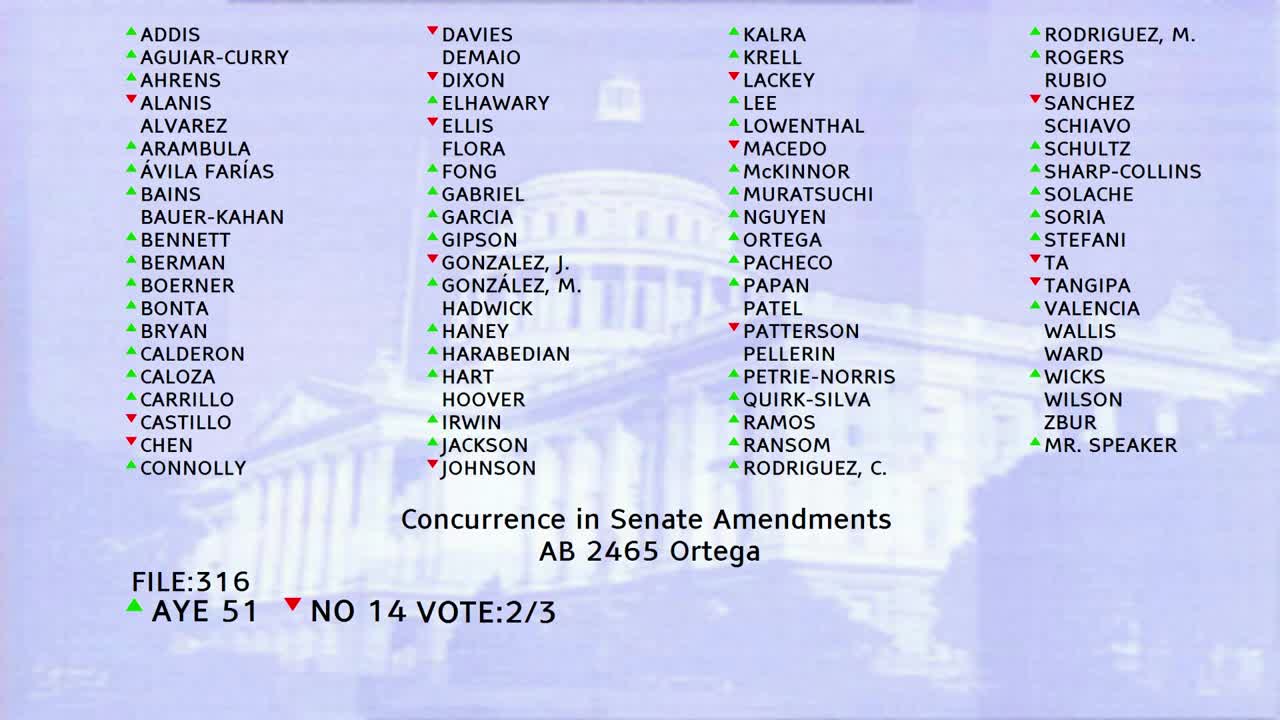 1MIN
Assembly Floor
 6MIN
Assembly Standing Committee on Public Safety
 23MIN
Senate Standing Committee on Public Safety
Bill Author

Bill Co-Author(s):