SB 1418: Preservation of election materials.
- Session Year: 2025-2026
- House: Senate
- Latest Version Date: 2026-09-19
Current Status:
Passed
(2026-09-19: Chaptered by Secretary of State. Chapter 341, Statutes of 2026.)
Introduced
In Committee
Awaiting First Chamber Vote
Passed First Chamber
In Committee
Awaiting Second Chamber Vote
Passed Second Chamber
Enacted
What does this bill do?
The bill bars destroying or removing election documents, voting equipment, or electronic voting data (including source code) from the custody of elections officials while any legal challenge or criminal case about the election is pending. It requires such electronic data on electronic media (like hard drives or flash drives) to be kept unaltered in a sealed container and retained 22 months for federal contests and six months for state or local contests. It makes taking those materials a crime and lets the Secretary of State, Attorney General, or local election officials seek civil penalties up to $50,000 and court orders to stop removal.
The summary is provided by generative AI which can make mistakes. For original language, please view the details in the table below.
Under existing law, various election materials, including ballots, voter rosters, and related documents, must be maintained for a certain amount of time following an election. If an election contest or criminal prosecution has been commenced before the date voted ballots will be destroyed, the ballots may not be destroyed until after final determination of the contest or prosecution.
This bill would expand that provision to prohibit the destruction of any document or record that must be preserved after an election and any certified voting technology or electronic data, as defined, used for the election until after final determination of any contest or criminal prosecution.
Existing law requires, for an election for the office of the President, Vice president, United States Senator, and United States Representative, specified data to be kept by an elections official, on electronic media, stored and unaltered, for 22 months from the date of the election. For all state and local elections, existing law requires the electronic data to be kept on electronic media for 6 months from the date of the election.
This bill would clarify the types of electronic media holding the specified data to include, but not be limited to, a hard drive, solid-state drive, flash drive, memory card, or other digital storage device. The bill would require the electronic media holding the data to be stored in a sealed container.
Existing law makes it a crime to knowingly take a package containing ballots from the custody of an elections official. Existing law also authorizes the Secretary of State, Attorney General, and appropriate local elections officials to bring a civil action against a person, business, or entity that takes a package containing ballots from the custody of an elections official.
This bill would apply the crime and the authorization to bring a civil action to taking any document, record, certified voting technology, or electronic data, as defined, or portions thereof including source code, or any other election-related material or equipment necessary to the conduct of an election, from the custody of the elections official. By expanding the scope of an existing crime, the bill would create a state-mandated local program.
The California Constitution requires the state to reimburse local agencies and school districts for certain costs mandated by the state. Statutory provisions establish procedures for making that reimbursement.
This bill would provide that no reimbursement is required by this act for a specified reason.
This bill would declare that it is to take effect immediately as an urgency statute.
Under existing law, various election materials, including ballots, voter rosters, and related documents, must be maintained for a certain amount of time following an election. If an election contest or criminal prosecution has been commenced before the date voted ballots will be destroyed, the ballots may not be destroyed until after final determination of the contest or prosecution.
This bill would expand that provision to prohibit the destruction of any document or record that must be preserved after an election and any certified voting technology or electronic data, as defined, used for the election until after final determination of any contest, criminal investigation, contest or criminal prosecution.
Existing law requires, for an election for the office of the President, Vice president, United States Senator, and United States Representative, specified data to be kept by an elections official, on electronic media, stored and unaltered, for 22 months from the date of the election. For all state and local elections, existing law requires the electronic data to be kept on electronic media for 6 months from the date of the election.
This bill would clarify the types of electronic media holding the specified data to include, but not be limited to, a hard drive, solid-state drive, flash drive, memory card, or other digital storage device. The bill would require the electronic media holding the data to be stored in a sealed container.
Existing law makes it a crime to knowingly take a package containing ballots from the custody of an elections official. Existing law also authorizes the Secretary of State, Attorney General, and appropriate local elections officials to bring a civil action against a person, business, or entity that takes a package containing ballots from the custody of an elections official.
This bill would apply the crime and the authorization to bring a civil action to taking any document, record, or certified voting technology technology, or electronic data, as defined, or portions thereof including source code, or any other election-related material or equipment necessary to the conduct of an election, from the custody of the elections official. By expanding the scope of an existing crime, the bill would create a state-mandated local program.
The California Constitution requires the state to reimburse local agencies and school districts for certain costs mandated by the state. Statutory provisions establish procedures for making that reimbursement.
This bill would provide that no reimbursement is required by this act for a specified reason.
This bill would declare that it is to take effect immediately as an urgency statute.
Under existing law, various election materials, including ballots, voter rosters, and related documents, must be maintained for a certain amount of time following an election. If an election contest or criminal prosecution has been commenced before the date voted ballots will be destroyed, the ballots may not be destroyed until after final determination of the contest or prosecution.
This bill would expand that provision to prohibit the destruction of any document that must be preserved after an election and any certified voting technology used for the election until after final determination of any contest, criminal investigation, or criminal prosecution.
Existing law makes it a crime to knowingly take a package containing ballots from the custody of an elections official. Existing law also authorizes the Secretary of State, Attorney General, and appropriate local elections officials to bring a civil action against a person, business, or entity that takes a package containing ballots from the custody of an elections official.
This bill would apply the crime and the authorization to bring a civil action to taking any document, record, or certified voting technology from the custody of the elections official. By expanding the scope of an existing crime, the bill would create a state-mandated local program.
The California Constitution requires the state to reimburse local agencies and school districts for certain costs mandated by the state. Statutory provisions establish procedures for making that reimbursement.
This bill would provide that no reimbursement is required by this act for a specified reason.
Existing law authorizes county elections officials, city elections officials, and registrars of voters to meet up to 3 times in a calendar year to discuss matters affecting the administration of the election laws and to promote uniformity of procedure, as specified.This bill would authorize meetings up to 4 times in a calendar year.Existing law authorizes county elections officials, city elections officials, and registrars of voters to meet up to 3 times in a calendar year to discuss matters affecting the administration of the election laws and to promote uniformity of procedure, as specified.
This bill would authorize meetings up to 4 times in a calendar year.
Existing law requires a vendor or county seeking certification or approval of a new or updated voting system or ballot marking system to cause an exact copy of the approved source code for each component of the system to be deposited into an approved escrow facility no later than 10 business days after the Secretary of State certifies or conditionally approves the use of the system. Existing law allows the Secretary of State to have reasonable access to the materials placed in escrow.This bill would make nonsubstantive changes to these provisions.Existing law requires a vendor or county seeking certification or approval of a new or updated voting system or ballot marking system to cause an exact copy of the approved source code for each component of the system to be deposited into an approved escrow facility no later than 10 business days after the Secretary of State certifies or conditionally approves the use of the system. Existing law allows the Secretary of State to have reasonable access to the materials placed in escrow.
This bill would make nonsubstantive changes to these provisions.
The records and supplies of any election when received by the elections official shall be maintained and disposed of in the manner set forth in this chapter and Chapter 4 (commencing with Section 17300) of Division 17.
SEC. 2.Section 15551 of the Elections Code is amended to read:15551.(a)If any contest or criminal prosecution has been commenced before its destruction any document or record that is or will be subject to the preservation requirements in Section 17300 to Section 17306, inclusive, or any certified voting technology or electronic data or portion thereof, including source code, shall be subject to the order of the court in which the contest or criminal prosecution is pending and shall not be destroyed until after final determination of the contest or criminal prosecution.
(b)In the case of a congressional election contest, the elections official shall hold the ballots of that congressional district in custody subject to the inspection of any committee of the House of Representatives having in charge the investigation of the contest, until the final determination of the contest by the House of Representatives.
(c)In the case of a contest in the State Legislature, the elections official shall hold the ballots of the Senate or Assembly district in custody subject to the inspection of any committee of the Senate or Assembly having in charge the investigation of the contest until the final determination of the contest or the final adjournment of the session of the Legislature in which the contest is filed, whichever is the later.
(d)In no event, except as provided in Sections 15553 or 19230, shall any document that is or will be subject to the preservation requirements in Section 17300 to Section 17306, inclusive, or any certified voting technology or electronic data or portion thereof, including source code, or any other election-related material or equipment necessary for the conduct of an election, be taken from the custody of the elections official.
(e)For purposes of this section, certified voting technology and electronic data have the same meaning as defined in Section 17600.
SEC. 3.Section 17601 of the Elections Code is amended to read:17601.(a)The following provisions shall apply to those elections where candidates for one or more of the following offices are voted upon: President, Vice President, United States Senator, and United States Representative.
(b)(1)The following data shall be kept by the elections official, on electronic media, including, but not limited to, a hard drive, solid-state drive, flash drive, memory card, or other digital storage device, stored and unaltered, for 22 months from the date of the election:
(A)All voting system electronic data.
(B)All ballot on demand system electronic data, if applicable.
(C)All adjudication electronic data.
(D)All remote accessible vote by mail system electronic data, if applicable.
(E)All electronic poll book electronic data, if applicable.
(F)HASH values taken from the voting technology devices, if applicable.
(G)All ballot images.
(2)The electronic media which holds the data described in subparagraphs (A) through (G) of paragraph (1) of subdivision (b) shall be stored in a sealed container.
(c)If a contest is not commenced within the 22-month period, or if a criminal prosecution involving fraudulent use, using the ballot tally system to mark or falsify ballots, or manipulation of the ballot tally system, is not commenced within the 22-month period, either of which may involve the vote count of the precinct from which voted ballots were received, the elections official shall have the backups destroyed.
SEC. 4.Section 17602 of the Elections Code is amended to read:17602.(a)The following provisions shall apply to all state or local elections not provided for in subdivision (a) of Section 17601. An election is not deemed a state or local election if votes for candidates for federal office may be cast on the same ballot as votes for candidates for state or local office.
(b)(1)The following data shall be kept by the elections official, on electronic media, including, but not limited to, a hard drive, solid-state drive, flash drive, memory card, or other digital storage device, stored and unaltered, for six months from the date of the election:
(A)All voting system electronic data.
(B)All ballot on demand system electronic data, if applicable.
(C)All adjudication electronic data.
(D)All remote accessible vote by mail system electronic data, if applicable.
(E)All electronic poll book electronic data, if applicable.
(F)HASH values taken from the voting technology devices, if applicable.
(G)All ballot images, if applicable.
(2)The electronic media which holds the data described in subparagraphs (A) through (G) of paragraph (1) of subdivision (b) shall be stored in a sealed container.
(c)If a contest is not commenced within the six-month period, or if a criminal prosecution involving fraudulent use, using the ballot tally system to mark or falsify ballots, or manipulation of the ballot tally system is not commenced within the six-month period, either of which may involve the vote count of the precinct from which voted ballots were received, the elections official shall have the backups destroyed.
SEC. 5.Section 18564.5 of the Elections Code is amended to read:18564.5.(a)The Secretary of State, Attorney General, and any local elections official in the county in which the act occurs, may bring a civil action against an individual, business, or other legal entity that commits any of the following acts before, during, or after an election:
(1)Tampers, interferes, or attempts to interfere with the correct operation of, or willfully damages in order to prevent the use of, any voting machine, voting device, voting system, vote tabulating device, or ballot tally software.
(2)Interferes or attempts to interfere with the secrecy of voting or interferes or attempts to interfere with ballot tally software program source codes.
(3)Knowingly, and without authorization, gains access to or provides another person or persons with access to a voting machine for the purpose of committing one of the acts specified by this section.
(4)Willfully substitutes or attempts to substitute forged, counterfeit, or malicious ballot tally software program source codes.
(5)Knowingly, and without authorization, inserts or causes the insertion of uncertified hardware, software, or firmware, for whatever purpose, into any voting machine, voting device, voting system, vote tabulating device, or ballot tally software.
(6)Fails to notify the Secretary of State prior to any change in hardware, software, or firmware to a voting machine, voting device, voting system, or vote tabulating device, certified or conditionally certified for use in this state.
(7)Takes any document, record, certified voting technology, or electronic data, as those terms are defined in Section 17600, or portions thereof including source code, or any other election-related material or equipment necessary to the conduct of an election, from the custody of the elections official in violation of subdivision (d) of Section 15551.
(b)A civil action may be brought pursuant to this section for a civil penalty not to exceed fifty thousand dollars ($50,000) for each act and for injunctive relief, if appropriate.
SEC. 6.Section 18568 of the Elections Code is amended to read:18568.Every person is punishable by a fine not exceeding one thousand dollars ($1,000), or by imprisonment pursuant to subdivision (h) of Section 1170 of the Penal Code for 16 months or two or three years, or by both that fine and imprisonment, who:
(a)Aids in changing or destroying any poll list or official ballot.
(b)Aids in wrongfully placing any ballots in the ballot container or in taking any therefrom.
(c)Adds or attempts to add any ballots to those legally polled at any election by fraudulently putting them into the ballot container, either before or after the ballots therein have been counted.
(d)Adds to or mixes with, or attempts to add to or mix with, the ballots polled, any other ballots, while they are being counted or canvassed or at any other time, with intent to change the result of the election, or allows another to do so, when in the persons power to prevent it.
(e)Carries away or destroys, attempts to carry away or destroy, or knowingly allows another to carry away or destroy, any poll list, ballot container, or ballots lawfully polled or who willfully detains, mutilates, or destroys any election returns.
(f)Removes any unvoted ballots from the polling place before the completion of the ballot count.
(g)Displays a container or provides an envelope for the purpose of collecting or returning ballots, with the intent to deceive a voter into casting a ballot in an unofficial ballot or returning a ballot in an unofficial ballot return envelope. Evidence of intent to deceive may include using the word official on the container or envelope, or otherwise fashioning the container or envelope in a way that is likely to deceive a voter into believing that the container or envelope is an official collection box or official ballot return envelope that has been approved by an elections official.
(h)Directs or solicits a voter to place a ballot in a container or envelope prohibited by subdivision (g).
(i)Knowingly takes any document, record, certified voting technology, or electronic data, as those terms are defined in Section 17600, or portions thereof including source code, or any other election-related material or equipment necessary to the conduct of an election, from the custody of the elections official in violation of subdivision (d) of Section 15551.
SEC. 7.The provisions of this bill shall be construed and applied in a manner that is consistent with the requirements of the California Constitution and the Constitution of the United States.
SEC. 8.The provisions of this act are severable. If any provision of this act or its application is held invalid, that invalidity shall not affect other provisions or applications that can be given effect without the invalid provision or application.
SEC. 9.No reimbursement is required by this act pursuant to Section 6 of Article XIIIB of the California Constitution because the only costs that may be incurred by a local agency or school district will be incurred because this act creates a new crime or infraction, eliminates a crime or infraction, or changes the penalty for a crime or infraction, within the meaning of Section 17556 of the Government Code, or changes the definition of a crime within the meaning of Section 6 of Article XIIIB of the California Constitution.
SEC. 10.This act is an urgency statute necessary for the immediate preservation of the public peace, health, or safety within the meaning of Article IV of the California Constitution and shall go into immediate effect. The facts constituting the necessity are:
In order for this act to apply to the statewide gubernatorial election occurring on November 3, 2026, it is necessary that this act take effect immediately.
The records and supplies of any election when received by the elections official shall be maintained and disposed of in the manner set forth in this chapter and Chapter 4 (commencing with Section 17300) of Division 17.
SEC. 2.Section 15551 of the Elections Code is amended to read:15551.(a)(1)For any document If any contest or criminal prosecution has been commenced before its destruction any document or record that is or will be subject to the preservation requirements in Section 17300 to Section 17304, 17306, inclusive, and for or any certified voting technology or electronic data or portion thereof, including source code, if a contest, criminal investigation, or criminal prosecution has been commenced before the destruction of the document or certified voting technology, the document or certified voting technology shall be subject to the order of the court in which the contest, criminal investigation, contest or criminal prosecution is pending and shall not be destroyed until after final determination of the contest, criminal investigation, contest or criminal prosecution.
(2)For purposes of this section, certified voting technology has the same meaning as defined in Section 17600.(b)In the case of a congressional election contest, the elections official shall hold the ballots of that congressional district in custody subject to the inspection of any committee of the House of Representatives having in charge the investigation of the contest, until the final determination of the contest by the House of Representatives.
(c)In the case of a contest in the State Legislature, the elections official shall hold the ballots of the Senate or Assembly district in custody subject to the inspection of any committee of the Senate or Assembly having in charge the investigation of the contest until the final determination of the contest or the final adjournment of the session of the Legislature in which the contest is filed, whichever is the later.
(d)Except In no event, except as provided in Section 15553, Sections 15553 or 19230, shall any document that is or will be subject to the preservation requirements in Section 17300 to Section 17304, 17306, inclusive, or any certified voting technology or electronic data or portion thereof, including source code, and or any other election-related material or equipment necessary for the conduct of an election shall not election, be taken from the custody of the elections official.
(e)For purposes of this section, certified voting technology and electronic data have the same meaning as defined in Section 17600.
SEC. 3.Section 17601 of the Elections Code is amended to read:17601.(a)The following provisions shall apply to those elections where candidates for one or more of the following offices are voted upon: President, Vice President, United States Senator, and United States Representative.
(b)(1)The following data shall be kept by the elections official, on electronic media, including, but not limited to, a hard drive, solid-state drive, flash drive, memory card, or other digital storage device, stored and unaltered, for 22 months from the date of the election:
(1)(A)All voting system electronic data.
(2)(B)All ballot on demand system electronic data, if applicable.
(3)(C)All adjudication electronic data.
(4)(D)All remote accessible vote by mail system electronic data, if applicable.
(5)(E)All electronic poll book electronic data, if applicable.
(6)(F)HASH values taken from the voting technology devices, if applicable.
(7)(G)All ballot images.
(2)The electronic media which holds the data described in subparagraphs (A) through (G) of paragraph (1) of subdivision (b) shall be stored in a sealed container.
(c)If a contest is not commenced within the 22-month period, or if a criminal prosecution involving fraudulent use, using the ballot tally system to mark or falsify ballots, or manipulation of the ballot tally system, is not commenced within the 22-month period, either of which may involve the vote count of the precinct from which voted ballots were received, the elections official shall have the backups destroyed.
SEC. 4.Section 17602 of the Elections Code is amended to read:17602.(a)The following provisions shall apply to all state or local elections not provided for in subdivision (a) of Section 17601. An election is not deemed a state or local election if votes for candidates for federal office may be cast on the same ballot as votes for candidates for state or local office.
(b)(1)The following data shall be kept by the elections official, on electronic media, including, but not limited to, a hard drive, solid-state drive, flash drive, memory card, or other digital storage device, stored and unaltered, for six months from the date of the election:
(1)(A)All voting system electronic data.
(2)(B)All ballot on demand system electronic data, if applicable.
(3)(C)All adjudication electronic data.
(4)(D)All remote accessible vote by mail system electronic data, if applicable.
(5)(E)All electronic poll book electronic data, if applicable.
(6)(F)HASH values taken from the voting technology devices, if applicable.
(7)(G)All ballot images, if applicable.
(2)The electronic media which holds the data described in subparagraphs (A) through (G) of paragraph (1) of subdivision (b) shall be stored in a sealed container.
(c)If a contest is not commenced within the six-month period, or if a criminal prosecution involving fraudulent use, using the ballot tally system to mark or falsify ballots, or manipulation of the ballot tally system is not commenced within the six-month period, either of which may involve the vote count of the precinct from which voted ballots were received, the elections official shall have the backups destroyed.
SEC. 3.SEC. 5.Section 18564.5 of the Elections Code is amended to read:18564.5.(a)The Secretary of State, Attorney General, and any local elections official in the county in which the act occurs, may bring a civil action against an individual, business, or other legal entity that commits any of the following acts before, during, or after an election:
(1)Tampers, interferes, or attempts to interfere with the correct operation of, or willfully damages in order to prevent the use of, any voting machine, voting device, voting system, vote tabulating device, or ballot tally software.
(2)Interferes or attempts to interfere with the secrecy of voting or interferes or attempts to interfere with ballot tally software program source codes.
(3)Knowingly, and without authorization, gains access to or provides another person or persons with access to a voting machine for the purpose of committing one of the acts specified by this section.
(4)Willfully substitutes or attempts to substitute forged, counterfeit, or malicious ballot tally software program source codes.
(5)Knowingly, and without authorization, inserts or causes the insertion of uncertified hardware, software, or firmware, for whatever purpose, into any voting machine, voting device, voting system, vote tabulating device, or ballot tally software.
(6)Fails to notify the Secretary of State prior to any change in hardware, software, or firmware to a voting machine, voting device, voting system, or vote tabulating device, certified or conditionally certified for use in this state.
(7)Takes any document, record, or certified voting technology technology, or electronic data, as those terms are defined in Section 17600, or portions thereof including source code, or any other election-related material or equipment necessary to the conduct of an election, from the custody of the elections official in violation of subdivision (d) of Section 15551.
(b)A civil action may be brought pursuant to this section for a civil penalty not to exceed fifty thousand dollars ($50,000) for each act and for injunctive relief, if appropriate.
SEC. 4.SEC. 6.Section 18568 of the Elections Code is amended to read:18568.Every person is punishable by a fine not exceeding one thousand dollars ($1,000), or by imprisonment pursuant to subdivision (h) of Section 1170 of the Penal Code for 16 months or two or three years, or by both that fine and imprisonment, who:
(a)Aids in changing or destroying any poll list or official ballot.
(b)Aids in wrongfully placing any ballots in the ballot container or in taking any therefrom.
(c)Adds or attempts to add any ballots to those legally polled at any election by fraudulently putting them into the ballot container, either before or after the ballots therein have been counted.
(d)Adds to or mixes with, or attempts to add to or mix with, the ballots polled, any other ballots, while they are being counted or canvassed or at any other time, with intent to change the result of the election, or allows another to do so, when in the persons power to prevent it.
(e)Carries away or destroys, attempts to carry away or destroy, or knowingly allows another to carry away or destroy, any poll list, ballot container, or ballots lawfully polled or who willfully detains, mutilates, or destroys any election returns.
(f)Removes any unvoted ballots from the polling place before the completion of the ballot count.
(g)Displays a container or provides an envelope for the purpose of collecting or returning ballots, with the intent to deceive a voter into casting a ballot in an unofficial ballot or returning a ballot in an unofficial ballot return envelope. Evidence of intent to deceive may include using the word official on the container or envelope, or otherwise fashioning the container or envelope in a way that is likely to deceive a voter into believing that the container or envelope is an official collection box or official ballot return envelope that has been approved by an elections official.
(h)Directs or solicits a voter to place a ballot in a container or envelope prohibited by subdivision (g).
(i)Knowingly takes any document, record, or certified voting technology technology, or electronic data, as those terms are defined in Section 17600, or portions thereof including source code, or any other election-related material or equipment necessary to the conduct of an election, from the custody of the elections official in violation of subdivision (d) of Section 15551.
SEC. 5.SEC. 7.The provisions of this bill shall be construed and applied in a manner that is consistent with the requirements of the California Constitution and the Constitution of the United States.
SEC. 6.SEC. 8.The provisions of this act are severable. If any provision of this act or its application is held invalid, that invalidity shall not affect other provisions or applications that can be given effect without the invalid provision or application.
SEC. 7.SEC. 9.No reimbursement is required by this act pursuant to Section 6 of Article XIIIB of the California Constitution because the only costs that may be incurred by a local agency or school district will be incurred because this act creates a new crime or infraction, eliminates a crime or infraction, or changes the penalty for a crime or infraction, within the meaning of Section 17556 of the Government Code, or changes the definition of a crime within the meaning of Section 6 of Article XIIIB of the California Constitution.
SEC. 10.This act is an urgency statute necessary for the immediate preservation of the public peace, health, or safety within the meaning of Article IV of the California Constitution and shall go into immediate effect. The facts constituting the necessity are:
In order for this act to apply to the statewide gubernatorial election occurring on November 3, 2026, it is necessary that this act take effect immediately.
The records and supplies of any election when received by the elections official shall be maintained and disposed of in the manner set forth in this chapter. chapter and Chapter 4 (commencing with Section 17300) of Division 17.
SEC. 2.Section 15551 of the Elections Code is amended to read:15551.(a)If a contest or any such (1)For any document that is or will be subject to the preservation requirements in Section 17300 to Section 17304, inclusive, and for any certified voting technology or portion thereof, including source code, if a contest, criminal investigation, or criminal prosecution has been commenced before the date fixed for its destruction, the package containing the voted ballots the destruction of the document or certified voting technology, the document or certified voting technology shall be subject to the order of the court in which the contest contest, criminal investigation, or criminal prosecution is pending and shall not be destroyed until after final determination of the contest contest, criminal investigation, or criminal prosecution.
(2)For purposes of this section, certified voting technology has the same meaning as defined in Section 17600.
(b)In the case of a congressional election contest, the elections official shall hold the ballots of that congressional district in custody subject to the inspection of any committee of the House of Representatives having in charge the investigation of the contest, until the final determination of the contest by the House of Representatives.
(c)In the case of a contest in the State Legislature, the elections official shall hold the ballots of the Senate or Assembly district in custody subject to the inspection of any committee of the Senate or Assembly having in charge the investigation of the contest until the final determination of the contest or the final adjournment of the session of the Legislature in which the contest is filed, whichever is the later.
(d)In no event shall the package or its contents Except as provided in Section 15553, any document that is or will be subject to the preservation requirements in Section 17300 to Section 17304, inclusive, any certified voting technology or portion thereof, including source code, and any other election-related material or equipment necessary for the conduct of an election shall not be taken from the custody of the elections official.
SEC. 3.Section 18564.5 of the Elections Code is amended to read:18564.5.(a)The Secretary of State, Attorney General, and any local elections official in the county in which the act occurs, may bring a civil action against an individual, business, or other legal entity that commits any of the following acts before, during, or after an election:
(1)Tampers, interferes, or attempts to interfere with the correct operation of, or willfully damages in order to prevent the use of, any voting machine, voting device, voting system, vote tabulating device, or ballot tally software.
(2)Interferes or attempts to interfere with the secrecy of voting or interferes or attempts to interfere with ballot tally software program source codes.
(3)Knowingly, and without authorization, gains access to or provides another person or persons with access to a voting machine for the purpose of committing one of the acts specified by this section.
(4)Willfully substitutes or attempts to substitute forged, counterfeit, or malicious ballot tally software program source codes.
(5)Knowingly, and without authorization, inserts or causes the insertion of uncertified hardware, software, or firmware, for whatever purpose, into any voting machine, voting device, voting system, vote tabulating device, or ballot tally software.
(6)Fails to notify the Secretary of State prior to any change in hardware, software, or firmware to a voting machine, voting device, voting system, or vote tabulating device, certified or conditionally certified for use in this state.
(7)Takes a package containing the voted ballots or its contents any document, record, or certified voting technology from the custody of the elections official in violation of subdivision (d) of Section 15551.
(b)A civil action may be brought pursuant to this section for a civil penalty not to exceed fifty thousand dollars ($50,000) for each act and for injunctive relief, if appropriate.
SEC. 4.Section 18568 of the Elections Code is amended to read:18568.Every person is punishable by a fine not exceeding one thousand dollars ($1,000), or by imprisonment pursuant to subdivision (h) of Section 1170 of the Penal Code for 16 months or two or three years, or by both that fine and imprisonment, who:
(a)Aids in changing or destroying any poll list or official ballot.
(b)Aids in wrongfully placing any ballots in the ballot container or in taking any therefrom.
(c)Adds or attempts to add any ballots to those legally polled at any election by fraudulently putting them into the ballot container, either before or after the ballots therein have been counted.
(d)Adds to or mixes with, or attempts to add to or mix with, the ballots polled, any other ballots, while they are being counted or canvassed or at any other time, with intent to change the result of the election, or allows another to do so, when in the persons power to prevent it.
(e)Carries away or destroys, attempts to carry away or destroy, or knowingly allows another to carry away or destroy, any poll list, ballot container, or ballots lawfully polled or who willfully detains, mutilates, or destroys any election returns.
(f)Removes any unvoted ballots from the polling place before the completion of the ballot count.
(g)Displays a container or provides an envelope for the purpose of collecting or returning ballots, with the intent to deceive a voter into casting a ballot in an unofficial ballot or returning a ballot in an unofficial ballot return envelope. Evidence of intent to deceive may include using the word official on the container or envelope, or otherwise fashioning the container or envelope in a way that is likely to deceive a voter into believing that the container or envelope is an official collection box or official ballot return envelope that has been approved by an elections official.
(h)Directs or solicits a voter to place a ballot in a container or envelope prohibited by subdivision (g).
(i)Knowingly takes a package containing voted ballots or its contents any document, record, or certified voting technology from the custody of the elections official in violation of subdivision (d) of Section 15551.
SEC. 5.The provisions of this bill shall be construed and applied in a manner that is consistent with the requirements of the California Constitution and the Constitution of the United States.
SEC. 6.The provisions of this act are severable. If any provision of this act or its application is held invalid, that invalidity shall not affect other provisions or applications that can be given effect without the invalid provision or application.
SEC. 7.No reimbursement is required by this act pursuant to Section 6 of Article XIIIB of the California Constitution because the only costs that may be incurred by a local agency or school district will be incurred because this act creates a new crime or infraction, eliminates a crime or infraction, or changes the penalty for a crime or infraction, within the meaning of Section 17556 of the Government Code, or changes the definition of a crime within the meaning of Section 6 of Article XIIIB of the California Constitution.
SECTION 1.Section 11 of the Elections Code is amended to read:11.On written call of the Secretary of State, the county elections officials, city elections officials, and registrars of voters of this state may meet with the approval of their legislative bodies, at the time and place within this state designated in the call, to discuss matters affecting the administration of the election laws and to promote uniformity of procedure in those matters. Meetings shall not exceed four in any calendar year. Any deputy of a county elections official, city elections official, or registrar of voters, designated for the purpose by their principal, may attend these meetings, alone or with their principal. The actual and necessary expenses of the county elections official, city elections official, or registrar of voters, and of a deputy, incurred in traveling to and from meetings and in attending the same, for each officer for any one meeting, shall be a charge of the county or city of the elections official or registrar, and payable as other county or city charges. REVISIONS: HeadingLine 3.On written call of the Secretary of State, the county elections officials, city elections officials, and registrars of voters of this state may meet with the approval of their legislative bodies, at the time and place within this state designated in the call, to discuss matters affecting the administration of the election laws and to promote uniformity of procedure in those matters. Meetings shall not exceed three four in any calendar year. Any deputy of a county elections official, city elections official, or registrar of voters, designated for the purpose by his or her their principal, may attend these meetings, alone or with his or her their principal. The actual and necessary expenses of the county elections official, city elections official, or registrar of voters, and of a deputy, incurred in traveling to and from meetings and in attending the same, for each officer for any one meeting, shall be a charge of the county or city of the elections official or registrar, and payable as other county or city charges.
SECTION 1.Section 19212 of the Elections Code is amended to read:19212.(a)(1)No later than 10 business days after the Secretary of State certifies or conditionally approves the use of a new or updated voting system, the vendor or county seeking certification or approval of the voting system shall cause an exact copy of the approved source code for each component of the voting system, including complete build and configuration instructions and related documents for compiling the source code into object code, to be transferred directly from the voting system testing agency that evaluated the voting system and is approved by the Secretary of State, and deposited into an approved escrow facility.(2)No later than 10 business days after the Secretary of State certifies or conditionally approves a new or updated ballot marking system, the vendor or county seeking certification or approval of the ballot marking system shall cause an exact copy of the approved source code for each component of the ballot marking system, including complete build and configuration instructions and related documents for compiling the source code into object code, to be deposited into an approved escrow facility.(b)The Secretary of State shall adopt regulations relating to all of the following:(1)The definition of source code components of a voting system or ballot marking system, including source code for all firmware and software of the voting system or ballot marking system. Firmware and software shall include commercial off-the-shelf or other third-party firmware and software that is available and able to be disclosed by the vendor or county seeking certification or approval of a voting system or ballot marking system.(2)Specifications for the escrow facility, including security and environmental specifications necessary for the preservation of the voting system or ballot marking system source codes.(3)Procedures for submitting voting system or ballot marking system source codes.(4)Criteria for access to voting system or ballot marking system source codes.(5)Requirements for the applicant to include in the materials deposited in escrow build and configuration instructions and documents so that a neutral third party may create, from the source codes in escrow, executable object codes identical to the code installed on certified or conditionally approved voting systems or ballot marking systems.(c)The Secretary of State shall have reasonable access to the materials placed in escrow, under any of the following circumstances:(1)In the course of an investigation or prosecution regarding vote counting or ballot marking equipment or procedures.(2)Upon a finding by the Secretary of State that an escrow facility or escrow company is unable or unwilling to maintain materials in escrow in compliance with this section.(3)To fulfill the provisions of this chapter related to the examination and certification or conditional approval of voting systems or ballot marking systems.(4)To verify that the software on a voting system is identical to the certified or conditionally approved version.(5)For any other purpose deemed necessary to fulfill the provisions of this code or Section 12172.5 of the Government Code.(d)The Secretary of State may seek injunctive relief requiring the elections officials, approved escrow facility, or any vendor or manufacturer of a voting system or part of a voting system to comply with this section and related regulations. Venue for a proceeding under this section shall be exclusively in Sacramento County.(e)This section applies to all elections.(a)(1)No later than 10 business days after the Secretary of State certifies or conditionally approves the use of a new or updated voting system, the vendor or county seeking certification or approval of the voting system shall cause an exact copy of the approved source code for each component of the voting system, including complete build and configuration instructions and related documents for compiling the source code into object code, to be transferred directly from the voting system testing agency that evaluated the voting system and is approved by the Secretary of State, and deposited into an approved escrow facility.
(2)No later than 10 business days after the Secretary of State certifies or conditionally approves a new or updated ballot marking system, the vendor or county seeking certification or approval of the ballot marking system shall cause an exact copy of the approved source code for each component of the ballot marking system, including complete build and configuration instructions and related documents for compiling the source code into object code, to be deposited into an approved escrow facility.
(b)The Secretary of State shall adopt regulations relating to all of the following:
(1)The definition of source code components of a voting system or ballot marking system, including source code for all firmware and software of the voting system or ballot marking system. Firmware and software shall include commercial off-the-shelf or other third-party firmware and software that is available and able to be disclosed by the vendor or county seeking certification or approval of a voting system or ballot marking system.
(2)Specifications for the escrow facility, including security and environmental specifications necessary for the preservation of the voting system or ballot marking system source codes.
(3)Procedures for submitting voting system or ballot marking system source codes.
(4)Criteria for access to voting system or ballot marking system source codes.
(5)Requirements for the applicant to include in the materials deposited in escrow build and configuration instructions and documents so that a neutral third party may create, from the source codes in escrow, executable object codes identical to the code installed on certified or conditionally approved voting systems or ballot marking systems.
(c)The Secretary of State shall have reasonable access to the materials placed in escrow, under any of the following circumstances:
(1)In the course of an investigation or prosecution regarding vote counting or ballot marking equipment or procedures.
(2)Upon a finding by the Secretary of State that an escrow facility or escrow company is unable or unwilling to maintain materials in escrow in compliance with this section.
(3)In order to To fulfill the provisions of this chapter related to the examination and certification or conditional approval of voting systems or ballot marking systems.
(4)In order to To verify that the software on a voting system is identical to the certified or conditionally approved version.
(5)For any other purpose deemed necessary to fulfill the provisions of this code or Section 12172.5 of the Government Code.
(d)The Secretary of State may seek injunctive relief requiring the elections officials, approved escrow facility, or any vendor or manufacturer of a voting system or part of a voting system to comply with this section and related regulations. Venue for a proceeding under this section shall be exclusively in Sacramento County.
(e)This section applies to all elections.
|
Date
|
Status
|
|---|---|
| Sep 19, 2026 | Chaptered by Secretary of State. Chapter 341, Statutes of 2026. |
| Sep 19, 2026 | Approved by the Governor. |
| Sep 4, 2026 | Enrolled and presented to the Governor at 2 p.m. |
| Aug 27, 2026 | Urgency clause adopted. |
| Aug 27, 2026 | Assembly amendments concurred in. (Ayes 30. Noes 10.) Ordered to engrossing and enrolling. |
| Aug 27, 2026 | Assembly amendments concurred in. (Ayes 30. Noes 10. Page 5996.) Ordered to engrossing and enrolling. |
| Aug 26, 2026 | From committee: That the Assembly amendments be concurred in. (Ayes 4. Noes 1.) |
| Aug 26, 2026 | From committee: That the Assembly amendments be concurred in. (Ayes 4. Noes 1. Page 5925.) |
| Aug 24, 2026 | From committee: Be re-referred to Com. on E. & C.A. pursuant to Senate Rule 29.10(d). (Ayes 5. Noes 0.) Re-referred to Com. on E. & C.A. |
| Aug 24, 2026 | From committee: Be re-referred to Com. on E. & C.A. pursuant to Senate Rule 29.10(d). (Ayes 5. Noes 0. Page 5618.) Re-referred to Com. on E. & C.A. |
| Aug 24, 2026 | Re-referred to Com. on RLS. pursuant to Senate Rule 29.10(d). |
| Aug 20, 2026 | In Senate. Concurrence in Assembly amendments pending. |
| Aug 20, 2026 | Read third time. Urgency clause adopted. Passed. (Ayes 60. Noes 13. Page 6312.) Ordered to the Senate. |
| Aug 20, 2026 | Read third time. Urgency clause adopted. Passed. Ordered to the Senate. |
| Aug 17, 2026 | Read second time. Ordered to third reading. |
| Aug 13, 2026 | Read second time and amended. Ordered to second reading. |
| Aug 13, 2026 | From committee: Do pass as amended. (Ayes 11. Noes 2.) (August 13). |
| Aug 13, 2026 | Assembly Rule 63 suspended. |
| Aug 5, 2026 | August 5 set for first hearing. Placed on suspense file. |
| Jul 1, 2026 | From committee: Do pass and re-refer to Com. on APPR. (Ayes 6. Noes 2.) (July 1). Re-referred to Com. on APPR. |
| Jul 1, 2026 | Coauthors revised. |
| Jun 30, 2026 | From committee: Do pass and re-refer to Com. on ELECTIONS. (Ayes 8. Noes 1.) (June 30). Re-referred to Com. on ELECTIONS. |
| Jun 22, 2026 | Assembly Rule 56 suspended. |
| Jun 15, 2026 | Re-referred to Coms. on PUB. S. and ELECTIONS pursuant to Assembly Rule 96. |
| Jun 11, 2026 | From committee with author's amendments. Read second time and amended. Re-referred to Com. on ELECTIONS. |
| May 11, 2026 | Referred to Com. on ELECTIONS. |
| Apr 27, 2026 | In Assembly. Read first time. Held at Desk. |
| Apr 27, 2026 | Read third time. Passed. (Ayes 37. Noes 0.) Ordered to the Assembly. |
| Apr 27, 2026 | Read third time. Passed. (Ayes 37. Noes 0. Page 4067.) Ordered to the Assembly. |
| Apr 22, 2026 | Read second time. Ordered to consent calendar. |
| Apr 21, 2026 | From committee: Do pass. Ordered to consent calendar. (Ayes 5. Noes 0.) (April 21). |
| Apr 21, 2026 | From committee: Do pass. Ordered to consent calendar. (Ayes 5. Noes 0. Page 3971.) (April 21). |
| Apr 9, 2026 | Set for hearing April 21. |
| Apr 8, 2026 | Re-referred to Com. on E. & C.A. |
| Mar 24, 2026 | From committee with author's amendments. Read second time and amended. Re-referred to Com. on RLS. |
| Mar 4, 2026 | Referred to Com. on RLS. |
| Feb 23, 2026 | Read first time. |
| Feb 23, 2026 | From printer. May be acted upon on or after March 23. |
| Feb 20, 2026 | Introduced. To Com. on RLS. for assignment. To print. |
|
Date
|
Description
|
Location
|
Votes
|
|
|---|---|---|---|---|
| Aug 27, 2026 | Unfinished Business SB1418 Cervantes et al. Urgency Clause Concurrence | Senate Floor |
Passed |
|
| Aug 26, 2026 | That the Assembly amendments be concurred in | Senate Standing Committee on Elections and Constitutional Amendments |
Passed |
|
| Aug 20, 2026 | SB 1418 Cervantes Third Reading Urgency By Jackson | Assembly Floor |
Passed |
|
| Aug 13, 2026 | Do pass as amended. | Assembly Standing Committee on Appropriations |
Passed |
|
| Jul 1, 2026 | Do pass and be re-referred to the Committee on [Appropriations] | Assembly Standing Committee on Elections |
Passed |
|
| Jun 30, 2026 | Do pass and be re-referred to the Committee on [Elections] | Assembly Standing Committee on Public Safety |
Passed |
|
| Apr 27, 2026 | Consent Calendar 2nd SB1418 Cervantes | Senate Floor |
Passed |
|
| Apr 21, 2026 | Do pass and be ordered to the Consent Calendar | Senate Standing Committee on Elections and Constitutional Amendments |
Passed |
This list shows positions taken on this bill by organizations on the date displayed, which is linked to the original source.
Positions by individuals are not included.
|
Organization
|
Position
|
Date
|
|---|---|---|
| AG Rob Bonta | ** Support | |
| Attorney General Rob Bonta | ** Support | |
| Office of the Attorney General Rob Bonta | ** Support |
SENATE RULES COMMITTEE Office of Senate Floor Analyses (916) 651-4171 | SB 1418 |
UNFINISHED BUSINESS
Bill No: SB 1418
Author: Cervantes (D), et al.
Amended: 8/13/26
Vote: 27 - Urgency
PRIOR SENATE VOTES NOT RELEVANT
SENATE ELECTIONS & C.A. COMMITTEE: 4-1, 8/26/26
AYES: Wiener, Allen, Cervantes, Umberg
NOES: Choi
ASSEMBLY FLOOR: 60-13, 8/20/26 - See last page for vote
SUBJECT: Preservation of election materials
SOURCE: Attorney General Rob Bonta
DIGEST:
This bill makes it a crime to take specified election materials or voting technology from the custody of election officials. This bill also expands the types of materials required for preservation if an election contest or criminal proceeding is ongoing.
Assembly Amendments
replaced this bill’s original contents with the current language.
ANALYSIS:
Existing law:
- Prohibits packages containing voted ballots from an election from being destroyed if an election contest or criminal prosecution related to those ballots is ongoing. The packages of voted ballots from an election cannot be taken from the custody of the elections official.
- Requires the elections official to preserve all rosters or combined rosters and voter lists from an election until five years after the date of the election. The elections official may destroy those materials after that five-year period.
- Requires the elections official to keep ballots, paper cast vote records, and ballot identification envelopes in packages that remain unopened and unaltered for 22 months from the date of the election where candidates for one or more of the following federal offices are voted upon: President, Vice President, United States Senator, and United States Representative. For any other election, these materials must be retained for six months. The elections official must destroy or recycle these unopened items at the end of the retention period unless an election contest or criminal prosecution commences during that period.
- Requires the elections official to keep any tally sheets used for manually tallying ballots, lists of challenged voters, and lists of assisted voters from an election in packages for 22 months from the date of a federal election and for six months from the date of any other election. The elections official may destroy or recycle the packages at the end of the retention period unless an election contest or criminal prosecution commences during that period. Voters are permitted to inspect the contents of the packages if certain conditions are met.
- Prohibits any person from permitting an agent of a law enforcement agency to access, disrupt, modify, or take possession of rosters, combined rosters, voter lists, or certified voting technology unless authorized by a court order or to investigate a violation of state law prohibiting fraudulent voting.
- Makes it a felony for a person to tamper with voting devices, or to interfere with the secrecy of election equipment source codes, including knowingly breaking the chain of custody for certified voting technology without authorization.
- Permits the Secretary of State (SOS), the Attorney General (AG), or a county elections official to bring a civil action against any person who tampers with voting technology.
- Defines “certified voting technology” as any certified voting technologies certified by the SOS, including voting systems, ballot on demand printing systems, electronic poll book systems, or adjudication systems, and the hardware, firmware, software, proprietary intellectual property they contain, any components, and any products they generate, including ballots, ballot images, reports, logs, cast vote records, or electronic data.
- Defines “electronic data” to include voting technology software, operating systems, databases, firmware, drivers, and logs.
This bill:
- Prohibits specified election materials required to be retained after an election, certified voting technology, or electronic data from being taken from the custody of the elections official.
- Permits the SOS, the AG, or a county elections official to bring a civil action against any person who takes materials in 1) of this bill from the custody of the elections official.
- Makes it a crime, punishable by a $1,000 fine, imprisonment for up to three years, or by both, for a person to knowingly take materials in 1) of this bill from the custody of the elections official.
- Prohibits the destruction of specified materials, certified voting technology, or electronic data from an election while a contest, criminal investigation, or criminal prosecution related to that election is pending.
- Requires electronic media that contains election data to be secured during the retention period for that data.
- Requires the provisions of this bill be construed and applied in a manner that is consistent with the requirements of the California Constitution and the U.S. Constitution.
- Contains an urgency clause.
Background
Riverside County. In early 2026, a local election watchdog group raised concerns that the number of ballots cast in the November 2025 statewide special election differed from the official total reported by the Riverside County Registrar of Voters (ROV) by nearly 46,000 ballots. Taking these concerns into consideration, the Riverside County Sheriff’s Department applied to the Superior Court and sought a warrant to seize the ballots “in order to prove or disprove any criminal conduct.” The court issued a judicial warrant on February 9, 2026.
At a presentation to the Riverside County Board of Supervisors on February 10, 2026, the ROV addressed the alleged discrepancies and disputed the watchdog group’s figures. The ROV noted the difference between ballots cast and ballots counted, based on official results, was 103 ballots.
On February 26, 2026, the Sheriff’s Department seized about 1,000 boxes of ballots and ballot materials.
The Sheriff’s Department also obtained two additional search warrants: one to seize additional election materials (beyond ballots) and another to appoint a special master to oversee the Sheriff Department’s counting of ballots.
As this process unfolded, the AG issued multiple letters directing the Riverside County Sheriff to preserve all seized ballots and pause further action. The AG further questioned whether the warrants were supported by probable cause and whether the Riverside County Sheriff’s Department presented the magistrate with all the material evidence required by law.
On April 8, 2026, the California Supreme Court ordered the Riverside County Sheriff to halt his investigation into alleged fraud in the November 2025 special election and preserve all seized items. Proceedings remain ongoing, and the California Supreme Court indicated that this matter will be considered on an expedited basis.
Connecting SB 73, AB 1664, and SB 851. SB 73 (Cervantes, Chapter 10, Statutes of 2026), which took effect on May 27, 2026, restricted law enforcement agencies and officers from interfering or engaging in specific conduct related to elections. Among other provisions, the measure required the AG to provide guidance for county election officials and managers of election sites regarding how to respond to requests for access by law enforcement agencies for election-related materials and locations. The bill also prohibited a peace officer from interfering in any manner with the administration of any election in this state, including the seizure of specified voter data and voting technology, unless certain conditions are met.
AB 1664 (Jackson) of 2026 is related to SB 73 and would require a local agency, political subdivision, or elections official to provide notice to the SOS and the AG immediately, but no later than one calendar day, after becoming aware of any warrant, subpoena, or active law enforcement investigation pertaining to the search, seizure, or retention of any election records or certified voting technology.
Both these bills stem from SB 851 (Cervantes, Chapter 238, Statutes of 2025) which, among other provisions, expanded the prohibition for a person in possession of a firearm or any uniformed peace officer, private guard, or security personnel or any person who is wearing a uniform of a peace officer, guard, or security personnel, to be stationed in the immediate vicinity of, or posted at, a polling location to include an officer or agent of a federal law enforcement agency, unless certain conditions are met. The author sought to “ensure that federal agents are treated the same way as state and local law enforcement so that it is a crime to hire or arrange for law enforcement to be posted at or near a voting location or county registrar’s office without authorization.”
Comments
- Author’s Statement. Democracy in California is under attack, not only by the Trump Administration but also by some officials in our state, including Riverside County Sheriff Chad Bianco. In March, Sheriff Bianco seized more than 600,000 voted ballots from the 2025 statewide special election on Proposition 50 from the Riverside County Registrar of Voters as part of a sham investigation driven by conservative extremist groups. This seizure was in violation of state law, which required that voted ballots remain in the custody of county registrars. In response, SB 73 provided additional guardrails against the seizure of ballots from the custody of county registrars. Then, in April, a group of press organizations including CalMatters successfully petitioned a court to unseal the warrants Bianco obtained. They found that, in addition to voted ballots, those warrants authorized the seizure of other election records from the Riverside County Registrar of Voters. This bill is a follow-up to SB 73 that will extend the protections in that bill to other kinds of election records, including voting machines and voting software, and protect the chain of custody of those materials.
Related/Prior Legislation
SB 73 (Cervantes, Chapter 10, Statutes of 2026) restricts law enforcement agencies and officers from engaging in specified conduct related to elections.
SB 259 (Wahab) of 2026 makes it a misdemeanor for any person in charge of a vote by mail ballot to interfere with its delivery to a voter. The bill also makes it a felony for any person with authority to direct other people under their supervision to interfere in either the delivery or return of a vote by mail ballot.
SB 884 (Umberg) of 2026 extends the time vote by mail drop off locations are open and modifies the type and range of prohibited activities near a polling location for elections held or proclaimed in 2026, 2027, 2028, and 2029.
AB 282 (Pellerin) of 2026 makes it a felony for any person to seize ballots, election records, or voting technology before the certification of an election from the custody of the elections official. The bill also makes it a felony for any person with authority who directs other people under their supervision to seize ballots, election records, or voting technology.
AB 1664 (Jackson) of 2026 requires a local agency, political subdivision, or elections official to provide written notice to the SOS and the AG no later than one calendar day after becoming aware of any warrant, subpoena, or active law enforcement investigation pertaining to the search, seizure, or retention of any election records or certified voting technology.
SB 851 (Cervantes, Chapter 238, Statutes of 2025) among other provisions, required state agencies and local governments to provide written notice to the AG and the SOS within three court days after the agency or jurisdiction files or is served with a court action that contains a claim relating to elections arising under federal law.
FISCAL EFFECT: Appropriation: No Fiscal Com.: Yes Local: Yes
According to the Assembly Committee on Appropriations:
- Ongoing cost pressures of an unknown amount, potentially in excess of $150,000, to the courts in additional workload by allowing the AG, SOS, or a county elections official to file a civil action against a person who takes certain elections materials from the custody of an elections official, and by making such an act a felony, for which a defendant is entitled to no-cost legal representation and a jury trial (General Fund (GF) or Trial Court Trust Fund (TCTF)). It is unclear how many actions or prosecutions may commence statewide and how much court time may be needed to resolve each case, but it generally costs approximately $1,000 to operate a courtroom for one hour. Although courts are not funded on the basis of workload, increased pressure on staff and the TCTF may create a demand for increased court funding from the GF. The state budget provides annual GF backfills to the TCTF to offset revenue reductions, totaling approximately $117.3 million in fiscal year 2025-26.
- Potential incarceration costs of an unknown amount, likely to the counties instead of the state, to the extent prosecutions of the crime expanded by this bill result in imprisonment (local funds, GF cost pressures). Actual incarceration costs will depend on the number of convictions and the length and location of each county jail sentence. The average annual cost to incarcerate one person in county jail is approximately $29,000, with higher costs in larger counties. Although county incarceration costs are generally not considered reimbursable state mandates pursuant to Proposition 30 (2012), overcrowding in county jails creates GF cost pressures because the state has historically granted new funding to counties to offset overcrowding resulting from 2011 public safety realignment.
- The SOS and DOJ report no significant costs, indicating that neither entity is likely to pursue the civil action allowed by this bill. However, in light of heightened political distrust and speculation about elections security across the nation and state, it is possible that the SOS or DOJ may undertake such an enforcement measure, with actual costs depending on how often the SOS or DOJ pursue an action and the level of additional staffing needed to handle the related workload.
SUPPORT: (Verified 8/26/26)
Attorney General Rob Bonta (source)
OPPOSITION: (Verified 8/26/26)
None received
ARGUMENTS IN SUPPORT: In a letter sponsoring this bill, Attorney General Rob Bonta states the following:
[Election] administration increasingly relies on a broader range of records (including electronic records), equipment, and certified voting technologies that may be necessary to investigate allegations of election misconduct, resolve election contests, or preserve evidence during criminal prosecution of an election crime.
[…]
With state and federal law enforcement actors becoming more emboldened to meddle in election administration, [this bill] seeks to protect our most important election materials by keeping them in the custody of elections officials, even when subject to a search warrant.
ASSEMBLY FLOOR: 60-13, 8/20/26
AYES: Addis, Aguiar-Curry, Ahrens, Alvarez, Arambula, Ávila Farías, Bains, Bauer-Kahan, Bennett, Berman, Boerner, Bonta, Bryan, Calderon, Caloza, Carrillo, Connolly, Elhawary, Fong, Gabriel, Garcia, Gipson, Mark González, Haney, Harabedian, Hart, Irwin, Jackson, Kalra, Krell, Lee, Lowenthal, McKinnor, Muratsuchi, Nguyen, Ortega, Pacheco, Papan, Patel, Pellerin, Petrie-Norris, Quirk-Silva, Ramos, Ransom, Celeste Rodriguez, Michelle Rodriguez, Rogers, Blanca Rubio, Schiavo, Schultz, Sharp-Collins, Solache, Soria, Stefani, Valencia, Ward, Wicks, Wilson, Zbur, Rivas
NOES: Castillo, Davies, DeMaio, Dixon, Ellis, Flora, Jeff Gonzalez, Hadwick, Johnson, Lackey, Macedo, Patterson, Tangipa
NO VOTE RECORDED: Alanis, Chen, Hoover, Sanchez, Ta, Wallis
Prepared by: Scott Matsumoto / E. & C.A. / (916) 651-4106
8/26/26 18:53:38
**** END ****
SENATE COMMITTEE ON
ELECTIONS AND CONSTITUTIONAL AMENDMENTS
Senator Scott Wiener, Chair
2025 - 2026 Regular
Bill No: Hearing Date: 8/26/26
Author: | |||
Version: |
| ||
Urgency: | Fiscal: | ||
Consultant: | |||
Subject: Preservation of election materials
DIGEST
This bill makes it a crime to take specified election materials or voting technology from the custody of election officials. This bill also expands the types of materials required for preservation if an election contest or criminal proceeding is ongoing.
ANALYSIS
Existing law:
- Prohibits packages containing voted ballots from an election from being destroyed if an election contest or criminal prosecution related to those ballots is ongoing. The packages of voted ballots from an election cannot be taken from the custody of the elections official.
- Requires the elections official to preserve all rosters or combined rosters and voter lists from an election until five years after the date of the election. The elections official may destroy those materials after that five-year period.
- Requires the elections official to keep ballots, paper cast vote records, and ballot identification envelopes in packages that remain unopened and unaltered for 22 months from the date of the election where candidates for one or more of the following federal offices are voted upon: President, Vice President, United States Senator, and United States Representative. For any other election, these materials must be retained for six months. The elections official must destroy or recycle these unopened items at the end of the retention period unless an election contest or criminal prosecution commences during that period.
- Requires the elections official to keep any tally sheets used for manually tallying ballots, lists of challenged voters, and lists of assisted voters from an election in packages for 22 months from the date of a federal election and for six months from the date of any other election. The elections official may destroy or recycle the packages at the end of the retention period unless an election contest or criminal prosecution commences during that period. Voters are permitted to inspect the contents of the packages if certain conditions are met.
- Prohibits any person from permitting an agent of a law enforcement agency to access, disrupt, modify, or take possession of rosters, combined rosters, voter lists, or certified voting technology unless authorized by a court order or to investigate a violation of state law prohibiting fraudulent voting.
- Makes it a felony for a person to tamper with voting devices, or to interfere with the secrecy of election equipment source codes, including knowingly breaking the chain of custody for certified voting technology without authorization.
- Permits the Secretary of State (SOS), the Attorney General (AG), or a county elections official to bring a civil action against any person who tampers with voting technology.
- Defines “certified voting technology” as any certified voting technologies certified by the SOS, including voting systems, ballot on demand printing systems, electronic poll book systems, or adjudication systems, and the hardware, firmware, software, proprietary intellectual property they contain, any components, and any products they generate, including ballots, ballot images, reports, logs, cast vote records, or electronic data.
- Defines “electronic data” to include voting technology software, operating systems, databases, firmware, drivers, and logs.
This bill:
- Prohibits specified election materials required to be retained after an election, certified voting technology, or electronic data from being taken from the custody of the elections official.
- Permits the SOS, the AG, or a county elections official to bring a civil action against any person who takes materials in 1) of this bill from the custody of the elections official.
- Makes it a crime, punishable by a $1,000 fine, imprisonment for up to three years, or by both, for a person to knowingly take materials in 1) of this bill from the custody of the elections official.
- Prohibits the destruction of specified materials, certified voting technology, or electronic data from an election while a contest, criminal investigation, or criminal prosecution related to that election is pending.
- Requires electronic media that contains election data to be secured during the retention period for that data.
- Requires the provisions of this bill be construed and applied in a manner that is consistent with the requirements of the California Constitution and the U.S. Constitution.
- Contains an urgency clause.
BACKGROUND
Riverside County. In early 2026, a local election watchdog group raised concerns that the number of ballots cast in the November 2025 statewide special election differed from the official total reported by the Riverside County Registrar of Voters (ROV) by nearly 46,000 ballots. Taking these concerns into consideration, the Riverside County Sheriff’s Department applied to the Superior Court and sought a warrant to seize the ballots “in order to prove or disprove any criminal conduct.” The court issued a judicial warrant on February 9, 2026.
At a presentation to the Riverside County Board of Supervisors on February 10, 2026, the ROV addressed the alleged discrepancies and disputed the watchdog group’s figures. The ROV noted the difference between ballots cast and ballots counted, based on official results, was 103 ballots.
On February 26, 2026, the Sheriff’s Department seized about 1,000 boxes of ballots and ballot materials.
The Sheriff’s Department also obtained two additional search warrants: one to seize additional election materials (beyond ballots) and another to appoint a special master to oversee the Sheriff Department’s counting of ballots.
As this process unfolded, the AG issued multiple letters directing the Riverside County Sheriff to preserve all seized ballots and pause further action. The AG further questioned whether the warrants were supported by probable cause and whether the Riverside County Sheriff’s Department presented the magistrate with all the material evidence required by law.
On April 8, 2026, the California Supreme Court ordered the Riverside County Sheriff to halt his investigation into alleged fraud in the November 2025 special election and preserve all seized items. Proceedings remain ongoing, and the California Supreme Court indicated that this matter will be considered on an expedited basis.
Connecting SB 73, AB 1664, and SB 851. SB 73 (Cervantes), Chapter 10, Statutes of 2026, which took effect on May 27, 2026, restricted law enforcement agencies and officers from interfering or engaging in specific conduct related to elections. Among other provisions, the measure required the AG to provide guidance for county election officials and managers of election sites regarding how to respond to requests for access by law enforcement agencies for election-related materials and locations. The bill also prohibited a peace officer from interfering in any manner with the administration of any election in this state, including the seizure of specified voter data and voting technology, unless certain conditions are met.
AB 1664 (Jackson) of 2026 is related to SB 73 and would require a local agency, political subdivision, or elections official to provide notice to the SOS and the AG immediately, but no later than one calendar day, after becoming aware of any warrant, subpoena, or active law enforcement investigation pertaining to the search, seizure, or retention of any election records or certified voting technology.
Both these bills stem from SB 851 (Cervantes), Chapter 238, Statutes of 2025, which, among other provisions, expanded the prohibition for a person in possession of a firearm or any uniformed peace officer, private guard, or security personnel or any person who is wearing a uniform of a peace officer, guard, or security personnel, to be stationed in the immediate vicinity of, or posted at, a polling location to include an officer or agent of a federal law enforcement agency, unless certain conditions are met. The author sought to “ensure that federal agents are treated the same way as state and local law enforcement so that it is a crime to hire or arrange for law enforcement to be posted at or near a voting location or county registrar’s office without authorization.”
COMMENTS
- Author’s Statement. Democracy in California is under attack, not only by the Trump Administration but also by some officials in our state, including Riverside County Sheriff Chad Bianco. In March, Sheriff Bianco seized more than 600,000 voted ballots from the 2025 statewide special election on Proposition 50 from the Riverside County Registrar of Voters as part of a sham investigation driven by conservative extremist groups. This seizure was in violation of state law, which required that voted ballots remain in the custody of county registrars. In response, SB 73 provided additional guardrails against the seizure of ballots from the custody of county registrars. Then, in April, a group of press organizations including CalMatters successfully petitioned a court to unseal the warrants Bianco obtained. They found that, in addition to voted ballots, those warrants authorized the seizure of other election records from the Riverside County Registrar of Voters. This bill is a follow-up to SB 73 that will extend the protections in that bill to other kinds of election records, including voting machines and voting software, and protect the chain of custody of those materials.
- Argument in Support. In a letter sponsoring this bill, Attorney General Rob Bonta states the following:
[Election] administration increasingly relies on a broader range of records (including electronic records), equipment, and certified voting technologies that may be necessary to investigate allegations of election misconduct, resolve election contests, or preserve evidence during criminal prosecution of an election crime.
[…]
With state and federal law enforcement actors becoming more emboldened to meddle in election administration, [this bill] seeks to protect our most important election materials by keeping them in the custody of elections officials, even when subject to a search warrant.
RELATED/PRIOR LEGISLATION
SB 73 (Cervantes), Chapter 10, Statutes of 2026, restricts law enforcement agencies and officers from engaging in specified conduct related to elections.
SB 259 (Wahab) of 2026 makes it a misdemeanor for any person in charge of a vote by mail ballot to interfere with its delivery to a voter. The bill also makes it a felony for any person with authority to direct other people under their supervision to interfere in either the delivery or return of a vote by mail ballot.
SB 884 (Umberg) of 2026 extends the time vote by mail drop off locations are open and modifies the type and range of prohibited activities near a polling location for elections held or proclaimed in 2026, 2027, 2028, and 2029.
AB 282 (Pellerin) of 2026 makes it a felony for any person to seize ballots, election records, or voting technology before the certification of an election from the custody of the elections official. The bill also makes it a felony for any person with authority who directs other people under their supervision to seize ballots, election records, or voting technology.
AB 1664 (Jackson) of 2026 requires a local agency, political subdivision, or elections official to provide written notice to the SOS and the AG no later than one calendar day after becoming aware of any warrant, subpoena, or active law enforcement investigation pertaining to the search, seizure, or retention of any election records or certified voting technology.
SB 851 (Cervantes), Chapter 238, Statutes of 2025, among other provisions, required state agencies and local governments to provide written notice to the AG and the SOS within three court days after the agency or jurisdiction files or is served with a court action that contains a claim relating to elections arising under federal law.
PRIOR ACTION
Assembly Floor: | 60 - 13 |
Assembly Appropriations Committee: |
|
Assembly Committee: |
|
POSITIONS
Sponsor: Attorney General Rob Bonta
Support: None received
Oppose: None received
-- END --
SENATE THIRD READING
STR Bill Id:SB 1418
Author:(Cervantes)
As Amended Ver:August 13, 2026
2/3 vote. Urgency
SUMMARY
Makes it a crime to take specified election materials or voting technology from the custody of elections officials. Requires the preservation of election materials and voting technology if an election contest or criminal proceeding is ongoing.
Major Provisions
- Prohibits specified election materials that are required to be retained after an election, or certified voting technology, from being taken from the custody of the elections official. Permits the Secretary of State (SOS), the Attorney General (AG), or a county elections official to bring a civil action against any person who takes such materials from the custody of the elections official. Makes it a crime, punishable by a $1,000 fine, imprisonment for up to three years, or by both, for a person to knowingly take such materials from the custody of the elections official.
- Prohibits the destruction of specified materials or certified voting technology from an election while a contest, criminal investigation, or criminal prosecution related to that election is pending.
- Requires electronic media that contains election data to be secured during the retention period for that data, as specified.
- Contains an urgency clause, allowing this bill to take effect immediately upon enactment.
COMMENTS
In February, the Riverside County Sheriff’s Department applied to the Superior Court for a search warrant authorizing a search of the Riverside County Registrar of Voters’ office and the seizure of all ballots from the November 2025 statewide special election.
The affidavit supporting the warrant stated that a local election watchdog group had conducted an audit and concluded that the number of ballots cast differed from the official total reported by the Registrar of Voters by nearly 46,000 ballots. However, the affidavit does not indicate that the Sheriff’s Department contacted the Registrar’s office to seek a response or took any other steps to attempt to substantiate these allegations. It also does not identify any specific individual suspected of wrongdoing or any particular crime believed to have been committed.
Instead, just three days after receiving an email from the watchdog group alleging discrepancies, the Sheriff’s Department sought a warrant to seize the ballots “in order to prove or disprove any criminal conduct.” This request was made even though the department acknowledged that the Registrar of Voters was scheduled to present information addressing the alleged discrepancies to the Board of Supervisors the following day. At that presentation, the Registrar disputed the watchdog group’s figures, stating that the difference between ballots cast and ballots counted, based on official results, was 103 ballots.
The Sheriff’s Department later obtained two additional search warrants: one to seize additional election materials (beyond ballots) and another to appoint a special master to oversee the department’s counting of ballots. By the time the third warrant was requested, the department had already opened boxes of ballots and had begun counting them, despite state laws generally requiring ballots to remain sealed and in the custody of the elections official during the retention period.
In March, Attorney General Rob Bonta filed a petition in Appellate Court seeking an immediate stay of the Sheriff’s investigation and the warrant appointing a special master. The AG’s office expressed “grave concerns about the legal sufficiency” of the search warrants and stated that it had directed the Sheriff’s Department to pause its investigation while the state reviewed the matter and determined next steps. According to the petition, the Sheriff indicated he would comply. That, however, did not occur and the Sheriff continued to take actions related to the investigation, including obtaining the third warrant without notifying the AG.
The Appellate Court denied the requested relief, concluding that the AG should have first sought relief in the Riverside County Superior Court. The AG subsequently petitioned the California Supreme Court for relief. In April, the Supreme Court granted review, ordered a pause in the investigation into the November 2025 statewide special election, and directed that all seized materials be preserved. Proceedings remain ongoing, and the Court has indicated it will consider the matter on an expedited basis.
Regardless of the current procedural posture, the fact that the Sheriff’s Department obtained a warrant and seized ballots and other election materials without identifying a specific crime or suspect raises significant concerns about the security and chain of custody of election materials. Ballots and other materials from the 2025 statewide special election are no longer in the county elections official’s custody but instead are held by the Sheriff’s Department.
There have been various reports that the United States Department of Justice (US DOJ) has requested election records or access to voting equipment in various states. According to the Brennan Center for Justice, last year, the federal administration sought access to voting equipment in Colorado, Missouri, and Minnesota.
In January, the Federal Bureau of Investigation (FBI) raided election offices in Fulton County, Georgia and seized more than 600 boxes of ballots and other election materials from the 2020 election pursuant to a search warrant. In addition to physical ballots from the 2020 general election, the warrant sought tabulator tapes for every voting machine and ballot images that were created from ballot scanning from the 2020 General Election in Fulton County. Additionally, the warrant targeted voter rolls from the 2020 General Election including lists of voters who were issued and returned absentee ballots or who participated in advanced voting or election day voting. In February, Fulton County officials filed an emergency motion in federal court seeking the return of the election records seized by the FBI, and in April, a federal judge ordered the US DOJ to turn over key details behind its seizure of 2020 election records in Fulton County, Georgia. The case is pending.
Additionally, in April, the New York Times reported that the US DOJ sent a letter to the chief elections officer in Wayne County, Michigan requesting election records—including ballots—from the November 2024 federal election.
According to the Author
“Democracy in California is under attack, not only by the Trump Administration but also by some officials in our state, including Riverside County Sheriff Chad Bianco. In March, Sheriff Bianco seized more than 600,000 voted ballots from the 2025 statewide special election on Proposition 50 from the Riverside County Registrar of Voters as part of a sham investigation driven by conservative extremist groups. This seizure was in violation of state law, which required that voted ballots remain in the custody of county registrars. In response, my Senate Bill 73 provided additional guardrails against the seizure of ballots from the custody of county registrars. However, in April, a group of press organizations including CalMatters successfully petitioned a court to unseal the warrants Bianco obtained. They found that, in addition to voted ballots, those warrants authorized the seizure of other election records from the Riverside County Registrar of Voters. Senate Bill 1418 is a follow-up to SB 73 that will extend the protections in that bill to other kinds of election records, including voting machines and voting software, and protect the chain of custody of those materials.”
Arguments in Support
The sponsor of this bill, Attorney General Rob Bonta, writes in support, “California law currently provides protections for voted ballots by narrowly limiting their use to election contests and certain criminal prosecutions subject to court order, and by requiring that elections official always maintain physical custody over the voted ballots. However, election administration increasingly relies on a broader range of records (including electronic records), equipment, and certified voting technologies that may be necessary to investigate allegations of election misconduct, resolve election contests, or preserve evidence during criminal prosecution of an election crime. SB 1418 would address these concerns by expanding an existing prohibition in state law (Elections Code section 15551, subdivision (d)) on removing voted ballots from the custody of local elections officials. SB 1418 would expand that prohibition to any record or document that must be preserved by elections officials under law, certified voting technologies and electronic data, and any other election material or equipment necessary to conduct an election. With state and federal law enforcement actors becoming more emboldened to meddle in election administration, SB 1418 seeks to protect our most important election materials by keeping them in the custody of elections officials, even when subject to a search warrant.”
Arguments in Opposition
None received.
FISCAL COMMENTS
According to the Assembly Appropriations Committee:
- Ongoing cost pressures of an unknown amount, potentially in excess of $150,000, to the courts in additional workload by allowing the AG, SOS, or a county elections official to file a civil action against a person who takes certain elections materials from the custody of an elections official, and by making such an act a felony, for which a defendant is entitled to no-cost legal representation and a jury trial (General Fund (GF) or Trial Court Trust Fund (TCTF)). It is unclear how many actions or prosecutions may commence statewide and how much court time may be needed to resolve each case, but it generally costs approximately $1,000 to operate a courtroom for one hour. Although courts are not funded on the basis of workload, increased pressure on staff and the TCTF may create a demand for increased court funding from the GF. The state budget provides annual GF backfills to the TCTF to offset revenue reductions, totaling approximately $117.3 million in fiscal year 2025-26.
- Potential incarceration costs of an unknown amount, likely to the counties instead of the state, to the extent prosecutions of the crime expanded by this bill result in imprisonment (local funds, GF cost pressures). Actual incarceration costs will depend on the number of convictions and the length and location of each county jail sentence. The average annual cost to incarcerate one person in county jail is approximately $29,000, with higher costs in larger counties. Although county incarceration costs are generally not considered reimbursable state mandates pursuant to Proposition 30 (2012), overcrowding in county jails creates GF cost pressures because the state has historically granted new funding to counties to offset overcrowding resulting from 2011 public safety realignment.
- The SOS and DOJ report no significant costs, indicating that neither entity is likely to pursue the civil action allowed by this bill. However, in light of heightened political distrust and speculation about elections security across the nation and state, it is possible that the SOS or DOJ may undertake such an enforcement measure, with actual costs depending on how often the SOS or DOJ pursue an action and the level of additional staffing needed to handle the related workload.
VOTES
SENATE FLOOR: Vote Not Relevant
YES:
ABS, ABST OR NV:
ASM PUBLIC SAFETY: 8-1-0
YES: Schultz, Alanis, Mark González, Haney, Harabedian, Nguyen, Ramos, Sharp-Collins
NO: Lackey
ASM ELECTIONS: 6-2-0
YES: Pellerin, Bennett, Berman, Elhawary, Solache, Stefani
NO: Johnson, Ellis
ASM APPROPRIATIONS: 11-2-2
YES: Wicks, Arambula, Calderon, Caloza, Fong, Mark González, Krell, Pacheco, Pellerin, Sharp-Collins, Solache
NO: Dixon, Tangipa
ABS, ABST OR NV: Hoover, Ta
UPDATED
VERSION: August 13, 2026
CONSULTANT: Ethan Jones / ELECTIONS / (916) 319-2094 FN: 0003620
Date of Hearing: August 5, 2026
ASSEMBLY COMMITTEE ON APPROPRIATIONS
Buffy Wicks, Chair
SBPCA Bill Id:SB 1418
Author:(Cervantes) – As Amended Ver:June 11, 2026
Policy Committee: | Public Safety | Vote: | 8 - 1 |
Elections | 6 - 2 | ||
|
|
Urgency: No State Mandated Local Program: Yes Reimbursable: No
SUMMARY:
This bill expands the list of elections-related items protected from destruction or seizure under existing laws.
Specifically, this bill:
- Expands existing law prohibiting destruction of voted ballots before the final determination of a contest or criminal prosecution to also: (a) cover certain documents required to be preserved after an election and certified voting technology, and (b) extend to the destruction of all such items prior to the final determination of a criminal investigation.
- Expands existing law prohibiting voted ballots from the custody of an elections official to also apply to certain documents required to be preserved after an election, certified voting technology, or any other election-related material or equipment necessary for the conduct of an election; authorizes the Secretary of State (SOS), Attorney General (AG), or applicable local elections official to enforce the prohibition through a civil action; and makes a knowing violation of the prohibition a crime.
FISCAL EFFECT:
- Ongoing cost pressures of an unknown amount, potentially in excess of $150,000, to the courts in additional workload by allowing the AG, SOS, or a county elections official to file a civil action against a person who takes certain elections materials from the custody of an elections official, and by making such an act a felony, for which a defendant is entitled to no-cost legal representation and a jury trial (General Fund (GF) or Trial Court Trust Fund (TCTF)). It is unclear how many actions or prosecutions may commence statewide and how much court time may be needed to resolve each case, but it generally costs approximately $1,000 to operate a courtroom for one hour. Although courts are not funded on the basis of workload, increased pressure on staff and the TCTF may create a demand for increased court funding from the GF. The state budget provides annual GF backfills to the TCTF to offset revenue reductions, totaling approximately $117.3 million in fiscal year 2025-26.
- Potential incarceration costs of an unknown amount, likely to the counties instead of the state, to the extent prosecutions of the crime expanded by this bill result in imprisonment (local funds, GF cost pressures). Actual incarceration costs will depend on the number of convictions and the length and location of each county jail sentence. The average annual cost to incarcerate one person in county jail is approximately $29,000, with higher costs in larger counties. Although county incarceration costs are generally not considered reimbursable state mandates pursuant to Proposition 30 (2012), overcrowding in county jails creates GF cost pressures because the state has historically granted new funding to counties to offset overcrowding resulting from 2011 public safety realignment.
- The SOS and DOJ report no significant costs, indicating that neither entity is likely to pursue the civil action allowed by this bill. However, in light of heightened political distrust and speculation about elections security across the nation and state, it is possible that the SOS or DOJ may undertake such an enforcement measure, with actual costs depending on how often the SOS or DOJ pursue an action and the level of additional staffing needed to handle the related workload.
COMMENTS:
- Purpose. According to the author:
In March, Sheriff Bianco seized more than 600,000 voted ballots from the 2025 statewide special election on Proposition 50 from the Riverside County Registrar of Voters…In response, my [SB] 73 provided additional guardrails against the seizure of ballots from the custody of county registrars. However, in April, a group of press organizations including CalMatters successfully petitioned a court to unseal the warrants Bianco obtained. They found that, in addition to voted ballots, those warrants authorized the seizure of other election records from the Riverside County Registrar of Voters. [SB] 1418 is a follow-up to SB 73 that will extend the protections in that bill to other kinds of election records, including voting machines and voting software, and protect the chain of custody of those materials.
This bill is sponsored by AG Rob Bonta.
- Seizure of Ballots in Riverside County. In February 2026, the Riverside County Sheriff’s Department applied to the Riverside County Superior Court for a search warrant authorizing a search of the Riverside County Registrar of Voters office and the seizure of all ballots from the November 2025 statewide special election. In March 2026, AG Rob Bonta filed a petition in the California Court of Appeal, Fourth Appellate District, Division Two, seeking an immediate stay on the sheriff’s investigation and warrant. The Court of Appeal denied the requested relief, concluding that the AG should have first sought relief in the Riverside County Superior Court. The AG subsequently petitioned the California Supreme Court for relief, which granted review, ordered a pause in the investigation, and directed all seized materials be preserved. Proceedings remain ongoing, and court has indicated the matter will be considered on an expedited basis.
SB 73 (Cervantes), Chapter 10, Statutes of 2026, was enacted as an urgency measure to prohibit a person from allowing a law enforcement agency to take possession of certain election materials or certified voting technology unless authorized by a court order or to investigate certain violations of related state law. SB 73 also makes it a crime for a person to knowingly take a package containing voted ballots from the custody of the elections official. This bill broadens the crime to instead apply to certain documents required to be preserved after an election, certified voting technology, or any other election-related material or equipment necessary for the conduct of an election and makes similar expansions to other provisions of existing law providing for civil enforcement against such takings and prohibiting the destruction of voted ballots.
- Related Legislation. AB 1664 (Jackson) requires certain local entities to provide written notice to the SOS and AG immediately, but no later than one calendar day, after becoming aware of a legal investigation of the entity’s election records or voting systems and authorizes the SOS or AG to intervene in court. AB 1664 is pending hearing by the Senate Appropriations Committee.
Analysis Prepared by: Irene Ho / APPR. / (916) 319-2081
Date of Hearing: July 1, 2026
ASSEMBLY COMMITTEE ON ELECTIONS
Gail Pellerin, Chair
SBPCA Bill Id:SB 1418
Author:(Cervantes) – As Amended Ver:June 11, 2026
SENATE VOTE: (vote not relevant)
SUBJECT: Preservation of election materials.
SUMMARY: Makes it a crime to take specified election materials or voting technology from the custody of elections officials. Requires the preservation of election materials and voting technology if an election contest or criminal proceeding is ongoing. Specifically, this bill:
- Prohibits specified election materials that are required to be retained after an election, or certified voting technology, from being taken from the custody of the elections official. Permits the Secretary of State (SOS), the Attorney General (AG), or a county elections official to bring a civil action against any person who takes such materials from the custody of the elections official. Makes it a crime, punishable by a $1,000 fine, imprisonment for up to three years, or by both, for a person to knowingly take such materials from the custody of the elections official.
- Prohibits the destruction of specified materials or certified voting technology from an election while a contest, criminal investigation, or criminal prosecution related to that election is pending.
- Requires the provisions of this bill to be construed in a manner that is consistent with the United States (US) and California Constitutions.
- Contains a severability clause.
- Makes conforming changes.
EXISTING LAW:
- Prohibits packages containing voted ballots from an election from being destroyed if an election contest or criminal prosecution related to those ballots is ongoing. Prohibits packages of voted ballots from an election from being taken from the custody of the elections official. (Elections Code §§15550-15551)
- Requires the elections official to preserve all rosters or combined rosters and voter lists from an election until five years after the date of the election. Permits the elections official to destroy those materials after that five-year period. (Elections Code §17300)
- Requires the elections official to keep the ballots, paper cast vote records, and ballot identification envelopes from an election in packages that remain unopened and unaltered for 22 months from the date of the election in case of a federal election (any election that includes candidates for one or more of the following offices: President, Vice President, US Senator, or US Representative), and for six months for any other election. Requires the elections official to destroy or recycle these items at the end of the retention period unless an election contest or criminal prosecution, as specified, is commenced during that period. Requires the packages to otherwise remain unopened until the items are destroyed or recycled. (Elections Code §§17301, 17302)
- Requires the elections official to keep any tally sheets used for manually tallying ballots, lists of challenged voters, and lists of assisted voters from an election in packages for 22 months from the date of a federal election and for six months from the date of any election that is not a federal election. Permits the elections official to destroy or recycle the packages at the end of the retention period unless an election contest or criminal prosecution is commenced during that period. Permits voters to inspect the contents of the packages, as specified. (Elections Code §§17303, 17304)
- Prohibits any person from permitting an agent of a law enforcement agency to access, disrupt, modify, or take possession of rosters, combined rosters, voter lists, or certified voting technology unless authorized by a court order or to investigate a violation of state law prohibiting fraudulent voting, as specified. (Elections Code §§15553, 19230)
- Makes it a felony for a person to tamper with voting devices, or to interfere with the secrecy of election equipment source codes, including knowingly breaking the chain of custody to certified voting technology without authorization. (Elections Code §18564)
- Permits the SOS, the AG, or a county elections official to bring a civil action against any person who tampers with voting technology, as specified. (Elections Code §18564.5)
FISCAL EFFECT: Unknown. State-mandated local program; contains reimbursement direction.
COMMENTS:
- New Bill: This bill recently was amended at the request of the author to delete its prior contents and add the current provisions. As a result, prior votes and analyses are not relevant. The current version of this bill proposes policy changes that have not been heard in an Assembly or Senate policy committee during this legislative session.
- Purpose of the Bill: According to the author:
Democracy in California is under attack, not only by the Trump Administration but also by some officials in our state, including Riverside County Sheriff Chad Bianco. In March, Sheriff Bianco seized more than 600,000 voted ballots from the 2025 statewide special election on Proposition 50 from the Riverside County Registrar of Voters as part of a sham investigation driven by conservative extremist groups. This seizure was in violation of state law, which required that voted ballots remain in the custody of county registrars. In response, my Senate Bill 73 provided additional guardrails against the seizure of ballots from the custody of county registrars. However, in April, a group of press organizations including CalMatters successfully petitioned a court to unseal the warrants Bianco obtained. They found that, in addition to voted ballots, those warrants authorized the seizure of other election records from the Riverside County Registrar of Voters. Senate Bill 1418 is a follow-up to SB 73 that will extend the protections in that bill to other kinds of election records, including voting machines and voting software, and protect the chain of custody of those materials.
- Seizure of Ballots in Riverside County: In February, the Riverside County Sheriff’s Department applied to the Superior Court for a search warrant authorizing a search of the Riverside County Registrar of Voters’ office and the seizure of all ballots from the November 2025 statewide special election.
The affidavit supporting the warrant stated that a local election watchdog group had conducted an audit and concluded that the number of ballots cast differed from the official total reported by the Registrar of Voters by nearly 46,000 ballots. However, the affidavit does not indicate that the Sheriff’s Department contacted the Registrar’s office to seek a response or took any other steps to attempt to substantiate these allegations. It also does not identify any specific individual suspected of wrongdoing or any particular crime believed to have been committed.
Instead, just three days after receiving an email from the watchdog group alleging discrepancies, the Sheriff’s Department sought a warrant to seize the ballots “in order to prove or disprove any criminal conduct.” This request was made even though the department acknowledged that the Registrar of Voters was scheduled to present information addressing the alleged discrepancies to the Board of Supervisors the following day. At that presentation, the Registrar disputed the watchdog group’s figures, stating that the difference between ballots cast and ballots counted, based on official results, was 103 ballots.
The Sheriff’s Department later obtained two additional search warrants: one to seize additional election materials (beyond ballots) and another to appoint a special master to oversee the department’s counting of ballots. By the time the third warrant was requested, the department had already opened boxes of ballots and had begun counting them, despite state laws generally requiring ballots to remain sealed and in the custody of the elections official during the retention period.
In March, Attorney General Rob Bonta filed a petition in Appellate Court seeking an immediate stay of the Sheriff’s investigation and the warrant appointing a special master. The AG’s office expressed “grave concerns about the legal sufficiency” of the search warrants and stated that it had directed the Sheriff’s Department to pause its investigation while the state reviewed the matter and determined next steps. According to the petition, the Sheriff indicated he would comply. That, however, did not occur and the Sheriff continued to take actions related to the investigation, including obtaining the third warrant without notifying the AG.
The Appellate Court denied the requested relief, concluding that the AG should have first sought relief in the Riverside County Superior Court. The AG subsequently petitioned the California Supreme Court for relief. In April, the Supreme Court granted review, ordered a pause in the investigation into the November 2025 statewide special election, and directed that all seized materials be preserved. Proceedings remain ongoing, and the Court has indicated it will consider the matter on an expedited basis.
Regardless of the current procedural posture, the fact that the Sheriff’s Department obtained a warrant and seized ballots and other election materials without identifying a specific crime or suspect raises significant concerns about the security and chain of custody of election materials. Ballots and other materials from the 2025 statewide special election are no longer in the county elections official’s custody but instead are held by the Sheriff’s Department.
- Federal Demands for Election Records and Access to Equipment: There have been various reports that the US Department of Justice (DOJ) has requested election records or access to voting equipment in various states. According to the Brennan Center for Justice, last year, the federal administration sought access to voting equipment in Colorado, Missouri, and Minnesota.
In January, the Federal Bureau of Investigation (FBI) raided election offices in Fulton County, Georgia and seized more than 600 boxes of ballots and other election materials from the 2020 election pursuant to a search warrant. In addition to physical ballots from the 2020 general election, the warrant sought tabulator tapes for every voting machine and ballot images that were created from ballot scanning from the 2020 General Election in Fulton County. Additionally, the warrant targeted voter rolls from the 2020 General Election including lists of voters who were issued and returned absentee ballots or who participated in advanced voting or election day voting. In February, Fulton County officials filed an emergency motion in federal court seeking the return of the election records seized by the FBI, and in April, a federal judge ordered the US DOJ to turn over key details behind its seizure of 2020 election records in Fulton County, Georgia. The case is pending.
Additionally, in April, the New York Times reported that the US DOJ sent a letter to the chief elections officer in Wayne County, Michigan requesting election records—including ballots—from the November 2024 federal election.
- Related and Previous Legislation: Earlier this year, the Legislature enacted and Governor Newsom signed SB 73 (Cervantes), Chapter 10, Statutes of 2026, which was urgency legislation to restrict law enforcement agencies and officers from engaging in specified conduct related to elections. Among other provisions, SB 73 made it a crime for a person to knowingly take a package containing voted ballots from the custody of the elections official, and prohibited a person to permit a law enforcement agency to take possession of specified election materials or certified voting technology unless authorized by a court order or to investigate a violation of state law prohibiting fraudulent voting. SB 73 was enacted partly in response to the seizure of election materials described above.
SB 851 (Cervantes), Chapter 238, Statutes of 2025, requires a state or local agency or political subdivision to provide written notice to the SOS and AG after it files or is served a court action relating to elections which contains a claim arising under federal law, and makes it a crime for a person to hire or arrange for an officer or agent of a federal law enforcement agency to be stationed at or near a voting location without authorization from the elections official, among other provisions.
AB 1664 (Jackson) of the current Legislative session, which is pending in the Senate Public Safety Committee, requires local agencies and elections officials to notify the SOS and AG immediately after becoming aware of any warrant, subpoena, or active law enforcement investigation pertaining to election records or voting systems. AB 1664, which contains an urgency clause and will take effect immediately upon enactment, was approved by this committee on a 6-2 vote, and was approved on the Assembly Floor by a 56-15 vote. - Technical Amendment: To ensure that the provisions of this bill do not conflict with provisions of SB 73 that ensure that elections officials can enter into agreements with law enforcement agencies to have those agencies provide logistical, transportation, or security support related to elections, committee staff recommends a technical amendment to clarify that such agreements do not violate the provisions of this bill that prohibit certified voting technology from being taken from the custody of the elections official.
- Arguments in Support: The sponsor of this bill, Attorney General Rob Bonta, writes in support:
California law currently provides protections for voted ballots by narrowly limiting their use to election contests and certain criminal prosecutions subject to court order, and by requiring that elections official always maintain physical custody over the voted ballots. However, election administration increasingly relies on a broader range of records (including electronic records), equipment, and certified voting technologies that may be necessary to investigate allegations of election misconduct, resolve election contests, or preserve evidence during criminal prosecution of an election crime.
SB 1418 would address these concerns by expanding an existing prohibition in state law (Elections Code section 15551, subdivision (d)) on removing voted ballots from the custody of local elections officials. SB 1418 would expand that prohibition to any record or document that must be preserved by elections officials under law, certified voting technologies and electronic data, and any other election material or equipment necessary to conduct an election.
With state and federal law enforcement actors becoming more emboldened to meddle in election administration, SB 1418 seeks to protect our most important election materials by keeping them in the custody of elections officials, even when subject to a search warrant.
- Double Referral: This bill has also been referred to the Assembly Public Safety Committee. It was scheduled to be heard in that committee on June 30, 2026—the day before its scheduled hearing in this committee. It will be heard in this committee on July 1 contingent upon this committee’s receipt of the bill from the Public Safety Committee.
This analysis focuses on policy issues within the jurisdiction of the Assembly Elections Committee.
REGISTERED SUPPORT / OPPOSITION:
Support
Attorney General Rob Bonta (Sponsor)
Opposition
None on file.
Analysis Prepared by: Ethan Jones / ELECTIONS / (916) 319-2094
Date of Hearing: June 30, 2026
Counsel: Mary Kennedy
ASSEMBLY COMMITTEE ON PUBLIC SAFETY
Nick Schultz, Chair
SBPCA Bill Id:SB 1418
Author:(Cervantes) – As Amended Ver:June 11, 2026
SUMMARY: Expands the provision that prohibits the destruction of specified voting related documents, and expands criminal and civil penalties related to wrongfully handling poll documents. Specifically, this bill:
- Expands the felony for wrongful acts relating to an election to include knowingly taking any document, record, or certified voting technology from the custody of the elections official in violation of the law.
- Expands the need to keep election related documents that have not been destroyed to not only the finality of a criminal prosecution but also to the final determination of a contest or criminal investigation, and expands the items that must be kept to include certified voting technology.
- Expands the right to bring a civil action against an individual to the taking of any document, record, or certified voting technology from the custody of elections official before, during, or after an election.
EXISTING LAW:
- Provides that the records and supplies of the election when received by the elections official shall be disposed of in the manner set forth in the Elections Code. (Elec. Code, § 15550.)
- Provides if a contest for any such criminal prosecution has been commenced prior to the date fixed for its destruction, the package containing the voted ballots shall be subject to the order of the court in which the contest or criminal prosecution is pending and shall not be destroyed until after final determination of the contest or criminal prosecution. (Elec. Code, § 15551.)
- Provides in the case of a congressional election contest, the elections official shall hold the ballots of the congressional district in custody subject to the inspection of any committee of the House of Representatives having in charge the investigation of the contest, until the final determination of the contest by the House of Representatives. (Elec. Code, § 15551.)
- Provides in the case of a contest in the State Legislature, the elections official shall hold the ballots of the Senate Assembly district in custody subject to the inspection of any committee of the Senate or Assembly having in charge the investigation of the contest until the final determination of the contest of the final adjournment of the session of the Legislature in which the contest is filed, whichever is later. (Elec. Code, § 15551.)
- Provides that in no event shall the package or its contents be taken from the custody of the elections official. (Elec. Code, § 15551.)
- Makes it a felony for any person who before or during an election:
- Tampers with, interferes with, or attempts to interfere with, the correct operation of, or willfully damages in order to prevent the use of, any voting machine, voting device, voting system, vote tabulating device, or ballot tally software program source codes;
- Interferes or attempts to interfere with the secrecy of voting or ballot tally software program source codes;
- Knowingly, and without authorization, makes or has in his or her possession a key to a voting machine that has been adopted and will be used in elections in this state;
- Willfully substitutes or attempts to substitute forged or counterfeit ballot tally software program source codes. (Elec. Code, § 18564.)
- Tampers with, interferes with, or attempts to interfere with, the correct operation of, or willfully damages in order to prevent the use of, any voting machine, voting device, voting system, vote tabulating device, or ballot tally software program source codes;
- Provides that the Secretary of State, Attorney General and any local election official in the county in which the act occurs may bring a civil action against an individual, business, or other legal entity that commits any of the following acts before, during, or after an election:
- Tampers, interferes, or attempts to interfere with the correct operation of or willfully damages in order to prevent the use of any voting machine, voting device, voting system, vote tabulating device, or ballot tally software;
- Interferes or attempts to interfere with the secrecy of voting or interferes or attempts to interfere with ballot tally software program source codes;
- Knowingly and without authorization, gains access to or provides another person or persons with access to a voting machine for the purpose of committing one of the acts specified in this section.
- Willfully substitutes or attempts to substitute forged, counterfeit, or malicious ballot tally software program source codes.
- Knowingly, and without authorization, inserts or causes the insertion of uncertified hardware, software, or firmware, for whatever purpose into any voting machine, voting device, voting system, vote tabulating device or ballot tally software.
- Fails to notify the Secretary of State prior to any change in hardware, software, or firmware to a voting machine, voting device, voting system or vote tabulating device, certified or conditionally certified for use in this state. (Elec. Code, § 18564.5 (a).)
- Provides that a civil action may be brought for a civil penalty not to exceed $50,000 for each act and for injunctive relief, if appropriate. (Elec. Code, § 18564.5 (a).)
- Provides that it is a felony for any person to:
- Aids in changing or destroying any poll list or official ballot.
- Aids in wrongfully placing any ballots in the ballot container or in a taking any therefrom.
- Adds or attempts to add any ballots to those legally polled at any election by fraudulently putting them into the ballot container, either before or after the ballots therein have been counted.
- Adds to or mixes with, or attempts to add to or mix with, the ballots polled, any other ballots, while they are being counted or canvassed or at any other time, with intent to change the result of the election, or allows another to do so, when in his or her power to prevent it.
- Carries away or destroys, attempts to carry away or destroy, or knowingly allows another to carry away or destroy, any poll list, ballot container, or ballots lawfully polled who willfully detains, mutilates, or destroys any election returns.
- Removes an unvoted ballot from the polling place before the completion. (Elec. Code, § 18568.)
- Aids in changing or destroying any poll list or official ballot.
- Provides that election officials shall preserve specified documents related to elections such as voting lists, ballots, identification envelopes for specified periods of time. (Elec. Code, §§ 17300-17304.)
FISCAL EFFECT: Unknown.
COMMENTS:
- Sponsor: Office of the Attorney General Rob Bonta
- Author's Statement: According to the author, “Democracy in California is under attack, not only by the Trump Administration but also by some officials in our state, including Riverside County Sheriff Chad Bianco. In March, Sheriff Bianco seized more than 600,000 voted ballots from the 2025 statewide special election on Proposition 50 from the Riverside County Registrar of Voters as part of a sham investigation driven by conservative extremist groups. This seizure was in violation of state law, which required that voted ballots remain in the custody of county registrars. In response, my Senate Bill 73 provided additional guardrails against the seizure of ballots from the custody of county registrars. However, in April, a group of press organizations including CalMatters successfully petitioned a court to unseal the warrants Bianco obtained. They found that, in addition to voted ballots, those warrants authorized the seizure of other election records from the Riverside County Registrar of Voters. Senate Bill 1418 is a follow-up to SB 73 that will extend the protections in that bill to other kinds of election records, including voting machines and voting software, and protect the chain of custody of those materials.”
- Expansion/update of felony: Existing law makes it a jail felony for any person to do specified acts related to official ballots and other election related materials including “knowingly taking a package containing voted ballots or its contents from the custody of the elections code official.” (Elec. Code, § 18568, subd. (i).) This bill deletes the reference to a package containing voted ballots or its contents and instead makes it a felony to knowingly take “any document, record, or certified voting technology” from the custody of the elections official.
- Expansion/update of civil action: This bill will be heard in Elections Committee after this Committee, and this issue is primarily their jurisdiction. Existing law allows the Secretary of State, Attorney General, and any local election official in the county to bring a civil action for specific election tampering acts. One of those specific acts is the taking of any package containing the voted ballots or its contents from the custody of the elections official. This bill deletes the taking of any package and instead allows a civil action for taking “any document, record, or certified voting technology” from the custody of the elections official.
- Preservation requirements: Another section more in the purview of the Elections Committee, this bill also expands which documents must be preserved when there is a criminal prosecution and also makes that requirement applicable to any contest or criminal investigation.
- Argument in Support: According to the Office of the Attorney General Rob Bonta, “California law currently provides protections for voted ballots by narrowly limiting their use to election contests and certain criminal prosecutions subject to court order, and by requiring that elections official always maintain physical custody over the voted ballots. However, election administration increasingly relies on a broader range of records (including electronic records), equipment, and certified voting technologies that may be necessary to investigate allegations of election misconduct, resolve election contests, or preserve evidence during criminal prosecution of an election crime. “
“SB 1418 would address these concerns by expanding an existing prohibition in state law (Elections Code section 15551, subdivision (d)) on removing voted ballots from the custody of local elections officials. SB 1418 would expand that prohibition to any record or document that must be preserved by elections officials under law, certified voting technologies and electronic data, and any other election material or equipment necessary to conduct an election. “
“With state and federal law enforcement actors becoming more emboldened to meddle in election administration, SB 1418 seeks to protect our most important election materials by keeping them in the custody of elections officials, even when subject to a search warrant.”
- Argument in Opposition: None submitted.
- Related Legislation: SB 884 (Umberg) makes, for elections through 2029, a number of changes regarding mail in ballots and activities near a polling place including limiting the ability of law enforcement to make arrests during voting hours. SB 884 is scheduled for hearing today in this committee.
REGISTERED SUPPORT / OPPOSITION:
Support
Office of The Attorney General Rob Bonta
Opposition
None submitted.
Analysis Prepared by: Mary Kennedy / PUB. S. / (916) 319-3744
SENATE RULES COMMITTEE Office of Senate Floor Analyses (916) 651-4171 | SB 1418 |
CONSENT
Bill No: SB 1418
Author: Cervantes (D)
Amended: 3/24/26
Vote: 21
SENATE ELECTIONS & C.A. COMMITTEE: 5-0, 4/21/26
AYES: Wiener, Choi, Allen, Cervantes, Umberg
SUBJECT: Elections officials: meetings
SOURCE: Author
DIGEST:
This bill increases from three to four per year the maximum number of meetings the Secretary of State (SOS) may convene with election officials in California.
ANALYSIS:
Existing law:
- Provides the SOS is the chief elections officer of the state.
- Permits the SOS, on written call, to convene a maximum of three meetings in any calendar year with county election officials, city election officials, and registrars of voters to discuss matters affecting the administration of election laws and to promote uniformity of procedure in those matters. Any deputy of a county elections official, city elections official, or registrar of voters designated by their principal may attend these meetings.
This bill:
- Increases the maximum number of meetings the SOS may convene with California’s election officials from three to four meetings in a calendar year.
- Makes technical changes.
Comments
Author’s Statement. Under existing law, the SOS can summon elections officials to meet to discuss state elections laws to ensure uniformity in the administration of those laws. The number of these meetings is limited to three per calendar year. In order to better promote uniformity in elections administration across California, this bill would increase the number of meetings the SOS may call from three to four per calendar year.
Election Administration in California. Elections in California are conducted at the local level. This task is typically completed by county elections officials who also serve as registrars of voters, though city election officials (i.e., city clerks) can administer city elections. Jurisdictions must follow state laws, but interpretation and implementation of these laws may vary. To bring more uniformity when implementing the Elections Code, as California’s chief elections official, the SOS can promulgate regulations, provide guidance to local election officials, and/or call up to three formal meetings every calendar year with election officials.
Communication between the SOS and Election Officials. The SOS and election officials meet periodically and communicate frequently throughout the year. While not a formal meeting, the SOS and election officials meet at conferences throughout the year, and the SOS convenes a monthly call with county election officials to update them on various election-related matters.
Related/Prior Legislation
SB 1842 (John F. McCarthy, Chapter 1883, Statutes of 1955) added the ability for the SOS, on written call, to convene a maximum number of three meetings with election officials in a calendar year.
FISCAL EFFECT: Appropriation: No Fiscal Com.: No Local: No
SUPPORT: (Verified 4/22/26)
None received
OPPOSITION: (Verified 4/22/26)
Prepared by: Scott Matsumoto / E. & C.A. / (916) 651-4106
4/22/26 16:11:13
**** END ****
SENATE COMMITTEE ON
ELECTIONS AND CONSTITUTIONAL AMENDMENTS
Senator Scott Wiener, Chair
2025 - 2026 Regular
Bill No: Hearing Date: 4/21/26
Author: | |||
Version: |
| ||
Urgency: | Fiscal: | ||
Consultant: | |||
Subject:
DIGEST
This bill increases from three to four per year the maximum number of meetings the Secretary of State (SOS) may convene with election officials in California.
ANALYSIS
Existing law:
- Provides the SOS is the chief elections officer of the state.
- Permits the SOS, on written call, to convene a maximum of three meetings in any calendar year with county election officials, city election officials, and registrars of voters to discuss matters affecting the administration of election laws and to promote uniformity of procedure in those matters. Any deputy of a county elections official, city elections official, or registrar of voters designated by their principal may attend these meetings.
This bill:
- Increases the maximum number of meetings the SOS may convene with California’s election officials from three to four meetings in a calendar year.
- Makes technical changes.
COMMENTS
- Author’s Statement. Under existing law, the SOS can summon elections officials to meet to discuss state elections laws to ensure uniformity in the administration of those laws. The number of these meetings is limited to three per calendar year. In order to better promote uniformity in elections administration across California, this bill would increase the number of meetings the SOS may call from three to four per calendar year.
- Election Administration in California. Elections in California are conducted at the local level. This task is typically completed by county elections officials who also serve as registrars of voters, though city election officials (i.e., city clerks) can administer city elections. Jurisdictions must follow state laws, but interpretation and implementation of these laws may vary. To bring more uniformity when implementing the Elections Code, as California’s chief elections official, the SOS can promulgate regulations, provide guidance to local election officials, and/or call up to three formal meetings every calendar year with election officials.
- Communication between the SOS and Election Officials. The SOS and election officials meet periodically and communicate frequently throughout the year. While not a formal meeting, the SOS and election officials meet at conferences throughout the year, and the SOS convenes a monthly call with county election officials to update them on various election-related matters.
RELATED/PRIOR LEGISLATION
SB 1842 (John F. McCarthy), Chapter 1883, Statutes of 1955, added the ability for the SOS, on written call, to convene a maximum number of three meetings with election officials in a calendar year.
POSITIONS
Sponsor: Author
Support: None received
Oppose: None received
-- END --
Discussed in Hearing
 1MIN
Senate Floor
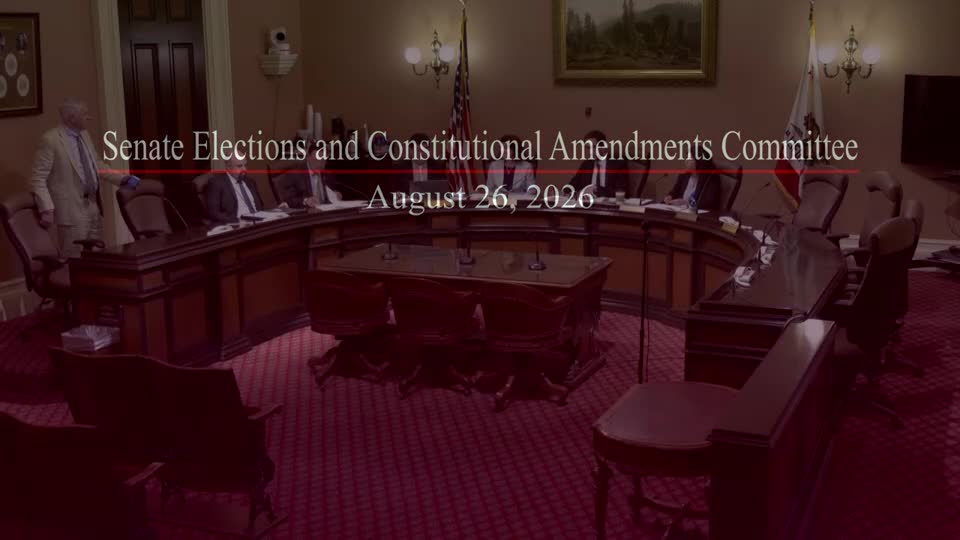 8MIN
Senate Standing Committee on Elections and Constitutional Amendments
 2MIN
Assembly Floor
 6MIN
Assembly Standing Committee on Elections
 6MIN
Assembly Standing Committee on Public Safety
Bill Author


