SB 177: Medi-Cal: Fair Share from Big Corporations Act.
- Session Year: 2025-2026
- House: Senate
- Latest Version Date: 2026-07-06
Current Status:
Passed
(2026-07-06: Chaptered by Secretary of State. Chapter 64, Statutes of 2026.)
Introduced
In Committee
Awaiting First Chamber Vote
Passed First Chamber
In Committee
Awaiting Second Chamber Vote
Passed Second Chamber
Enacted
What does this bill do?
This bill creates the Fair Share from Big Corporations Act and directs the California Department of Finance to present options for holding the state’s largest companies responsible for taxpayer costs when their workers are enrolled in Medi‑Cal (California’s Medicaid program). One option must include a premium for employers with at least 250 employees who do not offer health coverage, and the bill provides $10,000 to the Department of Finance to prepare those options.
The summary is provided by generative AI which can make mistakes. For original language, please view the details in the table below.
Existing law establishes the California Health and Human Services Agency, headed by the Secretary of California Health and Human Services. Existing law further establishes, within the agency, a number of departments and other entities, including the State Department of Health Care Services. Existing law provides for the Medi-Cal program, which is administered by the State Department of Health Care Services, under which qualified low-income persons receive health care benefits.
This bill would create the Fair Share from Big Corporations Act pursuant to which the Department of Finance would be required to, on or before March 1, 2027, present to the Joint Legislative Budget Committee one or more options for holding the states largest corporations accountable for the taxpayer costs of their employees enrolled in the Medi-Cal program, as specified, unless the Medicaid program-related provisions of a specified federal law are repealed on or before March 1, 2027.
The bill would appropriate $10,000 from the General Fund to the Department of Finance for purposes of implementing the these provisions.
This bill would declare that it is to take effect immediately as a bill providing for appropriations related to the Budget Bill.
This bill would express the intent of the Legislature to enact statutory changes relating to the Budget Act of 2025.This bill would express the intent of the Legislature to enact statutory changes relating to the Budget Act of 2025.
This Division shall be known, and may be cited, as the Fair Share from Big Corporations Act.
19000.3.The Legislature finds and declares all of the following:
(a)Federal House Resolution 1 (Public Law 119-21) was passed on a partisan vote and signed by President Donald J. Trump on Independence Day, 2025.
(b)H.R. 1 made the largest cuts to the Medicaid program in history.
(c)H.R. 1 made these cuts in order to fund the largest tax breaks for big corporations in history, and those tax breaks amount to $900 billion in additional tax giveaways to profitable corporations at the expense of health insurance for low-income Americans.
(d)H.R. 1 gave these tax breaks to corporations regardless of whether they pay their workforce poverty wages, forcing their workforce to turn to safety net programs such as the Medicaid program.
(e)One of the most significant cuts in the Medicaid program, known as the Medi-Cal program in California, was a cut resulting from a new work and community engagement requirement.
(f)Data shows that 92 percent of adults who receive Medicaid benefits are working and are getting paid poverty wages.
(g)A 2022 Congressional Budget Office (CBO) report notes that, despite the rhetoric, work requirements are not likely to lead to increased employment unless paired with targeted work supports, such as childcare and transportation.
(h)Being denied health care does not make anyone better at finding a job, keeping a job, or getting more hours at the job they already have.
(i)Being threatened with losing health care does not help the millions of working adults who currently receive Medi-Cal benefits to increase their wages enough to afford nongovernment-funded health care or secure a job that has adequate health coverage.
(j)A growing body of research shows a healthy workforce provides businesses with a competitive advantage.
(k)When a big corporation relies on Medi-Cal to provide their employees with health insurance, they are relying on what amounts to taxpayer subsidies to gain the competitive advantage of a healthy workforce.
(l)The Department of Finance and the Legislative Analysts Office have both reported that growing Medi-Cal costs are a leading factor in the states long-term structural deficit.
(m)In large part due to the negative impacts of HR 1 on the states finances, the state can no longer afford to maintain current subsidies for big corporations in the form of paying full costs of their employees enrollment in the Medi-Cal program.
(n)If HR 1 remains in effect, legislation will be considered as early as 2027 requiring big corporations to pay their fair share for their employees health insurance and reduce the taxpayer burden of big corporations employees being enrolled in Medi-Cal.
19000.5.(a)(1)On or before March 1, 2027, the Department of Finance shall present to the Joint Legislative Budget Committee one or more options for holding the states largest corporations accountable for the taxpayer costs of their employees enrolled in the Medi-Cal program (Chapter 7 (commencing with Section 14000) of Part 3 of Division 9 of the Welfare and Institutions Code).
(2)One of the options presented by the department pursuant to paragraph (1) shall include a premium paid by employers with at least 250 employees to offset the taxpayer costs of their employees enrolled in the Medi-Cal program who are not offered employer health coverage.
(b)Each option presented by the department pursuant to subdivision (a) shall include all of the following:
(1)Data prepared by the Employment Development Department, the State Department of Health Care Services, or other state departments working in cooperation with the Department of Finance, to show or estimate the number of workers at the states largest corporations who are enrolled in the Medi-Cal program, and other available information pertinent to the option.
(2)Proposed statutory language necessary to implement the option drafted by the Legislative Counsel Bureau.
(3)An analysis of the cost of, and timeline for, implementing the option, assuming that the option is enacted into law during the 2027 legislative session.
(c)(1) The requirement for submitting a report imposed under subdivision (a) is inoperative on March 1, 2031, pursuant to Section 10231.5 of the Government Code.
(2)A report to be submitted pursuant to subdivision (a) shall be submitted in compliance with Section 9795 of the Government Code.
(d)If the Medicaid program-related provisions of Public Law 119-21, enacted on July 1, 2025, are repealed on or before March 1, 2027, this section shall not become operative.
SEC. 2.The sum of ten thousand dollars ($10,000) is hereby appropriated from the state General Fund to the Department of Finance for the express purpose of implementing the Fair Share from Big Corporations Act (Division 11 (commencing with Section 19000) of the Unemployment Insurance Code) pursuant to that division.
SEC. 3.This act is a bill providing for appropriations related to the Budget Bill within the meaning of subdivision (e) of Section 12 of Article IV of the California Constitution, has been identified as related to the budget in the Budget Bill, and shall take effect immediately.
SECTION 1.It is the intent of the Legislature to enact statutory changes relating to the Budget Act of 2025.It is the intent of the Legislature to enact statutory changes relating to the Budget Act of 2025.
|
Date
|
Status
|
|---|---|
| Jul 6, 2026 | Chaptered by Secretary of State. Chapter 64, Statutes of 2026. |
| Jul 6, 2026 | Approved by the Governor. |
| Jun 30, 2026 | Enrolled and presented to the Governor at 3 p.m. |
| Jun 29, 2026 | Assembly amendments concurred in. (Ayes 29. Noes 9.) Ordered to engrossing and enrolling. |
| Jun 29, 2026 | Unanimous consent granted to take up without reference to file. |
| Jun 29, 2026 | In Senate. Concurrence in Assembly amendments pending. |
| Jun 29, 2026 | Assembly amendments concurred in. (Ayes 29. Noes 9. Page 5068.) Ordered to engrossing and enrolling. |
| Jun 29, 2026 | Assembly Rule 63 suspended. |
| Jun 29, 2026 | Assembly Rule 63 suspended. (Ayes 53. Noes 14. Page 5891.) |
| Jun 29, 2026 | Read third time. Passed. Ordered to the Senate. |
| Jun 29, 2026 | Read third time. Passed. (Ayes 57. Noes 18. Page 5896.) Ordered to the Senate. |
| Jun 29, 2026 | Withdrawn from committee pursuant to Asssembly Rule 96. |
| Jun 16, 2026 | From committee with author's amendments. Read second time and amended. Re-referred to Com. on BUDGET. |
| Mar 24, 2025 | Referred to Com. on BUDGET. |
| Mar 20, 2025 | In Assembly. Read first time. Held at Desk. |
| Mar 20, 2025 | Read third time. Passed. (Ayes 28. Noes 10. Page 456.) Ordered to the Assembly. |
| Mar 18, 2025 | Read second time. Ordered to third reading. |
| Mar 17, 2025 | Withdrawn from committee. (Ayes 27. Noes 10. Page 384.) |
| Mar 17, 2025 | Ordered to second reading. |
| Feb 5, 2025 | Referred to Com. on B. & F. R. |
| Jan 24, 2025 | From printer. May be acted upon on or after February 23. |
| Jan 23, 2025 | Introduced. Read first time. To Com. on RLS. for assignment. To print. |
|
Date
|
Description
|
Location
|
Votes
|
|
|---|---|---|---|---|
| Jun 29, 2026 | SB 177 B. & F. R. Senate Third Reading By GABRIEL | Assembly Floor |
Passed |
|
| Jun 29, 2026 | W/O REF. TO FILE SB177 B. & F.R. (Laird) | Senate Floor |
Passed |
|
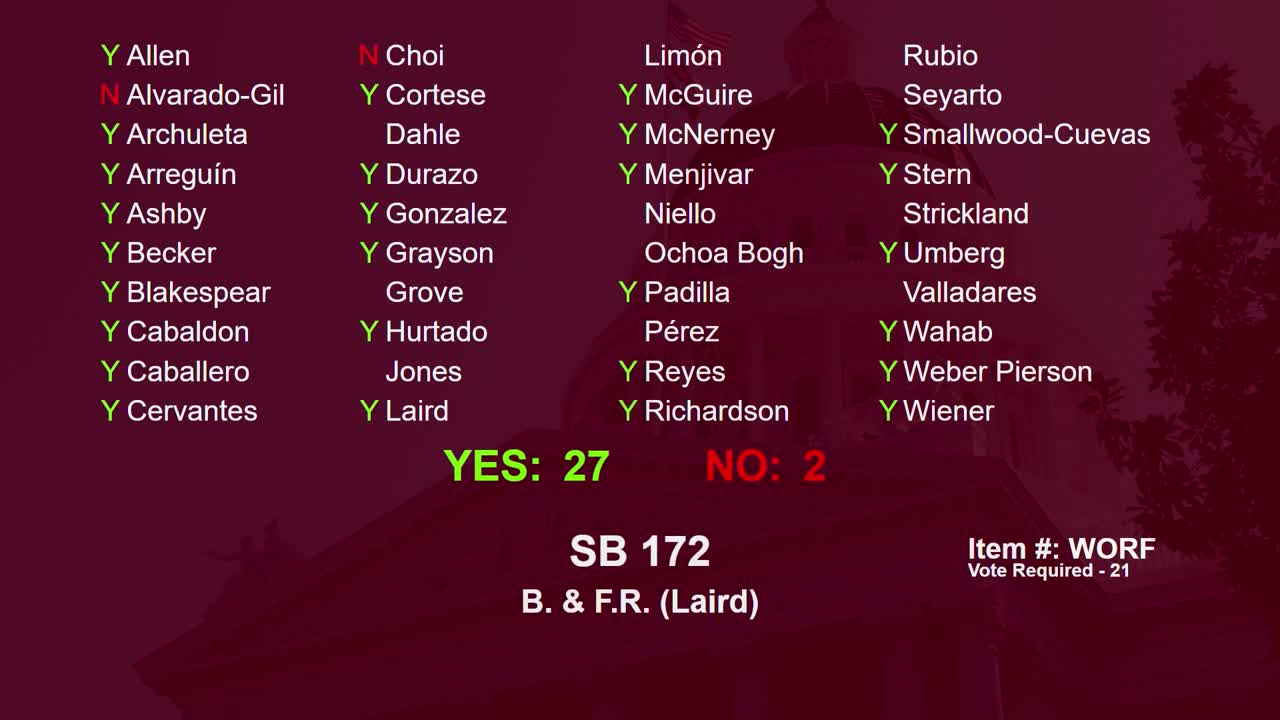
| Mar 20, 2025 | Senate 3rd Reading SB177 B. & F.R. (Wiener) | Senate Floor |
Passed |
This list shows positions taken on this bill by organizations on the date displayed, which is linked to the original source.
Positions by individuals are not included.
SENATE RULES COMMITTEE Office of Senate Floor Analyses (916) 651-4171 | SB 177 |
UNFINISHED BUSINESS
Bill No: SB 177
Author: Committee on Budget and Fiscal Review
Enrolled: 6/29/26
Vote: 21
SENATE FLOOR: 28-10, 3/20/25
AYES: Allen, Archuleta, Arreguín, Ashby, Becker, Blakespear, Cabaldon, Caballero, Cervantes, Cortese, Durazo, Gonzalez, Grayson, Hurtado, Laird, Limón, McGuire, McNerney, Menjivar, Padilla, Pérez, Richardson, Rubio, Smallwood-Cuevas, Umberg, Wahab, Weber Pierson, Wiener
NOES: Alvarado-Gil, Choi, Dahle, Grove, Jones, Niello, Ochoa Bogh, Seyarto, Strickland, Valladares
NO VOTE RECORDED: Reyes, Stern
ASSEMBLY FLOOR: 57-18, 6/29/26 - See last page for vote
SUBJECT: Medi-Cal: Fair Share from Big Corporations Act
SOURCE: Author
DIGEST:
This bill implements the Fair Share from Big Corporations Act, which requires the Department of Finance to present, on or before March 1, 2027, one or more options to the Legislature for holding the state’s largest corporations accountable for the taxpayer costs of their employees enrolled in the Medi-Cal program.
Assembly Amendments
of 6/26/26 delete the senate version of this bill and instead add the current language.
ANALYSIS: This bill implements the Fair Share from Big Corporations Act, which includes the following provisions.
- Requires the Department of Finance, on or before March 1, 2027, to present to the Joint Legislative Budget Committee one or more options for holding the state’s largest corporations accountable for the taxpayer costs of their employees enrolled in the Medi-Cal program.
- Requires one of the options presented by the department to include a premium paid by employers with at least 250 employees to offset taxpayer costs of their employees enrolled in the Medi-Cal program who are not offered employer health coverage.
- Requires the options presented to be accompanied by the following:
- Data prepared by the Employment Development Department (EDD) and the Department of Health Care Services (DHCS) regarding the number of workers in the state’s largest corporations enrolled in Medi-Cal
- Proposed statutory language necessary to implement the options
- An analysis of the cost of, and timeline for, implementing the options in the 2027 legislative session.
- Makes the provisions of the bill inoperative if the Medicaid program-related provisions of House Resolution (HR) 1 are repealed on or before March 1, 2027.
- Appropriates General Fund expenditure authority of $10,000 to the Department of Finance to prepare the options to be presented to the Legislature.
FISCAL EFFECT: Appropriation: Yes Fiscal Com.: Yes Local: No
Appropriates General Fund expenditure authority of $10,000 to the Department of Finance to prepare the options to be presented to the Legislature.
SUPPORT: (Verified 06/26/26)
None received
OPPOSITION: (Verified 06/26/26)
None received
ASSEMBLY FLOOR: 57-18, 6/29/26
AYES: Addis, Aguiar-Curry, Ahrens, Alvarez, Arambula, Ávila Farías, Bauer-Kahan, Bennett, Berman, Bonta, Bryan, Calderon, Caloza, Carrillo, Connolly, Elhawary, Fong, Gabriel, Garcia, Gipson, Mark González, Haney, Harabedian, Hart, Irwin, Jackson, Kalra, Krell, Lee, Lowenthal, McKinnor, Nguyen, Ortega, Pacheco, Papan, Patel, Pellerin, Petrie-Norris, Quirk-Silva, Ramos, Ransom, Celeste Rodriguez, Michelle Rodriguez, Rogers, Blanca Rubio, Schiavo, Schultz, Sharp-Collins, Solache, Soria, Stefani, Valencia, Ward, Wicks, Wilson, Zbur, Rivas
NOES: Alanis, Castillo, Chen, Davies, DeMaio, Dixon, Ellis, Flora, Jeff Gonzalez, Hadwick, Hoover, Johnson, Macedo, Patterson, Sanchez, Ta, Tangipa, Wallis
NO VOTE RECORDED: Bains, Boerner, Lackey, Muratsuchi
Prepared by: Scott Ogus / B. & F.R. / (916) 651-4103
7/8/26 11:33:29
**** END ****
SENATE RULES COMMITTEE Office of Senate Floor Analyses (916) 651-4171 | SB 177 |
UNFINISHED BUSINESS
Bill No: SB 177
Author: Committee on Budget and Fiscal Review
Amended: 6/16/26
Vote: 21
SENATE FLOOR: 28-10, 3/20/25
AYES: Allen, Archuleta, Arreguín, Ashby, Becker, Blakespear, Cabaldon, Caballero, Cervantes, Cortese, Durazo, Gonzalez, Grayson, Hurtado, Laird, Limón, McGuire, McNerney, Menjivar, Padilla, Pérez, Richardson, Rubio, Smallwood-Cuevas, Umberg, Wahab, Weber Pierson, Wiener
NOES: Alvarado-Gil, Choi, Dahle, Grove, Jones, Niello, Ochoa Bogh, Seyarto, Strickland, Valladares
NO VOTE RECORDED: Reyes, Stern
ASSEMBLY FLOOR: 6/29/26 – Roll call not available.
SUBJECT: Fair Share Big Corporations Act
SOURCE: Author
DIGEST:
This bill implements the Fair Share from Big Corporations Act, which requires the Department of Finance to present, on or before March 1, 2027, one or more options to the Legislature for holding the state’s largest corporations accountable for the taxpayer costs of their employees enrolled in the Medi-Cal program.
Assembly Amendments
of 6/26/26 delete the senate version of this bill and instead add the current language.
ANALYSIS: This bill implements the Fair Share from Big Corporations Act, which includes the following provisions.
- Requires the Department of Finance, on or before March 1, 2027, to present to the Joint Legislative Budget Committee one or more options for holding the state’s largest corporations accountable for the taxpayer costs of their employees enrolled in the Medi-Cal program.
- Requires one of the options presented by the department to include a premium paid by employers with at least 250 employees to offset taxpayer costs of their employees enrolled in the Medi-Cal program who are not offered employer health coverage.
- Requires the options presented to be accompanied by the following:
- Data prepared by the Employment Development Department (EDD) and the Department of Health Care Services (DHCS) regarding the number of workers in the state’s largest corporations enrolled in Medi-Cal
- Proposed statutory language necessary to implement the options
- An analysis of the cost of, and timeline for, implementing the options in the 2027 legislative session.
- Makes the provisions of the bill inoperative if the Medicaid program-related provisions of House Resolution (HR) 1 are repealed on or before March 1, 2027.
- Appropriates General Fund expenditure authority of $10,000 to the Department of Finance to prepare the options to be presented to the Legislature.
FISCAL EFFECT: Appropriation: Yes Fiscal Com.: Yes Local: No
Appropriates General Fund expenditure authority of $10,000 to the Department of Finance to prepare the options to be presented to the Legislature.
SUPPORT: (Verified 06/26/26)
None received
OPPOSITION: (Verified 06/26/26)
None received
Prepared by: Scott Ogus / B. & F.R. / (916) 651-4103
6/29/26 14:08:36
**** END ****
SENATE RULES COMMITTEE Office of Senate Floor Analyses (916) 651-1520 Fax: (916) 327-4478 | SB 177 |
THIRD READING
Bill No: SB 177
Author: Committee on Budget and Fiscal Review
Introduced: 1/23/25
Vote: 21
SOURCE: Author
DIGEST:
This bill expresses the intent of the Legislature to enact statutory changes relating to the Budget Act of 2025.
ANALYSIS: Senate Bills 100 through 219, inclusive, are to be considered as vehicles for the 2025-26 Budget Trailer Bills.
FISCAL EFFECT: Appropriation: No Fiscal Com.: No Local: No
SUPPORT: (Verified 3/18/25)
None received
OPPOSITION: (Verified 3/18/25)
None received
Prepared by: Sofia Pachon-Mendez / SFA / (916) 651-1520
3/19/25 15:13:46
**** END ****
Discussed in Hearing
View Older Hearings
Bill Author
Bill Co-Author(s):