SB 180: Taxation trailer bill.
- Session Year: 2025-2026
- House: Senate
- Latest Version Date: 2026-07-13
Current Status:
Passed
(2026-07-13: Chaptered by Secretary of State. Chapter 85, Statutes of 2026.)
Introduced
In Committee
Awaiting First Chamber Vote
Passed First Chamber
In Committee
Awaiting Second Chamber Vote
Passed Second Chamber
Enacted
What does this bill do?
The bill increases the yearly amount available from the Senior Citizens and Disabled Citizens Property Tax Postponement Fund for manufactured‑home property tax postponements to $300,000, helping eligible seniors and disabled owners of manufactured homes. It extends the California Competes business tax credit through 2035 and lowers the first‑year annual tax for newly formed limited liability companies from $800 to $400, affecting businesses and startups. It also aligns state tax rules with new federal law for 530A accounts (tax‑deferred savings accounts for children), allowing employer and certain other contributions, permitting some rollovers into ABLE accounts, and applying a 2.5% state penalty rate to certain nonqualified 530A distributions.
The summary is provided by generative AI which can make mistakes. For original language, please view the details in the table below.
(1)Existing law, the Senior Citizens Manufactured Home Property Tax Postponement Law (manufactured home law), authorizes a claimant, as defined, to file with the Controller a claim for postponement of a sum equal to but not exceeding the amount of property taxes for the fiscal year for which the claim is made. Existing law also establishes the Senior Citizens and Disabled Citizens Property Tax Postponement Fund and continuously appropriates moneys in that fund to the Controller for specified purposes relating to the postponement of property taxes pursuant to specified law, including the manufactured home law. Existing law requires the Controller, on June 30, 2018, and June 30 of each year thereafter, to transfer any moneys in the fund in excess of $15,000,000 to the General Fund and further requires that, on July 1, 2019, and July 1 of each year thereafter, up to 1% of the amount available in the fund be available for disbursements for manufactured home property tax postponements under the manufactured home law.
This bill, beginning July 1, 2026, would increase the amount available on July 1 of each year for manufactured home property tax postponement disbursements from the above-described fund to $300,000. By increasing the limit to the amounts available for disbursement from the Senior Citizens and Disabled Citizens Property Tax Postponement Fund for property tax postponements under the manufactured home law, the bill would make an appropriation.
(2)The Personal Income Tax Law and the Corporation Tax Law allow a credit (CalCompetes tax credit) against the taxes imposed under those laws, for each taxable year beginning on and after January 1, 2014, and before January 1, 2030, in an amount as provided in a written agreement between the Governors Office of Business and Economic Development and the taxpayer, approved by the California Competes Tax Credit Committee, and based on specified factors, including the number of jobs the taxpayer will create or retain in the state and the amount of investment in the state by the taxpayer.
This bill would extend the CalCompetes tax credit through taxable years beginning before January 1, 2035. The bill would also make conforming changes.
(3)Existing law, the Personal Income Tax Law, generally conforms to federal tax law through January 1, 2025, including conforming to federal law in its treatment of deferred compensation, except as otherwise provided.
Existing federal law, Public Law 119-21, enacted July 4, 2025, provides for a tax-deferred investment account for children known as a 530A account.
This bill, for taxable years beginning on or after January 1, 2026, would generally conform to federal law in its treatment of 530A accounts, except as specified.
(4)The Personal Income Tax Law, in modified conformity with federal income tax laws, generally defines gross income as income from whatever source derived, except as specifically excluded, and provides various exclusions from gross income.
Public Law 119-21 provides for gross income exclusions for employer contributions and qualified general contributions to a 530A account, as specified.
This bill, for taxable years beginning on or after January 1, 2026, would conform to those gross income exclusions for purposes of the Personal Income Tax Law.
(5)Existing federal and state law provide for the creation of ABLE accounts for the purpose of meeting the qualified disability expenses of a beneficiary and exclude these accounts from gross income. Existing federal and state law limit contributions to ABLE accounts to those made in cash, as a change in designated beneficiary, or as a qualified rollover contribution. Public Law 119-21 includes within those qualified rollover contributions specified rollover contributions from a 530A account. Existing law imposes limits on the amount of contributions that can be made to an ABLE Account and requires an ABLE program to provide adequate safeguards to prevent contributions in excess of that limit. Public Law 119-21 exempts from that requirement qualified rollover contributions from a 530A account. The Personal Income Tax Law and the Corporation Tax Law, for taxable years beginning on or after January 1, 2016, generally conform to federal law relating to qualified ABLE programs prior to Public Law 119-21.
This bill, for taxable years beginning on or after January 1, 2026, would conform to the above-described changes to qualified ABLE programs relating to 530A accounts made by Public Law 119-21 for purposes of the Personal Income Tax Law and the Corporation Tax Law. The bill would also make conforming changes relating to the requirements for making contributions to an ABLE account.
(6)Existing law imposes an annual minimum franchise tax of $800, except as provided, on every corporation incorporated in this state, qualified to transact intrastate business in this state, or doing business in this state, and an annual tax in an amount equal to the minimum franchise tax, except as provided, on every limited partnership, limited liability partnership, and limited liability company doing business in this state, as specified.
This bill, for taxable years beginning on or after January 1, 2027, and before January 1, 2030, would reduce the amount of the annual tax imposed on a limited liability company doing business in this state from $800 to $400 for the companys first taxable year.
This bill would declare that it is to take effect immediately as a bill providing for appropriations related to the Budget Bill.
(1)Existing law, the Senior Citizens Manufactured Home Property Tax Postponement Law (manufactured home law), authorizes a claimant, as defined, to file with the Controller a claim for postponement of a sum equal to but not exceeding the amount of property taxes for the fiscal year for which the claim is made. Existing law also establishes the Senior Citizens and Disabled Citizens Property Tax Postponement Fund and continuously appropriates moneys in that fund to the Controller for specified purposes relating to the postponement of property taxes pursuant to specified law, including the manufactured home law. Existing law requires the Controller, on June 30, 2018, and June 30 of each year thereafter, to transfer any moneys in the fund in excess of $15,000,000 to the General Fund and further requires that, on July 1, 2019, and July 1 of each year thereafter, up to 1% of the amount available in the fund be available for disbursements for manufactured home property tax postponements under the manufactured home law.
This bill, beginning July 1, 2026, would increase the amount available on July 1 of each year for manufactured home property tax postponement disbursements from the above-described fund to $300,000. By increasing the limit to the amounts available for disbursement from the Senior Citizens and Disabled Citizens Property Tax Postponement Fund for property tax postponements under the manufactured home law, the bill would make an appropriation.
(2)The Personal Income Tax Law and the Corporation Tax Law allow a credit (CalCompetes tax credit) against the taxes imposed under those laws, for each taxable year beginning on and after January 1, 2014, and before January 1, 2030, in an amount as provided in a written agreement between the Governors Office of Business and Economic Development and the taxpayer, approved by the California Competes Tax Credit Committee, and based on specified factors, including the number of jobs the taxpayer will create or retain in the state and the amount of investment in the state by the taxpayer.
This bill would extend the CalCompetes tax credit through taxable years beginning before January 1, 2035. The bill would also make conforming changes.
(3)Existing law, the Personal Income Tax Law, generally conforms to federal tax law through January 1, 2025, including conforming to federal law in its treatment of deferred compensation, except as otherwise provided.
Existing federal law, Public Law 119-21, enacted July 4, 2025, provides for a tax-deferred investment account for children known as a 530A account.
This bill, for taxable years beginning on or after January 1, 2026, would generally conform to federal law in its treatment of 530A accounts, except as specified.
(4)The Personal Income Tax Law, in modified conformity with federal income tax laws, generally defines gross income as income from whatever source derived, except as specifically excluded, and provides various exclusions from gross income.
Public Law 119-21 provides for gross income exclusions for employer contributions and qualified general contributions to a 530A account, as specified.
This bill, for taxable years beginning on or after January 1, 2026, would conform to those gross income exclusions for purposes of the Personal Income Tax Law.
(5)Existing federal and state law provide for the creation of ABLE accounts for the purpose of meeting the qualified disability expenses of a beneficiary and exclude these accounts from gross income. Existing federal and state law limit contributions to ABLE accounts to those made in cash, as a change in designated beneficiary, or as a qualified rollover contribution. Public Law 119-21 includes within those qualified rollover contributions specified rollover contributions from a 530A account. Existing law imposes limits on the amount of contributions that can be made to an ABLE Account and requires an ABLE program to provide adequate safeguards to prevent contributions in excess of that limit. Public Law 119-21 exempts from that requirement qualified rollover contributions from a 530A account. The Personal Income Tax Law and the Corporation Tax Law, for taxable years beginning on or after January 1, 2016, generally conform to federal law relating to qualified ABLE programs prior to Public Law 119-21.
This bill, for taxable years beginning on or after January 1, 2026, would conform to the above-described changes to qualified ABLE programs relating to 530A accounts made by Public Law 119-21 for purposes of the Personal Income Tax Law and the Corporation Tax Law. The bill would also make conforming changes relating to the requirements for making contributions to an ABLE account.
(6)Existing law imposes an annual minimum franchise tax of $800, except as provided, on every corporation incorporated in this state, qualified to transact intrastate business in this state, or doing business in this state, and an annual tax in an amount equal to the minimum franchise tax, except as provided, on every limited partnership, limited liability partnership, and limited liability company doing business in this state, as specified.
This bill, for taxable years beginning on or after January 1, 2027, and before January 1, 2030, would reduce the amount of the annual tax imposed on a limited liability company doing business in this state from $800 to $400 for the companys first taxable year.
This bill would declare that it is to take effect immediately as a bill providing for appropriations related to the Budget Bill.
(1)Existing law, the Senior Citizens Manufactured Home Property Tax Postponement Law (manufactured home law), authorizes a claimant, as defined, to file with the Controller a claim for postponement of a sum equal to but not exceeding the amount of property taxes for the fiscal year for which the claim is made. Existing law also establishes the Senior Citizens and Disabled Citizens Property Tax Postponement Fund and continuously appropriates moneys in that fund to the Controller for specified purposes relating to the postponement of property taxes pursuant to specified law, including the manufactured home law. Existing law requires the Controller, on June 30, 2018, and June 30 of each year thereafter, to transfer any moneys in the fund in excess of $15,000,000 to the General Fund and further requires that, on July 1, 2019, and July 1 of each year thereafter, up to 1% of the amount available in the fund be available for disbursements for manufactured home property tax postponements under the manufactured home law.
This bill, beginning July 1, 2026, would increase the amount available on July 1 of each year for manufactured home property tax postponement disbursements from the above-described fund to $300,000. By increasing the limit to the amounts available for disbursement from the Senior Citizens and Disabled Citizens Property Tax Postponement Fund for property tax postponements under the manufactured home law, the bill would make an appropriation.
(2)The Personal Income Tax Law and the Corporation Tax Law allow a credit (CalCompetes tax credit) against the taxes imposed under those laws, for each taxable year beginning on and after January 1, 2014, and before January 1, 2030, in an amount as provided in a written agreement between the Governors Office of Business and Economic Development and the taxpayer, approved by the California Competes Tax Credit Committee, and based on specified factors, including the number of jobs the taxpayer will create or retain in the state and the amount of investment in the state by the taxpayer.
This bill would extend the CalCompetes tax credit through taxable years beginning before January 1, 2035. The bill would also make conforming changes.
(3)Existing law, the Personal Income Tax Law, generally conforms to federal tax law through January 1, 2025, including conforming to federal law in its treatment of deferred compensation, except as otherwise provided.
Existing federal law, Public Law 119-21, enacted July 4, 2025, provides for a tax-deferred investment account for children known as a 530A account.
This bill, for taxable years beginning on or after January 1, 2026, would generally conform to federal law in its treatment of 530A accounts, except as specified.
(4)The Personal Income Tax Law, in modified conformity with federal income tax laws, generally defines gross income as income from whatever source derived, except as specifically excluded, and provides various exclusions from gross income.
Public Law 119-21 provides for gross income exclusions for employer contributions and qualified general contributions to a 530A account, as specified.
This bill, for taxable years beginning on or after January 1, 2026, would conform to those gross income exclusions for purposes of the Personal Income Tax Law.
(5)Existing federal and state law provide for the creation of ABLE accounts for the purpose of meeting the qualified disability expenses of a beneficiary and exclude these accounts from gross income. Existing federal and state law limit contributions to ABLE accounts to those made in cash, as a change in designated beneficiary, or as a qualified rollover contribution. Public Law 119-21 includes within those qualified rollover contributions specified rollover contributions from a 530A account. Existing law imposes limits on the amount of contributions that can be made to an ABLE Account and requires an ABLE program to provide adequate safeguards to prevent contributions in excess of that limit. Public Law 119-21 exempts from that requirement qualified rollover contributions from a 530A account. The Personal Income Tax Law and the Corporation Tax Law, for taxable years beginning on or after January 1, 2016, generally conform to federal law relating to qualified ABLE programs prior to Public Law 119-21.
This bill, for taxable years beginning on or after January 1, 2026, would conform to the above-described changes to qualified ABLE programs relating to 530A accounts made by Public Law 119-21 for purposes of the Personal Income Tax Law and the Corporation Tax Law. The bill would also make conforming changes relating to the requirements for making contributions to an ABLE account.
(6)Existing law imposes an annual minimum franchise tax of $800, except as provided, on every corporation incorporated in this state, qualified to transact intrastate business in this state, or doing business in this state, and an annual tax in an amount equal to the minimum franchise tax, except as provided, on every limited partnership, limited liability partnership, and limited liability company doing business in this state, as specified.
This bill, for taxable years beginning on or after January 1, 2027, and before January 1, 2030, would reduce the amount of the annual tax imposed on a limited liability company doing business in this state from $800 to $400 for the companys first taxable year.
This bill would declare that it is to take effect immediately as a bill providing for appropriations related to the Budget Bill.
This bill would express the intent of the Legislature to enact statutory changes relating to the Budget Act of 2025.This bill would express the intent of the Legislature to enact statutory changes relating to the Budget Act of 2025.
(a)There is hereby created in the State Treasury a Senior Citizens and Disabled Citizens Property Tax Postponement Fund. The fund shall be an interest-bearing fund. Subject to subdivision (b) and notwithstanding Section 13340, the fund is continuously appropriated to the Controller, commencing January 1, 2015, for purposes of administering this chapter, including, but not limited to, necessary administrative costs and disbursements relating to the postponement of property taxes pursuant to Chapter 2 (commencing with Section 20581), Chapter 3 (commencing with Section 20625), Chapter 3.3 (commencing with Section 20639), and Chapter 3.5 (commencing with Section 20640) of Part 10.5 of Division 2 of the Revenue and Taxation Code.
(b)The Controller shall do all of the following:
(1)On June 30, 2017, transfer any moneys in the fund in excess of twenty million dollars ($20,000,000) to the General Fund.
(2)On June 30, 2018, and on June 30 each year thereafter, transfer any moneys in the fund in excess of fifteen million dollars ($15,000,000) to the General Fund.
(3)(A)On July 1, 2019, and on July 1 of each year before January 1, 2026, up to 1 percent of the amount available in the fund for disbursements relating to the postponement of property taxes shall be available for residential dwellings that are manufactured homes pursuant to Chapter 3.3 (commencing with Section 20639) of Part 10.5 of Division 2 of the Revenue and Taxation Code.
(B)On July 1, 2026, and on July 1 each year thereafter, up to three hundred thousand dollars ($300,000) of the amount available in the fund for disbursements relating to the postponement of property taxes shall be available for residential dwellings that are manufactured homes pursuant to Chapter 3.3 (commencing with Section 20639) of Part 10.5 of Division 2 of the Revenue and Taxation Code.
(c)On or after January 1, 2015, any loan repayments relating to the Senior Citizens and Disabled Citizens Property Tax Postponement Law shall be deposited into the Senior Citizens and Disabled Citizens Property Tax Postponement Fund.
SEC. 2.Section 17059.2 of the Revenue and Taxation Code is amended to read:17059.2.(a)(1)For each taxable year beginning on and after January 1, 2014, and before January 1, 2035, there shall be allowed as a credit against the net tax, as defined in Section 17039, an amount as determined by the committee pursuant to paragraph (2) and approved pursuant to Section 18410.2.
(2)The credit under this section shall be allocated by GO-Biz with respect to the 201314 fiscal year through and including the 203233 fiscal year. The amount of credit allocated to a taxpayer with respect to a fiscal year pursuant to this section shall be as set forth in a written agreement between GO-Biz and the taxpayer and shall be based on the following factors:
(A)The number of jobs the taxpayer will create or retain in this state.
(B)The compensation paid or proposed to be paid by the taxpayer to its employees, including wages and fringe benefits.
(C)The amount of investment in this state by the taxpayer.
(D)The extent of unemployment or poverty in the area according to the United States Census in which the taxpayers project or business is proposed or located.
(E)The incentives available to the taxpayer in this state, including incentives from the state, local government, and other entities.
(F)The incentives available to the taxpayer in other states.
(G)The duration of the proposed project and the duration the taxpayer commits to remain in this state.
(H)The overall economic impact in this state of the taxpayers project or business.
(I)The strategic importance of the taxpayers project or business to the state, region, or locality.
(J)The opportunity for future growth and expansion in this state by the taxpayers business.
(K)The extent to which the anticipated benefit to the state exceeds the projected benefit to the taxpayer from the tax credit.
(L)For a credit allocated beginning with the 201819 fiscal year, the training opportunities offered by the taxpayer to its employees.
(3)The written agreement entered into pursuant to paragraph (2) shall include:
(A)Terms and conditions that include the taxable year or years for which the credit allocated shall be allowed, a minimum compensation level, and a minimum job retention period.
(B)Provisions indicating whether the credit is to be allocated in full upon approval or in increments based on mutually agreed upon milestones when satisfactorily met by the taxpayer.
(C)Provisions that allow the committee to recapture the credit, in whole or in part, if the taxpayer fails to fulfill the terms and conditions of the written agreement.
(b)For purposes of this section:
(1)Committee means the California Competes Tax Credit Committee established pursuant to Section 18410.2.
(2)GO-Biz means the Governors Office of Business and Economic Development.
(c)For purposes of this section, GO-Biz shall do the following:
(1)Give priority to a taxpayer whose project or business is located or proposed to be located in an area of high unemployment or poverty.
(2)Negotiate with a taxpayer the terms and conditions of proposed written agreements that provide the credit allowed pursuant to this section to a taxpayer.
(3)Provide the negotiated written agreement to the committee for its approval pursuant to Section 18410.2.
(4)Inform the Franchise Tax Board of the terms and conditions of the written agreement upon approval of the written agreement by the committee.
(5)Inform the Franchise Tax Board of any recapture, in whole or in part, of a previously allocated credit upon approval of the recapture by the committee.
(6)Post on its internet website all of the following:
(A)The name of each taxpayer allocated a credit pursuant to this section.
(B)The estimated amount of the investment by each taxpayer.
(C)The estimated number of jobs created or retained.
(D)The amount of the credit allocated to the taxpayer.
(E)The amount of the credit recaptured from the taxpayer, if applicable.
(F)The primary location where the taxpayer has committed to increasing the net number of jobs or make investments. The primary location shall be listed by city or, in the case of unincorporated areas, by county.
(G)Information that identifies each tax credit award that was given a priority for being located in a high unemployment or poverty area, pursuant to paragraph (1).
(7)Consider the extent to which the credit will influence the taxpayers ability, willingness, or both, to create jobs in this state that might not otherwise be created in the state by the taxpayer or any other taxpayer. GO-Biz may also consider other factors, including, but not limited to, the following:
(A)The financial solvency of the taxpayer and the taxpayers ability to finance its proposed expansion.
(B)The taxpayers current and prior compliance with federal and state laws.
(C)Current and prior litigation involving the taxpayer.
(D)The reasonableness of the fee arrangement between the taxpayer and any third party providing any services related to the credit allowed pursuant to this section.
(E)For allocation periods beginning with the 202324 fiscal year, the taxpayers willingness to relocate jobs into California from a state that has enacted a law that does any of the following:
(i)Voids or repeals, or has the effect of voiding or repealing, existing state protections against discrimination on the basis of sexual orientation, gender identity, or gender expression.
(ii)Authorizes or requires discrimination against same-sex couples or their families, or discrimination on the basis of sexual orientation, gender identity, or gender expression.
(iii)Creates an exemption to antidiscrimination laws in order to permit discrimination against same-sex couples or their families, or permits discrimination on the basis of sexual orientation, gender identity, or gender expression.
(iv)Denies or interferes with, or has the effect of denying or interfering with, a womans right to choose to bear a child or to choose and obtain an abortion, as provided by Article 2.5 (commencing with Section 123460) of Chapter 2 of Part 2 of Division 106 of the Health and Safety Code.
(F)For allocation periods beginning with the 202324 fiscal year, the taxpayers commitment to treating their workforce fairly and creating quality, full-time, wage and salary jobs in the state, evidence of which may include, but not be limited to, the following:
(i)Training, career ladder, apprenticeship, and preapprenticeship programs for nonsupervisorial employees.
(ii)Joint labor-management letter of support.
(iii)A high percentage of full-time wage and salary employees compared to part-time, temporary, and independent contractors.
(iv)Little to no history of a bad safety record, or resolved or pending litigation, violations, citations, fines, or penalties relating to any state or federal environmental and labor laws within the last 10 years.
(G)Any other factors GO-Biz deems necessary to ensure that the administration of the credit allowed pursuant to this section is a model of accountability and transparency and that the effective use of the limited amount of credit available is maximized.
(8)(A)Implementation of subparagraphs (E) and (F) of paragraph (7) of this subdivision for the 202223 fiscal year is deemed an emergency and necessary for the immediate preservation of the public peace, health, and safety, or general welfare and, therefore, the Governors Office of Business and Economic Development is hereby authorized to adopt emergency regulations to implement subparagraphs (E) and (F) of paragraph (7) of this subdivision during the 202223 fiscal year in accordance with the rulemaking provisions of the Administrative Procedure Act (Chapter 3.5 (commencing with Section 11340) of Part 1 of Division 3 of Title 2 of the Government Code).
(B)Nothing in this subdivision shall require the Governors Office of Business and Economic Development to approve emergency regulations.
(d)For purposes of this section, the Franchise Tax Board shall do all of the following:
(1)(A)Except as provided in subparagraph (B), review the books and records of all taxpayers allocated a credit pursuant to this section to ensure compliance with the terms and conditions of the written agreement between the taxpayer and GO-Biz.
(B)In the case of a taxpayer that is a small business, as defined in Section 17053.73, review the books and records of the taxpayer allocated a credit pursuant to this section to ensure compliance with the terms and conditions of the written agreement between the taxpayer and GO-Biz when, in the sole discretion of the Franchise Tax Board, a review of those books and records is appropriate or necessary in the best interests of the state.
(2)Notwithstanding Section 19542, notify GO-Biz of a possible breach of the written agreement by a taxpayer and provide detailed information regarding the basis for that determination.
(e)In the case where the credit allowed under this section exceeds the net tax, as defined in Section 17039, for a taxable year, the excess credit may be carried over to reduce the net tax in the following taxable year, and succeeding five taxable years, if necessary, until the credit has been exhausted.
(f)Any recapture, in whole or in part, of a credit approved by the committee pursuant to Section 18410.2 shall be treated as a mathematical error appearing on the return. Any amount of tax resulting from that recapture shall be assessed by the Franchise Tax Board in the same manner as provided by Section 19051. The amount of tax resulting from the recapture shall be added to the tax otherwise due by the taxpayer for the taxable year in which the committees recapture determination occurred.
(g)(1)The aggregate amount of credit that may be allocated in any fiscal year pursuant to this section and Section 23689 shall be an amount equal to the sum of subparagraphs (A), (B), and (C), less the amount specified in subparagraphs (D) and (E):
(A)Thirty million dollars ($30,000,000) for the 201314 fiscal year, one hundred fifty million dollars ($150,000,000) for the 201415 fiscal year, two hundred million dollars ($200,000,000) for each fiscal year from 201516 to 201718, inclusive, one hundred eighty million dollars ($180,000,000) for each fiscal year from 201819 to 202021, inclusive, two hundred ninety million dollars ($290,000,000) for the 202122 fiscal year, and one hundred eighty million dollars ($180,000,000) for each fiscal year from 202223 to 203233, inclusive.
(B)The unallocated credit amount, if any, from the preceding fiscal year.
(C)The amount of any previously allocated credits that have been recaptured.
(D)The amount estimated by the Director of Finance, in consultation with the Franchise Tax Board and the California Department of Tax and Fee Administration, to be necessary to limit the aggregation of the estimated amount of exemptions claimed pursuant to Section 6377.1 and of the amounts estimated to be claimed pursuant to this section and Sections 17053.73, 23626, and 23689 to no more than seven hundred fifty million dollars ($750,000,000) for either the current fiscal year or the next fiscal year.
(i)The Director of Finance shall notify the Chairperson of the Joint Legislative Budget Committee of the estimated annual allocation authorized by this paragraph. Any allocation pursuant to these provisions shall be made no sooner than 30 days after written notification has been provided to the Chairperson of the Joint Legislative Budget Committee and the chairpersons of the committees of each house of the Legislature that consider appropriations, or not sooner than whatever lesser time the Chairperson of the Joint Legislative Budget Committee, or the Chairpersons designee, may determine.
(ii)In no event shall the amount estimated in this subparagraph be less than zero dollars ($0).
(E)(i)For the 201516 fiscal year and each fiscal year thereafter, the amount of credit estimated by the Director of Finance to be allowed to all qualified taxpayers for that fiscal year pursuant to subparagraph (A) or subparagraph (B) of paragraph (1) of subdivision (c) of Section 23636.
(ii)If the amount available per fiscal year pursuant to this section and Section 23689 is less than the aggregate amount of credit estimated by the Director of Finance to be allowed to qualified taxpayers pursuant to subparagraph (A) or subparagraph (B) of paragraph (1) of subdivision (c) of Section 23636, the aggregate amount allowed pursuant to Section 23636 shall not be reduced and, in addition to the reduction required by clause (i), the aggregate amount of credit that may be allocated pursuant to this section and Section 23689 for the next fiscal year shall be reduced by the amount of that deficit.
(iii)It is the intent of the Legislature that the reductions specified in this subparagraph of the aggregate amount of credit that may be allocated pursuant to this section and Section 23689 shall continue if the repeal dates of the credits allowed by this section and Section 23689 are removed or extended.
(2)(A)In addition to the other amounts determined pursuant to paragraph (1), the Director of Finance may increase the aggregate amount of credit that may be allocated pursuant to this section and Section 23689 by up to twenty-five million dollars ($25,000,000) per fiscal year through the 203233 fiscal year. The amount of any increase made pursuant to this paragraph, when combined with any increase made pursuant to paragraph (2) of subdivision (g) of Section 23689, shall not exceed twenty-five million dollars ($25,000,000) per fiscal year through the 203233 fiscal year.
(B)It is the intent of the Legislature that the Director of Finance increase the aggregate amount under subparagraph (A) in order to mitigate the reduction of the amount available due to the credit allowed to all qualified taxpayers pursuant to subparagraph (A) or (B) of paragraph (1) of subdivision (c) of Section 23636.
(3)Each fiscal year through the 201718 fiscal year, 25 percent of the aggregate amount of the credit that may be allocated pursuant to this section and Section 23689 shall be reserved for small business, as defined in Section 17053.73 or 23626.
(4)Each fiscal year, no more than 20 percent of the aggregate amount of the credit that may be allocated pursuant to this section shall be allocated to any one taxpayer.
(h)GO-Biz may prescribe rules and regulations as necessary to carry out the purposes of this section. Any rule or regulation prescribed pursuant to this section may be by adoption of an emergency regulation in accordance with Chapter 3.5 (commencing with Section 11340) of Part 1 of Division 3 of Title 2 of the Government Code.
(i)A written agreement between GO-Biz and a taxpayer with respect to the credit authorized by this section shall comply with existing law on the date the agreement is executed.
(j)(1)The Department of Finance shall estimate the total dollar amount of credits that will be claimed under this section with respect to each fiscal year from the 201314 fiscal year to the 203435 fiscal year, inclusive.
(2)The Franchise Tax Board shall annually provide to the Joint Legislative Budget Committee, by no later than March 1, a report of the total dollar amount of the credits claimed under this section with respect to the relevant fiscal year. The report shall compare the total dollar amount of credits claimed under this section with respect to that fiscal year with the departments estimate with respect to that same fiscal year. If the total dollar amount of credits claimed for the fiscal year is less than the estimate for that fiscal year, the report shall identify options for increasing annual claims of the credit so as to meet estimated amounts.
(k)(1)Section 19542 shall apply to all information obtained by the Franchise Tax Board and GO-Biz for the purpose of administering the California Competes Tax Credit established under this section.
(2)Notwithstanding Section 19542 and paragraph (1), the Franchise Tax Board may disclose information to GO-Biz and GO-Biz may disclose information to the Franchise Tax Board for administration of the California Competes Tax Credit established under this section.
(l)This section shall remain in effect only until December 1, 2035, and as of that date is repealed.
SEC. 3.Section 17140.4 of the Revenue and Taxation Code is amended to read:17140.4.For taxable years beginning on or after January 1, 2016, Section 529A of the Internal Revenue Code, relating to qualified ABLE programs, added by Section 102 of Division B of Public Law 113-295, shall apply, except as otherwise provided.
(a)Section 529A(a) of the Internal Revenue Code is modified as follows:
(1)By substituting the phrase under this part and Part 11 (commencing with Section 23001) in lieu of the phrase under this subtitle.
(2)By substituting Article 2 (commencing with Section 23731) in lieu of Section 511.
(b)Section 529A(c)(3)(A) of the Internal Revenue Code is modified by substituting 2.5 percent in lieu of 10 percent.
(c)A copy of the report required to be filed with the Secretary of the Treasury under Section 529A(d) of the Internal Revenue Code, relating to reports, shall be filed with the Franchise Tax Board at the same time and in the same manner as specified in that section.
(d)(1)The amendments made by Section 303(a) of Division Q of the Consolidated Appropriations Act, 2016 (Public Law 114-113) to Section 529A(b)(1) of the Internal Revenue Code, relating to qualified ABLE programs, shall apply, except as otherwise provided.
(2)The amendments made by Section 303(b) of Division Q of the Consolidated Appropriations Act, 2016 (Public Law 114-113) to Sections 529A(d)(3) and 529A(e) of the Internal Revenue Code, relating to qualified ABLE programs shall apply, except as otherwise provided.
(3)The amendments made by Section 303(c) of Division Q of the Consolidated Appropriations Act, 2016 (Public Law 114-113) to Sections 529A(d)(4) and 529A(c)(1)(C)(i) of the Internal Revenue Code, relating to qualified ABLE program, shall apply, except as otherwise provided.
(e)The amendments made by Section 11024(a) of the Tax Cuts and Jobs Act (Public Law 115-97) to Section 529A(b)(2)(B) of the Internal Revenue Code, relating to qualified ABLE programs, shall apply, except as otherwise provided.
(f)(1)For taxable years beginning on or after January 1, 2026, the amendments made by Section 124 of the Consolidated Appropriations Act, 2023 (Public Law 117-328) to Section 529A(e) of the Internal Revenue Code, relating to qualified ABLE programs, shall apply, except as otherwise provided.
(2)(A)For the purpose of complying with Section 41, as it relates to the tax expenditures established by this subdivision and subdivision (f) of Section 23711.4 (hereafter the tax expenditures,) the Legislature finds and declares as follows:
(i)The goal, purpose, and objective of the tax expenditures are to encourage and assist individuals and families to save private funds for purposes of supporting persons with disabilities to maintain their health, independent, and quality of life.
(ii)The performance indicators for the Legislature to use in determining whether the tax expenditures are achieving their stated goal shall be the number of ABLE accounts that are created for individuals who are made newly eligible by the raised age limit.
(B)No later than January 1, 2030, the Treasurers office shall submit a report to the Legislature, in compliance with Section 9795 of the Government Code, detailing the number of ABLE accounts that are created for individuals who are made newly eligible by the raised age limit.
(g)For taxable years beginning on or after January 1, 2026, the amendments made by Section 70204(a)(2) of Public Law 119-21 to Sections 529A(b)(2)(B), relating to cash contributions, and 529A(b)(6), relating to prohibition on excess contributions, of the Internal Revenue Code shall apply.
SEC. 4.Section 17151.1 is added to the Revenue and Taxation Code, to read:17151.1.For taxable years beginning on or after January 1, 2026, Section 128 of the Internal Revenue Code, relating to employer contributions to 530A accounts, added by Section 70204(b)(1) of Public Law 119-21, shall apply.
SEC. 5.Section 17151.2 is added to the Revenue and Taxation Code, to read:17151.2.For taxable years beginning on or after January 1, 2026, Section 139J of the Internal Revenue Code, relating to certain contributions to 530A accounts, added by Section 70204(c)(1) of Public Law 119-21, shall apply.
SEC. 6.Section 17509.5 is added to the Revenue and Taxation Code, to read:17509.5.(a)For taxable years beginning on or after January 1, 2026, Section 530A of the Internal Revenue Code, relating to 530A accounts, added by Section 70204(a)(1) of Public Law 119-21, shall apply, except as otherwise provided.
(b)The amount of the additional tax imposed under Section 530A(d)(2) of the Internal Revenue Code, relating to tax treatment of allowable distributions, as applicable for federal income tax purposes for the same taxable year, shall be computed using a rate of 2.5 percent in lieu of the rate provided in that section.
(c)Section 530A(d)(5)(C) of the Internal Revenue Code, relating to distributions of excess contributions, shall not apply.
(d)Section 530A(g) of the Internal Revenue Code, relating to trustee selection, shall not apply.
(e)A copy of the report required to be filed with the Secretary of the Treasury under Section 530A(i) of the Internal Revenue Code, relating to reports, shall be filed with the Franchise Tax Board at the same time and in the same manner as specified in that section.
SEC. 7.Section 17941 of the Revenue and Taxation Code is amended to read:17941.(a)Except as provided in subdivision (g), for each taxable year beginning on or after January 1, 1997, a limited liability company doing business in this state (as defined in Section 23101) shall pay annually to this state a tax for the privilege of doing business in this state in an amount equal to the applicable amount specified in subdivision (d) of Section 23153 for the taxable year.
(b)(1)In addition to any limited liability company that is doing business in this state and is therefore subject to the tax imposed by subdivision (a), for each taxable year beginning on or after January 1, 1997, a limited liability company shall pay annually the tax prescribed in subdivision (a) if articles of organization have been accepted, or a certificate of registration has been issued, by the office of the Secretary of State. The tax shall be paid for each taxable year, or part thereof, until a certificate of cancellation of registration or of articles of organization is filed on behalf of the limited liability company with the office of the Secretary of State.
(2)If a taxpayer files a return with the Franchise Tax Board that is designated as its final return, the Franchise Tax Board shall notify the taxpayer that the annual tax shall continue to be due annually until a certificate of dissolution is filed with the Secretary of State pursuant to Section 17707.08 of the Corporations Code or a certificate of cancellation is filed with the Secretary of State pursuant to Section 17708.06 of the Corporations Code.
(c)The tax assessed under this section shall be due and payable on or before the 15th day of the fourth month of the taxable year.
(d)For purposes of this section, limited liability company means an organization, other than a limited liability company that is exempt from the tax and fees imposed under this chapter pursuant to Section 23701h or Section 23701x, that is formed by one or more persons under the law of this state, any other country, or any other state, as a limited liability company and that is not taxable as a corporation for California tax purposes.
(e)Notwithstanding anything in this section to the contrary, if the office of the Secretary of State files a certificate of cancellation pursuant to Section 17707.02 of the Corporations Code for any limited liability company, then paragraph (1) of subdivision (f) of Section 23153 shall apply to that limited liability company as if the limited liability company were properly treated as a corporation for that limited purpose only, and paragraph (2) of subdivision (f) of Section 23153 shall not apply. Nothing in this subdivision entitles a limited liability company to receive a reimbursement for any annual taxes or fees already paid.
(f)(1)Notwithstanding any provision of this section to the contrary, for taxable years beginning on or after January 1, 2020, a limited liability company that is a small business solely owned by a deployed member of the United States Armed Forces shall not be subject to the tax imposed under this section for any taxable year the owner is deployed and the limited liability company operates at a loss or ceases operation.
(2)The Franchise Tax Board may promulgate regulations as necessary or appropriate to carry out the purposes of this subdivision, including a definition for ceases operation.
(3)For the purposes of this subdivision, all of the following definitions apply:
(A)Deployed means being called to active duty or active service during a period when a Presidential Executive order specifies that the United States is engaged in combat or homeland defense. Deployed does not include either of the following:
(i)Temporary duty for the sole purpose of training or processing.
(ii)A permanent change of station.
(B)Operates at a loss means a limited liability companys expenses exceed its receipts.
(C)Small business means a limited liability company with total income from all sources derived from, or attributable to, the state of two hundred fifty thousand dollars ($250,000) or less.
(4)This subdivision shall become inoperative for taxable years beginning on or after January 1, 2030.
(g)(1)(A)Every limited liability company doing business in this state as described in subdivision (a) that organizes or registers with the Secretary of the State pursuant to subdivision (b) on or after January 1, 2021, and before January 1, 2024, shall not be subject to the tax imposed under this section for its first taxable year.
(B)This subdivision shall become operative only for a taxable year in which any budget measure appropriates one dollar ($1) or more to the Franchise Tax Board for the costs associated with administration of this subdivision.
(2)For taxable years beginning on or after January 1, 2027, and before January 1, 2030, every limited liability company required to file a return under Section 18633.5 shall, instead of the amount specified in Section 23153, pay the annual tax to this state in the amount of four hundred dollars ($400) for its first taxable year.
SEC. 8.Section 23689 of the Revenue and Taxation Code is amended to read:23689.(a)(1)For each taxable year beginning on and after January 1, 2014, and before January 1, 2035, there shall be allowed as a credit against the tax, as defined in Section 23036, an amount as determined by the committee pursuant to paragraph (2) and approved pursuant to Section 18410.2.
(2)The credit under this section shall be allocated by GO-Biz with respect to the 201314 fiscal year through and including the 203233 fiscal year. The amount of credit allocated to a taxpayer with respect to a fiscal year pursuant to this section shall be as set forth in a written agreement between GO-Biz and the taxpayer and shall be based on the following factors:
(A)The number of jobs the taxpayer will create or retain in this state.
(B)The compensation paid or proposed to be paid by the taxpayer to its employees, including wages and fringe benefits.
(C)The amount of investment in this state by the taxpayer.
(D)The extent of unemployment or poverty in the area according to the United States Census in which the taxpayers project or business is proposed or located.
(E)The incentives available to the taxpayer in this state, including incentives from the state, local government, and other entities.
(F)The incentives available to the taxpayer in other states.
(G)The duration of the proposed project and the duration the taxpayer commits to remain in this state.
(H)The overall economic impact in this state of the taxpayers project or business.
(I)The strategic importance of the taxpayers project or business to the state, region, or locality.
(J)The opportunity for future growth and expansion in this state by the taxpayers business.
(K)The extent to which the anticipated benefit to the state exceeds the projected benefit to the taxpayer from the tax credit.
(L)For a credit allocated beginning with the 201819 fiscal year, the training opportunities offered by the taxpayer to its employees.
(3)The written agreement entered into pursuant to paragraph (2) shall include:
(A)Terms and conditions that include the taxable year or years for which the credit allocated shall be allowed, a minimum compensation level, and a minimum job retention period.
(B)Provisions indicating whether the credit is to be allocated in full upon approval or in increments based on mutually agreed upon milestones when satisfactorily met by the taxpayer.
(C)Provisions that allow the committee to recapture the credit, in whole or in part, if the taxpayer fails to fulfill the terms and conditions of the written agreement.
(b)For purposes of this section:
(1)Committee means the California Competes Tax Credit Committee established pursuant to Section 18410.2.
(2)GO-Biz means the Governors Office of Business and Economic Development.
(c)For purposes of this section, GO-Biz shall do the following:
(1)Give priority to a taxpayer whose project or business is located or proposed to be located in an area of high unemployment or poverty.
(2)Negotiate with a taxpayer the terms and conditions of proposed written agreements that provide the credit allowed pursuant to this section to a taxpayer.
(3)Provide the negotiated written agreement to the committee for its approval pursuant to Section 18410.2.
(4)Inform the Franchise Tax Board of the terms and conditions of the written agreement upon approval of the written agreement by the committee.
(5)Inform the Franchise Tax Board of any recapture, in whole or in part, of a previously allocated credit upon approval of the recapture by the committee.
(6)Post on its internet website all of the following:
(A)The name of each taxpayer allocated a credit pursuant to this section.
(B)The estimated amount of the investment by each taxpayer.
(C)The estimated number of jobs created or retained.
(D)The amount of the credit allocated to the taxpayer.
(E)The amount of the credit recaptured from the taxpayer, if applicable.
(F)The primary location where the taxpayer has committed to increasing the net number of jobs or make investments. The primary location shall be listed by city or, in the case of unincorporated areas, by county.
(G)Information that identifies each tax credit award that was given a priority for being located in a high unemployment or poverty area, pursuant to paragraph (1).
(7)Consider the extent to which the credit will influence the taxpayers ability, willingness, or both, to create jobs in this state that might not otherwise be created in the state by the taxpayer or any other taxpayer. GO-Biz may also consider other factors, including, but not limited to, the following:
(A)The financial solvency of the taxpayer and the taxpayers ability to finance its proposed expansion.
(B)The taxpayers current and prior compliance with federal and state laws.
(C)Current and prior litigation involving the taxpayer.
(D)The reasonableness of the fee arrangement between the taxpayer and any third party providing any services related to the credit allowed pursuant to this section.
(E)For allocation periods beginning with the 202324 fiscal year, the taxpayers willingness to relocate jobs into California from a state that has enacted a law that does any of the following:
(i)Voids or repeals, or has the effect of voiding or repealing, existing state protections against discrimination on the basis of sexual orientation, gender identity, or gender expression.
(ii)Authorizes or requires discrimination against same-sex couples or their families, or discrimination on the basis of sexual orientation, gender identity, or gender expression.
(iii)Creates an exemption to antidiscrimination laws in order to permit discrimination against same-sex couples or their families, or permits discrimination on the basis of sexual orientation, gender identity, or gender expression.
(iv)Denies or interferes with, or has the effect of denying or interfering with, a womans right to choose to bear a child or to choose and obtain an abortion, as provided by Article 2.5 (commencing with Section 123460) of Chapter 2 of Part 2 of Division 106 of the Health and Safety Code.
(F)For allocation periods beginning with the 202324 fiscal year, the taxpayers commitment to treating their workforce fairly and creating quality, full-time, wage and salary jobs in the state, evidence of which may include, but not be limited to, the following:
(i)Training, career ladder, apprenticeship, or preapprenticeship programs for nonsupervisorial employees.
(ii)Joint labor-management letter of support.
(iii)A high percentage of full-time wage and salary employees compared to part-time, temporary, and independent contractors.
(iv)Little to no history of a bad safety record, or resolved or pending litigation, violations, citations, fines, or penalties relating to any state or federal environmental and labor laws within the last 10 years.
(G)Any other factors GO-Biz deems necessary to ensure that the administration of the credit allowed pursuant to this section is a model of accountability and transparency and that the effective use of the limited amount of credit available is maximized.
(8)(A)Implementation of subparagraphs (E) and (F) of paragraph (7) of this subdivision for the 202223 fiscal year is deemed an emergency and necessary for the immediate preservation of the public peace, health, and safety, or general welfare and, therefore, the Governors Office of Business and Economic Development is hereby authorized to adopt emergency regulations to implement subparagraphs (E) and (F) of paragraph (7) of this subdivision during the 202223 fiscal year in accordance with the rulemaking provisions of the Administrative Procedure Act (Chapter 3.5 (commencing with Section 11340) of Part 1 of Division 3 of Title 2 of the Government Code).
(B)Nothing in this subdivision shall require the Governors Office of Business and Economic Development to approve emergency regulations.
(d)For purposes of this section, the Franchise Tax Board shall do all of the following:
(1)(A)Except as provided in subparagraph (B), review the books and records of all taxpayers allocated a credit pursuant to this section to ensure compliance with the terms and conditions of the written agreement between the taxpayer and GO-Biz.
(B)In the case of a taxpayer that is a small business, as defined in Section 23626, review the books and records of the taxpayer allocated a credit pursuant to this section to ensure compliance with the terms and conditions of the written agreement between the taxpayer and GO-Biz when, in the sole discretion of the Franchise Tax Board, a review of those books and records is appropriate or necessary in the best interests of the state.
(2)Notwithstanding Section 19542, notify GO-Biz of a possible breach of the written agreement by a taxpayer and provide detailed information regarding the basis for that determination.
(e)In the case where the credit allowed under this section exceeds the tax, as defined in Section 23036, for a taxable year, the excess credit may be carried over to reduce the tax in the following taxable year, and succeeding five taxable years, if necessary, until the credit has been exhausted.
(f)Any recapture, in whole or in part, of a credit approved by the committee pursuant to Section 18410.2 shall be treated as a mathematical error appearing on the return. Any amount of tax resulting from that recapture shall be assessed by the Franchise Tax Board in the same manner as provided by Section 19051. The amount of tax resulting from the recapture shall be added to the tax otherwise due by the taxpayer for the taxable year in which the committees recapture determination occurred.
(g)(1)The aggregate amount of credit that may be allocated in any fiscal year pursuant to this section and Section 17059.2 shall be an amount equal to the sum of subparagraphs (A), (B), and (C), less the amount specified in subparagraphs (D) and (E):
(A)Thirty million dollars ($30,000,000) for the 201314 fiscal year, one hundred fifty million dollars ($150,000,000) for the 201415 fiscal year, two hundred million dollars ($200,000,000) for each fiscal year from 201516 to 201718, inclusive, one hundred eighty million dollars ($180,000,000) for each fiscal year from 201819 to 202021, inclusive, two hundred ninety million dollars ($290,000,000) for the 202122 fiscal year, and one hundred eighty million dollars ($180,000,000) for each fiscal year from 202223 to 203233, inclusive.
(B)The unallocated credit amount, if any, from the preceding fiscal year.
(C)The amount of any previously allocated credits that have been recaptured.
(D)The amount estimated by the Director of Finance, in consultation with the Franchise Tax Board and the California Department of Tax and Fee Administration, to be necessary to limit the aggregation of the estimated amount of exemptions claimed pursuant to Section 6377.1 and of the amounts estimated to be claimed pursuant to this section and Sections 17053.73, 17059.2, and 23626 to no more than seven hundred fifty million dollars ($750,000,000) for either the current fiscal year or the next fiscal year.
(i)The Director of Finance shall notify the Chairperson of the Joint Legislative Budget Committee of the estimated annual allocation authorized by this paragraph. Any allocation pursuant to these provisions shall be made no sooner than 30 days after written notification has been provided to the Chairperson of the Joint Legislative Budget Committee and the chairpersons of the committees of each house of the Legislature that consider appropriations, or not sooner than whatever lesser time the Chairperson of the Joint Legislative Budget Committee, or the Chairpersons designee, may determine.
(ii)In no event shall the amount estimated in this subparagraph be less than zero dollars ($0).
(E)(i)For the 201516 fiscal year and each fiscal year thereafter, the amount of credit estimated by the Director of Finance to be allowed to all qualified taxpayers for that fiscal year pursuant to subparagraph (A) or subparagraph (B) of paragraph (1) of subdivision (c) of Section 23636.
(ii)If the amount available per fiscal year pursuant to this section and Section 17059.2 is less than the aggregate amount of credit estimated by the Director of Finance to be allowed to qualified taxpayers pursuant to subparagraph (A) or subparagraph (B) of paragraph (1) of subdivision (c) of Section 23636, the aggregate amount allowed pursuant to Section 23636 shall not be reduced and, in addition to the reduction required by clause (i), the aggregate amount of credit that may be allocated pursuant to this section and Section 17059.2 for the next fiscal year shall be reduced by the amount of that deficit.
(iii)It is the intent of the Legislature that the reductions specified in this subparagraph of the aggregate amount of credit that may be allocated pursuant to this section and Section 17059.2 shall continue if the repeal dates of the credits allowed by this section and Section 17059.2 are removed or extended.
(2)(A)In addition to the other amounts determined pursuant to paragraph (1), the Director of Finance may increase the aggregate amount of credit that may be allocated pursuant to this section and Section 17059.2 by up to twenty-five million dollars ($25,000,000) per fiscal year through the 203233 fiscal year. The amount of any increase made pursuant to this paragraph, when combined with any increase made pursuant to paragraph (2) of subdivision (g) of Section 17059.2, shall not exceed twenty-five million dollars ($25,000,000) per fiscal year through the 203233 fiscal year.
(B)It is the intent of the Legislature that the Director of Finance increase the aggregate amount under subparagraph (A) in order to mitigate the reduction of the amount available due to the credit allowed to all qualified taxpayers pursuant to subparagraph (A) or (B) of paragraph (1) of subdivision (c) of Section 23636.
(3)Each fiscal year through the 201718 fiscal year, 25 percent of the aggregate amount of the credit that may be allocated pursuant to this section and Section 17059.2 shall be reserved for small business, as defined in Section 17053.73 or 23626.
(4)Each fiscal year, no more than 20 percent of the aggregate amount of the credit that may be allocated pursuant to this section shall be allocated to any one taxpayer.
(h)GO-Biz may prescribe rules and regulations as necessary to carry out the purposes of this section. Any rule or regulation prescribed pursuant to this section may be by adoption of an emergency regulation in accordance with Chapter 3.5 (commencing with Section 11340) of Part 1 of Division 3 of Title 2 of the Government Code.
(i)(1)A written agreement between GO-Biz and a taxpayer with respect to the credit authorized by this section shall not restrict, broaden, or otherwise alter the ability of the taxpayer to assign that credit or any portion thereof in accordance with Section 23663.
(2)A written agreement between GO-Biz and a taxpayer with respect to the credit authorized by this section must comply with existing law on the date the agreement is executed.
(j)(1)The Department of Finance shall estimate the total dollar amount of credits that will be claimed under this section with respect to each fiscal year from the 201314 fiscal year to the 203435 fiscal year, inclusive.
(2)The Franchise Tax Board shall annually provide to the Joint Legislative Budget Committee, by no later than March 1, a report of the total dollar amount of the credits claimed under this section with respect to the relevant fiscal year. The report shall compare the total dollar amount of credits claimed under this section with respect to that fiscal year with the departments estimate with respect to that same fiscal year. If the total dollar amount of credits claimed for the fiscal year is less than the estimate for that fiscal year, the report shall identify options for increasing annual claims of the credit so as to meet estimated amounts.
(k)(1)Section 19542 shall apply to all information obtained by the Franchise Tax Board and GO-Biz for the purpose of administering the California Competes Tax Credit established under this section.
(2)Notwithstanding Section 19542 and paragraph (1), the Franchise Tax Board may disclose information to GO-Biz and GO-Biz may disclose information to the Franchise Tax Board for administration of the California Competes Tax Credit established under this section.
(l)This section shall remain in effect only until December 1, 2035, and as of that date is repealed.
SEC. 9.Section 23711.4 of the Revenue and Taxation Code is amended to read:23711.4.For taxable years beginning on or after January 1, 2016, Section 529A of the Internal Revenue Code, relating to qualified ABLE programs, added by Section 102 of Division B of Public Law 113-295, shall apply, except as otherwise provided.
(a)Section 529A(a) of the Internal Revenue Code is modified as follows:
(1)By substituting the phrase under Part 10 (commencing with Section 17001) and this part in lieu of the phrase under this subtitle.
(2)By substituting Article 2 (commencing with Section 23731) in lieu of Section 511.
(b)Section 529A(c)(3)(A) of the Internal Revenue Code is modified by substituting 2.5 percent in lieu of 10 percent.
(c)A copy of the report required to be filed with the Secretary of the Treasury under Section 529A(d) of the Internal Revenue Code, relating to reports shall be filed with the Franchise Tax Board at the same time and in the same manner as specified in that section.
(d)(1)The amendments made by Section 303(a) of Division Q of the Consolidated Appropriations Act, 2016 (Public Law 114-113) to Section 529A(b)(1) of the Internal Revenue Code, relating to qualified ABLE programs, shall apply, except as otherwise provided.
(2)The amendments made by Section 303(b) of Division Q of the Consolidated Appropriations Act, 2016 (Public Law 114-113) to Sections 529A(d)(3) and 529A(e) of the Internal Revenue Code, relating to qualified ABLE programs, shall apply, except as otherwise provided.
(3)The amendments made by Section 303(c) of Division Q of the Consolidated Appropriations Act, 2016 (Public Law 114-113) to Sections 529A(d)(4) and 529A(c)(1)(C)(i) of the Internal Revenue Code, relating to qualified ABLE programs, shall apply, except as otherwise provided.
(e)The amendments made by Section 11024(a) of the Tax Cuts and Jobs Act (Public Law 115-97) to Section 529A(b)(2)(B) of the Internal Revenue Code, relating to qualified ABLE programs, shall apply, except as otherwise provided.
(f)(1)For taxable years beginning on or after January 1, 2026, the amendments made by Section 124 of the Consolidated Appropriations Act, 2023 (Public Law 117-328) to Section 529A(e) of the Internal Revenue Code, relating to qualified ABLE programs, shall apply, except as otherwise provided.
(2)For purposes of complying with Section 41, the goal, purpose, objective, performance indicators, and data collection requirements for the tax expenditure allowed by this subdivision shall be as specified in subdivision (f) of Section 17140.4.
(g)For taxable years beginning on or after January 1, 2026, the amendments made by Section 70204(a)(2) of Public Law 119-21 to Sections 529A(b)(2)(B), relating to cash contributions, and 529A(b)(6), relating to prohibition on excess contributions, of the Internal Revenue Code shall apply.
SEC. 10.Section 4879 of the Welfare and Institutions Code is amended to read:4879.(a)Under the program, a person may make contributions for a taxable year, for the benefit of an individual who is an eligible individual for that taxable year, to an ABLE account that is established for the purpose of meeting the qualified disability expenses of the designated beneficiary of the account if both of the following criteria are met:
(1)The designated beneficiary is limited to one ABLE account for purposes of this chapter.
(2)The ABLE account is established only for a designated beneficiary who is a resident of the United States.
(b)A contribution shall not be accepted if either of the following occurs:
(1)The contribution is not in cash.
(2)Except in the case of contributions under Section 529A(c)(1)(C) of the Internal Revenue Code, relating to change in designated beneficiaries or programs, or received in a qualified ABLE rollover contribution described in Section 530A(d)(4)(B) of the Internal Revenue Code, relating to qualified ABLE rollover contributions, the contribution to an ABLE account would result in aggregate contributions from all contributors to the ABLE account for the taxable year exceeding the amount of both of the following:
(A)The amount allowed under Section 2503(b) of the Internal Revenue Code, relating to exclusion from gifts, for the calendar year in which the taxable year begins.
(B)In the case of any contribution by a designated beneficiary described in Section 529A(b)(7) of the Internal Revenue Code before January 1, 2026, the lesser of either of the following:
(i)Compensation, as defined by Section 219(f)(1) of the Internal Revenue Code, includible in the designated beneficiarys gross income for the taxable year.
(ii)An amount equal to the poverty line for a one-person household as promulgated under Section 9902(2) of Title 42 of the United States Code, for the calendar year preceding the calendar year in which the taxable year begins.
(c)The designated beneficiary shall retain ownership of all contributions made to the designated beneficiarys ABLE account to the date of utilization for qualified disability expenses, and all interest derived from the investment of the contributions to the designated beneficiarys ABLE account shall be deemed to be held in the ABLE program trust for the benefit of the designated beneficiary. Neither the contributions, nor any interest derived therefrom, may be pledged as collateral for any loan.
(d)The board shall develop adequate safeguards to prevent aggregate contributions on behalf of a designated beneficiary in excess of the maximum contribution limits necessary to provide for the qualified disability expenses of the designated beneficiary. For purposes of this subdivision, aggregate contributions include contributions under any prior qualified ABLE program of any state or agency or instrumentality thereof but do not include any contributions received in a qualified ABLE rollover contribution described in Section 530A(d)(4)(B) of the Internal Revenue Code, relating to qualified ABLE rollover contributions.
SEC. 11.This act is a bill providing for appropriations related to the Budget Bill within the meaning of subdivision (e) of Section 12 of Article IV of the California Constitution, has been identified as related to the budget in the Budget Bill, and shall take effect immediately.
(a)There is hereby created in the State Treasury a Senior Citizens and Disabled Citizens Property Tax Postponement Fund. The fund shall be an interest-bearing fund. Subject to subdivision (b) and notwithstanding Section 13340, the fund is continuously appropriated to the Controller, commencing January 1, 2015, for purposes of administering this chapter, including, but not limited to, necessary administrative costs and disbursements relating to the postponement of property taxes pursuant to Chapter 2 (commencing with Section 20581), Chapter 3 (commencing with Section 20625), Chapter 3.3 (commencing with Section 20639), and Chapter 3.5 (commencing with Section 20640) of Part 10.5 of Division 2 of the Revenue and Taxation Code.
(b)The Controller shall do all of the following:
(1)On June 30, 2017, transfer any moneys in the fund in excess of twenty million dollars ($20,000,000) to the General Fund.
(2)On June 30, 2018, and on June 30 each year thereafter, transfer any moneys in the fund in excess of fifteen million dollars ($15,000,000) to the General Fund.
(3)(A)On July 1, 2019, and on July 1 of each year before January 1, 2026, up to 1 percent of the amount available in the fund for disbursements relating to the postponement of property taxes shall be available for residential dwellings that are manufactured homes pursuant to Chapter 3.3 (commencing with Section 20639) of Part 10.5 of Division 2 of the Revenue and Taxation Code.
(B)On July 1, 2026, and on July 1 each year thereafter, up to three hundred thousand dollars ($300,000) of the amount available in the fund for disbursements relating to the postponement of property taxes shall be available for residential dwellings that are manufactured homes pursuant to Chapter 3.3 (commencing with Section 20639) of Part 10.5 of Division 2 of the Revenue and Taxation Code.
(c)On or after January 1, 2015, any loan repayments relating to the Senior Citizens and Disabled Citizens Property Tax Postponement Law shall be deposited into the Senior Citizens and Disabled Citizens Property Tax Postponement Fund.
SEC. 2.Section 17059.2 of the Revenue and Taxation Code is amended to read:17059.2.(a)(1)For each taxable year beginning on and after January 1, 2014, and before January 1, 2035, there shall be allowed as a credit against the net tax, as defined in Section 17039, an amount as determined by the committee pursuant to paragraph (2) and approved pursuant to Section 18410.2.
(2)The credit under this section shall be allocated by GO-Biz with respect to the 201314 fiscal year through and including the 203233 fiscal year. The amount of credit allocated to a taxpayer with respect to a fiscal year pursuant to this section shall be as set forth in a written agreement between GO-Biz and the taxpayer and shall be based on the following factors:
(A)The number of jobs the taxpayer will create or retain in this state.
(B)The compensation paid or proposed to be paid by the taxpayer to its employees, including wages and fringe benefits.
(C)The amount of investment in this state by the taxpayer.
(D)The extent of unemployment or poverty in the area according to the United States Census in which the taxpayers project or business is proposed or located.
(E)The incentives available to the taxpayer in this state, including incentives from the state, local government, and other entities.
(F)The incentives available to the taxpayer in other states.
(G)The duration of the proposed project and the duration the taxpayer commits to remain in this state.
(H)The overall economic impact in this state of the taxpayers project or business.
(I)The strategic importance of the taxpayers project or business to the state, region, or locality.
(J)The opportunity for future growth and expansion in this state by the taxpayers business.
(K)The extent to which the anticipated benefit to the state exceeds the projected benefit to the taxpayer from the tax credit.
(L)For a credit allocated beginning with the 201819 fiscal year, the training opportunities offered by the taxpayer to its employees.
(3)The written agreement entered into pursuant to paragraph (2) shall include:
(A)Terms and conditions that include the taxable year or years for which the credit allocated shall be allowed, a minimum compensation level, and a minimum job retention period.
(B)Provisions indicating whether the credit is to be allocated in full upon approval or in increments based on mutually agreed upon milestones when satisfactorily met by the taxpayer.
(C)Provisions that allow the committee to recapture the credit, in whole or in part, if the taxpayer fails to fulfill the terms and conditions of the written agreement.
(b)For purposes of this section:
(1)Committee means the California Competes Tax Credit Committee established pursuant to Section 18410.2.
(2)GO-Biz means the Governors Office of Business and Economic Development.
(c)For purposes of this section, GO-Biz shall do the following:
(1)Give priority to a taxpayer whose project or business is located or proposed to be located in an area of high unemployment or poverty.
(2)Negotiate with a taxpayer the terms and conditions of proposed written agreements that provide the credit allowed pursuant to this section to a taxpayer.
(3)Provide the negotiated written agreement to the committee for its approval pursuant to Section 18410.2.
(4)Inform the Franchise Tax Board of the terms and conditions of the written agreement upon approval of the written agreement by the committee.
(5)Inform the Franchise Tax Board of any recapture, in whole or in part, of a previously allocated credit upon approval of the recapture by the committee.
(6)Post on its internet website all of the following:
(A)The name of each taxpayer allocated a credit pursuant to this section.
(B)The estimated amount of the investment by each taxpayer.
(C)The estimated number of jobs created or retained.
(D)The amount of the credit allocated to the taxpayer.
(E)The amount of the credit recaptured from the taxpayer, if applicable.
(F)The primary location where the taxpayer has committed to increasing the net number of jobs or make investments. The primary location shall be listed by city or, in the case of unincorporated areas, by county.
(G)Information that identifies each tax credit award that was given a priority for being located in a high unemployment or poverty area, pursuant to paragraph (1).
(7)Consider the extent to which the credit will influence the taxpayers ability, willingness, or both, to create jobs in this state that might not otherwise be created in the state by the taxpayer or any other taxpayer. GO-Biz may also consider other factors, including, but not limited to, the following:
(A)The financial solvency of the taxpayer and the taxpayers ability to finance its proposed expansion.
(B)The taxpayers current and prior compliance with federal and state laws.
(C)Current and prior litigation involving the taxpayer.
(D)The reasonableness of the fee arrangement between the taxpayer and any third party providing any services related to the credit allowed pursuant to this section.
(E)For allocation periods beginning with the 202324 fiscal year, the taxpayers willingness to relocate jobs into California from a state that has enacted a law that does any of the following:
(i)Voids or repeals, or has the effect of voiding or repealing, existing state protections against discrimination on the basis of sexual orientation, gender identity, or gender expression.
(ii)Authorizes or requires discrimination against same-sex couples or their families, or discrimination on the basis of sexual orientation, gender identity, or gender expression.
(iii)Creates an exemption to antidiscrimination laws in order to permit discrimination against same-sex couples or their families, or permits discrimination on the basis of sexual orientation, gender identity, or gender expression.
(iv)Denies or interferes with, or has the effect of denying or interfering with, a womans right to choose to bear a child or to choose and obtain an abortion, as provided by Article 2.5 (commencing with Section 123460) of Chapter 2 of Part 2 of Division 106 of the Health and Safety Code.
(F)For allocation periods beginning with the 202324 fiscal year, the taxpayers commitment to treating their workforce fairly and creating quality, full-time, wage and salary jobs in the state, evidence of which may include, but not be limited to, the following:
(i)Training, career ladder, apprenticeship, and preapprenticeship programs for nonsupervisorial employees.
(ii)Joint labor-management letter of support.
(iii)A high percentage of full-time wage and salary employees compared to part-time, temporary, and independent contractors.
(iv)Little to no history of a bad safety record, or resolved or pending litigation, violations, citations, fines, or penalties relating to any state or federal environmental and labor laws within the last 10 years.
(G)Any other factors GO-Biz deems necessary to ensure that the administration of the credit allowed pursuant to this section is a model of accountability and transparency and that the effective use of the limited amount of credit available is maximized.
(8)(A)Implementation of subparagraphs (E) and (F) of paragraph (7) of this subdivision for the 202223 fiscal year is deemed an emergency and necessary for the immediate preservation of the public peace, health, and safety, or general welfare and, therefore, the Governors Office of Business and Economic Development is hereby authorized to adopt emergency regulations to implement subparagraphs (E) and (F) of paragraph (7) of this subdivision during the 202223 fiscal year in accordance with the rulemaking provisions of the Administrative Procedure Act (Chapter 3.5 (commencing with Section 11340) of Part 1 of Division 3 of Title 2 of the Government Code).
(B)Nothing in this subdivision shall require the Governors Office of Business and Economic Development to approve emergency regulations.
(d)For purposes of this section, the Franchise Tax Board shall do all of the following:
(1)(A)Except as provided in subparagraph (B), review the books and records of all taxpayers allocated a credit pursuant to this section to ensure compliance with the terms and conditions of the written agreement between the taxpayer and GO-Biz.
(B)In the case of a taxpayer that is a small business, as defined in Section 17053.73, review the books and records of the taxpayer allocated a credit pursuant to this section to ensure compliance with the terms and conditions of the written agreement between the taxpayer and GO-Biz when, in the sole discretion of the Franchise Tax Board, a review of those books and records is appropriate or necessary in the best interests of the state.
(2)Notwithstanding Section 19542, notify GO-Biz of a possible breach of the written agreement by a taxpayer and provide detailed information regarding the basis for that determination.
(e)In the case where the credit allowed under this section exceeds the net tax, as defined in Section 17039, for a taxable year, the excess credit may be carried over to reduce the net tax in the following taxable year, and succeeding five taxable years, if necessary, until the credit has been exhausted.
(f)Any recapture, in whole or in part, of a credit approved by the committee pursuant to Section 18410.2 shall be treated as a mathematical error appearing on the return. Any amount of tax resulting from that recapture shall be assessed by the Franchise Tax Board in the same manner as provided by Section 19051. The amount of tax resulting from the recapture shall be added to the tax otherwise due by the taxpayer for the taxable year in which the committees recapture determination occurred.
(g)(1)The aggregate amount of credit that may be allocated in any fiscal year pursuant to this section and Section 23689 shall be an amount equal to the sum of subparagraphs (A), (B), and (C), less the amount specified in subparagraphs (D) and (E):
(A)Thirty million dollars ($30,000,000) for the 201314 fiscal year, one hundred fifty million dollars ($150,000,000) for the 201415 fiscal year, two hundred million dollars ($200,000,000) for each fiscal year from 201516 to 201718, inclusive, one hundred eighty million dollars ($180,000,000) for each fiscal year from 201819 to 202021, inclusive, two hundred ninety million dollars ($290,000,000) for the 202122 fiscal year, and one hundred eighty million dollars ($180,000,000) for each fiscal year from 202223 to 203233, inclusive.
(B)The unallocated credit amount, if any, from the preceding fiscal year.
(C)The amount of any previously allocated credits that have been recaptured.
(D)The amount estimated by the Director of Finance, in consultation with the Franchise Tax Board and the California Department of Tax and Fee Administration, to be necessary to limit the aggregation of the estimated amount of exemptions claimed pursuant to Section 6377.1 and of the amounts estimated to be claimed pursuant to this section and Sections 17053.73, 23626, and 23689 to no more than seven hundred fifty million dollars ($750,000,000) for either the current fiscal year or the next fiscal year.
(i)The Director of Finance shall notify the Chairperson of the Joint Legislative Budget Committee of the estimated annual allocation authorized by this paragraph. Any allocation pursuant to these provisions shall be made no sooner than 30 days after written notification has been provided to the Chairperson of the Joint Legislative Budget Committee and the chairpersons of the committees of each house of the Legislature that consider appropriations, or not sooner than whatever lesser time the Chairperson of the Joint Legislative Budget Committee, or the Chairpersons designee, may determine.
(ii)In no event shall the amount estimated in this subparagraph be less than zero dollars ($0).
(E)(i)For the 201516 fiscal year and each fiscal year thereafter, the amount of credit estimated by the Director of Finance to be allowed to all qualified taxpayers for that fiscal year pursuant to subparagraph (A) or subparagraph (B) of paragraph (1) of subdivision (c) of Section 23636.
(ii)If the amount available per fiscal year pursuant to this section and Section 23689 is less than the aggregate amount of credit estimated by the Director of Finance to be allowed to qualified taxpayers pursuant to subparagraph (A) or subparagraph (B) of paragraph (1) of subdivision (c) of Section 23636, the aggregate amount allowed pursuant to Section 23636 shall not be reduced and, in addition to the reduction required by clause (i), the aggregate amount of credit that may be allocated pursuant to this section and Section 23689 for the next fiscal year shall be reduced by the amount of that deficit.
(iii)It is the intent of the Legislature that the reductions specified in this subparagraph of the aggregate amount of credit that may be allocated pursuant to this section and Section 23689 shall continue if the repeal dates of the credits allowed by this section and Section 23689 are removed or extended.
(2)(A)In addition to the other amounts determined pursuant to paragraph (1), the Director of Finance may increase the aggregate amount of credit that may be allocated pursuant to this section and Section 23689 by up to twenty-five million dollars ($25,000,000) per fiscal year through the 203233 fiscal year. The amount of any increase made pursuant to this paragraph, when combined with any increase made pursuant to paragraph (2) of subdivision (g) of Section 23689, shall not exceed twenty-five million dollars ($25,000,000) per fiscal year through the 203233 fiscal year.
(B)It is the intent of the Legislature that the Director of Finance increase the aggregate amount under subparagraph (A) in order to mitigate the reduction of the amount available due to the credit allowed to all qualified taxpayers pursuant to subparagraph (A) or (B) of paragraph (1) of subdivision (c) of Section 23636.
(3)Each fiscal year through the 201718 fiscal year, 25 percent of the aggregate amount of the credit that may be allocated pursuant to this section and Section 23689 shall be reserved for small business, as defined in Section 17053.73 or 23626.
(4)Each fiscal year, no more than 20 percent of the aggregate amount of the credit that may be allocated pursuant to this section shall be allocated to any one taxpayer.
(h)GO-Biz may prescribe rules and regulations as necessary to carry out the purposes of this section. Any rule or regulation prescribed pursuant to this section may be by adoption of an emergency regulation in accordance with Chapter 3.5 (commencing with Section 11340) of Part 1 of Division 3 of Title 2 of the Government Code.
(i)A written agreement between GO-Biz and a taxpayer with respect to the credit authorized by this section shall comply with existing law on the date the agreement is executed.
(j)(1)The Department of Finance shall estimate the total dollar amount of credits that will be claimed under this section with respect to each fiscal year from the 201314 fiscal year to the 203435 fiscal year, inclusive.
(2)The Franchise Tax Board shall annually provide to the Joint Legislative Budget Committee, by no later than March 1, a report of the total dollar amount of the credits claimed under this section with respect to the relevant fiscal year. The report shall compare the total dollar amount of credits claimed under this section with respect to that fiscal year with the departments estimate with respect to that same fiscal year. If the total dollar amount of credits claimed for the fiscal year is less than the estimate for that fiscal year, the report shall identify options for increasing annual claims of the credit so as to meet estimated amounts.
(k)(1)Section 19542 shall apply to all information obtained by the Franchise Tax Board and GO-Biz for the purpose of administering the California Competes Tax Credit established under this section.
(2)Notwithstanding Section 19542 and paragraph (1), the Franchise Tax Board may disclose information to GO-Biz and GO-Biz may disclose information to the Franchise Tax Board for administration of the California Competes Tax Credit established under this section.
(l)This section shall remain in effect only until December 1, 2035, and as of that date is repealed.
SEC. 3.Section 17140.4 of the Revenue and Taxation Code is amended to read:17140.4.For taxable years beginning on or after January 1, 2016, Section 529A of the Internal Revenue Code, relating to qualified ABLE programs, added by Section 102 of Division B of Public Law 113-295, shall apply, except as otherwise provided.
(a)Section 529A(a) of the Internal Revenue Code is modified as follows:
(1)By substituting the phrase under this part and Part 11 (commencing with Section 23001) in lieu of the phrase under this subtitle.
(2)By substituting Article 2 (commencing with Section 23731) in lieu of Section 511.
(b)Section 529A(c)(3)(A) of the Internal Revenue Code is modified by substituting 2.5 percent in lieu of 10 percent.
(c)A copy of the report required to be filed with the Secretary of the Treasury under Section 529A(d) of the Internal Revenue Code, relating to reports, shall be filed with the Franchise Tax Board at the same time and in the same manner as specified in that section.
(d)(1)The amendments made by Section 303(a) of Division Q of the Consolidated Appropriations Act, 2016 (Public Law 114-113) to Section 529A(b)(1) of the Internal Revenue Code, relating to qualified ABLE programs, shall apply, except as otherwise provided.
(2)The amendments made by Section 303(b) of Division Q of the Consolidated Appropriations Act, 2016 (Public Law 114-113) to Sections 529A(d)(3) and 529A(e) of the Internal Revenue Code, relating to qualified ABLE programs shall apply, except as otherwise provided.
(3)The amendments made by Section 303(c) of Division Q of the Consolidated Appropriations Act, 2016 (Public Law 114-113) to Sections 529A(d)(4) and 529A(c)(1)(C)(i) of the Internal Revenue Code, relating to qualified ABLE program, shall apply, except as otherwise provided.
(e)The amendments made by Section 11024(a) of the Tax Cuts and Jobs Act (Public Law 115-97) to Section 529A(b)(2)(B) of the Internal Revenue Code, relating to qualified ABLE programs, shall apply, except as otherwise provided.
(f)(1)For taxable years beginning on or after January 1, 2026, the amendments made by Section 124 of the Consolidated Appropriations Act, 2023 (Public Law 117-328) to Section 529A(e) of the Internal Revenue Code, relating to qualified ABLE programs, shall apply, except as otherwise provided.
(2)(A)For the purpose of complying with Section 41, as it relates to the tax expenditures established by this subdivision and subdivision (f) of Section 23711.4 (hereafter the tax expenditures,) the Legislature finds and declares as follows:
(i)The goal, purpose, and objective of the tax expenditures are to encourage and assist individuals and families to save private funds for purposes of supporting persons with disabilities to maintain their health, independent, and quality of life.
(ii)The performance indicators for the Legislature to use in determining whether the tax expenditures are achieving their stated goal shall be the number of ABLE accounts that are created for individuals who are made newly eligible by the raised age limit.
(B)No later than January 1, 2030, the Treasurers office shall submit a report to the Legislature, in compliance with Section 9795 of the Government Code, detailing the number of ABLE accounts that are created for individuals who are made newly eligible by the raised age limit.
(g)For taxable years beginning on or after January 1, 2026, the amendments made by Section 70204(a)(2) of Public Law 119-21 to Sections 529A(b)(2)(B), relating to cash contributions, and 529A(b)(6), relating to prohibition on excess contributions, of the Internal Revenue Code shall apply.
SEC. 4.Section 17151.1 is added to the Revenue and Taxation Code, to read:17151.1.For taxable years beginning on or after January 1, 2026, Section 128 of the Internal Revenue Code, relating to employer contributions to 530A accounts, added by Section 70204(b)(1) of Public Law 119-21, shall apply.
SEC. 5.Section 17151.2 is added to the Revenue and Taxation Code, to read:17151.2.For taxable years beginning on or after January 1, 2026, Section 139J of the Internal Revenue Code, relating to certain contributions to 530A accounts, added by Section 70204(c)(1) of Public Law 119-21, shall apply.
SEC. 6.Section 17509.5 is added to the Revenue and Taxation Code, to read:17509.5.(a)For taxable years beginning on or after January 1, 2026, Section 530A of the Internal Revenue Code, relating to 530A accounts, added by Section 70204(a)(1) of Public Law 119-21, shall apply, except as otherwise provided.
(b)The amount of the additional tax imposed under Section 530A(d)(2) of the Internal Revenue Code, relating to tax treatment of allowable distributions, as applicable for federal income tax purposes for the same taxable year, shall be computed using a rate of 2.5 percent in lieu of the rate provided in that section.
(c)Section 530A(d)(5)(C) of the Internal Revenue Code, relating to distributions of excess contributions, shall not apply.
(d)Section 530A(g) of the Internal Revenue Code, relating to trustee selection, shall not apply.
(e)A copy of the report required to be filed with the Secretary of the Treasury under Section 530A(i) of the Internal Revenue Code, relating to reports, shall be filed with the Franchise Tax Board at the same time and in the same manner as specified in that section.
SEC. 7.Section 17941 of the Revenue and Taxation Code is amended to read:17941.(a)Except as provided in subdivision (g), for each taxable year beginning on or after January 1, 1997, a limited liability company doing business in this state (as defined in Section 23101) shall pay annually to this state a tax for the privilege of doing business in this state in an amount equal to the applicable amount specified in subdivision (d) of Section 23153 for the taxable year.
(b)(1)In addition to any limited liability company that is doing business in this state and is therefore subject to the tax imposed by subdivision (a), for each taxable year beginning on or after January 1, 1997, a limited liability company shall pay annually the tax prescribed in subdivision (a) if articles of organization have been accepted, or a certificate of registration has been issued, by the office of the Secretary of State. The tax shall be paid for each taxable year, or part thereof, until a certificate of cancellation of registration or of articles of organization is filed on behalf of the limited liability company with the office of the Secretary of State.
(2)If a taxpayer files a return with the Franchise Tax Board that is designated as its final return, the Franchise Tax Board shall notify the taxpayer that the annual tax shall continue to be due annually until a certificate of dissolution is filed with the Secretary of State pursuant to Section 17707.08 of the Corporations Code or a certificate of cancellation is filed with the Secretary of State pursuant to Section 17708.06 of the Corporations Code.
(c)The tax assessed under this section shall be due and payable on or before the 15th day of the fourth month of the taxable year.
(d)For purposes of this section, limited liability company means an organization, other than a limited liability company that is exempt from the tax and fees imposed under this chapter pursuant to Section 23701h or Section 23701x, that is formed by one or more persons under the law of this state, any other country, or any other state, as a limited liability company and that is not taxable as a corporation for California tax purposes.
(e)Notwithstanding anything in this section to the contrary, if the office of the Secretary of State files a certificate of cancellation pursuant to Section 17707.02 of the Corporations Code for any limited liability company, then paragraph (1) of subdivision (f) of Section 23153 shall apply to that limited liability company as if the limited liability company were properly treated as a corporation for that limited purpose only, and paragraph (2) of subdivision (f) of Section 23153 shall not apply. Nothing in this subdivision entitles a limited liability company to receive a reimbursement for any annual taxes or fees already paid.
(f)(1)Notwithstanding any provision of this section to the contrary, for taxable years beginning on or after January 1, 2020, a limited liability company that is a small business solely owned by a deployed member of the United States Armed Forces shall not be subject to the tax imposed under this section for any taxable year the owner is deployed and the limited liability company operates at a loss or ceases operation.
(2)The Franchise Tax Board may promulgate regulations as necessary or appropriate to carry out the purposes of this subdivision, including a definition for ceases operation.
(3)For the purposes of this subdivision, all of the following definitions apply:
(A)Deployed means being called to active duty or active service during a period when a Presidential Executive order specifies that the United States is engaged in combat or homeland defense. Deployed does not include either of the following:
(i)Temporary duty for the sole purpose of training or processing.
(ii)A permanent change of station.
(B)Operates at a loss means a limited liability companys expenses exceed its receipts.
(C)Small business means a limited liability company with total income from all sources derived from, or attributable to, the state of two hundred fifty thousand dollars ($250,000) or less.
(4)This subdivision shall become inoperative for taxable years beginning on or after January 1, 2030.
(g)(1)(A)Every limited liability company doing business in this state as described in subdivision (a) that organizes or registers with the Secretary of the State pursuant to subdivision (b) on or after January 1, 2021, and before January 1, 2024, shall not be subject to the tax imposed under this section for its first taxable year.
(B)This subdivision shall become operative only for a taxable year in which any budget measure appropriates one dollar ($1) or more to the Franchise Tax Board for the costs associated with administration of this subdivision.
(2)For taxable years beginning on or after January 1, 2027, and before January 1, 2030, every limited liability company required to file a return under Section 18633.5 shall, instead of the amount specified in Section 23153, pay the annual tax to this state in the amount of four hundred dollars ($400) for its first taxable year.
SEC. 8.Section 23689 of the Revenue and Taxation Code is amended to read:23689.(a)(1)For each taxable year beginning on and after January 1, 2014, and before January 1, 2035, there shall be allowed as a credit against the tax, as defined in Section 23036, an amount as determined by the committee pursuant to paragraph (2) and approved pursuant to Section 18410.2.
(2)The credit under this section shall be allocated by GO-Biz with respect to the 201314 fiscal year through and including the 203233 fiscal year. The amount of credit allocated to a taxpayer with respect to a fiscal year pursuant to this section shall be as set forth in a written agreement between GO-Biz and the taxpayer and shall be based on the following factors:
(A)The number of jobs the taxpayer will create or retain in this state.
(B)The compensation paid or proposed to be paid by the taxpayer to its employees, including wages and fringe benefits.
(C)The amount of investment in this state by the taxpayer.
(D)The extent of unemployment or poverty in the area according to the United States Census in which the taxpayers project or business is proposed or located.
(E)The incentives available to the taxpayer in this state, including incentives from the state, local government, and other entities.
(F)The incentives available to the taxpayer in other states.
(G)The duration of the proposed project and the duration the taxpayer commits to remain in this state.
(H)The overall economic impact in this state of the taxpayers project or business.
(I)The strategic importance of the taxpayers project or business to the state, region, or locality.
(J)The opportunity for future growth and expansion in this state by the taxpayers business.
(K)The extent to which the anticipated benefit to the state exceeds the projected benefit to the taxpayer from the tax credit.
(L)For a credit allocated beginning with the 201819 fiscal year, the training opportunities offered by the taxpayer to its employees.
(3)The written agreement entered into pursuant to paragraph (2) shall include:
(A)Terms and conditions that include the taxable year or years for which the credit allocated shall be allowed, a minimum compensation level, and a minimum job retention period.
(B)Provisions indicating whether the credit is to be allocated in full upon approval or in increments based on mutually agreed upon milestones when satisfactorily met by the taxpayer.
(C)Provisions that allow the committee to recapture the credit, in whole or in part, if the taxpayer fails to fulfill the terms and conditions of the written agreement.
(b)For purposes of this section:
(1)Committee means the California Competes Tax Credit Committee established pursuant to Section 18410.2.
(2)GO-Biz means the Governors Office of Business and Economic Development.
(c)For purposes of this section, GO-Biz shall do the following:
(1)Give priority to a taxpayer whose project or business is located or proposed to be located in an area of high unemployment or poverty.
(2)Negotiate with a taxpayer the terms and conditions of proposed written agreements that provide the credit allowed pursuant to this section to a taxpayer.
(3)Provide the negotiated written agreement to the committee for its approval pursuant to Section 18410.2.
(4)Inform the Franchise Tax Board of the terms and conditions of the written agreement upon approval of the written agreement by the committee.
(5)Inform the Franchise Tax Board of any recapture, in whole or in part, of a previously allocated credit upon approval of the recapture by the committee.
(6)Post on its internet website all of the following:
(A)The name of each taxpayer allocated a credit pursuant to this section.
(B)The estimated amount of the investment by each taxpayer.
(C)The estimated number of jobs created or retained.
(D)The amount of the credit allocated to the taxpayer.
(E)The amount of the credit recaptured from the taxpayer, if applicable.
(F)The primary location where the taxpayer has committed to increasing the net number of jobs or make investments. The primary location shall be listed by city or, in the case of unincorporated areas, by county.
(G)Information that identifies each tax credit award that was given a priority for being located in a high unemployment or poverty area, pursuant to paragraph (1).
(7)Consider the extent to which the credit will influence the taxpayers ability, willingness, or both, to create jobs in this state that might not otherwise be created in the state by the taxpayer or any other taxpayer. GO-Biz may also consider other factors, including, but not limited to, the following:
(A)The financial solvency of the taxpayer and the taxpayers ability to finance its proposed expansion.
(B)The taxpayers current and prior compliance with federal and state laws.
(C)Current and prior litigation involving the taxpayer.
(D)The reasonableness of the fee arrangement between the taxpayer and any third party providing any services related to the credit allowed pursuant to this section.
(E)For allocation periods beginning with the 202324 fiscal year, the taxpayers willingness to relocate jobs into California from a state that has enacted a law that does any of the following:
(i)Voids or repeals, or has the effect of voiding or repealing, existing state protections against discrimination on the basis of sexual orientation, gender identity, or gender expression.
(ii)Authorizes or requires discrimination against same-sex couples or their families, or discrimination on the basis of sexual orientation, gender identity, or gender expression.
(iii)Creates an exemption to antidiscrimination laws in order to permit discrimination against same-sex couples or their families, or permits discrimination on the basis of sexual orientation, gender identity, or gender expression.
(iv)Denies or interferes with, or has the effect of denying or interfering with, a womans right to choose to bear a child or to choose and obtain an abortion, as provided by Article 2.5 (commencing with Section 123460) of Chapter 2 of Part 2 of Division 106 of the Health and Safety Code.
(F)For allocation periods beginning with the 202324 fiscal year, the taxpayers commitment to treating their workforce fairly and creating quality, full-time, wage and salary jobs in the state, evidence of which may include, but not be limited to, the following:
(i)Training, career ladder, apprenticeship, or preapprenticeship programs for nonsupervisorial employees.
(ii)Joint labor-management letter of support.
(iii)A high percentage of full-time wage and salary employees compared to part-time, temporary, and independent contractors.
(iv)Little to no history of a bad safety record, or resolved or pending litigation, violations, citations, fines, or penalties relating to any state or federal environmental and labor laws within the last 10 years.
(G)Any other factors GO-Biz deems necessary to ensure that the administration of the credit allowed pursuant to this section is a model of accountability and transparency and that the effective use of the limited amount of credit available is maximized.
(8)(A)Implementation of subparagraphs (E) and (F) of paragraph (7) of this subdivision for the 202223 fiscal year is deemed an emergency and necessary for the immediate preservation of the public peace, health, and safety, or general welfare and, therefore, the Governors Office of Business and Economic Development is hereby authorized to adopt emergency regulations to implement subparagraphs (E) and (F) of paragraph (7) of this subdivision during the 202223 fiscal year in accordance with the rulemaking provisions of the Administrative Procedure Act (Chapter 3.5 (commencing with Section 11340) of Part 1 of Division 3 of Title 2 of the Government Code).
(B)Nothing in this subdivision shall require the Governors Office of Business and Economic Development to approve emergency regulations.
(d)For purposes of this section, the Franchise Tax Board shall do all of the following:
(1)(A)Except as provided in subparagraph (B), review the books and records of all taxpayers allocated a credit pursuant to this section to ensure compliance with the terms and conditions of the written agreement between the taxpayer and GO-Biz.
(B)In the case of a taxpayer that is a small business, as defined in Section 23626, review the books and records of the taxpayer allocated a credit pursuant to this section to ensure compliance with the terms and conditions of the written agreement between the taxpayer and GO-Biz when, in the sole discretion of the Franchise Tax Board, a review of those books and records is appropriate or necessary in the best interests of the state.
(2)Notwithstanding Section 19542, notify GO-Biz of a possible breach of the written agreement by a taxpayer and provide detailed information regarding the basis for that determination.
(e)In the case where the credit allowed under this section exceeds the tax, as defined in Section 23036, for a taxable year, the excess credit may be carried over to reduce the tax in the following taxable year, and succeeding five taxable years, if necessary, until the credit has been exhausted.
(f)Any recapture, in whole or in part, of a credit approved by the committee pursuant to Section 18410.2 shall be treated as a mathematical error appearing on the return. Any amount of tax resulting from that recapture shall be assessed by the Franchise Tax Board in the same manner as provided by Section 19051. The amount of tax resulting from the recapture shall be added to the tax otherwise due by the taxpayer for the taxable year in which the committees recapture determination occurred.
(g)(1)The aggregate amount of credit that may be allocated in any fiscal year pursuant to this section and Section 17059.2 shall be an amount equal to the sum of subparagraphs (A), (B), and (C), less the amount specified in subparagraphs (D) and (E):
(A)Thirty million dollars ($30,000,000) for the 201314 fiscal year, one hundred fifty million dollars ($150,000,000) for the 201415 fiscal year, two hundred million dollars ($200,000,000) for each fiscal year from 201516 to 201718, inclusive, one hundred eighty million dollars ($180,000,000) for each fiscal year from 201819 to 202021, inclusive, two hundred ninety million dollars ($290,000,000) for the 202122 fiscal year, and one hundred eighty million dollars ($180,000,000) for each fiscal year from 202223 to 203233, inclusive.
(B)The unallocated credit amount, if any, from the preceding fiscal year.
(C)The amount of any previously allocated credits that have been recaptured.
(D)The amount estimated by the Director of Finance, in consultation with the Franchise Tax Board and the California Department of Tax and Fee Administration, to be necessary to limit the aggregation of the estimated amount of exemptions claimed pursuant to Section 6377.1 and of the amounts estimated to be claimed pursuant to this section and Sections 17053.73, 17059.2, and 23626 to no more than seven hundred fifty million dollars ($750,000,000) for either the current fiscal year or the next fiscal year.
(i)The Director of Finance shall notify the Chairperson of the Joint Legislative Budget Committee of the estimated annual allocation authorized by this paragraph. Any allocation pursuant to these provisions shall be made no sooner than 30 days after written notification has been provided to the Chairperson of the Joint Legislative Budget Committee and the chairpersons of the committees of each house of the Legislature that consider appropriations, or not sooner than whatever lesser time the Chairperson of the Joint Legislative Budget Committee, or the Chairpersons designee, may determine.
(ii)In no event shall the amount estimated in this subparagraph be less than zero dollars ($0).
(E)(i)For the 201516 fiscal year and each fiscal year thereafter, the amount of credit estimated by the Director of Finance to be allowed to all qualified taxpayers for that fiscal year pursuant to subparagraph (A) or subparagraph (B) of paragraph (1) of subdivision (c) of Section 23636.
(ii)If the amount available per fiscal year pursuant to this section and Section 17059.2 is less than the aggregate amount of credit estimated by the Director of Finance to be allowed to qualified taxpayers pursuant to subparagraph (A) or subparagraph (B) of paragraph (1) of subdivision (c) of Section 23636, the aggregate amount allowed pursuant to Section 23636 shall not be reduced and, in addition to the reduction required by clause (i), the aggregate amount of credit that may be allocated pursuant to this section and Section 17059.2 for the next fiscal year shall be reduced by the amount of that deficit.
(iii)It is the intent of the Legislature that the reductions specified in this subparagraph of the aggregate amount of credit that may be allocated pursuant to this section and Section 17059.2 shall continue if the repeal dates of the credits allowed by this section and Section 17059.2 are removed or extended.
(2)(A)In addition to the other amounts determined pursuant to paragraph (1), the Director of Finance may increase the aggregate amount of credit that may be allocated pursuant to this section and Section 17059.2 by up to twenty-five million dollars ($25,000,000) per fiscal year through the 203233 fiscal year. The amount of any increase made pursuant to this paragraph, when combined with any increase made pursuant to paragraph (2) of subdivision (g) of Section 17059.2, shall not exceed twenty-five million dollars ($25,000,000) per fiscal year through the 203233 fiscal year.
(B)It is the intent of the Legislature that the Director of Finance increase the aggregate amount under subparagraph (A) in order to mitigate the reduction of the amount available due to the credit allowed to all qualified taxpayers pursuant to subparagraph (A) or (B) of paragraph (1) of subdivision (c) of Section 23636.
(3)Each fiscal year through the 201718 fiscal year, 25 percent of the aggregate amount of the credit that may be allocated pursuant to this section and Section 17059.2 shall be reserved for small business, as defined in Section 17053.73 or 23626.
(4)Each fiscal year, no more than 20 percent of the aggregate amount of the credit that may be allocated pursuant to this section shall be allocated to any one taxpayer.
(h)GO-Biz may prescribe rules and regulations as necessary to carry out the purposes of this section. Any rule or regulation prescribed pursuant to this section may be by adoption of an emergency regulation in accordance with Chapter 3.5 (commencing with Section 11340) of Part 1 of Division 3 of Title 2 of the Government Code.
(i)(1)A written agreement between GO-Biz and a taxpayer with respect to the credit authorized by this section shall not restrict, broaden, or otherwise alter the ability of the taxpayer to assign that credit or any portion thereof in accordance with Section 23663.
(2)A written agreement between GO-Biz and a taxpayer with respect to the credit authorized by this section must comply with existing law on the date the agreement is executed.
(j)(1)The Department of Finance shall estimate the total dollar amount of credits that will be claimed under this section with respect to each fiscal year from the 201314 fiscal year to the 203435 fiscal year, inclusive.
(2)The Franchise Tax Board shall annually provide to the Joint Legislative Budget Committee, by no later than March 1, a report of the total dollar amount of the credits claimed under this section with respect to the relevant fiscal year. The report shall compare the total dollar amount of credits claimed under this section with respect to that fiscal year with the departments estimate with respect to that same fiscal year. If the total dollar amount of credits claimed for the fiscal year is less than the estimate for that fiscal year, the report shall identify options for increasing annual claims of the credit so as to meet estimated amounts.
(k)(1)Section 19542 shall apply to all information obtained by the Franchise Tax Board and GO-Biz for the purpose of administering the California Competes Tax Credit established under this section.
(2)Notwithstanding Section 19542 and paragraph (1), the Franchise Tax Board may disclose information to GO-Biz and GO-Biz may disclose information to the Franchise Tax Board for administration of the California Competes Tax Credit established under this section.
(l)This section shall remain in effect only until December 1, 2035, and as of that date is repealed.
SEC. 9.Section 23711.4 of the Revenue and Taxation Code is amended to read:23711.4.For taxable years beginning on or after January 1, 2016, Section 529A of the Internal Revenue Code, relating to qualified ABLE programs, added by Section 102 of Division B of Public Law 113-295, shall apply, except as otherwise provided.
(a)Section 529A(a) of the Internal Revenue Code is modified as follows:
(1)By substituting the phrase under Part 10 (commencing with Section 17001) and this part in lieu of the phrase under this subtitle.
(2)By substituting Article 2 (commencing with Section 23731) in lieu of Section 511.
(b)Section 529A(c)(3)(A) of the Internal Revenue Code is modified by substituting 2.5 percent in lieu of 10 percent.
(c)A copy of the report required to be filed with the Secretary of the Treasury under Section 529A(d) of the Internal Revenue Code, relating to reports shall be filed with the Franchise Tax Board at the same time and in the same manner as specified in that section.
(d)(1)The amendments made by Section 303(a) of Division Q of the Consolidated Appropriations Act, 2016 (Public Law 114-113) to Section 529A(b)(1) of the Internal Revenue Code, relating to qualified ABLE programs, shall apply, except as otherwise provided.
(2)The amendments made by Section 303(b) of Division Q of the Consolidated Appropriations Act, 2016 (Public Law 114-113) to Sections 529A(d)(3) and 529A(e) of the Internal Revenue Code, relating to qualified ABLE programs, shall apply, except as otherwise provided.
(3)The amendments made by Section 303(c) of Division Q of the Consolidated Appropriations Act, 2016 (Public Law 114-113) to Sections 529A(d)(4) and 529A(c)(1)(C)(i) of the Internal Revenue Code, relating to qualified ABLE programs, shall apply, except as otherwise provided.
(e)The amendments made by Section 11024(a) of the Tax Cuts and Jobs Act (Public Law 115-97) to Section 529A(b)(2)(B) of the Internal Revenue Code, relating to qualified ABLE programs, shall apply, except as otherwise provided.
(f)(1)For taxable years beginning on or after January 1, 2026, the amendments made by Section 124 of the Consolidated Appropriations Act, 2023 (Public Law 117-328) to Section 529A(e) of the Internal Revenue Code, relating to qualified ABLE programs, shall apply, except as otherwise provided.
(2)For purposes of complying with Section 41, the goal, purpose, objective, performance indicators, and data collection requirements for the tax expenditure allowed by this subdivision shall be as specified in subdivision (f) of Section 17140.4.
(g)For taxable years beginning on or after January 1, 2026, the amendments made by Section 70204(a)(2) of Public Law 119-21 to Sections 529A(b)(2)(B), relating to cash contributions, and 529A(b)(6), relating to prohibition on excess contributions, of the Internal Revenue Code shall apply.
SEC. 10.Section 4879 of the Welfare and Institutions Code is amended to read:4879.(a)Under the program, a person may make contributions for a taxable year, for the benefit of an individual who is an eligible individual for that taxable year, to an ABLE account that is established for the purpose of meeting the qualified disability expenses of the designated beneficiary of the account if both of the following criteria are met:
(1)The designated beneficiary is limited to one ABLE account for purposes of this chapter.
(2)The ABLE account is established only for a designated beneficiary who is a resident of the United States.
(b)A contribution shall not be accepted if either of the following occurs:
(1)The contribution is not in cash.
(2)Except in the case of contributions under Section 529A(c)(1)(C) of the Internal Revenue Code, relating to change in designated beneficiaries or programs, or received in a qualified ABLE rollover contribution described in Section 530A(d)(4)(B) of the Internal Revenue Code, relating to qualified ABLE rollover contributions, the contribution to an ABLE account would result in aggregate contributions from all contributors to the ABLE account for the taxable year exceeding the amount of both of the following:
(A)The amount allowed under Section 2503(b) of the Internal Revenue Code, relating to exclusion from gifts, for the calendar year in which the taxable year begins.
(B)In the case of any contribution by a designated beneficiary described in Section 529A(b)(7) of the Internal Revenue Code before January 1, 2026, the lesser of either of the following:
(i)Compensation, as defined by Section 219(f)(1) of the Internal Revenue Code, includible in the designated beneficiarys gross income for the taxable year.
(ii)An amount equal to the poverty line for a one-person household as promulgated under Section 9902(2) of Title 42 of the United States Code, for the calendar year preceding the calendar year in which the taxable year begins.
(c)The designated beneficiary shall retain ownership of all contributions made to the designated beneficiarys ABLE account to the date of utilization for qualified disability expenses, and all interest derived from the investment of the contributions to the designated beneficiarys ABLE account shall be deemed to be held in the ABLE program trust for the benefit of the designated beneficiary. Neither the contributions, nor any interest derived therefrom, may be pledged as collateral for any loan.
(d)The board shall develop adequate safeguards to prevent aggregate contributions on behalf of a designated beneficiary in excess of the maximum contribution limits necessary to provide for the qualified disability expenses of the designated beneficiary. For purposes of this subdivision, aggregate contributions include contributions under any prior qualified ABLE program of any state or agency or instrumentality thereof but do not include any contributions received in a qualified ABLE rollover contribution described in Section 530A(d)(4)(B) of the Internal Revenue Code, relating to qualified ABLE rollover contributions.
SEC. 11.This act is a bill providing for appropriations related to the Budget Bill within the meaning of subdivision (e) of Section 12 of Article IV of the California Constitution, has been identified as related to the budget in the Budget Bill, and shall take effect immediately.
(a)There is hereby created in the State Treasury a Senior Citizens and Disabled Citizens Property Tax Postponement Fund. The fund shall be an interest-bearing fund. Subject to subdivision (b) and notwithstanding Section 13340, the fund is continuously appropriated to the Controller, commencing January 1, 2015, for purposes of administering this chapter, including, but not limited to, necessary administrative costs and disbursements relating to the postponement of property taxes pursuant to Chapter 2 (commencing with Section 20581), Chapter 3 (commencing with Section 20625), Chapter 3.3 (commencing with Section 20639), and Chapter 3.5 (commencing with Section 20640) of Part 10.5 of Division 2 of the Revenue and Taxation Code.
(b)The Controller shall do all of the following:
(1)On June 30, 2017, transfer any moneys in the fund in excess of twenty million dollars ($20,000,000) to the General Fund.
(2)On June 30, 2018, and on June 30 each year thereafter, transfer any moneys in the fund in excess of fifteen million dollars ($15,000,000) to the General Fund.
(3)(A)On July 1, 2019, and on July 1 of each year thereafter, before January 1, 2026, up to 1 percent of the amount available in the fund for disbursements relating to the postponement of property taxes shall be available for residential dwellings that are manufactured homes pursuant to Chapter 3.3 (commencing with Section 20639). 20639) of Part 10.5 of Division 2 of the Revenue and Taxation Code.
(B)On July 1, 2026, and on July 1 each year thereafter, up to three hundred thousand dollars ($300,000) of the amount available in the fund for disbursements relating to the postponement of property taxes shall be available for residential dwellings that are manufactured homes pursuant to Chapter 3.3 (commencing with Section 20639) of Part 10.5 of Division 2 of the Revenue and Taxation Code.
(c)On or after January 1, 2015, any loan repayments relating to the Senior Citizens and Disabled Citizens Property Tax Postponement Law shall be deposited into the Senior Citizens and Disabled Citizens Property Tax Postponement Fund.
SEC. 2.Section 17059.2 of the Revenue and Taxation Code is amended to read:17059.2.(a)(1)For each taxable year beginning on and after January 1, 2014, and before January 1, 2030, 2035, there shall be allowed as a credit against the net tax, as defined in Section 17039, an amount as determined by the committee pursuant to paragraph (2) and approved pursuant to Section 18410.2.
(2)The credit under this section shall be allocated by GO-Biz with respect to the 201314 fiscal year through and including the 202728 203233 fiscal year. The amount of credit allocated to a taxpayer with respect to a fiscal year pursuant to this section shall be as set forth in a written agreement between GO-Biz and the taxpayer and shall be based on the following factors:
(A)The number of jobs the taxpayer will create or retain in this state.
(B)The compensation paid or proposed to be paid by the taxpayer to its employees, including wages and fringe benefits.
(C)The amount of investment in this state by the taxpayer.
(D)The extent of unemployment or poverty in the area according to the United States Census in which the taxpayers project or business is proposed or located.
(E)The incentives available to the taxpayer in this state, including incentives from the state, local government, and other entities.
(F)The incentives available to the taxpayer in other states.
(G)The duration of the proposed project and the duration the taxpayer commits to remain in this state.
(H)The overall economic impact in this state of the taxpayers project or business.
(I)The strategic importance of the taxpayers project or business to the state, region, or locality.
(J)The opportunity for future growth and expansion in this state by the taxpayers business.
(K)The extent to which the anticipated benefit to the state exceeds the projected benefit to the taxpayer from the tax credit.
(L)For a credit allocated beginning with the 201819 fiscal year, the training opportunities offered by the taxpayer to its employees.
(3)The written agreement entered into pursuant to paragraph (2) shall include:
(A)Terms and conditions that include the taxable year or years for which the credit allocated shall be allowed, a minimum compensation level, and a minimum job retention period.
(B)Provisions indicating whether the credit is to be allocated in full upon approval or in increments based on mutually agreed upon milestones when satisfactorily met by the taxpayer.
(C)Provisions that allow the committee to recapture the credit, in whole or in part, if the taxpayer fails to fulfill the terms and conditions of the written agreement.
(b)For purposes of this section:
(1)Committee means the California Competes Tax Credit Committee established pursuant to Section 18410.2.
(2)GO-Biz means the Governors Office of Business and Economic Development.
(c)For purposes of this section, GO-Biz shall do the following:
(1)Give priority to a taxpayer whose project or business is located or proposed to be located in an area of high unemployment or poverty.
(2)Negotiate with a taxpayer the terms and conditions of proposed written agreements that provide the credit allowed pursuant to this section to a taxpayer.
(3)Provide the negotiated written agreement to the committee for its approval pursuant to Section 18410.2.
(4)Inform the Franchise Tax Board of the terms and conditions of the written agreement upon approval of the written agreement by the committee.
(5)Inform the Franchise Tax Board of any recapture, in whole or in part, of a previously allocated credit upon approval of the recapture by the committee.
(6)Post on its internet website all of the following:
(A)The name of each taxpayer allocated a credit pursuant to this section.
(B)The estimated amount of the investment by each taxpayer.
(C)The estimated number of jobs created or retained.
(D)The amount of the credit allocated to the taxpayer.
(E)The amount of the credit recaptured from the taxpayer, if applicable.
(F)The primary location where the taxpayer has committed to increasing the net number of jobs or make investments. The primary location shall be listed by city or, in the case of unincorporated areas, by county.
(G)Information that identifies each tax credit award that was given a priority for being located in a high unemployment or poverty area, pursuant to paragraph (1).
(7)Consider the extent to which the credit will influence the taxpayers ability, willingness, or both, to create jobs in this state that might not otherwise be created in the state by the taxpayer or any other taxpayer. GO-Biz may also consider other factors, including, but not limited to, the following:
(A)The financial solvency of the taxpayer and the taxpayers ability to finance its proposed expansion.
(B)The taxpayers current and prior compliance with federal and state laws.
(C)Current and prior litigation involving the taxpayer.
(D)The reasonableness of the fee arrangement between the taxpayer and any third party providing any services related to the credit allowed pursuant to this section.
(E)For allocation periods beginning with the 202324 fiscal year, the taxpayers willingness to relocate jobs into California from a state that has enacted a law that does any of the following:
(i)Voids or repeals, or has the effect of voiding or repealing, existing state protections against discrimination on the basis of sexual orientation, gender identity, or gender expression.
(ii)Authorizes or requires discrimination against same-sex couples or their families, or discrimination on the basis of sexual orientation, gender identity, or gender expression.
(iii)Creates an exemption to antidiscrimination laws in order to permit discrimination against same-sex couples or their families, or permits discrimination on the basis of sexual orientation, gender identity, or gender expression.
(iv)Denies or interferes with, or has the effect of denying or interfering with, a womans right to choose to bear a child or to choose and obtain an abortion, as provided by Article 2.5 (commencing with Section 123460) of Chapter 2 of Part 2 of Division 106 of the Health and Safety Code.
(F)For allocation periods beginning with the 202324 fiscal year, the taxpayers commitment to treating their workforce fairly and creating quality, full-time, wage and salary jobs in the state, evidence of which may include, but not be limited to, the following:
(i)Training, career ladder, apprenticeship, and preapprenticeship programs for nonsupervisorial employees.
(ii)Joint labor-management letter of support.
(iii)A high percentage of full-time wage and salary employees compared to part-time, temporary, and independent contractors.
(iv)Little to no history of a bad safety record, or resolved or pending litigation, violations, citations, fines, or penalties relating to any state or federal environmental and labor laws within the last 10 years.
(G)Any other factors GO-Biz deems necessary to ensure that the administration of the credit allowed pursuant to this section is a model of accountability and transparency and that the effective use of the limited amount of credit available is maximized.
(8)(A)Implementation of subparagraphs (E) and (F) of paragraph (7) of this subdivision for the 202223 fiscal year is deemed an emergency and necessary for the immediate preservation of the public peace, health, and safety, or general welfare and, therefore, the Governors Office of Business and Economic Development is hereby authorized to adopt emergency regulations to implement subparagraphs (E) and (F) of paragraph (7) of this subdivision during the 202223 fiscal year in accordance with the rulemaking provisions of the Administrative Procedure Act (Chapter 3.5 (commencing with Section 11340) of Part 1 of Division 3 of Title 2 of the Government Code).
(B)Nothing in this subdivision shall require the Governors Office of Business and Economic Development to approve emergency regulations.
(d)For purposes of this section, the Franchise Tax Board shall do all of the following:
(1)(A)Except as provided in subparagraph (B), review the books and records of all taxpayers allocated a credit pursuant to this section to ensure compliance with the terms and conditions of the written agreement between the taxpayer and GO-Biz.
(B)In the case of a taxpayer that is a small business, as defined in Section 17053.73, review the books and records of the taxpayer allocated a credit pursuant to this section to ensure compliance with the terms and conditions of the written agreement between the taxpayer and GO-Biz when, in the sole discretion of the Franchise Tax Board, a review of those books and records is appropriate or necessary in the best interests of the state.
(2)Notwithstanding Section 19542, notify GO-Biz of a possible breach of the written agreement by a taxpayer and provide detailed information regarding the basis for that determination.
(e)In the case where the credit allowed under this section exceeds the net tax, as defined in Section 17039, for a taxable year, the excess credit may be carried over to reduce the net tax in the following taxable year, and succeeding five taxable years, if necessary, until the credit has been exhausted.
(f)Any recapture, in whole or in part, of a credit approved by the committee pursuant to Section 18410.2 shall be treated as a mathematical error appearing on the return. Any amount of tax resulting from that recapture shall be assessed by the Franchise Tax Board in the same manner as provided by Section 19051. The amount of tax resulting from the recapture shall be added to the tax otherwise due by the taxpayer for the taxable year in which the committees recapture determination occurred.
(g)(1)The aggregate amount of credit that may be allocated in any fiscal year pursuant to this section and Section 23689 shall be an amount equal to the sum of subparagraphs (A), (B), and (C), less the amount specified in subparagraphs (D) and (E):
(A)Thirty million dollars ($30,000,000) for the 201314 fiscal year, one hundred fifty million dollars ($150,000,000) for the 201415 fiscal year, two hundred million dollars ($200,000,000) for each fiscal year from 201516 to 201718, inclusive, one hundred eighty million dollars ($180,000,000) for each fiscal year from 201819 to 202021, inclusive, two hundred ninety million dollars ($290,000,000) for the 202122 fiscal year, and one hundred eighty million dollars ($180,000,000) for each fiscal year from 202223 to 202728, 203233, inclusive.
(B)The unallocated credit amount, if any, from the preceding fiscal year.
(C)The amount of any previously allocated credits that have been recaptured.
(D)The amount estimated by the Director of Finance, in consultation with the Franchise Tax Board and the California Department of Tax and Fee Administration, to be necessary to limit the aggregation of the estimated amount of exemptions claimed pursuant to Section 6377.1 and of the amounts estimated to be claimed pursuant to this section and Sections 17053.73, 23626, and 23689 to no more than seven hundred fifty million dollars ($750,000,000) for either the current fiscal year or the next fiscal year.
(i)The Director of Finance shall notify the Chairperson of the Joint Legislative Budget Committee of the estimated annual allocation authorized by this paragraph. Any allocation pursuant to these provisions shall be made no sooner than 30 days after written notification has been provided to the Chairperson of the Joint Legislative Budget Committee and the chairpersons of the committees of each house of the Legislature that consider appropriations, or not sooner than whatever lesser time the Chairperson of the Joint Legislative Budget Committee, or the Chairpersons designee, may determine.
(ii)In no event shall the amount estimated in this subparagraph be less than zero dollars ($0).
(E)(i)For the 201516 fiscal year and each fiscal year thereafter, the amount of credit estimated by the Director of Finance to be allowed to all qualified taxpayers for that fiscal year pursuant to subparagraph (A) or subparagraph (B) of paragraph (1) of subdivision (c) of Section 23636.
(ii)If the amount available per fiscal year pursuant to this section and Section 23689 is less than the aggregate amount of credit estimated by the Director of Finance to be allowed to qualified taxpayers pursuant to subparagraph (A) or subparagraph (B) of paragraph (1) of subdivision (c) of Section 23636, the aggregate amount allowed pursuant to Section 23636 shall not be reduced and, in addition to the reduction required by clause (i), the aggregate amount of credit that may be allocated pursuant to this section and Section 23689 for the next fiscal year shall be reduced by the amount of that deficit.
(iii)It is the intent of the Legislature that the reductions specified in this subparagraph of the aggregate amount of credit that may be allocated pursuant to this section and Section 23689 shall continue if the repeal dates of the credits allowed by this section and Section 23689 are removed or extended.
(2)(A)In addition to the other amounts determined pursuant to paragraph (1), the Director of Finance may increase the aggregate amount of credit that may be allocated pursuant to this section and Section 23689 by up to twenty-five million dollars ($25,000,000) per fiscal year through the 202728 203233 fiscal year. The amount of any increase made pursuant to this paragraph, when combined with any increase made pursuant to paragraph (2) of subdivision (g) of Section 23689, shall not exceed twenty-five million dollars ($25,000,000) per fiscal year through the 202728 203233 fiscal year.
(B)It is the intent of the Legislature that the Director of Finance increase the aggregate amount under subparagraph (A) in order to mitigate the reduction of the amount available due to the credit allowed to all qualified taxpayers pursuant to subparagraph (A) or (B) of paragraph (1) of subdivision (c) of Section 23636.
(3)Each fiscal year through the 201718 fiscal year, 25 percent of the aggregate amount of the credit that may be allocated pursuant to this section and Section 23689 shall be reserved for small business, as defined in Section 17053.73 or 23626.
(4)Each fiscal year, no more than 20 percent of the aggregate amount of the credit that may be allocated pursuant to this section shall be allocated to any one taxpayer.
(h)GO-Biz may prescribe rules and regulations as necessary to carry out the purposes of this section. Any rule or regulation prescribed pursuant to this section may be by adoption of an emergency regulation in accordance with Chapter 3.5 (commencing with Section 11340) of Part 1 of Division 3 of Title 2 of the Government Code.
(i)A written agreement between GO-Biz and a taxpayer with respect to the credit authorized by this section shall comply with existing law on the date the agreement is executed.
(j)(1)Upon the effective date of this section, the The Department of Finance shall estimate the total dollar amount of credits that will be claimed under this section with respect to each fiscal year from the 201314 fiscal year to the 202930 203435 fiscal year, inclusive.
(2)The Franchise Tax Board shall annually provide to the Joint Legislative Budget Committee, by no later than March 1, a report of the total dollar amount of the credits claimed under this section with respect to the relevant fiscal year. The report shall compare the total dollar amount of credits claimed under this section with respect to that fiscal year with the departments estimate with respect to that same fiscal year. If the total dollar amount of credits claimed for the fiscal year is less than the estimate for that fiscal year, the report shall identify options for increasing annual claims of the credit so as to meet estimated amounts.
(k)(1)Section 19542 shall apply to all information obtained by the Franchise Tax Board and GO-Biz for the purpose of administering the California Competes Tax Credit established under this section.
(2)Notwithstanding Section 19542 and paragraph (1), the Franchise Tax Board may disclose information to GO-Biz and GO-Biz may disclose information to the Franchise Tax Board for administration of the California Competes Tax Credit established under this section.
(l)This section shall remain in effect only until December 1, 2030, 2035, and as of that date is repealed.
SEC. 3.Section 17140.4 of the Revenue and Taxation Code is amended to read:17140.4.For taxable years beginning on or after January 1, 2016, Section 529A of the Internal Revenue Code, relating to qualified ABLE programs, added by Section 102 of Division B of Public Law 113-295, shall apply, except as otherwise provided.
(a)Section 529A(a) of the Internal Revenue Code is modified as follows:
(1)By substituting the phrase under this part and Part 11 (commencing with Section 23001) in lieu of the phrase under this subtitle.
(2)By substituting Article 2 (commencing with Section 23731) in lieu of Section 511.
(b)Section 529A(c)(3)(A) of the Internal Revenue Code is modified by substituting 2.5 percent in lieu of 10 percent.
(c)A copy of the report required to be filed with the Secretary of the Treasury under Section 529A(d) of the Internal Revenue Code, relating to reports, shall be filed with the Franchise Tax Board at the same time and in the same manner as specified in that section.
(d)(1)The amendments made by Section 303(a) of Division Q of the Consolidated Appropriations Act, 2016 (Public Law 114-113) to Section 529A(b)(1) of the Internal Revenue Code, relating to qualified ABLE programs, shall apply, except as otherwise provided.
(2)The amendments made by Section 303(b) of Division Q of the Consolidated Appropriations Act, 2016 (Public Law 114-113) to Sections 529A(d)(3) and 529A(e) of the Internal Revenue Code, relating to qualified ABLE programs shall apply, except as otherwise provided.
(3)The amendments made by Section 303(c) of Division Q of the Consolidated Appropriations Act, 2016 (Public Law 114-113) to Sections 529A(d)(4) and 529A(c)(1)(C)(i) of the Internal Revenue Code, relating to qualified ABLE program, shall apply, except as otherwise provided.
(e)The amendments made by Section 11024(a) of the Tax Cuts and Jobs Act (Public Law 115-97) to Section 529A(b)(2)(B) of the Internal Revenue Code, relating to qualified ABLE programs, shall apply, except as otherwise provided.
(f)(1)For taxable years beginning on or after January 1, 2026, the amendments made by Section 124 of the Consolidated Appropriations Act, 2023 (Public Law 117-328) to Section 529A(e) of the Internal Revenue Code, relating to qualified ABLE programs, shall apply, except as otherwise provided.
(2)(A)For the purpose of complying with Section 41, as it relates to the tax expenditures established by this subdivision and subdivision (f) of Section 23711.4 (hereafter the tax expenditures,) the Legislature finds and declares as follows:
(i)The goal, purpose, and objective of the tax expenditures are to encourage and assist individuals and families to save private funds for purposes of supporting persons with disabilities to maintain their health, independent, and quality of life.
(ii)The performance indicators for the Legislature to use in determining whether the tax expenditures are achieving their stated goal shall be the number of ABLE accounts that are created for individuals who are made newly eligible by the raised age limit.
(B)No later than January 1, 2030, the Treasurers office shall submit a report to the Legislature, in compliance with Section 9795 of the Government Code, detailing the number of ABLE accounts that are created for individuals who are made newly eligible by the raised age limit.
(g)For taxable years beginning on or after January 1, 2026, the amendments made by Section 70204(a)(2) of Public Law 119-21 to Sections 529A(b)(2)(B), relating to cash contributions, and 529A(b)(6), relating to prohibition on excess contributions, of the Internal Revenue Code shall apply.
SEC. 4.Section 17151.1 is added to the Revenue and Taxation Code, to read:17151.1.For taxable years beginning on or after January 1, 2026, Section 128 of the Internal Revenue Code, relating to employer contributions to 530A accounts, added by Section 70204(b)(1) of Public Law 119-21, shall apply.
SEC. 5.Section 17151.2 is added to the Revenue and Taxation Code, to read:17151.2.For taxable years beginning on or after January 1, 2026, Section 139J of the Internal Revenue Code, relating to certain contributions to 530A accounts, added by Section 70204(c)(1) of Public Law 119-21, shall apply.
SEC. 6.Section 17509.5 is added to the Revenue and Taxation Code, to read:17509.5.(a)For taxable years beginning on or after January 1, 2026, Section 530A of the Internal Revenue Code, relating to 530A accounts, added by Section 70204(a)(1) of Public Law 119-21, shall apply, except as otherwise provided.
(b)The amount of the additional tax imposed under Section 530A(d)(2) of the Internal Revenue Code, relating to tax treatment of allowable distributions, as applicable for federal income tax purposes for the same taxable year, shall be computed using a rate of 2.5 percent in lieu of the rate provided in that section.
(c)Section 530A(d)(5)(C) of the Internal Revenue Code, relating to distributions of excess contributions, shall not apply.
(d)Section 530A(g) of the Internal Revenue Code, relating to trustee selection, shall not apply.
(e)A copy of the report required to be filed with the Secretary of the Treasury under Section 530A(i) of the Internal Revenue Code, relating to reports, shall be filed with the Franchise Tax Board at the same time and in the same manner as specified in that section.
SEC. 7.Section 17941 of the Revenue and Taxation Code is amended to read:17941.(a)Except as provided in subdivision (g), for each taxable year beginning on or after January 1, 1997, a limited liability company doing business in this state (as defined in Section 23101) shall pay annually to this state a tax for the privilege of doing business in this state in an amount equal to the applicable amount specified in subdivision (d) of Section 23153 for the taxable year.
(b)(1)In addition to any limited liability company that is doing business in this state and is therefore subject to the tax imposed by subdivision (a), for each taxable year beginning on or after January 1, 1997, a limited liability company shall pay annually the tax prescribed in subdivision (a) if articles of organization have been accepted, or a certificate of registration has been issued, by the office of the Secretary of State. The tax shall be paid for each taxable year, or part thereof, until a certificate of cancellation of registration or of articles of organization is filed on behalf of the limited liability company with the office of the Secretary of State.
(2)If a taxpayer files a return with the Franchise Tax Board that is designated as its final return, the Franchise Tax Board shall notify the taxpayer that the annual tax shall continue to be due annually until a certificate of dissolution is filed with the Secretary of State pursuant to Section 17707.08 of the Corporations Code or a certificate of cancellation is filed with the Secretary of State pursuant to Section 17708.06 of the Corporations Code.
(c)The tax assessed under this section shall be due and payable on or before the 15th day of the fourth month of the taxable year.
(d)For purposes of this section, limited liability company means an organization, other than a limited liability company that is exempt from the tax and fees imposed under this chapter pursuant to Section 23701h or Section 23701x, that is formed by one or more persons under the law of this state, any other country, or any other state, as a limited liability company and that is not taxable as a corporation for California tax purposes.
(e)Notwithstanding anything in this section to the contrary, if the office of the Secretary of State files a certificate of cancellation pursuant to Section 17707.02 of the Corporations Code for any limited liability company, then paragraph (1) of subdivision (f) of Section 23153 shall apply to that limited liability company as if the limited liability company were properly treated as a corporation for that limited purpose only, and paragraph (2) of subdivision (f) of Section 23153 shall not apply. Nothing in this subdivision entitles a limited liability company to receive a reimbursement for any annual taxes or fees already paid.
(f)(1)Notwithstanding any provision of this section to the contrary, for taxable years beginning on or after January 1, 2020, a limited liability company that is a small business solely owned by a deployed member of the United States Armed Forces shall not be subject to the tax imposed under this section for any taxable year the owner is deployed and the limited liability company operates at a loss or ceases operation.
(2)The Franchise Tax Board may promulgate regulations as necessary or appropriate to carry out the purposes of this subdivision, including a definition for ceases operation.
(3)For the purposes of this subdivision, all of the following definitions apply:
(A)Deployed means being called to active duty or active service during a period when a Presidential Executive order specifies that the United States is engaged in combat or homeland defense. Deployed does not include either of the following:
(i)Temporary duty for the sole purpose of training or processing.
(ii)A permanent change of station.
(B)Operates at a loss means a limited liability companys expenses exceed its receipts.
(C)Small business means a limited liability company with total income from all sources derived from, or attributable to, the state of two hundred fifty thousand dollars ($250,000) or less.
(4)This subdivision shall become inoperative for taxable years beginning on or after January 1, 2030.
(g)(1)(A)Every limited liability company doing business in this state as described in subdivision (a) that organizes or registers with the Secretary of the State pursuant to subdivision (b) on or after January 1, 2021, and before January 1, 2024, shall not be subject to the tax imposed under this section for its first taxable year.
(2)(B)This subdivision shall become operative only for a taxable year in which any budget measure appropriates one dollar ($1) or more to the Franchise Tax Board for the costs associated with administration of this subdivision.
(2)For taxable years beginning on or after January 1, 2027, and before January 1, 2030, every limited liability company required to file a return under Section 18633.5 shall, instead of the amount specified in Section 23153, pay the annual tax to this state in the amount of four hundred dollars ($400) for its first taxable year.
SEC. 8.Section 23689 of the Revenue and Taxation Code is amended to read:23689.(a)(1)For each taxable year beginning on and after January 1, 2014, and before January 1, 2030, 2035, there shall be allowed as a credit against the tax, as defined in Section 23036, an amount as determined by the committee pursuant to paragraph (2) and approved pursuant to Section 18410.2.
(2)The credit under this section shall be allocated by GO-Biz with respect to the 201314 fiscal year through and including the 202728 203233 fiscal year. The amount of credit allocated to a taxpayer with respect to a fiscal year pursuant to this section shall be as set forth in a written agreement between GO-Biz and the taxpayer and shall be based on the following factors:
(A)The number of jobs the taxpayer will create or retain in this state.
(B)The compensation paid or proposed to be paid by the taxpayer to its employees, including wages and fringe benefits.
(C)The amount of investment in this state by the taxpayer.
(D)The extent of unemployment or poverty in the area according to the United States Census in which the taxpayers project or business is proposed or located.
(E)The incentives available to the taxpayer in this state, including incentives from the state, local government, and other entities.
(F)The incentives available to the taxpayer in other states.
(G)The duration of the proposed project and the duration the taxpayer commits to remain in this state.
(H)The overall economic impact in this state of the taxpayers project or business.
(I)The strategic importance of the taxpayers project or business to the state, region, or locality.
(J)The opportunity for future growth and expansion in this state by the taxpayers business.
(K)The extent to which the anticipated benefit to the state exceeds the projected benefit to the taxpayer from the tax credit.
(L)For a credit allocated beginning with the 201819 fiscal year, the training opportunities offered by the taxpayer to its employees.
(3)The written agreement entered into pursuant to paragraph (2) shall include:
(A)Terms and conditions that include the taxable year or years for which the credit allocated shall be allowed, a minimum compensation level, and a minimum job retention period.
(B)Provisions indicating whether the credit is to be allocated in full upon approval or in increments based on mutually agreed upon milestones when satisfactorily met by the taxpayer.
(C)Provisions that allow the committee to recapture the credit, in whole or in part, if the taxpayer fails to fulfill the terms and conditions of the written agreement.
(b)For purposes of this section:
(1)Committee means the California Competes Tax Credit Committee established pursuant to Section 18410.2.
(2)GO-Biz means the Governors Office of Business and Economic Development.
(c)For purposes of this section, GO-Biz shall do the following:
(1)Give priority to a taxpayer whose project or business is located or proposed to be located in an area of high unemployment or poverty.
(2)Negotiate with a taxpayer the terms and conditions of proposed written agreements that provide the credit allowed pursuant to this section to a taxpayer.
(3)Provide the negotiated written agreement to the committee for its approval pursuant to Section 18410.2.
(4)Inform the Franchise Tax Board of the terms and conditions of the written agreement upon approval of the written agreement by the committee.
(5)Inform the Franchise Tax Board of any recapture, in whole or in part, of a previously allocated credit upon approval of the recapture by the committee.
(6)Post on its internet website all of the following:
(A)The name of each taxpayer allocated a credit pursuant to this section.
(B)The estimated amount of the investment by each taxpayer.
(C)The estimated number of jobs created or retained.
(D)The amount of the credit allocated to the taxpayer.
(E)The amount of the credit recaptured from the taxpayer, if applicable.
(F)The primary location where the taxpayer has committed to increasing the net number of jobs or make investments. The primary location shall be listed by city or, in the case of unincorporated areas, by county.
(G)Information that identifies each tax credit award that was given a priority for being located in a high unemployment or poverty area, pursuant to paragraph (1).
(7)Consider the extent to which the credit will influence the taxpayers ability, willingness, or both, to create jobs in this state that might not otherwise be created in the state by the taxpayer or any other taxpayer. GO-Biz may also consider other factors, including, but not limited to, the following:
(A)The financial solvency of the taxpayer and the taxpayers ability to finance its proposed expansion.
(B)The taxpayers current and prior compliance with federal and state laws.
(C)Current and prior litigation involving the taxpayer.
(D)The reasonableness of the fee arrangement between the taxpayer and any third party providing any services related to the credit allowed pursuant to this section.
(E)For allocation periods beginning with the 202324 fiscal year, the taxpayers willingness to relocate jobs into California from a state that has enacted a law that does any of the following:
(i)Voids or repeals, or has the effect of voiding or repealing, existing state protections against discrimination on the basis of sexual orientation, gender identity, or gender expression.
(ii)Authorizes or requires discrimination against same-sex couples or their families, or discrimination on the basis of sexual orientation, gender identity, or gender expression.
(iii)Creates an exemption to antidiscrimination laws in order to permit discrimination against same-sex couples or their families, or permits discrimination on the basis of sexual orientation, gender identity, or gender expression.
(iv)Denies or interferes with, or has the effect of denying or interfering with, a womans right to choose to bear a child or to choose and obtain an abortion, as provided by Article 2.5 (commencing with Section 123460) of Chapter 2 of Part 2 of Division 106 of the Health and Safety Code.
(F)For allocation periods beginning with the 202324 fiscal year, the taxpayers commitment to treating their workforce fairly and creating quality, full-time, wage and salary jobs in the state, evidence of which may include, but not be limited to, the following:
(i)Training, career ladder, apprenticeship, or preapprenticeship programs for nonsupervisorial employees.
(ii)Joint labor-management letter of support.
(iii)A high percentage of full-time wage and salary employees compared to part-time, temporary, and independent contractors.
(iv)Little to no history of a bad safety record, or resolved or pending litigation, violations, citations, fines, or penalties relating to any state or federal environmental and labor laws within the last 10 years.
(G)Any other factors GO-Biz deems necessary to ensure that the administration of the credit allowed pursuant to this section is a model of accountability and transparency and that the effective use of the limited amount of credit available is maximized.
(8)(A)Implementation of subparagraphs (E) and (F) of paragraph (7) of this subdivision for the 202223 fiscal year is deemed an emergency and necessary for the immediate preservation of the public peace, health, and safety, or general welfare and, therefore, the Governors Office of Business and Economic Development is hereby authorized to adopt emergency regulations to implement subparagraphs (E) and (F) of paragraph (7) of this subdivision during the 202223 fiscal year in accordance with the rulemaking provisions of the Administrative Procedure Act (Chapter 3.5 (commencing with Section 11340) of Part 1 of Division 3 of Title 2 of the Government Code).
(B)Nothing in this subdivision shall require the Governors Office of Business and Economic Development to approve emergency regulations.
(d)For purposes of this section, the Franchise Tax Board shall do all of the following:
(1)(A)Except as provided in subparagraph (B), review the books and records of all taxpayers allocated a credit pursuant to this section to ensure compliance with the terms and conditions of the written agreement between the taxpayer and GO-Biz.
(B)In the case of a taxpayer that is a small business, as defined in Section 23626, review the books and records of the taxpayer allocated a credit pursuant to this section to ensure compliance with the terms and conditions of the written agreement between the taxpayer and GO-Biz when, in the sole discretion of the Franchise Tax Board, a review of those books and records is appropriate or necessary in the best interests of the state.
(2)Notwithstanding Section 19542, notify GO-Biz of a possible breach of the written agreement by a taxpayer and provide detailed information regarding the basis for that determination.
(e)In the case where the credit allowed under this section exceeds the tax, as defined in Section 23036, for a taxable year, the excess credit may be carried over to reduce the tax in the following taxable year, and succeeding five taxable years, if necessary, until the credit has been exhausted.
(f)Any recapture, in whole or in part, of a credit approved by the committee pursuant to Section 18410.2 shall be treated as a mathematical error appearing on the return. Any amount of tax resulting from that recapture shall be assessed by the Franchise Tax Board in the same manner as provided by Section 19051. The amount of tax resulting from the recapture shall be added to the tax otherwise due by the taxpayer for the taxable year in which the committees recapture determination occurred.
(g)(1)The aggregate amount of credit that may be allocated in any fiscal year pursuant to this section and Section 17059.2 shall be an amount equal to the sum of subparagraphs (A), (B), and (C), less the amount specified in subparagraphs (D) and (E):
(A)Thirty million dollars ($30,000,000) for the 201314 fiscal year, one hundred fifty million dollars ($150,000,000) for the 201415 fiscal year, two hundred million dollars ($200,000,000) for each fiscal year from 201516 to 201718, inclusive, one hundred eighty million dollars ($180,000,000) for each fiscal year from 201819 to 202021, inclusive, two hundred ninety million dollars ($290,000,000) for the 202122 fiscal year, and one hundred eighty million dollars ($180,000,000) for each fiscal year from 202223 to 202728, 203233, inclusive.
(B)The unallocated credit amount, if any, from the preceding fiscal year.
(C)The amount of any previously allocated credits that have been recaptured.
(D)The amount estimated by the Director of Finance, in consultation with the Franchise Tax Board and the California Department of Tax and Fee Administration, to be necessary to limit the aggregation of the estimated amount of exemptions claimed pursuant to Section 6377.1 and of the amounts estimated to be claimed pursuant to this section and Sections 17053.73, 17059.2, and 23626 to no more than seven hundred fifty million dollars ($750,000,000) for either the current fiscal year or the next fiscal year.
(i)The Director of Finance shall notify the Chairperson of the Joint Legislative Budget Committee of the estimated annual allocation authorized by this paragraph. Any allocation pursuant to these provisions shall be made no sooner than 30 days after written notification has been provided to the Chairperson of the Joint Legislative Budget Committee and the chairpersons of the committees of each house of the Legislature that consider appropriations, or not sooner than whatever lesser time the Chairperson of the Joint Legislative Budget Committee, or the Chairpersons designee, may determine.
(ii)In no event shall the amount estimated in this subparagraph be less than zero dollars ($0).
(E)(i)For the 201516 fiscal year and each fiscal year thereafter, the amount of credit estimated by the Director of Finance to be allowed to all qualified taxpayers for that fiscal year pursuant to subparagraph (A) or subparagraph (B) of paragraph (1) of subdivision (c) of Section 23636.
(ii)If the amount available per fiscal year pursuant to this section and Section 17059.2 is less than the aggregate amount of credit estimated by the Director of Finance to be allowed to qualified taxpayers pursuant to subparagraph (A) or subparagraph (B) of paragraph (1) of subdivision (c) of Section 23636, the aggregate amount allowed pursuant to Section 23636 shall not be reduced and, in addition to the reduction required by clause (i), the aggregate amount of credit that may be allocated pursuant to this section and Section 17059.2 for the next fiscal year shall be reduced by the amount of that deficit.
(iii)It is the intent of the Legislature that the reductions specified in this subparagraph of the aggregate amount of credit that may be allocated pursuant to this section and Section 17059.2 shall continue if the repeal dates of the credits allowed by this section and Section 17059.2 are removed or extended.
(2)(A)In addition to the other amounts determined pursuant to paragraph (1), the Director of Finance may increase the aggregate amount of credit that may be allocated pursuant to this section and Section 17059.2 by up to twenty-five million dollars ($25,000,000) per fiscal year through the 202728 203233 fiscal year. The amount of any increase made pursuant to this paragraph, when combined with any increase made pursuant to paragraph (2) of subdivision (g) of Section 17059.2, shall not exceed twenty-five million dollars ($25,000,000) per fiscal year through the 202728 203233 fiscal year.
(B)It is the intent of the Legislature that the Director of Finance increase the aggregate amount under subparagraph (A) in order to mitigate the reduction of the amount available due to the credit allowed to all qualified taxpayers pursuant to subparagraph (A) or (B) of paragraph (1) of subdivision (c) of Section 23636.
(3)Each fiscal year through the 201718 fiscal year, 25 percent of the aggregate amount of the credit that may be allocated pursuant to this section and Section 17059.2 shall be reserved for small business, as defined in Section 17053.73 or 23626.
(4)Each fiscal year, no more than 20 percent of the aggregate amount of the credit that may be allocated pursuant to this section shall be allocated to any one taxpayer.
(h)GO-Biz may prescribe rules and regulations as necessary to carry out the purposes of this section. Any rule or regulation prescribed pursuant to this section may be by adoption of an emergency regulation in accordance with Chapter 3.5 (commencing with Section 11340) of Part 1 of Division 3 of Title 2 of the Government Code.
(i)(1)A written agreement between GO-Biz and a taxpayer with respect to the credit authorized by this section shall not restrict, broaden, or otherwise alter the ability of the taxpayer to assign that credit or any portion thereof in accordance with Section 23663.
(2)A written agreement between GO-Biz and a taxpayer with respect to the credit authorized by this section must comply with existing law on the date the agreement is executed.
(j)(1)Upon the effective date of this section, the The Department of Finance shall estimate the total dollar amount of credits that will be claimed under this section with respect to each fiscal year from the 201314 fiscal year to the 202930 203435 fiscal year, inclusive.
(2)The Franchise Tax Board shall annually provide to the Joint Legislative Budget Committee, by no later than March 1, a report of the total dollar amount of the credits claimed under this section with respect to the relevant fiscal year. The report shall compare the total dollar amount of credits claimed under this section with respect to that fiscal year with the departments estimate with respect to that same fiscal year. If the total dollar amount of credits claimed for the fiscal year is less than the estimate for that fiscal year, the report shall identify options for increasing annual claims of the credit so as to meet estimated amounts.
(k)(1)Section 19542 shall apply to all information obtained by the Franchise Tax Board and GO-Biz for the purpose of administering the California Competes Tax Credit established under this section.
(2)Notwithstanding Section 19542 and paragraph (1), the Franchise Tax Board may disclose information to GO-Biz and GO-Biz may disclose information to the Franchise Tax Board for administration of the California Competes Tax Credit established under this section.
(l)This section shall remain in effect only until December 1, 2030, 2035, and as of that date is repealed.
SEC. 9.Section 23711.4 of the Revenue and Taxation Code is amended to read:23711.4.For taxable years beginning on or after January 1, 2016, Section 529A of the Internal Revenue Code, relating to qualified ABLE programs, added by Section 102 of Division B of Public Law 113-295, shall apply, except as otherwise provided.
(a)Section 529A(a) of the Internal Revenue Code is modified as follows:
(1)By substituting the phrase under Part 10 (commencing with Section 17001) and this part in lieu of the phrase under this subtitle.
(2)By substituting Article 2 (commencing with Section 23731) in lieu of Section 511.
(b)Section 529A(c)(3)(A) of the Internal Revenue Code is modified by substituting 2.5 percent in lieu of 10 percent.
(c)A copy of the report required to be filed with the Secretary of the Treasury under Section 529A(d) of the Internal Revenue Code, relating to reports shall be filed with the Franchise Tax Board at the same time and in the same manner as specified in that section.
(d)(1)The amendments made by Section 303(a) of Division Q of the Consolidated Appropriations Act, 2016 (Public Law 114-113) to Section 529A(b)(1) of the Internal Revenue Code, relating to qualified ABLE programs, shall apply, except as otherwise provided.
(2)The amendments made by Section 303(b) of Division Q of the Consolidated Appropriations Act, 2016 (Public Law 114-113) to Sections 529A(d)(3) and 529A(e) of the Internal Revenue Code, relating to qualified ABLE programs, shall apply, except as otherwise provided.
(3)The amendments made by Section 303(c) of Division Q of the Consolidated Appropriations Act, 2016 (Public Law 114-113) to Sections 529A(d)(4) and 529A(c)(1)(C)(i) of the Internal Revenue Code, relating to qualified ABLE programs, shall apply, except as otherwise provided.
(e)The amendments made by Section 11024(a) of the Tax Cuts and Jobs Act (Public Law 115-97) to Section 529A(b)(2)(B) of the Internal Revenue Code, relating to qualified ABLE programs, shall apply, except as otherwise provided.
(f)(1)For taxable years beginning on or after January 1, 2026, the amendments made by Section 124 of the Consolidated Appropriations Act, 2023 (Public Law 117-328) to Section 529A(e) of the Internal Revenue Code, relating to qualified ABLE programs, shall apply, except as otherwise provided.
(2)For purposes of complying with Section 41, the goal, purpose, objective, performance indicators, and data collection requirements for the tax expenditure allowed by this subdivision shall be as specified in subdivision (f) of Section 17140.4.
(g)For taxable years beginning on or after January 1, 2026, the amendments made by Section 70204(a)(2) of Public Law 119-21 to Sections 529A(b)(2)(B), relating to cash contributions, and 529A(b)(6), relating to prohibition on excess contributions, of the Internal Revenue Code shall apply.
SEC. 10.Section 4879 of the Welfare and Institutions Code is amended to read:4879.(a)Under the program, a person may make contributions for a taxable year, for the benefit of an individual who is an eligible individual for that taxable year, to an ABLE account that is established for the purpose of meeting the qualified disability expenses of the designated beneficiary of the account if both of the following criteria are met:
(1)The designated beneficiary is limited to one ABLE account for purposes of this chapter.
(2)The ABLE account is established only for a designated beneficiary who is a resident of the United States.
(b)A contribution shall not be accepted if either of the following occurs:
(1)The contribution is not in cash.
(2)Except in the case of contributions under Section 529A(c)(1)(C) of the Internal Revenue Code, relating to change in designated beneficiaries or programs, or received in a qualified ABLE rollover contribution described in Section 530A(d)(4)(B) of the Internal Revenue Code, relating to qualified ABLE rollover contributions, the contribution to an ABLE account would result in aggregate contributions from all contributors to the ABLE account for the taxable year exceeding the amount of both of the following:
(A)The amount allowed under Section 2503(b) of the Internal Revenue Code, relating to exclusion from gifts, for the calendar year in which the taxable year begins.
(B)In the case of any contribution by a designated beneficiary described in Section 529A(b)(7) of the Internal Revenue Code before January 1, 2026, the lesser of either of the following:
(i)Compensation, as defined by Section 219(f)(1) of the Internal Revenue Code, includible in the designated beneficiarys gross income for the taxable year.
(ii)An amount equal to the poverty line for a one-person household as promulgated under Section 9902(2) of Title 42 of the United States Code, for the calendar year preceding the calendar year in which the taxable year begins.
(c)The designated beneficiary shall retain ownership of all contributions made to the designated beneficiarys ABLE account to the date of utilization for qualified disability expenses, and all interest derived from the investment of the contributions to the designated beneficiarys ABLE account shall be deemed to be held in the ABLE program trust for the benefit of the designated beneficiary. Neither the contributions, nor any interest derived therefrom, may be pledged as collateral for any loan.
(d)The board shall develop adequate safeguards to prevent aggregate contributions on behalf of a designated beneficiary in excess of the maximum contribution limits necessary to provide for the qualified disability expenses of the designated beneficiary. For purposes of this subdivision, aggregate contributions include contributions under any prior qualified ABLE program of any state or agency or instrumentality thereof. thereof but do not include any contributions received in a qualified ABLE rollover contribution described in Section 530A(d)(4)(B) of the Internal Revenue Code, relating to qualified ABLE rollover contributions.
SEC. 11.This act is a bill providing for appropriations related to the Budget Bill within the meaning of subdivision (e) of Section 12 of Article IV of the California Constitution, has been identified as related to the budget in the Budget Bill, and shall take effect immediately.
SECTION 1.It is the intent of the Legislature to enact statutory changes relating to the Budget Act of 2025.It is the intent of the Legislature to enact statutory changes relating to the Budget Act of 2025.
|
Date
|
Status
|
|---|---|
| Jul 13, 2026 | Chaptered by Secretary of State. Chapter 85, Statutes of 2026. |
| Jul 13, 2026 | Approved by the Governor. |
| Jun 30, 2026 | Enrolled and presented to the Governor at 3 p.m. |
| Jun 29, 2026 | Assembly amendments concurred in. (Ayes 38. Noes 0.) Ordered to engrossing and enrolling. |
| Jun 29, 2026 | Unanimous consent granted to take up without reference to file. |
| Jun 29, 2026 | In Senate. Concurrence in Assembly amendments pending. |
| Jun 29, 2026 | Assembly amendments concurred in. (Ayes 38. Noes 0. Page 5069.) Ordered to engrossing and enrolling. |
| Jun 29, 2026 | Assembly Rule 63 suspended. |
| Jun 29, 2026 | Assembly Rule 63 suspended. (Ayes 53. Noes 14. Page 5891.) |
| Jun 29, 2026 | Read third time. Passed. Ordered to the Senate. |
| Jun 29, 2026 | Read third time. Passed. (Ayes 75. Noes 0. Page 5897.) Ordered to the Senate. |
| Jun 29, 2026 | Withdrawn from committee pursuant to Asssembly Rule 96. |
| Jun 26, 2026 | From committee with author's amendments. Read second time and amended. Re-referred to Com. on BUDGET. |
| Mar 24, 2025 | Referred to Com. on BUDGET. |
| Mar 20, 2025 | In Assembly. Read first time. Held at Desk. |
| Mar 20, 2025 | Read third time. Passed. (Ayes 28. Noes 10. Page 457.) Ordered to the Assembly. |
| Mar 18, 2025 | Read second time. Ordered to third reading. |
| Mar 17, 2025 | Withdrawn from committee. (Ayes 27. Noes 10. Page 384.) |
| Mar 17, 2025 | Ordered to second reading. |
| Feb 5, 2025 | Referred to Com. on B. & F. R. |
| Jan 24, 2025 | From printer. May be acted upon on or after February 23. |
| Jan 23, 2025 | Introduced. Read first time. To Com. on RLS. for assignment. To print. |
|
Date
|
Description
|
Location
|
Votes
|
|
|---|---|---|---|---|
| Jun 29, 2026 | SB 180 B. & F. R. Senate Third Reading By GABRIEL | Assembly Floor |
Passed |
|
| Jun 29, 2026 | W/O REF. TO FILE SB180 B. & F.R. (Laird) | Senate Floor |
Passed |
|
| Mar 20, 2025 | Senate 3rd Reading SB180 B. & F.R. (Wiener) | Senate Floor |
Passed |
This list shows positions taken on this bill by organizations on the date displayed, which is linked to the original source.
Positions by individuals are not included.
SENATE RULES COMMITTEE Office of Senate Floor Analyses (916) 651-4171 | SB 180 |
UNFINISHED BUSINESS
Bill No: SB 180
Author: Committee on Budget and Fiscal Review
Enrolled: 6/29/26
Vote: 21
SENATE FLOOR: 28-10, 3/20/25
AYES: Allen, Archuleta, Arreguín, Ashby, Becker, Blakespear, Cabaldon, Caballero, Cervantes, Cortese, Durazo, Gonzalez, Grayson, Hurtado, Laird, Limón, McGuire, McNerney, Menjivar, Padilla, Pérez, Richardson, Rubio, Smallwood-Cuevas, Umberg, Wahab, Weber Pierson, Wiener
NOES: Alvarado-Gil, Choi, Dahle, Grove, Jones, Niello, Ochoa Bogh, Seyarto, Strickland, Valladares
NO VOTE RECORDED: Reyes, Stern
ASSEMBLY FLOOR: 75-0, 6/29/26 - See last page for vote
SUBJECT: Taxation trailer bill
SOURCE: Author
DIGEST:
This bill is a taxation trailer bill for the 2026-27 Budget. This bill contains various statutory changes necessary to implement the Budget Act of 2026.
Assembly Amendments
of 6/26/26 delete the senate version of this bill and instead add the current language.
ANALYSIS: This bill:
- Extends the CalCompetes Tax Credit Program, which provides financial incentives to attract and retain private companies that agree to hire and invest in California, until January 1, 2035 and allows a maximum amount of $180 million in credits in each fiscal year. The current CalCompetes Tax Credit Program is authorized until January 1, 2030.
- Conforms state tax treatment of the new individual retirement accounts established by federal House Resolution (H.R.) 1 for the benefit of children under the age of 18, with federal law, commencing with tax year 2026. This tax conformity aligns treatment of these accounts with conformity for similar tax-advantaged savings and retirement accounts.
- Commencing July 1, 2026, increases the amount available for manufactured homes property tax disbursements from the Senior Citizens and Disabled Property Tax Postponement Fund to $300,000 per year. Currently, the disbursements specifically for manufactured homes are capped at one percent of the amount available in the fund in each fiscal year.
- Makes other technical corrections to Revenue and Taxation Code section 17941, related to changes included in Section 26 of SB 122 (Committee on Budget and Fiscal Review).
FISCAL EFFECT: Appropriation: Yes Fiscal Com.: Yes Local: No
The provisions of this bill result in future revenue impacts when tax credits are claimed in future years.
In addition, conforming state tax treatment with the new individual retirement accounts will result in minor one-time costs for the Franchise Tax Board.
SUPPORT: (Verified 6/26/26)
None received
OPPOSITION: (Verified 6/26/26)
None received
ASSEMBLY FLOOR: 75-0, 6/29/26
AYES: Addis, Aguiar-Curry, Ahrens, Alanis, Alvarez, Arambula, Ávila Farías, Bauer-Kahan, Bennett, Berman, Bonta, Bryan, Calderon, Caloza, Carrillo, Castillo, Chen, Connolly, Davies, DeMaio, Dixon, Elhawary, Ellis, Flora, Fong, Gabriel, Garcia, Gipson, Jeff Gonzalez, Mark González, Hadwick, Haney, Harabedian, Hart, Hoover, Irwin, Jackson, Johnson, Kalra, Krell, Lee, Lowenthal, Macedo, McKinnor, Nguyen, Ortega, Pacheco, Papan, Patel, Patterson, Pellerin, Petrie-Norris, Quirk-Silva, Ramos, Ransom, Celeste Rodriguez, Michelle Rodriguez, Rogers, Blanca Rubio, Sanchez, Schiavo, Schultz, Sharp-Collins, Solache, Soria, Stefani, Ta, Tangipa, Valencia, Wallis, Ward, Wicks, Wilson, Zbur, Rivas
NO VOTE RECORDED: Bains, Boerner, Lackey, Muratsuchi
Prepared by: Elisa Wynne / B. & F.R. / (916) 651-4103
7/8/26 11:35:27
**** END ****
(Without Reference to File)
SENATE THIRD READING
STR Bill Id:SB 180
Author:(Committee on Budget and Fiscal Review)
As Amended Ver:June 26, 2026
Majority vote Budget Bill Appropraitions To Take Effect Immediately
SUMMARY
This bill is a taxation trailer bill for the 2026-27 Budget. This bill contains various statutory changes necessary to implement the Budget Act of 2026. Specifically, this bill:
Major Provisions
- Extends the California Competes Tax Credit (CalCompetes) program, which provides financial incentives to attract and retain private companies that agree to hire and invest in California, until January 1, 2035, and allows a maximum amount of $180 million in credits in each fiscal year. The current CalCompetes program is authorized until January 1, 2030.
- Conforms state tax treatment of the new individual retirement accounts established by federal House Resolution (H.R.) 1 for the benefit of children under the age of 18, with federal law, commencing with tax year 2026. This tax conformity aligns treatment of these accounts with conformity for similar tax-advantaged savings and retirement accounts.
- Commencing July 1, 2026, increases the amount available for manufactured homes property tax disbursements from the Senior Citizens and Disabled Property Tax Postponement Fund to $300,000 per year. Currently, the disbursements specifically for manufactured homes are capped at one percent of the amount available in the fund in each fiscal year.
- Makes other technical corrections to Revenue and Taxation code section 17941, related to changes included in section 26 of SB 122 (Committee on Budget and Fiscal Review).
COMMENTS
This bill contains various statutory changes related to tax to implement the 2026 Budget Act.
According to the Author
Arguments in Support
None on file
Arguments in Opposition
None on file
FISCAL COMMENTS
- The provisions of this bill result in future revenue impacts when tax credits are claimed in the future.
- In addition, conforming state tax treatment with the new individual retirement accounts will result in minor one-time costs for the Franchise Tax Board.
VOTES
SENATE FLOOR: 28-10-2
YES: Allen, Archuleta, Arreguín, Ashby, Becker, Blakespear, Cabaldon, Caballero, Cervantes, Cortese, Durazo, Gonzalez, Grayson, Hurtado, Laird, Limón, McGuire, McNerney, Menjivar, Padilla, Pérez, Richardson, Rubio, Smallwood-Cuevas, Umberg, Wahab, Weber Pierson, Wiener
NO: Alvarado-Gil, Choi, Dahle, Grove, Jones, Niello, Ochoa Bogh, Seyarto, Strickland, Valladares
ABS, ABST OR NV: Reyes, Stern
UPDATED
VERSION: June 26, 2026
CONSULTANT: Genevieve Morelos / BUDGET / (916) 319-2099 FN: 0003237
SENATE RULES COMMITTEE Office of Senate Floor Analyses (916) 651-4171 | SB 180 |
UNFINISHED BUSINESS
Bill No: SB 180
Author: Committee on Budget and Fiscal Review
Amended: 6/26/26
Vote: 21
SENATE FLOOR: 28-10, 3/20/25
AYES: Allen, Archuleta, Arreguín, Ashby, Becker, Blakespear, Cabaldon, Caballero, Cervantes, Cortese, Durazo, Gonzalez, Grayson, Hurtado, Laird, Limón, McGuire, McNerney, Menjivar, Padilla, Pérez, Richardson, Rubio, Smallwood-Cuevas, Umberg, Wahab, Weber Pierson, Wiener
NOES: Alvarado-Gil, Choi, Dahle, Grove, Jones, Niello, Ochoa Bogh, Seyarto, Strickland, Valladares
NO VOTE RECORDED: Reyes, Stern
ASSEMBLY FLOOR: 6/29/26 – Roll call not available.
SUBJECT: Taxation trailer bill
SOURCE: Author
DIGEST:
This bill is a taxation trailer bill for the 2026-27 Budget. This bill contains various statutory changes necessary to implement the Budget Act of 2026.
Assembly Amendments
of 6/26/26 delete the senate version of this bill and instead add the current language.
ANALYSIS: This bill:
- Extends the CalCompetes Tax Credit Program, which provides financial incentives to attract and retain private companies that agree to hire and invest in California, until January 1, 2035 and allows a maximum amount of $180 million in credits in each fiscal year. The current CalCompetes Tax Credit Program is authorized until January 1, 2030.
- Conforms state tax treatment of the new individual retirement accounts established by federal House Resolution (H.R.) 1 for the benefit of children under the age of 18, with federal law, commencing with tax year 2026. This tax conformity aligns treatment of these accounts with conformity for similar tax-advantaged savings and retirement accounts.
- Commencing July 1, 2026, increases the amount available for manufactured homes property tax disbursements from the Senior Citizens and Disabled Property Tax Postponement Fund to $300,000 per year. Currently, the disbursements specifically for manufactured homes are capped at one percent of the amount available in the fund in each fiscal year.
- Makes other technical corrections to Revenue and Taxation Code section 17941, related to changes included in Section 26 of SB 122 (Committee on Budget and Fiscal Review).
FISCAL EFFECT: Appropriation: Yes Fiscal Com.: Yes Local: No
The provisions of this bill result in future revenue impacts when tax credits are claimed in future years.
In addition, conforming state tax treatment with the new individual retirement accounts will result in minor one-time costs for the Franchise Tax Board.
SUPPORT: (Verified 6/26/26)
None received
OPPOSITION: (Verified 6/26/26)
None received
Prepared by: Elisa Wynne / B. & F.R. / (916) 651-4103
6/29/26 14:08:37
**** END ****
SENATE RULES COMMITTEE Office of Senate Floor Analyses (916) 651-1520 Fax: (916) 327-4478 | SB 180 |
THIRD READING
Bill No: SB 180
Author: Committee on Budget and Fiscal Review
Introduced: 1/23/25
Vote: 21
SOURCE: Author
DIGEST:
This bill expresses the intent of the Legislature to enact statutory changes relating to the Budget Act of 2025.
ANALYSIS: Senate Bills 100 through 219, inclusive, are to be considered as vehicles for the 2025-26 Budget Trailer Bills.
FISCAL EFFECT: Appropriation: No Fiscal Com.: No Local: No
SUPPORT: (Verified 3/18/25)
None received
OPPOSITION: (Verified 3/18/25)
None received
Prepared by: Sofia Pachon-Mendez / SFA / (916) 651-1520
3/19/25 15:13:48
**** END ****
Discussed in Hearing
View Older Hearings
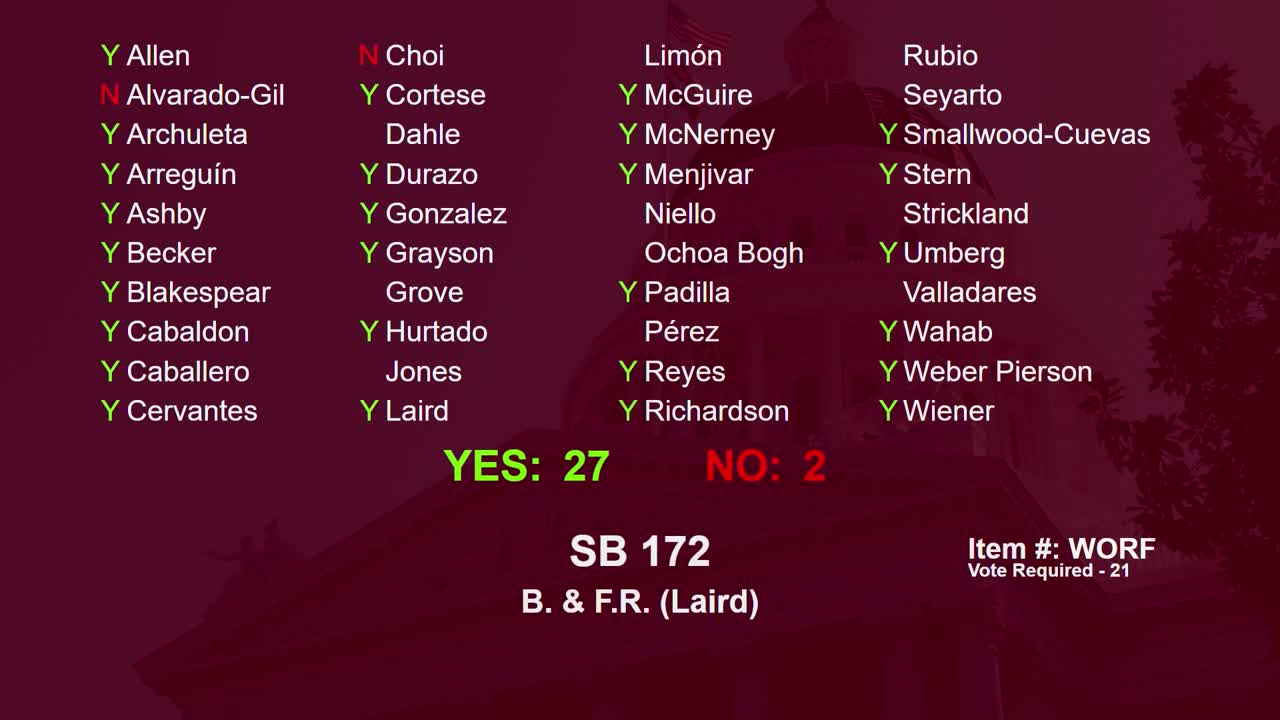
Bill Author
Bill Co-Author(s):