SB 274: Automated license plate recognition systems.
- Session Year: 2025-2026
- House: Senate
- Latest Version Date: 2025-09-17
Current Status:
Failed
(2026-03-02: Stricken from file.)
Introduced
In Committee
Awaiting First Chamber Vote
Passed First Chamber
In Committee
Awaiting Second Chamber Vote
Passed Second Chamber
Enacted
What does this bill do?
The bill tightens rules for public agencies (state, cities, counties, and their law enforcement) on collecting, sharing, and storing automated license‑plate reader (ALPR) data, while exempting certain transportation agencies, public transit operators, and airport parking uses. It requires stronger employee access controls and training, public usage and privacy policies, Department of Justice audits if funded, and detailed logs that must include a valid case file number or task force name before a search. New vendor contracts must block default links to national ALPR databases, ALPR searches may only be used to find vehicles or people reasonably suspected of committing a public offense (a crime), and non‑hot‑list scans must be deleted after 60 days with any older records removed within 14 days.
The summary is provided by generative AI which can make mistakes. For original language, please view the details in the table below.
Existing law prohibits a public agency, which includes the state, a city, a county, a city and county, or any agency or political subdivision of the state, a city, a county, or a city and county, including, but not limited to, a law enforcement agency, from selling, sharing, or transferring automated license plate recognition (ALPR) information, except to another public agency, and only as otherwise permitted by law. Existing law defines ALPR information as information or data collected through the use of an ALPR system.
This bill would provide that public agency does not include a transportation agency, a public transit operator, or a local department of transportation or public works department, as specified. The bill would, beginning January 1, 2026, require new, updated, expansions of, or addendums of contractual agreements with ALPR vendors, manufacturers, or suppliers to mandate that no default access is provided to any national ALPR database and that an agencys collected scans are by default not accessible to any other agency, and would impose new requirements on sharing between California state law enforcement agencies. The bill would authorize a law enforcement agency to use ALPR information only for purposes of locating vehicles or persons when either are reasonably suspected of being involved in the commission of a public offense. The bill would prohibit a public agency from retaining ALPR information for more than 60 days after the date of collection if it does not match information on an authorized hot list, as defined, and as of January 1, 2026, would require a public agency to delete all ALPR information that has been held for more than 60 days and does not match information on an authorized hot list within 14 days. By imposing new requirements on public agencies, which include local agencies, this bill would impose a state-mandated local program.
Existing law defines an ALPR operator as a person that operates an ALPR system, which does not include a transportation agency. Existing law defines an ALPR end-user a person that accesses or uses an ALPR system, which does not include, among other things, a transportation agency.
This bill would additionally exclude from the definitions of ALPR operator and ALPR end-user a public transit operator, a local department of transportation or public works department, or an airport or airport operator, as provided.
Existing law requires an ALPR operator and ALPR end-user to maintain reasonable security procedures and practices, including operational, administrative, technical, and physical safeguards, to protect ALPR information from unauthorized access, destruction, use, modification, or disclosure.
This bill would require those security procedures and practices to include safeguards for managing which employees can see the data from their systems, as specified, and requiring data security training and data privacy training for all employees that access ALPR information.
Existing law requires an ALPR operator and ALPR end-user to implement a usage and privacy policy that includes, among other things, a description of the job title or other designation of the employees and independent contractors who are authorized to access and use ALPR information.
This bill would require the usage and privacy policy to identify what purpose employees and independent contractors access and use ALPR information for. The bill would also require the Department of Justice to, contingent upon an appropriation of sufficient funds, conduct annual random audits on a public agency that is an ALPR operator or ALPR end-user to determine whether they have implemented and are adhering to that usage and privacy policy.
Existing law requires an ALPR operator that accesses or provides access to ALPR information to require that ALPR information only be used for the authorized purposes described in the usage and privacy policy and to maintain a record of that access that includes, among other things, the purpose for accessing the information.
This bill would instead require that record of access maintained by the ALPR operator to include the case file number or task force name, as applicable, that justifies the search query, and would provide that no queries shall be allowed without a log entry with a valid and current case file number or task force name from the agency conducting the query.
The bill would include findings that changes proposed by this bill address a matter of statewide concern rather than a municipal affair and, therefore, apply to all cities, including charter cities.
The California Constitution requires the state to reimburse local agencies and school districts for certain costs mandated by the state. Statutory provisions establish procedures for making that reimbursement.
This bill would provide that, if the Commission on State Mandates determines that the bill contains costs mandated by the state, reimbursement for those costs shall be made pursuant to the statutory provisions noted above.
Existing law prohibits a public agency, which includes the state, a city, a county, a city and county, or any agency or political subdivision of the state, a city, a county, or a city and county, including, but not limited to, a law enforcement agency, from selling, sharing, or transferring automated license plate recognition (ALPR) information, except to another public agency, and only as otherwise permitted by law. Existing law defines ALPR information as information or data collected through the use of an ALPR system.
This bill would provide that public agency does not include a transportation agency, a public transit operator, or a local department of transportation or public works department, as specified. The bill would, beginning January 1, 2026, require new, updated, expansions of, or addendums of contractual agreements with ALPR vendors, manufacturers, or suppliers to mandate that no default access is provided to any national ALPR database and that an agencys collected scans are by default not accessible to any other agency, and would impose new requirements on sharing between California state law enforcement agencies. The bill would authorize a law enforcement agency to use ALPR information only for purposes of locating vehicles or persons when either are reasonably suspected of being involved in the commission of a public offense. The bill would prohibit a public agency from retaining ALPR information for more than 60 days after the date of collection if it does not match information on an authorized hot list, as defined, and as of January 1, 2026, would require a public agency to delete all ALPR information that has been held for more than 60 days and does not match information on an authorized hot list within 14 days. By imposing new requirements on public agencies, which include local agencies, this bill would impose a state-mandated local program.
Existing law defines an ALPR operator as a person that operates an ALPR system, which does not include a transportation agency. Existing law defines an ALPR end-user a person that accesses or uses an ALPR system, which does not include, among other things, a transportation agency.
This bill would additionally exclude from the definitions of ALPR operator and ALPR end-user a public transit operator, a local department of transportation or public works department, or an airport or airport operator, as provided.
Existing law requires an ALPR operator and ALPR end-user to maintain reasonable security procedures and practices, including operational, administrative, technical, and physical safeguards, to protect ALPR information from unauthorized access, destruction, use, modification, or disclosure.
This bill would require those security procedures and practices to include safeguards for managing which employees can see the data from their systems, as specified, and requiring data security training and data privacy training for all employees that access ALPR information.
Existing law requires an ALPR operator and ALPR end-user to implement a usage and privacy policy that includes, among other things, a description of the job title or other designation of the employees and independent contractors who are authorized to access and use ALPR information.
This bill would require the usage and privacy policy to identify what purpose employees and independent contractors access and use ALPR information for. The bill would also require the Department of Justice to to, contingent upon an appropriation of sufficient funds, conduct annual random audits on a public agency that is an ALPR operator or ALPR end-user to determine whether they have implemented and are adhering to that usage and privacy policy.
Existing law requires an ALPR operator that accesses or provides access to ALPR information to require that ALPR information only be used for the authorized purposes described in the usage and privacy policy and to maintain a record of that access that includes, among other things, the purpose for accessing the information.
This bill would instead require that record of access maintained by the ALPR operator to include the case file number or task force name, as applicable, that justifies the search query, and would provide that no queries shall be allowed without a log entry with a valid and current case file number or task force name from the agency conducting the query.
The bill would include findings that changes proposed by this bill address a matter of statewide concern rather than a municipal affair and, therefore, apply to all cities, including charter cities.
The California Constitution requires the state to reimburse local agencies and school districts for certain costs mandated by the state. Statutory provisions establish procedures for making that reimbursement.
This bill would provide that, if the Commission on State Mandates determines that the bill contains costs mandated by the state, reimbursement for those costs shall be made pursuant to the statutory provisions noted above.
Existing law prohibits a public agency, which includes the state, a city, a county, a city and county, or any agency or political subdivision of the state, a city, a county, or a city and county, including, but not limited to, a law enforcement agency, from selling, sharing, or transferring automated license plate recognition (ALPR) information, except to another public agency, and only as otherwise permitted by law. Existing law defines ALPR information as information or data collected through the use of an ALPR system.
This bill would provide that public agency does not include a transportation agency, as specified. The bill would authorize a law enforcement agency to use ALPR information only for purposes of locating vehicles or persons when either are reasonably suspected of being involved in the commission of a public offense. The bill would prohibit a public agency from retaining ALPR information for more than 60 days after the date of collection if it does not match information on a an authorized hot list, as defined. defined, and as of January 1, 2026, would require a public agency to delete all ALPR information that has been held for more than 60 days and does not match information on an authorized hot list within 14 days. By imposing new requirements on public agencies, which include local agencies, this bill would impose a state-mandated local program.
Existing law requires an ALPR operator and ALPR end-user to maintain reasonable security procedures and practices, including operational, administrative, technical, and physical safeguards, to protect ALPR information from unauthorized access, destruction, use, modification, or disclosure.
This bill would require those security procedures and practices to include safeguards for managing which employees can see the data from their systems, as specified, and requiring data security training and data privacy training for all employees that access ALPR information.
Existing law requires an ALPR operator and ALPR end-user to implement a usage and privacy policy that includes, among other things, a description of the job title or other designation of the employees and independent contractors who are authorized to access and use ALPR information.
This bill would require the usage and privacy policy to identify what purpose employees and independent contractors access and use ALPR information for. The bill would also require the Department of Justice to conduct annual random audits on a public agency that is an ALPR operator or ALPR end-user to determine whether they have implemented and are adhering to that usage and privacy policy.
Existing law requires an ALPR operator that accesses or provides access to ALPR information to require that ALPR information only be used for the authorized purposes described in the usage and privacy policy and to maintain a record of that access that includes, among other things, the purpose for accessing the information.
This bill would instead require that record of access maintained by the ALPR operator to include the case file number that justifies the search query, and would provide that no queries shall be allowed without a log entry with a valid and current case file number from the agency conducting the query.
The bill would include findings that changes proposed by this bill address a matter of statewide concern rather than a municipal affair and, therefore, apply to all cities, including charter cities.
The California Constitution requires the state to reimburse local agencies and school districts for certain costs mandated by the state. Statutory provisions establish procedures for making that reimbursement.
This bill would provide that, if the Commission on State Mandates determines that the bill contains costs mandated by the state, reimbursement for those costs shall be made pursuant to the statutory provisions noted above.
Existing law prohibits the state, a city, a county, a city and county, or any agency or political subdivision of the state, a city, a county, or a city and county, including, but not limited to, a law enforcement agency, from selling, sharing, or transferring automated license plate recognition (ALPR) information, except to another public agency, and only as otherwise permitted by law. Existing law defines ALPR information as information or data collected through the use of an ALPR system.
This bill would prohibit a public agency from retaining ALPR information for more than 30 60 days after the date of collection if it does not match information on a hot list, as defined. By imposing new requirements on public agencies, which include local agencies, this bill would impose a state-mandated local program.
Existing law requires an ALPR operator and ALPR end-user to maintain reasonable security procedures and practices, including operational, administrative, technical, and physical safeguards, to protect ALPR information from unauthorized access, destruction, use, modification, or disclosure.
This bill would require those security procedures and practices to include safeguards for managing which employees can see the data from their systems, as specified, and requiring data security training and data privacy training for all employees that access ALPR information.
Existing law requires an ALPR operator and ALPR end-user to implement a usage and privacy policy that includes, among other things, a description of the job title or other designation of the employees and independent contractors who are authorized to access and use ALPR information.
This bill would require the usage and privacy policy to identify what purpose employees and independent contractors access and use ALPR information for. The bill would also require the Department of Justice to annually audit any conduct annual random audits on a public agency that is an ALPR operator or ALPR end-user to determine whether they have implemented that usage and privacy policy.
The bill would include findings that changes proposed by this bill address a matter of statewide concern rather than a municipal affair and, therefore, apply to all cities, including charter cities.
The California Constitution requires the state to reimburse local agencies and school districts for certain costs mandated by the state. Statutory provisions establish procedures for making that reimbursement.
This bill would provide that, if the Commission on State Mandates determines that the bill contains costs mandated by the state, reimbursement for those costs shall be made pursuant to the statutory provisions noted above.
Existing law prohibits the state, a city, a county, a city and county, or any agency or political subdivision of the state, a city, a county, or a city and county, including, but not limited to, a law enforcement agency, from selling, sharing, or transferring automated license plate recognition (ALPR) information, except to another public agency, and only as otherwise permitted by law. Existing law defines ALPR information as information or data collected through the use of an ALPR system.
This bill would, in compliance with specified laws, would prohibit a public agency from using an ALPR system to gather geolocation data at specified locations for immigration enforcement purposes and retaining ALPR information for more than 30 days, except in specified circumstances. days after the date of collection if it does not match information on a hot list, as defined. By imposing new requirements on public agencies, which include local agencies, this bill would impose a state-mandated local program.
Existing law requires an ALPR operator and ALPR end-user to maintain reasonable security procedures and practices, including operational, administrative, technical, and physical safeguards, to protect ALPR information from unauthorized access, destruction, use, modification, or disclosure.
This bill would require those security procedures and practices to include safeguards for managing which employees can see the data from their systems, as specified, and requiring data security training and data privacy training for all employees that access ALPR information.
Existing law requires an ALPR operator and ALPR end-user to implement a usage and privacy policy that includes, among other things, a description of the job title or other designation of the employees and independent contractors who are authorized to access and use ALPR information.
This bill would require the usage and privacy policy to identify what purpose employees and independent contractors access and use ALPR information for. The bill would also require the Department of Justice to annually audit any public agency that is an ALPR operator or ALPR end-user to determine whether they have implemented that usage and privacy policy.
The bill would include findings that changes proposed by this bill address a matter of statewide concern rather than a municipal affair and, therefore, apply to all cities, including charter cities.
The California Constitution requires the state to reimburse local agencies and school districts for certain costs mandated by the state. Statutory provisions establish procedures for making that reimbursement.
This bill would provide that, if the Commission on State Mandates determines that the bill contains costs mandated by the state, reimbursement for those costs shall be made pursuant to the statutory provisions noted above.
Existing law prohibits the state, a city, a county, a city and county, or any agency or political subdivision of the state, a city, a county, or a city and county, including, but not limited to, a law enforcement agency, from selling, sharing, or transferring automated license plate recognition (ALPR) information, except to another public agency, and only as otherwise permitted by law. Existing law defines ALPR information as information or data collected through the use of an ALPR system.
This bill would, in compliance with specified laws, prohibit a public agency from entering into a contract to share ALPR information with a foreign jurisdiction or data broker, as defined, for immigration enforcement purposes, continuing any contract to share ALPR information with a foreign jurisdiction or data broker if the public agency knows that the ALPR information is being used for immigration enforcement purposes, using an ALPR system to gather geolocation data at specified locations for immigration enforcement purposes, and, if the public agency is a law enforcement agency, collecting or purposes and retaining ALPR information unless that information is related to a criminal investigation or to an individual suspected of a crime. for more than 30 days, except in specified circumstances. By imposing new requirements on public agencies, which include local agencies, this bill would impose a state-mandated local program.
Existing law requires an ALPR operator and ALPR end-user to maintain reasonable security procedures and practices, including operational, administrative, technical, and physical safeguards, to protect ALPR information from unauthorized access, destruction, use, modification, or disclosure.
This bill would require those security procedures and practices to include safeguards for managing which employees can see the data from their systems, as specified, and requiring data security training and data privacy training for all employees that access ALPR information. The bill would also require an ALPR operator or ALPR end user that is a law enforcement agency to establish a maximum data retention period for ALPR information.
Existing law requires an ALPR operator and ALPR end-user to implement a usage and privacy policy that includes, among other things, a description of the job title or other designation of the employees and independent contractors who are authorized to access and use ALPR information.
This bill would require the usage and privacy policy to identify what purpose employees and independent contractors access and use ALPR information for. The bill would also require the Department of Justice to annually audit any public agency that is an ALPR operator or ALPR end-user to determine whether they have implemented that usage and privacy policy.
The bill would include findings that changes proposed by this bill address a matter of statewide concern rather than a municipal affair and, therefore, apply to all cities, including charter cities.
The California Constitution requires the state to reimburse local agencies and school districts for certain costs mandated by the state. Statutory provisions establish procedures for making that reimbursement.
This bill would provide that, if the Commission on State Mandates determines that the bill contains costs mandated by the state, reimbursement for those costs shall be made pursuant to the statutory provisions noted above.
Existing law prohibits the state, a city, a county, a city and county, or any agency or political subdivision of the state, a city, a county, or a city and county, including, but not limited to, a law enforcement agency, from selling, sharing, or transferring automated license plate recognition (ALPR) information, except to another public agency, and only as otherwise permitted by law. Existing law defines ALPR information as information or data collected through the use of an ALPR system.
This bill would state the intent of the Legislature to enact legislation that, among other things, imposes privacy protection requirements on cities, counties, and entities that use ALPR data. would, in compliance with specified laws, prohibit a public agency from entering into a contract to share ALPR information with a foreign jurisdiction or data broker, as defined, for immigration enforcement purposes, continuing any contract to share ALPR information with a foreign jurisdiction or data broker if the public agency knows that the ALPR information is being used for immigration enforcement purposes, using an ALPR system to gather geolocation data at specified locations for immigration enforcement purposes, and, if the public agency is a law enforcement agency, collecting or retaining ALPR information unless that information is related to a criminal investigation or to an individual suspected of a crime. By imposing new requirements on public agencies, which include local agencies, this bill would impose a state-mandated local program.
Existing law requires an ALPR operator and ALPR end-user to maintain reasonable security procedures and practices, including operational, administrative, technical, and physical safeguards, to protect ALPR information from unauthorized access, destruction, use, modification, or disclosure.
This bill would require those security procedures and practices to include safeguards for managing which employees can see the data from their systems, as specified, and requiring data security training and data privacy training for all employees that access ALPR information. The bill would also require an ALPR operator or ALPR end user that is a law enforcement agency to establish a maximum data retention period for ALPR information.
Existing law requires an ALPR operator and ALPR end-user to implement a usage and privacy policy that includes, among other things, a description of the job title or other designation of the employees and independent contractors who are authorized to access and use ALPR information.
This bill would require the usage and privacy policy to identify what purpose employees and independent contractors access and use ALPR information for. The bill would also require the Department of Justice to audit any public agency that is an ALPR operator or ALPR end-user to determine whether they have implemented that usage and privacy policy.
The bill would include findings that changes proposed by this bill address a matter of statewide concern rather than a municipal affair and, therefore, apply to all cities, including charter cities.
The California Constitution requires the state to reimburse local agencies and school districts for certain costs mandated by the state. Statutory provisions establish procedures for making that reimbursement.
This bill would provide that, if the Commission on State Mandates determines that the bill contains costs mandated by the state, reimbursement for those costs shall be made pursuant to the statutory provisions noted above.
Existing law prohibits the state, a city, a county, a city and county, or any agency or political subdivision of the state, a city, a county, or a city and county, including, but not limited to, a law enforcement agency, from selling, sharing, or transferring automated license plate recognition (ALPR) information, except to another public agency, and only as otherwise permitted by law. Existing law defines ALPR information as information or data collected through the use of an ALPR system.
This bill would state the intent of the Legislature to enact legislation that, among other things, imposes privacy protection requirements on cities, counties, and entities that use ALPR data.
This act shall be known as the Automated License Plate Recognition (ALPR) Data Accountability Act.
SEC. 2.Section 1798.90.5 of the Civil Code is amended to read:1798.90.5.The following definitions shall apply for purposes of this title:
(a)Airport or airport operator means a city, county, city and county, airport authority, joint powers authority, special district, or other public entity that owns or operates a public-use airport, and its contracted parking operator acting on the airports behalf.
(b)Automated license plate recognition end-user or ALPR end-user means a person that accesses or uses an ALPR system, but does not include any of the following:
(1)A transportation agency when subject to Section 31490 of the Streets and Highways Code.
(2)A public transit operator when subject to Section 40240 of the Vehicle Code.
(3)A local department of transportation or public works department when subject to Section 21455.5 of, and Article 3 (commencing with Section 22425) of Chapter 7 of Division 11 of, the Vehicle Code.
(4)An airport or airport operator when collecting, accessing, or using ALPR information solely for parking access control, fee calculation, lost-ticket resolution, fraud prevention, or transaction dispute resolution in an airport parking facility.
(5)A person that is subject to Sections 6801 to 6809, inclusive, of Title 15 of the United States Code and state or federal statutes or regulations implementing those sections, if the person is subject to compliance oversight by a state or federal regulatory agency with respect to those sections.
(6)A person, other than a law enforcement agency, to whom information may be disclosed as a permissible use pursuant to Section 2721 of Title 18 of the United States Code.
(c)Automated license plate recognition information, or ALPR information means information or data collected through the use of an ALPR system.
(d)Automated license plate recognition operator or ALPR operator means a person that operates an ALPR system, but does not include any of the following:
(1)A transportation agency when subject to Section 31490 of the Streets and Highways Code.
(2)A public transit operator when subject to Section 40240 of the Vehicle Code.
(3)A local department of transportation or public works department when subject to Section 21455.5 of, and Article 3 (commencing with Section 22425) of Chapter 7 of Division 11 of, the Vehicle Code.
(4)An airport or airport operator when collecting, accessing, or using ALPR information solely for parking access control, fee calculation, lost-ticket resolution, fraud prevention, or transaction dispute resolution in an airport parking facility.
(e)Automated license plate recognition system or ALPR system means a searchable computerized database resulting from the operation of one or more mobile or fixed cameras combined with computer algorithms to read and convert images of registration plates and the characters they contain into computer-readable data.
(f)Hot list means a list or lists of license plates of vehicles of interest against which the ALPR system is comparing vehicles on the roadways. Authorized hot lists are limited to the National Crime Information Center (NCIC) list, the Stolen Vehicle System (SVS), California Department of Justice lists, official alerts, including AMBER, Silver, Feather, Blue, Yellow, Ebony, and any new alerts authorized by the Legislature, and custom BOLO lists that pertain solely to missing and at-risk persons, witness locations, burglaries, grand theft, and violent crimes.
(g)Person means any natural person, public agency, partnership, firm, association, corporation, limited liability company, or other legal entity.
(h)Public agency means the state, any city, county, or city and county, or any agency or political subdivision of the state or a city, county, or city and county, including, but not limited to, a law enforcement agency, but does not include
(1)A transportation agency when subject to Section 31490 of the Streets and Highways Code.
(2)A public transit operator when subject to Section 40240 of the Vehicle Code.
(3)A local department of transportation or public works department when subject to Section 21455.5 of, and Article 3 (commencing with Section 22425) of Chapter 7 of Division 11 of, the Vehicle Code.
SEC. 3.Section 1798.90.51 of the Civil Code is amended to read:1798.90.51.An ALPR operator shall do both of the following:
(a)Maintain reasonable security procedures and practices, including operational, administrative, technical, and physical safeguards, to protect ALPR information from unauthorized access, destruction, use, modification, or disclosure, including the following:
(1)Safeguards for managing which employees can see the data from their systems, including requiring supervisory approval, robust authentication protocols for establishing an account to access an ALPR system, and tracking searches of ALPR information made by employees.
(2)Requiring data security training and data privacy training for all employees that access ALPR information.
(b)(1)Implement a usage and privacy policy, under the supervision of the Department of Justice according to subdivision (c) of Section 1798.90.54, if applicable, in order to ensure that the collection, use, maintenance, sharing, and dissemination of ALPR information is consistent with respect for individuals privacy and civil liberties. The usage and privacy policy shall be available to the public in writing, and, if the ALPR operator has an internet website, the usage and privacy policy shall be posted conspicuously on that internet website.
(2)The usage and privacy policy shall, at a minimum, include all of the following:
(A)The authorized purposes for using the ALPR system and collecting ALPR information.
(B)A description of the job title or other designation of the employees and independent contractors who are authorized to use or access the ALPR system, or to collect ALPR information, and for what purpose. The policy shall identify the training requirements necessary for those authorized employees and independent contractors.
(C)A description of how the ALPR system will be monitored to ensure the security of the information and compliance with applicable privacy laws.
(D)The purposes of, process for, and restrictions on, the sale, sharing, or transfer of ALPR information to other persons.
(E)The title of the official custodian, or owner, of the ALPR system responsible for implementing this section.
(F)A description of the reasonable measures that will be used to ensure the accuracy of ALPR information and correct data errors.
(G)The length of time ALPR information will be retained, and the process the ALPR operator will utilize to determine if and when to destroy retained ALPR information.
SEC. 4.Section 1798.90.52 of the Civil Code is amended to read:1798.90.52.If an ALPR operator accesses or provides access to ALPR information, the ALPR operator shall do both of the following:
(a)Maintain a record of that access. At a minimum, the record shall include all of the following:
(1)The date and time the information is accessed.
(2)The license plate number or other data elements used to query the ALPR system.
(3)The username of the person who accesses the information, and, as applicable, the organization or entity with whom the person is affiliated.
(4)(A)The case file number that justifies the search query. No queries shall be allowed without a log entry with a valid and current case file number from the agency conducting the query.
(B)Notwithstanding subparagraph (A), in the event of a search query that is conducted as part of an inter-agency task force established by the Attorney General and overseen by the offices Bureau of Investigation, in lieu of a case file number, the log entry shall include the name of the task force and the name of the bureau commander in charge of the task force.
(b)Require that ALPR information only be used for the authorized purposes described in the usage and privacy policy required by subdivision (b) of Section 1798.90.51.
SEC. 5.Section 1798.90.53 of the Civil Code is amended to read:1798.90.53.An ALPR end-user shall do both of the following:
(a)Maintain reasonable security procedures and practices, including operational, administrative, technical, and physical safeguards, to protect ALPR information from unauthorized access, destruction, use, modification, or disclosure, including the following:
(1)Safeguards for managing which employees can see the data from their systems, including requiring supervisory approval, robust authentication protocols for establishing an account to access an ALPR system, and tracking searches of ALPR information made by employees.
(2)Requiring data security training and data privacy training for all employees that access ALPR information.
(b)(1)Implement a usage and privacy policy, under the supervision of the Department of Justice according to subdivision (c) of Section 1798.90.54, if applicable, in order to ensure that the access, use, sharing, and dissemination of ALPR information is consistent with respect for individuals privacy and civil liberties. The usage and privacy policy shall be available to the public in writing, and, if the ALPR end-user has an internet website, the usage and privacy policy shall be posted conspicuously on that internet website.
(2)The usage and privacy policy shall, at a minimum, include all of the following:
(A)The authorized purposes for accessing and using ALPR information.
(B)A description of the job title or other designation of the employees and independent contractors who are authorized to access and use ALPR information, and for what purpose. The policy shall identify the training requirements necessary for those authorized employees and independent contractors.
(C)A description of how the ALPR system will be monitored to ensure the security of the information accessed or used, and compliance with all applicable privacy laws and a process for periodic system audits.
(D)The purposes of, process for, and restrictions on, the sale, sharing, or transfer of ALPR information to other persons.
(E)The title of the official custodian, or owner, of the ALPR information responsible for implementing this section.
(F)A description of the reasonable measures that will be used to ensure the accuracy of ALPR information and correct data errors.
(G)The length of time ALPR information will be retained, and the process the ALPR end-user will utilize to determine if and when to destroy retained ALPR information.
SEC. 6.Section 1798.90.54 of the Civil Code is amended to read:1798.90.54.(a)In addition to any other sanctions, penalties, or remedies provided by law, an individual who has been harmed by a violation of this title, including, but not limited to, unauthorized access or use of ALPR information or a breach of security of an ALPR system, may bring a civil action in any court of competent jurisdiction against a person who knowingly caused the harm.
(b)The court may award a combination of any one or more of the following:
(1)Actual damages, but not less than liquidated damages in the amount of two thousand five hundred dollars ($2,500).
(2)Punitive damages upon proof of willful or reckless disregard of the law.
(3)Reasonable attorneys fees and other litigation costs reasonably incurred.
(4)Other preliminary and equitable relief as the court determines to be appropriate.
(c)(1)The Department of Justice shall conduct annual random audits on a public agency that is an ALPR operator or ALPR end-user to determine whether they have implemented and are adhering to a usage and privacy policy in compliance with subdivision (b) of Section 1798.90.51 or subdivision (b) of Section 1798.90.53, as applicable.
(2)The implementation of this subdivision is contingent upon an appropriation of sufficient funds in the annual Budget Act for those purposes.
SEC. 7.Section 1798.90.55 of the Civil Code is amended to read:1798.90.55.Notwithstanding any other law or regulation:
(a)A public agency that operates or intends to operate an ALPR system shall provide an opportunity for public comment at a regularly scheduled public meeting of the governing body of the public agency before implementing the program.
(b)(1)A public agency shall not sell, share, or transfer ALPR information, except to another public agency, and only as otherwise permitted by law. For purposes of this section, the provision of data hosting or towing services shall not be considered the sale, sharing, or transferring of ALPR information.
(2)Beginning January 1, 2026, all new, updated, expansions of, or addendums of contractual agreements with ALPR vendors, manufacturers, or suppliers shall mandate that no default access is provided to any national ALPR database and that an agencys collected scans are by default not accessible to any other agency. A law enforcement agency may manually implement agency to agency sharing with other California state law enforcement agencies only as authorized by Department of Justice General Order 2023-05.
(c)ALPR information may be used by a law enforcement agency only for purposes of locating vehicles or persons when either are reasonably suspected of being involved in the commission of a public offense.
SEC. 8.Section 1798.90.56 is added to the Civil Code, immediately following Section 1798.90.55, to read:1798.90.56.A public agency shall not retain ALPR information that does not match information on an authorized hot list for more than 60 days after the date of collection.
SEC. 9.Section 1798.90.57 is added to the Civil Code, to read:1798.90.57.As of January 1, 2026, a public agency shall, within 14 days, delete all ALPR information that has been held for more than 60 days and does not match information on an authorized hot list.
SEC. 10.The Legislature finds and declares that Section 3 of this act amending Section 1798.90.51 of the Civil Code, Section 4 of this act amending Section 1798.90.52 of the Civil Code, Section 5 of this act amending Section 1798.90.53 of the Civil Code, Section 7 of this act amending Section 1798.90.55 of the Civil Code, Section 8 of this act adding Section 1798.90.56 to the Civil Code, and Section 9 of this act adding Section 1798.90.57 to the Civil Code address a matter of statewide concern rather than a municipal affair as that term is used in Section 5 of Article XI of the California Constitution. Therefore, Sections 3, 4, 5, 7, 8, and 9 of this act apply to all cities, including charter cities.
SEC. 11.If the Commission on State Mandates determines that this act contains costs mandated by the state, reimbursement to local agencies and school districts for those costs shall be made pursuant to Part 7 (commencing with Section 17500) of Division 4 of Title 2 of the Government Code.
This act shall be known as the Automated License Plate Recognition (ALPR) Data Accountability Act.
SEC. 2.Section 1798.90.5 of the Civil Code is amended to read:1798.90.5.The following definitions shall apply for purposes of this title:
(a)Airport or airport operator means a city, county, city and county, airport authority, joint powers authority, special district, or other public entity that owns or operates a public-use airport, and its contracted parking operator acting on the airports behalf.
(a)(b)Automated license plate recognition end-user or ALPR end-user means a person that accesses or uses an ALPR system, but does not include any of the following:
(1)A transportation agency when subject to Section 31490 of the Streets and Highways Code.
(2)A public transit operator when subject to Section 40240 of the Vehicle Code.
(3)A local department of transportation or public works department when subject to Section 21455.5 of, and Article 3 (commencing with Section 22425) of Chapter 7 of Division 11 of, the Vehicle Code.
(4)An airport or airport operator when collecting, accessing, or using ALPR information solely for parking access control, fee calculation, lost-ticket resolution, fraud prevention, or transaction dispute resolution in an airport parking facility.
(2)(5)A person that is subject to Sections 6801 to 6809, inclusive, of Title 15 of the United States Code and state or federal statutes or regulations implementing those sections, if the person is subject to compliance oversight by a state or federal regulatory agency with respect to those sections.
(3)(6)A person, other than a law enforcement agency, to whom information may be disclosed as a permissible use pursuant to Section 2721 of Title 18 of the United States Code.
(b)(c)Automated license plate recognition information, or ALPR information means information or data collected through the use of an ALPR system.
(c)(d)Automated license plate recognition operator or ALPR operator means a person that operates an ALPR system, but does not include a any of the following:
(1)A transportation agency when subject to Section 31490 of the Streets and Highways Code.
(2)A public transit operator when subject to Section 40240 of the Vehicle Code.
(3)A local department of transportation or public works department when subject to Section 21455.5 of, and Article 3 (commencing with Section 22425) of Chapter 7 of Division 11 of, the Vehicle Code.
(4)An airport or airport operator when collecting, accessing, or using ALPR information solely for parking access control, fee calculation, lost-ticket resolution, fraud prevention, or transaction dispute resolution in an airport parking facility.
(d)(e)Automated license plate recognition system or ALPR system means a searchable computerized database resulting from the operation of one or more mobile or fixed cameras combined with computer algorithms to read and convert images of registration plates and the characters they contain into computer-readable data.
(e)(f)Hot list means a list or lists of license plates of vehicles of interest against which the ALPR system is comparing vehicles on the roadways. Authorized hot lists are limited to the National Crime Information Center (NCIC) list, the Stolen Vehicle System (SVS), California Department of Justice lists, official alerts, including AMBER, Silver, Feather, Blue, Yellow, Ebony, and any new alerts authorized by the Legislature, and custom BOLO lists that pertain solely to missing and at-risk persons, witness locations, burglaries, grand theft, and violent crimes.
(f)(g)Person means any natural person, public agency, partnership, firm, association, corporation, limited liability company, or other legal entity.
(g)(h)Public agency means the state, any city, county, or city and county, or any agency or political subdivision of the state or a city, county, or city and county, including, but not limited to, a law enforcement agency, but does not include a
(1)A transportation agency when subject to Section 31490 of the Streets and Highways Code.
(2)A public transit operator when subject to Section 40240 of the Vehicle Code.
(3)A local department of transportation or public works department when subject to Section 21455.5 of, and Article 3 (commencing with Section 22425) of Chapter 7 of Division 11 of, the Vehicle Code.
SEC. 3.Section 1798.90.51 of the Civil Code is amended to read:1798.90.51.An ALPR operator shall do both of the following:
(a)Maintain reasonable security procedures and practices, including operational, administrative, technical, and physical safeguards, to protect ALPR information from unauthorized access, destruction, use, modification, or disclosure, including the following:
(1)Safeguards for managing which employees can see the data from their systems, including requiring supervisory approval, robust authentication protocols for establishing an account to access an ALPR system, and tracking searches of ALPR information made by employees.
(2)Requiring data security training and data privacy training for all employees that access ALPR information.
(b)(1)Implement a usage and privacy policy, under the supervision of the Department of Justice according to subdivision (c) of Section 1798.90.54, if applicable, in order to ensure that the collection, use, maintenance, sharing, and dissemination of ALPR information is consistent with respect for individuals privacy and civil liberties. The usage and privacy policy shall be available to the public in writing, and, if the ALPR operator has an internet website, the usage and privacy policy shall be posted conspicuously on that internet website.
(2)The usage and privacy policy shall, at a minimum, include all of the following:
(A)The authorized purposes for using the ALPR system and collecting ALPR information.
(B)A description of the job title or other designation of the employees and independent contractors who are authorized to use or access the ALPR system, or to collect ALPR information, and for what purpose. The policy shall identify the training requirements necessary for those authorized employees and independent contractors.
(C)A description of how the ALPR system will be monitored to ensure the security of the information and compliance with applicable privacy laws.
(D)The purposes of, process for, and restrictions on, the sale, sharing, or transfer of ALPR information to other persons.
(E)The title of the official custodian, or owner, of the ALPR system responsible for implementing this section.
(F)A description of the reasonable measures that will be used to ensure the accuracy of ALPR information and correct data errors.
(G)The length of time ALPR information will be retained, and the process the ALPR operator will utilize to determine if and when to destroy retained ALPR information.
SEC. 4.Section 1798.90.52 of the Civil Code is amended to read:1798.90.52.If an ALPR operator accesses or provides access to ALPR information, the ALPR operator shall do both of the following:
(a)Maintain a record of that access. At a minimum, the record shall include all of the following:
(1)The date and time the information is accessed.
(2)The license plate number or other data elements used to query the ALPR system.
(3)The username of the person who accesses the information, and, as applicable, the organization or entity with whom the person is affiliated.
(4)(A)The case file number that justifies the search query. No queries shall be allowed without a log entry with a valid and current case file number from the agency conducting the query.
(B)Notwithstanding subparagraph (A), in the event of a search query that is conducted as part of an inter-agency task force established by the Attorney General and overseen by the offices Bureau of Investigation, in lieu of a case file number, the log entry shall include the name of the task force and the name of the bureau commander in charge of the task force.
(b)Require that ALPR information only be used for the authorized purposes described in the usage and privacy policy required by subdivision (b) of Section 1798.90.51.
SEC. 5.Section 1798.90.53 of the Civil Code is amended to read:1798.90.53.An ALPR end-user shall do both of the following:
(a)Maintain reasonable security procedures and practices, including operational, administrative, technical, and physical safeguards, to protect ALPR information from unauthorized access, destruction, use, modification, or disclosure, including the following:
(1)Safeguards for managing which employees can see the data from their systems, including requiring supervisory approval, robust authentication protocols for establishing an account to access an ALPR system, and tracking searches of ALPR information made by employees.
(2)Requiring data security training and data privacy training for all employees that access ALPR information.
(b)(1)Implement a usage and privacy policy, under the supervision of the Department of Justice according to subdivision (c) of Section 1798.90.54, if applicable, in order to ensure that the access, use, sharing, and dissemination of ALPR information is consistent with respect for individuals privacy and civil liberties. The usage and privacy policy shall be available to the public in writing, and, if the ALPR end-user has an internet website, the usage and privacy policy shall be posted conspicuously on that internet website.
(2)The usage and privacy policy shall, at a minimum, include all of the following:
(A)The authorized purposes for accessing and using ALPR information.
(B)A description of the job title or other designation of the employees and independent contractors who are authorized to access and use ALPR information, and for what purpose. The policy shall identify the training requirements necessary for those authorized employees and independent contractors.
(C)A description of how the ALPR system will be monitored to ensure the security of the information accessed or used, and compliance with all applicable privacy laws and a process for periodic system audits.
(D)The purposes of, process for, and restrictions on, the sale, sharing, or transfer of ALPR information to other persons.
(E)The title of the official custodian, or owner, of the ALPR information responsible for implementing this section.
(F)A description of the reasonable measures that will be used to ensure the accuracy of ALPR information and correct data errors.
(G)The length of time ALPR information will be retained, and the process the ALPR end-user will utilize to determine if and when to destroy retained ALPR information.
SEC. 6.Section 1798.90.54 of the Civil Code is amended to read:1798.90.54.(a)In addition to any other sanctions, penalties, or remedies provided by law, an individual who has been harmed by a violation of this title, including, but not limited to, unauthorized access or use of ALPR information or a breach of security of an ALPR system, may bring a civil action in any court of competent jurisdiction against a person who knowingly caused the harm.
(b)The court may award a combination of any one or more of the following:
(1)Actual damages, but not less than liquidated damages in the amount of two thousand five hundred dollars ($2,500).
(2)Punitive damages upon proof of willful or reckless disregard of the law.
(3)Reasonable attorneys fees and other litigation costs reasonably incurred.
(4)Other preliminary and equitable relief as the court determines to be appropriate.
(c)(1)The Department of Justice shall conduct annual random audits on a public agency that is an ALPR operator or ALPR end-user to determine whether they have implemented and are adhering to a usage and privacy policy in compliance with subdivision (b) of Section 1798.90.51 or subdivision (b) of Section 1798.90.53, as applicable.
(2)The implementation of this subdivision is contingent upon an appropriation of sufficient funds in the annual Budget Act for those purposes.
SEC. 7.Section 1798.90.55 of the Civil Code is amended to read:1798.90.55.Notwithstanding any other law or regulation:
(a)A public agency that operates or intends to operate an ALPR system shall provide an opportunity for public comment at a regularly scheduled public meeting of the governing body of the public agency before implementing the program.
(b)(1)A public agency shall not sell, share, or transfer ALPR information, except to another public agency, and only as otherwise permitted by law. For purposes of this section, the provision of data hosting or towing services shall not be considered the sale, sharing, or transferring of ALPR information.
(2)Beginning January 1, 2026, all new, updated, expansions of, or addendums of contractual agreements with ALPR vendors, manufacturers, or suppliers shall mandate that no default access is provided to any national ALPR database and that an agencys collected scans are by default not accessible to any other agency. A law enforcement agency may manually implement agency to agency sharing with other California state law enforcement agencies only as authorized by Department of Justice General Order 2023-05.
(c)ALPR information may be used by a law enforcement agency only for purposes of locating vehicles or persons when either are reasonably suspected of being involved in the commission of a public offense.
SEC. 8.Section 1798.90.56 is added to the Civil Code, immediately following Section 1798.90.55, to read:1798.90.56.A public agency shall not retain ALPR information that does not match information on an authorized hot list for more than 60 days after the date of collection.
SEC. 9.Section 1798.90.57 is added to the Civil Code, to read:1798.90.57.As of January 1, 2026, a public agency shall, within 14 days, delete all ALPR information that has been held for more than 60 days and does not match information on an authorized hot list.
SEC. 10.The Legislature finds and declares that Section 3 of this act amending Section 1798.90.51 of the Civil Code, Section 4 of this act amending Section 1798.90.52 of the Civil Code, Section 5 of this act amending Section 1798.90.53 of the Civil Code, Section 7 of this act amending Section 1798.90.55 of the Civil Code, Section 8 of this act adding Section 1798.90.56 to the Civil Code, and Section 9 of this act adding Section 1798.90.57 to the Civil Code address a matter of statewide concern rather than a municipal affair as that term is used in Section 5 of Article XI of the California Constitution. Therefore, Sections 3, 4, and 6 5, 7, 8, and 9 of this act apply to all cities, including charter cities.
SEC. 11.If the Commission on State Mandates determines that this act contains costs mandated by the state, reimbursement to local agencies and school districts for those costs shall be made pursuant to Part 7 (commencing with Section 17500) of Division 4 of Title 2 of the Government Code.
This act shall be known as the Automated License Plate Recognition (ALPR) Data Accountability Act.
SEC. 2.Section 1798.90.5 of the Civil Code is amended to read:1798.90.5.The following definitions shall apply for purposes of this title:
(a)Automated license plate recognition end-user or ALPR end-user means a person that accesses or uses an ALPR system, but does not include any of the following:
(1)A transportation agency when subject to Section 31490 of the Streets and Highways Code.
(2)A person that is subject to Sections 6801 to 6809, inclusive, of Title 15 of the United States Code and state or federal statutes or regulations implementing those sections, if the person is subject to compliance oversight by a state or federal regulatory agency with respect to those sections.
(3)A person, other than a law enforcement agency, to whom information may be disclosed as a permissible use pursuant to Section 2721 of Title 18 of the United States Code.
(b)Automated license plate recognition information, or ALPR information means information or data collected through the use of an ALPR system.
(c)Automated license plate recognition operator or ALPR operator means a person that operates an ALPR system, but does not include a transportation agency when subject to Section 31490 of the Streets and Highways Code.
(d)Automated license plate recognition system or ALPR system means a searchable computerized database resulting from the operation of one or more mobile or fixed cameras combined with computer algorithms to read and convert images of registration plates and the characters they contain into computer-readable data.
(e)Hot list means a list or lists of license plates of vehicles of interest against which the ALPR system is comparing vehicles on the roadways. Authorized hot lists are limited to the National Crime Information Center (NCIC) list, the Stolen Vehicle System (SVS), California Department of Justice lists, official alerts, including AMBER, Silver, Feather, Blue, Yellow, Ebony, and any new alerts authorized by the Legislature, and custom BOLO lists that pertain solely to missing and at-risk persons, witness locations, burglaries, grand theft, and violent crimes.
(f)Person means any natural person, public agency, partnership, firm, association, corporation, limited liability company, or other legal entity.
(g)Public agency means the state, any city, county, or city and county, or any agency or political subdivision of the state or a city, county, or city and county, including, but not limited to, a law enforcement agency. agency, but does not include a transportation agency when subject to Section 31490 of the Streets and Highways Code.
SEC. 3.Section 1798.90.51 of the Civil Code is amended to read:1798.90.51.An ALPR operator shall do both of the following:
(a)Maintain reasonable security procedures and practices, including operational, administrative, technical, and physical safeguards, to protect ALPR information from unauthorized access, destruction, use, modification, or disclosure, including the following:
(1)Safeguards for managing which employees can see the data from their systems, including requiring supervisory approval, robust authentication protocols for establishing an account to access an ALPR system, and tracking searches of ALPR information made by employees.
(2)Requiring data security training and data privacy training for all employees that access ALPR information.
(b)(1)Implement a usage and privacy policy, under the supervision of the Department of Justice according to subdivision (c) of Section 1798.90.54, if applicable, in order to ensure that the collection, use, maintenance, sharing, and dissemination of ALPR information is consistent with respect for individuals privacy and civil liberties. The usage and privacy policy shall be available to the public in writing, and, if the ALPR operator has an internet website, the usage and privacy policy shall be posted conspicuously on that internet website.
(2)The usage and privacy policy shall, at a minimum, include all of the following:
(A)The authorized purposes for using the ALPR system and collecting ALPR information.
(B)A description of the job title or other designation of the employees and independent contractors who are authorized to use or access the ALPR system, or to collect ALPR information, and for what purpose. The policy shall identify the training requirements necessary for those authorized employees and independent contractors.
(C)A description of how the ALPR system will be monitored to ensure the security of the information and compliance with applicable privacy laws.
(D)The purposes of, process for, and restrictions on, the sale, sharing, or transfer of ALPR information to other persons.
(E)The title of the official custodian, or owner, of the ALPR system responsible for implementing this section.
(F)A description of the reasonable measures that will be used to ensure the accuracy of ALPR information and correct data errors.
(G)The length of time ALPR information will be retained, and the process the ALPR operator will utilize to determine if and when to destroy retained ALPR information.
SEC. 4.Section 1798.90.52 of the Civil Code is amended to read:1798.90.52.If an ALPR operator accesses or provides access to ALPR information, the ALPR operator shall do both of the following:
(a)Maintain a record of that access. At a minimum, the record shall include all of the following:
(1)The date and time the information is accessed.
(2)The license plate number or other data elements used to query the ALPR system.
(3)The username of the person who accesses the information, and, as applicable, the organization or entity with whom the person is affiliated.
(4)The purpose for accessing the information.(4)The case file number that justifies the search query. No queries shall be allowed without a log entry with a valid and current case file number from the agency conducting the query.
(b)Require that ALPR information only be used for the authorized purposes described in the usage and privacy policy required by subdivision (b) of Section 1798.90.51.
SEC. 4.SEC. 5.Section 1798.90.53 of the Civil Code is amended to read:1798.90.53.An ALPR end-user shall do both of the following:
(a)Maintain reasonable security procedures and practices, including operational, administrative, technical, and physical safeguards, to protect ALPR information from unauthorized access, destruction, use, modification, or disclosure, including the following:
(1)Safeguards for managing which employees can see the data from their systems, including requiring supervisory approval, robust authentication protocols for establishing an account to access an ALPR system, and tracking searches of ALPR information made by employees.
(2)Requiring data security training and data privacy training for all employees that access ALPR information.
(b)(1)Implement a usage and privacy policy, under the supervision of the Department of Justice according to subdivision (c) of Section 1798.90.54, if applicable, in order to ensure that the access, use, sharing, and dissemination of ALPR information is consistent with respect for individuals privacy and civil liberties. The usage and privacy policy shall be available to the public in writing, and, if the ALPR end-user has an internet website, the usage and privacy policy shall be posted conspicuously on that internet website.
(2)The usage and privacy policy shall, at a minimum, include all of the following:
(A)The authorized purposes for accessing and using ALPR information.
(B)A description of the job title or other designation of the employees and independent contractors who are authorized to access and use ALPR information, and for what purpose. The policy shall identify the training requirements necessary for those authorized employees and independent contractors.
(C)A description of how the ALPR system will be monitored to ensure the security of the information accessed or used, and compliance with all applicable privacy laws and a process for periodic system audits.
(D)The purposes of, process for, and restrictions on, the sale, sharing, or transfer of ALPR information to other persons.
(E)The title of the official custodian, or owner, of the ALPR information responsible for implementing this section.
(F)A description of the reasonable measures that will be used to ensure the accuracy of ALPR information and correct data errors.
(G)The length of time ALPR information will be retained, and the process the ALPR end-user will utilize to determine if and when to destroy retained ALPR information.
SEC. 5.SEC. 6.Section 1798.90.54 of the Civil Code is amended to read:1798.90.54.(a)In addition to any other sanctions, penalties, or remedies provided by law, an individual who has been harmed by a violation of this title, including, but not limited to, unauthorized access or use of ALPR information or a breach of security of an ALPR system, may bring a civil action in any court of competent jurisdiction against a person who knowingly caused the harm.
(b)The court may award a combination of any one or more of the following:
(1)Actual damages, but not less than liquidated damages in the amount of two thousand five hundred dollars ($2,500).
(2)Punitive damages upon proof of willful or reckless disregard of the law.
(3)Reasonable attorneys fees and other litigation costs reasonably incurred.
(4)Other preliminary and equitable relief as the court determines to be appropriate.
(c)The Department of Justice shall conduct annual random audits on a public agency that is an ALPR operator or ALPR end-user to determine whether they have implemented and are adhering to a usage and privacy policy in compliance with subdivision (b) of Section 1798.90.51 or subdivision (b) of Section 1798.90.53, as applicable.
SEC. 7.Section 1798.90.55 of the Civil Code is amended to read:1798.90.55.Notwithstanding any other law or regulation:
(a)A public agency that operates or intends to operate an ALPR system shall provide an opportunity for public comment at a regularly scheduled public meeting of the governing body of the public agency before implementing the program.
(b)A public agency shall not sell, share, or transfer ALPR information, except to another public agency, and only as otherwise permitted by law. For purposes of this section, the provision of data hosting or towing services shall not be considered the sale, sharing, or transferring of ALPR information.
(c)ALPR information may be used by a law enforcement agency only for purposes of locating vehicles or persons when either are reasonably suspected of being involved in the commission of a public offense.
SEC. 6.SEC. 8.Section 1798.90.56 is added to the Civil Code, immediately following Section 1798.90.55, to read:1798.90.56.A public agency shall not retain ALPR information that does not match information on a an authorized hot list for more than 60 days after the date of collection.
SEC. 9.Section 1798.90.57 is added to the Civil Code, to read:1798.90.57.As of January 1, 2026, a public agency shall, within 14 days, delete all ALPR information that has been held for more than 60 days and does not match information on an authorized hot list.
SEC. 7.SEC. 10.The Legislature finds and declares that Section 3 of this act amending Section 1798.90.51 of the Civil Code, Section 4 of this act amending Section 1798.90.52 of the Civil Code, Section 5 of this act amending Section 1798.90.53 of the Civil Code, and Section 7 of this act amending Section 1798.90.55 of the Civil Code, Section 6 8 of this act adding Section 1798.90.56 to the Civil Code Code, and Section 9 of this act adding Section 1798.90.57 to the Civil Code address a matter of statewide concern rather than a municipal affair as that term is used in Section 5 of Article XI of the California Constitution. Therefore, Sections 3, 4, and 6 of this act apply to all cities, including charter cities.
SEC. 8.SEC. 11.If the Commission on State Mandates determines that this act contains costs mandated by the state, reimbursement to local agencies and school districts for those costs shall be made pursuant to Part 7 (commencing with Section 17500) of Division 4 of Title 2 of the Government Code.
This act shall be known as the Automated License Plate Recognition (ALPR) Data Accountability Act.
SEC. 2.Section 1798.90.5 of the Civil Code is amended to read:1798.90.5.The following definitions shall apply for purposes of this title:
(a)Automated license plate recognition end-user or ALPR end-user means a person that accesses or uses an ALPR system, but does not include any of the following:
(1)A transportation agency when subject to Section 31490 of the Streets and Highways Code.
(2)A person that is subject to Sections 6801 to 6809, inclusive, of Title 15 of the United States Code and state or federal statutes or regulations implementing those sections, if the person is subject to compliance oversight by a state or federal regulatory agency with respect to those sections.
(3)A person, other than a law enforcement agency, to whom information may be disclosed as a permissible use pursuant to Section 2721 of Title 18 of the United States Code.
(b)Automated license plate recognition information, or ALPR information means information or data collected through the use of an ALPR system.
(c)Automated license plate recognition operator or ALPR operator means a person that operates an ALPR system, but does not include a transportation agency when subject to Section 31490 of the Streets and Highways Code.
(d)Automated license plate recognition system or ALPR system means a searchable computerized database resulting from the operation of one or more mobile or fixed cameras combined with computer algorithms to read and convert images of registration plates and the characters they contain into computer-readable data.
(e)Hot list means a list or lists of license plates of vehicles of interest against which the ALPR system is comparing vehicles on the roadways.
(f)Person means any natural person, public agency, partnership, firm, association, corporation, limited liability company, or other legal entity.
(g)Public agency means the state, any city, county, or city and county, or any agency or political subdivision of the state or a city, county, or city and county, including, but not limited to, a law enforcement agency.
SEC. 3.Section 1798.90.51 of the Civil Code is amended to read:1798.90.51.An ALPR operator shall do both of the following:
(a)Maintain reasonable security procedures and practices, including operational, administrative, technical, and physical safeguards, to protect ALPR information from unauthorized access, destruction, use, modification, or disclosure, including the following:
(1)Safeguards for managing which employees can see the data from their systems, including requiring supervisory approval, robust authentication protocols for establishing an account to access an ALPR system, and tracking searches of ALPR information made by employees.
(2)Requiring data security training and data privacy training for all employees that access ALPR information.
(b)(1)Implement a usage and privacy policy, under the supervision of the Department of Justice according to subdivision (c) of Section 1798.90.54, if applicable, in order to ensure that the collection, use, maintenance, sharing, and dissemination of ALPR information is consistent with respect for individuals privacy and civil liberties. The usage and privacy policy shall be available to the public in writing, and, if the ALPR operator has an internet website, the usage and privacy policy shall be posted conspicuously on that internet website.
(2)The usage and privacy policy shall, at a minimum, include all of the following:
(A)The authorized purposes for using the ALPR system and collecting ALPR information.
(B)A description of the job title or other designation of the employees and independent contractors who are authorized to use or access the ALPR system, or to collect ALPR information, and for what purpose. The policy shall identify the training requirements necessary for those authorized employees and independent contractors.
(C)A description of how the ALPR system will be monitored to ensure the security of the information and compliance with applicable privacy laws.
(D)The purposes of, process for, and restrictions on, the sale, sharing, or transfer of ALPR information to other persons.
(E)The title of the official custodian, or owner, of the ALPR system responsible for implementing this section.
(F)A description of the reasonable measures that will be used to ensure the accuracy of ALPR information and correct data errors.
(G)The length of time ALPR information will be retained, and the process the ALPR operator will utilize to determine if and when to destroy retained ALPR information.
SEC. 4.Section 1798.90.53 of the Civil Code is amended to read:1798.90.53.An ALPR end-user shall do both of the following:
(a)Maintain reasonable security procedures and practices, including operational, administrative, technical, and physical safeguards, to protect ALPR information from unauthorized access, destruction, use, modification, or disclosure, including the following:
(1)Safeguards for managing which employees can see the data from their systems, including requiring supervisory approval, robust authentication protocols for establishing an account to access an ALPR system, and tracking searches of ALPR information made by employees.
(2)Requiring data security training and data privacy training for all employees that access ALPR information.
(b)(1)Implement a usage and privacy policy, under the supervision of the Department of Justice according to subdivision (c) of Section 1798.90.54, if applicable, in order to ensure that the access, use, sharing, and dissemination of ALPR information is consistent with respect for individuals privacy and civil liberties. The usage and privacy policy shall be available to the public in writing, and, if the ALPR end-user has an internet website, the usage and privacy policy shall be posted conspicuously on that internet website.
(2)The usage and privacy policy shall, at a minimum, include all of the following:
(A)The authorized purposes for accessing and using ALPR information.
(B)A description of the job title or other designation of the employees and independent contractors who are authorized to access and use ALPR information, and for what purpose. The policy shall identify the training requirements necessary for those authorized employees and independent contractors.
(C)A description of how the ALPR system will be monitored to ensure the security of the information accessed or used, and compliance with all applicable privacy laws and a process for periodic system audits.
(D)The purposes of, process for, and restrictions on, the sale, sharing, or transfer of ALPR information to other persons.
(E)The title of the official custodian, or owner, of the ALPR information responsible for implementing this section.
(F)A description of the reasonable measures that will be used to ensure the accuracy of ALPR information and correct data errors.
(G)The length of time ALPR information will be retained, and the process the ALPR end-user will utilize to determine if and when to destroy retained ALPR information.
SEC. 5.Section 1798.90.54 of the Civil Code is amended to read:1798.90.54.(a)In addition to any other sanctions, penalties, or remedies provided by law, an individual who has been harmed by a violation of this title, including, but not limited to, unauthorized access or use of ALPR information or a breach of security of an ALPR system, may bring a civil action in any court of competent jurisdiction against a person who knowingly caused the harm.
(b)The court may award a combination of any one or more of the following:
(1)Actual damages, but not less than liquidated damages in the amount of two thousand five hundred dollars ($2,500).
(2)Punitive damages upon proof of willful or reckless disregard of the law.
(3)Reasonable attorneys fees and other litigation costs reasonably incurred.
(4)Other preliminary and equitable relief as the court determines to be appropriate.
(c)The Department of Justice shall annually audit any conduct annual random audits on a public agency that is an ALPR operator or ALPR end-user to determine whether they have implemented a usage and privacy policy in compliance with subdivision (b) of Section 1798.90.51 or subdivision (b) of Section 1798.90.53, as applicable.
SEC. 6.Section 1798.90.56 is added to the Civil Code, immediately following Section 1798.90.55, to read:1798.90.56.A public agency shall not retain ALPR information that does not match information on a hot list for more than 30 60 days after the date of collection.
SEC. 7.The Legislature finds and declares that Section 3 of this act amending Section 1798.90.51 of the Civil Code, Section 4 of this act amending Section 1798.90.53 of the Civil Code, and Section 6 of this act adding Section 1798.90.56 to the Civil Code address a matter of statewide concern rather than a municipal affair as that term is used in Section 5 of Article XI of the California Constitution. Therefore, Sections 3, 4, and 6 of this act apply to all cities, including charter cities.
SEC. 8.If the Commission on State Mandates determines that this act contains costs mandated by the state, reimbursement to local agencies and school districts for those costs shall be made pursuant to Part 7 (commencing with Section 17500) of Division 4 of Title 2 of the Government Code.
REVISIONS: HeadingLine 2.This act shall be known as the Automated License Plate Recognition (ALPR) Data Accountability Act.
SEC. 2.Section 1798.90.5 of the Civil Code is amended to read:1798.90.5.The following definitions shall apply for purposes of this title:
(a)Automated license plate recognition end-user or ALPR end-user means a person that accesses or uses an ALPR system, but does not include any of the following:
(1)A transportation agency when subject to Section 31490 of the Streets and Highways Code.
(2)A person that is subject to Sections 6801 to 6809, inclusive, of Title 15 of the United States Code and state or federal statutes or regulations implementing those sections, if the person is subject to compliance oversight by a state or federal regulatory agency with respect to those sections.
(3)A person, other than a law enforcement agency, to whom information may be disclosed as a permissible use pursuant to Section 2721 of Title 18 of the United States Code.
(b)Automated license plate recognition information, or ALPR information means information or data collected through the use of an ALPR system.
(c)Automated license plate recognition operator or ALPR operator means a person that operates an ALPR system, but does not include a transportation agency when subject to Section 31490 of the Streets and Highways Code.
(d)Automated license plate recognition system or ALPR system means a searchable computerized database resulting from the operation of one or more mobile or fixed cameras combined with computer algorithms to read and convert images of registration plates and the characters they contain into computer-readable data.
(e)Hot list means a list or lists of license plates of vehicles of interest against which the ALPR system is comparing vehicles on the roadways.
(e)(f)Person means any natural person, public agency, partnership, firm, association, corporation, limited liability company, or other legal entity.
(f)(g)Public agency means the state, any city, county, or city and county, or any agency or political subdivision of the state or a city, county, or city and county, including, but not limited to, a law enforcement agency.
SEC. 2.SEC. 3.Section 1798.90.51 of the Civil Code is amended to read:1798.90.51.An ALPR operator shall do both of the following:
(a)Maintain reasonable security procedures and practices, including operational, administrative, technical, and physical safeguards, to protect ALPR information from unauthorized access, destruction, use, modification, or disclosure, including the following:
(1)Safeguards for managing which employees can see the data from their systems, including requiring supervisory approval, robust authentication protocols for establishing an account to access an ALPR system, and tracking searches of ALPR information made by employees.
(2)Requiring data security training and data privacy training for all employees that access ALPR information.
(b)(1)Implement a usage and privacy policy, under the supervision of the Department of Justice according to subdivision (c) of Section 1798.90.54, if applicable, in order to ensure that the collection, use, maintenance, sharing, and dissemination of ALPR information is consistent with respect for individuals privacy and civil liberties. The usage and privacy policy shall be available to the public in writing, and, if the ALPR operator has an internet website, the usage and privacy policy shall be posted conspicuously on that internet website.
(2)The usage and privacy policy shall, at a minimum, include all of the following:
(A)The authorized purposes for using the ALPR system and collecting ALPR information.
(B)A description of the job title or other designation of the employees and independent contractors who are authorized to use or access the ALPR system, or to collect ALPR information, and for what purpose. The policy shall identify the training requirements necessary for those authorized employees and independent contractors.
(C)A description of how the ALPR system will be monitored to ensure the security of the information and compliance with applicable privacy laws.
(D)The purposes of, process for, and restrictions on, the sale, sharing, or transfer of ALPR information to other persons.
(E)The title of the official custodian, or owner, of the ALPR system responsible for implementing this section.
(F)A description of the reasonable measures that will be used to ensure the accuracy of ALPR information and correct data errors.
(G)The length of time ALPR information will be retained, and the process the ALPR operator will utilize to determine if and when to destroy retained ALPR information.
SEC. 3.SEC. 4.Section 1798.90.53 of the Civil Code is amended to read:1798.90.53.An ALPR end-user shall do both of the following:
(a)Maintain reasonable security procedures and practices, including operational, administrative, technical, and physical safeguards, to protect ALPR information from unauthorized access, destruction, use, modification, or disclosure, including the following:
(1)Safeguards for managing which employees can see the data from their systems, including requiring supervisory approval, robust authentication protocols for establishing an account to access an ALPR system, and tracking searches of ALPR information made by employees.
(2)Requiring data security training and data privacy training for all employees that access ALPR information.
(b)(1)Implement a usage and privacy policy, under the supervision of the Department of Justice according to subdivision (c) of Section 1798.90.54, if applicable, in order to ensure that the access, use, sharing, and dissemination of ALPR information is consistent with respect for individuals privacy and civil liberties. The usage and privacy policy shall be available to the public in writing, and, if the ALPR end-user has an internet website, the usage and privacy policy shall be posted conspicuously on that internet website.
(2)The usage and privacy policy shall, at a minimum, include all of the following:
(A)The authorized purposes for accessing and using ALPR information.
(B)A description of the job title or other designation of the employees and independent contractors who are authorized to access and use ALPR information, and for what purpose. The policy shall identify the training requirements necessary for those authorized employees and independent contractors.
(C)A description of how the ALPR system will be monitored to ensure the security of the information accessed or used, and compliance with all applicable privacy laws and a process for periodic system audits.
(D)The purposes of, process for, and restrictions on, the sale, sharing, or transfer of ALPR information to other persons.
(E)The title of the official custodian, or owner, of the ALPR information responsible for implementing this section.
(F)A description of the reasonable measures that will be used to ensure the accuracy of ALPR information and correct data errors.
(G)The length of time ALPR information will be retained, and the process the ALPR end-user will utilize to determine if and when to destroy retained ALPR information.
SEC. 4.SEC. 5.Section 1798.90.54 of the Civil Code is amended to read:1798.90.54.(a)In addition to any other sanctions, penalties, or remedies provided by law, an individual who has been harmed by a violation of this title, including, but not limited to, unauthorized access or use of ALPR information or a breach of security of an ALPR system, may bring a civil action in any court of competent jurisdiction against a person who knowingly caused the harm.
(b)The court may award a combination of any one or more of the following:
(1)Actual damages, but not less than liquidated damages in the amount of two thousand five hundred dollars ($2,500).
(2)Punitive damages upon proof of willful or reckless disregard of the law.
(3)Reasonable attorneys fees and other litigation costs reasonably incurred.
(4)Other preliminary and equitable relief as the court determines to be appropriate.
(c)The Department of Justice shall annually audit any public agency that is an ALPR operator or ALPR end-user to determine whether they have implemented a usage and privacy policy in compliance with subdivision (b) of Section 1798.90.51 or subdivision (b) of Section 1798.90.53, as applicable.
SEC. 5.Section 1798.90.56 is added to the Civil Code, immediately following Section 1798.90.55, to read:1798.90.56.(a)In accordance with Chapter 17.1 (commencing with Section 7282) and Chapter 17.25 (commencing with Section 7284) of Division 7 of Title 1 of the Government Code, a public agency shall not do either of the following: (1)Use an ALPR system to gather geolocation data at public schools, public libraries, health facilities operated by the state or a political subdivision of the state, courthouses, facilities owned by the Division of Labor Standards Enforcement, the Agricultural Labor Relations Board, or the Division of Workers Compensation, and shelters for immigration enforcement purposes.(2)Retain ALPR information for more than 30 days, except in circumstances when the data is being used as evidence or for all felonies being investigated, including, but not limited to, auto theft, homicides, kidnapping, burglaries, elder and juvenile abductions, Amber Alerts, Blue Alerts, and Feather Alerts.(b)For purposes of this section, foreign jurisdiction means any other state, the District of Columbia, territories or possessions of the United States, and foreign states, provinces, or countries.SEC. 6.Section 1798.90.56 is added to the Civil Code, immediately following Section 1798.90.55, to read:1798.90.56.A public agency shall not retain ALPR information that does not match information on a hot list for more than 30 days after the date of collection.
SEC. 6.SEC. 7.The Legislature finds and declares that Section 2 3 of this act amending Section 1798.90.51 of the Civil Code, Section 3 4 of this act amending Section 1798.90.53 of the Civil Code, and Section 5 6 of this act adding Section 1798.90.56 to the Civil Code, Code address a matter of statewide concern rather than a municipal affair as that term is used in Section 5 of Article XI of the California Constitution. Therefore, Sections 2, 3, and 5 3, 4, and 6 of this act apply to all cities, including charter cities.
SEC. 7.SEC. 8.If the Commission on State Mandates determines that this act contains costs mandated by the state, reimbursement to local agencies and school districts for those costs shall be made pursuant to Part 7 (commencing with Section 17500) of Division 4 of Title 2 of the Government Code.
This act shall be known as the Automated License Plate Recognition (ALPR) Data Accountability Act.
SEC. 2.Section 1798.90.51 of the Civil Code is amended to read:1798.90.51.An ALPR operator shall do all both of the following:
(a)Maintain reasonable security procedures and practices, including operational, administrative, technical, and physical safeguards, to protect ALPR information from unauthorized access, destruction, use, modification, or disclosure, including the following:
(1)Safeguards for managing which employees can see the data from their systems, including requiring supervisory approval, robust authentication protocols for establishing an account to access an ALPR system, and tracking searches of ALPR information made by employees.
(2)Requiring data security training and data privacy training for all employees that access ALPR information.
(b)(1)Implement a usage and privacy policy, under the supervision of the Department of Justice according to subdivision (c) of Section 1798.90.54, if applicable, in order to ensure that the collection, use, maintenance, sharing, and dissemination of ALPR information is consistent with respect for individuals privacy and civil liberties. The usage and privacy policy shall be available to the public in writing, and, if the ALPR operator has an internet website, the usage and privacy policy shall be posted conspicuously on that internet website.
(2)The usage and privacy policy shall, at a minimum, include all of the following:
(A)The authorized purposes for using the ALPR system and collecting ALPR information.
(B)A description of the job title or other designation of the employees and independent contractors who are authorized to use or access the ALPR system, or to collect ALPR information, and for what purpose. The policy shall identify the training requirements necessary for those authorized employees and independent contractors.
(C)A description of how the ALPR system will be monitored to ensure the security of the information and compliance with applicable privacy laws.
(D)The purposes of, process for, and restrictions on, the sale, sharing, or transfer of ALPR information to other persons.
(E)The title of the official custodian, or owner, of the ALPR system responsible for implementing this section.
(F)A description of the reasonable measures that will be used to ensure the accuracy of ALPR information and correct data errors.
(G)The length of time ALPR information will be retained, and the process the ALPR operator will utilize to determine if and when to destroy retained ALPR information.
(c)If the ALPR operator is a law enforcement agency, establish a maximum data retention period for ALPR information.SEC. 3.Section 1798.90.53 of the Civil Code is amended to read:1798.90.53.An ALPR end-user shall do all both of the following:
(a)Maintain reasonable security procedures and practices, including operational, administrative, technical, and physical safeguards, to protect ALPR information from unauthorized access, destruction, use, modification, or disclosure, including the following:
(1)Safeguards for managing which employees can see the data from their systems, including requiring supervisory approval, robust authentication protocols for establishing an account to access an ALPR system, and tracking searches of ALPR information made by employees.
(2)Requiring data security training and data privacy training for all employees that access ALPR information.
(b)(1)Implement a usage and privacy policy, under the supervision of the Department of Justice according to subdivision (c) of Section 1798.90.54, if applicable, in order to ensure that the access, use, sharing, and dissemination of ALPR information is consistent with respect for individuals privacy and civil liberties. The usage and privacy policy shall be available to the public in writing, and, if the ALPR end-user has an internet website, the usage and privacy policy shall be posted conspicuously on that internet website.
(2)The usage and privacy policy shall, at a minimum, include all of the following:
(A)The authorized purposes for accessing and using ALPR information.
(B)A description of the job title or other designation of the employees and independent contractors who are authorized to access and use ALPR information, and for what purpose. The policy shall identify the training requirements necessary for those authorized employees and independent contractors.
(C)A description of how the ALPR system will be monitored to ensure the security of the information accessed or used, and compliance with all applicable privacy laws and a process for periodic system audits.
(D)The purposes of, process for, and restrictions on, the sale, sharing, or transfer of ALPR information to other persons.
(E)The title of the official custodian, or owner, of the ALPR information responsible for implementing this section.
(F)A description of the reasonable measures that will be used to ensure the accuracy of ALPR information and correct data errors.
(G)The length of time ALPR information will be retained, and the process the ALPR end-user will utilize to determine if and when to destroy retained ALPR information.
(c)If the ALPR end-user is a law enforcement agency, establish a maximum data retention period for ALPR information.SEC. 4.Section 1798.90.54 of the Civil Code is amended to read:1798.90.54.(a)In addition to any other sanctions, penalties, or remedies provided by law, an individual who has been harmed by a violation of this title, including, but not limited to, unauthorized access or use of ALPR information or a breach of security of an ALPR system, may bring a civil action in any court of competent jurisdiction against a person who knowingly caused the harm.
(b)The court may award a combination of any one or more of the following:
(1)Actual damages, but not less than liquidated damages in the amount of two thousand five hundred dollars ($2,500).
(2)Punitive damages upon proof of willful or reckless disregard of the law.
(3)Reasonable attorneys fees and other litigation costs reasonably incurred.
(4)Other preliminary and equitable relief as the court determines to be appropriate.
(c)The Department of Justice shall annually audit any public agency that is an ALPR operator or ALPR end-user to determine whether they have implemented a usage and privacy policy in compliance with subdivision (b) of Section 1798.90.51 or subdivision (b) of Section 1798.90.53, as applicable.
SEC. 5.Section 1798.90.56 is added to the Civil Code, immediately following Section 1798.90.55, to read:1798.90.56.(a)In accordance with Chapter 17.1 (commencing with Section 7282) and Chapter 17.25 (commencing with Section 7284) of Division 7 of Title 1 of the Government Code, a public agency shall not do any either of the following:
(1)Enter into a contract to share ALPR information with a foreign jurisdiction for immigration enforcement purposes, or continue any contract to share ALPR information with a foreign jurisdiction if the public agency knows that the ALPR information is being used for immigration enforcement purposes.(2)Enter into a contract to share ALPR information with a data broker, as defined in Section 1798.99.80, for immigration enforcement purposes, or continue any contract to share ALPR information with a data broker, as defined in Section 1798.99.80, if the public agency knows that the ALPR information is being used for immigration enforcement purposes. (3)(1)Use an ALPR system to gather geolocation data at public schools, public libraries, health facilities operated by the state or a political subdivision of the state, courthouses, facilities owned by the Division of Labor Standards Enforcement, the Agricultural Labor Relations Board, or the Division of Workers Compensation, and shelters for immigration enforcement purposes.
(4)If the public agency is a law enforcement agency, collect or retain ALPR information, unless that ALPR information is related to a criminal investigation or to an individual suspected of a crime.(2)Retain ALPR information for more than 30 days, except in circumstances when the data is being used as evidence or for all felonies being investigated, including, but not limited to, auto theft, homicides, kidnapping, burglaries, elder and juvenile abductions, Amber Alerts, Blue Alerts, and Feather Alerts.
(b)For purposes of this section, foreign jurisdiction means any other state, the District of Columbia, territories or possessions of the United States, and foreign states, provinces, or countries.
SEC. 6.The Legislature finds and declares that Section 2 of this act amending Section 1798.90.51 of the Civil Code, Section 3 of this act amending Section 1798.90.53 of the Civil Code, and Section 5 of this act adding Section 1798.90.56 to the Civil Code, address a matter of statewide concern rather than a municipal affair as that term is used in Section 5 of Article XI of the California Constitution. Therefore, Sections 2, 3, and 5 of this act apply to all cities, including charter cities.
SEC. 7.If the Commission on State Mandates determines that this act contains costs mandated by the state, reimbursement to local agencies and school districts for those costs shall be made pursuant to Part 7 (commencing with Section 17500) of Division 4 of Title 2 of the Government Code.
This act shall be known as the Automated License Plate Recognition (ALPR) Data Accountability Act.
SEC. 2.Section 1798.90.51 of the Civil Code is amended to read:1798.90.51.An ALPR operator shall do all of the following:
(a)Maintain reasonable security procedures and practices, including operational, administrative, technical, and physical safeguards, to protect ALPR information from unauthorized access, destruction, use, modification, or disclosure. disclosure, including the following:
(1)Safeguards for managing which employees can see the data from their systems, including requiring supervisory approval, robust authentication protocols for establishing an account to access an ALPR system, and tracking searches of ALPR information made by employees.
(2)Requiring data security training and data privacy training for all employees that access ALPR information.
(b)(1)Implement a usage and privacy policy policy, under the supervision of the Department of Justice according to subdivision (c) of Section 1798.90.54, if applicable, in order to ensure that the collection, use, maintenance, sharing, and dissemination of ALPR information is consistent with respect for individuals privacy and civil liberties. The usage and privacy policy shall be available to the public in writing, and, if the ALPR operator has an Internet Web site, internet website, the usage and privacy policy shall be posted conspicuously on that Internet Web site. internet website.
(2)The usage and privacy policy shall, at a minimum, include all of the following:
(A)The authorized purposes for using the ALPR system and collecting ALPR information.
(B)A description of the job title or other designation of the employees and independent contractors who are authorized to use or access the ALPR system, or to collect ALPR information. information, and for what purpose. The policy shall identify the training requirements necessary for those authorized employees and independent contractors.
(C)A description of how the ALPR system will be monitored to ensure the security of the information and compliance with applicable privacy laws.
(D)The purposes of, process for, and restrictions on, the sale, sharing, or transfer of ALPR information to other persons.
(E)The title of the official custodian, or owner, of the ALPR system responsible for implementing this section.
(F)A description of the reasonable measures that will be used to ensure the accuracy of ALPR information and correct data errors.
(G)The length of time ALPR information will be retained, and the process the ALPR operator will utilize to determine if and when to destroy retained ALPR information.
(c)If the ALPR operator is a law enforcement agency, establish a maximum data retention period for ALPR information.
SEC. 3.Section 1798.90.53 of the Civil Code is amended to read:1798.90.53.An ALPR end-user shall do all of the following:
(a)Maintain reasonable security procedures and practices, including operational, administrative, technical, and physical safeguards, to protect ALPR information from unauthorized access, destruction, use, modification, or disclosure. disclosure, including the following:
(1)Safeguards for managing which employees can see the data from their systems, including requiring supervisory approval, robust authentication protocols for establishing an account to access an ALPR system, and tracking searches of ALPR information made by employees.
(2)Requiring data security training and data privacy training for all employees that access ALPR information.
(b)(1)Implement a usage and privacy policy policy, under the supervision of the Department of Justice according to subdivision (c) of Section 1798.90.54, if applicable, in order to ensure that the access, use, sharing, and dissemination of ALPR information is consistent with respect for individuals privacy and civil liberties. The usage and privacy policy shall be available to the public in writing, and, if the ALPR end-user has an Internet Web site, internet website, the usage and privacy policy shall be posted conspicuously on that Internet Web site. internet website.
(2)The usage and privacy policy shall, at a minimum, include all of the following:
(A)The authorized purposes for accessing and using ALPR information.
(B)A description of the job title or other designation of the employees and independent contractors who are authorized to access and use ALPR information. information, and for what purpose. The policy shall identify the training requirements necessary for those authorized employees and independent contractors.
(C)A description of how the ALPR system will be monitored to ensure the security of the information accessed or used, and compliance with all applicable privacy laws and a process for periodic system audits.
(D)The purposes of, process for, and restrictions on, the sale, sharing, or transfer of ALPR information to other persons.
(E)The title of the official custodian, or owner, of the ALPR information responsible for implementing this section.
(F)A description of the reasonable measures that will be used to ensure the accuracy of ALPR information and correct data errors.
(G)The length of time ALPR information will be retained, and the process the ALPR end-user will utilize to determine if and when to destroy retained ALPR information.
(c)If the ALPR end-user is a law enforcement agency, establish a maximum data retention period for ALPR information.
SEC. 4.Section 1798.90.54 of the Civil Code is amended to read:1798.90.54.(a)In addition to any other sanctions, penalties, or remedies provided by law, an individual who has been harmed by a violation of this title, including, but not limited to, unauthorized access or use of ALPR information or a breach of security of an ALPR system, may bring a civil action in any court of competent jurisdiction against a person who knowingly caused the harm.
(b)The court may award a combination of any one or more of the following:
(1)Actual damages, but not less than liquidated damages in the amount of two thousand five hundred dollars ($2,500).
(2)Punitive damages upon proof of willful or reckless disregard of the law.
(3)Reasonable attorneys fees and other litigation costs reasonably incurred.
(4)Other preliminary and equitable relief as the court determines to be appropriate.
(c)The Department of Justice shall audit any public agency that is an ALPR operator or ALPR end-user to determine whether they have implemented a usage and privacy policy in compliance with subdivision (b) of Section 1798.90.51 or subdivision (b) of Section 1798.90.53, as applicable.
SEC. 5.Section 1798.90.56 is added to the Civil Code, immediately following Section 1798.90.55, to read:1798.90.56.(a)In accordance with Chapter 17.1 (commencing with Section 7282) and Chapter 17.25 (commencing with Section 7284) of Division 7 of Title 1 of the Government Code, a public agency shall not do any of the following:
(1)Enter into a contract to share ALPR information with a foreign jurisdiction for immigration enforcement purposes, or continue any contract to share ALPR information with a foreign jurisdiction if the public agency knows that the ALPR information is being used for immigration enforcement purposes.
(2)Enter into a contract to share ALPR information with a data broker, as defined in Section 1798.99.80, for immigration enforcement purposes, or continue any contract to share ALPR information with a data broker, as defined in Section 1798.99.80, if the public agency knows that the ALPR information is being used for immigration enforcement purposes.
(3)Use an ALPR system to gather geolocation data at public schools, public libraries, health facilities operated by the state or a political subdivision of the state, courthouses, facilities owned by the Division of Labor Standards Enforcement, the Agricultural Labor Relations Board, or the Division of Workers Compensation, and shelters for immigration enforcement purposes.
(4)If the public agency is a law enforcement agency, collect or retain ALPR information, unless that ALPR information is related to a criminal investigation or to an individual suspected of a crime.
(b)For purposes of this section, foreign jurisdiction means any other state, the District of Columbia, territories or possessions of the United States, and foreign states, provinces, or countries.
SEC. 6.The Legislature finds and declares that Section 2 of this act amending Section 1798.90.51 of the Civil Code, Section 3 of this act amending Section 1798.90.53 of the Civil Code, and Section 5 of this act adding Section 1798.90.56 to the Civil Code, address a matter of statewide concern rather than a municipal affair as that term is used in Section 5 of Article XI of the California Constitution. Therefore, Sections 2, 3, and 5 of this act apply to all cities, including charter cities.
SEC. 7.If the Commission on State Mandates determines that this act contains costs mandated by the state, reimbursement to local agencies and school districts for those costs shall be made pursuant to Part 7 (commencing with Section 17500) of Division 4 of Title 2 of the Government Code.
SECTION 1.It is the intent of the Legislature to enact legislation that imposes privacy protection requirements on cities, counties, and entities that use automatic license plate recognition (ALPR) data and prohibit public agencies from selling or sharing ALPR information or information in collaboration with private contractors, fusion centers in California, for the purposes of the arrest, imprisonment, detainment, or deportation for immigration enforcement purposes.It is the intent of the Legislature to enact legislation that imposes privacy protection requirements on cities, counties, and entities that use automatic license plate recognition (ALPR) data and prohibit public agencies from selling or sharing ALPR information or information in collaboration with private contractors, fusion centers in California, for the purposes of the arrest, imprisonment, detainment, or deportation for immigration enforcement purposes.
|
Date
|
Status
|
|---|---|
| Mar 2, 2026 | Veto sustained. |
| Mar 2, 2026 | Stricken from file. |
| Oct 1, 2025 | In Senate. Consideration of Governor's veto pending. |
| Oct 1, 2025 | Vetoed by the Governor. |
| Sep 23, 2025 | Enrolled and presented to the Governor at 2 p.m. |
| Sep 13, 2025 | In Senate. Concurrence in Assembly amendments pending. |
| Sep 13, 2025 | Assembly amendments concurred in. (Ayes 28. Noes 6. Page 3051.) Ordered to engrossing and enrolling. |
| Sep 13, 2025 | Read third time. Passed. (Ayes 41. Noes 29. Page 3436.) Ordered to the Senate. |
| Sep 13, 2025 | Joint Rule 61(a)(14) and 51(a)(4) suspended. (Ayes 59. Noes 20. Page 3413.) |
| Sep 5, 2025 | Ordered to third reading. |
| Sep 5, 2025 | Assembly Rule 69(b)(1) suspended. |
| Sep 5, 2025 | Read third time and amended. |
| Sep 2, 2025 | Read second time. Ordered to third reading. |
| Aug 29, 2025 | From committee: Do pass. (Ayes 10. Noes 3.) (August 29). |
| Aug 20, 2025 | August 20 set for first hearing. Placed on APPR. suspense file. |
| Jul 17, 2025 | Read second time and amended. Re-referred to Com. on APPR. |
| Jul 17, 2025 | From committee: Do pass as amended and re-refer to Com. on APPR. (Ayes 9. Noes 4.) (July 16). |
| Jul 17, 2025 | Assembly Rule 63 suspended. (Ayes 49. Noes 15. Page 2578.) |
| Jul 8, 2025 | From committee: Do pass and re-refer to Com. on P. & C.P. (Ayes 12. Noes 4.) (July 7). Re-referred to Com. on P. & C.P. |
| Jul 8, 2025 | Coauthors revised. |
| Jun 16, 2025 | Referred to Coms. on TRANS. and P. & C.P. |
| Jun 4, 2025 | In Assembly. Read first time. Held at Desk. |
| Jun 3, 2025 | Reconsideration granted. (Ayes 39. Noes 0. Page 1468.) |
| Jun 3, 2025 | Read third time. Passed. (Ayes 27. Noes 10. Page 1468.) Ordered to the Assembly. |
| Jun 3, 2025 | Read third time. Passed. (Ayes 26. Noes 10. Page 1468.) Ordered to the Assembly. |
| Jun 3, 2025 | Motion to reconsider made by Senator Cervantes. |
| May 27, 2025 | Read second time. Ordered to third reading. |
| May 23, 2025 | Read second time and amended. Ordered to second reading. |
| May 23, 2025 | From committee: Do pass as amended. (Ayes 5. Noes 1. Page 1193.) (May 23). |
| May 16, 2025 | Set for hearing May 23. |
| May 12, 2025 | May 12 hearing: Placed on APPR. suspense file. |
| May 6, 2025 | Set for hearing May 12. |
| May 1, 2025 | Read second time and amended. Re-referred to Com. on APPR. |
| Apr 30, 2025 | From committee: Do pass as amended and re-refer to Com. on APPR. (Ayes 5. Noes 1. Page 944.) (April 29). |
| Apr 23, 2025 | From committee: Do pass and re-refer to Com. on PUB. S. (Ayes 10. Noes 2. Page 834.) (April 22). Re-referred to Com. on PUB. S. |
| Apr 11, 2025 | Set for hearing April 29 in PUB. S. pending receipt. |
| Apr 10, 2025 | From committee with author's amendments. Read second time and amended. Re-referred to Com. on JUD. |
| Apr 8, 2025 | Set for hearing April 22. |
| Apr 2, 2025 | Re-referred to Coms. on JUD. and PUB. S. |
| Mar 26, 2025 | From committee with author's amendments. Read second time and amended. Re-referred to Com. on RLS. |
| Feb 14, 2025 | Referred to Com. on RLS. |
| Feb 5, 2025 | From printer. May be acted upon on or after March 7. |
| Feb 4, 2025 | Introduced. Read first time. To Com. on RLS. for assignment. To print. |
|
Date
|
Description
|
Location
|
Votes
|
|
|---|---|---|---|---|
| Sep 13, 2025 | SB 274 Cervantes Senate Third Reading By Bauer-Kahan | Assembly Floor |
Passed |
|
| Sep 13, 2025 | Unfinished Business SB274 Cervantes et al. Concurrence | Senate Floor |
Passed |
|
| Sep 12, 2025 | Unfinished Business SB274 Cervantes et al. Concurrence | Senate Floor |
Passed |
|
| Aug 29, 2025 | Do pass. | Assembly Standing Committee on Appropriations |
Passed |
|
| Jul 16, 2025 | Do pass as amended and be re-referred to the Committee on [Appropriations] | Assembly Standing Committee on Privacy and Consumer Protection |
Passed |
|
| Jul 7, 2025 | Do pass and be re-referred to the Committee on [Privacy and Consumer Protection] | Assembly Standing Committee on Transportation |
Passed |
|
| Jun 3, 2025 | Senate 3rd Reading SB274 Cervantes | Senate Floor |
Passed |
|
| Jun 3, 2025 | Senate 3rd Reading SB274 Cervantes Motion to Reconsider | Senate Floor |
Passed |
|
| Jun 3, 2025 | Senate 3rd Reading SB274 Cervantes Reconsider | Senate Floor |
Passed |
|
| Jun 3, 2025 | Senate 3rd Reading SB274 Cervantes Motion to Reconsider Reconsider | Senate Floor |
Passed |
|
| Jun 3, 2025 | Senate 3rd Reading SB274 Cervantes | Senate Floor |
Passed |
|
| Jun 3, 2025 | Senate 3rd Reading SB274 Cervantes Motion to Reconsider | Senate Floor |
Passed |
|
| May 23, 2025 | Do pass as amended | Senate Standing Committee on Appropriations |
Passed |
|
| May 12, 2025 | Placed on suspense file | Senate Standing Committee on Appropriations |
Passed |
|
| Apr 29, 2025 | Do pass as amended, but first amend, and re-refer to the Committee on [Appropriations] | Senate Standing Committee on Public Safety |
Passed |
|
| Apr 22, 2025 | Do pass, but first be re-referred to the Committee on [Public Safety] | Senate Standing Committee on Judiciary |
Passed |
This list shows positions taken on this bill by organizations on the date displayed, which is linked to the original source.
Positions by individuals are not included.
|
Organization
|
Position
|
Date
|
|---|---|---|
| Arcadia Police Officers' Association | ** Against | |
| Brea Police Association | ** Against | |
| Burbank Police Officers' Association | ** Against | |
| California Association of School Police Chiefs | ** Against | |
| California Coalition of School Safety Professionals | ** Against | |
| California Narcotic Officers' Association | ** Against | |
| California Police Chiefs Association | ** Against | |
| California Public Defenders Association | ** Support | |
| California Reserve Peace Officers Association | ** Against | |
| California State Sheriffs' Association | ** Against | |
| City of Los Alamitos | ** Against | |
| City of Thousand Oaks | ** Against | |
| Civil Liberties Advocacy | ** Against | |
| Claremont Police Officers' Association | ** Against | |
| Corona Police Officers Association | ** Against | |
| Culver City Police Officers' Association | ** Against | |
| Electronic Frontier Foundation | ** Against | |
| Fullerton Police Officers' Association | ** Against | |
| Los Angeles County Sheriff'S Department | ** Against | |
| Los Angeles School Police Management Association | ** Against | |
| los angeles school police officers association | ** Against | |
| Murrieta Police Officers' Association | ** Against | |
| Newport Beach Police Association | ** Against | |
| Palos Verdes Police Officers' Association | ** Against | |
| Peace Officers Research Association Of California | ** Against | |
| PLACER COUNTY DEPUTY SHERIFFS ASSOCIATION | ** Against | |
| Pomona Police Officers' Association | ** Against | |
| Riverside County Sheriff's Office | ** Against | |
| Riverside Police Officers' Association | ** Against | |
| Riverside Sheriffs' Association | ** Against | |
| Sacramento County Sheriff Jim Cooper | ** Against | |
| San Diego County Sheriff's Office | ** Against | |
| Santa Ana Police Officers Association | ** Against | |
| Surveillance Technology Oversight Project | ** Support |
SENATE RULES COMMITTEE Office of Senate Floor Analyses (916) 651-1520 Fax: (916) 327-4478 | SB 274 |
VETO
Bill No: SB 274
Author: Cervantes (D), et al.
Enrolled: 9/17/25
Vote: 27
SENATE JUDICIARY COMMITTEE: 10-2, 4/22/25
AYES: Umberg, Arreguín, Ashby, Caballero, Durazo, Laird, Stern, Wahab, Weber Pierson, Wiener
NOES: Niello, Valladares
NO VOTE RECORDED: Allen
SENATE PUBLIC SAFETY COMMITTEE: 5-1, 4/29/25
AYES: Arreguín, Caballero, Gonzalez, Pérez, Wiener
NOES: Seyarto
SENATE APPROPRIATIONS COMMITTEE: 5-1, 5/23/25
AYES: Caballero, Cabaldon, Grayson, Richardson, Wahab
NOES: Seyarto
NO VOTE RECORDED: Dahle
SENATE FLOOR: 28-6, 9/13/25
AYES: Allen, Archuleta, Arreguín, Ashby, Becker, Blakespear, Cabaldon, Caballero, Cervantes, Cortese, Durazo, Gonzalez, Grayson, Hurtado, Laird, Limón, McGuire, McNerney, Menjivar, Padilla, Pérez, Reyes, Richardson, Rubio, Smallwood-Cuevas, Wahab, Weber Pierson, Wiener
NOES: Grove, Jones, Niello, Ochoa Bogh, Seyarto, Strickland
NO VOTE RECORDED: Alvarado-Gil, Choi, Dahle, Stern, Umberg, Valladares
ASSEMBLY FLOOR: 41-29, 9/13/25 - See last page for vote
SUBJECT: Automated license plate recognition systems
SOURCE: Author
DIGEST:
This bill requires operators and end-users of automated license plate recognition (ALPR) systems to bolster their safeguards relating to employee access and usage of such systems. This bill requires the Department of Justice (DOJ) to audit public agency operators and end-users annually to ensure compliance with their usage and privacy policies, as provided. This bill places retention limits on ALPR data, with exceptions.
ANALYSIS:
Existing law:
- Provides, pursuant to the California Constitution, that all people have inalienable rights, including the right to pursue and obtain privacy. (California. Constitution. Article. I, § 1.)
- Defines “automated license plate recognition system” or “ALPR system” to mean a searchable computerized database resulting from the operation of one or more mobile or fixed cameras combined with computer algorithms to read and convert images of registration plates and the characters they contain into computer-readable data. “ALPR information” means information or data collected through the use of an ALPR system. “ALPR operator” means a person that operates an ALPR system, except as specified. “ALPR end-user” means a person that accesses or uses an ALPR system, except as specified. The definitions exclude transportation agencies when subject to Section 31490 of the Streets and Highways Code. (Civil (Civ.) Code § 1798.90.5.)
- Requires an ALPR operator to maintain reasonable security procedures and practices, including operational, administrative, technical, and physical safeguards, to protect ALPR information from unauthorized access, destruction, use, modification, or disclosure. ALPR operators must implement usage and privacy policies in order to ensure that the collection, use, maintenance, sharing, and dissemination of ALPR information is consistent with respect for individuals’ privacy and civil liberties. It further requires the policies to include, at a minimum, certain specified elements. (Civ. Code § 1798.90.51.)
- Requires an ALPR operator, if it accesses or provides access to ALPR information, to do both of the following:
- Maintain a record of that access, as specified.
- Require that ALPR information only be used for the authorized purposes described in the usage and privacy policy. (Civ. Code § 1798.90.52.)
- Requires ALPR end-users to maintain reasonable security procedures and practices, including operational, administrative, technical, and physical safeguards, to protect ALPR information from unauthorized access, destruction, use, modification, or disclosure. ALPR end-users must implement usage and privacy policies in order to ensure that the access, use, sharing, and dissemination of ALPR information is consistent with respect for individuals’ privacy and civil liberties. It further requires the policies to include, at a minimum, certain elements. (Civ. Code § 1798.90.53.)
- Provides that a public agency shall not sell, share, or transfer ALPR information, except to another public agency, and only as otherwise permitted by law. For purposes of this section, the provision of data hosting or towing services shall not be considered the sale, sharing, or transferring of ALPR information. (Civ. Code § 1798.90.55.)
- Authorizes the Department of the California Highway Patrol to retain license plate data captured by a license plate reader for no more than 60 days, except in circumstances when the data is being used as evidence or for all felonies being investigated, including, but not limited to, auto theft, homicides, kidnapping, burglaries, elder and juvenile abductions, Amber Alerts, and Blue Alerts. (Vehicle (Veh.) Code § 2413(b).)
This bill:
- Provides that the current requirements for ALPR operators and end-users to maintain reasonable security procedures and practices must include:
- Safeguards for managing which employees can see the data from their systems, including requiring supervisory approval, robust authentication protocols for establishing an account to access an ALPR system, and tracking searches of ALPR information made by employees.
- Requiring data security training and data privacy training for all employees that access ALPR information.
- Requires DOJ to conduct audits of public agency ALPR operators and end-users, as provided.
- Requires that the usage and privacy policies must indicate the purpose for which specified employees and contractors are granted access to, and permission to use, ALPR information.
- Prohibits a public agency from retaining ALPR information that does not match information on a hot list for more than 60 days after the date of collection.
Background
ALPR systems are searchable computerized databases resulting from the operation of one or more cameras combined with computer algorithms to read and convert images of registration plates and the characters they contain into computer-readable data. The cameras can be mobile, e.g. mounted on patrol cars, or fixed, e.g. mounted on light poles. ALPR systems allow for the widespread and systematic collection of license plate information. ALPR data can have legitimate uses, including for law enforcement purposes. Currently, at least 230 police and sheriff departments in California use an ALPR system, with at least three dozen more planning to use them. While such systems are useful, there are serious privacy concerns associated with the systematic collection, storage, disclosure, sharing, and use of ALPR data.
Current law requires operators of these systems and those using the data to implement usage and privacy policies. However, concerns have remained about the widespread collection of this data and the wildly inconsistent and opaque ways the data is used, stored, and destroyed. A scathing report from the California State Auditor confirms that police departments in the state are not complying with existing law and recommends further regulation of these systems. In fact, Attorney General Rob Bonta has recently filed a lawsuit against the El Cajon police department for “repeatedly violating state law by sharing [ALPR data] with law enforcement agencies in more than two dozen states.”[1]
This bill implements some of the report’s recommendations by providing for audits and requiring more specific safeguards regarding employee access to ALPR systems and provides more authority for DOJ to oversee these systems. ALPR information cannot be retained by public agencies for longer than 60 days if it does not match information on a hot list.
This bill is author-sponsored. It is supported by the California Public Defenders Association. It is opposed by a coalition of law enforcement groups. For a more thorough assessment, please see the Senate Judiciary Committee analysis of this bill.
Comment
California State Auditor report uncovers disturbing lack of compliance, oversight. In response to the growing concerns with ALPR systems, the Joint Legislative Audit Committee tasked the California State Auditor with conducting an audit of law enforcement agencies’ use of ALPR systems and data.
The 2020 report focused on four law enforcement agencies that have ALPR systems in place.[2] The report found that “the agencies have risked individuals’ privacy by not making informed decisions about sharing ALPR images with other entities, by not considering how they are using ALPR data when determining how long to keep it, by following poor practices for granting their staff access to the ALPR systems, and by failing to audit system use.” In addition, the audit found that three of the four agencies failed to establish ALPR policies that included all of the elements required by SB 34. All three failed to detail who had access to the systems and how it will monitor the use of the ALPR systems to ensure compliance with privacy laws. Other elements missing were related to restrictions on the sale of the data and the process for data destruction. The fourth entity, the Los Angeles Police Department, did not even have an ALPR policy.
The Auditor’s report calls into question how these systems are being run, how the data is being protected, and what is being done with the data. The report reveals that agencies commingled standard ALPR data with criminal justice information and other sensitive personal information about individuals, heightening the need for stronger security measures and more circumscribed access and use policies.
According to the author:
ALPRs are a form of location surveillance, the data they collect can reveal our travel patterns and daily routines, the places we visit, and the people with whom we associate and love. Along with the threat to civil liberties, these data systems pose significant security risks. There have been multiple known breaches of ALPR data and technology in recent years, indicating potential cybersecurity threats.
In a climate where the current federal administration is pursuing mass deportations of U.S. citizens and undocumented individuals alike, Automated License Plate Recognition (ALPR) is a powerful surveillance technology that can invade the privacy of all individuals and violate the rights of entire communities. When considered in bulk, ALPR data can form an intimate picture of a driver’s activities and even deter First Amendment-protected activities. This kind of targeted tracking threatens to chill fundamental freedoms of speech. ICE’s contract allowing access to ALPR databases has emerged at a critical moment when concerns are escalating regarding the implications of data collection and retention practices, as well as the ongoing operations of immigration enforcement. These developments threaten to undermine the foundational goals of sanctuary city laws meant to protect vulnerable immigrant communities within our state.
ALPR technology also poses a risk to individuals who frequent sensitive locations like health care facilities, immigration clinics, gun shops, labor union halls, protest sites, and places of worship. Using this technology to monitor and target vehicles in these areas can create a chilling effect, discouraging individuals from seeking necessary services or participating in civic engagement due to fear of being tracked or apprehended by immigration authorities. Ultimately, these practices not only compromise community trust but also undermine the very principles of safety and protection that sanctuary laws aim to uphold.
Most ALPR data is stored in databases for extended periods, often up to five years. While police departments typically maintain these databases, they are frequently managed by private companies. Law enforcement agencies that do not have their own ALPR systems can access data collected by other agencies through regional sharing systems and networks operated by these private firms. Senate Bill 274 would prohibit public agencies from using ALPR systems to collect geolocation data at specific locations for immigration enforcement purposes and would limit the retention of ALPR information to no more than 30 days.
The temptation to “collect it all” should never overshadow the critical responsibility to “protect it all.” Senate Bill 274 is a significant legislative measure aimed at establishing robust safeguards and crucial oversight regarding the use of ALPR throughout our state. This bill is designed to ensure that the privacy of Californians is respected and preserved, while also maintaining compliance with existing sanctuary laws that safeguard vulnerable communities. Under this bill, public safety agencies will be required to collect only the data necessary for legitimate criminal investigations, thereby preventing any potential misuse of ALPR technology. Specifically, the legislation prohibits the use of ALPR information for immigration enforcement purposes, ensuring that local law enforcement agencies do not overreach or compromise the trust of the communities they serve. By implementing these measures, Senate Bill 274 aims to strike a balance between enhancing public safety and protecting individual privacy rights in our increasingly digitized world.
FISCAL EFFECT: Appropriation: No Fiscal Com.: Yes Local: Yes
According to the Senate Appropriations Committee:
- Department of Justice (DOJ): Unknown, potentially significant workload costs pressures (General Fund) to the DOJ to audit any public agency that is an ALPR operator or ALPR end-user to determine whether they have implemented a usage and privacy policy.
State and Local Agencies: Unknown, potentially significant costs (General Fund, local funds) to state and local agencies, including any law enforcement agency that uses ALPRs. If the Commission on State Mandates determines these costs to constitute a reimbursable state mandate, the state may need to reimburse these local costs.
According to the Assembly Appropriations Committee:
- Ongoing annual costs (General Fund) of an unknown but substantial amount, likely in the high hundreds of thousands of dollars annually, to DOJ to conduct annual random audits of each public agency that is an ALPR operator or end-user. The DOJ did not provide its estimate of costs, but affirmed it interprets the bill as requiring DOJ to conduct an annual in-person audit of each public agency that is an ALPR operator or end-user to determine whether the agency has complied with the requirements of state law and with the agency’s own privacy policy.
- Annual costs (various funds) of an unknown amount, but likely in the hundreds of thousands of dollars at least, to each state agency that operates ALPRs, such as the California Highway Patrol.
- Potential annual costs (General Fund) of an unknown amount, but likely in the hundreds of thousands of dollars at least, to reimburse local public agency costs to comply with this bill. The state would incur these costs only if a local agency or agencies filed a claim with the Commission on State Mandates and the commission determined the state liable for reimbursement.
SUPPORT: (Verified 10/7/25)
California Public Defenders Association
Surveillance Technology Oversight Project
OPPOSITION: (Verified 10/7/25)
Arcadia Police Officers' Association
Brea Police Association
Burbank Police Officers' Association
California Association of School Police Chiefs
California Coalition of School Safety Professionals
California Narcotic Officers' Association
California Police Chiefs Association
California Reserve Peace Officers Association
California State Sheriffs' Association
City of Los Alamitos
City of Thousand Oaks
Claremont Police Officers Association
Corona Police Officers Association
Culver City Police Officers' Association
Electronic Frontier Foundation
Fullerton Police Officers' Association
Los Angeles School Police Management Association
Los Angeles School Police Officers Association
Murrieta Police Officers' Association
Newport Beach Police Association
Palos Verdes Police Officers Association
Placer County Deputy Sheriffs' Association
Pomona Police Officers' Association
Riverside Police Officers Association
Riverside Sheriffs' Association
Sacramento County Sheriff Jim Cooper
Santa Ana Police Officers Association
ARGUMENTS IN SUPPORT: Surveillance Technology Oversight Project writes:
Fusion centers in California and across the nation routinely facilitate ICE’s access to ALPR data, violating state and local protections for undocumented immigrants and allowing ICE to easily and efficiently intercept the individuals it targets. Cutting off ALPR data access is essential to blocking the mass deportation of Californians.
Senate Bill 274 will hold local law enforcement accountable if it shares ALPR data in violation of California’s sanctuary laws, ending the current status quo, which allows that sharing without consequences. Beyond this, it is an important privacy measure for all Californians: SB 274 will eliminate the over-long storage of data that reveals all California drivers’ life patterns, including where they live, work, socialize, and worship.
ARGUMENTS IN OPPOSITION: A coalition of law enforcement agencies, including the California Coalition of School Safety Professionals, writes:
While we appreciate the author’s effort to permit law enforcement to access LPR data when the information is used as evidence or for all felonies being investigated, there is no way to know in advance when the LPR data will be used as evidence or for a felony that has not yet been committed.
Additionally, the restrictions imposed by SB 274 would prevent investigators from accessing the LPR data for misdemeanors, including violent misdemeanors.
As currently amended, SB 274 will significantly hamper the ability of law enforcement to effectively investigate crimes throughout the state by requiring the deletion of LPR data after 30 days, thereby preventing investigators from using the LPR data to investigate crimes which occurred more than 30 days ago.
GOVERNOR'S VETO MESSAGE:
To the Members of the California State Senate:
I am returning Senate Bill 274 without my signature.
This bill restricts the use and sharing of automated license plate reader (ALPR) data, including by placing a default 60-day limit on how long public entities may retain ALPR data.
I appreciate the author's intent to prevent information regarding a person's whereabouts from falling into the wrong hands. Nevertheless, this measure does not strike the delicate balance between protecting individual privacy and ensuring public safety. For example, it may not be apparent, particularly win respect to cold cases, that license plate data is needed to solve a crime until after the 60-day retention period has elapsed. Conversely, restrictions on interagency data sharing may impair solving crimes in real time, such as highway shootings, where the suspect may be rapidly crossing jurisdictional boundaries.
Further, by restricting law enforcement agencies' use of ALPR information only for locating persons or vehicles suspected of involvement in crimes, this bill would prevent the use of this information to locate missing persons.
This bill also creates cost pressures, which are not accounted for in this year's budget, by requiring the Department of Justice to conduct random audits of public entities in order to ensure compliance with this bill. In partnership with the Legislature this year, my Administration has enacted a balanced budget that recognizes the challenging fiscal landscape our state faces while maintaining our commitment to working families and our most vulnerable communities. With significant fiscal pressures and the federal government's hostile economic policies, it is vital that we remain disciplined when considering bills with significant fiscal implications that are not included in the budget, such as this measure.
ASSEMBLY FLOOR: 41-29, 9/13/25
AYES: Addis, Aguiar-Curry, Alvarez, Arambula, Ávila Farías, Bauer-Kahan, Bennett, Berman, Boerner, Bonta, Bryan, Carrillo, Connolly, Elhawary, Fong, Gabriel, Garcia, Gipson, Mark González, Haney, Harabedian, Hart, Jackson, Kalra, Lee, Lowenthal, McKinnor, Ortega, Pellerin, Quirk-Silva, Celeste Rodriguez, Rogers, Schultz, Sharp-Collins, Solache, Valencia, Ward, Wicks, Wilson, Zbur, Rivas
NOES: Alanis, Bains, Castillo, Chen, Davies, DeMaio, Dixon, Ellis, Flora, Gallagher, Jeff Gonzalez, Hadwick, Hoover, Irwin, Johnson, Krell, Lackey, Macedo, Pacheco, Patterson, Petrie-Norris, Ramos, Ransom, Michelle Rodriguez, Blanca Rubio, Sanchez, Ta, Tangipa, Wallis
NO VOTE RECORDED: Ahrens, Calderon, Caloza, Muratsuchi, Nguyen, Papan, Patel, Schiavo, Soria, Stefani
Prepared by: Christian Kurpiewski / JUD. / (916) 651-4113
10/8/25 10:05:27
**** END ****
Wendy Fry, California sues, says El Cajon police are illegally sharing license plate info with other agencies (October 6, 2025) Associated Press, https://apnews.com/article/bill-wells-el-cajon-general-news-california-lawsuits-a1f63d67bcfca48ef58e77e2474c2567. ↑
Automated License Plate Readers, To Better Protect Individuals’ Privacy, Law Enforcement Must Increase Its Safeguards for the Data It Collects (February 2020) California State Auditor, https://www.auditor.ca.gov/pdfs/reports/2019-118.pdf. ↑
SENATE RULES COMMITTEE Office of Senate Floor Analyses (916) 651-1520 Fax: (916) 327-4478 | SB 274 |
UNFINISHED BUSINESS
Bill No: SB 274
Author: Cervantes (D), et al.
Amended: 9/5/25 in Assembly
Vote: 21
SENATE JUDICIARY COMMITTEE: 10-2, 4/22/25
AYES: Umberg, Arreguín, Ashby, Caballero, Durazo, Laird, Stern, Wahab, Weber Pierson, Wiener
NOES: Niello, Valladares
NO VOTE RECORDED: Allen
SENATE PUBLIC SAFETY COMMITTEE: 5-1, 4/29/25
AYES: Arreguín, Caballero, Gonzalez, Pérez, Wiener
NOES: Seyarto
SENATE APPROPRIATIONS COMMITTEE: 5-1, 5/23/25
AYES: Caballero, Cabaldon, Grayson, Richardson, Wahab
NOES: Seyarto
NO VOTE RECORDED: Dahle
SENATE FLOOR: 26-10, 6/3/25
AYES: Archuleta, Arreguín, Ashby, Becker, Blakespear, Cabaldon, Caballero, Cervantes, Cortese, Durazo, Gonzalez, Grayson, Laird, Limón, McGuire, McNerney, Menjivar, Padilla, Pérez, Richardson, Rubio, Smallwood-Cuevas, Umberg, Wahab, Weber Pierson, Wiener
NOES: Alvarado-Gil, Choi, Dahle, Grove, Jones, Niello, Ochoa Bogh, Seyarto, Strickland, Valladares
NO VOTE RECORDED: Allen, Hurtado, Reyes, Stern
SENATE FLOOR: 39-0, 6/3/25
AYES: Allen, Alvarado-Gil, Archuleta, Arreguín, Ashby, Becker, Blakespear, Cabaldon, Caballero, Cervantes, Choi, Cortese, Dahle, Durazo, Gonzalez, Grayson, Grove, Hurtado, Jones, Laird, Limón, McGuire, McNerney, Menjivar, Niello, Ochoa Bogh, Padilla, Pérez, Richardson, Rubio, Seyarto, Smallwood-Cuevas, Stern, Strickland, Umberg, Valladares, Wahab, Weber Pierson, Wiener
NO VOTE RECORDED: Reyes
ASSEMBLY FLOOR: 41-28, 9/13/25 – Roll call vote not available.
SUBJECT: Automated license plate recognition systems
SOURCE: Author
DIGEST:
This bill requires operators and end-users of automated license plate recognition (ALPR) systems to bolster their safeguards relating to employee access and usage of such systems. This bill requires the Department of Justice (DOJ) to audit public agency operators and end-users annually to ensure compliance with their usage and privacy policies, as provided. This bill places retention limits on ALPR data, with exceptions.
Assembly Amendments
of 9/5/25 add exceptions and additional protections.
ANALYSIS:
Existing law:
- Provides, pursuant to the California Constitution, that all people have inalienable rights, including the right to pursue and obtain privacy. (California. Constitution. Article. I, § 1.)
- Defines “automated license plate recognition system” or “ALPR system” to mean a searchable computerized database resulting from the operation of one or more mobile or fixed cameras combined with computer algorithms to read and convert images of registration plates and the characters they contain into computer-readable data. “ALPR information” means information or data collected through the use of an ALPR system. “ALPR operator” means a person that operates an ALPR system, except as specified. “ALPR end-user” means a person that accesses or uses an ALPR system, except as specified. The definitions exclude transportation agencies when subject to Section 31490 of the Streets and Highways Code. (Civil (Civ.) Code § 1798.90.5.)
- Requires an ALPR operator to maintain reasonable security procedures and practices, including operational, administrative, technical, and physical safeguards, to protect ALPR information from unauthorized access, destruction, use, modification, or disclosure. ALPR operators must implement usage and privacy policies in order to ensure that the collection, use, maintenance, sharing, and dissemination of ALPR information is consistent with respect for individuals’ privacy and civil liberties. It further requires the policies to include, at a minimum, certain specified elements. (Civ. Code § 1798.90.51.)
- Requires an ALPR operator, if it accesses or provides access to ALPR information, to do both of the following:
- Maintain a record of that access, as specified.
- Require that ALPR information only be used for the authorized purposes described in the usage and privacy policy. (Civ. Code § 1798.90.52.)
- Requires ALPR end-users to maintain reasonable security procedures and practices, including operational, administrative, technical, and physical safeguards, to protect ALPR information from unauthorized access, destruction, use, modification, or disclosure. ALPR end-users must implement usage and privacy policies in order to ensure that the access, use, sharing, and dissemination of ALPR information is consistent with respect for individuals’ privacy and civil liberties. It further requires the policies to include, at a minimum, certain elements. (Civ. Code § 1798.90.53.)
- Provides that a public agency shall not sell, share, or transfer ALPR information, except to another public agency, and only as otherwise permitted by law. For purposes of this section, the provision of data hosting or towing services shall not be considered the sale, sharing, or transferring of ALPR information. (Civ. Code § 1798.90.55.)
- Authorizes the Department of the California Highway Patrol to retain license plate data captured by a license plate reader for no more than 60 days, except in circumstances when the data is being used as evidence or for all felonies being investigated, including, but not limited to, auto theft, homicides, kidnapping, burglaries, elder and juvenile abductions, Amber Alerts, and Blue Alerts. (Vehicle (Veh.) Code § 2413(b).)
This bill:
- Provides that the current requirements for ALPR operators and end-users to maintain reasonable security procedures and practices must include:
- Safeguards for managing which employees can see the data from their systems, including requiring supervisory approval, robust authentication protocols for establishing an account to access an ALPR system, and tracking searches of ALPR information made by employees.
- Requiring data security training and data privacy training for all employees that access ALPR information.
- Requires DOJ to conduct audits of public agency ALPR operators and end-users, as provided.
- Requires that the usage and privacy policies must indicate the purpose for which specified employees and contractors are granted access to, and permission to use, ALPR information.
- Prohibits a public agency from retaining ALPR information that does not match information on a hot list for more than 60 days after the date of collection.
Background
ALPR systems are searchable computerized databases resulting from the operation of one or more cameras combined with computer algorithms to read and convert images of registration plates and the characters they contain into computer-readable data. The cameras can be mobile, e.g. mounted on patrol cars, or fixed, e.g. mounted on light poles. ALPR systems allow for the widespread and systematic collection of license plate information. ALPR data can have legitimate uses, including for law enforcement purposes. Currently, at least 230 police and sheriff departments in California use an ALPR system, with at least three dozen more planning to use them. While such systems are useful, there are serious privacy concerns associated with the systematic collection, storage, disclosure, sharing, and use of ALPR data.
Current law requires operators of these systems and those using the data to implement usage and privacy policies. However, concerns have remained about the widespread collection of this data and the wildly inconsistent and opaque ways the data is used, stored, and destroyed. A report from the California State Auditor confirms that police departments in the state are not complying with existing law and recommends further regulation of these systems.
This bill implements some of the report’s recommendations by providing for audits and requiring more specific safeguards regarding employee access to ALPR systems and provides more authority for DOJ to oversee these systems. ALPR information cannot be retained by public agencies for longer than 60 days if it does not match information on a hot list.
This bill is author-sponsored. It is supported by the California Public Defenders Association. It is opposed by a coalition of law enforcement groups. For a more thorough assessment, please see the Senate Judiciary Committee analysis of this bill.
Comment
California State Auditor report uncovers disturbing lack of compliance, oversight. In response to the growing concerns with ALPR systems, the Joint Legislative Audit Committee tasked the California State Auditor with conducting an audit of law enforcement agencies’ use of ALPR systems and data.
The 2020 report focused on four law enforcement agencies that have ALPR systems in place.[1] The report found that “the agencies have risked individuals’ privacy by not making informed decisions about sharing ALPR images with other entities, by not considering how they are using ALPR data when determining how long to keep it, by following poor practices for granting their staff access to the ALPR systems, and by failing to audit system use.” In addition, the audit found that three of the four agencies failed to establish ALPR policies that included all of the elements required by SB 34. All three failed to detail who had access to the systems and how it will monitor the use of the ALPR systems to ensure compliance with privacy laws. Other elements missing were related to restrictions on the sale of the data and the process for data destruction. The fourth entity, the Los Angeles Police Department, did not even have an ALPR policy.
The Auditor’s report calls into question how these systems are being run, how the data is being protected, and what is being done with the data. The report reveals that agencies commingled standard ALPR data with criminal justice information and other sensitive personal information about individuals, heightening the need for stronger security measures and more circumscribed access and use policies.
According to the author:
ALPRs are a form of location surveillance, the data they collect can reveal our travel patterns and daily routines, the places we visit, and the people with whom we associate and love. Along with the threat to civil liberties, these data systems pose significant security risks. There have been multiple known breaches of ALPR data and technology in recent years, indicating potential cybersecurity threats.
In a climate where the current federal administration is pursuing mass deportations of U.S. citizens and undocumented individuals alike, Automated License Plate Recognition (ALPR) is a powerful surveillance technology that can invade the privacy of all individuals and violate the rights of entire communities. When considered in bulk, ALPR data can form an intimate picture of a driver’s activities and even deter First Amendment-protected activities. This kind of targeted tracking threatens to chill fundamental freedoms of speech. ICE’s contract allowing access to ALPR databases has emerged at a critical moment when concerns are escalating regarding the implications of data collection and retention practices, as well as the ongoing operations of immigration enforcement. These developments threaten to undermine the foundational goals of sanctuary city laws meant to protect vulnerable immigrant communities within our state.
ALPR technology also poses a risk to individuals who frequent sensitive locations like health care facilities, immigration clinics, gun shops, labor union halls, protest sites, and places of worship. Using this technology to monitor and target vehicles in these areas can create a chilling effect, discouraging individuals from seeking necessary services or participating in civic engagement due to fear of being tracked or apprehended by immigration authorities. Ultimately, these practices not only compromise community trust but also undermine the very principles of safety and protection that sanctuary laws aim to uphold.
Most ALPR data is stored in databases for extended periods, often up to five years. While police departments typically maintain these databases, they are frequently managed by private companies. Law enforcement agencies that do not have their own ALPR systems can access data collected by other agencies through regional sharing systems and networks operated by these private firms. Senate Bill 274 would prohibit public agencies from using ALPR systems to collect geolocation data at specific locations for immigration enforcement purposes and would limit the retention of ALPR information to no more than 30 days.
The temptation to “collect it all” should never overshadow the critical responsibility to “protect it all.” Senate Bill 274 is a significant legislative measure aimed at establishing robust safeguards and crucial oversight regarding the use of ALPR throughout our state. This bill is designed to ensure that the privacy of Californians is respected and preserved, while also maintaining compliance with existing sanctuary laws that safeguard vulnerable communities. Under this bill, public safety agencies will be required to collect only the data necessary for legitimate criminal investigations, thereby preventing any potential misuse of ALPR technology. Specifically, the legislation prohibits the use of ALPR information for immigration enforcement purposes, ensuring that local law enforcement agencies do not overreach or compromise the trust of the communities they serve. By implementing these measures, Senate Bill 274 aims to strike a balance between enhancing public safety and protecting individual privacy rights in our increasingly digitized world.
FISCAL EFFECT: Appropriation: No Fiscal Com.: Yes Local: Yes
According to the Senate Appropriations Committee:
- Department of Justice (DOJ): Unknown, potentially significant workload costs pressures (General Fund) to the DOJ to audit any public agency that is an ALPR operator or ALPR end-user to determine whether they have implemented a usage and privacy policy.
State and Local Agencies: Unknown, potentially significant costs (General Fund, local funds) to state and local agencies, including any law enforcement agency that uses ALPRs. If the Commission on State Mandates determines these costs to constitute a reimbursable state mandate, the state may need to reimburse these local costs.
According to the Assembly Appropriations Committee:
- Ongoing annual costs (General Fund) of an unknown but substantial amount, likely in the high hundreds of thousands of dollars annually, to DOJ to conduct annual random audits of each public agency that is an ALPR operator or end-user. The DOJ did not provide its estimate of costs, but affirmed it interprets the bill as requiring DOJ to conduct an annual in-person audit of each public agency that is an ALPR operator or end-user to determine whether the agency has complied with the requirements of state law and with the agency’s own privacy policy.
- Annual costs (various funds) of an unknown amount, but likely in the hundreds of thousands of dollars at least, to each state agency that operates ALPRs, such as the California Highway Patrol.
- Potential annual costs (General Fund) of an unknown amount, but likely in the hundreds of thousands of dollars at least, to reimburse local public agency costs to comply with this bill. The state would incur these cost only if a local agency or agencies filed a claim with the Commission on State Mandates and the commission determined the state liable for reimbursement.
SUPPORT: (Verified 9/11/25)
California Public Defenders Association
Surveillance Technology Oversight Project
OPPOSITION: (Verified 9/11/25)
Arcadia Police Officers' Association
Brea Police Association
Burbank Police Officers' Association
California Association of School Police Chiefs
California Coalition of School Safety Professionals
California Narcotic Officers' Association
California Police Chiefs Association
California Reserve Peace Officers Association
California State Sheriffs' Association
City of Los Alamitos
City of Thousand Oaks
Claremont Police Officers Association
Corona Police Officers Association
Culver City Police Officers' Association
Electronic Frontier Foundation
Fullerton Police Officers' Association
Los Angeles School Police Management Association
Los Angeles School Police Officers Association
Murrieta Police Officers' Association
Newport Beach Police Association
Palos Verdes Police Officers Association
Placer County Deputy Sheriffs' Association
Pomona Police Officers' Association
Riverside Police Officers Association
Riverside Sheriffs' Association
Sacramento County Sheriff Jim Cooper
Santa Ana Police Officers Association
ARGUMENTS IN SUPPORT: Surveillance Technology Oversight Project writes:
Fusion centers in California and across the nation routinely facilitate ICE’s access to ALPR data, violating state and local protections for undocumented immigrants and allowing ICE to easily and efficiently intercept the individuals it targets. Cutting off ALPR data access is essential to blocking the mass deportation of Californians.
Senate Bill 274 will hold local law enforcement accountable if it shares ALPR data in violation of California’s sanctuary laws, ending the current status quo, which allows that sharing without consequences. Beyond this, it is an important privacy measure for all Californians: SB 274 will eliminate the over-long storage of data that reveals all California drivers’ life patterns, including where they live, work, socialize, and worship.
ARGUMENTS IN OPPOSITION: A coalition of law enforcement agencies, including the California Coalition of School Safety Professionals, writes:
While we appreciate the author’s effort to permit law enforcement to access LPR data when the information is used as evidence or for all felonies being investigated, there is no way to know in advance when the LPR data will be used as evidence or for a felony that has not yet been committed.
Additionally, the restrictions imposed by SB 274 would prevent investigators from accessing the LPR data for misdemeanors, including violent misdemeanors.
As currently amended, SB 274 will significantly hamper the ability of law enforcement to effectively investigate crimes throughout the state by requiring the deletion of LPR data after 30 days, thereby preventing investigators from using the LPR data to investigate crimes which occurred more than 30 days ago.
Prepared by: Christian Kurpiewski / JUD. / (916) 651-4113
9/13/25 0:32:39
Automated License Plate Readers, To Better Protect Individuals’ Privacy, Law Enforcement Must Increase Its Safeguards for the Data It Collects (February 2020) California State Auditor, https://www.auditor.ca.gov/pdfs/reports/2019-118.pdf. ↑
SENATE THIRD READING
STR Bill Id:SB 274
Author:(Cervantes)
As Amended Ver:September 5, 2025
Majority vote
SUMMARY
Prohibits a public agency from retaining automated license plate reader (ALPR) information that does not match information on a hot list for more than 60 days after the date of collection.
Major Provisions
- Defines "hot list" as a list or lists of license plates of vehicles of interest against which the ALPR system is comparing vehicles on the roadways. Authorized hot lists are limited to the National Crime Information Center list, the Stole Vehicle System, the California Department of Justice Lists, official alerts or any new alerts authorized by the Legislature.
- Provides that a "public agency" does not include a transportation agency subject to privacy protections related to electronic tolls, and a public transit operator or local department of transportation on public works department when subject to privacy protections related to automated enforcement.
- Requires an ALPR operator to institute safeguards for managing which employees can see the data from their systems, including requiring supervisory approval, robust authentication protocols for establishing an account to access an ALPR system, and tracking searches of ALPR information made by employees.
- Requires ALPR operators to require data security training and data privacy training for all employees that access ALPR information.
- Requires the Department of Justice to conduct annual random audits on a public agency that is an ALPR operator or ALPR end-user to determine whether they have implemented a usage and privacy policy in compliance with the law.
- Provides that a law enforcement agency may only use an ALPR for the purposes of locating vehicles or persons when either are reasonable suspected of being involved in the commission of a public offense.
- Requires public agencies to delete all ALPR data held more than 60 days within 14 days of January 1, 2026 if the data does not match information on an authorized hot list.
- Requires all new, updated expansions of, or addendums of contractual agreements with ALPR vendors, manufacturers or suppliers to mandate that no default access is provided to any national ALPR database that that an agency's collected scans are by default not accessible to any other agency, starting January 1, 2026.
- Authorizes a law enforcement agency to manually implement agency to agency sharing with other California state law enforcement agencies only as authorized by the Department of Justice General Order 2023-05.
COMMENTS
According to the United States Department of Justice, the Police Scientific Development Branch in the United Kingdom (U.K.) invented ALPR technology in 1976. The technology rose to prominence after Provisional Irish Republican Army terrorist bombings in the City of London that resulted in the establishment of a surveillance and security network around the city referred to as the "ring of steel" in 1993.
ALPR systems are capable of capturing information on up to 1,800 plates per minute at speeds of 120-160 miles per hour. According to the Brennan Center for Justice, ALPR systems can be mounted on stationary poles, moving police cruisers, and handheld devices. The devices log pictures of the vehicles, and their GPS coordinates. This data can be compared against "hot lists" to find vehicles that have been stolen or help find an abducted child.
Law enforcement agencies use of ALPR was prevalent across the United States by the mid-2000s. The 2007 Law Enforcement Management and Administrative Statistics Survey indicated that as of 2007, 48% of law enforcement agencies with more than 1,000 sworn officers were regularly using ALPR readers, with 32% of agencies with greater than 500 officers, but less than 1,000.
California's use of ALPRs and legislative response: ACLU in a 2013 report indicated that law enforcement was collecting and storing ALPR images related to individuals not suspected of a crime, and that this data could be used inappropriately to monitor the movements of individuals such as ex-spouses, neighbors, and other associates. Such information could be used to locate places people regularly visit, to determine their acquaintances, and to blackmail them based on this information.
Out of increasing concern surrounding the privacy of individuals data collected through ALPR systems, SB 34 (Hill), Chapter 532, Statutes of 2015 was enacted. SB 34 imposed a range of privacy protections on ALPR data, including requiring ALPR operators to secure information collected by ALPR systems with reasonable operational, administrative, technical, and physical safeguards to ensure confidentiality and integrity. According to Senator Hill at the time, "California law has not kept up with the rapid adoption of the technology. Except for the California Highway Patrol and transportation agencies, current California law doesn't require any privacy safeguards or establish any protocols for the use of ALPR systems. Not only has the law failed to keep up with the quick adoption of ALPR, but the entities using ALPR have also been slow in crafting their own internal policies. For example, according to the International Association of Chiefs of Police, only 48% of police agencies across the country have developed policies that govern ALPR use and privacy."
In 2019 the State Auditor reviewed four local law enforcement agencies use of ALPR and found that these agencies were accumulating massive amounts of data unrelated to criminal investigations. Also, the Auditor found that none of the agencies they reviewed were complying with the requirements set forth in SB 34, and that the Los Angeles Police Department (LAPD) had no ALPR policy at all. The other three agencies did not completely or clearly specify who has system access, who has system oversight, or how to destroy ALPR data. For example, of the 320 million images LAPD had collected, only 400,000 generated an immediate match against a hot list. In addition, the State auditor conducted a statewide survey of law enforcement agencies and found that 70% operate or plan to operate an ALPR system, and that 84% of those operating a system shared their images. The report indicates that this "raises concerns that these agencies may share the deficiencies [they] identified at the four agencies [they] reviewed."
The State Auditor found that "ALPR systems should be accessible only to employees who need the data, and accounts should be promptly disabled otherwise. However, the agencies often neglected to limit ALPR system access and have allowed accounts that should be disabled to remain active longer than is prudent. To further ensure that individuals with access do not misuse the ALPR systems, the agencies should be auditing the license plate searches that users perform, along with conducting other monitoring activities. Instead, the agencies have conducted little to no auditing and monitoring and thus have no assurance that misuse has not occurred."
The State Auditor recommended that the Department of Justice (DOJ) draft and make available on its website a policy template that local law enforcement agencies can use as a model for their ALPR policies, and that DOJ develop and issue guidance to help local law enforcement agencies identify and evaluate the types of data they are currently storing in their ALPR systems. It also suggests the Legislature set a requirement for when law enforcement agencies should delete ALPR data. The State Auditor recommended that the Legislature should establish a maximum data retention period for ALPR images.
In October of 2023, the DOJ released two information bulletins providing guidance to California state and local law enforcement agencies regarding the governance of ALPRs. According to the guidance, the DOJ believes California law prohibits ALPR information from being shared with federal agencies or local agencies outside of the state of California. The bulletin included a template use policy that recommended law enforcement agencies maintain the data for 60 days to six months. Flock Securities, the ALPR company most prominently used in California, has a 30 day retention policy.
According to the Author
"ALPRs are a form of location surveillance, the data they collect can reveal our travel patterns and daily routines, the places we visit, and the people with whom we associate and love. Along with the threat to civil liberties, these data systems pose significant security risks. There have been multiple known breaches of ALPR data and technology in recent years, indicating potential cybersecurity threats. In a climate where the current federal administration is pursuing mass deportations of U.S. citizens and undocumented individuals alike, Automated License Plate Recognition (ALPR) is a powerful surveillance technology that can invade the privacy of all individuals and violate the rights of entire communities. Aggregated location data allows law enforcement and private companies to create detailed profiles of a person's daily life. When considered in bulk, ALPR data can form an intimate picture of a driver's activities and even deter First Amendment-protected activities. This kind of targeted tracking threatens to chill fundamental freedoms of speech."
Arguments in Support
The California Public Defenders Association, writing in support of this bill, argues "Limiting use of ALPR use which could be used for immigration enforcement at sensitive locations is a positive step towards protecting these important places. California is home to more immigrants than any other state in the country. Nearly half of working households in California include immigrants and over half of all California workers are either immigrants or the children of immigrants. Immigrants are an integral part of the fabric of Californian society, contributing to its economy, culture, and workforce, and bringing innovation, and enrichment to our workplaces, schools, faith communities, and neighborhoods. Now more than ever, it is imperative to protect our immigrant community members from the federal attack on noncitizen residents."
Arguments in Opposition
The California Police Chiefs Association (CPCA), writing in opposition to this bill, argue "CPCA understands the need to protect against unscrupulous searches and unwarranted invasion of individual privacy, which is why our ALPR operations are highly audited and regulated by existing law. These protections, however, still allow law enforcement to utilize the data collected by ALPRs in a manner that is critical to solving and preventing crime in our communities. The number one deterrent that prevents crime is creating a perception that perpetrators will be caught for unlawful acts, and ALPR systems only help increase that perception.
Law enforcement agencies across the state and nation have used ALPR data to solve crimes and apprehend criminal suspects, and continue to do so today. While some cases are solved quickly using this technology, it can also be exceptionally helpful in solving crimes that have occurred deeper in the past."
FISCAL COMMENTS
According to Assembly Appropriations Committee:
- Ongoing annual costs (General Fund) of an unknown but substantial amount, likely in the high hundreds of thousands of dollars annually, to DOJ to conduct annual random audits of each public agency that is an ALPR operator or end-user. The DOJ did not provide its estimate of costs, but affirmed it interprets the bill as requiring DOJ to conduct an annual in-person audit of each public agency that is an ALPR operator or end-user to determine whether the agency has complied with the requirements of state law and with the agency's own privacy policy.
- Annual costs (various funds) of an unknown amount, but likely in the hundreds of thousands of dollars at least, to each state agency that operates ALPRs, such as the California Highway Patrol.
- Potential annual costs (General Fund) of an unknown amount, but likely in the hundreds of thousands of dollars at least, to reimburse local public agency costs to comply with this bill. The state would incur these cost only if a local agency or agencies filed a claim with the Commission on State Mandates and the commission determined the state liable for reimbursement.
VOTES
SENATE FLOOR: 27-10-3
YES: Allen, Archuleta, Arreguín, Ashby, Becker, Blakespear, Cabaldon, Caballero, Cervantes, Cortese, Durazo, Gonzalez, Grayson, Laird, Limón, McGuire, McNerney, Menjivar, Padilla, Pérez, Richardson, Rubio, Smallwood-Cuevas, Umberg, Wahab, Weber Pierson, Wiener
NO: Alvarado-Gil, Choi, Dahle, Grove, Jones, Niello, Ochoa Bogh, Seyarto, Strickland, Valladares
ABS, ABST OR NV: Hurtado, Reyes, Stern
ASM TRANSPORTATION: 12-4-0
YES: Wilson, Ahrens, Bennett, Caloza, Carrillo, Hart, Jackson, Lowenthal, Papan, Ransom, Rogers, Ward
NO: Davies, Hoover, Lackey, Macedo
ASM PRIVACY AND CONSUMER PROTECTION: 9-4-2
YES: Bauer-Kahan, Bryan, Lowenthal, McKinnor, Ortega, Pellerin, Ward, Wicks, Wilson
NO: Dixon, DeMaio, Irwin, Macedo
ABS, ABST OR NV: Patterson, Petrie-Norris
ASM APPROPRIATIONS: 10-3-2
YES: Wicks, Arambula, Calderon, Caloza, Elhawary, Fong, Mark González, Ahrens, Pellerin, Solache
NO: Sanchez, Dixon, Tangipa
ABS, ABST OR NV: Pacheco, Ta
SENATE FLOOR: 39-0-1
YES: Allen, Alvarado-Gil, Archuleta, Arreguín, Ashby, Becker, Blakespear, Cabaldon, Caballero, Cervantes, Choi, Cortese, Dahle, Durazo, Gonzalez, Grayson, Grove, Hurtado, Jones, Laird, Limón, McGuire, McNerney, Menjivar, Niello, Ochoa Bogh, Padilla, Pérez, Richardson, Rubio, Seyarto, Smallwood-Cuevas, Stern, Strickland, Umberg, Valladares, Wahab, Weber Pierson, Wiener
ABS, ABST OR NV: Reyes
SENATE FLOOR: 26-10-4
YES: Archuleta, Arreguín, Ashby, Becker, Blakespear, Cabaldon, Caballero, Cervantes, Cortese, Durazo, Gonzalez, Grayson, Laird, Limón, McGuire, McNerney, Menjivar, Padilla, Pérez, Richardson, Rubio, Smallwood-Cuevas, Umberg, Wahab, Weber Pierson, Wiener
NO: Alvarado-Gil, Choi, Dahle, Grove, Jones, Niello, Ochoa Bogh, Seyarto, Strickland, Valladares
ABS, ABST OR NV: Allen, Hurtado, Reyes, Stern
UPDATED
VERSION: September 5, 2025
CONSULTANT: David Sforza / TRANS. / (916) 319-2093 FN: 0001774
SENATE THIRD READING
STR Bill Id:SB 274
Author:(Cervantes)
As Amended Ver:July 17, 2025
Majority vote
SUMMARY
Prohibits a public agency from retaining automated license plate reader (ALPR) information that does not match information on a hot list for more than 60 days after the date of collection.
Major Provisions
- Defines "hot list" as a list or lists of license plates of vehicles of interest against which the ALPR system is comparing vehicles on the roadways. Authorized hot lists are limited to the National Crime Information Center list, the Stole Vehicle System, the California Department of Justice Lists, official alerts or any new alerts authorized by the Legislature.
- Provides that a "public agency" does not include a transportation agency subject to privacy protections related to electronic tolls.
- Requires an ALPR operator to institute safeguards for managing which employees can see the data from their systems, including requiring supervisory approval, robust authentication protocols for establishing an account to access an ALPR system, and tracking searches of ALPR information made by employees.
- Requires ALPR operators to require data security training and data privacy training for all employees that access ALPR information.
- Requires the Department of Justice to conduct annual random audits on a public agency that is an ALPR operator or ALPR end-user to determine whether they have implemented a usage and privacy policy in compliance with the law.
- Provides that a law enforcement agency may only use an ALPR for the purposes of locating vehicles or persons when either are reasonable suspected of being involved in the commission of a public offense.
- Requires public agencies to delete all ALPR data held more than 60 days within 14 days of January 1, 2026 if the data does not match information on an authorized hot list.
COMMENTS
According to the United States Department of Justice, the Police Scientific Development Branch in the United Kingdom (U.K.) invented ALPR technology in 1976. The technology rose to prominence after Provisional Irish Republican Army terrorist bombings in the City of London that resulted in the establishment of a surveillance and security network around the city referred to as the "ring of steel" in 1993.
ALPR systems are capable of capturing information on up to 1,800 plates per minute at speeds of 120-160 miles per hour. According to the Brennan Center for Justice, ALPR systems can be mounted on stationary poles, moving police cruisers, and handheld devices. The devices log pictures of the vehicles, and their GPS coordinates. This data can be compared against "hot lists" to find vehicles that have been stolen or help find an abducted child.
Law enforcement agencies use of ALPR was prevalent across the United States by the mid-2000s. The 2007 Law Enforcement Management and Administrative Statistics Survey indicated that as of 2007, 48% of law enforcement agencies with more than 1,000 sworn officers were regularly using ALPR readers, with 32% of agencies with greater than 500 officers, but less than 1,000.
California's use of ALPRs and legislative response: ACLU in a 2013 report indicated that law enforcement was collecting and storing ALPR images related to individuals not suspected of a crime, and that this data could be used inappropriately to monitor the movements of individuals such as ex-spouses, neighbors, and other associates. Such information could be used to locate places people regularly visit, to determine their acquaintances, and to blackmail them based on this information.
Out of increasing concern surrounding the privacy of individuals data collected through ALPR systems, SB 34 (Hill), Chapter 532, Statutes of 2015 was enacted. SB 34 imposed a range of privacy protections on ALPR data, including requiring ALPR operators to secure information collected by ALPR systems with reasonable operational, administrative, technical, and physical safeguards to ensure confidentiality and integrity. According to Senator Hill at the time, "California law has not kept up with the rapid adoption of the technology. Except for the California Highway Patrol and transportation agencies, current California law doesn't require any privacy safeguards or establish any protocols for the use of ALPR systems. Not only has the law failed to keep up with the quick adoption of ALPR, but the entities using ALPR have also been slow in crafting their own internal policies. For example, according to the International Association of Chiefs of Police, only 48% of police agencies across the country have developed policies that govern ALPR use and privacy."
In 2019 the State Auditor reviewed four local law enforcement agencies use of ALPR and found that these agencies were accumulating massive amounts of data unrelated to criminal investigations. Also, the Auditor found that none of the agencies they reviewed were complying with the requirements set forth in SB 34, and that the Los Angeles Police Department (LAPD) had no ALPR policy at all. The other three agencies did not completely or clearly specify who has system access, who has system oversight, or how to destroy ALPR data. For example, of the 320 million images LAPD had collected, only 400,000 generated an immediate match against a hot list. In addition, the State auditor conducted a statewide survey of law enforcement agencies and found that 70% operate or plan to operate an ALPR system, and that 84% of those operating a system shared their images. The report indicates that this "raises concerns that these agencies may share the deficiencies [they] identified at the four agencies [they] reviewed."
The State Auditor found that "ALPR systems should be accessible only to employees who need the data, and accounts should be promptly disabled otherwise. However, the agencies often neglected to limit ALPR system access and have allowed accounts that should be disabled to remain active longer than is prudent. To further ensure that individuals with access do not misuse the ALPR systems, the agencies should be auditing the license plate searches that users perform, along with conducting other monitoring activities. Instead, the agencies have conducted little to no auditing and monitoring and thus have no assurance that misuse has not occurred."
The State Auditor recommended that the Department of Justice (DOJ) draft and make available on its website a policy template that local law enforcement agencies can use as a model for their ALPR policies, and that DOJ develop and issue guidance to help local law enforcement agencies identify and evaluate the types of data they are currently storing in their ALPR systems. It also suggests the Legislature set a requirement for when law enforcement agencies should delete ALPR data. The State Auditor recommended that the Legislature should establish a maximum data retention period for ALPR images.
In October of 2023, the DOJ released two information bulletins providing guidance to California state and local law enforcement agencies regarding the governance of ALPRs. According to the guidance, the DOJ believes California law prohibits ALPR information from being shared with federal agencies or local agencies outside of the state of California. The bulletin included a template use policy that recommended law enforcement agencies maintain the data for 60 days to six months. Flock Securities, the ALPR company most prominently used in California, has a 30 day retention policy.
According to the Author
"ALPRs are a form of location surveillance, the data they collect can reveal our travel patterns and daily routines, the places we visit, and the people with whom we associate and love. Along with the threat to civil liberties, these data systems pose significant security risks. There have been multiple known breaches of ALPR data and technology in recent years, indicating potential cybersecurity threats. In a climate where the current federal administration is pursuing mass deportations of U.S. citizens and undocumented individuals alike, Automated License Plate Recognition (ALPR) is a powerful surveillance technology that can invade the privacy of all individuals and violate the rights of entire communities. Aggregated location data allows law enforcement and private companies to create detailed profiles of a person's daily life. When considered in bulk, ALPR data can form an intimate picture of a driver's activities and even deter First Amendment-protected activities. This kind of targeted tracking threatens to chill fundamental freedoms of speech."
Arguments in Support
The California Public Defenders Association, writing in support of this bill, argues "Limiting use of ALPR use which could be used for immigration enforcement at sensitive locations is a positive step towards protecting these important places. California is home to more immigrants than any other state in the country. Nearly half of working households in California include immigrants and over half of all California workers are either immigrants or the children of immigrants. Immigrants are an integral part of the fabric of Californian society, contributing to its economy, culture, and workforce, and bringing innovation, and enrichment to our workplaces, schools, faith communities, and neighborhoods. Now more than ever, it is imperative to protect our immigrant community members from the federal attack on noncitizen residents."
Arguments in Opposition
The California Police Chiefs Association (CPCA), writing in opposition to this bill, argue "CPCA understands the need to protect against unscrupulous searches and unwarranted invasion of individual privacy, which is why our ALPR operations are highly audited and regulated by existing law. These protections, however, still allow law enforcement to utilize the data collected by ALPRs in a manner that is critical to solving and preventing crime in our communities. The number one deterrent that prevents crime is creating a perception that perpetrators will be caught for unlawful acts, and ALPR systems only help increase that perception.
Law enforcement agencies across the state and nation have used ALPR data to solve crimes and apprehend criminal suspects, and continue to do so today. While some cases are solved quickly using this technology, it can also be exceptionally helpful in solving crimes that have occurred deeper in the past."
FISCAL COMMENTS
According to Assembly Appropriations Committee:
- Ongoing annual costs (General Fund) of an unknown but substantial amount, likely in the high hundreds of thousands of dollars annually, to DOJ to conduct annual random audits of each public agency that is an ALPR operator or end-user. The DOJ did not provide its estimate of costs, but affirmed it interprets the bill as requiring DOJ to conduct an annual in-person audit of each public agency that is an ALPR operator or end-user to determine whether the agency has complied with the requirements of state law and with the agency's own privacy policy.
- Annual costs (various funds) of an unknown amount, but likely in the hundreds of thousands of dollars at least, to each state agency that operates ALPRs, such as the California Highway Patrol.
- Potential annual costs (General Fund) of an unknown amount, but likely in the hundreds of thousands of dollars at least, to reimburse local public agency costs to comply with this bill. The state would incur these cost only if a local agency or agencies filed a claim with the Commission on State Mandates and the commission determined the state liable for reimbursement.
VOTES
SENATE FLOOR: 27-10-3
YES: Allen, Archuleta, Arreguín, Ashby, Becker, Blakespear, Cabaldon, Caballero, Cervantes, Cortese, Durazo, Gonzalez, Grayson, Laird, Limón, McGuire, McNerney, Menjivar, Padilla, Pérez, Richardson, Rubio, Smallwood-Cuevas, Umberg, Wahab, Weber Pierson, Wiener
NO: Alvarado-Gil, Choi, Dahle, Grove, Jones, Niello, Ochoa Bogh, Seyarto, Strickland, Valladares
ABS, ABST OR NV: Hurtado, Reyes, Stern
ASM TRANSPORTATION: 12-4-0
YES: Wilson, Ahrens, Bennett, Caloza, Carrillo, Hart, Jackson, Lowenthal, Papan, Ransom, Rogers, Ward
NO: Davies, Hoover, Lackey, Macedo
ASM PRIVACY AND CONSUMER PROTECTION: 9-4-2
YES: Bauer-Kahan, Bryan, Lowenthal, McKinnor, Ortega, Pellerin, Ward, Wicks, Wilson
NO: Dixon, DeMaio, Irwin, Macedo
ABS, ABST OR NV: Patterson, Petrie-Norris
ASM APPROPRIATIONS: 10-3-2
YES: Wicks, Arambula, Calderon, Caloza, Elhawary, Fong, Mark González, Ahrens, Pellerin, Solache
NO: Sanchez, Dixon, Tangipa
ABS, ABST OR NV: Pacheco, Ta
SENATE FLOOR: 39-0-1
YES: Allen, Alvarado-Gil, Archuleta, Arreguín, Ashby, Becker, Blakespear, Cabaldon, Caballero, Cervantes, Choi, Cortese, Dahle, Durazo, Gonzalez, Grayson, Grove, Hurtado, Jones, Laird, Limón, McGuire, McNerney, Menjivar, Niello, Ochoa Bogh, Padilla, Pérez, Richardson, Rubio, Seyarto, Smallwood-Cuevas, Stern, Strickland, Umberg, Valladares, Wahab, Weber Pierson, Wiener
ABS, ABST OR NV: Reyes
SENATE FLOOR: 26-10-4
YES: Archuleta, Arreguín, Ashby, Becker, Blakespear, Cabaldon, Caballero, Cervantes, Cortese, Durazo, Gonzalez, Grayson, Laird, Limón, McGuire, McNerney, Menjivar, Padilla, Pérez, Richardson, Rubio, Smallwood-Cuevas, Umberg, Wahab, Weber Pierson, Wiener
NO: Alvarado-Gil, Choi, Dahle, Grove, Jones, Niello, Ochoa Bogh, Seyarto, Strickland, Valladares
ABS, ABST OR NV: Allen, Hurtado, Reyes, Stern
UPDATED
VERSION: July 17, 2025
CONSULTANT: David Sforza / TRANS. / (916) 319-2093 FN: 0001321
Date of Hearing: August 20, 2025
ASSEMBLY COMMITTEE ON APPROPRIATIONS
Buffy Wicks, Chair
SBPCA Bill Id:SB 274
Author:(Cervantes) – As Amended Ver:July 17, 2025
Policy Committee: | Transportation | Vote: | 12 - 4 |
Privacy and Consumer Protection | 9 - 4 | ||
|
|
Urgency: No State Mandated Local Program: Yes Reimbursable: Yes
SUMMARY:
This bill, among other things, generally limits to 60 days the time a public agency may retain automated license plate reader (ALPR) information.
Specifically, this bill:
- Prohibits a public agency from retaining ALPR information that does not match information on a “hot list” for more than 60 days after the date of collection, and defines a “hot list” as a list or lists of license plates of vehicles of interest against which the ALPR system is comparing the plates of vehicles on the roadways.
- Requires both an ALPR operator and an ALPR end-user to include among the “reasonable security procedures” required by current law (a) safeguards for managing which employees can see the data from their systems, including requiring supervisory approval, robust authentication protocols for establishing an account to access an ALPR system, and tracking searches of ALPR information made by employees and (b) requiring data security and data privacy training for all employees who access ALPR information.
- Directs the Department of Justice (DOJ) to conduct annual random audits on a public agency that is an ALPR operator or an ALPR end-user to determine whether the agency has implemented a usage and privacy policy in compliance with state law and with its own privacy policy.
FISCAL EFFECT:
- Ongoing annual costs (General Fund) of an unknown but substantial amount, likely in the high hundreds of thousands of dollars annually, to DOJ to conduct annual random audits of each public agency that is an ALPR operator or end-user. The DOJ did not provide its estimate of costs, but affirmed it interprets the bill as requiring DOJ to conduct an annual in-person audit of each public agency that is an ALPR operator or end-user to determine whether the agency has complied with the requirements of state law and with the agency’s own privacy policy.
- Annual costs (various funds) of an unknown amount, but likely in the hundreds of thousands of dollars at least, to each state agency that operates ALPRs, such as the California Highway Patrol.
- Potential annual costs (General Fund) of an unknown amount, but likely in the hundreds of thousands of dollars at least, to reimburse local public agency costs to comply with this bill. The state would incur these cost only if a local agency or agencies filed a claim with the Commission on State Mandates and the commission determined the state liable for reimbursement.
COMMENTS:
- Purpose. The author describes ALPRs as “a powerful surveillance technology that can invade the privacy of all individuals and violate the rights of entire communities” and notes “known breaches of ALPR data and technology in recent years, indicating potential cybersecurity threats.” The author intends this bill to provide “robust safeguards and crucial oversight regarding the use of ALPR throughout our state” so that “the privacy of Californians is respected and preserved, while also maintaining compliance with existing laws that safeguard vulnerable communities.”
- Background. An ALPR is an automated system that captures images of a license plates through a fixed or mobile camera. Law enforcement agencies in California use ALRPs to capture license plate numbers and compare them against a database of vehicles of interest, such as stolen vehicles and those suspected of being used in the commission of a crime. Such a database of vehicles is known as a “hot list.”
As use of ALRPs in California grew, so did concern about the use and retention of license plate images and the misuse—both real and potential—of those images. In 2013, the American Civil Liberties Union (ACLU) issued a report, “You Are Being Tracked,” that warned ALPRs “open the door to abusive tracking, enabling anyone with access to pry into the lives of his boss, his exwife, or his romantic, political, or workplace rivals.” The ACLU report also made numerous recommendations regarding ALPR data use, security and retention, including the following recommendation: law enforcement agencies must not store data about innocent people for any lengthy period.
Soon thereafter, the Legislature approved SB 34 (Hill) (Chapter 532, Statutes of 2015), which created numerous requirements regarding the privacy and use of ALPR data, including that a public agency not sell or share ALPR information, except to another public agency and only under certain circumstances, and that an operator of an ALPR system use ALRP information only for authorized purposes.
In 2019, the State Auditor audited four large law enforcement agencies (see “California State Auditor Report 2019-118”) and found, among other things:
- The four agencies had accumulated a large number of ALPR data, nearly none of which are related to criminal investigations.
- The four agencies had not implemented all of the requirements of SB 34.
- Poorly developed and incomplete policies contributed to the agencies’ failure to implement ALPR programs that reflect the privacy principles in SB 34.
- Three of the reviewed agencies shared their ALPR images widely, yet the State Auditor found no evidence that the agencies had always determined whether an entity receiving shared images had a right and a need to access the images or even that the receiving entity was a public agency.
The State Auditor made several recommendations to the Legislature:
- Require DOJ to draft and make available on its website a policy template that local law enforcement agencies can use as a model for their ALPR policies.
- Require DOJ to develop and issue guidance to help local law enforcement agencies identify and evaluate the types of data they are currently storing in their ALPR systems.
- Establish a maximum data retention period for ALPR images.
- Specify how frequently ALPR system use must be audited and that the audits must include assessing user searches.
In October 2023, the DOJ issued guidance to state and local law enforcement agencies regarding the governance of ALPRs, asserting that California law prohibits ALPR information from being shared with federal agencies or local agencies outside of the state of California. The bulletin included a template use policy that recommended law enforcement agencies maintain ALPR data for 60 days to six months.
This bill is opposed by a long list of law enforcement agencies and associations, including the California Police Chiefs Association, which argues:
Law enforcement agencies across the state and nation have used ALPR data to solve crimes and apprehend criminal suspects and continue to do so today. While some cases are solved quickly using this technology, it can also be exceptionally helpful in solving crimes that have occurred deeper in the past. Setting a data retention limit such as 60 days in statute will significantly hinder the use of a valuable law enforcement tool.
Past versions of this bill were supported by California Public Defenders Association and the Electronic Frontiers Foundation, among others. This committee has not received expressions of support for the current version of this bill.
Analysis Prepared by: Jay Dickenson / APPR. / (916) 319-2081
Date of Hearing: July 16, 2025
Fiscal: Yes
ASSEMBLY COMMITTEE ON PRIVACY AND CONSUMER PROTECTION
Rebecca Bauer-Kahan, Chair
SBPCA Bill Id:SB 274
Author:(Cervantes) – As Amended Ver:May 23, 2025
SENATE VOTE: 26-10
PROPOSED AMENDMENTS
SUBJECT: Automated license plate recognition systems
SYNOPSIS
Automated License Plate Reader (ALPR) systems are searchable computerized databases resulting from the operation of one or more cameras combined with computer algorithms to capture and convert images of registration plates and the characters they contain into computer-readable data. The cameras can be mobile, e.g., mounted on patrol cars, or fixed, e.g., mounted on light poles. ALPR systems allow for the widespread and systematic collection of license plate information. ALPR data can have legitimate uses, including for law enforcement purposes.
To curb potential abuses associated with these systems, this bill primarily does four things:
1. Requires that license plate data that does not match information contained on a “hot list” must be deleted within 60 days.
2. Requires an ALPR operator to institute safeguards for managing which employees can see the data from their systems.
3. Requires data security training and data privacy training for all employees that access ALPR information.
4. Requires the Department of Justice (DOJ) to conduct annual random audits of agencies using ALPR to determine whether they have implemented a usage and privacy policy in compliance with the law.
This bill is opposed by a number of law enforcement organizations and, after amendments taken in Senate Appropriations, no longer has any registered support.
The Committee amendments contained in Comment # 7 strengthen privacy protections in the bill by further restricting how the ALPR systems can be used and by whom. Among the amendments are the clarifying of the definition of a “hot list”; requiring a current case number to query the database; and clarifying that ALPR information may only be used for purposes of locating vehicles or persons when either are reasonably suspected of being involved in the commission of a public offense.
This bill was previously heard by the Transportation Committee, where it passed on a 12-4-0 vote.
THIS BILL:
- Defines “hot list” as a list or lists of license plates of vehicles of interest against which the ALPR system is comparing vehicles on the roadways.
- Requires an ALPR operator to institute safeguards for managing which employees can see the data from their systems, including requiring supervisory approval, robust authentication protocols for establishing an account to access an ALPR system, and tracking searches of ALPR information made by employees.
- Requires data security training and data privacy training for all employees that access ALPR information.
- Requires the Department of Justice to conduct annual random audits on a public agency that is an ALPR operator or ALPR end-user to determine whether they have implemented a usage and privacy policy in compliance with the law.
- Prohibits an agency from retaining ALPR information that does not match a hot list for more than 60 days after the date of collection.
EXISTING LAW:
- Provides, pursuant to the California Constitution, that all people have inalienable rights, including the right to pursue and obtain privacy. (Cal. Const., art. I, § 1.)
- Defines “automated license plate recognition system” or “ALPR system” to mean a searchable computerized database resulting from the operation of one or more mobile or fixed cameras combined with computer algorithms to read and convert images of registration plates and the characters they contain into computer-readable data. “ALPR information” means information or data collected through the use of an ALPR system. “ALPR operator” means a person that operates an ALPR system, except as specified. “ALPR end-user” means a person that accesses or uses an ALPR system, except as specified. The definitions for both “ALPR operator” and” ALPR end-user” exclude transportation agencies subject to certain provisions of the Streets and Highways Code that apply to electronic toll collection. (Civ. Code § 1798.90.5.)
- Requires an ALPR operator to maintain reasonable security procedures and practices, including operational, administrative, technical, and physical safeguards, to protect ALPR information from unauthorized access, destruction, use, modification, or disclosure. ALPR operators must implement usage and privacy policies in order to ensure that the collection, use, maintenance, sharing, and dissemination of ALPR information is consistent with respect for individuals’ privacy and civil liberties. It further requires the policies to include, at a minimum, certain elements. (Civ. Code § 1798.90.51.)
- Requires ALPR end-users to maintain reasonable security procedures and practices, including operational, administrative, technical, and physical safeguards, to protect ALPR information from unauthorized access, destruction, use, modification, or disclosure. ALPR end-users must implement usage and privacy policies in order to ensure that the access, use, sharing, and dissemination of ALPR information is consistent with respect for individuals’ privacy and civil liberties. It further requires the policies to include, at a minimum, certain elements. (Civ. Code § 1798.90.53.)
- Provides that a public agency shall not sell, share, or transfer ALPR information, except to another public agency, and only as otherwise permitted by law. For purposes of this section, the provision of data hosting or towing services is not considered the sale, sharing, or transferring of ALPR information. (Civ. Code § 1798.90.55.)
- Authorizes the California Highway Patrol (CHP) to retain license plate data captured by a license plate reader for no more than 60 days, except in circumstances when the data is being used as evidence, or for all felonies being investigated, including, but not limited to, auto theft, homicides, kidnaping, burglaries, elder and juvenile abductions, Amber Alerts, and Blue Alerts. (Veh. Code § 2413(b).)
- Prohibits the CHP from selling license plate reader data for any purpose and from making the data available to an agency that is not a law enforcement agency or an individual who is not a law enforcement officer. The data may be used by a law enforcement agency only for purposes of locating vehicles or persons when either are reasonably suspected of being involved in the commission of a public offense. (Veh. Code § 2413(c).)
- Requires the CHP to monitor internal use of the license plate reader data to prevent unauthorized use. (Veh. Code § 2413(d).)
- Requires the CHP to annually report license plate reader practices and usage, including the number of license plate reader data disclosures, a record of the agencies to which data was disclosed and for what purpose, and any changes in policy that affect privacy concerns, to the Legislature. (Veh. Code § 2413(e).)
- Establishes the Data Breach Notification Law, which requires any agency, person, or business that owns, licenses, or maintains data including personal information to disclose a breach, as provided. (Civ. Code §§ 1798.29; 1798.82.) Includes ALPR data within the definition of “personal information,” if combined with an individual’s first name or first initial and last name, when either piece of data is not encrypted. (Civ. Code §§ 1798.29(g), 1798.82(h).)
- Prohibits a transportation agency from selling or otherwise providing to any other person or entity personally identifiable information of any person who subscribes to an electronic toll or electronic transit fare collection system or who uses a toll bridge, toll lane, or toll highway that employs an electronic toll collection system, except as expressly provided. (Sts. & Hwy. Code § 31490.)
- Establishes the California Values Act, which prohibits state law enforcement from using state resources to assist in the enforcement of federal immigration law, except as specified. (Gov. Code § 7282 et seq.)
- Establishes California as a sanctuary state and prohibits any law enforcement agency from cooperating with federal immigration enforcement authorities. (Gov. Code § 7284, et seq.)
- Establishes the Reproductive Privacy Act, which provides that the Legislature finds and declares that every individual possesses a fundamental right of privacy with respect to personal reproductive decisions, which entails the right to make and effectuate decisions about all matters relating to pregnancy, including prenatal care, childbirth, postpartum care, contraception, sterilization, abortion care, miscarriage management, and infertility care. Accordingly, it is the public policy of the State of California that:
- Every individual has the fundamental right to choose or refuse birth control.
- Every individual has the fundamental right to choose to bear a child or to choose to obtain an abortion, with specified limited exceptions.
- The state shall not deny or interfere with a person’s fundamental right to choose to bear a child or to choose to obtain an abortion, except as specifically permitted. (Health & Saf. Code § 123462.)
- Provides that the state may not deny or interfere with a person’s right to choose or obtain an abortion prior to viability of the fetus or when the abortion is necessary to protect the life or health of the person. (Health & Saf. Code § 123466 (a).)
- States that a person shall not be compelled in a state, county, city, or other local criminal, administrative, legislative, or other proceeding to identify or provide information that would identify or that is related to an individual who has sought or obtained an abortion if the information is being requested based on either another state’s laws that interfere with a person’s rights under subdivision (a) or a foreign penal civil action. (Health & Saf. Code § 123466(b).)
COMMENTS:
1) Author’s statement. According to the author:
ALPRs are a form of location surveillance, the data they collect can reveal our travel patterns and daily routines, the places we visit, and the people with whom we associate and love. Along with the threat to civil liberties, these data systems pose significant security risks. There have been multiple known breaches of ALPR data and technology in recent years, indicating potential cybersecurity threats. In a climate where the current federal administration is pursuing mass deportations of U.S. citizens and undocumented individuals alike, Automated License Plate Recognition (ALPR) is a powerful surveillance technology that can invade the privacy of all individuals and violate the rights of entire communities. Aggregated location data allows law enforcement and private companies to create detailed profiles of a person's daily life. When considered in bulk, ALPR data can form an intimate picture of a driver’s activities and even deter First Amendment-protected activities. This kind of targeted tracking threatens to erode fundamental freedoms of speech.
The extensive use of ICE's access to ALPR databases has surfaced at a pivotal moment, highlighting urgent concerns about data collection and retention practices. It is imperative that we examine the implications of these practices alongside the ongoing operations of immigration enforcement in our state and nationwide.
ALPR technology also poses a risk to individuals who frequent sensitive locations like health care facilities, immigration clinics, gun shops, labor union halls, protest sites, and places of worship. Using this technology to monitor and target vehicles in these areas can create a chilling effect, discouraging individuals from seeking necessary services or participating in civic engagement due to fear of being tracked or apprehended by immigration authorities. Ultimately, these practices not only compromise community trust but also undermine the very principles of safety and protection that sanctuary laws aim to uphold.
Most ALPR data is stored in databases for extended periods, often up to five years. While police departments typically maintain these databases, they are frequently managed by private companies. Law enforcement agencies that do not have their own ALPR systems can access data collected by other agencies through regional sharing systems and networks operated by these private firms. Senate Bill 274 would limit the retention of ALPR information to no more than 60 days. The temptation to "collect it all" should never overshadow the critical responsibility to "protect it all." Senate Bill 274 is a significant legislative measure aimed at establishing robust safeguards and crucial oversight regarding the use of ALPR throughout our state.
This bill is designed to ensure that the privacy of Californians is respected and preserved, while also maintaining compliance with existing laws that safeguard vulnerable communities. Senate Bill 274 mandates that operators and end users of ALPR systems strengthen safeguards of these systems, including requiring the Department of Justice to conduct random annual audits of public agency operators. The bill also requires that ALPR data must be retained for no longer than 60 days if on a hotlist. Senate Bill 274 strikes a balance between protecting public safety and ensuring individual privacy rights in our increasingly digital world.
2) Background. Automated License Plate Reader (ALPR) systems are searchable computerized databases resulting from the operation of one or more cameras combined with computer algorithms to capture and convert images of registration plates and the characters they contain into computer-readable data. The cameras can be mobile, e.g., mounted on patrol cars, or fixed, e.g., mounted on light poles. ALPR systems allow for the widespread and systematic collection of license plate information. These cameras continuously record the plates, color, and brand of vehicles passing in front of them. Law enforcement can then perform searches to see where exactly a vehicle, and by extension person, was at a certain time or map out their movements across a wide date range.[1] ALPR data can have legitimate uses, including for law enforcement purposes. The majority of police and sheriff departments in California use an ALPR system. While such systems may be useful, there are serious privacy concerns associated with the collection, storage, disclosure, sharing, and use of ALPR data.[2]
In 2015, SB 34 (Hill, Chap. 532, Stats. 2015) sought to address some of the concerns about the privacy of the information collected by these systems by placing certain protections around the operation of ALPR and the use of the data.[3] The resulting statutes provide that both ALPR operators and ALPR end-users are required to maintain reasonable security procedures and practices, including operational, administrative, technical, and physical safeguards, to protect ALPR information from unauthorized access, destruction, use, modification, or disclosure. These operators and end-users are further required to implement usage and privacy policies in order to ensure that the collection, access, use, maintenance, sharing, and dissemination of ALPR information is consistent with respect for individuals’ privacy and civil liberties.
These policies are required to be made available to the public in writing and posted to the operator or end-user’s internet website, if it exists. These policies are required to include at least the following:
1. The authorized purposes for using the ALPR system, and collecting, accessing, and/or using ALPR information.
2. A description of the job title or other designation of the employees and independent contractors who are authorized to access and use the ALPR system and its information, or to collect the ALPR information. Necessary training requirements must also be identified.
3. A description of how the ALPR system will be monitored to ensure (a) the security of the ALPR information, and (b) compliance with all applicable privacy laws.
4. A process for periodic system audits for end-users.
5. The purposes of, process for, and restrictions on, the sale, sharing, or transfer of ALPR information to other persons.
6. The title of the official custodian, or owner, of the ALPR information responsible for implementing the relevant practices and policies.
7. A description of the reasonable measures that will be used to ensure the accuracy of ALPR information and correct data errors.
8. The length of time ALPR information will be retained, and the process the ALPR operator or end-user will utilize to determine if and when to destroy retained ALPR information.
3) Law enforcement misuse of ALPR systems. A recent investigation into the Flock Safety ALPR system by 404 Media, an independent media company that specializes in technology, found more than 4,000 nation and statewide lookups by local and state police nationwide done either at the behest of the federal government or as an informal favor to federal law enforcement, or with a potential immigration focus.[4] According to the report:
The fact that police almost never get a warrant to perform a Flock search means that there is not as much oversight into its use, which leads to local police either formally or informally helping the feds by doing lookups.
“Law enforcement really likes license plate readers because of the lack of restrictions on that data. They don’t feel like they need a warrant. Oftentimes there are no restrictions whatsoever on what they search,” Dave Maass, who studies border technology at the Electronic Frontier Foundation, told 404 Media. “It might be totally true that some of these searches are for people who have warrants or who are wanted for criminal activity. They might be looking for a terrorist, who knows. But that’s kind of the point—we don’t know.”[5]
In an extension of their research, 404 Media found that law enforcement authorities in Texas performed a nationwide search of over 83,000 Flock ALPR cameras in a search for a woman who they claim had a self-administered abortion. The article notes:
The news shows in stark terms how police in one state are able to take the ALPR technology, made by a company called Flock and usually marketed to individual communities to stop carjackings or find missing people, and turn it into a tool for finding people who have had abortions. In this case, the sheriff told 404 Media the family was worried for the woman’s safety and so authorities used Flock in an attempt to locate her. But health surveillance experts said they still had issues with the nationwide search.
“You have this extraterritorial reach into other states, and Flock has decided to create a technology that breaks through the barriers, where police in one state can investigate what is a human right in another state because it is a crime in another,” Kate Bertash of the Digital Defense Fund, who researches both ALPR systems and abortion surveillance, told 404 Media.[6]
The search by the officer logged the reason as “had an abortion, search for female.”[7] Ashley Emery, senior policy analyst in reproductive health and rights at the National Partnership for Women & Families, told 404 Media:
The risks of this intrusive government monitoring cannot be overstated: law enforcement could deploy this surveillance technology to target and try to build cases against pregnant people who travel for abortion care and those who help them. This incident is undeniably a harbinger of more AI-enabled reproductive surveillance and investigations to come. Especially for women of color who are already over-surveilled and over-policed, the stakes couldn’t be higher.[8]
As for California law enforcement activities, a suit was filed against the Marin County Sheriff in October 2021 alleging that despite laws against sharing ALPR data out of state and with the federal government, since 2014 the Sheriff’s Office had been forwarding scans from ALPR cameras to out-of-state and federal agencies, including U.S. Immigration and Customs Enforcement, which has used the information to track and deport immigrants. In the June 2022 settlement agreement, the Sheriff agreed to start complying with state laws and stop sharing the information. The other example is the Vallejo police department, which captured over 400,000 license plates a month and had been sharing their data with law enforcement in Arizona and Texas, according to an October 2022 article in The Guardian.[9]
More recently, a CalMatters report found that Southern California law enforcement agencies violated state law more than 100 times in one month by sharing information from automated license plate readers. The Los Angeles Police Department and sheriff’s departments in San Diego and Orange counties searched license plate readings on behalf of Immigration and Customs Enforcement and Customs and Border Protection, according to a database of queries.[10]
According to CalMatters:
This log is where police searching Riverside County data revealed their cooperation with ICE, often using the term “HSI,” referring to the agency’s Homeland Security Investigations unit. The term “CBP” was also repeatedly listed as a search purpose.
Among the 10 agencies that conducted searches on behalf of ICE, six are in Los Angeles County and nine are in Southern California. Two agencies, the sheriff’s departments for Orange and San Diego counties, carried out searches on the behalf of Customs and Border Protection or the Border Patrol.[11]
4) Flock Safety and Vigilant Solutions. Automated license plate readers have become ubiquitous in public spaces. This means even if a consumer takes steps to reduce their personal device use, they are not able to avoid near constant surveillance while interacting in public.
Specifically, the proliferation of both privately owned and publicly owned license plate readers track where people drive and park. Fixed and mobile license plate recognition cameras take photos of license plates, capturing the date, time, and GPS coordinates of where the photo was taken. Each plate image captured, along with the data for that image (date, time, location), is stored in a database as records that can be searched.
The largest vendor for ALPR systems, Flock Safety, has long presented themselves as the good actors in the surveillance space, stating that they do not sell access to data or access it themselves. They have argued in the past that the data in their system belongs to the law enforcement agencies they have contracts with. However, as the 404 Media investigation found, their system is being used for intrusive surveillance of Americans. In addition, Flock recently announced the launch of their new product Nova, which is being promoted as being able to supplement license plate data with a wealth of personal information sourced from other companies and the wider web. The tool will potentially be able to link a vehicle passing by a camera to its owner and then more people connected to them, through marriage or other association. According to internal documents acquired by 404 Media:
“You’re going to be able to access data and jump from LPR to person and understand what that context is, link to other people that are related to that person [...] marriage or through gang affiliation, et cetera,” a Flock employee said during an internal company meeting, according to an audio recording. “There’s very powerful linking.” One Slack message said that Nova supports 20 different data sources that agencies can toggle on or off.
[. . .]
In the meeting audio obtained by 404 Media, the Flock employee described the sorts of information the company will supplement ALPR data with. The first is data breaches. One example the employee pointed to was a 2021 data breach impacting users of Park Mobile, an app that allows users to pay for parking without physically going to the parking meter or in some lots where meters no longer exist. That data included license plate numbers with their owners’ associated email addresses, phone numbers, and in some cases mailing addresses. With regards to Flock, “Nova ingests that and is able to use that to contextualize the data. So we're now able to make that cognitive leap from LPR to person,” the employee said.
Over the last several years more surveillance and technology companies have packaged stolen or hacked data and then sold access to that information to law enforcement. The practice raises questions around the ethics of re-using such data for surveillance purposes; the legality of doing so; and the chain of custody of that information if it was ever used as part of a criminal investigation.
The second was “commercially available data,” with the employee explicitly naming credit bureaus Equifax and TransUnion. . . . [W]hen people open a credit card their personal information is sent to the credit bureaus in their role as monitoring peoples’ credit. Some bureaus then repackage and sell this information to law enforcement or other data brokers. TransUnion has a data product called TLOxp. . . .
The third is public records such as marriage licenses, property records, and campaign finance records, the employee said. The slides say that Nova will also pull data from law enforcement Records Management Systems (RMS), which are typically databases for storing information on cases, and Computer Aided Dispatch (CAD) systems, which manage responses to 911 calls.[12]
Another company, Vigilant Solutions, has amassed billions of license plate records throughout the county that allow law enforcement officials to monitor the movements of individuals. In their marketing materials, Vigilant claims:
Vigilant Solutions creates highly innovative and essential tools for law enforcement – tools that ultimately saves lives. As an example, Vigilant Solutions’ Automated License Plate Recognition (ALPR / LPR) product is the most comprehensive offering available, with over tens of thousands of users around the world and thousands of success stories.
Data is cumbersome; intelligence is actionable. Vigilant Solutions’ products are designed to collect, organize and share data to credentialed law enforcement personnel, providing intelligence that is readily accessible and easy to use. This intelligence provides more efficient and effective law enforcement while enhancing officer safety.
Vigilant Solutions creates intelligence by merging previously disparate data sets such as fixed and mobile license plate recognition, privately collected LPR data, facial recognition, and more.[13] Vigilant’s LEARN Intelligence Network provides an easy to use and intuitive interface to all of this information for unmatched investigative capability in a secure, hosted environment to reduce demands on agency IT resources and to facilitate nationwide interoperability and data sharing.[14]
All of this tracking information, potentially tracking people to sensitive locations, is available to any paying law enforcement agency eliminating the need for them to obtain a court order, warrant, or subpoena. Vigilant boasts, “Even without [license plate reader] cameras, you can benefit by using our Commercial Data. We are the only [license plate reader] provider that can offer over 5 billion nationwide detections and over 150 million more added monthly. We believe the power of LPR is in the data and analytics. In addition to access to our commercial data, agencies can choose to share with other law enforcement agencies to gain access to another 1.5B detections nationwide.”[15]
5) California State Audit Report. In response to the growing concerns with ALPR systems, the Joint Legislative Audit Committee in 2019 tasked the California State Auditor with conducting an audit of law enforcement agencies’ use of ALPR systems and data.
The resulting report, released in February 2020, focused on four law enforcement agencies that have ALPR systems in place. The report found that “the agencies have risked individuals’ privacy by not making informed decisions about sharing ALPR images with other entities, by not considering how they are using ALPR data when determining how long to keep it, by following poor practices for granting their staff access to the ALPR systems, and by failing to audit system use.” In addition, the audit found that three of the four agencies failed to establish ALPR policies that included all of the elements required by SB 34. All three failed to detail who had access to the systems and how it will monitor the use of the ALPR systems to ensure compliance with privacy laws. Other elements missing were related to restrictions on the sale of the data and the process for data destruction. The fourth entity, the Los Angeles Police Department did not even have an ALPR policy.[16]
The Auditor’s report calls into question how these systems are being run, how their data is being protected, and what is being done with the data. The report reveals that agencies commingled standard ALPR data with criminal justice information and other sensitive personal information about individuals, illustrating the need for stronger security measures and more circumscribed access and use policies. However, the lack of clear guidelines or auditing made it unclear exactly where information was coming from, who was accessing it, and what purposes the information was being put to. The report does make clear that these agencies have “shared their ALPR images widely, without considering whether the entities receiving them have a right to and need for the images.” Increasing the vulnerability of such vast troves of sensitive data, the agencies’ retention policies were uninformed and not tied to the usefulness of the data or the risks extended retention posed.[17]
In fact, the Auditor had difficulty determining whether the agencies made informed decisions about sharing the ALPR data at all because of the deficient record keeping. It was discovered that two of the agencies reviewed approved data sharing with hundreds of entities and one shared data with over a thousand. The sharing occurred with most of the other 49 states and included public and private entities. However, the audit makes clear that ultimately it was impossible to verify the identity of each of these entities or their purpose for receiving this data.[18]
The Auditor’s report and the examples in Comment # 4 demonstrate that some law enforcement agencies are either accidentally or deliberately violating the state’s privacy laws. This bill seeks to rein in that dangerous behavior.
6) Analysis of this bill. The question before this Committee is whether or not this bill furthers its policy priorities, particularly protecting Californians who are being picked up in the street by immigration enforcement, regardless of their citizenship status. In addition, to protect all Californians, and those coming from out of state, are protected from punitive and discriminatory draconian laws attacking the LGBTQ+ community and criminalizing people seeking abortion and gender affirming care.
The author argues, “In a climate where the current federal administration is pursuing mass deportations of U.S. citizens and undocumented individuals alike, Automated License Plate Recognition (ALPR) is a powerful surveillance technology that can invade the privacy of all individuals and violate the rights of entire communities.” In order to address this concern, the bill does several things:
1. Purges geolocation data not associated with a car that appears on a hot list after 60 days. Under current law, there are no restrictions against law enforcement agencies amassing large stores of license plate data. As an example, the ALRP audit report found that in the Los Angeles ALPR database, “only 400,000 of the 320 million images it has accumulated over several years and stores in its database generated an immediate match against its hot lists. In other words, 99.9 percent of the ALPR images Los Angeles stores are for vehicles that were not on a hot list at the time the image was made.” Given the massive volume of images being stored in these databases, it makes the previous discussion related to the Marin County Sheriff’s Department collecting data on perhaps millions of license plates as people drove on the highways through Marin County on their way to and from San Francisco and then repeatedly sharing that information with federal immigration authorities all the more alarming.
The more data collected and retained, the more vulnerable people become to having their daily movements tracked, regardless of whether or not they are suspected of having committed a crime.
Requiring that the data not related to ongoing investigations be purged every 60 days is significantly longer than in previous versions of the bill and longer than the retention time recommended by Flock Safety, which notes that 30 days is considered the best practice for protecting drivers’ privacy. In addition, 30 days was generally in line with the CA State Auditor recommendation to limit retention to the shortest practicable time. Last session, AB 1463 (Lowenthal, 2023) would have required law enforcement agencies to delete the data within 30 days. Prior to that, SB 210 (Weiner, 2022), required law enforcement agencies to delete the data within 24 hours. SB 1143 (Wiener, 2020) was a similar bill that met a similar fate. Finally, AB 1782 (Chau, 2019) would have allowed the data to be retained for 60 days, but also required anonymization of the data.
The April 20th version of this bill included a 30 day retention period. However, the Senate Appropriations Committee amended the bill to double the time period to 60 days. By extending the retention period, this bill arguably increases the risk of misuse of the data. Committee amendments described in Comment 7 would enhance the restrictions related to the use of that data to help compensate for the increased risk.
2. Requires an ALPR operator to institute safeguards for managing which employees can see the data from their systems.
3. Requires data security training and data privacy training for all employees that access ALPR information.
4. Requires that the DOJ conduct annual random audits agencies using ALPR to determine whether they have implemented a usage and privacy policy in compliance with the law. This provision in the bill addresses a concern raised by the State Auditor. As discussed previously, the Auditor had difficulty determining whether the agencies made informed decisions about sharing the ALPR data at all because of the deficient record keeping. It was discovered that two of the agencies reviewed approved sharing with hundreds of entities and one shared with over a thousand. The sharing occurred with most of the other 49 states and included public and private entities. However, ultimately it was impossible to verify the identity of each of these entities or their purpose for receiving this data. As a result of this finding, the Auditor recommended the Legislature specify how frequently ALPR system use must be audited.
Given the finding in the audit report that law enforcement agencies were not assessing how their ALPR systems were being used and often could not provide the auditors with any information regarding how often or for what reasons they conducted ALPR searches, random DOJ audits appears to be a reasonable first step toward ensuring that the technology is used appropriately.
Privacy advocacy organizations, particularly Oakland Privacy, have pointed out the weakness in auditing whether or not law enforcement agencies maintain the required safety and security procedures. With a support if amended position on an earlier version of the bill, Oakland Privacy cautions:
In SB 274, the bill language tells the Cal-DOJ to annually audit. . . agencies that use automated license plate readers. The language is described as auditing *whether* they have a compliant policy, which is certainly important, but does not ascertain whether the policy that exists is actually being followed by the agency, which is the gist of the concern.
In addition, . . the bill language skirts the actual compliance problem - which is not non-compliant policies, but non-compliant operations. We prefer placing the burden of mandated auditing on the agencies themselves to demonstrate that they are, in fact, operating in compliance with their written policies.
Much of the opposition argues that having to purge data not on a hot list after 60 days will hinder their ability to solve crimes. Many of them note, “What happens if we find a body on day 61?” Unfortunately, what they fail to demonstrate is how their access to years and years of ALPR data help them solve serious crimes. As a primary example, Los Angeles County Sheriff, Robert Luna, details a recent crime in San Bernardino County where a woman went missing in 2023 and nine months later her body was found. The woman had been shot. He argues that if this bill is passed the ALPR data would have already been deleted by the time the woman was reported missing. However, Sheriff Luna does not actually state ALPR data had a role in capturing a suspect in the crime. He merely states that the data “might have helped in the case.” He specifically states:
Regardless of the means by which the woman’s body was found or how the suspect was identified in this particular case, it should be easily understandable that in this case, or any case that may follow, ALPRS data may prove to be a critical piece of evidence in understanding what has happened.
In 2024, Flock Safety released a report that claimed that their ALPR system was responsible for solving 10% of the crimes in the United States. However, the report has been roundly criticized by researchers, including two who were credited as authors of the report. According to reporting based on email exchanges with one of the researchers:
The Flock paper’s data “was sourced from a survey of Flock Safety ALPR customers,” meaning police departments, and the researchers “combine[d] agency-attributed ALPR crime clearances with historical FBI-reported crime data to calculate the portion of crime solved within each of the law enforcement jurisdictions with data of sufficient quality for inclusion.”[19]
The piece goes on to note:
Chris Gilliard, who studies surveillance and privacy at the Just Tech Social Science Research Council, told me “The study isn't published in a journal or vetted for accuracy in a traditional peer review process. Ultimately, it is a marketing document. The emails indicate the desire to prove the technology’s effectiveness, which seems counter to how a rigorous study should be conducted.”[20]
In 2019, one police department in Georgia attempted to test the impact of Flock’s ALPR system. They placed 13 cameras along roads near a popular amusement park. The area was chosen because of the disproportionate amount of property crimes. During the first six months the “number of reported crimes like robbery and nonresidential burglary dropped over 50 percent apiece compared with the same period the year before.”[21] Flock was quick to capitalize on the reduction in crime. The company “proudly touted the results of the Cobb County pilot in a press release it sent [out]. . . and advertises on its website that it solves ‘up to five crimes an hour.’”[22]
However, researchers and police were not so convinced. According to an article in Wired magazine:
But experts say it’s not that simple, and that establishing a causal relationship between any given variable and fluctuating crime rates is no easy task. “I am not saying that the readers did not have an effect on crime—it is just that we cannot attribute any reduction in crime to the readers themselves,” says Alex Piquero, a professor of criminology at the University of Texas, Dallas.
Even police agree. “To make it very clear, we are not 100 percent positive that Flock cameras were the difference,” notes VanHoozer. “What we did see, though, is an incredible decrease in crime, starting when we put these cameras down there.”
[. . .]
Maria Cuellar, a professor of criminology at the University of Pennsylvania who researches the use of statistics in the law, says pilots like the one in Cobb County only provide before and after comparisons, which alone can’t prove a causal relationship. “The problem with these is that so many things could have changed between the ‘before’ period and the ‘after’ period,” she adds. That includes everything from the number of cars passing through the area to broader demographic changes. The study was also relatively short. “With such a small sample size in terms of time, any changes could likely be noise rather than an actual signal,” says Cuellar.
Wider trends too have to be taken into account. Police say crime is down overall in Cobb County, as well as in nearby Atlanta. “We do believe that there are other things we are doing that have attributed to the general decline in crime,” says VanHoozer. He notes there are also social factors that might be contributing to the drop, like low unemployment.[23]
The lack of evidence, even from those who oppose the bill, arguably could suggest that after a decade of use, these systems may not be worth the significant erosion in privacy that comes with them. In addition, given the reports of misuse of the data, and the lackadaisical way that some local law enforcement agencies are monitoring the use of ALPR and failing to establish basic security protocols, if this surveillance system is going to continue to be used, it is prudent for the state to adopt policies to stop the data from being improperly shared. This bill presents a very modest step toward that goal.
However, as former supporters of the bill, Electronic Frontier Foundation, noted when removing their support for the bill, “[I]n light of the amendments taken in Senate Appropriations. Where a 30-day retention period is the outer limit of our comfort, the change to 60 days means we can no longer support the bill.” As a result of that amendment, this bill currently has no registered support, demonstrating that privacy experts are concerned that enshrining a 60-day retention period in state law could in fact do more harm than good.
7) Amendments. In order to further ensure ALPR technology is being used for the intended purpose, the author has agreed to the following amendments:
1798.90.5. The following definitions shall apply for purposes of this title:
(a) “Automated license plate recognition end-user” or “ALPR end-user” means a person that accesses or uses an ALPR system, but does not include any of the following:
(1) A transportation agency when subject to Section 31490 of the Streets and Highways Code.
(2) A person that is subject to Sections 6801 to 6809, inclusive, of Title 15 of the United States Code and state or federal statutes or regulations implementing those sections, if the person is subject to compliance oversight by a state or federal regulatory agency with respect to those sections.
(3) A person, other than a law enforcement agency, to whom information may be disclosed as a permissible use pursuant to Section 2721 of Title 18 of the United States Code.
(b) “Automated license plate recognition information,” or “ALPR information” means information or data collected through the use of an ALPR system.
(c) “Automated license plate recognition operator” or “ALPR operator” means a person that operates an ALPR system, but does not include a transportation agency when subject to Section 31490 of the Streets and Highways Code.
(d) “Automated license plate recognition system” or “ALPR system” means a searchable computerized database resulting from the operation of one or more mobile or fixed cameras combined with computer algorithms to read and convert images of registration plates and the characters they contain into computer-readable data.
(e) “Hot list” means a list or lists of license plates of vehicles of interest against which the ALPR system is comparing vehicles on the roadways. Authorized hot lists are limited to the National Crime Information Center (NCIC) list, the Stolen Vehicle System (SVS), California Department of Justice lists, Official Alerts, including Amber, Silver, Feather, Blue, Yellow, Ebony and any new alerts authorized by the Legislature, and custom BOLO Lists that pertain solely to missing and at risk person, witness locates, burglaries, grand theft and violent crimes.
(f) “Person” means any natural person, public agency, partnership, firm, association, corporation, limited liability company, or other legal entity.
(g) “Public agency” means the state, any city, county, or city and county, or any agency or political subdivision of the state or a city, county, or city and county, including, but not limited to, a law enforcement agency, but does not include a transportation agency when subject to Section 31490 of the Streets and Highways Code.
1798.90.52. If an ALPR operator accesses or provides access to ALPR information, the ALPR operator shall do both of the following:
(a) Maintain a record of that access. At a minimum, the record shall include all of the following:
(1) The date and time the information is accessed.
(2) The license plate number or other data elements used to query the ALPR system.
(3) The username of the person who accesses the information, and, as applicable, the organization or entity with whom the person is affiliated.
(4) The purpose for accessing the information case file number that justifies the search query. No queries shall be allowed without a log entry with a valid and current case file number from the agency conducting the query.
(b) Require that ALPR information only be used for the authorized purposes described in the usage and privacy policy required by subdivision (b) of Section 1798.90.51.
1798.90.54. (a) In addition to any other sanctions, penalties, or remedies provided by law, an individual who has been harmed by a violation of this title, including, but not limited to, unauthorized access or use of ALPR information or a breach of security of an ALPR system, may bring a civil action in any court of competent jurisdiction against a person who knowingly caused the harm.
(b) The court may award a combination of any one or more of the following:
(1) Actual damages, but not less than liquidated damages in the amount of two thousand five hundred dollars ($2,500).
(2) Punitive damages upon proof of willful or reckless disregard of the law.
(3) Reasonable attorney’s fees and other litigation costs reasonably incurred.
(4) Other preliminary and equitable relief as the court determines to be appropriate.
(c) The Department of Justice shall conduct annual random audits on a public agency that is an ALPR operator or ALPR end-user to determine whether they have implemented and are adhering to a usage and privacy policy in compliance with subdivision (b) of Section 1798.90.51 or subdivision (b) of Section 1798.90.53, as applicable.
1798.90.55. Notwithstanding any other law or regulation:
(a) A public agency that operates or intends to operate an ALPR system shall provide an opportunity for public comment at a regularly scheduled public meeting of the governing body of the public agency before implementing the program.
(b) A public agency shall not sell, share, or transfer ALPR information, except to another public agency, and only as otherwise permitted by law. For purposes of this section, the provision of data hosting or towing services shall not be considered the sale, sharing, or transferring of ALPR information.
(c) ALPR information may be used by a law enforcement agency only for purposes of locating vehicles or persons when either are reasonably suspected of being involved in the commission of a public offense.
1798.90.56. A public agency shall not retain ALPR information that does not match information on an authorized hot list for more than 60 days after the date of collection.
1798.90.57. As of January 1, 2026, a public agency shall, within 14 days, delete all ALPR information that has been held for more than 60 days and does not match information on an authorized hot list.
The amendment to 1798.90.55(c) is in keeping with the ALPR restrictions imposed upon the Highway Patrol and can be found in Vehicle Code Section 2413(c), which states in part: “The data may be used by a law enforcement agency only for purposes of locating vehicles or persons when either are reasonably suspected of being involved in the commission of a public offense.”
ARGUMENTS IN OPPOSITION: In opposition to the bill, the California Police Chiefs Association argues:
CPCA understands the need to protect against unscrupulous searches and unwarranted invasion of individual privacy, especially during the current political climate, which is why our ALPR operations are highly audited and regulated by existing law. These protections, however, still allow law enforcement to utilize the data collected by ALPR’s in a manner that is critical to solving and preventing crime in our communities. A significant deterrent to prevent crime is creating a perception that perpetrators will be caught for unlawful acts, and ALPR systems greatly help increase that perception.
Law enforcement agencies across the state and nation have used ALPR data to solve crimes and apprehend criminal suspects and continue to do so today. While some cases are solved quickly using this technology, it can also be exceptionally helpful in solving crimes that have occurred deeper in the past. Setting a data retention limit such as 60 days in statute will significantly hinder the use of a valuable law enforcement tool.
REGISTERED SUPPORT / OPPOSITION:
Support
None on file.
Oppose
Arcadia Police Officers' Association
Brea Police Association
Burbank Police Officers' Association
California Association of School Police Chiefs
California Coalition of School Safety Professionals
California Narcotic Officers' Association
California Police Chiefs Association
California Reserve Peace Officers Association
California State Sheriffs' Association
City of Thousand Oaks
Claremont Police Officers Association
Corona Police Officers Association
Culver City Police Officers' Association
Fullerton Police Officers' Association
Los Angeles County Sheriff's Department
Los Angeles School Police Management Association
Los Angeles School Police Officers Association
Murrieta Police Officers' Association
Newport Beach Police Association
Palos Verdes Police Officers Association
Peace Officers Research Association of California (PORAC)
Placer County Deputy Sheriffs' Assocation
Pomona Police Officers' Association
Riverside County Sheriff's Office
Riverside Police Officers Association
Riverside Sheriffs' Association
San Diego County Sheriff's Office
Analysis Prepared by: Julie Salley / P. & C.P. / (916) 319-2200
Jason Koebler and Joseph Cox, “ICE Taps into Nationwide AI-Enabled Camera Network, Data Shows,” 404 Media (May 27, 2025) https://www.404media.co/ice-taps-into-nationwide-ai-enabled-camera-network-data-shows/. ↑
California State Auditor, Automated License Plate Readers, To Better Protect Individuals’ Privacy, Law Enforcement Must Increase Its Safeguards for the Data It Collects (Feb. 2020), https://www.auditor.ca.gov/pdfs/reports/2019-118.pdf [State Auditor Report]. ↑
See Civ. Code §§ 1798.90.51, 1798.90.53. ↑
Koebler and Cox, supra. ↑
Ibid. ↑
Joseph Cox and Jason Koebler, “A Texas Cop Searched License Plate Cameras Nationwide for a Woman Who Got an Abortion,” 404 Media (May 29, 2025) https://www.404media.co/a-texas-cop-searched-license-plate-cameras-nationwide-for-a-woman-who-got-an-abortion/. ↑
Ibid. ↑
Ibid. ↑
Johana Bhuiyan, “How expanding web of license plate readers could be ‘weaponized’ against abortion,” The Guardian (Oct. 6, 2022) https://www.theguardian.com/world/2022/oct/06/how-expanding-web-of-license-plate-readers-could-be-weaponized-against-abortion?ref=vallejosun.com. ↑
Khari Johnson and Mohamed Al Elew, “California police are illegally sharing license plate data with ICE and Border Patrol,” CalMatters (Jun. 13, 2025) https://calmatters.org/economy/technology/2025/06/california-police-sharing-license-plate-reader-data/. ↑
Ibid. ↑
Joseph Cox, “Flock Is Building a Massive People Lookup Tool, Leak Shows,” 404 Media (May 14, 2025) https://www.404media.co/license-plate-reader-company-flock-is-building-a-massive-people-lookup-tool-leak-shows/. ↑
Emphasis added. ↑
State Auditor Report, supra. ↑
Ibid. ↑
Ibid. ↑
Jason Koebler. “Let’s Talk About the Flock Study That Says It Solves Crime,” 404 Media (Mar. 20, 2024) https://www.404media.co/researcher-who-oversaw-flock-surveillance-study-now-has-concerns-about-it/. ↑
Ibid. ↑
Louise Matsakis. “Flock Safety Says Its License Plate Readers Reduce Crime. It’s Not That Simple,” Wired (Oct. 24, 2019) https://www.wired.com/story/flock-safety-license-plate-readers-crime/. ↑
Ibid. ↑
Ibid. ↑
SENATE RULES COMMITTEE Office of Senate Floor Analyses (916) 651-1520 Fax: (916) 327-4478 | SB 274 |
THIRD READING
Bill No: SB 274
Author: Cervantes (D)
Amended: 5/23/25
Vote: 21
SENATE JUDICIARY COMMITTEE: 10-2, 4/22/25
AYES: Umberg, Arreguín, Ashby, Caballero, Durazo, Laird, Stern, Wahab, Weber Pierson, Wiener
NOES: Niello, Valladares
NO VOTE RECORDED: Allen
SENATE PUBLIC SAFETY COMMITTEE: 5-1, 4/29/25
AYES: Arreguín, Caballero, Gonzalez, Pérez, Wiener
NOES: Seyarto
SENATE APPROPRIATIONS COMMITTEE: 5-1, 5/23/25
AYES: Caballero, Cabaldon, Grayson, Richardson, Wahab
NOES: Seyarto
NO VOTE RECORDED: Dahle
SUBJECT: Automated license plate recognition systems
SOURCE: Author
DIGEST:
This bill requires operators and end-users of automated license plate recognition (ALPR) systems to bolster their safeguards relating to employee access and usage of such systems. This bill requires the Department of Justice (DOJ) to audit public agency operators and end-users annually to ensure compliance with their usage and privacy policies. This bill prohibits public agencies from using ALPR systems to gather geolocation information at certain specified sites and places retention limits on ALPR data, with exceptions.
ANALYSIS:
Existing law:
- Provides, pursuant to the California Constitution, that all people have inalienable rights, including the right to pursue and obtain privacy. (California. Constitution. Article. I, § 1.)
- Defines “automated license plate recognition system” or “ALPR system” to mean a searchable computerized database resulting from the operation of one or more mobile or fixed cameras combined with computer algorithms to read and convert images of registration plates and the characters they contain into computer-readable data. “ALPR information” means information or data collected through the use of an ALPR system. “ALPR operator” means a person that operates an ALPR system, except as specified. “ALPR end-user” means a person that accesses or uses an ALPR system, except as specified. The definitions exclude transportation agencies when subject to Section 31490 of the Streets and Highways Code. (Civil (Civ.) Code § 1798.90.5.)
- Requires an ALPR operator to maintain reasonable security procedures and practices, including operational, administrative, technical, and physical safeguards, to protect ALPR information from unauthorized access, destruction, use, modification, or disclosure. ALPR operators must implement usage and privacy policies in order to ensure that the collection, use, maintenance, sharing, and dissemination of ALPR information is consistent with respect for individuals’ privacy and civil liberties. It further requires the policies to include, at a minimum, certain specified elements. (Civ. Code § 1798.90.51.)
- Requires an ALPR operator, if it accesses or provides access to ALPR information, to do both of the following:
- Maintain a record of that access, as specified.
- Require that ALPR information only be used for the authorized purposes described in the usage and privacy policy. (Civ. Code § 1798.90.52.)
- Requires ALPR end-users to maintain reasonable security procedures and practices, including operational, administrative, technical, and physical safeguards, to protect ALPR information from unauthorized access, destruction, use, modification, or disclosure. ALPR end-users must implement usage and privacy policies in order to ensure that the access, use, sharing, and dissemination of ALPR information is consistent with respect for individuals’ privacy and civil liberties. It further requires the policies to include, at a minimum, certain elements. (Civ. Code § 1798.90.53.)
- Provides that a public agency shall not sell, share, or transfer ALPR information, except to another public agency, and only as otherwise permitted by law. For purposes of this section, the provision of data hosting or towing services shall not be considered the sale, sharing, or transferring of ALPR information. (Civ. Code § 1798.90.55.)
- Authorizes the Department of the California Highway Patrol to retain license plate data captured by a license plate reader for no more than 60 days, except in circumstances when the data is being used as evidence or for all felonies being investigated, including, but not limited to, auto theft, homicides, kidnapping, burglaries, elder and juvenile abductions, Amber Alerts, and Blue Alerts. (Vehicle (Veh.) Code § 2413(b).)
This bill:
- Provides that the current requirements for ALPR operators and end-users to maintain reasonable security procedures and practices must include:
- Safeguards for managing which employees can see the data from their systems, including requiring supervisory approval, robust authentication protocols for establishing an account to access an ALPR system, and tracking searches of ALPR information made by employees.
- Requiring data security training and data privacy training for all employees that access ALPR information.
- Requires DOJ to conduct annual random audits of public agency ALPR operators and end-users to determine whether they have implemented a usage and privacy policy in compliance with the law. Usage and privacy policies shall be implemented under the supervision of DOJ, as applicable.
- Requires that the usage and privacy policies must indicate the purpose for which specified employees and contractors are granted access to, and permission to use, ALPR information.
- Prohibits a public agency from retaining ALPR information that does not match information on a hot list for more than 60 days after the date of collection.
Background
ALPR systems are searchable computerized databases resulting from the operation of one or more cameras combined with computer algorithms to read and convert images of registration plates and the characters they contain into computer-readable data. The cameras can be mobile, e.g. mounted on patrol cars, or fixed, e.g. mounted on light poles. ALPR systems allow for the widespread and systematic collection of license plate information. ALPR data can have legitimate uses, including for law enforcement purposes. Currently, at least 230 police and sheriff departments in California use an ALPR system, with at least three dozen more planning to use them. While such systems are useful, there are serious privacy concerns associated with the systematic collection, storage, disclosure, sharing, and use of ALPR data.
Current law requires operators of these systems and those using the data to implement usage and privacy policies. However, concerns have remained about the widespread collection of this data and the wildly inconsistent and opaque ways the data is used, stored, and destroyed. A report from the California State Auditor confirms that police departments in the state are not complying with existing law and recommends further regulation of these systems.
This bill implements some of the report’s recommendations by mandating random audits of public agency operators and end-users to determine whether they have properly implemented the required usage and privacy policies. This bill requires more specific safeguards regarding employee access to ALPR systems and provides more authority for DOJ to oversee these systems with a requirement to randomly annually audit public agency operators and end-users. ALPR information cannot be retained by public agencies for longer than 60 days if it does not match information on a hot list.
This bill is author-sponsored. It is supported by the California Public Defenders Association. It is opposed by a large coalition of law enforcement groups. For a more thorough assessment, please see the Senate Judiciary Committee analysis of this bill.
Comment
California State Auditor report uncovers disturbing lack of compliance, oversight. In response to the growing concerns with ALPR systems, the Joint Legislative Audit Committee tasked the California State Auditor with conducting an audit of law enforcement agencies’ use of ALPR systems and data.
The 2020 report focused on four law enforcement agencies that have ALPR systems in place.[1] The report found that “the agencies have risked individuals’ privacy by not making informed decisions about sharing ALPR images with other entities, by not considering how they are using ALPR data when determining how long to keep it, by following poor practices for granting their staff access to the ALPR systems, and by failing to audit system use.” In addition, the audit found that three of the four agencies failed to establish ALPR policies that included all of the elements required by SB 34. All three failed to detail who had access to the systems and how it will monitor the use of the ALPR systems to ensure compliance with privacy laws. Other elements missing were related to restrictions on the sale of the data and the process for data destruction. The fourth entity, the Los Angeles Police Department, did not even have an ALPR policy.
The Auditor’s report calls into question how these systems are being run, how the data is being protected, and what is being done with the data. The report reveals that agencies commingled standard ALPR data with criminal justice information and other sensitive personal information about individuals, heightening the need for stronger security measures and more circumscribed access and use policies.
According to the author:
ALPRs are a form of location surveillance, the data they collect can reveal our travel patterns and daily routines, the places we visit, and the people with whom we associate and love. Along with the threat to civil liberties, these data systems pose significant security risks. There have been multiple known breaches of ALPR data and technology in recent years, indicating potential cybersecurity threats.
In a climate where the current federal administration is pursuing mass deportations of U.S. citizens and undocumented individuals alike, Automated License Plate Recognition (ALPR) is a powerful surveillance technology that can invade the privacy of all individuals and violate the rights of entire communities. When considered in bulk, ALPR data can form an intimate picture of a driver’s activities and even deter First Amendment-protected activities. This kind of targeted tracking threatens to chill fundamental freedoms of speech. ICE’s contract allowing access to ALPR databases has emerged at a critical moment when concerns are escalating regarding the implications of data collection and retention practices, as well as the ongoing operations of immigration enforcement. These developments threaten to undermine the foundational goals of sanctuary city laws meant to protect vulnerable immigrant communities within our state.
ALPR technology also poses a risk to individuals who frequent sensitive locations like health care facilities, immigration clinics, gun shops, labor union halls, protest sites, and places of worship. Using this technology to monitor and target vehicles in these areas can create a chilling effect, discouraging individuals from seeking necessary services or participating in civic engagement due to fear of being tracked or apprehended by immigration authorities. Ultimately, these practices not only compromise community trust but also undermine the very principles of safety and protection that sanctuary laws aim to uphold.
Most ALPR data is stored in databases for extended periods, often up to five years. While police departments typically maintain these databases, they are frequently managed by private companies. Law enforcement agencies that do not have their own ALPR systems can access data collected by other agencies through regional sharing systems and networks operated by these private firms. Senate Bill 274 would prohibit public agencies from using ALPR systems to collect geolocation data at specific locations for immigration enforcement purposes and would limit the retention of ALPR information to no more than 30 days.
The temptation to “collect it all” should never overshadow the critical responsibility to “protect it all.” Senate Bill 274 is a significant legislative measure aimed at establishing robust safeguards and crucial oversight regarding the use of ALPR throughout our state. This bill is designed to ensure that the privacy of Californians is respected and preserved, while also maintaining compliance with existing sanctuary laws that safeguard vulnerable communities. Under this bill, public safety agencies will be required to collect only the data necessary for legitimate criminal investigations, thereby preventing any potential misuse of ALPR technology. Specifically, the legislation prohibits the use of ALPR information for immigration enforcement purposes, ensuring that local law enforcement agencies do not overreach or compromise the trust of the communities they serve. By implementing these measures, Senate Bill 274 aims to strike a balance between enhancing public safety and protecting individual privacy rights in our increasingly digitized world.
FISCAL EFFECT: Appropriation: No Fiscal Com.: Yes Local: Yes
According to the Senate Appropriations Committee:
- Department of Justice (DOJ): Unknown, potentially significant workload costs pressures (General Fund) to the DOJ to audit any public agency that is an ALPR operator or ALPR end-user to determine whether they have implemented a usage and privacy policy.
State and Local Agencies: Unknown, potentially significant costs (General Fund, local funds) to state and local agencies, including any law enforcement agency that uses ALPRs. If the Commission on State Mandates determines these costs to constitute a reimbursable state mandate, the state may need to reimburse these local costs.
SUPPORT: (Verified 5/23/25)
California Public Defenders Association
Surveillance Technology Oversight Project
OPPOSITION: (Verified 5/23/25)
Arcadia Police Officers’ Association
Brea Police Association
Burbank Police Officers’ Association
California Association of School Police Chiefs
California Coalition of School Safety Professionals
California Narcotic Officers’ Association
California Police Chiefs Association
California Reserve Peace Officers Association
California State Sheriffs’ Association
City of Thousand Oaks
Claremont Police Officers Association
Corona Police Officers Association
Culver City Police Officers’ Association
Electronic Frontier Foundation
Fullerton Police Officers’ Association
Los Angeles School Police Management Association
Los Angeles School Police Officers Association
Murrieta Police Officers’ Association
Newport Beach Police Association
Palos Verdes Police Officers Association
Placer County Deputy Sheriffs’ Association
Pomona Police Officers’ Association
Riverside Police Officers Association
Riverside Sheriffs’ Association
Santa Ana Police Officers Association
ARGUMENTS IN SUPPORT: Surveillance Technology Oversight Project writes:
Fusion centers in California and across the nation routinely facilitate ICE’s access to ALPR data, violating state and local protections for undocumented immigrants and allowing ICE to easily and efficiently intercept the individuals it targets. Cutting off ALPR data access is essential to blocking the mass deportation of Californians.
Senate Bill 274 will hold local law enforcement accountable if it shares ALPR data in violation of California’s sanctuary laws, ending the current status quo, which allows that sharing without consequences. Beyond this, it is an important privacy measure for all Californians: SB 274 will eliminate the over-long storage of data that reveals all California drivers’ life patterns, including where they live, work, socialize, and worship.
ARGUMENTS IN OPPOSITION: A coalition of law enforcement agencies, including the California Coalition of School Safety Professionals, writes:
While we appreciate the author’s effort to permit law enforcement to access LPR data when the information is used as evidence or for all felonies being investigated, there is no way to know in advance when the LPR data will be used as evidence or for a felony that has not yet been committed.
Additionally, the restrictions imposed by SB 274 would prevent investigators from accessing the LPR data for misdemeanors, including violent misdemeanors.
As currently amended, SB 274 will significantly hamper the ability of law enforcement to effectively investigate crimes throughout the state by requiring the deletion of LPR data after 30 days, thereby preventing investigators from using the LPR data to investigate crimes which occurred more than 30 days ago.
Prepared by: Christian Kurpiewski / JUD. / (916) 651-4113
5/27/25 11:17:08
**** END ****
Automated License Plate Readers, To Better Protect Individuals’ Privacy, Law Enforcement Must Increase Its Safeguards for the Data It Collects (February 2020) California State Auditor, https://www.auditor.ca.gov/pdfs/reports/2019-118.pdf. ↑
SENATE COMMITTEE ON
Senator Anna Caballero, Chair
2025 - 2026 Regular Session
SB 274 (Cervantes) - Automated license plate recognition systems
Version: | Policy Vote: |
Urgency: | Mandate: |
Hearing Date: | Consultant: |
Bill Summary:
SB 274 requires operators and users of automated license plate recognition systems to implement safeguards, as specified.
*********** ANALYSIS ADDENDUM – SUSPENSE FILE ***********
The following information is revised to reflect amendments
adopted by the committee on May 23, 2025
Fiscal Impact:
- Department of Justice (DOJ): Unknown, potentially significant workload costs pressures (General Fund) to the DOJ to audit any public agency that is an ALPR operator or ALPR end-user to determine whether they have implemented a usage and privacy policy.
- State and Local Agencies: Unknown, potentially significant costs (General Fund, local funds) to state and local agencies, including any law enforcement agency that uses ALPRs. If the Commission on State Mandates determines these costs to constitute a reimbursable state mandate, the state may need to reimburse these local costs.
Committee Amendments:
- Allow DOJ to randomly audit agency ALRPS, instead of annually.
- Extend retention period requirements from 30 days to 60 days.
-- END --
SENATE COMMITTEE ON APPROPRIATIONS
Senator Anna Caballero, Chair
2025 - 2026 Regular Session
SB 274 (Cervantes) - Automated license plate recognition systems
Version: May 1, 2025 | Policy Vote: JUD. 10 - 2, PUB. S. 5 - 1 |
Urgency: No | Mandate: Yes |
Hearing Date: May 12, 2025 | Consultant: Liah Burnley |
Bill Summary:
SB 274 requires operators and users of automated license plate recognition systems to implement safeguards, as specified.
Fiscal Impact:
- Department of Justice (DOJ): Unknown, potentially significant workload costs pressures (General Fund) to the DOJ to annually audit any public agency that is an ALPR operator or ALPR end-user to determine whether they have implemented a usage and privacy policy.
- State and Local Agencies: Unknown, potentially significant costs (General Fund, local funds) to state and local agencies, including any law enforcement agency that uses ALPRs. If the Commission on State Mandates determines these costs to constitute a reimbursable state mandate, the state may need to reimburse these local costs.
Background:
Automated license plate recognition (ALPR) systems are searchable computerized databases resulting from the operation of one or more cameras combined with computer algorithms to read and convert images of registration plates and the characters they contain into computer-readable data. The cameras can be mobile, e.g. mounted on patrol cars, or fixed, e.g. mounted on light poles. ALPR systems allow for the widespread and systematic collection of license plate information. ALPR data can have legitimate uses, including for law enforcement purposes. Currently, at least 230 police and sheriff departments in California use an ALPR system, with at least three dozen more planning to use them. While such systems are useful, there are serious privacy concerns associated with the systematic collection, storage, disclosure, sharing, and use of ALPR data.
Current law requires operators of these systems and those using the data to implement usage and privacy policies. However, concerns have remained about the widespread collection of this data and the wildly inconsistent and opaque ways the data is used, stored, and destroyed. A report from the California State Auditor confirms that police departments in the state are not complying with existing law and recommends further regulation of these systems.[1]
Proposed Law:
- A public agency shall not retain ALPR information that does not match information on a hot list for more than 30 days after the date of collection.
- Defines “Hot list” as a list or lists of license plates of vehicles of interest against which the ALPR system is comparing vehicles on the roadways.
- Requires ALRP operators to maintain safeguards for managing which employees can see the data from their systems, including requiring supervisory approval, robust authentication protocols for establishing an account to access an ALPR system, and tracking searches of ALPR information made by employees.
- Requires ALRP operators to require data security training and data privacy training for all employees that access ALPR information.
- The DOJ shall annually audit any public agency that is an ALPR operator or ALPR end-user to determine whether they have implemented a usage and privacy policy.
- Provides that the usage and privacy policies required under existing law must be implemented under the supervision of the DOJ.
Related Legislation:
- AB 1463 (Lowenthal, 2023) would have required operators and end-users of ALPR systems to conduct annual audits to review ALPR searches. If the operator or end-user is a public agency, it would have further required them to destroy all ALPR information that does not match information on a hot list within 30 days. AB 1463 would have placed restrictions on accessing certain systems and sharing ALPR information. AB 1463 died in the Senate Judiciary Committee.
- SB 210 (Wiener, 2021) would have provided greater transparency and accountability with respect to ALPR systems by requiring, similar hereto, ALPR operators and end-users to conduct annual audits to review ALPR searches. It would have further required an operator or end-user that is a public agency to destroy all ALPR data that does not match information on a hot list within 24 hours. SB 210 died in the this Committee.
- SB 1143 (Wiener, 2020) was largely identical to AB 1463 and died in the Senate Transportation Committee.
- AB 1782 (Chau, 2019) would have required those operating ALPR systems and those accessing or using ALPR data to have policies that include procedures to ensure nonanonymized ALPR information is timely destroyed, except as specified, and that all ALPR information that is shared is anonymized. The bill was subsequently gutted and amended to address a different topic. SB 1782 died in this Committee.
-- END --
Automated License Plate Readers, To Better Protect Individuals’ Privacy, Law Enforcement Must Increase Its Safeguards for the Data It Collects (February 2020) California State Auditor, https://www.auditor.ca.gov/pdfs/reports/2019-118.pdf. ↑
SENATE COMMITTEE ON PUBLIC SAFETY
Senator Jesse Arreguín, Chair
2025 - 2026 Regular
Bill No: SB 274 Hearing Date: April 29, 2025
Author: | Cervantes | ||
Version: | April 10, 2025 | ||
Urgency: | No | Fiscal: | Yes |
Consultant: | AB | ||
Subject: Automated license plate recognition systems
HISTORY
Source: Author
Prior Legislation: AB 1463 (Lowenthal), failed in Senate Judiciary, 2023
AB 2192 (Ramos), heard but not voted on in Assembly Privacy and Consumer Protection Committee, 2022
SB 210 (Wiener), held in Senate Appropriations Committee, 2021
AB 1076 (Kiley), held in Assembly Appropriations Committee, 2021
SB 1143 (Wiener), held in Senate Appropriations Committee, 2020
Support: California Public Defenders Association; Surveillance Technology Oversight Project
Opposition: Arcadia Police Officers' Association; Brea Police Association; Burbank Police Officers' Association; California Association of School Police Chiefs; California Coalition of School Safety Professionals; California Narcotic Officers' Association; California Police Chiefs Association; California Reserve Peace Officers Association; California State Sheriffs' Association; Civil Liberties Advocacy; Claremont Police Officers Association; Corona Police Officers Association; Culver City Police Officers' Association; Electronic Frontier Foundation; Fullerton Police Officers' Association; Los Angeles School Police Management Association; Los Angeles School Police Officers Association; Murrieta Police Officers' Association; Newport Beach Police Association; Palos Verdes Police Officers Association; Placer County Deputy Sheriffs' Association; Pomona Police Officers' Association; Riverside Police Officers Association; Riverside Sheriffs' Association; Santa Ana Police Officers Association
PURPOSE
The purpose of this bill is to require operators and end-users of automated license plate recognition systems (ALPRs) to implement certain safeguards relating to employee access and system usage; to require DOJ to annually audit public agency operators and end users; to prohibit public agencies from using ALPRs to gather certain geolocation data for immigration enforcement purposes; and to impose retention limits on ALPR data, as specified.
Existing law provides that all people have inalienable rights, including the right to pursue and obtain privacy. (Cal. Const., art. 1, § 1.)
Existing law defines the following terms:
- “Automated license plate recognition system” or “ALPR system” means a searchable computerized database resulting from the operation of one or more mobile or fixed cameras combined with computer algorithms to read and convert images of registration plates and the characters they contain into computer-readable data.
- “ALPR end-user” means a person that accesses or uses an ALPR system, except as specified.
- “ALPR information” means information or data collected through the use of an ALPR system.
- “ALPR operator” means a person that operates an ALPR system, except as specified.
- “Public agency,” means the state, any city, county, or city and county, or any agency or political subdivision of the state or a city, county, or city and county, including, but not limited to, a law enforcement agency. (Civ. Code, § 1798.90.5.)
Existing law provides that the definitions of “ALPR end-user” and “ALPR operator” do not include public transportation agencies when they are subject to Section 31490 of the Streets and Highways Code. (Civ. Code § 1798.90.5, subds. (a)(1), (c).)
Existing law prohibits a transportation agency from selling or otherwise providing to any other person or entity personally identifiable information of any person who subscribes to an electronic toll or electronic transit fare collection system or who uses a toll bridge, toll lane, or toll highway that employs an electronic toll collection system, except as expressly provided. (Sts. & Hy. Code, § 31490.)
Existing law provides that the California Highway Patrol (CHP) may retain license plate data captured by an ALPR for no more than 60 days, except in circumstances when the data is being used as evidence or for all felonies being investigated, including, but not limited to, auto theft, homicides, kidnaping, burglaries, elder and juvenile abductions, Amber Alerts, and Blue Alerts. (Veh. Code, § 2413, subd. (b).)
Existing law prohibits the CHP from selling ALPR data for any purpose and from making the data available to an agency that is not a law enforcement agency or an individual who is not a law enforcement officer. The data may be used by a law enforcement agency only for purposes of locating vehicles or persons when either are reasonably suspected of being involved in the commission of a public offense. (Veh. Code, § 2413, subd. (c).)
Existing law requires CHP to monitor internal use of the ALPR data to prevent unauthorized use, and to report specified ALPR information to the Legislature annually. (Veh. Code § 2413, subds. (d), (e).)
Existing law requires an ALPR operator to maintain reasonable security procedures and practices to protect ALPR information from unauthorized access, destruction, use, modification or disclosure, as provided, and to implement a usage and privacy policy, as specified, which must be available to the public in writing or on an operator’s website. The usage and privacy policy must include several specified elements. (Civ. Code, § 1798.90.51.)
Existing law requires an ALPR operator, if it accesses or provides access to ALPR information, to do both of the following:
- Maintain a record of that access, which at a minimum, must include all of the following:
- The date and time the information is accessed.
- The license plate number or other data elements used to query the ALPR system.
- The username of the person who accesses the information, and, as applicable, the organization or entity with whom the person is affiliated.
- The purpose for accessing the information.
- Require that ALPR information only be used for the authorized purposes laid out in the usage and privacy policy. (Civ. Code, § 1798.90.52.)
Existing law requires ALPR end-users to maintain reasonable security procedures and practices to protect ALPR information from unauthorized access, destruction, use, modification or disclosure, as provided, and to implement a usage and privacy policy, as specified, which must be available to the public in writing or on an operator’s website. The usage and privacy policy must include several specified elements. (Civ. Code, § 1798.90.53.)
Existing law provides individuals who have been harmed by ALPR-related violations, as specified, a cause of action against persons who knowingly caused the harm. (Civ. Code, § 1798.90.54.)
This bill requires ALPR operators and end-users to include the following in the reasonable security procedures and practices they are required to maintain under existing law:
- Safeguards for managing which employees can see the data from their systems, including requiring supervisory approval, robust authentication protocols for establishing an account to access an ALPR system, and tracking searches of ALPR information made by employees.
- A requirement that all employees that access ALPR information receive data security training and data privacy training.
This bill requires DOJ to audit public agency ALPR operators and end-users to determine whether they have implemented a usage and privacy policy in compliance with the law. Usage and privacy policies shall be implemented under the supervision of DOJ, as applicable.
This bill requires that the usage and privacy policies must indicate the purpose for which specified employees and contractors are granted access to, and permission to use, ALPR information.
This bill prohibits a public agency from using an ALPR system to gather geolocation data at the following locations for immigration enforcement purposes:
- Public schools
- Public libraries
- Health facilities operated by the state or a political subdivision of the state
- Courthouses
- Facilities owned by the Division of Labor Standards Enforcement, the Agricultural Labor Relations Board, or the Division of Workers’ Compensation
- Shelters
This bill provides that public agencies shall not retain ALPR information for more than 30 days, except in circumstances when the data is being used as evidence or for all felonies being investigated, including, but not limited to, auto theft, homicides, kidnapping, burglaries, elder and juvenile abductions, Amber Alerts, Blue Alerts, and Feather Alerts.
COMMENTS
- Need for This Bill
According to the Author:
ALPRs are a form of location surveillance, the data they collect can reveal our travel patterns and daily routines, the places we visit, and the people with whom we associate and love. Along with the threat to civil liberties, these data systems pose significant security risks. There have been multiple known breaches of ALPR data and technology in recent years, indicating potential cybersecurity threats. In a climate where the current federal administration is pursuing mass deportations of U.S. citizens and undocumented individuals alike, Automated License Plate Recognition (ALPR) is a powerful surveillance technology that can invade the privacy of all individuals and violate the rights of entire communities. Aggregated location data allows law enforcement and private companies to create detailed profiles of a person's daily life. When considered in bulk, ALPR data can form an intimate picture of a driver’s activities and even deter First Amendment-protected activities. This kind of targeted tracking threatens to chill fundamental freedoms of speech. […]
ALPR technology also poses a risk to individuals who frequent sensitive locations like health care facilities, immigration clinics, gun shops, labor union halls, protest sites, and places of worship. Using this technology to monitor and target vehicles in these areas can create a chilling effect, discouraging individuals from seeking necessary services or participating in civic engagement due to fear of being tracked or apprehended by immigration authorities. Ultimately, these practices not only compromise community trust but also undermine the very principles of safety and protection that sanctuary laws aim to uphold. Senate Bill 274 would prohibit public agencies from using ALPR systems to collect geolocation data at specific locations for immigration enforcement purposes and would limit the retention of ALPR information to no more than 30 days. Senate Bill 274 aims to strike a balance between enhancing public safety and protecting individual privacy rights in our increasingly digitized world.
- Background on Automated License Plate Readers (ALPRs)
An ALPR is a camera that captures color images of license plates within its field of view, and may be mobile, e.g. mounted on patrol cars, or fixed, e.g. mounted on light poles. ALPR systems allow for the widespread and systematic collection of license plate information, which can have legitimate uses, including for law enforcement purposes. Currently, at least 230 police and sheriff departments in California use an ALPR system, with many more developing or planning such systems.[1] ALPRs are also used in the context of electronic toll collection systems, which charge a toll to the driver without requiring them to stop or take any action, often by connecting a license plate captured via ALPR with the vehicle’s registered owner.
While ALPRs are useful, serious privacy concerns associated with the collection, storage, disclosure, sharing and use of ALPR data led to the enactment of SB 34 (Hill, Ch. 532, Stats. of 2015), which established regulations on the use of ALPR data by operators and end-users of those systems and expanded the meaning of “personal information” to include that collected through an ALPR system.[2] These regulations primarily applied to law enforcement agencies. In February of 2020, roughly 4 years after SB 34 took effect, the California State Auditor published a report reviewing the ALPR practices and policies of several law enforcement agencies and found them lacking:
“The agencies we reviewed have not implemented all of the requirements in that law [SB 34] […] Law enforcement agencies must first create policies that set clear guidelines for how they will use ALPR data. Setting certain expectations in writing through an ALPR usage and privacy policy helps ensure that agencies operate their ALPR programs in a manner that better protects individuals’ privacy. However, none of the four agencies have an ALPR policy that contains all of the required information. In fact, Los Angeles has not developed an ALPR policy at all. The other three agencies did not completely or clearly specify who has system access, who has system oversight, or how to destroy ALPR data. Their poorly developed and incomplete policies contributed to the agencies’ failure to implement ALPR programs that reflect the privacy principles in SB 34.”[3]
Critically, SB 34 exempted transportation agencies from its regulations regarding the use of ALPR systems and data. The electronic toll systems operated by these agencies – and the data they generated – are subject to a different statute, Streets and Highways Code Section 31490. Section 31490 generally prohibits these agencies from selling or otherwise providing to any other person or entity personally identifiable information of any person who subscribes to an electronic toll or electronic transit fare collection system or who uses a toll bridge, toll lane, or toll highway that employs an electronic toll collection system. Section 31490 specifies that it does not prohibit a transportation agency from providing the date, time, and location of a vehicle license plate read captured by the system to a peace officer in response to an emergency alert.
Another provision, Vehicle Code Section 2413, separately regulates California Highway Patrol’s usage of license plate data. Specifically, that provision authorizes CHP to retain license plate data captured by an ALPR for no more than 60 days, except in circumstances when the data is being used as evidence or for all felonies being investigated, including, but not limited to, auto theft, homicides, kidnaping, burglaries, elder and juvenile abductions, Amber Alerts, and Blue Alerts. Section 2413 also prohibits CHP from selling that data or providing it to another non-law enforcement entity; law enforcement entities that receive the data may only use it for purposes of locating vehicles or persons when they are reasonably suspected of being involved in a crime.
- Effect of This Bill
The aforementioned Auditor’s report provided several recommendations to the Legislature “to better protect individual privacy and to help ensure that local law enforcement agencies structure their ALPR programs in a manner that supports accountability for proper database use,” which include:
- Requiring the DOJ to develop and issue guidance to help local law enforcement agencies identify and evaluate the types of data they are currently storing in their ALPR systems.
- Establishing a maximum data retention period for ALPR images
- Specifying how frequently ALPR system use must be audited and that the audits must include assessing user searches.
- Specifying that those with access to ALPR systems must receive data privacy and data security training.
This bill seeks to codify several of these recommendations and applies some of them to a broader range of ALPR operators and end-users than the Auditor’s report recommended. Specifically, the bill requires that the “reasonable security procedures and practices” mandated by SB 34 for all ALPR operators and end-users must include certain safeguards for managing which employees can see the data from their systems, and require data security and data privacy training for all employees that access ALPR information. In addition, the bill requires that all SB 34-mandated usage and privacy policies must indicate the purpose for which employees and contractors are authorized to use or access the ALPR systems. Moreover, the bill requires the DOJ to annually audit any public agency that is an ALPR operator or end-user to determine whether they have implemented a usage and privacy policy that complies with SB 34.
A separate provision of this bill prohibits public agencies from using an ALPR system to gather, for immigration enforcement purposes, geolocation data at public schools, public libraries, health facilities operated by the state or a political subdivision of the state, courthouses, facilities owned by specified state agencies, and shelters. Additionally, the bill prohibits public agencies from retaining ALPR information for more than 30 days, except in specified investigative circumstances and under certain emergency alerts.[4]
The Author and Committee may wish to consider addressing several issues presented by the bill. First, as described above, the bill prohibits public agencies, which includes law enforcement agencies, from collecting geolocation data at several specified locations, including “shelters.” However, it is unclear what exactly is meant by “shelters,” as the term could be used to describe a wide array of different structures and housing situations. Defining this term with greater precision would provide law enforcement agencies (and any other agencies that collect geolocation data) with much needed guidance in complying with the bill’s requirements.[5]
Second, as described above, Section 2413 of the Vehicle Code authorizes CHP to retain license plate data captured by an ALPR for no more than 60 days, except in specified circumstances, and imposes various other limits on the CHP’s use of ALPR data. As CHP falls within the bill’s definition of “public agency,” this bill imposes a conflicting mandate on the CHP with regard to the duration that the agency must retain ALPR data. To address this issue, the Author and Committee should consider either striking the 60-day retention provision in existing law, or including a carve out for CHP in this bill.
Third, in materials submitted to the Committee, the Author refers to the risks posed by ALPR systems to individuals who frequent various “sensitive locations, like health care facilities, immigration clinics, gun shops, labor union halls, protest sites, and places of worship.” However, of those locations, the bill only precludes the use of ALPRs to gather geolocation data at specified healthcare facilities. Is the Author’s intent that the bill apply to these other sensitive locations as well? If so, the applicability of the provision prohibiting the gathering of geolocation data should be clarified.
Finally, the bill states that public agencies shall not use an ALPR system to gather geolocation data at specified locations for immigration purposes, “in accordance with” the California Values Act (SB 54, De Leon, Ch. 495, Stats. of 2017). That measure prohibits state and local law enforcement agencies from directly enforcing or supporting enforcement of federal immigration law, but gives agencies discretion to engage in specified information transactions in limited circumstances.[6] In order to prevent the conflation of this bill’s requirements related to “public agencies” – which includes a wide range of agencies including law enforcement – and the Values Act’s requirements specific to law enforcement agencies, the Author and Committee may wish to restructure the geolocation data provision to include two separate requirements: one for non-law enforcement public agencies, and one specific to law enforcement agencies.
- Prior Legislation
This bill closely resembles two prior attempts at enacting some of the safeguards on ALPRs recommended by the 2020 Auditor’s report (neither of which were referred to this committee): SB 210 (Wiener, 2021), which was held in Senate Appropriations, and more recently, AB 1463 (Lowenthal, 2023), which failed in Senate Judiciary. While neither of those measures included the prohibition against the use of an ALPR system to gather certain geolocation data that is included in this bill, the retention language in this bill mirrors the retention language proposed by AB 1463, and is less restrictive than that included in SB 210, which would have required that data be purged after just 24 hours.
- Argument in Support
According to the California Public Defenders Association:
Limiting use of ALPR use which could be used for immigration enforcement at sensitive locations is a positive step towards protecting these important places. California is home to more immigrants than any other state in the country. Nearly half of working households in California include immigrants and over half of all California workers are either immigrants or the children of immigrants. Immigrants are an integral part of the fabric of Californian society, contributing to its economy, culture, and workforce, and bringing innovation, and enrichment to our workplaces, schools, faith communities, and neighborhoods. Now more than ever, it is imperative to protect our immigrant community members from the federal attack on noncitizen residents.
Moreover, increased federal immigration enforcement tears at the fabric of our communities, triggering many adverse effects. The threat of immigration enforcement activity and the current administration’s changes in policy regarding sensitive locations is significant. Schools across the country are experiencing significant drops in school attendance as students and their families fear being stopped or questioned by immigration authorities at school. In addition, many immigrant youth currently experience high levels of mental health symptoms like anxiety, depression, and post-traumatic stress due to fears of immigration enforcement and separation from their family due to immigration enforcement. Stressors related to immigration status and the risk of deportation negatively impact all aspects of an undocumented or non-citizen’s life. Deportation can also severely impact the individual deported, sending them to a country in which they have not lived for many years or where they fear for their life, and separating them from their families. Family members of those subject to immigration enforcement often suffer as well, through the psychological pain of family separation as well as through financial strain.
- Argument in Opposition
According to the California Police Chiefs Association:
CPCA understands the need to protect against unscrupulous searches and unwarranted invasion of individual privacy, which is why our ALPR operations are highly audited and regulated by existing law. These protections, however, still allow law enforcement to utilize the data collected by ALPRs in a manner that is critical to solving and preventing crime in our communities. The number one deterrent that prevents crime is creating a perception that perpetrators will be caught for unlawful acts, and ALPR systems only help increase that perception. Law enforcement agencies across the state and nation have used ALPR data to solve crimes and apprehend criminal suspects, and continue to do so today. While some cases are solved quickly using this technology, it can also be exceptionally helpful in solving crimes that have occurred deeper in the past. Setting a data retention limit of 30 days in statute will significantly hinder the use of a valuable law enforcement tool.
-- END –
California State Auditor, “Automated License Plate Readers: To Better Protect Individuals’ Privacy, Law Enforcement Must Increase Its Safeguards for the Data It Collects,” Published February 2020 https://www.auditor.ca.gov/pdfs/reports/2019-118.pdf ↑
Codified at Civil Code §1798.90.5 et. seq. ↑
Auditor’s Report, supra, at p.2 ↑
Amendments will be taken in this committee regarding the retention provision to reflect language agreed to in Senate Judiciary, which will strike the current provision and instead prohibit all public agencies except airport authorities from retaining ALPR data for more than 30 days unless the license information matches information on a “hot list,” which is a list of license plates attached to vehicles of interests against which an ALPR system is comparing vehicles on the roadways. ↑
One option is to use the definition of “homeless shelter” in Gov. Code § 8698.4, subd. (c), which defines the term as “a facility with overnight sleeping accommodations, the primary purpose of which is to provide temporary shelter for the homeless that is not in existence after the declared shelter crisis. A temporary homeless shelter community may include supportive and self-sufficiency development services. A ‘homeless shelter’ shall include a parking lot owned or leased by a city, county, or city and county specifically identified as one allowed for safe parking by homeless and unstably housed individuals.” ↑
Gov. Code, §§ 7284 et. seq, 7284.6, subd. (b).) ↑
Senator Thomas Umberg, Chair
2025-2026 Regular Session
Bill No: SB 274 (Author:Cervantes)
Version: April 10, 2025
Hearing Date: April 22, 2025
Fiscal: Yes
Urgency: No
Consultant: CK
SUBJECT
Automated license plate recognition systems
DIGEST
This bill requires operators and end-users of automated license plate recognition (ALPR) systems to bolster their safeguards relating to employee access and usage of such systems. This bill requires the Department of Justice (DOJ) to audit public agency operators and end-users annually to ensure compliance with their usage and privacy policies. The bill prohibits public agencies from using ALPR systems to gather geolocation information at certain specified sites and places retention limits on ALPR data, with exceptions.
EXECUTIVE SUMMARY
ALPR systems are searchable computerized databases resulting from the operation of one or more cameras combined with computer algorithms to read and convert images of registration plates and the characters they contain into computer-readable data. The cameras can be mobile, e.g. mounted on patrol cars, or fixed, e.g. mounted on light poles. ALPR systems allow for the widespread and systematic collection of license plate information. ALPR data can have legitimate uses, including for law enforcement purposes. Currently, at least 230 police and sheriff departments in California use an ALPR system, with at least three dozen more planning to use them. While such systems are useful, there are serious privacy concerns associated with the systematic collection, storage, disclosure, sharing, and use of ALPR data.
Current law requires operators of these systems and those using the data to implement usage and privacy policies. However, concerns have remained about the widespread collection of this data and the wildly inconsistent and opaque ways the data is used, stored, and destroyed. A report from the California State Auditor confirms that police departments in the state are not complying with existing law and recommends further regulation of these systems.
This bill implements some of the report’s recommendations by mandating audits of public agency operators and end-users to determine whether they have properly implemented the required usage and privacy policies. The bill requires more specific safeguards regarding employee access to ALPR systems and provides more authority for DOJ to oversee these systems with a requirement to annually audit public agency operators and end-users. ALPR information cannot be retained by public agencies for longer than 30 days, except as specified. Public agencies are restricted from using these systems to collect geolocation information at certain sensitive locations, including courthouses and schools. This bill is author-sponsored. No timely support or opposition was received by the Committee. Should the bill pass out of this Committee, it will next be heard in the Senate Public Safety Committee.
PROPOSED CHANGES TO THE LAW
Existing law:
- Provides, pursuant to the California Constitution, that all people have inalienable rights, including the right to pursue and obtain privacy. (Cal. Const., art. I, § 1.)
- Defines “automated license plate recognition system” or “ALPR system” to mean a searchable computerized database resulting from the operation of one or more mobile or fixed cameras combined with computer algorithms to read and convert images of registration plates and the characters they contain into computer-readable data. “ALPR information” means information or data collected through the use of an ALPR system. “ALPR operator” means a person that operates an ALPR system, except as specified. “ALPR end-user” means a person that accesses or uses an ALPR system, except as specified. The definitions for both ALPR operator and ALPR end-user exclude transportation agencies when subject to Section 31490 of the Streets and Highways Code. (Civ. Code § 1798.90.5.)
- Requires an ALPR operator to maintain reasonable security procedures and practices, including operational, administrative, technical, and physical safeguards, to protect ALPR information from unauthorized access, destruction, use, modification, or disclosure. ALPR operators must implement usage and privacy policies in order to ensure that the collection, use, maintenance, sharing, and dissemination of ALPR information is consistent with respect for individuals’ privacy and civil liberties. It further requires the policies to include, at a minimum, certain specified elements. (Civ. Code § 1798.90.51.)
- Requires an ALPR operator, if it accesses or provides access to ALPR information, to do both of the following:
- Maintain a record of that access. At a minimum, the record shall include all of the following:
- The date and time the information is accessed.
- The license plate number or other data elements used to query the ALPR system.
- The username of the person who accesses the information, and, as applicable, the organization or entity with whom the person is affiliated.
- The purpose for accessing the information.
- Require that ALPR information only be used for the authorized purposes described in the usage and privacy policy. (Civ. Code § 1798.90.52.)
- Maintain a record of that access. At a minimum, the record shall include all of the following:
- Requires ALPR end-users to maintain reasonable security procedures and practices, including operational, administrative, technical, and physical safeguards, to protect ALPR information from unauthorized access, destruction, use, modification, or disclosure. ALPR end-users must implement usage and privacy policies in order to ensure that the access, use, sharing, and dissemination of ALPR information is consistent with respect for individuals’ privacy and civil liberties. It further requires the policies to include, at a minimum, certain elements. (Civ. Code § 1798.90.53.)
- Provides that a public agency shall not sell, share, or transfer ALPR information, except to another public agency, and only as otherwise permitted by law. For purposes of this section, the provision of data hosting or towing services shall not be considered the sale, sharing, or transferring of ALPR information. (Civ. Code § 1798.90.55.)
- Authorizes the Department of the California Highway Patrol (CHP) to retain license plate data captured by a license plate reader for no more than 60 days, except in circumstances when the data is being used as evidence or for all felonies being investigated, including, but not limited to, auto theft, homicides, kidnapping, burglaries, elder and juvenile abductions, Amber Alerts, and Blue Alerts. (Veh. Code § 2413(b).)
- Prohibits CHP from selling license plate reader data for any purpose and from making the data available to an agency that is not a law enforcement agency or an individual who is not a law enforcement officer. The data may be used by a law enforcement agency only for purposes of locating vehicles or persons when either are reasonably suspected of being involved in the commission of a public offense. (Veh. Code § 2413(c).)
- Requires CHP to monitor internal use of the license plate reader data to prevent unauthorized use. (Veh. Code § 2413(d).)
- Requires CHP to annually report the license plate reader practices and usage, including the number of license plate reader data disclosures, a record of the agencies to which data was disclosed and for what purpose, and any changes in policy that affect privacy concerns to the Legislature. (Veh. Code § 2413(e).)
- Establishes the data breach notification law, which requires any agency, person, or business that owns, licenses, or maintains data including personal information to disclose a breach, as provided. (Civ. Code §§ 1798.29(a), (b), (c) and 1798.82(a), (b), (c).) Includes within the definition of “personal information” ALPR data when combined with an individual’s first name or first initial and last name when either piece of data is not encrypted. (Civ. Code §§ 1798.29(g), 1798.82(h).)
- Prohibits a transportation agency from selling or otherwise providing to any other person or entity personally identifiable information of any person who subscribes to an electronic toll or electronic transit fare collection system or who uses a toll bridge, toll lane, or toll highway that employs an electronic toll collection system, except as expressly provided. (Sts. & Hy. Code § 31490.)
This bill:
- Provides that the current requirements for ALPR operators and end-users to maintain reasonable security procedures and practices must include:
- Safeguards for managing which employees can see the data from their systems, including requiring supervisory approval, robust authentication protocols for establishing an account to access an ALPR system, and tracking searches of ALPR information made by employees.
- Requiring data security training and data privacy training for all employees that access ALPR information.
- Requires DOJ to audit public agency ALPR operators and end-users to determine whether they have implemented a usage and privacy policy in compliance with the law. Usage and privacy policies shall be implemented under the supervision of DOJ, as applicable.
- Requires that the usage and privacy policies must indicate the purpose for which specified employees and contractors are granted access to, and permission to use, ALPR information.
- Requires law enforcement agency ALPR operators and end-users to establish a maximum data retention period for ALPR information.
- Prohibits a public agency from doing any of the following:
- Use an ALPR system to gather geolocation data at public schools, public libraries, health facilities operated by the state or a political subdivision of the state, courthouses, facilities owned by the Division of Labor Standards Enforcement, the Agricultural Labor Relations Board, or the Division of Workers’ Compensation, and shelters for immigration enforcement purposes.
- Retain ALPR information for more than 30 days, except in circumstances when the data is being used as evidence or for all felonies being investigated, including, but not limited to, auto theft, homicides, kidnapping, burglaries, elder and juvenile abductions, Amber Alerts, Blue Alerts, and Feather Alerts.
COMMENTS
- ALPR systems and the privacy implications
The prevalence of ALPR systems and the ease with which license plate data can be gathered and aggregated have raised serious privacy concerns for years. Using large datasets of ALPR data gathered over time, it is possible to reconstruct the locational history of a vehicle and extrapolate certain details about the vehicle’s driver. As an American Civil Liberties Union (ACLU) report explains:
Tens of thousands of license plate readers are now deployed throughout the United States. Unfortunately, license plate readers are typically programmed to retain the location information and photograph of every vehicle that crosses their path, not simply those that generate a hit. The photographs and all other associated information are then retained in a database, and can be shared with others, such as law enforcement agencies, fusion centers, and private companies. Together these databases contain hundreds of millions of data points revealing the travel histories of millions of motorists who have committed no crime.[1]
The U.S. Supreme Court has examined the significant privacy concerns raised by locational tracking technology in United States v. Jones (2012) 565 U.S. 400. The Jones case considered whether the attachment of a Global Positioning System (GPS) tracking device to an individual’s vehicle, and the subsequent use of that device to track the vehicle’s movements on public streets, constituted a search within the meaning of the Fourth Amendment. In her concurring opinion, Justice Sonia Sotomayor made the following observations:
Awareness that the Government may be watching chills associational and expressive freedoms. And the Government’s unrestrained power to assemble data that reveal private aspects of identity is susceptible to abuse. The net result is that GPS monitoring--by making available at a relatively low cost such a substantial quantum of intimate information about any person whom the Government, in its unfettered discretion, chooses to track--may alter the relationship between citizen and government in a way that is inimical to democratic society.
I would take these attributes of GPS monitoring into account when considering the existence of a reasonable societal expectation of privacy in the sum of one’s public movements. I would ask whether people reasonably expect that their movements will be recorded and aggregated in a manner that enables the Government to ascertain, more or less at will, their political and religious beliefs, sexual habits, and so on.
(United States v. Jones (2012) 565 U.S. 400, 416 [internal citations and quotation marks omitted].)
As with GPS monitoring, the accumulation of ALPR locational data into databases that span both time and distance also threatens to undermine one’s right to privacy. As with GPS monitoring, California residents may be less willing to exercise their associational and expressive freedoms if they know that their movements are being compiled into databases accessible not only to the government, but also to private industries and individuals. Without adequate regulations, the use of these systems threatens Californians’ right to privacy, a right explicitly enshrined in the California Constitution.
- Enhancing the law to ensure the legitimacy of ALPR systems and the security of their data
In 2015, SB 34 (Hill, Ch. 532, Stats. 2015) sought to address some of the concerns about the privacy of this information by placing certain protections around the operation of ALPR systems and the use of ALPR data. (See Civ. Code §§ 1798.90.51, 1798.90.53.)[2] The resulting statutes provided that both ALPR operators and ALPR end-users[3] were required to maintain reasonable security procedures and practices, including operational, administrative, technical, and physical safeguards, to protect ALPR information from unauthorized access, destruction, use, modification, or disclosure. They were further required to implement usage and privacy policies in order to ensure that the collection, access, use, maintenance, sharing, and dissemination of ALPR information is consistent with respect for individuals’ privacy and civil liberties.
These policies are required to be made available to the public in writing and posted to the operator or end-user’s internet website, if it exists. These policies are required to include at least the following:
- the authorized purposes for using the ALPR system, and collecting, accessing, and/or using ALPR information;
- a description of the job title or other designation of the employees and independent contractors who are authorized to access and use the ALPR system and its information, or to collect the ALPR information. It must also identify the necessary training requirements;
- a description of how the ALPR system will be monitored to ensure the security of the ALPR information, and compliance with all applicable privacy laws;
- a process for periodic system audits for end-users;
- the purposes of, process for, and restrictions on, the sale, sharing, or transfer of ALPR information to other persons;
- the title of the official custodian, or owner, of the ALPR information responsible for implementing the relevant practices and policies;
- a description of the reasonable measures that will be used to ensure the accuracy of ALPR information and correct data errors; and
- the length of time ALPR information will be retained, and the process the ALPR operator or end-user will utilize to determine if and when to destroy retained ALPR information.
Unfortunately, the security and privacy concerns have only multiplied in the wake of SB 34. Many ALPR systems have been found to have weak security protections, leading to the leaking of sensitive ALPR data and easy access to potential hackers.[4] A 2018 Los Angeles Times editorial illustrates the concerns:
When someone drives down a street or parks a car at a curb, there is no expectation of privacy — the driver, the car and the license plate are in public view. Yet most people would recoil if the government announced a program to scan those license plate numbers into a database it could use to determine whose car was parked where and when. It’s an obnoxiously intrusive idea that sneaks over the line between a free society and Big Brother dystopia. The notion that the government could trace people’s travels whenever it wishes undercuts our fundamental belief that, barring probable cause to suspect involvement in a crime, we should be able to move about freely without being tracked.
But government agencies, from local police departments to Immigration and Customs Enforcement, are able to do just that. Some police agencies — including the Los Angeles Police Department and the Los Angeles County Sheriff’s Department — maintain their own databases of scanned plates, which is problematic enough without proper policies and controls in place. Many share with other agencies in broad networks. Some agencies contract with private vendors that build massive databases by merging feeds from automatic license plate readers. So while police must obtain a warrant before placing a tracking device on someone’s car, they do not need a judge’s permission to contract with a database — or build their own — and, theoretically, track a person’s movements over time by consulting records of where his or her car has been spotted.
. . .
We have been concerned about the broad spread of license-plate scanners in recent years primarily because of the potential for ubiquitous monitoring. Clearly, a database that allows police to, in essence, go back in time and see what cars might have been parked outside a store as it was being robbed could be a useful investigative tool. But at what cost?
Under this privatized system, government officials can enter a license plate and receive an alert as soon as it turns up on any of the nationwide army of scanners — in police cars, on utility poles, in cars driven by private citizens working with the vendors — that feed these databases. Because the data is not purged after a short amount of time, it also means police can plug in a license plate and find out where a car had traveled on any specific day going back years. Such an arrangement might pass constitutional muster, but it certainly violates our right and expectation to not have our daily activities collected and saved for retrieval by government agents.[5]
- California State Auditor report uncovers disturbing lack of compliance, oversight
In response to the growing concerns with ALPR systems, the Joint Legislative Audit Committee tasked the California State Auditor with conducting an audit of law enforcement agencies’ use of ALPR systems and data.
The 2020 report focused on four law enforcement agencies that have ALPR systems in place.[6] The report found that “the agencies have risked individuals’ privacy by not making informed decisions about sharing ALPR images with other entities, by not considering how they are using ALPR data when determining how long to keep it, by following poor practices for granting their staff access to the ALPR systems, and by failing to audit system use.” In addition, the audit found that three of the four agencies failed to establish ALPR policies that included all of the elements required by SB 34. All three failed to detail who had access to the systems and how it will monitor the use of the ALPR systems to ensure compliance with privacy laws. Other elements missing were related to restrictions on the sale of the data and the process for data destruction. The fourth entity, the Los Angeles Police Department, did not even have an ALPR policy.
The Auditor’s report calls into question how these systems are being run, how the data is being protected, and what is being done with the data. The report reveals that agencies commingled standard ALPR data with criminal justice information and other sensitive personal information about individuals, heightening the need for stronger security measures and more circumscribed access and use policies. However, the lack of clear guidelines or auditing made it unclear exactly where information was coming from, who was accessing it, and what purposes it was being put to. The report does make clear that these agencies have “shared their ALPR images widely, without considering whether the entities receiving them have a right to and need for the images.” Increasing the vulnerability of such vast troves of sensitive data, the agencies’ retention policies were uninformed and not tied to the usefulness of the data or the risks extended retention posed.
In fact, the Auditor had difficulty determining whether the agencies made informed decisions about sharing the ALPR data at all because of the deficient record keeping. It was discovered that two of the agencies reviewed approved sharing with hundreds of entities and one shared with over a thousand. The sharing occurred with most of the other 49 states and included public and private entities. However, the audit makes clear that ultimately it was impossible to verify the identity of each of these entities or their purpose for receiving this data.
Many of these agencies relied on Vigilant Solutions software and protocols rather than establishing their own protocols and safety measures. Vigilant is one of the largest private operators and end-users of ALPR systems, is also a provider of facial recognition technology, and provides for ALPR data storage that allows the date, time, and location information to be stored with plate images. Vigilant’s parent company has since been acquired by Motorola Solutions. It operates many of the ALPR systems used by law enforcement, including 70 percent of the law enforcement users surveyed by the Auditor. However, the company indicates that it can also offer access to a data sharing network that includes over 2,650 agencies capable of data sharing and 72 billion detection records from agency and business partners.[7]
The report indicates that for the agencies partnering with Vigilant, it was not even clear who owns the data being put into the Vigilant cloud. Serious security concerns were identified with these agencies, including the lack of contractual guarantees that the data will be stored in the United States or that adequate safeguards will be implemented. While LAPD contracts with another company, Palantir, for IT, they failed to provide an up to date contract with security provisions required by the FBI based on the type of data being collected.
Perhaps most disturbingly, some of these agencies have a history of sharing their ALPR information with U.S. Immigration and Customs Enforcement (ICE), and the audit reveals that they have continued to authorize “shares with entities with border patrol duties,” including the San Diego Sector Border Patrol of U.S. Customs and Border Protection, Customs and Border Protection National Targeting Center, and with an unknown entity simply listed as the “California Border Patrol.” The report concludes that “[a]ll of these entities’ duties could potentially intersect with immigration enforcement.”
Reports indicate that such sharing is not limited to the four agencies at the center of the Auditor’s report. The Los Angeles Times reported that Pasadena police were found to have been sharing data from their Vigilant ALPR system directly with a Homeland Security division affiliated with ICE, and the Long Beach Police Department was found to have been sending ALPR data directly to ICE through Vigilant’s “group approval” feature.[8]
While the report urges the Legislature to require DOJ to establish templates and best practices for a number of features of ALPR systems, the report indicated that their “guidelines for sharing data are particularly relevant in these cases.” Despite the existence of these clear immigration-related guidelines for sharing data, “the agencies were either unaware of these guidelines or had not implemented them for their ALPR systems.”
These concerns prompted Attorney General Rob Bonta to issue legal guidance to law enforcement agencies regarding their ALPR systems, emphasizing the applicable restrictions:
SB 34 does not permit California LEAs to share ALPR information with private entities or out-of-state or federal agencies, including out-of-state and federal law enforcement agencies. This prohibition applies to ALPR database(s) that LEAs access through private or public vendors who maintain ALPR information collected from multiple databases and/or public agencies. California LEAs are encouraged to review their data user agreements to ensure that they comply with SB 34 and do not allow access to agencies other than state and local agencies, or permitted private entities for purposes of data hosting or towing services.[9]
While the report deeply investigated only four entities, it conducted a statewide survey of law enforcement agencies, revealing that 70 percent operate or plan to operate an ALPR system, and 84 percent of those operating a system shared their images. The report indicates that this “raises concerns that these agencies may share the deficiencies [they] identified at the four agencies [they] reviewed.”
The major companies intricately tied to California’s ALPR systems, Vigilant and Palantir, both have had strong ties to ICE, and reports have indicated that ICE directly accesses the ALPR database run by Vigilant. In fact, a recent investigation found that “Vigilant Solutions provided ICE with step-by-step guides on how to get license plate data from other agencies, including local and state law enforcement agencies, and said it could give ICE access to millions more license plate scans.”[10]
More recently, it was reported that a database containing, among other data, ALPR information, was created by Palantir and “serves as the core law enforcement case management tool for ICE Homeland Security Investigations” and that it may be a major tool being used to help ICE in its series of increasing raids across the country.[11]
- Responding to the lack of transparency, accountability, and security
The Auditor’s report provides several recommendations for the Legislature “[t]o better protect individuals’ privacy and to help ensure that local law enforcement agencies structure their ALPR programs in a manner that supports accountability for proper database use.” They urge the Legislature to do the following:
- Require the California Department of Justice (DOJ) to draft and make available on its website a policy template that local law enforcement agencies can use as a model for their ALPR policies.
- Require DOJ to develop and issue guidance to help local law enforcement agencies identify and evaluate the types of data they are currently storing in their ALPR systems. The guidance should include the necessary security requirements agencies should follow to protect the data in their ALPR systems.
- Establish a maximum data retention period for ALPR images.
- Specify how frequently ALPR system use must be audited and that the audits must include assessing user searches.
This bill attempts to implement several of these recommendations and applies them to a broader universe of ALPR operators and end-users.[12] The bill provides that all SB 34-mandated usage and privacy policies must indicate the purpose for which employees and contractors are authorized to use or access the ALPR systems. Currently ALPR operators and end-users are required to maintain reasonable security measures and practices. This bill requires that this must include:
- Safeguards for managing which employees can see the data from their systems, including requiring supervisory approval, robust authentication protocols for establishing an account to access an ALPR system, and tracking searches of ALPR information made by employees.
- Requiring data security training and data privacy training for all employees that access ALPR information.
This works to ensure greater controls over ALPR system access and data sharing.
The bill requires DOJ to audit public agency ALPR operators and end-users annually to determine whether they have implemented a compliant usage and privacy policy.
Writing in a support if amended position, Oakland Privacy encourages amendments to this requirement and highlights that this provision only requires auditing of whether the policies are compliant, not whether the agencies are compliant with them:
In SB 274, the bill language tells the Cal-DOJ to annually audit not just the hundreds of California law enforcement agencies that use automated license plate readers, but any public agency that uses the equipment, which includes a large number of transportation agencies, some park departments and public works departments. The language is described as auditing *whether* they have a compliant policy, which is certainly important, but does not ascertain whether the policy that exists is actually being followed by the agency, which is the gist of the concern.
In addition to the costs this proposal likely generates for Cal-DOJ in reviewing what is likely somewhere between 600 and 1500 local agency policies every year, the bill language skirts the actual compliance problem - which is not non-compliant policies, but non-compliant operations. We prefer placing the burden of mandated auditing on the agencies themselves to demonstrate that they are, in fact, operating in compliance with their written policies. Suggested language:
The ALPR operator shall conduct an annual audit to review and assess ALPR end-user searches during the previous year to determine if all searches were in compliance with the usage and privacy policy. Audit results will be disclosable under the California Public Records Act and sent to the California Department of Justice after completion.
For public agencies, the bill also establishes a 30-day retention period for ALPR information, except in certain circumstances, such as for felony investigations and Amber Alerts.
Public agencies are also prohibited from using ALPR systems to gather geolocation data at certain locations, such as schools, certain health facilities, courthouses, and shelters for immigration enforcement purposes. Given the recent spike in immigration enforcement, including at public schools,[13] the goal of this protection ensures that all Californians feel free to access these critical locations to exercise their rights and take part in society. The author may wish to consider refining this provision to ensure it is properly calibrated to effectuate the stated goals.
These requirements work toward addressing the privacy and security concerns highlighted above. The author has committed to continuing to work on these provisions to ensure they further protect against ALPR data falling into the wrong hands and being used for purposes contrary to California values.
- Stakeholder positions
According to the author:
ALPRs are a form of location surveillance, the data they collect can reveal our travel patterns and daily routines, the places we visit, and the people with whom we associate and love. Along with the threat to civil liberties, these data systems pose significant security risks. There have been multiple known breaches of ALPR data and technology in recent years, indicating potential cybersecurity threats.
In a climate where the current federal administration is pursuing mass deportations of U.S. citizens and undocumented individuals alike, Automated License Plate Recognition (ALPR) is a powerful surveillance technology that can invade the privacy of all individuals and violate the rights of entire communities. When considered in bulk, ALPR data can form an intimate picture of a driver’s activities and even deter First Amendment-protected activities. This kind of targeted tracking threatens to chill fundamental freedoms of speech. ICE’s contract allowing access to ALPR databases has emerged at a critical moment when concerns are escalating regarding the implications of data collection and retention practices, as well as the ongoing operations of immigration enforcement. These developments threaten to undermine the foundational goals of sanctuary city laws meant to protect vulnerable immigrant communities within our state.
ALPR technology also poses a risk to individuals who frequent sensitive locations like health care facilities, immigration clinics, gun shops, labor union halls, protest sites, and places of worship. Using this technology to monitor and target vehicles in these areas can create a chilling effect, discouraging individuals from seeking necessary services or participating in civic engagement due to fear of being tracked or apprehended by immigration authorities. Ultimately, these practices not only compromise community trust but also undermine the very principles of safety and protection that sanctuary laws aim to uphold.
Most ALPR data is stored in databases for extended periods, often up to five years. While police departments typically maintain these databases, they are frequently managed by private companies. Law enforcement agencies that do not have their own ALPR systems can access data collected by other agencies through regional sharing systems and networks operated by these private firms. Senate Bill 274 would prohibit public agencies from using ALPR systems to collect geolocation data at specific locations for immigration enforcement purposes and would limit the retention of ALPR information to no more than 30 days.
The temptation to “collect it all” should never overshadow the critical responsibility to “protect it all.” Senate Bill 274 is a significant legislative measure aimed at establishing robust safeguards and crucial oversight regarding the use of ALPR throughout our state. This bill is designed to ensure that the privacy of Californians is respected and preserved, while also maintaining compliance with existing sanctuary laws that safeguard vulnerable communities. Under this bill, public safety agencies will be required to collect only the data necessary for legitimate criminal investigations, thereby preventing any potential misuse of ALPR technology. Specifically, the legislation prohibits the use of ALPR information for immigration enforcement purposes, ensuring that local law enforcement agencies do not overreach or compromise the trust of the communities they serve. By implementing these measures, Senate Bill 274 aims to strike a balance between enhancing public safety and protecting individual privacy rights in our increasingly digitized world.
A coalition of law enforcement agencies, including the California Coalition of School Safety Professionals, writes in opposition:
While we appreciate the author’s effort to permit law enforcement to access LPR data when the information is used as evidence or for all felonies being investigated, there is no way to know in advance when the LPR data will be used as evidence or for a felony that has not yet been committed.
Additionally, the restrictions imposed by SB 274 would prevent investigators from accessing the LPR data for misdemeanors, including violent misdemeanors.
As currently amended, SB 274 will significantly hamper the ability of law enforcement to effectively investigate crimes throughout the state by requiring the deletion of LPR data after 30 days, thereby preventing investigators from using the LPR data to investigate crimes which occurred more than 30 days ago.
Writing in opposition, the Electronic Frontier Foundation argues the bill does not provide enough protection for this sensitive information:
The EFF has a long history in raising concerns around the use of ALPRs. When the California legislature passed S.B. 34 in 2015, which created basic safeguards around the use of ALPRs, civil society groups, through public records requests, found that many California agencies ignored the safeguards put in place by S.B. 34. In light of these findings, we lobbied the legislature to order the California State Auditor to investigate the use of ALPRs. Their resulting report in 2020 found damning evidence that agencies were flagrantly violating S.B. 34. In response, EFF and California ACLU affiliates, successfully sued the Marin County Sheriff in 2021 for violating S.B. 34 by sending ALPR data to federal agencies including CBP and ICE. EFF, alongside Media Alliance, even sponsored S.B. 210 in 2021, which sought meaningful limits on public agency use of ALPRs. Further, when Attorney General Bonta issued guidance for law enforcement agencies confirming that it is against the law for police to share data collected from ALPRs with out of state agencies, we urged the Attorney General to crack down on those agencies which still violated the law.
The bill creates a data retention period of 30 days but then destroys that limit with an exemption for “when the data is being used as evidence for all felonies being investigated.” We found in our public records requests that law enforcement agencies will claim that all data collected from ALPRs are investigatory records. As such, the language as written does not practically create a meaningful retention limit.
In response to concerns, the author is taking an amendment to the retention provision to limit retention for public agencies to no more than 30 days from the date of collection if it does not match information on a hot list, which is defined as a list or lists of license plates of vehicles of interest against which the ALPR system is comparing vehicles on the roadways. This mirrors language in other bills that have been in front of this Committee, including SB 210 (Wiener, 2021), which passed out of this Committee, with the difference being that retention there was limited to 24 hours or less.
SUPPORT
None received
OPPOSITION
Arcadia Police Officers’ Association
Brea Police Association
Burbank Police Officers’ Association
California Association of School Police Chiefs
California Coalition of School Safety Professionals
California Narcotic Officers’ Association
California Reserve Peace Officers Association
Claremont Police Officers Association
Corona Police Officers Association
Culver City Police Officers’ Association
Electronic Frontier Foundation
Fullerton Police Officers’ Association
Los Angeles School Police Management Association
Los Angeles School Police Officers Association
Murrieta Police Officers’ Association
Newport Beach Police Association
Palos Verdes Police Officers Association
Placer County Deputy Sheriffs’ Association
Pomona Police Officers’ Association
Riverside Police Officers Association
Riverside Sheriffs’ Association
Santa Ana Police Officers Association
RELATED LEGISLATION
Pending Legislation: AB 1355 (Ward, 2025) establishes the California Location Privacy Act. Among other things, it prohibits covered entities from collecting or processing the location information, which includes ALPR data, of an individual unless doing so is necessary to provide goods or services requested by that individual, and only to the extent needed and only for as long as needed. AB 1355 prohibits selling, renting, trading, or leasing location information to third parties. It makes it unlawful for a covered entity or service provider to disclose location information to any federal, state, or local government agency or official unless the agency or official serves the covered entity or service provider with a valid court order issued by a California court or a court order from another jurisdiction that is in keeping with California’s laws. AB 1355 is currently in the Assembly Privacy and Consumer Protection Committee.
Prior Legislation:
AB 1463 (Lowenthal, 2023) would have required operators and end-users of ALPR systems to conduct annual audits to review ALPR searches. If the operator or end-user is a public agency, it would have further required them to destroy all ALPR information that does not match information on a hot list within 30 days. AB 1463 would have placed restrictions on accessing certain systems and sharing ALPR information. AB 1463 died in this Committee.
SB 210 (Wiener, 2021) would have provided greater transparency and accountability with respect to ALPR systems by requiring, similar hereto, ALPR operators and end-users to conduct annual audits to review ALPR searches. It would have further required an operator or end-user that is a public agency to destroy all ALPR data that does not match information on a hot list within 24 hours. SB 210 died in the Senate Appropriations Committee.
SB 1143 (Wiener, 2020) was largely identical to AB 1463 and was held under submission in the Senate Transportation Committee.
AB 1782 (Chau, 2019) would have required those operating ALPR systems and those accessing or using ALPR data to have policies that include procedures to ensure nonanonymized ALPR information is timely destroyed, except as specified, and that all ALPR information that is shared is anonymized. The bill was subsequently gutted and amended to address a different topic. It died in the Senate Appropriations Committee.
SB 34 (Hill, Ch. 532, Stats. 2015) See Comment 2.
**************
ACLU, You Are Being Tracked: How License Plate Readers Are Being Used to Record Americans’ Movements (July 2013) https://www.aclu.org/other/you-are-being-tracked-how-license-plate-readers-are-being-used-record-americans-movements?redirect=technology-and-liberty/you-are-being-tracked-how-license-plate-readers-are-being-used-record. All internet citations are current as of April 11, 2025. ↑
SB 34 also included ALPR data within the definition of “personal information” for purposes of California’s Data Breach Notification Law. ↑
The law defines an “ALPR operator” as a person that operates an ALPR system and an “ALPR end-user” as a person that accesses or uses an ALPR system, with certain exemptions. (Civ. Code § 1798.90.5.) Both definitions exclude a transportation agency when subject to Section 31490 of the Streets and Highways Code. ↑
Zack Whittaker, Police license plate readers are still exposed on the internet (January 22, 2019) TechCrunch, https://techcrunch.com/2019/01/22/police-alpr-license-plate-readers-accessible-internet/. ↑
Los Angeles Times Editorial Board, Private surveillance databases are just as intrusive as government ones (February 3, 2018) Los Angeles Times, https://www.latimes.com/opinion/editorials/la-ed-license-plate-readers-privacy-congress-20180203-story.html. ↑
Automated License Plate Readers, To Better Protect Individuals’ Privacy, Law Enforcement Must Increase Its Safeguards for the Data It Collects (February 2020) California State Auditor, https://www.auditor.ca.gov/pdfs/reports/2019-118.pdf. ↑
Brochure, Do more than just detect, Motorola Solutions, https://www.motorolasolutions.com/content/dam/msi/docs/products/license-plate-recognition-systems/lpr_brochure.pdf?_gl=1*mdv274*_up*MQ..*_ga*MTIzMDk5MjA4NS4xNzQ0MzUwNjc0*_ga_23THW5EV9N*MTc0NDM1MDY3NC4xLjEuMTc0NDM1MDg0NC42MC4wLjA. ↑
Suhauna Hussain & Johana Bhuiyan, Police in Pasadena, Long Beach pledged not to send license plate data to ICE. They shared it anyway (December 21, 2020) Los Angeles Times, https://www.latimes.com/business/technology/story/2020-12-21/pasadena-long-beach-police-ice-automated-license-plate-reader-data. ↑
California Automated License Plate Reader Data Guidance (October 27, 2023) DOJ, https://oag.ca.gov/news/press-releases/attorney-general-bonta-advises-california-law-enforcement-legal-uses-and. ↑
Hussain, supra. ↑
Jason Koebler, Inside a Powerful Database ICE Uses to Identify and Deport People (April 9, 2025) 404 Media, https://www.404media.co/inside-a-powerful-database-ice-uses-to-identify-and-deport-people/. ↑
The Brennan Center for Justice also put out a detailed report on ALPR systems in which they similarly recommend strict retention limits and regular auditing. See Angel Diaz & Rachel Levinson-Waldman, Automatic License Plate Readers: Legal Status and Policy Recommendations for Law Enforcement Use (September 10, 2020) Brennan Center for Justice, https://www.brennancenter.org/our-work/research-reports/automatic-license-plate-readers-legal-status-and-policy-recommendations. ↑
Andrea Castillo, House Democrats demand briefing after immigration agents try to enter L.A. elementary schools (April 14, 2025) Los Angeles Times, https://www.latimes.com/california/story/2025-04-14/house-democracts-demand-briefing-immigration-agents-enter-la-elementary-schools. ↑
Discussed in Hearing
 1MIN
Senate Floor
 28MIN
Assembly Floor
 37MIN
Assembly Standing Committee on Privacy and Consumer Protection
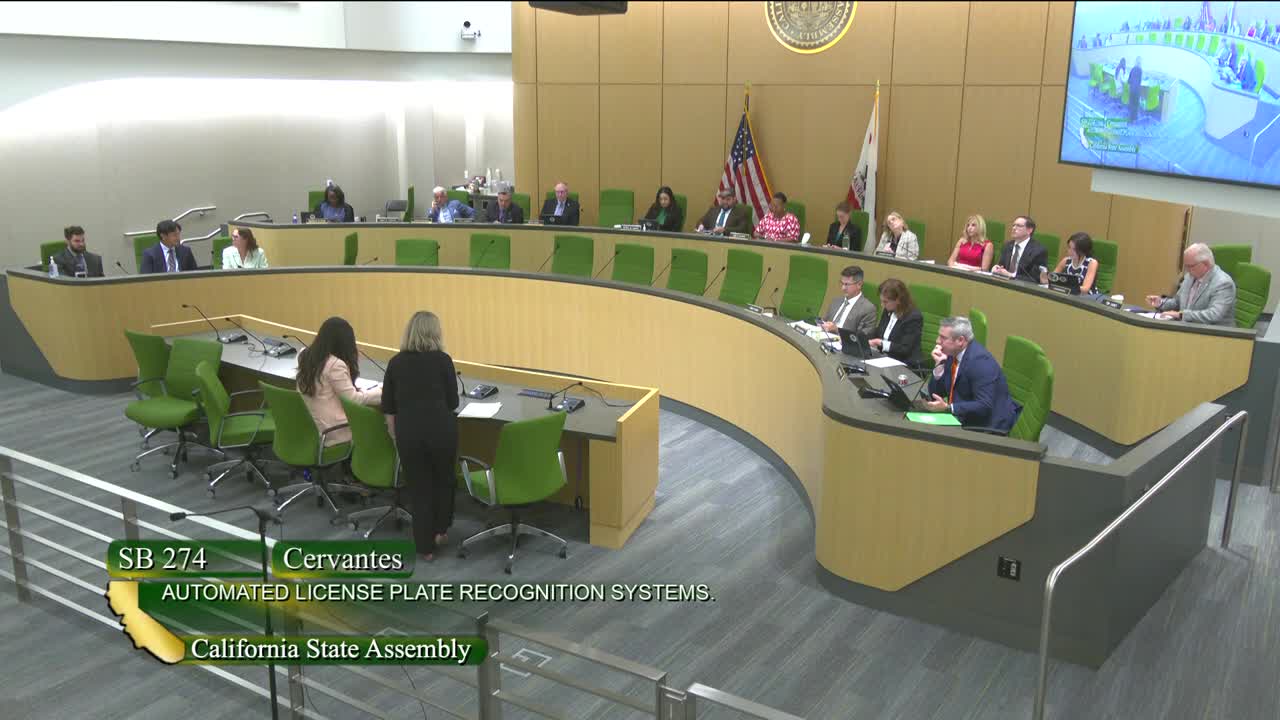 30MIN
Assembly Standing Committee on Transportation
 4MIN
Senate Floor
 17SEC
Senate Standing Committee on Appropriations
 22MIN
Senate Standing Committee on Public Safety
 11MIN
Senate Standing Committee on Judiciary
Bill Author

Bill Co-Author(s):