SB 294: The Workplace Know Your Rights Act.
- Session Year: 2025-2026
- House: Senate
- Latest Version Date: 2025-10-12
Current Status:
Passed
(2025-10-12: Chaptered by Secretary of State. Chapter 667, Statutes of 2025.)
Introduced
In Committee
Awaiting First Chamber Vote
Passed First Chamber
In Committee
Awaiting Second Chamber Vote
Passed Second Chamber
Enacted
Existing law establishes the Division of Labor Standards Enforcement, headed by the Labor Commissioner, within the Department of Industrial Relations, for the purpose of enforcing labor laws. Existing law prescribes the duties and rights of employers and employees relating to specified labor laws, including, among other things, workers compensation and notice requirements related to inspections conducted by an immigration agency.
This bill would establish the Workplace Know Your Rights Act. The bill would require an employer, on or before February 1, 2026, and annually thereafter, to provide a stand-alone written notice to each current employee of specified workers rights, including, among other things, the categories described above, as well as constitutional rights of an employee when interacting with law enforcement at the workplace, as specified. The bill would also require the employer to provide the written notice to each new employee upon hire and to provide the written notice annually to an employees authorized representative, if any.
This bill would require the Labor Commissioner to develop a template notice that an employer may use to comply with the notice requirement described above. The bill would require the Labor Commissioner to post the template notice on its internet website on or before January 1, 2026, and to post an updated template notice annually thereafter. The bill would also require the Labor Commissioner, on or before July 1, 2026, to develop a video for employees advising them of their rights under the areas described above and to develop a video for employers advising them of their rights and requirements under those areas, as provided. The bill would require the Agricultural Labor Relations Board, the Public Employment Relations Board, and the Attorney Generals office to provide specified input for the template notice and the videos.
This bill would require an employer, if an employee has designated an emergency contact for this purpose, to notify the designated emergency contact if the employee is arrested or detained on their worksite. If the arrest or detention occurs during work hours, or during the performance of the employees job duties, but not on the worksite, the bill would require the employer to notify the employees designated emergency contact only if the employer has actual knowledge of the arrest or detention of the employee. The bill would require an employer to provide an employee the opportunity to name an emergency contact on or before March 30, 2026, for an existing employee, and at the time of hiring for a new employee hired after March 30, 2026.
This bill would prohibit an employer from discharging, threatening to discharge, demoting, suspending, or in any manner discriminating or retaliating against an employee for exercising or attempting to exercise their rights under the bill, as provided.
This bill would require the Labor Commissioner to enforce the bill, as specified, and would also alternatively authorize enforcement by a public prosecutor. The bill would provide that an employer who violates the bill may be subject to a penalty of up to $500 per employee for each violation, except that the penalty for a violation of the provisions relating to emergency contacts would be an amount up to $500 per employee for each day the violation occurs, up to a maximum of $10,000 per employee.
Existing law establishes the Division of Labor Standards Enforcement, headed by the Labor Commissioner, within the Department of Industrial Relations, for the purpose of enforcing labor laws. Existing law prescribes the duties and rights of employers and employees relating to specified labor laws, including, among other things, paid sick days, workers compensation, workers compensation and notice requirements related to inspections conducted by an immigration agency.
This bill would establish the Workplace Know Your Rights Act. The bill would require an employer, within 30 days after the Labor Commissioner posts a template notice on its internet website, on or before February 1, 2026, and annually thereafter, to provide a stand-alone written notice to each current employee of specified workers rights, including, among other things, the categories described above, as well as constitutional rights of an employee when interacting with law enforcement at the workplace, as specified. The bill would also require the employer to provide the written notice to each new employee upon hire and to provide the written notice annually to an employees authorized representative, if any.
This bill would require the Labor Commissioner to develop a template notice and would authorize an employer to use the template notice that an employer may use to comply with the notice requirement described above. The bill would require the Labor Commissioner to post the template notice on its internet website on or before January 1, 2026, and to post an updated template notice annually thereafter. The bill would also require the Labor Commissioner, on or before July 1, 2026, to develop a video for employees advising them of their rights under the areas described above and to develop a video for employers advising them of their rights and requirements under those areas. areas, as provided. The bill would require the Agricultural Labor Relations Board, the Public Employment Relations Board, and the Attorney Generals office to provide specified input for the template notice and the videos.
This bill would require an employer, if an employee has designated an emergency contact for this purpose, to notify the designated emergency contact if the employee is arrested or detained on their worksite. If the arrest or detention occurs during work hours, or during the performance of the employees job duties, but not on the worksite, the bill would require the employer to notify the employees designated emergency contact only if the employer has actual knowledge of the arrest or detention of the employee. The bill would require an employer to provide an employee the opportunity to name an emergency contact on or before March 30, 2026, for an existing employee, and at the time of hiring for a new employee hired after March 30, 2026.
This bill would prohibit an employer from discharging, threatening to discharge, demoting, suspending, or in any manner discriminating or retaliating against an employee for exercising or attempting to exercise their rights under the bill, as provided.
This bill would require the Labor Commissioner to enforce the bill, as specified, and would also alternatively authorize enforcement by a public prosecutor. The bill would provide that an employer who violates the bill may be subject to a civil penalty of up to $500 per employee for each violation. violation, except that the penalty for a violation of the provisions relating to emergency contacts would be an amount up to $500 per employee for each day the violation occurs, up to a maximum of $10,000 per employee.
Existing law establishes the Division of Labor Standards Enforcement, headed by the Labor Commissioner, within the Department of Industrial Relations, for the purpose of enforcing labor laws. Existing law prescribes the duties and rights of employers and employees relating to specified labor laws, including, among other things, paid sick days, workers compensation, and notice requirements related to inspections conducted by an immigration agency.
This bill would establish the Workplace Know Your Rights Act. The bill would require an employer, within 30 days after the Labor Commissioner posts a template notice on its internet website, and annually thereafter, to provide a stand-alone written notice to each current employee of specified workers rights, including, among other things, the categories described above, as well as constitutional rights of an employee when interacting with law enforcement at the workplace, as specified. The bill would also require the employer to provide the written notice to each new employee upon hire and to provide the written notice annually to an employees authorized representative, if any.
This bill would require the Labor Commissioner to develop a template notice and would authorize an employer to use the template notice to comply with the notice requirement described above. The bill would also require the Labor Commissioner, on or before July 1, 2026, to develop a video for employees advising them of their rights under the areas described above and to develop a video for employers advising them of their requirements under those areas.
This bill would require an employer, if an employee has designated an emergency contact for this purpose, to notify the designated emergency contact if the employee is arrested or detained on their worksite. If the arrest or detention occurs during work hours, or during the performance of the employees job duties, but not on the worksite, the bill would require the employer to notify the employees designated emergency contact only if the employer has actual knowledge of the arrest or detention of the employee.
This bill would prohibit an employer from discharging, threatening to discharge, demoting, suspending, or in any manner discriminating or retaliating against an employee for exercising or attempting to exercise their rights under the bill, as provided.
This bill would require the Labor Commissioner to enforce the bill, as specified, and would also alternatively authorize enforcement by a public prosecutor. The bill would provide that an employer who violates the bill may be subject to a civil penalty of up to $500 per employee for each violation.
Existing law establishes the Division of Labor Standards Enforcement, headed by the Labor Commissioner, within the Department of Industrial Relations, for the purpose of enforcing labor laws. Existing law prescribes the duties and rights of employers and employees relating to specified labor laws, including, among other things, paid sick days, workers compensation, and notice requirements related to inspections conducted by an immigration agency.
This bill would establish the Workplace Know Your Rights Act. The bill would require an employer, within 30 days after the Labor Commissioner posts a template notice on its internet website, and annually thereafter, to provide a stand-alone written notice to each current employee of specified workers rights, including, among other things, the categories described above, as well as the constitutional rights of employees an employee when interacting with law enforcement at the workplace, as defined by the bill. specified. The bill would also require the employer to provide the written notice to each new employee upon hire and to provide the written notice annually to an employees authorized representative, if any.
This bill would require the Labor Commissioner to develop a template notice and would authorize an employer to use the template notice to comply with the notice requirement described above. The bill would also require the Labor Commissioner, on or before July 1, 2026, to develop a video for employees advising them of their rights under the areas described above and to develop a video for employers advising them of their requirements under those areas.
This bill would require an employer, if an employee has designated an emergency contact for this purpose, to notify the designated emergency contact if the employee is arrested or detained on their worksite. If the arrest or detention occurs during work hours, or during the performance of the employees job duties, but not on the worksite, the bill would require the employer to notify the employees designated emergency contact only if the employer has actual knowledge of the arrest or detention of the employee.
This bill would prohibit an employer from discharging, threatening to discharge, demoting, suspending, or in any manner discriminating or retaliating against an employee for exercising or attempting to exercise their rights under the bill, as provided.
This bill would require the Labor Commissioner to enforce the bill, as specified, and would also alternatively authorize enforcement by a public prosecutor. The bill would provide that an employer who violates the bill may be subject to a civil penalty of up to $500 per employee for each violation.
Existing law establishes the Division of Labor Standards Enforcement, headed by the Labor Commissioner, within the Department of Industrial Relations, for the purpose of enforcing labor laws. Existing law prescribes the duties and rights of employers and employees relating to specified labor laws, including, among other things, payment of wages, working conditions, paid sick days, workers compensation, unemployment insurance, and notice requirements related to inspections conducted by an immigration agency.
This bill would establish the Workplace Know Your Rights Act. The bill would require an employer to annually employer, within 30 days after the Labor Commissioner posts a template notice on its internet website, and annually thereafter, to provide a stand-alone written notice to each current employee, and to each new employee upon hire, of workers rights under state and federal law. The bill would list the areas of workers rights to be covered by the notice, employee of specified workers rights, including, among other things, the categories described above, as well as the constitutional rights of employees when interacting with law enforcement at the workplace, as defined by the bill. The bill would also require the notice to contain a list of the state agencies at which an employee may file a labor, fair employment, data privacy, or civil rights claim. employer to provide the written notice to each new employee upon hire and to provide the written notice annually to an employees authorized representative, if any.
This bill would require the Labor Commissioner, on or before July 1, 2026, Commissioner to develop a template notice and would require authorize an employer to use the template notice to comply with the notice requirement described above. The bill would also require the Labor Commissioner, on or before July 1, 2026, to develop a video for employees advising them of their rights under the areas listed described above and to develop a video for employers advising them of their requirements under those areas.
This bill would require an employer, if an employee has designated an emergency contact, to notify that designated emergency contact in the event of an enforcement action against the employee in which an employee is arrested or detained. The bill would authorize the designated emergency contact to collect all wages owed to the employee if an employee is arrested or detained under those circumstances.This bill would require an employer, if an employee has designated an emergency contact for this purpose, to notify the designated emergency contact if the employee is arrested or detained on their worksite. If the arrest or detention occurs during work hours, or during the performance of the employees job duties, but not on the worksite, the bill would require the employer to notify the employees designated emergency contact only if the employer has actual knowledge of the arrest or detention of the employee.
This bill would prohibit an employer from discharging, threatening to discharge, demoting, suspending, or in any manner discriminating or retaliating against an employee for exercising or attempting to exercise their rights under the bill, as provided.
This bill would require the Labor Commissioner to enforce the bill, as specified, but and would also alternatively authorize an employee who has suffered a violation of the bill, or their exclusive representative, to bring a civil action for damages, and would further alternatively authorize enforcement by a public prosecutor. The bill would make provide that an employer who violates the bill may be subject to a civil penalty of up to $500 per employee for each violation.
Existing law establishes the Division of Labor Standards Enforcement, headed by the Labor Commissioner, within the Department of Industrial Relations, for the purpose of enforcing labor laws. Existing law prescribes the duties and rights of employers and employees relating to specified labor laws, including, among other things, payment of wages, working conditions, paid sick days, workers compensation, unemployment insurance, and notice requirements related to inspections conducted by an immigration agency.
This bill would establish the Workplace Know Your Rights Act. The bill would require an employer to annually provide a stand-alone written notice to each current employee, and to each new employee upon hire, of workers rights under state and federal law. The bill would list the areas of workers rights to be covered by the notice, including, among other things, the categories described above, as well as the constitutional rights of employees when interacting with law enforcement at the workplace, as defined by the bill. The bill would also require the notice to contain a list of the state agencies at which an employee may file a labor, fair employment, data privacy, or civil rights claim.
This bill would require the Labor Commissioner, on or before July 1, 2026, to develop a template notice and would require an employer to use the template notice to comply with the notice requirement described above. The bill would also require the Labor Commissioner, on or before July 1, 2026, to develop a video for employees advising them of their rights under the areas listed above and to develop a video for employers advising them of their requirements under those areas.
This bill would require an employer, if an employee has designated an emergency contact, to notify that designated emergency contact in the event of an enforcement action against the employee in which an employee is arrested or detained. The bill would authorize the designated emergency contact to collect all wages owed to the employee if an employee is arrested or detained under those circumstances.
This bill would prohibit an employer from discharging, threatening to discharge, demoting, suspending, or in any manner discriminating or retaliating against an employee for exercising or attempting to exercise their rights under the bill, as provided.
This bill would require the Labor Commissioner to enforce the bill, as specified, but would also alternatively authorize an employee who has suffered a violation of the bill, or their exclusive representative, to bring a civil action for damages, and would further alternatively authorize enforcement by a public prosecutor. The bill would make an employer who violates the bill subject to a civil penalty of $500 per employee for each violation.
Existing law, the Healthy Workplaces, Healthy Families Act of 2014, establishes requirements relating to paid sick days and paid sick leave, as described.This bill would make nonsubstantive changes to the provision naming the act.Existing law, the Healthy Workplaces, Healthy Families Act of 2014, establishes requirements relating to paid sick days and paid sick leave, as described.
This bill would make nonsubstantive changes to the provision naming the act.
This part shall be known, and may be cited, as the Workplace Know Your Rights Act.
1551.(a)It is the intent of the Legislature that California workers have a strong understanding of their rights as workers, as well as their constitutional rights.
(b)It is further the intent of the Legislature to equip workers with knowledge of their rights that they can also use to protect their families, neighbors, and communities at a time of potential disruption, dislocation, and fear for many Californians.
1552.For purposes of this part, authorized representative means an exclusive collective bargaining representative.
1553.(a)On or before February 1, 2026, and annually thereafter, an employer shall provide a stand-alone written notice to each current employee pursuant to this section in a manner the employer normally uses to communicate employment-related information. The notice may include, but is not limited to, personal service, email, or text message, if it can reasonably be anticipated to be received by the employee within one business day of sending. The written notice shall also be provided to each new employee upon hire. Written notice shall also be annually provided to the employees authorized representative, if any, by either electronic or regular mail. The notice shall contain a description of workers rights in the following areas:
(1)The right to workers compensation benefits, including disability pay and medical care for work-related injuries or illness, as well as the contact information for the Division of Workers Compensation.
(2)The right to notice of inspection by immigration agencies pursuant to subdivision (a) of Section 90.2.
(3)Protection against unfair immigration-related practices against a person exercising protected rights.
(4)The right to organize a union or engage in concerted activity in the workplace.
(5)Constitutional rights when interacting with law enforcement at the workplace, including an employees right under the Fourth Amendment to the United States Constitution to be free from unreasonable searches and seizures and rights under the Fifth Amendment to the United States Constitution to due process and against self-incrimination.
(b)The notice shall also contain both of the following:
(1)A description of new legal developments pertaining to laws enforced by the Labor and Workforce Development Agency that the Labor Commissioner deems material and necessary. The Labor Commissioner shall include a list of those developments, if any, in the template notice described in paragraph (a) of Section 1554.
(2)A list, developed by the Labor Commissioner, of the enforcement agencies that may enforce the underlying rights in the notice. The Labor Commissioner shall include this list in the template notice described in paragraph (a) of Section 1554.
(c)The written notice shall be provided to an employee in the language the employer normally uses to communicate employment-related information to the employee and which the employee understands if the template notice is available in that language on the Labor Commissioners internet website. If the template notice is not available in that language, then the written notice may be provided in English.
(d)An employer may, in addition to the required written notice, choose to provide a link to, or show, the video developed by the Labor Commissioners office pursuant to subdivision (b) of Section 1554.
(e)An employer shall keep records of compliance with the requirements of this section for three years, including the date that each written notice is provided or sent.
1554.(a)The Labor Commissioner shall develop a template notice that an employer may use to comply with the requirements of Section 1553. On or before January 1, 2026, the Labor Commissioner shall post the template notice on its internet website so that it is accessible to an employer. The Labor Commissioner shall post an updated template notice annually thereafter. The template notice shall be written in plain terminology that is easily understood by a worker. The Labor Commissioner shall make the template notice available in different languages, including English, Spanish, Chinese, Tagalog, Vietnamese, Korean, Hindi, Urdu, and Punjabi. The Labor Commissioner may also provide the template notice in additional languages.
(b)On or before July 1, 2026, the Labor Commissioner shall develop a video for employees advising them of their rights under the areas listed in Section 1553. The Labor Commissioner shall make the video available in English and Spanish and may also make the video available in other languages.
(c)On or before July 1, 2026, the Labor Commissioner shall develop a video for employers advising them of their rights and requirements under the areas listed in Section 1553, including constitutional rights when interacting with law enforcement at the workplace.
(d)The Labor Commissioner shall post the videos developed pursuant to subdivisions (b) and (c) on the Labor Commissioners internet website.
(e)(1)The Labor Commissioner shall consult with the Agricultural Labor Relations Board and the Public Employment Relations Board in developing the template notice described in subdivision (a) and the videos described in subdivisions (b) and (c). The Agricultural Labor Relations Board and the Public Employment Relations Board shall provide suggested language for the template notice described in subdivision (a) and a suggested script for the videos described in subdivisions (b) and (c) to the Labor Commissioner regarding workers rights to organize, form, join, or assist a union, engage in collective bargaining, and participate in concerted activities for mutual aid or protection.
(2)The Labor Commissioner shall consult with the Attorney Generals office to develop suggested language for the template notice described in subdivision (a) and a suggested script for the videos described in subdivisions (b) and (c) regarding workers and employers constitutional rights when interacting with law enforcement at the workplace.
1555.(a)If an employee has notified their employer that they would like their designated emergency contact to be notified in the event the employee is arrested or detained, the employer shall notify the designated emergency contact if the employee is arrested or detained on their worksite. If the arrest or detention occurs during work hours, or during the performance of the employees job duties, but not on the worksite, the employer shall notify the employees designated emergency contact only if the employer has actual knowledge of the arrest or detention of the employee.
(b)An employer shall provide an employee the opportunity to name an emergency contact no later than March 30, 2026, for an existing employee, and at the time of hiring for a new employee hired after March 30, 2026. The employer shall also allow an employee to provide updated emergency contact information through the duration of employment. The employer shall allow the employee to indicate whether the emergency contact should be notified if the employee is arrested or detained on their worksite, or during work hours or during the performance of the employees job duties, but not on the worksite, if the employer has actual knowledge of the arrest or detention of the employee.
1556.Parties subject to this part may provide, by collective bargaining agreement, that the agreement supersedes the requirements of this part, in whole or in part, if the waiver is explicitly set forth in the agreement in clear and unambiguous terms.
1557.An employer shall not discharge, threaten to discharge, demote, suspend, or in any manner discriminate or retaliate against an employee for exercising or attempting to exercise their rights under this part, filing a complaint with the Labor Commissioner alleging a violation of this part, cooperating in an investigation or prosecution of an alleged violation of this part, or for any action taken by an employee to invoke, or assist in any manner in, the enforcement of this part.
1558.(a)The Labor Commissioner shall enforce this part, including investigating an alleged violation, and ordering appropriate temporary relief to mitigate a violation or maintain the status quo pending the completion of a full investigation or hearing through the procedures set forth in Section 98, 98.3, 98.7, 98.74, or 1197.1, including issuing a citation against an employer who violates this section and filing a civil action. If a citation is issued, the procedures for issuing, contesting, and enforcing judgments for citations and civil penalties issued by the Labor Commissioner shall be the same as those set out in Section 98.74 or 1197.1, as applicable.
(b)This part may also alternatively be enforced by a public prosecutor pursuant to Chapter 8 (commencing with Section 180) of Division 1.
(c)In any civil action brought pursuant to subdivision (a) or (b), the petitioner may seek appropriate temporary or preliminary injunctive relief, including punitive damages, and reasonable attorneys fees and costs.
(d)(1)Except as provided in paragraph (2), in addition to any other remedy, an employer who violates this part may be subject to a penalty of up to five hundred dollars ($500) per employee for each violation.
(2)The penalty for a violation of Section 1555 shall be an amount up to five hundred dollars ($500) per employee for each day the violation occurs, up to a maximum of ten thousand dollars ($10,000) per employee.
(3)An employee, the Labor Commissioner, or a public prosecutor may recover a penalty under this part as a statutory penalty paid to the employee or a civil penalty, but not both, for the same violation.
(e)An action brought pursuant to this section may be brought in the superior court in any county in which the violation in question is alleged to have occurred or in which the employer resides or transacts business.
1559.This part does not preempt any city, county, or city and county ordinance that provides equal or greater protection to employees who are covered by this part.
This part shall be known, and may be cited, as the Workplace Know Your Rights Act.
1551.(a)It is the intent of the Legislature that California workers have a strong understanding of their rights as workers, as well as their constitutional rights.
(b)It is further the intent of the Legislature to equip workers with knowledge of their rights that they can also use to protect their families, neighbors, and communities at a time of potential disruption, dislocation, and fear for many Californians.
1552.For purposes of this part, authorized representative means an exclusive collective bargaining representative.
1553.(a)Within 30 days after the Labor Commissioner posts the template notice required by Section 1554 on the Labor Commissioners internet website, On or before February 1, 2026, and annually thereafter, an employer shall provide a stand-alone written notice to each current employee pursuant to this section in a manner the employer normally uses to communicate employment-related information. The notice may include, but is not limited to, personal service, email, or text message, if it can reasonably be anticipated to be received by the employee within one business day of sending. The written notice shall also be provided to each new employee upon hire. Written notice shall also be annually provided to the employees authorized representative, if any. any, by either electronic or regular mail. The notice shall contain a description of workers rights in the following areas:
(1)Protection against misclassification of an employee as an independent contractor.(2)Outdoor heat illness prevention and indoor heat illness prevention.(3)Workers compensation, including a short summary of what it is and where to obtain more information.(4)Paid sick days.(1)The right to workers compensation benefits, including disability pay and medical care for work-related injuries or illness, as well as the contact information for the Division of Workers Compensation.
(5)(2)The right to notice of inspection by immigration agencies pursuant to subdivision (a) of Section 90.2.
(6)(3)Protection against unfair immigration-related practices against a person exercising protected rights.
(7)(4)The right to organize a union or engage in concerted activity in the workplace.
(8)(5)Constitutional rights when interacting with law enforcement at the workplace, including an employees right under the Fourth Amendment to the United States Constitution to be free from unreasonable searches and seizures and rights under the Fifth Amendment to the United States Constitution to due process and against self-incrimination.
(b)The notice shall also contain both of the following:
(1)A description of new legal developments pertaining to laws enforced by the Labor and Workforce Development Agency that the Labor Commissioner deems material and necessary. The Labor Commissioner shall include a list of those developments, if any, in the template notice described in paragraph (a) of Section 1554.
(2)A list, developed by the Labor Commissioner, of the enforcement agencies that may enforce the underlying rights in the notice. The Labor Commissioner shall include this list in the template notice described in paragraph (a) of Section 1554.
(b)(c)The written notice shall be provided to an employee in the language the employer normally uses to communicate employment-related information to the employee and which the employee understands if the template notice is available in that language on the Labor Commissioners internet website. If the template notice is not available in that language, then the written notice may be provided in English.
(c)(d)An employer may, in addition to the required written notice, choose to provide a link to, or show, the video developed by the Labor Commissioners office pursuant to subdivision (b) of Section 1554.
(e)An employer shall keep records of compliance with the requirements of this section for three years, including the date that each written notice is provided or sent.
1554.(a)The Labor Commissioner shall develop a template notice that an employer may use to comply with the requirements of Section 1553. The On or before January 1, 2026, the Labor Commissioner shall post the template notice on its internet website so that it is accessible to an employer. The Labor Commissioner shall post an updated template notice annually thereafter. The template notice shall be written in plain terminology that is easily understood by a worker. The Labor Commissioner shall make the template notice available in different languages, including English, Spanish, Chinese, Tagalog, Vietnamese, and Korean. Korean, Hindi, Urdu, and Punjabi. The Labor Commissioner may also provide the template notice in additional languages.
(b)On or before July 1, 2026, the Labor Commissioner shall develop a video for employees advising them of their rights under the areas listed in Section 1553. The Labor Commissioner shall make the video available in English and Spanish and may also make the video available in other languages.
(c)On or before July 1, 2026, the Labor Commissioner shall develop a video for employers advising them of their rights and requirements under the areas listed in Section 1553. 1553, including constitutional rights when interacting with law enforcement at the workplace.
(d)The Labor Commissioner shall post the videos developed pursuant to subdivisions (b) and (c) on the Labor Commissioners internet website.
(e)(1)The Labor Commissioner shall consult with the Agricultural Labor Relations Board and the Public Employment Relations Board in developing the template notice described in subdivision (a) and the videos described in subdivisions (b) and (c). The Agricultural Labor Relations Board and the Public Employment Relations Board shall provide suggested language for the template notice described in subdivision (a) and a suggested script for the videos described in subdivisions (b) and (c) to the Labor Commissioner regarding workers rights to organize, form, join, or assist a union, engage in collective bargaining, and participate in concerted activities for mutual aid or protection.
(2)The Labor Commissioner shall consult with the Attorney Generals office to develop suggested language for the template notice described in subdivision (a) and a suggested script for the videos described in subdivisions (b) and (c) regarding workers and employers constitutional rights when interacting with law enforcement at the workplace.
1555.(a)If an employee has notified their employer that they would like their designated emergency contact to be notified in the event the employee is arrested or detained, the employer shall notify the designated emergency contact if the employee is arrested or detained on their worksite. If the arrest or detention occurs during work hours, or during the performance of the employees job duties, but not on the worksite, the employer shall notify the employees designated emergency contact only if the employer has actual knowledge of the arrest or detention of the employee.
(b)An employer shall offer an employee the option to provide written notice to their employer that indicates that the employee would like their designated emergency contact notified in the event the employee is arrested or detained An employer shall provide an employee the opportunity to name an emergency contact no later than March 30, 2026, for an existing employee, and at the time of hiring for a new employee hired after March 30, 2026. The employer shall also allow an employee to provide updated emergency contact information through the duration of employment. The employer shall allow the employee to indicate whether the emergency contact should be notified if the employee is arrested or detained on their worksite, or during work hours or during the performance of the employees job duties, but not on the worksite, if the employer has actual knowledge of the arrest or detention of the employee.
1556.Parties subject to this part may provide, by collective bargaining agreement, that the agreement supersedes the requirements of this part, in whole or in part, if the waiver is explicitly set forth in the agreement in clear and unambiguous terms.
1557.An employer shall not discharge, threaten to discharge, demote, suspend, or in any manner discriminate or retaliate against an employee for exercising or attempting to exercise their rights under this part, filing a complaint with the Labor Commissioner alleging a violation of this part, cooperating in an investigation or prosecution of an alleged violation of this part, or for any action taken by an employee to invoke, or assist in any manner in, the enforcement of this part.
1558.(a)The Labor Commissioner shall enforce this part, including investigating an alleged violation, and ordering appropriate temporary relief to mitigate a violation or maintain the status quo pending the completion of a full investigation or hearing through the procedures set forth in Section 98, 98.3, 98.7, 98.74, or 1197.1, including issuing a citation against an employer who violates this section and filing a civil action. If a citation is issued, the procedures for issuing, contesting, and enforcing judgments for citations and civil penalties issued by the Labor Commissioner shall be the same as those set out in Section 98.74 or 1197.1, as applicable.
(b)This part may also alternatively be enforced by a public prosecutor pursuant to Chapter 8 (commencing with Section 180) of Division 1.
(c)In any civil action brought pursuant to subdivision (a) or (b), the petitioner may seek appropriate temporary or preliminary injunctive relief, including punitive damages, and reasonable attorneys fees and costs.
(d)In (1)Except as provided in paragraph (2), in addition to any other remedy, an employer who violates this part may be subject to a civil penalty of up to five hundred dollars ($500) per employee for each violation.
(2)The penalty for a violation of Section 1555 shall be an amount up to five hundred dollars ($500) per employee for each day the violation occurs, up to a maximum of ten thousand dollars ($10,000) per employee.
(3)An employee, the Labor Commissioner, or a public prosecutor may recover a penalty under this part as a statutory penalty paid to the employee or a civil penalty, but not both, for the same violation.
(e)An action brought pursuant to this section may be brought in the superior court in any county in which the violation in question is alleged to have occurred or in which the employer resides or transacts business.
1559.This part does not preempt any city, county, or city and county ordinance that provides equal or greater protection to employees who are covered by this part.
This part shall be known, and may be cited, as the Workplace Know Your Rights Act.
1551.(a)It is the intent of the Legislature that California workers have a strong understanding of their rights as workers, as well as their constitutional rights.
(b)It is further the intent of the Legislature to equip workers with knowledge of their rights that they can also use to protect their families, neighbors, and communities at a time of potential disruption, dislocation, and fear for many Californians.
1552.For purposes of this part, authorized representative means an exclusive collective bargaining representative.
1553.(a)Within 30 days after the Labor Commissioner posts the template notice required by Section 1554 on the Labor Commissioners internet website, and annually thereafter, an employer shall provide a stand-alone written notice to each current employee pursuant to this section. section in a manner the employer normally uses to communicate employment-related information. The notice may include, but is not limited to, personal service, email, or text message, if it can reasonably be anticipated to be received by the employee within one business day of sending. The written notice shall also be provided to each new employee upon hire. Written notice shall also be annually provided to the employees authorized representative, if any. The notice shall contain a description of workers rights in the following areas:
(1)Protection against misclassification of an employee as an independent contractor.
(2)Outdoor heat illness prevention and indoor heat illness prevention.
(3)Workers compensation. compensation, including a short summary of what it is and where to obtain more information.
(4)Paid sick days.
(5)The right to notice of inspection by immigration agencies pursuant to subdivision (a) of Section 90.2.
(6)Protection against unfair immigration-related practices against a person exercising protected rights.
(7)The right to organize a union in the workplace.
(8)Constitutional rights when interacting with law enforcement at the workplace, including an employees right under the Fourth Amendment to the United States Constitution to be free from unreasonable searches and seizures and rights under the Fifth Amendment to the United States Constitution to due process and against self-incrimination.
(b)The written notice shall be provided to an employee in the language the employer normally uses to communicate employment-related information to the employee if the template notice is available in that language on the Labor Commissioners internet website. If the template notice is not available in that language, then the written notice may be provided in English.
(c)An employer may, in addition to the required written notice, choose to provide a link to, or show, the video developed by the Labor Commissioners office pursuant to subdivision (b) of Section 1554.
1554.(a)The Labor Commissioner shall develop a template notice that an employer may use to comply with the requirements of Section 1553. The Labor Commissioner shall post the template notice on its internet website so that it is accessible to an employer. The template notice shall be written in plain terminology that is easily understood by a worker. The Labor Commissioner shall make the template notice available in different languages, including English, Spanish, Chinese, Tagalog, Vietnamese, and Korean. The Labor Commissioner may also provide the template notice in additional languages.
(b)On or before July 1, 2026, the Labor Commissioner shall develop a video for employees advising them of their rights under the areas listed in Section 1553.
(c)On or before July 1, 2026, the Labor Commissioner shall develop a video for employers advising them of their requirements under the areas listed in Section 1553.
(d)The Labor Commissioner shall post the videos developed pursuant to subdivisions (b) and (c) on the Labor Commissioners internet website.
1555.(a)If an employee has notified their employer that they would like their designated emergency contact to be notified in the event the employee is arrested or detained, the employer shall notify the designated emergency contact if the employee is arrested or detained on their worksite. If the arrest or detention occurs during work hours, or during the performance of the employees job duties, but not on the worksite, the employer shall notify the employees designated emergency contact only if the employer has actual knowledge of the arrest or detention of the employee.
(b)An employer shall offer an employee the option to provide written notice to their employer that indicates that the employee would like their designated emergency contact notified in the event the employee is arrested or detained on their worksite, or during work hours or during the performance of the employees job duties, but not on the worksite, if the employer has actual knowledge of the arrest or detention of the employee.
1556.Parties subject to this part may provide, by collective bargaining agreement, that the agreement supersedes the requirements of this part, in whole or in part, if the waiver is explicitly set forth in the agreement in clear and unambiguous terms.
1557.An employer shall not discharge, threaten to discharge, demote, suspend, or in any manner discriminate or retaliate against an employee for exercising or attempting to exercise their rights under this part, filing a complaint with the Labor Commissioner alleging a violation of this part, cooperating in an investigation or prosecution of an alleged violation of this part, or for any action taken by an employee to invoke, or assist in any manner in, the enforcement of this part.
1558.(a)The Labor Commissioner shall enforce this part, including investigating an alleged violation, and ordering appropriate temporary relief to mitigate a violation or maintain the status quo pending the completion of a full investigation or hearing through the procedures set forth in Section 98.3, 98.7, 98.74, or 1197.1, including issuing a citation against an employer who violates this section and filing a civil action. If a citation is issued, the procedures for issuing, contesting, and enforcing judgments for citations and civil penalties issued by the Labor Commissioner shall be the same as those set out in Section 98.74 or 1197.1, as applicable.
(b)This part may also alternatively be enforced by a public prosecutor pursuant to Chapter 8 (commencing with Section 180) of Division 1.
(c)In any civil action brought pursuant to subdivision (a) or (b), the petitioner may seek appropriate temporary or preliminary injunctive relief, including punitive damages, and reasonable attorneys fees and costs.
(d)In addition to any other remedy, an employer who violates this part may be subject to a civil penalty of up to five hundred dollars ($500) per employee for each violation.
(e)An action brought pursuant to this section may be brought in the superior court in any county in which the violation in question is alleged to have occurred or in which the employer resides or transacts business.
1559.This part does not preempt any city, county, or city and county ordinance that provides equal or greater protection to employees who are covered by this part.
This part shall be known, and may be cited, as the Workplace Know Your Rights Act.
1551.(a)It is the intent of the Legislature that California workers have a strong understanding of their rights as workers, as well as their constitutional rights.
(b)It is further the intent of the Legislature to equip workers with knowledge of their rights that they can also use to protect their families, neighbors, and communities at a time of potential disruption, dislocation, and fear for many Californians.
1552.For purposes of this part, the following definitions apply:
(a)Authorized authorized representative means an exclusive collective bargaining representative.
(b)Constitutional rights when interacting with law enforcement at the workplace means a persons rights under the United States Constitution, including an employees Fourth Amendment right to be free from unreasonable searches and seizures, Fifth Amendment right against self-incrimination, and Fifth Amendment right to due process of law.(c)Fifth Amendment right against self-incrimination means a person cannot be forced to incriminate themselves. It also includes the right to remain silent and the right to counsel.(d)Fifth Amendment right to due process of law means that a person cannot be deprived of life, liberty, or property without due process of law.(e)Fourth Amendment right to be free from unreasonable searches and seizures means a persons right to be secure in their person, property, paper, and effects. It also includes the right to be free from unreasonable searches from law enforcement, unreasonable seizures from law enforcement, and unreasonable arrests from law enforcement.1553.(a)Within 30 days after the Labor Commissioner posts the template notice required by Section 1554 on the Labor Commissioners internet website, and annually thereafter, an employer shall provide a stand-alone written notice to each current employee pursuant to this section. The written notice shall also be provided to each new employee upon hire. Written notice shall also be annually provided to the employees authorized representative, if any. The notice shall contain a description of workers rights in the following areas:
(1)Protection against misclassification of an employee as an independent contractor.
(2)Outdoor heat illness prevention and indoor heat illness prevention.
(3)Workers compensation.
(4)Paid sick days.
(5)The right to notice of inspection by immigration agencies pursuant to subdivision (a) of Section 90.2.
(6)Protection against unfair immigration-related practices against a person exercising protected rights.
(7)The right to organize a union in the workplace.
(8)Constitutional rights when interacting with law enforcement at the workplace. workplace, including an employees right under the Fourth Amendment to the United States Constitution to be free from unreasonable searches and seizures and rights under the Fifth Amendment to the United States Constitution to due process and against self-incrimination.
(b)The written notice shall be provided to an employee in the language the employer normally uses to communicate employment-related information to the employee if the template notice is available in that language on the Labor Commissioners internet website. If the template notice is not available in that language, then the written notice shall may be provided in English.
(c)An employer may, in addition to the required written notice, choose to provide a link to, or show, the video developed by the Labor Commissioners office pursuant to subdivision (b) of Section 1554.
1554.(a)The Labor Commissioner shall develop a template notice that an employer may use to comply with the requirements of Section 1553. The Labor Commissioner shall post the template notice on its internet website so that it is accessible to an employer. The template notice shall be written in plain terminology that is easily understood by a worker. The Labor Commissioner shall make the template notice available in different languages, including English, Spanish, Chinese, Tagalog, Vietnamese, and Korean. The Labor Commissioner may also provide the template notice in additional languages. An employer is not required to comply with Section 1553 until 30 days after the Labor Commissioner posts the template notice on the Labor Commissioners internet website.
(b)On or before July 1, 2026, the Labor Commissioner shall develop a video for employees advising them of their rights under the areas listed in Section 1553.
(c)On or before July 1, 2026, the Labor Commissioner shall develop a video for employers advising them of their requirements under the areas listed in Section 1553.
(d)The Labor Commissioner shall post the videos developed pursuant to subdivisions (b) and (c) on the Labor Commissioners internet website.
1555.(a)If an employee has notified their employer that they would like their designated emergency contact to be notified in the event the employee is arrested or detained, the employer shall notify the designated emergency contact if the employee is arrested or detained on their worksite. If the arrest or detention occurs during work hours, or during the performance of the employees job duties, but not on the worksite, the employer shall notify the employees designated emergency contact only if the employer has actual knowledge of the arrest or detention of the employee.
(b)An employer shall offer an employee the option to provide written notice to their employer that indicates that the employee would like their designated emergency contact notified in the event the employee is arrested or detained on their worksite, or during work hours or during the performance of the employees job duties, but not on the worksite, if the employer has actual knowledge of the arrest or detention of the employee.
1556.Parties subject to this part may provide, by collective bargaining agreement, that the agreement supersedes the requirements of this part, in whole or in part, if the waiver is explicitly set forth in the agreement in clear and unambiguous terms.
1557.An employer shall not discharge, threaten to discharge, demote, suspend, or in any manner discriminate or retaliate against an employee for exercising or attempting to exercise their rights under this part, filing a complaint with the Labor Commissioner alleging a violation of this part, cooperating in an investigation or prosecution of an alleged violation of this part, or for any action taken by an employee to invoke, or assist in any manner in, the enforcement of this part.
1558.(a)The Labor Commissioner shall enforce this part, including investigating an alleged violation, and ordering appropriate temporary relief to mitigate a violation or maintain the status quo pending the completion of a full investigation or hearing through the procedures set forth in Section 98.3, 98.7, 98.74, or 1197.1, including issuing a citation against an employer who violates this section and filing a civil action. If a citation is issued, the procedures for issuing, contesting, and enforcing judgments for citations and civil penalties issued by the Labor Commissioner shall be the same as those set out in Section 98.74 or 1197.1, as applicable.
(b)This part may also alternatively be enforced by a public prosecutor pursuant to Chapter 8 (commencing with Section 180) of Division 1.
(c)In any civil action brought pursuant to subdivision (a) or (b), the petitioner may seek appropriate temporary or preliminary injunctive relief, including punitive damages, and reasonable attorneys fees and costs as part of the costs of any action for damages. costs.
(d)In addition to any other remedy, an employer who violates this part may be subject to a civil penalty of up to five hundred dollars ($500) per employee for each violation.
(d)(e)An action brought pursuant to this section may be brought in the superior court in any county in which the violation in question is alleged to have occurred or in which the employer resides or transacts business.
(e)In addition to any other remedy, an employer who violates this part may be subject to a civil penalty of up to five hundred dollars ($500) per employee for each violation.1559.This part does not preempt any city, county, or city and county ordinance that provides equal or greater protection to employees who are covered by this part.
This part shall be known, and may be cited, as the Workplace Know Your Rights Act.
1551.(a)It is the intent of the Legislature that California workers have a strong understanding of their rights as workers, as well as their civil rights under state and federal law. constitutional rights.
(b)It is further the intent of the Legislature to equip workers with this knowledge to protect them from retaliation and discrimination, to ensure that they receive all wages and benefits to which they are entitled, to empower them to refuse unsafe work when necessary, and to prepare them to assert their labor, civil, and immigrant rights whenever these rights are threatened.(c)(b)It is further the intent of the Legislature to equip workers with knowledge of their rights that they can also use to protect their families, neighbors, and communities at a time of potential disruption, dislocation, and fear for many Californians.
(d)It is further the intent of the Legislature to ensure that all workers enjoy the protections of state labor, civil, antidiscrimination, and antiharassment laws and all other protections under the law while they are in California.1552.For purposes of this part, the following definitions apply:
(a)Authorized representative means an exclusive collective bargaining representative.
(a)(b)Constitutional rights when interacting with law enforcement at the workplace means a persons rights under the United States Constitution, including an employees Fourth Amendment right to be free from unreasonable searches and seizures, Fifth Amendment right against self-incrimination, and Fifth Amendment right to due process of law.
(b)(c)Fifth Amendment right against self incrimination self-incrimination means a person cannot be forced to incriminate themselves. It also includes the right to remain silent and the right to counsel.
(c)(d)Fifth Amendment right to due process of law means that a person cannot be deprived of life, liberty, or process property without due process of law.
(d)(e)Fourth Amendment right to be free from unreasonable searches and seizures means a persons right to be secure in their person, property, paper, and effects. It also includes the right to be free from unreasonable searches from law enforcement, unreasonable seizures from law enforcement, and unreasonable arrests from law enforcement.
1553.(a)An employer shall annually provide a stand-alone Within 30 days after the Labor Commissioner posts the template notice required by Section 1554 on the Labor Commissioners internet website, and annually thereafter, an employer shall provide a stand-alone written notice to each current employee, and employee pursuant to each new employee upon hire, of workers rights under state and federal law. this section. The written notice shall also be provided to each new employee upon hire. Written notice shall also be given annually provided to the employees authorized representative, if any. The notice shall contain a description of workers rights in the following areas:
(1)Protection against misclassification of an employee as an independent contractor.
(2)General health and safety protections under California regulations, including, but not limited to, outdoor heat illness prevention, indoor heat illness prevention, and injury and illness prevention.(3)Wage and hour protections.(2)Outdoor heat illness prevention and indoor heat illness prevention.
(4)(3)Workers compensation.
(5)Unemployment insurance.(6)(4)Paid sick days, paid family leave, state disability insurance, and the California Family Rights Act (Section 12945.2 of the Government Code). days.
(7)(5)The right to notice of inspection by immigration agencies pursuant to subdivision (a) of Section 90.2.
(8)(6)Protection against unfair immigration-related practices against a person exercising protected rights.
(9)Rights under data privacy laws that govern the sale and sharing of data with third parties.(10)Protection against retaliation by an employer if a worker exercises a right guaranteed by law.(11)(7)The right to organize a union in the workplace.
(12)Rights and protections applicable during natural disasters and emergency conditions.(13)(8)Constitutional rights when interacting with law enforcement at the workplace.
(b)The notice shall also contain a list of the state agencies at which an employee may file a labor, fair employment, data privacy, or civil rights claim.(b)The written notice shall be provided to an employee in the language the employer normally uses to communicate employment-related information to the employee if the template notice is available in that language on the Labor Commissioners internet website. If the template notice is not available in that language, then the written notice shall be provided in English.
(c)An employer may, in addition to the required written notice, choose to provide a link to, or show, the video developed by the Labor Commissioners office pursuant to subdivision (b) of Section 1554.
1554.(a)On or before July 1, 2026, the The Labor Commissioner shall develop a template notice that an employer shall may use to comply with the requirements of Section 1553. The Labor Commissioner shall post the template notice on its internet website so that it is accessible to an employer. The template notice shall be written in plain terminology that is easily understood by a worker. The Labor Commissioner shall make the template notice available in different languages, including, but not limited to, including English, Spanish, Chinese, Tagalog, Vietnamese, and Korean. The Labor Commissioner may also provide the template notice in additional languages. An employer is not required to comply with Section 1553 until 30 days after the Labor Commissioner posts the template notice on the Labor Commissioners internet website.
(b)On or before July 1, 2026, the Labor Commissioner shall develop a video for employees advising them of their rights under the areas listed in Section 1553.
(c)On or before July 1, 2026, the Labor Commissioner shall develop a video for employers advising them of their requirements under the areas listed in Section 1553.
(d)The Labor Commissioner shall post the videos developed pursuant to subdivisions (b) and (c) on the Labor Commissioners internet website.
1555.(a)If an employee has designated an emergency contact with the employer, notified their employer that they would like their designated emergency contact to be notified in the event the employee is arrested or detained, the employer shall notify the designated emergency contact in the event of an enforcement action against the employee in which if the employee is arrested or detained. detained on their worksite. If the arrest or detention occurs during work hours, or during the performance of the employees job duties, but not on the worksite, the employer shall notify the employees designated emergency contact only if the employer has actual knowledge of the arrest or detention of the employee.
(b)The designated emergency contact may collect all wages owed to the employee if the employee is arrested or detained pursuant to an enforcement action and may file a wage claim on the employees behalf if the wages are not lawfully paid.(b)An employer shall offer an employee the option to provide written notice to their employer that indicates that the employee would like their designated emergency contact notified in the event the employee is arrested or detained on their worksite, or during work hours or during the performance of the employees job duties, but not on the worksite, if the employer has actual knowledge of the arrest or detention of the employee.
1556.Parties subject to this part may provide, by collective bargaining agreement, that the agreement supersedes the requirements of this part, in whole or in part, if the waiver is explicitly set forth in the agreement in clear and unambiguous terms.
1557.An employer shall not discharge, threaten to discharge, demote, suspend, or in any manner discriminate or retaliate against an employee for exercising or attempting to exercise their rights under this part, filing a complaint with the Labor Commissioner alleging a violation of this part, cooperating in an investigation or prosecution of an alleged violation of this part, or for any action taken by an employee to invoke, or assist in any manner in, the enforcement of this part.
1558.(a)The Labor Commissioner shall enforce this part, including investigating an alleged violation, and ordering appropriate temporary relief to mitigate a violation or maintain the status quo pending the completion of a full investigation or hearing through the procedures set forth in Section 98.3, 98.7, 98.74, or 1197.1, including issuing a citation against an employer who violates this section and filing a civil action. If a citation is issued, the procedures for issuing, contesting, and enforcing judgments for citations and civil penalties issued by the Labor Commissioner shall be the same as those set out in Section 98.74 or 1197.1, as applicable.
(b)As an alternative to subdivision (a), any employee who has suffered a violation of this part, or their exclusive representative, may bring a civil action in a court of competent jurisdiction for damages caused by that adverse action, including punitive damages.(c)(b)This part may also alternatively be enforced by a public prosecutor pursuant to Chapter 8 (commencing with Section 180) of Division 1.
(d)(c)In any civil action brought pursuant to subdivision (a), (b), or (c) in a superior court in any county wherein the violation is alleged to have occurred, or where the person resides or transacts business, (a) or (b), the petitioner may seek appropriate temporary or preliminary injunctive relief, including punitive damages, and reasonable attorneys fees and costs as part of the costs of any action for damages.
(d)An action brought pursuant to this section may be brought in the superior court in any county in which the violation in question is alleged to have occurred or in which the employer resides or transacts business.
(e)In addition to any other remedy, an employer who violates this part shall may be subject to a civil penalty of up to five hundred dollars ($500) per employee for each violation.
1559.This part does not preempt any city, county, or city and county ordinance that provides equal or greater protection to employees who are covered by this part.
This part shall be known, and may be cited, as the Workplace Know Your Rights Act.
1551.(a)It is the intent of the Legislature that California workers have a strong understanding of their rights as workers, as well as their civil rights under state and federal law.
(b)It is further the intent of the Legislature to equip workers with this knowledge to protect them from retaliation and discrimination, to ensure that they receive all wages and benefits to which they are entitled, to empower them to refuse unsafe work when necessary, and to prepare them to assert their labor, civil, and immigrant rights whenever these rights are threatened.
(c)It is further the intent of the Legislature to equip workers with knowledge of their rights that they can also use to protect their families, neighbors, and communities at a time of potential disruption, dislocation, and fear for many Californians.
(d)It is further the intent of the Legislature to ensure that all workers enjoy the protections of state labor, civil, antidiscrimination, and antiharassment laws and all other protections under the law while they are in California.
1552.For purposes of this part, the following definitions apply:
(a)Constitutional rights when interacting with law enforcement at the workplace means a persons rights under the United States Constitution, including an employees Fourth Amendment right to be free from unreasonable searches and seizures, Fifth Amendment right against self-incrimination, and Fifth Amendment right to due process of law.
(b)Fifth Amendment right against self incrimination means a person cannot be forced to incriminate themselves. It also includes the right to remain silent and the right to counsel.
(c)Fifth Amendment right to due process of law means that a person cannot be deprived of life, liberty, or process without due process of law.
(d)Fourth Amendment right be free from unreasonable searches and seizures means a persons right to be secure in their person, property, paper, and effects. It also includes the right to be free from unreasonable searches from law enforcement, unreasonable seizures from law enforcement, and unreasonable arrests from law enforcement.
1553.(a)An employer shall annually provide a stand-alone written notice to each current employee, and to each new employee upon hire, of workers rights under state and federal law. Written notice shall also be given to the employees authorized representative, if any. The notice shall contain a description of workers rights in the following areas:
(1)Protection against misclassification of an employee as an independent contractor.
(2)General health and safety protections under California regulations, including, but not limited to, outdoor heat illness prevention, indoor heat illness prevention, and injury and illness prevention.
(3)Wage and hour protections.
(4)Workers compensation.
(5)Unemployment insurance.
(6)Paid sick days, paid family leave, state disability insurance, and the California Family Rights Act (Section 12945.2 of the Government Code).
(7)The right to notice of inspection by immigration agencies pursuant to subdivision (a) of Section 90.2.
(8)Protection against unfair immigration-related practices against a person exercising protected rights.
(9)Rights under data privacy laws that govern the sale and sharing of data with third parties.
(10)Protection against retaliation by an employer if a worker exercises a right guaranteed by law.
(11)The right to organize a union in the workplace.
(12)Rights and protections applicable during natural disasters and emergency conditions.
(13)Constitutional rights when interacting with law enforcement at the workplace.
(b)The notice shall also contain a list of the state agencies at which an employee may file a labor, fair employment, data privacy, or civil rights claim.
1554.(a)On or before July 1, 2026, the Labor Commissioner shall develop a template notice that an employer shall use to comply with the requirements of Section 1553. The Labor Commissioner shall post the template notice on its internet website so that it is accessible to an employer. The template notice shall be written in plain terminology that is easily understood by a worker. The Labor Commissioner shall make the template notice available in different languages, including, but not limited to, English, Spanish, Chinese, Tagalog, Vietnamese, and Korean.
(b)On or before July 1, 2026, the Labor Commissioner shall develop a video for employees advising them of their rights under the areas listed in Section 1553.
(c)On or before July 1, 2026, the Labor Commissioner shall develop a video for employers advising them of their requirements under the areas listed in Section 1553.
1555.(a)If an employee has designated an emergency contact with the employer, the employer shall notify the designated emergency contact in the event of an enforcement action against the employee in which the employee is arrested or detained.
(b)The designated emergency contact may collect all wages owed to the employee if the employee is arrested or detained pursuant to an enforcement action and may file a wage claim on the employees behalf if the wages are not lawfully paid.
1556.Parties subject to this part may provide, by collective bargaining agreement, that the agreement supersedes the requirements of this part, in whole or in part, if the waiver is explicitly set forth in the agreement in clear and unambiguous terms.
1557.An employer shall not discharge, threaten to discharge, demote, suspend, or in any manner discriminate or retaliate against an employee for exercising or attempting to exercise their rights under this part, filing a complaint with the Labor Commissioner alleging a violation of this part, cooperating in an investigation or prosecution of an alleged violation of this part, or for any action taken by an employee to invoke, or assist in any manner in, the enforcement of this part.
1558.(a)The Labor Commissioner shall enforce this part, including investigating an alleged violation, and ordering appropriate temporary relief to mitigate a violation or maintain the status quo pending the completion of a full investigation or hearing through the procedures set forth in Section 98.3, 98.7, 98.74, or 1197.1, including issuing a citation against an employer who violates this section and filing a civil action. If a citation is issued, the procedures for issuing, contesting, and enforcing judgments for citations and civil penalties issued by the Labor Commissioner shall be the same as those set out in Section 98.74 or 1197.1, as applicable.
(b)As an alternative to subdivision (a), any employee who has suffered a violation of this part, or their exclusive representative, may bring a civil action in a court of competent jurisdiction for damages caused by that adverse action, including punitive damages.
(c)This part may also alternatively be enforced by a public prosecutor pursuant to Chapter 8 (commencing with Section 180) of Division 1.
(d)In any civil action brought pursuant to subdivision (a), (b), or (c) in a superior court in any county wherein the violation is alleged to have occurred, or where the person resides or transacts business, the petitioner may seek appropriate temporary or preliminary injunctive relief, including punitive damages, and reasonable attorneys fees and costs as part of the costs of any action for damages.
(e)In addition to any other remedy, an employer who violates this part shall be subject to a civil penalty of five hundred dollars ($500) per employee for each violation.
1559.This part does not preempt any city, county, or city and county ordinance that provides equal or greater protection to employees who are covered by this part.
SECTION 1.Section 245 of the Labor Code is amended to read:245.(a)This article shall be known, and may be cited, as the Healthy Workplaces, Healthy Families Act of 2014.(b)The provisions of this article are in addition to and independent of any other rights, remedies, or procedures available under any other law and do not diminish, alter, or negate any other legal rights, remedies, or procedures available to an aggrieved person.(a)This article shall be known known, and may be cited cited, as the Healthy Workplaces, Healthy Families Act of 2014.
(b)The provisions of this article are in addition to and independent of any other rights, remedies, or procedures available under any other law and do not diminish, alter, or negate any other legal rights, remedies, or procedures available to an aggrieved person.
|
Date
|
Status
|
|---|---|
| Oct 12, 2025 | Chaptered by Secretary of State. Chapter 667, Statutes of 2025. |
| Oct 12, 2025 | Approved by the Governor. |
| Sep 23, 2025 | Enrolled and presented to the Governor at 2 p.m. |
| Sep 13, 2025 | In Senate. Concurrence in Assembly amendments pending. |
| Sep 13, 2025 | Assembly amendments concurred in. (Ayes 29. Noes 8. Page 3031.) Ordered to engrossing and enrolling. |
| Sep 12, 2025 | Read third time. Passed. (Ayes 67. Noes 8. Page 3411.) Ordered to the Senate. |
| Sep 4, 2025 | Read third time and amended. |
| Sep 4, 2025 | Ordered to third reading. |
| Sep 3, 2025 | Read second time. Ordered to third reading. |
| Sep 2, 2025 | Read second time and amended. Ordered to second reading. |
| Aug 29, 2025 | From committee: Do pass as amended. (Ayes 11. Noes 1.) (August 29). |
| Aug 20, 2025 | August 20 set for first hearing. Placed on APPR. suspense file. |
| Jul 9, 2025 | From committee: Do pass and re-refer to Com. on APPR. (Ayes 10. Noes 1.) (July 8). Re-referred to Com. on APPR. |
| Jul 1, 2025 | From committee with author's amendments. Read second time and amended. Re-referred to Com. on JUD. |
| Jun 26, 2025 | From committee: Do pass and re-refer to Com. on JUD. (Ayes 7. Noes 0.) (June 25). Re-referred to Com. on JUD. |
| Jun 5, 2025 | Referred to Coms. on L. & E. and JUD. |
| May 28, 2025 | In Assembly. Read first time. Held at Desk. |
| May 28, 2025 | Read third time. Passed. (Ayes 28. Noes 10. Page 1289.) Ordered to the Assembly. |
| May 23, 2025 | Read second time. Ordered to third reading. |
| May 23, 2025 | From committee: Do pass. (Ayes 5. Noes 1. Page 1194.) (May 23). |
| May 20, 2025 | Set for hearing May 23. |
| May 19, 2025 | May 19 hearing: Placed on APPR. suspense file. |
| May 9, 2025 | Set for hearing May 19. |
| May 1, 2025 | Read second time and amended. Re-referred to Com. on APPR. |
| Apr 30, 2025 | From committee: Do pass as amended and re-refer to Com. on APPR. (Ayes 11. Noes 2. Page 938.) (April 29). |
| Apr 23, 2025 | From committee: Do pass and re-refer to Com. on JUD. (Ayes 4. Noes 1. Page 870.) (April 23). Re-referred to Com. on JUD. |
| Apr 9, 2025 | Set for hearing April 29 in JUD. pending receipt. |
| Apr 4, 2025 | Set for hearing April 23. |
| Mar 26, 2025 | Re-referred to Coms. on L., P.E. & R. and JUD. |
| Mar 17, 2025 | From committee with author's amendments. Read second time and amended. Re-referred to Com. on RLS. |
| Feb 19, 2025 | Referred to Com. on RLS. |
| Feb 7, 2025 | From printer. May be acted upon on or after March 9. |
| Feb 6, 2025 | Introduced. Read first time. To Com. on RLS. for assignment. To print. |
|
Date
|
Description
|
Location
|
Votes
|
|
|---|---|---|---|---|
| Sep 13, 2025 | Unfinished Business SB294 Reyes et al. Concurrence | Senate Floor |
Passed |
|
| Sep 12, 2025 | SB 294 Reyes Senate Third Reading By Ortega | Assembly Floor |
Passed |
|
| Sep 12, 2025 | Unfinished Business SB294 Reyes et al. Concurrence | Senate Floor |
Passed |
|
| Aug 29, 2025 | Do pass as amended. | Assembly Standing Committee on Appropriations |
Passed |
|
| Jul 8, 2025 | Do pass and be re-referred to the Committee on [Appropriations] | Assembly Standing Committee on Judiciary |
Passed |
|
| Jun 25, 2025 | Do pass and be re-referred to the Committee on [Judiciary] | Assembly Standing Committee on Labor and Employment |
Passed |
|
| May 28, 2025 | Senate 3rd Reading SB294 Reyes et al. | Senate Floor |
Passed |
|
| May 23, 2025 | Do pass | Senate Standing Committee on Appropriations |
Passed |
|
| May 19, 2025 | Placed on suspense file | Senate Standing Committee on Appropriations |
Passed |
|
| Apr 29, 2025 | Do pass as amended, but first amend, and re-refer to the Committee on [Appropriations] | Senate Standing Committee on Judiciary |
Passed |
|
| Apr 23, 2025 | Do pass, but first be re-referred to the Committee on [Judiciary] | Senate Standing Committee on Labor, Public Employment and Retirement |
Passed |
This list shows positions taken on this bill by organizations on the date displayed, which is linked to the original source.
Positions by individuals are not included.
|
Organization
|
Position
|
Date
|
|---|---|---|
| Acclamation Insurance Management Services | ** Against | |
| Actors Equity Association | ** Support | |
| Allied Managed Care | ** Against | |
| Associated General Contractors California | ** Against | |
| Associated General Contractors, San Diego | ** Against | |
| Attorney General Rob Bonta | ** Support | |
| California Alliance For Retired Americans | ** Support | |
| California Alliance of Family Owned Businesses | ** Against | |
| California Association Of Health Facilities | ** Against | |
| California Association Of Psychiatric Technicians | ** Support | |
| California Association Of Winegrape Growers | ** Against | |
| California Attractions And Parks Association | ** Against | |
| California Chamber Of Commerce | ** Against | |
| California Coalition For Worker Power | ** Support | |
| California Conference Of Machinists | ** Support | |
| California Employment Lawyers Association | ** Support | |
| California Faculty Association | ** Support | |
| California Farm Bureau | ** Against | |
| California Federation of Labor Unions | ** Support | |
| California Federation Of Teachers | ** Support | |
| California Hospital Association | ** Against | |
| California Immigrant Policy Center | ** Support | |
| California Latino Legislative Caucus | ** Support | |
| California League of Food Producers | ** Against | |
| California Professional Firefighters | ** Support | |
| California Restaurant Association | ** Against | |
| California Retailers Association | ** Against | |
| California Rural Legal Assistance Foundation | ** Support | |
| California Safety and Legislative Board of Smart – Transportation Division | ** Support | |
| California School Employees Association | ** Support | |
| Central American Resource Center | ** Support | |
| Church State Council | ** Support | |
| Civil Justice Association Of California | ** Against | |
| Coalition of Small and Disabled Veteran Businesses | ** Against | |
| Communications Workers of America, District 9 | ** Support | |
| Consumer Attorneys Of California | ** Support | |
| Courage California | ** Support | |
| Flasher Barricade Association | ** Against | |
| Friends Committee On Legislation Of California | ** Support | |
| Inland Empire Labor Council | ** Support | |
| International Association of Machinists and Aerospace Workers | ** Support | |
| INTERNATIONAL FEDERATION OF PROFESSIONAL AND TECHNICAL ENGINEERS, LOCAL 21 | ** Support | |
| International Union of Painters and Allied Trades, District Council 36 | ** Support | |
| Latino Legislative Caucus | ** Support | |
| National Association of Theater Owners of California | ** Against | |
| National Employment Law Project | ** Support | |
| National Federation Of Independent Business | ** Against | |
| National Union Of Healthcare Workers | ** Support | |
| Orange County Employees Association | ** Support | |
| SAG-AFTRA | ** Support | |
| San Diego Building and Construction Trades Council | ** Support | |
| San Mateo Central Labor Council | ** Support | |
| seiu, local 1000 | ** Support | |
| Service Employees International Union, California State Council | ** Support | |
| SMART Transportation Division | ** Support | |
| SMART, Sheet Metal Workers’ Union, Local 104 | ** Support | |
| Society for Human Resources Management California | ** Against | |
| State Building and Construction Trades Council of California | ** Support | |
| UAW Region 6 | ** Support | |
| United Food and Commercial Workers, Local 770 | ** Support | |
| United Food And Commercial Workers, Western States Council | ** Support | |
| United Teachers of Los Angeles, AFT, Local 1021 | ** Support | |
| Western Electrical Contractors Association | ** Against | |
| Worksafe | ** Support |
SENATE RULES COMMITTEE Office of Senate Floor Analyses (916) 651-1520 Fax: (916) 327-4478 | SB 294 |
UNFINISHED BUSINESS
Bill No: SB 294
Author: Reyes (D), et al.
Amended: 10/12/25
Vote: 21
SENATE LABOR, PUB. EMP. & RET. COMMITTEE: 4-1, 4/23/25
AYES: Smallwood-Cuevas, Cortese, Durazo, Laird
NOES: Strickland
SENATE JUDICIARY COMMITTEE: 11-2, 4/29/25
AYES: Umberg, Allen, Arreguín, Ashby, Caballero, Durazo, Laird, Stern, Wahab, Weber Pierson, Wiener
NOES: Niello, Valladares
SENATE APPROPRIATIONS COMMITTEE: 5-1, 5/23/25
AYES: Caballero, Cabaldon, Grayson, Richardson, Wahab
NOES: Seyarto
NO VOTE RECORDED: Dahle
SENATE FLOOR: 28-10, 5/28/25
AYES: Allen, Archuleta, Arreguín, Ashby, Becker, Blakespear, Cabaldon, Caballero, Cervantes, Cortese, Durazo, Gonzalez, Grayson, Hurtado, Laird, McGuire, McNerney, Menjivar, Padilla, Pérez, Richardson, Rubio, Smallwood-Cuevas, Stern, Umberg, Wahab, Weber Pierson, Wiener
NOES: Alvarado-Gil, Choi, Dahle, Grove, Jones, Niello, Ochoa Bogh, Seyarto, Strickland, Valladares
NO VOTE RECORDED: Limón, Reyes
ASSEMBLY FLOOR: 67-8, 9/12/25 – See last page for vote
SUBJECT: The Workplace Know Your Rights Act
SOURCE: California Federation of Labor Unions
Central American Resource Center
Service Employees International Union, California State Council
DIGEST:
This bill (1) requires employers to provide a stand-alone written notice annually to each employee informing them of their rights under state and federal law, as specified; (2) directs the Labor Commissioner (LC) to develop a template notice, as well as videos for employers and employees informing them of their responsibilities and rights, as specified; (3) requires employers, if authorized by an employee, to contact an employee's designated emergency contact if the employee is arrested or detained, as specified; and (4) authorizes various penalties for noncompliant employers.
Assembly Amendments
1) add deadlines for the LC to develop and post a template notice and for employers to provide a stand-alone written notice to their employees; 2) narrow the topics covered in the notice; 3) authorize employers to provide the notice via email or text, among others, as specified; 4) require employers to maintain records of compliance; 5) require the LC to consult with the Agricultural Labor Relations Board, the Public Employee Relations Board, and the Attorney General’s office in developing a template notice and videos, as specified; 6) modify the penalties for noncompliance.
ANALYSIS:
Existing law:
- Requires, under the California Occupational Safety and Health Act, an employer to:
- Furnish employment and a place of employment that is safe and healthful.
- Furnish and use safety devices and safeguards, as well as adopt and use practices, means, methods, operations, and processes that are reasonably adequate to render employment and the place of employment safe and healthful.
- Do everything reasonably necessary to protect the life, safety, and health of employees. (Labor Code §6300 et seq.)
- Establishes within the Department of Industrial Relations (DIR), various entities including the Division of Labor Standards Enforcement under the direction of the Labor Commissioner (LC), and empowers the LC with ensuring a just day’s pay in every workplace and promoting economic justice through robust enforcement of labor laws. (Labor Code §79-107)
- Requires employers, at the time of hire, to provide each employee with a written notice, in the language the employer normally uses to communicate employment-related information, containing the following:
- The rate(s) of pay and basis thereof, whether paid by the hour, shift, day, week, salary, piece, commission, or otherwise, including any applicable overtime.
- Allowances, if any, including meal or lodging.
- The regular payday designated by the employer.
- The name of the employer, including any “doing business as” names used.
- The physical address of the employer’s main office or principal place of business, a mailing address, if different, and the telephone number.
- The name, address, and telephone number of the employer’s workers’ compensation insurance carrier.
- The right to accrue and use sick leave and file a complaint against an employer that retaliates for the use of sick leave.
- Any other information the Labor Commissioner deems material and necessary. (Labor Code §2810.5)
- Requires the LC to develop a template notice for 3), above, and make it available to employers. (Labor Code §2810.5)
- Requires every employer who is subject to an order of the Industrial Welfare Commission, regulating wages hours and working conditions, to post a copy of the order and keep it posted in a conspicuous location frequented by employees during the hours of the workday. (Labor Code §1183(d))
- Requires in each workplace of the employer, the employer to display a poster in a conspicuous place containing information on paid sick leave entitlement and usage, as specified. (Labor Code §247)
- Requires eligible employers to keep posted conspicuously at the place of work a notice on family care and medical leave, as specified. (California Code of Regulations §7297.9)
- Requires every employer to keep posted conspicuously at the place of work, if practicable, or otherwise where it can be seen as employees come and go to their places of work, or at the office or nearest agency for payment kept by the employer, a notice specifying the regular pay days and the time and place of payment. (Labor Code §207)
- Requires every employer subject to the compensation provisions of Division 4 of the Labor Code to post and keep posted in a conspicuous location frequented by employees, and where the notice may be easily read by employees during the hours of the workday, a notice that states the name of the current compensation insurance carrier of the employer, or when appropriate, that the employer is self-insured, and who is responsible for claims adjustment. (Labor Code §3550)
- Requires an employer to provide a notice to each current employee, by posting in the language the employer normally uses to communicate employment-related information to the employee, of any inspections of I-9 Employment Eligibility Verification forms or other employment records conducted by an immigration agency within 72 hours of receiving notice of the inspection. Written notice shall also be given within 72 hours to the employee’s authorized representative, if any. (Labor Code §90.2)
- Requires an employer to provide to each current affected employee, and to the employee’s authorized representative, if any, a copy of the written immigration agency notice that provides the results of the inspection of I-9 Employment Eligibility Verification forms or other employment records within 72 hours of its receipt of the notice, as specified. (Labor Code §90.2)
- Requires all employers to display a poster on workplace discrimination and harassment. (Government Code §12900 et seq.)
This bill:
- Provides that it is the intent of the Legislature that California workers have a strong understanding of their rights as workers, as well as their civil rights under state and federal law.
- Defines “authorized representative” as an exclusive collective bargaining representative.
- Requires, on or before February 1, 2026, and annually thereafter, an employer to provide a stand-alone written notice of workers’ rights to each current employee, and to each new employee upon hire. Employers must provide the notice in a manner normally used to communicate employment-related information, as specified. The notice shall also be annually provided to the employee’s authorized representative, if any.
- Requires the notice to contain a description of workers’ rights in the following areas:
- The rights to disability pay and medical care for work-related injuries or illness, as workers’ compensation benefits, including well as the contact information for the Division of Workers’ Compensation.
- The right to notice of inspection by immigration agencies pursuant to existing law.
- Protection against unfair immigration-related practices against a person exercising protected rights.
- The right to organize a union or engage in concerted activity in the workplace.
- Constitutional rights when interacting with law enforcement at the workplace, including an employee’s right under the Fourth Amendment to the United States Constitution to be free from unreasonable searches and seizures and rights under the Fifth Amendment to the United States Constitution to due process and against self-incrimination.
- Requires the notice to also contain a description of new legal developments pertaining to laws enforced by the Labor and Workforce Development Agency that the LC deems material and necessary, as well as a list, developed by the LC, of the enforcement agencies that may enforce the underlying rights in the notice. Requires the LC to include these in the template notice described in 9), below.
- Requires the written notice to be provided to an employee in the language the employer normally uses to communicate employment-related information to the employee and which the employee understands, if the template notice is available in that language on the LC’s internet website. If the template notice is not available in that language, then the written notice shall be provided in English.
- Authorizes an employer to, in addition to the written notice, choose to provide a link to, or show, the video developed by the LC pursuant to 11), below.
- Requires an employer to maintain records of compliance with the above requirements for three years, including the date that each written notice is provided or sent.
- Requires, on or before January 1, 2026, the LC to develop and post a template notice on its internet website that an employer may use to comply with the notice requirement in 3), above. The LC shall post an update template notice annually thereafter.
- Requires the template notice to be written in plain terminology that is easily understood by a worker. The LC shall make the template notice available in different languages, including, but not limited to, English, Spanish, Chinese, Tagalog, Vietnamese, and Korean.
- Requires, on or before July 1, 2026, the LC to develop a video for employees advising them of their rights under the areas included in the notice. The LC shall make the video available in English and Spanish and may also make the video available in other languages.
- Requires, on or before July 1, 2026, the LC to develop a video for employers advising them of their rights and requirements under the areas included in the notice.
- Requires the LC to post both of the above videos on its internet website.
- Requires the LC to consult with the Agricultural Labor Relations Board (ALRB) and the Public Employee Relations Board (PERB) in developing the template notice and videos. Requires the ALRB and PERB to provide suggested language for the template notice and a suggested script for the videos to the LC regarding workers' rights to organize, form, join, or assist a union, engage in collective bargaining, and participate in concerted activities for mutual aid or protection.
- Requires the LC to consult with the Attorney General's Office to develop suggested language for the template notice and a suggested script for the videos regarding workers' and employers' constitutional rights when interacting with law enforcement at the workplace.
- Requires, if an employee has notified their employer that they would like their designated emergency contact to be notified in the event the employee is arrested or detained, the employer to notify the designated emergency contact if the employee is arrested or detained on their worksite. If the arrest or detention occurs during work hours, or during the performance of the employee's job duties, but not on the worksite, the employer must notify the employee's designated emergency contact only if the employer has actual knowledge of the arrest or detention of the employee.
- Requires an employer to provide an employee the opportunity to name an emergency contact no later than March 30, 2026, for an existing employee, and at the time of hiring for a new employee hired after that date, as well as to allow an employee to provide updated emergency contact information through the duration of employment. Requires an employer to allow the employee to indicate whether the emergency contact should be notified if either of the situations in 16), above, occur.
- Authorizes parties subject to these provisions to provide, by collective bargaining agreement, that the agreement supersedes the requirements of this bill, in whole or in part, if the waiver is explicitly set forth in the agreement in clear and unambiguous terms.
- Prohibits employer retaliation, as specified.
- Requires the LC to enforce these provisions, as specified, or alternatively authorizes a public prosecutor to enforce these provisions, as specified.
- Authorizes, in any civil action brought pursuant to 20), above, the petitioner to seek appropriate temporary or preliminary injunctive relief, including punitive damages, and reasonable attorney’s fees and costs.
- Authorizes, except as provided in 23), below, in addition to any other remedy, an employer who violates this bill to be subject to a penalty of up to $500 per employee for each violation.
- Provides that the penalty for a violation of the provisions of 16) to 17), above, shall be an amount up to five hundred dollars ($500) per employee for each day the violation occurs, up to a maximum of ten thousand dollars ($10,000) per employee.
- Authorizes an employee, the LC, or a public prosecutor to recover the above penalties as a statutory penalty paid to the employee or a civil penalty, but not both, for the same violation.
- Authorizes an action to be brought in the superior court in any county in which the violation in question is alleged to have occurred or in which the employer resides or transacts business.
- Provides that these provisions do not preempt any city, county, or city and county ordinance that provides equal or greater protection to employees who are covered by this bill.
Background
Workplace Notices and Postings. In California, all employers must meet specified workplace notice and posting obligations. At the time of hiring, employers are required to provide each nonexempt employee a written notice with, among other things, the following information: the rate of pay, the regular payday designated by the employer, the name, address, and telephone of the employer, information on sick leave, and the existence of a federal or state emergency or disaster declaration applicable to the county where the employee will be employed and that was issued within 30 days before the employee’s start date. Employees admitted under the H-2A agricultural visa program receive the above notification as well as a separate and distinct section containing non-duplicative information that succinctly describes an agricultural employee’s additional rights and protections under California law and regulations. Employers are able to use template notices prepared by the LC to fulfill the above requirements.
Additionally, newly hired employees must receive pamphlets on a variety of topics. Pamphlets provide further information on workers’ compensation, unemployment insurance, disability insurance, paid family leave, sexual harassment, and the rights of victims of domestic violence, sexual assault, and stalking. Employers can access required pamphlets on DIR’s and the Civil Rights Department’s websites.
Employers are also required to comply with workplace posting requirements. DIR requires employers to post information related to wages, hours, and working conditions in an area frequented by employees where the posting can be easily read during the workday. Workplace postings are usually available at no cost from the requiring agency. When posting content changes occur, DIR announces them on its website. In the absence of any changes, employers do not need to replace postings annually. Additional posting requirements may apply to some workplaces, depending on the industry. The existing law section of this analysis provides a sample of the different types of postings required under the Labor Code, Government Code, and Code of Regulations.
Despite the above notification and posting requirements, many workers struggle to assert their rights in the workplace and navigate government assistance programs.
Workplace Immigration Raids. According to the latest statistics available from the Pew Research Center, businesses employed some 8.3 million workers without legal status in 2022, just under 5 percent of U.S. workers and an increase from three years prior. Many of these 8.3 million workers are in the agriculture and food production, construction, hospitality, and manufacturing industries. They are a vital part of the economy and communities across the country. On the campaign trail, President Trump pledged to conduct mass deportations; thus far, his administration has taken steps to implement this pledge.
The Trump Administration’s aggressive efforts to target immigrant communities have led to widespread fear, panic, and confusion. In California’s Central Valley, workers have stayed home, school attendance has dropped, Catholic mass attendance is down, and community events have decreased. Adding to the uncertainty, a new Department of Homeland Security policy authorizes immigration authorities to enter schools, healthcare facilities, and places of worship to conduct arrests. A January 7, 2025 immigration raid in Kern County, one day after Congress certified President Trump’s election win, targeted farmworkers. Border Patrol reported arresting 78 people from a “predetermined list of targets, many of whom had criminal records.” A subsequent CalMatters investigation found that Border Patrol misrepresented their actions and had no prior knowledge of criminal or immigration history for 77 of the 78 people arrested. Once someone has been detained, it can be difficult for their family members to track them down. Immigration authorities shuffle people around and hold them in rural areas far from where they were arrested or living.
In response to increased immigration raids, volunteer groups and nonprofits have ramped up efforts to educate people on their rights. The nonprofit Immigrant Legal Resource Center distributes red, pocket-sized, know your rights cards to immigrants in California and across the country. The cards come in nineteen languages and highlight certain protections under the Constitution that are particularly relevant to immigrants. This includes the Fifth Amendment right to remain silent and the Fourth Amendment right to refuse entry to the home unless an agent has a warrant signed by a judge. Although the cards have been around for almost two decades, interest in them has exploded under the second Trump Administration.
FISCAL EFFECT: Appropriation: No Fiscal Com.: Yes Local: No
According to the Assembly Appropriations Committee:
- Annual costs of approximately $1 million to $2 million to the LC to develop multilingual template notices, develop videos for employees and employers, and provide enforcement (Labor Enforcement and Compliance Fund). Costs may be minimally offset by penalty revenue.
- Annual cost pressures (General Fund (GF) or Trial Court Trust Fund (TCTF)) of an unknown, but potentially significant amount, to the courts in additional workload by creating a new civil action and authorizing public prosecution to enforce workplace notice rights. It is unclear how many additional civil actions may be filed statewide, but the estimated workload cost of one hour of court time is $1,000. Although courts are not funded on the basis of workload, increased pressure on staff and the TCTF may create a demand for increased court funding from the GF to perform existing duties. The Budget Act of 2025 provides $82 million ongoing GF to the TCTF for court operations.
SUPPORT: (Verified 9/11/25)
California Federation of Labor Unions (Co-source)
Central American Resource Center (Co-Source)
Service Employees International Union, California State Council (Co-source)
Attorney General Rob Bonta
Actors Equity Association
California Alliance for Retired Americans
California Association of Psychiatric Technicians
California Coalition for Worker Power
California Conference of Machinists
California Employment Lawyers Association
California Faculty Association
California Federation of Teachers
California Immigrant Policy Center
California Latino Legislative Caucus
California Professional Firefighters
California Rural Legal Assistance Foundation
California Safety and Legislative Board of Smart – Transportation Division
California School Employees Association
Church State Council
Communications Workers of America, District 9
Consumer Attorneys of California
Courage California
Friends Committee on Legislation of California
Inland Empire Labor Council
International Association of Machinists and Aerospace Workers
International Federation of Professional and Technical Engineers, Local 21
International Union of Painters and Allied Trades, District Council 36
Latino Legislative Caucus
National Employment Law Project
National Union of Healthcare Workers
Orange County Employees Association
SAG-AFTRA
San Diego Building and Construction Trades Council
San Mateo Central Labor Council
SEIU, Local 1000
SMART, Sheet Metal Workers’ Union, Local 104
SMART Transportation Division
State Building and Construction Trades Council of California
UAW Region 6
United Food and Commercial Workers, Local 770
United Food and Commercial Workers, Western States Council
United Teachers of Los Angeles, AFT, Local 1021
Worksafe
OPPOSITION: (Verified 9/11/25)
None received
ARGUMENTS IN SUPPORT: The sponsors of the measure, the California Federation of Labor Unions, Central American Resource Center, and SEIU California State Council, argue:
“The federal administration has enacted a wave of executive orders that weaken civil and labor protections, making it difficult for employers to know how to best comply with existing law and for workers to understand what their rights are under California law versus changes at the federal level. In addition, the federal administration’s policies target the most vulnerable workers and confusion over state and federal laws often scares workers into remaining silent…
SB 294, as amended, will give employers and workers the information they need to avoid violations and secure their rights in the workplace by educating them on labor and civil rights under state and federal law. The bill will require employers to provide workers with a stand-alone written notice that describes workers’ rights…The bill will also require the Labor Commissioner’s Office to develop a template available in the most frequently spoken languages to ensure
comprehension, and to develop a video for workers and employers to know and understand their right.”
ASSEMBLY FLOOR: 9/12/25, 67-8
Ayes: Addis, Aguiar-Curry, Ahrens, Alanis, Alvarez, Arambula, Ávila Farías, Bains, Bauer-Kahan, Bennett, Berman, Boerner, Bonta, Bryan, Calderon, Caloza, Carrillo, Chen, Connolly, Davies, Elhawary, Fong, Gabriel, Garcia, Gipson, Jeff Gonzalez, Mark González, Haney, Harabedian, Hart, Irwin, Jackson, Kalra, Krell, Lackey, Lee, Lowenthal, McKinnor, Muratsuchi, Nguyen, Ortega, Pacheco, Papan, Patel, Patterson, Pellerin, Petrie-Norris, Quirk-Silva, Ramos, Ransom, Celeste Rodriguez, Michelle Rodriguez, Rogers, Blanca Rubio, Schiavo, Schultz, Sharp-Collins, Solache, Soria, Stefani, Valencia, Wallis, Ward, Wicks, Wilson, Zbur, Rivas
Noes: DeMaio, Dixon, Ellis, Gallagher, Hadwick, Johnson, Macedo, Tangipa
No Vote Recorded: Castillo, Flora, Hoover, Sanchez, Ta
Prepared by: Emma Bruce / L.P.E. & R. / (916) 651-1556
9/14/26 11:55:59
**** END ****
SENATE RULES COMMITTEE Office of Senate Floor Analyses (916) 651-1520 Fax: (916) 327-4478 | SB 294 |
UNFINISHED BUSINESS
Bill No: SB 294
Author: Reyes (D), et al.
Amended: 9/4/25
Vote: 21
SENATE LABOR, PUB. EMP. & RET. COMMITTEE: 4-1, 4/23/25
AYES: Smallwood-Cuevas, Cortese, Durazo, Laird
NOES: Strickland
SENATE JUDICIARY COMMITTEE: 11-2, 4/29/25
AYES: Umberg, Allen, Arreguín, Ashby, Caballero, Durazo, Laird, Stern, Wahab, Weber Pierson, Wiener
NOES: Niello, Valladares
SENATE APPROPRIATIONS COMMITTEE: 5-1, 5/23/25
AYES: Caballero, Cabaldon, Grayson, Richardson, Wahab
NOES: Seyarto
NO VOTE RECORDED: Dahle
SENATE FLOOR: 28-10, 5/28/25
AYES: Allen, Archuleta, Arreguín, Ashby, Becker, Blakespear, Cabaldon, Caballero, Cervantes, Cortese, Durazo, Gonzalez, Grayson, Hurtado, Laird, McGuire, McNerney, Menjivar, Padilla, Pérez, Richardson, Rubio, Smallwood-Cuevas, Stern, Umberg, Wahab, Weber Pierson, Wiener
NOES: Alvarado-Gil, Choi, Dahle, Grove, Jones, Niello, Ochoa Bogh, Seyarto, Strickland, Valladares
NO VOTE RECORDED: Limón, Reyes
ASSEMBLY FLOOR: 62-7, 9/12/25 – Roll call vote not available
SUBJECT: The Workplace Know Your Rights Act
SOURCE: California Federation of Labor Unions
Central American Resource Center
Service Employees International Union, California State Council
DIGEST:
This bill (1) requires employers to provide a stand-alone written notice annually to each employee informing them of their rights under state and federal law, as specified; (2) directs the Labor Commissioner (LC) to develop a template notice, as well as videos for employers and employees informing them of their responsibilities and rights, as specified; (3) requires employers, if authorized by an employee, to contact an employee's designated emergency contact if the employee is arrested or detained, as specified; and (4) authorizes various penalties for noncompliant employers.
Assembly Amendments
1) add deadlines for the LC to develop and post a template notice and for employers to provide a stand-alone written notice to their employees; 2) narrow the topics covered in the notice; 3) authorize employers to provide the notice via email or text, among others, as specified; 4) require employers to maintain records of compliance; 5) require the LC to consult with the Agricultural Labor Relations Board, the Public Employee Relations Board, and the Attorney General’s office in developing a template notice and videos, as specified; 6) modify the penalties for noncompliance.
ANALYSIS:
Existing law:
- Requires, under the California Occupational Safety and Health Act, an employer to:
- Furnish employment and a place of employment that is safe and healthful.
- Furnish and use safety devices and safeguards, as well as adopt and use practices, means, methods, operations, and processes that are reasonably adequate to render employment and the place of employment safe and healthful.
- Do everything reasonably necessary to protect the life, safety, and health of employees. (Labor Code §6300 et seq.)
- Establishes within the Department of Industrial Relations (DIR), various entities including the Division of Labor Standards Enforcement under the direction of the Labor Commissioner (LC), and empowers the LC with ensuring a just day’s pay in every workplace and promoting economic justice through robust enforcement of labor laws. (Labor Code §79-107)
- Requires employers, at the time of hire, to provide each employee with a written notice, in the language the employer normally uses to communicate employment-related information, containing the following:
- The rate(s) of pay and basis thereof, whether paid by the hour, shift, day, week, salary, piece, commission, or otherwise, including any applicable overtime.
- Allowances, if any, including meal or lodging.
- The regular payday designated by the employer.
- The name of the employer, including any “doing business as” names used.
- The physical address of the employer’s main office or principal place of business, a mailing address, if different, and the telephone number.
- The name, address, and telephone number of the employer’s workers’ compensation insurance carrier.
- The right to accrue and use sick leave and file a complaint against an employer that retaliates for the use of sick leave.
- Any other information the Labor Commissioner deems material and necessary. (Labor Code §2810.5)
- Requires the LC to develop a template notice for 3), above, and make it available to employers. (Labor Code §2810.5)
- Requires every employer who is subject to an order of the Industrial Welfare Commission, regulating wages hours and working conditions, to post a copy of the order and keep it posted in a conspicuous location frequented by employees during the hours of the workday. (Labor Code §1183(d))
- Requires in each workplace of the employer, the employer to display a poster in a conspicuous place containing information on paid sick leave entitlement and usage, as specified. (Labor Code §247)
- Requires eligible employers to keep posted conspicuously at the place of work a notice on family care and medical leave, as specified. (California Code of Regulations §7297.9)
- Requires every employer to keep posted conspicuously at the place of work, if practicable, or otherwise where it can be seen as employees come and go to their places of work, or at the office or nearest agency for payment kept by the employer, a notice specifying the regular pay days and the time and place of payment. (Labor Code §207)
- Requires every employer subject to the compensation provisions of Division 4 of the Labor Code to post and keep posted in a conspicuous location frequented by employees, and where the notice may be easily read by employees during the hours of the workday, a notice that states the name of the current compensation insurance carrier of the employer, or when appropriate, that the employer is self-insured, and who is responsible for claims adjustment. (Labor Code §3550)
- Requires an employer to provide a notice to each current employee, by posting in the language the employer normally uses to communicate employment-related information to the employee, of any inspections of I-9 Employment Eligibility Verification forms or other employment records conducted by an immigration agency within 72 hours of receiving notice of the inspection. Written notice shall also be given within 72 hours to the employee’s authorized representative, if any. (Labor Code §90.2)
- Requires an employer to provide to each current affected employee, and to the employee’s authorized representative, if any, a copy of the written immigration agency notice that provides the results of the inspection of I-9 Employment Eligibility Verification forms or other employment records within 72 hours of its receipt of the notice, as specified. (Labor Code §90.2)
- Requires all employers to display a poster on workplace discrimination and harassment. (Government Code §12900 et seq.)
This bill:
- Provides that it is the intent of the Legislature that California workers have a strong understanding of their rights as workers, as well as their civil rights under state and federal law.
- Defines “authorized representative” as an exclusive collective bargaining representative.
- Requires, on or before February 1, 2026, and annually thereafter, an employer to provide a stand-alone written notice of workers’ rights to each current employee, and to each new employee upon hire. Employers must provide the notice in a manner normally used to communicate employment-related information, as specified. The notice shall also be annually provided to the employee’s authorized representative, if any.
- Requires the notice to contain a description of workers’ rights in the following areas:
- The rights to disability pay and medical care for work-related injuries or illness, as workers’ compensation benefits, including well as the contact information for the Division of Workers’ Compensation.
- The right to notice of inspection by immigration agencies pursuant to existing law.
- Protection against unfair immigration-related practices against a person exercising protected rights.
- The right to organize a union or engage in concerted activity in the workplace.
- Constitutional rights when interacting with law enforcement at the workplace, including an employee’s right under the Fourth Amendment to the United States Constitution to be free from unreasonable searches and seizures and rights under the Fifth Amendment to the United States Constitution to due process and against self-incrimination.
- Requires the notice to also contain a description of new legal developments pertaining to laws enforced by the Labor and Workforce Development Agency that the LC deems material and necessary, as well as a list, developed by the LC, of the enforcement agencies that may enforce the underlying rights in the notice. Requires the LC to include these in the template notice described in 9), below.
- Requires the written notice to be provided to an employee in the language the employer normally uses to communicate employment-related information to the employee and which the employee understands, if the template notice is available in that language on the LC’s internet website. If the template notice is not available in that language, then the written notice shall be provided in English.
- Authorizes an employer to, in addition to the written notice, choose to provide a link to, or show, the video developed by the LC pursuant to 11), below.
- Requires an employer to maintain records of compliance with the above requirements for three years, including the date that each written notice is provided or sent.
- Requires, on or before January 1, 2026, the LC to develop and post a template notice on its internet website that an employer may use to comply with the notice requirement in 3), above. The LC shall post an update template notice annually thereafter.
- Requires the template notice to be written in plain terminology that is easily understood by a worker. The LC shall make the template notice available in different languages, including, but not limited to, English, Spanish, Chinese, Tagalog, Vietnamese, and Korean.
- Requires, on or before July 1, 2026, the LC to develop a video for employees advising them of their rights under the areas included in the notice. The LC shall make the video available in English and Spanish and may also make the video available in other languages.
- Requires, on or before July 1, 2026, the LC to develop a video for employers advising them of their rights and requirements under the areas included in the notice.
- Requires the LC to post both of the above videos on its internet website.
- Requires the LC to consult with the Agricultural Labor Relations Board (ALRB) and the Public Employee Relations Board (PERB) in developing the template notice and videos. Requires the ALRB and PERB to provide suggested language for the template notice and a suggested script for the videos to the LC regarding workers' rights to organize, form, join, or assist a union, engage in collective bargaining, and participate in concerted activities for mutual aid or protection.
- Requires the LC to consult with the Attorney General's Office to develop suggested language for the template notice and a suggested script for the videos regarding workers' and employers' constitutional rights when interacting with law enforcement at the workplace.
- Requires, if an employee has notified their employer that they would like their designated emergency contact to be notified in the event the employee is arrested or detained, the employer to notify the designated emergency contact if the employee is arrested or detained on their worksite. If the arrest or detention occurs during work hours, or during the performance of the employee's job duties, but not on the worksite, the employer must notify the employee's designated emergency contact only if the employer has actual knowledge of the arrest or detention of the employee.
- Requires an employer to provide an employee the opportunity to name an emergency contact no later than March 30, 2026, for an existing employee, and at the time of hiring for a new employee hired after that date, as well as to allow an employee to provide updated emergency contact information through the duration of employment. Requires an employer to allow the employee to indicate whether the emergency contact should be notified if either of the situations in 16), above, occur.
- Authorizes parties subject to these provisions to provide, by collective bargaining agreement, that the agreement supersedes the requirements of this bill, in whole or in part, if the waiver is explicitly set forth in the agreement in clear and unambiguous terms.
- Prohibits employer retaliation, as specified.
- Requires the LC to enforce these provisions, as specified, or alternatively authorizes a public prosecutor to enforce these provisions, as specified.
- Authorizes, in any civil action brought pursuant to 20), above, the petitioner to seek appropriate temporary or preliminary injunctive relief, including punitive damages, and reasonable attorney’s fees and costs.
- Authorizes, except as provided in 23), below, in addition to any other remedy, an employer who violates this bill to be subject to a penalty of up to $500 per employee for each violation.
- Provides that the penalty for a violation of the provisions of 16) to 17), above, shall be an amount up to five hundred dollars ($500) per employee for each day the violation occurs, up to a maximum of ten thousand dollars ($10,000) per employee.
- Authorizes an employee, the LC, or a public prosecutor to recover the above penalties as a statutory penalty paid to the employee or a civil penalty, but not both, for the same violation.
- Authorizes an action to be brought in the superior court in any county in which the violation in question is alleged to have occurred or in which the employer resides or transacts business.
- Provides that these provisions do not preempt any city, county, or city and county ordinance that provides equal or greater protection to employees who are covered by this bill.
Background
Workplace Notices and Postings. In California, all employers must meet specified workplace notice and posting obligations. At the time of hiring, employers are required to provide each nonexempt employee a written notice with, among other things, the following information: the rate of pay, the regular payday designated by the employer, the name, address, and telephone of the employer, information on sick leave, and the existence of a federal or state emergency or disaster declaration applicable to the county where the employee will be employed and that was issued within 30 days before the employee’s start date. Employees admitted under the H-2A agricultural visa program receive the above notification as well as a separate and distinct section containing non-duplicative information that succinctly describes an agricultural employee’s additional rights and protections under California law and regulations. Employers are able to use template notices prepared by the LC to fulfill the above requirements.
Additionally, newly hired employees must receive pamphlets on a variety of topics. Pamphlets provide further information on workers’ compensation, unemployment insurance, disability insurance, paid family leave, sexual harassment, and the rights of victims of domestic violence, sexual assault, and stalking. Employers can access required pamphlets on DIR’s and the Civil Rights Department’s websites.
Employers are also required to comply with workplace posting requirements. DIR requires employers to post information related to wages, hours, and working conditions in an area frequented by employees where the posting can be easily read during the workday. Workplace postings are usually available at no cost from the requiring agency. When posting content changes occur, DIR announces them on its website. In the absence of any changes, employers do not need to replace postings annually. Additional posting requirements may apply to some workplaces, depending on the industry. The existing law section of this analysis provides a sample of the different types of postings required under the Labor Code, Government Code, and Code of Regulations.
Despite the above notification and posting requirements, many workers struggle to assert their rights in the workplace and navigate government assistance programs.
Workplace Immigration Raids. According to the latest statistics available from the Pew Research Center, businesses employed some 8.3 million workers without legal status in 2022, just under 5 percent of U.S. workers and an increase from three years prior. Many of these 8.3 million workers are in the agriculture and food production, construction, hospitality, and manufacturing industries. They are a vital part of the economy and communities across the country. On the campaign trail, President Trump pledged to conduct mass deportations; thus far, his administration has taken steps to implement this pledge.
The Trump Administration’s aggressive efforts to target immigrant communities have led to widespread fear, panic, and confusion. In California’s Central Valley, workers have stayed home, school attendance has dropped, Catholic mass attendance is down, and community events have decreased. Adding to the uncertainty, a new Department of Homeland Security policy authorizes immigration authorities to enter schools, healthcare facilities, and places of worship to conduct arrests. A January 7, 2025 immigration raid in Kern County, one day after Congress certified President Trump’s election win, targeted farmworkers. Border Patrol reported arresting 78 people from a “predetermined list of targets, many of whom had criminal records.” A subsequent CalMatters investigation found that Border Patrol misrepresented their actions and had no prior knowledge of criminal or immigration history for 77 of the 78 people arrested. Once someone has been detained, it can be difficult for their family members to track them down. Immigration authorities shuffle people around and hold them in rural areas far from where they were arrested or living.
In response to increased immigration raids, volunteer groups and nonprofits have ramped up efforts to educate people on their rights. The nonprofit Immigrant Legal Resource Center distributes red, pocket-sized, know your rights cards to immigrants in California and across the country. The cards come in nineteen languages and highlight certain protections under the Constitution that are particularly relevant to immigrants. This includes the Fifth Amendment right to remain silent and the Fourth Amendment right to refuse entry to the home unless an agent has a warrant signed by a judge. Although the cards have been around for almost two decades, interest in them has exploded under the second Trump Administration.
FISCAL EFFECT: Appropriation: No Fiscal Com.: Yes Local: No
According to the Assembly Appropriations Committee:
- Annual costs of approximately $1 million to $2 million to the LC to develop multilingual template notices, develop videos for employees and employers, and provide enforcement (Labor Enforcement and Compliance Fund). Costs may be minimally offset by penalty revenue.
- Annual cost pressures (General Fund (GF) or Trial Court Trust Fund (TCTF)) of an unknown, but potentially significant amount, to the courts in additional workload by creating a new civil action and authorizing public prosecution to enforce workplace notice rights. It is unclear how many additional civil actions may be filed statewide, but the estimated workload cost of one hour of court time is $1,000. Although courts are not funded on the basis of workload, increased pressure on staff and the TCTF may create a demand for increased court funding from the GF to perform existing duties. The Budget Act of 2025 provides $82 million ongoing GF to the TCTF for court operations.
SUPPORT: (Verified 9/11/25)
California Federation of Labor Unions (Co-source)
Central American Resource Center (Co-Source)
Service Employees International Union, California State Council (Co-source)
Attorney General Rob Bonta
Actors Equity Association
California Alliance for Retired Americans
California Association of Psychiatric Technicians
California Coalition for Worker Power
California Conference of Machinists
California Employment Lawyers Association
California Faculty Association
California Federation of Teachers
California Immigrant Policy Center
California Latino Legislative Caucus
California Professional Firefighters
California Rural Legal Assistance Foundation
California Safety and Legislative Board of Smart – Transportation Division
California School Employees Association
Church State Council
Communications Workers of America, District 9
Consumer Attorneys of California
Courage California
Friends Committee on Legislation of California
Inland Empire Labor Council
International Association of Machinists and Aerospace Workers
International Federation of Professional and Technical Engineers, Local 21
International Union of Painters and Allied Trades, District Council 36
Latino Legislative Caucus
National Employment Law Project
National Union of Healthcare Workers
Orange County Employees Association
SAG-AFTRA
San Diego Building and Construction Trades Council
San Mateo Central Labor Council
SEIU, Local 1000
SMART, Sheet Metal Workers’ Union, Local 104
SMART Transportation Division
State Building and Construction Trades Council of California
UAW Region 6
United Food and Commercial Workers, Local 770
United Food and Commercial Workers, Western States Council
United Teachers of Los Angeles, AFT, Local 1021
Worksafe
OPPOSITION: (Verified 9/11/25)
None received
The sponsors of the measure, the California Federation of Labor Unions, Central American Resource Center, and SEIU California State Council, argue:
“The federal administration has enacted a wave of executive orders that weaken civil and labor protections, making it difficult for employers to know how to best comply with existing law and for workers to understand what their rights are under California law versus changes at the federal level. In addition, the federal administration’s policies target the most vulnerable workers and confusion over state and federal laws often scares workers into remaining silent…
SB 294, as amended, will give employers and workers the information they need to avoid violations and secure their rights in the workplace by educating them on labor and civil rights under state and federal law. The bill will require employers to provide workers with a stand-alone written notice that describes workers’ rights…The bill will also require the Labor Commissioner’s Office to develop a template available in the most frequently spoken languages to ensure
comprehension, and to develop a video for workers and employers to know and understand their right.”
Prepared by: Emma Bruce / L., P.E. & R. / (916) 651-1556
9/12/25 20:39:35
**** END ****
SENATE THIRD READING
STR Bill Id:SB 294
Author:(Reyes)
As Amended Ver:September 04, 2025
Majority vote
SUMMARY
Requires employers to provide a written notice annually to each employee, and upon hire, informing them of their rights under state and federal law, as specified; directs the Labor Commissioner (LC) to develop a template notice, as well as videos for employers and employees informing them of their responsibilities and rights, as specified; requires employers, if authorized by an employee, to contact an employee's designated emergency contact if the employee is arrested or detained, as specified; and authorizes penalties for noncompliant employers.
Major Provisions
- Establishes the Workplace Know Your Rights Act and establishes legislative intent.
- Requires, on or before February 1, 2026, and annually thereafter, an employer to provide a stand-alone written notice to each current employee in a manner that the employer normally uses to communicate employment-related information, as specified. Requires the notice to also be provided to each new employee upon hire; as well as annually be provided to the employee's authorized representative, if any. Provides that, for purposes of this bill, "authorized representative" means an exclusive collective bargaining representative.
- Requires the notice to contain a description of workers' rights in the following areas:
- The right to workers' compensation benefits, including disability pay and medical care for work-related injuries or illness, as well as the contact information for the Division of Workers' Compensation.
- The right to notice of inspection by immigration agencies pursuant to existing law.
- Protection against unfair immigration-related practices against a person exercising protected rights.
- The right to organize a union or engage in concerted activity in the workplace.
- Constitutional rights when interacting with law enforcement at the workplace, including an employee's right under the Fourth Amendment to the US Constitution to be free from unreasonable searches and seizures, and rights under the Fifth Amendment to the US Constitution to due process and against self-incrimination.
- Requires the notice to also contain both a description of new legal developments pertaining to laws enforced by the Labor and Workforce Development Agency that the LC deems material and necessary; as well as a list, developed by the LC, of the enforcement agencies that may enforce the underlying rights in the notice. Requires the LC to include these in the template notice described in (8) below.
- Requires the written notice to be provided to an employee in the language the employer normally uses to communicate employment-related information to the employee and which the employee understands, if the template notice is available in that language on the LC's website; authorizes the notice to be provided in English if the template notice is not available in that language.
- Authorizes an employer to, in addition to the required written notice, choose to provide a link to, or show, the video developed by the LC's office pursuant to (11) below.
- Requires an employer to keep records of compliance with the above requirements for three years, including the date that each written notice is provided or sent.
- Requires the LC to develop a template notice that an employer may use to comply with the requirements above and, on or before January 1, 2026, post it to the LC's website such that it is accessible to an employer. Requires the LC to post an updated template notice annually thereafter.
- Requires the template notice to be written in plain terminology that is easily understood by a worker.
- Requires the LC to make the template notice available in different languages, including English, Spanish, Chinese, Tagalog, Vietnamese, Korean, Hindi, Urdu, and Punjabi, and authorizes the LC to also provide the template notice in additional languages.
- Requires, on or before July 1, 2026, the LC to develop a video for employees advising them of their rights under the areas listed in (3) above. Requires the LC to make the video available in English and Spanish and authorizes the LC to also make the video available in other languages.
- Requires, on or before July 1, 2026, the LC to develop a video for employers advising them of their rights and requirements under the areas listed in (3) above, including constitutional rights when interacting with law enforcement at the workplace.
- Requires the LC to post both of the above videos to its website.
- Requires the LC to consult with the Agricultural Labor Relations Board (ALRB) and the Public Employee Relations Board (PERB) in developing the template notice and videos. Requires the ALRB and PERB to provide suggested language for the template notice and a suggested script for the videos to the LC regarding workers' rights to organize, form, join, or assist a union, engage in collective bargaining, and participate in concerted activities for mutual aid or protection.
- Requires the LC to consult with the Attorney General's Office to develop suggested language for the template notice and a suggested script for the videos regarding workers' and employers' constitutional rights when interacting with law enforcement at the workplace.
- Requires, if an employee has notified their employer that they would like their designated emergency contact to be notified in the event the employee is arrested or detained, the employer to notify the designated emergency contact if the employee is arrested or detained on their worksite. If the arrest or detention occurs during work hours, or during the performance of the employee's job duties, but not on the worksite, the employer must notify the employee's designated emergency contact only if the employer has actual knowledge of the arrest or detention of the employee.
- Requires an employer to provide an employee the opportunity to name an emergency contact no later than March 30, 2026, for an existing employee, and at the time of hiring for a new employee hired after that date, as well as to allow an employee to provide updated emergency contact information through the duration of employment. Requires an employer to allow the employee to indicate whether the emergency contact should be notified if either of the situations in (16) above occur.
- Authorizes parties subject to this bill to provide, by collective bargaining agreement, that the agreement supersedes the requirements of this bill, in whole or in part, if the waiver is explicitly set forth in the agreement in clear and unambiguous terms.
- Prohibits employer retaliation, as specified.
- Requires the LC to enforce this bill, as specified, or alternatively authorizes the bill to be enforced by a public prosecutor, as specified.
- Authorizes, in any civil action brought pursuant to (20) above, the petitioner to seek appropriate temporary or preliminary injunctive relief, including punitive damages, and reasonable attorney's fees and costs.
- Authorizes, except as provided in (23) below, in addition to any other remedy, an employer who violates this bill to be subject to a penalty of up to $500 per employee for each violation.
- Provides that the penalty for a violation of the provisions of (16) to (17) above shall be an amount up to five hundred dollars ($500) per employee for each day the violation occurs, up to a maximum of ten thousand dollars ($10,000) per employee.
- Authorizes an employee, the LC, or a public prosecutor to recover the above penalties as a statutory penalty paid to the employee or a civil penalty, but not both, for the same violation.
- Authorizes an action to be brought in the superior court in any county in which the violation in question is alleged to have occurred or in which the employer resides or transacts business.
- Provides that this bill does not preempt any city, county, or city and county ordinance that provides equal or greater protection to employees who are covered by this bill.
COMMENTS
California labor laws protect workers regardless of immigration status. Given the Trump Administration's focus on immigration enforcement and recent reports of ICE agents carrying out worksite raids throughout the state, it is ever more important to equip employers and workers with the knowledge and tools to better understand their respective rights and obligations when facing immigration-related issues at work.
In 2017, the Legislature passed AB 450 (Chiu), Chapter 492, which set forth certain requirements for employers regarding worksite inspections by immigration enforcement agents. AB 450, among other things, required that employers provide notification to employees of immigration enforcement activities at work within 72 hours of receiving the notification of inspection by the immigration agency. Employers must also provide affected employees with the results of the inspection and inform them of their right to representation to address deficiencies.
Other labor laws that protect immigrants include:
- An employer may not retaliate against a worker for filing a complaint with the Labor Commissioner.
- Employers are prohibited from requesting more or different documents than required by federal law, misusing e-verify, threatening to file a false report with a government agency, or threatening to contact or contacting immigration authorities.
- An employer who verifies employment eligibility beyond what federal law requires may face a $10,000 penalty.
Employers in California must meet numerous workplace notice and posting requirements, including:
- Providing, upon hiring, each nonexempt employee a written notice containing, among other things: the rate of pay, the regular payday designated by the employer, the name, address, and telephone of the employer, information on sick leave, and the existence of a federal or state emergency or disaster declaration applicable to the county where the employee will be employed and that was issued within 30 days before the employee's start date.
- Employers must provide newly hired employees with pamphlets on a variety of topics, including further information about workers' compensation, unemployment insurance, disability insurance, paid family leave, sexual harassment, and the rights of victims of domestic violence, sexual assault, and stalking.
- Employers must post information related to wages, hours and working conditions in an area frequented by employees such that they can easily read the postings during the workday.
According to the Author
"Since President Trump's inauguration, the federal government has enacted a wave of Executive Orders that aims to weaken civil and labor protections which muddies the waters for workers and employers alike. This makes it difficult for employers to know how to best comply with existing law, and for workers to understand what their rights are so they feel empowered to speak up when those rights are violated. This confusion over state and federal laws often scares workers into remaining silent and makes them susceptible to civil and labor law violations. As an example, past experiences with worksite raids from the Immigration and Customs Enforcement (ICE), demonstrate the likelihood of raids violating employees' due process. Now, more than ever, it is imperative that workers and employers know their rights under California and federal law. SB 294 will provide notice to workers when they are hired and annually thereafter that informs them of their rights in areas such as their right to organize a union, right to a notice of inspection by immigration agencies, and constitutional rights when interacting with law enforcement in the workplace. It is critical that our workers are equipped with the tools they need to exercise their rights."
Arguments in Support
A coalition of labor unions and workers' rights organizations, including the California Federation of Labor Unions and SEIU California are in support and state that "California workers, unions, and advocates have fought tirelessly to ensure the strongest worker protection laws in the country. California exceeds the federal floor in minimum wages, meal breaks and overtime pay, health and safety standards, paid sick days, and anti-harassment and anti-discrimination protections, and countless other laws that protect all workers.
The federal administration has enacted a wave of executive orders that weaken civil and labor protections, making it difficult for employers to know how to best comply with existing law and for workers to understand what their rights are under California law versus changes at the federal level. In addition, the federal administration's policies target the most vulnerable workers and confusion over state and federal laws often scares workers into remaining silent."
Arguments in Opposition
None on file.
FISCAL COMMENTS
According to the Assembly Appropriations Committee:
- Annual costs of approximately $1 million to $2 million to the LC to develop multilingual template notices, develop videos for employees and employers, and provide enforcement (Labor Enforcement and Compliance Fund). Costs may be minimally offset by penalty revenue.
- Annual cost pressures (General Fund (GF) or Trial Court Trust Fund (TCTF)) of an unknown, but potentially significant amount, to the courts in additional workload by creating a new civil action and authorizing public prosecution to enforce workplace notice rights. It is unclear how many additional civil actions may be filed statewide, but the estimated workload cost of one hour of court time is $1,000. Although courts are not funded on the basis of workload, increased pressure on staff and the TCTF may create a demand for increased court funding from the GF to perform existing duties. The Budget Act of 2025 provides $82 million ongoing GF to the TCTF for court operations.
VOTES
SENATE FLOOR: 28-10-2
YES: Allen, Archuleta, Arreguín, Ashby, Becker, Blakespear, Cabaldon, Caballero, Cervantes, Cortese, Durazo, Gonzalez, Grayson, Hurtado, Laird, McGuire, McNerney, Menjivar, Padilla, Pérez, Richardson, Rubio, Smallwood-Cuevas, Stern, Umberg, Wahab, Weber Pierson, Wiener
NO: Alvarado-Gil, Choi, Dahle, Grove, Jones, Niello, Ochoa Bogh, Seyarto, Strickland, Valladares
ABS, ABST OR NV: Limón, Reyes
ASM LABOR AND EMPLOYMENT: 7-0-0
YES: Ortega, Flora, Chen, Elhawary, Kalra, Lee, Ward
ASM JUDICIARY: 10-1-1
YES: Kalra, Dixon, Hart, Bryan, Connolly, Harabedian, Pacheco, Papan, Stefani, Zbur
NO: Macedo
ABS, ABST OR NV: Sanchez
ASM APPROPRIATIONS: 11-1-3
YES: Wicks, Arambula, Calderon, Caloza, Elhawary, Fong, Mark González, Ahrens, Pacheco, Pellerin, Solache
NO: Dixon
ABS, ABST OR NV: Sanchez, Ta, Tangipa
UPDATED
VERSION: September 04, 2025
CONSULTANT: Erin Hickey / L. & E. / (916) 319-2091 FN: 0001743
SENATE THIRD READING
STR Bill Id:SB 294
Author:(Reyes)
As Amended Ver:September 02, 2025
Majority vote
SUMMARY
Requires employers to provide a stand-alone written notice annually to each employee, and upon hire, informing them of their rights under state and federal law, as specified; directs the Labor Commissioner (LC) to develop a template notice, as well as separate videos for employers and employees informing them of their responsibilities and rights, as specified; requires employers, if authorized by an employee, to contact an employee's designated emergency contact if the employee is arrested or detained, as specified; and authorizes penalties for noncompliant employers.
Major Provisions
- Establishes the Workplace Know Your Rights Act and establishes the intent of the Legislature that California workers:
- Have a strong understanding of their rights as workers, as well as their constitutional rights.
- Are equipped with knowledge of their rights that they can also use to protect their families, neighbors, and communities at a time of potential disruption, dislocation, and fear for many Californians.
- Requires, within 30 days after the LC posts the template notice as required by (6) below on the LC's website, and annually thereafter, an employer to provide a stand-alone written notice to each current employee in a manner that the employer normally uses to communicate employment-related information.
- Authorizes the notice to include, but not be limited to personal service, email or text message, if it can reasonably be anticipated to be received by the employee within one business day of sending.
- Requires the notice to also be provided to each new employee upon hire; as well as annually be provided to the employee's authorized representative, if any.
- Provides that, for purposes of this bill, "authorized representative" means an exclusive collective bargaining representative.
- Requires the notice to contain a description of workers' rights in the following areas:
- Protection against misclassification of an employee as an independent contractor.
- Outdoor heat illness prevention and indoor heat illness prevention.
- Workers' compensation, including a short summary of what it is and where to obtain more information.
- Paid sick days.
- The right to notice of inspection by immigration agencies pursuant to existing law.
- Protection against unfair immigration-related practices against a person exercising protected rights.
- The right to organize a union in the workplace.
- Constitutional rights when interacting with law enforcement at the workplace, including an employee's right under the Fourth Amendment to the US Constitution to be free from unreasonable searches and seizures, and rights under the Fifth Amendment to the US Constitution to due process and against self-incrimination.
- Requires the written notice to be provided to an employee in the language the employer normally uses to communicate employment-related information to the employee, if the template notice is available in that language on the LC's website; authorizes the notice to be provided in English if the template notice is not available in that language.
- Authorizes an employer to, in addition to the required written notice, choose to provide a link to, or show, the video developed by the LC's office pursuant to (9) below.
- Requires the LC to develop a template notice that an employer may use to comply with the requirements above and post it to the LC's website such that it is accessible to an employer.
- Requires the template notice to be written in plain terminology that is easily understood by a worker.
- Requires the LC to make the template notice available in different languages, including English, Spanish, Chinese, Tagalog, Vietnamese, and Korean, and authorizes the LC to also provide the template notice in additional languages.
- Requires, on or before July 1, 2026, the LC to develop a video for employees advising them of their rights under the areas listed in (3) above, as well as a video for employers advising them of their requirements under the same areas, and to post the videos on the LC's website.
- Requires, if an employee has notified their employer that they would like their designated emergency contact to be notified in the event the employee is arrested or detained, the employer to notify the designated emergency contact if the employee is arrested or detained on their worksite.
- Requires, if the arrest or detention occurs during work hours, or during the performance of the employee's job duties, but not on the worksite, the employer to notify the employee's designated emergency contact only if the employer has actual knowledge of the arrest or detention of the employee.
- Requires an employer to offer an employee the option to provide written notice to their employer that indicates that the employee would like their designated emergency contact notified in the event of either of the situations in (10) and (11) above.
- Authorizes parties subject to this bill to provide, by collective bargaining agreement, that the agreement supersedes the requirements of this bill, in whole or in part, if the waiver is explicitly set forth in the agreement in clear and unambiguous terms.
- Prohibits employer retaliation, as specified.
- Requires the LC to enforce this bill, as specified.
- Authorizes this bill to alternatively be enforced by a public prosecutor, as specified.
- Authorizes, in any civil action brought pursuant to (15) or (16) above, the petitioner to seek appropriate temporary or preliminary injunctive relief, including punitive damages, and reasonable attorney's fees and costs.
- Authorizes, in addition to any other remedy, an employer who violates this bill to be subject to a civil penalty of up to $500 per employee for each violation.
- Authorizes an action to be brought in the superior court in any county in which the violation in question is alleged to have occurred or in which the employer resides or transacts business.
- Provides that this bill does not preempt any city, county, or city and county ordinance that provides equal or greater protection to employees who are covered by this bill.
COMMENTS
California labor laws protect workers regardless of immigration status. Given the Trump Administration's focus on immigration enforcement and recent reports of ICE agents carrying out worksite raids throughout the state, it is ever more important to equip employers and workers with the knowledge and tools to better understand their respective rights and obligations when facing immigration-related issues at work.
Employers' responsibilities related to workplace immigration inspections:
In 2017, the Legislature passed AB 450 (Chiu), Chapter 492, which set forth certain requirements for employers regarding worksite inspections by immigration enforcement agents. AB 450, among other things, required that employers provide notification to employees of immigration enforcement activities at work within 72 hours of receiving the notification of inspection by the immigration agency. Employers must also provide affected employees with the results of the inspection and inform them of their right to representation to address deficiencies.
Other labor laws that protect immigrants include:
- An employer may not retaliate against a worker for filing a complaint with the Labor Commissioner.
- Employers are prohibited from requesting more or different documents than required by federal law, misusing e-verify, threatening to file a false report with a government agency, or threatening to contact or contacting immigration authorities.
- An employer who verifies employment eligibility beyond what federal law requires may face a $10,000 penalty.
Workplace Notices and Postings:
Employers in California must meet numerous workplace notice and posting requirements, including:
- Upon hiring, employers must provide each nonexempt employee a written notice containing, among other things, the following information: the rate of pay, the regular payday designated by the employer, the name, address, and telephone of the employer, information on sick leave, and the existence of a federal or state emergency or disaster declaration applicable to the county where the employee will be employed and that was issued within 30 days before the employee's start date.
- Employers must provide newly hired employees with pamphlets on a variety of topics, including further information about workers' compensation, unemployment insurance, disability insurance, paid family leave, sexual harassment, and the rights of victims of domestic violence, sexual assault, and stalking.[1]
- Employers must post information related to wages, hours and working conditions in an area frequented by employees such that they can easily read the postings during the workday. The DIR website lists the various workplace postings required.[2] Additional posting requirements apply to some workplaces.
According to the Author
"Since President Trump's inauguration, the federal government has enacted a wave of Executive Orders that aims to weaken civil and labor protections which muddies the waters for workers and employers alike. This makes it difficult for employers to know how to best comply with existing law, and for workers to understand what their rights are so they feel empowered to speak up when those rights are violated. This confusion over state and federal laws often scares workers into remaining silent and makes them susceptible to civil and labor law violations. As an example, past experiences with worksite raids from the Immigration and Customs Enforcement (ICE), demonstrate the likelihood of raids violating employees' due process. Now, more than ever, it is imperative that workers and employers know their rights under California and federal law.
SB 294 will provide notice to workers when they are hired and annually thereafter that informs them of their rights in areas such as their right to organize a union, right to a notice of inspection by immigration agencies, and constitutional rights when interacting with law enforcement in the workplace. It is critical that our workers are equipped with the tools they need to exercise their rights."
Arguments in Support
A coalition of labor unions and workers' rights organizations, including the California Federation of Labor Unions and SEIU California are in support and state that "California workers, unions, and advocates have fought tirelessly to ensure the strongest worker protection laws in the country. California exceeds the federal floor in minimum wages, meal breaks and overtime pay, health and safety standards, paid sick days, and anti-harassment and anti-discrimination protections, and countless other laws that protect all workers.
The federal administration has enacted a wave of executive orders that weaken civil and labor protections, making it difficult for employers to know how to best comply with existing law and for workers to understand what their rights are under California law versus changes at the federal level. In addition, the federal administration's policies target the most vulnerable workers and confusion over state and federal laws often scares workers into remaining silent."
Arguments in Opposition
None on file.
FISCAL COMMENTS
According to the Assembly Appropriations Committee:
- Annual costs of approximately $1 million to $2 million to the LC to develop multilingual template notices, develop videos for employees and employers, and provide enforcement (Labor Enforcement and Compliance Fund). Costs may be minimally offset by penalty revenue.
- Annual cost pressures (General Fund (GF) or Trial Court Trust Fund (TCTF)) of an unknown, but potentially significant amount, to the courts in additional workload by creating a new civil action and authorizing public prosecution to enforce workplace notice rights. It is unclear how many additional civil actions may be filed statewide, but the estimated workload cost of one hour of court time is $1,000. Although courts are not funded on the basis of workload, increased pressure on staff and the TCTF may create a demand for increased court funding from the GF to perform existing duties. The Budget Act of 2025 provides $82 million ongoing GF to the TCTF for court operations.
VOTES
SENATE FLOOR: 28-10-2
YES: Allen, Archuleta, Arreguín, Ashby, Becker, Blakespear, Cabaldon, Caballero, Cervantes, Cortese, Durazo, Gonzalez, Grayson, Hurtado, Laird, McGuire, McNerney, Menjivar, Padilla, Pérez, Richardson, Rubio, Smallwood-Cuevas, Stern, Umberg, Wahab, Weber Pierson, Wiener
NO: Alvarado-Gil, Choi, Dahle, Grove, Jones, Niello, Ochoa Bogh, Seyarto, Strickland, Valladares
ABS, ABST OR NV: Limón, Reyes
ASM LABOR AND EMPLOYMENT: 7-0-0
YES: Ortega, Flora, Chen, Elhawary, Kalra, Lee, Ward
ASM JUDICIARY: 10-1-1
YES: Kalra, Dixon, Hart, Bryan, Connolly, Harabedian, Pacheco, Papan, Stefani, Zbur
NO: Macedo
ABS, ABST OR NV: Sanchez
ASM APPROPRIATIONS: 11-1-3
YES: Wicks, Arambula, Calderon, Caloza, Elhawary, Fong, Mark González, Ahrens, Pacheco, Pellerin, Solache
NO: Dixon
ABS, ABST OR NV: Sanchez, Ta, Tangipa
UPDATED
VERSION: September 02, 2025
CONSULTANT: Erin Hickey / L. & E. / (916) 319-2091 FN: 0001433
DIR, Division of Workers' Compensation, "Time of Hire Notice," https://www.dir.ca.gov/dwc/DWCPamphlets/TimeOfHireNotice.pdf;
EDD, Employee Benefit Rights, "For Your Benefit: California's Programs for the Unemployed," https://edd.ca.gov/siteassets/files/pdf_pub_ctr/de2320.pdf;
Civil Rights Department, "Sexual Harassment" https://calcivilrights.ca.gov/wp-content/uploads/sites/32/2020/03/Sexual-Harassment-Fact-Sheet_ENG.pdf;
DIR, the LC's Office, "Rights of Victims," https://www.dir.ca.gov/dlse/victims_of_domestic_violence_leave_notice.pdf ↑
https://www.dir.ca.gov/wpnodb.html ↑
Date of Hearing: August 20, 2025
ASSEMBLY COMMITTEE ON APPROPRIATIONS
Buffy Wicks, Chair
SBPCA Bill Id:SB 294
Author:(Reyes) – As Amended Ver:July 1, 2025
Policy Committee: | Labor and Employment | Vote: | 7 - 0 |
Judiciary | 10 - 1 | ||
|
|
Urgency: No State Mandated Local Program: No Reimbursable: No
SUMMARY:
This bill establishes the Workplace Know Your Rights Act.
Specifically, this bill:
- Requires an employer to provide an annual stand-alone written notice to each employee regarding workers’ rights, including the constitutional rights of an employee when interacting with law enforcement at the workplace. The notice must be provided to: (a) current employees within 30 days after the Labor Commissioner (LC) develops and posts a template notice on the LC’s website, (b) new employees upon hire, and (c) an employee’s authorized representative. The LC’s template must be available in at least five specified languages other than English.
- Requires, by July 1, 2026, the LC to develop separate videos for employees and employers, advising each of their respective workplace rights and obligations.
- Requires an employer to notify an employee’s designated emergency contact if the employee is arrested or detained at their worksite.
- Prohibits an employer from discriminating or retaliating against an employee who exercises their rights under these provisions.
- Requires the LC to enforce these requirements through an administrative citation or filing a civil action, and authorizes alternative enforcement by a public prosecutor. The petitioner in a civil action may seek appropriate injunctive relief, including punitive damages and reasonable attorney’s fees and costs. An employer in violation of these requirements may be subject to a civil penalty of up to $500 per employee, per violation.
FISCAL EFFECT:
- Annual costs of approximately $1 million to $2 million to the LC to develop multilingual template notices, develop videos for employees and employers, and provide enforcement (Labor Enforcement and Compliance Fund). Costs may be minimally offset by penalty revenue.
- Annual cost pressures (General Fund (GF) or Trial Court Trust Fund (TCTF)) of an unknown, but potentially significant amount, to the courts in additional workload by creating a new civil action and authorizing public prosecution to enforce workplace notice rights. It is unclear how many additional civil actions may be filed statewide, but the estimated workload cost of one hour of court time is $1,000. Although courts are not funded on the basis of workload, increased pressure on staff and the TCTF may create a demand for increased court funding from the GF to perform existing duties. The Budget Act of 2025 provides $82 million ongoing GF to the TCTF for court operations.
COMMENTS:
- Purpose. According to the author:
Since President Trump’s inauguration, the federal government has enacted a wave of Executive Orders that aims to weaken civil and labor protections which muddies the waters for workers and employers alike…This confusion over state and federal laws often scares workers into remaining silent and makes them susceptible to civil and labor law violations. As an example, past experiences with worksite raids from the Immigration and Customs Enforcement (ICE), demonstrate the likelihood of raids violating employees’ due process. Now, more than ever, it is imperative that workers and employers know their rights under California and federal law.
This bill is co-sponsored by the California Federation of Labor Unions, Central American Resource Center, and SEIU California, and supported by other labor organizations, various social justice groups, and Attorney General Rob Bonta.
- Existing Workplace Notices. Existing law requires an employer to provide an employee with notice about various workplace protections, such as protection against misclassification, sick leave and workers’ compensation policies, and the right to organize a union. Such laws protect all workers regardless of immigration status. Additionally, AB 450 (Chiu), Chapter 492, Statutes of 2017, requires an employer to provide notification to an employee regarding immigration enforcement activities at the workplace within 72 hours of receiving notification of an inspection by the immigration agency.
This bill requires an employer to provide an employee with an additional annual notice detailing various workplace rights, including protections during immigration enforcement actions. As noted in the Assembly Labor Committee’s analysis of this bill, “Given the fiscal restraints this year, the author may wish to consider whether a separate notice makes sense or if it would be better to combine the notice proposed by this bill with the notice required under existing law.” This bill also requires the LC to develop informational videos regarding an employee’s rights and an employer’s obligations, requires an employer to notify an employee’s designated emergency contact in the event the employee is arrested or detained, and provides for enforcement of these rights under the LC or a public prosecutor.
Analysis Prepared by: Irene Ho / APPR. / (916) 319-2081
Date of Hearing: June 25, 2025
ASSEMBLY COMMITTEE ON LABOR AND EMPLOYMENT
Liz Ortega, Chair
SBPCA Bill Id:SB 294
Author:(Reyes) – As Amended Ver:May 1, 2025
SENATE VOTE: 28-10
SUBJECT: The Workplace Know Your Rights Act
SUMMARY: Requires employers to provide a stand-alone written notice annually to each employee, and upon hire, informing them of their rights under state and federal law, as specified; directs the Labor Commissioner (LC) to develop a template notice, as well as separate videos for employers and employees informing them of their responsibilities and rights, as specified; requires employers, if authorized by an employee, to contact an employee’s designated emergency contact if the employee is arrested or detained, as specified; and authorizes penalties for noncompliant employers. Specifically, this bill:
- Establishes the Workplace Know Your Rights Act and establishes the intent of the Legislature that California workers:
- Have a strong understanding of their rights as workers, as well as their constitutional rights.
- Are equipped with knowledge of their rights that they can also use to protect their families, neighbors, and communities at a time of potential disruption, dislocation, and fear for many Californians.
- Requires, within 30 days after the LC posts the template notice as required by (6) below on the LC’s website, and annually thereafter, an employer to provide a stand-alone written notice to each current employee, as well as to each new employee upon hire; also requires written notice to be annually provided to the employee’s authorized representative, if any.
- Requires the notice to contain a description of workers’ rights in the following areas:
- Protection against misclassification of an employee as an independent contractor.
- Outdoor heat illness prevention and indoor heat illness prevention.
- Workers’ compensation.
- Paid sick days.
- The right to notice of inspection by immigration agencies (see (2) below in existing law).
- Protection against unfair immigration-related practices against a person exercising protected rights.
- The right to organize a union in the workplace.
- Constitutional rights when interacting with law enforcement at the workplace.
- Requires the written notice to be provided to an employee in the language the employer normally uses to communicate employment-related information to the employee, if the template notice is available in that language on the LC’s website, or in English if the template notice is not available in that language.
- Authorizes an employer to, in addition to the required written notice, choose to provide a link to, or show, the video developed by the LC’s office pursuant to (10) below.
- Requires the LC to develop a template notice that an employer may use to comply with the requirements of (2)-(5) above and post it to the LC’s website such that it is accessible to an employer.
- Requires the template notice to be written in plain terminology that is easily understood by a worker.
- Requires the LC to make the template notice available in different languages, including English, Spanish, Chinese, Tagalog, Vietnamese, and Korean, and authorizes the LC to also provide the template notice in additional languages.
- Provides that an employer is not required to comply with (2)-(5) above until 30 days after the LC posts the template notice on the LC’s website.
- Requires, on or before July 1, 2026, the LC to develop a video for employees advising them of their rights under the areas listed in (3) above, as well as a video for employers advising them of their requirements under the same areas, and to post the videos on the LC’s website.
- Requires, if an employee has notified their employer that they would like their designated emergency contact to be notified in the event the employee is arrested or detained, the employer to notify the designated emergency contact if the employee is arrested or detained on their worksite.
- Requires, if the arrest or detention occurs during work hours, or during the performance of the employee’s job duties, but not on the worksite, the employer to notify the employee’s designated emergency contact only if the employer has actual knowledge of the arrest or detention of the employee.
- Requires an employer to offer an employee the option to provide written notice to their employer that indicates that the employee would like their designated emergency contact notified in the event of either of the situations in (11) and (12) above.
- Authorizes parties subject to this bill to provide, by collective bargaining agreement, that the agreement supersedes the requirements of this bill, in whole or in part, if the waiver is explicitly set forth in the agreement in clear and unambiguous terms.
- Prohibits employer retaliation, as specified.
Enforcement:
- Requires the LC to enforce this bill, as specified.
- Authorizes this bill to alternatively be enforced by a public prosecutor, as specified.
- Authorizes, in any civil action brought pursuant to (16) or (17) above, the petitioner to seek appropriate temporary or preliminary injunctive relief, including punitive damages, and reasonable attorney’s fees and costs as part of the costs of any action for damages.
- Authorizes an action to be brought in the superior court in any county in which the violation in question is alleged to have occurred or in which the employer resides or transacts business.
- Authorizes, in addition to any other remedy, an employer who violates this bill to be subject to a civil penalty of up to $500 per employee for each violation.
- Provides that this bill does not preempt any city, county, or city and county ordinance that provides equal or greater protection to employees who are covered by this bill.
Definitions:
- Defines “authorized representative” to mean an exclusive collective bargaining representative.
- Defines “constitutional rights when interacting with law enforcement at the workplace” to mean a person’s rights under the United States Constitution, including an employee’s Fourth Amendment right to be free from unreasonable searches and seizures, Fifth Amendment right against self-incrimination, and Fifth Amendment right to due process of law.
- Defines “Fifth Amendment right against self-incrimination” to mean a person cannot be forced to incriminate themselves. It also includes the right to remain silent and the right to counsel.
- Defines “Fifth Amendment right to due process of law” to mean that a person cannot be deprived of life, liberty, or property without due process of law.
- Defines “Fourth Amendment right to be free from unreasonable searches and seizures” to mean a person’s right to be secure in their person, property, paper, and effects. It also includes the right to be free from unreasonable searches from law enforcement, unreasonable seizures from law enforcement, and unreasonable arrests from law enforcement.
EXISTING LAW:
- Establishes the Division of Labor Standards Enforcement (DLSE), under the direction of the LC, within the Department of Industrial Relations (DIR) and sets forth its powers and duties regarding the enforcement of labor laws. Labor Code § 79 et seq.
- Requires an employer to provide a notice to each current employee, by posting in the language the employer normally uses to communicate employment-related information to the employee, of any inspections of I-9 Employment Eligibility Verification forms or other employment records conducted by an immigration agency within 72 hours of receiving notice of the inspection. Written notice shall also be given within 72 hours to the employee’s authorized representative, if any. Labor Code § 90.2(a).
- Requires an employer to provide to each current affected employee, and to the employee’s authorized representative, if any, a copy of the written immigration agency notice that provides the results of the inspection of I-9 Employment Eligibility Verification forms or other employment records within 72 hours of its receipt of the notice, as specified. Labor Code § 90.2(b).
- Requires the LC to develop a model notice pertaining to workplace rights and wage and hour laws that uses plain language, is available in Spanish, Vietnamese and Korean, and is accessible on the LC’s internet website. Labor Code § 98.10.
- Requires establishments licensed by the Board of Barbering and Cosmetology to post the above notice developed by the LC regarding workplace rights and wage and hour laws. Business and Professions Code § 7353.4
- Requires every employer to keep posted conspicuously a notice specifying the regular pay days and the time and place of payment, as specified. Labor Code § 207.
- Requires employers to display a poster in a conspicuous place that contains information related to sick leave, as specified, and requires the LC to make available a model notice for employers. Labor Code § 247(a)-(c).
- Requires employers to prominently display in lettering larger than size 14-point type a list of employees’ rights and responsibilities under the whistleblower laws, including the telephone number of the whistleblower hotline. Labor Code §1102.8(a).
- Requires every employer who is subject to an order of the Industrial Welfare Commission, regulating wages hours and working conditions, to post a copy of the order and keep it posted in a conspicuous location frequented by employees during the hours of the workday. Labor Code § 1183(d).
- Requires that employers, at the time of hire, provide each employee with a written notice, in the language the employer normally uses to communicate employment-related information, containing the following:
- The rate(s) of pay and basis thereof, whether paid by the hour, shift, day, week, salary, piece, commission, or otherwise, including any applicable overtime.
- Allowances, if any, including meal or lodging.
- The regular payday designated by the employer.
- The name of the employer, including any “doing business as” names used.
- The physical address of the employer’s main office or principal place of business, a mailing address, if different, and the telephone number.
- The name, address, and telephone number of the employer’s workers’ compensation insurance carrier.
- The right to accrue and use sick leave and file a complaint against an employer that retaliates for the use of sick leave.
- Any other information the Labor Commissioner deems material and necessary. Labor Code § 2810.5(a)(1).
- Requires the LC to develop a template notice for (2) above and make it available to employers. Labor Code § 2810.5(a)(2).
- Requires every employer subject to the compensation provisions of Division 4 of the Labor Code to post and keep posted in a conspicuous location, as specified, a notice that states the name of the current compensation insurance carrier of the employer, or when appropriate, that the employer is self-insured, and who is responsible for claims adjustment. Labor Code § 3550.
FISCAL EFFECT: According to the Senate Appropriations Committee:
- The Department of Industrial Relations (DIR) indicates that it would incur annual costs in the range of $1 million to $2 million to implement the provisions of the bill (Labor Enforcement and Compliance Fund).
- By creating a new civil cause of action, this bill could result in an increased number of civil actions. Consequently, the bill could result in potentially significant cost pressures to the courts; the magnitude is unknown (Trial Court Trust Fund (TCTF)). The specific number of new actions that could be filed under the bill also is unknown; however, it generally costs about $10,500 to operate a courtroom for an eight-hour day. Courts are not funded on the basis of workload, and increased pressure on TCTF may create a need for increased funding for courts from the General Fund. The proposed 2025-26 budget includes $40 million in ongoing support from the General Fund to help pay for increased trial court operation costs beginning in 2025-26. The May Revision includes total funding of $5.2 billion ($3.2 billion General Fund) in 2025-26 for the Judicial Branch, of which $2.9 billion is provided to support trial court operations.
- This bill could result in increased penalty revenue to the State. The magnitude is unknown, but probably minor.
COMMENTS: Note: this bill is double referred to the Assembly Judiciary Committee upon passage out of this Committee.
California labor laws protect workers regardless of immigration status. Given the Trump Administration’s focus on immigration enforcement and recent reports of ICE agents carrying out worksite raids throughout the state, it is ever more important to equip employers and workers with the knowledge and tools to better understand their respective rights and obligations when facing immigration-related issues at work.
Employers’ responsibilities related to workplace immigration inspections:
In 2017, the Legislature passed AB 450 (Chiu) which set forth certain requirements for employers regarding worksite inspections by immigration enforcement agents. AB 450, among other things, required that employers provide notification to employees of immigration enforcement activities at work within 72 hours of receiving the notification of inspection by the immigration agency. Employers must also provide affected employees with the results of the inspection and inform them of their right to representation to address deficiencies.
Other labor laws that protect immigrants include:
- An employer may not retaliate against a worker for filing a complaint with the Labor Commissioner.
- Employers are prohibited from requesting more or different documents than required by federal law, misusing e-verify, threatening to file a false report with a government agency, or threatening to contact or contacting immigration authorities.
- An employer who verifies employment eligibility beyond what federal law requires may face a $10,000 penalty.
Workplace Notices and Postings:
Employers in California must meet numerous workplace notice and posting requirements, including:
- Upon hiring, employers must provide each nonexempt employee a written notice containing, among other things, the following information: the rate of pay, the regular payday designated by the employer, the name, address, and telephone of the employer, information on sick leave, and the existence of a federal or state emergency or disaster declaration applicable to the county where the employee will be employed and that was issued within 30 days before the employee’s start date.
- Employers must provide newly hired employees with pamphlets on a variety of topics, including further information about workers’ compensation, unemployment insurance, disability insurance, paid family leave, sexual harassment, and the rights of victims of domestic violence, sexual assault, and stalking.[1]
- Employers must post information related to wages, hours and working conditions in an area frequented by employees such that they can easily read the postings during the workday. The DIR website lists the various workplace postings required.[2] Additional posting requirements apply to some workplaces. See existing law for examples.
According to the Author:
“Since President Trump’s inauguration, the federal government has enacted a wave of Executive Orders that aims to weaken civil and labor protections which muddies the waters for workers and employers alike. This makes it difficult for employers to know how to best comply with existing law, and for workers to understand what their rights are so they feel empowered to speak up when those rights are violated. This confusion over state and federal laws often scares workers into remaining silent and makes them susceptible to civil and labor law violations. As an example, past experiences with worksite raids from the Immigration and Customs Enforcement (ICE), demonstrate the likelihood of raids violating employees’ due process. Now, more than ever, it is imperative that workers and employers know their rights under California and federal law.
SB 294 will provide notice to workers when they are hired and annually thereafter that informs them of their rights in areas such as their right to organize a union, right to a notice of inspection by immigration agencies, and constitutional rights when interacting with law enforcement in the workplace. It is critical that our workers are equipped with the tools they need to exercise their rights.”
The author adds that the bill promotes equity in that “SB 294 will serve as a critical safeguard for Latinos and immigrants across California by requiring employers to inform workers of their protections against unfair immigration-related practices. This bill will also protect families by requiring notice to a worker’s emergency contact should they be arrested or detained by ICE.
As evidenced by President Trump's wave of Executive Orders that aims to weaken civil and labor protections, California's Latino and immigrant populations are in grave jeopardy. There are approximately 2 million undocumented Latino immigrants in California and over 3 million Californians live in a mixed-status household. It is critical that we protect families and ensure there are fully informed of their rights to prevent family deportation of a loved one.
SB 294 would educate all workers on their labor and civil rights under state and federal law, which would encompass the over 40% of Californians who are Latino. This bill will create a template for employers to inform their employees about their rights to ensure equal and just treatment under the law. SB 294 will also defend communities by ensuring all workers know how to exercise their rights against discrimination and harassment during this time of potential, disruption, and dislocation for many Californians. Furthermore, this bill will also require the Labor Commissioner’s Office to develop a video and template notice available in the most frequently spoken languages to ensure comprehension.”
Committee Comments:
Given the fiscal restraints this year, the author may wish to consider whether a separate notice makes sense or if it would be better to combine the notice proposed by this bill with the notice required under existing law (Labor Code § 2810.5).
Arguments in Support
A coalition of labor unions and workers’ rights organizations, including the California Federation of Labor Unions and SEIU California are in support and state that “California workers, unions, and advocates have fought tirelessly to ensure the strongest worker protection laws in the country. California exceeds the federal floor in minimum wages, meal breaks and overtime pay, health and safety standards, paid sick days, and anti-harassment and anti-discrimination protections, and countless other laws that protect all workers.
The federal administration has enacted a wave of executive orders that weaken civil and labor protections, making it difficult for employers to know how to best comply with existing law and for workers to understand what their rights are under California law versus changes at the federal level. In addition, the federal administration’s policies target the most vulnerable workers and confusion over state and federal laws often scares workers into remaining silent.”
Arguments in Opposition
None on file.
Prior and Related Legislation
SB 578 (Smallwood-Cuevas) of 2025 would direct the DIR, upon appropriation of funds for this purpose, to establish the California Workplace Outreach Program to promote awareness of, and compliance with, workplace protections by contracting out with qualified organizations for worker outreach and the creation of educational materials. The bill is currently pending before this Committee.
AB 636 (Kalra), Chapter 451, Statutes of 2023 requires agricultural employers to provide employees at the time of hire, information on the existence of a federal or state disaster declaration applicable to the county or counties where the employee will be employed if the emergency or disaster may affect the employee’s health and safety during employment; also requires an H-2A visa employer to provide an employee, on their first day of work or upon transfer, the notice of basic employment related information with a separate section in Spanish, and if requested by the employee, in English, describing an agricultural employee’s rights and protections.
SB 1102 (Monning) of 2019 would have required employers to include in their written workplace rights notice to all employees, specified information in the event of a federal or state emergency or disaster declaration that may affect their health and safety. Additionally, this bill would have required employers of agricultural employees coming to work in California under the federal H-2A Program for Temporary Agricultural Workers to give each employee an H-2A employee specific written notice on labor rights and obligations under federal and state law, including notice of emergency or disaster declarations. Vetoed by Governor Newsom.
REGISTERED SUPPORT / OPPOSITION:
Support
Actors Equity Association
California Alliance for Retired Americans (CARA)
California Coalition for Worker Power
California Conference of Machinists
California Employment Lawyers Association
California Faculty Association
California Federation of Labor Unions, AFL-CIO
California Federation of Teachers
California Immigrant Policy Center
California Latino Legislative Caucus
California Professional Firefighters
California Rural Legal Assistance Foundation (crla Foundation)
California Safety and Legislative Board of Smart – Transportation Division (smart – Td)
California School Employees Association
California State Legislative Board of the Smart - Transportation Division
Central American Resource Center – Carecen – of California
CFT - a Union of Educators & Classified Professionals, AFT, AFL-CIO
Church State Council
Communications Workers of America, District 9
Consumer Attorneys of California
Courage California
District Council 36, International Union of Painters and Allied Trades
Friends Committee on Legislation of California
International Association of Machinists and Aerospace Workers
National Employment Law Project
National Union of Healthcare Workers (NUHW)
Orange County Employees Association
Professional & Technical Engineers, Local 21, Ifpte, Afl-cio
Sag-aftra, Afl-cio
San Diego Building and Construction Trades Council
San Mateo County Central Labor Council
San Mateo Labor Council, Afl-cio
SEIU California State Council
SEIU Local 1000
Sheet Metal Workers' Local Union No. 104 (SMART)
Sheet Metal, Air, Rail, and Transportation Workers, Local 105
State Building and Construction Trades Council of California, Afl-cio
UAW Region 6
United Food and Commercial Workers Local 770
United Food and Commercial Workers Union, Western States Council
United Teachers Los Angeles
United Teachers of Los Angeles, Aft, Local 1021
Worksafe
Analysis Prepared by: Erin Hickey / L. & E. /
DIR, Division of Workers’ Compensation, “Time of Hire Notice,” https://www.dir.ca.gov/dwc/DWCPamphlets/TimeOfHireNotice.pdf;
EDD, Employee Benefit Rights, “For Your Benefit: California’s Programs for the Unemployed,” https://edd.ca.gov/siteassets/files/pdf_pub_ctr/de2320.pdf;
Civil Rights Department, “Sexual Harassment” https://calcivilrights.ca.gov/wp-content/uploads/sites/32/2020/03/Sexual-Harassment-Fact-Sheet_ENG.pdf;
DIR, the LC’s Office, “Rights of Victims,” https://www.dir.ca.gov/dlse/victims_of_domestic_violence_leave_notice.pdf ↑
https://www.dir.ca.gov/wpnodb.html ↑
SENATE RULES COMMITTEE Office of Senate Floor Analyses (916) 651-1520 Fax: (916) 327-4478 | SB 294 |
THIRD READING
Bill No: SB 294
Author: Reyes (D), et al.
Amended: 5/1/25
Vote: 21
SENATE LABOR, PUB. EMP. & RET. COMMITTEE: 4-1, 4/23/25
AYES: Smallwood-Cuevas, Cortese, Durazo, Laird
NOES: Strickland
SENATE JUDICIARY COMMITTEE: 11-2, 4/29/25
AYES: Umberg, Allen, Arreguín, Ashby, Caballero, Durazo, Laird, Stern, Wahab, Weber Pierson, Wiener
NOES: Niello, Valladares
SENATE APPROPRIATIONS COMMITTEE: 5-1, 5/23/25
AYES: Caballero, Cabaldon, Grayson, Richardson, Wahab
NOES: Seyarto
NO VOTE RECORDED: Dahle
SUBJECT: The Workplace Know Your Rights Act
SOURCE: California Federation of Labor Unions
Central American Resource Center
Service Employees International Union, California State Council
DIGEST:
This bill (1) requires employers to provide a stand-alone written notice annually to each employee informing them of their rights under state and federal law, as specified; (2) directs the Labor Commissioner to develop separate videos for employers and employees informing them of their responsibilities and rights, as specified; (3) requires employers, if authorized by an employee, to contact an employee’s designated emergency contact if the employee is arrested or detained, as specified; and (5) authorizes various penalties for noncompliant employers.
ANALYSIS:
This bill:
- Requires, under the California Occupational Safety and Health Act, an employer to:
- Furnish employment and a place of employment that is safe and healthful.
- Furnish and use safety devices and safeguards, as well as adopt and use practices, means, methods, operations, and processes that are reasonably adequate to render employment and the place of employment safe and healthful.
- Do everything reasonably necessary to protect the life, safety, and health of employees. (Labor Code §6300 et seq.)
- Establishes within the Department of Industrial Relations (DIR), various entities including the Division of Labor Standards Enforcement under the direction of the Labor Commissioner (LC), and empowers the LC with ensuring a just day’s pay in every workplace and promoting economic justice through robust enforcement of labor laws. (Labor Code §79-107)
- Requires that employers, at the time of hire, provide each employee with a written notice, in the language the employer normally uses to communicate employment-related information, containing the following:
- The rate(s) of pay and basis thereof, whether paid by the hour, shift, day, week, salary, piece, commission, or otherwise, including any applicable overtime.
- Allowances, if any, including meal or lodging.
- The regular payday designated by the employer.
- The name of the employer, including any “doing business as” names used.
- The physical address of the employer’s main office or principal place of business, a mailing address, if different, and the telephone number.
- The name, address, and telephone number of the employer’s workers’ compensation insurance carrier.
- The right to accrue and use sick leave and file a complaint against an employer that retaliates for the use of sick leave.
- Any other information the Labor Commissioner deems material and necessary. (Labor Code §2810.5)
- Requires the LC to develop a template notice for 3), above, and make it available to employers. (Labor Code §2810.5)
- Requires every employer who is subject to an order of the Industrial Welfare Commission, regulating wages hours and working conditions, to post a copy of the order and keep it posted in a conspicuous location frequented by employees during the hours of the workday. (Labor Code §1183(d))
- Requires in each workplace of the employer, the employer to display a poster in a conspicuous place containing information on paid sick leave entitlement and usage, as specified. (Labor Code §247)
- Requires eligible employers to keep posted conspicuously at the place of work a notice on family care and medical leave, as specified. (California Code of Regulations §7297.9)
- Requires every employer to keep posted conspicuously at the place of work, if practicable, or otherwise where it can be seen as employees come and go to their places of work, or at the office or nearest agency for payment kept by the employer, a notice specifying the regular pay days and the time and place of payment. (Labor Code §207)
- Requires every employer subject to the compensation provisions of Division 4 of the Labor Code to post and keep posted in a conspicuous location frequented by employees, and where the notice may be easily read by employees during the hours of the workday, a notice that states the name of the current compensation insurance carrier of the employer, or when appropriate, that the employer is self-insured, and who is responsible for claims adjustment. (Labor Code §3550)
- Requires an employer to provide a notice to each current employee, by posting in the language the employer normally uses to communicate employment-related information to the employee, of any inspections of I-9 Employment Eligibility Verification forms or other employment records conducted by an immigration agency within 72 hours of receiving notice of the inspection. Written notice shall also be given within 72 hours to the employee’s authorized representative, if any. (Labor Code §90.2)
- Requires an employer to provide to each current affected employee, and to the employee’s authorized representative, if any, a copy of the written immigration agency notice that provides the results of the inspection of I-9 Employment Eligibility Verification forms or other employment records within 72 hours of its receipt of the notice, as specified. (Labor Code §90.2)
- Requires all employers to display a poster on workplace discrimination and harassment. (Government Code §12900 et seq.)
This bill:
- Provides that it is the intent of the Legislature that California workers have a strong understanding of their rights as workers, as well as their civil rights under state and federal law.
- Defines, for purposes of these provisions:
- “Authorized representative” as an exclusive collective bargaining representative.
- “Constitutional rights when interacting with law enforcement at the workplace” as a person’s rights under the United States Constitution, including an employee’s Fourth Amendment right to be free from unreasonable searches and seizures, Fifth Amendment right against self-incrimination, and Fifth Amendment right to due process of law.
- “Fifth Amendment right against self-incrimination” to mean a person cannot be forced to incriminate themselves. It also includes the right to remain silent and the right to counsel.
- “Fifth Amendment right to due process of law” to mean that a person cannot be deprived of life, liberty, or property without due process of law.
- “Fourth Amendment right to be free from unreasonable searches and seizures” to mean a person’s right to be secure in their person, property, paper, and effects. It also includes the right to be free from unreasonable searches from law enforcement, unreasonable seizures from law enforcement, and unreasonable arrests from law enforcement.
- Requires an employer, within 30 days after the LC posts the template notice required in 6), below, on its internet website and annually thereafter, to provide a stand-alone written notice to each current employee and each new employee upon hire. Written notice shall also be annually provided to the employee’s authorized representative, if any.
- Requires the notice to contain a description of workers’ rights in the following areas:
- Protection against misclassification of an employee as an independent contractor.
- Outdoor heat illness prevention and indoor heat illness prevention.
- Workers’ compensation.
- Paid sick days.
- The right to notice of inspection by immigration agencies.
- Protection against unfair immigration-related practices against a person exercising protected rights.
- The right to organize a union in the workplace.
- Constitutional rights when interacting with law enforcement at the workplace.
- Requires the written notice to be provided to an employee in the language the employer normally uses to communicate employment-related information to the employee if the template notice is available in that language on the LC’s internet website. If the template notice is not available in that language, then the written notice shall be provided in English.
- Requires the LC to develop a template notice that an employer may use to comply with 3), above. The LC shall post the template notice on its internet website so that it is accessible.
- Requires the template notice to be written in plain terminology that is easily understood by the worker. The LC shall make the template notice available in different languages, including English, Spanish, Chinese, Tagalog, Vietnamese, and Korean. The LC may also provide the template notice in additional languages.
- Specifies that an employer is not required to comply with 3), above, until 30 days after the LC posts the template notice on its internet website.
- Requires, on or before July 1, 2026, the LC to develop a video for employees advising them of their rights under the areas included in the notice. The LC shall post the video on its internet website.
- Requires, on or before July 1, 2026, the LC to develop a video for employers advising them of their requirements under the areas included in the notice. The LC shall post the video on its internet website.
- Provides that an employer may, in addition to the required written notice, choose to provide a link to, or show, the video developed by the LC, pursuant to 9), above.
- Requires, if an employee has notified their employer that they would like their designated emergency contact to be notified in the event they are arrested or detained, an employer to notify the designated emergency contact if the employee is arrested or detained on their worksite.
- Provides that if the arrest or detention occurs during hours, or during the performance of an employee’s job duties, but not on the worksite, the employer shall notify the employee’s designated emergency contact only if the employer has actual knowledge of the arrest or detention of the employee.
- Requires an employer to offer an employee the option to provide written notice that indicates that the employee would like their designated emergency contact notified in the event the employee is arrested or detained on their worksite, or during work hours or during the performance of the employee’s job duties, but not on the worksite, if the employer has actual knowledge of the arrest or detention of the employee.
- Provides that parties subject to these provisions may provide, by collective bargaining agreement, that the agreement supersedes the requirements of this part, in whole or in part, if the waiver is explicitly set forth in the agreement in clear and unambiguous terms.
- Provides that an employer shall not discharge, threaten to discharge, demote, suspend, or in any manner discriminate or retaliate against an employee for exercising or attempting to exercise their rights under these provisions, filing a complaint with the LC alleging a violation of these provisions, cooperating in an investigation or prosecution of an alleged violation of these provisions, or for any action taken by an employee to invoke, or assist in any manner in, the enforcement of these provisions.
- Requires the LC to enforce these provisions, including investigating an alleged violation, and ordering appropriate temporary relief to mitigate a violation or maintain the status quo pending the completion of a full investigation or hearing, as specified.
- Provides that a public prosecutor may enforce these provisions, as specified.
- Provides that in any civil action brought pursuant to 17) and 18), above, the petitioner may seek appropriate temporary or preliminary injunctive relief, including punitive damages, and reasonable attorney’s fees and costs as part of the costs of any action for damages.
- Provides that an action brought pursuant to this section may be brought in the superior court in any county in which the violation in question is alleged to have occurred or in which the employer resides or transacts business.
- Provides that in addition to any other remedy, an employer who violates these provisions may be subject to a civil penalty of up to five hundred dollars per employee for each violation.
- Provides that these provisions do not preempt any city, county, or city and county ordinance that provides equal or greater protection to employees.
Background
Workplace Notices and Postings. In California, all employers must meet specified workplace notice and posting obligations. At the time of hiring, employers are required to provide each nonexempt employee a written notice with, among other things, the following information: the rate of pay, the regular payday designated by the employer, the name, address, and telephone of the employer, information on sick leave, and the existence of a federal or state emergency or disaster declaration applicable to the county where the employee will be employed and that was issued within 30 days before the employee’s start date. Employees admitted under the H-2A agricultural visa program receive the above notification as well as a separate and distinct section containing non-duplicative information that succinctly describes an agricultural employee’s additional rights and protections under California law and regulations. Employers are able to use template notices prepared by the LC to fulfill the above requirements.
Additionally, newly hired employees must receive pamphlets on a variety of topics. Pamphlets provide further information on workers’ compensation, unemployment insurance, disability insurance, paid family leave, sexual harassment, and the rights of victims of domestic violence, sexual assault, and stalking. Employers can access required pamphlets on DIR’s and the Civil Rights Department’s websites.
Employers are also required to comply with workplace posting requirements. DIR requires employers to post information related to wages, hours, and working conditions in an area frequented by employees where the posting can be easily read during the workday. Workplace postings are usually available at no cost from the requiring agency. When posting content changes occur, DIR announces them on its website. In the absence of any changes, employers do not need to replace postings annually. Additional posting requirements may apply to some workplaces, depending on the industry. The existing law section of this analysis provides a sample of the different types of postings required under the Labor Code, Government Code, and Code of Regulations.
Despite the above notification and posting requirements, many workers struggle to assert their rights in the workplace and navigate government assistance programs.
Workplace Immigration Raids. According to the latest statistics available from the Pew Research Center, businesses employed some 8.3 million workers without legal status in 2022, just under 5 percent of U.S. workers and an increase from three years prior. Many of these 8.3 million workers are in the agriculture and food production, construction, hospitality, and manufacturing industries. They are a vital part of the economy and communities across the country. On the campaign trail, President Trump pledged to conduct mass deportations; thus far, his administration has taken steps to implement this pledge.
The Trump Administration’s aggressive efforts to target immigrant communities have led to widespread fear, panic, and confusion. In California’s Central Valley, workers have stayed home, school attendance has dropped, Catholic mass attendance is down, and community events have decreased. Adding to the uncertainty, a new Department of Homeland Security policy authorizes immigration authorities to enter schools, healthcare facilities, and places of worship to conduct arrests. A January 7, 2025 immigration raid in Kern County, one day after Congress certified President Trump’s election win, targeted farmworkers. Border Patrol reported arresting 78 people from a “predetermined list of targets, many of whom had criminal records.” A subsequent CalMatters investigation found that Border Patrol misrepresented their actions and had no prior knowledge of criminal or immigration history for 77 of the 78 people arrested. Once someone has been detained, it can be difficult for their family members to track them down. Immigration authorities shuffle people around and hold them in rural areas far from where they were arrested or living.
In response to increased immigration raids, volunteer groups and nonprofits have ramped up efforts to educate people on their rights. The nonprofit Immigrant Legal Resource Center distributes red, pocket-sized, know your rights cards to immigrants in California and across the country. The cards come in nineteen languages and highlight certain protections under the Constitution that are particularly relevant to immigrants. This includes the Fifth Amendment right to remain silent and the Fourth Amendment right to refuse entry to the home unless an agent has a warrant signed by a judge. Although the cards have been around for almost two decades, interest in them has exploded under the second Trump Administration.
Related/Prior Legislation
SB 578 (Smallwood-Cuevas, 2025) would direct DIR, upon appropriation of funds for this purpose, to establish the California Workplace Outreach Program (Program) to promote awareness of, and compliance with, workplace protections by contracting out with qualified organizations for worker outreach and the creation of educational materials. SB 578 is pending on the Senate Floor.
FISCAL EFFECT: Appropriation: No Fiscal Com.: Yes Local: No
According to the Senate Appropriations Committee:
- The Department of Industrial Relations (DIR) indicates that it would incur annual costs in the range of $1 million to $2 million to implement the provisions of the bill (Labor Enforcement and Compliance Fund).
- By creating a new civil cause of action, this bill could result in an increased number of civil actions. Consequently, the bill could result in potentially significant cost pressures to the courts; the magnitude is unknown (Trial Court Trust Fund (TCTF)). The specific number of new actions that could be filed under the bill also is unknown; however, it generally costs about $10,500 to operate a courtroom for an eight-hour day. Courts are not funded on the basis of workload, and increased pressure on TCTF may create a need for increased funding for courts from the General Fund. The proposed 2025-26 budget includes $40 million in ongoing support from the General Fund to help pay for increased trial court operation costs beginning in 2025-26. The May Revision includes total funding of $5.2 billion ($3.2 billion General Fund) in 2025-26 for the Judicial Branch, of which $2.9 billion is provided to support trial court operations.
- This bill could result in increased penalty revenue to the State. The magnitude is unknown, but probably minor.
SUPPORT: (Verified 5/23/25)
California Federation of Labor Unions (Co-source)
Central American Resource Center (Co-source)
Service Employees International Union, California State Council (Co-source)
Actors Equity Association
California Alliance for Retired Americans
California Coalition for Worker Power
California Conference of Machinists
California Faculty Association
California Federation of Teachers
California Immigrant Policy Center
California Professional Firefighters
California Rural Legal Assistance Foundation
California School Employees Association
Church State Council
Communications Workers of America, District 9
Consumer Attorneys of California
Courage California
Friends Committee on Legislation of California
International Association of Machinists
International Federation of Professional and Technical Engineers, Local 21
International Union of Painters and Allied Trades, District Council 36
National Employment Law Project
National Union of Healthcare Workers
Orange County Employees Association
SAG-AFTRA
San Diego Building and Construction Trades Council
San Mateo Central Labor Council
Service Employees International Union, Local 1000
SMART, Sheet Metal Workers’ Union, Local 104
SMART, Transportation Division
State Building and Construction Trades Council of California
United Auto Workers, Region 6
United Food and Commercial Workers, Local 770
United Food and Commercial Workers, Western States Council
United Teachers of Los Angeles, AFT, Local 1021
Worksafe
OPPOSITION: (Verified 5/23/25)
None received.
ARGUMENTS IN SUPPORT:
The sponsors of the measure, the California Federation of Labor Unions, Central American Resource Center, and SEIU California State Council, argue:
“The federal administration has enacted a wave of executive orders that weaken civil and labor protections, making it difficult for employers to know how to best comply with existing law and for workers to understand what their rights are under California law versus changes at the federal level. In addition, the federal administration has started mass layoffs of federal workers, including at the agencies tasked with enforcing federal labor and civil rights laws such as the Department of Labor, Equal Employment Opportunity Commission, and the National Labor Relations Board. Given the enforcement challenges at both the state and federal level, worker and employer understanding of labor laws are critical so that workers can speak up or report when there are violations in their workplace…
SB 294 will give employers and workers the information they need to avoid violations and secure their rights in the workplace by educating them on labor and civil rights under state and federal law…The notice will help employers learn how to remain in compliance amidst a changing landscape, and the model template will make it easier for employers to provide this critical information to their employees”
Prepared by: Emma Bruce / L., P.E. & R. / (916) 651-1556
5/27/25 16:49:49
SENATE RULES COMMITTEE Office of Senate Floor Analyses (916) 651-1520 Fax: (916) 327-4478 | SB 294 |
THIRD READING
Bill No: SB 294
Author: Reyes (D), et al.
Amended: 5/1/25
Vote: 21
SENATE LABOR, PUB. EMP. & RET. COMMITTEE: 4-1, 4/23/25
AYES: Smallwood-Cuevas, Cortese, Durazo, Laird
NOES: Strickland
SENATE JUDICIARY COMMITTEE: 11-2, 4/29/25
AYES: Umberg, Allen, Arreguín, Ashby, Caballero, Durazo, Laird, Stern, Wahab, Weber Pierson, Wiener
NOES: Niello, Valladares
SENATE APPROPRIATIONS COMMITTEE: 5-1, 5/23/25
AYES: Caballero, Cabaldon, Grayson, Richardson, Wahab
NOES: Seyarto
NO VOTE RECORDED: Dahle
SUBJECT: The Workplace Know Your Rights Act
SOURCE: California Federation of Labor Unions
Central American Resource Center
Service Employees International Union, California State Council
DIGEST:
This bill (1) requires employers to provide a stand-alone written notice annually to each employee informing them of their rights under state and federal law, as specified; (2) directs the Labor Commissioner to develop separate videos for employers and employees informing them of their responsibilities and rights, as specified; (3) requires employers, if authorized by an employee, to contact an employee’s designated emergency contact if the employee is arrested or detained, as specified; and (5) authorizes various penalties for noncompliant employers.
ANALYSIS:
This bill:
- Requires, under the California Occupational Safety and Health Act, an employer to:
- Furnish employment and a place of employment that is safe and healthful.
- Furnish and use safety devices and safeguards, as well as adopt and use practices, means, methods, operations, and processes that are reasonably adequate to render employment and the place of employment safe and healthful.
- Do everything reasonably necessary to protect the life, safety, and health of employees. (Labor Code §6300 et seq.)
- Establishes within the Department of Industrial Relations (DIR), various entities including the Division of Labor Standards Enforcement under the direction of the Labor Commissioner (LC), and empowers the LC with ensuring a just day’s pay in every workplace and promoting economic justice through robust enforcement of labor laws. (Labor Code §79-107)
- Requires that employers, at the time of hire, provide each employee with a written notice, in the language the employer normally uses to communicate employment-related information, containing the following:
- The rate(s) of pay and basis thereof, whether paid by the hour, shift, day, week, salary, piece, commission, or otherwise, including any applicable overtime.
- Allowances, if any, including meal or lodging.
- The regular payday designated by the employer.
- The name of the employer, including any “doing business as” names used.
- The physical address of the employer’s main office or principal place of business, a mailing address, if different, and the telephone number.
- The name, address, and telephone number of the employer’s workers’ compensation insurance carrier.
- The right to accrue and use sick leave and file a complaint against an employer that retaliates for the use of sick leave.
- Any other information the Labor Commissioner deems material and necessary. (Labor Code §2810.5)
- Requires the LC to develop a template notice for 3), above, and make it available to employers. (Labor Code §2810.5)
- Requires every employer who is subject to an order of the Industrial Welfare Commission, regulating wages hours and working conditions, to post a copy of the order and keep it posted in a conspicuous location frequented by employees during the hours of the workday. (Labor Code §1183(d))
- Requires in each workplace of the employer, the employer to display a poster in a conspicuous place containing information on paid sick leave entitlement and usage, as specified. (Labor Code §247)
- Requires eligible employers to keep posted conspicuously at the place of work a notice on family care and medical leave, as specified. (California Code of Regulations §7297.9)
- Requires every employer to keep posted conspicuously at the place of work, if practicable, or otherwise where it can be seen as employees come and go to their places of work, or at the office or nearest agency for payment kept by the employer, a notice specifying the regular pay days and the time and place of payment. (Labor Code §207)
- Requires every employer subject to the compensation provisions of Division 4 of the Labor Code to post and keep posted in a conspicuous location frequented by employees, and where the notice may be easily read by employees during the hours of the workday, a notice that states the name of the current compensation insurance carrier of the employer, or when appropriate, that the employer is self-insured, and who is responsible for claims adjustment. (Labor Code §3550)
- Requires an employer to provide a notice to each current employee, by posting in the language the employer normally uses to communicate employment-related information to the employee, of any inspections of I-9 Employment Eligibility Verification forms or other employment records conducted by an immigration agency within 72 hours of receiving notice of the inspection. Written notice shall also be given within 72 hours to the employee’s authorized representative, if any. (Labor Code §90.2)
- Requires an employer to provide to each current affected employee, and to the employee’s authorized representative, if any, a copy of the written immigration agency notice that provides the results of the inspection of I-9 Employment Eligibility Verification forms or other employment records within 72 hours of its receipt of the notice, as specified. (Labor Code §90.2)
- Requires all employers to display a poster on workplace discrimination and harassment. (Government Code §12900 et seq.)
This bill:
- Provides that it is the intent of the Legislature that California workers have a strong understanding of their rights as workers, as well as their civil rights under state and federal law.
- Defines, for purposes of these provisions:
- “Authorized representative” as an exclusive collective bargaining representative.
- “Constitutional rights when interacting with law enforcement at the workplace” as a person’s rights under the United States Constitution, including an employee’s Fourth Amendment right to be free from unreasonable searches and seizures, Fifth Amendment right against self-incrimination, and Fifth Amendment right to due process of law.
- “Fifth Amendment right against self-incrimination” to mean a person cannot be forced to incriminate themselves. It also includes the right to remain silent and the right to counsel.
- “Fifth Amendment right to due process of law” to mean that a person cannot be deprived of life, liberty, or property without due process of law.
- “Fourth Amendment right to be free from unreasonable searches and seizures” to mean a person’s right to be secure in their person, property, paper, and effects. It also includes the right to be free from unreasonable searches from law enforcement, unreasonable seizures from law enforcement, and unreasonable arrests from law enforcement.
- Requires an employer, within 30 days after the LC posts the template notice required in 6), below, on its internet website and annually thereafter, to provide a stand-alone written notice to each current employee and each new employee upon hire. Written notice shall also be annually provided to the employee’s authorized representative, if any.
- Requires the notice to contain a description of workers’ rights in the following areas:
- Protection against misclassification of an employee as an independent contractor.
- Outdoor heat illness prevention and indoor heat illness prevention.
- Workers’ compensation.
- Paid sick days.
- The right to notice of inspection by immigration agencies.
- Protection against unfair immigration-related practices against a person exercising protected rights.
- The right to organize a union in the workplace.
- Constitutional rights when interacting with law enforcement at the workplace.
- Requires the written notice to be provided to an employee in the language the employer normally uses to communicate employment-related information to the employee if the template notice is available in that language on the LC’s internet website. If the template notice is not available in that language, then the written notice shall be provided in English.
- Requires the LC to develop a template notice that an employer may use to comply with 3), above. The LC shall post the template notice on its internet website so that it is accessible.
- Requires the template notice to be written in plain terminology that is easily understood by the worker. The LC shall make the template notice available in different languages, including English, Spanish, Chinese, Tagalog, Vietnamese, and Korean. The LC may also provide the template notice in additional languages.
- Specifies that an employer is not required to comply with 3), above, until 30 days after the LC posts the template notice on its internet website.
- Requires, on or before July 1, 2026, the LC to develop a video for employees advising them of their rights under the areas included in the notice. The LC shall post the video on its internet website.
- Requires, on or before July 1, 2026, the LC to develop a video for employers advising them of their requirements under the areas included in the notice. The LC shall post the video on its internet website.
- Provides that an employer may, in addition to the required written notice, choose to provide a link to, or show, the video developed by the LC, pursuant to 9), above.
- Requires, if an employee has notified their employer that they would like their designated emergency contact to be notified in the event they are arrested or detained, an employer to notify the designated emergency contact if the employee is arrested or detained on their worksite.
- Provides that if the arrest or detention occurs during hours, or during the performance of an employee’s job duties, but not on the worksite, the employer shall notify the employee’s designated emergency contact only if the employer has actual knowledge of the arrest or detention of the employee.
- Requires an employer to offer an employee the option to provide written notice that indicates that the employee would like their designated emergency contact notified in the event the employee is arrested or detained on their worksite, or during work hours or during the performance of the employee’s job duties, but not on the worksite, if the employer has actual knowledge of the arrest or detention of the employee.
- Provides that parties subject to these provisions may provide, by collective bargaining agreement, that the agreement supersedes the requirements of this part, in whole or in part, if the waiver is explicitly set forth in the agreement in clear and unambiguous terms.
- Provides that an employer shall not discharge, threaten to discharge, demote, suspend, or in any manner discriminate or retaliate against an employee for exercising or attempting to exercise their rights under these provisions, filing a complaint with the LC alleging a violation of these provisions, cooperating in an investigation or prosecution of an alleged violation of these provisions, or for any action taken by an employee to invoke, or assist in any manner in, the enforcement of these provisions.
- Requires the LC to enforce these provisions, including investigating an alleged violation, and ordering appropriate temporary relief to mitigate a violation or maintain the status quo pending the completion of a full investigation or hearing, as specified.
- Provides that a public prosecutor may enforce these provisions, as specified.
- Provides that in any civil action brought pursuant to 17) and 18), above, the petitioner may seek appropriate temporary or preliminary injunctive relief, including punitive damages, and reasonable attorney’s fees and costs as part of the costs of any action for damages.
- Provides that an action brought pursuant to this section may be brought in the superior court in any county in which the violation in question is alleged to have occurred or in which the employer resides or transacts business.
- Provides that in addition to any other remedy, an employer who violates these provisions may be subject to a civil penalty of up to five hundred dollars per employee for each violation.
- Provides that these provisions do not preempt any city, county, or city and county ordinance that provides equal or greater protection to employees.
Background
Workplace Notices and Postings. In California, all employers must meet specified workplace notice and posting obligations. At the time of hiring, employers are required to provide each nonexempt employee a written notice with, among other things, the following information: the rate of pay, the regular payday designated by the employer, the name, address, and telephone of the employer, information on sick leave, and the existence of a federal or state emergency or disaster declaration applicable to the county where the employee will be employed and that was issued within 30 days before the employee’s start date. Employees admitted under the H-2A agricultural visa program receive the above notification as well as a separate and distinct section containing non-duplicative information that succinctly describes an agricultural employee’s additional rights and protections under California law and regulations. Employers are able to use template notices prepared by the LC to fulfill the above requirements.
Additionally, newly hired employees must receive pamphlets on a variety of topics. Pamphlets provide further information on workers’ compensation, unemployment insurance, disability insurance, paid family leave, sexual harassment, and the rights of victims of domestic violence, sexual assault, and stalking. Employers can access required pamphlets on DIR’s and the Civil Rights Department’s websites.
Employers are also required to comply with workplace posting requirements. DIR requires employers to post information related to wages, hours, and working conditions in an area frequented by employees where the posting can be easily read during the workday. Workplace postings are usually available at no cost from the requiring agency. When posting content changes occur, DIR announces them on its website. In the absence of any changes, employers do not need to replace postings annually. Additional posting requirements may apply to some workplaces, depending on the industry. The existing law section of this analysis provides a sample of the different types of postings required under the Labor Code, Government Code, and Code of Regulations.
Despite the above notification and posting requirements, many workers struggle to assert their rights in the workplace and navigate government assistance programs.
Workplace Immigration Raids. According to the latest statistics available from the Pew Research Center, businesses employed some 8.3 million workers without legal status in 2022, just under 5 percent of U.S. workers and an increase from three years prior. Many of these 8.3 million workers are in the agriculture and food production, construction, hospitality, and manufacturing industries. They are a vital part of the economy and communities across the country. On the campaign trail, President Trump pledged to conduct mass deportations; thus far, his administration has taken steps to implement this pledge.
The Trump Administration’s aggressive efforts to target immigrant communities have led to widespread fear, panic, and confusion. In California’s Central Valley, workers have stayed home, school attendance has dropped, Catholic mass attendance is down, and community events have decreased. Adding to the uncertainty, a new Department of Homeland Security policy authorizes immigration authorities to enter schools, healthcare facilities, and places of worship to conduct arrests. A January 7, 2025 immigration raid in Kern County, one day after Congress certified President Trump’s election win, targeted farmworkers. Border Patrol reported arresting 78 people from a “predetermined list of targets, many of whom had criminal records.” A subsequent CalMatters investigation found that Border Patrol misrepresented their actions and had no prior knowledge of criminal or immigration history for 77 of the 78 people arrested. Once someone has been detained, it can be difficult for their family members to track them down. Immigration authorities shuffle people around and hold them in rural areas far from where they were arrested or living.
In response to increased immigration raids, volunteer groups and nonprofits have ramped up efforts to educate people on their rights. The nonprofit Immigrant Legal Resource Center distributes red, pocket-sized, know your rights cards to immigrants in California and across the country. The cards come in nineteen languages and highlight certain protections under the Constitution that are particularly relevant to immigrants. This includes the Fifth Amendment right to remain silent and the Fourth Amendment right to refuse entry to the home unless an agent has a warrant signed by a judge. Although the cards have been around for almost two decades, interest in them has exploded under the second Trump Administration.
Related/Prior Legislation
SB 578 (Smallwood-Cuevas, 2025) would direct DIR, upon appropriation of funds for this purpose, to establish the California Workplace Outreach Program (Program) to promote awareness of, and compliance with, workplace protections by contracting out with qualified organizations for worker outreach and the creation of educational materials. SB 578 is pending on the Senate Floor.
FISCAL EFFECT: Appropriation: No Fiscal Com.: Yes Local: No
According to the Senate Appropriations Committee:
- The Department of Industrial Relations (DIR) indicates that it would incur annual costs in the range of $1 million to $2 million to implement the provisions of the bill (Labor Enforcement and Compliance Fund).
- By creating a new civil cause of action, this bill could result in an increased number of civil actions. Consequently, the bill could result in potentially significant cost pressures to the courts; the magnitude is unknown (Trial Court Trust Fund (TCTF)). The specific number of new actions that could be filed under the bill also is unknown; however, it generally costs about $10,500 to operate a courtroom for an eight-hour day. Courts are not funded on the basis of workload, and increased pressure on TCTF may create a need for increased funding for courts from the General Fund. The proposed 2025-26 budget includes $40 million in ongoing support from the General Fund to help pay for increased trial court operation costs beginning in 2025-26. The May Revision includes total funding of $5.2 billion ($3.2 billion General Fund) in 2025-26 for the Judicial Branch, of which $2.9 billion is provided to support trial court operations.
- This bill could result in increased penalty revenue to the State. The magnitude is unknown, but probably minor.
SUPPORT: (Verified 5/23/25)
California Federation of Labor Unions (Co-source)
Central American Resource Center (Co-source)
Service Employees International Union, California State Council (Co-source)
Actors Equity Association
California Alliance for Retired Americans
California Coalition for Worker Power
California Conference of Machinists
California Faculty Association
California Federation of Teachers
California Immigrant Policy Center
California Professional Firefighters
California Rural Legal Assistance Foundation
California School Employees Association
Church State Council
Communications Workers of America, District 9
Consumer Attorneys of California
Courage California
Friends Committee on Legislation of California
International Association of Machinists
International Federation of Professional and Technical Engineers, Local 21
International Union of Painters and Allied Trades, District Council 36
National Employment Law Project
National Union of Healthcare Workers
Orange County Employees Association
SAG-AFTRA
San Diego Building and Construction Trades Council
San Mateo Central Labor Council
Service Employees International Union, Local 1000
SMART, Sheet Metal Workers’ Union, Local 104
SMART, Transportation Division
State Building and Construction Trades Council of California
United Auto Workers, Region 6
United Food and Commercial Workers, Local 770
United Food and Commercial Workers, Western States Council
United Teachers of Los Angeles, AFT, Local 1021
Worksafe
OPPOSITION: (Verified 5/23/25)
Civil Justice Association of California
ARGUMENTS IN SUPPORT:
The sponsors of the measure, the California Federation of Labor Unions, Central American Resource Center, and SEIU California State Council, argue:
“The federal administration has enacted a wave of executive orders that weaken civil and labor protections, making it difficult for employers to know how to best comply with existing law and for workers to understand what their rights are under California law versus changes at the federal level. In addition, the federal administration has started mass layoffs of federal workers, including at the agencies tasked with enforcing federal labor and civil rights laws such as the Department of Labor, Equal Employment Opportunity Commission, and the National Labor Relations Board. Given the enforcement challenges at both the state and federal level, worker and employer understanding of labor laws are critical so that workers can speak up or report when there are violations in their workplace…
SB 294 will give employers and workers the information they need to avoid violations and secure their rights in the workplace by educating them on labor and civil rights under state and federal law…The notice will help employers learn how to remain in compliance amidst a changing landscape, and the model template will make it easier for employers to provide this critical information to their employees”
ARGUMENTS IN OPPOSITION:
According to the Civil Justice Association of California,
“While we would understand additional notice requirements for subjects that are not presently covered by current law, such as a poster explaining an employee’s rights regarding immigration enforcement, SB 294 reaches far beyond that as most of its requirements are duplicative of existing law.
Nearly all of the required notices under SB 294 are already accounted for under existing law by way of workplace postings, new hire pamphlets and employer policies…
SB 294’s required notices will be confusing because many employers have policies that are different from minimum standards required by law or include employer-specific provisions or procedures.”
Prepared by: Emma Bruce / L., P.E. & R. / (916) 651-1556
5/25/25 14:55:55
SENATE COMMITTEE ON APPROPRIATIONS
Senator Anna Caballero, Chair
2025 - 2026 Regular Session
SB 294 (Reyes) - The Workplace Know Your Rights Act
Version: May 1, 2025 | Policy Vote: L., P.E. & R. 4 - 1, JUD. 11 - 2 |
Urgency: No | Mandate: No |
Hearing Date: May 19, 2025 | Consultant: Robert Ingenito |
Bill Summary:
SB 294 would enact the Workplace Know Your Rights Act, as specified.
Fiscal Impact:
- The Department of Industrial Relations (DIR) indicates that it would incur annual costs in the range of $1 million to $2 million to implement the provisions of the bill (Labor Enforcement and Compliance Fund).
- By creating a new civil cause of action, this bill could result in an increased number of civil actions. Consequently, the bill could result in potentially significant cost pressures to the courts; the magnitude is unknown (Trial Court Trust Fund (TCTF)). The specific number of new actions that could be filed under the bill also is unknown; however, it generally costs about $10,500 to operate a courtroom for an eight-hour day. Courts are not funded on the basis of workload, and increased pressure on TCTF may create a need for increased funding for courts from the General Fund. The proposed 2025-26 budget includes $40 million in ongoing support from the General Fund to help pay for increased trial court operation costs beginning in 2025-26. The May Revision includes total funding of $5.2 billion ($3.2 billion General Fund) in 2025-26 for the Judicial Branch, of which $2.9 billion is provided to support trial court operations.
- This bill could result in increased penalty revenue to the State. The magnitude is unknown, but probably minor.
Background:
The California Labor Code consists of laws that employers must follow with respect to employee wages, hours, breaks, and working conditions. For example, the Labor Code specifies the state minimum hourly wage, when employees must receive overtime pay, when meal and rest breaks must be provided, what information must be included on pay stubs, and what steps employers must take to provide a safe and healthy workplace.
Employers Who Violate Labor Laws Must Pay Any Unpaid Wages and Applicable Penalties. Common violations of the Labor Code include not paying overtime, failing to pay the minimum wage, delayed payment, and unreimbursed business expenses. Although employers are responsible for providing unpaid wages to employees when the employer has violated a wage law, some Labor Code violations also carry penalties that employers must pay (in addition to unpaid wages, if applicable). These penalties are assessed by state agencies, typically paid to the State, and intended to improve compliance with labor law by making violations costlier for employers.
One way employees may seek unpaid wages is by filing a wage claim with the Labor Commissioner (LC) within DIR’s Division of Labor Standards Enforcement. The LC enforces state laws related to pay, hours, meal and rest breaks, employee classification, and payroll recordkeeping.
Under current law, all employers must meet specified workplace notice and posting obligations. At the time of hiring, employers are required to provide each nonexempt employee a written notice with, among other things, the following information: the rate of pay, the regular payday designated by the employer, the name, address, and telephone of the employer, information on sick leave, and the existence of a federal or state emergency or disaster declaration applicable to the county where the employee will be employed and that was issued within 30 days before the employee’s start date. Employees admitted under the H-2A agricultural visa program receive the above notification as well as a separate and distinct section containing non-duplicative information that succinctly describes an agricultural employee’s additional rights and protections under California law and regulations. Employers are able to use template notices prepared by the LC to fulfill the above requirements.
Additionally, newly hired employees must receive pamphlets on a variety of topics. Pamphlets provide further information on workers’ compensation, unemployment insurance, disability insurance, paid family leave, sexual harassment, and the rights of victims of domestic violence, sexual assault, and stalking. Employers can access required pamphlets on DIR’s and the Civil Rights Department’s websites.
Employers are also required to comply with workplace posting requirements. DIR requires employers to post information related to wages, hours, and working conditions in an area frequented by employees where the posting can be easily read during the workday. Workplace postings are usually available at no cost from the requiring agency. When posting content changes occur, DIR announces them on its website. In the absence of any changes, employers do not need to replace postings annually. Additional posting requirements may apply to some workplaces, depending on the industry.
Proposed Law:
This bill, establishing the Workplace Know Your Rights Act, would among other things do the following:
- Require an employer, within 30 days after the LC posts a template notice on its internet website, and annually thereafter, to provide a stand-alone written notice to each current employee of specified workers’ rights, including (1) paid sick days, (2) workers’ compensation, and (3) notice requirements related to inspections conducted by an immigration agency, as well as the constitutional rights of employees when interacting with law enforcement at the workplace, as defined.
- Require the employer to provide the written notice to each new employee upon hire and to provide the written notice annually to an employee’s authorized representative, if any.
- Require the LC to develop a template notice and would authorize an employer to use the template notice to comply with the aforementioned notice requirement.
- Require the LC, on or before July 1, 2026, to develop a video for employees advising them of their rights under the areas described above and to develop a video for employers advising them of their requirements under those areas.
- Require an employer, if an employee has designated an emergency contact for this purpose, to notify the designated emergency contact if the employee is arrested or detained on their worksite. If the arrest or detention occurs during work hours, or during the performance of the employee’s job duties, but not on the worksite, the bill would require the employer to notify the employee’s designated emergency contact only if the employer has actual knowledge of the arrest or detention of the employee.
- Prohibit an employer from discharging, threatening to discharge, demoting, suspending, or in any manner discriminating or retaliating against an employee for exercising or attempting to exercise their rights under the bill, as specified.
- Require the LC to enforce the bill, as specified, and would also alternatively authorize enforcement by a public prosecutor.
- Provide that an employer who violates the bill may be subject to a civil penalty of up to $500 per employee for each violation.
Related Legislation:
- SB 578 (Smallwood-Cuevas) would direct DIR, upon appropriation of funds for this purpose, to establish the California Workplace Outreach Program (Program) to promote awareness of, and compliance with, workplace protections by contracting out with qualified organizations for worker outreach and the creation of educational materials. The bill is currently pending in this Committee.
- SB 526 (Limón, 2023) would have required DIR to develop and prepare a poster on domestic violence prevention that employers may download from the department’s website and display in their workplace. The bill was held under submission on the Suspense File of this Committee.
- AB 636 (Kalra, Chapter 451, Statutes of 2023) required agricultural employers to provide employees at the time of hire, information on the existence of a federal or state disaster declaration applicable to the county or counties where the employee will be employed if the emergency or disaster may affect the employee’s health and safety during employment. Additionally, this bill required an H-2A visa employer to provide an employee, on their first day of work or upon transfer, the notice of basic employment related information with a separate section in Spanish, and if requested by the employee, in English, describing an agricultural employee’s rights and protections.
- AB 2068 (Haney, Chapter 485, Statutes of 2022) required employers to post notices that they have received citations for specified Labor Code violations and any special orders or actions issued to the employer by the Division of Occupational Safety and Health in each language in the top seven non-English languages indicated by the US Census..
-- END --
Senator Thomas Umberg, Chair
2025-2026 Regular Session
Bill No: SB 294 (Author:Reyes)
Version: March 17, 2025
Hearing Date: April 29, 2025
Fiscal: Yes
Urgency: No
Consultant: ME
SUBJECT
The Workplace Know Your Rights Act
DIGEST
This bill enacts the Workplace Know Your Rights Act.
EXECUTIVE SUMMARY
As the President has promised mass deportations of immigrants,[1] and federal agents have already detained people who are legally in this country,[2] it is reasonable to assume that federal immigration agents will attempt to detain Californians at their workplaces. This bill is designed to ensure that workers are educated about their rights under California and federal law that protect them and their colleagues in the event there is an immigration raid at the workplace. The bill, as proposed to be amended in this committee, requires the employer to notify an employee’s designated emergency contact in the event the employee is detained.
This bill is sponsored by the Central American Resource Center, California Federation of Labor Unions, AFL-CIO, and Service Employees International Union, California State Council, and numerous labor unions and organizations that support immigrant workers. The California Chamber of Commerce and a variety of organizations, including the Civil Justice Association of California, and the California Farm Bureau are opposed to the bill. SB 294 passed out of the Senate Labor, Public Employment and Retirement Committee with a vote of 4 to 1.
PROPOSED CHANGES TO THE LAW
Existing law:
- Requires, under the California Occupational Safety and Health Act, an employer to:
- Furnish employment and a place of employment that is safe and healthful.
- Furnish and use safety devices and safeguards, as well as adopt and use practices, means, methods, operations, and processes that are reasonably adequate to render employment and the place of employment safe and healthful.
- Do everything reasonably necessary to protect the life, safety, and health of employees.
(Labor Code §§ 6300 et seq.)
- Establishes within the Department of Industrial Relations (DIR), various entities including the Division of Labor Standards Enforcement under the direction of the Labor Commissioner (LC), and empowers the LC with ensuring a just day’s pay in every workplace and promoting economic justice through robust enforcement of labor laws. (Labor Code §§ 79-107.)
- Requires that employers, at the time of hire, provide each employee with a written notice, in the language the employer normally uses to communicate employment-related information, containing the following:
- The rate(s) of pay and basis thereof, whether paid by the hour, shift, day, week, salary, piece, commission, or otherwise, including any applicable overtime.
- Allowances, if any, including meal or lodging.
- The regular payday designated by the employer.
- The name of the employer, including any “doing business as” names used.
- The physical address of the employer’s main office or principal place of business, a mailing address, if different, and the telephone number.
- The name, address, and telephone number of the employer’s workers’ compensation insurance carrier.
- The right to accrue and use sick leave and file a complaint against an employer that retaliates for the use of sick leave.
- Any other information the LC deems material and necessary.
(Labor Code § 2810.5.)
- Requires the LC to develop a template notice for 3), above, and make it available to employers. (Labor Code § 2810.5.)
- Requires every employer who is subject to an order of the Industrial Welfare Commission, regulating wages hours and working conditions, to post a copy of the order and keep it posted in a conspicuous location frequented by employees during the hours of the workday. (Labor Code §1183(d).)
- Requires in each workplace of the employer, the employer to display a poster in a conspicuous place containing information on paid sick leave entitlement and usage, as specified. (Labor Code § 247.)
- Requires eligible employers to keep posted conspicuously at the place of work a notice on family care and medical leave, as specified. (California Code of Regulations § 7297.9.)
- Requires every employer to keep posted conspicuously at the place of work, if practicable, or otherwise where it can be seen as employees come and go to their places of work, or at the office or nearest agency for payment kept by the employer, a notice specifying the regular pay days and the time and place of payment. (Labor Code § 207.)
- Requires every employer subject to the compensation provisions of Division 4 of the Labor Code to post and keep posted in a conspicuous location frequented by employees, and where the notice may be easily read by employees during the hours of the workday, a notice that states the name of the current compensation insurance carrier of the employer, or when appropriate, that the employer is self-insured, and who is responsible for claims adjustment. (Labor Code § 3550.)
- Requires an employer to provide a notice to each current employee, by posting in the language the employer normally uses to communicate employment-related information to the employee, of any inspections of I-9 Employment Eligibility Verification forms or other employment records conducted by an immigration agency within 72 hours of receiving notice of the inspection. Written notice shall also be given within 72 hours to the employee’s authorized representative, if any. (Labor Code § 90.2.)
- Requires an employer to provide to each current affected employee, and to the employee’s authorized representative, if any, a copy of the written immigration agency notice that provides the results of the inspection of I-9 Employment Eligibility Verification forms or other employment records within 72 hours of its receipt of the notice, as specified. (Labor Code § 90.2.)
- Requires all employers to display a poster on workplace discrimination and harassment. (Gov. Code § 12900 et seq.)
- Specifies when wages must be paid for work performed in various positions and industries. (Labor Code §§ 202, 204, 208.)
This bill:
- Enacts the Workplace Know Your Rights Act (Act).
- Describes the intent of the Legislature in enacting the Act.
- Provides definitions for purposes of the Act.
- Requires an employer to annually provide a stand-alone written notice containing a description of workers’ rights in specified areas. This written notice is required to be provided to: each current employee; new employee upon hire; and the employee’s authorized representative, if any.
- Requires the notice required in 4), above, to contain a description of workers’ rights in the following areas: protection against misclassification of an employee as an independent contractor; general health and safety protections under California regulations, as specified; wage and hour protections; workers’ compensation; unemployment insurance; paid sick days, paid family leave, state disability insurance, and the California Family Rights Act; the right to notice of inspection by immigration agencies pursuant to Labor Code § 90.2 (a); protection against unfair immigration-related practices against a person exercising protected rights; rights under data privacy laws that govern the sale and sharing of data with third parties; protection against retaliation by an employer if a worker exercises a right guaranteed by law; the right to organize a union in the workplace; rights and protections applicable during natural disasters and emergency conditions; and constitutional rights when interacting with law enforcement at the workplace.
- Requires the notice to contain a list of the state agencies at which an employee may file a labor, fair employment, data privacy, or civil rights claim.
- Requires the LC, on or before July 1, 2026, to develop a template notice that an employer shall use to comply with the requirements in 4) and 5), above.
- Requires the LC to post the template notice on its website.
- Requires the template notice by the LC to be written in plain terminology that is easily understood by a worker.
- Requires that the LC make the template notice available in different languages, including, but not limited to, English, Spanish, Chinese, Tagalog, Vietnamese, and Korean.
- Requires the LC, on or before July 1, 2026, to develop a video for employees advising them of their rights under the areas listed in 5) and 6), above.
- Requires the LC, on or before July 1, 2026, to develop a video for employers advising them of their requirements under the areas listed in 4) and 5), above.
- Provides that the employer shall notify the employee’s designated emergency contact in the event of an enforcement action against the employee in which the employee is arrested or detained, if an employee has designated an emergency contact with the employer.
- Allows the designated emergency contact to collect all wages owed to the employee if the employee is arrested or detained pursuant to an enforcement action and allows the emergency contact to file a wage claim on the employee’s behalf if the wages are not lawfully paid.
- Provides that parties subject to this Act may provide, by collective bargaining agreement, that the collective bargaining agreement supersedes the requirements of this Act, in whole or in part, if the waiver is explicitly set forth in the collective bargaining agreement in clear and unambiguous terms.
- Prohibits an employer from discharging, threatening to discharge, demoting, suspending, or in any manner discriminating or retaliating against an employee for exercising or attempting to exercise their rights under this Act, filing a complaint with the LC alleging a violation of this Act, cooperating in an investigation or prosecution of an alleged violation of this Act, or for any action taken by an employee to invoke, or assist in any manner in, the enforcement of this Act.
- Specifies that the LC shall enforce this Act, including investigating an alleged violation of the Act, and order appropriate temporary relief to mitigate a violation or maintain the status quo pending the completion of a full investigation or hearing through the procedures set forth in Labor Code sections 98.3, 98.7, 98.74, or 1197.1, including issuing a citation against an employer who violates this law and filing a civil action.
- Provides that if a citation is issued, the procedures for issuing, contesting, and enforcing judgments for citations and civil penalties issued by the LC shall be the same as those set out in Labor Code sections 98.74 or 1197.1, as applicable.
- Provides that as an alternative to enforcement through 17) and 18), above, any employee who has suffered a violation of this Act, or their exclusive representative, may bring a civil action in a court of competent jurisdiction for damages caused by that adverse action, including punitive damages.
- Provides that this Act may also alternatively be enforced by a public prosecutor pursuant to Chapter 8 (commencing with Section 180) of Division 1.
- Provides that a civil action brought pursuant to this bill can be brought in a superior court in any county wherein the violation is alleged to have occurred, or where the person resides or transacts business. Provides that the petitioner may seek appropriate temporary or preliminary injunctive relief, including punitive damages, and reasonable attorney’s fees and costs as part of the costs of any action for damages.
- Subjects an employer who violates this law to a civil penalty of $500 per employee for each violation of the Act, in addition to any other remedy authorized by law.
- Provides that this law does not preempt any city, county, or city and county ordinance that provides equal or greater protection to employees who are covered by this law.
COMMENTS
- Need for the Workplace Know Your Rights Act
According to the author:
SB 294, the Workplace Know Your Rights Act, will serve as a critical safeguard for people across California by requiring employers to inform workers of their protections against unfair immigration-related practices. This bill will protect families by requiring notice to a worker’s emergency contact should they be arrested or detained by ICE. SB 294 will also educate workers on their labor and civil rights under state and federal law by creating a template for employers to inform their employees about their rights to ensure equal and just treatment under the law.
Since President Trump’s inauguration, the federal government has enacted a wave of Executive Orders that aims to weaken civil and labor protections which muddies the waters for workers and employers alike. This makes it difficult for employers to know how to best comply with existing law, and for workers to understand what their rights are so they feel empowered to speak up when those rights are violated. This confusion over state and federal laws often scares workers into remaining silent and makes them susceptible to civil and labor law violations. As an example, past experiences with worksite raids from the Immigration and Customs Enforcement (ICE), demonstrate the likelihood of raids violating employees’ due process. Now, more than ever, it is imperative that workers and employers know their rights under California and federal law.
SB 294 will provide notice to workers when they are hired and annually thereafter that informs them of their rights in areas such as general health and safety, wage and hour protections, right to a notice of inspection by immigration agencies, and constitutional rights when interacting with law enforcement in the workplace. It is critical that our workers are equipped with the tools they need to exercise their rights.
The sponsors of the bill, California Federation of Labor Unions, AFL-CIO, Central American Resource Center, and Service Employees International Union, California State Council, and a coalition of immigrant rights organizations and worker rights organizations write the following in support of the bill:
California workers, unions, and advocates have fought tirelessly to ensure the strongest worker protection laws in the country. California exceeds the federal floor in minimum wages, meal breaks and overtime pay, health and safety standards, paid sick days, and anti-harassment and anti-discrimination protections, and countless other laws that protect all workers.
The federal administration has enacted a wave of executive orders that weaken civil and labor protections, making it difficult for employers to know how to best comply with existing law and for workers to understand what their rights are under California law versus changes at the federal level. In addition, the federal administration’s policies target the most vulnerable workers and confusion over state and federal laws often scares workers into remaining silent.
Past experiences with worksite raids by Immigration and Customs Enforcement (ICE) demonstrate the likelihood of raids violating employees’ due process and the importance of workers and employers understanding their rights and obligations in those instances. It is common for ICE to detain workers regardless of status when conducting workplace raids. When workers are not aware of their fundamental constitutional rights, such as the Fourth Amendment’s protections against unreasonable search and seizure or the Fifth Amendment’s right to remain silent, it is much more likely that those rights will be violated.
SB 294 will give employers and workers the information they need to avoid violations and secure their rights in the workplace by educating them on labor and civil rights under state and federal law. The bill will require employers to provide workers with a stand-alone written notice that describes workers’ rights in areas such as general health and safety, wage and hour protections, right to a notice of inspection by immigration agencies, and constitutional rights when interacting with law enforcement. The bill will also require the Labor Commissioner’s Office to develop a template available in the most frequently spoken languages to ensure comprehension, and to develop a video for workers and employers to know and understand their rights. The notice will help employers learn how to remain in compliance amidst a changing landscape, and the model template will make it easier for employers to provide this critical information to their employees.
2. Requires employers to provide employees with information about their rights and provides a mechanism whereby an employee’s emergency contact can be notified if an employee is arrested or detained during work hours
People who are lawfully in this country have been detained by immigration officers and have been locked up in this country and even jailed abroad without due process of the law. Given the President’s threats of deporting a million immigrants and the actions this administration has taken in their three months in office, it is reasonable to assume that immigration enforcement actions and arrests will be on the rise in California and take place at work places and while employees are on the clock. This bill is brought by the author to help workers and employers know what to do and who to contact when immigration officers show up at their workplace and detain workers.
This bill, as proposed to be amended in committee, requires employers to contact the employee’s designated emergency contact when the employee is arrested or detained on the job. Amendments make it clear that the employer must give the employee the option to provide written notice to their employer that indicates the employee would like their emergency contact notified in the event the employee is arrested or detained on their worksite, or during work hours or during the performance of the employee’s job duties, while not on the worksite, if the employer has actual knowledge of the arrest or detention of the employee.
The bill also requires the LC to create a template notice in specified languages that informs workers of specified rights, including constitutional rights that they are entitled to. Employers are required to provide this in a stand-alone written notice to each employee and to their authorized representative within 30 days after the LC posts the template notice on their website.
The bill allows the LC to enforce the Act, or, alternatively a public prosecutor. Opposition to the bill is opposed to the private right of action that would allow individual employees to bring civil actions in court. The author has agreed to remove the private right of action as part of the amendments to be taken in this committee. These amendments are reflected in the attached mock-up.
Opposition to the bill also raised concerns regarding the various topics the bill in print that would have the LC cover in their stand-alone notice that the employers would need to provide to their employees. Opponents note that the employees would be overwhelmed and confused. In response, the author has agreed to amend the bill to focus the LC on drafting the template notice on eight topics instead of thirteen.
The California Chamber of Commerce, together with a coalition of opponents to the bill, raised concerns with the final pay provisions of the bill. The author has agreed to remove these provisions from the bill. All amendments are reflected at the end of this analysis in mock-up form and are subject to nonsubstantive style changes recommended by the Office of Legislative Counsel.
SUPPORT
California Federation of Labor Unions, AFL-CIO (sponsor)
Central American Resource Center (sponsor)
Service Employees International Union, California State Council (sponsor)
Actors’ Equity Association
California Alliance for Retired Americans
California Coalition for Worker Power
California Conference of Machinists
California Faculty Association
California Federation of Teachers
California Professional Firefighters
Communications Workers of America, District 9
Friends Committee on Legislation of California
International Association of Machinists
International Federation of Professional and Technical Engineers, Local 21
International Union of Painters and Allies Trades, District Council 36
National Union of Healthcare Workers
National Employment Law Project
Orange County Employees Association
SAG-AFTRA
San Diego Building & Construction Trades Council
San Mateo Central Labor Council
Service Employees International Union, Local 1000
SMART, Sheet Metal Workers’ Union, Local 104
SMART – Transportation Division
State Building & Construction Trades Council of California
United Auto Workers, Region 6
United Food & Commercial Workers, Western States Council
United Food & Commercial Workers, Local 770
United Teachers of Los Angeles, AFT, Local 1021
Worksafe
OPPOSITION
Acclamation Insurance Management Services
Allied Managed Care
Associated General Contractors California
Associated General Contractors San Diego
California Alliance of Family-Owned Businesses
California Association of Health Facilities
California Association of Winegrape Growers
California Attractions and Parks Association
California Chamber of Commerce
California Farm Bureau
California Hospital Association
California League of Food Producers
California Restaurant Association
California Retailers Association
Civil Justice Association of California
Coalition of Small and Disabled Veteran Businesses
Flasher Barricade Association
National Association of Theater Owners of California
National Federation of Independent Business
Society for Human Resources Management California
Western Electrical Contractors Association
RELATED LEGISLATION
Pending Legislation: None known.
Prior Legislation: None known.
PRIOR VOTES:
Senate Labor, Public Employment and Retirement (Ayes 4, Noes 1)
**************
Amendments mock-up
SECTION 1. Part 5.6 (commencing with Section 1550) is added to Division 2 of the Labor Code, to read:
PART 5.6. WORKPLACE KNOW YOUR RIGHTS ACT
1550. This part shall be known, and may be cited, as the Workplace Know Your Rights Act.
1551. (a) It is the intent of the Legislature that California workers have a strong understanding of their rights as workers, as well as their civil rights under state and federal law. constitutional rights.
(b) It is further the intent of the Legislature to equip workers with this knowledge to protect them from retaliation and discrimination, to ensure that they receive all wages and benefits to which they are entitled, to empower them to refuse unsafe work when necessary, and to prepare them to assert their labor, civil, and immigrant rights whenever these rights are threatened.
(c)
(b) It is further the intent of the Legislature to equip workers with knowledge of their rights that they can also use to protect their families, neighbors, and communities at a time of potential disruption, dislocation, and fear for many Californians.
(d) It is further the intent of the Legislature to ensure that all workers enjoy the protections of state labor, civil, antidiscrimination, and antiharassment laws and all other protections under the law while they are in California.
1552. For purposes of this part, the following definitions apply:
(a) “Constitutional rights when interacting with law enforcement at the workplace” means a person’s rights under the United States Constitution, including an employee’s Fourth Amendment right to be free from unreasonable searches and seizures, Fifth Amendment right against self-incrimination, and Fifth Amendment right to due process of law.
(b) “Fifth Amendment right against self incrimination” means a person cannot be forced to incriminate themselves. It also includes the right to remain silent and the right to counsel.
(c) “Fifth Amendment right to due process of law” means that a person cannot be deprived of life, liberty, or process property without due process of law.
(d) “Fourth Amendment right to be free from unreasonable searches and seizures” means a person’s right to be secure in their person, property, paper, and effects. It also includes the right to be free from unreasonable searches from law enforcement, unreasonable seizures from law enforcement, and unreasonable arrests from law enforcement.
(e) “Authorized representative” means an exclusive collective bargaining representative.
1553. (a) An Within 30 days after the Labor Commissioner posts the template notice required by Section 1554 on the Labor Commissioner’s internet website, and annually thereafter, an employer shall annually provide a stand-alone written notice to each current employee, and employee pursuant to this section. The written notice shall also be provided to each new employee upon hire, of workers’ rights under state and federal law. hire. Written notice shall also be given annually provided to the employee’s authorized representative, if any. The notice shall contain a description of workers’ rights in the following areas:
(1) Protection against misclassification of an employee as an independent contractor.
(2) General health and safety protections under California regulations, including, but not limited to, outdoor heat illness prevention, indoor Outdoor heat illness prevention and indoor heat illness prevention, and injury and illness prevention.
(3) Wage and hour protections.
(4) (3) Workers’ compensation.
(5) Unemployment insurance.
(6) (4) Paid sick days, paid family leave, state disability insurance, and the California Family Rights Act (Section 12945.2 of the Government Code).
(7)
(5) The right to notice of inspection by immigration agencies pursuant to subdivision (a) of Section 90.2.
(8)
(6) Protection against unfair immigration-related practices against a person exercising protected rights.
(9) Rights under data privacy laws that govern the sale and sharing of data with third parties.
(10) Protection against retaliation by an employer if a worker exercises a right guaranteed by law.
(11) (7) The right to organize a union in the workplace.
(12) Rights and protections applicable during natural disasters and emergency conditions.
(13)
(8) Constitutional rights when interacting with law enforcement at the workplace.
(b) The notice shall also contain a list of the state agencies at which an employee may file a labor, fair employment, data privacy, or civil rights claim.
(b) The written notice shall be provided to an employee in the language the employer normally uses to communicate employment-related information to the employee if the template notice is available in that language on the Labor Commissioner’s internet website. If the template notice is not available in that language then the written notice shall be provided in English.
(c) An employer may, in addition to the required written notice, choose to provide a link to, or show, the video developed by the Labor Commissioner’s office pursuant to subdivision (b) of Section 1554.
1554. (a) On or before July 1, 2026, the The Labor Commissioner shall develop a template notice that an employer shall may use to comply with the requirements of Section 1553. The Labor Commissioner shall post the template notice on its internet website so that it is accessible to an employer. The template notice shall be written in plain terminology that is easily understood by a worker. The Labor Commissioner shall make the template notice available in different languages, including, but not limited to, including English, Spanish, Chinese, Tagalog, Vietnamese, and Korean. The Labor Commissioner may also provide the template notice in additional languages. An employer is not required to comply with Section 1553 until 30 days after the Labor Commissioner posts the template notice on the Labor Commissioner’s website.
(b) On or before July 1, 2026, the Labor Commissioner shall develop a video for employees advising them of their rights under the areas listed in Section 1553.
(c) On or before July 1, 2026, the Labor Commissioner shall develop a video for employers advising them of their requirements under the areas listed in Section 1553.
(d) The Labor Commissioner shall post the videos developed pursuant to subdivisions (b) and (c) on the Labor Commissioner’s internet website.
1555. (a) If an employee has designated an emergency contact with the employer, notified their employer that they would like their emergency contact to be notified in the event the employee is arrested or detained, the employer shall notify the designated emergency contact in the event of an enforcement action against the employee in which if the employee is arrested or detained. detained on their worksite. If the arrest or detention occurs during work hours, or during the performance of the employee’s job duties, but not on the worksite, the employer shall notify the employee’s designated emergency contact only if the employer has actual knowledge of the arrest or detention of the employee.
(b) The designated emergency contact may collect all wages owed to the employee if the employee is arrested or detained pursuant to an enforcement action and may file a wage claim on the employee’s behalf if the wages are not lawfully paid.
(b) An employer shall offer an employee the option to provide written notice to their employer that indicates that the employee would like their emergency contact notified in the event the employee is arrested or detained on their worksite, or during work hours or during the performance of the employee’s job duties, but not on the worksite, if the employer has actual knowledge of the arrest or detention of the employee.
1556. Parties subject to this part may provide, by collective bargaining agreement, that the agreement supersedes the requirements of this part, in whole or in part, if the waiver is explicitly set forth in the agreement in clear and unambiguous terms.
1557. An employer shall not discharge, threaten to discharge, demote, suspend, or in any manner discriminate or retaliate against an employee for exercising or attempting to exercise their rights under this part, filing a complaint with the Labor Commissioner alleging a violation of this part, cooperating in an investigation or prosecution of an alleged violation of this part, or for any action taken by an employee to invoke, or assist in any manner in, the enforcement of this part.
1558. (a) The Labor Commissioner shall enforce this part, including investigating an alleged violation, and ordering appropriate temporary relief to mitigate a violation or maintain the status quo pending the completion of a full investigation or hearing through the procedures set forth in Section 98.3, 98.7, 98.74, or 1197.1, including issuing a citation against an employer who violates this section and filing a civil action. If a citation is issued, the procedures for issuing, contesting, and enforcing judgments for citations and civil penalties issued by the Labor Commissioner shall be the same as those set out in Section 98.74 or 1197.1, as applicable.
(b) As an alternative to subdivision (a), any employee who has suffered a violation of this part, or their exclusive representative, may bring a civil action in a court of competent jurisdiction for damages caused by that adverse action, including punitive damages.
(c) (b) This part may also alternatively be enforced by a public prosecutor pursuant to Chapter 8 (commencing with Section 180) of Division 1.
(d) (c) In any civil action brought pursuant to subdivision (a), (b), or (c) in a superior court in any county wherein the violation is alleged to have occurred, or where the person resides or transacts business, (a) or (b), the petitioner may seek appropriate temporary or preliminary injunctive relief, including punitive damages, and reasonable attorney’s fees and costs as part of the costs of any action for damages.
(d) An action brought pursuant to this section may be brought in the superior court in any county in which the violation in question is alleged to have occurred or in which the employer resides or transacts business.
(e)
(e) In addition to any other remedy, an employer who violates this part shall may be subject to a civil penalty of up to five hundred dollars ($500) per employee for each violation.
1559. This part does not preempt any city, county, or city and county ordinance that provides equal or greater protection to employees who are covered by this part.
Trevor Hughes, ICE planning dramatic detention expansion as it tried to deport 1 million people annually, USA Today (April 25, 2025), available at https://www.usatoday.com/story/news/politics/2025/04/25/trump-contractors-ice-detentions-deportations/83250623007/ [as of April 25, 2025]. ↑
Katherine Faulders, James Hill, and Laura Romero, Trump-appointed judge orders return of 2nd migrant deported to El Salvador, ABC News (April 23, 2025), available at https://abcnews.go.com/US/judge-orders-return-2nd-migrant-deported-el-salvador/story?id=121110233 [as of April 25, 2025]. ↑
SENATE COMMITTEE ON LABOR, PUBLIC EMPLOYMENT AND RETIREMENT
Senator Lola Smallwood-Cuevas, Chair
2025 - 2026 Regular
Bill No: SB 294 Hearing Date: April 23, 2025
Author: | Reyes | ||
Version: | March 17, 2025 | ||
Urgency: | No | Fiscal: | Yes |
Consultant: | Emma Bruce | ||
SUBJECT: The Workplace Know Your Rights Act
KEY ISSUE
This bill 1) requires employers to provide a stand-alone written notice annually to each employee informing them of their rights under state and federal law, as specified; 2) directs the Labor Commissioner to develop separate videos for employers and employees informing them of their responsibilities and rights under state and federal law, as specified; 3) requires employers to contact an employee’s designated emergency contact if the employee is arrested or detained pursuant to an enforcement action; 4) authorizes an employee’s emergency contact to collect all wages owed to an employee and to file a wage claim on the employee’s behalf if the wages are not lawfully paid; and 5) authorizes various penalties for noncompliant employers.
ANALYSIS
Existing law:
- Requires, under the California Occupational Safety and Health Act, an employer to:
- Furnish employment and a place of employment that is safe and healthful.
- Furnish and use safety devices and safeguards, as well as adopt and use practices, means, methods, operations, and processes that are reasonably adequate to render employment and the place of employment safe and healthful.
- Do everything reasonably necessary to protect the life, safety, and health of employees.
(Labor Code §6300 et seq.)
- Establishes within the Department of Industrial Relations (DIR), various entities including the Division of Labor Standards Enforcement under the direction of the Labor Commissioner (LC), and empowers the LC with ensuring a just day’s pay in every workplace and promoting economic justice through robust enforcement of labor laws. (Labor Code §79-107)
- Requires that employers, at the time of hire, provide each employee with a written notice, in the language the employer normally uses to communicate employment-related information, containing the following:
- The rate(s) of pay and basis thereof, whether paid by the hour, shift, day, week, salary, piece, commission, or otherwise, including any applicable overtime.
- Allowances, if any, including meal or lodging.
- The regular payday designated by the employer.
- The name of the employer, including any “doing business as” names used.
- The physical address of the employer’s main office or principal place of business, a mailing address, if different, and the telephone number.
- The name, address, and telephone number of the employer’s workers’ compensation insurance carrier.
- The right to accrue and use sick leave and file a complaint against an employer that retaliates for the use of sick leave.
- Any other information the Labor Commissioner deems material and necessary.
(Labor Code §2810.5)
- Requires the LC to develop a template notice for 3), above, and make it available to employers. (Labor Code §2810.5)
- Requires every employer who is subject to an order of the Industrial Welfare Commission, regulating wages hours and working conditions, to post a copy of the order and keep it posted in a conspicuous location frequented by employees during the hours of the workday. (Labor Code §1183(d))
- Requires in each workplace of the employer, the employer to display a poster in a conspicuous place containing information on paid sick leave entitlement and usage, as specified. (Labor Code §247)
- Requires eligible employers to keep posted conspicuously at the place of work a notice on family care and medical leave, as specified. (California Code of Regulations §7297.9)
- Requires every employer to keep posted conspicuously at the place of work, if practicable, or otherwise where it can be seen as employees come and go to their places of work, or at the office or nearest agency for payment kept by the employer, a notice specifying the regular pay days and the time and place of payment. (Labor Code §207)
- Requires every employer subject to the compensation provisions of Division 4 of the Labor Code to post and keep posted in a conspicuous location frequented by employees, and where the notice may be easily read by employees during the hours of the workday, a notice that states the name of the current compensation insurance carrier of the employer, or when appropriate, that the employer is self-insured, and who is responsible for claims adjustment. (Labor Code §3550)
- Requires an employer to provide a notice to each current employee, by posting in the language the employer normally uses to communicate employment-related information to the employee, of any inspections of I-9 Employment Eligibility Verification forms or other employment records conducted by an immigration agency within 72 hours of receiving notice of the inspection. Written notice shall also be given within 72 hours to the employee’s authorized representative, if any. (Labor Code §90.2)
- Requires an employer to provide to each current affected employee, and to the employee’s authorized representative, if any, a copy of the written immigration agency notice that provides the results of the inspection of I-9 Employment Eligibility Verification forms or other employment records within 72 hours of its receipt of the notice, as specified. (Labor Code §90.2)
- Requires all employers to display a poster on workplace discrimination and harassment. (Government Code §12900 et seq.)
- Specifies when wages must be paid for work performed in various positions and industries. (Labor Code §§202, 204, 208)
This bill:
- Provides that it is the intent of the Legislature that California workers have a strong understanding of their rights as workers, as well as their civil rights under state and federal law.
Definitions
- Defines “constitutional rights when interacting with law enforcement at the workplace” as a person’s rights under the United States Constitution, including an employee’s Fourth Amendment right to be free from unreasonable searches and seizures, Fifth Amendment right against self-incrimination, and Fifth Amendment right to due process of law.
- Defines “Fifth Amendment right against self-incrimination” to mean a person cannot be forced to incriminate themselves. It also includes the right to remain silent and the right to counsel.
- Defines “Fifth Amendment right to due process of law” to mean that a person cannot be deprived of life, liberty, or process without due process of law.
- Defines “Fourth Amendment right to be free from unreasonable searches and seizures” to mean a person’s right to be secure in their person, property, paper, and effects. It also includes the right to be free from unreasonable searches from law enforcement, unreasonable seizures from law enforcement, and unreasonable arrests from law enforcement.
Notification Requirement
- Requires an employer to annually provide a stand-alone written notice to each current employee, and to each new employee upon hire, of workers’ rights under state and federal law. Written notice shall also be given to the employee’s authorized representative, if any.
- Requires the notice to contain a description of workers’ rights in the following areas:
- Protection against misclassification of an employee as an independent contractor.
- General health and safety protections under California regulations, including, but not limited to, outdoor heat illness prevention, indoor heat illness prevention, and injury and illness prevention.
- Wage and hour protections.
- Workers’ compensation.
- Unemployment insurance.
- Paid sick days, paid family leave, state disability insurance, and the California Family Rights Act.
- The right to notice of inspection by immigration agencies.
- Protection against unfair immigration-related practices against a person exercising protected rights.
- Rights under data privacy laws that govern the sale and sharing of data with third parties.
- Protection against retaliation by an employer if a worker exercises a right guaranteed by law.
- The right to organize a union in the workplace
- Rights and protections applicable during natural disasters and emergency conditions.
- Constitutional rights when interacting with law enforcement at the workplace.
- A list of the state agencies at which an employee may file a labor, fair employment, data privacy, or civil rights claim.
- Requires on or before July 1, 2026, the LC to develop a template notice that an employer shall use to comply with the notice requirement in 6), above. The LC shall post the template notice on its internet website so that it is accessible to an employer.
- Requires the template notice to be written in plain terminology that is easily understood by a worker. The LC shall make the template notice available in different languages, including, but not limited to, English, Spanish, Chinese, Tagalog, Vietnamese, and Korean.
- Requires, on or before July 1, 2026, the LC to develop a video for employees advising them of their rights under the areas included in the notice.
- Requires, on or before July 1, 2026, the LC to develop a video for employers advising them of their requirements under the areas included in the notice.
Emergency Contact Requirements
- Requires, if any employee has designated an emergency contact with the employer, the employer to notify the designated emergency contact in the event of an enforcement action against the employee in which the employee is arrested or detained.
- Authorizes the designated emergency contact to collect all wages owed to the employee if the employee is arrested or detained pursuant to an enforcement action and may file a wage claim on the employee’s behalf if the wages are not lawfully paid.
Anti-Retaliation and Enforcement
- Provides that parties subject to these provisions may provide, by collective bargaining agreement, that the agreement supersedes the requirements of this part, in whole or in part, if the waiver is explicitly set forth in the agreement in clear and unambiguous terms.
- Provides that an employer shall not discharge, threaten to discharge, demote, suspend, or in any manner discriminate or retaliate against an employee for exercising or attempting to exercise their rights under these provisions, filing a complaint with the LC alleging a violation of these provisions, cooperating in an investigation or prosecution of an alleged violation of these provisions, or for any action taken by an employee to invoke, or assist in any manner in, the enforcement of these provisions.
- Requires the LC to enforce these provisions, including investigating an alleged violation, and ordering appropriate temporary relief to mitigate a violation or maintain the status quo pending the completion of a full investigation or hearing, as specified.
- Authorizes, as an alternative to 16), above, any employee who has suffered a violation of these provisions, or their exclusive representative, to bring a civil action in a court of competent jurisdiction for damages caused by that adverse action, including punitive damages.
- Provides that these provisions may also alternatively be enforced by a public prosecutor, as specified.
- Provides that in any civil action brought pursuant to 16) through 18), above, in a superior court in any county wherein the violation is alleged to have occurred, or where the person resides or transacts business, the petitioner may seek appropriate temporary or preliminary injunctive relief, including punitive damages, and reasonable attorney’s fees and costs as part of the costs of any action for damages.
- Requires in addition to any other remedy, an employer who violates these provisions to be subject to a civil penalty of five hundred dollars per employee for each violation.
- Provides that these provisions do not preempt any city, county, or city and county ordinance that provides equal or greater protection to employees.
COMMENTS
1. Background:
Workplace Notices and Postings
In California, all employers must meet specified workplace notice and posting obligations. At the time of hiring, employers are required to provide each nonexempt employee a written notice with, among other things, the following information: the rate of pay, the regular payday designated by the employer, the name, address, and telephone of the employer, information on sick leave, and the existence of a federal or state emergency or disaster declaration applicable to the county where the employee will be employed and that was issued within 30 days before the employee’s start date. Employees admitted under the H-2A agricultural visa program receive the above notification as well as a separate and distinct section containing non-duplicative information that succinctly describes an agricultural employee’s additional rights and protections under California law and regulations. Employers are able to use template notices prepared by the LC to fulfill the above requirements.[1]
Additionally, newly hired employees must receive pamphlets on a variety of topics. Pamphlets provide further information on workers’ compensation, unemployment insurance, disability insurance, paid family leave, sexual harassment, and the rights of victims of domestic violence, sexual assault, and stalking.[2] Employers can access required pamphlets on DIR’s and the Civil Rights Department’s websites.
Employers are also required to comply with workplace posting requirements. DIR requires employers to post information related to wages, hours, and working conditions in an area frequented by employees where the posting can be easily read during the workday. Workplace postings are usually available at no cost from the requiring agency. When posting content changes occur, DIR announces them on its website. In the absence of any changes, employers do not need to replace postings annually. Additional posting requirements may apply to some workplaces, depending on the industry. The existing law section of this analysis provides a sample of the different types of postings required under the Labor Code, Government Code, and Code of Regulations.
Despite the above notification and posting requirements, many workers struggle to assert their rights in the workplace and navigate government assistance programs.
SB 294 would add an additional notification, requiring employers to provide a stand-alone written notice to each current employee annually, and to each new employee upon hire, of workers’ rights under state and federal law, as specified. Written notice would also be given to the employee’s authorized representative, if any. The LC would also be required to develop a video for employees advising them of their rights under the specified topics included in the notice. The LC would develop a separate video for employers advising them of their requirements under the specified topics included in the notice.
Workplace Immigration Raids
According to the latest statistics available from the Pew Research Center, businesses employed some 8.3 million workers without legal status in 2022, just under 5 percent of U.S. workers and an increase from three years prior.[3] Many of these 8.3 million workers are in the agriculture and food production, construction, hospitality, and manufacturing industries.[4] They are a vital part of the economy and communities across the country. On the campaign trail, President Trump pledged to conduct mass deportations; thus far, his administration has taken steps to implement this pledge.
The Trump Administration’s aggressive efforts to target immigrant communities have led to widespread fear, panic, and confusion. In California’s Central Valley, workers have stayed home, school attendance has dropped, Catholic mass attendance is down, and community events have decreased.[5] Adding to the uncertainty, a new Department of Homeland Security policy authorizes immigration authorities to enter schools, healthcare facilities, and places of worship to conduct arrests. A January 7, 2025 immigration raid in Kern County, one day after Congress certified President Trump’s election win, targeted farmworkers.[6] Border Patrol reported arresting 78 people from a “predetermined list of targets, many of whom had criminal records.”[7] A subsequent CalMatters investigation found that Border Patrol misrepresented their actions and had no prior knowledge of criminal or immigration history for 77 of the 78 people arrested.[8] Once someone has been detained, it can be difficult for their family members to track them down. Immigration authorities shuffle people around and hold them in rural areas far from where they were arrested or living.
In response to increased immigration raids, volunteer groups and nonprofits have ramped up efforts to educate people on their rights. The nonprofit Immigrant Legal Resource Center distributes red, pocket-sized, know your rights cards to immigrants in California and across the country.[9] The cards come in nineteen languages and highlight certain protections under the Constitution that are particularly relevant to immigrants. This includes the Fifth Amendment right to remain silent and the Fourth Amendment right to refuse entry to the home unless an agent has a warrant signed by a judge. Although the cards have been around for almost two decades, interest in them has exploded under the second Trump Administration.[10]
SB 294 would emulate the pocket-sized cards discussed above. To address the difficulties families face when attempting to locate workers picked up in enforcement actions, SB 294 would also require an employer to notify an employee’s designated emergency contact in the event of an enforcement action against the employee in which the employee is arrested or detained. The designated emergency contact would also be authorized to collect all wages owed to an employee if the employee is arrested or detained pursuant to an enforcement action and to file a wage claim on the employee’s behalf if the wages are not lawfully paid.
2. Committee Comments:
As noted above, this is a particularly difficult time for immigrant communities. Now more than ever, workers should be well informed of their rights and empowered to assert them. That being said, as conversations on this bill continue, the author and sponsors may wish to consider the following:
- The proposed annual notice would require information on thirteen separate topics as well as a list of state agencies at which an employee can file a labor, fair employment, data privacy, or civil rights claim. Does the magnitude of the notice make it difficult for workers to easily reference and carry with them? Should the notice be narrowed, so that it is distinct from time of hire notices and workplace postings?
- The LC would be required to develop a template notice that employers will use to comply with the provisions of this bill. The annual notice requires information on topics the LC does not have expertise in, like data privacy. Should the LC consult with other agencies and departments to develop the template?
- An employer would be required to notify an employee’s designated emergency contact in the event of an enforcement action against the employee in which the employee is arrested or detained. Should employees be notified of this requirement or given the opportunity to opt-in? What if an employee does not want their emergency contact notified for privacy concerns? What level of access do immigration authorities have to HR documents? Does notifying an employee’s emergency contact potentially put the contact at risk?
- An employee’s emergency contact would be authorized to collect all wages owed to an employee if the employee is arrested or detained pursuant to an enforcement action and to file a wage claim on the employee’s behalf if the wages are not lawfully paid. The Labor Code governs the regular payment of wages. Employers that violate the prescribed timelines face penalties.
When an employee quits without giving 72 hours prior notice, all of their wages, including accrued vacation, must be paid within 72 hours of quitting. An employee can receive payment by mail if they request and designate a mailing address. If an employer willfully fails to pay the wages of an employee who quits, the wages of the employee shall continue as a penalty from the due date thereof at the same rate until paid or until an action is commenced, but the wages shall not continue for more than 30 days.
SB 294 would assume that an arrested or detained employee is not coming back to collect their paycheck. Given the country’s recent immigration enforcement actions, this is not an unreasonable assumption for undocumented employees. The bill does not address final wage timelines and penalties. Should employers have more than 72 hours to distribute an employee’s final wages to their emergency contact in the aftermath of an enforcement action? Should an employer face penalties for the failure of an emergency contact to collect final wages within 72 hours? Should a unique penalty scheme be developed to address the situations created under SB 294?
3. Need for this bill?
According to the author:
“Because the new administration has already attempted to drastically change the federal legal landscape, and because California law often exceeds the minimum requirements in federal law, California workers are not always fully aware of the rights and protections to which they are entitled. And, because the federal administration’s policies are targeting the most vulnerable workers, the confusion over state and federal laws often scares workers into remaining silent. Or even worse, vulnerable workers are subjected to blatant civil and labor law violations, and confusion about their rights, or fear, keeps workers from asserting them…
Workers who put their lives on the line during and after disasters like wildfires, are also frequently exploited because they are not aware of state law or are hired by private contractors. Or, workers whose jobs are in the vicinity of the fires and suffer from harmful smoke inhalation while on the job are often unaware of their right to refuse unsafe work. Now, more than ever, it is imperative that workers and employers know their rights under California and federal law.
SB 294 will educate workers and employers on their labor and civil rights under state and federal law to increase labor law enforcement and ensure equal and just treatment under the law. This bill will also require employers to provide workers with a stand-alone written notice that describes workers’ rights in areas such as general health and safety, wage and hour protections, right to a notice of inspection by immigration agencies, and constitutional rights when interacting with law enforcement in the workplace.”
4. Proponent Arguments:
The sponsors of the measure, the California Federation of Labor Unions, Central American Resource Center, and SEIU California State Council, argue:
“The federal administration has enacted a wave of executive orders that weaken civil and labor protections, making it difficult for employers to know how to best comply with existing law and for workers to understand what their rights are under California law versus changes at the federal level. In addition, the federal administration has started mass layoffs of federal workers, including at the agencies tasked with enforcing federal labor and civil rights laws such as the Department of Labor, Equal Employment Opportunity Commission, and the National Labor Relations Board. Given the enforcement challenges at both the state and federal level, worker and employer understanding of labor laws are critical so that workers can speak up or report when there are violations in their workplace…
Past experiences with worksite raids by Immigration and Customs Enforcement (ICE) demonstrate the likelihood of raids violating employees’ due process and the importance of workers and employers understanding their rights and obligations in those instances. It is common for ICE to detain workers regardless of status when conducting workplace raids. ICE has used individual arrest warrants or administrative warrants to question and detain many workers – including U.S. citizens and lawfully present workers in a workplace. When workers are not aware of their fundamental constitutional rights, such as the Fourth Amendment's protections against unreasonable search and seizure or the Fifth Amendment's right to remain silent, it is much more likely that those rights will be violated.
SB 294 will give employers and workers the information they need to avoid violations and secure their rights in the workplace by educating them on labor and civil rights under state and federal law. The bill will require employers to provide workers with a stand-alone written notice that describes workers’ rights in areas such as general health and safety, wage and hour protections, right to a notice of inspection by immigration agencies, and constitutional rights when interacting with law enforcement in the workplace. The bill will also require the Labor Commissioner’s Office to develop a template available in the most frequently spoken languages to ensure comprehension, and to develop a video for workers and employers to know and understand their rights. The notice will help employers learn how to remain in compliance amidst a changing landscape, and the model template will make it easier for employers to provide this critical information to their employees.”
5. Opponent Arguments:
A coalition of opponents, including the California Chamber of Commerce, argue:
“Nearly all of the required notices under SB 294 are already accounted for under existing law by way of workplace postings, new hire pamphlets and employer policies. For example, at the time of hire, an employer must provide the employee with a pamphlet about their Workers’ Compensation rights and benefits, state disability insurance benefits, Paid Family Leave benefits, sexual harassment prevention, and an employee wage notice to name a few.
In addition, all employers must post in a conspicuous location where employees gather, a total of twenty-one postings that include state, federal, and local laws.”
In regard to the LC’s draft notice:
“SB 294’s required notices will be confusing because many employers have policies that are different from minimum standards required by law or include employer-specific provisions or procedures [see coalition letter for examples]…
To add to this concern, the Labor Commissioner’s office is tasked with drafting these notices with no input from employers and the employers are required to use those templates pursuant to proposed section 1554(a). Further, many of these topics are not necessarily under the Labor Commissioner’s jurisdiction, such as data privacy (CPPA), certain retaliation laws (CRD), CFRA (CRD), the right to organize (NLRB or ALRB), and more. The Labor Commissioner would be tasked with drafting notices about laws they have no role in enforcing or interpreting.”
In regard to final pay concerns:
“SB 294 would require an employer to notify an employee’s emergency contact if an employee is arrested or detained due to an ‘enforcement action’ and allow the emergency contact to collect the employee’s final paycheck. If the employer does not provide the final paycheck, then the emergency contact may file a wage claim against the employer.
Labor Code Section 202 contains very specific final pay requirements that expose employers to penalties and lawsuits if not followed. When an employee quits with no notice, the employer has 72 hours to prepare the final paycheck. If the employee requests and designates a mailing address, the check can be mailed; otherwise, the employer must hold the check until the employee picks it up.
SB 294 presumes that an employee who is arrested or detained due to an undefined ‘enforcement action’ is simultaneously quitting their job, which may not be the case. What if the employee does not want their emergency contact notified about the arrest? Similarly, what if the employee does not want their emergency contact to collect their final paycheck? What if the emergency contact is estranged from the employee? There are too many questions and scenarios that will expose an employer to costly litigation and fines if the final paycheck is given to the wrong person, given against the employee’s request or not given at all.”
5. Double Referral:
This bill has been double referred and if approved by this Committee today, will be sent to Senate Judiciary Committee for a hearing.
6. Prior Legislation:
SB 578 (Smallwood-Cuevas, 2025) would direct DIR, upon appropriation of funds for this purpose, to establish the California Workplace Outreach Program (Program) to promote awareness of, and compliance with, workplace protections by contracting out with qualified organizations for worker outreach and the creation of educational materials. SB 578 is pending in Appropriations Committee.
SB 526 (Limón, 2023) would have required DIR to develop and prepare a poster on domestic violence prevention that employers may download from the department’s website and display in their workplace. SB 526 was held in Senate Appropriations Committee.
AB 636 (Kalra, Chapter 451, Statutes of 2023) required agricultural employers to provide employees at the time of hire, information on the existence of a federal or state disaster declaration applicable to the county or counties where the employee will be employed if the emergency or disaster may affect the employee’s health and safety during employment. Additionally, this bill required an H-2A visa employer to provide an employee, on their first day of work or upon transfer, the notice of basic employment related information with a separate section in Spanish, and if requested by the employee, in English, describing an agricultural employee’s rights and protections.
AB 2068 (Haney, Chapter 485, Statutes of 2022) required employers to post notices that they have received citations for specified Labor Code violations and any special orders or actions issued to the employer by the Division of Occupational Safety and Health in each language in the top seven non-English languages indicated by the US Census.
AB 450 (Chiu, Chapter 492, Statutes of 2017) among other things, required an employer to provide a notice to each current employee, by posting in the language the employer normally uses to communicate employment-related information to the employee, of any inspections of I-9 Employment Eligibility Verification forms or other employment records conducted by an immigration agency within 72 hours of receiving notice of the inspection.
SUPPORT
California Federation of Labor Unions (Co-sponsor)
Central American Resource Center (Co-sponsor)
Service Employees International Union, California State Council (Co-sponsor)
Actors Equity Association
California Alliance for Retired Americans
California Coalition for Worker Power
California Conference of Machinists
California Faculty Association
California Federation of Teachers
California Immigrant Policy Center
California Professional Firefighters
California Rural Legal Assistance Foundation
Communications Workers of America, District 9
Consumer Attorneys of California
Courage California
International Association of Machinists
International Federation of Professional and Technical Engineers, Local 21
International Union of Painters and Allied Trades, District Council 36
National Employment Law Project
National Union of Healthcare Workers
Orange County Employees Association
SAG-AFTRA
San Diego Building and Construction Trades Council
San Mateo Central Labor Council
Service Employees International Union, Local 1000
SMART, Sheet Metal Workers’ Union, Local 104
SMART, Transportation Division
State Building and Construction Trades Council of California
United Auto Workers, Region 6
United Food and Commercial Workers, Local 770
United Food and Commercial Workers, Western States Council
United Teachers of Los Angeles, AFT, Local 1021
Worksafe
OPPOSITION
Acclamation Insurance Management Services
Allied Managed Care
Associated General Contractors
Associated General Contractors San Diego
California Alliance of Family Owned Businesses
California Association of Health Facilities
California Association of Winegrape Growers
California Attractions and Parks Association
California Chamber of Commerce
California Farm Bureau
California Hospital Association
California League of Food Producers
California Restaurant Association
California Retailers Association
Civil Justice Association of California
Coalition of Small and Disabled Veteran Businesses
Flasher Barricade Association
National Association of Theatre Owners of California
National Federation of Independent Business
Society for Human Resource Management
Western Electrical Contractors Association
-- END --
DIR, “Notice to Employee, Labor Code Section 2810.5,” https://www.dir.ca.gov/dlse/lc_2810.5_notice.pdf ↑
DIR, Division of Workers’ Compensation, “Time of Hire Notice,” https://www.dir.ca.gov/dwc/DWCPamphlets/TimeOfHireNotice.pdf;
EDD, Employee Benefit Rights, “For Your Benefit: California’s Programs for the Unemployed,” https://edd.ca.gov/siteassets/files/pdf_pub_ctr/de2320.pdf;
Civil Rights Department, “Sexual Harassment” https://calcivilrights.ca.gov/wp-content/uploads/sites/32/2020/03/Sexual-Harassment-Fact-Sheet_ENG.pdf;
DIR, the LC’s Office, “Rights of Victims,” https://www.dir.ca.gov/dlse/victims_of_domestic_violence_leave_notice.pdf ↑
Jeffrey S. Passel and Jens Manuel Krogstad, Pew Research Center, “What We Know About Unauthorized Immigrants Living in the US,” July 22, 2024, What we know about unauthorized immigrants living in the U.S. | Pew Research Center ↑
Ibid. ↑
Nigel Duara, CalMatters, “Raid or Rumor? Reports of Immigration Sweeps are Warping Life in California’s Central Valley,” March 31, 2025, https://calmatters.org/justice/2025/03/immigration-raids-rumors/ ↑
Sergio Olmos and Wendy Fry, CalMatters, “Border Patrol Said it Targeted Known Criminals in Kern County. But it Had No Record on 77 of 78 arrestees,” April 8, 2025, https://calmatters.org/economy/2025/04/border-patrol-records-kern-county/ ↑
Ibid. ↑
Ibid. ↑
Miriam Jordan, New York Times, “For Fearful Immigrants, It’s the Card They All Want Right Now,” February 23, 2025, https://www.nytimes.com/2025/02/23/us/immigration-red-card.html ↑
Ibid. ↑
Discussed in Hearing
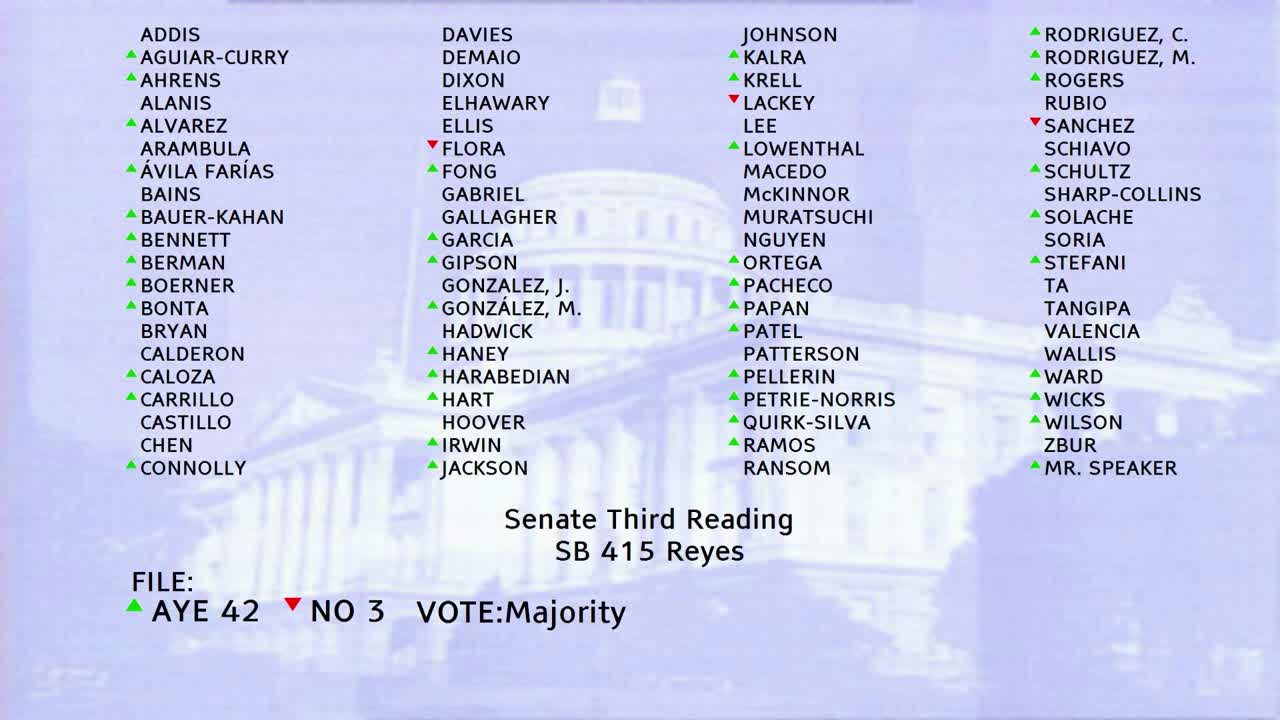 1MIN
Assembly Floor
 7MIN
Assembly Standing Committee on Judiciary
 8MIN
Assembly Standing Committee on Labor and Employment
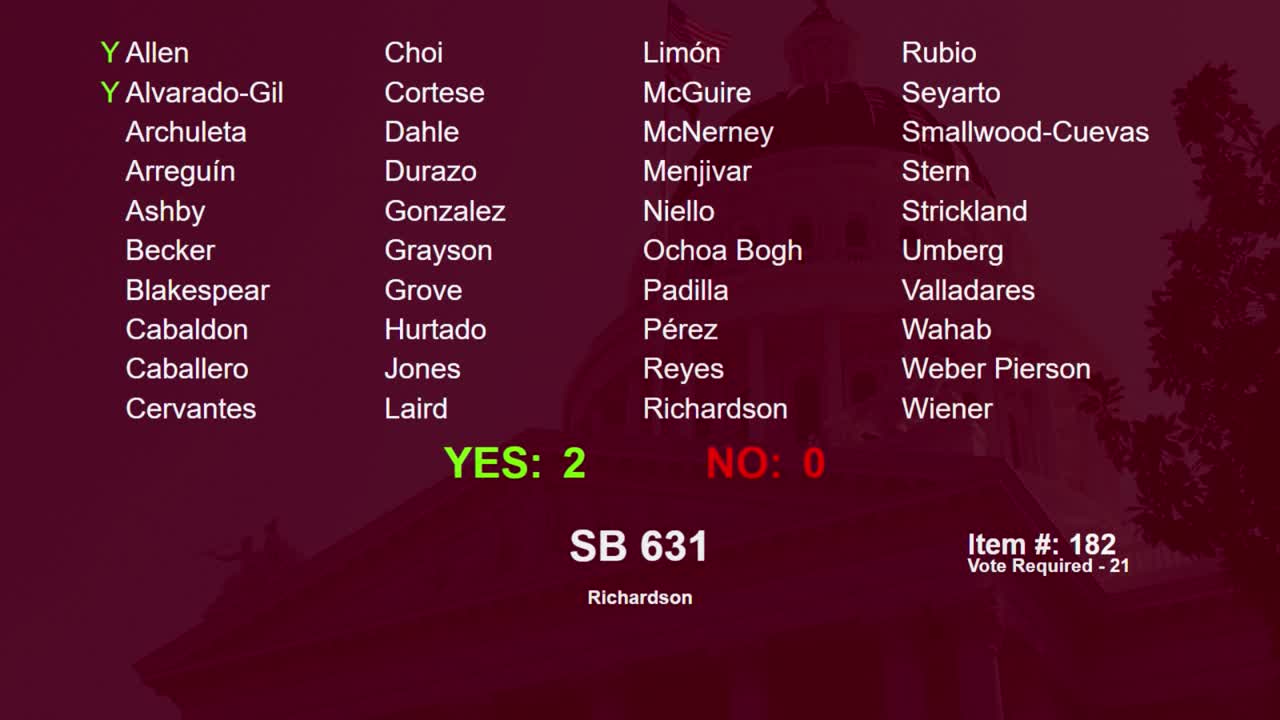 3MIN
Senate Floor
 4SEC
Senate Standing Committee on Appropriations
 7MIN
Senate Standing Committee on Judiciary
 10MIN
Senate Standing Committee on Labor, Public Employment and Retirement
Bill Author

Bill Co-Author(s):