SB 30: Diesel-powered on-track equipment: decommissioning: resale and transfer restrictions.
- Session Year: 2025-2026
- House: Senate
- Latest Version Date: 2025-10-13
Current Status:
Passed
(2025-10-13: Chaptered by Secretary of State. Chapter 735, Statutes of 2025.)
Introduced
In Committee
Awaiting First Chamber Vote
Passed First Chamber
In Committee
Awaiting Second Chamber Vote
Passed Second Chamber
Enacted
Existing law provides various provisions applicable to all public transit and transit districts and includes specific requirements applicable to public entities that operate commuter rail or rail transit systems.
This bill would prohibit a public entity that owns diesel-powered on-track equipment from selling, donating, or otherwise transferring ownership of that equipment for continued use after the public entity decommissions the equipment. The bill would exempt the sale, donation, or transfer of the ownership of that equipment from the prohibition if the equipment is deemed to be in one of specified categories of emissions standards designated by the federal government for locomotives, the equipment produces emissions equivalent to any equipment within any of those federal categories, or the diesel engine is removed from the equipment, as specified.
Existing law provides various provisions applicable to all public transit and transit districts and includes specific requirements applicable to public entities that operate commuter rail or rail transit systems.
This bill would prohibit a public entity that owns diesel-powered on-track equipment from selling, donating, or otherwise transferring ownership of that equipment for continued use after the public entity decommissions the equipment. The bill would exempt the sale, donation, or transfer of the ownership of that equipment from the prohibition if certain criteria are satisfied, including, among others, that the equipment is deemed to be in one of specified categories of emissions standards designated by the federal government for locomotives and the public entity certifies that the transaction will lead to a net air quality benefit where the receiving entity will be using the equipment. locomotives, the equipment produces emissions equivalent to any equipment within any of those federal categories, or the diesel engine is removed from the equipment, as specified.
Existing law provides various provisions applicable to all public transit and transit districts and includes specific requirements applicable to public entities that operate commuter rail or rail transit systems.
This bill would prohibit a public entity that owns diesel-powered on-track equipment from selling, donating, or otherwise transferring that equipment for continued use after the public entity decommissions the equipment. The bill would exempt the sale, donation, or transfer of that equipment from the prohibition if certain criteria are satisfied, including, among others, that the equipment is deemed to be in one of specified categories of emissions standards designated by the federal government for locomotives and the public entity certifies that the transaction will lead to a net air quality benefit where the receiving entity will be using the equipment.
Existing law provides various provisions applicable to all public transit and transit districts and includes specific requirements applicable to public entities that operate commuter rail or rail transit systems.
This bill would prohibit a public entity that owns diesel-powered on-track equipment from selling, donating, or otherwise transferring that equipment for continued use after the public entity decommissions the equipment.
Existing law provides various provisions applicable to all public transit and transit districts. districts and includes specific requirements applicable to public entities that operate commuter rail or rail transit systems.
This bill would state the intent of the Legislature to enact subsequent legislation to restrict the resale of decommissioned diesel trains and rolling stock for continued use. prohibit a public entity that owns diesel-powered on-track equipment from selling, donating, or otherwise transferring that equipment for continued use after the public entity decommissions the equipment.
Existing law provides various provisions applicable to all public transit and transit districts.
This bill would state the intent of the Legislature to enact subsequent legislation to restrict the resale of decommissioned diesel trains and rolling stock for continued use.
The Legislature finds and declares all of the following:
(a)Diesel-powered locomotives emit multiple air pollutants, including diesel particulate matter, fine particulate matter, oxides of nitrogen, and greenhouse gases.
(b)Locomotives travel throughout the state to locations that are near where people work and live.
(c)Exposure to toxic and harmful diesel emissions is known to lead to cancer and increases in asthma, cardiopulmonary illness, hospitalizations, and premature mortality.
(d)Communities near rail operations bear a disproportionate health burden due to their proximity to harmful emissions.
(e)In 2023, the California Senate passed Senate Resolution 34 to formally recognize the obligation to future generations to restore a safe climate, and declare climate restoration, along with achieving net-zero and net-negative carbon dioxide emissions, a climate policy priority.
SEC. 2.Section 99153.5 is added to the Public Utilities Code, to read:99153.5.(a)For purposes of this section, the following definitions apply:
(1)Continued use means the continued operation of the diesel engine from the diesel-powered on-track equipment as an internal combustion engine to provide power for on-track equipment or any other purpose.
(2)Decommission means to permanently cease the service of on-track equipment when the public entity owning that on-track equipment replaces it with lower emission on-track equipment.
(3)Diesel-powered on-track equipment means any locomotive or any other car, rolling stock, equipment, or other device that is operated on stationary rails and has a diesel engine.
(b)Except as provided in subdivision (c), a public entity that owns diesel-powered on-track equipment shall not sell, donate, or otherwise transfer ownership of that diesel-powered on-track equipment for continued use after the public entity decommissions the diesel-powered on-track equipment.
(c)A public entity may engage in a transaction otherwise prohibited by subdivision (b) if both of the following criteria are satisfied:
(1)The diesel-powered on-track equipment meets any of the following conditions:
(A)The equipment is deemed to be in Tier 2, Tier 3, or Tier 4, as designated by the United States Environmental Protection Agency.
(B)The equipment produces emissions equivalent to any equipment within any of the tiers described in subparagraph (A).
(C)The diesel engine is removed from the equipment.
(2)The public entity authorizes the transaction in a public hearing.
The Legislature finds and declares all of the following:
(a)Diesel-powered locomotives emit multiple air pollutants, including diesel particulate matter, fine particulate matter, oxides of nitrogen, and greenhouse gases.
(b)Locomotives travel throughout the state to locations that are near where people work and live.
(c)Exposure to toxic and harmful diesel emissions is known to lead to cancer and increases in asthma, cardiopulmonary illness, hospitalizations, and premature mortality.
(d)Communities near rail operations bear a disproportionate health burden due to their proximity to harmful emissions.
(e)In 2023, the State Air Resources Board approved the In-Use Locomotive Regulation (Sections 2478 to 2478.17, inclusive, of Title 13 of the California Code of Regulations) to achieve emission reductions from diesel-powered locomotives and increase the use of zero-emission technology.(f)(e)In 2023, the California Senate passed Senate Resolution 34 to formally recognize the obligation to future generations to restore a safe climate, and declare climate restoration, along with achieving net-zero and net-negative carbon dioxide emissions, a climate policy priority.
(g)The state has made significant investments in efforts to reduce greenhouse gas emissions. It has an obligation to continue contributing to global goals regarding the reduction of greenhouse gas emissions.SEC. 2.Section 99153.5 is added to the Public Utilities Code, to read:99153.5.(a)For purposes of this section, the following definitions apply:
(1)Continued use means the continued operation of the diesel engine from the diesel-powered on-track equipment as an internal combustion engine to provide power for on-track equipment or any other purpose.
(2)Decommission means to permanently cease the service of on-track equipment when the public entity owning that on-track equipment replaces it with lower emission on-track equipment.
(3)Diesel-powered on-track equipment means any locomotive or any other car, rolling stock, equipment, or other device that is operated on stationary rails and has a diesel engine.
(b)Except as provided in subdivision (c), a public entity that owns diesel-powered on-track equipment shall not sell, donate, or otherwise transfer ownership of that diesel-powered on-track equipment for continued use after the public entity decommissions the diesel-powered on-track equipment.
(c)A public entity may engage in a transaction otherwise prohibited by subdivision (b) if all both of the following criteria are satisfied:
(1)The diesel-powered on-track equipment meets any of the following conditions:
(1)(A)The diesel-powered on-track equipment to be sold, donated, or transferred is deemed to be in Tier 2, Tier 3, or Tier 4, as designated by the United States Environmental Protection Agency.
(B)The equipment produces emissions equivalent to any equipment within any of the tiers described in subparagraph (A).
(C)The diesel engine is removed from the equipment.
(2)The public entity authorizes the transaction in a public meeting. hearing.
(3)The public entity certifies that the transaction will lead to a net air quality benefit where the receiving entity will be using the diesel-powered on-track equipment.(4)The public entity makes available on its internet website any information or studies it has performed, or has received from the receiving entity, that may document the work it has done to reach a conclusion that use of the diesel-powered on-track equipment will lead to a net air quality benefit.(5)In the case of diesel-powered on-track equipment deemed to be in Tier 2, the receiving entity, in any contract to buy or accept the equipment, agrees to make modifications it deems feasible to reduce the equipments emissions.The Legislature finds and declares all of the following:
(a)Diesel-powered locomotives emit multiple air pollutants, including diesel particulate matter, fine particulate matter, oxides of nitrogen, and greenhouse gases.
(b)Locomotives travel throughout the state to locations that are near where people work and live.
(c)Exposure to toxic and harmful diesel emissions is known to lead to cancer and increases in asthma, cardiopulmonary illness, hospitalizations, and premature mortality.
(d)Communities near rail operations bear a disproportionate health burden due to their proximity to harmful emissions.
(e)In 2023, the State Air Resources Board approved the In-Use Locomotive Regulation (Sections 2478 to 2478.17, inclusive, of Title 13 of the California Code of Regulations) to achieve emission reductions from diesel-powered locomotives and increase the use of zero-emission technology.
(f)In 2023, the California Senate passed Senate Resolution 34 to formally recognize the obligation to future generations to restore a safe climate, and declare climate restoration, along with achieving net-zero and net-negative carbon dioxide emissions, a climate policy priority.
(g)The state has made significant investments in efforts to reduce greenhouse gas emissions. It has an obligation to continue contributing to global goals regarding the reduction of greenhouse gas emissions.
SEC. 2.Section 99153.5 is added to the Public Utilities Code, to read:99153.5.(a)For purposes of this section, the following definitions apply:
(1)Continued use means the continued operation of the diesel engine from the diesel-powered on-track equipment as an internal combustion engine to provide power for on-track equipment or any other purpose.
(2)Decommission means to permanently cease the service of on-track equipment when the public entity owning that on-track equipment replaces it with lower emission on-track equipment.
(3)Diesel-powered on-track equipment means any locomotive or any other car, rolling stock, equipment, or other device that is operated on stationary rails and has a diesel engine.
(b)A Except as provided in subdivision (c), a public entity that owns diesel-powered on-track equipment shall not sell, donate, or otherwise transfer that diesel-powered on-track equipment for continued use after the public entity decommissions the diesel-powered on-track equipment.
(c)A public entity may engage in a transaction otherwise prohibited by subdivision (b) if all of the following criteria are satisfied:
(1)The diesel-powered on-track equipment to be sold, donated, or transferred is deemed to be in Tier 2, Tier 3, or Tier 4, as designated by the United States Environmental Protection Agency.
(2)The public entity authorizes the transaction in a public meeting.
(3)The public entity certifies that the transaction will lead to a net air quality benefit where the receiving entity will be using the diesel-powered on-track equipment.
(4)The public entity makes available on its internet website any information or studies it has performed, or has received from the receiving entity, that may document the work it has done to reach a conclusion that use of the diesel-powered on-track equipment will lead to a net air quality benefit.
(5)In the case of diesel-powered on-track equipment deemed to be in Tier 2, the receiving entity, in any contract to buy or accept the equipment, agrees to make modifications it deems feasible to reduce the equipments emissions.
The Legislature finds and declares all of the following:
(a)Diesel-powered locomotives emit multiple air pollutants, including diesel particulate matter, fine particulate matter, oxides of nitrogen, and greenhouse gases.
(b)Locomotives travel throughout the state to seaports, railyards, and other locations that are near where people work and live.
(c)Exposure to toxic and harmful diesel emissions is known to lead to cancer and increases in asthma, cardiopulmonary illness, hospitalizations, and premature mortality.
(d)Communities near rail operations bear a disproportionate health burden due to their proximity to harmful emissions.
(e)In 2023, the State Air Resources Board approved the In-Use Locomotive Regulation (Sections 2478 to 2478.17, inclusive, of Title 13 of the California Code of Regulations) to achieve emission reductions from diesel-powered locomotives and increase the use of zero-emission technology.
(f)In 2023, the California Senate passed Senate Resolution 34 to formally recognize the obligation to future generations to restore a safe climate, and declare climate restoration, along with achieving net-zero and net-negative carbon dioxide emissions, a climate policy priority.
(g)The state has made significant investments in efforts to reduce greenhouse gas emissions. It has an obligation to continue contributing to global goals regarding the reduction of greenhouse gas emissions.
SEC. 2.Section 99153.5 is added to the Public Utilities Code, to read:99153.5.(a)For purposes of this section, the following definitions apply:
(1)Continued use means the continued operation of the diesel engine from the diesel-powered on-track equipment as an internal combustion engine to provide power for on-track equipment or any other purpose.
(2)Decommission means to permanently cease the service of on-track equipment when the public entity owning that on-track equipment replaces it with lower emission on-track equipment.
(3)Diesel-powered on-track equipment means any locomotive or any other car, rolling stock, equipment, or other device that, alone or coupled to others, that is operated on stationary rails and has a diesel engine.
(b)A public entity that owns diesel-powered on-track equipment shall not sell, donate, or otherwise transfer that diesel-powered on-track equipment for continued use after the public entity decommissions the diesel-powered on-track equipment.
The Legislature finds and declares all of the following:
(a)Diesel-powered locomotives emit multiple air pollutants, including diesel particulate matter, fine particulate matter, oxides of nitrogen, and greenhouse gases.
(b)Locomotives travel throughout the state to seaports, railyards, and other locations that are near where people work and live.
(c)Exposure to toxic and harmful diesel emissions is known to lead to cancer and increases in asthma, cardiopulmonary illness, hospitalizations, and premature mortality.
(d)Communities near rail operations bear a disproportionate health burden due to their proximity to harmful emissions.
(e)In 2023, the State Air Resources Board approved the In-Use Locomotive Regulation (Sections 2478 to 2478.17, inclusive, of Title 13 of the California Code of Regulations) to achieve emission reductions from diesel-powered locomotives and increase the use of zero-emission technology.
(f)In 2023, the California Senate passed Senate Resolution 34 to formally recognize the obligation to future generations to restore a safe climate, and declare climate restoration, along with achieving net-zero and net-negative carbon dioxide emissions, a climate policy priority.
(g)The state has made significant investments in efforts to reduce greenhouse gas emissions. It has an obligation to continue contributing to global goals regarding the reduction of greenhouse gas emissions.
SEC. 2.Section 99153.5 is added to the Public Utilities Code, to read:99153.5.(a)For purposes of this section, the following definitions apply:
(1)Continued use means the continued operation of the diesel engine from the diesel-powered on-track equipment as an internal combustion engine to provide power for on-track equipment or any other purpose.
(2)Decommission means to permanently cease the service of on-track equipment when the public entity owning that on-track equipment replaces it with lower emission on-track equipment.
(3)Diesel-powered on-track equipment means any locomotive or any other car, rolling stock, equipment, or other device that, alone or coupled to others, is operated on stationary rails and has a diesel engine.
(b)A public entity that owns diesel-powered on-track equipment shall not sell, donate, or otherwise transfer that diesel-powered on-track equipment for continued use after the public entity decommissions the diesel-powered on-track equipment.
SECTION 1.It is the intent of the Legislature to enact subsequent legislation to restrict the resale of decommissioned diesel trains and rolling stock for continued use.It is the intent of the Legislature to enact subsequent legislation to restrict the resale of decommissioned diesel trains and rolling stock for continued use.
|
Date
|
Status
|
|---|---|
| Oct 13, 2025 | Chaptered by Secretary of State. Chapter 735, Statutes of 2025. |
| Oct 13, 2025 | Approved by the Governor. |
| Sep 17, 2025 | Enrolled and presented to the Governor at 2 p.m. |
| Sep 10, 2025 | Assembly amendments concurred in. (Ayes 29. Noes 10. Page 2836.) Ordered to engrossing and enrolling. |
| Sep 9, 2025 | In Senate. Concurrence in Assembly amendments pending. |
| Sep 9, 2025 | Read third time. Passed. (Ayes 53. Noes 22. Page 3092.) Ordered to the Senate. |
| Aug 21, 2025 | Read second time. Ordered to third reading. |
| Aug 20, 2025 | From committee: Do pass. (Ayes 11. Noes 4.) (August 20). |
| Jul 16, 2025 | Read second time and amended. Re-referred to Com. on APPR. |
| Jul 15, 2025 | From committee: Do pass as amended and re-refer to Com. on APPR. (Ayes 10. Noes 5.) (July 14). |
| Jun 26, 2025 | July 7 hearing postponed by committee. |
| Jun 5, 2025 | Referred to Com. on TRANS. |
| May 28, 2025 | In Assembly. Read first time. Held at Desk. |
| May 28, 2025 | Read third time. Passed. (Ayes 28. Noes 10. Page 1297.) Ordered to the Assembly. |
| May 20, 2025 | Read second time. Ordered to third reading. |
| May 19, 2025 | From committee: Be ordered to second reading pursuant to Senate Rule 28.8. |
| May 9, 2025 | Set for hearing May 19. |
| May 5, 2025 | Read second time and amended. Re-referred to Com. on APPR. |
| May 1, 2025 | From committee: Do pass as amended and re-refer to Com. on APPR. (Ayes 6. Noes 0. Page 962.) (April 30). |
| Apr 11, 2025 | Set for hearing April 30. |
| Apr 9, 2025 | From committee: Do pass and re-refer to Com. on E.Q. (Ayes 11. Noes 3. Page 710.) (April 8). Re-referred to Com. on E.Q. |
| Mar 26, 2025 | From committee with author's amendments. Read second time and amended. Re-referred to Com. on TRANS. |
| Mar 25, 2025 | Set for hearing April 8. |
| Feb 19, 2025 | Re-referred to Coms. on TRANS. and E.Q. |
| Feb 11, 2025 | From committee with author's amendments. Read second time and amended. Re-referred to Com. on RLS. |
| Jan 29, 2025 | Referred to Com. on RLS. |
| Dec 3, 2024 | From printer. May be acted upon on or after January 2. |
| Dec 2, 2024 | Introduced. Read first time. To Com. on RLS. for assignment. To print. |
|
Date
|
Description
|
Location
|
Votes
|
|
|---|---|---|---|---|
| Sep 10, 2025 | Unfinished Business SB30 Cortese et al. Concurrence | Senate Floor |
Passed |
|
| Sep 9, 2025 | SB 30 Cortese Senate Third Reading By Wilson | Assembly Floor |
Passed |
|
| Aug 20, 2025 | Do pass. | Assembly Standing Committee on Appropriations |
Passed |
|
| Jul 14, 2025 | Do pass as amended and be re-referred to the Committee on [Appropriations] | Assembly Standing Committee on Transportation |
Passed |
|
| May 28, 2025 | Senate 3rd Reading SB30 Cortese | Senate Floor |
Passed |
|
| Apr 30, 2025 | Do pass as amended, but first amend, and re-refer to the Committee on [Appropriations] | Senate Standing Committee on Environmental Quality |
Passed |
|
| Apr 8, 2025 | Do pass, but first be re-referred to the Committee on [Environmental Quality] | Senate Standing Committee on Transportation |
Passed |
This list shows positions taken on this bill by organizations on the date displayed, which is linked to the original source.
Positions by individuals are not included.
|
Organization
|
Position
|
Date
|
|---|---|---|
| 350 Bay Area Action | ** Support | |
| Acterra: Action for A Healthy Planet | ** Support | |
| California Transit Association | ** Against | |
| cleanearth4kids.org | ** Support | |
| Climate Action California | ** Support | |
| Climate Reality Project San Francisco Bay Area Chapter | ** Support | |
| Green Policy Initiative | ** Support | |
| Move LA | ** Support | |
| Napa Climate NOW! | ** Support | |
| Sierra Club | ** Support | |
| Silicon Valley Youth Climate Action | ** Support | |
| Supervisor Lynda Hopkins, County of Sonoma Fifth District | ** Support |
SENATE RULES COMMITTEE Office of Senate Floor Analyses (916) 651-1520 Fax: (916) 327-4478 | SB 30 |
UNFINISHED BUSINESS
Bill No: SB 30
Author: Cortese (D), et al.
Amended: 10/13/25
Vote: 21
SENATE TRANSPORTATION COMMITTEE: 11-3, 4/8/25
AYES: Cortese, Archuleta, Arreguín, Blakespear, Cervantes, Gonzalez, Grayson, Limón, Menjivar, Richardson, Umberg
NOES: Strickland, Dahle, Valladares
NO VOTE RECORDED: Seyarto
SENATE ENVIRONMENTAL QUALITY COMMITTEE: 6-0, 4/30/25
AYES: Blakespear, Gonzalez, Hurtado, Menjivar, Padilla, Pérez
NO VOTE RECORDED: Valladares, Dahle
SENATE APPROPRIATIONS COMMITTEE: Senate Rule 28.8
SENATE FLOOR: 28-10, 5/28/25
AYES: Allen, Archuleta, Arreguín, Ashby, Becker, Blakespear, Cabaldon, Caballero, Cervantes, Cortese, Durazo, Gonzalez, Grayson, Hurtado, Laird, Limón, McGuire, McNerney, Menjivar, Padilla, Pérez, Richardson, Rubio, Smallwood-Cuevas, Stern, Umberg, Weber Pierson, Wiener
NOES: Alvarado-Gil, Choi, Dahle, Grove, Jones, Niello, Ochoa Bogh, Seyarto, Strickland, Valladares
NO VOTE RECORDED: Reyes, Wahab
ASSEMBLY FLOOR: 53-22, 9/9/25 - See last page for vote
SUBJECT: Diesel-powered on-track equipment: decommissioning: resale and transfer restrictions
SOURCE: Author
DIGEST:
This bill prohibits a public entity that owns diesel-powered on-track equipment from selling, donating, or otherwise transferring ownership of that equipment for continued use after the public entity decommissions the equipment, except if certain conditions are met.
Assembly Amendments
of 7/16/25 recast provisions defining what diesel powered on-track equipment can be sold, donated, or otherwise transferred; and clarifies that the public entity must authorize the transaction in a public hearing instead of meeting.
ANALYSIS:
Existing law:
- Provides various provisions applicable to all public transit and transit districts, including specific requirements applicable to public entities that operate commuter rail or rail transit systems.
- Authorizes the California Department of Transportation (Caltrans) to construct, acquire, or lease, and improve and operate, rail passenger terminals and related facilities that provide intermodal passenger services along specified corridors.
- Authorizes Caltrans to contract with Amtrak for commuter or intercity rail passenger services.
- Authorizes the Capitol Corridor Joint Powers Authority (JPA), San Joaquin JPA, and the Los Angeles- San Diego-San Luis Obispo (LOSSAN) Rail Corridor Agency to oversee state-supported intercity passenger rail service.
- Authorizes Caltrans to purchase, sell, and lease rail passenger cars and locomotives and other self-propelled rail vehicles.
- Establishes the Carl Moyer Memorial Air Quality Standards Attainment Program (Carl Moyer Program), administered by the California Air Resources Board (ARB), to provide grants to offset the incremental cost of eligible projects that reduce emissions of air pollutants from sources in the state.
- Establishes the Transit and Intercity Rail Capital Program (TIRCP), administered by the California State Transportation Agency (CalSTA), to fund transformative capital improvements that will modernize California’s intercity, commuter, and urban rail systems and bus and ferry transit systems to achieve certain policy objectives.
This bill:
- Defines “diesel-powered on-track equipment” to mean any locomotive or any other car, rolling stock, equipment, or other device that is operated on stationary rails and has a diesel engine.
- Defines “continued use” to mean the continued operation of the diesel engine from the diesel-powered on-track equipment as an internal combustion engine to provide power for on-track equipment or any other purpose.
- Defines “decommission” to mean to permanently cease the service of on-track equipment when the public entity owning that on-track equipment replaces it with lower emission on-track equipment.
- Requires a public entity that owns diesel-powered on-track equipment to not sell, donate, or otherwise transfer ownership of that diesel-powered on-track equipment for continued use after the public entity decommissions the diesel-powered on-track equipment.
- Authorizes a public entity to engage in a transaction otherwise prohibited by the bill if both of the following criteria are met:
- The diesel-powered on-track equipment meets any of the following:
- The equipment is deemed to be in Tier 2, Tier 3, or Tier 4, as designated by the United States Environmental Protection Agency (U.S EPA);
- The equipment produces emissions equivalent to any equipment within any of the tiers described; or,
- The diesel engine is removed from the equipment.
- The public entity authorizes the transaction in a public hearing.
- The diesel-powered on-track equipment meets any of the following:
Comments
- Purpose of this bill. According to the author, “SB 30 prohibits the resale, donation, or transfer of decommissioned Tier 0 and Tier I diesel locomotives for continued use. It also adds environmental guardrails to the transfer of Tier II and higher locomotives. The state of California should be leading the world in environmental protection and the transition to clean energy. As we make our own transition to zero-emission locomotives, we must look forward and ensure that the locomotives we stop using do not worsen pollution somewhere else. Diesel fuel is diesel fuel regardless of where you live, and the emissions continue to be harmful to people and the environment. As a world leader in decarbonization in our transportation sector, California needs to be serious about decarbonization worldwide.”
- Locomotives in California. Locomotives are self-propelled off-road equipment used to push or pull rail-mounted cars carrying freight or passengers. According to the ARB, approximately 12,700 diesel locomotives were operating in California in 2020. The vast majority, more than 93%, are line-haul locomotives operated by the Class I operators, such as Union Pacific Railroad or BNSF Railway. These are large locomotives that haul freight over long distances throughout the country.
Passenger trains comprise approximately 1% of this total. Travel routes for these locomotives range from short, local commuter distances to long, inter-regional routes. Passenger locomotive operators in California include commuter systems such as Metrolink in Southern California, Caltrain in the Bay Area, Altamont Commuter Express (ACE) in the Central Valley, North Coast Transit District in San Diego County, and the newest system, the Sonoma-Marin Area Regional Transit (SMART). Additionally, the three state-supported intercity passenger rail systems, the Capital Corridor, the San Joaquins, and the LOSSAN Pacific Surfliner, carry passengers across regions and are operated by Amtrak.
The U.S. EPA sets emission standards for locomotives under different “tiers,” corresponding to when the locomotive engine was originally manufactured. Each tier represents a progressively stricter level of emission limits, with Tier 1 being the least stringent and Tier 4 being the current, most stringent standard. These tiers regulate the amount of pollutants, such as nitrogen oxides (NOx) and particulate matter (PM) that an engine can emit.
As noted, passenger locomotives account for roughly 1% of the locomotives operating in California. Of that, as of 2022, over 50% are Tier 4. For example, Caltrans purchases and owns the rolling stock for the three intercity rail providers. Of its 37 locomotives in operation, 24 are Tier 4 Charger locomotives and 13 are Tier 2 F59 locomotives.
- ARB leads effort to reduce locomotive emissions. According to the ARB, in 2022, locomotives in California emitted over 640 tons of PM and almost 30,000 tons of NOx. Locomotives travel across the state close to where people work and live, causing harmful impacts on air quality and public health. Relying almost exclusively on diesel fuel, locomotives were responsible for 10% of NOx emissions from mobile sources in California in 2020. That share of NOx emissions is expected to increase to 15% in 2035 because most other transportation sectors have committed to moving toward cleaner engines and zero-emission technology.
On April 27, 2023, the ARB adopted a regulation aimed at forcing the retirement of older diesel locomotives and increasing the use of zero-emission (ZE) technology. The In-Use Locomotive Regulation is expected to reduce 7,400 tons of PM, 386,300 tons NOx, and 21.6 million tons of greenhouse gas (GHG) emissions cumulatively between 2023 and 2050.
Specifically, starting in 2030, locomotives must be less than 23 years old to operate in California. This requirement will gradually ban old diesel locomotives from the state, starting with Tier 0, Tier 1, and some early Tier 2 models that were manufactured before 2007. However, if the locomotive is remanufactured or repowered to meet Tier 4 emission limits or better before 2030, the state will consider the time of remanufacturing as the original build date. Exemptions are granted for low-usage locomotives and locomotives operating only in zero-emission configurations in California. In addition, zero-emission requirements will phase in starting in 2030. All passenger locomotives built after 2030 must operate with zero emissions in California.
However, California needs approval from the U.S. EPA before the regulation can be implemented. In January 2025, the ARB withdrew its application for the U.S. EPA waiver request. It is unclear what will happen with the regulation and whether ARB may pursue other paths to achieve the regulation’s goals.
- What happens to rolling stock after you upgrade? As California passenger rail operators move to cleaner locomotives, including ZE technology, there are options for what to do with older diesel locomotives. Locomotives can be converted to ZE technology, be sold or donated to other rail providers in the country, or be broken down and sold for parts and the diesel engines destroyed.
For example, recently, while nearing completion of its electrification project, Caltrain was approached by the U.S. State Department and U.S. Department of Commerce regarding an opportunity to sell, donate, or transfer 20 locomotives and up to 93 gallery cars to the City of Lima, Peru, to help develop a commuter rail service. According to press reports, the municipal government of Lima agreed to pay $6 million for the fleet. The train cars were built between 1985 and 1987.
The Caltrain transfers to support the Lima project brought attention to the issue of what happens to our rolling stock after it is replaced. The fate of much of the rolling stock in California is determined by the fund source used to purchase it. The ARB’s Carl Moyer program requires for any replacement, repower, or conversation projects, the locomotives engine must be destroyed. The guidelines detail that the engine must include a hole in the engine block to render the engine permanently inoperable. The ARB allows the locomotive to be brought back into service if it is repowered to a Tier 4 or cleaner engine.
For example, Metrolink has been undergoing a fleet modernization, replacing their Tier 2 locomotives with Tier 4 and working on a pilot with the San Bernardino County Transportation Agency (SBCTA) to deploy Zero Emission Multiple Unit (ZEMU) powered by hydrogen on the Redlands line in San Bernardino County. Of their total fleet of 55 locomotives, they only have 15 remaining Tier 2s. As required by the Carl Moyer program, Metrolink made the diesel engine inoperable, witnessed by the South Coast Air Quality Management District, and was then able to sell the equipment at auction. As part of the sale, the bidder has to certify “absolute compliance” to this requirement. However, TIRCP, which also provides funding for fleet replacement, measures GHG emissions reductions for the use of grants but does not speak to the sale or donation of old locomotive and other rail equipment.
- SB 30 would prohibit the sale or reuse of the dirtiest locomotives but allow others if certain conditions are met. Originally, SB 30 would have prohibited public entities from selling, donating, or transferring any on-track equipment that is diesel powered for any use after the equipment is replaced with lower emission equipment. Amendments to the bill attempt to deal with concerns raised by the state’s passenger rail providers. The bill now allows for diesel-powered on-track equipment to be sold, donated, or transferred if certain conditions are met. Specifically, the equipment must be in Tier 2, Tier 3, or Tier 4 or the equipment produces emissions equivalent to the tiers. Additionally, Tier 0 or Tier 1 equipment can be sold or transferred if the engine is removed. Finally, the public entity must authorizes any transaction in a public hearing.
FISCAL EFFECT: Appropriation: No Fiscal Com.: Yes Local: No
According to the Assembly Appropriations Committee:
- The CalSTA, Caltrans, ARB, and the Department of General Services do not anticipate any state costs as a result of this bill.
- Caltrans notes the majority of its locomotives are Tier 2 and Tier 4 and are not subject to the bill’s prohibition. Caltrans does, however, own two Tier 0 yard-switch locomotives that would be ineligible for sale under this bill, potentially resulting in foregone revenue of an unknown amount at some point in the future. Similarly, several commuter rail agencies operating in the state that own Tier 0 and Tier 1 locomotives may forego future revenue opportunities as a result of this bill.
SUPPORT: (Verified 9/9/25)
350 Bay Area Action
Acterra: Action for A Healthy Planet
Cleanearth4kids.org
Climate Action California
Climate Reality Project San Francisco Bay Area Chapter
Green Policy Initiative
Move LA
Napa Climate Now!
Sierra Club
Silicon Valley Youth Climate Action
Supervisor Lynda Hopkins, County of Sonoma Fifth District
OPPOSITION: (Verified 9/9/25)
California Transit Association
ARGUMENTS IN SUPPORT: Writing in support of the bill, the Sierra Club of California notes, “California is leading the nation with bold commitments to reduce greenhouse gas emissions and criteria pollutants. In 2024, Caltrain finalized the electrification of its main line, decommissioning decades-old diesel locomotives and replacing them with electric commuter trains. Removing these polluting locomotives will lower greenhouse gas emissions and other pollutants, lowering rates of cancer, asthma, and heart disease and their associated healthcare costs for Californians.”
ARGUMENTS IN OPPOSITION: Writing as oppose unless amended, the California Transit Association states, “As amended, SB 30 now permits Tier II, Tier III, Tier IV, or any emissions-equivalent diesel locomotive to be sold or transferred if a public hearing. However, the bill maintains the prohibition on transferring any Tier 0 or Tier I diesel equipment unless the engine is removed. The continued prohibition for Tier 0 or I locomotives would impact existing rail services in the state by limiting the ability of the state’s rail operators to source equipment from one another. Due to a scarcity of passenger rail vehicles in California and throughout the United States, lower tier locomotives are at times the only available and affordable option available.
“SB 30 may also encourage agencies to retain and use older equipment longer than necessary, rather than facilitating timely transitions to cleaner, more efficient technology because of the potential revenue loss attributed to the inability to sell older, still-functioning equipment to help offset the cost of new locomotives. Additionally, the engine removal requirement for Tier 0 and Tier I locomotives means these locomotives could not be donated to museums or preservation groups that would no longer operate the locomotives but would instead display or maintain them for educational purposes.”
ASSEMBLY FLOOR: 53-22, 9/9/25
AYES: Addis, Aguiar-Curry, Ahrens, Alvarez, Arambula, Ávila Farías, Bauer-Kahan, Bennett, Berman, Boerner, Bonta, Bryan, Calderon, Caloza, Carrillo, Connolly, Elhawary, Fong, Gabriel, Garcia, Gipson, Mark González, Haney, Harabedian, Hart, Jackson, Kalra, Krell, Lowenthal, McKinnor, Muratsuchi, Nguyen, Ortega, Pacheco, Patel, Pellerin, Quirk-Silva, Ramos, Ransom, Celeste Rodriguez, Michelle Rodriguez, Rogers, Blanca Rubio, Schiavo, Schultz, Sharp-Collins, Solache, Stefani, Valencia, Wicks, Wilson, Zbur, Rivas
NOES: Alanis, Bains, Castillo, Chen, Davies, DeMaio, Dixon, Ellis, Flora, Gallagher, Jeff Gonzalez, Hadwick, Hoover, Johnson, Lackey, Lee, Macedo, Patterson, Sanchez, Ta, Tangipa, Wallis
NO VOTE RECORDED: Irwin, Papan, Petrie-Norris, Soria, Ward
Prepared by: Hunter Flynn / SFA / (916) 651-1520
7/20/26 11:34:44
**** END ****
SENATE RULES COMMITTEE Office of Senate Floor Analyses (916) 651-1520 Fax: (916) 327-4478 | SB 30 |
UNFINISHED BUSINESS
Bill No: SB 30
Author: Cortese (D), et al.
Amended: 7/16/25 in Assembly
Vote: 21
SENATE TRANSPORTATION COMMITTEE: 11-3, 4/8/25
AYES: Cortese, Archuleta, Arreguín, Blakespear, Cervantes, Gonzalez, Grayson, Limón, Menjivar, Richardson, Umberg
NOES: Strickland, Dahle, Valladares
NO VOTE RECORDED: Seyarto
SENATE ENVIRONMENTAL QUALITY COMMITTEE: 6-0, 4/30/25
AYES: Blakespear, Gonzalez, Hurtado, Menjivar, Padilla, Pérez
NO VOTE RECORDED: Valladares, Dahle
SENATE APPROPRIATIONS COMMITTEE: Senate Rule 28.8
SENATE FLOOR: 28-10, 5/28/25
AYES: Allen, Archuleta, Arreguín, Ashby, Becker, Blakespear, Cabaldon, Caballero, Cervantes, Cortese, Durazo, Gonzalez, Grayson, Hurtado, Laird, Limón, McGuire, McNerney, Menjivar, Padilla, Pérez, Richardson, Rubio, Smallwood-Cuevas, Stern, Umberg, Weber Pierson, Wiener
NOES: Alvarado-Gil, Choi, Dahle, Grove, Jones, Niello, Ochoa Bogh, Seyarto, Strickland, Valladares
NO VOTE RECORDED: Reyes, Wahab
ASSEMBLY FLOOR: 43-19, 9/9/25 – Roll call not available.
SUBJECT: Diesel-powered on-track equipment: decommissioning: resale and transfer restrictions
SOURCE: Author
DIGEST:
This bill prohibits a public entity that owns diesel-powered on-track equipment from selling, donating, or otherwise transferring ownership of that equipment for continued use after the public entity decommissions the equipment, except if certain conditions are met.
Assembly Amendments
of 7/16/25 recast provisions defining what diesel powered on-track equipment can be sold, donated, or otherwise transferred; and clarifies that the public entity must authorize the transaction in a public hearing instead of meeting.
ANALYSIS:
Existing law:
- Provides various provisions applicable to all public transit and transit districts, including specific requirements applicable to public entities that operate commuter rail or rail transit systems.
- Authorizes the California Department of Transportation (Caltrans) to construct, acquire, or lease, and improve and operate, rail passenger terminals and related facilities that provide intermodal passenger services along specified corridors.
- Authorizes Caltrans to contract with Amtrak for commuter or intercity rail passenger services.
- Authorizes the Capitol Corridor Joint Powers Authority (JPA), San Joaquin JPA, and the Los Angeles- San Diego-San Luis Obispo (LOSSAN) Rail Corridor Agency to oversee state-supported intercity passenger rail service.
- Authorizes Caltrans to purchase, sell, and lease rail passenger cars and locomotives and other self-propelled rail vehicles.
- Establishes the Carl Moyer Memorial Air Quality Standards Attainment Program (Carl Moyer Program), administered by the California Air Resources Board (ARB), to provide grants to offset the incremental cost of eligible projects that reduce emissions of air pollutants from sources in the state.
- Establishes the Transit and Intercity Rail Capital Program (TIRCP), administered by the California State Transportation Agency (CalSTA), to fund transformative capital improvements that will modernize California’s intercity, commuter, and urban rail systems and bus and ferry transit systems to achieve certain policy objectives.
This bill:
- Defines “diesel-powered on-track equipment” to mean any locomotive or any other car, rolling stock, equipment, or other device that is operated on stationary rails and has a diesel engine.
- Defines “continued use” to mean the continued operation of the diesel engine from the diesel-powered on-track equipment as an internal combustion engine to provide power for on-track equipment or any other purpose.
- Defines “decommission” to mean to permanently cease the service of on-track equipment when the public entity owning that on-track equipment replaces it with lower emission on-track equipment.
- Requires a public entity that owns diesel-powered on-track equipment to not sell, donate, or otherwise transfer ownership of that diesel-powered on-track equipment for continued use after the public entity decommissions the diesel-powered on-track equipment.
- Authorizes a public entity to engage in a transaction otherwise prohibited by the bill if both of the following criteria are met:
- The diesel-powered on-track equipment meets any of the following:
- The equipment is deemed to be in Tier 2, Tier 3, or Tier 4, as designated by the United States Environmental Protection Agency (U.S EPA);
- The equipment produces emissions equivalent to any equipment within any of the tiers described; or,
- The diesel engine is removed from the equipment.
- The public entity authorizes the transaction in a public hearing.
- The diesel-powered on-track equipment meets any of the following:
Comments
- Purpose of this bill. According to the author, “SB 30 prohibits the resale, donation, or transfer of decommissioned Tier 0 and Tier I diesel locomotives for continued use. It also adds environmental guardrails to the transfer of Tier II and higher locomotives. The state of California should be leading the world in environmental protection and the transition to clean energy. As we make our own transition to zero-emission locomotives, we must look forward and ensure that the locomotives we stop using do not worsen pollution somewhere else. Diesel fuel is diesel fuel regardless of where you live, and the emissions continue to be harmful to people and the environment. As a world leader in decarbonization in our transportation sector, California needs to be serious about decarbonization worldwide.”
- Locomotives in California. Locomotives are self-propelled off-road equipment used to push or pull rail-mounted cars carrying freight or passengers. According to the ARB, approximately 12,700 diesel locomotives were operating in California in 2020. The vast majority, more than 93%, are line-haul locomotives operated by the Class I operators, such as Union Pacific Railroad or BNSF Railway. These are large locomotives that haul freight over long distances throughout the country.
Passenger trains comprise approximately 1% of this total. Travel routes for these locomotives range from short, local commuter distances to long, inter-regional routes. Passenger locomotive operators in California include commuter systems such as Metrolink in Southern California, Caltrain in the Bay Area, Altamont Commuter Express (ACE) in the Central Valley, North Coast Transit District in San Diego County, and the newest system, the Sonoma-Marin Area Regional Transit (SMART). Additionally, the three state-supported intercity passenger rail systems, the Capital Corridor, the San Joaquins, and the LOSSAN Pacific Surfliner, carry passengers across regions and are operated by Amtrak.
The U.S. EPA sets emission standards for locomotives under different “tiers,” corresponding to when the locomotive engine was originally manufactured. Each tier represents a progressively stricter level of emission limits, with Tier 1 being the least stringent and Tier 4 being the current, most stringent standard. These tiers regulate the amount of pollutants, such as nitrogen oxides (NOx) and particulate matter (PM) that an engine can emit.
As noted, passenger locomotives account for roughly 1% of the locomotives operating in California. Of that, as of 2022, over 50% are Tier 4. For example, Caltrans purchases and owns the rolling stock for the three intercity rail providers. Of its 37 locomotives in operation, 24 are Tier 4 Charger locomotives and 13 are Tier 2 F59 locomotives.
- ARB leads effort to reduce locomotive emissions. According to the ARB, in 2022, locomotives in California emitted over 640 tons of PM and almost 30,000 tons of NOx. Locomotives travel across the state close to where people work and live, causing harmful impacts on air quality and public health. Relying almost exclusively on diesel fuel, locomotives were responsible for 10% of NOx emissions from mobile sources in California in 2020. That share of NOx emissions is expected to increase to 15% in 2035 because most other transportation sectors have committed to moving toward cleaner engines and zero-emission technology.
On April 27, 2023, the ARB adopted a regulation aimed at forcing the retirement of older diesel locomotives and increasing the use of zero-emission (ZE) technology. The In-Use Locomotive Regulation is expected to reduce 7,400 tons of PM, 386,300 tons NOx, and 21.6 million tons of greenhouse gas (GHG) emissions cumulatively between 2023 and 2050.
Specifically, starting in 2030, locomotives must be less than 23 years old to operate in California. This requirement will gradually ban old diesel locomotives from the state, starting with Tier 0, Tier 1, and some early Tier 2 models that were manufactured before 2007. However, if the locomotive is remanufactured or repowered to meet Tier 4 emission limits or better before 2030, the state will consider the time of remanufacturing as the original build date. Exemptions are granted for low-usage locomotives and locomotives operating only in zero-emission configurations in California. In addition, zero-emission requirements will phase in starting in 2030. All passenger locomotives built after 2030 must operate with zero emissions in California.
However, California needs approval from the U.S. EPA before the regulation can be implemented. In January 2025, the ARB withdrew its application for the U.S. EPA waiver request. It is unclear what will happen with the regulation and whether ARB may pursue other paths to achieve the regulation’s goals.
- What happens to rolling stock after you upgrade? As California passenger rail operators move to cleaner locomotives, including ZE technology, there are options for what to do with older diesel locomotives. Locomotives can be converted to ZE technology, be sold or donated to other rail providers in the country, or be broken down and sold for parts and the diesel engines destroyed.
For example, recently, while nearing completion of its electrification project, Caltrain was approached by the U.S. State Department and U.S. Department of Commerce regarding an opportunity to sell, donate, or transfer 20 locomotives and up to 93 gallery cars to the City of Lima, Peru, to help develop a commuter rail service. According to press reports, the municipal government of Lima agreed to pay $6 million for the fleet. The train cars were built between 1985 and 1987.
The Caltrain transfers to support the Lima project brought attention to the issue of what happens to our rolling stock after it is replaced. The fate of much of the rolling stock in California is determined by the fund source used to purchase it. The ARB’s Carl Moyer program requires for any replacement, repower, or conversation projects, the locomotives engine must be destroyed. The guidelines detail that the engine must include a hole in the engine block to render the engine permanently inoperable. The ARB allows the locomotive to be brought back into service if it is repowered to a Tier 4 or cleaner engine.
For example, Metrolink has been undergoing a fleet modernization, replacing their Tier 2 locomotives with Tier 4 and working on a pilot with the San Bernardino County Transportation Agency (SBCTA) to deploy Zero Emission Multiple Unit (ZEMU) powered by hydrogen on the Redlands line in San Bernardino County. Of their total fleet of 55 locomotives, they only have 15 remaining Tier 2s. As required by the Carl Moyer program, Metrolink made the diesel engine inoperable, witnessed by the South Coast Air Quality Management District, and was then able to sell the equipment at auction. As part of the sale, the bidder has to certify “absolute compliance” to this requirement. However, TIRCP, which also provides funding for fleet replacement, measures GHG emissions reductions for the use of grants but does not speak to the sale or donation of old locomotive and other rail equipment.
- SB 30 would prohibit the sale or reuse of the dirtiest locomotives but allow others if certain conditions are met. Originally, SB 30 would have prohibited public entities from selling, donating, or transferring any on-track equipment that is diesel powered for any use after the equipment is replaced with lower emission equipment. Amendments to the bill attempt to deal with concerns raised by the state’s passenger rail providers. The bill now allows for diesel-powered on-track equipment to be sold, donated, or transferred if certain conditions are met. Specifically, the equipment must be in Tier 2, Tier 3, or Tier 4 or the equipment produces emissions equivalent to the tiers. Additionally, Tier 0 or Tier 1 equipment can be sold or transferred if the engine is removed. Finally, the public entity must authorizes any transaction in a public hearing.
FISCAL EFFECT: Appropriation: No Fiscal Com.: Yes Local: No
According to the Assembly Appropriations Committee:
- The CalSTA, Caltrans, ARB, and the Department of General Services do not anticipate any state costs as a result of this bill.
- Caltrans notes the majority of its locomotives are Tier 2 and Tier 4 and are not subject to the bill’s prohibition. Caltrans does, however, own two Tier 0 yard-switch locomotives that would be ineligible for sale under this bill, potentially resulting in foregone revenue of an unknown amount at some point in the future. Similarly, several commuter rail agencies operating in the state that own Tier 0 and Tier 1 locomotives may forego future revenue opportunities as a result of this bill.
SUPPORT: (Verified 9/9/25)
350 Bay Area Action
Acterra: Action for A Healthy Planet
Cleanearth4kids.org
Climate Action California
Climate Reality Project San Francisco Bay Area Chapter
Green Policy Initiative
Move LA
Napa Climate Now!
Sierra Club
Silicon Valley Youth Climate Action
Supervisor Lynda Hopkins, County of Sonoma Fifth District
OPPOSITION: (Verified 9/9/25)
California Transit Association
ARGUMENTS IN SUPPORT: Writing in support of the bill, the Sierra Club of California notes, “California is leading the nation with bold commitments to reduce greenhouse gas emissions and criteria pollutants. In 2024, Caltrain finalized the electrification of its main line, decommissioning decades-old diesel locomotives and replacing them with electric commuter trains. Removing these polluting locomotives will lower greenhouse gas emissions and other pollutants, lowering rates of cancer, asthma, and heart disease and their associated healthcare costs for Californians.”
ARGUMENTS IN OPPOSITION: Writing as oppose unless amended, the California Transit Association states, “As amended, SB 30 now permits Tier II, Tier III, Tier IV, or any emissions-equivalent diesel locomotive to be sold or transferred if a public hearing. However, the bill maintains the prohibition on transferring any Tier 0 or Tier I diesel equipment unless the engine is removed. The continued prohibition for Tier 0 or I locomotives would impact existing rail services in the state by limiting the ability of the state’s rail operators to source equipment from one another. Due to a scarcity of passenger rail vehicles in California and throughout the United States, lower tier locomotives are at times the only available and affordable option available.
“SB 30 may also encourage agencies to retain and use older equipment longer than necessary, rather than facilitating timely transitions to cleaner, more efficient technology because of the potential revenue loss attributed to the inability to sell older, still-functioning equipment to help offset the cost of new locomotives. Additionally, the engine removal requirement for Tier 0 and Tier I locomotives means these locomotives could not be donated to museums or preservation groups that would no longer operate the locomotives but would instead display or maintain them for educational purposes.”
Prepared by: Melissa White / TRANS. / (916) 651-4121
9/9/25 18:09:40
**** END ****
SENATE THIRD READING
STR Bill Id:SB 30
Author:(Cortese)
As Amended Ver:July 16, 2025
Majority vote
SUMMARY
Prohibits a public entity that owns diesel-powered on-track equipment from selling, donating, or otherwise transferring ownership of that equipment for continued use after the public entity decommissions the equipment, except as specified.
Major Provisions
Allows a public entity to engage in a transaction otherwise prohibited, as described above, if both of the following criteria are satisfied:
- The diesel-powered on-track equipment meets any of the following conditions: a) the equipment is deemed to be in Tier 2, Tier 3, or Tier 4, as designated by the United States Environmental Protection Agency (U.S. EPA), b) the equipment produces emissions equivalent to any equipment within any of the aforementioned tiers, or c) the diesel engine is removed from the equipment prior to transfer.
2) The public entity authorizes the transaction in a public hearing.
COMMENTS
Mobile source emissions. Mobile sources of air pollution are vehicles or equipment that can be moved from place to place and emit pollutants as they operate. These sources include on-road vehicles like cars, trucks, locomotives, and buses, as well as non-road vehicles such as aircraft, construction equipment, and marine vessels. Mobile sources and the fossil fuels that power them are the largest contributors to the formation of ozone, greenhouse gas (GHG) emissions, fine particulate matter (PM2.5), and toxic diesel particulate matter (DPM).
Statewide, more than 21 million out of over 39 million Californians live in areas that exceed the federal ozone standards; within these areas, there are many low-income and disadvantaged communities that are exposed to not only ozone, but also particulate and toxic, pollutant levels significantly higher than the federal standards which have immediate and detrimental health effects.
In California, mobile sources are responsible for approximately 80% of smog-forming nitrogen oxide (NOx) emissions. They also represent about 50% of GHG emissions when including emissions from fuel production, and more than 95% of toxic DPM emissions.
The National Ambient Air Quality Standard (NAAQS). The Clean Air Act of 1970 instructs the U.S. Environmental Protection Agency (US EPA) to set primary NAAQS to protect public health, and secondary NAAQS to protect plants, forests, crops and materials from damage due to exposure to six criteria air pollutants. These pollutants include: particulate matter, ozone, nitrogen oxides, sulfur oxides, carbon monoxide, and lead.
Federal law (42 United States Code 7409 and 7410) requires that all states attain the NAAQS and develop State Implementation Plans (SIP) for nonattainment areas to attain the NAAQS, and attainment areas to maintain attainment. Failure of a state to reach attainment of the NAAQS by the target date can trigger penalties, including withholding of federal highway funds.
State law (HSC 39602), requires the California Air Resources Board (CARB) to develop SIP emission reduction strategies for cars, trucks, and other mobile sources to meet the requirements in the Clean Air Act. Local air districts are primarily responsible for controlling emissions from stationary sources such as factories and power plants. CARB coordinates closely with local air districts (such as South Coast Air Quality Management District [SCAQMD]) in the development of attainment plans which are then incorporated into the SIP.
Diesel locomotive emissions in California. According to CARB, locomotives in California emitted over 640 tons of PM2.5 and almost 30,000 tons of NOx in 2022. These locomotives travel across the state close to where people work and live, causing harmful impacts on air quality and public health. Relying almost exclusively on diesel fuel, locomotives were responsible for 10% of NOx emissions from mobile sources in California in 2020, a share CARB expects to increase to 15% in 2035 as other transportation sectors move toward using cleaner engines and zero-emission technology.
Locomotive emissions designations. The U.S. EPA sets emission standards for locomotives that relate to when the locomotive's engine was originally manufactured. Each tier represents a progressively stricter level of emission limits, with Tier 0 being the least stringent and Tier 4 being the current, most stringent standard. These tiers regulate the amount of pollutants, such as NOx and particulate matter (PM) an engine can emit.
- Tier 0 (Pre-2002): Locomotives and engines manufactured before 2002, which don't have to meet any U.S. EPA emission standards.
- Tier 1 (2002-2004): Locomotives and engines manufactured from 2002 to 2004 and that have to comply with the first set of U.S. EPA emission standards.
- Tier 2 (2005-2011): Locomotives and engines manufactured that have to meet more stringent emission standards than those made under the Tier 1 standards.
- Tier 3 (2012-2014): Newly-built and remanufactured locomotives that have to comply with lower PM and NOx emission levels and meet newly-established idle reduction requirements.
- Tier 4 (2015-today): The most stringent standards for locomotives and engines to date, requiring the use of advanced technologies to control and reduce NOx and PM emissions. Tier 4 engines reduce NOx emissions by roughly 50% and PM emissions by approximately 90% when compared to Tier 3 engines. Compared to Tier 0 engines, the Tier 4s produce 70% less CO2, 95% less PM, 85% fewer hydrocarbons, and 86% fewer NOx emissions.
Freight railroads own and operate the vast majority of the locomotives in the state. In contrast, passenger locomotives account for roughly 1% of the locomotives operating in California, (about 104 engines) and as of 2022, more than half of those comply with the Tier 4 standards. Overall, CARB estimates that of the approximately 12,900 locomotives operating in the state, about 80% are in Tiers 0, 1, and 2, about 15% are in Tier 3, and approximately 5% are in Tier 4.
Locomotives by type. According to CARB, based on data from 2022, the following types of locomotives operate in the state:
- Historic. 23 locomotives (less than 1%).
- Passenger. 104 passenger locomotives in the state (approximately 3%).
- Class 1, Switcher. 500-600 (approximately 5%).
- Class 1, Line Haul. 11,000-12,000 (approximately 90%).
- Class 2 and Class 3. 158 (approximately 2%).
- Industrial. 61 (approximately 1%).
Locomotive costs. CARB released a ″Preliminary Cost Document for the In-Use Locomotive Regulation″ in March 2021 in which it detailed some locomotive-related purchase costs. According to the document:
- New Tier 4 locomotive: $2.7-$3.3 million
- New Tier 4 passenger locomotive: $7.165-$7.7 million
- Hydrogen ZE locomotive: $4.25 million
- Hydrogen ZE passenger locomotive: $12-$16 million
- Battery Electric ZE locomotive: $4.5-$8 million
- Battery Electric ZE passenger locomotive: $10-$12 million
Caltrain Modernization Program. The Caltrain Modernization Program, also known as the Caltrain Electrification Project, was a $2.44 billion project that at electrified about 51 miles of Caltrain's main line from San Francisco to San Jose. The final segment from San Jose to Gilroy is served by diesel trains as those tracks are owned by Union Pacific and the two entities could not reach an agreement to electrify the final 33 miles of track.
Caltrain announced in November 2024 it had sold 19 Tier 0 diesel locomotives and 90 galley cars to the city government of Lima, Peru for $6.32 million. The U.S. State Department, which first proposed the transfer, stated the transfer will result in a net air quality improvement for the more than 10 million people who live in the Lima. According to the U.S. State Department white paper:
″The proposed Lima East-West Passenger Railway, leveraging repurposed diesel-electric locomotives from Caltrain, offers a transformative solution to Lima's pressing transportation and environmental challenges. By shifting between 150,000 to 250,000 daily passengers from buses and microbuses to rail, the project is poised to significantly reduce traffic congestion and greenhouse gas emissions along the 39-kilometer corridor.″
The Bay Area Air Quality Management District, which provided Caltrain with some funding for its electrification project, worked with CARB to amend its initial contract with Caltrain to allow the trains to be sold to Lima, Peru instead of being destroyed as called for in the original agreement.
According to the Author
″SB 30 prohibits the resale, donation, or transfer of decommissioned Tier 0 and Tier 1 diesel locomotives for continued use. It also adds environmental guardrails to the transfer of Tier 2 and higher locomotives. The state of California should be leading the world in environmental protection and the transition to clean energy. As we make our own transition to zero-emission locomotives, we must look forward and ensure that the locomotives we stop using do not worsen pollution somewhere else. Diesel fuel is diesel fuel regardless of where you live, and the emissions continue to be harmful to people and the environment. As a world leader in decarbonization in our transportation sector, California needs to be serious about decarbonization worldwide.″
Arguments in Support
Move LA writes, ″Diesel engine emissions are harmful to the health of our communities and our environment. Diesel exhaust contains over 40 substances known to cause cancer. It has also been attributed to an increase in hospital admissions for heart disease and respiratory illness. These locomotives contribute significantly to air pollution which has led to ground-level ozone that is damaging to vegetation, including crops, and contributes to climate change.
President Trump has withdrawn the United States from the Paris Agreement, an international treaty aimed at reducing global temperature increases related to climate change. He has also gutted our country's climate action goals and emission reduction initiatives. California is a world leader on climate issues, so now more than ever, it is vital to continue reducing global diesel emissions. We are all fighting to decarbonize the same air.
SB 30 is an opportunity for California to expand upon its contributions to decarbonization efforts and ensure that these locomotives do not worsen air quality and health outcomes in communities at home or abroad.″
Arguments in Opposition
The California Transit association, holding a position of oppose unless amended, writes, ″Caltrans has expressed significant interest in leasing available vehicles to ensure timely service options. Due to a scarcity of rail vehicles, lower tier locomotives are the only options available for this purpose. In addition, it is common for agencies to borrow equipment from other agencies. During the upcoming FIFA Men's World Cup in 2026 and the Los Angeles Olympics in 2028, we fully expect that rail agencies may need additional equipment to ensure added, uninterrupted service and the option for leasing will be critical. SB 30 is unclear as to whether this would be permitted, adding confusion and uncertainty to agency planning. Should SB 30 be signed into law, it is significantly more likely that we will face shortages and disruptions.
SB 30 also encourages agencies to retain and use older equipment longer than necessary, rather than facilitating timely transitions to cleaner, more efficient technology. If unable to resell older equipment, agencies now have yet more reason why fleet transition is financially infeasible. Without extra funds to use on fleet upgrades, limiting the resale adds to the difficulty of moving to cleaner equipment.
We respectfully request the following changes to address these concerns:
- Fully exempt higher tier diesel locomotives (Tier II – Tier IV+) recognizing that these cleaner vehicles would benefit other areas.
- For Tier I and lower vehicles, require an air quality and greenhouse gas reduction benefit analysis in advance of the sale of decommissioned diesel locomotives in order to ensure that there will be quantifiable benefits to the transfer. Should this analysis demonstrate quantifiable benefits, exempt the transfer.″
FISCAL COMMENTS
According to the Assembly Appropriations Committee, ″The California State Transportation Agency, the California Department of Transportation, the Air Resources Board (ARB), and the Department of General Services do not anticipate any state costs as a result of this bill.
Caltrans notes the majority of its locomotives are Tier 2 and Tier 4 and are not subject to the bill's prohibition. Caltrans does, however, own two Tier 0 yard-switch locomotives that would be ineligible for sale under this bill, potentially resulting in foregone revenue of an unknown amount at some point in the future. Similarly, several commuter rail agencies operating in the state that own Tier 0 and Tier 1 locomotives may forego future revenue opportunities as a result of this bill.″
VOTES
SENATE FLOOR: 28-10-2
YES: Allen, Archuleta, Arreguín, Ashby, Becker, Blakespear, Cabaldon, Caballero, Cervantes, Cortese, Durazo, Gonzalez, Grayson, Hurtado, Laird, Limón, McGuire, McNerney, Menjivar, Padilla, Pérez, Richardson, Rubio, Smallwood-Cuevas, Stern, Umberg, Weber Pierson, Wiener
NO: Alvarado-Gil, Choi, Dahle, Grove, Jones, Niello, Ochoa Bogh, Seyarto, Strickland, Valladares
ABS, ABST OR NV: Reyes, Wahab
ASM TRANSPORTATION: 10-5-1
YES: Wilson, Aguiar-Curry, Carrillo, Harabedian, Hart, Jackson, Lowenthal, Ransom, Rogers, Ward
NO: Davies, Ahrens, Hoover, Lackey, Macedo
ABS, ABST OR NV: Papan
ASM APPROPRIATIONS: 11-4-0
YES: Wicks, Arambula, Calderon, Caloza, Elhawary, Fong, Mark González, Hart, Pacheco, Pellerin, Solache
NO: Dixon, Jeff Gonzalez, Ta, Tangipa
UPDATED
VERSION: July 16, 2025
CONSULTANT: Aaron Kurz / TRANS. / (916) 319-2093 FN: 0001213
Date of Hearing: August 20, 2025
ASSEMBLY COMMITTEE ON APPROPRIATIONS
Buffy Wicks, Chair
SBPCA Bill Id:SB 30
Author:(Cortese) – As Amended Ver:July 16, 2025
Policy Committee: | Transportation | Vote: | 10 - 5 |
|
| ||
|
|
Urgency: No State Mandated Local Program: No Reimbursable: No
SUMMARY:
This bill prohibits a public entity that owns diesel-powered on-track equipment from selling, donating, or otherwise transferring ownership of that equipment for continued use after the public entity decommissions the equipment, except as specified.
The bill allows a public entity to engage in a transaction otherwise prohibited (as described above) if both of the following criteria are satisfied:
1) The diesel-powered on-track equipment meets any of the following conditions: (a) the equipment is deemed to be in Tier 2, Tier 3, or Tier 4, as designated by the United States Environmental Protection Agency (U.S. EPA), (b) the equipment produces emissions equivalent to any equipment within any of the aforementioned tiers, or (c) the diesel engine is removed from the equipment.
2) The public entity authorizes the transaction in a public hearing.
The bill defines “continued use,” “decommission,” and “diesel-powered on-track equipment” for purposes of this bill.
FISCAL EFFECT:
The California State Transportation Agency, the California Department of Transportation, the Air Resources Board (ARB), and the Department of General Services do not anticipate any state costs as a result of this bill.
Caltrans notes the majority of its locomotives are Tier 2 and Tier 4 and are not subject to the bill’s prohibition. Caltrans does, however, own two Tier 0 yard-switch locomotives that would be ineligible for sale under this bill, potentially resulting in foregone revenue of an unknown amount at some point in the future. Similarly, several commuter rail agencies operating in the state that own Tier 0 and Tier 1 locomotives may forego future revenue opportunities as a result of this bill.
COMMENTS:
1) Purpose. According to the author:
The state of California should be leading the world in environmental protection and the transition to clean energy. As we make our own transition to zero-emission locomotives, we must look forward and ensure that the locomotives we stop using do not worsen pollution somewhere else. Diesel fuel is diesel fuel regardless of where you live, and the emissions continue to be harmful to people and the environment. As a world leader in decarbonization in our transportation sector, California needs to be serious about decarbonization worldwide.
2) Background. According to ARB, diesel‑powered locomotives, the most common type of locomotive in California, emit multiple air pollutants, including diesel particulate matter, fine particulate matter, oxides of nitrogen, and greenhouse gases. U.S. EPA sets emission standards for locomotives that regulate the amount of pollutants an engine may emit. Each tier represents a progressively stricter level of emission limits, with Tier 0 being the least stringent and Tier 4 being the current, most stringent standard.
On April 27, 2023, ARB adopted the In-Use Locomotive Regulation to reduce emissions from locomotives when they operate within the state. In January 2025, in light of a hostile federal administration, ARB withdrew its application for the U.S. EPA waiver request to enforce the rule. On June 26, 2025, ARB voted to repeal the In-Use Locomotive Regulation.
Among other organizations in support of the bill, Sierra Club California writes that, in 2024, Caltrain (which provides commuter rail service along the San Francisco Peninsula) finalized the electrification of its main line, decommissioning decades-old diesel locomotives and replacing them with electric commuter trains. The organization writes:
While this is an achievement in protecting the health of Californians and our state’s air and climate from the harms of polluting fuels, these harms were passed along to communities in the global south when CalTrain transferred its decommissioned diesel locomotives for continued use in Lima, Peru. As public transit operators in California clean our air by decommissioning diesel locomotives, we must ensure that this pollution and its associated health impacts are not transferred to other communities.
Writing in an oppose-unless-amended position, the California Transit Association (CTA) requests amendments to the bill to “clarify the ability of our state’s passenger rail operators to lease Tier 0 and Tier 1 locomotives to other passenger rail operators and permit lease-to-own arrangements for equipment that would not be taken out of service.” Additionally, the association “continue[s] to maintain that if an agency wishing to “sell, donate, or transfer” a Tier 0 or Tier 1 locomotive can demonstrate that the sale, donation or transfer would result in air quality and mobility benefits, then it should be permitted.” CTA argues the prohibition on transferring Tier 0 or Tier 1 locomotives will limit the ability of the state’s rail operators to source equipment from one another. CTA writes, “Due to a scarcity of passenger rail vehicles in California and throughout the United States, lower tier locomotives are at times the only available and affordable option available.”
According to the Assembly Transportation Committee’s analysis of this bill, train engines that public entities sell or donate make up about 1% of the locomotives in the state. More than half of those locomotives are Tier 4 diesel engines, the cleanest burning diesel engines available today. There are currently 17 Tier 0 and Tier 1 locomotives owned and operated by public entities. This includes locomotives that have been overhauled to incorporate more emissions controls to comply with U.S. EPA standards. In contrast, according to ARB, in 2022, private entities were responsible for approximately 97% of locomotive-generated pollution in the state.
Analysis Prepared by: Nikita Koraddi / APPR. / (916) 319-2081
Date of Hearing: July 14, 2025
ASSEMBLY COMMITTEE ON TRANSPORTATION
Lori D. Wilson, Chair
SBPCA Bill Id:SB 30
Author:(Cortese) – As Amended Ver:May 5, 2025
SENATE VOTE: 28-10
SUBJECT: Diesel-powered on-track equipment: decommissioning: resale and transfer restrictions
SUMMARY: Prohibits a public entity to transfer a decommissioned Tier 0 or Tier 1 locomotive and requires a public entity wishing to transfer a decommissioned Tier 2, Tier 3, or Tier 4 locomotive to authorize the transaction in a public meeting and certify the transaction will lead to net air quality benefits. Specifically, this bill:
- Prohibits a public entity from selling, donating, or otherwise transferring Tier 0 or Tier 1 decommissioned diesel-powered on-track equipment.
- Requires a public entity wishing to donate, sell, or otherwise transfer a Tier 2, Tier 3, and Tier 4 decommissioned diesel-powered on-track equipment to do all of the following:
- Approve the transfer in a public hearing;
- Certify that the transaction will lead to a net air quality benefit where the receiving entity will be using the diesel-powered on-track equipment;
- Make available on its internet website any information or studies that led to the conclusion of net air quality benefits; and,
- In the case of Tier 2 diesel-powered on-track equipment, the receiving entity must agree, in any contract, to make modifications it deems feasible to reduce the equipment’s emissions.
- Defines “continued use” as the continued operation of the diesel engine from the diesel-powered on-track equipment as an internal combustion engine to provide power for on-track equipment or any other purpose.
- Defines “decommission” as to permanently cease the service of on-track equipment when the public entity owning that on-track equipment replaces it with lower emission on-track equipment.
- Defines “diesel-powered on-track equipment” as any locomotive or any other car, rolling stock, equipment, or other device that is operated on stationary rails and has a diesel engine.
EXISTING LAW:
- Authorizes the California Department of Transportation (Caltrans) to build, buy, or lease, and improve and operate, rail passenger terminals and related facilities that provide intermodal passenger services along specific corridors. (Government Code (GOV) 14035(c))
- Authorizes Caltrans to contract with Amtrak for commuter or intercity rail passenger services. (GOV 14035(d))
- Requires Caltrans to request the involvement and cooperation of affected local agencies and private passenger carriers in decisions relative to the acquisition, development, and operation of intermodal passenger facilities. (GOV 14035.4)
- Authorizes the Capitol Corridor Joint Powers Authority (JPA), San Joaquin JPA, and the Los Angeles- San Diego-San Luis Obispo (LOSSAN) Rail Corridor Agency to oversee state-supported intercity passenger rail service. (GOV 14070.4-14076)
- Authorizes Caltrans to buy, sell, and lease rail passenger cars and locomotives and other self-propelled rail vehicles. (GOV 14038)
FISCAL EFFECT: Pursuant to Senate Rule 28.8, negligible state costs.
COMMENTS: Mobile source emissions. Mobile sources of air pollution are vehicles or equipment that can be moved from place to place and emit pollutants as they operate. These sources include on-road vehicles like cars, trucks, locomotives, and buses, as well as non-road vehicles such as aircraft, construction equipment, and marine vessels. Mobile sources and the fossil fuels that power them are the largest contributors to the formation of ozone, greenhouse gas (GHG) emissions, fine particulate matter (PM2.5), and toxic diesel particulate matter (DPM).
Statewide, more than 21 million out of over 39 million Californians live in areas that exceed the federal ozone standards; within these areas, there are many low-income and disadvantaged communities that are exposed to not only ozone, but also particulate and toxic, pollutant levels significantly higher than the federal standards which have immediate and detrimental health effects.
In California, mobile sources are responsible for approximately 80% of smog-forming nitrogen oxide (NOx) emissions. They also represent about 50% of GHG emissions when including emissions from fuel production, and more than 95% of toxic DPM emissions.
The National Ambient Air Quality Standard (NAAQS). The Clean Air Act of 1970 instructs the U.S. Environmental Protection Agency (US EPA) to set primary NAAQS to protect public health, and secondary NAAQS to protect plants, forests, crops and materials from damage due to exposure to six criteria air pollutants. These pollutants include: particulate matter, ozone, nitrogen oxides, sulfur oxides, carbon monoxide, and lead.
Federal law (42 United States Code 7409 and 7410) requires that all states attain the NAAQS and develop State Implementation Plans (SIP) for nonattainment areas to attain the NAAQS, and attainment areas to maintain attainment. Failure of a state to reach attainment of the NAAQS by the target date can trigger penalties, including withholding of federal highway funds.
State law (HSC 39602), requires the California Air Resources Board (CARB) to develop SIP emission reduction strategies for cars, trucks, and other mobile sources to meet the requirements in the Clean Air Act. Local air districts are primarily responsible for controlling emissions from stationary sources such as factories and power plants. CARB coordinates closely with local air districts (such as South Coast Air Quality Management District [SCAQMD]) in the development of attainment plans which are then incorporated into the SIP.
Diesel locomotive emissions in California. According to CARB, locomotives in California emitted over 640 tons of PM2.5 and almost 30,000 tons of NOx in 2022. These locomotives travel across the state close to where people work and live, causing harmful impacts on air quality and public health. Relying almost exclusively on diesel fuel, locomotives were responsible for 10% of NOx emissions from mobile sources in California in 2020, a share CARB expects to increase to 15% in 2035 as other transportation sectors move toward using cleaner engines and zero-emission technology.
Locomotive emissions designations. The U.S. Environmental Protection Agency (U.S. EPA) sets emission standards for locomotives that relate to when the locomotive’s engine was originally manufactured. Each tier represents a progressively stricter level of emission limits, with Tier 0 being the least stringent and Tier 4 being the current, most stringent standard. These tiers regulate the amount of pollutants, such as NOx and particulate matter (PM) an engine can emit.
- Tier 0 (Pre-2002): Locomotives and engines manufactured before 2002, which don’t have to meet any U.S. EPA emission standards.
- Tier 1 (2002-2004): Locomotives and engines manufactured from 2002 to 2004 and that have to comply with the first set of U.S. EPA emission standards.
- Tier 2 (2005-2011): Locomotives and engines manufactured that have to meet more stringent emission standards than those made under the Tier 1 standards.
- Tier 3 (2012-2014): Newly-built and remanufactured locomotives that have to comply with lower PM and NOx emission levels and meet newly-established idle reduction requirements.
- Tier 4 (2015-today): The most stringent standards for locomotives and engines to date, requiring the use of advanced technologies to control and reduce NOx and PM emissions. Tier 4 engines reduce NOx emissions by roughly 50% and PM emissions by approximately 90% when compared to Tier 3 engines. Compared to Tier 0 engines, the Tier 4s produce 70% less CO2, 95% less PM, 85% fewer hydrocarbons, and 86% fewer NOx emissions.
Freight railroads own and operate the vast majority of the locomotives in the state. In contrast, passenger locomotives account for roughly 1% of the locomotives operating in California, (about 104 engines) and as of 2022, more than half of those comply with the Tier 4 standards. Overall, CARB estimates that of the approximately 12,900 locomotives operating in the state, about 80% are in Tiers 0, 1, and 2, about 15% are in Tier 3, and approximately 5% are in Tier 4.
Locomotives by type. According to CARB, based on data from 2022, the following types of locomotives operate in the state:
- Historic. 23 locomotives, which keep their original configuration to provide riders with historical experience (less than 1%).
- Passenger. 104 passenger locomotives in the state, operated by Metrolink in Southern California, Caltrain in the Bay Area, Altamont Commuter Express (ACE) in the Central Valley, Sonoma Marin Area Regional Transit in Northern California, the North Coast Transit District in San Diego County, and Amtrak-operated Pacific Surfliner, and Capital and San Joaquin Valley Corridors, (approximately 3%).
- Class 1, Switcher. 500-600 switchers which are smaller locomotives that pull freight throughout railyards or for short distances outside railyards (approximately 5%).
- Class 1, Line Haul. 11,000-12,000 line haul locomotives that haul freight over long distances, through the state and the entire country (approximately 90%).
- Class 2 and Class 3. 158 Class 2 and 3 locomotives. Class 2 operators generally pull freight over short and medium distances between a small number of states. Class 3 operators pull freight over short distances, generally between a port and railyard or between a railyard and an industrial client (approximately 2%).
- Industrial. 61 industrial locomotives, generally used to move freight out to a main track so that it can be connected to a larger train (approximately 1%).
CARB regulations for In-Use Locomotives repealed in 2025. On April 27, 2023, CARB adopted the In-Use Locomotive Regulation designed to force older diesel locomotives to be retired and increase the use of zero-emission (ZE) technology. The rule projected to reduce 7,400 tons of PM, 386,300 tons NOx, and 21.6 million tons of greenhouse gas (GHG) emissions cumulatively between 2023 and 2050.
Under the CARB regulation, beginning in 2030, locomotives must be less than 23 years old to operate in California. This requirement will gradually ban old diesel locomotives from the state, starting with Tier 0, Tier 1, and some early Tier 2 models manufactured before 2007. However, if the locomotive is remanufactured or repowered to at least meet Tier 4 emission limits before 2030, the state will re-set the 23-year clock based on when they were remanufactured or repowered. The regulation also requires all passenger locomotives built after 2030 to operate with zero emissions in California.
In January 2025, CARB withdrew its application for the U.S. EPA waiver request to enforce the rule. On June 26th, 2025, CARB voted to repeal the In-Use Locomotive Regulation.
Locomotive costs. CARB released a “Preliminary Cost Document for the In-Use Locomotive Regulation” in March 2021 in which it detailed some locomotive-related purchase costs. According to the document:
New Tier 4 locomotive: $2.7-$3.3 million
New Tier 4 passenger locomotive: $7.165-$7.7 million
Hydrogen ZE locomotive: $4.25 million
Hydrogen ZE passenger locomotive: $12-$16 million
Battery Electric ZE locomotive: $4.5-$8 million
Battery Electric ZE passenger locomotive: $10-$12 million
Some passenger locomotives are transitioning to ZE. Some passenger rail operators in the state are adopting ZE locomotive technology. Caltrain recently launched a new electric train service from San Jose to San Francisco using 96 electric multiple units (EMUs) to replace approximately 75% of its diesel trains. EMUs consist of multiple vehicles, each equipped with its own electric traction motors, eliminating the need for a separate locomotive. In addition, Caltrans plans to buy 10 hydrogen multiple units (HMUs) by 2028 for the Amtrak system.
Others agencies are converting their locomotives to ZE technology. The San Joaquin Regional Rail Commission kicked off the Zero Emissions Benefitting Rail Advancement (ZEBRA) Pilot to convert its existing fleet of six Tier 0 diesel locomotives to hydrogen hybrid propulsion.
Caltrain Modernization Program. The Caltrain Modernization Program, also known as the Caltrain Electrification Project, was a $2.44 billion project that at electrified about 51 miles of Caltrain’s main line from San Francisco to San Jose. The final segment from San Jose to Gilroy is served by diesel trains as those tracks are owned by Union Pacific and the two entities could not reach an agreement to electrify the final 33 miles of track.
Caltrain announced in November 2024 it had sold 19 Tier 0 diesel locomotives and 90 galley cars to the city government of Lima, Peru for $6.32 million. The U.S. State Department, which first proposed the transfer, stated the transfer will result in a net air quality improvement for the more than 10 million people who live in the Lima. According to the U.S. State Department white paper:
“The proposed Lima East-West Passenger Railway, leveraging repurposed diesel-electric locomotives from Caltrain, offers a transformative solution to Lima's pressing transportation and environmental challenges. By shifting between 150,000 to 250,000 daily passengers from buses and microbuses to rail, the project is poised to significantly reduce traffic congestion and greenhouse gas emissions along the 39-kilometer corridor.
“Current estimates indicate that buses and microbuses operating on this route emit approximately 59.17 metric tons of CO₂ daily. While the Tier 0 locomotives are not the most advanced in emission control, the overall environmental impact remains positive. The substantial reduction in vehicular emissions outweighs the emissions produced by the locomotives, leading to a net decrease in air pollutants. Additionally, repurposing existing locomotives aligns with resource efficiency principles by extending the life of existing assets and minimizing the environmental footprint associated with manufacturing new equipment.”
The Bay Area Air Quality Management District, which provided Caltrain with some funding for its electrification project, worked with CARB to amend its initial contract with Caltrain to allow the trains to be sold to Lima, Peru instead of being destroyed as called for in the original agreement.
Committee comments. This bill only applies to train engines that public entities sell or donate – which make up about 104 or about 1% of the locomotives in the state. More than half of those locomotives are Tier 4 diesel engines, the cleanest burning diesel engines available today. There are currently 17 Tier 0 and Tier 1 locomotives owned and operated by public entities. This includes locomotives that have been overhauled to incorporate more emissions controls to comply with US EPA standards.
In contrast to the relatively clean locomotive fleet public entities operate, according to CARB in 2022, private entities were responsible for approximately 97% of the locomotive-generated pollution in the state.
According to the author. “SB 30 prohibits the resale, donation, or transfer of decommissioned Tier 0 and Tier 1 diesel locomotives for continued use. It also adds environmental guardrails to the transfer of Tier 2 and higher locomotives. The state of California should be leading the world in environmental protection and the transition to clean energy. As we make our own transition to zero-emission locomotives, we must look forward and ensure that the locomotives we stop using do not worsen pollution somewhere else. Diesel fuel is diesel fuel regardless of where you live, and the emissions continue to be harmful to people and the environment. As a world leader in decarbonization in our transportation sector, California needs to be serious about decarbonization worldwide.”
Arguments in support. Move LA writes, “Diesel engine emissions are harmful to the health of our communities and our environment. Diesel exhaust contains over 40 substances known to cause cancer. It has also been attributed to an increase in hospital admissions for heart disease and respiratory illness. These locomotives contribute significantly to air pollution which has led to ground-level ozone that is damaging to vegetation, including crops, and contributes to climate change.
President Trump has withdrawn the United States from the Paris Agreement, an international treaty aimed at reducing global temperature increases related to climate change. He has also gutted our country’s climate action goals and emission reduction initiatives. California is a world leader on climate issues, so now more than ever, it is vital to continue reducing global diesel emissions. We are all fighting to decarbonize the same air.
SB 30 is an opportunity for California to expand upon its contributions to decarbonization efforts and ensure that these locomotives do not worsen air quality and health outcomes in communities at home or abroad.”
Arguments in opposition. The California Transit association, holding a position of oppose unless amended, writes, “Caltrans has expressed significant interest in leasing available vehicles to ensure timely service options. Due to a scarcity of rail vehicles, lower tier locomotives are the only options available for this purpose. In addition, it is common for agencies to borrow equipment from other agencies. During the upcoming FIFA Men’s World Cup in 2026 and the Los Angeles Olympics in 2028, we fully expect that rail agencies may need additional equipment to ensure added, uninterrupted service and the option for leasing will be critical. SB 30 is unclear as to whether this would be permitted, adding confusion and uncertainty to agency planning. Should SB 30 be signed into law, it is significantly more likely that we will face shortages and disruptions.
SB 30 also encourages agencies to retain and use older equipment longer than necessary, rather than facilitating timely transitions to cleaner, more efficient technology. If unable to resell older equipment, agencies now have yet more reason why fleet transition is financially infeasible. Without extra funds to use on fleet upgrades, limiting the resale adds to the difficulty of moving to cleaner equipment.
We respectfully request the following changes to address these concerns:
1. Fully exempt higher tier diesel locomotives (Tier II – Tier IV+) recognizing that these cleaner vehicles would benefit other areas.
2. For Tier I and lower vehicles, require an air quality and greenhouse gas reduction benefit analysis in advance of the sale of decommissioned diesel locomotives in order to ensure that there will be quantifiable benefits to the transfer. Should this analysis demonstrate quantifiable benefits, exempt the transfer.”
Committee amendments. The author and this committee have agreed to the following amendments:
The donation, sale, or transfer of ownership of decommissioned Tier 0 and Tier 1 on-track diesel-powered equipment is allowed if the diesel engine is removed and the transfer is approved in a public hearing. The donation, sale, or transfer of ownership of decommissioned Tier 2, Tier 3, and Tier 4, or emission equivalent, on-track diesel-powered equipment is allowed if the transfer is approved in a public hearing.
SEC. 2. Section 99153.5 is added to the Public Utilities Code, to read:
99153.5. (a) For purposes of this section, the following definitions apply:
(1) “Continued use” means the continued operation of the diesel engine from the diesel-powered on-track equipment as an internal combustion engine to provide power for on-track equipment or any other purpose.
(2) “Decommission” means to permanently cease the service of on-track equipment when the public entity owning that on-track equipment replaces it with lower emission on-track equipment.
(3) “Diesel-powered on-track equipment” means any locomotive or any other car, rolling stock, equipment, or other device that is operated on stationary rails and has a diesel engine.
(b) Except as provided in subdivision (c), a public entity that owns diesel-powered on-track equipment shall not sell, donate, or otherwise transfer ownership of that diesel-powered on-track equipment for continued use after the public entity decommissions the diesel-powered on-track equipment.
(c) A public entity may engage in a transaction otherwise prohibited by subdivision (b) if all both of the following criteria are satisfied:
(1) The diesel-powered on-track equipment meets any of the following conditions:
(A) The diesel-powered on-track equipment to be sold, donated, or transferred ownership is deemed to be in Tier 2, Tier 3, or Tier 4, as designated by the United States Environmental Protection Agency.
(B) The equipment produces emissions equivalent to any equipment within any of the tiers described in subparagraph (A).
(C) The diesel engine is removed from the equipment.
(2) The public entity authorizes the transaction in a public meeting hearing.
Previous and related legislation. AB 3132 (Katz) Statutes of 1994, Chapter 1220, requires Caltrans to request the involvement and cooperation of affected local agencies and private passenger carriers in decisions relative to the acquisition, development, and operation of intermodal passenger facilities
AB 1582 (Costa) Statutes of 1989, Chapter 740, created the Division of Mass Transportation within the Caltrans Office of Rail Services to develop a comprehensive passenger rail system and prepare the rail passenger development plan.
REGISTERED SUPPORT / OPPOSITION:
Support
350 Bay Area Action
Cleanearth4kids.org
Climate Action California
Green Policy Initiative
Move LA
Silicon Valley Youth Climate Action
Supervisor Lynda Hopkins, County of Sonoma Fifth District
Oppose Unless Amended
California Transit Association
Analysis Prepared by: Aaron Kurz / TRANS. / (916) 319-2093
SENATE RULES COMMITTEE Office of Senate Floor Analyses (916) 651-1520 Fax: (916) 327-4478 | SB 30 |
THIRD READING
Bill No: SB 30
Author: Cortese (D)
Amended: 5/5/25
Vote: 21
SENATE TRANSPORTATION COMMITTEE: 11-3, 4/8/25
AYES: Cortese, Archuleta, Arreguín, Blakespear, Cervantes, Gonzalez, Grayson, Limón, Menjivar, Richardson, Umberg
NOES: Strickland, Dahle, Valladares
NO VOTE RECORDED: Seyarto
SENATE ENVIRONMENTAL QUALITY COMMITTEE: 6-0, 4/30/25
AYES: Blakespear, Gonzalez, Hurtado, Menjivar, Padilla, Pérez
NO VOTE RECORDED: Valladares, Dahle
SENATE APPROPRIATIONS COMMITTEE: Senate Rule 28.8
SUBJECT: Diesel-powered on-track equipment: decommissioning: resale and transfer restrictions
SOURCE: Author
DIGEST:
This bill prohibits a public entity from selling, donating, or otherwise transferring certain diesel-powered on-track railroad equipment for continued use, as specified.
ANALYSIS:
Existing law:
- Provides various provisions applicable to all public transit and transit districts, including specific requirements applicable to public entities that operate commuter rail or rail transit systems.
- Authorizes the California Department of Transportation (Caltrans) to construct, acquire, or lease, and improve and operate, rail passenger terminals and related facilities that provide intermodal passenger services along specified corridors.
- Authorizes Caltrans to contract with Amtrak for commuter or intercity rail passenger services.
- Authorizes the Capitol Corridor Joint Powers Authority (JPA), San Joaquin JPA, and the Los Angeles- San Diego-San Luis Obispo (LOSSAN) Rail Corridor Agency to oversee state-supported intercity passenger rail service.
- Authorizes Caltrans to purchase, sell, and lease rail passenger cars and locomotives and other self-propelled rail vehicles.
- Establishes the Carl Moyer Memorial Air Quality Standards Attainment Program (Carl Moyer Program), administered by the California Air Resources Board (ARB), to provide grants to offset the incremental cost of eligible projects that reduce emissions of air pollutants from sources in the state.
- Establishes the Transit and Intercity Rail Capital Program (TIRCP), administered by the California State Transportation Agency (CalSTA), to fund transformative capital improvements that will modernize California’s intercity, commuter, and urban rail systems and bus and ferry transit systems to achieve certain policy objectives.
This bill:
- Defines “diesel-powered on-track equipment” to mean any locomotive or any other car, rolling stock, equipment, or other device that is operated on stationary rails and has a diesel engine.
- Defines “continued use” to mean the continued operation of the diesel engine from the diesel-powered on-track equipment as an internal combustion engine to provide power for on-track equipment or any other purpose.
- Defines “decommission” to mean to permanently cease the service of on-track equipment when the public entity owning that on-track equipment replaces it with lower emission on-track equipment.
- Requires a public entity that owns diesel-powered on-track equipment to not sell, donate, or otherwise transfer that diesel-powered on-track equipment for continued use after the public entity decommissions the diesel-powered on-track equipment.
- Authorizes a public entity to engage in a transaction otherwise prohibited by the bill if all of the following criteria are met:
- The diesel-powered on-track equipment to be sold, donated, or transferred is deemed to be in Tier 2, Tier 3, or Tier 4, as designated by the United States Environmental Protection Agency (U.S. EPA).
- The public entity authorizes the transaction in a public meeting.
- The public entity certifies that the transaction will lead to a net air quality benefit where the receiving entity will be using the diesel-powered on-track equipment.
- The public entity makes available on its internet website any information or studies it has performed, or has received from the receiving entity, that may document the work it has done to reach a conclusion that use of the diesel-powered on-track equipment will lead to a net air quality benefit.
- In the case of diesel-powered on-track equipment deemed to be in Tier 2, the receiving entity, in any contract to buy or accept the equipment, agrees to make modifications it deems feasible to reduce the equipment’s emissions.
Comments
- Purpose of the bill. According to the author, “SB 30 prohibits the resale, donation, or transfer of decommissioned Tier 0 and Tier I diesel locomotives for continued use. It also adds environmental guardrails to the transfer of Tier II and higher locomotives. The state of California should be leading the world in environmental protection and the transition to clean energy. As we make our own transition to zero-emission locomotives, we must look forward and ensure that the locomotives we stop using do not worsen pollution somewhere else. Diesel fuel is diesel fuel regardless of where you live, and the emissions continue to be harmful to people and the environment. As a world leader in decarbonization in our transportation sector, California needs to be serious about decarbonization worldwide.”
- Locomotives in California. Locomotives are self-propelled off-road equipment used to push or pull rail-mounted cars carrying freight or passengers. According to the ARB, approximately 12,700 diesel locomotives were operating in California in 2020. The vast majority, more than 93%, are line-haul locomotives operated by the Class I operators, such as Union Pacific Railroad or BNSF Railway. These are large locomotives that haul freight over long distances throughout the country.
Passenger trains comprise approximately 1% of this total. Travel routes for these locomotives range from short, local commuter distances to long, inter-regional routes. Passenger locomotive operators in California include commuter systems such as Metrolink in Southern California, Caltrain in the Bay Area, Altamont Commuter Express in the Central Valley, North Coast Transit District in San Diego County, and the newest system, the Sonoma-Marin Area Regional Transit. Additionally, the three state-supported intercity passenger rail systems, the Capital Corridor, the San Joaquins, and the LOSSAN Pacific Surfliner, carry passengers across regions and are operated by Amtrak.
The U.S. EPA sets emission standards for locomotives under different “tiers”, corresponding to when the locomotive engine was originally manufactured. Each tier represents a progressively stricter level of emission limits, with Tier 1 being the least stringent and Tier 4 being the current, most stringent standard. These tiers regulate the amount of pollutants, such as nitrogen oxides (NOx) and particulate matter (PM) that an engine can emit.
As noted, passenger locomotives account for roughly 1% of the locomotives operating in California. Of that, as of 2022, over 50% are Tier 4. For example, Caltrans purchases and owns the rolling stock for the three intercity rail providers. Of its 37 locomotives in operation, 24 are Tier 4 Charger locomotives and 13 are Tier 2 F59 locomotives.
- ARB leads effort to reduce locomotive emissions. According to the ARB, in 2022, locomotives in California emitted over 640 tons of PM and almost 30,000 tons of NOx. Locomotives travel across the state close to where people work and live, causing harmful impacts on air quality and public health. Relying almost exclusively on diesel fuel, locomotives were responsible for 10% of NOx emissions from mobile sources in California in 2020. That share of NOx emissions is expected to increase to 15% in 2035 because most other transportation sectors have committed to moving toward cleaner engines and zero-emission technology.
On April 27, 2023, the ARB adopted a regulation aimed at forcing the retirement of older diesel locomotives and increasing the use of zero-emission (ZE) technology. The In-Use Locomotive Regulation is expected to reduce 7,400 tons of PM, 386,300 tons NOx, and 21.6 million tons of greenhouse gas (GHG) emissions cumulatively between 2023 and 2050.
Specifically, starting in 2030, locomotives must be less than 23 years old to operate in California. This requirement will gradually ban old diesel locomotives from the state, starting with Tier 0, Tier 1, and some early Tier 2 models that were manufactured before 2007. However, if the locomotive is remanufactured or repowered to meet Tier 4 emission limits or better before 2030, the state will consider the time of remanufacturing as the original build date. Exemptions are granted for low-usage locomotives and locomotives operating only in zero-emission configurations in California. In addition, zero-emission requirements will phase in starting in 2030. All passenger locomotives built after 2030 must operate with zero emissions in California.
However, California needs approval from the U.S. EPA before the regulation can be implemented. In January 2025, the ARB withdrew its application for the U.S. EPA waiver request. It is unclear what will happen with the regulation and whether ARB may pursue other paths to achieve the regulation’s goals.
- What happens to rolling stock after you upgrade? As California passenger rail operators move to cleaner locomotives, including ZE technology, there are options for what to do with older diesel locomotives. Locomotives can be converted to ZE technology, be sold or donated to other rail providers in the country, or be broken down and sold for parts and the diesel engines destroyed.
For example, recently, while nearing completion of its electrification project, Caltrain was approached by the U.S. State Department and U.S. Department of Commerce regarding an opportunity to sell, donate, or transfer 20 locomotives and up to 93 gallery cars to the City of Lima, Peru, to help develop a commuter rail service. According to press reports, the municipal government of Lima agreed to pay $6 million for the fleet. The train cars were built between 1985 and 1987.
The Caltrain transfers to support the Lima project brought attention to the issue of what happens to our rolling stock after it is replaced. The fate of much of the rolling stock in California is determined by the fund source used to purchase it. The ARB’s Carl Moyer program requires for any replacement, repower, or conversation projects, the locomotives engine must be destroyed. The guidelines detail that the engine must include a hole in the engine block to render the engine permanently inoperable. The ARB allows the locomotive to be brought back into service if it is repowered to a Tier 4 or cleaner engine.
For example, Metrolink has been undergoing a fleet modernization, replacing their Tier 2 locomotives with Tier 4 and working on a pilot with the San Bernardino County Transportation Agency to deploy Zero Emission Multiple Unit powered by hydrogen on the Redlands line in San Bernardino County. Of their total fleet of 55 locomotives, they only have 15 remaining Tier 2s. As required by the Carl Moyer program, Metrolink made the diesel engine inoperable, witnessed by the South Coast Air Quality Management District, and was then able to sell the equipment at auction. As part of the sale, the bidder has to certify “absolute compliance” to this requirement. However, TIRCP, which also provides funding for fleet replacement, measures GHG emissions reductions for the use of grants but does not speak to the sale or donation of old locomotive and other rail equipment.
- SB 30 would prohibit the sale or reuse of the dirtiest locomotives but allow others if certain conditions are met. Originally, SB 30 would have prohibited public entities from selling, donating, or transferring any on-track equipment that is diesel powered for any use after the equipment is replaced with lower emission equipment. Recent amendments to the bill attempt to deal with concerns raised by the state’s passenger rail providers. This bill now allows for diesel-powered on-track equipment to be sold, donated, or transferred if certain conditions are met. Specifically, the equipment must be in Tier 2, Tier 3, or Tier 4; the public entity authorizes the transaction in a public meeting; and the public entity certifies that the transaction will lead to a net air quality benefit and makes information or studies that document it be made available. Additionally, Tier 2 equipment, the receiving entity must agree to make modifications it deems feasible to reduce the equipment’s emissions.
FISCAL EFFECT: Appropriation: No Fiscal Com.: Yes Local: No
SUPPORT: (Verified 5/19/25)
350 Bay Area Action
Acterra: Action for a Healthy Planet
Climate Reality Project San Francisco Bay Area Chapter
Napa Climate Now!
Sierra Club
Silicon Valley Youth Climate Action
OPPOSITION: (Verified 5/19/25)
None received
ARGUMENTS IN SUPPORT: Writing in support of the bill, the Sierra Club of California notes, “California is leading the nation with bold commitments to reduce greenhouse gas emissions and criteria pollutants. In 2024, Caltrain finalized the electrification of its main line, decommissioning decades-old diesel locomotives and replacing them with electric commuter trains. Removing these polluting locomotives will lower greenhouse gas emissions and other pollutants, lowering rates of cancer, asthma, and heart disease and their associated healthcare costs for Californians.”
Prepared by: Melissa White / TRANS. / (916) 651-4121
5/20/25 16:51:12
**** END ****
SENATE COMMITTEE ON ENVIRONMENTAL QUALITY
Senator Blakespear, Chair
2025 - 2026 Regular
Bill No: SB 30
Author: | Cortese | ||
Version: | 3/26/2025 | Hearing Date: | 4/30/25 |
Urgency: | No | Fiscal: | Yes |
Consultant: | Evan Goldberg | ||
SUBJECT: Diesel-powered on-track equipment: decommissioning: resale and transfer restrictions
DIGEST: Prohibits a public entity from selling, donating, or otherwise transferring diesel-powered on-track railroad equipment to any public or private entity – regardless of where the entity is located – if the equipment will continue to be used.
ANALYSIS:
Existing law:
- Authorizes the California Department of Transportation (Caltrans) to build, buy, or lease, and improve and operate, rail passenger terminals and related facilities that provide intermodal passenger services along specific corridors.
- Authorizes Caltrans to contract with Amtrak for commuter or intercity rail passenger services.
- Authorizes the Capitol Corridor Joint Powers Authority (JPA), San Joaquin JPA, and the Los Angeles- San Diego-San Luis Obispo (LOSSAN) Rail Corridor Agency to oversee state-supported intercity passenger rail service.
- Authorizes Caltrans to buy, sell, and lease rail passenger cars and locomotives and other self-propelled rail vehicles.
This bill:
- Contains a number of findings and declarations.
- Defines “diesel-powered on-track equipment” to mean any locomotive or any other car, rolling stock, equipment, or other device operated on stationary rails with a diesel engine.
- Defines “continued use” to mean the continued operation of the diesel engine from the diesel-powered on-track equipment as an internal combustion engine to provide power for on-track equipment or any other purpose.
- Defines “decommission” to mean to permanently cease the use of on-track equipment when the public entity owning that equipment replaces it with lower emission equipment.
- Precludes a public entity from selling, donating or transferring that diesel-powered on-track equipment for continued use after it has been decommissioned by the public entity.
Background
- Planes, Trains & Automobiles. While not as popular as planes and cars, passenger trains still carry plenty of passenger traffic in the state. Travel routes for passenger locomotives range from short local commuter distances to long inter-regional routes. Passenger locomotive operators in California include commuter systems such as Metrolink in Southern California, Caltrain in the Bay Area, the Altamont Commuter Express (ACE) in the Central Valley, North Coast Transit District in San Diego County, and the Sonoma-Marin Area Regional Transit (SMART) system in Northern California. Additionally, the three state-supported intercity passenger rail systems – the Capitol Corridor, the San Joaquins, and the LOSSAN Pacific Surfliner – carry passengers across regions and are operated by Amtrak.
- Working to Reduce Pollution from Diesel, Rusty, Daisy, BoCo, Mavis, 'Arry and Bert, Diesel 10, & Salty. The U.S. Environmental Protection Agency (U.S. EPA) sets emission standards for locomotives under different tiers that relate to when the locomotive engine was originally manufactured. Each tier represents a progressively stricter level of emission limits, with Tier 0 being the least stringent and Tier 4 being the current, most stringent standard. These tiers regulate the amount of pollutants, such as nitrogen oxides (NOx) and particulate matter (PM) an engine can emit. Specifically,
- Tier 0 (Pre-2002): Locomotives and engines manufactured before 2002, which don’t have to meet any U.S. EPA emission standards.
- Tier 1 (2002-2004): These locomotives and engines were manufactured from 2002 to 2004 and had to comply with the first set of U.S. EPA emission standards.
- Tier 2 (2005-2011): Locomotives and engines manufactured in this period had to meet more stringent emission standards than those made under the Tier 1 standards.
- Tier 3 (2012-2014): These newly-built and remanufactured locomotives had to comply with lower PM and NOx emission levels and also had to meet newly-established idle reduction requirements.
- Tier 4 (2015-today): These are the most stringent standards applied to locomotives and engines to date, requiring the use of advanced technologies to control and reduce NOx and PM emissions. Tier 4 engines reduce NOx emissions by roughly 50% and PM emissions by approximately 90% when compared to Tier 3 engines. Compared to Tier 0 engines, the Tier 4s produce 70% less CO2, 95% less PM, 85% fewer hydrocarbons, and 86% fewer NOx emissions.
Passenger locomotives account for roughly 1% of the locomotives operating in California – about 104 engines – and as of 2022, more than half of those comply with the Tier 4 standards. Overall, CARB estimates that of the approximately 12,900 locomotives operating in the state, about 80% are in Tiers 0, 1, and 2, about 15% are in Tier 3, and approximately 5% are in Tier 4.
3) Locomotives By Type. According to CARB, based on data from 2022 (meaning it will not include electrified trains such as those operated by Caltrain), the following types of locomotives – and their accompanying percentage of locomotive generated pollution in the state listed in parentheses – operate in the state:
- Historic. There are 23 such locomotives in the state, which keep their original configuration to provide riders with historical experience (less than 1%).
- Passenger. There are 104 such locomotives in the state, operated by Metrolink, Caltrain, Amtrak Pacific Surfliner (this is the service managed by the LOSSAN Rail Corridor Agency), Capital and San Joaquin Valley Corridors, Altamont Commuter Express, and the North Coast Transit District (approximately 3%).
- Class 1, Switcher. There are 500-600 switchers in the state and they are smaller locomotives that pull freight throughout railyards or for short distances outside railyards (approximately 5%).
- Class 1, Line Haul. There are 11,000-12,000 line haul locomotives that haul freight over long distances, through the state and the entire country (approximately 90%).
- Class 2 and Class 3. There are 158 Class 2 and 3 locomotives. Class 2 operators generally pull freight over short and medium distances between a small number of states. Class 3 operators pull freight over short distances, generally between a port and railyard or between a railyard and an industrial client (approximately 2%).
- Industrial. There are 61 industrial locomotives, which are generally used to move freight out to a main track so that it can be connected to a larger train (approximately 1%).
4) How Significant Are the Emissions From Diesel Locomotive Engines? According to CARB, locomotives in California emitted over 640 tons of PM and almost 30,000 tons of NOx in 2022. These locomotives travel across the state close to where people work and live, causing harmful impacts on air quality and public health. In fact, CARB states 90% of California’s railyards are within one mile of vulnerable residential communities already highly impacted by NOx and toxic diesel PM.
Relying almost exclusively on diesel fuel, locomotives were responsible for 10% of NOx emissions from mobile sources in California in 2020, a share CARB expects to increase to 15% in 2035 as other transportation sectors move toward using cleaner engines and zero-emission technology.
5) CARB Regulates, Then Pauses. On April 27, 2023, CARB adopted a since-withdrawn regulation designed to force older diesel locomotives to be retired and increase the use of zero-emission (ZE) technology. The In-Use Locomotive Regulation is projected to reduce 7,400 tons of PM, 386,300 tons NOx, and 21.6 million tons of greenhouse gas (GHG) emissions cumulatively between 2023 and 2050.
Under the CARB regulation – which requires U.S. EPA approval – beginning in 2030, locomotives must be less than 23 years old to operate in California. This requirement will gradually ban old diesel locomotives from the state, starting with Tier 0, Tier 1, and some early Tier 2 models manufactured before 2007. However, if the locomotive is remanufactured or repowered to at least meet Tier 4 emission limits before 2030, the state will re-set the 23-year clock for those engines based on when they were remanufactured or repowered. Beyond that, the regulation also requires all passenger locomotives built after 2030 to operate with zero emissions in California.
In January 2025, CARB withdrew its application for the U.S. EPA waiver request, which was necessary for the regulation to be enforced. It is unclear what will happen next and whether CARB may pursue other paths to achieve the regulation’s goals.
6) Costs. CARB released a “Preliminary Cost Document for the In-Use Locomotive Regulation” in March 2021 in which it detailed some locomotive-related purchase costs. According to the document:
New Tier 4 locomotive: $2.7-$3.3 million
New Tier 4 passenger locomotive: $7.165-$7.7 million
Hydrogen ZE locomotive: $4.25 million
Hydrogen ZE passenger locomotive: $12-$16 million
Battery Electric ZE locomotive: $4.5-$8 million
Battery Electric ZE passenger locomotive: $10-$12 million
7) Can We Really Electrify Thomas? Absent intervention by CARB or the U.S. EPA, some rail operators in the state are moving to adopt ZE locomotive technology. Caltrain recently launched a new electric train service from San Jose to San Francisco using 96 electric multiple units (EMUs) to replace approximately 75% of its diesel trains. EMUs consist of multiple vehicles, each equipped with its own electric traction motors, eliminating the need for a separate locomotive. At the state level, Caltrans is planning to buy 10 hydrogen multiple units (HMUs) by 2028.
While some agencies are buying new ZE engines, others are working to convert the fleet they have to ZE technology. The San Joaquin Regional Rail Commission kicked off the Zero Emissions Benefitting Rail Advancement (ZEBRA) Pilot to convert its existing fleet of six Tier 0 diesel locomotives to hydrogen hybrid propulsion.
8) Electrifying Requires More Than The Locomotive. While moving to ZE locomotives is moving forward, both with hydrogen- and battery-powered train engines, electrification entails much more than simply replacing the locomotive. Electrification requires installing power systems (such as the overhead catenary, the power system that will power the train) and making potentially significant changes to track infrastructure, such as adding signaling and control systems, as well as upgrading existing track and platforms to accommodate the often increased weight and length of new electric trains. In most cases, this means working with private companies given that two of them – Union Pacific Railroad and BNSF Railway – own and operate approximately 79% of the state's railroad tracks.
The Caltrain Modernization Program – also known as the Caltrain Electrification Project – was a $2.44 billion project that at electrified about 51 miles of Caltrain’s main line from San Francisco to San Jose. The final segment from San Jose to Gilroy is served by diesel trains because those tracks are owned by Union Pacific, not Caltrain, and the two entities could not reach an agreement to electrify the final 33 miles of track.
9) Lima, Peru – The Dumping of Polluting Locomotives, A Net Air Quality Improvement, or Both? Proposition RR went before voters in San Francisco, San Mateo, and Santa Clara counties in November 2020. Passing by a 69%-31% margin, the measure increased the sales tax by 0.125% for 30 years and is expected to raise $100 million a year for Caltrain’s rail service.
After completing the voter-approved project to electrify its locomotives, Caltrain announced in November 2024 it had sold 19 diesel locomotives and 90 galley cars to the Lima, Peru city government for $6.32 million. The train cars were built between 1985 and 1987, meaning they were in Tier 0, the most polluting of the train locomotives.
While the sale does transfer nearly 40-year-old diesel locomotives and all of the pollution they create from California to Lima, the U.S. State Department – which first proposed the transfer – stated the transfer will result in a net air quality improvement for the more than 10 million people who live in the city. According to the U.S. State Department white paper:
“The proposed Lima East-West Passenger Railway, leveraging repurposed diesel-electric locomotives from Caltrain, offers a transformative solution to Lima's pressing transportation and environmental challenges. By shifting between 150,000 to 250,000 daily passengers from buses and microbuses to rail, the project is poised to significantly reduce traffic congestion and greenhouse gas emissions along the 39-kilometer corridor.
“Current estimates indicate that buses and microbuses operating on this route emit approximately 59.17 metric tons of CO₂ daily. While the Tier 0 locomotives are not the most advanced in emission control, the overall environmental impact remains positive. The substantial reduction in vehicular emissions outweighs the emissions produced by the locomotives, leading to a net decrease in air pollutants. Additionally, repurposing existing locomotives aligns with resource efficiency principles by extending the life of existing assets and minimizing the environmental footprint associated with manufacturing new equipment.”
According to the U.S. State Department, once the rail service is fully operational, it will remove 20,000 metric tons of pollution from the air and take 4,000 cars off the road.
The Bay Area Air Quality Management District, which provided Caltrain with some funding for its electrification project, had to work with CARB to amend its initial contract with Caltrain to allow the trains to be sold to Lima, Peru, instead of being destroyed as called for in the original agreement.
Comments
- Purpose of Bill. According to the author, “SB 30 prohibits the resale, donation, or transfer of decommissioned diesel locomotives for continued use. The state of California should be leading the world in environmental protection and the transition to clean energy. As we make our own transition to zero-emission locomotives, we must look forward and ensure that the locomotives we stop using do not continue polluting somewhere else. Diesel fuel is diesel fuel regardless of where you live, and the emissions continue to be harmful to people and the environment. As a world leader in decarbonization in our transportation sector, California needs to be serious about decarbonization worldwide.”
2) Is Rail Always Better Than Cars? Many feel rail service – even diesel-powered rail service – will always leave a lower carbon footprint and be healthier for those who breathe the air if it replaces a certain number of passenger cars on the road. While this may be true in many instances, it depends on many different factors including the type and age of the train that’s put on the tracks, as well as the type and age of the vehicles being taken off the roads.
At the same time, banning the re-use or re-purposing of diesel locomotives may not always lead to a net air quality benefit, because that too depends on what exactly those re-purposed locomotives would be replacing (e.g., even older diesel locomotives, a certain number of older gasoline-powered passenger vehicles, etc.).
This bill puts a thumb on the scale by banning a public entity from selling or donating diesel locomotives and other similar diesel equipment in all circumstances. The ban would apply even in cases where the engine being sold or donated will replace an older, dirtier diesel train engine or be replace a number of older, dirtier cars, and would lead to a net air quality benefit.
3) But What If An “Old” Locomotive is “New” to Someone Else? Under this bill, if, for example, California Entity A was replacing its existing Tier 2 locomotives with ZE engines, it could not sell or donate its Tier 2 engines to California or Outside of California Entity B – even if Entity B wanted to buy them to replace their older, dirtier, Tier 0 engines.
This prohibition creates a dilemma not unlike the one faced by many people who own older cars – they cannot afford a brand new, cleaner-burning car to replace their 25-year-old model, but they can afford to buy a 5-year-old used car.
Translating that concept to this bill, if in the above example, Entity B can’t afford to replace its Tier 0 engines with new Tier 4 or ZE engines but it can afford to replace them with used Tier 2 engines from a California entity, this bill precludes them from doing so. As a result, Entity B will likely continue using its dirtier Tier 0 engines indefinitely until such time it can afford – or be required – to buy new ZE engines or convert its existing locomotives into ZE engines.
While taking older locomotives completely out of service is ideal, preventing a would-be buyer of older locomotives from getting “cleaner” and requiring them to hold out for “cleanest” could result in them taking no action, leading to continued poorer air quality. Put another way, should an entity be precluded from making incremental progress in reducing air pollution from diesel locomotives simply because incremental progress is all it can afford? The author and Committee may wish to consider allowing the sale or donation of locomotive engines if they are going to be replacing more polluting modes of transportation, whether that is locomotive engines or a certain number of passenger cars and trucks.
4) The Other Side of the Coin – How Long Is Too Long To Let A Diesel Locomotive Run? While the bill bans the sale or donation of locomotives even in cases where there is a demonstrated air quality benefit, it should be noted that any air quality benefit is merely a snapshot in time.
Diesel locomotives can last for more than 50 years, meaning a Tier 0 – the most polluting diesel – locomotive built and sold in 2000 might still be running in 2050. In the instance where Caltrain sold its 1987 Tier 0 locomotives to Lima, Peru, and there was a documented net air quality benefit in 2024, that benefit is likely to decline over the remaining time the Tier 0 trains could be running, assuming less polluting cars become available to drive in Lima.
In an ideal world, any sale or donation of older locomotives could be conditioned on the receiving entity using them as a transitional bridge to a cleaner-burning rail system and destroying the older, polluting engines once that transition is made. However, enforcing such a requirement beyond California’s boarders would difficult, if not impossible, to accomplish.
5) Could This Delay Efforts to Switch to Cleaning Burning Locomotives? As noted in the “Background” section, CARB withdrew its request to the U.S. EPA to be able to adopt a regulation to require locomotives to meet higher pollution reduction standards and goals.
Absent a mandate to upgrade (CARB is still determining if such a mandate can be issued), rail system operators would likely need other incentives to move to cleaner-burning locomotives or ZE technology. All such changes require a great deal of financial investment and absent the ability to finance any such purchases in part by selling existing rail and locomotive stock, it may make any such upgrade more difficult to pencil out.
This may be especially the case with the three state-supported intercity passenger rail systems – the Capital Corridor, the San Joaquins, and the LOSSAN Pacific Surfliner – all of whose purchases must go through Caltrans and are generally funded by a mix of state and federal dollars.
5) Bill Only Applies to Public Entities, Not Private Companies – And To Engines Creating 3% of Locomotive Pollution. As noted in the “Background” section, private railroad companies account for the vast majority of the locomotives in the state and the vast number of miles traveled on the rails.
The prohibition in this bill only applies to train engines sold or donated by public entities – which make up about 1% of the locomotives in the state (about 104 locomotives in total) and more than half of those are Tier 4 diesel engines, the cleanest burning diesel engines on the market. Private entities – which, according to CARB in 2022, were responsible for approximately 97% of the locomotive-generated pollution in the state – are left untouched by this bill.
6) Applies to More Than Just Train Engines. The prohibition in this bill on the sale or donation of diesel-powered locomotives also applies to all equipment and devices used on stationary rails with a diesel engine. This means little-used equipment, such as a Hi-Rail Vehicle used for maintenance or a switcher locomotive that can be used at railyards could also not be sold or donated.
7) Committee Amendments. The author and Committee may wish to consider adopting the amendment noted in Comment 3 to allow the sale or donation of locomotive engines if they are going to be replacing more polluting, modes of transportation.
DOUBLE REFERRAL:
This measure was heard and approved by the Senate Transportation Committee on an 11-3 vote on April 8, 2025.
Related/Prior Legislation
SOURCE:
Author
SUPPORT:
350 Bay Area Action
Acterra: Action for a Healthy Planet
Climate Reality Project San Francisco Bay Area Chapter
Napa Climate Now!
Sierra Club
Silicon Valley Youth Climate Action
OPPOSITION:
None received
-- END --
SENATE COMMITTEE ON TRANSPORTATION
Senator Dave Cortese, Chair
2025 - 2026 Regular
Bill No: Hearing Date: 4/8/25
Author: | Cortese | ||
Version: | 3/26/25 Amended | ||
Urgency: | No | Fiscal: | Yes |
Consultant: | Melissa White | ||
SUBJECT:
DIGEST: This bill prohibits a public entity from selling, donating, or otherwise transferring diesel-powered on-track railroad equipment for continued use.
ANALYSIS:
Existing law:
- Provides various provisions applicable to all public transit and transit districts, including specific requirements applicable to public entities that operate commuter rail or rail transit systems.
- Authorizes the California Department of Transportation (Caltrans) to construct, acquire, or lease, and improve and operate, rail passenger terminals and related facilities that provide intermodal passenger services along specified corridors.
- Authorizes Caltrans to contract with Amtrak for commuter or intercity rail passenger services.
- Authorizes the Capitol Corridor Joint Powers Authority (JPA), San Joaquin JPA, and the Los Angeles- San Diego-San Luis Obispo (LOSSAN) Rail Corridor Agency to oversee state-supported intercity passenger rail service.
- Authorizes Caltrans to purchase, sell, and lease rail passenger cars and locomotives and other self-propelled rail vehicles.
- Requires Caltrans to deposit all proceeds from the sale of rail passenger cars and locomotives and other self-propelled rail vehicles in the Passenger Equipment Acquisition Fund.
- Establishes the Carl Moyer Memorial Air Quality Standards Attainment Program (Carl Moyer Program), administered by the California Air Resources Board (ARB), to provide grants to offset the incremental cost of eligible projects that reduce emissions of air pollutants from sources in the state.
- Establishes the Transit and Intercity Rail Capital Program (TIRCP), administered by the California State Transportation Agency (CalSTA), to fund transformative capital improvements that will modernize California’s intercity, commuter, and urban rail systems and bus and ferry transit systems to achieve certain policy objectives.
This bill:
- Contains a number of findings and declarations supporting its’ purposes.
- Defines “diesel-powered on-track equipment” to mean any locomotive or any other car, rolling stock, equipment, or other device that is operated on stationary rails and has a diesel engine.
- Defines “continued use” to mean the continued operation of the diesel engine from the diesel-powered on-track equipment as an internal combustion engine to provide power for on-track equipment or any other purpose.
- Defines “decommission” to mean to permanently cease the service of on-track equipment when the public entity owning that on-track equipment replaces it with lower emission on-track equipment.
- Requires a public entity that owns diesel-powered on-track equipment to not sell, donate, or otherwise transfer that diesel-powered on-track equipment for continued use after the public entity decommissions the diesel-powered on-track equipment.
COMMENTS:
- Purpose of the bill. According to the author, “SB 30 prohibits the resale, donation, or transfer of decommissioned diesel locomotives for continued use. The state of California should be leading the world in environmental protection and the transition to clean energy. As we make our own transition to zero-emission locomotives, we must look forward and ensure that the locomotives we stop using do not continue polluting somewhere else. Diesel fuel is diesel fuel regardless of where you live, and the emissions continue to be harmful to people and the environment. As a world leader in decarbonization in our transportation sector, California needs to be serious about decarbonization worldwide.”
- Locomotives in California. Locomotives are self-propelled off-road equipment used to push or pull rail-mounted cars carrying freight or passengers. According to the ARB, approximately 12,700 diesel locomotives were operating in California in 2020. The vast majority, more than 93%, are line-haul locomotives operated by the Class I operators, such as Union Pacific Railroad or BNSF Railway. These are large locomotives that haul freight over long distances throughout the country.
Passenger trains comprise approximately 1% of this total. Travel routes for these locomotives range from short, local commuter distances to long, inter-regional routes. Passenger locomotive operators in California include commuter systems such as Metrolink in Southern California, Caltrain in the Bay Area, Altamont Commuter Express (ACE) in the Central Valley, North Coast Transit District in San Diego County, and the newest system, the Sonoma-Marin Area Regional Transit (SMART). Additionally, the three state-supported intercity passenger rail systems, the Capital Corridor, the San Joaquins, and the LOSSAN Pacific Surfliner, carry passengers across regions and are operated by Amtrak.
The US. Environmental Protection Agency (U.S. EPA) sets emission standards for locomotives under different “tiers”, corresponding to when the locomotive engine was originally manufactured. Each tier represents a progressively stricter level of emission limits, with Tier 1 being the least stringent and Tier 4 being the current, most stringent standard. These tiers regulate the amount of pollutants, such as nitrogen oxides (NOx) and particulate matter (PM) that an engine can emit. Specifically,
- Tier 0 (Pre-2002): Locomotives and engines manufactured before 2002, with no specific EPA emission standards.
- Tier 1 (2002-2004): Locomotives and engines manufactured from 2002 to 2004, with the first set of EPA emission standards.
- Tier 2 (2005 and later): Locomotives and engines manufactured in 2005 and later, with more stringent emission standards than Tier 1.
- Tier 3 (2012-2014): Newly-built and remanufactured locomotives, requiring further reductions in PM and NOx emissions, and establishing new idle reduction requirements.
- Tier 4 (2015 and later): The most stringent standards, requiring the use of advanced technologies like urea-SCR for NOx control and particulate filters for PM control.
As noted, passenger locomotives account for roughly 1% of the locomotives operating in California. Of that, as of 2022, over 50% are Tier 4. For example, Caltrans purchases and owns the rolling stock for the three intercity rail providers. Of its 37 locomotives in operation, 24 are Tier 4 Charger locomotives and 13 are Tier 2 F59 locomotives.
- ARB leads effort to reduce locomotive emissions. According to the ARB, in 2022, locomotives in California emitted over 640 tons of PM and almost 30,000 tons of NOx. Locomotives travel across the state close to where people work and live, causing harmful impacts on air quality and public health. Relying almost exclusively on diesel fuel, locomotives were responsible for 10% of NOx emissions from mobile sources in California in 2020. That share of NOx emissions is expected to increase to 15% in 2035 because most other transportation sectors have committed to moving toward cleaner engines and zero-emission technology.
On April 27, 2023, the ARB adopted a regulation aimed at forcing the retirement of older diesel locomotives and increasing the use of zero-emission (ZE) technology. The In-Use Locomotive Regulation is expected to reduce 7,400 tons of PM, 386,300 tons NOx, and 21.6 million tons of greenhouse gas (GHG) emissions cumulatively between 2023 and 2050.
Specifically, starting in 2030, locomotives must be less than 23 years old to operate in California. This requirement will gradually ban old diesel locomotives from the state, starting with Tier 0, Tier 1, and some early Tier 2 models that were manufactured before 2007. However, if the locomotive is remanufactured or repowered to meet Tier 4 emission limits or better before 2030, the state will consider the time of remanufacturing as the original build date. Exemptions are granted for low-usage locomotives and locomotives operating only in zero-emission configurations in California. In addition, zero-emission requirements will phase in starting in 2030. All passenger locomotives built after 2030 must operate with zero emissions in California.
However, California needs approval from the U.S. EPA before the regulation can be implemented. In January 2025, the ARB withdrew its application for the U.S. EPA waiver request. It is unclear what will happen with the regulation and whether ARB may pursue other paths to achieve the regulation’s goals.
- California operators moving to ZE by purchasing new and converting old. Rail operators in the state are moving to adopt ZE locomotive technology. For example, Caltrain recently launched its new electric service from San Jose to San Francisco. The electrification project included the purchase of 96 Electric Multiple Units (EMU)s to replace approximately 75% of their diesel trains. EMUs consist of multiple vehicles, each equipped with its own electric traction motors, eliminating the need for a separate locomotive. Additionally, for use on the state’s intercity rail lines, Caltrans is planning to procure 10 FLIRT Hydrogen Multiple Units by 2028.
Some agencies are working to convert the fleet that they have. The San Joaquin Regional Rail Commission, the operators of ACE, have kicked off the Zero Emissions Benefitting Rail Advancement Pilot (ZEBRA), with the goal of operating a 100% zero emission rail fleet by 2043. Specifically, the program will convert the existing fleet of six Tier 0 diesel locomotives to hydrogen hybrid propulsion. The pilot will start with three locomotives and operate for three to five years on the ACE corridor between Stockton and San Jose. The pilot also requires acquiring a hydrogen supplier and associated fueling equipment, totally roughly $112 million.
- What happens to rolling stock after you upgrade? As California passenger rail operators move to cleaner locomotives, including ZE technology, there are options for what to do with older diesel locomotives. As detailed above, locomotives can be converted to ZE technology. Locomotives can also be sold or donated to other rail providers in the country. Additionally, locomotives can be broken down and sold for parts and the diesel engines destroyed.
For example, recently, while nearing completion of its electrification project, Caltrain was approached by the U.S. State Department and U.S. Department of Commerce regarding an opportunity to sell, donate, or transfer 20 locomotives and up to 93 gallery cars to the City of Lima, Peru, to help develop a commuter rail service. According to press reports, the municipal government of Lima agreed to pay $6 million for the fleet. The train cars were built between 1985 and 1987.
The Caltrain transfers to support the Lima project brought attention to the issue of what happens to our rolling stock after it is replaced. The fate of much of the rolling stock in California is determined by the fund source used to purchase it. The ARB’s Carl Moyer program requires for any replacement, repower, or conversation projects, the locomotives engine must be destroyed. The guidelines detail that the engine must include a hole in the engine block to render the engine permanently inoperable. The ARB allows the locomotive to be brought back into service if it is repowered to a Tier 4 or cleaner engine.
For example, Metrolink has been undergoing a fleet modernization, replacing their Tier 2 locomotives with Tier 4 and working on a pilot with the San Bernardino County Transportation Agency (SBCTA) to deploy Zero Emission Multiple Unit (ZEMU) powered by hydrogen on the Redlands line in San Bernardino County. Of their total fleet of 55 locomotives, they only have 15 remaining Tier 2s. As required by the Carl Moyer program, Metrolink made the diesel engine inoperable, witnessed by the South Coast Air Quality Management District, and was then able to sell the equipment at auction. As part of the sale, the bidder has to certify “absolute compliance” to this requirement. However, the Transit Intercity Rail Capitol Program (TIRCP), which also provides funding for fleet replacement, measures GHG emissions reductions for the use of grants but does not speak to the sale or donation of old locomotive and other rail equipment.
- SB 30 would prohibit the sale or reuse of locomotives and other diesel powered equipment. SB 30 would prohibit public entities from selling, donating, or transferring any on-track equipment that is diesel powered for any use after the equipment is replaced with lower emission equipment. The term “public entity” would include the state’s commuter rail providers and Caltrans, as the owner of the rolling stock for the three intercity passenger rail operators. Additionally, as defined in the bill, diesel powered on-track equipment encompasses more than locomotives. It also includes any other car, rolling stock, equipment, or other devices that are operated on stationary rails and have a diesel engine. This would also include track maintenance equipment and rail/road vehicles used for conducting track work and inspections.
Writing in support of the bill, the Climate Reality, Bay Area Chapter notes, “Because of the greenhouse gases they emit, along with nitrogen oxides and particulate matter, diesel-powered locomotives in California need to be decommissioned as soon as possible. At the same time, we cannot risk the possibility of these locomotives being recommissioned in other parts of the U.S. or in other countries.
“Therefore, it is incumbent upon the State of California to stop all decommissioned ‘diesel-powered on-track equipment’ from being sold, donated or transferred to any entity that might put these polluting engines back into use.”
- Passenger rail providers have concerns. The state’s passenger rail providers, Metrolink, ACE, Caltrain, NCTD, SMART, Capital Corridor, San Joaquins, and LOSSAN, submitted comments to the author, writing with a “concerns” position, “SB 30, as written in its current form, would unintentionally hinder the ability of passenger rail agencies in California to operate service, impede progress on the transition to more sustainable fleets, and harm global net air quality improvements.”
They note, among other concerns, that the bill does not recognize the air quality and GHG emission reduction benefits of transferring fleet equipment to support other passenger rail systems. Additionally, the restrictions on the sale of on-track equipment may create an incentive for retention of older equipment and may add an additional barrier to fleet upgrades by removing the ability to generate revenue. They recommend changes to the bill to exempt equipment outside of locomotives and higher tier diesel locomotives (Tier 2-Tier 4), and require an air quality and GHG emissions benefits analysis for the possible transfer of Tier 1 locomotives.
- Double referral. SB 30 is double referred to the Senate Environmental Quality Committee.
FISCAL EFFECT: Appropriation: No Fiscal Com.: Yes Local: No
POSITIONS: (Communicated to the committee before noon on Wednesday,
April 2, 2025.)
SUPPORT:
350 Bay Area Action
Acterra: Action for a Healthy Planet
Climate Reality Project San Francisco Bay Area Chapter
Napa Climate Now!
Sierra Club
Silicon Valley Youth Climate Action
OPPOSITION:
None received
-- END --
Discussed in Hearing
 1MIN
Senate Floor
 5MIN
Assembly Floor
 2MIN
Assembly Standing Committee on Appropriations
 15MIN
Assembly Standing Committee on Transportation
 2MIN
Senate Floor
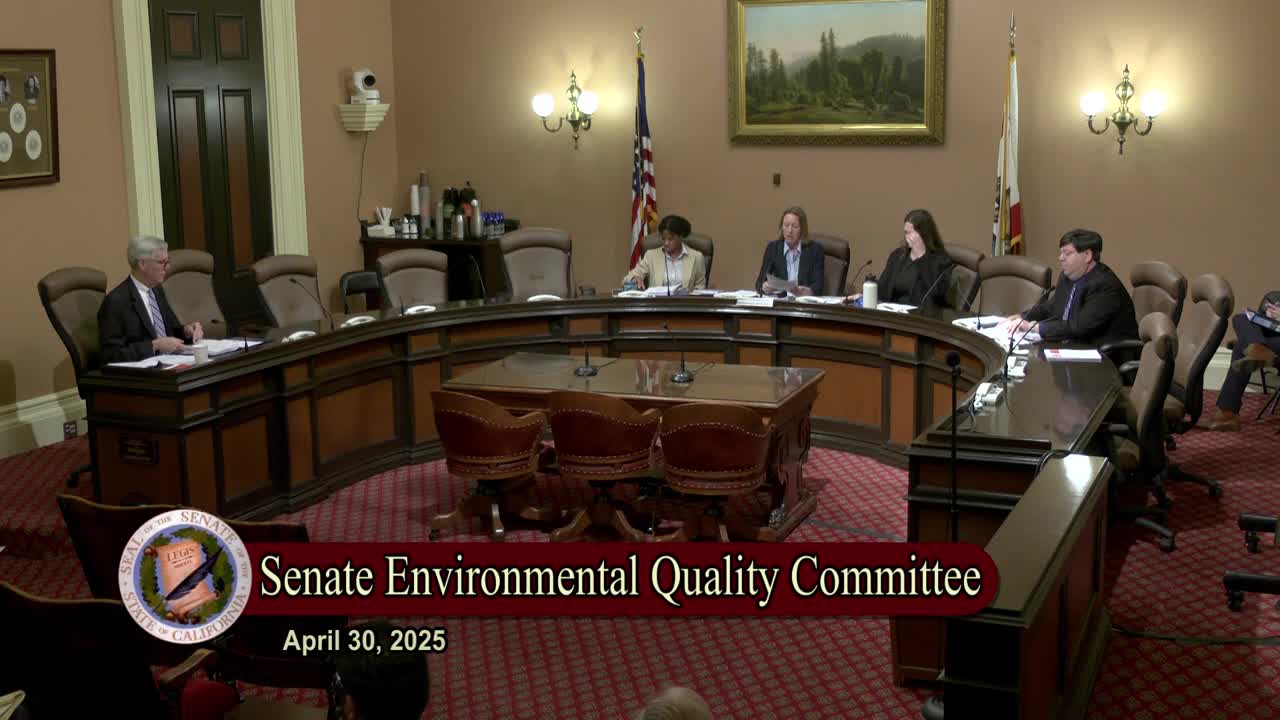 32MIN
Senate Standing Committee on Environmental Quality
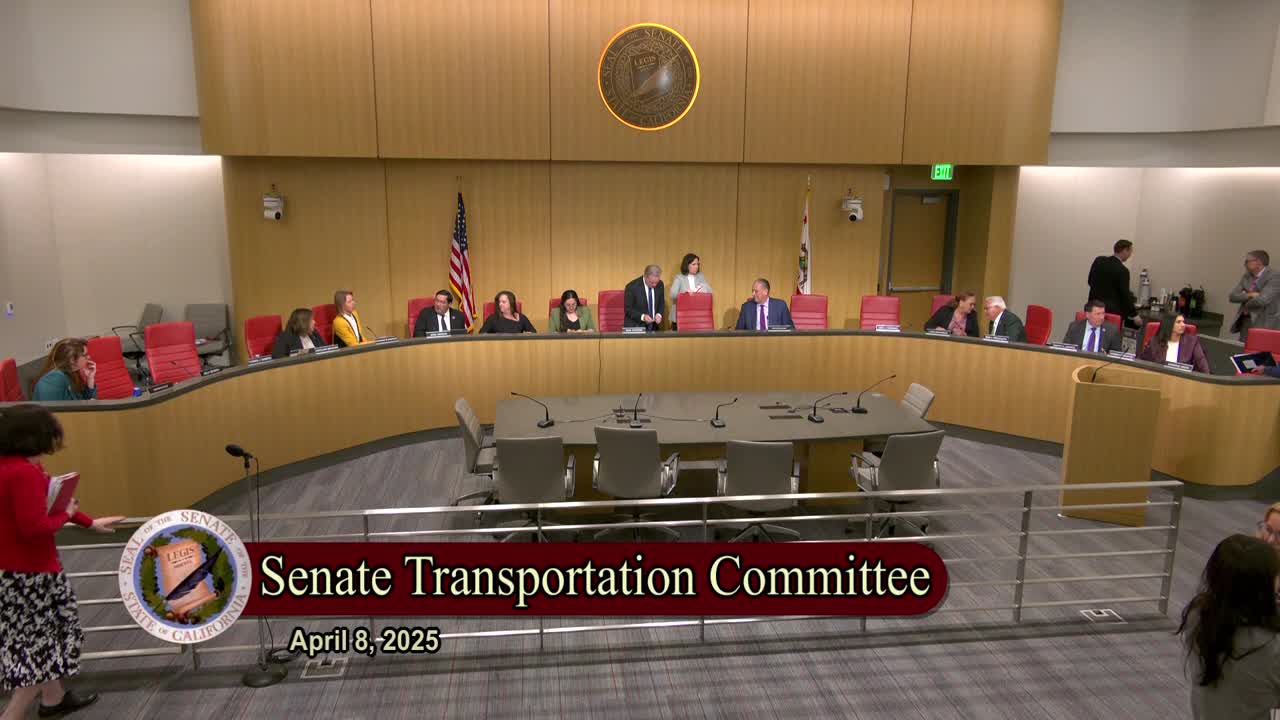 20MIN
Senate Standing Committee on Transportation
Bill Author

Bill Co-Author(s):