SB 378: Online marketplaces: illicit cannabis: reporting and liability.
- Session Year: 2025-2026
- House: Senate
- Latest Version Date: 2025-10-06
Current Status:
Passed
(2025-10-06: Chaptered by Secretary of State. Chapter 411, Statutes of 2025.)
Introduced
In Committee
Awaiting First Chamber Vote
Passed First Chamber
In Committee
Awaiting Second Chamber Vote
Passed Second Chamber
Enacted
What does this bill do?
The bill requires online cannabis and hemp marketplaces in California to disclose in their terms whether they allow ads or business listings from unlicensed sellers and whether they check seller licenses. It also requires a clear reporting tool that gives people a written receipt, periodic updates, and a final determination, and forces a prominent warning graphic if the site does not verify licenses. The bill bans paid ads that promote unlicensed cannabis or intoxicating hemp, lets consumers sue marketplaces that substantially helped cause harmful purchases and recover damages (higher if a child is harmed), and allows defenses when marketplaces can show they verified licenses or removed listings.
The summary is provided by generative AI which can make mistakes. For original language, please view the details in the table below.
(1)Existing law, the Control, Regulate and Tax Adult Use of Marijuana Act (AUMA), an initiative measure, authorizes a person who obtains a state license under AUMA and any applicable local ordinances to engage in commercial adult-use cannabis activity pursuant to that license, if conducted as prescribed. Existing law, the Medicinal and Adult-Use Cannabis Regulation and Safety Act (MAUCRSA), among other things, consolidates the licensure and regulation of commercial medicinal and adult-use cannabis activities, and requires the Department of Cannabis Control to administer its provisions.
Existing law, until January 1, 2028, requires a social media platform to create and post a policy statement regarding the use of the social media platform to illegally distribute controlled substances, including a link to the social media platforms reporting mechanism for illegal or harmful content or behavior on the social media platform, if one exists, and a general description of its policies and procedures for responding to law enforcement inquiries.
This bill, beginning on July 1, 2026, would require an online cannabis marketplace, as defined, to address in its terms of service whether it permits Californians to view the advertisements and business information of unlicensed sellers of cannabis or cannabis products on its marketplace and whether the marketplace verifies the licenses of sellers of cannabis or cannabis products whose advertisements and business information are viewable on its marketplace, as specified. The bill would require an online cannabis marketplace that does not verify those licenses to display a clear and conspicuous graphic that warns the consumer that the marketplace may be displaying, storing, or hosting unlicensed sellers of cannabis or cannabis products.
This bill would require an online cannabis marketplace to establish a clear and conspicuous mechanism within its internet-based service that allows an individual to report to the online cannabis marketplace the display, storing, or hosting on the marketplace of advertisements from, or business information about, an unlicensed seller of cannabis or cannabis products. The bill would require the mechanism to provide the individual who submits a report with written confirmation of receipt of the report, periodic updates, and final written determination, as specified.
This bill would impose certain penalties and relief depending on the violation of these provisions, as specified.
(2)The Sherman Food, Drug, and Cosmetic Law regulates the packaging, labeling, and advertising of food, beverages, and cosmetics and authorizes the State Department of Public Health to adopt regulations for the enforcement of that law, as specified. That law imposes various requirements specific to the manufacture and sale of industrial hemp products that are food or beverages, including a requirement for a certificate of analysis from an independent testing laboratory that confirms that the THC concentration does not exceed a specified amount. Existing emergency regulations require that industrial hemp food, food additives, beverages, and dietary supplements intended for human consumption have no detectable THC per serving.
This bill, beginning July 1, 2026, would require an online hemp marketplace, as defined, to establish a clear and conspicuous mechanism within its internet-based service that allows an individual to report to the online hemp marketplace an advertisement for an intoxicating hemp product on the marketplace, as specified. The bill would define intoxicating hemp product to include an inhalable hemp product, as further defined, with a detectable THC concentration. The bill would require the mechanism to provide the individual who submits a report with written confirmation of receipt of the report, periodic updates, and final written determination, as specified. The bill would impose specified penalties and relief for violations of these provisions.
(3)Existing law imposes strict liability upon persons who place a defective product on the market, including retailers engaged in the business of distributing goods to the public, for injuries caused by the product. Existing law also provides that each person is responsible for an injury occasioned to another by that persons want of ordinary care or skill, commonly known as negligence, in the management of their property or person, unless the injured person has, willfully or by want of ordinary care, brought the injury upon themselves.
This bill, beginning July 1, 2026, would prohibit an online marketplace from engaging in unlawful paid online advertising related to unlicensed sellers of cannabis or cannabis products or intoxicating hemp products, as specified. The bill would impose joint and several liability on an online marketplace that violates that prohibition, and is a substantial factor in an unlawful transaction between a consumer and an unlicensed seller of cannabis or a cannabis product, or between a consumer and a seller of an intoxicating hemp product, for damages caused to the consumer by the cannabis, cannabis product, or intoxicating hemp product, unless specified conditions are met. The bill would increase the amount that a prevailing plaintiff may recover depending on what the online marketplace had actual knowledge at the time of the unlawful transaction and whether the harm was suffered by a child, as described. The bill would provide various affirmative defenses to an action brought under these provisions, and would authorize an online marketplace to seek indemnification against an advertiser of cannabis, cannabis products, or intoxicating hemp products that misrepresented to the online marketplace that they were licensed or registered to sell that product, as specified.
(4)This bill would state that its provisions are severable.
(1)Existing law, the Control, Regulate and Tax Adult Use of Marijuana Act (AUMA), an initiative measure, authorizes a person who obtains a state license under AUMA and any applicable local ordinances to engage in commercial adult-use cannabis activity pursuant to that license, if conducted as prescribed. Existing law, the Medicinal and Adult-Use Cannabis Regulation and Safety Act (MAUCRSA), among other things, consolidates the licensure and regulation of commercial medicinal and adult-use cannabis activities, and requires the Department of Cannabis Control to administer its provisions.
Existing law, until January 1, 2028, requires a social media platform to create and post a policy statement regarding the use of the social media platform to illegally distribute controlled substances, including a link to the social media platforms reporting mechanism for illegal or harmful content or behavior on the social media platform, if one exists, and a general description of its policies and procedures for responding to law enforcement inquiries.
This bill bill, beginning on July 1, 2026, would require an online cannabis marketplace, as defined, to address in its terms of service whether it permits Californians to view the advertisements and business information of unlicensed sellers of cannabis or cannabis products on its marketplace and whether the marketplace verifies the licenses of sellers of cannabis or cannabis products whose advertisements and business information are viewable on its marketplace, as specified. The bill would require an online cannabis marketplace that does not verify those licenses to display a clear and conspicuous graphic that warns the consumer that the marketplace may be displaying, storing, or hosting unlicensed sellers of cannabis or cannabis products.
This bill would require an online cannabis marketplace to establish a clear and conspicuous mechanism within its internet-based service that allows an individual to report to the online cannabis marketplace the display, storing, or hosting on the marketplace of advertisements from, or business information about, an unlicensed seller of cannabis or cannabis products. The bill would require the mechanism to provide the individual who submits a report with written confirmation of receipt of the report, periodic updates, and final written determination, as specified.
This bill would impose certain penalties and relief depending on the violation of these provisions, as specified.
(2)The Sherman Food, Drug, and Cosmetic Law regulates the packaging, labeling, and advertising of food, beverages, and cosmetics and authorizes the State Department of Public Health to adopt regulations for the enforcement of that law, as specified. That law imposes various requirements specific to the manufacture and sale of industrial hemp products that are food or beverages, including a requirement for a certificate of analysis from an independent testing laboratory that confirms that the THC concentration does not exceed a specified amount. Existing emergency regulations require that industrial hemp food, food additives, beverages, and dietary supplements intended for human consumption have no detectable THC per serving.
This bill bill, beginning July 1, 2026, would require an online hemp marketplace, as defined, to establish a clear and conspicuous mechanism within its internet-based service that allows an individual to report to the online hemp marketplace an advertisement for an intoxicating hemp product on the marketplace, as specified. The bill would define intoxicating hemp product to include an inhalable hemp product, as further defined, with a detectable THC concentration. The bill would require the mechanism to provide the individual who submits a report with written confirmation of receipt of the report, periodic updates, and final written determination, as specified. The bill would impose specified penalties and relief for violations of these provisions.
(3)Existing law imposes strict liability upon persons who place a defective product on the market, including retailers engaged in the business of distributing goods to the public, for injuries caused by the product. Existing law also provides that each person is responsible for an injury occasioned to another by that persons want of ordinary care or skill, commonly known as negligence, in the management of their property or person, unless the injured person has, willfully or by want of ordinary care, brought the injury upon themselves.
This bill bill, beginning July 1, 2026, would prohibit an online marketplace from engaging in unlawful paid online advertising related to unlicensed sellers of cannabis or cannabis products or intoxicating hemp products, as specified. The bill would impose joint and several liability on an online marketplace that violates that prohibition, and is a substantial factor in an unlawful transaction between a consumer and an unlicensed seller of cannabis or a cannabis product, or between a consumer and a seller of an intoxicating hemp product, for damages caused to the consumer by the cannabis, cannabis product, or intoxicating hemp product, unless specified conditions are met. The bill would increase the amount that a prevailing plaintiff may recover depending on what the online marketplace knew or should have known had actual knowledge at the time of the unlawful transaction and whether the harm was suffered by a child, as described. The bill would provide various affirmative defenses to an action brought under these provisions, and would authorize an online marketplace to seek indemnification against an advertiser of cannabis, cannabis products, or intoxicating hemp products that misrepresented to the online marketplace that they were licensed or registered to sell that product, as specified.
(4)This bill would state that its provisions are severable.
(1)Existing law, the Control, Regulate and Tax Adult Use of Marijuana Act (AUMA), an initiative measure, authorizes a person who obtains a state license under AUMA and any applicable local ordinances to engage in commercial adult-use cannabis activity pursuant to that license, if conducted as prescribed. Existing law, the Medicinal and Adult-Use Cannabis Regulation and Safety Act (MAUCRSA), among other things, consolidates the licensure and regulation of commercial medicinal and adult-use cannabis activities, and requires the Department of Cannabis Control to administer its provisions.
Existing law, until January 1, 2028, requires a social media platform to create and post a policy statement regarding the use of the social media platform to illegally distribute controlled substances, including a link to the social media platforms reporting mechanism for illegal or harmful content or behavior on the social media platform, if one exists, and a general description of its policies and procedures for responding to law enforcement inquiries.
This bill would require an online cannabis marketplace, as defined, to address in its terms of service whether it permits Californians to view the advertisements and business information of unlicensed sellers of cannabis or cannabis products on its marketplace and whether the marketplace verifies the licenses of sellers of cannabis or cannabis products whose advertisements and business information are viewable on its marketplace, as specified. The bill would require an online cannabis marketplace that does not verify those licenses to display a clear and conspicuous graphic that warns the consumer that the marketplace may be displaying, storing, or hosting unlicensed sellers of cannabis or cannabis products.
This bill would require an online cannabis marketplace to establish a clear and conspicuous mechanism within its internet-based service that allows an individual to report to the online cannabis marketplace the display, storing, or hosting on the marketplace of advertisements from, or business information about, an unlicensed seller of cannabis or cannabis products. The bill would require the mechanism to provide the individual who submits a report with written confirmation of receipt of the report, periodic updates, and final written determination, as specified.
This bill would impose certain penalties and relief depending on the violation of these provisions, as specified.
(2)The Sherman Food, Drug, and Cosmetic Law regulates the packaging, labeling, and advertising of food, beverages, and cosmetics and authorizes the State Department of Public Health to adopt regulations for the enforcement of that law, as specified. That law imposes various requirements specific to the manufacture and sale of industrial hemp products that are food or beverages, including a requirement for a certificate of analysis from an independent testing laboratory that confirms that the THC concentration does not exceed a specified amount. Existing emergency regulations require that industrial hemp food, food additives, beverages, and dietary supplements intended for human consumption have no detectable THC per serving.
This bill would require an online hemp marketplace, as defined, to establish a clear and conspicuous mechanism within its internet-based service that allows an individual to report to the online hemp marketplace an advertisement for an intoxicating hemp product on the marketplace, as specified. The bill would define intoxicating hemp product to include an inhalable hemp product, as further defined, with a detectable THC concentration. The bill would require the mechanism to provide the individual who submits a report with written confirmation of receipt of the report, periodic updates, and final written determination, as specified. The bill would impose specified penalties and relief for violations of these provisions.
(3)Existing law imposes strict liability upon persons who place a defective product on the market, including retailers engaged in the business of distributing goods to the public, for injuries caused by the product. Existing law also provides that each person is responsible for an injury occasioned to another by that persons want of ordinary care or skill, commonly known as negligence, in the management of their property or person, unless the injured person has, willfully or by want of ordinary care, brought the injury upon themselves.
This bill would prohibit an online marketplace from engaging in paid online advertising related to unlicensed sellers of cannabis or cannabis products, products or intoxicating hemp products, or unregistered hemp products, as specified. The bill would impose strict joint and several liability on an online marketplace that violates that prohibition, and is a substantial factor in an unlawful transaction between a consumer and an unlicensed seller of cannabis or a cannabis product, or between a consumer and a seller of an intoxicating hemp product or an unregistered hemp product, for damages caused to the consumer by the cannabis or cannabis, cannabis product, the or intoxicating hemp product, or the unregistered hemp product, as provided. unless specified conditions are met. The bill would increase the amount that a prevailing plaintiff may recover depending on what the online market marketplace knew or should have known at the time of the unlawful transaction and whether the harm was suffered by a child, as described. The bill would provide various affirmative defenses to an action brought under these provisions, and would authorize an online marketplace to seek indemnification against an advertiser of cannabis, cannabis products, or intoxicating hemp products that misrepresented to the online marketplace that they were licensed or registered to sell that product, as specified.
(4)This bill would state that its provisions are severable.
(1)Existing law, the Control, Regulate and Tax Adult Use of Marijuana Act (AUMA), an initiative measure, authorizes a person who obtains a state license under AUMA and any applicable local ordinances to engage in commercial adult-use cannabis activity pursuant to that license, if conducted as prescribed. Existing law, the Medicinal and Adult-Use Cannabis Regulation and Safety Act (MAUCRSA), among other things, consolidates the licensure and regulation of commercial medicinal and adult-use cannabis activities, and requires the Department of Cannabis Control to administer its provisions.
Existing law, until January 1, 2028, requires a social media platform to create and post a policy statement regarding the use of the social media platform to illegally distribute controlled substances, including a link to the social media platforms reporting mechanism for illegal or harmful content or behavior on the social media platform, if one exists, and a general description of its policies and procedures for responding to law enforcement inquiries.
This bill would require an online cannabis marketplace, as defined, to address in its terms of service whether it permits Californians to view the advertisements and business information of unlicensed sellers of cannabis or cannabis products on its marketplace and whether the marketplace verifies the licenses of sellers of cannabis or cannabis products whose advertisements and business information are viewable on its marketplace, as specified. The bill would require an online cannabis marketplace that does not verify those licenses to display a clear and conspicuous graphic that warns the consumer that the marketplace may be displaying, storing, or hosting unlicensed sellers of cannabis or cannabis products.
This bill would require an online cannabis marketplace to establish a clear and conspicuous mechanism within its internet-based service that allows an individual to report to the online cannabis marketplace the display, storing, or hosting on the marketplace of advertisements from, or business information about, an unlicensed seller of cannabis or cannabis products. The bill would require the mechanism to provide the individual who submits a report with written confirmation of receipt of the report, periodic updates, and final written determination, as specified.
This bill would impose certain penalties and relief depending on the violation of these provisions, as specified.
(2)The Sherman Food, Drug, and Cosmetic Law regulates the packaging, labeling, and advertising of food, beverages, and cosmetics and authorizes the State Department of Public Health to adopt regulations for the enforcement of that law, as specified. That law imposes various requirements specific to the manufacture and sale of industrial hemp products that are food or beverages, including a requirement for a certificate of analysis from an independent testing laboratory that confirms that the THC concentration does not exceed a specified amount. Existing emergency regulations require that industrial hemp food, food additives, beverages, and dietary supplements intended for human consumption have no detectable THC per serving.
This bill would require an online hemp marketplace, as defined, to establish a clear and conspicuous mechanism within its internet-based service that allows an individual to report to the online hemp marketplace an advertisement for an intoxicating hemp product on the marketplace, as specified. The bill would define intoxicating hemp product to include an inhalable hemp product, as further defined, with a detectable THC concentration. The bill would require the mechanism to provide the individual who submits a report with written confirmation of receipt of the report, periodic updates, and final written determination, as specified. The bill would impose specified penalties and relief for violations of these provisions.
(3)Existing law imposes strict liability upon persons who place a defective product on the market, including retailers engaged in the business of distributing goods to the public, for injuries caused by the product. Existing law also provides that each person is responsible for an injury occasioned to another by that persons want of ordinary care or skill, commonly known as negligence, in the management of their property or person, unless the injured person has, willfully or by want of ordinary care, brought the injury upon themselves.
This bill would prohibit an online marketplace from engaging in paid online advertising related to unlicensed sellers of cannabis or cannabis products, intoxicating hemp products, or unregistered hemp products, as specified. The bill would impose strict liability on an online marketplace that violates that prohibition, and is a substantial factor in an unlawful transaction between a consumer and an unlicensed seller of cannabis or a cannabis product, or between a consumer and a seller of an intoxicating hemp product or an unregistered hemp product, for damages caused to the consumer by the cannabis or cannabis product, the intoxicating hemp product, or the unregistered hemp product, as provided. The bill would increase the amount that a prevailing plaintiff may recover depending on what the online market knew or should have known at the time of the unlawful transaction and whether the harm was suffered by a child, as described.
(4)This bill would state that its provisions are severable.
(1)Existing law, the Control, Regulate and Tax Adult Use of Marijuana Act (AUMA), an initiative measure, authorizes a person who obtains a state license under AUMA and any applicable local ordinances to engage in commercial adult-use cannabis activity pursuant to that license, if conducted as prescribed. Existing law, the Medicinal and Adult-Use Cannabis Regulation and Safety Act (MAUCRSA), among other things, consolidates the licensure and regulation of commercial medicinal and adult-use cannabis activities, and requires the Department of Cannabis Control to administer its provisions.
Existing law, until January 1, 2028, requires a social media platform to create and post a policy statement regarding the use of the social media platform to illegally distribute controlled substances, including a link to the social media platforms reporting mechanism for illegal or harmful content or behavior on the social media platform, if one exists, and a general description of its policies and procedures for responding to law enforcement inquiries.
This bill would require an online cannabis marketplace, as defined, to address in its terms of service whether it permits Californians to view the advertisements and business information of unlicensed sellers of cannabis or cannabis products on its marketplace and whether the marketplace verifies the licenses of sellers of cannabis or cannabis products whose advertisements and business information are viewable on its marketplace, as specified. The bill would require an online cannabis marketplace that does not verify those licenses to display a clear and conspicuous graphic that warns the consumer about various risks associated with cannabis from unlicensed sellers before the consumer can view or engage with the marketplace. that the marketplace may be displaying, storing, or hosting unlicensed sellers of cannabis or cannabis products.
This bill would require an online cannabis marketplace to establish a clear and conspicuous mechanism within its internet-based service that allows an individual to report to the online cannabis marketplace the display, storing, or hosting on the marketplace of advertisements from, or business information about, an unlicensed seller of cannabis or cannabis products. The bill would require the mechanism to provide the individual who submits a report with written confirmation of receipt of the report, periodic updates, and final written determination, as specified.
This bill would impose certain penalties and relief, and would authorize various parties to bring civil enforcement actions, relief depending on the violation of these provisions, as specified.
(2)The Sherman Food, Drug, and Cosmetic Law regulates the packaging, labeling, and advertising of food, beverages, and cosmetics and authorizes the State Department of Public Health to adopt regulations for the enforcement of that law, as specified. That law imposes various requirements specific to the manufacture and sale of industrial hemp products that are food or beverages, including a requirement for a certificate of analysis from an independent testing laboratory that confirms that the THC concentration does not exceed a specified amount. Existing emergency regulations require that industrial hemp food, food additives, beverages, and dietary supplements intended for human consumption have no detectable THC per serving.
This bill would require an online hemp marketplace, as defined, to establish a clear and conspicuous mechanism within its internet-based service that allows an individual to report to the online hemp marketplace an advertisement for an intoxicating hemp product on the marketplace, as specified. The bill would define intoxicating hemp product to include an inhalable hemp product, as further defined, with a detectable THC concentration. The bill would require the mechanism to provide the individual who submits a report with written confirmation of receipt of the report, periodic updates, and final written determination, as specified. The bill would authorize certain parties to bring a civil action, including, among others, a licensed seller of cannabis or cannabis products and the Attorney General. The bill would impose specified penalties and relief for violations of these provisions.
(3)Existing law imposes strict liability upon persons who place a defective product on the market, including retailers engaged in the business of distributing goods to the public, for injuries caused by the product. Existing law also provides that each person is responsible for an injury occasioned to another by that persons want of ordinary care or skill, commonly known as negligence, in the management of their property or person, unless the injured person has, willfully or by want of ordinary care, brought the injury upon themselves.
This bill would prohibit an online marketplace from engaging in paid online advertising related to unlicensed sellers of cannabis or cannabis products, intoxicating hemp products, or unregistered hemp products, as specified. The bill would impose strict liability on an online marketplace that violates that prohibition, and is a substantial factor in an unlawful transaction between a consumer and an unlicensed seller of cannabis or a cannabis product, or between a consumer and a seller of an intoxicating hemp product or an unregistered hemp product, for damages caused to the consumer by the cannabis or cannabis product, the intoxicating hemp product, or the unregistered hemp product, as provided. The bill would increase the amount that a prevailing plaintiff may recover depending on what the online market knew or should have known at the time of the unlawful transaction and whether the harm was suffered by a child, as described.
(4)This bill would state that its provisions are severable.
(1)Existing law, the Control, Regulate and Tax Adult Use of Marijuana Act (AUMA), an initiative measure, authorizes a person who obtains a state license under AUMA and any applicable local ordinances to engage in commercial adult-use cannabis activity pursuant to that license, if conducted as prescribed. Existing law, the Medicinal and Adult-Use Cannabis Regulation and Safety Act (MAUCRSA), among other things, consolidates the licensure and regulation of commercial medicinal and adult-use cannabis activities, and requires the Department of Cannabis Control to administer its provisions.
Existing law, until January 1, 2028, requires a social media platform to create and post a policy statement regarding the use of the social media platform to illegally distribute controlled substances, including a link to the social media platforms reporting mechanism for illegal or harmful content or behavior on the social media platform, if one exists, and a general description of its policies and procedures for responding to law enforcement inquiries.
This bill would require an online cannabis marketplace, as defined, to address in its terms of service whether it permits Californians to view the advertisements and business information of unlicensed sellers of cannabis or cannabis products on its marketplace and whether the marketplace verifies the licenses of sellers of cannabis or cannabis products whose advertisements and business information are viewable on its marketplace, as specified. The bill would require an online cannabis marketplace that does not verify those licenses to display a clear and conspicuous graphic that warns the consumer about various risks associated with cannabis from unlicensed sellers before the consumer can view or engage with the marketplace.
This bill would require an online cannabis marketplace to establish a clear and conspicuous mechanism within its internet-based service that allows an individual to report to the online cannabis marketplace the display, storing, or hosting on the marketplace of advertisements from, or business information about, an unlicensed seller of cannabis or cannabis products. The bill would require the mechanism to provide the individual who submits a report with written confirmation of receipt of the report, periodic updates, and final written determination, as specified.
This bill would impose certain penalties and relief, and would authorize various parties to bring civil enforcement actions, depending on the violation of these provisions, as specified.
(2)The Sherman Food, Drug, and Cosmetic Law regulates the packaging, labeling, and advertising of food, beverages, and cosmetics and authorizes the State Department of Public Health to adopt regulations for the enforcement of that law, as specified. That law imposes various requirements specific to the manufacture and sale of industrial hemp products that are food or beverages, including a requirement for a certificate of analysis from an independent testing laboratory that confirms that the THC concentration does not exceed a specified amount. Existing emergency regulations require that industrial hemp food, food additives, beverages, and dietary supplements intended for human consumption have no detectable THC per serving.
This bill would require an online hemp marketplace, as defined, to establish a clear and conspicuous mechanism within its internet-based service that allows an individual to report to the online hemp marketplace an advertisement for an intoxicating hemp product on the marketplace, as specified. The bill would define intoxicating hemp product to include an inhalable hemp product, as further defined, with a detectable THC concentration. The bill would require the mechanism to provide the individual who submits a report with written confirmation of receipt of the report, periodic updates, and final written determination, as specified. The bill would authorize certain parties to bring a civil action, including, among others, a licensed seller of cannabis or cannabis products and the Attorney General. The bill would impose specified penalties and relief for violations of these provisions.
(3)Existing law imposes strict liability upon persons who place a defective product on the market, including retailers engaged in the business of distributing goods to the public, for injuries caused by the product. Existing law also provides that each person is responsible for an injury occasioned to another by that persons want of ordinary care or skill, commonly known as negligence, in the management of their property or person, unless the injured person has, willfully or by want of ordinary care, brought the injury upon themself. themselves.
This bill would prohibit an online marketplace from engaging in paid online advertising related to unlicensed sellers of cannabis or cannabis products, intoxicating hemp products, or unregistered hemp products, as specified. The bill would impose strict liability on an online marketplace that violates that prohibition, and is a substantial factor in an unlawful transaction between a consumer and an unlicensed seller of cannabis or a cannabis product, or between a consumer and a seller of an intoxicating hemp product or an unregistered hemp product, for damages caused to the consumer by the cannabis or cannabis product, the intoxicating hemp product, or the unregistered hemp product, as provided. The bill would increase the amount that a prevailing plaintiff may recover depending on what the online market knew or should have known at the time of the unlawful transaction and whether the harm was suffered by a child, as described. The bill would provide additional statutory damages if the above provisions are stricken or enjoined in final judgment, and an online marketplace breaches its responsibility of ordinary care and skill and is a substantial factor in causing harm to a consumer, as specified.
(4)This bill would state that its provisions are severable.
(1)Existing law, the Control, Regulate and Tax Adult Use of Marijuana Act (AUMA), an initiative measure, authorizes a person who obtains a state license under AUMA and any applicable local ordinances to engage in commercial adult-use cannabis activity pursuant to that license, if conducted as prescribed. Existing law, the Medicinal and Adult-Use Cannabis Regulation and Safety Act (MAUCRSA), among other things, consolidates the licensure and regulation of commercial medicinal and adult-use cannabis activities, and requires the Department of Cannabis Control to administer its provisions.
Existing law, until January 1, 2028, requires a social media platform to create and post a policy statement regarding the use of the social media platform to illegally distribute controlled substances, including a link to the social media platforms reporting mechanism for illegal or harmful content or behavior on the social media platform, if one exists, and a general description of its policies and procedures for responding to law enforcement inquiries.
This bill would require an online cannabis marketplace, as defined, to address in its terms of service whether it permits Californians to view the advertisements and business information of unlicensed sellers of cannabis or cannabis products on its marketplace and whether the marketplace verifies the licenses of sellers of cannabis or cannabis products whose advertisements and business information are viewable on its marketplace, as specified. The bill would require an online cannabis marketplace that does not verify those licenses to display a clear and conspicuous graphic that warns the consumer about various risks associated with cannabis from unlicensed sellers before the consumer can view or engage with the marketplace.
This bill would require an online cannabis marketplace to establish a prominent clear and conspicuous mechanism within its internet-based service that allows an individual to report to the online cannabis marketplace the display, storing, or hosting on the marketplace of advertisements from, or business information about, an unlicensed seller of cannabis or cannabis products. The bill would require the mechanism to provide the individual who submits a report with written confirmation of receipt of the report, periodic updates, and final written determination, as specified.
This bill would impose certain penalties and relief, and would authorize various parties to bring civil enforcement actions, depending on the violation of these provisions, as specified.
(2)The Sherman Food, Drug, and Cosmetic Law regulates the packaging, labeling, and advertising of food, beverages, and cosmetics and authorizes the State Department of Public Health to adopt regulations for the enforcement of that law, as specified. That law imposes various requirements specific to the manufacture and sale of industrial hemp products that are food or beverages, including a requirement for a certificate of analysis from an independent testing laboratory that confirms that the THC concentration does not exceed a specified amount. Existing emergency regulations require that industrial hemp food, food additives, beverages, and dietary supplements intended for human consumption have no detectable THC per serving.
This bill would require an online hemp marketplace, as defined, to establish a prominent clear and conspicuous mechanism within its internet-based service that allows an individual to report to the online hemp marketplace an advertisement for an intoxicating hemp product on the marketplace, as specified. The bill would define intoxicating hemp product to include an inhalable hemp product, as further defined, with a detectable THC concentration. The bill would require the mechanism to provide the individual who submits a report with written confirmation of receipt of the report, periodic updates, and final written determination, as specified. The bill would authorize certain parties to bring a civil action, including, among others, a licensed seller of cannabis or cannabis products and the Attorney General. The bill would impose specified penalties and relief for violations of these provisions.
(3)Existing law imposes strict liability upon persons who place a defective product on the market, including retailers engaged in the business of distributing goods to the public, for injuries caused by the product. Existing law also provides that each person is responsible for an injury occasioned to another by that persons want of ordinary care or skill, commonly known as negligence, in the management of their property or person, unless the injured person has, willfully or by want of ordinary care, brought the injury upon themself.
TheThis bill would prohibit an online marketplace from engaging in paid online advertising related to unlicensed sellers of cannabis or cannabis products, intoxicating hemp products, or unregistered hemp products, as specified. The bill would impose strict liability on an online marketplace that facilitated the connection between violates that prohibition, and is a substantial factor in an unlawful transaction between a consumer and an unlicensed seller of cannabis or a cannabis product product, or between a consumer and a seller of an intoxicating hemp product or an unregistered hemp product, for damages caused to the consumer by the cannabis or cannabis product, the intoxicating hemp product, or the unregistered hemp product, as provided. The bill would also impose strict liability on an online marketplace that facilitated the connection between a consumer and a seller of an intoxicating hemp product for damages caused to the consumer by the intoxicating hemp product, as provided. The bill would increase the amount that a prevailing plaintiff may recover depending on what the online market knew or should have known at the time it facilitated the connection of the unlawful transaction and whether the harm was suffered by a child, as described. The bill would provide additional statutory damages if the above provisions are stricken or enjoined in final judgment, and an online marketplace breaches its responsibility of ordinary care and skill and is a substantial factor in causing harm to a consumer, as specified.
(4)This bill would state that its provisions are severable.
(1)Existing law, the Control, Regulate and Tax Adult Use of Marijuana Act (AUMA), an initiative measure, authorizes a person who obtains a state license under AUMA and any applicable local ordinances to engage in commercial adult-use cannabis activity pursuant to that license, if conducted as prescribed. Existing law, the Medicinal and Adult-Use Cannabis Regulation and Safety Act (MAUCRSA), among other things, consolidates the licensure and regulation of commercial medicinal and adult-use cannabis activities, and requires the Department of Cannabis Control to administer its provisions.
Existing law, until January 1, 2028, requires a social media platform to create and post a policy statement regarding the use of the social media platform to illegally distribute controlled substances, including a link to the social media platforms reporting mechanism for illegal or harmful content or behavior on the social media platform, if one exists, and a general description of its policies and procedures for responding to law enforcement inquiries.
This bill would require an online cannabis marketplace, as defined, to address in its terms of service whether it permits Californians to view the advertisements and business information of unlicensed sellers of cannabis or cannabis products on its marketplace and whether the marketplace verifies the licenses of sellers of cannabis or cannabis products whose advertisements and business information are viewable on its marketplace, as specified. The bill would require an online cannabis marketplace that does not verify those licenses to display a graphic that warns the consumer about various risks associated with cannabis from unlicensed sellers before the consumer can view or engage with the marketplace.
This bill would require an online cannabis marketplace to establish a prominent mechanism within its internet-based service that allows an individual to report to the online cannabis marketplace the display, storing, or hosting on the marketplace of advertisements from, or business information about, an unlicensed seller of cannabis or cannabis products. The bill would require the mechanism to provide the individual who submits a report with written confirmation of receipt of the report, periodic updates, and final written determination, as specified.
This bill would impose certain penalties and relief, and would authorize various parties to bring civil enforcement actions, depending on the violation of these provisions, as specified.
(2)The Sherman Food, Drug, and Cosmetic Law regulates the packaging, labeling, and advertising of food, beverages, and cosmetics and authorizes the State Department of Public Health to adopt regulations for the enforcement of that law, as specified. That law imposes various requirements specific to the manufacture and sale of industrial hemp products that are food or beverages, including a requirement for a certificate of analysis from an independent testing laboratory that confirms that the THC concentration does not exceed a specified amount. Existing emergency regulations require that industrial hemp food, food additives, beverages, and dietary supplements intended for human consumption have no detectable THC per serving.
This bill would require an online hemp marketplace, as defined, to establish a prominent mechanism within its internet-based service that allows an individual to report to the online hemp marketplace an advertisement for an intoxicating hemp product on the marketplace, as specified. The bill would require the mechanism to provide the individual who submits a report with written confirmation of receipt of the report, periodic updates, and final written determination, as specified. The bill would authorize certain parties to bring a civil action, including, among others, a licensed seller of cannabis or cannabis products and the Attorney General. The bill would impose specified penalties and relief for violations of these provisions.
(3)Existing law imposes strict liability upon persons who place a defective product on the market, including retailers engaged in the business of distributing goods to the public, for injuries caused by the product.
The bill would impose strict liability on an online marketplace that facilitated the connection between a consumer and an unlicensed seller of cannabis or a cannabis product for damages caused to the consumer by the cannabis or cannabis product, as provided. The bill would also impose strict liability on an online marketplace that facilitated the connection between a consumer and a seller of an intoxicating hemp product for damages caused to the consumer by the intoxicating hemp product, as provided. The bill would increase the amount that a prevailing plaintiff may recover depending on what the online market knew or should have known at the time it facilitated the connection and whether the harm was suffered by a child, as described.
(4)This bill would state that its provisions are severable.
The Legislature finds and declares all of the following:
(a)(1)In September 2024, the Los Angeles County Board of Supervisors adopted a resolution affirming the connection between the proliferation of unlawful, unlicensed, uninspected, and unregulated cannabis and the knowing, profit-driven behavior of internet companies:
Unfortunately, distinguishing between licensed and unlicensed dispensaries is now more difficult than ever. When searching for a cannabis dispensary, search engine and GPS platforms such as Google and Apple Maps do not distinguish between licensed and unlicensed businesses, but instead give results that contain, more often than not, unlicensed dispensaries, thus legitimizing problematic establishments selling unregulated and often dangerous products for general public consumption. Regulating online search engines and GPS platforms will ensure only legal, licensed dispensaries appear in results from those platforms and protect the safety of the public.
(2)The unanimously adopted resolution cites a February 2024 report by the Pew Research Center that found there were nearly 1,500 cannabis dispensaries in the County of Los Angeles; as of 2022, only 384 of them were properly licensed.
(3)Investigative reports affirm the vast scope of the problem. According to the Los Angeles Times, the black market is booming in plain sight, luring customers away from aboveboard retailers with their cheaper if untested and unregulated product.
(4)Law enforcement and other experts also affirm that the problem is vast:
(A)Bill Jones, the head of enforcement for the states Department of Cannabis Control, has stated [t]he black market is very pervasive and its definitely larger than the legal market.
(B)According to a study by Beau Whitney, founder of cannabis economics research firm Whitney Economics, illicit marijuana sales make up more than half the states marijuana sales.
(C)Another expert assert more than two out of three cannabis purchases are made in the illicit market, and evidence suggests that disparity is getting worse. Legal sales have been on a two-year slide.
(5)The nations most populous county is not alone in observing the role internet companies play in facilitating the sale of illegal and dangerous cannabis. In February, New York Governor Kathy Hochul pleaded with Google and Yelp to delist illegitimate cannabis dispensaries as the state began to see the rollout of its nascent recreational cannabis industry, as the Associated Press reported at the time. Initial results were not promising, as many illicit dispensaries remained on the sites while some of New Yorks fledgling legal dispensaries were repeatedly delisted.
(b)Unlawful cannabis sales pose a unique peril to the states children. Recently, the state seized an astonishing 2,200,000 illicit cannabis packages designed to look like candy and sweets. As The Los Angeles Times reported in an August 2024 article, the packages were:
... designed to mimic popular food and candy, including Sweet Tarts sour gummies and Twinkies adorned with rainbow sprinkles, which officials said could make them attractive to children. Such packages would not be permitted in the legal marijuana market.
(c)That internet companies openly and profitably facilitate criminal enterprises selling inherently dangerous products poses a grave risk to public safety. As the Los Angeles Times wrote in a September 2022 article, Unlicensed dispensaries have become hotbeds of crime. Sometimes the operators are the perpetrators, authorities say, selling cocaine and methamphetamine alongside cannabis. At other times, they are the victims. In August 2021, a man was gunned down in the doorway of the illegal dispensary he ran in East Los Angeles.
(d)(1)Law enforcement leaders say law enforcement raids are barely slowing the black market. Siskiyou County Sheriff Jeremiah LaRue has stated that [i]f we examine the statistics, it is clear that these operations are not effectively or aggressively putting a dent into the illegal market.
(2)As the sheriff observed, operations by the state Department of Justices Eradication and Prevention of Illicit Cannabis program, or EPIC, have seized about 750,000 cannabis plants in 36 counties. Yet, Siskiyou County alone produces an estimated 12,000,000 to 16,000,000 illegal plants per year. Therefore, if EPIC only focused on Siskiyou for a year, it would eradicate just 6 percent of the estimated local black market, he said.
(e)In addition to posing risks to the public health, especially children, in addition to endangering public safety, unlawful cannabis also poses environmental risks. As the Guardian reported, Rick Dean, the community development director for Siskiyous environmental health division, is spending ever more of his time on the consequences of illegal cannabis production. One of the challenges is the daily accumulation and disposal of human waste and garbage that is buried on site. Many are plastic containers left over from fertilizers and pesticides.
(f)The Legislature finds and declares that internet companies listing of unlawful cannabis sellers when those companies have readily available, inexpensive, and public resources to distinguish between licensed and unlicensed cannabis businesses poses a direct, immediate, and urgent risk to the public health and safety of its citizens, especially its children.
(g)The Legislature finds and declares that such companies routinely prevent content that they disfavor from appearing on their products. For example, Metas Facebook blocks nudity, Googles YouTube blocks copyrighted songs, and Metas Instagram was exposed as being able to detect and intercept child sex abuse material, permitting users to click through and see it after being warned.
(h)The Legislature finds and declares that, for all the aforementioned reasons, internet companies must shoulder some accountability for their role in facilitating criminal enterprises that pose direct, immediate, and urgent risks to public health and safety.
SEC. 2.Chapter 31.3 (commencing with Section 22943) is added to Division 8 of the Business and Professions Code, to read:31.3.Online Cannabis Marketplaces22943.For purposes of this chapter, the following definitions apply:
(a)Advertisement means an advertisement about, or an offer of, the sale of cannabis or a cannabis product.
(b)Business information means an internet website, mobile application, address, or telephone number through which a seller offers to sell, or a consumer makes a purchase of, cannabis or a cannabis product.
(c)Cannabis has the same meaning as that term is defined in Section 26001.
(d)Cannabis product has the same meaning as cannabis products as defined in Section 26001.
(e)Clear and conspicuous means in larger type than the surrounding text, or in contrasting type, font, or color to the surrounding text of the same size, or set off from the surrounding text of the same size by symbols or other marks that call attention to the language. The Attorney General may promulgate regulations further defining clear and conspicuous.
(f)License means a license issued by the Department of Cannabis Control pursuant to Division 10 (commencing with Section 26000).
(g)Online cannabis marketplace means an internet website, online service, online application, or mobile application, or a portion thereof, including a social media platform, as defined in Section 1798.99.20 of the Civil Code, that does any of the following in California:
(1)Transmits or otherwise communicates between a third-party seller and consumer an offer for the sale of cannabis or a cannabis product that is accepted by the consumer.
(2)Offers for sale cannabis or a cannabis product.
(3)Connects a third-party seller of cannabis or cannabis products and a consumer.
(h)Third-party seller means a person or entity, independent of an online marketplace, who sells, offers to sell, or contracts with an online marketplace to sell a product in the state by or through an online marketplace.
22943.2.(a)An online cannabis marketplace shall address in its terms of service both of the following:
(1)Whether the online cannabis marketplace permits advertisements from, or business information about, unlicensed sellers of cannabis or cannabis products to be viewed by Californians on its marketplace.
(2)Whether the online cannabis marketplace verifies that a seller of cannabis or cannabis products has a valid, unexpired license by consulting the license look-up function on the Department of Cannabis Controls internet website established pursuant to Section 26012.5 before displaying, storing, or hosting the sellers advertisements or business information in a manner that is viewable to Californians.
(b)(1)An online cannabis marketplace shall establish a clear and conspicuous mechanism within its internet-based service that allows any individual, whether or not that individual has a profile on the internet-based service or is a user, to report to the online cannabis marketplace the display, storing, or hosting on the marketplace of advertisements from, or business information about, an unlicensed seller of cannabis or cannabis products.
(2)The mechanism required by this subdivision shall meet all of the following criteria:
(A)The mechanism shall allow, but not require, an individual to do both of the following:
(i)Upload a screenshot of the content that offers evidence of advertisements from, or business information about, the unlicensed seller on the marketplace.
(ii)Provide the marketplace with basic identifying information, such as an account identifier or URL, sufficient to permit marketplace to locate the reported material.
(B)The mechanism shall include, but not be limited to, a method for the marketplace to contact a reporting individual in writing, including a telephone number for purposes of sending text messages, an email address, or another reasonable electronic method of communication.
(C)The mechanism shall provide, within 36 hours of receipt of a report, a written confirmation to the reporting individual that the marketplace has received that individuals report.
(D)(i)The mechanism shall provide periodic written updates to the reporting individual as to the status of the marketplaces handling of the reported material using the method of communication pursuant to subparagraph (B).
(ii)The first written update required by clause (i) shall be provided as soon as reasonably feasible but no later than 14 days after the date on which the written confirmation required under subparagraph (C) is provided. Subsequent written updates shall be provided as soon as reasonably feasible but no later than 14 days after the most recent written update provided pursuant to this clause, until the final written determination required by subparagraph (F).
(E)Each report shall receive a review by a natural person.
(F)(i)The mechanism shall issue a final written determination to the reporting individual within 30 days of receiving the report. The final written determination shall state one of the following:
(I)The report has provided evidence that an advertisement from, or business information about, an unlicensed seller of cannabis or cannabis products was displayed, stored, or hosted on the marketplace and the sellers advertisements and business information have been blocked from being viewable on the marketplace.
(II)The report has provided evidence that an advertisement from, or business information about, an unlicensed seller of cannabis or cannabis products was or is displayed, stored, or hosted on the marketplace and the sellers advertisements and business information will not be blocked from being viewable on the marketplace. The final written determination issued pursuant to this subclause shall also state that the marketplace acknowledges that it is aware that the seller is unlicensed and whether the marketplace has referred the report to a law enforcement agency. If the marketplace has referred the report to a law enforcement agency, the final written determination shall provide a true and correct copy of the report that the marketplace made to the law enforcement agency.
(III)The report lacks evidence that the identified seller of cannabis or cannabis products who was or is displayed, stored, or hosted on the marketplace is unlicensed and the sellers advertisements and business information will not be blocked from being viewable on the marketplace.
(IV)The report lacks evidence that the identified seller of cannabis or cannabis products whose advertisement or business information was or is displayed, stored, or hosted on the marketplace is unlicensed and the sellers advertisements and business information will be blocked from being viewable on the marketplace for reasons unrelated to the sellers licensing status.
(V)The report lacks evidence that an advertisement or business information of a seller of cannabis or cannabis products was displayed, stored, or hosted on the marketplace.
(ii)If the marketplace cannot comply with clause (i) within 30 days due to circumstances beyond the reasonable control of the marketplace, the marketplace shall comply with clause (i) no later than 60 days after the date on which the report was received. If this clause applies, the marketplace shall promptly provide written notice of the delay, no later than 48 hours from the time the marketplace knew the delay was likely to occur, to the reporting individual.
(c)This section shall not be interpreted to prohibit any individual from reporting activity by an unlicensed seller of cannabis or cannabis products without the use of the mechanism established in subdivision (b).
(d)(1)Any online cannabis marketplace that violates a requirement of this section shall be liable for a civil penalty of not more than ten thousand dollars ($10,000) for each violation and for compensatory damages, punitive damages, and any civil remedies, penalties, or sanctions for harms caused by the marketplaces failure to comply with this chapter, which damages shall be adjudicated and awarded apart from any harms attributable to the existence of the reported content alone.
(2)Any person may bring an action to enforce this section. In addition to other equitable relief, the court may order injunctive relief to obtain compliance with this section and shall award reasonable attorneys fees and costs to the prevailing plaintiff.
(3)A person shall not bring an action to enforce paragraph (2) of subdivision (b) if the marketplace, upon receipt of the advertisement or business information through the mechanism, removes the reported advertisement or business information within 48 hours.
(4)It is not a violation of paragraph (2) of subdivision (b) if the marketplace, upon receipt of the report, removes the reported advertisement or business information within 48 hours.
(5)Each day an online cannabis marketplace is in violation of a requirement of this section constitutes a separate violation.
(e)The duties and obligations imposed by this section are cumulative with any other duties or obligations imposed under other law and shall not be construed to relieve any party from any duties or obligations imposed under other law.
22943.4.(a)If an online cannabis marketplace does not verify that a seller of cannabis or cannabis products is licensed as described in paragraph (2) of subdivision (a) of Section 22943.2, the online cannabis marketplace shall, immediately after a consumer has accessed the marketplace, interpose a clear and conspicuous graphic that a consumer must acknowledge and click through before viewing or engaging with the marketplace. The graphic shall warn the consumer that the marketplace may be displaying, storing, or hosting unlicensed sellers of cannabis or cannabis products.
(b)Any person who identifies an online cannabis marketplace that displays, stores, or hosts an advertisement from, or business information about, an unlicensed seller of cannabis or cannabis products in violation of subdivision (a) may initiate an action to enforce subdivision (a). A person who prevails in such an action shall be entitled to both of the following:
(1)Reasonable attorneys fees and costs.
(2)A civil penalty of up to two hundred fifty thousand dollars ($250,000).
(c)An online cannabis marketplace that violates an injunction requiring compliance with this section shall be prohibited from operating in California until a receiver appointed by the court issuing the injunction affirms to the court that the marketplace is in compliance. In any action to enforce an injunction requiring compliance with this section, the party obtaining enforcement shall be entitled to an award of its reasonable attorneys fees and costs and a civil penalty of up to five hundred thousand dollars ($500,000).
(d)This section shall not be construed as prohibiting a public prosecutor, as described in Section 17204, from bringing an appropriate action to enforce this section.
22943.6.This chapter shall become operative on July 1, 2026.
SEC. 3.Chapter 31.4 (commencing with Section 22944) is added to Division 8 of the Business and Professions Code, to read:31.4.Online Hemp Marketplaces22944.For purposes of this chapter, the following definitions apply:
(a)Advertisement means an advertisement about, or an offer of, a sale of an intoxicating hemp product.
(b)Business information means an internet website, mobile application, address, or telephone number through which a seller offers to sell, or a consumer makes a purchase of, an intoxicating hemp product.
(c)Clear and conspicuous means in larger type than the surrounding text, or in contrasting type, font, or color to the surrounding text of the same size, or set off from the surrounding text of the same size by symbols or other marks that call attention to the language. The Attorney General may promulgate regulations further defining clear and conspicuous.
(d)Industrial hemp product has the same meaning as that term is defined in subdivision (g) of Section 111920 of the Health and Safety Code.
(e)Inhalable hemp product includes any hemp product that can be used by inhalation, including, but not limited to, hemp flower, hemp prerolls, hemp vaping cartridges, liquids, or prefilled devices, hemp shatter, wax, budder, or other hemp derived concentrates that can be used for inhalation.
(f)Intoxicating hemp product means either of the following:
(1)A hemp product whose THC concentration exceeds the amounts allowable under the Sherman Food, Drug, and Cosmetic Law (Part 5 (commencing with Section 109875) of Division 104 of the Health and Safety Code) or any rules or regulations adopted thereunder, and is unlawful to sell without a license.
(2)An inhalable hemp product with a detectable THC concentration, and is unlawful to sell without a license.
(g) Licensed means licensed pursuant to Division 10 (commencing with Section 26000).
(h) Online hemp marketplace means an internet website, online service, online application, or mobile application, or a portion thereof, including a social media platform, as defined in Section 1798.99.20 of the Civil Code, that, as applied to products containing hemp for human consumption, including, but not limited to, cosmetics, food, food additives, dietary supplements, or lotions, does any of the following in California:
(1)Transmits or otherwise communicates between a third-party seller and consumer an offer for the sale of an intoxicating hemp product that is accepted by the consumer.
(2)Offers for sale an intoxicating hemp product.
(3)Connects a third-party seller of an intoxicating hemp product and a consumer.
(i)Third-party seller means a person or entity, independent of an online marketplace, who sells, offers to sell, or contracts with an online marketplace to sell a product in the state by or through an online marketplace.
22944.2.(a)(1)An online hemp marketplace shall establish a clear and conspicuous mechanism within its internet-based service that allows any individual, whether or not that individual has a profile on the internet-based service or is a user, to report to the online hemp marketplace the existence on the marketplace of an advertisement of an intoxicating hemp product.
(2)The mechanism required by this subdivision shall meet all of the following criteria:
(A)The mechanism shall allow, but not require, an individual to do both of the following:
(i)Upload a screenshot of the content that offers evidence of an offer of a sale of an intoxicating hemp product on the marketplace.
(ii)Provide to the online hemp marketplace basic identifying information, such as an account identifier or URL, sufficient to permit the marketplace to locate the reported material.
(B)The mechanism shall include, but not be limited to, a method for the online hemp marketplace to contact a reporting individual in writing, including a telephone number for purposes of sending text messages, an email address, or another reasonable electronic method of communication.
(C)The mechanism shall provide, within 36 hours of receipt of a report, a written confirmation to the reporting individual that the marketplace has received that individuals report.
(D)(i)The mechanism shall provide periodic written updates to the reporting individual as to the status of the marketplaces handling of the reported material using the method of communication pursuant to subparagraph (B).
(ii)The first written update required by clause (i) shall be provided as soon as reasonably feasible but no later than 14 days after the date on which the written confirmation required under subparagraph (C) is provided. Subsequent written updates shall be provided as soon as reasonably feasible but no later than 14 days after the most recent written update provided pursuant to this clause, until the final written determination required by subparagraph (F).
(E)Each report shall receive a review by a natural person.
(F)(i)The mechanism shall issue a final written determination to the reporting individual within 30 days of receiving the report. The final written determination shall state one of the following:
(I)The report has provided evidence that an advertisement of an intoxicating hemp product was displayed, stored, or hosted on the marketplace and the sellers advertisements and business information have been blocked from being viewable on the marketplace.
(II)The report has provided evidence that an advertisement of an intoxicating hemp product was or is displayed, stored, or hosted on the marketplace and the sellers advertisements and business information will not be blocked from being viewable on the marketplace. The final written determination issued pursuant to this subclause shall also state that the marketplace acknowledges that it is aware that the seller is advertising an intoxicating hemp product and whether the marketplace has referred the report to a law enforcement agency. If the marketplace has referred the report to a law enforcement agency, the final written determination shall provide a true and correct copy of the report that the marketplace made to the law enforcement agency.
(III)The report lacks evidence that the identified seller whose advertisement or business information was or is displayed, stored, or hosted on the marketplace was or is advertising an intoxicating hemp product and the sellers advertisements and business information will not be blocked from being viewable on the marketplace.
(IV)The report lacks evidence that the identified seller whose advertisements and business information was or is displayed, stored, or hosted on the marketplace was or is advertising an intoxicating hemp product and the sellers advertisements and business information will be blocked from being viewable on the marketplace for reasons unrelated to the reported advertisement of an intoxicating hemp product.
(V)The report lacks evidence that an advertisement of an intoxicated hemp product was or is displayed, stored, or hosted on the marketplace.
(ii)If the marketplace cannot comply with clause (i) within 30 days due to circumstances beyond the reasonable control of the marketplace, the marketplace shall comply with clause (i) no later than 60 days after the date on which the report was received. If this clause applies, the marketplace shall promptly provide written notice of the delay, no later than 48 hours from the time the marketplace knew the delay was likely to occur, to the reporting individual.
(b)This section shall not be interpreted to prohibit any individual from reporting the advertisement of intoxicating hemp without the use of the mechanism established in subdivision (a).
(c)(1)Any online hemp marketplace that violates a requirement of this section shall be liable for a civil penalty of not more than ten thousand dollars ($10,000) for each violation and for compensatory damages, punitive damages, and any civil remedies, penalties, or sanctions for harms caused by the marketplaces failure to comply with this chapter, which damages shall be adjudicated and awarded apart from any harms attributable to the existence of the reported content alone.
(2)A person may bring an action to enforce this section. In addition to other equitable relief, the court may order injunctive relief to obtain compliance with this section and shall award reasonable attorneys fees and costs to the prevailing plaintiff.
(3)A person shall not bring an action to enforce paragraph (2) of subdivision (a) if the marketplace, upon receipt of the advertisement or business information through the mechanism, removes the reported advertisement or business information within 48 hours.
(4)It is not a violation of paragraph (2) of subdivision (a) if the marketplace, upon receipt of the report, removes the reported advertisement or business information within 48 hours.
(5)Each day an online hemp marketplace is in violation of a requirement of this section constitutes a separate violation.
(d)The duties and obligations imposed by this section are cumulative with any other duties or obligations imposed under other law and shall not be construed to relieve any party from any duties or obligations imposed under other law.
22944.4.This chapter shall become operative on July 1, 2026.
SEC. 4.Section 1714.47 is added to the Civil Code, to read:1714.47.(a)For purposes of this section, the following definitions apply:
(1)Business information means an internet website, mobile application, address, or telephone number through which a seller offers to sell, or a consumer makes a purchase of, a product.
(2)Cannabis has the same meaning as that term is defined in subdivision (f) of Section 26001 of the Business and Professions Code.
(3)Cannabis product has the same meaning as that term is defined in subdivision (k) of Section 26001 of the Business and Professions Code.
(4)Intoxicating hemp product has the same meaning as that term is defined in Section 22944 of the Business and Professions Code.
(5)Licensed means licensed pursuant to Division 10 (commencing with Section 26000) of the Business and Professions Code.
(6)Online marketplace means an online cannabis marketplace, as that term is defined in Section 22943 of the Business and Professions Code, or an online hemp marketplace, as that term is defined in Section 22944 of the Business and Professions Code.
(7)Unlawful paid online advertising means an advertisement or promotional information displayed on a computer or mobile device about, or for an offer of, the sale of cannabis or a cannabis product by an unlicensed seller, or an intoxicating hemp product, for which an online marketplace receives compensation either directly from a business or indirectly by increasing the number of individuals who visit the marketplace.
(b)(1)An online marketplace shall not engage in unlawful paid online advertising related to unlicensed sellers of cannabis or cannabis products or intoxicating hemp products.
(2)An online marketplace that engages in unlawful paid online advertising related to unlicensed sellers of cannabis or cannabis products in violation of paragraph (1) and is a substantial factor in an unlawful transaction between a consumer and an unlicensed seller of cannabis or a cannabis product shall be jointly and severally liable for all damages caused to the consumer by the ingestion of the cannabis or cannabis product.
(3)An online marketplace that engages in unlawful paid online advertising related to sellers of intoxicating hemp products in violation of paragraph (1) and is a substantial factor in an unlawful transaction between a consumer and a seller of an intoxicating hemp product shall be jointly and severally liable for all damages caused to the consumer by the ingestion of the intoxicating hemp product.
(c)(1)Except as provided in subdivision (d), in an action brought pursuant to paragraph (2) of subdivision (b) for harm to a consumer caused by the ingestion of cannabis or a cannabis product purchased from an unlicensed seller of cannabis products, a prevailing plaintiff may, in addition to any other remedy at law, recover as a civil penalty up to two times the damages caused by the cannabis or cannabis product if the online marketplace had actual knowledge that the seller that offered the cannabis or cannabis product was not licensed. For purposes of this paragraph, receipt of a report pursuant to Section 22943.2 or 22944.2 of the Business and Professions Code may be a basis for obtaining knowledge.
(2)Except as provided in subdivision (d), in an action brought pursuant to paragraph (3) of subdivision (b) for harm to a consumer caused by the ingestion of an intoxicating hemp product, a prevailing plaintiff may, in addition to any other remedy at law, recover as a civil penalty up to two times the damages caused by the intoxicating hemp product if the online marketplace had actual knowledge that the product was an intoxicating hemp product. For purposes of this paragraph, receipt of a report pursuant to Section 22943.2 or 22944.2 of the Business and Professions Code may be a basis for obtaining knowledge.
(d)(1)In an action described in paragraph (1) of subdivision (c), a prevailing plaintiff may, in addition to any other remedy at law, recover as a civil penalty up to three times the damages suffered by a child caused by the ingestion of cannabis or a cannabis product if the online marketplace had actual knowledge at the time the marketplace facilitated the connection that the seller that offered the cannabis or cannabis product was not licensed. For purposes of this paragraph, receipt of a report pursuant to Section 22943.2 or 22944.2 of the Business and Professions Code may be a basis for obtaining knowledge.
(2)In an action described in paragraph (2) of subdivision (c), a prevailing plaintiff may, in addition to any other remedy at law, recover as a civil penalty up to three times the damages suffered by a child caused by the ingestion of the intoxicating hemp product if the online marketplace had actual knowledge at the time the marketplace facilitated the connection that the product was an intoxicating hemp product. For purposes of this paragraph, receipt of a report pursuant to Section 22943.2 or 22944.2 of the Business and Professions Code may be a basis for obtaining knowledge.
(e)This section shall not be construed as applying to information or content displayed by a business on a computer or mobile device when the content does not satisfy the definition of unlawful paid online advertisement.
(f)(1)In a civil action brought pursuant to subdivision (b), (c), or (d) against an online marketplace in relation to cannabis or cannabis products, it is a complete affirmative defense if the online marketplace establishes, by clear and convincing evidence, all of the following:
(A)The online marketplace had, at the time the allegedly harmful product was sold, in full force and effect, a policy and practice of verifying that each seller of cannabis or cannabis products had a license.
(B)The seller had a valid, unexpired license at the time of the sale.
(C)The online marketplace never had custody or control of the cannabis or cannabis product.
(2)In a civil action brought pursuant to subdivision (b), (c), or (d) against an online marketplace in relation to intoxicating hemp products, it is a complete affirmative defense if the online marketplace establishes, by clear and convincing evidence, all of the following:
(A)The defendant had, at the time the allegedly harmful product was sold, in full force and effect, a policy and practice of requiring offers to sell a product containing hemp to describe the product as THC free or nonintoxicating, or to contain that statement [Insert online marketplace name] does not permit the sale of intoxicating hemp, where those words appear in the largest text visible to the public describing or identifying the product and are either of the following:
(i)In the same size and style as the largest text visible to the public describing or identifying the product.
(ii)Clearly and conspicuously disclosed as a part of the largest text visible to the public describing or identifying the product.
(B)The disclosure described by subparagraph (A) existed at the time the product was sold to the consumer.
(C)The defendant never had custody or control of the product.
(3)In a civil action brought pursuant to subdivision (b), (c), or (d) against an online marketplace in relation to intoxicating hemp products, it is a complete affirmative defense if the online marketplace establishes, by clear and convincing evidence, all of the following:
(A)The defendant did not know or should not have known from the information it obtained from the seller, including the description of the product, that the hemp was intoxicating.
(B)The defendant never had custody or control of the allegedly harmful product.
(4)In a civil action brought pursuant to subdivision (b), (c), or (d) against an online marketplace in relation to intoxicating hemp products, it is a complete affirmative defense if the online marketplace establishes, by clear and convincing evidence, all of the following:
(A)The defendant received a report pursuant to the mechanism required by Section 22944.2 of the Business and Professions Code that the seller of the intoxicating hemp product alleged to have caused the injury was selling intoxicating hemp.
(B)Prior to the sale of the intoxicating hemp product alleged to have caused the injury, the defendant did either of the following:
(i)Required the disclosure described in paragraph (2).
(ii)Removed the seller from their marketplace.
(5)(A)In a civil action brought pursuant to subdivisions (b), (c), or (d) against an online marketplace in relation to intoxicating hemp products, it is a complete affirmative defense if the online marketplace establishes, by clear and convincing evidence, that the marketplace did either of the following:
(i)Prior to the action being filed, within 48 hours of the online marketplace knowing it was violating paragraph (1) of subdivision (b), removed the product description that offered the intoxicating hemp that is alleged to have caused the harm from the marketplace, and the product description remained removed from the marketplace without interruption until the time the action was filed.
(ii)Prior to the action being filed, within 48 hours of the online marketplace knowing it was violating paragraph (1) of subdivision (b), inserted or caused to be inserted into the product description of the product that is alleged to have caused the harm disclosures that describe the product as THC free or nonintoxicating, or [Insert marketplace name] does not permit the sale of intoxicating hemp, where the words THC free or nonintoxicating or [Iinsert marketplace name] does not permit the sale of intoxicating hemp, appear in the largest text visible to the public describing or identifying the product, those words appeared on the product description without interruption until the time the action was filed, and those words are either of the following:
(I)In the same size and style as the largest text visible to the public describing or identifying the product.
(II)Clearly and conspicuously disclosed as a part of the largest text visible to the public describing or identifying the product.
(B)For purposes of this paragraph, receipt of a report pursuant to Section 22943.2 or 22944.2 of the Business and Professions Code may be a basis for obtaining knowledge.
(g)In any action brought pursuant to this section, an online marketplace may, notwithstanding any provision in an agreement or contract, seek in the same action indemnification against an advertiser of cannabis, cannabis products, or intoxicating hemp products that misrepresented to the online marketplace that they were licensed or registered to sell that product, or misrepresented to the online marketplace that they were a seller of nonintoxicating hemp.
(h)This section shall become operative on July 1, 2026.
SEC. 5.The provisions of this bill are severable. If any provision of this bill or its application is held invalid, that invalidity shall not affect other provisions or applications that can be given effect without the invalid provision or application.
The Legislature finds and declares all of the following:
(a)(1)In September 2024, the Los Angeles County Board of Supervisors adopted a resolution affirming the connection between the proliferation of unlawful, unlicensed, uninspected, and unregulated cannabis and the knowing, profit-driven behavior of internet companies:
Unfortunately, distinguishing between licensed and unlicensed dispensaries is now more difficult than ever. When searching for a cannabis dispensary, search engine and GPS platforms such as Google and Apple Maps do not distinguish between licensed and unlicensed businesses, but instead give results that contain, more often than not, unlicensed dispensaries, thus legitimizing problematic establishments selling unregulated and often dangerous products for general public consumption. Regulating online search engines and GPS platforms will ensure only legal, licensed dispensaries appear in results from those platforms and protect the safety of the public.
(2)The unanimously adopted resolution cites a February 2024 report by the Pew Research Center that found there were nearly 1,500 cannabis dispensaries in the County of Los Angeles; as of 2022, only 384 of them were properly licensed.
(3)Investigative reports affirm the vast scope of the problem. According to the Los Angeles Times, the black market is booming in plain sight, luring customers away from aboveboard retailers with their cheaper if untested and unregulated product.
(4)Law enforcement and other experts also affirm that the problem is vast:
(A)Bill Jones, the head of enforcement for the states Department of Cannabis Control, has stated [t]he black market is very pervasive and its definitely larger than the legal market.
(B)According to a study by Beau Whitney, founder of cannabis economics research firm Whitney Economics, illicit marijuana sales make up more than half the states marijuana sales.
(C)Another expert assert more than two out of three cannabis purchases are made in the illicit market, and evidence suggests that disparity is getting worse. Legal sales have been on a two-year slide.
(5)The nations most populous county is not alone in observing the role internet companies play in facilitating the sale of illegal and dangerous cannabis. In February, New York Governor Kathy Hochul pleaded with Google and Yelp to delist illegitimate cannabis dispensaries as the state began to see the rollout of its nascent recreational cannabis industry, as the Associated Press reported at the time. Initial results were not promising, as many illicit dispensaries remained on the sites while some of New Yorks fledgling legal dispensaries were repeatedly delisted.
(b)Unlawful cannabis sales pose a unique peril to the states children. Recently, the state seized an astonishing 2,200,000 illicit cannabis packages designed to look like candy and sweets. As The Los Angeles Times reported in an August 2024 article, the packages were:
... designed to mimic popular food and candy, including Sweet Tarts sour gummies and Twinkies adorned with rainbow sprinkles, which officials said could make them attractive to children. Such packages would not be permitted in the legal marijuana market.
(c)That internet companies openly and profitably facilitate criminal enterprises selling inherently dangerous products poses a grave risk to public safety. As the Los Angeles Times wrote in a September 2022 article, Unlicensed dispensaries have become hotbeds of crime. Sometimes the operators are the perpetrators, authorities say, selling cocaine and methamphetamine alongside cannabis. At other times, they are the victims. In August 2021, a man was gunned down in the doorway of the illegal dispensary he ran in East Los Angeles.
(d)(1)Law enforcement leaders say law enforcement raids are barely slowing the black market. Siskiyou County Sheriff Jeremiah LaRue has stated that [i]f we examine the statistics, it is clear that these operations are not effectively or aggressively putting a dent into the illegal market.
(2)As the sheriff observed, operations by the state Department of Justices Eradication and Prevention of Illicit Cannabis program, or EPIC, have seized about 750,000 cannabis plants in 36 counties. Yet, Siskiyou County alone produces an estimated 12,000,000 to 16,000,000 illegal plants per year. Therefore, if EPIC only focused on Siskiyou for a year, it would eradicate just 6 percent of the estimated local black market, he said.
(e)In addition to posing risks to the public health, especially children, in addition to endangering public safety, unlawful cannabis also poses environmental risks. As the Guardian reported, Rick Dean, the community development director for Siskiyous environmental health division, is spending ever more of his time on the consequences of illegal cannabis production. One of the challenges is the daily accumulation and disposal of human waste and garbage that is buried on site. Many are plastic containers left over from fertilizers and pesticides.
(f)The Legislature finds and declares that internet companies listing of unlawful cannabis sellers when those companies have readily available, inexpensive, and public resources to distinguish between licensed and unlicensed cannabis businesses poses a direct, immediate, and urgent risk to the public health and safety of its citizens, especially its children.
(g)The Legislature finds and declares that such companies routinely prevent content that they disfavor from appearing on their products. For example, Metas Facebook blocks nudity, Googles YouTube blocks copyrighted songs, and Metas Instagram was exposed as being able to detect and intercept child sex abuse material, permitting users to click through and see it after being warned.
(h)The Legislature finds and declares that, for all the aforementioned reasons, internet companies must shoulder some accountability for their role in facilitating criminal enterprises that pose direct, immediate, and urgent risks to public health and safety.
SEC. 2.Chapter 31.3 (commencing with Section 22943) is added to Division 8 of the Business and Professions Code, to read:31.3.Online Cannabis Marketplaces22943.For purposes of this chapter, the following definitions apply:
(a)Advertisement means an advertisement about, or an offer of, the sale of cannabis or a cannabis product.
(b)Business information means an internet website, mobile application, address, or telephone number through which a seller offers to sell, or a consumer makes a purchase of, cannabis or a cannabis product.
(c)Cannabis has the same meaning as that term is defined in subdivision (f) of Section 26001.
(d)Cannabis product has the same meaning as that term is cannabis products as defined in subdivision (k) of Section 26001.
(e)Clear and conspicuous means in larger type than the surrounding text, or in contrasting type, font, or color to the surrounding text of the same size, or set off from the surrounding text of the same size by symbols or other marks that call attention to the language. The Attorney General may promulgate regulations further defining clear and conspicuous.
(f)License means a license issued by the Department of Cannabis Control pursuant to Division 10 (commencing with Section 26000).
(g)Online cannabis marketplace means an internet website, online service, online application, or mobile application, or a portion thereof, including a social media platform, as defined in Section 1798.99.20 of the Civil Code, that does any of the following in California:
(1)Transmits or otherwise communicates between a third party third-party seller and consumer an offer for the sale of cannabis or a cannabis product that is accepted by the consumer.
(2)Permits offers for the sale of Offers for sale cannabis or a cannabis product.
(3)Connects a third-party seller of cannabis or cannabis products and a consumer.
(h)Third-party seller means a person or entity, independent of an online marketplace, who sells, offers to sell, or contracts with an online marketplace to sell a product in the state by or through an online marketplace.
22943.2.(a)An online cannabis marketplace shall address in its terms of service both of the following:
(1)Whether the online cannabis marketplace permits advertisements from, or business information about, unlicensed sellers of cannabis or cannabis products to be viewed by Californians on its marketplace.
(2)Whether the online cannabis marketplace verifies that a seller of cannabis or cannabis products has a valid, unexpired license by consulting the license look-up function on the Department of Cannabis Controls internet website established pursuant to Section 26012.5 before displaying, storing, or hosting the sellers advertisements or business information in a manner that is viewable to Californians.
(b)(1)An online cannabis marketplace shall establish a clear and conspicuous mechanism within its internet-based service that allows any individual, whether or not that individual has a profile on the internet-based service or is a user, to report to the online cannabis marketplace the display, storing, or hosting on the marketplace of advertisements from, or business information about, an unlicensed seller of cannabis or cannabis products.
(2)The mechanism required by this subdivision shall meet all of the following criteria:
(A)The mechanism shall allow, but not require, an individual to do both of the following:
(i)Upload a screenshot of the content that offers evidence of advertisements from, or business information about, the unlicensed seller on the marketplace.
(ii)Provide the marketplace with basic identifying information, such as an account identifier or URL, sufficient to permit marketplace to locate the reported material.
(B)The mechanism shall include, but not be limited to, a method for the marketplace to contact a reporting individual in writing, including a telephone number for purposes of sending text messages, an email address, or another reasonable electronic method of communication.
(C)The mechanism shall provide, within 36 hours of receipt of a report, a written confirmation to the reporting individual that the marketplace has received that individuals report.
(D)(i)The mechanism shall provide periodic written updates to the reporting individual as to the status of the marketplaces handling of the reported material using the method of communication pursuant to subparagraph (B).
(ii)The first written update required by clause (i) shall be provided as soon as reasonably feasible but no later than 14 days after the date on which the written confirmation required under subparagraph (C) is provided. Subsequent written updates shall be provided as soon as reasonably feasible but no later than 14 days after the most recent written update provided pursuant to this clause, until the final written determination required by subparagraph (F).
(E)Each report shall receive a review by a natural person.
(F)(i)The mechanism shall issue a final written determination to the reporting individual within 30 days of receiving the report. The final written determination shall state one of the following:
(I)The report has provided evidence that an advertisement from, or business information about, an unlicensed seller of cannabis or cannabis products was displayed, stored, or hosted on the marketplace and the sellers advertisements and business information have been blocked from being viewable on the marketplace.
(II)The report has provided evidence that an advertisement from, or business information about, an unlicensed seller of cannabis or cannabis products was or is displayed, stored, or hosted on the marketplace and the sellers advertisements and business information will not be blocked from being viewable on the marketplace. The final written determination issued pursuant to this subclause shall also state that the marketplace acknowledges that it is aware that the seller is unlicensed and whether the marketplace has referred the report to a law enforcement agency. If the marketplace has referred the report to a law enforcement agency, the final written determination shall provide a true and correct copy of the report that the marketplace made to the law enforcement agency.
(III)The report lacks evidence that the identified seller of cannabis or cannabis products who was or is displayed, stored, or hosted on the marketplace is unlicensed and the sellers advertisements and business information will not be blocked from being viewable on the marketplace.
(IV)The report lacks evidence that the identified seller of cannabis or cannabis products whose advertisement or business information was or is displayed, stored, or hosted on the marketplace is unlicensed and the sellers advertisements and business information will be blocked from being viewable on the marketplace for reasons unrelated to the sellers licensing status.
(V)The report lacks evidence that an advertisement or business information of a seller of cannabis or cannabis products was displayed, stored, or hosted on the marketplace.
(ii)If the marketplace cannot comply with clause (i) within 30 days due to circumstances beyond the reasonable control of the marketplace, the marketplace shall comply with clause (i) no later than 60 days after the date on which the report was received. If this clause applies, the marketplace shall promptly provide written notice of the delay, no later than 48 hours from the time the marketplace knew the delay was likely to occur, to the reporting individual.
(c)This section shall not be interpreted to prohibit any individual from reporting activity by an unlicensed seller of cannabis or cannabis products without the use of the mechanism established in subdivision (b).
(d)(1)Any online cannabis marketplace that violates a requirement of this section shall be liable for a civil penalty of not more than ten thousand dollars ($10,000) for each violation and for compensatory damages, punitive damages, and any civil remedies, penalties, or sanctions for harms caused by the marketplaces failure to comply with this chapter, which damages shall be adjudicated and awarded apart from any harms attributable to the existence of the reported content alone.
(2)Any person may bring an action to enforce this section. In addition to other equitable relief, the court may order injunctive relief to obtain compliance with this section and shall award reasonable attorneys fees and costs to the prevailing plaintiff.
(3)A person shall not bring an action to enforce paragraph (2) of subdivision (b) if the marketplace, upon receipt of the advertisement or business information through the mechanism, removes the reported advertisement or business information within 48 hours.
(4)It is not a violation of paragraph (2) of subdivision (b) if the marketplace, upon receipt of the report, removes the reported advertisement or business information within 48 hours.
(3)(5)Each day an online cannabis marketplace is in violation of a requirement of this section constitutes a separate violation.
(e)The duties and obligations imposed by this section are cumulative with any other duties or obligations imposed under other law and shall not be construed to relieve any party from any duties or obligations imposed under other law.
22943.4.(a)If an online cannabis marketplace does not verify that a seller of cannabis or cannabis products is licensed as described in paragraph (2) of subdivision (a) of Section 22943.2, the online cannabis marketplace shall, immediately after a consumer has accessed the marketplace, interpose a clear and conspicuous graphic that a consumer must acknowledge and click through before viewing or engaging with the marketplace. The graphic shall warn the consumer that the marketplace may be displaying, storing, or hosting unlicensed sellers of cannabis or cannabis products.
(b)Any person who identifies an online cannabis marketplace that displays, stores, or hosts an advertisement from, or business information about, an unlicensed seller of cannabis or cannabis products in violation of subdivision (a) may initiate an action to enforce subdivision (a). A person who prevails in such an action shall be entitled to both of the following:
(1)Reasonable attorneys fees and costs.
(2)A civil penalty of up to two hundred fifty thousand dollars ($250,000).
(c)An online cannabis marketplace that violates an injunction requiring compliance with this section shall be prohibited from operating in California until a receiver appointed by the court issuing the injunction affirms to the court that the marketplace is in compliance. In any action to enforce an injunction requiring compliance with this section, the party obtaining enforcement shall be entitled to an award of twice its reasonable attorneys fees and costs and a civil penalty of up to five hundred thousand dollars ($500,000).
(d)This section shall not be construed as prohibiting a public prosecutor, as described in Section 17204, from bringing an appropriate action to enforce this section.
22943.6.This chapter shall become operative on July 1, 2026.
SEC. 3.Chapter 31.4 (commencing with Section 22944) is added to Division 8 of the Business and Professions Code, to read:31.4.Online Hemp Marketplaces22944.For purposes of this chapter, the following definitions apply:
(a)Advertisement means an advertisement about, or an offer of, a sale of an intoxicating hemp product.
(b)Business information means an internet website, mobile application, address, or telephone number through which a seller offers to sell, or a consumer makes a purchase of, an intoxicating hemp product.
(c)Clear and conspicuous means in larger type than the surrounding text, or in contrasting type, font, or color to the surrounding text of the same size, or set off from the surrounding text of the same size by symbols or other marks that call attention to the language. The Attorney General may promulgate regulations further defining clear and conspicuous.
(d)Industrial hemp product has the same meaning as that term is defined in subdivision (g) of Section 111920 of the Health and Safety Code.
(e)Inhalable hemp product includes any hemp product that can be used by inhalation, including, but not limited to, hemp flower, hemp prerolls, hemp vaping cartridges, liquids, or prefilled devices, hemp shatter, wax, budder, or other hemp derived concentrates that can be used for inhalation.
(f)Intoxicating hemp product means either of the following:
(1)An industrial A hemp product whose THC concentration exceeds the amounts allowable under the Sherman Food, Drug, and Cosmetic Law (Part 5 (commencing with Section 109875) of Division 104 of the Health and Safety Code) or any rules or regulations adopted thereunder. thereunder, and is unlawful to sell without a license.
(2)An inhalable hemp product with a detectable THC concentration. concentration, and is unlawful to sell without a license.
(g) Licensed means licensed pursuant to Division 10 (commencing with Section 26000).
(h) Online hemp marketplace means an internet website, online service, online application, or mobile application, or a portion thereof, including a social media platform, as defined in Section 1798.99.20 of the Civil Code, that that, as applied to products containing hemp for human consumption, including, but not limited to, cosmetics, food, food additives, dietary supplements, or lotions, does any of the following in California:
(1)Transmits or otherwise communicates between a third party third-party seller and consumer an offer for the sale of an intoxicating hemp product that is accepted by the consumer.
(2)Permits offers for the sale of Offers for sale an intoxicating hemp product.
(3)Connects a third-party seller of an intoxicating hemp product and a consumer.
(i)Third-party seller means a person or entity, independent of an online marketplace, who sells, offers to sell, or contracts with an online marketplace to sell a product in the state by or through an online marketplace.
22944.2.(a)(1)An online hemp marketplace shall establish a clear and conspicuous mechanism within its internet-based service that allows any individual, whether or not that individual has a profile on the internet-based service or is a user, to report to the online hemp marketplace the existence on the marketplace of an advertisement of an intoxicating hemp product.
(2)The mechanism required by this subdivision shall meet all of the following criteria:
(A)The mechanism shall allow, but not require, an individual to do both of the following:
(i)Upload a screenshot of the content that offers evidence of an offer of a sale of an intoxicating hemp product on the marketplace.
(ii)Provide to the online hemp marketplace basic identifying information, such as an account identifier or URL, sufficient to permit the marketplace to locate the reported material.
(B)The mechanism shall include, but not be limited to, a method for the online hemp marketplace to contact a reporting individual in writing, including a telephone number for purposes of sending text messages, an email address, or another reasonable electronic method of communication.
(C)The mechanism shall provide, within 36 hours of receipt of a report, a written confirmation to the reporting individual that the marketplace has received that individuals report.
(D)(i)The mechanism shall provide periodic written updates to the reporting individual as to the status of the marketplaces handling of the reported material using the method of communication pursuant to subparagraph (B).
(ii)The first written update required by clause (i) shall be provided as soon as reasonably feasible but no later than 14 days after the date on which the written confirmation required under subparagraph (C) is provided. Subsequent written updates shall be provided as soon as reasonably feasible but no later than 14 days after the most recent written update provided pursuant to this clause, until the final written determination required by subparagraph (F).
(E)Each report shall receive a review by a natural person.
(F)(i)The mechanism shall issue a final written determination to the reporting individual within 30 days of receiving the report. The final written determination shall state one of the following:
(I)The report has provided evidence that an advertisement of an intoxicating hemp product was displayed, stored, or hosted on the marketplace and the sellers advertisements and business information have been blocked from being viewable on the marketplace.
(II)The report has provided evidence that an advertisement of an intoxicating hemp product was or is displayed, stored, or hosted on the marketplace and the sellers advertisements and business information will not be blocked from being viewable on the marketplace. The final written determination issued pursuant to this subclause shall also state that the marketplace acknowledges that it is aware that the seller is advertising an intoxicating hemp product and whether the marketplace has referred the report to a law enforcement agency. If the marketplace has referred the report to a law enforcement agency, the final written determination shall provide a true and correct copy of the report that the marketplace made to the law enforcement agency.
(III)The report lacks evidence that the identified seller whose advertisement or business information was or is displayed, stored, or hosted on the marketplace was or is advertising an intoxicating hemp product and the sellers advertisements and business information will not be blocked from being viewable on the marketplace.
(IV)The report lacks evidence that the identified seller whose advertisements and business information was or is displayed, stored, or hosted on the marketplace was or is advertising an intoxicating hemp product and the sellers advertisements and business information will be blocked from being viewable on the marketplace for reasons unrelated to the reported advertisement of an intoxicating hemp product.
(V)The report lacks evidence that an advertisement of an intoxicated hemp product was or is displayed, stored, or hosted on the marketplace.
(ii)If the marketplace cannot comply with clause (i) within 30 days due to circumstances beyond the reasonable control of the marketplace, the marketplace shall comply with clause (i) no later than 60 days after the date on which the report was received. If this clause applies, the marketplace shall promptly provide written notice of the delay, no later than 48 hours from the time the marketplace knew the delay was likely to occur, to the reporting individual.
(b)This section shall not be interpreted to prohibit any individual from reporting the advertisement of intoxicating hemp without the use of the mechanism established in subdivision (a).
(c)(1)Any online hemp marketplace that violates a requirement of this section shall be liable for a civil penalty of not more than ten thousand dollars ($10,000) for each violation and for compensatory damages, punitive damages, and any civil remedies, penalties, or sanctions for harms caused by the marketplaces failure to comply with this chapter, which damages shall be adjudicated and awarded apart from any harms attributable to the existence of the reported content alone.
(2)A person may bring an action to enforce this section. In addition to other equitable relief, the court may order injunctive relief to obtain compliance with this section and shall award reasonable attorneys fees and costs to the prevailing plaintiff.
(3)A person shall not bring an action to enforce paragraph (2) of subdivision (a) if the marketplace, upon receipt of the advertisement or business information through the mechanism, removes the reported advertisement or business information within 48 hours.
(4)It is not a violation of paragraph (2) of subdivision (a) if the marketplace, upon receipt of the report, removes the reported advertisement or business information within 48 hours.
(3)(5)Each day an online hemp marketplace is in violation of a requirement of this section constitutes a separate violation.
(d)The duties and obligations imposed by this section are cumulative with any other duties or obligations imposed under other law and shall not be construed to relieve any party from any duties or obligations imposed under other law.
22944.4.This chapter shall become operative on July 1, 2026.
SEC. 4.Section 1714.47 is added to the Civil Code, to read:1714.47.(a)For purposes of this section, the following definitions apply:
(1)Business information means an internet website, mobile application, address, or telephone number through which a seller offers to sell, or a consumer makes a purchase of, a product.
(2)Cannabis has the same meaning as that term is defined in subdivision (f) of Section 26001 of the Business and Professions Code.
(3)Cannabis product has the same meaning as that term is defined in subdivision (k) of Section 26001 of the Business and Professions Code.
(4)Intoxicating hemp product has the same meaning as that term is defined in Section 22944 of the Business and Professions Code.
(5)Licensed means licensed pursuant to Division 10 (commencing with Section 26000) of the Business and Professions Code.
(6)Online marketplace means an online cannabis marketplace, as that term is defined in Section 22943 of the Business and Professions Code, or an online hemp marketplace, as that term is defined in Section 22944 of the Business and Professions Code.
(7)Paid Unlawful paid online advertising means an advertisement or promotional information displayed on a computer or mobile device about, or for an offer of, the sale of cannabis, cannabis or a cannabis product by an unlicensed seller, or an intoxicating hemp product, for which an online marketplace receives compensation either directly from a business or indirectly by increasing the number of individuals who visit the marketplace.
(b)(1)An online marketplace shall not engage in unlawful paid online advertising related to unlicensed sellers of cannabis or cannabis products or intoxicating hemp products.
(2)An online marketplace that engages in unlawful paid online advertising related to unlicensed sellers of cannabis or cannabis products in violation of paragraph (1) and is a substantial factor in an unlawful transaction between a consumer and an unlicensed seller of cannabis or a cannabis product shall be jointly and severally liable for all damages caused to the consumer by the ingestion of the cannabis or cannabis product, regardless of whether the online marketplace ever took physical possession of, or title to, the cannabis or cannabisproduct.
(3)An online marketplace that engages in unlawful paid online advertising related to sellers of intoxicating hemp products in violation of paragraph (1) and is a substantial factor in an unlawful transaction between a consumer and a seller of an intoxicating hemp product shall be jointly and severally liable for all damages caused to the consumer by the ingestion of the intoxicating hemp product, regardless of whether the online marketplace ever took physical possession of, or title to, the intoxicating hemp product.
(c)(1)Except as provided in subdivision (d), in an action brought pursuant to paragraph (2) of subdivision (b) for harm to a consumer caused by the ingestion of cannabis or a cannabis product purchased from an unlicensed seller of cannabis products, a prevailing plaintiff may, in addition to any other remedy at law, recover as a civil penalty up to two times the damages caused by the cannabis or cannabis product if the online marketplace knew or should have known had actual knowledge that the seller that offered the cannabis or cannabis product was not licensed. For purposes of this paragraph, receipt of a report pursuant to Section 22943.2 or 22944.2 of the Business and Professions Code may be a basis for obtaining knowledge.
(2)Except as provided in subdivision (d), in an action brought pursuant to paragraph (3) of subdivision (b) for harm to a consumer caused by the ingestion of an intoxicating hemp product, a prevailing plaintiff may, in addition to any other remedy at law, recover as a civil penalty up to two times the damages caused by the intoxicating hemp product if the online marketplace knew or should have known had actual knowledge that the product was an intoxicating hemp product. For purposes of this paragraph, receipt of a report pursuant to Section 22943.2 or 22944.2 of the Business and Professions Code may be a basis for obtaining knowledge.
(d)(1)In an action described in paragraph (1) of subdivision (c), a prevailing plaintiff may, in addition to any other remedy at law, recover as a civil penalty up to three times the damages suffered by a child caused by the ingestion of cannabis or a cannabis product if the online marketplace knew or should have known had actual knowledge at the time the marketplace facilitated the connection that the seller that offered the cannabis or cannabis product was not licensed. For purposes of this paragraph, receipt of a report pursuant to Section 22943.2 or 22944.2 of the Business and Professions Code may be a basis for obtaining knowledge.
(2)In an action described in paragraph (2) of subdivision (c), a prevailing plaintiff may, in addition to any other remedy at law, recover as a civil penalty up to three times the damages suffered by a child caused by the ingestion of the intoxicating hemp product if the online marketplace knew or should have known had actual knowledge at the time the marketplace facilitated the connection that the product was an intoxicating hemp product. For purposes of this paragraph, receipt of a report pursuant to Section 22943.2 or 22944.2 of the Business and Professions Code may be a basis for obtaining knowledge.
(e)This section shall not be construed as applying to information or content displayed by a business on a computer or mobile device when the content does not satisfy the definition of unlawful paid online advertisement.
(f)(1)In a civil action brought pursuant to this section subdivision (b), (c), or (d) against an online marketplace in relation to cannabis or cannabis products, it is a complete affirmative defense if the online marketplace establishes, by clear and convincing evidence, all of the following:
(A)The online marketplace had, at the time the allegedly harmful product was sold, in full force and effect, a policy and practice of verifying that each seller of cannabis or cannabis products had a license.
(B)The seller had a valid, unexpired license at the time of the sale.
(C)The online marketplace never had custody or control of the cannabis or cannabis product.
(2)In a civil action brought pursuant to this section subdivision (b), (c), or (d) against an online marketplace in relation to intoxicating hemp products, it is a complete affirmative defense if the online marketplace establishes, by clear and convincing evidence, all of the following:
(A)The defendant had, at the time the allegedly harmful product was sold, in full force and effect, a policy and practice of requiring offers to sell a product containing hemp to describe the product as THC free or nonintoxicating, or to contain that statement [Insert online marketplace name] does not permit the sale of intoxicating hemp, where the words THC free or nonintoxicating those words appear in the largest text visible to the public describing or identifying the product and are either of the following:
(i)In the same size and style as the largest text visible to the public describing or identifying the product.
(ii)Clearly and conspicuously disclosed as a part of the largest text visible to the public describing or identifying the product.
(B)The disclosure described by subparagraph (A) existed at the time the product was sold to the consumer.
(C)The defendant never had custody or control of the product.
(3)In a civil action brought pursuant to this section subdivision (b), (c), or (d) against an online marketplace in relation to intoxicating hemp products, it is a complete affirmative defense if the online marketplace establishes, by clear and convincing evidence, all of the following:
(A)The defendant did not know or should not have known from the information it obtained from the seller, including the description of the product, that the hemp was intoxicating.
(B)The defendant never had custody or control of the allegedly harmful product.
(4)In a civil action brought pursuant to this section subdivision (b), (c), or (d) against an online marketplace in relation to intoxicating hemp products, it is a complete affirmative defense if the online marketplace establishes, by clear and convincing evidence, all of the following:
(A)The defendant received a report pursuant to the mechanism required by Section 22943.2 22944.2 of the Business and Professions Code that the seller of the intoxicating hemp product alleged to have caused the injury was selling intoxicating hemp.
(B)Prior to the sale of the intoxicating hemp product alleged to have caused the injury, the defendant either required did either of the following:
(i)Required the disclosure described in paragraph (2) or removed (2).
(ii)Removed the seller from their marketplace.
(5)(A)In a civil action brought pursuant to subdivisions (b), (c), or (d) against an online marketplace in relation to intoxicating hemp products, it is a complete affirmative defense if the online marketplace establishes, by clear and convincing evidence, that the marketplace did either of the following:
(i)Prior to the action being filed, within 48 hours of the online marketplace knowing it was violating paragraph (1) of subdivision (b), removed the product description that offered the intoxicating hemp that is alleged to have caused the harm from the marketplace, and the product description remained removed from the marketplace without interruption until the time the action was filed.
(ii)Prior to the action being filed, within 48 hours of the online marketplace knowing it was violating paragraph (1) of subdivision (b), inserted or caused to be inserted into the product description of the product that is alleged to have caused the harm disclosures that describe the product as THC free or nonintoxicating, or [Insert marketplace name] does not permit the sale of intoxicating hemp, where the words THC free or nonintoxicating or [Iinsert marketplace name] does not permit the sale of intoxicating hemp, appear in the largest text visible to the public describing or identifying the product, those words appeared on the product description without interruption until the time the action was filed, and those words are either of the following:
(I)In the same size and style as the largest text visible to the public describing or identifying the product.
(II)Clearly and conspicuously disclosed as a part of the largest text visible to the public describing or identifying the product.
(B)For purposes of this paragraph, receipt of a report pursuant to Section 22943.2 or 22944.2 of the Business and Professions Code may be a basis for obtaining knowledge.
(g)In any action brought pursuant to this section, an online marketplace may, notwithstanding any provision in an agreement or contract, seek in the same action indemnification against an advertiser of cannabis, cannabis products, or intoxicating hemp products that misrepresented to the online marketplace that they were licensed or registered to sell that product, or misrepresented to the online marketplace that they were a seller of nonintoxicating hemp.
(h)This section shall become operative on July 1, 2026.
SEC. 5.The provisions of this bill are severable. If any provision of this bill or its application is held invalid, that invalidity shall not affect other provisions or applications that can be given effect without the invalid provision or application.
The Legislature finds and declares all of the following:
(a)(1)In September 2024, the Los Angeles County Board of Supervisors adopted a resolution affirming the connection between the proliferation of unlawful, unlicensed, uninspected, and unregulated cannabis and the knowing, profit-driven behavior of internet companies:
Unfortunately, distinguishing between licensed and unlicensed dispensaries is now more difficult than ever. When searching for a cannabis dispensary, search engine and GPS platforms such as Google and Apple Maps do not distinguish between licensed and unlicensed businesses, but instead give results that contain, more often than not, unlicensed dispensaries, thus legitimizing problematic establishments selling unregulated and often dangerous products for general public consumption. Regulating online search engines and GPS platforms will ensure only legal, licensed dispensaries appear in results from those platforms and protect the safety of the public.
(2)The unanimously adopted resolution cites a February 2024 report by the Pew Research Center that found there were nearly 1,500 cannabis dispensaries in the County of Los Angeles; as of 2022, only 384 of them were properly licensed.
(3)Investigative reports affirm the vast scope of the problem. According to the Los Angeles Times, the black market is booming in plain sight, luring customers away from aboveboard retailers with their cheaper if untested and unregulated product.
(4)Law enforcement and other experts also affirm that the problem is vast:
(A)Bill Jones, the head of enforcement for the states Department of Cannabis Control, has stated [t]he black market is very pervasive and its definitely larger than the legal market.
(B)According to a study by Beau Whitney, founder of cannabis economics research firm Whitney Economics, illicit marijuana sales make up more than half the states marijuana sales.
(C)Another expert assert more than two out of three cannabis purchases are made in the illicit market, and evidence suggests that disparity is getting worse. Legal sales have been on a two-year slide.
(5)The nations most populous county is not alone in observing the role internet companies play in facilitating the sale of illegal and dangerous cannabis. In February, New York Governor Kathy Hochul pleaded with Google and Yelp to delist illegitimate cannabis dispensaries as the state began to see the rollout of its nascent recreational cannabis industry, as the Associated Press reported at the time. Initial results were not promising, as many illicit dispensaries remained on the sites while some of New Yorks fledgling legal dispensaries were repeatedly delisted.
(b)Unlawful cannabis sales pose a unique peril to the states children. Recently, the state seized an astonishing 2,200,000 illicit cannabis packages designed to look like candy and sweets. As The Los Angeles Times reported in an August 2024 article, the packages were:
... designed to mimic popular food and candy, including Sweet Tarts sour gummies and Twinkies adorned with rainbow sprinkles, which officials said could make them attractive to children. Such packages would not be permitted in the legal marijuana market.
(c)That internet companies openly and profitably facilitate criminal enterprises selling inherently dangerous products poses a grave risk to public safety. As the Los Angeles Times wrote in a September 2022 article, Unlicensed dispensaries have become hotbeds of crime. Sometimes the operators are the perpetrators, authorities say, selling cocaine and methamphetamine alongside cannabis. At other times, they are the victims. In August 2021, a man was gunned down in the doorway of the illegal dispensary he ran in East Los Angeles.
(d)(1)Law enforcement leaders say law enforcement raids are barely slowing the black market. Siskiyou County Sheriff Jeremiah LaRue has stated that [i]f we examine the statistics, it is clear that these operations are not effectively or aggressively putting a dent into the illegal market.
(2)As the sheriff observed, operations by the state Department of Justices Eradication and Prevention of Illicit Cannabis program, or EPIC, have seized about 750,000 cannabis plants in 36 counties. Yet, Siskiyou County alone produces an estimated 12,000,000 to 16,000,000 illegal plants per year. Therefore, if EPIC only focused on Siskiyou for a year, it would eradicate just 6 percent of the estimated local black market, he said.
(e)In addition to posing risks to the public health, especially children, in addition to endangering public safety, unlawful cannabis also poses environmental risks. As the Guardian reported, Rick Dean, the community development director for Siskiyous environmental health division, is spending ever more of his time on the consequences of illegal cannabis production. One of the challenges is the daily accumulation and disposal of human waste and garbage that is buried on site. Many are plastic containers left over from fertilizers and pesticides.
(f)The Legislature finds and declares that internet companies listing of unlawful cannabis sellers when those companies have readily available, inexpensive, and public resources to distinguish between licensed and unlicensed cannabis businesses poses a direct, immediate, and urgent risk to the public health and safety of its citizens, especially its children.
(g)The Legislature finds and declares that such companies routinely prevent content that they disfavor from appearing on their products. For example, Metas Facebook blocks nudity, Googles YouTube blocks copyrighted songs, and Metas Instagram was exposed as being able to detect and intercept child sex abuse material, permitting users to click through and see it after being warned.
(h)The Legislature finds and declares that, for all the aforementioned reasons, internet companies must shoulder some accountability for their role in facilitating criminal enterprises that pose direct, immediate, and urgent risks to public health and safety.
SEC. 2.Chapter 31.3 (commencing with Section 22943) is added to Division 8 of the Business and Professions Code, to read:31.3.Online Cannabis Marketplaces22943.For purposes of this chapter, the following definitions apply:
(a)Advertisement means an advertisement about, or an offer of, the sale of cannabis or a cannabis product.
(b)Business information means an internet website, mobile application, address, or telephone number through which a seller offers to sell, or a consumer makes a purchase of, cannabis or a cannabis product.
(c)Cannabis has the same meaning as that term is defined in subdivision (f) of Section 26001.
(d)Cannabis product has the same meaning as that term is defined in subdivision (k) of Section 26001.
(e)Clear and conspicuous means in larger type than the surrounding text, or in contrasting type, font, or color to the surrounding text of the same size, or set off from the surrounding text of the same size by symbols or other marks that call attention to the language. The Attorney General may promulgate regulations further defining clear and conspicuous.
(f)License means a license issued by the Department of Cannabis Control pursuant to Division 10 (commencing with Section 26000).
(g)Online cannabis marketplace means an internet website, online service, online application, or mobile application, or a portion thereof, including a social media platform, as defined in Section 1798.99.20 of the Civil Code, that does any of the following in California:
(1)Transmits or otherwise communicates between a third party and purchaser consumer an offer for the sale of cannabis or a cannabis product that is accepted by the purchaser. consumer.
(2)Permits offers for the sale of cannabis or a cannabis product.
(3)Connects a seller of cannabis or cannabis products and a consumer.
22943.2.(a)An online cannabis marketplace shall address in its terms of service both of the following:
(1)Whether the online cannabis marketplace permits advertisements from, or business information about, unlicensed sellers of cannabis or cannabis products to be viewed by Californians on its marketplace.
(2)Whether the online cannabis marketplace verifies that a seller of cannabis or cannabis products has a valid, unexpired license by consulting the license look-up function on the Department of Cannabis Controls internet website established pursuant to Section 26012.5 before displaying, storing, or hosting the sellers advertisements or business information in a manner that is viewable to Californians.
(b)(1)An online cannabis marketplace shall establish a clear and conspicuous mechanism within its internet-based service that allows any individual, whether or not that individual has a profile on the internet-based service or is a user, to report to the online cannabis marketplace the display, storing, or hosting on the marketplace of advertisements from, or business information about, an unlicensed seller of cannabis or cannabis products.
(2)The mechanism required by this subdivision shall meet all of the following criteria:
(A)The mechanism shall allow, but not require, an individual to do both of the following:
(i)Upload a screenshot of the content that offers evidence of advertisements from, or business information about, the unlicensed seller on the marketplace.
(ii)Provide the marketplace with basic identifying information, such as an account identifier or URL, sufficient to permit marketplace to locate the reported material.
(B)The mechanism shall include, but not be limited to, a method for the marketplace to contact a reporting individual in writing, including a telephone number for purposes of sending text messages, an email address, or another reasonable electronic method of communication.
(C)The mechanism shall provide, within 36 hours of receipt of a report, a written confirmation to the reporting individual that the marketplace has received that individuals report.
(D)(i)The mechanism shall provide periodic written updates to the reporting individual as to the status of the marketplaces handling of the reported material using the method of communication pursuant to subparagraph (B).
(ii)The first written update required by clause (i) shall be provided as soon as reasonably feasible but no later than 14 days after the date on which the written confirmation required under subparagraph (C) is provided. Subsequent written updates shall be provided as soon as reasonably feasible but no later than 14 days after the most recent written update provided pursuant to this clause, until the final written determination required by subparagraph (F).
(E)Each report shall receive a review by a natural person.
(F)(i)The mechanism shall issue a final written determination to the reporting individual within 30 days of receiving the report. The final written determination shall state one of the following:
(I)The report has provided evidence that an advertisement from, or business information about, an unlicensed seller of cannabis or cannabis products was displayed, stored, or hosted on the marketplace and the sellers advertisements and business information have been blocked from being viewable on the marketplace.
(II)The report has provided evidence that an advertisement from, or business information about, an unlicensed seller of cannabis or cannabis products was or is displayed, stored, or hosted on the marketplace and the sellers advertisements and business information will not be blocked from being viewable on the marketplace. The final written determination issued pursuant to this subclause shall also state that the marketplace acknowledges that it is aware that the seller is unlicensed and whether the marketplace has referred the report to a law enforcement agency. If the marketplace has referred the report to a law enforcement agency, the final written determination shall provide a true and correct copy of the report that the marketplace made to the law enforcement agency.
(III)The report lacks evidence that the identified seller of cannabis or cannabis products who was or is displayed, stored, or hosted on the marketplace is unlicensed and the sellers advertisements and business information will not be blocked from being viewable on the marketplace.
(IV)The report lacks evidence that the identified seller of cannabis or cannabis products whose advertisement or business information was or is displayed, stored, or hosted on the marketplace is unlicensed and the sellers advertisements and business information will be blocked from being viewable on the marketplace for reasons unrelated to the sellers licensing status.
(V)The report lacks evidence that an advertisement or business information of a seller of cannabis or cannabis products was displayed, stored, or hosted on the marketplace.
(ii)If the marketplace cannot comply with clause (i) within 30 days due to circumstances beyond the reasonable control of the marketplace, the marketplace shall comply with clause (i) no later than 60 days after the date on which the report was received. If this clause applies, the marketplace shall promptly provide written notice of the delay, no later than 48 hours from the time the marketplace knew the delay was likely to occur, to the reporting individual.
(c)This section shall not be interpreted to prohibit any individual from reporting activity by an unlicensed seller of cannabis or cannabis products without the use of the mechanism established in subdivision (b).
(d)(1)Any online cannabis marketplace that violates a requirement of this section shall be liable for a civil penalty of not more than ten thousand dollars ($10,000) for each violation and for compensatory damages, punitive damages, and any civil remedies, penalties, or sanctions for harms caused by the marketplaces failure to comply with this chapter, which damages shall be adjudicated and awarded apart from any harms attributable to the existence of the reported content alone.
(2)A party Any person may bring an action to enforce this section. In addition to other equitable relief, the court may order injunctive relief to obtain compliance with this section and shall award reasonable attorneys fees and costs to the prevailing plaintiff.
(3)Each day an online cannabis marketplace is in violation of a requirement of this section constitutes a separate violation.
(e)The duties and obligations imposed by this section are cumulative with any other duties or obligations imposed under other law and shall not be construed to relieve any party from any duties or obligations imposed under other law.
22943.4.(a)If an online cannabis marketplace does not verify that a seller of cannabis or cannabis products is licensed as described in paragraph (2) of subdivision (a) of Section 22943.2, the online cannabis marketplace shall, immediately after a consumer has accessed the marketplace, interpose a clear and conspicuous graphic that a consumer must acknowledge and click through before viewing or engaging with the marketplace. The graphic shall warn the consumer that the marketplace may be displaying, storing, or hosting unlicensed sellers of cannabis or cannabis products.
(b)Any person who identifies an online cannabis marketplace that displays, stores, or hosts an advertisement from, or business information about, an unlicensed seller of cannabis or cannabis products in violation of subdivision (a) may initiate an action to enforce subdivision (a). A person who prevails in such an action shall be entitled to both of the following:
(1)Reasonable attorneys fees and costs.
(2)A civil penalty of two hundred fifty thousand dollars ($250,000).
(c)An online cannabis marketplace that violates an injunction requiring compliance with this section shall be prohibited from operating in California until a receiver appointed by the court issuing the injunction affirms to the court that the marketplace is in compliance. In any action to enforce an injunction requiring compliance with this section, the party obtaining enforcement shall be entitled to an award of twice its reasonable attorneys fees and costs and a civil penalty of five hundred thousand dollars ($500,000).
SEC. 3.Chapter 31.4 (commencing with Section 22944) is added to Division 8 of the Business and Professions Code, to read:31.4.Online Hemp Marketplaces22944.For purposes of this chapter, the following definitions apply:
(a)Advertisement means an advertisement about, or an offer of, a sale of an industrial intoxicating hemp product.
(b)Business information means an internet website, mobile application, address, or telephone number through which a seller offers to sell, or a consumer makes a purchase of, an industrial intoxicating hemp product.
(c)Clear and conspicuous means in larger type than the surrounding text, or in contrasting type, font, or color to the surrounding text of the same size, or set off from the surrounding text of the same size by symbols or other marks that call attention to the language. The Attorney General may promulgate regulations further defining clear and conspicuous.
(d)Industrial hemp product has the same meaning as that term is defined in subdivision (g) of Section 111920 of the Health and Safety Code.
(e)Inhalable hemp product includes any hemp product that can be used by inhalation, including, but not limited to, hemp flower, hemp prerolls, hemp vaping cartridges, liquids, or prefilled devices, hemp shatter, wax, budder, or other hemp derived concentrates that can be used for inhalation.
(f)Intoxicating hemp product means either of the following:
(1)An industrial hemp product whose THC concentration exceeds the amounts allowable under the Sherman Food, Drug, and Cosmetic Law (Part 5 (commencing with Section 109875) of Division 104 of the Health and Safety Code) or any rules or regulations adopted thereunder.
(2)An inhalable hemp product with a detectable THC concentration.
(g)Licensed means licensed pursuant to Division 10 (commencing with Section 26000).
(h)Online hemp marketplace means an internet website, online service, online application, or mobile application, or a portion thereof, including a social media platform, as defined in Section 1798.99.20 of the Civil Code, that does any of the following in California:
(1)Transmits or otherwise communicates between a third party and purchaser consumer an offer for the sale of an industrial intoxicating hemp product that is accepted by the purchaser. consumer.
(2)Permits offers for the sale of an industrial intoxicating hemp product.
(3)Connects a seller of an industrial intoxicating hemp products product and a consumer.
22944.2.(a)(1)An online hemp marketplace shall establish a clear and conspicuous mechanism within its internet-based service that allows any individual, whether or not that individual has a profile on the internet-based service or is a user, to report to the online hemp marketplace the existence on the marketplace of an advertisement of an intoxicating hemp product.
(2)The mechanism required by this subdivision shall meet all of the following criteria:
(A)The mechanism shall allow, but not require, an individual to do both of the following:
(i)Upload a screenshot of the content that offers evidence of an offer of a sale of an intoxicating hemp product on the marketplace.
(ii)Provide to the online hemp marketplace basic identifying information, such as an account identifier or URL, sufficient to permit the marketplace to locate the reported material.
(B)The mechanism shall include, but not be limited to, a method for the online hemp marketplace to contact a reporting individual in writing, including a telephone number for purposes of sending text messages, an email address, or another reasonable electronic method of communication.
(C)The mechanism shall provide, within 36 hours of receipt of a report, a written confirmation to the reporting individual that the marketplace has received that individuals report.
(D)(i)The mechanism shall provide periodic written updates to the reporting individual as to the status of the marketplaces handling of the reported material using the method of communication pursuant to subparagraph (B).
(ii)The first written update required by clause (i) shall be provided as soon as reasonably feasible but no later than 14 days after the date on which the written confirmation required under subparagraph (C) is provided. Subsequent written updates shall be provided as soon as reasonably feasible but no later than 14 days after the most recent written update provided pursuant to this clause, until the final written determination required by subparagraph (F).
(E)Each report shall receive a review by a natural person.
(F)(i)The mechanism shall issue a final written determination to the reporting individual within 30 days of receiving the report. The final written determination shall state one of the following:
(I)The report has provided evidence that an advertisement of an intoxicating hemp product was displayed, stored, or hosted on the marketplace and the sellers advertisements and business information have been blocked from being viewable on the marketplace.
(II)The report has provided evidence that an advertisement of an intoxicating hemp product was or is displayed, stored, or hosted on the marketplace and the sellers advertisements and business information will not be blocked from being viewable on the marketplace. The final written determination issued pursuant to this subclause shall also state that the marketplace acknowledges that it is aware that the seller is advertising an intoxicating hemp product and whether the marketplace has referred the report to a law enforcement agency. If the marketplace has referred the report to a law enforcement agency, the final written determination shall provide a true and correct copy of the report that the marketplace made to the law enforcement agency.
(III)The report lacks evidence that the identified seller whose advertisement or business information was or is displayed, stored, or hosted on the marketplace was or is advertising an intoxicating hemp product and the sellers advertisements and business information will not be blocked from being viewable on the marketplace.
(IV)The report lacks evidence that the identified seller whose advertisements and business information was or is displayed, stored, or hosted on the marketplace was or is advertising an intoxicating hemp product and the sellers advertisements and business information will be blocked from being viewable on the marketplace for reasons unrelated to the reported advertisement of an intoxicating hemp product.
(V)The report lacks evidence that an advertisement of an intoxicated hemp product was or is displayed, stored, or hosted on the marketplace.
(ii)If the marketplace cannot comply with clause (i) within 30 days due to circumstances beyond the reasonable control of the marketplace, the marketplace shall comply with clause (i) no later than 60 days after the date on which the report was received. If this clause applies, the marketplace shall promptly provide written notice of the delay, no later than 48 hours from the time the marketplace knew the delay was likely to occur, to the reporting individual.
(b)This section shall not be interpreted to prohibit any individual from reporting the advertisement of intoxicating hemp without the use of the mechanism established in subdivision (a).
(c)(1)Any online hemp marketplace that violates a requirement of this section shall be liable for a civil penalty of not more than ten thousand dollars ($10,000) for each violation and for compensatory damages, punitive damages, and any civil remedies, penalties, or sanctions for harms caused by the marketplaces failure to comply with this chapter, which damages shall be adjudicated and awarded apart from any harms attributable to the existence of the reported content alone.
(2)A party person may bring an action to enforce this section. In addition to other equitable relief, the court may order injunctive relief to obtain compliance with this section and shall award reasonable attorneys fees and costs to the prevailing plaintiff.
(3)Each day an online hemp marketplace is in violation of a requirement of this section constitutes a separate violation.
(d)The duties and obligations imposed by this section are cumulative with any other duties or obligations imposed under other law and shall not be construed to relieve any party from any duties or obligations imposed under other law.
SEC. 4.Section 1714.47 is added to the Civil Code, to read:1714.47.(a)For purposes of this section, the following definitions apply:
(1)Business information means an internet website, mobile application, address, or telephone number through which a seller offers to sell, or a consumer makes a purchase of, a product.
(2)Cannabis has the same meaning as that term is defined in subdivision (f) of Section 26001 of the Business and Professions Code.
(3)Cannabis product has the same meaning as that term is defined in subdivision (k) of Section 26001 of the Business and Professions Code.
(4)Industrial hemp product has the same meaning as that term is defined in subdivision (g) of Section 111920 of the Health and Safety Code.(5)(4)Intoxicating hemp product has the same meaning as that term is defined in Section 22944 of the Business and Professions Code.
(6)(5)Licensed means licensed pursuant to Division 10 (commencing with Section 26000) of the Business and Professions Code.
(7)(6)Online marketplace means an online cannabis marketplace, as that term is defined in Section 22943 of the Business and Professions Code, or an online hemp marketplace, as that term is defined in Section 22944 of the Business and Professions Code.
(8)(7)Paid online advertisement advertising means an advertisement or promotional information displayed on a computer or mobile device about, or for an offer of, the sale of cannabis, a cannabis product, an industrial hemp product, product or an intoxicating hemp product, for which an online marketplace receives compensation either directly from a business or indirectly by increasing the number of individuals who visit the marketplace.
(9)Unregistered hemp product means an industrial hemp product that is not registered pursuant to Chapter 9 (commencing with Section 111920) of Part 5 of Division 104 of the Health and Safety Code.(b)(1)An online marketplace shall not engage in paid online advertising related to unlicensed sellers of cannabis or cannabis products, products or intoxicating hemp products, or unregistered hemp products.
(2)An online marketplace that violates engages in paid online advertising related to unlicensed sellers of cannabis or cannabis products in violation of paragraph (1) and is a substantial factor in an unlawful transaction between a consumer and an unlicensed seller of cannabis or a cannabis product shall be strictly jointly and severally liable for all damages caused to the consumer by the cannabis or cannabis product to the same extent as a retailer would be liable for selling a defective product in the retailers physical store, product, regardless of whether the online marketplace ever took physical possession of, or title to, the cannabis or cannabis product.
(3)An online marketplace that violates engages in paid online advertising related to sellers of intoxicating hemp products in violation of paragraph (1) and is a substantial factor in an unlawful transaction between a consumer and a seller of an intoxicating hemp product or unregistered hemp product shall be strictly jointly and severally liable for all damages caused to the consumer by the intoxicating hemp product or unregistered hemp product to the same extent as a retailer would be liable for selling a defective product in the retailers physical store, product, regardless of whether the online marketplace ever took physical possession of, or title to, the intoxicating hemp product or unregistered hemp product.
(c)(1)Except as provided in subdivision (d), in an action brought pursuant to paragraph (2) of subdivision (b) for harm to a consumer caused by the ingestion of cannabis or a cannabis product purchased from an unlicensed seller of cannabis products, a prevailing plaintiff may, in addition to any other remedy at law, recover two times the damages caused by the cannabis or cannabis product if the online marketplace knew or should have known that the seller that offered the cannabis or cannabis product was not licensed.
(2)Except as provided in subdivision (d), in an action brought pursuant to paragraph (3) of subdivision (b) for harm to a consumer caused by the ingestion of an intoxicating hemp product or an unregistered hemp product, a prevailing plaintiff may, in addition to any other remedy at law, recover two times the damages caused by the intoxicating hemp product or unregistered hemp product if the online marketplace knew or should have known that the product was an intoxicating hemp product or an unregistered hemp product.
(d)(1)In an action described in paragraph (1) of subdivision (c), a prevailing plaintiff may, in addition to any other remedy at law, recover three times the damages suffered by a child caused by cannabis or a cannabis product if the online marketplace knew or should have known at the time the marketplace facilitated the connection that the seller that offered the cannabis or cannabis product was not licensed.
(2)In an action described in paragraph (2) of subdivision (c), a prevailing plaintiff may, in addition to any other remedy at law, recover three times the damages suffered by a child caused by the intoxicating hemp product or unregistered hemp product if the online marketplace knew or should have known at the time the marketplace facilitated the connection that the product was an intoxicating hemp product or an unregistered hemp product.
(e)This section shall not be construed as applying to information or content displayed by a business on a computer or mobile device when the content does not satisfy the definition of paid online advertisement.
(f)(1)In a civil action brought pursuant to this section against an online marketplace in relation to cannabis or cannabis products, it is a complete affirmative defense if the online marketplace establishes, by clear and convincing evidence, all of the following:
(A)The online marketplace had, at the time the allegedly harmful product was sold, in full force and effect, a policy and practice of verifying that each seller of cannabis or cannabis products had a license.
(B)The seller had a valid, unexpired license at the time of the sale.
(C)The online marketplace never had custody or control of the cannabis or cannabis product.
(2)In a civil action brought pursuant to this section against an online marketplace in relation to intoxicating hemp products, it is a complete affirmative defense if the online marketplace establishes, by clear and convincing evidence, all of the following:
(A)The defendant had, at the time the allegedly harmful product was sold, in full force and effect, a policy and practice of requiring offers to sell a product containing hemp to describe the product as THC free or nonintoxicating, where the words THC free or nonintoxicating appear in the largest text visible to the public describing or identifying the product and are either of the following:
(i)In the same size and style as the largest text visible to the public describing or identifying the product.
(ii)Clearly and conspicuously disclosed as a part of the largest text visible to the public describing or identifying the product.
(B)The disclosure described by subparagraph (A) existed at the time the product was sold to the consumer.
(C)The defendant never had custody or control of the product.
(3)In a civil action brought pursuant to this section against an online marketplace in relation to intoxicating hemp products, it is a complete affirmative defense if the online marketplace establishes, by clear and convincing evidence, all of the following:
(A)The defendant did not know or should not have known from the information it obtained from the seller, including the description of the product, that the hemp was intoxicating.
(B)The defendant never had custody or control of the allegedly harmful product.
(4)In a civil action brought pursuant to this section against an online marketplace in relation to intoxicating hemp products, it is a complete affirmative defense if the online marketplace establishes, by clear and convincing evidence, all of the following:
(A)The defendant received a report pursuant to the mechanism required by Section 22943.2 that the seller of the intoxicating hemp product alleged to have caused the injury was selling intoxicating hemp.
(B)Prior to the sale of the intoxicating hemp product alleged to have caused the injury, the defendant either required the disclosure described in paragraph (2) or removed the seller from their marketplace.
(g)In any action brought pursuant to this section, an online marketplace may, notwithstanding any provision in an agreement or contract, seek in the same action indemnification against an advertiser of cannabis, cannabis products, or intoxicating hemp products that misrepresented to the online marketplace that they were licensed or registered to sell that product, or misrepresented to the online marketplace that they were a seller of nonintoxicating hemp.
SEC. 5.The provisions of this bill are severable. If any provision of this bill or its application is held invalid, that invalidity shall not affect other provisions or applications that can be given effect without the invalid provision or application.
The Legislature finds and declares all of the following:
(a)(1)In September 2024, the Los Angeles County Board of Supervisors adopted a resolution affirming the connection between the proliferation of unlawful, unlicensed, uninspected, and unregulated cannabis and the knowing, profit-driven behavior of internet companies:
Unfortunately, distinguishing between licensed and unlicensed dispensaries is now more difficult than ever. When searching for a cannabis dispensary, search engine and GPS platforms such as Google and Apple Maps do not distinguish between licensed and unlicensed businesses, but instead give results that contain, more often than not, unlicensed dispensaries, thus legitimizing problematic establishments selling unregulated and often dangerous products for general public consumption. Regulating online search engines and GPS platforms will ensure only legal, licensed dispensaries appear in results from those platforms and protect the safety of the public.
(2)The unanimously adopted resolution cites a February 2024 report by the Pew Research Center that found there were nearly 1,500 cannabis dispensaries in the County of Los Angeles; as of 2022, only 384 of them were properly licensed.
(3)Investigative reports affirm the vast scope of the problem. According to the Los Angeles Times, the black market is booming in plain sight, luring customers away from aboveboard retailers with their cheaper if untested and unregulated product.
(4)Law enforcement and other experts also affirm that the problem is vast:
(A)Bill Jones, the head of enforcement for the states Department of Cannabis Control, has stated [t]he black market is very pervasive and its definitely larger than the legal market.
(B)According to a study by Beau Whitney, founder of cannabis economics research firm Whitney Economics, illicit marijuana sales make up more than half the states marijuana sales.
(C)Another expert assert more than two out of three cannabis purchases are made in the illicit market, and evidence suggests that disparity is getting worse. Legal sales have been on a two-year slide.
(5)The nations most populous county is not alone in observing the role internet companies play in facilitating the sale of illegal and dangerous cannabis. In February, New York Governor Kathy Hochul pleaded with Google and Yelp to delist illegitimate cannabis dispensaries as the state began to see the rollout of its nascent recreational cannabis industry, as the Associated Press reported at the time. Initial results were not promising, as many illicit dispensaries remained on the sites while some of New Yorks fledgling legal dispensaries were repeatedly delisted.
(b)Unlawful cannabis sales pose a unique peril to the states children. Recently, the state seized an astonishing 2,200,000 illicit cannabis packages designed to look like candy and sweets. As The Los Angeles Times reported in an August 2024 article, the packages were:
... designed to mimic popular food and candy, including Sweet Tarts sour gummies and Twinkies adorned with rainbow sprinkles, which officials said could make them attractive to children. Such packages would not be permitted in the legal marijuana market.
(c)That internet companies openly and profitably facilitate criminal enterprises selling inherently dangerous products poses a grave risk to public safety. As the Los Angeles Times wrote in a September 2022 article, Unlicensed dispensaries have become hotbeds of crime. Sometimes the operators are the perpetrators, authorities say, selling cocaine and methamphetamine alongside cannabis. At other times, they are the victims. In August 2021, a man was gunned down in the doorway of the illegal dispensary he ran in East Los Angeles.
(d)(1)Law enforcement leaders say law enforcement raids are barely slowing the black market. Siskiyou County Sheriff Jeremiah LaRue has stated that [i]f we examine the statistics, it is clear that these operations are not effectively or aggressively putting a dent into the illegal market.
(2)As the sheriff observed, operations by the state Department of Justices Eradication and Prevention of Illicit Cannabis program, or EPIC, have seized about 750,000 cannabis plants in 36 counties. Yet, Siskiyou County alone produces an estimated 12,000,000 to 16,000,000 illegal plants per year. Therefore, if EPIC only focused on Siskiyou for a year, it would eradicate just 6 percent of the estimated local black market, he said.
(e)In addition to posing risks to the public health, especially children, in addition to endangering public safety, unlawful cannabis also poses environmental risks. As the Guardian reported, Rick Dean, the community development director for Siskiyous environmental health division, is spending ever more of his time on the consequences of illegal cannabis production. One of the challenges is the daily accumulation and disposal of human waste and garbage that is buried on site. Many are plastic containers left over from fertilizers and pesticides.
(f)The Legislature finds and declares that internet companies listing of unlawful cannabis sellers when those companies have readily available, inexpensive, and public resources to distinguish between licensed and unlicensed cannabis businesses poses a direct, immediate, and urgent risk to the public health and safety of its citizens, especially its children.
(g)The Legislature finds and declares that such companies routinely prevent content that they disfavor from appearing on their products. For example, Metas Facebook blocks nudity, Googles YouTube blocks copyrighted songs, and Metas Instagram was exposed as being able to detect and intercept child sex abuse material, permitting users to click through and see it after being warned.
(h)The Legislature finds and declares that, for all the aforementioned reasons, internet companies must shoulder some accountability for their role in facilitating criminal enterprises that pose direct, immediate, and urgent risks to public health and safety.
SEC. 2.Chapter 31.3 (commencing with Section 22943) is added to Division 8 of the Business and Professions Code, to read:31.3.Online Cannabis Marketplaces22943.For purposes of this chapter, the following definitions apply:
(a)Advertisement means an advertisement about, or an offer of, the sale of cannabis or a cannabis product.
(b)Business information means an internet website, mobile application, address, or telephone number through which a seller offers to sell, or a consumer makes a purchase of, cannabis or a cannabis product.
(c)Cannabis has the same meaning as that term is defined in subdivision (f) of Section 26001.
(d)Cannabis product has the same meaning as that term is defined in subdivision (k) of Section 26001.
(e)Clear and conspicuous means in larger type than the surrounding text, or in contrasting type, font, or color to the surrounding text of the same size, or set off from the surrounding text of the same size by symbols or other marks that call attention to the language. The Attorney General may promulgate regulations further defining clear and conspicuous.
(f)License means a license issued by the Department of Cannabis Control pursuant to Division 10 (commencing with Section 26000).
(g)Online cannabis marketplace means an internet website, online service, online application, or mobile application, or a portion thereof, including a social media platform, as defined in Section 1798.99.20 of the Civil Code, that does any of the following in California:
(1)Transmits or otherwise communicates between a third party and purchaser an offer for the sale of cannabis or a cannabis product that is accepted by the purchaser.
(2)Processes, collects, or administers the payment for the sale of cannabis or a cannabis product. (3)(2)Permits offers for the sale of cannabis or a cannabis product.
(4)(3)Connects a seller of cannabis or cannabis products and a consumer.
22943.2.(a)An online cannabis marketplace shall address in its terms of service both of the following:
(1)Whether the online cannabis marketplace permits advertisements from, or business information about, unlicensed sellers of cannabis or cannabis products to be viewed by Californians on its marketplace.
(2)Whether the online cannabis marketplace verifies that a seller of cannabis or cannabis products has a valid, unexpired license by consulting the license look-up function on the Department of Cannabis Controls internet website established pursuant to Section 26012.5 before displaying, storing, or hosting the sellers advertisements or business information in a manner that is viewable to Californians.
(b)(1)An online cannabis marketplace shall establish a clear and conspicuous mechanism within its internet-based service that allows any individual, whether or not that individual has a profile on the internet-based service or is a user, to report to the online cannabis marketplace the display, storing, or hosting on the marketplace of advertisements from, or business information about, an unlicensed seller of cannabis or cannabis products.
(2)The mechanism required by this subdivision shall meet all of the following criteria:
(A)The mechanism shall allow, but not require, an individual to do both of the following:
(i)Upload a screenshot of the content that offers evidence of advertisements from, or business information about, the unlicensed seller on the marketplace.
(ii)Provide the marketplace with basic identifying information, such as an account identifier or URL, sufficient to permit marketplace to locate the reported material.
(B)The mechanism shall include, but not be limited to, a method for the marketplace to contact a reporting individual in writing, including a telephone number for purposes of sending text messages, an email address, or another reasonable electronic method of communication.
(C)The mechanism shall provide, within 36 hours of receipt of a report, a written confirmation to the reporting individual that the marketplace has received that individuals report.
(D)(i)The mechanism shall provide periodic written updates to the reporting individual as to the status of the marketplaces handling of the reported material using the method of communication pursuant to subparagraph (B).
(ii)The first written update required by clause (i) shall be provided as soon as reasonably feasible but no later than 14 days after the date on which the written confirmation required under subparagraph (C) is provided. Subsequent written updates shall be provided as soon as reasonably feasible but no later than 14 days after the most recent written update provided pursuant to this clause, until the final written determination required by subparagraph (F).
(E)Each report shall receive a review by a natural person.
(F)(i)The mechanism shall issue a final written determination to the reporting individual within 30 days of receiving the report. The final written determination shall state one of the following:
(I)The report has provided evidence that an advertisement from, or business information about, an unlicensed seller of cannabis or cannabis products was displayed, stored, or hosted on the marketplace and the sellers advertisements and business information have been blocked from being viewable on the marketplace.
(II)The report has provided evidence that an advertisement from, or business information about, an unlicensed seller of cannabis or cannabis products was or is displayed, stored, or hosted on the marketplace and the sellers advertisements and business information will not be blocked from being viewable on the marketplace. The final written determination issued pursuant to this subclause shall also state that the marketplace acknowledges that it is aware that the seller is unlicensed and whether the marketplace has referred the report to a law enforcement agency. If the marketplace has referred the report to a law enforcement agency, the final written determination shall provide a true and correct copy of the report that the marketplace made to the law enforcement agency.
(III)The report lacks evidence that the identified seller of cannabis or cannabis products who was or is displayed, stored, or hosted on the marketplace is unlicensed and the sellers advertisements and business information will not be blocked from being viewable on the marketplace.
(IV)The report lacks evidence that the identified seller of cannabis or cannabis products whose advertisement or business information was or is displayed, stored, or hosted on the marketplace is unlicensed and the sellers advertisements and business information will be blocked from being viewable on the marketplace for reasons unrelated to the sellers licensing status.
(V)The report lacks evidence that an advertisement or business information of a seller of cannabis or cannabis products was displayed, stored, or hosted on the marketplace.
(ii)If the marketplace cannot comply with clause (i) within 30 days due to circumstances beyond the reasonable control of the marketplace, the marketplace shall comply with clause (i) no later than 60 days after the date on which the report was received. If this clause applies, the marketplace shall promptly provide written notice of the delay, no later than 48 hours from the time the marketplace knew the delay was likely to occur, to the reporting individual.
(c)This section shall not be interpreted to prohibit any individual from reporting activity by an unlicensed seller of cannabis or cannabis products without the use of the mechanism established in subdivision (b).
(d)(1)Any online cannabis marketplace that violates a requirement of this section shall be liable for a civil penalty of not more than ten thousand dollars ($10,000) for each violation and for compensatory damages, punitive damages, and any civil remedies, penalties, or sanctions for harms caused by the marketplaces failure to comply with this chapter, which damages shall be adjudicated and awarded apart from any harms attributable to the existence of the reported content alone.
(2)A party may bring an action to enforce this section. In addition to other equitable relief, the court may order injunctive relief to obtain compliance with this section and shall award reasonable attorneys fees and costs to the prevailing plaintiff.
(3)Each day an online cannabis marketplace is in violation of a requirement of this section constitutes a separate violation.
(e)The duties and obligations imposed by this section are cumulative with any other duties or obligations imposed under other law and shall not be construed to relieve any party from any duties or obligations imposed under other law.
22943.4.(a)If an online cannabis marketplace does not verify that a seller of cannabis or cannabis products is licensed as described in paragraph (2) of subdivision (a) of Section 22943.2, the online cannabis marketplace shall, immediately after a consumer has accessed the marketplace, interpose a clear and conspicuous graphic that a consumer must acknowledge and click through before viewing or engaging with the marketplace. The graphic shall warn the consumer that the marketplace may be displaying, storing, or hosting unlicensed sellers of cannabis or cannabis products.
(b)Any person who identifies an online cannabis marketplace that displays, stores, or hosts an advertisement from, or business information about, an unlicensed seller of cannabis or cannabis products in violation of subdivision (a) may initiate an action to enforce subdivision (a). A person who prevails in such an action shall be entitled to both of the following:
(1)Reasonable attorneys fees and costs.
(2)A civil penalty of two hundred fifty thousand dollars ($250,000).
(c)An online cannabis marketplace that violates an injunction requiring compliance with this section shall be prohibited from operating in California until a receiver appointed by the court issuing the injunction affirms to the court that the marketplace is in compliance. In any action to enforce an injunction requiring compliance with this section, the party obtaining enforcement shall be entitled to an award of twice its reasonable attorneys fees and costs and a civil penalty of five hundred thousand dollars ($500,000).
SEC. 3.Chapter 31.4 (commencing with Section 22944) is added to Division 8 of the Business and Professions Code, to read:31.4.Online Hemp Marketplaces22944.For purposes of this chapter, the following definitions apply:
(a)Advertisement means an advertisement about, or an offer of, a sale of an industrial hemp product.
(b)Business information means an internet website, mobile application, address, or telephone number through which a seller offers to sell, or a consumer makes a purchase of, an industrial hemp product.
(c)Clear and conspicuous means in larger type than the surrounding text, or in contrasting type, font, or color to the surrounding text of the same size, or set off from the surrounding text of the same size by symbols or other marks that call attention to the language. The Attorney General may promulgate regulations further defining clear and conspicuous.
(d)Industrial hemp product has the same meaning as that term is defined in subdivision (g) of Section 111920 of the Health and Safety Code.
(e)Inhalable hemp product includes any hemp product that can be used by inhalation, including, but not limited to, hemp flower, hemp prerolls, hemp vaping cartridges, liquids, or prefilled devices, hemp shatter, wax, budder, or other hemp derived concentrates that can be used for inhalation.
(f)Intoxicating hemp product means either of the following:
(1)An industrial hemp product whose THC concentration exceeds the amounts allowable under the Sherman Food, Drug, and Cosmetic Law (Part 5 (commencing with Section 109875) of Division 104 of the Health and Safety Code) or any rules or regulations adopted thereunder.
(2)An inhalable hemp product with a detectable THC concentration.
(g)Licensed means licensed pursuant to Division 10 (commencing with Section 26000).
(h)Online hemp marketplace means an internet website, online service, online application, or mobile application, or a portion thereof, including a social media platform, as defined in Section 1798.99.20 of the Civil Code, that does any of the following in California:
(1)Transmits or otherwise communicates between a third party and purchaser an offer for the sale of an industrial hemp product that is accepted by the purchaser.
(2)Processes, collects, or administers the payment for the sale of an industrial hemp product. (3)(2)Permits offers for the sale of an industrial hemp product.
(4)(3)Connects a seller of an industrial hemp products and a consumer.
22944.2.(a)(1)An online hemp marketplace shall establish a clear and conspicuous mechanism within its internet-based service that allows any individual, whether or not that individual has a profile on the internet-based service or is a user, to report to the online hemp marketplace the existence on the marketplace of an advertisement of an intoxicating hemp product.
(2)The mechanism required by this subdivision shall meet all of the following criteria:
(A)The mechanism shall allow, but not require, an individual to do both of the following:
(i)Upload a screenshot of the content that offers evidence of an offer of a sale of an intoxicating hemp product on the marketplace.
(ii)Provide to the online hemp marketplace basic identifying information, such as an account identifier or URL, sufficient to permit the marketplace to locate the reported material.
(B)The mechanism shall include, but not be limited to, a method for the online hemp marketplace to contact a reporting individual in writing, including a telephone number for purposes of sending text messages, an email address, or another reasonable electronic method of communication.
(C)The mechanism shall provide, within 36 hours of receipt of a report, a written confirmation to the reporting individual that the marketplace has received that individuals report.
(D)(i)The mechanism shall provide periodic written updates to the reporting individual as to the status of the marketplaces handling of the reported material using the method of communication pursuant to subparagraph (B).
(ii)The first written update required by clause (i) shall be provided as soon as reasonably feasible but no later than 14 days after the date on which the written confirmation required under subparagraph (C) is provided. Subsequent written updates shall be provided as soon as reasonably feasible but no later than 14 days after the most recent written update provided pursuant to this clause, until the final written determination required by subparagraph (F).
(E)Each report shall receive a review by a natural person.
(F)(i)The mechanism shall issue a final written determination to the reporting individual within 30 days of receiving the report. The final written determination shall state one of the following:
(I)The report has provided evidence that an advertisement of an intoxicating hemp product was displayed, stored, or hosted on the marketplace and the sellers advertisements and business information have been blocked from being viewable on the marketplace.
(II)The report has provided evidence that an advertisement of an intoxicating hemp product was or is displayed, stored, or hosted on the marketplace and the sellers advertisements and business information will not be blocked from being viewable on the marketplace. The final written determination issued pursuant to this subclause shall also state that the marketplace acknowledges that it is aware that the seller is advertising an intoxicating hemp product and whether the marketplace has referred the report to a law enforcement agency. If the marketplace has referred the report to a law enforcement agency, the final written determination shall provide a true and correct copy of the report that the marketplace made to the law enforcement agency.
(III)The report lacks evidence that the identified seller whose advertisement or business information was or is displayed, stored, or hosted on the marketplace was or is advertising an intoxicating hemp product and the sellers advertisements and business information will not be blocked from being viewable on the marketplace.
(IV)The report lacks evidence that the identified seller whose advertisements and business information was or is displayed, stored, or hosted on the marketplace was or is advertising an intoxicating hemp product and the sellers advertisements and business information will be blocked from being viewable on the marketplace for reasons unrelated to the reported advertisement of an intoxicating hemp product.
(V)The report lacks evidence that an advertisement of an intoxicated hemp product was or is displayed, stored, or hosted on the marketplace.
(ii)If the marketplace cannot comply with clause (i) within 30 days due to circumstances beyond the reasonable control of the marketplace, the marketplace shall comply with clause (i) no later than 60 days after the date on which the report was received. If this clause applies, the marketplace shall promptly provide written notice of the delay, no later than 48 hours from the time the marketplace knew the delay was likely to occur, to the reporting individual.
(b)This section shall not be interpreted to prohibit any individual from reporting the advertisement of intoxicating hemp without the use of the mechanism established in subdivision (a).
(c)(1)Any online hemp marketplace that violates a requirement of this section shall be liable for a civil penalty of not more than ten thousand dollars ($10,000) for each violation and for compensatory damages, punitive damages, and any civil remedies, penalties, or sanctions for harms caused by the marketplaces failure to comply with this chapter, which damages shall be adjudicated and awarded apart from any harms attributable to the existence of the reported content alone.
(2)A party may bring an action to enforce this section. In addition to other equitable relief, the court may order injunctive relief to obtain compliance with this section and shall award reasonable attorneys fees and costs to the prevailing plaintiff.
(3)Each day an online hemp marketplace is in violation of a requirement of this section constitutes a separate violation.
(d)The duties and obligations imposed by this section are cumulative with any other duties or obligations imposed under other law and shall not be construed to relieve any party from any duties or obligations imposed under other law.
SEC. 4.Section 1714.47 is added to the Civil Code, to read:1714.47.(a)For purposes of this section, the following definitions apply:
(1)Business information means an internet website, mobile application, address, or telephone number through which a seller offers to sell, or a consumer makes a purchase of, a product.
(2)Cannabis has the same meaning as that term is defined in subdivision (f) of Section 26001 of the Business and Professions Code.
(3)Cannabis product has the same meaning as that term is defined in subdivision (k) of Section 26001 of the Business and Professions Code.
(4)Industrial hemp product has the same meaning as that term is defined in subdivision (g) of Section 111920 of the Health and Safety Code.
(5)Intoxicating hemp product has the same meaning as that term is defined in Section 22944 of the Business and Professions Code.
(6)Licensed means licensed pursuant to Division 10 (commencing with Section 26000) of the Business and Professions Code.
(7)Online marketplace means an online cannabis marketplace, as that term is defined in Section 22943 of the Business and Professions Code, or an online hemp marketplace, as that term is defined in Section 22944 of the Business and Professions Code.
(8)Paid online advertisement means an advertisement or promotional information displayed on a computer or mobile device about, or for an offer of, the sale of cannabis, a cannabis product, an industrial hemp product, or an intoxicating hemp product, for which an online marketplace receives compensation either directly from a business or indirectly by increasing the number of individuals who visit the marketplace.
(9)Unregistered hemp product means an industrial hemp product that is not registered pursuant to Chapter 9 (commencing with Section 111920) of Part 5 of Division 104 of the Health and Safety Code.
(b)(1)An online marketplace shall not engage in paid online advertising related to unlicensed sellers of cannabis or cannabis products, intoxicating hemp products, or unregistered hemp products.
(2)An online marketplace that violates paragraph (1) and is a substantial factor in an unlawful transaction between a consumer and an unlicensed seller of cannabis or a cannabis product shall be strictly liable for damages caused to the consumer by the cannabis or cannabis product to the same extent as a retailer would be liable for selling a defective product in the retailers physical store, regardless of whether the online marketplace ever took physical possession of, or title to, the cannabis or cannabis product.
(3)An online marketplace that violates paragraph (1) and is a substantial factor in an unlawful transaction between a consumer and a seller of an intoxicating hemp product or unregistered hemp product shall be strictly liable for damages caused to the consumer by the intoxicating hemp product or unregistered hemp product to the same extent as a retailer would be liable for selling a defective product in the retailers physical store, regardless of whether the online marketplace ever took physical possession of, or title to, the intoxicating hemp product or unregistered hemp product.
(c)(1)Except as provided in subdivision (d), in an action brought pursuant to paragraph (2) of subdivision (b) for harm to a consumer caused by the ingestion of cannabis or a cannabis product purchased from an unlicensed seller of cannabis products, a prevailing plaintiff may, in addition to any other remedy at law, recover two times the damages caused by the cannabis or cannabis product if the online marketplace knew or should have known that the seller that offered the cannabis or cannabis product was not licensed.
(2)Except as provided in subdivision (d), in an action brought pursuant to paragraph (3) of subdivision (b) for harm to a consumer caused by the ingestion of an intoxicating hemp product or an unregistered hemp product, a prevailing plaintiff may, in addition to any other remedy at law, recover two times the damages caused by the intoxicating hemp product or unregistered hemp product if the online marketplace knew or should have known that the product was an intoxicating hemp product or an unregistered hemp product.
(d)(1)In an action described in paragraph (1) of subdivision (c), a prevailing plaintiff may, in addition to any other remedy at law, recover three times the damages suffered by a child caused by cannabis or a cannabis product if the online marketplace knew or should have known at the time the marketplace facilitated the connection that the seller that offered the cannabis or cannabis product was not licensed.
(2)In an action described in paragraph (2) of subdivision (c), a prevailing plaintiff may, in addition to any other remedy at law, recover three times the damages suffered by a child caused by the intoxicating hemp product or unregistered hemp product if the online marketplace knew or should have known at the time the marketplace facilitated the connection that the product was an intoxicating hemp product or an unregistered hemp product.
(e)This section shall not be construed as applying to information or content displayed by a business on a computer or mobile device when the content does not satisfy the definition of paid online advertisement.
SEC. 5.The provisions of this bill are severable. If any provision of this bill or its application is held invalid, that invalidity shall not affect other provisions or applications that can be given effect without the invalid provision or application.
The Legislature finds and declares all of the following:
(a)(1)In September 2024, the Los Angeles County Board of Supervisors adopted a resolution affirming the connection between the proliferation of unlawful, unlicensed, uninspected, and unregulated cannabis and the knowing, profit-driven behavior of internet companies:
Unfortunately, distinguishing between licensed and unlicensed dispensaries is now more difficult than ever. When searching for a cannabis dispensary, search engine and GPS platforms such as Google and Apple Maps do not distinguish between licensed and unlicensed businesses, but instead give results that contain, more often than not, unlicensed dispensaries, thus legitimizing problematic establishments selling unregulated and often dangerous products for general public consumption. Regulating online search engines and GPS platforms will ensure only legal, licensed dispensaries appear in results from those platforms and protect the safety of the public.
(2)The unanimously adopted resolution cites a February 2024 report by the Pew Research Center that found there were nearly 1,500 cannabis dispensaries in the County of Los Angeles; as of 2022, only 384 of them were properly licensed.
(3)Investigative reports affirm the vast scope of the problem. According to the Los Angeles Times, the black market is booming in plain sight, luring customers away from aboveboard retailers with their cheaper if untested and unregulated product.
(4)Law enforcement and other experts also affirm that the problem is vast:
(A)Bill Jones, the head of enforcement for the states Department of Cannabis Control, has stated [t]he black market is very pervasive and its definitely larger than the legal market.
(B)According to a study by Beau Whitney, founder of cannabis economics research firm Whitney Economics, illicit marijuana sales make up more than half the states marijuana sales.
(C)Another expert assert more than two out of three cannabis purchases are made in the illicit market, and evidence suggests that disparity is getting worse. Legal sales have been on a two-year slide.
(5)The nations most populous county is not alone in observing the role internet companies play in facilitating the sale of illegal and dangerous cannabis. In February, New York Governor Kathy Hochul pleaded with Google and Yelp to delist illegitimate cannabis dispensaries as the state began to see the rollout of its nascent recreational cannabis industry, as the Associated Press reported at the time. Initial results were not promising, as many illicit dispensaries remained on the sites while some of New Yorks fledgling legal dispensaries were repeatedly delisted.
(b)Unlawful cannabis sales pose a unique peril to the states children. Recently, the state seized an astonishing 2,200,000 illicit cannabis packages designed to look like candy and sweets. As The Los Angeles Times reported in an August 2024 article, the packages were:
... designed to mimic popular food and candy, including Sweet Tarts sour gummies and Twinkies adorned with rainbow sprinkles, which officials said could make them attractive to children. Such packages would not be permitted in the legal marijuana market.
(c)That internet companies openly and profitably facilitate criminal enterprises selling inherently dangerous products poses a grave risk to public safety. As the Los Angeles Times wrote in a September 2022 article, Unlicensed dispensaries have become hotbeds of crime. Sometimes the operators are the perpetrators, authorities say, selling cocaine and methamphetamine alongside cannabis. At other times, they are the victims. In August 2021, a man was gunned down in the doorway of the illegal dispensary he ran in East Los Angeles.
(d)(1)Law enforcement leaders say law enforcement raids are barely slowing the black market. Siskiyou County Sheriff Jeremiah LaRue has stated that [i]f we examine the statistics, it is clear that these operations are not effectively or aggressively putting a dent into the illegal market.
(2)As the sheriff observed, operations by the state Department of Justices Eradication and Prevention of Illicit Cannabis program, or EPIC, have seized about 750,000 cannabis plants in 36 counties. Yet, Siskiyou County alone produces an estimated 12,000,000 to 16,000,000 illegal plants per year. Therefore, if EPIC only focused on Siskiyou for a year, it would eradicate just 6 percent of the estimated local black market, he said.
(e)In addition to posing risks to the public health, especially children, in addition to endangering public safety, unlawful cannabis also poses environmental risks. As the Guardian reported, Rick Dean, the community development director for Siskiyous environmental health division, is spending ever more of his time on the consequences of illegal cannabis production. One of the challenges is the daily accumulation and disposal of human waste and garbage that is buried on site. Many are plastic containers left over from fertilizers and pesticides.
(f)The Legislature finds and declares that internet companies listing of unlawful cannabis sellers when those companies have readily available, inexpensive, and public resources to distinguish between licensed and unlicensed cannabis businesses poses a direct, immediate, and urgent risk to the public health and safety of its citizens, especially its children.
(g)The Legislature finds and declares that such companies routinely prevent content that they disfavor from appearing on their products. For example, Metas Facebook blocks nudity, Googles YouTube blocks copyrighted songs, and Metas Instagram was exposed as being able to detect and intercept child sex abuse material, permitting users to click through and see it after being warned.
(h)The Legislature finds and declares that, for all the aforementioned reasons, internet companies must shoulder some accountability for their role in facilitating criminal enterprises that pose direct, immediate, and urgent risks to public health and safety.
SEC. 2.Chapter 31.3 (commencing with Section 22943) is added to Division 8 of the Business and Professions Code, to read:31.3.Online Cannabis Marketplaces22943.For purposes of this chapter, the following definitions apply:
(a)Advertisement means an advertisement about, or an offer of, the sale of cannabis or a cannabis product.
(b)Business information means an internet website, mobile application, address, or telephone number through which a seller offers to sell, or a consumer makes a purchase of, cannabis or a cannabis product.
(c)Cannabis has the same meaning as that term is defined in subdivision (f) of Section 26001.
(d)Cannabis product has the same meaning as that term is defined in subdivision (k) of Section 26001.
(e)Clear and conspicuous means in larger type than the surrounding text, or in contrasting type, font, or color to the surrounding text of the same size, or set off from the surrounding text of the same size by symbols or other marks that call attention to the language. The Attorney General may promulgate regulations further defining clear and conspicuous.
(f)License means a license issued by the Department of Cannabis Control pursuant to Division 10 (commencing with Section 26000).
(g)Online cannabis marketplace means an internet website, online service, online application, or mobile application, or a portion thereof, including a social media platform, as defined in Section 1798.99.20 of the Civil Code, that does any of the following in California:
(1)Transmits or otherwise communicates between a third party and purchaser an offer for the sale of cannabis or a cannabis product that is accepted by the purchaser.
(2)Processes, collects, or administers the payment for the sale of cannabis or a cannabis product.
(3)Permits offers for the sale of cannabis or a cannabis product.
(4)Connects a seller of cannabis or cannabis products and a consumer.
22943.2.(a)An online cannabis marketplace shall address in its terms of service both of the following:
(1)Whether the online cannabis marketplace permits advertisements from, or business information about, unlicensed sellers of cannabis or cannabis products to be viewed by Californians on its marketplace.
(2)Whether the online cannabis marketplace verifies that a seller of cannabis or cannabis products has a valid, unexpired license by consulting the license look-up function on the Department of Cannabis Controls internet website established pursuant to Section 26012.5 before displaying, storing, or hosting the sellers advertisements or business information in a manner that is viewable to Californians.
(b)(1)An online cannabis marketplace shall establish a clear and conspicuous mechanism within its internet-based service that allows any individual, whether or not that individual has a profile on the internet-based service or is a user, to report to the online cannabis marketplace the display, storing, or hosting on the marketplace of advertisements from, or business information about, an unlicensed seller of cannabis or cannabis products.
(2)The mechanism required by this subdivision shall meet all of the following criteria:
(A)The mechanism shall allow, but not require, an individual to do both of the following:
(i)Upload a screenshot of the content that offers evidence of advertisements from, or business information about, the unlicensed seller on the marketplace.
(ii)Provide the marketplace with basic identifying information, such as an account identifier or URL, sufficient to permit marketplace to locate the reported material.
(B)The mechanism shall include, but not be limited to, a method for the marketplace to contact a reporting individual in writing, including a telephone number for purposes of sending text messages, an email address, or another reasonable electronic method of communication.
(C)The mechanism shall provide, within 36 hours of receipt of a report, a written confirmation to the reporting individual that the marketplace has received that individuals report.
(D)(i)The mechanism shall provide periodic written updates to the reporting individual as to the status of the marketplaces handling of the reported material using the method of communication pursuant to subparagraph (B).
(ii)The first written update required by clause (i) shall be provided as soon as reasonably feasible but no later than 14 days after the date on which the written confirmation required under subparagraph (C) is provided. Subsequent written updates shall be provided as soon as reasonably feasible but no later than 14 days after the most recent written update provided pursuant to this clause, until the final written determination required by subparagraph (F).
(E)Each report shall receive a review by a natural person.
(F)(i)The mechanism shall issue a final written determination to the reporting individual within 30 days of receiving the report. The final written determination shall state one of the following:
(I)The report has provided evidence that an advertisement from, or business information about, an unlicensed seller of cannabis or cannabis products was displayed, stored, or hosted on the marketplace and the sellers advertisements and business information have been blocked from being viewable on the marketplace.
(II)The report has provided evidence that an advertisement from, or business information about, an unlicensed seller of cannabis or cannabis products was or is displayed, stored, or hosted on the marketplace and the sellers advertisements and business information will not be blocked from being viewable on the marketplace. The final written determination issued pursuant to this subclause shall also state that the marketplace acknowledges that it is aware that the seller is unlicensed and whether the marketplace has referred the report to a law enforcement agency. If the marketplace has referred the report to a law enforcement agency, the final written determination shall provide a true and correct copy of the report that the marketplace made to the law enforcement agency.
(III)The report lacks evidence that the identified seller of cannabis or cannabis products who was or is displayed, stored, or hosted on the marketplace is unlicensed and the sellers advertisements and business information will not be blocked from being viewable on the marketplace.
(IV)The report lacks evidence that the identified seller of cannabis or cannabis products whose advertisement or business information was or is displayed, stored, or hosted on the marketplace is unlicensed and the sellers advertisements and business information will be blocked from being viewable on the marketplace for reasons unrelated to the sellers licensing status.
(V)The report lacks evidence that an advertisement or business information of a seller of cannabis or cannabis products was displayed, stored, or hosted on the marketplace.
(ii)If the marketplace cannot comply with clause (i) within 30 days due to circumstances beyond the reasonable control of the marketplace, the marketplace shall comply with clause (i) no later than 60 days after the date on which the report was received. If this clause applies, the marketplace shall promptly provide written notice of the delay, no later than 48 hours from the time the marketplace knew the delay was likely to occur, to the reporting individual.
(c)This section shall not be interpreted to prohibit any individual from reporting activity by an unlicensed seller of cannabis or cannabis products without the use of the mechanism established in subdivision (b).
(d)(1)Any online cannabis marketplace that violates a requirement of this section shall be liable for a civil penalty of not more than ten thousand dollars ($10,000) for each violation and for compensatory damages, punitive damages, and any civil remedies, penalties, or sanctions for harms caused by the marketplaces failure to comply with this chapter, which damages shall be adjudicated and awarded apart from any harms attributable to the existence of the reported content alone.
(2)In a successful action brought by a party A party may bring an action to enforce this section, section. In addition to other equitable relief, the court may order injunctive relief to obtain compliance with this section and shall award reasonable attorneys fees and costs to the prevailing plaintiff.
(3)Each day an online cannabis marketplace is in violation of a requirement of this section constitutes a separate violation.
(e)The duties and obligations imposed by this section are cumulative with any other duties or obligations imposed under other law and shall not be construed to relieve any party from any duties or obligations imposed under other law.
22943.4.(a)If an online cannabis marketplace does not verify that a seller of cannabis or cannabis products is licensed as described in paragraph (2) of subdivision (a) of Section 22943.2, the online cannabis marketplace shall, immediately after a consumer has accessed the marketplace, interpose a clear and conspicuous graphic that a consumer must acknowledge and click through before viewing or engaging with the marketplace. The graphic shall warn the consumer that the marketplace may be displaying, storing, or hosting unlicensed sellers of cannabis or cannabis products.
(b)Any person who identifies an online cannabis marketplace that displays, stores, or hosts an advertisement from, or business information about, an unlicensed seller of cannabis or cannabis products in violation of subdivision (a) may initiate an action to enforce subdivision (a). A person who prevails in such an action shall be entitled to both of the following:
(1)Reasonable attorneys fees and costs.
(2)A civil penalty of two hundred fifty thousand dollars ($250,000).
(c)An online cannabis marketplace that violates an injunction requiring compliance with this section shall be prohibited from operating in California until a receiver appointed by the court issuing the injunction affirms to the court that the marketplace is in compliance. In any action to enforce an injunction requiring compliance with this section, the party obtaining enforcement shall be entitled to an award of twice its reasonable attorneys fees and costs and a civil penalty of five hundred thousand dollars ($500,000).
SEC. 3.Chapter 31.4 (commencing with Section 22944) is added to Division 8 of the Business and Professions Code, to read:31.4.Online Hemp Marketplaces22944.For purposes of this chapter, the following definitions apply:
(a)Advertisement means an advertisement about, or an offer of, a sale of an industrial hemp product.
(b)Business information means an internet website, mobile application, address, or telephone number through which a seller offers to sell, or a consumer makes a purchase of, an industrial hemp product.
(c)Clear and conspicuous means in larger type than the surrounding text, or in contrasting type, font, or color to the surrounding text of the same size, or set off from the surrounding text of the same size by symbols or other marks that call attention to the language. The Attorney General may promulgate regulations further defining clear and conspicuous.
(d)Industrial hemp product has the same meaning as that term is defined in subdivision (g) of Section 111920 of the Health and Safety Code.
(e)Inhalable hemp product includes any hemp product that can be used by inhalation, including, but not limited to, hemp flower, hemp prerolls, hemp vaping cartridges, liquids, or prefilled devices, hemp shatter, wax, budder, or other hemp derived concentrates that can be used for inhalation.
(f)Intoxicating hemp product means either of the following:
(1)An industrial hemp product whose THC concentration exceeds the amounts allowable under the Sherman Food, Drug, and Cosmetic Law (Part 5 (commencing with Section 109875) of Division 104 of the Health and Safety Code) or any rules or regulations adopted thereunder.
(2)An inhalable hemp product with a detectable THC concentration.
(g)Licensed means licensed pursuant to Division 10 (commencing with Section 26000).
(h)Online hemp marketplace means an internet website, online service, online application, or mobile application, or a portion thereof, including a social media platform, as defined in Section 1798.99.20 of the Civil Code, that does any of the following in California:
(1)Transmits or otherwise communicates between a third party and purchaser an offer for the sale of an industrial hemp product that is accepted by the purchaser.
(2)Processes, collects, or administers the payment for the sale of an industrial hemp product.
(3)Permits offers for the sale of an industrial hemp product.
(4)Connects a seller of an industrial hemp products and a consumer.
22944.2.(a)(1)An online hemp marketplace shall establish a clear and conspicuous mechanism within its internet-based service that allows any individual, whether or not that individual has a profile on the internet-based service or is a user, to report to the online hemp marketplace the existence on the marketplace of an advertisement of an intoxicating hemp product.
(2)The mechanism required by this subdivision shall meet all of the following criteria:
(A)The mechanism shall allow, but not require, an individual to do both of the following:
(i)Upload a screenshot of the content that offers evidence of an offer of a sale of an intoxicating hemp product on the marketplace.
(ii)Provide to the online hemp marketplace basic identifying information, such as an account identifier or URL, sufficient to permit the marketplace to locate the reported material.
(B)The mechanism shall include, but not be limited to, a method for the online hemp marketplace to contact a reporting individual in writing, including a telephone number for purposes of sending text messages, an email address, or another reasonable electronic method of communication.
(C)The mechanism shall provide, within 36 hours of receipt of a report, a written confirmation to the reporting individual that the marketplace has received that individuals report.
(D)(i)The mechanism shall provide periodic written updates to the reporting individual as to the status of the marketplaces handling of the reported material using the method of communication pursuant to subparagraph (B).
(ii)The first written update required by clause (i) shall be provided as soon as reasonably feasible but no later than 14 days after the date on which the written confirmation required under subparagraph (C) is provided. Subsequent written updates shall be provided as soon as reasonably feasible but no later than 14 days after the most recent written update provided pursuant to this clause, until the final written determination required by subparagraph (F).
(E)Each report shall receive a review by a natural person.
(F)(i)The mechanism shall issue a final written determination to the reporting individual within 30 days of receiving the report. The final written determination shall state one of the following:
(I)The report has provided evidence that an advertisement of an intoxicating hemp product was displayed, stored, or hosted on the marketplace and the sellers advertisements and business information have been blocked from being viewable on the marketplace.
(II)The report has provided evidence that an advertisement of an intoxicating hemp product was or is displayed, stored, or hosted on the marketplace and the sellers advertisements and business information will not be blocked from being viewable on the marketplace. The final written determination issued pursuant to this subclause shall also state that the marketplace acknowledges that it is aware that the seller is advertising an intoxicating hemp product and whether the marketplace has referred the report to a law enforcement agency. If the marketplace has referred the report to a law enforcement agency, the final written determination shall provide a true and correct copy of the report that the marketplace made to the law enforcement agency.
(III)The report lacks evidence that the identified seller whose advertisement or business information was or is displayed, stored, or hosted on the marketplace was or is advertising an intoxicating hemp product and the sellers advertisements and business information will not be blocked from being viewable on the marketplace.
(IV)The report lacks evidence that the identified seller whose advertisements and business information was or is displayed, stored, or hosted on the marketplace was or is advertising an intoxicating hemp product and the sellers advertisements and business information will be blocked from being viewable on the marketplace for reasons unrelated to the reported advertisement of an intoxicating hemp product.
(V)The report lacks evidence that an advertisement of an intoxicated hemp product was or is displayed, stored, or hosted on the marketplace.
(ii)If the marketplace cannot comply with clause (i) within 30 days due to circumstances beyond the reasonable control of the marketplace, the marketplace shall comply with clause (i) no later than 60 days after the date on which the report was received. If this clause applies, the marketplace shall promptly provide written notice of the delay, no later than 48 hours from the time the marketplace knew the delay was likely to occur, to the reporting individual.
(b)This section shall not be interpreted to prohibit any individual from reporting the advertisement of intoxicating hemp without the use of the mechanism established in subdivision (a).
(c)(1)Any online hemp marketplace that violates a requirement of this section shall be liable for a civil penalty of not more than ten thousand dollars ($10,000) for each violation and for compensatory damages, punitive damages, and any civil remedies, penalties, or sanctions for harms caused by the marketplaces failure to comply with this chapter, which damages shall be adjudicated and awarded apart from any harms attributable to the existence of the reported content alone.
(2)In a successful action brought by a party A party may bring an action to enforce this section, section. In addition to other equitable relief, the court may order injunctive relief to obtain compliance with this section and shall award reasonable attorneys fees and costs to the prevailing plaintiff.
(3)Each day an online hemp marketplace is in violation of a requirement of this section constitutes a separate violation.
(d)The duties and obligations imposed by this section are cumulative with any other duties or obligations imposed under other law and shall not be construed to relieve any party from any duties or obligations imposed under other law.
SEC. 4.Section 1714.47 is added to the Civil Code, to read:1714.47.(a)For purposes of this section, the following definitions apply:
(1)Business information means an internet website, mobile application, address, or telephone number through which a seller offers to sell, or a consumer makes a purchase of, a product.
(2)Cannabis has the same meaning as that term is defined in subdivision (f) of Section 26001 of the Business and Professions Code.
(3)Cannabis product has the same meaning as that term is defined in subdivision (k) of Section 26001 of the Business and Professions Code.
(4)Industrial hemp product has the same meaning as that term is defined in subdivision (g) of Section 111920 of the Health and Safety Code.
(5)Intoxicating hemp product has the same meaning as that term is defined in Section 22944 of the Business and Professions Code.
(6)Licensed means licensed pursuant to Division 10 (commencing with Section 26000) of the Business and Professions Code.
(7)Online marketplace means an online cannabis marketplace, as that term is defined in Section 22943 of the Business and Professions Code, or an online hemp marketplace, as that term is defined in Section 22944 of the Business and Professions Code.
(8)Paid online advertisement means an advertisement or promotional information displayed on a computer or mobile device about, or for an offer of, the sale of cannabis, a cannabis product, an industrial hemp product, or an intoxicating hemp product, for which an online marketplace receives compensation either directly from a business or indirectly by increasing the number of individuals who visit the marketplace.
(9)Unregistered hemp product means an industrial hemp product that is not registered pursuant to Chapter 9 (commencing with Section 111920) of Part 5 of Division 104 of the Health and Safety Code.
(b)(1)An online marketplace shall not engage in paid online advertising related to unlicensed sellers of cannabis or cannabis products, intoxicating hemp products, or unregistered hemp products.
(2)An online marketplace that violates paragraph (1) and is a substantial factor in an unlawful transaction between a consumer and an unlicensed seller of cannabis or a cannabis product shall be strictly liable for damages caused to the consumer by the cannabis or cannabis product to the same extent as a retailer would be liable for selling a defective product in the retailers physical store, regardless of whether the online marketplace ever took physical possession of, or title to, the cannabis or cannabis product.
(3)An online marketplace that violates paragraph (1) and is a substantial factor in an unlawful transaction between a consumer and a seller of an intoxicating hemp product or unregistered hemp product shall be strictly liable for damages caused to the consumer by the intoxicating hemp product or unregistered hemp product to the same extent as a retailer would be liable for selling a defective product in the retailers physical store, regardless of whether the online marketplace ever took physical possession of, or title to, the intoxicating hemp product or unregistered hemp product.
(c)(1)Except as provided in subdivision (d), in an action brought pursuant to paragraph (2) of subdivision (b) for harm to a consumer caused by the ingestion of cannabis or a cannabis product purchased from an unlicensed seller of cannabis products, a prevailing plaintiff may, in addition to any other remedy at law, recover two times the damages caused by the cannabis or cannabis product if the online marketplace knew or should have known that the seller that offered the cannabis or cannabis product was not licensed.
(2)Except as provided in subdivision (d), in an action brought pursuant to paragraph (3) of subdivision (b) for harm to a consumer caused by the ingestion of an intoxicating hemp product or an unregistered hemp product, a prevailing plaintiff may, in addition to any other remedy at law, recover two times the damages caused by the intoxicating hemp product or unregistered hemp product if the online marketplace knew or should have known that the product was an intoxicating hemp product or an unregistered hemp product.
(d)(1)In an action described in paragraph (1) of subdivision (c), a prevailing plaintiff may, in addition to any other remedy at law, recover three times the damages suffered by a child caused by cannabis or a cannabis product if the online marketplace knew or should have known at the time the marketplace facilitated the connection that the seller that offered the cannabis or cannabis product was not licensed.
(2)In an action described in paragraph (2) of subdivision (c), a prevailing plaintiff may, in addition to any other remedy at law, recover three times the damages suffered by a child caused by the intoxicating hemp product or unregistered hemp product if the online marketplace knew or should have known at the time the marketplace facilitated the connection that the product was an intoxicating hemp product or an unregistered hemp product.
(e)This section shall not be construed as applying to information or content displayed by a business on a computer or mobile device when the content does not satisfy the definition of paid online advertisement.
SEC. 5.The provisions of this bill are severable. If any provision of this bill or its application is held invalid, that invalidity shall not affect other provisions or applications that can be given effect without the invalid provision or application.
The Legislature finds and declares all of the following:
(a)(1)In September 2024, the Los Angeles County Board of Supervisors adopted a resolution affirming the connection between the proliferation of unlawful, unlicensed, uninspected, and unregulated cannabis and the knowing, profit-driven behavior of internet companies:
Unfortunately, distinguishing between licensed and unlicensed dispensaries is now more difficult than ever. When searching for a cannabis dispensary, search engine and GPS platforms such as Google and Apple Maps do not distinguish between licensed and unlicensed businesses, but instead give results that contain, more often than not, unlicensed dispensaries, thus legitimizing problematic establishments selling unregulated and often dangerous products for general public consumption. Regulating online search engines and GPS platforms will ensure only legal, licensed dispensaries appear in results from those platforms and protect the safety of the public.
(2)The unanimously adopted resolution cites a February 2024 report by the Pew Research Center that found there were nearly 1,500 cannabis dispensaries in the County of Los Angeles; as of 2022, only 384 of them were properly licensed.
(3)Investigative reports affirm the vast scope of the problem. According to the Los Angeles Times, the black market is booming in plain sight, luring customers away from aboveboard retailers with their cheaper if untested and unregulated product.
(4)Law enforcement and other experts also affirm that the problem is vast:
(A)Bill Jones, the head of enforcement for the states Department of Cannabis Control, has stated [t]he black market is very pervasive and its definitely larger than the legal market.
(B)According to a study by Beau Whitney, founder of cannabis economics research firm Whitney Economics, illicit marijuana sales make up more than half the states marijuana sales.
(C)Another expert assert more than two out of three cannabis purchases are made in the illicit market, and evidence suggests that disparity is getting worse. Legal sales have been on a two-year slide.
(5)The nations most populous county is not alone in observing the role internet companies play in facilitating the sale of illegal and dangerous cannabis. In February, New York Governor Kathy Hochul pleaded with Google and Yelp to delist illegitimate cannabis dispensaries as the state began to see the rollout of its nascent recreational cannabis industry, as the Associated Press reported at the time. Initial results were not promising, as many illicit dispensaries remained on the sites while some of New Yorks fledgling legal dispensaries were repeatedly delisted.
(b)Unlawful cannabis sales pose a unique peril to the states children. Recently, the state seized an astonishing 2,200,000 illicit cannabis packages designed to look like candy and sweets. As The Los Angeles Times reported in an August 2024 article, the packages were:
... designed to mimic popular food and candy, including Sweet Tarts sour gummies and Twinkies adorned with rainbow sprinkles, which officials said could make them attractive to children. Such packages would not be permitted in the legal marijuana market.
(c)That internet companies openly and profitably facilitate criminal enterprises selling inherently dangerous products poses a grave risk to public safety. As the Los Angeles Times wrote in a September 2022 article, Unlicensed dispensaries have become hotbeds of crime. Sometimes the operators are the perpetrators, authorities say, selling cocaine and methamphetamine alongside cannabis. At other times, they are the victims. In August 2021, a man was gunned down in the doorway of the illegal dispensary he ran in East Los Angeles.
(d)(1)Law enforcement leaders say law enforcement raids are barely slowing the black market. Siskiyou County Sheriff Jeremiah LaRue has stated that [i]f we examine the statistics, it is clear that these operations are not effectively or aggressively putting a dent into the illegal market.
(2)As the sheriff observed, operations by the state Department of Justices Eradication and Prevention of Illicit Cannabis program, or EPIC, have seized about 750,000 cannabis plants in 36 counties. Yet, Siskiyou County alone produces an estimated 12,000,000 to 16,000,000 illegal plants per year. Therefore, if EPIC only focused on Siskiyou for a year, it would eradicate just 6 percent of the estimated local black market, he said.
(e)In addition to posing risks to the public health, especially children, in addition to endangering public safety, unlawful cannabis also poses environmental risks. As the Guardian reported, Rick Dean, the community development director for Siskiyous environmental health division, is spending ever more of his time on the consequences of illegal cannabis production. One of the challenges is the daily accumulation and disposal of human waste and garbage that is buried on site. Many are plastic containers left over from fertilizers and pesticides.
(f)The Legislature finds and declares that internet companies listing of unlawful cannabis sellers when those companies have readily available, inexpensive, and public resources to distinguish between licensed and unlicensed cannabis businesses poses a direct, immediate, and urgent risk to the public health and safety of its citizens, especially its children.
(g)The Legislature finds and declares that such companies routinely prevent content that they disfavor from appearing on their products. For example, Metas Facebook blocks nudity, Googles YouTube blocks copyrighted songs, and Metas Instagram was exposed as being able to detect and intercept child sex abuse material, permitting users to click through and see it after being warned.
(h)The Legislature finds and declares that, for all the aforementioned reasons, internet companies must shoulder some accountability for their role in facilitating criminal enterprises that pose direct, immediate, and urgent risks to public health and safety.
SEC. 2.Chapter 31.3 (commencing with Section 22943) is added to Division 8 of the Business and Professions Code, to read:31.3.Online Cannabis Marketplaces22943.For purposes of this chapter, the following definitions apply:
(a)Advertisement means an advertisement about, or an offer of, a the sale of cannabis or a cannabis product.
(b)Business information means a an internet website, mobile application, address, or phone telephone number through which a seller offers to sell, or a consumer makes a purchase of, cannabis or a cannabis product.
(c)Cannabis has the same meaning as that term is defined in subdivision (f) of Section 26001 of the Business and Professions Code. 26001.
(d)Cannabis product has the same meaning as that term is defined in subdivision (k) of Section 26001 of the Business and Professions Code. 26001.
(e)Clear and conspicuous means in larger type than the surrounding text, or in contrasting type, font, or color to the surrounding text of the same size, or set off from the surrounding text of the same size by symbols or other marks that call attention to the language. The Attorney General may promulgate regulations further defining clear and conspicuous.
(f)License means a license issued by the Department of Cannabis Control pursuant to Division 10 (commencing with Section 26000).
(g)Online cannabis marketplace means an internet website, online service, online application, or mobile application, or a portion thereof, including a social media platform, as defined in Section 1798.99.20, 1798.99.20 of the Civil Code, that does any of the following in California:
(1)Transmits or otherwise communicates between a third party and purchaser an offer for the sale of cannabis or a cannabis product that is accepted by the purchaser.
(2)Processes, collects, or administers the payment for the sale of cannabis or a cannabis product.
(3)Permits offers for the sale of cannabis or a cannabis product.
(4)Connects a seller of cannabis or cannabis products and a consumer.
22943.2.(a)An online cannabis marketplace shall address in its terms of service both of the following:
(1)Whether the online cannabis marketplace permits advertisements from, or business information about, unlicensed sellers of cannabis or cannabis products to be viewed by Californians on its marketplace.
(2)Whether the online cannabis marketplace verifies that a seller of cannabis or cannabis products has a valid, unexpired license by consulting the license look-up function on the Department of Cannabis Controls internet website established pursuant to Section 26012.5 before displaying, storing, or hosting the sellers advertisements or business information in a manner that is viewable to Californians.
(b)(1)An online cannabis marketplace shall establish a clear and conspicuous mechanism within its internet-based service that allows any individual, whether or not that individual has a profile on the internet-based service or is a user, to report to the online cannabis marketplace the display, storing, or hosting on the marketplace of advertisements from, or business information about, an unlicensed seller of cannabis or cannabis products.
(2)The mechanism required by this subdivision shall meet all of the following criteria:
(A)The mechanism shall allow, but not require, an individual to do both of the following:
(i)Upload a screenshot of the content that offers evidence of advertisements from, or business information about, the unlicensed seller on the marketplace.
(ii)Provide the marketplace with basic identifying information, such as an account identifier or URL, sufficient to permit marketplace to locate the reported material.
(B)The mechanism shall include, but not be limited to, a method for the marketplace to contact a reporting individual in writing, including a telephone number for purposes of sending text messages, an email address, or another reasonable electronic method of communication.
(C)The mechanism shall provide, within 36 hours of receipt of a report, a written confirmation to the reporting individual that the marketplace has received that individuals report.
(D)(i)The mechanism shall provide periodic written updates to the reporting individual as to the status of the marketplaces handling of the reported material using the method of communication, communication pursuant to subparagraph (B).
(ii)The first written update required by clause (i) shall be provided as soon as reasonably feasible but no later than 14 days after the date on which the written confirmation required under subparagraph (C) is provided. Subsequent written updates shall be provided as soon as reasonably feasible but no later than 14 days after the most recent written update provided pursuant to this clause, until the final written determination required by subparagraph (F).
(E)Each report shall receive a review by a natural person.
(F)(i)The mechanism shall issue a final written determination to the reporting individual within 30 days of receiving the report stating report. The final written determination shall state one of the following:
(I)The report has provided evidence that an advertisement from, or business information about, an unlicensed seller of cannabis or cannabis products was displayed, stored, or hosted on the marketplace and the sellers advertisements and business information have been blocked from being viewable on the marketplace.
(II)The report has provided evidence that an advertisement from, or business information about, an unlicensed seller of cannabis or cannabis products was or is displayed, stored, or hosted on the marketplace and the sellers advertisements and business information will not be blocked from being viewable on the marketplace. The final written determination issued pursuant to this subclause shall also state that the marketplace acknowledges that it is aware that the seller is unlicensed and whether the marketplace has referred the report to a law enforcement agency. If the marketplace has referred the report to a law enforcement agency, the final written determination shall provide a true and correct copy of the report that the marketplace made to the law enforcement agency.
(III)The report lacks evidence that the identified seller of cannabis or cannabis products who was or is displayed, stored, or hosted on the marketplace is unlicensed and the sellers advertisements and business information will not be blocked from being viewable on the marketplace.
(IV)The report lacks evidence that the identified seller of cannabis or cannabis products whose advertisement or business information was or is displayed, stored, or hosted on the marketplace is unlicensed and the sellers advertisements and business information will be blocked from being viewable on the marketplace for reasons unrelated to the sellers licensing status.
(V)The report lacks evidence that an advertisement or business information of a seller of cannabis or cannabis products was displayed, stored, or hosted on the marketplace.
(ii)If the marketplace cannot comply with clause (i) within 30 days due to circumstances beyond the reasonable control of the marketplace, the marketplace shall comply with clause (i) no later than 60 days after the date on which the report was received. If this clause applies, the marketplace shall promptly provide written notice of the delay, no later than 48 hours from the time the marketplace knew the delay was likely to occur, to the reporting individual.
(c)This section shall not be interpreted to prohibit any individual from reporting activity by an unlicensed seller of cannabis or cannabis products without the use of the mechanism established in subdivision (b).
(d)Actions for violations of this section may be brought only in a civil action by any of the following parties:(1)An individual who submits a report.(2)A parent or legal guardian of a minor who submits a report.(3)A labor union that represents workers employed by licensed sellers of cannabis or cannabis products.(4)A city attorney, a district attorney, or a county counsel.(5)The Attorney General, in the name of the people of the State of California. (6)A licensed seller of cannabis or cannabis products.(e)(d)(1)Any online cannabis marketplace that violates a requirement of this section shall be liable for a civil penalty of not more than ten thousand dollars ($10,000) for each violation and for compensatory damages, punitive damages, and any civil remedies, penalties, or sanctions for harms caused by the marketplaces failure to comply with this chapter, which damages shall be adjudicated and awarded apart from any harms attributable to the existence of the reported content alone.
(2)In a successful action brought by a party described in subdivision (d) to enforce this section, the court may order injunctive relief to obtain compliance with this section and shall award reasonable attorneys fees and costs to the prevailing plaintiff.
(3)Each day an online cannabis marketplace is in violation of a requirement of this section constitutes a separate violation.
(f)(e)The duties and obligations imposed by this section are cumulative with any other duties or obligations imposed under other law and shall not be construed to relieve any party from any duties or obligations imposed under other law.
22943.4.(a)If an online cannabis marketplace does not verify that a seller of cannabis or cannabis products is licensed as described in paragraph (2) of subdivision (a) of Section 22943.2, the online cannabis marketplace shall, immediately after a consumer has accessed the marketplace, interpose a clear and conspicuous graphic that a consumer must acknowledge and click through before viewing or engaging with the marketplace. The graphic shall occupy no less than one-half the screen and shall warn the consumer of all the following: that the marketplace may be displaying, storing, or hosting unlicensed sellers of cannabis or cannabis products.
(1)The marketplace may be displaying, storing, or hosting unlicensed sellers of cannabis or cannabis products.(2)Cannabis that is not offered by licensed sellers has not been lawfully tested for potentially fatal chemicals like fentanyl.(3)Cannabis that is not offered by licensed sellers and not tested may be especially harmful if ingested by children.(4)Cannabis that is not offered by licensed sellers may not have the warning labels needed to prevent children from thinking a product is candy.(5)It is illegal to purchase cannabis from unlicensed sellers and the marketplace may be required to provide information about unlawful activity to law enforcement agencies.(b)Any person who identifies an online cannabis marketplace that displays, stores, or hosts an advertisement from, or business information about, an unlicensed seller of cannabis or cannabis products in violation of subdivision (a) may initiate an action to enforce subdivision (a). A person who prevails in such an action shall be entitled to both of the following:
(1)Reasonable attorneys fees and costs.
(2)A civil penalty of two hundred fifty thousand dollars ($250,000).
(c)An online cannabis marketplace that violates an injunction requiring compliance with this section shall be prohibited from operating in California until a receiver appointed by the court issuing the injunction affirms to the court that the marketplace is in compliance. In any action to enforce an injunction requiring compliance with this section, the party obtaining enforcement shall be entitled to an award of twice its reasonable attorneys fees and costs and a civil penalty of five hundred thousand dollars ($500,000).
SEC. 3.Chapter 31.4 (commencing with Section 22944) is added to Division 8 of the Business and Professions Code, to read:31.4.Online Hemp Marketplaces22944.For purposes of this chapter, the following definitions apply:
(a)Advertisement means an advertisement about, or an offer of, a sale of an industrial hemp product.
(b)Business information means a an internet website, mobile application, address, or phone telephone number through which a seller offers to sell, or a consumer makes a purchase of, an industrial hemp product.
(c)Clear and conspicuous means in larger type than the surrounding text, or in contrasting type, font, or color to the surrounding text of the same size, or set off from the surrounding text of the same size by symbols or other marks that call attention to the language. The Attorney General may promulgate regulations further defining clear and conspicuous.
(d)Industrial hemp product has the same meaning as that term is defined in subdivision (g) of Section 111920 of the Health and Safety Code.
(e)Inhalable hemp product includes any hemp product that can be used by inhalation, including, but not limited to, hemp flower, hemp prerolls, hemp vaping cartridges, liquids, or prefilled devices, hemp shatter, wax, budder, or other hemp derived concentrates that can be used for inhalation.
(f)Intoxicating hemp product means either of the following:
(1)An industrial hemp product whose THC concentration exceeds the amounts allowable under the Sherman Food, Drug, and Cosmetic Law (Part 5 (commencing with Section 109875) of Division 104 of the Health and Safety Code) or any rules or regulations adopted thereunder.
(2)An inhalable hemp product with a detectable THC concentration.
(g)Licensed means licensed pursuant to Division 10 (commencing with Section 26000).
(h)Online hemp marketplace means an internet website, online service, online application, or mobile application, or a portion thereof, including a social media platform, as defined in Section 1798.99.20, 1798.99.20 of the Civil Code, that does any of the following in California:
(1)Transmits or otherwise communicates between a third party and purchaser an offer for the sale of an industrial hemp product that is accepted by the purchaser.
(2)Processes, collects, or administers the payment for the sale of an industrial hemp product.
(3)Permits offers for the sale of an industrial hemp product.
(4)Connects a seller of an industrial hemp products and a consumer.
22944.2.(a)(1)An online hemp marketplace shall establish a clear and conspicuous mechanism within its internet-based service that allows any individual, whether or not that individual has a profile on the internet-based service or is a user, to report to the online hemp marketplace the existence on the marketplace of an advertisement of an intoxicating hemp product.
(2)The mechanism required by this subdivision shall meet all of the following criteria:
(A)The mechanism shall allow, but not require, an individual to do both of the following:
(i)Upload a screenshot of the content that offers evidence of an offer of a sale of an intoxicating hemp product on the marketplace.
(ii)Provide to the online hemp marketplace basic identifying information, such as an account identifier or URL, sufficient to permit the marketplace to locate the reported material.
(B)The mechanism shall include, but not be limited to, a method for the online hemp marketplace to contact a reporting individual in writing, including a telephone number for purposes of sending text messages, an email address, or another reasonable electronic method of communication.
(C)The mechanism shall provide, within 36 hours of receipt of a report, a written confirmation to the reporting individual that the marketplace has received that individuals report.
(D)(i)The mechanism shall provide periodic written updates to the reporting individual as to the status of the marketplaces handling of the reported material using the method of communication, communication pursuant to subparagraph (B).
(ii)The first written update required by clause (i) shall be provided as soon as reasonably feasible but no later than 14 days after the date on which the written confirmation required under subparagraph (C) is provided. Subsequent written updates shall be provided as soon as reasonably feasible but no later than 14 days after the most recent written update provided pursuant to this clause, until the final written determination required by subparagraph (F).
(E)Each report shall receive a review by a natural person.
(F)(i)The mechanism shall issues issue a final written determination to the reporting individual within 30 days of receiving the report stating report. The final written determination shall state one of the following:
(I)The report has provided evidence that an advertisement of an intoxicating hemp product was displayed, stored, or hosted on the marketplace and the sellers advertisements and business information have been blocked from being viewable on the marketplace.
(II)The report has provided evidence that an advertisement of an intoxicating hemp product was or is displayed, stored, or hosted on the marketplace and the sellers advertisements and business information will not be blocked from being viewable on the marketplace. The final written determination issued pursuant to this subclause shall also state that the marketplace acknowledges that it is aware that the seller is advertising an intoxicating hemp product and whether the marketplace has referred the report to a law enforcement agency. If the marketplace has referred the report to a law enforcement agency, the final written determination shall provide a true and correct copy of the report that the marketplace made to the law enforcement agency.
(III)The report lacks evidence that the identified seller whose advertisement or business information was or is displayed, stored, or hosted on the marketplace was or is advertising an intoxicating hemp product and the sellers advertisements and business information will not be blocked from being viewable on the marketplace.
(IV)The report lacks evidence that the identified seller whose advertisements and business information was or is displayed, stored, or hosted on the marketplace was or is advertising an intoxicating hemp product and the sellers advertisements and business information will be blocked from being viewable on the marketplace for reasons unrelated to the reported advertisement of an intoxicating hemp product.
(V)The report lacks evidence that an advertisement of an intoxicated hemp product was or is displayed, stored, or hosted on the marketplace.
(ii)If the marketplace cannot comply with clause (i) within 30 days due to circumstances beyond the reasonable control of the marketplace, the marketplace shall comply with clause (i) no later than 60 days after the date on which the report was received. If this clause applies, the marketplace shall promptly provide written notice of the delay, no later than 48 hours from the time the marketplace knew the delay was likely to occur, to the reporting individual.
(b)This section shall not be interpreted to prohibit any individual from reporting the advertisement of intoxicating hemp without the use of the mechanism established in subdivision (a).
(c)Actions for violations of this section may be brought only in a civil action by any of the following parties:(1)An individual who submits a report.(2)A parent or legal guardian of a minor who submits a report.(3)A labor union that represents workers employed by licensed sellers of cannabis or cannabis products.(4)A city attorney, a district attorney, or a county counsel.(5)The Attorney General, in the name of the people of the State of California.(6)A seller of cannabis or cannabis products who is licensed pursuant to Division 10 (commencing with Section 26000).(d)(c)(1)Any online hemp marketplace that violates a requirement of this section shall be liable for a civil penalty of not more than ten thousand dollars ($10,000) for each violation and for compensatory damages, punitive damages, and any civil remedies, penalties, or sanctions for harms caused by the marketplaces failure to comply with this chapter, which damages shall be adjudicated and awarded apart from any harms attributable to the existence of the reported content alone.
(2)In a successful action brought by a party described in subdivision (c) to enforce this section, the court may order injunctive relief to obtain compliance with this section and shall award reasonable attorneys fees and costs to the prevailing plaintiff.
(3)Each day an online hemp marketplace is in violation of a requirement of this section constitutes a separate violation.
(e)(d)The duties and obligations imposed by this section are cumulative with any other duties or obligations imposed under other law and shall not be construed to relieve any party from any duties or obligations imposed under other law.
SEC. 4.Section 1714.47 is added to the Civil Code, to read:1714.47.(a)For purposes of this section, the following definitions apply:
(1)Business information means a an internet website, mobile application, address, or phone telephone number through which a seller offers to sell, or a consumer makes a purchase of, a product.
(2)Cannabis has the same meaning as that term is defined in subdivision (f) of Section 26001 of the Business and Professions Code.
(3)Cannabis product has the same meaning as that term is defined in subdivision (k) of Section 26001 of the Business and Professions Code.
(4)Industrial hemp product has the same meaning as that term is defined in subdivision (g) of Section 111920 of the Health and Safety Code.
(5)Intoxicating hemp product has the same meaning as that term is defined in Section 22944 of the Business and Professions Code.
(6)Licensed means licensed pursuant to Division 10 (commencing with Section 26000). 26000) of the Business and Professions Code.
(7)Online marketplace means an online cannabis marketplace, as that term is defined in Section 22943 of the Business and Professions Code, or an online hemp marketplace, as that term is defined in Section 22944 of the Business and Professions Code.
(8)Paid online advertisement means an advertisement or promotional information displayed on a computer or mobile device about, or for an offer of, the sale of cannabis, a cannabis product, an industrial hemp product, or an intoxicating hemp product, for which an online marketplace receives compensation either directly from a business or indirectly by increasing the number of individuals who visit the marketplace.
(9)Unregistered hemp product means an industrial hemp product that is not registered pursuant to Chapter 9 (commencing with Section 111920) of Part 5 of Division 104 of the Health and Safety Code.
(b)(1)An online marketplace shall not engage in paid online advertising related to unlicensed sellers of cannabis or cannabis products, intoxicating hemp products, or unregistered hemp products.
(2)An online marketplace that violates paragraph (1) and is a substantial factor in an unlawful transaction between a consumer and an unlicensed seller of cannabis or a cannabis product shall be strictly liable for damages caused to the consumer by the cannabis or cannabis product to the same extent as a retailer would be liable for selling a defective product in the retailers physical store, regardless of whether the online marketplace ever took physical possession of, or title to, the cannabis or cannabis product.
(3)An online marketplace that violates paragraph (1) and is a substantial factor in an unlawful transaction between a consumer and a seller of an intoxicating hemp product or unregistered hemp product shall be strictly liable for damages caused to the consumer by the intoxicating hemp product or unregistered hemp product to the same extent as a retailer would be liable for selling a defective product in the retailers physical store, regardless of whether the online marketplace ever took physical possession of, or title to, the intoxicating hemp product or unregistered hemp product.
(c)(1)Except as provided in subdivision (d), in an action brought pursuant to paragraph (2) of subdivision (b) for harm to a consumer caused by the ingestion of cannabis or a cannabis product purchased from an unlicensed seller of cannabis products, a prevailing plaintiff may, in addition to any other remedy at law, recover two times the damages caused by the cannabis or cannabis product if the online marketplace knew or should have known that the seller that offered the cannabis or cannabis product was not licensed.
(2)Except as provided in subdivision (d), in an action brought pursuant to paragraph (3) of subdivision (b) for harm to a consumer caused by the ingestion of an intoxicating hemp product or an unregistered hemp product, a prevailing plaintiff may, in addition to any other remedy at law, recover two times the damages caused by the intoxicating hemp product or unregistered hemp product if the online marketplace knew or should have known that the product was an intoxicating hemp product or an unregistered hemp product.
(d)(1)In an action described in paragraph (1) of subdivision (c), a prevailing plaintiff may, in addition to any other remedy at law, recover three times the damages suffered by a child caused by cannabis or a cannabis product if the online marketplace knew or should have known at the time the marketplace facilitated the connection that the seller that offered the cannabis or cannabis product was not licensed.
(2)In an action described in paragraph (2) of subdivision (c), a prevailing plaintiff may, in addition to any other remedy at law, recover three times the damages suffered by a child caused by the intoxicating hemp product or unregistered hemp product if the online marketplace knew or should have known at the time the marketplace facilitated the connection that the product was an intoxicating hemp product or an unregistered hemp product.
(e)This section shall not be construed as applying to information or content displayed by a business on a computer or mobile device when the content does not satisfy the definition of paid online advertisement.
SEC. 5.The provisions of this bill are severable. If any provision of this bill or its application is held invalid, that invalidity shall not affect other provisions or applications that can be given effect without the invalid provision or application.
The Legislature finds and declares all of the following:
(a)(1)In September 2024, the Los Angeles County Board of Supervisors adopted a resolution affirming the connection between the proliferation of unlawful, unlicensed, uninspected, and unregulated cannabis and the knowing, profit-driven behavior of internet companies:
Unfortunately, distinguishing between licensed and unlicensed dispensaries is now more difficult than ever. When searching for a cannabis dispensary, search engine and GPS platforms such as Google and Apple Maps do not distinguish between licensed and unlicensed businesses, but instead give results that contain, more often than not, unlicensed dispensaries, thus legitimizing problematic establishments selling unregulated and often dangerous products for general public consumption. Regulating online search engines and GPS platforms will ensure only legal, licensed dispensaries appear in results from those platforms and protect the safety of the public.
(2)The unanimously adopted resolution cites a February 2024 report by the Pew Research Center that found there were nearly 1,500 cannabis dispensaries in the County of Los Angeles; as of 2022, only 384 of them were properly licensed.
(3)Investigative reports affirm the vast scope of the problem. According to The the Los Angeles Times, the black market is booming in plain sight, luring customers away from aboveboard retailers with their cheaper if untested and unregulated product.
(4)Law enforcement and other experts also affirm that the problem is vast:
(A)Bill Jones, the head of enforcement for the states Department of Cannabis Control, has stated [t]he black market is very pervasive and its definitely larger than the legal market.
(B)According to a study by Beau Whitney, founder of cannabis economics research firm Whitney Economics, illicit marijuana sales makes make up more than half the states marijuana sales.
(C)Another expert assert more than two out of three cannabis purchases are made in the illicit market, and evidence suggests that disparity is getting worse. Legal sales have been on a two-year slide.
(5)The nations most populous county is not alone in observing the role internet companies play in facilitating the sale of illegal and dangerous cannabis. In February, New York Governor Kathy Hochul pleaded with Google and Yelp to delist illegitimate cannabis dispensaries as the state began to see the rollout of its nascent recreational cannabis industry, as the Associated Press reported at the time. Initial results were not promising, as many illicit dispensaries remained on the sites while some of New Yorks fledgling legal dispensaries were repeatedly delisted.
(b)Unlawful cannabis sales pose a unique peril to the states children. Recently, the state seized an astonishing 2,200,000 illicit cannabis packages designed to look like candy and sweets. As The Los Angeles Times reported in an August 2024 article, the packages were:
... designed to mimic popular food and candy, including Sweet Tarts sour gummies and Twinkies adorned with rainbow sprinkles, which officials said could make them attractive to children. Such packages would not be permitted in the legal marijuana market.
(c)That internet companies openly and profitably facilitate criminal enterprises selling inherently dangerous products poses a grave risk to public safety. As the Los Angeles Times wrote in a September 2022 article, Unlicensed dispensaries have become hotbeds of crime. Sometimes the operators are the perpetrators, authorities say, selling cocaine and methamphetamine alongside cannabis. At other times, they are the victims. In August 2021, a man was gunned down in the doorway of the illegal dispensary he ran in East Los Angeles.
(d)(1)Law enforcement leaders say law enforcement raids are barely slowing the black market. Siskiyou County Sheriff Jeremiah LaRue has stated that [i]f we examine the statistics, it is clear that these operations are not effectively or aggressively putting a dent into the illegal market.
(2)As the Sheriff sheriff observed, operations by the state Department of Justices Eradication and Prevention of Illicit Cannabis program, or EPIC, have seized about 750,000 cannabis plants in 36 counties. Yet, Siskiyou County alone produces an estimated 12,000,000 to 16,000,000 illegal plants per year. Therefore, if EPIC only focused on Siskiyou for a year, it would eradicate just 6 percent of the estimated local black market, he said.
(e)In addition to posing risks to the public health, especially children, in addition to endangering public safety, unlawful cannabis also poses environmental risks. As The the Guardian reported, Rick Dean, the community development director for Siskiyous environmental health division, is spending ever more of his time on the consequences of illegal cannabis production. One of the challenges is the daily accumulation and disposal of human waste and garbage that is buried on site. Many are plastic containers left over from fertilizers and pesticides.
(f)The Legislature finds and declares that internet companies listing of unlawful cannabis sellers when those companies have readily available, inexpensive, and public resources to distinguish between licensed and unlicensed cannabis businesses poses a direct, immediate, and urgent risk to the public health and safety of its citizens, especially its children.
(g)The Legislature finds and declares that such companies routinely prevent content that they disfavor from appearing on their products. For example, Metas Facebook blocks nudity, Googles YouTube blocks copyrighted songs, and Metas Instagram was exposed as being able to detect and intercept child sex abuse material, permitting users to click through and see it after being warned.
(h)The Legislature finds and declares that, for all the aforementioned reasons, internet companies must shoulder some accountability for their role in facilitating criminal enterprises that pose direct, immediate, and urgent risks to public health and safety.
SEC. 2.Chapter 31.3 (commencing with Section 22943) is added to Division 8 of the Business and Professions Code, to read:31.3.Online Cannabis Marketplaces22943.For purposes of this chapter, the following definitions apply:
(a)Advertisement means an advertisement about, or an offer of, a sale of cannabis or a cannabis product.
(b)Business information means a website, mobile application, address, or phone number through which a seller offers to sell, or a consumer makes a purchase of, cannabis or a cannabis product.
(c)Cannabis has the same meaning as that term is defined in subdivision (f) of Section 26001 of the Business and Professions Code.
(d)Cannabis product has the same meaning as that term is defined in subdivision (k) of Section 26001 of the Business and Professions Code.
(e)Clear and conspicuous means in larger type than the surrounding text, or in contrasting type, font, or color to the surrounding text of the same size, or set off from the surrounding text of the same size by symbols or other marks that call attention to the language. The Attorney General may promulgate regulations further defining clear and conspicuous.
(f)License means a license issued by the Department of Cannabis Control pursuant to Division 10 (commencing with Section 26000).
(g)Online cannabis marketplace means an internet website, online service, online application, or mobile application, or a portion thereof, including a social media platform, as defined in Section 1798.99.20, that does any of the following in California:
(1)Transmits or otherwise communicates between a third party and purchaser an offer for the sale of cannabis or a cannabis product that is accepted by the purchaser.
(2)Processes, collects, or administers the payment for the sale of cannabis or a cannabis product.
(3)Permits offers for the sale of cannabis or a cannabis product.
(4)Connects a seller of cannabis or cannabis products and a consumer.
22943.2.(a)An online cannabis marketplace shall address in its terms of service both of the following:
(1)Whether the online cannabis marketplace permits advertisements from, or business information about, unlicensed sellers of cannabis or cannabis products to be viewed by Californians on its marketplace.
(2)Whether the online cannabis marketplace verifies that a seller of cannabis or cannabis products has a valid, unexpired license by consulting the license look-up function on the Department of Cannabis Controls internet website established pursuant to Section 26012.5 before displaying, storing, or hosting the sellers advertisements or business information in a manner that is viewable to Californians.
(b)(1)An online cannabis marketplace shall establish a clear and conspicuous mechanism within its internet-based service that allows any individual, whether or not that individual has a profile on the internet-based service or is a user, to report to the online cannabis marketplace the display, storing, or hosting on the marketplace of advertisements from, or business information about, an unlicensed seller of cannabis or cannabis products.
(2)The mechanism required by this subdivision shall meet all of the following criteria:
(A)The mechanism shall allow, but not require, an individual to do both of the following:
(i)Upload a screenshot of the content that offers evidence of advertisements from, or business information about, the unlicensed seller on the marketplace.
(ii)Provide the marketplace with basic identifying information, such as an account identifier or URL, sufficient to permit marketplace to locate the reported material.
(B)The mechanism shall include, but not be limited to, a method for the marketplace to contact a reporting individual in writing, including a telephone number for purposes of sending text messages, an email address, or another reasonable electronic method of communication.
(C)The mechanism shall provide, within 36 hours of receipt of a report, a written confirmation to the reporting individual that the marketplace has received that individuals report.
(D)(i)The mechanism shall provide periodic written updates to the reporting individual as to the status of the marketplaces handling of the reported material using the method of communication, pursuant to subparagraph (B).
(ii)The first written update required by clause (i) shall be provided as soon as reasonably feasible but no later than 14 days after the date on which the written confirmation required under subparagraph (C) is provided. Subsequent written updates shall be provided as soon as reasonably feasible but no later than 14 days after the most recent written update provided pursuant to this clause, until the final written determination required by subparagraph (F).
(E)Each report shall receive a review by a natural person.
(F)(i)The mechanism shall issue a final written determination to the reporting individual within 30 days of receiving the report stating one of the following:
(I)The report has provided evidence that an advertisement from, or business information about, an unlicensed seller of cannabis or cannabis products was displayed, stored, or hosted on the marketplace and the sellers advertisements and business information have been blocked from being viewable on the marketplace.
(II)The report has provided evidence that an advertisement from, or business information about, an unlicensed seller of cannabis or cannabis products was or is displayed, stored, or hosted on the marketplace and the sellers advertisements and business information will not be blocked from being viewable on the marketplace. The final written determination issued pursuant to this subclause shall also state that the marketplace acknowledges that it is aware that the seller is unlicensed and whether the marketplace has referred the report to a law enforcement agency. If the marketplace has referred the report to a law enforcement agency, the final written determination shall provide a true and correct copy of the report that the marketplace made to the law enforcement agency.
(III)The report lacks evidence that the identified seller of cannabis or cannabis products who was or is displayed, stored, or hosted on the marketplace is unlicensed and the sellers advertisements and business information will not be blocked from being viewable on the marketplace.
(IV)The report lacks evidence that the identified seller of cannabis or cannabis products whose advertisement or business information was or is displayed, stored, or hosted on the marketplace is unlicensed and the sellers advertisements and business information will be blocked from being viewable on the marketplace for reasons unrelated to the sellers licensing status.
(V)The report lacks evidence that an advertisement or business information of a seller of cannabis or cannabis products was displayed, stored, or hosted on the marketplace.
(ii)If the marketplace cannot comply with clause (i) within 30 days due to circumstances beyond the reasonable control of the marketplace, the marketplace shall comply with clause (i) no later than 60 days after the date on which the report was received. If this clause applies, the marketplace shall promptly provide written notice of the delay, no later than 48 hours from the time the marketplace knew the delay was likely to occur, to the reporting individual.
(c)This section shall not be interpreted to prohibit any individual from reporting activity by an unlicensed seller of cannabis or cannabis products without the use of the mechanism established in subdivision (b).
(d)Actions for violations of this section may be brought only in a civil action by any of the following parties:
(1)An individual who submits a report.
(2)A parent or legal guardian of a minor who submits a report.
(3)A labor union that represents workers employed by licensed sellers of cannabis or cannabis products.
(4)A city attorney, a district attorney, or a county counsel.
(5)The Attorney General, in the name of the people of the State of California.
(6)A licensed seller of cannabis or cannabis products.
(e)(1)Any online cannabis marketplace that violates a requirement of this section shall be liable for a civil penalty of not more than ten thousand dollars ($10,000) for each violation and for compensatory damages, punitive damages, and any civil remedies, penalties, or sanctions for harms caused by the marketplaces failure to comply with this chapter, which damages shall be adjudicated and awarded apart from any harms attributable to the existence of the reported content alone.
(2)In a successful action brought by a party described in subdivision (d) to enforce this section, the court may order injunctive relief to obtain compliance with this section and shall award reasonable attorneys fees and costs to the prevailing plaintiff.
(3)Each day an online cannabis marketplace is in violation of a requirement of this section constitutes a separate violation.
(f)The duties and obligations imposed by this section are cumulative with any other duties or obligations imposed under other law and shall not be construed to relieve any party from any duties or obligations imposed under other law.
22943.4.(a)If an online cannabis marketplace does not verify that a seller of cannabis or cannabis products is licensed as described in paragraph (2) of subdivision (a) of Section 22943.2, the online cannabis marketplace shall, immediately after a consumer has accessed the marketplace, interpose a clear and conspicuous graphic that a consumer must acknowledge and click through before viewing or engaging with the marketplace. The graphic shall occupy no less than one-half the screen and shall warn the consumer of all the following:
(1)The marketplace may be displaying, storing, or hosting unlicensed sellers of cannabis or cannabis products.
(2)Cannabis that is not offered by licensed sellers has not been lawfully tested for potentially fatal chemicals like fentanyl.
(3)Cannabis that is not offered by licensed sellers and not tested may be especially harmful if ingested by children.
(4)Cannabis that is not offered by licensed sellers may not have the warning labels needed to prevent children from thinking a product is candy.
(5)It is illegal to purchase cannabis from unlicensed sellers and the marketplace may be required to provide information about unlawful activity to law enforcement agencies.
(b)Any person who identifies an online cannabis marketplace that displays, stores, or hosts an advertisement from, or business information about, an unlicensed seller of cannabis or cannabis products in violation of subdivision (a) may initiate an action to enforce subdivision (a). A person who prevails in such an action shall be entitled to both of the following:
(1)Reasonable attorneys fees and costs.
(2)A civil penalty of two hundred fifty thousand dollars ($250,000).
(c)An online cannabis marketplace that violates an injunction requiring compliance with this section shall be prohibited from operating in California until a receiver appointed by the court issuing the injunction affirms to the court that the marketplace is in compliance. In any action to enforce an injunction requiring compliance with this section, the party obtaining enforcement shall be entitled to an award of twice its reasonable attorneys fees and costs and a civil penalty of five hundred thousand dollars ($500,000).
SEC. 3.Chapter 31.4 (commencing with Section 22944) is added to Division 8 of the Business and Professions Code, to read:31.4.Online Hemp Marketplaces22944.For purposes of this chapter, the following definitions apply:
(a)Advertisement means an advertisement about, or an offer of, a sale of an industrial hemp product.
(b)Business information means a website, mobile application, address, or phone number through which a seller offers to sell, or a consumer makes a purchase of, an industrial hemp product.
(c)Clear and conspicuous means in larger type than the surrounding text, or in contrasting type, font, or color to the surrounding text of the same size, or set off from the surrounding text of the same size by symbols or other marks that call attention to the language. The Attorney General may promulgate regulations further defining clear and conspicuous.
(d)Industrial hemp product has the same meaning as that term is defined in subdivision (g) of Section 111920 of the Health and Safety Code.
(e)Inhalable hemp product includes any hemp product that can be used by inhalation, including, but not limited to, hemp flower, hemp prerolls, hemp vaping cartridges, liquids, or prefilled devices, hemp shatter, wax, budder, or other hemp derived concentrates that can be used for inhalation.
(f)Intoxicating hemp product means either of the following:
(1)An industrial hemp product whose THC concentration exceeds the amounts allowable under the Sherman Food, Drug, and Cosmetic Law (Part 5 (commencing with Section 109875) of Division 104 of the Health and Safety Code) or any rules or regulations adopted thereunder.
(2)An inhalable hemp product with a detectable THC concentration.
(g)Licensed means licensed pursuant to Division 10 (commencing with Section 26000).
(h)Online hemp marketplace means internet website, online service, online application, or mobile application, or a portion thereof, including a social media platform, as defined in Section 1798.99.20, that does any of the following in California:
(1)Transmits or otherwise communicates between a third party and purchaser an offer for the sale of an industrial hemp product that is accepted by the purchaser.
(2)Processes, collects, or administers the payment for the sale of an industrial hemp product.
(3)Permits offers for the sale of an industrial hemp product.
(4)Connects a seller of an industrial hemp products and a consumer.
22944.2.(a)(1)An online hemp marketplace shall establish a clear and conspicuous mechanism within its internet-based service that allows any individual, whether or not that individual has a profile on the internet-based service or is a user, to report to the online hemp marketplace the existence on the marketplace of an advertisement of an intoxicating hemp product.
(2)The mechanism required by this subdivision shall meet all of the following criteria:
(A)The mechanism shall allow, but not require, an individual to do both of the following:
(i)Upload a screenshot of the content that offers evidence of an offer of a sale of an intoxicating hemp product on the marketplace.
(ii)Provide to the online hemp marketplace basic identifying information, such as an account identifier or URL, sufficient to permit the marketplace to locate the reported material.
(B)The mechanism shall include, but not be limited to, a method for the online hemp marketplace to contact a reporting individual in writing, including a telephone number for purposes of sending text messages, an email address, or another reasonable electronic method of communication.
(C)The mechanism shall provide, within 36 hours of receipt of a report, a written confirmation to the reporting individual that the marketplace has received that individuals report.
(D)(i)The mechanism shall provide periodic written updates to the reporting individual as to the status of the marketplaces handling of the reported material using the method of communication, pursuant to subparagraph (B).
(ii)The first written update required by clause (i) shall be provided as soon as reasonably feasible but no later than 14 days after the date on which the written confirmation required under subparagraph (C) is provided. Subsequent written updates shall be provided as soon as reasonably feasible but no later than 14 days after the most recent written update provided pursuant to this clause, until the final written determination required by subparagraph (F).
(E)Each report shall receive a review by a natural person.
(F)(i)The mechanism shall issues a final written determination to the reporting individual within 30 days of receiving the report stating one of the following:
(I)The report has provided evidence that an advertisement of an intoxicating hemp product was displayed, stored, or hosted on the marketplace and the sellers advertisements and business information have been blocked from being viewable on the marketplace.
(II)The report has provided evidence that an advertisement of an intoxicating hemp product was or is displayed, stored, or hosted on the marketplace and the sellers advertisements and business information will not be blocked from being viewable on the marketplace. The final written determination issued pursuant to this subclause shall also state that the marketplace acknowledges that it is aware that the seller is advertising an intoxicating hemp product and whether the marketplace has referred the report to a law enforcement agency. If the marketplace has referred the report to a law enforcement agency, the final written determination shall provide a true and correct copy of the report that the marketplace made to the law enforcement agency.
(III)The report lacks evidence that the identified seller whose advertisement or business information was or is displayed, stored, or hosted on the marketplace was or is advertising an intoxicating hemp product and the sellers advertisements and business information will not be blocked from being viewable on the marketplace.
(IV)The report lacks evidence that the identified seller whose advertisements and business information was or is displayed, stored, or hosted on the marketplace was or is advertising an intoxicating hemp product and the sellers advertisements and business information will be blocked from being viewable on the marketplace for reasons unrelated to the reported advertisement of an intoxicating hemp product.
(V)The report lacks evidence that an advertisement of an intoxicated hemp product was or is displayed, stored, or hosted on the marketplace.
(ii)If the marketplace cannot comply with clause (i) within 30 days due to circumstances beyond the reasonable control of the marketplace, the marketplace shall comply with clause (i) no later than 60 days after the date on which the report was received. If this clause applies, the marketplace shall promptly provide written notice of the delay, no later than 48 hours from the time the marketplace knew the delay was likely to occur, to the reporting individual.
(b)This section shall not be interpreted to prohibit any individual from reporting the advertisement of intoxicating hemp without the use of the mechanism established in subdivision (a).
(c)Actions for violations of this section may be brought only in a civil action by any of the following parties:
(1)An individual who submits a report.
(2)A parent or legal guardian of a minor who submits a report.
(3)A labor union that represents workers employed by licensed sellers of cannabis or cannabis products.
(4)A city attorney, a district attorney, or a county counsel.
(5)The Attorney General, in the name of the people of the State of California.
(6)A seller of cannabis or cannabis products who is licensed pursuant to Division 10 (commencing with Section 26000).
(d)(1)Any online hemp marketplace that violates a requirement of this section shall be liable for a civil penalty of not more than ten thousand dollars ($10,000) for each violation and for compensatory damages, punitive damages, and any civil remedies, penalties, or sanctions for harms caused by the marketplaces failure to comply with this chapter, which damages shall be adjudicated and awarded apart from any harms attributable to the existence of the reported content alone.
(2)In a successful action brought by a party described in subdivision (c) to enforce this section, the court may order injunctive relief to obtain compliance with this section and shall award reasonable attorneys fees and costs to the prevailing plaintiff.
(3)Each day an online hemp marketplace is in violation of a requirement of this section constitutes a separate violation.
(e)The duties and obligations imposed by this section are cumulative with any other duties or obligations imposed under other law and shall not be construed to relieve any party from any duties or obligations imposed under other law.
SEC. 4.Section 1714.47 is added to the Civil Code, to read:1714.47.(a)For purposes of this section, the following definitions apply:
(1)Business information means a website, mobile application, address, or phone number through which a seller offers to sell, or a consumer makes a purchase of, a product.
(2)Cannabis has the same meaning as that term is defined in subdivision (f) of Section 26001 of the Business and Professions Code.
(3)Cannabis product has the same meaning as that term is defined in subdivision (k) of Section 26001 of the Business and Professions Code.
(4)Industrial hemp product has the same meaning as that term is defined in subdivision (g) of Section 111920 of the Health and Safety Code.
(5)Intoxicating hemp product has the same meaning as that terms term is defined in Section 22944 of the Business and Professions Code.
(6)Licensed means licensed pursuant to Division 10 (commencing with Section 26000).
(7)Online marketplace means an online cannabis marketplace, as that term is defined in Section 22943 of the Business and Professions Code, or an online hemp marketplace, as that terms term is defined in Section 22944 of the Business and Professions Code.
(8)Paid online advertisement means an advertisement or promotional information displayed on a computer or mobile device about, or for an offer of, the sale of cannabis, a cannabis product, an industrial hemp product, or an intoxicating hemp product, for which an online marketplace receives compensation either directly from a business or indirectly by increasing the number of individuals who visit the marketplace.
(9)Unregistered hemp product means an industrial hemp product that is not registered pursuant to Chapter 9 (commencing with Section 111920) of Part 5 of Division 104 of the Health and Safety Code.
(b)(1)An online marketplace shall not engage in paid online advertising related to unlicensed sellers of cannabis or cannabis products, intoxicating hemp products, or unregistered hemp products.
(2)An online marketplace that violates paragraph (1) and is a substantial factor in an unlawful transaction between a consumer and an unlicensed seller of cannabis or a cannabis product shall be strictly liable for damages caused to the consumer by the cannabis or cannabis product to the same extent as a retailer would be liable for selling a defective product in the retailers physical store, regardless of whether the online marketplace ever took physical possession of, or title to, the cannabis or cannabis product.
(3)An online marketplace that violates paragraph (1) and is a substantial factor in an unlawful transaction between a consumer and a seller of an intoxicating hemp product or unregistered hemp product shall be strictly liable for damages caused to the consumer by the intoxicating hemp product or unregistered hemp product to the same extent as a retailer would be liable for selling a defective product in the retailers physical store, regardless of whether the online marketplace ever took physical possession of, or title to, the intoxicating hemp product or unregistered hemp product.
(c)(1)Except as provided in subdivision (d), in an action brought pursuant to paragraph (2) of subdivision (b) for harm to a consumer caused by the ingestion of cannabis or a cannabis product purchased from an unlicensed seller of cannabis products, a prevailing plaintiff may, in addition to any other remedy at law, recover two times the damages caused by the cannabis or cannabis product if the online marketplace knew or should have known that the seller that offered the cannabis or cannabis product was not licensed.
(2)Except as provided in subdivision (d), in an action brought pursuant to paragraph (3) of subdivision (b) for harm to a consumer caused by the ingestion of an intoxicating hemp product or an unregistered hemp product, a prevailing plaintiff may, in addition to any other remedy at law, recover two times the damages caused by the intoxicating hemp product or unregistered hemp product if the online marketplace knew or should have known that the product was an intoxicating hemp product or an unregistered hemp product.
(d)(1)In an action described in paragraph (1) of subdivision (c), a prevailing plaintiff may, in addition to any other remedy at law, recover three times the damages suffered by a child caused by cannabis or a cannabis product if the online marketplace knew or should have known at the time the marketplace facilitated the connection that the seller that offered the cannabis or cannabis product was not licensed.
(2)In an action described in paragraph (2) of subdivision (c), a prevailing plaintiff may, in addition to any other remedy at law, recover three times the damages suffered by a child caused by the intoxicating hemp product or unregistered hemp product if the online marketplace knew or should have known at the time the marketplace facilitated the connection that the product was an intoxicating hemp product or an unregistered hemp product.
(e)This section shall not be construed as applying to information or content displayed by a business on a computer or mobile device when the content does not satisfy the definition of paid online advertisement.
SEC. 5.Section 1714.48 is added to the Civil Code, to read:1714.48.(a)If any provision of Section 1714.47, or Chapter 31.3 (commencing with Section 22943) or Chapter 31.4 (commencing with Section 22944) of Division 8 of the Business and Professions Code, is, in whole or in part, stricken or permanently enjoined in a final judgment, then, in addition to any remedy at law, including provisions of this chapter, an online marketplace that violates subdivision (a) of Section 1714 and breaches its responsibility of ordinary care and skill, and is a substantial factor in causing harm to a consumer, shall be liable for statutory damages for the larger of the following:(1)Five thousand dollars ($5,000) per violation up to a maximum per consumer of two hundred fifty thousand dollars ($250,000), or a maximum of one million dollars ($1,000,000) if the individual harmed was a child. The court shall determine the amount based upon the degree to which the marketplace failed to exercise ordinary care.(2)Three times the amount of the consumers or childs actual damages.(b)Any waiver of this section shall be void and unenforceable as contrary to public policy.(c)(1)The Attorney General shall be notified of any action filed pursuant to this section.(2)A settlement of an action brought pursuant to this section shall be approved by the court.(d)For the purpose of this section, child means a minor under 18 years of age.(e)The duties, remedies, and obligations imposed by this section are cumulative to the duties, remedies, or obligations imposed under other law and shall not be construed to relieve an online marketplace from any duties, remedies, or obligations imposed under any other law.SEC. 6.SEC. 5.The provisions of this bill are severable. If any provision of this bill or its application is held invalid, that invalidity shall not affect other provisions or applications that can be given effect without the invalid provision or application.
The Legislature finds and declares all of the following:
(a)(1)In September 2024, the Los Angeles County Board of Supervisors adopted a resolution affirming the connection between the proliferation of unlawful, unlicensed, uninspected, and unregulated cannabis and the knowing, profit-driven behavior of internet companies:
Unfortunately, distinguishing between licensed and unlicensed dispensaries is now more difficult than ever. When searching for a cannabis dispensary, search engine and GPS platforms such as Google and Apple Maps do not distinguish between licensed and unlicensed businesses, but instead give results that contain, more often than not, unlicensed dispensaries, thus legitimizing problematic establishments selling unregulated and often dangerous products for general public consumption. Regulating online search engines and GPS platforms will ensure only legal, licensed dispensaries appear in results from those platforms and protect the safety of the public.
(2)The unanimously adopted resolution cites a February 2024 report by the Pew Research Center that found there were nearly 1,500 cannabis dispensaries in the County of Los Angeles; as of 2022, only 384 of them were properly licensed.
(3)Investigative reports affirm the vast scope of the problem. According to The Los Angeles Times, the black market is booming in plain sight, luring customers away from aboveboard retailers with their cheaper if untested and unregulated product.
(4)Law enforcement and other experts also affirm that the problem is vast:
(A)Bill Jones, the head of enforcement for the states Department of Cannabis Control, has stated [t]he black market is very pervasive and its definitely larger than the legal market.
(B)According to a study by Beau Whitney, founder of cannabis economics research firm Whitney Economics, illicit marijuana sales makes up more than half the states marijuana sales.
(C)Another expert assert more than two out of three cannabis purchases are made in the illicit market, and evidence suggests that disparity is getting worse. Legal sales have been on a two-year slide.
(5)The nations most populous county is not alone in observing the role internet companies play in facilitating the sale of illegal and dangerous cannabis. In February, New York Governor Kathy Hochul pleaded with Google and Yelp to delist illegitimate cannabis dispensaries as the state began to see the rollout of its nascent recreational cannabis industry, as the Associated Press reported at the time. Initial results were not promising, as many illicit dispensaries remained on the sites while some of New Yorks fledgling legal dispensaries were repeatedly delisted.
(b)Unlawful cannabis sales pose a unique peril to the states children. Recently, the state seized an astonishing 2,200,000 illicit cannabis packages designed to look like candy and sweets. As The Los Angeles Times reported in an August 2024 article, the packages were:
... designed to mimic popular food and candy, including Sweet Tarts sour gummies and Twinkies adorned with rainbow sprinkles, which officials said could make them attractive to children. Such packages would not be permitted in the legal marijuana market.
(c)That internet companies openly and profitably facilitate criminal enterprises selling inherently dangerous products poses a grave risk to public safety. As the Los Angeles Times wrote in a September 2022 article, Unlicensed dispensaries have become hotbeds of crime. Sometimes the operators are the perpetrators, authorities say, selling cocaine and methamphetamine alongside cannabis. At other times, they are the victims. In August 2021, a man was gunned down in the doorway of the illegal dispensary he ran in East Los Angeles.
(d)(1)Law enforcement leaders say law enforcement raids are barely slowing the black market. Siskiyou County Sheriff Jeremiah LaRue has stated that [i]f we examine the statistics, it is clear that these operations are not effectively or aggressively putting a dent into the illegal market.
(2)As the Sheriff observed, operations by the state Department of Justices Eradication and Prevention of Illicit Cannabis program, or EPIC, have seized about 750,000 cannabis plants in 36 counties. Yet, Siskiyou County alone produces an estimated 12,000,000 to 16,000,000 illegal plants per year. Therefore, if EPIC only focused on Siskiyou for a year, it would eradicate just 6 percent of the estimated local black market, he said.
(e)In addition to posing risks to the public health, especially children, in addition to endangering public safety, unlawful cannabis also poses environmental risks. As The Guardian reported, Rick Dean, the community development director for Siskiyous environmental health division, is spending ever more of his time on the consequences of illegal cannabis production. One of the challenges is the daily accumulation and disposal of human waste and garbage that is buried on site. Many are plastic containers left over from fertilizers and pesticides.
(f)The Legislature finds and declares that internet companies listing of unlawful cannabis sellers when those companies have readily available, inexpensive, and public resources to distinguish between licensed and unlicensed cannabis businesses poses a direct, immediate, and urgent risk to the public health and safety of its citizens, especially its children.
(g)The Legislature finds and declares that such companies routinely prevent content that they disfavor from appearing on their products. For example, Metas Facebook blocks nudity, Googles YouTube blocks copyrighted songs, and Metas Instagram was exposed as being able to detect and intercept child sex abuse material, permitting users to click through and see it after being warned.
(h)The Legislature finds and declares that, for all the aforementioned reasons, internet companies must shoulder some accountability for their role in facilitating criminal enterprises that pose direct, immediate, and urgent risks to public health and safety.
SEC. 2.Chapter 31.3 (commencing with Section 22943) is added to Division 8 of the Business and Professions Code, to read:31.3.Online Cannabis Marketplaces22943.For purposes of this chapter, the following definitions apply:
(a)Advertisement means an advertisement about, or an offer of, a sale of cannabis or a cannabis product.
(b)Business information means a website, mobile application, address, or phone number through which a seller offers to sell, or a consumer makes a purchase of, cannabis or a cannabis product.
(c)Cannabis has the same meaning as that term is defined in subdivision (f) of Section 26001 of the Business and Professions Code.
(d)Cannabis product has the same meaning as that term is defined in subdivision (k) of Section 26001 of the Business and Professions Code.
(e)Clear and conspicuous means in larger type than the surrounding text, or in contrasting type, font, or color to the surrounding text of the same size, or set off from the surrounding text of the same size by symbols or other marks that call attention to the language. The Attorney General may promulgate regulations further defining clear and conspicuous.
(e)(f)License means a license issued by the Department of Cannabis Control pursuant to Division 10 (commencing with Section 26000).
(f)(g)Online cannabis marketplace means internet website, online service, online application, or mobile application, or a portion thereof, including a social media platform, as defined in Section 1798.99.20, that does any of the following in California:
(1)Transmits or otherwise communicates between a third party and purchaser an offer for the sale of cannabis or a cannabis product that is accepted by the purchaser.
(2)Processes, collects, or administers the payment for the sale of cannabis or a cannabis product.
(3)Permits offers for the sale of cannabis or a cannabis product.
(4)Connects a seller of cannabis or cannabis products and a consumer.
22943.2.(a)An online cannabis marketplace shall address in its terms of service both of the following:
(1)Whether the online cannabis marketplace permits advertisements from, or business information about, unlicensed sellers of cannabis or cannabis products to be viewed by Californians on its marketplace.
(2)Whether the online cannabis marketplace verifies that a seller of cannabis or cannabis products has a valid, unexpired license by consulting the license look-up function on the Department of Cannabis Controls internet website established pursuant to Section 26012.5 before displaying, storing, or hosting the sellers advertisements or business information in a manner that is viewable to Californians.
(b)(1)An online cannabis marketplace shall establish a prominent clear and conspicuous mechanism within its internet-based service that allows any individual, whether or not that individual has a profile on the internet-based service or is a user, to report to the online cannabis marketplace the display, storing, or hosting on the marketplace of advertisements from, or business information about, an unlicensed seller of cannabis or cannabis products.
(2)The mechanism required by this subdivision shall meet all of the following criteria:
(A)The mechanism shall allow, but not require, an individual to do both of the following:
(i)Upload a screenshot of the content that offers evidence of advertisements from, or business information about, the unlicensed seller on the marketplace.
(ii)Provide the marketplace with basic identifying information, such as an account identifier or URL, sufficient to permit marketplace to locate the reported material.
(B)The mechanism shall include, but not be limited to, a method for the marketplace to contact a reporting individual in writing, including a telephone number for purposes of sending text messages, an email address, or another reasonable electronic method of communication.
(C)The mechanism shall provide, within 36 hours of receipt of a report, a written confirmation to the reporting individual that the marketplace has received that individuals report.
(D)(i)The mechanism shall provide periodic written updates to the reporting individual as to the status of the marketplaces handling of the reported material using the method of communication, pursuant to subparagraph (B).
(ii)The first written update required by clause (i) shall be provided as soon as reasonably feasible but no later than 14 days after the date on which the written confirmation required under subparagraph (C) is provided. Subsequent written updates shall be provided as soon as reasonably feasible but no later than 14 days after the most recent written update provided pursuant to this clause, until the final written determination required by subparagraph (F).
(E)Each report shall receive a review by a natural person.
(F)(i)The mechanism shall issue a final written determination to the reporting individual within 30 days of receiving the report stating one of the following:
(I)The report has provided evidence that an advertisement from, or business information about, an unlicensed seller of cannabis or cannabis products was displayed, stored, or hosted on the marketplace and the sellers advertisements and business information have been blocked from being viewable on the marketplace.
(II)The report has provided evidence that an advertisement from, or business information about, an unlicensed seller of cannabis or cannabis products was or is displayed, stored, or hosted on the marketplace and the sellers advertisements and business information will not be blocked from being viewable on the marketplace. The final written determination issued pursuant to this subclause shall also state that the marketplace acknowledges that it is aware that the seller is unlicensed and whether the marketplace has referred the report to a law enforcement agency. If the marketplace has referred the report to a law enforcement agency, the final written determination shall provide a true and correct copy of the report that the marketplace made to the law enforcement agency.
(III)The report lacks evidence that the identified seller of cannabis or cannabis products who was or is displayed, stored, or hosted on the marketplace is unlicensed and the sellers advertisements and business information will not be blocked from being viewable on the marketplace.
(IV)The report lacks evidence that the identified seller of cannabis or cannabis products whose advertisement or business information was or is displayed, stored, or hosted on the marketplace is unlicensed and the sellers advertisements and business information will be blocked from being viewable on the marketplace for reasons unrelated to the sellers licensing status.
(V)The report lacks evidence that an advertisement or business information of a seller of cannabis or cannabis products was displayed, stored, or hosted on the marketplace.
(ii)If the marketplace cannot comply with clause (i) within 30 days due to circumstances beyond the reasonable control of the marketplace, the marketplace shall comply with clause (i) no later than 60 days after the date on which the report was received. If this clause applies, the marketplace shall promptly provide written notice of the delay, no later than 48 hours from the time the marketplace knew the delay was likely to occur, to the reporting individual.
(c)This section shall not be interpreted to prohibit any individual from reporting activity by an unlicensed seller of cannabis or cannabis products without the use of the mechanism established in subdivision (b).
(d)Actions for relief pursuant to violations of this section may be brought only in a civil action by any of the following parties:
(1)An individual who submits a report.
(2)A parent or legal guardian of a minor who submits a report.
(3)A labor union that represents workers employed by licensed sellers of cannabis or cannabis products.
(4)A city attorney, a district attorney, or a county counsel.
(5)The Attorney General, in the name of the people of the State of California.
(6)A licensed seller of cannabis or cannabis products.
(e)(1)Any online cannabis marketplace that violates a requirement of this section shall be liable for a civil penalty of not more than ten thousand dollars ($10,000) for each violation and for compensatory damages, punitive damages, and any civil remedies, penalties, or sanctions for harms caused by the marketplaces failure to comply with this chapter, which damages shall be adjudicated and awarded apart from any harms attributable to the existence of the reported content alone.
(2)In a successful action brought by a party described in subdivision (d) to enforce this section, the court may order injunctive relief to obtain compliance with this section and shall award reasonable attorneys fees and costs to the prevailing plaintiff.
(3)Each day an online cannabis marketplace is in violation of a requirement of this section constitutes a separate violation.
(f)The duties and obligations imposed by this section are cumulative with any other duties or obligations imposed under other law and shall not be construed to relieve any party from any duties or obligations imposed under other law.
22943.4.(a)If an online cannabis marketplace does not verify that a seller of cannabis or cannabis products is licensed as described in paragraph (2) of subdivision (a) of Section 22943.2, the online cannabis marketplace shall, immediately after a consumer has accessed the marketplace, interpose a clear and conspicuous graphic that a consumer must acknowledge and click through before viewing or engaging with the marketplace. The graphic shall occupy no less than one-half the screen and shall warn the consumer of all the following:
(1)The marketplace may be displaying, storing, or hosting unlicensed sellers of cannabis or cannabis products.
(2)Cannabis that is not offered by licensed sellers has not been lawfully tested for potentially fatal chemicals like fentanyl.
(3)Cannabis that is not offered by licensed sellers and not tested may be especially harmful if ingested by children.
(4)Cannabis that is not offered by licensed sellers may not have the warning labels needed to prevent children from thinking a product is candy.
(5)It is illegal to purchase cannabis from unlicensed sellers and the marketplace may be required to provide information about unlawful activity to law enforcement agencies.
(b)Any person who identifies an online cannabis marketplace that displays, stores, or hosts an advertisement from, or business information about, an unlicensed seller of cannabis or cannabis products in violation of subdivision (a) may initiate an action to enforce subdivision (a). A person who prevails in such an action shall be entitled to both of the following:
(1)Reasonable attorneys fees and costs.
(2)A civil penalty of two hundred fifty thousand dollars ($250,000).
(c)An online cannabis marketplace that violates an injunction requiring compliance with this section shall be prohibited from operating in California until a receiver appointed by the court issuing the injunction affirms to the court that the marketplace is in compliance. In any action to enforce an injunction requiring compliance with this section, the party obtaining enforcement shall be entitled to an award of twice its reasonable attorneys fees and costs and a civil penalty of five hundred thousand dollars ($500,000).
SEC. 3.Chapter 31.4 (commencing with Section 22944) is added to Division 8 of the Business and Professions Code, to read:31.4.Online Hemp Marketplaces22944.For purposes of this chapter, the following definitions apply:
(a)Advertisement means an advertisement about, or an offer of, a sale of an industrial hemp product.
(b)Business information means a website, mobile application, address, or phone number through which a seller offers to sell, or a consumer makes a purchase of, an industrial hemp product.
(c)Clear and conspicuous means in larger type than the surrounding text, or in contrasting type, font, or color to the surrounding text of the same size, or set off from the surrounding text of the same size by symbols or other marks that call attention to the language. The Attorney General may promulgate regulations further defining clear and conspicuous.
(c)(d)Industrial hemp product has the same meaning as that term is defined in subdivision (g) of Section 111920 of the Health and Safety Code.
(e)Inhalable hemp product includes any hemp product that can be used by inhalation, including, but not limited to, hemp flower, hemp prerolls, hemp vaping cartridges, liquids, or prefilled devices, hemp shatter, wax, budder, or other hemp derived concentrates that can be used for inhalation.
(d)(f)Intoxicating hemp product means an either of the following:
(1)An industrial hemp product whose THC concentration exceeds the amounts allowable under the Sherman Food, Drug, and Cosmetic Law (Part 5 (commencing with Section 109875) of Division 104 of the Health and Safety Code) or any rules or regulations adopted thereunder.
(2)An inhalable hemp product with a detectable THC concentration.
(e)(g)Licensed means licensed pursuant to Division 10 (commencing with Section 26000).
(f)(h)Online hemp marketplace means internet website, online service, online application, or mobile application, or a portion thereof, including a social media platform, as defined in Section 1798.99.20, that does any of the following in California:
(1)Transmits or otherwise communicates between a third party and purchaser an offer for the sale of an industrial hemp product that is accepted by the purchaser.
(2)Processes, collects, or administers the payment for the sale of an industrial hemp product.
(3)Permits offers for the sale of an industrial hemp product.
(4)Connects a seller of an industrial hemp products and a consumer.
22944.2.(a)(1)An online hemp marketplace shall establish a prominent clear and conspicuous mechanism within its internet-based service that allows any individual, whether or not that individual has a profile on the internet-based service or is a user, to report to the online hemp marketplace the existence on the marketplace of an advertisement of an intoxicating hemp product.
(2)The mechanism required by this subdivision shall meet all of the following criteria:
(A)The mechanism shall allow, but not require, an individual to do both of the following:
(i)Upload a screenshot of the content that offers evidence of an offer of a sale of an intoxicating hemp product on the marketplace.
(ii)Provide to the online hemp marketplace basic identifying information, such as an account identifier or URL, sufficient to permit the marketplace to locate the reported material.
(B)The mechanism shall include, but not be limited to, a method for the online hemp marketplace to contact a reporting individual in writing, including a telephone number for purposes of sending text messages, an email address, or another reasonable electronic method of communication.
(C)The mechanism shall provide, within 36 hours of receipt of a report, a written confirmation to the reporting individual that the marketplace has received that individuals report.
(D)(i)The mechanism shall provide periodic written updates to the reporting individual as to the status of the marketplaces handling of the reported material using the method of communication, pursuant to subparagraph (B).
(ii)The first written update required by clause (i) shall be provided as soon as reasonably feasible but no later than 14 days after the date on which the written confirmation required under subparagraph (C) is provided. Subsequent written updates shall be provided as soon as reasonably feasible but no later than 14 days after the most recent written update provided pursuant to this clause, until the final written determination required by subparagraph (F).
(E)Each report shall receive a review by a natural person.
(F)(i)The mechanism shall issues a final written determination to the reporting individual within 30 days of receiving the report stating one of the following:
(I)The report has provided evidence that an advertisement of an intoxicating hemp product was displayed, stored, or hosted on the marketplace and the sellers advertisements and business information have been blocked from being viewable on the marketplace.
(II)The report has provided evidence that an advertisement of an intoxicating hemp product was or is displayed, stored, or hosted on the marketplace and the sellers advertisements and business information will not be blocked from being viewable on the marketplace. The final written determination issued pursuant to this subclause shall also state that the marketplace acknowledges that it is aware that the seller is advertising an intoxicating hemp product and whether the marketplace has referred the report to a law enforcement agency. If the marketplace has referred the report to a law enforcement agency, the final written determination shall provide a true and correct copy of the report that the marketplace made to the law enforcement agency.
(III)The report lacks evidence that the identified seller whose advertisement or business information was or is displayed, stored, or hosted on the marketplace was or is advertising an intoxicating hemp product and the sellers advertisements and business information will not be blocked from being viewable on the marketplace.
(IV)The report lacks evidence that the identified seller whose advertisements and business information was or is displayed, stored, or hosted on the marketplace was or is advertising an intoxicating hemp product and the sellers advertisements and business information will be blocked from being viewable on the marketplace for reasons unrelated to the reported advertisement of an intoxicating hemp product.
(V)The report lacks evidence that an advertisement of an intoxicated hemp product was or is displayed, stored, or hosted on the marketplace.
(ii)If the marketplace cannot comply with clause (i) within 30 days due to circumstances beyond the reasonable control of the marketplace, the marketplace shall comply with clause (i) no later than 60 days after the date on which the report was received. If this clause applies, the marketplace shall promptly provide written notice of the delay, no later than 48 hours from the time the marketplace knew the delay was likely to occur, to the reporting individual.
(b)This section shall not be interpreted to prohibit any individual from reporting the advertisement of intoxicating hemp without the use of the mechanism established in subdivision (a).
(c)Actions for relief pursuant to violations of this section may be brought only in a civil action by any of the following parties:
(1)An individual who submits a report.
(2)A parent or legal guardian of a minor who submits a report.
(3)A labor union that represents workers employed by licensed sellers of cannabis or cannabis products.
(4)A city attorney, a district attorney, or a county counsel.
(5)The Attorney General, in the name of the people of the State of California.
(6)A seller of cannabis or cannabis products who is licensed pursuant to Division 10 (commencing with Section 26000).
(d)(1)Any online hemp marketplace that violates a requirement of this section shall be liable for a civil penalty of not more than ten thousand dollars ($10,000) for each violation and for compensatory damages, punitive damages, and any civil remedies, penalties, or sanctions for harms caused by the marketplaces failure to comply with this chapter, which damages shall be adjudicated and awarded apart from any harms attributable to the existence of the reported content alone.
(2)In a successful action brought by a party described in subdivision (c) to enforce this section, the court may order injunctive relief to obtain compliance with this section and shall award reasonable attorneys fees and costs to the prevailing plaintiff.
(3)Each day an online hemp marketplace is in violation of a requirement of this section constitutes a separate violation.
(e)The duties and obligations imposed by this section are cumulative with any other duties or obligations imposed under other law and shall not be construed to relieve any party from any duties or obligations imposed under other law.
SEC. 4.Section 1714.47 is added to the Civil Code, to read:1714.47.(a)For purposes of this section, the following definitions apply:
(1)Advertisement means an advertisement about, or an offer of, a sale of a product.(2)(1)Business information means a website, mobile application, address, or phone number through which a seller offers to sell, or a consumer makes a purchase of, a product.
(3)(2)Cannabis has the same meaning as that term is defined in subdivision (f) of Section 26001 of the Business and Professions Code.
(4)(3)Cannabis product has the same meaning as that term is defined in subdivision (k) of Section 26001 of the Business and Professions Code.
(5)(4)Industrial hemp product has the same meaning as that term is defined in subdivision (g) of Section 111920 of the Health and Safety Code.
(6)(5)Intoxicating hemp product has the same meaning as that terms is defined in Section 22944 of the Business and Professions Code.
(7)Facilitate includes an online marketplace displaying, hosting, or storing any of the following:(A)An advertisement of cannabis, cannabis products, or intoxicating hemp product.(B)Business information of an unlicensed seller of cannabis or cannabis products.(C)Business information of a seller of an intoxicating hemp product.(8)(6)Licensed means licensed pursuant to Division 10 (commencing with Section 26000).
(9)(7)Online marketplace means an online cannabis marketplace, as that term is defined in Section 22943 of the Business and Professions Code, or an online hemp marketplace, as that terms is defined in Section 22944 of the Business and Professions Code.
(8)Paid online advertisement means an advertisement or promotional information displayed on a computer or mobile device about, or for an offer of, the sale of cannabis, a cannabis product, an industrial hemp product, or an intoxicating hemp product, for which an online marketplace receives compensation either directly from a business or indirectly by increasing the number of individuals who visit the marketplace.
(9)Unregistered hemp product means an industrial hemp product that is not registered pursuant to Chapter 9 (commencing with Section 111920) of Part 5 of Division 104 of the Health and Safety Code.
(b)(1)An online marketplace shall not engage in paid online advertising related to unlicensed sellers of cannabis or cannabis products, intoxicating hemp products, or unregistered hemp products.
(b)(1)(2)An online marketplace that facilitated the connection violates paragraph (1) and is a substantial factor in an unlawful transaction between a consumer and an unlicensed seller of cannabis or a cannabis product shall be strictly liable for damages caused to the consumer by the cannabis or cannabis product to the same extent as a retailer would be liable for selling a defective product in the retailers physical store, regardless of whether the online marketplace ever took physical possession of, or title to, the cannabis or cannabis product.
(2)(3)An online marketplace that facilitated the connection violates paragraph (1) and is a substantial factor in an unlawful transaction between a consumer and a seller of an intoxicating hemp product or unregistered hemp product shall be strictly liable for damages caused to the consumer by the intoxicating hemp product or unregistered hemp product to the same extent as a retailer would be liable for selling a defective product in the retailers physical store, regardless of whether the online marketplace ever took physical possession of, or title to, the cannabis or cannabis product, or intoxicating hemp product. product or unregistered hemp product.
(c)(1)Except as provided in subdivision (d), in an action brought pursuant to paragraph (1) (2) of subdivision (b) for harm to a consumer caused by the ingestion of cannabis or a cannabis product purchased from an unlicensed seller of cannabis products, a prevailing plaintiff may, in addition to any other remedy at law, recover two times the damages caused by the cannabis or cannabis product if the online marketplace knew or should have known at the time the marketplace facilitated the connection that the seller that offered the cannabis or cannabis product was not licensed.
(2)Except as provided in subdivision (d), in an action brought pursuant to paragraph (2) (3) of subdivision (b) for harm to a consumer caused by the ingestion of an intoxicating hemp product or an unregistered hemp product, a prevailing plaintiff may, in addition to any other remedy at law, recover two times the damages caused by the intoxicating hemp product or unregistered hemp product if the online marketplace knew or should have known at the time the marketplace facilitated the connection that the product was an intoxicating hemp product or an unregistered hemp product.
(d)(1)In an action described in paragraph (1) of subdivision (c), a prevailing plaintiff may, in addition to any other remedy at law, recover three times the damages suffered by a child caused by cannabis or a cannabis product if the online marketplace knew or should have known at the time the marketplace facilitated the connection that the seller that offered the cannabis or cannabis product was not licensed.
(2)In an action described in paragraph (2) of subdivision (c), a prevailing plaintiff may, in addition to any other remedy at law, recover three times the damages suffered by a child caused by the intoxicating hemp product or unregistered hemp product if the online marketplace knew or should have known at the time the marketplace facilitated the connection that the product was an intoxicating hemp product or an unregistered hemp product.
(e)This section shall not be construed as applying to information or content displayed by a business on a computer or mobile device when the content does not satisfy the definition of paid online advertisement.
SEC. 5.Section 1714.48 is added to the Civil Code, to read:1714.48.(a)If any provision of Section 1714.47, or Chapter 31.3 (commencing with Section 22943) or Chapter 31.4 (commencing with Section 22944) of Division 8 of the Business and Professions Code, is, in whole or in part, stricken or permanently enjoined in a final judgment, then, in addition to any remedy at law, including provisions of this chapter, an online marketplace that violates subdivision (a) of Section 1714 and breaches its responsibility of ordinary care and skill, and is a substantial factor in causing harm to a consumer, shall be liable for statutory damages for the larger of the following:
(1)Five thousand dollars ($5,000) per violation up to a maximum per consumer of two hundred fifty thousand dollars ($250,000), or a maximum of one million dollars ($1,000,000) if the individual harmed was a child. The court shall determine the amount based upon the degree to which the marketplace failed to exercise ordinary care.
(2)Three times the amount of the consumers or childs actual damages.
(b)Any waiver of this section shall be void and unenforceable as contrary to public policy.
(c)(1)The Attorney General shall be notified of any action filed pursuant to this section.
(2)A settlement of an action brought pursuant to this section shall be approved by the court.
(d)For the purpose of this section, child means a minor under 18 years of age.
(e)The duties, remedies, and obligations imposed by this section are cumulative to the duties, remedies, or obligations imposed under other law and shall not be construed to relieve an online marketplace from any duties, remedies, or obligations imposed under any other law.
SEC. 5.SEC. 6.The provisions of this bill are severable. If any provision of this bill or its application is held invalid, that invalidity shall not affect other provisions or applications that can be given effect without the invalid provision or application.
The Legislature finds and declares all of the following:
(a)(1)In September 2024, the Los Angeles County Board of Supervisors adopted a resolution affirming the connection between the proliferation of unlawful, unlicensed, uninspected, and unregulated cannabis and the knowing, profit-driven behavior of internet companies:
Unfortunately, distinguishing between licensed and unlicensed dispensaries is now more difficult than ever. When searching for a cannabis dispensary, search engine and GPS platforms such as Google and Apple Maps do not distinguish between licensed and unlicensed businesses, but instead give results that contain, more often than not, unlicensed dispensaries, thus legitimizing problematic establishments selling unregulated and often dangerous products for general public consumption. Regulating online search engines and GPS platforms will ensure only legal, licensed dispensaries appear in results from those platforms and protect the safety of the public.
(2)The unanimously adopted resolution cites a February 2024 report by the Pew Research Center that found there were nearly 1,500 cannabis dispensaries in the County of Los Angeles; as of 2022, only 384 of them were properly licensed.
(3)Investigative reports affirm the vast scope of the problem. According to The Los Angeles Times, the black market is booming in plain sight, luring customers away from aboveboard retailers with their cheaper if untested and unregulated product.
(4)Law enforcement and other experts also affirm that the problem is vast:
(A)Bill Jones, the head of enforcement for the states Department of Cannabis Control, has stated [t]he black market is very pervasive and its definitely larger than the legal market.
(B)According to a study by Beau Whitney, founder of cannabis economics research firm Whitney Economics, illicit marijuana sales makes up more than half the states marijuana sales.
(C)Another expert assert more than two out of three cannabis purchases are made in the illicit market, and evidence suggests that disparity is getting worse. Legal sales have been on a two-year slide.
(5)The nations most populous county is not alone in observing the role internet companies play in facilitating the sale of illegal and dangerous cannabis. In February, New York Governor Kathy Hochul pleaded with Google and Yelp to delist illegitimate cannabis dispensaries as the state began to see the rollout of its nascent recreational cannabis industry, as the Associated Press reported at the time. Initial results were not promising, as many illicit dispensaries remained on the sites while some of New Yorks fledgling legal dispensaries were repeatedly delisted.
(b)Unlawful cannabis sales pose a unique peril to the states children. Recently, the state seized an astonishing 2,200,000 illicit cannabis packages designed to look like candy and sweets. As The Los Angeles Times reported in an August 2024 article, the packages were:
... designed to mimic popular food and candy, including Sweet Tarts sour gummies and Twinkies adorned with rainbow sprinkles, which officials said could make them attractive to children. Such packages would not be permitted in the legal marijuana market.
(c)That internet companies openly and profitably facilitate criminal enterprises selling inherently dangerous products poses a grave risk to public safety. As the Los Angeles Times wrote in a September 2022 article, Unlicensed dispensaries have become hotbeds of crime. Sometimes the operators are the perpetrators, authorities say, selling cocaine and methamphetamine alongside cannabis. At other times, they are the victims. In August 2021, a man was gunned down in the doorway of the illegal dispensary he ran in East Los Angeles.
(d)(1)Law enforcement leaders say law enforcement raids are barely slowing the black market. Siskiyou County Sheriff Jeremiah LaRue has stated that [i]f we examine the statistics, it is clear that these operations are not effectively or aggressively putting a dent into the illegal market.
(2)As the Sheriff observed, operations by the state Department of Justices Eradication and Prevention of Illicit Cannabis program, or EPIC, have seized about 750,000 cannabis plants in 36 counties. Yet, Siskiyou County alone produces an estimated 12,000,000 to 16,000,000 illegal plants per year. Therefore, if EPIC only focused on Siskiyou for a year, it would eradicate just 6 percent of the estimated local black market, he said.
(e)In addition to posing risks to the public health, especially children, in addition to endangering public safety, unlawful cannabis also poses environmental risks. As The Guardian reported, Rick Dean, the community development director for Siskiyous environmental health division, is spending ever more of his time on the consequences of illegal cannabis production. One of the challenges is the daily accumulation and disposal of human waste and garbage that is buried on site. Many are plastic containers left over from fertilizers and pesticides.
(f)The Legislature finds and declares that internet companies listing of unlawful cannabis sellers when those companies have readily available, inexpensive, and public resources to distinguish between licensed and unlicensed cannabis businesses poses a direct, immediate, and urgent risk to the public health and safety of its citizens, especially its children.
(g)The Legislature finds and declares that such companies routinely prevent content that they disfavor from appearing on their products. For example, Metas Facebook blocks nudity, Googles YouTube blocks copyrighted songs, and Metas Instagram was exposed as being able to detect and intercept child sex abuse material, permitting users to click through and see it after being warned.
(h)The Legislature finds and declares that, for all the aforementioned reasons, internet companies must shoulder some accountability for their role in facilitating criminal enterprises that pose direct, immediate, and urgent risks to public health and safety.
SEC. 2.Chapter 31.3 (commencing with Section 22943) is added to Division 8 of the Business and Professions Code, to read:31.3.Online Cannabis Marketplaces22943.For purposes of this chapter, the following definitions apply:
(a)Advertisement means an advertisement about, or an offer of, a sale of cannabis or a cannabis product.
(b)Business information means a website, mobile application, address, or phone number through which a seller offers to sell, or a consumer makes a purchase of, cannabis or a cannabis product.
(c)Cannabis has the same meaning as that term is defined in subdivision (f) of Section 26001 of the Business and Professions Code.
(d)Cannabis product has the same meaning as that term is defined in subdivision (k) of Section 26001 of the Business and Professions Code.
(e)License means a license issued by the Department of Cannabis Control pursuant to Division 10 (commencing with Section 26000).
(f)Online cannabis marketplace means internet website, online service, online application, or mobile application, or a portion thereof, including a social media platform, as defined in Section 1798.99.20, that does any of the following in California:
(1)Transmits or otherwise communicates between a third party and purchaser an offer for the sale of cannabis or a cannabis product that is accepted by the purchaser.
(2)Processes, collects, or administers the payment for the sale of cannabis or a cannabis product.
(3)Permits offers for the sale of cannabis or a cannabis product.
(4)Connects a seller of cannabis or cannabis products and a consumer.
22943.2.(a)An online cannabis marketplace shall address in its terms of service both of the following:
(1)Whether the online cannabis marketplace permits advertisements from, or business information about, unlicensed sellers of cannabis or cannabis products to be viewed by Californians on its marketplace.
(2)Whether the online cannabis marketplace verifies that a seller of cannabis or cannabis products has a valid, unexpired license by consulting the license look-up function on the Department of Cannabis Controls internet website established pursuant to Section 26012.5 before displaying, storing, or hosting the sellers advertisements or business information in a manner that is viewable to Californians.
(b)(1)An online cannabis marketplace shall establish a prominent mechanism within its internet-based service that allows any individual, whether or not that individual has a profile on the internet-based service or is a user, to report to the online cannabis marketplace the display, storing, or hosting on the marketplace of advertisements from, or business information about, an unlicensed seller of cannabis or cannabis products.
(2)The mechanism required by this subdivision shall meet all of the following criteria:
(A)The mechanism shall allow, but not require, an individual to do both of the following:
(i)Upload a screenshot of the content that offers evidence of advertisements from, or business information about, the unlicensed seller on the marketplace.
(ii)Provide the marketplace with basic identifying information, such as an account identifier or URL, sufficient to permit marketplace to locate the reported material.
(B)The mechanism shall include, but not be limited to, a method for the marketplace to contact a reporting individual in writing, including a telephone number for purposes of sending text messages, an email address, or another reasonable electronic method of communication.
(C)The mechanism shall provide, within 36 hours of receipt of a report, a written confirmation to the reporting individual that the marketplace has received that individuals report.
(D)(i)The mechanism shall provide periodic written updates to the reporting individual as to the status of the marketplaces handling of the reported material using the method of communication, pursuant to subparagraph (B).
(ii)The first written update required by clause (i) shall be provided as soon as reasonably feasible but no later than 14 days after the date on which the written confirmation required under subparagraph (C) is provided. Subsequent written updates shall be provided as soon as reasonably feasible but no later than 14 days after the most recent written update provided pursuant to this clause, until the final written determination required by subparagraph (F).
(E)Each report shall receive a review by a natural person.
(F)(i)The mechanism shall issue a final written determination to the reporting individual within 30 days of receiving the report stating one of the following:
(I)The report has provided evidence that an advertisement from, or business information about, an unlicensed seller of cannabis or cannabis products was displayed, stored, or hosted on the marketplace and the sellers advertisements and business information have been blocked from being viewable on the marketplace.
(II)The report has provided evidence that an advertisement from, or business information about, an unlicensed seller of cannabis or cannabis products was or is displayed, stored, or hosted on the marketplace and the sellers advertisements and business information will not be blocked from being viewable on the marketplace. The final written determination issued pursuant to this subclause shall also state that the marketplace acknowledges that it is aware that the seller is unlicensed and whether the marketplace has referred the report to a law enforcement agency. If the marketplace has referred the report to a law enforcement agency, the final written determination shall provide a true and correct copy of the report that the marketplace made to the law enforcement agency.
(III)The report lacks evidence that the identified seller of cannabis or cannabis products who was or is displayed, stored, or hosted on the marketplace is unlicensed and the sellers advertisements and business information will not be blocked from being viewable on the marketplace.
(IV)The report lacks evidence that the identified seller of cannabis or cannabis products whose advertisement or business information was or is displayed, stored, or hosted on the marketplace is unlicensed and the sellers advertisements and business information will be blocked from being viewable on the marketplace for reasons unrelated to the sellers licensing status.
(V)The report lacks evidence that an advertisement or business information of a seller of cannabis or cannabis products was displayed, stored, or hosted on the marketplace.
(ii)If the marketplace cannot comply with clause (i) within 30 days due to circumstances beyond the reasonable control of the marketplace, the marketplace shall comply with clause (i) no later than 60 days after the date on which the report was received. If this clause applies, the marketplace shall promptly provide written notice of the delay, no later than 48 hours from the time the marketplace knew the delay was likely to occur, to the reporting individual.
(c)This section shall not be interpreted to prohibit any individual from reporting activity by an unlicensed seller of cannabis or cannabis products without the use of the mechanism established in subdivision (b).
(d)Actions for relief pursuant to this section may be brought only in a civil action by any of the following parties:
(1)An individual who submits a report.
(2)A parent or legal guardian of a minor who submits a report.
(3)A labor union that represents workers employed by licensed sellers of cannabis or cannabis products.
(4)A city attorney, a district attorney, or a county counsel.
(5)The Attorney General, in the name of the people of the State of California.
(6)A licensed seller of cannabis or cannabis products.
(e)(1)Any online cannabis marketplace that violates a requirement of this section shall be liable for a civil penalty of not more than ten thousand dollars ($10,000) for each violation and for compensatory damages, punitive damages, and any civil remedies, penalties, or sanctions for harms caused by the marketplaces failure to comply with this chapter, which damages shall be adjudicated and awarded apart from any harms attributable to the existence of the reported content alone.
(2)In a successful action brought by a party described in subdivision (d) to enforce this section, the court may order injunctive relief to obtain compliance with this section and shall award reasonable attorneys fees and costs to the prevailing plaintiff.
(3)Each day an online cannabis marketplace is in violation of a requirement of this section constitutes a separate violation.
(f)The duties and obligations imposed by this section are cumulative with any other duties or obligations imposed under other law and shall not be construed to relieve any party from any duties or obligations imposed under other law.
22943.4.(a)If an online cannabis marketplace does not verify that a seller of cannabis or cannabis products is licensed as described in paragraph (2) of subdivision (a) of Section 22943.2, the online cannabis marketplace shall, immediately after a consumer has accessed the marketplace, interpose a graphic that a consumer must acknowledge and click through before viewing or engaging with the marketplace. The graphic shall occupy no less than one-half the screen and shall warn the consumer of all the following:
(1)The marketplace may be displaying, storing, or hosting unlicensed sellers of cannabis or cannabis products.
(2)Cannabis that is not offered by licensed sellers has not been lawfully tested for potentially fatal chemicals like fentanyl.
(3)Cannabis that is not offered by licensed sellers and not tested may be especially harmful if ingested by children.
(4)Cannabis that is not offered by licensed sellers may not have the warning labels needed to prevent children from thinking a product is candy.
(5)It is illegal to purchase cannabis from unlicensed sellers and the marketplace may be required to provide information about unlawful activity to law enforcement agencies.
(b)Any person who identifies an online cannabis marketplace that displays, stores, or hosts an advertisement from, or business information about, an unlicensed seller of cannabis or cannabis products in violation of subdivision (a) may initiate an action to enforce subdivision (a). A person who prevails in such an action shall be entitled to both of the following:
(1)Reasonable attorneys fees and costs.
(2)A civil penalty of two hundred fifty thousand dollars ($250,000).
(c)An online cannabis marketplace that violates an injunction requiring compliance with this section shall be prohibited from operating in California until a receiver appointed by the court issuing the injunction affirms to the court that the marketplace is in compliance. In any action to enforce an injunction requiring compliance with this section, the party obtaining enforcement shall be entitled to an award of twice its reasonable attorneys fees and costs and a civil penalty of five hundred thousand dollars ($500,000).
SEC. 3.Chapter 31.4 (commencing with Section 22944) is added to Division 8 of the Business and Professions Code, to read:31.4.Online Hemp Marketplaces22944.For purposes of this chapter, the following definitions apply:
(a)Advertisement means an advertisement about, or an offer of, a sale of an industrial hemp product.
(b)Business information means a website, mobile application, address, or phone number through which a seller offers to sell, or a consumer makes a purchase of, an industrial hemp product.
(c)Industrial hemp product has the same meaning as that term is defined in subdivision (g) of Section 111920 of the Health and Safety Code.
(d)Intoxicating hemp product means an industrial hemp product whose THC concentration exceeds the amounts allowable under the Sherman Food, Drug, and Cosmetic Law (Part 5 (commencing with Section 109875) of Division 104 of the Health and Safety Code) or any rules or regulations adopted thereunder.
(e)Licensed means licensed pursuant to Division 10 (commencing with Section 26000).
(f)Online hemp marketplace means internet website, online service, online application, or mobile application, or a portion thereof, including a social media platform, as defined in Section 1798.99.20, that does any of the following in California:
(1)Transmits or otherwise communicates between a third party and purchaser an offer for the sale of an industrial hemp product that is accepted by the purchaser.
(2)Processes, collects, or administers the payment for the sale of an industrial hemp product.
(3)Permits offers for the sale of an industrial hemp product.
(4)Connects a seller of an industrial hemp products and a consumer.
22944.2.(a)(1)An online hemp marketplace shall establish a prominent mechanism within its internet-based service that allows any individual, whether or not that individual has a profile on the internet-based service or is a user, to report to the online hemp marketplace the existence on the marketplace of an advertisement of an intoxicating hemp product.
(2)The mechanism required by this subdivision shall meet all of the following criteria:
(A)The mechanism shall allow, but not require, an individual to do both of the following:
(i)Upload a screenshot of the content that offers evidence of an offer of a sale of an intoxicating hemp product on the marketplace.
(ii)Provide to the online hemp marketplace basic identifying information, such as an account identifier or URL, sufficient to permit the marketplace to locate the reported material.
(B)The mechanism shall include, but not be limited to, a method for the online hemp marketplace to contact a reporting individual in writing, including a telephone number for purposes of sending text messages, an email address, or another reasonable electronic method of communication.
(C)The mechanism shall provide, within 36 hours of receipt of a report, a written confirmation to the reporting individual that the marketplace has received that individuals report.
(D)(i)The mechanism shall provide periodic written updates to the reporting individual as to the status of the marketplaces handling of the reported material using the method of communication, pursuant to subparagraph (B).
(ii)The first written update required by clause (i) shall be provided as soon as reasonably feasible but no later than 14 days after the date on which the written confirmation required under subparagraph (C) is provided. Subsequent written updates shall be provided as soon as reasonably feasible but no later than 14 days after the most recent written update provided pursuant to this clause, until the final written determination required by subparagraph (F).
(E)Each report shall receive a review by a natural person.
(F)(i)The mechanism shall issues a final written determination to the reporting individual within 30 days of receiving the report stating one of the following:
(I)The report has provided evidence that an advertisement of an intoxicating hemp product was displayed, stored, or hosted on the marketplace and the sellers advertisements and business information have been blocked from being viewable on the marketplace.
(II)The report has provided evidence that an advertisement of an intoxicating hemp product was or is displayed, stored, or hosted on the marketplace and the sellers advertisements and business information will not be blocked from being viewable on the marketplace. The final written determination issued pursuant to this subclause shall also state that the marketplace acknowledges that it is aware that the seller is advertising an intoxicating hemp product and whether the marketplace has referred the report to a law enforcement agency. If the marketplace has referred the report to a law enforcement agency, the final written determination shall provide a true and correct copy of the report that the marketplace made to the law enforcement agency.
(III)The report lacks evidence that the identified seller whose advertisement or business information was or is displayed, stored, or hosted on the marketplace was or is advertising an intoxicating hemp product and the sellers advertisements and business information will not be blocked from being viewable on the marketplace.
(IV)The report lacks evidence that the identified seller whose advertisements and business information was or is displayed, stored, or hosted on the marketplace was or is advertising an intoxicating hemp product and the sellers advertisements and business information will be blocked from being viewable on the marketplace for reasons unrelated to the reported advertisement of an intoxicating hemp product.
(V)The report lacks evidence that an advertisement of an intoxicated hemp product was or is displayed, stored, or hosted on the marketplace.
(ii)If the marketplace cannot comply with clause (i) within 30 days due to circumstances beyond the reasonable control of the marketplace, the marketplace shall comply with clause (i) no later than 60 days after the date on which the report was received. If this clause applies, the marketplace shall promptly provide written notice of the delay, no later than 48 hours from the time the marketplace knew the delay was likely to occur, to the reporting individual.
(b)This section shall not be interpreted to prohibit any individual from reporting the advertisement of intoxicating hemp without the use of the mechanism established in subdivision (a).
(c)Actions for relief pursuant to this section may be brought only in a civil action by any of the following parties:
(1)An individual who submits a report.
(2)A parent or legal guardian of a minor who submits a report.
(3)A labor union that represents workers employed by licensed sellers of cannabis or cannabis products.
(4)A city attorney, a district attorney, or a county counsel.
(5)The Attorney General, in the name of the people of the State of California.
(6)A seller of cannabis or cannabis products who is licensed pursuant to Division 10 (commencing with Section 26000).
(d)(1)Any online hemp marketplace that violates a requirement of this section shall be liable for a civil penalty of not more than ten thousand dollars ($10,000) for each violation and for compensatory damages, punitive damages, and any civil remedies, penalties, or sanctions for harms caused by the marketplaces failure to comply with this chapter, which damages shall be adjudicated and awarded apart from any harms attributable to the existence of the reported content alone.
(2)In a successful action brought by a party described in subdivision (c) to enforce this section, the court may order injunctive relief to obtain compliance with this section and shall award reasonable attorneys fees and costs to the prevailing plaintiff.
(3)Each day an online hemp marketplace is in violation of a requirement of this section constitutes a separate violation.
(e)The duties and obligations imposed by this section are cumulative with any other duties or obligations imposed under other law and shall not be construed to relieve any party from any duties or obligations imposed under other law.
SEC. 4.Section 1714.47 is added to the Civil Code, to read:1714.47.(a)For purposes of this section, the following definitions apply:
(1)Advertisement means an advertisement about, or an offer of, a sale of a product.
(2)Business information means a website, mobile application, address, or phone number through which a seller offers to sell, or a consumer makes a purchase of, a product.
(3)Cannabis has the same meaning as that term is defined in subdivision (f) of Section 26001 of the Business and Professions Code.
(4)Cannabis product has the same meaning as that term is defined in subdivision (k) of Section 26001 of the Business and Professions Code.
(5)Industrial hemp product has the same meaning as that term is defined in subdivision (g) of Section 111920 of the Health and Safety Code.
(6)Intoxicating hemp product has the same meaning as that terms is defined in Section 22944 of the Business and Professions Code.
(7)Facilitate includes an online marketplace displaying, hosting, or storing any of the following:
(A)An advertisement of cannabis, cannabis products, or intoxicating hemp product.
(B)Business information of an unlicensed seller of cannabis or cannabis products.
(C)Business information of a seller of an intoxicating hemp product.
(8)Licensed means licensed pursuant to Division 10 (commencing with Section 26000).
(9)Online marketplace means an online cannabis marketplace, as that term is defined in Section 22943 of the Business and Professions Code, or an online hemp marketplace, as that terms is defined in Section 22944 of the Business and Professions Code.
(b)(1)An online marketplace that facilitated the connection between a consumer and an unlicensed seller of cannabis or a cannabis product shall be strictly liable for damages caused to the consumer by the cannabis or cannabis product to the same extent as a retailer would be liable for selling a defective product in the retailers physical store, regardless of whether the online marketplace ever took physical possession of, or title to, the cannabis or cannabis product.
(2)An online marketplace that facilitated the connection between a consumer and a seller of an intoxicating hemp product shall be strictly liable for damages caused to the consumer by the intoxicating hemp product to the same extent as a retailer would be liable for selling a defective product in the retailers physical store, regardless of whether the online marketplace ever took physical possession of, or title to, the cannabis or cannabis product, or intoxicating hemp product.
(c)(1)Except as provided in subdivision (d), in an action brought pursuant to paragraph (1) of subdivision (b) for harm to a consumer caused by the ingestion of cannabis or a cannabis product purchased from an unlicensed seller of cannabis products, a prevailing plaintiff may, in addition to any other remedy at law, recover two times the damages caused by the cannabis or cannabis product if the online marketplace knew or should have known at the time the marketplace facilitated the connection that the seller that offered the cannabis or cannabis product was not licensed.
(2)Except as provided in subdivision (d), in an action brought pursuant to paragraph (2) of subdivision (b) for harm to a consumer caused by the ingestion of an intoxicating hemp product, a prevailing plaintiff may, in addition to any other remedy at law, recover two times the damages caused by the intoxicating hemp product if the online marketplace knew or should have known at the time the marketplace facilitated the connection that the product was an intoxicating hemp product.
(d)(1)In an action described in paragraph (1) of subdivision (c), a prevailing plaintiff may, in addition to any other remedy at law, recover three times the damages suffered by a child caused by cannabis or a cannabis product if the online marketplace knew or should have known at the time the marketplace facilitated the connection that the seller that offered the cannabis or cannabis product was not licensed.
(2)In an action described in paragraph (2) of subdivision (c), a prevailing plaintiff may, in addition to any other remedy at law, recover three times the damages suffered by a child caused by the intoxicating hemp product if the online marketplace knew or should have known at the time the marketplace facilitated the connection that the product was an intoxicating hemp product.
SEC. 5.The provisions of this bill are severable. If any provision of this bill or its application is held invalid, that invalidity shall not affect other provisions or applications that can be given effect without the invalid provision or application.
|
Date
|
Status
|
|---|---|
| Oct 6, 2025 | Chaptered by Secretary of State. Chapter 411, Statutes of 2025. |
| Oct 6, 2025 | Approved by the Governor. |
| Sep 23, 2025 | Enrolled and presented to the Governor at 2 p.m. |
| Sep 13, 2025 | In Senate. Concurrence in Assembly amendments pending. |
| Sep 13, 2025 | Assembly amendments concurred in. (Ayes 32. Noes 0. Page 3061.) Ordered to engrossing and enrolling. |
| Sep 12, 2025 | Read third time. Passed. (Ayes 76. Noes 0. Page 3416.) Ordered to the Senate. |
| Sep 5, 2025 | Assembly Rule 69(b)(1) suspended. |
| Sep 5, 2025 | Ordered to third reading. |
| Sep 5, 2025 | Read third time and amended. |
| Sep 3, 2025 | Read second time. Ordered to third reading. |
| Sep 2, 2025 | Read second time and amended. Ordered to second reading. |
| Aug 29, 2025 | From committee: Do pass as amended. (Ayes 11. Noes 0.) (August 29). |
| Aug 20, 2025 | August 20 set for first hearing. Placed on APPR. suspense file. |
| Jul 16, 2025 | From committee: Do pass and re-refer to Com. on APPR. (Ayes 11. Noes 0.) (July 15). Re-referred to Com. on APPR. |
| Jul 9, 2025 | From committee: Do pass and re-refer to Com. on JUD. (Ayes 13. Noes 0.) (July 8). Re-referred to Com. on JUD. |
| Jul 9, 2025 | From committee with author's amendments. Read second time and amended. Re-referred to Com. on JUD. |
| Jul 1, 2025 | From committee: Do pass and re-refer to Com. on P. & C.P. (Ayes 16. Noes 0.) (July 1). Re-referred to Com. on P. & C.P. |
| Jun 9, 2025 | Referred to Coms. on B. & P., P. & C.P., and JUD. |
| Jun 4, 2025 | In Assembly. Read first time. Held at Desk. |
| Jun 3, 2025 | Read third time. Passed. (Ayes 37. Noes 0. Page 1451.) Ordered to the Assembly. |
| Jun 2, 2025 | Read second time. Ordered to third reading. |
| May 29, 2025 | Read third time and amended. |
| May 29, 2025 | Ordered to second reading. |
| May 27, 2025 | Read second time. Ordered to third reading. |
| May 23, 2025 | Read second time and amended. Ordered to second reading. |
| May 23, 2025 | From committee: Do pass as amended. (Ayes 6. Noes 0. Page 1198.) (May 23). |
| May 16, 2025 | Set for hearing May 23. |
| May 12, 2025 | May 12 hearing: Placed on APPR. suspense file. |
| May 6, 2025 | Set for hearing May 12. |
| May 1, 2025 | Read second time and amended. Re-referred to Com. on APPR. |
| Apr 30, 2025 | From committee: Do pass as amended and re-refer to Com. on APPR. (Ayes 13. Noes 0. Page 940.) (April 29). |
| Apr 22, 2025 | Set for hearing April 29. |
| Apr 21, 2025 | April 22 set for first hearing canceled at the request of author. |
| Apr 8, 2025 | Set for hearing April 22. |
| Mar 26, 2025 | From committee with author's amendments. Read second time and amended. Re-referred to Com. on JUD. |
| Feb 26, 2025 | Referred to Com. on JUD. |
| Feb 14, 2025 | From printer. May be acted upon on or after March 16. |
| Feb 13, 2025 | Introduced. Read first time. To Com. on RLS. for assignment. To print. |
|
Date
|
Description
|
Location
|
Votes
|
|
|---|---|---|---|---|
| Sep 13, 2025 | Unfinished Business SB378 Wiener Concurrence | Senate Floor |
Passed |
|
| Sep 12, 2025 | SB 378 Wiener Senate Third Reading By Aguiar-Curry | Assembly Floor |
Passed |
|
| Sep 12, 2025 | Unfinished Business SB378 Wiener Concurrence | Senate Floor |
Passed |
|
| Aug 29, 2025 | Do pass as amended. | Assembly Standing Committee on Appropriations |
Passed |
|
| Jul 15, 2025 | Do pass and be re-referred to the Committee on [Appropriations] | Assembly Standing Committee on Judiciary |
Passed |
|
| Jul 8, 2025 | Do pass and be re-referred to the Committee on [Judiciary] | Assembly Standing Committee on Privacy and Consumer Protection |
Passed |
|
| Jul 1, 2025 | Do pass and be re-referred to the Committee on [Privacy and Consumer Protection] | Assembly Standing Committee on Business and Professions |
Passed |
|
| Jun 3, 2025 | Senate 3rd Reading SB378 Wiener | Senate Floor |
Passed |
|
| May 23, 2025 | Do pass as amended | Senate Standing Committee on Appropriations |
Passed |
|
| May 12, 2025 | Placed on suspense file | Senate Standing Committee on Appropriations |
Passed |
|
| Apr 29, 2025 | Do pass as amended, but first amend, and re-refer to the Committee on [Appropriations] | Senate Standing Committee on Judiciary |
Passed |
This list shows positions taken on this bill by organizations on the date displayed, which is linked to the original source.
Positions by individuals are not included.
|
Organization
|
Position
|
Date
|
|---|---|---|
| California African American Chamber Of Commerce | ** Against | |
| California Cannabis Operators Association | ** Support | |
| California ChildrenS Hospital Association | ** Support | |
| California Children’s Hospital Association | ** Support | |
| California Federation of Labor Unions, Afl-cio | ** Support | |
| California Medical Association | ** Support | |
| California NORML | ** Support | |
| California School Employees Association | ** Support | |
| California State Association Of Counties | ** Support | |
| California State Council of Service Employees International Union (seiu California) | ** Support | |
| California Teamsters Public Affairs Council | ** Support | |
| Children Now | ** Support | |
| Computer & Communications Industry Association | ** Against | |
| Consumer Federation Of California | ** Support | |
| County Health Executives Association Of California | ** Support | |
| County of Santa Clara | ** Support | |
| Dear Flor | ** Against | |
| Getting It Right from the Start | ** Support | |
| Internet.Works | ** Against | |
| League Of California Cities | ** Support | |
| Medterra | ** Against | |
| Rural County Representatives of California | ** Support | |
| San Diego Regional Chamber Of Commerce | ** Support | |
| San Mateo County Board of Supervisors | ** Support | |
| San Mateo; County Of | ** Support | |
| Technet | ** Against | |
| U.S. Hemp Roundtable | ** Against | |
| United Food And Commercial Workers Western States Council | ** Support | |
| US Hemp Roundtable | ** Against | |
| Youth Forward | ** Support |
SENATE RULES COMMITTEE Office of Senate Floor Analyses (916) 651-1520 Fax: (916) 327-4478 | SB 378 |
UNFINISHED BUSINESS
Bill No: SB 378
Author: Wiener (D)
Amended: 9/5/25
Vote: 21
SENATE JUDICIARY COMMITTEE: 13-0, 4/29/25
AYES: Umberg, Niello, Allen, Arreguín, Ashby, Caballero, Durazo, Laird, Stern, Valladares, Wahab, Weber Pierson, Wiener
SENATE APPROPRIATIONS COMMITTEE: 6-0, 5/23/25
AYES: Caballero, Seyarto, Cabaldon, Grayson, Richardson, Wahab
NO VOTE RECORDED: Dahle
SENATE FLOOR: 37-0, 6/3/25
AYES: Allen, Alvarado-Gil, Archuleta, Arreguín, Ashby, Becker, Blakespear, Cabaldon, Caballero, Cervantes, Choi, Cortese, Dahle, Durazo, Gonzalez, Grayson, Hurtado, Jones, Laird, Limón, McGuire, McNerney, Menjivar, Niello, Padilla, Pérez, Richardson, Rubio, Seyarto, Smallwood-Cuevas, Stern, Strickland, Umberg, Valladares, Wahab, Weber Pierson, Wiener
NO VOTE RECORDED: Grove, Ochoa Bogh, Reyes
ASSEMBLY FLOOR: 76-0, 9/12/25 - See last page for vote
SUBJECT: Online marketplaces: illicit cannabis: reporting and liability
SOURCE: Author
DIGEST:
This bill places obligations on online marketplaces where advertising or sales of illicit cannabis or hemp products occur, including required disclosures, reporting mechanisms, and warnings. This bill prohibits “unlawful paid online advertising,” as defined, related to unlicensed sellers of cannabis or cannabis products, intoxicating hemp products, or unregistered hemp products.
Assembly Amendments
amend definitions and the standard of care, delay the operative date, provide a right to cure, and an affirmative defense, as provided.
ANALYSIS:
Existing federal law:
- Provides, in federal law, that a provider or user of an interactive computer service shall not be treated as the publisher or speaker of any information provided by another information content provider. (Title 47 United States Code (U.S.C.) § 230(c)(1).)
- Provides that a provider or user of an interactive computer service shall not be held liable on account of:
- any action voluntarily taken in good faith to restrict access to, or availability of, material that the provider or user considers to be obscene, lewd, lascivious, filthy, excessively violent, harassing, or otherwise objectionable, whether or not such material is constitutionally protected; or
- any action taken to enable or make available to information content providers or others the technical means to restrict access to such material. (47 U.S.C. § 230(c)(2).)
Existing state law:
- Provides that every person is responsible, not only for the result of their willful acts, but also for an injury occasioned to another by the person’s want of ordinary care or skill in the management of their property or person, except so far as the latter has, willfully or by want of ordinary care, brought the injury upon themselves. (Civil (Civ.) Code § 1714(a) (“Section 1714(a)”).)
- Defines “social media platform” as a public or semipublic internet-based service or application that has users in California and that meets both of the following criteria:
- A substantial function of the service or application is to connect users in order to allow users to interact socially with each other within the service or application. A service or application that provides email or direct messaging services shall not be considered to meet this criterion on the basis of that function alone.
- The service or application allows users to do all of the following:
- Construct a public or semipublic profile for purposes of signing into and using the service or application.
- Populate a list of other users with whom an individual shares a social connection within the system.
- Create or post content viewable by other users, including, but not limited to, on message boards, in chat rooms, or through a landing page or main feed that presents the user with content generated by other users. (Business and Professions (Business & Professions (BUS) Code § 22675(e).)
- Requires a social media platform to establish a prominent mechanism within its internet-based service that allows any individual, whether or not that individual has a profile on the internet-based service, to report cyberbullying or any content that violates the existing terms of service related to cyberbullying. (BUS § 22589.1(b).)
- Requires a large social media platform to create a process by which a verified reporter can make a report of a social media-related threat or a violation of the large social media platform’s terms of service that in the verified reporter’s opinion poses a risk or a severe risk to the health and safety of a minor. (BUS § 22588.3(c).)
This bill:
- Requires an online cannabis marketplace to address in its terms of service both of the following:
- Whether the online cannabis marketplace permits advertisements from, or business information about, unlicensed sellers of cannabis or cannabis products (collectively “cannabis”) to be viewed by Californians on its marketplace.
- Whether the online cannabis marketplace verifies that a seller of cannabis is licensed by the Department of Cannabis Control, as provided.
- Defines the relevant terms.
- Requires specified reporting mechanisms.
- Authorizes a party to bring a civil action for violations.
- Establishes an identical requirement regarding establishing a reporting mechanism for online hemp marketplaces with an identical enforcement scheme.
- Provides that, if an online cannabis marketplace does not verify a seller is licensed, it must interpose a specified graphic with a warning immediately after a consumer has accessed the marketplace that a consumer must acknowledge and click through. Every person has standing to bring an action for violations of this provision with prevailing plaintiffs entitled to a civil penalty of $250,000 and attorneys’ fees and costs. If a marketplace violates an injunction requiring compliance herewith, the marketplace is suspended from doing business until a court-appointed receiver affirms the marketplace is in compliance. Actions to enforce such injunctions entitle the prevailing plaintiff to doubled attorneys’ fees and costs and a civil penalty of $500,000.
- Prohibits an online cannabis or hemp marketplace from engaging in unlawful paid online advertising related to unlicensed sellers of cannabis or cannabis products, intoxicating hemp products, or unregistered hemp products.
- Provides that an online marketplace that violates the prohibition on unlawful paid online advertising and is a substantial factor in an unlawful transaction between a consumer and an unlicensed seller of cannabis or intoxicating hemp or unregistered hemp product shall be jointly and severally liable for damages caused to the consumer by the product to the same extent as a retailer would be liable for selling a defective product in the retailer’s physical store, regardless of whether the online marketplace ever took physical possession of, or title to, the product.
- Authorizes two times the damages in the above action if the marketplace had actual knowledge that the product was unlicensed cannabis or intoxicating or unregistered hemp. Damages are trebled if the victim is a minor.
- Clarifies that the duties, remedies, and obligations imposed above are cumulative to those imposed under other laws.
- Includes a severability clause.
Background
The proliferation of illicit marijuana and intoxicating hemp markets poses significant challenges to legitimate cannabis businesses and society at large. A study published in 2023 found that approximately 13% of social media posts advertise illicit drugs, highlighting the extensive use of online platforms for illegal drug promotion.[1] This online presence not only undermines legal cannabis enterprises by diverting potential customers but also exposes consumers to unregulated products with potential health risks. Furthermore, the ease of accessing illegal substances through social media platforms has been linked to increased drug use among adolescents, as these platforms provide a convenient avenue for drug dealers to reach a younger audience. The growing role of online platforms in facilitating illegal sales necessitates enhanced regulation and monitoring to protect public health and support the legal cannabis industry.
This bill takes a bold approach by requiring online marketplaces, online platforms where illegal cannabis and intoxicating hemp sales take place, to establish and maintain reporting mechanisms for individuals to report advertisements for illicit cannabis and hemp products. This bill also requires certain disclosures about whether the platforms verify the license of cannabis sellers and, if not, require a clear and conspicuous graphic to be interposed for a consumer to acknowledge and click through. These are enforced through civil actions. This bill explicitly prohibits engaging in “unlawful paid online advertising,” broadly defined and holds online platforms liable for damages, as provided.
This bill is sponsored by the United Food and Commercial Workers Western States Council. It is supported by various organizations, including the California School Employees Association, the San Diego Regional Chamber of Commerce, and Children Now. This bill is opposed by various industry associations, including Technet and the Computer and Communications Industry Association.
For a more thorough discussion of this bill, please see the Senate Judiciary Committee analysis.
Comments
According to the author:
California’s legal cannabis industry has struggled in the face of a growing illicit market for so-called “hemp” products that doesn’t provide any health or safety protections for consumers, or even prevent minors from purchasing dangerous intoxicating products. Consumers are finding products advertised as hemp on Amazon and other digital platforms, but studies show that these products contain alarming amounts of synthetic intoxicants, undermining both California’s legal cannabis market and public health and safety. SB 378 provides enhanced consumer protections by holding online marketplaces strictly liable for damages, and includes reporting requirements for users to flag and report illicit product. I have long supported cannabis legalization and safe access to it, including authoring laws to expand access to medical cannabis and reduce taxes on legal cannabis. By tackling illicit hemp products, we can support legal cannabis businesses and improve California’s legal market while protecting minors and consumers from potentially dangerous unregulated substances.
FISCAL EFFECT: Appropriation: No Fiscal Com.: Yes Local: No
According to the Senate Appropriations Committee:
Unknown, potentially significant cost to the state funded trial court system (Trial Court Trust Fund, General Fund) associated with the substantial court remedies created by this bill.
According to the Assembly Appropriations Committee:
Cost pressures of an unknown but potentially significant amount, possibly in the tens of thousands to hundreds of thousands of dollars annually, to the courts to adjudicate civil actions authorized by this bill. Actual costs will depend on the number of cases filed and the amount of court time needed to resolve each case. It generally costs approximately $1,000 to operate a courtroom for one hour. Although courts are not funded on the basis of workload, increased pressure on the Trial Court Trust Fund may create a demand for increased funding for courts from the General Fund. The fiscal year 2025-26 state budget provides $82 million ongoing General Fund to the Trial Court Trust Fund for court operations. (Trial Court Trust Fund, General Fund)
The Department of Cannabis Control and the Department of Justice do not anticipate significant costs.
SUPPORT: (Verified 9/12/25)
United Food and Commercial Workers Western States Council (source)
California Cannabis Operators Association
California Children’s Hospital Association
California Federation of Labor Unions, AFL-CIO
California Medical Association
California NORML
California School Employees Association
California State Association of Counties
California State Council of Service Employees International Union (SEIU California)
California Teamsters Public Affairs Council
Children Now
County Health Executives Association of California
Getting It Right From the Start
League of California Cities
Rural County Representatives of California
San Diego Regional Chamber of Commerce
San Mateo County Board of Supervisors
Youth Forward
OPPOSITION: (Verified 9/12/25)
California African American Chamber of Commerce
Computer & Communications Industry Association
Technet
U.S. Hemp Roundtable
ARGUMENTS IN SUPPORT: UFCW writes:
Bold action is required. California simply cannot countenance Internet companies engaging in and profiting from brazen and open lawbreaking, especially when, as here, the lawbreaking contributes to violent crime, child endangerment, environmental catastrophes, and the destruction of a lawful business sector, employing thousands of Californians.
ARGUMENTS IN OPPOSITION: A coalition of industry associations, including the California African American Chamber of Commerce, argues:
SB 378 has an extremely broad definition of “online cannabis marketplace” and “online hemp marketplace." These definitions include an internet website, online service, online application, or mobile application, or social medial platforms that create any connection between the seller of cannabis, cannabis products, or hemp products consumers.
This is a highly broad definition that reflects an unprecedented expansion of strict liability. For example, an internet service that simply displays a link, a mapping service that allows users to place pins, social media platforms that host content from users, or search engines providing information based on a user inputted query would be impacted and risk liability under this bill even when they had no direct role in the sale, processing of payments, or had a commercial agreement with the seller. Their liability would stem from this definition where they are deemed to have created a connection between the consumer and seller.
ASSEMBBBLY FLOOR: 76-0, 9/12/25
Ayes: Addis, Aguiar-Curry, Ahrens, Alanis, Alvarez, Arambula, Ávila Farías, Bains, Bauer-Kahan, Bennett, Berman, Boerner, Bonta, Bryan, Calderon, Caloza, Carrillo, Castillo, Chen, Connolly, Davies, Dixon, Elhawary, Ellis, Flora, Fong, Gabriel, Gallagher, Garcia, Gipson, Jeff Gonzalez, Mark González, Hadwick, Haney, Harabedian, Hart, Hoover, Irwin, Jackson, Johnson, Kalra, Krell, Lackey, Lee, Lowenthal, McKinnor, Muratsuchi, Nguyen, Ortega, Pacheco, Papan, Patel, Patterson, Pellerin, Petrie-Norris, Quirk-Silva, Ramos, Ransom, Celeste Rodriguez, Michelle Rodriguez, Rogers, Blanca Rubio, Sanchez, Schiavo, Schultz, Sharp-Collins, Solache, Soria, Stefani, Valencia, Wallis, Ward, Wicks, Wilson, Zbur, Rivas Noes:
No Vote Recorded: DeMaio, Macedo, Ta, Tangipa
Prepared by: Christian Kurpiewski / JUD. / (916) 651-4113
10/2/26 9:45:35
**** END ****
Mattha Busby, Drug Dealers Have Moved on to Social Media (December 17, 2024) Wired, https://www.wired.com/story/drug-dealers-have-moved-onto-social-media/ [as of May 23, 2025]. ↑
SENATE RULES COMMITTEE Office of Senate Floor Analyses (916) 651-1520 Fax: (916) 327-4478 | SB 378 |
UNFINISHED BUSINESS
Bill No: SB 378
Author: Wiener (D)
Amended: 9/5/25 in Assembly
Vote: 21
SENATE JUDICIARY COMMITTEE: 13-0, 4/29/25
AYES: Umberg, Niello, Allen, Arreguín, Ashby, Caballero, Durazo, Laird, Stern, Valladares, Wahab, Weber Pierson, Wiener
SENATE APPROPRIATIONS COMMITTEE: 6-0, 5/23/25
AYES: Caballero, Seyarto, Cabaldon, Grayson, Richardson, Wahab
NO VOTE RECORDED: Dahle
SENATE FLOOR: 37-0, 6/3/25
AYES: Allen, Alvarado-Gil, Archuleta, Arreguín, Ashby, Becker, Blakespear, Cabaldon, Caballero, Cervantes, Choi, Cortese, Dahle, Durazo, Gonzalez, Grayson, Hurtado, Jones, Laird, Limón, McGuire, McNerney, Menjivar, Niello, Padilla, Pérez, Richardson, Rubio, Seyarto, Smallwood-Cuevas, Stern, Strickland, Umberg, Valladares, Wahab, Weber Pierson, Wiener
NO VOTE RECORDED: Grove, Ochoa Bogh, Reyes
ASSEMBLR FLOOR: 70-0, 9/12/25 – Roll call is not available
SUBJECT: Online marketplaces: illicit cannabis: reporting and liability
SOURCE: Author
DIGEST:
This bill places obligations on online marketplaces where advertising or sales of illicit cannabis or hemp products occur, including required disclosures, reporting mechanisms, and warnings. This bill prohibits “unlawful paid online advertising,” as defined, related to unlicensed sellers of cannabis or cannabis products, intoxicating hemp products, or unregistered hemp products.
Assembly Amendments
amend definitions and the standard of care, delay the operative date, provide a right to cure, and an affirmative defense, as provided.
ANALYSIS:
Existing federal law:
- Provides, in federal law, that a provider or user of an interactive computer service shall not be treated as the publisher or speaker of any information provided by another information content provider. (Title 47 United States Code (U.S.C.) § 230(c)(1).)
- Provides that a provider or user of an interactive computer service shall not be held liable on account of:
- any action voluntarily taken in good faith to restrict access to, or availability of, material that the provider or user considers to be obscene, lewd, lascivious, filthy, excessively violent, harassing, or otherwise objectionable, whether or not such material is constitutionally protected; or
- any action taken to enable or make available to information content providers or others the technical means to restrict access to such material. (47 U.S.C. § 230(c)(2).)
Existing state law:
- Provides that every person is responsible, not only for the result of their willful acts, but also for an injury occasioned to another by the person’s want of ordinary care or skill in the management of their property or person, except so far as the latter has, willfully or by want of ordinary care, brought the injury upon themselves. (Civil (Civ.) Code § 1714(a) (“Section 1714(a)”).)
- Defines “social media platform” as a public or semipublic internet-based service or application that has users in California and that meets both of the following criteria:
- A substantial function of the service or application is to connect users in order to allow users to interact socially with each other within the service or application. A service or application that provides email or direct messaging services shall not be considered to meet this criterion on the basis of that function alone.
- The service or application allows users to do all of the following:
- Construct a public or semipublic profile for purposes of signing into and using the service or application.
- Populate a list of other users with whom an individual shares a social connection within the system.
- Create or post content viewable by other users, including, but not limited to, on message boards, in chat rooms, or through a landing page or main feed that presents the user with content generated by other users. (Business and Professions (Business & Professions (BUS) Code § 22675(e).)
- Requires a social media platform to establish a prominent mechanism within its internet-based service that allows any individual, whether or not that individual has a profile on the internet-based service, to report cyberbullying or any content that violates the existing terms of service related to cyberbullying. (BUS § 22589.1(b).)
- Requires a large social media platform to create a process by which a verified reporter can make a report of a social media-related threat or a violation of the large social media platform’s terms of service that in the verified reporter’s opinion poses a risk or a severe risk to the health and safety of a minor. (BUS § 22588.3(c).)
This bill:
- Requires an online cannabis marketplace to address in its terms of service both of the following:
- Whether the online cannabis marketplace permits advertisements from, or business information about, unlicensed sellers of cannabis or cannabis products (collectively “cannabis”) to be viewed by Californians on its marketplace.
- Whether the online cannabis marketplace verifies that a seller of cannabis is licensed by the Department of Cannabis Control, as provided.
- Defines the relevant terms.
- Requires specified reporting mechanisms.
- Authorizes a party to bring a civil action for violations.
- Establishes an identical requirement regarding establishing a reporting mechanism for online hemp marketplaces with an identical enforcement scheme.
- Provides that, if an online cannabis marketplace does not verify a seller is licensed, it must interpose a specified graphic with a warning immediately after a consumer has accessed the marketplace that a consumer must acknowledge and click through. Every person has standing to bring an action for violations of this provision with prevailing plaintiffs entitled to a civil penalty of $250,000 and attorneys’ fees and costs. If a marketplace violates an injunction requiring compliance herewith, the marketplace is suspended from doing business until a court-appointed receiver affirms the marketplace is in compliance. Actions to enforce such injunctions entitle the prevailing plaintiff to doubled attorneys’ fees and costs and a civil penalty of $500,000.
- Prohibits an online cannabis or hemp marketplace from engaging in unlawful paid online advertising related to unlicensed sellers of cannabis or cannabis products, intoxicating hemp products, or unregistered hemp products.
- Provides that an online marketplace that violates the prohibition on unlawful paid online advertising and is a substantial factor in an unlawful transaction between a consumer and an unlicensed seller of cannabis or intoxicating hemp or unregistered hemp product shall be jointly and severally liable for damages caused to the consumer by the product to the same extent as a retailer would be liable for selling a defective product in the retailer’s physical store, regardless of whether the online marketplace ever took physical possession of, or title to, the product.
- Authorizes two times the damages in the above action if the marketplace had actual knowledge that the product was unlicensed cannabis or intoxicating or unregistered hemp. Damages are trebled if the victim is a minor.
- Clarifies that the duties, remedies, and obligations imposed above are cumulative to those imposed under other laws.
- Includes a severability clause.
Background
The proliferation of illicit marijuana and intoxicating hemp markets poses significant challenges to legitimate cannabis businesses and society at large. A study published in 2023 found that approximately 13% of social media posts advertise illicit drugs, highlighting the extensive use of online platforms for illegal drug promotion.[1] This online presence not only undermines legal cannabis enterprises by diverting potential customers but also exposes consumers to unregulated products with potential health risks. Furthermore, the ease of accessing illegal substances through social media platforms has been linked to increased drug use among adolescents, as these platforms provide a convenient avenue for drug dealers to reach a younger audience. The growing role of online platforms in facilitating illegal sales necessitates enhanced regulation and monitoring to protect public health and support the legal cannabis industry.
This bill takes a bold approach by requiring online marketplaces, online platforms where illegal cannabis and intoxicating hemp sales take place, to establish and maintain reporting mechanisms for individuals to report advertisements for illicit cannabis and hemp products. This bill also requires certain disclosures about whether the platforms verify the license of cannabis sellers and, if not, require a clear and conspicuous graphic to be interposed for a consumer to acknowledge and click through. These are enforced through civil actions. This bill explicitly prohibits engaging in “unlawful paid online advertising,” broadly defined and holds online platforms liable for damages, as provided.
This bill is sponsored by the United Food and Commercial Workers Western States Council. It is supported by various organizations, including the California School Employees Association, the San Diego Regional Chamber of Commerce, and Children Now. This bill is opposed by various industry associations, including Technet and the Computer and Communications Industry Association.
For a more thorough discussion of this bill, please see the Senate Judiciary Committee analysis.
Comments
According to the author:
California’s legal cannabis industry has struggled in the face of a growing illicit market for so-called “hemp” products that doesn’t provide any health or safety protections for consumers, or even prevent minors from purchasing dangerous intoxicating products. Consumers are finding products advertised as hemp on Amazon and other digital platforms, but studies show that these products contain alarming amounts of synthetic intoxicants, undermining both California’s legal cannabis market and public health and safety. SB 378 provides enhanced consumer protections by holding online marketplaces strictly liable for damages, and includes reporting requirements for users to flag and report illicit product. I have long supported cannabis legalization and safe access to it, including authoring laws to expand access to medical cannabis and reduce taxes on legal cannabis. By tackling illicit hemp products, we can support legal cannabis businesses and improve California’s legal market while protecting minors and consumers from potentially dangerous unregulated substances.
FISCAL EFFECT: Appropriation: No Fiscal Com.: Yes Local: No
According to the Senate Appropriations Committee:
Unknown, potentially significant cost to the state funded trial court system (Trial Court Trust Fund, General Fund) associated with the substantial court remedies created by this bill.
According to the Assembly Appropriations Committee:
Cost pressures of an unknown but potentially significant amount, possibly in the tens of thousands to hundreds of thousands of dollars annually, to the courts to adjudicate civil actions authorized by this bill. Actual costs will depend on the number of cases filed and the amount of court time needed to resolve each case. It generally costs approximately $1,000 to operate a courtroom for one hour. Although courts are not funded on the basis of workload, increased pressure on the Trial Court Trust Fund may create a demand for increased funding for courts from the General Fund. The fiscal year 2025-26 state budget provides $82 million ongoing General Fund to the Trial Court Trust Fund for court operations. (Trial Court Trust Fund, General Fund)
The Department of Cannabis Control and the Department of Justice do not anticipate significant costs.
SUPPORT: (Verified 9/12/25)
United Food and Commercial Workers Western States Council (source)
California Cannabis Operators Association
California Children’s Hospital Association
California Federation of Labor Unions, AFL-CIO
California Medical Association
California NORML
California School Employees Association
California State Association of Counties
California State Council of Service Employees International Union (SEIU California)
California Teamsters Public Affairs Council
Children Now
County Health Executives Association of California
Getting It Right From the Start
League of California Cities
Rural County Representatives of California
San Diego Regional Chamber of Commerce
San Mateo County Board of Supervisors
Youth Forward
OPPOSITION: (Verified 9/12/25)
California African American Chamber of Commerce
Computer & Communications Industry Association
Technet
U.S. Hemp Roundtable
ARGUMENTS IN SUPPORT: UFCW writes:
Bold action is required. California simply cannot countenance Internet companies engaging in and profiting from brazen and open lawbreaking, especially when, as here, the lawbreaking contributes to violent crime, child endangerment, environmental catastrophes, and the destruction of a lawful business sector, employing thousands of Californians.
ARGUMENTS IN OPPOSITION: A coalition of industry associations, including the California African American Chamber of Commerce, argues:
SB 378 has an extremely broad definition of “online cannabis marketplace” and “online hemp marketplace." These definitions include an internet website, online service, online application, or mobile application, or social medial platforms that create any connection between the seller of cannabis, cannabis products, or hemp products consumers.
This is a highly broad definition that reflects an unprecedented expansion of strict liability. For example, an internet service that simply displays a link, a mapping service that allows users to place pins, social media platforms that host content from users, or search engines providing information based on a user inputted query would be impacted and risk liability under this bill even when they had no direct role in the sale, processing of payments, or had a commercial agreement with the seller. Their liability would stem from this definition where they are deemed to have created a connection between the consumer and seller.Click here to enter text.
Prepared by: Christian Kurpiewski / JUD. / (916) 651-4113
9/12/25 20:56:44
**** END ****
Mattha Busby, Drug Dealers Have Moved on to Social Media (December 17, 2024) Wired, https://www.wired.com/story/drug-dealers-have-moved-onto-social-media/ [as of May 23, 2025]. ↑
SENATE THIRD READING
STR Bill Id:SB 378
Author:(Wiener)
As Amended Ver:September 5, 2025
Majority vote
SUMMARY
Beginning July 1, 2026, requires websites that facilitate the sale of cannabis or cannabis products to either verify that sellers are licensed or display a warning to the consumer that sellers on the website may be unlicensed; requires websites that sell either cannabis or intoxicating hemp products to provide a mechanism for any individual to report advertisements on the website relating to unlicensed sellers of cannabis or intoxicating hemp products; and establishes additional requirements, enforcement processes, liabilities, and penalties for websites that facilitate the sale of cannabis by unlicensed sellers or the sale of intoxicating hemp products.
Major Provisions
- Defines various terms for purposes of the bill.
- Requires an online cannabis marketplace to address the following in its terms of service:
- Whether the marketplace permits advertisements from, or business information about, unlicensed sellers of cannabis or cannabis products to be viewed by Californians.
- Whether the online cannabis marketplace verifies that a seller of cannabis or cannabis products has a valid, unexpired license by consulting the license look-up function on the DCC’s website before displaying, storing, or hosting the seller’s advertisements or business information in a manner that is viewable to Californians.
- Requires an online cannabis marketplace that does not verify that a seller of cannabis or cannabis products is licensed to display a clear and conspicuous graphic that a consumer must acknowledge and click through before viewing or engaging with the marketplace warning the consumer that the marketplace may be displaying, storing, or hosting unlicensed sellers of cannabis or cannabis products.
- Subjects a marketplace that displays, stores, or hosts an advertisement from, or business information about, an unlicensed seller in violation of the warning graphic requirement to a civil penalty of up to $250,000 in an action brought by any person who identifies that the marketplace violated the requirement, in addition to reasonable attorneys’ fees and costs.
- Provides that a marketplace that violates an injunction requiring compliance with the warning graphic requirement shall be prohibited from operating in California until a receiver appointed by the court issuing the injunction affirms that the marketplace is in compliance.
- Provides that in any action to enforce an injunction requiring compliance with the clear and conspicuous warning graphic requirement, the party obtaining enforcement shall be entitled to an award of twice its reasonable attorneys’ fees and costs and a civil penalty of up to $500,000.
- Requires an online cannabis marketplace to establish a clear and conspicuous mechanism for any person to report unlicensed sellers of cannabis or cannabis products to the online cannabis marketplace, which must feature functionality to do the following:
- Allow for an individual to upload a screenshot or provide basic identifying information, such as an account identifier or URL.
- Include a method for the marketplace to contact a reporting individual in writing, including a telephone number for purposes of sending text messages, an email address, or another reasonable electronic method of communication.
- Provide the reporting individual with written confirmation that the report has been received within 36 hours of receipt.
- Provide periodic written updates to the reporting individual as to the status of the marketplace’s handling of the reported material, with the first written update provided as soon as reasonably feasible but no later than 14 days after either the date on which the written confirmation was provided or the date of the most recent written update.
- Require review of each report by a natural person.
- Issue a final written determination to the reporting individual, which shall state one of several outcomes, including confirmation that the seller’s advertisements and business information have been blocked from being viewable on the marketplace.
- Requires the final written determination to be provided to the reporting individual within 30 days of receiving the report, and provides that if the marketplace cannot comply with that timeline due to circumstances beyond the reasonable control of the marketplace, the marketplace shall comply no later than 60 days after the date on which the report was received and promptly provide written notice of the delay, no later than 48 hours from the time the marketplace knew the delay was likely to occur, to the reporting individual.
- Subjects online cannabis marketplaces that violate any of the above reporting mechanism requirements to a civil penalty of up to $10,000 for each violation and for compensatory damages, punitive damages, and any civil remedies, penalties, or sanctions for harms caused by the marketplace’s failure to comply, which damages shall be adjudicated and awarded apart from any harms attributable to the existence of the reported content alone.
- Provides that a person may bring an action to enforce the reporting mechanism requirements, and that in addition to other equitable relief, the court may order injunctive relief to obtain compliance and shall award reasonable attorney’s fees and costs to the prevailing plaintiff.
- Clarifies that the duties and obligations imposed by the bill are cumulative with any other duties or obligations imposed under other law and shall not be construed to relieve any party from any duties or obligations imposed under other law.
- Applies substantially the same reporting mechanism requirements applicable to online cannabis marketplaces to online hemp marketplaces.
- Prohibits either an online cannabis marketplace or an online hemp marketplace from engaging in paid online advertising related to unlicensed sellers of cannabis or cannabis products or intoxicating hemp products.
- Provides that an online marketplace that violates the above prohibition and that is a substantial factor in an unlawful transaction between a consumer and an unlicensed seller shall be jointly and severally liable for damages caused to the consumer by the product.
- Specifies additional damages that may be recovered by plaintiffs against an online marketplace for violations of the above prohibition and provides certain affirmable defenses civil actions against an online marketplace.
- Clarifies that the bill shall not be construed as applying to information or content displayed by a business on a computer or mobile device that is not a paid online advertisement.
- Allows an online marketplace up to 48 hours to remove a reported advertisement or business information prior to an enforcement action being taken.
- Establishes specified affirmative defenses in civil actions brought against an online marketplace under the bill.
- Delays the implementation of various provisions of the bill until July 1, 2026.
COMMENTS
Enforcement Against Unlicensed Activity. A report published by the Reason Foundation estimates that as much as two-thirds of cannabis sales in California take place on the illicit market. This is consistent with widespread consensus that illicit cannabis continues to proliferate notwithstanding the enactment of MAUCRSA. Because unlicensed cannabis products do not receive state oversight and enforcement of various health and safety requirements, including laboratory testing, consumption of unlicensed cannabis products can pose a significant risk to consumers. Enforcement against the illicit market has attracted significant legislative attention, particularly within the California State Assembly.
Internet Advertising and Enforcement. In addition to provisions generally governing the advertising and marketing of cannabis businesses, MAUCRSA further specifies that "a technology platform shall not display an advertisement by a licensee on an Internet Web page unless the advertisement displays the license number of the licensee." As California’s legal cannabis market developed, a number of online advertisers began soliciting and accepting agreements to advertise cannabis businesses. This included not only companies generally engaged in business advertising, but websites like Weedmaps and Leafly that specialized in advertising cannabis-related products and businesses.
In the years following the passage of the AUMA, legislators criticized companies engaged in cannabis business advertising for circumventing state laws and regulations, including the requirement that advertisements feature the license number of any advertised cannabis licensee. Arguments were made that these advertisers were arguably "aiding and abetting" the unlawful sale of cannabis by illegal operators and that greater enforcement against platforms that advertised unlicensed cannabis businesses was needed to effectively combat the illicit market. In February 2018, the Assembly Business and Professions Committee held an informational hearing titled Cannabis Regulation: An Update on Statewide Implementation. During the hearing, legislators cited specific examples of cannabis advertising where license numbers did not appear to be displayed, including both in traditional print media and on cannabis-focused websites.
During the Legislature’s consideration of bills aimed at addressing online advertisements of unlicensed cannabis businesses, several issues were raised and discussed. Much of the discussion involved the applicability of a federal law commonly referred to as Section 230 of the Communications Decency Act, which stated that "no provider or user of an interactive computer service shall be treated as the publisher or speaker of any information provided by another information content provider." This federal law has been historically interpreted by courts as providing broad immunity for internet service providers and internet websites against responsibility for content posted by third parties.
Intoxicating Hemp. Concerns have grown over the past several years regarding the perceived proliferation of intoxicating hemp products. In 2022, the California Cannabis Industry Association (CCIA) issued a white paper in October 2022 titled Pandora's Box: The Dangers of a National, Unregulated, Hemp-Derived Intoxicating Cannabinoid Market. The CCIA report argued that loopholes in the 2018 Farm Bill, which defined industrial hemp as having no more than 0.3 percent delta-9 THC content by dry weight, inadvertently created led to the proliferation of intoxicating hemp products. Specifically, the white paper points to a Ninth Circuit decision that the CCIA says “unleashed a Wild West of intoxicants when it ruled that products containing delta-8 THC meet the statutory definition of industrial hemp.”
In September 2024, Governor Gavin Newsom announced that the Department of Public Health (CDPH) was issuing emergency regulations banning the sale of consumable hemp products containing any detectable levels of THC or other intoxicating cannabinoids. The regulations additionally prohibited sales of hemp products to individuals under 21 and limited servings to five per package. State regulators indicated that sellers would be required to implement purchase restrictions and remove consumable hemp products containing any levels of detectable THC from shelves immediately upon the effective date of the regulations. In March 2025, the CDPH extended the ban for another 90 days and will currently remain valid through June 2025. On June 13, 2025, the CDPH announced proposed regulations to make the ban permanent.
Proposed Requirements for Online Marketplaces. This bill would further seek to curtail the advertisement of unlicensed cannabis businesses, as well as unregistered or intoxicating hemp products, through the establishment of new prohibitions and requirements for internet companies that serve as online marketplaces for those products. First, the bill would expressly prohibit an online marketplace from engaging in paid online advertising related to unlicensed sellers of cannabis or cannabis products, intoxicating hemp products, or unregistered hemp products.
For a website or similar platform that facilitates the sale of cannabis or cannabis products, as specified, the marketplace would be required to address in its terms of service whether it permits advertisements from, or business information about, unlicensed sellers. Those marketplaces would also have to address whether they will verify that sellers advertised or displayed on the marketplace's platform are licensed. If an online cannabis marketplace does not verify that a seller of cannabis or cannabis products is licensed, this bill would require the consumer to be presented with a clear and conspicuous graphic immediately upon accessing the marketplace, which the consumer must acknowledge and click through before viewing or engaging with the marketplace. The bill provides that this graphic must "warn the consumer that the marketplace may be displaying, storing, or hosting unlicensed sellers of cannabis or cannabis products."
In addition to the above requirements, both online cannabis marketplaces and online hemp marketplaces, as defined, would be required under this bill to establish a clear and conspicuous mechanism within their internet-based services that allows any individual to report to the marketplace the display, storing, or hosting on the marketplace of advertisements from, or business information about, either an unlicensed seller of cannabis or cannabis products or an intoxicating hemp product. The bill includes several specific features required of this mechanism, including means of providing information to the marketplace. The bill would further require the marketplace to provide regular updates to the reporting individual, as well as a final outcome, within specified timeframes.
Finally, this bill would establish various penalties that may be assessed against violators of the bill’s prohibitions and requirements. In addition to civil penalties, the bill provides for injunctive relief, attorneys’ fees, and compensatory damages, punitive damages, and other civil remedies, penalties, or sanctions. Online marketplaces would have up to 48 hours to remove reported advertisements or business information prior to an enforcement action being brought.
According to the Author
"California's legal cannabis industry has struggled in the face of a growing illicit market for so-called "hemp" products that doesn’t provide any health or safety protections for consumers, or even prevent minors from purchasing dangerous intoxicating products. Consumers are finding products advertised as hemp on Amazon and other digital platforms, but studies show that these products contain alarming amounts of synthetic intoxicants, undermining both California's legal cannabis market and public health and safety. SB 378 provides enhanced consumer protections by holding online marketplaces liable for damages, and includes reporting requirements for users to flag and report illicit product. I have long supported cannabis legalization and safe access to it, including authoring laws to expand access to medical cannabis and reduce taxes on legal cannabis. By tackling illicit hemp products, we can support legal cannabis businesses and improve California’s legal market while protecting minors and consumers from potentially dangerous unregulated substances."
Arguments in Support
This bill is sponsored by United Food and Commercial Workers (UFCW) Western States Council. According to UFCW: "SB 378 seeks to prevent the entire California industry from being driven out of business by the partnership of unlicensed cannabis businesses and the Internet corporate marketplaces that profitably facilitate their lawbreaking; a partnership that, in addition to destroying jobs, investments, and dreams, poses an immediate risk to public safety and health, especially to the safety and health of children." UFCW further argues: "Bold action is required. California simply cannot countenance Internet companies engaging in and profiting from brazen and open lawbreaking, especially when, as here, the lawbreaking contributes to violent crime, child endangerment, environmental catastrophes, and the destruction of a lawful business sector, employing thousands of Californians."
Arguments in Opposition
The US Hemp Roundtable opposes this bill, writing: "As the state has done repeatedly in both the cannabis and hemp industries, we are again poised to sweep up and punish businesses that have been scrupulous in abiding by the law and leave the illicit market to flourish. That is why the legal cannabis market has been floundering for years, why the legal hemp market has been all but shut down and the illegal market in both spaces maintains its dominance."
FISCAL COMMENTS
According to the Assembly Committee on Appropriations, cost pressures of an unknown but potentially significant amount, possibly in the tens of thousands to hundreds of thousands of dollars annually, to the courts to adjudicate civil actions authorized by this bill.
VOTES
SENATE FLOOR: 37-0-3
YES: Allen, Alvarado-Gil, Archuleta, Arreguín, Ashby, Becker, Blakespear, Cabaldon, Caballero, Cervantes, Choi, Cortese, Dahle, Durazo, Gonzalez, Grayson, Hurtado, Jones, Laird, Limón, McGuire, McNerney, Menjivar, Niello, Padilla, Pérez, Richardson, Rubio, Seyarto, Smallwood-Cuevas, Stern, Strickland, Umberg, Valladares, Wahab, Weber Pierson, Wiener
ABS, ABST OR NV: Grove, Ochoa Bogh, Reyes
ASM BUSINESS AND PROFESSIONS: 16-0-2
YES: Berman, Flora, Alanis, Bains, Bauer-Kahan, Caloza, Chen, Elhawary, Hadwick, Haney, Irwin, Jackson, Krell, Lowenthal, Nguyen, Pellerin
ABS, ABST OR NV: Ahrens, Macedo
ASM PRIVACY AND CONSUMER PROTECTION: 13-0-2
YES: Dixon, Haney, Bryan, Irwin, Lowenthal, McKinnor, Ortega, Lackey, Pellerin, Petrie‑Norris, Ward, Wicks, Wilson
ABS, ABST OR NV: DeMaio, Hoover
ASM JUDICIARY: 11-0-1
YES: Kalra, Dixon, Bauer-Kahan, Bryan, Connolly, Harabedian, Pacheco, Papan, Sanchez, Stefani, Zbur
ABS, ABST OR NV: Macedo
ASM APPROPRIATIONS: 11-0-4
YES: Wicks, Arambula, Calderon, Caloza, Elhawary, Fong, Mark González, Ahrens, Pacheco, Pellerin, Solache
ABS, ABST OR NV: Sanchez, Dixon, Ta, Tangipa
UPDATED
VERSION: September 5, 2025
CONSULTANT: Robert Sumner / B. & P. / (916) 319-3301 FN: 0001780
SENATE THIRD READING
STR Bill Id:SB 378
Author:(Wiener)
As Amended Ver:September 02, 2025
Majority vote
SUMMARY
Requires websites that facilitate the sale of cannabis or cannabis products to either verify that sellers are licensed or display a warning to the consumer that sellers on the website may be unlicensed; requires websites that sell either cannabis or intoxicating hemp products to provide a mechanism for any individual to report advertisements on the website relating to unlicensed sellers of cannabis or intoxicating hemp products; and establishes additional requirements, enforcement processes, liabilities, and penalties for websites that facilitate the sale of cannabis by unlicensed sellers or the sale of intoxicating hemp products.
Major Provisions
- Defines various terms for purposes of the bill.
- Requires an online cannabis marketplace to address the following in its terms of service:
- Whether the marketplace permits advertisements from, or business information about, unlicensed sellers of cannabis or cannabis products to be viewed by Californians.
- Whether the online cannabis marketplace verifies that a seller of cannabis or cannabis products has a valid, unexpired license by consulting the license look-up function on the DCC's website before displaying, storing, or hosting the seller's advertisements or business information in a manner that is viewable to Californians.
- Requires an online cannabis marketplace that does not verify that a seller of cannabis or cannabis products is licensed to display a clear and conspicuous graphic that a consumer must acknowledge and click through before viewing or engaging with the marketplace warning the consumer that the marketplace may be displaying, storing, or hosting unlicensed sellers of cannabis or cannabis products.
- Subjects a marketplace that displays, stores, or hosts an advertisement from, or business information about, an unlicensed seller in violation of the warning graphic requirement to a civil penalty of up to $250,000 in an action brought by any person who identifies that the marketplace violated the requirement, in addition to reasonable attorneys' fees and costs.
- Provides that a marketplace that violates an injunction requiring compliance with the warning graphic requirement shall be prohibited from operating in California until a receiver appointed by the court issuing the injunction affirms that the marketplace is in compliance.
- Provides that in any action to enforce an injunction requiring compliance with the clear and conspicuous warning graphic requirement, the party obtaining enforcement shall be entitled to an award of twice its reasonable attorneys’ fees and costs and a civil penalty of $500,000.
- Requires an online cannabis marketplace to establish a clear and conspicuous mechanism for any person to report unlicensed sellers of cannabis or cannabis products to the online cannabis marketplace, which must feature functionality to do the following:
- Allow for an individual to upload a screenshot or provide basic identifying information, such as an account identifier or URL.
- Include a method for the marketplace to contact a reporting individual in writing, including a telephone number for purposes of sending text messages, an email address, or another reasonable electronic method of communication.
- Provide the reporting individual with written confirmation that the report has been received within 36 hours of receipt.
- Provide periodic written updates to the reporting individual as to the status of the marketplace's handling of the reported material, with the first written update provided as soon as reasonably feasible but no later than 14 days after either the date on which the written confirmation was provided or the date of the most recent written update.
- Require review of each report by a natural person.
- Issue a final written determination to the reporting individual, which shall state one of several outcomes, including confirmation that the seller's advertisements and business information have been blocked from being viewable on the marketplace.
- Requires the final written determination to be provided to the reporting individual within 30 days of receiving the report, and provides that if the marketplace cannot comply with that timeline due to circumstances beyond the reasonable control of the marketplace, the marketplace shall comply no later than 60 days after the date on which the report was received and promptly provide written notice of the delay, no later than 48 hours from the time the marketplace knew the delay was likely to occur, to the reporting individual.
- Subjects online cannabis marketplaces that violate any of the above reporting mechanism requirements to a civil penalty of up to $10,000 for each violation and for compensatory damages, punitive damages, and any civil remedies, penalties, or sanctions for harms caused by the marketplace's failure to comply, which damages shall be adjudicated and awarded apart from any harms attributable to the existence of the reported content alone.
- Provides that a person may bring an action to enforce the reporting mechanism requirements, and that in addition to other equitable relief, the court may order injunctive relief to obtain compliance and shall award reasonable attorney's fees and costs to the prevailing plaintiff.
- Clarifies that the duties and obligations imposed by the bill are cumulative with any other duties or obligations imposed under other law and shall not be construed to relieve any party from any duties or obligations imposed under other law.
- Applies substantially the same reporting mechanism requirements applicable to online cannabis marketplaces to online hemp marketplaces.
- Prohibits either an online cannabis marketplace or an online hemp marketplace from engaging in paid online advertising related to unlicensed sellers of cannabis or cannabis products or intoxicating hemp products.
- Provides that an online marketplace that violates the above prohibition and that is a substantial factor in an unlawful transaction between a consumer and an unlicensed seller shall be jointly and severally liable for damages caused to the consumer by the product.
- Specifies additional damages that may be recovered by plaintiffs against an online marketplace for violations of the above prohibition and provides certain affirmable defenses civil actions against an online marketplace.
- Clarifies that the bill shall not be construed as applying to information or content displayed by a business on a computer or mobile device that is not a paid online advertisement.
COMMENTS
Enforcement Against Unlicensed Activity. A report published by the Reason Foundation estimates that as much as two-thirds of cannabis sales in California take place on the illicit market. This is consistent with widespread consensus that illicit cannabis continues to proliferate notwithstanding the enactment of MAUCRSA. Because unlicensed cannabis products do not receive state oversight and enforcement of various health and safety requirements, including laboratory testing, consumption of unlicensed cannabis products can pose a significant risk to consumers. Enforcement against the illicit market has attracted significant legislative attention, particularly within the California State Assembly.
Internet Advertising and Enforcement. In addition to provisions generally governing the advertising and marketing of cannabis businesses, MAUCRSA further specifies that "a technology platform shall not display an advertisement by a licensee on an Internet Web page unless the advertisement displays the license number of the licensee." As California's legal cannabis market developed, a number of online advertisers began soliciting and accepting agreements to advertise cannabis businesses. This included not only companies generally engaged in business advertising, but websites like Weedmaps and Leafly that specialized in advertising cannabis-related products and businesses.
In the years following the passage of the AUMA, legislators criticized companies engaged in cannabis business advertising for circumventing state laws and regulations, including the requirement that advertisements feature the license number of any advertised cannabis licensee. Arguments were made that these advertisers were arguably “aiding and abetting” the unlawful sale of cannabis by illegal operators and that greater enforcement against platforms that advertised unlicensed cannabis businesses was needed to effectively combat the illicit market. In February 2018, the Assembly Business and Professions Committee held an informational hearing titled Cannabis Regulation: An Update on Statewide Implementation. During the hearing, legislators cited specific examples of cannabis advertising where license numbers did not appear to be displayed, including both in traditional print media and on cannabis-focused websites.
During the Legislature's consideration of bills aimed at addressing online advertisements of unlicensed cannabis businesses, several issues were raised and discussed. Much of the discussion involved the applicability of a federal law commonly referred to as Section 230 of the Communications Decency Act, which stated that "no provider or user of an interactive computer service shall be treated as the publisher or speaker of any information provided by another information content provider." This federal law has been historically interpreted by courts as providing broad immunity for internet service providers and internet websites against responsibility for content posted by third parties.
Intoxicating Hemp. Concerns have grown over the past several years regarding the perceived proliferation of intoxicating hemp products. In 2022, the California Cannabis Industry Association (CCIA) issued a white paper in October 2022 titled Pandora's Box: The Dangers of a National, Unregulated, Hemp-Derived Intoxicating Cannabinoid Market. The CCIA report argued that loopholes in the 2018 Farm Bill, which defined industrial hemp as having no more than 0.3 percent delta-9 THC content by dry weight, inadvertently created led to the proliferation of intoxicating hemp products. Specifically, the white paper points to a Ninth Circuit decision that the CCIA says "unleashed a Wild West of intoxicants when it ruled that products containing delta-8 THC meet the statutory definition of industrial hemp."
In September 2024, Governor Gavin Newsom announced that the Department of Public Health (CDPH) was issuing emergency regulations banning the sale of consumable hemp products containing any detectable levels of THC or other intoxicating cannabinoids. The regulations additionally prohibited sales of hemp products to individuals under 21 and limited servings to five per package. State regulators indicated that sellers would be required to implement purchase restrictions and remove consumable hemp products containing any levels of detectable THC from shelves immediately upon the effective date of the regulations. In March 2025, the CDPH extended the ban for another 90 days and will currently remain valid through June 2025. On June 13, 2025, the CDPH announced proposed regulations to make the ban permanent.
Proposed Requirements for Online Marketplaces. This bill would further seek to curtail the advertisement of unlicensed cannabis businesses, as well as unregistered or intoxicating hemp products, through the establishment of new prohibitions and requirements for internet companies that serve as online marketplaces for those products. First, the bill would expressly prohibit an online marketplace from engaging in paid online advertising related to unlicensed sellers of cannabis or cannabis products, intoxicating hemp products, or unregistered hemp products.
For a website or similar platform that facilitates the sale of cannabis or cannabis products, as specified, the marketplace would be required to address in its terms of service whether it permits advertisements from, or business information about, unlicensed sellers. Those marketplaces would also have to address whether they will verify that sellers advertised or displayed on the marketplace's platform are licensed. If an online cannabis marketplace does not verify that a seller of cannabis or cannabis products is licensed, this bill would require the consumer to be presented with a clear and conspicuous graphic immediately upon accessing the marketplace, which the consumer must acknowledge and click through before viewing or engaging with the marketplace. The bill provides that this graphic must "warn the consumer that the marketplace may be displaying, storing, or hosting unlicensed sellers of cannabis or cannabis products."
In addition to the above requirements, both online cannabis marketplaces and online hemp marketplaces, as defined, would be required under this bill to establish a clear and conspicuous mechanism within their internet-based services that allows any individual to report to the marketplace the display, storing, or hosting on the marketplace of advertisements from, or business information about, either an unlicensed seller of cannabis or cannabis products or an intoxicating hemp product. The bill includes several specific features required of this mechanism, including means of providing information to the marketplace. The bill would further require the marketplace to provide regular updates to the reporting individual, as well as a final outcome, within specified timeframes.
Finally, this bill would establish various penalties that may be assessed against violators of the bill’s prohibitions and requirements. In addition to civil penalties, the bill provides for injunctive relief, attorneys’ fees, and compensatory damages, punitive damages, and other civil remedies, penalties, or sanctions.
According to the Author
"California's legal cannabis industry has struggled in the face of a growing illicit market for so-called "hemp" products that doesn't provide any health or safety protections for consumers, or even prevent minors from purchasing dangerous intoxicating products. Consumers are finding products advertised as hemp on Amazon and other digital platforms, but studies show that these products contain alarming amounts of synthetic intoxicants, undermining both California's legal cannabis market and public health and safety. SB 378 provides enhanced consumer protections by holding online marketplaces liable for damages, and includes reporting requirements for users to flag and report illicit product. I have long supported cannabis legalization and safe access to it, including authoring laws to expand access to medical cannabis and reduce taxes on legal cannabis. By tackling illicit hemp products, we can support legal cannabis businesses and improve California's legal market while protecting minors and consumers from potentially dangerous unregulated substances."
Arguments in Support
This bill is sponsored by United Food and Commercial Workers (UFCW) Western States Council. According to UFCW: "SB 378 seeks to prevent the entire California industry from being driven out of business by the partnership of unlicensed cannabis businesses and the Internet corporate marketplaces that profitably facilitate their lawbreaking; a partnership that, in addition to destroying jobs, investments, and dreams, poses an immediate risk to public safety and health, especially to the safety and health of children." UFCW further argues: "Bold action is required. California simply cannot countenance Internet companies engaging in and profiting from brazen and open lawbreaking, especially when, as here, the lawbreaking contributes to violent crime, child endangerment, environmental catastrophes, and the destruction of a lawful business sector, employing thousands of Californians."
Arguments in Opposition
TechNet, the Computer and Communications Industry Association, the California African American Chamber of Commerce, and Internet.works write jointly in opposition of this bill: "SB 378 has an extremely broad definition of 'online cannabis marketplace' and 'online hemp marketplace.' These definitions include an internet website, online service, online application, or mobile application, or social medial platforms that create any connection between the seller of cannabis, cannabis products, or hemp products consumers. This is a highly broad definition that reflects an unprecedented expansion of strict liability." The coalition further writes: "SB 378 creates a heavy-handed approach that undermines established liability protections for online intermediaries, stifles e-commerce innovation, and ultimately fails to advance the intended goal of eliminating unlawful cannabis sales."
FISCAL COMMENTS
According to the Assembly Committee on Appropriations, cost pressures of an unknown but potentially significant amount, possibly in the tens of thousands to hundreds of thousands of dollars annually, to the courts to adjudicate civil actions authorized by this bill.
VOTES
SENATE FLOOR: 37-0-3
YES: Allen, Alvarado-Gil, Archuleta, Arreguín, Ashby, Becker, Blakespear, Cabaldon, Caballero, Cervantes, Choi, Cortese, Dahle, Durazo, Gonzalez, Grayson, Hurtado, Jones, Laird, Limón, McGuire, McNerney, Menjivar, Niello, Padilla, Pérez, Richardson, Rubio, Seyarto, Smallwood-Cuevas, Stern, Strickland, Umberg, Valladares, Wahab, Weber Pierson, Wiener
ABS, ABST OR NV: Grove, Ochoa Bogh, Reyes
ASM BUSINESS AND PROFESSIONS: 16-0-2
YES: Berman, Flora, Alanis, Bains, Bauer-Kahan, Caloza, Chen, Elhawary, Hadwick, Haney, Irwin, Jackson, Krell, Lowenthal, Nguyen, Pellerin
ABS, ABST OR NV: Ahrens, Macedo
ASM PRIVACY AND CONSUMER PROTECTION: 13-0-2
YES: Dixon, Haney, Bryan, Irwin, Lowenthal, McKinnor, Ortega, Lackey, Pellerin, Petrie-Norris, Ward, Wicks, Wilson
ABS, ABST OR NV: DeMaio, Hoover
ASM JUDICIARY: 11-0-1
YES: Kalra, Dixon, Bauer-Kahan, Bryan, Connolly, Harabedian, Pacheco, Papan, Sanchez, Stefani, Zbur
ABS, ABST OR NV: Macedo
ASM APPROPRIATIONS: 11-0-4
YES: Wicks, Arambula, Calderon, Caloza, Elhawary, Fong, Mark González, Ahrens, Pacheco, Pellerin, Solache
ABS, ABST OR NV: Sanchez, Dixon, Ta, Tangipa
UPDATED
VERSION: September 02, 2025
CONSULTANT: Robert Sumner / B. & P. / (916) 319-3301 FN: 0001360
Date of Hearing: August 20, 2025
ASSEMBLY COMMITTEE ON APPROPRIATIONS
Buffy Wicks, Chair
SBPCA Bill Id:SB 378
Author:(Wiener) – As Amended Ver:July 9, 2025
Policy Committee: | Business and Professions | Vote: | 16 - 0 |
Privacy and Consumer Protection | 13 - 0 | ||
Judiciary | 11 - 0 |
Urgency: No State Mandated Local Program: No Reimbursable: No
SUMMARY:
This bill prohibits an online marketplace from engaging in paid advertising related to unlicensed sellers of cannabis, cannabis products, or intoxicating hemp, and requires an online marketplace address in its terms of service: (1) whether it permits Californians to view advertisements and business information of unlicensed sellers of cannabis or cannabis products and (2) whether the marketplace verifies the licenses of sellers of cannabis or cannabis products. The bill also authorizes civil enforcement mechanisms against marketplaces that violate these provisions.
For an enumeration of the specific provisions of this bill, please refer to the Assembly Committee on Judiciary analysis.
FISCAL EFFECT:
Cost pressures of an unknown but potentially significant amount, possibly in the tens of thousands to hundreds of thousands of dollars annually, to the courts to adjudicate civil actions authorized by this bill. Actual costs will depend on the number of cases filed and the amount of court time needed to resolve each case. It generally costs approximately $1,000 to operate a courtroom for one hour. Although courts are not funded on the basis of workload, increased pressure on the Trial Court Trust Fund may create a demand for increased funding for courts from the General Fund. The fiscal year 2025-26 state budget provides $82 million ongoing General Fund to the Trial Court Trust Fund for court operations. (Trial Court Trust Fund, General Fund)
The Department of Cannabis Control and the Department of Justice do not anticipate significant costs.
COMMENTS:
- Purpose. This bill is sponsored by United Food and Commercial Workers Western States Council (UFCW). According to the author:
California’s legal cannabis industry has struggled in the face of a growing illicit market for so-called “hemp” products that doesn’t provide any health or safety protections for consumers, or even prevent minors from purchasing dangerous intoxicating products. Consumers are finding products advertised as hemp on Amazon and other digital platforms, but studies show that these products contain alarming amounts of synthetic intoxicants, undermining both California’s legal cannabis market and public health and safety. SB 378 provides enhanced consumer protections by holding online marketplaces strictly liable for damages, and includes reporting requirements for users to flag and report illicit product...By tackling illicit hemp products, we can support legal cannabis businesses and improve California’s legal market while protecting minors and consumers from potentially dangerous unregulated substances.
- Background. According to Wired Magazine, one study reported that in 2021, some 20% of drug purchases in Ireland were arranged through social media, and in the U.S. in 2018 and Spain in 2019, a tenth of young people who used drugs appear to have connected with dealers through the internet, mainly through social media. Wired also reported a recent study indicates that as many as 13% of social media posts may advertise illegal drugs – highlighting the scale of the issue that social media platforms face.
Online platforms have made it easier for illicit cannabis operators to market and sell their products. These platforms do not have effective mechanisms in place to screen for illicit content. Similarly, search engines often return results for “illicit shops near me,” directing consumers to unlicensed cannabis or hemp retailers. These shops operate outside the scope of state tax systems and product safety regulations, making it difficult for authorities to track and regulate them.
The author notes the rise of online platforms has made it easier for illicit cannabis operators to market and sell their products. These platforms do not have effective mechanisms in place to screen for illicit content. Similarly, search engines often return results for “illicit shops near me,” directing consumers to unlicensed cannabis or hemp retailers. These shops operate outside the scope of state tax systems and product safety regulations, making it difficult for authorities to track and regulate them.
- Amendments and Concerns. Numerous stakeholders, such as wellness hemp manufacturers, online marketplaces, and a coalition of technology organizations have proposed a variety of amendments and reasons for concern or opposition. The Assembly Committee on Judiciary analysis recommends the author consider the following recommendations:
- Consolidate the separate sections into one regulatory scheme for online marketplaces selling relevant products, whether cannabis or hemp, at least to the extent that the products are all intoxicating and potentially dangerous.
- Clarify the persons and entities who are authorized to bring a civil action to enforce the bill’s provisions and use a term other than “party” to describe them, and perhaps authorize public prosecutors, including the Attorney General, to bring civil actions to enforce the requirements of the bill.
- To avoid concerns about the bill’s potential overbreadth, ensure the provisions are narrowly tailored to apply, to the extent possible, only to products that are, and can be known to be, intoxicating.
- To ensure that unregistered hemp products that are not required to be registered because they are not intoxicating are not inadvertently swept into the bill’s strict liability provisions, remove hemp products that are not intoxicating from the bill.
- Continue to work with stakeholders and legislative committee staff to ensure that the bill’s liability provisions are fair to responsible online marketplaces that endeavor in good faith to follow the law.
Analysis Prepared by: Allegra Kim / APPR. / (916) 319-2081
Date of Hearing: July 15, 2025
ASSEMBLY COMMITTEE ON JUDICIARY
Ash Kalra, Chair
SBPCA Bill Id:SB 378
Author:(Wiener) – As Amended Ver:July 9, 2025
SENATE VOTE: 37-0
SUBJECT: ONLINE MARKETPLACES: ILLICIT CANNABIS: REPORTING AND LIABILITY
KEY ISSUE: SHOULD ONLINE MARKETPLACES THAT FACILITATE THE SALE OF CANNABIS, CANNABIS PRODUCTS, AND HEMP PRODUCTS BE REQUIRED TO HAVE POLICIES AND PRACTICES TO ENSURE THAT SELLERS ON THEIR PLATFORMS ARE LICENSED; SHOULD CIVIL ENFORCEMENT MECHANISMS, INCLUDING STRICT LIABILITY, BE AVAILABLE TO BOTH FACILITATE ENFORCEMENT OF THE BILL’S REQUIREMENTS, AND COMPENSATE FOR HARMS CAUSED BY THE SALE OF THESE PRODUCTS?
SYNOPSIS
California’s legal cannabis market is highly regulated, requiring state-issued licenses for operators at nearly every stage of the consumer cannabis supply chain, including the growth, distribution, and sales process. However, a black market of unlicensed operators continues to persist and successfully utilizes advertising technologies designed for the legal cannabis market to undercut legitimate operators and imperil the burgeoning legal cannabis trade. In order to minimize the online sale of unlawful products by unlicensed sellers, this bill, sponsored by United Food and Commercial Workers (UFCW) Western States Council, requires (among other things) that online marketplaces facilitating the sale of cannabis, cannabis products, and intoxicating hemp products have policies and practices to ensure that sellers on the marketplace are licensed.
The bill was referred to three policy committees in the Assembly. The Committee on Business & Professions, with primary jurisdiction over the subject of cannabis regulation, approved the bill by a vote of 16-0. The Committee on Privacy & Consumer Protection, with jurisdiction over the bill’s consumer protection and technology provisions, recently approved the bill by a vote of 13-0. Relevant to the jurisdiction of this Committee, the bill authorizes a variety of civil enforcement mechanisms, including strict liability, against online marketplaces that violate these requirements and to compensate for the harms caused by the online sale of these products. Those issues are therefore the focus of this analysis.
The analysis reviews the bill’s requirements and enforcement provisions, including its strict liability provision—and issues such as potential Section 230 immunity and potential First Amendment, Overbreadth, and Dormant Commerce Clause violations--raised by those requirements and provisions. It also discusses whether the bill’s current liability provisions are fair to responsible online marketplaces that endeavor in good faith to follow the law. While no amendments will be taken in the Committee, the analysis recommends several ways that the author may wish to consider amending the bill as it moves forward.
SUMMARY: Requires online marketplaces that facilitate the sale of cannabis, cannabis products, and intoxicating hemp products to have policies and practices to ensure that sellers are licensed; and authorizes a variety of civil enforcement mechanisms, including strict liability, against online marketplaces that violate these requirements and to compensate for the harms caused by the online sale of these products. Specifically, this bill:
- Defines “cannabis” and “cannabis product” as having the same meanings as defined in MAUCRSA.
- Defines “online cannabis marketplace” as an internet website, online service, online application, or mobile application, including a social media platform, that does any of the following in California:
- Transmits or otherwise communicates between a third party and purchaser an offer for the sale of cannabis or a cannabis product that is accepted by the purchaser.
- Permits offers for the sale of cannabis or a cannabis product.
- Connects a seller of cannabis or cannabis products and a consumer.
- Requires an online cannabis marketplace to address in its terms of service both of the following:
- Whether the marketplace permits advertisements from, or business information about, unlicensed sellers of cannabis or cannabis products to be viewed by Californians.
- Whether the online cannabis marketplace verifies that a seller of cannabis or cannabis products has a valid, unexpired license by consulting the license look-up function on the DCC’s website before displaying, storing, or hosting the seller’s advertisements or business information in a manner that is viewable to Californians.
- Requires an online cannabis marketplace that does not verify that a seller of cannabis or cannabis products is licensed to display a clear and conspicuous graphic that a consumer must acknowledge and click through before viewing or engaging with the marketplace warning the consumer that the marketplace may be displaying, storing, or hosting unlicensed sellers of cannabis or cannabis products.
- Subjects a marketplace that displays, stores, or hosts an advertisement from, or business information about, an unlicensed seller in violation of the warning graphic requirement to a civil penalty of up to $250,000 in an action brought by any person who identifies that the marketplace violated the requirement, in addition to reasonable attorneys’ fees and costs.
- Additionally provides that a marketplace that violates an injunction requiring compliance with the warning graphic requirement shall be prohibited from operating in California until a receiver appointed by the court issuing the injunction affirms that the marketplace is in compliance.
- Provides that, in any action to enforce an injunction requiring compliance with the clear and conspicuous warning graphic requirement, the party obtaining enforcement shall be entitled to an award of twice its reasonable attorneys’ fees and costs and a civil penalty of $500,000.
- Requires an online cannabis marketplace to establish a clear and conspicuous mechanism for any person to report unlicensed sellers of cannabis or cannabis products to the online cannabis marketplace, which must feature functionality to do the following:
- Allow for an individual to upload a screenshot or provide basic identifying information, such as an account identifier or URL.
- Include a method for the marketplace to contact a reporting individual in writing, including a telephone number for purposes of sending text messages, an email address, or another reasonable electronic method of communication.
- Provide the reporting individual with written confirmation that the report has been received within 36 hours of receipt.
- Provide periodic written updates to the reporting individual as to the status of the marketplace’s handling of the reported material, with the first written update provided as soon as reasonably feasible but no later than 14 days after either the date on which the written confirmation was provided or the date of the most recent written update.
- Require review of each report by a natural person.
- Issue a final written determination to the reporting individual, which shall state one of several outcomes, including confirmation that the seller’s advertisements and business information have been blocked from being viewable on the marketplace.
- Requires the final written determination to be provided to the reporting individual within 30 days of receiving the report, and provides that if the marketplace cannot comply with that timeline due to circumstances beyond the reasonable control of the marketplace, the marketplace shall comply no later than 60 days after the date on which the report was received and promptly provide written notice of the delay, no later than 48 hours from the time the marketplace knew the delay was likely to occur, to the reporting individual.
- Subjects online cannabis marketplaces that violate any of the requirements of 8) – 9), above, to a civil penalty of up to $10,000 for each violation and for compensatory damages, punitive damages, and any civil remedies, penalties, or sanctions for harms caused by the marketplace’s failure to comply, which damages shall be adjudicated and awarded apart from any harms attributable to the existence of the reported content alone.
- Provides that in addition to other equitable relief, the court may order injunctive relief to obtain compliance and shall award reasonable attorney’s fees and costs to the prevailing plaintiff.
- Allows “a party” to bring a civil action to enforce the above reporting provisions.
- Specifies that each day a marketplace is in violation of a requirement constitutes a separate violation.
- Clarifies that the duties and obligations imposed by the bill are cumulative with any other duties or obligations imposed under other law and shall not be construed to relieve any party from any duties or obligations imposed under other law.
- Defines “industrial hemp” as having the same meaning as defined in the Sherman Food, Drug, and Cosmetic Law.
- Defines “inhalable hemp product” as any hemp product that can be used by inhalation, including, but not limited to, hemp flower, hemp prerolls, hemp vaping cartridges, liquids, or prefilled devices, hemp shatter, wax, budder, or other hemp derived concentrates that can be used for inhalation.
- Defines “intoxicating hemp product” as meaning either of the following:
- An industrial hemp product whose THC concentration exceeds the amounts allowable under the Sherman Food, Drug, and Cosmetic Law or its implementing regulations.
- An inhalable hemp product with a detectable THC concentration.
- Defines “online hemp marketplace” as an internet website, online service, online application, or mobile application, including a social media platform, that does any of the following in California:
- Transmits or otherwise communicates between a third party and purchaser an offer for the sale of an industrial hemp product that is accepted by the purchaser.
- Permits offers for the sale of an industrial hemp product.
- Connects a seller of an industrial hemp product and a consumer.
- Applies substantially the same reporting mechanism requirements applicable to online cannabis marketplaces to online hemp marketplaces.
- Prohibits both an online cannabis marketplace and an online hemp marketplace from engaging in paid online advertising related to unlicensed sellers of cannabis or cannabis products, intoxicating hemp products, or unregistered hemp products.
- Allows “a party” to bring a civil action to enforce the above prohibition.
- Specifies that each day a marketplace is in violation of a requirement constitutes a separate violation.
- Provides that an online marketplace that violates the above prohibition and is a substantial factor in an unlawful transaction between a consumer and an unlicensed seller shall be strictly liable for damages caused to the consumer by the product to the same extent as a retailer would be liable for selling a defective product in the retailer’s physical store.
- Provides for the following enhanced damages that may be recovered by plaintiffs against an online marketplace for violations of the above prohibition:
- Two times the damages caused by the product if the online marketplace knew or should have known that the seller that offered the cannabis or cannabis product was not licensed.
- Three times the damages suffered by a child caused by the product if the online marketplace knew or should have known at the time the marketplace facilitated the connection that the seller that offered the cannabis or cannabis product was not licensed.
- Clarifies that the bill shall not be construed as applying to information or content displayed by a business on a computer or mobile device that is not a paid online advertisement.
EXISTING LAW:
- Enacts the Medicinal and Adult-Use Cannabis Regulation and Safety Act (MAUCRSA) to provide for a comprehensive regulatory framework for the cultivation, distribution, transport, storage, manufacturing, processing, and sale of medicinal and adult-use cannabis. (Business and Professions Code (BPC) Sections 26000 et seq.)
- Excludes industrial hemp from the definition of cannabis under MAUCRSA. (BPC Section 26001.)
- Establishes the Department of Cannabis Control (DCC) within the Business, Consumer Services, and Housing Agency for purposes of administering and enforcing MAUCRSA. (BPC Section 26010.)
- Establishes grounds for disciplinary action against cannabis licensees, including failures to comply with state requirements as well as local laws and ordinances. (BPC Section 26030.)
- Authorizes the DCC to issue a citation to a licensee or unlicensed person for violating MAUCRSA or regulations adopted pursuant to MAUCRSA, and allows the DCC to assess an administrative fine of up to $5,000 per violation by a licensee and up to $30,000 per violation by an unlicensed person. (BPC Section 26031.5.)
- Specifically provides that the unlicensed use of the cannabis universal symbol is a violation of MAUCRSA and empowers the CDTFA to seize unlicensed cannabis products bearing the universal symbol as contraband. (BPC Section 26031.6.)
- Prohibits a person or entity from engaging in commercial cannabis activity without a state license issued by the DCC pursuant to MAUCRSA. (BPC Section 26037.5.)
- Authorizes the Attorney General or a city or county counsel or city prosecutor to bring an action against persons engaged in unlicensed commercial cannabis activity for civil penalties of up to three times the amount of the license fee per day of violation. (BPC Section 26038.)
- Provides for various specified types of cannabis licenses. (BPC Section 26050.)
- Defines “advertisement” as any written or verbal statement, illustration, or depiction which is calculated to induce sales of cannabis or cannabis products, including any written, printed, graphic, or other material, billboard, sign, or other outdoor display, public transit card, other periodical literature, publication, or in a radio or television broadcast, or in any other media; except that such term shall not include product label or news publications. (BPC Section 26150.)
- Requires that all advertisements accurately and legibly identify the licensee responsible for its content, by adding, at a minimum, the licensee’s license number, and prohibits a technology platform from displaying an advertisement by a licensee on an internet webpage unless the advertisement displays the license number of the licensee. (BPC Section 26151.)
- Prohibits a cannabis licensee or any other person from doing any of the following:
- Advertising or marketing in a manner that is false or untrue in any material particular, or that, irrespective of falsity, directly, or by ambiguity, omission, or inference, or by the addition of irrelevant, scientific, or technical matter, tends to create a misleading impression.
- Publishing or disseminating advertising or marketing containing any statement concerning a brand or product that is inconsistent with any statement on its labeling.
- Publishing or disseminating advertising or marketing containing any statement, design, device, or representation which tends to create the impression that the cannabis originated in a particular place or region, unless the label of the advertised product bears an appellation of origin, and such appellation of origin appears in the advertisement.
- Advertising or marketing on a billboard or similar advertising device located on an Interstate Highway or on a State Highway which crosses the California border.
- Advertising or marketing cannabis or cannabis products in a manner intended to encourage persons under 21 years of age to consume cannabis or cannabis products.
- Publishing or disseminating advertising or marketing that is attractive to children.
- Advertising or marketing cannabis or cannabis products on an advertising sign within 1,000 feet of a day care center, school providing instruction in kindergarten or any grades 1 to 12, inclusive, playground, or youth center.
- Publishing or disseminating advertising or marketing for unlicensed commercial cannabis activity or for licensed commercial cannabis activity while the licensee’s license is suspended. (BPC Section 26152.)
- Prohibits a cannabis licensee from including on the label of any cannabis or cannabis product or publishing or disseminating advertising or marketing containing any health-related statement that is untrue in any particular manner or tends to create a misleading impression as to the effects on health of cannabis consumption. (BPC Section 26154.)
- Defines “industrial hemp” as a crop that is limited to types of the plant Cannabis sativa L. having no more than three-tenths of 1 percent tetrahydrocannabinol (THC.) contained in the dried flowering tops, whether growing or not; the seeds of the plant; the resin extracted from any part of the plant; and every compound, manufacture, salt, derivative, mixture, or preparation of the plant, its seeds or resin produced therefrom; exempts industrial hemp from the provisions of MAUCRSA. (Health and Safety Code (HSC) Section 11018.5.)
- Prohibits industrial hemp products from being labeled or advertised with any health-related statement that is untrue in any particular manner as to the health effects of consuming products containing industrial hemp or cannabinoids, extracts, or derivatives from industrial hemp. (HSC Section 110407.)
- Establishes a regulatory framework for industrial hemp under the Sherman Food, Drug, and Cosmetic Law administered by the California Department of Public Health (CDPH.), under which manufacturers of products containing industrial hemp are required to obtain a process food registration and comply with good manufacturing practices. (HSC Sections 111920 et seq.)
- Requires the distribution or sale of industrial hemp products to include documentation of a certificate of analysis from an independent testing laboratory that confirms that the industrial hemp raw extract, in its final form, does not exceed THC concentration of an amount determined allowable by the CDPH in regulation, or that the mass of the industrial hemp extract used in the final form product does not exceed a THC concentration of 0.3 percent. (HSC Section 111921.)
- Requires hemp manufacturers to register with the CDPH. (HSC Section 111923.3.)
- Requires a manufacturer, distributor, or seller of an industrial hemp product to follow packaging, labeling, and advertising laws applicable to cannabis businesses. (HSC Section 111926.)
- Prohibits inhalable hemp products from being sold to consumers under 21 years of age. (HSC Section 111929.)
- Provides the California Department of Food and Agriculture (CDFA.) with responsibility for administering and enforcing laws governing the growing, cultivating, and distributing of industrial hemp. (Food and Agricultural Code (FAC) Section 81000 et seq.)
- Imposes limitations and prohibitions on the growth of industrial hemp and requires each crop of industrial hemp to be tested by a laboratory to determine its THC levels. (FAC Section 81006.)
FISCAL EFFECT: As currently in print this bill is keyed fiscal.
COMMENTS: California’s legal cannabis market is highly regulated, requiring state-issued licenses for operators at nearly every stage of the consumer cannabis supply chain, including the growth, distribution, and sales process. However, a black market of unlicensed operators continues to persist and successfully utilizes advertising technologies designed for the legal cannabis market to undercut legitimate operators and imperil the burgeoning legal cannabis trade. This includes advertisement of cannabis, cannabis products, and intoxicating hemp online. Seeking to ensure that unlicensed operators are not able to utilize legitimate avenues for advertising in order to unlawfully sell their products online, this bill, sponsored by United Food and Commercial Workers (UFCW) Western States Council, requires (among other things) that online marketplaces that facilitate the sale of cannabis, cannabis products, and intoxicating hemp products have policies and practices to ensure that sellers on the marketplace are licensed. According to the author:
California’s legal cannabis industry has struggled in the face of a growing illicit market for so-called “hemp” products that doesn’t provide any health or safety protections for consumers, or even prevent minors from purchasing dangerous intoxicating products. Consumers are finding products advertised as hemp on Amazon and other digital platforms, but studies show that these products contain alarming amounts of synthetic intoxicants, undermining both California’s legal cannabis market and public health and safety. SB 378 provides enhanced consumer protections by holding online marketplaces strictly liable for damages, and includes reporting requirements for users to flag and report illicit product. I have long supported cannabis legalization and safe access to it, including authoring laws to expand access to medical cannabis and reduce taxes on legal cannabis. By tackling illicit hemp products, we can support legal cannabis businesses and improve California’s legal market while protecting minors and consumers from potentially dangerous unregulated substances.
This bill was referred to three policy committees in the Assembly. The Committee on Business & Professions, with primary jurisdiction over the subject of cannabis regulation, approved the bill by a vote of 16-0. The Committee on Privacy & Consumer Protection, with jurisdiction over the bill’s consumer protection and technology provisions, recently approved the bill by a vote of 13-0. Relevant to the jurisdiction of this Committee, the bill authorizes a variety of civil enforcement mechanisms, including strict liability, against online marketplaces that violate these requirements and to compensate for the harms caused by the online sale of these products. Those issues are therefore the focus of this analysis.
The long history of cannabis regulation in California. The use of cannabis in California was first authorized for medical patients, with a valid prescription from a doctor, with the approval of Proposition 215 known as the Compassionate Use Act. In the early years of the permissible use of medical marijuana, there was little oversight or regulation of the practice. In 2003, the Legislature stepped into the fray and enacted the state’s Medical Marijuana Program by passing aptly numbered SB 420 (Vasconcellos) Chap. 875, Stats. 2003. The Medical Marijuana Program provided for a voluntary medical marijuana patient card, which could be used to verify that the patient or their caregiver had state authorization to cultivate, possess, transport, or use medicinal cannabis. Despite the passage of SB 420, the medical marijuana industry still remained largely unregulated. The battle between the medical marijuana industry and local governments came to an apex at the California Supreme Court, which held that state law did not expressly or implicitly limit the inherent authority of a local jurisdiction to pass ordinances or enact land use measures to regulate the industry. (Riverside v. Inland Empire Patients (2013) 56 Cal. 4th 729.)
Following the ruling in Inland Empire Patients, the Legislature was once against forced to confront how to regulate the marijuana industry in California. After several attempts, in 2015, the Legislature enacted a comprehensive package of bills to implement the Medical Marijuana Regulation and Safety Act. (AB 243 (Wood) Chap. 668, Stats. 2015, AB 266 (Bonta et al.) Chap 669, Stats. 2018, and SB 643 (McGuire) Chap. 719, Stats. 2015.) These bills established the Bureau of Cannabis Control within the Department of Affairs and, along with the Departments of Public Health and Food and Agriculture, tasked the Bureau with developing a system for regulating the cultivation, manufacture, transportation, testing, distribution, and sale of medicinal cannabis.
The next year, California voters enacted Proposition 64, the Adult Use of Marijuana Act. That Act built upon the existing regulations developed pursuant to the Medical Marijuana Regulation and Safety Act, and retained the Bureau of Cannabis Control as the primary regulator of cannabis in California. Subsequent to the passage of Proposition 64, the Legislature enacted SB 94 (Committee on Budget and Fiscal Review, Chap. 27, Stats. 2017), which reconciled the differences between the medical marijuana regulatory structure and the adult recreational use regulations. SB 94 vested licensing authority for the various aspects of the cannabis business system with the Bureau of Cannabis Control, the Department of Public Health, and the Department of Food and Agriculture. Additionally, other state agencies, including the Department of the Transportation, the Department of Forestry and Fire Protection, and the State Water Resources Control Board, were tasked with participating in various regulatory processes regarding cannabis in those agencies’ area of jurisdiction. Several of the participating agencies have limited enforcement powers of their own to enforce the state’s cannabis regulations. Recognizing the need for a centralized enforcement agency, in 2021, the state merged cannabis oversight into the Department of Cannabis Control. (AB 141 (Committee on Budget) Chap. 70, Stats. 2021.)
Proposition 64’s strict rules to prohibit marketing of cannabis to minors. An examination of the 2016 General Election Voter Guide highlights that both the proponents and opponents of Proposition 64 focused heavily on the impact that legalizing cannabis would have on children’s ability to access cannabis. (https://vig.cdn.sos.ca.gov/2016/general/en/pdf/complete-vig.pdf.) The proponents of Proposition 64 highlighted the measure’s strict limits on sales and advertisements related to cannabis. The measure explicitly prohibited packaging and labeling that would be attractive to children, providing products that would attract children, and selling cannabis within close proximity to schools and other areas in which children would be present. Additionally, Proposition 64 prohibited “advertising or marketing containing symbols, language, music, gestures, cartoon characters or other content elements known to appeal primarily to persons below the legal age of consumption.” (Ibid.) SB 94 reconciled Proposition 64 with the provisions of the Medical Marijuana Regulation and Safety Act to create a comprehensive set of cannabis advertisement and marketing regulations that now precludes a cannabis seller from doing all of the following:
- Advertising or marketing in a manner that is false or untrue in any material particular, or that, irrespective of falsity, directly, or by ambiguity, omission, or inference, or by the addition of irrelevant, scientific, or technical matter, tends to create a misleading impression;
- Publishing or disseminating advertising or marketing containing any statement concerning a brand or product that is inconsistent with any statement on the labeling thereof;
- Publishing or disseminating advertising or marketing containing any statement, design, device, or representation which tends to create the impression that the cannabis originated in a particular place or region, unless the label of the advertised product bears an appellation of origin, and such appellation of origin appears in the advertisement;
- Advertising or marketing on a billboard or similar advertising device located on an Interstate Highway or on a State Highway which crosses the California border;
- Advertising or marketing cannabis or cannabis products in a manner intended to encourage persons under 21 years of age to consume cannabis or cannabis products;
- Publishing or disseminating advertising or marketing that is attractive to children;
- Advertising or marketing cannabis or cannabis products on an advertising sign within 1,000 feet of a day care center, school providing instruction in kindergarten or any grades 1 to 12, inclusive, playground, or youth center; and
- Publishing or disseminating advertising or marketing while the licensee’s license is suspended.
Last year’s SB 1498 (Ashby), Chap. 899, Stats. 2024, enhanced the authority for various government entities to seek penalties against commercial cannabis and industrial hemp businesses that violate the state’s strict cannabis advertisement rules. First, recognizing that industrial hemp products are in need of greater regulation, the bill applied many of the existing law’s restrictions on cannabis advertising to industrial hemp. Second, the bill imposed civil penalties ranging from 5,000 to 30,000 dollars on persons who engage in cannabis activity or the sales of industrial hemp who violate the advertisement rules. SB 1498 imposed higher penalty levels for persons engaged in cannabis activity without a license, as these parties have essentially committed two violations of the law. The penalties specified in SB 1498 do not preclude the imposition of other penalties for other violations of the law or otherwise limit public prosecutor’s authorities found elsewhere in statute. Finally, SB 1498 authorized the Attorney General, county counsels, and city attorneys to seek these penalties.
A somewhat shorter history of California regulating hemp. Botanically speaking, both hemp and marijuana are members of the same plant species, Cannabis sativa. While MAUCRSA uses the term “cannabis” to refer to varieties of the species that contain sufficient levels of the cannabinoid THC to produce an intoxicating effect, hemp, has commonly been regarded more as an agricultural plant and has historically been used for products such as paper, textiles, cosmetics, and fabric. California law requires industrial hemp to contain less than 0.3 percent of the product’s dry weight to be THC, which is considered trace amounts compared to psychoactive cannabis (which frequently contains between 15-40 percent THC). Hemp is regulated by the CDFA for agricultural purposes, and by the CDPH when it is used in food, beverage, and cosmetic products.
While industrial hemp does not share the same psychoactive properties as cannabis due to its significantly lower amount of THC, both hemp and cannabis contain another cannabinoid known as CBD. Concerns have grown over the past several years regarding the perceived proliferation of intoxicating hemp products. In 2022, the California Cannabis Industry Association (CCIA) issued a white paper in October 2022 titled “Pandora’s Box: The Dangers of a National, Unregulated, Hemp-Derived Intoxicating Cannabinoid Market.” The CCIA report argued that loopholes in the 2018 Farm Bill, which defined industrial hemp as having no more than 0.3 percent delta-9 THC content by dry weight, inadvertently led to the proliferation of intoxicating hemp products. Specifically, the white paper pointed to a Ninth Circuit decision that the CCIA says “unleashed a Wild West of intoxicants when it ruled that products containing delta-8 THC meet the statutory definition of industrial hemp.”
In 2021, AB 45 (Aguiar-Curry) was enacted to significantly expand and clarify the framework under which CBD derived from industrial hemp can be used in food, beverages and dietary supplements. The bill revised or added various definitions relating to hemp products and placed new requirements on hemp manufacturers in exchange for more explicit authority to produce manufactured goods containing CBD derived from hemp. In doing so, the bill expressly specified that foods, beverages, dietary supplements, cosmetics, and pet food are not adulterated by the inclusion of industrial hemp cannabinoids if the level –like the federal level -- is no more than 0.3 percent delta-9 THC content by dry weight. Setting this level may inadvertently have left a significant loophole in existing law, allowing intoxicating hemp products to proliferate.
The FDA has expressed concern that intoxicating hemp products “likely expose consumers to much higher levels of the substance than are naturally occurring in hemp cannabis raw extracts.” According to the FDA, 104 reports made to the FDA of adverse events in patients who consumed delta-8 THC products between December 1, 2020, and February 28, 2022, over half of which resulted in medical intervention or hospital admission. (U.S. Food & Drug Administration, “5 Things to Know about Delta-8 Tetrahydrocannabinol – Delta-8 THC” (May 4, 2022, available at https://www.fda.gov/consumers/consumer-updates/5-things-know-about-delta-8-tetrahydrocannabinol-delta-8-thc?uid=2efd850b0a783s16.)
Strict Liability. As a general rule, “[e]veryone is responsible, not only for the result of [their] willful acts, but also for an injury occasioned to another by [their] want of ordinary care of skill in the management of [their] property or person, except so far as the latter has, willfully or by want of ordinary care, brought the injury [on themselves].” (Civil Code Section 1714 (a).) One important public policy exception to the rule of negligence allows injured consumers to recover for injuries caused by dangerous and defective products without having to prove negligence by manufacturers and others in a dangerous product’s supply chain. The landmark decision of Greenman v. Yuba Power Prods., Inc. (1963) 59 Cal. 2d 57, firmly established that “a manufacturer is strictly liable in tort when an article he places on the market, knowing that it is to be used without inspection for defects, proves to have a defect that causes injury to a human being.” (Id. at p. 62.) Strict liability in tort is not based on the law of warranty, either express or implied, nor is it based on negligence. Its purpose is to insure that the costs of injuries resulting from defective products is borne by the makers and distributors of the products, rather than the injured individual. (Johnson v. United States Steel Corp. (2015) 240 Cal.App.4th 22, 31.)
Lawmakers have wide latitude to declare an offense and to exclude, or include, elements of knowledge and diligence as they see fit. (Lambert v. California (1957) 355 U.S. 225, 228.) In areas subject to strong police regulation, the state may impose criminal sanctions, without requiring any mens rea requirement for the crime, because "the burden of acting at hazard upon a person otherwise innocent but standing in responsible relation to a public danger." [Citation omitted.] (People v. Martin (1989) 211 Cal.App.3d 699, 714-715.) The defendant’s “’guilty mind’” is shown by defendant's knowing and intentional participation in the proscribed act].) Thus, strict liability criminal offenses include “ ‘illegal sales of intoxicating liquor, … sales of impure or adulterated food or drugs, … sales of misbranded articles, … violations of traffic regulations, and … violations of general police regulations, … passed for the safety, health or well-being of the community.’ ” (1 Witkin & Epstein, Cal. Criminal Law, supra, Elements, § 17, at pp. 221–222; People v. Blick (2007) 153 Cal.App.4th 759, 770.)
However, strict liability theory – whether based upon a defective product; a “public danger;” a wild animal; an abnormally dangerous animal; or an abnormally dangerous activity (Restatement (Third) on Torts: Liability for Physical Harm, Sections 20-22)--is premised on the inherent danger that the product/item/animal/activity poses to the public.
Section 230 and the First Amendment. Section 230 of the Communications Act of 1934, codified at 47 U.S.C. Section 230, provides that “[n]o provider or user of an interactive computer service shall be treated as the publisher or speaker of any information provided by another information content provider.” This provision was designed to foster the development of online services by shielding platforms from liability arising from user-generated content.
But while Section 230(c)(1) provides broad immunity for passive content hosting, it does not grant a free pass to platforms for their own conduct. The Supreme Court and lower courts have emphasized that this immunity does not extend to actions that originate from the platform itself. The Ninth Circuit’s decision in Fair Housing Council of San Fernando Valley v. Roommates.com, LLC (2008) 521 F.3d 1157, 1162, remains instructive: when a platform contributes materially to the unlawfulness of content—such as by soliciting discriminatory information and using it to drive matching functions—it becomes a content provider itself and is not immune. Similarly, in Lemmon v. Snap, Inc. (9th Cir. 2021) 995 F.3d 1085, the court held that Snap’s “Speed Filter” feature, which encouraged dangerous behavior, was a product design—not a publishing decision—and therefore not protected by Section 230. The Supreme Court’s decision in Moody v. NetChoice, LLC (2024) 603 U.S. 707, while focused on First Amendment challenges to state content moderation laws, reinforced the expressive nature of platform curation. The Court acknowledged that platforms engage in editorial discretion protected under the First Amendment when they decide what content to include, exclude, or prioritize. But that expressive function may cut both ways: if a platform’s curatorial decisions are expressive, they may qualify for First Amendment protection—but that same expressive activity may fall outside the liability shield of Section 230, which is limited to neutral intermediaries.
The functional distinction between hosting speech and engaging in tortious conduct has gained further traction in more recent cases. In Anderson v. TikTok, Inc. (3d Cir. 2024) 83 F.4th 512, the court built on the Moody decision to allow claims to proceed based on TikTok’s algorithmic amplification of harmful challenge videos. The court acknowledged that claims grounded in TikTok’s product design and recommender systems fell outside Section 230 immunity, even if the harmful content originated from third parties. So long as the complaint alleged that the platform’s conduct—rather than its publishing role—was the cause of injury, the case could proceed.
This potentially inverse relationship between First Amendment protection and Section 230 immunity remains unsettled. In Northern District of California’s recent decision in Doe v. Backpage, LLC (N.D. Cal. 2025) 768 F.Supp.3d 1057 the court rejected that dichotomy. Crucially, the court rejected the argument that algorithmic “connections” between users are distinct from content publication. Relying on the Ninth Circuit’s ruling in Dyroff v. Ultimate Software Group, Inc. (2019) 934 F.3d 1093, the court found that content recommendations and user matching are tools meant to facilitate third-party communication and do not strip a platform of immunity. Further, the court declined to interpret Moody as overruling Dyroff, concluding instead that editorial discretion can be simultaneously protected under the First Amendment and immunized under Section 230. The ruling held that so long as the harm arises from a platform’s publication decisions—whether in content, user matching, or moderation policies—Section 230 applies.
In sum, courts are all over the place when it comes to the reach of Section 230 and the interplay between its liability shield and First Amendment protections. And the Supreme Court has successfully sidestepped the issue—at least for now.
The First Amendment: Compelled Commercial Speech and the Overbreadth Doctrine. "Commercial speech" is entitled to the protection of the First Amendment, albeit to protection somewhat less extensive than that afforded "noncommercial speech." (Bolger v. Youngs Drug Products Corp. (1985) 463 U.S. 60; Central Hudson Gas & Electric Corp. v. Public Service Comm'n of New York (1980) 447 U.S. 557.) The “constitutionally protected interest in not providing any particular factual information in his advertising is minimal. . . . [A]n advertiser’s rights are reasonably protected as long as disclosure requirements are reasonably related to the State’s interest in preventing deception of consumers. . . . The right of a commercial speaker not to divulge accurate information regarding his services is not . . . a fundamental right.” (Zauderer v. Office of Disciplinary Counsel (1985) 471 U.S. 626, 651, 652, fn.14.)
However, even a theoretically valid limit on commercial speech can be invalidated if it is overbroad in its application. The Overbreadth doctrine focuses on the need for precision in drafting a statute that may affect First Amendment rights, and more concretely, allows a special kind of facial challenge to statutes. (NAACP v. Button (1963) 371 U.S. 415, 432–33.) If a statute is so broadly written that it sweeps in protected speech and could therefore have “a deterrent effect on free expression,” it will be invalidated. (Members of City Council v. Taxpayers for Vincent (1984) 466 U.S. 789, 798.)
This bill imposes various requirements on online marketplaces (as defined) that sell cannabis, cannabis products, and intoxicating hemp with corresponding penalties for violations of these requirements.
First, it requires the online cannabis marketplace to (1) include certain policies in its terms of service regarding steps to ensure that sellers of cannabis are related products are licensed; and (2) establish mechanisms for users, and individuals who are not users, to report to the online marketplace the existence of an advertisement of one of these products, which all must be reviewed by a human. A later section of the bill duplicates these requirements for online hemp marketplaces. These provisions do not appear to raise Section 230 issues because the bill seeks to regulate online marketplace conduct, not speech or publication.
In order to avoid duplicative and arguably redundant and requirements, the author may wish to consolidate the separate sections into one regulatory scheme for online marketplaces selling relevant products, whether cannabis or hemp, at least to the extent that the products are all intoxicating and potentially dangerous.
Violations of these provisions subject such online marketplaces to civil penalties of up to $10,000 per violation, per day, along with other remedies, such as punitive and compensatory damages and attorneys’ fees and costs. The bill in print allows these actions to be brought by “a party” but provides no guidance about how a person or entity qualifies to be “a party.”
“Party” is a technical term that means a person or entity who brings, or against whom a suit is brought, whether in law or equity. (Merchants’ Bank v. Cook (1877) 4 Pick. 405.) It does not appear to be used in any other section of existing code in relation to the ability (or “standing”) of a person or entity to bring a civil action.
The author’s goal, by using this terminology, is to allow the broadest possible enforcement of the bill’s prohibitions. However, the language may be so broad and so general that it arguably authorizes no one to enforce the law (except, perhaps, the Attorney General who has constitutional authority, as the chief law officer of the State “to see that the laws of the State are uniformly and adequately enforced.” (Cal. Const., art. V, Sec. 13).) If the author wishes to allow all private persons to be deputized to enforce the law, the author could do so by replicating, for example, Section 17300 of the Business & Professions Code, which read as follows prior to being amended by Proposition 26 in 2004:
17203. Any person who engages, has engaged, or proposes to engage in unfair competition may be enjoined in any court of competent jurisdiction. The court may make such orders or judgments, including the appointment of a receiver, as may be necessary to prevent the use or employment by any person of any practice which constitutes unfair competition, as defined in this chapter, or as may be necessary to restore to any person in interest any money or property, real or personal, which may have been acquired by means of such unfair competition. (Section 17300, as amended by SB 1586, Chap. 430, Stats. 1992 [with emphasis added].)
If a statute does not clarify this point, the assumption is that an action may only be brought by a person whose rights are at issue in a justiciable controversy. (Golden Gate Bridge & Highway Dist. v. Felt (1931) 214 Cal. 308, 316.)
As the bill moves forward, the author should clarify the persons and/or entities who are authorized to bring a civil action to enforce the bill’s provisions and use a term other than “party” (perhaps “person”) to describe them and perhaps authorize public prosecutors, including the AG, to bring civil actions to enforce the requirements of the bill.
Second, the bill provides that if the cannabis marketplace does not verify whether a seller of cannabis is licensed, the marketplace must interpose a clear and conspicuous graphic that a consumer must acknowledge and click through before viewing or engaging with other content on the marketplace. The bill specifies that the graphic must take up at least one-half the screen and warn the consumer of specified dangers.
This provision can be enforced in a civil action by “’any person’ who identifies an online cannabis marketplace that displays, stores, or hosts an advertisement from, or business information about, an unlicensed seller of cannabis or cannabis products[.]” The plaintiff in such cases can seek civil penalties of $250,000 along with reasonable attorneys’ fees and costs. If the online cannabis marketplace violates an injunction requiring compliance with these requirements, the online marketplace must cease operations in the state “until a receiver appointed by the court affirms to the court that the marketplace is in compliance.” In any action to enforce such an injunction, the party obtaining enforcement shall be entitled to an award of twice its reasonable attorneys’ fees and costs and a civil penalty of $500,000.
This provision raises potential First Amendment concerns because it compels commercial speech. As a commercial disclosure requirement, it likely would be subjected to intermediate scrutiny. Using this standard, a court likely would find that the bill’s requirements are reasonably related to the state’s interest in preventing online sale of products such as cannabis and intoxicating hemp that California has determined should be subject to strict regulation and therefore may be sold only by licensed sellers. However, as some opponents of the bill point out, the bill applies to some marketplaces that sell some products that are not intoxicating. For example, it applies to all online hemp marketplaces, including marketplaces that may sell only industrial hemp or only hemp “wellness products” that are not intoxicating. Due to this arguable overbreadth, a court in theory could find that the bill’s notification mandate–at least when applied to those online marketplaces—was unenforceable. (See Erznoznik v. City of Jacksonville, 422 U.S. 205, 216 [“a state statute should not be deemed facially invalid unless it is not readily subject to a narrowing construction by the state courts, and its deterrent effect on legitimate expression is both real and substantial”].)
As the bill moves forward, the author should endeavor to ensure that its provisions are narrowly tailored to apply, to the greatest extent possible, only to products that are (and can be known to be) intoxicating in order to avoid concerns about the bill’s potential overbreadth.
Third, the bill prohibits online marketplaces from engaging in “paid online advertising” related to unlicensed sellers of cannabis, intoxicating hemp products, or unregistered hemp products. “Paid online advertisement” is defined to mean an advertisement or promotional information displayed on a computer or mobile device about, or for an offer of, the sale of these products, for which an online marketplace receives compensation. However, the bill provides that such compensation can either be directly from a business or “indirectly by increasing the number of individuals who visit the marketplace.”
The bill provides multiple penalties for violations of this provision. If a platform violates this provision and is a substantial factor in an unlawful transaction between a consumer and an online seller, the online marketplace would be strictly liable for any damages caused to the consumer. The bill ties this to traditional products liability standards “to the same extent as a retailer would be liable for selling a defective product in the retailer’s physical store, regardless of whether the online marketplace ever took physical possession of, or title to, the intoxicating hemp product or unregistered hemp product.” Damages are doubled if the platform knew or should have known that the seller was not licensed. The damages are tripled if the consumer was a minor.
Strict liability case law has generally been based upon a product being defective or having a design flaw. When the defendant is an integral part of the production, marketing, or distribution of the defective product, like all other parties involved in that enterprise, the defendant is strictly liable for any injuries or damage caused by the product. (Vandermark v. Ford Motor Co. (1964) 61 Cal.2d 256, 262.) Alternatively, in order to regulate a “public danger" the Legislature may impose strict civil and even criminal liability for the misuse or distribution of products such as dangerous chemicals; impure food and drugs; or adulterated food and drugs. (See People v. Martin, supra, 211 Cal.App.3d 699, 714-715.) In terms of the liability of an online marketplace in the distribution chain of a defective product (or presumably an item that represents a “public danger”), the California Supreme Court found the online marketplace giant Amazon to be strictly liable for a defective (exploding) hover board sold on its platform, despite the fact that Amazon never took possession of the hover board. (Loomis v. Amazon.com LLC (2021) 63 Cal.App.5th 466.)
This bill has different triggers for its strict liability provisions, depending on what the product is; who the seller is; and what the harm is.
- For cannabis transactions with an unlicensed seller: strict liability is imposed when the act of online advertising is a “substantial factor in an unlawful transaction” and there are “damages caused to the consumer.”
- For intoxicating hemp or unregistered hemp transactions with any seller: strict liability is imposed when the act of online advertising is a “substantial factor in an unlawful transaction” and there are “damages caused to the consumer.”
The bill provides double damages in the situations above if additional circumstances exist:
- For cannabis transactions: double damages for harm to a consumer caused by the ingestion of cannabis or a cannabis product if the online marketplace knew or should have known that the seller that offered the cannabis or cannabis product was not licensed.
- For intoxicating hemp or unregistered hemp transactions: for harm to a consumer caused by the ingestion of an intoxicating hemp product or an unregistered hemp product if the online marketplace knew or should have known that the product was an intoxicating hemp product or an unregistered hemp product.
The bill provides treble damages in situations where double damages would apply, but “damages [are] suffered by a child.”
The bill also seeks to impose strict liability upon the online marketplace on the basis of their advertising “related to unlicensed sellers of cannabis or cannabis products, intoxicating hemp products, or unregistered hemp products.” The bill’s theory appears to be that the products—like exploding hover boards-- are inherently dangerous or defective because they are either sold by unlicensed sellers (in the case of cannabis) or sold online (in the case of intoxicating hemp and unregistered hemp).
While it is undoubtedly unwise and potentially dangerous to buy any product that could be intoxicating from an unlicensed seller (and maybe online), not all products sold on online hemp marketplaces are dangerous (or defective), even if sold by unlicensed sellers. For example, unregistered hemp products that are not intoxicating could be swept up in the bill’s definitions. To the extent that the bill narrowly applies to intoxicating substances that are especially dangerous to children, a court is more likely to find that the products are within the category of products –‘illegal sales of intoxicating liquor, … sales of impure or adulterated food or drugs, … sales of misbranded articles, … violations of traffic regulations, and … violations of general police regulations, … passed for the safety, health or well-being of the community’” – that are appropriate topics for the imposition of strict liability by the Legislature. (See People v. Blick, supra, 153 Cal.App.4th at p. 770.) Conversely, if a court found that the bill’s definitions were not narrowly tailored to define such products, it may not uphold the bill’s strict liability provisions.
As the bill moves forward, in order to ensure that unregistered hemp products that are not required to be registered (because they are not intoxicating) are not inadvertently swept into the bill’s strict liability provisions, the author should consider, as much as possible, removing from the hemp products that are not intoxicating.
This provision also implicates both the First Amendment and Section 230. The bill imposes significant monetary penalties for the online platform’s advertisement. The government cannot punish mere advocacy of illegal conduct. In Brandenburg v. Ohio (1969) 395 U.S. 444, the Supreme Court established that speech advocating illegal conduct is protected under the First Amendment, unless the speech is likely to incite “imminent lawless action.”
In terms of Section 230 immunity, while some cases have held that it applies even to platforms whose recommendation algorithms curate and promote illicit content, there may be movement among courts towards finding that immunity should not apply in such cases. (See Force v. Facebook, Inc. (2d Cir. 2019) 934 F.3d 53, 76.) Last year the Third Circuit adopted this position in the case of Anderson v. TikTok Inc. (3d Cir. 2024) 116 F.4th 180, 184 184, holding that TikTok’s recommendation algorithm—which promoted a “Blackout Challenge” to a 10-year-old girl who then died from self-asphyxiation—was the platform’s own expressive conduct and therefore fell outside of Section 230’s protection. The court drew on a recent Supreme Court holding that an algorithm that editorially curates third-party speech is protected by the First Amendment. (Id., discussing Moody v. NetChoice, LLC (2024) 603 U.S. 707.) When a platform contributes materially to the unlawfulness of content, it becomes a content provider itself and is not immune. (Fair Housing Council of San Fernando Valley, supra, 521 F.3d at p. 1162.)
The bill may be pushing the bounds of how the Legislature may regulate and deter online advertisement of products that are sold online. Ultimately it will be for the courts to determine the validity of these provisions in relation to First Amendment, Overbreadth, and Section 230 challenges on a case-by-case basis, most likely based upon the specific product that is sold in a specific instance.
Is the bill, as currently conceived, fair to responsible online marketplaces that endeavor in good faith to follow the law and comply with the bill? Apart from the specific legal issues discussed above, the Legislature may wish to ask whether it is fair to impose liability, including strict liability, on online cannabis and hemp marketplaces in all of the circumstances envisioned by the bill. For example, an online cannabis marketplace could have policies in place—as required by this bill--to ensure that sellers of cannabis are licensed as required by law. And the online cannabis marketplace could address in its terms of service all of the issues that the bill requires to be addressed. And the online cannabis marketplace could establish a clear and conspicuous mechanism on its platform to allow individuals to report sales by unlicensed sellers, as required by the bill. And the online cannabis marketplace did, in fact, investigate and responds to all complaints in a timely and effective manner. But it turned out, unbeknownst to the responsible online cannabis marketplace, that an online seller had fraudulently identified themselves to the online marketplace and was not, in fact, licensed as the responsible marketplace believed, after checking the state’s online registry and finding someone with the same name as the (fraudulent) unlicensed seller. Under the bill in print, in such a scenario, the responsible online cannabis marketplace could nevertheless be found liable for a civil penalty of $250,000, plus attorneys’ fees and costs, if any person identified that the responsible online cannabis marketplace had displayed, stored, or hosted an advertisement from, or business information about, the (fraudulent) unlicensed seller of cannabis. The same would be true on the basis of advertising by the (fraudulent) unlicensed seller on the responsible cannabis marketplace’s platform: under the bill, the online marketplace would be strictly liable for all damages caused to a consumer as a result of a sale by that (fraudulent) unlicensed seller. eBay and a coalition of smaller peer to peer online marketplaces have shared concerns related to these issues with the Committee (but are working with the author of the bill and do not have a formal position on the bill).
As the bill moves forward, the author should continue to work with stakeholders, as well as staff from all of the policy and fiscal committees that previously have analyzed this bill, to ensure that the bill’s liability provisions are fair to responsible online marketplaces that endeavor in good faith to follow the law and comply with the bill.
Amendments requested by opponents (who are opposed to the bill, unless amended). In a joint letter, sellers of hemp “wellness products” – including Cornbread – request that the bill be amended as follows:
[T]o protect the good-acting hemp manufacturers with age gating technology as well as compliance certification from reputable certifying agencies like the US Hemp Authority® Certification Program or NSF. These certifying agencies can provide third party oversight which ensures audits, product safety and quality, GMP compliance, third party testing and accurate product labeling. Language to remove actors operating within the boundaries of age gating and manufacturing compliance sharpens the enforcement tools to those who deserve it, and allows focus in implementation.
Medterra, which says it is a “national leader in hemp-driven wellness products, requests a number of amendments to the bill, including to do the following:
1. Protect minors: Require robust age-gating (21+) and labeling for all online hemp platforms, with enforceable penalties for violations.
2. Define intoxication by effect: Legally define “intoxicating cannabinoids” based on dosage and effect, not plant source. Exempt clearly labeled, non-intoxicating full-spectrum CBD products meeting ≤10mg THC/serving and <0.3% by weight.
3. Preserve consumer access: Allow the sale of certified, non-intoxicating full-spectrum hemp CBD products through January 1, 2028.
4. Ensure product safety: Set interim standards for labeling, testing, and third-party verification. Accept certification from reputable programs such as:
US Hemp Authority, NSF International, or USDA Organic, which require:
- Third-party audits and ISO-accredited testing
- Good Manufacturing Practices (GMP)
- Clear potency and contaminant disclosures
- Child-resistant packaging and accurate labeling
5. Avoid constitutional violations: Eliminate geographic sales restrictions, which risk violating the Dormant Commerce Clause. Courts have already struck down similar laws in other states. Restricting lawful interstate commerce to shield in-state cannabis operators would likely trigger litigation—and SB 378 could be overturned in federal court. California can protect consumers without creating constitutional exposure.
Most of the US Hemp Authority’s suggestions fall within the jurisdiction of the other Assembly policy committees that previously heard the bill. However, the issue of a possible Dormant Commerce Clause violation is in the jurisdiction of this Committee.
The Dormant Commerce Clause. Article I, Section 8 of the United States Constitution bestows the power upon the federal government to regulate commerce among the states. This clause has been interpreted to include a “dormant limitation on the authority of the States to enact legislation affecting interstate commerce.” (Healy v. Beer Inst. (1989) 491 U.S. 324, 326 n.1.) Thus, it is aptly referred to as the Dormant Commerce Clause. The key questions when determining whether a state law is in violation of this constitutional principle are (1) whether the law discriminates between in-state and out-of-state actors; and (2) whether the law controls commerce occurring wholly outside the boundaries of the State. State laws can impact businesses outside of the state and can be upheld despite the fact that they primarily impact out-of-state businesses. (See, e.g. West Lynn Creamery, Inc. v. Healy (1994) 512 U.S. 186 [upholding Massachusetts law, taxing all fluid milk sold to retailers, even though most milk producers were out of state].) Similarly, the US Supreme Court upheld California’s Proposition 12, which banned the sale of eggs and meat from animals confined in cages, despite its impact on out of state meet and dairy producers. (National Pork Producers Council v. Ross (2023) 598 U.S. __.)
One of the opponents of this bill, U.S. Hemp Roundtable, Inc., challenged emergency regulations by CDPH on the basis that they were preempted by federal law and violated the Dormant Commerce Clause. The Los Angeles Superior Court, in U.S. Hemp Roundtable, Inc., et al. v. California Department of Public Health, et al., denied the plaintiffs’ TRO request to stop the regulations from taking effect. (See https://s43720.pcdn.co/wp-content/uploads/2024/10/CA-hemp-TRO-denied.pdf.) The trial court found that the plaintiff was unlikely to succeed on the merits, observing:
Because Petitioners cannot lawfully "manufacture" or "warehouse" the products in California, the prohibition on interstate sales does not cause irreparable harm, since there is nothing lawfully located in California to ship to another state. In other words, even if the court permitted internet sales to residents of other states, there still would be no sales from California sellers, since no products can be manufactured and warehoused within the state. Accordingly, the balancing of harms does not favor Petitioners on this point.
The superior court’s ruling does not appear to have been appealed. Given that this bill applies equally to all products—whether sold online within the state, or sold from out of state into the state – the bill does not facially discriminate against out-of-state sellers. It also does not apply wholly outside of the state’s boundaries. Therefore, it does not appear vulnerable to a successful Dormant Commerce Clause challenge.
ARGUMENTS IN SUPPORT: Sponsor UFC writes the following to explain the need for and its support of the bill:
SB 378 comes at a pivotal time where online platforms have made it easier for illicit cannabis operators to market and sell their products outside the scope of state tax systems and product safety regulations. Online platforms have failed to properly combat this ongoing problem due to a complex regulatory environment. Executives at weedmaps.com claim that since their company is not licensed by the Bureau of Cannabis Control, they are not subject to bureau enforcement, and are refusing to stop running advertisements for unlicensed cannabis retailers [fn].
In the US in 2018, a tenth of young people who used drugs appear to have connected with dealers through the internet, with the large majority doing so through social media. Additionally, these digital dealers ran hundreds of paid advertisements on Meta platforms in 2024 to sell illegal opioids, and what appeared to be cocaine and ecstasy pills, according to a report by the Tech Transparency Projects [fn], and federal prosecutors are investigating Meta over the issue.[fn]
. . .
All of these factors have created an uneven playing field for licensed and unionized cannabis businesses. The industry's legal operators are paying taxes, undergoing stringent testing, and following state regulations, while their illicit counterparts often do not. A staggering 91 percent of products analyzed were sold without collecting California’s required sales taxes, and none of the vendors remitted the state’s cannabis excise tax when legally obligated to do so. [fn] This dynamic has led to a thriving shadow market where the risk of consuming unsafe products is high, and state and local governments are losing out on significant tax revenue.
ARGUMENTS IN OPPOSITION: A coalition of technology organizations—TechNet, The Computer and Communications Industry Association, California African American Chamber of Commerce, and Internet Works--writes the following to explain, in part, the basis for their opposition to the bill:
Strict Liability
SB 378 places strict liabilities against violators. It holds anyone who violates the bill to be held liable for various civil penalties of thousands of dollars, but it also includes a variety of other punitive damages. With the definitions of SB 378 being overbroad and including a great number of industries, online platforms would face being legally responsible for products they neither create nor distribute. They would be compelled to invest heavily into simply attempting to comply to such high requirements of the bill. To do so, platforms would be forced to remove or block large swaths of legitimate or neutral content, thus limiting consumer access to information and choice.
Paid Advertisements
The advertising provisions of SB 378 create far-reaching problems by adopting an overly broad definition of “paid online advertisement” and imposing strict liability on platforms that display them. These rules require online marketplaces (which also has an overly broad definition) to undertake the onerous—and impractical—task of continuously verifying advertisers’ licensing or registration status for every cannabis or hemp product featured. Faced with the risk of steep penalties and extensive litigation, many platforms would likely ban all cannabis and hemp-related advertising—whether legitimate or not—rather than attempt compliance. . . .
REGISTERED SUPPORT / OPPOSITION:
Support
California Children's Hospital Assn
California Medical Association (CMA)
California Norml
California State Association of Counties (CSAC)
Consumer Federation of California
County Health Executives Association of California (CHEAC)
County of Santa Clara
League of California Cities
Rural County Representatives of California (RCRC)
San Mateo; County of
SEIU California
UFCW - Western States Council (sponsor)
Youth Forward
Opposition
California African American Chamber of Commerce
Computer & Communications Industry Association
Cornbread Hemp (unless amended)
Dear Flor
Internet.Works
Medterra (unless amended)
TechNet
US Hemp Roundtable
Analysis Prepared by: Alison Merrilees / JUD. / (916.) 319-2334
Date of Hearing: July 1, 2025
ASSEMBLY COMMITTEE ON BUSINESS AND PROFESSIONS
Marc Berman, Chair
SBPCA Bill Id:SB 378
Author:(Wiener) – As Amended Ver:May 29, 2025
NOTE: This bill is triple referred and if passed by this Committee will be re-referred to the Assembly Committee on Privacy and Consumer Protection, and if passed by that committee will be re-referred to the Assembly Committee on Judiciary.
SENATE VOTE: 37-0
SUBJECT: Online marketplaces: illicit cannabis: reporting and liability
SUMMARY: Requires websites that facilitate the sale of cannabis or cannabis products to either verify that sellers are licensed or display a warning to the consumer that sellers on the website may be unlicensed; requires websites that sell either cannabis or hemp products to provide a mechanism for any individual to report advertisements on the website relating to unlicensed sellers of cannabis or intoxicating hemp products; and establishes additional requirements, enforcement processes, liabilities, and penalties for websites that facilitate the sale of cannabis by unlicensed sellers or the sale of intoxicating hemp products.
EXISTING LAW:
- Enacts the Medicinal and Adult-Use Cannabis Regulation and Safety Act (MAUCRSA) to provide for a comprehensive regulatory framework for the cultivation, distribution, transport, storage, manufacturing, processing, and sale of medicinal and adult-use cannabis. (Business and Professions Code (BPC) §§ 26000 et seq.)
- Excludes industrial hemp from the definition of cannabis under MAUCRSA. (BPC § 26001)
- Establishes the Department of Cannabis Control (DCC) within the Business, Consumer Services, and Housing Agency for purposes of administering and enforcing MAUCRSA. (BPC § 26010)
- Establishes grounds for disciplinary action against cannabis licensees, including failures to comply with state requirements as well as local laws and ordinances. (BPC § 26030)
- Authorizes the DCC to issue a citation to a licensee or unlicensed person for violating MAUCRSA or regulations adopted pursuant to MAUCRSA, and allows the DCC to assess an administrative fine of up to $5,000 per violation by a licensee and up to $30,000 per violation by an unlicensed person. (BPC § 26031.5)
- Specifically provides that the unlicensed use of the cannabis universal symbol is a violation of MAUCRSA and empowers the CDTFA to seize unlicensed cannabis products bearing the universal symbol as contraband. (BPC § 26031.6)
- Prohibits a person or entity from engaging in commercial cannabis activity without a state license issued by the DCC pursuant to MAUCRSA. (BPC § 26037.5)
- Authorizes the Attorney General or a city or county counsel or city prosecutor to bring an action against persons engaged in unlicensed commercial cannabis activity for civil penalties of up to three times the amount of the license fee per day of violation. (BPC § 26038)
- Provides for various specified types of cannabis licenses. (BPC § 26050)
- Defines “advertisement” as any written or verbal statement, illustration, or depiction which is calculated to induce sales of cannabis or cannabis products, including any written, printed, graphic, or other material, billboard, sign, or other outdoor display, public transit card, other periodical literature, publication, or in a radio or television broadcast, or in any other media; except that such term shall not include product label or news publications. (BPC § 26150)
- Requires that all advertisements accurately and legibly identify the licensee responsible for its content, by adding, at a minimum, the licensee’s license number, and prohibits a technology platform from displaying an advertisement by a licensee on an internet webpage unless the advertisement displays the license number of the licensee. (BPC § 26151)
- Prohibits a cannabis licensee or any other person from doing any of the following:
- Advertising or marketing in a manner that is false or untrue in any material particular, or that, irrespective of falsity, directly, or by ambiguity, omission, or inference, or by the addition of irrelevant, scientific, or technical matter, tends to create a misleading impression.
- Publishing or disseminating advertising or marketing containing any statement concerning a brand or product that is inconsistent with any statement on its labeling.
- Publishing or disseminating advertising or marketing containing any statement, design, device, or representation which tends to create the impression that the cannabis originated in a particular place or region, unless the label of the advertised product bears an appellation of origin, and such appellation of origin appears in the advertisement.
- Advertising or marketing on a billboard or similar advertising device located on an Interstate Highway or on a State Highway which crosses the California border.
- Advertising or marketing cannabis or cannabis products in a manner intended to encourage persons under 21 years of age to consume cannabis or cannabis products.
- Publishing or disseminating advertising or marketing that is attractive to children.
- Advertising or marketing cannabis or cannabis products on an advertising sign within 1,000 feet of a day care center, school providing instruction in kindergarten or any grades 1 to 12, inclusive, playground, or youth center.
- Publishing or disseminating advertising or marketing for unlicensed commercial cannabis activity or for licensed commercial cannabis activity while the licensee’s license is suspended.
- (BPC § 26152)
- Prohibits a cannabis licensee from including on the label of any cannabis or cannabis product or publishing or disseminating advertising or marketing containing any health-related statement that is untrue in any particular manner or tends to create a misleading impression as to the effects on health of cannabis consumption. (BPC § 26154)
- Defines “industrial hemp” as a crop that is limited to types of the plant Cannabis sativa L. having no more than three-tenths of 1 percent tetrahydrocannabinol (THC) contained in the dried flowering tops, whether growing or not; the seeds of the plant; the resin extracted from any part of the plant; and every compound, manufacture, salt, derivative, mixture, or preparation of the plant, its seeds or resin produced therefrom; exempts industrial hemp from the provisions of MAUCRSA. (Health and Safety Code (HSC) § 11018.5)
- Prohibits industrial hemp products from being labeled or advertised with any health-related statement that is untrue in any particular manner as to the health effects of consuming products containing industrial hemp or cannabinoids, extracts, or derivatives from industrial hemp. (HSC § 110407)
- Establishes a regulatory framework for industrial hemp under the Sherman Food, Drug, and Cosmetic Law administered by the California Department of Public Health (CDPH), under which manufacturers of products containing industrial hemp are required to obtain a process food registration and comply with good manufacturing practices. (HSC §§ 111920 et seq.)
- Requires the distribution or sale of industrial hemp products to include documentation of a certificate of analysis from an independent testing laboratory that confirms that the industrial hemp raw extract, in its final form, does not exceed THC concentration of an amount determined allowable by the CDPH in regulation, or that the mass of the industrial hemp extract used in the final form product does not exceed a THC concentration of 0.3 percent. (HSC § 111921)
- Authorizes the CDPH to exclude from the definition of “THC or comparable cannabinoid” isomers that do not cause intoxication, but that the CDPH may include any other cannabinoids that the CDPH determines do cause intoxication. (HSC § 111921.7)
- Requires hemp manufacturers to register with the CDPH. (HSC § 111923.3)
- Requires a manufacturer, distributor, or seller of an industrial hemp product to follow packaging, labeling, and advertising laws applicable to cannabis businesses. (HSC § 111926)
- Prohibits inhalable hemp products from being sold to consumers under 21 years of age. (HSC § 111929)
- Provides the California Department of Food and Agriculture (CDFA) with responsibility for administering and enforcing laws governing the growing, cultivating, and distributing of industrial hemp. (Food and Agricultural Code §§ (FAC) 81000 et seq.)
- Imposes limitations and prohibitions on the growth of industrial hemp and requires each crop of industrial hemp to be tested by a laboratory to determine its THC levels. (FAC § 81006)
THIS BILL:
- Defines “cannabis” and “cannabis product” as having the same meanings as defined in MAUCRSA.
- Defines “online cannabis marketplace” as an internet website, online service, online application, or mobile application, including a social media platform, that does any of the following in California:
- Transmits or otherwise communicates between a third party and purchaser an offer for the sale of cannabis or a cannabis product that is accepted by the purchaser.
- Processes, collects, or administers the payment for the sale of cannabis or a cannabis product.
- Permits offers for the sale of cannabis or a cannabis product.
- Connects a seller of cannabis or cannabis products and a consumer.
- Requires an online cannabis marketplace to address in its terms of service both of the following:
- Whether the marketplace permits advertisements from, or business information about, unlicensed sellers of cannabis or cannabis products to be viewed by Californians.
- Whether the online cannabis marketplace verifies that a seller of cannabis or cannabis products has a valid, unexpired license by consulting the license look-up function on the DCC’s website before displaying, storing, or hosting the seller’s advertisements or business information in a manner that is viewable to Californians.
- Requires an online cannabis marketplace that does not verify that a seller of cannabis or cannabis products is licensed to display a clear and conspicuous graphic that a consumer must acknowledge and click through before viewing or engaging with the marketplace warning the consumer that the marketplace may be displaying, storing, or hosting unlicensed sellers of cannabis or cannabis products.
- Subjects a marketplace that displays, stores, or hosts an advertisement from, or business information about, an unlicensed seller in violation of the warning graphic requirement to a civil penalty of up to $250,000 in an action brought by any person who identifies that the marketplace violated the requirement, in addition to reasonable attorneys’ fees and costs.
- Additionally provides that a marketplace that violates an injunction requiring compliance with the warning graphic requirement shall be prohibited from operating in California until a receiver appointed by the court issuing the injunction affirms that the marketplace is in compliance.
- Provides that in any action to enforce an injunction requiring compliance with the clear and conspicuous warning graphic requirement, the party obtaining enforcement shall be entitled to an award of twice its reasonable attorneys’ fees and costs and a civil penalty of $500,000.
- Requires an online cannabis marketplace to establish a clear and conspicuous mechanism for any person to report unlicensed sellers of cannabis or cannabis products to the online cannabis marketplace, which must feature functionality to do the following:
- Allow for an individual to upload a screenshot or provide basic identifying information, such as an account identifier or URL.
- Include a method for the marketplace to contact a reporting individual in writing, including a telephone number for purposes of sending text messages, an email address, or another reasonable electronic method of communication.
- Provide the reporting individual with written confirmation that the report has been received within 36 hours of receipt.
- Provide periodic written updates to the reporting individual as to the status of the marketplace’s handling of the reported material, with the first written update provided as soon as reasonably feasible but no later than 14 days after either the date on which the written confirmation was provided or the date of the most recent written update.
- Require review of each report by a natural person.
- Issue a final written determination to the reporting individual, which shall state one of several outcomes, including confirmation that the seller’s advertisements and business information have been blocked from being viewable on the marketplace.
- Requires the final written determination to be provided to the reporting individual within 30 days of receiving the report, and provides that if the marketplace cannot comply with that timeline due to circumstances beyond the reasonable control of the marketplace, the marketplace shall comply no later than 60 days after the date on which the report was received and promptly provide written notice of the delay, no later than 48 hours from the time the marketplace knew the delay was likely to occur, to the reporting individual.
- Subjects online cannabis marketplaces that violate any of the above reporting mechanism requirements to a civil penalty of up to $10,000 for each violation and for compensatory damages, punitive damages, and any civil remedies, penalties, or sanctions for harms caused by the marketplace’s failure to comply, which damages shall be adjudicated and awarded apart from any harms attributable to the existence of the reported content alone.
- Provides that a party may bring an action to enforce the reporting mechanism requirements, and that in addition to other equitable relief, the court may order injunctive relief to obtain compliance and shall award reasonable attorney’s fees and costs to the prevailing plaintiff.
- Specifies that each day a marketplace is in violation of a requirement constitutes a separate violation.
- Clarifies that the duties and obligations imposed by the bill are cumulative with any other duties or obligations imposed under other law and shall not be construed to relieve any party from any duties or obligations imposed under other law.
- Defines “industrial hemp” as having the same meaning as defined in the Sherman Food, Drug, and Cosmetic Law.
- Defines “inhalable hemp product” as any hemp product that can be used by inhalation, including, but not limited to, hemp flower, hemp prerolls, hemp vaping cartridges, liquids, or prefilled devices, hemp shatter, wax, budder, or other hemp derived concentrates that can be used for inhalation.
- Defines “intoxicating hemp product” as meaning either of the following:
- An industrial hemp product whose THC concentration exceeds the amounts allowable under the Sherman Food, Drug, and Cosmetic Law or its implementing regulations.
- An inhalable hemp product with a detectable THC concentration.
- Defines “online hemp marketplace” as an internet website, online service, online application, or mobile application, including a social media platform, that does any of the following in California:
- Transmits or otherwise communicates between a third party and purchaser an offer for the sale of an industrial hemp product that is accepted by the purchaser.
- Processes, collects, or administers the payment for the sale of an industrial hemp product.
- Permits offers for the sale of an industrial hemp product.
- Connects a seller of an industrial hemp product and a consumer.
- Applies substantially the same reporting mechanism requirements applicable to online cannabis marketplaces to online hemp marketplaces.
- Prohibits either an online cannabis marketplace or an online hemp marketplace from engaging in paid online advertising related to unlicensed sellers of cannabis or cannabis products, intoxicating hemp products, or unregistered hemp products.
- Provides that an online marketplace that violates the above prohibition and that is a substantial factor in an unlawful transaction between a consumer and an unlicensed seller shall be strictly liable for damages caused to the consumer by the product to the same extent as a retailer would be liable for selling a defective product in the retailer’s physical store.
- Specifies additional damages that may be recovered by plaintiffs against an online marketplace for violations of the above prohibition.
- Clarifies that the bill shall not be construed as applying to information or content displayed by a business on a computer or mobile device that is not a paid online advertisement.
FISCAL EFFECT: According to the Senate Committee on Appropriations, unknown, potentially significant cost to the state funded trial court system.
COMMENTS:
Purpose. This bill is sponsored by United Food and Commercial Workers (UFCW) Western States Council. According to the author:
California’s legal cannabis industry has struggled in the face of a growing illicit market for so-called “hemp” products that doesn’t provide any health or safety protections for consumers, or even prevent minors from purchasing dangerous intoxicating products. Consumers are finding products advertised as hemp on Amazon and other digital platforms, but studies show that these products contain alarming amounts of synthetic intoxicants, undermining both California’s legal cannabis market and public health and safety. SB 378 provides enhanced consumer protections by holding online marketplaces strictly liable for damages, and includes reporting requirements for users to flag and report illicit product. I have long supported cannabis legalization and safe access to it, including authoring laws to expand access to medical cannabis and reduce taxes on legal cannabis. By tackling illicit hemp products, we can support legal cannabis businesses and improve California’s legal market while protecting minors and consumers from potentially dangerous unregulated substances.
Background.
Regulation of Cannabis. While the federal illegality of cannabis has historically limited clinical research, cannabis has long been believed to have therapeutic value. Cannabinoids contained within the plant, including THC, have been demonstrated to be effective at treating chemotherapy-induced nausea, chronic pain, anorexia, and other conditions. During the height of the AIDS crisis in San Francisco in the 1980s, cannabis was commonly ingested to help alleviate the effects of wasting syndrome, with activists like “Brownie Mary” Rathbun and Dennis Peron championing access to the plant for patients.
Consumption of cannabis was first made lawful in California in 1996 when voters approved Proposition 215, the Compassionate Use Act. Proposition 215 protected qualified patients and caregivers from prosecution relating to the possession and cultivation of cannabis for medicinal purposes, if recommended by a physician. This regulatory scheme was further refined by SB 420 (Vasconcellos) in 2003, which established the state’s Medical Marijuana Program. After years of lawful cannabis cultivation and consumption under state law, a lack of a uniform regulatory framework led to persistent problems across the state due to cannabis’s continued illegality under the federal Controlled Substances Act, which classifies cannabis as a Schedule I drug ineligible for prescription.
After several prior attempts to improve the state’s regulation of cannabis, the Legislature passed the Medical Marijuana Regulation and Safety Act—subsequently retitled the Medical Cannabis Regulation and Safety Act (MCRSA)—in 2015. MCRSA established, for the first time, a comprehensive statewide licensing and regulatory framework for the cultivation, manufacture, transportation, testing, distribution, and sale of medicinal cannabis. While entrusting state agencies to promulgate extensive regulations governing the implementation of the state’s cannabis laws, MCRSA fully preserved local control. Under MCRSA, local governments may establish their own ordinances to regulate medicinal cannabis activity. Local jurisdictions could also choose to ban cannabis establishments altogether.
Not long after the Legislature enacted MCRSA, California voters passed Proposition 64, the Adult Use of Marijuana Act (AUMA). The passage of the AUMA legalized cannabis for non-medicinal adult use in a private home or licensed business; allowed adults 21 and over to possess and give away up to approximately one ounce of cannabis and up to eight grams of concentrate; and permitted the personal cultivation of up to six plants. The proponents of the AUMA sought to make use of much of the regulatory framework and authorities set out by MCRSA while making a few notable changes to the structure still being implemented.
In the spring of 2017, SB 94 (Committee on Budget and Fiscal Review) was passed to reconcile the distinct systems for the regulation, licensing, and enforcement of legal cannabis that had been established under the respective authorities of MCRSA and the AUMA. The single consolidated system established by the bill—known as the Medicinal and Adult-Use Cannabis Regulation and Safety Act (MAUCRSA)—created a unified series of cannabis laws. On January 16, 2019, the state’s three cannabis licensing authorities—the Bureau of Cannabis Control, the California Department of Food and Agriculture, and the California Department of Public Health—officially announced that the Office of Administrative Law had approved final cannabis regulations promulgated by the three agencies respectively.
In early 2021, the Department of Finance released trailer bill language to create a new Department with centralized authority for cannabis licensing and enforcement activities. This new department was created through a consolidation of the three prior licensing authorities’ cannabis programs. As of July 1, 2021, the Department has been the single entity responsible for administering and enforcing the majority of MAUCRSA. New regulations went into effect on January 1, 2023 to effectuate the consolidation and make other changes to cannabis regulation.
Advertising of Cannabis Goods. The AUMA included a number of restrictions on the advertising and marketing of cannabis and cannabis products, with a particular focus on protecting children from exposure to the cannabis industry. In the official text of Proposition 64, the purpose and intent of the initiative was stated to include an intention to “prohibit the marketing and advertising of nonmedical marijuana to persons younger than 21 years old or near schools or other places where children are present.” The AUMA further required that “any advertising or marketing involving direct, individualized communication or dialogue controlled by the licensee shall utilize a method of age affirmation to verify that the recipient is 21 years of age or older prior to engaging in such communication or dialogue controlled by the licensee.”
Additionally, Proposition 64 included a prohibition against advertisers publishing or disseminating “advertising or marketing containing symbols, language, music, gestures, cartoon characters or other content elements known to appeal primarily to persons below the legal age of consumption.” This language was heavily simplified when MCRSA and the AUMA were reconciled through the enactment of SB 94. Under MAUCRSA, licensees are instead prohibited more generally from publishing or disseminating “advertising or marketing that is attractive to children.” However, similar language was incorporated into regulations previously promulgated by the Bureau of Cannabis Control in rules governing advertisements placed in broadcast, cable, radio, print, and digital communications.
MAUCRSA currently places a series of prohibitions on specified forms of advertising and marketing by individuals and entities licensed by the DCC. Cannabis licensees may not do any of the following:
- Advertise or market in a manner that is false or untrue in any material particular, or that, irrespective of falsity, directly, or by ambiguity, omission, or inference, or by the addition of irrelevant, scientific, or technical matter, tends to create a misleading impression.
- Publish or disseminate advertising or marketing containing any statement concerning a brand or product that is inconsistent with any statement on the labeling thereof.
- Publish or disseminate advertising or marketing containing any statement, design, device, or representation which tends to create the impression that the cannabis originated in a particular place or region, unless the label of the advertised product bears an appellation of origin, and such appellation of origin appears in the advertisement.
- Advertise or market on a billboard or similar advertising device located on an Interstate Highway or on a State Highway which crosses the California border.
- Advertise or market cannabis or cannabis products in a manner intended to encourage persons under 21 years of age to consume cannabis or cannabis products.
- Publish or disseminate advertising or marketing that is attractive to children.
- Advertise or market cannabis or cannabis products on an advertising sign within 1,000 feet of a day care center, school providing instruction in kindergarten or any grades 1 to 12, inclusive, playground, or youth center.
- Publish or disseminate advertising or marketing for unlicensed commercial cannabis activity or for licensed commercial cannabis activity while the licensee’s license is suspended.
The DCC’s regulations include a number of additional provisions relating to cannabis advertising. Advertisements placed in broadcast, cable, radio, print, and digital communications may only be displayed after a licensee has obtained reliable up-to-date audience composition data demonstrating that at least 71.6 percent of the audience viewing the advertising or marketing is reasonably expected to be 21 years of age or older. These advertisements also may not depict images of minors, objects likely to be appealing to minors, or statements regarding free cannabis goods or giveaways.
The DCC’s regulations also contain more specific requirements for outdoor advertising of cannabis, including billboards. The DCC requires that all outdoor signs must be affixed to a building or permanent structure. Prior cannabis regulations narrowed the AUMA’s prohibition against advertising on a billboard located on a highway to prohibit only advertisements “within a 15-mile radius of the California border.” On January 11, 2021, the San Luis Obispo Superior Court entered a summary judgement that this regulation was “clearly inconsistent with the Advertising Placement Statute, expanding the scope of permissible advertising to most of California’s State and Interstate Highway system, in direct contravention of the statute.” In response, the DCC issued a notice to licensees, informing them that “to comply with the law and regulations, licensees may not place new advertising or marketing on any interstate highway or state highway that crosses the California border.”
Enforcement Against Unlicensed Activity. A report published by the Reason Foundation estimates that as much as two-thirds of cannabis sales in California take place on the illicit market. This is consistent with widespread consensus that illicit cannabis continues to proliferate notwithstanding the enactment of MAUCRSA. In addition to unlicensed persons engaging in unlawful cannabis activity, there have also been cases where licensed cannabis businesses run a “back door” operation of illicit cannabis commerce in addition to their licensed activity.
Because unlicensed cannabis products do not receive state oversight and enforcement of various health and safety requirements, including laboratory testing, consumption of unlicensed cannabis products can pose a significant risk to consumers. In August 2019, the number of emergency department visits related to cannabis vaping products sharply increased, with a total of 2,807 hospitalized cases or deaths reported to federal Centers for Disease Control and Prevention in the United States. It is believed that much of this “vaping crisis” was the result of untested, unlicensed manufactured cannabis products.
Enforcement against the illicit market has attracted significant legislative attention, particularly within the California State Assembly. A task force was recently established through the 2022-23 Budget process to promote communication between state and local entities engaged in the regulation of commercial cannabis activity and facilitate cooperation to enforce applicable state and local laws. Existing law authorizes the DCC to take enforcement action for violations of MAUCRSA and issue a citation of up to $30,000 for unlicensed individuals. This authority allows the DCC to issue a citation to licensees who sell cannabis products that do not comply with MAUCRSA, or to illicit market operators.
Internet Advertising and Enforcement. In addition to provisions generally governing the advertising and marketing of cannabis businesses, MAUCRSA further specifies that “a technology platform shall not display an advertisement by a licensee on an Internet Web page unless the advertisement displays the license number of the licensee.” As California’s legal cannabis market developed, a number of online advertisers began soliciting and accepting agreements to advertise cannabis businesses. This included not only companies generally engaged in business advertising, but websites like Weedmaps and Leafly that specialized in advertising cannabis-related products and businesses.
In the years immediately following the passage of the AUMA, regulators and policymakers criticized companies engaged in cannabis business advertising for circumventing state laws and regulations, including the requirement that advertisements feature the license number of any advertised cannabis licensee. Arguments were made that these advertisers were arguably “aiding and abetting” the unlawful sale of cannabis by illegal operators and that greater enforcement against platforms that advertised unlicensed cannabis businesses was needed to effectively combat the illicit market. In February 2018, this Committee held an informational hearing titled Cannabis Regulation: An Update on Statewide Implementation. During the hearing, legislators cited specific examples of cannabis advertising where license numbers did not appear to be displayed, including both in traditional print media and on cannabis-focused websites. Partly in response to this hearing, in May 2018 the City of Sacramento put a local weekly newspaper on notice for advertising cannabis businesses that did not appear to be licensed, and the city issued a similar threat to Weedmaps, which did not consistently display current license numbers on its pages.
Further discussions occurred in the context of legislation introduced to address the advertisement of unlicensed cannabis businesses by websites, beginning in 2018 with AB 2899 (Rubio). In 2019, AB 1417 (Rubio) was introduced with language that would have provided that the advertising of cannabis goods without an active state license number was enforceable as both an unfair business practice and a public nuisance. AB 1417 would have established civil penalties for violations of both the existing requirement for license numbers to be displayed on advertisements, which the bill reiterated for websites primarily operated for the purpose of promoting the sale of cannabis products, and new prohibitions established by the bill.
In addition, AB 1417 proposed to require the operator of a website primarily operated for the purpose of promoting, or disseminating information about, the sale of cannabis products in California to display a “clear and reasonable statement” explaining all of the following:
- The unlicensed sale of cannabis products by any entity not licensed for that sale by the state and the locality within which that entity is doing business violates California law.
- The cannabis products sold by unlicensed entities may not meet the safety, quality, or other standards required for the lawful sale of cannabis products by the State of California.
- Consumers who purchase cannabis products from unlicensed entities do so at their own risk.
This Committee’s analysis for AB 1417 raised the question of whether it was appropriate to limit the bill’s requirements to websites “operated primarily for the purpose of promoting, or disseminating information about, the sale of cannabis products in the State of California.” The bill analysis noted that “many major internet platforms that engage generally in consumer product advertisement include paid promotions or user generated listings of cannabis businesses” and pointed out that “by specifying that the requirement for a platform to post certain disclosures relating to the risks associated with purchasing cannabis from unlicensed entities is limited to sites, services, and application that ‘operate primarily’ in the cannabis space, a significant portion of the advertising market involved in disseminating information about cannabis businesses to consumers is likely excluded.” Amendments to AB 1417 broadened the bill to apply to all online advertising platforms, and the bill was ultimately held on suspense in the Senate.
The author of AB 1417 subsequently introduced several more bills relating to online advertisements of cannabis. AB 2122 (Rubio) of 2020 sought to address the issue of internet platforms willfully advertising unlicensed cannabis businesses by subjecting any person who aids and abets unlicensed commercial cannabis activity to civil penalties of up to $30,000 per day. That bill did not receive a committee hearing in the Senate; however, a substantially similar bill, AB 1138 (Rubio), was passed by the Legislature in 2021 and signed into law.
During the Legislature’s consideration of the bills aimed at addressing online advertisements of unlicensed cannabis businesses, several issues were raised and discussed. Much of the discussion involved the applicability of a federal law commonly referred to as Section 230 of the Communications Decency Act, which stated that “no provider or user of an interactive computer service shall be treated as the publisher or speaker of any information provided by another information content provider.” This federal law has been historically interpreted by courts as providing broad immunity for internet service providers and internet websites against responsibility for content posted by third parties.
Regulation of Hemp. Botanically speaking, both hemp and what has historically been referred to as marijuana are members of the same plant species, Cannabis sativa. While MAUCRSA uses the term “cannabis” to refer to varieties of the species that contain sufficient levels of the cannabinoid THC to produce an intoxicating effect, hemp, has commonly been regarded more as an agricultural plant and has historically been used for products such as paper, textiles, cosmetics, and fabric. California law requires industrial hemp to contain less than 0.3 percent THC, which is considered trace amounts compared to psychoactive cannabis (which frequently contains between 15-40 percent THC). Hemp is regulated by the CDFA for agricultural purposes, and by the CDPH when it is used in food, beverage, and cosmetic products.
While industrial hemp does not share the same psychoactive properties as cannabis due to its significantly lower amount of THC, both hemp and cannabis contain another cannabinoid known as CBD. According to the National Institute of Health, CBD has pain relieving, anti-inflammatory, anti-psychotic, and tumor-inhibiting properties. There are currently over 100 clinical trials of CBD listed on the National Library of Medicine’s website. These trials are testing CBD’s utility in treating epilepsy, substance use disorders, pain, psychosis, and anxiety, among other disorders and conditions.
SB 566 (Leno) of 2013 established the Industrial Hemp Farming Act, which would provide a regulatory scheme for the cultivation and processing of industrial hemp in California upon approval by the federal government. SB 566 required growers of hemp for commercial purposes to register with the county agricultural commissioner of the county in which the grower intends to engage in industrial hemp cultivation among various provisions. Established agricultural research institutions were exempted from these requirements.
The U.S. Agriculture Improvement Act of 2018 (known as the Farm Bill) federally legalized the growing, cultivating, and the transporting of industrial hemp between states. However, the Farm Bill resulted in CBD containing products that have been approved by the Food and Drug Administration (FDA) to be removed from the list of Schedule I substances under the CSA and reclassified as a Schedule V drug. This policy was enacted because of the findings that it does not contain any psychoactive or addictive properties and has a very low abuse potential. This separates industrial hemp from marijuana specific cannabis products, which remains a Schedule I drug on the federal level. The Farm Bill also classifies CBD as a food product.
Importantly, the Farm Bill also requires states to devise their own sale restrictions and regulations, of which the U.S. Department of Agriculture (USDA) is responsible for overseeing. SB 153 (Wilk) of 2019 revised provisions in SB 566 regulating the cultivation and testing of industrial hemp to conform to the requirements for a state plan under the 2018 Farm Bill. SB 292 (Wilk) of 2021 additionally conformed state law to the USDA Interim Final Rule regarding reporting and testing of industrial hemp in the United States.
In 2021, AB 45 (Aguiar-Curry) was enacted to significantly expand and clarify the framework under which CBD derived from industrial hemp can be used in food, beverages and dietary supplements. The bill revised or added various definitions relating to hemp products and placed new requirements on hemp manufacturers in exchange for more explicit authority to produce manufactured goods containing CBD derived from hemp. In doing so, the bill expressly specified that foods, beverages, dietary supplements, cosmetics, and pet food are not adulterated by the inclusion of industrial hemp cannabinoids.
Intoxicating Hemp. Concerns have grown over the past several years regarding the perceived proliferation of intoxicating hemp products. In 2022, the California Cannabis Industry Association (CCIA) issued a white paper in October 2022 titled Pandora’s Box: The Dangers of a National, Unregulated, Hemp-Derived Intoxicating Cannabinoid Market. The CCIA report argued that loopholes in the 2018 Farm Bill, which defined industrial hemp as having no more than 0.3 percent delta-9 THC content by dry weight, inadvertently created led to the proliferation of intoxicating hemp products. Specifically, the white paper points to a Ninth Circuit decision that the CCIA says “unleashed a Wild West of intoxicants when it ruled that products containing delta-8 THC meet the statutory definition of industrial hemp.”
According to the FDA, delta-8 THC is a cannabinoid typically synthetically manufactured from hemp-derived CBD that has significant psychoactive and intoxicating effects. The FDA has expressed concern that delta-8 THC products “likely expose consumers to much higher levels of the substance than are naturally occurring in hemp cannabis raw extracts.” There were reportedly 104 reports made to the FDA of adverse events in patients who consumed delta-8 THC products between December 1, 2020, and February 28, 2022, over half of which resulted in medical intervention or hospital admission.
In April 2023, the Cannabis Regulators Association (CANNRA), a coalition of regulatory agencies overseeing cannabis and hemp industries in more than 40 states and territories in the United States, wrote a letter to congressional leadership requesting action at the federal level provide a regulatory framework for products containing THC derived from hemp. CANNRA specifically called attention to the fact that a 0.3 percent threshold of delta-9 THC by weight is a relatively small amount of THC in a hemp plant, but is significantly more when included as an ingredient in edible products and beverages. A 50-gram chocolate bar, for example, would have around 150 milligrams of THC at the 0.3 percent THC limit – 30 times the standard 5 milligram THC dose established by the National Institute on Drug Abuse.
In February 2025, another white paper titled The Great Hemp Hoax, was published with funding by the San Diego/Imperial Counties Joint Labor Management Cannabis Committee, UFCW, and March and Ash. This white paper discussed findings that out of more than 100 intoxicating hemp products from 68 brands available to California consumers through online purchases, 95 percent contained synthetic cannabinoids prohibited under California law. Additionally, over 88 percent of tested products exceed the maximum amount of THC allowed to be classified as hemp products in California. The white paper found that on average, vape products supposedly derived from hemp had THC equivalency levels 268 percent above the state’s threshold for adult-use cannabis.
In September 2024, Governor Gavin Newsom announced that the CDPH was issuing emergency regulations banning the sale of consumable hemp products containing any detectable levels of THC or other intoxicating cannabinoids in California. The regulations additionally prohibited sales of hemp products to individuals under 21 and limited servings to five per package. State regulators indicated that sellers would be required to implement purchase restrictions and remove consumable hemp products containing any levels of detectable THC from shelves immediately upon the effective date of the regulations. In March 2025, the CDPH extended the ban for another 90 days and will currently remain valid through June 2025. On June 13, 2025, the CDPH announced proposed regulations to make the ban permanent.
Proposed Requirements for Online Marketplaces. This bill would further seek to curtail the advertisement of unlicensed cannabis businesses, as well as unregistered or intoxicating hemp products, through the establishment of new prohibitions and requirements for internet companies that serve as online marketplaces for those products. First, the bill would expressly prohibit an online marketplace from engaging in paid online advertising related to unlicensed sellers of cannabis or cannabis products, intoxicating hemp products, or unregistered hemp products.
For an internet website or similar platform that facilitates the sale of cannabis or cannabis products, as specified, the marketplace would be required to address in its terms of service whether it permits advertisements from, or business information about, unlicensed sellers. Those marketplaces would also have to address whether they will verify that sellers advertised or displayed on the marketplace’s platform are licensed. If an online cannabis marketplace does not verify that a seller of cannabis or cannabis products is licensed, this bill would require the consumer to be presented with a clear and conspicuous graphic immediately upon accessing the marketplace, which the consumer must acknowledge and click through before viewing or engaging with the marketplace. The bill provides that this graphic must “warn the consumer that the marketplace may be displaying, storing, or hosting unlicensed sellers of cannabis or cannabis products.”
In addition to the above requirements, both online cannabis marketplaces and online hemp marketplaces, as similarly defined, would be required under this bill to establish a clear and conspicuous mechanism within their internet-based services that allows any individual to report to the marketplace the display, storing, or hosting on the marketplace of advertisements from, or business information about, either an unlicensed seller of cannabis or cannabis products or an intoxicating hemp product. The bill includes several specific features required of this mechanism, including means of providing information to the marketplace. The bill would further require the marketplace to provide regular updates to the reporting individual, as well as a final outcome, within specified timeframes.
Finally, this bill would establish various penalties that may be assessed against violators of the bill’s prohibitions and requirements. In addition to civil penalties, the bill provides for injunctive relief, attorneys’ fees, and compensatory damages, punitive damages, and other civil remedies, penalties, or sanctions. These provisions related to enforcement against marketplace operators will be further discussed when the bill is considered by subsequent committees.
Current Related Legislation. AB 8 (Aguiar-Curry) would require products containing concentrated cannabinoids other than CBD isolate that are derived from industrial hemp to comply with provisions of MAUCRSA. This bill is pending in the Senate Committee on Business, Professions, and Economic Development.
AB 1496 (Rubio) would reestablish a prior task force on state and local regulation of commercial cannabis activity and expands the membership of the task force to include representatives of tribal governmental entities. This bill is pending in the Senate Committee on Business, Professions, and Economic Development.
Prior Related Legislation. AB 1138 (Rubio), Chapter 520, Statutes of 2021 subjected any person who aids and abets unlicensed commercial cannabis activity to civil penalties of up to $30,000 per day.
AB 2122 (Rubio) of 2020 would have subjected any person who aids and abets unlicensed commercial cannabis activity to civil penalties of up to $30,000 per day. This bill did not receive a hearing in the Senate Committee on Business, Professions, and Economic Development.
AB 1417 (Rubio) of 2019 would have established civil penalties for violating specified cannabis marketing or advertising requirements, and would have specified disbursement procedures for civil penalties. This bill was held under submission on the Senate Appropriations Committee’s suspense file.
AB 2899 (Rubio), Chapter 923, Statutes of 2018 prohibited a licensee from publishing or disseminating advertisements or marketing of cannabis and cannabis products while the licensee’s license is suspended.
SB 94 (Committee on Budget and Fiscal Review), Chapter 27, Statutes of 2017 combined AUMA and MCRSA into one system for the regulation of cannabis, resulting in MAUCRSA.
ARGUMENTS IN SUPPORT:
This bill is sponsored by United Food and Commercial Workers (UFCW) Western States Council. According to UFCW: “SB 378 seeks to prevent the entire California industry from being driven out of business by the partnership of unlicensed cannabis businesses and the Internet corporate marketplaces that profitably facilitate their lawbreaking; a partnership that, in addition to destroying jobs, investments, and dreams, poses an immediate risk to public safety and health, especially to the safety and health of children.” UFCW further argues: “Bold action is required. California simply cannot countenance Internet companies engaging in and profiting from brazen and open lawbreaking, especially when, as here, the lawbreaking contributes to violent crime, child endangerment, environmental catastrophes, and the destruction of a lawful business sector, employing thousands of Californians.”
The Rural County Representatives of California, the California State Association of Counties, and the League of California Cities write jointly in support of this bill: “Counties recognize the importance of cannabis industry regulation for the purposes of reinforcing consumer safety and economic development. By penalizing online platforms for neglecting or acting in violation of the law, this bill would disincentivize online illicit hemp marketplaces and advertising. This bill also would provide further transparency by requiring online platforms to disclose to the consumer if online cannabis marketplaces do not verify a California cannabis retailer license. This illicit advertising draws consumers away from licensed producers and retailers, putting retailers who follow the law at a disadvantage. Counties not only depend on the legal cannabis industry to stimulate economic growth, but also as a source of sales tax revenue to support regulations and enforcement.”
ARGUMENTS IN OPPOSITION:
The US Hemp Roundtable opposes this bill, writing: “As the state has done repeatedly in both the cannabis and hemp industries, we are again poised to sweep up and punish businesses that have been scrupulous in abiding by the law and leave the illicit market to flourish. That is why the legal cannabis market has been floundering for years, why the legal hemp market has been all but shut down and the illegal market in both spaces maintains its dominance.”
TechNet, the Computer and Communications Industry Association, the California African American Chamber of Commerce, and Internet.works write jointly in opposition of this bill: “SB 378 has an extremely broad definition of ‘online cannabis marketplace’ and ‘online hemp marketplace.’ These definitions include an internet website, online service, online application, or mobile application, or social medial platforms that create any connection between the seller of cannabis, cannabis products, or hemp products consumers. This is a highly broad definition that reflects an unprecedented expansion of strict liability.” The coalition further writes: “SB 378 creates a heavy-handed approach that undermines established liability protections for online intermediaries, stifles e-commerce innovation, and ultimately fails to advance the intended goal of eliminating unlawful cannabis sales.”
POLICY ISSUES:
Potential Overbreadth. This bill would impose additional prohibitions, requirements, and liabilities on both “online cannabis marketplaces” and “online hemp marketplaces.” These terms are defined in the bill to mean any internet website, online service, online application, or mobile application, including social media platforms, that engage in any of a number of specified activities that conceivably facilitate the advertisement or sale of cannabis or hemp products. It is arguable that the definitions could potentially capture more internet business models and website types than are intended by the author.
For example, the definition of an online cannabis marketplace in this bill includes a platform that “transmits or otherwise communicates between a third party and purchaser an offer for the sale of cannabis or a cannabis product that is accepted by the purchaser” or “connects a seller of cannabis or cannabis products and a consumer.” While this could conceivably include a website intended to connect consumers with nearby cannabis businesses, like Eaze, it could also capture any internet website, service, or application that allows for direct messaging between users. This would be true even if the website expressly prohibits the advertisement or sale of cannabis goods, licensed or otherwise, on the platform. The author may wish to consider whether it is appropriate to place its significant requirements on platforms that conceivably could be used by users to purchase or sell cannabis products, but not in compliance with the platform’s current terms of service.
Similarly, the definition in this bill would capture a platform that “processes, collects, or administers the payment for the sale of cannabis or a cannabis product.” The applicability of this language could include payment processing platforms like Venmo or even technology utilized by financial institutions. The author may wish to consider narrowing the bill to specifically require platforms to be consumer-directed, or to otherwise exempt general financial technology that is not the target of the bill.
In regards to the bill’s definition of online hemp marketplaces, the bill’s provisions would apply to any platform that “permits offers for the sale of an industrial hemp product” or otherwise allow for the advertisement and sale of industrial hemp products. While this language is intended to target platforms that facilitate the sale of industrial hemp products like gummies that contain THC in violation of current law and regulation, “industrial hemp products” can include things like fabric materials derived from hemp fibers and soaps that do not contain any cannabinoids. The author may wish to consider if these are the types of marketplaces that are intended to be impacted by this bill.
Broader Efforts to Address Intoxicating Hemp. This bill would establish a definition of “intoxicating hemp product” for its purposes and create an entirely separate section of law distinct from the proposed provisions related to cannabis and cannabis products. However, the Legislature is engaged in extensive discussions about how to close perceived loopholes that have allowed for intoxicating hemp products to be sold outside the regulated cannabis market by including those products in the definition of “cannabis product.” This results in potential conflicts in the policies being considered in this bill and in broader legislative discussions.
Specifically, AB 8 (Aguiar-Curry) would require all products containing THC or other concentrated cannabinoids other than CBD isolate to comply with the provisions of MAUCRSA, even those derived from hemp. Were this proposal to be successful, it would not necessarily make sense to recognize the category of “intoxicating hemp product” in this bill as being something separate from “cannabis products,” when intoxicating hemp products would either be lawfully sold by licensed businesses pursuant to MAUCRSA or classifiable as unlicensed products under other provisions of this bill. As this bill moves forward, the author may wish to consider how best to reconcile this bill with broader legislative discussions regarding the regulation of intoxicating hemp products.
REGISTERED SUPPORT:
United Food and Commercial Workers (UFCW) Western States Council (Sponsor)
California Federation of Labor Unions, AFL-CIO
California Medical Association
California NORML
California School Employees Association
California State Association of Counties
County Health Executives Association of California
County of San Mateo
County of Santa Clara
League of California Cities
Rural County Representatives of California
Teamsters California
REGISTERED OPPOSITION:
California African American Chamber of Commerce
Computer and Communications Industry Association
Internet.works
Medterra
TechNet
US Hemp Roundtable
Analysis Prepared by: Robert Sumner / B. & P. / (916) 319-3301
SENATE RULES COMMITTEE Office of Senate Floor Analyses (916) 651-1520 Fax: (916) 327-4478 | SB 378 |
THIRD READING
Bill No: SB 378
Author: Wiener (D)
Amended: 5/29/25
Vote: 21
SENATE JUDICIARY COMMITTEE: 13-0, 4/29/25
AYES: Umberg, Niello, Allen, Arreguín, Ashby, Caballero, Durazo, Laird, Stern, Valladares, Wahab, Weber Pierson, Wiener
SENATE APPROPRIATIONS COMMITTEE: 6-0, 5/23/25
AYES: Caballero, Seyarto, Cabaldon, Grayson, Richardson, Wahab
NO VOTE RECORDED: Dahle
SUBJECT: Online marketplaces: illicit cannabis: reporting and liability
SOURCE: United Food and Commercial Workers Western States Council
DIGEST:
This bill (1) places obligations on online platforms or marketplaces where advertising or sales of illicit cannabis or hemp products occur, including required disclosures, reporting mechanisms, and warnings. This bill (2) prohibits “paid online advertising,” as defined, related to unlicensed sellers of cannabis or cannabis products, intoxicating hemp products, or unregistered hemp products.
Senate Floor amendments of 5/29/25 clarify that a party can bring an action to enforce the relevant sections of the bill.
ANALYSIS:
Existing federal law:
- Provides, in federal law, that a provider or user of an interactive computer service shall not be treated as the publisher or speaker of any information provided by another information content provider. (Title 47 United States Code (U.S.C.) § 230(c)(1).)
- Provides that a provider or user of an interactive computer service shall not be held liable on account of:
- any action voluntarily taken in good faith to restrict access to, or availability of, material that the provider or user considers to be obscene, lewd, lascivious, filthy, excessively violent, harassing, or otherwise objectionable, whether or not such material is constitutionally protected; or
- any action taken to enable or make available to information content providers or others the technical means to restrict access to such material. (47 U.S.C. § 230(c)(2).)
Existing state law:
- Provides that every person is responsible, not only for the result of their willful acts, but also for an injury occasioned to another by the person’s want of ordinary care or skill in the management of their property or person, except so far as the latter has, willfully or by want of ordinary care, brought the injury upon themselves. (Civil (Civ.) Code § 1714(a) (“Section 1714(a)”).)
- Defines “social media platform” as a public or semipublic internet-based service or application that has users in California and that meets both of the following criteria:
- A substantial function of the service or application is to connect users in order to allow users to interact socially with each other within the service or application. A service or application that provides email or direct messaging services shall not be considered to meet this criterion on the basis of that function alone.
- The service or application allows users to do all of the following:
- Construct a public or semipublic profile for purposes of signing into and using the service or application.
- Populate a list of other users with whom an individual shares a social connection within the system.
- Create or post content viewable by other users, including, but not limited to, on message boards, in chat rooms, or through a landing page or main feed that presents the user with content generated by other users. (Business and Professions (Business & Professions (BUS) Code § 22675(e).)
- Requires a social media platform to establish a prominent mechanism within its internet-based service that allows any individual, whether or not that individual has a profile on the internet-based service, to report cyberbullying or any content that violates the existing terms of service related to cyberbullying. (BUS § 22589.1(b).)
- Requires a large social media platform to create a process by which a verified reporter can make a report of a social media-related threat or a violation of the large social media platform’s terms of service that in the verified reporter’s opinion poses a risk or a severe risk to the health and safety of a minor. (BUS § 22588.3(c).)
This bill:
- Requires an online cannabis marketplace to address in its terms of service both of the following:
- Whether the online cannabis marketplace permits advertisements from, or business information about, unlicensed sellers of cannabis or cannabis products (collectively “cannabis”) to be viewed by Californians on its marketplace.
- Whether the online cannabis marketplace verifies that a seller of cannabis is licensed by the Department of Cannabis Control, as provided.
- Defines “online cannabis marketplace” as an internet website, online service, online application, or mobile application, or a portion thereof, including a social media platform, as defined in Section 1798.99.20, that does any of the following in California:
- Transmits or otherwise communicates between a third party and purchaser an offer for the sale of cannabis or a cannabis product that is accepted by the purchaser.
- Processes, collects, or administers the payment for the sale of cannabis or a cannabis product.
- Permits offers for the sale of cannabis or a cannabis product.
- Connects a seller of cannabis or cannabis products and a consumer.
- Defines “advertisement” as an advertisement about, or an offer of, a sale of cannabis or a cannabis product.
- Requires an online cannabis marketplace to establish a clear and conspicuous mechanism that allows any individual to report the display, storing, or hosting on the marketplace of advertisements from, or business information about, an unlicensed seller of cannabis and that meets certain specified criteria, such as review by a natural person. The mechanism must provide confirmation of a report’s receipt within 36 hours, regular updates, and a final written determination within 30 days that makes one of five specified conclusions.
- Authorizes a party to bring a civil action for violations of the above seeking civil penalties of up to $10,000 per violation per day, compensatory and punitive damages, injunctive relief, attorneys’ fees and costs, as well as other remedies for harms so caused.
- Establishes an identical requirement regarding establishing a reporting mechanism for online hemp marketplaces with an identical enforcement scheme.
- Provides that, if an online cannabis marketplace does not verify a seller is licensed, it must interpose a specified graphic with a warning immediately after a consumer has accessed the marketplace that a consumer must acknowledge and click through. Every person has standing to bring an action for violations of this provision with prevailing plaintiffs entitled to a civil penalty of $250,000 and attorneys’ fees and costs. If a marketplace violates an injunction requiring compliance herewith, the marketplace is suspended from doing business until a court-appointed receiver affirms the marketplace is in compliance. Actions to enforce such injunctions entitle the prevailing plaintiff to doubled attorneys’ fees and costs and a civil penalty of $500,000.
- Prohibits an online cannabis or hemp marketplace from engaging in paid online advertising related to unlicensed sellers of cannabis or cannabis products, intoxicating hemp products, or unregistered hemp products.
- Defines “paid online advertisement” as an advertisement or promotional information displayed on a computer or mobile device about, or for an offer of, the sale of cannabis, a cannabis product, an industrial hemp product, or an intoxicating hemp product, for which an online marketplace receives compensation either directly from a business or indirectly by increasing the number of individuals who visit the marketplace.
- Provides that an online marketplace that violates the prohibition on paid online advertising and is a substantial factor in an unlawful transaction between a consumer and an unlicensed seller of cannabis or intoxicating hemp or unregistered hemp product shall be strictly liable for damages caused to the consumer by the product to the same extent as a retailer would be liable for selling a defective product in the retailer’s physical store, regardless of whether the online marketplace ever took physical possession of, or title to, the product.
- Authorizes two times the damages in the above action if the marketplace knew or should have known that the product was unlicensed cannabis or intoxicating or unregistered hemp. Damages are trebled if the victim is a minor.
- Clarifies that the duties, remedies, and obligations imposed above are cumulative to those imposed under other laws.
- Includes a severability clause.
Background
The proliferation of illicit marijuana and intoxicating hemp markets poses significant challenges to legitimate cannabis businesses and society at large. A study published in 2023 found that approximately 13% of social media posts advertise illicit drugs, highlighting the extensive use of online platforms for illegal drug promotion.[1] This online presence not only undermines legal cannabis enterprises by diverting potential customers but also exposes consumers to unregulated products with potential health risks. Furthermore, the ease of accessing illegal substances through social media platforms has been linked to increased drug use among adolescents, as these platforms provide a convenient avenue for drug dealers to reach a younger audience. The growing role of online platforms in facilitating illegal sales necessitates enhanced regulation and monitoring to protect public health and support the legal cannabis industry.
This bill takes a bold approach by requiring online marketplaces, online platforms where illegal cannabis and intoxicating hemp sales take place, to establish and maintain reporting mechanisms for individuals to report advertisements for illicit cannabis and hemp products. This bill also requires certain disclosures about whether the platforms verify the license of cannabis sellers and, if not, require a clear and conspicuous graphic to be interposed for a consumer to acknowledge and click through. These are enforced through civil actions. This bill explicitly prohibits engaging in “paid online advertising,” broadly defined and holds online platforms strictly liable for damages.
This bill is sponsored by the United Food and Commercial Workers Western States Council. It is supported by various organizations, including the California School Employees Association, the San Diego Regional Chamber of Commerce, and Children Now. This bill is opposed by various industry associations, including Technet and the Computer and Communications Industry Association.
For a more thorough discussion of this bill, please see the Senate Judiciary Committee analysis.
Comments
According to the author:
California’s legal cannabis industry has struggled in the face of a growing illicit market for so-called “hemp” products that doesn’t provide any health or safety protections for consumers, or even prevent minors from purchasing dangerous intoxicating products. Consumers are finding products advertised as hemp on Amazon and other digital platforms, but studies show that these products contain alarming amounts of synthetic intoxicants, undermining both California’s legal cannabis market and public health and safety. SB 378 provides enhanced consumer protections by holding online marketplaces strictly liable for damages, and includes reporting requirements for users to flag and report illicit product. I have long supported cannabis legalization and safe access to it, including authoring laws to expand access to medical cannabis and reduce taxes on legal cannabis. By tackling illicit hemp products, we can support legal cannabis businesses and improve California’s legal market while protecting minors and consumers from potentially dangerous unregulated substances.
FISCAL EFFECT: Appropriation: No Fiscal Com.: Yes Local: No
According to the Senate Appropriations Committee:
Unknown, potentially significant cost to the state funded trial court system (Trial Court Trust Fund, General Fund) associated with the substantial court remedies created by this bill.
SUPPORT: (Verified 5/29/25)
United Food and Commercial Workers Western States Council (source)
California Cannabis Operators Association
California Children’s Hospital Association
California Federation of Labor Unions, AFL-CIO
California Medical Association
California NORML
California School Employees Association
California State Association of Counties
California State Council of Service Employees International Union (SEIU California)
California Teamsters Public Affairs Council
Children Now
County Health Executives Association of California
Getting It Right From the Start
League of California Cities
Rural County Representatives of California
San Diego Regional Chamber of Commerce
San Mateo County Board of Supervisors
Youth Forward
OPPOSITION: (Verified 5/29/25)
California African American Chamber of Commerce
Computer & Communications Industry Association
Internet Works
Technet
U.S. Hemp Roundtable
ARGUMENTS IN SUPPORT: UFCW writes:
Bold action is required. California simply cannot countenance Internet companies engaging in and profiting from brazen and open lawbreaking, especially when, as here, the lawbreaking contributes to violent crime, child endangerment, environmental catastrophes, and the destruction of a lawful business sector, employing thousands of Californians.
ARGUMENTS IN OPPOSITION: A coalition of industry associations, including the California African American Chamber of Commerce, argues:
SB 378 has an extremely broad definition of “online cannabis marketplace” and “online hemp marketplace." These definitions include an internet website, online service, online application, or mobile application, or social medial platforms that create any connection between the seller of cannabis, cannabis products, or hemp products consumers.
This is a highly broad definition that reflects an unprecedented expansion of strict liability. For example, an internet service that simply displays a link, a mapping service that allows users to place pins, social media platforms that host content from users, or search engines providing information based on a user inputted query would be impacted and risk liability under this bill even when they had no direct role in the sale, processing of payments, or had a commercial agreement with the seller. Their liability would stem from this definition where they are deemed to have created a connection between the consumer and seller.Click here to enter text.
Prepared by: Christian Kurpiewski / JUD. / (916) 651-4113
6/2/25 23:06:06
**** END ****
Mattha Busby, Drug Dealers Have Moved on to Social Media (December 17, 2024) Wired, https://www.wired.com/story/drug-dealers-have-moved-onto-social-media/ [as of May 23, 2025]. ↑
SENATE RULES COMMITTEE Office of Senate Floor Analyses (916) 651-1520 Fax: (916) 327-4478 | SB 378 |
THIRD READING
Bill No: SB 378
Author: Wiener (D)
Amended: 5/23/25
Vote: 21
SENATE JUDICIARY COMMITTEE: 13-0, 4/29/25
AYES: Umberg, Niello, Allen, Arreguín, Ashby, Caballero, Durazo, Laird, Stern, Valladares, Wahab, Weber Pierson, Wiener
SENATE APPROPRIATIONS COMMITTEE: 6-0, 5/23/25
AYES: Caballero, Seyarto, Cabaldon, Grayson, Richardson, Wahab
NO VOTE RECORDED: Dahle
SUBJECT: Online marketplaces: illicit cannabis: reporting and liability
SOURCE: United Food and Commercial Workers Western States Council
DIGEST:
This bill places obligations on online platforms or marketplaces where advertising or sales of illicit cannabis or hemp products occur, including required disclosures, reporting mechanisms, and warnings. This bill prohibits “paid online advertising,” as defined, related to unlicensed sellers of cannabis or cannabis products, intoxicating hemp products, or unregistered hemp products.
ANALYSIS:
Existing federal law:
- Provides, in federal law, that a provider or user of an interactive computer service shall not be treated as the publisher or speaker of any information provided by another information content provider. (Title 47 United States Code (U.S.C.) § 230(c)(1).)
- Provides that a provider or user of an interactive computer service shall not be held liable on account of:
- any action voluntarily taken in good faith to restrict access to, or availability of, material that the provider or user considers to be obscene, lewd, lascivious, filthy, excessively violent, harassing, or otherwise objectionable, whether or not such material is constitutionally protected; or
- any action taken to enable or make available to information content providers or others the technical means to restrict access to such material. (47 U.S.C. § 230(c)(2).)
Existing state law:
- Provides that every person is responsible, not only for the result of their willful acts, but also for an injury occasioned to another by the person’s want of ordinary care or skill in the management of their property or person, except so far as the latter has, willfully or by want of ordinary care, brought the injury upon themselves. (Civil (Civ.) Code § 1714(a) (“Section 1714(a)”).)
- Defines “social media platform” as a public or semipublic internet-based service or application that has users in California and that meets both of the following criteria:
- A substantial function of the service or application is to connect users in order to allow users to interact socially with each other within the service or application. A service or application that provides email or direct messaging services shall not be considered to meet this criterion on the basis of that function alone.
- The service or application allows users to do all of the following:
- Construct a public or semipublic profile for purposes of signing into and using the service or application.
- Populate a list of other users with whom an individual shares a social connection within the system.
- Create or post content viewable by other users, including, but not limited to, on message boards, in chat rooms, or through a landing page or main feed that presents the user with content generated by other users. (Business and Professions (Business & Professions (BUS) Code § 22675(e).)
- Requires a social media platform to establish a prominent mechanism within its internet-based service that allows any individual, whether or not that individual has a profile on the internet-based service, to report cyberbullying or any content that violates the existing terms of service related to cyberbullying. (BUS § 22589.1(b).)
- Requires a large social media platform to create a process by which a verified reporter can make a report of a social media-related threat or a violation of the large social media platform’s terms of service that in the verified reporter’s opinion poses a risk or a severe risk to the health and safety of a minor. (BUS § 22588.3(c).)
This bill:
- Requires an online cannabis marketplace to address in its terms of service both of the following:
- Whether the online cannabis marketplace permits advertisements from, or business information about, unlicensed sellers of cannabis or cannabis products (collectively “cannabis”) to be viewed by Californians on its marketplace.
- Whether the online cannabis marketplace verifies that a seller of cannabis is licensed by the Department of Cannabis Control (DCC), as provided.
- Defines “online cannabis marketplace” as an internet website, online service, online application, or mobile application, or a portion thereof, including a social media platform, as defined in Section 1798.99.20, that does any of the following in California:
- Transmits or otherwise communicates between a third party and purchaser an offer for the sale of cannabis or a cannabis product that is accepted by the purchaser.
- Processes, collects, or administers the payment for the sale of cannabis or a cannabis product.
- Permits offers for the sale of cannabis or a cannabis product.
- Connects a seller of cannabis or cannabis products and a consumer.
- Defines “advertisement” as an advertisement about, or an offer of, a sale of cannabis or a cannabis product.
- Requires an online cannabis marketplace to establish a clear and conspicuous mechanism that allows any individual to report the display, storing, or hosting on the marketplace of advertisements from, or business information about, an unlicensed seller of cannabis and that meets certain specified criteria, such as review by a natural person. The mechanism must provide confirmation of a report’s receipt within 36 hours, regular updates, and a final written determination within 30 days that makes one of five specified conclusions.
- Authorizes a civil action for violations of the above seeking civil penalties of up to $10,000 per violation per day, compensatory and punitive damages, injunctive relief, attorneys’ fees and costs, as well as other remedies for harms so caused.
- Establishes an identical requirement regarding establishing a reporting mechanism for online hemp marketplaces with an identical enforcement scheme.
- Provides that, if an online cannabis marketplace does not verify a seller is licensed, it must interpose a specified graphic with a warning immediately after a consumer has accessed the marketplace that a consumer must acknowledge and click through. Every person has standing to bring an action for violations of this provision with prevailing plaintiffs entitled to a civil penalty of $250,000 and attorneys’ fees and costs. If a marketplace violates an injunction requiring compliance herewith, the marketplace is suspended from doing business until a court-appointed receiver affirms the marketplace is in compliance. Actions to enforce such injunctions entitle the prevailing plaintiff to doubled attorneys’ fees and costs and a civil penalty of $500,000.
- Prohibits an online cannabis or hemp marketplace from engaging in paid online advertising related to unlicensed sellers of cannabis or cannabis products, intoxicating hemp products, or unregistered hemp products.
- Defines “paid online advertisement” as an advertisement or promotional information displayed on a computer or mobile device about, or for an offer of, the sale of cannabis, a cannabis product, an industrial hemp product, or an intoxicating hemp product, for which an online marketplace receives compensation either directly from a business or indirectly by increasing the number of individuals who visit the marketplace.
- Provides that an online marketplace that violates the prohibition on paid online advertising and is a substantial factor in an unlawful transaction between a consumer and an unlicensed seller of cannabis or intoxicating hemp or unregistered hemp product shall be strictly liable for damages caused to the consumer by the product to the same extent as a retailer would be liable for selling a defective product in the retailer’s physical store, regardless of whether the online marketplace ever took physical possession of, or title to, the product.
- Authorizes two times the damages in the above action if the marketplace knew or should have known that the product was unlicensed cannabis or intoxicating or unregistered hemp. Damages are trebled if the victim is a minor.
- Clarifies that the duties, remedies, and obligations imposed above are cumulative to those imposed under other laws.
- Includes a severability clause.
Background
The proliferation of illicit marijuana and intoxicating hemp markets poses significant challenges to legitimate cannabis businesses and society at large. A study published in 2023 found that approximately 13 percent of social media posts advertise illicit drugs, highlighting the extensive use of online platforms for illegal drug promotion.[1] This online presence not only undermines legal cannabis enterprises by diverting potential customers but also exposes consumers to unregulated products with potential health risks. Furthermore, the ease of accessing illegal substances through social media platforms has been linked to increased drug use among adolescents, as these platforms provide a convenient avenue for drug dealers to reach a younger audience. The growing role of online platforms in facilitating illegal sales necessitates enhanced regulation and monitoring to protect public health and support the legal cannabis industry.
This bill takes a bold approach by requiring online marketplaces, online platforms where illegal cannabis and intoxicating hemp sales take place, to establish and maintain reporting mechanisms for individuals to report advertisements for illicit cannabis and hemp products. This bill also requires certain disclosures about whether the platforms verify the license of cannabis sellers and, if not, require a clear and conspicuous graphic to be interposed for a consumer to acknowledge and click through. These are enforced through civil actions. This bill explicitly prohibits engaging in “paid online advertising,” broadly defined and holds online platforms strictly liable for damages.
This bill is sponsored by the United Food and Commercial Workers Western States Council. It is supported by various organizations, including the California School Employees Association, the San Diego Regional Chamber of Commerce, and Children Now. This bill is opposed by various industry associations, including Technet and the Computer and Communications Industry Association.
For a more thorough discussion of this bill, please see the Senate Judiciary Committee analysis.
Comments
According to the author:
California’s legal cannabis industry has struggled in the face of a growing illicit market for so-called “hemp” products that doesn’t provide any health or safety protections for consumers, or even prevent minors from purchasing dangerous intoxicating products. Consumers are finding products advertised as hemp on Amazon and other digital platforms, but studies show that these products contain alarming amounts of synthetic intoxicants, undermining both California’s legal cannabis market and public health and safety. SB 378 provides enhanced consumer protections by holding online marketplaces strictly liable for damages, and includes reporting requirements for users to flag and report illicit product. I have long supported cannabis legalization and safe access to it, including authoring laws to expand access to medical cannabis and reduce taxes on legal cannabis. By tackling illicit hemp products, we can support legal cannabis businesses and improve California’s legal market while protecting minors and consumers from potentially dangerous unregulated substances.
FISCAL EFFECT: Appropriation: No Fiscal Com.: Yes Local: No
According to the Senate Appropriations Committee:
Unknown, potentially significant cost to the state funded trial court system (Trial Court Trust Fund, General Fund) associated with the substantial court remedies created by this bill.
SUPPORT: (Verified 5/24/25)
United Food and Commercial Workers Western States Council (source)
California Cannabis Operators Association
California Children’s Hospital Association
California Federation of Labor Unions, AFL-CIO
California Medical Association
California School Employees Association
California State Association of Counties
California State Council of Service Employees International Union (SEIU California)
California Teamsters Public Affairs Council
Children Now
County Health Executives Association of California
Getting It Right From the Start
League of California Cities
Rural County Representatives of California
San Diego Regional Chamber of Commerce
San Mateo County Board of Supervisors
Youth Forward
OPPOSITION: (Verified 5/24/25)
California African American Chamber of Commerce
Computer & Communications Industry Association
Internet Works
Technet
U.S. Hemp Roundtable
ARGUMENTS IN SUPPORT: UFCW writes:
Bold action is required. California simply cannot countenance Internet companies engaging in and profiting from brazen and open lawbreaking, especially when, as here, the lawbreaking contributes to violent crime, child endangerment, environmental catastrophes, and the destruction of a lawful business sector, employing thousands of Californians.
ARGUMENTS IN OPPOSITION: A coalition of industry associations, including the California African American Chamber of Commerce, argues:
SB 378 has an extremely broad definition of “online cannabis marketplace” and “online hemp marketplace." These definitions include an internet website, online service, online application, or mobile application, or social medial platforms that create any connection between the seller of cannabis, cannabis products, or hemp products consumers.
This is a highly broad definition that reflects an unprecedented expansion of strict liability. For example, an internet service that simply displays a link, a mapping service that allows users to place pins, social media platforms that host content from users, or search engines providing information based on a user inputted query would be impacted and risk liability under this bill even when they had no direct role in the sale, processing of payments, or had a commercial agreement with the seller. Their liability would stem from this definition where they are deemed to have created a connection between the consumer and seller.
Prepared by: Christian Kurpiewski / JUD. / (916) 651-4113
5/27/25 13:34:27
**** END ****
Mattha Busby, Drug Dealers Have Moved on to Social Media (December 17, 2024) Wired, https://www.wired.com/story/drug-dealers-have-moved-onto-social-media/ [as of May 23, 2025]. ↑
SENATE COMMITTEE ON
Senator Anna Caballero, Chair
2025 - 2026 Regular Session
SB 378 (Wiener) - Online marketplaces: illicit cannabis: reporting and liability
Version: | Policy Vote: |
Urgency: | Mandate: |
Hearing Date: | Consultant: |
Bill Summary:
SB 378 imposes various requirements on online cannabis and hemp marketplaces and creates civil liability for non-compliance.
*********** ANALYSIS ADDENDUM – SUSPENSE FILE ***********
The following information is revised to reflect amendments
adopted by the committee on May 23, 2025
Fiscal Impact:
Unknown, potentially significant cost to the state funded trial court system (Trial Court Trust Fund, General Fund) associated with the substantial court remedies created by this bill.
Committee Amendments:
- Strike provisions allowing specified parties to bring a cause of action for a violation.
- Narrow the scope of the consumer warning graphic, specifically by striking the following:
- “Cannabis that is not offered by licensed sellers has not been lawfully tested for potentially fatal chemicals like fentanyl.”
- “Cannabis that is not offered by licensed sellers and not tested may be especially harmful if ingested by children.”
- “Cannabis that is not offered by licensed sellers may not have the warning labels needed to prevent children from thinking a product is candy.”
- “It is illegal to purchase cannabis from unlicensed sellers and the marketplace may be required to provide information about unlawful activity to law enforcement agencies.”
-- END --
SENATE COMMITTEE ON
Senator Anna Caballero, Chair
2025 - 2026 Regular Session
SB 378 (Wiener) - Online marketplaces: illicit cannabis: reporting and liability
Version: | Policy Vote: |
Urgency: | Mandate: |
Hearing Date: | Consultant: |
Bill Summary:
SB 378 imposes various requirements on online cannabis and hemp marketplaces and creates civil liability for non-compliance.
Fiscal Impact:
Unknown, potentially significant cost to the state funded trial court system (Trial Court Trust Fund, General Fund) associated with the substantial court remedies created by this bill. By establishing new causes of action with considerable statutory damages, punitive damages, recovery of attorney’s fees and more, this bill will likely lead to an increase in court filings. Authorizing courts to suspend a marketplace from doing business until a court-appointed receiver affirms the marketplace is in compliance could affect court dockets and increase workload cost pressures. Further, as discussed in detail in the Senate Judiciary Committee analysis, this bill may result in additional court costs to the extent that there is litigation about its constitutionality. As a result, this bill will lead to lengthier and more complex court proceedings with attendant workload and resource costs to the court.
The fiscal impact of this bill to the courts will depend on many unknown factors, including the number of cases filed and the factors unique to each case. An eight-hour court day costs approximately $10,500 in staff in workload. If court days exceed 10, costs to the trial courts could reach hundreds of thousands of dollars.
In 2023–24, over 4.8 million cases were filed statewide in the superior courts. Filings increased over the past year, driven mostly by misdemeanors and infractions, and civil limited cases. The increase in filings from the previous year is greater than 5% for civil limited and unlimited, appellate division appeals, juvenile delinquency, misdemeanors and infractions, and probate. While the courts are not funded on a workload basis, an increase in workload could result in delayed court services and would put pressure on the General Fund to fund additional staff and resources and to increase the amount appropriated to backfill for trial court operations. The Governor’s 2025-26 budget proposes a $40 million ongoing increase in discretionary funding from the General Fund to help pay for increased trial court operation costs beginning in 2025-26.
Background:
This bill targets “online marketplaces” that allow for unlicensed sellers of cannabis and intoxicating hemp to advertise, offer, and sell their products online. According to the author, “By tackling illicit hemp products, we can support legal cannabis businesses and improve California’s legal market while protecting minors and consumers from potentially dangerous unregulated substances.”
Proposed Law:
- Defines “online cannabis marketplace” as an internet website, online service, online application, or mobile application, or a portion thereof, including a social media platform, as specified.
- Requires an online cannabis marketplace to address in its terms of service both of the following:
- Whether the online cannabis marketplace permits advertisements from, or business information about, unlicensed sellers of cannabis or cannabis products to be viewed by Californians on its marketplace; and,
- Whether the online cannabis marketplace verifies that a seller of cannabis is licensed by the Department of Cannabis Control (DCC), as provided.
- Requires an online cannabis marketplace to establish a clear and conspicuous mechanism that:
- Allows any individual to report the display, storing, or hosting on the marketplace of advertisements from, or business information about, an unlicensed seller of cannabis and that meets certain specified criteria, such as review by a natural person.
- The mechanism must provide confirmation of a report’s receipt within 36 hours, regular updates, and a final written determination within 30 days that makes one of five specified conclusions.
- Authorizes a civil action for violations of the above seeking civil penalties of up to $10,000 per violation per day, compensatory and punitive damages, injunctive relief, attorneys’ fees and costs, as well as other remedies for harms so caused.
- Such actions may be brought by any of the following:
- An individual who submits a report.
- A parent or legal guardian of a minor who submits a report.
- A labor union that represents workers employed by licensed sellers of cannabis.
- A licensed seller of cannabis.
- A city attorney, a district attorney, or a county counsel.
- The Attorney General.
- Such actions may be brought by any of the following:
- Establishes an identical requirement regarding establishing a reporting mechanism for online hemp marketplaces with an identical enforcement scheme.
- Provides that, if an online cannabis marketplace does not verify a seller is licensed, it must interpose a specified graphic with a warning immediately after a consumer has accessed the marketplace that a consumer must acknowledge and click through.
- Every person has standing to bring an action for violations of this provision with prevailing plaintiffs entitled to a civil penalty of $250,000 and attorneys’ fees and costs.
- If a marketplace violates an injunction requiring compliance herewith, the marketplace is suspended from doing business until a court-appointed receiver affirms the marketplace is in compliance.
- Actions to enforce such injunctions entitle the prevailing plaintiff to doubled attorneys’ fees and costs and a civil penalty of $500,000.
- Prohibits an online cannabis or hemp marketplace from engaging in paid online advertising related to unlicensed sellers of cannabis or cannabis products, intoxicating hemp products, or unregistered hemp products.
- Defines “paid online advertisement” as an advertisement or promotional information displayed on a computer or mobile device about, or for an offer of, the sale of cannabis, a cannabis product, an industrial hemp product, or an intoxicating hemp product, for which an online marketplace receives compensation either directly from a business or indirectly by increasing the number of individuals who visit the marketplace.
- Provides that an online marketplace that violates the prohibition on paid online advertising and is a substantial factor in an unlawful transaction between a consumer and an unlicensed seller of cannabis or intoxicating hemp or unregistered hemp product shall be strictly liable for damages caused to the consumer by the product to the same extent as a retailer would be liable for selling a defective product in the retailer’s physical store, regardless of whether the online marketplace ever took physical possession of, or title to, the product.
- Authorizes two times the damages in the above action if the marketplace knew or should have known that the product was unlicensed cannabis or intoxicating or unregistered hemp.
- Damages are trebled if the victim is a minor.
-- END --
Senator Thomas Umberg, Chair
2025-2026 Regular Session
Bill No: SB 378 (Author:Wiener)
Version: March 26, 2025
Hearing Date: April 29, 2025
Fiscal: Yes
Urgency: No
Consultant: CK
SUBJECT
Online marketplaces: illicit cannabis: reporting and liability
DIGEST
This bill places obligations on online platforms or marketplaces where advertising or sales of illicit cannabis or hemp products occur, including required disclosures, reporting mechanisms, and warnings. This bill prohibits “paid online advertising,” as defined, related to unlicensed sellers of cannabis or cannabis products, intoxicating hemp products, or unregistered hemp products. This bill provides that if any of these provisions are at least partially enjoined, then online platforms are subject to statutory damages of up $1 million, as provided, if they negligently cause harm to an individual.
EXECUTIVE SUMMARY
The proliferation of illicit marijuana and intoxicating hemp markets poses significant challenges to legitimate cannabis businesses and society at large. A study published in 2023 found that approximately 13 percent of social media posts advertise illicit drugs, highlighting the extensive use of online platforms for illegal drug promotion.[1] This online presence not only undermines legal cannabis enterprises by diverting potential customers but also exposes consumers to unregulated products with potential health risks. Furthermore, the ease of accessing illegal substances through social media platforms has been linked to increased drug use among adolescents, as these platforms provide a convenient avenue for drug dealers to reach a younger audience . The growing role of online platforms in facilitating illegal sales necessitates enhanced regulation and monitoring to protect public health and support the legal cannabis industry.
This bill takes a bold approach by requiring online marketplaces, online platforms where illegal cannabis and intoxicating hemp sales take place, to establish and maintain reporting mechanisms for individuals to report advertisements for illicit cannabis and hemp products. The bill also requires certain disclosures about whether the platforms verify the license of cannabis sellers and, if not, require a clear and conspicuous graphic to be interposed for a consumer to acknowledge and click through. These are enforced through civil actions with broad standing guidelines and stiff penalties. The bill explicitly prohibits engaging in “paid online advertising,” broadly defined and holds online platforms strictly liable for damages. Finally, the bill provides that if any of these provisions are at least partially enjoined, any form of negligence on the part of these online platforms, regardless of whether it is tied to cannabis or hemp sales, is liable for statutory penalties of at least $5,000 and up to $1 million per violation, as provided.
This bill is sponsored by the United Food and Commercial Workers Western States Council. It is supported by various organizations, including the California School Employees Association, the San Diego Regional Chamber of Commerce, and Children Now. The bill is opposed by various industry associations, including Technet and the Computer and Communications Industry Association.
PROPOSED CHANGES TO THE LAW
Existing federal law:
- Provides, in federal law, that a provider or user of an interactive computer service shall not be treated as the publisher or speaker of any information provided by another information content provider. (47 U.S.C. § 230(c)(1).)
- Provides that a provider or user of an interactive computer service shall not be held liable on account of:
- any action voluntarily taken in good faith to restrict access to, or availability of, material that the provider or user considers to be obscene, lewd, lascivious, filthy, excessively violent, harassing, or otherwise objectionable, whether or not such material is constitutionally protected; or
- any action taken to enable or make available to information content providers or others the technical means to restrict access to such material. (47 U.S.C. § 230(c)(2).)
Existing state law:
- Provides that every person is responsible, not only for the result of their willful acts, but also for an injury occasioned to another by the person’s want of ordinary care or skill in the management of their property or person, except so far as the latter has, willfully or by want of ordinary care, brought the injury upon themselves. (Civ. Code § 1714(a) (“Section 1714(a)”).)
- Defines “social media platform” as a public or semipublic internet-based service or application that has users in California and that meets both of the following criteria:
- A substantial function of the service or application is to connect users in order to allow users to interact socially with each other within the service or application. A service or application that provides email or direct messaging services shall not be considered to meet this criterion on the basis of that function alone.
- The service or application allows users to do all of the following:
- Construct a public or semipublic profile for purposes of signing into and using the service or application.
- Populate a list of other users with whom an individual shares a social connection within the system.
- Create or post content viewable by other users, including, but not limited to, on message boards, in chat rooms, or through a landing page or main feed that presents the user with content generated by other users. (Bus. & Prof. Code § 22675(e).)
- Requires a social media platform to establish a prominent mechanism within its internet-based service that allows any individual, whether or not that individual has a profile on the internet-based service, to report cyberbullying or any content that violates the existing terms of service related to cyberbullying. (Bus. & Prof. Code § 22589.1(b).)
- Requires a large social media platform to create a process by which a verified reporter can make a report of a social media-related threat or a violation of the large social media platform’s terms of service that in the verified reporter’s opinion poses a risk or a severe risk to the health and safety of a minor. (Bus. & Prof. Code § 22588.3(c).)
This bill:
- Requires an online cannabis marketplace to address in its terms of service both of the following:
- Whether the online cannabis marketplace permits advertisements from, or business information about, unlicensed sellers of cannabis or cannabis products (collectively “cannabis”) to be viewed by Californians on its marketplace.
- Whether the online cannabis marketplace verifies that a seller of cannabis is licensed by the Department of Cannabis Control (DCC), as provided.
- Defines “online cannabis marketplace” as an internet website, online service, online application, or mobile application, or a portion thereof, including a social media platform, as defined in Section 1798.99.20, that does any of the following in California:
- Transmits or otherwise communicates between a third party and purchaser an offer for the sale of cannabis or a cannabis product that is accepted by the purchaser.
- Processes, collects, or administers the payment for the sale of cannabis or a cannabis product.
- Permits offers for the sale of cannabis or a cannabis product.
- Connects a seller of cannabis or cannabis products and a consumer.
- Defines “advertisement” as an advertisement about, or an offer of, a sale of cannabis or a cannabis product.
- Requires an online cannabis marketplace to establish a clear and conspicuous mechanism that allows any individual to report the display, storing, or hosting on the marketplace of advertisements from, or business information about, an unlicensed seller of cannabis and that meets certain specified criteria, such as review by a natural person. The mechanism must provide confirmation of a report’s receipt within 36 hours, regular updates, and a final written determination within 30 days that makes one of five specified conclusions.
- Authorizes a civil action for violations of the above seeking civil penalties of up to $10,000 per violation per day, compensatory and punitive damages, injunctive relief, attorneys’ fees and costs, as well as other remedies for harms so caused. Such actions may be brought by any of the following:
- An individual who submits a report.
- A parent or legal guardian of a minor who submits a report.
- A labor union that represents workers employed by licensed sellers of cannabis.
- A licensed seller of cannabis.
- A city attorney, a district attorney, or a county counsel.
- The Attorney General.
- Establishes an identical requirement regarding establishing a reporting mechanism for online hemp marketplaces with an identical enforcement scheme.
- Provides that, if an online cannabis marketplace does not verify a seller is licensed, it must interpose a specified graphic with a warning immediately after a consumer has accessed the marketplace that a consumer must acknowledge and click through. Every person has standing to bring an action for violations of this provision with prevailing plaintiffs entitled to a civil penalty of $250,000 and attorneys’ fees and costs. If a marketplace violates an injunction requiring compliance herewith, the marketplace is suspended from doing business until a court-appointed receiver affirms the marketplace is in compliance. Actions to enforce such injunctions entitle the prevailing plaintiff to doubled attorneys’ fees and costs and a civil penalty of $500,000.
- Prohibits an online cannabis or hemp marketplace from engaging in paid online advertising related to unlicensed sellers of cannabis or cannabis products, intoxicating hemp products, or unregistered hemp products.
- Defines “paid online advertisement” as an advertisement or promotional information displayed on a computer or mobile device about, or for an offer of, the sale of cannabis, a cannabis product, an industrial hemp product, or an intoxicating hemp product, for which an online marketplace receives compensation either directly from a business or indirectly by increasing the number of individuals who visit the marketplace.
- Provides that an online marketplace that violates the prohibition on paid online advertising and is a substantial factor in an unlawful transaction between a consumer and an unlicensed seller of cannabis or intoxicating hemp or unregistered hemp product shall be strictly liable for damages caused to the consumer by the product to the same extent as a retailer would be liable for selling a defective product in the retailer’s physical store, regardless of whether the online marketplace ever took physical possession of, or title to, the product.
- Authorizes two times the damages in the above action if the marketplace knew or should have known that the product was unlicensed cannabis or intoxicating or unregistered hemp. Damages are trebled if the victim is a minor.
- Provides that if any of the above provisions are stricken or permanently enjoined in a final judgment an online cannabis or hemp marketplace that violates Section 1714(a) of the Civil Code and breaches its responsibility of ordinary care and skill, and is a substantial factor in causing harm to a consumer, shall be liable for statutory damages for the larger of the following:
- $5,000 per violation, up to a maximum per consumer of $250,000, or a maximum of $1 million if the individual harmed was a child. The court shall determine the amount based upon the degree to which the marketplace failed to exercise ordinary care.
- Three times the amount of the consumer’s or child’s actual damages.
- Prohibits waiver of the previous provision.
- Provides that the Attorney General shall be notified of any action filed pursuant to paragraph 12 and that settlement of such actions must be approved by the court.
- Clarifies that the duties, remedies, and obligations imposed above are cumulative to those imposed under other laws.
- Includes a severability clause.
COMMENTS
- The scourge of illicit online drug sales
This bill takes aim at the intractable illicit market for unlicensed cannabis and intoxicating hemp. Despite legalization of products and regulatory efforts to address the illegal sales of them, the problem is only growing:
Far from being eradicated, the black market is booming in plain sight, luring customers away from aboveboard retailers with their cheaper — if untested and unregulated — product.
Unlicensed dispensaries have become hotbeds of crime. Sometimes the operators are the perpetrators, authorities say, selling cocaine and methamphetamine alongside cannabis. At other times, they are the victims. In August 2021, a man was gunned down in the doorway of the illegal dispensary he ran in East Los Angeles.
Authorities have made little progress in curbing the cannabis black market. Prosecutions are rare, according to court records, and shop employees say some dispensaries don’t even wait a day to reopen after being shut down by the police.
“I don’t see it slowing down,” said one security guard at an illegal dispensary that has been raided four times in the last year and a half. “Just look up and down the street. It’s everywhere. And everyone’s making money.”[2]
Increasingly these sales are moving out of physical storefronts and onto online platforms, especially for younger drug users:
For every illegal drug, there is a combination of emojis that dealers and consumers use to evade detection on social media and messaging platforms. Snowflakes, snowfall, and snowmen symbolize cocaine. Love hearts, lightning bolts, and pill capsules mean MDMA, or molly. Brown hearts and dragons represent heroin. Grapes and baby bottles are the calling cards for codeine-containing cough syrup, or lean. The humble maple leaf, meanwhile, is the universal symbol for all drugs.
The proliferation of open drug dealing on Instagram, Snapchat, and X—as well as on encrypted messaging platforms Telegram and WhatsApp—has transformed the fabric of illegal substance procurement, gradually making it more convenient, and arguably safer, for consumers, who can receive packages in the mail without meeting people on street corners or going through the rigmarole of the dark web. There is no reliable way to gauge drug trafficking on social media, but the European Union Drugs Agency acknowledged in its latest report on the drivers of European drug sales that purchases brokered through such platforms “appear to be gaining in prominence.”
Initial studies into drug sales on social media began to be published in 2012. Over the next decade, piecemeal studies began to reveal a notable portion of drug sales were being mediated by social platforms. In 2021, it was estimated some 20 percent of drug purchases in Ireland were being arranged through social media. In the US in 2018 and Spain in 2019, a tenth of young people who used drugs appear to have connected with dealers through the internet, with the large majority doing so through social media, according to one small study.
Some dealers these days are even brazen enough to boost their posts and pay for sponsored advertising. “Mushrooms and marijuana used to be hard to get and now they’re being marketed to me in beautiful packaging on Instagram,” says one 34-year-old in Austin, Texas, whom WIRED spoke to. Dealers ran hundreds of paid advertisements on Meta platforms in 2024 to sell illegal opioids and what appeared to be cocaine and ecstasy pills, according to a report this year by the Tech Transparency Project, and federal prosecutors are investigating Meta over the issue.[3]
The federal Drug Enforcement Administration (DEA) has also warned of the increased threat of drug trafficking on social media:
With the growth of social media and the proliferation of smartphones, a dangerous and deadly new drug threat has emerged: criminal drug networks are abusing social media to expand their reach, create new markets, and target new clientele. This includes by selling deadly fake fentanyl and methamphetamine pills, often to unsuspecting teenagers, young adults, and older Americans, who think they are buying the real thing.
No longer confined to street corners and the dark web, criminal drug networks are now in every home and school in America because of the internet apps on our smartphones.[4]
- Holding online platforms liable for illicit drug sales
This bill targets “online marketplaces” that allow for unlicensed sellers of cannabis and intoxicating hemp to advertise, offer, and sell their products online. “Online cannabis marketplace” means an internet website, online service, online application, or mobile application, or a portion thereof, including a social media platform, that does any of the following in California:
- Transmits or otherwise communicates between a third party and purchaser an offer for the sale of cannabis or a cannabis product that is accepted by the purchaser.
- Processes, collects, or administers the payment for the sale of cannabis or a cannabis product.
- Permits offers for the sale of cannabis or a cannabis product.
- Connects a seller of cannabis or cannabis products and a consumer.
An online hemp marketplace is similarly defined for its respective product.
The bill requires these marketplaces to establish mechanisms for users, and individuals who are not users, to report to the online marketplace the existence of an advertisement of one of these products, which all must be reviewed by a human. This mechanism is similar to other requirements for platforms to establish such mechanisms for reporting cyberbullying or threats, as examples.
The bill establishes certain timelines for responding to reports and providing updates, as well as a series of prescribed final determinations as follows:
- The report has provided evidence that an advertisement of an illicit product was displayed, stored, or hosted on the marketplace and the seller’s advertisements and business information have been blocked from being viewable on the marketplace.
- The report has provided evidence that an advertisement of an illicit product was or is displayed, stored, or hosted on the marketplace and the seller’s advertisements and business information will not be blocked from being viewable on the marketplace. The final written determination issued pursuant to this subclause shall also state that the marketplace acknowledges that it is aware that the seller is advertising an illicit product and whether the marketplace has referred the report to a law enforcement agency. If the marketplace has referred the report to a law enforcement agency, the final written determination shall provide a true and correct copy of the report that the marketplace made to the law enforcement agency.
- The report lacks evidence that the identified seller whose advertisement or business information was or is displayed, stored, or hosted on the marketplace was or is advertising an illicit product and the seller’s advertisements and business information will not be blocked from being viewable on the marketplace.
- The report lacks evidence that the identified seller whose advertisements and business information was or is displayed, stored, or hosted on the marketplace was or is advertising an illicit product and the seller’s advertisements and business information will be blocked from being viewable on the marketplace for reasons unrelated to the reported advertisement.
- The report lacks evidence that an advertisement of an illicit product was or is displayed, stored, or hosted on the marketplace.
Online cannabis marketplaces are also required to state in their terms of service whether they permit advertisements from, or business information about, unlicensed sellers of cannabis to be viewed by Californians. They must also state whether they verify that a seller of cannabis has a valid, unexpired license by utilizing the DCC’s website before displaying, storing, or hosting the seller’s advertisements or business information in a manner that is viewable to Californians.
Violations of these provisions subject these online marketplaces to civil penalties of up to $10,000 per violation, per day, along with other remedies, such as punitive and compensatory damages and attorneys’ fees and costs. These actions can be brought by specific public prosecutors; individuals or their parents or guardians who submit reports; labor unions representing licensed sellers of cannabis; and licensed sellers of cannabis.
If the cannabis marketplace does not verify whether a seller of cannabis is licensed, the bill requires them to interpose a clear and conspicuous graphic that a consumer must acknowledge and click through before viewing or engaging with the marketplace. The graphic must take up at least one-half the screen and shall warn the consumer of specified dangers.
This provision can be enforced in a civil action by any person who identifies an advertisement from, or business information about, an unlicensed seller of cannabis on the platform. The plaintiff in such cases can see civil penalties of $250,000 along with reasonable attorneys’ fees and costs. If the online cannabis marketplace violates an injunction requiring compliance herewith, it must cease operations in the state until a receiver appointed by the court affirms to the court that the marketplace is in compliance. In any action to enforce such an injunction, the party obtaining enforcement shall be entitled to an award of twice its reasonable attorneys’ fees and costs and a civil penalty of $500,000.
The bill also explicitly prohibits these online marketplaces from engaging in “paid online advertising” related to unlicensed sellers of cannabis, intoxicating hemp products, or unregistered hemp products. “Paid online advertisement” is defined to mean an advertisement or promotional information displayed on a computer or mobile device about, or for an offer of, the sale of these products, for which an online marketplace receives compensation. However, it provides that such compensation can either be directly from a business or “indirectly by increasing the number of individuals who visit the marketplace.”
If a platform violates this provision and is a substantial factor in an unlawful transaction, it is strictly liable for any damages caused to the consumer. The bill ties this to traditional products liability standards, regardless of whether the platform ever took physical possession of the product or even had knowledge of the offer. Damages are doubled if the platform knew or should have known that the seller was not licensed. The damages are tripled if the consumer was a minor.
Finally, the bill provides that if any of the above provisions are at least partly stricken or enjoined in a final judgment, platforms can be held liable in negligence actions, regardless of the basis for the action, for statutory damages of $5,000 to $250,000 per violation per consumer, and up to $1 million if the consumer is a minor, or three times the amount of damages, whichever is more. To summarize, this applies in actions completely unrelated to the offering, advertising, or sale of illicit products, and given the broad definition of online marketplace, likely applies to many online platforms. The author has agreed to remove this provision of the bill.
- Legal considerations
- Section 230 of the Communications Decency Act
Concerns have been raised about whether the bill is preempted by Section 230 of the Communications Decency Act, 47 U.S.C. § 230. Section 230(c)(1) shields online platforms from liability for third-party content: “No provider or user of an interactive computer service shall be treated as the publisher or speaker of any information provided by another information content provider.”[5] This provision has been hailed as the law that created the modern internet, fostering free expression online and allowing an array of innovative services and spaces to flourish, from search engines to social media.[6] To summarize:
For a statute that has caused so much confusion, the basic idea behind § 230 is simple. Generally speaking, the law shields websites from being held legally responsible for content that others post—a protection not available for print material or television broadcasts. If I post something defamatory about you on Twitter, for example, you can sue me, but you can’t sue Twitter.
. . .
In brief, as courts have interpreted the law, § 230 (c)(1) protects platforms from civil liability for leaving content up; § 230 (c)(2) protects them if they choose to take content down.[7]
Relevant here, Section 230 not only provides protection against federal civil claims, but it also protects against litigation “under any State or local law that is inconsistent with this section.” This preemptive effect has kept states from meaningfully regulating in this space, absolving platforms of responsibility for virtually all third-party harms arising from the use of their services.
Since its enactment, the courts have continued to expand its scope with broad interpretations of its protective ambit. One early case construed “publisher” immunity as encompassing “traditional editorial functions” such as deciding whether to publish, remove, or even alter content.[8] Consequently, the plaintiff, a victim of online defamation by an anonymous user, had no recourse against the platform despite its failure to timely remove the content, which would have resulted in liability in the offline world. Following this logic, courts have extended Section 230 well beyond the defamation context, routinely concluding that online intermediaries are not liable for harms related to third-party illicit content.[9]
This sweeping grant of immunity has been the subject of widespread criticism and calls for reform.[10] Such criticism does not constrain itself to one side of the political aisle; President Trump has tweeted dozens of times for § 230 to be repealed, and President Biden commented during the 2020 Democratic primary that the law should be done away with.[11] Justice Clarence Thomas has called for the Supreme Court to review the scope of Section 230.[12] Ninth Circuit Judge Ryan Nelson recently stated that courts have “stretch[ed] the statute’s plain meaning beyond recognition,” leading to “perverse effects.”[13]
Despite its seemingly untethered reach, courts have emphasized that Section 230 immunity is not absolute.[14] Section 230(c)(1) immunity exists for “(1) a provider or user of an interactive computer service (2) whom a plaintiff seeks to treat, under a state law cause of action, as a publisher or speaker (3) of information provided by another information content provider.”[15] While the first prong is rarely at issue – the term “interactive computer service” is broadly defined[16] – the second and third prongs, which “tend to overlap in significant ways,”[17] require courts to analyze the role a website plays in the offensive conduct.
With respect to the second prong, Section 230 does not immunize a website that is itself an “information content provider” who is “responsible, in whole or in part, for the creation or development of information” that is the source of liability.[18] In Fair Housing Council v. Roommates.com, LLC (9th Cir. 2008) 521 F.3d 1157, 1163 (Roomates.com), the Ninth Circuit interpreted the phrase “creation or development in whole or in part” to mean that “a website helps to develop unlawful content . . . if it contributes materially to the alleged illegality of the conduct.” The court held that a roommate-matching service acted as an information content provider, and thus enjoyed no immunity, when it required that users disclose protected characteristics that materially contributed to alleged violations of anti-discrimination laws. The court noted that, by contrast, “providing neutral tools to carry out what may be unlawful or illicit searches does not amount to ‘development’ for purposes of the immunity exception.”[19]
With respect to the third prong, Section 230 protection extends only to claims that “derive[] from the defendant’s status or conduct as a publisher or speaker.”[20] If, instead, the claim “springs from something separate from the defendant’s status as a publisher, such as from . . . obligations the defendant has in a different capacity,” Section 230 immunity does not apply.[21] Examples of such cases include:
- Yahoo’s promise and subsequent failure to remove revenge pornography and defamatory content, as the asserted liability derived from contract principles.[22]
- A networking website owner’s unlawful failure to warn a woman who was raped by two users of the website who posed as talent scouts to lure her to a fake audition, where it was alleged that an outside source had informed the owner about the predatory scheme.[23]
- A city ordinance that required short-term home rental websites to refrain from completing booking transactions for properties not registered with the city, and to refrain from collecting or receiving a fee for “facilitating or providing services ancillary to a vacation rental or unregistered home-share.”[24]
- Snap’s allegedly defectively-designed app, which promoted content that encouraged two teen boys who died in a high-speed car accident to drive at dangerous speeds.[25]
- The claim that Google aided and abetted terrorism by sharing advertising revenue with ISIS.[26]
- Platforms that processed payments for unlawful purchases of virtual chips for illegal casino apps.[27]
While these cases are highly fact-specific, taken together they establish that Section 230 does not shield conduct, including sharing revenue or otherwise facilitating illegality, that can be characterized as the platform’s own unlawful act.[28] Section 230 is not “an all-purpose get-out-of-jail-free card”[29] that “create[s] a lawless no-man’s-land on the internet.’”[30] The Ninth Circuit has “consistently eschewed an expansive reading of the statute that would render unlawful conduct ‘magically . . . lawful when [conducted] online,’ and therefore ‘giv[ing] online businesses an unfair advantage over their real-world counterparts.’”[31]
This bill regulates online cannabis or hemp marketplaces, broadly defined to essentially mean any online platform that does any of a list of things. Arguably the broadest of these is “permitting an offer for the sale of cannabis.” As the research and reporting shows, nearly all major platforms have offers for sale on them. Therefore, imposing liability on these platforms for content posted on them by users may expose it to Section 230 challenges.
While the bill’s reporting mechanism requirement may not be as vulnerable, the strict liability imposed for paid online advertising can apply when a user posts promotional information on their account and this leads to increased visits to the platform. Arguably this is susceptible to claims that the platform’s conduct in such an instance does not contribute “materially to the alleged illegality of the conduct” and does not make the platform an information content provider, exposing it to Section 230 preemption. The bill does attempt to counter this by requiring that the marketplace is a “substantial factor” in the unlawful transaction.
Ultimately, although cases have held Section 230 immunity applies even to platforms whose recommendation algorithms curate and promote illicit content, multiple judges in the Ninth Circuit have argued that publisher immunity should not apply in such cases,[32] and last year the Third Circuit adopted this position in light of a recent Supreme Court decision.[33] The Ninth Circuit may well follow suit. The bill covers a range of conduct and the application of Section 230 immunity will ultimately be determined on a case-by-case basis.
UFCW, the sponsor of the bill, makes the case:
Until Congress finally acts to reform Section 230 of the Communications Decency Act, California cannot, in the main, enact a law prohibiting Internet companies from posting unlawful content. But, as recent case authority correctly affirms, California can require such corporations under certain circumstances to forgo being enriched by participating in an unlawful enterprise and pay for the harms caused by their own operations and conduct.
- The First Amendment
The First Amendment, as applied to the states through the Fourteenth Amendment, prohibits Congress or the states from passing any law “abridging the freedom of speech.”[34] “[A]s a general matter, the First Amendment means that government has no power to restrict expression because of its message, its ideas, its subject matter, or its content.”[35] The right to speak also encompasses the right not to speak.[36] Compelled speech in the commercial context, however, is subjected to much less exacting scrutiny than in other arenas; a law concerning commercial speech is generally upheld if the law advances a substantial government interest and directly advances that interest.[37]
The bill may implicate free speech principles by requiring terms of service disclosures and warnings about the dangers of illicit drugs. The provisions certainly advance a substantial government interest to combat illegal drug sales, but the breadth of its definitions may make it susceptible to arguments that it does not “directly advance that interest.”
- Stakeholder positions
According to the author:
California’s legal cannabis industry has struggled in the face of a growing illicit market for so-called “hemp” products that doesn’t provide any health or safety protections for consumers, or even prevent minors from purchasing dangerous intoxicating products. Consumers are finding products advertised as hemp on Amazon and other digital platforms, but studies show that these products contain alarming amounts of synthetic intoxicants, undermining both California’s legal cannabis market and public health and safety. SB 378 provides enhanced consumer protections by holding online marketplaces strictly liable for damages, and includes reporting requirements for users to flag and report illicit product. I have long supported cannabis legalization and safe access to it, including authoring laws to expand access to medical cannabis and reduce taxes on legal cannabis. By tackling illicit hemp products, we can support legal cannabis businesses and improve California’s legal market while protecting minors and consumers from potentially dangerous unregulated substances.
UFCW writes:
Bold action is required. California simply cannot countenance Internet companies engaging in and profiting from brazen and open lawbreaking, especially when, as here, the lawbreaking contributes to violent crime, child endangerment, environmental catastrophes, and the destruction of a lawful business sector, employing thousands of Californians.
Writing in opposition, a coalition of industry associations, including the California African American Chamber of Commerce, argues:
Overbroad definition
SB 378 has an extremely broad definition of “online cannabis marketplace” and “online hemp marketplace." These definitions include an internet website, online service, online application, or mobile application, or social medial platforms that create any connection between the seller of cannabis, cannabis products, or hemp products consumers.
This is a highly broad definition that reflects an unprecedented expansion of strict liability. For example, an internet service that simply displays a link, a mapping service that allows users to place pins, social media platforms that host content from users, or search engines providing information based on a user inputted query would be impacted and risk liability under this bill even when they had no direct role in the sale, processing of payments, or had a commercial agreement with the seller. Their liability would stem from this definition where they are deemed to have created a connection between the consumer and seller.
…
Paid Advertisements
The advertising provisions of SB 378 create far-reaching problems by adopting an overly broad definition of “paid online advertisement” and imposing strict liability on platforms that display them. These rules require online marketplaces (which also has an overly broad definition) to undertake the onerous—and impractical—task of continuously verifying advertisers’ licensing or registration status for every cannabis or hemp product featured. Faced with the risk of steep penalties and extensive litigation, many platforms would likely ban all cannabis and hemp-related advertising—whether legitimate or not—rather than attempt compliance. As a result, reputable businesses that follow California’s licensing requirements lose critical channels to reach consumers, while users are deprived of accessible, trustworthy information about legal products. Additionally, the law’s ambiguous “substantial factor” standard could subject platforms to lawsuits simply for displaying third-party ads, effectively conflating neutral content hosting with active facilitation of illegal transactions.
SB 378 creates a heavy-handed approach that undermines established liability protections for online intermediaries, stifles e-commerce innovation, and ultimately fails to advance the intended goal of eliminating unlawful cannabis sales.
SUPPORT
United Food and Commercial Workers Western States Council (sponsor)
California Cannabis Operators Association
California Federation of Labor Unions, AFL-CIO
California Medical Association
California School Employees Association
California State Council of Service Employees International Union (SEIU California)
California Teamsters Public Affairs Council
Children Now
County Health Executives Association of California
Getting It Right From the Start
San Diego Regional Chamber of Commerce
San Mateo County Board of Supervisors
Youth Forward
OPPOSITION
California African American Chamber of Commerce
Computer & Communications Industry Association
Internet Works
Technet
U.S. Hemp Roundtable
RELATED LEGISLATION
Pending Legislation: AB 2 (Lowenthal, 2025) increases the penalties that can be sought against a large social media platform, if the platform fails to exercise ordinary care or skill toward a child, with statutory penalties ranging from $5,000 to $1 million if the victim is a child. AB 2 is currently on the Assembly Floor.
Prior Legislation:
AB 2481 (Lowenthal, Ch. 832, Stats. 2024) required social media platforms to establish a mechanism for “verified reporters” to report “social media-related threats” and to substantively respond to such reports, as provided. Platforms are also required to disclose these procedures in their terms of service and post annual reports detailing reports from verified reporters.
AB 3172 (Lowenthal, 2024) would have increased the penalties that can be sought against a social media platform, as defined, if the platform fails to exercise ordinary care or skill toward a child. AB 3172 died on the Senate Floor.
AB 45 (Aguiar-Curry, Ch. 576, Stats. 2021) established a regulatory structure in the California Department of Public Health (CDPH) for food, beverage and cosmetic products containing industrial hemp, and limits these products to containing no more than 0.3% concentration of tetrahydrocannabinol.
**************
Mattha Busby, Drug Dealers Have Moved on to Social Media (December 17, 2024) Wired, https://www.wired.com/story/drug-dealers-have-moved-onto-social-media/. All internet citations are current as of April 16, 2025. ↑
Matthew Ormseth, Killings, robberies, extortion. California can’t stop its booming illegal cannabis stores (September 13, 2022) Los Angeles Times, https://www.latimes.com/california/story/2022-09-13/illegal-weed-dispensaries-police-raids-crime. ↑
Mattha Busby, Drug Dealers Have Moved on to Social Media (December 17, 2024) Wired, https://www.wired.com/story/drug-dealers-have-moved-onto-social-media/. ↑
Social Media Drug Trafficking Threat (January 2022) DEA, https://www.dea.gov/sites/default/files/2022-03/20220208-DEA_Social%20Media%20Drug%20Trafficking%20Threat%20Overview.pdf. ↑
42 U.S.C. § 230(c)(1). Section 230 also (1) provides a safe harbor for good faith content moderation, (2) preempts contrary state laws, and (3) enumerates exemptions for enforcement of federal criminal statutes, intellectual property laws, communications privacy laws, and sex trafficking. ↑
See e.g., Kosseff, The Twenty-Six Words that Created the Internet (2019). ↑
Quinta Jurecic, The politics of Section 230 reform: Learning from FOSTA’s mistakes (Mar. 1, 2022) Brookings, https://www.brookings.edu/articles/the-politics-of-section-230-reform-learning-from-fostas-mistakes. ↑
Zeran v. Am. Online, Inc (4th Cir. 1997) 129 F.3d 327. ↑
Michael Rustad & Thomas Koenig, The Case for a CDA Section 230 Notice-and-Takedown Duty (2023) 23 Nev.L.J. 533, 566. ↑
E.g., John Lucas, AG Moody Joins with Other Attorneys General to Urge Congress to Stop Protecting Illegal Activity on the Net (May 23, 2019) Capitolist, https://thecapitolist.com/ag-moody-joins-with-other-attorneys-general-to-urge-congress-to-stop-protecting-illegal-activity-on-the-net. ↑
Jerecic, supra. ↑
Doe ex rel. Roe v. Snap, Inc. (2024) 144 S. Ct. 2493 (Thomas, J., dissenting from denial of certiorari). ↑
Calise v. Meta Platforms, Inc. (9th Cir. 2024) 103 F.4th 732, 747 (Nelson, J. concurring) (Calise). ↑
Calise, supra, 103 F.4th at p. 739, citing cases. ↑
Barnes v. Yahoo!, Inc. (9th Cir. 2009) 570 F.3d 1096, 1109 (Barnes). ↑
The term “interactive computer service” means any information service, system, or access software provider that provides or enables computer access by multiple users to a computer server, including specifically a service or system that provides access to the Internet and such systems operated or services offered by libraries or educational institutions. (42 U.S.C. § 230(f)(2).) ↑
In re Apple Inc. Litig. (N.D.Cal. 2022) 625 F. Supp. 3d 971, 978. ↑
42 U.S.C. § 230(f)(3). ↑
Roommates.com, supra, 521 F.3d at p. 1169, emphasis in original. ↑
Barnes, supra, 570 F.3d at p. 1102. ↑
Calise v. Meta Platforms, Inc. (9th Cir. 2024) 103 F.4th 732, 742. ↑
Barnes, supra, 570 F.3d at p. at p. 1109. ↑
Doe v. Internet Brands, Inc. (9th Cir. 2016) 824 F.3d 846, 852-853 ↑
HomeAway.com, Inc. v. City of Santa Monica (9th Cir. 2019) 918 F.3d 676, 682 (HomeAway). ↑
Lemmon v. Snap, Inc. (9th Cir. 2021) 995 F.3d 1085, 1092. ↑
Gonzalez v. Google LLC (9th Cir. 2021) 2 F.4th 871, 890 (Gonzalez). This case was eventually resolved on the grounds that the plaintiffs did not allege facts sufficient to show a violation of anti-terrorism laws. ↑
In re Apple Inc. Litig. (N.D.Cal. 2022) 625 F. Supp. 3d 971, 994. ↑
See ibid. ↑
Doe v. Internet Brands, Inc., supra, 824 F.3d at p. 853. ↑
HomeAway, supra, 918 F.3d at p. 683. ↑
Ibid., citation omitted. ↑
See, e.g., Force v. Facebook, Inc. (2d Cir. 2019) 934 F.3d 53, 76 (Katzmann, C.J., concurring in part and dissenting in part); Gonzalez, supra, 2 F.4th at p. 913 (Berzon, J., concurring); Calise, supra, 103 F.4th at p. 747 (Nelson, J. concurring). ↑
Anderson v. TikTok Inc. (3d Cir. 2024) 116 F.4th 180, 184 184 held that TikTok’s recommendation algorithm—which promoted a “Blackout Challenge” to a 10-year-old girl who then died from self-asphyxiation—was the platform’s own expressive conduct that falls outside of section 230. The court drew on a recent Supreme Court holding that an algorithm that editorially curates third-party speech is protected by the First Amendment. (Id., discussing Moody v. NetChoice, LLC (2024) 603 U.S. 707.) As to the interplay between section 230 and the First Amendment, the Third Circuit quoted Justice Thomas’s observation that “[i]n the platforms’ world, they are fully responsible for their websites when it results in constitutional protections, but the moment that responsibility could lead to liability, they can disclaim any obligations and enjoy greater protections from suit than nearly any other industry.” (Doe ex rel. Roe v. Snap, Inc. (2024) 144 S. Ct. 2493 (Thomas, J., dissenting from denial of certiorari).) ↑
U.S. Const., 1st & 14th amends. ↑
Ashcr]oft v. American Civil Liberties Union (2002) 535 U.S. 564, 573. ↑
U.S. v. United Foods, Inc. (2001) 533 U.S. 405, 410. ↑
Central Hudson Gas & Elec. Corp. v. Public Service Commission of New York (1980) 477 U.S. 556, 566. ↑
Discussed in Hearing
 1MIN
Senate Floor
 5MIN
Assembly Floor
 32MIN
Assembly Standing Committee on Judiciary
 18MIN
Assembly Standing Committee on Privacy and Consumer Protection
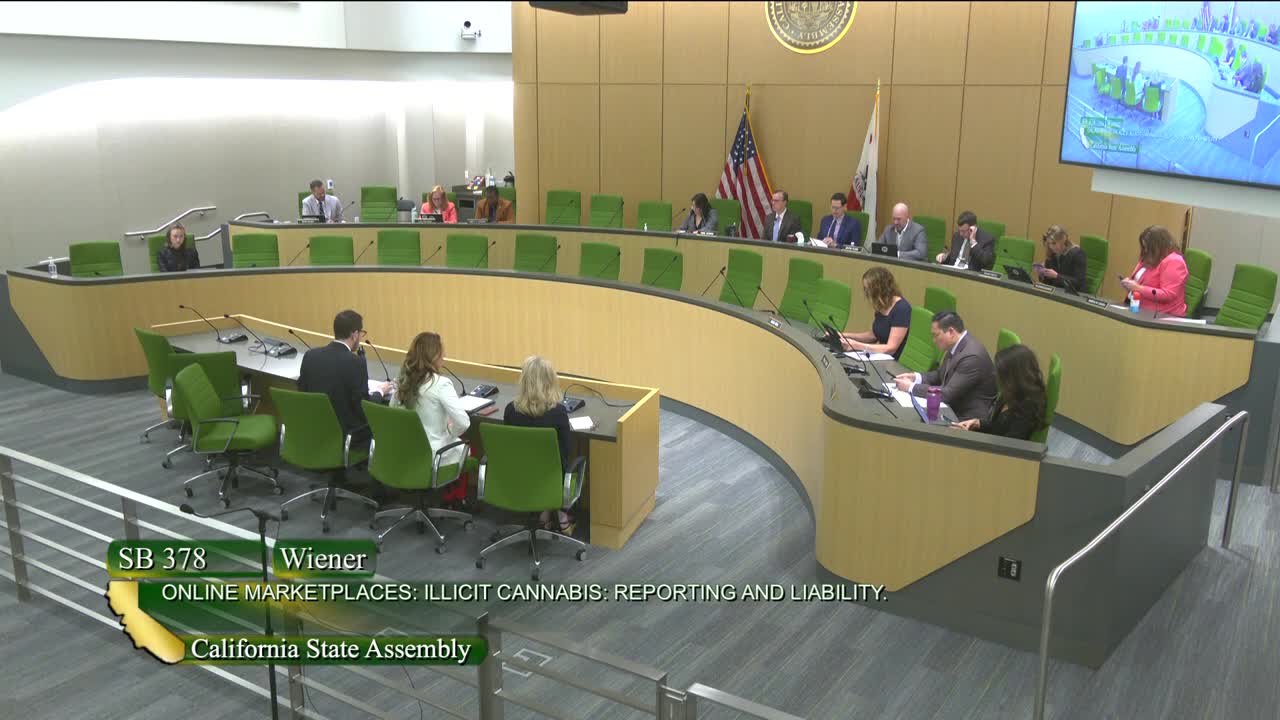 30MIN
Assembly Standing Committee on Business and Professions
 4MIN
Senate Floor
 8MIN
Senate Standing Committee on Judiciary
Bill Author

Bill Co-Author(s):