SB 418: Health care coverage: prescription hormone therapy and nondiscrimination.
- Session Year: 2025-2026
- House: Senate
- Latest Version Date: 2025-09-16
Current Status:
Failed
(2026-03-02: Stricken from file.)
Introduced
In Committee
Awaiting First Chamber Vote
Passed First Chamber
In Committee
Awaiting Second Chamber Vote
Passed Second Chamber
Enacted
Existing law, the Knox-Keene Health Care Service Plan Act of 1975, provides for the licensure and regulation of health care service plans by the Department of Managed Health Care and makes a willful violation of the acts requirements a crime. Existing law provides for the regulation of health insurers by the Department of Insurance. Existing law also provides for the Medi-Cal program, which is administered by the State Department of Health Care Services, under which qualified low-income individuals receive health care services pursuant to a schedule of benefits.
Existing law sets forth specified coverage requirements for health care service plan contracts and health insurance policies. Existing law generally authorizes a health care service plan or health insurer to use utilization controls to approve, modify, delay, or deny requests for health care services based on medical necessity. Existing law requires health care service plans and health insurers, as specified, within 6 months after the relevant department issues specified guidance, or no later than March 1, 2025, to require all of their staff who are in direct contact with enrollees or insureds in the delivery of care or enrollee or insured services to complete evidence-based cultural competency training for the purpose of providing trans-inclusive health care for individuals who identify as transgender, gender diverse, or intersex.
This bill would require a health care service plan contract or health insurance policy issued, amended, renewed, or delivered on or after the bills operative date that provides outpatient prescription drug benefits to cover up to a 12-month supply of a United States Food and Drug Administration (FDA)-approved prescription hormone therapy, and the necessary supplies for self-administration, that is prescribed by a network provider within their scope of practice and dispensed at one time, as specified. The bill would make the same prescription hormone therapy a covered benefit under the Medi-Cal program, as specified. The bill would prohibit a plan or an insurer from imposing utilization controls or other forms of medical management limiting the supply of this hormone therapy to an amount that is less than a 12-month supply, but would not prohibit a contract, a policy, or the Medi-Cal program from limiting refills that may be obtained in the last quarter of the plan, policy, or coverage year if a 12-month supply of the prescription hormone therapy has already been dispensed during that year. The bill would exclude a Medi-Cal managed care plan contracting with the State Department of Health Care Services from these requirements. The bill would repeal these provisions on January 1, 2035.
This bill would prohibit a subscriber, enrollee, policyholder, or insured from being excluded from enrollment or participation in, being denied the benefits of, or being subjected to discrimination by, any health care service plan or health insurer licensed in this state, on the basis of race, color, national origin, age, disability, or sex. The bill would define discrimination on the basis of sex for those purposes to include, among other things, sex characteristics, including intersex traits, pregnancy, and gender identity. The bill would prohibit a health care service plan or health insurer from taking specified actions relating to providing access to health programs and activities, including, but not limited to, denying or limiting health care services to an individual based upon the individuals sex assigned at birth, gender identity, or gender otherwise recorded. The bill would prohibit a health care service plan or health insurer, in specified circumstances, from taking various actions, including, but not limited to, denying, canceling, limiting, or refusing to issue or renew health care service plan enrollment, health insurance coverage, or other health-related coverage, or denying or limiting coverage of a claim, or imposing additional cost sharing or other limitations or restrictions on coverage, on the basis of race, color, national origin, sex, age, or disability, as specified. Because a violation of the bills requirements by a health care service plan would be a crime, the bill would impose a state-mandated local program.
Existing law requires a pharmacist to dispense, at a patients request, up to a 12-month supply of an FDA-approved, self-administered hormonal contraceptive pursuant to a valid prescription that specifies an initial quantity followed by periodic refills.
This bill would additionally require a pharmacist to dispense, at a patients request, up to a 12-month supply of an FDA-approved, prescription hormone therapy pursuant to a valid prescription that specifies an initial quantity followed by periodic refills, unless an exception is met.
The California Constitution requires the state to reimburse local agencies and school districts for certain costs mandated by the state. Statutory provisions establish procedures for making that reimbursement.
This bill would provide that no reimbursement is required by this act for a specified reason.
This bill would declare that it is to take effect immediately as an urgency statute.
Existing law, the Knox-Keene Health Care Service Plan Act of 1975, provides for the licensure and regulation of health care service plans by the Department of Managed Health Care and makes a willful violation of the acts requirements a crime. Existing law provides for the regulation of health insurers by the Department of Insurance. Existing law also provides for the Medi-Cal program, which is administered by the State Department of Health Care Services, under which qualified low-income individuals receive health care services pursuant to a schedule of benefits.
Existing law sets forth specified coverage requirements for health care service plan contracts and health insurance policies. Existing law generally authorizes a health care service plan or health insurer to use utilization controls to approve, modify, delay, or deny requests for health care services based on medical necessity. Existing law requires health care service plans and health insurers, as specified, within 6 months after the relevant department issues specified guidance, or no later than March 1, 2025, to require all of their staff who are in direct contact with enrollees or insureds in the delivery of care or enrollee or insured services to complete evidence-based cultural competency training for the purpose of providing trans-inclusive health care for individuals who identify as transgender, gender diverse, or intersex.
This bill would require a health care service plan contract or health insurance policy issued, amended, renewed, or delivered on or after the bills operative date that provides outpatient prescription drug benefits to cover up to a 12-month supply of a United States Food and Drug Administration (FDA)-approved prescription hormone therapy, and the necessary supplies for self-administration, that is prescribed by a network provider within their scope of practice and dispensed at one time, as specified. The bill would make the same prescription hormone therapy a covered benefit under the Medi-Cal program, as specified. The bill would prohibit a plan, an insurer, or the Medi-Cal program plan or an insurer from imposing utilization controls or other forms of medical management limiting the supply of this hormone therapy to an amount that is less than a 12-month supply, but would not prohibit a contract, a policy, or the Medi-Cal program from limiting refills that may be obtained in the last quarter of the plan, policy, or coverage year if a 12-month supply of the prescription hormone therapy has already been dispensed during that year. The bill would exclude a Medi-Cal managed care plan contracting with the State Department of Health Care Services from these requirements. The bill would repeal these provisions on January 1, 2035.
This bill would prohibit a subscriber, enrollee, policyholder, or insured from being excluded from enrollment or participation in, being denied the benefits of, or being subjected to discrimination by, any health care service plan or health insurer licensed in this state, on the basis of race, color, national origin, age, disability, or sex. The bill would define discrimination on the basis of sex for those purposes to include, among other things, sex characteristics, including intersex traits, pregnancy, and gender identity. The bill would prohibit a health care service plan or health insurer from taking specified actions relating to providing access to health programs and activities, including, but not limited to, denying or limiting health care services to an individual based upon the individuals sex assigned at birth, gender identity, or gender otherwise recorded. The bill would prohibit a health care service plan or health insurer, in specified circumstances, from taking various actions, including, but not limited to, denying, canceling, limiting, or refusing to issue or renew health care service plan enrollment, health insurance coverage, or other health-related coverage, or denying or limiting coverage of a claim, or imposing additional cost sharing or other limitations or restrictions on coverage, on the basis of race, color, national origin, sex, age, or disability, as specified. Because a violation of the bills requirements by a health care service plan would be a crime, the bill would impose a state-mandated local program.
Existing law requires a pharmacist to dispense, at a patients request, up to a 12-month supply of an FDA-approved, self-administered hormonal contraceptive pursuant to a valid prescription that specifies an initial quantity followed by periodic refills.
This bill would additionally require a pharmacist to dispense, at a patients request, up to a 12-month supply of an FDA-approved, prescription hormone therapy pursuant to a valid prescription that specifies an initial quantity followed by periodic refills, unless an exception is met.
The California Constitution requires the state to reimburse local agencies and school districts for certain costs mandated by the state. Statutory provisions establish procedures for making that reimbursement.
This bill would provide that no reimbursement is required by this act for a specified reason.
This bill would declare that it is to take effect immediately as an urgency statute.
Existing law, the Knox-Keene Health Care Service Plan Act of 1975, provides for the licensure and regulation of health care service plans by the Department of Managed Health Care and makes a willful violation of the acts requirements a crime. Existing law provides for the regulation of health insurers by the Department of Insurance. Existing law also provides for the Medi-Cal program, which is administered by the State Department of Health Care Services, under which qualified low-income individuals receive health care services through, among other things, managed care plans licensed under the act that contract with the State Department of Health Care Services. pursuant to a schedule of benefits.
Existing law sets forth specified coverage requirements for health care service plan contracts and health insurance policies. Existing law generally authorizes a health care service plan or health insurer to use utilization controls to approve, modify, delay, or deny requests for health care services based on medical necessity. Existing law requires health care service plans and health insurers, as specified, within 6 months after the relevant department issues specified guidance, or no later than March 1, 2025, to require all of their staff who are in direct contact with enrollees or insureds in the delivery of care or enrollee or insured services to complete evidence-based cultural competency training for the purpose of providing trans-inclusive health care for individuals who identify as transgender, gender diverse, or intersex.
This bill would require a health care service plan contract, including a Medi-Cal managed care plan contract, contract or health insurance policy issued, amended, renewed, or delivered on or after January 1, 2026, the bills operative date to cover up to a 12-month supply of a United States Food and Drug Administration (FDA)-approved prescription hormone therapy, and the necessary supplies for self-administration, that is prescribed by a network provider within their scope of practice and dispensed at one time, as specified. The bill would make the same prescription hormone therapy a covered benefit under the Medi-Cal program, as specified. The bill would prohibit a plan or insurer plan, an insurer, or the Medi-Cal program from imposing utilization controls or other forms of medical management limiting the supply of this hormone therapy to an amount that is less than a 12-month supply, but would not prohibit a contract or policy contract, a policy, or the Medi-Cal program from limiting refills that may be obtained in the last quarter of the plan or policy plan, policy, or coverage year if a 12-month supply of the prescription hormone therapy has already been dispensed during that year. The bill would require the State Department of Health Care Services to seek federal approval, if necessary, and to issue all-plan letters or similar instructions to implement these provisions for Medi-Cal managed care plans. repeal these provisions on January 1, 2035.
This bill would prohibit a subscriber, enrollee, policyholder, or insured from being excluded from enrollment or participation in, being denied the benefits of, or being subjected to discrimination by, any health care service plan or health insurer licensed in this state, on the basis of race, color, national origin, age, disability, or sex. The bill would define discrimination on the basis of sex for those purposes to include, among other things, sex characteristics, including intersex traits, pregnancy, and gender identity. The bill would prohibit a health care service plan or health insurer from taking specified actions relating to providing access to health programs and activities, including, but not limited to, denying or limiting health care services to an individual based upon the individuals sex assigned at birth, gender identity, or gender otherwise recorded. The bill would prohibit a health care service plan or health insurer, in specified circumstances, from taking various actions, including, but not limited to, denying, canceling, limiting, or refusing to issue or renew health care service plan enrollment, health insurance coverage, or other health-related coverage, or denying or limiting coverage of a claim, or imposing additional cost sharing or other limitations or restrictions on coverage, on the basis of race, color, national origin, sex, age, or disability, as specified. Because a violation of the bills requirements by a health care service plan would be a crime, the bill would impose a state-mandated local program.
Existing law requires a pharmacist to dispense, at a patients request, up to a 12-month supply of an FDA-approved, self-administered hormonal contraceptive pursuant to a valid prescription that specifies an initial quantity followed by periodic refills.
This bill would additionally require a pharmacist to dispense, at a patients request, up to a 12-month supply of an FDA-approved, prescription hormone therapy pursuant to a valid prescription that specifies an initial quantity followed by periodic refills, unless an exception is met.
The California Constitution requires the state to reimburse local agencies and school districts for certain costs mandated by the state. Statutory provisions establish procedures for making that reimbursement.
This bill would provide that no reimbursement is required by this act for a specified reason.
This bill would declare that it is to take effect immediately as an urgency statute.
Existing law, the Knox-Keene Health Care Service Plan Act of 1975, provides for the licensure and regulation of health care service plans by the Department of Managed Health Care and makes a willful violation of the acts requirements a crime. Existing law provides for the regulation of health insurers by the Department of Insurance. Existing law requires also provides for the Medi-Cal program, which is administered by the State Department of Health Care Services, under which qualified low-income individuals receive health care services through, among other things, managed care plans licensed under the act that contract with the State Department of Health Care Services.
Existing law sets forth specified coverage requirements for health care service plan contracts and health insurance policies. Existing law generally authorizes a health care service plan or health insurer to use utilization controls to approve, modify, delay, or deny requests for health care services based on medical necessity. Existing law requires health care service plans and health insurers, as specified, within 6 months after the relevant department issues specified guidance, or no later than March 1, 2025, to require all of their staff who are in direct contact with enrollees or insureds in the delivery of care or enrollee or insured services to complete evidence-based cultural competency training for the purpose of providing trans-inclusive health care for individuals who identify as transgender, gender diverse, or intersex.
This bill would require a health care service plan contract, including a Medi-Cal managed care plan contract, or health insurance policy issued, amended, renewed, or delivered on or after January 1, 2026, to cover up to a 12-month supply of a United States Food and Drug Administration (FDA)-approved prescription hormone therapy, and the necessary supplies for self-administration, that is prescribed by a network provider within their scope of practice and dispensed at one time, as specified. The bill would prohibit a plan or insurer from imposing utilization controls or other forms of medical management limiting the supply of this hormone therapy to an amount that is less than a 12-month supply, but would not prohibit a contract or policy from limiting refills that may be obtained in the last quarter of the plan or policy year if a 12-month supply of the prescription hormone therapy has already been dispensed during that year. The bill would require the State Department of Health Care Services to seek federal approval, if necessary, and to issue all-plan letters or similar instructions to implement these provisions for Medi-Cal managed care plans.
This bill would prohibit a subscriber, enrollee, policyholder, or insured from being excluded from enrollment or participation in, being denied the benefits of, or being subjected to discrimination by, any health care service plan or health insurer licensed in this state, on the basis of race, color, national origin, age, disability, or sex. The bill would define discrimination on the basis of sex for those purposes to include, among other things, sex characteristics, including intersex traits, pregnancy, and gender identity. The bill would prohibit a health care service plan or health insurer from taking specified actions relating to providing access to health programs and activities, including, but not limited to, denying or limiting health care services to an individual based upon the individuals sex assigned at birth, gender identity, or gender otherwise recorded. The bill would prohibit a health care service plan or health insurer, in specified circumstances, from taking various actions, including, but not limited to, denying, canceling, limiting, or refusing to issue or renew health care service plan enrollment, health insurance coverage, or other health-related coverage, or denying or limiting coverage of a claim, or imposing additional cost sharing or other limitations or restrictions on coverage, on the basis of race, color, national origin, sex, age, or disability, as specified. Because a violation of the bills requirements by a health care service plan would be a crime, the bill would impose a state-mandated local program.
Existing law requires a pharmacist to dispense, at a patients request, up to a 12-month supply of an FDA-approved, self-administered hormonal contraceptive pursuant to a valid prescription that specifies an initial quantity followed by periodic refills.
This bill would additionally require a pharmacist to dispense, at a patients request, up to a 12-month supply of an FDA-approved, prescription hormone therapy pursuant to a valid prescription that specifies an initial quantity followed by periodic refills, unless an exception is met.
The California Constitution requires the state to reimburse local agencies and school districts for certain costs mandated by the state. Statutory provisions establish procedures for making that reimbursement.
This bill would provide that no reimbursement is required by this act for a specified reason.
Existing law, the Knox-Keene Health Care Service Plan Act of 1975, provides for the licensure and regulation of health care service plans by the Department of Managed Health Care and makes a willful violation of the acts requirements a crime. Existing law provides for the regulation of health insurers by the Department of Insurance. Existing law requires health care service plans and health insurers, as specified, within 6 months after the relevant department issues specified guidance, or no later than March 1, 2025, to require all of their staff who are in direct contact with enrollees or insureds in the delivery of care or enrollee or insured services to complete evidence-based cultural competency training for the purpose of providing trans-inclusive health care for individuals who identify as transgender, gender diverse, or intersex.
This bill would prohibit a subscriber, enrollee, policyholder, or insured from being excluded from enrollment or participation in, being denied the benefits of, or being subjected to discrimination by, any health care service plan or health insurer licensed in this state, on the basis of race, color, national origin, age, disability, or sex. The bill would define discrimination on the basis of sex for those purposes to include, among other things, sex characteristics, including intersex traits, pregnancy, and gender identity. The bill would prohibit a health care service plan or health insurer from taking specified actions relating to providing access to health programs and activities, including, but not limited to, denying or limiting health care services to an individual based upon the individuals sex assigned at birth, gender identity, or gender otherwise recorded. The bill would prohibit a health care service plan or health insurer, in specified circumstances, from taking various actions, including, but not limited to, denying, canceling, limiting, or refusing to issue or renew health care service plan enrollment, health insurance coverage, or other health-related coverage, or denying or limiting coverage of a claim, or imposing additional cost sharing or other limitations or restrictions on coverage, on the basis of race, color, national origin, sex, age, disability, as specified. Because a violation of the bills requirements by a health care service plan would be a crime, the bill would impose a state-mandated local program.
The California Constitution requires the state to reimburse local agencies and school districts for certain costs mandated by the state. Statutory provisions establish procedures for making that reimbursement.
This bill would provide that no reimbursement is required by this act for a specified reason.
Existing law, the Knox-Keene Health Care Service Plan Act of 1975, provides for the licensure and regulation of health care service plans by the Department of Managed Health Care and makes a willful violation of the acts requirements a crime. Existing law provides for the regulation of health insurers by the Department of Insurance. Existing law requires health care service plans and health insurers, as specified, within 6 months after the relevant department issues specified guidance, or no later than March 1, 2025, to require all of their staff who are in direct contact with enrollees or insureds in the delivery of care or enrollee or insured services to complete evidence-based cultural competency training for the purpose of providing trans-inclusive health care for individuals who identify as transgender, gender diverse, or intersex.
This bill would prohibit a subscriber, enrollee, policyholder, or insured from being excluded from enrollment or participation in, being denied the benefits of, or being subjected to discrimination by, any health care service plan or health insurer licensed in this state, on the basis of race, color, national origin, age, disability, or sex. The bill would define discrimination on the basis of sex for those purposes to include, among other things, sex characteristics, including intersex traits, pregnancy, and gender identity. The bill would prohibit a health care service plan or health insurer from taking specified actions relating to providing access to health programs and activities, including, but not limited to, denying or limiting health care services to an individual based upon the individuals sex assigned at birth, gender identity, or gender otherwise recorded. The bill would prohibit a health care service plan or health insurer, in providing or administering health insurance coverage or other health-related coverage, specified circumstances, from taking various actions, including, but not limited to, denying, canceling, limiting, or refusing to issue or renew health care service plan enrollment, health insurance coverage coverage, or other health-related coverage, or denying or limiting coverage of a claim, or imposing additional cost sharing or other limitations or restrictions on coverage, on the basis of race, color, national origin, sex, age, disability, as specified. Because a violation of the bills requirements by a health care service plan would be a crime, the bill would impose a state-mandated local program.
The California Constitution requires the state to reimburse local agencies and school districts for certain costs mandated by the state. Statutory provisions establish procedures for making that reimbursement.
This bill would provide that no reimbursement is required by this act for a specified reason.
Existing law, the Knox-Keene Health Care Service Plan Act of 1975, provides for the licensure and regulation of health care service plans by the Department of Managed Health Care and makes a willful violation of the acts requirements a crime. Existing law provides for the regulation of health insurers by the Department of Insurance. Existing law requires health care service plans and health insurers, as specified, within 6 months after the relevant department issues specified guidance, or no later than March 1, 2025, to require all of their staff who are in direct contact with enrollees or insureds in the delivery of care or enrollee or insured services to complete evidence-based cultural competency training for the purpose of providing trans-inclusive health care for individuals who identify as transgender, gender diverse, or intersex.
This bill would prohibit a subscriber, enrollee, policyholder, or insured from being excluded from participation in, being denied the benefits of, or being subjected to discrimination by, any health care service plan or health insurer licensed in this state, on the basis of race, color, national origin, age, disability, or sex. The bill would define discrimination on the basis of sex for those purposes to include, among other things, sex characteristics, including intersex traits, pregnancy, and gender identity. The bill would prohibit a health care service plan or health insurer from taking specified actions relating to providing access to health programs and activities, including, but not limited to, denying or limiting health services to an individual based upon the individuals sex assigned at birth, gender identity, or gender otherwise recorded. The bill would prohibit a health care service plan or health insurer, in providing or administering health insurance coverage or other health-related coverage, from taking various actions, including, but not limited to, denying, canceling, limiting, or refusing to issue or renew health insurance coverage or other health-related coverage, or denying or limiting coverage of a claim, or imposing additional cost sharing or other limitations or restrictions on coverage, on the basis of race, color, national origin, sex, age, disability, as specified. Because a violation of the bills requirements by a health care service plan would be a crime, the bill would impose a state-mandated local program.
The California Constitution requires the state to reimburse local agencies and school districts for certain costs mandated by the state. Statutory provisions establish procedures for making that reimbursement.
This bill would provide that no reimbursement is required by this act for a specified reason.
It is the intent of the Legislature to expand the states existing prescription hormone therapy coverage policy by requiring all health care service plan contracts and health insurance policies, and the Medi-Cal program, to cover a 12-month supply of prescription hormone therapy and necessary supplies for self-administration.
SEC. 2.Section 4064.55 is added to the Business and Professions Code, to read:4064.55.(a)Notwithstanding Section 4064.5, a pharmacist shall dispense, at a patients request, up to a 12-month supply of an FDA-approved prescription hormone therapy pursuant to a valid prescription that specifies an initial quantity followed by periodic refills, unless any of the following is true:
(1)The patient requests a smaller supply.
(2)The prescribing provider instructs that the patient must have a smaller supply.
(3)The prescribing provider temporarily limits refills to a 90-day supply due to an acute dispensing shortage.
(4)The prescription hormone therapy is a controlled substance. If the prescription hormone therapy is a controlled substance, the pharmacist shall dispense the maximum supply allowed under state and federal law to be obtained at one time by the patient.
(b)This section does not require a pharmacist to dispense or furnish a drug if it would result in a violation of Section 733.
(c)For purposes of this section, prescription hormone therapy has the same meaning as in Section 1367.253 of the Health and Safety Code.
SEC. 3.Section 1367.0435 is added to the Health and Safety Code, to read:1367.0435.(a)A subscriber or enrollee shall not be excluded from enrollment or participation in, be denied the benefits of, or be subjected to discrimination by, any health care service plan licensed in this state on the basis of race, color, national origin, age, disability, or sex.
(b)(1)For purposes of this section, discrimination on the basis of sex includes, but is not limited to, discrimination on the basis of any of the following:
(A)Sex characteristics, including intersex traits.
(B)Pregnancy or related conditions.
(C)Sexual orientation.
(D)Gender identity.
(E)Sex stereotypes.
(2)In providing access to health programs and activities, including arranging for the provision of health care services, a health care service plan shall not do any of the following:
(A)Deny or limit health care services, including those that have been typically or exclusively provided to, or associated with, individuals of one sex, to an individual based upon the individuals sex assigned at birth, gender identity, or gender otherwise recorded.
(B)Deny or limit, on the basis of an individuals sex assigned at birth, gender identity, or gender otherwise recorded, a health care professionals ability to provide health care services if the denial or limitation has the effect of excluding individuals from participation in, denying them the benefits of, or otherwise subjecting them to discrimination on the basis of sex under a covered health care service plan.
(C)Adopt or apply any policy or practice of treating individuals differently or separating them on the basis of sex in a manner that subjects any individual to more than de minimis harm, including by adopting a policy or engaging in a practice that prevents an individual from participating in a health care service plan consistent with the individuals gender identity.
(D)Deny or limit health care services sought for purpose of gender transition or other gender-affirming care that the health care service plan would otherwise cover if that denial or limitation is based on an individuals sex assigned at birth, gender identity, or gender otherwise recorded.
(3)A health care service plan, in providing or arranging for the provision of health care services or other health-related coverage, shall not do any of the following:
(A)Deny, cancel, limit, or refuse to issue or renew health care service plan enrollment or other health-related coverage, or deny or limit coverage of a claim, or impose additional cost sharing or other limitations or restrictions on coverage, on the basis of race, color, national origin, sex, age, disability, or any combination thereof.
(B)Have or implement marketing practices or benefit designs that discriminate on the basis of race, color, national origin, sex, age, disability, or any combination thereof, in health care service plan coverage or other health-related coverage.
(C)Deny or limit coverage, deny or limit coverage of a claim, or impose additional cost sharing or other limitations or restrictions on coverage, to an individual based upon the individuals sex assigned at birth, gender identity, or gender otherwise recorded.
(D)Have or implement a categorical coverage exclusion or limitation for all health care services related to gender transition or other gender-affirming care.
(E)Otherwise deny or limit coverage, deny or limit coverage of a claim, or impose additional cost sharing or other limitations or restrictions on coverage, for specific health care services related to gender transition or other gender-affirming care if such denial, limitation, or restriction results in discrimination on the basis of sex.
(F)Have or implement benefit designs that do not provide or administer health care service plan coverage or other health-related coverage in the most integrated setting appropriate to the needs of qualified individuals with disabilities, including practices that result in the serious risk of institutionalization or segregation.
(c)This section does not require access to, or coverage of, a health care service for which the health care service plan has a legitimate, nondiscriminatory reason for denying or limiting access to, or coverage of, the health care service or determining that the health care service is not clinically appropriate for a particular individual, or fails to meet applicable coverage requirements, including reasonable medical management techniques, such as medical necessity requirements. A health care service plans determination under this subdivision shall not be based on unlawful animus or bias, or constitute a pretext for discrimination.
(d)A health care service plans evidences of coverage, disclosure form, and combined evidence of coverage and disclosure form shall include all of the following information in a notice to enrollees regarding the coverage requirements pursuant to subdivision (a):
(1)A statement that the health care service plan does not discriminate on the basis of a characteristic protected under applicable state law, including this section.
(2)How to file a grievance regarding discrimination pursuant to Section 1368.
(3)The health care service plans internet website where an enrollee may file a grievance, if available.
(4)The health care service plans telephone number that an enrollee may use to file a grievance regarding discrimination.
(e)This section does not limit the directors authority, a health care service plans duties, or enrollees rights pursuant to this chapter.
(f)The rights, remedies, and penalties established by this section are cumulative and do not supersede the rights, remedies, or penalties established under other laws, including Article 9.5 (commencing with Section 11135) of Chapter 1 of Part 1 of Division 3 of Title 2 of the Government Code and Section 51 of the Civil Code, and any implementing regulations.
SEC. 4.Section 1367.253 is added to the Health and Safety Code, to read:1367.253.(a)(1)A health care service plan contract issued, amended, renewed, or delivered on or after the operative date of this section, that provides outpatient prescription drug benefits, shall cover up to a 12-month supply of a United States Food and Drug Administration (FDA)-approved prescription hormone therapy, and the necessary supplies for self-administration, that is prescribed by a network provider within their scope of practice and dispensed at one time for an enrollee by a provider or pharmacist, or at a location licensed or otherwise authorized to dispense drugs or supplies.
(2)This subdivision does not require a health care service plan contract to cover prescription hormone therapy provided by an out-of-network provider, pharmacy, or location licensed or otherwise authorized to dispense drugs or supplies, except as may be otherwise authorized by state or federal law or by the plans policies governing out-of-network coverage. If prescriptions for medically necessary FDA-approved prescription hormone therapy are unavailable to a plan enrollee within the plans network, the plan shall arrange for the prescription hormone therapy to be provided by an out-of-network provider.
(3)This subdivision does not prohibit a health care service plan contract from limiting refills that may be obtained in the last quarter of the plan year if a 12-month supply of the prescription hormone therapy has already been dispensed during the plan year.
(4)This subdivision does not require a provider to prescribe, furnish, or dispense 12 months of prescription hormone therapy at one time.
(5)(A)A health care service plan subject to this subdivision shall not impose utilization controls or other forms of medical management limiting the supply of an FDA-approved prescription hormone therapy that may be dispensed by a provider or pharmacist, or at a location licensed or otherwise authorized to dispense drugs or supplies to an amount that is less than a 12-month supply.
(B)If a health care service plan delegates responsibilities under this section to a contracted entity, including a medical group or independent practice association, the delegated entity shall comply with this section.
(6)This subdivision only applies to prescription hormone therapy that is able to be safely stored at room temperature without refrigeration.
(b)This section does not deny or restrict the departments authority to ensure plan compliance with this chapter when a plan provides coverage for prescription hormone therapy.
(c)This section does not require an individual or group health care service plan contract to cover experimental or investigational treatments.
(d)This section shall not apply to Medi-Cal managed care plans contracting with the State Department of Health Care Services pursuant to Chapter 7 (commencing with Section 14000), Chapter 8 (commencing with Section 14200), or Chapter 8.75 (commencing with Section 14591) of Part 3 of Division 9 of the Welfare and Institutions Code.
(e)For purposes of this section:
(1)Prescription hormone therapy means all drugs approved by the FDA as of January 1, 2025, and all drugs approved by the FDA thereafter, that are used to medically suppress, increase, or replace hormones that the body is not producing at intended levels, and the necessary supplies for self-administration. Prescription hormone therapy does not include glucagon-like peptide-1 or glucagon-like peptide-1 receptor agonists.
(2)Provider means an individual who is certified or licensed pursuant to Division 2 (commencing with Section 500) of the Business and Professions Code.
(f)This section shall remain in effect only until January 1, 2035, and as of that date is repealed.
SEC. 5.Section 10123.1963 is added to the Insurance Code, to read:10123.1963.(a)(1)A health insurance policy issued, amended, renewed, or delivered on or after the operative date of this section, that provides outpatient prescription drug benefits, shall cover up to a 12-month supply of a United States Food and Drug Administration (FDA)-approved prescription hormone therapy, and the necessary supplies for self-administration, that is prescribed by a network provider within their scope of practice and dispensed at one time for an insured by a provider, pharmacist, or at a location licensed or otherwise authorized to dispense drugs or supplies.
(2)This subdivision does not require a health insurance policy to cover prescription hormone therapy provided by an out-of-network provider, pharmacy, or location licensed or otherwise authorized to dispense drugs or supplies, except as may be otherwise authorized by state or federal law or by the insurers policies governing out-of-network coverage. If prescriptions for medically necessary FDA-approved prescription hormone therapy are unavailable to a insured within the insurers network, the insurer shall arrange for the prescription hormone therapy to be provided by an out-of-network provider.
(3)This subdivision does not prohibit a health insurance policy from limiting refills that may be obtained in the last quarter of the policy year if a 12-month supply of the prescription hormone therapy has already been dispensed during the policy year.
(4)This subdivision does not require a provider to prescribe, furnish, or dispense 12 months of prescription hormone therapy at one time.
(5)(A)A health insurer subject to this subdivision shall not impose utilization controls or other forms of medical management limiting the supply of an FDA-approved prescription hormone therapy that may be dispensed by a provider or pharmacist, or at a location licensed or otherwise authorized to dispense drugs or supplies to an amount that is less than a 12-month supply.
(B)If a health insurer delegates responsibilities under this section to a contracted entity, including a medical group or independent practice association, the delegated entity shall comply with this section.
(6)This subdivision only applies to prescription hormone therapy that is able to be safely stored at room temperature without refrigeration.
(b)This section does not deny or restrict the departments authority to ensure insurer compliance with this chapter when an insurer provides coverage for prescription hormone therapy.
(c)This section does not require an individual or group health insurance policy to cover experimental or investigational treatments.
(d)For purposes of this section:
(1)Prescription hormone therapy means all drugs approved by the FDA as of January 1, 2025, and all drugs approved by the FDA thereafter, that are used to medically suppress, increase, or replace hormones that the body is not producing at intended levels, and the necessary supplies for self-administration. Prescription hormone therapy does not include glucagon-like peptide-1 or glucagon-like peptide-1 receptor agonists.
(2)Provider means an individual who is certified or licensed pursuant to Division 2 (commencing with Section 500) of the Business and Professions Code.
(e)This section shall remain in effect only until January 1, 2035, and as of that date is repealed.
SEC. 6.Section 10133.135 is added to the Insurance Code, to read:10133.135.(a)A policyholder or insured shall not be excluded from enrollment or participation in, be denied the benefits of, or be subjected to discrimination by, any health insurer licensed in this state on the basis of race, color, national origin, age, disability, or sex.
(b)(1)For purposes of this section, discrimination on the basis of sex includes, but is not limited to, discrimination on the basis of any of the following:
(A)Sex characteristics, including intersex traits.
(B)Pregnancy or related conditions.
(C)Sexual orientation.
(D)Gender identity.
(E)Sex stereotypes.
(2)In providing access to health programs and activities, a health insurer shall not do any of the following:
(A)Deny or limit health care services, including those that have been typically or exclusively provided to, or associated with, individuals of one sex, to an individual based upon the individuals sex assigned at birth, gender identity, or gender otherwise recorded.
(B)Deny or limit, on the basis of an individuals sex assigned at birth, gender identity, or gender otherwise recorded, a health care professionals ability to provide health care services if the denial or limitation has the effect of excluding individuals from participation in, denying them the benefits of, or otherwise subjecting them to discrimination on the basis of sex under a covered health insurance policy.
(C)Adopt or apply any policy or practice of treating individuals differently or separating them on the basis of sex in a manner that subjects any individual to more than de minimis harm, including by adopting a policy or engaging in a practice that prevents an individual from participating in a health insurance policy or activity consistent with the individuals gender identity.
(D)Deny or limit health care services sought for purpose of gender transition or other gender-affirming care that the health insurance policy would otherwise cover if that denial or limitation is based on an individuals sex assigned at birth, gender identity, or gender otherwise recorded.
(3)A health insurer, in providing or administering health insurance coverage or other health-related coverage, shall not do any of the following:
(A)Deny, cancel, limit, or refuse to issue or renew health insurance coverage or other health-related coverage, or deny or limit coverage of a claim, or impose additional cost sharing or other limitations or restrictions on coverage, on the basis of race, color, national origin, sex, age, disability, or any combination thereof.
(B)Have or implement marketing practices or benefit designs that discriminate on the basis of race, color, national origin, sex, age, disability, or any combination thereof, in health insurance coverage or other health-related coverage.
(C)Deny or limit coverage, deny or limit coverage of a claim, or impose additional cost sharing or other limitations or restrictions on coverage, to an individual based upon the individuals sex assigned at birth, gender identity, or gender otherwise recorded.
(D)Have or implement a categorical coverage exclusion or limitation for all health care services related to gender transition or other gender-affirming care.
(E)Otherwise deny or limit coverage, deny or limit coverage of a claim, or impose additional cost sharing or other limitations or restrictions on coverage, for specific health care services related to gender transition or other gender-affirming care if such denial, limitation, or restriction results in discrimination on the basis of sex.
(F)Have or implement benefit designs that do not provide or administer health insurance coverage or other health-related coverage in the most integrated setting appropriate to the needs of qualified individuals with disabilities, including practices that result in the serious risk of institutionalization or segregation.
(c)This section does not require access to, or coverage of, a health care service for which the health insurer has a legitimate, nondiscriminatory reason for denying or limiting access to, or coverage of, the health care service or determining that the health care service is not clinically appropriate for a particular individual, or fails to meet applicable coverage requirements, including reasonable medical management techniques, such as medical necessity requirements. A health insurers determination under this subdivision shall not be based on unlawful animus or bias, or constitute a pretext for discrimination.
(d)A health insurers evidences of coverage, disclosure form, and combined evidence of coverage and disclosure form shall include all of the following information in a notice to insureds regarding the coverage requirements pursuant to subdivision (a):
(1)A statement that the health insurer does not discriminate on the basis of a characteristic protected under applicable state law, including this section.
(2)How to file a grievance regarding discrimination.
(3)The health insurers internet website where an insured may file a grievance, if available.
(4)The health insurers telephone number that an insured may use to file a grievance regarding discrimination.
(e)This section does not limit the commissioners authority, a health insurers duties, or insureds rights pursuant to this division.
(f)The rights, remedies, and penalties established by this section are cumulative and do not supersede the rights, remedies, or penalties established under other laws, including Article 9.5 (commencing with Section 11135) of Chapter 1 of Part 1 of Division 3 of Title 2 of the Government Code and Section 51 of the Civil Code, and any implementing regulations.
SEC. 7.Section 14132.04 is added to the Welfare and Institutions Code, to read:14132.04.(a)(1)Up to a 12-month supply of a United States Food and Drug Administration (FDA)-approved prescription hormone therapy and the necessary supplies for self-administration are covered under the Medi-Cal program, subject to utilization controls and medical necessity. Coverage under this section shall be limited to a prescription by a provider within their scope of practice and dispensed at one time for a beneficiary by a provider or pharmacist, or at a location licensed or otherwise authorized to dispense drugs or supplies.
(2)This subdivision does not prohibit the Medi-Cal program from limiting refills that may be obtained in the last quarter of the coverage year if a 12-month supply of the prescription hormone therapy has already been dispensed during the coverage year.
(3)This subdivision does not require a provider to prescribe, furnish, or dispense 12 months of prescription hormone therapy at one time.
(4)This subdivision only applies to prescription hormone therapy that is able to be safely stored at room temperature without refrigeration.
(b)This section does not require the Medi-Cal program to cover experimental or investigational treatments.
(c)If the prescription hormone therapy is a controlled substance, this section only applies to the maximum supply allowed under state and federal law to be obtained at one time by the patient.
(d)The department shall seek any federal approvals necessary to implement this section. This section shall be implemented only to the extent that any necessary federal approvals are obtained and federal financial participation is available and is not otherwise jeopardized.
(e)For purposes of this section:
(1)Prescription hormone therapy means all drugs approved by the FDA as of January 1, 2025, and all drugs approved by the FDA thereafter, that are used to medically suppress, increase, or replace hormones that the body is not producing at intended levels, and the necessary supplies for self-administration. Prescription hormone therapy does not include glucagon-like peptide-1 or glucagon-like peptide-1 receptor agonists.
(2)Provider means an individual who is certified or licensed pursuant to Division 2 (commencing with Section 500) of the Business and Professions Code and who is also an enrolled provider in the Medi-Cal program.
(f)This section shall remain in effect only until January 1, 2035, and as of that date is repealed.
SEC. 8.No reimbursement is required by this act pursuant to Section 6 of Article XIIIB of the California Constitution because the only costs that may be incurred by a local agency or school district will be incurred because this act creates a new crime or infraction, eliminates a crime or infraction, or changes the penalty for a crime or infraction, within the meaning of Section 17556 of the Government Code, or changes the definition of a crime within the meaning of Section 6 of Article XIIIB of the California Constitution.
SEC. 9.This act is an urgency statute necessary for the immediate preservation of the public peace, health, or safety within the meaning of Article IV of the California Constitution and shall go into immediate effect. The facts constituting the necessity are:
This bill and its urgency will ensure that California remains a leader in health care equity and ensure access to essential care.
It is the intent of the Legislature to expand the states existing prescription hormone therapy coverage policy by requiring all health care service plan contracts and health insurance policies, and the Medi-Cal program program, to cover a 12-month supply of prescription hormone therapy and necessary supplies for self-administration.
SEC. 2.Section 4064.5 of the Business and Professions Code is amended to read:4064.5.(a)A pharmacist may dispense not more than a 90-day supply of a dangerous drug other than a controlled substance pursuant to a valid prescription that specifies an initial quantity of less than a 90-day supply followed by periodic refills of that amount if all of the following requirements are satisfied:(1)The patient has completed an initial 30-day supply of the dangerous drug.(2)The total quantity of dosage units dispensed does not exceed the total quantity of dosage units authorized by the prescriber on the prescription, including refills.(3)The prescriber has not specified on the prescription that dispensing the prescription in an initial amount followed by periodic refills is medically necessary.(4)The pharmacist is exercising their professional judgment.(b)For purposes of this section, if the prescription continues the same medication as previously dispensed in a 90-day supply, the initial 30-day supply under paragraph (1) of subdivision (a) is not required.(c)A pharmacist dispensing an increased supply of a dangerous drug pursuant to this section shall notify the prescriber of the increase in the quantity of dosage units dispensed.(d)A pharmacist shall not dispense a greater supply of a dangerous drug pursuant to this section if the prescriber personally indicates, either orally or in their own handwriting, No change to quantity, or words of similar meaning. Nothing in this subdivision shall prohibit a prescriber from checking a box on a prescription marked No change to quantity, provided that the prescriber personally initials the box or checkmark. To indicate that an increased supply shall not be dispensed pursuant to this section for an electronic data transmission prescription as defined in subdivision (c) of Section 4040, a prescriber may indicate No change to quantity, or words of similar meaning, in the prescription as transmitted by electronic data, or may check a box marked on the prescription No change to quantity. In either instance, it shall not be required that the prohibition on an increased supply be manually initialed by the prescriber.(e)This section shall not apply to psychotropic medication or psychotropic drugs as described in subdivision (d) of Section 369.5 of the Welfare and Institutions Code.(f)Except for this subdivision and subdivision (d), this section does not apply to FDA-approved, self-administered hormonal contraceptives.(1)A pharmacist shall dispense, at a patients request, up to a 12-month supply of an FDA-approved, self-administered hormonal contraceptive pursuant to a valid prescription that specifies an initial quantity followed by periodic refills.(2)A pharmacist furnishing an FDA-approved, self-administered hormonal contraceptive pursuant to Section 4052.3 under protocols developed by the Board of Pharmacy may furnish, at the patients request, up to a 12-month supply at one time.(3)This subdivision does not require a pharmacist to dispense or furnish a drug if it would result in a violation of Section 733.(g)Except for this subdivision and subdivision (d), this section does not apply to an FDA-approved prescription hormone therapy.(1)A pharmacist shall dispense, at a patients request, up to a 12-month supply of an FDA-approved prescription hormone therapy pursuant to a valid prescription that specifies an initial quantity followed by periodic refills, unless any of the following is true:(A)The patient requests a smaller supply.(B)The prescribing provider instructs that the patient must have a smaller supply.(C)The prescribing provider temporarily limits refills to a 90-day supply due to an acute dispensing shortage.(D)The prescription hormone therapy is a controlled substance. If the prescription hormone therapy is a controlled substance, the pharmacist shall dispense the maximum refill allowed under state and federal law to be obtained at one time by the patient.(2)This subdivision does not require a pharmacist to dispense or furnish a drug if it would result in a violation of Section 733.(3)For purposes of this subdivision, prescription hormone therapy has the same meaning as in Section 1367.253 of the Health and Safety Code.(h)This section does not require a health care service plan, health insurer, workers compensation insurance plan, pharmacy benefits manager, or any other person or entity, including, but not limited to, a state program or state employer, to provide coverage for a dangerous drug in a manner inconsistent with a beneficiarys plan benefit.SEC. 2.Section 4064.55 is added to the Business and Professions Code, to read:4064.55.(a)Notwithstanding Section 4064.5, a pharmacist shall dispense, at a patients request, up to a 12-month supply of an FDA-approved prescription hormone therapy pursuant to a valid prescription that specifies an initial quantity followed by periodic refills, unless any of the following is true:
(1)The patient requests a smaller supply.
(2)The prescribing provider instructs that the patient must have a smaller supply.
(3)The prescribing provider temporarily limits refills to a 90-day supply due to an acute dispensing shortage.
(4)The prescription hormone therapy is a controlled substance. If the prescription hormone therapy is a controlled substance, the pharmacist shall dispense the maximum supply allowed under state and federal law to be obtained at one time by the patient.
(b)This section does not require a pharmacist to dispense or furnish a drug if it would result in a violation of Section 733.
(c)For purposes of this section, prescription hormone therapy has the same meaning as in Section 1367.253 of the Health and Safety Code.
SEC. 3.Section 1367.0435 is added to the Health and Safety Code, to read:1367.0435.(a)A subscriber or enrollee shall not be excluded from enrollment or participation in, be denied the benefits of, or be subjected to discrimination by, any health care service plan licensed in this state on the basis of race, color, national origin, age, disability, or sex.
(b)(1)For purposes of this section, discrimination on the basis of sex includes, but is not limited to, discrimination on the basis of any of the following:
(A)Sex characteristics, including intersex traits.
(B)Pregnancy or related conditions.
(C)Sexual orientation.
(D)Gender identity.
(E)Sex stereotypes.
(2)In providing access to health programs and activities, including arranging for the provision of health care services, a health care service plan shall not do any of the following:
(A)Deny or limit health care services, including those that have been typically or exclusively provided to, or associated with, individuals of one sex, to an individual based upon the individuals sex assigned at birth, gender identity, or gender otherwise recorded.
(B)Deny or limit, on the basis of an individuals sex assigned at birth, gender identity, or gender otherwise recorded, a health care professionals ability to provide health care services if the denial or limitation has the effect of excluding individuals from participation in, denying them the benefits of, or otherwise subjecting them to discrimination on the basis of sex under a covered health care service plan.
(C)Adopt or apply any policy or practice of treating individuals differently or separating them on the basis of sex in a manner that subjects any individual to more than de minimis harm, including by adopting a policy or engaging in a practice that prevents an individual from participating in a health care service plan consistent with the individuals gender identity.
(D)Deny or limit health care services sought for purpose of gender transition or other gender-affirming care that the health care service plan would otherwise cover if that denial or limitation is based on an individuals sex assigned at birth, gender identity, or gender otherwise recorded.
(3)A health care service plan, in providing or arranging for the provision of health care services or other health-related coverage, shall not do any of the following:
(A)Deny, cancel, limit, or refuse to issue or renew health care service plan enrollment or other health-related coverage, or deny or limit coverage of a claim, or impose additional cost sharing or other limitations or restrictions on coverage, on the basis of race, color, national origin, sex, age, disability, or any combination thereof.
(B)Have or implement marketing practices or benefit designs that discriminate on the basis of race, color, national origin, sex, age, disability, or any combination thereof, in health care service plan coverage or other health-related coverage.
(C)Deny or limit coverage, deny or limit coverage of a claim, or impose additional cost sharing or other limitations or restrictions on coverage, to an individual based upon the individuals sex assigned at birth, gender identity, or gender otherwise recorded.
(D)Have or implement a categorical coverage exclusion or limitation for all health care services related to gender transition or other gender-affirming care.
(E)Otherwise deny or limit coverage, deny or limit coverage of a claim, or impose additional cost sharing or other limitations or restrictions on coverage, for specific health care services related to gender transition or other gender-affirming care if such denial, limitation, or restriction results in discrimination on the basis of sex.
(F)Have or implement benefit designs that do not provide or administer health care service plan coverage or other health-related coverage in the most integrated setting appropriate to the needs of qualified individuals with disabilities, including practices that result in the serious risk of institutionalization or segregation.
(c)This section does not require access to, or coverage of, a health care service for which the health care service plan has a legitimate, nondiscriminatory reason for denying or limiting access to, or coverage of, the health care service or determining that the health care service is not clinically appropriate for a particular individual, or fails to meet applicable coverage requirements, including reasonable medical management techniques, such as medical necessity requirements. A health care service plans determination under this subdivision shall not be based on unlawful animus or bias, or constitute a pretext for discrimination.
(d)A health care service plans evidences of coverage, disclosure form, and combined evidence of coverage and disclosure form shall include all of the following information in a notice to enrollees regarding the coverage requirements pursuant to subdivision (a):
(1)A statement that the health care service plan does not discriminate on the basis of a characteristic protected under applicable state law, including this section.
(2)How to file a grievance regarding discrimination pursuant to Section 1368.
(3)The health care service plans internet website where an enrollee may file a grievance, if available.
(4)The health care service plans telephone number that an enrollee may use to file a grievance regarding discrimination.
(e)This section does not limit the directors authority, a health care service plans duties, or enrollees rights pursuant to this chapter.
(f)The rights, remedies, and penalties established by this section are cumulative and do not supersede the rights, remedies, or penalties established under other laws, including Article 9.5 (commencing with Section 11135) of Chapter 1 of Part 1 of Division 3 of Title 2 of the Government Code and Section 51 of the Civil Code, and any implementing regulations.
SEC. 4.Section 1367.253 is added to the Health and Safety Code, to read:1367.253.(a)(1)A health care service plan contract issued, amended, renewed, or delivered on or after the operative date of this section section, that provides outpatient prescription drug benefits, shall cover up to a 12-month supply of a United States Food and Drug Administration (FDA)-approved prescription hormone therapy, and the necessary supplies for self-administration, that is prescribed by a network provider within their scope of practice and dispensed at one time for an enrollee by a provider or pharmacist, or at a location licensed or otherwise authorized to dispense drugs or supplies.
(2)This subdivision does not require a health care service plan contract to cover prescription hormone therapy provided by an out-of-network provider, pharmacy, or location licensed or otherwise authorized to dispense drugs or supplies, except as may be otherwise authorized by state or federal law or by the plans policies governing out-of-network coverage. If prescriptions for medically necessary FDA-approved prescription hormone therapy are unavailable to a plan enrollee within the plans network, the plan shall arrange for the prescription hormone therapy to be provided by an out-of-network provider.
(3)This subdivision does not prohibit a health care service plan contract from limiting refills that may be obtained in the last quarter of the plan year if a 12-month supply of the prescription hormone therapy has already been dispensed during the plan year.
(4)This subdivision does not require a provider to prescribe, furnish, or dispense 12 months of prescription hormone therapy at one time.
(5)(A)A health care service plan subject to this subdivision shall not impose utilization controls or other forms of medical management limiting the supply of an FDA-approved prescription hormone therapy that may be dispensed by a provider or pharmacist, or at a location licensed or otherwise authorized to dispense drugs or supplies to an amount that is less than a 12-month supply, and shall not require an enrollee to make a formal request for coverage, other than a pharmacy claim. supply.
(B)If a health care service plan delegates responsibilities under this section to a contracted entity, including a medical group or independent practice association, the delegated entity shall comply with this section.
(6)This subdivision only applies to prescription hormone therapy that is able to be safely stored at room temperature without refrigeration.
(b)This section does not deny or restrict the departments authority to ensure plan compliance with this chapter when a plan provides coverage for prescription hormone therapy.
(c)This section does not require an individual or group health care service plan contract to cover experimental or investigational treatments.
(d)This section shall not apply to Medi-Cal managed care plans contracting with the State Department of Health Care Services pursuant to Chapter 7 (commencing with Section 14000), Chapter 8 (commencing with Section 14200), or Chapter 8.75 (commencing with Section 14591) of Part 3 of Division 9 of the Welfare and Institutions Code.
(d)(e)For purposes of this section:
(1)Prescription hormone therapy means all drugs approved by the FDA as of January 1, 2025, and all drugs approved by the FDA thereafter, that are used to medically suppress, increase, or replace hormones that the body is not producing at intended levels, and the necessary supplies for self-administration. Prescription hormone therapy does not include glucagon-like peptide-1 or glucagon-like peptide-1 receptor agonists.
(2)Provider means an individual who is certified or licensed pursuant to Division 2 (commencing with Section 500) of the Business and Professions Code.
(e)(f)This section shall remain in effect only until January 1, 2035, and as of that date is repealed.
SEC. 5.Section 10123.1963 is added to the Insurance Code, to read:10123.1963.(a)(1)A health insurance policy issued, amended, renewed, or delivered on or after the operative date of this section section, that provides outpatient prescription drug benefits, shall cover up to a 12-month supply of a United States Food and Drug Administration (FDA)-approved prescription hormone therapy, and the necessary supplies for self-administration, that is prescribed by a network provider within their scope of practice and dispensed at one time for an insured by a provider, pharmacist, or at a location licensed or otherwise authorized to dispense drugs or supplies.
(2)This subdivision does not require a health insurance policy to cover prescription hormone therapy provided by an out-of-network provider, pharmacy, or location licensed or otherwise authorized to dispense drugs or supplies, except as may be otherwise authorized by state or federal law or by the insurers policies governing out-of-network coverage. If prescriptions for medically necessary FDA-approved prescription hormone therapy are unavailable to a insured within the insurers network, the insurer shall arrange for the prescription hormone therapy to be provided by an out-of-network provider.
(3)This subdivision does not prohibit a health insurance policy from limiting refills that may be obtained in the last quarter of the policy year if a 12-month supply of the prescription hormone therapy has already been dispensed during the policy year.
(4)This subdivision does not require a provider to prescribe, furnish, or dispense 12 months of prescription hormone therapy at one time.
(5)(A)A health insurer subject to this subdivision shall not impose utilization controls or other forms of medical management limiting the supply of an FDA-approved prescription hormone therapy that may be dispensed by a provider or pharmacist, or at a location licensed or otherwise authorized to dispense drugs or supplies to an amount that is less than a 12-month supply, and shall not require an insured to make a formal request for coverage, other than a pharmacy claim. supply.
(B)If a health insurer delegates responsibilities under this section to a contracted entity, including a medical group or independent practice association, the delegated entity shall comply with this section.
(6)This subdivision only applies to prescription hormone therapy that is able to be safely stored at room temperature without refrigeration.
(b)This section does not deny or restrict the departments authority to ensure insurer compliance with this chapter when an insurer provides coverage for prescription hormone therapy.
(c)This section does not require an individual or group health insurance policy to cover experimental or investigational treatments.
(d)For purposes of this section:
(1)Prescription hormone therapy means all drugs approved by the FDA as of January 1, 2025, and all drugs approved by the FDA thereafter, that are used to medically suppress, increase, or replace hormones that the body is not producing at intended levels, and the necessary supplies for self-administration. Prescription hormone therapy does not include glucagon-like peptide-1 or glucagon-like peptide-1 receptor agonists.
(2)Provider means an individual who is certified or licensed pursuant to Division 2 (commencing with Section 500) of the Business and Professions Code.
(e)This section shall remain in effect only until January 1, 2035, and as of that date is repealed.
SEC. 6.Section 10133.135 is added to the Insurance Code, to read:10133.135.(a)A policyholder or insured shall not be excluded from enrollment or participation in, be denied the benefits of, or be subjected to discrimination by, any health insurer licensed in this state on the basis of race, color, national origin, age, disability, or sex.
(b)(1)For purposes of this section, discrimination on the basis of sex includes, but is not limited to, discrimination on the basis of any of the following:
(A)Sex characteristics, including intersex traits.
(B)Pregnancy or related conditions.
(C)Sexual orientation.
(D)Gender identity.
(E)Sex stereotypes.
(2)In providing access to health programs and activities, a health insurer shall not do any of the following:
(A)Deny or limit health care services, including those that have been typically or exclusively provided to, or associated with, individuals of one sex, to an individual based upon the individuals sex assigned at birth, gender identity, or gender otherwise recorded.
(B)Deny or limit, on the basis of an individuals sex assigned at birth, gender identity, or gender otherwise recorded, a health care professionals ability to provide health care services if the denial or limitation has the effect of excluding individuals from participation in, denying them the benefits of, or otherwise subjecting them to discrimination on the basis of sex under a covered health insurance policy.
(C)Adopt or apply any policy or practice of treating individuals differently or separating them on the basis of sex in a manner that subjects any individual to more than de minimis harm, including by adopting a policy or engaging in a practice that prevents an individual from participating in a health insurance policy or activity consistent with the individuals gender identity.
(D)Deny or limit health care services sought for purpose of gender transition or other gender-affirming care that the health insurance policy would otherwise cover if that denial or limitation is based on an individuals sex assigned at birth, gender identity, or gender otherwise recorded.
(3)A health insurer, in providing or administering health insurance coverage or other health-related coverage, shall not do any of the following:
(A)Deny, cancel, limit, or refuse to issue or renew health insurance coverage or other health-related coverage, or deny or limit coverage of a claim, or impose additional cost sharing or other limitations or restrictions on coverage, on the basis of race, color, national origin, sex, age, disability, or any combination thereof.
(B)Have or implement marketing practices or benefit designs that discriminate on the basis of race, color, national origin, sex, age, disability, or any combination thereof, in health insurance coverage or other health-related coverage.
(C)Deny or limit coverage, deny or limit coverage of a claim, or impose additional cost sharing or other limitations or restrictions on coverage, to an individual based upon the individuals sex assigned at birth, gender identity, or gender otherwise recorded.
(D)Have or implement a categorical coverage exclusion or limitation for all health care services related to gender transition or other gender-affirming care.
(E)Otherwise deny or limit coverage, deny or limit coverage of a claim, or impose additional cost sharing or other limitations or restrictions on coverage, for specific health care services related to gender transition or other gender-affirming care if such denial, limitation, or restriction results in discrimination on the basis of sex.
(F)Have or implement benefit designs that do not provide or administer health insurance coverage or other health-related coverage in the most integrated setting appropriate to the needs of qualified individuals with disabilities, including practices that result in the serious risk of institutionalization or segregation.
(c)This section does not require access to, or coverage of, a health care service for which the health insurer has a legitimate, nondiscriminatory reason for denying or limiting access to, or coverage of, the health care service or determining that the health care service is not clinically appropriate for a particular individual, or fails to meet applicable coverage requirements, including reasonable medical management techniques, such as medical necessity requirements. A health insurers determination under this subdivision shall not be based on unlawful animus or bias, or constitute a pretext for discrimination.
(d)A health insurers evidences of coverage, disclosure form, and combined evidence of coverage and disclosure form shall include all of the following information in a notice to insureds regarding the coverage requirements pursuant to subdivision (a):
(1)A statement that the health insurer does not discriminate on the basis of a characteristic protected under applicable state law, including this section.
(2)How to file a grievance regarding discrimination.
(3)The health insurers internet website where an insured may file a grievance, if available.
(4)The health insurers telephone number that an insured may use to file a grievance regarding discrimination.
(e)This section does not limit the commissioners authority, a health insurers duties, or insureds rights pursuant to this division.
(f)The rights, remedies, and penalties established by this section are cumulative and do not supersede the rights, remedies, or penalties established under other laws, including Article 9.5 (commencing with Section 11135) of Chapter 1 of Part 1 of Division 3 of Title 2 of the Government Code and Section 51 of the Civil Code, and any implementing regulations.
SEC. 7.Section 14132.04 is added to the Welfare and Institutions Code, to read:14132.04.(a)(1)Up to a 12-month supply of a United States Food and Drug Administration (FDA)-approved prescription hormone therapy and the necessary supplies for self-administration are a covered benefit under the Medi-Cal program. program, subject to utilization controls and medical necessity. Coverage under this section shall be limited to a prescription by a provider within their scope of practice and dispensed at one time for a beneficiary by a provider or pharmacist, or at a location licensed or otherwise authorized to dispense drugs or supplies.
(2)This subdivision does not prohibit the Medi-Cal program from limiting refills that may be obtained in the last quarter of the coverage year if a 12-month supply of the prescription hormone therapy has already been dispensed during the coverage year.
(3)This subdivision does not require a provider to prescribe, furnish, or dispense 12 months of prescription hormone therapy at one time.
(4)The Medi-Cal program shall not impose utilization controls or other forms of medical management limiting the supply of an FDA-approved prescription hormone therapy that may be dispensed by a provider or pharmacist, or at a location licensed or otherwise authorized to dispense drugs or supplies to an amount that is less than a 12-month supply, and shall not require a beneficiary to make a formal request for coverage, other than a pharmacy claim. (5)(4)This subdivision only applies to prescription hormone therapy that is able to be safely stored at room temperature without refrigeration.
(b)This section does not require the Medi-Cal program to cover experimental or investigational treatments.
(c)If the prescription hormone therapy is a controlled substance, this section only applies to the maximum supply allowed under state and federal law to be obtained at one time by the patient.
(d)The department shall seek any federal approvals necessary to implement this section. This section shall be implemented only to the extent that any necessary federal approvals are obtained and federal financial participation is available and is not otherwise jeopardized.
(c)(e)For purposes of this section:
(1)Prescription hormone therapy means all drugs approved by the FDA as of January 1, 2025, and all drugs approved by the FDA thereafter, that are used to medically suppress, increase, or replace hormones that the body is not producing at intended levels, and the necessary supplies for self-administration. Prescription hormone therapy does not include glucagon-like peptide-1 or glucagon-like peptide-1 receptor agonists.
(2)Provider means an individual who is certified or licensed pursuant to Division 2 (commencing with Section 500) of the Business and Professions Code. Code and who is also an enrolled provider in the Medi-Cal program.
(d)(f)This section shall remain in effect only until January 1, 2035, and as of that date is repealed.
SEC. 8.No reimbursement is required by this act pursuant to Section 6 of Article XIIIB of the California Constitution because the only costs that may be incurred by a local agency or school district will be incurred because this act creates a new crime or infraction, eliminates a crime or infraction, or changes the penalty for a crime or infraction, within the meaning of Section 17556 of the Government Code, or changes the definition of a crime within the meaning of Section 6 of Article XIIIB of the California Constitution.
SEC. 9.This act is an urgency statute necessary for the immediate preservation of the public peace, health, or safety within the meaning of Article IV of the California Constitution and shall go into immediate effect. The facts constituting the necessity are:
With each day, we are getting new updates about the ways that the Trump administration is looking to eliminate gender-affirming care. The ongoing attacks, alongside the United States Supreme Courts recent ruling to uphold a state law banning gender-affirming care for children, are yet another setback for the protections that exist for Californians. The Trump administration has spread dangerous misinformation about the safety and efficacy of gender-affirming care, attempted to restrict federal funding for hospitals and clinics that provide this care, and even threatened health care providers with criminal penalties simply for providing medically necessary care to transgender youth. These threats are not only chilling access to care, but also creating fear and uncertainty for patients, providers, and entire health care systems.Several states working to restrict gender-affirming care in 2021 led to the closure of 70 clinics by 2023. In a June 12, 2025, email to patients, the Childrens Hospital of Los Angeles, one of the largest clinics for gender-affirming care in the country, said it will cease operating its gender-affirming clinic on July 22, 2025. Essential care includes hormone replacement therapy, which affects a large community of individuals, such as transgender individuals, individuals undergoing cancer treatment, and individuals experiencing perimenopause, menopause, osteoporosis prevention treatment, or other hormone deficiencies, and medications to treat conditions like hyperthyroidism. Due to the federal administration and its attack on our transgender community, individuals have to stockpile their prescription hormone therapy, ration or stockpile medications to avoid treatment gaps, or seek care in an unregulated market. There is data confirming the behavioral health concerns that come from not having access to this essential care, among these being increased anxiety, depression, and suicidal ideation. This bill is responding to this issue in real time by applying the exact mechanism that exists for contraception, under which a person can get up to a 12-month supply at one time. ThisThis bill and its urgency will ensure that California remains a leader in health care equity and ensure access to essential care.
It is the intent of the Legislature to expand the states existing prescription hormone therapy coverage policy by requiring all health care service plan contracts and health insurance policies, including both commercial and Medi-Cal managed care plan contracts and policies, and the Medi-Cal program to cover a 12-month supply of prescription hormone therapy and necessary supplies for self-administration.
SEC. 2.Section 4064.5 of the Business and Professions Code is amended to read:4064.5.(a)A pharmacist may dispense not more than a 90-day supply of a dangerous drug other than a controlled substance pursuant to a valid prescription that specifies an initial quantity of less than a 90-day supply followed by periodic refills of that amount if all of the following requirements are satisfied:
(1)The patient has completed an initial 30-day supply of the dangerous drug.
(2)The total quantity of dosage units dispensed does not exceed the total quantity of dosage units authorized by the prescriber on the prescription, including refills.
(3)The prescriber has not specified on the prescription that dispensing the prescription in an initial amount followed by periodic refills is medically necessary.
(4)The pharmacist is exercising their professional judgment.
(b)For purposes of this section, if the prescription continues the same medication as previously dispensed in a 90-day supply, the initial 30-day supply under paragraph (1) of subdivision (a) is not required.
(c)A pharmacist dispensing an increased supply of a dangerous drug pursuant to this section shall notify the prescriber of the increase in the quantity of dosage units dispensed.
(d)A pharmacist shall not dispense a greater supply of a dangerous drug pursuant to this section if the prescriber personally indicates, either orally or in their own handwriting, No change to quantity, or words of similar meaning. Nothing in this subdivision shall prohibit a prescriber from checking a box on a prescription marked No change to quantity, provided that the prescriber personally initials the box or checkmark. To indicate that an increased supply shall not be dispensed pursuant to this section for an electronic data transmission prescription as defined in subdivision (c) of Section 4040, a prescriber may indicate No change to quantity, or words of similar meaning, in the prescription as transmitted by electronic data, or may check a box marked on the prescription No change to quantity. In either instance, it shall not be required that the prohibition on an increased supply be manually initialed by the prescriber.
(e)This section shall not apply to psychotropic medication or psychotropic drugs as described in subdivision (d) of Section 369.5 of the Welfare and Institutions Code.
(f)Except for this subdivision and subdivision (d), this section does not apply to FDA-approved, self-administered hormonal contraceptives.
(1)A pharmacist shall dispense, at a patients request, up to a 12-month supply of an FDA-approved, self-administered hormonal contraceptive pursuant to a valid prescription that specifies an initial quantity followed by periodic refills.
(2)A pharmacist furnishing an FDA-approved, self-administered hormonal contraceptive pursuant to Section 4052.3 under protocols developed by the Board of Pharmacy may furnish, at the patients request, up to a 12-month supply at one time.
(3)This subdivision does not require a pharmacist to dispense or furnish a drug if it would result in a violation of Section 733.
(g)Except for this subdivision and subdivision (d), this section does not apply to an FDA-approved prescription hormone therapy.
(1)A pharmacist shall dispense, at a patients request, up to a 12-month supply of an FDA-approved prescription hormone therapy pursuant to a valid prescription that specifies an initial quantity followed by periodic refills, unless any of the following is true:
(A)The patient requests a smaller supply.
(B)The prescribing provider instructs that the patient must have a smaller supply.
(C)The prescribing provider temporarily limits refills to a 90-day supply due to an acute dispensing shortage.
(D)The prescription hormone therapy is a controlled substance. If the prescription hormone therapy is a controlled substance, the pharmacist shall dispense the maximum refill allowed under state and federal law to be obtained at one time by the patient.
(2)This subdivision does not require a pharmacist to dispense or furnish a drug if it would result in a violation of Section 733.
(3)For purposes of this subdivision, prescription hormone therapy has the same meaning as in Section 1367.253 of the Health and Safety Code.
(h)This section does not require a health care service plan, health insurer, workers compensation insurance plan, pharmacy benefits manager, or any other person or entity, including, but not limited to, a state program or state employer, to provide coverage for a dangerous drug in a manner inconsistent with a beneficiarys plan benefit.
SEC. 3.Section 1367.0435 is added to the Health and Safety Code, to read:1367.0435.(a)A subscriber or enrollee shall not be excluded from enrollment or participation in, be denied the benefits of, or be subjected to discrimination by, any health care service plan licensed in this state on the basis of race, color, national origin, age, disability, or sex.
(b)(1)For purposes of this section, discrimination on the basis of sex includes, but is not limited to, discrimination on the basis of any of the following:
(A)Sex characteristics, including intersex traits.
(B)Pregnancy or related conditions.
(C)Sexual orientation.
(D)Gender identity.
(E)Sex stereotypes.
(2)In providing access to health programs and activities, including arranging for the provision of health care services, a health care service plan shall not do any of the following:
(A)Deny or limit health care services, including those that have been typically or exclusively provided to, or associated with, individuals of one sex, to an individual based upon the individuals sex assigned at birth, gender identity, or gender otherwise recorded.
(B)Deny or limit, on the basis of an individuals sex assigned at birth, gender identity, or gender otherwise recorded, a health care professionals ability to provide health care services if the denial or limitation has the effect of excluding individuals from participation in, denying them the benefits of, or otherwise subjecting them to discrimination on the basis of sex under a covered health care service plan.
(C)Adopt or apply any policy or practice of treating individuals differently or separating them on the basis of sex in a manner that subjects any individual to more than de minimis harm, including by adopting a policy or engaging in a practice that prevents an individual from participating in a health care service plan consistent with the individuals gender identity.
(D)Deny or limit health care services sought for purpose of gender transition or other gender-affirming care that the health care service plan would otherwise cover if that denial or limitation is based on an individuals sex assigned at birth, gender identity, or gender otherwise recorded.
(3)A health care service plan, in providing or arranging for the provision of health care services or other health-related coverage, shall not do any of the following:
(A)Deny, cancel, limit, or refuse to issue or renew health care service plan enrollment or other health-related coverage, or deny or limit coverage of a claim, or impose additional cost sharing or other limitations or restrictions on coverage, on the basis of race, color, national origin, sex, age, disability, or any combination thereof.
(B)Have or implement marketing practices or benefit designs that discriminate on the basis of race, color, national origin, sex, age, disability, or any combination thereof, in health care service plan coverage or other health-related coverage.
(C)Deny or limit coverage, deny or limit coverage of a claim, or impose additional cost sharing or other limitations or restrictions on coverage, to an individual based upon the individuals sex assigned at birth, gender identity, or gender otherwise recorded.
(D)Have or implement a categorical coverage exclusion or limitation for all health care services related to gender transition or other gender-affirming care.
(E)Otherwise deny or limit coverage, deny or limit coverage of a claim, or impose additional cost sharing or other limitations or restrictions on coverage, for specific health care services related to gender transition or other gender-affirming care if such denial, limitation, or restriction results in discrimination on the basis of sex.
(F)Have or implement benefit designs that do not provide or administer health care service plan coverage or other health-related coverage in the most integrated setting appropriate to the needs of qualified individuals with disabilities, including practices that result in the serious risk of institutionalization or segregation.
(c)This section does not require access to, or coverage of, a health care service for which the health care service plan has a legitimate, nondiscriminatory reason for denying or limiting access to, or coverage of, the health care service or determining that the health care service is not clinically appropriate for a particular individual, or fails to meet applicable coverage requirements, including reasonable medical management techniques, such as medical necessity requirements. A health care service plans determination under this subdivision shall not be based on unlawful animus or bias, or constitute a pretext for discrimination.
(d)A health care service plans evidences of coverage, disclosure form, and combined evidence of coverage and disclosure form shall include all of the following information in a notice to enrollees regarding the coverage requirements pursuant to subdivision (a):
(1)A statement that the health care service plan does not discriminate on the basis of a characteristic protected under applicable state law, including this section.
(2)How to file a grievance regarding discrimination pursuant to Section 1368.
(3)The health care service plans internet website where an enrollee may file a grievance, if available.
(4)The health care service plans telephone number that an enrollee may use to file a grievance regarding discrimination.
(e)This section does not limit the directors authority, a health care service plans duties, or enrollees rights pursuant to this chapter.
(f)The rights, remedies, and penalties established by this section are cumulative and do not supersede the rights, remedies, or penalties established under other laws, including Article 9.5 (commencing with Section 11135) of Chapter 1 of Part 1 of Division 3 of Title 2 of the Government Code and Section 51 of the Civil Code, and any implementing regulations.
SEC. 4.Section 1367.253 is added to the Health and Safety Code, to read:1367.253.(a)(1)A health care service plan contract issued, amended, renewed, or delivered on or after January 1, 2026, the operative date of this section shall cover up to a 12-month supply of an FDA-approved a United States Food and Drug Administration (FDA)-approved prescription hormone therapy, and the necessary supplies for self-administration, that is prescribed by a network provider within their scope of practice and dispensed at one time for an enrollee by a provider or pharmacist, or at a location licensed or otherwise authorized to dispense drugs or supplies.
(2)This subdivision does not require a health care service plan contract to cover prescription hormone therapy provided by an out-of-network provider, pharmacy, or location licensed or otherwise authorized to dispense drugs or supplies, except as may be otherwise authorized by state or federal law or by the plans policies governing out-of-network coverage.
(3)This subdivision does not prohibit a health care service plan contract from limiting refills that may be obtained in the last quarter of the plan year if a 12-month supply of the prescription hormone therapy has already been dispensed during the plan year.
(4)This subdivision does not require a provider to prescribe, furnish, or dispense 12 months of prescription hormone therapy at one time.
(5)(A)A health care service plan subject to this subdivision shall not impose utilization controls or other forms of medical management limiting the supply of an FDA-approved prescription hormone therapy that may be dispensed by a provider or pharmacist, or at a location licensed or otherwise authorized to dispense drugs or supplies to an amount that is less than a 12-month supply, and shall not require an enrollee to make a formal request for coverage, other than a pharmacy claim.
(B)If a health care service plan delegates responsibilities under this section to a contracted entity, including a medical group or independent practice association, the delegated entity shall comply with this section.
(6)This subdivision only applies to prescription hormone therapy that is able to be safely stored at room temperature without refrigeration.
(b)This section does not deny or restrict the departments authority to ensure plan compliance with this chapter when a plan provides coverage for prescription hormone therapy.
(c)This section does not require an individual or group health care service plan contract to cover experimental or investigational treatments.
(d)This section applies to Medi-Cal managed care plans that contract with the State Department of Health Care Services pursuant to Chapter 7 (commencing with Section 14000) and Chapter 8 (commencing with Section 14200) of Part 3 of Division 9 of the Welfare and Institutions Code and their contracting providers, independent practice associations, preferred provider groups, and all delegated entities that provide physician services, utilization management, or utilization review.(e)(d)For purposes of this section:
(1)Prescription hormone therapy means all drugs approved by the United States Food and Drug Administration FDA that are used to medically suppress, increase, or replace hormones that the body is not producing at intended levels, and the necessary supplies for self-administration.
(2)Provider means an individual who is certified or licensed pursuant to Division 2 (commencing with Section 500) of the Business and Professions Code.
(e)This section shall remain in effect only until January 1, 2035, and as of that date is repealed.
SEC. 5.Section 10123.1963 is added to the Insurance Code, to read:10123.1963.(a)(1)A health insurance policy issued, amended, renewed, or delivered on or after January 1, 2026, the operative date of this section shall cover up to a 12-month supply of an FDA-approved a United States Food and Drug Administration (FDA)-approved prescription hormone therapy, and the necessary supplies for self-administration, that is prescribed by a network provider within their scope of practice and dispensed at one time for an insured by a provider, pharmacist, or at a location licensed or otherwise authorized to dispense drugs or supplies.
(2)This subdivision does not require a health insurance policy to cover prescription hormone therapy provided by an out-of-network provider, pharmacy, or location licensed or otherwise authorized to dispense drugs or supplies, except as may be otherwise authorized by state or federal law or by the insurers policies governing out-of-network coverage.
(3)This subdivision does not prohibit a health insurance policy from limiting refills that may be obtained in the last quarter of the policy year if a 12-month supply of the prescription hormone therapy has already been dispensed during the policy year.
(4)This subdivision does not require a provider to prescribe, furnish, or dispense 12 months of prescription hormone therapy at one time.
(5)(A)A health insurer subject to this subdivision shall not impose utilization controls or other forms of medical management limiting the supply of an FDA-approved prescription hormone therapy that may be dispensed by a provider or pharmacist, or at a location licensed or otherwise authorized to dispense drugs or supplies to an amount that is less than a 12-month supply, and shall not require an insured to make a formal request for coverage, other than a pharmacy claim.
(B)If a health insurer delegates responsibilities under this section to a contracted entity, including a medical group or independent practice association, the delegated entity shall comply with this section.
(6)This subdivision only applies to prescription hormone therapy that is able to be safely stored at room temperature without refrigeration.
(b)This section does not deny or restrict the departments authority to ensure insurer compliance with this chapter when an insurer provides coverage for prescription hormone therapy.
(c)This section does not require an individual or group health insurance policy to cover experimental or investigational treatments.
(d)For purposes of this section:
(1)Prescription hormone therapy means all drugs approved by the United States Food and Drug Administration FDA that are used to medically suppress, increase, or replace hormones that the body is not producing at intended levels, and the necessary supplies for self-administration.
(2)Provider means an individual who is certified or licensed pursuant to Division 2 (commencing with Section 500) of the Business and Professions Code.
(e)This section shall remain in effect only until January 1, 2035, and as of that date is repealed.
SEC. 6.Section 10133.135 is added to the Insurance Code, to read:10133.135.(a)A policyholder or insured shall not be excluded from enrollment or participation in, be denied the benefits of, or be subjected to discrimination by, any health insurer licensed in this state on the basis of race, color, national origin, age, disability, or sex.
(b)(1)For purposes of this section, discrimination on the basis of sex includes, but is not limited to, discrimination on the basis of any of the following:
(A)Sex characteristics, including intersex traits.
(B)Pregnancy or related conditions.
(C)Sexual orientation.
(D)Gender identity.
(E)Sex stereotypes.
(2)In providing access to health programs and activities, a health insurer shall not do any of the following:
(A)Deny or limit health care services, including those that have been typically or exclusively provided to, or associated with, individuals of one sex, to an individual based upon the individuals sex assigned at birth, gender identity, or gender otherwise recorded.
(B)Deny or limit, on the basis of an individuals sex assigned at birth, gender identity, or gender otherwise recorded, a health care professionals ability to provide health care services if the denial or limitation has the effect of excluding individuals from participation in, denying them the benefits of, or otherwise subjecting them to discrimination on the basis of sex under a covered health insurance policy.
(C)Adopt or apply any policy or practice of treating individuals differently or separating them on the basis of sex in a manner that subjects any individual to more than de minimis harm, including by adopting a policy or engaging in a practice that prevents an individual from participating in a health insurance policy or activity consistent with the individuals gender identity.
(D)Deny or limit health care services sought for purpose of gender transition or other gender-affirming care that the health insurance policy would otherwise cover if that denial or limitation is based on an individuals sex assigned at birth, gender identity, or gender otherwise recorded.
(3)A health insurer, in providing or administering health insurance coverage or other health-related coverage, shall not do any of the following:
(A)Deny, cancel, limit, or refuse to issue or renew health insurance coverage or other health-related coverage, or deny or limit coverage of a claim, or impose additional cost sharing or other limitations or restrictions on coverage, on the basis of race, color, national origin, sex, age, disability, or any combination thereof.
(B)Have or implement marketing practices or benefit designs that discriminate on the basis of race, color, national origin, sex, age, disability, or any combination thereof, in health insurance coverage or other health-related coverage.
(C)Deny or limit coverage, deny or limit coverage of a claim, or impose additional cost sharing or other limitations or restrictions on coverage, to an individual based upon the individuals sex assigned at birth, gender identity, or gender otherwise recorded.
(D)Have or implement a categorical coverage exclusion or limitation for all health care services related to gender transition or other gender-affirming care.
(E)Otherwise deny or limit coverage, deny or limit coverage of a claim, or impose additional cost sharing or other limitations or restrictions on coverage, for specific health care services related to gender transition or other gender-affirming care if such denial, limitation, or restriction results in discrimination on the basis of sex.
(F)Have or implement benefit designs that do not provide or administer health insurance coverage or other health-related coverage in the most integrated setting appropriate to the needs of qualified individuals with disabilities, including practices that result in the serious risk of institutionalization or segregation.
(c)This section does not require access to, or coverage of, a health care service for which the health insurer has a legitimate, nondiscriminatory reason for denying or limiting access to, or coverage of, the health care service or determining that the health care service is not clinically appropriate for a particular individual, or fails to meet applicable coverage requirements, including reasonable medical management techniques, such as medical necessity requirements. A health insurers determination under this subdivision shall not be based on unlawful animus or bias, or constitute a pretext for discrimination.
(d)A health insurers evidences of coverage, disclosure form, and combined evidence of coverage and disclosure form shall include all of the following information in a notice to insureds regarding the coverage requirements pursuant to subdivision (a):
(1)A statement that the health insurer does not discriminate on the basis of a characteristic protected under applicable state law, including this section.
(2)How to file a grievance regarding discrimination.
(3)The health insurers internet website where an insured may file a grievance, if available.
(4)The health insurers telephone number that an insured may use to file a grievance regarding discrimination.
(e)This section does not limit the commissioners authority, a health insurers duties, or insureds rights pursuant to this division.
(f)The rights, remedies, and penalties established by this section are cumulative and do not supersede the rights, remedies, or penalties established under other laws, including Article 9.5 (commencing with Section 11135) of Chapter 1 of Part 1 of Division 3 of Title 2 of the Government Code and Section 51 of the Civil Code, and any implementing regulations.
SEC. 7.Section 14000.01 of the Welfare and Institutions Code is amended to read:14000.01.The department shall seek federal approval, if necessary, and shall issue all-plan letters or similar instructions to implement subdivision (d) of Section 1367.25 of, and Section 1367.253 of, the Health and Safety Code.SEC. 7.Section 14132.04 is added to the Welfare and Institutions Code, to read:14132.04.(a)(1)Up to a 12-month supply of a United States Food and Drug Administration (FDA)-approved prescription hormone therapy and the necessary supplies for self-administration are a covered benefit under the Medi-Cal program. Coverage under this section shall be limited to a prescription by a provider within their scope of practice and dispensed at one time for a beneficiary by a provider or pharmacist, or at a location licensed or otherwise authorized to dispense drugs or supplies.
(2)This subdivision does not prohibit the Medi-Cal program from limiting refills that may be obtained in the last quarter of the coverage year if a 12-month supply of the prescription hormone therapy has already been dispensed during the coverage year.
(3)This subdivision does not require a provider to prescribe, furnish, or dispense 12 months of prescription hormone therapy at one time.
(4)The Medi-Cal program shall not impose utilization controls or other forms of medical management limiting the supply of an FDA-approved prescription hormone therapy that may be dispensed by a provider or pharmacist, or at a location licensed or otherwise authorized to dispense drugs or supplies to an amount that is less than a 12-month supply, and shall not require a beneficiary to make a formal request for coverage, other than a pharmacy claim.
(5)This subdivision only applies to prescription hormone therapy that is able to be safely stored at room temperature without refrigeration.
(b)This section does not require the Medi-Cal program to cover experimental or investigational treatments.
(c)For purposes of this section:
(1)Prescription hormone therapy means all drugs approved by the FDA that are used to medically suppress, increase, or replace hormones that the body is not producing at intended levels, and the necessary supplies for self-administration.
(2)Provider means an individual who is certified or licensed pursuant to Division 2 (commencing with Section 500) of the Business and Professions Code.
(d)This section shall remain in effect only until January 1, 2035, and as of that date is repealed.
SEC. 8.No reimbursement is required by this act pursuant to Section 6 of Article XIIIB of the California Constitution because the only costs that may be incurred by a local agency or school district will be incurred because this act creates a new crime or infraction, eliminates a crime or infraction, or changes the penalty for a crime or infraction, within the meaning of Section 17556 of the Government Code, or changes the definition of a crime within the meaning of Section 6 of Article XIIIB of the California Constitution.
SEC. 9.This act is an urgency statute necessary for the immediate preservation of the public peace, health, or safety within the meaning of Article IV of the California Constitution and shall go into immediate effect. The facts constituting the necessity are:
With each day, we are getting new updates about the ways that the Trump administration is looking to eliminate gender-affirming care. The ongoing attacks, alongside the United States Supreme Courts recent ruling to uphold a state law banning gender-affirming care for children, are yet another setback for the protections that exist for Californians. The Trump administration has spread dangerous misinformation about the safety and efficacy of gender-affirming care, attempted to restrict federal funding for hospitals and clinics that provide this care, and even threatened health care providers with criminal penalties simply for providing medically necessary care to transgender youth. These threats are not only chilling access to care, but also creating fear and uncertainty for patients, providers, and entire health care systems.
Several states working to restrict gender-affirming care in 2021 led to the closure of 70 clinics by 2023. In a June 12, 2025, email to patients, the Childrens Hospital of Los Angeles, one of the largest clinics for gender-affirming care in the country, said it will cease operating its gender-affirming clinic on July 22, 2025. Essential care includes hormone replacement therapy, which affects a large community of individuals, such as transgender individuals, individuals undergoing cancer treatment, and individuals experiencing perimenopause, menopause, osteoporosis prevention treatment, or other hormone deficiencies, and medications to treat conditions like hyperthyroidism. Due to the federal administration and its attack on our transgender community, individuals have to stockpile their prescription hormone therapy, ration or stockpile medications to avoid treatment gaps, or seek care in an unregulated market. There is data confirming the behavioral health concerns that come from not having access to this essential care, among these being increased anxiety, depression, and suicidal ideation. This bill is responding to this issue in real time by applying the exact mechanism that exists for contraception, under which a person can get up to a 12-month supply at one time. This bill and its urgency will ensure that California remains a leader in health care equity and ensure access to essential care.
It is the intent of the Legislature to expand the states existing prescription hormone therapy coverage policy by requiring all health care service plan contracts and health insurance policies, including both commercial and Medi-Cal managed care plan contracts and policies, to cover a 12-month supply of prescription hormone therapy and necessary supplies for self-administration.
SEC. 2.Section 4064.5 of the Business and Professions Code is amended to read:4064.5.(a)A pharmacist may dispense not more than a 90-day supply of a dangerous drug other than a controlled substance pursuant to a valid prescription that specifies an initial quantity of less than a 90-day supply followed by periodic refills of that amount if all of the following requirements are satisfied:
(1)The patient has completed an initial 30-day supply of the dangerous drug.
(2)The total quantity of dosage units dispensed does not exceed the total quantity of dosage units authorized by the prescriber on the prescription, including refills.
(3)The prescriber has not specified on the prescription that dispensing the prescription in an initial amount followed by periodic refills is medically necessary.
(4)The pharmacist is exercising his or her their professional judgment.
(b)For purposes of this section, if the prescription continues the same medication as previously dispensed in a 90-day supply, the initial 30-day supply under paragraph (1) of subdivision (a) is not required.
(c)A pharmacist dispensing an increased supply of a dangerous drug pursuant to this section shall notify the prescriber of the increase in the quantity of dosage units dispensed.
(d)In no case shall a pharmacist A pharmacist shall not dispense a greater supply of a dangerous drug pursuant to this section if the prescriber personally indicates, either orally or in his or her their own handwriting, No change to quantity, or words of similar meaning. Nothing in this subdivision shall prohibit a prescriber from checking a box on a prescription marked No change to quantity, provided that the prescriber personally initials the box or checkmark. To indicate that an increased supply shall not be dispensed pursuant to this section for an electronic data transmission prescription as defined in subdivision (c) of Section 4040, a prescriber may indicate No change to quantity, or words of similar meaning, in the prescription as transmitted by electronic data, or may check a box marked on the prescription No change to quantity. In either instance, it shall not be required that the prohibition on an increased supply be manually initialed by the prescriber.
(e)This section shall not apply to psychotropic medication or psychotropic drugs as described in subdivision (d) of Section 369.5 of the Welfare and Institutions Code.
(f)Except for the provisions of this subdivision and subdivision (d), this section does not apply to FDA-approved, self-administered hormonal contraceptives.
(1)A pharmacist shall dispense, at a patients request, up to a 12-month supply of an FDA-approved, self-administered hormonal contraceptive pursuant to a valid prescription that specifies an initial quantity followed by periodic refills.
(2)A pharmacist furnishing an FDA-approved, self-administered hormonal contraceptive pursuant to Section 4052.3 under protocols developed by the Board of Pharmacy may furnish, at the patients request, up to a 12-month supply at one time.
(3)Nothing in this subdivision shall be construed to This subdivision does not require a pharmacist to dispense or furnish a drug if it would result in a violation of Section 733.
(g)Except for this subdivision and subdivision (d), this section does not apply to an FDA-approved prescription hormone therapy.
(1)A pharmacist shall dispense, at a patients request, up to a 12-month supply of an FDA-approved prescription hormone therapy pursuant to a valid prescription that specifies an initial quantity followed by periodic refills, unless any of the following is true:
(A)The patient requests a smaller supply.
(B)The prescribing provider instructs that the patient must have a smaller supply.
(C)The prescribing provider temporarily limits refills to a 90-day supply due to an acute dispensing shortage.
(D)The prescription hormone therapy is a controlled substance. If the prescription hormone therapy is a controlled substance, the pharmacist shall dispense the maximum refill allowed under state and federal law to be obtained at one time by the patient.
(2)This subdivision does not require a pharmacist to dispense or furnish a drug if it would result in a violation of Section 733.
(3)For purposes of this subdivision, prescription hormone therapy has the same meaning as in Section 1367.253 of the Health and Safety Code.
(g)Nothing in this section shall be construed to(h)This section does not require a health care service plan, health insurer, workers compensation insurance plan, pharmacy benefits manager, or any other person or entity, including, but not limited to, a state program or state employer, to provide coverage for a dangerous drug in a manner inconsistent with a beneficiarys plan benefit.
SECTION 1.SEC. 3.Section 1367.0435 is added to the Health and Safety Code, to read:1367.0435.(a)A subscriber or enrollee shall not be excluded from enrollment or participation in, be denied the benefits of, or be subjected to discrimination by, any health care service plan licensed in this state on the basis of race, color, national origin, age, disability, or sex.
(b)(1)For purposes of this section, discrimination on the basis of sex includes, but is not limited to, discrimination on the basis of any of the following:
(A)Sex characteristics, including intersex traits.
(B)Pregnancy or related conditions.
(C)Sexual orientation.
(D)Gender identity.
(E)Sex stereotypes.
(2)In providing access to health programs and activities, including arranging for the provision of health care services, a health care service plan shall not do any of the following:
(A)Deny or limit health care services, including those that have been typically or exclusively provided to, or associated with, individuals of one sex, to an individual based upon the individuals sex assigned at birth, gender identity, or gender otherwise recorded.
(B)Deny or limit, on the basis of an individuals sex assigned at birth, gender identity, or gender otherwise recorded, a health care professionals ability to provide health care services if the denial or limitation has the effect of excluding individuals from participation in, denying them the benefits of, or otherwise subjecting them to discrimination on the basis of sex under a covered health care service plan.
(C)Adopt or apply any policy or practice of treating individuals differently or separating them on the basis of sex in a manner that subjects any individual to more than de minimis harm, including by adopting a policy or engaging in a practice that prevents an individual from participating in a health care service plan consistent with the individuals gender identity.
(D)Deny or limit health care services sought for purpose of gender transition or other gender-affirming care that the health care service plan would otherwise cover if that denial or limitation is based on an individuals sex assigned at birth, gender identity, or gender otherwise recorded.
(3)A health care service plan, in providing or arranging for the provision of health care services or other health-related coverage, shall not do any of the following:
(A)Deny, cancel, limit, or refuse to issue or renew health care service plan enrollment or other health-related coverage, or deny or limit coverage of a claim, or impose additional cost sharing or other limitations or restrictions on coverage, on the basis of race, color, national origin, sex, age, disability, or any combination thereof.
(B)Have or implement marketing practices or benefit designs that discriminate on the basis of race, color, national origin, sex, age, disability, or any combination thereof, in health care service plan coverage or other health-related coverage.
(C)Deny or limit coverage, deny or limit coverage of a claim, or impose additional cost sharing or other limitations or restrictions on coverage, to an individual based upon the individuals sex assigned at birth, gender identity, or gender otherwise recorded.
(D)Have or implement a categorical coverage exclusion or limitation for all health care services related to gender transition or other gender-affirming care.
(E)Otherwise deny or limit coverage, deny or limit coverage of a claim, or impose additional cost sharing or other limitations or restrictions on coverage, for specific health care services related to gender transition or other gender-affirming care if such denial, limitation, or restriction results in discrimination on the basis of sex.
(F)Have or implement benefit designs that do not provide or administer health care service plan coverage or other health-related coverage in the most integrated setting appropriate to the needs of qualified individuals with disabilities, including practices that result in the serious risk of institutionalization or segregation.
(c)This section does not require access to, or coverage of, a health care service for which the health care service plan has a legitimate, nondiscriminatory reason for denying or limiting access to, or coverage of, the health care service or determining that the health care service is not clinically appropriate for a particular individual, or fails to meet applicable coverage requirements, including reasonable medical management techniques, such as medical necessity requirements. A health care service plans determination under this subdivision shall not be based on unlawful animus or bias, or constitute a pretext for discrimination.
(d)A health care service plans evidences of coverage, disclosure form, and combined evidence of coverage and disclosure form shall include all of the following information in a notice to enrollees regarding the coverage requirements pursuant to subdivision (a):
(1)A statement that the health care service plan does not discriminate on the basis of a characteristic protected under applicable state law, including this section.
(2)How to file a grievance regarding discrimination pursuant to Section 1368.
(3)The health care service plans internet website where an enrollee may file a grievance, if available.
(4)The health care service plans telephone number that an enrollee may use to file a grievance regarding discrimination.
(e)This section does not limit the directors authority, a health care service plans duties, or enrollees rights pursuant to this chapter.
(f)The rights, remedies, and penalties established by this section are cumulative and do not supersede the rights, remedies, or penalties established under other laws, including Article 9.5 (commencing with Section 11135) of Chapter 1 of Part 1 of Division 3 of Title 2 of the Government Code and Section 51 of the Civil Code, and any implementing regulations.
SEC. 4.Section 1367.253 is added to the Health and Safety Code, to read:1367.253.(a)(1)A health care service plan contract issued, amended, renewed, or delivered on or after January 1, 2026, shall cover up to a 12-month supply of an FDA-approved prescription hormone therapy, and the necessary supplies for self-administration, that is prescribed by a network provider within their scope of practice and dispensed at one time for an enrollee by a provider or pharmacist, or at a location licensed or otherwise authorized to dispense drugs or supplies.
(2)This subdivision does not require a health care service plan contract to cover prescription hormone therapy provided by an out-of-network provider, pharmacy, or location licensed or otherwise authorized to dispense drugs or supplies, except as may be otherwise authorized by state or federal law or by the plans policies governing out-of-network coverage.
(3)This subdivision does not prohibit a health care service plan contract from limiting refills that may be obtained in the last quarter of the plan year if a 12-month supply of the prescription hormone therapy has already been dispensed during the plan year.
(4)This subdivision does not require a provider to prescribe, furnish, or dispense 12 months of prescription hormone therapy at one time.
(5)(A)A health care service plan subject to this subdivision shall not impose utilization controls or other forms of medical management limiting the supply of an FDA-approved prescription hormone therapy that may be dispensed by a provider or pharmacist, or at a location licensed or otherwise authorized to dispense drugs or supplies to an amount that is less than a 12-month supply, and shall not require an enrollee to make a formal request for coverage, other than a pharmacy claim.
(B)If a health care service plan delegates responsibilities under this section to a contracted entity, including a medical group or independent practice association, the delegated entity shall comply with this section.
(6)This subdivision only applies to prescription hormone therapy that is able to be safely stored at room temperature without refrigeration.
(b)This section does not deny or restrict the departments authority to ensure plan compliance with this chapter when a plan provides coverage for prescription hormone therapy.
(c)This section does not require an individual or group health care service plan contract to cover experimental or investigational treatments.
(d)This section applies to Medi-Cal managed care plans that contract with the State Department of Health Care Services pursuant to Chapter 7 (commencing with Section 14000) and Chapter 8 (commencing with Section 14200) of Part 3 of Division 9 of the Welfare and Institutions Code and their contracting providers, independent practice associations, preferred provider groups, and all delegated entities that provide physician services, utilization management, or utilization review.
(e)For purposes of this section:
(1)Prescription hormone therapy means all drugs approved by the United States Food and Drug Administration that are used to medically suppress, increase, or replace hormones that the body is not producing at intended levels, and the necessary supplies for self-administration.
(2)Provider means an individual who is certified or licensed pursuant to Division 2 (commencing with Section 500) of the Business and Professions Code.
SEC. 5.Section 10123.1963 is added to the Insurance Code, to read:10123.1963.(a)(1)A health insurance policy issued, amended, renewed, or delivered on or after January 1, 2026, shall cover up to a 12-month supply of an FDA-approved prescription hormone therapy, and the necessary supplies for self-administration, that is prescribed by a network provider within their scope of practice and dispensed at one time for an insured by a provider, pharmacist, or at a location licensed or otherwise authorized to dispense drugs or supplies.
(2)This subdivision does not require a health insurance policy to cover prescription hormone therapy provided by an out-of-network provider, pharmacy, or location licensed or otherwise authorized to dispense drugs or supplies, except as may be otherwise authorized by state or federal law or by the insurers policies governing out-of-network coverage.
(3)This subdivision does not prohibit a health insurance policy from limiting refills that may be obtained in the last quarter of the policy year if a 12-month supply of the prescription hormone therapy has already been dispensed during the policy year.
(4)This subdivision does not require a provider to prescribe, furnish, or dispense 12 months of prescription hormone therapy at one time.
(5)(A)A health insurer subject to this subdivision shall not impose utilization controls or other forms of medical management limiting the supply of an FDA-approved prescription hormone therapy that may be dispensed by a provider or pharmacist, or at a location licensed or otherwise authorized to dispense drugs or supplies to an amount that is less than a 12-month supply, and shall not require an insured to make a formal request for coverage, other than a pharmacy claim.
(B)If a health insurer delegates responsibilities under this section to a contracted entity, including a medical group or independent practice association, the delegated entity shall comply with this section.
(6)This subdivision only applies to prescription hormone therapy that is able to be safely stored at room temperature without refrigeration.
(b)This section does not deny or restrict the departments authority to ensure insurer compliance with this chapter when an insurer provides coverage for prescription hormone therapy.
(c)This section does not require an individual or group health insurance policy to cover experimental or investigational treatments.
(d)For purposes of this section:
(1)Prescription hormone therapy means all drugs approved by the United States Food and Drug Administration that are used to medically suppress, increase, or replace hormones that the body is not producing at intended levels, and the necessary supplies for self-administration.
(2)Provider means an individual who is certified or licensed pursuant to Division 2 (commencing with Section 500) of the Business and Professions Code.
SEC. 2.SEC. 6.Section 10133.135 is added to the Insurance Code, to read:10133.135.(a)A policyholder or insured shall not be excluded from enrollment or participation in, be denied the benefits of, or be subjected to discrimination by, any health insurer licensed in this state on the basis of race, color, national origin, age, disability, or sex.
(b)(1)For purposes of this section, discrimination on the basis of sex includes, but is not limited to, discrimination on the basis of any of the following:
(A)Sex characteristics, including intersex traits.
(B)Pregnancy or related conditions.
(C)Sexual orientation.
(D)Gender identity.
(E)Sex stereotypes.
(2)In providing access to health programs and activities, a health insurer shall not do any of the following:
(A)Deny or limit health care services, including those that have been typically or exclusively provided to, or associated with, individuals of one sex, to an individual based upon the individuals sex assigned at birth, gender identity, or gender otherwise recorded.
(B)Deny or limit, on the basis of an individuals sex assigned at birth, gender identity, or gender otherwise recorded, a health care professionals ability to provide health care services if the denial or limitation has the effect of excluding individuals from participation in, denying them the benefits of, or otherwise subjecting them to discrimination on the basis of sex under a covered health insurance policy.
(C)Adopt or apply any policy or practice of treating individuals differently or separating them on the basis of sex in a manner that subjects any individual to more than de minimis harm, including by adopting a policy or engaging in a practice that prevents an individual from participating in a health insurance policy or activity consistent with the individuals gender identity.
(D)Deny or limit health care services sought for purpose of gender transition or other gender-affirming care that the health insurance policy would otherwise cover if that denial or limitation is based on an individuals sex assigned at birth, gender identity, or gender otherwise recorded.
(3)A health insurer, in providing or administering health insurance coverage or other health-related coverage, shall not do any of the following:
(A)Deny, cancel, limit, or refuse to issue or renew health insurance coverage or other health-related coverage, or deny or limit coverage of a claim, or impose additional cost sharing or other limitations or restrictions on coverage, on the basis of race, color, national origin, sex, age, disability, or any combination thereof.
(B)Have or implement marketing practices or benefit designs that discriminate on the basis of race, color, national origin, sex, age, disability, or any combination thereof, in health insurance coverage or other health-related coverage.
(C)Deny or limit coverage, deny or limit coverage of a claim, or impose additional cost sharing or other limitations or restrictions on coverage, to an individual based upon the individuals sex assigned at birth, gender identity, or gender otherwise recorded.
(D)Have or implement a categorical coverage exclusion or limitation for all health care services related to gender transition or other gender-affirming care.
(E)Otherwise deny or limit coverage, deny or limit coverage of a claim, or impose additional cost sharing or other limitations or restrictions on coverage, for specific health care services related to gender transition or other gender-affirming care if such denial, limitation, or restriction results in discrimination on the basis of sex.
(F)Have or implement benefit designs that do not provide or administer health insurance coverage or other health-related coverage in the most integrated setting appropriate to the needs of qualified individuals with disabilities, including practices that result in the serious risk of institutionalization or segregation.
(c)This section does not require access to, or coverage of, a health care service for which the health insurer has a legitimate, nondiscriminatory reason for denying or limiting access to, or coverage of, the health care service or determining that the health care service is not clinically appropriate for a particular individual, or fails to meet applicable coverage requirements, including reasonable medical management techniques, such as medical necessity requirements. A health insurers determination under this subdivision shall not be based on unlawful animus or bias, or constitute a pretext for discrimination.
(d)A health insurers evidences of coverage, disclosure form, and combined evidence of coverage and disclosure form shall include all of the following information in a notice to insureds regarding the coverage requirements pursuant to subdivision (a):
(1)A statement that the health insurer does not discriminate on the basis of a characteristic protected under applicable state law, including this section.
(2)How to file a grievance regarding discrimination.
(3)The health insurers internet website where an insured may file a grievance, if available.
(4)The health insurers telephone number that an insured may use to file a grievance regarding discrimination.
(e)This section does not limit the commissioners authority, a health insurers duties, or insureds rights pursuant to this division.
(f)The rights, remedies, and penalties established by this section are cumulative and do not supersede the rights, remedies, or penalties established under other laws, including Article 9.5 (commencing with Section 11135) of Chapter 1 of Part 1 of Division 3 of Title 2 of the Government Code and Section 51 of the Civil Code, and any implementing regulations.
SEC. 7.Section 14000.01 of the Welfare and Institutions Code is amended to read:14000.01.The department shall seek federal approval, if necessary, and shall issue all-plan letters or similar instructions to implement subdivision (d) of Section 1367.25 of of, and Section 1367.253 of, the Health and Safety Code.
SEC. 3.SEC. 8.No reimbursement is required by this act pursuant to Section 6 of Article XIIIB of the California Constitution because the only costs that may be incurred by a local agency or school district will be incurred because this act creates a new crime or infraction, eliminates a crime or infraction, or changes the penalty for a crime or infraction, within the meaning of Section 17556 of the Government Code, or changes the definition of a crime within the meaning of Section 6 of Article XIIIB of the California Constitution.
REVISIONS: HeadingLine 2.(a)A subscriber or enrollee shall not be excluded from enrollment or participation in, be denied the benefits of, or be subjected to discrimination by, any health care service plan licensed in this state on the basis of race, color, national origin, age, disability, or sex.
(b)(1)For purposes of this section, discrimination on the basis of sex includes, but is not limited to, discrimination on the basis of any of the following:
(A)Sex characteristics, including intersex traits.
(B)Pregnancy or related conditions.
(C)Sexual orientation.
(D)Gender identity.
(E)Sex stereotypes.
(2)In providing access to health programs and activities, including arranging for the provision of health care services, a health care service plan shall not do any of the following:
(A)Deny or limit health care services, including those that have been typically or exclusively provided to, or associated with, individuals of one sex, to an individual based upon the individuals sex assigned at birth, gender identity, or gender otherwise recorded.
(B)Deny or limit, on the basis of an individuals sex assigned at birth, gender identity, or gender otherwise recorded, a health care professionals ability to provide health care services if the denial or limitation has the effect of excluding individuals from participation in, denying them the benefits of, or otherwise subjecting them to discrimination on the basis of sex under a covered health care service plan.
(C)Adopt or apply any policy or practice of treating individuals differently or separating them on the basis of sex in a manner that subjects any individual to more than de minimis harm, including by adopting a policy or engaging in a practice that prevents an individual from participating in a health care service plan consistent with the individuals gender identity.
(D)Deny or limit health care services sought for purpose of gender transition or other gender-affirming care that the health care service plan would otherwise cover if that denial or limitation is based on an individuals sex assigned at birth, gender identity, or gender otherwise recorded.
(3)A health care service plan, in providing or arranging for the provision of health care services or other health-related coverage, shall not do any of the following:
(A)Deny, cancel, limit, or refuse to issue or renew health care service plan enrollment or other health-related coverage, or deny or limit coverage of a claim, or impose additional cost sharing or other limitations or restrictions on coverage, on the basis of race, color, national origin, sex, age, disability, or any combination thereof.
(B)Have or implement marketing practices or benefit designs that discriminate on the basis of race, color, national origin, sex, age, disability, or any combination thereof, in health care service plan coverage or other health-related coverage.
(C)Deny or limit coverage, deny or limit coverage of a claim, or impose additional cost sharing or other limitations or restrictions on coverage, to an individual based upon the individuals sex assigned at birth, gender identity, or gender otherwise recorded.
(D)Have or implement a categorical coverage exclusion or limitation for all health care services related to gender transition or other gender-affirming care.
(E)Otherwise deny or limit coverage, deny or limit coverage of a claim, or impose additional cost sharing or other limitations or restrictions on coverage, for specific health care services related to gender transition or other gender-affirming care if such denial, limitation, or restriction results in discrimination on the basis of sex.
(F)Have or implement benefit designs that do not provide or administer health care service plan coverage or other health-related coverage in the most integrated setting appropriate to the needs of qualified individuals with disabilities, including practices that result in the serious risk of institutionalization or segregation.
(c)This section does not require access to, or coverage of, a health care service for which the health care service plan has a legitimate, nondiscriminatory reason for denying or limiting access to, or coverage of, the health care service or determining that the health care service is not clinically appropriate for a particular individual, or fails to meet applicable coverage requirements, including reasonable medical management techniques, such as medical necessity requirements. A health care service plans determination under this subdivision shall not be based on unlawful animus or bias, or constitute a pretext for discrimination.
(d)A health care service plans evidences of coverage, disclosure form, and combined evidence of coverage and disclosure form shall include all of the following information in a notice to enrollees regarding the coverage requirements pursuant to subdivision (a):
(1)A statement that the health care service plan does not discriminate on the basis of sex. a characteristic protected under applicable state law, including this section.
(2)How to file a grievance regarding sex-based discrimination pursuant to Section 1368.
(3)The health care service plans internet website where an enrollee may file a grievance, if available.
(4)The health care service plans telephone number that an enrollee may use to file a grievance regarding sex-based discrimination.
(e)This section does not limit the directors authority, a health care service plans duties, or enrollees rights pursuant to this chapter.
(f)The rights, remedies, and penalties established by this section are cumulative and do not supersede the rights, remedies, or penalties established under other laws, including Article 9.5 (commencing with Section 11135) of Chapter 1 of Part 1 of Division 3 of Title 2 of the Government Code and Section 51 of the Civil Code, and any implementing regulations.
SEC. 2.Section 10133.135 is added to the Insurance Code, to read:10133.135.(a)A policyholder or insured shall not be excluded from enrollment or participation in, be denied the benefits of, or be subjected to discrimination by, any health insurer licensed in this state on the basis of race, color, national origin, age, disability, or sex.
(b)(1)For purposes of this section, discrimination on the basis of sex includes, but is not limited to, discrimination on the basis of any of the following:
(A)Sex characteristics, including intersex traits.
(B)Pregnancy or related conditions.
(C)Sexual orientation.
(D)Gender identity.
(E)Sex stereotypes.
(2)In providing access to health programs and activities, a health insurer shall not do any of the following:
(A)Deny or limit health care services, including those that have been typically or exclusively provided to, or associated with, individuals of one sex, to an individual based upon the individuals sex assigned at birth, gender identity, or gender otherwise recorded.
(B)Deny or limit, on the basis of an individuals sex assigned at birth, gender identity, or gender otherwise recorded, a health care professionals ability to provide health care services if the denial or limitation has the effect of excluding individuals from participation in, denying them the benefits of, or otherwise subjecting them to discrimination on the basis of sex under a covered health insurance policy.
(C)Adopt or apply any policy or practice of treating individuals differently or separating them on the basis of sex in a manner that subjects any individual to more than de minimis harm, including by adopting a policy or engaging in a practice that prevents an individual from participating in a health insurance policy or activity consistent with the individuals gender identity.
(D)Deny or limit health care services sought for purpose of gender transition or other gender-affirming care that the health insurance policy would otherwise cover if that denial or limitation is based on an individuals sex assigned at birth, gender identity, or gender otherwise recorded.
(3)A health insurer, in providing or administering health insurance coverage or other health-related coverage, shall not do any of the following:
(A)Deny, cancel, limit, or refuse to issue or renew health insurance coverage or other health-related coverage, or deny or limit coverage of a claim, or impose additional cost sharing or other limitations or restrictions on coverage, on the basis of race, color, national origin, sex, age, disability, or any combination thereof.
(B)Have or implement marketing practices or benefit designs that discriminate on the basis of race, color, national origin, sex, age, disability, or any combination thereof, in health insurance coverage or other health-related coverage.
(C)Deny or limit coverage, deny or limit coverage of a claim, or impose additional cost sharing or other limitations or restrictions on coverage, to an individual based upon the individuals sex assigned at birth, gender identity, or gender otherwise recorded.
(D)Have or implement a categorical coverage exclusion or limitation for all health care services related to gender transition or other gender-affirming care.
(E)Otherwise deny or limit coverage, deny or limit coverage of a claim, or impose additional cost sharing or other limitations or restrictions on coverage, for specific health care services related to gender transition or other gender-affirming care if such denial, limitation, or restriction results in discrimination on the basis of sex.
(F)Have or implement benefit designs that do not provide or administer health insurance coverage or other health-related coverage in the most integrated setting appropriate to the needs of qualified individuals with disabilities, including practices that result in the serious risk of institutionalization or segregation.
(c)This section does not require access to, or coverage of, a health care service for which the health insurer has a legitimate, nondiscriminatory reason for denying or limiting access to, or coverage of, the health care service or determining that the health care service is not clinically appropriate for a particular individual, or fails to meet applicable coverage requirements, including reasonable medical management techniques, such as medical necessity requirements. A health insurers determination under this subdivision shall not be based on unlawful animus or bias, or constitute a pretext for discrimination.
(d)A health insurers evidences of coverage, disclosure form, and combined evidence of coverage and disclosure form shall include all of the following information in a notice to insureds regarding the coverage requirements pursuant to subdivision (a):
(1)A statement that the health insurer does not discriminate on the basis of sex. a characteristic protected under applicable state law, including this section.
(2)How to file a grievance regarding sex-based discrimination.
(3)The health insurers internet website where an insured may file a grievance, if available.
(4)The health insurers telephone number that an insured may use to file a grievance regarding sex-based discrimination.
(e)This section does not limit the commissioners authority, a health insurers duties, or insureds rights pursuant to this division.
(f)The rights, remedies, and penalties established by this section are cumulative and do not supersede the rights, remedies, or penalties established under other laws, including Article 9.5 (commencing with Section 11135) of Chapter 1 of Part 1 of Division 3 of Title 2 of the Government Code and Section 51 of the Civil Code, and any implementing regulations.
SEC. 3.No reimbursement is required by this act pursuant to Section 6 of Article XIIIB of the California Constitution because the only costs that may be incurred by a local agency or school district will be incurred because this act creates a new crime or infraction, eliminates a crime or infraction, or changes the penalty for a crime or infraction, within the meaning of Section 17556 of the Government Code, or changes the definition of a crime within the meaning of Section 6 of Article XIIIB of the California Constitution.
(a)A subscriber or enrollee shall not be excluded from enrollment or participation in, be denied the benefits of, or be subjected to discrimination by, any health insurer care service plan licensed in this state on the basis of race, color, national origin, age, disability, or sex.
(b)(1)For purposes of this section, discrimination on the basis of sex includes, but is not limited to, discrimination on the basis of any of the following:
(A)Sex characteristics, including intersex traits.
(B)Pregnancy or related conditions.
(C)Sexual orientation.
(D)Gender identity.
(E)Sex stereotypes.
(2)In providing access to health programs and activities, including arranging for the provision of health care services, a health care service plan shall not do any of the following:
(A)Deny or limit health care services, including those that have been typically or exclusively provided to, or associated with, individuals of one sex, to an individual based upon the individuals sex assigned at birth, gender identity, or gender otherwise recorded.
(B)Deny or limit, on the basis of an individuals sex assigned at birth, gender identity, or gender otherwise recorded, a health care professionals ability to provide health care services if the denial or limitation has the effect of excluding individuals from participation in, denying them the benefits of, or otherwise subjecting them to discrimination on the basis of sex under a covered health program or activity. care service plan.
(C)Adopt or apply any policy or practice of treating individuals differently or separating them on the basis of sex in a manner that subjects any individual to more than de minimis harm, including by adopting a policy or engaging in a practice that prevents an individual from participating in a health program or activity care service plan consistent with the individuals gender identity.
(D)Deny or limit health care services sought for purpose of gender transition or other gender-affirming care that the covered entity would provide to an individual for other purposes if the health care service plan would otherwise cover if that denial or limitation is based on an individuals sex assigned at birth, gender identity, or gender otherwise recorded.
(3)A health care service plan, in providing or administering health insurance coverage arranging for the provision of health care services or other health-related coverage, shall not do any of the following:
(A)Deny, cancel, limit, or refuse to issue or renew health insurance coverage care service plan enrollment or other health-related coverage, or deny or limit coverage of a claim, or impose additional cost sharing or other limitations or restrictions on coverage, on the basis of race, color, national origin, sex, age, disability, or any combination thereof.
(B)Have or implement marketing practices or benefit designs that discriminate on the basis of race, color, national origin, sex, age, disability, or any combination thereof, in health care service plan coverage or other health-related coverage.
(C)Deny or limit coverage, deny or limit coverage of a claim, or impose additional cost sharing or other limitations or restrictions on coverage, to an individual based upon the individuals sex assigned at birth, gender identity, or gender otherwise recorded.
(D)Have or implement a categorical coverage exclusion or limitation for all health care services related to gender transition or other gender-affirming care.
(E)Otherwise deny or limit coverage, deny or limit coverage of a claim, or impose additional cost sharing or other limitations or restrictions on coverage, for specific health care services related to gender transition or other gender-affirming care if such denial, limitation, or restriction results in discrimination on the basis of sex.
(F)Have or implement benefit designs that do not provide or administer health insurance care service plan coverage or other health-related coverage in the most integrated setting appropriate to the needs of qualified individuals with disabilities, including practices that result in the serious risk of institutionalization or segregation.
(c) This section does not require access to, or coverage of, a health care service for which the health care service plan has a legitimate, nondiscriminatory reason for denying or limiting access to, or coverage of, the health care service or determining that the health care service is not clinically appropriate for a particular individual, or fails to meet applicable coverage requirements, including reasonable medical management techniques, such as medical necessity requirements. A health care service plans determination under this subdivision shall not be based on unlawful animus or bias, or constitute a pretext for discrimination.
(d)A health care service plans evidences of coverage, disclosure form, and combined evidence of coverage and disclosure form shall include all of the following information in a notice to enrollees regarding the coverage requirements pursuant to subdivision (a):
(1)A statement that the health care service plan does not discriminate on the basis of sex.
(2)How to file a grievance regarding sex-based discrimination pursuant to Section 1368.
(3)The health care service plans internet website where an enrollee may file a grievance, if available.
(4)The health care service plans telephone number that an enrollee may use to file a grievance regarding sex-based discrimination.
(e)This section does not limit the directors authority, a health care service plans duties, or enrollees rights pursuant to this chapter.
SEC. 2.Section 10133.135 is added to the Insurance Code, to read:10133.135.(a)A policyholder or insured shall not be excluded from enrollment or participation in, be denied the benefits of, or be subjected to discrimination by, any health insurer licensed in this state on the basis of race, color, national origin, age, disability, or sex.
(b)(1)For purposes of this section, discrimination on the basis of sex includes, but is not limited to, discrimination on the basis of any of the following:
(A)Sex characteristics, including intersex traits.
(B)Pregnancy or related conditions.
(C)Sexual orientation.
(D)Gender identity.
(E)Sex stereotypes.
(2)In providing access to health programs and activities, a health insurer shall not do any of the following:
(A)Deny or limit health care services, including those that have been typically or exclusively provided to, or associated with, individuals of one sex, to an individual based upon the individuals sex assigned at birth, gender identity, or gender otherwise recorded.
(B)Deny or limit, on the basis of an individuals sex assigned at birth, gender identity, or gender otherwise recorded, a health care professionals ability to provide health care services if the denial or limitation has the effect of excluding individuals from participation in, denying them the benefits of, or otherwise subjecting them to discrimination on the basis of sex under a covered health program or activity. insurance policy.
(C)Adopt or apply any policy or practice of treating individuals differently or separating them on the basis of sex in a manner that subjects any individual to more than de minimis harm, including by adopting a policy or engaging in a practice that prevents an individual from participating in a health program insurance policy or activity consistent with the individuals gender identity.
(D)Deny or limit health care services sought for purpose of gender transition or other gender-affirming care that the covered entity would provide to an individual for other purposes if the health insurance policy would otherwise cover if that denial or limitation is based on an individuals sex assigned at birth, gender identity, or gender otherwise recorded.
(3)A health insurer, in providing or administering health insurance coverage or other health-related coverage, shall not do any of the following:
(A)Deny, cancel, limit, or refuse to issue or renew health insurance coverage or other health-related coverage, or deny or limit coverage of a claim, or impose additional cost sharing or other limitations or restrictions on coverage, on the basis of race, color, national origin, sex, age, disability, or any combination thereof.
(B)Have or implement marketing practices or benefit designs that discriminate on the basis of race, color, national origin, sex, age, disability, or any combination thereof, in health insurance coverage or other health-related coverage.
(C)Deny or limit coverage, deny or limit coverage of a claim, or impose additional cost sharing or other limitations or restrictions on coverage, to an individual based upon the individuals sex assigned at birth, gender identity, or gender otherwise recorded.
(D)Have or implement a categorical coverage exclusion or limitation for all health care services related to gender transition or other gender-affirming care.
(E)Otherwise deny or limit coverage, deny or limit coverage of a claim, or impose additional cost sharing or other limitations or restrictions on coverage, for specific health care services related to gender transition or other gender-affirming care if such denial, limitation, or restriction results in discrimination on the basis of sex.
(F)Have or implement benefit designs that do not provide or administer health insurance coverage or other health-related coverage in the most integrated setting appropriate to the needs of qualified individuals with disabilities, including practices that result in the serious risk of institutionalization or segregation.
(c) This section does not require access to, or coverage of, a health care service for which the health insurer has a legitimate, nondiscriminatory reason for denying or limiting access to, or coverage of, the health care service or determining that the health care service is not clinically appropriate for a particular individual, or fails to meet applicable coverage requirements, including reasonable medical management techniques, such as medical necessity requirements. A health insurers determination under this subdivision shall not be based on unlawful animus or bias, or constitute a pretext for discrimination.
(d)A health insurers evidences of coverage, disclosure form, and combined evidence of coverage and disclosure form shall include all of the following information in a notice to insureds regarding the coverage requirements pursuant to subdivision (a):
(1)A statement that the health insurer does not discriminate on the basis of sex.
(2)How to file a grievance regarding sex-based discrimination.
(3)The health insurers internet website where an insured may file a grievance, if available.
(4)The health insurers telephone number that an insured may use to file a grievance regarding sex-based discrimination.
(e)This section does not limit the commissioners authority, a health insurers duties, or insureds rights pursuant to this division.
SEC. 3.No reimbursement is required by this act pursuant to Section 6 of Article XIIIB of the California Constitution because the only costs that may be incurred by a local agency or school district will be incurred because this act creates a new crime or infraction, eliminates a crime or infraction, or changes the penalty for a crime or infraction, within the meaning of Section 17556 of the Government Code, or changes the definition of a crime within the meaning of Section 6 of Article XIIIB of the California Constitution.
(a)A subscriber or enrollee shall not be excluded from participation in, be denied the benefits of, or be subjected to discrimination by, any health insurer licensed in this state on the basis of race, color, national origin, age, disability, or sex.
(b)(1)For purposes of this section, discrimination on the basis of sex includes, but is not limited to, discrimination on the basis of any of the following:
(A)Sex characteristics, including intersex traits.
(B)Pregnancy or related conditions.
(C)Sexual orientation.
(D)Gender identity.
(E)Sex stereotypes.
(2)In providing access to health programs and activities, a health care service plan shall not do any of the following:
(A)Deny or limit health services, including those that have been typically or exclusively provided to, or associated with, individuals of one sex, to an individual based upon the individuals sex assigned at birth, gender identity, or gender otherwise recorded.
(B)Deny or limit, on the basis of an individuals sex assigned at birth, gender identity, or gender otherwise recorded, a health care professionals ability to provide health services if the denial or limitation has the effect of excluding individuals from participation in, denying them the benefits of, or otherwise subjecting them to discrimination on the basis of sex under a covered health program or activity.
(C)Adopt or apply any policy or practice of treating individuals differently or separating them on the basis of sex in a manner that subjects any individual to more than de minimis harm, including by adopting a policy or engaging in a practice that prevents an individual from participating in a health program or activity consistent with the individuals gender identity.
(D)Deny or limit health services sought for purpose of gender transition or other gender-affirming care that the covered entity would provide to an individual for other purposes if the denial or limitation is based on an individuals sex assigned at birth, gender identity, or gender otherwise recorded.
(3)A health care service plan, in providing or administering health insurance coverage or other health-related coverage, shall not do any of the following:
(A)Deny, cancel, limit, or refuse to issue or renew health insurance coverage or other health-related coverage, or deny or limit coverage of a claim, or impose additional cost sharing or other limitations or restrictions on coverage, on the basis of race, color, national origin, sex, age, disability, or any combination thereof.
(B)Have or implement marketing practices or benefit designs that discriminate on the basis of race, color, national origin, sex, age, disability, or any combination thereof, in health care service plan coverage or other health-related coverage.
(C)Deny or limit coverage, deny or limit coverage of a claim, or impose additional cost sharing or other limitations or restrictions on coverage, to an individual based upon the individuals sex assigned at birth, gender identity, or gender otherwise recorded.
(D)Have or implement a categorical coverage exclusion or limitation for all health services related to gender transition or other gender-affirming care.
(E)Otherwise deny or limit coverage, deny or limit coverage of a claim, or impose additional cost sharing or other limitations or restrictions on coverage, for specific health services related to gender transition or other gender-affirming care if such denial, limitation, or restriction results in discrimination on the basis of sex.
(F)Have or implement benefit designs that do not provide or administer health insurance coverage or other health-related coverage in the most integrated setting appropriate to the needs of qualified individuals with disabilities, including practices that result in the serious risk of institutionalization or segregation.
(c) This section does not require access to, or coverage of, a health service for which the health care service plan has a legitimate, nondiscriminatory reason for denying or limiting access to, or coverage of, the health service or determining that the health service is not clinically appropriate for a particular individual, or fails to meet applicable coverage requirements, including reasonable medical management techniques, such as medical necessity requirements. A health care service plans determination under this subdivision shall not be based on unlawful animus or bias, or constitute a pretext for discrimination.
SEC. 2.Section 10133.135 is added to the Insurance Code, to read:10133.135.(a)A policyholder or insured shall not be excluded from participation in, be denied the benefits of, or be subjected to discrimination by, any health insurer licensed in this state on the basis of race, color, national origin, age, disability, or sex.
(b)(1)For purposes of this section, discrimination on the basis of sex includes, but is not limited to, discrimination on the basis of any of the following:
(A)Sex characteristics, including intersex traits.
(B)Pregnancy or related conditions.
(C)Sexual orientation.
(D)Gender identity.
(E)Sex stereotypes.
(2)In providing access to health programs and activities, a health insurer shall not do any of the following:
(A)Deny or limit health services, including those that have been typically or exclusively provided to, or associated with, individuals of one sex, to an individual based upon the individuals sex assigned at birth, gender identity, or gender otherwise recorded.
(B)Deny or limit, on the basis of an individuals sex assigned at birth, gender identity, or gender otherwise recorded, a health care professionals ability to provide health services if the denial or limitation has the effect of excluding individuals from participation in, denying them the benefits of, or otherwise subjecting them to discrimination on the basis of sex under a covered health program or activity.
(C)Adopt or apply any policy or practice of treating individuals differently or separating them on the basis of sex in a manner that subjects any individual to more than de minimis harm, including by adopting a policy or engaging in a practice that prevents an individual from participating in a health program or activity consistent with the individuals gender identity.
(D)Deny or limit health services sought for purpose of gender transition or other gender-affirming care that the covered entity would provide to an individual for other purposes if the denial or limitation is based on an individuals sex assigned at birth, gender identity, or gender otherwise recorded.
(3)A health insurer, in providing or administering health insurance coverage or other health-related coverage, shall not do any of the following:
(A)Deny, cancel, limit, or refuse to issue or renew health insurance coverage or other health-related coverage, or deny or limit coverage of a claim, or impose additional cost sharing or other limitations or restrictions on coverage, on the basis of race, color, national origin, sex, age, disability, or any combination thereof.
(B)Have or implement marketing practices or benefit designs that discriminate on the basis of race, color, national origin, sex, age, disability, or any combination thereof, in health insurance coverage or other health-related coverage.
(C)Deny or limit coverage, deny or limit coverage of a claim, or impose additional cost sharing or other limitations or restrictions on coverage, to an individual based upon the individuals sex assigned at birth, gender identity, or gender otherwise recorded.
(D)Have or implement a categorical coverage exclusion or limitation for all health services related to gender transition or other gender-affirming care.
(E)Otherwise deny or limit coverage, deny or limit coverage of a claim, or impose additional cost sharing or other limitations or restrictions on coverage, for specific health services related to gender transition or other gender-affirming care if such denial, limitation, or restriction results in discrimination on the basis of sex.
(F)Have or implement benefit designs that do not provide or administer health insurance coverage or other health-related coverage in the most integrated setting appropriate to the needs of qualified individuals with disabilities, including practices that result in the serious risk of institutionalization or segregation.
(c) This section does not require access to, or coverage of, a health service for which the health insurer has a legitimate, nondiscriminatory reason for denying or limiting access to, or coverage of, the health service or determining that the health service is not clinically appropriate for a particular individual, or fails to meet applicable coverage requirements, including reasonable medical management techniques, such as medical necessity requirements. A health insurers determination under this subdivision shall not be based on unlawful animus or bias, or constitute a pretext for discrimination.
SEC. 3.No reimbursement is required by this act pursuant to Section 6 of Article XIIIB of the California Constitution because the only costs that may be incurred by a local agency or school district will be incurred because this act creates a new crime or infraction, eliminates a crime or infraction, or changes the penalty for a crime or infraction, within the meaning of Section 17556 of the Government Code, or changes the definition of a crime within the meaning of Section 6 of Article XIIIB of the California Constitution.
|
Date
|
Status
|
|---|---|
| Mar 2, 2026 | Veto sustained. |
| Mar 2, 2026 | Stricken from file. |
| Oct 13, 2025 | In Senate. Consideration of Governor's veto pending. |
| Oct 13, 2025 | Vetoed by the Governor. |
| Sep 22, 2025 | Enrolled and presented to the Governor at 2 p.m. |
| Sep 11, 2025 | Urgency clause adopted. |
| Sep 11, 2025 | Assembly amendments concurred in. (Ayes 29. Noes 10. Page 2893.) Ordered to engrossing and enrolling. |
| Sep 10, 2025 | In Senate. Concurrence in Assembly amendments pending. |
| Sep 10, 2025 | Read third time. Urgency clause adopted. Passed. (Ayes 60. Noes 18. Page 3174.) Ordered to the Senate. |
| Sep 5, 2025 | Read third time and amended. |
| Sep 5, 2025 | Ordered to third reading. |
| Sep 5, 2025 | Assembly Rule 69(b)(1) suspended. |
| Sep 2, 2025 | Read second time. Ordered to third reading. |
| Aug 29, 2025 | From committee: Do pass. (Ayes 11. Noes 4.) (August 29). |
| Aug 20, 2025 | August 20 set for first hearing. Placed on APPR. suspense file. |
| Jul 9, 2025 | Read second time and amended. Re-referred to Com. on APPR. |
| Jul 8, 2025 | From committee: Do pass as amended and re-refer to Com. on APPR. (Ayes 12. Noes 5.) (July 8). |
| Jul 2, 2025 | From committee: Do pass and re-refer to Com. on B. & P. (Ayes 12. Noes 2.) (July 1). Re-referred to Com. on B. & P. |
| Jul 2, 2025 | Coauthors revised. |
| Jun 23, 2025 | From committee with author's amendments. Read second time and amended. Re-referred to Com. on HEALTH. |
| Jun 5, 2025 | Referred to Coms. on HEALTH and JUD. |
| May 28, 2025 | In Assembly. Read first time. Held at Desk. |
| May 28, 2025 | Read third time. Passed. (Ayes 28. Noes 10. Page 1307.) Ordered to the Assembly. |
| May 6, 2025 | Read second time. Ordered to third reading. |
| May 5, 2025 | From committee: Be ordered to second reading pursuant to Senate Rule 28.8. |
| Apr 29, 2025 | Set for hearing May 5. |
| Apr 24, 2025 | Read second time and amended. Re-referred to Com. on APPR. |
| Apr 23, 2025 | From committee: Do pass as amended and re-refer to Com. on APPR. (Ayes 11. Noes 1. Page 834.) (April 22). |
| Apr 10, 2025 | From committee: Do pass and re-refer to Com. on JUD. (Ayes 9. Noes 0. Page 737.) (April 9). Re-referred to Com. on JUD. |
| Apr 1, 2025 | Set for hearing April 22 in JUD. pending receipt. |
| Mar 28, 2025 | Set for hearing April 9. |
| Mar 27, 2025 | From committee with author's amendments. Read second time and amended. Re-referred to Com. on HEALTH. |
| Feb 26, 2025 | Referred to Coms. on HEALTH and JUD. |
| Feb 19, 2025 | From printer. May be acted upon on or after March 21. |
| Feb 18, 2025 | Introduced. Read first time. To Com. on RLS. for assignment. To print. |
|
Date
|
Description
|
Location
|
Votes
|
|
|---|---|---|---|---|
| Sep 11, 2025 | Unfinished Business SB418 Menjivar et al. Urgency Clause Concurrence | Senate Floor |
Passed |
|
| Sep 10, 2025 | SB 418 Menjivar Third Reading Urgency By Bonta | Assembly Floor |
Passed |
|
| Aug 29, 2025 | Do pass. | Assembly Standing Committee on Appropriations |
Passed |
|
| Jul 8, 2025 | Do pass as amended and be re-referred to the Committee on [Appropriations] | Assembly Standing Committee on Business and Professions |
Passed |
|
| Jul 1, 2025 | Do pass and be re-referred to the Committee on [Business and Professions] | Assembly Standing Committee on Health |
Passed |
|
| May 28, 2025 | Senate 3rd Reading SB418 Menjivar | Senate Floor |
Passed |
|
| Apr 22, 2025 | Do pass as amended, but first amend, and re-refer to the Committee on [Appropriations] | Senate Standing Committee on Judiciary |
Passed |
|
| Apr 9, 2025 | Do pass, but first be re-referred to the Committee on [Judiciary] | Senate Standing Committee on Health |
Passed |
This list shows positions taken on this bill by organizations on the date displayed, which is linked to the original source.
Positions by individuals are not included.
|
Organization
|
Position
|
Date
|
|---|---|---|
| Aids Healthcare Foundation | ** Support | |
| Alliance for Children's Rights | ** Support | |
| Alliance for TransYouth Rights | ** Support | |
| American Association Of University Women California | ** Support | |
| American Civil Liberties Union California Action | ** Support | |
| American College of Obstetricians and Gynecologists | ** Support | |
| API Equality-LA | ** Support | |
| APLA Health | ** Support | |
| Asian Americans Advancing Justice Southern California | ** Support | |
| Asian Resources, Inc. | ** Support | |
| Association Of California Life And Health Insurance Companies | ** Against | |
| Bienestar Human Services | ** Support | |
| California Academy of Child and Adolescent Psychiatry | ** Support | |
| California Academy Of Family Physicians | ** Support | |
| California Advocates for Nursing Home Reform | ** Support | |
| California Association Of Health Plans | ** Against | |
| California Behavioral Health Association | ** Support | |
| California Catholic Conference | ** Against | |
| California Chapter of the American College of Emergency Physicians | ** Support | |
| California Coverage & Health Initiatives | ** Support | |
| California Dental Association | ** Support | |
| California Family Council | ** Against | |
| California Federation Of Teachers | ** Support | |
| California Immigrant Policy Center | ** Support | |
| California Latinas for Reproductive Justice | ** Support | |
| California Legislative LGBTQ Caucus (co-source) | ** Support | |
| California LGBTQ Health and Human Services Network (co-source) | ** Support | |
| California Pan - Ethnic Health Network | ** Support | |
| California School-Based Health Alliance | ** Support | |
| California State Council of Service Employees International Union | ** Support | |
| California Womens Law Center | ** Support | |
| Californians United for Sex-Based Evidence in Policy and Law | ** Against | |
| Center for Community Action & Environmental Justice | ** Support | |
| Central Coast Coalition for Inclusive Schools | ** Support | |
| Children Now | ** Support | |
| Citizens for Choice | ** Support | |
| City of San Jose | ** Support | |
| Clinica Monsenor Oscar A. Romero | ** Support | |
| Clínica Monseñor Oscar A. Romero | ** Support | |
| Community Clinic Association of Los Angeles County | ** Support | |
| County Behavioral Health Directors Association, California | ** Support | |
| Courage California | ** Support | |
| Culver City Democratic Club | ** Support | |
| Disability Rights California | ** Support | |
| East Bay Community Law Center | ** Support | |
| El/La Para TransLatinas | ** Support | |
| Equality California (co-source) | ** Support | |
| Essential Access Health | ** Support | |
| Essential Health Access | ** Support | |
| Feminist Majority Foundation | ** Support | |
| Fieldstead And Company, Inc. | ** Against | |
| Flux | ** Support | |
| Gender Alchemy | ** Support | |
| Gender Justice Los Angeles (co-source) | ** Support | |
| Green Policy Initiative | ** Support | |
| Health Access California | ** Support | |
| Indivisible Ca: Statestrong | ** Support | |
| Insurance Commissioner Ricardo Lara / California Department of Insurance | ** Support | |
| Interact: Advocates for Intersex Youth | ** Support | |
| Latino Coalition for a Healthy California | ** Support | |
| LGBTQ+ Inclusivity, Visibility, and Empowerment | ** Support | |
| Los Angeles LBGT Center | ** Support | |
| Mental Health America of California | ** Support | |
| Mirror Memoirs | ** Support | |
| Mirror Memoirs, a Project of Community Partners | ** Support | |
| Mixteco/Indigena Community Organizing Project | ** Support | |
| National Health Law Program | ** Support | |
| Nourish California | ** Support | |
| Numerous individuals | ** Support | |
| Orange County Equality Coalition | ** Support | |
| Our Duty | ** Against | |
| Our Time to Act | ** Support | |
| PFLAG Los Angeles | ** Support | |
| Planned Parenthood Affiliates of California (co-source) | ** Support | |
| Poder San Francisco (co-source) | ** Support | |
| Public Health Advocates (co-source) | ** Support | |
| Radiant Health Centers | ** Support | |
| Rainbow Families Action Bay Area | ** Support | |
| Real Impact. | ** Against | |
| Sacramento LGBT Community Center | ** Support | |
| san francisco marin medical society | ** Support | |
| Santa Monica Democratic Club | ** Support | |
| South Asian Network | ** Support | |
| Southeast Asia Resource Action Center | ** Support | |
| The Childrens Partnership | ** Support | |
| The Los Angeles Trust for Childrens Health | ** Support | |
| the san diego lgbt community center | ** Support | |
| The TransLatin@ Coalition (co-source) | ** Support | |
| The Trevor Project | ** Support | |
| Trans Beyond Bars | ** Support | |
| TransCanWork | ** Support | |
| TransFamily Support Services (co-source) | ** Support | |
| Viet Rainbow of Orange County | ** Support | |
| Western Center on Law & Poverty, INC. | ** Support | |
| Women Are Real | ** Against | |
| Women's Declaration International | ** Against | |
| Women's Health Foundation | ** Support | |
| Women’s Foundation California (co-source) | ** Support | |
| Women’s Foundation California Solis Policy Institute | ** Support | |
| Women’s Health Specialist’s | ** Support | |
| Youth Leadership Institute | ** Support |
SENATE RULES COMMITTEE Office of Senate Floor Analyses (916) 651-1520 Fax: (916) 327-4478 | SB 418 |
VETO
Bill No: SB 418
Author: Menjivar (D), et al.
Enrolled: 9/16/25
Vote: 27 - Urgency
SENATE HEALTH COMMITTEE: 9-0, 4/9/25
AYES: Menjivar, Durazo, Gonzalez, Limón, Padilla, Richardson, Rubio, Weber Pierson, Wiener
NO VOTE RECORDED: Valladares, Grove
SENATE JUDICIARY COMMITTEE: 11-1, 4/22/25
AYES: Umberg, Allen, Arreguín, Ashby, Caballero, Durazo, Laird, Stern, Wahab, Weber Pierson, Wiener
NOES: Valladares
NO VOTE RECORDED: Niello
SENATE APPROPRIATIONS COMMITTEE: Senate Rule 28.8
SENATE FLOOR: 29-10, 9/11/25
AYES: Allen, Archuleta, Arreguín, Ashby, Becker, Blakespear, Cabaldon, Caballero, Cervantes, Cortese, Durazo, Gonzalez, Grayson, Hurtado, Laird, Limón, McGuire, McNerney, Menjivar, Padilla, Pérez, Reyes, Richardson, Rubio, Smallwood-Cuevas, Stern, Umberg, Weber Pierson, Wiener
NOES: Alvarado-Gil, Choi, Dahle, Grove, Jones, Niello, Ochoa Bogh, Seyarto, Strickland, Valladares
NO VOTE RECORDED: Wahab
ASSEMBLY FLOOR: 60-18, 9/10/25 - See last page for vote
SUBJECT: Health care coverage: prescription hormone therapy and nondiscrimination
SOURCE: California Legislative LGBTQ Caucus (co-source)
California LGBTQ Health and Human Services Network (co-source)
Equality California (co-source)
Gender Justice Los Angeles (co-source)
Planned Parenthood Affiliates of California (co-source)
Poder San Francisco (co-source)
Public Health Advocates (co-source)
The TransLatin@ Coalition (co-source)
TransFamily Support Services (co-source)
Women’s Foundation California (co-source)
DIGEST:
This bill permits a person to receive coverage for a 12-month supply of federal Food and Drug Administration-approved prescription hormone therapy, and necessary supplies for self-administration, prescribed by an in network provider and dispensed at one time, as specified. This bill prevents a person from being excluded from enrollment or participation in, denied the benefits of, or subjected to discrimination by, any health plan or health insurer licensed in this state on the basis of race, color, national origin, age, disability, or sex. Defines “discrimination on the basis of sex” to include, but not be limited to, discrimination on the basis of sex characteristics, including intersex traits; pregnancy or related conditions; sexual orientation; gender identity; and, sex stereotypes. Contains an urgency clause that will make this bill effective upon enactment.
ANALYSIS:
Existing federal law Prohibits, under Section 1557 of the Patient Protection and Affordable Care of Act of 2010 (ACA), discrimination on the grounds of race, color, national origin, sex, age, and disability in certain health programs and activities. [42 United States Code (U.S.C.) §18116]
Existing state law:
- Establishes the Department of Managed Health Care (DMHC) to regulate health plans under the Knox-Keene Health Care Service Plan Act of 1975 and the California Department of Insurance to regulate health insurers under the Insurance Code. [Health & Safety Code (HSC) §1340, et seq., and Insurance Code (INS) §106, et seq.]
- Authorizes a pharmacist to furnish up to a 12-month supply of an FDA-approved, self-administered hormonal contraceptive at the patient’s request under protocols developed by the Board of Pharmacy. (Business and Professions Code § 4064.5)
This bill:
- Requires a pharmacist to dispense, at a patient’s request, up to a 12-month supply of a FDA-approved prescription hormone therapy pursuant to a valid prescription that specifies an initial quantity followed by periodic refills, unless the following is true:
- The patient requests a smaller supply;
- The prescribing provider instructs that the patient must have a smaller supply;
- The prescribing provider temporarily limits refills to a 90-day supply due to an acute dispensing shortage; or
- The prescription hormone therapy is a controlled substance. If the prescription hormone therapy is a controlled substance, the pharmacist is required to dispense the maximum supply allowed under state and federal law to be obtained at one time by the patient.
- Indicates 1) above does not require a pharmacist to dispense or furnish a drug that would violate existing law.
- Requires a health plan contract or health insurance policy issued, amended, renewed, or delivered on or after the operative date of this bill, that provides outpatient prescription drug benefits, to cover up to a 12-month supply of a FDA-approved prescription hormone therapy, and the necessary supplies for self-administration, that is prescribed by a network provider within their scope of practice and dispensed at one time for an enrollee or insured by a provider or pharmacist, or at a location licensed or otherwise authorized to dispense drugs or supplies. Prohibits the use of utilization controls or other forms of medical management with respect to the amount dispensed.
- Requires if prescriptions for medically necessary FDA-approved prescription hormone therapy are unavailable to a plan enrollee or insured within the network, the plan or insurer to arrange for the prescription hormone therapy to be provided by an out-of-network provider.
- Applies this bill only to prescription hormone therapy that is able to be safely stored at room temperature without refrigeration.
- Defines “prescription hormone therapy” to mean all drugs approved by the FDA as of January 1, 2025, and all drugs approved by the FDA thereafter, that are used to medically suppress, increase, or replace hormones that the body is not producing at intended levels, and the necessary supplies for self-administration. “Prescription hormone therapy” does not include glucagon-like peptide-1 or glucagon-like peptide-1 receptor agonists.
- Requires Medi-Cal to cover up to a 12-month supply of a FDA-approved prescription hormone therapy as described in 3) above subject to utilization controls and medical necessity.
- Sunsets this bill’s provisions on prescription hormone therapy coverage on January 1, 2035.
- Prohibits a subscriber, enrollee, policyholder, or insured from being excluded from enrollment or participation in, be denied the benefits of, or be subjected to discrimination by, any health plan licensed in this state on the basis of race, color, national origin, age, disability, or sex.
- Defines “discrimination of the basis of sex” to include, but not be limited to, discrimination on the basis of any of the following:
- Sex characteristics, including intersex traits;
- Pregnancy or related conditions;
- Sexual orientation;
- Gender identity; and,
- Sex stereotypes.
- Indicates this bill does not require access to, or coverage of, a health care service for which the health plan or insurer has a legitimate, nondiscriminatory reason for denying or limiting access to, or coverage of, the health care service or determining that the health care service is not clinically appropriate for a particular individual, or fails to meet applicable coverage requirements, including reasonable medical management techniques, such as medical necessity requirements. Prohibits a determination under this provision from being based on unlawful animus or bias, or constitute a pretext for discrimination.
Comments
Author’s statement. According to the author, within the first month of the Trump Administration, the president issued sixty-four executive orders (EOs). EO 14187 directed the Secretary of the federal Department of Health and Human Services to review the legality of Section 1557 of the ACA, which currently makes it unlawful for any healthcare provider who receives federal funding to refuse to treat an individual based on race, color, national origin, sex, age or disability. This rule is crucial in supporting multiple vulnerable communities from discrimination. The author also notes that, in the past couple of years, 70 clinics that provide gender-affirming care have closed, and recently, the largest provider for this essential health care in Los Angeles, the Children's Hospital of Los Angeles, ceased operating in July. The author indicates essential care includes Hormone Replacement Therapy, which affects a large community of individuals, such as individuals undergoing cancer, transgender individuals, and individuals experiencing perimenopause, menopause, osteoporosis prevention, or other hormone deficiencies, to treat conditions like hyperthyroidism. The author states that, as the Trump Administration attempts to roll back essential protections, California needs to reaffirm these protections. With this bill, the author states we are taking a proactive step to codify these protections in state law to ensure health care access for all in California and provide a 12-month supply of hormone replacement therapy in one lump sum due to the ever-changing nature of the federal administration.
FISCAL EFFECT: Appropriation: No Fiscal Com.: Yes Local: Yes
According to the Assembly Appropriations Committee:
- DMHC estimates costs of approximately $468,000 in fiscal year (FY) 2026-27, $510,000 in FY 2027-28, and $579,000 in 2028-29 and ongoing. DMHC expects most of these costs would result from the need to address an increased volume of complaints from enrollees and health care providers (Managed Care Fund).
- The California Health Benefits Review Program (CHBRP) estimates annual costs to the Medi-Cal program of $231,000 (General Fund, federal funds). If dispensing 12 months of hormone therapy is not consistent with federal Medicaid rules, federal financial participation might not be available and the entire Medi-Cal cost would be paid from the General Fund.
- CDI estimates costs of $6,000 in FY 2025-26, and $23,000 in FY 2026-27 (Insurance Fund).
- CHBRP estimates California Public Employees Retirement System (CalPERS) premiums would increase by $9,000 overall; approximately $4,000 would be costs to the state (General Fund).
- Minor and absorbable costs to the Board of Pharmacy.
SUPPORT: (Verified 10/15/25)
California Legislative LGBTQ Caucus (co-source)
California LGBTQ Health and Human Services Network (co-source)
Equality California (co-source)
Gender Justice Los Angeles (co-source)
Planned Parenthood Affiliates of California (co-source)
Poder San Francisco (co-source)
Public Health Advocates (co-source)
The TransLatin@ Coalition (co-source)
TransFamily Support Services (co-source)
Women’s Foundation California (co-source)
AIDS Healthcare Foundation
Alliance for Children's Rights
Alliance for TransYouth Rights
American Association of University Women – California
American Civil Liberties Union California Action
American College of Obstetricians and Gynecologists
API Equality-LA
APLA Health
Asian Americans Advancing Justice Southern California
Asian Resources, Inc.
Bienestar Human Services
California Academy of Child and Adolescent Psychiatry
California Academy of Family Physicians
California Advocates for Nursing Home Reform
California Behavioral Health Association
California Chapter of the American College of Emergency Physicians
California Dental Association
California Federation of Teachers
California Immigrant Policy Center
California Latinas for Reproductive Justice
California LGBTQ Health and Human Services Network
California Pan - Ethnic Health Network
California State Council of Service Employees International Union
California Women’s Law Center
Center for Community Action & Environmental Justice
Central Coast Coalition for Inclusive Schools
Children Now
Citizens for Choice
City of San Jose
Clinica Monseñor Oscar A. Romero
Community Clinic Association of Los Angeles County
County Behavioral Health Directors Association California
Courage California
Culver City Democratic Club
Disability Rights California
East Bay Community Law Center
El/La Para Translatinas
Essential Health Access
Feminist Majority Foundation
Flux
Gender Alchemy
Green Policy Initiative
Health Access California
Indivisible CA: StateStrong
Insurance Commissioner Ricardo Lara / California Department of Insurance
Latino Coalition for a Healthy California
LGBTQ+ Inclusivity, Visibility, and Empowerment
Los Angeles LBGT Center
Mental Health America of California
Mirror Memoirs
Mixteco/Indigena Community Organizing Project
National Health Law Program
Nourish California
Orange County Equality Coalition
Our Time to Act
PFLAG Los Angeles
Radiant Health Centers
Rainbow Families Action Bay Area
Sacramento LGBT Community Center
San Francisco Marin Medical Society
Santa Monica Democratic Club
South Asian Network
Southeast Asia Resource Action Center
The Children’s Partnership
The Los Angeles Trust for Children’s Health
The San Diego LGBT Community Center
The Trevor Project
TransCanWork
Viet Rainbow of Orange County
Youth Leadership Institute
Western Center on Law & Poverty, INC.
Women’s Health Specialists
One individual
OPPOSITION: (Verified 10/15/25)
Association of California Life and Health Insurance Companies
California Association of Health Plans
California Catholic Conference
California Family Council
Californians United for Sex-Based Evidence in Policy and Law
Fieldstead and Company, Inc.
Our Duty
Real Impact.
Women Are Real
Women’s Declaration International
One individual
ARGUMENTS IN SUPPORT: LGBTQ+ Inclusivity, Visibility, and Empowerment (LIVE) writes as healthcare institutions face increasing scrutiny from the federal administration for providing gender-affirming care, denials of such care are expected to rise unless specific protections are established. These denials include limiting access to essential services and adopting policies that restrict or exclude the LGBTQ+ community from receiving gender-affirming care. Mental Health America of California writes this bill strengthens protections for the LGBTQ+ population by explicitly defining discrimination based on sex to include sex characteristics, pregnancy and related conditions, sexual orientation, gender identity, and sex stereotypes. Ensuring access to gender-affirming care is critical for the well-being of transgender individuals, as it provides access to necessary medical, mental health, and substance use services and supports. Disability Rights California believes this bill will help address overlapping forms of discrimination in health care. Orange County Equality Coalition writes this rule is crucial in supporting multiple vulnerable communities from discrimination including LGBTQ+ (especially transgender individuals), non-English speaking individuals, and women seeking abortion care services, along with many others who have historically struggled to access medical care.
ARGUMENTS IN OPPOSITION: The California Catholic Conference writes that no insurer or plan sponsor should be required as a condition of participating in the market for health plans, to violate the very religious and moral convictions that prompt them to offer those benefits in the first place. Catholic employers forced to provide insurance coverage that finances the destruction of healthy organs and body systems would violate established human rights norms, and the Christian virtues of charity, integrity, and justice. The Trump administration already struck down the HHS Rule 1557. Passing this bill will place service providers in a paradox, either requiring that they follow state law to cover gender transition procedures and thus face federal challenges, or suffer financial losses from defense against lawsuits from violation of state law. This catch-22 may force more service providers to go out of business or shut down their services. The California Association of Health Plans (CAHP) and the Association of California Life and Health Insurance Companies (ACLHIC) write in opposition to 9 health insurance mandate bills including this one. The opposition writes these bills will increase costs, reduce choice and competition, and further incent some employers and individuals to avoid state regulation by seeking other coverage options. According to the opposition, benefit mandates impose a one-size-fits all approach to medical care and benefit design without consideration for consumer choice.
GOVERNOR'S VETO MESSAGE:
This bill would require health plans and insurers to cover a 12-month supply of federal Food and Drug Administration-approved prescription hormone therapy, and necessary supplies for self-administration, prescribed by an in network provider and dispensed at one time without utilization management (UM).
I appreciate the author's intent to ensure patient access to the comprehensive care they need. While there are provisions of this bill that are worthy of support, I am concerned about the limitation on the use of UM, which is an important tool to ensure enrollees receive the right care at the right time. Prohibiting this cost containment strategy is likely to result in an increase in enrollee premiums to offset costs incurred by health plans and insurers. At a time when individuals are facing double-digit rate increases in their health care premiums across the nation, we must take great care to not enact policies that further drive up the cost of health care, no matter how well-intended.
For this reason, I cannot sign this bill.
ASSEMBLY FLOOR: 60-18, 9/10/25
AYES: Addis, Aguiar-Curry, Ahrens, Alvarez, Arambula, Ávila Farías, Bains, Bauer-Kahan, Bennett, Berman, Boerner, Bonta, Bryan, Calderon, Caloza, Carrillo, Connolly, Elhawary, Fong, Gabriel, Garcia, Gipson, Mark González, Haney, Harabedian, Hart, Irwin, Jackson, Kalra, Krell, Lee, Lowenthal, McKinnor, Muratsuchi, Nguyen, Ortega, Pacheco, Papan, Patel, Pellerin, Petrie-Norris, Quirk-Silva, Ramos, Ransom, Celeste Rodriguez, Michelle Rodriguez, Rogers, Blanca Rubio, Schiavo, Schultz, Sharp-Collins, Solache, Soria, Stefani, Valencia, Ward, Wicks, Wilson, Zbur, Rivas
NOES: Alanis, Castillo, Chen, Davies, DeMaio, Dixon, Ellis, Flora, Gallagher, Jeff Gonzalez, Hadwick, Hoover, Johnson, Lackey, Macedo, Patterson, Sanchez, Ta
NO VOTE RECORDED: Tangipa, Wallis
Prepared by: Teri Boughton / HEALTH / (916) 651-4111
10/15/25 14:24:32
**** END ****
SENATE RULES COMMITTEE Office of Senate Floor Analyses (916) 651-1520 Fax: (916) 327-4478 | SB 418 |
UNFINISHED BUSINESS
Bill No: SB 418
Author: Menjivar (D), et al.
Amended: 9/5/25 in Assembly
Vote: 27 - Urgency
SENATE HEALTH COMMITTEE: 9-0, 4/9/25
AYES: Menjivar, Durazo, Gonzalez, Limón, Padilla, Richardson, Rubio, Weber Pierson, Wiener
NO VOTE RECORDED: Valladares, Grove
SENATE JUDICIARY COMMITTEE: 11-1, 4/22/25
AYES: Umberg, Allen, Arreguín, Ashby, Caballero, Durazo, Laird, Stern, Wahab, Weber Pierson, Wiener
NOES: Valladares
NO VOTE RECORDED: Niello
SENATE APPROPRIATIONS COMMITTEE: Senate Rule 28.8
SENATE FLOOR: 28-10, 5/28/25
AYES: Allen, Archuleta, Arreguín, Ashby, Becker, Blakespear, Cabaldon, Caballero, Cervantes, Cortese, Durazo, Gonzalez, Grayson, Hurtado, Laird, McGuire, McNerney, Menjivar, Padilla, Pérez, Richardson, Rubio, Smallwood-Cuevas, Stern, Umberg, Wahab, Weber Pierson, Wiener
NOES: Alvarado-Gil, Choi, Dahle, Grove, Jones, Niello, Ochoa Bogh, Seyarto, Strickland, Valladares
NO VOTE RECORDED: Limón, Reyes
ASSEMBLY FLOOR: 54-18, 9/10/25 – Roll call not available
SUBJECT: Health care coverage: prescription hormone therapy and nondiscrimination
SOURCE: Women’s Foundation California
DIGEST:
This bill permits a person to receive coverage for a 12-month supply of federal Food and Drug Administration-approved prescription hormone therapy, and necessary supplies for self-administration, prescribed by an in network provider and dispensed at one time, as specified. This bill prevents a person from being excluded from enrollment or participation in, denied the benefits of, or subjected to discrimination by, any health plan or health insurer licensed in this state on the basis of race, color, national origin, age, disability, or sex. Defines “discrimination on the basis of sex” to include, but not be limited to, discrimination on the basis of sex characteristics, including intersex traits; pregnancy or related conditions; sexual orientation; gender identity; and, sex stereotypes. Contains an urgency clause that will make this bill effective upon enactment.
Assembly Amendments
permit a pharmacist to dispense, at a patient request, up to a 12-month supply of a federal Food and Drug Administration (FDA)-approved prescription hormone therapy pursuant to a valid prescription that specifies an initial quantity followed by periodic refills, as specified. Requires health plans and insurers that provide outpatient prescription drug benefits to cover up to 12-month supply of FDA-approved prescription hormone therapy, and necessary supplies for self-administration, prescribed by a network provider and dispensed at one time, as specified. Exempts Medi-Cal managed care plans. However, requires Medi-Cal to also cover a 12-month supply as a Medi-Cal benefit subject to utilization controls and medical necessity. Sunset the health plan, insurer coverage requirements of this bill on January 1, 2035. Adds an urgency clause.
ANALYSIS:
Existing federal law Prohibits, under Section 1557 of the Patient Protection and Affordable Care of Act of 2010 (ACA), discrimination on the grounds of race, color, national origin, sex, age, and disability in certain health programs and activities. [42 United States Code (U.S.C.) §18116]
Existing state law:
- Establishes the Department of Managed Health Care (DMHC) to regulate health plans under the Knox-Keene Health Care Service Plan Act of 1975 and the California Department of Insurance to regulate health insurers under the Insurance Code. [Health & Safety Code (HSC) §1340, et seq., and Insurance Code (INS) §106, et seq.]
- Authorizes a pharmacist to furnish up to a 12-month supply of an FDA-approved, self-administered hormonal contraceptive at the patient’s request under protocols developed by the Board of Pharmacy. (Business and Professions Code § 4064.5)
This bill:
- Requires a pharmacist to dispense, at a patient’s request, up to a 12-month supply of a FDA-approved prescription hormone therapy pursuant to a valid prescription that specifies an initial quantity followed by periodic refills, unless the following is true:
- The patient requests a smaller supply;
- The prescribing provider instructs that the patient must have a smaller supply;
- The prescribing provider temporarily limits refills to a 90-day supply due to an acute dispensing shortage; or
- The prescription hormone therapy is a controlled substance. If the prescription hormone therapy is a controlled substance, the pharmacist is required to dispense the maximum supply allowed under state and federal law to be obtained at one time by the patient.
- Indicates 1) above does not require a pharmacist to dispense or furnish a drug that would violate existing law.
- Requires a health plan contract or health insurance policy issued, amended, renewed, or delivered on or after the operative date of this bill, that provides outpatient prescription drug benefits, to cover up to a 12-month supply of a FDA-approved prescription hormone therapy, and the necessary supplies for self-administration, that is prescribed by a network provider within their scope of practice and dispensed at one time for an enrollee or insured by a provider or pharmacist, or at a location licensed or otherwise authorized to dispense drugs or supplies. Prohibits the use of utilization controls or other forms of medical management with respect to the amount dispensed.
- Requires if prescriptions for medically necessary FDA-approved prescription hormone therapy are unavailable to a plan enrollee or insured within the network, the plan or insurer to arrange for the prescription hormone therapy to be provided by an out-of-network provider.
- Applies this bill only to prescription hormone therapy that is able to be safely stored at room temperature without refrigeration.
- Defines “prescription hormone therapy” to mean all drugs approved by the FDA as of January 1, 2025, and all drugs approved by the FDA thereafter, that are used to medically suppress, increase, or replace hormones that the body is not producing at intended levels, and the necessary supplies for self-administration. “Prescription hormone therapy” does not include glucagon-like peptide-1 or glucagon-like peptide-1 receptor agonists.
- Requires Medi-Cal to cover up to a 12-month supply of a FDA-approved prescription hormone therapy as described in 3) above subject to utilization controls and medical necessity.
- Sunsets this bill’s provisions on prescription hormone therapy coverage on January 1, 2035.
- Prohibits a subscriber, enrollee, policyholder, or insured from being excluded from enrollment or participation in, be denied the benefits of, or be subjected to discrimination by, any health plan licensed in this state on the basis of race, color, national origin, age, disability, or sex.
- Defines “discrimination of the basis of sex” to include, but not be limited to, discrimination on the basis of any of the following:
- Sex characteristics, including intersex traits;
- Pregnancy or related conditions;
- Sexual orientation;
- Gender identity; and,
- Sex stereotypes.
- Indicates this bill does not require access to, or coverage of, a health care service for which the health plan or insurer has a legitimate, nondiscriminatory reason for denying or limiting access to, or coverage of, the health care service or determining that the health care service is not clinically appropriate for a particular individual, or fails to meet applicable coverage requirements, including reasonable medical management techniques, such as medical necessity requirements. Prohibits a determination under this provision from being based on unlawful animus or bias, or constitute a pretext for discrimination.
Comments
Author’s statement. According to the author, within the first month of the Trump Administration, the president issued sixty-four executive orders (EOs). EO 14187 directed the Secretary of the federal Department of Health and Human Services to review the legality of Section 1557 of the ACA, which currently makes it unlawful for any healthcare provider who receives federal funding to refuse to treat an individual based on race, color, national origin, sex, age or disability. This rule is crucial in supporting multiple vulnerable communities from discrimination. The author also notes that, in the past couple of years, 70 clinics that provide gender-affirming care have closed, and recently, the largest provider for this essential health care in Los Angeles, the Children's Hospital of Los Angeles, ceased operating in July. The author indicates essential care includes Hormone Replacement Therapy, which affects a large community of individuals, such as individuals undergoing cancer, transgender individuals, and individuals experiencing perimenopause, menopause, osteoporosis prevention, or other hormone deficiencies, to treat conditions like hyperthyroidism. The author states that, as the Trump Administration attempts to roll back essential protections, California needs to reaffirm these protections. With this bill, the author states we are taking a proactive step to codify these protections in state law to ensure health care access for all in California and provide a 12-month supply of hormone replacement therapy in one lump sum due to the ever-changing nature of the federal administration.
FISCAL EFFECT: Appropriation: No Fiscal Com.: Yes Local: Yes
According to the Assembly Appropriations Committee:
- DMHC estimates costs of approximately $468,000 in fiscal year (FY) 2026-27, $510,000 in FY 2027-28, and $579,000 in 2028-29 and ongoing. DMHC expects most of these costs would result from the need to address an increased volume of complaints from enrollees and health care providers (Managed Care Fund).
- The California Health Benefits Review Program (CHBRP) estimates annual costs to the Medi-Cal program of $231,000 (General Fund, federal funds). If dispensing 12 months of hormone therapy is not consistent with federal Medicaid rules, federal financial participation might not be available and the entire Medi-Cal cost would be paid from the General Fund.
- CDI estimates costs of $6,000 in FY 2025-26, and $23,000 in FY 2026-27 (Insurance Fund).
- CHBRP estimates California Public Employees Retirement System (CalPERS) premiums would increase by $9,000 overall; approximately $4,000 would be costs to the state (General Fund).
- Minor and absorbable costs to the Board of Pharmacy.
SUPPORT: (Verified 9/10/25)
Women’s Foundation California (source)
AIDS Healthcare Foundation
Alliance for Children's Rights
Alliance for TransYouth Rights
American Association of University Women – California
American Civil Liberties Union California Action
American College of Obstetricians and Gynecologists
API Equality-LA
APLA Health
Asian Americans Advancing Justice Southern California
Asian Resources, Inc.
Bienestar Human Services
California Academy of Child and Adolescent Psychiatry
California Academy of Family Physicians
California Advocates for Nursing Home Reform
California Behavioral Health Association
California Chapter of the American College of Emergency Physicians
California Dental Association
California Federation of Teachers
California Immigrant Policy Center
California Latinas for Reproductive Justice
California Legislative LGBTQ Caucus
California LGBTQ Health and Human Services Network
California Pan - Ethnic Health Network
California State Council of Service Employees International Union
California Women’s Law Center
Center for Community Action & Environmental Justice
Central Coast Coalition for Inclusive Schools
Children Now
Citizens for Choice
City of San Jose
Clinica Monseñor Oscar A. Romero
Community Clinic Association of Los Angeles County
County Behavioral Health Directors Association California
Courage California
Culver City Democratic Club
Disability Rights California
East Bay Community Law Center
El/La Para Translatinas
Essential Health Access
Equality California
Feminist Majority Foundation
Flux
Gender Alchemy
Gender Justice Los Angeles
Green Policy Initiative
Health Access California
Indivisible CA: StateStrong
Insurance Commissioner Ricardo Lara / California Department of Insurance
Latino Coalition for a Healthy California
LGBTQ+ Inclusivity, Visibility, and Empowerment
Los Angeles LBGT Center
Mental Health America of California
Mirror Memoirs
Mixteco/Indigena Community Organizing Project
National Health Law Program
Nourish California
Orange County Equality Coalition
Our Time to Act
PFLAG Los Angeles
Poder San Francisco
Public Health Advocates
Radiant Health Centers
Rainbow Families Action Bay Area
Sacramento LGBT Community Center
San Francisco Marin Medical Society
Santa Monica Democratic Club
South Asian Network
Southeast Asia Resource Action Center
The Children’s Partnership
The Los Angeles Trust for Children’s Health
The San Diego LGBT Community Center
The TransLatin@ Coalition
The Trevor Project
TransCanWork
TransFamily Support Services
Viet Rainbow of Orange County
Youth Leadership Institute
Western Center on Law & Poverty, INC.
Women’s Health Specialists
One individual
OPPOSITION: (Verified 9/10/25)
California Catholic Conference
California Family Council
Californians United for Sex-Based Evidence in Policy and Law
Fieldstead and Company, Inc.
Our Duty
Real Impact.
Women Are Real
Women’s Declaration International
One individual
ARGUMENTS IN SUPPORT: LGBTQ+ Inclusivity, Visibility, and Empowerment (LIVE) writes as healthcare institutions face increasing scrutiny from the federal administration for providing gender-affirming care, denials of such care are expected to rise unless specific protections are established. These denials include limiting access to essential services and adopting policies that restrict or exclude the LGBTQ+ community from receiving gender-affirming care. Mental Health America of California writes this bill strengthens protections for the LGBTQ+ population by explicitly defining discrimination based on sex to include sex characteristics, pregnancy and related conditions, sexual orientation, gender identity, and sex stereotypes. Ensuring access to gender-affirming care is critical for the well-being of transgender individuals, as it provides access to necessary medical, mental health, and substance use services and supports. Disability Rights California believes this bill will help address overlapping forms of discrimination in health care. Orange County Equality Coalition writes this rule is crucial in supporting multiple vulnerable communities from discrimination including LGBTQ+ (especially transgender individuals), non-English speaking individuals, and women seeking abortion care services, along with many others who have historically struggled to access medical care.
ARGUMENTS IN OPPOSITION: The California Catholic Conference writes that no insurer or plan sponsor should be required as a condition of participating in the market for health plans, to violate the very religious and moral convictions that prompt them to offer those benefits in the first place. Catholic employers forced to provide insurance coverage that finances the destruction of healthy organs and body systems would violate established human rights norms, and the Christian virtues of charity, integrity, and justice. The Trump administration already struck down the HHS Rule 1557. Passing this bill will place service providers in a paradox, either requiring that they follow state law to cover gender transition procedures and thus face federal challenges, or suffer financial losses from defense against lawsuits from violation of state law. This catch-22 may force more service providers to go out of business or shut down their services. The California Association of Health Plans (CAHP) and the Association of California Life and Health Insurance Companies (ACLHIC) write in opposition to 9 health insurance mandate bills including this one. The opposition writes these bills will increase costs, reduce choice and competition, and further incent some employers and individuals to avoid state regulation by seeking other coverage options. According to the opposition, benefit mandates impose a one-size-fits all approach to medical care and benefit design without consideration for consumer choice.
Prepared by: Teri Boughton / HEALTH / (916) 651-4111
9/10/25 15:42:01
**** END ****
SENATE THIRD READING
STR Bill Id:SB 418
Author:(Menjivar)
As Amended Ver:September 5, 2025
2/3 vote. Urgency
SUMMARY
Prohibits a health plan or health insurance subscriber, enrollee or policyholder from being excluded from enrollment or participation in, being denied the benefits of, or being subjected to discrimination by, any health plan or health insurer on the basis of race, color, national origin, age, disability, or sex. Requires a health plan contract or a health insurance policy that provides outpatient prescription drug benefits and the Medi-Cal program to cover up to a 12-month supply of a Food and Drug Administration (FDA)-approved prescription hormone therapy, and the necessary supplies for self-administration, that is prescribed by a network provider within their scope of practice. Requires a pharmacist to dispense, at a patient's request, up to a 12-month supply of an FDA-approved prescription hormone therapy pursuant to a valid prescription that specifies an initial quantity followed by periodic refills, unless the patient requests a smaller supply, the prescribing provider instructs that the patient have a smaller supply, the prescribing provider temporarily limits refills to a 90-day supply due to an acute dispensing shortage, or the prescription hormone therapy is a controlled substance, in which case the pharmacist is required to dispense the maximum amount allowed under federal or state law to be obtained at one time by the patient.
Major Provisions
- Defines "prescription hormone therapy" to mean all drugs approved by the FDA as of January 1, 2025, and all drugs approved by the FDA thereafter, that are used to medically suppress, increase, or replace hormones that the body is not producing at intended levels, and the necessary supplies for self-administration. Excludes from the definition of "prescription hormone therapy" glucagon-like peptide-1 (GLP-1) or GLP-1 receptor agonists.
- Prohibits health plan or health insurer subject to this bill from imposing utilization controls or other forms of medical management limiting the supply of an FDA-approved prescription hormone therapy that may be dispensed by a provider or pharmacist, or at a location licensed or otherwise authorized to dispense drugs or supplies to an amount that is less than a 12-month supply.
- Requires Medi-Cal coverage of up to a 12-month supply of an FDA-approved prescription hormone therapy and necessary supplies for self-administration, subject to utilization controls and medical necessity. Exempts Medi-Cal managed care plans and Program for All-Inclusive Care for the Elderly (PACE) plans contracting with Department of Health Care Services (DHCS) from the requirements of this bill.
- Requires DHCS to seek any necessary federal approvals, and implements the Medi-Cal provisions only to the extent that necessary federal approvals are obtained and federal financial participation is available and is not otherwise jeopardized.
- Requires, if prescriptions for medically necessary FDA-approved prescription hormone therapy is unavailable to a health plan or health insurer enrollee within the plan's network, the plan or insurer to arrange for the prescription hormone therapy to be provided by an out-of-network provider.
- Contains an urgency clause to ensure that the provisions of this bill go into immediate effect upon enactment.
COMMENTS
Section 1557 of the Affordable Care Act (ACA) provides that, except as otherwise provided in Title I of the ACA, an individual is prohibited from, on the grounds prohibited under Title VI of the Civil Rights Act of 1964, Title IX of the Education Amendments of 1972, the Age Discrimination Act of 1975, or Section 504 of the Rehabilitation Act of 1973, being excluded from participation in, be denied the benefits of, or be subjected to discrimination under, any health program or activity, any part of which is receiving federal financial assistance. This anti-discrimination provision applies to health programs or activities administered by recipients of federal financial assistance from the federal Department of Health and Human Services (DHHS), DHHS-administered health programs or activities, and Title I entities that administer health programs or activities.
In 2020, the Supreme Court held in a decision that "discrimination on the basis of sex" under the federal Title VII, which prohibits discrimination in the workplace on the basis of race, color, religion, sex, or national origin, extends to discrimination on the basis of sexual orientation and gender identity. In 2021, in light of the Supreme Court's interpretation of the scope of "discrimination on the basis of sex," DHHS announced that it "would interpret Section 1557's prohibition on sex discrimination to include (i) discrimination on the basis of sexual orientation and (ii) discrimination on the basis of gender identity." DHHS subsequently issued proposed amendments to the guidance for implementing Section 1557 in 2022, and issued a final rule in 2024. Several federal district court judges issued nationwide injunctions to prevent DHHS's interpretation of Section 1557 and its proposed rules from taking effect.
On January 28, 2025, President Trump issued Executive Order (EO) 14187, which states "it is the policy of the United States that it will not fund, sponsor, promote, assist, or support the so-called 'transition' of a child from one sex to another, and it will rigorously enforce all laws that prohibit or limit these destructive and life-altering procedures." EO 14187 directed the Secretary of DHHS, consistent with applicable law, to take all appropriate actions to end the "chemical and surgical mutilation of children," including regulatory and sub-regulatory actions, which may involve laws, programs, issues, or documents, including Medicare or Medicaid conditions of participation or conditions for coverage, clinical-abuse or inappropriate-use assessments relevant to State Medicaid programs, and Section 1557 of the ACA. EO 14187 also directed the Secretary of DHHS to promptly withdraw DHHS's Biden-era guidance from 2022, and directed the Secretary, in consultation with the Attorney General, to issue new guidance protecting whistleblowers who take action related to ensuring compliance with this order.
According to the Author
During the first month of the Trump Administration, the president issued EO 14187 which directed the Secretary of the federal Department of Health and Human Services (DHHS) to review the legality of Section 1557 of the ACA, which currently makes it unlawful for any health care provider who receives federal funding to refuse to treat an individual based on race, color, national origin, sex, age, or disability. Should this rule be removed, this bill would be crucial in supporting multiple vulnerable communities from discrimination.
The author also notes that, in the past couple of years, 70 clinics that provide gender-affirming care have closed, and recently, the largest provider for this essential health care in Los Angeles, the Children's Hospital of Los Angeles, ceased operating in July. The author argues essential care includes Hormone Replacement Therapy (HRT), which affects a large community of individuals, such as individuals undergoing cancer, transgender individuals, and individuals experiencing perimenopause, menopause, osteoporosis prevention, or other hormone deficiencies, to treat conditions like hyperthyroidism. The author states that, as the Trump Administration attempts to roll back essential protections, California needs to reaffirm these protections. With this bill, the author states we are taking a proactive step to codify these protections in state law to ensure health care access for all in California and provide a 12-month supply of hormone replacement therapy (HRT) in one lump sum due to the ever-changing nature of the federal administration.
Arguments in Support
This bill is jointly sponsored by the Women's Health Foundation, TransFamily Support Services, California LGBTQ Health and Human Services Network, Gender Justice LA, Planned Parenthood Affiliates of California, ¡PODER!, Public Health Advocates, and The TransLatin@ Coalition, which argue that, since his first day in office, President Trump has waged an unprecedented and coordinated effort to undermine access to essential health care for transgender Americans. The sponsors state that the Trump Administration has spread dangerous misinformation about the safety and efficacy of gender-affirming care, attempted to restrict federal funding for hospitals and clinics that provide this care, and even threatened health care providers with criminal penalties simply for providing medically necessary care to transgender youth. These threats are not only chilling access to care, but also creating fear and uncertainty for patients, providers, and entire health care systems.
The sponsors state that, among the most harmful of these actions was EO 14187, which advanced blatantly false and misleading claims to restrict access to gender-affirming care for transgender youth. The order directed federal agencies to take a range of actions aimed at limiting care, including instructing the DHHS to reevaluate the legality of Section 1557 of the ACA. Federal agencies have since removed public information about these protections from government websites and accelerated efforts to restrict access to gender-affirming care, contributing to clinic closures and significant disruptions to care across the country.
The sponsors argue the consequences of these actions are already being felt in California. Children's Hospital of Los Angeles, one of the largest clinics for gender-affirming care in the country, ceased operating its gender-affirming clinic, citing pressure from the Trump Administration. At the same time, providers such as St. John's Community Health, which operates a network of clinics to provide free and low-cost services in the Los Angeles area, had their grant of $1.6 million for transgender health and support services terminated by the Centers for Disease Control and Prevention. The sponsors argue these developments are having real and devastating consequences, leaving thousands of transgender young people struggling to access medically necessary care.
The sponsors note that this bill responds to these threats by taking proactive steps to protect access to care in California, particularly for transgender people and others who have long faced discriminatory barriers to care. First, by enshrining Section 1557 of the ACA into state law, with explicit protections for sexual orientation and gender identity, this bill will ensure that California remains a leader in health care equity and provide greater legal certainty to health care providers and patients, reinforcing that discrimination has no place in California. This provision is critical not only for LGBTQ+ people and in particular transgender individuals, but also for non-English-speaking patients, women seeking reproductive care, people with disabilities, and other communities that have historically faced barriers to health care.
Second, this bill addresses a growing and urgent barrier to care of disruption in access to prescription hormone therapy. The sponsors argue that, as political attacks intensify and provider capacity shrinks, many patients are rationing or stockpiling medications to avoid treatment gaps. This bill also expands access to prescription hormone therapy by requiring pharmacists to dispense up to a 12-month supply and mandates that health plans, insurers and the Medi-Cal program cover these prescriptions modeled on a previous California law that allows pharmacists to dispense a 12-month supply of self-administered hormonal contraceptives. The sponsors argue this bill rightly applies this same model to prescription hormone therapy, helping patients maintain continuity of care while easing pressure on an overstretched health system. Supporters argue these protections will benefit not only transgender individuals, but also patients undergoing cancer treatment, those experiencing menopause, and others managing hormone-related conditions.
The sponsors conclude that safeguarding civil rights protections in health care and improving continuity of care for patients who rely on hormone therapy, provides a timely, strategic, and urgently needed response to rising federal threats and real-world challenges affecting people's access to care.
Arguments in Opposition
This bill is opposed by several groups opposed to redefining sex discrimination and requiring insurance coverage for gender-affirming care. Californians United for Sex-Based Evidence in Policy and Law (CAUSE) argues this bill is intended to block EO 14187 by requiring insurance companies to not "discriminate" on the basis of "gender identity" which CAUSE argues is at best a legally constructed category and not a physical reality. CAUSE argues pretending that humans can change sex and facilitating these procedures is not health care, and is instead extreme and harmful body modification. CAUSE contends that these medical interventions lack scientific support and fail to reduce suicide risk. CAUSE also criticizes the bill's vague and expansive definition of "discrimination on the basis of sex," as deliberately vague and over-researching and only serves to undermine any necessary protections needed due to violation of civil rights on the basis of sex. CAUSE concludes that it is time to stop California's slide into the dark and bottomless pit of irrationality that is gender ideology, arguing that no child is born in the wrong body and it is profound abuse to try to make a child's body "fit: the way they behave or dress based on regressive stereotypes.
Women Are Real (WAR) writes in opposition that this bill dangerously redefines "sex" in the Health and Safety Code, and this conflicts with federal civil rights, and that this change undermines women's access to sex-specific health care, undermines targeted programs for women's health, skews medical data collection and erodes trust in medical institutions meant to safeguard biological realities in health care. WAR argues this bill strips health insurers of the ability to make reasonable good-faith decisions based on biological sex or clinical appropriateness and substitutes medical standards with ideological compliance. WAR concludes this bill compels coverage of transition-related procedures and denies health care providers and plans the ability to determine what is safe, appropriate or evidence-based and elevates self-declared identify over clinical standards and medical necessity.
FISCAL COMMENTS
According to the Assembly Appropriations Committee:
- The Department of Managed Health Care (DMHC) estimates costs of approximately $468,000 in fiscal year (FY) 2026-27, $510,000 in FY 2027-28, and $579,000 in 2028-29 and ongoing. DMHC expects most of these costs would result from the need to address an increased volume of complaints from enrollees and health care providers (Managed Care Fund).
- The California Health Benefits Review Program (CHBRP) estimates annual costs to the Medi-Cal program of $231,000 (General Fund, federal funds). If dispensing 12 months of hormone therapy is not consistent with federal Medicaid rules, federal financial participation might not be available and the entire Medi-Cal cost would be paid from the General Fund.
- The Department of Insurance estimates costs of $6,000 in FY 2025-26, and $23,000 in FY 2026-27 (Insurance Fund).
- CHBRP estimates California Public Employees Retirement System (CalPERS) premiums would increase by $9,000 overall; approximately $4,000 would be costs to the state (General Fund).
- Minor and absorbable costs to the Board of Pharmacy.
VOTES
SENATE FLOOR: 28-10-2
YES: Allen, Archuleta, Arreguín, Ashby, Becker, Blakespear, Cabaldon, Caballero, Cervantes, Cortese, Durazo, Gonzalez, Grayson, Hurtado, Laird, McGuire, McNerney, Menjivar, Padilla, Pérez, Richardson, Rubio, Smallwood-Cuevas, Stern, Umberg, Wahab, Weber Pierson, Wiener
NO: Alvarado-Gil, Choi, Dahle, Grove, Jones, Niello, Ochoa Bogh, Seyarto, Strickland, Valladares
ABS, ABST OR NV: Limón, Reyes
ASM HEALTH: 12-2-2
YES: Bonta, Addis, Aguiar-Curry, Caloza, Carrillo, Mark González, Krell, Patel, Celeste Rodriguez, Schiavo, Sharp-Collins, Stefani
NO: Chen, Sanchez
ABS, ABST OR NV: Flora, Patterson
ASM BUSINESS AND PROFESSIONS: 12-5-1
YES: Berman, Ahrens, Bains, Caloza, Elhawary, Haney, Irwin, Jackson, Krell, Lowenthal, Nguyen, Pellerin
NO: Flora, Alanis, Chen, Hadwick, Macedo
ABS, ABST OR NV: Bauer-Kahan
ASM APPROPRIATIONS: 11-4-0
YES: Wicks, Arambula, Calderon, Caloza, Elhawary, Fong, Mark González, Ahrens, Pacheco, Pellerin, Solache
NO: Sanchez, Dixon, Ta, Tangipa
UPDATED
VERSION: September 5, 2025
CONSULTANT: Scott Bain / HEALTH / (916) 319-2097 FN: 0001772
SENATE THIRD READING
STR Bill Id:SB 418
Author:(Menjivar)
As Amended Ver:July 9, 2025
2/3 vote. Urgency.
SUMMARY
Prohibits a health plan or health insurance subscriber, enrollee or policyholder from being excluded from enrollment or participation in, being denied the benefits of, or being subjected to discrimination by, any health plan or health insurer on the basis of race, color, national origin, age, disability, or sex. Requires a health plan contract or a health insurance policy and the Medi-Cal program to cover up to a 12-month supply of a Food and Drug Administration (FDA)-approved prescription hormone therapy, and the necessary supplies for self-administration, that is prescribed by a network provider within their scope of practice. Requires a pharmacist to dispense, at a patient’s request, up to a 12-month supply of an FDA-approved prescription hormone therapy pursuant to a valid prescription that specifies an initial quantity followed by periodic refills.
Major Provisions
- Defines "prescription hormone therapy" to mean all drugs approved by the FDA that are used to medically suppress, increase, or replace hormones that the body is not producing at intended levels, and the necessary supplies for self-administration.
- Prohibits the Medi-Cal program and a health plan or health insurer subject to this bill from imposing utilization controls or other forms of medical management limiting the supply of an FDA-approved prescription hormone therapy that may be dispensed by a provider or pharmacist, or at a location licensed or otherwise authorized to dispense drugs or supplies to an amount that is less than a 12-month supply, and prohibits requiring an enrollee to make a formal request for coverage, other than a pharmacy claim.
- Contains an urgency clause to ensure that the provisions of this bill go into immediate effect upon enactment.
COMMENTS
Section 1557 of the Affordable Care Act (ACA) provides that, except as otherwise provided in Title I of the ACA, an individual is prohibited from, on the grounds prohibited under Title VI of the Civil Rights Act of 1964, Title IX of the Education Amendments of 1972, the Age Discrimination Act of 1975, or Section 504 of the Rehabilitation Act of 1973, being excluded from participation in, be denied the benefits of, or be subjected to discrimination under, any health program or activity, any part of which is receiving federal financial assistance. This anti-discrimination provision applies to health programs or activities administered by recipients of federal financial assistance from the federal Department of Health and Human Services (DHHS), DHHS-administered health programs or activities, and Title I entities that administer health programs or activities.
In 2020, the Supreme Court held in a decision that "discrimination on the basis of sex" under the federal Title VII, which prohibits discrimination in the workplace on the basis of race, color, religion, sex, or national origin, extends to discrimination on the basis of sexual orientation and gender identity. In 2021, in light of the Supreme Court's interpretation of the scope of "discrimination on the basis of sex," DHHS announced that it "would interpret Section 1557's prohibition on sex discrimination to include (i) discrimination on the basis of sexual orientation and (ii) discrimination on the basis of gender identity." DHHS subsequently issued proposed amendments to the guidance for implementing Section 1557 in 2022, and issued a final rule in 2024. Several federal district court judges issued nationwide injunctions to prevent DHHS's interpretation of Section 1557 and its proposed rules from taking effect.
On January 28, 2025, President Trump issued Executive Order (EO) 14187, which states "it is the policy of the United States that it will not fund, sponsor, promote, assist, or support the so-called 'transition' of a child from one sex to another, and it will rigorously enforce all laws that prohibit or limit these destructive and life-altering procedures." EO 14187 directed the Secretary of DHHS, consistent with applicable law, to take all appropriate actions to end the "chemical and surgical mutilation of children," including regulatory and sub-regulatory actions, which may involve laws, programs, issues, or documents, including Medicare or Medicaid conditions of participation or conditions for coverage, clinical-abuse or inappropriate-use assessments relevant to State Medicaid programs, and Section 1557 of the ACA. EO 14187 also directed the Secretary of DHHS to promptly withdraw DHHS's Biden-era guidance from 2022, and directed the Secretary, in consultation with the Attorney General, to issue new guidance protecting whistleblowers who take action related to ensuring compliance with this order.
According to the Author
During the first month of the Trump Administration, the president issued EO 14187 which directed the Secretary of the federal Department of Health and Human Services (DHHS) to review the legality of Section 1557 of the ACA, which currently makes it unlawful for any health care provider who receives federal funding to refuse to treat an individual based on race, color, national origin, sex, age, or disability. Should this rule be removed, this bill would be crucial in supporting multiple vulnerable communities from discrimination.
The author also notes that, in the past couple of years, 70 clinics that provide gender-affirming care have closed, and recently, the largest provider for this essential health care in Los Angeles, the Children's Hospital of Los Angeles, will cease operating on July 22. The author argues essential care includes Hormone Replacement Therapy (HRT), which affects a large community of individuals, such as individuals undergoing cancer, transgender individuals, and individuals experiencing perimenopause, menopause, osteoporosis prevention, or other hormone deficiencies, to treat conditions like hyperthyroidism. The author states that, as the Trump Administration attempts to roll back essential protections, California needs to reaffirm these protections. With this bill, the author states we are taking a proactive step to codify these protections in state law to ensure health care access for all in California and provide a 12-month supply of hormone replacement therapy (HRT) in one lump sum due to the ever-changing nature of the federal administration.
Arguments in Support
This bill is jointly sponsored by the Women's Health Foundation, TransFamily Support Services, California LGBTQ Health and Human Services Network, Gender Justice LA, Planned Parenthood Affiliates of California, ¡PODER!, Public Health Advocates, and The TransLatin@ Coalition, which argue that, since his first day in office, President Trump has waged an unprecedented and coordinated effort to undermine access to essential health care for transgender Americans. The sponsors state that the Trump Administration has spread dangerous misinformation about the safety and efficacy of gender-affirming care, attempted to restrict federal funding for hospitals and clinics that provide this care, and even threatened health care providers with criminal penalties simply for providing medically necessary care to transgender youth. These threats are not only chilling access to care, but also creating fear and uncertainty for patients, providers, and entire health care systems.
The sponsors state that, among the most harmful of these actions was EO 14187, which advanced blatantly false and misleading claims to restrict access to gender-affirming care for transgender youth. The order directed federal agencies to take a range of actions aimed at limiting care, including instructing the DHHS to reevaluate the legality of Section 1557 of the ACA. Federal agencies have since removed public information about these protections from government websites and accelerated efforts to restrict access to gender-affirming care, contributing to clinic closures and significant disruptions to care across the country.
The sponsors argue the consequences of these actions are already being felt in California. Children's Hospital of Los Angeles, one of the largest clinics for gender-affirming care in the country, recently announced it would cease operating its gender-affirming clinic on July 22, 2025, citing pressure from the Trump Administration. At the same time, providers such as St. John's Community Health, which operates a network of clinics to provide free and low-cost services in the Los Angeles area, had their grant of $1.6 million for transgender health and support services terminated by the Centers for Disease Control and Prevention. The sponsors argue these developments are having real and devastating consequences, leaving thousands of transgender young people struggling to access medically necessary care.
The sponsors note that this bill responds to these threats by taking proactive steps to protect access to care in California, particularly for transgender people and others who have long faced discriminatory barriers to care. First, by enshrining Section 1557 of the ACA into state law, with explicit protections for sexual orientation and gender identity, this bill will ensure that California remains a leader in health care equity and provide greater legal certainty to health care providers and patients, reinforcing that discrimination has no place in California. This provision is critical not only for LGBTQ+ people and in particular transgender individuals, but also for non-English-speaking patients, women seeking reproductive care, people with disabilities, and other communities that have historically faced barriers to health care.
Second, this bill addresses a growing and urgent barrier to care of disruption in access to prescription hormone therapy. The sponsors argue that, as political attacks intensify and provider capacity shrinks, many patients are rationing or stockpiling medications to avoid treatment gaps. This bill also expands access to prescription hormone therapy by requiring pharmacists to dispense up to a 12-month supply and mandates that health plans, insurers and Medi-Cal cover these prescriptions based on a previous California law that allows pharmacists to dispense a 12-month supply of self-administered hormonal contraceptives. The sponsors argue this bill rightly applies this same model to prescription hormone therapy, helping patients maintain continuity of care while easing pressure on an overstretched health system. Supporters argue these protections will benefit not only transgender individuals, but also patients undergoing cancer treatment, those experiencing menopause, and others managing hormone-related conditions.
The sponsors conclude that safeguarding civil rights protections in health care and improving continuity of care for patients who rely on hormone therapy, provides a timely, strategic, and urgently needed response to rising federal threats and real-world challenges affecting people’s access to care.
Arguments in Opposition
This bill is opposed by several groups opposed to redefining sex discrimination and requiring insurance coverage for gender-affirming care. Californians United for Sex-Based Evidence in Policy and Law (CAUSE) argues this bill is intended to block EO 14187 by requiring insurance companies to not "discriminate" on the basis of "gender identity" which CAUSE argues is at best a legally constructed category and not a physical reality. CAUSE argues pretending that humans can change sex and facilitating these procedures is not health care, and is instead extreme and harmful body modification. CAUSE contends that these medical interventions lack scientific support and fail to reduce suicide risk. CAUSE also criticizes the bill's vague and expansive definition of "discrimination on the basis of sex," as deliberately vague and over-researching and only serves to undermine any necessary protections needed due to violation of civil rights on the basis of sex. CAUSE concludes that it is time to stop California’s slide into the dark and bottomless pit of irrationality that is gender ideology, arguing that no child is born in the wrong body and it is profound abuse to try to make a child's body "fit: the way they behave or dress based on regressive stereotypes.
Women Are Real (WAR) writes in opposition that this bill dangerously redefines "sex" in the Health and Safety Code, and this conflicts with federal civil rights, and that this change undermines women's access to sex-specific health care, undermines targeted programs for women's health, skews medical data collection and erodes trust in medical institutions meant to safeguard biological realities in health care. WAR argues this bill strips health insurers of the ability to make reasonable good-faith decisions based on biological sex or clinical appropriateness and substitutes medical standards with ideological compliance. WAR concludes this bill compels coverage of transition-related procedures and denies health care providers and plans the ability to determine what is safe, appropriate or evidence-based and elevates self-declared identify over clinical standards and medical necessity.
FISCAL COMMENTS
According to the Assembly Appropriations Committee:
- The Department of Managed Health Care (DMHC) estimates costs of approximately $468,000 in fiscal year (FY) 2026-27, $510,000 in FY 2027-28, and $579,000 in 2028-29 and ongoing. DMHC expects most of these costs would result from the need to address an increased volume of complaints from enrollees and health care providers (Managed Care Fund).
- The California Health Benefits Review Program (CHBRP) estimates annual costs to the Medi-Cal program of $231,000 (General Fund, federal funds). If dispensing 12 months of hormone therapy is not consistent with federal Medicaid rules, federal financial participation might not be available and the entire Medi-Cal cost would be paid from the General Fund.
- The Department of Insurance estimates costs of $6,000 in FY 2025-26, and $23,000 in FY 2026-27 (Insurance Fund).
- CHBRP estimates California Public Employees Retirement System (CalPERS) premiums would increase by $9,000 overall; approximately $4,000 would be costs to the state (General Fund).
- Minor and absorbable costs to the Board of Pharmacy.
VOTES
SENATE FLOOR: 28-10-2
YES: Allen, Archuleta, Arreguín, Ashby, Becker, Blakespear, Cabaldon, Caballero, Cervantes, Cortese, Durazo, Gonzalez, Grayson, Hurtado, Laird, McGuire, McNerney, Menjivar, Padilla, Pérez, Richardson, Rubio, Smallwood-Cuevas, Stern, Umberg, Wahab, Weber Pierson, Wiener
NO: Alvarado-Gil, Choi, Dahle, Grove, Jones, Niello, Ochoa Bogh, Seyarto, Strickland, Valladares
ABS, ABST OR NV: Limón, Reyes
ASM HEALTH: 12-2-2
YES: Bonta, Addis, Aguiar-Curry, Caloza, Carrillo, Mark González, Krell, Patel, Celeste Rodriguez, Schiavo, Sharp-Collins, Stefani
NO: Chen, Sanchez
ABS, ABST OR NV: Flora, Patterson
ASM BUSINESS AND PROFESSIONS: 12-5-1
YES: Berman, Ahrens, Bains, Caloza, Elhawary, Haney, Irwin, Jackson, Krell, Lowenthal, Nguyen, Pellerin
NO: Flora, Alanis, Chen, Hadwick, Macedo
ABS, ABST OR NV: Bauer-Kahan
ASM APPROPRIATIONS: 11-4-0
YES: Wicks, Arambula, Calderon, Caloza, Elhawary, Fong, Mark González, Ahrens, Pacheco, Pellerin, Solache
NO: Sanchez, Dixon, Ta, Tangipa
UPDATED
VERSION: July 9, 2025
CONSULTANT: Scott Bain / HEALTH / (916) 319-2097 FN: 0001353
Date of Hearing: August 20, 2025
ASSEMBLY COMMITTEE ON APPROPRIATIONS
Buffy Wicks, Chair
SBPCA Bill Id:SB 418
Author:(Menjivar) – As Amended Ver:July 9, 2025
Policy Committee: | Health | Vote: | 12 - 2 |
Business and Professions | 12 - 5 | ||
|
|
Urgency: Yes State Mandated Local Program: Yes Reimbursable: No
SUMMARY:
This bill prohibits a health plan or insurer from discriminating against an enrollee on the basis of race, color, national origin, age, disability, or sex characteristics. The bill requires a health plan contract, health insurance policy, and the Medi-Cal program cover up to a 12-month supply of prescription hormone therapy at one time, without utilization controls.
Specifically, this bill:
- States the intent of the Legislature to expand the state’s existing prescription hormone therapy coverage policy by requiring all health care service plan contracts and health insurance policies, and the Medi-Cal program to cover a 12-month supply of prescription hormone therapy and necessary supplies for self-administration.
- Defines “prescription hormone therapy” to mean all drugs approved by the FDA that are used to medically suppress, increase, or replace hormones that the body is not producing at intended levels, and the necessary supplies for self-administration.
- Requires a pharmacist dispense, at a patient’s request, up to a 12-month supply of an FDA-approved prescription hormone therapy pursuant to a valid prescription that specifies an initial quantity followed by periodic refills, unless any of the following is true:
- The patient requests a smaller supply.
- The prescribing provider instructs that the patient must have a smaller supply.
- The prescribing provider temporarily limits refills to a 90-day supply due to an acute dispensing shortage.
- The prescription hormone therapy is a controlled substance. If the prescription hormone therapy is a controlled substance, the pharmacist shall dispense the maximum refill allowed under state and federal law to be obtained at one time by the patient.
- The patient requests a smaller supply.
- Clarifies that the bill does not require a pharmacist to dispense or furnish a drug if it would constitute unprofessional conduct, as defined.
- Defines “prescription hormone therapy” to mean all FDA-approved drugs that are used to medically suppress, increase, or replace hormones that the body is not producing at intended levels, and the necessary supplies for self-administration.
- Provides that the bill does not require a provider to prescribe, furnish, or dispense 12 months of prescription hormone therapy at one time.
- Prohibits an enrollee from being excluded from enrollment or participation in, denied the benefits of, or subjected to discrimination by, any licensed health plan or any health insurer on the basis of race, color, national origin, age, disability, or sex.
- Specifies that discrimination on the basis of sex includes, but is not limited to, discrimination on the basis of any of the following:
- Sex characteristics, including intersex traits.
- Pregnancy or related conditions.
- Sexual orientation.
- Gender identity.
- Sex stereotypes.
- Prohibits a licensed health plan or insurer from specified discriminatory practices in arranging for the provision of health care services and in providing or arranging the provision of health services or other health-related coverage.
- Clarifies that the bill does not require access to, or coverage of, a health care service for which the health plan or insurer has a legitimate, nondiscriminatory reason for denying or limiting access to, or coverage of, a health service or determining that the health service is not clinically appropriate for a particular individual, or fails to meet applicable coverage requirements, including reasonable medical management techniques, such as medical necessity requirements. Prohibits a health plan’s or health insurer’s determination from being based on unlawful animus or bias, or constituting a pretext for discrimination.
- Requires a health plan’s or health insurer’s evidences of coverage, disclosure form, and combined evidence of coverage and disclosure form include a notice to enrollees and insureds regarding the prohibition on discrimination on the basis of race, color, national origin, age, disability, or sex; how to file a grievance; and related information.
- Requires a health plan contract and health insurance policy issued, amended, renewed, or delivered on or after January 1, 2026, and the Medi-Cal program, to cover up to a 12-month supply of an FDA-approved prescription hormone therapy and the necessary supplies for self-administration that is prescribed by a network provider within their scope of practice and dispensed at one time for an enrollee by a provider or pharmacist, or at a location licensed or otherwise authorized to dispense drugs or supplies.
- Provides that the bill does not require Medi-Cal or the health plan or insurer cover prescription hormone therapy provided by an out-of-network provider, and does not prohibit a health plan or insurer from limiting refills obtained in the last quarter of the plan year if a 12-month supply of the prescription hormone therapy has already been dispensed during the plan year.
- Clarifies that the bill does not require a provider to prescribe, furnish, or dispense 12 months of prescription hormone therapy at one time.
- Prohibits Medi-Cal or the health plan or insurer from imposing utilization controls or other forms of medical management limiting the supply of an FDA-approved prescription hormone therapy that may be dispensed by a provider or pharmacist, or at a location authorized to dispense drugs or supplies to less than a 12-month supply. Prohibits a health plan or insurer from requiring an enrollee to make a formal request for coverage, other than a pharmacy claim.
- If a health plan or insurer delegates relevant responsibilities to a contracted entity, requires the delegated entity comply with this bill.
- Provides that the bill applies only to prescription hormone therapy that can be safely stored at room temperature without refrigeration.
- Provides that this bill does not require Medi-Cal or a health plan or insurer cover experimental or investigational treatments.
- Sunsets on January 1, 2035, and includes an urgency clause.
FISCAL EFFECT:
The Department of Managed Health Care (DMHC) estimates costs of approximately $468,000 in fiscal year (FY) 2026-27, $510,000 in FY 2027-28, and $579,000 in 2028-29 and ongoing. DMHC expects most of these costs would result from the need to address an increased volume of complaints from enrollees and health care providers (Managed Care Fund).
The California Health Benefits Review Program (CHBRP) estimates annual costs to the Medi-Cal program of $231,000 (General Fund, federal funds). If dispensing 12 months of hormone therapy is not consistent with federal Medicaid rules, federal financial participation might not be available and the entire Medi-Cal cost would be paid from the General Fund.
The Department of Insurance estimates costs of $6,000 in FY 2025-26, and $23,000 in FY 2026-27 (Insurance Fund).
CHBRP estimates California Public Employees Retirement System (CalPERS) premiums would increase by $9,000 overall; approximately $4,000 would be costs to the state (General Fund).
Minor and absorbable costs to the Board of Pharmacy.
COMMENTS:
- Purpose. This bill is co-sponsored by California LGBTQ Health and Human Services Network, Equality California, Gender Justice LA, Planned Parenthood Affiliates of California, ¡PODER!, Public Health Advocates, The Translatin@ Coalition, Alliance for TransYouth Rights and TransFamily Support Services, and Women’s Foundation California.
The author states that during the first month of the Trump Administration, the president directed the Secretary of the Department of Health and Human Services (DHHS) to review the legality of Section 1557 of the federal Affordable Care Act (ACA), which prohibited individuals from being excluded from participation in, denied the benefits of, or subjected to discrimination on the basis of certain protected characteristics under any health program or activity receiving federal financial assistance. The author also notes that in the past couple of years, 70 clinics that provide gender-affirming care have closed, and recently, the largest clinic for this essential care in Los Angeles announced it will cease operating on July 22. The author argues that as the Trump Administration rolls back essential protections, California must reaffirm these protections.
- Background. Gender Affirming Care. Gender-affirming care encompasses medical interventions such as prescription hormone therapy, surgical procedures, and mental health support aimed at aligning an individual’s physical body with their gender identity. For many transgender individuals, these interventions are necessary for alleviating gender dysphoria and improving overall well-being. Prescription hormone therapy is frequently used to help patients develop physical characteristics that are more consistent with their gender identity. Hormone therapy is also used for other indications, such as treating menopausal symptoms, supporting bone health, managing endocrine disorders, and in fertility treatment.
Dispensing 12-Month Supplies of Prescriptions. SB 999 (Pavley), Chapter 499, Statutes of 2016, authorized a pharmacist to dispense a 12-month supply of FDA-approved, self-administered hormonal contraceptives. This bill would enact similar provisions for FDA-approved prescription hormone therapy.
Antidiscrimination Provisions. This bill includes provisions to prohibit health plans and insurers from engaging in discriminatory behavior on the basis of race, color, national origin, age, disability, or sex. Similar protections were enacted in Section 1557 of the ACA. On January 28, 2025, President Trump issued Executive Order (EO) 14187, which stated the U.S. “will not fund, sponsor, promote, assist, or support the so-called ‘transition’ of a child from one sex to another, and it will rigorously enforce all laws that prohibit or limit these destructive and life-altering procedures.” The EO directed the Secretary of DHHS to rescind Biden Administration guidance on the application of Section 1557 to discrimination based on gender identity and gender expression. This bill prohibits health plans and insurers from impeding health services related to gender transition or other gender-affirming care if such denial, limitation, or restriction results in discrimination on the basis of sex.
- CHBRP Report. Although CHBRP states this bill would have no measurable short-term public health impact, CHBRP notes there is potential to improve quality of life for some individuals who may secure a 12-month supply of hormones and can make fewer visits to a pharmacy. CHBRP notes accessing prescription medication can pose a challenge for some people. CHBRP cites research indicating transgender people are less likely than cisgender people to have insurance and more likely to delay or forego prescribed medications and report transportation as a barrier to accessing care, and more likely to experience discrimination and mistreatment from health care professionals.
Analysis Prepared by: Allegra Kim / APPR. / (916) 319-2081
Date of Hearing: July 1, 2025
ASSEMBLY COMMITTEE ON HEALTH
Mia Bonta, Chair
SBPCA Bill Id:SB 418
Author:(Menjivar) – As Amended Ver:June 23, 2025
SENATE VOTE: Not relevant.
SUBJECT: Health care coverage: prescription hormone therapy and nondiscrimination.
SUMMARY: Prohibits a health plan or health insurance subscriber, enrollee or policyholder from being excluded from enrollment or participation in, being denied the benefits of, or being subjected to discrimination by, any health plan or health insurer on the basis of race, color, national origin, age, disability, or sex. Requires a health plan contract or a health insurance policy to cover up to a 12-month supply of a Food and Drug Administration (FDA)-approved prescription hormone therapy, and the necessary supplies for self-administration, that is prescribed by a network provider within their scope of practice and dispensed at one time at a location licensed or otherwise authorized to dispense drugs or supplies. Requires a pharmacist to dispense, at a patient’s request, up to a 12-month supply of an FDA-approved prescription hormone therapy pursuant to a valid prescription that specifies an initial quantity followed by periodic refills. Specifically, this bill:
Health Plan Health Insurer Anti-Discrimination Provisions
- Prohibits a health plan or health insurance subscriber, enrollee or policyholder from being excluded from enrollment or participation in, being denied the benefits of, or being subjected to discrimination by, any health plan or health insurer on the basis of race, color, national origin, age, disability, or sex.
- Defines discrimination on the basis of sex for purposes of this bill to include, but not be limited to, discrimination on the basis of any of the following:
- Sex characteristics, including intersex traits;
- Pregnancy or related conditions;
- Sexual orientation;
- Gender identity; or,
- Sex stereotypes.
- Prohibits a health plan or health insurer, in providing access to health programs and activities, including arranging for the provision of health care services, from doing any of the following:
- Denying or limiting health care services, including those that have been typically or exclusively provided to, or associated with, individuals of one sex, to an individual based upon the individual’s sex assigned at birth, gender identity, or gender otherwise recorded.
- Denying or limiting, on the basis of an individual’s sex assigned at birth, gender identity, or gender otherwise recorded, a health care professional’s ability to provide health care services if the denial or limitation has the effect of excluding individuals from participation in, denying them the benefits of, or otherwise subjecting them to discrimination on the basis of sex under a covered health plan or health insurer.
- Adopting or applying any policy or practice of treating individuals differently or separating them on the basis of sex in a manner that subjects any individual to more than de minimis harm, including by adopting a policy or engaging in a practice that prevents an individual from participating in a health care service plan consistent with the individual’s gender identity.
- Denying or limiting health care services sought for purpose of gender transition or other gender-affirming care that the health plan or health insurer would otherwise cover if that denial or limitation is based on an individual’s sex assigned at birth, gender identity, or gender otherwise recorded.
- Prohibits a health plan or health insurer, in providing or arranging for the provision of health care services or other health-related coverage, from doing any of the following:
- Denying, canceling, limiting, or refusing to issue or renew health care service plan enrollment or other health-related coverage, or denying or limiting coverage of a claim, or imposing additional cost sharing or other limitations or restrictions on coverage, on the basis of race, color, national origin, sex, age, disability, or any combination thereof.
- Having or implementing marketing practices or benefit designs that discriminate on the basis of race, color, national origin, sex, age, disability, or any combination thereof, in health plan or health insurance coverage or other health-related coverage.
- Denying or limiting coverage, denying or limiting coverage of a claim, or imposing additional cost sharing or other limitations or restrictions on coverage, to an individual based upon the individual’s sex assigned at birth, gender identity, or gender otherwise recorded.
- Having or implementing a categorical coverage exclusion or limitation for all health care services related to gender transition or other gender-affirming care.
- Otherwise denying or limiting coverage, denying or limiting coverage of a claim, or imposing additional cost sharing or other limitations or restrictions on coverage, for specific health care services related to gender transition or other gender-affirming care if such denial, limitation, or restriction results in discrimination on the basis of sex.
- Having or implementing benefit designs that do not provide or administer health plan or health insurance coverage or other health-related coverage in the most integrated setting appropriate to the needs of qualified individuals with disabilities, including practices that result in the serious risk of institutionalization or segregation.
- Prohibits the above-described provisions from requiring access to, or coverage of, a health care service for which the health plan or health insurer has a legitimate, nondiscriminatory reason for denying or limiting access to, or coverage of, the health care service or determining that the health care service is not clinically appropriate for a particular individual, or fails to meet applicable coverage requirements, including reasonable medical management techniques, such as medical necessity requirements. Prohibits a health plan or health insurer’s determination from being based on unlawful animus or bias, or constituting a pretext for discrimination.
- Requires a health plan or health insurer’s evidences of coverage, disclosure form, and combined evidence of coverage and disclosure form, to include all of the following information in a notice to enrollees regarding the coverage requirements imposed above:
- A statement that the health plan or health insurer does not discriminate on the basis of a characteristic protected under applicable state law, including this bill;
- How to file a grievance regarding discrimination;
- The health plan or health insurer’s internet website where an enrollee may file a grievance, if available; and,
- The health plan’s or health insurer’s telephone number that an enrollee may use to file a grievance regarding discrimination.
- Prohibits the above-described provisions from limiting the Department of Managed Care (DMHC) director’s or the California Department of Insurance (CDI) commissioner’s authority, a health plan or health insurer’s duties, or enrollees’ rights.
- Requires the rights, remedies, and penalties established by the above-described provisions to be cumulative and not supersede the rights, remedies, or penalties established under other laws, including existing anti-discrimination provisions, or the Unruh Civil Rights Act.
Pharmacist Dispensing 12-Month Supply of Prescription Hormone Therapy
- Requires a pharmacist to dispense, at a patient’s request, up to a 12-month supply of an FDA-approved prescription hormone therapy pursuant to a valid prescription that specifies an initial quantity followed by periodic refills, unless any of the following is true:
- The patient requests a smaller supply;
- The prescribing provider instructs that the patient must have a smaller supply;
- The prescribing provider temporarily limits refills to a 90-day supply due to an acute dispensing shortage; or
- The prescription hormone therapy is a controlled substance.
- Requires, if the prescription hormone therapy is a controlled substance, the pharmacist to dispense the maximum refill allowed under state and federal law to be obtained at one time by the patient.
- Prohibits a pharmacist from being required to dispense or furnish a drug if it would result in a violation of a specified provision of the law that prohibits a pharmacist from obstructing a patient in obtaining a prescription drug or device that has been legally prescribed or ordered for that patient unless specified circumstances exist.
- Health Plan, Health Insurer and Medi-Cal Coverage of Up to 12-Month Supply of Prescription Hormone Therapy
- Requires a health plan contract or a health insurance policy issued, amended, renewed, or delivered on or after January 1, 2026, to cover up to a 12-month supply of an FDA-approved prescription hormone therapy, and the necessary supplies for self-administration, that is prescribed by a network provider within their scope of practice and dispensed at one time for an enrollee by a provider or pharmacist, or at a location licensed or otherwise authorized to dispense drugs or supplies.
- Prohibits this coverage mandate from requiring a health plan or health insurer to cover prescription hormone therapy provided by an out-of-network provider, pharmacy, or location licensed or otherwise authorized to dispense drugs or supplies, except as may be otherwise authorized by state or federal law or by the plan or insurer’s policies governing out-of-network coverage.
- Allows health plans and health insurers to limit refills that may be obtained in the last quarter of the plan year if a 12-month supply of the prescription hormone therapy has already been dispensed during the plan year.
- Prohibits this coverage requirement from requiring a provider to prescribe, furnish, or dispense 12 months of prescription hormone therapy at one time.
- Prohibits a health plan or health insurer subject to this bill from imposing utilization controls or other forms of medical management limiting the supply of an FDA-approved prescription hormone therapy that may be dispensed by a provider or pharmacist, or at a location licensed or otherwise authorized to dispense drugs or supplies to an amount that is less than a 12-month supply, and prohibits requiring an enrollee to make a formal request for coverage, other than a pharmacy claim.
- Applies the coverage mandate only to prescription hormone therapy that is able to be safely stored at room temperature without refrigeration.
- Prohibits this bill from denying or restricting the DMHC or CDI’s authority to ensure plan and insurance compliance when a plan or insurer provides coverage for prescription hormone therapy.
- Prohibits this coverage mandate from requiring an individual or group health plan contract or health insurance policy to cover experimental or investigational treatments.
- Applies the coverage requirements in this bill to Medi-Cal managed care plans that contract with the Department of Health Care Services (DHCS) and their contracting providers, independent practice associations, preferred provider groups, and all delegated entities that provide physician services, utilization management, or utilization review.
- Defines, for purposes of this bill:
- “Prescription hormone therapy” to mean all drugs approved by the FDA that are used to medically suppress, increase, or replace hormones that the body is not producing at intended levels, and the necessary supplies for self-administration; and,
- “Provider” to mean an individual who is certified or licensed pursuant to specified provisions of the Business and Professions Code.
EXISTING LAW:
- Prohibits, under the Patient Protection and Affordable Care of Act of 2010 (ACA), discrimination on the grounds of race, color, national origin, sex, age, and disability in certain health programs and activities. [Title 42, United States Code (USC) § 18116]
- Establishes the Department of Managed Care (DMHC) to regulate health plans under the Knox-Keene Health Care Service Plan Act of 1975 and the California Department of Insurance (CDI) to regulate health insurers under the Insurance Code. [Health and Safety Code (HSC) § 1340, et seq. and Insurance Code (INS) §106, et seq.]
- Establishes the Medi-Cal program, which is administered by DHCS, under which qualified low-income persons receive health care benefits and, in part, governed and funded by federal Medicaid program provisions. [Welfare and Institutions Code (WIC) § 14000, et seq.]
- Establishes the Board of Pharmacy (BOP) to regulate the practice of pharmacy, including the licensure of pharmacists. [Business and Professions Code (BPC) § 4000, et seq.]
- Permits a pharmacist to dispense no more than a 90-day supply of a dangerous drug other than a controlled substance pursuant to a valid prescription that specifies an initial quantity of less than a 90-day supply followed by periodic refills of that amount, if specified requirements are satisfied, such as the patient has completed an initial 30-day supply of the dangerous drug. Prohibits a pharmacist from dispensing a greater supply of a dangerous drug if the prescriber personally indicates, either orally or in his or her own handwriting, “No change to quantity,” or words of similar meaning. [BPC § 4064.5]
- Prohibits, pursuant to the state Uniform Controlled Substances Act, a person from dispensing or refilling a controlled substance prescription more than six months after the date thereof, and prohibits a prescription for a Schedule III or IV substance from being be refilled more than five times and in an amount, for all refills of that prescription taken together, exceeding a 120-day supply. [HSC § 11200]
- Prohibits a health plan or specialized health plan, from refusing to enter into any contract or from canceling or declining to renew or reinstate any contract because of the race, color, national origin, ancestry, religion, sex, marital status, sexual orientation, or age of any contracting party, prospective contracting party, or person reasonably expected to benefit from that contract as a subscriber, enrollee, member, or otherwise. Deems it a violation for any health plan to utilize marital status, living arrangements, occupation, sex, beneficiary designation, ZIP Codes or other territorial classification, or any combination thereof for the purpose of establishing sexual orientation. Requires sex to be have the same meaning as gender, and defines sex by cross reference to mean “gender” and to include a person’s gender identity and gender expression (defined as a person’s gender-related appearance and behavior regardless of whether it is stereotypically associated with the person’s assigned sex at birth). [HSC § 1365.5]
- Prohibits an admitted insurer, licensed to issue life or disability insurance, from failing or refusing or refusing to accept an application for that insurance, to issue that insurance to an applicant therefor, or issue or cancel that insurance, under conditions less favorable to the insured than in other comparable cases, except for reasons applicable alike to persons of every race, color, religion, sex, gender, gender identity, gender expression, national origin, ancestry, or sexual orientation. Prohibits race, color, religion, national origin, ancestry, or sexual orientation from, of itself, constituting a condition or risk for which a higher rate, premium, or charge may be required of the insured for that insurance. Prohibits, unless otherwise prohibited by law, premium, price, or charge differentials because of the sex of any individual when based on objective, valid, and up-to-date statistical and actuarial data or sound underwriting practices are not prohibited. [INS § 10140]
- Deems it be a violation of 8) above for any insurer to consider sexual orientation in its underwriting criteria or to utilize marital status, living arrangements, occupation, sex, beneficiary designation, ZIP Codes or other territorial classification within this state, or any combination thereof for the purpose of establishing sexual orientation or determining whether to require a test for the presence of the human immunodeficiency virus or antibodies to that virus, where that testing is otherwise permitted by law. [INS § 10140]
- Defines for purposes of 8) and 9) above, “sex” to have the same meaning as gender and defines gender to mean sex, and to include a person’s gender identity and gender expression, and defines gender expression to mean a person’s gender-related appearance and behavior whether or not stereotypically associated with the person’s assigned sex at birth. [INS § 10140]
FISCAL EFFECT: This bill, as recently amended, has not been analyzed by a fiscal committee.
COMMENTS:
- PURPOSE OF THIS BILL. According to the author, during the first month of the Trump Administration, the president issued Executive Order (EO) 14187 which directed the Secretary of the federal Department of Health and Human Services (DHHS) to review the legality of Section 1557 of the ACA, which currently makes it unlawful for any health care provider who receives federal funding to refuse to treat an individual based on race, color, national origin, sex, age, or disability. Should this rule be removed, this bill would be crucial in supporting multiple vulnerable communities from discrimination.
The author also notes that, in the past couple of years, 70 clinics that provide gender-affirming care have closed, and recently, the largest provider for this essential health care in Los Angeles, the Children’s Hospital of Los Angeles, will cease operating on July 22. The author argues essential care includes Hormone Replacement Therapy (HRT), which affects a large community of individuals, such as individuals undergoing cancer, transgender individuals, and individuals experiencing perimenopause, menopause, osteoporosis prevention, or other hormone deficiencies, to treat conditions like hyperthyroidism. The author states that, as the Trump Administration attempts to roll back essential protections, California needs to reaffirm these protections. With this bill, the author states we are taking a proactive step to codify these protections in state law to ensure health care access for all in California and provide a 12-month supply of hormone replacement therapy (HRT) in one lump sum due to the ever-changing nature of the federal administration.
- BACKGROUND.
- The Affordable Care Act (ACA). The ACA enacted individual and group health insurance market reforms, authorized the establishment of state-based health benefit exchanges, defined qualified health plans and required these plans to provide certain benefits, created premium tax credits and cost-sharing reductions for individual health insurance coverage purchased through exchanges, and established individual and employer health coverage mandates.
Section 1557 of the ACA provides that, except as otherwise provided in Title I of the ACA, an individual is prohibited from, on the grounds prohibited under Title VI of the Civil Rights Act of 1964, Title IX of the Education Amendments of 1972, the Age Discrimination Act of 1975, or Section 504 of the Rehabilitation Act of 1973, being excluded from participation in, be denied the benefits of, or be subjected to discrimination under, any health program or activity, any part of which is receiving federal financial assistance. This includes credits, subsidies, or contracts of insurance, or under any program or activity that is administered by an executive agency or any entity established under Title I of the ACA. This anti-discrimination provision applies to health programs or activities administered by recipients of federal financial assistance from the federal DHHS, DHHS-administered health programs or activities, and Title I entities that administer health programs or activities.
In 2020, the Supreme Court held in a decision that “discrimination on the basis of sex” under the federal Title VII, which prohibits discrimination in the workplace on the basis of race, color, religion, sex, or national origin, extends to discrimination on the basis of sexual orientation and gender identity. In 2021, in light of the Supreme Court’s interpretation of the scope of “discrimination on the basis of sex,” DHHS announced that it “would interpret Section 1557’s prohibition on sex discrimination to include (i) discrimination on the basis of sexual orientation and (ii) discrimination on the basis of gender identity.” DHHS subsequently issued proposed amendments to the guidance for implementing Section 1557 in 2022, and issued a final rule in 2024. Several federal district court judges issued nationwide injunctions to prevent HHS’s interpretation of Section 1557 and its proposed rules from taking effect.
- EO 14187. On January 28, 2025, President Trump issued EO 14187, which states “it is the policy of the United States that it will not fund, sponsor, promote, assist, or support the so-called ‘transition’ of a child from one sex to another, and it will rigorously enforce all laws that prohibit or limit these destructive and life-altering procedures.” EO 14187 directed the Secretary of DHHS, consistent with applicable law, to take all appropriate actions to end the “chemical and surgical mutilation of children,” including regulatory and sub-regulatory actions, which may involve laws, programs, issues, or documents, including Medicare or Medicaid conditions of participation or conditions for coverage, clinical-abuse or inappropriate-use assessments relevant to State Medicaid programs, and Section 1557 of the ACA. EO 14187 also directed the Secretary of DHHS to promptly withdraw DHHS’s Biden-era guidance from 2022, and directed the Secretary, in consultation with the Attorney General, to issue new guidance protecting whistleblowers who take action related to ensuring compliance with this order.
- SUPPORT. This bill is jointly sponsored by the Women’s Health Foundation, TransFamily Support Services, California LGBTQ Health and Human Services Network, Gender Justice LA, Planned Parenthood Affiliates of California, ¡PODER!, Public Health Advocates, and The TransLatin@ Coalition, which argue that, since his first day in office, President Trump has waged an unprecedented and coordinated effort to undermine access to essential health care for transgender Americans. The sponsors state that the Trump Administration has spread dangerous misinformation about the safety and efficacy of gender-affirming care, attempted to restrict federal funding for hospitals and clinics that provide this care, and even threatened health care providers with criminal penalties simply for providing medically necessary care to transgender youth. These threats are not only chilling access to care, but also creating fear and uncertainty for patients, providers, and entire health care systems.
The sponsors state that, among the most harmful of these actions was EO 14187, which advanced blatantly false and misleading claims to restrict access to gender-affirming care for transgender youth. The order directed federal agencies to take a range of actions aimed at limiting care, including instructing the DHHS to reevaluate the legality of Section 1557 of the ACA. Federal agencies have since removed public information about these protections from government websites and accelerated efforts to restrict access to gender-affirming care, contributing to clinic closures and significant disruptions to care across the country.
The sponsors argue the consequences of these actions are already being felt in California. Children’s Hospital of Los Angeles, one of the largest clinics for gender-affirming care in the country, recently announced it would cease operating its gender-affirming clinic on July 22, 2025, citing pressure from the Trump Administration. At the same time, providers such as St. John’s Community Health, which operates a network of clinics to provide free and low-cost services in the Los Angeles area, had their grant of $1.6 million for transgender health and support services terminated by the Centers for Disease Control and Prevention. The sponsors argue these developments are having real and devastating consequences, leaving thousands of transgender young people struggling to access medically necessary care.
The sponsors note that this bill responds to these threats by taking proactive steps to protect access to care in California, particularly for transgender people and others who have long faced discriminatory barriers to care. First, by enshrining Section 1557 of the ACA into state law, with explicit protections for sexual orientation and gender identity, this bill will ensure that California remains a leader in health care equity and provide greater legal certainty to health care providers and patients, reinforcing that discrimination has no place in California. This provision is critical not only for LGBTQ+ people and in particular transgender individuals, but also for non-English-speaking patients, women seeking reproductive care, people with disabilities, and other communities that have historically faced barriers to health care.
Second, this bill addresses a growing and urgent barrier to care of disruption in access to prescription hormone therapy. The sponsors argue that, as political attacks intensify and provider capacity shrinks, many patients are rationing or stockpiling medications to avoid treatment gaps. This bill also expands access to prescription hormone therapy by requiring pharmacists to dispense up to a 12-month supply and mandates that health plans, insurers and Medi-Cal cover these prescriptions based on a previous California law that allows pharmacists to dispense a 12-month supply of self-administered hormonal contraceptives. The sponsors argue this bill rightly applies this same model to prescription hormone therapy, helping patients maintain continuity of care while easing pressure on an overstretched health system. Supporters argue these protections will benefit not only transgender individuals, but also patients undergoing cancer treatment, those experiencing menopause, and others managing hormone-related conditions.
The sponsors conclude that safeguarding civil rights protections in health care and improving continuity of care for patients who rely on hormone therapy, provides a timely, strategic, and urgently needed response to rising federal threats and real-world challenges affecting people’s access to care.
- OPPOSITION. This bill is opposed by several groups opposed to redefining sex discrimination and requiring insurance coverage for gender-affirming care. Californians United for Sex-Based Evidence in Policy and Law (CAUSE) argues this bill is intended to block EO 14187 by requiring insurance companies to not “discriminate” on the basis of “gender identity” which CAUSE argues is at best a legally constructed category and not a physical reality. CAUSE argues pretending that humans can change sex and facilitating these procedures is not health care, and is instead extreme and harmful body modification. CAUSE contends that these medical interventions lack scientific support and fail to reduce suicide risk. CAUSE also criticizes the bill’s vague and expansive definition of “discrimination on the basis of sex,” as deliberately vague and over-researching and only serves to undermine any necessary protections needed due to violation of civil rights on the basis of sex. CAUSE concludes that it is time to stop California’s slide into the dark and bottomless pit of irrationality that is gender ideology, arguing that no child is born in the wrong body and it is profound abuse to try to make a child’s body “fit” the way they behave or dress based on regressive stereotypes.
Women Are Real (WAR) writes in opposition that this bill dangerously redefines “sex” in the Health and Safety Code, and this conflicts with federal civil rights, and that this change undermines women’s access to sex-specific health care, undermines targeted programs for women’s health, skews medical data collection and erodes trust in medical institutions meant to safeguard biological realities in health care. WAR argues this bill strips health insurers of the ability to make reasonable good-faith decisions based on biological sex or clinical appropriateness and substitutes medical standards with ideological compliance. WAR concludes this bill compels coverage of transition-related procedures and denies health care providers and plans the ability to determine what is safe, appropriate or evidence-based and elevates self-declared identify over clinical standards and medical necessity.
- DOUBLE REFERRAL. This bill is double referred. Should it pass out of this Committee, it will be referred to the Assembly Business and Professions Committee.
- RELATED LEGISLATION. AB 432 (Bauer-Kahan) would require a health plan or health insurer to cover evaluation and treatment options for perimenopause and menopause, without utilization management. Would require a health plan or health insurer to annually provide clinical care recommendations, as specified, for hormone therapy to all contracted primary care providers who treat individuals with perimenopause and menopause. The bill would also require specified providers, who have a patient population composed of 25% or more adult women, to complete at least five hours of mandatory continuing medical education in perimenopause, menopause, and postmenopausal care every four years. AB 432 is pending in the Senate Business and Professions Committee.
- PREVIOUS LEGISLATION. SB 999 (Pavley) Chapter 499, Statutes of 2016, requires coverage for up to a 12-month supply of FDA-approved, self-administered hormonal contraceptives (contraceptives) and permits pharmacists to dispense these contraceptives consistent with existing protocols and upon a patient’s request.
- PROPOSED AMENDMENTS. Following discussions between committee staff and the author's office, this bill will be amended to have a sunset date of January 1, 2035 on the prescription hormone therapy provisions. The requirement that Medi-Cal managed care plans cover this therapy will be re-drafted to instead have the Medi-Cal program cover prescription hormone therapy because outpatient prescription drugs are covered through fee-for-service Medi-Cal (and not through Medi-Cal managed care plans) under Governor Newsom's executive order implementing Medi-CalRx. Because this bill is double referred, these amendments will be taken in the next policy committee.
REGISTERED SUPPORT / OPPOSITION:
Support
California LGBTQ Health and Human Services Network (co-sponsor)
Equality California (co-sponsor)
Gender Justice LA (co-sponsor)
Planned Parenthood Affiliates of California (co-sponsor)
¡PODER! (co-sponsor)
Public Health Advocates (co-sponsor)
The Translatin@ Coalition (co-sponsor)
Transfamily Support Services (co-sponsor)
Women's Foundation California (co-sponsor)
ACLU California Action
AIDS Healthcare Foundation
Alliance for Children's Rights
Alliance for Transyouth Rights
American Association of University Women - California
APLA Health
Asian Americans Advancing Justice-Southern California
Asian Resources, Inc.
Bienestar Human Services
California Academy of Child and Adolescent Psychiatry
California Academy of Family Physicians
California Advocates for Nursing Home Reform
California Chapter of the American College of Emergency Physicians
California Coverage & Health Initiatives
California Dental Association
California Latinas for Reproductive Justice
California Pan-Ethnic Health Network
California Women's Law Center
Central Coast Coalition for Inclusive Schools
Central Coast Coalition for Inclusive Schools
CFT- a Union of Educators & Classified Professionals, AFT, AFL-CIO
Children Now
Community Clinic Association of Los Angeles County
County Behavioral Health Directors Association
Courage California
Culver City Democratic Club
Disability Rights California
East Bay Community Law Center
El/la Para Translatinas
Essential Access Health
Feminist Majority Foundation
FLUX
Gender Alchemy
Green Policy Initiative
Health Access California
Indivisible CA Statestrong
LGBTQ+ Inclusivity, Visibility, and Empowerment
Los Angeles LGBT Center
Mental Health America of California
Mirror Memoirs, A Project of Community Partners
National Health Law Program
Nourish California
Orange County Equality Coalition
Our Time to ACT
PFLAG Sacramento
Radiant Health Centers
Rainbow Families Action Bay Area
Sacramento LGBT Community Center
San Francisco Marin Medical Society
Southeast Asia Resource Action Center
The Children's Partnership
TransCanWork
Western Center on Law & Poverty, Inc.
Women's Health Specialists
Youth Leadership Institute
Numerous individuals
Opposition
California Catholic Conference
CAUSE: Californians United for Sex-based Evidence in Policy and Law
Fieldstead and Company, Inc.
Our Duty
Real Impact.
Women are Real
One individual
Analysis Prepared by: Scott Bain / HEALTH / (916) 319-2097
SENATE RULES COMMITTEE Office of Senate Floor Analyses (916) 651-1520 Fax: (916) 327-4478 | SB 418 |
THIRD READING
Bill No: SB 418
Author: Menjivar (D)
Amended: 4/24/25
Vote: 21
SENATE HEALTH COMMITTEE: 9-0, 4/9/25
AYES: Menjivar, Durazo, Gonzalez, Limón, Padilla, Richardson, Rubio, Weber Pierson, Wiener
NO VOTE RECORDED: Valladares, Grove
SENATE JUDICIARY COMMITTEE: 11-1, 4/22/25
AYES: Umberg, Allen, Arreguín, Ashby, Caballero, Durazo, Laird, Stern, Wahab, Weber Pierson, Wiener
NOES: Valladares
NO VOTE RECORDED: Niello
SENATE APPROPRIATIONS COMMITTEE: Senate Rule 28.8
SUBJECT: Health care coverage: nondiscrimination
SOURCE: Women’s Foundation California
DIGEST:
This bill prevents a person from being excluded from enrollment or participation in, denied the benefits of, or subjected to discrimination by, any health plan or health insurer licensed in this state on the basis of race, color, national origin, age, disability, or sex. Defines “discrimination on the basis of sex” to include, but not be limited to, discrimination on the basis of sex characteristics, including intersex traits; pregnancy or related conditions; sexual orientation; gender identity; and, sex stereotypes.
ANALYSIS:
Existing federal law: Prohibits, under Section 1557 of the Patient Protection and Affordable Care of Act of 2010 (ACA), discrimination on the grounds of race, color, national origin, sex, age, and disability in certain health programs and activities. [42 United States Code (U.S.C.) §18116]
Existing state law:
- Establishes the Department of Managed Health Care (DMHC) to regulate health plans under the Knox-Keene Health Care Service Plan Act of 1975 and the California Department of Insurance to regulate health insurers under the Insurance Code.
[Health & Safety Code (HSC) §1340, et seq., and Insurance Code (INS) §106, et seq.]
- Prohibits a health plan or specialized health plan from denying a contract because of the race, color, national origin, ancestry, religion, sex, marital status, sexual orientation, or age of any contracting party, prospective contracting party, or person reasonably expected to benefit from that contract as a subscriber, enrollee, member, or otherwise. Deems it a violation for any health plan to utilize marital status, living arrangements, occupation, sex, beneficiary designation, ZIP Codes or other territorial classification, or any combination thereof for the purpose of establishing sexual orientation. Sex and gender have the same meaning.
[HSC §1365.5]
- Prohibits an admitted insurer, licensed to issue life or disability insurance, from failing or refusing to accept an application for insurance, to issue that insurance to an applicant, or issue or cancel that insurance, under conditions less favorable to the insured than in other comparable cases, except for reasons applicable alike to persons of every race, color, religion, sex, gender, gender identity, gender expression, national origin, ancestry, or sexual orientation. Prohibits race, color, religion, national origin, ancestry, or sexual orientation from constituting a condition or risk for which a higher rate, premium, or charge may be required of the insured for that insurance. [INS §10140]
- Prohibits, except as otherwise permitted by law, no admitted insurer, licensed to issue disability insurance policies for hospital, medical, and surgical expenses, from failing or refusing to accept an application for insurance, failing or refusing to issue that insurance to an applicant, canceling that insurance, refusing to renew that insurance, charging a higher rate or premium for that insurance, or offering or providing different terms, conditions, or benefits, or placing a limitation on coverage under that insurance, on the basis of a person’s genetic characteristics that may, under some circumstances, be associated with disability in that person or that person’s offspring. [INS §10140]
- Prohibits an admitted insurer, licensed to issue disability insurance for hospital, medical, and surgical expenses, from seeking information about a person’s genetic characteristics for any nontherapeutic purpose. Prohibits discrimination from being made in the fees or commissions of agents or brokers for writing or renewing a policy of disability insurance, other than disability income, on the basis of a person’s genetic characteristics that may, under some circumstances, be associated with disability in that person or that person’s offspring.
[INS §10140]
- Deems it a violation of 3) above, for any insurer to consider sexual orientation in its underwriting criteria or to utilize marital status, living arrangements, occupation, sex, beneficiary designation, ZIP Codes or other territorial classification within this state, or any combination thereof for the purpose of establishing sexual orientation or determining whether to require a test for the presence of the human immunodeficiency virus or antibodies to that virus, where that testing is otherwise permitted by law. [INS §10140]
- Defines “sex” to have the same meaning as “gender.” “Gender” means sex, and includes a person’s gender identity and gender expression. “Gender expression” means a person’s gender-related appearance and behavior whether or not stereotypically associated with the person’s assigned sex at birth. [INS §10140]
- Requires health plans, insurers, and Medi-Cal managed care plans to require staff who are in direct contact with enrollees or insureds in the delivery of care or services to complete evidence-based cultural competency training for the purpose of providing trans-inclusive health care for individuals who identify as transgender, gender diverse, or intersex. [HSC §1367.043, INS §10133.13, and WIC §14197.09]
This bill:
- Prohibits a subscriber, enrollee, policyholder, or insured from being excluded from enrollment or participation in, be denied the benefits of, or be subjected to discrimination by, any health plan licensed in this state on the basis of race, color, national origin, age, disability, or sex.
- Defines “discrimination of the basis of sex” to include, but not be limited to, discrimination on the basis of any of the following:
- Sex characteristics, including intersex traits;
- Pregnancy or related conditions;
- Sexual orientation;
- Gender identity; and,
- Sex stereotypes.
- Prohibits, in providing access to health programs and activities, including arranging for the provision of health care services, the health plan or health insurer from doing any of the following:
- Denying or limiting health care services, including those that have been typically or exclusively provided to, or associated with, individuals of one sex, to an individual based upon the individual’s sex assigned at birth, gender identity, or gender otherwise recorded;
- Denying or limiting, on the basis of an individual’s sex assigned at birth, gender identity, or gender otherwise recorded, a health care professional’s ability to provide health care services if the denial or limitation has the effect of excluding individuals from participation in, denying them the benefits of, or otherwise subjecting them to discrimination on the basis of sex under a health plan or insurer;
- Adopting or applying any policy or practice of treating individuals differently or separating them on the basis of sex in a manner that subjects any individual to more than de minimis harm, including by adopting a policy or engaging in a practice that prevents an individual from participating in a health plan or insurance policy consistent with the individual’s gender identity; and,
- Denying or limiting health care services sought for purpose of gender transition or other gender-affirming care that the health plan or policy would otherwise cover if that denial or limitation is based on an individual’s sex assigned at birth, gender identity, or gender otherwise recorded.
- Prohibits a health plan, in arranging for the provision of health care services, or an insurer in providing or administering health insurance coverage or other health-related coverage, from doing any of the following:
- Denying, canceling, limiting, or refusing to issue or renew health plan enrollment, health insurance coverage or health-related coverage, or denying or limiting coverage of a claim, or imposing additional cost-sharing or other limitations or restrictions on coverage, on the basis of race, color, national origin, sex, age, disability, or any combination thereof;
- Having or implementing marketing practices or benefit designs that discriminate on the basis of race, color, national origin, sex, age, disability, or any combination thereof, in health plan or health insurance coverage or other health-related coverage;
- Denying or limiting coverage, denying or limiting coverage of a claim, or imposing additional cost-sharing or other limitations or restrictions on coverage, to an individual based upon the individual’s sex assigned at birth, gender identity, or gender otherwise recorded;
- Having or implementing a categorical coverage exclusion or limitation for all health care services related to gender transition or other gender-affirming care;
- Otherwise denying or limiting coverage, denying or limiting coverage of a claim, or imposing additional cost-sharing or other limitations or restrictions on coverage, for specific health care services related to gender transition or other gender-affirming care if such denial, limitation, or restriction results in discrimination on the basis of sex; and,
- Having or implementing benefit designs that do not provide or administer health insurance or health plan coverage or other health-related coverage in the most integrated setting appropriate to the needs of qualified individuals with disabilities, including practices that result in the serious risk of institutionalization or segregation.
- Indicates this bill does not require access to, or coverage of, a health care service for which the health plan or insurer has a legitimate, nondiscriminatory reason for denying or limiting access to, or coverage of, the health care service or determining that the health care service is not clinically appropriate for a particular individual, or fails to meet applicable coverage requirements, including reasonable medical management techniques, such as medical necessity requirements. Prohibits a determination under this provision from being based on unlawful animus or bias, or constitute a pretext for discrimination.
- Requires evidences of coverage and disclosure forms to include all of the following information in a notice to enrollees or insureds regarding the coverage requirements pursuant to this bill:
- A statement that the plan or insurer does not discriminate on the basis of a characteristic protected under applicable state law, including this bill;
- How to file a grievance regarding discrimination;
- The internet website where an enrollee or insured may file a grievance, if available; and,
- The telephone number that an enrollee or insured may use to file a grievance regarding sex-based discrimination.
- Indicates this bill does not limit the DMHC director’s or Insurance Commissioner’s authority, a health plan or insurer’s duties, or insureds’ or enrollees’ rights pursuant to existing law.
- Indicates the rights, remedies, and penalties established by this bill are cumulative and do not supersede the rights, remedies, or penalties established under other laws and regulations, as specified.
Comments
Author’s statement. According to the author, within the first month of the Trump Administration, the president issued sixty-four executive orders (EOs). EO 14187 directed the Secretary of the federal Department of Health and Human Services to review the legality of Section 1557 of the ACA, which currently makes it unlawful for any healthcare provider who receives federal funding to refuse to treat an individual based on race, color, national origin, sex, age or disability. This rule is crucial in supporting multiple vulnerable communities from discrimination. This EO would affect a woman's right to reproductive services, impact an individual’s ability to seek gender-affirming care, and hinder an undocumented individuals' ability to seek healthcare services, along with many others who have historically struggled to access medical care. These EOs have already had immediate negative impacts. For example, the Children's Hospital of Los Angeles temporarily paused their hormonal therapy services for patients under the age of 19 who were seeking these services for gender-affirming care. As the Trump Administration attempts to roll back these essential protections, California needs to reaffirm these protections. With this bill, we are taking a proactive step to codify these protections in state health insurance law to maintain healthcare insurance access in California.
FISCAL EFFECT: Appropriation: No Fiscal Com.: Yes Local: Yes
SUPPORT: (Verified 5/5/25)
Women’s Foundation California (source)
Alliance for Children's Rights
American College of Obstetricians and Gynecologists
API Equality-LA
APLA Health
Asian Americans Advancing Justice Southern California
Asian Resources, Inc.
Bienestar Human Services
California Chapter of the American College of Emergency Physicians
California Dental Association
California Immigrant Policy Center
California Latinas for Reproductive Justice
California Legislative LGBTQ Caucus
California LGBTQ Health and Human Services Network
California Pan - Ethnic Health Network
California State Council of Service Employees International Union
Center for Community Action & Environmental Justice
Children Now
Clinica Monseñor Oscar A. Romero
Community Clinic Association of Los Angeles County
County Behavioral Health Directors Association California
Courage California
Disability Rights California
El/La Para Translatinas
Essential Health Access
Equality California
Gender Justice Los Angeles
Indivisible CA: StateStrong
Latino Coalition for a Healthy California
LGBTQ+ Inclusivity, Visibility, and Empowerment
Los Angeles LBGT Center
Mental Health America of California
Mixteco/Indigena Community Organizing Project
National Health Law Program
Nourish California
Orange County Equality Coalition
PFLAG Los Angeles
South Asian Network
The Children’s Partnership
The Los Angeles Trust for Children’s Health
The San Diego LGBT Community Center
The TransLatin@ Coalition
The Trevor Project
Viet Rainbow of Orange County
Western Center on Law & Poverty, INC.
OPPOSITION: (Verified 5/5/25)
California Catholic Conference
Our Duty
ARGUMENTS IN SUPPORT: LGBTQ+ Inclusivity, Visibility, and Empowerment (LIVE) writes as healthcare institutions face increasing scrutiny from the federal administration for providing gender-affirming care, denials of such care are expected to rise unless specific protections are established. These denials include limiting access to essential services and adopting policies that restrict or exclude the LGBTQ+ community from receiving gender-affirming care. Mental Health America of California writes this bill strengthens protections for the LGBTQ+ population by explicitly defining discrimination based on sex to include sex characteristics, pregnancy and related conditions, sexual orientation, gender identity, and sex stereotypes. Ensuring access to gender-affirming care is critical for the well-being of transgender individuals, as it provides access to necessary medical, mental health, and substance use services and supports. Disability Rights California believes this bill will help address overlapping forms of discrimination in health care. Orange County Equality Coalition writes this rule is crucial in supporting multiple vulnerable communities from discrimination including LGBTQ+ (especially transgender individuals), non-English speaking individuals, and women seeking abortion care services, along with many others who have historically struggled to access medical care.
ARGUMENTS IN OPPOSITION: The California Catholic Conference writes that no insurer or plan sponsor should be required as a condition of participating in the market for health plans, to violate the very religious and moral convictions that prompt them to offer those benefits in the first place. Catholic employers forced to provide insurance coverage that finances the destruction of healthy organs and body systems would violate established human rights norms, and the Christian virtues of charity, integrity, and justice. The Trump administration already struck down the HHS Rule 1557. Passing this bill will place service providers in a paradox, either requiring that they follow state law to cover gender transition procedures and thus face federal challenges, or suffer financial losses from defense
against lawsuits from violation of state law. This catch-22 may force more service providers to go out of business or shut down their services.
Prepared by: Teri Boughton / HEALTH / (916) 651-4111
5/7/25 16:02:19
**** END ****
Senator Thomas Umberg, Chair
2025-2026 Regular Session
Bill No: SB 418 (Author:Menjivar)
Version: March 27, 2025
Hearing Date: April 22, 2025
Fiscal: Yes
Urgency: No
Consultant: AWM
SUBJECT
Health care coverage: nondiscrimination
DIGEST
This bill prohibits a health care service plan or a health insurer licensed in the state from excluding, denying benefits to, or otherwise discriminating against a subscriber, enrollee, policyholder, or insured on the basis of race, color, national origin, age, disability, or sex, as defined.
EXECUTIVE SUMMARY
Section 1557 of the Affordable Care Act (Section 1557) prohibits discrimination in the provision of health insurance or health care coverage on the basis of race, color, national origin, age, disability, or sex. (See 42 U.S.C. § 18116.) In January, however, President Donald Trump signed Executive Order 14187, which denies the existence of transgender and nonbinary individuals, ignores the recommendations of medical experts, and attempts to prevent minors and 18-year-old adults from obtaining medically prescribed gender-affirming care. The Executive Order also instructed the Department of Health and Human Services to withdraw guidance clarifying that Section 1557’s prohibition on sex-based discrimination extends to discrimination on the basis of gender identity and gender expression.
This bill is intended codify Section 1557 in state law. Section 1557 prohibits a health care service plan or health insurer from excluding a subscriber or enrollee from, or denying them a benefit or coverage under, a health care service plan or health insurance plan, on the basis of the person’s race, color, national origin, age, disability, or sex. The bill also clarifies that “sex” includes a person’s gender identity and gender expression, and requires health care service plan providers and health insurers to provide specified disclosures to their subscribers and enrollees relating to their right to be free of discrimination. The bill’s protections would be in addition to existing antidiscrimination laws, and are intended to complement, rather than supplant, those existing laws. The author has agreed to minor amendments relating to the disclosure requirements and to clarify that the bill’s provisions are cumulative to existing law.
This bill is sponsored by the Women’s Foundation California, Solis Policy Institute and is supported by over 40 medical, nonprofit, and community organizations, as well as 5 individuals. This bill is opposed by the California Catholic Conference. The Senate Health Committee passed this bill with a vote of 9-0.
PROPOSED CHANGES TO THE LAW
Existing constitutional law:
- Provides that the legislative powers of the United States are vested in the United States Congress, and that every bill that passes the House of Representatives and the Senate and is signed by the President shall become law. (U.S. Const., art. I, §§ 1, 7 cl. 2.)
- Provides that individuals are guaranteed the right to equal protection under federal, state, and local laws. (U.S. Const., 5th & 14th amends; Adarand Constructors, Inc. v. Pena (1995) 515 U.S. 200, 216-217.)
Existing federal law:
- Establishes the Affordable Care Act (ACA), which sets national requirements for the provision of health insurance. (Pub. L. No. 111-148 (Mar. 23, 2010).)
- Establishes, in Section 1557 of the ACA, that an individual shall not, on the basis of race, color, national origin, sex, age, or disability, be excluded from participation in, be denied the benefits of, or be subjected to discrimination under, any health program or activity that receives federal financial assistance or under any program or activity that is administered by a federal entity. (42 U.S.C. § 18116; see 20 U.S.C. § 1681; 29 U.S.C. § 794; 42 U.S.C §§ 2000d, 6101.)
Existing state law:
- Defines the following relevant terms:
- “Enrollee” means a person who is enrolled in a health care service or specialized health care service plan and who is a recipient of services from the plan. (Health & Saf. Code, § 1345(c).)
- “Health care service plan” or “specialized health care service plan” means either (1) any person who undertakes to arrange for the provision of health care services to subscribers or enrollees, or to pay for or to reimburse any part of the costs of those services, in return for a prepaid or periodic charge paid by or on behalf of the subscribers or enrollees, or (2) any person, whether located within or outside of this state, who solicits or contracts with a subscriber or enrollee in this state to pay for or reimburse any part of the cost of, or who takes to arrange or arranges for, the provision of health care services that are to be provided wholly or in part in a foreign country in return for a prepaid or periodic charge paid by or on behalf of the subscriber or enrollee. (Health & Saf. Code, § 1345(f).)
- “Provider” means any professional person, organization, health facility, or other person or institution licensed by the state to deliver or furnish health care services. (Health & Saf. Code, § 1345(i).)
- “Subscriber” means the person who is responsible for payment to a plan or whose employment or other status, except for family dependency, is the basis for eligibility for membership in the plan. (Health & Saf. Code, § 1345(p).)
- “Health insurance” means an individual or group disability insurance policy that provides for hospital, medical, or surgical benefits, subject to specified exceptions. (Ins. Code, § 106(b).)
- Provides for regulation of health care service plans and health insurance plans as follows:
- The Department of Managed Health Care regulates health care service plans under the Knox-Keene Health Care Service Plan Act of 1975. (Health & Saf. Code, div. 2, ch. 2.2, §§ 1340 et seq.)
- The Department of Insurance regulates health insurers pursuant to the Insurance Code. (Ins. Code, div. 3, §§ 12900 et seq.)
- Prohibits a health care service plan or specialized health care service plan from denying a contract, modifying the terms of a contract, or limiting a contract because of the race, color, national origin, ancestry, religion, sex, marital status, sexual orientation, or age of any contracting party, prospective contracting party, or person reasonably expected to benefit from that contract as a subscriber, enrollee, member, or otherwise.
- A health care service plan may not utilize marital status, living arrangements, occupation, sex, beneficiary designation, ZIP codes, or other territorial classification, or any combination thereof, for the purpose of establishing sexual orientation.
- “Sex” includes gender identity and gender expression. (Health & Saf. Code, § 1365.5.)
- Prohibits a health insurer from failing to refuse to accept an application for that insurance, issuing that insurance to an applicant thereof, or issuing or canceling that insurance under conditions less favorable to the insured than in other comparable cases, except for reasons applicable alike to persons of every race, color, religion, sex, gender, gender identity, gender expression, national origin, ancestry, or sexual orientation; and prohibits race, color, religion, national origin, ancestry, or sexual orientation from constituting a condition or risk for which a higher rate, premium, or charge may be required of the insured for that insurance. (Ins. Code, § 10140(a).)
- A health care service plan may not utilize marital status, living arrangements, occupation, sex, beneficiary designation, ZIP codes, or other territorial classification, or any combination thereof, for the purpose of establishing sexual orientation.
- “Sex” includes gender identity and gender expression. (Ins. Code, § 10140.)
This bill:
- Provides that a subscriber or enrollee shall not be excluded from enrollment or participation in, be denied the benefits of, or be subjected to discrimination by, any health care service plan or health insurer licensed in this state on the basis of race, color, national origin, age, disability, or sex.
- Provides that discrimination on the basis of sex pursuant to 1) includes, but is not limited to, discrimination on the basis of sex characteristics, including intersex traits; pregnancy or related conditions; sexual orientation; gender identity; and sex stereotypes.
- Provides that, in providing access to health programs and activities, including arranging for the provision of health care services, a health care service plan or a health insurer shall not:
- Deny or limit health care services, including those that have been typically or exclusively provided to, or associated with, individuals of one sex, to an individual based upon the individual’s sex assigned at birth, gender identity, or gender otherwise recorded.
- Deny or limit, on the basis of an individual’s sex assigned at birth, gender identity, or gender otherwise recorded, a health care professional’s ability to provide health care services if the denial or limitation has the effect of excluding individuals from participation in, denying them the benefits of, or otherwise subjecting them to discrimination on the basis of sex under a covered health care service plan or covered health insurance policy.
- Adopt or apply any policy or practice of treating individuals differently or separating them on the basis of sex in a manner that subjects any individual to more than de minimis harm, including by adopting a policy of engaging in a practice that prevents an individual from participating in a health care service plan or health insurance policy consistent with the individual’s gender identity.
- Deny or limit health care services sought for purpose of gender transition or other gender-affirming care that the health care service plan or health insurance policy would otherwise cover if that denial or limitation is based on an individual’s sex assigned at birth, gender identity, or gender otherwise recorded.
- Provides that a health care service plan, in providing or arranging for the provision of health care services or other health-related coverage, or a health insurer, in providing or administering health insurance coverage or other health-related coverage, shall not do any of the following:
- Deny, cancel, limit, or refuse to issue or renew health care plan service enrollment or other health-related coverage, or deny or limit coverage of a claim, or impose additional cost sharing or other limitations or restrictions on coverage, on the basis of race, color, national origin, sex, age, disability, or any combination thereof.
- Have or implement marketing practices or benefit designs that discriminate on the basis of race, color, national origin, sex, age, disability, or any combination thereof, in health care service plan coverage, insurance coverage, or other health-related coverage.
- Deny or limit coverage, deny or limit coverage of a claim, or impose additional cost sharing or other limitations or restrictions on coverage, to an individual based upon the individual’s sex assigned at birth, gender identity, or gender otherwise recorded.
- Have or implement a categorical coverage exclusion or limitation for all health care services related to gender transition or other gender-affirming care.
- Otherwise deny or limit coverage, deny or limit coverage of a claim, or impose additional cost sharing or other limitations or restrictions on coverage, for specific health care services related to gender transition or other gender-affirming care if such denial, limitation, or restriction results in discrimination on the basis of sex.
- Have or implement benefit designs that do not provide or administer health care service plan coverage, health insurance coverage, or other health-related coverage in the most integrated setting appropriate to the needs of qualified individuals with disabilities, including practices that result in the serious risk of institutionalization or segregation.
- Provides that 1)-4) do not require access to, or coverage of, a health care service for which the health care service plan or health insurer has a legitimate, nondiscriminatory reason for denying or limiting access to, or coverage of, the health care service or determining that the health care service is not clinically appropriate for a particular individual, or fails to meet applicable coverage requirements, including reasonable medical management techniques, such as medical necessity requirements. A health care plan or health insurer’s determination under this subdivision shall not be based on unlawful animus or bias, or constitute a pretext for discrimination.
- Requires a health care service plan or health insurer’s evidences of coverage, disclosure form, and combined evidence of coverage and disclosure form to include all of the following information in a notice to enrollees or insureds regarding the coverage requirements pursuant to 1):
- A statement that the health care service plan or health insurer does not discriminate on the basis of sex.
- How to file a grievance regarding sex-based discrimination.
- The health care service plan or health insurer’s website where an enrollee may file a grievance, if available.
- The health care service plan or health insurer’s telephone number that an enrollee may use to file a grievance regarding sex-based discrimination.
- Provides that 1)-6) do not limit the authority of the State Director of Health Care Service or the Insurance Commissioner, a health care service plan or health insurer’s duties, or enrollees’ or insureds’ rights under specified existing law.
COMMENTS
- Author’s comment
According to the author:
Within the first month of the Trump Administration, the president issued sixty-four executive orders. Executive Order 14187 directed the Secretary of Health and Human Services to review the legality of Section 1557 of the ACA, which currently makes it unlawful for any healthcare provider who receives federal funding to refuse to treat an individual based on race, color, national origin, sex, age or disability. This rule is crucial in supporting multiple vulnerable communities from discrimination. This EO would affect a woman's right to reproductive services, impact an individual’s ability to seek gender-affirming care, and hinder an undocumented individuals' ability to seek healthcare services, along with many others who have historically struggled to access medical care. These executive orders have already had immediate negative impacts. For example, the Children's Hospital of Los Angeles temporarily paused their hormonal therapy services for patients under the age of 19 who were seeking these services for gender-affirming care. As the Trump Administration attempts to roll back these essential protections, California needs to reaffirm these protections. With SB 418, we are taking a proactive step to codify these protections in state law to ensure healthcare access for all in California.
2. Federal law prohibits health insurers who receive federal funding from discriminating on the basis of race, color, national origin, sex, age, or disability
Section 1557 of the Affordable Care Act (ACA) (Section 1557) prohibits any health care provider or insurer that receives federal funding from discriminating against a patient on the basis of race, color, national origin, sex, age, or disability.[1] This prohibition on discrimination on the basis of sex is achieved through a statutory cross-reference to the federal Title IX, which prohibits discrimination on the basis of sex in education programs that receive federal financial assistance.[2]
In 2020, the Supreme Court held in Bostock v. Clayton County[3] that “discrimination on the basis of sex” under the federal Title VII, which prohibits discrimination in the workplace on the basis of race, color, religion, sex, or national origin, extends to discrimination on the basis of sexual orientation and gender identity.[4] As Justice Gorsuch explained:
[I]t is impossible to discriminate against a person for being homosexual or transgender without discriminating against that individual based on sex. Consider, for example, an employer with two employees, both of whom are attracted to men. The two individuals are, to the employer’s mind, materially identical in all respects, except that one is a man and the other a woman. If the employer fires the male employee for no other reason than the fact he is attracted to men, the employer discriminates against him for traits or actions it tolerates in his female colleague. Put differently, the employer intentionally singles out an employee to fire based in part on the employee's sex, and the affected employee’s sex is a but-for cause of the discharge. Or take an employer who fires a transgender person who was identified as a male at birth but who now identifies as a female. If the employer retains an otherwise identical employee who was identified as female at birth, the employer intentionally penalizes a person identified as male at birth for traits or actions that it tolerates in an employee identified as female at birth. Again, the individual employee’s sex plays an unmistakable and impermissible role in the [employer’s] decision.[5]
In 2021, in light of Bostock’s interpretation of the scope of “discrimination on the basis of sex,” the Department of Health and Human Services (HHS) announced that it “would interpret Section 1557’s prohibition on sex discrimination to include (1) discrimination on the basis of sexual orientation and (2) discrimination on the basis of gender identity.”[6] HHS subsequently issued proposed amendments to the guidance for implementing Section 1557 in 2022, and issued the final rule in 2024.[7] Several federal district court judges issued nationwide injunctions to prevent HHS’s interpretation of Section 1557 and the final rule from taking effect.[8]
As it stands, there is no definitive federal court ruling on whether the rationale of Bostock applies to Section 1557. The Ninth Circuit has, however, held that Bostock’s rationale applies in claims for discrimination on the basis of gender identity under Title IX, suggesting it would do the same in a Section 1557 challenge.[9]
3. Executive Order 14187 attacks Section 1557 and transgender youth
On January 28, 2025, President Trump signed Executive Order 14187, which assailed the availability of gender-affirming care for “children.”[10] The Executive Order defined “children” to include actual children as well as adults under the age of 19 years.[11] Among other things, Executive Order 14187 directed the Secretary of HHS to end gender-affirming care for children and 18-year-olds under Section 1557 and to withdraw the Biden Administration’s guidance extending Section 1557 to discrimination on the basis of sexual orientation and gender identity.[12] Executive Order 14187 followed on the heels of Executive Order 14168, signed by President Trump on the first day of his presidency, which attempts to order transgender and nonbinary persons out of existence.[13]
Medical research indicates that transgender children and 18-year-old adults benefit from the medical care that Executive Order 14187 would deny them. To wit, multiple studies demonstrate that transgender youth have better mental health outcomes when they receive gender-affirming care[14]—which is why medical professionals keep prescribing them. And despite the supposed “countless” children undergoing gender-affirming care,[15] the actual rates of these treatments are quite low. Between 2018 and 2022, puberty blockers were prescribed to minors at a rate of 20.81 per 100,000 minors assigned female at birth, and 15.22 per 100,000 minors assigned male at birth.[16] Hormone therapy was prescribed to minors at a rate of 49.9 per 100,000 minors assigned female at birth, and 25.34 per 100,000 minors assigned male at birth; in no case was a minor below 12 years of age prescribed hormones, with most prescriptions being written for older teens.[17] A grand total of 108 transgender and nonbinary adolescents received gender-affirming surgery between 2018 and 2021.[18]
Executive Order 14187 also facially discriminates against transgender youth and 18-year-olds, denying them treatments that are still available to cisgender individuals. Puberty blockers, for example, were approved by the United States Food and Drug Administration (FDA) in 1993 for treating children one year of age and older with “precocious puberty.”[19] Puberty blockers are designed, and approved, to suppress children’s pituitary-gonadal systems, thereby preventing them from going through puberty and displaying secondary sexual characteristics.[20] The effects are reversible, usually within six months of discontinuing puberty blockers.[21] Under Executive Order 14187, cisgender children can continue taking puberty blockers, but transgender children cannot.
The same goes for breast reduction surgery. Although it’s rare, minors do sometimes receive breast reduction surgery.[22] But these surgeries are overwhelmingly performed on cisgender male minors— for example, in 2019, 97 percent of breast reduction surgeries performed on minors were performed on cisgender males.[23] Executive Order 14187 blocks the 3 percent of surgeries performed on transgender minors while leaving the 97 percent unbothered.
The opposition mentions, but does not cite, a study of 107,000 transgender adults who have received gender-affirming surgery. In fact, that study[24] expressly noted that, because the study was disaggregated and based on treatment notes, it was unable to establish causation between gender-affirming surgery and subsequent mental health conditions.[25] The authors also posited that, in some cases, transgender individuals’ mental health symptoms would have been subsumed into their gender dysphoria diagnosis prior to surgery, while “[f]ollowing gender-affirming surgery, the alleviation of distress related to gender incongruence may enable the reclassification of these symptoms as independent diagnoses.”[26] Finally, the authors’ conclusion is not, as the opponents seek, that gender-affirming care (for children or adults) should be limited, but rather that their findings “underscore the necessity for ongoing mental health support for transgender individuals during their post-surgery trajectories” and “highlight the critical need for gender-specific care tailored to the unique experiences of male and female populations.”[27]]
4. Executive Order 14187 has been stayed in part, but portions of the order attacking Section 1557 and restricting gender-affirming care remain in effect
Portions of Executive Orders 14187 and 14168 have been enjoined on a nationwide basis.[28] The Office of Management and Budget has also been enjoined from executing any funding freezes pursuant to those Executive Orders.[29] In enjoining parts of Executive Order 14187 and the broader anti-trans order, Executive Order 14168, Judge Brendan A. Hurson noted that the orders do not cite any medical evidence or research indicating that gender-affirming care is harmful to minors or 18-year-olds, and that the Administration’s citation of studies in the injunction action were “merely [an] attempt to prop up the bare conclusions made by the [Executive Orders] with post hoc rationalizations and justifications that are nowhere to be found in the Orders’ text.”[30] Judge Hurson then went on to rule that, even if the Executive Order had rested on the Administration’s cited studies, they still would be insufficient to justify “the immediate cessation of gender-affirming care for those under nineteen and the purported goal of protecting children” or to “justify the disparate treatment of transgender youth as a means of protecting them.”[31]
Committee staff are not aware of any injunction addressing Executive Order 14187 to the extent it purports to limit Section 1557’s antidiscrimination provision. HHS rescinded the Biden Administration’s guidance on Section 1557’s prohibition of discrimination on the basis of sexual orientation and gender identity on February 20, 2025.[32] HHS has also issued a proposed rule that would prohibit gender-affirming care from being covered as an essential health benefit by health insurers.[33] Section 1557 is, of course, still in place, because a president cannot override an act of Congress with an executive order.[34] Nevertheless, stakeholders report that Executive Order 14187 has affected, or may affect, care for a wide range of communities:
- California Latinas for Reproductive Justice report that the loss of federal grant money under Section 1557 puts multiple vulnerable communities at risk, including LGBTQ individuals, non-English-speaking individuals, and women seeking abortion care services.
- The Alliance for Children’s Rights notes that “[o]ne in three Black Californians (32%) reported being treated unfairly while seeking medical care,” and that “[m]ost Black Californians report putting a great deal or quite a bit of effort into getting appropriate screenings or preventive care (77%)”; these inequities “result in delayed care, unmet medical needs, and poorer overall health outcomes.” The Alliance urges support for this bill to ensure that antidiscrimination protections remain in place even if the federal government declines to enforce Section 1557’s requirements.
- Asian Resources, Inc., notes that, on top of Executive Order 14187, HHS has cut over 10,000 staff members, in particular from offices that addressed health disparities and supported minority health initiatives. With the loss of these offices, the likelihood of discrimination in health care—be it intentional or the result of unconscious bias—is likely to increase.
5. This bill codifies in state law Section 1557’s prohibitions on discrimination by health care service plans and health insurers on the basis of race, color, national origin, age, disability, or sex
This bill codifies in state law the protections of Section 1557, consistent with the Supreme Court and Ninth Circuit Court of Appeals’ interpretation of Bostock. Specifically, this bill prevents a health care service plan or health insurer from excluding a person from enrollment or participation in, or denying them benefits under, the health care service or insurance plan, or otherwise discriminating against them, on the basis of race, color, national origin, age, disability, or sex. Consistent with Bostock, the bill defines “discrimination on the basis of sex” to include discrimination on the basis of sex characteristics, including intersex traits; pregnancy or related conditions, sexual orientation; gender identity; and sex stereotypes.
SB 418 does not intrude into the relationship between a patient and their medical professional: the bill in no way affects a medical professional’s ability to recommend, or decline to recommend, any treatment or service. The bill is also clear that access or coverage is not required for a treatment or service when there is a legitimate, non-discriminatory reason to deny it, or for which is clinically inappropriate for the patient. Accordingly, this bill preserves medical professionals’ ability to prescribe treatments and services which they, in their medical judgment, deem proper, while prohibiting certain classes of people from being denied coverage for medically prescribed treatment on the basis of invidious discrimination.
The bill also requires a health care service plan or health insurer to provide to enrollees specified information, including a statement that the plan or insurer does not discriminate on the basis of sex and the contact information for the plan or insurer’s grievance procedure. The author has agreed to amend the bill to clarify that recipients and enrollees should be given information about all types of prohibited information; the amendments are set forth below in Part 6.
This bill’s protections are cumulative of, and consistent with, California’s existing antidiscrimination provisions, including laws preventing discrimination on the basis of the same list (or an even broader list) of characteristics in services and accommodations in business establishments,[35] employment,[36] housing,[37] and education. And to be clear, this bill does more than protect transgender minors and 18-year-old adults; the bill also protects against other attacks on the availability of care that may arise if Section 1557 is repealed. The author has agreed to amendments to further clarify that the bill’s protections are in addition to, not in lieu of, existing state protections.
While opponents of the bill argue that this bill will create tension with federal law, there is no current conflict. As noted above, Section 1557 is still the law of the land, and Executive Order 14187 does not purport to repeal it (nor could it). HHS has repealed the Biden Administration’s rules surrounding Section 1557, but no new rules have been put into place, so there is no present conflict with any federal regulations. Moreover, to the extent the new HHS attempts to promulgate regulations that are contradictory to the plain language of Section 1557, Bostock, or the general principles of equal protection, it is unclear whether those regulations would be able to take effect. As a result, the risk of preemption is, at this stage, speculative.
6. Amendments
As noted above, the author has agreed to amend the bill to (1) ensure that the notice provided to policyholders and enrollees addresses all types of prohibited discrimination, and (2) further clarify that the bill’s protections do not disturb or override existing state antidiscrimination provisions. The amendments are as follows, subject to any nonsubstantive changes the Office of Legislative Counsel may make:
Amendment 1
At page 4, in line 40, delete “sex” and insert “any characteristic protected under applicable state law, including, but not limited to, Section 1367.0435”
Amendment 2
At page 5, in line 1, delete “sex-based”
Amendment 3
At page 5, in line 6, delete “sex-based”
Amendment 4
At page 5, between lines 10 and 11, insert:
(f) The rights, remedies, and penalties established by this section are cumulative and shall not be construed to supersede the rights, remedies, or penalties established under other laws, including, but not limited to, Article 9.5 of Chapter 1 of Part 1 of Division 3 of Title 2 of the Government Code, and Section 51 of the Civil Code, and any implementing regulations.
Amendment 5
At page 7, in line 18, delete “sex” and insert “any characteristic protected under applicable state law, including, but not limited to, Section 10133.135”
Amendment 6
At page 7, in line 19, delete “sex-based”
Amendment 7
At page 7, in line 23, delete “sex-based”
Amendment 8
At page 7, between lines 25 and 26, insert:
(f) The rights, remedies, and penalties established by this section are cumulative and shall not be construed to supersede the rights, remedies, or penalties established under other laws, including, but not limited to, Article 9.5 of Chapter 1 of Part 1 of Division 3 of Title 2 of the Government Code, and Section 51 of the Civil Code, and any implementing regulations.
7. Arguments in support
According to Clínica Monseñor Oscar A. Romero:
Executive Order 14187 directed the Secretary of Health and Human Services to review the legality of Section 1557 of the ACA. This section makes it unlawful for any health care provider who receives funding from the federal government to refuse to treat an individual—or to otherwise discriminate against the individual—based on race, color, national origin, sex, age or disability. Since then, all information on Section 1557 has been removed from federal government websites…
This rule is crucial in supporting multiple vulnerable communities from discrimination including LGBTQ+ (especially transgender individuals), non-English speaking individuals, and women seeking abortion care services, along with many others who have historically struggled to access medical care.
Clínica Monseñor Oscar A. Romero (Clínica Romero) is a 501 (c) (3) nonprofit Federally Qualified Health Center providing comprehensive healthcare services in the Pico-Union and Boyle Heights neighborhoods of Los Angeles County. Today, 42 years after its inception, Clinica Romero continues to uphold its mission to provide quality, affordable, and culturally sensitive health care and other services to the uninsured, insured, and underserved communities of greater Los Angeles regardless of ability to pay by upholding the legacy and tradition of Monsenor Oscar Romero. We provide services at six clinic sites within the neighborhoods of Pico-Union and Boyle Heights- some of the most densely populated and impoverished areas of the city.
Committed to health equity, we prioritize low-income, minority, homeless, immigrant, and refugee communities in Central L.A. and the Valley. Our patients often face systemic barriers to care, and we remain steadfast in ensuring access for all. We strongly support SB 418 and appreciate your leadership in advancing healthcare equity.
8. Arguments in opposition
According to the California Catholic Conference:
No insurer or plan sponsor should be required as a condition of participating in the market for health plans, to violate the very religious and moral convictions that prompt them to offer those benefits in the first place. Catholic employers forced to provide insurance coverage that finances the destruction of healthy organs and body systems would violate established human rights norms, and the Christian virtues of charity, integrity, and justice.
The Trump administration already struck down the HHS Rule 1557. Passing this bill will place service providers in a paradox, either requiring that they follow state law to cover gender transition procedures and thus face federal challenges, or suffer financial losses from defense against lawsuits from violation of state law. This catch-22 may force more service providers to go out of business or shut down their services.
SUPPORT
Women’s Foundation California, Solis Policy Institute (sponsor)
Alliance for Children’s Rights
API Equality-LA
APLA Health
Asian Resources, Inc.
Bienestar Human Services
California Advocates for Nursing Home Reform
California Chapter of the American College of Emergency Physicians
California Dental Association
California Immigrant Policy Center
California Latinas for Reproductive Justice
California Legislative LGBTQ Caucus
California LGBTQ Health and Human Services Network
California Pan-Ethnic Health Network
California School-Based Health Alliance
Center for Community Action and Environmental Justice
Clínica Monseñor Oscar A. Romero
Community Clinic Association of Los Angeles County
Courage California
East Bay Community Law Center
El/La Para TransLatinas
Equality California
Essential Access Health
Gender Justice LA
interACT Advocates for Intersex Youth
LGBTQ+ Inclusivity, Visibility, and Empowerment
Los Angeles LGBT Center
Mental Health America of California
Mixteco/Indígena Community Organizing Project
National Health Law Program
Orange County Equality Coalition
PFLAG Los Angeles
Santa Monica Democratic Club
South Asian Network
Southeast Asia Resource Action Center
The Children’s Partnership
The Los Angeles Trust for Children’s Health
The San Diego LGBT Community Center
The Trevor Project
Trans Beyond Bars
TransLatin@ Coalition
Viet Rainbow of Orange County
Western Center on Law and Poverty
Five individuals
OPPOSITION
California Catholic Conference
RELATED LEGISLATION
Pending legislation: SB 257 (Wahab, 2025) makes pregnancy a triggering event for purposes of enrollment or changing a health benefit plan and prohibits a health care service plan contract or disability insurance policy issued, amended, or renewed on or after January 1, 2026, that provides coverage for maternity services or newborn and pediatric care services from taking specified actions based on the circumstances of conception. SB 257 is pending before the Senate Health Committee.
Prior legislation: AB 1502 (Schiavo, 2023) would have prohibited a health care service plan or health insurer from discriminating on the basis of race, color, national origin, sex, age, or disability through the use of clinical algorithms in its decisionmaking. AB 1502 died in the Assembly Health Committee.
PRIOR VOTES:
Senate Health Committee (Ayes 9, Noes 0)
**************
42 U.S.C. § 18116. ↑
See ibid.; 20 U.S.C. § 1681. ↑
Bostock v. Clayton County (2020) 590 U.S. 644. ↑
Id. at pp. 659-660. ↑
Id. at p. 660. ↑
87 Fed. Reg. 47824-01 (Aug. 4 2022) p. 47827. ↑
89 Fed. Reg. 37522-01 (May 6, 2024) p. 37523. ↑
E.g., Texas v. Becerra (E.D. Tex., Aug. 30, 2024) Case No. 2024 WL 4490621; Texas v. EEOC (N.D. Tex. 2022) 633 F.Supp.3d 824; Tennessee v. Becerra (S.D. Miss. 2024) 739 F.Supp.3d 467. ↑
See Hecox v. Little (9th Cir. 2024) 104 F.4th 1061, 1079-1080. ↑
Exec. Order No. 14187, 90 Fed. Reg. 8771 (Jan. 28, 2025). ↑
Ibid. ↑
Ibid. ↑
Exec. Order No. 14168, 90 Fed. Reg. 8615 (Jan. 20, 2025). ↑
E.g., Tordoff, et al., Mental Health Outcomes in Transgender and Nonbinary Youths Receiving Gender-Affirming Care (Feb. 25, 2022) JAMA Network Open, p. 7 (transgender and nonbinary youths receiving puberty blockers or hormone therapy “was associated with 60% lower odds of moderate to severe depression symptoms and 73% lower odds of self-harm or suicidal thoughts”); Chen, et al., Psychosocial Characteristics of Transgender Youth Seeking Gender-Affirming Medical Treatment: Baseline Findings From the Trans Youth Care Study (Jun. 2021) Journal of Adolescent Health, Vol. 68, No. 6, pp. Kuper, et al., Body Dissatisfaction and Mental Health Outcomes of Youth on Gender-Affirming Hormone Therapy (Mar. 2020) Pediatrics, pp. 5, 7; Allen, et al., Well-Being and Suicidality Among Transgender Youth After Gender-Affirming Hormones (Sept. 2019) Clinical Practice in Pediatric Psychology, Vol. 7, No. 3, pp. 304-307. ↑
Exec. Order No. 14187, supra.. ↑
Hughes, et al., Gender-Affirming Medications Among Transgender Adolescents in the US, 2018-2022(March 2025) JAMA Pediatrics Vol. 179, No. 3, p. 343. ↑
Ibid. ↑
Hassan, et al., Temporal Trends in Gender Affirmation Surgery Among Transgender and Non-Binary Minors (Sept. 25, 2023) Cureus, available at https://pmc.ncbi.nlm.nih.gov/articles/PMC10599689/. All links in this analysis are current as of April 17, 2025. ↑
E.g., FDA, Lupron Depot-Ped Kit, NDA No. 020263 (Rev. Apr. 2023). ↑
FDA, Lupron Depot-Ped Kit, NDA No. 020263 (Rev. May 2017). ↑
Ibid. ↑
Dai, et al., Prevalence of Gender-Affirming Surgical Procedures Among Minors and Adults in the US, JAMA Open (Jun. 27, 2024), available at https://pmc.ncbi.nlm.nih.gov/articles/PMC11211955/. ↑
Ibid. Some researchers argue that cosmetic surgeries and procedures that are intended to align a cisgender person’s appearance with their ideal gender phenotype—breast augmentation or reduction, nose jobs, etc.---should also be referred to as gender-affirming care, to acknowledge that gender-affirming procedures are not unique to transgender and nonbinary individuals. (Ibid.) ↑
Lewis, et al., Examining gender-specific mental health risks after gender-affirming surgery: a national database study (2025) The Journal of Sexual Medicine, pp. 1-7. ↑
Id. at p. 5. ↑
Ibid. ↑
Id. at p. 6. ↑
E.g., PFLAG v. Trump (D.Md., Mar. 4, 2025) —F.Supp.3d —, 2025 WL 685124; see also Washington v. Trump (W.D. Wash., Feb. 16, 2025) —F.Supp.3d—, 2025 WL 509617 (enjoining Executive Order 14187’s withholding of federal funds from providers unless they stop providing gender-affirming care in Washington, Oregon, and Minnesota). Funnily enough, since the beginning of the year, Republicans in the Senate have become extremely concerned about the practice of federal district court judges issuing nationwide injunctions, to the point that Senator Chuck Grassley has introduced legislation to prohibit the practice. (See Sen. No. 1206, 119th Cong, 1st Sess. (2025).) ↑
New York v. Trump (D.R.I., Mar. 6, 2025) —F.Supp.3d—, 2025 WL 715621; see also Doe v. McHenry (D.D.C., Feb. 4, 2025) —F.Supp.3d—, 2025 WL 388218 (enjoining Executive Order 14168 insofar as it requires transgender federal prisoners to be relocated to penitentiaries inconsistent with their gender identities and denying them gender-affirming care). ↑
PFLAG, Inc., supra, at p. 26. ↑
Id. at p. 27 (cleaned up). ↑
HHS, Office of the Secretary, Letter re: Rescission of “HHS Notice and Guidance on Gender Affirming Care, Civil Rights, and Patient Privacy” (issued March 2, 2022) (Feb. 20, 2025). ↑
HHS, Proposed Rule, Patient Protection and Affordable Care Act; Marketplace Integrity and Affordability, 90 Fed. Reg. 12942-01 (Mar. 19, 2025). ↑
U.S. Const., art. I, §§ 1, 7 cl. 2; see, e.g., Youngstown Sheet & Tube Co. v. Sawyer (1952) 343 U.S. 578, 587-588; see also id. at pp. 637-638 (conc. opn. of Jackson, J.) (“When the President takes measures incompatible with the express or implied will of Congress, his power is at its lowest ebb, for then he can rely only upon his own constitutional powers minus any constitutional powers of Congress over the matter”). ↑
Civ. Code, § 51. ↑
Gov. Code, § 12940. ↑
Id., § 12955. ↑
SENATE COMMITTEE ON HEALTH
Senator Caroline Menjivar, Chair
BILL NO: SB 418
AUTHOR: | Menjivar | ||
VERSION: | March 27, 2025 | ||
HEARING DATE: | April 9, 2025 | ||
CONSULTANT: | Teri Boughton | ||
SUBJECT: Health care coverage: nondiscrimination
SUMMARY:
Prevents a person from being excluded from enrollment or participation in, denied the benefits of, or subjected to discrimination by, any health plan or health insurer licensed in this state on the basis of race, color, national origin, age, disability, or sex. Defines “discrimination on the basis of sex” to include, but not be limited to, discrimination on the basis of sex characteristics, including intersex traits; pregnancy or related conditions; sexual orientation; gender identity; and, sex stereotypes.
Existing federal law: Prohibits, under Section 1557 of the Patient Protection and Affordable Care of Act of 2010 (ACA), discrimination on the grounds of race, color, national origin, sex, age, and disability in certain health programs and activities. [42 U.S.C. §18116]
Existing state law:
- Establishes the Department of Managed Health Care (DMHC) to regulate health plans under the Knox-Keene Health Care Service Plan Act of 1975 (Knox-Keene Act) and the California Department of Insurance (CDI) to regulate health insurers under the Insurance Code.
[HSC §1340, et seq., and INS §106, et seq.]
- Prohibits a health plan or specialized health plan from denying a contract because of the race, color, national origin, ancestry, religion, sex, marital status, sexual orientation, or age of any contracting party, prospective contracting party, or person reasonably expected to benefit from that contract as a subscriber, enrollee, member, or otherwise. Deems it a violation for any health plan to utilize marital status, living arrangements, occupation, sex, beneficiary designation, ZIP Codes or other territorial classification, or any combination thereof for the purpose of establishing sexual orientation. Sex and gender have the same meaning.
[HSC §1365.5]
- Prohibits an admitted insurer, licensed to issue life or disability insurance, from failing or refusing to accept an application for insurance, to issue that insurance to an applicant, or issue or cancel that insurance, under conditions less favorable to the insured than in other comparable cases, except for reasons applicable alike to persons of every race, color, religion, sex, gender, gender identity, gender expression, national origin, ancestry, or sexual orientation. Prohibits race, color, religion, national origin, ancestry, or sexual orientation from constituting a condition or risk for which a higher rate, premium, or charge may be required of the insured for that insurance. [INS §10140]
- Prohibits, except as otherwise permitted by law, no admitted insurer, licensed to issue disability insurance policies for hospital, medical, and surgical expenses, from failing or refusing to accept an application for insurance, failing or refusing to issue that insurance to an applicant, canceling that insurance, refusing to renew that insurance, charging a higher rate or premium for that insurance, or offering or providing different terms, conditions, or benefits, or placing a limitation on coverage under that insurance, on the basis of a person’s genetic characteristics that may, under some circumstances, be associated with disability in that person or that person’s offspring. [INS §10140]
- Prohibits an admitted insurer, licensed to issue disability insurance for hospital, medical, and surgical expenses, from seeking information about a person’s genetic characteristics for any nontherapeutic purpose. Prohibits discrimination from being made in the fees or commissions of agents or brokers for writing or renewing a policy of disability insurance, other than disability income, on the basis of a person’s genetic characteristics that may, under some circumstances, be associated with disability in that person or that person’s offspring.
[INS §10140]
- Deems it a violation of 3) above, for any insurer to consider sexual orientation in its underwriting criteria or to utilize marital status, living arrangements, occupation, sex, beneficiary designation, ZIP Codes or other territorial classification within this state, or any combination thereof for the purpose of establishing sexual orientation or determining whether to require a test for the presence of the human immunodeficiency virus or antibodies to that virus, where that testing is otherwise permitted by law. [INS §10140]
- Defines “sex” to have the same meaning as “gender.” “Gender” means sex, and includes a person’s gender identity and gender expression. “Gender expression” means a person’s gender-related appearance and behavior whether or not stereotypically associated with the person’s assigned sex at birth. [INS §10140]
- Requires health plans, insurers, and Medi-Cal managed care plans to require staff who are in direct contact with enrollees or insureds in the delivery of care or services to complete evidence-based cultural competency training for the purpose of providing tans-inclusive health care for individual who identify as transgender, gender diverse, or intersex (TGI). [HSC §1367.043, INS §10133.13, and WIC §14197.09]
This bill:
- Prohibits a subscriber, enrollee, policyholder, or insured from being excluded from enrollment or participation in, be denied the benefits of, or be subjected to discrimination by, any health plan licensed in this state on the basis of race, color, national origin, age, disability, or sex.
- Defines “discrimination of the basis of sex” to include, but not be limited to, discrimination on the basis of any of the following:
- Sex characteristics, including intersex traits;
- Pregnancy or related conditions;
- Sexual orientation;
- Gender identity; and,
- Sex stereotypes.
- Prohibits, in providing access to health programs and activities, including arranging for the provision of health care services, the health plan or health insurer from doing any of the following:
- Denying or limiting health care services, including those that have been typically or exclusively provided to, or associated with, individuals of one sex, to an individual based upon the individual’s sex assigned at birth, gender identity, or gender otherwise recorded;
- Denying or limiting, on the basis of an individual’s sex assigned at birth, gender identity, or gender otherwise recorded, a health care professional’s ability to provide health care services if the denial or limitation has the effect of excluding individuals from participation in, denying them the benefits of, or otherwise subjecting them to discrimination on the basis of sex under a health plan or insurer;
- Adopting or applying any policy or practice of treating individuals differently or separating them on the basis of sex in a manner that subjects any individual to more than de minimis harm, including by adopting a policy or engaging in a practice that prevents an individual from participating in a health plan or insurance policy consistent with the individual’s gender identity; and,
- Denying or limiting health care services sought for purpose of gender transition or other gender-affirming care that the health plan or policy would otherwise cover if that denial or limitation is based on an individual’s sex assigned at birth, gender identity, or gender otherwise recorded.
- Prohibits a health plan, in arranging for the provision of health care services, or an insurer in providing or administering health insurance coverage or other health-related coverage, from doing any of the following:
- Denying, canceling, limiting, or refusing to issue or renew health plan enrollment, health insurance coverage or health-related coverage, or denying or limiting coverage of a claim, or imposing additional cost-sharing or other limitations or restrictions on coverage, on the basis of race, color, national origin, sex, age, disability, or any combination thereof;
- Having or implementing marketing practices or benefit designs that discriminate on the basis of race, color, national origin, sex, age, disability, or any combination thereof, in health plan or health insurance coverage or other health-related coverage;
- Denying or limiting coverage, denying or limiting coverage of a claim, or imposing additional cost-sharing or other limitations or restrictions on coverage, to an individual based upon the individual’s sex assigned at birth, gender identity, or gender otherwise recorded;
- Having or implementing a categorical coverage exclusion or limitation for all health care services related to gender transition or other gender-affirming care;
- Otherwise denying or limiting coverage, denying or limiting coverage of a claim, or imposing additional cost-sharing or other limitations or restrictions on coverage, for specific health care services related to gender transition or other gender-affirming care if such denial, limitation, or restriction results in discrimination on the basis of sex; and,
- Having or implementing benefit designs that do not provide or administer health insurance or health plan coverage or other health-related coverage in the most integrated setting appropriate to the needs of qualified individuals with disabilities, including practices that result in the serious risk of institutionalization or segregation.
- Indicates this bill does not require access to, or coverage of, a health care service for which the health plan or insurer has a legitimate, nondiscriminatory reason for denying or limiting access to, or coverage of, the health care service or determining that the health care service is not clinically appropriate for a particular individual, or fails to meet applicable coverage requirements, including reasonable medical management techniques, such as medical necessity requirements. Prohibits a determination under this provision from being based on unlawful animus or bias, or constitute a pretext for discrimination.
- Requires evidences of coverage and disclosure forms to include all of the following information in a notice to enrollees or insureds regarding the coverage requirements pursuant to this bill:
- A statement that the plan or insurer does not discriminate on the basis of sex;
- How to file a grievance regarding sex-based discrimination;
- The internet website where an enrollee or insured may file a grievance, if available; and,
- The telephone number that an enrollee or insured may use to file a grievance regarding sex-based discrimination.
- Indicates this bill does not limit the DMHC director’s or Insurance Commissioner’s authority, a health plan or insurer’s duties, or insureds’ or enrollees’ rights pursuant to existing law.
FISCAL EFFECT:
This bill has not been analyzed by a fiscal committee.
COMMENTS:
- Author’s statement. According to the author, within the first month of the Trump Administration, the president issued sixty-four executive orders (EOs). EO 14187 directed the Secretary of the federal Department of Health and Human Services (DHHS) to review the legality of Section 1557 of the ACA, which currently makes it unlawful for any healthcare provider who receives federal funding to refuse to treat an individual based on race, color, national origin, sex, age or disability. This rule is crucial in supporting multiple vulnerable communities from discrimination. This EO would affect a woman's right to reproductive services, impact an individual’s ability to seek gender-affirming care, and hinder an undocumented individuals' ability to seek healthcare services, along with many others who have historically struggled to access medical care. These EOs have already had immediate negative impacts. For example, the Children's Hospital of Los Angeles temporarily paused their hormonal therapy services for patients under the age of 19 who were seeking these services for gender-affirming care. As the Trump Administration attempts to roll back these essential protections, California needs to reaffirm these protections. With this bill, we are taking a proactive step to codify these protections in state health insurance law to maintain healthcare insurance access in California.
- Section 1557. Title I of the ACA, “Quality, Affordable Health Care for All Americans,” establishes individual and group health insurance market reforms, health benefit exchanges and qualified health plans, premium tax credits and cost-sharing reductions, individual and employer health coverage mandates, and Section 1557 with respect to nondiscrimination (among many other provisions). Section 1557 provides that, except as otherwise provided in title I of the ACA, an individual shall not, on the grounds prohibited under title VI of the Civil Rights Act of 1964, title IX of the Education Amendments of 1972, the Age Discrimination Act of 1975, or section 504 of the Rehabilitation Act of 1973, be excluded from participation in, be denied the benefits of, or be subjected to discrimination under, any health program or activity, any part of which is receiving federal financial assistance, including credits, subsidies, or contracts of insurance, or under any program or activity that is administered by an executive agency or any entity established under title I of the ACA. This applies to health programs or activities administered by recipients of federal financial assistance from the U.S. DHHS, DHHS-administered health programs or activities, and title I entities that administer health programs or activities.
- Effective dates. Final regulations for Section 1557 were effective beginning July 5, 2024, or within a specified time frame after this date, depending upon the specific provision. For health insurance coverage or other health-related coverage that was not subject to the July 5, 2024 requirement, the provisions are effective by the first day of the first plan year (in the individual market, policy year) beginning on or after January 1, 2025. The final regulation has disclosures, trainings and other requirements.
- General discrimination provisions. With respect to discrimination, the general provisions indicate that an individual must not, on the basis of race, color, national origin, sex, age, disability, or any combination thereof, be excluded from participation in, be denied the benefits of, or otherwise be subjected to discrimination under any health program or activity operated by a covered entity. Definitions for purposes of these provisions include:
- “Discrimination on the basis of sex” includes, but is not limited to, discrimination on the basis of sex characteristics, including intersex traits; pregnancy or related conditions; sexual orientation; gender identity; and, sex stereotypes;
- “Covered entity” is defined as a recipient of federal financial assistance, the DHHS, and an entity established under title I of the ACA (which includes State and Federally–facilitated exchanges); and,
- “Health program or activity” means any project, enterprise, venture, or undertaking to: provide or administer health-related services, health insurance coverage, or other health-related coverage; provide assistance to persons in obtaining health-related services, health insurance coverage, or other health-related coverage; provide clinical, pharmaceutical, or medical care; engage in health or clinical research; or, provide health education for health care professionals or others. All of the operations of any entity principally engaged in the provision or administration of any health projects, enterprises, ventures, or undertakings, including, but not limited to, a State or local health agency, hospital, health clinic, health insurance issuer, physician's practice, pharmacy, community-based health care provider, nursing facility, residential or community-based treatment facility, or other similar entity or combination thereof. A health program or activity also includes all of the operations of a State Medicaid program, Children's Health Insurance Program, and Basic Health Program.
- Health insurance provisions. Section 92.207 covers nondiscrimination in health insurance coverage and other health-related coverage. A covered entity must not, in providing or administering health insurance coverage or other health-related coverage, discriminate on the basis of race, color, national origin, sex, age, disability, or any combination thereof. A covered entity must not, in providing or administering health insurance coverage or other health-related coverage:
- Deny, cancel, limit, or refuse to issue or renew health insurance coverage or other health-related coverage, or deny or limit coverage of a claim, or impose additional cost sharing or other limitations or restrictions on coverage, on the basis of race, color, national origin, sex, age, disability, or any combination thereof;
- Have or implement marketing practices or benefit designs that discriminate on the basis of race, color, national origin, sex, age, disability, or any combination thereof, in health insurance coverage or other health-related coverage;
- Deny or limit coverage, deny or limit coverage of a claim, or impose additional cost sharing or other limitations or restrictions on coverage, to an individual based upon the individual's sex assigned at birth, gender identity, or gender otherwise recorded;
- Have or implement a categorical coverage exclusion or limitation for all health services related to gender transition or other gender-affirming care;
- Otherwise deny or limit coverage, deny or limit coverage of a claim, or impose additional cost sharing or other limitations or restrictions on coverage, for specific health services related to gender transition or other gender-affirming care if such denial, limitation, or restriction results in discrimination on the basis of sex; or
- Have or implement benefit designs that do not provide or administer health insurance coverage or other health-related coverage in the most integrated setting appropriate to the needs of qualified individuals with disabilities, including practices that result in the serious risk of institutionalization or segregation.
- Effective dates. Final regulations for Section 1557 were effective beginning July 5, 2024, or within a specified time frame after this date, depending upon the specific provision. For health insurance coverage or other health-related coverage that was not subject to the July 5, 2024 requirement, the provisions are effective by the first day of the first plan year (in the individual market, policy year) beginning on or after January 1, 2025. The final regulation has disclosures, trainings and other requirements.
The final rule does not require coverage of any health service where the covered entity has a legitimate, nondiscriminatory reason for denying or limiting coverage of the health service or determining that such health service fails to meet applicable coverage requirements, including reasonable medical management techniques such as medical necessity requirements. Such coverage denial or limitation must not be based on unlawful animus or bias, or constitute a pretext for discrimination. Nothing in the rule is intended to preclude a covered entity from availing itself of protections described in federal laws on civil rights, education, rehabilitation, or age discrimination.
- Litigation. Section 1557 and associated rulemaking have been subject to a variety of litigation. Injunctions prohibiting enforcement of including gender identity in the definition of sex discrimination are in place, and will remain in place unless or until new regulations are promulgated or a federal administration takes a different court action. According to a May 2024 Kaiser Family Foundation (KFF) brief, “In some cases (e.g. Franciscan Alliance v. Azar), courts have found narrowly in favor of plaintiffs who have asserted that the requirement to cover or provide certain services, such as those related to termination of pregnancy or gender affirming care, violated their sincerely held religious beliefs and thus religious freedom protections. In other cases, courts have found that Section 1557 protects access to these same services, such as by requiring state Medicaid programs to cover gender affirming care (e.g. Flack v. Wisconsin). Courts have also weighed in on the legality of aspects of rulemaking (e.g. Whitman-Walker Clinic v. HHS) and litigation has already been filed in the state of Florida by the attorney general and a Catholic hospital group challenging the new rule (see State of Florida et al v. HHS et al.) In addition, litigation related to other civil rights protections (Bostock v Clayton County, Georgia) has implications for Section 1557 and, in particular, this regulation’s interpretation of nondiscrimination based on sex.” According to a July 2024 Commonwealth Fund brief, “The new regulations were scheduled to take effect on July 5, 2024. However, on July 3, 2024, a Mississippi federal court postponed the effective date of certain provisions that include gender identity in the definition of sex discrimination and prohibited HHS from enforcing those provisions nationwide. That same day, another federal court prohibited HHS from enforcing a subset of provisions that include gender identity in the definition of sex discrimination in Florida, while a third federal court postponed the effective date of the new rule in its entirety in Texas and Montana. HHS can appeal these decisions. However, as noted multiple times in all three decisions, HHS’s interpretation of section 1557 is no longer entitled to judicial deference, as a result of the Supreme Court’s recent ruling in Loper Bright v. Raimondo. At best, full implementation of the section 1557 regulations will be delayed by years of litigation; at worst, section 1557 will fall far short of its potential to remedy health disparities resulting from discrimination.”
- Trans-Inclusive Care. According to DMHC, Trans-Inclusive Care is defined in state law as “comprehensive health care that is consistent with the standards of care for individuals who identify as TGI, honors an individual’s personal bodily autonomy, does not make assumptions about an individual’s gender, accepts gender fluidity and nontraditional gender presentation, and treats everyone with compassion, understanding, and respect.” DMHC indicates that DMHC licensed health plans and CDI licensed insurers are required by California law to provide health plan enrollees who identify as TGI with medically necessary gender affirming care.
- Double referral. This bill has been double referred. Should this bill pass out of this Committee, it will be referred to the Senate Judiciary Committee.
- Prior legislation. SB 923 (Wiener, Chapter 822, Statutes of 2022) requires health plans and insurers to require all of its support staff who are in direct contact with enrollees or insureds to complete evidence-based cultural competency training for the purpose of providing trans-inclusive health care for individuals who identify as TGI. SB 923 adds processes to continuing medical education requirements related to cultural and linguistic competency for physician and surgeons specific to gender-affirming care services, as specified.
- Support. LGBTQ+ Inclusivity, Visibility, and Empowerment (LIVE) writes as healthcare institutions face increasing scrutiny from the federal administration for providing gender-affirming care, denials of such care are expected to rise unless specific protections are established. These denials include limiting access to essential services and adopting policies that restrict or exclude the LGBTQ+ community from receiving gender-affirming care. Mental Health America of California writes this bill strengthens protections for the LGBTQ+ population by explicitly defining discrimination based on sex to include sex characteristics, pregnancy and related conditions, sexual orientation, gender identity, and sex stereotypes. Ensuring access to gender-affirming care is critical for the well-being of transgender individuals, as it provides access to necessary medical, mental health, and substance use services and supports. Disability Rights California believes this bill will help address overlapping forms of discrimination in health care. Orange County Equality Coalition writes this rule is crucial in supporting multiple vulnerable communities from discrimination including LGBTQ+ (especially transgender individuals), non-English speaking individuals, and women seeking abortion care services, along with many others who have historically struggled to access medical care.
- Oppose. The California Catholic Conference writes that no insurer or plan sponsor should be required as a condition of participating in the market for health plans, to violate the very religious and moral convictions that prompt them to offer those benefits in the first place. Catholic employers forced to provide insurance coverage that finances the destruction of healthy organs and body systems would violate established human rights norms, and the Christian virtues of charity, integrity, and justice. The Trump administration already struck down the HHS Rule 1557. Passing this bill will place service providers in a paradox, either requiring that they follow state law to cover gender transition procedures and thus face federal challenges, or suffer financial losses from defense against lawsuits from violation of state law. This catch-22 may force more service providers to go out of business or shut down their services.
SUPPORT AND OPPOSITION:
Support: Women’s Foundation California (sponsor)
Alliance for Children's Rights
API Equality-LA
APLA Health
Asian Resources, Inc.
Bienestar Human Services
California Chapter of the American College of Emergency Physicians
California Dental Association
California Immigrant Policy Center
California Latinas for Reproductive Justice
California Legislative LGBTQ Caucus
California LGBTQ Health and Human Services Network
California Pan - Ethnic Health Network
Center for Community Action & Environmental Justice
Children Now
Clinica Monseñor Oscar A. Romero
Courage California
Disability Rights California
El/La Para Translatinas
Equality California
Gender Justice Los Angeles
Indivisible CA: StateStrong
Latino Coalition for a Healthy California
LGBTQ+ Inclusivity, Visibility, and Empowerment
Los Angeles LBGT Center
Mental Health America of California
Mixteco/Indigena Community Organizing Project
National Health Law Program
Nourish California
Orange County Equality Coalition
PFLAG Los Angeles
South Asian Network
The Children’s Partnership
The Los Angeles Trust for Children’s Health
The San Diego LGBT Community Center
The TransLatin@ Coalition
The Trevor Project
Viet Rainbow of Orange County
Western Center on Law & Poverty, INC.
Oppose: California Catholic Conference
-- END --
Discussed in Hearing
 1MIN
Senate Floor
 3MIN
Assembly Floor
 10MIN
Assembly Standing Committee on Business and Professions
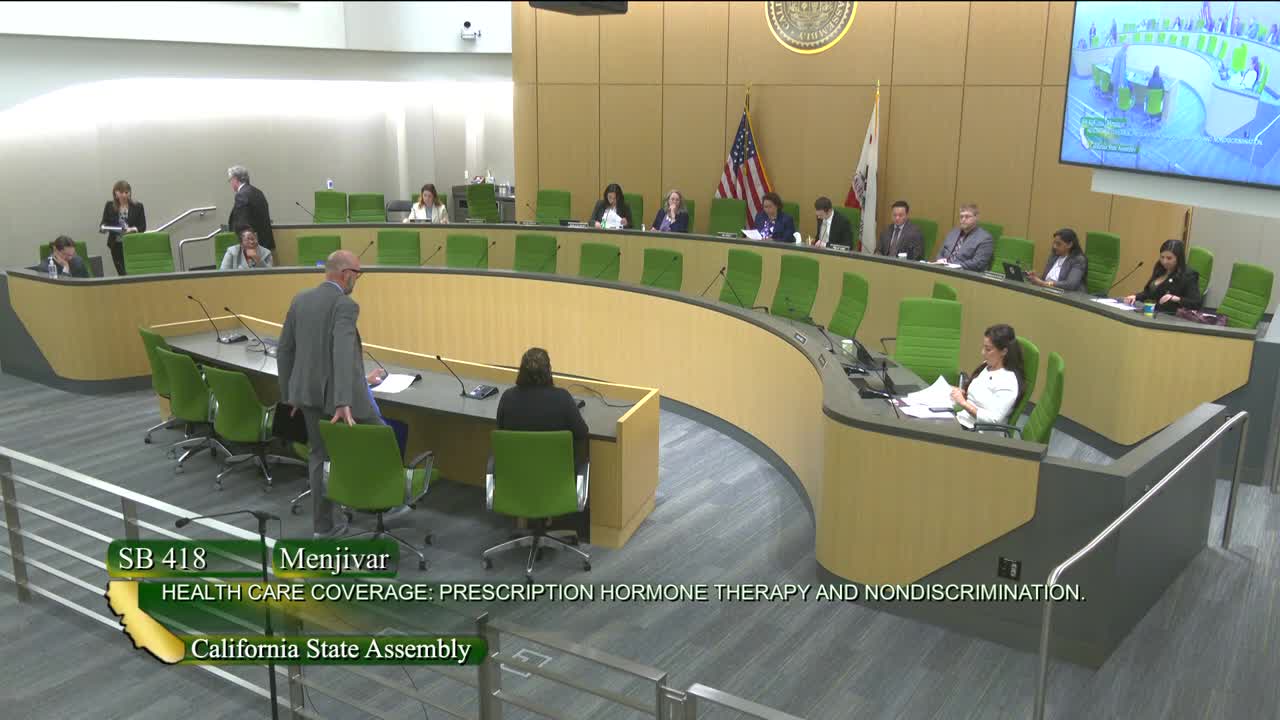 21MIN
Assembly Standing Committee on Health
 2MIN
Senate Floor
 8MIN
Senate Standing Committee on Judiciary
 18MIN
Senate Standing Committee on Health
Bill Author