SB 427: Habitat Conservation Fund.
- Session Year: 2025-2026
- House: Senate
- Latest Version Date: 2025-10-03
Current Status:
Passed
(2025-10-03: Chaptered by Secretary of State. Chapter 317, Statutes of 2025.)
Introduced
In Committee
Awaiting First Chamber Vote
Passed First Chamber
In Committee
Awaiting Second Chamber Vote
Passed Second Chamber
Enacted
What does this bill do?
This bill extends the annual $30 million transfer from the General Fund to the Habitat Conservation Fund and continues the fund’s yearly allocations to state parks, the State Coastal Conservancy, the Santa Monica Mountains Conservancy, the California Tahoe Conservancy, and the Wildlife Conservation Board through 2035. It also keeps the existing spending rules for how the Wildlife Conservation Board and those agencies must use the money, including limits on administration, target shares for different project types, and an approximate north/south geographic split, through that same date.
The summary is provided by generative AI which can make mistakes. For original language, please view the details in the table below.
Proposition 117, an initiative measure approved by the electors at the June 5, 1990, direct primary election, enacted the California Wildlife Protection Act of 1990. The act creates the Habitat Conservation Fund and requires the moneys in the fund to be used for specified purposes generally relating to the acquisition, enhancement, or restoration of wildlife habitat. The act requires the Controller, until June 30, 2020, to annually transfer $30,000,000 from the General Fund to the Habitat Conservation Fund, less any amount transferred to the Habitat Conservation Fund from specified accounts and funds. The act, until July 1, 2020, continuously appropriates specified amounts from the Habitat Conservation Fund to the Department of Parks and Recreation, the State Coastal Conservancy, the Santa Monica Mountains Conservancy, and the California Tahoe Conservancy, and continuously appropriates the balance of the fund to the Wildlife Conservation Board.
Chapter 31 of the Statutes of 2019 requires the Controller to continue to annually transfer $30,000,000 from the General Fund, less any amount transferred to the Habitat Conservation Fund from specified accounts and funds, to the Habitat Conservation Fund until June 30, 2030, and continuously appropriates that amount on an annual basis in the same proportions to the specified entities until July 1, 2030.
This bill would require the Controller to continue to annually transfer $30,000,000 from the General Fund, less any amount transferred to the Habitat Conservation Fund from specified accounts and funds, to the Habitat Conservation Fund until June 30, 2035, and would continuously appropriate that amount on an annual basis in the same proportions to the specified entities described above until July 1, 2035.
Proposition 117, an initiative measure approved by the electors at the June 5, 1990, direct primary election, enacted the California Wildlife Protection Act of 1990. The act creates the Habitat Conservation Fund and requires the moneys in the fund to be used for specified purposes generally relating to the acquisition, enhancement, or restoration of wildlife habitat. The act requires the Controller, until June 30, 2020, to annually transfer $30,000,000 from the General Fund to the Habitat Conservation Fund, less any amount transferred to the Habitat Conservation Fund from specified accounts and funds. The act, until July 1, 2020, continuously appropriates specified amounts from the Habitat Conservation Fund to the Department of Parks and Recreation, the State Coastal Conservancy, the Santa Monica Mountains Conservancy, and the California Tahoe Conservancy, and continuously appropriates the balance of the fund to the Wildlife Conservation Board.
Chapter 31 of the Statutes of 2019 requires the Controller to continue to annually transfer $30,000,000 from the General Fund, less any amount transferred to the Habitat Conservation Fund from specified accounts and funds, to the Habitat Conservation Fund until June 30, 2030, and continuously appropriates that amount on an annual basis in the same proportions to the specified entities until July 1, 2030.
This bill would require the Controller to continue to annually transfer $30,000,000 from the General Fund, less any amount transferred to the Habitat Conservation Fund from specified accounts and funds, to the Habitat Conservation Fund indefinitely, until June 30, 2035, and would continuously appropriate that amount on an annual basis in the same proportions to the specified entities described above, indefinitely. above until July 1, 2035.
Proposition 117, an initiative measure approved by the electors at the June 5, 1990, direct primary election, enacted the California Wildlife Protection Act of 1990. The act creates the Habitat Conservation Fund and requires the moneys in the fund to be used for specified purposes generally relating to the acquisition, enhancement, or restoration of wildlife habitat. The act requires the Controller, until June 30, 2020, to annually transfer $30,000,000 from the General Fund to the Habitat Conservation Fund, less any amount transferred to the Habitat Conservation Fund from specified accounts and funds. The act, until July 1, 2020, continuously appropriates specified amounts from the Habitat Conservation Fund to the Department of Parks and Recreation, the State Coastal Conservancy, the Santa Monica Mountains Conservancy, and the California Tahoe Conservancy, and continuously appropriates the balance of the fund to the Wildlife Conservation Board.
Chapter 31 of the Statutes of 2019 requires the Controller to continue to annually transfer $30,000,000 from the General Fund, less any amount transferred to the Habitat Conservation Fund from specified accounts and funds, to the Habitat Conservation Fund until June 30, 2030, and continuously appropriates that amount on an annual basis in the same proportions to the specified entities until July 1, 2030.
This bill would require the Controller to continue to annually transfer $30,000,000 from the General Fund, less any amount transferred to the Habitat Conservation Fund from specified accounts and funds, to the Habitat Conservation Fund indefinitely, and would continuously appropriate that amount on an annual basis in the same proportions to the specified entities described above, indefinitely.
Notwithstanding Section 13340 of the Government Code, the money in the fund is continuously appropriated, without regard to fiscal years, as follows:
(a)To the Department of Parks and Recreation, four million five hundred thousand dollars ($4,500,000) annually for allocation as follows:
(1)One million five hundred thousand dollars ($1,500,000) for projects that are located in the Santa Lucia Mountain Range in Monterey County for expenditure by the Department of Parks and Recreation and for grants to the Monterey Peninsula Regional Park District.
(2)One million dollars ($1,000,000) for acquisitions in, and adjacent to, units of the state park system.
(3)Two million dollars ($2,000,000) for 50 percent matching grants to local agencies for projects meeting the purposes specified in Section 2786 and, additionally, for the acquisition of wildlife corridors and urban trails, nature interpretation programs, and other programs that bring urban residents into park and wildlife areas. The grants made pursuant to this subdivision are subject to the conditions of subdivision (d) of Section 5910, and Sections 5917 and 5919, of the Public Resources Code, as nearly as may be practicable.
(b)To the State Coastal Conservancy, four million dollars ($4,000,000) annually.
(c)To the Santa Monica Mountains Conservancy, five million dollars ($5,000,000) annually for the next 10 fiscal years, commencing with the 199091 fiscal year. The money shall be used for the purposes specified in Section 2786 for wildlife habitat, and for related open-space projects, within the Santa Monica Mountains Zone, the Rim of the Valley Corridor, and the Santa Clarita Woodlands. Of the total amount appropriated pursuant to this subdivision, not less than a total of ten million dollars ($10,000,000) shall be spent within the Santa Susana Mountains and the Simi Hills, and not less than a total of ten million dollars ($10,000,000) shall be spent within the Santa Clarita Woodlands. These funds shall be expended in accordance with Division 23 (commencing with Section 33000) of the Public Resources Code during the operative period of this section as specified in subdivision (f) and in Section 2797. The Legislature may, by statute, extend the period for expenditure of the funds provided by this subdivision.
(d)To the California Tahoe Conservancy, five hundred thousand dollars ($500,000) annually.
(e)To the board, the balance of the fund.
(f)This section shall become operative on July 1, 1990, and, as of July 1, 2035, is repealed, unless a later enacted statute, which becomes effective on or before July 1, 2035, deletes or extends that date.
SEC. 2.Section 2791 of the Fish and Game Code is amended to read:2791.The board shall expend the money appropriated to it from the fund subject to the following conditions:
(a)Not more than one and one-half (11/2) percent shall be expended for administration of this chapter.
(b)The board shall, to the extent practicable, expend the money in a manner and for projects so that, within each 24-month period, approximately one-third of the total expenditures of the money in the fund, including, until July 1, 2035, the expenditures by the agencies receiving money from the fund pursuant to subdivisions (a) to (d), inclusive, of Section 2787, are expended for the purposes specified in subdivision (a) of Section 2786 and approximately two-thirds of the total expenditures of the money in the fund, including, until July 1, 2035, the expenditures by the agencies receiving money from the fund pursuant to subdivisions (a) to (d), inclusive, of Section 2787, are expended for the purposes specified in subdivisions (b) and (c) of Section 2786.
(c)Notwithstanding the requirement for acquisition in subdivisions (a), (b), and (c) of Section 2786, the board shall, to the extent practicable, expend the money in the fund in a manner and for projects so that, within each 24-month period, approximately six million dollars ($6,000,000) of the money, including, until July 1, 2035, the expenditures by the agencies receiving money from the fund pursuant to subdivisions (a) to (d), inclusive, of Section 2787, are expended for the purposes specified in subdivision (d) of Section 2786.
(d)Notwithstanding the requirement for acquisition in subdivisions (a), (b), and (c) of Section 2786, the board shall, to the extent practicable, expend the money in the fund in a manner and for projects so that, within each 24-month period, approximately six million dollars ($6,000,000) of the money, including, until July 1, 2035, the expenditures by the agencies receiving money from the fund pursuant to subdivisions (a) to (d), inclusive, of Section 2787, are expended for the purposes specified in subdivision (e) and (f) of Section 2786.
(e)To the extent practicable, the board shall expend the money appropriated to it from the fund in a manner and for projects so that, within each 24-month period, approximately one-half of the total expenditures of the money in the fund, including, until July 1, 2035, the expenditures by the agencies receiving money from the fund pursuant to subdivisions (a) to (d), inclusive, of Section 2787, are expended in northern California and approximately one-half in southern California.
(f)Subject to the other requirements of this section, the board may allocate not more than two million dollars ($2,000,000) annually for the purposes of this chapter to one or more state agencies created by the Legislature or the people that are authorized by other provisions of law to expend funds for the purposes of this chapter.
SEC. 3.Section 2796 of the Fish and Game Code is amended to read:2796.(a)The Controller shall annually transfer the sum of thirty million dollars ($30,000,000) from the General Fund to the Habitat Conservation Fund, less any amount transferred to the Habitat Conservation Fund from, but not limited to, the following accounts and funds:
(1)The Public Resources Account in the Cigarette and Tobacco Products Surtax Fund to the extent authorized by the Tobacco Tax and Health Protection Act of 1988.
(2)The Unallocated Account in the Cigarette and Tobacco Products Surtax Fund pursuant to subdivision (a) of Section 2795.
(3)The California Environmental License Plate Fund.
(4)The Endangered and Rare Fish, Wildlife, and Plant Species Conservation and Enhancement Account in the Fish and Game Preservation Fund.
(5)Any other non-General Fund accounts and funds created by the Legislature or the people for purposes that are consistent with the purposes of this act.
(6)Any bond funds that are authorized by the people after July 1, 1990, that may be used for purposes that are identical to the purposes specified in Section 2786.
(7)The Wildlife Restoration Fund.
(b)Except for transfers from the Endangered and Rare Fish, Wildlife, and Plant Species Conservation and Enhancement Account, transfers from the Fish and Game Preservation Fund are not transfers for purposes of subdivision (a) and shall not be made to the fund. Transfers of federal, local, or privately donated funds or transfers from the State Coastal Conservancy Fund pursuant to Section 31011 of the Public Resources Code to the fund are not transfers for purposes of subdivision (a).
(c)This section does not limit the amount of funds that may be transferred to the fund or that may be expended for fish and wildlife habitat protection either from the fund or from any other sources.
(d)This section shall become operative on July 1, 1990, shall become inoperative on June 30, 2035, and, as of January 1, 2036, is repealed, unless a later enacted statute, which becomes effective before January 1, 2036, deletes or extends the dates on which it becomes inoperative and is repealed.
REVISIONS: HeadingLine 3.Notwithstanding Section 13340 of the Government Code, the money in the fund is continuously appropriated, without regard to fiscal years, as follows:
(a)To the Department of Parks and Recreation, four million five hundred thousand dollars ($4,500,000) annually for allocation as follows:
(1)One million five hundred thousand dollars ($1,500,000) for projects that are located in the Santa Lucia Mountain Range in Monterey County for expenditure by the Department of Parks and Recreation and for grants to the Monterey Peninsula Regional Park District.
(2)One million dollars ($1,000,000) for acquisitions in, and adjacent to, units of the state park system.
(3)Two million dollars ($2,000,000) for 50 percent matching grants to local agencies for projects meeting the purposes specified in Section 2786 and, additionally, for the acquisition of wildlife corridors and urban trails, nature interpretation programs, and other programs that bring urban residents into park and wildlife areas. The grants made pursuant to this subdivision are subject to the conditions of subdivision (d) of Section 5910, and Sections 5917 and 5919, of the Public Resources Code, as nearly as may be practicable.
(b)To the State Coastal Conservancy, four million dollars ($4,000,000) annually.
(c)To the Santa Monica Mountains Conservancy, five million dollars ($5,000,000) annually for the next 10 fiscal years, commencing with the 199091 fiscal year. The money shall be used for the purposes specified in Section 2786 for wildlife habitat, and for related open-space projects, within the Santa Monica Mountains Zone, the Rim of the Valley Corridor, and the Santa Clarita Woodlands. Of the total amount appropriated pursuant to this subdivision, not less than a total of ten million dollars ($10,000,000) shall be spent within the Santa Susana Mountains and the Simi Hills, and not less than a total of ten million dollars ($10,000,000) shall be spent within the Santa Clarita Woodlands. These funds shall be expended in accordance with Division 23 (commencing with Section 33000) of the Public Resources Code during the operative period of this section as specified in subdivision (f) and in Section 2797. The Legislature may, by statute, extend the period for expenditure of the funds provided by this subdivision.
(d)To the California Tahoe Conservancy, five hundred thousand dollars ($500,000) annually.
(e)To the board, the balance of the fund.
(f)This section shall become operative on July 1, 1990, and, as of July 1, 2030, is repealed, unless a later enacted statute, which becomes effective on or before July 1, 2030, deletes or extends that date.SEC. 2.Section 2791 of the Fish and Game Code is amended to read:2791.The board shall expend the money appropriated to it from the fund subject to the following conditions:
(a)Not more than one and one-half (11/2) percent shall be expended for administration of this chapter.
(b)The board shall, to the extent practicable, expend the money in a manner and for projects so that, within each 24-month period, approximately one-third of the total expenditures of the money in the fund, including, until July 1, 2030, the expenditures by the agencies receiving money from the fund pursuant to subdivisions (a) to (d), inclusive, of Section 2787, are expended for the purposes specified in subdivision (a) of Section 2786 and approximately two-thirds of the total expenditures of the money in the fund, including, until July 1, 2030, the expenditures by the agencies receiving money from the fund pursuant to subdivisions (a) to (d), inclusive, of Section 2787, are expended for the purposes specified in subdivisions (b) and (c) of Section 2786.
(c)Notwithstanding the requirement for acquisition in subdivisions (a), (b), and (c) of Section 2786, the board shall, to the extent practicable, expend the money in the fund in a manner and for projects so that, within each 24-month period, approximately six million dollars ($6,000,000) of the money, including, until July 1, 2030, the expenditures by the agencies receiving money from the fund pursuant to subdivisions (a) to (d), inclusive, of Section 2787, are expended for the purposes specified in subdivision (d) of Section 2786.
(d)Notwithstanding the requirement for acquisition in subdivisions (a), (b), and (c) of Section 2786, the board shall, to the extent practicable, expend the money in the fund in a manner and for projects so that, within each 24-month period, approximately six million dollars ($6,000,000) of the money, including, until July 1, 2030, the expenditures by the agencies receiving money from the fund pursuant to subdivisions (a) to (d), inclusive, of Section 2787, are expended for the purposes specified in subdivision (e) and (f) of Section 2786.
(e)To the extent practicable, the board shall expend the money appropriated to it from the fund in a manner and for projects so that, within each 24-month period, approximately one-half of the total expenditures of the money in the fund, including, until July 1, 2030, the expenditures by the agencies receiving money from the fund pursuant to subdivisions (a) to (d), inclusive, of Section 2787, are expended in northern California and approximately one-half in southern California.
(f)Subject to the other requirements of this section, the board may allocate not more than two million dollars ($2,000,000) annually for the purposes of this chapter to one or more state agencies created by the Legislature or the people that are authorized by other provisions of law to expend funds for the purposes of this chapter.
SEC. 3.Section 2796 of the Fish and Game Code is amended to read:2796.(a)The Controller shall annually transfer the sum of thirty million dollars ($30,000,000) from the General Fund to the Habitat Conservation Fund, less any amount transferred to the Habitat Conservation Fund from, but not limited to, the following accounts and funds:
(1)The Public Resources Account in the Cigarette and Tobacco Products Surtax Fund to the extent authorized by the Tobacco Tax and Health Protection Act of 1988.
(2)The Unallocated Account in the Cigarette and Tobacco Products Surtax Fund pursuant to subdivision (a) of Section 2795.
(3)The California Environmental License Plate Fund.
(4)The Endangered and Rare Fish, Wildlife, and Plant Species Conservation and Enhancement Account in the Fish and Game Preservation Fund.
(5)Any other non-General Fund accounts and funds created by the Legislature or the people for purposes that are consistent with the purposes of this act.
(6)Any bond funds that are authorized by the people after July 1, 1990, that may be used for purposes that are identical to the purposes specified in Section 2786.
(7)The Wildlife Restoration Fund.
(b)Except for transfers from the Endangered and Rare Fish, Wildlife, and Plant Species Conservation and Enhancement Account, transfers from the Fish and Game Preservation Fund are not transfers for purposes of subdivision (a) and shall not be made to the fund. Transfers of federal, local, or privately donated funds or transfers from the State Coastal Conservancy Fund pursuant to Section 31011 of the Public Resources Code to the fund are not transfers for purposes of subdivision (a).
(c)This section does not limit the amount of funds that may be transferred to the fund or that may be expended for fish and wildlife habitat protection either from the fund or from any other sources.
(d)This section shall become operative on July 1, 1990, shall become inoperative on June 30, 2030, and, as of January 1, 2031, is repealed, unless a later enacted statute, which becomes effective before January 1, 2031, deletes or extends the dates on which it becomes inoperative and is repealed.|
Date
|
Status
|
|---|---|
| Oct 3, 2025 | Chaptered by Secretary of State. Chapter 317, Statutes of 2025. |
| Oct 3, 2025 | Approved by the Governor. |
| Sep 17, 2025 | Enrolled and presented to the Governor at 2 p.m. |
| Sep 10, 2025 | In Senate. Ordered to engrossing and enrolling. |
| Sep 9, 2025 | Read third time. Passed. (Ayes 78. Noes 0. Page 3074.) Ordered to the Senate. |
| Sep 2, 2025 | Read second time. Ordered to third reading. |
| Aug 29, 2025 | From committee: Do pass. (Ayes 14. Noes 1.) (August 29). |
| Aug 20, 2025 | August 20 set for first hearing. Placed on APPR. suspense file. |
| Jul 15, 2025 | From committee: Do pass and re-refer to Com. on APPR. (Ayes 11. Noes 0.) (July 15). Re-referred to Com. on APPR. |
| Jul 15, 2025 | Coauthors revised. |
| Jun 9, 2025 | Referred to Com. on W. P., & W. |
| Jun 3, 2025 | In Assembly. Read first time. Held at Desk. |
| Jun 2, 2025 | Read third time. Passed. (Ayes 38. Noes 0. Page 1407.) Ordered to the Assembly. |
| May 27, 2025 | Read second time. Ordered to third reading. |
| May 23, 2025 | Read second time and amended. Ordered to second reading. |
| May 23, 2025 | From committee: Do pass as amended. (Ayes 6. Noes 0. Page 1199.) (May 23). |
| May 16, 2025 | Set for hearing May 23. |
| Apr 21, 2025 | April 21 hearing: Placed on APPR. suspense file. |
| Apr 9, 2025 | Set for hearing April 21. |
| Apr 8, 2025 | From committee: Do pass and re-refer to Com. on APPR. (Ayes 6. Noes 0. Page 707.) (April 8). Re-referred to Com. on APPR. |
| Mar 24, 2025 | Set for hearing April 8. |
| Feb 26, 2025 | Referred to Com. on N.R. & W. |
| Feb 19, 2025 | From printer. May be acted upon on or after March 21. |
| Feb 18, 2025 | Introduced. Read first time. To Com. on RLS. for assignment. To print. |
|
Date
|
Description
|
Location
|
Votes
|
|
|---|---|---|---|---|
| Sep 9, 2025 | SB 427 Blakespear Senate Third Reading By Connolly | Assembly Floor |
Passed |
|
| Aug 29, 2025 | Do pass. | Assembly Standing Committee on Appropriations |
Passed |
|
| Jul 15, 2025 | Do pass and be re-referred to the Committee on [Appropriations] | Assembly Standing Committee on Water, Parks, and Wildlife |
Passed |
|
| Jun 2, 2025 | Senate 3rd Reading SB427 Blakespear et al. | Senate Floor |
Passed |
|
| May 23, 2025 | Do pass as amended | Senate Standing Committee on Appropriations |
Passed |
|
| Apr 21, 2025 | Placed on suspense file | Senate Standing Committee on Appropriations |
Passed |
|
| Apr 8, 2025 | Do pass, but first be re-referred to the Committee on [Appropriations] | Senate Standing Committee on Natural Resources and Water |
Passed |
This list shows positions taken on this bill by organizations on the date displayed, which is linked to the original source.
Positions by individuals are not included.
|
Organization
|
Position
|
Date
|
|---|---|---|
| 350 Bay Area Action | ** Support | |
| 350 Conejo/San Fernando Valley | ** Support | |
| 350 Humboldt | ** Support | |
| 350 South Bay Los Angeles | ** Support | |
| 350 Southland Legislative Committee | ** Support | |
| A coalition of environmental groups | ** Support | |
| Alianza Coachella Valley | ** Support | |
| Alta Peak Chapter, California Native Plant Society | ** Support | |
| American River Conservancy | ** Support | |
| Anzo-Borrego Foundation | ** Support | |
| Audubon California | ** Support | |
| Backcountry Hunters Anglers | ** Support | |
| Ban Single Use Plastic | ** Support | |
| Big Sur Land Trust | ** Support | |
| Bolsa Chica Land Trust | ** Support | |
| CactusToClouds Institute | ** Support | |
| Cal-Ore Wetland And Waterfowl Council | ** Support | |
| California Association Of Resource Conservation Districts | ** Support | |
| California Bowmen Hunters/State Archery Association | ** Support | |
| California Chapter of the Wild Sheep Foundation | ** Support | |
| California Coastal Protection Network | ** Support | |
| California Council Of Land Trusts | ** Support | |
| California Habitat Conservation Planning Coalition | ** Support | |
| California Hawking Club | ** Support | |
| California Houndsmen For Conservation | ** Support | |
| California Institute for Biodiversity | ** Support | |
| California Rifle and Pistol Association | ** Support | |
| California State Chapter of the National Wild Turkey Federation | ** Support | |
| California State Parks Foundation | ** Support | |
| California Tahoe Alliance | ** Support | |
| California Trout | ** Support | |
| California Waterfowl Association | ** Support | |
| Calwild | ** Support | |
| Center For Biological Diversity | ** Support | |
| cleanearth4kids.org | ** Support | |
| Coastal Corridor Alliance | ** Support | |
| Coastal Ranches Conservancy | ** Support | |
| Defenders Of Wildlife | ** Support | |
| Delta Waterfowl | ** Support | |
| Ducks Unlimited | ** Support | |
| East Bay Regional Park District | ** Support | |
| Endangered Habitats League | ** Support | |
| Environmental Center of San Diego | ** Support | |
| Environmental Protection Information Center | ** Support | |
| EPIC | ** Support | |
| Feather River Trout Unlimited | ** Support | |
| Forests Forever | ** Support | |
| Friends Committee On Legislation Of California | ** Support | |
| Friends of the Inyo | ** Support | |
| Grassland Water District | ** Support | |
| Green Foothills | ** Support | |
| Greenbelt Alliance | ** Support | |
| Hills for Everyone | ** Support | |
| Hispanic Access Foundation | ** Support | |
| In Defense of Animals | ** Support | |
| Karmic Action Redistribution Management Agency | ** Support | |
| Land Trust Of Santa Cruz County | ** Support | |
| Long Beach 350 | ** Support | |
| Long Beach Alliance for Clean Energy | ** Support | |
| Los Angeles Climate Reality Project | ** Support | |
| Los Angeles Neighborhood Land Trust | ** Support | |
| Los Padres ForestWatch | ** Support | |
| Midpeninsula Regional Open Space District | ** Support | |
| Mojave Desert Land Trust | ** Support | |
| Mount Shasta Bioregional Ecology Center | ** Support | |
| Mountain Lion Foundation | ** Support | |
| National Parks Conservation Association | ** Support | |
| National Wild Turkey Federation, California State Chapter | ** Support | |
| National Wildlife Federation | ** Support | |
| National Wildlife Foundation | ** Support | |
| Nature For All | ** Support | |
| Oswit Land Trust | ** Support | |
| Pacific Forest Trust | ** Support | |
| Planning And Conservation League | ** Support | |
| Prosperity California | ** Support | |
| Resource Renewal Institute | ** Support | |
| River Partners | ** Support | |
| Rocky Mountain Elk Foundation | ** Support | |
| Sacramento Safari Club | ** Support | |
| Safari Club International, Golden Gate Chapter | ** Support | |
| San Diego Bird Alliance | ** Support | |
| San Diego County Wildlife Federation | ** Support | |
| San Diego Humane Society - Project Wildlife | ** Support | |
| Sea And Sage Audubon Society | ** Support | |
| Sempervirens Fund | ** Support | |
| Sequoia Riverlands Trust | ** Support | |
| Shasta Land Trust | ** Support | |
| Sierra Business Council | ** Support | |
| Sierra Club California | ** Support | |
| Sierra Consortium | ** Support | |
| Sierra Nevada Alliance | ** Support | |
| Sierra State Parks Foundation | ** Support | |
| Social Compassion In Legislation | ** Support | |
| Sonoma Land Trust | ** Support | |
| Sonoma Mountain Preservation | ** Support | |
| South Yuba River Citizens League | ** Support | |
| Surfrider Foundation | ** Support | |
| The Climate Reality Project Orange County Chapter | ** Support | |
| The Climate Reality Project San Diego Chapter | ** Support | |
| The Climate Reality Project, California State Coalition | ** Support | |
| The Climate Reality Project, Los Angeles Chapter | ** Support | |
| The Climate Reality Project, San Fernando Valley, CA Chapter | ** Support | |
| The League To Save Lake Tahoe | ** Support | |
| The Nature Conservancy | ** Support | |
| the River Project | ** Support | |
| The Wildlands Conservancy | ** Support | |
| Trout Unlimited | ** Support | |
| Trust for Public Land | ** Support | |
| Tulare Basin Wetlands Association | ** Support | |
| Tuolumne River Trust | ** Support | |
| Urban Ecology Project | ** Support | |
| Van Gelder Biological | ** Support | |
| Western Nebraska Resources Council | ** Support | |
| Western Riverside County Regional Conservation Authority | ** Support | |
| Wholly H2O | ** Support | |
| WildFutures | ** Support | |
| Wildlands Network | ** Support |
SENATE THIRD READING
STR Bill Id:SB 427
Author:(Blakespear and Stern)
As Amended Ver:May 23, 2025
2/3 vote
SUMMARY
Extends the sunset of the Habitat Conservation Fund (HCF) from 2030 to 2035.
Major Provisions
COMMENTS
On June 5, 1990, voters approved Proposition 117: The California Wildlife Protection Act. Proposition 117 created the HCF and requires $30 million to be transferred annually from existing environmental funds and the General Fund to the HCF to support the acquisition, enhancement, or restoration of certain lands for wildlife or open space purposes. Originally, Proposition 117 included a sunset for the HCF in 2020, but language in Proposition 117 allowed the Legislature to extend the sunset without a four-fifths vote. SB 85 (Chapter 31, Statutes of 2019) later extended the sunset to 2030. This bill would further extend the sunset to 2035.
HCF monies are to be expended on the acquisition of habitat for the protection of deer and mountain lions; the acquisition of habitat to protect rare, endangered, threatened, or fully protected species; the acquisition of habitat for significant natural areas; the acquisition, enhancement, or restoration of wetlands; the acquisition, restoration, or enhancement of aquatic habitat for anadromous salmonids and trout resources; and the acquisition, restoration, or enhancement of riparian habitat. Since 1990, over $1 billion has been transferred into the HCF. Three state entities use their HCF allotment for public grants.
Created by the Wildlife Conservation Law of 1947, the Wildlife Conservation Board is a state grant-making agency within the Department of Fish and Wildlife, dedicated to safeguarding California's spectacular biological diversity and wild spaces by working in partnership with tribes, conservation organizations, and government agencies to acquire lands and design and implement habitat restoration and public access projects statewide through a variety of programs. One such program is the Habitat Enhancement and Restoration Program which is funded primarily through HCF and provides for coastal, wetland, and grassland habitat restoration, wildlife corridors, and fisheries enhancement.
According to the Author
"While the HCF annual allocation is relatively small in comparison to resource-related bond acts that have passed over the life of Proposition 117, it has provided a necessary, consistent, and reliable revenue source for conservation efforts in California—helping to attract and secure other public and private funding critical to completing major acquisitions, restoration, and wildlife connectivity projects.
[This bill] will extend the sunset for this funding to 2035 to protect a necessary, consistent, and reliable revenue source for conservation efforts that benefit California's diverse communities and biodiversity."
Arguments in Support
A coalition of environmental groups write in strong support of this bill. These groups celebrate the more than $1 billion in HCF funds, which have protected over 1.2 million acres of wildlife habitat across California and have supported more than 350 local and regional park projects since 1990. They also note the urgency of signaling a commitment to the HCF, because "in the five years since the Legislature and Governor extended the HCF through 2030, the Department of Finance has proposed (through the May Revision process) to sweep the HCF twice and proposed in 2024 to terminate it altogether." The Legislature has rejected these efforts.
Arguments in Opposition
None on file.
FISCAL COMMENTS
According to the Assembly Appropriations Committee, this bill will result in ongoing costs of $30 million annually (General Fund, special fund, or bond funds) from fiscal year (FY) 2030–31 until FY 2035–36 to maintain the annual allocation to the HCF.
VOTES
SENATE FLOOR: 38-0-2
YES: Allen, Alvarado-Gil, Archuleta, Arreguín, Ashby, Becker, Blakespear, Cabaldon, Caballero, Cervantes, Choi, Cortese, Dahle, Durazo, Gonzalez, Grayson, Grove, Jones, Laird, Limón, McGuire, McNerney, Menjivar, Niello, Ochoa Bogh, Padilla, Pérez, Richardson, Rubio, Seyarto, Smallwood-Cuevas, Stern, Strickland, Umberg, Valladares, Wahab, Weber Pierson, Wiener
ABS, ABST OR NV: Hurtado, Reyes
ASM WATER, PARKS, AND WILDLIFE: 11-0-2
YES: Papan, Jeff Gonzalez, Alvarez, Ávila Farías, Bennett, Boerner, Caloza, Hart, Macedo, Celeste Rodriguez, Rogers
ABS, ABST OR NV: Bains, Tangipa
ASM APPROPRIATIONS: 14-1-0
YES: Wicks, Sanchez, Arambula, Calderon, Caloza, Dixon, Elhawary, Fong, Mark González, Ahrens, Pacheco, Pellerin, Solache, Ta
NO: Tangipa
UPDATED
VERSION: May 23, 2025
CONSULTANT: Stephanie Mitchell / W., P., & W. / (916) 319-2096 FN: 0001351
Date of Hearing: August 20, 2025
ASSEMBLY COMMITTEE ON APPROPRIATIONS
Buffy Wicks, Chair
SBPCA Bill Id:SB 427
Author:(Blakespear) – As Amended Ver:May 23, 2025
Policy Committee: | Water, Parks and Wildlife | Vote: | 11 - 0 |
|
| ||
|
|
Urgency: No State Mandated Local Program: No Reimbursable: No
SUMMARY:
This bill extends the sunset date for five years, from July 1, 2030, to July 1, 2035, for the annual allocation of $30 million to the Habitat Conservation Fund (HCF), and the continuous appropriation of these monies to the Wildlife Conservation Board (WCB) and other specified state entities for expenditure.
FISCAL EFFECT:
Ongoing costs of $30 million annually (General Fund, special fund, or bond funds) from fiscal year (FY) 2030-31 until FY 2035-36 to maintain the annual allocation to the HCF.
COMMENTS:
1) Purpose. According to the author:
While the HCF annual allocation is relatively small in comparison to resource related bond acts that have passed over the life of Proposition 117, it has provided a necessary, consistent, and reliable revenue source for conservation efforts in California – helping to attract and secure other public and private funding critical to complete major acquisitions, restoration, and wildlife connectivity projects. [This bill] will extend the sunset for this funding to 2035 to protect a necessary, consistent, and reliable revenue source for conservation efforts that benefit California’s diverse communities and biodiversity.
2) Background. On June 5, 1990, California voters approved Proposition 117 – The California Wildlife Protection Act of 1990. Proposition 117 created the HCF and requires $30 million be annually transferred from existing environmental funds and the General Fund to the HCF to support the acquisition, enhancement, or restoration of certain lands for wildlife or open space purposes. In addition, Proposition 117 provided that HCF funds be spent evenly between northern and southern California and included certain specific annual expenditures, including to the Department of Parks and Recreation, the State Coastal Conservancy, the Santa Monica Mountains Conservancy, the California Tahoe Conservancy, and the balance to the WCB.
As passed by the voters, Proposition 117 sunsetted the HCF on July 1, 2020, unless a later enacted statute “deletes or extends that date.” The 2019 public resources budget trailer bill (SB 85 (Committee on Budget and Fiscal Review), Chapter 31, Statutes of 2019)) extended the HCF for ten years until June 30, 2030. Proposition 117, as noted, expressly allowed for the extension of the HCF. In addition, it also expressly states that “the Legislature shall not reallocate the funds allocated” to the HCF.
A coalition of environmental groups writes in support of this bill and notes that since 1990, more than $1 billion in HCF funds have protected over 1.2 million acres of wildlife habitat across California and have supported more than 350 local and regional park projects. They also note the urgency of signaling a commitment to the HCF, because in the five years since the Legislature and Governor extended the HCF through 2030, “the Department of Finance has proposed (through the May Revision process) to sweep the HCF twice and proposed in 2024 to terminate it altogether. The Legislature rejected these efforts.” This bill extends the sunset on the annual allocation to the HCF until 2035.
Analysis Prepared by: Nikita Koraddi / APPR. / (916) 319-2081
Date of Hearing: July 15, 2025
ASSEMBLY COMMITTEE ON WATER, PARKS, AND WILDLIFE
Diane Papan, Chair
SBPCA Bill Id:SB 427
Author:(Blakespear) – As Amended Ver:May 23, 2025
SENATE VOTE: 38-0
SUBJECT: Habitat Conservation Fund
SUMMARY: Extends the sunset of the Habitat Conservation Fund (HCF) from 2030 to 2035.
EXISTING LAW:
- Declares, under the Wildlife Conservation Law of 1947, that the preservation, protection, and restoration of wildlife is necessary to provide for recreation and the public welfare and calls for a coordinated program to acquire and restore habitat lands. Establishes the Wildlife Conservation Board (WCB) and a number of programs within WCB to realize these goals [Fish and Game Code (FGC) §§ 1320 et seq.].
- Establishes the California Wildlife Protection Act of 1990 (FGC §§ 2780 et seq.). Among other provisions, the California Wildlife Protection Act:
- Creates the HCF, and specifies its uses, including the acquisition, enhancement, or restoration of certain habitats (FGC § 2786).
- Requires the Controller to annually transfer $30 million to the HCF from the General Fund less any monies provided from other sources such as the California Environmental License Plate Fund, and the Unallocated Account in the Cigarette and Tobacco Products Surtax Fund, among others (FGC § 2795 and § 2796).
- Continuously appropriates money in the HCF to the Department of Parks and Recreation (State Parks; $4.5 million annually for specified purposes); State Coastal Conservancy ($4 million annually); Santa Monica Mountains Conservancy ($5 million annually for 10 years, as provided); California Tahoe Conservancy ($500,000 annually); and the balance to WCB (FGC § 2787).
- Places certain conditions upon expenditures from the HCF, including that funds appropriated to WCB are expended approximately equally between Northern and Southern California (FGC § 2791).
- Sunsets the HCF on July 1, 2030 unless a later enacted statute deletes or extends that date (FGC § 2787).
- Prohibits the Legislature from changing the expenditure and transfer provisions, and reallocating any of the appropriated monies [Proposition 117 (1990), § 8].
FISCAL EFFECT: Unknown. This bill is keyed fiscal.
COMMENTS:
- Purpose of this bill. According to the author, “While the HCF annual allocation is relatively small in comparison to resource related bond acts that have passed over the life of Proposition 117, it has provided a necessary, consistent, and reliable revenue source for conservation efforts in California—helping to attract and secure other public and private funding critical to complete major acquisitions, restoration, and wildlife connectivity projects.
[This bill] will extend the sunset for this funding to 2035 to protect a necessary, consistent, and reliable revenue source for conservation efforts that benefit California’s diverse communities and biodiversity.”
- Background. On June 5, 1990, voters approved Proposition 117: The California Wildlife Protection Act. Proposition 117 created the HCF and requires $30 million to be annually transferred from existing environmental funds and the General Fund to the HCF to support the acquisition, enhancement, or restoration of certain lands for wildlife or open space purposes. Originally, Proposition 117 included a sunset for the HCF in 2020, but language in Proposition 117 allowed the legislature to extend the sunset without a four-fifths vote. SB 85 (Chapter 31, Statutes of 2019) later extended the sunset to 2030. This bill would further extend the sunset to 2035.
HCF. HCF monies are to be expended on the acquisition of habitat for the protection of deer and mountain lions; the acquisition of habitat to protect rare, endangered, threatened, or fully protected species; the acquisition of habitat for significant natural areas; the acquisition, enhancement, or restoration of wetlands; the acquisition, restoration, or enhancement of aquatic habitat for anadromous salmonids and trout resources; and the acquisition, restoration, or enhancement of riparian habitat. Since 1990, over $1 billion has been transferred into the HCF. Three state entities use their HCF allotment for public grants.
State entities and projects. Created by the Wildlife Conservation Law of 1947, WCB is a state grant-making agency within the Department of Fish and Wildlife, dedicated to safeguarding California's spectacular biological diversity and wild spaces by working in partnership with tribes, conservation organizations, and government agencies to acquire lands and design and implement habitat restoration and public access projects statewide through a variety of programs. One such program is the Habitat Enhancement and Restoration Program which is funded primarily through HCF and provides for coastal, wetland, and grassland habitat restoration, wildlife corridors, and fisheries enhancement. Some projects include:
- The Green Oak Wetland and Riparian Restoration Project ($1,124,485) in San Mateo County to restore hydrologic function for a property in Año Nuevo State Park;
- The Mattley Meadow and Riparian Restoration Project ($538,314) in Calaveras County to restore hydrologic function and improve riparian habitat;
- The Allensworth Ecological Reserve ($38,071) in Tulare County for acquisitions.
- The Imperial Wildlife Area Wetland Restoration ($2,400,000) in Imperial County for the restoration and enhancement of migratory bird habitat;
- The Agoura Hills, Santa Monica Mountains Gateway ($2,300,000) in Los Angeles for acquisitions to preserve endangered species; and
- The East Contra Costa County Habitat Conservation Plan ($229,868) in Contra Costa for acquisitions to preserve endangered species.
The mission of State Parks is to protect, maintain, and provide access to some of California’s most valued natural and cultural resources. State Parks funds various projects with HCF such as land acquisition for habitat, wetlands, and trails and also funds educational and interpretive activities. In just the last two years, State Parks announced $9.5 million in grants from HCF to 31 local projects. This includes grants to:
- The City of Carpinteria ($183,438) for the construction of a new portion of trail to extend the Carpinteria Coastal Vista Trail;
- The City of Eureka’s Camp Cooper Environmental Education Camp ($126,257) to provide an eight-week summer camp on stewardship, wildlife habitats, conservation and interpretation for youth ages five through 12;
- The Kern County Park and Recreation Department ($74,809) to provide a four-week outdoor education program for underserved communities in Bakersfield; and
- The City of San Fernando’s Nature Adventure and Discovery Camp Program ($42,895) to coordinate educational, interpretive, and recreational activities through University of California—Los Angeles and the North Valley Family YMCA.
The State Coastal Conservancy implements statewide and regional plans to protect, restore, and provide access to California’s coast. The State Coastal Conservancy makes grants available to fund coastal projects through the support of HCF, General Fund, and bond funds, including:
- A total of $7,137,633 for acquisitions in the City of Oxnard for the Ormond Beach Wetlands; and
- A total of $629,545 for the study, acquisition, and restoration of the Tijuana Estuary.
- Arguments in support. A coalition of environmental groups write in strong support of this bill. These groups celebrate the more than $1 billion in HCF funds, which have protected over 1.2 million acres of wildlife habitat across California and have supported more than 350 local and regional park projects since 1990. They also note the urgency of signaling a commitment to the HCF, because “in the five years since the Legislature and Governor extended the HCF through 2030, the Department of Finance has proposed (through the May Revision process) to sweep the HCF twice and proposed in 2024 to terminate it altogether.” The Legislature has rejected these efforts.
- Related legislation. Proposition 117 created the HCF and guaranteed it funding of $30 million per year for 30 years. Proposition 117 is a voter initiated measure that was placed on the ballot on June 5, 1990.
SB 85 (Committee on Budget and Fiscal Review), Chapter 31, Statues of 2019, among other things, extends the sunset of the HCF from 2020 to 2030.
REGISTERED SUPPORT / OPPOSITION:
Support
Audubon California (Co-Sponsor)
National Wildlife Federation (Co-Sponsor)
Alianza Coachella Valley
Alta Peak Chapter, California Native Plant Society
American River Conservancy
Backcountry Hunters & Anglers
Ban Single Use Plastic
Big Sur Land Trust
Bolsa Chica Land Trust
Cactustocloud Institute
California Association of Resource Conservation Districts
California Bowmen Hunters/State Archery Association
California Chapter of the Wild Sheep Foundation
California Coastal Protection Network
California Council of Land Trusts
California Habitat Conservation Planning Coalition
California Houndsmen for Conservation
California Institute for Biodiversity
California State Chapter of the National Wild Turkey Federation
California State Parks Foundation
California Trout
California Waterfowl Association
CalWild
Center for Biological Diversity
Cleanearth4kids.org
Coastal Corridor Alliance
Coastal Ranches Conservancy
Defenders of Wildlife
Delta Waterfowl
East Bay Regional Park District
Endangered Habitats League
Environmental Center of San Diego
Environmental Protection Information Center
Feather River Trout Unlimited
Forests Forever
Friends Committee on Legislation of California
Friends of the Inyo
Grassland Water District
Green Foothills
Greenbelt Alliance
Hills for Everyone
Hispanic Access Foundation
In Defense of Animals
Karmic Action Retribution Management Agency
Land Trust of Santa Cruz County
Los Angeles Climate Reality Project
Los Angeles Neighborhood Land Trust
Los Padres Forestwatch
Midpeninsula Regional Open Space District
Mojave Desert Land Trust
Mount Shasta Bioregional Ecology Center
Mountain Lion Foundation
National Parks Conservation Association
Nature for All
Oswit Land Trust
Pacific Forest Trust
Planning and Conservation League
Prosperity California
Resource Renewal Institute
River Partners
Rocky Mountain Elk Foundation
San Diego Bird Alliance
San Diego County Wildlife Federation
San Diego Humane Society - Project Wildlife
Sea and Sage Audubon Society
Sempervirens Fund
Sequoia Riverlands Trust
Shasta Land Trust
Sierra Business Council
Sierra Club California
Sierra Consortium
Sierra Nevada Alliance
Sierra State Parks Foundation
Social Compassion in Legislation
Sonoma Land Trust
Sonoma Mountain Preservation
South Yuba River Citizens League
Surfrider Foundation
The Climate Reality Project Orange County Chapter
The Climate Reality Project, California State Coalition
The Climate Reality Project, Los Angeles Chapter
The Climate Reality Project, San Diego Chapter
The Climate Reality Project, San Fernando Valley CA Chapter
The League to Save Lake Tahoe
The Nature Conservancy
The River Project
The Wildlands Conservancy
Trout Unlimited
Trust for Public Land
Tulare Basin Wetlands Association
Tuolumne River Trust
Van Gelder Biological
Western Nebraska Resources Council
Wholly H2O
Wildfutures
Wildlands Network
Opposition
None on file
Analysis Prepared by: Stephanie Mitchell / W., P., & W. / (916) 319-2096
Date of Hearing: July 1, 2025
ASSEMBLY COMMITTEE ON WATER, PARKS, AND WILDLIFE
Diane Papan, Chair
SBPCA Bill Id:SB 427
Author:(Blakespear) – As Amended Ver:May 23, 2025
SENATE VOTE: 38-0
SUBJECT: Habitat Conservation Fund
SUMMARY: Extends the sunset of the Habitat Conservation Fund (HCF) from 2030 to 2035.
EXISTING LAW:
- Declares, under the Wildlife Conservation Law of 1947, that the preservation, protection, and restoration of wildlife is necessary to provide for recreation and the public welfare and calls for a coordinated program to acquire and restore habitat lands. Establishes the Wildlife Conservation Board (WCB) and a number of programs within WCB to realize these goals [Fish and Game Code (FGC) §§ 1320 et seq.].
- Establishes the California Wildlife Protection Act of 1990 (FGC §§ 2780 et seq.). Among other provisions, the California Wildlife Protection Act:
- Creates the HCF, and specifies its uses, including the acquisition, enhancement, or restoration of certain habitats (FGC § 2786).
- Requires the Controller to annually transfer $30 million to the HCF from the General Fund less any monies provided from other sources such as the California Environmental License Plate Fund, and the Unallocated Account in the Cigarette and Tobacco Products Surtax Fund, among others (FGC § 2795 and § 2796).
- Continuously appropriates money in the HCF to the Department of Parks and Recreation (State Parks; $4.5 million annually for specified purposes); State Coastal Conservancy ($4 million annually); Santa Monica Mountains Conservancy ($5 million annually for 10 years, as provided); California Tahoe Conservancy ($500,000 annually); and the balance to WCB (FGC § 2787).
- Places certain conditions upon expenditures from the HCF, including that funds appropriated to WCB are expended approximately equally between Northern and Southern California (FGC § 2791).
- Makes various findings and declarations related to habitat and wildlife conservation, open space preservation, and their appreciation by the public (FGC § 2780 and § 2781).
- Sunsets the HCF on July 1, 2030 unless a later enacted statute deletes or extends that date (FGC § 2787).
- Prohibits the Legislature from changing the expenditure and transfer provisions, and reallocating any of the appropriated monies [Proposition 117 (1990), § 8].
FISCAL EFFECT: Unknown. This bill is keyed fiscal.
COMMENTS:
- Purpose of this bill. According to the author, “While the HCF annual allocation is relatively small in comparison to resource related bond acts that have passed over the life of Proposition 117, it has provided a necessary, consistent, and reliable revenue source for conservation efforts in California—helping to attract and secure other public and private funding critical to complete major acquisitions, restoration, and wildlife connectivity projects.
[This bill] will extend the sunset for this funding to 2035 to protect a necessary, consistent, and reliable revenue source for conservation efforts that benefit California’s diverse communities and biodiversity.”
- Background. On June 5, 1990, voters approved Proposition 117: The California Wildlife Protection Act. Proposition 117 created the HCF and requires $30 million to be annually transferred from existing environmental funds and the General Fund to the HCF to support the acquisition, enhancement, or restoration of certain lands for wildlife or open space purposes. Originally, Proposition 117 included a sunset for the HCF in 2020, but language in Proposition 117 allowed the legislature to extend the sunset without a four-fifths vote. SB 85 (Chapter 31, Statutes of 2019) later extended the sunset to 2030. This bill would further extend the sunset to 2035.
HCF. HCF monies are to be expended on the acquisition of habitat, including native oak woodlands, for the protection of deer and mountain lions; the acquisition of habitat to protect rare, endangered, threatened, or fully protected species; the acquisition of habitat for significant natural areas; the acquisition, enhancement, or restoration of wetlands; the acquisition, restoration, or enhancement of aquatic habitat for anadromous salmonids and trout resources; and the acquisition, restoration, or enhancement of riparian habitat. Since 1990, over $1 billion has been transferred into the HCF. Three state entities use their HCF allotment for public grants.
State entities and projects. Created by the Wildlife Conservation Law of 1947, WCB is a state grant-making agency within the Department of Fish and Wildlife, dedicated to safeguarding California's spectacular biological diversity and wild spaces by working in partnership with tribes, conservation organizations, and government agencies to acquire lands and design and implement habitat restoration and public access projects statewide through a variety of programs. One such program is the Habitat Enhancement and Restoration Program which is funded primarily through HCF and provides for coastal, wetland, and grassland habitat restoration, wildlife corridors, and fisheries enhancements. Some projects include:
- The Green Oak Wetland and Riparian Restoration Project ($1,124,485) in San Mateo County to restore hydrologic function for a property in Año Nuevo State Park;
- The Mattley Meadow and Riparian Restoration Project ($538,314) in Calaveras County to restore hydrologic function and improve riparian habitat;
- The Allensworth Ecological Reserve ($38,071) in Tulare County for acquisitions.
- The Imperial Wildlife Area Wetland Restoration ($2,400,000) in Imperial County for the restoration and enhancement of migratory bird habitat;
- The Agoura Hills, Santa Monica Mountains Gateway ($2,300,000) in Los Angeles for acquisitions to preserve endangered species; and
- The East Contra Costa County Habitat Conservation Plan ($229,868) in Contra Costa for acquisitions to preserve endangered species.
The mission of State Parks is to protect, maintain, and provide access to some of California’s most valued natural and cultural resources. State Parks funds various projects with HCF such as land acquisition for habitat, wetlands, and trails and also funds educational and interpretive activities. In just the last two years, State Parks announced $9.5 million in grants from HCF to 31 local projects. This includes grants to:
- The City of Carpinteria ($183,438) for the construction of a new portion of trail to extend the Carpinteria Coastal Vista Trail;
- The City of Eureka’s Camp Cooper Environmental Education Camp ($126,257) to provide an eight-week summer camp on stewardship, wildlife habitats, conservation and interpretation for youth ages five through 12;
- The Kern County Park and Recreation Department ($74,809) to provide a four-week outdoor education program for underserved communities in Bakersfield; and
- The City of San Fernando’s Nature Adventure and Discovery Camp Program ($42,895) to coordinate educational, interpretive, and recreational activities through University of California—Los Angeles and the North Valley Family YMCA.
The State Coastal Conservancy implements statewide and regional plans to protect, restore, and provide access to California’s coast. The State Coastal Conservancy makes grants available to fund coastal projects through the support of HCF, General Fund, and bond funds, including:
- A total of $7,137,633 for acquisitions in the City of Oxnard for the Ormond Beach Wetlands; and
- A total of $629,545 for the study, acquisition, and restoration of the Tijuana Estuary.
- Arguments in support. A coalition of environmental groups write in strong support of this bill. These groups celebrate the more than $1 billion in HCF funds, which have protected over 1.2 million acres of wildlife habitat across California and have supported more than 350 local and regional park projects, since 1990. They also note the urgency of signaling commitment to the HCF, because “in the five years since the Legislature and Governor extended the HCF through 2030, the Department of Finance has proposed (through the May Revision process) to sweep the HCF twice and proposed in 2024 to terminate it altogether.” The Legislature has rejected these efforts.
- Related legislation. Proposition 117 created the HCF and guaranteed it funding of $30 million per year for 30 years. Proposition 117 is a voter initiated measure that was placed on the ballot on June 5, 1990.
SB 85 (Committee on Budget and Fiscal Review), Chapter 31, Statues of 2019, among other things, extends the sunset of the HCF from 2020 to 2030.
REGISTERED SUPPORT / OPPOSITION:
Support
Audubon California (Co-sponsor)
National Wildlife Federation (Co-sponsor)
Alianza Coachella Valley
Alta Peak Chapter, California Native Plant Society
American River Conservancy
Backcountry Hunters & Anglers
Ban Single Use Plastic
Big Sur Land Trust
Bolsa Chica Land Trust
Cactustocloud Institute
California Association of Resource Conservation Districts
California Bowmen Hunters/State Archery Association
California Chapter of the Wild Sheep Foundation
California Coastal Protection Network
California Council of Land Trusts
California Houndsmen for Conservation
California Institute for Biodiversity
California State Chapter of the National Wild Turkey Federation
California State Parks Foundation
California Trout
California Waterfowl Association
CalWild
Center for Biological Diversity
Coastal Corridor Alliance
Coastal Ranches Conservancy
Defenders of Wildlife
Delta Waterfowl
Endangered Habitats League
Environmental Center of San Diego
Environmental Protection Information Center
Feather River Trout Unlimited
Forests Forever
Friends Committee on Legislation of California
Friends of the Inyo
Grassland Water District
Green Foothills
Greenbelt Alliance
Hills for Everyone
Hispanic Access Foundation
In Defense of Animals
Karmic Action Retribution Management Agency
Land Trust of Santa Cruz County
Los Angeles Climate Reality Project
Los Angeles Neighborhood Land Trust
Los Padres Forestwatch
Midpeninsula Regional Open Space District
Mojave Desert Land Trust
Mount Shasta Bioregional Ecology Center
Mountain Lion Foundation
National Parks Conservation Association
Nature for All
Oswit Land Trust
Pacific Forest Trust
Planning and Conservation League
Prosperity California
Resource Renewal Institute
River Partners
Rocky Mountain Elk Foundation
San Diego Bird Alliance
San Diego County Wildlife Federation
San Diego Humane Society - Project Wildlife
Sea and Sage Audubon Society
Sempervirens Fund
Sequoia Riverlands Trust
Shasta Land Trust
Sierra Business Council
Sierra Club California
Sierra Nevada Alliance
Sierra State Parks Foundation
Social Compassion in Legislation
Sonoma Land Trust
Sonoma Mountain Preservation
South Yuba River Citizens League
Surfrider Foundation
The Climate Reality Project Orange County Chapter
The Climate Reality Project, California State Coalition
The Climate Reality Project, Los Angeles Chapter
The Climate Reality Project, San Diego Chapter
The Climate Reality Project, San Fernando Valley CA Chapter
The League to Save Lake Tahoe
The Nature Conservancy
The River Project
The Wildlands Conservancy
Trout Unlimited
Trust for Public Land
Tulare Basin Wetlands Association
Tuolumne River Trust
Van Gelder Biological
Western Nebraska Resources Council
Wholly H2O
Wildfutures
Wildlands Network
Opposition
None on file
Analysis Prepared by: Stephanie Mitchell / W., P., & W. / (916) 319-2096
SENATE RULES COMMITTEE Office of Senate Floor Analyses (916) 651-1520 Fax: (916) 327-4478 | SB 427 |
THIRD READING
Bill No: SB 427
Author: Blakespear (D) and Stern (D), et al.
Amended: 5/23/25
Vote: 27
SENATE NATURAL RES. & WATER COMMITTEE: 6-0, 4/8/25
AYES: Limón, Seyarto, Allen, Hurtado, Laird, Stern
NO VOTE RECORDED: Grove
SENATE APPROPRIATIONS COMMITTEE: 6-0, 5/23/25
AYES: Caballero, Seyarto, Cabaldon, Grayson, Richardson, Wahab
NO VOTE RECORDED: Dahle
SUBJECT: Habitat Conservation Fund
SOURCE: Audubon California
National Wildlife Foundation
DIGEST:
This bill extends the July 1, 2030 sunset date for five years to July 1, 2035 for the annual allocation of $30 million to the Habitat Conservation Fund, and the continuous appropriation of these monies to the Wildlife Conservation Board and others for expenditure, including for the acquisition and restoration of habitat, as provided.
ANALYSIS:
Existing law:
- Declares, under the Wildlife Conservation Law of 1947, that the preservation, protection, and restoration of wildlife is necessary to provide for recreation and the public welfare and calls for a coordinated program to acquire and restore habitat lands. Establishes the Wildlife Conservation Board (WCB) and a number of programs within WCB to realize these goals. (Fish and Game Code (FGC) §§1320 et seq.)
- Establishes the California Wildlife Protection Act of 1990 (Act) (FGC §§2780 et seq. and §§4800 et seq.). Among other provisions, the Act:
- Creates the Habitat Conservation Fund (HCF), and specifies its uses, such as the acquisition of habitat for certain species, and the acquisition, restoration, or enhancement of riparian habitat, among others. (FGC §2786)
- Requires the Controller to annually transfer $30 million to the HCF from the General Fund less any monies provided from other sources such as the California Environmental License Plate Fund, and the Unallocated Account in the Cigarette and Tobacco Products Surtax Fund, among others. (FGC §§2795, 2796)
- Continuously appropriates money in the HCF to State Parks ($4.5 million annually for specified purposes); State Coastal Conservancy ($4 million annually); Santa Monica Mountains Conservancy ($5 million annually for 10 years, as provided); California Tahoe Conservancy ($500,000 annually); and the balance to the WCB. (FGC §2787)
- Places certain conditions upon expenditures from the HCF, including that half of the funds are expended in northern California and half in southern California. (FGC §2791)
- Makes various findings and declarations related to habitat and wildlife conservation, open space preservation, and their appreciation by the public.
- Sunsets the HCF on July 1, 2030 unless a later enacted statute deletes or extends that date. (FGC §2787)
- Prohibits the Legislature from changing the expenditure and transfer provisions, and reallocating any of the appropriated monies, among other provisions. (Proposition 117 (1990), §8)
This bill extends the July 1, 2030 sunset date for five years to July 1, 2035 for the annual allocation of $30 million to the HCF, and the continuous appropriation of these monies to the WCB and others for expenditure, including for the acquisition and restoration of habitat, as provided.
Background
On June 5, 1990, voters statewide approved Proposition 117 – The California Wildlife Protection Act of 1990 – on a 52.4% to 47.6% margin. Among other provisions, Proposition 117 created the HCF, which was guaranteed $30 million annually for 30 years to “acquire, enhance, or restore” certain lands for wildlife or open space.
As passed by the voters, Proposition 117 sunsetted the HCF on July 1, 2020, unless a later enacted statute “deletes or extends that date.” SB 474 (Stern) of 2019 sought to extend the HCF until January 1, 2051. Ultimately, the 2019 Public Resources budget trailer bill (SB 85 (Committee on Budget and Fiscal Review, Chapter 31, Statutes of 2019)) extended the HCF for ten years until June 30, 2030.
Proposition 117, as noted above, expressly allowed for the extension of the HCF. In addition, it also expressly states that “the Legislature shall not reallocate the funds allocated” to the HCF. According to the author, in the five years since the HCF was extended through 2030, the Department of Finance has proposed to sweep the HCF twice and proposed in 2024 to terminate it altogether.
Since 1990, more than $1 billion in HCF monies have protected more than 1.2 million acres of wildlife habitat as well as supporting more than 350 local and regional parks projects.
[NOTE: See the Senate Natural Resources and Water Committee’s analysis for additional information regarding this bill.]
FISCAL EFFECT: Appropriation: Yes Fiscal Com.: Yes Local: No
According to the Senate Appropriations Committee:
- Ongoing costs of $30 million annually (General Fund, special fund, or bond funds) from fiscal year 2030-31 until 2035-36 to continue providing the annual allocation to the HCF after it otherwise would have sunset until the revised sunset.
SUPPORT: (Verified 5/22/25)
Audubon California (co-source)
National Wildlife Foundation (co-source)
350 Bay Area Action
350 Conejo/San Fernando Valley
350 Humboldt
350 South Bay Los Angeles
350 Southland Legislative Committee
Alianza Coachella Valley
American River Conservancy
Anzo-Borrego Foundation
Backcountry Hunters & Anglers
Ban SUP (Single Use Plastic)
Big Sur Land Trust
Bolsa Chica Land Trust
CactusToCloud Institute
Cal-Ore Wetland and Waterfowl Council
California Association of Resource Conservation Districts
California Bowmen Hunters/State Archery Association
California Coastal Protection Network
California Council of Land Trusts
California Habitat Conservation Planning Coalition
California Hawking Club
California Houndsmen for Conservation
California Institute for Biodiversity
California Native Plant Society, Alta Peak Chapter
California Rifle and Pistol Association
California State Parks Foundation
California Tahoe Alliance
California Trout
California Waterfowl Association
CalWild
Center for Biological Diversity
Coastal Corridor Alliance
Coastal Ranches Conservancy
Defenders of Wildlife
Delta Waterfowl
Ducks Unlimited
Endangered Habitats League
Environmental Center of San Diego
EPIC (Environmental Protection Information Center)
Feather River Trout Unlimited
Forests Forever
Friends Committee on Legislation of California
Friends of the Inyo
Grassland Water District
Green Foothills
Greenbelt Alliance
Hills For Everyone
Hispanic Access Foundation
In Defense of Animals
Karmic Action Retribution Management Agency
Land Trust of Santa Cruz County
Long Beach 350
Long Beach Alliance for Clean Energy
Los Angeles Neighborhood Land Trust
Los Padres ForestWatch
Midpeninsula Regional Open Space District
Mojave Desert Land Trust
Mount Shasta Bioregional Ecology Center
Mountain Lion Foundation
National Parks Conservation Association
National Wild Turkey Federation, California State Chapter
Nature for All
Oswit Land Trust
Pacific Forest Trust
Planning and Conservation League
Prosperity California
Resource Renewal Institute
River Partners
Rocky Mountain Elk Foundation
Sacramento Safari Club
Safari Club International, Golden Gate Chapter
San Diego Bird Alliance
San Diego County Wildlife Federation
San Diego Humane Society - Project Wildlife
Sempervirens Fund
Sequoia Riverlands Trust
Shasta Land Trust
Sierra Business Council
Sierra Club California
Sierra Consortium
Sierra Nevada Alliance
Sierra State Parks Foundation
Social Compassion in Legislation
Sonoma Land Trust
Sonoma Mountain Preservation
South Yuba River Citizens League
Surfrider Foundation
The Climate Reality Project, Los Angeles Chapter
The Climate Reality Project, Orange County Chapter
The Climate Reality Project, Riverside County
The Climate Reality Project, San Diego Chapter
The Climate Reality Project, San Fernando Valley Chapter
The League to Save Lake Tahoe
The Nature Conservancy
The River Project
The Wildlands Conservancy
Trust for Public Land
Tulare Basin Wetlands Association
Tuolumne River Trust
Urban Ecology Project
Van Gelder Biological
Western Nebraska Resources Council
Western Riverside County Regional Conservation Authority
Wholly H2O
WildFutures
Wildlands Network
Wild Sheep Foundation, California Chapter
OPPOSITION: (Verified 5/22/25)
None received
ARGUMENTS IN SUPPORT: According to the author, “I am proud to author SB 427 to ensure the Habitat Conservation Fund will continue to fund a wide range of vital conservation efforts across California. Since 1990, more than $1 billion in HCF funds have protected more than 1.2 million acres of wildlife habitat across California […] as well as supporting more than 350 local and regional parks projects.”
“While the HCF annual allocation is relatively small in comparison to resource related bond acts that passed over the life of Proposition 117, it has provided a necessary, consistent, and reliable revenue source for conservation efforts in California – helping to attract and secure other public and private funding critical to complete major acquisitions, restoration, and wildlife connectivity projects.”
“In my Senate District alone, the Wildlife Conservation Board has allocated $13.9 million in HCF money in Senate District 38 for projects since 1990, including $1.9 million for habitat linkages along Lusardi Creek in San Diego County, $2.2 million for the acquisition of 134 acres along Buena Vista Creek in Carlsbad and Oceanside, and $1.3 million for the Trabuco Creek Fish Passage Project in south Orange County. Cities, counties and any regional park or open-space district are eligible to apply for these funds.”
Prepared by: Katharine Moore / N.R. & W. / (916) 651-4116
5/27/25 13:44:32
**** END ****
SENATE COMMITTEE ON
Senator Anna Caballero, Chair
2025 - 2026 Regular Session
SB 427 (Blakespear) - Habitat Conservation Fund
Version: | Policy Vote: |
Urgency: | Mandate: |
Hearing Date: | Consultant: |
Bill Summary:
This bill would remove the July 1, 2030 sunset date to indefinitely extend the annual allocation of $30 million to the Habitat Conservation Fund (HCF), and the continuous appropriation of these monies to the Wildlife Conservation Board and others for expenditure, including for the acquisition and restoration of habitat, as provided.
*********** ANALYSIS ADDENDUM – SUSPENSE FILE ***********
The following information is revised to reflect amendments
adopted by the committee on May 23, 2025
Fiscal Impact:
- Ongoing costs of $30 million annually (General Fund, special fund, or bond funds) from fiscal year 2030-31 until 2035-36 to continue providing the annual allocation to the HCF after it otherwise would have sunset until the revised sunset.
Committee Amendments:
Committee amendments would extend the sunset by 5 years in lieu of striking it to continue the allocation indefinitely.
-- END --
SENATE COMMITTEE ON
Senator Anna Caballero, Chair
2025 - 2026 Regular Session
SB 427 (Blakespear) - Habitat Conservation Fund
Version: | Policy Vote: |
Urgency: | Mandate: |
Hearing Date: | Consultant: |
Bill Summary:
This bill would remove the July 1, 2030 sunset date to indefinitely extend the annual allocation of $30 million to the Habitat Conservation Fund (HCF), and the continuous appropriation of these monies to the Wildlife Conservation Board and others for expenditure, including for the acquisition and restoration of habitat, as provided.
Fiscal Impact:
- Ongoing costs of $30 million annually (General Fund, special fund, or bond funds) starting in fiscal year 2030-31 to continue providing the annual allocation to the HCF after it otherwise would have sunset.
Background:
On June 5, 1990, voters statewide approved Proposition 117 – The California Wildlife Protection Act of 1990 – on a 52.4% to 47.6% margin. Among other provisions, Proposition 117 created the Habitat Conservation Fund (HCF), which was guaranteed $30 million annually for 30 years to “acquire, enhance, or restore” certain lands for wildlife or open space.
HCF monies are to be expended on the acquisition of habitat, including native oak woodlands, for the protection of deer and mountain lions; the acquisition of habitat to protect rare, endangered, threatened, or fully protected species; the acquisition of habitat for significant natural areas; the acquisition, enhancement, or restoration of wetlands; the acquisition, restoration, or enhancement of aquatic habitat for anadromous salmonids and trout resources; and the acquisition, restoration, or enhancement of riparian habitat.
The WCB, located within the California Department of Fish and Wildlife, was created by the Wildlife Conservation Law of 1947 to administer a capital outlay program for wildlife conservation and related public recreation. The primary responsibilities of WCB are to select, authorize and allocate funds for the purchase of land and waters suitable for recreation purposes and the preservation, protection, and restoration of wildlife habitat. WCB approves and funds projects that set aside lands within the state for such purposes.
As passed by the voters, Proposition 117 sunsetted the HCF on July 1, 2020, unless a later enacted statute “deletes or extends that date.” SB 474 (Stern, 2019) sought to extend the HCF until January 1, 2051. Ultimately, the 2019 Public Resources budget trailer bill (SB 85 (Committee on Budget and Fiscal Review, Chapter 31, Statutes of 2019)) extended the HCF for ten years until June 30, 2030.
Proposition 117 expressly allowed for the extension of the HCF. In addition, it also expressly states that “the Legislature shall not reallocate the funds allocated” to the HCF. According to the author, in the five years since the HCF was extended through 2030, the Department of Finance has proposed to sweep the HCF twice and proposed in 2024 to terminate it altogether.
Since 1990, more than $1 billion in HCF monies have protected more than 1.2 million acres of wildlife habitat as well as supporting more than 350 local and regional parks projects.
Proposed Law:
This bill would remove the July 1, 2030 sunset date to indefinitely extend the annual allocation of $30 million to the HCF, and the continuous appropriation of HCF monies to the WCB and others for expenditure including for the acquisition and restoration of habitat, as provided.
Related Legislation:
SB 474 (Stern, 2019) sought to extend the HCF until January 1, 2051.
Staff Comments:
The $30 million annual allocation to the HCF has been a consistent source of funding since the passage of Proposition 117. Given the source of monies for the HCF, it can be used flexibly within the constraints of its implementing statutes. Available funding for habitat acquisition can vary considerably from year-to-year depending upon the state of the General Fund and whether or not bond monies are available. Language in the Act supports the allocation of additional funds – beyond the HCF – for its purposes, and some of the recently-passed Proposition 4 programs also provide for the acquisition, restoration, and enhancement of certain habitats.
It is worth nothing that the HCF is not solely dependent upon General Fund revenues. According to the SB 474 (Stern, 2019) bill analysis for the Senate Natural Resources & Water Committee, the Unallocated Account of the Tobacco Tax Fund was usually responsible for almost half of the annual allocation to the HCF during the HCF’s first 30 years.
-- END --
SENATE COMMITTEE ON NATURAL RESOURCES AND WATER
Senator Monique Limón, Chair
2025 - 2026 Regular
Bill No: SB Hearing Date: April 8, 2025
Author: | Blakespear | ||
Version: | February 18, 2025 Introduced | ||
Urgency: | No | Fiscal: | Yes |
Consultant: | Katharine Moore | ||
Subject: Habitat Conservation Fund
SUMMARY
This bill would remove the July 1, 2030 sunset date to indefinitely extend the annual allocation of $30 million to the Habitat Conservation Fund, and the continuous appropriation of these monies to the Wildlife Conservation Board and others for expenditure, including for the acquisition and restoration of habitat, as provided.
BACKGROUND AND EXISTING LAW
- On June 5, 1990, voters statewide approved Proposition 117 – The California Wildlife Protection Act of 1990 – on a 52.4% to 47.6% margin. Among other provisions, Proposition 117 created the Habitat Conservation Fund (HCF), which was guaranteed $30 million annually for 30 years to “acquire, enhance, or restore” certain lands for wildlife or open space.
- HCF monies are to be expended on the acquisition of habitat, including native oak woodlands, for the protection of deer and mountain lions; the acquisition of habitat to protect rare, endangered, threatened, or fully protected species; the acquisition of habitat for significant natural areas; the acquisition, enhancement, or restoration of wetlands; the acquisition, restoration, or enhancement of aquatic habitat for anadromous salmonids and trout resources; and the acquisition, restoration, or enhancement of riparian habitat.
- In addition, Proposition 117 provided that HCF funds be spent evenly between northern and southern California and included certain specific expenditures. These included:
- $4.5 million to the Department of Parks and Recreation (State Parks) annually of which $1.5 million to projects located in the Santa Lucia range in Monterey County; $1 million for acquisitions in and adjacent to units of the state park system; and $2 million must be used for 50% matching grants to local agencies for projects that meet the requirements of Proposition 117, and for the acquisition of wildlife corridors, urban trails, nature interpretative programs, and other programs designed to bring urban residents to park and wildlife areas.
- $4 million annually to the State Coastal Conservancy;
- $5 million annually to the Santa Monica Mountains Conservancy until 1995, as provided, after which that amount also goes to the Wildlife Conservation Board (WCB);
- $500,000 annually to the California Tahoe Conservancy; and
- The balance to the WCB.
- The WCB, located within the California Department of Fish and Wildlife, was created by the Wildlife Conservation Law of 1947 to administer a capital outlay program for wildlife conservation and related public recreation. The primary responsibilities of WCB are to select, authorize and allocate funds for the purchase of land and waters suitable for recreation purposes and the preservation, protection, and restoration of wildlife habitat. WCB approves and funds projects that set aside lands within the state for such purposes.
- As passed by the voters, Proposition 117 sunsetted the HCF on July 1, 2020, unless a later enacted statute “deletes or extends that date.” SB 474 (Stern, 2019) sought to extend the HCF until January 1, 2051. Ultimately, the 2019 Public Resources budget trailer bill (SB 85 (Committee on Budget and Fiscal Review, Chapter 31, Statutes of 2019)) extended the HCF for ten years until June 30, 2030.
- Proposition 117, as noted above, expressly allowed for the extension of the HCF. In addition, it also expressly states that “the Legislature shall not reallocate the funds allocated” to the HCF. According to the author, in the five years since the HCF was extended through 2030, the Department of Finance has proposed to sweep the HCF twice and proposed in 2024 to terminate it altogether.
- Since 1990, more than $1 billion in HCF monies have protected more than 1.2 million acres of wildlife habitat as well as supporting more than 350 local and regional parks projects. (Examples of projects provided below.)
Existing law:
- Declares, under the Wildlife Conservation Law of 1947, that the preservation, protection, and restoration of wildlife is necessary to provide for recreation and the public welfare and calls for a coordinated program to acquire and restore habitat lands. Establishes the WCB and a number of programs within WCB to realize these goals. (Fish and Game Code (FGC) §§1320 et seq.)
- Establishes the California Wildlife Protection Act of 1990 (FGC §§2780 et seq. and §§4800 et seq.)(Act). Among other provisions, the Act:
- Creates the HCF, and specifies its uses, such as the acquisition of habitat for certain species, and the acquisition, restoration, or enhancement of riparian habitat, among others. (FGC §2786)
- Requires the Controller to annually transfer $30 million to the HCF from the General Fund less any monies provided from other sources such as the California Environmental License Plate Fund, and the Unallocated Account in the Cigarette and Tobacco Products Surtax Fund, among others. (FGC §§2795, 2796)
- Continuously appropriates money in the HCF to State Parks ($4.5 million annually for specified purposes); State Coastal Conservancy ($4 million annually); Santa Monica Mountains Conservancy ($5 million annually for 10 years, as provided); California Tahoe Conservancy ($500,000 annually); and the balance to the WCB. (FGC §2787)
- Places certain conditions upon expenditures from the HCF, including that half of the funds are expended in northern California and half in southern California. (FGC §2791)
- Makes various findings and declarations related to habitat and wildlife conservation, open space preservation, and their appreciation by the public.
- Sunsets the HCF on July 1, 2030 unless a later enacted statute deletes or extends that date. (FGC §2787)
- Prohibits the Legislature from changing the expenditure and transfer provisions, and reallocating any of the appropriated monies, among other provisions. (Proposition 117 (1990), §8)
PROPOSED LAW
This bill would remove the July 1, 2030 sunset date to indefinitely extend the annual allocation of $30 million to the HCF, and the continuous appropriation of HCF monies to the WCB and others for expenditure including for the acquisition and restoration of habitat, as provided.
ARGUMENTS IN SUPPORT
According to the author, “I am proud to author SB 427 to ensure the Habitat Conservation Fund will continue to fund a wide range of vital conservation efforts across California. Since 1990, more than $1 billion in HCF funds have protected more than 1.2 million acres of wildlife habitat across California […] as well as supporting more than 350 local and regional parks projects.”
“While the HCF annual allocation is relatively small in comparison to resource related bond acts that passed over the life of Proposition 117, it has provided a necessary, consistent, and reliable revenue source for conservation efforts in California – helping to attract and secure other public and private funding critical to complete major acquisitions, restoration, and wildlife connectivity projects.”
“In my Senate District alone, the Wildlife Conservation Board has allocated $13.9 million in HCF money in Senate District 38 for projects since 1990, including $1.9 million for habitat linkages along Lusardi Creek in San Diego County, $2.2 million for the acquisition of 134 acres along Buena Vista Creek in Carlsbad and Oceanside, and $1.3 million for the Trabuco Creek Fish Passage Project in south Orange County. Cities, counties and any regional park or open-space district are eligible to apply for these funds.”
“SB 427 will eliminate the sunset and therefore extend the HCF in perpetuity to protect a necessary, consistent, and reliable revenue source for conservation efforts that benefit California’s diverse communities and biodiversity.”
ARGUMENTS IN OPPOSITION
None received
COMMENTS
Allowed amendment under Proposition 117. Proposition 117 specifically provided that the HCF could be extended for a limited time period or indefinitely as this bill proposes to do. It is early, given the sunset in 5 years, to extend the HCF, and there is merit in doing so.
Dedicated source of funding. The $30 million annual allocation to the HCF has been a consistent source of funding since the passage of Proposition 117. Given the source of monies for the HCF, it can be used flexibly within the constraints of its implementing statutes. Available funding for habitat acquisition can vary considerably from year-to-year depending upon the state of the General Fund and whether or not bond monies are available. Language in the Act supports the allocation of additional funds – beyond the HCF – for its purposes, and some of the recently-passed Proposition 4 programs also provide for the acquisition, restoration, and enhancement of certain habitats.
It is worth nothing that the HCF is not solely dependent upon General Fund revenues. According to the SB 484 (Stern, 2019) bill analysis for this Committee, the Unallocated Account of the Tobacco Tax Fund was usually responsible for almost half of the annual allocation to the HCF during the HCF’s first 30 years.
Highlighted projects. As noted by supporters, the HCF has funded almost 1,000 projects since its inception. These include:
- The Coyote Valley Landscape Linkage project received $10 million to support the acquisition of 235 acres by the Santa Clara Open Space Authority for the protection of migration corridors, wildlife habitat, and the protection of a natural floodplain.
- The Battle Creek Salmon and Steelhead Restoration Project in Shasta and Tehama Counties has benefited from multiple grants totaling $12.4 million to acquire land, restore, and enhance prime salmon and steelhead habitat. The project is restoring approximately 42 miles of habitat on Battle Creek and an additional 6 miles of habitat on tributaries to Battle Creek.
- The Mountains Recreation and Conservation Authority has received more than $29 million in HCF funding since the mid-1990s to acquire more than 1,400 acres in Los Angeles, San Bernardino, and Orange Counties, preserving and managing local open space and parkland, wildlife habitat, coastal access, watershed lands, and trails in both wilderness and urban settings.
- In 2020, $6 million in HCF funds were awarded to help acquire 385 acres of the former Banning Ranch to create the Frank and Joan Randall Park and Preserve/Genga [tribal name to be determined], consisting of a coastal mesa and adjacent coastal lowlands and wetlands. This acquisition is the largest missing land link between other contiguous publicly-owned protected natural lands in Orange County.
Projects funded by the HCF are consistent with the state’s multiple conservation efforts including the 30x30 initiative, and the protection and enhancement of wildlife corridors. HCF has funded projects throughout the state. A full list of HCF projects is available online.
SUGGESTED AMENDMENTS: none
SUPPORT
Audubon California (sponsor)
National Wildlife Foundation (sponsor)
Alianza Coachella Valley
American River Conservancy
Backcountry Hunters & Anglers
Ban SUP (Single Use Plastic)
Big Sur Land Trust
Bolsa Chica Land Trust
CactusToCloud Institute
Cal-Ore Wetland and Waterfowl Council
California Association of Resource Conservation Districts
California Bowmen Hunters/State Archery Association
California Coastal Protection Network
California Council of Land Trusts
California Habitat Conservation Planning Coalition
California Hawking Club
California Houndsmen for Conservation
California Institute for Biodiversity
California Native Plant Society, Alta Peak Chapter
California Rifle and Pistol Association
California Tahoe Alliance
California Trout
California Waterfowl Association
CalWild
Center for Biological Diversity
Coastal Corridor Alliance
Coastal Ranches Conservancy
Defenders of Wildlife
Delta Waterfowl
Ducks Unlimited
Endangered Habitats League
Environmental Center of San Diego
EPIC (Environmental Protection Information Center)
Feather River Trout Unlimited
Forests Forever
Friends Committee on Legislation of California
Friends of the Inyo
Green Foothills
Greenbelt Alliance
Hills For Everyone
Hispanic Access Foundation
In Defense of Animals
Karmic Action Retribution Management Agency
Los Angeles Neighborhood Land Trust
Los Padres ForestWatch
Midpeninsula Regional Open Space District
Mojave Desert Land Trust
Mount Shasta Bioregional Ecology Center
Mountain Lion Foundation
National Parks Conservation Association
National Wild Turkey Federation, California State Chapter
Nature for All
Oswit Land Trust
Pacific Forest Trust
Planning and Conservation League
Resource Renewal Institute
River Partners
Rocky Mountain Elk Foundation
Sacramento Safari Club
Safari Club International, Golden Gate Chapter
San Diego Bird Alliance
San Diego County Wildlife Federation
San Diego Humane Society - Project Wildlife
Sempervirens Fund
Sequoia Riverlands Trust
Shasta Land Trust
Sierra Business Council
Sierra Consortium
Sierra Club California
Sierra Nevada Alliance
Sierra State Parks Foundation
Social Compassion in Legislation
Sonoma Land Trust
Sonoma Mountain Preservation
South Yuba River Citizens League
Surfrider Foundation
The Climate Reality Project, Los Angeles Chapter
The Climate Reality Project, Orange County Chapter
The Climate Reality Project, San Diego Chapter
The Climate Reality Project, San Fernando Valley Chapter
The League to Save Lake Tahoe
The Nature Conservancy
The River Project
The Wildlands Conservancy
Trust for Public Land
Tulare Basin Wetlands Association
Tuolumne River Trust
Van Gelder Biological
Western Nebraska Resources Council
Western Riverside County Regional Conservation Authority
Wholly H2O
WildFutures
Wildlands Network
Wild Sheep Foundation, California Chapter
One individual
OPPOSITION
None received
-- END --
Discussed in Hearing
 1MIN
Assembly Floor
 13MIN
Assembly Standing Committee on Water, Parks, and Wildlife
 2MIN
Senate Floor
 27SEC
Senate Standing Committee on Appropriations
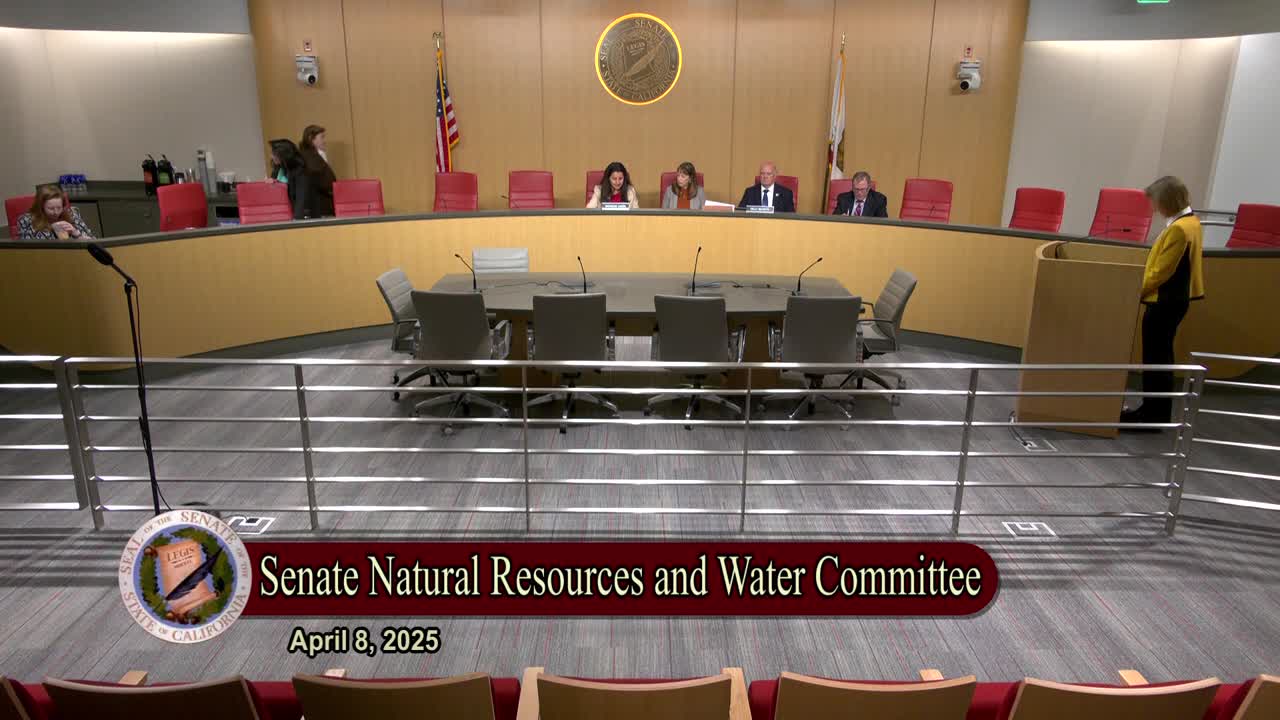 12MIN