SB 547: Commercial property insurance cancellation and nonrenewal.
- Session Year: 2025-2026
- House: Senate
- Latest Version Date: 2025-10-10
Current Status:
Passed
(2025-10-10: Chaptered by Secretary of State. Chapter 544, Statutes of 2025.)
Introduced
In Committee
Awaiting First Chamber Vote
Passed First Chamber
In Committee
Awaiting Second Chamber Vote
Passed Second Chamber
Enacted
Existing law generally regulates classes of insurance, including commercial property insurance. Existing law prohibits an insurer from canceling or refusing to renew a policy of residential property insurance for a property located in a ZIP Code within or adjacent to the fire perimeter for one year after the declaration of a state of emergency, if the cancellation or nonrenewal is based solely on the fact that the insured structure is located in an area in which a wildfire has occurred, except as specified.
This bill would extend that prohibition against cancellation or nonrenewal and its exceptions to a policy of commercial property insurance, except as specified.
Existing law generally regulates classes of insurance, including commercial property insurance. Existing law prohibits an insurer from canceling or refusing to renew a policy of residential property insurance for a property located in a ZIP Code within or adjacent to the fire perimeter for one year after the declaration of a state of emergency, if the cancellation or nonrenewal is based solely on the fact that the insured structure is located in an area in which a wildfire has occurred, except as specified.
This bill would extend that prohibition against cancellation or nonrenewal and its exceptions to a policy of commercial property insurance, except as specified.
Existing law generally regulates classes of insurance, including commercial property insurance. Existing law prohibits an insurer from canceling or refusing to renew a policy of residential property insurance for a property located in a ZIP Code within or adjacent to the fire perimeter for one year after the declaration of a state of emergency, if the cancellation or nonrenewal is based solely on the fact that the insured structure is located in an area in which a wildfire has occurred, except as specified.
This bill would extend that prohibition against cancellation or nonrenewal and its exceptions to a policy of commercial property insurance, except as specified.
Existing law generally regulates classes of insurance, including commercial property insurance. Existing law prohibits an insurer from canceling or refusing to renew a policy of residential property insurance for a property located in a ZIP Code within or adjacent to the fire perimeter for one year after the declaration of a state of emergency, if the cancellation or nonrenewal is based solely on the fact that the insured structure is located in an area in which a wildfire has occurred, except as specified.
This bill would extend that prohibition against cancellation or nonrenewal and its exceptions to a policy of commercial property insurance. insurance, except as specified.
Existing law generally regulates classes of insurance, including commercial property insurance. Existing law prohibits an insurer from canceling or refusing to renew a policy of residential property insurance for a property located in a ZIP Code within or adjacent to the fire perimeter for one year after the declaration of a state of emergency, if the cancellation or nonrenewal is based solely on the fact that the insured structure is located in an area in which a wildfire has occurred, except as specified.
This bill would extend that prohibition against cancellation or nonrenewal and its exceptions to a policy of commercial property insurance.
(a)(1)An insurer shall not cancel or refuse to renew a policy of commercial property insurance for a property located in any ZIP Code within or adjacent to the fire perimeter, for one year after the declaration of a state of emergency, as defined in Section 8558 of the Government Code, based solely on the fact that the insured structure is located in an area in which a wildfire has occurred. This prohibition applies to all policies of commercial property insurance in effect at the time of the declared emergency.
(2)For the purposes of this section, the fire perimeter shall be determined by the Department of Forestry and Fire Protection in consultation with the Office of Emergency Services. The department shall provide the commissioner with data describing the fire perimeter sufficient for the commissioner to determine which ZIP Codes are within or adjacent to the fire perimeter. The commissioner shall then issue a bulletin to inform insurers which ZIP Codes are subject to this subdivision.
(b)Subdivision (a) does not apply in any of the following circumstances:
(1)If willful or grossly negligent acts or omissions by the named insured, or the named insureds representatives, are discovered that materially increase any of the risks insured against.
(2)If losses unrelated to the postdisaster loss condition of the property have occurred that would collectively render the risk ineligible for renewal.
(3)If there are physical or risk changes to the insured property beyond the catastrophe-damaged condition of the structures and surface landscape that result in the property becoming uninsurable.
(c)(1)For the purposes of this section, policy of commercial property insurance is a policy subject to Section 675.5.
(2)For purposes of this section, a policy of commercial property insurance does not include either of the following:
(A)Policies that are inland marine, transit, or transportation insurance, including commercial automobile insurance.
(B)A policy of commercial property insurance with an annual premium of twenty-five thousand dollars ($25,000) or more and the insured employed at least 25 employees on average during the prior 12 months.
(d)Notwithstanding subparagraph (B) of paragraph (2) of subdivision (c), this section shall apply to a policy of commercial property insurance that insures against loss of, or damage to, real property, used primarily for commercial residential or habitational purposes, including, but not limited to, policies insuring all of the following:
(1)Homeowners associations.
(2)Condominium associations.
(3)Long-term rental hotels or motels.
(4)Apartment complexes.
(5)Condominium complexes.
(6)Multifamily dwellings with greater than five units.
(7)Student housing.
(8)Senior living facilities.
(a)(1)An insurer shall not cancel or refuse to renew a policy of commercial property insurance for a property located in any ZIP Code within or adjacent to the fire perimeter, for one year after the declaration of a state of emergency, as defined in Section 8558 of the Government Code, based solely on the fact that the insured structure is located in an area in which a wildfire has occurred. This prohibition applies to all policies of commercial property insurance in effect at the time of the declared emergency.
(2)For the purposes of this section, the fire perimeter shall be determined by the Department of Forestry and Fire Protection in consultation with the Office of Emergency Services. The department shall provide the commissioner with data describing the fire perimeter sufficient for the commissioner to determine which ZIP Codes are within or adjacent to the fire perimeter. The commissioner shall then issue a bulletin to inform insurers which ZIP Codes are subject to this subdivision.
(b)Subdivision (a) does not apply in any of the following circumstances:
(1)If willful or grossly negligent acts or omissions by the named insured, or the named insureds representatives, are discovered that materially increase any of the risks insured against.
(2)If losses unrelated to the postdisaster loss condition of the property have occurred that would collectively render the risk ineligible for renewal.
(3)If there are physical or risk changes to the insured property beyond the catastrophe-damaged condition of the structures and surface landscape that result in the property becoming uninsurable.
(c)(1)For the purposes of this section, policy of commercial property insurance is a policy subject to Section 675.5.
(2)For purposes of this section, a policy of commercial property insurance does not include either of the following:
(A)Policies that are inland marine, transit, or transportation insurance, including commercial automobile insurance.
(B)A policy of commercial property insurance with an annual premium of twenty-five thousand dollars ($25,000) or more and the insured employed at least 25 employees on average during the prior 12 months.
(d)Notwithstanding subparagraph (B) of paragraph (2) of subdivision (c), this section shall apply to a policy of commercial property insurance that insures against loss of, or damage to, real property, used primarily for commercial residential or habitational purposes, including, but not limited to, policies insuring all of the following:
(1)Homeowners associations.
(2)Condominium associations.
(3)Long-term rental hotels or motels.
(4)Apartment complexes.
(5)Condominium complexes.
(6)Multifamily dwellings with greater than five units.
(7)Student housing.
(8)Senior living facilities.
(a)(1)An insurer shall not cancel or refuse to renew a policy of commercial property insurance for a property located in any ZIP Code within or adjacent to the fire perimeter, for one year after the declaration of a state of emergency, as defined in Section 8558 of the Government Code, based solely on the fact that the insured structure is located in an area in which a wildfire has occurred. This prohibition applies to all policies of commercial property insurance in effect at the time of the declared emergency.
(2)For the purposes of this section, the fire perimeter shall be determined by the Department of Forestry and Fire Protection in consultation with the Office of Emergency Services. The department shall provide the commissioner with data describing the fire perimeter sufficient for the commissioner to determine which ZIP Codes are within or adjacent to the fire perimeter. The commissioner shall then issue a bulletin to inform insurers which ZIP Codes are subject to this subdivision.
(b)Subdivision (a) does not apply in any of the following circumstances:
(1)If willful or grossly negligent acts or omissions by the named insured, or the named insureds representatives, are discovered that materially increase any of the risks insured against.
(2)If losses unrelated to the postdisaster loss condition of the property have occurred that would collectively render the risk ineligible for renewal.
(3)If there are physical or risk changes to the insured property beyond the catastrophe-damaged condition of the structures and surface landscape that result in the property becoming uninsurable.
(c)(1)For the purposes of this section, policy of commercial property insurance is a policy subject to Section 675.5, including, but not limited to, a policy of commercial property insurance that insures against loss of, or damage to, real property or property used in agricultural production or that insures against loss of, or damage to, real property used primarily for residential purposes. 675.5.
(2)A For purposes of this section, a policy of commercial property insurance does not include either of the following:
(A)Policies that are inland marine, transit, or transportation insurance. insurance, including commercial automobile insurance.
(B)A policy of commercial property insurance with policy limits of ten million dollars ($10,000,000) or more that does not insure against loss of, or damage to, either of the following:(i)Real property or property used in agricultural production.(ii)Real property used primarily for residential purposes.(B)A policy of commercial property insurance with an annual premium of twenty-five thousand dollars ($25,000) or more and the insured employed at least 25 employees on average during the prior 12 months.
(d)Notwithstanding subparagraph (B) of paragraph (2) of subdivision (c), this section shall apply to a policy of commercial property insurance that insures against loss of, or damage to, real property, used primarily for commercial residential or habitational purposes, including, but not limited to, policies insuring all of the following:
(1)Homeowners associations.
(2)Condominium associations.
(3)Long-term rental hotels or motels.
(4)Apartment complexes.
(5)Condominium complexes.
(6)Multifamily dwellings with greater than five units.
(7)Student housing.
(8)Senior living facilities.
(a)(1)An insurer shall not cancel or refuse to renew a policy of commercial property insurance for a property located in any ZIP Code within or adjacent to the fire perimeter, for one year after the declaration of a state of emergency, as defined in Section 8558 of the Government Code, based solely on the fact that the insured structure is located in an area in which a wildfire has occurred. This prohibition applies to all policies of commercial property insurance in effect at the time of the declared emergency.
(2)For the purposes of this section, the fire perimeter shall be determined by the Department of Forestry and Fire Protection in consultation with the Office of Emergency Services. The department shall provide the commissioner with data describing the fire perimeter sufficient for the commissioner to determine which ZIP Codes are within or adjacent to the fire perimeter. The commissioner shall then issue a bulletin to inform insurers which ZIP Codes are subject to this subdivision.
(b)Subdivision (a) does not apply in any of the following circumstances:
(1)If willful or grossly negligent acts or omissions by the named insured, or the named insureds representatives, are discovered that materially increase any of the risks insured against.
(2)If losses unrelated to the postdisaster loss condition of the property have occurred that would collectively render the risk ineligible for renewal.
(3)If there are physical or risk changes to the insured property beyond the catastrophe-damaged condition of the structures and surface landscape that result in the property becoming uninsurable.
(c)(1)For the purposes of this section, policy of commercial property insurance is a policy subject to Section 675.5. 675.5, including, but not limited to, a policy of commercial property insurance that insures against loss of, or damage to, real property or property used in agricultural production or that insures against loss of, or damage to, real property used primarily for residential purposes.
(2)A policy of commercial property insurance does not include either of the following:
(A)Policies that are inland marine, transit, or transportation insurance.
(B)A policy of commercial property insurance with policy limits of ten million dollars ($10,000,000) or more that does not insure against loss of, or damage to, either of the following:
(i)Real property or property used in agricultural production.
(ii)Real property used primarily for residential purposes.
(a)(1)An insurer shall not cancel or refuse to renew a policy of commercial property insurance for a property located in any ZIP Code within or adjacent to the fire perimeter, for one year after the declaration of a state of emergency, as defined in Section 8558 of the Government Code, based solely on the fact that the insured structure is located in an area in which a wildfire has occurred. This prohibition applies to all policies of commercial property insurance in effect at the time of the declared emergency.
(2)For the purposes of this section, the fire perimeter shall be determined by the Department of Forestry and Fire Protection in consultation with the Office of Emergency Services. The department shall provide the commissioner with data describing the fire perimeter sufficient for the commissioner to determine which ZIP Codes are within or adjacent to the fire perimeter. The commissioner shall then issue a bulletin to inform insurers which ZIP Codes are subject to this subdivision.
(b)Subdivision (a) does not apply in any of the following circumstances:
(1)If willful or grossly negligent acts or omissions by the named insured, or the named insureds representatives, are discovered that materially increase any of the risks insured against.
(2)If losses unrelated to the postdisaster loss condition of the property have occurred that would collectively render the risk ineligible for renewal.
(3)If there are physical or risk changes to the insured property beyond the catastrophe-damaged condition of the structures and surface landscape that result in the property becoming uninsurable.
(c)For the purposes of this section, policy of commercial property insurance is a policy subject to Section 675.5.
|
Date
|
Status
|
|---|---|
| Oct 10, 2025 | Chaptered by Secretary of State. Chapter 544, Statutes of 2025. |
| Oct 10, 2025 | Approved by the Governor. |
| Sep 23, 2025 | Enrolled and presented to the Governor at 2 p.m. |
| Sep 13, 2025 | In Senate. Concurrence in Assembly amendments pending. |
| Sep 13, 2025 | Assembly amendments concurred in. (Ayes 36. Noes 0. Page 3052.) Ordered to engrossing and enrolling. |
| Sep 13, 2025 | Read third time. Passed. (Ayes 79. Noes 1. Page 3442.) Ordered to the Senate. |
| Sep 13, 2025 | Joint Rule 61(a)(14) and 51(a)(4) suspended. (Ayes 59. Noes 20. Page 3413.) |
| Aug 21, 2025 | Read second time. Ordered to third reading. |
| Aug 20, 2025 | From committee: Do pass. (Ayes 15. Noes 0.) (August 20). |
| Jul 17, 2025 | Read second time and amended. Re-referred to Com. on APPR. |
| Jul 16, 2025 | From committee: Do pass as amended and re-refer to Com. on APPR. (Ayes 17. Noes 0.) (July 16). |
| Jul 10, 2025 | From committee with author's amendments. Read second time and amended. Re-referred to Com. on INS. |
| Jun 9, 2025 | Referred to Com. on INS. |
| Jun 4, 2025 | In Assembly. Read first time. Held at Desk. |
| Jun 3, 2025 | Read third time. Passed. (Ayes 39. Noes 0. Page 1452.) Ordered to the Assembly. |
| May 6, 2025 | Read second time. Ordered to third reading. |
| May 5, 2025 | From committee: Be ordered to second reading pursuant to Senate Rule 28.8. |
| Apr 25, 2025 | Set for hearing May 5. |
| Apr 24, 2025 | From committee: Do pass and re-refer to Com. on APPR. (Ayes 6. Noes 0. Page 869.) (April 23). Re-referred to Com. on APPR. |
| Apr 4, 2025 | Set for hearing April 23. |
| Mar 5, 2025 | Referred to Com. on INS. |
| Feb 21, 2025 | From printer. May be acted upon on or after March 23. |
| Feb 20, 2025 | Introduced. Read first time. To Com. on RLS. for assignment. To print. |
|
Date
|
Description
|
Location
|
Votes
|
|
|---|---|---|---|---|
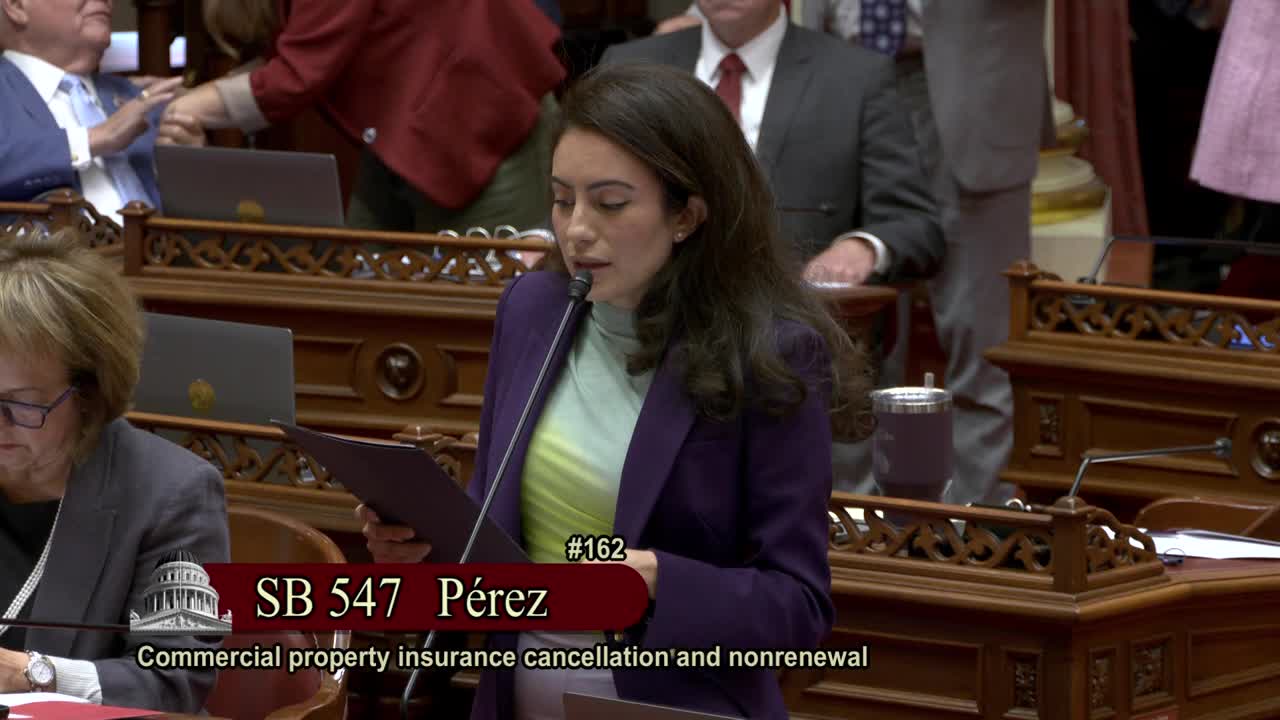
| Sep 13, 2025 | SB 547 Pérez Senate Third Reading By Calderon | Assembly Floor |
Passed |
|
| Sep 13, 2025 | Unfinished Business SB547 Pérez et al. Concurrence | Senate Floor |
Passed |
|
| Sep 12, 2025 | Unfinished Business SB547 Pérez et al. Concurrence | Senate Floor |
Passed |
|
| Aug 20, 2025 | Do pass. | Assembly Standing Committee on Appropriations |
Passed |
|
| Jul 16, 2025 | Do pass as amended and be re-referred to the Committee on [Appropriations] | Assembly Standing Committee on Insurance |
Passed |
|
| Jun 3, 2025 | Senate 3rd Reading SB547 Pérez et al. | Senate Floor |
Passed |
|
| Apr 23, 2025 | Do pass, but first be re-referred to the Committee on [Appropriations] | Senate Standing Committee on Insurance |
Passed |
This list shows positions taken on this bill by organizations on the date displayed, which is linked to the original source.
Positions by individuals are not included.
|
Organization
|
Position
|
Date
|
|---|---|---|
| American Property Casualty Insurance Association | ** Against | |
| Authors: Pérez and Rubio | ** Support | |
| California Association Of Realtors | ** Support | |
| California Community Foundation | ** Support | |
| City of Glendale | ** Support | |
| Consumer Federation Of California | ** Support | |
| Consumer Watchdog | ** Support | |
| County of Fresno | ** Support | |
| County Of Madera | ** Support | |
| County of Mendocino | ** Support | |
| Eden Housing | ** Support | |
| Fresno County Board of Supervisors | ** Support | |
| GLENDALE; CITY OF | ** Support | |
| Madera County Board of Supervisors | ** Support | |
| Mendocino County Board of Supervisors | ** Support | |
| National Association of Mutual Insurance Companies | ** Against | |
| Pacific Association Of Domestic Insurance Companies | ** Against | |
| Ricardo Lara | ** Support | |
| Ricardo Lara, Insurance Commissioner /California Department of Insurance | ** Support | |
| Rural County Representatives of California | ** Support | |
| Santa Monica Chamber of Commerce | ** Support | |
| United Policyholders | ** Support | |
| various local government entities | ** Support |
SENATE RULES COMMITTEE Office of Senate Floor Analyses (916) 651-1520 Fax: (916) 327-4478 | SB 547 |
UNFINISHED BUSINESS
Bill No: SB 547
Author: Pérez (D) and Rubio (D), et al.
Amended: 7/17/25
Vote: 21
SENATE INSURANCE COMMITTEE: 6-0, 4/23/25
AYES: Rubio, Niello, Becker, Caballero, Padilla, Wahab
NO VOTE RECORDED: Jones
SENATE APPROPRIATIONS COMMITTEE: Senate Rule 28.8
SENATE FLOOR: 39-0, 6/3/25
AYES: Allen, Alvarado-Gil, Archuleta, Arreguín, Ashby, Becker, Blakespear, Cabaldon, Caballero, Cervantes, Choi, Cortese, Dahle, Durazo, Gonzalez, Grayson, Grove, Hurtado, Jones, Laird, Limón, McGuire, McNerney, Menjivar, Niello, Ochoa Bogh, Padilla, Pérez, Richardson, Rubio, Seyarto, Smallwood-Cuevas, Stern, Strickland, Umberg, Valladares, Wahab, Weber Pierson, Wiener
NO VOTE RECORDED: Reyes
ASSEMBLY FLOOR: 79-0, 9/13/25 - See last page for vote
SUBJECT: Commercial property insurance cancellation and nonrenewal
SOURCE: Insurance Commissioner Ricardo Lara/California Department of Insurance
DIGEST:
This bill prohibits an insurer from canceling or refusing to renew a commercial property insurance policy, as specified, for one year from the declaration of a state of emergency, if the commercial property is located within the perimeter of a wildfire or in an adjacent ZIP Code.
Assembly Amendments
:
- Clarify that the cancellation/non-renewal prohibition does not include a policyholder of a commercial property insurance policy with an annual premium of $25,000 or more that has employed at least 25 employees on average during the prior 12 months.
- Further specify the types of commercial property insurance policies that are included in the prohibition mentioned in the bill.
ANALYSIS:
Existing law:
1) States that for one year after the declaration of a state of emergency, an insurer cannot cancel or refuse to renew a residential property insurance policy for a property located in any ZIP Code within or adjacent to a fire perimeter, based on the fact that the insured structure is located in a wildfire area.
2) Describes that such a fire perimeter is determined by Department of Forestry and Fire Protection (CAL FIRE) in consultation with the Office of Emergency Services. Subsequently, CAL FIRE must provide the Insurance Commissioner with data describing the fire perimeter so that the Commissioner may determine which ZIP Codes are within or adjacent to the fire perimeter. The Commissioner must then issue a bulletin to inform insurers which ZIP Codes are subject to this one-year moratorium.
3) Creates exceptions to this moratorium in cases where the policyholder was willfully or grossly negligent, or if there are losses, physical, or risk changes to the property unrelated to the damage caused by the catastrophe.
This bill:
- Extends the conditions and exceptions of the one-year moratorium against cancellation and nonrenewal to include certain commercial property insurance policies, as defined in existing law.
- Specifies that certain policies are not included in the moratorium including:
- Policies that are inland marine, transit, or transportation, including commercial automobile insurance.
- A commercial property insurance policy with an annual premium of $25,000 or more, where the insured employed at least 25 employees on average during the prior 12 months.
- Stipulates that this bill’s provisions apply to a commercial property insurance policy that insures against loss of, or damage to, real property, used primarily for commercial residential or habitational purposes, including, but not limited to, policies insuring all of the following:
- Homeowners associations
- Condominium associations
- Long-term rental hotels or motels
- Apartment complexes
- Condominium complexes
- Multifamily dwellings with greater than five units
- Student housing
- Senior living facilities
Background
Los Angeles Fires and Impact on Business. According to the California Department of Forestry and Fire Protection, and the Los Angeles County Economic Development Corporation, Los Angeles County experienced multiple catastrophic wildfires earlier this year which burned over 55,000 acres including 23,700 acres for the Palisades Fire and 14,000 acres for the Eaton Fire. The fires took at least 30 lives, and destroyed over 16,251 structures. In addition to the numerous homes lost in the fires, there were also 1,863 businesses located within the fire zones, with the Palisades Fire affecting 1,117 businesses (60.0%) and the Eaton Fire affecting 746 businesses (40.0%). These businesses employed an estimated 9,610 workers, generating $1.4 billion in annual sales
Commercial Insurance Policyholders. Commercial policyholders include businesses, but also homeowners associations (HOAs), condominiums, affordable housing units, small businesses, non-profits, and other commercial entities.
Related/Prior Legislation
SB 824 (Lara, Chapter 616, Statutes of 2018). Instituted, among other things, the one-year cancellation and nonrenewal moratorium after a wildfire emergency for residential property insurance policyholders in ZIP Codes within or adjacent to a fire perimeter.
FISCAL EFFECT: Appropriation: No Fiscal Com.: Yes Local: No
According to the Assembly Appropriations Committee:
“Costs of approximately $5,000 in fiscal year (FY) 2025-26, $22,000 in FY 2026-27, and $9,000 in FY 2027-28 to CDI to identify impacted properties and notify additional insurers about the prohibition (Insurance Fund).
No costs to CAL FIRE and OES. CAL FIRE already establishes the perimeter of a fire for which a state of emergency is declared, and OES notes it has no involvement in determining the fire perimeter.”
SUPPORT: (Verified 9/11/25)
Ricardo Lara, Insurance Commissioner /California Department of Insurance (Source)
California Association of Realtors
California Community Foundation
City of Glendale
Consumer Federation of California
Consumer Watchdog
County of Fresno
County of Madera
County of Mendocino
Eden Housing
Fresno County Board of Supervisors
Glendale; City of
Madera County Board of Supervisors
Mendocino County Board of Supervisors
Rural County Representatives of California
Santa Monica Chamber of Commerce
United Policyholders
OPPOSITION: (Verified 9/11/25)
None received
ARGUMENTS IN SUPPORT: Insurance Commissioner Ricardo Lara, sponsor of this bill, states:
“This bill would expand the current residential insurance moratorium law to also cover commercial insurance. The expanded protections will safeguard businesses, HOAs, condos, affordable housing units, small businesses, and non-profits, among other commercial businesses, from being non-renewed or canceled by their commercial insurer for one-year following an emergency declaration.
When disasters strike, our communities don’t just lose homes - they lose the businesses, non-profits, and essential services that help them rebuild and recover. While homeowners have for years benefited from a yearlong moratorium on insurance non-renewals following a state of emergency, commercial entities remain exposed to sudden cancellations, even in the immediate aftermath of a catastrophe. This bill ensures they receive the same consideration and stability during their most vulnerable moments.
This bill will safeguard commercial policyholders from further harm following an emergency and reinforces the economic and social infrastructure that communities depend on to rebuild. This helps maintain continuity for business, condominiums, homeowner associations, and other commercial policies - fortifying the local economies that depend on them, especially during a period of recovery and rebuilding. It’s a practical step toward ensuring that recovery is possible for all - not just for homeowners, but for every member of the community.”
ASSEMBLY FLOOR: 79-0, 9/13/25
AYES: Addis, Aguiar-Curry, Ahrens, Alanis, Alvarez, Arambula, Ávila Farías, Bains, Bauer-Kahan, Bennett, Berman, Boerner, Bonta, Bryan, Calderon, Caloza, Carrillo, Castillo, Chen, Connolly, Davies, DeMaio, Dixon, Elhawary, Ellis, Flora, Fong, Gabriel, Gallagher, Garcia, Gipson, Jeff Gonzalez, Mark González, Hadwick, Haney, Harabedian, Hart, Hoover, Irwin, Jackson, Johnson, Kalra, Krell, Lackey, Lee, Lowenthal, Macedo, Muratsuchi, Nguyen, Ortega, Pacheco, Papan, Patel, Patterson, Pellerin, Petrie-Norris, Quirk-Silva, Ramos, Ransom, Celeste Rodriguez, Michelle Rodriguez, Rogers, Blanca Rubio, Sanchez, Schiavo, Schultz, Sharp-Collins, Solache, Soria, Stefani, Ta, Tangipa, Valencia, Wallis, Ward, Wicks, Wilson, Zbur, Rivas
NO VOTE RECORDED: McKinnor
Prepared by: Brandon Seto / INS. / (916) 651-4110
10/19/26 11:27:33
**** END ****
SENATE RULES COMMITTEE Office of Senate Floor Analyses (916) 651-1520 Fax: (916) 327-4478 | SB 547 |
UNFINISHED BUSINESS
Bill No: SB 547
Author: Pérez (D) and Rubio (D), et al.
Amended: 7/17/25 in Assembly
Vote: 21
SENATE INSURANCE COMMITTEE: 6-0, 4/23/25
AYES: Rubio, Niello, Becker, Caballero, Padilla, Wahab
NO VOTE RECORDED: Jones
SENATE APPROPRIATIONS COMMITTEE: Senate Rule 28.8
SENATE FLOOR: 39-0, 6/3/25
AYES: Allen, Alvarado-Gil, Archuleta, Arreguín, Ashby, Becker, Blakespear, Cabaldon, Caballero, Cervantes, Choi, Cortese, Dahle, Durazo, Gonzalez, Grayson, Grove, Hurtado, Jones, Laird, Limón, McGuire, McNerney, Menjivar, Niello, Ochoa Bogh, Padilla, Pérez, Richardson, Rubio, Seyarto, Smallwood-Cuevas, Stern, Strickland, Umberg, Valladares, Wahab, Weber Pierson, Wiener
NO VOTE RECORDED: Reyes
ASSEMBLY FLOOR: 62-0, 9/13/25 – Roll call is not available
SUBJECT: Commercial property insurance cancellation and nonrenewal
SOURCE: Insurance Commissioner Ricardo Lara/California Department of Insurance
DIGEST:
This bill prohibits an insurer from canceling or refusing to renew a commercial property insurance policy, as specified, for one year from the declaration of a state of emergency, if the commercial property is located within the perimeter of a wildfire or in an adjacent ZIP Code.
Assembly Amendments
:
- Clarify that the cancellation/non-renewal prohibition does not include a policyholder of a commercial property insurance policy with an annual premium of $25,000 or more that has employed at least 25 employees on average during the prior 12 months.
- Further specify the types of commercial property insurance policies that are included in the prohibition mentioned in the bill.
ANALYSIS:
Existing law:
1) States that for one year after the declaration of a state of emergency, an insurer cannot cancel or refuse to renew a residential property insurance policy for a property located in any ZIP Code within or adjacent to a fire perimeter, based on the fact that the insured structure is located in a wildfire area.
2) Describes that such a fire perimeter is determined by Department of Forestry and Fire Protection (CAL FIRE) in consultation with the Office of Emergency Services. Subsequently, CAL FIRE must provide the Insurance Commissioner with data describing the fire perimeter so that the Commissioner may determine which ZIP Codes are within or adjacent to the fire perimeter. The Commissioner must then issue a bulletin to inform insurers which ZIP Codes are subject to this one-year moratorium.
3) Creates exceptions to this moratorium in cases where the policyholder was willfully or grossly negligent, or if there are losses, physical, or risk changes to the property unrelated to the damage caused by the catastrophe.
This bill:
- Extends the conditions and exceptions of the one-year moratorium against cancellation and nonrenewal to include certain commercial property insurance policies, as defined in existing law.
- Specifies that certain policies are not included in the moratorium including:
- Policies that are inland marine, transit, or transportation, including commercial automobile insurance.
- A commercial property insurance policy with an annual premium of $25,000 or more, where the insured employed at least 25 employees on average during the prior 12 months.
- Stipulates that this bill’s provisions apply to a commercial property insurance policy that insures against loss of, or damage to, real property, used primarily for commercial residential or habitational purposes, including, but not limited to, policies insuring all of the following:
- Homeowners associations
- Condominium associations
- Long-term rental hotels or motels
- Apartment complexes
- Condominium complexes
- Multifamily dwellings with greater than five units
- Student housing
- Senior living facilities
Background
Los Angeles Fires and Impact on Business. According to the California Department of Forestry and Fire Protection, and the Los Angeles County Economic Development Corporation, Los Angeles County experienced multiple catastrophic wildfires earlier this year which burned over 55,000 acres including 23,700 acres for the Palisades Fire and 14,000 acres for the Eaton Fire. The fires took at least 30 lives, and destroyed over 16,251 structures. In addition to the numerous homes lost in the fires, there were also 1,863 businesses located within the fire zones, with the Palisades Fire affecting 1,117 businesses (60.0%) and the Eaton Fire affecting 746 businesses (40.0%). These businesses employed an estimated 9,610 workers, generating $1.4 billion in annual sales
Commercial Insurance Policyholders. Commercial policyholders include businesses, but also homeowners associations (HOAs), condominiums, affordable housing units, small businesses, non-profits, and other commercial entities.
Related/Prior Legislation
SB 824 (Lara, Chapter 616, Statutes of 2018). Instituted, among other things, the one-year cancellation and nonrenewal moratorium after a wildfire emergency for residential property insurance policyholders in ZIP Codes within or adjacent to a fire perimeter.
FISCAL EFFECT: Appropriation: No Fiscal Com.: Yes Local: No
According to the Assembly Appropriations Committee:
“Costs of approximately $5,000 in fiscal year (FY) 2025-26, $22,000 in FY 2026-27, and $9,000 in FY 2027-28 to CDI to identify impacted properties and notify additional insurers about the prohibition (Insurance Fund).
No costs to CAL FIRE and OES. CAL FIRE already establishes the perimeter of a fire for which a state of emergency is declared, and OES notes it has no involvement in determining the fire perimeter.”
SUPPORT: (Verified 9/11/25)
Ricardo Lara, Insurance Commissioner /California Department of Insurance (Source)
California Association of Realtors
California Community Foundation
City of Glendale
Consumer Federation of California
Consumer Watchdog
County of Fresno
County of Madera
County of Mendocino
Eden Housing
Fresno County Board of Supervisors
Glendale; City of
Madera County Board of Supervisors
Mendocino County Board of Supervisors
Rural County Representatives of California
Santa Monica Chamber of Commerce
United Policyholders
OPPOSITION: (Verified 9/11/25)
None received
ARGUMENTS IN SUPPORT:
Insurance Commissioner Ricardo Lara, sponsor of this bill, states:
“This bill would expand the current residential insurance moratorium law to also cover commercial insurance. The expanded protections will safeguard businesses, HOAs, condos, affordable housing units, small businesses, and non-profits, among other commercial businesses, from being non-renewed or canceled by their commercial insurer for one-year following an emergency declaration.
When disasters strike, our communities don’t just lose homes - they lose the businesses, non-profits, and essential services that help them rebuild and recover. While homeowners have for years benefited from a yearlong moratorium on insurance non-renewals following a state of emergency, commercial entities remain exposed to sudden cancellations, even in the immediate aftermath of a catastrophe. This bill ensures they receive the same consideration and stability during their most vulnerable moments.
This bill will safeguard commercial policyholders from further harm following an emergency and reinforces the economic and social infrastructure that communities depend on to rebuild. This helps maintain continuity for business, condominiums, homeowner associations, and other commercial policies - fortifying the local economies that depend on them, especially during a period of recovery and rebuilding. It’s a practical step toward ensuring that recovery is possible for all - not just for homeowners, but for every member of the community.”
Prepared by: Brandon Seto / INS. / (916) 651-4110
9/13/25 0:54:47
**** END ****
SENATE THIRD READING
STR Bill Id:SB 547
Author:(Pérez and Rubio)
As Amended Ver:July 17, 2025
Majority vote
SUMMARY
Expands the prohibition to commercial property insurance, for an insurer from canceling or refusing to renew a residential property insurance policy for one year from the declaration of a state of emergency, if the residential property is located within the perimeter of a wildfire or in an adjacent zone improvement plan (ZIP) Code.
Major Provisions
- Provides the fire perimeter shall be determined by the Department of Forestry and Fire Protection in consultation with the Office of Emergency Services.
- Requires the California Department of Insurance (CDI) to provide the Insurance Commissioner with data describing the fire perimeter sufficient for the Insurance Commissioner to determine which ZIP Codes are within or adjacent to the fire perimeter.
- Requires the Insurance Commissioner to issue a bulletin to inform insurers which ZIP Codes are subject to this subdivision.
- Specifies the above provisions do not apply in following circumstances:
- If willful or grossly negligent acts or omissions by the named insured, or the named insured's representatives, are discovered that materially increase any of the risks insured against;
- If losses unrelated to the post disaster loss condition of the property have occurred that would collectively render the risk ineligible for renewal; and,
- If there are physical or risk changes to the insured property beyond the catastrophe-damaged condition of the structures and surface landscape that result in the property becoming uninsurable.
- Defines "policy of commercial property insurance" as a policy subject to Section 675.5, but does not include either of the following:
- Policies that are inland marine, transit, or transportation, including commercial automobile insurance, and;
- A policy of commercial property insurance with an annual premium of twenty-five thousand dollars ($25,000) or more and the insured employed at least 25 employees on average during the prior 12 months.
- Specifies a policy of commercial property insurance that insures against loss of, or damage to, real property, used primarily for commercial residential or habitational purposes, including, but not limited to, policies insuring all of the following:
- Homeowners associations.
- Condominium associations.
- Long-term rental hotels or motels.
- Apartment complexes.
- Condominium complexes.
- Multifamily dwellings with greater than five units.
- Student housing.
- Senior living facilities.
- Specifies a policy of commercial property insurance that insures against loss of, or damage to, real property, used primarily for commercial residential or habitational purposes, including, but not limited to, policies insuring all of the following:
COMMENTS
- SB 824 (Lara) Chapter 616 Statutes of 2018: It's important to highlight SB 824 as it relates to this bill. This bill expands the residential property insurance moratorium to commercial property insurance with specified exceptions. Since 2019, the Insurance Commissioner has issued 36 moratoriums. Under existing law, following the Governor declaring a state of emergency, CDI partners with CAL FIRE and CalOES to identify the wildfire perimeter and adjacent ZIP Codes. Once the area is determined, CDI issues a mandatory one-year moratorium on insurance companies from cancelling or non-renewing residential property insurance policies. The one year moratorium begins on the date the Governor declares a state of emergency.
- Pacific Palisades and Eaton Wildfires: In addition to the numerous homes lost in the fires, there were also 1,863 businesses located within the fire zones, with the Palisades Fire affecting 1,117 businesses (60.0%) and the Eaton Fire affecting 746 businesses (40.0%). These businesses employed an estimated 9,610 workers, generating $1.4 billion in annual sales.
According to the Author
According to the Author, "Just like residential homeowners, holders of commercial insurance policies need and deserve reliable insurance during a disaster like the wildfires we've just experienced. These small businesses, non-profits, and other entities that have commercial insurance not only contribute to the local economy by generating revenue and infusing tax dollars into the city and county, they serve the community and are an integral part of the process to restore the neighborhood to how it was before the disaster struck. SB 547 will expand the one-year moratorium to prevent cancelations or notices of nonrenewal on small businesses and nonprofit organizations – protecting this valued and essential part of the community."
Arguments in Support
According to Insurance Commissioner Ricardo Lara, "This bill will safeguard commercial policyholders from further harm following an emergency and reinforces the economic and social infrastructure that communities depend on to rebuild. This helps maintain continuity for business, condominiums, homeowner associations, and other commercial policies- fortifying the local economies that depend on them, especially during a period of recovery and rebuilding. It's a practical step toward ensuring that recovery is possible for all- not just homeowners, but for every member of the community."
Arguments in Opposition
None on file.
FISCAL COMMENTS
According to the Assembly Appropriations Committee, costs of approximately $5,000 in fiscal year (FY) 2025-26, $22,000 in FY 2026-27, and $9,000 in FY 2027-28 to CDI to identify impacted properties and notify additional insurers about the prohibition (Insurance Fund). No costs to CAL FIRE and OES. CAL FIRE already establishes the perimeter of a fire for which a state of emergency is declared, and OES notes it has no involvement in determining the fire perimeter.
VOTES
SENATE FLOOR: 39-0-1
YES: Allen, Alvarado-Gil, Archuleta, Arreguín, Ashby, Becker, Blakespear, Cabaldon, Caballero, Cervantes, Choi, Cortese, Dahle, Durazo, Gonzalez, Grayson, Grove, Hurtado, Jones, Laird, Limón, McGuire, McNerney, Menjivar, Niello, Ochoa Bogh, Padilla, Pérez, Richardson, Rubio, Seyarto, Smallwood-Cuevas, Stern, Strickland, Umberg, Valladares, Wahab, Weber Pierson, Wiener
ABS, ABST OR NV: Reyes
ASM INSURANCE: 17-0-0
YES: Calderon, Wallis, Addis, Alvarez, Ávila Farías, Berman, Chen, Ellis, Gipson, Hadwick, Harabedian, Krell, Nguyen, Ortega, Petrie-Norris, Michelle Rodriguez, Valencia
ASM APPROPRIATIONS: 15-0-0
YES: Wicks, Arambula, Calderon, Caloza, Dixon, Elhawary, Fong, Mark González, Hart, Pacheco, Pellerin, Jeff Gonzalez, Solache, Ta, Tangipa
UPDATED
VERSION: July 17, 2025
CONSULTANT: Kathleen O'Malley / INS. / (916) 319-2086 FN: 0001191
Date of Hearing: August 20, 2025
ASSEMBLY COMMITTEE ON APPROPRIATIONS
Buffy Wicks, Chair
SBPCA Bill Id:SB 547
Author:(Pérez) – As Amended Ver:July 17, 2025
Policy Committee: | Insurance | Vote: | 17 - 0 |
|
| ||
|
|
Urgency: No State Mandated Local Program: No Reimbursable: No
SUMMARY:
This bill prohibits an insurer from canceling or refusing to renew a policy of commercial property insurance for certain properties near a fire perimeter for one year after the declaration of a state of emergency, based solely on the proximity of the insured structure.
This bill also requires the Insurance Commissioner (IC) to determine which zip codes are within or adjacent to the fire perimeter, as determined by the Department of Forestry and Fire Protection (CAL FIRE) and Office of Emergency Services (OES), and issue a bulletin to inform impacted insurers.
FISCAL EFFECT:
- Costs of approximately $5,000 in fiscal year (FY) 2025-26, $22,000 in FY 2026-27, and $9,000 in FY 2027-28 to CDI to identify impacted properties and notify additional insurers about the prohibition (Insurance Fund).
- No costs to CAL FIRE and OES. CAL FIRE already establishes the perimeter of a fire for which a state of emergency is declared, and OES notes it has no involvement in determining the fire perimeter.
COMMENTS:
- Purpose. According to the author:
Just like residential homeowners, holders of commercial insurance policies need and deserve reliable insurance during a disaster like the wildfires we’ve just experienced…SB 547 will expand the one-year moratorium to prevent cancelations or notices of nonrenewal on small businesses and nonprofit organizations – protecting this valued and essential part of the community.
This bill is sponsored by IC Ricardo Lara and supported by various local government entities, consumer groups, and the California Association of Realtors.
- One-year Moratorium. SB 824 (Lara), Chapter 616, Statutes of 2018, instituted a one-year cancellation and nonrenewal moratorium after a wildfire emergency for residential property insurance policyholders in zip codes within or adjacent to the fire perimeter. The IC has issued 36 moratoriums since 2019. In addition to the numerous homes lost to the Pacific Palisades and Eaton Wildfires, there were also 1,863 affected businesses located within the fire perimeters. This bill expands the moratorium period to cover commercial property insurance for certain small business properties, such as homeowners associations, apartment complexes, and senior living facilities.
Analysis Prepared by: Irene Ho / APPR. / (916) 319-2081
Date of Hearing: July 16, 2025
ASSEMBLY COMMITTEE ON INSURANCE
Lisa Calderon, Chair
SBPCA Bill Id:SB 547
Author:(Pérez & Rubio) – As Amended Ver:July 10, 2025
SENATE VOTE: 39-0
SUBJECT: Commercial property insurance cancellation and nonrenewal
SUMMARY: Extends the prohibition to commercial property insurance, for an insurer from canceling or refusing to renew a residential property insurance policy for one year from the declaration of a state of emergency, if the residential property is located within the perimeter of a wildfire or in an adjacent ZIP Code. Specifically, this bill:
- Provides the fire perimeter shall be determined by the Department of Forestry and Fire Protection in consultation with the Office of Emergency Services.
- Requires the California Department of Insurance (CDI) to provide the Insurance Commissioner with data describing the fire perimeter sufficient for the Insurance Commissioner to determine which ZIP Codes are within or adjacent to the fire perimeter.
- Requires the Insurance Commissioner to issue a bulletin to inform insurers which ZIP Codes are subject to this subdivision.
- Specifies the above provisions do not apply in following circumstances:
- If willful or grossly negligent acts or omissions by the named insured, or the named insured’s representatives, are discovered that materially increase any of the risks insured against;
- If losses unrelated to the post disaster loss condition of the property have occurred that would collectively render the risk ineligible for renewal; and,
- If there are physical or risk changes to the insured property beyond the catastrophe-damaged condition of the structures and surface landscape that result in the property becoming uninsurable.
- Defines “policy of commercial property insurance” as a policy subject to Section 675.5, including, but not limited to, a policy of commercial property insurance that insures against loss of, or damage to, real property or property used in agricultural production or that insures against loss of, or damage to, real property used primarily for residential purposes.
- Specifies, a “policy of commercial property insurance” does not include either of the following:
- Policies that are inland marine, transit, or transportation insurance; and,
- A policy of commercial property insurance with policy limits of ten million dollars ($10,000,000) or more that does not insure against loss of, or damage to, either of the following:
- Real property or property used in agricultural production; and,
- Real property used primarily for residential purposes.
EXISTING LAW:
- Provides for the regulation of insurance by CDI, which is under the control of the Insurance Commissioner. (Insurance Code, Section 12921)
- States that for one year after the declaration of a state of emergency, an insurer cannot cancel or refuse to renew a residential property insurance policy for a property located in any ZIP Code within or adjacent to a fire perimeter, based on the fact that the insured structure is located in a wildfire area. (Insurance Code, Section 675.1)
- Describes that such a fire perimeter is determined by Department of Forestry and Fire Protection (CAL FIRE) in consultation with the Office of Emergency Services (CalOES) Subsequently, CAL FIRE must provide the Insurance Commissioner with data describing the fire perimeter so that the Commissioner may determine which ZIP Codes are within or adjacent to the fire perimeter. The Commissioner must then issue a bulletin to inform insurers which ZIP Codes are subject to this one-year moratorium. (Insurance Code, Section 675.1)
- Creates exceptions to this moratorium in cases where the policyholder was willfully or grossly negligent, or if there are losses, physical, or risk changes to the property unrelated to the damage caused by the catastrophe. (Insurance Code, Section 675.1)
- Specifies that commercial insurance means commercial multiperil, commercial property, commercial liability, commercial special multiperil, commercial comprehensive multiperil, errors and omissions liability, and professional liability insurance, as specified. (Insurance Code, Section 675.5)
- Defines “state of emergency” as the duly proclaimed existence of conditions of disaster or of extreme peril to the safety of persons and property within the state caused by conditions such as air pollution, fire, flood, storm, epidemic, riot, drought, cyberterrorism, sudden and severe energy shortage, electromagnetic pulse attack, plant or animal infestation or disease, the Governor’s warning of an earthquake or volcanic prediction, or an earthquake, or other conditions, other than conditions resulting from a labor controversy or conditions causing a “state of war emergency,” which, by reason of their magnitude, are or are likely to be beyond the control of the services, personnel, equipment, and facilities of any single county, city and county, or city and require the combined forces of a mutual aid region or regions to combat, or with respect to regulated energy utilities, a sudden and severe energy shortage requires extraordinary measures beyond the authority vested in the Public Utilities Commission. (Insurance Code, Section 2051.5; Government Code, Section 8558)
FISCAL EFFECT: Unknown
COMMENTS:
- Purpose of the bill: According to the Author, “Just like residential homeowners, holders of commercial insurance policies need and deserve reliable insurance during a disaster like the wildfires we’ve just experienced. These small businesses, non-profits, and other entities that have commercial insurance not only contribute to the local economy by generating revenue and infusing tax dollars into the city and county, they serve the community and are an integral part of the process to restore the neighborhood to how it was before the disaster struck. SB 547 will expand the one-year moratorium to prevent cancelations or notices of nonrenewal on small businesses and nonprofit organizations – protecting this valued and essential part of the community.”
- SB 824 of 2018: It’s important to highlight SB 824 as it relates to this bill. SB 547 expands the residential property insurance moratorium to commercial property insurance with specified exceptions. Since 2019, the Insurance Commissioner has issued 36 moratoriums. Under existing law, following the Governor declaring a state of emergency, CDI partners with CAL FIRE and CalOES to identify the wildfire perimeter and adjacent ZIP Codes. Once the area is determined, CDI issues a mandatory one-year moratorium on insurance companies from cancelling or non-renewing residential property insurance policies. The one year moratorium begins on the date the Governor declares a state of emergency.
- Pacific Palisades and Eaton Wildfires: In addition to the numerous homes lost in the fires, there were also 1,863 businesses located within the fire zones, with the Palisades Fire affecting 1,117 businesses (60.0%) and the Eaton Fire affecting 746 businesses (40.0%). These businesses employed an estimated 9,610 workers, generating $1.4 billion in annual sales.
- Arguments in Support: According to Insurance Commissioner Ricardo Lara, “This bill will safeguard commercial policyholders from further harm following an emergency and reinforces the economic and social infrastructure that communities depend on to rebuild. This helps maintain continuity for business, condominiums, homeowner associations, and other commercial policies- fortifying the local economies that depend on them, especially during a period of recovery and rebuilding. It’s a practical step toward ensuring that recovery is possible for all- not just homeowners, but for every member of the community.”
- Arguments in Opposition: According to the “Trades” (identified below), “The trades are fundamentally opposed to legislative proposals that seek to limit the ability of insurers to manage their risk. However, given the current instability in the California market, we understand that the goal of this legislation is to provide certainty to those policyholders that are located in and around disasters. The author and sponsors have cited homeowners associations (HOA), condominium complexes, and affordable housing units among others as commercial properties they are hoping to protect. The trades would propose that SB 547 be tailored more specifically to these types of commercial habitational risk – those policies for HOAs, condos, apartments, senior living facilities, etc. By narrowing the scope of this legislation to commercial habitational risks, we can limit the unintended consequences to the broader commercial policyholder population.”
- Related Legislation: SB 365 (Alvarado-Gil) Beginning no later than January 1, 2027, and by every January 1 thereafter, requires CDI to report information to the Legislature on how the one-year prohibition on residential property insurance cancellation/nonrenewal for designated fire areas (prohibition/moratorium) affects cancellations, nonrenewals, and FAIR Plan coverage secured in the ZIP Codes subject to the prohibition. Pending before the Senate Insurance Committee.
- Previous Legislation: SB 824 (Lara, Chapter 616, Statutes of 2018). Instituted, among other things, the one-year cancellation and nonrenewal moratorium after a wildfire emergency for residential property insurance policyholders in ZIP Codes within or adjacent to a fire perimeter.
- Recommended Amendments: Recent amends taken by the Author attempt to carve out larger commercial properties but confusion remains. The committee recommends the following amends to clarify the author’s intent to focus on small businesses.
SECTION 1. Section 675.55 is added to the Insurance Code, to read:
675.55. (a) (1) An insurer shall not cancel or refuse to renew a policy of commercial property insurance for a property located in any ZIP Code within or adjacent to the fire perimeter, for one year after the declaration of a state of emergency, as defined in Section 8558 of the Government Code, based solely on the fact that the insured structure is located in an area in which a wildfire has occurred. This prohibition applies to all policies of commercial property insurance in effect at the time of the declared emergency.
(2) For the purposes of this section, the fire perimeter shall be determined by the Department of Forestry and Fire Protection in consultation with the Office of Emergency Services. The department shall provide the commissioner with data describing the fire perimeter sufficient for the commissioner to determine which ZIP Codes are within or adjacent to the fire perimeter. The commissioner shall then issue a bulletin to inform insurers which ZIP Codes are subject to this subdivision.
(b) Subdivision (a) does not apply in any of the following circumstances:
(1) If willful or grossly negligent acts or omissions by the named insured, or the named insured’s representatives, are discovered that materially increase any of the risks insured against.
(2) If losses unrelated to the post-disaster loss condition of the property have occurred that would collectively render the risk ineligible for renewal.
(3) If there are physical or risk changes to the insured property beyond the catastrophe-damaged condition of the structures and surface landscape that result in the property becoming uninsurable.
(c) (1) For the purposes of this section, “policy of commercial property insurance” is a policy subject to Section 675.5, including, but not limited to, a policy of commercial property insurance that insures against loss of, or damage to, real property or property used in agricultural production or that insures against loss of, or damage to, real property used primarily for residential purposes.
(2) For purposes of this section, a “policy of commercial property insurance” does not include either of the following:
(A) Policies that are inland marine, transit, or transportation insurance, including commercial automobile insurance.
(B) A policy of commercial property insurance with policy limits of ten million dollars ($10,000,000) or more that does not insure against loss of, or damage to, either of the following: A policy of commercial property insurance with an annual premium of $25,000 or more and the insured employed at least 25 employees on average during the prior 12 months.
(i) Real property or property used in agricultural production.
(ii) Real property used primarily for residential purposes.
(3) Notwithstanding subparagraph (B) of paragraph (2), the provisions of this section shall apply to a policy of commercial property insurance that insures against loss of or damage to, real property, used primarily for commercial residential or habitational purposes, including but not limited to policies insuring:
(A) Homeowners Associations (HOA);
(B) Condominium Associations (COA)
(C) Long term rental Hotels / Motels;
(D) Apartment Complexes;
(E) Condominium Complexes;
(F) Multi-Family Dwellings with greater than 5 units;
(G) Student Housing; or
(H) Senior Living Facilities.
REGISTERED SUPPORT / OPPOSITION:
Support
California Community Foundation
Consumer Watchdog
County of Fresno
Eden Housing
Fresno County Board of Supervisors
Glendale; City of
Insurance Commissioner Ricardo Lara / California Department of Insurance
Madera County Board of Supervisors
Mendocino County Board of Supervisors
Rural County Representatives of California (RCRC)
United Policyholders
Oppose Unless Amended
American Property Casualty Insurance Association
National Association of Mutual Insurance Companies
Pacific Association of Domestic Insurance Companies
Analysis Prepared by: Kathleen O'Malley / INS. / (916) 319-2086
SENATE RULES COMMITTEE Office of Senate Floor Analyses (916) 651-1520 Fax: (916) 327-4478 | SB 547 |
THIRD READING
Bill No: SB 547
Author: Pérez (D) and Rubio (D), et al.
Introduced: 2/20/25
Vote: 21
SENATE INSURANCE COMMITTEE: 6-0, 4/23/25
AYES: Rubio, Niello, Becker, Caballero, Padilla, Wahab
NO VOTE RECORDED: Jones
SENATE APPROPRIATIONS COMMITTEE: Senate Rule 28.8
SUBJECT: Commercial property insurance cancellation and nonrenewal
SOURCE: Insurance Commissioner Ricardo Lara/California Department of Insurance
DIGEST:
This bill prohibits an insurer from canceling or refusing to renew a commercial property insurance policy for one year from the declaration of a state of emergency, if the commercial property is located within the perimeter of a wildfire or in an adjacent ZIP Code.
ANALYSIS:
Existing law:
1) States that for one year after the declaration of a state of emergency, an insurer cannot cancel or refuse to renew a residential property insurance policy for a property located in any ZIP Code within or adjacent to a fire perimeter, based on the fact that the insured structure is located in a wildfire area.
2) Describes that such a fire perimeter is determined by Department of Forestry and Fire Protection (CAL FIRE) in consultation with the Office of Emergency Services. Subsequently, CAL FIRE must provide the Insurance Commissioner with data describing the fire perimeter so that the Commissioner may determine which ZIP Codes are within or adjacent to the fire perimeter. The Commissioner must then issue a bulletin to inform insurers which ZIP Codes are subject to this one-year moratorium.
3) Creates exceptions to this moratorium in cases where the policyholder was willfully or grossly negligent, or if there are losses, physical, or risk changes to the property unrelated to the damage caused by the catastrophe.
This bill extends the same conditions and exceptions of the one-year moratorium against cancellation and nonrenewal to include commercial property insurance policies.
Background
Los Angeles Fires and Impact on Business. According to the California Department of Forestry and Fire Protection, and the Los Angeles County Economic Development Corporation, Los Angeles County experienced multiple catastrophic wildfires earlier this year which burned over 55,000 acres including 23,700 acres for the Palisades Fire and 14,000 acres for the Eaton Fire. The fires took at least 30 lives, and destroyed over 16,251 structures. In addition to the numerous homes lost in the fires, there were also 1,863 businesses located within the fire zones, with the Palisades Fire affecting 1,117 businesses (60.0%) and the Eaton Fire affecting 746 businesses (40.0%). These businesses employed an estimated 9,610 workers, generating $1.4 billion in annual sales
Commercial Insurance Policyholders. Commercial policyholders include businesses, but also homeowners associations (HOAs), condominiums, affordable housing units, small businesses, non-profits, and other commercial entities.
Prior Legislation
SB 824 (Lara, Chapter 616, Statutes of 2018). Instituted, among other things, the one-year cancellation and nonrenewal moratorium after a wildfire emergency for residential property insurance policyholders in ZIP Codes within or adjacent to a fire perimeter.
FISCAL EFFECT: Appropriation: No Fiscal Com.: Yes Local: No
SUPPORT: (Verified 5/5/25)
California Department of Insurance/ Ricardo Lara, Insurance Commissioner (Source) California Community Foundation
Consumer Federation of California
Consumer Watchdog
County of Madera
County of Mendocino
Eden Housing
Fresno County Board of Supervisors
Rural County Representatives of California
Santa Monica Chamber of Commerce
United Policyholders
OPPOSITION: (Verified 5/5/25)
American Property Casualty Insurance Association
Pacific Association of Domestic Insurance Companies
ARGUMENTS IN SUPPORT:
The California Department of Insurance, sponsor of the bill, states:
“This bill would expand the current residential insurance moratorium law to also cover commercial insurance. The expanded protections will safeguard businesses, HOAs, condos, affordable housing units, small businesses, and non-profits, among other commercial businesses, from being non-renewed or canceled by their commercial insurer for one-year following an emergency declaration.
When disasters strike, our communities don’t just lose homes - they lose the businesses, non-profits, and essential services that help them rebuild and recover. While homeowners have for years benefited from a yearlong moratorium on insurance non-renewals following a state of emergency, commercial entities remain exposed to sudden cancellations, even in the immediate aftermath of a catastrophe. This bill ensures they receive the same consideration and stability during their most vulnerable moments.
This bill will safeguard commercial policyholders from further harm following an emergency and reinforces the economic and social infrastructure that communities depend on to rebuild. This helps maintain continuity for business, condominiums, homeowner associations, and other commercial policies - fortifying the local economies that depend on them, especially during a period of recovery and rebuilding. It’s a practical step toward ensuring that recovery is possible for all - not just for homeowners, but for every member of the community.”
ARGUMENTS IN OPPOSITION:
According to the American Property Casualty Insurance Association and the Pacific Association of Domestic Insurance Companies:
“Commercial policies are inherently more complex than residential policies, often with significantly higher values insured. SB 547 would restrict an insurers’ ability to determine when to write or renew such exposures and will likely exacerbate existing insurance availability issues, as insurers will be restricted in their ability to control their financial exposure and protect their fiscal solvency. If an insurer cannot manage their risk concentration in one area of the state, under SB 547 they may be forced to non-renew properties outside of these emergency declaration ZIP Codes.
Moreover, commercial policyholders have more risk management options than homeowners. For example, commercial insureds have a greater ability to self-insure and have the option of purchasing excess of loss reinsurance. In addition, the non-admitted insurance market provides a safety valve for commercial insureds that are unable to procure coverage in the admitted market.
Additionally, because commercial risk exposures can change quite substantially, it is also vitally important that SB 547 clearly allow for insurers to cancel or non-renew policies where there has been a material change in risk. Such changes may mean that the risk would become unacceptable to that insurer due to the different type of business or financial exposure. Some insurers specialize in specific types of commercial risk, and expecting them to cover risk outside of their expertise or for which they have no loss experience is not reasonable.”
Prepared by: Brandon Seto / INS. / (916) 651-4110
5/7/25 16:05:28
**** END ****
SENATE COMMITTEE ON INSURANCE
Senator Susan Rubio, Chair
2025 - 2026 Regular
Bill No: SB 547 Hearing Date: April 23, 2025
Author: | Pérez and Rubio | ||
Version: | February 20, 2025 Introduced | ||
Urgency: | No | Fiscal: | Yes |
Consultant: | Brandon Seto | ||
SUBJECT: Commercial property insurance cancellation and nonrenewal
DIGEST:
Prohibits an insurer from canceling or refusing to renew a commercial property insurance policy for one year from the declaration of a state of emergency, if the commercial property is located within the perimeter of a wildfire or in a ZIP Code adjacent to it.
ANALYSIS:
Existing law:
- States that for one year after the declaration of a state of emergency, an insurer cannot cancel or refuse to renew a residential property insurance policy for a property located in any ZIP Code within or adjacent to a fire perimeter, based on the fact that the insured structure is located in a wildfire area.
- Describes that such a fire perimeter is determined by Department of Forestry and Fire Protection (CAL FIRE) in consultation with the Office of Emergency Services (Cal OES). Subsequently, CAL FIRE must provide the Insurance Commissioner with data describing the fire perimeter so that the Commissioner may determine which ZIP Codes are within or adjacent to the fire perimeter. The Commissioner must then issue a bulletin to inform insurers which ZIP Codes are subject to this one-year moratorium.
- Creates exceptions to this moratorium in cases where the policyholder was willfully or grossly negligent, or if there are losses, physical, or risk changes to the property unrelated to the damage caused by the catastrophe.
This bill:
- Extends the same conditions and exceptions of the one-year moratorium against cancellation and nonrenewal to include commercial property insurance policies.
Background
According to the author:
Just like residential homeowners, holders of commercial insurance policies need and deserve reliable insurance during a disaster like the wildfires we’ve just experienced. These small businesses, non-profits, and other entities that have commercial insurance not only contribute to the local economy by generating revenue and infusing tax dollars into the city and county, they serve the community and are an integral part of the process to restore the neighborhood to how it was before the disaster struck. SB 547 will expand the one-year moratorium to prevent cancelations or notices of nonrenewal on small businesses and nonprofit organizations – protecting this valued and essential part of the community
According to Senator Rubio, joint author:
Local businesses, non-profits, and service providers are the backbone of recovery, yet they risk losing insurance coverage at the very moment they’re needed the most. SB 547 is about keeping communities whole after a wildfire disaster. While homeowners already have protections against insurance cancellations after a disaster, commercial policyholders face uncertainty. This bill extends the same one-year moratorium to businesses and organizations, giving them the stability to recover and rebuild. By keeping storefronts open, employees working, and essential services running, SB 547 helps entire communities recover faster and strengthens our local economies in the wake of a disaster.
Los Angeles Fires and Impact on Business
Earlier this year, Los Angeles County experienced multiple catastrophic wildfires which burned over 55,000 acres including 23,700 acres for the Palisades Fire and 14,000 acres for the Eaton Fire. Tragically, the fires took at least 30 lives, and destroyed over 16,251 structures.[1] In addition to the numerous homes lost in the fires, there were also 1,863 businesses located within the fire zones, with the Palisades Fire affecting 1,117 businesses (60.0%) and the Eaton Fire affecting 746 businesses (40.0%). These businesses employed an estimated 9,610 workers, generating $1.4 billion in annual sales.[2]
Commercial Insurance Policyholders
Commercial policyholders include businesses, but also homeowners associations (HOAs), condominiums, affordable housing units, small businesses, non-profits, and other commercial entities.
Related/Prior Legislation
SB 824 (Lara, Chapter 616, Statutes of 2018): Instituted, among other things, the one-year cancellation and nonrenewal moratorium after a wildfire emergency for residential property insurance policyholders in ZIP Codes within or adjacent to a fire perimeter.
ARGUMENTS IN SUPPORT:
Supporters state:
This bill would expand the current residential insurance moratorium law to also cover commercial insurance. The expanded protections will safeguard businesses, HOAs, condos, affordable housing units, small businesses, and non-profits, among other commercial businesses, from being non-renewed or canceled by their commercial insurer for one-year following an emergency declaration.
When disasters strike, our communities don’t just lose homes - they lose the businesses, non-profits, and essential services that help them rebuild and recover. While homeowners have for years benefited from a yearlong moratorium on insurance non-renewals following a state of emergency, commercial entities remain exposed to sudden cancellations, even in the immediate aftermath of a catastrophe. This bill ensures they receive the same consideration and stability during their most vulnerable moments.
This bill will safeguard commercial policyholders from further harm following an emergency and reinforces the economic and social infrastructure that communities depend on to rebuild. This helps maintain continuity for business, condominiums, homeowner associations, and other commercial policies - fortifying the local economies that depend on them, especially during a period of recovery and rebuilding. It’s a practical step toward ensuring that recovery is possible for all - not just for homeowners, but for every member of the community.
ARGUMENTS IN OPPOSITION:
Opponents state:
Commercial policies are inherently more complex than residential policies, often with significantly higher values insured. SB 547 would restrict an insurers’ ability to determine when to write or renew such exposures and will likely exacerbate existing insurance availability issues, as insurers will be restricted in their ability to control their financial exposure and protect their fiscal solvency. If an insurer cannot manage their risk concentration in one area of the state, under SB 547 they may be forced to non-renew properties outside of these emergency declaration ZIP Codes.
Moreover, commercial policyholders have more risk management options than homeowners. For example, commercial insureds have a greater ability to self-insure and have the option of purchasing excess of loss reinsurance. In addition, the non-admitted insurance market provides a safety valve for commercial insureds that are unable to procure coverage in the admitted market.
Additionally, because commercial risk exposures can change quite substantially, it is also vitally important that SB 547 clearly allow for insurers to cancel or non-renew policies where there has been a material change in risk. Such changes may mean that the risk would become unacceptable to that insurer due to the different type of business or financial exposure. Some insurers specialize in specific types of commercial risk, and expecting them to cover risk outside of their expertise or for which they have no loss experience is not reasonable.
SUPPORT:
Insurance Commissioner Ricardo Lara/California Department of Insurance (Sponsor)
California Community Foundation
Consumer Federation of California
Consumer Watchdog
County of Madera
County of Mendocino
Fresno County Board of Supervisors
Rural County Representatives of California (RCRC)
Santa Monica Chamber of Commerce
United Policyholders
OPPOSITION:
American Property Casualty Insurance Association
Pacific Association of Domestic Insurance Companies
-- END --
California Department of Forestry and Fire Protection, https://www.fire.ca.gov/incidents ↑
“Impact of 2025 Los Angeles Wildfires and Comparative Study” by Matt Horton
Shannon M. Sedgwick, Justin Adams, Ph.D., Dan Wei, Ph.D., and Matthew Skyberg for the Los Angeles County Economic Development Corporation. ↑


Bill Co-Author(s):