SB 634: Local government: homelessness.
- Session Year: 2025-2026
- House: Senate
- Latest Version Date: 2025-10-10
Current Status:
Passed
(2025-10-10: Chaptered by Secretary of State. Chapter 521, Statutes of 2025.)
Introduced
In Committee
Awaiting First Chamber Vote
Passed First Chamber
In Committee
Awaiting Second Chamber Vote
Passed Second Chamber
Enacted
What does this bill do?
The bill stops cities, counties, and other local agencies from passing or enforcing rules that forbid people or groups from giving support services to someone who is homeless or helping them with acts needed for basic survival. Covered services include legal help and medical care and actions such as providing food and water, blankets or places to sleep, protection from the elements, and basic personal hygiene.
The summary is provided by generative AI which can make mistakes. For original language, please view the details in the table below.
The California Constitution authorizes a county or city to make and enforce within its limits all local, police, sanitary, and other ordinances and regulations not in conflict with general laws. Existing law establishes procedures for the enactment of ordinances by counties and cities and makes a violation of a county or city ordinance, as applicable, a misdemeanor unless by ordinance it is made an infraction.
This bill would prohibit a local jurisdiction from adopting a local ordinance, or enforcing an existing ordinance, that prohibits a person or organization from providing support services, as specified, to a person who is homeless or assisting a person who is homeless with any act related to basic survival. The bill would define various terms for these purposes.
The bill would include findings that changes proposed by this bill address a matter of statewide concern rather than a municipal affair and, therefore, apply to all cities, including charter cities.
The California Constitution authorizes a county or city to make and enforce within its limits all local, police, sanitary, and other ordinances and regulations not in conflict with general laws. Existing law establishes procedures for the enactment of ordinances by counties and cities and makes a violation of a county or city ordinance, as applicable, a misdemeanor unless by ordinance it is made an infraction. Existing law also prohibits a state agency from adopting or enforcing any rule or a violation of which can result in the imposition of a fine or imprisonment, or both, unless a statute specifically authorizes the imposition of such fine or imprisonment, or both, for a violation of the rule or regulation.
This bill would prohibit a local jurisdiction from adopting a local ordinance, or enforcing an existing ordinance, that imposes civil or criminal penalties on a person who is homeless for any act immediately related to homelessness or any act related to basic survival, or on a person who is prohibits a person or organization from providing support services, as specified, to a person who is homeless or assisting a person who is homeless with any act related to basic survival. The bill would similarly prohibit a state agency from adopting any regulation or issuing any policy or guidance, or enforcing an existing regulation, policy, or guidance, that imposes those civil or criminal penalties. The bill would define various terms for these purposes.
The bill would include findings that changes proposed by this bill address a matter of statewide concern rather than a municipal affair and, therefore, apply to all cities, including charter cities.
The California Constitution authorizes a county or city to make and enforce within its limits all local, police, sanitary, and other ordinances and regulations not in conflict with general laws. Existing law establishes procedures for the enactment of ordinances by counties and cities and makes a violation of a county or city ordinance, as applicable, a misdemeanor unless by ordinance it is made an infraction. Existing law also prohibits a state agency from adopting or enforcing any rule or a violation of which can result in the imposition of a fine or imprisonment, or both, unless a statute specifically authorizes the imposition of such fine or imprisonment, or both, for a violation of the rule or regulation.
This bill would prohibit a local jurisdiction from adopting a local ordinance, or enforcing an existing ordinance, that imposes civil or criminal penalties on a person who is homeless for any act immediately related to homelessness or any act related to basic survival, or on a person who is assisting a person who is homeless with any act related to basic survival. The bill would similarly prohibit a state agency from adopting any regulation or issuing any policy or guidance, or enforcing an existing regulation, policy, or guidance, that imposes those civil or criminal penalties. The bill would define various terms for these purposes.
The bill would include findings that changes proposed by this bill address a matter of statewide concern rather than a municipal affair and, therefore, apply to all cities, including charter cities.
Existing law provides for the formation and powers of various local governments, including counties and cities. Existing law, the Cortese-Knox-Hertzberg Local Government Reorganization Act of 2000, provides the sole and exclusive authority and procedure for the initiation, conduct, and completion of changes of organization and reorganization for cities and districts.This bill would state the intent of the Legislature to enact legislation relating to local government.Existing law provides for the formation and powers of various local governments, including counties and cities. Existing law, the Cortese-Knox-Hertzberg Local Government Reorganization Act of 2000, provides the sole and exclusive authority and procedure for the initiation, conduct, and completion of changes of organization and reorganization for cities and districts.
This bill would state the intent of the Legislature to enact legislation relating to local government.
(a)The Legislature finds and declares all of the following:
(1)As of 2024, on any given night, over 187,000 people are experiencing homelessness in California, with data from the states Homeless Data Integration System showing over 308,000 people experiencing homelessness accessing services over the course of the year and many more at risk of homelessness.
(2)Homelessness is a policy failure primarily caused by the unaffordability of housing in California, with over 1,000,000 extremely low income households spending more than one-half their income on rent, and not the result of personal failings of people experiencing homelessness. This housing crisis is the result of decades of failed housing policy, coupled with structural and institutional racism, and a lack of sufficient investment in affordable housing and other programs to address homelessness.
(3)The solution to homelessness is affordable housing and robust supportive services, as demonstrated by years of peer-reviewed research.
(4)Data from the fifth cycle of the Regional Housing Needs Assessment (RHNA) showed that jurisdictions in California needed to add over 277,000 housing units that are affordable to very low income households over the 2013 to 2024 assessment period to keep pace with the need for new housing, but jurisdictions statewide attained only 21 percent of that goal, permitting just over 57,000 units that are affordable to very low income households.
(5)Data from the United States Department of Housing and Urban Developments Housing Inventory Count showed that in 2024, despite more than 300,000 people cycling through homelessness statewide, California had only 76,000 shelter beds and 79,000 units of permanent supportive housing.
(6)Homelessness is disproportionately experienced by Black, Indigenous, and other groups in California that have experienced historical and continued discrimination, and excessive penalties related to homelessness contribute to and exacerbate the racist outcomes in housing and criminal justice.
(7)Arresting, fining, and jailing people experiencing homelessness for the act of living outside and conducting life-sustaining activities does not contribute to ending their homelessness.
(8)A growing body of research suggests that these responses to homelessness add additional barriers to ending someones homelessness, including causing people to lose touch with case managers, family, and friends seeking to assist them to find housing.
(9)These barriers also include missing work and losing needed income to get back into housing.
(10)These barriers also include missing critical health care appointments that may contribute to deteriorating health.
(11)These barriers also include loss of key property, including identification, birth certificates, and other documents that are needed to access subsidized housing, essential services, and public benefits.
(12)These barriers also include financial penalties that can increase debt, damage credit, and result in bench warrants that result in additional jail time, all of which detracts from efforts to regain housing.
(13)Criminalization also adds risks to the community-based service provider organizations and community members working with the population experiencing homelessness, hindering the responsiveness of both publicly funded and other community-based responses to end homelessness.
(b)It is, therefore, the intent of the Legislature in enacting this act to do both of the following:
(1)Limit penalties that local and state governments may pursue for the performance of acts related to experiencing homelessness, including conducting life-sustaining activities, for the purpose of removing hindrance to ending Californias homeless crisis.
(2)Not impose any other restrictions on local jurisdictions beyond those set forth in this act.
SEC. 2.Section 53069.44 is added to the Government Code, to read:53069.44.(a)Notwithstanding any other law, a local jurisdiction shall not adopt a local ordinance, or enforce an existing ordinance, that prohibits a person or organization from providing support services, including legal services or medical care, to a person who is homeless or assisting a person who is homeless with any act related to basic survival.
(b)For purposes of this section, the following definitions apply:
(1)(A)Act related to basic survival includes, but is not limited to, assisting with or providing items to assist with any of the following:
(i)Eating and drinking, including provision of food and water.
(ii)Sleeping, including provision of blankets and pillows.
(iii)Protecting oneself from the elements.
(iv)Other activities and items necessary for immediate personal health and hygiene.
(B)Nothing in this definition shall be interpreted to include distribution of plywood or other heavy construction materials.
(2)Homeless has the same meaning as defined in Section 578.3 of Title 24 of the Code of Federal Regulations, as that section read on January 10, 2019.
(3)Local jurisdiction means a city, county, city and county, or special district.
(4)Support services includes nonhousing services described in paragraph (4) of subdivision (e) of Section 50243 of the Health and Safety Code.
SEC. 3.The Legislature finds and declares that ensuring a compassionate, evidence-based approach to ending homelessness is a matter of statewide concern rather than a municipal affair as that term is used in Section 5 of Article XI of the California Constitution. Therefore, Section 2 of this act, adding Section 53069.44 to the Government Code, applies to all cities, including charter cities.
(a)The Legislature finds and declares all of the following:
(1)As of 2024, on any given night, over 187,000 people are experiencing homelessness in California, with data from the states Homeless Data Integration System showing over 308,000 people experiencing homelessness accessing services over the course of the year and many more at risk of homelessness.
(2)Homelessness is a policy failure primarily caused by the unaffordability of housing in California, with over 1,000,000 extremely low income households spending more than one-half their income on rent, and not the result of personal failings of people experiencing homelessness. This housing crisis is the result of decades of failed housing policy, coupled with structural and institutional racism, and a lack of sufficient investment in affordable housing and other programs to address homelessness.
(3)The solution to homelessness is affordable housing and robust supportive services, as demonstrated by years of peer-reviewed research.
(4)Data from the fifth cycle of the Regional Housing Needs Assessment (RHNA) showed that jurisdictions in California needed to add over 277,000 housing units that are affordable to very low income households over the 2013 to 2024 assessment period to keep pace with the need for new housing, but jurisdictions statewide attained only 21 percent of that goal, permitting just over 57,000 units that are affordable to very low income households.
(5)Data from the United States Department of Housing and Urban Developments Housing Inventory Count showed that in 2024, despite more than 300,000 people cycling through homelessness statewide, California had only 76,000 shelter beds and 79,000 units of permanent supportive housing.
(6)Homelessness is disproportionately experienced by Black, Indigenous, and other groups in California that have experienced historical and continued discrimination, and excessive penalties related to homelessness contribute to and exacerbate the racist outcomes in housing and criminal justice.
(7)Arresting, fining, and jailing people experiencing homelessness for the act of living outside and conducting life-sustaining activities does not contribute to ending their homelessness.
(8)A growing body of research suggests that these responses to homelessness add additional barriers to ending someones homelessness, including causing people to lose touch with case managers, family, and friends seeking to assist them to find housing.
(9)These barriers also include missing work and losing needed income to get back into housing.
(10)These barriers also include missing critical health care appointments that may contribute to deteriorating health.
(11)These barriers also include loss of key property, including identification, birth certificates, and other documents that are needed to access subsidized housing, essential services, and public benefits.
(12)These barriers also include financial penalties that can increase debt, damage credit, and result in bench warrants that result in additional jail time, all of which detracts from efforts to regain housing.
(13)Criminalization also adds risks to the community-based service provider organizations and community members working with the population experiencing homelessness, hindering the responsiveness of both publicly funded and other community-based responses to end homelessness.
(b)It is, therefore, the intent of the Legislature in enacting this act to do both of the following:
(1)Limit penalties that local and state governments may pursue for the performance of acts related to experiencing homelessness, including conducting life-sustaining activities, for the purpose of removing hindrance to ending Californias homeless crisis.
(2)Not impose any other restrictions on local jurisdictions beyond those set forth in this act.
SEC. 2.Section 53069.44 is added to the Government Code, to read:53069.44.(a)Notwithstanding any other law, a local jurisdiction shall not adopt a local ordinance, or enforce an existing ordinance, that prohibits a person or organization from providing support services, including legal services or medical care, to a person who is homeless or assisting a person who is homeless with any act related to basic survival.
(b)For purposes of this section, the following definitions apply:
(1)(A)Act related to basic survival includes, but is not limited to, provision or possession of life saving or sustaining materials, eating or drinking, possessing and utilizing blankets or pillows, seeking shade, or other activities to protect oneself from the elements. Nothing in this definition shall be interpreted to include distribution of plywood or other heavy construction materials. assisting with or providing items to assist with any of the following:
(i)Eating and drinking, including provision of food and water.
(ii)Sleeping, including provision of blankets and pillows.
(iii)Protecting oneself from the elements.
(iv)Other activities and items necessary for immediate personal health and hygiene.
(B)Nothing in this definition shall be interpreted to include distribution of plywood or other heavy construction materials.
(2)Homeless has the same meaning as defined in Section 578.3 of Title 24 of the Code of Federal Regulations, as that section read on January 10, 2019.
(3)Local jurisdiction means a city, county, city and county, or special district.
(4)Support services includes nonhousing services described in paragraph (4) of subdivision (e) of Section 50243 of the Health and Safety Code.
SEC. 3.The Legislature finds and declares that ensuring a compassionate, evidence-based approach to ending homelessness is a matter of statewide concern rather than a municipal affair as that term is used in Section 5 of Article XI of the California Constitution. Therefore, Section 2 of this act, adding Section 53069.44 to the Government Code, applies to all cities, including charter cities.
REVISIONS: HeadingLine 2.(a)The Legislature finds and declares all of the following:
(1)As of 2024, on any given night, over 187,000 people are experiencing homelessness in California, with data from the states Homeless Data Integration System showing over 308,000 people experiencing homelessness accessing services over the course of the year and many more at risk of homelessness.
(2)Homelessness is a policy failure primarily caused by the unaffordability of housing in California, with over 1,000,000 extremely low income households spending more than one-half their income on rent, and not the result of personal failings of people experiencing homelessness. This housing crisis is the result of decades of failed housing policy, coupled with structural and institutional racism, and a lack of sufficient investment in affordable housing and other programs to address homelessness.
(3)The solution to homelessness is affordable housing and robust supportive services, as demonstrated by years of peer-reviewed research.
(4)Data from the fifth cycle of the Regional Housing Needs Assessment (RHNA) showed that jurisdictions in California needed to add over 277,000 housing units that are affordable to very low income households over the 2013 to 2024 assessment period to keep pace with the need for new housing, but jurisdictions statewide attained only 21 percent of that goal, permitting just over 57,000 units that are affordable to very low income households.
(5)Data from the United States Department of Housing and Urban Developments Housing Inventory Count showed that in 2024, despite more than 300,000 people cycling through homelessness statewide, California had only 76,000 shelter beds and 79,000 units of permanent supportive housing.
(6)Homelessness is disproportionately experienced by Black, Indigenous, and other groups in California that have experienced historical and continued discrimination, and excessive penalties related to homelessness contribute to and exacerbate the racist outcomes in housing and criminal justice.
(7)Arresting, fining, and jailing people experiencing homelessness for the act of living outside and conducting life-sustaining activities does not contribute to ending their homelessness.
(8)A growing body of research suggests that these responses to homelessness add additional barriers to ending someones homelessness, including causing people to lose touch with case managers, family, and friends seeking to assist them to find housing.
(9)These barriers also include missing work and losing needed income to get back into housing.
(10)These barriers also include missing critical health care appointments that may contribute to deteriorating health.
(11)These barriers also include loss of key property, including identification, birth certificates, and other documents that are needed to access subsidized housing, essential services, and public benefits.
(12)These barriers also include financial penalties that can increase debt, damage credit, and result in bench warrants that result in additional jail time, all of which detracts from efforts to regain housing.
(13)Criminalization also adds risks to the community-based service provider organizations and community members working with the population experiencing homelessness, hindering the responsiveness of both publicly funded and other community-based responses to end homelessness.
(b)It is, therefore, the intent of the Legislature in enacting this act to limit do both of the following:
(1)Limit penalties that local and state governments may pursue for the performance of acts related to experiencing homelessness, including conducting life-sustaining activities, for the purpose of removing hindrance to ending Californias homeless crisis.
(2)Not impose any other restrictions on local jurisdictions beyond those set forth in this act.
SEC. 2.Section 53069.44 is added to the Government Code, to read:53069.44.(a)Notwithstanding any other law, a local jurisdiction shall not adopt a local ordinance, or enforce an existing ordinance, that prohibits a person or organization from providing support services, including legal services or medical care, to a person who is homeless or assisting a person who is homeless with any act related to basic survival.
(b)For purposes of this section, the following definitions apply:
(1)Act related to basic survival includes, but is not limited to, the possession of a tent or tarp, erection of a tent or tarp, provision or possession of life saving or sustaining materials, eating or drinking, possessing and utilizing blankets or pillows, seeking shade, and or other activities to protect oneself from the elements. Nothing in this definition shall be interpreted to include distribution of plywood or other heavy construction materials.
(2)Homeless has the same meaning as defined in Section 578.3 of Title 24 of the Code of Federal Regulations, as that section read on January 10, 2019.
(3)Local jurisdiction means a city, county, city and county, or special district.
SEC. 3.The Legislature finds and declares that ensuring a compassionate, evidence-based approach to ending homelessness is a matter of statewide concern rather than a municipal affair as that term is used in Section 5 of Article XI of the California Constitution. Therefore, Section 2 of this act, adding Section 53069.44 to the Government Code, applies to all cities, including charter cities.
(a)The Legislature finds and declares all of the following:
(1)As of 2024, on any given night, over 187,000 people are experiencing homelessness in California, with data from the states Homeless Data Integration System showing over 308,000 people experiencing homelessness accessing services over the course of the year and many more at risk of homelessness.
(2)Homelessness is a policy failure primarily caused by the unaffordability of housing in California, with over 1,000,000 extremely low income households spending more than one-half their income on rent, and not the result of personal failings of people experiencing homelessness. This housing crisis is the result of decades of failed housing policy, coupled with structural and institutional racism, and a lack of sufficient investment in affordable housing and other programs to address homelessness.
(3)The solution to homelessness is affordable housing and robust supportive services, as demonstrated by years of peer-reviewed research.
(4)Data from the fifth cycle of the Regional Housing Needs Assessment (RHNA) showed that jurisdictions in California needed to add over 277,000 housing units that are affordable to very low income households over the 2013 to 2024 assessment period to keep pace with the need for new housing, but jurisdictions statewide attained only 21 percent of that goal, permitting just over 57,000 units that are affordable to very low income households.
(5)Data from the United States Department of Housing and Urban Developments Housing Inventory Count showed that in 2024, despite more than 300,000 people cycling through homelessness statewide, California had only 76,000 shelter beds and 79,000 units of permanent supportive housing.
(6)Homelessness is disproportionately experienced by Black, Indigenous, and other groups in California that have experienced historical and continued discrimination, and excessive penalties related to homelessness contribute to and exacerbate the racist outcomes in housing and criminal justice.
(7)Arresting, fining, and jailing people experiencing homelessness for the act of living outside and conducting life-sustaining activities does not contribute to ending their homelessness.
(8)A growing body of research suggests that these responses to homelessness add additional barriers to ending someones homelessness, including causing people to lose touch with case managers, family, and friends seeking to assist them to find housing.
(9)These barriers also including include missing work and losing needed income to get back into housing.
(10)These barriers also include missing critical health care appointments that may contribute to deteriorating health.
(11)These barriers also include loss of key property, including identification, birth certificates, and other documents that are needed to access subsidized housing, essential services, and public benefits.
(12)These barriers also include financial penalties that can increase debt, damage credit, and result in bench warrants that result in additional jail time, all of which detracts from efforts to regain housing.
(13)Criminalization also adds risks to the community-based service provider organizations and community members working with the population experiencing homelessness, hindering the responsiveness of both publicly funded and other community-based responses to end homelessness.
(b)It is, therefore, the intent of the Legislature in enacting this act to limit penalties that local and state governments may pursue for the performance of acts related to experiencing homelessness, including conducting life-sustaining activities, for the purpose of removing hindrance to ending Californias homeless crisis.
SEC. 2.Section 11145.1 is added to the Government Code, to read:11145.1.(a)Notwithstanding any other law, a state agency shall not adopt any regulation or issue any policy or guidance, or enforce an existing regulation, policy, or guidance, that imposes civil or criminal penalties on a person who is homeless for any act immediately related to homelessness or any act related to basic survival, or on a person who is assisting a person who is homeless with any act related to basic survival. (b)For purposes of this section, the following definitions apply:(1)Act immediately related to homelessness means standing, sitting, laying, or sleeping in a public place, including, but not limited to, a public street, public park, or other outdoor area that is open to the public.(2)Act related to basic survival includes, but is not limited to, the possession of a tent or tarp, erection of a tent or tarp, eating or drinking, possessing and utilizing blankets or pillows, seeking shade, and other activities to protect oneself from the elements.(3)Homeless has the same meaning as defined in Section 578.3 of Title 24 of the Code of Federal Regulations, as that section read on January 10, 2019.SEC. 3. SEC. 2.Section 53069.44 is added to the Government Code, to read:53069.44.(a)Notwithstanding any other law, a local jurisdiction shall not adopt a local ordinance, or enforce an existing ordinance, that imposes civil or criminal penalties on a person who is homeless for any act immediately related to homelessness or any act related to basic survival, or on a person who is that prohibits a person or organization from providing support services, including legal services or medical care, to a person who is homeless or assisting a person who is homeless with any act related to basic survival.
(b)For purposes of this section, the following definitions apply:
(1)Act immediately related to homelessness means standing, sitting, laying, or sleeping in a public place, including, but not limited to, a public street, public park, or other outdoor area that is open to the public. (2)(1)Act related to basic survival includes, but is not limited to, the possession of a tent or tarp, erection of a tent or tarp, eating or drinking, possessing and utilizing blankets or pillows, seeking shade, and other activities to protect oneself from the elements.
(3)(2)Homeless has the same meaning as defined in Section 578.3 of Title 24 of the Code of Federal Regulations, as that section read on January 10, 2019.
(4)(3)Local jurisdiction means a city, county, city and county, or special district.
SEC. 4. SEC. 3.The Legislature finds and declares that ensuring a compassionate, evidence-based approach to ending homelessness is a matter of statewide concern rather than a municipal affair as that term is used in Section 5 of Article XI of the California Constitution. Therefore, Section 3 2 of this act, adding Section 53069.44 to the Government Code, applies to all cities, including charter cities.
(a)The Legislature finds and declares all of the following:
(1)As of 2024, on any given night, over 187,000 people are experiencing homelessness in California, with data from the states Homeless Data Integration System showing over 308,000 people experiencing homelessness accessing services over the course of the year and many more at risk of homelessness.
(2)Homelessness is a policy failure primarily caused by the unaffordability of housing in California, with over 1,000,000 extremely low income households spending more than one-half their income on rent, and not the result of personal failings of people experiencing homelessness. This housing crisis is the result of decades of failed housing policy, coupled with structural and institutional racism, and a lack of sufficient investment in affordable housing and other programs to address homelessness.
(3)The solution to homelessness is affordable housing and robust supportive services, as demonstrated by years of peer-reviewed research.
(4)Data from the fifth cycle of the Regional Housing Needs Assessment (RHNA) showed that jurisdictions in California needed to add over 277,000 housing units that are affordable to very low income households over the 2013 to 2024 assessment period to keep pace with the need for new housing, but jurisdictions statewide attained only 21 percent of that goal, permitting just over 57,000 units that are affordable to very low income households.
(5)Data from the United States Department of Housing and Urban Developments Housing Inventory Count showed that in 2024, despite more than 300,000 people cycling through homelessness statewide, California had only 76,000 shelter beds and 79,000 units of permanent supportive housing.
(6)Homelessness is disproportionately experienced by Black, Indigenous, and other groups in California that have experienced historical and continued discrimination, and excessive penalties related to homelessness contribute to and exacerbate the racist outcomes in housing and criminal justice.
(7)Arresting, fining, and jailing people experiencing homelessness for the act of living outside and conducting life-sustaining activities does not contribute to ending their homelessness.
(8)A growing body of research suggests that these responses to homelessness add additional barriers to ending someones homelessness, including causing people to lose touch with case managers, family, and friends seeking to assist them find housing.
(9)These barriers also including missing work and losing needed income to get back into housing.
(10)These barriers also include missing critical health care appointments that may contribute to deteriorating health.
(11)These barriers also include loss of key property, including identification, birth certificates, and other documents that are needed to access subsidized housing, essential services, and public benefits.
(12)These barriers also include financial penalties that can increase debt, damage credit, and result in bench warrants that result in additional jail time, all of which detracts from efforts to regain housing.
(13)Criminalization also adds risks to the community-based service provider organizations and community members working with the population experiencing homelessness, hindering the responsiveness of both publicly funded and other community-based responses to end homelessness.
(b)It is, therefore, the intent of the Legislature in enacting this act to limit penalties that local and state governments may pursue for the performance of acts related to experiencing homelessness, including conducting life-sustaining activities, for the purpose of removing hindrance to ending Californias homeless crisis.
SEC. 2.Section 11145.1 is added to the Government Code, to read:11145.1.(a)Notwithstanding any other law, a state agency shall not adopt any regulation or issue any policy or guidance, or enforce an existing regulation, policy, or guidance, that imposes civil or criminal penalties on a person who is homeless for any act immediately related to homelessness or any act related to basic survival, or on a person who is assisting a person who is homeless with any act related to basic survival.
(b)For purposes of this section, the following definitions apply:
(1)Act immediately related to homelessness means standing, sitting, laying, or sleeping in a public place, including, but not limited to, a public street, public park, or other outdoor area that is open to the public.
(2)Act related to basic survival includes, but is not limited to, the possession of a tent or tarp, erection of a tent or tarp, eating or drinking, possessing and utilizing blankets or pillows, seeking shade, and other activities to protect oneself from the elements.
(3)Homeless has the same meaning as defined in Section 578.3 of Title 24 of the Code of Federal Regulations, as that section read on January 10, 2019.
SEC. 3.Section 53069.44 is added to the Government Code, to read:53069.44.(a)Notwithstanding any other law, a local jurisdiction shall not adopt a local ordinance, or enforce an existing ordinance, that imposes civil or criminal penalties on a person who is homeless for any act immediately related to homelessness or any act related to basic survival, or on a person who is assisting a person who is homeless with any act related to basic survival.
(b)For purposes of this section, the following definitions apply:
(1)Act immediately related to homelessness means standing, sitting, laying, or sleeping in a public place, including, but not limited to, a public street, public park, or other outdoor area that is open to the public.
(2)Act related to basic survival includes, but is not limited to, the possession of a tent or tarp, erection of a tent or tarp, eating or drinking, possessing and utilizing blankets or pillows, seeking shade, and other activities to protect oneself from the elements.
(3)Homeless has the same meaning as defined in Section 578.3 of Title 24 of the Code of Federal Regulations, as that section read on January 10, 2019.
(4)Local jurisdiction means a city, county, city and county, or special district.
SEC. 4.The Legislature finds and declares that ensuring a compassionate, evidence-based approach to ending homelessness is a matter of statewide concern rather than a municipal affair as that term is used in Section 5 of Article XI of the California Constitution. Therefore, Section 3 of this act, adding Section 53069.44 to the Government Code, applies to all cities, including charter cities.
SECTION 1.It is the intent of the Legislature to enact legislation relating to local government.It is the intent of the Legislature to enact legislation relating to local government.
|
Date
|
Status
|
|---|---|
| Oct 10, 2025 | Chaptered by Secretary of State. Chapter 521, Statutes of 2025. |
| Oct 10, 2025 | Approved by the Governor. |
| Sep 22, 2025 | Enrolled and presented to the Governor at 11 a.m. |
| Sep 10, 2025 | Assembly amendments concurred in. (Ayes 22. Noes 16. Page 2806.) Ordered to engrossing and enrolling. |
| Sep 9, 2025 | In Senate. Concurrence in Assembly amendments pending. |
| Sep 9, 2025 | Read third time. Passed. (Ayes 55. Noes 20. Page 3067.) Ordered to the Senate. |
| Jul 17, 2025 | Read second time. Ordered to third reading. |
| Jul 16, 2025 | From committee: Do pass. (Ayes 9. Noes 3.) (July 16). |
| Jul 16, 2025 | Coauthors revised. |
| Jul 3, 2025 | From committee: Do pass and re-refer to Com. on H. & C.D. (Ayes 6. Noes 2.) (July 2). Re-referred to Com. on H. & C.D. |
| Jun 24, 2025 | From committee with author's amendments. Read second time and amended. Re-referred to Com. on L. GOV. |
| Jun 9, 2025 | Referred to Coms. on L. GOV. and H. & C.D. |
| Jun 4, 2025 | In Assembly. Read first time. Held at Desk. |
| Jun 3, 2025 | Read third time. Passed. (Ayes 23. Noes 11. Page 1463.) Ordered to the Assembly. |
| Jun 2, 2025 | Read second time. Ordered to third reading. |
| May 29, 2025 | Read third time and amended. |
| May 29, 2025 | Ordered to second reading. |
| Apr 30, 2025 | Read second time. Ordered to third reading. |
| Apr 29, 2025 | Withdrawn from committee. |
| Apr 29, 2025 | Ordered to second reading. |
| Apr 28, 2025 | From committee with author's amendments. Read second time and amended. Re-referred to Com. on JUD. |
| Apr 23, 2025 | From committee: Do pass and re-refer to Com. on JUD. (Ayes 4. Noes 2. Page 871.) (April 23). Re-referred to Com. on JUD. |
| Apr 9, 2025 | Set for hearing April 29 in JUD. pending receipt. |
| Apr 4, 2025 | Set for hearing April 23. |
| Apr 2, 2025 | Re-referred to Coms. on L. GOV. and JUD. |
| Mar 26, 2025 | From committee with author's amendments. Read second time and amended. Re-referred to Com. on RLS. |
| Mar 5, 2025 | Referred to Com. on RLS. |
| Feb 21, 2025 | From printer. May be acted upon on or after March 23. |
| Feb 20, 2025 | Introduced. Read first time. To Com. on RLS. for assignment. To print. |
|
Date
|
Description
|
Location
|
Votes
|
|
|---|---|---|---|---|
| Sep 10, 2025 | Unfinished Business SB634 Pérez et al. Concurrence | Senate Floor |
Passed |
|
| Sep 9, 2025 | SB 634 Pérez Senate Third Reading By Bryan | Assembly Floor |
Passed |
|
| Jul 16, 2025 | Do pass. | Assembly Standing Committee on Housing and Community Development |
Passed |
|
| Jul 2, 2025 | Do pass and be re-referred to the Committee on [Housing and Community Development] | Assembly Standing Committee on Local Government |
Passed |
|
| Jun 3, 2025 | Senate 3rd Reading SB634 Pérez | Senate Floor |
Passed |
|
| Apr 23, 2025 | Do pass, but first be re-referred to the Committee on [Judiciary] | Senate Standing Committee on Local Government |
Passed |
This list shows positions taken on this bill by organizations on the date displayed, which is linked to the original source.
Positions by individuals are not included.
|
Organization
|
Position
|
Date
|
|---|---|---|
| Abode Housing Development | ** Support | |
| Abode Property Management | ** Support | |
| Abode Services | ** Support | |
| Aclu California Action | ** Support | |
| Adobe Services | ** Support | |
| Alameda County Homeless Action Center | ** Support | |
| All Home | ** Support | |
| All of Us or None Los Angeles | ** Support | |
| Alliance of Californians for Community Empowerment Action | ** Support | |
| Alliance San Diego | ** Support | |
| Bay Area Community Services | ** Support | |
| Bill Wilson Center | ** Support | |
| Brilliant Corners | ** Support | |
| California Association Of Food Banks | ** Support | |
| California Coalition For Rural Housing | ** Support | |
| California Coalition for Women Prisoners | ** Support | |
| California Coalition For Youth | ** Support | |
| California Democratic Party | ** Support | |
| California Homeless Union Statewide Organizing Council | ** Support | |
| California Housing Partnership | ** Support | |
| California Interfaith Power & Light | ** Support | |
| California Police Chiefs Association | ** Against | |
| California Professional Firefighters | ** Support | |
| California State Sheriffs' Association | ** Against | |
| California Syringe Exchange Program Coalition | ** Support | |
| Californians for Safety and Justice | ** Support | |
| Californians United for a Responsible Budget | ** Support | |
| Cd1 Coalition for Human Rights | ** Support | |
| Center for Independent Living | ** Support | |
| City of Agoura Hills | ** Against | |
| City Of Anaheim | ** Against | |
| City of Anderson | ** Against | |
| City of Arcadia | ** Against | |
| City of Artesia | ** Against | |
| City of Bellflower | ** Against | |
| City Of Beverly Hills | ** Against | |
| City of Citrus Heights | ** Against | |
| City of Colton | ** Against | |
| City of Concord | ** Against | |
| City of Corona | ** Against | |
| city of Cypress | ** Against | |
| City Of Desert Hot Springs | ** Against | |
| City of Downey | ** Against | |
| City of Duarte | ** Against | |
| City Of El Centro | ** Against | |
| City of Fairfield | ** Against | |
| City Of Folsom | ** Against | |
| City Of Fullerton | ** Against | |
| City of Glendora | ** Against | |
| City of Grand Terrace | ** Against | |
| City of Grover Beach | ** Against | |
| City of Hermosa Beach | ** Against | |
| City of Hesperia | ** Against | |
| City of Highland | ** Against | |
| City Of Huntington Beach | ** Against | |
| City Of Inglewood | ** Against | |
| City Of Kerman | ** Against | |
| City of La Habra | ** Against | |
| City of La Mirada | ** Against | |
| City of La Palma | ** Against | |
| City of La Verne | ** Against | |
| City Of Laguna Beach | ** Against | |
| City Of Lake Forest | ** Against | |
| City of Lakeport | ** Against | |
| City of Lakewood | ** Against | |
| City Of Lathrop | ** Against | |
| City Of Lomita | ** Against | |
| City of Los Alamitos | ** Against | |
| City Of Los Banos | ** Against | |
| City of Manhattan Beach | ** Against | |
| City of Manteca | ** Against | |
| City Of Merced | ** Against | |
| City Of Mission Viejo | ** Against | |
| City of Montclair | ** Against | |
| City of Montebello | ** Against | |
| City of Newport Beach | ** Against | |
| City of Oceanside | ** Against | |
| City Of Palmdale | ** Against | |
| city of paramount | ** Against | |
| City Of Placentia | ** Against | |
| City of Porterville | ** Against | |
| City of Rancho Santa Margarita | ** Against | |
| City Of Redlands | ** Against | |
| City of Riverbank | ** Against | |
| City of Riverside | ** Against | |
| City of Rocklin | ** Against | |
| City of Rohnert Park | ** Against | |
| City of Rosemead | ** Against | |
| City of San Fernando | ** Against | |
| City of San Gabriel | ** Against | |
| City of San Luis Obispo | ** Against | |
| City of Santa Ana | ** Against | |
| City of Sausalito | ** Against | |
| City of Simi Valley | ** Against | |
| City of Stanton | ** Against | |
| City Of Taft | ** Against | |
| City Of Temecula | ** Against | |
| City of Thousand Oaks | ** Against | |
| City of Torrance | ** Against | |
| City of Tulare | ** Against | |
| City of Walnut Creek | ** Against | |
| City of Whittier | ** Against | |
| City Of Wildomar | ** Against | |
| City of Woodland | ** Against | |
| city of yorba linda | ** Against | |
| Coalition for True World Change | ** Support | |
| Coalition of California Welfare Rights Organizations | ** Support | |
| Coalition on Homelessness | ** Support | |
| Communities United for Restorative Youth Justice | ** Support | |
| Community Lead Advocacy Program Clap | ** Support | |
| Compass Family Services | ** Support | |
| Corporation For Supportive Housing | ** Support | |
| County of Orange | ** Against | |
| County of San Bernardino | ** Against | |
| Courage California | ** Support | |
| Destination: Home | ** Support | |
| Disability Rights California | ** Support | |
| Downtown Women's Center | ** Support | |
| Drug Policy Alliance | ** Support | |
| East Bay Housing Organizations | ** Support | |
| End Child Poverty California Powered by Grace | ** Support | |
| End Poverty in California | ** Support | |
| ENTERPRISE COMMUNITY PARTNERS, INC. | ** Support | |
| Equal Rights Advocates | ** Support | |
| Family Supportive Housing | ** Support | |
| Family Violence Law Center | ** Support | |
| Fremont for Everyone | ** Support | |
| Glide Foundation | ** Support | |
| Green Party of Santa Clara County CA | ** Support | |
| Harm Reduction Therapy Center | ** Support | |
| HealthRight 360 | ** Support | |
| Homefirst Services of Santa Clara County | ** Support | |
| Homeless Action Center | ** Support | |
| Homeless United for Friendship and Freedom | ** Support | |
| Housing California | ** Support | |
| Human Impact Partners | ** Support | |
| Hunger Action Los Angeles | ** Support | |
| Individuals | ** Support | |
| Initiate Justice Action | ** Support | |
| Inland Region Reentry Collaborative | ** Support | |
| Inner City Law Center | ** Support | |
| John Burton Advocates for Youth | ** Support | |
| Justice2jobs Coalition | ** Support | |
| Ktown for All | ** Support | |
| LA Community Action Network | ** Support | |
| LA Defensa | ** Support | |
| LA Family Housing | ** Support | |
| la forward | ** Support | |
| LA Raza Community Resource Center | ** Support | |
| LA Voice | ** Support | |
| League Of California Cities | ** Against | |
| Legal Services for Prisoners with Children | ** Support | |
| Lift To Rise | ** Support | |
| los angeles homeless services authority | ** Support | |
| Love and Justice in The Streets | ** Support | |
| Mhcan | ** Support | |
| My Friends Place | ** Support | |
| National Alliance to End Homelessness | ** Support | |
| National Harm Reduction Coalition | ** Support | |
| National Homelessness Law Center | ** Support | |
| Next Door Solutions to Domestic Violence | ** Support | |
| Noho Home Alliance | ** Support | |
| Oakland Privacy | ** Support | |
| Orange County Council of Governments | ** Against | |
| Parent Voices | ** Support | |
| Path | ** Support | |
| PATH (People Assisting the Homeless) | ** Support | |
| Peace and Freedom Party of California | ** Support | |
| Peace Officers Research Association Of California | ** Against | |
| Practical Strategies LLC | ** Support | |
| Public Advocates | ** Support | |
| Public Law Center | ** Support | |
| Riverside County Sheriff's Office | ** Against | |
| Rubicon Programs | ** Support | |
| Sacramento Area Congregations Together | ** Support | |
| Sacramento Homeless Union | ** Support | |
| Sacred Heart Community Service | ** Support | |
| Safe Place For Youth | ** Support | |
| San Bernardino County Board of Supervisors | ** Against | |
| San Bernardino County Sheriff'S Department | ** Against | |
| San Clemente Affordable Housing Coalition | ** Support | |
| San Francisco Safehouse | ** Support | |
| Seiu Califonia | ** Support | |
| SEIU California | ** Support | |
| Showing Up for Racial Justice Santa Clara County | ** Support | |
| Silicon Valley Council of Nonprofits | ** Support | |
| Silicon Valley De-Bug | ** Support | |
| Solano County Democratic Central Committee | ** Support | |
| Southern California Association of Nonprofit Housing | ** Support | |
| Ssg-hopics | ** Support | |
| Starting Over Inc. | ** Support | |
| Steinberg Institute | ** Support | |
| Supportive Housing Alliance | ** Support | |
| Swords to Plowshares - Vets Helping Vets | ** Support | |
| Sycamores | ** Support | |
| Tenderloin Neighborhood Development Corporation | ** Support | |
| The Bride's Chamber | ** Support | |
| The Center for Common Concerns Dba Homebase | ** Support | |
| The Gubbio Project | ** Support | |
| The Law Foundation Of Silicon Valley | ** Support | |
| The People Concern | ** Support | |
| The Sidewalk Project | ** Support | |
| Town of Apple Valley | ** Against | |
| United Way of Greater Los Angeles | ** Support | |
| University of the Pacific McGeorge School of Law Homeless Advocacy Clinic | ** Support | |
| Urban Habitat | ** Support | |
| Valley Oasis | ** Support | |
| western center on law & poverty | ** Support | |
| Western Regional Advocacy Project | ** Support | |
| Westside Community Coalition | ** Support | |
| Youth Law Center | ** Support | |
| Ywca Golden Gate Silicon Valley | ** Support |
SENATE RULES COMMITTEE Office of Senate Floor Analyses (916) 651-1520 Fax: (916) 327-4478 | SB 634 |
UNFINISHED BUSINESS
Bill No: SB 634
Author: Pérez (D), et al.
Amended: 10/10/25
Vote: 21
SENATE LOCAL GOVERNMENT COMMITTEE: 4-2, 4/23/25
AYES: Durazo, Arreguín, Cabaldon, Laird
NOES: Choi, Seyarto
NO VOTE RECORDED: Wiener
SENATE FLOOR: 23-11, 6/3/25
AYES: Allen, Archuleta, Arreguín, Ashby, Caballero, Cervantes, Cortese, Durazo, Gonzalez, Hurtado, Laird, Limón, McGuire, McNerney, Menjivar, Padilla, Pérez, Richardson, Smallwood-Cuevas, Stern, Wahab, Weber Pierson, Wiener
NOES: Alvarado-Gil, Blakespear, Cabaldon, Choi, Dahle, Grove, Jones, Niello, Seyarto, Strickland, Valladares
NO VOTE RECORDED: Becker, Grayson, Ochoa Bogh, Reyes, Rubio, Umberg
ASSEMBLY FLOOR: 55-20, 9/9/25 - See last page for vote
SUBJECT: Local government: homelessness
SOURCE: Disability Rights California
Inner City Law Center
National Alliance to End Homelessness
Public Advocates
Western Center on Law & Poverty
DIGEST:
This bill prohibits a local jurisdiction from adopting a local ordinance, or enforcing an existing ordinance, that prohibits a person or organization from providing support services to a person who is homeless or assisting with acts related to basic survival.
Assembly Amendments
make clarifying changes to the definition of an act related to basic survival and defines support services.
ANALYSIS:
Existing law:
- Allows cities and counties to “make and enforce within its limits, all local, police, sanitary and other ordinances and regulations not in conflict with general laws.”
- Allows local agencies to impose fines and penalties for violations of local ordinances. A violation of a local ordinance is a misdemeanor, unless by ordinance it is made an infraction.
- Allows a local agency to make any violation of any of its ordinances subject to an administrative fine or penalty. Administrative fines and penalties are subject to the same maximum fine limits. The local agency must adopt an ordinance specifying the administrative procedures that govern the imposition, enforcement, collection, and administrative review of the fines or penalties.
This bill:
- Prohibits a local jurisdiction from adopting a local ordinance, or enforcing an existing ordinance, that prohibits a person or organization from providing support services, including legal services or medical care, to a person who is homeless, or assisting a homeless person with an act related to basic survival.
- Defines acts related to basic survival to include, but not be limited to, assisting with or providing items to assist with any of the following:
- Eating and drinking, including provision of food and water.
- Sleeping, including provision of blankets and pillows.
- Protecting oneself from the elements.
- Other activities and items necessary for immediate personal health and hygiene.
- Provides that nothing in the above definition shall be interpreted to include distribution of plywood or other heavy construction materials.
- Defines support services to includes nonhousing services described in existing law.
- Makes findings that ensuring a compassionate, evidence-based approach to ending homelessness is a matter of statewide concern rather than a municipal affair, and that this measure applies to all local agencies, including charter cities.
- Declares that the Legislature’s intent is not to impose any other restrictions on local jurisdictions beyond those set forth in this act.
Background
California’s homelessness crisis. In its December 2024 Annual Homelessness Assessment Report to Congress, the U.S. Department of Housing and Urban Development estimated 187,084 Californians are experiencing homelessness, and California accounts for 24% of all people experiencing homelessness in the United States.
In 2018, the 9th U.S. Circuit Court of Appeals ruled in the Martin v. City of Boise case that cities could not prohibit individuals experiencing homelessness from camping in public places (e.g. sidewalks, public parks) unless the city had adequate shelter available. Until 2024, this meant California cities could no longer arrest, charge fines, or punish people for camping out in public if adequate shelter space is unavailable. In 2024, the U.S. Supreme Court overturned the ruling in Grants Pass v. Johnson. The Supreme Court’s 6-3 decision held that local ordinances with civil and criminal penalties for camping on public land do not constitute cruel and unusual punishment of individuals experiencing homelessness. This ruling lifted restrictions on local ordinances regulating homelessness.
FISCAL EFFECT: Appropriation: No Fiscal Com.: No Local: No
SUPPORT: (Verified 9/9/25)
Disability Rights California (co-source)
Inner City Law Center (co-source)
National Alliance to End Homelessness (co-source)
Public Advocates (co-source)
Western Center on Law & Poverty (co-source)
Abode Housing Development
ACLU California Action
All Home
Alliance San Diego
Brilliant Corners
California Association of Food Banks
California Democratic Party
California Interfaith Power & Light
California Professional Firefighters
Coalition of California Welfare Rights Organizations
Coalition on Homelessness
Compass Family Services
Corporation for Supportive Housing
Courage California
Drug Policy Alliance
End Child Poverty California Powered by Grace
End Poverty in California
Enterprise Community Partners, INC.
Equal Rights Advocates
Harm Reduction Therapy Center
Healthright 360
Homefirst Services of Santa Clara County
Human Impact Partners
Hunger Action Los Angeles
Inland Region Reentry Collaborative
John Burton Advocates for Youth
Los Angeles Homeless Services Authority
National Harm Reduction Coalition
National Homelessness Law Center
Noho Home Alliance
Oakland Privacy
Parent Voices
Path (people Assisting the Homeless)
Peace and Freedom Party of California
Public Law Center
Sacramento Area Congregations Together
Safe Place for Youth
Seiu Califonia
Seiu California
Solano County Democratic Central Committee
Swords to Plowshares - Vets Helping Vets
Tenderloin Neighborhood Development Corporation
The Gubbio Project
University of the Pacific Mcgeorge School of Law Homeless Advocacy Clinic
Valley Oasis
Westside Community Coalition
Youth Law Center
OPPOSITION: (Verified 9/9/25)
City of Corona
City of Riverside
City of Stanton
County of Orange
County of San Bernardino
ARGUMENTS IN SUPPORT: According to the author, “Addressing the unhoused crisis in California effectively requires proven response efforts focused on housing, basic services, and financial support for unhoused individuals. Despite state investments in these and other support service programs that link unhoused Californians to critical services, there have been troubling local efforts intended to impose barriers and restrictions on the ability for service providers to assist unhoused people with basic survival. This includes imposing excessive fines and even threatening jail time by categorizing service providers as aiding and abetting for example. Such punitive policies deepen poverty for unhoused individuals by limiting their access to these vital and proven services, pushing them further into poverty rather than helping them escape it. One study showed that fines prolonged people’s homelessness by nearly two years. SB 634 reaffirms California’s commitment to addressing the unhoused crisis through a common sense and humanitarian based approach by eliminating the adoption of local ordinances which create financial and legal barriers to unhoused service providers that are providing basic survival goods and services related to housing, healthcare, and legal services, among others.”
ARGUMENTS IN OPPOSITION: Some local governments oppose SB 634. For example, the County of Orange writes in opposition: “While the intent of SB 634 is to address the homeless crisis, this bill may restrict the County's ability to properly respond to residents’ and businesses’ quality of life concerns as we address homelessness in a thoughtful manner.”
ASSEMBLY FLOOR: 9/9/26 55-20
AYES: Addis, Aguiar-Curry, Ahrens, Alvarez, Arambula, Ávila Farías, Bauer-Kahan, Bennett, Berman, Boerner, Bonta, Bryan, Calderon, Caloza, Carrillo, Connolly, Elhawary, Fong, Gabriel, Garcia, Gipson, Mark González, Haney, Harabedian, Hart, Irwin, Jackson, Kalra, Krell, Lee, Lowenthal, McKinnor, Muratsuchi, Nguyen, Ortega, Papan, Patel, Pellerin, Petrie-Norris, Quirk-Silva, Ramos, Ransom, Celeste Rodriguez, Rogers, Schiavo, Schultz, Sharp-Collins, Solache, Soria, Stefani, Ward, Wicks, Wilson, Zbur, Rivas
NOES: Alanis, Castillo, Chen, Davies, DeMaio, Dixon, Ellis, Flora, Gallagher, Jeff Gonzalez, Hadwick, Hoover, Johnson, Lackey, Macedo, Patterson, Sanchez, Ta, Tangipa, Wallis
NO VOTE RECORDED: Bains, Pacheco, Michelle Rodriguez, Blanca Rubio, Valencia
Prepared by: Anton Favorini-Csorba / L. GOV. / (916) 651-4119
7/15/26 11:50:41
**** END ****
SENATE RULES COMMITTEE Office of Senate Floor Analyses (916) 651-1520 Fax: (916) 327-4478 | SB 634 |
UNFINISHED BUSINESS
Bill No: SB 634
Author: Pérez (D), et al.
Amended: 6/24/25 in Assembly
Vote: 21
SENATE LOCAL GOVERNMENT COMMITTEE: 4-2, 4/23/25
AYES: Durazo, Arreguín, Cabaldon, Laird
NOES: Choi, Seyarto
NO VOTE RECORDED: Wiener
SENATE FLOOR: 23-11, 6/3/25
AYES: Allen, Archuleta, Arreguín, Ashby, Caballero, Cervantes, Cortese, Durazo, Gonzalez, Hurtado, Laird, Limón, McGuire, McNerney, Menjivar, Padilla, Pérez, Richardson, Smallwood-Cuevas, Stern, Wahab, Weber Pierson, Wiener
NOES: Alvarado-Gil, Blakespear, Cabaldon, Choi, Dahle, Grove, Jones, Niello, Seyarto, Strickland, Valladares
NO VOTE RECORDED: Becker, Grayson, Ochoa Bogh, Reyes, Rubio, Umberg
ASSEMBLY FLOOR: 44-15, 9/9/25 – Roll call not available
SUBJECT: Local government: homelessness
SOURCE: Disability Rights California
Inner City Law Center
National Alliance to End Homelessness
Western Center on Law & Poverty
DIGEST:
This bill prohibits a local jurisdiction from adopting a local ordinance, or enforcing an existing ordinance, that prohibits a person or organization from providing support services to a person who is homeless or assisting with acts related to basic survival.
Assembly Amendments
make clarifying changes to the definition of an act related to basic survival and defines support services.
ANALYSIS:
Existing law:
- Allows cities and counties to “make and enforce within its limits, all local, police, sanitary and other ordinances and regulations not in conflict with general laws.”
- Allows local agencies to impose fines and penalties for violations of local ordinances. A violation of a local ordinance is a misdemeanor, unless by ordinance it is made an infraction.
- Allows a local agency to make any violation of any of its ordinances subject to an administrative fine or penalty. Administrative fines and penalties are subject to the same maximum fine limits. The local agency must adopt an ordinance specifying the administrative procedures that govern the imposition, enforcement, collection, and administrative review of the fines or penalties.
This bill:
- Prohibits a local jurisdiction from adopting a local ordinance, or enforcing an existing ordinance, that prohibits a person or organization from providing support services, including legal services or medical care, to a person who is homeless, or assisting a homeless person with an act related to basic survival.
- Defines acts related to basic survival to include, but not be limited to, assisting with or providing items to assist with any of the following:
- Eating and drinking, including provision of food and water.
- Sleeping, including provision of blankets and pillows.
- Protecting oneself from the elements.
- Other activities and items necessary for immediate personal health and hygiene.
- Provides that nothing in the above definition shall be interpreted to include distribution of plywood or other heavy construction materials.
- Defines support services to includes nonhousing services described in existing law.
- Makes findings that ensuring a compassionate, evidence-based approach to ending homelessness is a matter of statewide concern rather than a municipal affair, and that this measure applies to all local agencies, including charter cities.
- Declares that the Legislature’s intent is not to impose any other restrictions on local jurisdictions beyond those set forth in this act.
Background
California’s homelessness crisis. In its December 2024 Annual Homelessness Assessment Report to Congress, the U.S. Department of Housing and Urban Development estimated 187,084 Californians are experiencing homelessness, and California accounts for 24% of all people experiencing homelessness in the United States.
In 2018, the 9th U.S. Circuit Court of Appeals ruled in the Martin v. City of Boise case that cities could not prohibit individuals experiencing homelessness from camping in public places (e.g. sidewalks, public parks) unless the city had adequate shelter available. Until 2024, this meant California cities could no longer arrest, charge fines, or punish people for camping out in public if adequate shelter space is unavailable. In 2024, the U.S. Supreme Court overturned the ruling in Grants Pass v. Johnson. The Supreme Court’s 6-3 decision held that local ordinances with civil and criminal penalties for camping on public land do not constitute cruel and unusual punishment of individuals experiencing homelessness. This ruling lifted restrictions on local ordinances regulating homelessness.
FISCAL EFFECT: Appropriation: No Fiscal Com.: No Local: No
SUPPORT: (Verified 9/9/25)
Disability Rights California (Co-Sponsor)
Inner City Law Center (Co-Sponsor)
National Alliance to End Homelessness (Co-Sponsor)
Public Advocates (Co-Sponsor)
Western Center on Law & Poverty (Co-Sponsor)
Abode Housing Development
ACLU California Action
All Home
Alliance San Diego
Brilliant Corners
California Association of Food Banks
California Democratic Party
California Interfaith Power & Light
California Professional Firefighters
Coalition of California Welfare Rights Organizations
Coalition on Homelessness
Compass Family Services
Corporation for Supportive Housing
Courage California
Drug Policy Alliance
End Child Poverty California Powered by Grace
End Poverty in California
Enterprise Community Partners, INC.
Equal Rights Advocates
Harm Reduction Therapy Center
Healthright 360
Homefirst Services of Santa Clara County
Human Impact Partners
Hunger Action Los Angeles
Inland Region Reentry Collaborative
John Burton Advocates for Youth
Los Angeles Homeless Services Authority
National Harm Reduction Coalition
National Homelessness Law Center
Noho Home Alliance
Oakland Privacy
Parent Voices
Path (people Assisting the Homeless)
Peace and Freedom Party of California
Public Law Center
Sacramento Area Congregations Together
Safe Place for Youth
Seiu Califonia
Seiu California
Solano County Democratic Central Committee
Swords to Plowshares - Vets Helping Vets
Tenderloin Neighborhood Development Corporation
The Gubbio Project
University of the Pacific Mcgeorge School of Law Homeless Advocacy Clinic
Valley Oasis
Westside Community Coalition
Youth Law Center
OPPOSITION: (Verified 9/9/25)
City of Corona
City of Riverside
City of Stanton
County of Orange
County of San Bernardino
ARGUMENTS IN SUPPORT: According to the author, “Addressing the unhoused crisis in California effectively requires proven response efforts focused on housing, basic services, and financial support for unhoused individuals. Despite state investments in these and other support service programs that link unhoused Californians to critical services, there have been troubling local efforts intended to impose barriers and restrictions on the ability for service providers to assist unhoused people with basic survival. This includes imposing excessive fines and even threatening jail time by categorizing service providers as aiding and abetting for example. Such punitive policies deepen poverty for unhoused individuals by limiting their access to these vital and proven services, pushing them further into poverty rather than helping them escape it. One study showed that fines prolonged people’s homelessness by nearly two years. SB 634 reaffirms California’s commitment to addressing the unhoused crisis through a common sense and humanitarian based approach by eliminating the adoption of local ordinances which create financial and legal barriers to unhoused service providers that are providing basic survival goods and services related to housing, healthcare, and legal services, among others.”
ARGUMENTS IN OPPOSITION: Some local governments oppose SB 634. For example, the County of Orange writes in opposition: “While the intent of SB 634 is to address the homeless crisis, this bill may restrict the County's ability to properly respond to residents’ and businesses’ quality of life concerns as we address homelessness in a thoughtful manner.”
Prepared by: Anton Favorini-Csorba / L. GOV. / (916) 651-4119
9/9/25 14:19:24
**** END ****
SENATE THIRD READING
STR Bill Id:SB 634
Author:(Pérez)
As Amended Ver:June 24, 2025
Majority vote
SUMMARY
Prohibits a local jurisdiction from adopting a local ordinance, or enforcing an existing ordinance, that prohibits a person or organization from providing support services to a person who is homeless, or assisting a person who is homeless with any act related to basic survival.
Major Provisions
- Provides that a local jurisdiction shall not adopt a local ordinance, or enforce an existing ordinance, that prohibits a person or organization from providing support services, including legal services or medical care, to a person who is homeless or assisting a person who is homeless with any act related to basic survival.
- Provides the following definitions:
- "Act related to basic survival" includes, but is not limited to, assisting with or providing items to assist with any of the following:
- Eating and drinking, including provision of food and water.
- Sleeping, including provision of blankets and pillows.
- Protecting oneself from the elements.
- Other activities and items necessary for immediate personal health and hygiene.
- Provides that nothing in the definition of "act related to basic survival" shall be interpreted to include distribution of plywood or other heavy construction materials.
- "Homeless" has the same meaning as defined in Section 578.3 of Title 24 of the Code of Federal Regulations, as that section read on January 10, 2019.
- "Local jurisdiction" means a city, county, city and county, or special district.
- "Support services" includes street outreach, evidence-based engagement services, intensive case management services, assertive community treatment, housing navigation, harm reduction services, coordination with street-based health care services, and hygiene services for people living in encampments and unsheltered individuals, as specified.
- "Act related to basic survival" includes, but is not limited to, assisting with or providing items to assist with any of the following:
- States that it is the intent of the Legislature in enacting this bill to do both of the following:
- Limit penalties that local and state governments may pursue for the performance of acts related to experiencing homelessness, including conducting life-sustaining activities, for the purpose of removing hindrance to ending California's homeless crisis.
- Not impose any other restrictions on local jurisdictions beyond those set forth in this bill.
- Applies the provisions of this bill to all cities, including charter cities.
COMMENTS
California's Homelessness Crisis. In its December 2024 Annual Homelessness Assessment Report to Congress, the United States Department of Housing and Urban Development (HUD) estimated 187,084 Californians are experiencing homelessness, and California accounts for 24% of all people experiencing homelessness in the United States.
Local Laws Targeting Individuals Experiencing Homelessness. A recent report by the National Law Center on Homelessness and Poverty found that since 2016, there has been a growth in laws that punish those that are homelessness. For example, of 187 surveyed cities, 72% had at least one law restricting camping in public, 51% have at least one law restricting sleeping in public, 53% have one or more laws prohibiting sleeping or lying down in public, and 60% had one or more laws restricting living in vehicles.
In 2018, the 9th U.S. Circuit Court of Appeals ruled in the Martin v. City of Boise case that cities could not prohibit individuals experiencing homelessness from camping in public places (e.g. sidewalks, public parks) unless the city had adequate shelter available. Until 2024, this meant California cities could no longer arrest, charge fines, or punish people for camping out in public if adequate shelter space is unavailable. In 2024, the United States Supreme Court overturned the ruling in Grants Pass v. Johnson. The Supreme Court's 6-3 decision held that local ordinances with civil and criminal penalties for camping on public land do not constitute cruel and unusual punishment of individuals experiencing homelessness. This ruling lifted restrictions on local ordinances regulating homelessness.
For individuals experiencing homelessness, acts necessary for basic survival often happen in public spaces. In jurisdictions that have criminalized these actions, these individuals break the law because they have no private space to live. While some local agencies have pursued efforts to build adequate shelter, others have been quicker to focus on fines and jail time. In February 2025, the City of Fremont enacted an ordinance that banned camping on public property and some private property. It also initially included a prohibition against aiding and abetting camping. Violations were punishable by up to six months in jail or a fine of up to $1,000 per violation. Public outcry regarding the aiding and abetting provision led the City Council to announce future amendments to the ordinance to remove that provision.
According to the Author
SB 634 will prohibit local government entities from adopting an ordinance, or enforcing an existing ordinance, that prohibits a person or organization from providing basic services or items to assist with survival to an unhoused person.
Addressing the unhoused crisis in California requires proven response efforts focused on providing housing, basic services, and financial support for unhoused individuals. Such programs include the Bringing Families Home program and Homeless Housing, Assistance and Prevention (HHAP) Grant Program that have housed tens of thousands of people—between 2023 and 2024, HHAP and State Encampment Resolution Funding contributed to nearly 73,000 people being placed in permanent housing, ending their homelessness for good. The success of these unhoused service programs is largely based on supporting the efforts of community-based service providers that carry out these programs.
Despite such efforts contributing to reducing the number of unhoused, there is a growing trend of local governments adopting ordinances that impose punitive penalties, including fines and jail time towards unhoused people and those that provide basic survival resources to them. The primary example of the later includes an ordinance that broadly categorized service providers as 'aiding and abetting' for supporting unhoused people or charge them with misdemeanors simply for handing out food and water. (Citation omitted) Instead of evidence-based intervention, such punitive policies only exacerbate the unhoused crisis by burdening unhoused individuals with debt and penalties they cannot afford, as well as cutting off the lifeline to critical services that ultimately offer a pathway off the streets. The growing shift to criminalize the unhoused and those that assist them has shifted the focus from applying proven, humanitarian solutions to a stigmatized race to the bottom.
SB 634 reaffirms California's commitment to addressing the unhoused crisis through a common sense and humanitarian approach. Specifically, this bill prohibits local government entities from adopting a new ordinance, or enforcing an existing ordinance, that prohibits a person or organization from providing supportive services, including legal and medical services, as well as other basic survival resources, to an unhoused person. By eliminating these barriers, SB 634 ensures that people providing critical life-saving survival resources and support to among the most vulnerable, can continue to without fear of persecution and punishment as the state continues to tackle the unhoused crisis.
Arguments in Support
Disability Rights California, the Inner City Law Center, the National Alliance to End Homelessness, and the Western Center on Law and Poverty, sponsors of this measure, write, "In response to rising homelessness across the state, and in the wake of the Grants Pass v. Johnson decision by a hyper-conservative Supreme Court and rhetoric flowing from the Trump Administration, many local jurisdictions have added or modified ordinances that create criminal and civil penalties for the simple act of trying to survive outside. These ordinances, while shortcuts to clearing the sidewalk for a few days, are far from solutions and make homelessness harder to solve. Some of these ordinances have gone so far as to criminalize the 'aiding and abetting' of people experiencing homelessness, essentially equating people trying to serve their neighbors with life-sustaining assistance with bank robbers.
"California should not fund homeless assistance with one hand, and with the other hand allow cities to criminalize the provision of that very assistance. Allowing cities to criminalize the provision of life-saving supplies or delivery of services leaves service providers, faith groups, and concerned neighbors seeking to implement state funded programs in an impossible conundrum. Fewer capable people and organizations will be willing to implement state funded programs to address homelessness if there is a threat of prosecution for doing so. The bill removes penalties for those offenses that are a result of trying to work to remedy our housing policy failures."
Arguments in Opposition
The Orange County Board of Supervisors writes, "Orange County is dedicated to addressing homelessness by collaborating with local governments, philanthropic organizations, community-based groups, faith-based organizations, healthcare providers, and other stakeholders. In collaboration with our partners, we have created an effective and compassionate response to homelessness and have collectively invested in programs and policies that prevent and respond to homelessness, emphasizing the integration of services throughout the community.
"While the intent of SB 634 is to address the homeless crisis, this bill may restrict the County's ability to properly respond to residents' and businesses' quality of life concerns as we address homelessness in a thoughtful manner."
FISCAL COMMENTS
None
VOTES
SENATE FLOOR: 23-11-6
YES: Allen, Archuleta, Arreguín, Ashby, Caballero, Cervantes, Cortese, Durazo, Gonzalez, Hurtado, Laird, Limón, McGuire, McNerney, Menjivar, Padilla, Pérez, Richardson, Smallwood‑Cuevas, Stern, Wahab, Weber Pierson, Wiener
NO: Alvarado-Gil, Blakespear, Cabaldon, Choi, Dahle, Grove, Jones, Niello, Seyarto, Strickland, Valladares
ABS, ABST OR NV: Becker, Grayson, Ochoa Bogh, Reyes, Rubio, Umberg
ASM LOCAL GOVERNMENT: 6-2-2
YES: Carrillo, Ramos, Ransom, Stefani, Ward, Wilson
NO: Ta, Hoover
ABS, ABST OR NV: Pacheco, Blanca Rubio
ASM HOUSING AND COMMUNITY DEVELOPMENT: 9-3-0
YES: Haney, Ávila Farías, Caloza, Garcia, Kalra, Lee, Quirk-Silva, Wicks, Wilson
NO: Patterson, Ta, Tangipa
UPDATED
VERSION: June 24, 2025
CONSULTANT: Angela Mapp / L. GOV. / (916) 319-3958 FN: 0001163
Date of Hearing: July 16, 2025
ASSEMBLY COMMITTEE ON HOUSING AND COMMUNITY DEVELOPMENT
Matt Haney, Chair
SBPCA Bill Id:SB 634
Author:(Pérez) – As Amended Ver:June 24, 2025
SENATE VOTE: 23-11
SUBJECT: Local government: homelessness
SUMMARY: Prohibits a local jurisdiction from adopting a local ordinance, or enforcing an existing ordinance, that prohibits a person or organization from providing support services to a person who is homeless, or assisting a person who is homeless with any act related to basic survival. Specifically, this bill:
- Includes the following definitions:
- “Act related to basic survival” includes, but is not limited to, assisting with or providing items to assist with any of the following:
- Eating and drinking, including provision of food and water;
- Sleeping, including provision of blankets and pillows;
- Protecting oneself from the elements; and
- Other activities and items necessary for immediate personal health and hygiene.
- Provides that nothing in the definition of “act related to basic survival” shall be interpreted to include distribution of plywood or other heavy construction materials;
- “Homeless” has the same meaning as defined in Section 578.3 of Title 24 of the Code of Federal Regulations, as that section read on January 10, 2019;
- “Local jurisdiction” means a city, county, city and county, or special district; and
- “Support services” includes street outreach, evidence-based engagement services, intensive case management services, assertive community treatment, housing navigation, harm reduction services, coordination with street-based health care services, and hygiene services for people living in encampments and unsheltered individuals, as specified.
- “Act related to basic survival” includes, but is not limited to, assisting with or providing items to assist with any of the following:
- Provides that, notwithstanding any other law, a local jurisdiction shall not adopt a local ordinance, or enforce an existing ordinance, that prohibits a person or organization from providing support services, including legal services or medical care, to a person who is homeless or assisting a person who is homeless with any act related to basic survival.
- States that it is the intent of the Legislature in enacting this bill to do both of the following:
- Limit penalties that local and state governments may pursue for the performance of acts related to experiencing homelessness, including conducting life-sustaining activities, for the purpose of removing hindrance to ending California’s homeless crisis; and
- Not impose any other restrictions on local jurisdictions beyond those set forth in this bill.
- Finds and declares that ensuring a compassionate, evidence-based approach to ending homelessness is a matter of statewide concern rather than a municipal affair as that term is used in Section 5 of Article XI of the California Constitution. Therefore, this bill applies to all cities, including charter cities.
EXISTING LAW:
- Establishes the Homeless Housing, Assistance, and Prevention (HHAP) program to provide jurisdictions with one-time grant funds to support regional coordination and expand or develop local capacity to address their immediate homelessness challenges informed by a best-practices framework focused on moving homeless individuals and families into permanent housing, and supporting the efforts of those individuals and families to maintain their permanent housing. (Health and Safety Code (HSC) 50217)
FISCAL EFFECT: None.
COMMENTS:
Author’s Statement: According to the author, “SB 634 will prohibit local and state government entities from adopting an ordinance, or enforcing an existing ordinance, that prohibits a person or organization from providing basic survival services or resources to an unhoused person.
Addressing the unhoused crisis in California requires proven response efforts focused on providing housing, basic services, and financial support for unhoused individuals. Such programs include the Bringing Families Home program and Homeless Housing, Assistance and Prevention (HHAP) Grant Program that have housed tens of thousands of people. The success of these unhoused service programs is largely based on supporting the efforts of community-based service providers that carry out these programs. Despite such efforts contributing to reducing the number of unhoused, there is a growing trend of local governments adopting ordinances that impose punitive penalties, including fines and jail time towards unhoused service providers. The primary example of the later includes an ordinance that broadly categorized service providers as ‘aiding and abetting’ for supporting unhoused people or charge them with misdemeanors simply for handing out food and water. Instead of evidence-based intervention, such punitive policies only exacerbate the unhoused crisis, cutting off the lifeline to critical services that ultimately offer a pathway off the streets. The growing shift to criminalize the unhoused and those that assist them has shifted the focus from applying proven, humanitarian solutions to a stigmatized race to the bottom.
SB 634 reaffirms California’s commitment to addressing the unhoused crisis through a common sense and humanitarian approach. Specifically, this bill prohibits local and state government entities from adopting a new ordinance, or enforcing an existing ordinance, that prohibits a person or organization from providing supportive services, including legal and medical services, as well as other basic survival resources, to an unhoused person. By eliminating these barriers, SB 634 ensures that people providing critical life-saving survival resources and support to among the most vulnerable, can continue to without fear of persecution and punishment as the state continues to tackle the unhoused crisis.”
Police Power and Local Ordinances: The California Constitution allows cities and counties to “make and enforce within its limits, all local, police, sanitary and other ordinances and regulations not in conflict with general laws.” It is from this fundamental ‘police power’ that cities and counties derive their authority to regulate behavior to preserve the health, safety, and welfare of the public, including how people use public spaces. Local agencies can impose fines and penalties for violations of local ordinances. A violation of a local ordinance is a misdemeanor, unless by ordinance it is made an infraction. State law allows specified fines for infractions. Any local agency can make any violation of any of its ordinances subject to an administrative fine or penalty (SB 814, Alquist, 1995). Administrative fines and penalties are subject to the same maximum fine limits. The local agency must adopt an ordinance specifying the administrative procedures that govern the imposition, enforcement, collection, and administrative review of the fines or penalties.
Homelessness in California: According to the 2024 point in time count, over 187,000 people experienced homelessness in California, which is a 3.1% increase from 2023 representing almost 25% of the nation’s homeless population. Sheltered homelessness is when a person is living in a temporary place, such as a temporary shelter, and unsheltered homelessness is living out in the open or in places not designated for, or ordinarily used as, a regular sleeping accommodation for people (i.e. the streets, vehicles, or parks). The point in time count is required by the US Department of Housing and Urban Development as a condition of receiving federal funding. Of that 2024 point in time count population, 123,974 people were experiencing unsheltered homelessness in the state.
The High Cost of Housing: Although some point to drug use as the cause of homelessness, it is the high cost of housing that is the root cause of homelessness in California. Other states with higher rates of overdose but lower costs of housing report much lower rates of homelessness. West Virginia leads overdose deaths per capita but has one of the lowest homelessness rates in the country. A study by the National Low Income Housing Coalition found that West Virginia has 50 affordable and available rental homes for every 100 extremely-low-income households, more than double the number that California has. A family in West Virginia can afford a two-bedroom rental on less than $17 an hour – the second-lowest figure in the nation. In California a family would need more than $40 per hour to be able to afford an average two-bedroom rental.
California needs an additional 2.5 million units of housing to meet the state’s need, including 643,352 for very low-income households and 394,910 for lower income households. Since 2018, California has permitted 890,000 units of new housing, with 126,000 of those being low- and very low-income units. The Legislature has passed major legislation in recent years to allow affordable housing to be built on almost any site in the state. However, the lack of housing overall and in particular the continued lack of sufficient affordable housing is a problem that is decades in the making.
Millions of Californians, who are disproportionately lower income and people of color, must make hard decisions about paying for housing at the expense of food, health care, child care, and transportation—one in three households in the state doesn't earn enough money to meet their basic needs. Currently, according to the state’s Homelessness Data Integration System data, for every five individuals who access homelessness services in California, only one is housed each year, leaving four unhoused.
Grants Pass and the Criminalization of Homelessness: On June 28, 2024, in a 6-3 decision the Supreme Court ruled in the case of City of Grants Pass v. Johnson that cities can enforce camping regulations against homeless individuals without violating the Eighth Amendment's ban on cruel and unusual punishment. This means cities can penalize individuals for sleeping outside, even if they have no other safe place to go, according to the Supreme Court. This has led to many cities sweeping encampments of homeless people and pushing them out into less populated areas. The Mayor of San Jose, for example, has proposed to arrest people experiencing homelessness while acknowledging there are not enough mental health beds, permanent supportive housing, or affordable housing units to accommodate people.
For individuals experiencing homelessness, acts necessary for basic survival often happen in public spaces. In jurisdictions that have criminalized these actions, these individuals break the law because they have no private space to live. In February 2025, the City of Fremont enacted an ordinance that banned camping on public property and some private property. It also initially included a prohibition against aiding and abetting camping. Violations were punishable by up to six months in jail or a fine of up to $1,000 per violation. Public outcry regarding the aiding and abetting provision led the City Council to announce amendments to the ordinance to remove that provision. Because the city has approximately one shelter bed for every eight individuals experiencing homelessness, criminalization will not result in a reduction in homelessness; a more effective approach would be to construct more interim housing and permanent affordable housing. SB 634 prevents local agencies from imposing such fines and penalties.
Encampment sweeps that do not connect people to housing are ineffective and a waste of money. Los Angeles adopted an ordinance allowing city council members to designate areas in their district where unhoused people cannot sit, lie down, sleep, or keep belongings on sidewalks or other public areas. People are supposed to receive advanced warning and get help finding shelter before encampments are cleared. A report by the Los Angeles Homeless Services Authority (LAHSA) found that these designations and subsequent sweeps failed to keep the areas free of encampments and people largely returned. The report found that the city of Los Angeles spent millions on enforcement and 81% of people who were removed were ticketed, arrested, and later returned to where police cited them. As a result of the sweeps, service providers working to get people indoors lost contact with their clients, making it harder to connect people to shelter. People’s belongings are often thrown away or destroyed in sweeps, including identification documents and vital records that they or service providers need in order to receive housing vouchers or permanent housing. Ninety-four percent of people forced to leave their location stated they wanted shelter, but only 18% were actually connected to shelter. A recent study in Seattle showed that fines and tickets prolonged people’s homelessness by nearly two years.[1]
Research supports encampment resolution when it is done in a coordinated fashion as part of a multi-system strategy to address the impacts of unsheltered homelessness. Shelter should only be an option when a more permanent housing placement is not available.
This Bill: This bill is a modest effort to limit local government’s ability to adopt ordinances that criminalize homelessness and make it harder to serve people experiencing homelessness. Although it began as a more sweeping prohibition, it now simply prohibits a local government from adopting an ordinance that prevents a person or organization from providing support services to a person who is homeless, or assisting a person who is homeless with any act related to basic survival.
Arguments in Support: The National Alliance to End Homelessness Fines writes in support of this bill, “jail time double down on racial inequities. People experiencing homelessness are all already a population that’s disproportionately Black: while Black people constitute about 6% of the state’s overall population, they represent about a quarter of people experiencing homelessness. This overrepresentation is even worse in the prison system, where Black people in California are incarcerated at 9.5 times the rate of white people. With Black people far more likely to be subject to enforcement actions than white people, penalties for homelessness continue to turbocharge the racial inequities in California’s justice system.”
Arguments in Opposition: A few cities remain opposed to this bill, including the City of Corona who writes, “The City of Corona has worked hard to develop a system that connects people to shelter, services and housing to “end” homelessness, not support programs that perpetuate street homelessness, such as community-based/faith-based organizations serving meals in parks, providing mobile showers, and providing tents and blankets that result in encampments. In reviewing the amendments, we still believe that this legislation would impact our ability to enforce the City’s municipal code regarding unauthorized meal serving in the parks and would further encourage the distribution of blankets and sleeping bags that contribute to encampments.”
Double Referred: This bill is double referred. It was heard in the Assembly Committee on Local Government and passed on a vote of 6-2 on July 2, 2025.
REGISTERED SUPPORT / OPPOSITION:
Support
Disability Rights California (Sponsor)
Inner City Law Center (Sponsor)
National Alliance to End Homelessness (Sponsor)
Western Center on Law & Poverty (Sponsor)
Abode Housing Development
ACLU California Action
All Home
Alliance San Diego
Brilliant Corners
California Coalition for Rural Housing
California Coalition for Youth
California Housing Partnership
California Interfaith Power & Light
California Professional Firefighters
Coalition on Homelessness
Compass Family Services
Corporation for Supportive Housing
Courage California
Drug Policy Alliance
East Bay Housing Organizations
Enterprise Community Partners
Fremont for Everyone
Harm Reduction Therapy Center
HealthRIGHT 360
HomeFirst Services of Santa Clara County
Housing California
Human Impact Partners
Inland Region Reentry Collaborative
Los Angeles Homeless Services Authority
National Harm Reduction Coalition
National Homelessness Law Center
NOHO Home Alliance
Oakland Privacy
PATH
Peace and Freedom Party of California
Sacramento Area Congregations Together
Safe Place for Youth
SEIU California
Swords to Plowshares - Vets Helping Vets
The Gubbio Project
University of the Pacific McGeorge School of Law Homeless Advocacy Clinic
Valley Oasis
Westside Community Coalition
Individuals (1)
Opposition
City of Corona
City of Fairfield
City of Folsom
City of Lake Forest
City of Lakewood
City of Paramount
City of Riverside
City of Simi Valley
City of Thousand Oaks
City of Torrance
City of Wildomar
Orange County Board of Supervisors
Riverside County Sheriff's Office
San Bernardino County Board of Supervisors
Analysis Prepared by: Lisa Engel / H. & C.D. / (916) 319-2085
Court-imposed fines as a feature of the homelessness-incarceration nexus: a cross-sectional study of the relationship between legal debt and duration of homelessness in Seattle, Washington, USA | Journal of Public Health | Oxford Academic ↑
SENATE RULES COMMITTEE Office of Senate Floor Analyses (916) 651-1520 Fax: (916) 327-4478 | SB 634 |
THIRD READING
Bill No: SB 634
Author: Pérez (D)
Amended: 5/29/25
Vote: 21
SENATE LOCAL GOVERNMENT COMMITTEE: 4-2, 4/23/25
AYES: Durazo, Arreguín, Cabaldon, Laird
NOES: Choi, Seyarto
NO VOTE RECORDED: Wiener
SUBJECT: Local government: homelessness
SOURCE: Disability Rights California
Inner City Law Center
National Alliance to End Homelessness
Western Center on Law & Poverty
DIGEST:
This bill prohibits a local jurisdiction from adopting a local ordinance, or enforcing an existing ordinance, that prohibits a person or organization from providing support services to a person who is homeless.
Senate Floor Amendments of 5/29/25 include additional findings that the measure is not intended to impose any other restrictions on local governments, and change definition of acts related to basic survival to no longer include references to tarps or tents and does not include distribution of plywood or heavy construction materials.
ANALYSIS:
Existing law:
- Allows cities and counties to “make and enforce within its limits, all local, police, sanitary and other ordinances and regulations not in conflict with general laws.”
- Allows local agencies to impose fines and penalties for violations of local ordinances. A violation of a local ordinance is a misdemeanor, unless by ordinance it is made an infraction.
- Allows a local agency to make any violation of any of its ordinances subject to an administrative fine or penalty. Administrative fines and penalties are subject to the same maximum fine limits. The local agency must adopt an ordinance specifying the administrative procedures that govern the imposition, enforcement, collection, and administrative review of the fines or penalties.
This bill:
- Prohibits a local jurisdiction from adopting a local ordinance, or enforcing an existing ordinance, that prohibits a person or organization from providing support services, including legal services or medical care, to a person who is homeless, or assisting a homeless person with an act related to basic survival.
- Defines acts related to basic survival to include, but not be limited to, provision or possession of life saving or sustaining materials, eating or drinking, possessing and utilizing blankets or pillows, seeking shade, or other activities to protect oneself from the elements. Nothing in this definition shall be interpreted to include distribution of plywood or other heavy construction materials.
- Makes findings that ensuring a compassionate, evidence-based approach to ending homelessness is a matter of statewide concern rather than a municipal affair, and that this measure applies to all local agencies, including charter cities.
- Declares that the Legislature’s intent is not to impose any other restrictions on local jurisdictions beyond those set forth in this act.
Background
California’s homelessness crisis. In its December 2024 Annual Homelessness Assessment Report to Congress, the U.S. Department of Housing and Urban Development estimated 187,084 Californians are experiencing homelessness, and California accounts for 24% of all people experiencing homelessness in the United States.
In 2018, the 9th U.S. Circuit Court of Appeals ruled in the Martin v. City of Boise case that cities could not prohibit individuals experiencing homelessness from camping in public places (e.g. sidewalks, public parks) unless the city had adequate shelter available. Until 2024, this meant California cities could no longer arrest, charge fines, or punish people for camping out in public if adequate shelter space is unavailable. In 2024, the U.S. Supreme Court overturned the ruling in Grants Pass v. Johnson. The Supreme Court’s 6-3 decision held that local ordinances with civil and criminal penalties for camping on public land do not constitute cruel and unusual punishment of individuals experiencing homelessness. This ruling lifted restrictions on local ordinances regulating homelessness.
FISCAL EFFECT: Appropriation: No Fiscal Com.: No Local: No
SUPPORT: (Verified 5/29/25)
Disability Rights California (co-source)
Inner City Law Center (co-source)
National Alliance to End Homelessness (co-source)
Western Center on Law & Poverty (co-source)
ACLU California Action
Adobe Services
Alliance of Californians for Community Empowerment Action
Alliance San Diego
California Housing Partnership
California Syringe Exchange Program Coalition
Corporation for Supportive Housing
Courage California
Enterprise Community Partners, INC.
Housing California
Lift to Rise
Noho Home Alliance
Southern California Association of Nonprofit Housing
Swords to Plowshares – Vets Helping Vets
United Way of Greater Los Angeles
Western Regional Advocacy Project
OPPOSITION: (Verified 5/29/25)
City of Rocklin
City of Rosemead
City of Santa Ana
County of San Bernardino
ARGUMENTS IN SUPPORT: According to the author, “Addressing the unhoused crisis in California effectively requires proven response efforts focused on housing, basic services, and financial support for unhoused individuals. Despite state investments in these and other support service programs that link unhoused Californians to critical services, there have been troubling local efforts intended to impose barriers and restrictions on the ability for service providers to assist unhoused people with basic survival. This includes imposing excessive fines and even threatening jail time by categorizing service providers as aiding and abetting for example. Such punitive policies deepen poverty for unhoused individuals by limiting their access to these vital and proven services, pushing them further into poverty rather than helping them escape it. One study showed that fines prolonged people’s homelessness by nearly two years. SB 634 reaffirms California’s commitment to addressing the unhoused crisis through a common sense and humanitarian based approach by eliminating the adoption of local ordinances which create financial and legal barriers to unhoused service providers that are providing basic survival goods and services related to housing, healthcare, and legal services, among others.”
ARGUMENTS IN OPPOSITION: Despite recent amendments some local agencies remain opposed. For example, “The City of Santa Ana is reaffirming its opposition to SB 634 (Pérez), which would prohibit local jurisdictions from adopting or enforcing ordinances to address homelessness. While we recognize the bill’s intent, SB 634 would severely inhibit cities' ability to properly respond to residents’ and businesses’ quality of life concerns.”
Prepared by: Jonathan Peterson / L. GOV. / (916) 651-4119
6/2/25 23:06:09
**** END ****
SENATE RULES COMMITTEE Office of Senate Floor Analyses (916) 651-1520 Fax: (916) 327-4478 | SB 634 |
THIRD READING
Bill No: SB 634
Author: Pérez (D)
Amended: 4/28/25
Vote: 21
SENATE LOCAL GOVERNMENT COMMITTEE: 4-2, 4/23/25
AYES: Durazo, Arreguín, Cabaldon, Laird
NOES: Choi, Seyarto
NO VOTE RECORDED: Wiener
SUBJECT: Local government: homelessness
SOURCE: Disability Rights California
Inner City Law Center
National Alliance to End Homelessness
Western Center on Law & Poverty
DIGEST:
Prohibits a local jurisdiction from adopting a local ordinance, or enforcing an existing ordinance, that prohibits a person or organization from providing support services to a person who is homeless.
ANALYSIS:
Existing law:
- Allows cities and counties to “make and enforce within its limits, all local, police, sanitary and other ordinances and regulations not in conflict with general laws.”
- Allows local agencies to impose fines and penalties for violations of local ordinances. A violation of a local ordinance is a misdemeanor, unless by ordinance it is made an infraction.
- Allows a local agency to make any violation of any of its ordinances subject to an administrative fine or penalty. Administrative fines and penalties are subject to the same maximum fine limits. The local agency must adopt an ordinance specifying the administrative procedures that govern the imposition, enforcement, collection, and administrative review of the fines or penalties.
This bill:
- Prohibits a local jurisdiction from adopting a local ordinance, or enforcing an existing ordinance, that prohibits a person or organization from providing support services, including legal services or medical care, to a person who is homeless, or assisting a homeless person with an act related to basic survival.
- Defines act related to basic survival to include, but not be limited to, the possession of a tent or tarp, erection of a tent or tarp, eating or drinking, possessing and utilizing blankets or pillows, seeking shade, and other activities to protect oneself from the elements.
- Makes findings that ensuring a compassionate, evidence-based approach to ending homelessness is a matter of statewide concern rather than a municipal affair, and that this measure applies to all local agencies, including charter cities.
Background
California’s homelessness crisis. In its December 2024 Annual Homelessness Assessment Report to Congress, the U.S. Department of Housing and Urban Development estimated 187,084 Californians are experiencing homelessness, and California accounts for 24% of all people experiencing homelessness in the United States.
In 2018, the 9th U.S. Circuit Court of Appeals ruled in the Martin v. City of Boise case that cities could not prohibit individuals experiencing homelessness from camping in public places (e.g. sidewalks, public parks) unless the city had adequate shelter available. Until 2024, this meant California cities could no longer arrest, charge fines, or punish people for camping out in public if adequate shelter space is unavailable. In 2024, the U.S. Supreme Court overturned the ruling in Grants Pass v. Johnson. The Supreme Court’s 6-3 decision held that local ordinances with civil and criminal penalties for camping on public land do not constitute cruel and unusual punishment of individuals experiencing homelessness. This ruling lifted restrictions on local ordinances regulating homelessness.
FISCAL EFFECT: Appropriation: No Fiscal Com.: No Local: No
SUPPORT: (Verified 5/1/25)
Disability Rights California (co-source)
Inner City Law Center (co-source)
National Alliance to End Homelessness (co-source)
Western Center on Law & Poverty (co-source)
ACLU California Action
Adobe Services
Alliance of Californians for Community Empowerment Action
Alliance San Diego
California Housing Partnership
California Syringe Exchange Program Coalition
Corporation for Supportive Housing
Courage California
Enterprise Community Partners, INC.
Housing California
Lift to Rise
Noho Home Alliance
Southern California Association of Nonprofit Housing
Swords to Plowshares – Vets Helping Vets
United Way of Greater Los Angeles
Western Regional Advocacy Project
OPPOSITION: (Verified 5/1/25)
City of Rocklin
City of Rosemead
City of Santa Ana
County of San Bernardino
ARGUMENTS IN SUPPORT: According to the author, “Addressing the unhoused crisis in California effectively requires proven response efforts focused on housing, basic services, and financial support for unhoused individuals. Despite state investments in these and other support service programs that link unhoused Californians to critical services, there have been troubling local efforts intended to impose barriers and restrictions on the ability for service providers to assist unhoused people with basic survival. This includes imposing excessive fines and even threatening jail time by categorizing service providers as aiding and abetting for example. Such punitive policies deepen poverty for unhoused individuals by limiting their access to these vital and proven services, pushing them further into poverty rather than helping them escape it. One study showed that fines prolonged people’s homelessness by nearly two years. SB 634 reaffirms California’s commitment to addressing the unhoused crisis through a common sense and humanitarian based approach by eliminating the adoption of local ordinances which create financial and legal barriers to unhoused service providers that are providing basic survival goods and services related to housing, healthcare, and legal services, among others.”
ARGUMENTS IN OPPOSITION: Despite recent amendments some local agencies remain opposed. For example, “The City of Santa Ana is reaffirming its opposition to SB 634 (Pérez), which would prohibit local jurisdictions from adopting or enforcing ordinances to address homelessness. While we recognize the bill’s intent, SB 634 would severely inhibit cities' ability to properly respond to residents’ and businesses’ quality of life concerns.”
Prepared by: Jonathan Peterson / L. GOV. / (916) 651-4119
5/1/25 16:38:44
**** END ****
SENATE RULES COMMITTEE Office of Senate Floor Analyses (916) 651-1520 Fax: (916) 327-4478 | SB 634 |
THIRD READING
Bill No: SB 634
Author: Pérez (D)
Amended: 4/28/25
Vote: 21
SENATE LOCAL GOVERNMENT COMMITTEE: 4-2, 4/23/25
AYES: Durazo, Arreguín, Cabaldon, Laird
NOES: Choi, Seyarto
NO VOTE RECORDED: Wiener
SUBJECT: Local government: homelessness
SOURCE: Disability Rights California
Inner City Law Center
National Alliance to End Homelessness
Western Center on Law & Poverty
DIGEST:
Prohibits a local jurisdiction from adopting a local ordinance, or enforcing an existing ordinance, that prohibits a person or organization from providing support services to a person who is homeless.
ANALYSIS:
Existing law:
- Allows cities and counties to “make and enforce within its limits, all local, police, sanitary and other ordinances and regulations not in conflict with general laws.”
- Allows local agencies to impose fines and penalties for violations of local ordinances. A violation of a local ordinance is a misdemeanor, unless by ordinance it is made an infraction.
- Allows a local agency to make any violation of any of its ordinances subject to an administrative fine or penalty. Administrative fines and penalties are subject to the same maximum fine limits. The local agency must adopt an ordinance specifying the administrative procedures that govern the imposition, enforcement, collection, and administrative review of the fines or penalties.
This bill:
- Prohibits a local jurisdiction from adopting a local ordinance, or enforcing an existing ordinance, that prohibits a person or organization from providing support services, including legal services or medical care, to a person who is homeless, or assisting a homeless person with an act related to basic survival.
- Defines act related to basic survival to include, but not be limited to, the possession of a tent or tarp, erection of a tent or tarp, eating or drinking, possessing and utilizing blankets or pillows, seeking shade, and other activities to protect oneself from the elements.
- Makes findings that ensuring a compassionate, evidence-based approach to ending homelessness is a matter of statewide concern rather than a municipal affair, and that this measure applies to all local agencies, including charter cities.
Background
California’s homelessness crisis. In its December 2024 Annual Homelessness Assessment Report to Congress, the U.S. Department of Housing and Urban Development estimated 187,084 Californians are experiencing homelessness, and California accounts for 24% of all people experiencing homelessness in the United States.
In 2018, the 9th U.S. Circuit Court of Appeals ruled in the Martin v. City of Boise case that cities could not prohibit individuals experiencing homelessness from camping in public places (e.g. sidewalks, public parks) unless the city had adequate shelter available. Until 2024, this meant California cities could no longer arrest, charge fines, or punish people for camping out in public if adequate shelter space is unavailable. In 2024, the U.S. Supreme Court overturned the ruling in Grants Pass v. Johnson. The Supreme Court’s 6-3 decision held that local ordinances with civil and criminal penalties for camping on public land do not constitute cruel and unusual punishment of individuals experiencing homelessness. This ruling lifted restrictions on local ordinances regulating homelessness.
FISCAL EFFECT: Appropriation: No Fiscal Com.: No Local: No
SUPPORT: (Verified 4/30/25)
Disability Rights California (co-source)
Inner City Law Center (co-source)
National Alliance to End Homelessness (co-source)
Western Center on Law & Poverty (co-source)
ACLU California Action
Adobe Services
Alliance of Californians for Community Empowerment Action
Alliance San Diego
California Housing Partnership
California Syringe Exchange Program Coalition
Corporation for Supportive Housing
Courage California
Enterprise Community Partners, INC.
Housing California
Lift to Rise
Noho Home Alliance
Southern California Association of Nonprofit Housing
Swords to Plowshares – Vets Helping Vets
Western Regional Advocacy Project
OPPOSITION: (Verified 4/30/25)
City of Rocklin
City of Rosemead
City of Santa Ana
County of San Bernardino
United Way of Greater Los Angeles
ARGUMENTS IN SUPPORT: According to the author, “Addressing the unhoused crisis in California effectively requires proven response efforts focused on housing, basic services, and financial support for unhoused individuals. Despite state investments in these and other support service programs that link unhoused Californians to critical services, there have been troubling local efforts intended to impose barriers and restrictions on the ability for service providers to assist unhoused people with basic survival. This includes imposing excessive fines and even threatening jail time by categorizing service providers as aiding and abetting for example. Such punitive policies deepen poverty for unhoused individuals by limiting their access to these vital and proven services, pushing them further into poverty rather than helping them escape it. One study showed that fines prolonged people’s homelessness by nearly two years. SB 634 reaffirms California’s commitment to addressing the unhoused crisis through a common sense and humanitarian based approach by eliminating the adoption of local ordinances which create financial and legal barriers to unhoused service providers that are providing basic survival goods and services related to housing, healthcare, and legal services, among others.”
ARGUMENTS IN OPPOSITION: Despite recent amendments some local agencies remain opposed. For example, “The City of Santa Ana is reaffirming its opposition to SB 634 (Pérez), which would prohibit local jurisdictions from adopting or enforcing ordinances to address homelessness. While we recognize the bill’s intent, SB 634 would severely inhibit cities' ability to properly respond to residents’ and businesses’ quality of life concerns.”
Prepared by: Jonathan Peterson / L. GOV. / (916) 651-4119
4/30/25 16:52:58
**** END ****
SENATE COMMITTEE ON LOCAL GOVERNMENT
Senator María Elena Durazo, Chair
2025 - 2026 Regular
Bill No: | SB 634 | Hearing Date: | 4/23/25 |
Author: | Pérez | Fiscal: | Yes |
Version: | 3/26/25 | Consultant: | Peterson |
Homelessness: civil and criminal penalties
Prohibits a state agency or local jurisdiction from adopting or enforcing a regulation or ordinance that imposes civil or criminal penalties on a person who is homeless or assists an individual experiencing homelessness.
Background
Police power. The California Constitution allows cities and counties to “make and enforce within its limits, all local, police, sanitary and other ordinances and regulations not in conflict with general laws.” It is from this fundamental ‘police power’ that cities and counties derive their authority to regulate behavior to preserve the health, safety, and welfare of the public, including how people use public spaces.
Local ordinances. Local agencies can impose fines and penalties for violations of local ordinances. A violation of a local ordinance is a misdemeanor, unless by ordinance it is made an infraction. State law allows specified fines for infractions.
Any local agency can make any violation of any of its ordinances subject to an administrative fine or penalty (SB 814, Alquist, 1995). Administrative fines and penalties are subject to the same maximum fine limits. The local agency must adopt an ordinance specifying the administrative procedures that govern the imposition, enforcement, collection, and administrative review of the fines or penalties.
California’s homelessness crisis. In its December 2024 Annual Homelessness Assessment Report to Congress, the U.S. Department of Housing and Urban Development (HUD) estimated 187,084 Californians are experiencing homelessness, and California accounts for 24% of all people experiencing homelessness in the United States.
Local laws targeting individuals experiencing homelessness. A recent report by the National Law Center on Homelessness and Poverty found that since 2016, there has been a growth in laws that punish those that are homelessness.[1] For example, of 187 surveyed cities, 72 percent had at least one law restricting camping in public, 51 percent have at least one law restricting sleeping in public, 53 percent have one or more laws prohibiting sleeping or lying down in public, and 60 percent had one or more laws restricting living in vehicles.
In 2018, the 9th U.S. Circuit Court of Appeals ruled in the Martin v. City of Boise case that cities could not prohibit individuals experiencing homelessness from camping in public places (e.g. sidewalks, public parks) unless the city had adequate shelter available. Until 2024, this meant California cities could no longer arrest, charge fines, or punish people for camping out in public if adequate shelter space is unavailable. In 2024, the U.S. Supreme Court overturned the ruling in Grants Pass v. Johnson. The Supreme Court’s 6-3 decision held that local ordinances with civil and criminal penalties for camping on public land do not constitute cruel and unusual punishment of individuals experiencing homelessness. This ruling lifted restrictions on local ordinances regulating homelessness.
The author wants to limit public agencies’ ability to adopt regulations or impose penalties on individuals experiencing homelessness.
Proposed Law
Senate Bill 634 prohibits a state agency or local jurisdiction from adopting or enforcing a regulation or ordinance that imposes civil or criminal penalties on a person who is homeless for any act immediately related to homelessness or basic survival, or on a person who is assisting a person who is homeless with any act related to basic survival.
SB 634 defines an “act immediately related to homelessness” to mean standing, sitting, laying, or sleeping in a public place, including, but not limited to, a public street, public park, or other outdoor area that is open to the public. An “act related to basic survival,” includes, but is not limited to, the possession of a tent or tarp, erection of a tent or tarp, eating or drinking, possessing and utilizing blankets or pillows, seeking shade, and other activities to protect oneself from the elements.
The measure defines its terms, and makes findings and declarations to further its intent.
Comments
1. Purpose of the bill. According to the author, “SB 634 will prohibit local and state government entities from imposing civil or criminal penalties on unhoused individuals for engaging in necessary survival activities, such as sleeping, eating, seeking shelter, or resting in public spaces. This bill also prohibits similar actions against organizations and entities that provide supportive services to unhoused Californians.
“Addressing the unhoused crisis in California effectively requires proven response efforts focused on housing, basic services, and financial support for unhoused individuals. Several state programs fund these types of efforts, including the Homeless Housing, Assistance and Prevention (HHAP) Grant Program successfully connecting over 57,000 unhoused Californians with permanent housing.[2][1] Despite state investments in these and other support service programs that link unhoused Californians to critical services, there is a troubling trend towards criminalizing poverty. New ordinances impose excessive fines and jail time on individuals simply for being unhoused. For instance, some ordinances place $1,000 fines on unhoused Californians for sleeping or sitting in a public place.[3][2] Other go further, targeting those who provide support services to unhoused individuals by charging them with aiding and abetting.[4][3] Instead of evidence-based intervention, such punitive policies deepen poverty by burdening unhoused individuals with debt and penalties they cannot afford, pushing them further into poverty rather than helping them escape it. One study showed that fines prolonged people’s homelessness by nearly two years. [5][4]
“SB 634 reaffirms California’s commitment to addressing the unhoused crisis through a common sense and humanitarian based approach. By requiring local ordinance to eliminate the penalties that create these financial and legal barriers, SB 634 ensures that people experiencing homelessness can access housing, services, income, and other essential forms of stabilization without additional obstacles. “
2. Home rule. The police power allows cities and counties to “make and enforce within its limits, all local, police, sanitary and other ordinances and regulations not in conflict with general laws.” SB 634 removes the authority for a local agency to adopt or enforce a regulation or ordinance that imposes penalties related to homelessness. Supporters of SB 634, like advocates for individuals experiencing homelessness and disability rights, contend that the measure would prevent local agencies from imposing heavy-handed penalties and jail time without preventing them from imposing other fines or jail time for other public health and safety violations. Opponents of the measure, like many cities, argue that without these penalties, they would not have any enforcement tools left to get individuals into treatment and services, and clean up public health and safety hazards. Undoubtedly, SB 634 would take away local agencies ability to penalize someone for solely for activities related to homelessness, such as erecting a tent in a public place, which limits their ability to tailor enforcement practices to local priorities. However, this would not limit their authority to impose other laws to regulate public health and safety. For example, crimes like illegal drug use would remain crimes. Accordingly, they could still enforce broadly applicable public health and safety requirements to address the concerns that arise from poorly managed encampments. The Committee may wish to consider whether additional clarity is necessary to ensure there is not any confusion over local agencies’ ability to enforce other laws.
3. Between a rock and a hard place. SB 634’s definitions of acts relating to homelessness and basic survival are broad. Acts related to homelessness includes everything from standing to sleeping in a public place. Acts related to basic survival includes everything from seeking shade to erecting a tent. While local officials could still ask someone to move away from a sidewalk or stop eating near a business, they would have legal challenges if they attempt to arrest or fine them. This puts local agencies in a bind. According to cities, this would mean they cannot force someone to move, but they may also be subject to other conflicting requirements. The one example they site is the federal American Disabilities Act (ADA), which requires public agencies to guarantee individuals with disabilities equal opportunities and access to public spaces and services. If a local agency determines it needs to clear a sidewalk of tents to make sure it is accessible, SB 634 might leave them with few tools to do so, which could lead to accessibility limitations and litigation. Are the definitions of acts relating to homelessness and basic survival too broad, which could lead to unintended consequences?
4. The mask slips in crisis. For individuals experiencing homelessness, acts necessary for basic survival often happen in public spaces. In jurisdictions that have criminalized these actions, these individuals break the law because they have no private space to live. While some local agencies have pursued efforts to build adequate shelter, others have been quicker to focus on fines and jail time. Before the ink dried on the Grants Pass decision, some local agencies sought to enact policies to limit where individuals experiencing homelessness could live. In February 2025, the City of Fremont enacted an ordinance that banned camping on public property and some private property. It also initially included a prohibition against aiding and abetting camping. Violations were punishable by up to six months in jail or a fine of up to $1,000 per violation. Public outcry regarding the aiding and abetting provision led the City Council to announce future amendments to the ordinance to remove that provision. Because the city has approximately one shelter bed for every eight individuals experiencing homelessness, it is unclear that criminalization will result in a reduction in homelessness: a more effective approach could be to construct more shelter beds. SB 634 prevents local agencies from imposing fines and penalties, which might make it harder to clear certain public spaces, but it might also shift focus to housing and services instead.
5. Charter city. The California Constitution allows cities that adopt charters to control their own “municipal affairs.” In all other matters, charter cities must follow the general, statewide laws. Because the Constitution does not define municipal affairs, the courts determine whether a topic is a municipal affair or whether it is an issue of statewide concern. SB 634 says that its statutory provisions apply to charter cities because ensuring a compassionate, evidence-based approach to ending homelessness is a matter of statewide concern.
6. Coming and going. The Senate Rules Committee has ordered a double referral of SB 634: first to the Committee on Local Government hear issues related to local powers and duties, and second to the Committee on Judiciary.
Support and Opposition
(4/18/2025)
Support: Disability Rights California (Co-Sponsor)
Inner City Law Center (Co-Sponsor)
National Alliance to End Homelessness (Co-Sponsor)
Public Advocates (Co-Sponsor)
Western Center on Law & Poverty (Co-Sponsor)
Abode Housing Development
Abode Property Management
Abode Services
ACLU California Action
Alameda County Homeless Action Center
All Home, a Project of Tides Center
All of US or None Los Angeles
Alliance of Californians for Community Empowerment (acce Action)
Bay Area Community Services
Bill Wilson Center
Brilliant Corners
California Coalition for Women Prisoners
California Coalition for Youth
California Homeless Union Statewide Organizing Council
California Housing Partnership
Californians for Safety and Justice
Californians United for a Responsible Budget
Cd11 Coalition for Human Rights
Center for Independent Living
Coalition for True World Change (C4TWC)
Coalition on Homelessness
Communities United for Restorative Youth Justice
Community Lead Advocacy Program Clap
Corporation for Supportive Housing
Courage California
Destination: Home
Downtown Women's Center
Drug Policy Alliance
Enterprise Community Partners, INC.
Family Supportive Housing
Family Violence Law Center
Fremont for Everyone
Glide Foundation
Green Party of Santa Clara County CA
Homefirst Services of Santa Clara County
Homeless Action Center
Homeless United for Friendship and Freedom
Housing California
Human Impact Partners
Initiate Justice Action
Justice2jobs Coalition
Ktown for All
LA Community Action Network
LA Defensa
LA Family Housing
LA Forward
LA Raza Community Resource Center (san Francisco)
LA Voice
Legal Services for Prisoners With Children
Lift to Rise
Love and Justice in the Streets
Mhcan
My Friend's Place
National Homelessness Law Center
Next Door Solutions to Domestic Violence
Noho Home Alliance
Oakland Privacy
Peace and Freedom Party of California
Practical Strategies LLC
Rubicon Programs
Sacramento Homeless Union
Sacred Heart Community Service
Safe Place for Youth
San Clemente Affordable Housing Coalition
San Francisco Safehouse
Showing Up for Racial Justice Santa Clara County (SURJ)
Silicon Valley Council of Nonprofits
Silicon Valley De-bug
Southern California Association of Nonprofit Housing
Ssg-hopics
Starting Over INC.
Steinberg Institute
Supportive Housing Alliance
Swords to Plowshares - Vets Helping Vets
Sycamores
Tenderloin Neighborhood Development Corporation
The Bride's Chamber
The Center for Common Concerns Dba Homebase
The Law Foundation of Silicon Valley
The People Concern
The Sidewalk Project
United Way of Greater Los Angeles
University of the Pacific Mcgeorge School of Law Homeless Advocacy Clinic
Urban Habitat
Ywca Golden Gate Silicon Valley
Opposition: California Police Chiefs Association
California State Sheriffs' Association
City of Agoura Hills
City of Anaheim
City of Anderson
City of Arcadia
City of Artesia
City of Bellflower
City of Beverly Hills
City of Citrus Heights
City of Colton
City of Concord
City of Corona
City of Cypress
City of Desert Hot Springs
City of Downey
City of Duarte
City of El Centro
City of Fairfield
City of Folsom
City of Fullerton
City of Glendora
City of Grand Terrace
City of Grover Beach
City of Hermosa Beach
City of Hesperia
City of Highland
City of Huntington Beach
City of Inglewood
City of Kerman
City of LA Habra
City of LA Mirada
City of LA Palma (UNREG)
City of LA Verne
City of Laguna Beach
City of Lake Forest
City of Lakeport
City of Lakewood
City of Lakewood CA
City of Lathrop
City of Lomita
City of Los Alamitos
City of Los Banos
City of Manhattan Beach
City of Manteca
City of Merced
City of Mission Viejo
City of Montclair
City of Montebello
City of Newport Beach
City of Oceanside
City of Palmdale
City of Placentia
City of Porterville
City of Rancho Santa Margarita
City of Redlands
City of Riverbank
City of Riverside
City of Rohnert Park
City of San Fernando
City of San Gabriel
City of San Luis Obispo
City of Santa Ana
City of Sausalito
City of Stanton
City of Taft
City of Temecula
City of Thousand Oaks
City of Tulare
City of Walnut Creek
City of Whittier
City of Wildomar
City of Woodland
City of Yorba Linda
League of California Cities
Orange County Council of Governments
Peace Officers Research Association of California (PORAC)
San Bernardino County Sheriff's Department
Town of Apple Valley
-- END --
http://nlchp.org/wp-content/uploads/2019/12/HOUSING-NOT-HANDCUFFS-2019-FINAL.pdf ↑
[1]https://public.tableau.com/app/profile/california.business.consumer.services.and.housing.agency/viz/HHAPReport/Overview ↑
[2] https://www.npr.org/2024/12/28/nx-s1-5195453/fresno-camping-ban-california-homelessness ↑
[3] https://www.cnn.com/2025/02/12/us/fremont-california-homeless-encampment-ban/index.html ↑
[4] https://academic.oup.com/jpubhealth/article/42/2/e107/5510723?login=false ↑
Discussed in Hearing
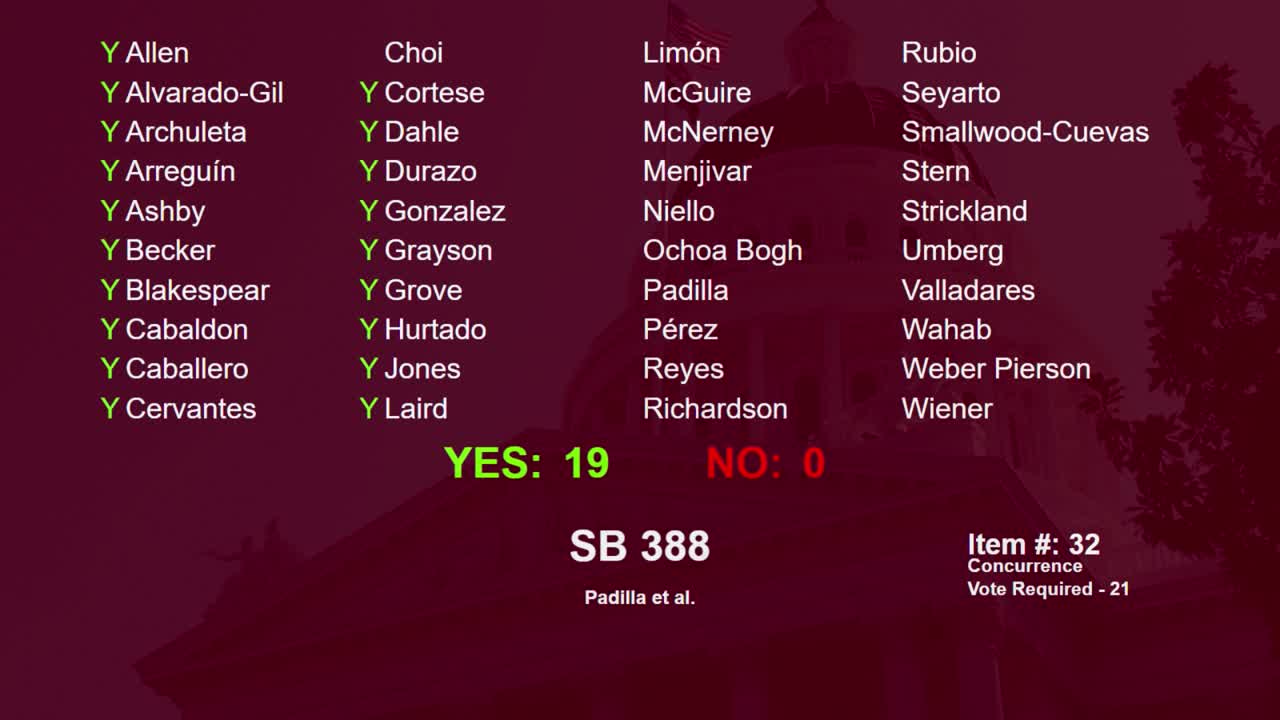 2MIN
Senate Floor
 57SEC
Assembly Floor
 39MIN
Assembly Standing Committee on Housing and Community Development
 17MIN
Assembly Standing Committee on Local Government
 48MIN
Senate Floor
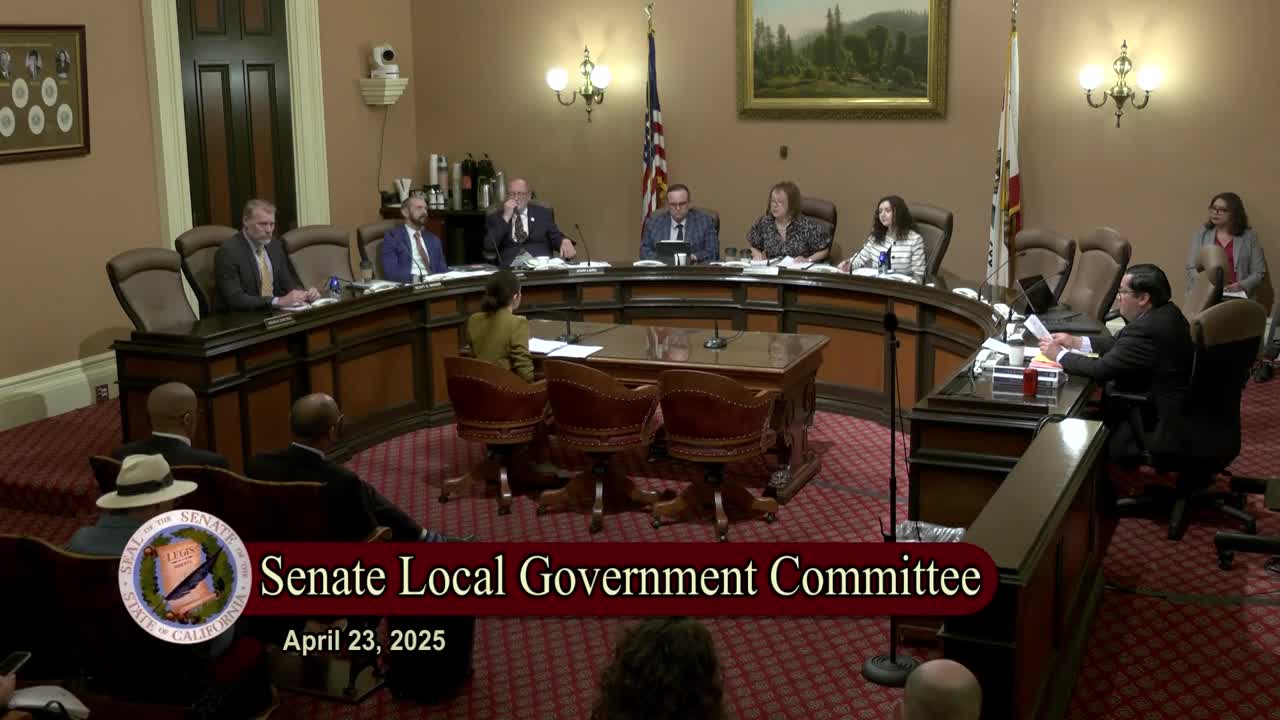 48MIN
Senate Standing Committee on Local Government
Bill Author