SB 661: Airports: financial assistance.
- Session Year: 2025-2026
- House: Senate
- Latest Version Date: 2026-08-31
Current Status:
In Progress
(2026-09-30: In Senate. Consideration of Governor's veto pending.)
Introduced
In Committee
Awaiting First Chamber Vote
Passed First Chamber
In Committee
Awaiting Second Chamber Vote
Passed Second Chamber
Enacted
What does this bill do?
This bill directs a portion of state sales and use tax on jet fuel into a new Aeronautics Account and sets how that money must be spent for airports and aviation programs. It requires every airport that sells or uses jet fuel to report annual fuel flow to the Division of Aeronautics and then divides the funds about 75% to airports based on fuel use (including $500,000 a year for rural and small airports through 2031), 15% for general aviation airports, 9% for grants serving small and nonhub airports, and 1% for aviation education.
The summary is provided by generative AI which can make mistakes. For original language, please view the details in the table below.
The State Aeronautics Act establishes the Aeronautics Account in the State Transportation Fund, and continuously appropriates the moneys in the account for expenditure for airport purposes by the Division of Aeronautics within the Department of Transportation and the California Transportation Commission.
Existing sales and use tax laws impose taxes on retailers measured by the gross receipts from the sale of tangible personal property sold at retail in this state, or on the storage, use, or other consumption in this state of tangible personal property purchased from a retailer for storage, use, or other consumption in this state, including taxes imposed on the sale, storage, use, or other consumption of jet fuels. Existing law requires revenues from these taxes to be transmitted to the Treasurer and deposited into the Retail Sales Tax Fund. Existing federal law requires that any revenue from sales and use taxes imposed on aviation fuel be used for the operation costs of airports, the local airport system, or other local facilities that are directly and substantially related to the air transportation of passengers or property, except as provided.
This bill would require the Controller, on or before September 1 of each year, to transfer an amount calculated to represent the sales and use tax revenues derived with respect to the sale, storage, use, or other consumption of jet fuel, as provided, from the Retail Sales Tax Fund to the account for allocation to airports and aviation-related purposes, as provided. The bill would require all public and private use airports where jet fuel is sold or consumed to report fuel flowage statistics to the Division of Aeronautics, as provided, and would require the division to determine the revenue allocation for each airport that reports fuel flowage statistics. By adding new reporting requirements for county-owned and city-owned airports, the bill would impose a state-mandated local program.
From the above-described sales and use tax revenues deposited into the account, this bill would require the division, after deducting its administrative costs, as provided, to allocate 75% of those revenues to public and private use airports based on their reported fuel flowage statistics, as provided, 15% of those revenues for general aviation airports, as provided, 1% to award grants for aviation education, as provided, and 9% for existing grant programs that serve nonhub and small hub airports. From the above-described 75% of revenues deposited into the account, the bill would apportion, until January 1, 2032, $500,000 annually to award grants to rural, nonhub commercial airports and general aviation airports, as provided.
By increasing the sources of funding for and expanding the purposes for which money may be used from a continuously appropriated fund, the Aeronautics Account, this bill would make an appropriation.
The California Constitution requires the state to reimburse local agencies and school districts for certain costs mandated by the state. Statutory provisions establish procedures for making that reimbursement.
This bill would provide that, if the Commission on State Mandates determines that the bill contains costs mandated by the state, reimbursement for those costs shall be made pursuant to the statutory provisions noted above.
The State Aeronautics Act establishes the Aeronautics Account in the State Transportation Fund, and continuously appropriates the moneys in the account for expenditure for airport purposes by the Division of Aeronautics within the Department of Transportation and the California Transportation Commission.
Existing sales and use tax laws impose taxes on retailers measured by the gross receipts from the sale of tangible personal property sold at retail in this state, or on the storage, use, or other consumption in this state of tangible personal property purchased from a retailer for storage, use, or other consumption in this state, including taxes imposed on the sale, storage, use, or other consumption of jet fuels. Existing law requires revenues from these taxes to be transmitted to the Treasurer and deposited into the Retail Sales Tax Fund. Existing federal law requires that any revenue from sales and use taxes imposed on aviation fuel be used for the operation costs of airports, the local airport system, or other local facilities that are directly and substantially related to the air transportation of passengers or property, except as provided.
This bill would require the Controller, on or before September 1 of each year, to transfer an amount calculated to represent the sales and use tax revenues derived with respect to the sale, storage, use, or other consumption of jet fuel, as provided, from the Retail Sales Tax Fund to the account for allocation to airports and aviation-related purposes, as provided. The bill would require all public and private use airports where jet fuel is sold or consumed to report fuel flowage statistics to the Division of Aeronautics, as provided, and would require the division to determine the revenue allocation for each airport that reports fuel flowage statistics. By adding new reporting requirements for county-owned and city-owned airports, the bill would impose a state-mandated local program.
From the above-described sales and use tax revenues deposited into the account, this bill would require the division division, after deducting its administrative costs, as provided, to allocate 70% 75% of those revenues to public and private use airports based on their reported fuel flowage statistics, as provided, 20% 15% of those revenues for qualifying general aviation airports, as provided, 1% to award grants for aviation education, as provided, and 9% for existing grant programs that serve nonhub and small hub airports. From the above-described 70% 75% of revenues deposited into the account, the bill would apportion, until January 1, 2032, $500,000 annually to award grants to rural, nonhub commercial airports with fewer than 300,000 enplanements to attract, establish, and expand air service, airports and general aviation airports, as provided.
By increasing the sources of funding for and expanding the purposes for which money may be used from a continuously appropriated fund, the Aeronautics Account, this bill would make an appropriation.
The California Constitution requires the state to reimburse local agencies and school districts for certain costs mandated by the state. Statutory provisions establish procedures for making that reimbursement.
This bill would provide that, if the Commission on State Mandates determines that the bill contains costs mandated by the state, reimbursement for those costs shall be made pursuant to the statutory provisions noted above.
The State Aeronautics Act establishes the Aeronautics Account in the State Transportation Fund, and continuously appropriates the moneys in the account for expenditure for airport purposes by the Division of Aeronautics within the Department of Transportation and the California Transportation Commission.
Existing sales and use tax laws impose taxes on retailers measured by the gross receipts from the sale of tangible personal property sold at retail in this state, or on the storage, use, or other consumption in this state of tangible personal property purchased from a retailer for storage, use, or other consumption in this state, including taxes imposed on the sale, storage, use, or other consumption of jet fuels. Existing law requires revenues from these taxes to be transmitted to the Treasurer and deposited into the Retail Sales Tax Fund. Existing federal law requires that any revenue from sales and use taxes imposed on aviation fuel be used for the operation costs of airports, the local airport system, or other local facilities that are directly and substantially related to the air transportation of passengers or property, except as provided.
This bill would require the Controller, on July or before September 1 of each year, to transfer an amount calculated to represent the sales and use tax revenues derived with respect to the sale, storage, use, or other consumption of jet fuel, as provided, from the Retail Sales Tax Fund to the account for allocation to airports and aviation-related purposes, as provided. The bill would require all public and private use airports that sell or consume jet fuel where jet fuel is sold or consumed to report fuel flowage statistics to the Division of Aeronautics, as provided, and would require the division to determine the revenue allocation for each airport that reports fuel flowage statistics. By adding new reporting requirements for county-owned and city-owned airports, the bill would impose a state-mandated local program.
From the above-described sales and use tax revenues deposited into the account, this bill would require the division to allocate 70% of those revenues to public and private use airports based on their reported fuel flowage statistics, as provided, 20% of those revenues for qualifying general aviation airports, as provided, 1% to award grants for aviation education, as provided, and 9% for existing grant programs that serve nonhub and small hub airports. From the above-described 70% of revenues deposited into the account, the bill would apportion, until January 1, 2032, $500,000 annually to award grants to rural, nonhub commercial airports with fewer than 300,000 enplanements to attract, establish, and expand air service, as provided.
By increasing the sources of funding for and expanding the purposes for which money may be used from a continuously appropriated fund, the Aeronautics Account, this bill would make an appropriation.
The California Constitution requires the state to reimburse local agencies and school districts for certain costs mandated by the state. Statutory provisions establish procedures for making that reimbursement.
This bill would provide that, if the Commission on State Mandates determines that the bill contains costs mandated by the state, reimbursement for those costs shall be made pursuant to the statutory provisions noted above.
The State Aeronautics Act establishes the Aeronautics Account in the State Transportation Fund, and continuously appropriates the moneys in the account for expenditure for airport purposes by the Division of Aeronautics within the Department of Transportation and the California Transportation Commission.
This bill would require 50% of the revenues from the imposition of state sales and use taxes, at the rate of 3.9375%, on the sale, storage, use, or other consumption of jet fuel to be transferred to the Aeronautics Account for allocation in specified percentages to qualifying general aviation airports, to commercial airports, and for other aviation-related purposes, as specified. The bill would require the remaining 50% of those revenues to be retained by the airport at which the jet fuel is sold and used only for purposes related to airport operations, capital improvements, maintenance, and other aviation-related infrastructure needs, as specified.Existing sales and use tax laws impose taxes on retailers measured by the gross receipts from the sale of tangible personal property sold at retail in this state, or on the storage, use, or other consumption in this state of tangible personal property purchased from a retailer for storage, use, or other consumption in this state, including taxes imposed on the sale, storage, use, or other consumption of jet fuels. Existing law requires revenues from these taxes to be transmitted to the Treasurer and deposited into the Retail Sales Tax Fund. Existing federal law requires that any revenue from sales and use taxes imposed on aviation fuel be used for the operation costs of airports, the local airport system, or other local facilities that are directly and substantially related to the air transportation of passengers or property, except as provided.
This bill would require the Controller, on July 1 of each year, to transfer an amount calculated to represent the sales and use tax revenues derived with respect to the sale, storage, use, or other consumption of jet fuel, as provided, from the Retail Sales Tax Fund to the account for allocation to airports and aviation-related purposes, as provided. The bill would require all public and private use airports that sell or consume jet fuel to report fuel flowage statistics to the Division of Aeronautics, as provided, and would require the division to determine the revenue allocation for each airport that reports fuel flowage statistics. By adding new reporting requirements for county-owned and city-owned airports, the bill would impose a state-mandated local program.
From the above-described sales and use tax revenues deposited into the account, this bill would require the division to allocate 70% of those revenues to public and private use airports based on their reported fuel flowage statistics, as provided, 20% of those revenues for qualifying general aviation airports, as provided, 1% to award grants for aviation education, as provided, and 9% for existing grant programs that serve nonhub and small hub airports. From the above-described 70% of revenues deposited into the account, the bill would apportion, until January 1, 2032, $500,000 annually to award grants to rural, nonhub commercial airports with fewer than 300,000 enplanements to attract, establish, and expand air service, as provided.
By increasing the sources of funding for and expanding the purposes for which money may be used from a continuously appropriated fund, the Aeronautics Account, the this bill would make an appropriation.
The California Constitution requires the state to reimburse local agencies and school districts for certain costs mandated by the state. Statutory provisions establish procedures for making that reimbursement.
This bill would provide that, if the Commission on State Mandates determines that the bill contains costs mandated by the state, reimbursement for those costs shall be made pursuant to the statutory provisions noted above.
The State Aeronautics Act establishes the Aeronautics Account in the State Transportation Fund, and continuously appropriates the moneys in the account for expenditure for airport purposes by the Division of Aeronautics within the Department of Transportation and the California Transportation Commission.
This bill would require 50% of the revenues from the imposition of state sales and use taxes, at the rate of 4.1875%, 3.9375%, on the sale, storage, use, or other consumption of aviation fuel, as defined, jet fuel to be transferred to the Aeronautics Account for allocation in specified percentages to qualifying general aviation airports, to commercial airports, and for other aviation-related purposes, as specified. specified. The bill would require the remaining 50% of those revenues to be retained by the airport at which the jet fuel is sold and used only for purposes related to airport operations, capital improvements, maintenance, and other aviation-related infrastructure needs, as specified.
By increasing the sources of funding for and expanding the purposes for which money may be used from a continuously appropriated fund, the Aeronautics Account, the bill would make an appropriation.
The State Aeronautics Act establishes the Aeronautics Account in the State Transportation Fund, and continuously appropriates the moneys in the account for expenditure for airport purposes by the Division of Aeronautics within the Department of Transportation and the California Transportation Commission.
This bill would require the revenues from the imposition of state sales and use taxes, at the rate of 4.1875%, on the sale, storage, use, or other consumption of aviation fuel, as defined, be transferred to the Aeronautics Account for allocation in specified percentages to qualifying general aviation airports, to commercial airports, and for other aviation-related purposes, as specified.
By increasing the sources of funding for and expanding the purposes for which money may be used from a continuously appropriated fund, the Aeronautics Account, the bill would make an appropriation.
The State Aeronautics Act requires the Department of Transportation, among other things, to encourage, foster, and assist the development of aeronautics in this state and to encourage the establishment of airports and air navigation facilities. The act requires the department to cooperate and assist the federal government, political subdivisions of this state, and others in the development of aeronautics, and to seek to coordinate their aeronautical activities.This bill would require the department to develop a plan to increase flight availability at Meadows Field Airport in the County of Kern. The bill would require the department, in developing the plan, to collaborate with the County of Kern, relevant state agencies, and with local and federal partners. The bill would require the plan to include, among others, a market study that identifies high-priority routes and assesses demand for additional flights to and from Meadows Field Airport.This bill would make legislative findings and declarations as to the necessity of a special statute for County of Kern, the City of Bakersfield, and Meadows Field Airport.To the extent that this bill would require a local entity to participate in the development of the plan, this bill would impose a state-mandated local program.The California Constitution requires the state to reimburse local agencies and school districts for certain costs mandated by the state. Statutory provisions establish procedures for making that reimbursement.This bill would provide that, if the Commission on State Mandates determines that the bill contains costs mandated by the state, reimbursement for those costs shall be made pursuant to the statutory provisions noted above.The State Aeronautics Act requires the Department of Transportation, among other things, to encourage, foster, and assist the development of aeronautics in this state and to encourage the establishment of airports and air navigation facilities. The act requires the department to cooperate and assist the federal government, political subdivisions of this state, and others in the development of aeronautics, and to seek to coordinate their aeronautical activities.
This bill would require the department to develop a plan to increase flight availability at Meadows Field Airport in the County of Kern. The bill would require the department, in developing the plan, to collaborate with the County of Kern, relevant state agencies, and with local and federal partners. The bill would require the plan to include, among others, a market study that identifies high-priority routes and assesses demand for additional flights to and from Meadows Field Airport.
This bill would make legislative findings and declarations as to the necessity of a special statute for County of Kern, the City of Bakersfield, and Meadows Field Airport.
To the extent that this bill would require a local entity to participate in the development of the plan, this bill would impose a state-mandated local program.
The California Constitution requires the state to reimburse local agencies and school districts for certain costs mandated by the state. Statutory provisions establish procedures for making that reimbursement.
This bill would provide that, if the Commission on State Mandates determines that the bill contains costs mandated by the state, reimbursement for those costs shall be made pursuant to the statutory provisions noted above.
The Legislature finds and declares all of the following:
(a)Californias network of commercial, regional, and general aviation airports functions as an integrated transportation system that connects communities, supports the movement of people and goods, and strengthens economic activity throughout the state.
(b)Reliable air transportation infrastructure is essential to maintaining Californias position as one of the worlds largest economies by facilitating commerce, tourism, workforce mobility, business investment, and access to national and international markets.
(c)Airports of all sizes play a critical role within Californias aviation system. While major international airports serve as global gateways, regional and community-serving airports provide essential connectivity that supports local economies, workforce development, emergency response capabilities, and access to critical services.
(d)Many regions of California, including rapidly growing inland communities and major economic centers in the central valley, depend on regional airports to connect residents and businesses with opportunities throughout the state, nation, and world.
(e)Strategic investments in airport infrastructure, air service development, and aviation-related facilities strengthen the resiliency and competitiveness of Californias transportation network while promoting economic growth in urban and rural communities.
(f)Expanding and sustaining air service at regional airports, including airports that serve emerging economic hubs and freight corridors, will enhance statewide connectivity, support job creation, improve access to business and educational opportunities, and ensure that the benefits of Californias economy are more broadly shared across all regions of the state.
SEC. 2.Section 21689 is added to the Public Utilities Code, to read:21689.(a)Notwithstanding the provisions of this article, from the funds deposited into the Aeronautics Account in the State Transportation Fund pursuant to Section 7102.3 of the Revenue and Taxation Code, the division, after deducting its administrative costs pursuant to subdivision (c), shall allocate annually to eligible recipients the following percentages of available funds for airports and aviation-related purposes:
(1)(A)Seventy-five percent to be divided among each public and private use airport where jet fuel is sold or consumed based on the airports fuel flowage statistics reported for the previous calendar year pursuant to Section 7102.3 of the Revenue and Taxation Code.
(B)Any unused funds under subdivision (c) shall be distributed pursuant to subparagraph (A) on a pro rata basis.
(C)(i)Of the total allocation for a year under subparagraph (A), the division shall use five hundred thousand dollars ($500,000) to provide grants to rural, nonhub commercial airports and general aviation airports.
(ii)Expenditures under this subparagraph shall be consistent with the Federal Register, Volume 64, Number 30, on February 16, 1999.
(iii)This subparagraph shall become inoperative on January 1, 2032.
(2)Fifteen percent for general aviation airports, to be divided and credited to individual airport subaccounts in a manner consistent with a process established by the division.
(3)(A)One percent to provide grants for aviation education that includes, but is not limited to, programs, projects, or initiatives that improve or enrich the aviation workforce within the California aviation community. Grants may include, but are not limited to, scholarships for flight training, traffic control training and education, and aviation-related degrees from accredited universities.
(B)Priority for grants provided pursuant to subparagraph (A) shall be given to underrepresented students, women, veterans, and persons of low income.
(4)Nine percent to existing grant programs that serve nonhub and small hub airports.
(b)Sections 21686 to 21688, inclusive, shall apply to allocations of funds pursuant to this section.
(c)Of the total allocation for the first year deposited into the Aeronautics Account in the State Transportation Fund pursuant to Section 7102.3 of the Revenue and Taxation Code, the division may use up to one million dollars ($1,000,000) on administrative costs to establish a process for distributing funds under this section and to distribute funds under that process for that year. Of the total allocation for each subsequent year deposited into the Aeronautics Account in the State Transportation Fund pursuant to Section 7102.3 of the Revenue and Taxation Code, the division may use up to six hundred thousand dollars ($600,000) on the administrative costs of distributing funds under this section for that year.
(d)For purposes of this section, the following definitions apply:
(1)Division means the Division of Aeronautics.
(2)General aviation airport has the same meaning as defined in Section 47102 of Title 49 of the United States Code.
SEC. 3.Section 7102.3 is added to the Revenue and Taxation Code, to read:7102.3.(a)(1)Notwithstanding Section 7102, revenues in the fund, less refunds, derived under this part from the imposition of state sales and use taxes pursuant to Section 35 of Article XIII of the Constitution, and Sections 6051.2, 6051.3, 6201.2, and 6201.3, which equal 1.25 percent of the total statewide sales and use tax rate, with respect to the sale, storage, use, or other consumption of jet fuel, shall be transferred to the Aeronautics Account in the State Transportation Fund for allocation to airports and aviation-related purposes in accordance with Section 21689 of the Public Utilities Code.
(2)The Controller shall make the transfer described in paragraph (1) on or before September 1 of each year.
(b)(1)Amounts transferred pursuant to subdivision (a) shall be allocated toward an aviation purpose, in compliance with Sections 47107 and 47133 of Title 49 of the United States Code.
(2)Amounts subject to allocation pursuant to paragraph (1) shall be determined based on the amounts reported by the California Department of Tax and Fee Administration pursuant to paragraph (1) of subdivision (d) of Section 6452.05 for the fiscal year immediately preceding the due date described in paragraph (2) of subdivision (a).
(3)(A)All public and private use airports where jet fuel is sold or consumed shall report to the Division of Aeronautics within the Department of Transportation the airports fuel flowage statistics for the previous calendar year by March 31 for purposes of calculating individual airport fuel tax allocations.
(B)The Division of Aeronautics shall determine the fuel tax revenue allocation for each airport that reports fuel flowage statistics pursuant to subparagraph (A).
(c)For purposes of this section, the following definitions apply:
(1)Fuel flowage statistics includes the total gallons of jet fuel sold or consumed annually at an airport.
(2)Jet fuel means aircraft jet fuel, as defined in Section 7387.
SEC. 4.If the Commission on State Mandates determines that this act contains costs mandated by the state, reimbursement to local agencies and school districts for those costs shall be made pursuant to Part 7 (commencing with Section 17500) of Division 4 of Title 2 of the Government Code.
The Legislature finds and declares all of the following:
(a)Californias network of commercial, regional, and general aviation airports functions as an integrated transportation system that connects communities, supports the movement of people and goods, and strengthens economic activity throughout the state.
(b)Reliable air transportation infrastructure is essential to maintaining Californias position as one of the worlds largest economies by facilitating commerce, tourism, workforce mobility, business investment, and access to national and international markets.
(c)Airports of all sizes play a critical role within Californias aviation system. While major international airports serve as global gateways, regional and community-serving airports provide essential connectivity that supports local economies, workforce development, emergency response capabilities, and access to critical services.
(d)Many regions of California, including rapidly growing inland communities and major economic centers in the central valley, depend on regional airports to connect residents and businesses with opportunities throughout the state, nation, and world.
(e)Strategic investments in airport infrastructure, air service development, and aviation-related facilities strengthen the resiliency and competitiveness of Californias transportation network while promoting economic growth in urban and rural communities.
(f)Expanding and sustaining air service at regional airports, including airports that serve emerging economic hubs and freight corridors, will enhance statewide connectivity, support job creation, improve access to business and educational opportunities, and ensure that the benefits of Californias economy are more broadly shared across all regions of the state.
SEC. 2.Section 21689 is added to the Public Utilities Code, to read:21689.(a)Notwithstanding the provisions of this article, from the funds deposited into the Aeronautics Account in the State Transportation Fund pursuant to Section 7102.3 of the Revenue and Taxation Code, the Division of Aeronautics division, after deducting its administrative costs pursuant to subdivision (c), shall allocate annually to eligible recipients the following percentages of available funds for airports and aviation-related purposes:
(1)(A)Seventy Seventy-five percent to be divided among each public and private use airport where jet fuel is sold or consumed based on the airports fuel flowage statistics reported for the previous calendar year pursuant to Section 7102.3 of the Revenue and Taxation Code.
(B)Of the total allocation for the first year under subparagraph (A), the division may use up to one million dollars ($1,000,000) on administrative costs to establish a process for distributing funds under this section and to distribute funds under that process for that year. Of the total allocation for each subsequent year under subparagraph (A), the division may use up to six hundred thousand dollars ($600,000) on the administrative costs of distributing funds under this section for that year.(C)(B)Any unused funds under subparagraph (B) subdivision (c) shall be distributed pursuant to subparagraph (A) on a pro rata basis.
(D)(C)(i)Of the total allocation for a year under subparagraph (A), the division shall use five hundred thousand dollars ($500,000) to provide grants to rural, nonhub commercial airports with fewer than 300,000 enplanements annually to attract, establish, and expand air service through incentives, marketing, passenger studies, route analysis, and the acquisition of consultants. and general aviation airports.
(ii)Expenditures under this subparagraph shall be consistent with the Federal Register, Volume 64, Number 30, on February 16, 1999.
(iii)This subparagraph shall become inoperative on January 1, 2032.
(2)Twenty Fifteen percent for qualifying general aviation airports, to be divided and credited to individual airport subaccounts in a manner consistent with the a process established in Section 21682. by the division.
(3)(A)One percent to provide grants for aviation education that includes, but is not limited to, programs, projects, or initiatives that improve or enrich the aviation workforce within the California aviation community. Grants may include, but are not limited to, scholarships for flight training, traffic control training and education, and aviation-related degrees from accredited universities.
(B)Priority for grants provided pursuant to subparagraph (A) shall be given to underrepresented students, women, veterans, and persons of low income.
(4)Nine percent to existing grant programs that serve nonhub and small hub airports.
(b)Sections 21686 to 21688, inclusive, shall apply to allocations of funds pursuant to this section.
(c)Of the total allocation for the first year deposited into the Aeronautics Account in the State Transportation Fund pursuant to Section 7102.3 of the Revenue and Taxation Code, the division may use up to one million dollars ($1,000,000) on administrative costs to establish a process for distributing funds under this section and to distribute funds under that process for that year. Of the total allocation for each subsequent year deposited into the Aeronautics Account in the State Transportation Fund pursuant to Section 7102.3 of the Revenue and Taxation Code, the division may use up to six hundred thousand dollars ($600,000) on the administrative costs of distributing funds under this section for that year.
(d)For purposes of this section, the following definitions apply:
(1)Division means the Division of Aeronautics.
(2)General aviation airport has the same meaning as defined in Section 47102 of Title 49 of the United States Code.
SEC. 3.Section 7102.3 is added to the Revenue and Taxation Code, to read:7102.3.(a)(1)Notwithstanding Section 7102, revenues in the fund, less refunds, derived under this part from the imposition of state sales and use taxes pursuant to Section 35 of Article XIII of the Constitution, and Sections 6051.2, 6051.3, 6201.2, and 6201.3, which equal 1.25 percent of the total statewide sales and use tax rate, with respect to the sale, storage, use, or other consumption of jet fuel, shall be transferred to the Aeronautics Account in the State Transportation Fund for allocation to airports and aviation-related purposes in accordance with Section 21689 of the Public Utilities Code.
(2)The Controller shall make the transfer described in paragraph (1) on or before September 1 of each year.
(b)(1)Amounts transferred pursuant to subdivision (a) shall be allocated toward an aviation purpose, in compliance with Sections 47107 and 47133 of Title 49 of the United States Code.
(2)Amounts subject to allocation pursuant to paragraph (1) shall be determined based on the amounts reported by the California Department of Tax and Fee Administration pursuant to paragraph (1) of subdivision (d) of Section 6452.05 for the fiscal year immediately preceding the due date described in paragraph (2) of subdivision (a).
(3)(A)All public and private use airports where jet fuel is sold or consumed shall report to the Division of Aeronautics within the Department of Transportation the airports fuel flowage statistics for the previous calendar year by March 31 for purposes of calculating individual airport fuel tax allocations.
(B)The Division of Aeronautics shall determine the fuel tax revenue allocation for each airport that reports fuel flowage statistics pursuant to subparagraph (A).
(c)For purposes of this section, jet the following definitions apply:
(1)Fuel flowage statistics includes the total gallons of jet fuel sold or consumed annually at an airport.
(2)Jet fuel means aircraft jet fuel, as defined in Section 7387.
SEC. 4.If the Commission on State Mandates determines that this act contains costs mandated by the state, reimbursement to local agencies and school districts for those costs shall be made pursuant to Part 7 (commencing with Section 17500) of Division 4 of Title 2 of the Government Code.
The Legislature finds and declares all of the following:
(a)Californias network of commercial, regional, and general aviation airports functions as an integrated transportation system that connects communities, supports the movement of people and goods, and strengthens economic activity throughout the state.
(b)Reliable air transportation infrastructure is essential to maintaining Californias position as one of the worlds largest economies by facilitating commerce, tourism, workforce mobility, business investment, and access to national and international markets.
(c)Airports of all sizes play a critical role within Californias aviation system. While major international airports serve as global gateways, regional and community-serving airports provide essential connectivity that supports local economies, workforce development, emergency response capabilities, and access to critical services.
(d)Many regions of California, including rapidly growing inland communities and major economic centers in the central valley, depend on regional airports to connect residents and businesses with opportunities throughout the state, nation, and world.
(e)Strategic investments in airport infrastructure, air service development, and aviation-related facilities strengthen the resiliency and competitiveness of Californias transportation network while promoting economic growth in urban and rural communities.
(f)Expanding and sustaining air service at regional airports, including airports that serve emerging economic hubs and freight corridors, will enhance statewide connectivity, support job creation, improve access to business and educational opportunities, and ensure that the benefits of Californias economy are more broadly shared across all regions of the state.
SEC. 2.Section 21689 is added to the Public Utilities Code, to read:21689.(a)Notwithstanding the provisions of this article, from the funds deposited into the Aeronautics Account in the State Transportation Fund pursuant to Section 7102.3 of the Revenue and Taxation Code, the Division of Aeronautics shall allocate annually to eligible recipients the following percentages of available funds for airports and aviation-related purposes:
(1)(A)Seventy percent to be divided among each public and private use airport that sells or consumes where jet fuel is sold or consumed based on the airports fuel flowage statistics reported for the previous calendar year pursuant to Section 7102.3 of the Revenue and Taxation Code.
(B)Of the total allocation for the first year under subparagraph (A), the division may use up to one million dollars ($1,000,000) on administrative costs to establish a process for distributing funds under this section and to distribute funds under that process for that year. Of the total allocation for each subsequent year under subparagraph (A), the division may use up to six hundred thousand dollars ($600,000) on the administrative costs of distributing funds under this section for that year.
(C)Any unused funds under subparagraph (B) shall be distributed pursuant to subparagraph (A) on a pro rata basis.
(D)(i)Of the total allocation for a year under subparagraph (A), the division shall use five hundred thousand dollars ($500,000) to provide grants to rural, nonhub commercial airports with fewer than 300,000 enplanements annually to attract, establish, and expand air service through incentives, marketing, passenger studies, route analysis, and the acquisition of consultants.
(ii)Expenditures under this subparagraph shall be consistent with the Federal Register, Volume 64, Number 30, on February 16, 1999.
(iii)This subparagraph shall become inoperative on January 1, 2032.
(2)Twenty percent for qualifying general aviation airports, to be credited to individual airport subaccounts in a manner consistent with the process established in Section 21682.
(3)(A)One percent to provide grants for aviation education that includes, but is not limited to, programs, projects, or initiatives that improve or enrich the aviation workforce within the California aviation community. Grants may include, but are not limited to, scholarships for flight training, traffic control training and education, and aviation-related degrees from accredited universities.
(B)Priority for grants provided pursuant to subparagraph (A) shall be given to underrepresented students, women, veterans, and persons of low income.
(4)Nine percent to existing grant programs that serve nonhub and small hub airports.
(b)Sections 21686 to 21688, inclusive, shall apply to allocations of funds pursuant to this section.
SEC. 3.Section 7102.3 is added to the Revenue and Taxation Code, to read:7102.3.(a)(1)Notwithstanding Section 7102, revenues in the fund, less refunds, derived under this part from the imposition of state sales and use taxes pursuant to Section 35 of Article XIII of the Constitution, and Sections 6051.2, 6051.3, 6201.2, and 6201.3, at a rate of which equal 1.25 percent, percent of the total statewide sales and use tax rate, with respect to the sale, storage, use, or other consumption of jet fuel, shall be transferred to the Aeronautics Account in the State Transportation Fund for allocation to airports and aviation-related purposes in accordance with Section 21689 of the Public Utilities Code.
(2)The Controller shall make the transfer described in paragraph (1) on July or before September 1 of each year.
(b)(1)Amounts transferred pursuant to subdivision (a) shall be allocated toward an aviation purpose, in compliance with Sections 47107 and 47133 of Title 49 of the United States Code.
(2)Amounts subject to allocation pursuant to paragraph (1) shall be determined based on the amounts reported by the California Department of Tax and Fee Administration pursuant to paragraph (1) of subdivision (d) of Section 6452.05. 6452.05 for the fiscal year immediately preceding the due date described in paragraph (2) of subdivision (a).
(3)(A)All public and private use airports that sell or consume jet fuel where jet fuel is sold or consumed shall report to the Division of Aeronautics within the Department of Transportation the airports fuel flowage statistics for the previous calendar year by March 31 for purposes of calculating individual airport fuel tax allocations.
(B)The Division of Aeronautics shall determine the fuel tax revenue allocation for each airport that reports fuel flowage statistics pursuant to subparagraph (A).
(c)For purposes of this section, jet fuel means Jet A aviation fuel or sustainable aviation fuel. aircraft jet fuel, as defined in Section 7387.
SEC. 4.If the Commission on State Mandates determines that this act contains costs mandated by the state, reimbursement to local agencies and school districts for those costs shall be made pursuant to Part 7 (commencing with Section 17500) of Division 4 of Title 2 of the Government Code.
The Legislature finds and declares all of the following:
(a)Californias network of commercial, regional, and general aviation airports functions as an integrated transportation system that connects communities, supports the movement of people and goods, and strengthens economic activity throughout the state.
(b)Reliable air transportation infrastructure is essential to maintaining Californias position as one of the worlds largest economies by facilitating commerce, tourism, workforce mobility, business investment, and access to national and international markets.
(c)Airports of all sizes play a critical role within Californias aviation system. While major international airports serve as global gateways, regional and community-serving airports provide essential connectivity that supports local economies, workforce development, emergency response capabilities, and access to critical services.
(d)Many regions of California, including rapidly growing inland communities and major economic centers in the central valley, depend on regional airports to connect residents and businesses with opportunities throughout the state, nation, and world.
(e)Strategic investments in airport infrastructure, air service development, and aviation-related facilities strengthen the resiliency and competitiveness of Californias transportation network while promoting economic growth in urban and rural communities.
(f)Expanding and sustaining air service at regional airports, including airports that serve emerging economic hubs and freight corridors, will enhance statewide connectivity, support job creation, improve access to business and educational opportunities, and ensure that the benefits of Californias economy are more broadly shared across all regions of the state.
SEC. 2.Section 21689 is added to the Public Utilities Code, to read:21689.(a)Notwithstanding the provisions of this article, 50 percent of the revenue collected from taxes on jet fuel sold at an airport in the state shall be retained by the airport at which the jet fuel is sold and shall be used only for purposes related to airport operations, capital improvements, maintenance, and other aviation-related infrastructure needs as determined by the airports governing authority, consistent with applicable federal and state regulations.
(2)Fifty percent of the revenue collected from taxes on jet fuel sold at airports in the state shall be deposited into the Aeronautics Account in the State Transportation Fund pursuant to Section 7102.3 of the Revenue and Taxation Code and allocated pursuant to subdivision (b).(b)Notwithstanding the provisions of this article, from the funds deposited into the Aeronautics Account in the State Transportation Fund pursuant to Section 7102.3 of the Revenue and Taxation Code, the Division of Aeronautics shall allocate annually to eligible recipients the following percentages of available funds for airports and aviation-related purposes:
(1)(A)Seventy percent to be divided among each public and private use airport that sells or consumes jet fuel based on the airports fuel flowage statistics reported for the previous calendar year pursuant to Section 7102.3 of the Revenue and Taxation Code.
(B)Of the total allocation for the first year under subparagraph (A), the division may use up to one million dollars ($1,000,000) on administrative costs to establish a process for distributing funds under this section and to distribute funds under that process for that year. Of the total allocation for each subsequent year under subparagraph (A), the division may use up to six hundred thousand dollars ($600,000) on the administrative costs of distributing funds under this section for that year.
(C)Any unused funds under subparagraph (B) shall be distributed pursuant to subparagraph (A) on a pro rata basis.
(D)(i)Of the total allocation for a year under subparagraph (A), the division shall use five hundred thousand dollars ($500,000) to provide grants to rural, nonhub commercial airports with fewer than 300,000 enplanements annually to attract, establish, and expand air service through incentives, marketing, passenger studies, route analysis, and the acquisition of consultants.
(ii)Expenditures under this subparagraph shall be consistent with the Federal Register, Volume 64, Number 30, on February 16, 1999.
(iii)This subparagraph shall become inoperative on January 1, 2032.
(1)(2)Twenty percent for qualifying general aviation airports, to be credited to individual airport subaccounts in a manner consistent with the process established in Section 21682.
(2)Forty percent to be divided among large, medium, and small hub commercial airports and nonhub commercial airports, each as defined by the Federal Aviation Administration under Section 47102 of Title 49 of the United States Code, in the following percentages:(A)Thirty percent for large hub commercial airports.(B)Twenty percent for medium hub commercial airports.(C)Twenty percent for small hub commercial airports.(D)Thirty percent for nonhub commercial airports.(3)(A)Fifteen percent for grants to be made available to nonhub commercial airports with less than 300,000 enplanements annually to attract, establish, and expand air service through incentives, marketing, passenger studies, route analysis, and the acquisition of consultants.(B)Expenditures under subparagraph (A) shall be consistent with the Federal Register, Volume 64, Number 30, on February 16, 1999.(4)(3)(A)Five One percent to provide grants for aviation education that includes, but is not limited to, programs, projects, or initiatives that improve or enrich the aviation workforce within the California aviation community. Grants may include, but are not limited to, scholarships for flight training training, traffic control training and education, and aviation-related degrees from accredited universities.
(B)Priority for grants provided pursuant to subparagraph (A) shall be given to underrepresented students, women, veterans, and persons of low income.
(5)Fifteen percent for other state aviation programs and aviation-related purposes as authorized pursuant to this article.(6)(A)Not more than 5 percent for the divisions administrative costs.(B)Any unused funds under subparagraph (A) shall be allocated pursuant to paragraphs (1) to (5), inclusive, on a pro rata basis.(4)Nine percent to existing grant programs that serve nonhub and small hub airports.
(c)(b)Sections 21686 to 21688, inclusive, shall apply to allocations of funds pursuant to this section.
SEC. 3.Section 7102.3 is added to the Revenue and Taxation Code, to read:7102.3.Notwithstanding Section 7102, revenues in the fund, less refunds, derived under this part from the imposition of state sales and use taxes pursuant to Sections 6051, 6051.3, 6201, and 6201.3, at the rate of 3.9375 percent, with respect to the sale, storage, use, or other consumption of jet fuel shall be transferred to the Aeronautics Account in the State Transportation Fund for allocation to airports and aviation-related purposes in accordance with Section 21689 of the Public Utilities Code.SEC. 3.Section 7102.3 is added to the Revenue and Taxation Code, to read:7102.3.(a)(1)Notwithstanding Section 7102, revenues in the fund, less refunds, derived under this part from the imposition of state sales and use taxes pursuant to Section 35 of Article XIII of the Constitution, and Sections 6051.2, 6051.3, 6201.2, and 6201.3, at a rate of 1.25 percent, with respect to the sale, storage, use, or other consumption of jet fuel, shall be transferred to the Aeronautics Account in the State Transportation Fund for allocation to airports and aviation-related purposes in accordance with Section 21689 of the Public Utilities Code.
(2)The Controller shall make the transfer described in paragraph (1) on July 1 of each year.
(b)(1)Amounts transferred pursuant to subdivision (a) shall be allocated toward an aviation purpose, in compliance with Sections 47107 and 47133 of Title 49 of the United States Code.
(2)Amounts subject to allocation pursuant to paragraph (1) shall be determined based on the amounts reported by the California Department of Tax and Fee Administration pursuant to paragraph (1) of subdivision (d) of Section 6452.05.
(3)(A)All public and private use airports that sell or consume jet fuel shall report to the Division of Aeronautics within the Department of Transportation the airports fuel flowage statistics for the previous calendar year by March 31 for purposes of calculating individual airport fuel tax allocations.
(B)The Division of Aeronautics shall determine the fuel tax revenue allocation for each airport that reports fuel flowage statistics pursuant to subparagraph (A).
(c)For purposes of this section, jet fuel means Jet A aviation fuel or sustainable aviation fuel.
SEC. 4.If the Commission on State Mandates determines that this act contains costs mandated by the state, reimbursement to local agencies and school districts for those costs shall be made pursuant to Part 7 (commencing with Section 17500) of Division 4 of Title 2 of the Government Code.
(a)The Legislature finds and declares all of the following:
(1)The City of Bakersfield is one of the fastest growing metropolitan areas in California, with a population exceeding 400,000 people, and serves as the hub of the County of Kern, an economic powerhouse driven by the agriculture, energy, logistics, and health care industries.
(2)Enhanced air transportation services, both public and private, are critical to supporting economic development in the County of Kern by improving connectivity for residents, businesses, and visitors.
(3)The availability of increased flights to the County of Kern will create significant opportunities for local job creation, particularly in industries such as:
(A)Aviation and airport operations, including roles in ground services, maintenance, and customer support.
(B)Hospitality and tourism, as better connectivity attracts conferences, business travel, and leisure visitors to the region.
(C)Logistics and supply chain management, which rely on efficient air cargo services to support local businesses and industries.
(D)Construction and infrastructure development, as investments are made in airport facilities and surrounding areas.
(4)Job creation in the County of Kern is especially critical for addressing the unique challenges faced by the county, including, but not limited to, all of the following:
(A)Higher than average unemployment rates in comparison to the state average.
(B)Economic disparities in rural and underserved communities that would benefit from increased connectivity to statewide and national opportunities.
(C)The need to diversify the economy and provide stable employment opportunities outside of traditional industries such as oil and gas.
(5)Expanding flight access to the County of Kern will strengthen the regions competitiveness by attracting new businesses and investment, fostering innovation, and encouraging young professionals to stay in the area rather than seeking opportunities elsewhere.
(6)Improved connectivity also directly supports key industries in the County of Kern, such as agriculture and energy, by providing quicker and more efficient access to clients, suppliers, and markets throughout California, the nation, and the world.
(7)As California continues to emphasize equitable economic development, regional air transportation access should align with the needs of underserved and emerging areas, such as the County of Kern, to ensure statewide economic resiliency and inclusivity.
(b)It is the intent of the Legislature that this legislation does all of the following:
(1)Facilitates increased public and private investments to expand the number of flights to and from the County of Kern, including domestic and international routes, to better serve the regions growing population and economic potential.
(2)Encourages partnerships among local governments, the aviation industry, and private stakeholders to improve infrastructure at the Meadows Field Airport, near the City of Bakersfield in the County of Kern, and other related facilities, ensuring the region is well-equipped to support increased flight capacity.
(3)Explores incentives and grants to attract airlines to add new routes or increase frequency of existing flights to the County of Kern, particularly targeting underserved or high-demand routes.
(4)Prioritizes the creation of local, high-quality jobs in aviation, airport operations, hospitality, and associated industries as part of any expansion plan, ensuring that the economic benefits directly support residents of the County of Kern.
(5)Promotes economic development through enhanced air connectivity, including attracting conferences, trade shows, and other large-scale events to the region.
(6)Recognizes the importance of air travel as a means to improve access to health care, education, and business opportunities for residents of the County of Kern, especially for rural and underserved communities.
(7)Establishes a statewide task force or advisory committee to identify and address barriers to expanding air transportation in the County of Kern, with an emphasis on ensuring that such expansion benefits local businesses, residents, and underserved communities.
(8)Evaluates and mitigates potential environmental impacts associated with increased air travel to ensure alignment with Californias sustainability and climate goals.
SEC. 2.Section 21689 is added to the Public Utilities Code, to read:21689.(a)Notwithstanding the provisions of this article, from the funds deposited into the Aeronautics Account in the State Transportation Fund pursuant to Section 7102.1 of the Revenue and Taxation Code, the Division of Aeronautics shall allocate annually to eligible recipients the following percentages of available funds for airports and aviation-related purposes:21689.(a)Notwithstanding the provisions of this article, 50 percent of the revenue collected from taxes on jet fuel sold at an airport in the state shall be retained by the airport at which the jet fuel is sold and shall be used only for purposes related to airport operations, capital improvements, maintenance, and other aviation-related infrastructure needs as determined by the airports governing authority, consistent with applicable federal and state regulations.
(2)Fifty percent of the revenue collected from taxes on jet fuel sold at airports in the state shall be deposited into the Aeronautics Account in the State Transportation Fund pursuant to Section 7102.3 of the Revenue and Taxation Code and allocated pursuant to subdivision (b).
(b)Notwithstanding the provisions of this article, from the funds deposited into the Aeronautics Account in the State Transportation Fund pursuant to Section 7102.3 of the Revenue and Taxation Code, the Division of Aeronautics shall allocate annually to eligible recipients the following percentages of available funds for airports and aviation-related purposes:
(1)Twelve Twenty percent for qualifying general aviation airports, to be credited to individual airport subaccounts in a manner consistent with the process established in Section 21682.
(2)Thirty Forty percent to be divided among large, medium, and small hub commercial airports and nonhub commercial airports, each as defined by the Federal Aviation Administration under Section 47102 of Title 49 of the United States Code, in the following percentages:
(A)Twenty Thirty percent for large hub commercial airports.
(B)Twenty percent for medium hub commercial airports.
(C)Fourteen Twenty percent for small hub commercial airports.
(D)Forty-six Thirty percent for nonhub commercial airports.
(3)(A)Forty Fifteen percent for grants to be made available to nonhub commercial airports with less than 300,000 enplanements annually to attract, establish, and expand air service through incentives, marketing, passenger studies, route analysis, and the acquisition of consultants.
(B)Expenditures under subparagraph (A) shall be consistent with the Federal Register, Volume 64, Number 30, on February 16, 1999.
(C)Priority for grants provided pursuant to subparagraph (A) shall be given to nonhub commercial airports located within cities with a population size greater than 400,000.(4)(A)Three Five percent to provide grants for aviation education that includes, but is not limited to, programs, projects, or initiatives that improve or enrich aviation within the California aviation community. Grants may include, but are not limited to, scholarships for flight training and aviation-related degrees from accredited universities.
(B)Priority for grants provided pursuant to subparagraph (A) shall be given to underrepresented students, women, veterans, and persons of low income.
(5)Ten Fifteen percent for other state aviation programs and aviation-related purposes as authorized pursuant to this article.
(6)(A)Not more than 5 percent for the divisions administrative costs.
(B)Any unused funds under subparagraph (A) shall be allocated pursuant to paragraphs (1) to (5), inclusive, on a pro rata basis.
(b)(c)Sections 21686 to 21688, inclusive, shall apply to allocations of funds pursuant to this section.
SEC. 3.Section 7102.3 is added to the Revenue and Taxation Code, to read:7102.3.(a)Notwithstanding Section 7102, revenues in the fund, less refunds, derived under this part from the imposition of state sales and use taxes pursuant to Sections 6051, 6051.3, 6201, and 6201.3, at the rate of 4.1875 3.9375 percent, with respect to the sale, storage, use, or other consumption of aviation jet fuel shall be transferred to the Aeronautics Account in the State Transportation Fund for allocation to airports and aviation-related purposes in accordance with Section 21689 of the Public Utilities Code.
(b)As used in this section, aviation fuel means jet fuel and aviation gasoline.(a)The Legislature finds and declares all of the following:
(1)The City of Bakersfield is one of the fastest growing metropolitan areas in California, with a population exceeding 400,000 people, and serves as the hub of the County of Kern, an economic powerhouse driven by the agriculture, energy, logistics, and healthcare health care industries.
(2)Enhanced air transportation services, both public and private, are critical to supporting economic development in the County of Kern by improving connectivity for residents, businesses, and visitors.
(3)The availability of increased flights to the County of Kern will create significant opportunities for local job creation, particularly in industries such as:
(A)Aviation and airport operations, including roles in ground services, maintenance, and customer support.
(B)Hospitality and tourism, as better connectivity attracts conferences, business travel, and leisure visitors to the region.
(C)Logistics and supply chain management, which rely on efficient air cargo services to support local businesses and industries.
(D)Construction and infrastructure development, as investments are made in airport facilities and surrounding areas.
(4)Job creation in the County of Kern is especially critical for addressing the unique challenges faced by the county, including, but not limited to, all of the following:
(A)Higher than average unemployment rates in comparison to the state average.
(B)Economic disparities in rural and underserved communities that would benefit from increased connectivity to statewide and national opportunities.
(C)The need to diversify the economy and provide stable employment opportunities outside of traditional industries such as oil and gas.
(5)Expanding flight access to the County of Kern will strengthen the regions competitiveness by attracting new businesses and investment, fostering innovation, and encouraging young professionals to stay in the area rather than seeking opportunities elsewhere.
(6)Improved connectivity also directly supports key industries in the County of Kern, such as agriculture and energy, by providing quicker and more efficient access to clients, suppliers, and markets throughout California, the nation, and the world.
(7)As California continues to emphasize equitable economic development, regional air transportation access should align with the needs of underserved and emerging areas, such as County of Kern, to ensure statewide economic resiliency and inclusivity.
(b)It is the intent of the Legislature that this legislation does all of the following:
(1)Facilitates increased public and private investments to expand the number of flights to and from the County of Kern, including domestic and international routes, to better serve the regions growing population and economic potential.
(2)Encourages partnerships among local governments, the aviation industry, and private stakeholders to improve infrastructure at the Meadows Field Airport, near the City of Bakersfield in the County of Kern, and other related facilities, ensuring the region is well-equipped to support increased flight capacity.
(3)Explores incentives and grants to attract airlines to add new routes or increase frequency of existing flights to the County of Kern, particularly targeting underserved or high-demand routes.
(4)Prioritizes the creation of local, high-quality jobs in aviation, airport operations, hospitality, and associated industries as part of any expansion plan, ensuring that the economic benefits directly support residents of the County of Kern.
(5)Promotes economic development through enhanced air connectivity, including attracting conferences, trade shows, and other large-scale events to the region.
(6)Recognizes the importance of air travel as a means to improve access to healthcare, health care, education, and business opportunities for residents of the County of Kern, especially for rural and underserved communities.
(7)Establishes a statewide task force or advisory committee to identify and address barriers to expanding air transportation in the County of Kern, with an emphasis on ensuring that such expansion benefits local businesses, residents, and underserved communities.
(8)Evaluates and mitigates potential environmental impacts associated with increased air travel to ensure alignment with Californias sustainability and climate goals.
SEC. 2.Section 21241.5 is added to the Public Utilities Code, to read:21241.5.(a)The department shall develop a plan to increase flight availability at Meadows Field Airport in the County of Kern.(b)In developing the plan, the department shall collaborate with the County of Kern, relevant state agencies, and with local and federal partners.(c)The plan shall include all of the following:(1)A market study that identifies high-priority routes and assesses demand for additional flights to and from Meadows Field Airport.(2)Funding mechanisms to support infrastructure upgrades, workforce development, and airline incentives. The funding mechanisms may include, but shall not be limited to, federal grants, state budget allocations, and private sector investments.(3)Local hiring initiatives and workforce training programs to ensure that residents of the County of Kern, including historically underserved communities, are qualified and competitive for new job opportunities generated by increased flight availability.(4)A plan to align training programs with the skills needed in industries such as aviation, logistics, hospitality, and construction. In addition to the entities described in subdivision (b), the department, in developing the plan, shall work with local business leaders, educational institutions, and workforce development boards to align training programs.(5)Performance metrics to evaluate the success of increased flight availability and its impact on the local economy, with a focus on job creation, business growth, and regional competitiveness.SEC. 3.The Legislature finds and declares that a special statute is necessary and that a general statute cannot be made applicable within the meaning of Section 16 of Article IV of the California Constitution because of the unique challenges faced by the County of Kern, the City of Bakersfield, and Meadows Field Airport.SEC. 4.If the Commission on State Mandates determines that this act contains costs mandated by the state, reimbursement to local agencies and school districts for those costs shall be made pursuant to Part 7 (commencing with Section 17500) of Division 4 of Title 2 of the Government Code.SEC. 2.Section 21689 is added to the Public Utilities Code, to read:21689.(a)Notwithstanding the provisions of this article, from the funds deposited into the Aeronautics Account in the State Transportation Fund pursuant to Section 7102.1 of the Revenue and Taxation Code, the Division of Aeronautics shall allocate annually to eligible recipients the following percentages of available funds for airports and aviation-related purposes:
(1)Twelve percent for qualifying general aviation airports, to be credited to individual airport subaccounts in a manner consistent with the process established in Section 21682.
(2)Thirty percent to be divided among large, medium, and small hub commercial airports and nonhub commercial airports, each as defined by the Federal Aviation Administration under Section 47102 of Title 49 of the United States Code, in the following percentages:
(A)Twenty percent for large hub commercial airports.
(B)Twenty percent for medium hub commercial airports.
(C)Fourteen percent for small hub commercial airports.
(D)Forty-six percent for nonhub commercial airports.
(3)(A)Forty percent for grants to be made available to nonhub commercial airports with less than 300,000 enplanements annually to attract, establish, and expand air service through incentives, marketing, passenger studies, route analysis, and the acquisition of consultants.
(B)Expenditures under subparagraph (A) shall be consistent with the Federal Register, Volume 64, Number 30, on February 16, 1999.
(C)Priority for grants provided pursuant to subparagraph (A) shall be given to nonhub commercial airports located within cities with a population size greater than 400,000.
(4)(A)Three percent to provide grants for aviation education that includes, but is not limited to, programs, projects, or initiatives that improve or enrich aviation within the California aviation community. Grants may include, but are not limited to, scholarships for flight training and aviation-related degrees from accredited universities.
(B)Priority for grants provided pursuant to subparagraph (A) shall be given to underrepresented students, women, veterans, and persons of low income.
(5)Ten percent for other state aviation programs and aviation-related purposes as authorized pursuant to this article.
(6)(A)Not more than 5 percent for the divisions administrative costs.
(B)Any unused funds under subparagraph (A) shall be allocated pursuant to paragraphs (1) to (5), inclusive, on a pro rata basis.
(b)Sections 21686 to 21688, inclusive, shall apply to allocations of funds pursuant to this section.
SEC. 3.Section 7102.3 is added to the Revenue and Taxation Code, to read:7102.3.(a)Notwithstanding Section 7102, revenues in the fund, less refunds, derived under this part from the imposition of state sales and use taxes pursuant to Sections 6051, 6051.3, 6201, and 6201.3, at the rate of 4.1875 percent, with respect to the sale, storage, use, or other consumption of aviation fuel shall be transferred to the Aeronautics Account in the State Transportation Fund for allocation to airports and aviation-related purposes in accordance with Section 21689 of the Public Utilities Code.
(b)As used in this section, aviation fuel means jet fuel and aviation gasoline.
(a)The Legislature finds and declares all of the following:
(1)The City of Bakersfield is one of the fastest growing metropolitan areas in California, with a population exceeding 400,000 people, and serves as the hub of the County of Kern, an economic powerhouse driven by agriculture, energy, logistics, and healthcare industries.
(2)Enhanced air transportation services, both public and private, are critical to supporting economic development in the County of Kern by improving connectivity for residents, businesses, and visitors.
(3)The availability of increased flights to the County of Kern will create significant opportunities for local job creation, particularly in industries such as:
(A)Aviation and airport operations, including roles in ground services, maintenance, and customer support.
(B)Hospitality and tourism, as better connectivity attracts conferences, business travel, and leisure visitors to the region.
(C)Logistics and supply chain management, which rely on efficient air cargo services to support local businesses and industries.
(D)Construction and infrastructure development, as investments are made in airport facilities and surrounding areas.
(4)Job creation in the County of Kern is especially critical for addressing the unique challenges faced by the county, including, but not limited to, all of the following:
(A)Higher than average unemployment rates in comparison to the state average.
(B)Economic disparities in rural and underserved communities that would benefit from increased connectivity to statewide and national opportunities.
(C)The need to diversify the economy and provide stable employment opportunities outside of traditional industries such as oil and gas.
(5)Expanding flight access to the County of Kern will strengthen the regions competitiveness by attracting new businesses and investment, fostering innovation, and encouraging young professionals to stay in the area rather than seeking opportunities elsewhere.
(6)Improved connectivity also directly supports key industries in the County of Kern, such as agriculture and energy, by providing quicker and more efficient access to clients, suppliers, and markets throughout California, the nation, and the world.
(7)As California continues to emphasize equitable economic development, regional air transportation access should align with the needs of underserved and emerging areas, such as County of Kern, to ensure statewide economic resiliency and inclusivity.
(b)It is the intent of the Legislature that this legislation does all of the following:
(1)Facilitates increased public and private investments to expand the number of flights to and from the County of Kern, including domestic and international routes, to better serve the regions growing population and economic potential.
(2)Encourages partnerships among local governments, the aviation industry, and private stakeholders to improve infrastructure at the Meadows Field Airport, near the City of Bakersfield in the County of Kern, and other related facilities, ensuring the region is well-equipped to support increased flight capacity.
(3)Explores incentives and grants to attract airlines to add new routes or increase frequency of existing flights to the County of Kern, particularly targeting underserved or high-demand routes.
(4)Prioritizes the creation of local, high-quality jobs in aviation, airport operations, hospitality, and associated industries as part of any expansion plan, ensuring that the economic benefits directly support residents of the County of Kern.
(5)Promotes economic development through enhanced air connectivity, including attracting conferences, trade shows, and other large-scale events to the region.
(6)Recognizes the importance of air travel as a means to improve access to healthcare, education, and business opportunities for residents of the County of Kern, especially for rural and underserved communities.
(7)Establishes a statewide task force or advisory committee to identify and address barriers to expanding air transportation in the County of Kern, with an emphasis on ensuring that such expansion benefits local businesses, residents, and underserved communities.
(8)Evaluates and mitigates potential environmental impacts associated with increased air travel to ensure alignment with Californias sustainability and climate goals.
SEC. 2.Section 21241.5 is added to the Public Utilities Code, to read:21241.5.(a)The department shall develop a plan to increase flight availability at Meadows Field Airport in the County of Kern.
(b)In developing the plan, the department shall collaborate with the County of Kern, relevant state agencies, and with local and federal partners.
(c)The plan shall include all of the following:
(1)A market study that identifies high-priority routes and assesses demand for additional flights to and from Meadows Field Airport.
(2)Funding mechanisms to support infrastructure upgrades, workforce development, and airline incentives. The funding mechanisms may include, but shall not be limited to, federal grants, state budget allocations, and private sector investments.
(3)Local hiring initiatives and workforce training programs to ensure that residents of the County of Kern, including historically underserved communities, are qualified and competitive for new job opportunities generated by increased flight availability.
(4)A plan to align training programs with the skills needed in industries such as aviation, logistics, hospitality, and construction. In addition to the entities described in subdivision (b), the department, in developing the plan, shall work with local business leaders, educational institutions, and workforce development boards to align training programs.
(5)Performance metrics to evaluate the success of increased flight availability and its impact on the local economy, with a focus on job creation, business growth, and regional competitiveness.
SEC. 3.The Legislature finds and declares that a special statute is necessary and that a general statute cannot be made applicable within the meaning of Section 16 of Article IV of the California Constitution because of the unique challenges faced by the County of Kern, the City of Bakersfield, and Meadows Field Airport.
SEC. 4.If the Commission on State Mandates determines that this act contains costs mandated by the state, reimbursement to local agencies and school districts for those costs shall be made pursuant to Part 7 (commencing with Section 17500) of Division 4 of Title 2 of the Government Code.
|
Date
|
Status
|
|---|---|
| Sep 30, 2026 | In Senate. Consideration of Governor's veto pending. |
| Sep 30, 2026 | Vetoed by the Governor. |
| Sep 4, 2026 | Enrolled and presented to the Governor at 2 p.m. |
| Aug 28, 2026 | Assembly amendments concurred in. (Ayes 39. Noes 0.) Ordered to engrossing and enrolling. |
| Aug 27, 2026 | Ordered to special consent calendar. |
| Aug 25, 2026 | From committee: That the Assembly amendments be concurred in. (Ayes 13. Noes 0.) |
| Aug 25, 2026 | From committee: That the Assembly amendments be concurred in. (Ayes 13. Noes 0. Page 5818.) |
| Aug 24, 2026 | Re-referred to Com. on RLS. pursuant to Senate Rule 29.10(d). |
| Aug 24, 2026 | From committee: Be re-referred to Com. on TRANS. pursuant to Senate Rule 29.10(d). (Ayes 5. Noes 0.) Re-referred to Com. on TRANS. |
| Aug 24, 2026 | From committee: Be re-referred to Com. on TRANS. pursuant to Senate Rule 29.10(d). (Ayes 5. Noes 0. Page 5618.) Re-referred to Com. on TRANS. |
| Aug 20, 2026 | In Senate. Concurrence in Assembly amendments pending. |
| Aug 20, 2026 | Read third time. Passed. (Ayes 78. Noes 0. Page 6304.) Ordered to the Senate. |
| Aug 20, 2026 | Read third time. Passed. Ordered to the Senate. |
| Aug 17, 2026 | Read second time. Ordered to third reading. |
| Aug 13, 2026 | Read second time and amended. Ordered to second reading. |
| Aug 13, 2026 | From committee: Do pass as amended. (Ayes 11. Noes 0.) (August 13). |
| Aug 13, 2026 | Assembly Rule 63 suspended. |
| Aug 5, 2026 | August 5 set for first hearing. Placed on suspense file. |
| Jul 1, 2026 | Read second time and amended. Re-referred to Com. on APPR. |
| Jun 30, 2026 | June 29 set for second hearing. Placed on suspense file. |
| Jun 30, 2026 | From committee: Do pass as amended and re-refer to Com. on APPR. (Ayes 7. Noes 0.) (June 29). |
| Jun 22, 2026 | From committee with author's amendments. Read second time and amended. Re-referred to Com. on REV. & TAX. |
| Jul 15, 2025 | July 14 set for first hearing canceled at the request of author. |
| Jul 8, 2025 | From committee: Do pass and re-refer to Com. on REV. & TAX. (Ayes 15. Noes 0.) (July 7). Re-referred to Com. on REV. & TAX. |
| Jun 16, 2025 | Referred to Coms. on TRANS. and REV. & TAX. |
| Jun 5, 2025 | In Assembly. Read first time. Held at Desk. |
| Jun 4, 2025 | Read third time. Passed. (Ayes 39. Noes 0. Page 1521.) Ordered to the Assembly. |
| Jun 2, 2025 | Read second time. Ordered to third reading. |
| May 29, 2025 | Read third time and amended. |
| May 29, 2025 | Ordered to second reading. |
| May 23, 2025 | Read second time. Ordered to third reading. |
| May 23, 2025 | From committee: Do pass. (Ayes 5. Noes 0. Page 1208.) (May 23). |
| May 16, 2025 | Set for hearing May 23. |
| May 5, 2025 | May 5 hearing: Placed on APPR. suspense file. |
| Apr 25, 2025 | Set for hearing May 5. |
| Apr 23, 2025 | From committee: Do pass and re-refer to Com. on APPR. (Ayes 5. Noes 0. Page 872.) (April 23). Re-referred to Com. on APPR. |
| Apr 23, 2025 | From committee: Do pass and re-refer to Com. on REV. & TAX. (Ayes 14. Noes 0. Page 843.) (April 22). Re-referred to Com. on REV. & TAX. |
| Apr 11, 2025 | Set for hearing April 23 in REV. & TAX. pending receipt. |
| Apr 10, 2025 | Set for hearing April 22. |
| Apr 9, 2025 | Re-referred to Coms. on TRANS. and REV. & TAX. |
| Apr 8, 2025 | Withdrawn from committee. |
| Apr 8, 2025 | Re-referred to Com. on RLS. |
| Apr 7, 2025 | From committee with author's amendments. Read second time and amended. Re-referred to Com. on TRANS. |
| Mar 5, 2025 | Referred to Com. on TRANS. |
| Feb 21, 2025 | From printer. May be acted upon on or after March 23. |
| Feb 20, 2025 | Introduced. Read first time. To Com. on RLS. for assignment. To print. |
|
Date
|
Description
|
Location
|
Votes
|
|
|---|---|---|---|---|
| Aug 28, 2026 | Special Consent SB661 Hurtado | Senate Floor |
Passed |
|
| Aug 25, 2026 | That the Assembly amendments be concurred in | Senate Standing Committee on Transportation |
Passed |
|
| Aug 20, 2026 | SB 661 Hurtado Senate Third Reading By Aguiar-Curry | Assembly Floor |
Passed |
|
| Aug 13, 2026 | Do pass as amended. | Assembly Standing Committee on Appropriations |
Passed |
|
| Jun 29, 2026 | Do pass as amended and be re-referred to the Committee on [Appropriations] | Assembly Standing Committee on Revenue and Taxation |
Passed |
|
| Jul 7, 2025 | Do pass and be re-referred to the Committee on [Revenue and Taxation] | Assembly Standing Committee on Transportation |
Passed |
|
| Jun 4, 2025 | Senate 3rd Reading SB661 Hurtado | Senate Floor |
Passed |
|
| May 23, 2025 | Do pass | Senate Standing Committee on Appropriations |
Passed |
|
| May 5, 2025 | Placed on suspense file | Senate Standing Committee on Appropriations |
Passed |
|
| Apr 23, 2025 | Do pass, but first be re-referred to the Committee on [Appropriations] | Senate Standing Committee on Revenue and Taxation |
Passed |
|
| Apr 22, 2025 | Do pass, but first be re-referred to the Committee on [Revenue and Taxation] | Senate Standing Committee on Transportation |
Passed |
This list shows positions taken on this bill by organizations on the date displayed, which is linked to the original source.
Positions by individuals are not included.
|
Organization
|
Position
|
Date
|
|---|---|---|
| Aircraft Owners and Pilots Association | ** Support | |
| Airlines for America | ** Support | |
| Association of California Airports | ** Support | |
| California Airports Council | ** Support | |
| City of Bakersfield | ** Support | |
| City Of Merced | ** Support | |
| County Of Kern | ** Support | |
| Experimental Aircraft Association | ** Support | |
| Experimental Aircraft Association (EAA) | ** Support | |
| Experimental Aircraft Association (EAA) | ** Support | |
| GAVIN NEWSOM | ** Against | |
| National Air Transportation Association | ** Support | |
| National Business Aviation Association | ** Support | |
| Vertical Aviation International | ** Support | |
| Vertical Aviation International (VAI) | ** Support | |
| Vertical Aviation International (VAI) | ** Support |
SENATE RULES COMMITTEE Office of Senate Floor Analyses (916) 651-4171 | SB 661 |
VETO
Bill No: SB 661
Author: Hurtado (D)
Enrolled: 8/31/26
Vote: 27
SENATE TRANSPORTATION COMMITTEE: 14-0, 4/22/25
AYES: Cortese, Strickland, Archuleta, Arreguín, Blakespear, Cervantes, Dahle, Gonzalez, Grayson, Limón, Richardson, Seyarto, Umberg, Valladares
NO VOTE RECORDED: Menjivar
SENATE REVENUE AND TAXATION COMMITTEE: 5-0, 4/23/25
AYES: McNerney, Valladares, Ashby, Grayson, Umberg
SENATE APPROPRIATIONS COMMITTEE: 5-0, 5/23/25
AYES: Caballero, Seyarto, Cabaldon, Grayson, Richardson
NO VOTE RECORDED: Dahle, Wahab
SENATE FLOOR: 39-0, 6/4/25
AYES: Allen, Alvarado-Gil, Archuleta, Arreguín, Ashby, Becker, Blakespear, Cabaldon, Caballero, Cervantes, Choi, Cortese, Dahle, Durazo, Gonzalez, Grayson, Grove, Hurtado, Jones, Laird, Limón, McGuire, McNerney, Menjivar, Niello, Ochoa Bogh, Padilla, Pérez, Richardson, Rubio, Seyarto, Smallwood-Cuevas, Stern, Strickland, Umberg, Valladares, Wahab, Weber Pierson, Wiener
NO VOTE RECORDED: Reyes
SENATE TRANSPORTATION COMMITTEE: 13-0, 8/25/26
AYES: Cortese, Strickland, Archuleta, Arreguín, Blakespear, Dahle, Gonzalez, Grayson, Menjivar, Richardson, Seyarto, Valladares, Wiener
SENATE FLOOR: 40-0, 8/28/26
AYES: Allen, Alvarado-Gil, Archuleta, Arreguín, Ashby, Becker, Blakespear, Cabaldon, Caballero, Cervantes, Choi, Cortese, Dahle, Durazo, Gonzalez, Grayson, Grove, Hurtado, Jones, Laird, Limón, McGuire, McNerney, Menjivar, Niello, Ochoa Bogh, Padilla, Pérez, Reyes, Richardson, Rubio, Seyarto, Smallwood-Cuevas, Stern, Strickland, Umberg, Valladares, Wahab, Weber Pierson, Wiener
ASSEMBLY FLOOR: 78-0, 8/20/26 - See last page for vote
SUBJECT: Airports: financial assistance
SOURCE: Author
DIGEST:
This bill transfers from the General Fund (GF), the Local Public Safety Fund (LPSF), and the Local Revenue Fund (LRF) to the Aeronautics Account in the State Transportation Account certain revenues derived from the imposition of state sales and use tax (SUT) on jet fuel and dedicates those revenues to specified airports and aviation-related purposes.
ANALYSIS:
Existing federal law:
- Prohibits revenues derived from local taxes on aviation fuel, except taxes in effect on December 30, 1987, and the revenues generated by an airport from being expended for any purpose other than the capital or operating costs of:
- The airport;
- The local airport system; or,
- Other local facilities owned or operated by the airport owner or operator directly and substantially related to the air transportation of passengers or property. (49 United States Code (U.S.C.) section 47133(a).)
- Requires, for the U.S. Secretary of Transportation (Secretary) to approve an airport development project grant application, that airport operators provide written assurances of compliance with the restrictions on local tax revenues derived from sales of aviation fuel and revenues generated by the airport. (49 U.S.C. Section 47107(b)(1).)
- Provides that local taxes, including local taxes on aviation fuel at public airports, enacted not later than September 2, 1982, in a law controlling financing by the airport owner or operator, or a covenant or assurance in a debt obligation issued not later than September 2, 1982, by the owner or operator, are not subject to the above restrictions and may also support the general debt obligations or other facilities of the owner or operator. (49 U.S.C. Sections 47107(b)(2) and 47133(b)(1).)
- Provides that state taxes on aviation fuel to support a state aviation program or the use of airport revenue on or off the airport for a noise mitigation purpose are not subject to the above restrictions. (49 U.S.C. Sections 47107(b)(3) and 47133(c).)
- Authorizes the Secretary to withhold federal grant funding if, after notice and opportunity for a hearing, the Secretary finds a violation of the assurances concerning airport revenues described above, provided that the Secretary has allowed the airport sponsor an opportunity to take corrective action to cure such violation, and such corrective action has not been taken within the period of time set by the Secretary. (49 U.S.C. Section 47111(e).)
- Authorizes the Secretary to apply to the corresponding United States district court in which the violation occurred for enforcement of the above provisions. (49 U.S.C. Section 47111(f).)
Existing state law:
- Imposes, subject to specified exemptions and exclusions, a sales tax on all retailers on the retail sale of tangible personal property (TPP) in California. If the sales tax does not apply, the SUT Law imposes a complimentary use tax on the storage, use, or other consumption in this state of TPP purchased from a retailer. (Revenue & Taxation Code (R&TC) Section 6001 et seq.)
- Authorizes counties and cities, under the Bradley-Burns Uniform Local SUT Law (Bradley-Burns), to impose a local SUT for TPP sold at retail in the county or city, or purchased for storage, use, or other consumption in the county or city. Requires the county or city to contract with the California Department of Fee & Tax Administration (CDTFA) for the administration of the taxes and requires CDTFA, in turn, to transmit those taxes to the city or county. (R&TC Section 7202 et seq.)
- Provides that, for purposes of a local Bradley-Burns sales tax, all retail sales are consummated at the place of business of the retailer, unless otherwise specified. (R&TC Section 7205.)
- Provides that the point of delivery of jet fuel is also the point of sale when determining local taxes under Bradley-Burns, regardless of whether the retailer has more than one place of business in this state. (R&TC Section 7204.03.)
- Exempts aviation gasoline from the imposition of SUT. (R&TC Section 6357.)
- Imposes the aircraft jet fuel tax, which is imposed on jet fuel dealers at $0.02 per gallon sold to jet fuel users. (R&TC Section 7385 et seq.)
- Defines "aircraft jet fuel" as any inflammable liquid which is used or sold for use in propelling aircraft operated by the jet or turbine type of engine. (R&TC Section 7387.)
- Exempts fuel sold for use by a common carrier, the U.S. Armed Forces, and manufacturers and servicers of aircraft from the aircraft jet fuel tax. (R&TC Section 7389.)
- Requires, beginning January 1, 2020, retailers of aircraft jet fuel to provide quarterly information to CDTFA regarding their sales of aircraft jet fuel by airport location and requires CDTFA to post the information from these reports online on a quarterly basis to comply with Federal Aviation Administration's (FAA) "Policy and Procedures Concerning the Use of Airport Revenue; Proceeds from Taxes on Aviation Fuel" (79 Fed. Reg. 66282 (Nov. 7, 2014)). (R&TC Section 6452.052.)
This bill:
- Directs the State Controller, by September 1 of each year, to transfer from the GF, LPSF, and the LRF to the Aeronautics Account a dollar amount equal to 1.25% (0.25% GF, 0.50% LPSF and 0.50% LRF) of revenues derived from the imposition of state SUT, as specified, on jet fuel and dedicates the amounts transferred to airport and aviation-related purposes.
- Requires Division of Aeronautics (Division), within the California Department of Transportation (Caltrans), to annually allocate from revenue collected from taxes on jet fuel sold at airports, after deducting administrative expenses, to eligible recipients the following percentages of available funds for airports and aviation-related purposes as follows:
- 75% of the revenue to be divided among each public and private airport where jet fuel is sold or consumed based on the airport's fuel flowage statistics reported for the previous calendar year. Of this total annual allocation, until December 31, 2031, the division must use $500,000 to provide grants to rural, nonhub commercial airports and general aviation airports;
- 15% for general aviation airports, to be divided and credited to individual airports consistent with a process established by the Division;
- 9% to existing grant programs that serve nonhub and small hub airports; and,
- 1% to provide grants for aviation education that includes, but is not limited to, programs that provide workforce development, flight training, traffic control training and education, and aviation-related degrees from accredited universities.
- In the first year, up to $1 million is available for administrative costs incurred by the Division to establish a process and allocate funds pursuant to (b) above; thereafter, up to $600,000 annually is available to the Division for administrative costs.
- Requires all public and private use airports where jet fuel is sold or consumed to report to the Division the airport's fuel flowage statistics for the previous calendar year by March 31 for purposes of calculating individual airport fuel tax allocations.
- Specifies that “fuel flowage statistics” includes the total gallons of jet fuel sold or consumed annually at an airport.
- Defines “jet fuel” as aircraft jet fuel which is any inflammable liquid used or sold for use in propelling aircraft operated by the jet or turbine type of engine.
Comments
- Purpose of the bill. According to the author, “California's airports operate as one interconnected system, where the strength of every airport contributes to the resiliency, efficiency, and competitiveness of the entire network. When smaller airports fall behind, our statewide transportation system, economy, and connectivity suffer. SB 661 establishes a dedicated funding stream using existing jet fuel sales tax revenues to strengthen our entire airport system. By making targeted investments across our entire airport network, this bill promotes equitable economic development, creates jobs, improves mobility, and better positions California to meet the demands of a rapidly evolving aviation industry while advancing compliance with federal aviation revenue requirements. If California intends to remain the nation's leader in transportation, innovation, and economic opportunity, we must invest in the entire airport system—not just individual airports. With SB 661 California is taking a more strategic approach to the future of aviation.”
- SB 661 redirects approximately $39 million annually to California’s airports. In order to meet federal requirements and better fund California’s airports, SB 661 requires that certain revenues derived from the imposition of sales and use taxes on purchases of jet fuel be transferred to the state Aeronautics Account for allocation to airports and aviation-related purposes. The amounts subject to allocation are to be determined by CDTFA and the funds must primarily be used to improve airport infrastructure based on a prescribed funding formula. SB 661 seeks to resolve a longstanding dispute between California and the Federal Aviation Administration (FAA) and to provide adequate funding for the state's aviation system. The current version of the bill is the final product of extensive negotiations among stakeholders, including airports and airlines.
- Seeking federal compliance. In November 2014, the FAA issued a directive (Docket No. FAA-2013-0988) to confirm its longstanding policy, based on federal law, that aviation fuel taxes be used exclusively for airport purposes and state aviation programs. The directive does not apply to state and local taxes on aviation fuel in effect prior to December 30, 1987. However, in July 2012, California began transferring revenues attributable to aviation fuel taxes from the Aeronautics Account to the General Fund.
As such, according to the FAA, California has yet to reach federal compliance. In correspondence with the FAA over the last ten years, the California Department of Finance (DOF) disagrees, arguing that California meets the FAA's requirement by funding offsetting project costs that are beneficial to the state's airport network. DOF wrote to the FAA in 2017 that "California complies with federal law by spending more on its airports than the State receives in state general tax revenue derived from aviation fuel." The FAA rejected this assertion, arguing that DOF's contention was unsubstantiated and asked for detailed financial documentation of the State's expenditures that were directly related to air transportation. The FAA has threatened to withhold federal money and "seek assistance from the U.S. Attorney's Office" if California does not comply. The dispute remains unresolved.
According to the California Airports Council, “SB 661 represents California's most significant effort to address the longstanding issue of aviation fuel tax revenue diversion and bring the state into compliance with federal aviation revenue use requirements…The consequences of continued noncompliance are significant. The Federal Aviation Administration has repeatedly identified California as a jurisdiction that has not aligned with federal Revenue Use requirements and has continued to seek information regarding the state's use of aviation fuel tax revenues. As federal scrutiny increases, uncertainty about California's compliance status poses risks not only to the state but also to the airports that rely on a strong partnership with the FAA to support infrastructure investments, safety initiatives, and long-term planning.”
- A new funding formula. The new funding formula within SB 661 includes a partial return-to-source provision, which directs 75% of the revenue collected from taxes on jet fuel to be retained by the airport at which the jet fuel was sold. The airport would be able to use the funds for purposes related to airport operations, capital improvements, maintenance, and other aviation-related infrastructure needs as determined by the airport's governing authority.
The bill requires 15% of the revenue to be allocated to general aviation airports, to be divided and credited to individual airports consistent with a process established by the Division of Aeronautics. Nine percent of the revenues would be allocated to existing grant programs for smaller, regional airports. One percent would go towards grants for training, education, and workforce development.
Writing in support, Airlines for America states, “A4A has consistently advocates that state sales tax revenues on jet fuel—which are almost wholly generated by commercial aviation at the state’s largest airports—should return to the airport of origin as closely as possible. This carefully crafted bill achieves this important goal while balancing the interest and needs of the Caltrans Aeronautics Division, small airports and the general aviation community.”
The California Airports Council (CAC) also notes, “CAC appreciates that SB 661 recognizes the interconnected nature of California's aviation network. Commercial service airports, reliever airports, and general aviation airports each serve distinct but complementary roles that collectively support statewide mobility, economic development, emergency response, and public safety.”
- What does this mean for airports? SB 661 will redirect roughly $39 million annually from existing state funds, including the General Fund, to the Aeronautics Account. Seventy-five percent of that amount (just over $29 million) will be divided among each public and private use airport where jet fuel is sold or consumed based on the airport’s fuel flowage statistics reported for the previous calendar year. This means large airports, where the majority of jet fuel is sold, will receive a higher share of revenues compared to airports where less aviation fuel is sold.
However, the bill diverts additional funding to smaller airports instead of using a pure return-to-source formula. Nine percent of the revenue would go to existing grant programs that serve nonhub and small hub airports. Additionally, SB 661 earmarks $500,000 annually for rural, nonhub commercial airports and general aviation airports until 2032.
General aviation airports are publicly or privately owned airports that do not primarily serve scheduled commercial airline traffic. They accommodate a wide range of aviation activities, from private flying and flight training to business aviation, emergency services, and recreational flying. SB 661 directs fifteen percent of the funding directly to these airports.
Lastly, one percent of the funding will go to provide grants for aviation education that includes, but is not limited to, programs, projects, or initiatives that improve or enrich the aviation workforce within the California aviation community. Grants may include scholarships for flight training, traffic control training and education, and aviation-related degrees from accredited universities.
FISCAL EFFECT: Appropriation: Yes Fiscal Com.: Yes Local: Yes
According to the Assembly Appropriations Committee:
- Increased annual revenue of approximately $39 million to the Aeronautics Account and a corresponding revenue loss to the GF of approximately $7.8 million and $15.6 million to each the LPSF and the LRF (based on recent annual jet fuel sales in California of $3.1 billion and the bill’s transfer rate of 1.25%).
- Significant annual costs to Caltrans to allocate funds deposited into the Aeronautics Account. Caltrans estimates these costs at approximately $800,000 to fund four positions to allocate funds to over 200 airports. If Caltrans’ cost estimate turns out to be accurate, the bill provides sufficient funding to cover this administrative cost in the first year of implementation—up to $1 million—but insufficient funding—up to $600,000—in each subsequent year.
SUPPORT: (Verified 10/1/26)
Aircraft Owners and Pilots Association
Airlines for America
Association of California Airports
California Airports Council
City of Bakersfield
County of Kern
Experimental Aircraft Association
National Air Transportation Association
National Business Aviation Association
Vertical Aviation International
OPPOSITION: (Verified 10/1/26)
GOVERNOR'S VETO MESSAGE:
I am returning Senate Bill 661 without my signature.
This bill would redirect state sales and use tax revenue attributable to jet fuel from the General Fund, Local Public Safety Fund, and Local Revenue Fund to the Aeronautics Account and establish a new formula for distributing those funds to airports and aviation-related programs as an alternative mechanism for complying with the Federal Aviation Administration's Airport Revenue Use Policy.
For more than a decade, California has worked with the FAA across successive federal administrations using an offsetting-expenditure methodology that the FAA has described as a "good overall methodology." Federal law does not prescribe the revenue-distribution formula established by this bill. California instead demonstrates compliance by documenting eligible airport and aviation expenditures that equal or exceed covered jet fuel tax revenue.
In March, the Department of Finance provided the FAA with information identifying nearly $2.3 billion in state expenditures supporting airports and aviation programs from 2020–21 through 2025–26 — more than 10 times the approximately $226 million in covered revenue collected during that period. The identified expenditures exceeded covered revenue in every fiscal year.
This measure would establish a permanent fiscal commitment that goes far beyond what federal law requires. It would redirect tens of millions of dollars annually from the General Fund and critical realignment funds that support local public safety, health, mental health, and social services. It is critical to evaluate a permanent new revenue commitment of this magnitude in the context of the substantial funding airports already receive through other state programs.
The bill also raises serious constitutional concerns. A portion of the revenue it would redirect is deposited into the Local Public Safety Fund pursuant to Proposition 172 and is constitutionally dedicated to local public-safety services. Redirecting that revenue to a statewide aviation account for purposes not limited to local public safety is inconsistent with that voter-enacted provision of California's Constitution and would diminish resources available for essential public safety services.
Any proposal to permanently redirect these revenues should be based on a demonstrated need for statutory change and considered through the annual budget process alongside other state and local priorities.
For these reasons, I cannot sign this bill.
Sincerely,
Gavin Newsom
ASSEMBLY FLOOR: 78-0, 8/20/26
AYES: Addis, Aguiar-Curry, Ahrens, Alanis, Alvarez, Arambula, Ávila Farías, Bains, Bauer-Kahan, Bennett, Berman, Boerner, Bonta, Bryan, Calderon, Caloza, Carrillo, Castillo, Connolly, Davies, DeMaio, Dixon, Elhawary, Ellis, Flora, Fong, Gabriel, Garcia, Gipson, Jeff Gonzalez, Mark González, Hadwick, Haney, Harabedian, Hart, Hoover, Irwin, Jackson, Johnson, Kalra, Krell, Lackey, Lee, Lowenthal, Macedo, McKinnor, Muratsuchi, Nguyen, Ortega, Pacheco, Papan, Patel, Patterson, Pellerin, Petrie-Norris, Quirk-Silva, Ramos, Ransom, Celeste Rodriguez, Michelle Rodriguez, Rogers, Blanca Rubio, Sanchez, Schiavo, Schultz, Sharp-Collins, Solache, Soria, Stefani, Ta, Tangipa, Valencia, Wallis, Ward, Wicks, Wilson, Zbur, Rivas
NO VOTE RECORDED: Chen
Prepared by: Isabelle LaSalle / TRANS. / (916) 651-4121
10/2/26 11:30:08
**** END ****
SENATE RULES COMMITTEE Office of Senate Floor Analyses (916) 651-4171 | SB 661 |
UNFINISHED BUSINESS
Bill No: SB 661
Author: Hurtado (D)
Amended: 8/13/26
Vote: 27
SENATE TRANSPORTATION COMMITTEE: 14-0, 4/22/25
AYES: Cortese, Strickland, Archuleta, Arreguín, Blakespear, Cervantes, Dahle, Gonzalez, Grayson, Limón, Richardson, Seyarto, Umberg, Valladares
NO VOTE RECORDED: Menjivar
SENATE REVENUE AND TAXATION COMMITTEE: 5-0, 4/23/25
AYES: McNerney, Valladares, Ashby, Grayson, Umberg
SENATE APPROPRIATIONS COMMITTEE: 5-0, 5/23/25
AYES: Caballero, Seyarto, Cabaldon, Grayson, Richardson
NO VOTE RECORDED: Dahle, Wahab
SENATE FLOOR: 39-0, 6/4/25
AYES: Allen, Alvarado-Gil, Archuleta, Arreguín, Ashby, Becker, Blakespear, Cabaldon, Caballero, Cervantes, Choi, Cortese, Dahle, Durazo, Gonzalez, Grayson, Grove, Hurtado, Jones, Laird, Limón, McGuire, McNerney, Menjivar, Niello, Ochoa Bogh, Padilla, Pérez, Richardson, Rubio, Seyarto, Smallwood-Cuevas, Stern, Strickland, Umberg, Valladares, Wahab, Weber Pierson, Wiener
NO VOTE RECORDED: Reyes
SENATE TRANSPORTATION COMMITTEE: 13-0, 8/25/26
AYES: Cortese, Strickland, Archuleta, Arreguín, Blakespear, Dahle, Gonzalez, Grayson, Menjivar, Richardson, Seyarto, Valladares, Wiener
ASSEMBLY FLOOR: 78-0, 8/20/26 - See last page for vote
SUBJECT: Airports: financial assistance
SOURCE: Author
DIGEST:
This bill transfers from the General Fund (GF), the Local Public Safety Fund (LPSF), and the Local Revenue Fund (LRF) to the Aeronautics Account in the State Transportation Account certain revenues derived from the imposition of state sales and use tax (SUT) on jet fuel and dedicates those revenues to specified airports and aviation-related purposes.
Assembly Amendments recast the fuel tax revenue allocation determination and transfer mechanism within this bill and revise the funding allocation formula.
ANALYSIS:
Existing federal law:
- Prohibits revenues derived from local taxes on aviation fuel, except taxes in effect on December 30, 1987, and the revenues generated by an airport from being expended for any purpose other than the capital or operating costs of:
- The airport;
- The local airport system; or,
- Other local facilities owned or operated by the airport owner or operator directly and substantially related to the air transportation of passengers or property. (49 U.S.C. 47133(a).)
- Requires, for the U.S. Secretary of Transportation (Secretary) to approve an airport development project grant application, that airport operators provide written assurances of compliance with the restrictions on local tax revenues derived from sales of aviation fuel and revenues generated by the airport. (49 U.S.C. Section 47107(b)(1).)
- Provides that local taxes, including local taxes on aviation fuel at public airports, enacted not later than September 2, 1982, in a law controlling financing by the airport owner or operator, or a covenant or assurance in a debt obligation issued not later than September 2, 1982, by the owner or operator, are not subject to the above restrictions and may also support the general debt obligations or other facilities of the owner or operator. (49 U.S.C. Sections 47107(b)(2) and 47133(b)(1).)
- Provides that state taxes on aviation fuel to support a state aviation program or the use of airport revenue on or off the airport for a noise mitigation purpose are not subject to the above restrictions. (49 U.S.C. Sections 47107(b)(3) and 47133(c).)
- Authorizes the Secretary to withhold federal grant funding if, after notice and opportunity for a hearing, the Secretary finds a violation of the assurances concerning airport revenues described above, provided that the Secretary has allowed the airport sponsor an opportunity to take corrective action to cure such violation, and such corrective action has not been taken within the period of time set by the Secretary. (49 U.S.C. Section 47111(e).)
- Authorizes the Secretary to apply to the corresponding United States district court in which the violation occurred for enforcement of the above provisions. (49 U.S.C. Section 47111(f).)
Existing state law:
- Imposes, subject to specified exemptions and exclusions, a sales tax on all retailers on the retail sale of tangible personal property (TPP) in California. If the sales tax does not apply, the SUT Law imposes a complimentary use tax on the storage, use, or other consumption in this state of TPP purchased from a retailer. (R&TC Section 6001 et seq.)
- Authorizes counties and cities, under the Bradley-Burns Uniform Local SUT Law (Bradley-Burns), to impose a local SUT for TPP sold at retail in the county or city, or purchased for storage, use, or other consumption in the county or city. Requires the county or city to contract with the California Department of Fee & Tax Administration (CDTFA) for the administration of the taxes and requires CDTFA, in turn, to transmit those taxes to the city or county. (R&TC Section 7202 et seq.)
- Provides that, for purposes of a local Bradley-Burns sales tax, all retail sales are consummated at the place of business of the retailer, unless otherwise specified. (R&TC Section 7205.)
- Provides that the point of delivery of jet fuel is also the point of sale when determining local taxes under Bradley-Burns, regardless of whether the retailer has more than one place of business in this state. (R&TC Section 7204.03.)
- Exempts aviation gasoline from the imposition of SUT. (R&TC Section 6357.)
- Imposes the aircraft jet fuel tax, which is imposed on jet fuel dealers at $0.02 per gallon sold to jet fuel users. (R&TC Section 7385 et seq.)
- Defines "aircraft jet fuel" as any inflammable liquid which is used or sold for use in propelling aircraft operated by the jet or turbine type of engine. (R&TC Section 7387.)
- Exempts fuel sold for use by a common carrier, the U.S. Armed Forces, and manufacturers and servicers of aircraft from the aircraft jet fuel tax. (R&TC Section 7389.)
- Requires, beginning January 1, 2020, retailers of aircraft jet fuel to provide quarterly information to CDTFA regarding their sales of aircraft jet fuel by airport location and requires CDTFA to post the information from these reports online on a quarterly basis to comply with Federal Aviation Administration's (FAA) "Policy and Procedures Concerning the Use of Airport Revenue; Proceeds from Taxes on Aviation Fuel" (79 Fed. Reg. 66282 (Nov. 7, 2014)). (R&TC Section 6452.052.)
This bill:
- Directs the State Controller, by September 1 of each year, to transfer from the GF, LPSF, and the LRF to the Aeronautics Account a dollar amount equal to 1.25% (0.25% GF, 0.50% LPSF and 0.50% LRF) of revenues derived from the imposition of state SUT, as specified, on jet fuel and dedicates the amounts transferred to airport and aviation-related purposes.
- Requires Division of Aeronautics (Division), within the California Department of Transportation (Caltrans), to annually allocate from revenue collected from taxes on jet fuel sold at airports, after deducting administrative expenses, to eligible recipients the following percentages of available funds for airports and aviation-related purposes as follows:
- 75% of the revenue to be divided among each public and private airport where jet fuel is sold or consumed based on the airport's fuel flowage statistics reported for the previous calendar year. Of this total annual allocation, until December 31, 2031, the division must use $500,000 to provide grants to rural, nonhub commercial airports and general aviation airports;
- 15% for general aviation airports, to be divided and credited to individual airports consistent with a process established by the Division;
- 9% to existing grant programs that serve nonhub and small hub airports; and,
- 1% to provide grants for aviation education that includes, but is not limited to, programs that provide workforce development, flight training, traffic control training and education, and aviation-related degrees from accredited universities.
- In the first year, up to $1 million is available for administrative costs incurred by the Division to establish a process and allocate funds pursuant to (b) above; thereafter, up to $600,000 annually is available to the Division for administrative costs.
- Requires all public and private use airports where jet fuel is sold or consumed to report to the Division the airport's fuel flowage statistics for the previous calendar year by March 31 for purposes of calculating individual airport fuel tax allocations.
- Specifies that “fuel flowage statistics” includes the total gallons of jet fuel sold or consumed annually at an airport.
- Defines “jet fuel” as aircraft jet fuel which is any inflammable liquid used or sold for use in propelling aircraft operated by the jet or turbine type of engine.
Comments
- Purpose of the bill. According to the author, “California's airports operate as one interconnected system, where the strength of every airport contributes to the resiliency, efficiency, and competitiveness of the entire network. When smaller airports fall behind, our statewide transportation system, economy, and connectivity suffer. SB 661 establishes a dedicated funding stream using existing jet fuel sales tax revenues to strengthen our entire airport system. By making targeted investments across our entire airport network, this bill promotes equitable economic development, creates jobs, improves mobility, and better positions California to meet the demands of a rapidly evolving aviation industry while advancing compliance with federal aviation revenue requirements. If California intends to remain the nation's leader in transportation, innovation, and economic opportunity, we must invest in the entire airport system—not just individual airports. With SB 661 California is taking a more strategic approach to the future of aviation.”
- SB 661 redirects approximately $39 million annually to California’s airports. In order to meet federal requirements and better fund California’s airports, SB 661 requires that certain revenues derived from the imposition of sales and use taxes on purchases of jet fuel be transferred to the state Aeronautics Account for allocation to airports and aviation-related purposes. The amounts subject to allocation are to be determined by CDTFA and the funds must primarily be used to improve airport infrastructure based on a prescribed funding formula. SB 661 seeks to resolve a longstanding dispute between California and the FAA and to provide adequate funding for the state's aviation system. The current version of the bill is the final product of extensive negotiations among stakeholders, including airports and airlines.
- Seeking federal compliance. In November 2014, the FAA issued a directive (Docket No. FAA-2013-0988) to confirm its longstanding policy, based on federal law, that aviation fuel taxes be used exclusively for airport purposes and state aviation programs. The directive does not apply to state and local taxes on aviation fuel in effect prior to December 30, 1987. However, in July 2012, California began transferring revenues attributable to aviation fuel taxes from the Aeronautics Account to the General Fund.
As such, according to the FAA, California has yet to reach federal compliance. In correspondence with the FAA over the last ten years, the California Department of Finance (DOF) disagrees, arguing that California meets the FAA's requirement by funding offsetting project costs that are beneficial to the state's airport network. DOF wrote to the FAA in 2017 that "California complies with federal law by spending more on its airports than the State receives in state general tax revenue derived from aviation fuel." The FAA rejected this assertion, arguing that DOF's contention was unsubstantiated and asked for detailed financial documentation of the State's expenditures that were directly related to air transportation. The FAA has threatened to withhold federal money and "seek assistance from the U.S. Attorney's Office" if California does not comply. The dispute remains unresolved.
According to the California Airports Council, “SB 661 represents California's most significant effort to address the longstanding issue of aviation fuel tax revenue diversion and bring the state into compliance with federal aviation revenue use requirements…The consequences of continued noncompliance are significant. The Federal Aviation Administration has repeatedly identified California as a jurisdiction that has not aligned with federal Revenue Use requirements and has continued to seek information regarding the state's use of aviation fuel tax revenues. As federal scrutiny increases, uncertainty about California's compliance status poses risks not only to the state but also to the airports that rely on a strong partnership with the FAA to support infrastructure investments, safety initiatives, and long-term planning.”
- A new funding formula. The new funding formula within SB 661 includes a partial return-to-source provision, which directs 75% of the revenue collected from taxes on jet fuel to be retained by the airport at which the jet fuel was sold. The airport would be able to use the funds for purposes related to airport operations, capital improvements, maintenance, and other aviation-related infrastructure needs as determined by the airport's governing authority.
The bill requires 15% of the revenue to be allocated to general aviation airports, to be divided and credited to individual airports consistent with a process established by the Division of Aeronautics. Nine percent of the revenues would be allocated to existing grant programs for smaller, regional airports. One percent would go towards grants for training, education, and workforce development.
Writing in support, Airlines for America states, “A4A has consistently advocates that state sales tax revenues on jet fuel—which are almost wholly generated by commercial aviation at the state’s largest airports—should return to the airport of origin as closely as possible. This carefully crafted bill achieves this important goal while balancing the interest and needs of the Caltrans Aeronautics Division, small airports and the general aviation community.”
The California Airports Council (CAC) also notes, “CAC appreciates that SB 661 recognizes the interconnected nature of California's aviation network. Commercial service airports, reliever airports, and general aviation airports each serve distinct but complementary roles that collectively support statewide mobility, economic development, emergency response, and public safety.”
- What does this mean for airports? SB 661 will redirect roughly $39 million annually from existing state funds, including the General Fund, to the Aeronautics Account. Seventy-five percent of that amount (just over $29 million) will be divided among each public and private use airport where jet fuel is sold or consumed based on the airport’s fuel flowage statistics reported for the previous calendar year. This means large airports, where the majority of jet fuel is sold, will receive a higher share of revenues compared to airports where less aviation fuel is sold.
However, the bill diverts additional funding to smaller airports instead of using a pure return-to-source formula. Nine percent of the revenue would go to existing grant programs that serve nonhub and small hub airports. Additionally, SB 661 earmarks $500,000 annually for rural, nonhub commercial airports and general aviation airports until 2032.
General aviation airports are publicly or privately owned airports that do not primarily serve scheduled commercial airline traffic. They accommodate a wide range of aviation activities, from private flying and flight training to business aviation, emergency services, and recreational flying. SB 661 directs fifteen percent of the funding directly to these airports.
Lastly, one percent of the funding will go to provide grants for aviation education that includes, but is not limited to, programs, projects, or initiatives that improve or enrich the aviation workforce within the California aviation community. Grants may include scholarships for flight training, traffic control training and education, and aviation-related degrees from accredited universities.
FISCAL EFFECT: Appropriation: Yes Fiscal Com.: Yes Local: Yes
According to the Assembly Appropriations Committee:
- Increased annual revenue of approximately $39 million to the Aeronautics Account and a corresponding revenue loss to the GF of approximately $7.8 million and $15.6 million to each the LPSF and the LRF (based on recent annual jet fuel sales in California of $3.1 billion and the bill’s transfer rate of 1.25%).
- Significant annual costs to Caltrans to allocate funds deposited into the Aeronautics Account. Caltrans estimates these costs at approximately $800,000 to fund four positions to allocate funds to over 200 airports. If Caltrans’ cost estimate turns out to be accurate, the bill provides sufficient funding to cover this administrative cost in the first year of implementation—up to $1 million—but insufficient funding—up to $600,000—in each subsequent year.
SUPPORT: (Verified 8/25/26)
Aircraft Owners and Pilots Association
Airlines for America (A4A)
Association of California Airports
California Airports Council
City of Bakersfield
County of Kern
Experimental Aircraft Association (EAA)
National Air Transportation Association
National Business Aviation Association
Vertical Aviation International (VAI)
OPPOSITION: (Verified 8/25/26)
None received.
ASSEMBLY FLOOR: 78-0, 8/20/26
AYES: Addis, Aguiar-Curry, Ahrens, Alanis, Alvarez, Arambula, Ávila Farías, Bains, Bauer-Kahan, Bennett, Berman, Boerner, Bonta, Bryan, Calderon, Caloza, Carrillo, Castillo, Connolly, Davies, DeMaio, Dixon, Elhawary, Ellis, Flora, Fong, Gabriel, Garcia, Gipson, Jeff Gonzalez, Mark González, Hadwick, Haney, Harabedian, Hart, Hoover, Irwin, Jackson, Johnson, Kalra, Krell, Lackey, Lee, Lowenthal, Macedo, McKinnor, Muratsuchi, Nguyen, Ortega, Pacheco, Papan, Patel, Patterson, Pellerin, Petrie-Norris, Quirk-Silva, Ramos, Ransom, Celeste Rodriguez, Michelle Rodriguez, Rogers, Blanca Rubio, Sanchez, Schiavo, Schultz, Sharp-Collins, Solache, Soria, Stefani, Ta, Tangipa, Valencia, Wallis, Ward, Wicks, Wilson, Zbur, Rivas
NO VOTE RECORDED: Chen
Prepared by: Isabelle LaSalle / TRANS. / (916) 651-4121
8/25/26 21:20:32
**** END ****
SENATE COMMITTEE ON TRANSPORTATION
Senator Dave Cortese, Chair
2025 - 2026 Regular
Bill No: Hearing Date: 8/25/2026
Author: | Hurtado | ||
Version: | 8/13/2026 Amended | ||
Urgency: | No | Fiscal: | Yes |
Consultant: | Isabelle LaSalle | ||
SUBJECT:
DIGEST: This bill transfers from the General Fund (GF), the Local Public Safety Fund (LPSF), and the Local Revenue Fund (LRF) to the Aeronautics Account in the State Transportation Account certain revenues derived from the imposition of state sales and use tax (SUT) on jet fuel and dedicates those revenues to specified airports and aviation-related purposes.
ANALYSIS:
Existing federal law:
- Prohibits revenues derived from local taxes on aviation fuel, except taxes in effect on December 30, 1987, and the revenues generated by an airport from being expended for any purpose other than the capital or operating costs of:
- The airport;
- The local airport system; or,
- Other local facilities owned or operated by the airport owner or operator directly and substantially related to the air transportation of passengers or property. (49 U.S.C. 47133(a).)
- Requires, for the U.S. Secretary of Transportation (Secretary) to approve an airport development project grant application, that airport operators provide written assurances of compliance with the restrictions on local tax revenues derived from sales of aviation fuel and revenues generated by the airport. (49 U.S.C. Section 47107(b)(1).)
- Provides that local taxes, including local taxes on aviation fuel at public airports, enacted not later than September 2, 1982, in a law controlling financing by the airport owner or operator, or a covenant or assurance in a debt obligation issued not later than September 2, 1982, by the owner or operator, are not subject to the above restrictions and may also support the general debt obligations or other facilities of the owner or operator. (49 U.S.C. Sections 47107(b)(2) and 47133(b)(1).)
- Provides that state taxes on aviation fuel to support a state aviation program or the use of airport revenue on or off the airport for a noise mitigation purpose are not subject to the above restrictions. (49 U.S.C. Sections 47107(b)(3) and 47133(c).)
- Authorizes the Secretary to withhold federal grant funding if, after notice and opportunity for a hearing, the Secretary finds a violation of the assurances concerning airport revenues described above, provided that the Secretary has allowed the airport sponsor an opportunity to take corrective action to cure such violation, and such corrective action has not been taken within the period of time set by the Secretary. (49 U.S.C. Section 47111(e).)
- Authorizes the Secretary to apply to the corresponding United States district court in which the violation occurred for enforcement of the above provisions. (49 U.S.C. Section 47111(f).)
Existing state law:
- Imposes, subject to specified exemptions and exclusions, a sales tax on all retailers on the retail sale of tangible personal property (TPP) in California. If the sales tax does not apply, the SUT Law imposes a complimentary use tax on the storage, use, or other consumption in this state of TPP purchased from a retailer. (R&TC Section 6001 et seq.)
- Authorizes counties and cities, under the Bradley-Burns Uniform Local SUT Law (Bradley-Burns), to impose a local SUT for TPP sold at retail in the county or city, or purchased for storage, use, or other consumption in the county or city. Requires the county or city to contract with the California Department of Fee & Tax Administration (CDTFA) for the administration of the taxes and requires CDTFA, in turn, to transmit those taxes to the city or county. (R&TC Section 7202 et seq.)
- Provides that, for purposes of a local Bradley-Burns sales tax, all retail sales are consummated at the place of business of the retailer, unless otherwise specified. (R&TC Section 7205.)
- Provides that the point of delivery of jet fuel is also the point of sale when determining local taxes under Bradley-Burns, regardless of whether the retailer has more than one place of business in this state. (R&TC Section 7204.03.)
- Exempts aviation gasoline from the imposition of SUT. (R&TC Section 6357.)
- Imposes the aircraft jet fuel tax, which is imposed on jet fuel dealers at $0.02 per gallon sold to jet fuel users. (R&TC Section 7385 et seq.)
- Defines "aircraft jet fuel" as any inflammable liquid which is used or sold for use in propelling aircraft operated by the jet or turbine type of engine. (R&TC Section 7387.)
- Exempts fuel sold for use by a common carrier, the U.S. Armed Forces, and manufacturers and servicers of aircraft from the aircraft jet fuel tax. (R&TC Section 7389.)
- Requires, beginning January 1, 2020, retailers of aircraft jet fuel to provide quarterly information to CDTFA regarding their sales of aircraft jet fuel by airport location and requires CDTFA to post the information from these reports online on a quarterly basis to comply with Federal Aviation Administration's (FAA) "Policy and Procedures Concerning the Use of Airport Revenue; Proceeds from Taxes on Aviation Fuel" (79 Fed. Reg. 66282 (Nov. 7, 2014)). (R&TC Section 6452.052.)
This bill:
- Makes various findings and declarations.
- Directs the State Controller, by September 1 of each year, to transfer from the GF, LPSF, and the LRF to the Aeronautics Account a dollar amount equal to 1.25% (0.25% GF, 0.50% LPSF and 0.50% LRF) of revenues derived from the imposition of state SUT, as specified, on jet fuel and dedicates the amounts transferred to airport and aviation-related purposes.
- Requires Division of Aeronautics (Division), within the California Department of Transportation (Caltrans), to annually allocate from revenue collected from taxes on jet fuel sold at airports, after deducting administrative expenses, to eligible recipients the following percentages of available funds for airports and aviation-related purposes as follows:
- 75% of the revenue to be divided among each public and private airport where jet fuel is sold or consumed based on the airport's fuel flowage statistics reported for the previous calendar year. Of this total annual allocation, until December 31, 2031, the division must use $500,000 to provide grants to rural, nonhub commercial airports and general aviation airports;
- 15% for general aviation airports, to be divided and credited to individual airports consistent with a process established by the Division;
- 9% to existing grant programs that serve nonhub and small hub airports; and,
- 1% to provide grants for aviation education that includes, but is not limited to, programs that provide workforce development, flight training, traffic control training and education, and aviation-related degrees from accredited universities.
- In the first year, up to $1 million is available for administrative costs incurred by the Division to establish a process and allocate funds pursuant to (b) above; thereafter, up to $600,000 annually is available to the Division for administrative costs.
- Requires all public and private use airports where jet fuel is sold or consumed to report to the Division the airport's fuel flowage statistics for the previous calendar year by March 31 for purposes of calculating individual airport fuel tax allocations.
- Specifies that “fuel flowage statistics” includes the total gallons of jet fuel sold or consumed annually at an airport.
- Defines “jet fuel” as aircraft jet fuel which is any inflammable liquid used or sold for use in propelling aircraft operated by the jet or turbine type of engine.
COMMENTS:
- Purpose of the bill. According to the author, “California's airports operate as one interconnected system, where the strength of every airport contributes to the resiliency, efficiency, and competitiveness of the entire network. When smaller airports fall behind, our statewide transportation system, economy, and connectivity suffer. SB 661 establishes a dedicated funding stream using existing jet fuel sales tax revenues to strengthen our entire airport system. By making targeted investments across our entire airport network, this bill promotes equitable economic development, creates jobs, improves mobility, and better positions California to meet the demands of a rapidly evolving aviation industry while advancing compliance with federal aviation revenue requirements. If California intends to remain the nation's leader in transportation, innovation, and economic opportunity, we must invest in the entire airport system—not just individual airports. With SB 661 California is taking a more strategic approach to the future of aviation.”
- SB 661 redirects approximately $39 million annually to California’s airports. In order to meet federal requirements and better fund California’s airports, SB 661 requires that the revenues derived from the imposition of sales and use taxes on purchases of jet fuel be transferred to the state Aeronautics Account for allocation to airports and aviation-related purposes. The amounts subject to allocation are to be determined by CDTFA and the funds must primarily be used to improve airport infrastructure based on a prescribed funding formula. The author intends for this bill to resolve the dispute between California and FAA and to provide adequate funding for the state's aviation system. The current version of the bill is the final product of extensive negotiations among stakeholders, including airports and airlines.
- Seeking federal compliance. In November 2014, FAA issued a directive (Docket No. FAA-2013-0988) to confirm its longstanding policy, based on federal law, that aviation fuel taxes be used exclusively for airport purposes and state aviation programs. The directive does not apply to state and local taxes on aviation fuel in effect prior to December 30, 1987. However, in July 2012, California began transferring revenues attributable to aviation fuel taxes from the Aeronautics Account to the General Fund.
As such, according to the FAA, California has yet to reach federal compliance. In correspondence with the FAA over the last ten years, the California Department of Finance (DOF) disagrees, arguing that California meets the FAA's requirement by funding offsetting project costs that are beneficial to the state's airport network. DOF wrote to the FAA in 2017 that "California complies with federal law by spending more on its airports than the State receives in state general tax revenue derived from aviation fuel." The FAA rejected this assertion, arguing that DOF's contention was unsubstantiated and asked for detailed financial documentation of the State's expenditures that were directly related to air transportation. The FAA has threatened to withhold federal money and "seek assistance from the U.S. Attorney's Office" if California does not comply. The dispute remains unresolved.
According to the California Airports Council, “SB 661 represents California's most significant effort to address the longstanding issue of aviation fuel tax revenue diversion and bring the state into compliance with federal aviation revenue use requirements…The consequences of continued noncompliance are significant. The Federal Aviation Administration has repeatedly identified California as a jurisdiction that has not aligned with federal Revenue Use requirements and has continued to seek information regarding the state's use of aviation fuel tax revenues. As federal scrutiny increases, uncertainty about California's compliance status poses risks not only to the state but also to the airports that rely on a strong partnership with the FAA to support infrastructure investments, safety initiatives, and long-term planning.”
- A new funding formula. The new funding formula within SB 661 reflects an agreement reached in the Assembly between the airlines, the airports, and the bill’s author. The formula includes a partial return-to-source provision, which directs 75% of the revenue collected from taxes on jet fuel to be retained by the airport at which the jet fuel was sold. The airport would be able to use the funds for purposes related to airport operations, capital improvements, maintenance, and other aviation-related infrastructure needs as determined by the airport's governing authority.
The bill requires 15% of the revenue to be allocated to general aviation airports, to be divided and credited to individual airports consistent with a process established by the Division. Nine percent of the revenues would be allocated to existing grant programs for smaller, regional airports. One percent would go towards grants for training, education, and workforce development.
Writing in support, Airlines for America states, “A4A has consistently advocates that state sales tax revenues on jet fuel—which are almost wholly generated by commercial aviation at the state’s largest airports—should return to the airport of origin as closely as possible. This carefully crafted bill achieves this important goal while balancing the interest and needs of the Caltrans Aeronautics Division, small airports and the general aviation community.”
The California Airports Council (CAC) also notes, “CAC appreciates that SB 661 recognizes the interconnected nature of California's aviation network. Commercial service airports, reliever airports, and general aviation airports each serve distinct but complementary roles that collectively support statewide mobility, economic development, emergency response, and public safety.”
- What does this mean for airports? SB 661 will redirect roughly $39 million annually from the state General Fund to the Aeronautics Account. Seventy-five percent of that amount (just over $29 million) will be divided among each public and private use airport where jet fuel is sold or consumed based on the airport’s fuel flowage statistics reported for the previous calendar year. This means large airports, where the majority of jet fuel is sold, will receive a higher share of revenues compared to airports where less aviation fuel is sold.
However, the bill diverts additional funding to smaller airports instead of using a pure return-to-source formula. Nine percent of the revenue would go to existing grant programs that serve nonhub and small hub airports. Additionally, SB 661 earmarks $500,000 annually for rural, nonhub commercial airports and general aviation airports until 2032.
General aviation airports are publicly or privately owned airports that do not primarily serve scheduled commercial airline traffic. They accommodate a wide range of aviation activities, from private flying and flight training to business aviation, emergency services, and recreational flying. SB 661 directs fifteen percent of the funding directly to these airports.
Lastly, one percent of the funding will go to provide grants for aviation education that includes, but is not limited to, programs, projects, or initiatives that improve or enrich the aviation workforce within the California aviation community. Grants may include scholarships for flight training, traffic control training and education, and aviation-related degrees from accredited universities.
- Senate Rule 29.10(d). SB 661 is being heard in this committee pursuant to Senate Rule 29.10(d). SB 661 was substantially amended in the Assembly to rewrite provisions related to the collection and distribution of revenue collected from taxes on jet fuel.
Related/previous Legislation:
AB 90 (Committee on Budget, Chapter 17, Statutes of 2020) – This budget trailer bill required retailers of aircraft jet fuel to report quarterly to CDTFA on their sales of aircraft jet fuel. This bill made failure to comply with this requirement subject to a fine. It also required CDTFA to post the information from these reports online on a quarterly basis to comply with applicable Federal Aviation Administration policy.
SB 988 (McGuire, 2020) — This bill would have required aviation fuel retailers to provide quarterly information showing the information required for the state to comply with the Federal Aviation Administration’s “Policy and Procedures Concerning the Use of Airport Revenue; Proceeds from Taxes on Aviation Fuel.”
The bill would have also required CDTFA to collect and disseminate information from those information returns and calculate the amount of revenue collected from the sale, storage, use, or consumption of aviation fuel in the state. This bill was not set for a hearing in the Senate Governance and Finance Committee, but the contents of the bill were successfully included in the budget.
SB 747 (McGuire, 2015) – This bill would have provided for an annual appropriation of aviation fuel tax revenues from the General Fund to the Aeronautics Account in order to comply with federal law. This bill died in Senate Appropriations Committee.
FISCAL EFFECT: Appropriation: Fiscal Com.: Local:
According to the Assembly Appropriations Committee:
- Increased annual revenue of approximately $39 million to the Aeronautics Account and a corresponding revenue loss to the GF of approximately $7.8 million and $15.6 million to each the LPSF and the LRF (based on recent annual jet fuel sales in California of $3.1 billion and the bill’s transfer rate of 1.25%).
- Significant annual costs to Caltrans to allocate funds deposited into the Aeronautics Account. Caltrans estimates these costs at approximately $800,000 to fund four positions to allocate funds to over 200 airports. If Caltrans’ cost estimate turns out to be accurate, the bill provides sufficient funding to cover this administrative cost in the first year of implementation—up to $1 million—but insufficient funding—up to $600,000—in each subsequent year.
POSITIONS: (Communicated to the committee before noon on Monday, August 24, 2026.)
SUPPORT:
Aircraft Owners and Pilots Association
Airlines for America (A4A)
Association of California Airports
California Airports Council
City of Bakersfield
County of Kern
Experimental Aircraft Association (EAA)
National Air Transportation Association
National Business Aviation Association
Vertical Aviation International (VAI)
OPPOSITION:
None received.
-- END --
SENATE THIRD READING
STR Bill Id:SB 661
Author:(Hurtado)
As Amended Ver:August 13, 2026
2/3 vote
SUMMARY
Requires the California Department of Transportation, Division of Aeronautics to allocate 75% of sales and use tax revenues derived from the sale, storage, use, and other consumption of jet fuel revenue to public and private airports, 15% to general aviation airports, 1% for aviation education, and 9% or existing grant programs that serve nonnub and small hub airports, and until January 1, 2032 $500,000 annually to award grants to rural, nonhub commercial airports and general aviation airports.
Major Provisions
Requires Division of Aeronautics (Division), within the California Department of Transportation, to annually allocate from revenue collected from taxes on jet fuel sold at airports, after deducting administrative expenses, to eligible recipients the following percentages of available funds for airports and aviation-related purposes as follows:
- 75% of the revenue to be divided among each public and private airport where jet fuel is sold or consumed based on the airport's fuel flowage statistics reported for the previous calendar year. Of this total annual allocation, until December 31, 2031, the division must use $500,000 to provide grants to rural, nonhub commercial airports and general aviation airports;
- 15% for general aviation airports, to be divided and credited to individual airports consistent with a process established by the Division;
- 1% to provide grants for aviation education that includes, but is not limited to, programs that provide workforce development, flight training, traffic control training and education, and aviation-related degrees from accredited universities; and,
- 9% to existing grant programs that serve nonhub and small hub airports; and,
- In the first year, up to $1 million is available for administrative costs incurred by the Division to establish a process and allocate funds pursuant to (b) above; thereafter, up to $600,000 annually is available to the Division for administrative costs.
- Requires the Controller, on or before September 1 each year, to transfer SUT revenues derived from the imposition of SUT on purchases of jet fuel, at a combined rate of 1.25%, for allocation to airports and aviation-related purposes pursuant to the allocation enumerated in #1 above.
- Requires all public and private use airports where jet fuel is sold or consumed to report to the Division the airport's fuel flowage statistics for the previous calendar year by March 31 for purposes of calculating individual airport fuel tax allocations.
- Defines fuel flowage statistics as including the total gallons of jet fuel sold or consumed annually at an airport.
COMMENTS
Existing law establishes the Aeronautics Account (within the State Transportation Fund), into which revenues from fuel excise taxes of 18 cents per gallon on aviation fuel and two cents per gallon on aircraft jet fuel are deposited. These rates were set in 1994 and 1969, respectively.
State law imposes sales tax on every retailer "engaged in business in this state" that sells tangible personal property (TPP). A complementary "use tax" applies on the storage, use, or other consumption of TPP purchased out-of-state but subsequently used in California, which is applied at the same rate. All retailers are required to register with and remit collected taxes to the California Department of Tax and Fee Administration (CDTFA). Sales tax applies whenever there is a retail sale; the current sales and use tax rate is 7.25%. Cities, counties, and specified special districts may increase the sales and use tax, also known as district or transactions and use taxes.
CDTFA collects sales taxes from retailers, deposits the state share in the General Fund and other appropriate funds, and then allocates the local share of the sales tax and any district tax to the appropriate jurisdiction. Sales tax is generally imposed on sales of aircraft jet fuel when the dealer delivers aircraft fuel to an aircraft or into a storage facility.
Aviation fuel tax in California. In July 2012, California began transferring revenues attributable to aviation fuel taxes from the Aeronautics Account to the General Fund. In November 2014, the Federal Aviation Administration (FAA) issued a directive (Docket No. FAA-2013-0988) to confirm its longstanding policy, based on federal law, that aviation fuel taxes be used exclusively for airport purposes and state aviation programs. The directive does not apply to state and local taxes on aviation fuel in effect prior to December 30, 1987.
According to the FAA, California has yet to reach compliance. In correspondence with the FAA over the last ten years, the California Department of Finance (DOF) disagrees, arguing that California meets the FAA's requirement by funding offsetting project costs that are beneficial to the state's airport network. DOF wrote to the FAA in 2017 that "California complies with federal law by spending more on its airports than the State receives in state general tax revenue derived from aviation fuel." The FAA rejected this assertion, arguing that DOF's contention was unsubstantiated and asked for detailed financial documentation of the State's expenditures that were directly related to air transportation. The FAA has threatened to withhold federal money and "seek assistance from the U.S. Attorney's Office" if California does not comply. The dispute remains unresolved.
In response to the FAA's threats, the Legislature added a requirement that sellers of aircraft jet fuel at an airport must track and report their sales of jet fuel by airport location on a supplementary form for return periods, beginning January 1, 2020 (AB 90, Committee on Budget, Chapter 17, Statutes of 2020). The report must include the amounts of jet fuel sold by airport location, including total taxable jet fuel sales and the amount of tax collected, as well as a separate line for taxable sales of jet fuel at non-airport locations.
Redistributing aviation fuel taxes. This bill redirects sales and use taxes collected from sales of aircraft jet fuel from the General Fund, Local Public Safety Fund and the Local Revenue Fund to the Aeronautics Account to primarily improve airport infrastructure based on a prescribed funding formula. The formula includes a partial return-to-source provision, which directs 75% of the revenue collected from taxes on jet fuel to be retained by the airport at which the jet fuel was sold. The airport would be able to use the funds for purposes related to airport operations, capital improvements, maintenance, and other aviation-related infrastructure needs as determined by the airport's governing authority.
The bill requires 15% of the revenue to be allocated to general aviation airports, to be divided and credited to individual airports consistent with a process established by the Division. Nine percent of the revenues would be allocated to existing grant programs for smaller, regional airports while 1% would go towards grants for training, education, workforce development.
The author intends this bill to resolve the dispute between California and the FAA and to provide adequate funding for the state's aviation system. The latest amendments are the final product of extensive negotiations among stakeholders.
According to the Author
"California's airports are vital gateways for economic opportunity, yet too many face barriers to improving infrastructure, expanding air service, and supporting local jobs. SB 661 creates a dedicated funding stream for airports to invest in airport infrastructure, attract new routes, and develop a skilled aviation workforce, helping regions across the state strengthen their economies and improve connectivity. By ensuring targeted, sustainable investments, this bill supports our statewide goals for equitable economic development, mobility, and job creation in growing industries."
Arguments in Support
In support, the California Airports Council writes, "SB 661 represents California's most significant effort to address the longstanding issue of aviation fuel tax revenue diversion and bring the state into compliance with federal aviation revenue use requirements. For decades, California has remained one of the few jurisdictions that continues to divert certain aviation fuel tax revenues to non-aviation purposes. SB 661 establishes a framework to dedicate those revenues to aviation uses and reinvest them in California's aviation system… SB 661 demonstrates California's commitment to resolving this issue in good faith and provides a practical path toward achieving compliance while reinvesting aviation-generated revenues back into aviation purposes."
Arguments in Opposition
No opposition on file.
FISCAL COMMENTS
According to the Assembly Appropriations Committee:
Increased annual revenue of approximately $39 million to the Aeronautics Account and a corresponding revenue loss to the General Fund of approximately $7.8 million and $15.6 million to each the Local Public Safety Fund and the Local Revenue Fund (based on recent annual jet fuel sales in California of $3.1 billion and the bill's transfer rate of 1.25%).
Significant annual costs to Caltrans to allocate funds deposited into the Aeronautics Account. Caltrans estimates these costs at approximately $800,000 to fund four positions to allocate funds to over 200 airports. If Caltrans' cost estimate turns out to be accurate, the bill provides sufficient funding to cover this administrative cost in the first year of implementation—up to $1 million—but insufficient funding—up to $600,000—in each subsequent year.
VOTES
SENATE FLOOR: 39-0-1
YES: Allen, Alvarado-Gil, Archuleta, Arreguín, Ashby, Becker, Blakespear, Cabaldon, Caballero, Cervantes, Choi, Cortese, Dahle, Durazo, Gonzalez, Grayson, Grove, Hurtado, Jones, Laird, Limón, McGuire, McNerney, Menjivar, Niello, Ochoa Bogh, Padilla, Pérez, Richardson, Rubio, Seyarto, Smallwood-Cuevas, Stern, Strickland, Umberg, Valladares, Wahab, Weber Pierson, Wiener
ABS, ABST OR NV: Reyes
ASM TRANSPORTATION: 15-0-1
YES: Wilson, Davies, Ahrens, Bennett, Caloza, Carrillo, Hart, Jackson, Lackey, Lowenthal, Macedo, Papan, Ransom, Rogers, Ward
ABS, ABST OR NV: Hoover
ASM REVENUE AND TAXATION: 7-0-0
YES: Gipson, Sanchez, Carrillo, DeMaio, McKinnor, Quirk-Silva, Michelle Rodriguez
ASM APPROPRIATIONS: 11-0-4
YES: Wicks, Arambula, Calderon, Caloza, Fong, Mark González, Krell, Pacheco, Pellerin, Sharp-Collins, Solache
ABS, ABST OR NV: Hoover, Dixon, Ta, Tangipa
UPDATED
VERSION: August 13, 2026
CONSULTANT: Dan Chia / TRANS. / (916) 319-2093 FN: 0003716
Date of Hearing: August 5, 2026
ASSEMBLY COMMITTEE ON APPROPRIATIONS
Buffy Wicks, Chair
SBPCA Bill Id:SB 661
Author:(Hurtado) – As Amended Ver:July 1, 2026
Policy Committee: | Transportation | Vote: | 15 - 0 |
Revenue and Taxation | 7 - 0 | ||
|
|
Urgency: No State Mandated Local Program: Yes Reimbursable: No
SUMMARY:
This bill transfers from the General Fund (GF), the Local Public Safety Fund (LPSF) and the Local Revenue Fund (LRF) to the Aeronautics Account in the State Transportation Account certain revenues derived from the imposition of state sales and use tax (SUT) on jet fuel and dedicates those revenues to specified airports and aviation-related purposes.
Specifically, this bill:
- Directs the State Controller, by September 1 of each year, to transfer from the GF, LPSF and the LRF to the Aeronautics Account a dollar amount equal to 1.25% (0.25% GF, 0.50% LPSF and 0.50% LRF) of revenues derived from the imposition of state SUT, as specified, on jet fuel and dedicates the amounts transferred to airport and aviation-related purposes.
- Bases the amount the Controller is to transfer each year from the GF to the Aeronautics Account on the amounts of sales of jet fuel as reported by retailers to the California Department of Tax and Fee Administration (CDTFA) for the preceding fiscal year.
- Tasks the Division of Aeronautics within the California Department of Transportation (Caltrans) with allocating annually the funds deposited into the Aeronautics Account, as follows: (a) 70% divided among each public and private use airport that sells or consumes jet fuel based on the airport's fuel flowage statistics reported for the previous calendar year, (b) 20% for qualifying general aviation airports, (c) 9% for existing grant programs that serve nonhub and small hub airports, and (d) 1% to provide grants for aviation education that includes programs, projects or initiatives that improve or enrich the aviation workforce within the California aviation community, which may include scholarships for flight training, traffic control training and education, and aviation-related degrees from accredited universities.
- Of the 70% allocation described above:
- Provides that the division may use (a) up to $1 million the first year to establish a process for distributing funds and to distribute those funds and (b), for each subsequent year, up to $600,000 to cover the administrative costs of distributing funds for that year, and that any unused funds be distributed among public and private use airports on a pro rata basis.
- Requires the division use $500,000 to provide grants, for each year until 2032, to rural, nonhub commercial airports with fewer than 300,000 enplanements annually to attract, establish, and expand air service through incentives, marketing, passenger studies, route analysis, and the acquisition of consultants, provided such grants are consistent with specified federal requirements.
FISCAL EFFECT:
- Increased annual revenue of approximately $39 million to the Aeronautics Account and a corresponding revenue loss to the GF of approximately $7.8 million and $15.6 million to each the LPSF and the LRF (based on recent annual jet fuel sales in California of $3.1 billion and the bill’s transfer rate of 1.25%).
- Significant annual costs to Caltrans to allocate funds deposited into the Aeronautics Account. Caltrans estimates these costs at approximately $800,000 to fund four positions to allocate funds to over 200 airports. If Caltrans’ cost estimate turns out to be accurate, the bill provides sufficient funding to cover this administrative cost in the first year of implementation—up to $1 million—but insufficient funding—up to $600,000—in each subsequent year.
COMMENTS:
Taxation of Aviation Fuel—a Lot of Baggage. The state imposes SUT on aviation fuel. As provided in the analysis of this bill by the Assembly Committee on Revenue and Taxation, the following table shows the specific current components of the SUT, its jurisdiction (to which funds are deposited), the statutory authority for each component, and the year of enactment of the statutory authority of each component.
Rate | Jurisdiction | Authority | Enacted |
|---|---|---|---|
3.6875% | State (General Fund) | R&TC* Sections 6051 and 6201 | 1974 |
0.25% | State (General Fund) | R&TC Sections 6051.3 and 6201.3 | 1991 |
0.50% | State (Local Public Safety Fund) | Section 35, Article XIII, Constitution | 1993 |
0.50% | State (Local Revenue Fund) | R&TC Sections 6051.2 and 6201.2 | 1991 |
1.0625% | Local Revenue Fund 2011 | R&TC Sections 6051.15 and 6201.15 | 1974 |
1.25% | Local (City/County) 1.00% City and County | R&TC Sections 7202 and 7203 | 1972 |
7.25% | Total Statewide Rate | ||
*Revenue and Tax Code | |||
For purposes of this bill, the date of enactment of the statutory authority for each component matters greatly. This is because the federal Tax Equity and Financial Responsibility Act, enacted in 1982, generally prohibits diversion of revenues generated at airports to non-aviation purposes; however, the act exempts from the prohibition revenue generated by law as of 1982. Relevant to discussion of this bill, the components of the SUT applied to jet fuel not subject to the federal act’s prohibition are those shaded in the purple in the table above. These “grandfathered” SUT components sum to 1.25%.
California has long maintained that it complies with the federal act’s requirement by providing monies from the GF to support airport-related expenditures, rather than directly segregating SUT on jet fuel for aviation-related expenditures. Despite California’ assertion, in 2019, the Department of Finance received notice from the Federal Aviation Administration (FAA) asserting the FAA considered California’s plan to ensure adequate, legally defensible funding to airports inadequate and threatened “drastic actions,” including “withholding of federal funds.” In response, the 2020 state budget required each seller of jet fuel in California to provide the state with information, including revenue derived from imposition of SUT on jet fuel, required for California to comply with federal requirements.
Despite California’s publication of information regarding collection of SUT from jet fuel, and despite additional back-and-forth with the federal government, on March 5 of this year, the FAA sent a letter to the Department of Finance that stated, among other things:
The FAA has been engaged in efforts to collaborate with the State for over a decade to achieve compliance with Federal law. We acknowledge the State's commendable effort in implementing a sound reporting methodology for aviation fuel tax collections. The FAA remains committed to resolving this matter cooperatively and looks forward to the State's timely response...However, should California fail to adequately respond to the information requests, the FAA reserves the right to take appropriate compliance and enforcement actions as necessary.
The author intends this bill to resolve the dispute between California and the FAA and to provide adequate funding for the state’s aviation system. Similarly, the California Airport Council describes the bill as:
California's most significant effort to address the longstanding issue of aviation fuel tax revenue diversion and bring the state into compliance with federal aviation revenue use requirements…Commercial service airports depend on a stable and predictable federal-state partnership. Prolonged disputes over revenue diversion undermine the partnership and create unnecessary uncertainty about future aviation investments. SB 661 demonstrates California's commitment to resolving this issue in good faith and provides a practical path toward achieving compliance while reinvesting aviation-generated revenues back into aviation purposes.
There is no opposition registered against this bill.
Analysis Prepared by: Jay Dickenson / APPR. / (916) 319-2081
Date of Hearing: June 29, 2026
ASSEMBLY COMMITTEE ON REVENUE AND TAXATION
Mike Gipson, Chair
SBPCA Bill Id:SB 661
Author:(Hurtado) – As Amended Ver:June 22, 2026
UPDATED
2/3 vote. Fiscal committee.
SENATE VOTE: 39-0
SUBJECT: Airports: financial assistance
SUMMARY: Requires that specified revenues derived from the imposition of sales and use taxes (SUT) on purchases of "jet fuel" be transferred to the Aeronautics Account (Account) in the State Transportation Fund (Fund) for allocation, as provided, to airports and aviation-related purposes consistent with federal law and regulations. Specifically, this bill:
- Makes various findings and declarations.
- Defines "jet fuel" as Jet A aviation fuel or sustainable aviation fuel.
- Requires revenues derived from the imposition of state SUT on purchases of jet fuel pursuant to Section 35 of Article XIII of the California Constitution, and Revenue and Taxation Code (R&TC) Sections 6051.2, 6051.3, 6201.2, and 6201.3, at a combined rate of 1.25%, be transferred for allocation to airports and aviation-related purposes.
- Requires the State Controller to make the above transfer annually on July 1 and requires transferred amounts be allocated towards an aviation purpose, in compliance with 49 U.S.C. Sections 47107 and 47133.
- Provides that the amounts subject to allocation are determined by the California Department of Tax and Fee Administration (CDTFA) pursuant to the quarterly information returns documenting taxable gallons of jet fuel sold by airport location.
- Requires that all public and private use airports that sell or consume jet fuel report to the Division of Aeronautics (Division) the airport's fuel flowage statistics for the previous calendar year by March 31 for purposes of calculating individual airport fuel tax allocations and requires that the Division determine the fuel tax revenue allocation for each airport that reports fuel flowage statistics.
- Requires the Division to annually allocate available funds to eligible recipients for airports and aviation-related purposes as follows:
- 70% divided among each public and private use airport that sells or consumes jet fuel based on the airport's fuel flowage statistics reported for the previous calendar year;
- 20% for qualifying general aviation airports;
- 9% for existing grant programs that serve nonhub and small hub airports; and,
- 1% to provide grants for aviation education that includes, but is not limited to, programs, projects, or initiatives that improve or enrich the aviation workforce within the California aviation community. Grants may include, but are not limited to, scholarships for flight training, traffic control training and education, and aviation-related degrees from accredited universities.
- Provides that the Division may use up to $1 million to cover administrative costs from the first year of the 70% allocation for public and private use airports to establish a process for distributing funds and to distribute those funds. For each subsequent year, the Division may use up to $600,000 to cover the administrative costs of distributing funds for that year. Any unused funds shall be distributed among public and private use airports on a pro rata basis.
- Requires that the Division use $500,000 from the 70% allocated to public and private use airports to provide grants, for each year until 2032, to rural, nonhub commercial airports with fewer than 300,000 enplanements annually to attract, establish, and expand air service through incentives, marketing, passenger studies, route analysis, and the acquisition of consultants. These grants must be consistent with the Federal Register, Volume 64, Number 30, as it read on February 16, 1999.
EXISTING FEDERAL LAW:
- Prohibits revenues derived from local taxes on aviation fuel, except taxes in effect on December 30, 1987, and the revenues generated by airport from being expended for any purpose other than the the capital or operating costs of:
- The airport;
- The local airport system; or,
- Other local facilities owned or operated by the airport owner or operator directly and substantially related to the air transportation of passengers or property. (49 U.S.C. 47133(a).)
- Requires, for the U.S. Secretary of Transportation (Secretary) to approve an airport development project grant application, that airport operators provide written assurances of compliance with the restrictions on local tax revenues derived from sales of aviation fuel and revenues generated by the airport. (49 U.S.C. Section 47107(b)(1).)
- Provides that local taxes, including local taxes on aviation fuel at public airports, enacted not later than September 2, 1982, in a law controlling financing by the airport owner or operator, or a covenant or assurance in a debt obligation issued not later than September 2, 1982, by the owner or operator, are not subject to the above restrictions and may also support the general debt obligations or other facilities of the owner or operator. (49 U.S.C. Sections 47107(b)(2) and 47133(b)(1).)
- Provides that state taxes on aviation fuel to support a state aviation program or the use of airport revenue on or off the airport for a noise mitigation purpose are not subject to the above restrictions. (49 U.S.C. Sections 47107(b)(3) and 47133(c).)
- Authorizes the Secretary to withhold federal grant funding if, after notice and opportunity for a hearing, the Secretary finds a violation of the assurances concerning airport revenues described above, provided that the Secretary has allowed the airport sponsor an opportunity to take corrective action to cure such violation, and such corrective action has not been taken within the period of time set by the Secretary. (49 U.S.C. Section 47111(e).)
- Authorizes the Secretary to apply to the corresponding United States district court in which the violation occurred for enforcement of the above provisions. (49 U.S.C. Section 47111(f).)
EXISTING STATE LAW: - Imposes, subject to specified exemptions and exclusions, a sales tax on all retailers on the retail sale of tangible personal property (TPP) in California. If the sales tax does not apply, the SUT Law imposes a complimentary use tax on the storage, use, or other consumption in this state of TPP purchased from a retailer. (R&TC Section 6001 et seq.)
- Authorizes counties and cities, under the Bradley-Burns Uniform Local SUT Law (Bradley-Burns), to impose a local SUT for tangible personal property (TPP) sold at retail in the county or city, or purchased for storage, use, or other consumption in the county or city. Requires the county or city to contract with the CDTFA for the administration of the taxes and requires CDTFA, in turn, to transmit those taxes to the city or county. (R&TC Section 7202 et seq.)
- Provides that, for purposes of a local Bradley-Burns sales tax, all retail sales are consummated at the place of business of the retailer, unless otherwise specified. (R&TC Section 7205.)
- Provides that the point of delivery of jet fuel is also the point of sale when determining local taxes under Bradley-Burns, regardless of whether the retailer has more than one place of business in this state. (R&TC Section 7204.03.)
- Exempts aviation gasoline from the imposition of SUT. (R&TC Section 6357.)
- Imposes the aircraft jet fuel tax, which is imposed on jet fuel dealers at $0.02 per gallon sold to jet fuel users. (R&TC Section 7385 et seq.)
- Defines "aircraft jet fuel" as any inflammable liquid which is used or sold for use in propelling aircraft operated by the jet or turbine type of engine. (R&TC Section 7387.)
- Exempts fuel sold for use by a common carrier, the U.S. Armed Forces, and manufacturers and servicers of aircraft from the aircraft jet fuel tax. (R&TC Section 7389.)
- Requires, beginning January 1, 2020, retailers of aircraft jet fuel to provide quarterly information to the CDTFA regarding their sales of aircraft jet fuel by airport location and requires the CDTFA to post the information from these reports online on a quarterly basis to comply with Federal Aviation Administration's (FAA) "Policy and Procedures Concerning the Use of Airport Revenue; Proceeds from Taxes on Aviation Fuel" (79 Fed. Reg. 66282 (Nov. 7, 2014)). (R&TC Section 6452.052.)
FISCAL EFFECT: The CDTFA estimates a total of $3.492 billion in taxable jet fuel sales in FY 2026-27. Applying a rate of 1.25%, the amount of revenues affected by this bill are estimated to be approximately $43.6 million.
COMMENTS:
- The author has provided the following statement in support of this bill:
California's airports are vital gateways for economic opportunity, yet too many face barriers to improving infrastructure, expanding air service, and supporting local jobs. SB 661 creates a dedicated funding stream for airports to invest in airport infrastructure, attract new routes, and develop a skilled aviation workforce, helping regions across the state strengthen their economies and improve connectivity. By ensuring targeted, sustainable investments, this bill supports our statewide goals for equitable economic development, mobility, and job creation in growing industries.
- This bill is supported by the California Airport Council, which notes, in part:
SB 661 represents California's most significant effort to address the longstanding issue of aviation fuel tax revenue diversion and bring the state into compliance with federal aviation revenue use requirements. For decades, California has remained one of the few jurisdictions that continues to divert certain aviation fuel tax revenues to non-aviation purposes. SB 661 establishes a framework to dedicate those revenues to aviation uses and reinvest them in California's aviation system.
The consequences of continued noncompliance are significant. The Federal Aviation Administration has repeatedly identified California as a jurisdiction that has not aligned with federal Revenue Use requirements and has continued to seek information regarding the state's use of aviation fuel tax revenues. As federal scrutiny increases, uncertainty about California's compliance status poses risks not only to the state but also to the airports that rely on a strong partnership with the FAA to support infrastructure investments, safety initiatives, and long-term planning.
Commercial service airports depend on a stable and predictable federal-state partnership. Prolonged disputes over revenue diversion undermine the partnership and create unnecessary uncertainty about future aviation investments. SB 661 demonstrates California's commitment to resolving this issue in good faith and provides a practical path toward achieving compliance while reinvesting aviation-generated revenues back into aviation purposes.
- Committee Staff Comments:
- Double-referred: This bill was double referred to the Assembly Committee on Transportation, which passed a prior version at its hearing on July 7, 2025, by a vote of 15-to-0 with one member not voting.
- Federal law: Enacted by Congress in 1982, the Tax Equity and Financial Responsibility Act imposed constraints on the use of revenues generated at airports by prohibiting the "diversion" of airport revenue for non-airport purposes. The prohibition was meant to ensure that publicly owned airports (also known as airport sponsors) used federal Airport Improvement Program (AIP) grants and other revenues exclusively for airport-related costs, including operations and capital investment.[1] These requirements were later extended to apply to certain privately owned airports that received additional forms of federal assistance beyond the AIP.
To ensure that airport sponsors could support their existing legal and financial obligations, however, Congress provided an exemption from this prohibition, known as the "grandfathering" provision, for airport sponsors that were diverting certain airport revenue under local laws or bond covenants as of 1982.[2] By enacting the Airport and Airway Safety and Capacity Expansion Act of 1987, Congress extended the revenue-use requirements to local and state aviation-fuel taxes enacted after December 30, 1987. Additionally, it expanded the grandfather provision to allow the diversion of revenue derived from taxes on the sale of aviation fuel in place prior to that date.[3]
- Which California tax revenues? Since 1933, the state has imposed a sales tax on California retailers for the privilege of selling TPP, absent a specific exemption. The tax is based upon the retailer's gross receipts from sales of in California. In 1935, California adopted a complementary "use tax" on the storage, use, or other consumption of TPP purchased out-of-state but subsequently used in California, which is applied at the same rate. The table below shows the incremental structure of the SUT at its current statewide rate of 7.25%, the taxing jurisdiction, the tax's statutory authority, and the year the tax was enacted:
Rate | Jurisdiction | Authority | Enacted |
|---|---|---|---|
3.6875% | State (General Fund) | R&TC Sections 6051 and 6201 | 1974 |
0.25% | State (General Fund) | R&TC Sections 6051.3 and 6201.3 | 1991 |
0.50% | State (Local Public Safety Fund) | Section 35, Article XIII, Constitution | 1993 |
0.50% | State (Local Revenue Fund) | R&TC Sections 6051.2 and 6201.2 | 1991 |
1.0625% | Local Revenue Fund 2011 | R&TC Sections 6051.15 and 6201.15 | 1974 |
1.25% | Local (City/County) 1.00% City and County | R&TC Sections 7202 and 7203 | 1972 |
7.25% | Total Statewide Rate | ||
Varies | Local Transactions and Use Taxes | R&TC Section 7251 | Varies |
The shaded rows represent the increments subject to the Revenue Use Policy that are not subject to the grandfathering provision. Additionally, cities and counties may increase the SUT rate up to 2% with voter approval for specific or general purposes pursuant to the California Constitution's vote requirements.
- Delayed arrival: To help airport sponsors implement the requirements described above and promote compliance, the FAA Authorization Act of 1994 required the FAA to publish a Revenue Use Policy on the permissible uses of airport revenues. In 1999, the FAA formally published Revenue Use Policy in the Federal Registrar, including responses to comments received primarily from airport sponsors and other aviation stakeholders regarding applicability to private airports, the definition of airport revenue, and permitted and prohibited uses of airport revenue.[4]
On November 7, 2014, the FAA published its "Final Policy Amendment" to the Revenue Use Policy, confirming the FAA's longstanding interpretation of the requirements for the use of proceeds from taxes on aviation fuel.[5] In response to comments made by airport sponsors and governmental agencies that airport sponsors could not provide assurances that other governmental agencies over which they had no control would comply with the revenue use requirements, the FAA noted that the overwhelming majority of airports designated as part of the national airport system are publicly owned by local and state governments, regional airport authorities, or port authorities. The FAA further concluded that airport sponsors often have influence on the taxation of aviation activities in their states and localities, and the FAA expects airport sponsors to use that influence to shape state and non-sponsor local taxation to conform to these federal laws. Moreover, the FAA asserted its power to pursue enforcement action against non-sponsor entities for the purposes of limiting the use of aviation tax revenues under 49 U.S.C. Sections 46301, 47133 and 47111(f).
While the FAA made clear that it has tools to ensure states and local governments comply with requirements in federal law, the 2014 Amendment also acknowledged the difficulty of changing state and local policies to comply with this rule. It provided that, "for existing taxes that do not qualify for grandfathering (which are state or local taxes on aviation fuel in effect on December 30, 1987), the FAA will for an up to three-year transition period" during which state and local officials were required to prepare an "action plan" to initiate the process of identifying and amending local ordinances and state laws as necessary. The three-year transition period during which the FAA agreed to not enforce the revenue use requirements extended through December 8, 2017. - Touch-and-go relationship: Department of Finance (DoF) has maintained that the state satisfies the FAA's mandate by using General Fund dollars to support major airport-related expenditures that exceed the amount of aviation fuel tax revenue that is collected and subject to the Revenue Use Policy. In a letter dated November 25, 2015, DoF staff wrote to the FAA, noting:
- Delayed arrival: To help airport sponsors implement the requirements described above and promote compliance, the FAA Authorization Act of 1994 required the FAA to publish a Revenue Use Policy on the permissible uses of airport revenues. In 1999, the FAA formally published Revenue Use Policy in the Federal Registrar, including responses to comments received primarily from airport sponsors and other aviation stakeholders regarding applicability to private airports, the definition of airport revenue, and permitted and prohibited uses of airport revenue.[4]
Because California's tax system is extensive, wide-ranging, and extremely complicated, determining compliance with the policy change is inherently difficult… The state does not segregate general sales tax revenue derived from aviation and jet fuel from other taxable sales. A reliable estimate of the portion of general sales tax revenues derived from aviation fuel is not easily determined, as it is, among other challenges, difficult to track necessary information due to confidentiality protections for taxpayer data and determine the amount of military and international flight tax exemptions.[6]
DoF staff noted that the most recent rough estimate of state general sales tax revenues potentially affected were approximately $25 million at that time. Additionally, the letter committed the following:
Over the next two years, the state will continue to work with taxing authorities, local jurisdictions and other entities to coordinate the collection of data to refine (1) estimates of state general sales tax revenues derived from aviation fuel and (2) estimates of state expenditures on and investment in local public use airports, to confirm California complies with federal law.
California's action plan was submitted on December 8, 2017, after DoF staff outlined the offsetting expenditure methodology in an additional letter to the FAA on May 26, 2016, and discussed the methodology with FAA staff in person on April 27, 2016.[7],[8] According to a letter from the FAA to DoF on June 13, 2017, the FAA supported the state's methodology and said the state's plan "was a good overall methodology by offsetting aeronautical expenditures equal to or in excess of the proceeds from aviation fuel sales tax."[9]
On May 20, 2019, however, DoF received a letter notifying the state that the FAA considered the state's action plan nonresponsive.8 Further, the letter threatened "drastic actions" including "the withholding of federal funds from airports located in the state." The FAA asserted that the state lacked the necessary financial documentation to demonstrate a direct connection between expenditures and aviation-related purposes. Additionally, it requested the state submit a breakdown of aviation fuel tax receipts collected by local jurisdictions and airport sponsors in the state. In a letter on June 11, 2019, DoF staff requested additional time provide a formal response and a phone call to understand the FAA's concerns.8
In 2020, California enacted AB 90 (Committee on Budget), Chapter 17, Statutes of 2020, which requires sellers of aviation fuels to include the relevant information to comply with the Revenue Use Policy by completing an additional schedule that lists each airport location in the state. DoF sent the FAA a letter with detailed information regarding the state's offsetting project expenditures on January 13, 2024, and additional county-level collections data has been shared with FAA staff using data collected starting in 2020.
- More turbulence: In a letter dated April 1, 2025, the FAA requested clarification and information regarding the state's offsetting projects and aviation programs, aviation fuel tax reporting processes, and information on any enacted legislation or processes developed to meet federal requirements from 2017 to 2023.[10] On December 30, 2025, DoF responded and requested additional time to gather the requested data on qualifying state spending and explained that the state enacted expanded reporting requirements to provide the necessary information.
On March 5, 2026, the FAA responded, noting appreciation for the state's timely response and efforts made to meet the prior request.[11] Still, the FAA reiterated the need for specific data, including the "reporting and tracking of the amounts collected, expended, transferred, appropriated, or otherwise transacted", as well as a "schedule of transactions and identifiable accounts utilizing the proceeds from state levied aviation fuel taxes."
The March 5, 2026, letter concluded by stating:
The FAA has been engaged in efforts to collaborate with the State for over a decade to achieve compliance with Federal law. We acknowledge the State's commendable effort in implementing a sound reporting methodology for aviation fuel tax collections. The FAA remains committed to resolving this matter cooperatively and looks forward to the State's timely response. We expect the State to fully comply with the FAA's information request by March 31, 2026.
However, should California fail to adequately respond to the information requests, the FAA reserves the right to take appropriate compliance and enforcement actions as necessary.
In a letter dated March 20, 2026, additional, detailed information was provided to the FAA by DoF, accounting for more than $2 billion of expenditures directly related to supporting the state's airports and aviation programs. No additional correspondence from the FAA on this matter has been received since that date, however, federal officials' threat to withhold federal funding and refer the matter to the U.S. Attorney's Office if corrective action is not taken remains outstanding.
- What does this bill do? SB 661 explicitly requires that the revenues derived from the imposition of SUT increments that are subject to the Revenue Use Policy be transferred to the Aeronautics Account for allocation to airports and aviation-related purposes that comply with federal requirements. The amounts subject to allocation are to be determined by the CDTFA using the information returns relating to taxable fuel sales at each airport. Additionally, this bill establishes an allocation regime for the distribution of funds as follows:
- 70% to each public and private use airport that sells or consumes jet fuel based on the airport's fuel flowage statistics reported for the previous calendar year;
- 20% for qualifying general aviation airports, to be credited to individual airport subaccounts consistent with Public Utilities Code Section 21682;
- 9% to existing grant programs that serve nonhub and small hub airports; and,
- 1% to provide grants for aviation education that includes, but is not limited to, programs, projects, or initiatives that improve or enrich the aviation workforce within the California aviation community. Grants may include, but are not limited to, scholarships for flight training training, traffic control training and education, and aviation-related degrees from accredited universities.
- What does this bill do? SB 661 explicitly requires that the revenues derived from the imposition of SUT increments that are subject to the Revenue Use Policy be transferred to the Aeronautics Account for allocation to airports and aviation-related purposes that comply with federal requirements. The amounts subject to allocation are to be determined by the CDTFA using the information returns relating to taxable fuel sales at each airport. Additionally, this bill establishes an allocation regime for the distribution of funds as follows:
In other words, this bill would provide that 70% of the revenues would be allocated based on where the aviation fuel is sold. Accordingly, higher volume airports would receive a higher share of revenues compared to airports where less aviation fuel is sold. Since aviation gasoline, which is used in traditional propeller planes typically flown at general aviation airports, is exempt from SUT, only airports that sell aviation jet fuel would receive any allocation under this provision.
As currently drafted, up to $1 million in first-year startup administrative costs would be allocated from the 70% portion of the Fund and up to $600,000 in each subsequent year. Additionally, from this portion of the fund, the Division would be required to provide grants to rural, nonhub commercial airports with fewer than 3000,000 enplanements annually, to attract, establish, and expand air service through incentives marketing, passenger studies, route analysis, and the acquisition of consultants. Committee staff understands the author chose these specific criteria to prioritize Meadows Field Airport in Kern County, approximately three miles northwest of downtown Bakersfield.
The remaining 20% would be allocated to public-use airports consistent with existing state law administering the Fund with no or minimal commercial service, 9% would be allocated to existing grant programs for small and nonhub commercial airports, and the remaining 1% would support grants and scholarships.
- A tricky landing: While there is unanimous, broad agreement among aviation stakeholders regarding the importance of complying with federal law to maintain access to funding for critical transportation projects across the state, disagreements remain regarding the specific allocation amounts among various stakeholders. As currently drafted, this bill is supported by several national aviation trade and individual membership associations representing stakeholders in the general and business aviation industry.
Airlines for America, the trade association for the leading U.S. airlines including both passenger and cargo carriers, maintains the position that most of the funds collected from jet fuel should remain at the airport of origin (where it was sold). Despite a general agreement regarding the need to invest in smaller and non-commercial airports, the airlines believe that the 70% figure is unfair and inequitable to larger airports with the most expensive infrastructure projects. - What about local taxes? As noted above, cities, counties, and special districts can impose district level Transactions and Use Taxes and many have done so since December 30, 1987. Accordingly, locally imposed SUT increments not in effect as of that date are subject to the Revenue Use Policy and the FAA has requested detailed collection data of these revenues. Even with expanded reporting starting in 2020, capturing the full scope of revenues potentially subject to the Revenue Use Policy is administratively complicated. Each of California's 58 counties, 482 cities, and more than 200 special districts are authorized to impose local SUT.
- Suggested technical amendments:
- Change the date that the Controller will transfer revenues from the Retail Sales Tax Fund to the Account from July 1 to “on or before September 1";
- Clarify that the amounts subject to the allocation are based on the amounts reported by CDTFA for the fiscal year immediately preceding the fund transfer due date;
- Revise the definition of jet fuel with reference to R&TC Section 7387 for clarity and consistency; and,
- Clarify that private and public use airports do not collect or remit sales or use taxes, but track fuel flowage amounts for flowage fees charged to jet fuel retailers.
- A tricky landing: While there is unanimous, broad agreement among aviation stakeholders regarding the importance of complying with federal law to maintain access to funding for critical transportation projects across the state, disagreements remain regarding the specific allocation amounts among various stakeholders. As currently drafted, this bill is supported by several national aviation trade and individual membership associations representing stakeholders in the general and business aviation industry.
Additionally, as currently drafted, the bill uses the terms "fuel flowage statistics" and "fuel flowage fees", but these are not defined. To ensure consistency of administration and predictability for taxpayers, the author and stakeholders are encouraged to provide a specific definition.
- Prior legislation:
- AB 90 (Committee on Budget), Chapter 17, Statutes of 2020, required retailers of aircraft jet fuel to report additional information quarterly to the CDTFA regarding their sales of aircraft jet fuel, made failure to comply with this requirement subject to a fine, and required the CDTFA to post the information from these reports online on a quarterly basis to comply with applicable FAA policy.
- SB 988 (McGuire), of the 2019-2020 Legislative Session, contained provisions substantially similar to those included in AB 90. SB 988 did not receive a hearing in the Senate Committee on Governance and Finance.
- SB 747 (McGuire), of the 2015-16 Legislative Session, would have specified appropriated aviation fuel tax revenues from the General Fund to the Aeronautics Account. SB 747 was held in the Senate Committee on Appropriations.
- AB 451 (Yee), Chapter 391, Statutes of 2005, provides that the point of delivery of jet fuel is also the point of sale when determining local taxes under the Bradley-Burns Uniform Local Sale and Use Tax Law, regardless of whether the retailer has more than one place of business in this state.
- Prior legislation:
REGISTERED SUPPORT / OPPOSITION:
Support
Aircraft Owners and Pilots Association
California Airports Council
County of Kern
Experimental Aircraft Association (EAA)
National Air Transportation Association
National Business Aviation Association
Vertical Aviation International (VAI)
Opposition
None on file
Analysis Prepared by: Wesley Whitaker / REV. & TAX. / (916) 319-2098
49 U.S.C. § 47107(b) and § 47133. See Pub. L. No. 97-248, Title V, § 511(a)(12), Sept. 3, 1982, 96 Stat. 671. ↑
GAO. Information on Grandfathered Revenue Diversion and Potential Implications of Repeal. GAO-20-684 (Sept. 8, 2020). https://www.gao.gov/assets/gao-20-684.pdf. ↑
See Pub. L. No. 100-223, 101 Stat. 1486 (Dec. 30, 1987). ↑
Policy and Procedures Concerning the Use of Airport Revenue, 64 Fed. Reg. 7696 (Feb. 16, 1999). ↑
Policy and Procedures Concerning the Use of Airport Revenue; Proceeds From Taxes on Aviation Fuel, 72 Fed. Reg. 66283, Docket No. FAA–2013–0988 (Nov. 7, 2014). ↑
Letter to Randall S. Fiertz, Director, Office Compliance & Management Analysis, FAA, from Michael Cohen, Director, DoF (Nov. 2015). ↑
Letter to Byron K. Huffman, Acting Director, Office of Airport Compliance & Management Analysis, FAA, from Kristin Shelton, Program Budget Manager, DoF (May 26, 2016). ↑
Letter to Kevin C. Willis, Director, Office of Airport Compliance & Management Analysis, FAA, from Keely Martin Bosler, Director, DoF (June 11, 2019). ↑
Letter to Daniel J. Edwards, Associate Administrator for Airports, FAA, from Joe Stephenshaw, Director, DoF (March 20, 2026). ↑
Letter to Michael Helvey, Director, Office Compliance & Management Analysis, FAA, from Joe Stephenshaw, Director, DoF (Dec. 30, 2025). ↑
Letter to Joe Stephenshaw, Director, DoF, from Daniel J. Edwards, Associate Administrator for Airports, FAA (March 5, 2026). ↑
Date of Hearing: June 29, 2026
ASSEMBLY COMMITTEE ON REVENUE AND TAXATION
Mike Gipson, Chair
SBPCA Bill Id:SB 661
Author:(Hurtado) – As Amended Ver:June 22, 2026
2/3 vote. Fiscal committee.
SENATE VOTE: 39-0
SUBJECT: Airports: financial assistance
SUMMARY: Requires that specified revenues derived from the imposition of sales and use taxes (SUTs) on purchases of "jet fuel" be transferred to the Aeronautics Account (Account) in the State Transportation Fund (Fund) for allocation, as provided, to airports and aviation-related purposes consistent with federal law and regulations. Specifically, this bill:
- Makes various findings and declarations.
- Defines "jet fuel" as Jet A aviation fuel or sustainable aviation fuel.
- Requires revenues derived from the imposition of state SUT on purchases of jet fuel pursuant to Section 35 of Article XIII of the California Constitution, and Revenue and Taxation Code (R&TC) Sections 6051.2, 6051.3, 6201.2, and 6201.3, at a combined rate of 1.25%, be transferred for allocation to airports and aviation-related purposes.
- Requires the State Controller to make the above transfer annually on July 1 and requires transferred amounts be allocated towards an aviation purpose, in compliance with 49 U.S.C. Sections 47107 and 47133.
- Provides that the amounts subject to allocation are determined by the California Department of Tax and Fee Administration (CDTFA) pursuant to the quarterly information returns documenting taxable gallons of jet fuel sold by airport location.
- Requires that all public and private use airports that sell or consume jet fuel report to the Division of Aeronautics (Division) the airport's fuel flowage statistics for the previous calendar year by March 31 for purposes of calculating individual airport fuel tax allocations and requires that the Division determine the fuel tax revenue allocation for each airport that reports fuel flowage statistics.
- Requires the Division to annually allocate available funds to eligible recipients for airports and aviation-related purposes as follows:
- 70% divided among each public and private use airport that sells or consumes jet fuel based on the airport's fuel flowage statistics reported for the previous calendar year;
- 20% for qualifying general aviation airports;
- 9% for existing grant programs that serve nonhub and small hub airports; and,
- 1% to provide grants for aviation education that includes, but is not limited to, programs, projects, or initiatives that improve or enrich the aviation workforce within the California aviation community. Grants may include, but are not limited to, scholarships for flight training, traffic control training and education, and aviation-related degrees from accredited universities.
- Provides that the Division may use up to $1 million to cover administrative costs from the first year of the 70% allocation for public and private use airports to establish a process for distributing funds and to distribute those funds. For each subsequent year, the Division may use up to $600,000 to cover the administrative costs of distributing funds for that year. Any unused funds shall be distributed among public and private use airports on a pro rata basis.
- Requires that the Division use $500,000 from the 70% allocated to public and private use airports to provide grants, for each year until 2032, to rural, nonhub commercial airports with fewer than 300,000 enplanements annually to attract, establish, and expand air service through incentives, marketing, passenger studies, route analysis, and the acquisition of consultants. These grants must be consistent with the Federal Register, Volume 64, Number 30, as it read on February 16, 1999.
EXISTING FEDERAL LAW:
- Prohibits revenues derived from local taxes on aviation fuel, except taxes in effect on December 30, 1987, and the revenues generated by airports, from being expended for any purpose other than the capital or operating costs of:
- The airport;
- The local airport system; or,
- Other local facilities owned or operated by the airport owner or operator directly and substantially related to the air transportation of passengers or property. (49 U.S.C. 47133(a).)
- Requires, for the U.S. Secretary of Transportation (Secretary) to approve an airport development project grant application, that airport operators provide written assurances of compliance with the restrictions on local tax revenues derived from sales of aviation fuel and revenues generated by the airport. (49 U.S.C. Section 47107(b)(1).)
- Provides that local taxes, including local taxes on aviation fuel at public airports, enacted not later than September 2, 1982, in a law controlling financing by the airport owner or operator, or a covenant or assurance in a debt obligation issued not later than September 2, 1982, by the owner or operator, are not subject to the above restrictions and may also support the general debt obligations or other facilities of the owner or operator. (49 U.S.C. Sections 47107(b)(2) and 47133(b)(1).)
- Provides that state taxes on aviation fuel to support a state aviation program or the use of airport revenue on or off the airport for a noise mitigation purpose are not subject to the above restrictions. (49 U.S.C. Sections 47107(b)(3) and 47133(c).)
- Authorizes the Secretary to withhold federal grant funding if, after notice and opportunity for a hearing, the Secretary finds a violation of the assurances concerning airport revenues described above, provided that the Secretary has allowed the airport sponsor an opportunity to take corrective action to cure such violation, and such corrective action has not been taken within the period of time set by the Secretary. (49 U.S.C. Section 47111(e).)
- Authorizes the Secretary to apply to the corresponding United States district court in which the violation occurred for enforcement of the above provisions. (49 U.S.C. Section 47111(f).)
EXISTING STATE LAW: - Imposes, subject to specified exemptions and exclusions, a sales tax on all retailers on the retail sale of tangible personal property (TPP) in California. If the sales tax does not apply, the SUT Law imposes a complimentary use tax on the storage, use, or other consumption in this state of TPP purchased from a retailer. (R&TC Section 6001 et seq.)
- Authorizes counties and cities, under the Bradley-Burns Uniform Local SUT Law (Bradley-Burns), to impose a local SUT for TPP sold at retail in the county or city, or purchased for storage, use, or other consumption in the county or city. Requires the county or city to contract with the CDTFA for the administration of the taxes and requires CDTFA, in turn, to transmit those taxes to the city or county. (R&TC Section 7202 et seq.)
- Provides that, for purposes of a local Bradley-Burns sales tax, all retail sales are consummated at the place of business of the retailer, unless otherwise specified. (R&TC Section 7205.)
- Provides that the point of delivery of jet fuel is also the point of sale when determining local taxes under Bradley-Burns, regardless of whether the retailer has more than one place of business in this state. (R&TC Section 7204.03.)
- Exempts aviation gasoline from the imposition of SUT. (R&TC Section 6357.)
- Imposes the aircraft jet fuel tax, which is imposed on jet fuel dealers at $0.02 per gallon sold to jet fuel users. (R&TC Section 7385 et seq.)
- Defines "aircraft jet fuel" as any inflammable liquid which is used or sold for use in propelling aircraft operated by the jet or turbine type of engine. (R&TC Section 7387.)
- Exempts fuel sold for use by a common carrier, the U.S. Armed Forces, and manufacturers and servicers of aircraft from the aircraft jet fuel tax. (R&TC Section 7389.)
- Requires, beginning January 1, 2020, retailers of aircraft jet fuel to provide quarterly information to the CDTFA regarding their sales of aircraft jet fuel by airport location and requires the CDTFA to post the information from these reports online on a quarterly basis to comply with the Federal Aviation Administration's (FAA's) "Policy and Procedures Concerning the Use of Airport Revenue; Proceeds from Taxes on Aviation Fuel" (79 Fed. Reg. 66282 (Nov. 7, 2014)). (R&TC Section 6452.052.)
FISCAL EFFECT: The CDTFA estimates a total of $3.492 billion in taxable jet fuel sales in fiscal year 2026-27. Applying a rate of 1.25%, the amount of revenues affected by this bill are estimated to be approximately $43.6 million.
COMMENTS:
- The author has provided the following statement in support of this bill:
California's airports are vital gateways for economic opportunity, yet too many face barriers to improving infrastructure, expanding air service, and supporting local jobs. SB 661 creates a dedicated funding stream for airports to invest in airport infrastructure, attract new routes, and develop a skilled aviation workforce, helping regions across the state strengthen their economies and improve connectivity. By ensuring targeted, sustainable investments, this bill supports our statewide goals for equitable economic development, mobility, and job creation in growing industries.
- This bill is supported by the California Airport Council, which notes, in part:
SB 661 represents California's most significant effort to address the longstanding issue of aviation fuel tax revenue diversion and bring the state into compliance with federal aviation revenue use requirements. For decades, California has remained one of the few jurisdictions that continues to divert certain aviation fuel tax revenues to non-aviation purposes. SB 661 establishes a framework to dedicate those revenues to aviation uses and reinvest them in California's aviation system.
The consequences of continued noncompliance are significant. The Federal Aviation Administration has repeatedly identified California as a jurisdiction that has not aligned with federal Revenue Use requirements and has continued to seek information regarding the state's use of aviation fuel tax revenues. As federal scrutiny increases, uncertainty about California's compliance status poses risks not only to the state but also to the airports that rely on a strong partnership with the FAA to support infrastructure investments, safety initiatives, and long-term planning.
Commercial service airports depend on a stable and predictable federal-state partnership. Prolonged disputes over revenue diversion undermine the partnership and create unnecessary uncertainty about future aviation investments. SB 661 demonstrates California's commitment to resolving this issue in good faith and provides a practical path toward achieving compliance while reinvesting aviation-generated revenues back into aviation purposes.
- Committee Staff Comments:
- Double-referred: This bill was double referred to the Assembly Committee on Transportation, which passed a prior version at its hearing on July 7, 2025, by a vote of 15-to-0 with one member not voting.
- Federal law: Enacted by Congress in 1982, the Tax Equity and Financial Responsibility Act imposed constraints on the use of revenues generated at airports by prohibiting the "diversion" of airport revenue for non-airport purposes. The prohibition was meant to ensure that publicly owned airports (also known as airport sponsors) used federal Airport Improvement Program (AIP) grants and other revenues exclusively for airport-related costs, including operations and capital investment.[1] These requirements were later extended to apply to certain privately owned airports that received additional forms of federal assistance beyond the AIP.
To ensure that airport sponsors could support their existing legal and financial obligations, however, Congress provided an exemption from this prohibition, known as the "grandfathering" provision, for airport sponsors that were diverting certain airport revenue under local laws or bond covenants as of 1982.[2] By enacting the Airport and Airway Safety and Capacity Expansion Act of 1987, Congress extended the revenue-use requirements to local and state aviation-fuel taxes enacted after December 30, 1987. Additionally, it expanded the grandfather provision to allow the diversion of revenue derived from taxes on the sale of aviation fuel in place prior to that date.[3]
- Which California tax revenues? Since 1933, the state has imposed a sales tax on California retailers for the privilege of selling TPP, absent a specific exemption. The tax is based upon the retailer's gross receipts from sales of TPP in California. In 1935, California adopted a complementary "use tax" on the storage, use, or other consumption of TPP purchased out-of-state but subsequently used in California, which is applied at the same rate. The table below shows the incremental structure of the SUT at its current statewide rate of 7.25%, the taxing jurisdiction, the tax's statutory authority, and the year the tax was enacted:
Rate | Jurisdiction | Authority | Enacted |
|---|---|---|---|
3.6875% | State (General Fund) | R&TC Sections 6051 and 6201 | 1974 |
0.25% | State (General Fund) | R&TC Sections 6051.3 and 6201.3 | 1991 |
0.50% | State (Local Public Safety Fund) | Section 35, Article XIII, Constitution | 1993 |
0.50% | State (Local Revenue Fund) | R&TC Sections 6051.2 and 6201.2 | 1991 |
1.0625% | Local Revenue Fund 2011 | R&TC Sections 6051.15 and 6201.15 | 1974 |
1.25% | Local (City/County) 1.00% City and County | R&TC Sections 7202 and 7203 | 1972 |
7.25% | Total Statewide Rate | ||
Varies | Local Transactions and Use Taxes | R&TC Section 7251 | Varies |
The shaded rows represent the increments subject to the Revenue Use Policy that are not subject to the grandfathering provision. Additionally, cities and counties may increase the SUT rate up to 2% with voter approval for specific or general purposes pursuant to the California Constitution's vote requirements.
- Delayed arrival: To help airport sponsors implement the requirements described above and promote compliance, the FAA Authorization Act of 1994 required the FAA to publish a Revenue Use Policy on the permissible uses of airport revenues. In 1999, the FAA formally published the Revenue Use Policy in the Federal Registrar, including responses to comments received primarily from airport sponsors and other aviation stakeholders regarding applicability to private airports, the definition of airport revenue, and permitted and prohibited uses of airport revenue.[4]
On November 7, 2014, the FAA published its "Final Policy Amendment" to the Revenue Use Policy, confirming the FAA's longstanding interpretation of the requirements for the use of proceeds from taxes on aviation fuel.[5] In response to comments made by airport sponsors and governmental agencies that airport sponsors could not provide assurances that other governmental agencies over which they had no control would comply with the revenue use requirements, the FAA noted that the overwhelming majority of airports designated as part of the national airport system are publicly owned by local and state governments, regional airport authorities, or port authorities. The FAA further concluded that airport sponsors often have influence on the taxation of aviation activities in their states and localities, and the FAA expects airport sponsors to use that influence to shape state and non-sponsor local taxation to conform to these federal laws. Moreover, the FAA asserted its power to pursue enforcement action against non-sponsor entities for the purposes of limiting the use of aviation tax revenues under 49 U.S.C. Sections 46301, 47133, and 47111(f).
While the FAA made clear that it has tools to ensure states and local governments comply with requirements in federal law, the 2014 Amendment also acknowledged the difficulty of changing state and local policies to comply with this rule. It provided that, "for existing taxes that do not qualify for grandfathering (which are state or local taxes on aviation fuel in effect on December 30, 1987), the FAA will [provide] an up to three-year transition period" during which state and local officials were required to prepare an "action plan" to initiate the process of identifying and amending local ordinances and state laws as necessary. The three-year transition period during which the FAA agreed to not enforce the revenue use requirements extended through December 8, 2017. - Touch-and-go relationship: Department of Finance (DoF) has maintained that the state satisfies the FAA's mandate by using General Fund dollars to support major airport-related expenditures that exceed the amount of aviation fuel tax revenue that is collected and subject to the Revenue Use Policy. In a letter dated November 25, 2015, DoF staff wrote to the FAA, noting:
- Delayed arrival: To help airport sponsors implement the requirements described above and promote compliance, the FAA Authorization Act of 1994 required the FAA to publish a Revenue Use Policy on the permissible uses of airport revenues. In 1999, the FAA formally published the Revenue Use Policy in the Federal Registrar, including responses to comments received primarily from airport sponsors and other aviation stakeholders regarding applicability to private airports, the definition of airport revenue, and permitted and prohibited uses of airport revenue.[4]
Because California's tax system is extensive, wide-ranging, and extremely complicated, determining compliance with the policy change is inherently difficult… The state does not segregate general sales tax revenue derived from aviation and jet fuel from other taxable sales. A reliable estimate of the portion of general sales tax revenues derived from aviation fuel is not easily determined, as it is, among other challenges, difficult to track necessary information due to confidentiality protections for taxpayer data and determine the amount of military and international flight tax exemptions.[6]
DoF staff noted that the most recent rough estimate of state general sales tax revenues potentially affected were approximately $25 million at that time. Additionally, the letter committed the following:
Over the next two years, the state will continue to work with taxing authorities, local jurisdictions and other entities to coordinate the collection of data to refine (1) estimates of state general sales tax revenues derived from aviation fuel and (2) estimates of state expenditures on and investment in local public use airports, to confirm California complies with federal law.
California's action plan was submitted on December 8, 2017, after DoF staff outlined the offsetting expenditure methodology in an additional letter to the FAA on May 26, 2016, and discussed the methodology with FAA staff in person on April 27, 2016.[7],[8] According to a letter from the FAA to DoF on June 13, 2017, the FAA supported the state's methodology and said the state's plan "was a good overall methodology by offsetting aeronautical expenditures equal to or in excess of the proceeds from aviation fuel sales tax."[9]
On May 20, 2019, however, DoF received a letter notifying the state that the FAA considered the state's action plan nonresponsive.8 Further, the letter threatened "drastic actions" including "the withholding of federal funds from airports located in the state." The FAA asserted that the state lacked the necessary financial documentation to demonstrate a direct connection between expenditures and aviation-related purposes. Additionally, it requested the state submit a breakdown of aviation fuel tax receipts collected by local jurisdictions and airport sponsors in the state. In a letter on June 11, 2019, DoF staff requested additional time to provide a formal response and a phone call to understand the FAA's concerns.8
In 2020, California enacted AB 90 (Committee on Budget), Chapter 17, Statutes of 2020, which requires sellers of aviation fuels to include the relevant information to comply with the Revenue Use Policy by completing an additional schedule that lists each airport location in the state. DoF sent the FAA a letter with detailed information regarding the state's offsetting project expenditures on January 13, 2024, and additional county-level collections data has been shared with FAA staff using data collected starting in 2020.
- More turbulence: In a letter dated April 1, 2025, the FAA requested clarification and information regarding the state's offsetting projects and aviation programs, aviation fuel tax reporting processes, and information on any enacted legislation or processes developed to meet federal requirements from 2017 to 2023.[10] On December 30, 2025, DoF responded and requested additional time to gather the requested data on qualifying state spending and explained that the state enacted expanded reporting requirements to provide the necessary information.
On March 5, 2026, the FAA responded, noting appreciation for the state's timely response and efforts made to meet the prior request.[11] Still, the FAA reiterated the need for specific data, including the "reporting and tracking of the amounts collected, expended, transferred, appropriated, or otherwise transacted", as well as a "schedule of transactions and identifiable accounts utilizing the proceeds from state levied aviation fuel taxes."
The March 5, 2026, letter concluded by stating:
The FAA has been engaged in efforts to collaborate with the State for over a decade to achieve compliance with Federal law. We acknowledge the State's commendable effort in implementing a sound reporting methodology for aviation fuel tax collections. The FAA remains committed to resolving this matter cooperatively and looks forward to the State's timely response. We expect the State to fully comply with the FAA's information request by March 31, 2026.
However, should California fail to adequately respond to the information requests, the FAA reserves the right to take appropriate compliance and enforcement actions as necessary.
In a letter dated March 20, 2026, additional, detailed information was provided to the FAA by DoF, accounting for more than $2 billion of expenditures directly related to supporting the state's airports and aviation programs. No additional correspondence from the FAA on this matter has been received since that date, however, federal officials have allegedly threatened to withhold federal funding and refer the matter to the U.S. Attorney's Office if corrective action is not taken.
- What does this bill do? SB 661 explicitly requires that the revenues derived from the imposition of SUT increments that are subject to the Revenue Use Policy be transferred to the Aeronautics Account for allocation to airports and aviation-related purposes that comply with federal requirements. The amounts subject to allocation are to be determined by the CDTFA using the information returns relating to taxable fuel sales at each airport. Additionally, this bill establishes an allocation regime for the distribution of funds as follows:
- 70% to each public and private use airport that sells or consumes jet fuel based on the airport's fuel flowage statistics reported for the previous calendar year;
- 20% for qualifying general aviation airports, to be credited to individual airport subaccounts consistent with Public Utilities Code Section 21682;
- 9% to existing grant programs that serve nonhub and small hub airports; and,
- 1% to provide grants for aviation education that includes, but is not limited to, programs, projects, or initiatives that improve or enrich the aviation workforce within the California aviation community. Grants may include, but are not limited to, scholarships for flight training, traffic control training and education, and aviation-related degrees from accredited universities.
- What does this bill do? SB 661 explicitly requires that the revenues derived from the imposition of SUT increments that are subject to the Revenue Use Policy be transferred to the Aeronautics Account for allocation to airports and aviation-related purposes that comply with federal requirements. The amounts subject to allocation are to be determined by the CDTFA using the information returns relating to taxable fuel sales at each airport. Additionally, this bill establishes an allocation regime for the distribution of funds as follows:
In other words, this bill would provide that 70% of the revenues would be allocated based on where the aviation fuel is sold. Accordingly, higher volume airports would receive a higher share of revenues compared to airports where less aviation fuel is sold. Since aviation gasoline, which is used in traditional propeller planes typically flown at general aviation airports, is exempt from SUT, only airports that sell aviation jet fuel would receive any allocation under this provision.
As currently drafted, up to $1 million in first-year startup administrative costs would be allocated from the 70% portion of the Fund and up to $600,000 in each subsequent year. Additionally, from this portion of the Fund, the Division would be required to provide grants to rural, nonhub commercial airports with fewer than 3000,000 enplanements annually, to attract, establish, and expand air service through incentives, marketing, passenger studies, route analysis, and the acquisition of consultants. Committee staff understands the author chose these specific criteria to prioritize Meadows Field Airport in Kern County, approximately three miles northwest of downtown Bakersfield.
The remaining 20% would be allocated to public-use airports consistent with existing state law administering the Fund with no or minimal commercial service, 9% would be allocated to existing grant programs for small and nonhub commercial airports, and the remaining 1% would support grants and scholarships.
- A tricky landing: While there is unanimous, broad agreement among aviation stakeholders regarding the importance of complying with federal law to maintain access to funding for critical transportation projects across the state, disagreements remain regarding the specific allocation amounts among various stakeholders. As currently drafted, this bill is supported by several national aviation trade and individual membership associations representing stakeholders in the general and business aviation industry.
Airlines for America, the trade association for the leading U.S. airlines including both passenger and cargo carriers, maintains the position that most of the funds collected from jet fuel should remain at the airport of origin (where it was sold). Despite a general agreement regarding the need to invest in smaller and non-commercial airports, the airlines believe that the 70% figure is unfair and inequitable to larger airports with the most expensive infrastructure projects. - What about local taxes? As noted above, cities, counties, and special districts can impose district level Transactions and Use Taxes and many have done so since December 30, 1987. Accordingly, locally imposed SUT increments not in effect as of that date are subject to the Revenue Use Policy and the FAA has requested detailed collection data of these revenues. Even with expanded reporting starting in 2020, capturing the full scope of revenues potentially subject to the Revenue Use Policy is administratively complicated. Each of California's 58 counties, 482 cities, and more than 200 special districts are authorized to impose local SUT.
- Suggested technical amendments:
- Change the date that the State Controller will transfer revenues from the Retail Sales Tax Fund to the Account from July 1 to “on or before September 1";
- Clarify that the amounts subject to the allocation are based on the amounts reported by CDTFA for the fiscal year immediately preceding the fund transfer due date;
- Revise the definition of jet fuel with reference to R&TC Section 7387 for clarity and consistency; and,
- Clarify that private and public use airports do not collect or remit SUTs, but track fuel flowage amounts for flowage fees charged to jet fuel retailers.
- A tricky landing: While there is unanimous, broad agreement among aviation stakeholders regarding the importance of complying with federal law to maintain access to funding for critical transportation projects across the state, disagreements remain regarding the specific allocation amounts among various stakeholders. As currently drafted, this bill is supported by several national aviation trade and individual membership associations representing stakeholders in the general and business aviation industry.
Additionally, as currently drafted, the terms "fuel flowage statistics" and "fuel flowage fees" are not defined. To ensure consistency of administration and predictability for taxpayers, the author and stakeholders are encouraged to provide a specific definition.
- Prior legislation:
- AB 90 (Committee on Budget), Chapter 17, Statutes of 2020, required retailers of aircraft jet fuel to report additional information quarterly to the CDTFA regarding their sales of aircraft jet fuel, made failure to comply with this requirement subject to a fine, and required the CDTFA to post the information from these reports online on a quarterly basis to comply with applicable FAA policy.
- SB 988 (McGuire), of the 2019-2020 Legislative Session, contained provisions substantially similar to those included in AB 90. SB 988 did not receive a hearing in the Senate Committee on Governance and Finance.
- SB 747 (McGuire), of the 2015-16 Legislative Session, would have appropriated aviation fuel tax revenues from the General Fund to the Aeronautics Account. SB 747 was held in the Senate Committee on Appropriations.
- AB 451 (Yee), Chapter 391, Statutes of 2005, provides that the point of delivery of jet fuel is also the point of sale when determining local taxes under Bradley-Burns, regardless of whether the retailer has more than one place of business in this state.
- Prior legislation:
REGISTERED SUPPORT / OPPOSITION:
Support
Aircraft Owners and Pilots Association
California Airports Council
County of Kern
Experimental Aircraft Association (EAA)
National Air Transportation Association
National Business Aviation Association
Vertical Aviation International (VAI)
Opposition
None on file
Analysis Prepared by: Wesley Whitaker / REV. & TAX. / (916) 319-2098
49 U.S.C. § 47107(b) and § 47133. See Pub. L. No. 97-248, Title V, § 511(a)(12), Sept. 3, 1982, 96 Stat. 671. ↑
GAO. Information on Grandfathered Revenue Diversion and Potential Implications of Repeal. GAO-20-684 (Sept. 8, 2020). https://www.gao.gov/assets/gao-20-684.pdf. ↑
See Pub. L. No. 100-223, 101 Stat. 1486 (Dec. 30, 1987). ↑
Policy and Procedures Concerning the Use of Airport Revenue, 64 Fed. Reg. 7696 (Feb. 16, 1999). ↑
Policy and Procedures Concerning the Use of Airport Revenue; Proceeds From Taxes on Aviation Fuel, 72 Fed. Reg. 66283, Docket No. FAA–2013–0988 (Nov. 7, 2014). ↑
Letter to Randall S. Fiertz, Director, Office Compliance & Management Analysis, FAA, from Michael Cohen, Director, DoF (Nov. 2015). ↑
Letter to Byron K. Huffman, Acting Director, Office of Airport Compliance & Management Analysis, FAA, from Kristin Shelton, Program Budget Manager, DoF (May 26, 2016). ↑
Letter to Kevin C. Willis, Director, Office of Airport Compliance & Management Analysis, FAA, from Keely Martin Bosler, Director, DoF (June 11, 2019). ↑
Letter to Daniel J. Edwards, Associate Administrator for Airports, FAA, from Joe Stephenshaw, Director, DoF (March 20, 2026). ↑
Letter to Michael Helvey, Director, Office Compliance & Management Analysis, FAA, from Joe Stephenshaw, Director, DoF (Dec. 30, 2025). ↑
Letter to Joe Stephenshaw, Director, DoF, from Daniel J. Edwards, Associate Administrator for Airports, FAA (March 5, 2026). ↑
SENATE RULES COMMITTEE Office of Senate Floor Analyses (916) 651-1520 Fax: (916) 327-4478 | SB 661 |
THIRD READING
Bill No: SB 661
Author: Hurtado (D)
Amended: 5/29/25
Vote: 27
SENATE TRANSPORTATION COMMITTEE: 14-0, 4/22/25
AYES: Cortese, Strickland, Archuleta, Arreguín, Blakespear, Cervantes, Dahle, Gonzalez, Grayson, Limón, Richardson, Seyarto, Umberg, Valladares
NO VOTE RECORDED: Menjivar
SENATE REVENUE AND TAXATION COMMITTEE: 5-0, 4/23/25
AYES: McNerney, Valladares, Ashby, Grayson, Umberg
SENATE APPROPRIATIONS COMMITTEE: 5-0, 5/23/25
AYES: Caballero, Seyarto, Cabaldon, Grayson, Richardson
NO VOTE RECORDED: Dahle, Wahab
SUBJECT: Airports: financial assistance
SOURCE: Author
DIGEST:
This bill redirects revenues attributable to sales and use taxes (SUT) imposed on jet fuel from the General Fund to airports and to the Aeronautics Account, and specifies a funding formula for the distribution of those funds.
Senate Floor Amendments of 5/29/25 1) revise the funding formula allocating revenues derived from the imposition of SUTs on jet fuel; 2) update the SUT tax rate to the correct rate of 3.9375%; 3) remove the reference to “aviation gasoline” in the definition of “aviation fuel”; 4) make other technical and clarifying changes.
ANALYSIS:
Existing law:
- Establishes the Aeronautics Account within the State Transportation Fund. This account is funded by revenues from fuel excise taxes of 18 cents per gallon on general aviation fuel and 2 cents per gallon on jet fuel.
- Mandates the priority for expending funds from the Aeronautics Account to the State Controller and the Board of Equalization for administering the collection of fuel taxes, the Department of Transportation’s (Caltrans) Division of Aeronautics’ operations, and grants and credits for airports.
- Imposes the state sales tax on every retailer “engaged in business in this state” that sells tangible personal property, requires retailers to register with the California Department of Fee & Tax Administration (CDTFA), and remit taxes collected from purchasers to CDTFA. Sales tax applies whenever there is a retail sale.
- Requires retailers of aircraft jet fuel to report quarterly to CDTFA on their sales of aircraft jet fuel. CDTFA is required to post the information from these reports online on a quarterly basis to comply with Federal Aviation Administration (FAA) policy.
This bill:
- States it is the intent of the Legislature to provide support, investment, and partnerships for Meadows Field Airport and Kern County, as specified.
- Redirects 50% of the revenue collected from jet fuel taxes at airports from the General Fund to the airport at which the jet fuel is sold. The retained funds must be used exclusively for purposes related to airport operations, capital improvements, maintenance, and other aviation-related infrastructure needs.
- Transfers from the General Fund to the Aeronautics Account the other 50% of the revenues derived from sales and use taxes imposed on aircraft jet fuel and aviation gas.
- Requires Caltrans’ Division of Aeronautics to annually allocate these funds to eligible recipients for airports and aviation-related purposes.
- Establishes a funding eligibility formula based on airport type, passenger boarding numbers, and size.
Comments
Purpose of this bill. According to the author, “California’s airports are vital gateways for economic opportunity, yet too many face barriers to expanding service and supporting local jobs. SB 661 creates a dedicated funding stream to invest in airport infrastructure, attract new routes, and develop a skilled aviation workforce, helping regions across the state strengthen their economies and improve connectivity. By ensuring targeted, sustainable investments, this bill supports our statewide goals for equitable economic development, mobility, and job creation in growing industries.”
Sales and use tax. Existing law imposes a state, local, and district SUT on retailers’ gross receipts derived from tangible personal property sold at retail, unless the sale is specifically exempted from the tax. Sales tax generally applies to sales of aviation jet fuel to air common carriers (commercial airlines), although state law provides significant exemptions. The current statewide General Fund SUT rate is 3.9375%. CDTFA collects sales taxes from retailers, deposits the state share in the General Fund and other appropriate funds, and then allocates the local share of sales tax and any district tax to the appropriate jurisdiction.
Federal mandate. In November 2014, the FAA issued a directive (Docket No. FAA-2013-0988) to confirm its longstanding policy, based on federal law, that aviation fuel taxes be used for airport purposes and state aviation programs. According to the FAA, California has yet to reach compliance. In correspondence with the FAA over the last ten years, the California Department of Finance (DOF) has pushed back, arguing that California meets the FAA’s requirement by funding offsetting project costs that are beneficial to the state’s airport network. DOF wrote to the FAA in 2017 that “California complies with federal law by spending more on its airports than the State receives in state general tax revenue derived from aviation fuel.” The FAA rejected this assertion, arguing that DOF’s contention was unsubstantiated and asked for detailed financial documentation of the State’s expenditures that were directly related to air transportation. The FAA has threatened to withhold federal money and “seek assistance from the US Attorney’s Office” if California does not comply. The dispute remains unresolved.
How the money will be spent. Instead of the sales tax revenue on jet fuel sales going to the General Fund, under this bill the revenue would go to airports and aviation purposes based on a prescribed funding formula. The formula includes a partial return-to-source provision, which directs 50% of the revenue collected from taxes on jet fuel to be retained by the airport at which the jet fuel was sold. The airport would be able to use the funds for purposes related to airport operations, capital improvements, maintenance, and other aviation-related infrastructure needs as determined by the airport’s governing authority.
The other half of the revenue would be deposited into the Aeronautics Account and distributed by Caltrans’ Aeronautics Division primarily to airports pursuant to a funding formula based on type, size, and enplanements (essentially passenger boarding numbers). A small portion of the funds in the Aeronautics Account would be eligible to be used for other aviation-related purposes, such as aviation education.
Specifically, this half of the revenue would be allocated as follows:
- 20% to the state’s 215 general aviation airports (e.g. Sacramento Executive Airport).
- 40% to be divided among large, medium, and small hub commercial airports and nonhub commercial airports, in the following percentages:
- 30% for the three large hub commercial airports (Los Angeles, San Diego, and San Francisco);
- 20% for the six medium hub commercial airports (Oakland, Burbank, Ontario, San Jose, Santa Ana/John Wayne, and Sacramento);
- 20% for the four small hub commercial airports (Fresno, Long Beach, Palm Springs, and Santa Barbara); and
- 30% for the ten nonhub commercial airports (Redding, Bishop, San Luis Obispo, Stockton, Monterey, Santa Maria, Santa Rosa/Sonoma County, Arcata/Humboldt County, Bakersfield/Meadows Field, and San Bernardino)
- 15% for grants to be made available to nonhub commercial airports with less than 300,000 enplanements annually to expand air service.
- 5% to provide grants for aviation education that includes, but is not limited to, scholarships for flight training and aviation-related degrees from accredited universities.
- 15% for other state aviation programs and aviation-related purposes as authorized pursuant to this article.
- 5% for Caltrans’ administrative costs.
Related/Prior Legislation
AB 90 (Committee on Budget, Chapter 17, Statutes of 2020) – This budget trailer bill required retailers of aircraft jet fuel to report quarterly to CDTFA on their sales of aircraft jet fuel. This bill made failure to comply with this requirement subject to a fine. It also required CDTFA to post the information from these reports online on a quarterly basis to comply with applicable Federal Aviation Administration policy.
SB 988 (McGuire) of 2020 – This bill would have required aviation fuel retailers to provide quarterly information showing the information required for the state to comply with the Federal Aviation Administration’s “Policy and Procedures Concerning the Use of Airport Revenue; Proceeds from Taxes on Aviation Fuel.”
The bill would have also required CDTFA to collect and disseminate information from those information returns and calculate the amount of revenue collected from the sale, storage, use, or consumption of aviation fuel in the state. This bill was not set for a hearing in the Senate Governance and Finance Committee, but the contents of the bill were successfully included in the budget.
SB 747 (McGuire) of 2015 – This bill would have provided for an annual appropriation of aviation fuel tax revenues from the General Fund to the Aeronautics Account in order to comply with federal law. This bill died in Senate Appropriations Committee.
FISCAL EFFECT: Appropriation: Yes Fiscal Com.: Yes Local: No
According to the Senate Appropriations Committee:
- Ongoing estimated General Fund losses of approximately $54 million annually as a result of the redirection of the General Fund portion of the sales and use taxes (SUT) imposed on aviation fuel to the Aviation Account. Actual amounts of General Fund losses would depend upon the volume of jet fuel subject to the SUT and the retail price per gallon of that fuel. See Staff Comments.
- The California Department of Tax and Fee Administration (CDTFA) indicates that any administrative costs to comply with fund transfer requirements would be minor and absorbable.
- One-time and ongoing Caltrans costs in the low millions for approximately 12 PY of new staff to develop and administer a new grant program for airport and aviation-related purposes. Staff notes that the bill authorizes up to 5% of funds transferred to the Aviation Account to be used for Caltrans administrative costs, which would be sufficient to cover these new staff costs. (Aviation Account)
SUPPORT: (Verified 5/29/25)
California Airports Council
City of Bakersfield
City of Merced
Kern County Board of Supervisors
OPPOSITION: (Verified 5/29/25)
Prepared by: Isabelle LaSalle / TRANS. / (916) 651-4121
6/2/25 23:06:11
**** END ****
SENATE RULES COMMITTEE Office of Senate Floor Analyses (916) 651-1520 Fax: (916) 327-4478 | SB 661 |
THIRD READING
Bill No: SB 661
Author: Hurtado (D)
Amended: 4/7/25
Vote: 27
SENATE TRANSPORTATION COMMITTEE: 14-0, 4/22/25
AYES: Cortese, Strickland, Archuleta, Arreguín, Blakespear, Cervantes, Dahle, Gonzalez, Grayson, Limón, Richardson, Seyarto, Umberg, Valladares
NO VOTE RECORDED: Menjivar
SENATE REVENUE AND TAXATION COMMITTEE: 5-0, 4/23/25
AYES: McNerney, Valladares, Ashby, Grayson, Umberg
SENATE APPROPRIATIONS COMMITTEE: 5-0, 5/23/25
AYES: Caballero, Seyarto, Cabaldon, Grayson, Richardson
NO VOTE RECORDED: Dahle, Wahab
SUBJECT: Airports: financial assistance
SOURCE: Author
DIGEST:
This bill redirects revenues attributable to sales and use taxes imposed on aviation fuel from the General Fund to the Aeronautics Account, and requires the Department of Transportation’s (Caltrans) Division of Aeronautics to annually allocate those funds to airports pursuant to specified formula.
ANALYSIS:
Existing law:
- Establishes the Aeronautics Account within the State Transportation Fund. This account is funded by revenues from fuel excise taxes of 18 cents per gallon on general aviation fuel and 2 cents per gallon on jet fuel.
- Mandates the priority for expending funds from the Aeronautics Account to the State Controller and the Board of Equalization for administering the collection of fuel taxes, the Department of Transportation’s (Caltrans) Division of Aeronautics’ operations, and grants and credits for airports.
- Imposes the state sales tax on every retailer “engaged in business in this state” that sells tangible personal property, requires retailers to register with the California Department of Fee & Tax Administration (CDTFA), and remit taxes collected from purchasers to CDTFA. Sales tax applies whenever there is a retail sale.
- Requires retailers of aircraft jet fuel to report quarterly to CDTFA on their sales of aircraft jet fuel. CDTFA is required to post the information from these reports online on a quarterly basis to comply with Federal Aviation Administration (FAA) policy.
This bill:
- States it is the intent of the Legislature to provide support, investment, and partnerships for Meadows Field Airport and Kern County, as specified.
- Transfers from the General Fund to the Aeronautics Account revenues derived from sales and use taxes imposed on aircraft jet fuel and aviation gas.
- Requires Caltrans’ Division of Aeronautics to annually allocate these funds to eligible recipients for airports and aviation-related purposes.
- Establishes a funding eligibility and priority formula based on airport traffic, size, and location.
Comments
Purpose of this bill. According to the author, “California’s airports are vital gateways for economic opportunity, yet too many face barriers to expanding service and supporting local jobs. SB 661 creates a dedicated funding stream to invest in airport infrastructure, attract new routes, and develop a skilled aviation workforce, helping regions across the state strengthen their economies and improve connectivity. By ensuring targeted, sustainable investments, this bill supports our statewide goals for equitable economic development, mobility, and job creation in growing industries.”
Sales and use tax. Existing law imposes a state, local, and district sales and use tax (SUT) on retailers’ gross receipts derived from tangible personal property sold at retail, unless the sale is specifically exempted from the tax. Sales tax generally applies to sales of aviation jet fuel to air common carriers (commercial airlines). However, current law provides an exemption from tax for the sale of fuel and petroleum products to air common carriers for immediate consumption or shipment in the conduct of its business as an air common carrier on an international flight. The current statewide SUT rate is 7.25%, which includes the General Fund SUT rate of 3.9375%. CDTFA collects sales taxes from retailers, deposits the state share in the General Fund and other appropriate funds, and then allocates the local share of sales tax and any district tax to the appropriate jurisdiction.
Federal mandate. In November 2014, the FAA issued a directive (Docket No. FAA-2013-0988) to confirm its longstanding policy, based on federal law, that aviation fuel taxes be used for airport purposes and state aviation programs. According to the FAA, California has yet to reach compliance. In correspondence with the FAA over the last ten years, the California Department of Finance (DOF) has pushed back, arguing that California meets the FAA’s requirement by funding offsetting project costs that are beneficial to the state’s airport network. DOF wrote to the FAA in 2017 that “California complies with federal law by spending more on its airports than the State receives in state general tax revenue derived from aviation fuel.” The FAA rejected this assertion, arguing that DOF’s contention was unsubstantiated and asked for detailed financial documentation of the State’s expenditures that were directly related to air transportation. The FAA has threatened to withhold federal money and “seek assistance from the US Attorney’s Office” if California does not comply. The dispute remains unresolved.
How the money will be spent. Instead of directing sales tax revenue on jet fuel sales to the General Fund, this bill would redirect revenue to the Aeronautics Account for airport and aviation purposes, bringing California into federal compliance and providing a financial windfall for select airports, described below. This bill proposes to allocate the redirected funding to specific types of airports based on their size and passenger boarding numbers, referred to as enplanements. The funds would be allocated for airports and aviation-related purposes as follows:
- 12% to the state’s 215 general aviation airports (e.g. Sacramento Executive Airport).
- 30% to be divided among large, medium, and small hub commercial airports and nonhub commercial airports, in the following percentages:
- 20% for the three large hub commercial airports (Los Angeles, San Diego, and San Francisco);
- 20% for the six medium hub commercial airports (Oakland, Burbank, Ontario, San Jose, Santa Ana/John Wayne, and Sacramento);
- 14% for the four small hub commercial airports (Fresno, Long Beach, Palm Springs, and Santa Barbara); and
- 46% for the ten nonhub commercial airports (Redding, Bishop, San Luis Obispo, Stockton, Monterey, Santa Maria, Santa Rosa/Sonoma County, Arcata/Humboldt County, Bakersfield/Meadows Field, and San Bernardino)
- 40% for grants to be made available to nonhub commercial airports with less than 300,000 enplanements annually to expand air service. Priority for grants in this category shall be given to the nonhub commercial airports located within cities with a population size greater than 400,000. The only airport that would fall into this priority category is Meadows Field Airport in Bakersfield.
- 3% to provide grants for aviation education that includes, but is not limited to, scholarships for flight training and aviation-related degrees from accredited universities.
- 10% for other state aviation programs and aviation-related purposes as authorized pursuant to this article.
- 5% for Caltrans’ administrative costs.
Funding formula benefits certain small airports. This bill, as written, proposes to allocate a noteworthy amount of funding to smaller nonhub airports. Furthermore, one airport in particular potentially stands to significantly benefit from the funding structure established in this bill. In light of the passenger volume and development needs of medium and large hub airports, as compared to the smallest nonhub airports, the funding allocations proposed in this bill raise the question of whether this is a fair and equitable distribution of funds.
Related/Prior Legislation
AB 90 (Committee on Budget, Chapter 17, Statutes of 2020) – This budget trailer bill required retailers of aircraft jet fuel to report quarterly to CDTFA on their sales of aircraft jet fuel. This bill made failure to comply with this requirement subject to a fine. It also required CDTFA to post the information from these reports online on a quarterly basis to comply with applicable Federal Aviation Administration policy.
SB 988 (McGuire) of 2020 – This bill would have required aviation fuel retailers to provide quarterly information showing the information required for the state to comply with the Federal Aviation Administration’s “Policy and Procedures Concerning the Use of Airport Revenue; Proceeds from Taxes on Aviation Fuel.”
The bill would have also required CDTFA to collect and disseminate information from those information returns and calculate the amount of revenue collected from the sale, storage, use, or consumption of aviation fuel in the state. This bill was not set for a hearing in the Senate Governance and Finance Committee, but the contents of the bill were successfully included in the budget.
SB 747 (McGuire) of 2015 – This bill would have provided for an annual appropriation of aviation fuel tax revenues from the General Fund to the Aeronautics Account in order to comply with federal law. This bill died in Senate Appropriations Committee.
FISCAL EFFECT: Appropriation: Yes Fiscal Com.: Yes Local: No
According to the Senate Appropriations Committee:
- Ongoing estimated General Fund losses of approximately $54 million annually as a result of the redirection of the General Fund portion of the sales and use taxes (SUT) imposed on aviation fuel to the Aviation Account. Actual amounts of General Fund losses would depend upon the volume of jet fuel subject to the SUT and the retail price per gallon of that fuel. See Staff Comments.
- The California Department of Tax and Fee Administration (CDTFA) indicates that any administrative costs to comply with fund transfer requirements would be minor and absorbable.
- One-time and ongoing Caltrans costs in the low millions for approximately 12 PY of new staff to develop and administer a new grant program for airport and aviation-related purposes. Staff notes that the bill authorizes up to 5% of funds transferred to the Aviation Account to be used for Caltrans administrative costs, which would be sufficient to cover these new staff costs. (Aviation Account)
SUPPORT: (Verified 5/23/25)
California Airports Council
City of Merced
Kern County Board of Supervisors
OPPOSITION: (Verified 5/23/25)
Prepared by: Isabelle LaSalle / TRANS. / (916) 651-4121
5/26/25 15:50:46
**** END ****
SENATE COMMITTEE ON APPROPRIATIONS
Senator Anna Caballero, Chair
2025 - 2026 Regular Session
SB 661 (Hurtado) - Airports: financial assistance
Version: April 7, 2025 | Policy Vote: TRANS. 14 - 0, REV. & TAX. 5 - 0 |
Urgency: No | Mandate: No |
Hearing Date: May 5, 2025 | Consultant: Mark McKenzie |
Bill Summary:
SB 661 would redirect revenues attributable to sales and use taxes imposed on aviation fuel from the General Fund to the Aeronautics Account, and require the Department of Transportation’s (Caltrans’) Division of Aeronautics to annually allocate those funds to airports pursuant to specified formula.
Fiscal Impact:
- Ongoing estimated General Fund losses of approximately $54 million annually as a result of the redirection of the General Fund portion of the sales and use taxes (SUT) imposed on aviation fuel to the Aviation Account. Actual amounts of General Fund losses would depend upon the volume of jet fuel subject to the SUT and the retail price per gallon of that fuel. See Staff Comments.
- The California Department of Tax and Fee Administration (CDTFA) indicates that any administrative costs to comply with fund transfer requirements would be minor and absorbable.
- One-time and ongoing Caltrans costs in the low millions for approximately 12 PY of new staff to develop and administer a new grant program for airport and aviation-related purposes. Staff notes that the bill authorizes up to 5% of funds transferred to the Aviation Account to be used for Caltrans administrative costs, which would be sufficient to cover these new staff costs. (Aviation Account)
Background:
Existing law establishes the Aeronautics Account within the State Transportation Fund. This account is funded by revenues from fuel excise taxes of 18 cents per gallon on aviation fuel (aviation gasoline) and two cents per gallon on aircraft jet fuel. Generally, common carriers, defined as those who transport people or property for compensation pursuant to a Certificate of Public Convenience and Necessity issued by the United States or a foreign government, do not pay a fuel excise tax.
Existing law imposes a state, local, and district SUT on retailers’ gross receipts derived from tangible personal property sold at retail, unless the sale is specifically exempted from the tax. Sales tax generally applies to sales of aviation jet fuel to air common carriers (commercial airlines). However, current law provides an exemption from tax for the sale of fuel and petroleum products to air common carriers for immediate consumption or shipment in the conduct of its business as an air common carrier on an international flight. The current statewide SUT rate is 7.25%, which includes the General Fund SUT rate of 3.9375%. CDTFA collects sales taxes from retailers, deposits the state share in the General Fund and other appropriate funds, and then allocates the local share of sales tax and any district tax to the appropriate jurisdiction.
In November 2014, the Federal Aviation Administration (FAA) issued a directive (Docket No. FAA-2013-0988) to confirm its longstanding policy, based on federal law, that aviation fuel taxes be used for airport purposes and state aviation programs. The directive does not apply to state and local taxes on aviation fuel in effect prior to December 30, 1987. According to the FAA, California has yet to reach compliance. In correspondence with the FAA over the last ten years, the California Department of Finance (DOF) disagrees, arguing that California meets the FAA’s requirement by funding offsetting project costs that are beneficial to the state’s airport network. DOF wrote to the FAA in 2017 that “California complies with federal law by spending more on its airports than the State receives in state general tax revenue derived from aviation fuel.” The FAA rejected this assertion, arguing that DOF’s contention was unsubstantiated and asked for detailed financial documentation of the State’s expenditures that were directly related to air transportation. The FAA has threatened to withhold federal money and “seek assistance from the US Attorney’s Office” if California does not comply.
While this dispute with the FAA remains unresolved, budget trailer bill language was enacted in 2020 to require sellers of aircraft jet fuel at an airport to track and report their sales of jet fuel by airport location on a supplementary form for return periods, beginning January 1, 2020 (AB 90, Committee on Budget, 2020). The report must include the amounts of jet fuel sold by airport location, including total taxable jet fuel sales and the amount of tax collected, as well as a separate line for taxable sales of jet fuel at non-airport locations.
Proposed Law:
SB 661 would transfer from the General Fund to the Aeronautics Account in the State Transportation Fund revenues, less refunds, derived from the imposition of sales and use taxes on aviation fuel (defined as including jet fuel and aviation gasoline). Caltrans’ Division of Aeronautics would be required to annually allocate available funds for airports and aviation-related purposes according to the following formula:
- 12% to the state’s 215 qualifying general aviation airports, as specified.
- 30% to be divided among large, medium, and small hub commercial airports and non-hub commercial airports, in the following percentages:
- 20% for the three large hub commercial airports (Los Angeles, San Diego, and San Francisco).
- 20% for the six medium hub commercial airports (Oakland, Burbank, Ontario, San Jose, Santa Ana/John Wayne, and Sacramento).
- 14% for the four small hub commercial airports (Fresno, Long Beach, Palm Springs, and Santa Barbara).
- 46% for the ten non-hub commercial airports (Redding, Bishop, San Luis Obispo, Stockton, Monterey, Santa Maria, Santa Rosa/Sonoma County, Arcata/Humboldt County, Bakersfield/Meadows Field, and San Bernardino).
- 40% for grants to be made available to non-hub commercial airports with less than 300,000 enplanements annually to expand air service. Priority for grants in this category shall be given to the non-hub commercial airports located within cities with a population size greater than 400,000 (Bakersfield/Meadows Field).
- 3% to provide grants for aviation education that includes scholarships for flight training and aviation-related degrees from accredited universities, with priority given to underrepresented students women, veterans, and persons of low income.
- 10% for other state aviation programs and aviation-related purposes, as specified.
- 5% for Caltrans’ administrative costs.
Related Legislation:
AB 90 (Budget Committee), Chap. 17/2020, required retailers of aircraft jet fuel to report quarterly to the CDTFA on aircraft jet fuel sales, and imposed penalties for failure to report. The bill also required CDTFA to post the reported information on a quarterly basis to comply with applicable FAA policy.
SB 747 (McGuire), which was held on this Committee’s Suspense File in 2015, was substantially similar to this bill, but included a different allocation of revenues to non-hub airports and did not include a requirement to prioritize funding for a specific non-hub commercial airport.
Staff Comments:
CDTFA data indicates that 191.277 million gallons of jet fuel was subject to the SUT in 2024. CDTFA projects that the average retail price for jet fuel will be $7.165 per gallon in 2026. Using these figures, CDTFA estimates taxable sales on jet fuel will be approximately $1.37 billion in fiscal year 2026-27. As such, this bill would result in a transfer of approximately $54 million from the General Fund to the Aeronautics Account in 2026-27 for purposes of the new grant program established by this bill (using the current General Fund SUT rate of 3.9375%). The amount of General Fund transfers will vary annually depending on the actual volume of taxable jet fuel sales, and jet fuel prices.
SB 661 includes language indicating that it is the intent of the Legislature to provide support, investment, and partnerships specifically for Meadows Field Airport in Kern County. Staff notes that the formulas specified in the bill for allocations of grant funding provide a disproportionate share of funding for smaller non-hub commercial airports, and only one airport, the Meadows Field Airport, would qualify for priority funding under the 40% pot of funds made available to non-hub commercial airports with less than 300,000 enplanements.
Recommended Amendments:
As noted in the Senate Revenue and Taxation Committee’s analysis, this bill should be amended to change the General Fund portion of the sales and use tax rate from 4.1875% to the current General Fund rate of 3.9375%. The bill should also be amended to remove the reference to “aviation gasoline” in the definition of “aviation fuel” since aviation gasoline is not subject to the Sales and Use Tax. Lastly, the reference to Revenue and Taxation Code Section 7102.1 on page 5, line 32 of the bill should be changed to Section 7102.3, which is the new statutory section providing for the transfer to the Aeronautics Account.
-- END --
SENATE COMMITTEE ON REVENUE AND TAXATION
Senator Jerry McNerney, Chair
2025 - 2026 Regular
Bill No: | SB 661 | Hearing Date: | 4/23/25 |
Author: | Hurtado | Tax Levy: | No |
Version: | 4/7/25 > | Fiscal: | Yes |
Consultant: | Grinnell | ||
Airports: financial assistance
Redirects revenues attributable to sales taxes on jet fuel from the General Fund to the Aeronautics Division for allocation to California airports, and sets forth an allocation formula for the Aeronautics Division to use for annual allocations.
Background
Existing law establishes the Aeronautics Account within the State Transportation Fund. This account is funded by revenues from fuel excise taxes of 18 cents per gallon on aviation fuel (aviation gasoline) and two cents per gallon on aircraft jet fuel. These rates were set in 1994 and 1969, respectively. Generally, common carriers, defined as those who transport people or property for compensation pursuant to a Certificate of Public Convenience and Necessity issued by the United States or a foreign government, do not pay fuel excise tax.
Sales and use tax. State law imposes the sales tax on every retailer “engaged in business in this state” that sells tangible personal property, requires them to register with the California Department of Fee & Tax Administration (CDTFA), and remit taxes collected from purchasers to CDTFA. Sales tax applies whenever there is a retail sale. The current sales and use tax rate is 7.25%. Additionally, cities, counties, and specified special districts may increase the sales and use tax, also known as district or transactions and use taxes.
Rate | Jurisdiction | Purpose/Authority | |
|---|---|---|---|
3.9375% | State (General Fund) | State general purposes | |
1.0625% |
| Local governments to fund local public safety services | |
0.50% | State (1991 Realignment) | Local governments to fund health and welfare programs | |
0.50% | State (Proposition 172 - 1993) | Local governments to fund public safety services | |
1.25% | Local (City/County) 1.00% City and County | City and county general operations Dedicated to county transportation purposes | |
7.25% | Total Statewide Rate |
CDTFA collects sales taxes from retailers, deposits the state share in the General Fund and other appropriate funds, and then allocates the local share of the Bradley-Burns sales tax and any district tax to the appropriate jurisdiction.
Sales tax is generally imposed on sales of aircraft jet fuel when the dealer delivers aircraft fuel tank to an aircraft or into a storage facility from which the fuel used an aircraft. However, existing law provides an exemption for the sale of fuel and petroleum products to air common carriers for immediate consumption or shipment in the conduct of its business as an air common carrier on an international flight. Additionally, “gross receipts” and “sales price” include some taxes and fees, including the fuel excise tax and the federal fuel excise tax, in most cases. However, sales tax does not apply to aviation gasoline when the purchaser presents an exemption certificate.
In November 2014, the Federal Aviation Administration (FAA) issued a directive (Docket No. FAA-2013-0988) to confirm its longstanding policy, based on federal law, that aviation fuel taxes be used for airport purposes and state aviation programs. The directive does not apply to state and local taxes on aviation fuel in effect prior to December 30, 1987. According to the FAA, California has yet to reach compliance. In correspondence with the FAA over the last ten years, the California Department of Finance (DOF) disagrees, arguing that California meets the FAA’s requirement by funding offsetting project costs that are beneficial to the state’s airport network. DOF wrote to the FAA in 2017 that “California complies with federal law by spending more on its airports than the State receives in state general tax revenue derived from aviation fuel.” The FAA rejected this assertion, arguing that DOF’s contention was unsubstantiated and asked for detailed financial documentation of the State’s expenditures that were directly related to air transportation. The FAA has threatened to withhold federal money and “seek assistance from the US Attorney’s Office” if California does not comply. The dispute remains unresolved.
In response to the FAA’s threats, the Legislature added a requirement that sellers of aircraft jet fuel at an airport must track and report their sales of jet fuel by airport location on a supplementary form for return periods, beginning January 1, 2020 (AB 90, Committee on Budget, 2020). The report must include the amounts of jet fuel sold by airport location, including total taxable jet fuel sales and the amount of tax collected, as well as a separate line for taxable sales of jet fuel at non-airport locations. As a result, CDTFA now receives information about revenues ostensibly subject to the FAA policy.
Seeking to allocate funds to improve airport infrastructure, the author wants to redirect sales and use taxes collected from sales of aircraft jet fuel from the General Fund to the Aeronautics Account.
Proposed Law
Senate Bill 661 transfers from the General Fund to the Aeronautics Account revenues derived from sales and use taxes imposed on aircraft jet fuel and aviation gas. The bill then allocates the redirected funding to specific types of airports based on their size and passenger boarding numbers, referred to as enplanements. The funds would be allocated for airports and aviation-related purposes as follows:
- 12% to the state’s 215 general aviation airports (e.g., Sacramento Executive Airport).
- 30% to be divided among large, medium, and small hub commercial airports and non-hub commercial airports, in the following percentages:
- 20% for the three large hub commercial airports (Los Angeles, San Diego, and San Francisco);
- 20% for the six medium hub commercial airports (Oakland, Burbank, Ontario, San Jose, Santa Ana/John Wayne, and Sacramento);
- 14% for the four small hub commercial airports (Fresno, Long Beach, Palm Springs, and Santa Barbara); and
- 46% for the ten non-hub commercial airports (Redding, Bishop, San Luis Obispo, Stockton, Monterey, Santa Maria, Santa Rosa/Sonoma County, Arcata/Humboldt County, Bakersfield/Meadows Field, and San Bernardino).
- 40% for grants to be made available to non-hub commercial airports with less than 300,000 enplanements annually to expand air service. Priority for grants in this category shall be given to the non-hub commercial airports located within cities with a population size greater than 400,000.
- 3% to provide grants for aviation education that includes, but is not limited to, scholarships for flight training and aviation-related degrees from accredited universities.
- 10% for other state aviation programs and aviation-related purposes as authorized pursuant to this article.
- 5% for Caltrans’ administrative costs.
The bill also makes legislative findings and declarations regarding the need for enhanced air transportation services for the economic development of Kern County.
State Revenue Impact
No estimate.
Comments
1. Purpose of the bill. According to the author, “California’s airports are vital gateways for economic opportunity, yet too many face barriers to expanding service and supporting local jobs. SB 661 creates a dedicated funding stream to invest in airport infrastructure, attract new routes, and develop a skilled aviation workforce, helping regions across the state strengthen their economies and improve connectivity. By ensuring targeted, sustainable investments, this bill supports our statewide goals for equitable economic development, mobility, and job creation in growing industries.”
2. Tradeoffs. CDTFA data indicates that state General Fund received around $134 million in sales tax revenue on jet fuel sales last year, down from $153.6 million the year before. Based on future sales of aircraft jet fuel, SB 661 would shift a significant amount of revenue from the General Fund to airports outside the Budget Act. While SB 661 would have a concurrent benefit of increasing compliance with the FAA’s directive, the state will have to reduce spending or increase taxes to match reallocated revenue.
3. Bakersfield sound. In 2016, while not enacted, the aptly-numbered SB 747 (McGuire) advanced a policy similar to SB 661: first, redirect revenues attributable to sales taxes on jet fuel from the General Fund to the Aeronautics Division for allocation to California airports, and set forth an allocation formula for airport funding. While many aspects of the bill are the same, a notable difference is that in the funding category for non-hub airports, SB 661 allocates a greater percentage to non-hub airports with less than 300,000 enplanements (40% instead of 37%), and SB 661 states that priority for grants in this category must be given to the non-hub commercial airports located within cities with a population size greater than 400,000. As noted by the Senate Transportation Committee, the only airport that would fall into this priority category is Meadows Field Airport in Bakersfield.
4. Technicals. The General Fund sales and use tax rate set in the bill (4.1875%) is wrong. Since Proposition 30’s (2012) 0.25% increment expired on January 1, 2017, the State General Fund rate is 3.9375%. Additionally, aviation gasoline has not been subject to the Sales and Use Tax since 1972, so its inclusion in the definition of aviation fuel isn’t necessary unless the Legislature removes the exemption.
Support and Opposition
(4/22/25)
Support: California Airports Council
Kern County Board of Supervisors
Opposition: Nonce received.
-- END --
SENATE COMMITTEE ON TRANSPORTATION
Senator Dave Cortese, Chair
2025 - 2026 Regular
Bill No: SB 661 Hearing Date: 4/22/2025
Author: | Hurtado | ||
Version: | 4/7/2025 Amended | ||
Urgency: | No | Fiscal: | Yes |
Consultant: | Isabelle LaSalle | ||
SUBJECT: Airports: financial assistance
DIGEST: This bill provides for an annual appropriation of aviation fuel tax revenues from the General Fund to the Aeronautics Account and establishes a formula for the distribution of funds, as specified.
ANALYSIS:
Existing law:
- Establishes the Aeronautics Account within the State Transportation Fund. This account is funded by revenues from fuel excise taxes of 18 cents per gallon on general aviation fuel and 2 cents per gallon on jet fuel.
- Mandates the priority for expending funds from the Aeronautics Account to the State Controller and the Board of Equalization for administering the collection of fuel taxes, the Department of Transportation’s (Caltrans) Division of Aeronautics’ operations, and grants and credits for airports.
- Imposes the state sales tax on every retailer “engaged in business in this state” that sells tangible personal property, requires retailers to register with the California Department of Fee & Tax Administration (CDTFA), and remit taxes collected from purchasers to CDTFA. Sales tax applies whenever there is a retail sale.
- Requires retailers of aircraft jet fuel to report quarterly to CDTFA on their sales of aircraft jet fuel. CDTFA is required to post the information from these reports online on a quarterly basis to comply with Federal Aviation Administration (FAA) policy.
This bill:
- States the intent of the Legislature to provide support, investment, and partnerships for Meadows Field Airport and Kern County, as specified.
- Transfers from the General Fund to the Aeronautics Account revenues derived from aviation fuel sales taxes.
- Requires Caltrans’ Division of Aeronautics to annually allocate these funds to eligible recipients for airports and aviation-related purposes.
- Establishes a funding eligibility and priority formula based on airport traffic, size, and location.
COMMENTS:
- Purpose of the bill. According to the author, “California’s airports are vital gateways for economic opportunity, yet too many face barriers to expanding service and supporting local jobs. SB 661 creates a dedicated funding stream to invest in airport infrastructure, attract new routes, and develop a skilled aviation workforce, helping regions across the state strengthen their economies and improve connectivity. By ensuring targeted, sustainable investments, this bill supports our statewide goals for equitable economic development, mobility, and job creation in growing industries.”
- Federal mandate. In November 2014, the FAA issued a directive (Docket No. FAA-2013-0988) to confirm its longstanding policy, based on federal law, that aviation fuel taxes be used for airport purposes and state aviation programs. According to the FAA, California has yet to reach compliance. In correspondence with the FAA over the last ten years, the California Department of Finance (DOF) has pushed back, arguing that California meets the FAA’s requirement by funding offsetting project costs that are beneficial to the state’s airport network. DOF wrote to the FAA in 2017 that “California complies with federal law by spending more on its airports than the State receives in state general tax revenue derived from aviation fuel.”[1] The FAA rejected this assertion, arguing that DOF’s contention was unsubstantiated and asked for detailed financial documentation of the State’s expenditures that were directly related to air transportation. The FAA has threatened to withhold federal money and “seek assistance from the US Attorney’s Office” if California does not comply. The dispute remains unresolved.[2]
- Where does the money come from? California has a complex process for imposing, collecting, and allocating aviation and jet fuel tax revenue. Currently, the Aeronautics Account is funded from taxes imposed on aircraft that are not common carriers. Common carriers transport people or property for compensation (i.e. commercial airlines). As such, the Aeronautics Account is used primarily to support non-commercial airports, referred to as general aviation airports. California does impose the base state sales tax rate upon the sale of jet fuel to common carriers. The revenue from this 3.9375% sales tax on jet fuel sales is the focus of this bill. California directs this revenue to the General Fund—running up against the FAA’s requirement. SB 661 would instead direct the sales tax revenue on jet fuel sales to the Aeronautics Account for airport and aviation purposes, bringing California into federal compliance and providing a financial windfall for select airports, described below.
Based on numbers from CDTFA, the state collected over $134 million in sales tax revenue on jet fuel sales last year. This means that SB 661 would shift roughly that amount from the General Fund to airports annually. This number does vary, for example, in 2023 CDTFA data shows that number would’ve been around $153.6 million.
- How the money will be spent. SB 661 proposes to allocate the redirected funding to specific types of airports based on their size and passenger boarding numbers, referred to as enplanements. The funds would be allocated for airports and aviation-related purposes as follows:
- 12% to the state’s 215 general aviation airports (e.g. Sacramento Executive Airport).
- 30% to be divided among large, medium, and small hub commercial airports and nonhub commercial airports, in the following percentages:
- 20% for the three large hub commercial airports (Los Angeles, San Diego, and San Francisco);
- 20% for the six medium hub commercial airports (Oakland, Burbank, Ontario, San Jose, Santa Ana/John Wayne, and Sacramento);
- 14% for the four small hub commercial airports (Fresno, Long Beach, Palm Springs, and Santa Barbara); and
- 46% for the ten nonhub commercial airports (Redding, Bishop, San Luis Obispo, Stockton, Monterey, Santa Maria, Santa Rosa/Sonoma County, Arcata/Humboldt County, Bakersfield/Meadows Field, and San Bernardino)
- 40% for grants to be made available to nonhub commercial airports with less than 300,000 enplanements annually to expand air service. Priority for grants in this category shall be given to the nonhub commercial airports located within cities with a population size greater than 400,000. The only airport that would fall into this priority category is Meadows Field Airport in Bakersfield.[3]
- 3% to provide grants for aviation education that includes, but is not limited to, scholarships for flight training and aviation-related degrees from accredited universities.
- 10% for other state aviation programs and aviation-related purposes as authorized pursuant to this article.
- 5% for Caltrans’ administrative costs.
- Types of airports. This bill allocates the bulk of the redirected funding based on federal categories of airports. Under the bill’s funding formula, California’s three large hub airports would be eligible to split 6% of the total funding. Large hubs are defined by federal law as commercial airports that each account for 1% or more of total U.S. passenger enplanements (essentially how many passengers boarded an aircraft). For example, Los Angeles International Airport (LAX) had 40,956,673 enplanements in 2023—one of the highest numbers in the nation. California’s three large hub airports have identified over $3.5 billion in needed airport development projects over the next five years. It is important to note that these projects also receive local and federal funding. Medium hub airports are also assigned a 6% pot of the bill’s funding. Medium hubs are defined as commercial airports that each account for between 0.25% and 1% of total U.S. passenger enplanements. For example, Sacramento International Airport had 6,371,895 enplanements in 2023. California’s six medium hub airports have identified over $1.6 billion in needed airport improvement projects. California’s four small hub airports—defined as accounting for 0.05% to 0.25% of total U.S. passengers—would be eligible for 4.2% of the reallocated aviation fuel tax revenue.
By far the largest allocation of funding in the proposed formula goes to the state’s ten nonhub airports. These airports have the fewest flights and serve a fraction of the passengers the large airports serve. For example, Redding Regional Airport had 87,670 enplanements in 2023. Some of these extra small airports would potentially qualify for two pots of funding in the bill. First, they are included in the allocations based on hub size. Under this pot they could access 13% of the redirected sales tax revenue. The second, much larger pot of funding in the bill allocates 40% of the funding to nonhub commercial airports with less than 300,000 enplanements annually. Eight of the state’s ten nonhub airports meet this requirement. The bill specifically states that funds within this category shall be prioritized for airports that meet this narrow definition and are located within cities with a population size greater than 400,000. It is important to note that only one airport in the state meets all of these qualifications to be prioritized for 40% of the state’s ongoing aviation fuel tax revenue: Meadows Field Airport in the City of Bakersfield.
- Funding formula raises questions. This bill, as written, proposes to allocate a noteworthy amount of funding to smaller nonhub airports. In particular, one of these airports potentially stands to significantly benefit from the funding structure established in SB 661. In light of the abovementioned passenger volume of medium and large hub airports, as compared to the smallest nonhub airports, the funding allocations proposed in this bill raise the question of whether this is a fair and equitable distribution of funds.
The author’s office argues that small airports face funding challenges that inhibit their ability to expand service. The previously mentioned 40% earmark (equaling over $53 million in 2024) is intended to help extra small airports attract, establish, and expand air service through incentives, marketing, passenger studies, route analysis, and the acquisition of consultants. However, as mentioned, only eight airports would meet this definition. Because the development needs of these eight airports are far less than those of the state’s 15 other commercial airports, it unclear whether the hefty level of ongoing funding directed to extra small airports in SB 661 can be justified. Furthermore, larger airports generate the vast majority of the sales tax revenue on jet fuel sales. As such, it is reasonable to argue that these airports should see a larger return than what is currently included in SB 661.
Therefore, the author may wish to consider amending the funding allocation provisions of the bill to more equitably distribute funding to address the needs of all airports in the state.
- Double referral. This bill is double referred to the Committee on Revenue and Taxation.
Related/previous Legislation:
AB 90 (Committee on Budget, Chapter 17, Statutes of 2020) – This budget trailer bill required retailers of aircraft jet fuel to report quarterly to CDTFA on their sales of aircraft jet fuel. This bill made failure to comply with this requirement subject to a fine. It also required CDTFA to post the information from these reports online on a quarterly basis to comply with applicable Federal Aviation Administration policy.
SB 988 (McGuire, 2020) — This bill would have required aviation fuel retailers to provide quarterly information showing the information required for the state to comply with the Federal Aviation Administration’s “Policy and Procedures Concerning the Use of Airport Revenue; Proceeds from Taxes on Aviation Fuel.”
The bill would have also required CDTFA to collect and disseminate information from those information returns and calculate the amount of revenue collected from the sale, storage, use, or consumption of aviation fuel in the state. This bill was not set for a hearing in the Senate Governance and Finance Committee, but the contents of the bill were successfully included in the budget.
SB 747 (McGuire, 2015) – This bill would have provided for an annual appropriation of aviation fuel tax revenues from the General Fund to the Aeronautics Account in order to comply with federal law. This bill died in Senate Appropriations Committee.
FISCAL EFFECT: Appropriation: Fiscal Com.: Local:
POSITIONS: (Communicated to the committee before noon on Wednesday, April 16, 2025.)
SUPPORT:
Kern County
California Airports Council
OPPOSITION:
None received.
ARGUMENTS IN SUPPORT:
The Kern County Board of Supervisors writes, “to express our strong support for SB 661 (Hurtado), the Airport Expansion and Regional Optimization (AERO) Act, which realigns a dedicated funding stream for California airports by leveraging aviation fuel sales tax revenue to support economic growth, workforce development, and enhanced access to transportation across California’s airport, including Meadows Field Airport in Kern County.
California’s airports serve as key economic engines, supporting jobs, boosting tourism, and fostering connectivity for residents and businesses across the state. However, many airports lack the necessary resources to modernize infrastructure, attract new air service routes, and meet growing passenger and cargo demands. By requiring the Department of Transportation to support airports statewide using existing funds, all airports and regions of the state will benefit.”
-- END --
Discussed in Hearing
 14MIN
Senate Standing Committee on Transportation
 1MIN
Assembly Floor
 10MIN
Assembly Standing Committee on Revenue and Taxation
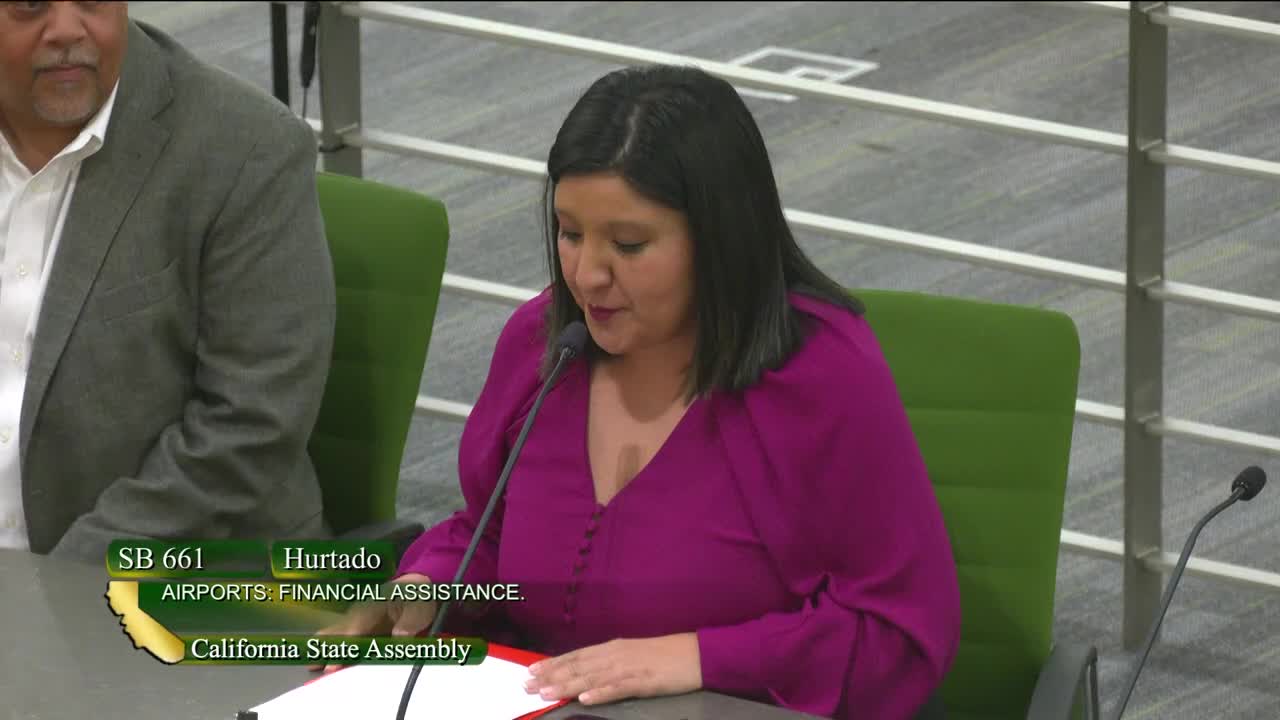 31MIN
Assembly Standing Committee on Transportation
 52SEC
Senate Floor
 12SEC
Senate Standing Committee on Appropriations
 6MIN
Senate Standing Committee on Revenue and Taxation
 9MIN
Senate Standing Committee on Transportation
Bill Author

Bill Co-Author(s):