SB 663: Winter Fires of 2025: real property tax: exemptions and reassessment.
- Session Year: 2025-2026
- House: Senate
- Latest Version Date: 2025-10-10
Current Status:
Passed
(2025-10-10: Chaptered by Secretary of State. Chapter 549, Statutes of 2025.)
Introduced
In Committee
Awaiting First Chamber Vote
Passed First Chamber
In Committee
Awaiting Second Chamber Vote
Passed Second Chamber
Enacted
What does this bill do?
The bill gives owners whose property was substantially damaged or destroyed in the 2024 Mountain or Franklin fires or the 2025 Palisades, Eaton, Hurst, Lidia, Sunset, or Woodley fires extra time to keep their old property tax base: it extends by three years the period to apply the prior base‑year value to rebuilt property and allows filing for damage reassessment up to 24 months after those fires. It also treats a dwelling completely destroyed in a declared disaster as still the veteran’s principal residence for the disabled‑veterans exemption if the veteran intends to rebuild, and lets properties that had a 2025 use‑based exemption remain eligible while the owner documents plans to reconstruct (operative for lien dates before January 1, 2033).
The summary is provided by generative AI which can make mistakes. For original language, please view the details in the table below.
(1)The California Constitution generally limits ad valorem taxes on real property to 1% of the full cash value of that property. For purposes of this limitation, full cash value is defined as the assessors valuation of real property as shown on the 197576 tax bill under full cash value or, thereafter, the appraised value of that real property when purchased, newly constructed, or a change in ownership has occurred. Existing law defines newly constructed and new construction to mean any addition to real property since the last lien date and any alteration of land or of any improvement since the last lien date that constitutes a major rehabilitation thereof or that converts the property to a different use. Existing law, where real property has been damaged or destroyed by misfortune or calamity, excludes from the definition of newly constructed and new construction any timely reconstruction of the real property, or portion thereof, where the property after reconstruction is substantially equivalent to the property prior to damage or destruction. Existing law, pursuant to the authorization of the California Constitution, authorizes the transfer of the base year value of property that is substantially damaged or destroyed by a disaster, as declared by the Governor, to comparable replacement property within the same county that is acquired or newly constructed within 5 years after the disaster, as provided.
Existing law authorizes the owner of property substantially damaged or destroyed by a disaster, as declared by the Governor, to apply the base year value of that property to replacement property reconstructed on the same site of the damaged or destroyed property within 5 years after the disaster if the reconstructed property is comparable to the substantially damaged or destroyed property, determined as provided.
This bill would extend the 5-year time period described above by 3 years if the property was substantially damaged or destroyed by the 2025 Palisades Fire, Eaton Fire, Hurst Fire, Lidia Fire, Sunset Fire, or Woodley Fire, or the 2024 Mountain Fire or Franklin Fire, on or after November 1, 2024, but before February 1, 2025. The bill would make these provisions applicable to the determination of base year values for the 202526 fiscal year and fiscal years thereafter. By imposing additional duties on local tax officials, the bill would create a state-mandated local program.
(2)The California Constitution authorizes the Legislature to authorize local governments to provide for the assessment or reassessment of taxable property physically damaged or destroyed after the lien date to which the assessment or reassessment relates. Existing property tax law authorizes the board of supervisors of a county, by ordinance, to provide that every assessee of any taxable property, or any person liable for the taxes thereon, whose property was damaged or destroyed without their fault, may apply for reassessment of that property, as provided. Existing property tax law requires, for property to be eligible for reassessment under these provisions, that the damage or destruction be caused by one of 3 specified occurrences, including a major misfortune or calamity in an area or region subsequently proclaimed by the Governor to be in a state of disaster if the property was damaged or destroyed by the misfortune or calamity that caused the Governor to proclaim the region to be in a state of disaster. Existing property tax law generally requires that an application for reassessment be filed within the latter of the time specified in the countys ordinance or within 12 months of the misfortune or calamity and be executed under penalty of perjury.
This bill would also authorize a local government to provide for the assessment or reassessment of taxable property damaged by a major misfortune or calamity in an area or regions subsequently proclaimed to be in a state of emergency, as specified. The bill would authorize the local government by ordinance to provide the assessor the discretion to determine the appropriate date of damage for the purposes of reassessment.
This bill would, in the case of property damaged or destroyed by the 2025 Palisades Fire, Eaton Fire, Hurst Fire, Lidia Fire, Sunset Fire, or Woodley Fire, or the 2024 Mountain Fire or Franklin Fire, extend the period to file for reassessment to the latter of the time specified in the countys ordinance or within 24 months of the fires. By expanding the crime of perjury, this bill would impose a state-mandated local program.
(3)Existing property tax law provides, pursuant to the authorization of the California Constitution, a disabled veterans property tax exemption for the principal place of residence of a veteran or a veterans spouse, including an unmarried surviving spouse, if the veteran, because of an injury incurred in military service, is blind in both eyes, has lost the use of 2 or more limbs, or is totally disabled, as those terms are defined, or if the veteran has, as a result of a service-connected injury or disease, died while on active duty in military service. Existing law, for purposes of this exemption, deems property to be the principal place of residence of a veteran if the veteran is confined to a hospital or other care facility, as provided.
This bill would additionally deem property to be the principal place of residence of a veteran if a dwelling on the property was completely destroyed in a disaster for which the Governor proclaimed a state of emergency and specified conditions are met.
(4)Existing property tax law, in accordance with the California Constitution, provides for various exemptions for property used exclusively for a specified exempt purpose.
This bill, in the case of property impacted by the 2025 Palisades Fire, Eaton Fire, Hurst Fire, Lidia Fire, Sunset Fire, or Woodley Fire, or the 2024 Mountain Fire or Franklin Fire, would deem property to be eligible for a use-based exemption, as specified, if the property received an exemption for the 2025 calendar year, the property is no longer used for an exempt purpose due to damage from the fires, and certain other conditions are met, including that the property has not changed ownership since the commencement date of the applicable disaster. The bill would make these provisions operative only for lien dates prior to January 1, 2033.
(5)This bill would make legislative findings and declarations as to the necessity of a special statute for the County of Los Angeles and the County of Ventura.
(6)The California Constitution requires the state to reimburse local agencies and school districts for certain costs mandated by the state. Statutory provisions establish procedures for making that reimbursement.
This bill would provide that with regard to certain mandates no reimbursement is required by this act for a specified reason.
With regard to any other mandates, this bill would provide that, if the Commission on State Mandates determines that the bill contains costs so mandated by the state, reimbursement for those costs shall be made pursuant to the statutory provisions noted above.
(7)Existing law requires the state to reimburse local agencies annually for certain property tax revenues lost as a result of any exemption or classification of property for purposes of ad valorem property taxation.
This bill would provide that, notwithstanding those provisions, no appropriation is made and the state shall not reimburse local agencies for property tax revenues lost by them pursuant to the bill.
(8)This bill would declare that it is to take effect immediately as an urgency statute.
(1)The California Constitution generally limits ad valorem taxes on real property to 1% of the full cash value of that property. For purposes of this limitation, full cash value is defined as the assessors valuation of real property as shown on the 197576 tax bill under full cash value or, thereafter, the appraised value of that real property when purchased, newly constructed, or a change in ownership has occurred. Existing law defines newly constructed and new construction to mean any addition to real property since the last lien date and any alteration of land or of any improvement since the last lien date that constitutes a major rehabilitation thereof or that converts the property to a different use. Existing law, where real property has been damaged or destroyed by misfortune or calamity, excludes from the definition of newly constructed and new construction any timely reconstruction of the real property, or portion thereof, where the property after reconstruction is substantially equivalent to the property prior to damage or destruction. Existing law, pursuant to the authorization of the California Constitution, authorizes the transfer of the base year value of property that is substantially damaged or destroyed by a disaster, as declared by the Governor, to comparable replacement property within the same county that is acquired or newly constructed within 5 years after the disaster, as provided.
Existing law authorizes the owner of property substantially damaged or destroyed by a disaster, as declared by the Governor, to apply the base year value of that property to replacement property reconstructed on the same site of the damaged or destroyed property within 5 years after the disaster if the reconstructed property is comparable to the substantially damaged or destroyed property, determined as provided.
This bill would extend the 5-year time period described above by 3 years if the property was substantially damaged or destroyed by the 2025 Palisades Fire, Eaton Fire, Hurst Fire, Lidia Fire, Sunset Fire, or Woodley Fire, or the 2024 Mountain Fire or Franklin Fire, on or after November 1, 2024, but before February 1, 2025. The bill would make these provisions applicable to the determination of base year values for the 202526 fiscal year and fiscal years thereafter. By imposing additional duties on local tax officials, the bill would create a state-mandated local program.
(2)The California Constitution authorizes the Legislature to authorize local governments to provide for the assessment or reassessment of taxable property physically damaged or destroyed after the lien date to which the assessment or reassessment relates. Existing property tax law authorizes the board of supervisors of a county, by ordinance, to provide that every assessee of any taxable property, or any person liable for the taxes thereon, whose property was damaged or destroyed without their fault, may apply for reassessment of that property, as provided. Existing property tax law requires, for property to be eligible for reassessment under these provisions, that the damage or destruction be caused by one of 3 specified occurrences, including a major misfortune or calamity in an area or region subsequently proclaimed by the Governor to be in a state of disaster if the property was damaged or destroyed by the misfortune or calamity that caused the Governor to proclaim the region to be in a state of disaster. Existing property tax law generally requires that an application for reassessment be filed within the latter of the time specified in the countys ordinance or within 12 months of the misfortune or calamity and be executed under penalty of perjury.
This bill would also authorize a local government to provide for the assessment or reassessment of taxable property damaged by a major misfortune or calamity in an area or regions subsequently proclaimed to be in a state of emergency, as specified. The bill would authorize the local government by ordinance to provide the assessor the discretion to determine the appropriate date of damage for the purposes of reassessment.
This bill would, in the case of property damaged or destroyed by the 2025 Palisades Fire, Eaton Fire, Hurst Fire, Lidia Fire, Sunset Fire, or Woodley Fire, or the 2024 Mountain Fire or Franklin Fire, extend the period to file for reassessment to the latter of the time specified in the countys ordinance or within 24 months of the fires. By expanding the crime of perjury, this bill would impose a state-mandated local program.
(3)Existing property tax law provides, pursuant to the authorization of the California Constitution, a disabled veterans property tax exemption for the principal place of residence of a veteran or a veterans spouse, including an unmarried surviving spouse, if the veteran, because of an injury incurred in military service, is blind in both eyes, has lost the use of 2 or more limbs, or is totally disabled, as those terms are defined, or if the veteran has, as a result of a service-connected injury or disease, died while on active duty in military service. Existing law, for purposes of this exemption, deems property to be the principal place of residence of a veteran if the veteran is confined to a hospital or other care facility, as provided.
This bill would additionally deem property to be the principal place of residence of a veteran if a dwelling on the property was completely destroyed in a disaster for which the Governor proclaimed a state of emergency and specified conditions are met.
(4)Existing property tax law, in accordance with the California Constitution, provides for various exemptions for property used exclusively for a specified exempt purpose.
This bill, in the case of property impacted by the 2025 Palisades Fire, Eaton Fire, Hurst Fire, Lidia Fire, Sunset Fire, or Woodley Fire, or the 2024 Mountain Fire or Franklin Fire, would deem property to be eligible for a use-based exemption, as specified, if the property received an exemption for the 2025 calendar year, the property is no longer used for an exempt purpose due to damage from the fires, and certain other conditions are met, including that the property has not changed ownership since the commencement date of the applicable disaster. The bill would make these provisions operative only for lien dates prior to January 1, 2033.
(5)This bill would make legislative findings and declarations as to the necessity of a special statute for the County of Los Angeles and the County of Ventura.
(6)The California Constitution requires the state to reimburse local agencies and school districts for certain costs mandated by the state. Statutory provisions establish procedures for making that reimbursement.
This bill would provide that with regard to certain mandates no reimbursement is required by this act for a specified reason.
With regard to any other mandates, this bill would provide that, if the Commission on State Mandates determines that the bill contains costs so mandated by the state, reimbursement for those costs shall be made pursuant to the statutory provisions noted above.
(7)Existing law requires the state to reimburse local agencies annually for certain property tax revenues lost as a result of any exemption or classification of property for purposes of ad valorem property taxation.
This bill would provide that, notwithstanding those provisions, no appropriation is made and the state shall not reimburse local agencies for property tax revenues lost by them pursuant to the bill.
(8)This bill would declare that it is to take effect immediately as an urgency statute.
(1)The California Constitution generally limits ad valorem taxes on real property to 1% of the full cash value of that property. For purposes of this limitation, full cash value is defined as the assessors valuation of real property as shown on the 197576 tax bill under full cash value or, thereafter, the appraised value of that real property when purchased, newly constructed, or a change in ownership has occurred. Existing law defines newly constructed and new construction to mean any addition to real property since the last lien date and any alteration of land or of any improvement since the last lien date that constitutes a major rehabilitation thereof or that converts the property to a different use. Existing law, where real property has been damaged or destroyed by misfortune or calamity, excludes from the definition of newly constructed and new construction any timely reconstruction of the real property, or portion thereof, where the property after reconstruction is substantially equivalent to the property prior to damage or destruction. Existing law, pursuant to the authorization of the California Constitution, authorizes the transfer of the base year value of property that is substantially damaged or destroyed by a disaster, as declared by the Governor, to comparable replacement property within the same county that is acquired or newly constructed within 5 years after the disaster, as provided.
Existing law authorizes the owner of property substantially damaged or destroyed by a disaster, as declared by the Governor, to apply the base year value of that property to replacement property reconstructed on the same site of the damaged or destroyed property within 5 years after the disaster if the reconstructed property is comparable to the substantially damaged or destroyed property, determined as provided.
This bill would extend the 5-year time period described above by 3 years if the property was substantially damaged or destroyed by the 2025 Palisades Fire, Eaton Fire, Hurst Fire, Lidia Fire, Sunset Fire, or Woodley Fire, or the 2024 Mountain Fire or Franklin Fire, on or after November 1, 2024, but before February 1, 2025. The bill would make these provisions applicable to the determination of base year values for the 202526 fiscal year and fiscal years thereafter. By imposing additional duties on local tax officials, the bill would create a state-mandated local program.
(2)The California Constitution authorizes the Legislature to authorize local governments to provide for the assessment or reassessment of taxable property physically damaged or destroyed after the lien date to which the assessment or reassessment relates. Existing property tax law authorizes the board of supervisors of a county, by ordinance, to provide that every assessee of any taxable property, or any person liable for the taxes thereon, whose property was damaged or destroyed without their fault, may apply for reassessment of that property, as provided. Existing property tax law requires, for property to be eligible for reassessment under these provisions, that the damage or destruction be caused by one of 3 specified occurrences, including a major misfortune or calamity in an area or region subsequently proclaimed by the Governor to be in a state of disaster if the property was damaged or destroyed by the misfortune or calamity that caused the Governor to proclaim the region to be in a state of disaster. Existing property tax law generally requires that an application for reassessment be filed within the latter of the time specified in the countys ordinance or within 12 months of the misfortune or calamity and be executed under penalty of perjury.
This bill would also authorize a local government to provide for the assessment or reassessment of taxable property damaged by a major misfortune or calamity in an area or regions subsequently proclaimed to be in a state of emergency, as specified. The bill would authorize the local government by ordinance to provide the assessor the discretion to determine the appropriate date of damage for the purposes of reassessment.
This bill would, in the case of property damaged or destroyed by the 2025 Palisades Fire, Eaton Fire, Hurst Fire, Lidia Fire, Sunset Fire, or Woodley Fire, or the 2024 Mountain Fire or Franklin Fire, extend the period to file for reassessment to the latter of the time specified in the countys ordinance or within 24 months of the fires. By expanding the crime of perjury, this bill would impose a state-mandated local program.
(3)Existing property tax law provides, pursuant to the authorization of the California Constitution, a disabled veterans property tax exemption for the principal place of residence of a veteran or a veterans spouse, including an unmarried surviving spouse, if the veteran, because of an injury incurred in military service, is blind in both eyes, has lost the use of 2 or more limbs, or is totally disabled, as those terms are defined, or if the veteran has, as a result of a service-connected injury or disease, died while on active duty in military service. Existing law, for purposes of this exemption, deems property to be the principal place of residence of a veteran if the veteran is confined to a hospital or other care facility, as provided.
This bill would additionally deem property to be the principal place of residence of a veteran if a dwelling on the property was completely destroyed in a disaster for which the Governor proclaimed a state of emergency and specified conditions are met.
(4)Existing property tax law, in accordance with the California Constitution, provides for various exemptions for property used exclusively for a specified exempt purpose.
This bill, in the case of property impacted by the 2025 Palisades Fire, Eaton Fire, Hurst Fire, Lidia Fire, Sunset Fire, or Woodley Fire, or the 2024 Mountain Fire or Franklin Fire, would deem property to be eligible for a use-based exemption, as specified, if the property received an exemption for the 2025 calendar year, and the property is no longer used for an exempt purpose due to damage from the fires. These provisions would apply until the property has been replaced, new construction has been completed on the property, or the property has returned to its prior use. fires, and certain other conditions are met, including that the property has not changed ownership since the commencement date of the applicable disaster. The bill would make these provisions operative only for lien dates prior to January 1, 2033.
(5)This bill would make legislative findings and declarations as to the necessity of a special statute for the County of Los Angeles and the County of Ventura.
(6)The California Constitution requires the state to reimburse local agencies and school districts for certain costs mandated by the state. Statutory provisions establish procedures for making that reimbursement.
This bill would provide that with regard to certain mandates no reimbursement is required by this act for a specified reason.
With regard to any other mandates, this bill would provide that, if the Commission on State Mandates determines that the bill contains costs so mandated by the state, reimbursement for those costs shall be made pursuant to the statutory provisions noted above.
(7)Existing law requires the state to reimburse local agencies annually for certain property tax revenues lost as a result of any exemption or classification of property for purposes of ad valorem property taxation.
This bill would provide that, notwithstanding those provisions, no appropriation is made and the state shall not reimburse local agencies for property tax revenues lost by them pursuant to the bill.
(8)This bill would declare that it is to take effect immediately as an urgency statute.
(1)The California Constitution generally limits ad valorem taxes on real property to 1% of the full cash value of that property. For purposes of this limitation, full cash value is defined as the assessors valuation of real property as shown on the 197576 tax bill under full cash value or, thereafter, the appraised value of that real property when purchased, newly constructed, or a change in ownership has occurred. Existing law defines newly constructed and new construction to mean any addition to real property since the last lien date and any alteration of land or of any improvement since the last lien date that constitutes a major rehabilitation thereof or that converts the property to a different use. Existing law, where real property has been damaged or destroyed by misfortune or calamity, excludes from the definition of newly constructed and new construction any timely reconstruction of the real property, or portion thereof, where the property after reconstruction is substantially equivalent to the property prior to damage or destruction. Existing law, pursuant to the authorization of the California Constitution, authorizes the transfer of the base year value of property that is substantially damaged or destroyed by a disaster, as declared by the Governor, to comparable replacement property within the same county that is acquired or newly constructed within 5 years after the disaster, as provided.
Existing law authorizes the owner of property substantially damaged or destroyed by a disaster, as declared by the Governor, to apply the base year value of that property to replacement property reconstructed on the same site of the damaged or destroyed property within 5 years after the disaster if the reconstructed property is comparable to the substantially damaged or destroyed property, determined as provided.
This bill would extend the 5-year time period described above by 3 years if the property was substantially damaged or destroyed by the 2025 Palisades Fire, Eaton Fire, Hurst Fire, Lidia Fire, Sunset Fire, or Woodley Fire, or the 2024 Mountain Fire or Franklin Fire, on or after January 1, 2025, November 1, 2024, but before February 1, 2025. The bill would make these provisions applicable to the determination of base year values for the 202526 fiscal year and fiscal years thereafter. By imposing additional duties on local tax officials, the bill would create a state-mandated local program.
(2)The California Constitution authorizes the Legislature to authorize local governments to provide for the assessment or reassessment of taxable property physically damaged or destroyed after the lien date to which the assessment or reassessment relates. Existing property tax law authorizes the board of supervisors of a county, by ordinance, to provide that every assessee of any taxable property, or any person liable for the taxes thereon, whose property was damaged or destroyed without their fault, may apply for reassessment of that property, as provided. Existing property tax law requires, for property to be eligible for reassessment under these provisions, that the damage or destruction be caused by one of 3 specified occurrences, including a major misfortune or calamity in an area or region subsequently proclaimed by the Governor to be in a state of disaster if the property was damaged or destroyed by the misfortune or calamity that caused the Governor to proclaim the region to be in a state of disaster. Existing property tax law generally requires that an application for reassessment be filed within the latter of the time specified in the countys ordinance or within 12 months of the misfortune or calamity and be executed under penalty of perjury.
This bill would also authorize a local government to provide for the assessment or reassessment of taxable property damaged by a major misfortune or calamity in an area or regions subsequently proclaimed to be in a state of emergency, as specified. The bill would authorize the local government by ordinance to provide the assessor the discretion to determine the appropriate date of damage for the purposes of reassessment.
This bill would, in the case of property damaged by the 2025 Palisades Fire, Eaton Fire, Hurst Fire, Lidia Fire, Sunset Fire, or Woodley Fire, or the 2024 Mountain Fire or Franklin Fire, extend the period to file for reassessment to the latter of the time specified in the countys ordinance or within 24 months of the fires. By expanding the crime of perjury, this bill would impose a state-mandated local program.
(3)Existing property tax law provides, pursuant to the authorization of the California Constitution, a disabled veterans property tax exemption for the principal place of residence of a veteran or a veterans spouse, including an unmarried surviving spouse, if the veteran, because of an injury incurred in military service, is blind in both eyes, has lost the use of 2 or more limbs, or is totally disabled, as those terms are defined, or if the veteran has, as a result of a service-connected injury or disease, died while on active duty in military service. Existing law, for purposes of this exemption, deems property to be the principal place of residence of a veteran if the veteran is confined to a hospital or other care facility, as provided.
This bill would additionally deem property to be the principal place of residence of a veteran if a dwelling on the property was completely destroyed in a disaster for which the Governor proclaimed a state of emergency and specified conditions are met.
(4)Existing property tax law, in accordance with the California Constitution, provides for various exemptions for property used exclusively for a specified exempt purpose.
This bill, in the case of property impacted by the 2025 Palisades Fire, Eaton Fire, Hurst Fire, Lidia Fire, Sunset Fire, or Woodley Fire, or the 2024 Mountain Fire or Franklin Fire, would deem property to be eligible for a use-based exemption, as specified, if the property received an exemption for the 2025 calendar year, and the property is no longer used for an exempt purpose due to damage from the fires. These provisions would apply until the property has been replaced, new construction has been completed on the property, or the property has returned to its prior use. The bill would make these provisions operative only for lien dates prior to January 1, 2033.
(5)This bill would make legislative findings and declarations as to the necessity of a special statute for the County of Los Angeles and the County of Ventura.
(6)The California Constitution requires the state to reimburse local agencies and school districts for certain costs mandated by the state. Statutory provisions establish procedures for making that reimbursement.
This bill would provide that with regard to certain mandates no reimbursement is required by this act for a specified reason.
With regard to any other mandates, this bill would provide that, if the Commission on State Mandates determines that the bill contains costs so mandated by the state, reimbursement for those costs shall be made pursuant to the statutory provisions noted above.
(7)Existing law requires the state to reimburse local agencies annually for certain property tax revenues lost as a result of any exemption or classification of property for purposes of ad valorem property taxation.
This bill would provide that, notwithstanding those provisions, no appropriation is made and the state shall not reimburse local agencies for property tax revenues lost by them pursuant to the bill.
(8)This bill would declare that it is to take effect immediately as an urgency statute.
(1)The California Constitution generally limits ad valorem taxes on real property to 1% of the full cash value of that property. For purposes of this limitation, full cash value is defined as the assessors valuation of real property as shown on the 197576 tax bill under full cash value or, thereafter, the appraised value of that real property when purchased, newly constructed, or a change in ownership has occurred. Existing law defines newly constructed and new construction to mean any addition to real property since the last lien date and any alteration of land or of any improvement since the last lien date that constitutes a major rehabilitation thereof or that converts the property to a different use. Existing law, where real property has been damaged or destroyed by misfortune or calamity, excludes from the definition of newly constructed and new construction any timely reconstruction of the real property, or portion thereof, where the property after reconstruction is substantially equivalent to the property prior to damage or destruction. Existing law, pursuant to the authorization of the California Constitution, authorizes the transfer of the base year value of property that is substantially damaged or destroyed by a disaster, as declared by the Governor, to comparable replacement property within the same county that is acquired or newly constructed within 5 years after the disaster, as provided.
Existing law authorizes the owner of property substantially damaged or destroyed by a disaster, as declared by the Governor, to apply the base year value of that property to replacement property reconstructed on the same site of the damaged or destroyed property within 5 years after the disaster if the reconstructed property is comparable to the substantially damaged or destroyed property, determined as provided.
This bill would extend the 5-year time period described above by 3 years if the property was substantially damaged or destroyed by the wildfires in the County of Los Angeles and the County of Ventura in January 2025, including, but not limited to, the 2025 Palisades Fire, the 2025 Eaton Fire, the 2025 Hughes Fire, and the 2025 Kenneth Fire, 2025 Palisades Fire, Eaton Fire, Hurst Fire, Lidia Fire, Sunset Fire, or Woodley Fire, or the 2024 Mountain Fire or Franklin Fire, on or after January 1, 2025, but before February 1, 2025. The bill would make these provisions applicable to the determination of base year values for the 202526 fiscal year and fiscal years thereafter. By imposing additional duties on local tax officials, the bill would create a state-mandated local program.
(2)The California Constitution authorizes the Legislature to authorize local governments to provide for the assessment or reassessment of taxable property physically damaged or destroyed after the lien date to which the assessment or reassessment relates. Existing property tax law authorizes the board of supervisors of a county, by ordinance, to provide that every assessee of any taxable property, or any person liable for the taxes thereon, whose property was damaged or destroyed without their fault, may apply for reassessment of that property, as provided. Existing property tax law requires, for property to be eligible for reassessment under these provisions, that the damage or destruction be caused by one of 3 specified occurrences, including a major misfortune or calamity in an area or region subsequently proclaimed by the Governor to be in a state of disaster if the property was damaged or destroyed by the misfortune or calamity that caused the Governor to proclaim the region to be in a state of disaster. Existing property tax law generally requires that an application for reassessment be filed within the latter of the time specified in the countys ordinance or within 12 months of the misfortune or calamity and be executed under penalty of perjury.
This bill would also authorize a local government to provide for the assessment or reassessment of taxable property damaged by a major misfortune or calamity in an area or regions subsequently proclaimed to be in a state of emergency, as specified. The bill would authorize the local government by ordinance to provide that the assessor shall have the discretion to determine the appropriate date of damage for the purposes of reassessment.
This bill would, in the case of property damaged by the wildfires in the County of Los Angeles and the County of Ventura in January 2025, including, but not limited to, the 2025 Palisades Fire, the 2025 Eaton Fire, the 2025 Hughes Fire, and the 2025 Kenneth Fire, 2025 Palisades Fire, Eaton Fire, Hurst Fire, Lidia Fire, Sunset Fire, or Woodley Fire, or the 2024 Mountain Fire or Franklin Fire, extend the period to file for reassessment to the latter of the time specified in the countys ordinance or within 24 months of the fires. By expanding the crime of perjury, this bill would impose a state-mandated local program.
(3)Existing property tax law provides, pursuant to the authorization of the California Constitution, a disabled veterans property tax exemption for the principal place of residence of a veteran or a veterans spouse, including an unmarried surviving spouse, if the veteran, because of an injury incurred in military service, is blind in both eyes, has lost the use of 2 or more limbs, or is totally disabled, as those terms are defined, or if the veteran has, as a result of a service-connected injury or disease, died while on active duty in military service. Existing law, for purposes of this exemption, deems property to be the principal place of residence of a veteran if the veteran is confined to a hospital or other care facility, as provided.
This bill would additionally deem property to be the principal place of residence of a veteran if a dwelling on the property was completely destroyed in a disaster for which the Governor proclaimed a state of emergency and specified conditions are met.
(3)(4)Existing property tax law, in accordance with the California Constitution, provides for various exemptions for property used exclusively for a specified exempt purpose.
This bill, in the case of property impacted by the wildfires of January 2025, in the County of Los Angeles and the County of Ventura, as specified, 2025 Palisades Fire, Eaton Fire, Hurst Fire, Lidia Fire, Sunset Fire, or Woodley Fire, or the 2024 Mountain Fire or Franklin Fire, would deem property to be eligible for a use-based exemption, as specified, if the property received an exemption for the 2025 calendar year, and the property is no longer used for an exempt purpose due to damage from the fires. These provisions would apply until the property has been replaced, new construction has been completed on the property, or the property has returned to its prior use. The bill would make these provisions operative only for lien dates prior to January 1, 2033.
(4)(5)This bill would make legislative findings and declarations as to the necessity of a special statute for the County of Los Angeles and the County of Ventura.
(5)(6)The California Constitution requires the state to reimburse local agencies and school districts for certain costs mandated by the state. Statutory provisions establish procedures for making that reimbursement.
This bill would provide that with regard to certain mandates no reimbursement is required by this act for a specified reason.
With regard to any other mandates, this bill would provide that, if the Commission on State Mandates determines that the bill contains costs so mandated by the state, reimbursement for those costs shall be made pursuant to the statutory provisions noted above.
(6)(7)Existing law requires the state to reimburse local agencies annually for certain property tax revenues lost as a result of any exemption or classification of property for purposes of ad valorem property taxation.
This bill would provide that, notwithstanding those provisions, no appropriation is made and the state shall not reimburse local agencies for property tax revenues lost by them pursuant to the bill.
(7)(8)This bill would declare that it is to take effect immediately as an urgency statute.
(1)The California Constitution generally limits ad valorem taxes on real property to 1% of the full cash value of that property. For purposes of this limitation, full cash value is defined as the assessors valuation of real property as shown on the 197576 tax bill under full cash value or, thereafter, the appraised value of that real property when purchased, newly constructed, or a change in ownership has occurred. Existing law defines newly constructed and new construction to mean any addition to real property since the last lien date and any alteration of land or of any improvement since the last lien date that constitutes a major rehabilitation thereof or that converts the property to a different use. Existing law, where real property has been damaged or destroyed by misfortune or calamity, excludes from the definition of newly constructed and new construction any timely reconstruction of the real property, or portion thereof, where the property after reconstruction is substantially equivalent to the property prior to damage or destruction. Existing law, pursuant to the authorization of the California Constitution, authorizes the transfer of the base year value of property that is substantially damaged or destroyed by a disaster, as declared by the Governor, to comparable replacement property within the same county that is acquired or newly constructed within 5 years after the disaster, as provided.
Existing law authorizes the owner of property substantially damaged or destroyed by a disaster, as declared by the Governor, to apply the base year value of that property to replacement property reconstructed on the same site of the damaged or destroyed property within 5 years after the disaster if the reconstructed property is comparable to the substantially damaged or destroyed property, determined as provided.
This bill would extend the 5-year time period described above by 3 years if the property was substantially damaged or destroyed by the wildfires in the County of Los Angeles and the County of Ventura in January 2025, including, but not limited to, the 2025 Palisades Fire, the 2025 Eaton Fire, the 2025 Hughes Fire, and the 2025 Kenneth Fire, on or after January 1, 2025, but before February 1, 2025. The bill would make these provisions applicable to the determination of base year values for the 202526 fiscal year and fiscal years thereafter. By imposing additional duties on local tax officials, the bill would create a state-mandated local program.
(2)The California Constitution authorizes the Legislature to authorize local governments to provide for the assessment or reassessment of taxable property physically damaged or destroyed after the lien date to which the assessment or reassessment relates. Existing property tax law authorizes the board of supervisors of a county, by ordinance, to provide that every assessee of any taxable property, or any person liable for the taxes thereon, whose property was damaged or destroyed without their fault, may apply for reassessment of that property, as provided. Existing property tax law requires, for property to be eligible for reassessment under these provisions, that the damage or destruction be caused by one of 3 specified occurrences, including a major misfortune or calamity in an area or region subsequently proclaimed by the Governor to be in a state of disaster if the property was damaged or destroyed by the misfortune or calamity that caused the Governor to proclaim the region to be in a state of disaster. Existing property tax law generally requires that an application for reassessment be filed within the latter of the time specified in the countys ordinance or within 12 months of the misfortune or calamity and be executed under penalty of perjury.
This bill would also authorize a local government to provide for the assessment or reassessment of taxable property damaged by a major misfortune or calamity in an area or regions subsequently proclaimed to be in a state of emergency, as specified. The bill would provide that the assessor shall have the discretion to determine the appropriate date of damage for the purposes of reassessment.
This bill would, in the case of property damaged by the wildfires in the County of Los Angeles and the County of Ventura in January 2025, including, but not limited to, the 2025 Palisades Fire, the 2025 Eaton Fire, the 2025 Hughes Fire, and the 2025 Kenneth Fire, extend the period to file for reassessment to the latter of the time specified in the countys ordinance or within 24 months of the fires. By expanding the crime of perjury, this bill would impose a state-mandated local program.
(3)Existing property tax law, in accordance with the California Constitution, provides for a welfare exemption various exemptions for property used exclusively for religious, hospital, scientific, or charitable purposes and that is owned or operated by certain types of nonprofit entities, if certain qualifying criteria are met. a specified exempt purpose.
This bill, in the case of property impacted by the wildfires of January 2025, in the County of Los Angeles and the County of Ventura, as specified, would deem property to be eligible for a welfare exemption, use-based exemption, as specified, if the property received a welfare an exemption for the 2025 calendar year, and the property is no longer used for an exempt purpose due to damage from the fires. These provisions would apply until the property has been replaced, new construction has been completed on the property, or the property has returned to its prior use. The bill would make this these provisions operative only for lien dates prior to January 1, 2033.
(4)This bill would make legislative findings and declarations as to the necessity of a special statute for the County of Los Angeles and the County of Ventura.
(4)
(5)The California Constitution requires the state to reimburse local agencies and school districts for certain costs mandated by the state. Statutory provisions establish procedures for making that reimbursement.
This bill would provide that with regard to certain mandates no reimbursement is required by this act for a specified reason.
With regard to any other mandates, this bill would provide that, if the Commission on State Mandates determines that the bill contains costs so mandated by the state, reimbursement for those costs shall be made pursuant to the statutory provisions noted above.
(5)
(6)Existing law requires the state to reimburse local agencies annually for certain property tax revenues lost as a result of any exemption or classification of property for purposes of ad valorem property taxation.
This bill would provide that, notwithstanding those provisions, no appropriation is made and the state shall not reimburse local agencies for property tax revenues lost by them pursuant to the bill.
(6)This bill would make legislative findings and declarations as to the necessity of a special statute for the County of Los Angeles and the County of Ventura.
(7)This bill would declare that it is to take effect immediately as an urgency statute.
(1)The California Constitution generally limits ad valorem taxes on real property to 1% of the full cash value of that property. For purposes of this limitation, full cash value is defined as the assessors valuation of real property as shown on the 197576 tax bill under full cash value or, thereafter, the appraised value of that real property when purchased, newly constructed, or a change in ownership has occurred. Existing law defines newly constructed and new construction to mean any addition to real property since the last lien date and any alteration of land or of any improvement since the last lien date that constitutes a major rehabilitation thereof or that converts the property to a different use. Existing law, where real property has been damaged or destroyed by misfortune or calamity, excludes from the definition of newly constructed and new construction any timely reconstruction of the real property, or portion thereof, where the property after reconstruction is substantially equivalent to the property prior to damage or destruction. Existing law, pursuant to the authorization of the California Constitution, authorizes the transfer of the base year value of property that is substantially damaged or destroyed by a disaster, as declared by the Governor, to comparable replacement property within the same county that is acquired or newly constructed within 5 years after the disaster, as provided.
Existing law authorizes the owner of property substantially damaged or destroyed by a disaster, as declared by the Governor, to apply the base year value of that property to replacement property reconstructed on the same site of the damaged or destroyed property within 5 years after the disaster if the reconstructed property is comparable to the substantially damaged or destroyed property, determined as provided.
This bill would extend the 5-year time period described above by 3 years if the property was substantially damaged or destroyed by the wildfires in the County of Los Angeles and the County of Ventura in January 2025, including, but not limited to, the 2025 Palisades Fire, the 2025 Eaton Fire, the 2025 Hughes Fire, and the 2025 Kenneth Fire, on or after January 1, 2025, but before February 1, 2025. The bill would make these provisions applicable to the determination of base year values for the 202526 fiscal year and fiscal years thereafter. By imposing additional duties on local tax officials, the bill would create a state-mandated local program.
(2)The California Constitution authorizes the Legislature to authorize local governments to provide for the assessment or reassessment of taxable property physically damaged or destroyed after the lien date to which the assessment or reassessment relates. Existing property tax law authorizes the board of supervisors of a county, by ordinance, to provide that every assessee of any taxable property, or any person liable for the taxes thereon, whose property was damaged or destroyed without their fault, may apply for reassessment of that property, as provided. Existing property tax law requires, for property to be eligible for reassessment under these provisions, that the damage or destruction be caused by one of 3 specified occurrences, including a major misfortune or calamity in an area or region subsequently proclaimed by the Governor to be in a state of disaster if the property was damaged or destroyed by the misfortune or calamity that caused the Governor to proclaim the region to be in a state of disaster. Existing property tax law generally requires that an application for reassessment be filed within the latter of the time specified in the countys ordinance or within 12 months of the misfortune or calamity and be executed under penalty of perjury.
This bill would also authorize a local government to provide for the assessment or reassessment of taxable property damaged by a major misfortune or calamity in an area or regions subsequently proclaimed to be in a state of emergency, as specified. The bill would provide that the assessor shall have the discretion to determine the appropriate date of damage for the purposes of reassessment.
This bill would, in the case of property damaged by the wildfires in the County of Los Angeles and the County of Ventura in January 2025, including, but not limited to, the 2025 Palisades Fire, the 2025 Eaton Fire, the 2025 Hughes Fire, and the 2025 Kenneth Fire, extend the period to file for reassessment to the latter of the time specified in the countys ordinance or within 24 months of the fires. By expanding the crime of perjury, this bill would impose a state-mandated local program.
(3)Existing property tax law, in accordance with the California Constitution, provides for a welfare exemption for property used exclusively for religious, hospital, scientific, or charitable purposes and that is owned or operated by certain types of nonprofit entities, if certain qualifying criteria are met.
This bill, in the case of property impacted by the wildfires of January 2025, in the County of Los Angeles and the County of Ventura, as specified, would deem property to be eligible for a welfare exemption, as specified, if the property received a welfare exemption for the 2025 calendar year, and the property is no longer used for an exempt purpose due to damage from the fires. These provisions would apply until the property has been replaced, new construction has been completed on the property, or the property has returned to its prior use. The bill would make this provisions operative only for lien dates prior to January 1, 2033.
(4)The California Constitution requires the state to reimburse local agencies and school districts for certain costs mandated by the state. Statutory provisions establish procedures for making that reimbursement.
This bill would provide that with regard to certain mandates no reimbursement is required by this act for a specified reason.
With regard to any other mandates, this bill would provide that, if the Commission on State Mandates determines that the bill contains costs so mandated by the state, reimbursement for those costs shall be made pursuant to the statutory provisions noted above.
(5)Existing law requires the state to reimburse local agencies annually for certain property tax revenues lost as a result of any exemption or classification of property for purposes of ad valorem property taxation.
This bill would provide that, notwithstanding those provisions, no appropriation is made and the state shall not reimburse local agencies for property tax revenues lost by them pursuant to the bill.
(6)This bill would make legislative findings and declarations as to the necessity of a special statute for the County of Los Angeles and the County of Ventura.
(7)This bill would declare that it is to take effect immediately as an urgency statute.
(a)Notwithstanding Section 70, and pursuant to Section 2 of Article XIIIA of the California Constitution, the base year value of property that is substantially damaged or destroyed by a disaster, as declared by the Governor, may be applied to replacement property reconstructed on the site of the damaged or destroyed property within five years after the disaster as a replacement for the substantially damaged or destroyed property if that reconstructed property is comparable to the substantially damaged or destroyed property. A person who owns substantially damaged or destroyed property that receives property tax relief under this section shall not be eligible for property tax relief provided under Section 69.
(b)(1)The replacement base year value of the reconstructed property shall be determined in accordance with this section.
(2)The assessor shall use the following procedure in determining the appropriate base year value of the reconstructed property:
(A)If the full cash value of the reconstructed property does not exceed 120 percent of the full cash value of the property substantially damaged or destroyed, then the adjusted base year value of the property substantially damaged or destroyed shall apply to the reconstructed property as its base year value.
(B)If the full cash value of the reconstructed property exceeds 120 percent of the full cash value of the property substantially damaged or destroyed, then the amount of the full cash value over 120 percent of the full cash value of the property substantially damaged or destroyed shall be added to the adjusted base year value of the original property substantially damaged or destroyed. The sum of these amounts shall become the reconstructed propertys base year value.
(C)If the full cash value of the reconstructed property is less than the adjusted base year value of the original property substantially damaged or destroyed, then that lower value shall become the reconstructed propertys base year value.
(D)The full cash value of the property substantially damaged or destroyed shall be the amount of its full cash value immediately prior to its substantial damage or destruction, as determined by the county assessor of the county in which the property is located.
(c)For purposes of this section:
(1)Property is substantially damaged or destroyed if the improvements sustain physical damage amounting to more than 50 percent of the improvements full cash value immediately prior to the disaster.
(2)Reconstructed property shall be considered comparable to the original property substantially damaged or destroyed if it is similar in size, utility, and function to the property which it replaces. For purposes of this paragraph:
(A)Property is similar in function if the reconstructed property is subject to similar governmental restrictions, such as zoning.
(B)(i)Both the size and utility of property are interrelated and associated with value. Property shall be considered similar in size and utility only to the extent that the reconstructed property is, or is intended to be, used in the same manner as the original property substantially damaged or destroyed and its full cash value does not exceed 120 percent of the full cash value of the original property substantially damaged or destroyed.
(ii)A reconstructed property or any portion of reconstructed property used or intended to be used for a purpose substantially different than the use made of the original property substantially damaged or destroyed shall to the extent of the dissimilar use be considered not similar in utility.
(iii)A reconstructed property or any portion of reconstructed property that satisfies the use requirement but has a full cash value that exceeds 120 percent of the full cash value of the original property substantially damaged or destroyed shall be considered, to the extent of the excess, not similar in utility and size.
(C)To the extent that reconstructed property or any portion of reconstructed property is not similar in function, size, and utility, the property or portion of that property shall be considered to be newly constructed.
(3)Disaster means a major misfortune or calamity in an area subsequently proclaimed by the Governor to be in a state of disaster as a result of that misfortune or calamity.
(d)Only the owner or owners of the property substantially damaged or destroyed, whether one or more individuals, partnerships, corporations, other legal entities, or a combination thereof, shall be eligible to receive property tax relief under this section. Relief under this section shall be granted to an owner or owners of substantially damaged or destroyed property who have reconstructed that property.
(e)(1)Notwithstanding any law, the time period specified in subdivision (a) to apply the base year value of qualified property to replacement property reconstructed on the site of the damaged or destroyed property is extended by three years if the qualified property was substantially damaged or destroyed on or after November 1, 2018, but on or before November 30, 2018.
(2)This subdivision shall apply to the determination of base year values for the 201819 fiscal year and fiscal years thereafter.
(3)For purposes of this subdivision, qualified property means property that was substantially damaged or destroyed, as described in paragraph (1) of subdivision (c), by the 2018 Woolsey Fire disaster or by the 2018 Camp Fire disaster, as proclaimed by the Governor.
(f)(1)Notwithstanding any law, the time period specified in subdivision (a) to apply the base year value of qualified property to replacement property reconstructed on the site of the damaged or destroyed property is extended by three years if the qualified property was substantially damaged or destroyed on or after November 1, 2024, but before February 1, 2025.
(2)This subdivision shall apply to the determination of base year values for the 202526 fiscal year and fiscal years thereafter.
(3)For purposes of this subdivision, qualified property means property that was substantially damaged or destroyed, as described in paragraph (1) of subdivision (c), by the 2025 Palisades Fire, Eaton Fire, Hurst Fire, Lidia Fire, Sunset Fire, or Woodley Fire, or the 2024 Mountain Fire or Franklin Fire, for which the Governor proclaimed a state of emergency.
(g)This section shall apply to real property damaged or destroyed by misfortune or calamity on or after January 1, 2017.
SEC. 2.Section 170 of the Revenue and Taxation Code is amended to read:170.(a)Notwithstanding any other law, the board of supervisors, by ordinance, may provide that every assessee of any taxable property, or any person liable for the taxes thereon, whose property was damaged or destroyed without the assessees or liable persons fault, may apply for reassessment of that property as provided in this section. The ordinance may also specify that the assessor shall have the discretion to determine the appropriate date of damage and may initiate the reassessment where the assessor determines that within the preceding 12 months taxable property located in the county was damaged or destroyed.
To be eligible for reassessment the damage or destruction to the property shall have been caused by any of the following:
(1)A major misfortune or calamity, in an area or region subsequently proclaimed by the Governor to be in a state of disaster, if that property was damaged or destroyed by the major misfortune or calamity that caused the Governor to proclaim the area or region to be in a state of emergency, pursuant to Section 8625 of the Government Code, or a state of disaster. As used in this paragraph, damage includes a diminution in the value of property as a result of restricted access to the property where that restricted access was caused by the major misfortune or calamity.
(2)A misfortune or calamity.
(3)A misfortune or calamity that, with respect to a possessory interest in land owned by the state or federal government, has caused the permit or other right to enter upon the land to be suspended or restricted. As used in this paragraph, misfortune or calamity includes a drought condition such as existed in this state in 1976 and 1977.
The application for reassessment may be filed within the time specified in the ordinance or within 12 months of the misfortune or calamity, whichever is later, by delivering to the assessor a written application requesting reassessment showing the condition and value, if any, of the property immediately after the damage or destruction, and the dollar amount of the damage. The application shall be executed under penalty of perjury, or if executed outside the State of California, verified by affidavit.
An ordinance may be made applicable to a major misfortune or calamity specified in paragraph (1) or to any misfortune or calamity specified in paragraph (2), or to both, as the board of supervisors determines. An ordinance shall not be made applicable to a misfortune or calamity specified in paragraph (3), unless an ordinance making paragraph (2) applicable is operative in the county. The ordinance may specify a period of time within which the ordinance shall be effective, and, if no period of time is specified, it shall remain in effect until repealed.
(b)Upon receiving a proper application, the assessor shall appraise the property and determine separately the full cash value of land, improvements and personalty immediately before and after the damage or destruction. If the sum of the full cash values of the land, improvements and personalty before the damage or destruction exceeds the sum of the values after the damage by ten thousand dollars ($10,000) or more, the assessor shall also separately determine the percentage reductions in value of land, improvements and personalty due to the damage or destruction. The assessor shall reduce the values appearing on the assessment roll by the percentages of damage or destruction computed pursuant to this subdivision, and the taxes due on the property shall be adjusted as provided in subdivision (e). However, the amount of the reduction shall not exceed the actual loss.
(c)(1)As used in this subdivision, board means either the county board of supervisors acting as the county board of equalization, or an assessment appeals board established by the county board of supervisors in accordance with Section 1620, as applicable.
(2)The assessor shall notify the applicant in writing of the amount of the proposed reassessment. The notice shall state that the applicant may appeal the proposed reassessment to the board within six months of the date of mailing the notice. If an appeal is requested within the six-month period, the board shall hear and decide the matter as if the proposed reassessment had been entered on the roll as an assessment made outside the regular assessment period. The decision of the board regarding the damaged value of the property shall be final, provided that a decision of the board regarding any reassessment made pursuant to this section shall create no presumption as regards the value of the affected property subsequent to the date of the damage.
(3)Those reassessed values resulting from reductions in full cash value of amounts, as determined above, shall be forwarded to the auditor by the assessor or the clerk of the board, as the case may be. The auditor shall enter the reassessed values on the roll. After being entered on the roll, those reassessed values shall not be subject to review, except by a court of competent jurisdiction.
(d)(1)If no application is made and the assessor determines that within the preceding 12 months a property has suffered damage caused by misfortune or calamity that may qualify the property owner for relief under an ordinance adopted under this section, the assessor shall provide the last known owner of the property with an application for reassessment. The property owner shall file the completed application within 12 months after the occurrence of that damage. Upon receipt of a properly completed, timely filed application, the property shall be reassessed in the same manner as required in subdivision (b).
(2)This subdivision does not apply where the assessor initiated reassessment as provided in subdivision (a) or (l).
(e)The tax rate fixed for property on the roll on which the property so reassessed appeared at the time of the misfortune or calamity, shall be applied to the amount of the reassessment as determined in accordance with this section and the assessee shall be liable for: (1) a prorated portion of the taxes that would have been due on the property for the current fiscal year had the misfortune or calamity not occurred, to be determined on the basis of the number of months in the current fiscal year prior to the misfortune or calamity; plus, (2) a proration of the tax due on the property as reassessed in its damaged or destroyed condition, to be determined on the basis of the number of months in the fiscal year after the damage or destruction, including the month in which the damage was incurred. For purposes of applying the preceding calculation in prorating supplemental taxes, the term fiscal year means that portion of the tax year used to determine the adjusted amount of taxes due pursuant to subdivision (b) of Section 75.41. If the damage or destruction occurred after January 1 and before the beginning of the next fiscal year, the reassessment shall be utilized to determine the tax liability for the next fiscal year. However, if the property is fully restored during the next fiscal year, taxes due for that year shall be prorated based on the number of months in the year before and after the completion of restoration.
(f)Any tax paid in excess of the total tax due shall be refunded to the taxpayer pursuant to Chapter 5 (commencing with Section 5096) of Part 9, as an erroneously collected tax or by order of the board of supervisors without the necessity of a claim being filed pursuant to Chapter 5.
(g)The assessed value of the property in its damaged condition, as determined pursuant to subdivision (b) compounded annually by the inflation factor specified in subdivision (a) of Section 51, shall be the taxable value of the property until it is restored, repaired, reconstructed or other provisions of the law require the establishment of a new base year value.
If partial reconstruction, restoration, or repair has occurred on any subsequent lien date, the taxable value shall be increased by an amount determined by multiplying the difference between its factored base year value immediately before the calamity and its assessed value in its damaged condition by the percentage of the repair, reconstruction, or restoration completed on that lien date.
(h)(1)When the property is fully repaired, restored, or reconstructed, the assessor shall make an additional assessment or assessments in accordance with subparagraph (A) or (B) upon completion of the repair, restoration, or reconstruction:
(A)If the completion of the repair, restoration, or reconstruction occurs on or after January 1, but on or before May 31, then there shall be two additional assessments. The first additional assessment shall be the difference between the new taxable value as of the date of completion and the taxable value on the current roll. The second additional assessment shall be the difference between the new taxable value as of the date of completion and the taxable value to be enrolled on the roll being prepared.
(B)If the completion of the repair, restoration, or reconstruction occurs on or after June 1, but before the succeeding January 1, then the additional assessment shall be the difference between the new taxable value as of the date of completion and the taxable value on the current roll.
(2)On the lien date following completion of the repair, restoration, or reconstruction, the assessor shall enroll the new taxable value of the property as of that lien date.
(3)For purposes of this subdivision, new taxable value shall mean the lesser of the propertys (A) full cash value, or (B) factored base year value or its factored base year value as adjusted pursuant to subdivision (c) of Section 70.
(i)The assessor may apply Chapter 3.5 (commencing with Section 75) of Part 0.5 in implementing this section, to the extent that chapter is consistent with this section.
(j)This section applies to all counties, whether operating under a charter or under the general laws of this state.
(k)Any ordinance in effect pursuant to former Section 155.1, 155.13, or 155.14 shall remain in effect according to its terms as if that ordinance was adopted pursuant to this section, subject to the limitations of subdivision (b).
(l)When the assessor does not have the general authority pursuant to subdivision (a) to initiate reassessments, if no application is made and the assessor determines that within the preceding 12 months a property has suffered damage caused by misfortune or calamity, that may qualify the property owner for relief under an ordinance adopted under this section, the assessor, with the approval of the board of supervisors, may reassess the particular property for which approval was granted as provided in subdivision (b) and notify the last known owner of the property of the reassessment.
(m)Notwithstanding subdivision (a), in the case of property damaged or destroyed by the 2025 Palisades Fire, Eaton Fire, Hurst Fire, Lidia Fire, Sunset Fire, or Woodley Fire, or the 2024 Mountain Fire or Franklin Fire, for which the Governor proclaimed a state of emergency, the application for reassessment may be filed within the time specified in the ordinance or within 24 months of the misfortune or calamity, whichever is later.
SEC. 3.Section 205.5 of the Revenue and Taxation Code is amended to read:205.5.(a)Property that constitutes the principal place of residence of a veteran, that is owned by the veteran, the veterans spouse, or the veteran and the veterans spouse jointly, is exempted from taxation on that part of the full value of the residence that does not exceed one hundred thousand dollars ($100,000), as adjusted for the relevant assessment year as provided in subdivision (i), if the veteran is blind in both eyes, has lost the use of two or more limbs, or if the veteran is totally disabled as a result of injury or disease incurred in military service. The one-hundred-thousand-dollar ($100,000) exemption shall be one hundred fifty thousand dollars ($150,000), as adjusted for the relevant assessment year as provided in subdivision (i), in the case of an eligible veteran whose household income does not exceed the amount of forty thousand dollars ($40,000), as adjusted for the relevant assessment year as provided in subdivision (h).
(b)(1)For purposes of this section, veteran means either of the following:
(A)A person who is serving in or has served in and has been discharged under other than dishonorable conditions from service in the United States Army, Navy, Air Force, Marine Corps, Space Force, or Coast Guard, and served either in time of war or in time of peace in a campaign or expedition for which a medal has been issued by Congress, or in time of peace and because of a service-connected disability was released from active duty, and who has been determined by the United States Department of Veterans Affairs to be eligible for federal veterans health and medical benefits.
(B)Any person who would qualify as a veteran pursuant to subparagraph (A) except that they have, as a result of a service-connected injury or disease, died while on active duty in military service. The United States Department of Veterans Affairs shall determine whether an injury or disease is service connected.
(2)For purposes of this section, property is deemed to be the principal place of residence of a veteran, disabled as described in subdivision (a), if either of the following applies:
(A)The veteran is confined to a hospital or other care facility, if that property would be that veterans principal place of residence were it not for their confinement to a hospital or other care facility, provided that the residence is not rented or leased to a third party. For purposes of this subparagraph, a family member who resides at the residence is not a third party.
(B)A dwelling on the property was completely destroyed in a disaster for which the Governor proclaimed a state of emergency and all of the following apply:
(i)The property qualified as the veterans principal place of residence prior to the commencement date of the disaster.
(ii)The property has not changed ownership since the commencement date of the disaster.
(iii)The veteran intends to reconstruct a dwelling on the property and occupy the dwelling as their principal place of residence when it is possible to do so.
(iv)In the case of an eligible veteran receiving an increased exemption amount based on household income, as described in subdivision (a), the veteran continues to comply with any applicable annual filing requirement.
(c)(1)Property that is owned by, and that constitutes the principal place of residence of, the unmarried surviving spouse of a deceased veteran is exempt from taxation on that part of the full value of the residence that does not exceed one hundred thousand dollars ($100,000), as adjusted for the relevant assessment year as provided in subdivision (i), in the case of a veteran who was blind in both eyes, had lost the use of two or more limbs, or was totally disabled provided that either of the following conditions is met:
(A)The deceased veteran during their lifetime qualified for the exemption pursuant to subdivision (a), or would have qualified for the exemption under the laws effective on January 1, 1977, except that the veteran died prior to January 1, 1977.
(B)The veteran died from a disease that was service connected as determined by the United States Department of Veterans Affairs.
The one-hundred-thousand-dollar ($100,000) exemption shall be one hundred fifty thousand dollars ($150,000), as adjusted for the relevant assessment year as provided in subdivision (i), in the case of an eligible unmarried surviving spouse whose household income does not exceed the amount of forty thousand dollars ($40,000), as adjusted for the relevant assessment year as provided in subdivision (h).
(2)Commencing with the 199495 fiscal year, property that is owned by, and that constitutes the principal place of residence of, the unmarried surviving spouse of a veteran as described in subparagraph (B) of paragraph (1) of subdivision (b) is exempt from taxation on that part of the full value of the residence that does not exceed one hundred thousand dollars ($100,000), as adjusted for the relevant assessment year as provided in subdivision (h). The one-hundred-thousand-dollar ($100,000) exemption shall be one hundred fifty thousand dollars ($150,000), as adjusted for the relevant assessment year as provided in subdivision (i), in the case of an eligible unmarried surviving spouse whose household income does not exceed the amount of forty thousand dollars ($40,000), as adjusted for the relevant assessment year as provided in subdivision (h).
(3)Beginning with the 201213 fiscal year and for each fiscal year thereafter, property is deemed to be the principal place of residence of the unmarried surviving spouse of a deceased veteran, who is confined to a hospital or other care facility, if that property would be the unmarried surviving spouses principal place of residence were it not for their confinement to a hospital or other care facility, provided that the residence is not rented or leased to a third party. For purposes of this paragraph, a family member who resides at the residence is not a third party.
(d)As used in this section, property that is owned by a veteran or property that is owned by the veterans unmarried surviving spouse includes all of the following:
(1)Property owned by the veteran with the veterans spouse as a joint tenancy, tenancy in common, or as community property.
(2)Property owned by the veteran or the veterans spouse as separate property.
(3)Property owned with one or more other persons to the extent of the interest owned by the veteran, the veterans spouse, or both the veteran and the veterans spouse.
(4)Property owned by the veterans unmarried surviving spouse with one or more other persons to the extent of the interest owned by the veterans unmarried surviving spouse.
(5)So much of the property of a corporation as constitutes the principal place of residence of a veteran or a veterans unmarried surviving spouse when the veteran, or the veterans spouse, or the veterans unmarried surviving spouse is a shareholder of the corporation and the rights of shareholding entitle one to the possession of property, legal title to which is owned by the corporation. The exemption provided by this paragraph shall be shown on the local roll and shall reduce the full value of the corporate property. Notwithstanding any law or articles of incorporation or bylaws of a corporation described in this paragraph, any reduction of property taxes paid by the corporation shall reflect an equal reduction in any charges by the corporation to the person who, by reason of qualifying for the exemption, made possible the reduction for the corporation.
(e)For purposes of this section, being blind in both eyes means having a visual acuity of 5/200 or less, or concentric contraction of the visual field to 5 degrees or less; losing the use of a limb means that the limb has been amputated or its use has been lost by reason of ankylosis, progressive muscular dystrophies, or paralysis; and being totally disabled means that the United States Department of Veterans Affairs or the military service from which the veteran was discharged has rated the disability at 100 percent or has rated the disability compensation at 100 percent by reason of being unable to secure or follow a substantially gainful occupation.
(f)(1)The county assessor shall accept an electronically generated letter of service-connected disability in lieu of an original letter of service-connected disability, at the discretion of the claimant, for purposes of verifying eligibility for an exemption pursuant to this section.
(2)For purposes of this subdivision, letter of service-connected disability means a letter from the United States Department of Veterans Affairs that provides a benefit summary of the claimants service-connected disability for purposes of claiming disabled veterans exemptions.
(g)An exemption granted to a claimant pursuant to this section shall be in lieu of the veterans exemption provided by subdivisions (o), (p), (q), and (r) of Section 3 of Article XIII of the California Constitution and any other real property tax exemption to which the claimant may be entitled. Other real property tax exemptions shall not be granted to any other person with respect to the same residence for which an exemption has been granted pursuant to this section. However, if two or more veterans qualified pursuant to this section coown a property in which they reside, each is entitled to the exemption to the extent of their interest.
(h)Commencing on January 1, 2002, and for each assessment year thereafter, the household income limit shall be compounded annually by an inflation factor that is the annual percentage change, measured from February to February of the two previous assessment years, rounded to the nearest one-thousandth of 1 percent, in the California Consumer Price Index for all items, as determined by the California Department of Industrial Relations.
(i)Commencing on January 1, 2006, and for each assessment year thereafter, the exemption amounts set forth in subdivisions (a) and (c) shall be compounded annually by an inflation factor that is the annual percentage change, measured from February to February of the two previous assessment years, rounded to the nearest one-thousandth of 1 percent, in the California Consumer Price Index for all items, as determined by the California Department of Industrial Relations.
(j)The amendments made to this section by Chapter 871 of the Statutes of 2016 shall apply for property tax lien dates for the 201718 fiscal year and for each fiscal year thereafter.
(k)The county assessor may provide written or electronic determination of preliminary eligibility for an exemption under this section.
SEC. 4.Section 287 is added to the Revenue and Taxation Code, to read:287.(a)For property impacted by the 2025 Palisades Fire, Eaton Fire, Hurst Fire, Lidia Fire, Sunset Fire, or Woodley Fire, or the 2024 Mountain Fire or Franklin Fire, for which the Governor proclaimed a state of emergency, if the property received an exemption under this chapter for the 2025 calendar year and is no longer being utilized exclusively for the exempt purposes due to the damage or destruction of the property from the fires, the property shall be deemed to be used exclusively for the exempt purposes in compliance with this chapter if all of the following conditions are met:
(1)The property has not changed ownership since the commencement date of the applicable disaster.
(2)The claimant demonstrates intent to reconstruct the property and resume the preexisting exempt purpose, as reflected in documented plans, permit submissions, financial commitments, or other documentation that can be reviewed by the assessor to confirm project viability.
(3)The claimant submits, along with any applicable annual filings required under this chapter, documentation that demonstrates that the claimant is proceeding with the intent of reconstructing the property.
(4)The claimant demonstrates that they are in the course of beginning the process of reconstruction of the property for the preexisting exempt purpose by December 31, 2033.
(b)(1)This section shall remain operative only for lien dates on or before January 1, 2033.
(2)This section shall be repealed as of December 31, 2033.
SEC. 5.The Legislature finds and declares that a special statute is necessary and that a general statute cannot be made applicable within the meaning of Section 16 of Article IV of the California Constitution because of the devastating wildfires and displacement of residents in the County of Los Angeles and the County of Ventura.
SEC. 6.No reimbursement is required by this act pursuant to Section 6 of Article XIIIB of the California Constitution for certain costs that may be incurred by a local agency or school district because, in that regard, this act creates a new crime or infraction, eliminates a crime or infraction, or changes the penalty for a crime or infraction, within the meaning of Section 17556 of the Government Code, or changes the definition of a crime within the meaning of Section 6 of Article XIIIB of the California Constitution.
However, if the Commission on State Mandates determines that this act contains other costs mandated by the state, reimbursement to local agencies and school districts for those costs shall be made pursuant to Part 7 (commencing with Section 17500) of Division 4 of Title 2 of the Government Code.
SEC. 7.Notwithstanding Section 2229 of the Revenue and Taxation Code, no appropriation is made by this act and the state shall not reimburse any local agency for any property tax revenues lost by it pursuant to this act.
SEC. 8.This act is an urgency statute necessary for the immediate preservation of the public peace, health, or safety within the meaning of Article IV of the California Constitution and shall go into immediate effect. The facts constituting the necessity are:
To provide immediate economic relief to victims of the recent wildfires in the County of Los Angeles and the County of Ventura, it is necessary that this act take effect immediately.
(a)Notwithstanding Section 70, and pursuant to Section 2 of Article XIIIA of the California Constitution, the base year value of property that is substantially damaged or destroyed by a disaster, as declared by the Governor, may be applied to replacement property reconstructed on the site of the damaged or destroyed property within five years after the disaster as a replacement for the substantially damaged or destroyed property if that reconstructed property is comparable to the substantially damaged or destroyed property. A person who owns substantially damaged or destroyed property that receives property tax relief under this section shall not be eligible for property tax relief provided under Section 69.
(b)(1)The replacement base year value of the reconstructed property shall be determined in accordance with this section.
(2)The assessor shall use the following procedure in determining the appropriate base year value of the reconstructed property:
(A)If the full cash value of the reconstructed property does not exceed 120 percent of the full cash value of the property substantially damaged or destroyed, then the adjusted base year value of the property substantially damaged or destroyed shall apply to the reconstructed property as its base year value.
(B)If the full cash value of the reconstructed property exceeds 120 percent of the full cash value of the property substantially damaged or destroyed, then the amount of the full cash value over 120 percent of the full cash value of the property substantially damaged or destroyed shall be added to the adjusted base year value of the original property substantially damaged or destroyed. The sum of these amounts shall become the reconstructed propertys base year value.
(C)If the full cash value of the reconstructed property is less than the adjusted base year value of the original property substantially damaged or destroyed, then that lower value shall become the reconstructed propertys base year value.
(D)The full cash value of the property substantially damaged or destroyed shall be the amount of its full cash value immediately prior to its substantial damage or destruction, as determined by the county assessor of the county in which the property is located.
(c)For purposes of this section:
(1)Property is substantially damaged or destroyed if the improvements sustain physical damage amounting to more than 50 percent of the improvements full cash value immediately prior to the disaster.
(2)Reconstructed property shall be considered comparable to the original property substantially damaged or destroyed if it is similar in size, utility, and function to the property which it replaces. For purposes of this paragraph:
(A)Property is similar in function if the reconstructed property is subject to similar governmental restrictions, such as zoning.
(B)(i)Both the size and utility of property are interrelated and associated with value. Property shall be considered similar in size and utility only to the extent that the reconstructed property is, or is intended to be, used in the same manner as the original property substantially damaged or destroyed and its full cash value does not exceed 120 percent of the full cash value of the original property substantially damaged or destroyed.
(ii)A reconstructed property or any portion of reconstructed property used or intended to be used for a purpose substantially different than the use made of the original property substantially damaged or destroyed shall to the extent of the dissimilar use be considered not similar in utility.
(iii)A reconstructed property or any portion of reconstructed property that satisfies the use requirement but has a full cash value that exceeds 120 percent of the full cash value of the original property substantially damaged or destroyed shall be considered, to the extent of the excess, not similar in utility and size.
(C)To the extent that reconstructed property or any portion of reconstructed property is not similar in function, size, and utility, the property or portion of that property shall be considered to be newly constructed.
(3)Disaster means a major misfortune or calamity in an area subsequently proclaimed by the Governor to be in a state of disaster as a result of that misfortune or calamity.
(d)Only the owner or owners of the property substantially damaged or destroyed, whether one or more individuals, partnerships, corporations, other legal entities, or a combination thereof, shall be eligible to receive property tax relief under this section. Relief under this section shall be granted to an owner or owners of substantially damaged or destroyed property who have reconstructed that property.
(e)(1)Notwithstanding any law, the time period specified in subdivision (a) to apply the base year value of qualified property to replacement property reconstructed on the site of the damaged or destroyed property is extended by three years if the qualified property was substantially damaged or destroyed on or after November 1, 2018, but on or before November 30, 2018.
(2)This subdivision shall apply to the determination of base year values for the 201819 fiscal year and fiscal years thereafter.
(3)For purposes of this subdivision, qualified property means property that was substantially damaged or destroyed, as described in paragraph (1) of subdivision (c), by the 2018 Woolsey Fire disaster or by the 2018 Camp Fire disaster, as proclaimed by the Governor.
(f)(1)Notwithstanding any law, the time period specified in subdivision (a) to apply the base year value of qualified property to replacement property reconstructed on the site of the damaged or destroyed property is extended by three years if the qualified property was substantially damaged or destroyed on or after November 1, 2024, but before February 1, 2025.
(2)This subdivision shall apply to the determination of base year values for the 202526 fiscal year and fiscal years thereafter.
(3)For purposes of this subdivision, qualified property means property that was substantially damaged or destroyed, as described in paragraph (1) of subdivision (c), by the 2025 Palisades Fire, Eaton Fire, Hurst Fire, Lidia Fire, Sunset Fire, or Woodley Fire, or the 2024 Mountain Fire or Franklin Fire, for which the Governor proclaimed a state of emergency.
(g)This section shall apply to real property damaged or destroyed by misfortune or calamity on or after January 1, 2017.
SEC. 2.Section 170 of the Revenue and Taxation Code is amended to read:170.(a)Notwithstanding any other law, the board of supervisors, by ordinance, may provide that every assessee of any taxable property, or any person liable for the taxes thereon, whose property was damaged or destroyed without the assessees or liable persons fault, may apply for reassessment of that property as provided in this section. The ordinance may also specify that the assessor shall have the discretion to determine the appropriate date of damage and may initiate the reassessment where the assessor determines that within the preceding 12 months taxable property located in the county was damaged or destroyed.
To be eligible for reassessment the damage or destruction to the property shall have been caused by any of the following:
(1)A major misfortune or calamity, in an area or region subsequently proclaimed by the Governor to be in a state of disaster, if that property was damaged or destroyed by the major misfortune or calamity that caused the Governor to proclaim the area or region to be in a state of emergency, pursuant to Section 8625 of the Government Code, or a state of disaster. As used in this paragraph, damage includes a diminution in the value of property as a result of restricted access to the property where that restricted access was caused by the major misfortune or calamity.
(2)A misfortune or calamity.
(3)A misfortune or calamity that, with respect to a possessory interest in land owned by the state or federal government, has caused the permit or other right to enter upon the land to be suspended or restricted. As used in this paragraph, misfortune or calamity includes a drought condition such as existed in this state in 1976 and 1977.
The application for reassessment may be filed within the time specified in the ordinance or within 12 months of the misfortune or calamity, whichever is later, by delivering to the assessor a written application requesting reassessment showing the condition and value, if any, of the property immediately after the damage or destruction, and the dollar amount of the damage. The application shall be executed under penalty of perjury, or if executed outside the State of California, verified by affidavit.
An ordinance may be made applicable to a major misfortune or calamity specified in paragraph (1) or to any misfortune or calamity specified in paragraph (2), or to both, as the board of supervisors determines. An ordinance shall not be made applicable to a misfortune or calamity specified in paragraph (3), unless an ordinance making paragraph (2) applicable is operative in the county. The ordinance may specify a period of time within which the ordinance shall be effective, and, if no period of time is specified, it shall remain in effect until repealed.
(b)Upon receiving a proper application, the assessor shall appraise the property and determine separately the full cash value of land, improvements and personalty immediately before and after the damage or destruction. If the sum of the full cash values of the land, improvements and personalty before the damage or destruction exceeds the sum of the values after the damage by ten thousand dollars ($10,000) or more, the assessor shall also separately determine the percentage reductions in value of land, improvements and personalty due to the damage or destruction. The assessor shall reduce the values appearing on the assessment roll by the percentages of damage or destruction computed pursuant to this subdivision, and the taxes due on the property shall be adjusted as provided in subdivision (e). However, the amount of the reduction shall not exceed the actual loss.
(c)(1)As used in this subdivision, board means either the county board of supervisors acting as the county board of equalization, or an assessment appeals board established by the county board of supervisors in accordance with Section 1620, as applicable.
(2)The assessor shall notify the applicant in writing of the amount of the proposed reassessment. The notice shall state that the applicant may appeal the proposed reassessment to the board within six months of the date of mailing the notice. If an appeal is requested within the six-month period, the board shall hear and decide the matter as if the proposed reassessment had been entered on the roll as an assessment made outside the regular assessment period. The decision of the board regarding the damaged value of the property shall be final, provided that a decision of the board regarding any reassessment made pursuant to this section shall create no presumption as regards the value of the affected property subsequent to the date of the damage.
(3)Those reassessed values resulting from reductions in full cash value of amounts, as determined above, shall be forwarded to the auditor by the assessor or the clerk of the board, as the case may be. The auditor shall enter the reassessed values on the roll. After being entered on the roll, those reassessed values shall not be subject to review, except by a court of competent jurisdiction.
(d)(1)If no application is made and the assessor determines that within the preceding 12 months a property has suffered damage caused by misfortune or calamity that may qualify the property owner for relief under an ordinance adopted under this section, the assessor shall provide the last known owner of the property with an application for reassessment. The property owner shall file the completed application within 12 months after the occurrence of that damage. Upon receipt of a properly completed, timely filed application, the property shall be reassessed in the same manner as required in subdivision (b).
(2)This subdivision does not apply where the assessor initiated reassessment as provided in subdivision (a) or (l).
(e)The tax rate fixed for property on the roll on which the property so reassessed appeared at the time of the misfortune or calamity, shall be applied to the amount of the reassessment as determined in accordance with this section and the assessee shall be liable for: (1) a prorated portion of the taxes that would have been due on the property for the current fiscal year had the misfortune or calamity not occurred, to be determined on the basis of the number of months in the current fiscal year prior to the misfortune or calamity; plus, (2) a proration of the tax due on the property as reassessed in its damaged or destroyed condition, to be determined on the basis of the number of months in the fiscal year after the damage or destruction, including the month in which the damage was incurred. For purposes of applying the preceding calculation in prorating supplemental taxes, the term fiscal year means that portion of the tax year used to determine the adjusted amount of taxes due pursuant to subdivision (b) of Section 75.41. If the damage or destruction occurred after January 1 and before the beginning of the next fiscal year, the reassessment shall be utilized to determine the tax liability for the next fiscal year. However, if the property is fully restored during the next fiscal year, taxes due for that year shall be prorated based on the number of months in the year before and after the completion of restoration.
(f)Any tax paid in excess of the total tax due shall be refunded to the taxpayer pursuant to Chapter 5 (commencing with Section 5096) of Part 9, as an erroneously collected tax or by order of the board of supervisors without the necessity of a claim being filed pursuant to Chapter 5.
(g)The assessed value of the property in its damaged condition, as determined pursuant to subdivision (b) compounded annually by the inflation factor specified in subdivision (a) of Section 51, shall be the taxable value of the property until it is restored, repaired, reconstructed or other provisions of the law require the establishment of a new base year value.
If partial reconstruction, restoration, or repair has occurred on any subsequent lien date, the taxable value shall be increased by an amount determined by multiplying the difference between its factored base year value immediately before the calamity and its assessed value in its damaged condition by the percentage of the repair, reconstruction, or restoration completed on that lien date.
(h)(1)When the property is fully repaired, restored, or reconstructed, the assessor shall make an additional assessment or assessments in accordance with subparagraph (A) or (B) upon completion of the repair, restoration, or reconstruction:
(A)If the completion of the repair, restoration, or reconstruction occurs on or after January 1, but on or before May 31, then there shall be two additional assessments. The first additional assessment shall be the difference between the new taxable value as of the date of completion and the taxable value on the current roll. The second additional assessment shall be the difference between the new taxable value as of the date of completion and the taxable value to be enrolled on the roll being prepared.
(B)If the completion of the repair, restoration, or reconstruction occurs on or after June 1, but before the succeeding January 1, then the additional assessment shall be the difference between the new taxable value as of the date of completion and the taxable value on the current roll.
(2)On the lien date following completion of the repair, restoration, or reconstruction, the assessor shall enroll the new taxable value of the property as of that lien date.
(3)For purposes of this subdivision, new taxable value shall mean the lesser of the propertys (A) full cash value, or (B) factored base year value or its factored base year value as adjusted pursuant to subdivision (c) of Section 70.
(i)The assessor may apply Chapter 3.5 (commencing with Section 75) of Part 0.5 in implementing this section, to the extent that chapter is consistent with this section.
(j)This section applies to all counties, whether operating under a charter or under the general laws of this state.
(k)Any ordinance in effect pursuant to former Section 155.1, 155.13, or 155.14 shall remain in effect according to its terms as if that ordinance was adopted pursuant to this section, subject to the limitations of subdivision (b).
(l)When the assessor does not have the general authority pursuant to subdivision (a) to initiate reassessments, if no application is made and the assessor determines that within the preceding 12 months a property has suffered damage caused by misfortune or calamity, that may qualify the property owner for relief under an ordinance adopted under this section, the assessor, with the approval of the board of supervisors, may reassess the particular property for which approval was granted as provided in subdivision (b) and notify the last known owner of the property of the reassessment.
(m)Notwithstanding subdivision (a), in the case of property damaged or destroyed by the 2025 Palisades Fire, Eaton Fire, Hurst Fire, Lidia Fire, Sunset Fire, or Woodley Fire, or the 2024 Mountain Fire or Franklin Fire, for which the Governor proclaimed a state of emergency, the application for reassessment may be filed within the time specified in the ordinance or within 24 months of the misfortune or calamity, whichever is later.
SEC. 3.Section 205.5 of the Revenue and Taxation Code is amended to read:205.5.(a)Property that constitutes the principal place of residence of a veteran, that is owned by the veteran, the veterans spouse, or the veteran and the veterans spouse jointly, is exempted from taxation on that part of the full value of the residence that does not exceed one hundred thousand dollars ($100,000), as adjusted for the relevant assessment year as provided in subdivision (i), if the veteran is blind in both eyes, has lost the use of two or more limbs, or if the veteran is totally disabled as a result of injury or disease incurred in military service. The one-hundred-thousand-dollar ($100,000) exemption shall be one hundred fifty thousand dollars ($150,000), as adjusted for the relevant assessment year as provided in subdivision (i), in the case of an eligible veteran whose household income does not exceed the amount of forty thousand dollars ($40,000), as adjusted for the relevant assessment year as provided in subdivision (h).
(b)(1)For purposes of this section, veteran means either of the following:
(A)A person who is serving in or has served in and has been discharged under other than dishonorable conditions from service in the United States Army, Navy, Air Force, Marine Corps, Space Force, or Coast Guard, and served either in time of war or in time of peace in a campaign or expedition for which a medal has been issued by Congress, or in time of peace and because of a service-connected disability was released from active duty, and who has been determined by the United States Department of Veterans Affairs to be eligible for federal veterans health and medical benefits.
(B)Any person who would qualify as a veteran pursuant to subparagraph (A) except that they have, as a result of a service-connected injury or disease, died while on active duty in military service. The United States Department of Veterans Affairs shall determine whether an injury or disease is service connected.
(2)For purposes of this section, property is deemed to be the principal place of residence of a veteran, disabled as described in subdivision (a), if either of the following applies:
(A)The veteran is confined to a hospital or other care facility, if that property would be that veterans principal place of residence were it not for their confinement to a hospital or other care facility, provided that the residence is not rented or leased to a third party. For purposes of this subparagraph, a family member who resides at the residence is not a third party.
(B)A dwelling on the property was completely destroyed in a disaster for which the Governor proclaimed a state of emergency and all of the following apply:
(i)The property qualified as the veterans principal place of residence prior to the commencement date of the disaster.
(ii)The property has not changed ownership since the commencement date of the disaster.
(iii)The veteran intends to reconstruct a dwelling on the property and occupy the dwelling as their principal place of residence when it is possible to do so.
(iv)In the case of an eligible veteran receiving an increased exemption amount based on household income, as described in subdivision (a), the veteran continues to comply with any applicable annual filing requirement.
(c)(1)Property that is owned by, and that constitutes the principal place of residence of, the unmarried surviving spouse of a deceased veteran is exempt from taxation on that part of the full value of the residence that does not exceed one hundred thousand dollars ($100,000), as adjusted for the relevant assessment year as provided in subdivision (i), in the case of a veteran who was blind in both eyes, had lost the use of two or more limbs, or was totally disabled provided that either of the following conditions is met:
(A)The deceased veteran during their lifetime qualified for the exemption pursuant to subdivision (a), or would have qualified for the exemption under the laws effective on January 1, 1977, except that the veteran died prior to January 1, 1977.
(B)The veteran died from a disease that was service connected as determined by the United States Department of Veterans Affairs.
The one-hundred-thousand-dollar ($100,000) exemption shall be one hundred fifty thousand dollars ($150,000), as adjusted for the relevant assessment year as provided in subdivision (i), in the case of an eligible unmarried surviving spouse whose household income does not exceed the amount of forty thousand dollars ($40,000), as adjusted for the relevant assessment year as provided in subdivision (h).
(2)Commencing with the 199495 fiscal year, property that is owned by, and that constitutes the principal place of residence of, the unmarried surviving spouse of a veteran as described in subparagraph (B) of paragraph (1) of subdivision (b) is exempt from taxation on that part of the full value of the residence that does not exceed one hundred thousand dollars ($100,000), as adjusted for the relevant assessment year as provided in subdivision (h). The one-hundred-thousand-dollar ($100,000) exemption shall be one hundred fifty thousand dollars ($150,000), as adjusted for the relevant assessment year as provided in subdivision (i), in the case of an eligible unmarried surviving spouse whose household income does not exceed the amount of forty thousand dollars ($40,000), as adjusted for the relevant assessment year as provided in subdivision (h).
(3)Beginning with the 201213 fiscal year and for each fiscal year thereafter, property is deemed to be the principal place of residence of the unmarried surviving spouse of a deceased veteran, who is confined to a hospital or other care facility, if that property would be the unmarried surviving spouses principal place of residence were it not for their confinement to a hospital or other care facility, provided that the residence is not rented or leased to a third party. For purposes of this paragraph, a family member who resides at the residence is not a third party.
(d)As used in this section, property that is owned by a veteran or property that is owned by the veterans unmarried surviving spouse includes all of the following:
(1)Property owned by the veteran with the veterans spouse as a joint tenancy, tenancy in common, or as community property.
(2)Property owned by the veteran or the veterans spouse as separate property.
(3)Property owned with one or more other persons to the extent of the interest owned by the veteran, the veterans spouse, or both the veteran and the veterans spouse.
(4)Property owned by the veterans unmarried surviving spouse with one or more other persons to the extent of the interest owned by the veterans unmarried surviving spouse.
(5)So much of the property of a corporation as constitutes the principal place of residence of a veteran or a veterans unmarried surviving spouse when the veteran, or the veterans spouse, or the veterans unmarried surviving spouse is a shareholder of the corporation and the rights of shareholding entitle one to the possession of property, legal title to which is owned by the corporation. The exemption provided by this paragraph shall be shown on the local roll and shall reduce the full value of the corporate property. Notwithstanding any law or articles of incorporation or bylaws of a corporation described in this paragraph, any reduction of property taxes paid by the corporation shall reflect an equal reduction in any charges by the corporation to the person who, by reason of qualifying for the exemption, made possible the reduction for the corporation.
(e)For purposes of this section, being blind in both eyes means having a visual acuity of 5/200 or less, or concentric contraction of the visual field to 5 degrees or less; losing the use of a limb means that the limb has been amputated or its use has been lost by reason of ankylosis, progressive muscular dystrophies, or paralysis; and being totally disabled means that the United States Department of Veterans Affairs or the military service from which the veteran was discharged has rated the disability at 100 percent or has rated the disability compensation at 100 percent by reason of being unable to secure or follow a substantially gainful occupation.
(f)(1)The county assessor shall accept an electronically generated letter of service-connected disability in lieu of an original letter of service-connected disability, at the discretion of the claimant, for purposes of verifying eligibility for an exemption pursuant to this section.
(2)For purposes of this subdivision, letter of service-connected disability means a letter from the United States Department of Veterans Affairs that provides a benefit summary of the claimants service-connected disability for purposes of claiming disabled veterans exemptions.
(g)An exemption granted to a claimant pursuant to this section shall be in lieu of the veterans exemption provided by subdivisions (o), (p), (q), and (r) of Section 3 of Article XIII of the California Constitution and any other real property tax exemption to which the claimant may be entitled. Other real property tax exemptions shall not be granted to any other person with respect to the same residence for which an exemption has been granted pursuant to this section. However, if two or more veterans qualified pursuant to this section coown a property in which they reside, each is entitled to the exemption to the extent of their interest.
(h)Commencing on January 1, 2002, and for each assessment year thereafter, the household income limit shall be compounded annually by an inflation factor that is the annual percentage change, measured from February to February of the two previous assessment years, rounded to the nearest one-thousandth of 1 percent, in the California Consumer Price Index for all items, as determined by the California Department of Industrial Relations.
(i)Commencing on January 1, 2006, and for each assessment year thereafter, the exemption amounts set forth in subdivisions (a) and (c) shall be compounded annually by an inflation factor that is the annual percentage change, measured from February to February of the two previous assessment years, rounded to the nearest one-thousandth of 1 percent, in the California Consumer Price Index for all items, as determined by the California Department of Industrial Relations.
(j)The amendments made to this section by Chapter 871 of the Statutes of 2016 shall apply for property tax lien dates for the 201718 fiscal year and for each fiscal year thereafter.
(k)The county assessor may provide written or electronic determination of preliminary eligibility for an exemption under this section.
SEC. 4.Section 287 is added to the Revenue and Taxation Code, to read:287.(a)For property impacted by the 2025 Palisades Fire, Eaton Fire, Hurst Fire, Lidia Fire, Sunset Fire, or Woodley Fire, or the 2024 Mountain Fire or Franklin Fire, for which the Governor proclaimed a state of emergency, if the property received an exemption under this chapter for the 2025 calendar year and is no longer being utilized exclusively for the exempt purposes due to the damage or destruction of the property from the fires, the property shall be deemed to be used exclusively for the exempt purposes in compliance with this chapter if all of the following conditions are met:
(1)The property has not changed ownership since the commencement date of the applicable disaster.
(2)The claimant demonstrates intent to reconstruct the property and resume the preexisting exempt purpose, as reflected in documented plans, permit submissions, financial commitments, or other documentation that can be reviewed by the assessor to confirm project viability.
(3)The claimant submits, along with any applicable annual filings required under this chapter, documentation that demonstrates that the claimant is proceeding with the intent of reconstructing the property.
(4)The claimant demonstrates that they are in the course of beginning the process of reconstruction of the property for the preexisting exempt purpose by December 31, 2033.
(b)(1)This section shall remain operative only for lien dates on or before January 1, 2033.
(2)This section shall be repealed as of December 31, 2033.
SEC. 5.The Legislature finds and declares that a special statute is necessary and that a general statute cannot be made applicable within the meaning of Section 16 of Article IV of the California Constitution because of the devastating wildfires and displacement of residents in the County of Los Angeles and the County of Ventura.
SEC. 6.No reimbursement is required by this act pursuant to Section 6 of Article XIIIB of the California Constitution for certain costs that may be incurred by a local agency or school district because, in that regard, this act creates a new crime or infraction, eliminates a crime or infraction, or changes the penalty for a crime or infraction, within the meaning of Section 17556 of the Government Code, or changes the definition of a crime within the meaning of Section 6 of Article XIIIB of the California Constitution.
However, if the Commission on State Mandates determines that this act contains other costs mandated by the state, reimbursement to local agencies and school districts for those costs shall be made pursuant to Part 7 (commencing with Section 17500) of Division 4 of Title 2 of the Government Code.
SEC. 7.Notwithstanding Section 2229 of the Revenue and Taxation Code, no appropriation is made by this act and the state shall not reimburse any local agency for any property tax revenues lost by it pursuant to this act.
SEC. 8.This act is an urgency statute necessary for the immediate preservation of the public peace, health, or safety within the meaning of Article IV of the California Constitution and shall go into immediate effect. The facts constituting the necessity are:
To provide immediate economic relief to victims of the recent wildfires in the County of Los Angeles and the County of Ventura, it is necessary that this act take effect immediately.
(a)Notwithstanding Section 70, and pursuant to Section 2 of Article XIIIA of the California Constitution, the base year value of property that is substantially damaged or destroyed by a disaster, as declared by the Governor, may be applied to replacement property reconstructed on the site of the damaged or destroyed property within five years after the disaster as a replacement for the substantially damaged or destroyed property if that reconstructed property is comparable to the substantially damaged or destroyed property. A person who owns substantially damaged or destroyed property that receives property tax relief under this section shall not be eligible for property tax relief provided under Section 69.
(b)(1)The replacement base year value of the reconstructed property shall be determined in accordance with this section.
(2)The assessor shall use the following procedure in determining the appropriate base year value of the reconstructed property:
(A)If the full cash value of the reconstructed property does not exceed 120 percent of the full cash value of the property substantially damaged or destroyed, then the adjusted base year value of the property substantially damaged or destroyed shall apply to the reconstructed property as its base year value.
(B)If the full cash value of the reconstructed property exceeds 120 percent of the full cash value of the property substantially damaged or destroyed, then the amount of the full cash value over 120 percent of the full cash value of the property substantially damaged or destroyed shall be added to the adjusted base year value of the original property substantially damaged or destroyed. The sum of these amounts shall become the reconstructed propertys base year value.
(C)If the full cash value of the reconstructed property is less than the adjusted base year value of the original property substantially damaged or destroyed, then that lower value shall become the reconstructed propertys base year value.
(D)The full cash value of the property substantially damaged or destroyed shall be the amount of its full cash value immediately prior to its substantial damage or destruction, as determined by the county assessor of the county in which the property is located.
(c)For purposes of this section:
(1)Property is substantially damaged or destroyed if the improvements sustain physical damage amounting to more than 50 percent of the improvements full cash value immediately prior to the disaster.
(2)Reconstructed property shall be considered comparable to the original property substantially damaged or destroyed if it is similar in size, utility, and function to the property which it replaces. For purposes of this paragraph:
(A)Property is similar in function if the reconstructed property is subject to similar governmental restrictions, such as zoning.
(B)(i)Both the size and utility of property are interrelated and associated with value. Property shall be considered similar in size and utility only to the extent that the reconstructed property is, or is intended to be, used in the same manner as the original property substantially damaged or destroyed and its full cash value does not exceed 120 percent of the full cash value of the original property substantially damaged or destroyed.
(ii)A reconstructed property or any portion of reconstructed property used or intended to be used for a purpose substantially different than the use made of the original property substantially damaged or destroyed shall to the extent of the dissimilar use be considered not similar in utility.
(iii)A reconstructed property or any portion of reconstructed property that satisfies the use requirement but has a full cash value that exceeds 120 percent of the full cash value of the original property substantially damaged or destroyed shall be considered, to the extent of the excess, not similar in utility and size.
(C)To the extent that reconstructed property or any portion of reconstructed property is not similar in function, size, and utility, the property or portion of that property shall be considered to be newly constructed.
(3)Disaster means a major misfortune or calamity in an area subsequently proclaimed by the Governor to be in a state of disaster as a result of that misfortune or calamity.
(d)Only the owner or owners of the property substantially damaged or destroyed, whether one or more individuals, partnerships, corporations, other legal entities, or a combination thereof, shall be eligible to receive property tax relief under this section. Relief under this section shall be granted to an owner or owners of substantially damaged or destroyed property who have reconstructed that property.
(e)(1)Notwithstanding any law, the time period specified in subdivision (a) to apply the base year value of qualified property to replacement property reconstructed on the site of the damaged or destroyed property is extended by three years if the qualified property was substantially damaged or destroyed on or after November 1, 2018, but on or before November 30, 2018.
(2)This subdivision shall apply to the determination of base year values for the 201819 fiscal year and fiscal years thereafter.
(3)For purposes of this subdivision, qualified property means property that was substantially damaged or destroyed, as described in paragraph (1) of subdivision (c), by the 2018 Woolsey Fire disaster or by the 2018 Camp Fire disaster, as proclaimed by the Governor.
(f)(1)Notwithstanding any law, the time period specified in subdivision (a) to apply the base year value of qualified property to replacement property reconstructed on the site of the damaged or destroyed property is extended by three years if the qualified property was substantially damaged or destroyed on or after November 1, 2024, but before February 1, 2025.
(2)This subdivision shall apply to the determination of base year values for the 202526 fiscal year and fiscal years thereafter.
(3)For purposes of this subdivision, qualified property means property that was substantially damaged or destroyed, as described in paragraph (1) of subdivision (c), by the 2025 Palisades Fire, Eaton Fire, Hurst Fire, Lidia Fire, Sunset Fire, or Woodley Fire, or the 2024 Mountain Fire or Franklin Fire, for which the Governor proclaimed a state of emergency.
(g)This section shall apply to real property damaged or destroyed by misfortune or calamity on or after January 1, 2017.
SEC. 2.Section 170 of the Revenue and Taxation Code is amended to read:170.(a)Notwithstanding any other law, the board of supervisors, by ordinance, may provide that every assessee of any taxable property, or any person liable for the taxes thereon, whose property was damaged or destroyed without the assessees or liable persons fault, may apply for reassessment of that property as provided in this section. The ordinance may also specify that the assessor shall have the discretion to determine the appropriate date of damage and may initiate the reassessment where the assessor determines that within the preceding 12 months taxable property located in the county was damaged or destroyed.
To be eligible for reassessment the damage or destruction to the property shall have been caused by any of the following:
(1)A major misfortune or calamity, in an area or region subsequently proclaimed by the Governor to be in a state of disaster, if that property was damaged or destroyed by the major misfortune or calamity that caused the Governor to proclaim the area or region to be in a state of emergency, pursuant to Section 8625 of the Government Code, or a state of disaster. As used in this paragraph, damage includes a diminution in the value of property as a result of restricted access to the property where that restricted access was caused by the major misfortune or calamity.
(2)A misfortune or calamity.
(3)A misfortune or calamity that, with respect to a possessory interest in land owned by the state or federal government, has caused the permit or other right to enter upon the land to be suspended or restricted. As used in this paragraph, misfortune or calamity includes a drought condition such as existed in this state in 1976 and 1977.
The application for reassessment may be filed within the time specified in the ordinance or within 12 months of the misfortune or calamity, whichever is later, by delivering to the assessor a written application requesting reassessment showing the condition and value, if any, of the property immediately after the damage or destruction, and the dollar amount of the damage. The application shall be executed under penalty of perjury, or if executed outside the State of California, verified by affidavit.
An ordinance may be made applicable to a major misfortune or calamity specified in paragraph (1) or to any misfortune or calamity specified in paragraph (2), or to both, as the board of supervisors determines. An ordinance shall not be made applicable to a misfortune or calamity specified in paragraph (3), unless an ordinance making paragraph (2) applicable is operative in the county. The ordinance may specify a period of time within which the ordinance shall be effective, and, if no period of time is specified, it shall remain in effect until repealed.
(b)Upon receiving a proper application, the assessor shall appraise the property and determine separately the full cash value of land, improvements and personalty immediately before and after the damage or destruction. If the sum of the full cash values of the land, improvements and personalty before the damage or destruction exceeds the sum of the values after the damage by ten thousand dollars ($10,000) or more, the assessor shall also separately determine the percentage reductions in value of land, improvements and personalty due to the damage or destruction. The assessor shall reduce the values appearing on the assessment roll by the percentages of damage or destruction computed pursuant to this subdivision, and the taxes due on the property shall be adjusted as provided in subdivision (e). However, the amount of the reduction shall not exceed the actual loss.
(c)(1)As used in this subdivision, board means either the county board of supervisors acting as the county board of equalization, or an assessment appeals board established by the county board of supervisors in accordance with Section 1620, as applicable.
(2)The assessor shall notify the applicant in writing of the amount of the proposed reassessment. The notice shall state that the applicant may appeal the proposed reassessment to the board within six months of the date of mailing the notice. If an appeal is requested within the six-month period, the board shall hear and decide the matter as if the proposed reassessment had been entered on the roll as an assessment made outside the regular assessment period. The decision of the board regarding the damaged value of the property shall be final, provided that a decision of the board regarding any reassessment made pursuant to this section shall create no presumption as regards the value of the affected property subsequent to the date of the damage.
(3)Those reassessed values resulting from reductions in full cash value of amounts, as determined above, shall be forwarded to the auditor by the assessor or the clerk of the board, as the case may be. The auditor shall enter the reassessed values on the roll. After being entered on the roll, those reassessed values shall not be subject to review, except by a court of competent jurisdiction.
(d)(1)If no application is made and the assessor determines that within the preceding 12 months a property has suffered damage caused by misfortune or calamity that may qualify the property owner for relief under an ordinance adopted under this section, the assessor shall provide the last known owner of the property with an application for reassessment. The property owner shall file the completed application within 12 months after the occurrence of that damage. Upon receipt of a properly completed, timely filed application, the property shall be reassessed in the same manner as required in subdivision (b).
(2)This subdivision does not apply where the assessor initiated reassessment as provided in subdivision (a) or (l).
(e)The tax rate fixed for property on the roll on which the property so reassessed appeared at the time of the misfortune or calamity, shall be applied to the amount of the reassessment as determined in accordance with this section and the assessee shall be liable for: (1) a prorated portion of the taxes that would have been due on the property for the current fiscal year had the misfortune or calamity not occurred, to be determined on the basis of the number of months in the current fiscal year prior to the misfortune or calamity; plus, (2) a proration of the tax due on the property as reassessed in its damaged or destroyed condition, to be determined on the basis of the number of months in the fiscal year after the damage or destruction, including the month in which the damage was incurred. For purposes of applying the preceding calculation in prorating supplemental taxes, the term fiscal year means that portion of the tax year used to determine the adjusted amount of taxes due pursuant to subdivision (b) of Section 75.41. If the damage or destruction occurred after January 1 and before the beginning of the next fiscal year, the reassessment shall be utilized to determine the tax liability for the next fiscal year. However, if the property is fully restored during the next fiscal year, taxes due for that year shall be prorated based on the number of months in the year before and after the completion of restoration.
(f)Any tax paid in excess of the total tax due shall be refunded to the taxpayer pursuant to Chapter 5 (commencing with Section 5096) of Part 9, as an erroneously collected tax or by order of the board of supervisors without the necessity of a claim being filed pursuant to Chapter 5.
(g)The assessed value of the property in its damaged condition, as determined pursuant to subdivision (b) compounded annually by the inflation factor specified in subdivision (a) of Section 51, shall be the taxable value of the property until it is restored, repaired, reconstructed or other provisions of the law require the establishment of a new base year value.
If partial reconstruction, restoration, or repair has occurred on any subsequent lien date, the taxable value shall be increased by an amount determined by multiplying the difference between its factored base year value immediately before the calamity and its assessed value in its damaged condition by the percentage of the repair, reconstruction, or restoration completed on that lien date.
(h)(1)When the property is fully repaired, restored, or reconstructed, the assessor shall make an additional assessment or assessments in accordance with subparagraph (A) or (B) upon completion of the repair, restoration, or reconstruction:
(A)If the completion of the repair, restoration, or reconstruction occurs on or after January 1, but on or before May 31, then there shall be two additional assessments. The first additional assessment shall be the difference between the new taxable value as of the date of completion and the taxable value on the current roll. The second additional assessment shall be the difference between the new taxable value as of the date of completion and the taxable value to be enrolled on the roll being prepared.
(B)If the completion of the repair, restoration, or reconstruction occurs on or after June 1, but before the succeeding January 1, then the additional assessment shall be the difference between the new taxable value as of the date of completion and the taxable value on the current roll.
(2)On the lien date following completion of the repair, restoration, or reconstruction, the assessor shall enroll the new taxable value of the property as of that lien date.
(3)For purposes of this subdivision, new taxable value shall mean the lesser of the propertys (A) full cash value, or (B) factored base year value or its factored base year value as adjusted pursuant to subdivision (c) of Section 70.
(i)The assessor may apply Chapter 3.5 (commencing with Section 75) of Part 0.5 in implementing this section, to the extent that chapter is consistent with this section.
(j)This section applies to all counties, whether operating under a charter or under the general laws of this state.
(k)Any ordinance in effect pursuant to former Section 155.1, 155.13, or 155.14 shall remain in effect according to its terms as if that ordinance was adopted pursuant to this section, subject to the limitations of subdivision (b).
(l)When the assessor does not have the general authority pursuant to subdivision (a) to initiate reassessments, if no application is made and the assessor determines that within the preceding 12 months a property has suffered damage caused by misfortune or calamity, that may qualify the property owner for relief under an ordinance adopted under this section, the assessor, with the approval of the board of supervisors, may reassess the particular property for which approval was granted as provided in subdivision (b) and notify the last known owner of the property of the reassessment.
(m)Notwithstanding subdivision (a), in the case of property damaged or destroyed by the 2025 Palisades Fire, Eaton Fire, Hurst Fire, Lidia Fire, Sunset Fire, or Woodley Fire, or the 2024 Mountain Fire or Franklin Fire, for which the Governor proclaimed a state of emergency, the application for reassessment may be filed within the time specified in the ordinance or within 24 months of the misfortune or calamity, whichever is later.
SEC. 3.Section 205.5 of the Revenue and Taxation Code is amended to read:205.5.(a)Property that constitutes the principal place of residence of a veteran, that is owned by the veteran, the veterans spouse, or the veteran and the veterans spouse jointly, is exempted from taxation on that part of the full value of the residence that does not exceed one hundred thousand dollars ($100,000), as adjusted for the relevant assessment year as provided in subdivision (i), if the veteran is blind in both eyes, has lost the use of two or more limbs, or if the veteran is totally disabled as a result of injury or disease incurred in military service. The one-hundred-thousand-dollar ($100,000) exemption shall be one hundred fifty thousand dollars ($150,000), as adjusted for the relevant assessment year as provided in subdivision (i), in the case of an eligible veteran whose household income does not exceed the amount of forty thousand dollars ($40,000), as adjusted for the relevant assessment year as provided in subdivision (h).
(b)(1)For purposes of this section, veteran means either of the following:
(A)A person who is serving in or has served in and has been discharged under other than dishonorable conditions from service in the United States Army, Navy, Air Force, Marine Corps, Space Force, or Coast Guard, and served either in time of war or in time of peace in a campaign or expedition for which a medal has been issued by Congress, or in time of peace and because of a service-connected disability was released from active duty, and who has been determined by the United States Department of Veterans Affairs to be eligible for federal veterans health and medical benefits.
(B)Any person who would qualify as a veteran pursuant to subparagraph (A) except that they have, as a result of a service-connected injury or disease, died while on active duty in military service. The United States Department of Veterans Affairs shall determine whether an injury or disease is service connected.
(2)For purposes of this section, property is deemed to be the principal place of residence of a veteran, disabled as described in subdivision (a), if either of the following applies:
(A)The veteran is confined to a hospital or other care facility, if that property would be that veterans principal place of residence were it not for their confinement to a hospital or other care facility, provided that the residence is not rented or leased to a third party. For purposes of this subparagraph, a family member who resides at the residence is not a third party.
(B)A dwelling on the property was completely destroyed in a disaster for which the Governor proclaimed a state of emergency and all of the following apply:
(i)The property qualified as the veterans principal place of residence prior to the commencement date of the disaster.
(ii)The property has not changed ownership since the commencement date of the disaster.
(iii)The veteran intends to reconstruct a dwelling on the property and occupy the dwelling as their principal place of residence when it is possible to do so.
(iv)In the case of an eligible veteran receiving an increased exemption amount based on household income, as described in subdivision (a), the veteran continues to comply with any applicable annual filing requirement.
(c)(1)Property that is owned by, and that constitutes the principal place of residence of, the unmarried surviving spouse of a deceased veteran is exempt from taxation on that part of the full value of the residence that does not exceed one hundred thousand dollars ($100,000), as adjusted for the relevant assessment year as provided in subdivision (i), in the case of a veteran who was blind in both eyes, had lost the use of two or more limbs, or was totally disabled provided that either of the following conditions is met:
(A)The deceased veteran during their lifetime qualified for the exemption pursuant to subdivision (a), or would have qualified for the exemption under the laws effective on January 1, 1977, except that the veteran died prior to January 1, 1977.
(B)The veteran died from a disease that was service connected as determined by the United States Department of Veterans Affairs.
The one-hundred-thousand-dollar ($100,000) exemption shall be one hundred fifty thousand dollars ($150,000), as adjusted for the relevant assessment year as provided in subdivision (i), in the case of an eligible unmarried surviving spouse whose household income does not exceed the amount of forty thousand dollars ($40,000), as adjusted for the relevant assessment year as provided in subdivision (h).
(2)Commencing with the 199495 fiscal year, property that is owned by, and that constitutes the principal place of residence of, the unmarried surviving spouse of a veteran as described in subparagraph (B) of paragraph (1) of subdivision (b) is exempt from taxation on that part of the full value of the residence that does not exceed one hundred thousand dollars ($100,000), as adjusted for the relevant assessment year as provided in subdivision (h). The one-hundred-thousand-dollar ($100,000) exemption shall be one hundred fifty thousand dollars ($150,000), as adjusted for the relevant assessment year as provided in subdivision (i), in the case of an eligible unmarried surviving spouse whose household income does not exceed the amount of forty thousand dollars ($40,000), as adjusted for the relevant assessment year as provided in subdivision (h).
(3)Beginning with the 201213 fiscal year and for each fiscal year thereafter, property is deemed to be the principal place of residence of the unmarried surviving spouse of a deceased veteran, who is confined to a hospital or other care facility, if that property would be the unmarried surviving spouses principal place of residence were it not for their confinement to a hospital or other care facility, provided that the residence is not rented or leased to a third party. For purposes of this paragraph, a family member who resides at the residence is not a third party.
(d)As used in this section, property that is owned by a veteran or property that is owned by the veterans unmarried surviving spouse includes all of the following:
(1)Property owned by the veteran with the veterans spouse as a joint tenancy, tenancy in common, or as community property.
(2)Property owned by the veteran or the veterans spouse as separate property.
(3)Property owned with one or more other persons to the extent of the interest owned by the veteran, the veterans spouse, or both the veteran and the veterans spouse.
(4)Property owned by the veterans unmarried surviving spouse with one or more other persons to the extent of the interest owned by the veterans unmarried surviving spouse.
(5)So much of the property of a corporation as constitutes the principal place of residence of a veteran or a veterans unmarried surviving spouse when the veteran, or the veterans spouse, or the veterans unmarried surviving spouse is a shareholder of the corporation and the rights of shareholding entitle one to the possession of property, legal title to which is owned by the corporation. The exemption provided by this paragraph shall be shown on the local roll and shall reduce the full value of the corporate property. Notwithstanding any law or articles of incorporation or bylaws of a corporation described in this paragraph, any reduction of property taxes paid by the corporation shall reflect an equal reduction in any charges by the corporation to the person who, by reason of qualifying for the exemption, made possible the reduction for the corporation.
(e)For purposes of this section, being blind in both eyes means having a visual acuity of 5/200 or less, or concentric contraction of the visual field to 5 degrees or less; losing the use of a limb means that the limb has been amputated or its use has been lost by reason of ankylosis, progressive muscular dystrophies, or paralysis; and being totally disabled means that the United States Department of Veterans Affairs or the military service from which the veteran was discharged has rated the disability at 100 percent or has rated the disability compensation at 100 percent by reason of being unable to secure or follow a substantially gainful occupation.
(f)(1)The county assessor shall accept an electronically generated letter of service-connected disability in lieu of an original letter of service-connected disability, at the discretion of the claimant, for purposes of verifying eligibility for an exemption pursuant to this section.
(2)For purposes of this subdivision, letter of service-connected disability means a letter from the United States Department of Veterans Affairs that provides a benefit summary of the claimants service-connected disability for purposes of claiming disabled veterans exemptions.
(g)An exemption granted to a claimant pursuant to this section shall be in lieu of the veterans exemption provided by subdivisions (o), (p), (q), and (r) of Section 3 of Article XIII of the California Constitution and any other real property tax exemption to which the claimant may be entitled. Other real property tax exemptions shall not be granted to any other person with respect to the same residence for which an exemption has been granted pursuant to this section. However, if two or more veterans qualified pursuant to this section coown a property in which they reside, each is entitled to the exemption to the extent of their interest.
(h)Commencing on January 1, 2002, and for each assessment year thereafter, the household income limit shall be compounded annually by an inflation factor that is the annual percentage change, measured from February to February of the two previous assessment years, rounded to the nearest one-thousandth of 1 percent, in the California Consumer Price Index for all items, as determined by the California Department of Industrial Relations.
(i)Commencing on January 1, 2006, and for each assessment year thereafter, the exemption amounts set forth in subdivisions (a) and (c) shall be compounded annually by an inflation factor that is the annual percentage change, measured from February to February of the two previous assessment years, rounded to the nearest one-thousandth of 1 percent, in the California Consumer Price Index for all items, as determined by the California Department of Industrial Relations.
(j)The amendments made to this section by Chapter 871 of the Statutes of 2016 shall apply for property tax lien dates for the 201718 fiscal year and for each fiscal year thereafter.
(k)The county assessor may provide written or electronic determination of preliminary eligibility for an exemption under this section.
SEC. 4.Section 287 is added to the Revenue and Taxation Code, to read:287.(a)For property impacted by the 2025 Palisades Fire, Eaton Fire, Hurst Fire, Lidia Fire, Sunset Fire, or Woodley Fire, or the 2024 Mountain Fire or Franklin Fire, for which the Governor proclaimed a state of emergency, if the property received an exemption under this chapter for the 2025 calendar year, year and the property is no longer being utilized exclusively for the exempt purposes due to the damage to or destruction of the property from the fires, the property shall be deemed to be used exclusively for the exempt purposes in compliance with this chapter until the property has been replaced, new construction has been completed on the property, or the property has returned to its prior use. if all of the following conditions are met:
(1)The property has not changed ownership since the commencement date of the applicable disaster.
(2)The claimant demonstrates intent to reconstruct the property and resume the preexisting exempt purpose, as reflected in documented plans, permit submissions, financial commitments, or other documentation that can be reviewed by the assessor to confirm project viability.
(3)The claimant submits, along with any applicable annual filings required under this chapter, documentation that demonstrates that the claimant is proceeding with the intent of reconstructing the property.
(4)The claimant demonstrates that they are in the course of beginning the process of reconstruction of the property for the preexisting exempt purpose by December 31, 2033.
(b)(1)This subdivision section shall remain operative only for lien dates on or before January 1, 2033.
(2)This section shall be repealed as of December 31, 2033.
SEC. 5.The Legislature finds and declares that a special statute is necessary and that a general statute cannot be made applicable within the meaning of Section 16 of Article IV of the California Constitution because of the devastating wildfires and displacement of residents in the County of Los Angeles and the County of Ventura.
SEC. 6.No reimbursement is required by this act pursuant to Section 6 of Article XIIIB of the California Constitution for certain costs that may be incurred by a local agency or school district because, in that regard, this act creates a new crime or infraction, eliminates a crime or infraction, or changes the penalty for a crime or infraction, within the meaning of Section 17556 of the Government Code, or changes the definition of a crime within the meaning of Section 6 of Article XIIIB of the California Constitution.
However, if the Commission on State Mandates determines that this act contains other costs mandated by the state, reimbursement to local agencies and school districts for those costs shall be made pursuant to Part 7 (commencing with Section 17500) of Division 4 of Title 2 of the Government Code.
SEC. 7.Notwithstanding Section 2229 of the Revenue and Taxation Code, no appropriation is made by this act and the state shall not reimburse any local agency for any property tax revenues lost by it pursuant to this act.
SEC. 8.This act is an urgency statute necessary for the immediate preservation of the public peace, health, or safety within the meaning of Article IV of the California Constitution and shall go into immediate effect. The facts constituting the necessity are:
To provide immediate economic relief to victims of the recent wildfires in the County of Los Angeles and the County of Ventura, it is necessary that this act take effect immediately.
(a)Notwithstanding Section 70, and pursuant to Section 2 of Article XIIIA of the Constitution, the base year value of property that is substantially damaged or destroyed by a disaster, as declared by the Governor, may be applied to replacement property reconstructed on the site of the damaged or destroyed property within five years after the disaster as a replacement for the substantially damaged or destroyed property if that reconstructed property is comparable to the substantially damaged or destroyed property. A person who owns substantially damaged or destroyed property that receives property tax relief under this section shall not be eligible for property tax relief provided under Section 69.
(b)(1)The replacement base year value of the reconstructed property shall be determined in accordance with this section.
(2)The assessor shall use the following procedure in determining the appropriate base year value of the reconstructed property:
(A)If the full cash value of the reconstructed property does not exceed 120 percent of the full cash value of the property substantially damaged or destroyed, then the adjusted base year value of the property substantially damaged or destroyed shall apply to the reconstructed property as its base year value.
(B)If the full cash value of the reconstructed property exceeds 120 percent of the full cash value of the property substantially damaged or destroyed, then the amount of the full cash value over 120 percent of the full cash value of the property substantially damaged or destroyed shall be added to the adjusted base year value of the original property substantially damaged or destroyed. The sum of these amounts shall become the reconstructed propertys base year value.
(C)If the full cash value of the reconstructed property is less than the adjusted base year value of the original property substantially damaged or destroyed, then that lower value shall become the reconstructed propertys base year value.
(D)The full cash value of the property substantially damaged or destroyed shall be the amount of its full cash value immediately prior to its substantial damage or destruction, as determined by the county assessor of the county in which the property is located.
(c)For purposes of this section:
(1)Property is substantially damaged or destroyed if the improvements sustain physical damage amounting to more than 50 percent of the improvements full cash value immediately prior to the disaster.
(2)Reconstructed property shall be considered comparable to the original property substantially damaged or destroyed if it is similar in size, utility, and function to the property which it replaces. For purposes of this paragraph:
(A)Property is similar in function if the reconstructed property is subject to similar governmental restrictions, such as zoning.
(B)(i)Both the size and utility of property are interrelated and associated with value. Property shall be considered similar in size and utility only to the extent that the reconstructed property is, or is intended to be, used in the same manner as the original property substantially damaged or destroyed and its full cash value does not exceed 120 percent of the full cash value of the original property substantially damaged or destroyed.
(ii)A reconstructed property or any portion of reconstructed property used or intended to be used for a purpose substantially different than the use made of the original property substantially damaged or destroyed shall to the extent of the dissimilar use be considered not similar in utility.
(iii)A reconstructed property or any portion of reconstructed property that satisfies the use requirement but has a full cash value that exceeds 120 percent of the full cash value of the original property substantially damaged or destroyed shall be considered, to the extent of the excess, not similar in utility and size.
(C)To the extent that reconstructed property or any portion of reconstructed property is not similar in function, size, and utility, the property or portion of that property shall be considered to be newly constructed.
(3)Disaster means a major misfortune or calamity in an area subsequently proclaimed by the Governor to be in a state of disaster as a result of that misfortune or calamity.
(d)Only the owner or owners of the property substantially damaged or destroyed, whether one or more individuals, partnerships, corporations, other legal entities, or a combination thereof, shall be eligible to receive property tax relief under this section. Relief under this section shall be granted to an owner or owners of substantially damaged or destroyed property who have reconstructed that property.
(e)(1)Notwithstanding any law, the time period specified in subdivision (a) to apply the base year value of qualified property to replacement property reconstructed on the site of the damaged or destroyed property is extended by three years if the qualified property was substantially damaged or destroyed on or after November 1, 2018, but on or before November 30, 2018.
(2)This subdivision shall apply to the determination of base year values for the 201819 fiscal year and fiscal years thereafter.
(3)For purposes of this subdivision, qualified property means property that was substantially damaged or destroyed, as described in paragraph (1) of subdivision (c), by the 2018 Woolsey Fire disaster or by the 2018 Camp Fire disaster, as proclaimed by the Governor.
(f)(1)Notwithstanding any law, the time period specified in subdivision (a) to apply the base year value of qualified property to replacement property reconstructed on the site of the damaged or destroyed property is extended by three years if the qualified property was substantially damaged or destroyed on or after January 1, 2025, November 1, 2024, but before February 1, 2025.
(2)This subdivision shall apply to the determination of base year values for the 202526 fiscal year and fiscal years thereafter.
(3)For purposes of this subdivision, qualified property means property that was substantially damaged or destroyed, as described in paragraph (1) of subdivision (c), by the 2025 Palisades Fire, Eaton Fire, Hurst Fire, Lidia Fire, Sunset Fire, or Woodley Fire, or the 2024 Mountain Fire or Franklin Fire, for which the Governor proclaimed a state of emergency.
(g)This section shall apply to real property damaged or destroyed by misfortune or calamity on or after January 1, 2017.
SEC. 2.Section 170 of the Revenue and Taxation Code is amended to read:170.(a)Notwithstanding any other law, the board of supervisors, by ordinance, may provide that every assessee of any taxable property, or any person liable for the taxes thereon, whose property was damaged or destroyed without the assessees or liable persons fault, may apply for reassessment of that property as provided in this section. The ordinance may also specify that the assessor shall have the discretion to determine the appropriate date of damage and may initiate the reassessment where the assessor determines that within the preceding 12 months taxable property located in the county was damaged or destroyed.
To be eligible for reassessment the damage or destruction to the property shall have been caused by any of the following:
(1)A major misfortune or calamity, in an area or region subsequently proclaimed by the Governor to be in a state of disaster, if that property was damaged or destroyed by the major misfortune or calamity that caused the Governor to proclaim the area or region to be in a state of emergency, pursuant to Section 8625 of the Government Code, or a state of disaster. As used in this paragraph, damage includes a diminution in the value of property as a result of restricted access to the property where that restricted access was caused by the major misfortune or calamity.
(2)A misfortune or calamity.
(3)A misfortune or calamity that, with respect to a possessory interest in land owned by the state or federal government, has caused the permit or other right to enter upon the land to be suspended or restricted. As used in this paragraph, misfortune or calamity includes a drought condition such as existed in this state in 1976 and 1977.
The application for reassessment may be filed within the time specified in the ordinance or within 12 months of the misfortune or calamity, whichever is later, by delivering to the assessor a written application requesting reassessment showing the condition and value, if any, of the property immediately after the damage or destruction, and the dollar amount of the damage. The application shall be executed under penalty of perjury, or if executed outside the State of California, verified by affidavit.
An ordinance may be made applicable to a major misfortune or calamity specified in paragraph (1) or to any misfortune or calamity specified in paragraph (2), or to both, as the board of supervisors determines. An ordinance shall not be made applicable to a misfortune or calamity specified in paragraph (3), unless an ordinance making paragraph (2) applicable is operative in the county. The ordinance may specify a period of time within which the ordinance shall be effective, and, if no period of time is specified, it shall remain in effect until repealed.
(b)Upon receiving a proper application, the assessor shall appraise the property and determine separately the full cash value of land, improvements and personalty immediately before and after the damage or destruction. If the sum of the full cash values of the land, improvements and personalty before the damage or destruction exceeds the sum of the values after the damage by ten thousand dollars ($10,000) or more, the assessor shall also separately determine the percentage reductions in value of land, improvements and personalty due to the damage or destruction. The assessor shall reduce the values appearing on the assessment roll by the percentages of damage or destruction computed pursuant to this subdivision, and the taxes due on the property shall be adjusted as provided in subdivision (e). However, the amount of the reduction shall not exceed the actual loss.
(c)(1)As used in this subdivision, board means either the county board of supervisors acting as the county board of equalization, or an assessment appeals board established by the county board of supervisors in accordance with Section 1620, as applicable.
(2)The assessor shall notify the applicant in writing of the amount of the proposed reassessment. The notice shall state that the applicant may appeal the proposed reassessment to the board within six months of the date of mailing the notice. If an appeal is requested within the six-month period, the board shall hear and decide the matter as if the proposed reassessment had been entered on the roll as an assessment made outside the regular assessment period. The decision of the board regarding the damaged value of the property shall be final, provided that a decision of the board regarding any reassessment made pursuant to this section shall create no presumption as regards the value of the affected property subsequent to the date of the damage.
(3)Those reassessed values resulting from reductions in full cash value of amounts, as determined above, shall be forwarded to the auditor by the assessor or the clerk of the board, as the case may be. The auditor shall enter the reassessed values on the roll. After being entered on the roll, those reassessed values shall not be subject to review, except by a court of competent jurisdiction.
(d)(1)If no application is made and the assessor determines that within the preceding 12 months a property has suffered damage caused by misfortune or calamity that may qualify the property owner for relief under an ordinance adopted under this section, the assessor shall provide the last known owner of the property with an application for reassessment. The property owner shall file the completed application within 12 months after the occurrence of that damage. Upon receipt of a properly completed, timely filed application, the property shall be reassessed in the same manner as required in subdivision (b).
(2)This subdivision does not apply where the assessor initiated reassessment as provided in subdivision (a) or (l).
(e)The tax rate fixed for property on the roll on which the property so reassessed appeared at the time of the misfortune or calamity, shall be applied to the amount of the reassessment as determined in accordance with this section and the assessee shall be liable for: (1) a prorated portion of the taxes that would have been due on the property for the current fiscal year had the misfortune or calamity not occurred, to be determined on the basis of the number of months in the current fiscal year prior to the misfortune or calamity; plus, (2) a proration of the tax due on the property as reassessed in its damaged or destroyed condition, to be determined on the basis of the number of months in the fiscal year after the damage or destruction, including the month in which the damage was incurred. For purposes of applying the preceding calculation in prorating supplemental taxes, the term fiscal year means that portion of the tax year used to determine the adjusted amount of taxes due pursuant to subdivision (b) of Section 75.41. If the damage or destruction occurred after January 1 and before the beginning of the next fiscal year, the reassessment shall be utilized to determine the tax liability for the next fiscal year. However, if the property is fully restored during the next fiscal year, taxes due for that year shall be prorated based on the number of months in the year before and after the completion of restoration.
(f)Any tax paid in excess of the total tax due shall be refunded to the taxpayer pursuant to Chapter 5 (commencing with Section 5096) of Part 9, as an erroneously collected tax or by order of the board of supervisors without the necessity of a claim being filed pursuant to Chapter 5.
(g)The assessed value of the property in its damaged condition, as determined pursuant to subdivision (b) compounded annually by the inflation factor specified in subdivision (a) of Section 51, shall be the taxable value of the property until it is restored, repaired, reconstructed or other provisions of the law require the establishment of a new base year value.
If partial reconstruction, restoration, or repair has occurred on any subsequent lien date, the taxable value shall be increased by an amount determined by multiplying the difference between its factored base year value immediately before the calamity and its assessed value in its damaged condition by the percentage of the repair, reconstruction, or restoration completed on that lien date.
(h)(1)When the property is fully repaired, restored, or reconstructed, the assessor shall make an additional assessment or assessments in accordance with subparagraph (A) or (B) upon completion of the repair, restoration, or reconstruction:
(A)If the completion of the repair, restoration, or reconstruction occurs on or after January 1, but on or before May 31, then there shall be two additional assessments. The first additional assessment shall be the difference between the new taxable value as of the date of completion and the taxable value on the current roll. The second additional assessment shall be the difference between the new taxable value as of the date of completion and the taxable value to be enrolled on the roll being prepared.
(B)If the completion of the repair, restoration, or reconstruction occurs on or after June 1, but before the succeeding January 1, then the additional assessment shall be the difference between the new taxable value as of the date of completion and the taxable value on the current roll.
(2)On the lien date following completion of the repair, restoration, or reconstruction, the assessor shall enroll the new taxable value of the property as of that lien date.
(3)For purposes of this subdivision, new taxable value shall mean the lesser of the propertys (A) full cash value, or (B) factored base year value or its factored base year value as adjusted pursuant to subdivision (c) of Section 70.
(i)The assessor may apply Chapter 3.5 (commencing with Section 75) of Part 0.5 in implementing this section, to the extent that chapter is consistent with this section.
(j)This section applies to all counties, whether operating under a charter or under the general laws of this state.
(k)Any ordinance in effect pursuant to former Section 155.1, 155.13, or 155.14 shall remain in effect according to its terms as if that ordinance was adopted pursuant to this section, subject to the limitations of subdivision (b).
(l)When the assessor does not have the general authority pursuant to subdivision (a) to initiate reassessments, if no application is made and the assessor determines that within the preceding 12 months a property has suffered damage caused by misfortune or calamity, that may qualify the property owner for relief under an ordinance adopted under this section, the assessor, with the approval of the board of supervisors, may reassess the particular property for which approval was granted as provided in subdivision (b) and notify the last known owner of the property of the reassessment.
(m)Notwithstanding subdivision (a), in the case of property damaged by the 2025 Palisades Fire, Eaton Fire, Hurst Fire, Lidia Fire, Sunset Fire, or Woodley Fire, or the 2024 Mountain Fire or Franklin Fire, for which the Governor proclaimed a state of emergency, the application for reassessment may be filed within the time specified in the ordinance or within 24 months of the misfortune or calamity, whichever is later.
SEC. 3.Section 205.5 of the Revenue and Taxation Code is amended to read:205.5.(a)Property that constitutes the principal place of residence of a veteran, that is owned by the veteran, the veterans spouse, or the veteran and the veterans spouse jointly, is exempted from taxation on that part of the full value of the residence that does not exceed one hundred thousand dollars ($100,000), as adjusted for the relevant assessment year as provided in subdivision (i), if the veteran is blind in both eyes, has lost the use of two or more limbs, or if the veteran is totally disabled as a result of injury or disease incurred in military service. The one-hundred-thousand-dollar ($100,000) exemption shall be one hundred fifty thousand dollars ($150,000), as adjusted for the relevant assessment year as provided in subdivision (i), in the case of an eligible veteran whose household income does not exceed the amount of forty thousand dollars ($40,000), as adjusted for the relevant assessment year as provided in subdivision (h).
(b)(1)For purposes of this section, veteran means either of the following:
(A)A person who is serving in or has served in and has been discharged under other than dishonorable conditions from service in the United States Army, Navy, Air Force, Marine Corps, Space Force, or Coast Guard, and served either in time of war or in time of peace in a campaign or expedition for which a medal has been issued by Congress, or in time of peace and because of a service-connected disability was released from active duty, and who has been determined by the United States Department of Veterans Affairs to be eligible for federal veterans health and medical benefits.
(B)Any person who would qualify as a veteran pursuant to subparagraph (A) except that they have, as a result of a service-connected injury or disease, died while on active duty in military service. The United States Department of Veterans Affairs shall determine whether an injury or disease is service connected.
(2)For purposes of this section, property is deemed to be the principal place of residence of a veteran, disabled as described in subdivision (a), if either of the following apply: applies:
(A)The veteran is confined to a hospital or other care facility, if that property would be that veterans principal place of residence were it not for their confinement to a hospital or other care facility, provided that the residence is not rented or leased to a third party. For purposes of this subparagraph, a family member who resides at the residence is not a third party.
(B)A dwelling on the property was completely destroyed in a disaster for which the Governor proclaimed a state of emergency and all of the following apply:
(i)The property qualified was as the veterans principal place of residence prior to the commencement date of the disaster.
(ii)The property has not changed ownership since the commencement date of the disaster.
(iii)The veteran intends to reconstruct a dwelling on the property and occupy the dwelling as their principal place of residence when it is possible to do so.
(iv)In the case of an eligible veteran receiving an increased exemption amount based on household income, as described in subdivision (a), the veteran continues to comply with any applicable annual filing requirement.
(c)(1)Property that is owned by, and that constitutes the principal place of residence of, the unmarried surviving spouse of a deceased veteran is exempt from taxation on that part of the full value of the residence that does not exceed one hundred thousand dollars ($100,000), as adjusted for the relevant assessment year as provided in subdivision (i), in the case of a veteran who was blind in both eyes, had lost the use of two or more limbs, or was totally disabled provided that either of the following conditions is met:
(A)The deceased veteran during their lifetime qualified for the exemption pursuant to subdivision (a), or would have qualified for the exemption under the laws effective on January 1, 1977, except that the veteran died prior to January 1, 1977.
(B)The veteran died from a disease that was service connected as determined by the United States Department of Veterans Affairs.
The one-hundred-thousand-dollar ($100,000) exemption shall be one hundred fifty thousand dollars ($150,000), as adjusted for the relevant assessment year as provided in subdivision (i), in the case of an eligible unmarried surviving spouse whose household income does not exceed the amount of forty thousand dollars ($40,000), as adjusted for the relevant assessment year as provided in subdivision (h).
(2)Commencing with the 199495 fiscal year, property that is owned by, and that constitutes the principal place of residence of, the unmarried surviving spouse of a veteran as described in subparagraph (B) of paragraph (1) of subdivision (b) is exempt from taxation on that part of the full value of the residence that does not exceed one hundred thousand dollars ($100,000), as adjusted for the relevant assessment year as provided in subdivision (h). The one hundred thousand dollar one-hundred-thousand-dollar ($100,000) exemption shall be one hundred fifty thousand dollars ($150,000), as adjusted for the relevant assessment year as provided in subdivision (i), in the case of an eligible unmarried surviving spouse whose household income does not exceed the amount of forty thousand dollars ($40,000), as adjusted for the relevant assessment year as provided in subdivision (h).
(3)Beginning with the 201213 fiscal year and for each fiscal year thereafter, property is deemed to be the principal place of residence of the unmarried surviving spouse of a deceased veteran, who is confined to a hospital or other care facility, if that property would be the unmarried surviving spouses principal place of residence were it not for their confinement to a hospital or other care facility, provided that the residence is not rented or leased to a third party. For purposes of this paragraph, a family member who resides at the residence is not a third party.
(d)As used in this section, property that is owned by a veteran or property that is owned by the veterans unmarried surviving spouse includes all of the following:
(1)Property owned by the veteran with the veterans spouse as a joint tenancy, tenancy in common, or as community property.
(2)Property owned by the veteran or the veterans spouse as separate property.
(3)Property owned with one or more other persons to the extent of the interest owned by the veteran, the veterans spouse, or both the veteran and the veterans spouse.
(4)Property owned by the veterans unmarried surviving spouse with one or more other persons to the extent of the interest owned by the veterans unmarried surviving spouse.
(5)So much of the property of a corporation as constitutes the principal place of residence of a veteran or a veterans unmarried surviving spouse when the veteran, or the veterans spouse, or the veterans unmarried surviving spouse is a shareholder of the corporation and the rights of shareholding entitle one to the possession of property, legal title to which is owned by the corporation. The exemption provided by this paragraph shall be shown on the local roll and shall reduce the full value of the corporate property. Notwithstanding any law or articles of incorporation or bylaws of a corporation described in this paragraph, any reduction of property taxes paid by the corporation shall reflect an equal reduction in any charges by the corporation to the person who, by reason of qualifying for the exemption, made possible the reduction for the corporation.
(e)For purposes of this section, being blind in both eyes means having a visual acuity of 5/200 or less, or concentric contraction of the visual field to 5 degrees or less; losing the use of a limb means that the limb has been amputated or its use has been lost by reason of ankylosis, progressive muscular dystrophies, or paralysis; and being totally disabled means that the United States Department of Veterans Affairs or the military service from which the veteran was discharged has rated the disability at 100 percent or has rated the disability compensation at 100 percent by reason of being unable to secure or follow a substantially gainful occupation.
(f)(1)The county assessor shall accept an electronically generated letter of service-connected disability in lieu of an original letter of service-connected disability, at the discretion of the claimant, for purposes of verifying eligibility for an exemption pursuant to this section.
(2)For purposes of this subdivision, letter of service-connected disability means a letter from the United States Department of Veterans Affairs that provides a benefit summary of the claimants service-connected disability for purposes of claiming disabled veterans exemptions.
(g)An exemption granted to a claimant pursuant to this section shall be in lieu of the veterans exemption provided by subdivisions (o), (p), (q), and (r) of Section 3 of Article XIII of the California Constitution and any other real property tax exemption to which the claimant may be entitled. Other real property tax exemptions shall not be granted to any other person with respect to the same residence for which an exemption has been granted pursuant to this section. However, if two or more veterans qualified pursuant to this section coown a property in which they reside, each is entitled to the exemption to the extent of their interest.
(h)Commencing on January 1, 2002, and for each assessment year thereafter, the household income limit shall be compounded annually by an inflation factor that is the annual percentage change, measured from February to February of the two previous assessment years, rounded to the nearest one-thousandth of 1 percent, in the California Consumer Price Index for all items, as determined by the California Department of Industrial Relations.
(i)Commencing on January 1, 2006, and for each assessment year thereafter, the exemption amounts set forth in subdivisions (a) and (c) shall be compounded annually by an inflation factor that is the annual percentage change, measured from February to February of the two previous assessment years, rounded to the nearest one-thousandth of 1 percent, in the California Consumer Price Index for all items, as determined by the California Department of Industrial Relations.
(j)The amendments made to this section by Chapter 871 of the Statutes of 2016 shall apply for property tax lien dates for the 201718 fiscal year and for each fiscal year thereafter.
(k)The county assessor may provide written or electronic determination of preliminary eligibility for an exemption under this section.
SEC. 4.Section 287 is added to the Revenue and Taxation Code, to read:287.(a)For property impacted by the 2025 Palisades Fire, Eaton Fire, Hurst Fire, Lidia Fire, Sunset Fire, or Woodley Fire, or the 2024 Mountain Fire or Franklin Fire, for which the Governor proclaimed a state of emergency, if the property received an exemption under this chapter for the 2025 calendar year, and the property is no longer being utilized exclusively for the exempt purposes due to damage to the property from the fires, the property shall be deemed to be used exclusively for the exempt purposes in compliance with this chapter until the property has been replaced, new construction has been completed on the property, or the property has returned to its prior use.
(b)(1)This subdivision shall remain operative only for lien dates on or before January 1, 2033.
(2)This section shall be repealed as of December 31, 2033.
SEC. 5.The Legislature finds and declares that a special statute is necessary and that a general statute cannot be made applicable within the meaning of Section 16 of Article IV of the California Constitution because of the devastating wildfires and displacement of residents in the County of Los Angeles and the County of Ventura.
SEC. 6.No reimbursement is required by this act pursuant to Section 6 of Article XIIIB of the California Constitution for certain costs that may be incurred by a local agency or school district because, in that regard, this act creates a new crime or infraction, eliminates a crime or infraction, or changes the penalty for a crime or infraction, within the meaning of Section 17556 of the Government Code, or changes the definition of a crime within the meaning of Section 6 of Article XIIIB of the California Constitution.
However, if the Commission on State Mandates determines that this act contains other costs mandated by the state, reimbursement to local agencies and school districts for those costs shall be made pursuant to Part 7 (commencing with Section 17500) of Division 4 of Title 2 of the Government Code.
SEC. 7.Notwithstanding Section 2229 of the Revenue and Taxation Code, no appropriation is made by this act and the state shall not reimburse any local agency for any property tax revenues lost by it pursuant to this act.
SEC. 8.This act is an urgency statute necessary for the immediate preservation of the public peace, health, or safety within the meaning of Article IV of the California Constitution and shall go into immediate effect. The facts constituting the necessity are:
To provide immediate economic relief to victims of the recent wildfires in the County of Los Angeles and the County of Ventura, it is necessary that this act take effect immediately.
(a)Notwithstanding Section 70, and pursuant to Section 2 of Article XIIIA of the Constitution, the base year value of property that is substantially damaged or destroyed by a disaster, as declared by the Governor, may be applied to replacement property reconstructed on the site of the damaged or destroyed property within five years after the disaster as a replacement for the substantially damaged or destroyed property if that reconstructed property is comparable to the substantially damaged or destroyed property. A person who owns substantially damaged or destroyed property that receives property tax relief under this section shall not be eligible for property tax relief provided under Section 69.
(b)(1)The replacement base year value of the reconstructed property shall be determined in accordance with this section.
(2)The assessor shall use the following procedure in determining the appropriate base year value of the reconstructed property:
(A)If the full cash value of the reconstructed property does not exceed 120 percent of the full cash value of the property substantially damaged or destroyed, then the adjusted base year value of the property substantially damaged or destroyed shall apply to the reconstructed property as its base year value.
(B)If the full cash value of the reconstructed property exceeds 120 percent of the full cash value of the property substantially damaged or destroyed, then the amount of the full cash value over 120 percent of the full cash value of the property substantially damaged or destroyed shall be added to the adjusted base year value of the original property substantially damaged or destroyed. The sum of these amounts shall become the reconstructed propertys base year value.
(C)If the full cash value of the reconstructed property is less than the adjusted base year value of the original property substantially damaged or destroyed, then that lower value shall become the reconstructed propertys base year value.
(D)The full cash value of the property substantially damaged or destroyed shall be the amount of its full cash value immediately prior to its substantial damage or destruction, as determined by the county assessor of the county in which the property is located.
(c)For purposes of this section:
(1)Property is substantially damaged or destroyed if the improvements sustain physical damage amounting to more than 50 percent of the improvements full cash value immediately prior to the disaster.
(2)Reconstructed property shall be considered comparable to the original property substantially damaged or destroyed if it is similar in size, utility, and function to the property which it replaces. For purposes of this paragraph:
(A)Property is similar in function if the reconstructed property is subject to similar governmental restrictions, such as zoning.
(B)(i)Both the size and utility of property are interrelated and associated with value. Property shall be considered similar in size and utility only to the extent that the reconstructed property is, or is intended to be, used in the same manner as the original property substantially damaged or destroyed and its full cash value does not exceed 120 percent of the full cash value of the original property substantially damaged or destroyed.
(ii)A reconstructed property or any portion of reconstructed property used or intended to be used for a purpose substantially different than the use made of the original property substantially damaged or destroyed shall to the extent of the dissimilar use be considered not similar in utility.
(iii)A reconstructed property or any portion of reconstructed property that satisfies the use requirement but has a full cash value that exceeds 120 percent of the full cash value of the original property substantially damaged or destroyed shall be considered, to the extent of the excess, not similar in utility and size.
(C)To the extent that reconstructed property or any portion of reconstructed property is not similar in function, size, and utility, the property or portion of that property shall be considered to be newly constructed.
(3)Disaster means a major misfortune or calamity in an area subsequently proclaimed by the Governor to be in a state of disaster as a result of that misfortune or calamity.
(d)Only the owner or owners of the property substantially damaged or destroyed, whether one or more individuals, partnerships, corporations, other legal entities, or a combination thereof, shall be eligible to receive property tax relief under this section. Relief under this section shall be granted to an owner or owners of substantially damaged or destroyed property who have reconstructed that property.
(e)(1)Notwithstanding any law, the time period specified in subdivision (a) to apply the base year value of qualified property to replacement property reconstructed on the site of the damaged or destroyed property is extended by three years if the qualified property was substantially damaged or destroyed on or after November 1, 2018, but on or before November 30, 2018.
(2)This subdivision shall apply to the determination of base year values for the 201819 fiscal year and fiscal years thereafter.
(3)For purposes of this subdivision, qualified property means property that was substantially damaged or destroyed, as described in paragraph (1) of subdivision (c), by the 2018 Woolsey Fire disaster or by the 2018 Camp Fire disaster, as proclaimed by the Governor.
(f)(1)Notwithstanding any law, the time period specified in subdivision (a) to apply the base year value of qualified property to replacement property reconstructed on the site of the damaged or destroyed property is extended by three years if the qualified property was substantially damaged or destroyed on or after January 1, 2025, but before February 1, 2025.
(2)This subdivision shall apply to the determination of base year values for the 202526 fiscal year and fiscal years thereafter.
(3)For purposes of this subdivision, qualified property means property that was substantially damaged or destroyed, as described in paragraph (1) of subdivision (c), by the wildfires in the County of Los Angeles and the County of Ventura in January 2025, including, but not limited to, the 2025 Palisades Fire, the 2025 Eaton Fire, the 2025 Hughes Fire, and the 2025 Kenneth Fire. 2025 Palisades Fire, Eaton Fire, Hurst Fire, Lidia Fire, Sunset Fire, or Woodley Fire, or the 2024 Mountain Fire or Franklin Fire, for which the Governor proclaimed a state of emergency.
(g)This section shall apply to real property damaged or destroyed by misfortune or calamity on or after January 1, 2017.
SEC. 2.Section 170 of the Revenue and Taxation Code is amended to read:170.(a)Notwithstanding any other law, the board of supervisors, by ordinance, may provide that every assessee of any taxable property, or any person liable for the taxes thereon, whose property was damaged or destroyed without the assessees or liable persons fault, may apply for reassessment of that property as provided in this section. The ordinance may also specify that the assessor shall have the discretion to determine the appropriate date of damage and may initiate the reassessment where the assessor determines that within the preceding 12 months taxable property located in the county was damaged or destroyed. The assessor shall have the discretion to determine the appropriate date of damage for the purposes of reassessment.
To be eligible for reassessment the damage or destruction to the property shall have been caused by any of the following:
(1)A major misfortune or calamity, in an area or region subsequently proclaimed by the Governor to be in a state of disaster, if that property was damaged or destroyed by the major misfortune or calamity that caused the Governor to proclaim the area or region to be in a state of emergency, pursuant to Section 8625 of the Government Code, or a state of disaster. As used in this paragraph, damage includes a diminution in the value of property as a result of restricted access to the property where that restricted access was caused by the major misfortune or calamity.
(2)A misfortune or calamity.
(3)A misfortune or calamity that, with respect to a possessory interest in land owned by the state or federal government, has caused the permit or other right to enter upon the land to be suspended or restricted. As used in this paragraph, misfortune or calamity includes a drought condition such as existed in this state in 1976 and 1977.
The application for reassessment may be filed within the time specified in the ordinance or within 12 months of the misfortune or calamity, whichever is later, by delivering to the assessor a written application requesting reassessment showing the condition and value, if any, of the property immediately after the damage or destruction, and the dollar amount of the damage. The application shall be executed under penalty of perjury, or if executed outside the State of California, verified by affidavit.
An ordinance may be made applicable to a major misfortune or calamity specified in paragraph (1) or to any misfortune or calamity specified in paragraph (2), or to both, as the board of supervisors determines. An ordinance shall not be made applicable to a misfortune or calamity specified in paragraph (3), unless an ordinance making paragraph (2) applicable is operative in the county. The ordinance may specify a period of time within which the ordinance shall be effective, and, if no period of time is specified, it shall remain in effect until repealed.
(b)Upon receiving a proper application, the assessor shall appraise the property and determine separately the full cash value of land, improvements and personalty immediately before and after the damage or destruction. If the sum of the full cash values of the land, improvements and personalty before the damage or destruction exceeds the sum of the values after the damage by ten thousand dollars ($10,000) or more, the assessor shall also separately determine the percentage reductions in value of land, improvements and personalty due to the damage or destruction. The assessor shall reduce the values appearing on the assessment roll by the percentages of damage or destruction computed pursuant to this subdivision, and the taxes due on the property shall be adjusted as provided in subdivision (e). However, the amount of the reduction shall not exceed the actual loss.
(c)(1)As used in this subdivision, board means either the county board of supervisors acting as the county board of equalization, or an assessment appeals board established by the county board of supervisors in accordance with Section 1620, as applicable.
(2)The assessor shall notify the applicant in writing of the amount of the proposed reassessment. The notice shall state that the applicant may appeal the proposed reassessment to the board within six months of the date of mailing the notice. If an appeal is requested within the six-month period, the board shall hear and decide the matter as if the proposed reassessment had been entered on the roll as an assessment made outside the regular assessment period. The decision of the board regarding the damaged value of the property shall be final, provided that a decision of the board regarding any reassessment made pursuant to this section shall create no presumption as regards the value of the affected property subsequent to the date of the damage.
(3)Those reassessed values resulting from reductions in full cash value of amounts, as determined above, shall be forwarded to the auditor by the assessor or the clerk of the board, as the case may be. The auditor shall enter the reassessed values on the roll. After being entered on the roll, those reassessed values shall not be subject to review, except by a court of competent jurisdiction.
(d)(1)If no application is made and the assessor determines that within the preceding 12 months a property has suffered damage caused by misfortune or calamity that may qualify the property owner for relief under an ordinance adopted under this section, the assessor shall provide the last known owner of the property with an application for reassessment. The property owner shall file the completed application within 12 months after the occurrence of that damage. Upon receipt of a properly completed, timely filed application, the property shall be reassessed in the same manner as required in subdivision (b).
(2)This subdivision does not apply where the assessor initiated reassessment as provided in subdivision (a) or (l).
(e)The tax rate fixed for property on the roll on which the property so reassessed appeared at the time of the misfortune or calamity, shall be applied to the amount of the reassessment as determined in accordance with this section and the assessee shall be liable for: (1) a prorated portion of the taxes that would have been due on the property for the current fiscal year had the misfortune or calamity not occurred, to be determined on the basis of the number of months in the current fiscal year prior to the misfortune or calamity; plus, (2) a proration of the tax due on the property as reassessed in its damaged or destroyed condition, to be determined on the basis of the number of months in the fiscal year after the damage or destruction, including the month in which the damage was incurred. For purposes of applying the preceding calculation in prorating supplemental taxes, the term fiscal year means that portion of the tax year used to determine the adjusted amount of taxes due pursuant to subdivision (b) of Section 75.41. If the damage or destruction occurred after January 1 and before the beginning of the next fiscal year, the reassessment shall be utilized to determine the tax liability for the next fiscal year. However, if the property is fully restored during the next fiscal year, taxes due for that year shall be prorated based on the number of months in the year before and after the completion of restoration.
(f)Any tax paid in excess of the total tax due shall be refunded to the taxpayer pursuant to Chapter 5 (commencing with Section 5096) of Part 9, as an erroneously collected tax or by order of the board of supervisors without the necessity of a claim being filed pursuant to Chapter 5.
(g)The assessed value of the property in its damaged condition, as determined pursuant to subdivision (b) compounded annually by the inflation factor specified in subdivision (a) of Section 51, shall be the taxable value of the property until it is restored, repaired, reconstructed or other provisions of the law require the establishment of a new base year value.
If partial reconstruction, restoration, or repair has occurred on any subsequent lien date, the taxable value shall be increased by an amount determined by multiplying the difference between its factored base year value immediately before the calamity and its assessed value in its damaged condition by the percentage of the repair, reconstruction, or restoration completed on that lien date.
(h)(1)When the property is fully repaired, restored, or reconstructed, the assessor shall make an additional assessment or assessments in accordance with subparagraph (A) or (B) upon completion of the repair, restoration, or reconstruction:
(A)If the completion of the repair, restoration, or reconstruction occurs on or after January 1, but on or before May 31, then there shall be two additional assessments. The first additional assessment shall be the difference between the new taxable value as of the date of completion and the taxable value on the current roll. The second additional assessment shall be the difference between the new taxable value as of the date of completion and the taxable value to be enrolled on the roll being prepared.
(B)If the completion of the repair, restoration, or reconstruction occurs on or after June 1, but before the succeeding January 1, then the additional assessment shall be the difference between the new taxable value as of the date of completion and the taxable value on the current roll.
(2)On the lien date following completion of the repair, restoration, or reconstruction, the assessor shall enroll the new taxable value of the property as of that lien date.
(3)For purposes of this subdivision, new taxable value shall mean the lesser of the propertys (A) full cash value, or (B) factored base year value or its factored base year value as adjusted pursuant to subdivision (c) of Section 70.
(i)The assessor may apply Chapter 3.5 (commencing with Section 75) of Part 0.5 in implementing this section, to the extent that chapter is consistent with this section.
(j)This section applies to all counties, whether operating under a charter or under the general laws of this state.
(k)Any ordinance in effect pursuant to former Section 155.1, 155.13, or 155.14 shall remain in effect according to its terms as if that ordinance was adopted pursuant to this section, subject to the limitations of subdivision (b).
(l)When the assessor does not have the general authority pursuant to subdivision (a) to initiate reassessments, if no application is made and the assessor determines that within the preceding 12 months a property has suffered damage caused by misfortune or calamity, that may qualify the property owner for relief under an ordinance adopted under this section, the assessor, with the approval of the board of supervisors, may reassess the particular property for which approval was granted as provided in subdivision (b) and notify the last known owner of the property of the reassessment.
(m)Notwithstanding subdivision (a), in the case of property damaged by the wildfires of January 2025, in the County of Los Angeles and the County of Ventura, including, but not be limited to, the 2025 Palisades Fire, the 2025 Eaton Fire, the 2025 Hughes Fire, and the 2025 Kenneth Fire, 2025 Palisades Fire, Eaton Fire, Hurst Fire, Lidia Fire, Sunset Fire, or Woodley Fire, or the 2024 Mountain Fire or Franklin Fire, for which the Governor proclaimed a state of emergency, the application for reassessment may be filed within the time specified in the ordinance or within 24 months of the misfortune or calamity, whichever is later.
SEC. 3.Section 205.5 of the Revenue and Taxation Code is amended to read:205.5.(a)Property that constitutes the principal place of residence of a veteran, that is owned by the veteran, the veterans spouse, or the veteran and the veterans spouse jointly, is exempted from taxation on that part of the full value of the residence that does not exceed one hundred thousand dollars ($100,000), as adjusted for the relevant assessment year as provided in subdivision (i), if the veteran is blind in both eyes, has lost the use of two or more limbs, or if the veteran is totally disabled as a result of injury or disease incurred in military service. The one hundred thousand dollar one-hundred-thousand-dollar ($100,000) exemption shall be one hundred fifty thousand dollars ($150,000), as adjusted for the relevant assessment year as provided in subdivision (i), in the case of an eligible veteran whose household income does not exceed the amount of forty thousand dollars ($40,000), as adjusted for the relevant assessment year as provided in subdivision (h).
(b)(1)For purposes of this section, veteran means either of the following:
(A)A person who is serving in or has served in and has been discharged under other than dishonorable conditions from service in the United States Army, Navy, Air Force, Marine Corps, Space Force, or Coast Guard, and served either in time of war or in time of peace in a campaign or expedition for which a medal has been issued by Congress, or in time of peace and because of a service-connected disability was released from active duty, and who has been determined by the United States Department of Veterans Affairs to be eligible for federal veterans health and medical benefits.
(B)Any person who would qualify as a veteran pursuant to subparagraph (A) except that they have, as a result of a service-connected injury or disease, died while on active duty in military service. The United States Department of Veterans Affairs shall determine whether an injury or disease is service connected.
(2)For purposes of this section, property is deemed to be the principal place of residence of a veteran, disabled as described in subdivision (a), who is if either of the following apply:
(A)The veteran is confined to a hospital or other care facility, if that property would be that veterans principal place of residence were it not for their confinement to a hospital or other care facility, provided that the residence is not rented or leased to a third party. For purposes of this paragraph, subparagraph, a family member who resides at the residence is not a third party.
(B)A dwelling on the property was completely destroyed in a disaster for which the Governor proclaimed a state of emergency and all of the following apply:
(i)The property qualified was the veterans principal place of residence prior to the commencement date of the disaster.
(ii)The property has not changed ownership since the commencement date of the disaster.
(iii)The veteran intends to reconstruct a dwelling on the property and occupy the dwelling as their principal place of residence when it is possible to do so.
(iv)In the case of an eligible veteran receiving an increased exemption amount based on household income, as described in subdivision (a), the veteran continues to comply with any applicable annual filing requirement.
(c)(1)Property that is owned by, and that constitutes the principal place of residence of, the unmarried surviving spouse of a deceased veteran is exempt from taxation on that part of the full value of the residence that does not exceed one hundred thousand dollars ($100,000), as adjusted for the relevant assessment year as provided in subdivision (i), in the case of a veteran who was blind in both eyes, had lost the use of two or more limbs, or was totally disabled provided that either of the following conditions is met:
(A)The deceased veteran during their lifetime qualified for the exemption pursuant to subdivision (a), or would have qualified for the exemption under the laws effective on January 1, 1977, except that the veteran died prior to January 1, 1977.
(B)The veteran died from a disease that was service connected as determined by the United States Department of Veterans Affairs.
The one hundred thousand dollar one-hundred-thousand-dollar ($100,000) exemption shall be one hundred fifty thousand dollars ($150,000), as adjusted for the relevant assessment year as provided in subdivision (i), in the case of an eligible unmarried surviving spouse whose household income does not exceed the amount of forty thousand dollars ($40,000), as adjusted for the relevant assessment year as provided in subdivision (h).
(2)Commencing with the 199495 fiscal year, property that is owned by, and that constitutes the principal place of residence of, the unmarried surviving spouse of a veteran as described in subparagraph (B) of paragraph (1) of subdivision (b) is exempt from taxation on that part of the full value of the residence that does not exceed one hundred thousand dollars ($100,000), as adjusted for the relevant assessment year as provided in subdivision (h). The one hundred thousand dollar ($100,000) exemption shall be one hundred fifty thousand dollars ($150,000), as adjusted for the relevant assessment year as provided in subdivision (i), in the case of an eligible unmarried surviving spouse whose household income does not exceed the amount of forty thousand dollars ($40,000), as adjusted for the relevant assessment year as provided in subdivision (h).
(3)Beginning with the 201213 fiscal year and for each fiscal year thereafter, property is deemed to be the principal place of residence of the unmarried surviving spouse of a deceased veteran, who is confined to a hospital or other care facility, if that property would be the unmarried surviving spouses principal place of residence were it not for their confinement to a hospital or other care facility, provided that the residence is not rented or leased to a third party. For purposes of this paragraph, a family member who resides at the residence is not a third party.
(d)As used in this section, property that is owned by a veteran or property that is owned by the veterans unmarried surviving spouse includes all of the following:
(1)Property owned by the veteran with the veterans spouse as a joint tenancy, tenancy in common, or as community property.
(2)Property owned by the veteran or the veterans spouse as separate property.
(3)Property owned with one or more other persons to the extent of the interest owned by the veteran, the veterans spouse, or both the veteran and the veterans spouse.
(4)Property owned by the veterans unmarried surviving spouse with one or more other persons to the extent of the interest owned by the veterans unmarried surviving spouse.
(5)So much of the property of a corporation as constitutes the principal place of residence of a veteran or a veterans unmarried surviving spouse when the veteran, or the veterans spouse, or the veterans unmarried surviving spouse is a shareholder of the corporation and the rights of shareholding entitle one to the possession of property, legal title to which is owned by the corporation. The exemption provided by this paragraph shall be shown on the local roll and shall reduce the full value of the corporate property. Notwithstanding any law or articles of incorporation or bylaws of a corporation described in this paragraph, any reduction of property taxes paid by the corporation shall reflect an equal reduction in any charges by the corporation to the person who, by reason of qualifying for the exemption, made possible the reduction for the corporation.
(e)For purposes of this section, being blind in both eyes means having a visual acuity of 5/200 or less, or concentric contraction of the visual field to 5 degrees or less; losing the use of a limb means that the limb has been amputated or its use has been lost by reason of ankylosis, progressive muscular dystrophies, or paralysis; and being totally disabled means that the United States Department of Veterans Affairs or the military service from which the veteran was discharged has rated the disability at 100 percent or has rated the disability compensation at 100 percent by reason of being unable to secure or follow a substantially gainful occupation.
(f)(1)The county assessor shall accept an electronically generated letter of service-connected disability in lieu of an original letter of service-connected disability, at the discretion of the claimant, for purposes of verifying eligibility for an exemption pursuant to this section.
(2)For purposes of this subdivision, letter of service-connected disability means a letter from the United States Department of Veterans Affairs that provides a benefit summary of the claimants service-connected disability for purposes of claiming disabled veterans exemptions.
(g)An exemption granted to a claimant pursuant to this section shall be in lieu of the veterans exemption provided by subdivisions (o), (p), (q), and (r) of Section 3 of Article XIII of the California Constitution and any other real property tax exemption to which the claimant may be entitled. Other real property tax exemptions shall not be granted to any other person with respect to the same residence for which an exemption has been granted pursuant to this section. However, if two or more veterans qualified pursuant to this section coown a property in which they reside, each is entitled to the exemption to the extent of their interest.
(h)Commencing on January 1, 2002, and for each assessment year thereafter, the household income limit shall be compounded annually by an inflation factor that is the annual percentage change, measured from February to February of the two previous assessment years, rounded to the nearest one-thousandth of 1 percent, in the California Consumer Price Index for all items, as determined by the California Department of Industrial Relations.
(i)Commencing on January 1, 2006, and for each assessment year thereafter, the exemption amounts set forth in subdivisions (a) and (c) shall be compounded annually by an inflation factor that is the annual percentage change, measured from February to February of the two previous assessment years, rounded to the nearest one-thousandth of 1 percent, in the California Consumer Price Index for all items, as determined by the California Department of Industrial Relations.
(j)The amendments made to this section by Chapter 871 of the Statutes of 2016 shall apply for property tax lien dates for the 201718 fiscal year and for each fiscal year thereafter.
(k)The county assessor may provide written or electronic determination of preliminary eligibility for an exemption under this section.
SEC. 3.SEC. 4.Section 287 is added to the Revenue and Taxation Code, to read:287.(a)For property impacted by the wildfires of January 2025, in the County of Los Angeles and the County of Ventura, including, but not limited to, the 2025 Palisades Fire, the 2025 Eaton Fire, the 2025 Hughes Fire, and the 2025 Kenneth Fire, 2025 Palisades Fire, Eaton Fire, Hurst Fire, Lidia Fire, Sunset Fire, or Woodley Fire, or the 2024 Mountain Fire or Franklin Fire, for which the Governor proclaimed a state of emergency, if the property received an exemption under this chapter for the 2025 calendar year, and the property is no longer being utilized exclusively for the exempt purposes due to damage to the property from the fires, the property shall be deemed to be used exclusively for the exempt purposes in compliance with this chapter until the property has been replaced, new construction has been completed on the property, or the property has returned to its prior use.
(b)(1)This subdivision shall remain operative only for lien dates on or before January 1, 2033.
(2)This section shall be repealed as of December 31, 2033.
SEC. 4.SEC. 5.The Legislature finds and declares that a special statute is necessary and that a general statute cannot be made applicable within the meaning of Section 16 of Article IV of the California Constitution because of the devastating wildfires and displacement of residents in the County of Los Angeles and the County of Ventura.
SEC. 5.SEC. 6.No reimbursement is required by this act pursuant to Section 6 of Article XIIIB of the California Constitution for certain costs that may be incurred by a local agency or school district because, in that regard, this act creates a new crime or infraction, eliminates a crime or infraction, or changes the penalty for a crime or infraction, within the meaning of Section 17556 of the Government Code, or changes the definition of a crime within the meaning of Section 6 of Article XIIIB of the California Constitution.
However, if the Commission on State Mandates determines that this act contains other costs mandated by the state, reimbursement to local agencies and school districts for those costs shall be made pursuant to Part 7 (commencing with Section 17500) of Division 4 of Title 2 of the Government Code.
SEC. 6.SEC. 7.Notwithstanding Section 2229 of the Revenue and Taxation Code, no appropriation is made by this act and the state shall not reimburse any local agency for any property tax revenues lost by it pursuant to this act.
SEC. 7.SEC. 8.This act is an urgency statute necessary for the immediate preservation of the public peace, health, or safety within the meaning of Article IV of the California Constitution and shall go into immediate effect. The facts constituting the necessity are:
To provide immediate economic relief to victims of the January 2025 recent wildfires in the County of Los Angeles and the County of Ventura, it is necessary that this act take effect immediately.
(a)Notwithstanding Section 70, and pursuant to Section 2 of Article XIIIA of the Constitution, the base year value of property that is substantially damaged or destroyed by a disaster, as declared by the Governor, may be applied to replacement property reconstructed on the site of the damaged or destroyed property within five years after the disaster as a replacement for the substantially damaged or destroyed property if that reconstructed property is comparable to the substantially damaged or destroyed property. A person who owns substantially damaged or destroyed property that receives property tax relief under this section shall not be eligible for property tax relief provided under Section 69.
(b)(1)The replacement base year value of the reconstructed property shall be determined in accordance with this section.
(2)The assessor shall use the following procedure in determining the appropriate base year value of the reconstructed property:
(A)If the full cash value of the reconstructed property does not exceed 120 percent of the full cash value of the property substantially damaged or destroyed, then the adjusted base year value of the property substantially damaged or destroyed shall apply to the reconstructed property as its base year value.
(B)If the full cash value of the reconstructed property exceeds 120 percent of the full cash value of the property substantially damaged or destroyed, then the amount of the full cash value over 120 percent of the full cash value of the property substantially damaged or destroyed shall be added to the adjusted base year value of the original property substantially damaged or destroyed. The sum of these amounts shall become the reconstructed propertys base year value.
(C)If the full cash value of the reconstructed property is less than the adjusted base year value of the original property substantially damaged or destroyed, then that lower value shall become the reconstructed propertys base year value.
(D)The full cash value of the property substantially damaged or destroyed shall be the amount of its full cash value immediately prior to its substantial damage or destruction, as determined by the county assessor of the county in which the property is located.
(c)For purposes of this section:
(1)Property is substantially damaged or destroyed if the improvements sustain physical damage amounting to more than 50 percent of the improvements full cash value immediately prior to the disaster.
(2)Reconstructed property shall be considered comparable to the original property substantially damaged or destroyed if it is similar in size, utility, and function to the property which it replaces. For purposes of this paragraph:
(A)Property is similar in function if the reconstructed property is subject to similar governmental restrictions, such as zoning.
(B)(i)Both the size and utility of property are interrelated and associated with value. Property shall be considered similar in size and utility only to the extent that the reconstructed property is, or is intended to be, used in the same manner as the original property substantially damaged or destroyed and its full cash value does not exceed 120 percent of the full cash value of the original property substantially damaged or destroyed.
(ii)A reconstructed property or any portion of reconstructed property used or intended to be used for a purpose substantially different than the use made of the original property substantially damaged or destroyed shall to the extent of the dissimilar use be considered not similar in utility.
(iii)A reconstructed property or any portion of reconstructed property that satisfies the use requirement but has a full cash value that exceeds 120 percent of the full cash value of the original property substantially damaged or destroyed shall be considered, to the extent of the excess, not similar in utility and size.
(C)To the extent that reconstructed property or any portion of reconstructed property is not similar in function, size, and utility, the property or portion of that property shall be considered to be newly constructed.
(3)Disaster means a major misfortune or calamity in an area subsequently proclaimed by the Governor to be in a state of disaster as a result of that misfortune or calamity.
(d)Only the owner or owners of the property substantially damaged or destroyed, whether one or more individuals, partnerships, corporations, other legal entities, or a combination thereof, shall be eligible to receive property tax relief under this section. Relief under this section shall be granted to an owner or owners of substantially damaged or destroyed property who have reconstructed that property.
(e)(1)Notwithstanding any law, the time period specified in subdivision (a) to apply the base year value of qualified property to replacement property reconstructed on the site of the damaged or destroyed property is extended by three years if the qualified property was substantially damaged or destroyed on or after November 1, 2018, but on or before November 30, 2018.
(2)This subdivision shall apply to the determination of base year values for the 201819 fiscal year and fiscal years thereafter.
(3)For purposes of this subdivision, qualified property means property that was substantially damaged or destroyed, as described in paragraph (1) of subdivision (c), by the 2018 Woolsey Fire disaster or by the 2018 Camp Fire disaster, as proclaimed by the Governor.
(f)(1)Notwithstanding any law, the time period specified in subdivision (a) to apply the base year value of qualified property to replacement property reconstructed on the site of the damaged or destroyed property is extended by three years if the qualified property was substantially damaged or destroyed on or after January 1, 2025, but before February 1, 2025.
(2)This subdivision shall apply to the determination of base year values for the 202526 fiscal year and fiscal years thereafter.
(3)For purposes of this subdivision, qualified property means property that was substantially damaged or destroyed, as described in paragraph (1) of subdivision (c), by the wildfires in the County of Los Angeles and the County of Ventura in January 2025, including, but not limited to, the 2025 Palisades Fire, the 2025 Eaton Fire, the 2025 Hughes Fire, and the 2025 Kenneth Fire.
(g)This section shall apply to real property damaged or destroyed by misfortune or calamity on or after January 1, 2017.
SEC. 2.Section 170 of the Revenue and Taxation Code is amended to read:170.(a)Notwithstanding any other law, the board of supervisors, by ordinance, may provide that every assessee of any taxable property, or any person liable for the taxes thereon, whose property was damaged or destroyed without the assessees or liable persons fault, may apply for reassessment of that property as provided in this section. The ordinance may also specify that the assessor may initiate the reassessment where the assessor determines that within the preceding 12 months taxable property located in the county was damaged or destroyed. The assessor shall have the discretion to determine the appropriate date of damage for the purposes of reassessment.
To be eligible for reassessment the damage or destruction to the property shall have been caused by any of the following:
(1)A major misfortune or calamity, in an area or region subsequently proclaimed by the Governor to be in a state of disaster, if that property was damaged or destroyed by the major misfortune or calamity that caused the Governor to proclaim the area or region to be in a state of emergency, pursuant to Section 8625 of the Government Code, or a state of disaster. As used in this paragraph, damage includes a diminution in the value of property as a result of restricted access to the property where that restricted access was caused by the major misfortune or calamity.
(2)A misfortune or calamity.
(3)A misfortune or calamity that, with respect to a possessory interest in land owned by the state or federal government, has caused the permit or other right to enter upon the land to be suspended or restricted. As used in this paragraph, misfortune or calamity includes a drought condition such as existed in this state in 1976 and 1977.
The application for reassessment may be filed within the time specified in the ordinance or within 12 months of the misfortune or calamity, whichever is later, by delivering to the assessor a written application requesting reassessment showing the condition and value, if any, of the property immediately after the damage or destruction, and the dollar amount of the damage. The application shall be executed under penalty of perjury, or if executed outside the State of California, verified by affidavit.
An ordinance may be made applicable to a major misfortune or calamity specified in paragraph (1) or to any misfortune or calamity specified in paragraph (2), or to both, as the board of supervisors determines. An ordinance shall not be made applicable to a misfortune or calamity specified in paragraph (3), unless an ordinance making paragraph (2) applicable is operative in the county. The ordinance may specify a period of time within which the ordinance shall be effective, and, if no period of time is specified, it shall remain in effect until repealed.
(b)Upon receiving a proper application, the assessor shall appraise the property and determine separately the full cash value of land, improvements and personalty immediately before and after the damage or destruction. If the sum of the full cash values of the land, improvements and personalty before the damage or destruction exceeds the sum of the values after the damage by ten thousand dollars ($10,000) or more, the assessor shall also separately determine the percentage reductions in value of land, improvements and personalty due to the damage or destruction. The assessor shall reduce the values appearing on the assessment roll by the percentages of damage or destruction computed pursuant to this subdivision, and the taxes due on the property shall be adjusted as provided in subdivision (e). However, the amount of the reduction shall not exceed the actual loss.
(c)(1)As used in this subdivision, board means either the county board of supervisors acting as the county board of equalization, or an assessment appeals board established by the county board of supervisors in accordance with Section 1620, as applicable.
(2)The assessor shall notify the applicant in writing of the amount of the proposed reassessment. The notice shall state that the applicant may appeal the proposed reassessment to the board within six months of the date of mailing the notice. If an appeal is requested within the six-month period, the board shall hear and decide the matter as if the proposed reassessment had been entered on the roll as an assessment made outside the regular assessment period. The decision of the board regarding the damaged value of the property shall be final, provided that a decision of the board regarding any reassessment made pursuant to this section shall create no presumption as regards the value of the affected property subsequent to the date of the damage.
(3)Those reassessed values resulting from reductions in full cash value of amounts, as determined above, shall be forwarded to the auditor by the assessor or the clerk of the board, as the case may be. The auditor shall enter the reassessed values on the roll. After being entered on the roll, those reassessed values shall not be subject to review, except by a court of competent jurisdiction.
(d)(1)If no application is made and the assessor determines that within the preceding 12 months a property has suffered damage caused by misfortune or calamity that may qualify the property owner for relief under an ordinance adopted under this section, the assessor shall provide the last known owner of the property with an application for reassessment. The property owner shall file the completed application within 12 months after the occurrence of that damage. Upon receipt of a properly completed, timely filed application, the property shall be reassessed in the same manner as required in subdivision (b).
(2)This subdivision does not apply where the assessor initiated reassessment as provided in subdivision (a) or (l).
(e)The tax rate fixed for property on the roll on which the property so reassessed appeared at the time of the misfortune or calamity, shall be applied to the amount of the reassessment as determined in accordance with this section and the assessee shall be liable for: (1) a prorated portion of the taxes that would have been due on the property for the current fiscal year had the misfortune or calamity not occurred, to be determined on the basis of the number of months in the current fiscal year prior to the misfortune or calamity; plus, (2) a proration of the tax due on the property as reassessed in its damaged or destroyed condition, to be determined on the basis of the number of months in the fiscal year after the damage or destruction, including the month in which the damage was incurred. For purposes of applying the preceding calculation in prorating supplemental taxes, the term fiscal year means that portion of the tax year used to determine the adjusted amount of taxes due pursuant to subdivision (b) of Section 75.41. If the damage or destruction occurred after January 1 and before the beginning of the next fiscal year, the reassessment shall be utilized to determine the tax liability for the next fiscal year. However, if the property is fully restored during the next fiscal year, taxes due for that year shall be prorated based on the number of months in the year before and after the completion of restoration.
(f)Any tax paid in excess of the total tax due shall be refunded to the taxpayer pursuant to Chapter 5 (commencing with Section 5096) of Part 9, as an erroneously collected tax or by order of the board of supervisors without the necessity of a claim being filed pursuant to Chapter 5.
(g)The assessed value of the property in its damaged condition, as determined pursuant to subdivision (b) compounded annually by the inflation factor specified in subdivision (a) of Section 51, shall be the taxable value of the property until it is restored, repaired, reconstructed or other provisions of the law require the establishment of a new base year value.
If partial reconstruction, restoration, or repair has occurred on any subsequent lien date, the taxable value shall be increased by an amount determined by multiplying the difference between its factored base year value immediately before the calamity and its assessed value in its damaged condition by the percentage of the repair, reconstruction, or restoration completed on that lien date.
(h)(1)When the property is fully repaired, restored, or reconstructed, the assessor shall make an additional assessment or assessments in accordance with subparagraph (A) or (B) upon completion of the repair, restoration, or reconstruction:
(A)If the completion of the repair, restoration, or reconstruction occurs on or after January 1, but on or before May 31, then there shall be two additional assessments. The first additional assessment shall be the difference between the new taxable value as of the date of completion and the taxable value on the current roll. The second additional assessment shall be the difference between the new taxable value as of the date of completion and the taxable value to be enrolled on the roll being prepared.
(B)If the completion of the repair, restoration, or reconstruction occurs on or after June 1, but before the succeeding January 1, then the additional assessment shall be the difference between the new taxable value as of the date of completion and the taxable value on the current roll.
(2)On the lien date following completion of the repair, restoration, or reconstruction, the assessor shall enroll the new taxable value of the property as of that lien date.
(3)For purposes of this subdivision, new taxable value shall mean the lesser of the propertys (A) full cash value, or (B) factored base year value or its factored base year value as adjusted pursuant to subdivision (c) of Section 70.
(i)The assessor may apply Chapter 3.5 (commencing with Section 75) of Part 0.5 in implementing this section, to the extent that chapter is consistent with this section.
(j)This section applies to all counties, whether operating under a charter or under the general laws of this state.
(k)Any ordinance in effect pursuant to former Section 155.1, 155.13, or 155.14 shall remain in effect according to its terms as if that ordinance was adopted pursuant to this section, subject to the limitations of subdivision (b).
(l)When the assessor does not have the general authority pursuant to subdivision (a) to initiate reassessments, if no application is made and the assessor determines that within the preceding 12 months a property has suffered damage caused by misfortune or calamity, that may qualify the property owner for relief under an ordinance adopted under this section, the assessor, with the approval of the board of supervisors, may reassess the particular property for which approval was granted as provided in subdivision (b) and notify the last known owner of the property of the reassessment.
(m)Notwithstanding subdivision (a), in the case of property damaged by the wildfires of January 2025, in the County of Los Angeles and the County of Ventura, including, but not be limited to, the 2025 Palisades Fire, the 2025 Eaton Fire, the 2025 Hughes Fire, and the 2025 Kenneth Fire, the application for reassessment may be filed within the time specified in the ordinance or within 24 months of the misfortune or calamity, whichever is later.
SEC. 3.Section 287 is added to the Revenue and Taxation Code, to read:287.(a)For property impacted by the wildfires of January 2025, in the County of Los Angeles and the County of Ventura, including, but not limited to, the 2025 Palisades Fire, the 2025 Eaton Fire, the 2025 Hughes Fire, and the 2025 Kenneth Fire, if the property received an exemption under this chapter for the 2025 calendar year, and the property is no longer being utilized exclusively for the exempt purposes due to damage to the property from the fires, the property shall be deemed to be used exclusively for the exempt purposes in compliance with this chapter until the property has been replaced, new construction has been completed on the property, or the property has returned to its prior use.
(b)(1)This subdivision shall remain operative only for lien dates on or before January 1, 2033.
(2)This section shall be repealed as of December 31, 2033.
SEC. 3.Section 214 of the Revenue and Taxation Code is amended to read:214.(a)Property used exclusively for religious, hospital, scientific, or charitable purposes owned and operated by community chests, funds, foundations, limited liability companies, or corporations organized and operated for religious, hospital, scientific, or charitable purposes is exempt from taxation, including ad valorem taxes to pay the interest and redemption charges on any indebtedness approved by the voters prior to July 1, 1978, or any bonded indebtedness for the acquisition or improvement of real property approved on or after July 1, 1978, by two-thirds of the votes cast by the voters voting on the proposition, if:(1)The owner is not organized or operated for profit. However, in the case of hospitals, the organization shall not be deemed to be organized or operated for profit if, during the immediately preceding fiscal year, operating revenues, exclusive of gifts, endowments, and grants-in-aid, did not exceed operating expenses by an amount equivalent to 10 percent of those operating expenses. As used herein, operating expenses include depreciation based on cost of replacement and amortization of, and interest on, indebtedness.(2)No part of the net earnings of the owner inures to the benefit of any private shareholder or individual.(3)The property is used for the actual operation of the exempt activity, and does not exceed an amount of property reasonably necessary to the accomplishment of the exempt purpose.(A)For the purposes of determining whether the property is used for the actual operation of the exempt activity, consideration shall not be given to use of the property for either or both of the following described activities if that use is occasional:(i)The owner conducts fundraising activities on the property and the proceeds derived from those activities are not unrelated business taxable income, as defined in Section 512 of the Internal Revenue Code, of the owner and are used to further the exempt activity of the owner.(ii)The owner permits any other organization that meets all of the requirements of this subdivision, other than ownership of the property, to conduct fundraising activities on the property and the proceeds derived from those activities are not unrelated business taxable income, as defined in Section 512 of the Internal Revenue Code, of the organization, are not subject to the tax on unrelated business taxable income that is imposed by Section 511 of the Internal Revenue Code, and are used to further the exempt activity of the organization.(B)For purposes of subparagraph (A):(i)Occasional use means use of the property on an irregular or intermittent basis by the qualifying owner or any other qualifying organization described in clause (ii) of subparagraph (A) that is incidental to the primary activities of the owner or the other organization.(ii)Fundraising activities means both activities involving the direct solicitation of money or other property and the anticipated exchange of goods or services for money between the soliciting organization and the organization or person solicited.(C)Subparagraph (A) shall have no application in determining whether paragraph (3) has been satisfied unless the owner of the property and any other organization using the property as provided in subparagraph (A) have filed with the assessor a valid organizational clearance certificate issued pursuant to Section 254.6.(D)For the purposes of determining whether the property is used for the actual operation of the exempt activity, consideration shall not be given to the use of the property for meetings conducted by any other organization if the meetings are incidental to the other organizations primary activities, are not fundraising meetings or activities as defined in subparagraph (B), are held no more than once per week, and the other organization and its use of the property meet all other requirements of paragraphs (1) to (5), inclusive, of this subdivision. The owner or the other organization also shall file with the assessor a copy of a valid, unrevoked letter or ruling from the Internal Revenue Service or the Franchise Tax Board stating that the other organization, or the national organization of which it is a local chapter or affiliate, qualifies as an exempt organization under Section 501(c)(3) or 501(c)(4) of the Internal Revenue Code or Section 23701d, 23701f, or 23701w.(E)Subparagraph (A), (B), (C), or (D) shall not be construed to either enlarge or restrict the exemption provided for in subdivision (b) of Section 4 and Section 5 of Article XIII of the California Constitution and this section.(4)The property is not used or operated by the owner or by any other person so as to benefit any officer, trustee, director, shareholder, member, employee, contributor, or bondholder of the owner or operator, or any other person, through the distribution of profits, payment of excessive charges or compensations, or the more advantageous pursuit of their business or profession.(5)The property is not used by the owner or members thereof for fraternal or lodge purposes, or for social club purposes except where that use is clearly incidental to a primary religious, hospital, scientific, or charitable purpose.(6)The property is irrevocably dedicated to religious, charitable, scientific, or hospital purposes and, upon the liquidation, dissolution, or abandonment of the owner, will not inure to the benefit of any private person except a fund, foundation, or corporation organized and operated for religious, hospital, scientific, or charitable purposes.(7)The property, if used exclusively for scientific purposes, is used by a foundation or institution that, in addition to complying with the foregoing requirements for the exemption of charitable organizations in general, has been chartered by the Congress of the United States (except that this requirement shall not apply when the scientific purposes are medical research), and whose objects are the encouragement or conduct of scientific investigation, research, and discovery for the benefit of the community at large.The exemption provided for herein shall be known as the welfare exemption. This exemption is in addition to any other exemption now provided by law, and the existence of the exemption provision in paragraph (2) of subdivision (a) of Section 202 does not preclude the exemption under this section for museum or library property. Except as provided in subdivision (e), this section shall not be construed to enlarge the college exemption.(b)Property used exclusively for school purposes of less than collegiate grade and owned and operated by religious, hospital, or charitable funds, foundations, limited liability companies, or corporations, which property and funds, foundations, limited liability companies, or corporations meet all of the requirements of subdivision (a), shall be deemed to be within the exemption provided for in subdivision (b) of Section 4 and Section 5 of Article XIII of the California Constitution and this section.(c)Property used exclusively for nursery school purposes and owned and operated by religious, hospital, or charitable funds, foundations, limited liability companies, or corporations, which property and funds, foundations, limited liability companies, or corporations meet all the requirements of subdivision (a), shall be deemed to be within the exemption provided for in subdivision (b) of Section 4 and Section 5 of Article XIII of the California Constitution and this section.(d)Property used exclusively for a noncommercial educational FM broadcast station or an educational television station, and owned and operated by religious, hospital, scientific, or charitable funds, foundations, limited liability companies, or corporations meeting all of the requirements of subdivision (a), shall be deemed to be within the exemption provided for in subdivision (b) of Section 4 and Section 5 of Article XIII of the California Constitution and this section.(e)Property used exclusively for religious, charitable, scientific, or hospital purposes and owned and operated by religious, hospital, scientific, or charitable funds, foundations, limited liability companies, or corporations or educational institutions of collegiate grade, as defined in Section 203, which property and funds, foundations, limited liability companies, corporations, or educational institutions meet all of the requirements of subdivision (a), shall be deemed to be within the exemption provided for in subdivision (b) of Section 4 and Section 5 of Article XIII of the California Constitution and this section. As to educational institutions of collegiate grade, as defined in Section 203, the requirements of paragraph (6) of subdivision (a) shall be deemed to be met if both of the following are met:(1)The property of the educational institution is irrevocably dedicated in its articles of incorporation to charitable and educational purposes, to religious and educational purposes, or to educational purposes.(2)The articles of incorporation of the educational institution provide for distribution of its property upon its liquidation, dissolution, or abandonment to a fund, foundation, or corporation organized and operated for religious, hospital, scientific, charitable, or educational purposes meeting the requirements for exemption provided by Section 203 or this section.(f)Property used exclusively for housing and related facilities for elderly or handicapped families and financed by, including, but not limited to, the federal government pursuant to Section 202 of Public Law 86-372 (12 U.S.C. Sec. 1701q), as amended, Section 231 of Public Law 73-479 (12 U.S.C. Sec. 1715v), Section 236 of Public Law 90-448 (12 U.S.C. Sec. 1715z), or Section 811 of Public Law 101-625 (42 U.S.C. Sec. 8013), and owned and operated by religious, hospital, scientific, or charitable funds, foundations, limited liability companies, or corporations meeting all of the requirements of this section shall be deemed to be within the exemption provided for in subdivision (b) of Section 4 and Section 5 of Article XIII of the California Constitution and this section.The amendment of this paragraph made by Chapter 1102 of the Statutes of 1984 does not constitute a change in, but is declaratory of, existing law. However, no refund of property taxes shall be required as a result of this amendment for any fiscal year prior to the fiscal year in which the amendment takes effect.Property used exclusively for housing and related facilities for elderly or handicapped families at which supplemental care or services designed to meet the special needs of elderly or handicapped residents are not provided, or that is not financed by the federal government pursuant to Section 202 of Public Law 86-372 (12 U.S.C. Sec. 1701q), as amended, Section 231 of Public Law 73-479 (12 U.S.C. Sec. 1715v), Section 236 of Public Law 90-448 (12 U.S.C. Sec. 1715z), or Section 811 of Public Law 101-625 (42 U.S.C. Sec. 8013), shall not be entitled to exemption pursuant to this subdivision unless the property is used for housing and related facilities for low- and moderate-income elderly or handicapped families. Property that would otherwise be exempt pursuant to this subdivision, except that it includes some housing and related facilities for other than low- or moderate-income elderly or handicapped families, shall be entitled to a partial exemption. The partial exemption shall be equal to that percentage of the value of the property that is equal to the percentage that the number of low- and moderate-income elderly and handicapped families represents of the total number of families occupying the property.As used in this subdivision, low and moderate income has the same meaning as the term persons and families of low or moderate income as defined by Section 50093 of the Health and Safety Code.(g)(1)Property used exclusively for rental housing and related facilities and owned and operated by religious, hospital, scientific, or charitable funds, foundations, limited liability companies, or corporations, including limited partnerships in which the managing general partner is an eligible nonprofit corporation or eligible limited liability company, meeting all of the requirements of this section, or by veterans organizations, as described in Section 215.1, meeting all the requirements of paragraphs (1) to (7), inclusive, of subdivision (a), shall be deemed to be within the exemption provided for in subdivision (b) of Section 4 and Section 5 of Article XIII of the California Constitution and this section and shall be entitled to a partial exemption equal to that percentage of the value of the property that is equal to the percentage that the number of units serving lower income households represents of the total number of residential units in any year in which any of the following criteria applies:(A)The acquisition, rehabilitation, development, or operation of the property, or any combination of these factors, is financed with tax-exempt mortgage revenue bonds, qualified 501(c)(3) bonds, as that term is defined in Section 145 of Title 26 of the United States Code, or general obligation bonds, or is financed by local, state, or federal loans or grants and the rents of the occupants who are lower income households do not exceed those prescribed by deed restrictions or regulatory agreements pursuant to the terms of the financing or financial assistance.(B)The owner of the property is eligible for and receives low-income housing tax credits pursuant to Section 42 of the Internal Revenue Code of 1986, as added by Public Law 99-514.(C)In the case of a claim, other than a claim with respect to property owned by a limited partnership in which the managing general partner is an eligible nonprofit corporation, that is filed for the 200001 fiscal year or any fiscal year thereafter, 90 percent or more of the occupants of the property are lower income households whose rent does not exceed the rent prescribed by Section 50053 of the Health and Safety Code. The total exemption amount allowed under this subdivision to a taxpayer, with respect to a single property or multiple properties for any fiscal year on the sole basis of the application of this subparagraph, may not exceed twenty million dollars ($20,000,000) in assessed value.(D)(i)The property was previously purchased and owned by the Department of Transportation pursuant to a consent decree requiring housing mitigation measures relating to the construction of a freeway and is now solely owned by an organization that qualifies as an exempt organization under Section 501(c)(3) of the Internal Revenue Code.(ii)This subparagraph does not apply to property owned by a limited partnership in which the managing partner is an eligible nonprofit corporation.(2)In order to be eligible for the exemption provided by this subdivision, the owner of the property shall do both of the following:(A)(i)For any claim filed for the 200001 fiscal year or any fiscal year thereafter, certify and ensure, subject to the limitation in clause (ii), that there is an enforceable and verifiable agreement with a public agency, a recorded deed restriction, or other legal document that restricts the projects usage and that provides that the units designated for use by lower income households are continuously available to or occupied by lower income households, subject to the exception in clause (iii), at rents that do not exceed those prescribed by Section 50053 of the Health and Safety Code, or, to the extent that the terms of federal, state, or local financing or financial assistance conflicts with Section 50053 of the Health and Safety Code, rents that do not exceed those prescribed by the terms of the financing or financial assistance.(ii)In the case of a limited partnership in which the managing general partner is an eligible nonprofit corporation, the restriction and provision specified in clause (i) shall be contained in an enforceable and verifiable agreement with a public agency, or in a recorded deed restriction to which the limited partnership certifies.(iii)(I)(ia)In the case of an owner of property that is eligible for and receives a low-income housing tax credit pursuant to Section 42 of the Internal Revenue Code, relating to low-income housing credit, a unit shall continue to be treated as occupied by a lower income household if the occupants were lower income households on the lien date in the fiscal year in which their occupancy of the unit commenced and the unit continues to be rent restricted, notwithstanding an increase in the income of the occupants of the unit to 140 percent of area median income, adjusted for family size. However, the unit shall cease to be treated as a lower income unit if the income of the occupants of the unit increases above 140 percent of area median income, adjusted for family size.(ib)This subclause shall only be operative from the 201819 fiscal year through the 202728 fiscal year.(II)(ia)In the case of an owner of property, other than a property described in subclause (I), that is subject to an enforceable and verifiable agreement with a public agency, a unit shall continue to be treated as occupied by a lower income household if the occupants were lower income households on the lien date in the fiscal year in which their occupancy of the unit commenced and the unit continues to be rent restricted, notwithstanding an increase in the income of the occupants of the unit to 100 percent of area median income, adjusted for family size. However, the unit shall cease to be treated as a lower income unit if the income of the occupants of the unit increases above 100 percent of area median income, adjusted for family size.(ib)This subclause shall only be operative from the 202425 fiscal year through the 202829 fiscal year.(iv)(I)In the case of an owner of property that is a community land trust and whose property is leased to a lower income household, a unit shall continue to be treated as occupied by a lower income household if the occupants were lower income households on the lien date in the fiscal year in which their occupancy of the unit commenced and the unit continues to be rent restricted, notwithstanding an increase in the income of the occupants of the unit to 140 percent of area median income, adjusted for family size. However, the unit shall cease to be treated as a lower income unit if the income of the occupants of the unit increases above 140 percent of area median income, adjusted for family size.(II)This clause shall only be operative from the 202223 fiscal year through the 202728 fiscal year.(B)Certify that the funds that would have been necessary to pay property taxes are used to maintain the affordability of, or reduce rents otherwise necessary for, the units occupied by lower income households.(3)As used in this subdivision:(A)Community land trust has the same meaning as defined in Section 402.1.(B)Lower income households has the same meaning as the term lower income households as defined by Section 50079.5 of the Health and Safety Code.(C)Related facilities means any managers units and any and all common area spaces that are included within the physical boundaries of the rental housing development, including, but not limited to, common area space, walkways, balconies, patios, clubhouse space, meeting rooms, laundry facilities, and parking areas, except any portions of the overall development that are nonexempt commercial space.(D)(i)Units serving lower income households shall mean units that are occupied by lower income households at an affordable rent, as defined in Section 50053 of the Health and Safety Code or, to the extent that the terms of federal, state, or local financing or financial assistance conflicts with Section 50053 of the Health and Safety Code, rents that do not exceed those prescribed by the terms of the financing or financial assistance. Units reserved for lower income households at an affordable rent that are temporarily vacant due to tenant turnover or repairs shall be counted as occupied.(ii)(I)Units serving lower income households shall also mean units specified in clause (iii) or (iv) of subparagraph (A) of paragraph (2).(II)This clause shall only be operative from the 201819 fiscal year through the 202728 fiscal year.(iii)(I)Units serving lower income households shall also mean units specified in clause (iv) of subparagraph (A) of paragraph (2).(II)This clause shall only be operative from the 202223 fiscal year through the 202728 fiscal year.(h)Property used exclusively for an emergency or temporary shelter and related facilities for homeless persons and families and owned and operated by religious, hospital, scientific, or charitable funds, foundations, limited liability companies, or corporations meeting all of the requirements of this section shall be deemed to be within the exemption provided for in subdivision (b) of Section 4 and Section 5 of Article XIII of the California Constitution and this section. Property that otherwise would be exempt pursuant to this subdivision, except that it includes housing and related facilities for other than an emergency or temporary shelter, shall be entitled to a partial exemption.As used in this subdivision, emergency or temporary shelter means a facility that would be eligible for funding pursuant to Chapter 11 (commencing with Section 50800) of Part 2 of Division 31 of the Health and Safety Code.(i)Property used exclusively for housing and related facilities for employees of religious, charitable, scientific, or hospital organizations that meet all the requirements of subdivision (a) and owned and operated by funds, foundations, limited liability companies, or corporations that meet all the requirements of subdivision (a) shall be deemed to be within the exemption provided for in subdivision (b) of Section 4 and Section 5 of Article XIII of the California Constitution and this section to the extent the residential use of the property is institutionally necessary for the operation of the organization.(j)For purposes of this section, charitable purposes include educational purposes. For purposes of this subdivision, educational purposes means those educational purposes and activities for the benefit of the community as a whole or an unascertainable and indefinite portion thereof, and do not include those educational purposes and activities that are primarily for the benefit of an organizations shareholders. Educational activities include the study of relevant information, the dissemination of that information to interested members of the general public, and the participation of interested members of the general public.(k)In the case of property used exclusively for the exempt purposes specified in this section, owned and operated by limited liability companies that are organized and operated for those purposes, the State Board of Equalization shall adopt regulations to specify the ownership, organizational, and operational requirements for those companies to qualify for the exemption provided by this section.(l)(1)(A)For property impacted by the wildfires of January 2025, in the County of Los Angeles and the County of Ventura, including, but not limited to, the 2025 Palisades Fire, the 2025 Eaton Fire, the 2025 Hughes Fire, and the 2025 Kenneth Fire, if the property received an exemption under this section for the 2025 calendar year, and the property is no longer being utilized exclusively for religious, hospital, scientific, or charitable purposes due to damage to the property from the fires, the property shall be deemed to be used exclusively for religious, hospital, scientific, or charitable purposes in compliance with this section until the property has been replaced, new construction has been completed on the property, or the property has returned to its prior use.(B)In the case of property that received a partial exemption under subdivision (g), that property shall be deemed eligible for a partial exemption equal to that percentage of the value of the property that is equal to the percentage of the partial exemption received prior to the fires.(2)This subdivision shall only be operative for lien dates on or before January 1, 2033.(m)The amendments made by Chapter 354 of the Statutes of 2004 apply with respect to lien dates occurring on and after January 1, 2005.(n)The amendments made by Chapter 836 of the Statutes of 2016 apply with respect to lien dates occurring on and after January 1, 2017.(o)The amendments made by Chapter 694 of the Statutes of 2018 apply with respect to lien dates occurring on and after January 1, 2019.(p)Notwithstanding Section 20 or any other law, the State Board of Equalization is responsible for administering the welfare exemption provided by this section, except where the law places responsibility for administering that exemption with the county assessor.SEC. 4.The Legislature finds and declares that a special statute is necessary and that a general statute cannot be made applicable within the meaning of Section 16 of Article IV of the California Constitution because of the devastating wildfires and displacement of residents in the County of Los Angeles and the County of Ventura.
SEC. 4.SEC. 5.No reimbursement is required by this act pursuant to Section 6 of Article XIIIB of the California Constitution for certain costs that may be incurred by a local agency or school district because, in that regard, this act creates a new crime or infraction, eliminates a crime or infraction, or changes the penalty for a crime or infraction, within the meaning of Section 17556 of the Government Code, or changes the definition of a crime within the meaning of Section 6 of Article XIIIB of the California Constitution.
However, if the Commission on State Mandates determines that this act contains other costs mandated by the state, reimbursement to local agencies and school districts for those costs shall be made pursuant to Part 7 (commencing with Section 17500) of Division 4 of Title 2 of the Government Code.
SEC. 5.SEC. 6.Notwithstanding Section 2229 of the Revenue and Taxation Code, no appropriation is made by this act and the state shall not reimburse any local agency for any property tax revenues lost by it pursuant to this act.
SEC. 6.The Legislature finds and declares that a special statute is necessary and that a general statute cannot be made applicable within the meaning of Section 16 of Article IV of the California Constitution because of the devastating wildfires and displacement of residents in the County of Los Angeles and the County of Ventura.
SEC. 7.This act is an urgency statute necessary for the immediate preservation of the public peace, health, or safety within the meaning of Article IV of the California Constitution and shall go into immediate effect. The facts constituting the necessity are:
To provide immediate economic relief to victims of the January 2025 wildfires in the County of Los Angeles and the County of Ventura, it is necessary that this act take effect immediately.
(a)Notwithstanding Section 70, and pursuant to Section 2 of Article XIIIA of the Constitution, the base year value of property that is substantially damaged or destroyed by a disaster, as declared by the Governor, may be applied to replacement property reconstructed on the site of the damaged or destroyed property within five years after the disaster as a replacement for the substantially damaged or destroyed property if that reconstructed property is comparable to the substantially damaged or destroyed property. A person who owns substantially damaged or destroyed property that receives property tax relief under this section shall not be eligible for property tax relief provided under Section 69.
(b)(1)The replacement base year value of the reconstructed property shall be determined in accordance with this section.
(2)The assessor shall use the following procedure in determining the appropriate base year value of the reconstructed property:
(A)If the full cash value of the reconstructed property does not exceed 120 percent of the full cash value of the property substantially damaged or destroyed, then the adjusted base year value of the property substantially damaged or destroyed shall apply to the reconstructed property as its base year value.
(B)If the full cash value of the reconstructed property exceeds 120 percent of the full cash value of the property substantially damaged or destroyed, then the amount of the full cash value over 120 percent of the full cash value of the property substantially damaged or destroyed shall be added to the adjusted base year value of the original property substantially damaged or destroyed. The sum of these amounts shall become the reconstructed propertys base year value.
(C)If the full cash value of the reconstructed property is less than the adjusted base year value of the original property substantially damaged or destroyed, then that lower value shall become the reconstructed propertys base year value.
(D)The full cash value of the property substantially damaged or destroyed shall be the amount of its full cash value immediately prior to its substantial damage or destruction, as determined by the county assessor of the county in which the property is located.
(c)For purposes of this section:
(1)Property is substantially damaged or destroyed if the improvements sustain physical damage amounting to more than 50 percent of the improvements full cash value immediately prior to the disaster.
(2)Reconstructed property shall be considered comparable to the original property substantially damaged or destroyed if it is similar in size, utility, and function to the property which it replaces. For purposes of this paragraph:
(A)Property is similar in function if the reconstructed property is subject to similar governmental restrictions, such as zoning.
(B)(i)Both the size and utility of property are interrelated and associated with value. Property shall be considered similar in size and utility only to the extent that the reconstructed property is, or is intended to be, used in the same manner as the original property substantially damaged or destroyed and its full cash value does not exceed 120 percent of the full cash value of the original property substantially damaged or destroyed.
(ii)A reconstructed property or any portion of reconstructed property used or intended to be used for a purpose substantially different than the use made of the original property substantially damaged or destroyed shall to the extent of the dissimilar use be considered not similar in utility.
(iii)A reconstructed property or any portion of reconstructed property that satisfies the use requirement but has a full cash value that exceeds 120 percent of the full cash value of the original property substantially damaged or destroyed shall be considered, to the extent of the excess, not similar in utility and size.
(C)To the extent that reconstructed property or any portion of reconstructed property is not similar in function, size, and utility, the property or portion of that property shall be considered to be newly constructed.
(3)Disaster means a major misfortune or calamity in an area subsequently proclaimed by the Governor to be in a state of disaster as a result of that misfortune or calamity.
(d)Only the owner or owners of the property substantially damaged or destroyed, whether one or more individuals, partnerships, corporations, other legal entities, or a combination thereof, shall be eligible to receive property tax relief under this section. Relief under this section shall be granted to an owner or owners of substantially damaged or destroyed property who have reconstructed that property.
(e)(1)Notwithstanding any law, the time period specified in subdivision (a) to apply the base year value of qualified property to replacement property reconstructed on the site of the damaged or destroyed property is extended by three years if the qualified property was substantially damaged or destroyed on or after November 1, 2018, but on or before November 30, 2018.
(2)This subdivision shall apply to the determination of base year values for the 201819 fiscal year and fiscal years thereafter.
(3)For purposes of this subdivision, qualified property means property that was substantially damaged or destroyed, as described in paragraph (1) of subdivision (c), by the 2018 Woolsey Fire disaster or by the 2018 Camp Fire disaster, as proclaimed by the Governor.
(f)(1)Notwithstanding any law, the time period specified in subdivision (a) to apply the base year value of qualified property to replacement property reconstructed on the site of the damaged or destroyed property is extended by three years if the qualified property was substantially damaged or destroyed on or after January 1, 2025, but before February 1, 2025.
(2)This subdivision shall apply to the determination of base year values for the 202526 fiscal year and fiscal years thereafter.
(3)For purposes of this subdivision, qualified property means property that was substantially damaged or destroyed, as described in paragraph (1) of subdivision (c), by the wildfires in the County of Los Angeles and the County of Ventura in January 2025, including, but not limited to, the 2025 Palisades Fire, the 2025 Eaton Fire, the 2025 Hughes Fire, and the 2025 Kenneth Fire.
(f)(g)This section shall apply to real property damaged or destroyed by misfortune or calamity on or after January 1, 2017.
SEC. 2.Section 170 of the Revenue and Taxation Code is amended to read:170.(a)Notwithstanding any other law, the board of supervisors, by ordinance, may provide that every assessee of any taxable property, or any person liable for the taxes thereon, whose property was damaged or destroyed without his or her the assessees or liable persons fault, may apply for reassessment of that property as provided in this section. The ordinance may also specify that the assessor may initiate the reassessment where the assessor determines that within the preceding 12 months taxable property located in the county was damaged or destroyed. The assessor shall have the discretion to determine the appropriate date of damage for the purposes of reassessment.
To be eligible for reassessment the damage or destruction to the property shall have been caused by any of the following:
(1)A major misfortune or calamity, in an area or region subsequently proclaimed by the Governor to be in a state of disaster, if that property was damaged or destroyed by the major misfortune or calamity that caused the Governor to proclaim the area or region to be in a state of emergency, pursuant to Section 8625 of the Government Code, or a state of disaster. As used in this paragraph, damage includes a diminution in the value of property as a result of restricted access to the property where that restricted access was caused by the major misfortune or calamity.
(2)A misfortune or calamity.
(3)A misfortune or calamity that, with respect to a possessory interest in land owned by the state or federal government, has caused the permit or other right to enter upon the land to be suspended or restricted. As used in this paragraph, misfortune or calamity includes a drought condition such as existed in this state in 1976 and 1977.
The application for reassessment may be filed within the time specified in the ordinance or within 12 months of the misfortune or calamity, whichever is later, by delivering to the assessor a written application requesting reassessment showing the condition and value, if any, of the property immediately after the damage or destruction, and the dollar amount of the damage. The application shall be executed under penalty of perjury, or if executed outside the State of California, verified by affidavit.
An ordinance may be made applicable to a major misfortune or calamity specified in paragraph (1) or to any misfortune or calamity specified in paragraph (2), or to both, as the board of supervisors determines. An ordinance shall not be made applicable to a misfortune or calamity specified in paragraph (3), unless an ordinance making paragraph (2) applicable is operative in the county. The ordinance may specify a period of time within which the ordinance shall be effective, and, if no period of time is specified, it shall remain in effect until repealed.
(b)Upon receiving a proper application, the assessor shall appraise the property and determine separately the full cash value of land, improvements and personalty immediately before and after the damage or destruction. If the sum of the full cash values of the land, improvements and personalty before the damage or destruction exceeds the sum of the values after the damage by ten thousand dollars ($10,000) or more, the assessor shall also separately determine the percentage reductions in value of land, improvements and personalty due to the damage or destruction. The assessor shall reduce the values appearing on the assessment roll by the percentages of damage or destruction computed pursuant to this subdivision, and the taxes due on the property shall be adjusted as provided in subdivision (e). However, the amount of the reduction shall not exceed the actual loss.
(c)(1)As used in this subdivision, board means either the county board of supervisors acting as the county board of equalization, or an assessment appeals board established by the county board of supervisors in accordance with Section 1620, as applicable.
(2)The assessor shall notify the applicant in writing of the amount of the proposed reassessment. The notice shall state that the applicant may appeal the proposed reassessment to the board within six months of the date of mailing the notice. If an appeal is requested within the six-month period, the board shall hear and decide the matter as if the proposed reassessment had been entered on the roll as an assessment made outside the regular assessment period. The decision of the board regarding the damaged value of the property shall be final, provided that a decision of the board regarding any reassessment made pursuant to this section shall create no presumption as regards the value of the affected property subsequent to the date of the damage.
(3)Those reassessed values resulting from reductions in full cash value of amounts, as determined above, shall be forwarded to the auditor by the assessor or the clerk of the board, as the case may be. The auditor shall enter the reassessed values on the roll. After being entered on the roll, those reassessed values shall not be subject to review, except by a court of competent jurisdiction.
(d)(1)If no application is made and the assessor determines that within the preceding 12 months a property has suffered damage caused by misfortune or calamity that may qualify the property owner for relief under an ordinance adopted under this section, the assessor shall provide the last known owner of the property with an application for reassessment. The property owner shall file the completed application within 12 months after the occurrence of that damage. Upon receipt of a properly completed, timely filed application, the property shall be reassessed in the same manner as required in subdivision (b).
(2)This subdivision does not apply where the assessor initiated reassessment as provided in subdivision (a) or (l).
(e)The tax rate fixed for property on the roll on which the property so reassessed appeared at the time of the misfortune or calamity, shall be applied to the amount of the reassessment as determined in accordance with this section and the assessee shall be liable for: (1) a prorated portion of the taxes that would have been due on the property for the current fiscal year had the misfortune or calamity not occurred, to be determined on the basis of the number of months in the current fiscal year prior to the misfortune or calamity; plus, (2) a proration of the tax due on the property as reassessed in its damaged or destroyed condition, to be determined on the basis of the number of months in the fiscal year after the damage or destruction, including the month in which the damage was incurred. For purposes of applying the preceding calculation in prorating supplemental taxes, the term fiscal year means that portion of the tax year used to determine the adjusted amount of taxes due pursuant to subdivision (b) of Section 75.41. If the damage or destruction occurred after January 1 and before the beginning of the next fiscal year, the reassessment shall be utilized to determine the tax liability for the next fiscal year. However, if the property is fully restored during the next fiscal year, taxes due for that year shall be prorated based on the number of months in the year before and after the completion of restoration.
(f)Any tax paid in excess of the total tax due shall be refunded to the taxpayer pursuant to Chapter 5 (commencing with Section 5096) of Part 9, as an erroneously collected tax or by order of the board of supervisors without the necessity of a claim being filed pursuant to Chapter 5.
(g)The assessed value of the property in its damaged condition, as determined pursuant to subdivision (b) compounded annually by the inflation factor specified in subdivision (a) of Section 51, shall be the taxable value of the property until it is restored, repaired, reconstructed or other provisions of the law require the establishment of a new base year value.
If partial reconstruction, restoration, or repair has occurred on any subsequent lien date, the taxable value shall be increased by an amount determined by multiplying the difference between its factored base year value immediately before the calamity and its assessed value in its damaged condition by the percentage of the repair, reconstruction, or restoration completed on that lien date.
(h)(1)When the property is fully repaired, restored, or reconstructed, the assessor shall make an additional assessment or assessments in accordance with subparagraph (A) or (B) upon completion of the repair, restoration, or reconstruction:
(A)If the completion of the repair, restoration, or reconstruction occurs on or after January 1, but on or before May 31, then there shall be two additional assessments. The first additional assessment shall be the difference between the new taxable value as of the date of completion and the taxable value on the current roll. The second additional assessment shall be the difference between the new taxable value as of the date of completion and the taxable value to be enrolled on the roll being prepared.
(B)If the completion of the repair, restoration, or reconstruction occurs on or after June 1, but before the succeeding January 1, then the additional assessment shall be the difference between the new taxable value as of the date of completion and the taxable value on the current roll.
(2)On the lien date following completion of the repair, restoration, or reconstruction, the assessor shall enroll the new taxable value of the property as of that lien date.
(3)For purposes of this subdivision, new taxable value shall mean the lesser of the propertys (A) full cash value, or (B) factored base year value or its factored base year value as adjusted pursuant to subdivision (c) of Section 70.
(i)The assessor may apply Chapter 3.5 (commencing with Section 75) of Part 0.5 in implementing this section, to the extent that chapter is consistent with this section.
(j)This section applies to all counties, whether operating under a charter or under the general laws of this state.
(k)Any ordinance in effect pursuant to former Section 155.1, 155.13, or 155.14 shall remain in effect according to its terms as if that ordinance was adopted pursuant to this section, subject to the limitations of subdivision (b).
(l)When the assessor does not have the general authority pursuant to subdivision (a) to initiate reassessments, if no application is made and the assessor determines that within the preceding 12 months a property has suffered damage caused by misfortune or calamity, that may qualify the property owner for relief under an ordinance adopted under this section, the assessor, with the approval of the board of supervisors, may reassess the particular property for which approval was granted as provided in subdivision (b) and notify the last known owner of the property of the reassessment.
(m)Notwithstanding subdivision (a), in the case of property damaged by the wildfires of January 2025, in the County of Los Angeles and the County of Ventura, including, but not be limited to, the 2025 Palisades Fire, the 2025 Eaton Fire, the 2025 Hughes Fire, and the 2025 Kenneth Fire, the application for reassessment may be filed within the time specified in the ordinance or within 24 months of the misfortune or calamity, whichever is later.
SEC. 3.Section 214 of the Revenue and Taxation Code is amended to read:214.(a)Property used exclusively for religious, hospital, scientific, or charitable purposes owned and operated by community chests, funds, foundations, limited liability companies, or corporations organized and operated for religious, hospital, scientific, or charitable purposes is exempt from taxation, including ad valorem taxes to pay the interest and redemption charges on any indebtedness approved by the voters prior to July 1, 1978, or any bonded indebtedness for the acquisition or improvement of real property approved on or after July 1, 1978, by two-thirds of the votes cast by the voters voting on the proposition, if:
(1)The owner is not organized or operated for profit. However, in the case of hospitals, the organization shall not be deemed to be organized or operated for profit if, during the immediately preceding fiscal year, operating revenues, exclusive of gifts, endowments, and grants-in-aid, did not exceed operating expenses by an amount equivalent to 10 percent of those operating expenses. As used herein, operating expenses include depreciation based on cost of replacement and amortization of, and interest on, indebtedness.
(2)No part of the net earnings of the owner inures to the benefit of any private shareholder or individual.
(3)The property is used for the actual operation of the exempt activity, and does not exceed an amount of property reasonably necessary to the accomplishment of the exempt purpose.
(A)For the purposes of determining whether the property is used for the actual operation of the exempt activity, consideration shall not be given to use of the property for either or both of the following described activities if that use is occasional:
(i)The owner conducts fundraising activities on the property and the proceeds derived from those activities are not unrelated business taxable income, as defined in Section 512 of the Internal Revenue Code, of the owner and are used to further the exempt activity of the owner.
(ii)The owner permits any other organization that meets all of the requirements of this subdivision, other than ownership of the property, to conduct fundraising activities on the property and the proceeds derived from those activities are not unrelated business taxable income, as defined in Section 512 of the Internal Revenue Code, of the organization, are not subject to the tax on unrelated business taxable income that is imposed by Section 511 of the Internal Revenue Code, and are used to further the exempt activity of the organization.
(B)For purposes of subparagraph (A):
(i)Occasional use means use of the property on an irregular or intermittent basis by the qualifying owner or any other qualifying organization described in clause (ii) of subparagraph (A) that is incidental to the primary activities of the owner or the other organization.
(ii)Fundraising activities means both activities involving the direct solicitation of money or other property and the anticipated exchange of goods or services for money between the soliciting organization and the organization or person solicited.
(C)Subparagraph (A) shall have no application in determining whether paragraph (3) has been satisfied unless the owner of the property and any other organization using the property as provided in subparagraph (A) have filed with the assessor a valid organizational clearance certificate issued pursuant to Section 254.6.
(D)For the purposes of determining whether the property is used for the actual operation of the exempt activity, consideration shall not be given to the use of the property for meetings conducted by any other organization if the meetings are incidental to the other organizations primary activities, are not fundraising meetings or activities as defined in subparagraph (B), are held no more than once per week, and the other organization and its use of the property meet all other requirements of paragraphs (1) to (5), inclusive, of this subdivision. The owner or the other organization also shall file with the assessor a copy of a valid, unrevoked letter or ruling from the Internal Revenue Service or the Franchise Tax Board stating that the other organization, or the national organization of which it is a local chapter or affiliate, qualifies as an exempt organization under Section 501(c)(3) or 501(c)(4) of the Internal Revenue Code or Section 23701d, 23701f, or 23701w.
(E)Subparagraph (A), (B), (C), or (D) shall not be construed to either enlarge or restrict the exemption provided for in subdivision (b) of Section 4 and Section 5 of Article XIII of the California Constitution and this section.
(4)The property is not used or operated by the owner or by any other person so as to benefit any officer, trustee, director, shareholder, member, employee, contributor, or bondholder of the owner or operator, or any other person, through the distribution of profits, payment of excessive charges or compensations, or the more advantageous pursuit of their business or profession.
(5)The property is not used by the owner or members thereof for fraternal or lodge purposes, or for social club purposes except where that use is clearly incidental to a primary religious, hospital, scientific, or charitable purpose.
(6)The property is irrevocably dedicated to religious, charitable, scientific, or hospital purposes and, upon the liquidation, dissolution, or abandonment of the owner, will not inure to the benefit of any private person except a fund, foundation, or corporation organized and operated for religious, hospital, scientific, or charitable purposes.
(7)The property, if used exclusively for scientific purposes, is used by a foundation or institution that, in addition to complying with the foregoing requirements for the exemption of charitable organizations in general, has been chartered by the Congress of the United States (except that this requirement shall not apply when the scientific purposes are medical research), and whose objects are the encouragement or conduct of scientific investigation, research, and discovery for the benefit of the community at large.
The exemption provided for herein shall be known as the welfare exemption. This exemption is in addition to any other exemption now provided by law, and the existence of the exemption provision in paragraph (2) of subdivision (a) of Section 202 does not preclude the exemption under this section for museum or library property. Except as provided in subdivision (e), this section shall not be construed to enlarge the college exemption.
(b)Property used exclusively for school purposes of less than collegiate grade and owned and operated by religious, hospital, or charitable funds, foundations, limited liability companies, or corporations, which property and funds, foundations, limited liability companies, or corporations meet all of the requirements of subdivision (a), shall be deemed to be within the exemption provided for in subdivision (b) of Section 4 and Section 5 of Article XIII of the California Constitution and this section.
(c)Property used exclusively for nursery school purposes and owned and operated by religious, hospital, or charitable funds, foundations, limited liability companies, or corporations, which property and funds, foundations, limited liability companies, or corporations meet all the requirements of subdivision (a), shall be deemed to be within the exemption provided for in subdivision (b) of Section 4 and Section 5 of Article XIII of the California Constitution and this section.
(d)Property used exclusively for a noncommercial educational FM broadcast station or an educational television station, and owned and operated by religious, hospital, scientific, or charitable funds, foundations, limited liability companies, or corporations meeting all of the requirements of subdivision (a), shall be deemed to be within the exemption provided for in subdivision (b) of Section 4 and Section 5 of Article XIII of the California Constitution and this section.
(e)Property used exclusively for religious, charitable, scientific, or hospital purposes and owned and operated by religious, hospital, scientific, or charitable funds, foundations, limited liability companies, or corporations or educational institutions of collegiate grade, as defined in Section 203, which property and funds, foundations, limited liability companies, corporations, or educational institutions meet all of the requirements of subdivision (a), shall be deemed to be within the exemption provided for in subdivision (b) of Section 4 and Section 5 of Article XIII of the California Constitution and this section. As to educational institutions of collegiate grade, as defined in Section 203, the requirements of paragraph (6) of subdivision (a) shall be deemed to be met if both of the following are met:
(1)The property of the educational institution is irrevocably dedicated in its articles of incorporation to charitable and educational purposes, to religious and educational purposes, or to educational purposes.
(2)The articles of incorporation of the educational institution provide for distribution of its property upon its liquidation, dissolution, or abandonment to a fund, foundation, or corporation organized and operated for religious, hospital, scientific, charitable, or educational purposes meeting the requirements for exemption provided by Section 203 or this section.
(f)Property used exclusively for housing and related facilities for elderly or handicapped families and financed by, including, but not limited to, the federal government pursuant to Section 202 of Public Law 86-372 (12 U.S.C. Sec. 1701q), as amended, Section 231 of Public Law 73-479 (12 U.S.C. Sec. 1715v), Section 236 of Public Law 90-448 (12 U.S.C. Sec. 1715z), or Section 811 of Public Law 101-625 (42 U.S.C. Sec. 8013), and owned and operated by religious, hospital, scientific, or charitable funds, foundations, limited liability companies, or corporations meeting all of the requirements of this section shall be deemed to be within the exemption provided for in subdivision (b) of Section 4 and Section 5 of Article XIII of the California Constitution and this section.
The amendment of this paragraph made by Chapter 1102 of the Statutes of 1984 does not constitute a change in, but is declaratory of, existing law. However, no refund of property taxes shall be required as a result of this amendment for any fiscal year prior to the fiscal year in which the amendment takes effect.
Property used exclusively for housing and related facilities for elderly or handicapped families at which supplemental care or services designed to meet the special needs of elderly or handicapped residents are not provided, or that is not financed by the federal government pursuant to Section 202 of Public Law 86-372 (12 U.S.C. Sec. 1701q), as amended, Section 231 of Public Law 73-479 (12 U.S.C. Sec. 1715v), Section 236 of Public Law 90-448 (12 U.S.C. Sec. 1715z), or Section 811 of Public Law 101-625 (42 U.S.C. Sec. 8013), shall not be entitled to exemption pursuant to this subdivision unless the property is used for housing and related facilities for low- and moderate-income elderly or handicapped families. Property that would otherwise be exempt pursuant to this subdivision, except that it includes some housing and related facilities for other than low- or moderate-income elderly or handicapped families, shall be entitled to a partial exemption. The partial exemption shall be equal to that percentage of the value of the property that is equal to the percentage that the number of low- and moderate-income elderly and handicapped families represents of the total number of families occupying the property.
As used in this subdivision, low and moderate income has the same meaning as the term persons and families of low or moderate income as defined by Section 50093 of the Health and Safety Code.
(g)(1)Property used exclusively for rental housing and related facilities and owned and operated by religious, hospital, scientific, or charitable funds, foundations, limited liability companies, or corporations, including limited partnerships in which the managing general partner is an eligible nonprofit corporation or eligible limited liability company, meeting all of the requirements of this section, or by veterans organizations, as described in Section 215.1, meeting all the requirements of paragraphs (1) to (7), inclusive, of subdivision (a), shall be deemed to be within the exemption provided for in subdivision (b) of Section 4 and Section 5 of Article XIII of the California Constitution and this section and shall be entitled to a partial exemption equal to that percentage of the value of the property that is equal to the percentage that the number of units serving lower income households represents of the total number of residential units in any year in which any of the following criteria applies:
(A)The acquisition, rehabilitation, development, or operation of the property, or any combination of these factors, is financed with tax-exempt mortgage revenue bonds, qualified 501(c)(3) bonds, as that term is defined in Section 145 of Title 26 of the United States Code, or general obligation bonds, or is financed by local, state, or federal loans or grants and the rents of the occupants who are lower income households do not exceed those prescribed by deed restrictions or regulatory agreements pursuant to the terms of the financing or financial assistance.
(B)The owner of the property is eligible for and receives low-income housing tax credits pursuant to Section 42 of the Internal Revenue Code of 1986, as added by Public Law 99-514.
(C)In the case of a claim, other than a claim with respect to property owned by a limited partnership in which the managing general partner is an eligible nonprofit corporation, that is filed for the 200001 fiscal year or any fiscal year thereafter, 90 percent or more of the occupants of the property are lower income households whose rent does not exceed the rent prescribed by Section 50053 of the Health and Safety Code. The total exemption amount allowed under this subdivision to a taxpayer, with respect to a single property or multiple properties for any fiscal year on the sole basis of the application of this subparagraph, may not exceed twenty million dollars ($20,000,000) in assessed value.
(D)(i)The property was previously purchased and owned by the Department of Transportation pursuant to a consent decree requiring housing mitigation measures relating to the construction of a freeway and is now solely owned by an organization that qualifies as an exempt organization under Section 501(c)(3) of the Internal Revenue Code.
(ii)This subparagraph does not apply to property owned by a limited partnership in which the managing partner is an eligible nonprofit corporation.
(2)In order to be eligible for the exemption provided by this subdivision, the owner of the property shall do both of the following:
(A)(i)For any claim filed for the 200001 fiscal year or any fiscal year thereafter, certify and ensure, subject to the limitation in clause (ii), that there is an enforceable and verifiable agreement with a public agency, a recorded deed restriction, or other legal document that restricts the projects usage and that provides that the units designated for use by lower income households are continuously available to or occupied by lower income households, subject to the exception in clause (iii), at rents that do not exceed those prescribed by Section 50053 of the Health and Safety Code, or, to the extent that the terms of federal, state, or local financing or financial assistance conflicts with Section 50053 of the Health and Safety Code, rents that do not exceed those prescribed by the terms of the financing or financial assistance.
(ii)In the case of a limited partnership in which the managing general partner is an eligible nonprofit corporation, the restriction and provision specified in clause (i) shall be contained in an enforceable and verifiable agreement with a public agency, or in a recorded deed restriction to which the limited partnership certifies.
(iii)(I)(ia)In the case of an owner of property that is eligible for and receives a low-income housing tax credit pursuant to Section 42 of the Internal Revenue Code, relating to low-income housing credit, a unit shall continue to be treated as occupied by a lower income household if the occupants were lower income households on the lien date in the fiscal year in which their occupancy of the unit commenced and the unit continues to be rent restricted, notwithstanding an increase in the income of the occupants of the unit to 140 percent of area median income, adjusted for family size. However, the unit shall cease to be treated as a lower income unit if the income of the occupants of the unit increases above 140 percent of area median income, adjusted for family size.
(ib)This subclause shall only be operative from the 201819 fiscal year through the 202728 fiscal year.
(II)(ia)In the case of an owner of property, other than a property described in subclause (I), that is subject to an enforceable and verifiable agreement with a public agency, a unit shall continue to be treated as occupied by a lower income household if the occupants were lower income households on the lien date in the fiscal year in which their occupancy of the unit commenced and the unit continues to be rent restricted, notwithstanding an increase in the income of the occupants of the unit to 100 percent of area median income, adjusted for family size. However, the unit shall cease to be treated as a lower income unit if the income of the occupants of the unit increases above 100 percent of area median income, adjusted for family size.
(ib)This subclause shall only be operative from the 202425 fiscal year through the 202829 fiscal year.
(iv)(I)In the case of an owner of property that is a community land trust and whose property is leased to a lower income household, a unit shall continue to be treated as occupied by a lower income household if the occupants were lower income households on the lien date in the fiscal year in which their occupancy of the unit commenced and the unit continues to be rent restricted, notwithstanding an increase in the income of the occupants of the unit to 140 percent of area median income, adjusted for family size. However, the unit shall cease to be treated as a lower income unit if the income of the occupants of the unit increases above 140 percent of area median income, adjusted for family size.
(II)This clause shall only be operative from the 202223 fiscal year through the 202728 fiscal year.
(B)Certify that the funds that would have been necessary to pay property taxes are used to maintain the affordability of, or reduce rents otherwise necessary for, the units occupied by lower income households.
(3)As used in this subdivision:
(A)Community land trust has the same meaning as defined in Section 402.1.
(B)Lower income households has the same meaning as the term lower income households as defined by Section 50079.5 of the Health and Safety Code.
(C)Related facilities means any managers units and any and all common area spaces that are included within the physical boundaries of the rental housing development, including, but not limited to, common area space, walkways, balconies, patios, clubhouse space, meeting rooms, laundry facilities, and parking areas, except any portions of the overall development that are nonexempt commercial space.
(D)(i)Units serving lower income households shall mean units that are occupied by lower income households at an affordable rent, as defined in Section 50053 of the Health and Safety Code or, to the extent that the terms of federal, state, or local financing or financial assistance conflicts with Section 50053 of the Health and Safety Code, rents that do not exceed those prescribed by the terms of the financing or financial assistance. Units reserved for lower income households at an affordable rent that are temporarily vacant due to tenant turnover or repairs shall be counted as occupied.
(ii)(I)Units serving lower income households shall also mean units specified in clause (iii) or (iv) of subparagraph (A) of paragraph (2).
(II)This clause shall only be operative from the 201819 fiscal year through the 202728 fiscal year.
(iii)(I)Units serving lower income households shall also mean units specified in clause (iv) of subparagraph (A) of paragraph (2).
(II)This clause shall only be operative from the 202223 fiscal year through the 202728 fiscal year.
(h)Property used exclusively for an emergency or temporary shelter and related facilities for homeless persons and families and owned and operated by religious, hospital, scientific, or charitable funds, foundations, limited liability companies, or corporations meeting all of the requirements of this section shall be deemed to be within the exemption provided for in subdivision (b) of Section 4 and Section 5 of Article XIII of the California Constitution and this section. Property that otherwise would be exempt pursuant to this subdivision, except that it includes housing and related facilities for other than an emergency or temporary shelter, shall be entitled to a partial exemption.
As used in this subdivision, emergency or temporary shelter means a facility that would be eligible for funding pursuant to Chapter 11 (commencing with Section 50800) of Part 2 of Division 31 of the Health and Safety Code.
(i)Property used exclusively for housing and related facilities for employees of religious, charitable, scientific, or hospital organizations that meet all the requirements of subdivision (a) and owned and operated by funds, foundations, limited liability companies, or corporations that meet all the requirements of subdivision (a) shall be deemed to be within the exemption provided for in subdivision (b) of Section 4 and Section 5 of Article XIII of the California Constitution and this section to the extent the residential use of the property is institutionally necessary for the operation of the organization.
(j)For purposes of this section, charitable purposes include educational purposes. For purposes of this subdivision, educational purposes means those educational purposes and activities for the benefit of the community as a whole or an unascertainable and indefinite portion thereof, and do not include those educational purposes and activities that are primarily for the benefit of an organizations shareholders. Educational activities include the study of relevant information, the dissemination of that information to interested members of the general public, and the participation of interested members of the general public.
(k)In the case of property used exclusively for the exempt purposes specified in this section, owned and operated by limited liability companies that are organized and operated for those purposes, the State Board of Equalization shall adopt regulations to specify the ownership, organizational, and operational requirements for those companies to qualify for the exemption provided by this section.
(l)(1)(A)For property impacted by the wildfires of January 2025, in the County of Los Angeles and the County of Ventura, including, but not limited to, the 2025 Palisades Fire, the 2025 Eaton Fire, the 2025 Hughes Fire, and the 2025 Kenneth Fire, if the property received an exemption under this section for the 2025 calendar year, and the property is no longer being utilized exclusively for religious, hospital, scientific, or charitable purposes due to damage to the property from the fires, the property shall be deemed to be used exclusively for religious, hospital, scientific, or charitable purposes in compliance with this section until the property has been replaced, new construction has been completed on the property, or the property has returned to its prior use.
(B)In the case of property that received a partial exemption under subdivision (g), that property shall be deemed eligible for a partial exemption equal to that percentage of the value of the property that is equal to the percentage of the partial exemption received prior to the fires.
(2)This subdivision shall only be operative for lien dates on or before January 1, 2033.
(l)(m)The amendments made by Chapter 354 of the Statutes of 2004 apply with respect to lien dates occurring on and after January 1, 2005.
(m)(n)The amendments made by Chapter 836 of the Statutes of 2016 apply with respect to lien dates occurring on and after January 1, 2017.
(n)(o)The amendments made by Chapter 694 of the Statutes of 2018 apply with respect to lien dates occurring on and after January 1, 2019.
(o)(p)Notwithstanding Section 20 or any other law, the State Board of Equalization is responsible for administering the welfare exemption provided by this section, except where the law places responsibility for administering that exemption with the county assessor.
SEC. 4.No reimbursement is required by this act pursuant to Section 6 of Article XIIIB of the California Constitution for certain costs that may be incurred by a local agency or school district because, in that regard, this act creates a new crime or infraction, eliminates a crime or infraction, or changes the penalty for a crime or infraction, within the meaning of Section 17556 of the Government Code, or changes the definition of a crime within the meaning of Section 6 of Article XIIIB of the California Constitution.
However, if the Commission on State Mandates determines that this act contains other costs mandated by the state, reimbursement to local agencies and school districts for those costs shall be made pursuant to Part 7 (commencing with Section 17500) of Division 4 of Title 2 of the Government Code.
SEC. 5.Notwithstanding Section 2229 of the Revenue and Taxation Code, no appropriation is made by this act and the state shall not reimburse any local agency for any property tax revenues lost by it pursuant to this act.
SEC. 6.The Legislature finds and declares that a special statute is necessary and that a general statute cannot be made applicable within the meaning of Section 16 of Article IV of the California Constitution because of the devastating wildfires and displacement of residents in the County of Los Angeles and the County of Ventura.
SEC. 7.This act is an urgency statute necessary for the immediate preservation of the public peace, health, or safety within the meaning of Article IV of the California Constitution and shall go into immediate effect. The facts constituting the necessity are:
To provide immediate economic relief to victims of the January 2025 wildfires in the County of Los Angeles and the County of Ventura, it is necessary that this act take effect immediately.
|
Date
|
Status
|
|---|---|
| Oct 10, 2025 | Chaptered by Secretary of State. Chapter 549, Statutes of 2025. |
| Oct 10, 2025 | Approved by the Governor. |
| Sep 22, 2025 | Enrolled and presented to the Governor at 2 p.m. |
| Sep 11, 2025 | From committee: That the Assembly amendments be concurred in. (Ayes 5. Noes 0. Page 2940.) |
| Sep 11, 2025 | Assembly amendments concurred in. (Ayes 40. Noes 0. Page 2918.) Ordered to engrossing and enrolling. |
| Sep 10, 2025 | Re-referred to Com. on RLS. pursuant to Senate Rule 29.10(d). |
| Sep 10, 2025 | From committee: Be re-referred to Com. on REV. & TAX. pursuant to Senate Rule 29.10(d). (Ayes 3. Noes 0. Page 2759.) Re-referred to Com. on REV. & TAX. |
| Sep 9, 2025 | In Senate. Concurrence in Assembly amendments pending. |
| Sep 9, 2025 | Read third time. Urgency clause adopted. Passed. (Ayes 80. Noes 0. Page 3077.) Ordered to the Senate. |
| Sep 4, 2025 | Read third time and amended. |
| Sep 4, 2025 | Ordered to third reading. |
| Sep 2, 2025 | Read second time. Ordered to third reading. |
| Aug 29, 2025 | From committee: Do pass. (Ayes 15. Noes 0.) (August 29). |
| Aug 20, 2025 | August 20 set for first hearing. Placed on APPR. suspense file. |
| Jul 17, 2025 | Assembly Rule 63 suspended. (Ayes 49. Noes 15. Page 2578.) |
| Jul 17, 2025 | Read second time and amended. Re-referred to Com. on APPR. |
| Jul 17, 2025 | From committee: Do pass as amended and re-refer to Com. on APPR. (Ayes 5. Noes 0.) (July 14). |
| Jul 7, 2025 | July 7 set for first hearing. Placed on REV. & TAX. suspense file. |
| Jun 30, 2025 | From committee with author's amendments. Read second time and amended. Re-referred to Com. on REV. & TAX. |
| Jun 9, 2025 | Referred to Com. on REV. & TAX. |
| Jun 4, 2025 | In Assembly. Read first time. Held at Desk. |
| Jun 3, 2025 | Read third time. Urgency clause adopted. Passed. (Ayes 39. Noes 0. Page 1467.) Ordered to the Assembly. |
| May 23, 2025 | Read second time. Ordered to third reading. |
| May 23, 2025 | From committee: Do pass. (Ayes 6. Noes 0. Page 1208.) (May 23). |
| May 16, 2025 | Set for hearing May 23. |
| Apr 21, 2025 | April 21 hearing: Placed on APPR. suspense file. |
| Apr 10, 2025 | Set for hearing April 21. |
| Apr 9, 2025 | From committee: Do pass and re-refer to Com. on APPR. (Ayes 5. Noes 0. Page 740.) (April 9). Re-referred to Com. on APPR. |
| Apr 2, 2025 | From committee with author's amendments. Read second time and amended. Re-referred to Com. on REV. & TAX. |
| Mar 18, 2025 | Set for hearing April 9. |
| Mar 5, 2025 | Referred to Com. on REV. & TAX. |
| Feb 21, 2025 | From printer. May be acted upon on or after March 23. |
| Feb 20, 2025 | Introduced. Read first time. To Com. on RLS. for assignment. To print. |
|
Date
|
Description
|
Location
|
Votes
|
|
|---|---|---|---|---|
| Sep 11, 2025 | Unfinished Business SB663 Allen et al. Urgency Clause Concurrence | Senate Floor |
Passed |
|
| Sep 11, 2025 | That the Assembly amendments be concurred in | Senate Standing Committee on Revenue and Taxation |
Passed |
|
| Sep 9, 2025 | SB 663 Allen Third Reading Urgency By Irwin | Assembly Floor |
Passed |
|
| Aug 29, 2025 | Do pass. | Assembly Standing Committee on Appropriations |
Passed |
|
| Jul 14, 2025 | Do pass as amended and be re-referred to the Committee on [Appropriations] | Assembly Standing Committee on Revenue and Taxation |
Passed |
|
| Jun 3, 2025 | Senate 3rd Reading SB663 Allen et al. Urgency Clause | Senate Floor |
Passed |
|
| May 23, 2025 | Do pass | Senate Standing Committee on Appropriations |
Passed |
|
| Apr 21, 2025 | Placed on suspense file | Senate Standing Committee on Appropriations |
Passed |
|
| Apr 9, 2025 | Do pass, but first be re-referred to the Committee on [Appropriations] | Senate Standing Committee on Revenue and Taxation |
Passed |
This list shows positions taken on this bill by organizations on the date displayed, which is linked to the original source.
Positions by individuals are not included.
|
Organization
|
Position
|
Date
|
|---|---|---|
| California Apartment Association | ** Support | |
| California Assessors Association | ** Support | |
| California Democratic Party Rural Caucus | ** Support | |
| California State Board of Equalization | ** Support | |
| California Taxpayers Association | ** Support | |
| Taxpayer Group | ** Support |
SENATE RULES COMMITTEE Office of Senate Floor Analyses (916) 651-1520 Fax: (916) 327-4478 | SB 663 |
UNFINISHED BUSINESS
Bill No: SB 663
Author: Allen (D), McNerney (D) and Pérez (D), et al.
Amended: 9/4/25
Vote: 27 - Urgency
SENATE REVENUE AND TAXATION COMMITTEE: 5-0, 9/11/25
AYES: McNerney, Valladares, Ashby, Grayson, Umberg
ASSEMBLY FLOOR: 80-0, 9/9/25 - See last page for vote
SUBJECT: Winter Fires of 2025: real property tax: exemptions and reassessment
SOURCE: Author
DIGEST:
This bill makes four changes to property tax law under specified circumstances resulting from the 2025 Los Angeles and Ventura County Fires.
Assembly Amendments
(1) add new provisions under the disabled veteran’s exemption from property tax that deem property to be the principal place of residence of a veteran if a dwelling on the property was completely destroyed in a disaster for which the Governor proclaimed a state of emergency when specified conditions are met, (2) modify the definition of “qualified property” in the measure’s welfare exemption, disaster relief, and base year value transfer provisions to also apply to property significantly damaged or destroyed in the 2024 Mountain Fire or Franklin Fire, (3) provide that the disaster relief ordinance may allow the assessor discretion to determine the date of damage for purposes of disaster reassessment, (4) move up the damaged or destroyed date from January 1, 2025 to November 1, 2024 in the base year value transfer deadline extension to ensure eligibility for properties affected by the 2024 Mountain and Franklin fires, (5) state that the measure’s welfare exemption provisions only apply under specified circumstances, and (6) make technical and conforming changes.
ANALYSIS:
Existing law:
- Provides that all property is taxable unless explicitly exempted by the Constitution or federal law (California Constitution, Article XIII, Section One).
- Exempts at least $7,000 in taxable value when the home is the principal place of residence of its owner, unless the taxpayer claims another exemption (California Constitution, Article XIII, Section Three).
- Allows the Legislature to exempt property used exclusively for charitable purposes, so long as it is owned by non-profit entities organized and operated for charitable purposes, such as universities, hospitals, and libraries, commonly known as the welfare exemption (California Constitution, Article XIII, Section Four).
- Allows the Legislature to partially or wholly exempt from property tax the value of a disabled veteran’s (or their unmarried surviving spouse’s) principal place of residence if the veteran has lost two or more limbs, is totally blind, or is totally disabled as a result of a service-connected disease or injury. The exemption applies instead of other real property exemptions, like the homeowners’ exemption (California Constitution, Article XIII, Section Four).
- Permits the Legislature to authorize local agencies to provide for the assessment or reassessment of taxable property “physically damaged or destroyed” for property tax purposes (California Constitution, Article XIII, Section 15).
- Limits the maximum amount of any ad valorem tax on real property at 1% of full cash value, plus any locally-authorized bonded indebtedness, and caps a property’s annual inflationary increase in taxable value to 2%. Provides that assessors reappraise property whenever it is purchased, newly constructed, or when ownership changes (California Constitution, Article XIIIA, as added by Proposition 13, 1978).
- Requires the Board of Equalization to verify that the organization is charitable, and the assessor to determine that the use of the property qualifies for an exemption, for a property owner to obtain a welfare exemption.
- Allows a county board of supervisors to enact an ordinance allowing any taxpayer whose property was damaged or destroyed in a major misfortune or calamity, and not by the fault of the taxpayer, to apply for reassessment.
- Requires taxpayers to file a claim with the county assessor within the time specified in its ordinance, or 12 months from the date of damage or destruction, whichever is later.
- Directs the assessor to revalue the property to its disaster-affected value upon the taxpayer filing a claim.
- Sets, generally, a property’s value as its sales price when purchased or, when there is no sales price, at its fair market value when ownership changes (base year value).
- Requires an annual inflation adjustment to that value that cannot exceed 2% (factored base year value).
- Allows for base year value transfers in specified circumstances, which allow a taxpayer to continue paying property taxes at the factored base year value of their previous home (or other property types where the law allows) and not on the value of their newly purchased or constructed home.
- Permits a taxpayer to transfer their base year value when their property is damaged by a major misfortune or calamity and located in an area the Governor declared or proclaimed to be in a state of disaster (Proposition 50, 1986).
- Provides that any timely reconstruction of property damaged or destroyed by a misfortune or calamity was not reassessed, so long as the reconstruction is “substantially equivalent” to the property prior to damage or destruction. Assessors then value any newly constructed property that was not “substantially equivalent” at fair market value.
- Directs assessors to not revalue a reconstructed structure that is larger in size if its value is within 120% of the value of the damaged or destroyed structure. Assessors only assess to fair market value that portion of value that exceeds 120% of its pre-disaster value (AB 2013, Irwin, Chapter 124, Statutes of 2020).
- Requires taxpayers to complete reconstruction within five years to apply AB 2013’s protections, with specified exceptions.
- Provides that the homeowners’ exemption does not apply to a second or vacation home, or when the dwelling is vacant, unless:
- The dwelling was totally destroyed in a disaster for which the Governor proclaimed a state of emergency, previously qualified for the exemption, and has not changed ownership, provided the person intends to reconstruct a dwelling on the property and occupy the dwelling as their principal place of residence when it is possible to do so.
- The dwelling is damaged in a misfortune or calamity, the person’s absence from the dwelling is temporary, and the person intends to return to the dwelling when possible to do so. However, if the dwelling is destroyed, the exemption is not applicable until the structure has been replaced and occupied as a dwelling.
- Makes eligible for the disabled veteran’s exemption disabled veteran taxpayers or their unmarried surviving spouses, so long as:
- The disabled veteran served in the United States Army, Navy, Air Force, Marine Corps, Space Force, or Coast Guard, and been discharged under conditions other than dishonorable, and
- The U.S. Department of Veterans Affairs (USDVA) determines that the veteran’s injury, disease, or death was service-connected.
- Deems property to be the disabled veteran’s principal place of residence, and therefore still eligible for the exemption, when the veteran is confined to a hospital or other care facility, if that property would be that veteran’s principal place of residence were it not for their confinement to a hospital or other care facility, provided that the residence is not rented or leased to a third party.
This bill:
- Directs the assessor to deem that a property that received a welfare exemption in 2025 continues to be used exclusively for its welfare exempt purposes if the property is no longer being used for its exempt purpose due to damage to the property by the 2025 Palisades Fire, the 2025 Eaton Fire, the 2025 Hughes Fire, and the 2025 Kenneth Fire, or the 2024 Mountain Fire or Franklin Fire. This provision is operative for lien dates until January 1, 2033, and applies so long as:
- The property has not changed ownership since the commencement date of the applicable disaster.
- The claimant demonstrates intent to reconstruct the property and resume the preexisting exempt purpose, as reflected in documented plans, permit submissions, financial commitments, or other documentation that can be reviewed by the assessor to confirm project viability.
- The claimant submits, along with any applicable annual filings required under this chapter, documentation that demonstrates that the claimant is proceeding with the intent of reconstructing the property.
- The claimant demonstrates that they are in the course of beginning the process of reconstruction of the property for the preexisting exempt purpose by December 31, 2033.
- Repeals the welfare exemption protection on December 31, 2033.
- Extends the deadline from 12 to 24 months for taxpayers to file a claim for disaster reassessment for property that was damaged or destroyed by the same fires named above, for which the Governor proclaimed a state of emergency.
- Lengthens the five-year deadline in AB 2013 by three years if the qualified property was substantially damaged or destroyed on or after November 1, 2024, but before February 1, 2025. Applies to the determination of base year values for the 2025–26 fiscal year and thereafter for property damaged or destroyed by the same fires named above, for which the Governor proclaimed a state of emergency.
- Allows a county’s disaster relief ordinance to specify that the assessor has the discretion to determine the appropriate date of damage for the purposes of applying disaster reassessment provisions.
- Provides that under the disabled veteran’s exemption from property tax, property shall continue to be deemed as the principal place of residence of the disabled veteran when a dwelling on the property was completely destroyed in a disaster for which the Governor proclaimed a state of emergency and all of the following apply:
- The property qualified as the veteran’s principal place of residence prior to the commencement date of the disaster.
- The property has not changed ownership since the commencement date of the disaster.
- The veteran intends to reconstruct a dwelling on the property and occupy the dwelling as their principal place of residence when it is possible to do so.
- The veteran continues to comply with any applicable annual filing requirement.
- Modifies the definition of “state of disaster” to refer to the Governor’s proclamation of a State of Emergency under the Emergency Services Act.
- Makes technical and conforming changes.
- Makes a legislative finding and declaration justifying the need for special legislation.
- Provides that it takes effect immediately as an urgency statute.
Background
The National Weather Service held a conference call with Southern California fire and emergency management officials on Jan. 3, warning that a “truly historic event” was due in four days, with the possibility of fires that would spread with extraordinary speed. On January 7, 2025, a series of fires exploded in Los Angeles County, for which the Governor declared a state of emergency to exist in Los Angeles and Ventura counties. According to the California Department of Forestry and Fire Protection, the Palisades Fire burned 23,448 acres, destroyed 6,833 structures, and killed 12. The Eaton Fire burned 14,021 acres, destroyed 9,418 structures, and killed 18. The Kenneth Fire started two days later, and the Hughes Fire started on January 22nd; neither destroyed structures or resulted in loss of life. The UCLA Anderson School of Management estimates total property and capital losses could range between $76 billion and $131 billion, with insured losses estimated up to $45 billion. The causes of all four fires remain under investigation.
The Mountain Fire began on November 6, 2024, near the City of Camarillo. The fire burned 19,904 acres and destroyed 126 structures according to the California Department of Forestry and Fire Protection, who identified the cause of the fire as equipment. The Franklin Fire began on December 9, 2024, in Malibu Canyon State Park. The fire destroyed 20 structures, and its cause remains under investigation. Neither fire resulted in loss of life.
When a wildfire destroys an exempt property, it is hard for a property to qualify as exempt in many cases. For example, a church must be used for religious worship to qualify for the exemption; however, if the church is destroyed or damaged so badly it cannot be used for services, the property no longer meets the requirement of being used for charitable purposes. In such a case, the assessor must generally revoke the property welfare exemption. SB 663 directs the assessor to deem that a property that received a welfare exemption in 2025 continues to be used exclusively for its welfare exempt purposes if the property is no longer being used for its exempt purpose due to damage to the property by the Los Angeles or Ventura County fires.
AB 2013’s reassessment protections only apply when taxpayers complete reconstruction within five years of the disaster, a deadline which can be difficult to meet. AB 2013 extends this period an additional three years, following a precedent set by the Legislature in the 2018 Camp Fire and Woolsey Fire disasters (AB 1500, Irwin, Chapter 583, Statutes of 2023).
FISCAL EFFECT: Appropriation: No Fiscal Com.: Yes Local: Yes
According to the Assembly Appropriations Committee:
- Annual property tax revenue loss of up to $184 million by allowing additional base-year value transfers beyond the existing five-year time period. The State Board of Equalization (BOE) notes that this estimate may be high, as the estimate assumes all affected property owners will seek the three-year extension and elect to rebuild the property instead of purchasing a replacement property. However, this estimate does not account for the potential property tax revenue loss from this bill’s other provisions, which may also be significant. Although this bill specifies that the state is prohibited from reimbursing any local agency for lost property tax revenues and property tax is a local government revenue source, reductions in property tax revenues increase Proposition 98 General Fund (GF) spending by up to roughly 50% (the exact amount depends on the specific amount of the annual Proposition 98 guarantee).
- Costs of approximately $10,000 in the first year and $6,500 ongoing for the next three years to BOE to issue guidance to impacted county assessors and update informational materials (GF).
- Costs of an unknown amount to the Los Angeles and Ventura county assessors to process additional base year value transfers and follow specified assessment practices for properties damaged by a qualified fire, as well as to all county assessors to update assessment practices related to the disabled veteran’s exemption. If the Commission on State Mandates determines the provisions of this bill create a new program or impose a higher level of service for which the state must reimburse local costs, counties could claim reimbursement from the state (GF).
SUPPORT: (Verified 9/11/25)
California Apartment Association
California Assessors’ Association
California Democratic Party, Rural Caucus
California State Board of Equalization
California Taxpayers Association
OPPOSITION: (Verified 9/11/25)
None received.
ARGUMENTS IN SUPPORT: According to the author, “The January 2025 fires in Southern California were together the most destructive in California history, damaging or destroying over 18,000 structures and leaving thousands of families displaced. Lessons learned from prior disasters show that property tax relief and flexibility for victims will be needed. As homeowners navigate the trauma of losing their homes and securing temporary housing, filing misfortune and calamity claims within the existing twelve month deadline may be difficult for many. The current five year timeline to rebuild and transfer the base tax year of the original home is also likely to be too short for many of the victims to utilize. Rebuilding after a disaster is a complex task, and residents must grapple with insurers, competition for contractors, and permitting. For instance, only about one-third of the homes destroyed during the 2018 Woolsey fire have been rebuilt to date. Current law also lacks flexibility for property tax relief for entities like churches and other nonprofits after a disaster. Institutions damaged or destroyed by the fires are at risk of losing property tax exemptions since the property can no longer be used for the qualified purpose. This could create significant unanticipated financial liability for these organizations who are themselves struggling to recover after the disaster.”
ASSEMBLY FLOOR: 80-0, 9/9/25
AYES: Addis, Aguiar-Curry, Ahrens, Alanis, Alvarez, Arambula, Ávila Farías, Bains, Bauer-Kahan, Bennett, Berman, Boerner, Bonta, Bryan, Calderon, Caloza, Carrillo, Castillo, Chen, Connolly, Davies, DeMaio, Dixon, Elhawary, Ellis, Flora, Fong, Gabriel, Gallagher, Garcia, Gipson, Jeff Gonzalez, Mark González, Hadwick, Haney, Harabedian, Hart, Hoover, Irwin, Jackson, Johnson, Kalra, Krell, Lackey, Lee, Lowenthal, Macedo, McKinnor, Muratsuchi, Nguyen, Ortega, Pacheco, Papan, Patel, Patterson, Pellerin, Petrie-Norris, Quirk-Silva, Ramos, Ransom, Celeste Rodriguez, Michelle Rodriguez, Rogers, Blanca Rubio, Sanchez, Schiavo, Schultz, Sharp-Collins, Solache, Soria, Stefani, Ta, Tangipa, Valencia, Wallis, Ward, Wicks, Wilson, Zbur, Rivas
Prepared by: Colin Grinnell / REV. & TAX. / (916) 651-4117
9/11/25 9:52:13
**** END ****
SENATE COMMITTEE ON REVENUE AND TAXATION
Senator Jerry McNerney, Chair
2025 - 2026 Regular
Bill No: | SB 663 | Hearing Date: | 9/11/25 |
Author: | Allen | Tax Levy: | No |
Version: | 9/4/25 Amended | Fiscal: | Yes |
Consultant: | Grinnell | ||
Winter Fires of 2025: real property tax: exemptions and reassessment
Makes four changes to property tax law resulting from fires in Los Angeles and Ventura Counties.
Background
Section One of Article XIII of the California Constitution provides that all property is taxable unless explicitly exempted by the Constitution or federal law. The Constitution limits the maximum amount of any ad valorem tax on real property at 1% of full cash value, plus any locally-authorized bonded indebtedness, and caps a property’s annual inflationary increase in taxable value to 2%. Assessors reappraise property whenever it is purchased, newly constructed, or when ownership changes. The Constitution and statute define those terms.
Base year value transfers. State law implementing Proposition 13 generally sets a property’s taxable value as its sales price when purchased or, when there is no sales price, at its fair market value when ownership changes (base year value). Thereafter, the law requires an annual inflation adjustment to the taxable value, which cannot exceed 2%. Any increased taxable value is added to the previous year’s value to total its factored base year value each year.
Base year value transfers allow a taxpayer to continue paying property taxes at the factored base year value of their previous home (or other property types where the law allows) and not on the value of their newly purchased or constructed home, often resulting in tax savings. For example, a taxpayer who purchased their residence for $100,000 in 1975 now has a base year value under Proposition 13 that cannot exceed $269,158 under the 2% annual inflationary cap, regardless of its market value. A base year value transfer allows a taxpayer to transfer the $269,158 value to a newly purchased or constructed property, subject to specified requirements. Absent a base year value transfer, the new property would be assessed at fair market value at its purchase price.
In June 1986, voters enacted Proposition 50 to allow a taxpayer to transfer their base year value when their property is damaged by a major misfortune or calamity and located in an area the Governor declared or proclaimed to be in a state of disaster. State law implements Proposition 50 to allow the transfer when:
- The damaged property sustains physical damage amounting to more than 50% of its current market value immediately prior to the disaster;
- The replacement property is located in the same county as the damaged property and is acquired or newly constructed within five years after the disaster;
- The replacement property is comparable to the damaged property in size, utility, and function. For example, a residential property can be a replacement property for a damaged residence, but not for a commercial, agricultural, or industrial property;
- The market value of the replacement property does not exceed 120% of the fair market value of the replaced property in its pre-damaged condition. Property owners can still receive the disaster relief in cases where the value of the replacement property exceeds the 120% limitation, but any amount over this threshold is assessed at full market value and added to the transferred base year value; and,
- The buyer of the replacement property was the owner of the damaged property at the time of damage.
AB 2013 (Irwin, 2020). Prior to 2020, any timely reconstruction of property damaged or destroyed by a misfortune or calamity was not reassessed, so long as the reconstruction is “substantially equivalent” to the property prior to damage or destruction. Assessors then value any newly constructed property that was not “substantially equivalent” at fair market value and added to the factored base year value. As a result, taxpayers whose property is damaged by a disaster that they subsequently repair or reconstruct property can often have some portions of their properties with different base year values, depending on whether the property was destroyed, the damaged property incurred a loss in value, and the degree of any reconstruction. Taxpayers can even have different base year values for the same building, because the assessor will only assess to fair market value the portion of the building that is not substantially equivalent. For example, a taxpayer owns a 1,200 square foot home that is destroyed in a wildfire. If they replace the home with a 3,500 square foot home, the assessor values the additional square footage to fair market value, and adds that value to the factored base year value for the 1,200 square foot home.
In 2020, the Legislature enacted AB 2013 (Irwin) to ensure consistency between the standards that apply to owners who rebuild onsite using the new construction exclusion, who currently must meet the “substantial equivalence” requirement, and the more specific and flexible requirements that apply to owners who transfer their base year values to a newly purchased or constructed offsite property under Proposition 50. Under AB 2013, assessors would not revalue a structure that is larger in size if its value is within 120% of the value of the damaged or destroyed structure. Additionally, the assessor will only assess to fair market value that portion of value that exceeds 120% of its pre-disaster value. This treatment applies only when taxpayers complete reconstruction within five years of the disaster.
The five-year deadline can be difficult to meet. Disaster-affected property owners become their own property developers and have to navigate insurance, permitting, and construction contracting. As a result, the Legislature has extended AB 2013’s five-year deadline in AB 1500 by three years for both the 2018 Camp Fire and Woolsey Fire disasters (AB 1500, Irwin, 2023).
Disaster reassessment. The California Constitution allows the Legislature to authorize local agencies to provide for the assessment or reassessment of taxable property “physically damaged or destroyed” for property tax purposes. To implement these Constitutional provisions, a county board of supervisors can enact an ordinance allowing any taxpayer whose property was damaged or destroyed in a major misfortune or calamity, and not by the fault of the taxpayer, to apply for reassessment. These provisions apply to large disasters, such as earthquakes or wildfires, or site-specific incidents, like house fires. Every county has enacted such an ordinance.
Upon a taxpayer filing a valid claim, assessors must revalue the property affected by the disaster. The assessor must calculate the pre and post-disaster market value of land, improvements, and other taxable personal property not affixed to land (or other belongings). If the sum of the pre-disaster values exceed the post-disaster values by $10,000 or more, the assessor then determines the percentage value difference for each of land, improvements, and other property. For example, a home with a market value of $675,000 is 100% destroyed in a wildfire. In this case, the assessor determines that the loss of the home exceeds $10,000, then reduces the value of the home and other property by 100%. The assessor may reduce the value of the land in some cases, but at a lower percentage that the home and other property.
Taxpayers must file a claim with the county assessor within the time specified in its ordinance or 12 months from the date of damage or destruction, whichever is later. After the taxpayer files a claim with the assessor, the assessor revalues the property to its disaster-affected value and sends the taxpayer a Notice of Proposed New Assessment. The county will then issue a separate supplemental refund for taxes paid in the current year based on the amount of reduction, if applicable. The refund is prorated from the month in which the disaster occurred to the end of the fiscal year or the completion of new construction, whichever is first. The property retains its disaster-affected value until fully restored, reconstructed, or rebuilt.
Additionally, taxpayers can defer payment of their next property tax installment if the property was damaged or destroyed by a disaster the Governor issued a state of emergency for and the taxpayer files a valid claim for disaster reassessment as well as a deferment application. The deferment postpones the next regular property tax installment payment (December 10 for the first installment or April 10 for the second installment) until the Assessor reassesses the property.
Disabled veterans’ exemption. The Constitution allows the Legislature to partially or wholly exempt from property tax the value of a disabled veteran’s principal place of residence if the veteran has lost two or more limbs, is totally blind, or is totally disabled as a result of a service-connected injury. The disabled veteran’s exemption applies instead of other real property exemptions, like the homeowners’ exemption. The taxpayer must have served in the United States Army, Navy, Air Force, Space Force, Coast Guard, or Marine Corps and been discharged under conditions other than dishonorable. This disabled veterans’ exemption is available to disabled veteran taxpayers or their unmarried surviving spouses, so long as the U.S. Department of Veterans Affairs (USDVA) determines that the veteran’s injury, disease, or death was service-connected. State law implementing the disabled veterans’ exemption deems property to be the disabled veteran’s principal place of residence, and therefore still eligible for the exemption, when the veteran is confined to a hospital or other care facility, if that property would be that veteran’s principal place of residence were it not for their confinement to a hospital or other care facility, provided that the residence is not rented or leased to a third party.
The homeowners’ exemption. The Constitution and statute exempts $7,000 in taxable value when the home is the principal place of residence of the owner on January 1st of the year the exemption is claimed, unless the taxpayer claims another exemption. State law provides that the homeowners’ exemption does not apply to a second or vacation home, or when the dwelling is vacant. However, the Legislature has provided in two instances that the assessor cannot revoke a taxpayer’s homeowners’ exemption when they do not occupy the dwelling (SB 1494, Committee on Revenue and Taxation, 2010), including:
- A dwelling that was totally destroyed in a disaster for which the Governor proclaimed a state of emergency, that previously qualified for the exemption and that has not changed ownership, provided the person intends to reconstruct a dwelling on the property and occupy the dwelling as their principal place of residence when it is possible to do so.
- When the dwelling is damaged in a misfortune or calamity, the person’s absence from the dwelling is temporary, and the person intends to return to the dwelling when possible to do so. However, if the dwelling is destroyed, the exemption is not applicable until the structure has been replaced and occupied as a dwelling.
Welfare exemption. The Constitution allows the Legislature to exempt property used exclusively for charitable purposes, so long as it is owned by non-profit entities organized and operated for charitable purposes, such as universities, hospitals, and libraries. To receive a welfare exemption, the Board of Equalization (BOE) must verify that the organization is charitable, and then the assessor must determine that the use of the property qualifies for an exemption. After a disaster, such as when a wildfire destroys an exempt property, it is hard for a property to qualify as exempt in many cases. For example, a church must be used for religious worship to qualify for the exemption; however, if the church is destroyed or damaged so badly it cannot be used for services, the property no longer meets the requirement of being used for charitable purposes. In such a case, the assessor must generally revoke the property welfare exemption.
Los Angeles and Ventura County Fires. The National Weather Service held a conference call with Southern California fire and emergency management officials on Jan. 3, warning that a “truly historic event” was due in four days, with the possibility of fires that would spread with extraordinary speed. On January 7, a series of fires exploded in Los Angeles County, for which the Governor declared a state of emergency to exist in Los Angeles and Ventura counties. According to CalFIRE, the Palisades Fire burned 23,448 acres, destroyed 6,833 structures, and killed 12. The Eaton Fire burned 14,021 acres, destroyed 9,418 structures, and killed 18. The Kenneth Fire started two days later, and the Hughes Fire on January 22nd, neither of which destroyed structures or resulted in loss of life. The UCLA Anderson School of Management estimates total property and capital losses could range between $76 billion and $131 billion, with insured losses estimated up to $45 billion. The causes of all four fires remain under investigation.
The Mountain Fire began on November 6, 2024, near the City of Camarillo. The fire burned 19,904 acres and destroyed 126 structures according to the California Department of Forestry and Fire Protection, which identified equipment as the cause of the fire. The Franklin Fire began on December 9, 2024, in Malibu Canyon State Park. The fire destroyed 20 structures, and its cause remains under investigation. Neither fire resulted in loss of life.
Seeking to assist disaster-affected taxpayers, the author wants to extend disaster relief deadlines, and ensure that neither disabled veterans nor properties that were welfare-exempt before recent fires lose the exemption because of the fire, among other changes.
Proposed Law
SB 663 makes four changes to property tax law related to the Los Angeles County Fires:
- Extends the deadline from 12 to 24 months for taxpayers to file a claim for disaster reassessment for property that was damaged or destroyed by the 2025 Palisades Fire, the 2025 Eaton Fire, the 2025 Hughes Fire, the 2025 Kenneth Fire, or the 2024 Mountain Fire or Franklin Fire, for which the Governor proclaimed a state of emergency.
- Lengthens the five-year deadline in AB 2013 by three years if the qualified property was substantially damaged or destroyed on or after November 1, 2024, but before February 1, 2025, and is applicable for the determination of base year values for the 2025–26 fiscal year and thereafter, that applies to property under the same fires named above.
- The bill directs the assessor to deem that a property that received a welfare exemption in 2025 continues to be used exclusively for its welfare exempt purposes if the property is no longer being used for its exempt purpose due to damage to the property by the same fires named above. This provision is operative for lien dates until January 1, 2033, and applies so long as:
- The property has not changed ownership since the commencement date of the applicable disaster.
- The claimant demonstrates intent to reconstruct the property and resume the preexisting exempt purpose, as reflected in documented plans, permit submissions, financial commitments, or other documentation that can be reviewed by the assessor to confirm project viability.
- The claimant submits, along with any applicable annual filings required, documentation that demonstrates that the claimant is proceeding with the intent of reconstructing the property.
- The claimant demonstrates that they are in the course of beginning the process of reconstruction of the property for the preexisting exempt purpose by December 31, 2033.
- Provides that under the disabled veteran’s exemption from property tax, property shall continue to be deemed as the principal place of residence of the disabled veteran when a dwelling on the property was completely destroyed in a disaster for which the Governor proclaimed a state of emergency, and all of the following apply:
- The property qualified was the veteran’s principal place of residence prior to the commencement date of the disaster.
- The property has not changed ownership since the commencement date of the disaster.
- The veteran intends to reconstruct a dwelling on the property and occupy the dwelling as their principal place of residence when it is possible to do so.
- The veteran continues to comply with any applicable annual filing requirement.
The measure also permits the disaster relief ordinance to permit the assessor to determine the appropriate date of damage for the purposes of reassessment, and modifies the definition of “state of disaster” to refer to the Governor’s proclamation of a State of Emergency under the Emergency Services Act. The bill repeals its welfare exemption changes on December 31, 2033.
State Revenue Impact
According to BOE, SB 663 results in “annual property tax revenue loss of up to $184 million by allowing additional base-year value transfers beyond the existing five-year time period. BOE notes that this estimate may be high, as the estimate assumes all affected property owners will seek the three-year extension and elect to rebuild the property instead of purchasing a replacement property. However, this estimate does not account for the potential property tax revenue loss from this bill’s other provisions, which may also be significant.”
Comments
1. Purpose of the bill. According to the author, “The January 2025 fires in Southern California were together the most destructive in California history, damaging or destroying over 18,000 structures and leaving thousands of families displaced. The significant destruction and lessons learned from previous disasters demonstrate a need for additional property tax flexibility. As homeowners navigate the trauma of losing their homes and securing temporary housing, filing misfortune and calamity claims within the existing twelve month deadline may be difficult for many. The current five year timeline to rebuild and transfer the base tax year of the original home is also likely to be too short for many of the victims to utilize. Rebuilding after a disaster is a complex task, and residents must grapple with insurers, competition for contractors, and permitting. For example, only about one-third of the homes destroyed during the 2018 Woolsey fire have been rebuilt to date. Additionally, current law entirely lacks flexibility for entities that receive property tax exemptions. Churches, nonprofits, and low-income veterans will lose tax-exempt status since they cannot use their property for the allowable purpose. This could create significant unanticipated financial liability when they themselves are struggling to recover after the disaster. SB 663 will address these problems to provide immediate tax relief and ease the recovery and rebuild for Los Angeles wildfire victims.”
2. What’s the rush? SB 663 extends two deadlines in property tax law for taxpayers affected by the 2025 Los Angeles Fires. First, it extends from 12 to 24 months the period of time for taxpayers to file a claim for disaster reassessment. However, the County Board of Supervisors can already extend this period by revising its ordinance. Second, it extends from five to eight years the deadline for taxpayers to claim a new construction exclusion when rebuilding their properties to be comparable to the damaged or destroyed property. While disaster rebuilds are costly and difficult, and the Legislature has previously extended the deadline for the Woolsey and Camp Fires, the deadline is not currently binding until January 2030.
3. Apples and oranges. SB 663 extends the five-year deadline in AB 2013, which provides a safe harbor from reassessment for taxpayers rebuilding on the same site after their property was damaged or destroyed in a disaster. Specifically, assessors carry over the base year value of the damaged or destroyed property (subject to the 2% annual inflationary growth) so long as the rebuilt property is comparable to the damaged or destroyed property, and the value of the rebuild is within 120% of the damaged or destroyed property. However, AB 2013’s safe harbor is measured by value, not size. After the wildfire, Los Angeles Mayor Karen Bass and Governor Newsom issued executive orders to expedite review and permitting for rebuilds within 110% of the size of the damaged or destroyed property. Noting this disconnect, on March 5, 2025, Los Angeles County Assessor Prang issued a statement clarifying that “city and county programs that allow property owners to rebuild to 110% do not exempt the additional square footage from property assessment and the accompanying property taxes.” AB 2013’s predecessor, AB 885 (Irwin, 2019), would have applied a safe harbor of 120% of size; however, Governor Newsom vetoed the measure.
4. Mandate. The California Constitution requires the state to reimburse local governments for the costs of new or expanded state mandated local programs. Because SB 663 changes the way that assessors value real property, Legislative Counsel says that this bill imposes a new state mandate. The measure provides that the state shall not reimburse local agencies for property tax revenue losses, instead stating that, should the Commission on State Mandates determine that the bill imposes a reimbursable mandate, reimbursement must be made pursuant to existing statutory provisions.
5. Special legislation. The California Constitution prohibits special legislation when a general law can apply (Section 16 of Article IV). SB 663 contains findings and declarations explaining the need for legislation that applies only to transaction and use taxes imposed within the Counties of Los Angeles and Ventura.
6. Related legislation. SB 663 is related to two other measures currently under consideration by the Legislature.
- SB 293 (Pérez) extends the current deadline for taxpayers to retroactively apply a Proposition 58, 193, or 19 intergenerational transfer from six months to three years under specified circumstances resulting from the 2025 Los Angeles Fires. The measure is currently pending on the Assembly Floor.
- AB 245 (Gipson) enacts two property tax relief provisions to assist taxpayers affected by the 2025 Los Angeles County Fires. The measure is currently pending on the Senate Floor.
7. 29.10(d). As approved by the Senate, SB 663 makes three changes to assist taxpayers affected by the 2025 Los Angeles Fires. The author amended the bill in the Assembly to add its disabled veteran’s exemption provisions. Because this topic was never heard in the Senate, the Senate Rules Committee referred the amended bill under Senate Rule 29.10(d) to the Senate Revenue & Taxation Committee for a hearing on the Assembly’s amendments. At its hearing, the Committee can:
- Hold the bill;
- Recommend that the Assembly amendments be concurred in;
- Recommend that the Assembly amendments not be concurred in;
- Recommend that the Assembly amendments be taken up for consideration; or
- Re-refer the measure to the Committee on Rules.
Assembly Actions
Assembly Revenue & Taxation Committee: 5-0
Assembly Appropriations Committee: 15-0
Assembly Floor: 80-0
Support and Opposition
(9/9/25)
Support: California Apartment Association
California Assessors’ Association
California Democratic Party, Rural Caucus
California State Board of Equalization
California Taxpayers Association
Opposition: None received.
-- END --
SENATE THIRD READING
STR Bill Id:SB 663
Author:(Allen, et al.)
As Amended Ver:September 4, 2025
2/3 vote. Urgency
SUMMARY
Modifies various provisions of property tax relief for victims of certain disasters.
Major Provisions
- Extends by three years the existing five-year period to rebuild on the same site a property damaged or destroyed by the 2025 Palisades Fire, Eaton Fire, Hurst Fire, Lidia Fire, Sunset Fire, or Woodley Fire, or the 2024 Mountain Fire or Franklin Fire, for which the Governor proclaimed a state of emergency, if the property was damaged or destroyed on or after November 1, 2024, but before February 1, 2025.
- Permits a county board of supervisors to authorize an assessor to determine the appropriate date of damage for the purposes of a reassessment under misfortune and calamity relief.
- Extends to 24 months the eligible claim period, under misfortune and calamity relief, for properties damaged or destroyed by the 2025 Palisades Fire, Eaton Fire, Hurst Fire, Lidia Fire, Sunset Fire, or Woodley Fire, or the 2024 Mountain Fire or Franklin Fire, for which the Governor proclaimed a state of emergency.
- Expands the type of misfortune or calamity qualifying for relief to include an emergency proclamation by the Governor.
- Deems property to be used exclusively for an exempt purpose if that property received certain tax exemptions for the 2025 calendar year, that property can no longer be used for the exempt purpose due to the property being damaged or destroyed by specified fires for which the Governor proclaimed a state of emergency, and that property meets all of the following conditions:
- The property has not changed ownership since the commencement date of the applicable disaster;
- The claimant demonstrates intent to reconstruct the property and resume the preexisting exempt purpose, as reflected in documented plans, permit submission, financial commitments, or other documentation that can be reviewed by the assessor to confirm project viability;
- The claimant submits, along with any applicable annual filings required under existing law, documentation that the claimant is proceeding with the intent of reconstructing the property; and,
- The claimant demonstrates they are in the course of beginning reconstruction of the property for the preexisting exempt purpose by December 31, 2033.
This treatment of certain exempt properties remains operative only for lien dates on or before January 1, 2033, and is repealed as of December 31, 2033.
- Deems property to be a disabled veteran's principal place of residence if the dwelling on the property was completely destroyed in a disaster for which the Governor proclaimed a state of emergency, and if the property satisfies certain requirements.
COMMENTS
- 2025 Los Angeles (LA) Fires: Beginning in early January 2025, a series of fires began raging in LA County. Exacerbated by hurricane force gusts and drought conditions, these fires rapidly grew, expanding into outlying residential areas of the LA metropolitan area. As the month progressed, the conditions exacerbating these fires led to serious complications for these fires led to serious complications for first responders, and the conflagrations grew without containment. After containment of these fires, however, the true depth of destruction began to clarify. According to the UCLA Anderson Forecast, total property and capital losses could range from $76 billion to $131 billion, with a potential decline in county-level gross domestic product of $4.6 billion. This loss from fire is unprecedented in the state. By comparison, the Camp Fire that destroyed the town of Paradise and was the most destructive fire in the state is estimated to have an associated loss of around $17 billion, an order of magnitude less than the 2025 LA Fires.
- Executive Order (E.O.) N-13-25: On January 20, 2025, the Governor signed E.O. N-13-25, which reiterated that the proclamation of a state of emergency related to certain fires in LA and Venture Counties remained effective, except as modified or withdrawn in subsequent E.O.s. That E.O. further describes suspension of various provisions of law, including those necessary to expedite debris removal and some related to stabilizing upland slopes or hillsides to address the risks of landslides and mudslides.
- Operation of property tax relief after disaster in existing law: California law provides property owners with general protections against significant increases in property tax liability by establishing the taxable value of a property as its base year value, generally the full cash value of the property upon its purchase or transfer. This base year value may be upwardly adjusted for inflation at no more than 2% annually.
A base year value must also be reassessed when new construction occurs on the property. Often times, the current value of a reconstructed property is significantly higher than the value for which the property was acquired. Currently, when an owner's property is damaged or destroyed by a Governor-proclaimed disaster, that owner may rebuild their property on the same site within five years of the disaster, while still retaining the base year value of the property prior to the disaster. A property owner would receive a significant property tax increase absent the new construction exclusion for rebuilt property after a disaster.
Upon damage to a property by misfortune or calamity, an owner may apply for a reassessment of that damaged property within 12 months of the misfortune or calamity if the county has an implementing ordinance. Such reassessments very often lead to a downward adjustment in the assessed value of the property, thereby ensuring that owners do not pay property taxes on portions of their property that are damaged or destroyed.
- Property tax exemptions: State constitutional and statutory provisions authorize various exemptions from property taxation for the use of certain property by certain organizations. Depending on the type of exemption, a property may qualify based only on its owner, only on its use, or on a combination of its use and the owner. For instance, property owned by a local government is entirely exempt, regardless of its use. Meanwhile, certain property is only eligible for an exemption based on its use, like public school property. Finally, some property must be owned by certain entities, and used for the exempt purpose, such as property owned by certain nonprofit entities that is rented at affordable rates to low-income households.
- Homeowner's exemption and disabled veterans' exemption: Existing law authorizes an exemption for all homeowners and an exemption for disabled veterans. The California Constitution prohibits any other exemption from applying to a property that has either the disabled veterans' exemption or homeowner's exemption. Thus, a property owner may not have both exemptions apply to the same property at the same time.
Despite their mutually exclusive application, the treatment of these exemptions operates differently post-disaster. If a property benefitting from the homeowner's exemption is damaged by misfortune or calamity or destroyed by disaster for which the Governor has proclaimed an emergency, then the person is deemed to occupy the dwelling as their principal place of residence, subject to certain restrictions. The disabled veterans' exemption provides no such consideration.
According to the Author
The January 2025 fires in Southern California were together the most destructive in California history, damaging or destroying over 18,000 structures and leaving thousands of families displaced. Lessons learned from prior disasters show that property tax relief and flexibility for victims will be needed. As homeowners navigate the trauma of losing their homes and securing temporary housing, filing misfortune and calamity claims within the existing twelve-month deadline may be difficult for many. The current five-year timeline to rebuild and transfer the base tax year of the original home is also likely to be too short for many of the victims to utilize. Rebuilding after a disaster is a complex task, and residents must grapple with insurers, competition for contractors, and permitting. Current law also lacks flexibility for property tax relief for entities like churches and other nonprofits after a disaster. Institutions damaged or destroyed by the fires are at risk of losing property tax exemptions since the property can no longer be used for the qualified purpose. This could create significant unanticipated financial liability for these organizations who are themselves struggling to recover after the disaster.
SB 663 will address these problems to provide immediate tax relief and ease the recovery and rebuild for wildfire victims.
Arguments in Support
None on file
Arguments in Opposition
None on file
FISCAL COMMENTS
- Annual property tax revenue loss of up to $184 million by allowing additional base-year value transfers beyond the existing five-year time period. The State Board of Equalization (BOE) notes that this estimate may be high, as the estimate assumes all affected property owners will seek the three-year extension and elect to rebuild the property instead of purchasing a replacement property. However, this estimate does not account for the potential property tax revenue loss from this bill's other provisions, which may also be significant. Although this bill specifies that the state is prohibited from reimbursing any local agency for lost property tax revenues and property tax is a local government revenue source, reductions in property tax revenues increase Proposition 98 General Fund (GF) spending by up to roughly 50% (the exact amount depends on the specific amount of the annual Proposition 98 guarantee).
- Costs of approximately $10,000 in the first year and $6,500 ongoing for the next three years to BOE to issue guidance to impacted county assessors and update informational materials (GF).
- Costs of an unknown amount to the LA and Ventura county assessors to process additional base year value transfers and follow specified assessment practices for properties damaged by a qualified fire, as well as to all county assessors to update assessment practices related to the disabled veteran's exemption. If the Commission on State Mandates determines the provisions of this bill create a new program or impose a higher level of service for which the state must reimburse local costs, counties could claim reimbursement from the state (GF).
VOTES
SENATE FLOOR: 39-0-1
YES: Allen, Alvarado-Gil, Archuleta, Arreguín, Ashby, Becker, Blakespear, Cabaldon, Caballero, Cervantes, Choi, Cortese, Dahle, Durazo, Gonzalez, Grayson, Grove, Hurtado, Jones, Laird, Limón, McGuire, McNerney, Menjivar, Niello, Ochoa Bogh, Padilla, Pérez, Richardson, Rubio, Seyarto, Smallwood-Cuevas, Stern, Strickland, Umberg, Valladares, Wahab, Weber Pierson, Wiener
ABS, ABST OR NV: Reyes
ASM REVENUE AND TAXATION: 5-0-2
YES: Gipson, Bains, Carrillo, McKinnor, Quirk-Silva
ABS, ABST OR NV: Ta, DeMaio
ASM APPROPRIATIONS: 15-0-0
YES: Wicks, Sanchez, Arambula, Calderon, Caloza, Dixon, Elhawary, Fong, Mark González, Ahrens, Pacheco, Pellerin, Solache, Ta, Tangipa
UPDATED
VERSION: September 4, 2025
CONSULTANT: Harrison Bowlby / REV. & TAX. / (916) 319-2098 FN: 0001710
SENATE THIRD READING
STR Bill Id:SB 663
Author:(Allen, et al.)
As Amended Ver:July 17, 2025
2/3 vote. Urgency
SUMMARY
Modifies various provisions of property tax relief for victims of certain disasters.
Major Provisions
- Extends by three years the five-year period to rebuild on the same site a property damaged or destroyed by the 2025 Palisades Fire, Eaton Fire, Hurst Fire, Lidia Fire, Sunset Fire, or Woodley Fire, or the 2024 Mountain Fire or Franklin Fire, for which the Governor proclaimed a state of emergency, if the property was damaged or destroyed on or after November 1, 2024, but before February 1, 2025.
- Permits a county board of supervisors to authorize an assessor to determine the appropriate date of damage for the purposes of a reassessment, and extend to 24 months the eligible claim period, under misfortune and calamity relief.
- Expands the type of misfortune or calamity qualifying for relief to include an emergency proclamation by the Governor.
- Requires that property impacted by the 2025 Palisades Fire, Eaton Fire, Hurst Fire, Lidia Fire, Sunset Fire, or Woodley Fire, or the 2024 Mountain Fire or Franklin Fire, for which the Governor proclaimed a state of emergency, be deemed to be used exclusively for the exempt purpose until the property has been replaced, new construction has been completed on the property, or the property has returned to its prior use, subject to certain restrictions. This requirement remains operative for lien dates occurring on or before January 1, 2033.
- Deems property to be a disabled veteran's principal place of residence if the dwelling on the property was completely destroyed in a disaster for which the Governor proclaimed a state of emergency, and if the property satisfies certain requirements.
COMMENTS
- 2025 Los Angeles (LA) Fires: Beginning in early January 2025, a series of fires began raging in LA County. Exacerbated by hurricane force gusts and drought conditions, these fires rapidly grew, expanding into outlying residential areas of the LA metropolitan area. As the month progressed, the conditions exacerbating these fires led to serious complications for these fires led to serious complications for first responders, and the conflagrations grew without containment. After containment of these fires, however, the true depth of destruction began to clarify. According to the UCLA Anderson Forecast, total property and capital losses could range from $76 billion to $131 billion, with a potential decline in county-level gross domestic product of $4.6 billion. This loss from fire is unprecedented in the state. By comparison, the Camp Fire that destroyed the town of Paradise and was the most destructive fire in the state is estimated to have an associated loss of around $17 billion, an order of magnitude less than the 2025 LA Fires.
- Executive Order (E.O.) N-13-25: On January 20, 2025, the Governor signed E.O. N-13-25, which reiterated that the proclamation of a state of emergency related to certain fires in LA and Venture Counties remained effective, except as modified or withdrawn in subsequent E.O.s. That E.O. further describes suspension of various provisions of law, including those necessary to expedite debris removal and some related to stabilizing upland slopes or hillsides to address the risks of landslides and mudslides.
- Operation of property tax relief after disaster in existing law: California law provides property owners with general protections against significant increases in property tax liability by establishing the taxable value of a property as its base year value, generally the full cash value of the property upon its purchase or transfer. This base year value may be upwardly adjusted for inflation at no more than 2% annually.
A base year value must also be reassessed when new construction occurs on the property. Often times, the current value of a reconstructed property is significantly higher than the value for which the property was acquired. Currently, when an owner's property is damaged or destroyed by a Governor-proclaimed disaster, that owner may rebuild their property on the same site within five years of the disaster, while still retaining the base year value of the property prior to the disaster. A property owner would receive a significant property tax increase absent the new construction exclusion for rebuilt property after a disaster.
Upon damage to a property by misfortune or calamity, an owner may apply for a reassessment of that damaged property within 12 months of the misfortune or calamity if the county has an implementing ordinance. Such reassessments very often lead to a downward adjustment in the assessed value of the property, thereby ensuring that owners do not pay property taxes on portions of their property that are damaged or destroyed.
- Property tax exemptions: State constitutional and statutory provisions authorize various exemptions from property taxation for the use of certain property by certain organizations. Depending on the type of exemption, a property may qualify based only on its owner, only on its use, or on a combination of its use and the owner. For instance, property owned by a local government is entirely exempt, regardless of its use. Meanwhile, certain property is only eligible for an exemption based on its use, like public school property. Finally, some property must be owned by certain entities, and used for the exempt purpose, such as property owned by certain nonprofit entities that is rented at affordable rates to low-income households.
- Homeowner's exemption and disabled veterans' exemption: Existing law authorizes an exemption for all homeowners and an exemption for disabled veterans. The California Constitution prohibits any other exemption from applying to a property that has either the disabled veterans' exemption or homeowner's exemption. Thus, a property owner may not have both exemptions apply to the same property at the same time.
Despite their mutually exclusive application, the treatment of these exemptions operates differently post-disaster. If a property benefitting from the homeowner's exemption is damaged by misfortune or calamity or destroyed by disaster for which the Governor has proclaimed an emergency, then the person is deemed to occupy the dwelling as their principal place of residence, subject to certain restrictions. The disabled veterans' exemption provides no such consideration.
According to the Author
The January 2025 fires in Southern California were together the most destructive in California history, damaging or destroying over 18,000 structures and leaving thousands of families displaced. Lessons learned from prior disasters show that property tax relief and flexibility for victims will be needed. As homeowners navigate the trauma of losing their homes and securing temporary housing, filing misfortune and calamity claims within the existing twelve-month deadline may be difficult for many. The current five-year timeline to rebuild and transfer the base tax year of the original home is also likely to be too short for many of the victims to utilize. Rebuilding after a disaster is a complex task, and residents must grapple with insurers, competition for contractors, and permitting. Current law also lacks flexibility for property tax relief for entities like churches and other nonprofits after a disaster. Institutions damaged or destroyed by the fires are at risk of losing property tax exemptions since the property can no longer be used for the qualified purpose. This could create significant unanticipated financial liability for these organizations who are themselves struggling to recover after the disaster.
SB 663 will address these problems to provide immediate tax relief and ease the recovery and rebuild for [LA] wildfire victims.
Arguments in Support
The California Apartment Association, writing in support of this bill, states, in part:
As California continues to grapple with the devastating impacts of the recent wildfires, it is imperative that homeowners be protected. Crucial to this effort is addressing the financial burdens that residents of the fire stricken areas face. SB 663 will give homeowners more time to rebuild while providing them the peace of mind to know their property taxes will remain the same. This is a necessary step to protecting the financial stability of homeowners who need our help the most.
Arguments in Opposition
None on file
FISCAL COMMENTS
- Annual property tax revenue loss of up to $184 million by allowing additional base-year value transfers beyond the existing five-year time period. The State Board of Equalization (BOE) notes that this estimate may be high, as the estimate assumes all affected property owners will seek the three-year extension and elect to rebuild the property instead of purchasing a replacement property. However, this estimate does not account for the potential property tax revenue loss from this bill's other provisions, which may also be significant. Although this bill specifies that the state is prohibited from reimbursing any local agency for lost property tax revenues and property tax is a local government revenue source, reductions in property tax revenues increase Proposition 98 General Fund (GF) spending by up to roughly 50% (the exact amount depends on the specific amount of the annual Proposition 98 guarantee).
- Costs of approximately $10,000 in the first year and $6,500 ongoing for the next three years to BOE to issue guidance to impacted county assessors and update informational materials (GF).
- Costs of an unknown amount to the LA and Ventura county assessors to process additional base year value transfers and follow specified assessment practices for properties damaged by a qualified fire, as well as to all county assessors to update assessment practices related to the disabled veteran's exemption. If the Commission on State Mandates determines the provisions of this bill create a new program or impose a higher level of service for which the state must reimburse local costs, counties could claim reimbursement from the state (GF).
VOTES
SENATE FLOOR: 39-0-1
YES: Allen, Alvarado-Gil, Archuleta, Arreguín, Ashby, Becker, Blakespear, Cabaldon, Caballero, Cervantes, Choi, Cortese, Dahle, Durazo, Gonzalez, Grayson, Grove, Hurtado, Jones, Laird, Limón, McGuire, McNerney, Menjivar, Niello, Ochoa Bogh, Padilla, Pérez, Richardson, Rubio, Seyarto, Smallwood-Cuevas, Stern, Strickland, Umberg, Valladares, Wahab, Weber Pierson, Wiener
ABS, ABST OR NV: Reyes
ASM REVENUE AND TAXATION: 5-0-2
YES: Gipson, Bains, Carrillo, McKinnor, Quirk-Silva
ABS, ABST OR NV: Ta, DeMaio
UPDATED
VERSION: July 17, 2025
CONSULTANT: Harrison Bowlby / REV. & TAX. / (916) 319-2098 FN: 0001382
Date of Hearing: August 20, 2025
ASSEMBLY COMMITTEE ON APPROPRIATIONS
Buffy Wicks, Chair
SBPCA Bill Id:SB 663
Author:(Allen) – As Amended Ver:July 17, 2025
Policy Committee: | Revenue and Taxation | Vote: | 5 - 0 |
|
| ||
|
|
Urgency: Yes State Mandated Local Program: Yes Reimbursable: Yes
SUMMARY:
This bill extends the deadline for rebuilding property damaged or destroyed by the January 2025 Los Angeles-area wildfire disaster while retaining the original property’s base-year value and provides that certain damaged property continues to be exempt from tax.
Specifically, this bill:
- Extends, by three years, the existing five-year deadline to rebuild qualified property damaged or destroyed by the January 2025 Los Angeles-area wildfire disaster or the 2024 Mountain Fire or Franklin Fire (“qualified fire”) while retaining the original property’s base-year value.
- Allows a property owner to file an application for reassessment of property damaged by a qualified fire within the time specified in a county ordinance or within 24 months of the fire, whichever is later.
- Deems property that qualified for the disabled veterans’ property tax exemption continues to be a disabled veteran’s principal place of residence if the dwelling was completely destroyed in a disaster for which the Governor proclaimed a state of emergency.
- Deems property that qualified for a use-based property tax exemption continues to eligible for the exemption, for lien dates prior to January 1, 2033, if the property is no longer exclusively used for the exempt purpose due to damage from a qualified fire.
FISCAL EFFECT:
- Annual property tax revenue loss of up to $184 million by allowing additional base-year value transfers beyond the existing five-year time period. The State Board of Equalization (BOE) notes that this estimate may be high, as the estimate assumes all affected property owners will seek the three-year extension and elect to rebuild the property instead of purchasing a replacement property. However, this estimate does not account for the potential property tax revenue loss from this bill’s other provisions, which may also be significant. Although this bill specifies that the state is prohibited from reimbursing any local agency for lost property tax revenues and property tax is a local government revenue source, reductions in property tax revenues increase Proposition 98 General Fund (GF) spending by up to roughly 50% (the exact amount depends on the specific amount of the annual Proposition 98 guarantee).
- Costs of approximately $10,000 in the first year and $6,500 ongoing for the next three years to BOE to issue guidance to impacted county assessors and update informational materials (GF).
- Costs of an unknown amount to the Los Angeles and Ventura county assessors to process additional base year value transfers and follow specified assessment practices for properties damaged by a qualified fire, as well as to all county assessors to update assessment practices related to the disabled veteran’s exemption. If the Commission on State Mandates determines the provisions of this bill create a new program or impose a higher level of service for which the state must reimburse local costs, counties could claim reimbursement from the state (GF).
COMMENTS:
- Purpose. According to the author:
As homeowners navigate the trauma of losing their homes and securing temporary housing, filing misfortune and calamity claims within the existing twelve-month deadline may be difficult for many. The current five-year timeline to rebuild and transfer the base tax year of the original home is also likely to be too short for many of the victims to utilize. Rebuilding after a disaster is a complex task, and residents must grapple with insurers, competition for contractors, and permitting. Current law also lacks flexibility for property tax relief for entities like churches and other nonprofits after a disaster…SB 663 will address these problems to provide immediate tax relief and ease the recovery and rebuild for Los Angeles wildfire victims.
This bill is supported by the California Assessors’ Association, BOE, and taxpayer groups.
- Background. Base-year Value Transfer. Existing law provides several exceptions to the required reassessment of real property from its base-year value to its current market value when a change in ownership or new construction occurs. For example, the base-year value of a property substantially damaged or destroyed by a Governor-proclaimed disaster may be transferred to a comparable replacement property in the same county or to a reconstructed property on the same site within five years. All property types (residential, commercial, agricultural, or industrial) are eligible for such base-year value transfers. Since Proposition 13 capped the annual growth of a property’s assessed value and set the tax rate at 1% of assessed value, this exception allows the property owner to maintain significantly lower property tax bills.
This bill grants a property owner three more years to apply the base-year value of qualified property substantially damaged or destroyed by a qualified fire to a replacement property reconstructed on the site of the damaged or destroyed property. This bill does not provide a similar extension to base-year value transfers for a property owner electing to purchase a replacement property.
Application for Reassessment. Existing law authorizes a property owner to apply for reassessment of property damaged or destroyed by a misfortune or calamity if the county has an implementing ordinance. Existing law also authorizes an assessor to automatically reassess a damaged or destroyed property, without application by the owner, when a county has not adopted an implementing ordinance. Such reassessments often lead to a downward adjustment in the assessed value of the property, thereby ensuring a property owner does not pay property tax on damaged or destroyed property. This bill allows a property owner to apply for reassessment of property damaged by a qualified fire within the time specified in the county’s implementing ordinance or within 24 months of the fire, whichever is later.
Property Tax Exemptions. Existing law provides a property tax exemption to a disabled veteran meeting certain criteria. This bill deems property qualified for this exemption as still occupied by a disabled veteran if the dwelling was completely destroyed in a disaster for which the Governor proclaimed a state of emergency, thus allowing the veteran to maintain the property tax benefit. Unlike other provisions of this bill, this provision applies to all states of emergency, not just ones proclaimed for a qualified fire. However, such coverage would align the disabled veterans’ exemption with the homeowners’ exemption, which provides such an accommodation when the residence is no longer inhabitable due to a misfortune or calamity.
The California Constitution provides that all property is taxable unless otherwise provided by the state constitution or federal law. Many of the state constitutional exemptions require that the property be used exclusively for certain purposes. This bill provides that a property receiving a use-based exemption for the 2025 calendar year is deemed to be used exclusively for that exempt purpose if the property is no longer exclusively used for the exempt purpose due to damage from a qualified fire. As noted in the Assembly Revenue and Taxation Committee’s analysis of this bill, “While the courts have provided that use restrictions are not to be construed strictly, there is no doubt that the property must be subject to an exempt use, as applicable. Thus, this bill may be subject to legal challenge.”
- Related Legislation. AB 245 (Gipson) similarly extends the deadline to rebuild damaged or destroyed property, but relates to the January 2025 Los Angeles-area wildfire disaster only, and allows the assessor to automatically reassess property without an application process. AB 245 is pending hearing by the Senate Appropriations Committee.
SB 293 (Perez) extends the timeframe within which a claim for an intergenerational base year value transfer property tax exclusion must be deemed timely filed for certain properties impacted by the January 2025 Los Angeles-area wildfire disaster. SB 293 is pending hearing by this committee.
SB 603 (Niello) extends, by three years, the five-year deadline to transfer the base-year value of a damaged or destroyed property to a comparable replacement property in the same county, if the county board of supervisors adopts an authorizing ordinance. SB 603 is pending hearing by this committee.
Analysis Prepared by: Irene Ho / APPR. / (916) 319-2081
Date of Hearing: July 14, 2025
ASSEMBLY COMMITTEE ON REVENUE AND TAXATION
Mike Gipson, Chair
SBPCA Bill Id:SB 663
Author:(Allen) – As Amended Ver:June 30, 2025
SUSPENSE
2/3 vote. Urgency. Fiscal committee.
SENATE VOTE: 39-0
SUBJECT: Winter Fires of 2025: real property tax: exemptions and reassessment
SUMMARY: Modifies certain provisions related to disaster property tax relief. Specifically, this bill:
- Extends by three years the five-year period to rebuild a "qualified property" on the same site, if that property was substantially damaged or destroyed on or after January 1, 2025, but before February 1, 2025.
- Defines a "qualified property" as a property substantially damaged or destroyed by the 2025 Palisades Fire, Eaton Fire, Hurst Fire, Lidia Fire, Sunset Fire, or Woodley Fire, or the 2024 Mountain Fire or Franklin Fire, for which the Governor proclaimed a state of emergency.
- Permits a county board of supervisors to allow a property owner up to 24 months to claim misfortune and calamity relief.
- Permits a county board of supervisors to authorize an assessor to determine the appropriate date of damage for the purposes of reassessment pursuant to misfortune or calamity relief.
- Expands the type of misfortune or calamity qualifying for relief to include an emergency proclamation by the Governor.
- Requires that property impacted by the 2025 Palisades Fire, Eaton Fire, Hurst Fire, Lidia Fire, Sunset Fire, or Woodley Fire, or the 2024 Mountain Fire or Franklin Fire, for which the Governor proclaimed a state of emergency, be deemed to be used exclusively for the exempt purpose until the property has been replaced, new construction has been completed on the property, or the property has returned to its prior use. A property benefitting from this consideration must have received an exemption for the 2025 calendar year, and cannot currently be used for the exempt purpose due to damage from the stipulated fires. This requirement remains operative for lien dates occurring on or before January 1, 2033, and is repealed as of December 31, 2033.
- Deems property to be a disabled veteran's principal place of residence if the dwelling on the property was completely destroyed in a disaster for which the Governor proclaimed a state of emergency, and satisfies all of the following:
- The property qualified as the veteran's principal place of residence prior to the commencement date of the disaster;
- The property has not changed ownership since the commencement date of the disaster; and,
- The veteran intends to reconstruct a dwelling on the property and occupy the dwelling as their principal place of residence when it is possible to do so.
A property that receives an increased exemption amount because of a disabled veteran's household income must still file an annual income verification with the assessor.
- Finds and declares that this bill is necessary as a special statute because of the devastating wildfires and displacement of residents in the Counties of Los Angeles and Ventura.
- Provides that no reimbursement is required by this bill for certain costs that may be incurred by a local agency or school district because this bill creates a new crime or infraction, eliminates a crime or infraction, changes the penalty for a crime or infraction, or changes the definition of a crime or infraction.
- Requires reimbursement of local agencies and school districts for mandated costs, if the Commission on State Mandates determines that this bill contains costs mandated by the state.
- Provides that no appropriation is made by this bill, and prohibits the state from reimbursing any local agency for any lost property tax revenues resulting from this bill.
- Takes immediate effect as an urgency measure, provides and that this urgency is necessary to provide immediate economic relief to victims of the recent wildfires in the Counties of Los Angeles and Ventura.
EXISTING LAW:
- Provides that all property is taxable unless otherwise provided by the California Constitution or the laws of the United States. (California Constitution, Article XIII, Section 1.)
- Limits the maximum amount of ad valorem property taxation to 1% of the full cash value of the property. Generally, the Constitution restricts the full cash value of a property to the assessed value upon a change of ownership in, or new construction on, the property. This is referred to as the base year value, which may be adjusted upwards for inflation at no more than 2% annually. (California Constitution, Article XIIIA, Sections 1 and 2.)
- Exempts from taxation property used:
- For libraries and museums that are free and open to the public and property used exclusively for public schools, community colleges, state colleges, and state universities;
- Exclusively for educational purposes by a nonprofit institution of higher education;
- Exclusively for religious worship;
- Exclusively for the permanent deposit of human dead or for the care and maintenance of the property or the dead, if the property is not used or held for profit; and,
- For growing crops. (California Constitution, Article XIII, Section 3.)
- Authorizes the Legislature to partially or entirely exempt property used exclusively for religious, hospital, or charitable purposes and owned or held in trust by corporations or other entities that are organized and operating for those purposes, that are nonprofit, and where no part of net earnings inures to the benefit of any private shareholder or individual. (California Constitution, Article XIII, Section 4.) The Legislature implements this authority by exempting property used exclusively for the above purposes, and including scientific purposes as eligible welfare exempt purposes. The Legislature further provides that additional uses are within the welfare exemption, including the provision of rental housing to low-income households at affordable rates. (Revenue and Taxation Code (R&TC) Section 214.)
- Excludes from the definition of "newly constructed" real property that is reconstructed after a disaster declared by the Governor, where the fair market value of the reconstructed real property is comparable to its fair market value prior to the disaster. (California Constitution, Article XIIIA, Section 2.) Property owners have a five-year period during which they may reconstruct a damaged or destroyed property on the same site and retain the base year value of their property, subject to valuation limitations. A property is considered damaged or destroyed if the physical damage to improvements on the property is more than 50% of the full cash value of those improvements immediately prior to the disaster. The five-year limitation is extended by three years for victims of certain wildfires. (R&TC Section 70.5.)
- Authorizes the Legislature to partially or entirely exempt the home of a person or a person's spouse, including an unmarried surviving spouse, if the person has specified injuries as a result of certain military service. This exemption is called the "disabled veterans' exemption" (California Constitution, Article XIII, Section 4.) The Legislature implements this authority by exempting $100,000 of a disabled veterans' principal place of residence, or $150,000 if the disabled veteran is low-income, as defined. A low-income property owner receiving the exemption must annually verify their status as low-income with the county assessor. (R&TC Section 205.5.)
- Exempts $7,000 of the full value of a dwelling, as defined by the Legislature, when occupied by an owner as their principal residence. This is called the "homeowner's exemption," and may not be applied to a dwelling that is benefitting from a separate real property tax exemption. (California Constitution, Article XIII, Section 3.) The Legislature implements the homeowner's exemption by allowing a property to maintain the exemption if it is damaged or destroyed, as specified, and the owner intends to occupy or rebuild that dwelling and maintain that dwelling as their principal residence. (R&TC Section 218.)
- Authorizes a county board of supervisors to, by ordinance, allow property owners to apply for a reassessment of a property if the assessor determines that the property was damaged or destroyed within the past 12 months by a misfortune or calamity, as defined, including a major misfortune or calamity in an area or region subsequently proclaimed by the Governor to be in state of disaster. A property must have suffered at least $10,000 in damages to qualify, and the reduction in assessed value cannot exceed the loss. (R&TC Section 170.)
- Implements various provisions governing the definition of taxable and exempt property. (R&TC Section 201 et seq.)
FISCAL EFFECT: The State Board of Equalization estimates that this bill would reduce annual property tax revenues by an estimated $184 million. Committee staff notes that due to the potential impact to the General Fund resulting from the intersection of this bill's provisions, and the provisions of Proposition 98, this bill qualifies for this Committee's suspense file.
COMMENTS:
- The author has provided the following statement in support of this bill:
The January 2025 fires in Southern California were together the most destructive in California history, damaging or destroying over 18,000 structures and leaving thousands of families displaced. Lessons learned from prior disasters show that property tax relief and flexibility for victims will be needed. As homeowners navigate the trauma of losing their homes and securing temporary housing, filing misfortune and calamity claims within the existing twelve-month deadline may be difficult for many. The current five-year timeline to rebuild and transfer the base tax year of the original home is also likely to be too short for many of the victims to utilize. Rebuilding after a disaster is a complex task, and residents must grapple with insurers, competition for contractors, and permitting. Current law also lacks flexibility for property tax relief for entities like churches and other nonprofits after a disaster. Institutions damaged or destroyed by the fires are at risk of losing property tax exemptions since the property can no longer be used for the qualified purpose. This could create significant unanticipated financial liability for these organizations who are themselves struggling to recover after the disaster.
SB 663 will address these problems to provide immediate tax relief and ease the recovery and rebuild for Los Angeles wildfire victims.
- The California Apartment Association (CAA), writing in support of a previous, but substantially similar, version of this bill, states, in part:
On behalf of the members of the [CAA], I am writing to extend CAA's continued support for SB 663, your bill that would, among other things, extend from 5 years to 8 years the amount of time property owners have to rebuild and retain their original property tax base year value if their property was substantially damaged or destroyed by wildfires that occurred in Los Angeles and Ventura Counties in calendar years 2024 and 2025.
This includes damage caused by the 2025 Palisades, Eaton, Hurst, Woodley and Sunset Fires. The bill would apply to the determination of base year property values starting in the 2025–26 fiscal year and beyond.
- Committee Staff Comments:
- 2025 LA Fires: Beginning in early January 2025, a series of fires began raging in LA County. Exacerbated by hurricane force gusts and drought conditions, these fires rapidly grew, expanding into outlying residential areas of the LA metropolitan area. As the month progressed, the conditions exacerbating these fires led to serious complications for first responders, and the conflagrations grew without containment. After containment of these fires, however, the true depth of destruction began to clarify. According to the UCLA Anderson Forecast, total property and capital losses could range from $76 billion to $131 billion, with a potential decline in county-level gross domestic product of $4.6 billion. This loss from fire is unprecedented in the state. By comparison, the Camp Fire that destroyed the town of Paradise and was the most destructive fire in the state is estimated to have an associated loss of around $17 billion, an order of magnitude less than the 2025 LA Fires.
- Executive Order (E.O.) N-13-25: On January 20, 2025, the Governor signed E.O. N-13-25, which reiterated that the proclamation of a state of emergency related to certain fires in Los Angeles and Venture Counties remained effective, except as modified or withdrawn in subsequent E.O.s. That E.O. further describes suspension of various provisions of law, including those necessary to expedite debris removal and some related to stabilizing upland slopes or hillsides to address the risks of landslides and mudslides.
- Operation of property tax relief after disaster in existing law: California law provides property owners with general protections against significant increases in property tax liability by establishing the taxable value of a property as its base year value, generally the full cash value of the property upon its purchase or transfer. This base year value may be upwardly adjusted for inflation at no more than 2% annually.
A base year value must also be reassessed when new construction occurs on the property. Often times, the current value of a reconstructed property is significantly higher than the value for which the property was acquired. Currently, when an owner's property is damaged or destroyed by a Governor-proclaimed disaster, that owner may rebuild their property on the same site within five years of the disaster, while still retaining the base year value of the property prior to the disaster. A property owner would receive a significant property tax increase absent the new construction exclusion for rebuilt property after a disaster.
Upon damage to a property by misfortune or calamity, an owner may apply for a reassessment of that damaged property within 12 months of the misfortune or calamity if the county has an implementing ordinance. Such reassessments very often lead to a downward adjustment in the assessed value of the property, thereby ensuring that owners do not pay property taxes on portions of their property that are damaged or destroyed.
- Property tax exemptions: State constitutional and statutory provisions authorize various exemptions from property taxation for the use of certain property by certain organizations. Depending on the type of exemption, a property may qualify based only on its owner, only on its use, or on a combination of its use and the owner. For instance, property owned by a local government is entirely exempt, regardless of its use. Meanwhile, certain property is only eligible for an exemption based on its use, like public school property. Finally, some property must be owned by certain entities, and used for the exempt purpose, such as property owned by certain nonprofit entities that is rented at affordable rates to low-income households. The statutory provisions governing these exemptions are contained in Chapter 1, Part 2, Division 1 of the R&TC.
- Homeowner's exemption and disabled veterans' exemption: Existing law authorizes an exemption for all homeowners and an exemption for disabled veterans. The California Constitution prohibits any other exemption from applying to a property that has either the disabled veterans' exemption or homeowner's exemption. Thus, a property owner may not have both exemptions apply to the same property at the same time.
Despite their mutually exclusive application, the treatment of these exemptions operates differently post-disaster. If a property benefitting from the homeowner's exemption is damaged by misfortune or calamity or destroyed by disaster for which the Governor has proclaimed an emergency, then the person is deemed to occupy the dwelling as their principal place of residence, subject to certain restrictions. The disabled veterans' exemption provides no such consideration.
- This bill: As currently drafted, this bill modifies four areas of property tax law related to disaster relief. The first area of property tax law relates to the transfer of a property's base year value after being damaged or destroyed in a disaster. This bill would provide a three-year extension to the five-year deadline to rebuild the damaged or destroyed property.
The second area modified by this bill relates to misfortune or calamity relief. This bill would permit a county board of supervisors to authorize an assessor to determine the appropriate date of damage for that relief, add the proclamation of a state of emergency by the Governor to the types of misfortune or calamity from which a property eligible for relief may suffer, and extend from 12 months to 24 months the maximum time a county board of supervisors may authorize for a property owner to claim relief.
The third area relates to the disabled veteran's exemption. This bill would deem property benefitting from the disabled veterans' exemption as still occupied by a disabled veteran if the dwelling on the property was damaged or destroyed by a disaster in an area of the state for which the Governor has proclaimed a state of emergency. This modification is similar to the existing relief available to property benefitting from the homeowner's exemption.
The fourth area governs the implementation of various property tax exemptions. This bill would provide that any property receiving an exemption in the 2025 calendar year and damaged by certain fires in Los Angeles and Ventura Counties is deemed to be used exclusively for the exempt purpose. This authorization remains operative for lien dates occurring on or before January 1, 2033.
- Assessor's determination of date of damage: Generally, in property tax law, an assessor relies on the Governor's proclamation of a state of emergency and the dates bounding that emergency to determine an appropriate date of damage for impacted properties. Unlike E.O.s that typically define a set of dates for the qualifying disaster, E.O. N-13-25 provided that existing emergency proclamations remain effective for Los Angeles and Ventura Counties until a subsequent E.O. withdraws or amends the proclamation. As such, the author contends that the respective county assessors do not have a date, or bracket of dates, certain on which the property is considered damaged or destroyed. Thus, the author wishes to provide county board of supervisors the discretion to authorize an assessor to determine the appropriate date of damage occurring on a property for the purposes of misfortune and calamity relief.
- Property used for exclusive purposes: This bill would provide that any property receiving a property tax exemption for the 2025 calendar year is deemed to be used exclusively for the exempt purpose if the property was damaged by certain fires and is no longer being utilized exclusively for the exempt purpose because of that damage. The California Constitution generally provides for property that may be exempt from taxation. Many of these exemptions require that the property be used exclusively for certain purposes. While the courts have provided that use restrictions are not to be construed strictly, there is no doubt that the property must be subject to an exempt use, as applicable. Thus, this bill may be subject to legal challenge.
Additionally, this provision would authorize this treatment for a period of eight years, in violation of this Committee's policy governing tax expenditures. While property benefitting from these exemptions would otherwise qualify for exemption were it not for the damage preventing their use for the exempt purpose, the dispensation proposed by this bill is not existing law, and would authorize a new tax expenditure. The author's office notes that the eight-year timeline is for the purposes of aligning with the extension to rebuild on the same site elsewhere proposed in this bill. The Committee may wish to consider whether suspending this Committee's policy to align deadlines proposed in this bill is warranted.
- Immobile object, unstoppable force: As currently drafted, this bill and AB 245 (Gipson) propose to extend by three years the five-year deadline to rebuild on the same site a property damaged or destroyed by disaster. Should this bill continue through the legislative process, it should be amended to avoid a conflict with AB 245.
- Definition of qualified property: As currently drafted, this bill would limit the period that damage must occur to qualify for this bill's three-year extension of the base year value transfer provisions, but provide that a qualified property includes property damaged or destroyed by fires not occurring on those dates. This bill should be amended to appropriately align eligibility requirements.
- Drafting error: On Page 13, Line 36, when modifying the disabled veterans' exemption, the term "as" should be substituted for the term "was."
- Related legislation: AB 245 (Gipson) would extend by three years the five-year deadline to rebuild on the same site a property damaged or destroyed by disaster. AB 245 is scheduled to be heard by the Senate Committee on Revenue and Taxation on July 9, 2025.
REGISTERED SUPPORT / OPPOSITION:
Support
California Apartment Association
California Taxpayers Association
Opposition
None on file
Analysis Prepared by: Harrison Bowlby / REV. & TAX. / (916) 319-2098
SENATE RULES COMMITTEE Office of Senate Floor Analyses (916) 651-1520 Fax: (916) 327-4478 | SB 663 |
THIRD READING
Bill No: SB 663
Author: Allen (D), McNerney (D) and Pérez (D), et al.
Amended: 4/2/25
Vote: 27 - Urgency
SENATE REVENUE AND TAXATION COMMITTEE: 5-0, 4/9/25
AYES: McNerney, Valladares, Ashby, Grayson, Umberg
SUBJECT: Winter Fires of 2025: real property tax: exemptions and reassessment
SOURCE: Author
DIGEST:
This bill makes three changes to property tax law under specified circumstances resulting from the 2025 Los Angeles County Fires.
ANALYSIS:
Existing law:
- Provides that all property is taxable unless explicitly exempted by the Constitution or federal law (California Constitution, Article XIII, Section One).
- Limits the maximum amount of any ad valorem tax on real property at 1% of full cash value, plus any locally-authorized bonded indebtedness, and caps a property’s annual inflationary increase in taxable value to 2%. Provides that assessors reappraise property whenever it is purchased, newly constructed, or when ownership changes (California Constitution, Article XIIIA, as added by Proposition 13, 1978).
- Allows the Legislature to exempt property used exclusively for charitable purposes, so long as it is owned by non-profit entities organized and operated for charitable purposes, such as universities, hospitals, and libraries, commonly known as the welfare exemption (California Constitution, Article XIII, Section Four).
- Permits the Legislature to authorize local agencies to provide for the assessment or reassessment of taxable property “physically damaged or destroyed” for property tax purposes (California Constitution, Article XIII, Section 15).
- Requires the Board of Equalization to verify that the organization is charitable, and the assessor to determine that the use of the property qualifies for an exemption, for a property owner to obtain a welfare exemption.
- Allows a county board of supervisors to enact an ordinance allowing any taxpayer whose property was damaged or destroyed in a major misfortune or calamity, and not by the fault of the taxpayer, to apply for reassessment.
- Requires taxpayers to file a claim with the county assessor within the time specified in its ordinance, or 12 months from the date of damage or destruction, whichever is later.
- Directs the assessor to revalue the property to its disaster-affected value upon the taxpayer filing a claim.
- Sets, generally, a property’s value as its sales price when purchased or, when there is no sales price, at its fair market value when ownership changes (base year value).
- Requires an annual inflation adjustment to that value that cannot exceed 2% (factored base year value).
- Allows for base year value transfers in specified circumstances, which allow a taxpayer to continue paying property taxes at the factored base year value of their previous home (or other property types where the law allows) and not on the value of their newly purchased or constructed home.
- Permits a taxpayer to transfer their base year value when their property is damaged by a major misfortune or calamity and located in an area the Governor declared or proclaimed to be in a state of disaster (Proposition 50, 1986).
- Provides that any timely reconstruction of property damaged or destroyed by a misfortune or calamity was not reassessed, so long as the reconstruction is “substantially equivalent” to the property prior to damage or destruction. Assessors then value any newly constructed property that was not “substantially equivalent” at fair market value.
- Directs assessors to not revalue a reconstructed structure that is larger in size if its value is within 120% of the value of the damaged or destroyed structure. Assessors only assess to fair market value that portion of value that exceeds 120% of its pre-disaster value (AB 2013, Irwin, Chapter 124, Statutes of 2020).
- Requires taxpayers to complete reconstruction within five years to apply AB 2013’s protections, with specified exceptions.
This bill:
- Directs the assessor to deem that a property that received a welfare exemption in 2025 continues to be used exclusively for its welfare exempt purposes if the property is no longer being used for its exempt purpose due to damage to the property by the Los Angeles fires. Applies this treatment until January 1, 2033, or until the property has been replaced, new construction has been completed on the property, or the property has returned to its prior use.
- Extends the deadline from 12 to 24 months for taxpayers to file a claim for disaster reassessment for property that was damaged or destroyed by the wildfires in the County of Los Angeles and the County of Ventura, including the 2025 Palisades Fire, the 2025 Eaton Fire, the 2025 Hughes Fire, and the 2025 Kenneth Fire.
- Lengthens the five-year deadline in AB 2013 by three years if the qualified property was substantially damaged or destroyed on or after January 1, 2025, but before February 1, 2025. Applies to the determination of base year values for the 2025–26 fiscal year and thereafter.
- Permits the assessor to determine the appropriate date of damage for the purposes of applying disaster reassessment provisions.
- Modifies the definition of “state of disaster” to refer to the Governor’s proclamation of a State of Emergency under the Emergency Services Act.
- Makes technical changes.
- Makes a legislative finding and declaration justifying the need for special legislation.
- Includes an urgency clause.
Background
The National Weather Service held a conference call with Southern California fire and emergency management officials on Jan. 3, warning that a “truly historic event” was due in four days, with the possibility of fires that would spread with extraordinary speed. On January 7, 2025, a series of fires exploded in Los Angeles County, for which the Governor declared a state of emergency to exist in Los Angeles and Ventura counties. According to the California Department of Forestry and Fire Protection, the Palisades Fire burned 23,448 acres, destroyed 6,833 structures, and killed 12. The Eaton Fire burned 14,021 acres, destroyed 9,418 structures, and killed 17. The Kenneth Fire started two days later, and the Hughes Fire started on January 22nd; neither destroyed structures or resulted in loss of life. The UCLA Anderson School of Management estimates total property and capital losses could range between $76 billion and $131 billion, with insured losses estimated up to $45 billion. The causes of all four fires remain under investigation.
When a wildfire destroys an exempt property, it is hard for a property to qualify as exempt in many cases. For example, a church must be used for religious worship to qualify for the exemption; however, if the church is destroyed or damaged so badly it cannot be used for services, the property no longer meets the requirement of being used for charitable purposes. In such a case, the assessor must generally revoke the property welfare exemption. SB 663 directs the assessor to deem that a property that received a welfare exemption in 2025 continues to be used exclusively for its welfare exempt purposes if the property is no longer being used for its exempt purpose due to damage to the property by the Los Angeles fires.
AB 2013’s reassessment protections only apply when taxpayers complete reconstruction within five years of the disaster, a deadline which can be difficult to meet. AB 2013 extends this period an additional three years, following a precedent set by the Legislature in the 2018 Camp Fire and Woolsey Fire disasters (AB 1500, Irwin, Chapter 583, Statutes of 2023).
FISCAL EFFECT: Appropriation: No Fiscal Com.: Yes Local: Yes
According to the Senate Appropriations Committee:
- The Board of Equalization (BOE) indicates that this bill would reduce annual property tax revenues by $184 million. Reductions in local property tax revenues, in turn, can increase General Fund Proposition 98 spending by up to roughly 50 percent (the exact amount depends on the specific amount of the annual Proposition 98 guarantee, which in turn depends upon a variety of economic, demographic and budgetary factors). BOE would incur minor administrative costs to implement the provisions of the bill.
- By modifying how an assessor values property, this bill creates a state-mandated local program. To the extent the Commission on State Mandates determines that the provisions of this bill create a new program or impose a higher level of service on local agencies, local agencies could claim reimbursement of those costs. The magnitude is unknown (General Fund).
SUPPORT: (Verified 5/22/25)
California Apartment Association
California Assessors’ Association
California State Board of Equalization
California Taxpayers Association
OPPOSITION: (Verified 5/22/25)
None received
ARGUMENTS IN SUPPORT: According to the author, “The January 2025 fires in Southern California were together the most destructive in California history, damaging or destroying over 18,000 structures and leaving thousands of families displaced. Lessons learned from prior disasters show that property tax relief and flexibility for victims will be needed. As homeowners navigate the trauma of losing their homes and securing temporary housing, filing misfortune and calamity claims within the existing twelve month deadline may be difficult for many. The current five year timeline to rebuild and transfer the base tax year of the original home is also likely to be too short for many of the victims to utilize. Rebuilding after a disaster is a complex task, and residents must grapple with insurers, competition for contractors, and permitting. For instance, only about one-third of the homes destroyed during the 2018 Woolsey fire have been rebuilt to date. Current law also lacks flexibility for property tax relief for entities like churches and other nonprofits after a disaster. Institutions damaged or destroyed by the fires are at risk of losing property tax exemptions since the property can no longer be used for the qualified purpose. This could create significant unanticipated financial liability for these organizations who are themselves struggling to recover after the disaster.”
Prepared by: Colin Grinnell / REV. & TAX. / (916) 651-4117
5/26/25 13:26:59
**** END ****
SENATE COMMITTEE ON
Senator Anna Caballero, Chair
2025 - 2026 Regular Session
SB 663 (Allen) - Winter Fires of 2025: real property tax: exemptions and reassessment
Version: | Policy Vote: |
Urgency: | Mandate: |
Hearing Date: | Consultant: |
Bill Summary:
SB 663 would make three changes to property tax law resulting from the 2025 Los Angeles County Fires.
Fiscal Impact:
- The Board of Equalization (BOE) indicates that this bill would reduce annual property tax revenues by $184 million. Reductions in local property tax revenues, in turn, can increase General Fund Proposition 98 spending by up to roughly 50 percent (the exact amount depends on the specific amount of the annual Proposition 98 guarantee, which in turn depends upon a variety of economic, demographic and budgetary factors). BOE would incur minor administrative costs to implement the provisions of the bill.
- By modifying how an assessor values property, this bill creates a state-mandated local program. To the extent the Commission on State Mandates determines that the provisions of this bill create a new program or impose a higher level of service on local agencies, local agencies could claim reimbursement of those costs. The magnitude is unknown (General Fund).
Background:
Under the California Constitution, all property is taxable unless explicitly exempted by itself or federal law. The Constitution limits the maximum amount of any ad valorem tax on real property at one percent of full cash value, plus any locally-authorized bonded indebtedness. Assessors reappraise property wheneverit is purchased, newly constructed, or when ownership changes (as defined by both statute and the Constitution). Current law generally sets a property’s value as its sales price when purchased or, when there is no sales price, at its fair market value when ownership changes (base year value). Thereafter, existing law requires an annual inflation adjustment to that value that cannot exceed 2 percent (factored base year value).
Under current law, a county board of supervisors can enact an ordinance allowing any taxpayer whose property was damaged or destroyed in a major misfortune or calamity, as specified, to apply for reassessment. These provisions apply to large disasters, such as earthquakes or wildfires, or site-specific incidents, like house fires. All 58 counties have enacted such an ordinance. Taxpayers must file a claim with the county assessor within the time specified in its ordinance, or 12 months from the date of damage or destruction, whichever is later. After the taxpayer files a claim with the assessor, the assessor revalues the property to its (generally lower) disaster-affected value and sends the taxpayer a Notice of Proposed New Assessment. The county will then issue a separate supplemental, prorated refund for taxes paid in the current year based on the amount of reduction, if applicable. The property retains its disaster-affected value until fully restored, reconstructed, or rebuilt. Additionally, taxpayers can defer payment of their next property tax installment if the property was damaged or destroyed by a disaster for which the Governor issued a state of emergency.
Base year value transfers allow a taxpayer to continue paying property taxes at the factored base year value of their previous home (or other property types where permitted by law) and not on the value of their newly purchased or constructed home, often resulting in tax savings. For example, a taxpayer who purchased a residence for $100,000 in 1975 now has a base year value under Proposition 13 that cannot exceed $269,158 under the 2 percent cap in annual inflationary growth, regardless of its market value. A base year value transfer allows a taxpayer to transfer the $269,158 value to a newly purchased or constructed property subject to specified requirements; without a base year value transfer, the new property would be assessed at (higher) fair market value.
In June 1986, voters enacted Proposition 50 to allow a taxpayer to transfer their base year value when their property is damaged by a major misfortune or calamity and located in an area the Governor declared or proclaimed to be in a state of disaster. State law implements Proposition 50 to allow the transfer when:
- The damaged property sustains physical damages amounting to more than 50 percent of its current market value immediately prior to the disaster.
- The replacement property is located in the same county as the damaged property and is acquired or newly constructed within five years after the disaster.
- The replacement property is comparable to the damaged property in size, utility, and function. For example, a residential property can be a replacement property for a damaged residence, but not for a commercial, agricultural, or industrial property.
- The market value of the replacement property does not exceed 120 percent of the fair market value of the replaced property in its pre-damaged condition. Property owners can still receive the disaster relief in cases where the value of the replacement property exceeds the 120 percent limitation, but any amount over this threshold is assessed at full market value and added to the transferred base year value.
- The buyer of the replacement property was the owner of the damaged property at the time of damage.
Prior to 2020, any timely reconstruction of property damaged or destroyed by a misfortune or calamity was not reassessed, so long as the reconstruction is “substantially equivalent” to the property prior to damage or destruction. Assessors then value any newly constructed property that was not “substantially equivalent” at fair market value. Consequently, taxpayers who have endured disasters and subsequently reconstructed property can often have some portions of their properties with different base year values, depending on whether the property was destroyed, the damaged property incurred a loss in value, and the degree of any reconstruction. Taxpayers can even have different base year values for the same building, because the assessor will only assess to fair market value the portion of the building that is not substantially equivalent. For example, a taxpayer owns a 1,200 square foot home that is destroyed in a wildfire. If they replace the home with a 3,500 square foot home, the assessor values the additional square footage to fair market value, and adds that value to the factored base year value for the 1,200 square foot home.
In 2020, the Legislature enacted AB 2013 (Irwin) to ensure consistency between the standards that apply to owners who rebuild onsite using the new construction exclusion, who currently must meet the “substantial equivalence” requirement, and the more specific and flexible requirements that apply to owners who transfer their base year values to a newly purchased or constructed offsite property under Proposition 50. Under AB 2013, assessors would not revalue a structure that is larger in size if its value is within 120 percent of the value of the damaged or destroyed structure. Additionally, the assessor will only assess to fair market value that portion of value that exceeds 120 percent of its pre-disaster value. This treatment applied only when taxpayers complete reconstruction within five years of the disaster.
The five-year window can be difficult to meet. Disaster-affected property owners become their own property developers, and have to navigate insurance, permitting, and construction contracting. Consequently, the Legislature has extended AB 2013’s five-year deadline in AB 1500 by three years for both the 2018 Camp Fire and Woolsey Fire disasters (AB 1500, Irwin, 2023).
The Constitution allows the Legislature to exempt property used exclusively for charitable purposes, so long as it is owned by non-profit entities organized and operated for charitable purposes, such as universities, hospitals, and libraries. To receive a welfare exemption, the Board of Equalization must verify that the organization is charitable, and then the assessor must determine that the use of the property qualifies for an exemption. After a disaster, such as when a wildfire destroys an exempt property, it is hard for a property to qualify as exempt in many cases. For example, a church must be used for religious worship to qualify for the exemption; however, if the church is destroyed or damaged so badly it cannot be used for services, the property no longer meets the requirement of being used for charitable purposes. In such a case, the assessor must generally revoke the property welfare exemption.
In January 2025, a series of fires erupted in Los Angeles County, for which the Governor declared a state of emergency in Los Angeles and Ventura counties. According to the California Department of Forestry and Fire Protection (CalFIRE), the Palisades Fire burned 23,448 acres, and destroyed 6,833 structures. The Eaton Fire burned 14,021 acres, and destroyed 9,413 structures. The Kenneth Fire and Hughes Fires started a few days later, neither of which destroyed structures. The UCLA Anderson School of Management estimates total property and capital losses could range between $76 billion and $131 billion, with insured losses estimated up to $45 billion.
Proposed Law:
This bill would make the following three changes to property tax law related to the Los Angeles County Fires:
- Extend the deadline, from 12 to 24 months, for taxpayers to file a claim for disaster reassessment for property that was damaged or destroyed by the 2025 wildfires in the County of Los Angeles and the County of Ventura, including the Palisades Fire, the Eaton Fire, the Hughes Fire, and the Kenneth Fire.
- Lengthen the five-year deadline in AB 2013 by three years if the qualified property was substantially damaged or destroyed on or after January 1, 2025, but before February 1, 2025, and would be applicable for the determination of base year values for 2025–26 and thereafter.
- Direct the county assessor to deem that a property that received a welfare exemption in 2025 continues to be used exclusively for its welfare exempt purposes if the property is no longer being used for its exempt purpose due to damage to the property by the Los Angeles Fires. The treatment would last until January 1, 2033, or until the property has been replaced, new construction has been completed on the property, or the property has returned to its prior use.
Related Legislation:
- SB 293 (Pérez) would extend the current six-month deadline to three years from the date of notice for supplemental assessment under Propositions 58 and 19, applicable for taxpayers that have been reassessed due to a disaster and had an unrecorded change in ownership. The bill is currently pending in this Committee.
- SB 603 (Niello) would authorize the county board of supervisors of any county affected by a disaster declared by the Governor on or after January 1, 2025, to extend the five-year period to transfer by up to 3 years for properties located in that county. The bill currently pending in the Senate Committee on Revenue and Taxation.
Staff Comments:
As noted previously, according to CalFIRE, 6,833 structures (homes, barns, garages, sheds and commercial properties) were destroyed in the Palisades fire, and 9,413 structures in the Eaton fire. The majority of the structures lost were single-family homes (SFRs): 5,058 in the Palisades Fire, and 6,003 in the Eaton Fire.
BOE data indicate that the average assessed value of a SFR destroyed in Palisades was $1.6 million; BOE estimates the corresponding market value to be approximately $4 million. Therefore, when a transfer is granted, using BOE estimates, the average difference between an SFR’s market value and assessed value is $2.4 million; the corresponding property tax revenue loss (at the basic one percent rate) is $24,000. Applying this figure to the total number of SFRs lost in the Palisades Fire, and assuming that homeowners would need additional time to reconstruct the property, BOE estimates the total annual revenue loss associated with SFRs in the Palisades Fire to be $122 million.
BOE further estimates that the average assessed value of SFRs destroyed in the non-Palisades areas is $532,568, and the market value is $1.4 million. Therefore, when the transfer is granted, using BOE estimates, the average difference between these SFRs’ market value and assessed value is $867,000; the corresponding revenue loss is $8,674. Applying this figure to the total number of SFRs lost in the non-Palisades areas, and assuming that homeowners would need additional time to reconstruct the property, BOE estimates the total annual revenue loss associated with SFRs in the non-Palisades areas to be $52 million. Thus, BOE estimates the bill’s revenue loss from all affected SFRs to be $174 million. BOE estimates the revenue loss associated with commercial property to be $10 million annually.
The Board notes that its estimates can be considered an upper-bound, as its figures assume that all affected land owners would seek the additional three years. Additionally, BOE’s figures assume that every fire victim who had a home damaged or destroyed elects to rebuild on their property instead of purchasing replacement property.
-- END --
SENATE COMMITTEE ON REVENUE AND TAXATION
Senator Jerry McNerney, Chair
2025 - 2026 Regular
Bill No: | SB 663 | Hearing Date: | 4/9/25 |
Author: | Allen | Tax Levy: | No |
Version: | 4/2/25 Amended | Fiscal: | Yes |
Consultant: | Grinnell | ||
Winter Fires of 2025: real property tax: exemptions and reassessment
Makes three changes to property tax law resulting from the Los Angeles County Fires.
Background
Section One of Article XIII of the California Constitution provides that all property is taxable unless explicitly exempted by the Constitution or federal law. The Constitution limits the maximum amount of any ad valorem tax on real property at 1% of full cash value, plus any locally-authorized bonded indebtedness, and caps a property’s annual inflationary increase in taxable value to 2%. Assessors reappraise property whenever it is purchased, newly constructed, or when ownership changes. The Constitution and statute define those terms.
Disaster reassessment. The California Constitution allows the Legislature to authorize local agencies to provide for the assessment or reassessment of taxable property “physically damaged or destroyed” for property tax purposes. To implement these Constitutional provisions, a county board of supervisors can enact an ordinance allowing any taxpayer whose property was damaged or destroyed in a major misfortune or calamity, and not by the fault of the taxpayer, to apply for reassessment. These provisions apply to large disasters, such as earthquakes or wildfires, or site-specific incidents, like house fires. Every county has enacted such an ordinance.
Upon a taxpayer filing a valid claim, assessors must revalue property affected by the disaster. The loss estimate must be at least $10,000 of current market value to qualify. The assessor will first determine the market value of a property, which often exceeds its assessed value. The assessor then calculates a percentage loss in the market value of the property, and multiplies that percentage by its market value. If the loss exceeds $10,000, the assessor then compares the adjusted market value to its assessed value, and enrolls a new value if the adjusted market value is less than the assessed value. For example, a home with a current taxable value of $475,000 and a land value of $200,000 for a total assessed taxable value of $675,000 is destroyed in a wildfire. In this case, the assessor reduces the assessed value from $675,000 to $200,000 because the home is now worth $0 (the assessor may reduce the land value in some cases).
Taxpayers must file a claim with the county assessor within the time specified in its ordinance, or 12 months from the date of damage or destruction, whichever is later. After the taxpayer files a claim with the assessor, the assessor revalues the property to its disaster-affected value and sends the taxpayer a Notice of Proposed New Assessment. The county will then issue a separate supplemental refund for taxes paid in the current year based on the amount of reduction, if applicable. The refund is prorated from the month in which the disaster occurred to the end of the fiscal year or the completion of new construction, whichever is first. The property retains its disaster-affected value until fully restored, reconstructed, or rebuilt.
Additionally, taxpayers can defer payment of their next property tax installment if the property was damaged or destroyed by a disaster for which the Governor issued a state of emergency, and the taxpayer files a valid claim for disaster reassessment as well as a deferment application. The deferment postpones the next regular property tax installment payment (December 10 for the first installment or April 10 for the second installment) until the Assessor reassesses the property.
Base year value transfers. State law implementing Proposition 13 generally sets a property’s value as its sales price when purchased or, when there is no sales price, at its fair market value when ownership changes (base year value). Thereafter, the law requires an annual inflation adjustment to that value that cannot exceed 2% (factored base year value).
Base year value transfers allow a taxpayer to continue paying property taxes at the factored base year value of their previous home (or other property types where the law allows) and not on the value of their newly purchased or constructed home, often resulting in tax savings. For example, a taxpayer who purchased their residence for $100,000 in 1975 now has a base year value under Proposition 13 that cannot exceed $269,158 under the 2% cap in annual inflationary growth, regardless of its market value. A base year value transfer allows a taxpayer to transfer the $269,158 value to a newly purchased or constructed property subject to specified requirements; without a base year value transfer, the new property would be assessed at fair market value.
In June 1986, voters enacted Proposition 50 to allow a taxpayer to transfer their base year value when their property is damaged by a major misfortune or calamity and located in an area the Governor declared or proclaimed to be in a state of disaster. State law implements Proposition 50 to allow the transfer when:
- The damaged property sustains physical damages amounting to more than 50% of its current market value immediately prior to the disaster;
- The replacement property is located in the same county as the damaged property and is acquired or newly constructed within five years after the disaster;
- The replacement property is comparable to the damaged property in size, utility, and function. For example, a residential property can be a replacement property for a damaged residence, but not for a commercial, agricultural, or industrial property;
- The market value of the replacement property does not exceed 120% of the fair market value of the replaced property in its pre-damaged condition. Property owners can still receive the disaster relief in cases where the value of the replacement property exceeds the 120% limitation, but any amount over this threshold is assessed at full market value and added to the transferred base year value; and,
- The buyer of the replacement property was the owner of the damaged property at the time of damage.
AB 2013 (Irwin, 2020). Prior to 2020, any timely reconstruction of property damaged or destroyed by a misfortune or calamity was not reassessed, so long as the reconstruction is “substantially equivalent” to the property prior to damage or destruction. Assessors then value any newly constructed property that was not “substantially equivalent” at fair market value. As a result, taxpayers who have endured disasters and subsequently reconstructed property can often have some portions of their properties with different base year values, depending on whether the property was destroyed, the damaged property incurred a loss in value, and the degree of any reconstruction. Taxpayers can even have different base year values for the same building, because the assessor will only assess to fair market value the portion of the building that is not substantially equivalent. For example, a taxpayer owns a 1,200 square foot home that is destroyed in a wildfire. If they replace the home with a 3,500 square foot home, the assessor values the additional square footage to fair market value, and adds that value to the factored base year value for the 1,200 square foot home.
In 2020, the Legislature enacted AB 2013 (Irwin) to ensure consistency between the standards that apply to owners who rebuild onsite using the new construction exclusion, who currently must meet the “substantial equivalence” requirement, and the more specific and flexible requirements that apply to owners who transfer their base year values to a newly purchased or constructed offsite property under Proposition 50. Under AB 2013, assessors would not revalue a structure that is larger in size if its value is within 120% of the value of the damaged or destroyed structure. Additionally, the assessor will only assess to fair market value that portion of value that exceeds 120% of its pre-disaster value. This treatment applied only when taxpayers complete reconstruction within five years of the disaster.
The five-year deadline can be difficult to meet. Disaster-affected property owners become their own property developers, and have to navigate insurance, permitting, and construction contracting. As a result, the Legislature has extended AB 2013’s five-year deadline in AB 1500 by three years for both the 2018 Camp Fire and Woolsey Fire disasters (AB 1500, Irwin, 2023).
Welfare exemption. The Constitution allows the Legislature to exempt property used exclusively for charitable purposes, so long as it is owned by non-profit entities organized and operated for charitable purposes, such as universities, hospitals, and libraries. To receive a welfare exemption, the Board of Equalization must verify that the organization is charitable, and then the assessor must determine that the use of the property qualifies for an exemption. After a disaster, such as when a wildfire destroys an exempt property, it is hard for a property to qualify as exempt in many cases. For example, a church must be used for religious worship to qualify for the exemption; however, if the church is destroyed or damaged so badly it cannot be used for services, the property no longer meets the requirement of being used for charitable purposes. In such a case, the assessor must generally revoke the property welfare exemption.
Los Angeles County Fires. The National Weather Service held a conference call with Southern California fire and emergency management officials on Jan. 3, warning that a “truly historic event” was due in four days, with the possibility of fires that would spread with extraordinary speed. On January 7, 2025, a series of fires exploded in Los Angeles County, for which the Governor declared a state of emergency to exist in Los Angeles and Ventura counties. According to CalFIRE, the Palisades Fire burned 23,448 acres, destroyed 6,833 structures, and killed 12. The Eaton Fire burned 14,021 acres, destroyed 9,418 structures, and killed 17. The Kenneth Fire started two days later, and the Hughes Fire on January 22nd, neither of which destroyed structures or resulted in loss of life. The UCLA Anderson School of Management estimates total property and capital losses could range between $76 billion and $131 billion, with insured losses estimated up to $45 billion. The causes of all four fires remain under investigation.
Seeking to assist disaster-affected taxpayers, the author wants to extend two disaster relief deadlines to ensure that properties that were welfare-exempt before the LA fires do not lose the exemption as a result, and make other changes.
Proposed Law
SB 663 makes three changes to property tax law related to the Los Angeles County Fires:
- Extends the deadline from 12 to 24 months for taxpayers to file a claim for disaster reassessment for property that was damaged or destroyed by the wildfires in the County of Los Angeles and the County of Ventura, including the 2025 Palisades Fire, the 2025 Eaton Fire, the 2025 Hughes Fire, and the 2025 Kenneth Fire.
- Lengthens the five-year deadline in AB 2013 by three years if the qualified property was substantially damaged or destroyed on or after January 1, 2025, but before February 1, 2025, and is applicable for the determination of base year values for the 2025–26 fiscal year and thereafter.
- The bill directs the assessor to deem that a property that received a welfare exemption in 2025 continues to be used exclusively for its welfare exempt purposes if the property is no longer being used for its exempt purpose due to damage to the property by the Los Angeles fires. The treatment lasts until January 1, 2033, or until the property has been replaced, new construction has been completed on the property, or the property has returned to its prior use.
The measure also permits the assessor to determine the appropriate date of damage for the purposes of reassessment, and modifies the definition of “state of disaster” to refer to the Governor’s proclamation of a State of Emergency under the Emergency Services Act.
State Revenue Impact
According to the State Board of Equalization, SB 663 would reduce annual property tax revenues by an estimated $184 million.
Comments
1. Purpose of the bill. “The January 2025 fires in Southern California were together the most destructive in California history, damaging or destroying over 18,000 structures and leaving thousands of families displaced. Lessons learned from prior disasters show that property tax relief and flexibility for victims will be needed. As homeowners navigate the trauma of losing their homes and securing temporary housing, filing misfortune and calamity claims within the existing twelve month deadline may be difficult for many. The current five year timeline to rebuild and transfer the base tax year of the original home is also likely to be too short for many of the victims to utilize. Rebuilding after a disaster is a complex task, and residents must grapple with insurers, competition for contractors, and permitting. For instance, only about one-third of the homes destroyed during the 2018 Woolsey fire have been rebuilt to date. Current law also lacks flexibility for property tax relief for entities like churches and other nonprofits after a disaster. Institutions damaged or destroyed by the fires are at risk of losing property tax exemptions since the property can no longer be used for the qualified purpose. This could create significant unanticipated financial liability for these organizations who are themselves struggling to recover after the disaster.
SB 663 will address these problems to provide immediate tax relief and ease the recovery and rebuild for Los Angeles wildfire victims.”
2. What’s the rush? SB 663 extends two deadlines in property tax law for taxpayers affected by the 2025 Los Angeles Fires. First, it extends from 12 to 24 months the period of time for taxpayers to file a claim for disaster reassessment. However, the County Board of Supervisors can already extend this period by revising its ordinance. Second, it extends from five to eight years the deadline for taxpayers to claim a new construction exclusion when rebuilding their properties to be comparable to the damaged or destroyed property. While disaster rebuilds are costly and difficult, and the Legislature has previously extended the deadline for the Woolsey and Camp Fires, the deadline is not currently binding until January, 2030.
3. Apples and oranges. SB 663 extends the five-year deadline in AB 2013, which provides a safe harbor from reassessment for taxpayers rebuilding on the same site after their property was damaged or destroyed in a disaster. Specifically, assessors carry over the base year value of the damaged or destroyed property (subject to the 2% annual inflationary growth) so long as the rebuilt property is comparable to the damaged or destroyed property, and the value of the rebuild is within 120% of the damaged or destroyed property. However, AB 2013’s safe harbor is measured by value, not size. After the wildfire, Los Angeles Mayor Karen Bass and Governor Newsom issued executive orders to expedite review and permitting for rebuilds within 110% of the size of the damaged or destroyed property. Noting this disconnect, on March 5, 2025, Los Angeles County Assessor Prang issued a statement clarifying that “city and county programs that allow property owners to rebuild to 110% do not exempt the additional square footage from property assessment and the accompanying property taxes.” AB 2013’s predecessor, AB 885 (Irwin, 2019), would have applied a safe harbor of 120% of size; however, Governor Newsom vetoed the measure.
4. Who decides? Some disasters occur at a finite time and date, such as earthquakes, while others occur over a period of time, such as wildfires and floods. However, disaster reassessments require a specific date of damage to correctly prorate a valuation to determine the correct tax liability. Los Angeles County Assessor Prang argues that statute does not allow him to determine the date of damage for an ongoing landslide in Rancho Palos Verdes, which has resulted in power shutoffs that may trigger disaster reassessments. SB 663 permits the assessor to determine the date of the disaster. However, disaster reassessment law is predicated on local control, specifically contingent on the Board of Supervisors enacting an ordinance to implement its provisions. As a result, the committee may wish to consider whether the bill should additionally require a board of supervisors to first approve the authority for assessors to determine this date.
5. Mandate. The California Constitution requires the state to reimburse local governments for the costs of new or expanded state mandated local programs. Because SB 663 changes the way that assessors value real property, Legislative Counsel says that this bill imposes a new state mandate. The measure provides that the state shall not reimburse local agencies for property tax revenue losses, instead stating that, should the Commission on State Mandates determine that the bill imposes a reimbursable mandate, reimbursement must be made pursuant to existing statutory provisions.
6. Special legislation. The California Constitution prohibits special legislation when a general law can apply (Section 16 of Article IV). SB 663 contains findings and declarations explaining the need for legislation that applies only to transaction and use taxes imposed within the Counties of Los Angeles and Ventura.
7. Related legislation. At its April 9th hearing, the Committee will also consider SB 293 (Pérez), which extends the current six-month deadline to three years from the date of notice for supplemental assessment under Propositions 58 and 19, applicable for taxpayers that have been reassessed due to a disaster and had an unrecorded change in ownership.
Support and Opposition
(4/4/2025)
Support: California Apartment Association
California Assessors' Association
California State Board of Equalization
Opposition: None received.
-- END --
Discussed in Hearing
 9MIN
Senate Standing Committee on Revenue and Taxation
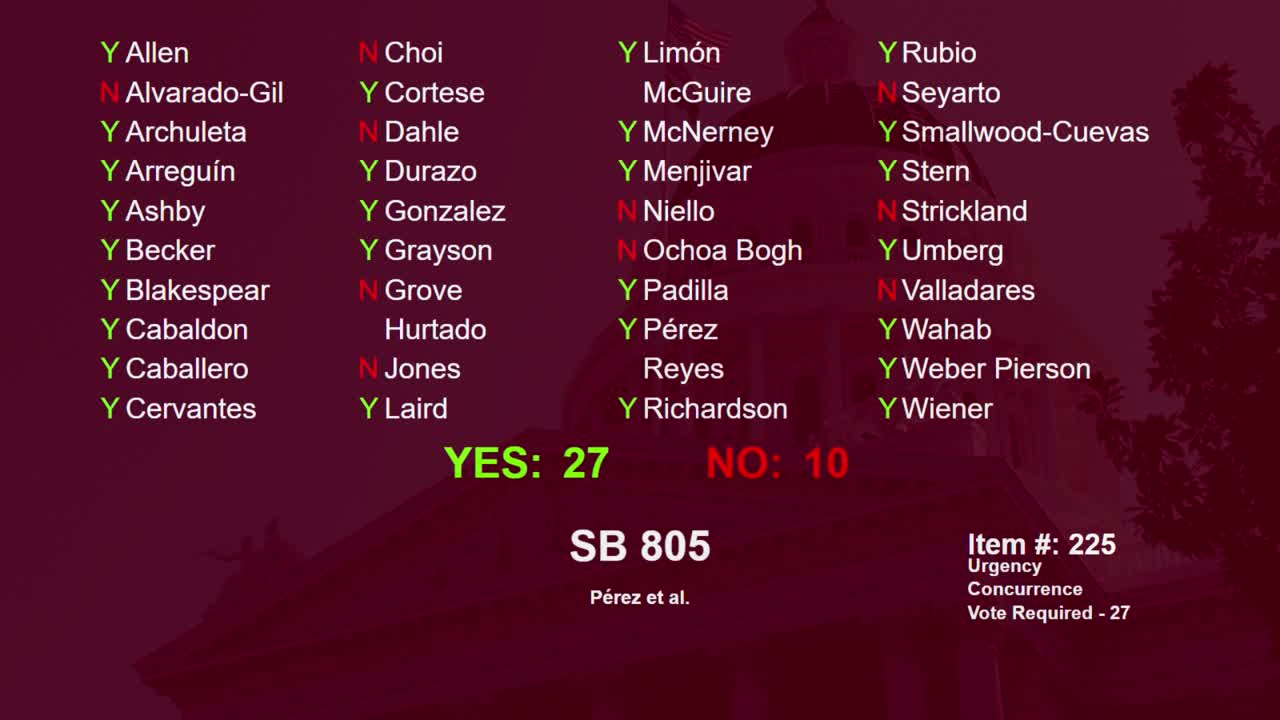 2MIN
Senate Floor
 1MIN
Assembly Floor
 6MIN
Assembly Standing Committee on Revenue and Taxation
 3MIN
Senate Floor
 7MIN